Spring Sale: Get 1 Year, Save 58%

New emails: Trump lawyers saw Clarence Thomas as their “only chance” to steal election

Former President Donald Trump’s legal team believed Supreme Court Justice Clarence Thomas to be their “only chance” to stop President Joe Biden from winning the 2020 presidential election, according to newly disclosed emails obtained by Politico.

“We want to frame things so that Thomas could be the one to issue some sort of stay or other circuit justice opinion saying Georgia is in legitimate doubt,” Trump attorney Kenneth Chesebro wrote in a Dec. 31, 2020 email to the rest of the legal team. 

Supreme Court justices are responsible for handling emergency matters in individual states, and Thomas is assigned to the 11th Circuit Court of Appeals in Georgia. Trump’s legal team was aware that he would have been the justice to receive any urgent appeals of their lawsuit in that district. 

Chesebro added that Thomas would be “our only chance to get a favorable judicial opinion by Jan. 6, which might hold up the Georgia count in Congress.” Fellow Trump attorney John Eastman, who once clerked for Thomas, agreed and proposed using Thomas to “kick the Georgia legislature into gear” in order to overturn the election results.

The newly discovered correspondences were among eight emails obtained by Politico, which Eastman attempted to withhold from the Jan. 6 select committee. However, a judge ordered the emails to be turned over, citing evidence of likely crimes committed by Trump and Eastman. The messages have not yet been publicly released.

Circuit judges are often the first stage of appeal, and in a situation like this, their rulings are a way to temporarily halt a presidential confirmation before the full Supreme Court weighs in. However, Trump’s attorneys hoped that a favorable ruling from Thomas would have prompted Congress and then-Vice President Mike Pence to stop the final certification of Biden as president. 

“[I]f we can just get this case pending before the Supreme Court by Jan. 5, ideally with something positive written by a judge or justice, hopefully Thomas, I think it’s our best shot at holding up the count of a state in Congress,” Chesebro wrote in a December 31 email.


Want a daily wrap-up of all the news and commentary Salon has to offer? Subscribe to our morning newsletter, Crash Course.


“Hard to have enormous optimism about what will happen on Jan. 6, but a lot can happen in the 13 days left until then,” Chesebro added in a message to attorney Justin Clark on Dec. 24, 2020. “I think having as many states still under review (both judicially and in state legislatures) as possible is ideal.” It is not clear whether Clark responded to this message. 

Eastman has an extensive history with Thomas and frequently communicated with his wife, Ginni, in the weeks leading up to Jan. 6. He also suggested to Pence’s staff on Jan. 4 and 5 that Thomas would support their administration’s efforts, and pressured Pence to block the election certification on Jan. 6.

The recently disclosed emails also reveal Trump’s lawyers’ concerns that the former president may find himself in legal trouble if he attested to voter fraud data in a Dec. 31, 2020 lawsuit challenging election results in Georgia. 

“I have no doubt that an aggressive DA or US Atty someplace will go after both the President and his lawyers once all the dust settles on this,” Eastman wrote in an email to Alex Kaufman and Kurt Hilbert, the other private attorneys working on the Trump election case.

Email exchanges between the attorneys and Trump White House lawyer Eric Herschmann show that they agreed to remove specific numbers from the lawsuit before Trump swore to its accuracy. They also questioned whether their federal case should include voter fraud data that had been disproved in an earlier state lawsuit.

“I know it is late in the day, but do we need to incorporate that complaint by reference?” Eastman asked the other attorneys. In a separate email chain, Trump lawyer Cleta Mitchell worried that they would not be able to get the president to sign and notarize the document in time to file the lawsuit. 

“So, now what? Can we figure out a way to file this without a verification?” Mitchell asked. Several other attorneys, including attorney Chris Gardner, wondered how to file the suit on time in emails sent on New Year’s Eve. 

“I don’t know how we file without it,” he wrote. “Presidential trip to a UPS store?”

The assistant executive clerk for the White House, William McCathran, ultimately attested to Trump’s signature, which ended up being the key piece of evidence in U.S. District Court Judge David Carter’s Oct. 19 ruling that the emails be disclosed to the Jan. 6 committee. Trump signed the verification despite being aware that many of the fraud claims cited in the lawsuit were not true, according to Carter.

“President Trump knew that the specific numbers of voter fraud were wrong,” Carter wrote, “but continued to tout those numbers, both in court and to the public.”

Wisconsin Republican says the quiet part out loud: GOP “will never lose another election” if I win

“Republicans will never lose another election in Wisconsin after I’m elected governor,” Wisconsin GOP gubernatorial candidate Tim Michels said this week. 

Michels, who’s running against incumbent Democrat Tony Evers, made the statement during a campaign event in Jackson County, according to an audio clip released by American Bridge 21st Century, a left-leaning political action committee, Business Insider reported

Like other candidates endorsed by former President Donald Trump, Michels has repeatedly questioned the results of the 2020 election. Recently, he even falsely suggested that he could attempt to decertify Wisconsin’s results in the 2020 presidential election once he becomes governor, according to WKOW

He is not alone. Election deniers across the country are supporting radical positions when it comes to accepting election results they don’t agree with.

Arizona gubernatorial candidate Kari Lake and secretary of state candidates Mark Finchem in have echoed similar claims, suggesting they would only honor the results of an election they agree with. 

Before winning his August primary, Finchem vowed he would not concede if he lost. 

“Ain’t gonna be no concession speech coming from this guy. I’m going to demand a 100% hand count if there is the slightest hint that there’s an impropriety. And I will urge the next governor to do the same,” he said at the time. 

Lake has repeatedly refused to say whether she would accept a loss to Democratic opponent Katie Hobbs.

Lake refused to accept the possibility that she could lose in a recent interview with CNN’s Dana Bash, who pressed her on whether she would accept a defeat.

“I’m going to win the election and I’m going to accept that result,” she said repeatedly. 

The former news anchor has called Trump “the real winner of Arizona” and even said that she “would not have certified” the votes had she been the governor at the time.

Finchem and Lake even filed a lawsuit attempting to block the use of vote-counting machines in the midterm election, but a federal judge dismissed the lawsuit.  


Want a daily wrap-up of all the news and commentary Salon has to offer? Subscribe to our morning newsletter, Crash Course.


Another Trump-backed candidate, Blake Masters, has already started sowing doubt about the outcome of his challenge to the incumbent Sen. Mark Kelly, D-Ariz. 

Masters has been telling his supporters to look out for thousands of fraudulent votes that will seize victory from him, The Guardian reported.

Abe Hamadeh, a Republican running for Arizona attorney general, has also started making preemptive moves to stoke doubts about the election, claiming without evidence that mail-in voting is riddled with fraud.

In Nevada, Republican Senate candidate Adam Laxalt has said he’d support legal challenges to the midterm results, projecting fraud on elections that haven’t even taken place yet. 

“With me at the top of the ticket, we’re going to be able to get everybody at the table and come up with a full plan, do our best to try to secure this election, get as many observers as we can, and file lawsuits early, if there are lawsuits we can file to try to tighten up the election,” he told radio host Wayne Allyn Root back in August.

Laxalt has promoted the false narrative that Trump lost in six key battleground states due to widespread election fraud.

In other swing states like Michigan, where a top election official is a Democrat, Trump-backed gubernatorial candidate Tudor Dixon is questioning how midterm elections are being conducted.

“We have to wonder what the secretary of state will do when it comes to the ’22 election,” Dixon has said. 

She is running against incumbent Gov. Gretchen Whitmer. 

Some Republican candidates, who are a part of the America First Secretary of State Coalition, are also supporting Trump’s push to keep “traditional absentee ballots” and “eliminate mail-in ballots” – even though election experts warn such a move could trigger mass errors

Nevada secretary of state candidate Jim Marchant, who serves as the leader of the coalition, said at a rally last month that his class of pro-Trump secretaries of state would “fix the whole country and President Trump is going to be president again in 2024.”

“I’m so scared”: 911 recordings reveal fear and urgency of those trapped in Uvalde elementary school

Get the data and visuals that accompany this story →

Sign up for The Brief, our daily newsletter that keeps readers up to speed on the most essential Texas news.

ProPublica is a nonprofit newsroom that investigates abuses of power. Sign up to receive our biggest stories as soon as they’re published.

Editor’s note: This story contains audio of people calling 911 during a mass shooting incident.

The first two 911 calls came in at 11:29 a.m.

A man had crashed his truck into a ditch by Robb Elementary School in Uvalde, and he was rushing toward the school with a gun.


The gunman fired more than 100 rounds by the time police dispatchers received another call two minutes later. An adult voice could be heard making “shh” sounds for nearly 44 seconds before the phone abruptly cut out.

Monica Martinez, a STEM teacher who was hiding in a closet at the school, was among several callers from inside the school who followed.


What happened on May 24 in Uvalde is well documented. Hundreds of law enforcement officers from nearly two dozen local, state and federal agencies rushed to the scene. It took more than an hour before they entered the rooms where the gunman was located. They treated the crisis as one of a barricaded suspect who was no longer an active threat. Ultimately, 19 children and two teachers were killed in the worst school shooting in Texas history.

In the ensuing five months, the delayed law enforcement response has spurred state and federal investigations. The school district’s police chief was fired. He has publicly contested his termination, saying he was unfairly blamed. The acting Uvalde police chief has also been suspended and a state trooper fired. The chief of the Texas Rangers, the Department of Public Safety unit that is leading the state investigation, retired abruptly in September, as did his deputy in August. Several state police troopers remain under investigation. Officers facing punishment either could not immediately be reached for comment or declined to respond.

The Texas Tribune and ProPublica have for the first time obtained recordings of more than 20 emergency calls and dozens of hours of conversations between police and dispatchers that lay bare the increasing sense of urgency and desperation conveyed by children and teachers. In chilling, muffled 911 calls, they begged for help from inside the school.

Although the existence of some 911 calls and body camera footage has been reported publicly, the totality of the recordings show the pervasiveness of the miscommunication that unfolded that day.

During some calls, dispatchers and officers warned that class was supposed to be in session in rooms where the gunman had been shooting. On others, law enforcement officers said they were unaware that anyone aside from the gunman was in the classrooms, even as dispatchers received calls from children seeking help.

Ten-year-old Khloie Torres was one of those children. While state officials previously released a transcript with excerpts from one of Khloie’s phone calls, the news organizations obtained additional recordings of her pleading for help that had not been made public. Khloie survived that day.

In an interview, her father, Ruben Torres Jr., said he is “disgusted” that police did not quickly intervene. The fact that his daughter had to wait so long to get help is “mind-boggling,” Torres said.

“There was no control. That dude had control the entire 77 minutes,” said Torres, a U.S. Marine Corps veteran. “They didn’t have him barricaded. He had the police barricaded outside. It’s plain and simple. The police didn’t go in. That’s your job: to go in.”

DPS officials did not respond to questions from ProPublica and the Tribune about the recordings. A spokesperson for the city of Uvalde, the police chief, the Uvalde mayor and the county’s chief executive declined to comment.

Communication was a key failure throughout the response. Many officers assumed the school police chief, Pete Arredondo, was in command. He did not have his radios with him, issued few orders and later said he never viewed himself as the officer in charge. County officials said emergency communications were overwhelmed in the rural community, which typically has only two dispatchers answering 911 calls and juggling the transmission of key information to emergency responders.

The emergency radio system has two 911 lines and three emergency channels. Its frequency is designed for the vast, 15,000-square-mile stretch of scrubby desert terrain, rather than for high-density urban areas where equipment must work inside buildings, said Forrest Anderson, the county’s emergency management coordinator who oversaw the radio system’s implementation two decades ago. A legislative committee that later examined the response noted that city police radios worked only intermittently inside the school.

Radio traffic and footage obtained by the news organizations show that some police knew about the 911 calls, but just how many officers remains unclear.

High-stakes emergency responses always have some communications gaps, but skilled incident commanders should be prepared to overcome such challenges, said Bob Harrison, a former California police chief and homeland security researcher at the Rand Corp., a national think tank.

Harrison noted that many of the radios used by Border Patrol agents also did not work during the Uvalde shooting response, but the agency’s SWAT team, which does not typically lead the response in school shootings because it is a federal agency focused on immigration and national security, mobilized to breach the classroom once it arrived and determined no one was in control.

“If a strong unifying command scene was set up quickly, these discrepancies wouldn’t have been necessarily relevant, and there would have been one voice and one command,” Harrison said of the problems with 911 and radio communication.

The state legislative committee reached a similar conclusion in its July investigative report, which stated that a capable incident commander would have realized that the radios were “mostly ineffective” and that responders needed other means of communication to transmit key details such as calls from victims inside the classrooms. The report highlighted that law enforcement is trained to be “prepared to respond effectively without reliable radio communications” and could employ a series of strategies including using “runners” to deliver messages in person.

But that day, children and teachers, including Martinez, waited to be rescued.

In the dark closet of room 116, Martinez stayed on the phone with a dispatcher and tried to practice a key tenet of the school’s active-shooter protocol: Be quiet.

Class should be in session

When a new round of gunshots rang out from behind the closed door of the two adjoining classrooms, Uvalde police Sgt. Daniel Coronado sprinted outside, panting heavily as he relayed an urgent message on his radio to city police dispatchers.

“He’s inside the building,” Coronado said of the shooter at 11:38 a.m. “We have him contained.”

He asked for ballistic shields and requested that someone call DPS.

Then he repeated: “He’s contained. We’ve got multiple officers inside the building at this time. We believe he’s barricaded in one of the offices. Male subject is still shooting.”

Four minutes later, a male voice, unclear from which agency, asked that someone check the classroom of fourth-grade teacher Eva Mireles, a 44-year-old educator and the wife of Ruben Ruiz, a Uvalde Consolidated Independent School District police officer. Mireles was assigned to classroom 112, one of two adjoining rooms where the shots were coming from.

“See if the class is in there right now or if they’re somewhere else,” the official said.


Another officer gasped.

“That’s going to be Ruben’s girl,” he said, referring to Mireles.

“Oh no, oh no,” Coronado muttered under his breath.

The exchange demonstrates some officers knew early on that the gunman was not barricaded alone in the classroom. More indicators, and clear confirmations, would come soon after — yet for much of the response, they would not be heard.

At 11:48 a.m., Ruiz, who was standing in the hallway outside of the classroom, told officers that his wife had been shot. Ruiz said his wife had called him and said she was “dying.” Mireles later died in an ambulance.

Officers escorted Ruiz outside, taking away his weapon for his safety, according to interviews officers at the scene later gave to the Texas Rangers. But they did not attempt to enter the classroom. One of the police lieutenants who heard Ruiz’s announcement told investigators that they were waiting for DPS and Border Patrol to arrive “with better equipment like rifle-rated shields.”

By that time, Martinez, the teacher, had been on the phone with 911 for more than 10 minutes. She had told the dispatcher that she could hear people in the hallway. The dispatcher urged her to stay quiet and remain barricaded in the closet.

“You still there with me?” the dispatcher asked at about 11:47 a.m.

“I’m still here,” Martinez whispered.


Seven minutes later, an officer asked if any children were inside with the gunman.

“No, we don’t know anything about that,” another officer replied on the radio.

“Everything is closed, like the kids are not in there,” a third responded.

About a minute later, an officer asked for the shooter’s location.

“The school chief of police is in there with him,” another officer replied.

As the back-and-forth continued, law enforcement officers rescued people from other classrooms. At 11:58 a.m., Martinez told the dispatcher that she again heard someone knocking. She said the person had identified themselves as a police officer.

“Open the door,” the dispatcher said, confirming that the person on the other side was law enforcement. “Stay on the line with me until you make contact with him.”

“I’m coming,” the teacher whispered.

Her sobs carried through the phone.

The teacher did not return calls and emails seeking comment.

Confusion marks response

Some children in classrooms 111 and 112 with the gunman kept calling 911, seeking help even when they suspected it was not safe to speak. One of the first calls from a trapped student, at 12:03 p.m., was barely audible.


The call lasted a minute and 24 seconds. The child was silent as the dispatcher asked their name and what room they were in.

“Hello, ma’am? Can you hear me?” the dispatcher asked.

Then at 12:10 p.m., Khloie called.

“There is a lot of bodies,” The New York Times previously reported that she told a dispatcher, adding that her teacher had been shot but was still alive.

Khloie stayed on the phone for more than 17 minutes. While she spoke, another city police dispatcher answered a call from DPS and erroneously reported that the school police chief was inside the classroom with the gunman.


“We’re sending everybody that we can, um, heading out there, but do you have any injuries, fatals, anything?” the DPS dispatcher responded.

Only one female was shot, and perhaps an officer was injured, the Uvalde dispatcher replied.

A dispatcher’s voice crackled through the Uvalde police and Border Patrol radio traffic, notifying that she had a child on the line.


Hallway surveillance video from inside the school at the time shows at least four law enforcement officials, one with a shield, kneeling outside the classroom door with their guns drawn.

It is not clear if the officers heard that message.

At 12:14 p.m., a state trooper’s body camera captured someone saying, “There’s victims in there, dude.” The trooper was standing outside a door to the school, with at least eight officers from different agencies visible from that camera angle.

“We need to get in there,” one responded.

No one did.

Five minutes later, another girl in room 111 called 911. The recording of the call, which lasted a minute and 17 seconds, is mostly inaudible.

In the hallway, Uvalde County Constable Emmanuel Zamora wrongly suggested that the gunman may have already shot himself.

“One shot at the end was self-inflicted, maybe,” Zamora said in the recording, referring to an earlier burst of gunfire.

Zamora did not respond to texts and emails about his comments, which had not been previously reported.


It was the first time he acknowledged to other responders that anyone was wounded inside the two classrooms, according to new footage obtained by the news organizations. The legislative report noted only that he acknowledged “some casualties” 14 minutes later. Arredondo did not return a message seeking comment shared with him by his former attorney.

A minute later, the gunman fired again.

Officers in the hallway flinched, formed a line and started walking down the hall, then suddenly stopped, a state trooper’s body camera footage reveals.

Just after the shots were fired at 12:21 p.m., the school chief began trying to talk to the shooter for the first time, according to communications and records.

“If you can hear me, sir, please put your firearm down, sir,” Arredondo said. “We don’t want anyone else hurt.”

Just after 12:30 p.m., three troopers again advanced toward the classrooms before an unidentified person said “no, no, no,” according to body camera footage.

Once again, they stopped.

A DPS trooper who made his way into the hallway around that time asked another officer if there were children in the classroom. The response was, “We don’t know.”

By then, more than 20 minutes had lapsed since Khloie first begged a dispatcher for help. She ended the initial call when she feared the gunman, who she felt taunted the children, was getting close, her father later recalled.

She called 911 again at 12:36 p.m.


About two minutes later, Khloie once more asked for police.

Yet again, a dispatcher tried to reassure her.

“I have someone that is trying to get to you, OK,” she said.

Khloie whispered that she thought she heard the police next door.


“That was you?”

As the Border Patrol strike team was almost ready to breach, DPS Capt. Joel Betancourt went on the radio and ordered the agents to wait.


The captain did not respond to requests for comment left for him through DPS.

The team ignored the order and entered the classroom, quickly killing the shooter. The previously silent hallway filled with officers waiting to act.

Someone yelled, “Make a hole!” as police carried out wounded children. Law enforcement officers motioned for those who were not as severely injured to walk out on their own.


As the onsite paramedics focused on the most critically injured, officers began taking other hurt children to the hospital. Khloie was among them.

“I was on the phone with a police officer,” she told the trooper examining her as the screams of other wounded children reverberated in the background.

The officer, whose body camera had earlier picked up a dispatcher describing that call, seemed surprised.

“Oh, that was you?” the trooper asked.

Uriel J. García contributed reporting.

Disclosure: The New York Times has been a financial supporter of The Texas Tribune, a nonprofit, nonpartisan news organization that is funded in part by donations from members, foundations and corporate sponsors. Financial supporters play no role in the Tribune’s journalism. Find a complete list of them here.

Correction, Nov. 3, 2022: A previous version of this story included incorrect details of a request to check the classroom of teacher Eva Mireles early in the police response. The request was to check Mireles’ room, 112, not the adjoining 111. It was made by an unidentified male official, not a dispatcher. And class was reported to be in session by a school district police officer, not a Uvalde officer. That same officer, not a dispatcher, also wrongly reported over the radio at 11:50 a.m. that the school chief was “in the room with the shooter.”

This article originally appeared in The Texas Tribune at https://www.texastribune.org/2022/11/01/uvalde-911-dispatch-recordings/.

The Texas Tribune is a member-supported, nonpartisan newsroom informing and engaging Texans on state politics and policy. Learn more at texastribune.org.

Pennsylvania’s Supreme Court ruling could toss thousands of ballots over “irrelevant technicality”

Just a week before the midterms, the Pennsylvania Supreme Court ruled Tuesday that state election officials cannot count ballots submitted without a correct date on the outer envelope, siding with a coalition of Republican groups that sued to block undated mail-in ballots.

In a two-page order, the six-judge high court ordered election officials to “refrain from counting any absentee and mail-in ballots received for the November 8, 2022 general election that are contained in undated or incorrectly dated outer envelopes” even if they were received on time, pointing to two specific Pennsylvania statutes.

The judges—four Democrats and two Republicans—were divided on the question of whether excluding ballots inside improperly dated envelopes would violate federal law, as Acting Secretary of the Commonwealth Leigh Chapman has argued. The court was left with an even number of judges following the recent death of Democratic Chief Justice Max Baer.

In a recent filing, Chapman warned the GOP coalition was pursuing “an order that will disenfranchise thousands of qualified Pennsylvania voters, predominantly older citizens, because the voter omitted (or incorrectly wrote) a date that serves no function in the administration of Pennsylvania’s elections.”

“As a matter of both state and federal law, county boards may not disqualify ballots based on an omission of, or error in, the handwritten date,” the brief contended.

The Pennsylvania Supreme Court’s ruling to the contrary could have huge implications for midterm races in the battleground state, which could decide which party controls the U.S. Senate next year. The Wall Street Journal noted Tuesday that “the case has been one of the most closely watched voting law battles heading into the 2022 midterm elections.”

“More than 1.4 million voters in Pennsylvania have applied to vote by mail or absentee ballot this election,” the newspaper observed. “Experts on voting said the decision could affect tight races, including the U.S. Senate contest between Democrat John Fetterman and Republican Mehmet Oz… Some 70% of mail-in ballot requests as of November 1 were from Democrats.”

The ACLU of Pennsylvania, which sought to intervene in the case brought by the Republican National Committee (RNC) and other GOP organizations, expressed disappointment in the state court’s ruling on social media.

“No one should be disenfranchised for an irrelevant technicality,” the group tweeted. “Voters, sign and date your return envelope.”

Republicans, meanwhile, hailed the ruling as a major victory as they work to suppress votes nationwide.

Ronna McDaniel, chair of the RNC, called the decision a “massive election integrity win,” a sentiment that Doug Mastriano—the GOP’s election-denying gubernatorial nominee in Pennsylvania—echoed.

It’s not clear whether Pennsylvania officials will be able to appeal the ruling.

Amy Gulli, a spokeswoman for Chapman, told The New York Times that “we are reviewing, but the order underscores the importance of the state’s consistent guidance that voters should carefully follow all instructions on their mail ballot and double-check before returning it.”

Chapman’s office has been working in recent days to combat election lies peddled by state Republicans and amplified by former President Donald Trump, who is backing Mastriano and Dr. Oz.

In a recent post on Truth Social, Trump wrote that “over 240,000 ‘unverified’ ballots have already been sent out in Pennsylvania, a total mess.”

Pennsylvania’s Department of State responded with a notice pointing out that “this misinformation incorrectly conflates an application for a mail ballot and an approved mail ballot.”

“Daniel LaRusso felt like someone I knew”: Ralph Macchio on the eternal appeal of “The Karate Kid”

What do you do when you’re a successful performer well into his AARP years, and the defining role of your career was as a “kid”? You lean in.

In his new memoir, “Waxing On: The Karate Kid and Me,” actor (“The Outsiders,” “My Cousin Vinny”), director and producer Ralph Macchio explores the ways in which becoming Daniel LaRusso — from his first audition for the 1984 sleeper hit “The Karate Kid” right through the current season of Netflix’s “Cobra Kai” — transformed his life. And yes, he reminisces on four decades of a show business career and the actors and directors who’ve impacted his life. But it’s also a loving tribute to an underdog story that still resonates, generation after generation, and what it’s like to be the custodian of that iconic legacy.

Macchio joined me recently for a candid “Salon Talks” conversation about his hopes for the future of the franchise, his secrets of eternal youth, and the enduring power of waxing on.

The following interview has been lightly edited for clarity and length.

Publishers Weekly just called the book a “feel-good hit.” Yet another feel-good hit under your belt, Ralph. Welcome.

It’s really nice to be back on Salon. I remember this was one of the stops for season one of “Cobra Kai.” Everyone had a little piece of this new resurgence into what has exploded on Netflix, and led me to dive into what it’s been like for 38 years walking in the shoes of a character that’s so inspirational and impactful. 

I started writing the proposal for the book right when we went into lockdown. The question has come to me over the past ten years or so: “Would you ever write about this seminal character in pop culture?” So, it was out there. The timing never felt right. Timing’s big for me. 

You could have written a much more straightforward memoir and not done it through the lens of this franchise and this character. You could have written a book like, “Daniel LaRusso’s Guide to Life,” but you didn’t. You chose for it to be a memoir, but with this particular throughline. Why write it at all, and why write it in that particular way?

It was the same with “Cobra Kai.” I said no for 30 years to everyone who had their “Karate Kid” reboot concepts. I’m very lucky and look way smarter than I actually am in making those choices and waiting for the right time. But there was a pure uniqueness with a character that’s that inspirational to a generation back in 1984, ’83, when I made the movie. That has never gone away, through the decades, and now is so contemporarily relevant. You have nostalgia and relevance and the same throughline. To me, there’s not a lot of examples of that. 

“The Miyagi character is the magic, as I write in the book, the soulful magic of what separates ‘The Karate Kid’ from another ’80s teen story.”

To share what it was like for me going on that rollercoaster ride with the ascents and the descent and the dry, slow periods and the head-snapping fast periods, I started breaking down chapters and talking about areas that got me excited, and also got me a little emotional, because there’s certainly a lot of these folks [who] are no longer with us, so I miss them. [Them] being Pat Morita and John Avildsen and Jerry Weintraub, who were part of the filmmakers and my acting partner in that film and this franchise. None of what we have today would be there without them. Part of it then became about me proudly honoring them. It’s history.

I never liked history in school. Why teach me about something 30 years ago or 20 years ago? Now, there’s a little bit of history in this book because I am saying, “What you have now is because of this and this has been the journey and my perspective.” At the end, it’s a celebration of it all. 

You start the book at a preview of the movie, in this moment where it instantly became something over a summer when other incredible movies were breaking — one of the “Raiders” films, “Ghostbusters.” Then you go back to when you auditioned. You say in the book to watch the clip [of it] on YouTube. I do whatever you tell me, Ralph, so I watched your audition. You are locked in immediately. You are fully present. You’ve bloomed fully as the character Daniel LaRusso. What was that like for you when you read the script? What is it about this character that you immediately had this affinity with?

Robert Mark Kamen’s script deserves an incredible amount of credit, and the Miyagi character is the soulful magic of what separates the “Karate Kid” from another ’80s teen story, this sort of human Yoda, if you will. 

But Daniel LaRusso felt like someone I knew, even though he was more up in it than I would be. I always say if I got my ass kicked by five guys on motorcycles and they were martial artists, I probably would’ve found another way to walk to school. He had this East Coast bravado about him, and I had a little bit of that. It was my defense mechanism to looking young for my age, for being one of the smallest in the class. 

I understood how to have a little bit of a front. I had nothing to back it up with, but I went in with a little of that cockiness, but sweetness, I believe, and goodness, because I’ve always tried to put that forward. I think I have that genuine feeling. I try to put that forward always. As you navigate life, you get the armor and all the hard edges that happen when you deal with society. But I think at the core, that goodness is who LaRusso is, with this little East Coast bravado. I didn’t think very hard about, “OK, I have to do this, I have to do that.” That just came. I read the words and they just came out of my mouth that way.

It’s interesting you mentioned the YouTube video and why I love mentioning that in the book. I didn’t realize until John Avildsen put that video up years later. When I watched it, I was like, “Wow, that’s kind of the kid.” It wasn’t like, “Oh, he auditioned with this and then they got the character to that.” You could see it, and with Pat Morita as well. There were the right actors in the right parts and all the components came together, and it’s followed me ever since.

The other part of the secret sauce of this is Noriyuki “Pat” Morita. He is one of the people you dedicate this book to. He is a very real and alive presence in the book and in “Cobra Kai.” 

“He had this East Coast bravado about him, and I had a little bit of that. It was my defense mechanism to looking young for my age, for being one of the smallest in the class.”

100 percent.

Talk to me about that relationship that you had with him.

It’s interesting because he was so easy to work with. It was effortless. I think that’s due in part to the text and the words and the writing, but it was elevated by this palpable chemistry and affinity for each other, and a give-and-take that was so natural. I didn’t know we had great chemistry. I just knew it was really easy and then you would hear about it when we were shooting. “You guys are coming across great, it’s just magic on screen.” I’m sure you hear that all the time, but witnessing it and seeing it, there was a special bond there. You cared about both of these characters deeply to the point that you were just rooting for them to succeed.

Pat was a comic at heart, so he loved cracking me up in between scenes. He’d do a dramatic moment and then come out of it and throw a few fart jokes and crosseyed zingers and ba dum bumps, and that was just him. That was part of the comic’s need for attention. There was just an unconditional love that just was there. 

People probably want to believe we had sushi together every day and went to the movies together. We didn’t. We went on with our lives in between films, but when we would see each other or when he’d give me a call or vice versa, it was just — “affinity” is the word. Affinity, friendship, knowing that there is some connection there. It was even unspoken. So it was very important that he be part of “Cobra Kai.” The guys who write the show do an extraordinary job of keeping that spirit throughout the show, and it’s pretty awesome.

You talk about the ways in which people still root for these characters, care about that movie, care about that original dynamic from almost 40 years ago. You also acknowledge in the book that there has been a little revisionist history around it.  Thanks to “How I Met Your Mother” and YouTube, there is some dispute about who the real hero is and whether that crane kick was legal or not. How does that make you approach this character who you’re still playing?

I’ve always said, “If they’re still talking about a movie you made 20, 30 years ago, regardless of what they’re saying, it’s awesome, because that means you made a difference.” 

I think when you look back at “The Karate Kid,” there’s clearly a protagonist and an antagonist. Does every teenager do everything perfectly? No. Does Mr. Miyagi steal a black belt so Daniel could fight in the tournament? Yeah. Is that what you want your coach to do? Probably not, but we’re making a movie. Was the kick legal? I’ve been on the “Tonight Show” and other places, and I always talk about how he was defending himself from an attack and the guy ran into his foot. It’s all awesome at this point. I don’t believe anyone was not rooting for Daniel LaRusso in 1984.

Except maybe Barney Stinson, right?

Except for Barney Stinson, and he probably just watched it on VHS. He probably wasn’t around in 1984, so that doesn’t even count. He wasn’t in the movie theater. But it’s pretty wonderful to have that, and very creative and clever. It has given birth to, “Let’s look at the perspective from here.” 

“This was about character nuances, and then flipping the script a little bit.”

One of the things “Cobra Kai” does so well, certainly with Johnny Lawrence and Daniel LaRusso, is these guys have good intentions. They’re not bad guys. There is “no such thing as bad student, only a bad teacher.” That’s a Miyagism. In essence, they’re not too different. If LaRusso ran into John Kreese and Johnny Lawrence was hooked up with Mr. Miyagi, would they have swapped roles? Maybe not completely, but life would’ve been different, and that’s what “Cobra Kai” does so well, diving into the gray areas of these characters. 

You talk in the book about some really terrible pitches that you got and some really awful reinterpretations. What was it about this show and the way that it is updated and the way that you’re tackling many of the same issues — bullying, mentorship, survival in a tougher world — that drew you to it? What are you proud of and excited about?

The guys who create the show are massive “Karate Kid” fans, and they care so much and know every nook and cranny and thread in the fabric of the “Karate Kid” universe, more than I do. It’s insane. I genuinely felt that they wanted to make the show the fans would want to see, and they had the angle in through Johnny Lawrence’s eyes. Whatever happened to the bully, and has anyone ever explored that? What makes a bully? That was an interesting angle. 

The movie “Creed” had just come out. I had seen the Apollo Creed’s son [story] in the Rocky Balboa world without making “Rocky VII” or wherever they’re up to. That informed me that maybe coming in from a different perspective into a universe, now it’s whatever prism you’re looking through. It changes the perspective and now you can enhance the story. 

The other thing is, they had a pretty well drawn out next-generation cast the Miguel, the Robbie, the Samantha characters in “Cobra Kai” that now have blossomed so much in the five seasons. I had no idea we’d be going five seasons, and hopefully six. We’re just waiting for word on that. 

Those were the elements. And the streaming service — it was YouTube at the time, and now it’s Netflix — you could make a five-hour, five-and-a-half-hour movie, and cut it up into ten half-hour, 35-minute parts. Ten, 15 years ago, you would need a big two-hour blockbuster movie with a big fight at the end and a multiverse and all this. This was about character nuances, and then flipping the script a little bit, where LaRusso is without his mentor and loses his balance and has to find it. Johnny Lawrence keeps skinning his knees as he’s trying to reconnect with his own son, but has his relationship with his student and deals with and manages all that. Those are great themes and great positions to tell a story. 

It took a little longer than I expected to get to the LaRusso that wasn’t just the jerk to Johnny Lawrence in season one-ish. I’m glad that’s how we launched, and now we are in a place where I get to dive deeper into a man in his midlife crisis and losing a grip on certain things and needing the people around him to have his back, just like Mr. Miyagi did. Season five felt a little like that. It felt his presence through the others that held him up to be the protagonist that he originally was, and that was really wonderful.

For those of us who watch the show, it feels like there’s still so much to explore. But as you say, you are a person who has a very unique role in pop culture history. There aren’t too many other people who have walked in those shoes. Jamie Lee Curtis just allegedly hung up [her “Halloween” role] Laurie Strode. Do you see the end of LaRusso?

I don’t right now. I think for the guys who write “Cobra Kai” and even Robert Mark Kamen, who’s still writing screenplays, it’s become the “Karate Kid” cinematic universe. Whenever “Cobra Kai” proper comes in for a landing, meaning that series, I think there’s a potential spinoff. I don’t know where it is. I don’t know what characters it would be, if it’s a younger generation, or is there a prequel concept? Is there a Miyagi origin story, which I would love to see and I’ve spoken about? Who was this guy before Daniel LaRusso knocked on his maintenance door and said, “Can you fix the faucet?” I think there’s a wonderful dramatic story there. Is there a place for LaRusso to come in and out of stories in years to come?

As far as hanging up that character, I think if it was “Karate Kid 6,” there comes a time when I’m definitely the Karate Man — and the Karate Not As Young Man. You don’t want to overstay that welcome. [But] look at Mark Hamill in the “Mandalorian” and the “Star Wars,” just even a scene here or there. Never say never. If you would’ve told me I’d be having this conversation in 2022, about a show that is one of the top shows on Netflix and get to write about it in a memoir, people are embracing, I would’ve said, “What, are you crazy?” 

You’ve got a few crane kicks left in you. 

I don’t know how good those crane kicks are, but I got a few something left in there.

My producer and I were just looking at the cover of your book and saying, “This dude ages backwards.” You say you’re not the Karate Kid anymore, but you still are. What is secret of eternal youth, Ralph Macchio? Because if you don’t know it, I don’t know who does.

It’s the weirdest subject for me to talk about. “I blame it on my parents” is my go-to line because it is from my family. My parents look young for their age, and my grandmothers looked incredibly young for their ages and their spirit. They had a youthful energy about them and so I have that. It’s not only a young look. Sometimes I watch my interviews and I’m like, “Relax, Macchio. Just sit back like a guy your age. Stop bouncing around so much.” But that’s kind of who I am. Considering the alternative, I’ll take it. 

As I’m getting older, it’s a little tougher to defend it. I’m a bit of a freak of nature, but a little hair dye does help. 

“We don’t want JD Vance in the doctor’s office”: Fox News audience cheers Tim Ryan’s abortion answer

United States Congressman and Senate candidate Tim Ryan, D-Ohio, received a huge round of applause during a Fox News town hall on Tuesday for his answer to a question about what restrictions he accepts on abortion.

Ryan is running against right-wing Republican JD Vance to replace retiring GOP Senator Rob Portman. Vance is a conservative writer, activist, and lawyer who defines himself as “pro-life.” His campaign has the endorsement of former President Donald Trump.

“There’s a story or two every single week of people – women – who are in this tragic situation, their life becomes at risk. They have to go to Illinois,” Ryan said. “Now, JD Vance wants a national abortion ban, and he wouldn’t be happy with these people going to Illinois. He wants them to have to get a passport to go to Canada. He called rape ‘inconvenient.'”

Anchor Bret Baier noted that Vance supports Senator Lindsey Graham’s, R-S.C., proposal to limit abortions to 15 weeks and asked Ryan if there is a time limit on how long women should be legally permitted to terminate a pregnancy. “What’s your number? What’s the – you say you don’t want it afterward. Is there a number?”

Ryan’s response roused the audience to cheers.

“I think we go back to Roe v. Wade. Roe v. Wade was in the third term. In the third term of Roe v. Wade, you could only do it if there was some kind of medical emergency,” said Ryan. “We don’t want JD Vance or [Senator] Ted Cruz [R-Texas] and all these guys in the doctor’s office.”

Watch below or at this link.

“I’m bringing in the big guns”: Kari Lake hires Trump lawyer as she gears up for election challenges

The election denialist that is the GOP nominee for governor of Arizona has hired an attorney closely linked to Donald Trump to lead her legal efforts.

Kari Lake brought on Harmeet Dhillon, a member of the Republican National Committee, The Washington Post reported Tuesday.

The Dhillon Law Group has been retained by Donald Trump on the subpoena issued by the House Select Committee Investigating the Jan. 6 Attack on the U.S. Capitol.

The firm has also represented Michael Flynn, Sebastian Gorka, and Women for America First.

Lake said, “I’m bringing in the big guns.”

The GOP candidate announced Dhillon’s role only days after the California lawyer wrote a conspiratorial post questioning the hammer attack on Paul Pelosi.

Read the full report.

The 6 most shocking Jerry Falwell Jr. sex scandal moments from Hulu’s “God Forbid” documentary

Hulu’s provocative new documentary, “God Forbid: The Sex Scandal That Brought Down a Dynasty,” takes us back to August 2020, when news of Jerry Falwell Jr.’s sex scandal first became public knowledge. At the center of it all was Jerry Jr., his wife Becki and Giancarlo Granda — an attractive, twenty-something ex-pool boy who was locked into a seven-year-long affair with the couple.

Jerry Jr. had already emerged as a contentious figure, not for what he did behind closed doors but rather, for what he did publicly. The son of disgraced televangelist Jerry Falwell, Jerry Jr. served as the former president of the Christian college, Liberty University, up until his subsequent resignation, and an ardent endorser of ex-president Donald Trump and the Republican Party. His endorsement was so well-received that the Trump administration allegedly offered Jerry Jr. the position of Education Secretary, which he ultimately turned down.

“God Forbid: The Sex Scandal That Brought Down a Dynasty” takes the spotlight away from Jerry Jr. and shines it on Granda, who appears in front of the camera to share his story and recount details of the prolonged sexual threesome. Granda’s sister, investigative journalist Megan K. Stack and journalist Mark Ebner, who co-wrote Granda’s new memoir, are also featured in the documentary. 

Here are the 6 most shocking moments from the Hulu documentary:

01
Becki’s sexual proposition to Granda
Liberty University President Jerry Falwell Jr. (L) and Becki TilleyLiberty University President Jerry Falwell Jr. (L) and Becki Tilley speak during a town hall meeting on the opioid crisis as part of first lady Melania the first lady’s “Be Best” initiative at the Westgate Las Vegas Resort & Casino on March 5, 2019 in Las Vegas, Nevada. (Ethan Miller/Getty Images)
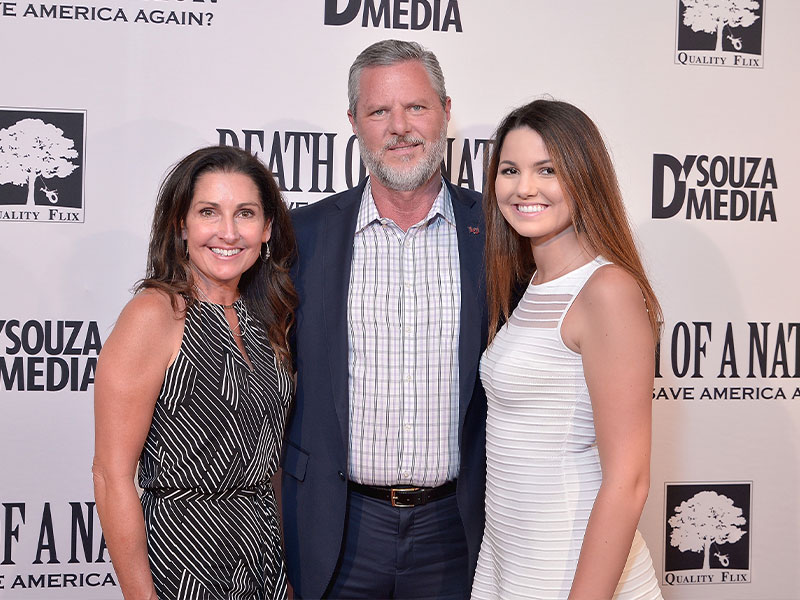
While working as a pool attendant at Miami Beach’s luxurious Fontainebleau hotel, Granda met Becki Falwell, who he said was sitting by the pool and taking photos of him from afar. Granda recalled that Becki had told him, “Don’t waste your time with the younger ones, they don’t know what they are doing.” She invited him back to her room and explained that her husband, Jerry Jr., also wanted to watch the pair have sex. 


That night, Granda received a phone call from Becki via a blocked private number. She asked that Granda meet her and her husband at a nearby Days Inn instead of at their Fontainebleau room because their children were staying there. Granda met Becki in the lobby of the hotel, where she gave him a cup of Jack Daniel’s whiskey to calm his nerves and proceeded to stroke his inner thigh.


“I was a horny 20-year-old. There really is no other explanation other than that,” Granda sheepishly confessed in the documentary.


Granda said that when he and Becki went up to her hotel room, Jerry Jr. was laid out on the bed with his jeans unzipped and a drink in his hand. While Granda and Becki had sex, which was “anything but penetrative,” Jerry Jr. took off his jeans and masturbated in the corner.


Per the documentary, “The Falwells have denied that Jerry was ever present during the sexual liasons between Becki and Giancarlo.”

02
The Falwell’s messy history
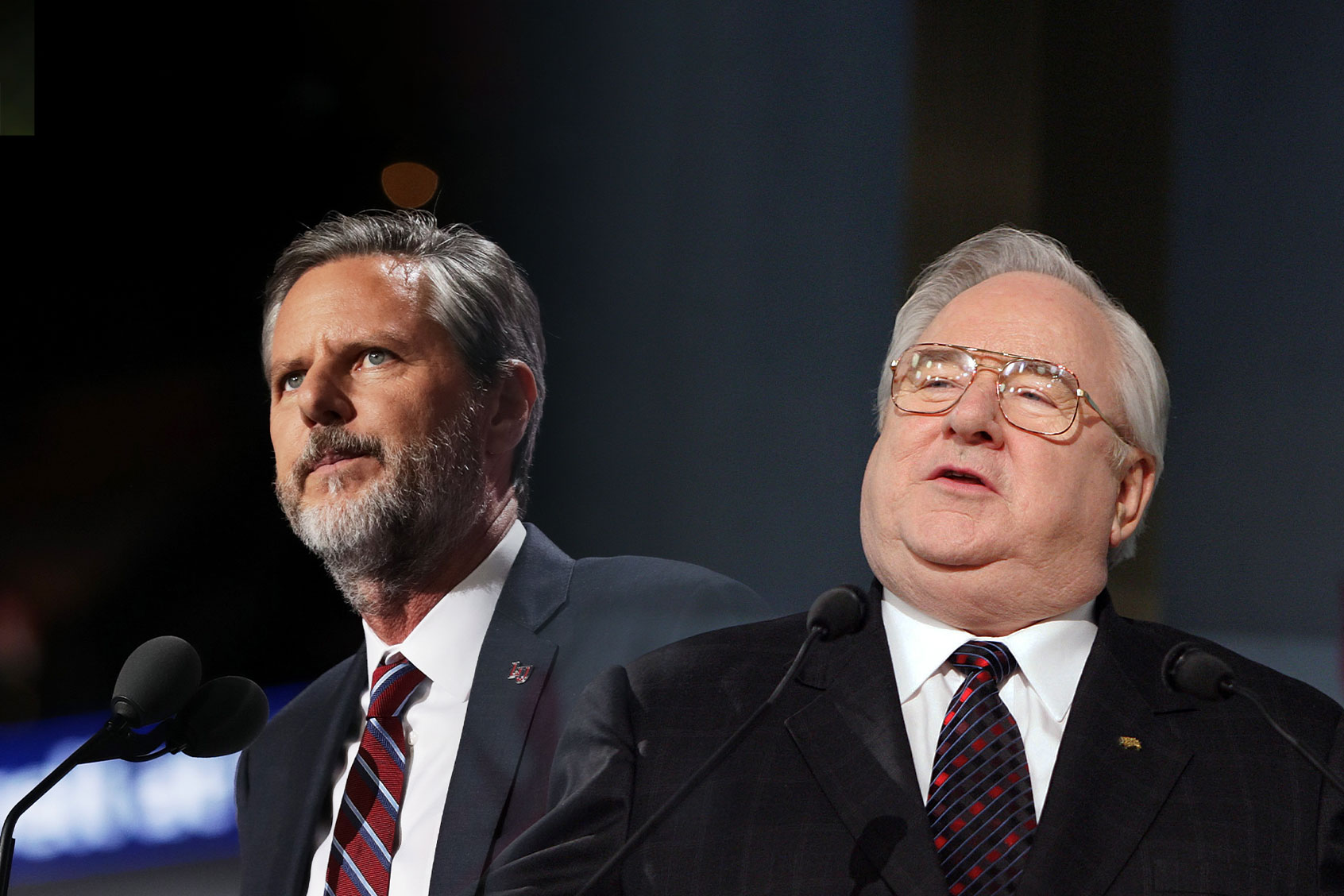
Jerry Falwell, Jr. (C), with his wife Becki Falwell (L) and daughter Caroline (R)Jerry Falwell; Jerry Falwell Jr;Jerry Falwell Jr. and Jerry Falwell (Photo illustration by Salon/Getty Images)

“The Falwells are the Southern Gatsbys,” said Ebner in the documentary. “They are wealthy and sloppy as f**k.”


Jerry Jr.’s father, Jerry Falwell, was the founding pastor of the Thomas Road Baptist Church, a megachurch located in Lynchburg, Virginia, and the founder of Liberty University, a private evangelical university also located in Lynchburg. His radical preachings and views, such as his claim that gay and lesbian individuals were to blame for the 9/11 attacks, were both revered and criticized by many. 


“My father, he would tell his congregation, ‘Don’t get mad when people tell lies about you, just be glad they don’t know the truth,'” Jerry Jr. said in an old clip.  


As for Jerry Jr. and Becki, the pair met when the former was 18 years of age and the latter was just 13 years of age. Becki had dropped out of Liberty University to support Jerry Jr., who was studying at the University of Virginia School of Law. She later proposed to him after he obtained his Juris Doctor and took his bar exam.


Stack said that Becki had described her wedding as both “boring” and “awful,” mainly because there was no drinking alcohol or dancing. Shortly afterwards, the couple had three children.  


“These are two people who have, for a long time, been and remain very much in love,” Stack continued. “I don’t see any daylight between them. They’re just extremely intertwined, psychologically and emotionally. It’s very unusual to come across a married couple like that.”

03
The trio’s weird dynamic
President of Liberty University Jerry Falwell Jr. rides with his wife Becki and a grandchildPresident of Liberty University Jerry Falwell Jr. rides with his wife Becki and a grandchild in the school’s annual homecoming weekend parade on October 20, 2018 in Lynchburg, Virginia. (Andrew Lichtenstein/Corbis via Getty Images)

After the Fontainebleau encounter, Becki continued her affair with Granda and in one instance, invited him to stay the weekend with her and her husband at the Cheeca Lodge & Spa. Granda said the couple’s nightly sleeping arrangements were really bizarre — Granda and Becky would sleep together on the bed while Jerry Jr. slept alone on the couch nearby.


Becki and Granda’s relationship escalated pretty quickly. The pair texted and called each other everyday and flirted incessantly. Just three weeks into their affair, Becky also told Granda that she loved him. Over time, Granda also grew closer to Jerry Jr. after they bonded over business and real-estate. The trio’s dynamic, which began merely as a sexual relationship, soon evolved into a kind-of ménage à trois. 


Money also became a major component in their relationship when Jerry Jr. helped launch Granda into the real-estate business. 


“I thought, well, maybe, they can help him in some way and however weird this thing started, maybe it will turn into something good,” said Granda’s sister, Lilia Granda, who was skeptical of the trio’s dynamic from the get-go.


During a New York City trip, Becki and Granda had penetrative sex for the first time. Jerry Jr., who previously just watched from the corner, now joined in on the action — after Granda finished having sex with Becki, Jerry Jr. took over “for round two.”

04
The trio’s dynamic gets even weirder
Giancarlo Granda and Jerry Falwell Jr.Giancarlo Granda and Jerry Falwell Jr. (Photo courtesy of Hulu)

Things took a turn for the worse after Granda got into a relationship with a woman closer to his age and attempted to end his relationship with Becki and Jerry Jr. Becki did not receive the news well, so Granda decided to continue an emotional relationship with her (mainly via texts and calls) in lieu of a physical one. 


What began as innocent texting, soon became unsettling. One text Granda received from Becki read:


“I was watching some video clips on my phone…WOW. These are two people that are very passionate at love-making! But seeing you in person and looking at you in the eyes makes me want to rip your clothes off and get the sh** f**ked out of me.”


Granda also said that if he didn’t respond right away, Becki would call him crying. If he didn’t respond back for days, Jerry Jr. would then call and emotionally blackmail him.


“Things started slowly morphing into, ‘Oh, this is just sex and friendship,’ into, ‘Now, we’re going to control you,” Granda said in the documentary. At this point, Granda had two options: he could back out of the relationship for good and lose out on his stake in a multimillion-dollar real estate project or he could just trust the Falwells and “see what happens.”


Granda chose the second option.

05
Jerry Jr. threatens Granda
Jerry Falwell Jr.President of Liberty University, Jerry Falwell Jr., delivers a speech during the evening session on the fourth day of the Republican National Convention on July 21, 2016 (Alex Wong/Getty Images)

In the documentary, Granda recalled that the Falwells owned a 500-600 acre farm with a Confederate cemetery and a shooting range in their backyard. He added that Jerry Jr. had once told him, “Well, the good thing is now I know if Becki were to run away with someone, I know who it is. If that were to happen, if she tried to divorce me, I’d probably have her killed.”


“At that moment, I really took it as a serious threat,” Granda said. “[They] have so much influence, they control this town. If they wanted to make me ‘disappear,’ they could do it without a trace.”


Granda added that Jerry Jr.’s behavior and rhetoric became more radical as time went on.


“He would say we’re so close to the Civil War,” Granda said.

06
Granda finally comes forward with his story
Giancarlo GrandaGiancarlo Granda, the Miami hotel “pool boy” whose accusations of a marital affair helped lead to Jerry Falwell’s resignation from Liberty University (Toni L. Sandys/The Washington Post via Getty Images)

Fed up with the Falwells’ abuse, Granda said he finally confronted Jerry Jr. via text, writing, “Grow a f**king pair of balls. Be a man of your word and live up to your promises. Enough with the bullshit. I was loyal to you and your family for years and you betrayed me. Just own up to your promises and we can move on with our lives in a peaceful manner.”


Granda didn’t stop there. He then sent a string of texts to Jerry Jr., saying, “I’ve been threatened several times by your legal team. Since you’re okay with ruining my life, I’m going to take the kamikaze route. It really is a shame because I wanted to reach a peaceful resolution and just move on with our lives but if conflict is what you want then so be it.”


But the truth allegedly finally came out via a FaceTime video call Granda had with Becki, in which she gave him a tour of her home naked, highlighting all the places she and Granda had sex. At one point during the call, Jerry Jr. made a brief appearance and stuck his head out from a nearby room, completely unfazed by the sight of his naked wife. 


The affair was finally exposed on August 24, 2020, when Reuters published a report called “Business partner of Falwells says affair with evangelical power couple spanned seven years.” In addition to the Hulu documentary, Granda came forward with his story in a 2022 memoir, “Off the Deep End: Jerry and Becki Falwell and the Collapse of an Evangelical Dynasty.”

So much for GOP “Team Normal”: They’re all backing election deniers now

As we gird ourselves for the possibility that hundreds of Republican election deniers will win their races next week, some of them in highly influential positions, it’s important to remember that their party has been crying about “voter fraud” for decades. Republicans began organizing in earnest around the issue back in the 1980s, when Jesse Jackson’s campaign successfully registered many African Americans and younger voters during his Rainbow Coalition campaigns, and sharp-eyed GOP operatives perceived the dangerous potential for a new Democratic majority. After Bill Clinton signed the Motor Voter Bill in 1993, making it easier for those folks to register through the DMV, Republicans really went to work.

By 2000, the GOP had organized partisan election lawyers all over the country, many of whom descended on Florida that November to help George W. Bush’s team press every favorable electoral and judicial lever in the state governed by his brother to ensure a so-called victory. Luckily for them, Florida had taken their advice and “mistakenly” purged the voter rolls of thousands of eligible voters, and after the Supreme Court halted a recount (which might have reversed the outcome all by itself) Bush was successfully installed in the White House.

After that, “voter fraud” became a standard GOP talking point. Long before Trump was anything but a Manhattan real estate gadfly cavorting at Mar-a-Lago with mobsters, mid-level celebrities and child sex traffickers, Republicans were spreading the fictional narrative that elections were routinely stolen by Democrats. They did that even as they themselves ramped up efforts throughout the country to suppress likely Democratic votes and make it harder to get them counted.  

So let’s not forget that the groundwork for doing what Trump did had been laid years earlier, although there’s no doubt that he took it to a more extreme level than anyone could have anticipated. He successfully persuaded tens of millions of voters — with no evidence whatsoever — that a massive fraud was perpetrated in six different states simultaneously, requiring a conspiracy of dozens or hundreds of public officials (many of them Republicans), just by repeatedly asserting that it was so and ordering his accomplices to file a torrent of specious lawsuits. On Jan. 6, Trump incited his followers to stop the peaceful transfer of power by a violent assault on Congress, and followed that up by creating a structural threat of violence against election workers for the foreseeable future.

Following the usual pattern that occurs every time Donald Trump is exposed as the radical nihilist he really is, Republican officials balked at first, expressing the reactions of normal human beings when confronted with such monstrous. Then they settled down, recovered their priorities and focused on the upside. Most came to terms with Trump’s Big Lie within a few months, understanding that their voters were now hooked on propaganda assuring them that the majority of Americans are people “like us” who are being cheated out of their rightful dominance.

Leaders like House Minority Leader Kevin McCarthy quickly mended fences with Trump, and even Senate Minority Leader Mitch McConnell, who clearly loathes Trump, said he would vote for the ex-president again if he is the GOP nominee in 2024. There are a few, of course, who have been embraced by the Beltway media as the sane and normal Republicans because they balked at the Big Lie and gained a reputation for courage and fortitude in standing up against the assault on democracy.

Every time Donald Trump is exposed as a radical nihilist, some Republicans have the horrified reactions of normal human beings. Then they settle down, recover their priorities and focus on the upside: winning elections.

Most famous among them is Rep. Liz Cheney of Wyoming, vice chair of the House select committee on the Jan. 6 attack, who lost her seat to a Trumper over her Big Lie apostasy. She has recently endorsed Democrats in races against election deniers, putting her principles where her mouth is. The Jan. 6 committee’s only other Republican member, Rep. Adam Kinzinger of Illinois, decided to retire rather than face the inevitable and has also endorsed several Democrats. That’s clearly the only sane thing to do if you believe that the 2020 election was not stolen and see grave danger to democracy in perpetuating this lie.

So where are the other “sane Republicans” these days — the “Team Normal” adults in the room who proclaimed boldly that the election was not stolen and were going to challenge the GOP’s extremist faction and set the course for a return to responsible conservative leadership? Well, guess what? As the Washington Post reports, they’re out there stumping for election deniers.


Want a daily wrap-up of all the news and commentary Salon has to offer? Subscribe to our morning newsletter, Crash Course.


Take, for instance, Nikki Haley, former South Carolina governor and then Trump’s UN ambassador, who went on TV and promised that everyone she’s helping in 2022 acknowledges that “the elections were real.” Sounds great! Except it’s not true. Haley has campaigned for Nevada Senate candidate Adam Laxalt, who was in charge of overturning the election for Trump in that state, and also showed up for GOP extremist Don Bolduc in New Hampshire, a former general who won the Republican primary for U.S. Senate based upon his support for the Big Lie. Those are two of the most critical races in the country; if Democrats lose both, they have virtually no chance of holding a Senate majority.

Or how about the sainted Larry Hogan, governor of Maryland, widely acclaimed for his opposition to Trump and for rejecting claims of election fraud. He too is backing an election denier in New Hampshire. Hogan’s neighbor to the south in Virginia, alleged fleece-vest moderate Gov. Glenn Youngkin, who cagily suggested that he believed the Big Lie just a little bit in order to win election in a purple state, is now lustily backing the worst of the worst among GOP gubernatorial candidates, Kari Lake of Arizona and Tudor Dixon of Michigan, both of whom are all-in on election denialism.

Then there’s New Hampshire Gov. Chris Sununu, who declined to run for Senate himself, citing the toxic atmosphere of politics and the paralysis in Washington. He too is also backing Bolduc now, even though the latter repeated fake news about schools putting litter boxes in classrooms for kids who identify as cats, and clearly still believes the election was stolen. Sununu suggests that, heck, nobody really cares about that stuff and he doesn’t have to agree with a fellow Republican on every single issue — as if refusing to accept the results of elections unless you win were just a minor policy disagreement.

Finally, what can we say about former Vice President Mike Pence, the sad man without a constituency? He has campaigned for Arizona Senate candidate Blake Masters, an election-denying extremist and abortion flip-flopper who recently took a call from Trump advising him that backing the Big Lie is an absolute prerequisite if he actually wants to win. Pence has also stumped for Burt Jones, the Georgia nominee for lieutenant governor, who was involved in that state’s phony elector scheme. Seriously: The guy the Jan. 6 mob wanted to hang is now campaigning for their friends and supporters.

Of course these people all have something in common, besides monumental hypocrisy. Most or all of them are strongly considering running for president in 2024, which accounts for all that attention to New Hampshire. Sure, some of them will back off if and when Trump announces and others will flame out early. (Quite likely all of them, in fact.) But they’re all hedging their bets, in the belief that election denial and fear-mongering about election fraud are now baked into the Republican brand. That’s been part of their game plan for decades, but Donald Trump was the first to make it pay off on a grand scale. 

“Fake”: Trump pushes conspiracy theories about Pelosi attack that were already debunked

Former President Donald Trump on Tuesday joined a growing number of right-wingers pushing baseless conspiracy theories about last week’s attack on Paul Pelosi.

Trump mused about the assault on the husband of House Speaker Nancy Pelosi at their San Francisco home last week in an interview with conservative radio host Chris Stigall. Paul Pelosi was attacked with a hammer by an intruder targeting his wife and remains in the intensive care unit after undergoing surgery on a fractured skull and other injuries. San Francisco District Attorney Brooke Jenkins described the attack as “politically motivated” and the suspect himself told investigators that he planned to hold the House speaker hostage and break “her kneecaps,” according to the Justice Department.

“It’s weird things going on in that household in the last couple of weeks,” Trump said in Tuesday’s interview. “You know, probably, you and I are better off not talking about it. The glass, it seems, was broken from the inside to the out and, you know, so, it wasn’t a break-in, it was a break-out.”

Trump added that he’s “not a fan of Nancy Pelosi” but what happened was “very sad.”

“The whole thing is crazy,” he said. “I mean, if there’s even a little bit of truth to what’s being said, it’s crazy. But the window was broken in and it was strange the cops were standing there practically from the moment it all took place.”

It’s not the first time that Trump has floated conspiracy theories about the attack, according to Rolling Stone. “Trump has credulously gossiped with some people close to him about an assortment of Paul Pelosi-related rumors and so-called theories, including that the attack was ‘fake’ and a false-flag to change the subject before the critical 2022 midterms,” the outlet reported.

Trump’s suggestion has already been debunked — by the alleged attacker himself. Suspect David DePape told investigators that he “broke into the house through a glass door, which was a difficult task that required the use of a hammer,” according to the DOJ. Investigators said the glass was apparently laminated, which made it more difficult to break.

Trump also appeared to agree with Stigall’s suggestion during the interview that Pelosi and the attacker knew each other.

“Yeah, yeah, it’s a lot of bad stuff,” Trump said.

The claim echoes a conspiracy theory boosted by new Twitter owner Elon Musk, who shared a link from a fake news website claiming that the two men knew each other and that Pelosi’s attacker was a male sex worker. The conspiracy theory that the attacker was Pelosi’s lover was boosted by lawmakers like Reps. Marjorie Taylor Greene, R-Ga., and Clay Higgins, R-La.

Not only did the alleged attacker tell investigators that his attack was politically motivated and targeted the House speaker, according to the DOJ, but police have repeatedly said there is “absolutely no evidence” to back up this claim.

“As a matter of fact, the evidence indicates the exact opposite,” San Francisco Police Chief William Scott told CNN.

Scott called the conspiracy theories “pathetic” and “disturbing.”

“We’ve spent a lot of energy just pushing back, really ridiculous conspiracy theories, to make sure people stay focused on our team,” he said. “These things are harmful to society, they’re harmful to the victims involved — it’s really sad that we are here in this place, but we are.”

Police responded to the home after a 911 call from Paul Pelosi. Officers on the scene “secured a roll of tape, white rope, a second hammer, a pair of rubber and cloth gloves, and zip ties,” according to the DOJ.


Want a daily wrap-up of all the news and commentary Salon has to offer? Subscribe to our morning newsletter, Crash Course.


But conservative pundits have continued to stoke doubts about the attack. Former Fox News host Megyn Kelly on her podcast demanded that police release the body cam footage from the response.

“Let’s see it all. I don’t know what went on,” Kelly said. “I know enough to smell a rat. There’s something going on here that they’re not telling us. I just don’t know what it is.”

Turning Point USA founder Charlie Kirk on his podcast also tried to stoke doubts about the law enforcement account and even urged listeners to volunteer as the “amazing patriot” who might bail out the accused attacker. 

“Why is the conservative movement to blame for gay schizophrenic nudists that are hemp jewelry maker breaking into someone’s home — or maybe not breaking into someone’s home,” he said. “Why are we to blame for that exactly? And why is he still in jail? Why has he not been bailed out? And by the way, if some amazing patriot out there in San Francisco or the Bay Area wants to really be a midterm hero, someone should go and bail this guy out … bail him out, and then go ask him some questions.”

The conspiracy theories around the attack echo bogus TrumpWorld claims about the Capitol riot, when his supporters hunted Pelosi and other lawmakers through the halls of Congress.

“There were conspiracy theories that the crowd was nothing but antifa members, there were no Trump supporters that stormed the Capitol and all kinds of other disinformation,” Kurt Braddock, an extremism researcher at American University, told The Hill. “Here it’s an individual who seems to be motivated by ideas that have been espoused by elements of the right wing. So by cultivating these conspiracy theories and using a bullhorn to amplify them on social media, what it does is distract from the actual motivations of the attacker.”

A “planet killer” asteroid is hiding in the Sun’s glare

If you were to gauge humanity by the quantity of our disaster movies, the fear that an asteroid will hit planet Earth looms large — and perhaps rightly so, given this planet’s geologic history. Even if blockbusters like “Armageddon” and “Don’t Look Up” weren’t around to remind us of what such a cosmic emergency might do to Earth, scientists know that an extinction-level asteroid is inevitable in the future history of our planet. (This is no doubt a big reason why NASA attracted significant attention when it announced plans to develop a robotic probe that could avert an asteroid’s impact, and why there was such celebration when the DART satellite proved successful.)

While astronomers try to keep a catalogue of notable space rocks that might some day hit Earth, occasionally a new one is discovered. This time, researchers writing in The Astronomical Journal have found a new asteroid designated 2022 AP7, one that was previously undetected due to glare from the Sun. The bad news is that, at almost one mile long, it is large enough to be deemed a “planet killer.”

2022 AP7 is a rare breed of asteroid, in that its orbit is completely between Earth’s and Venus’; it is believed that fewer than thirty asteroids of comparable size orbit in this space. Most of the solar system’s asteroids orbit in the region of the asteroid belt, which is between Mars and Jupiter, and is a region of the solar system that may constitute a “failed planet” — in that the material never coalesced into a major planetary body, but instead comprises several moon-size objects and a slew of smaller asteroids. 

According to experts from the B612 Foundation, home of the Asteroid Institute, 2022 AP7 is probably not going to hit Earth in this millennium, despite its close-ish orbit compared to Earth’s. The surprise finding is also alarming for what it suggests about the number of “planet-killer” size bodies that are undiscovered.

“While NASA’s recent successful DART deflection mission was successful, and humanity has learned and will continue to learn a lot about asteroid deflections from the DART mission, that asteroid was much smaller than 2022 AP7.”

“The key to protecting our planet from asteroid impacts is increasing the rate of asteroid discovery,” Danica Remy, President of B612, the home of the Asteroid Institute, told Salon by email.  Remy mentioned an under-construction Chilean telescope known as the Vera Rubin Observatory (VRO) that, when it “comes online” will “accelerate exponentially” the discovery of asteroids located near Earth.

“At the Asteroid Institute, we are building the tools to find and track asteroids in partnership with Google, VRO and other observatories,” Remy explained.


Want more health and science stories in your inbox? Subscribe to Salon’s weekly newsletter The Vulgar Scientist.


Indeed, while 2022 AP7 is not expected to collide with Earth, its orbit does cross Earth’s path, meaning that it is among the many other asteroids that scientists will need to keep an eye on. If 2022 AP7 were to impact Earth, however, that would likely happen either thousands or millions of years in the future. Prediction tables for future impacts become decreasingly accurate farther in the future at a linear rate; while there is a high confidence that the asteroid won’t hit for a few thousand years, future probabilities are less well-determined.

Researchers who revealed the existence of 2022 AP7 used an instrument from the same country where the VRO is being developed, Chile. The Dark Energy Camera (DECam) there was able to catch a glimpse of 2022 AP7 during the twilight period when these types of objects are usually hard to spot because the Sun’s glare.

“Asteroids of this size range are rare, but the most deadly.”

“Our twilight survey is scouring the area within the orbits of Earth and Venus for asteroids,” Scott Sheppard of the Carnegie Institution for Science, an author of the study, said in a press release. “So far we have found two large near-Earth asteroids that are about 1 kilometer across, a size that we call planet killers.”

Sheppard further elaborated on the unique technical challenges in detecting objects in that area when speaking with CNN.

“Large areas of sky are required because the inner asteroids are rare, and deep images are needed because asteroids are faint and you are fighting the bright twilight sky near the Sun as well as the distorting effect of Earth’s atmosphere,” Sheppard explained. “DECam can cover large areas of sky to depths not achievable on smaller telescopes, allowing us to go deeper, cover more sky, and probe the inner Solar System in ways never done before.”

While this may make it seem like there could be countless “planet killer” asteroids lurking in the shadows, experts believe that risk to be pretty low.

“Humanity has cataloged about 93% of asteroids 2022 AP7 size range,” Remy told Salon. “As you can see, asteroids of this size range are rare but the most deadly. The good news is that it will not hit us.”

Remy added, “While NASA’s recent successful DART deflection mission was successful, and humanity has learned and will continue to learn a lot about asteroid deflections from the DART mission, that asteroid was much smaller than 2022 AP7.”

After the Pelosi attack, Republicans have quit pretending they oppose political violence

There are ever so many ways Republicans can admit they were delighted by the attempted assassination of Speaker Nancy Pelosi, which resulted in severe injuries to her husband, who had the misfortune of being home when apparent right-wing nut David DePape broke into the couple’s San Francisco home. They can pretend to condemn the attack while promoting conspiracy theories denying that it was right-wing political violence, as did Sen. Ted Cruz of Texas and Twitter’s new owner, Elon Musk. They can make jokes about it in public appearances, the classy path pioneered by Arizona gubernatorial candidate Kari Lake and Virginia Gov. Glenn Youngkin. They can do both at the same time, as Donald Trump Jr. did. They can share vicious memes mocking the victim, as a Facebook page did that is evidently owned by Pennsylania gubernatorial candidate Doug Mastriano. Or they can deflect blame by casting the villains as the victims, as Tucker Carlson did in a Fox News segment equating criticism of hate speech with censorship. 

OK, it’s true that so far no Republican leaders (to my knowledge) have directly congratulated the would-be assassin for his attempt on Pelosi’s life, or openly expressed regret that he didn’t succeed. Establishing plausible deniability is still a priority within the GOP ranks, although to a diminishing extent. But make no mistake: Any effort to minimize the violence or deflect blame for the attack on Pelosi or her husband is a tacit endorsement. It’s certainly received that way by the Republican base, which has spent the past two years, ever since Donald Trump lost the 2020 election, ramping themselves up to support a fascist — and therefore inherently violent — campaign to seize power against the will of a clear majority. 


Want more Amanda Marcotte on politics? Subscribe to her newsletter Standing Room Only.


How rapidly the GOP jokes and conspiracy theories began to emerge was especially alarming, as that represents a shift in attitudes toward fascist violence in the past couple of years. Contrast this with the aftermath of the insurrection of Jan. 6, when even the biggest jackasses among elected Republicans, such as Rep. Marjorie Taylor Greene of Georgia and Rep. Matt Gaetz of Florida, took their time before starting to signal explicit approval of the riot. The PR stunt when those two declared that those arrested for the attack were “political prisoners,” for example, came a full six months after the assault

Paul Pelosi is still in the hospital, and the attack was so severe that DePape will be charged with attempted murder, among numerous other crimes. Cavalier Republican attitudes about this can’t be chalked up to any legitimate sense that the event has been blown out of proportion. Rather, what has changed is that little to no political price was paid for increasingly supportive messaging about the Jan. 6 insurrection. If anything, those who most brazenly wink at the violence, like Greene, have become superstars in GOP politics. The only Republicans to feel real blowback from their voters are those who have criticized the Jan. 6 rioters — as well as the then-president who incited them — like Rep. Liz Cheney of Wyoming, who lost to a Republican primary opponent largely because she served on the House select committee investigating the Capitol attack. Even Ted Cruz, who has been cravenly supportive of anti-democratic forces overall, got into hot water after describing Jan. 6 a “terrorist attack.” He ended up feeling compelled to apologize to the people who ransacked the Capitol and defecated in the hallways. So Republican leaders aren’t wrong to conclude that they must implicitly sanction violence to avoid the rage of their own voters, even as they make disingenuous noises of denunciation.

Yes, there are a handful of Republicans still in office who condemned the violence immediately and without caveat, including Senate Minority Leader Mitch McConnell. But his claim to be “horrified and disgusted” rings hollow, since McConnell has done nothing to push back against the root causes of political violence, and in fact has gone out of his way to fund radical Republican candidates who are gleefully spreading the conspiracy theories that fuel the violence. 

Those who most brazenly wink at violence, like Marjorie Taylor Greene, have become GOP superstars. Those who criticize it — well, the case of Liz Cheney is the most obvious example.

Basically, Republican voters and leaders have spiraled into a vicious cycle of apologia for fascist violence. GOP leaders feel they have no choice but to offer winking support for almost any heinous acts, because that’s what their most hardcore voters demand of them. But by playing these games, they’re encouraging more unhinged Trump supporters on the ground to perpetrate more violence, or at least to make excuses, no matter how nonsensical, for those willing to do so. There is no obvious way to hit the brakes in this cycle, either. Any Republican who sticks their head out to sincerely work against violence will be thrown out of the party, as happened to Cheney. The only plausible way this could change is if GOP leadership got together and collectively started pushing back against both actual violence and the inflammatory rhetoric that drives it, but at this point none are willing to risk a primary challenger to do so. 


Want more Amanda Marcotte on politics? Subscribe to her newsletter Standing Room Only.


It’s only through sheer luck that things haven’t gotten worse. Capitol police held back the Jan. 6 crowd long enough that Mike Pence, Pelosi and other members of Congress were able to escape. There’s little reason to doubt that the mob would have killed the two of them, as they threatened to do, or any other politicians they’d been trained to hate by Trump and Fox News. It is even more a matter of luck that Nancy Pelosi wasn’t at her San Francisco home last Friday and that Paul Pelosi had the presence of mind to summon police and fend off his attacker. Unfortunately, there will come a time when that kind of luck runs out. Indeed, for ordinary civilians, that time has already passed, as shown by the mass shootings in Buffalo, El Paso and Pittsburgh. 

As I noted in Tuesday’s newsletter, violence does not even appear necessary to achieve the end goal of Trump and his Republican backers, which is to extinguish democracy. If current polls are to be trusted at all, Republicans are headed for major electoral wins in next week’s midterms. There can be little doubt that the second they gain full power, they intend to rewrite the laws so voters can never remove them from power again. If anything, these tacit endorsements of violence are damaging Republican chances this November, alienating the small slice of the electorate that prefers Republicans but are still leery of supporting actual mayhem. 

But “peaceful fascism” is of course an oxymoron. Once Republicans signed onto Trump’s campaign to destroy democracy, they were well on their way to becoming the party of political violence. In that context, perhaps it is no surprise that Republicans range from utterly blasé about the attempt on Pelosi’s life to openly enthusiastic about it. The only question is how much longer they will keep up the pretense that political violence bothers them in the slightest. 

“They are purposeful and deliberate”: Election experts alarmed after MAGA attacks take a darker turn

Wealthy Republican donor Robert Beadles offered two options to county commissioners when falsely accusing Nevada’s Washoe County registrar of voters of counting fraudulent votes: “either fire her or lock her up.”

Following the meeting, County Registrar Deanna Spikula’s office was inundated with threats and harassing calls from people convinced she was part of an effort to rig the 2020 election against former President Donald Trump, according to an investigation by Reuters

Fearing for her family’s safety, Spikula submitted her resignation a few months later. 

Her story highlights the nationwide efforts by Trump allies to replace county government leaders with election conspiracy theorists — one of a number of different approaches that right-wing activists have used since the 2020 presidential election to transform how U.S. elections are run. 

From attempting to eliminate voting machines and pushing to hand-count ballots to attacking election administrators, Trump allies are stoking fear about the upcoming midterm elections. Some, like Beadles, aren’t only pushing false conspiracy theories — they are also funding organized campaigns. The wealthy activist has spent hundreds of thousands of dollars to back Nevada Republicans who promoted unfounded claims of election fraud. 

However, these efforts should not deter voters from showing up to the polls on Election Day, said Kim Alexander, president of the California Voter Foundation. 

“The threats are real, but the resilience has also been building among the election community now for well over a year… There has been a lot of work done on the ground to help people, who are the frontline workers of democracy be prepared for whatever comes next,” Alexander said. 

The California Voter Foundation has been helping election officials prepare for potential conflicts on voting sites. The non-profit held an online briefing with law enforcement to provide de-escalation tips to help election officials feel safe and released a resource guide to address any threats and risks election workers encounter.

Alexander said while the attacks on election workers have been worrying, people have inspired her by stepping up to address these rising threats. 

Campaigns like “Election Hero Day,” which recognizes the work of election administration teams and poll workers on Nov. 7, are helping workers and volunteers feel more appreciated. 

The Vet the Vote campaign has recruited over 60,000 veterans and military family members to work at polls in the 2022 midterms and other future elections.

But in some places, these efforts may not be enough.

“The folks, who are trying to intimidate election workers are not confused folks, who are having a moment in a polling place… That’s not what we’re encountering. Now, this is a completely different kind of individual. They are purposeful and they are deliberate. They want to cause problems, they want to disrupt,” said Dana DeBeauvoir, who serves on the Board of Directors for the OSET Institute – a nonpartisan nonprofit devoted to election security and election integrity.


Want a daily wrap-up of all the news and commentary Salon has to offer? Subscribe to our morning newsletter, Crash Course.


DeBeauvoir, the former elected county clerk for Travis County, Texas for 36 years, had a similar experience with a disrupter in 2020. A woman started banging on the doors and windows in the middle of a counting station, yelling that the election was being stolen. This disrupted the workers and slowed down their process, she recalled.

“It cost several hours of processing time because people couldn’t think straight and they didn’t want to make a mistake. And so she was successful at her disruption until finally, her fellow poll watchers, who were just completely offended by her behavior, called the police on her and a sheriff’s deputy showed up,” DeBeauvoir said. 

Poll watchers are generally appointed and sponsored by individual campaigns, she added. If they misbehave, election administrators are advised to call their sponsor and ask them to crack down on their behavior. 

“Some of these right-wing candidates like that disruption, but often that’s the best way to put a stop to it,” DeBeauvoir said. 

Operatives like Republican lawyer Cleta Mitchell, who tried to build the case that the 2020 election was marred by fraud, are trying to recruit such election conspiracists as poll watchers. Mitchell’s trainings often promote aggressive methods that focus on surveillance and can create pressure on local officials, The New York Times reported.

Working with a well-funded network of organizations on the right, including the Republican National Committee, Mitchell is creating “a volunteer army of citizens” to stake out election offices and work at polling places, according to The Times. 

“People who do elections tend to do it for reasons that are heartfelt and because they love democracy,”  DeBeauvoir said. “When you’re operating from the heart, it is easier to hurt that kind of person. It’s easier to get to them emotionally.”

While some threats to election workers may not result in violence, by instilling “fear in their hearts,” the “damage is already done,” she added.

A survey conducted by the Brennan Center for Justice in 2021 found that one in three election officials feel unsafe because of their job, and one in six have received threats due to their job. The vast majority—more than 80 percent—of these officials are women.

Racism, misogyny and other forms of intolerance play a role in election workers being targeted, Alexander said. 

In Detroit, Black women make up far more than half of the frontline election workers, according to city officials, the Detroit News reported. In 2020, election workers were overwhelmed by a crowd of Trump supporters chanting “Stop the Count!” from outside the TCF Center in Detroit as they were counting absentee ballots, Ada Nicole Smith, an election worker, told Detroit News. 

Even as disruptions and threats have existed in the past, “what is different and distinct now is the frequency, the severity, and the scale,” said Tammy Patrick, a former federal compliance officer in the Maricopa County Elections Department.

These attacks are forcing public servants to leave their jobs. 

“You have that loss of institutional knowledge because many of these individuals have served for a long time, but then the fear is the filling of that vacancy with someone who is not an election professional and perhaps has ulterior motives,” Patrick said. 

Election conspiracist Mark Kampf recently replaced a longtime county clerk in Nye County after the county commission voted unanimously to recommend hand-counting ballots, the AP reported. Kampf strongly advocated replacing voting machines with a hand-count of ballots and remains a close ally of Jim Marchant – the Republican secretary of state nominee in Nevada, who leads a coalition that’s working to recruit election deniers to oversee elections.

Voting experts are concerned that installing election deniers in roles that allow them to control election procedures could undermine the safeguards that were so important in the last presidential election, Patrick said.

“So the reason 2020 was so safe and secure is that all throughout the system, you have these checks and balances,” Patrick added. “The challenge we face is if moving forward, those checks and balances are removed from the system by filling those roles with individuals that don’t believe in free and fair elections.”

But these efforts are not necessarily taking place everywhere and shouldn’t discourage voters from participating, she stressed.

“It’s so critical that we have participation in this moment because our country is truly at a crossroads,” Patrick said. “We can only move in the direction that the electorate says and if the electorate stays home, those who show up are going to decide the direction of our country.”

Ralph Nader offers urgent appeal after years of opposition: Vote for Democrats

When Ralph Nader appeared on “Democracy Now!” last week, a key moment came as he responded to the final question from host Amy Goodman: “You have campaigned as an independent and a Green throughout your political life. You ran for president four times. Why now throw in your lot with the Democrats?”

“Well, this is clearly the most dangerous political movement since the Civil War — the GOP under the corporate fascist Trump’s thumb,” Nader replied. “He spread a whole breed of many Trumpsters who are getting far too much publicity compared to their opponents. Everything we fought for, Amy, for over 50 years, is at stake here. They’re ready to do everything but tear seatbelts out of cars. They want to let Wall Street lie, cheat and steal with impunity. They want to make sure the corporate crime wave continues to roll across America against workers and consumers and the elderly and children.”

Nader added: “So this is an order of magnitude we have never seen before.”

In the week ahead, the crucial question is whether the Republican Party will be successful in capturing Congress. A Republican takeover of the House and Senate would be a huge step forward for fascistic politics.

Nader summarized the Republican threat to democracy: “We have never seen a party literally trying to repress the vote, miscount the vote, purge the vote, intimidate precinct worker volunteers and steal elections. They have actually basically said, ‘Any election we lose is because it has been stolen from us.’ That is the word of a dictatorship party.”

That interview with Nader, reaching many thousands of progressive voters around the United States, could have an impact on numerous tight races. The battle for control of the Senate, most notably, is down to the wire in Arizona, Florida, Georgia, Iowa, Nevada, New Hampshire, North Carolina, Ohio, Pennsylvania and Wisconsin.

Candor requires acknowledging that Democratic candidates for Congress are mostly an uninspiring lot, from progressive vantage points. At the same time, they represent the only means available right now to halt the march of Republican demagogues into congressional control.


Want a daily wrap-up of all the news and commentary Salon has to offer? Subscribe to our morning newsletter, Crash Course.


Ralph Nader’s influence among some progressive voters could tip the balance. In some contests, the margins of victory could be just a few votes per precinct.

Disappointing — and sometimes infuriating — as the current Congress has been, the absence of Republican control has made possible the enactment of some very valuable legislation. Any such progress would come to a screeching halt if Republicans run Congress, as Nader pointed out while calling for voters to “compare and contrast life under the authoritarian bigoted corporate-indentured GOP with life under the Democrats.”

For example, Nader said, at least “20 or 25 million people will get a raise to $15 minimum wage under the Democrats. The GOP is against that. The assault on children by the GOP is absolutely stunning, from not using available Medicaid funds to insure them, to exposing them to hazardous pesticides and denying paid family leave and sick leave. The GOP is against that. The $300 a month child tax credit to 58 million children in our country, cutting child poverty by a third, was suspended because of GOP opposition in January.”

Nader was crystal clear: “Your choice in 2022, compare the Democrats and GOP, and the GOP is against every one of these, whether it’s minimum wage, strengthening gun safety laws, taxing the wealthiest firms and the super-rich, guaranteeing freedom and equality for women, ending the dark money in campaigns, providing Medicare for all, raising frozen Social Security benefits, restoring voter rights, funding child care and sick leave, fighting climate violence with renewable energy, reducing skyrocketing drug prices and increasing funding to prosecute corporate crooks. All of those are opposed by the GOP.”

There are profound differences between the two major parties. Ralph Nader is offering crucial wisdom at this historic moment.

Revealed: What Fortune 500 companies said after Jan. 6 vs. what they did

ProPublica is a Pulitzer Prize-winning investigative newsroom. Sign up for The Big Story newsletter to receive stories like this one in your inbox.


Last week, Rep. Marjorie Taylor Greene, the reliably provocative Georgia Republican, declared on Steve Bannon’s podcast, “War Room,” that if her party wins back a House majority next week, as is quite likely, it will seek revenge on the corporations that curtailed contributions to the 147 congressional Republicans who voted against certifying the 2020 election results. “That’s not going to be forgotten by a whole bunch of my Republican colleagues,” she said.

It is not clear exactly what form such punishment would take. But there’s another complicating factor in this revenge scenario: Many of the corporations that announced with great fanfare their cutoff in contributions after the certification vote and storming of the Capitol on Jan. 6, 2021, have since resumed giving to some of those 147 Republicans. In other words, if Greene leads a quest for revenge on those companies, she’ll be taking aim at the very corporations that have funded many of her allies.

For some of the companies, the resumption of giving to the 147 Republicans (139 in the House, eight in the Senate) started only a few months after they vowed to stop. But ProPublica has now created a tool to track and assess this remarkable shift: an app that has collected all of the campaign contributions that Fortune 500 corporations made to the 147 over the past two years. All told, at least 228 of the Fortune 500 — representing more than two-thirds of the 300-odd companies that have political action committees — have given to the 147, for a total of more than $13 million. (This does not include millions in contributions made to Republican campaign committees for the House and Senate, much of which is making its way to those who voted against certifying the election results.)

That $13 million sum is a stark testament to business as usual in Washington. These members — more than half of the Republicans in Congress — decided to side with the baseless claim to victory by then-President Donald Trump, thereby exacerbating an unprecedented transition-of-power crisis that threatened to upend the political order. And yet those members have managed to resume receiving substantial contributions from the companies that depend on the stability of that political order, including companies that garnered public relations points after the Jan. 6 riots by saying they were cutting the 147 off.

Take, for instance, General Electric, which issued a particularly strong clarion call in announcing a new post-Jan. 6 policy for its GE Employee Political Action Committee. “The GEPAC board has voted to suspend donations to those who voted to oppose the Electoral College results,” said Meghan Thurlow, GE’s global director of public affairs. “This is not a decision we made lightly, but is one we believe is important to ensure that our future contributions continue to reflect our company’s values and commitment to democracy.”

Less than two years later, GE has made contributions to 11 of the Republicans who voted against certifying the results. The company’s explanation of the shift? “The GEPAC board’s broad suspension of donations to those who voted to oppose the Electoral College results remains in place,” said a company spokesperson. “However, like many other PACs, it will consider individual exceptions on a case-by-case basis.”

Among the lucky beneficiaries of those exceptions: Rep. Ken Calvert of California, who said after the 2020 election that Trump “has the right to ensure vote counts are complete, accurate and legal”; Rep. Sam Graves of Missouri, who tweeted, “I stand with President Trump. Every legal vote must be counted in complete transparency”; and Rep. Ron Estes of Kansas, who decried the FBI search for classified records in Trump’s Mar-a-Lago home as an outrage that “undermines the credibility of the FBI.” All voted against certifying the election. All are also on committees of importance to GE: Calvert is on the appropriations subcommittees for defense and energy spending, Graves is the top Republican on the committee overseeing transportation and infrastructure, and Estes is on the ways and means subcommittee overseeing taxation.

Also among the companies jumping on the bandwagon was Home Depot. “We are pausing to take time to carefully review and reevaluate each of the members who voted to object to the election results before considering further contributions to them,” said Sara Gorman, the company’s senior director of corporate communications, on Jan. 27, 2021.

That pause, it turned out, lasted only a year, less than many home appliance warranties. Home Depot has given a total of $475,000 to 65 of the 147, making it the top donor to 2020 election deniers. Asked about this, Gorman said, “Our associate-funded PAC is bipartisan. It supports candidates and organizations on both sides of the aisle who champion pro-business, pro-retail positions that create jobs and economic growth.” No more mention of the 2020 election or the denial of such.

Standing in contrast are big companies that have not given to any of the 147 through their corporate PACs during this election cycle, which include tech giants like Amazon, Alphabet and Microsoft and Wall Street powerhouses like JPMorgan Chase, Morgan Stanley and BlackRock.

But then there is Boeing, which in the idealistic days of early 2021 announced, through then-spokesperson Bradley Akubuiro, “Boeing strongly condemns the violence, lawlessness and destruction that took place in the U.S. Capitol on January 6, 2021. Given the current environment, we are not making political contributions at this time. We will continue to carefully evaluate future contributions to ensure that we support those who not only support our company, but also uphold our country’s most fundamental principles.”

Among those now apparently upholding the country’s most fundamental principles, in Boeing’s estimations, are 74 of the Republicans who voted against certifying the 2020 election results, who have received more than $390,000. Asked about the contributions, company spokesperson Connor Greenwood said, “We do not have anything to add to the story.”

Joining Boeing in announcing a hiatus in political giving in early 2021 were its competitors in the defense contracting realm: Northrop Grumman, which was “evaluating the way forward”; Lockheed Martin, which was updating its strategy to “reflect our core values”; and Raytheon, which needed to “reflect on the current environment.” All that evaluating and reflecting seems to have gotten old fast: Northrop has given $175,000 to 26 of the 147; Lockheed donated more than $366,000 to 90 of them; and Raytheon has given $309,000 to 66. None of the three companies responded to questions.

One other defense contractor did respond: General Dynamics, which has given more than $324,000 to 67 of the 147 Republicans. In response to questions about the contributions, spokesperson Jeff Davis noted that the company’s recent investor report stated: “Our employee PAC will not support members of Congress who provoke or incite violence or similar unlawful conduct.”

Asked to elaborate on how the company determined whether a member had provoked or incited violence, Davis said, “Sorry, I’m not able to help beyond what is already written there.”

American Airlines, meanwhile, had put an explicit three-month duration on its own pause in political giving after Jan. 6, but had said that when it resumed making contributions, it would make sure to focus its support on lawmakers who “support U.S. aviation, airline workers and our values, including bringing people together.” Those whom it deems to have “brought people together” now include 42 of the 147 Republicans, for a total of more than $128,000. The company had no comment.

Regions Financial, the bank holding company, also had strong feelings about national togetherness as it announced a halt to political giving in January 2021. “This is a time for us, as a nation, to come together and identify a united path forward,” said media and public relations manager Jeremy King in that halcyon moment.

That united path forward led Regions to give to 74 of the 147 Republicans, for a total of more than $258,000. The company did not respond to a request for comment.

ProPublica also reached out to more than a half dozen other companies that were either among the top 15 donors overall to the 147 or among the top 10 donors on the list of companies that had announced a halt to contributions after Jan. 6: AT&T, Comcast, Honeywell, L3Harris, Marathon Petroleum, Williams and UPS.

None responded to requests for comment, with the exception of L3Harris, where spokesperson Paul Swiergosz wrote back, “We will politely decline comment regarding this story.”

Politeness is certainly appreciated in this uncivil age. So are “commitment to democracy,” “a united path forward,” and concern for “our country’s fundamental principles,” especially if they endure for more than a news cycle or two.

Trader Joe’s 8 best seasonal breakfast options for fall

There may be no more popular season for Trader Joe’s superfans than autumn. When that first leaf falls, the most ardent TJ’s shoppers flock in droves to buy every item with the word “pumpkin” emblazoned across its packaging. And Trader Joe’s fully leans into that autumnal flavor lexicon, embracing pumpkin, pumpkin spice, apple, maple and pecan to the fullest and imbuing their most beloved products with these signature fall flavors.

Whether the following products are already your annual go-tos or brand-new to you, TJ’s has a diverse breadth of options available. From ready-to-eat items to frozen goods to baking mixes, Trader Joe’s has you covered. As the season continues, it may be trickier to get your hands on some of these gems, so keep the seasonal nature of these items in mind as you head out to shop — you just might get the last box.

As always, keep in mind that availability may vary by location.

01
Pumpkin Spice Coffee
Trader Joe's Pumpkin Spice CoffeeTrader Joe’s Pumpkin Spice Coffee (Photo by Joseph Neese)Image_placeholder

Coffee can be such an intensely personal experience. This specific blend contains orange peel, cinnamon, nutmeg, allspice, vanilla and pumpkin spice, a combination that promises to be both robust and flavorful.


Enthusiastic Redditors certainly think so. As user u/crindler1 notes, “this coffee is something I didn’t expect. It’s not bitter in any way, it reminds me of a mild medium roast, and the pumpkin spice flavor isn’t overbearing like some PS coffees can be, and is just perfect.” 


And Redditor u/royal-ramen also notes, “I am obsessed with this coffee and currently have 3 extra cans stockpiled in my cabinet! So good! Much better than using pumpkin spice creamer in regular coffee imo.” 

02
Gluten Free Pumpkin Pancake Mix
Trader Joe's Gluten Free Pumpkin PancakesTrader Joe’s Gluten Free Pumpkin Pancakes (Photo courtesy of Joseph Neese)Image_placeholder

Instagram user @traderjoeslist sings this product’s praises, noting, “I look forward to this every year! I can’t wait to make fall-inspired pancakes! What else do you use this mix for?” As noted in the comments and replies, this gluten-free mix allows for tons of customization.


Of course, some may simply purchase frozen pancakes, but this mix allows you to tweak flavors and seasonings as you see fit: Add some cinnamon, turn up the pumpkin pie spice, even throw in some pumpkin puree. Furthermore, you’re also able to make other items from this baking mix, which makes it a versatile purchase. 

03
Gluten Free Pumpkin Bread and Muffin Baking Mix
Trader Joe's Pumpkin Bread & Muffin Baking MixTrader Joe’s Pumpkin Bread & Muffin Baking Mix (Photo courtesy of Joseph Neese)Image_placeholder

This mix is intended to make bread and muffins, but you can do much more with it. The Trader Joe’s official site states, “Our supplier is expert at mixing gluten free flours (like sorghum, millet, and brown rice) in just the right proportions, which is why this Mix bakes into light and airy breads and muffins that taste like you made them from scratch.”


No matter if you’re a GF connoisseur or if you’re a new entrant into the gluten-free realm, this product is likely to work for a variety of your baking needs. Furthermore, you can tweak it however you see fit, making it more sweet or savory or adding mix-ins and additions to make it your very own.

04
Pumpkin Spice Biscotti
Trader Joe's Pumpkin BiscottiTrader Joe’s Pumpkin Biscotti (Photo courtesy of Joseph Neese)Image_placeholder

While it’s not often the flashiest item, biscotti can be an amazingly reliable treat. Whatsgoodattraderjoes.com notes, “this stuff makes me wish I were a coffee drinker. It’s so good when dunked in any kind of coffee. I mean, the biscotti sticks are perfectly delicious by themselves, but the pairing of these with coffee is absolutely scrumptious.”


The same site calls the level of pumpkin spice in these biscotti “just about perfect,” going on to note that “the package also mentions real pumpkin puree, which can just barely be detected by the tongue. All the flavors are well-balanced, and the textures are even better than other types of biscotti I’ve tried.”


Try dunking these in your coffee, tea, milk — or eat them entirely on their own.

05
Pumpkin Spice Rooibos
Trader Joe's Pumpkin Spice RooibosTrader Joe’s Pumpkin Spice Rooibos (Photo by Joseph Neese)Trader Joe’s Pumpkin Rooibos (Photo courtesy of Joseph Neese)Image_placeholder

As a special alternative to coffee, this pumpkin spice rooibos may become your go-to beverage to warm up with on cold, fall mornings. Reddit user u/socialwarning raves: ” Pumpkin spice rooibos – amazing flavor! May stock up on this one.”


Looking for unusual ways to customize this tea? This one from redditor u/mrplow3, who posted a photo of his tea “fermenting in maple syrup,” sounds downright sensational as far as fall hybrid flavor mash-ups go. 


Whether you’re pushing the flavor envelope via fermentation or pouring a traditional, hot-water brew, a cup of pumpkin spice tea sounds like an especially noteworthy autumnal treat. 

06
Pumpkin Waffles
Trader Joe's Pumpkin WafflesTrader Joe’s Pumpkin Waffles (Photo courtesy of Joseph Neese)Image_placeholder

For shoppers looking for a super-convenient, toaster-friendly product, these pumpkin waffles fit the bill. Reddit user u/krisky24 is a fan: “So good with the maple butter. One of my fall favorites!” Over on FreezerMealFrenzy.com, the pumpkin flavor earns high marks: “[U]nlike your standard frozen waffles, these pumpkin-flavored treats are anything but plain. The waffles have a pleasant, slightly-sweet squash flavor. Even though our waffles came out nice and crispy, there’s a richness to them that we really enjoy.”
 
Enjoy these with a rich butter to melt into the nooks and crannies, topped with some sprinkled cinnamon, whipped cream or chopped walnuts to set the tone for your autumn mornings. 
07
Pecan Pumpkin Instant Oatmeal
Trader Joe's Pecan Pumpkin Instant OatmealTrader Joe’s Pecan Pumpkin Instant Oatmeal (Photo courtesy of Joseph Neese)Image_placeholder

Over at TraderJoesReviews, Sally writes, “I only had the opportunity to buy 1 box of this and I’m kicking myself for not buying more when it was still on the shelves. It’s DELICIOUS!!! I hope they bring it back again next year.” Clearly, she’s a big fan. As Whatsgoodattraderjoes.com points out, “the pecan flavor and a few actual pecans gave the oatmeal a really nice texture and taste—a little above and beyond what we expect from traditional oatmeal.” 


Pecan can be an under-utilized autumnal ingredient. For anyone burned out on other fall flavors, this oatmeal, which embraces the simple but powerful nut, can be a change in the right direction.

08
Gluten Free Pumpkin Spice Bagels
Trader Joe's Pumpkin Pie Spice BagelsTrader Joe’s Pumpkin Pie Spice Bagels (Photo by Joseph Neese)Image_placeholder
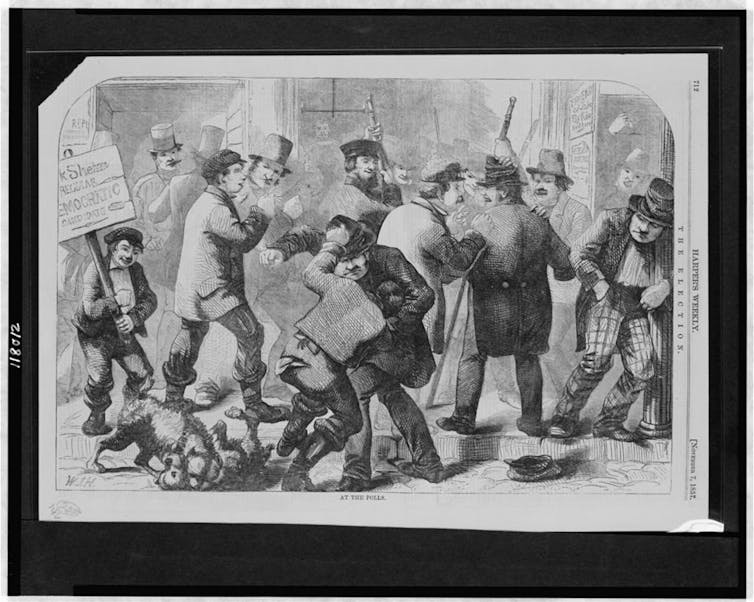
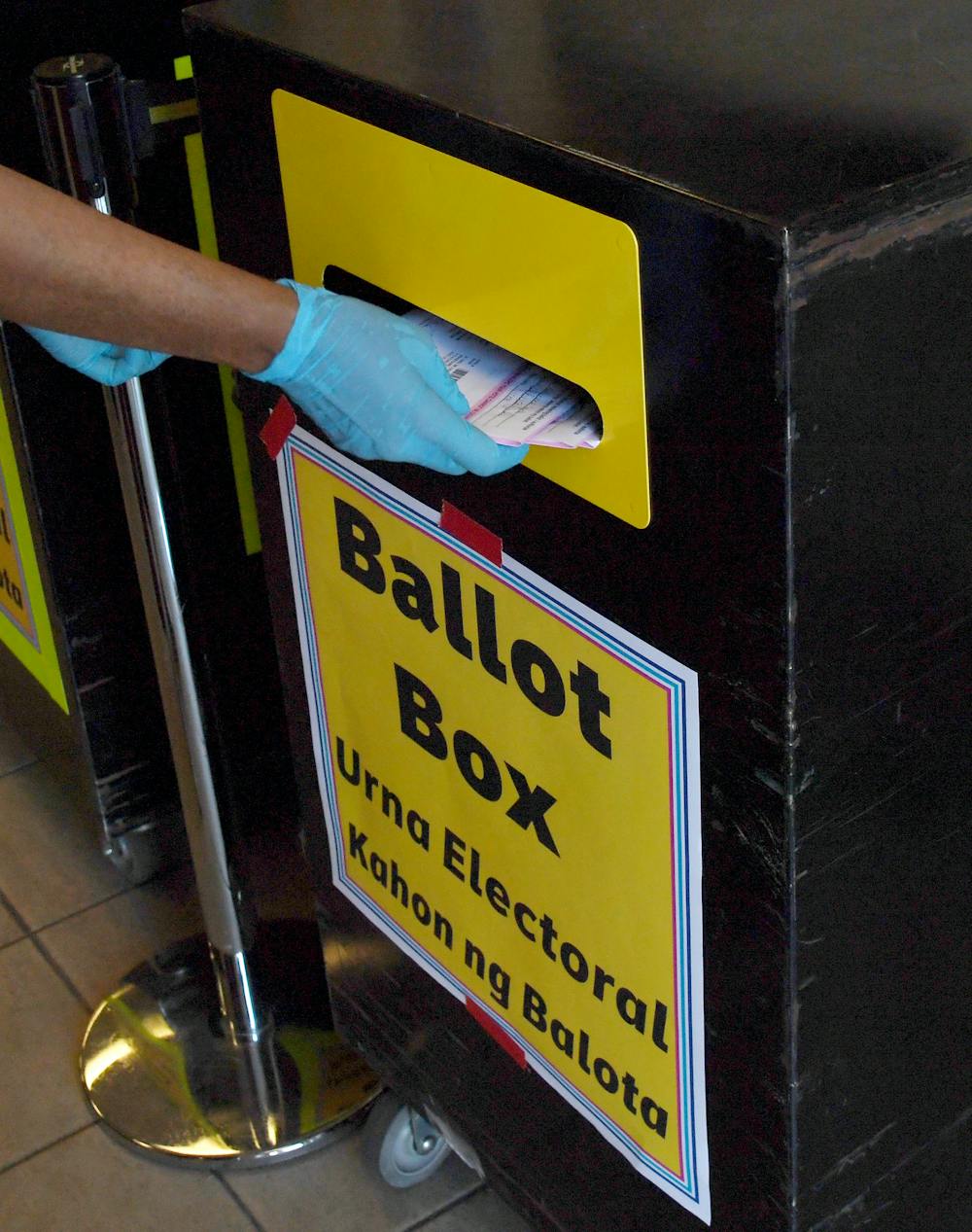
Arguably the victor of all breakfast foods, bagels are a cherished food that people can get very, very competitive over. The TJ’s website brags, “these Trader Joe’s Gluten Free Pumpkin Spice Bagels aren’t just ‘good for gluten free’ — they’re good, period. They’re made with potato starch and brown rice flour (plus cinnamon, nutmeg, ginger & clove for that Pumpkin Spice kick).”


Boasting such rounded, bright flavors — but no gluten — these bagels will start your autumn morning without the sweetness that so often accompanies pumpkin spice-flavored foods. Serve them on their own or toasted, with butter or with cream cheese, or even as a sandwich “bread.” 


Expert: Outdated 19th-century voter intimidation laws are no match for MAGA’s 2022 schemes

Author Edgar Allan Poe, the 19th-century master of American macabre fiction, may have died of dirty politics. According to legend, a gang of party “poll hustlers” kidnapped and drugged him. They forced him to vote, then abandoned him near death. Details are murky, but we do know Poe died in Baltimore days after the Oct. 3, 1849, election.

The story, though likely untrue, is certainly plausible. Election Day in 19th-century America was a loud, raucous, often dangerous event. Political parties would offer food, drink and inducements ranging from offers of bribes to threats of beatings to encourage voters to cast the party’s official ballot.

Reforms at the end of the century – particularly after an especially dirty 1888 presidential election – aimed to stop the shenanigans, assure the safety of voters and elevate the act of voting.

That is why the U.S. now has secret government-printed ballots rather than party-provided ballots. And all 50 states have laws that ban potentially intimidating behavior at polling places.

Yet there appears to be increasing risk of such voter intimidation. The Washington Post reports that the Republican Party has held “thousands of training sessions around the country on how to monitor voting and lodge complaints about … midterm elections.” Former President Donald Trump’s ally and conservative firebrand Steve Bannon has urged followers to head to the polls, claiming “We’ll challenge any vote, any ballot.” And Axios reports that “Proud Boys and the Oath Keepers are looking to sway the upcoming midterms in favor of their preferred candidates by signing up as poll workers and drop-box watchers.

Men fighting at the polls in 1857

Elections in the 19th century were sometimes wild affairs; this cartoon is from 1857. Library of Congress Prints and Photographs Division

Vestigial laws?

The idea behind these anti-electioneering laws is to prevent the kind of “poll hustling” to which Poe may have fallen victim.

Party tough guys cannot follow – or drag – helpless voters into the polling place, or watch them to make sure they vote the correct ballot with the implicit threat that a “wrong” vote could result in a beating.

These laws generally prohibit campaign activities at or near polling places – wearing campaign paraphernalia, shouting slogans, even loitering inside those polling places. Distance requirements for campaigners, ranging from 10 feet from a polling place in Pennsylvania to 600 feet away in Louisiana, help to assure that secret ballots are actually cast in secret.

But these vestigial laws meant to purify 19th-century elections may be ill equipped for our hyperpartisan modern elections

If voters come to the polls wearing symbols like the Gadsden “Don’t Tread on Me” flag that has evolved into an anti-government symbol, a rainbow pin associated with gay pride, or even a sticker from a spice company whose owner detests Trump, those symbols can take on a perceived political meaning. Under these laws, these people could be accused of illegally campaigning where people vote.

How can anti-electioneering laws keep politics out of the polling place when politics already suffuses so much of life? And in 2022, polling places for many may be the kitchen table or a ballot drop box. In that context, do these laws still have relevance?

A gloved hand inserts papers into the slot of a black and yellow box labeled Ballot Box

An election worker puts mail-in ballots collected from vehicles in a ballot box at the Clark County Election Department on Oct. 13 in North Las Vegas, Nev. Ethan Miller/Getty Images

‘Purifying’ elections

Political reformers in the late 1880s saw elections as too closely tied to party machines and their Election Day carousing. Much of the reform around this time was focused on “cleaning up” politics and destroying the nefarious influence of party machines.

In fact, the current popular understanding of party machines as being universally corrupt and lowbrow might be because “good government” activists won, so they got to write the history

Yet now, these reforms meant to purify 19th-century elections may not have the effect the authors intended.

For example, a New Hampshire woman opted to vote topless in that state’s September 2020 primary after election officials told her that her anti-Trump T-shirt ran afoul of New Hampshire laws forbidding campaigning within a polling place.

In fact, 10 states currently have laws on the books regulating the kinds of clothing voters can wear to the polling place.

These laws may violate the U.S. Constitution’s First Amendment prohibition on limits to free speech, but not all have been tested in court. In the 2018 opinion Minnesota Voters Alliance v. Mansky, the Supreme Court ruled that the state’s laws to create an “orderly and controlled environment” around the polling place were overly vague.

According to the Minnesota opinion, “a rule whose fair enforcement requires an election judge to maintain a mental index of the platforms and positions of every candidate and party on the ballot is not reasonable.”

Poll workers, then, do not need to keep abreast of what a black-and-yellow polo shirt means or which spice company has engaged in political advocacy.

Screenshot of legal language in a section of California law regulating electioneering.

‘Buttons, hats, pencils, pens, shirts, signs, or stickers containing electioneering information’ are forbidden by California law within 100 feet of a polling place. California Legislature

‘Bad things happen in Philadelphia’

Even so, teasing out what constitutes a “political message” seems easy compared with teasing out what constitutes a “polling place” when so many voters will cast their ballots before Election Day.

In the Sept. 29, 2020, presidential debate, Trump warned that “bad things happen in Philadelphia.” Earlier that week, a paid Republican poll watcher in Philadelphia was denied entry into a building that was not a formal polling place. Instead, it was handling, among other things, voter registration and pickup and drop-off of mail-in ballots. The Trump campaign sued, but the state court rejected the campaign’s argument, explaining that watchers are allowed only at polling places on Election Day, not Board of Elections offices at other times.

If anything, though, concerns about voter intimidation are greater in 2022, largely because of reactions to baseless claims of voter fraud in the 2020 election. Efforts in Texas and other states to “clean up” purported voter fraud, some in response to the debunked film “2000 Mules,” may end up suppressing the vote in 2022.

Indeed, a Reuters/Ipsos poll recently found that 40% of respondents are worried about threats of violence or voter intimidation at polling places in 2022.

The unfounded claims of election fraud have spurred changes to election laws in many states. For example, Georgia’s new election law enables organized groups to challenge the eligibility of an unlimited number of voters, meaning that some early voters have turned up to vote, only to find they need to jump through more hoops to cast their ballots.

And in other cases, conspiracy theorists are taking matters into their own hands: Some voters in Arizona are reporting that monitors, including armed vigilantes in one case, are patrolling ballot drop boxes, possibly running afoul of federal voter intimidation laws.

How clean is too clean?

In her 2004 book “Diminished Democracy,” political scientist Theda Skocpol describes 19th-century reformers as working “for measures that would emphasize an unemotional, educational style of politics.”

Demanding the protection of the purity of the polling place and politics, Skocpol argues, “treats politics as if it were something dirty and implicitly holds up the ideal of an educated elite safely above and outside of politics.”

Certainly, few Americans would advocate allowing the country’s literary greats – or anyone else – to fall prey to roving political gangs. But determining how to protect the integrity of elections is difficult when elections are everywhere.

And it may not be as easy as relying on rules meant for a different time, a different means of voting and a different electorate.

Kristin Kanthak, Associate Professor of Political Science, University of Pittsburgh

This article is republished from The Conversation under a Creative Commons license. Read the original article.

How the Biden administration caved to Republicans on fighting election disinformation

ProPublica is a Pulitzer Prize-winning investigative newsroom. Sign up for The Big Story newsletter to receive stories like this one in your inbox.


On his first full day in office, President Joe Biden directed his national security team to make a plan to confront domestic terrorism. In their ensuing report, Biden’s advisers homed in on “a crisis of disinformation and misinformation.” The new administration, they pledged, would work to “counter the influence and impact of dangerous conspiracy theories that can provide a gateway to terrorist violence.”

But the reality of the administration’s efforts has been less robust than its rhetoric. Instead, a ProPublica review found, the Biden administration has backed away from a comprehensive effort to address disinformation after accusations from Republicans and right-wing influencers that the administration was trying to stifle dissent.

In May, one Department of Homeland Security office instructed staffers that work on “sensitive” topics including disinformation should be put on “immediate hold,” according to material reviewed by ProPublica. In the months that followed, DHS canceled a series of planned contracts that would have tracked and studied the proliferation of disinformation and its connection with violent attacks. And after issuing six nationwide warnings about domestic terrorism fueled by disinformation in the first 13 months of the Biden administration, DHS has only issued one in the eight months since.

The government’s retreat comes ahead of midterms in which election officials throughout the country are being inundated with false rumors about their work. After talks on a project to help election officials monitor and respond to threats stalled, election officials from Colorado and Florida wrote a private letter in August to DHS Secretary Alejandro Mayorkas pleading for help.

“Threats and harassment of election officials has become an extremely serious concern and terribly frequent experience for election workers,” they warned, adding, “We are ourselves a crucial part of the nation’s critical infrastructure, in need of and deserving of protection.”

“Time is of the essence,” the officials wrote.

Weeks later, DHS scrapped the project.

DHS’ change of course began after a storm erupted in May in reaction to the administration’s creation of a Disinformation Governance Board. Congressional Republicans called it a “Ministry of Truth.” The board was terminated just months later.

While aspects of the administration’s retreat on disinformation have been reported, the extent of the turnabout has not been fully examined. For this account, ProPublica spoke to eight current and former DHS officials as well as local election administrators, academics and security experts.

“They paused all the work on disinformation, not just the board,” Nina Jankowicz, the former executive director of the DHS Disinformation Governance Board, told ProPublica. “The administration kowtowed to the disinformation rather than fighting it.”

It is not clear whether DHS’ initiatives would have made a significant difference in combating the tsunami of false rumors. But the current and former employees are frustrated that the agency’s efforts have been hobbled in response to political pressure.

DHS maintains it has not retreated on its disinformation efforts. “We have worked for over a decade to address disinformation that poses a threat to that security. This critical work continues today across several DHS components, consistent with the law and in a manner that is transparent and upholds the privacy, civil rights and civil liberties of the American people,” a DHS spokesperson said.

The agency has stepped up some activity in recent weeks, increasing alerts and training for election workers. On Friday, DHS, along with the FBI, the Capitol Police and the National Counterterrorism Center, issued a bulletin warning that “election-related perceptions of fraud” will “likely” drive some extremists to attempt acts of violence.

But, despite the initiatives, election administrators remain deeply concerned.

“States need more support. It is clear that threats to election officials and workers are not dissipating and may only escalate around the 2022 and 2024 elections,” Colorado Secretary of State Jena Griswold, a Democrat, said in an email to ProPublica. “Election offices need immediate meaningful support from federal partners.”


The new administration moved quickly after Biden’s inauguration. Experts welcomed the increased pace of domestic terrorism warnings and their focus on false rumors that could be weaponized for violent ends. In September 2021, Mayorkas’ top aides suggested creating the disinformation board after identifying the problem as a “serious homeland security risk.”

In early 2022, the Cybersecurity and Infrastructure Security Agency, or CISA, which is part of DHS, was in talks to deploy a federally funded nonprofit to protect election workers from harassment and violence.

The effort would have allowed elections officials to sign up for a service to protect them from having their identities and personal information exposed on the internet, known as doxxing. It also would have created a system to track and alert elections officials who were subject to serious threats on social media, including from foreign actors.

Around the same time, as lies about elections were becoming a central plank of GOP candidates, Republicans also began to attack the administration’s efforts. Some free-speech advocates also expressed concerns about government overreach.

An early Republican critic was Sen. Marsha Blackburn, R-Tenn. DHS had sent out an alert about “false or misleading narratives regarding unsubstantiated widespread election fraud.” Blackburn objected in a February letter to Mayorkas, writing, “The Department comes dangerously close to suggesting that publicly disagreeing with the current administration is akin to domestic terrorism.” Blackburn did not respond to a request for comment.

At that time, DHS was establishing the Disinformation Governance Board. It hired Jankowicz, an expert on disinformation, as its executive director. The board was tasked with coordinating all the efforts to confront the problem across the sprawling agency. The board’s charter was careful to note that the government needed to respect privacy and free speech.

Nevertheless, just hours after word leaked of its formation, right-wing media influencer Jack Posobiec issued a series of tweets slamming the board. Soon, Republican lawmakers like Rep. Andrew Clyde, R-Ga., were calling the board a “Ministry of Truth,” an apparent reference to a fictional government body that feeds people lies in George Orwell’s “1984.” Clyde did not respond to a request for comment. About 70% of Fox News’ one-hour segments over the next week contained a reference to the board, according to a report by Advance Democracy, a nonprofit media research group. The New York Post ran a cover with an image of Jankowicz and the headline: “Big Sister Is Watching You.” Jankowicz was subject to an outpouring of degrading comments and death threats.

A senior DHS official who spoke for the administration said to ProPublica that the board had become “a distraction that was making it harder for us to do the work we thought was essential.” In May, DHS “paused” the board and Jankowicz resigned, just 10 weeks after she had begun work.

That’s when the word went out to DHS staffers that work on “sensitive” topics like disinformation should be put on hold. DHS had been negotiating with a security firm called Moonshot, which specializes in monitoring online threats for governments and social media platforms. After the criticism of the board, discussions were halted and the contract was not signed. Eventually, DHS also froze millions of dollars for disinformation research contracts with two universities and the Rand Corporation, according to three people familiar with the matter. And a CISA “Rumor Control” webpage for election workers issued no updates from May to October.

DHS’ rollback in an election year alarmed former senior officials in homeland security. One of them, Bob Kolasky, a former top CISA official under Trump and Biden, warned in an opinion piece in a professional journal, “Many of our foreign allies, notably the Swedes and the French, have been much more aggressive in organizing to deal with the disinformation risk.” Without the board, “the country remains at risk.”

The pausing of the board and Jankowicz’s exit did not placate critics on the right. On the House floor, Rep. Andy Biggs, R-Ariz., accused the Biden administration of trying “to target and silence citizens who disagree with government actions.” Biggs did not respond to a request for comment.

In August, with the disinformation board still leaderless and frozen, Mayorkas killed it for good. The agency also canceled the CISA project with the nonprofit that would have tracked online death threats to election workers and offered them enhanced protection of their personal information.

The DHS is not the only federal agency confronting the problem. The FBI, which is under the Department of Justice, also monitors such threats, but it is focused on gathering evidence of crimes. In 2021, the DOJ formed a task force to investigate threats to election workers, inviting them to submit tips to the FBI. So far, more than 1,000 have come in, and the DOJ has filed eight cases against people who allegedly threatened workers with violence.

But experts say prosecutors and the FBI alone cannot effectively deal with the problem. DHS’ mission — to gather and share information with partners in government and law enforcement before crimes occur — is critical to prevention.

Today inside the department “scrutiny is over the top on anything to do with terrorism, extremism, violence prevention — especially domestic terrorism,” a current DHS official said.

“The answer is not how do we do it better; in the face of criticism, it’s to shut it all down,” one former high-level DHS official told ProPublica. The officials were granted anonymity so that they didn’t suffer reprisals.

The bitter irony is not lost on experts in the field, who say that the attacks can have a chilling effect on outside researchers, too.

“The very thing we are studying is being used against us because the tactics work,” said University of Washington’s Kate Starbird, who advises DHS on disinformation and who herself has recently been subject to harassment based on rumors. “They undermine trust in institutions and in government and tie our hands when we try to protect ourselves.”


With DHS stymied, election officials report it’s up to them to keep abreast of the false information and respond. Julie Slomski, clerk of Erie County, Pennsylvania, said she now spends about half of her workday explaining how elections work to angry or suspicious constituents. She gives out her cellphone number and tells people to call or text with questions. “Here in Erie County, we’re an open book,” she said. But she’s taking precautions. Slomski now wears a bulletproof backpack her sister bought her.

In lieu of a robust official government effort, the nonprofit Center for Internet Security, which had once hoped for government resources and sponsorship, is briefing election workers on how to keep track of false information and respond effectively.

“I was surprised at the number of people who came up to me afterwards saying, no one had told us about any of this,” said John Cohen, a former top DHS official in the Biden administration and currently in leadership at the Center for Internet Security.

Some elections officials, however, question whether the federal government should be involved in this effort at all. Michael Adams, Kentucky’s Republican secretary of state, said the election denialism he encounters is so disconnected from facts that “sometimes I’m at a loss to even know how to reason with these people.” Adams has called out election conspiracies, but he believes his constituents are more likely to accept information about elections as trustworthy if it comes from local officials.

“I don’t think that the federal government, the so-called deep state, putting out information and saying ‘trust us’ is an effective strategy for persuasion,” he said.

But others say the federal government is doing too little, too late.

“We’re getting help, but much more is needed in certain areas,” Wesley Wilcox, supervisor of elections in Marion County, Florida, and one of the authors of the August letter to DHS pleading for help, said in a recent email to ProPublica. “I am NOT a proponent of a massive Federal Government intrusion. But, there are some very specialized areas that are a ‘best fit’ for the Federal Government.”

Authors are celebrating a federal court’s decision to block the merger of two mega-publishers

On Monday evening, a federal court blocked the acquisition of Simon & Schuster by Penguin Random House. The two publishing giants are both part of the book industry refers to as the “Big Five,” the five biggest publishing houses in the United States. Less than a decade ago, Random House merged with Penguin to create the world’s largest publishing house. But the proposed merger with Simon & Schuster will not go through, because it would “substantially” negatively affect sales competition for the U.S. rights of books, according to the ruling by Judge Florence Y. Pan. 

As reported by The New York Times, “the full order laying out Judge Pan’s reasoning is temporarily under seal because it contains confidential information, and will be released later after both parties file redactions.” The New York Times also reports that Penguin Random House will appeal. What was the story with this case, and why have both writers and readers — not to mention the Biden administration — paid such close attention?

The trial was conducted over a period of three weeks in the U.S. District Court for the District of Columbia. In November 2020, Paramount, Simon & Schuster’s parent company, and Penguin Random House, a subsidiary of German company Bertelsmann, announced the sale of Simon & Schuster in a deal worth over $2 billion. It’s been a battle for regulatory approval ever since. 

At the trial, publishing executives testified, as did literary agents and bestselling authors — like Stephen King, who spoke on the stand of the financial hardships facing writers today. King cited a study showing the current median income of writers as below the poverty line, according to Deadline. “It’s a tough world out there now. That’s why I came,” said King, who volunteered as a witness for the Justice Department.  

The Justice Department sought to block the merger in part because, as reported by Deadline, “the deal would adversely impact author advances of $250,000 and above for the most anticipated best sellers.” But most book advances are far below that amount, with the smallest advances going to writers of color statistically.

Writers and readers alike stayed glued to the trial as the proceedings lifted the curtain on the inner workings of the publishing industry. As Kathleen Schmidt wrote on Twitter, “The worst aspect of the DOJvPRH trial was allowing publishing vets to testify who could not explain how the biz works. To read testimony that essentially inferred that no one knows what’ll sell/marketing isn’t valuable/it’s all guess work is an embarrassment.” 

Testimony from publishing executives indicated they had no idea how much money most authors make, how many copies some books sell, how to predict successful titles and confusingly, asserted that all books are marketed the same by publishers, regardless of advance size. Writer Kaz Windness tweeted, “If anything, this merger trial has revealed how out of touch publishing big wigs are with the reality of the average author or illustrator. We have always had to work other jobs. We totally pay for our own book marketing. 100K would be a life-changing advance.”


Want a daily wrap-up of all the news and commentary Salon has to offer? Subscribe to our morning newsletter, Crash Course.


This trial is also significant because it marks one of the Biden’s administration’s first antitrust actions. The merger of the two huge publishers would have augmented the existing oligopoly in the publishing industry. Importantly, the Justice Department focused not on consumer harm but on the possible financial harm to authors should the deal have gone through.

By “focusing on the impact a monopoly might have on workers … zeroing in on the potential harm to authors, the Justice Department signaled that it’s taking a broader view of the possible impact of consolidation,” according to The New York Times, who describes the trial as “a test case for the government’s new, more aggressive approach to curbing consolidation.”

The response from writers has been cautiously optimistic. As author James Hill Tate wrote on Twitter, “A blocked publishing merger is a small, good thing in a time like this.”

“Connect the dots”: Pennsylvania Democrat attacked at his home days after Pelosi assault

In an opinion column published by the Washington Post on Halloween, Never Trump conservative Max Boot emphasized that while some political violence in the United States has come from the left in recent years — including the 2017 shooting that Rep. Steve Scalise survived and an alleged plot to assassinate U.S. Supreme Court Justice Brett Kavanaugh — the reality is that the majority of political violence plaguing the U.S. has been coming from the far right. Boot pointed to the attack on House Speaker Nancy Pelosi’s husband, Paul Pelosi, as a recent example, arguing that reporters shouldn’t resort to “both sides” rhetoric in the hope of trying to appear fair-minded.

On Friday, October 28, the Pelosis’ home in San Francisco was invaded by a man who demanded to know, “Where is Nancy?” before attacking Paul Pelosi with a hammer. “Where is Nancy?” are the same words that were used during the January 6, 2021 attack on the U.S. Capitol Building.

One violent attack on a Democrat that hasn’t received as much attention as the attack on Paul Pelosi is the one on Richard Ringer, who is running for a seat in the Pennsylvania House of Representatives via the 51st District. On Monday morning, October 31, Ringer was violently attacked by a man outside his home.

Ringer, who is running for the Pennsylvania House seat presently held by the retiring Republican Rep. Matt Dowling, can’t say for sure that the attack was politically motivated, but he suspects that it was.

Ringer told Pittsburgh’s Action News 4, “He had my arm behind my back, and he was pounding me. The only thing I have is the bruising on my hand and face, but he hit me a couple of times and knocked me out.”

According to Action News 4 reporter Jim Madalinsky, Ringer “has reported multiple incidents to state police over the past three weeks.”

“He said someone spray-painted a threatening message on his garage door a few weeks ago,” Madalinsky reports. “One week later, Ringer said someone threw a brick through the window to his back door.”

Ringer told Action News 4, “All three incidents happened within the last three weeks, three weeks away from the election…. My neighborhood is safe. It’s calm, and there’s no crime whatsoever. If you just try to connect the dots, maybe. But I can’t say definitively.”

The Pittsburgh Post-Gazette reports that the attack on Ringer comes a time when “election officials around Pennsylvania” are preparing “for potential harassment and violence on Election Day.”

“Acting Secretary of State Leigh Chapman acknowledged Monday at the Pennsylvania Press Club luncheon in Harrisburg that there has been an increase in election-related threats since the 2020 election,” according to the Post-Gazette. “In a call with reporters last week, she said her office has received threats in recent weeks.”

Supreme Court rejects Graham’s bid to block subpoena that Clarence Thomas referred to full court

The U.S. Supreme Court on Tuesday denied Sen. Lindsey Graham’s, R-S.C., request to block a lower court’s decision ordering him to testify in a Georgia case about interference in the 2020 presidential election.

On Friday, Graham asked the high court to block a subpoena from the Fulton County special grand jury investigating former President Donald Trump and others.

A Tuesday order from the Supreme Court refused to block the lower court’s ruling.

“The application for stay and an injunction pending appeal presented to Justice Thomas and by him referred to the Court is denied,” the order said. “The order heretofore entered by Justice [Clarence] Thomas is vacated.”

Read the order below.

Julie Powell, groundbreaking author of the beloved book “Julie & Julia,” has died

Julie Powell, author of the bestselling and beloved book, “Julie and Julia: My Year of Cooking Dangerously,” has died from cardiac arrest at the age of 49, according to the New York Times

Powell first rose to prominence as a food writer after she made the decision to chronicle her year cooking all 524 recipes from her mother’s copy of Julia Child’s “Mastering the Art of French Cooking, Volume 1.” It wasn’t going to be an easy road. Powell was an untrained home cook and, as she put it in the book she wrote about her project, her kitchen was located on top of “the rotting floorboards of [her] ‘fixer-upper’ ‘loft.'” 

That didn’t deter Powell, however, from diving into the preparation of dishes like Filets de Poisson de Bercy aux Champignons, Poulet Rôti, Champignons à la Grecque, Carottes à la Concierge and even a Crème Brûlée. She wrote about it all in her blog — a dishy, wickedly funny and, sometimes, a little vulgar series of posts she eventually called The Julie/Julia Project — which originally debuted on Salon in 2002. 

“I’d written about all of it, my mistakes and my minor triumphs,” Powell wrote in her book. “People — a couple of friends, a couple of strangers, even my aunt Sukie from Waxahachie — had written in to the blog to root me on.” 

Over the next year, Powell’s audience grew exponentially. At the time, Salon reported that the blog had accumulated over 400,000 page views. 

“I remember it being well-regarded, but not the juggernaut it became after the book,” said Salon senior writer Mary Elizabeth Williams, who previously managed Open Salon, the platform that hosted Powell’s blog. “This was also pre-Slack, pre-Zoom, so as a team, a lot of people didn’t even know about it. And I think the people who read Salon weren’t seeking a woman writing about her home cooking.” 

“She truly made her own lane,” Williams added. “We were lucky enough to be the conduit.” 


Want more great food writing and recipes? Subscribe to Salon Food’s newsletter, The Bite.


Following the success of the blog, she sold the book to Little, Brown & Company, and went on to sell more than a million copies. In 2009, Nora Ephron turned Powell’s story into a movie starring Meryl Streep as Julia Child, Stanley Tucci as Paul Child and Amy Adams as Powell. 

Julia Child, who died in 2004, never saw the film, but she was aware of Powell’s project. As Russ Parsons revealed for the Los Angeles Times in 2009, he had sent Child some excerpts from the blog while she was still living. When Parsons inquired what Child thought, she apparently hesitated for a moment before responding, “Well, she just doesn’t seem very serious, does she?” 

Child continued: “I worked very hard on that book. I tested and retested those recipes for eight years so that everybody could cook them. And many, many people have. I don’t understand how she could have problems with them. She just must not be much of a cook.”

But it was exactly Powell’s wit and authenticity that drew in many readers to whom classic tomes like “Mastering the Art of French Cooking” did seem inaccessible. Powell’s blog, in turn, became a template for much contemporary food writing. 

Powell went on to release a second book in 2009, “Cleaving: a Story of Marriage, Meat, and Obsession.” It detailed her faltering marriage which had been impacted by infidelity (a tough pill to swallow for many fans who had become acquainted with Powell via Ephron’s sunshiny depiction of the marriage) and how she found solace apprenticing in an old-school butcher shop called Fleisher’s. 

While that was Powell’s last book, she did continue to write. Most recently, she returned to Salon to write a series of commentary pieces about the Food Network series “The Julia Child Challenge.'” 

“As a long-time fan of Julie’s writing, I was personally thrilled when she agreed to return to Salon and recap ‘The Julia Child Challenge’ for us earlier this year,” said Erin Keane, Salon’s editor in chief. “Her bond with Julia Child, as a fan and a cook, was unique and yet still relatable. Who knew better than Julie the joys and pressures of cooking those legendary recipes in the public eye? Who else would hear Julia’s voice in her head, as she put it, quite in the same way? Just as Julia changed cooking in the home from her own kitchen, Julie changed how we write about it from hers.”

Why Prince Harry’s “unflinching” memoir “Spare,” due out in January, is already a hot bestseller

Hours after its January publication date and title was announced, a book launched into the Top 10 bestsellers on Amazon. An audiobook read by the author will be released simultaneously, and translations into 16 languages have already been planned for this book that hasn’t even been published yet.

The book is Prince Harry‘s memoir “Spare,” and though it’s been in the works since summer, the finalization of details, such as its official publication date of Jan. 10, 2023, has created shockwaves in both the royal and book worlds. From its tongue-in-cheek title and its secret ghostwriter to the timing of it all, why did Harry decide to tell his story now, what might be in the pages, and why does it matter?

The publisher of “Spare,” Penguin Random House, describes the book in a statement as “intimate and heartfelt” and created “with raw, unflinching honesty.” This is a pretty standard description for memoirs. “Unflinching: The Making of a Canadian Sniper” is also described as raw; unflinching’s in the title. Trevor Noah’s 2016 memoir “Born a Crime” is labeled “unflinching,” as is James Ellroy’s “My Dark Places.” Does any writer flinch when they write their memoir?

In their statement, Penguin Random House says Prince Harry will be “writing about some moments from his life publicly for the first time,” though the only specific moment mentioned is the funeral procession when Harry and his elder brother William walked behind the coffin of their mother, Princess Diana. Harry himself is quoted in the statement as saying, “I’m writing this not as the prince I was born but as the man I have become. I’ve worn many hats over the years, both literally and figuratively.”

“The more traditional memoir focuses on seeking and attaining redemption.”

Memoir is a chance to be candid about those hats. Writer Annette Gendler describes memoir as “a personal story of the past, based on memory.” Gathered under the umbrella of creative nonfiction, memoir can utilize some of the tools of narrative while avoiding the huge canvas of autobiography. A memoir might only focus on a small portion of a life, as opposed to an autobiography, which covers an entire life. As memoirist and novelist Elizabeth Kadetsky writes on LitHub, “The more traditional memoir focuses on seeking and attaining redemption.” It may be less redemption Harry — who, along with his wife Meghan Markle, stepped away from royal duties in 2020 — is seeking, but rather more understanding. “I can help show that no matter where we come from, we have more in common than we think,” his statement reads.

Memoirs are also big business. Over 800,000 titles of adult nonfiction were sold in 2021, according to Publisher’s Weekly, making it the top-selling genre. Penguin Random House may be hoping to imitate some of publisher Crown’s success in 2020 when the top-selling title of the year was a memoir: Barack Obama’s “A Promised Land,” which sold 2.5 million print copies alone. 

According to the publisher’s statement, Harry plans to donate at least some of the proceeds from his book. Though exact percentages are not mentioned, book sales will aid two British charities he has an established history of supporting: Sentebale, a group he co-founded, which supports children and young adults impacted by HIV/AIDS in Lesotho and Botswana; and Royal patron WellChild, a nonprofit which helps children and young adults with complex medical needs receive care at home. 

Along with his oversight, the book project has his signature thoughtfulnessHarry apparently reached out to ex-girlfriends.

Harry’s already bestselling memoir joins the ranks of books like “Becoming” by former First Lady Michelle Obama, “I Am Malala” by Malala Yousafzai and “Angela’s Ashes” by Frank McCourt. (You do not have to be famous alrady to pen a memoir that becomes a bestseller, but it doesn’t hurt.) Memoir as an art form is also not without controversy. From James Frey and his “Million Little Pieces” to Alice Sebold, some memoirists have taken so many liberties their books become known for their distance from the truth. Frey was revealed to have invented much of his popular addiction memoir, which was first shopped around as a novel. “Lucky,” Sebold’s memoir of surviving rape, was pulled out of distribution after the man at the center of it was exonerated after four decades in prison. 

J.D. Vance used his bestselling memoir “Hillbilly Elegy” as a trampoline from which to cannonball into TrumpWorld politics. He’s on the ballot in Ohio, despite many Appalachians‘ frustrations that his book purports to speak for an entire region, rather than simply telling his own personal, romanticized story.  

But “raw,” as Harry’s memoir is described, does not mean unassisted. Harry is working with a ghostwriter on the book: J.R. Moehringer, a novelist and journalist who won a Pulitzer while at the Los Angeles Times. Perhaps Moehringer’s most recognizable work is “The Tender Bar,” his coming-of-age memoir which was adapted into a film starring Ben Affleck. 

The New York Times describes Moehringer as an “acclaimed ghostwriter” who is “known for probing the tensions inherent in father-son relationships,” which led The Guardian to speculate Harry’s book may have some paternal explosions of its own about King Charles III: “No doubt Moehringer was chosen to write the prince’s confessional because he seemed a kindred spirit, wronged and voluble,” though perhaps “like all writers, Moehringer will have seen the project as another way to write about himself.”


Want a daily wrap-up of all the news and commentary Salon has to offer? Subscribe to our morning newsletter, Crash Course.


Harry may have a ghostwriter, but the idea of the project seems to be taking control of the narrative, his narrative, which has always been an issue for Harry and Meghan — and Princess Diana before them. Harry says in his statement he’s “excited for people to read a firsthand account of my life that’s accurate and wholly truthful.” Along with his oversight, the book project has his signature thoughtfulness: Harry apparently reached out to ex-girlfriends, seeking their permission to be included in the book. And the publisher’s announcement of its publication date and that title, a play on the “heir and the spare” saying, that monarchs need multiple children to ensure their family line? It came well after his wife Meghan’s Spotify podcast “Archetypes” premiered in August. 

Here are 3 Costco food recalls you should know about right now

For more than 35 years, Costco has been fulfilling its customers’ bulk needs, the most common of which are food and beverage products. The wholesale warehouse chain is known for offering some of the best prices on staple eats, baked goods and food court treats, making it a popular — and trusty — choice for shoppers nationwide.

Recently, Costco issued a series of recalls, via the United States Department of Agriculture (USDA) and online food notices, for several of their go-to food items. The recall notices encouraged consumers to double-check their freezers, pantries and cabinets for any products that needed to be taken out of commission immediately.

Here are the three Costco recalls you should know about right now:

01
Foster Farms Cooked Frozen Chicken Patty Products (Recalled 10/29/22)

Foster Farms, a Louisiana-based poultry brand with products sold at Costco, recalled approximately 148,000 pounds of fully cooked frozen chicken breast patty products that may be contaminated with hard clear pieces of plastic. The announcement was prompted after several consumer complaints reported hard clear plastic embedded in the patties.


Per a notice from the USDA, the products in question were shipped to Costco distribution centers in Arizona, California, Colorado, Utah and Washington, and may have been further distributed to Costco retail locations. The 80-oz. plastic bag packages were produced on August 11, 2022, and have a “Best By” date of August 11, 2023. They also have an establishment number of “P-33901” and lot code “3*2223**” on the back edge of the packaging, as well as “7527899724” under the product’s barcode.


At this time, there have been “no confirmed reports of injury associated with the consumption” of the chicken patties, FSIS reports. However, the agency’s report did explain that the plastic pieces “could be sharp and possibly cause an injury.” They advised consumers who have purchased the recalled products not to consume them, but to throw them out or return them to the store instead.

02
Kirkland Signature Shelled Walnuts (Recalled 10/27/22)

Costco recalled its Kirkland Signature Shelled Walnuts due to the stale taste and rancid smell, per a store notice. The recalled product contains the following “Best Before” dates and corresponding lot codes: May 31, 2023, with lot code “22243-4B”; June 21, 2023, with lot code “22264-4B”; July 28, 2023, with lot code “22271-4B”; and July 04, 2023, with lot code “22277-4B.”


Consumers who recently purchased the walnuts are advised to return them to Costco for a full refund.

03
Kirkland Signature Pine Nut Hummus (Recalled 10/20/22)

Costco also recalled its Kirkland Signature Pine Nut Hummus due to a mold issue on the pine nut topping. The product in question contains a “Best Before” date of November 26, 2022, which is located on the top of the container. 


Consumers who recently purchased the affected hummus are advised to return it to Costco for a full refund.


Want more great food writing and recipes? Subscribe to Salon Food’s newsletter, The Bite.