Spring Sale: Get 1 Year, Save 58%

Americans are coming around on electric cars

More Americans than ever are interested in buying or leasing an electric vehicle, according to data released by Consumer Reports yesterday.

In a nationwide survey, 14 percent of respondents said they would “definitely” buy or lease an EV if they were in the market for a new car today — a significant jump from just four percent in 2020. Twenty-two percent said they would “seriously consider” an electric vehicle.

Consumer Reports conducted the survey of over 8,000 Americans during January and February, when the national average price of gas was around $3.50 per gallon. Since then, high gas prices have ignited even more interest. In the two weeks following Russia’s invasion of Ukraine, online searches for new and used EVs more than doubled, according to Cars.com.

Among respondents who said they would not consider an EV, charging logistics, vehicle range, and the overall cost topped their list of concerns. Some of these worries are justified, but recent research suggests that some may have more to do with perception than reality. In May, a team of researchers at the University of Geneva found that people tend to underestimate how well an EV could serve their daily needs.

In the U.S., new EVs are typically more expensive than new gas-powered vehicles, but EV owners spend far less on “fuel” and around half as much on maintenance and repairs over the car’s lifetime, since EVs have fewer moving parts and fewer fluids that require changing.

The groups most likely to buy or lease an EV include those who live in urban areas and those with higher household incomes, showing that the transition to EVs hasn’t been equitable. Environmental justice advocates say that’s a problem because low-income communities and communities of color bear the highest burden from vehicle exhaust pollution and stand to benefit from saving money by switching to EVs.

Last month, the Biden Administration announced it would take a step towards solving the problem by investing $7.5 billion in EV charging infrastructure, specifically aiming to fill gaps in “rural, disadvantaged, and hard-to-reach locations.”

“Vehicle electrification is a game changer for climate change and the new clean energy economy,” wrote Leslie Aguayo in a recent blog for the Greenlining Institute, an environmental justice organization. “That is, if we don’t lock out entire communities.”

People who had either driven or ridden as a passenger in an EV were also more likely to say they’d consider buying or leasing one, suggesting that demand will continue to grow as more people get familiar with EVs.

Automakers are unveiling more types of EVs. In 2012, just eight EV models were sold in the U.S. By the end of this year, it will be 100. But as demand grows, EVs are tough to find. The pandemic, a shortage of semiconductor ships, and the war in Ukraine have disrupted supply chains, and many new models have backlogs that could take a year to clear. 

So where did all this right-wing religious nuttery come from?

Minneapolis residents Jess and John Pentz — a couple who’ve been married for 17 years — were traveling through Hayward, Wisconsin, over the Fourth of July weekend when Jess realized she’d forgotten to bring her birth control pills.

They pulled into the local Hayward Walgreens pharmacy, where Jess picked up a box of condoms from a shelf and handed them to the clerk manning the register.

“Manning” seems to be the right verb here: “John,” the Walgreens clerk, refused to ring them up.

Jess, confused, asked him why, pointing to the shelf where she’d picked up the condoms.

“We can sell that to you,” clerk “John” told Jess with a smirk, “but I won’t because of my faith.”

There’s no law in America against being an ass, so this Walgreens clerk was entirely within his rights to behave like one. But because of five Republicans on the Supreme Court, it now is problematic — and soon could be against the law nationwide, if Clarence Thomas gets his way — for Walgreens to fire him for “exercising his faith” when working in a drugstore.

The vast majority of Americans, opinion research shows, think a situation like this is absurd. As Jennifer Brooks notes in an article about the Pentzes’ experience for the Minneapolis Star-Tribune:

When the Pew Research Center surveyed American attitudes about birth control, just 4% viewed contraception as morally wrong. Condoms protect us from disease and prevent unwanted pregnancies. What’s not to like?

And what’s so astonishing about the entire situation is that we have reached this point not because the American public wants religious doctrine running our law, and not because most religious people agree with an arrogant prick working at Walgreens.

Instead, it’s because a small group of right-wing billionaires didn’t want to pay their taxes, wanted to get rid of their unions and didn’t want regulation of the pollution from their refineries and other operations.

Seriously.  

They put billions of dollars over five decades into a project to seize control of the legislatures of a majority of the states, jam up the U.S. Congress and pack the Supreme Court — and it was all about taxes, unions and regulation.

So where did the religious nuttery come from?

Why did all this happen? Because a few right-wing billionaires didn’t want to pay taxes and wanted to ditch their unions and pollute as much as they liked.

The right-wing billionaires and the corporations and foundations aligned with them knew back in 1971 — when Lewis Powell laid out their strategy in his infamous “Powell Memo,” the year before Richard Nixon put him on the Supreme Court — that most Americans wouldn’t happily vote to lower billionaires’ taxes, end unions and regulation of gun manufacturers, or increase the amount of refinery poisons in our air.

So the strategy they came up with to capture control of our government was pretty straightforward:

  • Convince Americans that taxes aren’t “the cost of a civil society” but, instead, a “burden” that they were unfairly bearing. Once Republicans were elected on that tax-cut platform, they’d massively cut the taxes of the morbidly rich while throwing a small bone to the average person.
  • Convince Americans that regulations that protect consumers and the environment are also “burdens” from an out-of-control “nanny state,” even though such regulations save lives and benefit Americans far more than they cost.
  • Convince Americans that unions aren’t “democracy in the workplace” that protect workers’ rights but, instead, an elaborate scam to raid workers’ paychecks to the benefit of “corrupt union bosses.”

To pull these off, they spent five decades and billions of dollars to subsidize think tanks and policy groups at both the federal and state level; there’s now an extensive network of them reaching from coast to coast, all turning out policy papers and press releases the way bunnies have babies. 

But it wasn’t quite enough to get the political power they needed. 

They sponsored right-wing talk radio to the tune of millions of dollars a year (Rush Limbaugh and Sean Hannity’s shows got over a million a year each) and Australian billionaire Rupert Murdoch rolled out Fox News to complement the propaganda campaign. Later would come social media bots and trolls, along with thousands of new websites pretending to be local newspapers. 

Still, that wasn’t quite enough to get them the political power they needed. 

They hooked up with the NRA, which helped sponsor the Reagan Revolution and was richly rewarded with laws that forbade the federal government from compiling gun death statistics and gave complete immunity from lawsuits to weapons manufacturers and sellers for the damage their products cause (the only industry in America that enjoys such immunity).

And they finally got a lot of Americans to go along with their plan, because they’d added in a religious “secret sauce.” More on that in a moment.


Want a daily wrap-up of all the news and commentary Salon has to offer? Subscribe to our morning newsletter, Crash Course.


The Reagan presidency was their first major victory; in eight short years he cut union membership in America almost in half, dropped the taxes on billionaires from a top 74% bracket down to 27%, and slashed thousands of protective regulations, particularly around guns and the environment.

Over the 40 years of the Reagan revolution, we’ve gone from having about the same gun-ownership density as Canada (around 15 guns per 100 people) to the most in the world (over 120 guns per 100 people). We’re now drenched in blood: Guns kill more American children than drunk drivers or any other cause.

Hating on unions, taxes and the environment — and loving on guns — wasn’t quite enough. They needed a larger bullhorn. That’s where Jerry Falwell and friends came in.

But hating on unions, taxes and the environment — and loving on guns — wasn’t enough to reliably win elections over the long run. They needed a larger bullhorn, a way of reaching into the lives of additional tens of millions of American voters who really didn’t much care about those issues.

That’s where Jerry Falwell and his friends came into the picture.

Falwell was an inveterate grifter, hustling Jesus to build a multimillion-dollar empire while ignoring Jesus’ teachings about humility, poverty and the need to care for others. A new, muscular Jesus — a Jesus who endorsed assault weapons and private jets for preachers — came to dominate much of America’s Protestant Christianity.

This Jesus wanted you to get rich — riches, they said, are a sign of God’s blessing — and the “prosperity gospel” and all its perverted cousins were being preached on TV and in megachurches across the nation throughout the 1980s.

Reagan brought his vice president’s son — a young drunk named George W. Bush who got sober with Jesus’ help (and a threat from his parents and wife) — and Bush forged an alliance between the Reagan campaign and the then-emerging phenomenon of Falwell/Bakker/Graham/Robertson televangelists.

The televangelists became multimillionaires, churches openly defied IRS regulations and preached politics from the pulpit, and millions of mostly non-political churchgoers were suddenly evangelists not just for Jesus but also for the Republican Party. 

With this dramatically expanded base of voters, Republican politicians went on a 40-year spree of cutting taxes, deregulating polluting industries, hustling guns and busting unions.

To keep the rubes coming to the churches where they’d hear that GOP message, Republicans on the Supreme Court had to throw them the occasional bone. Giving bakers the right to tell gay people wanting a wedding cake to screw off was one of them, setting up the “religious right” of pharmacists to refuse to sell condoms.

Churches kept getting richer and Republicans kept getting elected, but most people didn’t realize the symbiosis at work. 

At first, these seemed problematic to many Americans, but, like Pastor Niemöller, it only affected a small minority of us and typically did so in ways that weren’t particularly public. Everybody figured it was somebody else’s problem, and the people being hurt were mostly marginalized minorities. 

Now that the Supreme Court has struck down Roe v. Wade, however, people are waking up to this unholy alliance between religious grifters in the white evangelical movement, the Supreme Court and the GOP.

Half the population is now in their crosshairs.

It’s no longer just a matter of that $50 trillion transfer of wealth from middle America to the top 1% through changes in tax law, or a few hundred thousand children downstream of coal mines getting permanent neurological damage, or workers thinking that maybe they’d have better wages and benefits if they had a union.

Now America is seeing clearly what the Republican coalition has brought us, from mass shootings to medical bankruptcies to student debt to homelessness. 

Literally none of these things were major societal problems the year Reagan was elected; all are the direct result of Republican policies, and all were made possible, in part, by this unholy alliance of church and state that our nation’s founders warned us against.

And now they’re coming for your birth control.

Will enough Americans finally wake up to this 40-year grift to put an end to it and return our country to sanity?

We’ll find out this November.

Read more

about religion and the far right

NATO’s endless expansion threatens endless war — and potential nuclear holocaust

The North Atlantic Treaty Organization (NATO), and the arms industry that depends on it for billions in profits, has become the most aggressive and dangerous military alliance on the planet. Created in 1949 to thwart Soviet expansion into Eastern and Central Europe, it has evolved into a global war machine in Europe, the Middle East, Latin America, Africa and Asia. 

NATO expanded its footprint, violating promises to Moscow, once the Cold War ended, to incorporate 14 countries in Eastern and Central Europe into the alliance. It will soon add Finland and Sweden. It bombed Bosnia, Serbia and Kosovo. It launched wars in Afghanistan, Iraq, Syria and Libya, resulting in close to a million deaths and some 38 million people driven from their homes. It is building a military footprint in Africa and Asia. It invited Australia, Japan, New Zealand and South Korea, the so-called “Asia Pacific Four,” to its recent summit in Madrid at the end of June. It has expanded its reach into the Southern Hemisphere, signing a military training partnership agreement with Colombia, in December 2021. It has backed Turkey, with NATO’s second largest military, which has illegally invaded and occupied parts of Syria as well as Iraq. Turkish-backed militias are engaged in the ethnic cleansing of Syrian Kurds and other inhabitants of north and east Syria. The Turkish military has been accused of war crimes — including multiple airstrikes against a refugee camp and chemical weapons use — in northern Iraq. In exchange for President Recep Tayyip Erdoğan’s permission for Finland and Sweden to join the alliance, the two Nordic countries have agreed to expand their domestic terror laws making it easier to crack down on Kurdish and other activists, lift their restrictions on selling arms to Turkey and deny support to the Kurdish-led movement for democratic autonomy in Syria.

It is quite a record for a military alliance that with the collapse of the Soviet Union was rendered obsolete and should have been dismantled. NATO and the militarists had no intention of embracing the “peace dividend,” fostering a world based on diplomacy, a respect of spheres of influence and mutual cooperation. It was determined to stay in business. Its business is war. That meant expanding its war machine far beyond the border of Europe and engaging in ceaseless antagonism toward China and Russia. 

NATO sees the future, as detailed in its “NATO 2030: Unified for a New Era,” as a battle for hegemony with rival states, especially China, and calls for the preparation of prolonged global conflict.

“China has an increasingly global strategic agenda, supported by its economic and military heft,” the NATO 2030 initiative warned. “It has proven its willingness to use force against its neighbors, as well as economic coercion and intimidatory diplomacy well beyond the Indo-Pacific region. Over the coming decade, China will likely also challenge NATO’s ability to build collective resilience, safeguard critical infrastructure, address new and emerging technologies such as 5G and protect sensitive sectors of the economy including supply chains. Longer term, China is increasingly likely to project military power globally, including potentially in the Euro-Atlantic area.”

U.S. and NATO antagonism have turned Russia — rich in natural resources — and China — a manufacturing and tech behemoth — into close allies. That was a potentially disastrous error.

The alliance has spurned the Cold War strategy that made sure Washington was closer to Moscow and Beijing than Moscow and Beijing were to each other. U.S. and NATO antagonism have turned Russia and China into close allies. Russia, rich in natural resources, including energy, minerals and grains, and China, a manufacturing and technological behemoth, are a potent combination. NATO no longer distinguishes between the two, announcing in its most recent mission statement that the “deepening strategic partnership” between Russian and China has resulted in “mutually reinforcing attempts to undercut the rules-based international order that run counter to our values and interests.” 

On July 6, Christopher Wray, director of the FBI, and Ken McCallum, director general of Britain’s MI5, held a joint news conference in London to announce that China was the “biggest long-term threat to our economic and national security.” They accused China, like Russia, of interfering in U.S. and U.K. elections. Wray warned the business leaders they addressed that the Chinese government was “set on stealing your technology, whatever it is that makes your industry tick, and using it to undercut your business and dominate your market.”

This inflammatory rhetoric presages an ominous future.

One cannot talk about war without talking about markets. The political and social turmoil in the U.S., coupled with its diminishing economic power, has led it to embrace NATO and its war machine as the antidote to its decline.

Washington and its European allies are terrified of China’s trillion-dollar Belt and Road Initiative (BRI) meant to connect an economic bloc of roughly 70 nations outside U.S. control. The initiative includes the construction of rail lines, roads and gas pipelines that will be integrated with Russia. Beijing is expected to commit $1.3 trillion to the BRI by 2027. China, which is on track to become the world’s largest economy within a decade, has organized the Regional Comprehensive Economic Partnership, the world’s largest trade pact of 15 East Asian and Pacific nations representing 30 percent of global trade. It already accounts for 28.7 percent of the Global Manufacturing Output, nearly double the 16.8 percent of the U.S. 


Want a daily wrap-up of all the news and commentary Salon has to offer? Subscribe to our morning newsletter, Crash Course.


China’s rate of growth last year was an impressive 8.1 percent, although slowing to around 5 percent this year.  By contrast, the U.S. growth rate in 2021 was 5.7 percent — its highest since 1984 — but is predicted to fall below 1 percent this year, by the New York Federal Reserve.

If China, Russia, Iran, India and other nations free themselves from the tyranny of the U.S. dollar as the world’s reserve currency and the international Society for Worldwide Interbank Financial Telecommunication (SWIFT), a messaging network financial institutions use to send and receive information such as money transfer instructions, it will trigger a dramatic decline in the value of the dollar and a financial collapse in the U.S. The huge military expenditures, which have driven the U.S. debt to $30 trillion, $6 trillion more than the entire U.S. GDP, will become untenable. Servicing this debt costs $300 billion a year. We spent more on the military in 2021 — $801 billion, which amounted to 38 percent of total world expenditure on the military — than the next nine countries, including China and Russia, combined. The loss of the dollar as the world’s reserve currency will force the U.S. to slash spending, shutter many of its 800 military bases overseas and cope with the inevitable social and political upheavals triggered by economic collapse. It is darkly ironic that NATO has accelerated this possibility.

Russia, in the eyes of NATO and U.S. strategists, is the appetizer. Its military, NATO hopes, will get bogged down and degraded in Ukraine. Sanctions and diplomatic isolation, the plan goes, will thrust Vladimir Putin from power. A client regime that will do U.S. bidding will be installed in Moscow.

NATO has provided more than $8 billion in military aid to Ukraine, while the U.S. has committed nearly $54 billion in military and humanitarian assistance to the country.

China, however, is the main course. Unable to compete economically, the U.S. and NATO have turned to the blunt instrument of war to cripple their global competitor. 

The provocation of China replicates the NATO baiting of Russia.

NATO expansion and the 2014 U.S.-backed coup in Kyiv led Russia to first occupy Crimea, in eastern Ukraine, with its large ethnic Russian population, and then to invade all of Ukraine to thwart the country’s efforts to join NATO. 

The same dance of death is being played with China over Taiwan, which China considers part of Chinese territory, and with NATO expansion in the Asia Pacific. China flies warplanes into Taiwan’s air defense zone and the U.S. sends naval ships through the Taiwan Strait which connects the South and East China seas. Secretary of State Antony Blinken in May called China the most serious long-term challenge to the international order, citing its claims to Taiwan and efforts to dominate the South China Sea. Taiwan’s president, in a Zelenskyy-like publicity stunt, recently posed with an anti-tank rocket launcher in a government handout photo.

The conflict in Ukraine has been a bonanza for the arms industry, which, given the humiliating withdrawal from Afghanistan, needed a new conflict. Lockheed Martin’s stock prices are up 12 percent. Northrop Grumman is up 20 percent. The war is being used by NATO to increase its military presence in Eastern and Central Europe. The U.S. is building a permanent military base in Poland. The 40,000-strong NATO reaction force is being expanded to 300,000 troops. Billions of dollars in weapons are pouring into the region.

The conflict with Russia is backfiring: The ruble has soared to a seven-year high, Europe is barreling toward recession, and sanctions on Russian goods are creating havoc in world markets and a humanitarian crisis in Africa.

The conflict with Russia, however, is already backfiring. The ruble has soared to a seven-year high against the dollar. Europe is barreling toward a recession because of rising oil and gas prices and the fear that Russia could terminate supplies completely. The loss of Russian wheat, fertilizer, gas and oil, due to Western sanctions, is creating havoc in world markets and a humanitarian crisis in Africa and the Middle East. Soaring food and energy prices, along with shortages and crippling inflation, bring with them not only deprivation and hunger, but social upheaval and political instability. The climate emergency, the real existential threat, is being ignored to appease the gods of war.

The war makers are frighteningly cavalier about the threat of nuclear war. Putin warned NATO countries that they “will face consequences greater than any you have faced in history” if they intervened directly in Ukraine and ordered Russian nuclear forces to be put on heightened alert status. The proximity to Russia of U.S. nuclear weapons based in Belgium, Germany, Italy, Netherlands and Turkey mean that any nuclear conflict would obliterate much of Europe. Russia and the United States control about 90 percent of the world’s nuclear warheads, with around 4,000 warheads each in their military stockpiles, according to the Federation of American Scientists.

President Biden has warned that the use of nuclear weapons in Ukraine would be “completely unacceptable” and “entail severe consequences,” without spelling out what those consequences would be. This is what U.S. strategists refer to as “deliberate ambiguity.” 

The U.S. military, following its fiascos in the Middle East, has shifted its focus from fighting terrorism and asymmetrical warfare to confronting China and Russia. Barack Obama’s national-security team in 2016 carried out a war game in which Russia invaded a NATO country in the Baltics and used a low-yield tactical nuclear weapon against NATO forces. Obama officials were split about how to respond. 

A Princeton war simulation that begins with Russia firing a nuclear “warning shot” ends with 90 million dead within a few hours.

“The National Security Council’s so-called Principals Committee — including Cabinet officers and members of the Joint Chiefs of Staff — decided that the United States had no choice but to retaliate with nuclear weapons,” Eric Schlosser writes in The Atlantic. “Any other type of response, the committee argued, would show a lack of resolve, damage American credibility, and weaken the NATO alliance. Choosing a suitable nuclear target proved difficult, however. Hitting Russia’s invading force would kill innocent civilians in a NATO country. Striking targets inside Russia might escalate the conflict to an all-out nuclear war. In the end, the NSC Principals Committee recommended a nuclear attack on Belarus — a nation that had played no role whatsoever in the invasion of the NATO ally but had the misfortune of being a Russian ally.” 

The Biden administration has formed a Tiger Team of national security officials to run war games on what to do if Russia uses a nuclear weapon, according to the New York TimesThe threat of nuclear war is minimized with discussions of “tactical nuclear weapons,” as if less powerful nuclear explosions are somehow more acceptable and won’t lead to the use of bigger bombs. 

At no time, including the Cuban missile crisis, have we stood closer to the precipice of nuclear war. 

“A simulation devised by experts at Princeton University starts with Moscow firing a nuclear warning shot; NATO responds with a small strike, and the ensuing war yields more than 90 million casualties in its first few hours,” the New York Times reported.

The longer the war in Ukraine continues — and the U.S. and NATO seem determined to funnel billions of dollars of weapons into the conflict for months if not years — the more the unthinkable becomes thinkable. Flirting with Armageddon to profit the arms industry and carry out the futile quest to reclaim U.S. global hegemony is at best extremely reckless and at worst genocidal.

Read more

from Chris Hedges on war, peace and the future

Moment of truth for labor? AFL-CIO still backing an anti-choice Republican in N.J.

Several weeks ahead of Labor Day, it appears that despite the great national tumult over the Supreme Court’s overturning of the Roe v. Wade decision, longtime “pro-life” Rep. Chris Smith, a New Jersey Republican is likely to survive the earnest challenge from a much younger Democratic opponent, small businessman Matthew Jenkins.

Smith’s strong position flies in the face of New Jersey polling by Rutgers Eagleton, which found that even before the Supreme Court’s Dobbs decision, two-thirds of the state’s voters surveyed were worried about the fallout, with a majority of voters saying they wanted New Jersey to pass laws to make it easier to access abortion:

Over half (54 percent) would generally like to see New Jersey pass laws that protect and expand access to abortion care, while 25 percent would like to see the state make it more difficult to get an abortion; 11 percent choose neither option, and 9 percent are unsure. Four in ten New Jerseyans say they would be more likely to vote for a candidate running for office in New Jersey who supports the Reproductive Freedom Act — double the number who say they would be less likely to do so (21 percent). Just over a quarter (28 percent) say it would make no difference to their vote, and 11 percent are unsure.

“Abortion rights have always had support in New Jersey for as long as the Rutgers-Eagleton Poll has asked the issue,” said Ashley Koning, an assistant research professor and director of the Eagleton Center for Public Interest Polling (ECPIP) at Rutgers University–New Brunswick. “In fact, New Jerseyans have continually been opposed to any state laws restricting abortion access for the past about three decades.”

At least Chris Smith has been true to form. On his congressional website right after the Supreme Court’s controversial decision came down, Smith heralded the end of Roe. 

“There is nothing humane, compassionate or benign about abortion,” he wrote. “Abortion is not healthcare, unless one construes the precious life of an unborn child to be analogous to a tumor to be excised or a disease to be vanquished.”

He continued. “The 1973 Supreme Court anti-child decisions and several that followed like Casey have enabled the violent death of unborn baby girls and boys by dismemberment, decapitation, forced expulsion from the womb, deadly poisons, and other violent methods at any time and for any reason until birth.”

A call to Smith’s press office was not returned.

Decade in and decade out, Smith has sailed to re-election with more 60 percent of the vote in New Jersey’s 4th district, a largely red suburban area in a state that’s become increasingly blue. In the 2018 wave election when Democrats took back the House of Representatives, Smith’s Democratic challenger, Joshua Welle, managed to break 43 percent, drawing 127,000 votes. 

While Smith has been one of Congress’ most zealous critics of abortion, thanks to his opposition to so-called free trade and his pro-labor votes, he has enjoyed the consistent support of New Jersey’s AFL-CIO. Last month, the state’s largest umbrella union once again endorsed him, along with former Democrat Rep. Jeff Van Drew, who switched parties in 2019 to pledge his allegiance to Donald Trump. 

“For me, the cause of working families and the critical importance of unions in the never-ending fight for fair wages and benefits, workplace protections and other important terms of employment achieved through collective bargaining is a core conviction,” Smith said in 2020 when he got the NJ AFL-CIO endorsement… “My father was a teamster and instilled in me the strong belief that without unions working families would be marginalized, divided and exploited. Unions even the playing field and make both the workplace and America itself more just and fair.”

Conventional wisdom in the labor movement holds that you don’t bet against an incumbent — and for 50 years, unions have avoided picking a side in the abortion debate. 

In some respects this is easy to explain. Conventional wisdom within the labor movement holds that betting against a congressional incumbent is a fool’s errand and that it’s incumbents who can deliver results for members. Historically, the nation’s labor movement has counted on an alliance with the Catholic Church, both locally and nationally, on issues related to immigrants’ rights as well as labor rights. For the half-century that Roe was the law of the land, unions have successfully avoided having to pick a side in the abortion debate. 

Now, however, with access to abortion no longer guaranteed, pro-choice women in the labor movement and their male allies contend that reproductive rights are foundational to labor rights, and the movement’s historic neutrality may be harder to maintain.  Right after the leaked Roe opinion surfaced, Liz Shuler, the AFL-CIO’s newly elected national president, tweeted: “Access to health care without fear and intimidation is every person’s right. We must be able to control our own bodies — which has a direct impact on economic justice and the ability of working people to make a better life for themselves and their families.”


Want a daily wrap-up of all the news and commentary Salon has to offer? Subscribe to our morning newsletter, Crash Course.


Kyle Bragg, the president of SEIU 32 BJ, which represents 135,000 workers, called the leaked draft opinion overturning Roe “a massive and sickening step backwards in this country,” in a statement released before the Dobbs decision. Bragg said the decision “would inflict the largest rollback of basic rights in a generation and unwind decades of progress for women. The justification for this opinion rests on a medieval worldview and it sets the stage for an even larger assault on fundamental freedoms and protections. It’s an opinion cooked up by an illegitimate majority who advances a vision of America that caters only to Christian straight white men. What an utter disgrace.”

Up until the Roe reversal, most political analysts projected that Democrats, buffeted by inflation and President Biden’s unpopularity, were almost certain to lose control of Congress in the fall. Bloomberg News reports, however, that more recent polling by Morning Consult/Politico indicates the overturning of Roe could “energize” Democrats, asserting that “half of U.S. voters support the abortion rights guaranteed by Roe and don’t want the Supreme Court to overturn the ruling.”  

Bloomberg’s report continued: “About 42% of voters who lean Democratic — and 45% of Democratic women — said it’s more important to vote for a candidate who agrees with their stance on abortion, even if they disagree on other issues. That number has increased by five points since last December.” By contrast, only 31 percent of Republican voters polled thought that abortion was more important than other issues in the midterm elections for Congress and other offices.

“That trend reverses more than a decade of polling that showed Republicans have been more motivated by the abortion issue,” Bloomberg News said. “Last year, Gallup found that 30% of self-described ‘pro-life’ voters said they would only vote for a candidate who shares their views on abortion, compared to 19% of those who support abortion rights.”

That enthusiasm gap is the lifeline that Matt Jenkins, Chris Smith’s Democratic opponent, appears to be counting on. “Emails are coming in to me directly,” Jenkins told NJTV News in a recent  interview. “They are coming into the Democratic Party. They are coming into the state party. People want to get involved in my campaign.”

According to his campaign website, Jenkins attended Ocean County College and worked as a substitute teacher before completing a degree in biochemistry and molecular =biology at Rutgers University in New Brunswick. His site lists “generational change, making New Jersey work for working families, fighting for women’s rights, LGBTQIA+ issues, health care and energy and climate change as his core issues. 

Jenkins’ odds are long. In 2020, Smith’s Democratic opponent was held to 38.3 percent of the vote, even as Biden defeated Donald Trump by close to a million votes statewide. Smith’s district includes Ocean County, one of the reddest parts of New Jersey, where Trump won close to 64 percent of the ballots cast. The latest redistricting has made Jenkins’ uphill climb even steeper. The 4th district now comprises 36 percent registered Republicans, 23 percent Democrats and 40 percent who are listed as unaffiliated voters. The reconfigured district has lost some of the Trenton suburbs in eastern Mercer County, traditionally friendlier to Democrats. 

Smith was among the 35 Republicans who voted for a Jan. 6 commission. Last month he survived a challenge by a pro-Trump podcaster who was backed by Michael Flynn, Rudy Giuliani and Roger Stone.

In last month’s Republican primary, Smith was challenged by Trump acolyte Mike Crispi, a podcast host who had the backing of retired Gen. Michael Flynn, Rudy Giuliani and Roger Stone. Smith defeated him by close to 12,000 votes out of 52,000 cast. Smith had earned Trump World’s ire as one of only one of 35 Republicans to vote for a 9/11-style commission to investigate the Jan. 6 insurrection. That measure passed the House and had the endorsement of former Rep. Lee Hamilton and former New Jersey Gov. Tom Kean, co-chairs of the 9/11 Commission, but died in the U.S. Senate. 

Smith was first elected to Congress in 1980 when the district was configured differently, including the shore towns in Monmouth and Ocean counties, and going as far west as the state capital of Trenton, where Smith grew up and his family operated a wholesale sporting goods business. He had held no elected office prior to his running for Congress but in 1976 became executive director of the New Jersey Right to Life Committee. He won election his first time out, beating veteran Democratic incumbent Rep. Frank Thompson — who had held the seat since 1954 — by 27,000 votes. 

Over the course of Thompson’s 26 years in the House he had been a champion of civil and labor rights and was among the architects of the landmark Landrum-Griffin Act, a bill of rights for rank-and-file union members that promoted transparency and democracy in the way unions operate. He spearheaded John F. Kennedy’s voter registration efforts in the 1960 election, which saw 91 percent of New Jersey’s voters turn out, an historic high.

But in June of 1980, before the campaign got into full swing, Thompson was indicted on federal corruption charges in the FBI’s Abscam sting. That controversial corruption probe also snagged Sen. Harrison Williams as well as a half-dozen members of the House, including Thompson — who was convicted in December, a month after voters had rejected him at the polls. Chris Smith has been in office ever since.

Read more

about the labor movement’s comeback

Trump cancels rally in response to court subpoena: report

Former President Donald Trump has canceled a scheduled event in North Carolina due to a subpoena in New York.

“Former President Trump and his adult children, Ivanka Trump and Donald Trump Jr., are scheduled to testify under oath on July 15 as part of a probe by the New York attorney general into his finances, a court filing revealed Wednesday,” Axios reported.

Trump was scheduled to be in Greensboro the same day.

“The American Freedom Tour had announced in May appearances in Greensboro by Trump, Trump Jr., television news personality Kimberly Guilfoyle, former New York state judge Jeanine Pirro, Pinal County (Arizona) Sheriff Mark Lamb and political commentator Dinesh D’Souza,” the Raleigh News & Observer reported Monday.

Tickets for the event were being sold for up to $3,955.

Organizers cited “unforeseen circumstances” for the rescheduling.

The Trump family is being investigated by New York Attorney General Letitia James.

James said in January that her civil inquiry had found that the Trump Organization fraudulently overvalued multiple assets to secure loans and then undervalued them to minimize taxes.

If James finds evidence of financial misconduct she can sue the Trump Organization for damages but cannot file criminal charges.

The Manhattan district attorney’s probe into possible financial crimes and insurance fraud is very similar, however.

In that case, the Trump Organization and its long-serving finance chief, Allen Weisselberg, pleaded not guilty in a New York court to 15 felony fraud and tax evasion charges in July last year.

His trial is due to begin in the middle of this year.

At the heart of the twin investigations are a decade’s worth of financial statements that Trump’s longtime accountants Mazar’s said last week were unreliable.

Mazar’s announced it was ending its relationship with Trump in part because of James’s findings.

Fox News is now complaining that falling fuel prices are bad for gas station owners

Fox News hosts complained on Monday’s edition of America Reports that gas prices are declining too quickly, despite having sung with the chorus of conservatives across the country that has been demanding that President Joe Biden do everything in his power to ease the pain at the pump.

Congressional Republicans in May unanimously voted against legislation that would have curtailed price gouging by fossil fuel producers.

But for Fox and its right-wing audience, all is still bad, even as consumers finally get a break.

“I was at a lacrosse tournament up in Wilmington, Delaware over the weekend. In Delaware and Northern Maryland, regular gas is anywhere from about $4.55 to $4.80 a gallon, so the price is beginning to creep back down,” host John Roberts said.

Anchor Martha MacCallum then chimed in, opining that lower costs of fuel are bad for “mom-and-pop” gas station owners.

“It is, it is, and the point was made over the weekend – I believe it was The Wall Street Journal – that gas prices are actually coming back down historically faster with the price of oil than usual, and it just goes to show you what an incredible risk/reward calculation has to happen on the part of those small, independently-owned, most of them, mom-and-pop gas stations. It’s a struggle for all of them,” said MacCallum.

“Yeah, still a long way from $3.55 a gallon, but maybe some movement in that direction,” Roberts remarked.

Watch here via The Daily Beast’s Justin Baragona.

In his report in The Daily Beast, Baragona noted that “according to both GasBuddy and the American Automobile Association, the price average national price of a gallon of regular unleaded gas has dropped nearly 40 cents since hitting its peak of $5.02.”

Baragona also pointed out that “the WSJ article that Smith referenced reported that gasoline prices quickly falling is ‘creating new headaches for the mom-and-pop entrepreneurs and other independent operators who run roughly half of U.S. gas stations,’ adding that station owners risk ‘losing money on every new fuel order’ they place.”

“Better Call Saul” goes deeper into the grey as it accelerates toward the end

As “Better Call Saul” glides toward its series finale, the visual symbolism organizing each episode feels more intentionally obvious than ever. In other shows that might be perceived as negative criticism, but not here. The picture tells the story more honestly than the dialogue whether by way of oblique hints or, as with the opening moments of “Point and Shoot,” a wish that a pivotal situation had gone differently.

Series co-creator Vince Gilligan could have picked up the story directly after violent kingpin Lalo (Tony Dalton) murdered upstanding local attorney Howard Hamlin (Patrick Fabian) in Kim (Rhea Seehorn) and Jimmy’s (Bob Odenkirk) apartment, shocking them out of their intimate wind-down over wine and a movie.  

Instead, as if to ease us back into this increasingly cruel examination of fate and consequences, he opens with a languid sweep across the sand. Nearly every episode of the season opens this way, a motif that also plays through “Breaking Bad,” with the camera doubling as both investigator and witness, scanning a scene before landing on an inanimate object that would be meaningless detritus to most people.

But in this show, landscape shots frequently double as warning shots. Earlier in this season, when a camera swept a barren, sandy landscape before diving into the story, it was later revealed to be the site where Nacho was killed. The sandy stretch opening “Point and Shoot” looks equally as desolate until we hear the watery sighs of the sea joining the windy whoosh, letting us know this is the beach, not the desert.

RELATED: On “Better Call Saul,” two devils come knocking, but only one leaves

As foamy saltwater drags the shore, we then see a gentleman’s shoe, one with broguing on it, bobbing in waves. Its match sits on the dry sand near a Jaguar with the door open, along with a wallet and a wedding ring placed on the dashboard. The license identifies it as Howard’s car. If we didn’t know what happened to Howard, we might assume this to be evidence of a suicide, enacted in a picturesque setting.

The violence only tells part of the story. The real treasures are placed in each frame.

But the audience knows Howard was murdered, who did it, and whose fault it is that Howard is dead instead of alive and reputationally battered, as Kim and Jimmy intended. There are no seasides in Albuquerque, New Mexico, making the beach a bright postcard fantasy of an ending that, while tragic, would have been a premeditated act, one final exertion of control. The reality is darker and a whole lot messier.

Each episode of this sixth and final season of “Better Call Saul” is named for a pairing or a choice. “Point and Shoot,” as Lalo says to a terrified Jimmy and Kim, describes a principle that could apply to both a camera and a gun. The violence only tells part of the story, though. The real treasures are placed in each frame.

Lalo plans to compel Gus Fring (Giancarlo Esposito) out of hiding, and perhaps punish his lawyer by getting him killed, by sending Jimmy up to Gus’ home in the middle of the night. He orders Jimmy to knock on the door and gun down Gus when he answers, then take a photo to bring back as evidence. In exchange, Kim would stay back at the apartment, tied up, and upon Jimmy’s successful completion of the mission . . . well, Lalo never says what he’ll do then.

But everyone in this show thinks like a con artist, looking a few steps ahead and making wagers on human behavior. Jimmy persuades Lalo to send Kim to do the hit instead. At least, Jimmy thinks he’s pulled that off. It really doesn’t matter which one goes, because Lalo correctly guesses that Gus’ men, led by Mike (Jonathan Banks)  are guarding his home and stop Kim before she can pull the trigger.

The hitch is in what they don’t know about each other. That includes Gus who, as it turns out, was thinking many steps ahead of everyone, including Lalo.

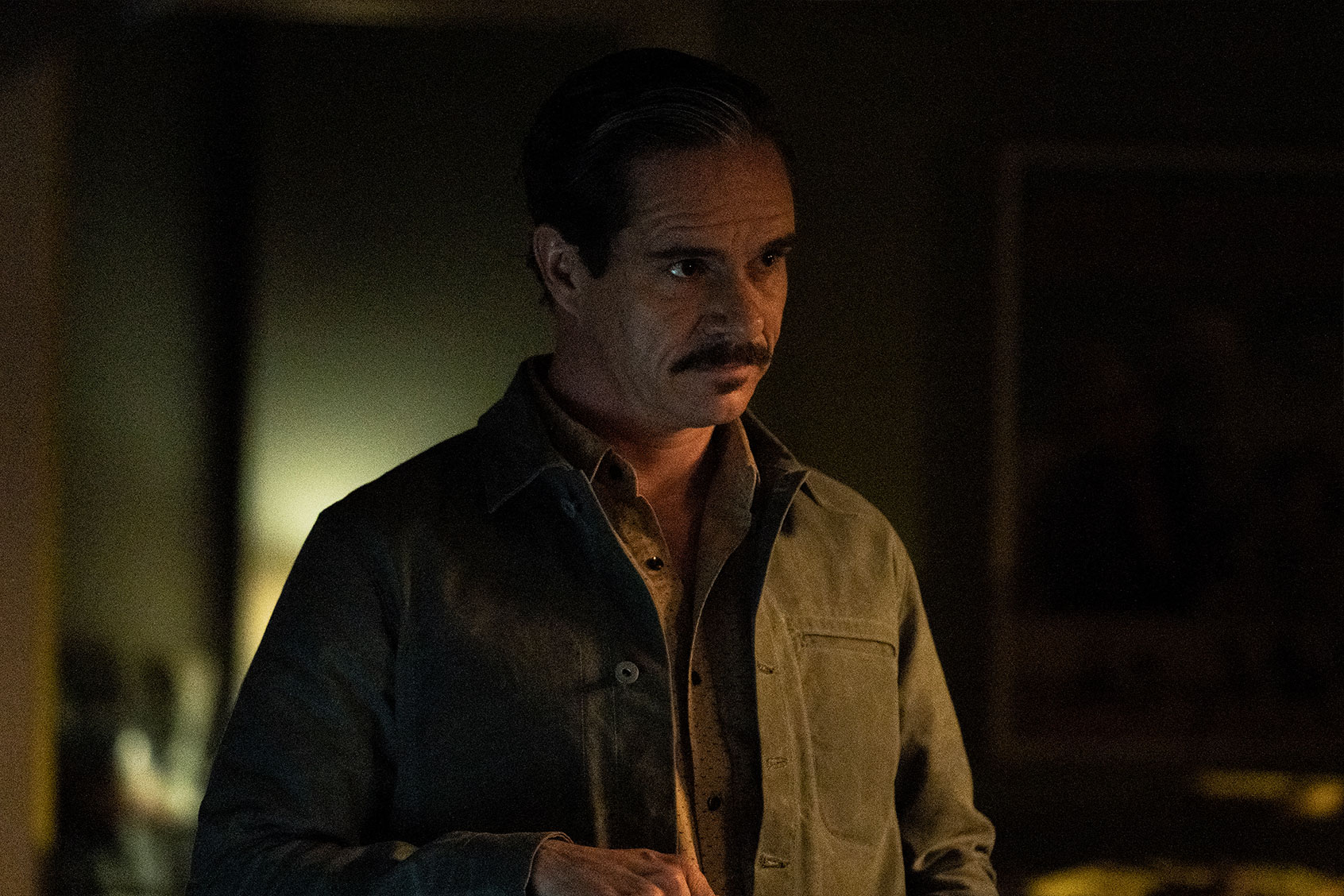
Better Call SaulTony Dalton as Lalo Salamanca in “Better Call Saul” (Greg Lewis/AMC/Sony Pictures Television)

If we didn’t intimately know Gus Fring, his preparedness for Lalo might have come off as a bit too elegant and convenient to be plausible. But in this episode, Gordon Smith writes directly to Gus’ awareness of how the grandeur of his goals collides with the cartel’s expectations of him – especially Lalo and the other Salamancas. Gus is determined to outwit and outlast everyone in this game.

That means he has been watching everyone, hence his apparent understanding of what must happen. Kim has only been spoken to by Mike until now, which makes Gus’ choice to speak to her directly on the phone significant. When he asks Kim how she came to be at his door, Kim tells him that it was supposed to be Jimmy, her husband, but he talked Lalo out of that, allowing her to go in his stead.

“He . . . talked . . . Lalo . . . out of it,” Gus repeats, before calling a few of his men to his side and heading to the laundry facility.  

Before all of this transpires, Gus removes his tie, that ever-present shield of courtly signaling that affords him something the Salamanca could never obtain without a gun or bloodshed: respect.

Five more episodes remain in “Better Call Saul,” requiring Gilligan, his co-creator Peter Gould and their team of writers and directors to resolve a few of lingering questions. Some, as we’ve noted before, have been answered by the fact of a character’s existence in “Breaking Bad.”

Others require more extensive shading. It matters, for example, that Kim Wexler isn’t present in Saul Goodman’s life when he meets Walter White. After this episode, the odds seem greater that Kim survives this chapter.

Besides, spelling out why she isn’t with Jimmy in the future is far more compelling to explore. Gilligan and Smith pull into that intersection in “Point and Shoot” by resolving the rivalry between Gus and Lalo once and for all.

Lalo breaks into the laundry facility, perhaps expecting Gus would confront him; he planted the idea that he planned to blow up the place, after all. And he was correct. Gus showed up with a couple of men who Lalo easily dispenses with before he forces Gus to reveal the underground meth lab to him, filming everything to show to Don Eladio.

But Gus always has plans to deal with contingencies, including those within contingencies. This time, he has a gun hidden in a piece of machinery, which he retrieves before exchanging fire with Lalo. They both take a few hits. Gus is wearing a bulletproof vest. Lalo, in his arrogance, would never.

When the shooting stops, Gus walks over to where Lalo lays and stands regally over him as he takes his last breath. Only when he’s sure that Lalo is dead does Gus collapse too, revealing he’s been wounded in the shootout.

By the time Mike steps in to clean up everyone’s messes, it’s plain to see that Kim cannot remain alongside Jimmy for much longer, since Saul Goodman’s reputational rise requires an acceleration in Jimmy McGill’s moral decline. Hurting others at a distance as a “friend of the cartel” is one matter, but getting a colleague-turned-adversary murdered changes everything – especially given that Kim originated the plan to embarrass Howard, not destroy him.

And when Mike sits them down and tells them the plan to get rid of Howard’s body, Kim and Jimmy are in such deep shock that they look a tender breeze away from catatonic – until Mike, after stating that Howard’s car will be found several states away by the water, the odometer set to the perfect distance, adds that that cocaine will be found in the upholstery.

“That’s the story you were setting up for this guy, yeah?” Mike says, explaining they’ll call it a suicide. That jolts Jimmy back to the moment. Kim remains dead-eyed.

Then he tells the pair to go about their days as if nothing happened, and when Howard’s absence is noted, “You keep telling the lie you’ve been telling.

“I need to impress upon you: None of this ever happened,” Mike finishes. Moments later, Jimmy glimpses the body of his and Kim’s former boss, and his brother’s partner and friend, being stuffed into their refrigerator. Mike politely replaces it with a lovely stainless steel model.


Want great food writing and recipes? Subscribe to Salon Food’s newsletter, The Bite.


We have yet to glimpse Gene Takavic, Jimmy’s future self, a Cinnabon manager hiding out in a colorless Nebraska. But in many ways, this entire season has played with the concept of black and white, reminding us through small clues that shades of grey define the world more distinctly than those extremes.

Our view of the movie Jimmy and Kim were enjoying before Howard and Lalo invaded is one such metaphorical hint, Gus’ triumph over Lalo is another. Gus’ martial preparedness for Lalo’s ruse to take down the meth fortress is foretold in the brief credits sequence which, this week, shows a tarantula crawling out from beneath a tie. The entire episode is shot in dim lighting, emphasizing that all of this life-altering moves take place in the dead of night.

Even the blocking of certain scenes has subtle purpose to it, as when Jimmy, gagged and bound to a chair, ends up falling over right by Howard’s body, his head to Howard’s feet. An overhead shot displays the two men as a yin and yang arrangement – affirmative to negative, big to small, strong to weak – something a guy with a vanity license plate reading “NAMAST3” may have appreciated.

But the truth of where Howard ends up would be unbecoming to any man bound so tightly to his principles as to make him stiff and unbending: Gus’ men slide Howard’s body into a grave dug in their gigantic meth factory’s floor beside Lalo, the blackest of black hats resting for eternity beside a man who lived by and for the law. Lalo killed Howard, and the saddest part is, that’s inconsequential next to the knowledge that Gus killed Lalo by his own hand.

“This could have gone down a whole lot different,” Mike sternly says to his boss, admonishing him for diverging from Mike’s careful plans to keep him safe. At this, Gus fixes his hard stare on Mike and replies, “It could have,” knowing that he, Mike, and an audience of witnesses understand that for men like him, this part of the story could only end one way in order to make it into the next.

New episodes of “Better Call Saul” air at 9 p.m. Mondays on AMC.

More stories like this:

Peter Dinklage’s scene was cut out of “Thor: Love and Thunder”

At 119 minutes, “Thor: Love and Thunder” is the shortest Marvel film to come along in a while, but that’s only after the editors chopped out some of the extraneous stuff. It’s starting to sound like quite a lot was left on the cutting room floor; in fact, two “Game of Thrones” veterans had scenes that didn’t make the final film.

The first we’ve known about for a minute: Lena Headey (Cersei Lannister) had a scene that was cut (and that’s now the subject of some legal drama). We don’t know who she would have played.

Then there’s Peter Dinklage. According to star Christian Bale, the two of them worked together on the film, but Dinklage isn’t in the final cut. “I got to work with Peter Dinklage,” Bale told the Prensaescenario Youtube channel. “That’s not in the final film but I got to work with him, he’s fantastic.”

Christian Bale worked with Peter Dinklage on “Thor: Love and Thunder”

Now, we do know who Dinklage would have played. Dinklage already appeared in the Marvel Cinematic Universe as Eitri, the King of Dwarfs who made Thor’s hammer; this being a Thor movie, it wouldn’t be a surprise to see him again.

But what would he be doing in a scene with Bale, who plays villain Gorr the God Butcher? Well, I’m betting they cut Eitri’s death scene. Bale also mentioned that he “got to work with Jeff Goldblum,” who isn’t in the film either. “As you see lots of stuff ends up on the cutting room floor even though it is beautiful brilliant stuff.” Goldblum played the Grandmaster in “Thor: Ragnarok.” I imagine that Gorr butchers him too.

In fact, it’s starting to sound like the sequence that was cut was a montage of Gorr the God Butcher butchering gods. Might Headey’s character have been part of that sequence, too?

Perhaps we’ll get a clue when the movie opens tomorrow . . . or more likely, when we dig through the supplementary materials a few months later.

Why “Funny Girl” matters: a breakdown of the musical, the revival and its casting issues

At the start of “Funny Girl,” the 1964 Broadway musical turned 1968 film, aspiring performer Fanny Brice just can’t get a break. It’s hard not to see parallels in the current Broadway revival, which has received more time in the media spotlight than usual.

The show’s originally cast Fanny Brice, Beanie Feldstein, announced on social media Sunday she was leaving months earlier than intended, citing the production’s “decision to take the show in a different direction.”

Less than 24 hours later, that direction was revealed: Lea Michele, who was quickly named Feldstein’s successor and will join the Broadway cast Sept. 6. Until then, the lead role will be portrayed by understudy Julie Benko, who seems to be starring in a “Funny Girl” type story of her own, with Benko continuing to play the role once a week after Michele steps in. Benko describes herself on her Twitter profile as “the luckiest standby in the world.”  

RELATED: Why Greta Gerwig’s “Lady Bird” is the sort of directorial achievement the Academy always overlooks

Why is there so much drama about this comedy? What happened with Feldstein and why such a fuss over this particular show? Salon breaks down what you need to know about “Funny Girl” and the elaborate casting drama.

The musical backstory

With a score by Jule Styne, lyrics by Bob Merrill, and book by Isobel Lennart, “Funny Girl” tells the semi-true story of actor, comedian and Broadway star Fanny Brice. Born Fania Borach, Brice, the daughter of Jewish Hungarian and Alsatian immigrants, dropped out of school to start performing burlesque. She found fame on the stage, and later in radio and TV. She also had a series of difficult marriages.

“Funny Girl” in particular dramatizes her marriage to Nicky Arnstein, who was a gambler and professional con artist with multiple aliases. Convicted of “swindling,” he served time in Sing-Sing. Brice visited Arnstein, who was married to someone else at the time, in prison every week. Upon his release, he got a divorce and then married Brice. They had two children. About a decade later, Arnstein served time in Leavenworth, and Brice divorced him when he was released.

As a dramatization, “Funny Girl” takes some liberties with Arnstein (and his crimes) as it does with Brice and their relationship. Omar Sharif played Arnstein in the film version. And Barbra Streisand originated the role of Fanny Brice on Broadway and in the movie.

It was difficult to picture the show without its first star, who shone so brightly, the faults of the rest of the story could be seen in glaring relief, like a spotlight illuminating the dusty backstage.

The Babs effect

Streisand was already famous by the time “Funny Girl” opened. She had gotten her start in New York City nightclubs and comedy plays. While still a teenager, she made her Broadway debut with “I Can Get It for You Wholesale,” for which she received a Tony Award nomination. 

In some ways, “Funny Girl” seemed to parallel Streisand’s own career beginnings. While Brice dropped out of high school, Streisand graduated early at age 16 and lived on her own as she tried to make it as a performer. Streisand changed her name (dropping one of the “a’s), repeatedly dealt with negative comments about her looks and was advised to get a nose job. She refused. 

In “Funny Girl,” Brice’s character is told she’s not pretty enough to be on stage, certainly not as the star. She’s nearly fired because her legs are too skinny, and once she lands a major role — as a Ziegfeld girl, no less — she almost sabotages it by turning the highly glamorous part into a joke. She’s so used to people laughing at her, she can’t bear to be the lovely center of attention if it isn’t a punchline (or a throw pillow making her into a very pregnant bride).

Streisand won an Academy Award for Best Actress for the film version of “Funny Girl,” after being nominated for a Tony for the stage musical. Except for a 2016 West End production, there have been few notable revivals. It was difficult to picture the show without its first star, who shone so brightly, the faults of the rest of the story could be seen in glaring relief, like a spotlight illuminating the dusty backstage.

Other critics were not as kind. The Guardian wrote Feldstein “struggled.”

As Roger Egbert wrote in his review of the film: “The trouble with “Funny Girl” is almost everything except Barbra StreisandShe is magnificent . . . It is impossible to praise Miss Streisand too highly.” The New York Times wrote in their 1968 review: “When she is singing –in a marvelous scene on roller skates – when she throws a line away, or shrugs, or looks funny or sad, she has a power, gentleness and intensity that rather knocks all the props and sets and camera angles on their ear.”

The revival’s “not stupendous” casting

About the new Broadway revival, the Times was less enthusiastic, calling it “mild” and writing “without a stupendous Fanny to thrill and distract, the musical’s manifold faults become painfully evident.” The review calls Feldstein, who stepped into Brice’s shoes: “not stupendous . . . She’s good. She’s funny enough in places.” 

Other critics were not as kind. The Guardian wrote Feldstein “struggled” while Variety called the production “uninspired,” singling out Feldstein’s performance as “a wide-eyed woman-child, at turns stubborn, awkward and silly. Knowingly precocious, Feldstein relies on broad face-making rather than a more nuanced comic skillset.” 

Feldstein is best known for her film and TV work, starring in Olivia Wilde’s directional debut, the 2017 film “Booksmart,” for which the actor won a Golden Globe nomination, and in Greta Gerwig’s “Lady Bird.” She had a recurring role in the TV adaptation of “What We Do in the Shadows,” which garnered rave reviews and starred as Monica Lewinsky in FX’s “American Crime Story: Impeachment.” She made her Broadway debut in 2017’s “Hello Dolly!” revival, which also received a glowing response, and is slated to appear in Richard Linklater’s movie adaptation of Stephen Sondheim’s “Merrily We Roll Along.”

Feldstein’s replacement, Michele, is best known for starring on “Glee,” the TV musical comedy that ran from 2009-2015 and saw her rack up award nominations from two Golden Globe nominations to three Teen Choice nods. She started her career as a child actor, appearing in Broadway productions of “Les Misérables” and “Ragtime” before originating the role of Wendla in “Spring Awakening.” She’s been very vocal about wanting to play Fanny Brice, and some see her casting as a course correction of sorts.

Michele replacing Feldstein comes at a time when Broadway is still struggling after going dark during early COVID, hits that keep coming as the pandemic keeps raging.

Alas, a reunion with former “Glee” co-stars Michele and Jane Lynch (“The Marvelous Mrs. Maisel“) is not to be. Lynch is currently portraying Brice’s mother in the production but will exit before Michele takes over. Lynch will be replaced by Tovah Feldshuh, who starred in the original Broadway production of “Yentl,” and recently appeared in the CW’s “Crazy Ex-Girlfriend.” Lynch and Michele might have overlapped in the production, except for the new schedules. Lynch was previously scheduled to leave the show after September, but is now leaving weeks earlier.

Lea Michele in “Glee” Michele replacing Feldstein comes at a time when Broadway is still struggling after going dark during early COVID, hits that keep coming as the pandemic keeps raging. A new variant is hitting. Meanwhile, Broadway theatres have dropped their vaccine and mask requirements (a New York Times review of the new revival of “Into the Woods” commented on “the masks not worn at all” in the audience of a musical about, in part, helping each other ). In the 2021-2022 season, Broadway attendance and revenue was less than half of pre-pandemic numbers. As always, old shows keep the lights on. Along with “Into the Woods,” other Broadway revivals include “The Music Man,” “Chicago” and “Company.” 


Want a daily wrap-up of all the news and commentary Salon has to offer? Subscribe to our morning newsletter, Crash Course.


It’s unclear if a “Funny Girl” revival with Michele at the helm will draw the crowds in, if she has the Streisand touch that critics accused Feldstein of lacking, or if Michele is able to make the coveted role her own. In a statement on Instagram, Michele wrote “A dream come true is an understatement,” echoing Feldstein’s statement about her departure: “Playing Fanny Brice on Broadway has been a lifelong dream of mine, and doing so for the last few months has been a great joy and true honor.”

As Fanny Brice herself says in the film: “For once, I didn’t say too much, I didn’t say too little. I said just what I said and then walked.”

More funny girl stories

Researchers surprised to find seven adult health conditions linked to childhood abuse

If you were abused as a child — whether by your parents, another trusted adult, your schoolmates or anyone else — chances are good that you don’t need a bunch of scientists to tell you that the ripple effects of pain will still be felt when you’re an adult.

For many child abuse victims, regardless of their age, the fact that you can never fully escape the pain is tied into your very being.

RELATED: Anecdotally, gardeners call their hobby therapeutic. Scientists are trying to provide proof

Yet there is still great utility in psychologists being able to unpack the precise nature of how child abuse affects adult victims — and that is where a new study published in the journal Aging and Health Research comes into play. The study — which was conducted by a team of scientists led by research assistant Anna Buhrmann at the Institute of Life Course & Aging at the University of Toronto — examined health data from a group of more than 5,000 British Columbians who were at least 60 years old. From there, the health information from individuals who had been physically abused as children was compared to that from individuals who had not.

Their conclusions were astounding — and tragic.


Want more health and science stories in your inbox? Subscribe to Salon’s weekly newsletter The Vulgar Scientist.


Specifically, researchers found a “significant” association between childhood physical abuse and seven health conditions. Two of those health conditions were mental health-related, and five were related to physical health. The five physical health conditions are diabetes, heart disease, arthritis, migraines and cancers. The two mental health conditions are depression and anxiety. Both were found to occur later in life, and with disproportionate frequency, among adults who had been physically abused as children.

Researchers found a “significant” association between childhood physical abuse and seven health conditions — diabetes, heart disease, arthritis, migraines, cancers, depression and anxiety.

“The association between CPA [childhood physical abuse] and 2 mental health and 5 physical health conditions remained significant, even after controlling for sociodemographic characteristics, health behaviors and other ACEs [adverse childhood experiences],” the authors explain. “Further research is needed to investigate potential pathways through which childhood physical abuse is linked to a wide range of later-life health problems.”

One of the study’s co-authors expressed hope that therapy may be a good way to alleviate some of the negative impacts of being abused as a child.

“Health professionals serving older adults need to be aware that it is never too late to refer people for counselling,” professor Esme Fuller-Thomson, who supervised the thesis, explained in a statement. “A promising intervention, cognitive behavioral therapy [CBT], has been tested and found effective at reducing post-traumatic stress disorder and depressive and anxiety symptoms among survivors of childhood abuse.”

It is unclear exactly how childhood physical abuse is able to so closely correspond to adult health problems. The study’s authors acknowledge that more research is needed on the subject, as possible explanations range from the psychological changes caused in children after they are abused to the possibility that abuse victims develop physical changes like abnormal levels of cortisol, the body’s primary stress hormone.

“A growing body of literature supports the biological embedding hypothesis, which describes how childhood physical abuse ‘gets under the skin’ to produce physiological changes that lead to poor health outcomes later in life,” the study’s authors write at one point. They noted that one promising explanation is that cortisol levels are warped through changes in the body’s hypothalamic-pituitary-adrenal (HPA) axis. They also speculated that the adult health issues could be caused by “disruptions in the autonomic nervous system (ANS), which shapes stress response through the sympathetic and parasympathetic systems.” They also speculated that childhood physical abuse could alter gut bacteria, lead to chronic inflammation, decrease brain volume, diminish cellular immunity and cause epigenetic changes.

“Accordingly, our findings support the need for further research on the biological pathways connecting [childhood physical abuse] to poor health in older adults,” the authors conclude. “High rates of co-occurrence of CPA and conditions such as anxiety, depression, and COPD [chronic obstructive pulmonary disease] also reinforce previous recommendations that screening for CPA could help identify those at higher risk of developing these health conditions in older adults.”

In addition to being linked to adverse health outcomes among adults, victims of childhood physical abuse also frequently deal with a range of mental trauma symptoms for the rest of their lives. Speaking with Salon in February, author Stephanie Foo described how so-called “complex PTSD” affects its sufferers.

“People with complex PTSD often develop that as a result of child abusedomestic abuseliving in a war zone, being a prisoner of war,” Foo told Salon. “It’s more of a relational thing than traditional PTSD. Because the number of triggers we have is so large, it becomes less tied to very specific trigger than for example, if you were in the desert as a soldier, being in a desert environment. It’s more like having an overall uneasy feeling a lot of the time.”

For more Salon articles about mental health:

A major grocery store chain pulled all of its potato salad varieties over safety concerns

Hy-Vee, the supermarket chain based out of Iowa, voluntarily withdrew all varieties and sizes of its potato salads at the beginning of July, citing safety concerns. An announcement posted by the U.S. Food and Drug Administration (FDA) reported a “presumptive positive microbial result” on the line where the potatoes had been processed.

“Out of an abundance of caution,” the products involved in the recall were pulled from store shelves ahead of the July 4 holiday weekend as the company awaited “final test results.” The Hy-Vee and Mealtime Potato Salads in question were previously available in both deli service and grab-and-go refrigerated cases across all Hy-Vee, Hy-Vee Drugstore and Dollar Fresh Market locations. Recalled products were also sold at Hy-Vee Fast and Fresh convenience stores in Illinois, Iowa, Kansas, Minnesota, Missouri, Nebraska, South Dakota and Wisconsin.

RELATED: Everything you wanted to know about food poisoning but were too busy puking to ask

The following items were involved in the recall: Hy-Vee Old Fashioned Potato Salad, Hy-Vee Country Style Potato Salad, Hy-Vee Dijon Mustard Potato Salad, Hy-Vee Green Onion and Egg Potato Salad, Hy-Vee Chipotle Ranch Potato Salad, Hy-Vee Diced Red Skin Potato Salad, Hy-Vee Loaded Baked Potato Salad, Mealtime Old Fashion Potato Salad, Mealtime Country Style Potato Salad and Mealtime Dijon Mustard Potato Salad. The affected products have expiration dates between July 31, 2022, and Aug. 4, 2022.

No illnesses or complaints from customers related to the recalled items had been reported at the time the notice was first posted earlier this month. 


Want more great food writing and recipes? Subscribe to “The Bite,” Salon Food’s newsletter.


If you have one of the impacted products at home, do not eat it. Instead, safely throw the potato salad away or return the container to your local Hy-Vee store for a full refund.

This isn’t the only recall to be aware of right now. Last week, J&M Foods voluntarily recalled select bags of Favorite Day-branded lavender shortbread cookies in the wake of a packaging mix-up, which resulted in the correct allergens not being disclosed. The 7-ounce packages of cookies were distributed at Target stores nationwide. Here’s everything you need to know.

If you’re tasked with bringing potato salad to a summertime picnic, check out these recipes, which are as easy as grab-and-go, from the Salon Food archives. 

Read more

about leveling up your summer picnic game:

The Dorie Greenspan cake we all should know

If you asked me to choose one Dorie Greenspan recipe — from her fourteen cookbooks, and three decades of welcoming bakers to the fold — to recommend to any beginner or busy cook, the lemony cloud of her French Yogurt Cake would already be baking in my brain.

Because yes, we all need a simple, trustworthy cake that requires only bare-bones ingredients and gear, but especially one like this, with a signature step so joyful Dorie has named it The Smoosh.

The gist of The Smoosh, which she learned from pastry chef Pierre Hermé, is this: Pinch lemon zest — or other citrus, fresh herbs, or the belly of a vanilla bean — into sugar; watch (and smell) it all become exponentially more lemony than the zest alone. “Smoosh any time you can,” Dorie says.

And, by the way, I did have to choose one Dorie recipe — but I also got greedy. When I asked Dorie if I could include her iconic cake in our forthcoming “Simply Genius” cookbook, she generously handed it over, and three of her favorite riffs on it, too.

One of them was a summery spin streaked with blueberries and thyme, but still simple enough that the college students in her latest Zoom class had baked it in their dorm room toaster ovens.

While the rest of “Simply Genius,” the third child in our Genius Recipes cookbook series, will be here in September, in the meantime I wanted to hustle this one to you, while there are blueberries to pick and picnics and road trips to outfit, though you can also bake it forever with frozen blueberries — or any other fruit you want.

(For anyone who pre-orders the book now, there’s also an instant bonus sneak peek of 14 new recipes and riffs to start cooking before the whole caboodle gets here — here’s more on that.)

And now, here’s Dorie’s latest riff on her any day, any season, any way you want it cake, as it will appear in “Simply Genius.” Smoosh away.

Recipe: Blueberry-Thyme Yogurt Cake from Dorie Greenspan

Eggs and mayo is a way underrated French bistro dish

If you speak French, oeufs-mayo holds no secrets for you: This portmanteau of an appetizer is no more complicated than uniting hard-boiled eggs and mayonnaise — the former halved, the latter dolloped generously on top. 

“I always think of the traditional dish with the egg cut in half, from top to bottom, with the yolk on the plate and the mayo coating the white of the egg,” says author Dorie Greenspan. “But when I was at Le Paul Bert, it was upside down. I asked somebody why, and they said, ‘Because the yolk sticks to the plate!'” 

Her evocation of the restaurant famed for its adherence to tradition is no accident: Indeed, though almost criminally simple, egg-mayo is a stalwart bistro staple, a dish Paris-based food writer and stylist Rebekah Peppler says she’s “seen eaten more out than in.” “Oeuf-mayo is a bistro dish,” agrees French culinary journalist Emmanuel Rubin, “not a home dish.” To wit, the iteration from Paris’ Bouillon Pigalle is France’s most-ordered dish on Deliveroo (a British online food delivery company) — and the fifth most-ordered dish in the world.

According to Priscilla Martel, the former chef-owner of French Restaurant Du Village in Chester, Connecticut, oeufs-mayo often appears as part of a larger whole known as hors d’oeuvres variés, a hodgepodge of appetizers including grated carrot salad, celery root with remoulade sauce, or cubed beets in a light vinaigrette.”The one at the Colombe d’or will make you cry,” she says. “They wheel it over like a cheese cart.” But if the bags of shredded carrots sold at my local Monoprix are any indication, French home cooks are adept at making carottes râpées. Oeufs-mayo, meanwhile, despite its simplicity, seems relegated solely to bistros.

In my fifteen years of living in France, I’ve been ensconced in several French families, but never once have I been served the stalwart combination of hard-boiled egg and mayonnaise. Greenspan posits that perhaps the French think it too simple for guests; to confirm, I called my former neighbor, the septuagenarian Régine Pla, with whom I am close enough to regularly (happily) dine on leftovers. She asserts that she’s never served me oeuf-mayo, not because it’s too simple for guests, but because she never makes it at all. While her dinner party menus regularly feature oeufs mimosa — deviled eggs stuffed with tuna and mayonnaise, garnished with the crumbled yolk — oeuf-mayo sits in a strange interstitial space: too simple for company, too involved to make just for herself.

“For just me, I won’t make it,” she says. “I’ll just have hard-boiled eggs on their own.”

A bistro stalwart, oeuf-mayo remains in large part thanks to its low price point: just €1.90 for a serving of three egg halves at Bouillon Pigalle, and 90 cents at Le Voltaire for one egg, halved. But the cheap-as-chips appeal of the dish is waning, following the fine-dining leanings the bistro underwent during the rise of bistronomie in the 1980s and 90s. It was in 1990 that Claude Lebey founded the Association de Sauvegarde de L’oeuf Mayonnaise to promote and protect the staple; Chef Chris Edwards is the most recent vice-champion of the contest held every year, rewarding the best version of the dish according to the association’s official charter: large chicken eggs, hard-boiled and no longer runny, served with a simple, seasonal vegetable garnish (if desired) enough mayonnaise to mop up the excess with bread. “For me, it’s like I’m integrating a little bit into French culture,” says the Australian chef, who has lived in France for five years, of his silver medal. “It was an affirmation that I’ve actually been able to be part of it.”

He’s baffled that more people don’t make oeuf-mayo at home, especially seeing as it’s becoming tougher to come by in restaurants and bistros. On one recent jaunt through Paris, seized by a craving, he walked for half an hour, searching menus in vain. “They still had poireaux vinaigrette, but I didn’t see egg mayonnaise!” The few he does find frequently fetch around seven euros for two halves — all the more reason for people to make it at home.

But while the simplicity of the dish is part of its appeal, it may also be its downfall, at least for the home cook.

“It actually makes it harder to do something so simple so well,” says Edwards, “because there’s nothing to hide.”

“With so few components,” agrees Peppler, “you have to get every single one of them — from mayo to egg to seasoning to presentation — just right.”

How To Make Oeuf-Mayo

For Peppler, “just right” starts with a seven-minute egg: The yolk should be jammy and the white firm but never rubbery.

“I can’t say I’ve never started them in cold water at the end of a long day and hoped for the best,” she says, “but if I want to have full control, I bring the water to a boil and lower them in with a slotted spoon.” Edwards starts in hot-but-not-quite-boiling water to keep the shells from cracking, cooking for eight minutes and 40 seconds, precisely, before transferring them to an ice bath to stop the cooking process. To peel her eggs, Martel relies on a technique gleaned from Jacques Pepin.”You drain them, but they’re still warm, and you just shake that pan really vigorously, and all of the shells kind of crack and become a little cracked skin, and they slide right out.”

As for the mayonnaise, it must be bien sûr made from scratch.

Martel has tried many different methods, from blending in a Vitamix to a food processor. The key, she says, is looking for a visual clue — something she acquiesces is tougher for home cooks who “didn’t grow up making mayonnaise with a wooden spoon, like grandma taught you.” (Of course, if Grand-mère taught you to make mayonnaise in France, she may have also shared that there are a few days a month that you shouldn’t: One pervasive myth in France dictates that a menstruating woman’s mayonnaise will be cursed to split, something that Elise Thiébaut, author of Ceci est mon sang, calls one of a “great number of superstitions connecting eggs and menstruation.”)

But mayonnaise is not actually that difficult to master — whether you’re menstruating or not.

“People are scared,” Edwards says, notably of mayonnaise splitting. “But you can always fix it if you’ve got more eggs!”Making a new emulsion of egg yolk and mustard and whisking the broken mayo into it, he says, will make it good as new. The ideal mayo, according to Greenspan, should be “well-seasoned” and thick. “The mayo needs to be thin enough so that it just coats the egg,” she says, “and then when you slice it, the mayo kind of drips down that slice.”

For his recipe, Edwards uses “a lot of mustard,” and, in a traditional move that nevertheless runs contrary to what many believe about the French, good-quality sunflower oil rather than olive oil for a neutral flavor. Once you’ve got the basics down, though, Greenspan notes that oeuf-mayo is “just made to be played with.”

“Once you learn how to make the mayonnaise, and once you get the eggs just the way you want them, you can just go crazy with it!”

She occasionally seasons her mayonnaise with sesame oil and rice vinegar, scattering the eggs with sesame seeds; Edwards infuses the oil for his mayo with smoked morteau sausage; Peppler’s version sees bright green, garlicky persillade stirred right into the sauce.

“It’s above all the incarnation of a paradox that, today, fuels our food culture,” says Rubin, “one of those very working-class dishes that has taken a turn for the chic.” But oeuf-mayo is perhaps best when at its simplest: a free-range egg coated with mayonnaise and garnished with herbs — Greenspan is partial to chives or chervil. Pushing it too far denatures it, as Edwards saw in the very rules of the contest. “Some people rocked up and they had an ostrich egg,” he says. “Immediately, they were disqualified.”

At its best, it’s a dish that fuels nostalgia — even for someone who didn’t grow up on it. “I feel like that first bite of egg mayonnaise kind of prepares you for the next one,” asserts Greenspan. “You kind of know the dish. Unless you start playing with it, the classic dish is knowable in that first bite.”

Amber Heard and Johnny Depp drama continues: a potential mistrial and pointed charity donations

The Johnny Depp and Amber Heard defamation trial continues to make news weeks after its conclusion.

On Friday, Heard’s legal team asked for a mistrial after learning one of the case’s jurors was not legally supposed to be on the jury, having never received a jury summons.

As reported by Variety, one of the jurors who served in the trial was not an official selected juror. The jury summons had actually been received by a different member of the person’s household who has the same last name but is 25 years older. Variety wrote, “If the wrong person showed up to the trial, Heard’s lawyers would not have had the opportunity to do a criminal background check or look up the juror’s social media posts in search of potential biases.” 

RELATED: “The View”: Depp-Heard verdict won’t affect #MeToo, but it “cheapens” domestic violence conversation

Heard’s legal team said in a statement: “It is deeply troubling for an individual not summoned for jury duty nonetheless to appear for jury duty and serve on a jury, especially in a case such as this . . . a high-profile case, where the fact and date of the jury trial were highly publicized prior to and after the issuance of the juror summonses.”

Forbes reported: “As a safeguard, jurors must fill out a questionnaire with their birthdate to ensure their identity, according to the filing.” This means that the incorrect juror would have potentially had opportunities to realize their mistake. Neither the name of the wrong juror nor the person actually summoned for jury duty has been released.

This error deprived Heard of a fair trial, according to her lawyers, who have asked the court for a new trial.


Want a daily wrap-up of all the news and commentary Salon has to offer? Subscribe to our morning newsletter, Crash Course.


The trial concluded on June 1 when the jury awarded Depp $10.35 million for defamation after his ex-wife Heard published an op-ed in the Washington Post about being an abuse survivor. The jury also awarded Heard $2 million from Depp after Depp was found liable for statements.

In other Depp and Heard news, Depp has allegedly donated money he made from the sale of NFTs to one of the charities Heard pledged she would support: the Children’s Hospital of Los Angeles. Heard’s donation pledges were a subject that came up during the contentious trial. Despite financial hardship due to legal fees, Heard says she still plans to donate millions from her divorce settlement with Depp. Depp’s recent donations came out to about $800,000, all to charities supporting children.

More stories like this


Inland cities face water supply problems as lakes evaporate due to climate change

As sea levels continue to rise as climate change accelerates, experts in coastal cities are planning accordingly. From New York City to New Orleans, policymakers who live near the ocean seem to be gradually recognizing their “The Day After Tomorrow”-esque peril. Yet according to a new study in the scientific journal Nature Communications — one that an outside scientist praised for looking “at the impacts of evaporative loss in an entirely new way” — people who live near lakes may have just as much cause for climate change-related water concerns as those who dwell near the sea.

That, in turn, means everyone else will also need to worry.

In research led by a team of scientists at Texas A & M University, the scholars accumulated data from more than 1.42 million natural lakes and reservoirs all over the planet. Their goal was to assess whether lakes have lost water over a one-third-of-a-century period stretching from 1985 to 2018. As it turned out, long-term average lake evaporation has increased at a rate of 3.12 cubic kilometers per year, including increases in the evaporation rate (58%), a decline in lake ice coverage (23%) and an increase of lake surface area (19%).

RELATED: Scientists say Yellowstone flood is a climate change red flag

“There are several major conclusions in our work,” Dr. Huilin Gao, Texas A&M University College of Engineering, told Salon by email. Gao mentioned that the global lake evaporation volume is “15% larger than previously thought” thanks to their research. In addition, “we have quantified that this volume has been increasing at a rate of 3.12 km3/year and such an increasing trend is caused by not only the increase in evaporation rate but also lake ice melting and lake surface area increase.”

“‘The practical consequences for most people will be that their water resources could be better managed in the future, as the effects of climate change become more acute,’ Rynearson told Salon.”

Yet climate change alone is not to blame for the loss of lake water. “The lake surface area increase is mainly caused by reservoir construction in the past 30+ years,” Gao pointed out.

Tatiana Rynearson, an American oceanographer at the University of Rhode Island who was not involved in the study, praised it for examining “the impacts of evaporative loss in an entirely new way.” Rynearson told Salon that “by examining how the evaporation volume of lakes is changing over time the authors generated a metric that policy makers and water quality managers can use.”

Given that every human drinks and uses water, the study is of direct concern to everyone. 

“The practical consequences for most people will be that their water resources could be better managed in the future, as the effects of climate change become more acute,” Rynearson told Salon. “These could be local resources like domestic water use and could also include more distant resources, like those used in agriculture that produces food distributed across the nation or the globe.” Rynearson noted that the study’s authors have also created metrics “that will be used in earth system models which means that we could have better climate forecasting of rainfall, temperature and humidity levels.”


Want more health and science stories in your inbox? Subscribe to Salon’s weekly newsletter The Vulgar Scientist.


Until recently it has been difficult for scientists to make robust projections about how climate change will hurt surface fresh water bodies because there has been a dearth of useful data. Yet as the study itself notes, roughly 87 percent of all the Earth’s fresh surface water exists in either natural or artificial lakes, meaning that policymakers will likely have to figure out how to preserve these precious resources. That is just one more reason why the rapid loss of water within those lakes is ultimately a global problem.

“Such a high volume of evaporative water loss from lakes and reservoirs has direct connections with local water availability, especially during drought in the arid and semi-arid regions,” Gao told Salon. “Such [a] phenomenon can reduce the available water for irrigation, water supply, and hydropower purposes and thus pose challenges to policymakers to manage water-food-energy more efficiently.”

When asked if there are any government policies that could solve this problem, Gao explained that “we think the best way to reduce such a problem can be done via international collaboration to mitigate human-induced climate change.” He added that “in our work, we found that the increase in evaporative water loss is largely caused by global warming, which not only increases the evaporative rate but also decreases lake ice.”

For more Salon articles on climate change and water:

Bill Barr subpoenaed in lawsuit against Fox News over false election claims

Former Attorney General Bill Barr has been subpoenaed as part of Dominion Voting Systems lawsuit against Fox News, which claimed in the aftermath of the 2020 election that the company’s software has been compromised by voter fraud.

The subpoena was reportedly circulated last week along with subpoenas of other officials, including Secretary of Georgia Brad Raffensperger, who rejected Donald Trump’s request to “find” just enough votes in his favor to overturn the election. 

In the wake of the 2020 election, Trump baselessly claimed that Dominion’s voting machines had systematically switched Trump’s votes with Biden’s votes, giving the president an unfair advantage. That claim was at the heart of the select committee’s first hearing on the Capitol riot last month, which featured closed-door testimony from Barr, who at first legitimized Trump’s election denials but later refused to go along with them. 

RELATED: “Dominion has a very strong case against Fox News” and other right wing media outlets: report

“I told them it was crazy stuff and they were wasting their time on it, and they were doing a great disservice to the country,” Barr said of Trump’s conspiracy theories about Dominion’s voting machines, which were trumpeted in 2020 and 2021 by multiple anchors on Fox News. “I saw absolutely zero basis for the allegations, but they were made in such a sensational way that they obviously were influencing a lot of people.”


Want a daily wrap-up of all the news and commentary Salon has to offer? Subscribe to our morning newsletter, Crash Course.


Raffensperger has also testified in the hearings, confirming previous reporting that the former president vaguely threatened the Georgia official with a criminal inquiry if he refused to look into claims of fraud. At one point, both former Trump attorney Rudy Giuliani and former Trump campaign lawyer Sidney Powell erroneously claimed that Raffensperger had received “kickbacks” for “its contract to provide voting machines to the state.”

In its $1.3 billion lawsuit, Dominion has argued that Fox News knowingly broadcasts that bogus allegation in a bid to win back viewers after calling Georgia for Biden on Election Day.

RELATED: Jan. 6 miniseries unfolds plot: Barr calls bulls**t, Rudy was drunk and Trump’s in trouble

“The false accusation that Dominion had bribed Georgia officials – a claim for which Powell never offered a shred of evidence – was manufactured out of whole cloth in order to discredit Georgia Republicans after they publicly rebutted,” the company wrote in its complaint. 

Fox News responded to Barr’s subpoena in a statement, calling Dominion’s lawsuit “outrageous, unsupported and not rooted in sound financial analysis.” The lawsuit, Fox News said, is “a flagrant attempt to deter our journalists from doing their jobs.”

“We are confident we will prevail as freedom of the press is foundational to our democracy and must be protected.”

In addition to Barr and Raffensperger, Dominion has also subpoenaed Christopher Krebs, a top cybersecurity official at the Department of Homeland Security during the Trump administration. Krebs made headlines in November 2020, after he was fired by the former president for stating that the 2020 election was “the most secure in American history.

Biden heckled by Parkland parent at White House ceremony for new gun law

During a ceremony at the White House touting the signing of a new gun law, President Joe Biden was interrupted by the father of a Parkland school shooting victim.

Manuel Oliver, who lost his son Joaquin in 2018 during the shooting at Marjory Stoneman Douglas high school in Parkland, Florida, was among the families of past mass shooting victims invited to the White House for Monday’s event. As Biden spoke, Oliver stood up and began to heckle him.

As security moved toward Oliver, Biden said, “Let him talk,” before going back to his speech.

Speaking on CNN just before the incident, Oliver said the law was not enough.

“It’s been a while that I’ve been calling out that using the word ‘celebration,'” he said. “Getting together is like we’re going to a party, to a wedding today. Meanwhile, you can see these mothers in Uvalde that just saw how their kids were massacred inside a school. So, for me, it’s not only not enough.”

“I really wish there was more in this package of bills,” he continued. “And I will do whatever I can to get more in this package of bills. This is not the beginning or the end. A lot of people are saying this is the beginning. No, this is part of a process. There was no reason for this event to be called as it’s called right now.”

Watch the video below or at this link.

Biden’s bewildering reaction to Roe: Limp response to overturn explains his drastic drop in approval

When it comes to political strategies, few are more potent than the deployment of the wedge issue: A hot button topic that will unify voters on your side while dividing your opposition. For Democrats going into the midterms, the overturn of Roe v. Wade should have been a classic wedge issue. The abortion issue doesn’t just unify the Democratic base, it creates a wedge between the fundamentalists and the rest of the GOP base that isn’t nearly so keen on the politics of prudery.

A recent Monmouth University poll shows that 84% of Democrats strongly disapprove of the Roe overturn, while only 3% strongly approve of it. Meanwhile, a smaller majority, 58%, of Republicans strongly approve of the Roe overturn, while a healthy 24% of Republicans strongly disapprove of it. Independents are even more divided, with only 30% strongly approving of the Roe overturn and 50% strongly disapproving. 

Polling shows this time and again: The pro-choice view unites Democrats while dividing Republicans. The smart politics for Democrats, then, would be to lean as hard as possible into the abortion fight. It won’t just galvanize the Democratic base. It will demoralize the nearly 1-in-4 Republicans who really don’t want to think about how unwise it is to keep voting against their own sexual freedoms. 

Instead, however, President Joe Biden is doing the opposite.

RELATED: Democrats face rage after Roe disaster: “It feels like they couldn’t care less”

The president is letting the abortion issue divide Democrats while Republican voters get to ignore their own responsibility for allowing the Roe overturn to happen. This failure at basic political strategy is surely not helping Biden’s sinking approval ratings, either. 

There’s a lot of reasons that Biden’s approval ratings are in the toilet, some of which — such as inflation — are not his fault. Add to that his, so far, impotent response to the Supreme Court’s stripping of human rights and the result is debilitating polls, such as this one released on Monday by the New York Times, that show an astonishing 64% of Democratic voters want someone else to be the presidential nominee in 2024. 

By denying people the choice to even take that risk, Biden is not only being a coward but imposing his cowardice on others who are ready to fight. 

Biden’s inability to rally his own troops and demobilize Republicans on the abortion issue is emblematic of his political failures overall. While he did issue an executive order in response to the Roe overturn, it felt weak for good reason. Mostly, the executive order is a punt: The creation of a “task force” to study the issue while Republicans act swiftly to shut down abortion services around the country. Let’s face it, task forces are a notorious Democratic stalling tactic to avoid action. Biden used the “start a task force” strategy to end the discussion about Supreme Court reform early in his term. This feels like more of the same, especially since the opinion ending Roe was leaked two months ago, and there was no White House movement on this issue during that time. 


Want more Amanda Marcotte on politics? Subscribe to her newsletter Standing Room Only.


Over the weekend the Washington Post published a devastating report on how the Biden administration is failing to meet the moment, which strongly reinforces the sense that Biden would just like the abortion issue to go away. The article describes the White House as “caught off guard by the timing of the decision,” despite having had weeks of lead time to craft a response. Activists griped that Biden is failing “to step forward in a leadership role.”

To make the whole thing worse, White House communications director Kate Bedingfield provided a statement that, instead of offering that leadership, bashed pro-choice activists for demanding it.

“Joe Biden’s goal in responding to Dobbs is not to satisfy some activists who have been consistently out of step with the mainstream of the Democratic Party,” she said in a flabbergastingly tone-deaf statement. 

RELATED: Dr. Mark Goulston on why Democrats keep losing: They’re afraid of their own anger

You could tell the quote was bad because the most ardent Biden apologists on social media didn’t even bother to defend it. Instead, they pushed conspiracy theories implying the reporters made it up. But the snarling attack on activists was a direct quote from the White House communications director. 

This activist view on this is the mainstream view of the Democratic Party — see that 84% strong disapproval of the Roe overturn. Moreover, activists are the kinds of people who Democrats desperately need on their side going into the midterms. Activists knock doors, make phone calls, and otherwise fight for you. For Democrats, such activists are primarily female. Now the main source of energy and votes for Democrats heading into the midterm elections has been insulted with a “simmer down, ladies” command. 


Want more Amanda Marcotte on politics? Subscribe to her newsletter Standing Room Only.


In response to the outraged reaction to the Bedingfield quote, Biden did attempt clean-up on Sunday, calling on activists to “keep protesting” and reiterating that a “national law” is required to make abortion a right in all 50 states. Biden has, though far too slowly, admitted that it’s time to end the filibuster to pass such a law, which is helpful. Still, his focus on a congressional solution doesn’t alleviate concerns that he sees this issue as somebody else’s problem to solve, so he can avoid doing more himself. 

As Politico reported Monday, Biden is “underwater by double-digit margins in 11 districts he carried” in 2020.  Republicans are optimistic about “seriously contesting a fresh crop of about a dozen seats” in the House that are in districts Biden “won in 2020 by 9 points or more.” The reasons are multifaceted, with inflation being at the top of the concerns. But, Biden is so unpopular that it’s running deeper than that. As the New York Times poll shows, “94 percent of Democrats under the age of 30 said they would prefer a different presidential nominee.” And those are the voters who are hardest to turn out during any election, but especially a midterm. 

RELATED: The end of Roe v. Wade: American democracy is collapsing

Biden’s weak-kneed response on abortion really underscores where so much of the base disappointment is coming from. Here is an issue where healthy majorities of Democrats are in agreement, but Republicans are split. Even the very conservative Washington Examiner admits that “internecine battles arising over how far the [GOP] should go with laws affecting when a woman could terminate her pregnancy” are threatening to demobilize Republicans. A healthy chunk of the GOP voters who disapprove of the Roe overturn could be persuaded to sit out the midterms if they’re repeatedly reminded that their politicians are a bunch of Bible-thumping prudes who want to throw you in jail for normal human sexual behavior. 

Failure to use abortion as a wedge issue is political malpractice on a stunning scale.

In theory, this should be a golden opportunity for Biden and Democrats to get aggressive about defending abortion rights, by picking those high-profile fights that unite Democrats while splitting Republicans. Instead, Biden’s behavior is slow-footed, reluctant, and reactive. For instance, as Democrats Rep. Alexandria Ocasio-Cortez of New York and Sen. Elizabeth Warren of Massacussetts have called for, Biden could issue an executive order allowing abortion services on federal lands inside red states. The White House already ruled this out, however, pointing out that law enforcement in red states might try to arrest and prosecute providers and patients who use these services. “Nearly everything the White House tries or has considered is at risk of drawing a court challenge,” administration officials told Politico. 

This timidity is why Biden’s administration is falling apart.

RELATED: Let’s face it, America: We didn’t deserve Elizabeth Warren

Putting up clinics and daring red state prosecutors to do something about it is exactly the kind of high-profile fight that would fire up Democratic voters while making independent voters and pro-choice Republicans even more queasy about voting for the GOP in 2022. Anti-choice activists don’t want to be caught arresting patients and providers because it reminds people of how crappy Republicans are. Yes, this move would mean asking people to take risks. But some of those activists that Bedingfield was so contemptuous of would be willing to take that risk. Risking arrest to draw attention to your cause is a notoriously effective tactic if done correctly. By denying people the choice to even take that risk, Biden is not only being a coward but imposing his cowardice on others who are ready to fight. 

Whenever progressives point these issues out, apologists for Democratic leadership fall back on claiming Biden’s hands are tied by the Senate filibuster. That is false, as the federal lands debate shows. But even on its own terms, that excuse is weak. Biden and Democratic leadership could be out there saying, right now, that voters only need to give them two more Senators in 2022 to overcome the noxious refusal by Democratic Sens. Joe Manchin of West Virginia and Kyrsten Sinema of Arizona to end the filibuster. But Democratic leaders can’t even do that, because they clearly have other, cowardly senators who also want to keep the filibuster but are afraid to be public about it. It’s just cowardice all the way down.

Under Biden’s leadership, Democrats are failing at their most basic task of persuading voters to turn out this November. 

There’s a lot that’s out of Biden’s control right now, especially inflation. But there is simply no excuse for recoiling from the abortion rights fight and rejecting creative ideas that would draw coverage and attention to the issue. Failure to use abortion as a wedge issue is political malpractice on a stunning scale. We desperately need Democratic voters to turn out in huge numbers in 2022, to save not just Congress but state governments from being taken over by Republicans who fully intend to steal the 2024 election for Trump. But convincing those voters to turn out in the fall means putting up a fight now. Under Biden’s leadership, Democrats are failing at their most basic task of persuading voters to turn out this November. Without that, democracy itself, not just legal abortion, is in serious danger. 

Pete Buttigieg shuts down Fox News grilling with defense of Kavanaugh protesters

Transportation Secretary Pete Buttigieg on Sunday defended a group of pro-choice demonstrators who recently led a protest that caused Supreme Court Justice Brett Kavanaugh to flee his dinner at an upscale Washington, D.C. restaurant.

“Remember, the justice never even came into contact with these protesters, reportedly didn’t see or hear them,” Buttigieg made clear when questioned during a “Fox News Sunday” interview. “And these protesters are upset because a right, an important right that the majority of Americans support was taken away.”

“As long as I’ve been alive, settled case law in the United States has been that the Constitution protected the right to privacy,” he added. “And that has now been thrown out the window by justices, including Justice Kavanaugh who I recall swore up and down in front of God and everyone including United States Congress that they were going to leave settled case law alone.”

RELATED: While appearing on Fox News, Pete Buttigieg criticizes the network’s primetime hosts

“But as a high-profile public figure, sir, are you comfortable with protesters protesting when you and your husband go to dinner at a restaurant?” Fox News host Mike Emmanuel pressed.

“Protesting peacefully outside in a public space? Sure,” he responded. “Look, I can’t even tell you the number of spaces, venues and scenarios where I’ve been protested. And the bottom line is this. Any public figure should always — always — be free from violence, intimidation and harassment. But should never be free from criticism or people exercising their First Amendment rights.”


Want a daily wrap-up of all the news and commentary Salon has to offer? Subscribe to our morning newsletter, Crash Course.


Buttigieg’s comments come amid widespread public outrage over the Supreme Court’s decision last month to overturn Roe v. Wade, the watershed ruling that granted women the constitutional right to abortion. That decision, handed down in 1973, was made on the basis of America’s constitutional right to privacy as outlined in the 4th Amendment. 

Immediately after the ruling, hundreds of pro-choice demonstrators gathered peacefully outside the homes of conservative Justices Kavanaugh, Samuel Alito, and Clarence Thomas, provoking counter-backlash from conservatives who claimed that that the demonstrations were illegal and unethical. Last month, a 26-year-old man indicted for plotting to murder Kavanaugh was also arrested near the justice’s house with pepper spray and a knife. 

Most recently, Kavanaugh secretly fled a D.C. steakhouse before dessert after pro-choice groups gathered outside the restaurant, Morton’s steakhouse, in protest of his decision to overturn Roe. 

“Sounds like he just wanted some privacy to make his own dining decisions,” Chasten Buttigieg, the husband of Pete Buttigieg, tweeted. 

RELATED: “Fox & Friends” hosts outraged that Pete Buttigieg called President Trump’s insults “mean”

Last month, the House passed a bill designed to shore up security protections assigned to Supreme Court Justices amid the outrage over Roe. The bill, which has yet to be signed by President Biden, will provide round-the-clock security to the justices and their families.

Fox News hosts sparks outrage after comparing teachers to the “KKK with summers off”

A co-host of Fox News’ The Five is facing deep criticism for her recent rant comparing the largest teachers union in the United States to the Ku Klux Klan.

During a recent segment of the show, Fox News’ Jesse Waters and other co-hosts discussed a new published on Wednesday about the National Education Association’s (NEA) latest proposal to “substitute the term “birthing parent” for the word “mother” in order to be “inclusive,'” according to The Daily Beast.

Although the association’s members have not voted on the proposal, the Fox News headline displayed on the screen declared the proposal to be “woke insanity.” That’s when Waters weighed in.

“You don’t change the English language to cater to 1 percent of the population, all right?” Watters said. “These people live in a very small fraction of this country, and I’m fine with it. It’s a free country. Do your thing. But that 1 percent has to accept that the whole rest of the country doesn’t do that thing. And they have to have a little humility and kind of jive with it.”

Paul Ryan “found himself sobbing” during the January 6 insurrection: book

Former House Speaker Paul Ryan, a Republican, “found himself sobbing” as he watched the Capitol riot unfold on January 6, according to a new book. 

In journalist Mark Leibovich’s new book, “Thank You For Your Servitude,” Ryan claimed he felt “disturbed” by the events that day, CNN reported.

“I spent my whole adult life in that building,” Ryan told The Atlantic’s Leibovich. “And I saw my friends, a lot of cops, some of my old security detail – I’m still friends with a bunch of those guys. It really disturbed me, foundationally.”

RELATED: Revealed: Paul Ryan’s behind-the-scenes reaction to Donald Trump’s “unbelievable” election victory

The Wisconsin Republican also said that “something snapped in him” that day. 

“Ryan figured the president would b**ch and moan and maybe make a big show of ‘fighting’ for his supporters for a while,” as Leibovich explained in the book. “Everyone could feel good and victimized. But eventually Trump would just leave; hopefully, he would know to do this on his own. And everyone could then just get on with their lives.” 

Once viewed as a rising star in the GOP, Ryan spent roughly two decades in the Capitol serving as one of Wisconsin’s representatives in the U.S. House. During the 2012 presidential race, the former official campaigned as a running mate to then-presidential candidate Sen. Mitt Romney, R-Utah, who lost the election to Barack Obama. Ryan was later Speaker of the House in 2015, retiring just four years later. 


Want a daily wrap-up of all the news and commentary Salon has to offer? Subscribe to our morning newsletter, Crash Course.


Since his retirement, Ryan has mostly stayed out of the political fray. However, that hasn’t stopped him from leveling critiques at Donald Trump and the GOP from the sidelines.

Last month, the former House speaker argued that congressional Republicans “didn’t have the guts” to impeach the former president in the aftermath of the insurrection. Trump later responded by calling Ryan a “pathetic loser.”

RELATED: Trump lashes out at Paul Ryan after he urged Republicans to move on

Ryan has also repeatedly cast doubt over the former president’s baseless claims of voter fraud in the 2020 election. 

“It was not rigged. It was not stolen. Donald Trump lost the election. Joe Biden won the election. It’s really clear,” Ryan told an ABC affiliate back in August. “

The House select committee is expected to hold two separate hearings this week as the investigation into Donald Trump’s incitement of the Capitol riot continues. The hearings are set to feature testimony from former White House Counsel Pat Cipollone, who reportedly had an insider’s perspective into Trump’s failed plans to subvert the election. The hearings are also expected to feature testimony around various right wing groups’ schemes to take control of voting machines.

Don’t believe Steve Bannon: Justice Department exposes desperate ploy to derail Jan. 6 hearings

The latest Jan. 6 committee hearing is scheduled for tomorrow and it promises to be dramatic. From what we can gather, this will be the hearing that grapples with the actual violence of that day and will explore what Trump and his accomplices did to bring it about. The committee apparently plans to discuss the participation of armed militia types, some of whom have already been charged with seditious conspiracy by the Justice Department.

Tuesday’s questioning will be led by Reps. Stephanie Murphy, D-Fla., and Jamie Raskin, D-Md., and there will be live witnesses — although only one has been named, a former spokesman for the right-wing militia group Oath Keepers. Jason Van Tatenhove, who will reportedly discuss the group’s radicalization and attraction to Donald Trump.

We’ll find out what they have in tomorrow’s hearing and it’s likely to be disturbing

On Friday, Trump’s former White House counsel Pat Cipollone testified before the committee. He may have shed some further light on what the White House did with information that was shared by virtually every government department about the potential for violence on that day. And who knows what else he had to say? Early reports suggested that Cipollone was less than helpful but the committee put out a statement over the weekend that says otherwise:

In our interview with Mr. Cipollone, the Committee received critical testimony on nearly every major topic in its investigation, reinforcing key points regarding Donald Trump’s misconduct and providing highly relevant new information that will play a central role in its upcoming hearings. This includes information demonstrating Donald Trump’s supreme dereliction of duty.

That certainly sounds intriguing. And more specifically, the committee’s spokesman went on to say, “Cipollone’s videotaped testimony will likely be featured prominently during the final hearing.”

RELATED: Will Pat Cipollone follow in the footsteps of Watergate’s John Dean?

But the big news over the weekend was that on the eve of his trial for contempt of Congress for refusing to abide by a committee subpoena, former Trump campaign chief and current podcaster Steve Bannon abruptly announced that he was ready to testify after all. He sent a letter to the committee saying that Trump had agreed to waive executive privilege and requested that he be allowed to appear in a live public hearing. (No word on whether he wanted them to remove all the brown M&Ms from the bowl in his dressing room.) Trump confirmed his “waiver” with a typically juvenile extended tweet-like statement:

I will waive Executive Privilege for you, which allows for you to go in and testify truthfully and fairly, as per the request of the Unselect Committee of political Thugs and Hacks, who have allowed no Due Process, no Cross-Examination, and no real Republican members or witnesses to be present or interviewed. It is a partisan Kangaroo Court.

Despite many in the media’s credulous reporting of this news, it’s not what it appears to be. 

Even if he does testify, Bannon would not be off the hook because it doesn’t change the fact that he did defy the subpoena for all these months.

First of all, there is absolutely no reason to believe that Bannon has any intention of testifying honestly. Trump’s embarrassing letter makes it clear what he expects and there’s little doubt that Bannon is on exactly the same page. All you have to do is watch some of his “War Room” podcasts to know that. So any thoughts that this is a sudden change of heart are absurd. This is nothing more than a ploy to delay his impending trial, which he has been trying to do since June 30 when he requested that it be moved to October claiming that he can’t get a fair hearing because of the committee hearings.

The Department of Justice (DOJ) mocked his request by pointing out that he’s only been mentioned twice in the hearings for a total of 30 seconds. This gambit is designed to change that by putting him at the center of the story, although it’s unlikely that the judge in his case won’t see that.

Even if he does testify, Bannon would not be off the hook. That wouldn’t change the fact that he did defy the subpoena for all these months. And the notion that he had the executive privilege in the first place is daft. Although he may have been scheming with the president to overturn the election, Bannon hadn’t worked in government since 2017. Even his own lawyer said that only some of the committee’s requests could have fallen under executive privilege, assuming it ever existed with respect to Bannon at all, which it did not and does not. (In fact, it really shouldn’t apply to anyone — if you haven’t noticed, Donald Trump isn’t the president anymore — but that seems to be in dispute in some quarters.)


Want a daily wrap-up of all the news and commentary Salon has to offer? Subscribe to our morning newsletter, Crash Course.


Late last night the DOJ dropped a bomb with a filing that pretty much exposed Bannon’s desperate little scheme.

Authorities revealed that one of Donald Trump’s lawyers, Justin Clark, testified to the FBI on June 28 that Trump never invoked executive privilege for Bannon in the first place. That certainly was not helpful to Bannon’s defense and it may explain why Bannon and his lawyers moved to delay his trial the next day. The filing went into all the reasons why the executive privilege claim was always specious and concludes with this slap down:

All of the above-described circumstances suggest the Defendant’s sudden wish to testify is not a genuine effort to meet his obligations but a last-ditch attempt to avoid accountability.

Usually arrogant and full of bravado, Bannon does seem to be scrambling.

RELATED: Guardian reporter Hugo Lowell: What we still don’t know about Jan. 6 and Trump’s “full-blown coup”

Journalist Jennifer Senior, who wrote a big profile of Bannon for The Atlantic this month, tweeted this:

Intrigued to see Bannon’s about-face on the J6 committee. When we were last face-to-face (3/30), he was v[ery]excited about his latest scheme: “If we execute, it’ll be classic honey badger.” His plan had been to subpoena the J6 committee members. Didn’t get traction, obv[iously].

Then, on a 5/17 phone call, he told me (and I quote) “The 6 January Committee — go fuck themselves.” Hmmmm. Or not. And on June 7, two nights before the first J6 Committee hearing, he texted me that said hearing would be a “zzzzsnoozz fest”. Not so much.

I have no clue what Bannon will say. But these hearings have clearly had more power than anyone in Trumpworld had anticipated. And the specter of prison can be very motivating.

This is Steve Bannon we’re talking about, so even if he does end up testifying it’s hard to imagine that the committee will learn anything of value despite the fact that he was intimately involved in the “war room” at the Willard Hotel in the days before the insurrection and seems to have been aware that something violent was going to happen. He said on his podcast that “all hell is going to break loose” long before people marched to the Capitol. But perhaps the committee has learned all it needs to know about that part of the coup plot.

We’ll find out what they have in tomorrow’s hearing and it’s likely to be disturbing.

Extremists egged on by the likes of Bannon plotted to take over the U.S. Capitol to stop the peaceful transfer of power. That should never fail to shock. The main questions now are: “What did the president know and when did he know it?” 

Dr. Mark Goulston on why Democrats keep losing: They’re afraid of their own anger

In a series of recent decisions that have taken away women’s reproductive rights and freedoms, given guns more protection than human lives, neutered the federal government’s power to protect the environment in a moment of global climate disaster and further dissolved the separation of church and state, the radical right-wing justices on the Supreme Court are attempting to force American society back to the Gilded Age if not before.

As a practical matter, the new-old America that the Supreme Court is serving as a wicked midwife for will be a society where women, Black and brown people, gays and lesbians, and other marginalized groups will have their basic civil and human rights greatly reduced, if not stripped away altogether.

This is a judicial coup by a nakedly partisan institution that is publicly collaborating with the Republican-fascist movement to end America’s multiracial, pluralist democracy. To this point, the response of Democratic leaders, including President Biden, has been pathetically, pitiably, embarrassingly weak.

RELATED: The Joe Biden reality show: Most stage-managed presidency in history keeps undermining itself

Shortly after the Supreme Court issued its ruling in the Dobbs case that reversed the 1973 Roe v. Wade decision, House Democrats responded by singing “God Bless America” on the Capitol steps.

Two weeks later, the Biden administration finally responded to the court’s evisceration of reproductive rights and freedoms by issuing an executive order that enhances some protections for women seeking reproductive health services as well as their medical providers. The executive order is intended to “protect access to medication abortion,” emergency medical care for pregnant people and contraception. It mandates both the Department of Justice and Health and Human Services to defend the rights of women who need to travel across state lines to access reproductive health care and to ensure that those who experience pregnancy-related medical emergencies can access the care they need, no matter where they are in the country.

It had been clear for at least two months how the Supreme Court would rule in the Dobbs case; nothing about this decision came as a surprise. Yet for some reason, the Biden administration took two weeks to respond. When it finally did so, as Claire Lampen writes at the Cut, Biden’s response was wholly insufficient to the challenge. Republicans are openly pursuing “new laws that penalize not just providers but also patients, opening them up to surveillance by their neighbors … and by data brokers,” Lampen notes, as in Missouri’s attempt “to incentivize private citizens to report people they suspect of crossing state lines” to terminate a pregnancy. Some legislators have already “proposed criminally charging patients directly,” and sincerely intend to “pass a federal abortion ban, reconsider gay marriage, scrap the right to birth control.”

Joe Biden continues to oppose expanding the Supreme Court in order to neutralize its radical right-wing justices, and has declined to explore allowing access to abortion and other reproductive health services on federal land, including military bases. He now says he supports a Senate filibuster “carve-out” on the issue of reproductive rights, but has done nothing to make that happen. In a statement to the Washington Post on Saturday, the Biden administration even suggested that those who want a more robust defense of women’s reproductive rights and freedoms are “out of step” with “the mainstream of the Democratic Party.”

Have today’s Democrats forgotten how to fight? Or are they refusing to do so because too many of them are beholden to the same moneyed interests that also back the Republican-fascists and the “conservative” movement? Whatever the explanation, at a moment when America desperately needs spirited defenders of democracy, the Democratic Party’s leaders are acting demoralized, with little fighting spirit.

In a recent essay at Medium, Dr. Mark Goulston, a leading psychiatrist, former FBI hostage negotiation trainer and the author of the bestsellers “Just Listen” and “Talking to ‘Crazy,’” offers a provocative explanation for the Democratic Party’s weakness. He argues that Democrats are “highly conflict avoidant” and that such a temperament has made them “mincemeat to the vast majority of the GOP who is allegiant to Donald Trump.”

In my recent conversation with Goulston, he expanded on this analysis, arguing that Democrats keep losing to the Republicans because they refuse to speak passionately, clearly and in declarative terms to the American people. He warns that Republicans, especially Trump loyalists, are bullies who embrace and welcome conflict, and that Democrats do not fight back effectively because they refuse to acknowledge the reality that bullies must be confronted and cannot be negotiated with or defeated with rational arguments. Goulston further explains that Trump’s followers remain loyal to him precisely because of his antisocial and anti-human behavior, not despite it.

Goulston also explains that many members of America’s political class and the news media are naive or in denial about the nature of human evil, and therefore continue to express shock and surprise at each new revelation about the obvious crimes of the Trump regime. At the end of this conversation Goulston shares the advice he would give to Biden and other Democratic leaders about how to break their pattern of self-defeating behavior and formulate a winning plan to defeat the Republicans and preserve American democracy.  

American society is experiencing multiple crises at once. Democracy is in crisis, and fascism is in the ascendancy.  The pandemic has killed more than a million people in this country. There is extreme social inequality. There are mass shootings. The country is in a state of perennial grief and mourning but with no real catharsis or reckoning. It feels like America is on the verge of self-destruction, a form of societal and political suicide. How are you making sense of all this?

What you are describing is not just one moment of “suicidality.” There are actually several moments or a prolonged period of time where people who feel suicidal form psychological adhesions to death as a way to take away their pain. It’s not a psychological attachment, because a person can reason through that. A psychological adhesion is different: A person tucks that in their back pocket, so to speak. When you get slightly past the impulse, you reassure everybody: “I’m fine.” But in your back pocket is this option, this exit strategy, this permanent solution to a temporary problem that you can always exercise if things get really bad. People don’t talk about it because they don’t want to scare others.

People who are depressed and suicidal feel helpless, powerless, useless, worthless, meaningless and purposeless. It appears pointless to go on. We are seeing this on a societal level.

People who are really depressed and suicidal feel despair at the end. If you break down the word despair, it means “unpaired.” Unpaired with the future, hopeless. Unpaired with the ability to get out of the challenging situation. You feel helpless, powerless, useless, worthless, meaningless and purposeless. When those feelings are all lined up like some dark one-armed slot machine, it appears pointless to go on. Death is viewed as a way to take the pain away. We are seeing this on a societal level.

America is also in the midst of a moral crisis. Fascism is a form of evil. What Trumpism has wrought and encouraged is fundamentally evil, yet the country’s leaders and the larger political and news media class appear terrified of using the appropriate moral language.

It is important to identify evil at the earliest opportunity and then to stop it. You have to confront and stop evil in order to protect the people that you care about. You also need to identify evil in order to escape it. Most people we encounter are not evil. We are lucky in that way. But evil people do in fact exist. Denial of that fact is not healthy.

As a clinician, when you look at Donald Trump and his followers, what do you see?

The people that have trouble with conflict are not bullies. Bullies like to stir up conflict. Such people can get the best of us not only through their bullying behavior but also through their whining and excuse-making behavior. They can outrage us with their behavior. But if we are the type of person who is uncomfortable becoming enraged, then we will do everything we can to suppress our desire to confront that bully, to fight back, to stand up to them in a strong way.


Want a daily wrap-up of all the news and commentary Salon has to offer? Subscribe to our morning newsletter, Crash Course.


As soon as the bully sees that we are restraining ourselves, then they push us harder from being outraged to turning that anger inward through a dynamic I call “in-rage.” Most people are so uncomfortable with their anger and rage they use almost all their energy to keep a lid on their feelings. Many Democrats, and other rational-minded people more generally, believe in respectful discourse. Those feelings of rage, and how the bully behaves, neuters and neutralizes them.

Here is how to confront a bully. Step one, identify those bullies in your life. Step two, never expect them to act differently when you talk with them. Never expect them to be decent because that’s not who they are. Step three, always hold a bit of yourself back so that you’re not off balance if the bully tries to provoke you. Finally, when the bully tries to provoke you, look clearly in their eyes. Stare at them firmly.

Don’t try to intimidate them, but hold their gaze. By doing that you are communicating to the bully: “You know and I know what you just did — and it didn’t work.” When you communicate that in a measured way, the bully is going to get more agitated. You can then try to engage the bully in a reasonable way or decide to disengage. Tell the bully, “If what you have to say is important, you need to talk to me instead of at me.” You just hold your ground from there.

Why are so many members of America’s political class and the mainstream media repeatedly “shocked” and “stunned” by Donald Trump’s antisocial and anti-human behavior? This is a common reaction to the “revelations” about Jan. 6 and the violence at the Capitol, including Trump wishing death on Mike Pence. Trump has behaved this way for most if not all of his public life. If a person keeps being shocked by obvious behavior, what does that reveal about their personality defects? Are they really shocked, or are they just pretending?

The reason they’re shocked is because a person cannot be partially sociopathic or narcissistic. It’s a slippery road when you allow sociopaths or narcissists to ride over you unchecked. The denial, and giving such people the benefit of the doubt, just encourages them. 

People on the left are afraid to acknowledge the dark parts of their personalities, such as anger and rage. Therefore, they deny to themselves that Donald Trump and other sociopaths and narcissists are dangerous.

People on the left, the Democrats especially, are also afraid to acknowledge the dark parts of their personalities, such as anger and rage. Such feelings fill them with shame. Therefore, they deny to themselves that Donald Trump and other such sociopaths and narcissists are so dangerous. Leading Democrats such as Adam Schiff and Nancy Pelosi need to learn to talk to the public in a very authoritative way. They smile and talk so rationally. They need to show some emotion and passion.

One of the reasons I believe Donald Trump defeated Hillary Clinton is that Donald Trump was declarative, and Hillary was explanatory. Hillary Clinton was showing the American people that she was really prepared for the responsibilities of being president of the United States. In an effort to be convincing, she wasn’t compelling. Donald Trump was declarative, which meant you knew where he stood. You might not have agreed with him. But Trump was able to hook his base precisely because of how declarative he was, and is, in his speech.

Trump was also being a type of role model for his followers. He showed them that you don’t have to sit on your anger and suppress it. You can act on it. Why keep in all that built-up frustration? Trump told his followers, “Let’s go get even with whoever’s bothering us! Join me, because we could all shoot someone in Times Square and still get elected! Hey, it’s fun!”

Ultimately, Trump appeared on the stage and let the genie out of the bottle as a role model for unsuppressed and unrepressed thoughts and feelings. Many Americans of a certain background and political orientation who have a buildup of frustration and anger psychologically adhered themselves to Donald Trump. This is not a mere attachment. It is a psychological adhesion, which explains why they remain so loyal to him.

When the Supreme Court announced that it was taking away women’s reproductive rights and freedoms, leading Democrats went outside on the Capitol steps and started singing. Nancy Pelosi read a poem. It was one of the most pathetic things I’ve ever seen. How do the Democratic Party’s leaders see the world? Why would they default to that kind of pitiful behavior and think that’s how you fight back against a bully?

Maybe they were singing to keep themselves from forcefully responding to the Republicans. They were trying to suppress their rage. It may also be that those Democrats were singing hymns to calm themselves down because they were being triggered, and they realized that it is dangerous to escalate with a sociopath or narcissist.

The latter are much more comfortable going off the cliff than most people are. They’re going to push you to the limits of what you can tolerate emotionally. A sociopath or narcissist is not afraid of being outrageous. If it is your nature to be uncomfortable with becoming enraged, you’re going to want to steer away from those feelings.

By comparison, the Republicans and Trump’s other followers love becoming outraged. They use a vocabulary full of rageful words. They love that Trump is disrespectful to others, that he calls his enemies and people he dislikes names. Trump is getting his feelings off of his chest. His followers love that. Meanwhile, the Democrats just repress and suppress their dark feelings.

What do the Republicans and the larger right-wing movement understand about emotion that the Democrats do not?

Many Republicans, especially the likes of a Ted Cruz or Mitch McConnell, don’t care about contradicting themselves. To them, it doesn’t matter what they say. They’re aligning themselves with who they perceive to be the person in power — in this case, Donald Trump — because they don’t want to trigger his ire and they don’t want to lose their own followers.

I’m guessing that a lot of the Republicans were raised by decent parents, and at least when they were children they were taught that certain values and ethics and morality were important. But being a politician became more important than those values. “Politician” became the core identity that supersedes other things.

In your recent article at Medium, you described the Democrats as being “highly conflict avoidant,” and said that they deal with conflict in an unhealthy way, which helps explain why the Republicans and Trumpists are rolling over them. How does this unhealthy behavior manifest itself on a day-to-day basis?

They are hiding their legitimate outrage and other feelings under a mask of civility. They appear neutered in the eyes of the public because they are not expressing healthy, aggressive feelings. When someone who is neutered goes up against someone who is outrageous in their behavior, the neutered person loses.

If you had the opportunity to speak with President Biden in private what would you say to him?

I would ask him, “What is really going on?” I would keep pushing him on this question to get at the real answer. At some point Biden would say, “I’m a decent person but I am really angry at Trump and want him to get his comeuppance.” Biden could never say that in public because it would be taken out of context.

Today’s Democrats appear to be obsessed with compromise and finding an acceptable middle ground with the Republicans. But the Republicans only care about winning and power and are now openly willing to embrace fascism, political violence, white supremacy and other anti-democratic and anti-human values. In essence, this is an abusive relationship on a national scale — and the Democrats are content to keep being abused. How can they break this cycle?

If I was consulting for the Democratic Party’s leadership, I would ask them, “What is your desired outcome?” They might say, “Well, the desired outcome is that we find a way to get the Republicans and Trump to listen to reason and that would in turn break their cult.”

I would continue by asking them, “What’s the specific approach that you’re taking that you believe will get Trump’s followers away from his cult?” I would continue pushing them by asking, “Do you actually believe that what you just said would work?”

I would get the Democrats to agree that their current approach is flawed and doomed to failure. Perhaps that would help them open up and admit that they don’t know what else to do.

I would get the Democrats to agree that their current approach is flawed and doomed to failure. Perhaps that would help them open up and admit that they don’t know what else to do. I would continue pressing them by asking, “What has been your success rate these last four or so years?” In that moment, perhaps the Democratic Party’s leadership could have some type of realization or epiphany and come up with a better plan.

You can’t convince another person of their flawed approach to decision-making or life more generally. You have to get them to a point of self-discovery. Brainstorming with them is helpful too. “Good, now you’re being open. Let’s be open and see what might work. What do we know about these other kinds of personalities? What do we know about bullies?”

The Democratic Party’s leaders need to have a moment where they realize: “We have to find a way to sound really angry, pissed off and insulted by Donald Trump and his followers. We have to do it a way so that whoever watches us knows that we’re pissed off in no uncertain terms. We can’t act like we are trying to sugarcoat our anger.” That is how the Democrats can start to win.

Read more on Donald Trump and America’s mental health:

Ron DeSantis’ handpicked “radical far-right” secretary of state will oversee his race

Democrats and election experts have sounded the alarm for months about the growing risk of election subversion as conspiracy theorists backed by former President Donald Trump run for secretary of state in key swing states. But with little fanfare or media attention, Florida Gov. Ron DeSantis earlier this year hand-picked a right-wing ally who refuses to acknowledge President Joe Biden’s 2020 victory to oversee his re-election race.

Around the country, Republicans pushing Trump’s “Big Lie” about the 2020 election are running to win jobs overseeing the next election. Trump loyalist Jim Marchant, who baselessly claims that elections have been illegitimate for more than a decade, recently won the Republican nomination for secretary of state in Nevada. The Michigan Republican Party is backing Kristina Karamo, who has pushed ludicrous conspiracy theories about the 2020 race being stolen. Trump has also endorsed Mark Finchem as Arizona’s next secretary of state after he attended the Jan. 6 Capitol rally and introduced a bill to decertify 2020 election results.

But Florida, like Texas, allows the governor to appoint the state’s election chief. After Secretary of State Laurel Lee resigned to run for a U.S. House seat this spring, DeSantis simply handed his right-wing ally the job.

DeSantis in May appointed controversial state Rep. Cord Byrd to oversee elections in the state, touting him as an “ally of freedom and democracy.” DeSantis won his first election by less than half a percentage point against Democrat Andrew Gillum, the former mayor of Tallahassee.

“I look forward to his successes ensuring Florida’s elections remain safe, secure and well-administered,” DeSantis said in a statement. A news release from DeSantis’ office praised Byrd as “a staunch advocate for election security, public integrity, the fight against big tech censorship and the de-platforming of political candidates.”

In his own statement, Byrd vowed to ensure that “Florida continues to have secure elections and that we protect the freedom of our citizens in the face of big-tech censorship and ever-growing cybersecurity threats.”

Byrd has refused to acknowledge Biden’s win over Trump, citing unspecified “irregularities” in the 2020 election.

“He was certified as the president. He is the president of the United States,” Byrd said after he was appointed. “There were irregularities in certain states. … I’m not the secretary of state of Wisconsin or Pennsylvania or Arizona. That’s up to their voters. We in Florida had a successful election in 2020. And that’s what I want to continue to have in 2022.”

There is no evidence of any issues in the states Byrd cited that may have improperly swayed the election.

Byrd said Florida’s election was “successful and accurate” but added that “we also know that people want to interfere and sow chaos,” defending a spate of new voting restrictions, some of which a federal judge later ruled unconstitutional because they disenfranchised Black voters.

Byrd and his wife Esther, who was appointed by DeSantis to the State Board of Education, quit Twitter last year after she tweeted about “the coming civil wars” during the Capitol riot.

“In the coming civil wars (We the People vs the Radical Left and We the People cleaning up the Republican Party), team rosters are being filled. Every elected official in DC will pick one. There are only 2 teams … With Us [or] Against Us,” Esther Byrd tweeted as the Capitol was under siege. “We the People will NOT forget!”

She also appeared to defend the rioters in another post she wrote on Facebook.

“ANTIFA and BLM can burn and loot buildings and violently attack police and citizens,” she wrote, according to Florida Politics. “But when Trump supporters peacefully protest, suddenly ‘Law and Order’ is all they can talk about! I can’t even listen to these idiots bellyaching about solving our differences without violence.”

She also made “comments supportive of QAnon after the couple was photographed on a boat flying a QAnon flag,” the outlet reported.

Cord Byrd dismissed criticism of his wife’s comments last year, arguing that “people talk about civil wars in the Republican party.”

“There are factions. People believe different things. It was a figure of speech and that’s how it was intended,” he told WJXT-TV.


Want a daily wrap-up of all the news and commentary Salon has to offer? Subscribe to our morning newsletter, Crash Course.


Byrd, who will ultimately require confirmation by the Republican-led state Senate, will oversee the state’s upcoming elections and the implementation of its new voting restrictions, including the creation of a new office in the Department of State to investigate allegations of irregularities. Democrats have pushed to hold confirmation hearings but have been ignored by Republican leaders.

While serving in the state House, Byrd co-sponsored the voting restrictions legislation and several other controversial bills, including a 2021 measure that imposed stiff criminal penalties in protests that turn violent after mass demonstrations following the Minneapolis police killing of George Floyd.

“We can act before it’s too late. We do not need to have Miami or Orlando or Jacksonville become Kenosha or Seattle or Portland,” Byrd said at the time. “We have the ability under House Bill 1 to act now to say you can protest peaceably but you cannot commit acts of violence, you cannot harm other people, you cannot destroy their property, you cannot destroy their lives.”

Byrd also co-sponsored Florida’s controversial “Don’t Say Gay” bill, a 15-week abortion ban, a bill to ban schools from discussing race, and anti-trans and anti-immigrant legislation, according to the ACLU of Florida. Byrd also supported DeSantis’ congressional map, which was adopted by the legislature and subsequently challenged in court for reducing the number of majority-Black districts in the state.

“Our main concern around this office is that there is no guardrail to ensure that under any administration it couldn’t become a political tool,” Abelilah Skhir of the ACLU of Florida told NPR.

During a debate on the state’s 15-week abortion ban, Byrd clashed with Black lawmakers on the House floor, calling them “fucking idiots,” according to the Orlando Sentinel.

State Rep. Angie Nixon said at the time that she was “disgusted” by Byrd’s behavior.

“Byrd is unhinged,” she tweeted, accusing him of “antagonizing and cussing at Black Caucus members.” He “clearly has biases & lacks composure,” she wrote.

Byrd’s office later denied the report.

After Byrd’s appointment, Nixon slammed DeSantis’ choice, arguing that the top election official “should be a consensus builder whose sole focus is running free and fair elections for every citizen of our state.”

“Cord Byrd is not that person,” she said in a statement. “He is unqualified in both his credentials and his temperament, has proved time and again he will put partisanship ahead of good policy, and is unfit to lead the elections department of a diverse state of more than 20 million people.”

Byrd said in a statement to NPR that he has “always advocated for the rule of law, and now serving as Florida’s Secretary of State, that will not change.”

The secretary of state’s office said the allegations that Byrd would politicize the department “are simply not true and have been repeatedly addressed.”

“This is a false narrative that appears to be perpetuated by inaccurate or incomplete news stories and by partisan political attacks,” the office said. “The Secretary of State’s office is nonpartisan and will not respond to those allegations.”

DeSantis defended Byrd during a press conference in May, touting him as a champion of “election integrity.”

“We are not going to have to worry in Florida about Zuckerbucks infiltrating our elections with Cord as secretary of state,” the governor said, echoing a litany of election conspiracy theories. “We’re not going to have to worry about ballot harvesting with Cord as secretary of state. We’re going to make sure that the elections are run efficiently and transparently. But we are not going to allow these external influences to come in and to corrupt the operations. And we’re certainly not going to allow political operatives to harvest all these votes, and then dump them somewhere.”

So far, Democratic calls for a state Senate vote on Byrd’s confirmation have fallen on deaf ears. State Sen. Randolph Bracy, a Democrat, said in a statement that Byrd “must be thoroughly vetted and confirmed by the full Senate body before he is able to preside over the upcoming midterm elections.

“He is taking over at a critical juncture and will be the first to oversee a new election security force which has unprecedented authority to hunt election and voting violations,” Bracy said.

State Rep. Carlos Smith, a fellow Democrat, said Byrd may be DeSantis’ “most frightening appointment to date.”

“Florida now has a QAnon conspiracy theorist and promoter of the big lie overseeing our state elections and DeSantis’ election police,” he said. “We need a Secretary of State whose top priority is free and fair elections, not a hyper-partisan GOP loyalist who takes orders from Ron DeSantis. Our right to vote is sacred and I worry about what this could mean for our democracy.”

Democrats running to challenge DeSantis have already asked for the Justice Department to keep a close eye on the secretary of state’s new election police, citing Byrd’s involvement.

Rep. Charlie Crist, D-Fla., a former Florida governor (and former Republican) who is running for the office again, sent a letter to Attorney General Merrick Garland asking the Justice Department to “consider using all available authorities and resources to protect the rights of Florida voters.”

Agriculture Commissioner Nikki Fried, another Democratic gubernatorial candidate, also cited Byrd when she asked the DOJ to keep tabs on the state.

“Due to these seriously concerning actions, it is imperative that the U.S. Department of Justice closely monitor the election-related actions of Florida officials and take appropriate federal action if necessary,” she wrote, adding that the “collective measures” by DeSantis and the Florida legislature were “not isolated threats, but deliberate attempts to circumvent or override democratic norms. Discriminatory congressional maps, new voter suppression measures, and a Secretary of State with radical far-right views is a dangerous combination for Florida voters and the integrity of our elections.”

Read more

about DeSantis’ assault on voting