Spring Sale: Get 1 Year, Save 58%

The past isn’t dead: Teaching the truth about America’s racial history is critical

Communities across the country are debating how, or even whether, to teach about race in American history in our public schools. Opposition to age-appropriate education focusing on the role of race in American life often emphasizes the “divisiveness” of such subjects. Advocates of such a view are right — but not for the reasons they might think.

Teaching critical perspectives on the role of race in American life is divisive because it shines light on “habits of history” that white Americans have developed over time to avoid discomfort, or to maintain what James Baldwin called white innocence. These habits show themselves in many ways, including contemporary legal and legislative activity that have made it more difficult — again — for Black Americans to exercise their right to vote.

Eyeing electoral success, conservative political leaders criticize an elite minority for pushing their “woke” agenda on the rest of the country to maintain power. I recently heard a statement from an elected official that sums up this perspective.

He said, “The so-called woke movement is a part of an attempted takeover of our country by the lazy, the indolent … the ignorant, and by some misguided religionists and bleeding hearts, and all being led by the politicians who stay in office by appealing … not to reason, but to the most votes.”

The statement touches on three familiar, longstanding themes in conservative American politics. The first theme is that there is an attempted takeover of the country by people who are seeking to destroy it from within. Next is that progressive candidates pander to Black and other communities of color against the best interests of the country. Finally, conservative opposition to progressive agendas is commonsensical, pushing back against efforts to buy votes of the those who depend on government handouts.

Curious who the elected official is?

It was Theophilus Eugene “Bull” Connor, commissioner of public safety in Birmingham, Alabama, for more than 25 years, a period coinciding with the height of civil rights organizing and direct action in the 1950s and 1960s. He died in 1973.

Connor is most famous for enforcing Jim Crow segregation and overseeing the brutal and violent Birmingham city response to civil rights organizing in the early 1960s. He ordered the use of fire hoses and attack dogs against peaceful protesters. He stood by as members of white supremacist organizations brutalized people engaged in nonviolent direct action.

Connor also advocated for continued use of the poll tax and other tools that purposefully suppressed the ability of Black citizens to vote.

I will admit that I changed one word in Connor’s statement, substituting “woke movement” for what he actually said, which was “the so-called Negro Movement.” I also omitted “beatniks” from his list of groups he believed were seeking to destroy the country. 

It only takes changing one word and omitting one cultural reference to bring Bull Connor’s words on the “Negro Movement” into our current debate about “woke.”

But it only took changing one word and omitting one outdated cultural reference to bring Connor’s words into our current moment. Ishena Robinson’s treatment of the history of the term “woke” shows just how easily it can stand in for “Negro” in Connor’s statement. The term began in the early 20th century as shorthand for the need for Black people to remain vigilant against the dangers posed by policies and practices that enforced white supremacy.

Right-wing appropriation and use of the term targets those who seek to address the deep and abiding effects of racism, whether they are Black, white or otherwise.   

We are not as far away from Bull Connor as many Americans would like to believe. 

It’s hard to fathom that there are many Americans, and especially white Americans, who would want to be associated with one of the most notoriously racist public officials of recent history. Yet opposing age-appropriate education about race in American history and contemporary society will keep that association alive.

Avoiding these difficult realities will make it harder for people to see disturbing continuity across time in the way that many of our leaders talk about, and legislate on, matters related to race and American life — which is to say, most matters in American life.

It is tempting to see decisive discontinuity with the past, a past in which many white Americans sat on the sidelines in the face of racialized violence, voter suppression and brutal police responses to nonviolent protest. Many such white people, to be sure, supported gradual change, but only if it was not too divisive for society.

In August of 1963, Martin Luther King Jr. famously referred to the “tranquilizing drug of gradualism” to highlight the urgency of seeing continuity between histories of racial injustice and contemporary inequalities. He was pushing white America to make good on the promise of the “magnificent words of the Constitution and the Declaration of Independence.”

In 1963, Martin Luther King Jr. famously referred to the “tranquilizing drug of gradualism” to highlight the urgency of seeing continuity between histories of racial injustice and contemporary inequalities.

As a country, we have some strong habits in relation to history that make it hard to meet King’s challenge. In her award-winning book “South to America: A Journey Below the Mason-Dixon to the Soul of a Nation,” Imani Perry argues that Americans have a habit of ignoring the many parts of the country’s history that don’t fit a redemptive story. We may have a racist past, such a perspective suggests, but we are a different country now, a better country.

Many Americans, especially white Americans, have a habit of seeing discontinuity over continuity when it comes to race and racism. We tend to think that history is just in the past, rather than seeing how history continues to live in the present, especially for Black communities.

This particular “habit of history” has profound implications for people’s lives. 

When he was decrying the “so-called Negro Movement,” Bull Connor zeroed in on the implications of equal access to the vote as an existential threat to the country. He knew that truly equal access to the political process would undermine systems of power built for white Americans.

Martin Luther King Jr. did not disagree, but for vastly different reasons.

In 1957, King denounced the “Southern Manifesto” signed by more than 100 Southern members of Congress in protest of the Supreme Court’s 1954 Brown v. Board of Education that ended racial segregation in public schools. He said, “Give us the ballot, and we will fill our legislative halls with men of goodwill and send to the sacred halls of Congress men who will not sign a ‘Southern Manifesto’ because of their devotion to the manifesto of justice.”

In 1965, President Lyndon Johnson signed the Voting Rights Act into law, prohibiting racial discrimination in voting practices. The law required jurisdictions with large disparities in black and white voter registration and participation to get approval from the Department of Justice for any voting procedure changes, or “preclearance.”

And it worked. Racial disparities in many preclearance jurisdictions improved dramatically over time. Still, even after four decades of progress, Congress and President George W. Bush agreed in 2006 that the Voting Rights Act continued to have a vital role to play in protecting democratic life in the U.S., reauthorizing it through 2031.

In 2012, however, officials in Shelby County, Alabama, sued Attorney General Eric Holder, arguing that the preclearance system was no longer appropriate given the narrowing of racial disparities in voting. Chief Justice John Roberts, writing for the majority in Shelby v. Holder, concurred: “Nearly 50 years later, things have changed dramatically.”

“[H]istory did not end in 1965,” Roberts wrote. “By the time the Act was reauthorized in 2006, there had been 40 more years of it.” That history, the majority found, obviated the need for the preclearance system.


Want a daily wrap-up of all the news and commentary Salon has to offer? Subscribe to our morning newsletter, Crash Course.


And just like that, the Supreme Court ruled the bases of the preclearance system unconstitutional. As far as voting is concerned, the majority found, the racist past was largely behind us.

One day later, the North Carolina legislature showed that such a claim was premature, announcing an omnibus voting bill that would not have made it through the preclearance system. Newly freed from the Voting Rights Act preclearance mandates, the legislature quickly passed a restrictive law that, according to the federal appellate court that eventually struck it down, targeted Black voters “with almost surgical precision.”

The Voting Rights Act continues to protect access to democratic processes through its ban on voting practices and procedures that discriminate on the basis of race and color. Advocacy organizations and voters can still seek redress through the courts when they believe that states enact discriminatory voting legislation, as the League of Women Voters and the NAACP did in North Carolina.

The Shelby v. Holder decision viewed the Voting Rights Act preclearance system as initially necessary to address efforts to suppress Black votes. Having achieved the goal of reaching parity or near parity in voting access in covered jurisdictions, however, the court decided that the system was no longer necessary. The Shelby decision acknowledged that voting discrimination persists, just not enough to justify the preclearance system. 

What the Supreme Court’s Shelby decision does not acknowledge is the degree to which the racial motivations behind restrictive voting practices remain a feature of American life.

In a recent decision upholding revised application of Section 2 of the Voting Rights Act, the court reinforced its view, articulated in Shelby, that the legal system is the most appropriate venue for addressing claims of discriminatory practices in voting. Such lawsuits are expensive and time-consuming, however, and shift a substantial burden to the affected communities themselves.

Moreover, while lawsuits wind their way through court systems, elections happen, often with outcomes that deepen impediments to voting for Black communities. Recent efforts targeting Black voters in Florida exemplify these dangers. 

What the Shelby decision does not acknowledge is the degree to which the motivations behind restrictive voting practices remain a feature of American life. This failure has become evident, considering robust post-Shelby efforts to enact restrictive voting measures.

Seeing history as just the past, as something that progress disconnects us from, is a habit. We learn it from a variety of sources. Perhaps most significant among them is that structures of American life make it possible for many white Americans to shield themselves from the ways in which history is present in Black lives, whether in the form of wealth inequality, de facto housing segregation, police violence, mass incarceration or vastly unequal access to quality health care.

The Shelby decision is a remarkable example of this habit at work. Efforts to restrict Black votes have a long history.

Like all habits, seeing history as just the past is often unconscious. But once we see that a particular habit gets in the way of living our deepest values, as King challenged us to do in 1963, we have the power to change that habit if we desire.

Denying historical continuity in matters of race does not make “divisive matters” go away. It creates conditions in which they fester and cause divisions to deepen over time, leading to unnecessary suffering.

Without teaching critical perspectives about history in the U.S., it will be too easy for well-meaning future white voters to believe that restrictive voting measures are, in fact, about “election integrity.” Such a perspective is impossible to maintain with a historically informed understanding of contemporary debates about voting. We need to change our “habits of history” to move as far from Bull Connor as many of us would like to believe we already are.

“Heroes in a half shell”: The tactile appeal of the original “Ninja Turtles” toys can’t be beat

In 1987, when “Teenage Mutant Ninja Turtles” first aired in syndication as a five-part animated miniseries, it served as the perfect advertising for a line of action figures and accessories to be released in conjunction, which was the name of the game at this time. Based on characters first introduced in thematically darker comic books created by artists Kevin Eastman and Peter Laird in 1984, the show built off of the original concept of four baby turtles who — with the help of a little radioactive ooze — morph into walking, talking, crime-fighting martial arts experts and ran with it all the way to the bank, much to the delight of young Gen Xers looking to pair their well-loved He-Man and G.I. Joe toys with capable new opponents.

You’ll never forget the feel of the toys. You can’t buy marketing like that these days.

Eastman and Laird’s core characters Leonardo, Raphael, Donatello and Michelangelo did not start off as family-friendly. They cursed, drank and exacted vengeance in ways far more gruesome than what would be deemed acceptable for children. It wasn’t until they sold the rights to Playmates Toys in the ’80s, who insisted on promotion via cartoons, that the turtles’ edges began to soften, both figuratively as well as literally. In the original comics — which you can purchase or re-purchase on Ebay or elsewhere now for hundreds of dollars in mint condition — they’re frightful, frowny creatures. But with some toy money behind them, they became colorful, smirking chonky little things that jumped easily off the screen into blister-packed articulation, finding their way under Christmas trees and into birthday wrapping paper for years to come.

Between 1988 and 1992, 1.1 billion of Turtles toys were sold, according to ye olde Wikipedia, making them the third-bestselling toy figures ever at the time, just behind “G.I. Joe” and “Star Wars.” But what sets the Ninja Turtles toys apart from other popular ones from that era is that the toy itself was just as culturally valuable, if not more, than the content it was based on, due in large part to the tactile feel of them. Heavy, durable plastic that you can touch and be transported to a time when it was less of a concern as to whether their heft would injure someone when used to bonk them in the head.

Even if you’re a fan, you may struggle to recall much from the cartoon series and live-action films that followed, beyond their “Cowabunga” catchphrase and countless mentions of pizza, but you’ll never forget the feel of the toys. You can’t buy marketing like that these days, though efforts are certainly made. There’s just less of a market for physical stuff now where, back then, “stuff” filled a lot of holes. For kids of the early ’80s and ’90s, an action figure took on a lot of different roles. They were our buddies. Lures for getting or keeping friendships. And, in a way, de-facto babysitters standing between the safety of a bedroom and the stranger-danger we were made to feel was always lurking just outside the confines of our homes. Mostly though, they just felt cool and didn’t attract fuzzies and pet hair like some other sticky-legged, high-arched toys recently resurrected in pop culture’s spin of the wheel. *cough cough* Looking at you, Barbie.


Want a daily wrap-up of all the news and commentary Salon has to offer? Subscribe to our morning newsletter, Crash Course.


On the raised heels of the record-breaking release of Greta Gerwig’s “Barbie,” which brought about a resurgence of toy and accessory mania not seen in quite this way for a long, long time, Leonardo, Raphael, Donatello and Michelangelo are also making a comeback with the release of “Teenage Mutant Ninja Turtles: Mutant Mayhem.” Seth Rogen, who co-produces the film and also helped to write it, adds to the lightheartedness of the characters established in the late ’80s, putting his specific comedic spin on things in a way that appeals to audiences of all ages. With more adult-themed animation such as “South Park” and “BoJack Horseman” sustaining popularity over the past 30 years or so, cartoons are no longer seen as something that’s just for kids. And neither are toys.

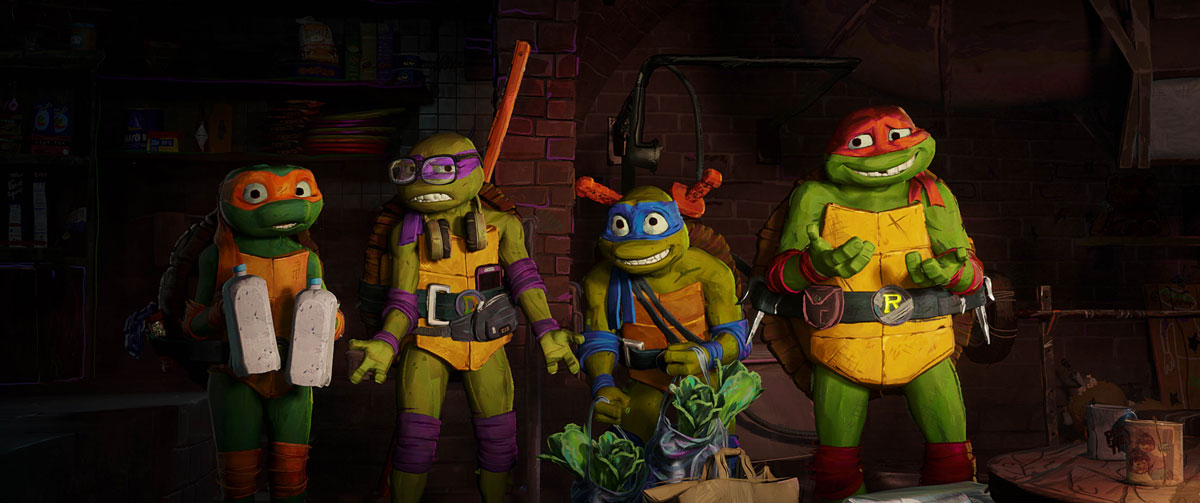
Teenage Mutant Ninja Turtles: Mutant MayhemMikey, Donnie, Leo, and Raph in “Teenage Mutant Ninja Turtles: Mutant Mayhem” (Paramount Pictures )

When I first heard that there was going to be a new Ninja Turtles movie, the first thing that came to mind was the potential for a new series of action figures based on characters now voiced by a new generation of young actors as the turtles, along with Ayo Edebiri as April O’Neil, Hannibal Buress as Genghis Frog, Rose Byrne as Leatherhead and Rogen himself as the voice of Bebop, a mutant warthog — whose original action figure was one of my favorites as a child. 

Appearing on shelves in mid-June, the new Ninja Turtles action figures have the signature Playmates Toys seal and are in keeping with the original character’s color-schemes and trademark weapons, with noticeable modernizations. Donatello comes with removable thick-framed black glasses and headphones. Michelangelo is ganglier in his teen articulation, with an ear-to-ear grin painted on his face. And the character’s eyes seem further apart. All details that wouldn’t stand out so noticeably had you not spent a good portion of your formative years playing with much (MUCH) older versions.  

“Cowabunga” is a frame of mind.

A week or so ago, while grocery shopping at a big box store, I took a detour past the food aisles and headed to the toy section in hopes of getting a look. Parking my cart at the end and elbowing my way past a group of young boys to see these new Turtles, I spotted the familiar packaging right away. 

“They’re here!” I said out loud, surprising the youths around me, now that weirdo at the store that I delighted in making fun of at their age. 

As my eyes went from box to box and character to character, I made the decision to not grab a few off the shelves, because I was overtaken with that “They’re not the same” feeling. This gut reaction will, most certainly, not stop me from going back at my earliest convenience to stock up, provided there are any left. 

Things can’t stay the same. That’s kind of the point. And while I miss the feel of those original turtles, and regret that they, at some point or another, found their way to some Goodwill or another, as most childhood toys do, those kids standing by me in the aisle that day may be forming their relationships with the figures as they look and feel today, for the very first time. And they’re in for a treat, with nothing better or different to compare them to — unless they can convince their parents to cough up big bucks online for the originals, which I’m also seriously considering doing. “Cowabunga” is a frame of mind, is a thing I’ll tell myself when clearing space in the area of my office where I keep all my little collections. Nostalgia is just a sweaty-palmed debit card swipe away.

Mike Pence has “gone to the dark side,” according to Trump

As more and more Republicans are backing away from Trump, he’s lashing out against them via his platform of choice, Truth Social. In response to recent comments made by the former vice president, and his release of merchandise featuring the phrase, “Too honest” — all relating to Trump’s 2020 election indictment and his Jan 6. involvement — Trump made several comments on Saturday accusing Pence of going over to “the dark side.”

“WOW, it’s finally happened! Liddle’ Mike Pence, a man who was about to be ousted as Governor Indiana until I came along and made him V.P., has gone to the Dark Side,” he wrote this weekend. “I never told a newly emboldened (not based on his 2% poll numbers!) Pence to put me above the Constitution, or that Mike was ‘too honest.’ He’s delusional, and now he wants to show he’s a tough guy. I once read a major magazine article on Mike. It said he was not a very good person. I was surprised, but the article was right. Sad!”

Per Politico, Pence’s new “Too honest,” merch is a reference to prosecutors stating that Trump accused him of being as such, after his refusal to reject electoral votes during the 2020 election certification process, which Trump denies. 


In a first, FDA approves fast-acting postpartum depression pill

One in eight women will experience postpartum depression (PPD), in which new mothers experience feelings of hopelessness or withdrawal after delivery, sometimes not feeling affection for a new child. In the U.S., suicide is the leading cause of maternal mortality in the first postpartum year.

Despite how common PPD is and the risks it presents, there is only one drug approved to treat it, which must be administered through an IV drip over the course of 60 hours. Known as brexanolone, it was approved by the U.S. Food and Drug Administration (FDA) in 2019, but the risk of excessive drowsiness or sudden loss of consciousness has made administering it a challenge.

That is set to change following the FDA’s Friday approval of the first-ever pill for PPD a drug called zuranolone.

“Postpartum depression is a serious and potentially life-threatening condition in which women experience sadness, guilt, worthlessness — even, in severe cases, thoughts of harming themselves or their child,” said Dr. Tiffany R. Farchione, the director of the Division of Psychiatry in the FDA’s Center for Drug Evaluation and Research in a press release. “Having access to an oral medication will be a beneficial option for many of these women coping with extreme, and sometimes life-threatening, feelings.”

Zuranolone, made by Sage Therapeutics and Biogen and sold under the brand name Zurzuvae, is to be taken with food for 14 days, according to the FDA press release. The regimen for taking zuranolone has been likened to an antibiotic, with a relatively short and fast-acting course. 

“Research indicates only about 10% of women with PPD receive clinically adequate treatment.”

In clinical studies submitted to the FDA, people who took zuranalone had significantly improved symptoms of depression and anxiety after just three days, with the effects sustained one and a half months out. The idea is that one course of zuranalone can be administered to those with PPD, who then can decide with their doctor if another dose of medication or complementary treatments like talk therapy are necessary, said lead study author Dr. Kristina Deligiannidis, a professor at the Institute of Behavioral Science at the Feinstein Institutes for Medical Research in Manhasset, New York.

“Research indicates only about 10% of women with PPD receive clinically adequate treatment, so that’s an adequate dose and duration of either talk therapies and/or a standard of care antidepressant,” Deligiannidis told Salon in a phone interview. “The majority of women aren’t even accessing our standard of care.”

“It is encouraging that postpartum individuals may now have more options to manage a debilitating condition that affects them and their families.”

Mild cases of PPD have historically been treated with talk therapy, while moderate to severe cases are typically treated with additional antidepressants, especially of the SSRI (selective serotonin reuptake inhibitor) class like Zoloft, Prozac, or Lexipro). But these drugs can take up to 12 weeks to start working, Deligiannidis said. 

Many folks also don’t see it as practical to spend two or three days in the hospital receiving intravenous broxanalone when they have a new infant at home, she added. Others can’t afford the treatment, as the drug costs about $38,000 per patient. Sage has not yet reported what the price of the new zuranolone pills will be.

Zuranolone is in the same drug family as broxanalone, also known by the brand name Zulresso. Both are similar to allopregnanolone, a naturally occurring neuroactive steroid that binds to GABA receptors within the brain. It is thought to work by stabilizing allopregnanolone levels that change during and after pregnancy.

Some of the major side effects in studies testing zuranalone in women with PPD were drowsiness, dizziness, and fatigue, along with diarrhea, the common cold and urinary tract infections. Patients are advised not to drive up to 12 hours after taking zuranalone due to these side effects.


Want more health and science stories in your inbox? Subscribe to Salon’s weekly newsletter The Vulgar Scientist.


The FDA also warned that zuranalone “may cause fetal harm,” as there isn’t much information on how the drug is passed between mother and infant while breastfeeding: In the two main studies submitted for approval, women were advised to stop breastfeeding during the treatment period, although another study showed very little of the drug appeared in breastmilk after five days of treatment.

Sage and Biogen also applied to get zuranolone approved for the treatment of major depressive disorder (MDD), which affects a much broader portion of people, but the FDA said the applications of the drug companies “did not provide substantial evidence of effectiveness to support the approval of zuranolone for the treatment of MDD,” and asked for more data, according to a press release.

We need your help to stay independent

Although the American College of Obstetricians and Gynecologists (ACOG) does not yet have guidance on zuranolone, “addressing mental health issues are of paramount importance to ACOG,” said Dr. Christopher Zahn, ACOG’s interim CEO and chief of Clinical Practice and Health Equity and Quality.

“It is encouraging that postpartum individuals may now have more options to manage a debilitating condition that affects them and their families,” Zahn added in an email statement to Salon.

“Larger than life, but still true”: Where Pee-wee Herman fits in the history of American clowns

At the beginning of the 1988 film “Big Top Pee-wee,” the circus blows into town — literally, thanks to a wind-whipping storm — and lands on none other than Pee-wee Herman’s farm. Pee-wee (Paul Reubens), who works the farm in the same slim gray glen plaid suit and red bow tie that became his uniform in the Playhouse, is, of course, delighted. He greets the performers with his patented brand of childlike whimsy and perpetual optimism, punctuated by a few hand flutters thrown in for good measure. 

It’s no surprise that Pee-wee quickly decides that he wants to join the circus because to anyone who’s watching, it’s clear that’s where he belongs. Ringleader Mace Montana (Kris Kristofferson) sees it, too, telling him that he has “sawdust in his veins.” The crotchety townspeople who are distrustful of colorful outsiders? Eh, not so much. 

After being told to pack up their tents and go, Mace confides in Pee-wee. “I don’t know what to make of it, kid,” he says as he slowly leads the caravan away from town. “When people don’t want a circus, the world just doesn’t make sense.” 

“What do you mean, Mace?” Pee-wee asks. 

Mace simply, and almost sadly, answers: “I’m a guy who has spent most of his life taking the world’s frown and trying to turn it into a smile.” 

And while Mace is the one doing the talking in this scene, it was Reubens (along with fellow Groundlings alum George McGrath) who wrote it, and following the news of his death at the age of 70 this week, those simple lines take on new resonance because they feel autobiographical. 

When assessing the legacy of Paul Reubens, it’s worth remembering that he wasn’t just Pee-wee Herman. He was one of the world’s greatest contemporary clowns. 

We need your help to stay independent

Before you completely recoil from the page, I get it. Clowns don’t have the best reputation in American pop culture. If they’re not portrayed as an alcoholic kid’s party performer — think Bobcat Goldthwait’s Shakes the Clown” — there’s always the killer clown trope, popularized by DC comics and Pennywise and then, unfortunately, made all too real by people like John Wayne Gacy and Wrinkles the Clown, a “performance artist” whom Florida parents would call to scare their kids straight for “a few hundred dollars.” 

But the definition of clowning is both broader and more historic than that. As Linda Rodriguez McRobbie wrote for Smithsonian Magazine in 2013:  

Clowns, as pranksters, jesters, jokers, harlequins, and mythologized tricksters have been around for ages. They appear in most cultures — Pygmy clowns made Egyptian pharaohs laugh in 2500 BCE; in ancient imperial China, a court clown called YuSze was, according to the lore, the only guy who could poke holes in Emperor Qin Shih Huang’s plan to paint the Great Wall of China; Hopi Native Americans had a tradition of clown-like characters who interrupted serious dance rituals with ludicrous antics. Ancient Rome’s clown was a stock fool called the ‘stupidus’; the court jesters of medieval Europe were a sanctioned way for people under the feudal thumb to laugh at the guys in charge; and well into the 18th and 19th century, the prevailing clown figure of Western Europe and Britain was the pantomime clown, who was a sort of bumbling buffoon.

In terms of later circus clowns, there are a few main types. There’s the whiteface clown, with traditional ruffled collars and pointed hats; the auguste, or red clown, is the one who, according to Clownopedia, “normally takes the pie in the face or the bucket of water from the whiteface.” 

And then, there are the character clowns, which is where Reuebens fits in with a long line of comedic performers. 

One of the most recognizable character clowns of the American circus was a “hobo” or “tramp clown,” like Red Skelton’s Hobo Freddie the Freeloader, complete with a painted-on 5 o’clock shadow that could be seen from the cheap seats. However, character clowns could be exaggerated versions of anyone: grandmothers (like Big Apple Circus’ now-disgraced Barry Lubin), butchers, bakers, police officers or, in the case of Reubens’ Pee-wee, a boy who never really grew up. 

It’s worth noting, as well, that the creation of Pee-wee as a character is rooted in circus history. In a 2004 conversation with “Fresh Air” host Terry Gross, Reubens discussed the development of Pee-wee’s iconic voice.

“I worked at a theater that was the state theater of Florida called the Oslo Theater, which is still in existence, still a fantastic place, which was in my hometown, Sarasota, Florida, and was based at the John and Mable Ringling Museum of Art, which Sarasota, as you may or may not know, was the former [winter] headquarters of the Ringling Brothers Circus, so there’s a lot of Ringling influence there,” Reubens said. 

He explained that while spending a few months playing the second oldest son (“not the star son, the second-banana son”) in “Life with Father” his character gradually developed into something of a cartoon. 

“There’s a lot of Ringling influence there.”

“So the voice came from that. That is Pee-Wee’s voice. It was from, you know, ‘Good morning, mother,’ you know, blah, blah, blah,” he said. “And that became Pee-Wee’s voice. I love that story.” 

Gregory Maupin is a Louisville-based actor who is a graduate of  Dell’Arte International School of Physical Theatre and works, as he describes, “mainly in the worlds of physical comedy, clown and Shakespeare.” He said that while there are wildly different definitions of performance style when it comes to clowns, most include some version of a “character that’s far larger than life, but true.” 

“There are all kinds of trappings that go with that — physical gestures and responses and silhouettes that are cartoonishly exaggerated yet, again, true,” Maupin said, before suggesting that examples may be better. He pointed to a lot of Gilda Radner’s characters; the silent films of Keaton, Chaplin, Lloyd; the stage work of Bill Irwin, Avner Eisenberg, Jeff Raz and the late Joan Mankin.

According to Maupin, there is something Wile E. Coyote-esque about these characters. They often fail over and over again in similar ways. A sample gag could include someone tripping over a rock and angrily kicking it down the road, only to trip over it again. When they finally succeed, it’s despite, not because of, their efforts. 

“In the best cases they remind us of our own constant failure, but also that everyone else is constantly failing, too,” Maupin said. “That’s the most concise way I can think to put it. To put Reubens’s Pee-wee in there, he was just so constantly present and capricious and avoided the ‘Little Single Tear’ even when he danced up close to it.”

“Pee-wee was so much more real. So consistent but still unpredictable. The best clowns have emotions like a kitten has intestines — it all goes straight through them”

Maupin acknowledges that childlike characters are difficult to pull off because they can come across as exhaustingly chaotic or cloyingly sentimental — a common criticism of the Pee-wee Herman character from those who weren’t fans. 

“But Pee-wee was so much more real. So consistent but still unpredictable,” Maupin said. “The best clowns have emotions like a kitten has intestines — it all goes straight through them — and he had that Puckish thing that’s hard to make people stick around for sometimes if it’s, again, done in a way that’s tiring instead of energizing.”

Maupin continued: “But people who are good at it make it transcend standard human behavior.” 

That’s certainly how it feels rewatching Reubens in his 1981 stage special “The Pee-wee Herman Show,” which was recorded by HBO after it played for five sellout months at The Roxy Theatre in Los Angeles. It was filmed five years before “Pee-Wee’s Playhouse” would eventually air on CBS, stripped of some of the sexual innuendo that made the original stage show a midnight classic among slightly rowdy adults.

With his props — a wind-up spider, a “naked Gumby,” a gigantic pair of underwear — and fellow performers, from the beautiful Miss Yvonne (Lynne Marie Stewart) to Captain Carl (SNL alum Phil Hartman), Reubens is electric. 

To borrow Maupin’s line about the art of being a clown, everything about the Playhouse, with its gigantic talking clock and genie in a box, is larger than life. But somehow, against all odds, Reubens manages to make it all feel true. So, at the end of the night, when he finally gets his chance to fulfill his lifelong wish of flying, there’s no reason to believe that he can’t.


Were the Hiroshima and Nagasaki bombings “nuclear tests”? The U.S. government said so

In 1980, when I asked the press office at the U.S. Department of Energy to send me a listing of nuclear bomb test explosions, the agency mailed me an official booklet with the title “Announced United States Nuclear Tests, July 1945 Through December 1979.” As you’d expect, the Trinity test in New Mexico was at the top of the list. Second on the list was the Hiroshima bombing, on Aug. 6, 1945. Third was the Nagasaki bombing three days later.

So, 35 years after the bombings of those Japanese cities, the Energy Department — the agency in charge of nuclear weaponry — was categorizing them as “tests.”

Later on, the classification changed, apparently in an effort to avert a potential P.R. problem. By 1994, a new edition of the same document explained that the bombings of Hiroshima and Nagasaki “were not ‘tests’ in the sense that they were conducted to prove that the weapon would work as designed … or to advance weapon design, to determine weapons effects, or to verify weapon safety.”

But the atomic bombings of Hiroshima and Nagasaki actually were tests, in more ways than one.

Take it from the Manhattan Project’s director, Gen. Leslie Groves, who recalled: “To enable us to assess accurately the effects of the bomb, the targets should not have been previously damaged by air raids. It was also desirable that the first target be of such size that the damage would be confined within it, so that we could more definitely determine the power of the bomb.”

A physicist with the Manhattan Project, David H. Frisch, remembered that U.S. military strategists were eager “to use the bomb first where its effects would not only be politically effective but also technically measurable.”

For good measure, after the Trinity bomb test in the New Mexico desert used plutonium as its fission source on July 16, 1945, in early August the military was able to test both a uranium-fueled bomb on Hiroshima and a second plutonium bomb on Nagasaki to gauge their effects on big cities.

Public discussion of the nuclear era began when President Harry Truman issued a statement that announced the atomic bombing of Hiroshima — which he described only as “an important Japanese Army base.” That was a flagrant lie. A leading researcher of the atomic bombings of Japan, journalist Greg Mitchell, has pointed out: “Hiroshima was not an ‘army base’ but a city of 350,000. It did contain one important military headquarters, but the bomb had been aimed at the very center of a city — and far from its industrial area.”

Mitchell added: “Perhaps 10,000 military personnel lost their lives in the bomb but the vast majority of the 125,000 dead in Hiroshima would be women and children.” Three days later, when an atomic bomb fell on Nagasaki, “it was officially described as a ‘naval base’ yet less than 200 of the 90,000 dead were military personnel.”

Since then, presidents have routinely offered rhetorical camouflage for reckless nuclear policies, rolling the dice for global catastrophe. In recent years, the most insidious lies from leaders in Washington have come with silence — refusing to acknowledge, let alone address with genuine diplomacy, the worsening dangers of nuclear war. Those dangers have pushed the hands of the Doomsday Clock from the Bulletin of the Atomic Scientists to an unprecedented mere 90 seconds to cataclysmic midnight.


Want a daily wrap-up of all the news and commentary Salon has to offer? Subscribe to our morning newsletter, Crash Course.


The ruthless Russian invasion of Ukraine in February 2022 quickly escalated the chances of nuclear war. President Biden’s response was to pretend otherwise, beginning with his State of the Union address that came just days after the invasion; that lengthy speech did not include a single word about nuclear weapons, the risks of nuclear war or any other such concern.

Top Russian officials have made wildly irresponsible comments about using nuclear weaponry in the Ukraine war. We might forget that Russia’s strategic doctrine is basically the same as America’s: retaining the option of first use.

Today, in some elite circles of both Russia and the U.S., normalized talk of using “tactical” nuclear weapons has upped the madness ante. It can be shocking to read wildly irresponsible comments coming from top Russian officials about perhaps using nuclear weaponry in the Ukraine war. We might forget that they are giving voice to Russia’s strategic doctrine that is basically the same as ongoing U.S. strategic doctrine — avowedly retaining the option of first use of nuclear weapons if leaders conclude they are losing too much ground in a military conflict.

Daniel Ellsberg wrote, near the close of his 2017 book “The Doomsday Machine“:

What is missing — what is foregone — in the typical discussion and analysis of historical or current nuclear policies is the recognition that what is being discussed is dizzyingly insane and immoral: in its almost-incalculable and inconceivable destructiveness and deliberate murderousness, its disproportionality of risked and planned destructiveness to either declared or unacknowledged objectives, the infeasibility of its secretly pursued aims (damage limitation to the United States and allies, “victory” in two-sided nuclear war), its criminality (to a degree that explodes ordinary visions of law, justice, crime), its lack of wisdom or compassion, its sinfulness and evil.

Dan dedicated the book “to those who struggle for a human future.”

A similar message came from Albert Einstein in 1947 when he wrote about “the release of atomic energy,” warning against “the outmoded concept of narrow nationalisms” and declaring: “For there is no secret and there is no defense; there is no possibility of control except through the aroused understanding and insistence of the peoples of the world.”

“Barbenheimer” was America’s big return to the movies. Will themed concessions keep them there?

By now, you’re probably familiar with “Barbenheimer,” the internet phenomenon that began circulating online in anticipation of the double release of two Blockbuster films, Greta Gerwig’s “Barbie” and Cristopher Nolan’s “Oppenheimer.” Critics and fans lauded the unlikely double-feature as America’s great return to the movies following a pandemic that financially hobbled theaters across the country. 

Now, to make the most of it (and to keep visitors coming back), many theaters — from major chains to indie establishments — are enticing cinephiles with themed food and craft concessions . Right now, includes “Barbie”-themed concessions, be it popcorn or candy or small bites, and, of course, cocktails. There’s even Barbie and Mattel-themed merchandise, ranging from simple trinkets to clothing and accessories.

Take for example Alamo Drafthouse Cinema, which offered a Barbie Brunch as part of their special menu. Offerings include a breakfast club sandwich, a blueberry donut french toast bake or breakfast tacos alongside themed cocktail classics, like Desert Spring Water and the Coming Up Rosé Fizz. Each dish is available to order with the chain’s full menu during Alamo Drafthouse’s special brunch screening of the film, which is sold out in most of the theater’s 39 locations.

The theater also launched its own BARBIE X Alamo Drafthouse Collection, which includes a ton of Barbie paraphernalia for moviegoers and die-hard fans to snag. There’s Barbie T-shirts, stationary sets, enamel pin sets, sunglasses and even a limited edition Barbie lunchbox and thermos set.

“You’ll find the BARBIE X Alamo Drafthouse Collection available for purchase at select theaters on our fabulous dream house display — complete with custom BARBIE photo op,” Alamo Drafthouse announced on its website. “Everything is only available while supplies last, so hop in your Barbie-mobile to one of the theaters listed below to pick some up for yourself.” 

In the same vein, Regal Cinemas, in partnership with Pops Corn, offered fans gourmet caramel popcorn in Barbie’s signature color. The pink popcorn was first available at the theater’s Barbie Blowout Early Access Screenings on July 19 before it was sold at all participating Regal locations on July 20. Cinemark Theatres also launched its own line of “Barbie” merchandise, including a Barbie-themed popcorn tin, a Barbie “B” 22-ounce cup, a Barbie Diamond Double Wall cup and a Barbie-themed Blanket in a Bag. Landmark Theatres sold several Barbie dolls from the film and AMC Theatres sold their own “Barbie” merchandise alongside their Barbie Popcorn Corvette — popcorn served in a container that looks like Barbie’s signature pink Corvette.

Though some have lamented about the price of these concessions (namely the Barbie Popcorn Corvette, which is a whopping $65…), many fans reveled in the new offerings in anticipation of going out to the movies. “[M]y barbie car popcorn bucket and i are here ! lets gooooooo,” tweeted one enthusiastic moviegoer. Similarly, another user shared that they received locket keychains with their Barbie popcorn menu and of course, they needed “to put a picture of my fav. Barbie in it.”

We need your help to stay independent

Themed concessions are part of a recent, widespread influx in “Barbie”-themed merchandise released by several brands and major corporations. These offerings spark nostalgia. They spark joy. And overall, they’re just good old-fashioned fun. Moviegoers are undoubtedly enthralled by “Barbenheimer,” even if it means spending close to five hours at their theaters. But themed concessions are the cherry — or cherries — on top of the whole experience, and according to marketing experts, those themed snacks also serve a distinct purpose. 

“Collaborations offer more options to make an emotional connection to the Barbie brand,” explained Ayalla Ruvio, an associate professor of marketing in Michigan State University’s (MSU) Broad College of Business. “An adult likely won’t play with the dolls, but might wear a shirt with the Barbie logo, a Barbie makeup collection or a hot pink bag: something that gives more opportunity to interact with the brand.”


Want more great food writing and recipes? Subscribe to Salon Food’s newsletter, The Bite.


That also includes eating Barbie-themed popcorn and taking home a container that resembles Barbie’s signature pink Corvette. Patricia Huddleston, professor of retailing in MSU’s Department of Advertising and Public Relations, added that such collaborations and offerings are also “grabbing our attention.” It’s why “Barbenheimer” ticket sales continue to rise well after its opening week. And it’s why countless moviegoers are sharing viral TikToks and posts of their many movie theater goodies.

Numerous theaters nationwide were hit hard amid a ruthless pandemic that forced them to completely shut their doors to the public. In the aftermath, some theaters were lucky enough to reopen. Others, not so much. It was uncertain whether theaters would be able to survive such a major impact — both financially and socially. But the “Barbenheimer” craze has proved otherwise, considering that AMC sold more than 20,000 double-feature tickets to its AMC Stubs members back in early July.  

This year has already proved to be a big one for both movies and theaters. Yes, people are returning to the theaters to laugh, to cry, to care, because all of us need that. But they’re also coming back — and staying — for the snacks and drinks.

“Am I gay?” I’m a middle-aged woman reinventing her life after marriage and kids — and I’m not alone

It was in the locker room of the gym when I saw the woman, standing with her back to me applying lotion to her legs. She was naked. I was mesmerized. With the quickness of a snap, the hold on me released and the question emerged from the fog, “Am I gay?”

I was 44 and the proverbial chalkboard of my life boasted many checkmarks: college—check; marry a nice man—check; house in the suburbs—check; career—check; kids—check and check. Throw in a couple of cats and a yearly beach vacation and my blackboard was worthy of the A-plusses Ralphie imagined on his Christmas theme paper in the 1983 movie “A Christmas Story.” Just as his fantasy disintegrated by seeing the big red C along with the comment, “You’ll shoot your eye out,” so was my blackboard erased as I entered liminality when I leaped into the unknowing in search of an answer to the question.

Having realized the life I wanted—husband, kids, career—I couldn’t imagine another one. Yet the nagging sensation that something was missing lingered. Steeped in the life that growing up in the 1970s and ’80s prepared me for, any unrest I felt throughout my 19-year marriage led to searching outside of myself—returning to school, immersing myself in motherhood, boosting my career, and diving into my inherited faith. Each new program enrollment and Gymboree class held a promise to ease my restlessness.

For those of us bred from traditional gender roles, a late-in-life reimagining of self can be confusing, but is not uncommon.

The message from my childhood of a path anchored in heterosexism — modeled by my neighborhood, extended family and the media — provided no language, no representation of a different option. I was so tethered to the only life I thought I could have that even after having my first same-sex attraction at 44, which led to a four-month affair, I still never questioned my sexuality. Revelatory feelings were waking up inside of me, but my mind never went there. I immersed myself in this other-worldly experience while going about my otherwise typically heteronormative existence. Until that day in the gym.

What followed that question I asked myself in the locker room was a journey inward. And while the catalyst for my self-refection was a woman, turning in is common in midlife, a time during which women desire to reinvent themselves.

A later-in-life sexual awakening is likened to a second adolescence. Indeed, crossing the threshold to a new orientation awakened feelings from my deepest recesses. Once I tasted that exhilaration, all I wanted is the freedom for more.

The countless women I met along my journey as a late bloomer offered unique stories of the circuitous path they traveled before arriving at their redefined sexual orientation, along with a redrawn roadmap for their life’s second half. Some women knew they had same-sex attractions but suppressed them for fear of the messages they had heard, like, “You’ll burn in hell.” Some were subjected to exorcisms. They rightfully feared being disowned by their families and shunned by their communities and bristled with the homophobia that was deposited within them from an early age. Some remained solidly single while others did what was expected of them—married a man and had kids.

We value the personal and the political

By the time these women reached their late 30s, 40s or 50s, something or someone woke those dormant feelings. Others, like me, never had a previous same-sex attraction awareness, and those first times knocked our worlds off their axes.

For those of us bred from traditional gender roles, a late-in-life reimagining of self can be confusing, but is not uncommon. Women are granted unspoken permission to be more affectionate and develop emotional bonds with other women without societal or self-imposed stigma. The first time my attraction to a woman was more than just emotional, I still didn’t consider the possibility that I was gay. While unpacking it, I hypothesized that she was the exception to my otherwise heteronormative existence. After all, I was married to a man, so I couldn’t possibly be gay.

I belong to the latchkey generation—one in which its members have the distinction of being the first generation to experience their formative years with less nurturing and hands-on parenting. Some of us who tended to our own needs at young ages tried to compensate with our own children. The lack of supervision I received as a teenager, along with the fallout from my parents’ contentious divorce, left me hypervigilant to ensure my children had a different experience. I wasn’t going to readily embrace any notion that would jeopardize the life I had created for my children — the one I didn’t have as a child.

While insisting I couldn’t be gay because of my marital status, what I didn’t know was how complicated sexuality could be, that the categories were variable. I was unaware of the concept of fluidity — that research scientist Alfred Kinsey, as early as 1948, had found that sexuality wasn’t fixed but ran on a continuum and was subject to change. As the dialogue around sexuality continues to evolve, the rigidity around identities is loosening, as evidenced in younger generations, many of whom express a distaste for labels and exercise more freedom in selecting their partners.

The inherent ageism entwined with sexuality presents another barrier. Many of us grew up with images of recycled youth rather than maturation. When the most famous representative for Lancôme cosmetics, Isabella Rossellini, was fired at 43 for being “too old,” she was told, “Women dream to be young and so the advertisement is about the dream, not the reality.” Ms. Rossellini disagreed, “Women don’t want to be younger; we want to be sophisticated. We want to be who we are.”

Midlife doesn’t have to be a crisis

Two decades later, the company recanted and hired Ms. Rossellini back, stating, “We were wrong, and we want to publicly make it right.” Now a spokesperson for aging, she speaks of a stronger core and an inner peace that emerges with age and a shift from focusing on the outside to freedom to do what you want to do, to do the dreams you haven’t realized, adding, “It’s quite exciting to be old.”

Midlife doesn’t have to be a crisis. By letting go of manmade constructs and allowing our lives to unfold naturally, can we accept that life is dynamic and be gentler with ourselves, while appreciating our human diversity? Can we embrace aging and change?

Carl Jung wrote, “The afternoon of life is just as full of meaning as the morning; only, its meaning and purpose are different.”

By the time women reach midlife, some of us have satisfied our early goals, like education, career, relationship and family. Others see their chances for those dreams or others finally within reach. Many of us have experienced significant loss, health scares, and ambiguous grief over life transitions (divorce, geography, profession), along with empty nests or being childless by circumstance, financial concerns, and the pressures of the sandwich generation. It is a time when many women find themselves examining whether their values reflect who they really are rather than carrying forth the preordained values of family or culture, leading them to want to hit the refresh button.

When I found the agency to explore my longing after that inaugural same-sex attraction ushered me into uncharted territory, I pondered what I wanted my future to look like and desired to evolve with the life experience I’d acquired. The question that pushed me over the precipice of uncertainty was, “If you do nothing, will you regret it in 25 years?” Immediately I knew the answer. I gave myself permission to make changes that would align myself with authenticity. I battled fear and guilt and wrestled with grief and loss, but it was worth being able to create a reality better suited for me.

By giving myself permission to be in the role of self, first and foremost, I’m modeling for my kids not to settle for anything less than being their true selves, too. Staying stuck in a life that isn’t wholly fulfilling is hard. Making a drastic change in your life is hard, too. But we get to choose our hard.

Trump says that communists and Marxists led by Biden are violating his civil rights

During a rally in Montgomery, Alabama on Friday, Donald Trump griped to a crowd of supporters on issues plaguing his mind after his most recent arraignment, continuing to blame President Biden for everything that’s happening to him. 

On the topic of the perceived communists and Marxists led by Biden he believes are “coming after him,” the former president aired his grievances saying, “The only civil rights that have been violated in this matter are my civil rights and those of the countless people that Biden and the communists have been persecuting.”

“They are communists. They’re Marxists. And they’re people that don’t get it,” he furthered. “They don’t get it. You know, they’re vicious and they’re smart. But we’re smarter and we’re tougher than they are. And we’re going to take it back. And we have no choice because otherwise we’re not going to have a country left.” Per Mediaite, “Trump also attacked the party he’s running for the nomination with at his rally, saying they look ‘like a bunch of weak jerks’ for ‘allowing’ the prosecutions.”

Clarence Thomas bought a $267,000 RV using funds from a Democratic donor

A report from The New York Times details yet another luxury obtained by Supreme Court Justice Clarence Thomas using funds from a wealthy associate. In this instance, it’s been revealed that he purchased a Prevost Marathon RV in 1999, using $267,230 received from Anthony Welters, a former executive at UnitedHealthCare who worked alongside Thomas in the Reagan administration, per the outlet. In a statement on the matter, Welters said that the funds were considered a loan and that it has since been “satisfied,” avoiding the phrasing “paid off,” which means it could have been a gift that would have then needed to be disclosed. 

According to Insider, “Welters’ wife, Beatrice, served as an ambassador under Obama, to whom the couple donated between $200,000 and $500,000 during the 2008 presidential campaign and another $100,000 for his 2009 inauguration.”

Weighing in on the ethical issue of accepting such gifts (or “loans”), which have been popping up left and right in similar discoveries as this one in recent months, Sen. Dick Durbin, an Illinois Democrat who has sponsored new ethics legislation, commented last month that “The disclosures that have come out recently… really compel us to do something for the sake of the court.”


The allegations against Lizzo challenge the artist’s brand of positivity and fans’ investment in it

A week before the damning lawsuit filed by three of Lizzo‘s former dancers went public, a video capturing an audience interaction from her Sydney, Australia concert was posted to TikTok. It shows the “Good As Hell” singer as we know her, talking to a young fan identified as Munroe as she holds aloft a sign reading, “PLS HELP ME SHOW MY HATERS I’M 100% THAT B***H.”

When Lizzo asks how she can help, the girl answers, “I get bullied on social media, and they always tell me I’m not good enough because I like to dance and sing and I wanna be like you. I love you.”

Lizzo pulls the girl onstage and, putting her arm around Munroe, preaches to her congregation. “The words that we say have a long-lasting effect on people,” she says earnestly.

Words also have a way of coming back to haunt us, and once the damning complaints made by her former backup dancers Arianna Davis, Crystal Williams, and Noelle Rodriguez circulated throughout the media, this clip emerged from Down Under and flew around the planet.

The 37-page suit filed this week in the Los Angeles County Superior Court alleges that Lizzo, whose real name is Melissa Viviane Jefferson, along with Shirlene Quigley, the Big Grrls dance captain, and the performer’s production company, Big Grrrl Big Touring, Inc. (BGBT) fostered a toxic work environment.

It accuses various parties in the lawsuit of engaging in racial harassment, religious harassment, and disability discrimination. Not all the allegations name Lizzo, but some of the most disheartening, including a claim of fat-shaming, refer directly to her.

“I just adore Lizzo. She’s such a genuine person,” one TikTok user commented in response to Munroe’s concert video.

That was a week ago. How’s that fan feeling now?

The accusations are an extreme mismatch with the public image Lizzo uses to evangelize body positivity and inclusion, one she’s also monetized into, among other things, an Emmy-winning TV series, Prime Video’s “Watch Out for the Big Grrls”; an HBO documentary “Love, Lizzo,” which premiered over Thanksgiving weekend in 2022; a line of shapewear; and a Baby Yoda-cuddling cameo in the recent season of “The Mandalorian.”

The joy some people are taking in Lizzo’s troubles is a new version of the same taunts they’ve always used to hound her.

Above all, the details in the lawsuit also contradict the feelings Lizzo cultivates in her live performances, gatherings where anyone who feels like an outcast – Black folks, queer folks, fat folks, any person of color who feels othered, but also lots of white folks – is encouraged to celebrate their worth and affirm it in those around them.

This is not a defense of Lizzo or whatever behavior she may or may not have engaged in. The performer’s attorney and damage control specialist Marty Singer has a long history of building successful PR strongholds for his clients and is on the march as you read this.

Rather, this is meant to illustrate how effectively she transformed the public derision she’s experienced into marketable positivity. Lizzo’s version can be intoxicating, inspiring and transformational, which has always been why countless detractors, primarily fatphobic, misogynistic men, make gunning for her a hobby. She acknowledges this in her response to the lawsuit’s allegations.

“These last few days have been gut-wrenchingly difficult and overwhelmingly disappointing,” she stated in an Instagram post. “My work ethic, morals, and respectfulness have been questioned. My character has been criticized. Usually I choose not to respond to false allegations but these are as unbelievable as they sound and too outrageous to not be addressed.”

All of it stirs up a stew of complex emotions.

In her statement, Lizzo describes the plaintiffs as “former employees who have already publicly admitted they were told their behavior on tour was inappropriate and unprofessional.” 

Lizzo's Watch Out for the Big GrrrlsDancers Sydney Bell, Charity Holloway, Arianna Davis, Ashley Williams, Jayla Sullivan, Asia Banks and Kiara Mooring on “Lizzo’s Watch Out for the Big Grrrls” (Amazon Studios)“Watch Out for the Big Grrls” viewers may be familiar with another version of Davis and Williams since they competed in the series. Rodriguez first appears in the singer’s “Rumors” video, after which she was hired. As part of the reality competition’s friendlier format, contestants were only eliminated if they proved to be contentious or couldn’t meet concrete performance requirements, such as demonstrating the requisite stamina and the ability to quickly adapt to new choreography. People spent time empathizing with these women before they became plaintiffs bringing legal action against their former boss, something that doesn’t typically happen in celebrity lawsuits.

This also makes them attractive interview subjects on shows like “Good Morning America,” where they appeared on Friday. Before that Chris Cuomo spoke to them for the Aug. 2 episode of his NewsNation show.

https://www.instagram.com/p/CvdsCwGO1Z8/

However, this isn’t a typical high-profile civil suit. It’s one involving a star who built her career on getting fans emotionally invested in their self-worth by positioning herself a model to emulate. Musicians’ fandoms are notoriously devoted to their favorite singers regardless of whatever sins they may be publicly accused of, setting up Davis, Williams and Rodriguez for a hellish ride as this plays out.

On the other side, the singer’s detractors immediately began cackling “I told you so” through an array of memes and posts, although their delight has almost nothing to do with the implications that Lizzo’s brand may be built on a sham.

No, their joy in her troubles is a new version of the same taunts they’ve always used to hound her. The meanness outlined in the suit simply augments these trolls’ attacks, especially the claim that Lizzo called attention to Davis’ weight gain before publicly firing her.

In their view, Lizzo’s main crime was and is being a fat, dark-skinned Black woman who doesn’t fit their prescribed picture of health and attractiveness. Now they can also claim she’s a fraud.

Celebrities let their fans down all the time by letting their masks slip, sometimes revealing their personas to be entirely manufactured. But Lizzo so effectively welded her full self with our popular concept of self-love and mutual support as to become a kind of self-improvement avatar. This is only a mistake if the person doing it fails to live that mantra in every moment even while being an exacting performer.  

That sounds exhausting and impossible, and my saying this may come across as feeling sorry for Lizzo. Again, not so. It’s merely acknowledging that, if a jury were to find these allegations plausible, her contradictory backstage behavior reveals a lack of awareness that made such a stumble inevitable. 

And the plaintiffs’ attorney, Ron Zambrano knows this. “The stunning nature of how Lizzo and her management team treated their performers seems to go against everything Lizzo stands for publicly, while privately she weight-shames her dancers and demeans them in ways that are not only illegal but absolutely demoralizing,” he said in a press release.

We need your help to stay independent

While this controversy is in its early stages, the breathless coverage related to this complaint generates a similar malevolent energy to the version that met the downfalls of Ellen DeGeneres and Martha Stewart before her.

There are key distinctions between Lizzo’s legal woes and the firestorms surrounding DeGeneres and Stewart. For one thing, DeGeneres’s spitefulness had fueled rumors for years. Stewart never apologized for her hard-driving nature off-camera and, unlike DeGeneres, never claimed niceness as her brand, only skill and a passion for quality.

But both are highly visible successful women who in various ways became barometers for our culture’s unease with influential women, something they have in common with Lizzo – who, like DeGeneres, chose to also embody kindness.

They’re also white women. Lizzo is not.

People spent time empathizing with these plaintiffs, something that doesn’t typically happen in celebrity lawsuits.

Then there’s the Bananenbar of all, described in the part of the lawsuit in which Davis describes a supposedly non-mandatory afterparty in Amsterdam’s Red Light district. There the star is alleged to have invited cast members to take turns touching the nude performers, “[catch] dildos launched from the performers’ vaginas, and [eat] bananas protruding from the performers’ vaginas.” Davis said Lizzo goaded her into participating against her will along with other co-workers.

Lizzo's Watch Out for the Big GrrrlsDancer Shirlene Quigley and Lizzo on “Lizzo’s Watch Out for the Big Grrrls” (Amazon Studios)This is inappropriate behavior for an employer to engage in with her employees whether on or off the clock. The resurfacing of a 2019 radio interview with 3FM DJ Frank van der Lende where Lizzo talks about having visited sex shows in Amsterdam doesn’t contextualize her side of the story in a benign light, either.
It will be worth monitoring how far the commentariat takes this part of the story considering the decades upon decades of rock and hip-hop tour misbehavior that was equally as wrong, or criminally worse, and valorized because those doing the partying were and are men. Lizzo is not.

“I am very open with my sexuality and expressing myself,” Lizzo says in her statement, “but I can not accept or allow people to use that openness to make me out to be something I am not.”

Still, in the wake of all of this, the folks I feel for most acutely are those who invested in Lizzo’s message and will watch everyone involved — Lizzo, Davis, Williams and Rodriguez — be dragged by the same cretins who would behave hatefully toward them. A person doesn’t have to be harassed online to get a sense of how little value strangers place on your safety and well-being based on how they harangue people who look like you and speak out against mistreatment.


Want a daily wrap-up of all the news and commentary Salon has to offer? Subscribe to our morning newsletter, Crash Course.


We’ve long passed the “believe all women” era of #MeToo – Depp v. Heard definitively killed it  – but destroying Black women never goes out of style. With this case, we’re presented with a situation that promises collateral damage on top of whatever loss of monetary, social and professional capital Lizzo, Davis, Williams and Rodriguez may experience as a result.

In the direct wake of the lawsuit going public, for example, Beyoncé reportedly let Lizzo’s name drop out of her performance of the “Break My Soul” remix during her Tuesday performance in Boston. The pop luminary doesn’t tend to publicly comment on much, but if that was intentional, it amounts to a loud one.

Provided this civil suit is settled out of court, which is likely, how we feel about Lizzo is bound to shift regardless. Corroborating social media posts from other dancers and Sophia Nahli Allison, a filmmaker who briefly worked on “Love, Lizzo” and says she “witnessed how arrogant, self-centered and unkind she is,” take the shine off her positivity aura, aka the product, and the vibes fueling it. “Notice how the documentary ended up being directed by a cis white man,” Allison wrote, referring to director Doug Pray.

And yet the product’s success – that unspoken understanding that Lizzo creates temporary spaces where everyone is welcomed, appreciated and respected – is undeniable. The engine may be a fractured illusion, but the electricity it generates is palpable.

So the quandary this scandal poses isn’t merely a matter of separating the art from the artist. Music fans are experts at that. Instead, it may challenge us to integrate the truth of who the artist is when her fans aren’t watching into the character we love to see her play onstage for our benefit. 

Newly developed lung-like organoids could revolutionize how we treat respiratory infections

If you could wander inside your own lungs from a microscopic vantage point, it would seem like a horror-fantasy universe straight out of Guillermo del Toro or H. P. Lovecraft.

“There is a ‘lung microbiome’ which also depends on mucus alterations.”

As you wander through the tubes of your upper and lower respiratory tract, you’d be surrounded by mucus and hair-like structures known as cilia. These millions of cilia exist to filter out tiny harmful particles, making up “a complex branching network whose surface nears 100 meter squared,” as Alexandre Persat, a Swiss scientist at the Global Health Institute at École Polytechnique Fédérale de Lausanne (EPFL), puts it.

Yet the wondrous complexity of the human airway also makes these organs frustratingly enigmatic. Among other challenges, it is difficult to realistically recreate their conditions in experiments.

That is, until now. In a recent study published in the journal PLOS Biology, a team led by Persat,developed special organoids, which are miniature tissues grown from stem cells that resemble actual human organs and tissues. Known as AirGels, they can help researchers fight biofilms, or colonies of bacteria that are highly resistant to medications and the immune system.

These aren’t the first organoids — indeed, years ago scientists developed some to resemble other organs, like the brain — but these are the first organoids that work like the human respiratory system. For this design, they targeted Pseudomonas aeruginosa, a nasty bacterium associated with deadly diseases like hard to treat forms of pneumonia and sepsis syndromes.

“Despite extensive in vitro experimentation, how P. aeruginosa forms biofilms at the airway mucosa is unresolved,” the authors of the paper explained. Using their AirGels, however, the scientists investigated the role mucus plays in P. aeruginosa biofilm creation under conditions similar to those in living human lung tissue. In fact, it was revealed that the bacterium exploits the body’s own mucus production, giving it the advantage it needs to colonize the human airway. The authors concluded the same mucus which captures pathogens, or dangerous disease-causing substances in our bodies, has a downside.

“Our results therefore suggest that, while protecting epithelia, mucus constitutes a breeding ground for biofilms,” they explain.


Want more health and science stories in your inbox? Subscribe to Salon’s weekly newsletter The Vulgar Scientist.


“Our results therefore suggest that, while protecting epithelia, mucus constitutes a breeding ground for biofilms.”

These discoveries could save millions of lives, as the pathogen that the scientists targeted is devastatingly common.

Pseudomonas aeruginosa lives predominantly in soil where it competes with many other microbes and predators,” Persat told Salon by email. “They can infect any organism and commonly contaminate hospital environments. As a result they are a leading cause of nosocomial infections, in particular at the ICU.”

In addition to colonizing the lungs of patients using ventilators, the bacterium is especially dangerous for cystic fibrosis patients.

“We found that the mucus is the major substrate for these biofilm,” Persat explained. “There is a ‘lung microbiome’ which also depends on mucus alterations. In the context of infection, there are multiple pathogens involved, which can also include viruses. That’s quite common in cystic fibrosis, but it also happens to us with a virus infecting us while we are taking antibiotics.”

Even with this latest study, scientists still have a lot to learn about the role of the lung microbiota in infections.

“The number of commensal bacteria in very low compared to the gut so it is possible that they don’t do much,” Persat said. “Conversely, it is possible that pathogens also compress intestinal mucus in the gut to promote infection.”

Either way, Persat hopes that scientists can use AirGels going forward to research all kinds of respiratory diseases, as well as crack the mysteries of how the little universes inside our airways both help and harm our health.

We need your help to stay independent

“Organoids have a very strong potential in fundamental research to understand infections, because they allow us to replicate critical parameters of specific tissues like gut and lung,” Persat told Salon. “They also allow us to perform high resolution measurements such as microscopic imaging and gene expression. At the same time, organoids change our perspective on animal experimentation, because they replicate aspects of human physiology much better than a mouse or a rat.”

He concluded, “I think they will revolutionize the way we study infections and microbiota. Our lab is pushing to democratize their use to enable the discovery of new drugs against antibiotic resistant pathogens.”

The 5 essential knives for any cooking beginners

It is genuinely impossible to become a “good cook” without some legitimately top-tier knives. You could have the most inordinately expensive, high quality ingredients, products and cookware — but if your knives aren’t stellar, you will be undoubtedly disappointed.

In addition, the old adage is so incredible true: A dull knife is much, much, much more dangerous than a sharp one.

Actually, I’d say that this is the one area in which you really must spend some dough: A good knife might cost you, but it’s immensely worth it, trust me.

My favorite tests for sharpening knives is the paper trick: Simply sliding a knife through a singular pice of printer paper and seeing if it slices cleanly — or merely cutting into a tomato. Many knives will do nothing but smoosh the tomato, while a properly sharp knife will slice through it with ease. Also, please take care of them! Keep them sharp! I often leave my best or favorite knives out and don’t put them in blocks or drawers or elsewhere — you don’t want the blades getting dulled or nicked by haphazardly sloshing around in the drawer with random whisks, spoons and the like. 

As I mentioned in my primer on cutting onions and alliums, it’s imperative to carefully bend your fingers as you progressively cut through whatever it is you might be cutting: “Continue, firmly and decisively, holding the onion and curling or bending your fingers (the point of this is so that if you do happen to nick yourself, you’ll make a slight cut on your knuckle as opposed to lobbing off your nail or something equally heinous).”

While doing so, make sure to have a firm hold on your knife itself, guiding it through the foodstuff with confidence and with force, ideally taking on a bit of a gliding, meditative or patterned repetition as you continue your work.

I’ve said before: Food prep can be genuinely meditative. It’s one of the reasons I so love “mise en place.”

We need your help to stay independent

Also, please be careful! Watch some YouTube videos, sign up for a knife class, work on your knife cuts — it should go without saying, but you always want to your darnedest to remain as careful and vigilant as possible while prepping your food. No matter how stupendous your Bolognese or homemade Cobb salad is, it won’t taste that great if your finger is bleeding under the table, right? 

Furthermore, it’s also very important that you have a large, heavy cutting board — none of those flimsy plastic ones that slide all over the darn counter. I’m a huge proponent of a thick wooden cutting board with lots and lots of real estate so you can chop to your heart’s content and there’s enough room for everybody. 

Like with pots and pans, skip those knife “sets” or “kits” — they usually come with superfluous knives you definitely don’t need. I think you can aim for a good four or five knives and have the bulk of your everyday kitchen tasks covered, but I also listed a few other options that might be good to have on hand for special events, particular uses, holidays and celebrations, certain gatherings and the like. 

Other good options to possibly have on hand: carving knives (for those large roasts, Thanksgiving turkeys, hams and foods along those lines), a whetstone or sharpener for keeping your knives in proper shape and of course, some good butter and steak knives. 

Now, here are the five knives you need in your kitchen: 

01
Santoku knife
I mainly use a Santoku, but will also use my chef’s knife interchangeably. It’s my “everyday” go-to knife and has been so since culinary school. 
 
I prefer the slightly more compact Santoku and feel like I’m more dexterous and able to work with it seamlessly. I remember once hearing that a good knife should feel like an extension of your arm or hand and when I’m hurriedly slicing onions for French Onion Soup or feverishly mincing garlic, that’s precisely how I feel.
02
Chef’s knife
I love a chef’s knife and it’s one of my most used kitchen tools, but truthfully, I’d pick a Santoku over it anyday.
 
I find that a chef’s knife can sometimes get a bit unwieldy or cumbersome, while the Santoku feels more natural. Regardless, though, a chef’s knife is ideal for cutting produce, prepping lettuce for a salad, chopping fresh herbs (look for clean, simple cuts, not bruised, quasi-cut leaves!) and so much more.


Want more great food writing and recipes? Subscribe to Salon Food’s newsletter, The Bite.


03
Paring knife
For some reason, the automatic go-to in my head for a paring knife is cutting apples or supreming citrus, but they’re really wonderful, economic tools for . . . almost everything.
 
Paring knives are considerably smaller than Santoku or chef’s knives, which can help you get into little nooks and crannies, too. This can really come in clutch, much more often than you might think.
04
Serrated knife
The top two items for serrated knives are unquestionably tomatoes and breads, but you can use them for so much more than just that. Also, the way they do their intended job (of cutting tomatoes and bread) is so incredibly efficient that I’d recommend them for that reason alone. 
05
Flexible boning knife
This one isn’t totally necessary, I’ll be honest, but I have had such an affinity for it ever since culinary school. This knife, sometimes used for filleting fish, has a slight “bend” to it which can really come in handy in so many different kitchen and cooking situations. Try it out!

“Talk to Me” directors on the film’s most shocking scene

Sometimes a director — or in this case, a duo of twin directors — comes out of the gate with a debut feature-length project so good, it prompts others who have made names for themselves within the same genre to pause and take notes. Brothers Danny and Michael Philippou currently find themselves in that position, receiving praise from Jordan Peele (“Get Out,” “Us,” “Nope”), Ari Aster (“Hereditary,” “Midsommar,” “Beau is Afraid”) and Kyle Edward Ball (“Skinamarink“) for their buzzy new horror film, “Talk to Me.” 

Set in their hometown of Adelaide, South Australia and screened for the first time in 2022 during a local film festival, their dark tale of connection via spiritual possession made the platinum path from the 2022 Cannes Film Festival to the 2023 Sundance Film Festival, into a bidding war that landed A24 as the winner for distribution in the U.S. A fresh modernization of well-trodden territory, it factors in the addiction to sharing our lives on social media to show what it would look like if — amidst a constant feed of cute animal clips and dance videos — evidence of teens letting spirits take their bodies for a spin were thrown into the mix. 

“In the credits, we put, ‘No animals were hurt and no dogs were kissed.'”

With a cast primarily consisting of up-and-coming Australian actors, with well-known actress Miranda Otto (“Chilling Adventures of Sabrina,” “The Lord of the Rings”) playing one of just a few adult characters, the film takes a fairly simple concept (by horror standards) and does a whole lot with it. Sophie Wilde (“Tom Jones”) as Mia, the center of the story, longs for connection after the death of her mother, and seeks it by adding herself to a family dynamic comprised of her friend Jade (Alexandra Jensen), Jade’s younger brother Riley (Joe Bird) and their dog Cookie. When Mia’s morbid curiosity is piqued by videos passed around in her town showing teens at parties grabbing on to an embalmed severed hand — which we’re told was once attached to a medium or satanist — then expressing two back-to-back invitations, “Talk to Me,” and “I let you in,” at which point a timer is set and everyone’s phones come out to document their 90-second possession by any dead ghoulie that happens to pop in, she’s eager to try it for herself. Once she does, we’re pulled into the full ride of the film, seeing why the hand comes with a warning to not go past that 90 seconds, the many reasons for why young Riley should have absolutely not taken a turn, and the film’s most shocking scene, which involves Jade’s boyfriend Daniel (Otis Dhanji) engaging in an extended makeout session with poor Cookie while he’s possessed by a horned-up spirit.

Talk to MeTalk to Me (A24)

In an interview with the directors (Danny Philippou also co-wrote the film) conducted over Zoom, they talk about that scene, as well as a few others that expertly mix emotion with terror. For two guys with a background in making comedic horror shorts on their YouTube channel RackaRacka, they’re remarkably thoughtful and poignant in their handling of subject matter that goes beyond jump scares into something that lingers long after you watch.


Want a daily wrap-up of all the news and commentary Salon has to offer? Subscribe to our morning newsletter, Crash Course.


The following transcript has been lightly edited for length and clarity.

I wanted to start by focusing on what I found to be the most shocking scene in the film, where the character Daniel has a pretty extended makeout session with his girlfriend’s dog while possessed by a spirit. Can you talk about the filming of that scene and what that day was like?  

Danny Philippou: We just knew that each of the spirits the kids are connecting with are connecting with different emotions and parts of themselves that they’re maybe hiding a little bit. 

Michael Philippou: Well, the actual shooting of it though . . . it was a plate shot. We had Otis (who plays Daniel) kissing a puppet head that we made up of a dog, and then we had a dog licking a Schmacko (Australian brand dog treat) from its owner and then merged the two with VFX. No real dog kissing!

Danny Philippou: So the actor was more comfortable, everyone acted out that possession. So all the different actors did that possession. We did that possession. Our producer did it. Our camera person did it. We all acted it out so there was nothing embarrassing for him, because everyone had done it. 

Well, that’s a nice consideration.

Michael Philippou: In the credits, we put, “No animals were hurt and no dogs were kissed.”

What sort of direction did you provide Otis Dhanji, the actor who plays Daniel when filming that scene?

Danny Philippou: Daniel doesn’t have control of his own body and is having that humiliation, and having it be recorded, and no one is taking his feelings into consideration. With young people, sometimes their empathy hasn’t fully formed yet and that in the moment, to them, is really funny, but to someone else it could be really life-altering and damaging to them and, yeah, I just wanted to capture that lack of maturity and lack of care for others a little bit.

“The hand came from this car accident I was in when I was 16.”

Michael Philippou: Yeah, like your mistakes are forever immortalized on video, like you can’t make mistakes and then they’re spoken about and forgotten. It’s there forever. With Otis it was just like chatting with him and seeing what made him comfortable on the day as well. I remember on the day we were all shooting there was a lot of laughing and stuff, because it’s just ridiculous. He’s kissing just like a puppet’s head, and it’s just controlled by the special effects guy. And he’s just such a good actor and he had a lot of the more embarrassing stuff to do. His character gets dealt it. But he pulls it off so well that it’s just such a convincing performance. 

The utilization of the puppet must have made things a lot easier, but what was it like working with the actual dog? Because I know that working with animals is traditionally difficult.

Danny Philippou: The dog was so loud!

Michael Philippou: They say don’t shoot with children, don’t shoot with animals; we had both. The dog, its natural breathing is very, very loud. I’ll reenact it. [Breathes loudly.] So we’re on the set and we’re doing all of this amazing improv dialogue, and we can’t cut things in and out because the dog’s breathing is just getting in the way of everything. You can’t match the natural audio tape because of the dog’s breathing. So we had to be really strategic about it.

Danny Philippou: Even in the first scene where they’re in the bedroom together, Cookie was supposed to be there for the entire scene, but we had Mia pick her up and take her off the bed. Not only because of audio, but because of continuity because the dog would start moving around.

Keeping with the theme of animals, I found it really emotional how the injured kangaroo scene towards the beginning tied into Mia’s inability to put Riley out of his misery at the end, ultimately leading to her own death. What was your thinking around that decision? 

Danny Philippou: Yeah, it to be an echo and those screams to be a painful reminder. It was a thing she was struggling with and sort of reminded her of her mom in a lot of ways, and that the spirits are manipulating and drawing on that, and abusing those emotions that she was going through. 

Michael Philippou: On the thematic side, that kangaroo was a puppet that like 10 people were controlling. I was controlling its ears, there were like strings attached to it. So if you looked at the behind the scenes . . . it looks pretty ridiculous. 

On the concept of the hand itself, can you talk a bit about where that came from?

Danny Philippou: The hand came from this car accident I was in when I was 16. I’d cut my eye open and fractured my spine, so I was in the hospital afterwards and I couldn’t stop shaking from the crash. The doctors came in and were giving me blankets and turning on heaters trying to warm me up. I just couldn’t physically stop shaking. My sister came in and she held my hand, and the shaking just stopped as soon as she did, and it was like the touch of someone I love brought me out of the state of shock that I was in. And the power of that moment always stuck with me, so when we looked at the draft of the script, that very first pass, hands and human touch and connection was all the way through it thematically, so we thought it would be right as the object of horror. It represented all of the themes we were talking about. It was the physical representation of connection. 

I saw in an interview clip from earlier this summer you talking about the decision to limit the amount of screen time the spirits get so shots don’t stay on them for too long, which is very effective. Why do you think that good horror is so often about what you don’t see rather than what you do?

Danny Philippou: Yeah, you’re leaving that stuff up to the imagination, and people can draw their own conclusions. That was another thing that we’d learned. When Mia goes to hell and sees where Riley is, that scene went on for 2:40 or something initially, and we cut it down to 15 seconds, because we felt like that was more powerful to let people imagine it rather than see it for themselves. And also, it would not have gotten past the censors. 

Michael Philippou: The main thing though was to have it grounded in Mia’s point of view, so we never see who anyone else is connecting to, only what Mia’s connecting to and what Mia is seeing. So that was important to us as well. There’s a lot that we do show, but we always want those shocking moments grounded in character, and to come from character and not just be like gratuitous for gratuitous sake, but to have purpose in the story. 

On the topic of Riley, Not since a pre-teen Linda Blair has a young actor been put through the wringer of possession as Joe Bird as Riley is here. What was the on set handling process like when it came to directing such a young actor doing such horrific things?

Danny Philippou: It’s so much funner on set and way more laid back than it looks, obviously, on screen so he really enjoyed and had fun with the makeup stuff and hitting his head on rubber foam, and was really excited to be able to do his own stunts. 

Michael Philippou: When we first started getting in to making stuff when we were kids, making the violence stuff was always the funnest . . . and he really enjoyed it as well. There was one day when he was doing the actual possession of Mia’s mom that he kind of separated himself from everyone and got into the headspace. Every actor has their own way of getting ready for those scenes. If you’re more seasoned, like Sophie is, you’re able to sort of get in and out of it easier . . . Joe needed some time. There are these exercises we got from a drama couch for shaking off the character.

Danny Philippou: All of the other actors came and did it with him. We all did this thing to help shake him out of that headspace. 

If you were to get a sequel, what are some things you’d like to explore further or ideas to play around with?

Danny Philippou: Our mythology bible is so thick for the film and while we were writing the first film we couldn’t help but write scenes for a second film. So yeah, if A24 offered us a sequel, we’d 100% jump at that. 

“Talk to Me” is currently in theaters. 

Why America is going backward: Being the richest nation in history isn’t enough

The metric system is the tool of the devil! My car gets 40 rods to the hogshead, and that’s the way I likes it! — Grandpa Abe Simpson on the metric system

If you have friends who live in other countries, you might occasionally hear them ask, more or less rhetorically, why the hell we Yanks are still stuck with the English system of weights and measures. After all, Mother England herself went metric (and even decimalized the pound sterling) more than five decades ago. As of now, only two countries other than the United States use the English system: Liberia and Myanmar. Neither of them is exactly on the global cutting edge of science and technology, which suggests that maybe the U.S. has a problem.  

And problems there have been. In 1999, after almost 10 months’ journey through space, the Mars Climate Orbiter disintegrated. The contractor, Lockheed Martin, had used English units, NASA’s Jet Propulsion Laboratory used metric, and someone had converted between the two incorrectly. There went $327.6 million down the drain.

Are you taking a plane at 7:30 tonight? Practically everywhere else in the world it would be 19:30. To avoid ambiguity for scheduling purposes, virtually the entire world (again, except the U.S.), uses the 24-hour clock. It is the standard for science, militaries and computer support. Evidently the mental exertion involved is just too much for Americans.

One might think that the United States, home of the world’s biggest tech companies and the country where the internet originated, might be unchallenged in internet connectivity. Figures say otherwise: The U.S. ranks 27th in global internet connectivity. Part of the reason might be cost: Within the OECD, a group of mostly rich industrialized countries, the U.S. has the second most expensive internet service for customers.

This story of high prices and poor outcomes is true almost across the board for vital services, and there is none more vital than health care. The U.S. spends 17.8 percent of GDP on health care, nearly twice as much as the average OECD country. Health spending per person in America is almost twice as high as in the next most expensive country, Germany, and four times higher than in South Korea.

Does that high cost lead to better health? It does not. Probably the best proxy for the adequacy of health care is longevity; according to the UN, the U.S. ranks No. 70 out of 227 sovereign or semi-sovereign state entities. That’s below most European NATO members, South Korea, Japan and Israel, just to name three countries the U.S. has pledged to defend militarily, at potentially huge expense. It’s also below China.

As expected, lower longevity has implications for many other statistics, such as infant mortality; America’s ranking among developed countries is abysmal: “U.S. maternal mortality in 2020 was over 3 times the rate in most of the other high-income countries.” So much for the pro-life charade of the religious right. 

During World War II, American GIs were generally taller than their counterparts from other countries, thanks to better nutrition. Today, Americans are bigger in a different sense, with the highest rate of obesity in the developed world.

Health data also reveal some surprising outcomes. In World War II, American GIs were generally taller than their counterparts in other countries; better nutrition was responsible. Today, Americans are only bigger in a different sense: The U.S. ranks 12th in the world for obesity, but highest in the developed world and well above the EU nations and other rich countries like Japan and South Korea. Obesity, needless to say, also detracts from average lifespan

In the league tables for average height, the U.S. is now well below most European countries. The Dutch are the world’s tallest people, and the reason may be “the Netherlands’ world-leading healthcare system, low levels of income inequality and excellent social welfare system.”

One could provide enough additional examples to fill a book. How did America, the quintessential “modern” country in the mid-20th century, become so backward? Perhaps it’s a result of falling economic productivity. Robert Gordon, in “The Rise and Fall of American Growth,” argues that the most rapid increases in the American standard of living came between 1870 and 1930, although impressive increases continued until about 1970. After that, productivity fell to little more than half its previous rate of increase.

Gordon says that inventions like electricity, internal combustion engines, central heating and sewage and clean water systems were far more significant than the so-called IT revolution of recent decades. Those things created a virtuous cycle, not only of industrial productivity but health and well-being. Indoor plumbing and general sanitation, he estimates, added more to Americans’ lifespans than all the expensive wonder drugs we have today. 

If you were transported roughly 80 years back in time, to the house where your grandparents or great-grandparents lived around 1940 (assuming they were Americans and did not live in Appalachia or the Deep South), they would most likely have had indoor plumbing, electric lights, perhaps a washing machine and a refrigerator. Quite possibly a radio, a phone and a car in the driveway as well. It might seem a bit retrograde without high-speed internet and big-screen TV, but in general terms it would be recognizable. But if we time-traveled back another 80 years before that, virtually none of those amenities were found in American houses, and life would seem unbearably primitive from today’s perspective.

Gordon’s thesis is that these inventions, being one-time events, caused a historically unusual economic growth spurt but that over time, the marginal productivity improvements resulting from the inventions tapered off. Modern IT developments like the cell phone and the internet have not had nearly the same impact in terms of improving living standards. 

He makes a persuasive case about American economic trends as they relate to invention and productivity, but there is something missing: the international context. Other developed countries also experienced their post-World War II growth spurts: les Trente Glorieuses in France, the Wirtschaftswunder in Germany, il miracolo economico in Italy, or the Japanese economic miracle. Productivity growth was even higher in those countries at those times than in the U.S., because they started from a much lower baseline after the war’s destruction.

Furthermore, like the U.S., all those countries experienced a downturn in growth after 1970 (mainly due to the 1973 oil embargo). In recent decades their productivity has mostly been poorer than that of the U.S. Indeed, U.S. median income remains well above that of most developed countries (not counting offshore banking islands and other anomalies). Yet they have overtaken America, and generally pulled far ahead, in the important quality of life measures I cited earlier. How can America be so rich financially and so poor in quality of life? Gordon suggests, certainly correctly, that rising income inequality played a role. But that dodges the question: Why specifically did this happen in the United States?

Perhaps the answer lies in the first items I mentioned, the metric system and the 24-hour clock; They are customs, rather than measures of standards of living or health. As such, they are symbolic of a deeper cultural attitude that determines our physical well-being. In 1975, Congress passed the Metric Conversion Act, stating that it was now government policy “to designate the metric system of measurement as the preferred system of weights and measures for United States trade and commerce.” And then nothing happened.

That law could be seen in retrospect as the last gasp of a bipartisan progressive spirit in America, coming at the end of the high-growth era and at the dawn of the radical right. The connection between U.S. backwardness and the triumph of the reactionary right can aptly be summed up by the words of the founder of postwar American conservatism, William F. Buckley Jr., who said his mission was to “stand athwart history yelling, ‘Stop.'”

 Kurt Andersen has argued that the political and economic rigging of American life that he sees has come with a hefty side order of cultural stagnation. It started in the 1970s, he says, as a regression to a simpler time, with nostalgic movies like “American Graffiti” and “The Last Picture Show.” By the Reagan era, it was in full swing. He notes that apart from high-tech devices, the “look” of American street scenes, of American life, of its cultural texture, is remarkably similar to what it was 40 years ago. Perhaps this explains why most movies these days are either the eighth sequel of a previous blockbuster of probable Star Wars or Marvel Comics vintage, or a live-action rehash of a cartoon or some other juvenile or escapist theme.

What caused all this? It is difficult systematically to disentangle the chicken-and-egg relationship between reactionary politics and the decline of intellectual and cultural life, but the evidence is staring us in the face. 

Postwar America experienced a renaissance of the public intellectual, with help from the infusion of ideas of European refugees like Hannah Arendt, Claude Lévi-Strauss and Albert Einstein. Today, more and more areas of science and intellectual discourse are met with unrelenting hostility.

Postwar America experienced a renaissance of the public intellectual, with help from the infusion of ideas of European refugees like Theodor Adorno, Hannah Arendt, Claude Lévi-Strauss and the greatest of them all, Albert Einstein. Their American-born contemporaries and near-contemporaries — Eric Hoffer, J.K. Galbraith, Richard Hofstadter, Christopher Lasch — have no real equivalents today. The current anti-intellectual climate is such that more and more areas of science are rejected, and when it comes to the social sciences and liberal arts, the political hostility is unrelenting.

Instead of intellectuals, we have “influencers,” a term which itself hints at illicit manipulation: Consummate mediocrities like Joe Rogan are endlessly hyped for expressing uninformed opinions that resemble those you’d hear in a barroom at closing time. Instead of receiving clinical help, angry paranoiacs like Robert F. Kennedy Jr. are invited to congressional hearings and treated like savants. 

Thanks to people like these, mass medical quackery will not die down with the passing of the COVID pandemic; the same people who brought you equine dewormer as a sovereign remedy for coronavirus are now touting boric acid, the stuff that kills ants and cockroaches, as good for what ails you.


Want a daily wrap-up of all the news and commentary Salon has to offer? Subscribe to our morning newsletter, Crash Course.


For every crackpot influencer, religious fraud or political charlatan, there must be dozens, if not hundreds, of devoted American followers. We cannot be certain what makes them tick, but the work of Canadian psychologist Robert Altemeyer is highly suggestive. He posits a distinctive human trait he calls the right-wing authoritarian personality and describes it this way

They are highly submissive to established authority, aggressive in the name of that authority and conventional to the point of insisting everyone should behave as their authorities decide. They are fearful and self-righteous and have a lot of hostility in them that they readily direct toward various out-groups. They are easily incited, easily led, rather un-inclined to think for themselves, largely impervious to facts and reason and rely instead on social support to maintain their beliefs. They bring strong loyalty to their in-groups, have thick-walled, highly compartmentalized minds, use a lot of double standards in their judgments, are surprisingly unprincipled at times and are often hypocrites.

Probably about 20 to 25 percent of the adult American population is so right-wing authoritarian, so scared, so self-righteous, so ill-informed and so dogmatic that nothing you can say or do will change their minds. They would march America into a dictatorship and probably feel that things had improved as a result. … And they are so submissive to their leaders that they will believe and do virtually anything they are told. They are not going to let up and they are not going away.

His estimate of 20 to 25 percent of adult Americans was later supported by a Morning Consult poll that used a version of Altemeyer’s standard questions for determining whether a test subject held right-wing authoritarian views. It found that 25.6 percent of polled American adults scored high in that index, a figure two to three times higher than among adults polled in other developed countries.

That gap suggests that a genetic component of authoritarian behavior is only weakly present, if at all; there must be something distinctive about the American environment, something in our  politics, culture and family life that results in such a high propensity toward authoritarianism.  

Altemeyer has emphasized that the right-wing authoritarian harbors a peculiar mix of traits: aggression, submissiveness and conventionality. It may be this brew of behaviors that determines such disparate matters as America’s penchant for violence, its inability to reform itself politically and perhaps even its refusal to adopt the more rational weights and measures used by the rest of the world. Economic issues may play a role, but the jaw-dropping difference between the U.S. and other countries in the polling data suggests that deeper and more terrifying psychological forces are at work.

Jay-Z has always delivered hope – long before he was a mogul

“Did you see?” my little homie, who is more like my nephew Ben said, “You hear about it?” 

I thought he was talking about new music, as I pride myself in keeping with the younger generation, vowing to never be the hyper-annoying old guy that constantly says, “My music made so much sense back in my day.”

I should’ve known better because I went to high school with Ben’s mom and had known that kid since he was a few days old. He’s always had a nostalgia for the times me and his mom grew up in. While today’s young kids are talking about Lil Durk and Lil Baby – Ben is posting clips of old Jadakiss verses and Nas songs from 1996, the era when I was my coolest. 

“Big Unc,” Ben said, taking a hard pause. “They got a whole Jay-Z exhibit at the Brooklyn Library. I’m going to be at the opening taking pics. I can get you in.” 

That music made so much sense back in my day I thought. “A Jay-Z exhibit?” I said, feeling giddy. Wait, can a 40-year-old Black man feel giddy? 

“I’m out of town, nephew,” I responded, cool and calm, trying not to sound giddy. “I’m going to catch it next week.”

The news of the exhibit had gone viral on social media – as I’ve seen posts, and stories, and reels of my friends from all over New York, and Baltimore, Dallas and Houston, and even Oakland. They all dropped what they were doing and hopped on planes and trains to participate in this legendary Brooklyn experience. That is a testament to the power of Jay-Z’s music. 

Next week came quicker than I imagined. I had work and business to take care of in New York, so I decided that making the trip to BK would be at the top of my list. 

D at the Book of HOV exhibitImages from Jay-Z’s The Book of HOV exhibit (Photo courtesy of D Watkins)The front of the library is covered in Jay-Z lyrics that appear to be jotted down in a book, hence the exhibit title, “The Book of HOV.” The exhibition’s website defines The Book of HOV as
The Book Of HOV is a tribute exhibition at the Brooklyn Public Library, Central Branch, recognizing Shawn “JAY-Z” Carter’s extraordinary journey from Brooklyn’s Marcy Projects to global figure.

The multimedia exhibit explores JAY-Z’s global impact as a musician, innovator, entrepreneur, and philanthropist.

The Book Of HOV presents thousands of archived objects, including original recording masters, never-before-seen photos, iconic stage wear, prestigious awards and recognitions, as well as videos and artifacts from every facet on JAY-Z’s professional life. Our goal, with The Book of HOV tribute exhibition, is to provide a behind-the-scenes look at a Hall of Fame songwriter and performer, successful business person, and a consequential philanthropist who has never forgotten the lessons he learned on the road to success. And the borough where his journey began.

I needed a second to take it all in before entering.

You see, this generation looks at the 53-year-old mogul as well, a 53-year-old mogul. Now dreaded in fitted suits and cool shades – he pops out at Beyoncé concerts looking more like a mogul than a rapper. Jay-Z also shows up when it’s time to do extraordinary things like bailing out fathers on Father’s Day or when he helped free Meek Mill. Jay-Z doesn’t brag about these things and appears to be soft-spoken in the few interviews he does, even though those same interviews hold gems that loop across all social media timelines on repeat. He’s a devoted husband, a father and always appears to me more classic and reserved than loud. His company Roc Nation was a partner in the exhibition’s creation, but I seriously doubt that Jay-Z walked into the office and said, “I want you guys to drop everything you are doing and make a whole exhibit about my life.” 

D at the Book of HOV exhibitImages from Jay-Z’s The Book of HOV exhibit (Photos courtesy of D Watkins)As a professor who has taught different hip-hop classes over the past decade, I often have to introduce my students to Jay-Z’s early work like “Reasonable Doubt” and “In My Lifetime.” The music was created in a different time that is so foreign to what’s happening now. 
“Reasonable Doubt” dropped in 1996; there was no Instagram, no Twitter, no Waze app, no apps in general –– and no navigation inside of cars; we had to figure it out. MapQuest was out, but we didn’t have it because computers were too expensive, and nobody in the hood except my boy Troy had a printer. We used to get lost when we ventured, trying to find the venues where Jay-Z performed. He wasn’t at stadiums or big arenas; you could see him for $10 to $20 bucks up close in personal at hole-in-the-wall spots that sold large shots of Hennessy for $5. 

We need your help to stay independent

The entrance of the museum may be more overwhelming than the exterior. There’s a collection of all of Jay-Z’s albums in glass cases, photos that span across his 37-year career, and installations pulled directly from album artwork. Looking at the album covers, sitting pretty in the glass cases took me down memory lane to the angry ninth grader that bought that “Reasonable Doubt “album. And how the song “Feelin’ It” eased some of the pain that caused my anger while “Regrets” helped to make sense of the mass loss I was experiencing at that time. My friends were dying left and right, and Jay-Z songs helped me get through. 

Jay-Z came to the Paradox in my hometown of Baltimore back in 1998 to perform songs from his hit album “Hard Knock Life.” 

“Yo, we gotta go,” I told my boy Nick. “And early, too; it’s going to be packed! We gotta see Hov in real life!” 

“Man you hate concerts. Plus it’s too much security. I can’t get my pistol in there,” he responded. “I’m not going, and neither are you.” 

Jay-Z, a tall Black guy from the streets, who started out selling crack like me and found his way to the American dream. Passion, influence, and the ability to make legal money as a result.

Needless to say, I went, and Jay tore it down from a small stage where he rapped unheard lyrics a capella close enough to high-five fans. We were lost in the moment – no phones, no recording, no social media updates, just songs from the best lyricist I have ever heard. The music was about the streets, partying and hustling, and loss and love, and it left me feeling inspired, energized, and, most importantly, not alone.

Jay-Z, a tall Black guy from the streets, started out selling like me and found his way to the American dream. Passion, influence, and the ability to make legal money as a result. 

Even though I was still in the streets, I left the club buzzing that night, all the way up, until I found they were shooting outside of the Paradox, and I kind of knew that guy who was hit and eventually died. We had attended high school together and even though we didn’t hang in school, we embraced at the venue, he was as excited as me. 

D at the Book of HOV exhibitImages from Jay-Z’s The Book of HOV exhibit (Photos courtesy of D Watkins)It takes about an hour to see everything in the Book of HOV exhibit, but add a half hour if you watch all of the videos and participate in the interactive features. Fans of Jay-Z’s music will be overwhelmed by the number of accomplishments he has racked up in his career – seeing them all together made me realize this guy’s influence on my life.

People outside the culture will witness a genuine American rags-to-riches story, that displays how this county should work. Work hard and reap the benefits.

“I saw it, Ben,” I said to my nephew in the Uber after I left the library. “I saw it.” 

“If he can do, Unc, and you doin’ it, Unc, then I’ll get there too.”  

“You sure will.” 

Brooklyn Library’s The Book of HOV: A celebration of the life and work of Shawn “Jay-Z” Carter is free to the public and will be on display until October 2023.

Are humans a cancer on the planet? A physician argues that civilization is truly carcinogenic

Humans have existed on this planet for a relatively short time, yet we’ve had a major impact on it, dramatically altering its biodiversity and shifting its global climate in only a few centuries. The burning of fossil fuels has cooked the globe so much that ecosystems are threatening to fall completely out of balance, which could accelerate the ongoing mass extinctions caused by our predilection for exploiting nature.

There’s a very distinct possibility we could trigger our own extinction or, at the very least, greatly reduce our population while completely altering the way we currently live. Little things like going outside during daylight hours or growing food in the dirt could become relics of the past, along with birds, insects, whales and many other species. War, famine, pestilence and death — that dreaded equine quartet — threaten to topple our dominance on this planet. We are destroying our own home, sawing off the very branch we rest on.

Those who refute this reality, or climate change deniers, misinterpret the same sets of data showing a clear anthropological cause as being part of the “natural” cycle of the planet. Things are warming, they argue, and that is normal. Only, it really isn’t normal.

Climatologists and scientists have been sounding the alarm for decades: Global temperatures and planetary homeostasis are spiraling out of control, and we’re to blame. The climate crisis is no longer a hypothetical future. It’s the tangible present, and the evidence is clear in every grueling heatwave, not-so-uncommon “freak” storm and raging wildfire.

On the opposite extreme is a vocal minority, the accelerationists and nihilists who accept that humanity is overwhelmingly destructive to nature, but argue our extinction would be a welcome relief. I received many such comments on social media after interviewing Peter Ward, a paleontologist and professor at the University of Washington, about his “Medea hypothesis,” a theory that life is not a benevolent force and often causes its own extermination. Many species in Earth’s history became so successful that they wiped themselves out — and we could do the same.

Many species in Earth’s history became so successful that they wiped themselves out — and we could do the same.

In response to that article, many readers said something such as, “Humans are a virus and should be eradicated.” Obviously, inducing human extinction is an outcome for which only a very cynical personality would advocate. But what about the first part of that statement? Are humans really like a virus, a pathogen, a cancer?

Dr. Warren Hern, a Colorado-based physician and author of the new book “Homo Ecophagus: A Deep Diagnosis to Save the Earth,” argues that human civilization indeed has many similarities with cancer. This isn’t a metaphor, but rather a literal diagnosis — and it can be addressed in the same way that an actual cancer diagnosis can be the first step to treatment.

Salon recently spoke with Hern about his new book, which acts partially as a memoir, textbook, dire diagnosis and poetic ode to a disintegrating planet, discussing the implications for such an urgent prognosis, a new name for the human species that reflects our true nature and how we can still fix this crisis.

This interview has been condensed and lightly edited for clarity.

My opinion is that humans are part of nature — we are not separate from it. After I came across your book, I began asking myself, “Are humans really a cancer on the planet?” I thought, “Aren’t we part of this whole ecosystem?” I initially set out to disprove what you’re saying, but the argument you make is so extremely convincing. I know from your writing that when you were first conceptualizing the notion that humans are a cancer on the planet, it was very unpopular. But now it seems like this idea has earned some mainstream acceptance. Is that true?

This is a fundamental scientific and philosophical question. And, first of all, I agree with you that we are part of nature. We evolved in a natural ecosystem, and we have obviously very intimate close ties with other species, other animals. Humans are unique in that they have culture, although we’re learning that other animals have certain levels of culture also, like whales. So, we are really not unique in that sense, but we have a different and higher level of culture that allows us to dominate other species and ecosystems.

“We have essentially made a decision at this point as a species to go extinct.”

These are cultural adaptations that allow us to survive, but they have become malignant maladaptations because they are now threatening our survival and millions of other species. We have essentially made a decision at this point as a species to go extinct. That’s what we’re doing — we’re eliminating our biosphere and our planetary support system. Consciously or not, and I think mostly unconsciously.

When I first came onto this in the late ’60s, I was horrified. It’s not an analogy; nobody ever died from an analogy. It’s a diagnosis, and that’s different. The diagnosis is the same as the hypothesis. The guy comes into the emergency room with a sore belly, and he has right lower quadrant pain. Your diagnosis is appendicitis until proven otherwise. But that’s a hypothesis because he might have some other disease, or if it’s a woman, they might have an ovarian cyst.

I work with the idea from Karl Popper that science is not advanced by proving anything, but by disproving false hypotheses. The purpose of a hypothesis is to explain reality and predict events. This hypothesis [humans as a cancer] explains what we see going on in reality around us —  and has for a long time —  and it predicts what is going to happen. And that means the prognosis, in medical terms, for cancer is death. The cancer continues until the host organism dies.


Want more health and science stories in your inbox? Subscribe to Salon’s weekly newsletter The Vulgar Scientist.


The difference between us and a cancer — the only difference — is we can think, and we can decide not to be a cancer. If the diagnosis is correct, things will continue until we are extinct. The biosphere can’t go extinct; it can’t die, but we can alter it to the point that we can no longer survive. And that will take out millions of other organisms. Clearly, plenty of organisms are going to survive that process. They might even be more intelligent than us. I don’t know.

“The prognosis, in medical terms, for cancer is death. The cancer continues until the host organism dies.”

That’s sort of the general picture. And whether people accept this or want to even listen to it is another thing. For example, in the book, I talk about the guy who took over the anthropology section at AAAS [American Association for the Advancement of Science] back in the early ’90s. He didn’t like this idea, and he wanted them to drop it from the schedule because his wife had cancer and he was very offended by it. I told him, “Well, I’m really sorry that your wife has cancer, and I certainly hope she recovers. This doesn’t have anything to do with your wife’s cancer.”

I hope people can see that because it’s such a good diagnosis. I mean, it really does fit the bill. You look at maps of cities and tumors, and you can see how they kind of grow similarly. But the similarities don’t end there.

The basic premise is that humans have the capacity of developing culture, and that has millions of manifestations, everything from language and speech and mathematics to constructing shelters, building weapons and having medical care to keep us alive. These adaptations have allowed us to go from a few separate species of skinny primates wandering around in Africa a couple of million years ago to being the dominant ecological force on the planet to the point we’re changing the entire global ecosystem.

“We now have 10 or 15 other new characteristics of cancer, and the human species fits all of them.”

These cultural adaptations have now become maladaptive. They do not have survival value. And they are, in fact, malignant maladaptations because they’re increasing in a way that cancer increases. So, this means that the human species now has all of the major characteristics of a malignant process. When I was in medical school, we had four of them that were identified: rapid, uncontrolled growth; invasion and destruction of adjacent normal tissues — in this case, ecosystems; metastasis, which means distant colonization; and dedifferentiation, which you see very well in the patterns of cities.

That’s only one example. We now have 10 or 15 other new characteristics of cancer, and the human species fits all of them. And so the disturbing thing about this? If you have any two of the first four characteristics of cancer, it’s cancer until proven otherwise. And cancer does not stop until the host organism has ceased to function, which for our purposes is the biosphere.

Now, I have given the book the name “Homo Ecophagus.” That is my new name for the human species, which currently has the scientific name of Homo sapiens sapiens, or wise, wise man, which makes us the most misnamed species on the planet. Homo ecophagus means the man who devours the ecosystem — and that’s what we are doing.

We are in the process of converting all plant, animal, organic and inorganic material on the planet into human biomass and its adaptive adjuncts or support systems. The evidence for that is all around us.

So, that’s the basic idea in a nutshell, and then the rest of the book is simply manifestations of this malignancy and an explanation of the analysis. And so, the next question is: Can we do anything about this? Should we do something about this? It’s very hard under the circumstances, for example, to think about Vladimir Putin sitting down with Zelensky if they can fix the ecosystem in Ukraine.

Right, it’s a very, very difficult problem. It’s the biggest problem our society faces right now. Literally, nothing else matters if we don’t address this problem.

That’s the point: It’s an existential crisis. Yes.

I have to say that it seems like we’re not going to solve this problem. I don’t want to be negative and despair that we’re all simply going to die from climate change. I recently made a move across the country from California to Illinois. Everywhere you go, you get that dedifferentiation that you speak of, where everything looks the same. Every freeway has the same strip malls. You see all these people in these giant pickup and semi trucks and all this overconsumption. I just don’t see people giving it up. I just don’t see it happening. Not fast enough, at least.

“In Boulder . . . they have a lot of recycling going on, and people are very conscious of that. But, at the same time, you have China putting in a coal-fired power generation plant every week.”

This is what I call the “ecophagic imperative.” Robert Ardrey, a brilliant anthropologist, about 40 or 50 years ago wrote a number of outstanding books. One is called “The Territorial Imperative,” which is about how humans have an imperative need to have and expand their territories.

One of the most lurid manifestations of what we have right now is Donald Trump. Another one is Putin and the war on Ukraine, but humans have been doing this forever. And now we are like a malignant melanoma that is devouring the Earth instead of one that is killing the individual patient. We are devouring the ecosystem. We have an imperative to do that. Look at the open pit mines that we have of various kinds. The whole alternative energy programs depend on destroying certain ecosystems to get the rare metals that we need to do that stuff.

I do not want to be negative, either. I’m basically an optimistic and positive person. I’ve been my whole life. The Intergovernmental Panel on Climate Change gives us a list of horribles, and it gets more horrible every year. But what’s the underlying dynamic? I say this is a malignant process going on for hundreds of thousands of years.

This is not new. When the Australian Aborigines arrived on the continent of Australia, they started changing the ecosystem in very dramatic ways, and a lot of species went extinct. My colleague here at the University of Colorado, Giff Miller, has been one of the people showing that it happened in Australia. It happened in the Pacific Islands. It happens every place. Humans have made other species extinct wherever they show up.

Of course, it takes individual actions. The obvious side to that is people can make changes in their lives. I’m in Boulder, Colo, for example, where they have a lot of recycling going on, and people are very conscious of that. But, at the same time, you have China putting in a coal-fired power generation plant every week. So, it’s very hard to see how all these individual actions can really have that effect that we want.

Do you have hope for the future, or maybe feel despair about everything? I often get a little bit paralyzed and feel like there’s no point to anything, like we’re all just going to go off the cliff. I’m hoping something will change, that something will shift on a major level, that we’ll all kind of come together on this issue. But I feel like I’ve been waiting for that moment for years.

It’s hard to know how to answer your question when you ask me, “Is there hope?” One of my main answers — which is true — is that young people like you give me hope, people who are looking at this stuff and thinking about it and figuring out what to do. When I look at the current political scene in the United States, it’s very hard to be optimistic because we have a violent fascist movement that occupies the attention of at least a third, if not more, of the population, supporting a man who is a sociopathic criminal.

I think that we make the decisions about these situations — the environment and our survival — through our political process. I want to be optimistic. Let me just share a little example of something with you. A week ago, I went to New Mexico to attend a special memorial service for Dave Foreman.

Dave Foreman started the organization Earth First! with a couple other people. He was what we call a radical environmentalist, and he was associated with Edward Abbey, who wrote “The Monkey Wrench Gang.” And part of their idea was you throw a monkey wrench into this process to stop it. OK, very romantic idea. Very exciting, but how much did they accomplish with that?

We need your help to stay independent

The meeting was held in a campground outside of Los Alamos, and we were a scruffy-looking bunch of backpackers and tree huggers. I felt right at home with these wonderful people, who were some of the hardcore environmentalists of this country, and people who really, really were dedicated, spent their lives working on protecting the environment. We’ve been talking about people with advanced degrees, with PhDs in ecology and biology, wolf conservation, I don’t know what else.

They were an impressive bunch of people. I enjoyed meeting them, and I participated in this meeting. I admire Dave, who was a friend of mine. And I have his books, and they’re worth reading. OK, this is a highly energetic, wonderful, dedicated, altruistic group in this country. What’s been happening since they started Earth First!? Things are a lot worse than they were.

And it’s very hard to see how that has really influenced the broad scale of things, even though they’ve had a lot of very specific local victories. More people need to understand that we are in an impending extinction crisis for ourselves and for the rest of the ecosystem and other species. We are destroying the planet as we speak — as rapidly as possible — and that must stop. We must find ways to do things differently, and that’s going to make big changes in our lives.

Prosecutors ask for protective order after Trump makes threatening statement on Truth Social

When Donald Trump was arraigned on Thursday for charges related to his alleged attempts to overthrow the 2020 election, Magistrate Judge Moxila A. Upadhyaya made it very clear that a condition of his release was to refrain from making threatening statements, seeking revenge or attempting to incite violence in any way, but it doesn’t seem as though he listened. 

On Friday, Trump made the following statement to Truth Social: “If you go after me, I’m coming after you!” Easily read as the sort of threatening incitement he was warned against, prosecutors responded by requesting U.S. District Court Judge Tanya Chutkan to issue a protective order in the case. As AP News points out, “The order — which is different from a so-called “gag order” — would limit what information Trump and his legal team could share publicly about the case brought by special counsel Jack Smith.” Per their reporting, “A Trump spokesperson said in an emailed statement that the former president’s post ‘is the definition of political speech,’ and was made in response to ‘dishonest special interest groups and Super PACs.'”

Prosecutors expressed to Judge Chutkan that statements like the one made by Trump on Friday, “could have a “harmful chilling effect on witnesses or adversely affect the fair administration of justice in this case.”


You can’t make this up: Trump as a fictional character

It’s a good thing, rather than bad, when work you produce results from failure. That’s how it happened when I wrote my first novel, “Dress Gray,” beginning on Memorial Day in the summer of 1977. I rented the first floor of a house on High Street in Sag Harbor, New York and shoved one of the twin beds in the guest bedroom up against the room’s north wall, hauled in a wooden desk chair and a folding 4 by 8 table, set up my IBM Model D electric typewriter and tore open a ream of typing paper and put it next to me and sat down and started writing.

I wrote every day in that little spare bedroom from 8 p.m. to 4 a.m. By the middle of June, I had completed 200 pages, which I handed to my editor over dinner one night. The next day she called to tell me they were “great, keep going,” so I did, completing another 200 pages by the end of August, which I also handed in over dinner and was rewarded with the same praise and prompting. 

The only problem was, I didn’t know where the novel was going. I had never written fiction before, so I was just writing blindly, hoping for the best. By the time Labor Day weekend rolled around, I had some serious doubts about the work I had done, despite the encouragement I was getting from my editor at Doubleday.  That Saturday, I went to bed and woke up in the middle of the night having completely sweated through my sleeping shorts, t-shirt and sheets.  I staggered to the bathroom and took my temperature.  It was 102—something.  I took some aspirin and managed to get back in bed and kept sweating, getting little if any sleep. 

I had come down with some sort of flu, or a very, very bad cold.  I was sick all day Sunday, ministered to by my girlfriend, who fed me chicken soup and bathed my head with wet washcloths.  Sunday night, my fever peaked at over 103.  I lay in bed not knowing whether I was awake or asleep, hallucinating moving images that looked like waves in the ocean.  In the middle of all this, I came fully awake and had what amounted to a terrible vision that everything I had written over three months was shit.  That was the word in the vision:  shit.

By the next morning, the fever had broken, and I was feeling better.  My girlfriend went back to the city on Labor Day afternoon, and that night I walked into the guest bedroom and took all four hundred pages I had written and moved them from the left side of my typewriter on the table to the twin bed against the wall.  I gave myself a weak bucking-up, allowing that not everything in that stack of paper was shit; there was good stuff I could use. 

Then I tore open a new ream of paper and aligned it atop the hundred pages left from the first ream, took a sheet, rolled it into my typewriter and started writing:

Ry Slaight was walking punishment tours on Central Area when they told him.  Each cadet told another as they passed, marching at attention, M-14 rifles upon their shoulders.  Area regulations required silence, so the news swept across the area like a hot wind, a ripple of whispered air, until it reached Slaight, who was marching in and out of a little piece of shade, down at the western end of the area, near the stoops on either side of the First Class Sallyport, a vaulted passageway through the barracks.

“They found a body up at Lake Popolopen this morning,” said a voice.  The cadet spoke out of the side of his mouth, eyes straight to the front.  It was hard to know who spoke.

“They know who it is?” asked Slaight, who had about-faced and was marching next to the guy who had whispered the news.

“Some Plebe,” said the cadet matter-of-factly.  “Don’t know his name.

That was the first page of 600 which I pounded out over the next four months, finishing sometime in December.  Typing brings back such memories.  I remember that night I started writing a brand new manuscript of the book. I remember realizing that my idea that I could pull stuff from the old manuscript turned out to be wrong.  I never even touched those 400 useless pages, that massive mistake I had made as a writer. 

We need your help to stay independent

But most of all, I can see those images in the same way I saw them as I wrote them, in my mind’s eye, as they say.  I learned two things writing that book.  I learned that telling a fictional story is a tactile experience:  you live inside the story you’re telling in a way that is as close to real as real can be. You walk into the rooms you’re describing; you can feel the pavement of sidewalks you run down; you can hear the sounds of traffic rushing by.  And I learned that living in the world of your characters, you come to love them, every one of them, heroes, villains, lovers, enemies, passerbys, cops, criminals.  Even characters you preternaturally hate in the real world, you must have empathy for, in order for them to have the inner life that is as important to characters as the world they live in and the actions they take – the plot, in other words.    

The experience is so complete, so immersive, I found it difficult to live in the real world around me.  My mind would wander into the barracks at West Point as I sat at a table of friends in the middle of a busy restaurant.  I kept a reporter’s notebook in my back pocket and made notes throughout the day before I sat down to write at night.  Having finished writing at 4 a.m., I awoke in the middle of the night dreaming entire scenes in the book, complete with dialogue, and wrote them down in my notebook before going back to sleep. 

The experience was the same with my other novels.  I loved it, every time – living in these worlds created not of real places and real people and real conversations, but rather inside my own head.  It was all fiction, all fake, all made up, but the stories and the characters were as real as a person sitting next to you in a car or on a sofa or across a table. 

How you do this is with love for all of it, for the story, for the places, for the arguments and the fights and the lovemaking and the excitement…and even for the boredom and the bad guys.  You love them too because they are so real to you, and they are yours.


Want a daily wrap-up of all the news and commentary Salon has to offer? Subscribe to our morning newsletter, Crash Course.


So the question is, how would you do this as a novelist with a character like Donald Trump?

In order to tell a story with him in it as any sort of character – a businessman, a politician, a father, a husband, a lover, a criminal, even a man across the room in a disco or restaurant…in fact, as anyone at all? I asked myself this question, because I am intimate with the act of creating fiction and writing novels, so I wondered, could it be done? As a novelist, could you love Donald Trump the character in your story enough to write him?

I have written several characters who could arguably be described as psychotic in each of my novels. Murderers, whom I have written into some of my books, even though they may not fit the medical definition of psychotic, have to be at least a little crazy to think they can get away with it, because that’s the nub of criminality: thinking right from the start that I’m the one who will get away with it.

If that doesn’t fit the character of Donald Trump, I don’t know what does. He’s perfect in that way, isn’t he? 

Well, yes, but maybe a little too perfect, as it turns out, because even with bad guys in novels, the characters must have what they call in Hollywood a story-arc.  They start out one way and they turn out another way. Bad guys get worse, for example. There is a time before a killer commits a murder that he or she hasn’t killed yet. They are brought to that point, or they bring themselves, with motive that comes from what they do or what is done to them and how they react to it, and they can transform from within themselves with delusions they cannot contain or dreams they cannot fulfill or resentments they cannot resolve or hatreds they cannot overcome.

That sounds like Trump, too, until you realize that he’s got no arc.  Look at any photo of him.  He is outer-directed in every one of them.  Even in a famous photo taken of Trump and Melania in a nightclub not long after they met, his arms are around her, but his eyes are scanning the room like radar discs, as if to make sure that he’s noticed.  Melania, stunning-looking, is just a prop.  There’s no love in the photo.  All he can do is say, look at me.

In fact, with Trump, motive is either beside the point or impossible, because motive has to come from somewhere, and there is no place within him or within his story for motive to originate.  It’s even hard to think of his having had bad, abusive parents as a motive for his emptiness and cruelty.  A good example is the time Trump infamously made fun of a disabled reporter for the New York Times, standing on a stage moving his arms awkwardly as if they were damaged and speaking in a way that he thought sounded as if he had a speech defect.  Where did that come from?  Where indeed does his cruelty come from in general?  His bullying as a businessman who didn’t pay bills he owed to the little people who did work for him, or the political bully we see practically every day, seems to have sprung to life fully formed.  There is no arc from bullying schoolchildren smaller and younger than himself to bullying everyone and everything around him today. The Republican Party he has bullied into submission is just another kid on a playground to him.

When it comes to empathy for a Trump character, where would it come from?  When love for his children and his wife isn’t apparent, where is it, that inner thing that compels a person to give up that part of himself which love for another requires?  It’s nowhere to be found.  He doesn’t even bother to try to act like he loves those close to him. 

Donald Trump is that rare exception to the rule, no man is an island.  He is an island, and thus as a character for a novelist, he is unreachable. You can write about Trump as a reporter, but from my experience as a novelist, you can’t make this shithead up.

The real costs of the new Alzheimer’s drug, most of which will fall to taxpayers

The first drug purporting to slow the advance of Alzheimer’s disease is likely to cost the U.S. health care system billions annually even as it remains out of reach for many of the lower-income seniors most likely to suffer from dementia.

Medicare and Medicaid patients will make up 92% of the market for lecanemab, according to Eisai Co., which sells the drug under the brand name Leqembi. In addition to the company’s $26,500 annual price tag for the drug, treatment could cost U.S. taxpayers $82,500 per patient per year, on average, for genetic tests and frequent brain scans, safety monitoring, and other care, according to estimates from the Institute for Clinical and Economic Review, or ICER. The FDA gave the drug full approval July 6. About 1 million Alzheimer’s patients in the U.S. could qualify to use it.

Patients with early Alzheimer’s disease who took lecanemab in a major clinical trial declined an average of five months slower than other subjects over an 18-month period, but many suffered brain swelling and bleeding. Although those side effects usually resolved without obvious harm, they apparently caused three deaths. The great expense of the drug and its treatment raises questions about how it will be paid for, and who will benefit.

“In the history of science, it’s a significant achievement to slightly slow down progression of dementia,” said John Mafi, a researcher and associate professor of medicine at the David Geffen School of Medicine at UCLA. “But the actual practical benefits to patients are very marginal, and there is a real risk and a real cost.”

To qualify for Leqembi, patients must undergo a PET scan that looks for amyloid plaques, the protein clumps that clog the brains of many Alzheimer’s patients. About 1 in 5 patients who took Leqembi in the major clinical test of the drug developed brain hemorrhaging or swelling, a risk that requires those taking the drug to undergo frequent medical checkups and brain scans called MRIs.

In anticipation of additional costs from the Leqembi drug class, the Centers for Medicare & Medicaid Services in 2021 increased monthly premiums for Medicare patients by 15%, and premiums may rise again in 2024 after a slight decline this year.

Whatever its price, patients may be delayed getting access to Leqembi because of the relative shortage of specialists capable of managing the drug.

Such increases can be a significant burden for many of the 62 million Medicare subscribers who live on fixed incomes. “Real people will be affected,” Mafi said. He contributed to a study that estimated lecanemab and related care would cost Medicare $2 billion to $5 billion a year, making it one of the most expensive taxpayer-funded treatments.

In its analysis, ICER suggested that Leqembi could be cost-effective at an annual price of $8,900 to $21,500. In an interview, David Rind, ICER’s chief medical officer, said $10,000 to $15,000 a year would be reasonable. “Above that range doesn’t seem like a good place,” he said.

Whatever its price, patients may be delayed getting access to Leqembi because of the relative shortage of specialists capable of managing the drug, which will require genetic and neuropsychological testing as well as the PET scan to confirm a patient’s eligibility. A similar drug, Eli Lilly’s donanemab, is likely to win FDA approval this year.

Already there are long waits for the testing needed to assess dementia, Mafi said, noting that one of his patients with mild cognitive impairment had to wait eight months for an evaluation.

Such testing is not readily at hand because of the paucity of effective treatment for Alzheimer’s, which has helped to make geriatrics a relatively unappealing specialty. The United States has about a third as many dementia specialists per capita as Germany, and about half as many as Italy.

“Time is of the essence” for the neuropsychological testing, Mafi said, because once a patient’s cognitive ability declines below a certain threshold, they become ineligible for treatment with the drug, which was tested only in patients in the earliest stages of the disease.

Mafi’s study estimates that patients without supplemental Medicare coverage will have to pay about $6,600 out-of-pocket for each year of treatment. That could put it out of reach for many of the 1 in 7 “dual eligible” Medicare beneficiaries whose income is low enough to simultaneously qualify them for state Medicaid programs. Those programs are responsible for about 20% of physician bills for drug infusions, but they don’t always cover the full amount.

“The idea of denying access to this group is just appalling.”

Some practitioners, such as cancer centers, cover their Medicaid losses by receiving higher rates for privately insured patients. But since almost all lecanemab patients are likely to be on government insurance, that “cross-subsidization” is less of an option, said Soeren Mattke, director of the Center for Improving Chronic Illness Care at the University of Southern California.

This poses a serious health equity issue because “dual eligibles are low-income patients with limited opportunities and education, and at higher risk of chronic illnesses including dementia,” Mattke said in an interview. Yet many doctors may not be willing to treat them, he said. “The idea of denying access to this group is just appalling.”

Eisai spokesperson Libby Holman said the company was reaching out to specialists and primary care physicians to make them aware of the drug, and that reimbursement options were improving. Eisai will provide the drug at no cost to patients in financial need, she said, and its “patient navigators” can help lock down insurance coverage.

“A lot of clinicians are excited about the drug, and patients are hearing about it,” said David Moss, chief financial officer of INmune Bio, a company that has another Alzheimer’s drug in development. “It’s a money center for infusion centers and MRI operators. It provides reasons for patients to come into the office, which is a billing thing.”

Outstanding doubts about Leqembi and related drugs have given urgency to efforts to monitor patient experiences. CMS is requiring Leqembi patients to be entered into a registry that tracks their outcomes. The agency has established a registry, but the Alzheimer’s Association, the leading advocacy group for dementia patients, is funding its own database to track those being treated, offering physician practices $2,500 to join it and up to $300 per patient visit.

In a letter to CMS on July 27, a group of policy experts said CMS should ensure that any and all Leqembi registries create and share data detailed enough for researchers and FDA safety teams to obtain a clear picture of the drug’s real-world profile.

The anti-amyloid drugs like lecanemab have created a polarized environment in medicine between those who think the drugs are a dangerous waste of money and those who believe they are a brilliant first step to a cure, said ICER’s Rind, who thinks lecanemab has modest benefits.

“People are as dug in on this as almost anything I’ve ever seen in medicine,” he said. “I don’t think it’s healthy.”

KFF Health News is a national newsroom that produces in-depth journalism about health issues and is one of the core operating programs at KFF—an independent source of health policy research, polling, and journalism. Learn more about KFF.

Maryland lieutenant governor got funding from donors linked to far-right extremist movement

Aruna Miller, who made history in Maryland last year by becoming the first South Asian woman to be elected state lieutenant governor, is facing criticism for her ties to far-right Hindu nationalist groups and for allegedly intimidating those who have publicly criticized her. 

Miller has collected at least $110,000 since 2011 during her four campaigns from donors associated with Bharatiya Janata Party, a Hindu nationalist political party, and Hindutva, a far-right nationalist political ideology that mirrors white supremacy, according to public records.

The BJP-led government under Indian Prime Minister Narendra Modi has been criticized by Human Rights Watch for its systematic discrimination and stigmatization of religious and other minorities, particularly Muslims. 

“She makes everybody think that she is not part of the Hindu far-right ecosystem here,” Rasheed Ahmed, executive director of the Indian American Muslim Council, told Salon. “Obviously that’s not the case. She has very close ties to the Hindu far-right and accepts money. We want her to disassociate from this Hindu supremacist, fascist ideology.”

Miller and Wes Moore, who assumed office earlier this year as Maryland’s first Black governor, have made efforts to distance Miller from those connections dedicating a page on their campaign website aimed at countering any claims suggesting Miller’s endorsement of Hindu nationalist ideologies.

“There is not one dollar in this campaign that has anything to do with the Hindutva movement or international politics,” a statement on the page reads. 

But their actions speak otherwise as the Moore-Miller campaign has received several thousand dollars from Overseas Friends of the Bharatiya Janata Party activists Sudhir Sekhsaria and Gurpreet Takhar, according to public records. The OFBJP represents Bharatiya Janata Party supporters based overseas.

Aruna Miller for Congress contributionsAruna Miller for Congress contributions (US Federal Elections Commission)

“During the primary, we went to her and Wes Moore’s campaign and said ‘hey, return the money,’ and we [were] very surprised at the response because they were unreceptive,” said Susan Kerin, chair of Peace Action Montgomery, the local chapter of the human rights advocacy group Peace Action.

Kerin added that the Moore-Miller campaign even pointed to the example of John B. King, another Maryland candidate for governor, collecting money from a Hindutva-linked donor. But King’s campaign later released a statement rejecting the donation made by the individual with ties to Islamophobia and the “Hindutva fascist movement,” and donated the same amount to Muslim Advocates – a national rights organization that fights against bigotry. 

Even after receiving pushback from fellow Democrats, the two have continued to raise money at fundraisers with the support of individuals with deep ties to the Hindutva movement.  

Wes For Maryland contributionsWes For Maryland contributions (The State of Maryland/Maryland Campaign Finance Reporting Information System)

“She’s not denying these out-of-state contributions, but saying it’s just part of the game,” Scott Webber, a Democratic activist in Maryland, told Salon. “Now, she is elevated to the governor’s office in Maryland, which is known to be one of the most powerful governor’s offices in literally the entire country.” 

Sekhsaria, a local allergist, also helped organize a fundraiser for Moore and Miller last October at the residence of Jasdip “Jesse” Singh, the founder of Sikhs for Trump, where the pair collected more than $100,000 in donations, according to the local news site Next TV. Adapa Prasad, the national president of OFBJP, also attended the fundraiser.

“They’re very clearly using [these] circles to elevate their own image,” Nathan Feldman, a current member of the central committee, told Salon. “If Aruna Miller wants to raise money from far-right, pro-Modi donors in her support base, then she has to deal with his opponents domestically being upset with that as well.”

He also pointed to the example of Miller attending a White House dinner in honor of the Indian prime minister who he referred to as a “genocidal maniac.”

“I’m not okay with just standing by it as support for Modi and fascism grows, both in India as well as in the United States apparently now,” Feldman said.

We need your help to stay independent

Sekhsaria previously served as Miller’s campaign treasurer during her failed congressional bid in 2018 bringing in thousands of dollars in donations from people affiliated with Hindu nationalism and was also one of the “finance chairs” during her election for lieutenant governor, according to The Intercept.

Described by Feldman as “one of the biggest Hindu nationalist donors in the area,” Sekhsaria has hosted a number of fundraisers. He hosted an event in Houston, Texas in support of Miller back in December 2017 with Ramesh Bhutada, national vice president of Hindu Swayamsevak Sangh (HSS), the US wing of Rashtriya Swayamsevak Sangh (RSS) – a right-wing Hindu nationalist organization.

The event was also co-hosted by Jugal Malani, the chair of the “Howdy, Modi” organizing committee and Bhutada’s brother-in-law and Vijay Pallod, Bhutada’s relative and business associate who previously traveled to India to campaign for the BJP.

From that event alone, Miller collected well over $20,000 in donations, according to public records.

“So all these things are tying together the fact that this is a very, very connected set of people who are potentially hiding their association – but it’s in broad daylight – while at the same time gaslighting saying it doesn’t exist,” Webber said. 

The same donors who have been named in criticisms of Miller have routinely contributed to Democrats up and down the ballot in Maryland and nationally, though officials and candidates who are not of Indian descent are hardly ever criticized for accepting contributions from the same individuals.


Want a daily wrap-up of all the news and commentary Salon has to offer? Subscribe to our morning newsletter, Crash Course.


The other part of this is the “retaliation” critics face when they “attempt to expose her deep ties not only financially, but also personally,” Webber claimed.

He recalled a previous conversation he had with the lieutenant governor in which Webber directly asked her why a majority of the donations she was receiving were from out of state.

“Her smiling pretty demeanor changed immediately at which point she informed me ‘listen, the Hindu community has been very supportive of me and I want their money, and that’s just the way it is in politics, and you better learn to live with it,'” Webber said he recalled Miller saying.

Feldman alleges that he encountered a similar incident when Kerin applied for an open seat in the Montgomery County Democratic Central Committee in District 19 soon after a vacancy was announced. 

MCDCC Chairwoman Saman Ahmad, who Feldman described as a close ally of Miller’s, contacted him and discussed that Miller was in opposition to Kerin’s nomination for the open seat. 

During their conversation, Ahmad told him that Miller would be “taking names” of individuals who voted for Kerin to fill the seat and allegedly threatened to damage Feldman’s political endeavors down the line.

“When I asked why Aruna Miller couldn’t contact me personally, I was told that essentially, that wouldn’t be appropriate,” Feldman said. “The reason Aruna had Saman contact me was because Saman was the chair, but it was basically like ‘I’m important, you’re not.'”

It was clear that the objection was not due to what Kerin had said as being false, but instead because of “how outspoken she had been,” he added.

Ahmad has denied the allegations made by Feldman, and pointed to the fact that votes are “public” anyway so “there’s no reason to take names.” She added that a variety of factors go into candidate selection. 

“To say that someone felt threatened to vote a certain way is simply untrue,” Ahmad said.

CeCe Grant, who eventually won the seat, echoed a similar sentiment, saying that “every single person voted” for her. But Salon confirmed that at least one person did not vote for Grant.

“It’s embarrassing that members of the central committee have taken personality conflicts and tried to make it into a news story…” Grant said. “I cannot for a second imagine that the lieutenant governor would care about my seat.”

While Miller has condemned the BJP and Modi’s actions on occasion, she has also referred to him as a “rock star” in another context. Critics say the lieutenant governor has to do more in denouncing Modi, who Webber pointed out has allowed “ethnic cleansings to take place.” Some have even called on her to return donations made by Hindutva-linked individuals.

Modi was barred from entering the United States for nearly a decade due to “severe violations of religious freedom” in 2005. This decision stemmed from Modi’s failure to stop a series of deadly riots by Hindus against minority Muslims, which killed nearly 2,000 people.

Genocide Watch has also called out Modi for his human rights violations, saying he spent his “first term as Prime Minister dehumanizing Muslims by passing laws preventing cow slaughter, restricting Muslim immigration, and purportedly countering Islamist terrorism.”

“If you look at the combined Muslim and Christian populations in India, we’re talking about a quarter billion people so just the scale of the impact of this genocidal move is without precedent,” Webber said. “So, you have a progressive, Democratic, immigrant, female associating with what I truly do consider a neo-Nazi, ultra-right-wing, fascist-oriented supremacist terrorist organization, but one that also just happens to be in power.”

Groups like Indian American Muslim Council have publicly condemned Miller’s association with the Hindutva movement and have called on her to stop accepting money from individuals with ties to the far-right Hindu movement. 

“Our coalition is concerned about these kinds of actors infiltrating our public offices and using their leverage to promote values that are not necessarily aligned with American values,” Rasheed Ahmed said. “I’m not an expert on Hindu[ism], but these are not even Hindu values of promoting or being complicit to far-right ideologies.”

But Miller’s office points to the examples throughout the lieutenant governor’s career of “repeatedly and unabashedly condemn[ing]” the BJP and Modi.

“Lieutenant Governor Miller’s record is clear: She has stood for freedom, inclusion and respect her entire career and has loudly and repeatedly condemned all hateful ideologies,” Madeline Pawlak, a spokesperson for Miller’s office said in a statement. “Concerted efforts by a select few to mischaracterize her record have no basis in truth and represent hypocritical judgments for the relationships an immigrant woman of color has with her community. This is a phenomenon we know is all too common for women of color in positions of leadership. Despite these attacks, Lieutenant Governor Miller remains focused on a positive agenda to build a more inclusive, welcoming state for all Marylanders.”

Editor’s note: The article has been updated since it was first published.

Elvis Presley’s granddaughter, Riley Keough, named sole trustee of family estate

On Friday, Los Angeles Superior Court Judge Lynn Healey Scaduto officially named Elvis Presley‘s grandchild, Riley Keough, the sole trustee of the estate of her late mother, Lisa Marie Presley, which includes Graceland.

As head of the family trust, Keough will preside over the sub-trusts for her half-sisters, according to Deadline, and her grandmother, Priscilla Presley, will act as special adviser to the trust and receive a monthly payment for her role. In January, Elvis’ former wife filed a petition contesting the “authenticity and validity” of a 2016 amendment to Lisa Marie Presley’s living trust that removed her and former business manager Barry Siegel as co-trustees. In June, Keough combated that by filing a 73-page petition “in support of her bid for the appointment to head what the family has dubbed the Promenade Trust,” which ultimately came out in her favor. 

In addition to the monthly payments offered to her grandmother, Keough is allowing her to be buried at Graceland with the rest of the Presley family after she passes. 


“I saw a scared puppy”: Pelosi says Trump showed no bravado during Thursday’s arraignment

Weighing in on Donald Trump‘s arraignment on Thursday for charges related to his views regarding the validity of the 2020 election, Nancy Pelosi hit the former president where it hurts, his ego. 

In an appearance on MSNBC’s “Andrea Mitchell Reports” on Friday, she makes comments to the effect that he perhaps left his signature bravado back at Bedminster that day, because there was none to be found in or near the courtroom. “I wasn’t in the courtroom of course but when I saw his coming out of his car and this or that, I saw a scared puppy,” Pelosi told MSNBC. “He looked very, very, very concerned about the fate. I didn’t see any bravado or confidence or anything like that. He knows the truth that he lost the election and now he’s got to face the music.”

Trump pleaded not guilty for the second time this week on Friday, this time for additional charges against him in the Mar-a-Lago documents case. And although the conditions of his release indicate that he’s not to rile up any trouble, lest he create more of it for himself, he’s already on Truth Social making what appear to be threatening statements. “IF YOU GO AFTER ME, I’M COMING AFTER YOU!” he wrote to the platform on Friday afternoon, ominously. 


Not even DeSantis is buying into Trump’s 2020 election theories

Donald Trump had a pretty bad day yesterday, and the ones ahead of him aren’t looking to be much better with more and more Republicans stepping away from his whole deal. In recent statements made by Florida Gov. Ron DeSantis, he goes on record as not being sold on the claims Trump has been making regarding who actually won the 2020 election. The very claims that have the former president facing possible jail time for the rest of his life.

According to NBC News, DeSantis was approached by a reporter during a campaign stop in Iowa, and asked whether he believed that the election had been stolen, to which he replied in the negative. “I’ve said many times the election is what it is,” DeSantis said. “All those theories that were put out did not prove to be true. But what I’ve also said is the way you conduct a good election that people have confidence in, you don’t change the rules in the middle of the game.”

“It was not an election that was conducted the way I think that we want to, but that’s different than saying [Venezuelan President Nicolás] Maduro stole votes or something like that,” he added. “Those theories, you know, proved to be unsubstantiated.”