Spring Sale: Get 1 Year, Save 58%

Fox News quietly changes headline after White House accuses them of “lying through their teeth”

Fox News changed the headline of a story about the White House’s LGBTQ pride flag on Wednesday after a Biden spokesperson accused the network of blatantly “lying.”

The article revolved around the Progress Pride flag hung outside the White House between two American flags during its pride celebration last weekend and was originally titled, “White House flew controversial new transgender flag that promotes grooming and pedophilia, say critics,” according to HuffPost.

Promoted in a now-deleted tweet with the language from the headline by its author, Kerry J. Byrne, the piece cited Jamiee Mitchell, the founder of the right-wing group “Gays Against Groomers, who told Fox that “the flag represents to us an ideology, a political statement of indoctrinating kids and trans kids and pushing kids to sterilize and mutilate themselves.”

White House Deputy Press Secretary Andrew Bates blasted the conservative news network in a quote tweet of the writer’s post, accusing them of lying about the “foundation of this article” when Byrne requested comment from his office.

“.@FoxNews is characteristically lying through their teeth. Please see Dominion Voting Systems v. Fox News Network,” Bates said, referencing the company’s infamous discovery period in the suit from voting tech manufacturer Dominion Voting Systems that revealed Fox’s top executives knowingly peddled false claims about the 2020 election, and its subsequent $787.5 million settlement.

“Fox never even communicated the malicious and discredited foundation of this article to the White House. Then they lie about whether we responded at all,” Bates continued.

Bates then posted a screenshot of the email Byrne sent the White House, which does not mention that the resulting piece would center right-wing criticism of the flag or offer the Biden administration the chance to address those opinions.

Fox, after Bates’ tweets, revised the headline to “White House flew controversial new transgender flag that troubles some critics in the gay community.”

The network also updated the article with a statement from the White House saying it had flown the flag for the last three years but added that the office “did not respond to Fox News Digital’s requests for comment on the flag’s design and meaning.”

The Progress Pride Flag was created in 2018 by Daniel Qasar, building on the efforts of the 2017 Philadelphia Pride Flag design to make the traditional flag more inclusive.

“Quasar added a white, pink, and light blue stripe to represent the Trans community,” the Human Rights Campaign writes of the flag. “While the black and brown stripes still represented communities of color, the black stripe is also a nod the thousands of individuals that the community lost during the HIV/AIDS crisis in 1980s and 1990s.”

Notably, Fox News’ parent company overlaid the flag on its FOX logo in a 2022 corporate social responsibility report, according to Media Matters for America.


Want a daily wrap-up of all the news and commentary Salon has to offer? Subscribe to our morning newsletter, Crash Course.


The online confrontation marks the second time the White House has fired back at Fox News this week. On Wednesday, press secretary Karine Jean-Pierre criticized the network for a chyron that called President Joe Biden a “wannabe dictator” Tuesday evening as it aired a split-screen view of Biden’s Juneteenth event and former President Donald Trump’s rally decrying his 37-count criminal indictment, The Independent reports.

“So, there are probably about 787 million things that I can say about this, that was wrong about what we saw last night, but I don’t think I’m gonna get into it,” Jean-Pierre said during her daily briefing.

A spokesperson for Fox News told media outlets in a statement that the controversial chyron was “taken down immediately and was addressed” internally. The response, however, came nearly 12 hours after the chyron aired and reactions to it rolled in.

“This country is completely unprepared for a full-time propaganda network,” wrote a journalist for KTLA in Los Angeles, David Lazarus, tweeted.

Cormac McCarthy – the greatest Western writer ever – didn’t actually write Westerns

Cormac McCarthy has departed into the Big Retirement, leaving behind a body of words that rate him admittance into the pantheon of prose alongside such literary titans as Homer, Cervantes, Melville and Joyce. Accordingly, many are marking his passage by revisiting his work, particularly in the context of his conclusive, just-in-the-nick of time dual releases “The Passenger” and “Stella Maris,” which many readers have noted came as a deviation from the conventional McCarthy fare. Most probably expected something akin to a Western.

But while McCarthy is and will always be associated with the Western genre, he was never actually a Western writer. He penned a few Westerns, to be sure, but deviation and violation of convention were inherent to his career. As great a wanderer of genre as his characters were wanderers of the Blakian landscapes he hallucinated, McCarthy was a model of ineffable storytelling. There is no descriptor that can cage his style, let alone as cliched a category as the “Western.”

His final works settled conclusively that no genre could pin Cormac McCarthy down.

In the opening pages of “The Passenger,” we are introduced to an otherworldly character called The Thalidomide Kid who stands three feet tall, is covered with scars, wields flippers for hands “sort of like a seal has” and engages with the doomed heroine via a burlesque of costumes, superannuated puns and double entendre. As a longtime McCarthy aficionado I’d been anticipating the book for many years, and — while “The Passenger”/”Stella Maris” duet proved to be a satisfying if occasionally mystifying read — I don’t think anyone expected anything like The Kid.

We’re a long way from “All the Pretty Horses.”

He seems more like something straight out of the withdrawal delirium of William S. Burroughs’ “Junkie” or “Naked Lunch” rather than the ultrapoetic realism of McCarthy. Further hints of Burroughs are daubed here and there throughout the twin McCarthy books: the unseemly characters populating a down-and-dirty underworld, dubious detectives and layers of pulp noir, mental wards and medical jargon, an unreliable plot — plenty of elements feel like they would be right at home in the infamous Beat writer’s Interzone junkscape.

While they are recognizably McCarthian, his closing works are a notable shift from pretty much everything he produced previously, and not only because of the aforementioned Burroughs vibes. One is a treatise on physics disguised as a restlessly plotted dime store detective novel; the other a coda in the form of a series of transcribed conversations between psychiatrist and patient, again delving into McCarthy’s almost spiritual affinity for math and physics. We’re a long way from “All the Pretty Horses.”

With this last, strange leap, McCarthy proved once and for all the breadth of his storytelling powers, for few authors since Shakespeare have eschewed genre with such dramatic variance. 

McCarthy was never a Western writer — as so many have described him — but rather a writer who occasionally wrote Westerns in addition to exploring an expansive range of other literary spaces.

An early exploration of genres

Cormac McCarthy’s name is bound to the Western genre with good reason. You certainly can’t say he never wrote one, because did he ever.

If you look over the rest of McCarthy’s oeuvre, Westerns are nowhere to be seen, are in fact completely absent during his early and later career.

Across the 1980s and ’90s he produced some of the best-in-class titles to ever hit the shelves in the form of “Blood Meridian,” “All the Pretty Horses,” and the rest of the Border Trilogy. The trilogy — undoubtedly his most straightforward Western writing in terms of the narrative, which follows the experiences of two young cowboys who flee the runaway modernization of the U.S. in favor of a more rustic life south of the border — is as fine an example of the genre as has ever been produced. 

While technically classified as such, “Blood Meridian,” however,  is more than a mere Western; it’s a masterpiece free from the constraints of classification that transcends easy categorization, elevated by its thematic and poetic grandeur to a similar echelon as the likes of Joyce’s “Ulysses,” Melville’s “Moby Dick,” and Bolaño’s “2666.” And if you look over the rest of McCarthy’s oeuvre, Westerns are nowhere to be seen, are in fact completely absent during his early and later career. It seems he had a bit of a fixation there for a couple of decades, but beyond that he defies pigeonholing.

His opening forays, for example, were Southern gothic tales so dark that they make Flannery O’Connor’s murderous “A Good Man Is Hard to Find” seem practically cheery by comparison. “The Orchard Keeper,” “Outer Dark,” and “Child of God” are grisly tales of Faulknerian rural horror that could have drawn a grimace from the Marquis de Sade. Set in the Appalachians far from the “west,” they follow the stories of cursed people trapped in cycles of pain and violence: a clutch of bootleggers ensnared by murder and madness; a young woman lost in the dark as she searches the forest for her abandoned baby, itself the product of incest; a necrophiliac serial killer on a path of devastation. There’s not a lot of light between those pages.

Suddenly, however, all that Faulkner was slathered with a healthy dollop of Steinbeck. The former’s “Light in August” gets crossbred with the latter’s “Tortilla Flats” plus a dash of Joyce, and the resulting “Suttree” was damn near a comedy — if as grim a comedy as can be. McCarthy’s previous efforts dealt largely with the inhuman potential of humanity, but “Suttree” was a deeply humanist novel, relating its casts’ quotidian, humbly Sisyphean efforts to stay alive and find a bit of happiness in a world that simply won’t let it be so.

For those who are keeping tally, that’s four books down — McCarthy’s opening volley — and not a single Western to be seen.

Westward ho

There’s no denying that there are smart books within the Western genre, but nothing up to snuff with McCarthy. 

Now McCarthy spent two decades in his scorching vision of the American West spanning the Southwestern U.S. and Mexico. It was during his Western period proper that he finally found widespread acclaim when “All the Pretty Horses” became a bestseller (never let it be forgotten that its antecedent “Blood Meridian” initially sold only a few thousand copies), but even when working within the genre he didn’t hesitate to sidestep.

Sometimes his characters resided in a romantic fantasy, while — not infrequently — they also found themselves tramping through one of McCarthy’s famously hellish fever dreams. They were more complex than the typical two-dimensional figures stamped out across the Western genre, and the themes explored were loftier and profoundly philosophical. These are books of ideas rather than adventurous feats, even if those ideas are packaged and doled out through chronicles of adventure. 

There’s no denying that there are smart books within the Western genre, but nothing up to snuff with McCarthy. 

With “No Country for Old Men” it was almost as if McCarthy was weaning off of the genre that had for 20 years treated him so well. Here we find him delivering a familiar Western-tinted tone through a familiar borderland setting, but now he’d begun to lean away from classic cowboys and more toward a contemporary thriller. Set in 1980 — well after typical Western time periods — it follows a Vietnam veteran protagonist who, yes, wears a cowboy hat and boots and knows how to shoot, but he’s up against a cartel hitman rather than a greedy oil baron or jilted ranch owner. I happened to speak with Hernan Diaz the morning after McCarthy died, who accurately noted that McCarthy had “Westerns with horses and Westerns with pickup trucks.” And while it’s true that the book can technically fit within the latter description, “No Country” is more of a post-Vietnam War novel than anything, much in the vein of “First Blood” — a Rambo tale of PTSD survival.

Continuing his genre tour 

And then out of nowhere, McCarthy entered the post-apocalypse. While stylistically “The Road” was a recognizable if stripped-to-the-bone version of his voice, he had nevertheless veered hard into new territory. No longer in the horrible if occasionally nostalgic past, here was a warning or at least premonition of a dreadful future to come. Cormac McCarthy as the prophet of doom. It’s a story of a man and his son drifting through the afterscape of a ruined world that has more in common with “I Am Legend” than “The Good, the Bad and the Ugly.”

Finally, the kabbalistic noir of “The Passenger” and “Stella Maris.” Again we find McCarthy in somewhat familiar dominion — the south, subdued suggestions of “No Country” thrills, characters with the trappings of Suttree dereliction — but while the ingredients are all there, he concocts them into a wholly different feast. There’s even The Kid, only in “Blood Meridian” this namesake is a human youth, whereas in “The Passenger” he is the Burroughsian apparition with seal hands.

Genre relocations like these demand that a writer have unrelenting confidence.

We haven’t even touched on his scripts for “The Counselor” and “The Sunset Limited,” which took McCarthy into the disparate realms of drug smuggling crime thriller and kitchen sink drama. Suffice it to say that, other than the borderland setting of “The Counselor,” there’s nary a Western trope to be seen.


Want a daily wrap-up of all the news and commentary Salon has to offer? Subscribe to our morning newsletter, Crash Course.


Daring stuff, all these elaborate shifts. He very easily could have realized the earning potential of westerns a la “Pretty Horses” and decided to keep doubling down on that forever, But McCarthy was famously austere in his habits and devoted to his craft. As it was he did what he wanted to do with his border stories, then moved on in an entirely different direction.

Genre relocations like these demand that a writer have unrelenting confidence in their capabilities and trust in their audience’s willingness to come along for the ride — or they have to ignore the audience altogether. I suspect McCarthy largely sided with the second camp, though he also didn’t seem to lack in confidence, persistently electing to go with an inexorable take-it-or-leave-it approach.

Gone a month shy of 90, McCarthy was certainly no spring chicken, but he still closed out his life working on a number of projects that he ostensibly intended to finish, including a screenplay for “Blood Meridian,” long purported to be an unfilmable book. What it would have been to see what he would have done with it, and where he would have gone after the oddity of “The Passenger” duo. Clearly his work on “Meridian” implied an abiding interest in spending time in the Western creative space, but his final pair of novels made plain his habit of forging into narrative frontiers far beyond the confines of genre.

We’ll never know where his singular literary divining rod would have drawn him next, but judging from the closing words of Stella Maris, it certainly feels like McCarthy was bidding the world farewell:

I think our time is up.
I know. Hold my hand.
Hold your hand?
Yes. I want you to.
All right. Why?
Because that’s what people do when they’re waiting for the end of something.

Quite the tearjerker, coming from some old Western writer.

Ex-DOJ official sounds the alarm: Judge Cannon’s lack of experience is “reason enough” to remove her

Trump-appointed U.S. District Court Judge Aileen Cannon, who is assigned to oversee the former president’s upcoming trial in the Mar-a-Lago classified documents case, has a lack of criminal court experience that calls “into question her readiness to handle what is likely to be an extraordinarily complex and high-profile courtroom clash,” The New York Times reports.

Cannon assumed her position in November 2020 shortly after Trump lost the presidential election. Before her lifetime appointment, she had not served as a judge and had very few opportunities to preside over federal criminal cases because the overwhelming majority of them — 98 percent — resolve with plea deals.

A Times analysis found that only four of the 224 criminal cases assigned to Cannon had gone to trial. The four cases, largely comprised of routine matters including assaulting a prosecutor, amounted to just 14 total days of trial.

The Miami Federal District Court judge has already faced much scrutiny regarding her role in this case, which has been magnified by widely held beliefs that she’s biased in favor of Trump after she presided over the lawsuit he filed against the government for the court-approved search of his Mar-a-Lago property last year.

Cannon following the FBI’s search of Mar-a-Lago last year barred the agency from using the secret documents seized from Trump’s residence and ordered a special master to review them. A conservative appeals court overrode her intervention, ruling that she did not have the legal authority to do so.

“She’s both an inexperienced judge and a judge who has previously indicated that she thinks the former president is subject to special rules so who knows what she will do with those issues?” Georgetown University criminal law professor and former federal prosecutor Julie O’Sullivan told the Times.

Several lawyers who have appeared before Cannon described her as “generally competent and straightforward” — as well as “someone who does not otherwise have a reputation of being unusually sympathetic to defendants.” However, the sources, speaking anonymously to keep from publicly criticizing a judge before whom they may appear again, added that Cannon is “demonstrably inexperienced,” particularly when unexpected issues arise or her actions are questioned.

Among several other potential challenges that could crop up during the trial — including debates over how classified materials can be used as evidence under the Classified Information Procedures Act — Cannon will likely have to navigate questions of potential jurors’ bias toward or against the former president alongside Trump and his defense team’s claims of prosecutorial misconduct.

“That has already been signaled in a lot of the media statements made by Trump and his lawyers,” Samuel Buell, a former federal prosecutor and Duke University law professor, told the Times. “This is very typical, but she is a very inexperienced judge, so even if she weren’t favorable to Trump, she might hear a lot of stuff and think she is hearing stuff that is unusual even though it’s made all the time.”

Cannon’s four previous criminal cases involved accusations of possession of a gun by a felon, tax fraud, smuggling undocumented migrants, and assaulting a prosecutor, run-of-the-mill charges generating two to five trial days each.

The chief clerk of the court has said that, of the five active judges eligible for the assignment, Cannon’s chances were slightly higher because half of her cases come from the West Palm Beach division where Trump’s resort club is located. The clerk added that the court followed standard procedures in issuing the assignment.

A federal law that requires judges to recuse themselves if their “impartiality might reasonably be questioned” allows the special counsel, Jack Smith, to ask Cannon to remove herself from the case if she doesn’t choose to do so herself beforehand. If she declines, he can ask an appeals court to order her to step away.

Though there is no sign that either party is considering that move, the proposed legal basis is murky as the appeals court last year found that she incorrectly employed jurisdiction law, not that she demonstrated bias. Judges have also presided over cases involving presidents who appointed them, including two of the appeals court judges in Trump’s lawsuit who shut down Cannon’s intervention.

Her inexperience is “reason enough for the chief judge to step in and reassign the case if Cannon declines to recuse,” tweeted criminal defense lawyer Michael Bromwich, the former Justice Department inspector general. “This is a case whose handling will reflect—well or poorly—on the entire district court and all its 18 judges.”


Want a daily wrap-up of all the news and commentary Salon has to offer? Subscribe to our morning newsletter, Crash Course.


Other legal experts, however, disagreed with Bromwich and The Times’ assessments of Cannon’s time served on the bench.

“That’s just [not] how this works,” Georgia State Law Prof. Anthony Michael Kreis wrote in response to Bromwich. “Cannon was nominated and confirmed. She is a federal judge. Her lack of experience is not grounds for recusal or reassignment. The precedent this would set is unworkable and begging for chaos. Folks need to stop and consider what they’re inviting.”

Former federal prosecutor Andrew Weissmann, who worked under special counsel Bob Mueller, told MSNBC that there are “no signs she’s going to remove herself” but predicted that Smith could move to have her removed.

Weissmann predicted that Smith may wait for her first “erroneous ruling” given “that she’s had two decisions reversed in scathing opinions by a conservative 11th Circuit Court, including, by the way, judges appointed by Donald Trump.

“They could wait for her to make another misstep, appeal that and in that appeal ask it be reassigned to a different judge,” he said. “That’s a route that, while it’s not common, does occur. That would be the third time that she was reversed, not just in any case, but in this very investigation.”

After inciting conservative boycotts and bigotry, Bud Light loses its top spot among American beers

For more than two decades, Bud Light has been America’s best-selling beer — but, recent turmoil for the brand has caused it to lose its top spot. 

In early April, the company contracted transgender activist and actor Dylan Mulvaney for a very small social media campaign consisting of just a few posts; in celebration of the influencer’s one-year anniversary of transitioning, Bud Light also sent Mulvaney a one-off commemorative can featuring a likeness of her face. 

This angered several outspoken conservative public figures and pundits, starting with musician Kid Rock, who posted a video of himself crying and shooting packs of Bud Light before finally flipping off the camera. This led to an avalanche of bigotry, ranging from Derek Hunter, a columnist for Townhall, calling the brand the “groomer of beers” to, more recently, Sen. Ted Cruz, R-Texas, launching a Senate investigation into the brand. 

When Bud Light eventually issued a tepid “can’t we all just drink together?” response, it only angered conservatives more, while simultaneously invoking criticism for not disavowing the bigotry their campaign had inspired. The same week Cruz announced the proposed Senate probe, the Human Rights Campaign (HRC) let Anheuser-Busch know that their Corporate Equality Index score had been suspended, effective immediately.

The Index rates companies based on their commitment to LGBTQ safety and equality. 

Given the still-simmering controversy, it’s not really surprising that a new beer has dethroned Bud Light. According to Nielsen data analyzed by Bump Williams Consulting. Modelo now controlled 8.4% of U.S. grocery, convenience and liquor store sales, while Bud Light fell to 7.3%.

As the Associated Press reported Dave William, Bump Williams’ vice president of analytics and insights, said that Bud Light’s U.S. sales slumped 24% the week ending June 3, while Modelo Especial sales were up 12%. 

According to the Associated Press, Grupo Modelo, the Mexican brewer, is owned by Anheuser-Busch InBev, the same parent company of Bud Light. However, Constellation Brands has been licensed to sell Modelo in the U.S. since 2013 as part of an agreement with antitrust regulators after AB InBev bought Grupo Modelo. 

CORRECTION: This story has been updated to reflect the fact that Constellation Brands is the licensed seller of Modelo in the United States. 

“It’s mine”: Trump rejected own lawyers’ advice to avoid criminal charges — and it badly backfired

Former President Donald Trump repeatedly ignored advice from his lawyers and advisers to return the secret documents he stashed at his Mar-a-Lago residence, according to The Washington Post.

Seven Trump advisers told the outlet that Trump “misled his own advisers,” insisting that the boxes he took only contained newspaper clippings and personal items, and repeatedly refused to give the documents back, “even when some of his longest-serving advisers warned of peril and some flew to Mar-a-Lago to beg him to return them.”

Last fall, Trump hired former Florida Solicitor General Chris Kise to represent him in the documents case, paying him a $3 million retainer. Kise wanted to quietly approach the Justice Department to try to negotiate a deal to avoid charges and “take the temperature down” by returning all of the documents.

But Trump was “not interested after listening to other lawyers who urged a more pugilistic approach,” according to the Post, and Kise never approached the DOJ. Special counsel Jack Smith was appointed in November of last year.

That was one of many instances in which Trump rejected opportunities to avoid criminal charges, sources told the outlet, noting that the former president was not charged in connection to any documents he returned voluntarily.

“It’s mine,” Trump insisted to advisers, explaining why he did not want to return the documents.

Instead, Trump demanded his team put out a statement that “everything” had been returned even as he kept 64 additional boxes of documents at Mar-a-Lago, including more than 100 classified documents, according to the indictment. He later had his aide, Walt Nauta, move boxes without telling his lawyers, who then signed an affidavit affirming that all documents had been returned, prosecutors say.

“I really don’t want anybody looking through my boxes, I really don’t, I don’t want you looking through my boxes,” Trump told attorney Evan Corcoran after he was issued a grand jury subpoena, according to the lawyer’s notes cited in the indictment. “Well, what if we, what happens if we just don’t respond at all or don’t play ball with them?” he questioned. “Wouldn’t it be better if we just told them we don’t have anything there?”

“It was a totally unforced error,” a source close to Trump involved in dozens of discussions about the documents told the Post. “We didn’t have to be here.”

Trump repeatedly ignored advice from his lawyers and instead took the advice of Tom Fitton, the head of the right-wing legal group Judicial Watch. Fitton and others told Trump that he could legally keep the documents and repeatedly mentioned the “Clinton socks case,” referring to tapes of interviews with an author that Bill Clinton stored in his sock drawer. Judicial Watch lost a 2012 lawsuit seeking to designate the recordings as presidential records.

Trump often cited Fitton to others even as his own team “disagreed,” according to the report.

Fitton told the outlet he dined with Trump ahead of his arraignment on Tuesday.

“I saw him last night; he’s in a good mood. He’s serious and ready to fight under the law,” said Fitton, who has been questioned before a grand jury in connection to the Mar-a-Lago case as well as the DOJ probe into the Jan. 6 Capitol riot.

“I think what is lacking is the lawyers saying, ‘I took this to be obstruction,'” Fitton told the outlet. “Where is the conspiracy? I don’t understand any of it. I think this is a trap. They had no business asking for the records … and they’ve manufactured an obstruction charge out of that. There are core constitutional issues that the indictment avoids, and the obstruction charge seems weak to me.”

Former Trump chief of staff John Kelly told the Post he was not surprised that Trump refused to follow his lawyers’ advice.

“He’s incapable of admitting wrongdoing. He wanted to keep it, and he says, ‘You’re not going to tell me what to do. I’m the smartest guy in the room,'” he said.

Other advisers told the outlet that the FBI and the National Archives “wanting the documents so badly made Trump less likely to give them back.”


Want a daily wrap-up of all the news and commentary Salon has to offer? Subscribe to our morning newsletter, Crash Course.


“President Trump has consistently been in full compliance with the Presidential Records Act, which is the only law that applies to Presidents and their records,” Trump campaign spokesman Steven Cheung said in a statement to the Post. “In the course of negotiations over the return of the documents, President Trump told the lead DOJ official, ‘anything you need from us, just let us know.’ Sadly, the weaponized DOJ rejected this offer of cooperation and conducted an unnecessary and unconstitutional raid on the President’s home in order to inflict maximum political damage on the leading presidential candidate.”

Kise, who was sidelined after urging cooperation, appeared alongside Trump at his arraignment and is helping Trump find new lawyers in Florida. Multiple attorneys have reportedly turned the president down, leaving him without a specialist who can handle the Espionage Act charges against him.

“The issue isn’t navigating the Espionage Act charges themselves, which are relatively straightforward; the issue is navigating the Classified Information Procedures Act (CIPA) and knowing how to exploit all its procedural mechanisms to the client’s benefit,” former federal prosecutor Adam Kamenstein told Salon on Wednesday, adding that the former president has been a difficult client who reportedly does not pay his bills and has gotten “more than one of his lawyers into their own legal trouble.”

Donald Trump still thinks he can escape this — but Jack Smith has him cornered

According to Donald Trump, he won’t quit the presidential race even if he’s convicted of the felony charges he now faces in Miami federal court.

That leaves open, for the moment, the interesting possibility that the next president of the United States might take the oath of office in Leavenworth before springing himself with a pardon, hopping on Air Force One in Kansas City and flying back in glorious triumph over the rule of law and putting in motion a revenge act fueled by rage and violence.

That’s the horror show many people fear — and Trump doesn’t mind if you do. Less than an hour after his arraignment in Miami on Tuesday, on a 37-count indictment, he was headed back to Bedminster, New Jersey, on his private jet and sending emails to his faithful followers urging them once again to fill the coffers of a supposed billionaire fighting for his imaginary noble cause.

This is typical Donald Trump. 

Nothing is more Trump than this indictment and his reaction. As if penned by a movie writer out on strike, the final act of Donald Trump’s political life is unfolding in state and federal criminal court, even as he traverses the country speaking at rallies and effectively digging his own grave. On Tuesday night, Trump tried to cite the Presidential Records Act to defend his actions in a public speech carried on C-SPAN. “I had every right to have these documents,” he claimed. But the act doesn’t say that. It specifically excludes classified documents. Here’s a tip: Look for that statement to be replayed on a video screen in court to help convict him.

The details about the records Trump kept at Mar-a-Lago are chilling, and the actions he took with them are both darkly comic and terrifyingly dangerous. A former president of the United States stored secret government documents, which he wasn’t supposed to keep and initially denied having, in a bathroom with a now-infamous chandelier. They were also stored on a ballroom stage in his resort that was easily accessible to anyone. There was no guard or lock on the doors.

In one case, sensitive national security information “releasable only to the Five Eyes intelligence alliance consisting of Australia, Canada, New Zealand, the United Kingdom, and the United States,” was found spilled on the floor in a storage room.

Our enemies, and even some of our allies, have spent significant sums trying to find out our government secrets. They could’ve saved a lot of money by just booking a room at Mar-a-Lago. 

Maybe that’s exactly what they did. 

After you check in to Mar-a-Lago, whisper the code word “chandelier” in the concierge’s ear for full access to government secrets — in the bathroom with the cheap plastic shower curtain and chocolate brown fixtures.

This is real Three Stooges stuff. The indictment exposes Trump as a clown and fool desperate for attention. Book a room at Mar-a-Lago; after you check in, go to the concierge and whisper the code word “chandelier” in his ear for access to the bathroom with the cheap plastic shower curtain and chocolate brown fixtures. Once there, you’ll have full access to U.S. government secrets, including but not limited to documents from: 1. the CIA, 2.the  Department of Defense, 3. the Department of Energy, 4. the National Security Council, 5. the National Geospatial Intelligence Agency and 6. the National Reconnaissance Office. For the amazingly low price of $29.99, you can also see reports from the State Department and the Bureau of Intelligence Research. The next code phrase, “copies please,” gets you into a storage room with a high-speed copy machine. Say nothing and you’ll still get access to whatever is in the ballroom. Stick around and Trump will brag about our military plans to you later.

Is Donald Trump’s goose finally cooked? Well, it has been for some time. He put himself in the pot long ago, but like the cartoon Daffy Duck that he seems to be, he keeps blowing out the match as the hunters try to start the fire under his pot. He uses his natural inert gasses and noxious aroma to do it. But now comes the blowtorch-wielding Bugs Bunny — or at least Coach Beard, or rather special counsel Jack Smith, straight out of central casting. He looks like dead-eye Marshal Earp, descending on Trump like the angel of death. He just needs the hat.

Cold, calm and completely unimpressed by the former president’s ability to bully and sell baloney, Smith came to the podium following the unsealing of the indictment, made a terse statement to the press, took no questions and left one reporter obsequiously trying to get one in. Smith’s message was clear — he’s coming for Donald. 

His dark, empty eyes reminded me of the scene in “Jaws” when Quint describes sharks: “You know the thing about a shark, he’s got … lifeless eyes, black eyes, like a doll’s eyes.”

Donald Trump’s frenzied screams and the threats from the GOP mean nothing to a man who looks like Coach Beard, acts like Columbo and will devour you like a great white shark. 

Trump now faces serious charges in federal court in addition to the state charges previously filed in Manhattan. Those two criminal cases, plus at least two others that may follow, have finally led some of his closest supporters to shake their heads publicly — in private, they’ve been doing so for some time. Then again, many people are still in stunned disbelief. They never thought this day would come. Those of us who believed otherwise are refraining from saying “I told you so” — OK, we’re definitely not.


Want a daily wrap-up of all the news and commentary Salon has to offer? Subscribe to our morning newsletter, Crash Course.


Naturally, some of the critics of the Justice Department, consumed by the “will he or won’t he” and “taking too long” musings on the action (or inaction) of Merrick Garland and Jack Smith, are now focused on the federal judge assigned to the case. Judge Aileen Cannon has limited judicial experience and an apparent case of Trump worship. He appointed her and she infamously made decisions earlier in the Mar-a-Lago investigation that were promptly overturned by a higher court. If Cannon wishes to be taken seriously as a jurist, the stakes have never been higher for her than they are now.  

Trump claims he will fight to the bitter end and afterward, but he doesn’t have a lot of options no matter what he says. His lawyers know this too. How do you defend a case where your client’s recorded words taken in context will be used against him? His “best case” scenario, according to some, is to negotiate a plea deal under which he retires to Mar-a-Lago wearing an ankle bracelet for the rest of his life and cannot run for office. He gets to sell the rest of his presidential papers at an exorbitant fee and make money off his speaking tours, while continuing to bilk his base with an endless bombardment of emails selling cheap souvenirs and asking for donations. 

Trump is trying to sound confident as he protests that he’s only being prosecuted because he’s running for office. Actually, it’s the other way around: He’s running for office to save himself from being prosecuted. 

Trump will still have a base, no matter what, and I’m sure he’s thought about how much he can charge for them — and who the probable highest bidder might be. Someone, probably his longtime aide Jason Miller, is putting together the first draft of that letter now, while those with any sense in Trump’s camp try to get him to face facts. Then again, there’s probably no one working for Trump at this point who’s capable of carrying out such a mission, or has the stones to do it. Surrounding himself with sycophants at the highest levels, and gullible kids who just need a job at the lowest levels, Trump has nothing but fumes left in his tank — and he’s trying to coast into a safe harbor on those.

Trump may actually believe that the best-case scenario involves winning the election and issuing himself a pardon, or rigging the trial with a friendly judge. He’s certainly trying to sound confident as he protests that he’s only being prosecuted because he’s running for office. Actually, it’s the other way around: He’s running for office to try and save himself from being prosecuted. 

You have to wonder if dear Donald has even considered the worst-case scenario: spending the rest of his natural life behind bars. Who are we kidding? It haunts his every thought.

Most of Trump’s critics believe it won’t come to that — and plenty of his worshippers don’t believe it will happen either. However, look deep into Jack Smith’s eyes and tell me you don’t start singing, in Quint’s voice, “Farewell and adieu to you, fair Spanish ladies …”

Meanwhile, Trump prattles on and most of the Republican Party continues, at least on the surface, to support the idea that this historic indictment is evidence of a “two-tiered” justice system. But the noteworthy exceptions are proof this strategy is doomed. Former Attorney General Bill Barr, who is highly skilled at bending the law to suit his own purposes, has declared that Trump’s in the cooking pot. Rep. Ken Buck of Colorado — a former Trump warrior and right-wing extremist — said he had no intention of supporting “a convicted felon for the White House.” Trump has yet to be found guilty, of course, but Buck said the prosecution has a strong case.

Buck even quoted Trump from the campaign trail in 2016 about the absolute need to hold people accountable for mishandling classified information. Back then, he famously said Hillary Clinton was “unfit for office” due to her handling of such material.

“I think his words will set the standard that America will look at in determining whether he is fit for president,” Buck said.

Trump is about to find out that the nonsense he spouts outside the courtroom could have calamitous results for him inside the courtroom, particularly in a criminal trial this unprecedented and this notorious. He will be exposed as the traitorous, incompetent, callous buffoon and charlatan that he really is.

Trump may still have to face his toughest criminal challenges ahead, in the Georgia election-interference case and in Smith’s Jan. 6 investigation. As much as he keeps on crying that his political opponent is bringing him down, his real nemesis is himself. 

It always has been.

So now the end is near and this much is certain: Donald Trump is writing his own last act as he faces his final curtain. He’s done it his way. A lifetime of flying by the seat of his pants with no care for anyone but himself is finally catching up to him, even as he scrawls his plans in the dust — trying desperately to write his way out of his latest misadventure. 

Trump remains a stain on the presidency, and a stain that has spread across the globe. Part of the fallout of his latest debacle is that our nation will have to earn the trust of our allies all over again when it comes to sharing sensitive information. That could take years. Trump has compromised intelligence gathering, compromised his country and compromised the lives of his most fervent supporters.

He has used them, screwed them over and made their lives infinitely more painful and difficult — even as they defend him. Some of them will never learn that, and some of them don’t care. 

He is a stain on humanity, and he doesn’t care. Or, if you prefer the words of the government on page 39 of the indictment, he did “knowingly and willfully falsify, conceal and cover up by any trick, scheme and device the fact that he hid and concealed from the grand jury” his continued possession of classified documents.

Maybe Trump has deluded himself into thinking he can beat the rap — whatever the rap — because he will do whatever it takes. If all else fails, he’ll get his supporters and his opponents riled up and ready to rumble, and then sneak out of the bar when the fight breaks out.

It won’t work. Dead-eye Jack Smith is waiting in the doorway.


Neither a solid nor a liquid, glass is a complicated material still surprising scientists

Glass is a material of many faces: It is both ancient and modern, strong yet delicate, and able to adopt almost any shape or color. These properties of glass are why people use it to make everything from smartphone screens and fiber-optic cables to vials that hold vaccines.

Humankind has been using glass in some fashion for millennia, and researchers are still finding new uses for it today. It’s not uncommon to hear the oft-repeated factoid that glass is actually a liquid, not a solid. But the reality is much more interesting – glass does not fit neatly into either of those categories and is in many ways a state of matter all its own. As two materials scientists who study glass, we are constantly trying to improve our understanding of this unique material and discover new ways to use glass in the future.

What is glass?

The best way to understand glass is to understand how it is made.

The first step to make glass requires heating up a mixture of minerals – often soda ash, limestone and quartz sand – until they melt into a liquid at around 2,700 degrees Fahrenheit (1,480 Celsius). In this state, the minerals are freely flowing in the liquid and move in a disordered way. If this liquid cools down fast enough, instead of solidifying into an organized, crystalline structure like most solids, the mixture solidifies while maintaining the disordered structure. It is the atomically disordered structure that defines glass.

Three graphics showing atomic structure ranging from ordered to chaotic.

When molten glass cools, it freezes the disordered, amorphous structure it had as a liquid. Cdang/Wikimedia Commons, CC BY-SA

It’s not uncommon to hear the oft-repeated factoid that glass is actually a liquid, not a solid. But the reality is much more interesting

On short timescales, glass behaves much like a solid. But the liquidlike structure of glass means that over a long enough period of time, glass undergoes a process called relaxation. Relaxation is a continuous but extremely slow process where the atoms in a piece of glass will slowly rearrange themselves into a more stable structure. Over 1 billion years, a typical piece of glass will change shape by less than 1 nanometer — about 1/70,000 the diameter of human hair. Due to the slow rate of change, the myth that old windows are thicker at the bottom due to centuries of gravity pulling on the slowly flowing glass is not true.

Colloquially, the word glass often refers to a hard, brittle, transparent substance made of fused sand, soda and lime. Yet there are many types of glass that are not transparent, and glass can be made from any combination of elements as long as the liquid mixture can be cooled fast enough to avoid crystallization.

From the Stone Age to today

A decorative, yellowish glass cup.

Humans have been creating tools with glass for thousands of years, like this Roman cup from the fourth century. MatthiasKabel/Wikimedia Commons, CC BY-SA

Humans have been using glass for more than 4,000 years, with some of the earliest uses being for decorative glass beads and arrowheads. Archaeologists have also discovered evidence of 2,000-year-old glass workshops. One such ancient workshop was uncovered near Haifa in modern Israel and dates back to around 350 C.E. There, archaeologists discovered pieces of raw glass, glass-melting furnaces, utilitarian glass vessels and debris from glass-blowing.

Modern glass manufacturing began in the early 20th century with the development of mass production techniques for glass bottles and flat glass sheets. Glass became an essential part of the electronics and telecommunications industry in the latter part of the 20th century and now forms the backbone for the internet.

A cable with light coming out of both ends.

Fiber-optic cables use glass to efficiently transmit information. Hustvedt/Wikimedia Commons, CC BY-SA

Glass enabling technologies of tomorrow

Today, scientists are far beyond simply using glass as the material for a cup or a mirror. At the cutting edge of research into glass is the ability to manipulate its complex atomic structure and relaxation process to achieve certain properties.

Because glass is atomically disordered and always changing, any two points on a piece of glass are likely to have slightly different properties – whether it is strength, color, conductivity or something else. Because of these differences, two similar pieces of glass that were made in the same way using the same materials can behave very differently.

To better predict how a piece of glass behaves, our team has been researching how to quantify and manipulate the chaotic and ever-changing atomic structure of glass. Recent advances in this field have had direct benefits to existing technologies.

For example, phone screens do not crack as easily as they did in 2014 in part because new processing techniques decrease the differences in atomic bond strengths to make it harder for cracks to propagate. Similarly, internet speeds have vastly improved over the last 20 years because researchers have figured out ways to make the density of glass used for optical fibers more uniform and, therefore, more efficient at transmitting data.

A deeper understanding of how to manipulate the changing, chaotic structure of glass could lead to big advancements in technology in the coming years. Researchers are currently working on a range of projects, including glass batteries that could enable faster charging speeds and improved reliability, fiberglass wind turbines that require less maintenance than existing turbines, and improved memory storage devices.

This article is republished from The Conversation under a Creative Commons license. Read the original article.

Trump’s only defense is celebrity: When you’re a star, they have to let you do it

The only thing Donald Trump loves more than committing crimes is bragging about all the crimes he commits. So it should come as no surprise that, mere hours after pleading “not guilty” in federal court over the theft-of-classified-documents case, the former president went before a crowding of adoring supporters to describe, in great detail, how guilty he actually is

“Whatever documents a president decides to take with him, he has the right to do so. It’s an absolute right. This is the law,” Trump raved to the crowd gathered at his Bedminster, N.J. golf club for a post-indictment rally.

All of that, of course, is a lie.

As with Trump’s false claims to be the “real” winner of the 2020 election, his narcissism leads him to believe he can simply assert his desires as facts and that will somehow make it so. But as every fact checker out there carefully noted, the reason Trump is getting charged with 37 felonies, in this case, is because he definitely did not have a right to steal whatever he wanted.

Of course, Trump actually knows this.


Want more Amanda Marcotte on politics? Subscribe to her newsletter Standing Room Only.


There is a reason why, as the indictment clearly lays out, Trump went to great lengths to hide documents and lie to federal authorities about where he hid them. He knew he didn’t have “an absolute right” to the stolen goods, and like any common criminal who knows he’s guilty, he went to great lengths to lie and obstruct in order to avoid being caught committing the crime he knew full well was a crime when he was committing it. 

The only thing Donald Trump loves more than committing crimes is bragging about all the crimes he commits.

No doubt Trump’s lawyers, the few who are left, advised him not to give these “I did it and I’d do it again” stemwinders in front of cameras, but of course, Trump, the sociopathic narcissist that he is, just could not help himself. Those legal killjoys don’t get it: Half of the fun of committing crimes is bragging about it afterward!

The whole “absolute right” rant calls to mind what may still be Trump’s most famous bout of boasting about his criminal activity: The infamous “Access Hollywood” tape.

“When you’re a star, they let you do it,” Trump was recorded saying as he described, in great detail, how he likes to sexually assault women, in no small part because it makes him feel special when he gets away with it. Note that he framed the “right” to sexual assault as a perk of his privileged status, like getting valet parking or a good seat at a fancy restaurant. 

For Trump, the classified documents case is more of the same. Yes, it’s a crime. (Which is why he obstructed justice.) But dammit, he’s a “star” and getting to do crimes is supposed to be his special privilege! And he will whine, at length, at anyone who dares argue there is no penthouse pass for those who make national secrets available to Russian spies

On Tuesday, the very same day Trump bragged about committing the crimes he earlier pled “not guilty” to, his inability to stop talking about his crimes in public came back to bite him in the ass. Journalist E. Jean Carroll got a judge’s permission to drag Trump back to court, even though a jury recently found that Trump sexually assaulted her in the 90s and that he defamed her afterward. The reason is Trump went right back to defaming her after he lost the case, calling Carroll a “wack job” on CNN and falsely claiming that she lied. He also, of course, couldn’t stop himself from bragging about the sexual assault he says never happened. As his MAGA crowd roared in approval, he said “fortunately” men like him are allowed to sexually assault who they want. 

The bathroom locks argument is so stupid it makes those who debate Trump supporters feel dumber just by engaging with it. 

Trump’s “defense” of himself can be summed up as “I did it and I should be allowed to do it.”

Most of his Republican defenders, however, aren’t quite ready to commit to openly arguing that the law simply should not apply to Trump. (One exception: The proudly shameless Rep. Jim Jordan of Ohio, who told CNN Trump “can handle it however he wants.”) Instead, as Jesse Wegman of the New York Times wrote Wednesday, “they have burst forth with an embarrassing slurry of misdirection, illogic and non sequiturs.”


Want more Amanda Marcotte on politics? Subscribe to her newsletter Standing Room Only.


These GOP gambits assume Trump is a total moron, or that his followers are. In most cases, it’s a little bit of both. For instance, there’s the reigning favorite excuse of whataboutism. “Hillary Clinton/Joe Biden/Mike Pence had documents, too!” This is total nonsense, of course, as all three of those people only returned materials as soon as asked, in contrast to Trump’s deliberate theft as demonstrated by the subsequent obstruction. But they square that circle by painting Trump’s belligerent criminality as a product of his profound childishness and stupidity, instead of nefarious intent. They claim he just really loved his pretty trophies and was too dumb to understand why he had to give them back. 

The GOP defense of Trump hiding classified documents in the bathroom is also predicated on assuming either Trump or his followers are complete dingleberries.

“A bathroom locks,” Speaker of the House Kevin McCarthy said.

“There are 33 bathrooms at Mar-a-Lago!” whined Rep. Byron Donalds, R-Fla.

One way to interpret this argument is they think Trump is dumb enough to think the number 33 and/or a room locking from the inside is enough to protect the documents. Or that people who listen to them are dumb enough to buy these idiotic arguments. Of course, “both” is a possibility. 

Trump’s imaginary bathroom locks don’t explain away, however, his tendency to show these documents to unauthorized people to impress them or settle political scores. Nor does it explain why Trump runs around in public, asserting an “absolute right” to steal whatever documents he wants. But McCarthy and his fellow travelers know full well they’re lying. Their job, as they see it, is to provide glib talking points followers can use to justify their continued devotion to Trump. That the talking points don’t make any sense may even be part of the point. The more ridiculous Trump supporters sound, the harder it is to justify trying to talk sense into them, after all. The bathroom locks argument is so stupid it makes those who debate Trump supporters feel dumber just by engaging with it. 

Trump’s theory is that applying enough political power to the situation will make the law simply disappear. He’s operating under the same theory that led him to believe election officials would falsify votes in 2020 if he asked loudly and frequently enough. That gamble didn’t work then, and it’s unlikely to fly in court to simply argue the law doesn’t apply here because Trump said so. Of course, that depends on if this ever actually gets in front of a jury, which the corrupt judge Aileen Cannon will almost certainly do everything she can to prevent. Still, Trump’s love of bragging about his crimes didn’t do him any favors in the Carroll sexual assault case. It’s unlikely to help him out here. 

“Let there be light!” James Webb discovers ancient galaxies that gave our universe its first glow

While the James Webb Space Telescope is a secular achievement, the pioneering telescope nevertheless conjured up that Biblical imagery of “Let there be light!” with its most recent revelation: There could have been hundreds of ancient galaxies at the universe’s beginning, instead of only a handful, and we can still see some of that light that shone at the time.

Perhaps the most notable detail from the findings is that the 717 newly-discovered galaxies are much more sophisticated than one might expect from such ancient celestial features.

According to the new study, the newly-detected galaxies came into being as early as 600 million years after the Big Bang. The researchers focused on two regions of the vast sky: A section of the Ursa Minor constellation and another region near the Fornax cluster. They discovered more than 700 young galaxies that allow scientists to get a sense of how all of existence appeared during the earliest stages of its history.

“If you took the whole universe and shrunk it down to a two hour movie, you are seeing the first five minutes of the movie,” Kevin Hainline, a lead author of the study and an assistant research professor at the Steward Observatory in Arizona, told reporters and scientists last week at the 242nd meeting of the American Astronomical Society in Albuquerque. “These are the galaxies that are starting the process of making the elements and the complexity that we see in the world around us today.”

Perhaps the most notable detail from the findings is that the 717 newly-discovered galaxies are much more sophisticated than one might expect from such ancient celestial features. They span thousands of light years in size and contain complex structures. Although the two regions that contain them have been endlessly examined by previous astronomers, their telescopes simply did not have the power to show them with as much detail and clarity as the James Webb Space Telescope is able to bring to the table.

Distant Galaxy Samples Near Quasar J0100+2802 (NIRCam Image)Distant Galaxy Samples Near Quasar J0100+2802 (NIRCam Image) (NASA, ESA, CSA, Simon Lilly (ETH Zurich), Daichi Kashino (Nagoya University), Jorryt Matthee (ETH Zurich), Christina Eilers (MIT), Rongmon Bordoloi (NCSU), Ruari Mackenzie (ETH Zurich))
“What we were seeing before were just the brightest, most extreme examples of bright galaxies in the early universe,” Hainline explained when speaking on Monday. “Now we are really probing down to more normal, everyday galaxies in a turbulent young universe.”


Want more health and science stories in your inbox? Subscribe to Salon’s weekly newsletter The Vulgar Scientist.


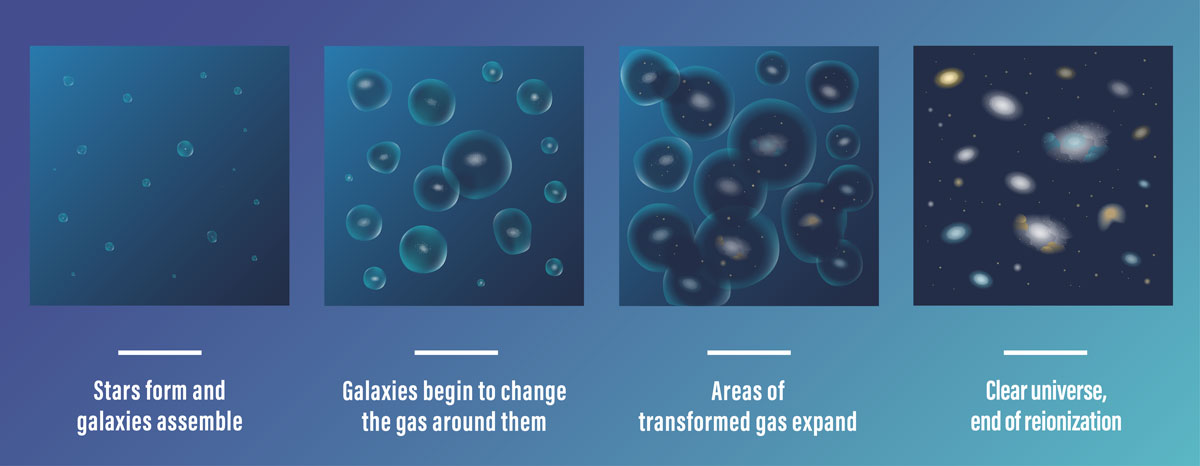
They may have found clues as to how the dust-filled havoc of the early cosmos was cleared up by literal light.

This is only one step for the space program in its mission to unlock the mysteries of the universe’s origins. Although the most prominent details of the study focused on galaxies that existed when the universe was between 370 million and 650 million years old, the international collaboration known as the JWST Advanced Deep Extragalactic Survey (JADES) also looked at the region of the universe from when it was between 500 to 850 million years old. They wanted to see the galaxies that existed during that phase in our cosmic history after the Big Bang.

In the process, they may have found clues as to how the dust-filled havoc of the early cosmos was cleared up by literal light.

Specifically, they found that one out of six galaxies from this region had features indicating that their atoms had been ionized by starlight and then cooled down to be combined with other molecules. This suggests that those early galaxies were creating stars and that these, in turn, added “torrents of ultraviolet protons” into their galaxies.

Conditions During the Era of ReionizationConditions During the Era of Reionization (Illustration) (NASA, ESA, CSA, Joyce Kang (STScI)
“These early galaxies were very good at creating hot, massive stars”

“These extreme emission lines are actually relatively common in the very early universe,” explained Ryan Endsley, a postdoctoral researcher at the University of Texas who led the second study, during the Monday presentation. “Almost every single galaxy that we are finding shows these unusually strong emission line signatures indicating intense recent star formation. These early galaxies were very good at creating hot, massive stars.”

This was not the only major astronomy news to recently come from the James Webb Space Telescope. Also this week, scientists using the telescope discovered the most extensive spray of water ever seen in space. At 6,000 miles long, the spray coming from Saturn‘s frozen moon Enceladus could reach from Los Angeles to Buenos Aires. In addition to establishing Enceladus as “the prime source of water across the Saturnian system,” the researchers wrote that this discovery demonstrates “the unique ability of JWST in providing critical support to the exploration of distant icy bodies and cryovolcanic plumes,” particularly as humanity continues to “prepare to send new spacecraft into the outer solar system.”

The telescope has made myriad other discoveries since it was unveiled last year. In February, it observed an early galaxy, the so-called “Sparkler,” that resembled our own Milky Way in its infancy. During that same month, the telescope found six massive galaxies whose very existence is a conundrum since they appear to be older than any galaxies ought to be given what we know so far about the universe.

Why the 9/11 families are so angry with the PGA tour

ProPublica is a Pulitzer Prize-winning investigative newsroom. Sign up for The Big Story newsletter to receive stories like this one in your inbox.

When the PGA Tour announced a long-term partnership with LIV Golf, the upstart organization bankrolled by Saudi Arabia’s sovereign wealth fund, no one sounded angrier than survivors of the 9/11 attacks and the families of those who were killed.

The pact on June 6 marked an abrupt reversal for the PGA, which had fought LIV Golf since it emerged in 2021. The rival league courted star golfers with vast payouts that were widely seen as part of a global public-relations campaign by the Saudi government.

“All of these PGA players and PGA executives who were talking tough about Saudi Arabia have done a complete 180,” one spokesperson for the families, Brett Eagleson, said in an interview. “All of a sudden they’re business partners? It’s unconscionable.”

Before the new alliance, PGA officials had highlighted the Saudi government’s alleged role in the 9/11 attacks, along with the kingdom’s record of human rights abuses, as important reasons for their opposition to LIV Golf.

The Saudi government has long denied that it provided any support for the attacks. But, over the past few years, evidence has emerged that Saudi officials may have had more significant dealings with some of the plotters than U.S. investigations had previously shown.

Since 2017, the 9/11 families and some insurance companies have been suing the Saudi government in a Manhattan federal court, claiming that Saudi officials helped some of those involved in the Qaida plot.

The Saudi royal family was a declared enemy of al-Qaida. In the early 1990s, it expelled Osama bin Laden, the son of a construction magnate, and stripped him of his citizenship. At the same time, the kingdom funded an ambitious effort to propagate its radical Wahhabi brand of Islam around the world and tolerated a religious bureaucracy that was layered with clerics sympathetic to al-Qaida and other militant Islamists.

From the start of the FBI’s investigation into a possible support network for the 9/11 plot, one of its primary suspects was a supposed Saudi graduate student who helped settle the first two hijackers to arrive in the United States after they flew into Los Angeles in January 2000.

The middle-aged student, Omar al-Bayoumi, told U.S. investigators that he met the operatives by chance at a halal cafe near the Saudi Consulate in Culver City, California. The two men, Nawaf al-Hazmi and Khalid al-Mihdhar, were trained as terrorists but spoke virtually no English and were poorly prepared to operate on their own in Southern California.

Bayoumi insisted he was just being hospitable when he found Hazmi and Mihdhar an apartment in San Diego, set them up with a bank account and introduced them to a coterie of Muslim men who helped them for months with other tasks — from buying a car and taking English classes to their repeated but unsuccessful attempts to learn to fly.

As ProPublica and The New York Times Magazine detailed in an in-depth report on the FBI’s secret investigation of the Saudi connection in 2020, agents on the case suspected that Bayoumi might be a spy. He seemed to spend most of his time hanging around San Diego mosques, donating money to various causes and obtrusively filming worshippers with a video camera.

Yet both the FBI and the bipartisan 9/11 Commission accepted Bayoumi’s account almost at face value. In a carefully worded joint report in 2005, the CIA and FBI asserted that they had found no information to indicate that Bayoumi was a knowing accomplice of the hijackers or that he was a Saudi government “intelligence officer.”

But FBI documents that were just made public last year sharply revised that assessment.

While living in San Diego, one FBI document concludes, Bayoumi was paid a regular stipend as a “cooptee,” or part-time agent, of the General Intelligence Presidency, the Saudi intelligence service. The report adds that his information was forwarded to the powerful Saudi ambassador in Washington, D.C., Prince Bandar bin Sultan, a close friend to both presidents Bush and their family. The Saudi Embassy in Washington did not immediately respond to questions about Bandar’s alleged relationship with Bayoumi.

As Bayoumi was helping the hijackers, FBI documents show, he was also in close contact with members of a Saudi religious network that operated across the United States. He also dealt extensively with Anwar al-Awlaki, a Yemeni American cleric who the documents suggest was more closely involved with the hijackers than was previously known. Awlaki later became a leader of al-Qaida in the Arabian Peninsula and was killed in a 2011 drone strike ordered by President Barack Obama.

One of the Saudi officials with whom Bayoumi appeared to work, Musaed al-Jarrah, was both a key figure in the Saudi religious apparatus in Washington and a senior intelligence officer. After being expelled from the United States, Jarrah returned to Riyadh and worked for years as an aide to Prince Bandar on the Saudi national security council.

Another Saudi cleric with whom Bayoumi worked, Fahad al-Thumairy, was posted to Los Angeles as both a diplomat at the Saudi Consulate and a senior imam at the nearby King Fahad Mosque — a pillar of the global effort to spread Wahhabi Islam that had opened in mid-1998.

According to another newly declassified FBI document from 2017, an unnamed source told investigators that Thumairy received a phone call shortly before the two hijackers arrived in Los Angeles from “an individual in Malaysia” who wanted to alert him to the imminent arrival of “two brothers … who needed their assistance.”

In mid-December 1999, according to the 9/11 Commission report, a key Saudi operative in the plot, Walid bin Attash, flew to Malaysia to meet with Hazmi and Mihdhar. Although the men were kept under surveillance by Malaysian security agents, they were allowed to fly on to Bangkok and then Los Angeles, using Saudi passports with their real names. The FBI source said that Thumairy arranged for Mihdhar and Hazmi to be picked up at the Los Angeles International Airport and brought to the King Fahad Mosque, where they met with him. Thumairy and Jarrah have both denied helping the hijackers.

The FBI revelations were especially stinging for the 9/11 families because previous administrations made extraordinary efforts to keep them under wraps. President Donald Trump, who promised to help the families gain access to FBI and CIA documents, instead fought to shield them as state secrets. (Trump has been a vocal supporter of LIV Golf, hosting several of its tournaments at his golf courses and saying after the merger, “The Saudis have been fantastic for golf.”)

The more recent disclosures — which came in documents declassified under an executive order that President Joe Biden issued just before the 20th anniversary of the attacks — are now at the center of the federal litigation in New York. While the families are pressing to reopen discovery in the case based on the new FBI information about Bayoumi and others, lawyers for the Saudi government continue to insist there is no evidence of the kingdom’s involvement in the plot.

To prove their case, the families must show that people working for the Saudi government either aided people they knew were planning a terrorist action in the United States or helped members of a designated terrorist organization like al-Qaida. At the time that Bayoumi aided Hazmi and Mihdhar in California, officials have said, the CIA and Saudi intelligence had identified the two as Qaida operatives.

The two federal judges overseeing the Manhattan litigation have yet to rule on requests from the families, based on the newly declassified FBI documents, for further inquiries to the Saudi intelligence service.

The PGA official who brokered the new alliance with LIV Golf, James J. Dunne III, told the Golf Channel he was confident that the Saudi officials with whom he negotiated were not involved in the 9/11 plot. Dunne, an investment banker, added, “And if someone can find someone that unequivocally was involved with it, I’ll kill him myself.”

Eagleson, whose father, John Bruce Eagleson, died in the same south tower of the World Trade Center where 66 employees of Dunne’s bank were killed, suggested that he read the declassified FBI documents about Bayoumi, Thumairy and other Saudis. “It’s the same government,” Eagleson said.


Amnesty probe of Israeli attacks on Gaza shows “human toll of​ apartheid”

One month after a cease-fire ended a five-day Israeli operation that killed Palestinian civilians and caused “extensive destruction” in the Gaza Strip, Amnesty International on Tuesday released a report highlighting the “human toll of apartheid.”

Amnesty—which last year joined a growing list of global human rights groups that condemn Israeli policies and actions against Palestinians as apartheid—probed Operation Shield and Arrow, launched on May 9 by the Israel Defense Forces (IDF) to allegedly target senior operatives of Al-Quds Brigades, the armed wing of Palestinian Islamic Jihad.

According to Amnesty’s nine-page publication, “On that first night of bombing, 10 Palestinian civilians were killed and over 20 were injured, a high toll that could and should have been avoided by those planning, ordering, and authorizing the attack.”

During the IDF operation, “a 21-year-old Palestinian medical student killed by a ‘precision-guided’ Israeli bomb while studying; a four-year-old Palestinian girl killed in her sleep during an Israeli airstrike; a young Palestinian woman living with a disability left without her electric wheelchair when Israeli bombs destroyed her home without adequate warning,” the report notes. “These are just a few of the victims of Israel’s latest military assault on the occupied Gaza Strip.”

“Amnesty International is renewing its call on the ICC to consider the applicability of the crime against humanity of apartheid within its current formal investigation.”

Overall, Amnesty found that Israeli forces killed at least 31 Palestinians, including 11 civilians, and caused “substantial destruction and damage to Palestinian property,” while rockets fired by Palestinian armed groups killed three Gazan and two Israeli civilians.

Among those killed by Israeli strikes were two teenage sisters who lived in a Gaza City apartment building. In the early hours of May 9, a bomb manufactured by Boeing and exported to Israel from the United States killed not only the target, Khalil al-Bahtini, a senior member of Al-Quds Brigades, but also his wife Leila al-Bahtini, their four-year-old daughter Hajar, and their neighbors: 19-year-old Dania Adas and 17-year-old Iman Adas.

Alaa Adas, the sisters’ father, told Amnesty that when he ran into the teens’ bedroom, his elder daughter was already dead but the younger one was still breathing and rushed to the hospital. However, he said, “instead of graduating and studying at university and fulfilling her wish of becoming a doctor, she died.”

Heba Morayef, Amnesty’s Middle East and North Africa regional director, said in a statement that “as civilians, the lives of Leila and Hajar al-Bahtini and Dania and Iman Adas should have been protected, not snuffed out. Israel has an obligation to cancel an attack if it becomes apparent that it may disproportionately harm civilians and civilian objects. Intentionally launching a disproportionate attack is a war crime.”

The human rights group is calling on the International Criminal Court (ICC) to investigate as possible war crimes “the apparently unlawful killings of Palestinian civilians by Israeli forces as well as the extensive destruction of Palestinian civilian homes and buildings,” along with “the firing by Palestinian armed groups of inherently inaccurate rockets in and at areas populated by civilians.”

Established when the Rome Statute entered into force in 2002, the Hague-based court investigates and tries individuals charged with genocide, war crimes, crimes against humanity, and the crime of aggression. An existing ICC probe focuses on alleged crimes committed in occupied Palestinian territory since June 13, 2014.

“Since the root cause of these recurrent unlawful attacks against civilians is Israel’s apartheid system against Palestinians,” Tuesday’s report says, “Amnesty International is renewing its call on the ICC to consider the applicability of the crime against humanity of apartheid within its current formal investigation.”

“In order to prevent further harm to civilians, it is imperative that the ICC investigations are expedited and arrest warrants issued against alleged perpetrators of international crimes,” the document adds. “Additionally, third states should ensure the prosecution of suspected international crimes before their courts under the principle of universal jurisdiction.”

Morayef stressed that “it has been a month since the cease-fire agreement between Israeli authorities and Palestinian armed groups, but the suffering that these recurrent Israeli offensives inflict upon the civilian population in the Gaza Strip never ceases.”

“In our investigation, we heard vivid accounts of bombs obliterating homes, of fathers digging their little girls out from under rubble, of a teenager fatally injured as she lay in bed holding a teddy bear.”

“In our investigation, we heard vivid accounts of bombs obliterating homes, of fathers digging their little girls out from under rubble, of a teenager fatally injured as she lay in bed holding a teddy bear,” she said. “More frightening than any of this is the near certainty that, unless perpetrators are held to account, these horrifying scenes will be repeated.”

“That we have been documenting the same patterns of unlawful killings and destruction over and over again is an indictment of the international community’s failure to hold Israel accountable,” Morayef added. “Israel’s impunity for the war crimes it repeatedly commits against Palestinians, and for its cruel ongoing 16-year illegal blockade of the Gaza Strip, emboldens further violations and makes injustice chronic.”

Amnesty’s report comes as the far-right Israeli government is reportedly planning to build thousands of new Jewish-only settler homes in illegally occupied territory—which Adalah, an Israel-based advocacy group for Arab minority rights, called “part of an explicit plan by Israel to annex swaths of the West Bank and institute full Israeli sovereignty over them.”

“They violate international law, including the Rome Statute,” Adalah said, “constituting crimes against humanity (apartheid), war crimes, and a crime of aggression.”

Top companies admit to hiking prices to pad their profits: analysis

An analysis released Tuesday shows that executives at some of the top publicly traded companies in the United States aren’t exactly being coy about using their pricing power to hike costs for consumers and boost revenues and profits—which are then dished out to wealthy shareholders.

The progressive watchdog group Accountable.US noted in its new report that “some of the largest general consumer S&P 500 companies have admitted to benefiting from increased prices as their net profits increased year-over-year and they rewarded shareholders with billions in handouts.”

The report quotes directly from the executives of Kimberly-Clark, PepsiCo, General Mills, Tyson Foods, and other major U.S. companies.

Nelson Urdaneta, Kimberly-Clark’s chief financial officer, said during the company’s earnings call in April that “pricing has continued to be the big driver behind our top-line growth over the last three quarters.”

The company, which sells consumer products such as toilet paper and diapers, saw its [fiscal year] 2022 net income increase 6.3% year-over-year to nearly $2 billion and rewarded shareholders with $1.7 billion in stock buybacks and dividends,” Accountable.US found.

On Tyson’s earnings call in February, chief financial officer John Tyson hailed the “significant pricing power of our portfolio, with a year-over-year increase of 7.6%.” Tyson stressed that the company will “continue to support and grow the dividend for our shareholders.”

According to Accountable.US, Tyson “saw its net income increase from $3 billion in FY 2021 to over $3.2 billion in FY 2022 and rewarded shareholders with $1.35 billion in handouts—$652 million more than the previous year, including a 948.5% increase in stock buybacks.”

“Corporate greed is a stubborn thing and requires serious action from Congress.”

The new analysis came shortly after the Bureau of Labor Statistics released data showing that the consumer price index rose 4% in May compared to the previous year, the smallest increase since 2021.

Further evidence of cooling inflation sparked a fresh round of calls for the Federal Reserve to stop hiking interest rates before it pushes the economy into recession. The Fed is widely expected to announce Wednesday that it is pausing rate increases for the month of June, but it could resume the hikes as soon as the following month.

“The Fed should not only pause tomorrow but pause going forward and see how these 10 rate hikes play out,” Rakeen Mabud, chief economist at the Groundwork Collaborative, said in an appearance on Yahoo Finance Tuesday morning.

Liz Zelnick, director of economic security and corporate power at Accountable.US, said in a statement that “after an unprecedented 10 interest rate hikes in a row, it’s clear the corporate profiteering epidemic will persist no matter how many times the Fed doubles down.”

The New York Times reported late last month that even as the prices of key raw materials have fallen in recent months, “many big businesses have continued raising prices at a rapid clip” and signaled that “they do not plan to change course”—which helps explain data showing that U.S. corporate profits rose to a record level in the first quarter of 2023.

“PepsiCo has become a prime example of how large corporations have countered increased costs, and then some,” the Times noted. “Hugh Johnston, the company’s chief financial officer, said in February that PepsiCo had raised its prices by enough to buffer further cost pressures in 2023. At the end of April, the company reported that it had raised the average price across its snacks and beverages by 16% in the first three months of the year. That added to a similar price increase in the fourth quarter of 2022 and increased its profit margin.”

Zelnick said Tuesday that “higher interest rates haven’t stopped S&P companies, especially in the Big Food industry, from inflating consumer prices despite reporting billions in extra net earnings and over a trillion dollars in giveaways to wealthy investors.”

“Corporate greed is a stubborn thing and requires serious action from Congress,” she added. “The Fed has not seen an adequate return on its investment in a policy that has already created fissures in the economy that could lead to recession. It’s just not worth it.”

GOP follows debt fight with bill to give $24 billion tax cut to the top 1 percent

After spending months threatening to tank the economy over the federal deficit, Republicans have unveiled a set of new tax proposals that would cost the government billions of dollars — by handing tens of billions of dollars of tax cuts to the richest 1 percent of Americans, as a new report reveals.

On Friday, just a week after the conclusion of the debt ceiling showdown, House Republicans released a plan that would slash taxes for corporations and the wealthy, with a forecasted cost to the government of $240 billion over the next decade.

According to a new analysis from the Institute on Taxation and Economic Policy (ITEP), the majority of these cuts would go to the richest 20 percent of Americans.

In 2024 alone, the richest 20 percent of Americans would see an estimated $61 billion in tax breaks. This is not only 43 times the tax cuts for the bottom 20 percent, who would save a mere $1.4 billion, but also more than the tax savings of the entire rest of the country, with the bottom 80 percent seeing $34 billion in cuts in total.

The richest 1 percent would be the largest beneficiaries of all, ITEP found, receiving over $28 billion in tax cuts just next year.

This means that the average tax cut for a person in the top 1 percent — with an average income of $2.5 million — would be $16,550.

The average tax cut for someone in the bottom 20 percent — a group with an average income of $13,800 — would be $40.

The bill “looks like a terrible deal for ordinary Americans and a windfall for foreign investors and the richest 1 percent of Americans,” said report author and ITEP director of federal policy Steve Wamhoff.

Even beyond the policy implications of cutting public funds, Republicans’ proposal comes with an important caveat: the party wants to offset about $216 billion of the costs by repealing tax credits for investments and production of clean energy, while also getting rid of a tax on dumping on toxic chemical dumping sites.

In other words, Republicans are seeking to fund their major tax cut plan by boosting the fossil fuel industry and harming the climate. Further, if this is the only plan to offset the tax cuts, the plan would still pile billions of dollars onto the deficit.

And, as ITEP notes, while the proposal would technically only enact the largest tax cuts for the next two years, the bill’s proponents are planning to make these cuts permanent — which the Committee for a Responsible Federal Budget has said would cost the government $1 trillion in revenue over the next decade.

Democrats have blasted the plan, saying that it only represents Republicans’ latest attempt to hand tax breaks to their wealthy benefactors while sapping public resources away from the rest of the public.

“With the predictability of a metronome, Republicans are back doing what they do best: pushing tax giveaways that benefit the wealthy, the large, huge corporations, while telling working families to take a hike,” said Senate Majority Leader Chuck Schumer, D-N.Y., in remarks on the Senate floor on Monday.

In a hearing last week, Rep. Richard Neal, D-Mass., top Democrat on the Ways and Means Committee, pointed out that it took Republicans just days after the debt ceiling crisis to propose billions in tax cuts. “Not even a week after their manufactured default crisis and it is back to tax cuts for the wealthy and well-connected,” said Neal.

Fox News sends Tucker Carlson cease and desist letter over his Twitter show

Fox News has sent a cease and desist letter to former host Tucker Carlson demanding that he stop producing videos for a program he began on Twitter earlier this month after his ouster from the right-wing network in April.

Fox’s letter reportedly includes, in bold letters, the words “not for publication” at the top.

Within the letter, Fox News accuses Carlson of violating a contract that he signed with the network in November 2019 and amended in February 2021. The contract runs through January 2025, and forbids Carlson from appearing in media that is not under the Fox umbrella of networks.

In exchange, Carlson continues to get paid $25 million annually from the network through the remainder of the deal.

A lawyer for Carlson, Harmeet Dhillon, blasted Fox News for trying to silence Carlson’s Twitter program, claiming that the move would backfire on the network and further alienate its viewers.

“Doubling down on the most catastrophic programming decision in the history of the cable news industry, Fox is now demanding that Tucker Carlson be silent until after the 2024 election,” Dhillon said. “Tucker will not be silenced by anyone.”

Carlson was fired from Fox News in April after text messages he sent became a central part of a defamation lawsuit against the network by Dominion Voting Systems. Like other Fox News personalities, Carlson was accused of allowing guests on his show to falsely claim that the voting machine company enabled fraud in the 2020 election without pushback or fact-checking. Carlson’s texts also included messages that were racist and politically violent, which played a role in his ouster.

Carlson and his lawyers have alleged that Fox News and its parent company’s treatment of him was a breach of contract, and allows him to pursue other media opportunities. Fox News and its chair, Rupert Murdoch, “intentionally and with reckless disregard for the truth” broke promises to Carlson when they fired him, the lawyers said prior to his “Tucker on Twitter” program airing.

Fox News has not publicly commented on its cease and desist letter to Carlson.

Like his former network program, “Tucker on Twitter,” which first aired on June 6, pushes far right conspiracy theories based in racism and paranoia. Carlson has continued to peddle white supremacist talking points on the new show; in the first episode, for example, he uses anti-semitic tropes to criticize Ukraine President Volodymyr Zelenskyy.

Although Carlson has promised to expand the show — its current roughly 10-minute format pales in comparison to his former program’s runtime at Fox News — media critics have said that it still falls short in terms of production value.

“As a production, ‘Tucker on Twitter’ looks less like a newscast than one of the improvised lockdown shows that late-night talk hosts recorded from home in the early Covid days of 2020,” wrote The New York Times’s television critic James Poniewozik earlier this month.

“What do you get when you strip Tucker Carlson of his multi-million dollar studio, crew of writers, and a much coveted 8 p.m. time slot on the nation’s most-watched cable news channel? Just a guy, posting online, trying desperately to recreate what he no longer has,” The Rolling Stone’s Nikki McCann Ramirez said of the show.


Nonbinary star Demi Lovato readopts she/her pronouns, as is their right

Demi Lovato is opening up about their gender identity and their choice to readopt she/her pronouns in addition to they/them pronouns.

In a recent interview with GQ Spain, the 30-year-old singer, actor and former Disney star explained their May 2022 decision to add “she/her” back into their social media profile alongside “they/them.” The change came after announcing their nonbinary identity back in 2021.

“I constantly had to educate people and explain why I identified with those pronouns. It was absolutely exhausting,” said Lovato in the interview, translated from Spanish to English. “I just got tired. But for that very reason I know that it is important to continue spreading the word.”

Lovato continued, saying the lack of available and accessible gender-neutral spaces is incredibly challenging: “I face this every day. For example, in public toilets. Having to access the women’s bathroom, even though I don’t completely identify with it.

“Or it also happens when filling out forms, such as government documents or any other where you have to specify your gender,” Lovato added. “You only have two options, male and female, and I feel like none of that makes sense to me.

“I see myself conditioned to choose a woman because there are no more,” they said. “I think this has to change. Hopefully with time there will be more options.”

Lovato officially came out as nonbinary in a May 2021 episode of the “4D with Demi Lovato” podcast, saying their pronouns are now they/them.

“Over the past year-and-a-half, I’ve been doing some healing and self-reflective work. And through this work, I’ve had the revelation that I identify as nonbinary,” Lovato said. “With that said, I’ll be officially changing my pronouns to they/them.”

They continued, “I feel that this best represents the fluidity I feel in my gender expression and allows me to feel most authentic and true to the person I both know I am, and am still discovering.”


Want a daily wrap-up of all the news and commentary Salon has to offer? Subscribe to our morning newsletter, Crash Course.


In May 2022, Lovato added she/her pronouns to their Instagram bio, later explaining their decision in a conversation with Tamara Dhia on the “Spout” podcast.

“For me, I’m such a fluid person that . . . I felt like, especially last year, my energy was balanced in my masculine and feminine energy so that when I was faced with the choice of walking into a bathroom and it said ‘women’ and ‘men,’ I didn’t feel like there was a bathroom for me because I didn’t feel necessarily like a woman,” Lovato said. “I didn’t feel like a man. I just felt like a human.”

They added, “That’s what they/them is about for me. It’s just about, like, feeling human at your core. Recently, I’ve been feeling more feminine, and so I’ve adopted she/her again. But I think what’s important is, like, nobody’s perfect. Everyone messes up pronouns at some point, and especially when people are learning. It’s just all about respect.”

Although Lovato prefers they/them pronouns to best represent their more neutral gender identity, adding she/her back to the ways they can be addressed isn’t unusual. Many people who come out as nonbinary, transgender or gender fluid may adopt more than one set of pronouns to match their identity, for comfort or any number of other reasons. For example, actor Elliot Page embraces he/they pronouns. Cisgender folks have also added they/them to acknowledge the pronouns’ neutral nature.

Illuminating dark seas: Why fisheries management must be more transparent

Fisheries management is complex, characterized by uncertainty, contest and compromise. It must balance scientific advice with myriad expectations from fishers, local communities, conservationists, corporations and consumers.

Fisheries also face the threat of illegal, unreported and unregulated (IUU) fishing. This makes management a struggle, exacerbates overfishing, destroys marine habitats and threatens millions of livelihoods worldwide.

Transparency has emerged as an essential tool for clarifying management and shedding light on IUU. Louis Brandeis, an American lawyer and former United States Supreme Court justice, once wrote that sunlight is the best of disinfectants, meaning people perform better and more honestly if their actions are observed and they are held accountable.

As calls for greater fisheries transparency grow louder, let’s take a moment to reflect on the importance of context for understanding where transparency exists and where it’s needed most.


Why is fisheries transparency important?

First, fish are a common good. Citizens have the right to know how they are exploited. Second, over a third of the world’s fish stocks are overfished. Third, seafood production is increasingly transboundary.

The often flawed perception of small boats feeding local communities is an oversimplification of a complex network spanning multiple jurisdictions.

Sustainably managing increasingly globalized and contested fisheries requires international co-operation and open decision-making.

As such, transparency advocates call on governments to divulge data on catches, stock status, finances, trade and vessel identification, ownership and location.

Civil society has been a key driver behind progress in these areas. But success is never straightforward nor cheap and is often dependent upon policy and governance.


Context is key

Transparency is vital where widespread unsustainable and illegal fishing severely impact local communities.

In West Africa, for example, fisheries support food security and livelihoods, but are often in poor or unknown condition. Illegal fishing there costs more than $2 billion each year.

Greater transparency could help communities receive a fairer share of fishery benefits. But for it to be effective, it must be coupled with reform elsewhere that improves enforcement, democratic processes and access to justice.

Transparency is not only a domestic issue. More than 60% of illegal fishing in West Africa is committed by foreign vessels, particularly from Spain and China.

Effective transparency in this situation is not just about public information, but a function of financial and institutional capacity and the influence of foreign power and money on decision-making.


Transparency in Ghana

Recently the Ghanian government was called out for failing to publish adequate fisheries data, despite its commitment to 100% transparency of industrial fleets.

But we can’t ignore the complicity of foreign governments — 44% of industrial catches in Ghana are made by foreign vessels. The need for investment in Ghana has also allowed foreign businesses to infiltrate local fleets — more than 90% of Ghanian industrial trawlers are Chinese-owned.

Financially and politically powerful fishing nations target countries with weaker governance and may even be integral to creating that weakness by implementing policies that constrain small-scale fishers and let industrial fleets off the hook.

China is estimated to report only 8& of its industrial catch from West Africa, while the European Union reports 29%. Foreign fleets in the region are notorious for obscuring their locations and illegally fishing in areas reserved for small-scale fishers.

In addition to the lack of published data, there is also a lack of accountability and justice. We believe transparency in Ghana is as much about revealing power struggles and the prioritization of corporate profit as it is about publishing data.


Transparency in Europe

In Europe, transparency looks quite different. Decades of relative political and financial stability have led to highly developed infrastructure and institutions. The EU has extensive online data sharing, including mandatory catch declarations, vessel monitoring systems and public registries of all vessels and company finances.

The EU also has a world-leading system for controlling imports and punishing opacity by denying poor performers access to EU markets — the notable exception being China. In fact, Ghana was recently issued a yellow card as a non-co-operating country in the fight against illegal fishing. The EU claims to have zero tolerance for illegal fishing.

However, the EU was recently labeled “hypocritical and neocolonial” for their refusal to implement measures against the overfishing of yellowfin tuna while being the largest beneficiary of their exploitation. The EU has reportedly undermined sustainability and authorized its vessels to fish unlawfully in African waters.

The EU’s economic clout has created a legacy of distortion that favors their fleets over others.

This dichotomy of transparency at home and opacity abroad raises several questions about how our expectations for transparency must reflect the realities of different contexts.


Let’s be clear about transparency

Making information public and opening up decision-making can reduce corruption, increase compliance and lead to fair and effective policies.

But transparency clearly depends upon on historical, cultural and financial realities. Expecting transparency to be one-size-fits-all can result in us oversimplifying the complexity of international fisheries.

Ignoring context may perpetuate power imbalances and promote the view that transparency is a so-called “developing world issue,” rather than ubiquitous. It may cast some nations as poor performers and others as world leaders, despite both having issues with opacity.

How we determine the arbiters of good governance sets a precedent for future decision-making, especially because transparency is no longer just about monitoring fishers, but is also about monitoring states.


Moving beyond symbolism

Why do we seek transparency in the first place? Is the goal to catch fish pirates? Maximize revenue? Or prioritize equitability? Ignoring equity issues can lead to transparency being regarded as intrusive and may be resisted or ineffective, especially in countries like Ghana.

We believe that transparency is one part of enabling conditions for delivering sustainable and equitable fisheries. It must be coupled with capacity-building for monitoring, enforcement and truly participatory stakeholder engagement.

It must overcome rigidity to allow multiple interpretations for transparency, including incorporating traditional or Indigenous knowledge systems. Those systems tend to focus on seasonality and leaving resources for the ecosystem, context-specific data types and are inclusive of different languages and cultural norms.

It must empower local communities to make informed decisions about the fate of their own resources and be attentive to existing transparency measures that rigid Eurocentric standards may not embody or recognize.

Ultimately, achieving transparency must not become more important than addressing the socio-ecological expectations that fisheries management set out to resolve. Effectiveness should be measured by sustainable and equitable outcomes — not the degree of transparency, but the degree to which fisheries sustainably and equitably serve local people.

Daniel Skerritt, Affiliated Researcher, Fisheries Economics Research Unit, University of British Columbia and Dyhia Belhabib, Research Associate and Fisheries Scientist, University of British Columbia

This article is republished from The Conversation under a Creative Commons license. Read the original article.

Expert: Inability to find new lawyer leaves Trump without expert to handle Espionage Act charges

Former President Donald Trump, who spent the day prior to his historic federal court appearance desperately scrambling to find legal representation, appeared in court Tuesday accompanied by two of his existing attorneys as he faced federal criminal charges for retaining national security documents and obstructing government efforts to retrieve them.

His attorneys Todd Blanche, an attorney handling his case in New York, and former Florida solicitor general Christopher Kise joined him in court after several prominent Florida attorneys declined to take on him as a client.

Two of the key lawyers Jim Trusty and John Rowley, who were initially handling the documents case, stepped down last week just hours after a Florida grand jury voted to charge the former president with 37 counts including alleged violations of the Espionage Act, obstruction and false statements.

Leading up to his arraignment, Trump and his legal team dedicated their afternoon to interviewing prospective lawyers, The Guardian reported. His search for a specialist national security lawyer, eligible to possess a security clearance, was also unsuccessful – leaving Trump without an expert to help him handle the Espionage Act charges.

“The issue isn’t navigating the Espionage Act charges themselves, which are relatively straightforward; the issue is navigating the Classified Information Procedures Act (CIPA) and knowing how to exploit all its procedural mechanisms to the client’s benefit,” Adam Kamenstein, a former federal prosecutor and current partner with Adams, Duerk & Kamenstein, told Salon.

He added that Trump is reported to not pay his bills and has gotten “more than one of his lawyers into their own legal trouble,” making him a difficult client to work with. 

Trump, who finds himself repeatedly entangled in legal woes, has become accustomed to an evershifting legal team. For him, the process is all too familiar with hiring new lawyers, but failing to keep them around as he faces mounting legal battles amid his multiple ongoing investigations.

Trusty, Trump’s top lawyer, abruptly resigned from his defense team the morning after he appeared on CNN claiming he had a theory that federal prosecutors “extorted” an attorney in the classified documents probe.

​​Another lawyer, Timothy Parlatore, departed from Trump’s legal team in May. He was one of the lawyers who sent a letter to Congress asking them to tell the Justice Department to “stand down” on the documents probe.

Then there’s Evan Corcoran, another criminal defense attorney who previously represented Trump in the documents investigation, but had to recuse himself in April after a federal judge ordered him to turn over notes documenting his interactions with Trump. 

Prosecutors found evidence of Trump using his attorney to advance a crime, which led the judge to pierce the protections offered by attorney-client privilege. 

“There are not many lawyers who have adequate experience in dealing with classified document cases and CIPA, so the pool is small to begin with,” Kamenstein said.

But when you add on the other troubles that come with being the former president’s attorney, the pool shrinks even more. 

The recent indictment revealed that Trump attempted to sway his attorneys to lie to authorities about federal documents and suggested they tamper with the evidence. 

In at least one meeting, Trump praised a lawyer working for Hillary Clinton, whom he claimed had done a “great job” by deleting emails from her private server. 

In another, he gestured with a “plucking motion” using his hand, trying to convince his lawyer to remove any documents that were bad.


Want a daily wrap-up of all the news and commentary Salon has to offer? Subscribe to our morning newsletter, Crash Course.


The documents, which were found in different parts of Mar-a-Lago, including Trump’s bedroom, ballroom and even next to a toilet in a bathroom “could put at risk the national security of the United States, foreign relations, the safety of the United States military,” according to a paragraph from the indictment.

Catherine Ross, a constitutional law professor at George Washington University, told Salon that this was one of the most startling and troubling paragraphs in the indictment that she came across. 

“That concern has been magnified by listening to a number of people with significant intelligence background, commenting on the fact that it might take us as much as years to figure out exactly which sources and methods are compromised, and to safeguard what is out there and to rebuild what we and our allies have built,” Ross said.

More than meets the eye: Dominique Fishback on becoming a “Transformers” star, “Swarm” serial killer

Many artists struggle with the idea of being good enough – asking themselves why they do and don’t deserve certain opportunities. When actress Dominique Fishback deserves it, she knows it. When she was approached to appear on Donald Glover‘s Prime Video series “Swarm,” producers envisioned Fishback for a supporting role. Fishback saw herself as the lead, Dre, and stayed committed to landing it.

On “Salon Talks” Fishback explained how she convinced Glover she was right to play Dre and talked about the power of staying committed to work that truly speaks to you. “If there’s something in my heart and my spirit to say and I don’t say it, I’m going to be up all night tossing and turning, ‘Why don’t you just say it, Dom?'” she said. “If I know what it’s going to take to alleviate potentially regretting not speaking up, then I have to do it in real time.”

Before the wild success of “Swarm,” Fishback wowed viewers in “The Deuce,” playing Darlene, a young sex worker with inner beauty and complexities that challenged the stigmas associated with the industry. Fishback has brought the same intensity to “The Hate U Give,” “Judas and The Black Messiah,” “Project Power,” and now stars as Elena in “Transformers: Rise of the Beasts,” in theaters now.

Watch my “Salon Talks” episode with Dominique Fishback here or read our conversation below to learn more about the making on “Swarm,” “Transformers,” her take on the WGA writers’ strike and her philosophies on the love and work balance. 

The following interview has been lightly edited for clarity and length.

I’ve been a fan of yours since “The Deuce,” so I’ve been watching you a long time. One thing that fascinates me is your range. I’m like, is she 15 or is she 26?

Thank you. Yes.

What comes more natural to you?

I definitely have a sweet spot for teenagers. I just feel like I understand them and I respect them a lot. I don’t layer them with shortcomings or perceptions of what it means to be a teenager. I make them as wise as possible and then I just play from there. I really enjoy playing teenagers.

Watching “Judas and the Black Messiah” and then watching “Swarm,” I’m like, is this the same person?

That’s the best compliment you could ever get.

“Swarm” was received well. Everybody was talking about it, from people on my timeline to dudes in the barbershop. Did you know it was going to hit like that? 

“I thought she was wild enough to get people’s attention.”

I think Janine [Nabers] and I talked about just the idea that there’s a lot of serial killer projects out, and people are really talking about it, but it’s time for us to see a Black woman serial killer. We never seen that before.

It’s like the Rosa Parks of serial killers.

Hilarious. Yeah. I think it was just exciting and I thought she was wild enough to get people’s attention. I didn’t know how long they would stay for, if they would finish the series, but I knew at least they would watch the pilot. 

Dre wasn’t wild in a shock value kind of way. Dre was more just very, very cool with it.

You don’t think it was shocking for her to just blow his brains out just right down the side?

From who she was, I’m not going to say it made sense, but if you think a serial killer, you think of the scene of Jeffrey Dahmer dancing in the club and you’re like, “Yo, why would anybody that right frame of mind go home with him?” You know what I’m saying? When you see Dre, it’s like a little different. It was beautiful though. It was very, very smooth.

Thank you.

What was your reaction to the script when you first read it?

It wasn’t so much the script, it was just the idea. They told me that Donald [Glover] had a role for me, but they didn’t know what it was about. He wouldn’t say what it was about. He just wanted me to watch this film called “The Piano Teacher.” It’s a French film. I watched and I was like, “That is wild.” I don’t know what they want from me, but I don’t know if I’m that brave to do something like what this actress did in this movie. I got in my own way and I had the meeting, and they just told me the arc of where she was going. They said they wanted me to play Marissa, [the character] Chloe Bailey is playing.

Initially you were Marissa?

Yeah, that they wanted me for her, but when they told me the concept and everything that Dre would have to do, I was like, “I want to play Dre,” in my mind. After that, I told my team I want to play Dre. They said, “Read the scripts.” I read the scripts and still want to play Dre. We had to have a call with Donald. It was more so where I knew that I was going to be able to go as an actor, especially with episode seven and

“I journal as all of my characters, but with this one, I couldn’t journal as her because I didn’t understand her psychology.”

playing Tony and getting into that. I really, really enjoy acting and transforming and disappearing into a character. Any opportunity that I get to really figure out how I can do that, I’m excited for it. Tony was really like, “Oh yeah, I get to get in there.”

It was brave to fight for that. I think a lot of artists, especially artists who haven’t really had their break yet, would take that kind of situation and they would just back off. What do you say to them?

I’d say do whatever helps you sleep best at night. I know that for me, if there’s something in my heart and my spirit to say and I don’t say it, I’m going to be up all night tossing and turning, “Why don’t you just say it, Dom?” I don’t want to beat myself up. I been doing that a long time and I don’t want to do that anymore. If I know what it’s going to take to alleviate potentially regretting not speaking up, then I have to do it in real time.

I couldn’t see another person playing Dre.

Thank you. There would be so many different versions of an actor coming in and doing that. Dre on the pages looked different from Dre that I brought. The most they told me was like, “Oh, she’s emotionally stunted,” but they didn’t really say, “She’s this, she’s that, so come to set and be like that.” It was like, “She’s emotionally stunted.” It was almost like I was sent off to figure out, oh my God, what does that mean? Then the first day I just came up was like, all right, this is what I got, type thing. Then it was like, all right, cool. Then give me direction from there. It was like I really had to go on my impulses and decide what she is, how she moves, how she walks, how she talks. Everything was really, they gave me the freedom to do those things.

We working on it. How does one prepare to play a serial killer? 

I think there’s different ways. For me personally, I journal as all of my characters, but with this one, I couldn’t journal as her because I didn’t understand her psychology. I had to journal as myself.

What I did was I identified every little bit of the three scripts that I had that made me uncomfortable, made me anxious, gave me fear, made me overthink. I said, “Well, what is the truth behind it?” When I identified what the truth is, I can say, is that really a truth of mine, that I can’t stand behind it or something that I think is social? If it’s because of social perception, then I have to reevaluate why that matters to me.

“I had to go on my impulses and decide what she is, how she moves, how she walks, how she talks.”

Then that way I can clear out any judgments that I had of Dre so that I could ultimately respect the camera because I know the camera picks up everything. I did not want the camera to see my Dominique shift because she’s uncomfortable killing her girlfriend. That was the hardest scene for me. Because I had done that work of just getting rid of my own judgments of her, I feel like they was able to flow through me.

I read this book called “Auditioning on Camera” by Joseph Hacker. One of the most profound things that I feel like I got from that book is he talks about how you don’t have to riddle your characters with shortcomings. If your character is a thief, he’s going to steal no matter how genuine or loyal you play him. If this person’s a cheater, they’re going to cheat no matter how, whatever. You don’t have to riddle them with shortcomings. The same way I approached Darlene in “The Deuce.” I said, “OK, I don’t have to have her act like a sex worker, walk like one, talk like one. I could just let her exist because she is going to be that regardless.”

That’s what made her real.

That’s the given circumstances. Dre is going to be a serial killer regardless how normal I try to play her, or I didn’t focus on any of that. That was a happenstance. Everything else was how she felt on the inside. She was very impulsive. She felt things deeply and she showed it on her face. She had opinions about everything. She’s going through the world, and I feel like she wants to be left alone. Truly in the beginning. Everybody’s poking. They’re always poking at her, and she just, you know what I’m saying? Then she snaps and then it’s over.

I think we might be past the spoiler alerts.

Oh yeah.

What I’ll say is that Dre lost me when she killed her girlfriend because I’m like, I guess you tap into relationships where somebody does a kind gesture and it’s selfish.

She lost you, but also devil[‘s] advocate, what I think was so heartbreaking about the scene, and for me even though I knew it was going to happen, I was so present that I really felt like it didn’t have to happen. Even when she said, “I f**king hate Nija.” Then it was like, she’s saying all this stuff. “Are you dumb? Are you dumb?” You got that look on your face and went in.

I feel like it was literally almost an emotional and mental overload, overstimulation for Dre because I feel like it was all her past traumas came right before her eyes. She tried to replace Marissa with this girl. The only problem is she doesn’t like Nija. All right. It’s OK that she let her slide when she said she didn’t like Nija. Then she just said all of this stuff that I think Dre was like, I can’t trust anybody. She felt this all along, and it was like she went in. 

The hurt was talking. The hurt was like, “Do you see me?”

There is a way to say do you see me without saying, “You got that stupid look on your face, that save me look. Are you dumb?”

If we were dating, and I bought you a pair of Jordans in a size 14, like, baby, I know you’re going to love me in these.

But I say, “Hey, are you dumb?”

If I had a real-life Nija, not that I have a real-life Nija, I feel like mine would be the singer H.E.R. or Stevie Wonder. How about you?

I think I was so connected to this show and to what she does that the idea of having anybody like Nija is just so I’ve been too engulfed in Dre’s world that I’m like, “Eh, no, not even a little bit.” I’m cut off that. Also even before that, I hadn’t seen a concert until like 2018 was my first concert.

Oh wow. Who was it?

It was Jay-Z. It was “4:44,” and I had just done “Smile,” the video. It was exciting too. That was my first concert. But other than that, I don’t know if when I was younger I didn’t have the awareness to say, “Oh, I could see my favorite singer live.” You know what I mean? It just didn’t cross my mind. I don’t [like] standing that much. I know at concerts you have to stand.

Now you’re in “Transformers: Rise of the Beasts.” Did you have a connection to the earlier movies or the cartoons when you were coming up?

Yeah, I had a connection to the first couple ones, but specifically the first one, because I was such a Disney kid and I loved “Even Stevens.” When I saw Shia [LaBeouf] transition into a movie star, it was by way of “Transformers.” I was like, “OK, I got to do something like that. Got it.” I was putting pieces together, but I never thought that it would actually be “Transformers.” That’s the cherry on top of allowing yourself to believe and manifest but leaving space for God to just continue to blow your mind.

I always wonder with “Transformers,” what happens when a new model comes out? If you’re a Transformer and you’re like a 1992 Volkswagen Beatle, the 2023 is out, so do they get upgrades? 

Yeah. They can transform into anything.

Is it like “Pimp My Ride”?

They transform. [Bumble]Bee was a Beetle before, and he’s a Camaro, and they change. Honestly, I’m throwing out names of cars that I don’t even know what I’m talking about because I don’t know nothing about cars. I don’t even know how to drive. I know he’s a Camaro and I know he was a Beetle before. That’s as far as my extent.

I drive all the time and I don’t know how to drive. We are on the same page with that. Tell us about your character Elena. 

“I’m a very collaborative person. I love to talk about things and that’s going to make me feel comfortable and more secure.”

Elena is an artifacts researcher and she’s working at a museum. And right now she’s at a crossroads in her life because she feels like her boss is always suppressing her and taking credit for her work. She’s at a standstill. I think she’s often in her books, and her imagination runs wild, but I don’t know that she takes adventure at face value to actually do it in the physical world. Then she meets Noah [Anthony Ramos] and she has to heed the call in her life to see if she’s going to do what she’s always done or try to do something greater.

As a TV writer, one thing I love about working with certain actors is when you pass in your pages as a writer, and then they come back with, “OK, I see this and this and that.”

You like that?

I like that. I know some writers hate it. I read that you came back with two pages or more of notes on Elena.

I did.

What did you bring to her?

I can’t even remember everything that was written. I got it in the email. Just making sure that we knew a little bit about her background, what she cared about personally, outside of the Transformers, outside of her connection to Noah or whatever it was going to be. Does she have a relationship with the Autobots? Just making sure that she had her own identity within the story as opposed to being somebody that is brought along because of Noah. That was Steven Caple Jr.’s idea beforehand. It was nice to just know that I could talk to him and say, “Hey, these are my thoughts.”

I remember it was the 19th hour of shooting something, and I just felt like I wanted to try something. Anthony was like, “What you got to say? Say it.” We sat there, and everybody got in the circle, and we just talking about it. I said, “Well, I feel like Elena does this. I feel like this is her moment to do X, Y and Z.” It’s not even about necessarily that everything that I say has to make it in the script or in the movie.

From the jump, I always tell any creative that I’m meeting with, if it’s a general or if it’s a specific project, that if you like the work that I’ve done, just know I’m a very collaborative person. I love to talk about things, and that’s going to make me feel comfortable and more secure. Again, it doesn’t have to be what I say, but if I have a thought about it and I want to talk about it’s not like, “No, just do that because I said so.”

Right now, television writers are on strike and there’s talk of actors going on strike as well. Do you think this is all healthy for the industry? (Salon’s unionized employees are represented by the WGA East)

I think so, yeah. Because I think that it’s changing. It’s time to look at things. As an actor, you work many hours, you don’t always get paid a massive amount of money that people think you get paid. You have your lawyers, your publicists, all of those things that you have to pay for, including taxes, including all your bills. Then you go and you do press for months at a time, and you don’t get paid for that. At least I don’t get paid for that. I don’t know if anybody else [does]. If you do let me know so I can get it in my contract. 

You do the work and then you get that lump sum of money for the time doing that. But what about everything after and with streaming services and things like that, do you get back in? You don’t get back in. There’s no syndication. It’s like a lot of things. I think that it’s important to have the conversation and see what’s changing because actors do give a lot of their lives and times for it. I love what I do. I’m missing my best friend’s wedding. I’m missing it. I’m the godmother of her daughter and I’m missing her wedding. That hurts. I love work. I missed my uncle’s funeral. I missed my sister’s birthday, 16th birthday, graduations. You miss a lot of things. I love what I do. So it’s not to say that I wouldn’t, but can the other things come in that help you feel more appreciated, that you’re given your life and your time and your heart and your energy to bring in something to life?

What’s next for you?

Well, definitely more of my own writing because I started acting in a company that in order to act you had to write your own stuff, and I’m writing a book of poetry right now. I really want to do an epic romance. I don’t know if you are writing one, after the strike, of course, if you write one, but otherwise, I’m just working on my own. What’s my concept for a really epic love story? I’ve always been a romantic, and now if anybody asks me what it is you want to do, it’s like, a timeless rom-com like “When Harry Met Sally” or “Say Anything” or something like that or an epic romance like a “Titanic” or a “The Notebook.”

“Transformers: Rise of the Beasts” is now in theaters.


Legal experts: Jack Smith has a “backup plan” if Judge Aileen Cannon issues “Trump-friendly rulings”

Special counsel Jack Smith could feasibly bring dissemination charges in a separate indictment against former President Donald Trump related to his handling of classified documents at his Bedminster, N.J. golf resort, legal experts argued in a Wednesday analysis from The Atlantic.

The two instances pointing to Trump moving documents from his Mar-a-Lago estate in Florida to his office in Bedminster and showing them off to others were outlined in the DOJ’s Thursday indictment and captured in a 2021 recording of the former president. In the indictment, prosecutors accuse Trump of showing a classified map to a political ally and disclosing a secret military plan to attack Iran to a writer and a publisher.

“These two episodes were arguably the most egregious allegations of criminal wrongdoing mentioned in the indictment; they allege not just the improper retention of our nation’s most highly classified information, but the intentional communication of such information,” attorneys and New York University Law Professors Ryan Goodman and Andrew Weissmann wrote.

Trump’s New Jersey conduct adheres to two federal offenses created to protect America’s national security secrets, they argued. Title 18 U.S. Code’s section 793 criminalizes the intentional communication of national defense information to unauthorized persons, while section 798 criminalizes intentionally disclosing classified information to the same. Both are more serious crimes than willful retention of sensitive government documents, which Trump was charged with 31 times last Thursday in the special counsel’s investigation.

Though Smith’s charges describe Trump’s alleged dissemination and disclosure, the indictment does not charge him with the offenses. The attorneys cite the Constitution’s requirement that prosecutors bring charges in the venue of the alleged criminal conduct as a possible reason for Smith’s “cautious, narrow approach” to charging the former president: In practice, prosecutors could not indict Trump in Miami for his alleged Bedminster conduct.

“But the absence of such charges in the indictment raises the intriguing possibility of another indictment to come, in a jurisdiction, no less, with a pool of jurors and judges more favorable to the government’s case against Trump,” they wrote.


Want a daily wrap-up of all the news and commentary Salon has to offer? Subscribe to our morning newsletter, Crash Course.


It is possible that Smith surmised any attempts to file dissemination charges against Trump in Florida would fall flat due to issues regarding the venue in which the conduct allegedly took place. Goodman and Weissmann add that Smith possibly didn’t pursue the more serious charges due to the length of prison time Trump could be subject to if found guilty of any of the 31 counts of retention under the Espionage Act.

Though Smith might decide against it, they write, a potential separate indictment in New Jersey would be a “backup plan of sorts” for the special counsel if the Florida judge assigned to the case, Trump-appointee Judge Aileen Cannon, “if Cannon acts consistently with her prior Trump-friendly rulings, which were twice found by unanimous panels of conservative appellate judges to be both factually and legally flawed.”

Former U.S. Attorney Joyce Vance called the scenario a “very interesting possibility.”

“The Bedminster conduct can’t be charged in Florida, so I’d view this less as a back up & more as a compelled separation of different criminal conduct under the law,” she wrote. “Trump could always move to consolidate the cases in one court.”

Trump was indicted on federal charges last Thursday and pleaded not guilty during his arraignment in Miami Tuesday. The indictment, made public last Friday, alleged 37 felony counts, including willful retention of national defense information, conspiracy to obstruct justice and making false statements.

Ultra-processed foods: bread may be considered one, but that doesn’t mean it’s all bad

Humans have been eating bread in some form for centuries. But modern bread is a far cry from the bread of the past. In its sliced bread form, it often contains so many more ingredients than the kind our ancestors were eating that it is now widely considered an ultra-processed food. But, this doesn’t necessarily mean it’s bad for us.

There are many definitions of what makes a food ultra-processed. The most commonly used one is the Nova classification, which was developed by researchers at the University of Sao Paulo in Brazil. This separates foods into four groups.

The first group includes unrefined or minimally processed foods such as vegetables or meat with no additives. Second are culinary ingredients which have come from natural sources, but have been milled or processed to make them easier to cook with or edible — such as flour.

The third group covers processed foods. These are made by combining ingredients, including fats, sugar and salt. Examples include homemade or bakery breads. The last are ultra-processed foods. These are either industrially processed in a factory or include ingredients not typically used in the home, such as additives like emulsifiers.

Since most sliced bread is made using the Chorleywood process, this would technically make it an ultra-processed food. The Chorleywood process was invented in the 1960s to produce bread faster on an industrial scale.

The process involves using more rapid mixing and more yeast, along with the addition of solid fats, emulisifiers and ascorbic acid (vitamin C). This allows more water and lower-protein flours to be used in the bread-making process, alongside the use of a vacuum to control the proving process. This creates the soft, fluffy bread we buy from the supermarket.

Although this process has enabled affordable, consistent bread, there are growing concerns about how healthy it actually is because it’s ultra-processed. This concern has partly been fueled by mounting evidence showing a link between ultra-processed foods and health problems including heart disease, type 2 diabetes and some cancers.

However, researchers still don’t know if eating ultra-processed foods directly causes these health conditions. Nor do they know if only specific ingredients within these foods are to blame.

Bread’s position as an unhealthy, ultra-processed food has also been challenged. Some researchers argue the Nova classification’s definition of “ultra-processed” is oversimplified, leading many foods to be lumped into the same category despite containing vastly different ingredients and going through different processing methods.

It’s true supermarket bread contains emulsifiers, which have been linked with health problems, including a potentially increased risk of developing some cancers. But typically bread only uses mono- or diglyceride fatty acids as emulsifiers, which have not been linked to risk of disease.

It’s also worth noting that during the long fermentation processes used in traditional bread making, similar compounds to these two emulsifiers will actually be made by the yeasts and bacteria. These emulsifiers are used to improve the texture and, alongside hard fats (such as palm oil), help extend the bread’s shelf life.

Besides, the most important issue might not be whether the bread is classed as ultra-processed or not. The levels of salt in shop-bought bread could be more of a problem. Salt is used to even out how bread rises and give a consistent texture.

But the amount of salt in different brands of bread can vary from a teaspoon per loaf (similar to most homemade recipes) to four teaspoons per loaf. Look out for sodium levels on the label and aim to purchase bread with less than 0.7g of salt per 100g (or 0.3g of sodium per 100g).

And, despite similar concerns, the sugar in modern supermarket bread may not be as bad as many think. Sugar is used to help the yeast ferment and rise before baking. As such, most bread contains 2g-4g of sugar per 100g. Some of this actually naturally occurs as a result of the proving process. However, this may vary depending on the brand.


Other considerations

So, it’s likely that the ultra-processed way bread is made might not be as big an issue to our health as some think — although the salt content in some loaves might be.

Brown bread (such as wholemeal or wholegrain) goes through a similar production process as white bread. The main difference is that it may have some fiber either retained or added back into the flour.

Fiber is important for maintaining healthy bowels. Bread (and even flat breads or pitta) which contains seeds or bits of grain may also have the added benefit of taking longer to digest. This can help to make you feel fuller longer.

Sourdough is another favored option, with many saying it’s healthier because it uses more traditional baking processes. There is evidence that traditional French breads, which are slowly fermented and made with a sourdough starter, raise blood glucose (sugar) and insulin levels less than typical sliced loaves. As with higher fiber versions, this could mean they keep us feeling fuller for longer.

But many supermarket breads labeled “sourdough” may not be traditionally made. One of the problems is a lack of legally recognized definition for sourdough bread. In some countries it can only contain flour, water and salt (maybe with a little oil), but in others it can contain yeast to speed up fermentation and proving — and even additives. So if you’re looking for a real, traditional sourdough loaf, check that it only contains flour, water and salt.

Although supermarket bread may be classified as ultra-processed, that doesn’t mean you can’t include it as part of a balanced diet. Just be sure to think about what you’re putting on your toast. A sausage sandwich is less healthy than topping your toast with tinned tomatoes or baked beans.

Duane Mellor, Lead for Evidence-Based Medicine and Nutrition, Aston Medical School, Aston University

This article is republished from The Conversation under a Creative Commons license. Read the original article.

“He’s scared sh**less”: Trump melts down on Truth Social after he’s arraigned on 37 criminal charges

Former President Donald Trump fired off a series of all-caps Truth Social posts to decry his most recent indictment after he was arraigned on Tuesday in the Justice Department’s investigation into his handling of classified documents and alleged attempts to obstruct government efforts to retrieve them.

After his earlier court appearance, Trump held a rally in Bedminster, N,J., and assailed the indictment as “the most evil and heinous abuse of power” in the country’s history. He took to Truth Social later that night to share a series of clips from the event and further his claims against the investigation.

“POLITICAL PERSECUTION!” the former president wrote over the first of nine videos and articles he shared to the conservative platform. He alleged in subsequent posts that the “weaponized agencies” carrying out the probe have been running “illegal psychological warfare campaigns” against Americans for the last seven years and regurgitated Republican lawmakers’ bribery claims against President Joe Biden.

“They want to take away my FREEDOM because I will never let them take away your FREEDOM,” Trump continued. “They are not coming after me. They are coming after you. I just happen to be standing in their way, and I will NEVER be moving.”

On his way to the courthouse for his arraignment, Trump again denounced the indictment as a “witch hunt” on Truth Social but thanked his Miami supporters for their “warm welcome.”

“ONE OF THE SADDEST DAYS IN THE HISTORY OF OUR COUNTRY. WE ARE A NATION IN DECLINE!!!” he said in a post.

Trump pleaded not guilty to all 37 felony counts argued in the Justice Department’s 44-page indictment, which was announced Thursday and unsealed Friday after the yearlong investigation into his handling of sensitive files he took with him to his Mar-a-Lago resort club.

The charges outlined in the full indictment include willful retention of national defense information, conspiracy to obstruct justice and making false statements, and accuse his aide and now co-defendant Walt Nauta of six of the counts.

Though Trump maintains that he did nothing wrong, often citing the Presidential Records Act, the law establishes that all presidential records belong to the federal government. 

“He’s scared s—less,” Trump’s former chief of staff, John Kelly, told The Washington Post of the former president’s reported nonchalance leading up to his court appearance. “This is the way he compensates for that. He gives people the appearance he doesn’t care by doing this. For the first time in his life, it looks like he’s being held accountable. Up until this point in his life, it’s like, I’m not going to pay you; take me to court. He’s never been held accountable before.”

New York lawyer David Lurie argued in media and politics newsletter Public Notice Wednesday that the viral image of Trump’s box-filled Mar-a-Lago bathroom unveiled in the indictment is likely the most politically damaging part of the special counsel’s case against him.

“It’s a deeply embarrassing document that portrays Trump as a weak and incompetent buffoon rather than the valiant warrior against the deep state his followers have so long believed him to be,” Lurie wrote.


Want a daily wrap-up of all the news and commentary Salon has to offer? Subscribe to our morning newsletter, Crash Course.


J. Michael Luttig, a former judge of the United States Court of Appeals for the Fourth Circuit who previously served as an adviser to former Vice President Mike Pence, asserted that there is no “Attorney General of either party who would not have brought today’s charges against the former president” in a series of tweets Tuesday evening.

“He has dared, taunted, provoked, and goaded DOJ to prosecute him from the moment it was learned that he had taken these national security documents,” the judge said of Trump, adding that the former president could have skirted the federal prosecution and charges at any point up to his indictment.

“After a year and a half,” Luttig concluded, “he finally succeeded in forcing Jack Smith’s appropriately reluctant hand, having left the Department no choice but to bring these charges lest the former president make a mockery of the Constitution and the Rule of Law.”

Making “the last Beatles record” with AI: Cool restoration of John Lennon vocals, or novelty act?

Like you, I’ve been inundated with myriad Beatles AI treatments of late. Every day, they seem more outlandish: the Beatles playing Wings songs, the Beatles performing Gotye’s “Somebody That I Used to Know,” the Beatles singing “We Are the World,” John Lennon playing Oasis‘ “Wonderwall,” and, my personal favorite, Paul McCartney taking the artificial microphone to sing “How Do You Sleep,” Lennon’s 1971 vocal screed about Beatle Paul.

To my ears, they’re fairly unconvincing on the whole. But at the current rate, prevailing AI technologies will likely remedy these discrepancies with predictable speed. This brings us to this week’s headlines trumpeting new AI-generated Beatles material. During a BBC Radio 4 interview, McCartney announced that a “new” Beatles record is on the horizon. Thankfully, he appears in all likelihood to be speaking about the fate of “Now and Then,” one of Lennon’s late-period demos.

As the story goes, more than a decade after Lennon’s murder, the surviving Beatles approached Yoko Ono about the concept of enhancing Lennon’s Dakota-era demos for release. After McCartney delivered his induction speech on Lennon’s behalf at the Rock and Roll Hall of Fame’s January 1994 ceremony, Ono provided him with Lennon’s demo tapes for “Free as a Bird,” “Real Love,” “Now and Then” and “Grow Old with Me.” Before leaving the Dakota, McCartney later recalled:

“I checked it out with Sean, because I didn’t want him to have a problem with it. He said, ‘Well, it’ll be weird hearing a dead guy on lead vocal. But give it a try.’ I said to them both, ‘If it doesn’t work out, you can veto it.’ When I told George and Ringo I’d agreed to that they were going, ‘What? What if we love it?’ It didn’t come to that, luckily. I said to Yoko, ‘Don’t impose too many conditions on us, it’s really difficult to do this, spiritually. We don’t know—we may hate each other after two hours in the studio and just walk out. So don’t put any conditions; it’s tough enough.'”


Love the Beatles? Listen to Ken’s podcast “Everything Fab Four.”


With Jeff Lynne handling production duties, McCartney, George Harrison and Ringo Starr completed new recordings for “Free as a Bird” and “Real Love” as part of the Beatles’ “Anthology” project. When it came to “Now and Then,” the audio was apparently so degraded, having originally been recorded on cassette, that the “Threetles,” as they came to be known, scrapped any plans for enhancing Lennon’s solo demos in the future. As Starr noted at the time, “recording the new songs didn’t feel contrived at all, it felt very natural, and it was a lot of fun, but emotional too at times. But it’s the end of the line, really. There’s nothing more we can do as the Beatles.”

Apparently, McCartney didn’t agree, vowing to work with Lynne to bring “Now and Then” to fruition. Harrison allegedly didn’t share this perspective, citing the poor fidelity of Lennon’s demo as the reason for scrapping any efforts beyond “Free as a Bird” and “Real Love,” both of which notched Top Five UK hits. This week’s news strongly suggests that McCartney has made good on his word, finally completing work on “Now and Then.” “We were able to take John’s voice and get it pure through this AI,” he told the BBC, “so that then we could mix the record as you would normally do. It gives you some sort of leeway.”

Fortunately for all of us, McCartney is almost certainly referring to the AI technologies developed by director Peter Jackson, the filmmaker behind the Beatles’ blockbuster “Get Back” docuseries, and not the recent spate of novelty AI videos, such as the Beatles performing Radiohead’s “Creep.” Yes, you read that last bit correctly.

Adopting Jackson’s latest AI technologies will no doubt assist the Beatles’ team in reducing the muddiness of Lennon’s original cassette recording and establishing greater separation among the voices and instruments. This time around, McCartney reported, “we came to make what will be the last Beatles record.” I, for one, can’t wait to hear the results. But let’s not have any more funny business. I just queued up the AI version of Lennon singing Coldplay’s “The Scientist,” which left a lot to be desired. Enter at your own peril.


Stripped of its cheekiness, Hulu’s “The Full Monty” transforms from a movie comedy into a TV slog

The Full Monty” left moviegoers with something its 2023 TV continuation doesn’t, which is the gift of optimism. The 1997 film wasn’t entirely giggles and adorable pelvic thrusts to Donna Summer’s “Hot Stuff” while waiting in an unemployment line. Its writer Simon Beaufoy (FX’s “Trust”)  jogged its six down-and-out Britons through an obstacle course of insecurity, body shaming, a shared sense of worthlessness and feared obsolescence.

But he also ended this glimpse at their run of bad luck with high-stepping mirth and one of the most joyous scenes in modern movies. The striptease promised in the movie’s title, set to Tom Jones’ “You Can Leave Your Hat On” ends with a freeze frame of the core cast’s bare backsides, fading to black with a pervasive sense that somehow things would work out.

This arrives at the close of 91 minutes devoted to seducing us with Robert Carlyle‘s puckish Gaz, his best friend Dave (Mark Addy), their ballroom dancing acquaintance Gerald (Tom Wilkinson) and their recruits Lomper (Steve Huison), Horse (Paul Barber) and Guy (Hugo Speer) – average men to their core.

This is how a feel-good one-off bouncing with mountains of cheek sags into an eight-episode slog.

In exposing their thunder down under to supportive friends, neighbors and the local cops presumably waiting to arrest them on indecency charges, these laid-off steelworkers also embodied a chuck-it-all resilience missing among most stories about the working class.

“The Full Monty” spoke to a much broader audience than its $3.5 million budget may have indicated. Its worldwide box office gross came close to $260 million. The movie went on to earn four Oscar nominations and inspire a Broadway musical and live theatrical production. It also rocketed Carlyle, Addy and Wilkinson to the next level of international stardom.

Trusting that a story like this would remain untouched in its capsule is naïve, especially at a time when expanding existing properties is viewed as a safer bet than coming up with a wholly original idea. Maybe Beaufoy and (or?) his co-writer Alice Nutter had a new setting in mind to mount several intersecting stories about folks living on the margins or hanging off them by their fingernails.

But if there were ever a chance of audiences seeing them, they’d have to transmit them through characters we know, maybe, or recall, barely. This is how a feel-good one-off bouncing with mountains of cheek, literally and figuratively, sags into an eight-episode slog.

Welcome to yet another cell in the tyrannical supermax of IP.

In 2023, the meaning of “The Full Monty” has transformed from an act of liberating insouciance to a state of vulnerability and exposure. Returning us to Sheffield’s denizens allows Beaufoy and Nutter to strive to say something meaningful about the dissolution of societal safety nets and our sense of community, along with various midlife crises. In some respects, they succeed. In others, however, the writers ply exhausted tropes conflating inclusive storytelling with white savior caping. And their gravest offense in this regard is how they treat one of their own.

The Full MontyRobert Carlyle as Gaz and Talitha Wing as Destiny in “The Full Monty” (Ben Blackall/FX)

Contributing to the overall disarray of “The Full Monty” is Speer’s mid-production firing resulting from accusations of inappropriate conduct. That means he’s there for a little while and then suddenly isn’t, bumping his fiancée Paula (Kate Coogan) into scenarios where he was obviously meant to go. But the casually offered anecdotes explaining his absence quickly emit a “Weekend at Bernie’s” stench. If only everything around them were as funny.

Twenty-five years after we left the stripping troupe, each man has settled into a variant of a groove or slump. Gaz has two children now. Nathan (Wim Snape) introduced as a kid in the movie, has grown up to be a policeman living in constant fear that his father or kid sister Destiny (Talitha Wing) will turn in up in a holding cell. His concerns aren’t off-base; Gaz may work as a hospital porter but he still engages in extralegal activity, a hobby Destiny has inherited although, like Nate, she despises her father.

One can’t say that “The Full Monty” entirely forgets that it started as a comedy. The renewed focus on Gaz guarantees that episodes are never entirely without a few scenes that tease out a smile. Lomper, who Dave and Gaz met in the film by interrupting his suicide, is long out of those woods. Now he’s caught in a briar patch of predatory lending endangering his life and his and Dennis’ livelihood. 

The Full MontyPaul Clayton as Dennis and Steve Huison as Lomper in “The Full Monty” (Ben Blackall/FX)
Dave works as a caretaker at Sheffield Spires Academy where his wife Jean (Lesley Sharp) serves as the headmistress. She’s also ambitious and a workaholic, two traits preventing her from fully absorbing the suffering around her, including Dave’s. Sheffield is also falling apart – its plumbing is failing, its ceilings are crumbling and its budget is stretched to breaking. Who could fix this? Why, none other than Guy, who is now a wealthy beneficiary of government inefficiency.

Lomper owns a café called The Big Baps with his husband Dennis (Paul Clayton), where Gerald spends his days being a grumpy old man. And Horse, the oldest of the crew, is a disabled hoarder who can barely take care of himself. When the government requires him to show up at one of their assistance offices to be interviewed, the cracks he was already falling into yawn open and swallow him whole.

Beaufoy and Nutter, who co-write every episode, can’t resist shoehorning what feels like every major social ill into this season.

The problems facing Dave and Jean are variations on a theme begun in the movie – he was made to feel insecure about his looks and his ability to provide. In the intervening years, the couple has sustained another tragedy that colors where they are now.

Her coldness toward Dave sharpens when he takes a bullied, poverty-stricken student nicknamed Twiglet (Aiden Cook) under his wing. As the school’s administrator, she knows any personal relationship between an adult authority figure and a child is viewed with suspicion. But Twiglet is starved for food and care. Dave can relate.

The Full MontyLesley Sharp as Jean and Mark Addy as Dave in “The Full Monty” (Ben Blackall/FX)

Beaufoy and Nutter, who co-write every episode, can’t resist shoehorning what feels like every major social ill into this season by having their non-white characters shoulder the burden. A newcomer to the group, Darren (Miles Jupp), gets to be our pasty Virgil witnessing and commenting on the cruelty of homelessness before it lands on his doorstep in the form of a Middle Eastern woman, Silvan (Halima Ilter), ratted out by Darren’s NIMBY neighbors. She’s also very attractive and introduces him to spiced foods; he’s a lonely, generic British potato. You can see where this is going, and it’s tiresome.


Want a daily wrap-up of all the news and commentary Salon has to offer? Subscribe to our morning newsletter, Crash Course.


But nearly every character who isn’t one of the main white guys is sentenced to the role of martyr, perhaps none as much as Horse.

“The Full Monty” doesn’t evenly distribute its character development in the movie, anchoring its focus on Gaz and Dave’s relationship. They’re where the adventure begins, after all. But eight installments ranging in length between 38 and 51 minutes is more than enough time to expand what we know about most of these men if not all of them. Horse plays a pivotal role across the season, but primarily as a device to walk us through an all-too-common but unthinkable scenario.

We never get to know him as an individual but are instead expected to be content with his part in this puzzle. But then we eventually see that his friends of 25 years never got to know him either, which makes everything that befalls him land with bitterness as opposed to melancholy. Carlyle, who voices this epiphany as Gaz, colors this realization with sorrow, but everything leading up to it fails to explain these friends’ carelessness. A viewer can’t help but attribute their ignorance less to self-involvement than clumsy scripting.

There’s a moving new story scrambling to get out from under the mess of established history this series services, led by Destiny and her teenage friends, and the anger coursing through them at a system that doesn’t care if they flourish in school or drop out to assume their place in some company’s factor or at a service job.

An enticing subplot centers on the school’s music teacher and Jean’s best friend Hetty (Sophie Stanton), one of the few teachers who is invested in tending to her students’ talents and potential, especially Destiny’s.

When municipal carelessness deals her a blow, obliterating her music room, she assembles her lost lambs into a revenge choir singing out their frustration in rousing choral arrangements of pop tunes like CeeLo Green’s “F**k You.”

That energy is akin to the electricity that made the movie so winning, with underdogs flipping off the circumstances conspiring to keep them low. The vital difference is that 25 years ago, Beaufoy understood that such stories are enlivened when desperation cedes the spotlight to inspiration. Now he’s spreading that dollop of sweetness over too much common misery.

FX’s “The Full Monty” series is now streaming on Hulu.


Seeing dead fruit flies is bad for the health of fruit flies — and scientists have identified why

All living organisms age. People have long sought ways to slow, halt or reverse this process, which is commonly associated with declining mental and physical health. One area researchers are probing is the role that sensory perception – such as sight, smell, sound, taste and touch – plays on health and life span.

While you may typically think of your senses as what you use to gather information about your surroundings, recent work has demonstrated that environmental cues themselves can affect physiology and aging. Your body regulates itself to match the conditions it finds itself in. The nervous system is poised as a central player in mediating the effects of sensory perception. It stores and integrates incoming information from the environment and interprets and disseminates information across different tissues.

I have used fruit flies, specifically Drosophila melanogaster, for more than 15 years to better understand how sensory perception affects aging. Recently my work has focused on the role the brain plays in aging, looking at how death perception, or when fruit flies perceive other dead fruit flies, affects their life span. My colleagues and I have shown that when fruit flies see, and to a lesser extent smell, an excess of dead flies in their environment, they avoid other flies and undergo significant physiological changes, including rapid decreases in stored fat, decreased resistence to starvation and shortened life span. While it is currently unknown whether these changes are evolutionarily advantageous, we speculate that it could be, because of the stressful environment that the living flies find themselves in.

Fruit flies are among the most common model organisms in research.

In our newly published research, my colleagues and I identified the neural circuits and signaling processes behind the physiological effects, including rapid aging, that occur when Drosophila encounter their dead. Because other animals also experience physiological effects in the presence of their dead, identifying how this process works in fruit flies could shed light on how it operates in other species, including in people.

Neuroscience of death perception

Using genetic tools that detect which neurons are likely activated when live flies are exposed to dead flies, we identified a handful of neurons in the Drosophila brain called R2/R4 neurons that act as a rheostat for aging. These neurons are the center of sensory information processing and motor coordination in fruit fly brains. Inhibiting or activating them changed the aging rate of the flies, suggesting that these neurons alter fly life span in response to perceiving dead flies.

Next, we wanted to identify which molecules produced by R2/R4 neurons were responsible for spurring aging after flies witnessed other dead flies. Since components of a signaling pathway involved in glucose regulation have long been associated with aging, we focused on a protein called Foxo that is associated with the pathway.

We discovered that flies without Foxo had similar life spans whether or not there were dead flies present. We saw the same result when we decreased the amount of Foxo in R2/R4 neurons. These findings suggest that Foxo in R2/R4 neurons plays a key role in changing the life span of living flies.

We also discovered that other components of the signaling pathway involved in glucose regulation, called Drosophila insulin-like peptides, or dilps, mediate the effect of death perception on life span. Because these molecules appeared after changes in R2/R4 neuron activity, this suggests that they do not directly affect Foxo in these neurons. They likely work on other tissues.

Ring neurons like R2/R4 are involved in fruit fly sensory processing and motor coordination.

Evolution of sensory perception effects on aging

There are many examples of how sensory perception affects aging in animals, suggesting that it is a phenomenon that occurs across species.

For example, manipulating specific subsets of sensory neurons in the worm Caenorhabditis elegans can either shorten or extend its life span. Genetically manipulating fruit flies to lose their sense of smell makes them live longer. Furthermore, environmental cues that indicate the presence of food, water, danger and potential mates all significantly influence physiology and longevity.

Manipulating the sensory system can affect aging even in mammals. For example, losing a specific pain receptor can significantly extend the life span of mice.

The effects of seeing dead fruit flies on the physiology of fruit flies resemble changes seen in other species. For instance, social insects like ants and honeybees carry their dead away from the colony in a behavior called necrophoresis. Nonhuman primates also experience increased glucocorticoid levels when a relative dies. This suggests that the processes that mediate these changes have similarities across species. My research team has previously shown that the effects of death perception in Drosophila involved chemical compounds and neural signaling that have been conserved throughout evolution.

The specific cues that lead to changes in the life spans of worms, flies and mice are likely species-specific. But the fact that they are all affected by changes in sensory input suggests that the molecular mechanisms driving age-related changes may be shared by all, including people.

Altogether, our work provides insight into the neural underpinnings of how the senses affect aging. While translating these findings to humans is clearly speculative, we hope that more research can eventually help researchers better understand the physiological and psychological effects of people who routinely witness death, such as soldiers and first responders.

This article is republished from The Conversation under a Creative Commons license. Read the original article.