Spring Sale: Get 1 Year, Save 58%

“We are not alone”: Intelligence whistleblower says “non-human” UFO craft retrieved

A high-ranking former intelligence official has called on the Department of Defense (DOD) to disclose what he says is evidence of an “intact or partially intact” spacecraft of “non-human origin.” As reported Monday by the Debrief, whistleblower and Air Force veteran David Grusch has alleged that the DOD has illegally withheld this evidence and further information about a clandestine spacecraft retrieval program from Congress. House Oversight Chair James Comer, R-Ky., confirmed the committee is planning a hearing.

Grusch, a former member of the National Geospatial Intelligence Agency, previously led analysis for the DOD concerning unexplained anomalous phenomena (UAP), a more technical term for unidentified flying object, or UFO. Grusch said he suffered retaliation from government officials when he turned over classified information about the spacecraft to both Congress and the Intelligence Community Inspector General in July of 2022. At the time, the inspector general called the complaint “urgent and credible.”

“Several current members of the program” for UAP crash retrieval, Grusch said, have independently corroborated its existence to the inspector general.

“We are not talking about prosaic origins or identities,” Grusch told the Debrief. “The material includes intact and partially intact vehicles.”

Grusch said analysis has determined the retrieved craft and fragments are of “exotic origin (non-human intelligence, whether extraterrestrial or unknown origin) based on the vehicle morphologies and material science testing and the possession of unique atomic arrangements and radiological signatures.”

He’s coming forward now, he said, to prepare the public for an “unexpected, non-human intelligence contact scenario.”

The Debrief article was authored by investigative journalists Leslie Kean and Ralph Blumenthal, who revealed the Pentagon’s secret UFO division in their 2017 New York Times exposé. Grusch’s account of the non-human evidence was confirmed by Jonathan Grey, a current US intelligence official at the National Air and Space Intelligence Center who holds Top-Secret Clearance. 

“The non-human intelligence phenomenon is real. We are not alone,” Grey said. “Retrievals of this kind are not limited to the United States. This is a global phenomenon, and yet a global solution continues to elude us.”

Grusch’s claim of a covert program has been corroborated by former Deputy Assistant Secretary of Defense for Intelligence Christopher Mellon, who has worked with Congress on UAP reports.

“A number of well-placed current and former officials have shared detailed information with me regarding this alleged program, including insights into the history, governing documents and the location where a craft was allegedly abandoned and recovered,” Mellon said. 


Want more health and science stories in your inbox? Subscribe to Salon’s weekly newsletter The Vulgar Scientist.


Grusch, who left the government in April of this year to spread awareness about the program, said the retrieval program has been used by the Defense Department for the purposes of discovering and reverse engineering foreign weapons. Retired Army Colonel Karl Nell, who worked with Grusch on the UAP Task Force, corroborated this to the Debrief.

“His assertion concerning the existence of a terrestrial arms race occurring sub-rosa over the past eighty years focused on reverse engineering technologies of unknown origin is fundamentally correct, as is the indisputable realization that at least some of these technologies of unknown origin derive from non-human intelligence,” Nell said.

As reported by NewsNation’s Joe Khalil, Comer “intends to have hearings on UFOs, and is interested in this NewsNation reporting on potential recovered ‘nonhuman origin’ UFO as part of congressional review.”

“In addition to recent claims by a whistleblower, reports continue to surface regarding unidentified aerial phenomena. The House Oversight Committee is following these UAP reports and is in the early stages of planning a hearing,” House Oversight spokesman Austin Hacker told NewsNation in a statement. 

“The National Defense Authorization Act for 2022 created the All-Domain Anomaly Resolution Office which coordinates among the Department of Defense, the intelligence community, NASA, and other federal agencies to study UAPs. Americans, who continue to fund this federal government work, expect transparency and meaningful oversight from Congress.”

In an interview with News Nation Now’s Ross Couthart, Grush unveiled further details about the nature of the retrieval program and the non-human vehicle materials. 

“When you say crash retrieval, what do you mean?” Couthart asked. 

“Retrieving non-human-origin technical vehicles. Call it spacecraft, if you will. It’s probably not the right parlance. But no kidding, non-human, exotic origin vehicles that have either landed or crashed,” Grusch said.

“We have spacecraft from another species?” Couthart asked. 

“We do. Yeah,” said Grusch.  

Grusch’s revelation is just the latest addition to a mounting body of UAP study concerns across the government. In a historic May 31 meeting, NASA held its first public meeting on UAPs, where officials confirmed several sightings of unusual activity that is “not readily identifiable.”

The conference came nearly a year after the agency launched its first official study into UAP, and detailed the agency’s sober, data-oriented approach to the collection and analysis of observable material events. The conference’s 16-member panel included the Defense Department’s All-domain Anomaly Resolution Office (AARO) Director Sean Kirkpatrick. 

Kirkpatrick said US military personnel are observing “metallic orbs” not just in the US — but “all over the world.” 

He said the orbs (3 to 13 feet in diameter) account for nearly half of all UAP reports received by AARO, and that the objects can make “very interesting apparent maneuvers” — including appearing on multiple types of sensors, and being able to go from fully stationary to twice the speed of sound despite a lack of thermal exhaust ports.

Kirkpatrick also said his office is also working with other countries to develop its approach on the topic.

“We’ve entered into discussions with our partners on data sharing: How do they do reporting? What kind of analysis can they help us with? What kind of calibration can they help us with? What can we help them with?,” Kirkpatrick said. 

The Canadian military, as a partner in the US intelligence gathering ring Five Eyes, also confirmed that it joined Pentagon officials in a confidential May forum regarding UAPs. 

“While the details of the meeting remain classified it can be characterized as the sharing of information on the subject of UAP and no further details can be shared at this time,” a Canadian National Defence spokesperson told CTVNews

At a Tuesday press briefing in Washington, a reporter laughed incredulously at her own softball question about Grusch’s UAP reports and the mounting number of international concerns on the topic. White House Press Secretary Karine Jean-Pierre brushed it off.

“I would refer that question to the Department of Defense and let them answer,” said Jean-Pierre. 

No date has currently been set for a House Oversight Committee hearing on UAPs, and it is unclear at this time whether the reporter continued her search for the truth. And whether it is, in fact, out there.  

The hidden agenda behind the so-called Parents’ Rights push

So-called Parents’ Rights is far more than a benign movement to acknowledge parental prerogatives. It is a concept deeply rooted in Christian Nationalism, the militant Christian minority fighting to remake America in its image: A white Christian nation governed by laws drawn solely from their interpretation of the Bible. Christian Nationalists are aggressively forcing their faith on American society by influencing laws and controlling all forms of education.

I am an unwilling expert on far-right Christian Nationalism. I grew up in a Moral Majority church and school in the 1970s and 80s. I was not taught about my female body, other than to hear my body was a lust-magnet for men.

My Christian school left sex education up to parents, which left me ignorant about everything. When smelly yellow goo stained my underwear, I asked my fourth-grade teacher if it was an infection. She told me to ask my mother. My parents would decide what to tell me.

My mother’s solution? I needed to wash myself better. But no matter how much I scrubbed, I could not eradicate the stinky sludge. Classmates held their noses around me, shunned me, and gave me perfume. I felt shame and embarrassment from a natural bodily change that I didn’t understand and nobody would explain to me.

Decades later, I am still hyper-sensitive about how I smell.

When I found the inevitable blood in my underwear, I thought I was dying. Again, I went to my teacher, who told me to show my mother. It was up to my parents to explain bodily changes. At home, my mother said my period would happen once a month. No amount of questioning drew additional elaboration beyond a period is when a girl becomes a woman. The blood is part of God’s punishment of women because Eve ate the apple. Every month, women suffer for Eve’s sin.

Call the push for so-called Parent’s Rights what it is: far-right authoritarian theocracy

I did not understand how my period was connected to getting pregnant. No one told me the vulva has two holes or explained what a hymen is. My ignorance was the prerogative of my parents’ right to control what I learned about my body.

Because of the growing impact of the Parents’ Rights movement in public schools and libraries, many American girls face a similar fate. As their bodies change, they may be confused and afraid, worried and ashamed. They may blame breast size, mood swings and overall body image on their own shortcomings rather than DNA. They may not understand how to use a tampon or learn how to properly clean themselves. And they may not know how babies are conceived, leading to unwanted pregnancies.

My experience with Parents’ Rights is not ancient history. Parents, Christian school teachers, pastors and now politicians are complicit. Why does this extreme minority keep women clueless about basic female bodily functions?

In my Christian Nationalist indoctrination, everything started with Adam and Eve: The Garden of Eden, the serpent, the forbidden fruit. To Christian Nationalists, this Bible story is no myth or allegory. They interpret it literally and believe it actually happened.

In every version of the story, Eve ate the forbidden fruit first. She tempted Adam to follow her. This theme of Eve falling first and tempting Adam is the foundation of far-right misogyny. Because of Eve and Adam, a woman’s very existence tempts men to sin. 

For those unfamiliar with the concept of sin, lust is sin; sex outside of marriage is sin; sex for pleasure is sin; in some circles, sex for anything beyond procreation is sin.

Ignorance about female bodies is essential, as any knowledge about the purpose and function of sexual and reproductive organs risks making unmarried girls curious about sex. Curiosity leads to temptation for unmarried boys. Temptation leads to sin.


Want a daily wrap-up of all the news and commentary Salon has to offer? Subscribe to our morning newsletter, Crash Course.


Christian Nationalists believe women must control themselves to protect men who aren’t expected to control themselves.

So-called Parents’ Rights is their tool to blur the lines between church and state. It warped my coming-of-age and stunted me for life. At every turn, my teachers told me to ask my parents about my body, but Parents’ Rights was a closed loop my questions couldn’t penetrate.

Even in the internet age, girls may have limited options for information. My mother policed my library books, much like parents demanding public school book bans now. She was strict about who befriended me and blocked access to media she deemed inappropriate, the equivalent of today’s parents who object to critical race theory, exposure to LGBTQIA+ people, and public school teaching of science and culture. I wasn’t allowed a private telephone. Mom read my journals and letters. Boundaries did not exist.

For the sake of American girls everywhere, we must call this push for so-called Parent’s Rights what it is: far-right authoritarian theocracy. It is forcing a minority’s religious beliefs on everyone, leading to a nation of laws dictated by their narrow interpretation of a faith document. It is not merely about controlling women’s bodies. Ultimately, they intend to control EVERY body.

Homophobic mob attacks defenders of LGBTQ+ equality outside school board meeting in California

Far-right fascist groups and homophobic parents instigated violent clashes outside a local school committee meeting in the town of Glendale, California on Tuesday evening which resulted in defenders of the district recognizing June as Pride Month being punched, kicked, pepper-sprayed, and thrown about as police failed to maintain a peaceful situation.

While the Glendale Unified School District board met inside to hear from community members and parents prior to a vote, the overflow crowd that gathered became increasingly confrontational.

Footage taken from above the protest showed the moment when protesters broke a police line and the fighting between the opposing factions ensued:

Local reporters estimated that 500 people—which included local parents opposed to recognizing the dignity of LGBTQ students as well as others identified as “traveling fascists” and outside agitators without students in the district, like the far-right Proud Boys and other fascist groups—had gathered outside the meeting.

A large group of parents and others who gathered to approve of the Pride recognition vote and support the LGBTQ+ community in Glendale were also in attendance, carrying signs that said “Dads Against Proud Boys” and “Stop Threatening Educators.”

In a statement, the police said, “While most of the protest was peaceful, a small group of individuals engaged in behavior deemed unsafe and a risk to public safety.”

According to local ABC affiliate Channel 7 Eyewitness News:

The school board was set to adopt a resolution recognizing Pride Month, which has been done for the last four years. However, a shelter-in-place order disrupted the meeting as a brawl happened outside.

Board members later unanimously adopted the resolution to declare June as Pride Month.

Many in the crowd opposed to LGBTQ+ rights and recognition wore t-shirts that read: “Leave Our Kids Alone.”

The Republican Party and other far-right political actors have increasingly targeted local public schools in their effort to gin up opposition to trans youth and promote a culture war that seeks to equate common-sense love and acceptance of LGTBQ+ children and adults with some kind of leftist “indoctrination” that should be opposed.

One parent of a queer middle school student in the district who was at Tuesday’s meeting told the Los Angeles Times that her child had faced discrimination growing up.

The woman said she was grateful for the commitment by the GUSD board in protecting LGBTQ+ acceptance. “I’ve never spoken before,” she said, “but as an actual parent, I felt that I had to be here because a lot of the opposing people don’t believe that I exist.”

Merck sues government, saying plan to lower Medicare drug prices is “extortion”

Merck announced on Tuesday that it is suing the government over a recently approved plan to allow Medicare to negotiate prescription drug prices, aiming to stop one of the nation’s first efforts to take a small step toward lowering sky-high drug prices in the U.S.

The lawsuit, filed in a federal court in Washington on Tuesday, claims that the plan is unconstitutional and calls it a “sham” and “tantamount to extortion.” Merck, whose revenues topped $59 billion last year, says that the law, passed under Democrats’ Inflation Reduction Act, violates the Fifth Amendment, regarding compensation for government purchase of property. The lawsuit also claims the law “makes a mockery” of its First Amendment rights by forcing the company to say that it agrees to a negotiated price with the government.

The lawsuit argues that, because the law doesn’t allow the pharmaceutical companies to walk away from negotiations and unilaterally set their own prices — something that companies essentially already do — and “coerces” them to “smile, play along, pretend it is all part of a ‘fair’ and voluntary exchange,” the law is unconstitutional. “This is political Kabuki theater,” Merck’s lawyers wrote.

This is the first major lawsuit filed against the law, which was all but guaranteed to be challenged by the pharmaceutical industry — one of the most powerful lobbies in Washington, D.C. That any provisions with even a mild challenge to Big Pharma’s power and revenue passed Congress to begin with was significant — but this lawsuit, which the company says it is prepared to bring to the Supreme Court if necessary, could undo even that win.

Medicare unlocked the ability to negotiate drug prices for the first time under last year’s Inflation Reduction Act. It allows the Department of Health and Human Services (HHS), which administers Medicare, to access lower drug prices for 10 of the hundreds of drugs covered under Medicare starting in 2026, bumping up to 20 drugs per year after 2029 and beyond. This could allow seniors and people with disabilities on Medicare — two groups especially vulnerable to experiencing poverty — to access lower prices for drugs.

Crucially, this is one of the only recent steps taken by lawmakers to lower prescription drugs at the federal level. Prescription drugs cost more in the U.S. than anywhere else in the world, due in large part to the pharmaceutical industry’s strong grip over lawmakers. This is a major factor in U.S. residents having worse health outcomes than residents of any other wealthy country.

The government is already allowed to negotiate drug prices. For decades, the Department of Veterans Affairs has negotiated drug prices with manufacturers, allowing the agency to pay roughly half the amount for certain top drugs than Medicare does.

Merck has garnered sharp criticism for the lawsuit, which critics said is motivated by a desire to profit off the health and survival of Americans. Indeed, records show that Merck’s revenue grew a whopping 22 percent in 2022.

“Merck claims that the fair price negotiation provisions Democrats passed last year will prevent development of new drugs, so they’re suing to block them and force patients to pay more,” wrote Rep. Pramila Jayapal, D-Wash., on Tuesday. “Yet Big Pharma spent $577B on stock buybacks and dividends from 2016-2020. Make it make sense.”

“Merck is claiming the U.S. Constitution requires the U.S. government and people to be suckers. That’s not true,” said Public Citizen President Robert Weissman, calling for the government to act fast on drug price negotiations before the industry becomes even further empowered against the plan. “This lawsuit is a desperate attempt by the industry to beat back popular legislation that would curtail Big Pharma’s ability to price gouge Medicare and secure monopoly profits. Full stop.”

Mike Pence joins just one vice president who ran against his boss

Former Vice President Mike Pence filed paperwork to declare his candidacy for president on June 5, 2023 – placing him in unusual ranks.

While 18 of the 49 former vice presidents have gone on to run for president, it’s rare for vice presidents to run against their former bosses. Six of these former vice presidents, including President Joe Biden, were ultimately elected president.

Pence, alongside other candidates, is expected to officially announce his bid on June 7.

Pence and former President Donald Trump have had a complicated relationship. Pence’s devout conservative evangelical Christianity was a crucial ingredient in helping carry Trump to victory in 2016.

But Trump blames Pence for the Jan. 6, 2021, Capitol riots and has said he is angry with him for certifying the 2020 election results. Pence remained trapped at the Capitol during the attack, which Trump did nothing to try to end.

There are only a few other times in American history that are vaguely similar to the unfolding battle over who will become the Republican presidential nominee. Both were extraordinarily bitter, and centuries later, their strife still makes historians and experts on the presidency – including myself – raise eyebrows.

A man with white hair looks to his side at a man with an open mouth and light white hair who is speaking.

Mike Pence, left, is the second vice president to run against his former boss for election.Win McNamee/Getty Images

Name-calling in 1800

There is one other time in history when a vice president ran against the president he served with in office.

In the election of 1800, Vice President Thomas Jefferson challenged incumbent President John Adams. Adams had won the presidency in 1796, and Jefferson was runner-up, making him vice president. Until 1804, the person who came in first in a presidential election became commander in chief, while the person who brought in the second-most votes became vice president.

Jefferson, though, wanted the top job.

And so when Adams ran for reelection, Jefferson ran against him in one of the most notorious races in American history.

Jefferson’s allies called Adams “a hideous hermaphroditical character which has neither the force and firmness of a man, nor the gentleness and sensibility of a woman.”

An Adams ally with the pseudonym of Burleigh, meanwhile, offered an omen if Jefferson won the presidency: “Murder, robbery, rape, adultery, and incest will be openly taught and practiced, the air will be rent with the cries of the distressed, the soil will be soaked with blood, and the nation black with crimes,” Burleigh wrote.

The two used proxies to level vicious personal attacks against one another in the press. But neither one gained the advantage. The election ended in an Electoral College tie. This set up what is sometimes known as the Revolution of 1800 – the very first time one group in political power peacefully ceded that power to another group, based on the results of an election.

Jefferson emerged victorious from the election.

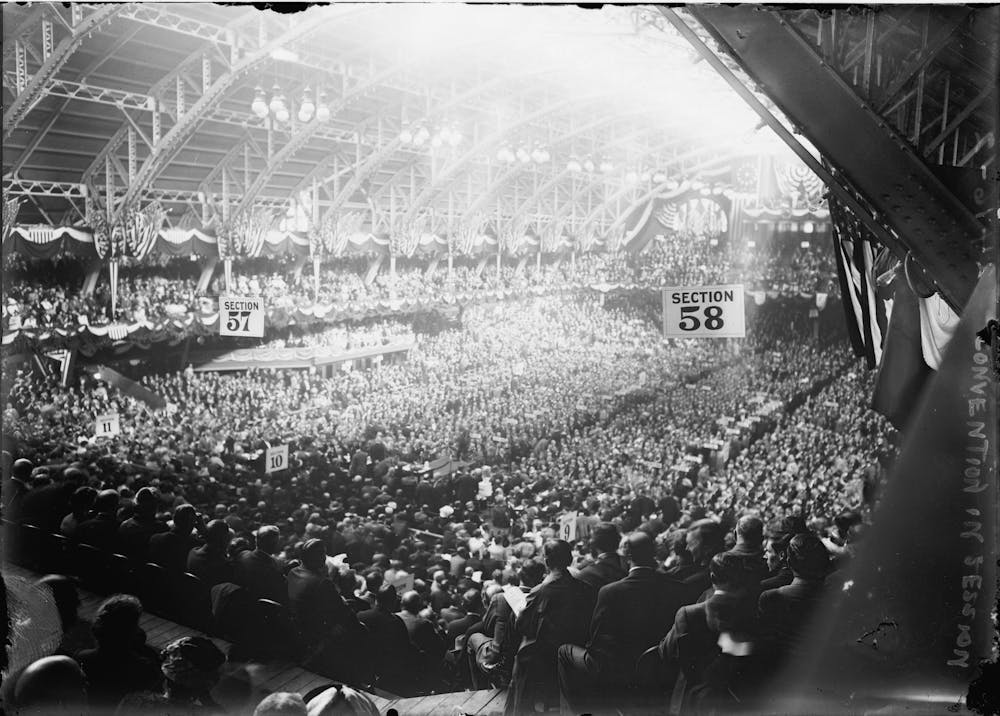
A black and white photo shows a large room filled with people, in a stadium like setting.

A view of the Republican National Convention in June 1912, when William Howard Taft was nominated to serve on the ticket.PhotoQuest/Getty Images

‘Dumber than a guinea pig’ in 1912

But there is another point in history that is similar to the Trump vs. Pence race that is about to get underway.

Vice President Theodore Roosevelt assumed the presidency after the death of President William McKinley in 1901. Roosevelt was reelected in 1904 and decided to leave office in 1909, rather than seek another term.

Roosevelt endorsed William Howard Taft, his secretary of war, for president. And Taft won the race easily.

But Roosevelt grew unhappy with the Taft administration, as he felt it was not upholding his beliefs that the president should do what is necessary for the good of the country, as long as it is not explicitly forbidden by law.

In one instance, the Taft administration filed a lawsuit against U.S. Steel Corporation for violating antitrust laws that prevent unlawful mergers or other business practices.

Roosevelt went into a fury. Other factors were at play, but he had personally approved the steel company’s trust and viewed Taft’s actions as a personal attack against himself and his administration’s legacy.

Roosevelt challenged Taft for the Republican nomination and ran against him in 1912. The former president dusted off his bully pulpit and used his rhetorical knives to their maximum advantage against Taft.

In the spring of 1912, Roosevelt referred to Taft as a “fathead,” “puzzlewit” and “dumber than a guinea pig.”

Taft then used the term puzzlewit in a humorous, self-deprecating way to draw attention to what he felt were failures of Roosevelt. This included Roosevelt’s opposition to treaties with Great Britain and France.

Taft also said in a 1912 campaign speech in Ohio that, “I hold that the man is a demagogue and a flatterer who comes out and tells the people that they know it all. I hate a flatterer. I like a man to tell the truth straight out, and I hate to see a man try to honeyfuggle the people by telling them something he doesn’t believe.”

The 1912 Chicago Republican Convention, where the two faced off, was one of the most raucous in history. Taft and Roosevelt supporters even got into into fistfights.

The Republican Party leadership ultimately backed Taft. And Roosevelt, in dramatic fashion, removed his supporters from the convention after a speech, in which he declared, “… we stand at Armageddon, and we battle for the Lord!

Then, Roosevelt formed the Progressive Party and split Republicans, paving the way for Democrat Woodrow Wilson’s presidential win.

No other time exactly like it

Pence’s decision to run against Trump has no direct equivalent in American history.

This election cycle will break new ground and help establish future expected norms – in part because Trump is the only candidate to have run while facing a criminal indictment and multiple other ongoing investigations of potential criminal activity.

However, if the past is a prologue, the Republican primary season will likely have more in common with the Roosevelt and Taft match-up than others, at least in terms of direct insults and attacks upon leadership style – things Trump is known for doing.

Shannon Bow O’Brien, Associate Professor of Instruction, The University of Texas at Austin

This article is republished from The Conversation under a Creative Commons license. Read the original article.

“I feel like politicians are born in fraternities”: “The Line” director on Greek life mindset

Toxic masculinity, fraternity culture and critical thinking are scrutinized in “The Line,” director/cowriter Ethan Berger’s impressive cautionary tale about and hazing. The film, which has its World Premiere June 9 at the Tribeca Film Festival, is a morality play involving Tom Backster (Alex Wolff), a fraternity brother in the fictional Sumpter College’s fictional Kappa Nu Alpha chapter. He appreciates the brotherhood and community his frat provides, as well as connections he has with his wealthy roommate Mitch (Bo Mitchell), and the house director, Todd (Lewis Pullman). 

However, Tom gets embroiled in a power struggle when freshman Gettys O’Brien (Austin Abrams) pledges KNA. Todd likes Gettsy, Mitch doesn’t, and Tom has to keep everyone, including the brash Gettys, in line. This is a tall order, and it becomes difficult to manage when things escalate during a retreat at Mitch’s family home. 

“The Line” shows how Tom grapples with his conflicting emotions and loyalties, as well as how Annabelle (Halle Bailey), a classmate Tom befriends, helps guide him as he faces a moral quandary. The film depicts the consequences of young men with more power and money than sense.

Berger spoke with Salon about making his feature directorial debut, “The Line.”

It’s an obvious question, but were you a fraternity brother? 

I wasn’t in a fraternity, but I lived next door to one. During their hell week, they had [the pledges] listen to that song, it’s “Blue,” by Eiffel 65, which we used in the film, for the whole week. In addition, a kid who was in a fraternity moved into my apartment, and we used his experience to come up with the screenplay. 

There are scenes that depict initiation rites and hazing rituals, but little of the activity is explicitly shown. How much could you expose regarding frat life and this subculture?

This stuff all happens, it just happens in basements. Fraternities are about secrecy and how keeping secrets makes you loyal. We wanted to make a movie that felt like an authentic representation of frat life to people who were in them, but also make a movie that appealed to people like me, who think they are a problem. 

Do you think people who are in frats will appreciate that “The Line” is authentic, even though the film doesn’t paint them in a good light?

I don’t think a lot of people are proud of their fraternity membership 10 years after the fact. I think people join fraternities because they want to fit in. They feel vulnerable. It’s the first time they are alone and without their parents. There are a bunch of kids who were in a fraternity at the University of South Carolina, and they play pledges in the movie. They knew I was making a movie critiquing fraternities, and they chose to be in it anyway. 

The film is reinforcing and critiquing the frat culture. How do you think that plays for people who participate in this culture?

Maybe the film will force them to ask themselves if it was worth it — whether this institution that they pledged allegiance to has an allegiance to them? I’m not looking to answer anything, just provoke questions. When we are shooting, the American Interfraternity Council wrote a letter to try to get us shut down. So, I think there probably are some people who are concerned about the film. Not every fraternity brother will like it, but that’s OK. 

Mitch craves respect, but he does not earn that respect from others. Todd represents leadership and authority. Tom is the good soldier. Gettys is the young upstart, and Annabelle is the moral center. How did you envision the conflicts each character would face? 

Todd represents the contradiction that exists between the way that fraternities present themselves and what is actually happening. People say that politicians are fake, and I feel like politicians are born in fraternities — this kind of “protect the house at all costs” mentality. Mitch is traumatized, and he uses that trauma to inflict trauma on others, which I feel is a staple of hazing culture. Tom has a million opportunities to leave or just not participate and he begrudgingly goes along with things. Annabelle has the strength to do what he doesn’t. She’s moral, even if she is cold. Gettys and Mitch are like two characters in a Western — the sheriff and bad guy. Both can pull the trigger. They resemble each other. Gettys is a complicated character who is kind of anti-authority, but he also wants to, as he says, “f**k chicks and be popular in college.” At one point, Tom vocalizes what the audience is asking, which is, “Why do you keep doing this?” He wants to fit in — even though he is complicated and terrible. 

The pervasive language, which consists of homophobia, racism, sexism and entitlement, is numbing. Can you discuss depicting these toxic male stereotypes and their interactions? It is hard to listen to, but that’s what makes it so effective.

I feel the same way. This movie makes me uncomfortable. But so would being in a fraternity house for the night. We tried to be very intentional about everything. I feel this is a world where calling someone “gay” is the greatest insult. That’s not a world I want to be in. I think there is this whole thing with fraternities, where they tend to be both homoerotic and homophobic. We wanted to be overt about the racism. Fraternities are mostly segregated with white people dressing rich. I feel this is the antithesis to “Animal House” — not to draw a comparison to that classic — but that glorifies fraternity life, and we are trying to expose another side. 

The film shows the perils of group think, and the consequences of speaking up. What observations do you have about the themes of peer pressure in the film, and the idea that characters must toe the line because of brotherhood and tradition? 

There is that expression in the movie, “You’ve never seen a fish on the wall with its mouth shut.” What happens when your morality is at stake? It pays to be silent and go along with the crowd, but sometimes there are bigger things to consider. The silence can lead to the cycle repeating.


Want a daily wrap-up of all the news and commentary Salon has to offer? Subscribe to our morning newsletter, Crash Course.


The relationship between Annabelle and Tom is interesting. She has boundaries and he is intimidated by her. She certainly helps him become a better person than any of his brothers, but their relationship is hardly a romantic one. Can you talk about that? 

She is upfront about it when they sleep together; she is not looking for anything serious. She is also the only one who asks him about his family. She brings up his dad, who had passed away. None of his brothers ask him about his family. I think from the beginning, she is questioning the teacher, and the social structure of the school. It is as if she’s there and doesn’t want to be there, but he wants to be a part of something. He romanticizes the whole thing.

“The Line” plays as dark comedy or satire, and has moments that are documentary-like, but it is also a cautionary tale. Can you talk about developing the experience for the viewer that immerses us in this world that gets worse as it goes along. 

We wanted it to be fun until it wasn’t. That’s what being in a fraternity seems like to me. The pledging process ends with hell week. It’s also a credit to Alex Wolff because he is able to get the audience to invest in a character that is participating in some unsavory things. 

“The Line” screens June 9, 10, and 18 at the Tribeca Film Festival.

Kakhovka dam breach raises risk for Zaporizhzhia nuclear plant

A blast on June 6, 2023, destroyed the Kakhovka dam on the Dnieper River in eastern Ukraine. The rupture lowered water levels in a reservoir upriver at the Zaporizhzhia Nuclear Power Plant in the city of Enerhodar. The reservoir supplies water necessary for cooling the plant’s shutdown reactors and spent fuel, which is uranium that has been largely but not completely depleted by the fission reaction that drives nuclear power plants.

The International Atomic Energy Agency, which has inspectors on-site to monitor effects of the war at the plant, issued a statement saying that there was no imminent danger. Nevertheless, the destruction of the dam increases the risk of a disaster at the plant, a risk already heightened by ongoing combat in the area.

The Conversation asked Najmedin Meshkati, a professor and nuclear safety expert at the University of Southern California, to explain what the dropping water level means for the safety of the nuclear power plant and the ongoing risks to the plant’s spent fuel.

Why are dropping water levels a threat to the power plant?

The immediate situation is becoming very precarious. The dam is downstream from the plant, meaning that the flooding will not jeopardize the plant. But the plant draws water from a major reservoir on the river for its cooling system. This reservoir is draining because the downstream dam has been damaged.

The plant doesn’t need the massive amount of water it otherwise would because its six reactors are in cold shutdown. But the plant still needs water for three purposes: to reduce the residual heat from the shutdown reactors, to cool the spent fuel, and to cool the emergency diesel generators if the plant loses off-site power.

The plant’s operators pumped water from the reservoir into a cooling pond, which is why the IAEA said the plant has enough water for several months. But that’s the last resort, which is why the agency also said that it’s vital that the cooling pond remains intact. If the plant loses the cooling pond, the only hope would be to try something like they did at the Fukushima nuclear power plant after the earthquake and tsunami in Japan in 2011. They brought in huge water pumps to pump saltwater from the Pacific Ocean into the reactors to cool them down. The plant operators may need to try to pump water from the Dnieper River.

The two lifelines of any nuclear plant, whether operational or closed down, are water and electricity. The newly launched Ukrainian counteroffensive puts these two lifelines in further jeopardy. Since the Russian occupation, the plant has suffered a lot and lost off-site power seven times. My immediate concern is that if the plant loses its last remaining power line, which powers the cooling pumps, then it needs to rely on emergency diesel generators. There are 20 generators with on-site storage of only 10 to 15 days of fuel supply. Getting fuel while the counteroffensive is going on is another major challenge.

What does it mean to have a nuclear reactor in cold shutdown?

The fission reaction that generates heat in a nuclear power plant is produced by positioning a number of uranium fuel rods in close proximity. Shutting down a nuclear reactor involves inserting control rods between the fuel rods to stop the fission reaction.

The reactor is then in cooldown mode as the temperature decreases. According to the U.S. Nuclear Regulatory Commission, once the temperature is below 200 degrees Fahrenheit (93 Celsius) and the reactor coolant system is at atmospheric pressure, the reactor is in cold shutdown.

When the reactor is operating, it requires cooling to absorb the heat and keep the fuel rods from melting together, which would set off a catastrophic chain reaction. When a reactor is in cold shutdown, it no longer needs the same level of circulation.


The Zaporizhzhia Nuclear Power Plant uses pressurized water reactors.

How does being in cold shutdown improve the plant’s safety?

The shutdown has removed a huge element of risk. The Zaporizhzhia Nuclear Power Plant is a pressurized water reactor. These reactors need constant cooling, and the cooling pumps are gigantic, powerful electricity-guzzling machines.

Cold shutdown is the state in which you do not need to constantly run the primary cooling pumps at the same level to circulate the cooling water in the primary cooling loop. Now, at least if the plant loses offsite power, the operators won’t have to worry about trying to cool an operating reactor with cranky diesel generators.

And by shutting down all the reactors, the plant operators have been relieved of a considerable amount of their workload monitoring the reactors amid the ongoing uncertainties around the site. This substantially reduced the potential for human error.

The operators’ jobs are likely to be much less demanding and stressful now than before. However, they still need to constantly monitor the status of the shutdown reactors and the spent fuel pools.

What are the risks from the spent fuel at the plant?

The plant still needs a reliable source of electricity to cool the six huge spent fuel pools that are inside the containment structures and to remove residual heat from the shutdown reactors. The cooling pumps for the spent fuel pools need much less electricity than the cooling pumps on the reactor’s primary and secondary loops, and the spent fuel cooling system could tolerate a brief electricity outage.

One more important factor is that the spent fuel storage racks in the spent fuel pools at the Zaporizhzhia Nuclear Power Plant were compacted to increase capacity, according to a 2017 Ukrainian government report to the IAEA. The greater number and more compacted the stored spent fuel rods, the more heat they generate and so more power is needed to cool them.

Four large concrete cylinders on a concrete slab


These massive concrete cylinders store spent nuclear fuel rods. The Zaporizhzhia Nuclear Power Plant stores much of its spent fuel outdoors in casks like these.
U.S. Nuclear Regulatory Commission

There is also a dry spent fuel storage facility at the plant. Dry spent fuel storage involves packing spent fuel rods into massive cylinders, or casks, which require no water or other coolants. The casks are designed to keep the fuel rods contained for at least 50 years. However, the casks are not under the containment structures at the plant, and though they were designed to withstand being crashed into by an airliner, it’s not clear whether artillery shelling and aerial bombardment, particularly repeated attacks, could crack open the casks and release radiation into the grounds of the plant.

The closest analogy to this scenario could be a terrorist attack that, according to a seminal study by the National Research Council, could breach a dry cask and potentially result in the release of radioactive material from the spent fuel. This could happen through the dispersion of fuel particles or fragments or the dispersion of radioactive aerosols. This would be similar to the detonation of a “dirty bomb,” which, depending on wind direction and dispersion radius, could result in radioactive contamination. This in turn could cause serious problems for access to and work in the plant.

Next steps from the IAEA and UN

Rafael Mariano Grossi, the head of the IAEA, briefed the U.N. Security Council on May 30, 2023, about the situation at the Zaporizhzhia plant. He called on Russia and Ukraine to ensure that the conflict does not put the plant at risk. Grossi has been to the Security Council several times. A week before the dam failed, he said it was the most important briefing that he had given to the council. To date, there has been no draft resolution from the Security Council.

This situation is rapidly evolving. And if something happens and there is a radiation release, it’s going to spread around the world.

This is an updated version of an article originally published on Sept. 13, 2022. The article has been updated to include news of the destruction of a dam downriver from the nuclear power plant and the IAEA’s report to the U.N. Security Council about reducing the risk that combat poses to the plant.

Najmedin Meshkati, Professor of Engineering and International Relations, University of Southern California

This article is republished from The Conversation under a Creative Commons license. Read the original article.

Flavanols are linked to better memory and heart health

There are plenty of good reasons to make sure you’re eating enough fruit and vegetables each day. Not only do fruit and vegetables contain many of the important vitamins and minerals our body needs to function at its best, they also keep our gut healthy and may even help maintain a healthy weight.

But some plant foods may be more beneficial for health than others, thanks to a group of compounds called flavanols.

For instance, a recent study I helped conduct showed that people who eat a diet high in flavanol-rich foods may have better memory compared to those who have a low intake. A previous study also found that people with a low intake of flavanols were at higher risk of heart disease. Overall, there’s convincing evidence that consuming enough flavanols has health benefits.

But while research shows that flavanols have many health benefits, it’s important for consumers to know that not all flavanol-rich foods contain the same amount of flavanols — meaning some may be more beneficial to health than others.


Plant compounds

Flavanols are a group of compounds that are found in many plants — including apples, berries, plums and even beverages such as tea.

There are two main groups of flavanols, with many different subgroups. Each plant will contain different combinations of flavanols, as well. These compounds each have different structures and different effects on the body. That means that not all flavanols are created equal.

For example, a portion of blueberries and a cup of tea may contain the same amount of total flavanols — but they are made up of completely different types of flavanols, which may have completely different health effects.

So in order to investigate the health effects of flavanols, it’s therefore important to use a source which includes a wide range of different types. This is why flavanols extracted from cocoa are an ideal model, as they contain the two main types of flavanols. It also allows researchers to calculate which other foods are likely to have benefits based on how similar the compounds they contain are to cocoa flavanols.

Since foods such as cocoa, berries and tea contain a combination of many types of flavanols, it’s currently not clear which individual compounds generate health benefits. But some research has linked the specific flavanol epicatechin with better vascular function. Cocoa and tea both contain epicatechin.


Many different types

Another thing to know is that even if a food contains flavanols, it may contain lower amounts compared to others.

To better understand how flavanol intake affects health, a few years ago we developed a test that uses urine to measure flavanol intake. The test is based on the way the human body processes flavanols and tells us whether someone has eaten large amounts, small amounts or no flavanols at all.

Using this test, we were able to show that people with high flavanol intake had lower blood pressure and better memory than those with lower intake.

When we developed the urine test, we also investigated how it is affected by different types of flavanols and foods. This allowed us to estimate what amount of different flavanol-rich foods a person needs to consume to achieve approximately 500mg of flavanols per day — similar to the amount used in studies, which has been shown to have clinical benefit.

            A table showing the number of servings of certain foods which are needed to get 500mg of flavanols a day.
Number of servings needed from different flavanol-containing foods to obtain 500 mg per day. Gunter Kuhnle, Author provided
           

According to our research, only two-and-a-half cups of green tea are needed daily to get the recommended 500mg of flavanols. Just under a cup of millet (sorghum grain) can also provide you with the recommended daily amount.

But if you were to try and get your flavanols from one type of fruit and vegetable, our research shows you’d need to consume large amounts of each to achieve the recommended amount. For example, you’d need to consume nearly 15 cups of raspberries alone to get 500mg of flavanols.

As such, the best way to get enough flavanols daily is by consuming a combination of different fruits and vegetables. For example two apples, a portion of pecan nuts and a large portion of strawberries can achieve the 500mg target — or a salad made with millet and fava beans.

It’s also important to note that while the flavanols used in many studies were extracted from cocoa, unfortunately chocolate (even dark chocolate) is a very poor source of flavanols — despite what some headlines might claim. This is because these flavanols are lost during processing.

Although there’s still much we don’t know about flavanols — such as why they have the effect they do on so many aspects of our health — it’s clear from the research we do have that they are very likely beneficial to both memory and heart health.

Gunter Kuhnle, Professor of Nutrition and Food Science, University of Reading

This article is republished from The Conversation under a Creative Commons license. Read the original article.

Gavin Newsom says Ron DeSantis might be charged with “kidnapping” for transporting migrants

California Gov. Gavin Newsom’s, D, public feud with Florida Gov. Ron DeSantis, R, took a new turn on Monday, following the transport from New Mexico to Sacramento of dozens of South American migrants seeking asylum in the U.S..

The flights were arranged by the same contractor that transported migrants from Texas to Martha’s Vineyard last year, The Los Angeles Times reported. That incident allegedly happened under the direction of DeSantis as part of a publicity stunt to demonstrate the Florida governor’s decidedly anti-immigration stance.

The California Department of Justice is investigating the matter, to determine who paid for the trips, and whether the migrants were misled into flying, as well as possibly what course of action might be taken following that inquiry. California Attorney General Rob Bonta, D, has said that he has evidence that the two flights — one transferring 16 migrants to Sacramento on Friday, the other sending 20 more migrants on Monday — were part of a “scheme” perpetrated by Florida officials, adding that it’s become “official policy of the state of Florida whereby the state of Florida used public tax dollars” to transport migrants to Democratic Party strongholds under false pretenses.

It’s unclear as of yet whether these migrants, who are from Venezuela and Colombia, were tricked into boarding the two planes or not. In the trips to Martha’s Vineyard, migrants were promised jobs and places to live, only to land and find out that those promises were made simply to convince them and their families into taking the trip.

In response to the migrants being transported to California’s capital city, Newsom insinuated that DeSantis played a hand in orchestrating the plot and had broken state kidnapping statutes.

Calling him a “small, pathetic man,” Newsom suggested he would take greater legal actions than Massachusetts did when migrants were transported there in 2022.

“This isn’t Martha’s Vineyard. Kidnapping charges?” Newsom tweeted.

Newsom shared in his tweet an image of a California statute outlining part of the state’s kidnapping laws. That portion reads:

Every person who, being out of this state, abducts or takes by force or fraud any person contrary to the law of the place where that act is committed, and brings, sends, or conveys that person within the limits of this state, and is afterwards found within the limits thereof, is guilty of kidnapping.

As of Tuesday morning, the normally outspoken DeSantis has not yet responded to the allegations that he was involved in this round of transporting migrants to other states. Bonta, in statements he made to local media in Sacramento, appeared convinced that DeSantis was involved, and blasted the Florida governor for his actions.

“This is Gov. DeSantis’ state of Florida, this is his cruel, inhumane political stunt. Manipulating human beings, people, for whatever cheap political points he wants to get in his run for presidency,” Bonta said, referencing DeSantis’s recent announcement as a Republican candidate for president in the 2024 election.

California officials aren’t the only ones warning DeSantis and others that they may have broken the law. After months of investigating the Martha’s Vineyard migrant trips, Bexar County Sheriff Javier Salazar, whose jurisdiction is near San Antonio, Texas, has recommended to the local district attorney’s office that criminal charges be filed relating to that action. Salazar’s office has not yet stated who is the subject of the investigation, but charges would involve both felony and misdemeanor levels of unlawful restraint, The Washington Post reported.

Experts: Newly revealed Florida grand jury may target associates who “followed Trump’s instructions”

A Florida grand jury has heard testimony from a handful of witnesses since last month as part of the federal probe into former President Donald Trump’s mishandling of classified documents after leaving office, The New York Times reported

The rationale behind the special counsel’s shift to using a grand jury in southern Florida remains unclear since a jury based in Washington has listened to witness testimony for the last few months. 

“It is unclear why prosecutors might be presenting evidence before a grand jury in Florida,” former U.S. Attorney Barb McQuade, a University of Michigan law professor, told Salon. “I can think of two possible reasons. One reason would be that they have decided that venue is most appropriate in Florida, and plan to file charges there. The other reason is that they are investigating a one-off charge in Florida against an individual defendant or two.”

For example, if a Trump staffer lied to FBI agents in Florida, then Florida would be the appropriate venue for that narrow charge, she explained.

More than 20 members of Trump’s Secret Service security team have either testified or been summoned by the Washington grand jury in recent months, people familiar with the investigation told the Times. 

A search warrant for Trump’s Mar-a-Lago resort was approved by a court in South Florida at the beginning of the investigation. Since then, the Washington grand jury has been gathering evidence, but hasn’t met since early May, according to CNN.

“If public reporting is true and the Washington grand jury has stopped hearing evidence, it is possible that the investigation before that grand jury is complete, and a final charging decision is ready to be made,” Temidayo Aganga-Williams, partner at Selendy Gay Elsberg and former senior investigative counsel for the House Jan. 6 committee, told Salon. 

It is also possible that the special counsel started the investigation in Washington but, after conducting an extensive investigation, decided Florida is the more appropriate venue for all the charges, he added. 

Recent reporting indicates that Smith’s investigation into Trump’s mishandling of classified materials and efforts to obstruct their return appears to be nearing its final stages.

MSNBC legal analyst Chuck Rosenberg suspected that there may be a “parallel investigation” to the Washington case in Miami, potentially involving an associate of the former president.

“If somebody had committed acts only in Florida, even if it’s connected to a broader scheme, the venue for that person, maybe somebody who followed Mr. Trump’s instructions to obstruct justice or to conceal evidence would be properly charged and tried in that jurisdiction,” Rosenberg told “Morning Joe.” “Then you would be appropriate in Florida, so absolutely a possibility, remains to be seen.”

He added while it remains unclear which case is moving quicker, “when defense attorneys request a meeting at the department to make a pitch that their client ought not to be charged, you know you’re closer to the end than the beginning.”


Want a daily wrap-up of all the news and commentary Salon has to offer? Subscribe to our morning newsletter, Crash Course.


Trump was still residing at Mar-a-Lago when he and his lawyers first began negotiating the return of government records to the National Archives in late 2021, the Times reported. It was also where the Archives discovered the first batch of classified documents, which the former president sent up to Washington from Florida.

Last August, the FBI obtained a search warrant after suspicions arose that not all classified documents had been turned over despite the former president being issued a subpoena. The FBI eventually carried out a search of Mar-a-Lago last August and found over 100 documents with classified markings at Trump’s Mar-a-Lago residence.

“The answer must be speculative at this point, but one possibility is that obstruction charges lie better in Florida, where Mar-a-Lago is located, than in Washington DC, where the original grand jury is located,” former federal prosecutor Kevin O’Brien told Salon. “The original grand jury apparently has not sat since mid-May.”

Since the acts of obstruction that were recently uncovered all took place at Trump’s residence, according to news reports, the more appropriate venue is in Florida, O’Brien added. 

But a Florida case may be the more challenging one for the DOJ to prosecute against Trump if the case went to trial since a South Florida jury may prove to be more sympathetic, Aganga-Williams pointed out.  

“By design, juries are intended to be representations of the communities they are drawn from,” Aganga-Williams said. “South Florida has a different political climate than Washington, D.C. and a jury would likely reflect that. Similarly, President Trump may find favor with federal judges in southern Florida that he may not find with those in Washington, D.C.”

“High Desert” star Patricia Arquette on fighting for equality: “We need to claw back some territory”

It’s hard to imagine Patricia Arquette’s career as anything short of inevitable. The veteran actor grew up in an acting dynasty that stretches back to the vaudeville era, with her siblings David, Alexis and Rosanna Arquette paving their own Hollywood trajectories alongside her. But Arquette wasn’t sure performing was the right path for her. “I felt like maybe I’d be too shy for it or I wouldn’t be good at it,” she told me on “Salon Talks.” “Just because you want to do something doesn’t mean you’re going to be good at it necessarily.”

Now, however, after decades of creating indelible roles in movies like “True Romance” and “Boyhood” and series like “Medium” and “Severance,” the Academy Award- and Emmy Award-winning Arquette is satisfied with how it all worked out. “I decided I would give myself a year to try acting,” she said, “and then, lo and behold, I got work.” And that latest work is as one of her most colorful characters yet, the wisecracking recovering addict and neophyte private detective Peggy Newman on the new Apple TV+ series “High Desert.” 

Costarring with scene stealers like Matt Dillon, Brad Garrett, Weruche Opia and Broadway legend Bernadette Peters, Arquette walks — and sometimes swings and flies — along the delicate line required to play a comically disastrous character with a grounded sincerity and vulnerability. To capture Peggy’s complexity, Arquette said she drew on her own “love for the drug addicts and junkies I knew who passed away.” She recalled, “They were crazy-making. They made life a nightmare. They would steal your guitar when you turned your back. But they also were brilliant and smart and funny and sweet and did love you the best that they could.”

During our conversation, the always outspoken Arquette opened up about her enduring collaboration with Ben Stiller, about abortion care and LGBTQ rights, her upcoming directorial debut “Gonzo Girl,” and why she says that although the climate is “crazy and it’s heartbreaking,” she still finds beauty and strength in solidarity. “A large portion of the American population are more open, are more understanding, are more embracing. Honestly,” she says, “there’s millions more of us.” Watch Patricia Arquette on “Salon Talks” here or read our conversation below.

The interview has been lightly edited for clarity and length.

Tell me about your “High Desert” character Peggy. 

Our director, Jay Roach, described her as a rock and roll hummingbird. The way that she was written, she’s constantly pivoting and moving. She’s kind of a hustler in her mind, a little bit of a manipulator. She also is very loving and maternal and collects all these kind of broken people with their broken stories and tries to fix their lives.

At the same time, she’s on a hustle and trying to get her needs met. She’s an addict but she’s also co-dependent. She’s got this interesting mixture, but she’s basically a whirling dervish of a human being. Part of her rapid pace is, I think, her avoidance of the pain that she’s really in.

It’s a classic TV show in many ways. It harkens back to shows from the ’70s, where there’s this messy, flawed, private investigator, except it’s so beautifully written, so unusual, so of a particular time, and it has a woman.

We wanted it to be messy. We wanted it to be jagged. We didn’t want it to be all tied up and perfect all the time. It is a farce and it is absurd. It is all these crazy characters. We grew up in a time where there was a TV show about a man and his monkey best friend. We had “The Dukes of Hazzard” and craziness. 

“I had a sense of myself, but I was also very nebulous still of who I really was and my own self-esteem. I decided I would give myself a year to try acting.”

These writers were so open. I’d call them and say, “I just saw this movie, “The Velvet Vampire,” and she’s driving around in a dune buggy. Remember dune buggies? Hey, let’s have Peggy drive a dune buggy.” “Great.” It was exciting that everyone would bring all these great ideas. There is a love letter to the ’80s and ’90s, and that kind of energy and those kind of people that live on the fringe of society, that find themselves gravitating to the desert, because they don’t quite fit in.

This was a very physical show. You are literally swinging from the rafters. You are crashing a car. You are doing really intense work. How do you prepare for that?

The first scene we ever shot was swinging from the rafters. Somehow, a week before we start shooting, I threw my back out. I don’t really do that, but it was so bad. I’m like, “I don’t know how I’m going to do this.” The dune buggy doesn’t have a door. You have to climb over it. Everything is crazy. I’m going to hang from a rafter. I was like, “Well, it’s like our first day of shooting. They’re going to put me in this harness. I’m either going to really be messed up or it’s going to fix my back.” And it fixed my back. I was hanging in it for hours, and I got out, and I was like, “My back is fixed.”

So a little DIY alignment. Is that the secret?

I knew the fates had aligned and God was on our side, and there was a little sun shining on us.

The writing is incredible. This show is created by these amazing female writers (Nancy Fichman, Katie Ford and Jennifer Hoppe-House) who, now, as you said in an interview for Sky, don’t get to celebrate this now.

It’s awful.

What is the impact of this strike for you as an actor, as a producer, and as someone who very famously has called out about wage equality in your industry, especially for women? (Salon’s unionized employees are represented by the WGA East).

These three women have been toiling over this project for at least seven years. We met probably six years ago about this project, and they’ve been tweaking it, changing it ever since. They write really fast. They’re incredible together. They each bring a different strength. They have such an original voice together. It really made me laugh out loud when I was reading the scripts. It’s a different kind of humor. It’s not cleaned up around the edges. There’s something about Peggy and the way she sees the world and the voice that she has that they’ve written, that is refreshing to me, is provocative. I really wish they could totally embrace this moment. I know what they’re fighting for and I support their fight for that, but I celebrate that. This work couldn’t exist without them at all.

This is also another collaboration, going back 27 years, with Ben Stiller for you. You started with “Flirting with Disaster.” In the last couple of years, you worked on “Escape at Dannemora” and “Severance.” Now this. What is it about this really special, unique bond that the two of you seem to have? 

It is really special. I feel very grateful for it. I loved working opposite Ben as an actor and then in “Escape at Dannemora” and “Severance” as a director-actor relationship, and then, on this, as a producer. I think we both have discriminating taste, and we both usually agree with each other’s taste or turn each other on to new things, so there’s that shorthand and honesty. We both know, or we trust, that each other will work very hard and be pretty relentless in giving everything to the projects we work on.

You’ve been acting most of your life now. You come from an acting dynasty. It’s in your blood, your grandfather, your father, your siblings . . .

My great-grandparents.

Yet you weren’t entirely sure you wanted to go into this profession.

I felt like maybe I’d be too shy for it or I wouldn’t be good at it. Just because you want to do something doesn’t mean you’re going to be good at it necessarily. Having watched my dad really struggle to support us five kids and two adults on a working actor’s salary, I knew that it was really a long shot. My sister, Rosanna, had been working a lot and doing incredible movies, like “Baby It’s You” with John Sayles. She was having a lot of success as a wonderful actor. I felt also like, “Will I be in her shadow?” 

I had a sense of myself, but I was also very nebulous still of who I really was and my own self-esteem. I decided I would give myself a year to try acting, and then, lo and behold, I got work. Then, I got another little job and another one. And each one, I would learn a different skill.

The next thing you know you’ve got a 30-year career behind you and so much more in front of you, right?

My B plan was, I was going to go and be a midwife if it didn’t work out. I gave myself a year to see. I didn’t want to be doing it for 20 years. People say, “Never give up on your dream,” and that’s a beautiful thing to say, but I also felt like I probably would’ve given up on that dream if it didn’t happen in a year. I would have gone on to another dream.

You are so vocal and outspoken about reproductive rights. You’ve been talking about it especially since the 2016 election. Looking at where we are now, post-Dobbs, what concerns you, as a woman, as a parent, as an activist, as a person in America? 

“I was scared when my son was coming to be 18 that we were going to go to war. I’m terrified having a 20-year-old daughter in America with her right to her own body.”

When I was 15, one of my first jobs was working at Planned Parenthood. I’d go around to schools and talk about different birth control methods to other kids, including abstinence. You’d ask them, “What are different birth control methods?” They’d never say abstinence. I’d always say, “You forgot a very important one: abstinence.” I learned that from my training at Planned Parenthood. I would sometimes be in the room with doctors and assist the nurse practitioner. So much healthcare happens at Planned Parenthood, and they started rolling back funding for them. 

I knew in the 2016 election that we were looking at women’s rights, that it was on the line, that we were going to lose the Supreme Court, that it was no joke. It’s happening in America. It’s illegal for women in certain places to have abortions, before they even know they’re pregnant normally. Many women don’t know at six weeks they’re even pregnant, so they don’t even know that there’s that option. Obviously, there’s a big difference between women who have money and the healthcare that they can have and leave the state, to those who have no money, have no options, maybe with an abusive partner, and the state’s against them. 

Now we have women who are walking around with non-viable fetuses, threatening their bodies with sepsis, and they’re wandering around and the state is forcing them to do this. I’m horrified at what’s happening. People are disgusted. Everywhere I travel in the world, people are like, “What’s happening in America?” There’s no goodwill. There’s no faith. There’s no understanding. There’s no holding other people’s pain and their life experience and the painful choice they’re making and trusting them in that choice. This whole narrative about these late term abortions, they don’t exist. It’s not true. People don’t carry a fetus for that long and then, just decide they’re going to have an abortion. Doctors won’t do that. The whole thing’s a non-argument. It’s just a giant lie. 

The fact that we don’t have the Equal Rights Amendment, we aren’t explicitly in our own constitution, the founding document of our own country, has really impacted us. It terrifies me, honestly. I was scared when my son was coming to be 18 that we were going to go to war and my son was going to be sent to war. I’m terrified having a 20-year-old daughter in America with her right to her own body.

When we look at these issues and we look about the oppression and the attack on rights, it all also comes down so much to gender and gender expression. You have lost a sibling [Alexis Arquette], who you celebrate often on your Instagram and your social media. The fight against trans people, against gender expression of all forms, it’s all tied in the same thing. When you see bans on just drag performances, on nonconforming attire, what are you thinking? 

“I’m horrified at what’s happening.”

They’re also trying to take away an adult’s right to any kind of healthcare, a trans person, gender reaffirming care, in certain places. Children can’t even mention it. If they think that they’re trans, they’re not even allowed to talk to anyone about it, let alone a doctor, let alone their schoolmates, or a support system or a teacher or anyone. Again, we’re going back to this lack of humanity, this lack of goodwill. This is what kills marriages. You’re going to get a divorce if you have a lack of goodwill for each other. We, as a country, have a lack of goodwill for each other. 

Trans people are not the enemy. The problems in your life, if you really sit down and look at them, have nothing to do with trans people and what they’re doing to their own bodies, nothing to do with trans people existing in film, LGBT people, characters in movies. They’ve given you another scary “other.” They keep pointing the finger of what you’re supposed to be afraid of, and that’s your new enemy, and people keep falling for it. It’s crazy and it’s heartbreaking. 

The beautiful thing about it, because I do want to find a beautiful thing about it, is we know a lot more. A large portion of the American population are more open, are more understanding, are more embracing. And honestly, there’s millions more of us. What we have to do is make sure that, no matter what, we get elected leaders in positions that are loving, are understanding, that do protect personal freedoms in the United States of America, which was supposed to be this country of freedom. It’s interesting that that’s reversed itself, this idea of freedom.

Unless we have political leaders, and they may not be the perfect leader, and they may not check all of our boxes, but if they’re going to move us towards progress and appoint better judges, enact better laws, we need to move back towards that. We need to claw back some territory now because we really lost a lot in 2016.

And we can’t take that for granted, which also means voting and fighting for our voting rights as well.

I have gotten in arguments, heated conversations, with people I love. In 2016, I begged people, “For your granddaughter, for my daughter, go vote. Go vote. Promise me you’re going to go vote. Promise me you care about that. If for nothing else, you may not love [Hilary Clinton], but you have to vote for her, because otherwise, you’re giving a vote to Trump basically.”

You’re also going to be a director now. You just directed your first film, “Gonzo Girl.” 

“The problems in your life, if you really sit down and look at them, they have nothing to do with trans people and what they’re doing to their own bodies.”

It was a very humbling experience, getting on that other side of the camera, just even after all these decades in film, realizing how much I don’t know. And the things that I thought would come so easily, like talking with actors, talking about acting, weren’t necessarily the easiest things either. 

It’s called “Gonzo Girl,” and my lead actors are Camila Morrone and Willem Dafoe, Elizabeth Lail, Leila George, Ray Nicholson, Zoe Bleu, and they all do such beautiful work. It was so exciting. The material’s based on this book called “Gonzo Girl,” which is a fictitious account of her experience working as Hunter S. Thompson‘s assistant for several months. I took it, and then, we changed it again for film.

Just dealing with some themes that I thought were really interesting, what it was like to be a young woman in the ’90s. What was this unspoken commodity of beauty through the eyes of these male celebrities? What was it like to be in their orbit? What is it like when you’re getting older and you’re trapped in part of your success and you’re getting love and acknowledgment and money, but you’re also trapped by it and you resent it and you want to move on, but no one will artistically really let you move on?

There were a lot of different themes going on in competition between women and things that I thought were really interesting. It was nice to explore those without explicitly saying them. They didn’t do this in the ’70s and now, the whole movie has to be about this one topic and we have to talk about this topic and meet it head on. We were moving through life. We weren’t stopping and really examining these things. I think it’s an interesting movie, because post-#MeToo, you look back like, “Oh wow, we have changed a lot in incremental ways.”

What you said about being a young woman being seen through that male gaze, you lived that firsthand as a beautiful blonde woman in the ’90s.

Being in this business, yeah. And what is it like, with that male celebrity person who is like a sun and the world that gravitates around them and the whole ecosystem survives off them? What does that look like? What’s that pressure on him? Willem gives an incredible performance.

I can’t wait, but in the meantime, I get to enjoy “High Desert.” This show is so fun and unique. Thank you so much for joining me today. What an absolute pleasure.

Thank you so much for having me. That is the biggest compliment to acknowledge its originality because I think these writers had such an original voice. Each of these actors brought something, and there was so much love in this project, my love for the drug addicts and junkies I knew who passed away, and their beautiful qualities. They were crazy-making. They made life a nightmare. There was all kinds of dysfunction. They would steal your guitar when you turned your back, but they also were brilliant and smart and funny and sweet and did love you the best that they could. So this project means so much to me, and I’m so grateful that you have had me here.

“High Desert” is streaming on Apple TV+.


Video shows Florida Republicans beg migrants not to leave state over DeSantis’ anti-immigrant law

Republican lawmakers in Florida concerned about the state’s new anti-immigration law and its possible economic consequences begged Latinos to not leave the state in clips from a Monday morning meeting.

The footage, which provides evidence of the law’s “downstream impacts on the state economy” according to MSNBC, shows two conservative Florida legislators attempting to minimize the harm that the law, Senate Bill 1718, could cause, with one asking attendees to advise Latinos against leaving Florida.

“This bill is 100% supposed to scare you,” Republican state Rep. Rick Roth said in a clip shared on Twitter by Democratic activist Tom Kennedy. “I’m a farmer, and the farmers are mad as hell. We are losing employees. They’re already starting to move to Georgia and other states. It’s urgent that you talk to all your people and convince them that you have resources — state representatives and other people — that can explain the bill to you.”

The new law, set to go into effect July 1, cracks down on immigration by barring local governments from issuing IDs to those who can’t prove citizenship, strengthening the use of employment verification database E-Verify, and preventing undocumented law school graduates from entering the Florida bar among several other provisions. The legislation has been condemned by religious groups, activists and Mexican President Andrés Manuel López Obrador.

Seemingly out of nowhere, Roth then begins to express his admiration for former President Donald Trump and Florida Gov. Ron DeSantis.

“We had the best president in my life — in the last 30 years — and I’m still supporting Donald Trump. I love my governor. He’s the greatest governor in,” he’s heard saying before the clip ends. 

In a different clip, Roth continues to downplay the law, arguing that its “more of a political bill than it is policy” before adding that it gives state police more power to enforce immigration matters, while another shows Republican state Rep. Alina Garcia echoing Roth’s statements that the bill is meant to scare residents.

Garcia then falsely argues that the legislation “really doesn’t have any teeth,” drawing on her own experience having migrated to the country from Cuba when she was two to make her case that “we need to have legal immigration.”


Want a daily wrap-up of all the news and commentary Salon has to offer? Subscribe to our morning newsletter, Crash Course.


Jeremy Redfern, a spokesperson for DeSantis, responded to Garcia’s claims and the lawmakers’ minimization of the law in a statement to Insider Tuesday.

“The Florida Legislature does not pass, nor does the governor sign, simple press releases meant to posture. We are grateful that the legislature got this bill to the governor’s desk for his signature,” he said.

“This bill has teeth, and businesses that knowingly hire illegal aliens over Floridians are putting their licenses in jeopardy,” he added. “We encourage business owners not to roll the dice and test the governor’s commitment to uphold the law.”

Andres Malave, a spokesperson for Republican Florida state House Speaker Paul Renner, called the bill a response to  “the failures of the Federal Government to protect our citizens” and criticized liberal activists’ opposition to the bill.

“Even more appalling is the concerted effort by liberal activists to gaslight the immigrant community by feeding them a heavy dose of lies by misrepresenting what is actually in the bill,” Malave said.

Roth doubled down on his Monday statements in an interview with Insider, explaining that he fears the “major problem” it could cause as migrants leave the state

“The negatives is there are families leaving Florida right now where some of them work, some of the family members are legal, and some of them are not,” he said. “But they’re all deciding that they’re not going to split up and live in two different states. So it’s going to be a major problem for the agriculture, construction, and tourism, which just about happens to be most jobs in Florida.”

He also said that the bill had come directly from DeSantis as a “take it or leave it” piece of legislation with lawmakers advised against making any changes to it.

Despite his Monday remarks, however, Roth said that he still supports the law, which he’d backed earlier this year.

“I don’t want people coming to my communities that are not going to be able to get a job and are going to be putting pressure on housing and all kinds of other services when they’re not going to be able to get a job,” he added. “So the bill has a good purpose, which is, ‘Stay away from Florida.'”

Escalating U.S.-Mexico debate over corn forces questions about GMOs, food sovereignty

In late 2020, the Mexican government announced its intention to ban the import of genetically modified (GM) corn. Citing concerns about health, environmental impact and the cultural importance of corn in Mexico, where the crop originated, the announcement sparked an ongoing trade dispute with the U.S. that has raised questions about food sovereignty, free trade agreements and the role of genetically modified organisms (GMOs) in the food system.

Under intense pressure from Washington to repeal the measure, the Mexican government partially rolled back the ban in February 2023 to include only white corn, which is intended for direct human consumption, leaving yellow corn imports (almost entirely used for animal feed and industry) in place. But after that concession, Mexican President Andrés Manuel López Obrador vowed to not back down any further. After an initial round of talks ended in early April without an agreement, the U.S. has formally requested consultations under the United States-Mexico-Canada Agreement (USMCA), the free trade agreement that replaced the North American Free Trade Agreement (NAFTA) in 2020.

If those negotiations fail, a USMCA panel would determine whether the ban is justifiable in a resolution process that some anticipate could take all year. But such a decision would be confined to a discussion of scientific evidence about whether GM corn is harmful to human health. This is the ideal arena for U.S. agribusinesses, who have worked hard to promote the idea that any criticism of GMOs is irrational and anti-science, a position the Biden administration repeated in its own statements on the issue. In a debate confined to that front, Mexico is unlikely to win: With the majority of industry research dollars spent on new products rather than health and safety evaluations, the balance of existing evidence doesn’t show direct harm from consuming transgenic material. This will hamper Mexico’s health agency, Cofepris, from gathering the definitive evidence of harm that the panel is demanding.

Flattening the trade debate into one that’s solely focused on the potential adverse health and safety of GM corn not only portends a loss for Mexico, but also excludes some of the real concerns that linger about GM crops regardless of whether consuming transgenic material is harmful. There are more pressing and scientifically validated worries about how GM crops have been deployed by agribusinesses, especially when it comes to excessive chemical use and biodiversity. And beyond the scientific sphere, the trade dispute raises tough questions about cultural identity, food sovereignty and the U.S.’s imperialistic relationship with Mexico — components that are unlikely to be reflected in a USMCA case.

A Tool in Irresponsible Hands

Today, most processed foods in the U.S. contain at least one genetically modified ingredient; most consumers are either unaware of this or not especially upset about it. That’s a big shift from the early days of GMOs in the 1990s, when new products like the Flavr Savr tomato bombed after being labeled “frankenfoods.” But as genetic modification quietly became commonplace for corn, canola, soy and other ingredients that people usually don’t see or think about, the resultant apathy (or ignorance) laid the groundwork for agribusiness to brand any opposition to GMOs as unscientific — instead casting them as a necessary tool to feed a growing world. This is an easy enough thing to believe: Science writers often report on early-stage research promising to make plants use less waterphotosynthesize more efficiently or even solve nutrient deficiencies. How could anyone be against that?

What’s missing from this take is a critical eye toward what happens next: which GM crops get distributed and how they function as critical pieces of an industrial food system rather than offering an alternative to it. Much GMO skepticism is grounded in this justified mistrust of agribusiness.

To date, the most widely used genetic modification in corn is resistance to the herbicide glyphosate, a trait that makes it easier for farmers to spray an entire field without losing their crop. Conveniently, the same agrochemical companies behind the GM seeds supply those herbicides, making the package deal quite profitable for them — and ultimately propelling glyphosate from niche use to the most widely used herbicide in the world today.

Initially, glyphosate resistance was marketed as an environmental win, allowing farmers to phase out more dangerous herbicides. But with so much glyphosate being sprayed, unwanted plants developed their own resistance to it much quicker than expected, bringing many of the old herbicides back into popularity as farmers wage war against ever-stronger superweeds. Another popular modification — using bacterial DNA to give plants the ability to make their own insecticides — has fared slightly better, but insects, too, are evolving resistance to those toxins. Meanwhile, glyphosate has lost its reputation as mostly harmless: Chemical giant Bayer has paid billions to settle cancer lawsuits from people who handled Roundup and a mounting body of evidence shows that the compound is harmful to non-target insects and soil microorganisms.

The troubling relationship between GMOs and agrochemicals is a worldwide issue, but in Mexico, preserving biodiversity makes an even more compelling case. As the birthplace of corn, Mexico is home to more varieties than anywhere else on earth — and if farmers don’t grow them, they’re at risk of being lost forever. Even amid mounting pressure from their own government to adopt modern hybrid varieties under the banner of economic development, Mexican farmers have safeguarded native corn biodiversity by keeping thousands of traditional landraces under cultivation. In a future where shifting climate patterns and other uncertainties make agriculture less predictable, that diversity will be a boon for breeders.

No story proves this better than the buzz over a recently cataloged Oaxacan corn landrace: Its mucus-coated roots host communities of nitrogen-providing bacteria, a trait that could eliminate the need for resource-intensive nitrogen fertilizers. Geneticists have worked for years to develop similar traits in the lab, but it was smallholder farmers who had cultivated and preserved that corn for centuries. Ironically, if not for the farmers’ tenacity, the pressure to adopt homogenous GM varieties could have wiped it out entirely.

What About Food Sovereignty?

The U.S. position on the trade dispute would suggest that — despite the 9,000-year history of corn in Mexico and its centrality to Mexican culture — any panic about GMO corn is the result of recent unscientific fearmongering. But beyond valid environmental and economic concerns, the factor of cultural significance raises an important question: Is science all that matters?

For the Indigenous people whose ancestors bred maize from the nearly unrecognizable teosinte, corn is much more than masa or animal feed, even retaining a religious importance for many farmers in Mexico. This attachment perseveres in spite of the deluge of cheap U.S. corn that’s dominated the market since the implementation of NAFTA in 1994. In the decades since, corn imports from the U.S. have more than quadrupled — and while many smallholder farmers did leave farming as demand for domestic corn contracted, others have been reluctant to leave their land. Limiting U.S. corn imports might be their only path to survival and the only way to ensure the continuity of this significant part of Mexico’s cultural heritage.

Constraining the USMCA negotiation to health and nutrition is a domineering and unfair move because it flies in the face of food sovereignty. Countries, communities and individuals have a right to choose what they want to eat. Science is just one of a host of influences that might factor into that decision, from personal taste to strongly held ideas about what kind of food system we want to support.

The U.S. does uphold the importance of food sovereignty, at least when it comes to ourselves, as we can see from one parallel (albeit less spiritually significant) issue: our attachment to cheap meat. Scientifically, it’s undeniable that the factory farm system is bad for us and for the environment. But when climate scientists, nutrition experts or policymakers suggest changing anything, pundits accuse the government of “wanting to take our hamburgers.” Alternative proteins, especially insects, inspire cries of “You can’t make me eat that.” Even among those who advocate a transition towards plant-based diets, the idea that we should ban animal agriculture outright isn’t particularly popular. Regardless of what science has to say, all sides of the debate seem to understand that we can’t tell people what to eat — an intensely held belief that has become a new flashpoint in the culture wars. With this and other contradictory food policies and guidelines in mind, it’s ironic that the U.S. is now attempting to position itself as the arbiter of rational food choices.

The Real Debate: The Future of U.S. Agribusiness Dominance

So what’s the real motivation here? On the surface, the dispute seems to be about business. Most parties critical of the ban have run with that angle, as with the headline of a recent article from the Genetic Literacy Project: “Mexico’s proposed GMO corn ban could damage the US economy,” a departure from the organization’s typically sanguine, humanitarian-focused brand of GMO evangelism.

Mexico is the second-largest market for U.S. corn after China, buying nearly $5 billion of corn annually, which would have made the initial ban a very big deal. Critically, though, 95 percent of that imported corn is yellow and thus not subject to the modified version issued earlier this year. If implemented, its actual effect on U.S. farmers would be minimal.

$5 billion: The amount of U.S. corn bought by Mexico annually

This means the debate is largely symbolic and much more about the relationship between the U.S. and Mexico than the particulars of GM corn. As an Ohio State analysis posits, the real problem here is that the ban would introduce destabilizing uncertainty about the future of trade between Mexico and the U.S.. In other words, an economically insignificant concession to food sovereignty would threaten the U.S.-first order laid out under NAFTA and, later, USMCA, a more existential threat to U.S. agribusiness than a few missed shipments of white corn.

This trade dispute can be situated in a long history of economic policy that puts U.S. business profits over the needs of Mexican citizens. It’s an imperialist stance that has made it easy for U.S. officials, then and now, to dismiss Mexico’s concerns as quaint or irrational, even when the fears are more concrete. When Mexican farmers protested the implementation of NAFTA in the 1990s, they argued that cheap U.S. agricultural imports would flood the market and destroy traditions and livelihoods. And for many it did exactly that, with close to a million former farmers moving to cities or seeking work north of the border after the agreement was ratified.

This dispossession is one the Mexican government has sometimes been a partner in, with periods of unrestricted corn trade that weakened demand for domestically produced Mexican corn even further. But as Mexico now moves towards nationalizing other key industries like oil and electricity, it has an opportunity to minimize the influence of U.S. agribusiness on its economy. While this recent attempt to restrict corn imports would likely be found at odds with the terms of USMCA, it signals an important shift towards prioritizing food sovereignty in a trade environment that so often leaves small farmers and poorer countries, at a disadvantage.

For a unique weeknight meal option, try this special chitarra pasta dish — with or without meat

This isn’t a traditional Italian dish, but when your favorite TV program is The Sopranos then you’re always going to want to cook and eat Italian-American style, just like Tony did. I love food that can be shared by simply placing the cooking pot in the center of the dinner table – easy-going, generous, convivial food. The fresh green peppercorns are optional, but I urge you to buy a jar as they make the meatballs extra addictive.

Buy the book here!


Want more great food writing and recipes? Subscribe to Salon Food’s newsletter, The Bite.


Pasta Masterclass by Mateo ZielonkaPasta Masterclass by Mateo Zielonka (Photo courtesy of Dave Brown)

Chitarra with slow cooked tomato sauce and meatballs
Yields
04 servings
Prep Time
 20 minutes
Cook Time
1 hour

Ingredients

400g/14oz chitarra (page 100) [in the book]

For the tomato sauce:

60ml/4 tbsp olive oil

3 garlic cloves, finely chopped

2 x 400g/14oz cans of plum or chopped tomatoes

For the meatballs:

400g/14oz minced (ground) pork

400g/14oz minced (ground) beef

100g/3½oz stale bread, toasted (or use the pangrattato on page 248 [in the book], or Japanese panko breadcrumbs)

3 garlic cloves, peeled

2 medium shallots, peeled and roughly chopped

roughly chopped bunch of parsley

30g/1oz fresh green peppercorns in brine (optional)

1 egg

50g/2oz Parmesan, grated, plus extra to serve

1 tsp table salt

Vegetarian option:

Use the meatless meatballs on page 247


Directions

  1. For the tomato sauce, heat the olive oil in a large saucepan, add the garlic and fry for a minute until fragrant. Add the tomatoes, then cook on a low heat for 35–40 minutes, stirring occasionally. Set aside.

  2. Meanwhile, place the toasted stale bread in the bowl of a food processor and whizz to fine breadcrumbs (don’t worry about a few crusty chunks). Add the garlic, shallots, parsley and peppercorns and blend again to create a paste. Transfer this mixture to a bowl along with both meats, the egg, Parmesan and salt. Mix to combine.

  3. Preheat the oven to 190°C fan/410°F/gas mark 6.

  4.  Now form your meatballs. Aim for the size of a whole walnut, but weigh the first one – it should be 25g/1oz – to give you about 40 small meatballs. Place them on a large baking sheet lined with baking parchment.

  5. Bake the meatballs for 20 minutes, then drop them into the tomato sauce and set over a very low heat. (If you decide that 40 meatballs is too many, cool then freeze a dozen of them on a flat tray before transferring to a suitable container for use another time.)

  6. Bring a large pan of water to the boil before adding a generous amount of table salt. Drop the pasta into the water and cook for 2 minutes. Transfer the chitarra to the pan of sauce using tongs. Gently mix everything together, adding a splash of pasta water to loosen if needed. Season to taste with sea salt and freshly ground black pepper.

  7.  Serve by placing the pot in the centre of the table along with a chunk of Parmesan, a fresh green salad and some cold beers.


Meatless meatballs

Every food culture seems to have a version of meatballs, whether it’s Polish klopsiki, Turkish, Greek and Middle Eastern kofta or Japanese tsukune. This meatless version is based on a Puglian recipe that I got from my friend Luciana; when I tried them at work they proved to be really popular – but then who wouldn’t like this hot, oily, flavorful snack?

You can mix up the herbs if you like: try half parsley and half mint for a hint of freshness. And use day-old bread if you can – I like a plain tin loaf – but if the bread is older than that, and very stale, then substitute one egg with 50ml/2 tablespoons of milk and soak the bread in the milk for 5 minutes before making.

Yields
04 servings
Prep Time
20 minutes
Cook Time
25 minutes

Ingredients

250g/9oz soft white bread, crusts cut off

3 eggs, lightly beaten

1 garlic clove, grated

bunch of parsley, leaves picked and finely chopped

grated zest of 1 lemon

50g/2oz Parmesan, finely grated

vegetable oil, to deep fry


Directions

  1. Place the soft bread in the bowl of a food processor and pulse until you have rough breadcrumbs (keep the crusts to make breadcrumbs for pangrattato, page 248 [in the book]). Transfer the breadcrumbs to a large bowl and add the rest of the ingredients. Mix with a wooden spoon or use your hands to bring everything together – the consistency will be something like stiff mashed potato. Season to taste with sea salt and freshly ground black pepper.

  2. It’s best to work with slightly damp hands to avoid the mixture sticking to them. Roll the mixture into walnut-sized balls and place them on a clean tray until you have around 24 lined up.

  3. Use a medium, deep-sided saucepan to fry in batches. Depending on the size of the pan, you will need around 5cm/2in of oil to make sure the balls are covered. Gently heat the oil until a cube of bread sizzles and bubbles when it’s dropped in – or use a jam thermometer to check the temperature – it should be between 160/320°F and 170°C/340°F.

  4.  Fry the balls, turning them with a slotted spoon until they are golden brown all over. Lift them out onto a plate lined with kitchen paper and fry the next batch.

Excerpted with permission from Pasta Masterclass by Mateo Zielonka published by Quadrille Publishing, May 2023

“We will never forget”: 9/11 families horrified by PGA-LIV Golf Saudi “sportswashing” deal

Relatives of people killed in the September 11, 2001 attacks on the United States and 9/11 survivors said Tuesday that they are “shocked and deeply offended” by a newly announced merger between the PGA Tour and the Saudi-backed LIV Golf circuit, a deal widely condemned as “sportswashing” one of the world’s worst human rights violators.

In an agreement that will end years of acrimony and litigation, PGA Tour, DP World Tour, and the Saudi Public Investment Fund (PIF)—which owns LIV Golf—surprised the world of golf and beyond by announcing Tuesday that they are merging into “a new, collectively owned, for-profit entity.”

“Our entire 9/11 community has been betrayed by Commissioner Monahan and the PGA.”

PGA Commissioner Jay Monahan—who last year asked players considering leaving for LIV Golf if they’ve “ever had to apologize for being a member of the PGA Tour”—told CNBC on Tuesday that he’s now “recognized that together, we can have a far greater impact on this game than we can working apart.”

Human rights advocates excoriated Monahan and the deal. Terry Strada, who chairs the 9/11 Families United coalition and whose husband Tom died in the attack on the World Trade Center, said in a statement that “Monahan co-opted the 9/11 community last year in the PGA’s unequivocal agreement that the Saudi LIV project was nothing more than sportswashing of Saudi Arabia’s reputation.”

“But now the PGA and Monahan appear to have become just more paid Saudi shills, taking billions of dollars to cleanse the Saudi reputation so that Americans and the world will forget how the kingdom spent their billions of dollars before 9/11 to fund terrorism, spread their vitriolic hatred of Americans, and finance al-Qaeda and the murder of our loved ones,” Strada continued. “Make no mistake—we will never forget.”

“Mr. Monahan talked last summer about knowing people who lost loved ones on 9/11, then wondered aloud on national television whether LIV golfers ever had to apologize for being a member of the PGA Tour,” Strada added. “They do now—as does he. PGA Tour leaders should be ashamed of their hypocrisy and greed. Our entire 9/11 community has been betrayed by Commissioner Monahan and the PGA as it appears their concern for our loved ones was merely window-dressing in their quest for money—it was never to honor the great game of golf.”

Some members of U.S. Congress—a body that responded to 9/11 by voting overwhelmingly to authorize an open-ended war that experts say has claimed millions of lives—welcomed the PGA-LIV Golf merger, among them Reps. Jim Clyburn, D, and Nancy Mace, R, both of South Carolina.

“Obviously Saudi money being involved… you know, I’d have some concerns over that,” Mace, who chairs the Congressional Golf Caucus, told HuffPost. “But look at my district—we’ve got over 30 golf courses.”

Former President Donald Trump—whose golf courses have hosted LIV Golf events—called the deal “big, beautiful, and glamorous” for the sport.

Other lawmakers—mostly Democrats—condemned the merger.

“Hypocrisy doesn’t begin to describe this brazen, shameless cash grab,” Senate Finance Committee Chair Ron Wyden, D-Ore., tweeted. “I’m going to dive into every piece of Saudi Arabia’s deal with the PGA. U.S. officials need to consider whether a deal will give the Saudi regime inappropriate control or access to U.S. real estate.”

Sen. Richard Blumenthal, D-Conn., accused the PGA Tour of paying “lip service” to uplifting the game of golf, which will be used “unabashedly by [Saudi Arabia] to distract from its many crimes.”

Ruled for generations by the House of Saud under Wahhabism, a fundamentalist form of Sunni Islam, Saudi Arabia perennially scores near the bottom of most international human rights indices. Women, religious and sexual minorities, and political dissidents are especially repressed. “Crimes” including apostasy—renouncing Islam—blasphemy, witchcraft, prostitution, and even adultery are punishable by death, often by public beheading.

Abroad, Saudi Arabia leads a U.S.-backed coalition intervening in Yemen’s civil war, in which nearly 400,000 people have been killed. Despite pledging to make Saudi Arabia a “pariah” during his 2020 presidential campaign, U.S. President Joe Biden has, like his predecessors going back to the first half of the 20th century, continued friendly and highly lucrative relations with the monarchy.

According to U.S. intelligence agencies, Saudi Crown Prince Mohammed bin Salman ordered the 2018 kidnapping and brutal murder of Jamal Khashoggi, a Washington Post columnist with permanent U.S. residency. Biden angered many human rights advocates by moving to protect the crown prince from accountability.

U.S. Secretary of State Antony Blinken is currently in Saudi Arabia, where he met with bin Salman in Jeddah Tuesday. Blinken said the pair “discussed deepening economic cooperation, especially in the clean energy and technology fields,” while emphasizing that “our bilateral relationship is strengthened by progress on human rights.”

MAGA Republicans torpedo GOP plan to stoke hysteria over gas stoves to get revenge on McCarthy

A handful of House Republicans joined Democrats on Tuesday in opposing two GOP bills protecting gas stoves in response to House Speaker Kevin McCarthy’s, R-Calif., compromise with President Joe Biden on the nation’s debt limit.

The House voted to reject the measure during a procedural vote 206 to 220, marking the first time a rule vote has failed in Congress in over two decades, NBC News reports.

Members of the House Freedom Caucus, 11 of whom voted to block the resolution after previously supporting it, spoke to the press outside the Capitol alongside conservative ally Rep. Matt Gaetz of Florida. The group warned that this legislation could be the first of many Republican bills they would block unless McCarthy agreed to return to their January agreement, according to The Associated Press.

“Today we took down the rule because we’re frustrated at the way this place is operating. We took a stand in January to end the era of the imperial speakership,” Gaetz said, referring to the 14 failed votes to confirm McCarthy as speaker earlier this year.

“We’re concerned that the fundamental commitments that allowed Kevin McCarthy to assume the speakership have been violated as a consequence of the debt limit deal. The answer for us is to reassert House conservatives as the appropriate coalition partner for our leadership, instead of them making common cause with Democrats,” he added.

The far-right legislators also accused GOP leaders of taking retribution against Rep. Andrew Clyde, R-Ga., claiming that leadership had told him that his bill on pistol stabilizing braces would not reach the floor this week because he voted against last week’s debt deal. 

After the bipartisan compromise passed last week, Rep. Ken Buck, R-Colo., floated the idea of enacting a motion to vacate to remove McCarthy from the speakership and was met with support from other members of the Freedom Caucus. But some of those supported backpedaled on Tuesday, NBC News writes, citing that they have other means of exercising their power over McCarthy.

“There are many, many ways in which we all need to be together for the Republican majority to be able to function effectively,” Rep. Dan Bishop, R-N.C., said.

Before the rule vote, however, McCarthy boasted to reporters about his ability to prevail through efforts to remove him.

“Anybody can do a motion to vacate,” he said. “I’m confident I’ll beat anyone they have.”

The 11 dissidents who voted against Tuesday’s gas stove bill were Gaetz, Bishop, Buck, Reps. Matt Rosendale of Montana, Chip Roy of Texas, Lauren Boebert of Colorado, Ralph Norman of South Carolina, Arizona’s Eli Crane and Andy Biggs, Tennessee’s Tim Burchett, and Virginia’s Bob Good.

They were joined in their opposing vote by Majority Leader Steve Scalise, R-La., who did so as a strategic procedural move to allow him to reintroduce the measure on the floor in the future. Prior to the vote, Scalise and Majority Whip Tom Emmer, R-Minn., were seen debating with Gaetz, Burchett and Roy on the House floor in a final attempt to save the bills.

“The majority cannot function without unity,” Bishop told reporters at the Capitol. “And so to pull a pin on the grenade and roll it under the tent of Republican unity, as was done … last week in the debt ceiling package, is untenable for leadership.”


Want a daily wrap-up of all the news and commentary Salon has to offer? Subscribe to our morning newsletter, Crash Course.


Rep. Patrick McHenry, a McCarthy ally who assisted in debt deal negotiations, claimed that the GOP’s dissent isn’t about the House speaker but rather a part of a larger process to resolve conflict.

“Not everything is embodied in the speakership,” he said. “We have a House majority. We’re trying to resolve internal tensions within the House Republicans, and from time to time you have to have an airing within your family, and that’s what happened today.”

The Gas Stove Protection and Freedom Act would have prevented the Consumer Product Safety Commission from using federal funds to impede access to gas stoves through regulations and safety guidance, while the Save Our Stoves Act would have kept the US Department of Energy from creating standards for cooking products.

Both bills, according to NBC News, were mostly “intended to send a message” and unlikely to have passed in the Senate.

Creamy, fresh or fruity? Stay cool for the summer with the 7 best frozen treats from Trader Joe’s

April showers may have brought May flowers but now, we’re in the month of June, which brings warm temperatures and endless hours of sunlight. Summer is just getting started and what better way to enjoy the new season than with a cold treat in your hand?

Whether you’re team ice cream, gelato or popsicle, Trader Joe’s is here to satisfy all your cravings. After all, the California-based retailer flaunts an impressive section of frozen, sweet confections that include longtime fan favorites and brand new items. But with so many options, it can be difficult to choose which goodies are worth buying (and which ones are best left in the store). So to help make things easier, we at Salon Food rounded up the seven best treats to pick up from Trader Joe’s right now!


Want more great food writing and recipes? Subscribe to Salon Food’s newsletter, The Bite.


Run, don’t walk, to your nearby TJ’s and secure these treats ASAP:

A forever fan-favorite (and one of my personal favorites), TJ’s Chocolate Chip Hold the Cone is both simple and unique all at once.
 
The formula behind these mini ice cream cones is quite simple: vanilla ice cream decked with chocolate chips on top of a handheld cone. But what makes them taste so good is the rich chocolate coating found inside the cone and on top of the ice cream. The final treat is a crunchy and smooth dessert that’s perfect to enjoy on your own (or with company . . . if you feel like sharing). TJ’s cones also come in chocolate, vanilla and coffee flavors.
Who said non-dairy ice cream doesn’t taste good? Well, to be clear, TJ’s Cold Brew Coffee & Boba Coconut Non-Dairy Dessert isn’t technically “ice cream” because it’s made with coconut milk rather than cream. But it still tastes exactly like the real deal.
 
In addition to coconut milk, the ice cream is made from Thai-grown Arabica coffee beans, which make for an intense flavored dessert. There’s also chewy tapioca pearls throughout! Even if you’re not a fan of boba, we’re 100% sure that this dessert will leave you a changed person.
There’s ice cream sandwiches and then there’s TJ’s Figo! Half Dipped Chocolate & Vanilla Sandwich Bars. These individually packed desserts are made for TJ’s in Italy and have a vanilla-flavored filling that’s sandwiched between two chocolate wafers on one end and covered in a chocolate coating on the other. Not to mention that one side is purely milk chocolate while the other is dark chocolate — this dessert was made for chocolate lovers! These sandwich bars are the perfect treat to serve at your next party, celebration or get-together.
If you’re not a fan of cold brew coffee, fret not! TJ’s has a tea rendition of their classic boba coconut non-dairy frozen dessert. Similar to TJ’s Cold Brew Coffee & Boba Coconut Non-Dairy Dessert, the brand’s Black Tea and Boba Coconut Non-Dairy Frozen Dessert features the same coconut milk base — now infused with Assam black tea and brown sugar — and chewy tapioca pearls. TJ’s recommends enjoying the ice cream on its own or with a sugar or waffle cone.
Nothing screams summer like a red, white and blue rocket popsicle! TJ’s Out of this World Ice Pops feature a layer of lemon ice (made with lemon juice concentrate,) a layer of blueberry ice (made with blueberry purée and colored with fruit juice & spirulina extract) and a layer of strawberry ice (made with strawberry purée and colored with veggie juice). These are perfect for your next backyard BBQ or your upcoming Fourth of July celebrations. It’s also worth mentioning that these popsicles are available for a limited time only, so be sure to grab a few boxes the next time you’re at TJ’s.
There’s something so nostalgic about ice cream sandwiches. TJ’s taps into that sentiment with its Sublime Ice Cream Sandwiches, which are made with vanilla ice cream sandwiched between two chewy chocolate chip cookies. The sandwiches are also covered in chocolate chips, making it the perfect treat to satisfy your sweet tooth. Eating this sandwich may be a messy affair, but it’s also an incredibly satisfying one! So grab your napkins and wipes and enjoy all the sandwiches your heart desires.
Speculoos, the spiced shortcrust Belgian biscuit, may be associated with the holiday months. But that doesn’t mean you can’t enjoy them year-round, especially when it’s in ice cream. TJ’s Speculoos Cookie Butter Ice Cream includes vanilla ice cream with bits of the cookie and the brand’s famed Cookie Butter. According to TJ’s, the best way to enjoy the ice cream is with your favorite cone (be it waffle or sugar) or alongside a fresh made brownie, toasted waffle or, even, your birthday cake.

Hollywood’s “list of excuses is endless”: Enabling bad behavior, from Bill Murray to Jeff Garlin

In a career that stretches back to the mid-1980s — one of his first on-screen credits was as a dancer on the TV version of “Fame” — Harold Perrineau has seen a lot. A lot.

“I have had some great experiences. I’ve met some really great people who have enhanced my life,” said Perrineau, whose résumé features roles in “Oz,” “Lost,” “Romeo + Juliet, and the “Matrix” films. Some of the people he’s worked with have been gems who made the work — and the spaces they moved through — better.

Perrineau has also seen a lot of terrible behavior. He’s watched actors with more power (and better compensation) show up drunk, behave abusively, use offensive language, and generally act like entitled jerks. He’s also, despite his obvious skills as a performer, routinely been passed over for the kind of lead roles that his white peers frequently get, whatever their track records on other sets. For Perrineau, who plays a small-town sheriff on the Epix horror drama “From,” which premiered in 2022, things are starting to shift.

Their bad behavior was considered a necessary accessory to their creativity, passion, drive, dedication, artistic boldness, and vision.

“I’m not gonna lie, I feel a little bit like the beneficiary of this racial reckoning,” he said, referring to the halting attempts the industry has made in recent years to come to terms with its history of bias and exclusion. These days, producers, studios, and other key industry folks “are interested in even considering something other than a white male to play the lead in a show,” Perrineau told me. “Had none of those things happened, I firmly believe that I might not be playing this character, and they would’ve gone to some straight white male actor. ‘Cause that’s the way it still goes down now, you know what I mean? Unless it’s a uniquely Black story. You could try to tell the story of the “Godfather of Harlem” [an Epix drama that premiered in 2019] without Forest Whitaker, but you really can’t, you know?” Perrineau said with a laugh. “Adrien Brody‘s not going to tell that story.”

Finally, Perrineau is playing the kind of part that white actors have always been considered for — basically, just a guy. A lawman with a difficult past in a small town beset by frightening phenomena. It’s a long-overdue starring role that amply displays Perrineau’s ability to channel quiet resolve, wounded yearning, and determined resilience all at once. And it marks a notable milestone: After decades in the industry, when he walked on to the set of “From,” it was the first time Perrineau had ever been the most important actor in a production. He waited for the transformation.

“I was really excited to be No. 1 on the call sheet, because I was curious about whether something happens to you,” he said. “What happens? What happens when you become No. 1 on the call sheet that turns you into an a**hole?” There was that resonant laugh again.

To be clear, not every No. 1 in Perrineau’s past was unprofessional or phenomenally irritating. But over the years, enough fellow artists with starring roles have been, to the point that Perrineau had long wondered, what button got pushed? What inevitable transformation began with that No. 1 status?

The suspense was killing me. “What happened?” I asked, ready for a big reveal.

“Nothing,” he said, chuckling. “Nothing happened. Nothing was different. I still did the work.”

The only conclusion he could come to was that the people who’d used their authority poorly had assumed that they were really being handed something else: the power to do whatever they wanted, no matter how counterproductive, time-consuming, money-draining, or damaging. Those people were, he said, “just a**holes.” That’s what they were allowed to be, because — and I’ll trot out some shopworn industry phrases here — it was “part of their process,” “how they accessed their art,” or “how their genius manifested,” etc. Their bad behavior was considered a necessary accessory to their creativity, passion, drive, dedication, artistic boldness, and vision, blah blah blah. The list of excuses is endless. 

The thing is, these excuses aren’t rolled out for everyone — but some coast on them for decades. Bill Murray went from “Saturday Night Live” fame to huge success in the film industry despite a litany of troubling incidents that span decades. He used a massager on Geena Davis on the set of 1990’s “Quick Change”; she “said no multiple times, but he wouldn’t relent.” As she writes in her autobiography, she still had to do media appearances with him, including an “Arsenio Hall Show” appearance where he pulled down the strap of her dress on camera.

When filming “Charlie’s Angels” in 2000, he hurled “insults” at Lucy Liu using language that was “inexcusable and unacceptable,” Liu said. At “SNL” in 2016, Murray allegedly put his hands on Solange Knowles’s hair after she performed the song “Don’t Touch My Hair.” A more recent incident shut down production on the film “Being Mortal” in 2022: Murray straddled and kissed a much younger woman who was horrified but who “couldn’t move because he outweighed her,” according to a news story. The woman and a colleague both filed complaints and the woman received a settlement — but she also reportedly had to sign an NDA. Murray described the incident as “a difference of opinion.”

Because these kinds of litanies are not rare, I get why actor, writer, and producer Issa Rae, the woman behind “Insecure” and “Rap Sh!t,” is over it. She said in a 2022 Elle interview that it “feels like we’re regressing, depressingly so. There are just too many enablers for there to be real change.” 

Ezra Miller as The Flash/Barry Allen in “Zack Snyder’s Justice League” (HBO Max)For her, Exhibit A was Ezra Miller, the star of the Warner Bros. film “The Flash.” During the past several years, Miller has been at the center of a long litany of unfortunate or unprofessional incidents, and along the way, they had encounters with the members of the public and law enforcement that paint a picture of a person in crisis. It is possible to believe Miller is a gifted artist and to be concerned for their welfare while also recognizing that they have a history of creating troubling, unacceptable, or unsafe situations for other people. The studio behind “The Flash,” in the midst of these myriad problems and legal issues, filmed reshoots with them in 2022, and the movie is set to come out in 2023. “I’m gonna be real, the stuff that’s happening with Ezra Miller is, to me, a microcosm of Hollywood,” Rae said. “There’s this person who’s a repeat offender, who’s been behaving atrociously, and as opposed to shutting them down and shutting the production down, there’s an effort to save the movie and them. That is a clear example of the lengths that Hollywood will go to to save itself and to protect offenders.”
It doesn’t have to be this way. But undoing the legacy of “creativity” will be difficult, thanks to the ideas the industry absorbed, strengthened, and promulgated for long, long time.

Nancy Wang Yuen, author of “Reel Inequality: Hollywood Actors and Racism,” worked as a production assistant on a film more than a decade ago, but she is still struck by a dynamic she witnessed there. The Asian American director of the movie had a white, male first assistant director who was “toxic,” she recalled. “He yelled at us. He humiliated us. Everybody on set was terrified of him. We asked the director, ‘Why do you have this guy around?’ And he’s like, ‘Well, there has to be someone like him.’ He believed this person had to exist on the set so he could be the nice person. The idea was that this was an important part of filmmaking. I was shocked that everyone just accepted it.”

* * *

I do think the suffering all kinds of artists frequently refer to can be and often is part of the creative process. The immensely destructive thing Hollywood has done for a century is normalize externalizing that suffering and those difficulties on the wrong targets at the wrong times.

Also not creativity: any of this Jared Leto nonsense.

Doubt, neurosis, panic, nervousness, worry, fear — these are all feelings that people are likely to experience when taking on a new role, designing a costume, trying to land a director of photography job, writing a script — whatever the creative activity might be. Those reactions and emotions are normal, as are anger and frustration when things go south. As is talking about them with friends, professionals, and possibly even collaborators, within the appropriate settings and situations. Maybe there’s venting in the group chat, or maybe whoever is feeling the jitters or frustration needs a night on the town. Or maybe, as happened on the set of Beyoncé’s “Homecoming,” people need to be told — in a professional, direct way — that some of them are not hitting the correct targets.

MorbiusJared Leto in “Morbius” (Sony Pictures Entertainment)Humans need to process and deal with the hard parts of being inside a creative endeavor. But physically taking out one’s frustrations on others, verbally harassing or abusing them, using one’s status or power to make everyone in the vicinity suffer, again and again, manipulating people and abusing them — that’s not creativity. Nope, nope, and nope. Also not creativity: any of this Jared Leto nonsense.

“Jared Leto was so committed to playing Michael Morbius [in the 2022 film ‘Morbius’] that even when he had to go to the bathroom, he would use his crutches and slowly limp to get to the bathroom. But it was taking so long between for pee breaks, that a deal was made with him to get him a wheelchair so someone could wheel him there quicker and he agreed to that,” director Daniel Espinosa said about the actor’s activities on set when asked by entertainment reporter Mike Ryan (no relation).

“I think that what Jared thinks, what Jared believes, is that somehow the pain of those movements, even when he was playing normal Michael Morbius, he needed, because he’s been having this pain his whole life,” Espinosa responded. “Hey, man, it’s people’s processes.” 

Rather than rolling my eyes to the point that they pop out of my head and fall on the ground, I’m going to let Uproxx editor at large Brian Grubb take this one:

There’s a lot to unpack here, some of which we can knock out via bullet point, so let’s start there:

  • This is deeply funny
  • Imagine how much all the other people on set hated this
  • Actors seem like very exhausting people, generally

There’s also the other thing, which I point out because I have a for-real disability and use a wheelchair because I have to: Please knock this off. Please. Just act. I understand you want to get into the character’s mind so you can comprehend their situation, but also, no. Get up. Jared. Listen to me. Do not do this.

Also, somewhat related, but still: Please consider casting actual people with disabilities in roles where a character is disabled. Let’s go back to the bullet points again here:

  • It’s not like disabled actors can super-easily play non-disabled characters, so there’s already a limited pool they’re working with
  • Some people defended Leto by pointing out that Daniel Day-Lewis did similar stuff on the set of ‘My Left Foot,’ but I’ll just go ahead and say it: that doesn’t make either any better
  • Let me play Batman

If you think the point of this book is to advocate for a pop-culture columnist from Pennsylvania to take on the role of Batman, you are not wrong. In all seriousness though, we can’t look past the fact that Leto’s unfortunate behavior was considered acceptable by his own director. This kind of knee-jerk enabling happens a lot.

One result of these tiresome mentalities is something that has come up in conversations with many creative people over the years: being well-adjusted, kind, unproblematic, and efficient often does not help them get ahead. Hollywood, they suspect, wants the jerks.

As one experienced writer/producer told me, “being an enfant terrible is still rewarded.” Hannah, the former assistant turned writer/producer, mentioned the career trajectory of a man she knows and respects. He’s done OK, she said, and she certainly doesn’t endorse him or anyone else acting like a monster. But in her view, he’s not wrong to suspect that being a good egg has not been great for his career. “He doesn’t have any of the markers of what Hollywood considers ‘genius,'” Hannah observed. “His approach to work was to show up on time, to try to be under budget and then everybody goes home. He’s not ‘difficult.'”

Maybe he’s too nice to be truly creative? I honestly think that is the mindset of any number of Hollywood gatekeepers. The truth is, the industry has barely begun to dismantle this noxious belief. Many, many people want to believe that the suffering they went through — or witnessed others go through or dish out — was worth it, because of “art” or whatever.

“I guess they have to excuse these things, somehow,” Hannah observed. “Because when you have a bad experience, you have to consistently tell yourself, ‘This is worth it because of some X factor. This is worth it because this person is a genius.'”

Is Jeff Garlin such a genius?

Jeff Garlin; Our Man In ChicagoJeff Garlin: Our Man In Chicago (Elizabeth Sisson/Netflix)In the fall of 2021, I had what I thought was a simple question: Was Garlin still employed by “The Goldbergs,” a long-running ABC sitcom? I naively thought that there were only two possible answers to that question: yes or no. I had not allowed for a third potential answer: clusterf**k.

I’d heard for years about a difficult environment at “The Goldbergs. When word bubbled up again about Garlin and “The Goldbergs” in 2021, I looked into whether he’d left or been fired. For weeks, I could not get a definitive answer from anyone, including Sony, the studio that makes the show. Then Garlin emailed me.

Eventually, we ended up talking on the phone for nearly two hours. I asked Garlin, at length, about a confrontation with a stand-in, his habit of engaging in physical behaviors that made people uncomfortable, and his pattern of saying offensive, unprofessional things in the workplace. In the resulting piece, I cited sources who said that “The Goldbergs” could indeed be a punishing environment, especially for women. Garlin told me he was “a hugger” and he’d stop doing that. But he said the rest of his behavior is intrinsic to his creativity.

“We have a difference of opinion, Sony and myself. OK. My opinion is, I have my process about how I’m funny, in terms of the scene and what I have to do. They feel that it makes for a quote ‘unsafe’ workspace. Now, mind you, my silliness making an unsafe workspace — I don’t understand how that is,” Garlin told me. When I said I’d heard that he’d been investigated by Sony HR, he stated that he had been — three times. 

Again and again, Garlin told me, his behavior on set was both harmless and necessary. He also quite vehemently insisted that anyone who ever reported his behavior on any set should do so using their name. My explanations of why people probably did not want to use their names — as a well-known and well-connected industry figure, Garlin had far more power and influence than almost anyone who might want to report him — just did not land. In any event, within a few weeks, Garlin had exited the sitcom for good.

If nothing else, Garlin’s claim that the “Goldbergs” crew universally loved him was not correct.

After that interview was published, my inbox filled up — again. Sources at “The Goldbergs” were not happy that Garlin had downplayed the stand-in confrontation, which they said was anything but light or funny. Before and after the piece came out, people who observed Garlin’s behavior told me that they regularly found him to be a disruptive, disrespectful, or rude presence whose “process” often involved using unprofessional, vicious, or offensive language. As for Garlin’s claims of respecting women, “in general, he is a nightmare for most female directors,” a source told me. In the 2021 interview, one of Garlin’s defenses was that he was well-liked and behaved appropriately on the set of the movie he directed, “Handsome.” However, one person who contacted me said that was definitely not her experience and that the actor was unprofessional to her and other women on that set. 

I spoke with more than a dozen sources during my reporting on Garlin and the vast majority shared the same view of his toxic workplace behavior. A few people I talked to during months of reporting had no issues with Garlin’s behavior (but all understood that others did and respected those people’s accounts). During the phone call with Garlin, I myself was all over the map. It was intensely frustrating when he did not — or would not — recognize how his behavior affected others and how protected he was by his status. At times he appeared to be genuinely trying to understand where he’d gone wrong, and if nothing else, he was at least willing to answer my questions, which is more than I can say of many other people with questionable industry histories.

I ended that call with mixed feelings that were tipped into a more negative region by the reports that reached me after the interview was published. If nothing else, Garlin’s claim that the “Goldbergs” crew universally loved him was not correct. A source who reached out after Garlin talked to me said he “uses his power and status to intimidate and demean everyone on this crew.” Many sources praised “Goldbergs” star Wendi McLendon-Covey who, on social media, described Garlin as “someone who doesn’t want to be there and wants to leave mid-scene.” As for his work at “Curb Your Enthusiasm,” Garlin had a “very vindictive energy” there, a source told me. HBO HR had investigated complaints about Garlin’s behavior multiple times, sources said. I heard from more than one person that there was at least one legal settlement with a former “Curb” employee regarding Garlin’s conduct.

In the fall of 2022, Garlin stated on his social media that he lives with bipolar disorder. It is always my hope that anyone with a mental illness diagnosis gets the help that they need. Every person working for every entity in Hollywood deserves to have their boundaries and their mental and physical health respected. This philosophy also applies to all of Garlin’s coworkers, past, present, and future. If anyone engages in patterns of behavior that are disrespectful, harmful, or unprofessional, employers need to step in and take meaningful actions to preserve and enforce a safe and acceptable work environment for all.

I reached out to Sony about the additional allegations here; they never replied.

What follows are allegations that three sources with knowledge of events at “Curb Your Enthusiasm” made to me in 2021 and 2022: that Garlin used demeaning, graphic, sexual language in the workplace; that his behavior was investigated by HBO; and that those investigations touched on the harassment or mistreatment of people connected to the show. I also heard that Garlin (an actor and executive producer on “Curb”) requested the names of people who had complained about him, and that it was not unusual for him to behave in an inappropriate, unprofessional, or vindictive fashion. I asked HBO about all these matters.

This was HBO’s entire response: “Any reports of inappropriate conduct on our productions are investigated fully and addressed. Jeff Garlin remains a cast member and executive producer on ‘Curb Your Enthusiasm’ and will return for any subsequent season.”

I asked Garlin’s PR representatives about these allegations as well. They did not reply.

The tricky timing of a child’s first smartphone

In May, a tweet from writer Adam Grant, a psychologist at Wharton and the author of “Give and Take,” made its round in online parenting circles.

“The earlier kids get smartphones, the worse their mental health as adults,” Grant said on Twitter. “Smartphones should wait until high school.”

Grant linked to a newsletter discussing the Sapien Labs study that found links between mental health variations and the age a person first got their first smartphone. His recommendation to wait until high school still proved controversial, however, because, as many parents know, that is a long time to wait. Peer pressure is often put on kids at an early age and there’s often a need for parents to be in contact with their kids. 

 In 2022, the Common Sense Census: Media Use by Tweens and Teens survey estimated that about three in 10 of all 8 and 9-year-olds have their own smartphones. The survey also noted that over the last six years, the number of tweens and teens with their own digital devices has increased over the past six years. According to Pew Research, 73% of parents in the U.S. think it is acceptable for children above the age of 12 years to own a smartphone. By age 16, kids in the U.S. are allowed to drive. By 18, they can vote, and by 21, drink alcohol. So is there a “safe” or “right” age for a smartphone, too?

“I think it’s very dangerous to say, ‘oh, this age is the right age,'” Dr. Don Grant, a media psychologist and National Advisor of Healthy Device Management for Newport Healthcare, told Salon. “It doesn’t have what we call in science, external validity, because if you compare one, 8, 9, 10, 11, 12, 13, 14 or 15-year-old to another, they’re all very different.”

Don likened it to picking the right “toy” for a child when they’re developmentally ready, taking into account a child’s maturation development, stage sensitivity, emotional health, mental health and their peer group.

Linda Charmaraman, a senior research scientist at the Wellesley Centers for Women and director of the Youth, Media & Wellbeing Research Lab, agreed.

There’s no well-established, evidence-based age, which it’s safe for everybody.

“There’s no well-established, evidence-based age, which it’s safe for everybody,” Charmaraman said, adding that there are campaigns like Wait Until 8th, suggesting to set age limits. “It depends on the individual and the kind of family that they come from and what kind of media use is already happening in the household.”

Charmaraman added that it’s not the smartphone itself that can be harmful, but more how it’s being used — and that includes social media use.

“It’s really about what are the reasons for getting a phone and is it displacing anything else that’s more healthy for them?” Charmaraman said. “It could be just another mini computer, but for other people, the exposure to certain things on their phone could really be detrimental to some of the other things that we’re trying to help promote, like doing well in school and being responsive, being responsible kids, having real life social interactions with human beings, and do it really depends on the kid.”

Last month, Surgeon General Dr. Vivek Murthy released an advisory raising the alarm on the effects social media is having on youth mental health. “There are ample indicators that social media can also have a profound risk of harm to the mental health and well-being of children and adolescents,” he wrote in a 19-page advisory that also called on tech companies to enforce minimum age limits and to create default settings for children. It’s estimated that 95 percent of youth between 13 and 17 are using a social media platform, as are 40 percent of children between 8 and 12 years old. In the advisory, Murthy raised concern about how research shows that the period between ages 10 and 19 is a critical time for brain development, when risk-taking behaviors peak, and it’s also a time when self-worth and identity are forming. But the advisory noted that more research is needed to better understand the impact of social media on young people and using it from a young age.

Don said one reason why it’s difficult to definitively have an answer to when it’s “safe” for kids to have their own smartphones, and better understanding of the effects of social media, is because the generation that needs to be studied is still growing up.


Want more health and science stories in your inbox? Subscribe to Salon’s weekly newsletter The Vulgar Scientist.


“They are virtual canaries in the digital coal mines,” Don said. “But multiple studies have linked addictive relationships with mobile devices, mental health problems in teens and it’s disrupted sleep for sure, kids need sleep and now these kids are using their phones like baby monitors for new parents where they’re always vigilant, they’re always right there.”

They are virtual canaries in the digital coal mines.

Indeed, sleep helps the brain improve attention, memory, and analytical thinking, but research shows that teens aren’t getting enough sleep and electronic devices are believed to be a reason why.

In a study published in Nature Communications, researchers found an association between social media use and life satisfaction. In the study, researchers found “distinct developmental windows of sensitivity to social media in adolescence, when higher estimated social media use predicts a decrease in life satisfaction ratings one year later.” Specifically, that window occurred between 13 and 15 for males, and 11 to 13 for females. A second window for both sexes was identified at 19 years old.

Charmaraman said she’s not surprised to see a variation in age and effects based on sex.

“Girls are getting their periods earlier and developing at much faster rates and they’re more aware of their bodies and comparing their bodies with other individuals, so that awareness happens earlier,” Charmaraman said.

While the mental health impact of smartphones being introduced at a young age is a major concern, there is conflicting research as it relates to age and smartphone introduction. According to a Danish study of 11 to 15 year olds, there was some evidence to suggest that phones given to children allowed them more mobility as it increased their parents’ sense of security. There is also evidence that teens are starting to exchange their “smartphones” for “dumb phones.”

Still, Don said that parents should approach giving children smartphones as if they are “giving them access to the internet.”

“If you’re going to allow your kid to have the internet, you need to be very aware of what you’re allowing,” Don said, emphasizing that it’s hard for parents to know what their kids will actually be doing on the internet. Don said it’s like if a kid asked to go to a party, but didn’t know who was going to be there, in an abandoned coal mine. “I don’t think any parent would say ‘excellent, have a good time.'”


CNN boss Chris Licht out after Trump town hall disaster — but don’t expect a “course correction”

Chris Licht, the chairman and chief executive of CNN for the last year, announced on Wednesday that he would be departing the company after early morning reports that he had been ousted.

The news of his resignation was confirmed during CNN’s Wednesday editorial meeting from David Zaslav, the CEO of parent company Warner Bros who Licht has worked closely with during his attempt to revitalize the network.

“I met with Chris and he will be leaving CNN,” he told staff on the call. “We’re in the process of conducting a wide search, internally and externally, for a new leader.”

“For a number of reasons things didn’t work out and that’s unfortunate,” Zaslav added, according to CNN. “It’s really unfortunate. And ultimately that’s on me. And I take full responsibility for that.”

After praising Licht’s “amazing career,” Zaslav told staff that Amy Entelis, Virginia Moseley and Eric Sherling, the network’s executive vice presidents of talent and content development, editorial and U.S. programming, respectively, will lead the company in the interim alongside COO David Leavy as they search for a replacement.

Licht’s departure came just days after the release of a damning 15,000-word profile in The Atlantic last week and followed a year of marked lows for the company, including historically low ratings, layoffs and meager employee morale.

Licht, who has complained that CNN reporters were too opinionated during Donald Trump’s presidency, told The Atlantic’s Tim Alberta that he deemed CNN’s past coverage of COVID-19 excessive and claimed that the network deviated from its promise to deliver “absolute truth” amid a host of other centrist views.

In response to the profile, CNN senior media reporter Oliver Darcy, who criticized Licht over his handling of the network’s Trump supporter-riddled town hall with the former president last month, questioned the former CEO’s leadership ability in his Monday newsletter. He called the magazine article “embarrassing” and argued that it “called into serious question Licht’s judgment, his ability to lead the network’s staff, and his overall professional capabilities as CNN’s top executive.”

Licht spoke to staff about the article during Monday’s editorial call. He apologized for distracting them from their work and vowed to regain their trust, The Huffington Post reports. But, according to Darcy, the damage to the team and the company had already been done despite his efforts.

“There is one near-universal sentiment, however, that has been communicated to me: Licht has lost the room,” Darcy wrote.

“The lesson to learn from the last year, if you’re a news executive, is that no one wants the half-way point between what ‘people are saying’ and the truth,” NBC News senior reporter Ben Collins tweeted. “They just want the truth, even if it’s temporarily politically inconvenient to call out one side more than the other.”


Want a daily wrap-up of all the news and commentary Salon has to offer? Subscribe to our morning newsletter, Crash Course.


“Propping up liars is not only an abdication of your duty as a journalist, it’s also bad for business! That should be a very nice lesson we all learned here. I do hope we don’t forget it as an industry,” he continued.

“Chris Licht was shaping CNN’s programming toward the ideological vision preferred by David Zaslav and John Malone. There’s little reason to expect a course correction following his defenestration,” Matthew Gertz, senior fellow for progressive watchdog Media Matters for America added.

In a Tuesday evening opinion for The Washington Post, columnist Perry Bacon, Jr. analyzed several of Licht’s other comments in the profile — including skepticism over defunding the police, trans-inclusive language regarding pregnancy and implications that Harvard-degreed people of color wouldn’t add diversity to newsrooms — connecting Licht’s opinions to a broader phenomenon of white American men’s “anti-woke centrism.” 

“It really matters that these anti-woke centrists often live in deeply Democratic areas. If you are in a red state, like me, you are constantly in fear of your state government adopting conservative policies — such as new limitations on reproductive freedom, transgender rights and honest education about race,” Bacon, Jr. wrote. “But if you live in D.C. New York City or San Francisco, a much more realistic concern is that a ‘woke’ liberal with whom you don’t agree gains political power — or sharply criticizes you in public.” 

He added that Licht and other powerful people like him “should definitely stop being so anti-woke.”

“It is disappointing that some of the most powerful people in the country think the problem in America is that people are too critical of the police and insufficiently critical of transgender activists,” he said. “I can’t tell if the anti-woke don’t understand what’s actually happening in America — or if they actively oppose a more equitable country.”

The debt deal’s (surprising) biggest losers

Now that the debt ceiling has been raised and all the smoke has cleared, it’s worthwhile to step back and assess the political fallout from the first major test of Kevin McCarthy’s speakership. I certainly didn’t think it would end with a whimper, not a bang, but that’s exactly what happened. 

Considering how nuts the MAGA Republicans are, and how much clout the House Freedom Caucus holds, it was fair for most of us to assume they would hold McCarthy hostage if he capitulated on any of their demands. After all, that was the whole point of the speakership battle back in January: They wanted the ability to dictate what bills would be voted out of the rules committee and come to the floor. And they guaranteed that by loading the committee with Freedom Caucus members and demanding that any one member could file a motion to vacate the Speaker’s chair and require Kevin McCarthy to endure another election.

As the negotiations proceeded (much to the chagrin of progressives who believed that it was a mistake to deal with government hijackers who were stating openly that they were willing to blow up the world economy) the Freedom Caucus members began to wail, led by their leader former president Donald Trump who appeared at a CNN town hall meeting and said:

I say to the Republicans out there — congressmen, senators — if they don’t give you massive cuts, you’re going to have to do a default … you might as well do it now, because you’ll do it later.

He added that defaulting was “really psychological more than anything else” and claimed that it could be nothing or maybe just a bad day or week. That’s a pretty big gamble and one that most experts believe would have been a daft one to take.

The Freedom Caucus didn’t listen to Trump, however, and instead stood down, allowing McCarthy and Biden to make a very unsatisfying deal from their perspective. To be fair, it was a deal one might have expected from any House speaker playing a weak hand with a tiny majority — but not one you would think McCarthy would make with his right flank as batshit crazy as they are. I assumed that in order to keep the country from going over the cliff, Kevin McCarthy would have to give up his speakership or, at the very least, face another painful round of votes, weakening him even further.

That did not happen.

The Freedom Caucus members blew off some steam but one of their top members on the Rules Committee broke ranks and let the bill come to the floor and while most of them didn’t vote for it at all. The deal ended up with 2/3 of the Republicans voting yes. (Freedom Caucus member Lauren Boebert didn’t bother at all saying she refused to even grant the “crap sandwich” her vote but video turned up later showing that she actually just missed it.)

As for the threat to de-throne McCarthy, a few made some noises but in the end, they all seemed to agree that they didn’t need to send him to the political guillotine. At least not yet. The question is why?

Right after the deal was struck, The New Yorker published a report on how it all went down, focusing on Russell Vought, a big MAGA RINO-hunter and Freedom Caucus guru (profiled here in Salon a couple of weeks ago) and his plot to take down McCarthy if he compromised with Biden. It sounded as though he was pretty gobsmacked at the mild reaction among his acolytes, whom he had guided through the speaker battle in January with the expectation that they would be in the driver’s seat. He told the New Yorker, “There was a deal. If you want to go back on that, there are going to be consequences.”

I guess we are seeing what he meant by that. Yesterday, the Freedom Caucus decided it was time to stand up to the speaker and play hardball so a dozen members voted against the procedural rule vote on the floor to show they were mad as hell and they weren’t going to take it anymore. The vote failed and the leadership was surprised and will have to regroup to bring up the bills again.

What were they voting on? Immensely important, vital legislation called the Save Our Gas Stoves Act and Gas Stove Protection and Freedom Act. I guess they really showed Kevin McCarthy who’s boss.

https://twitter.com/RepKenBuck/status/1666187028784992256?s=20

So the question really is, why are they so lame?

We know that this small rump faction has the power to do some real damage to McCarthy and the rest of the GOP leadership, which is the goal of Vought and others like Steve Bannon. Are they really just paper tigers after all?

The best analysis I’ve seen on this question is from MSNBC’s Chris Hayes in The Atlantic who noted a while back that House Republicans and the MAGA caucus in particular have actually lost interest in actual policy in favor of their crusade against democracy. After all, the fight over deficits, in particular, is extremely dull compared to dismantling the “deep state” and punishing their political enemies.

And it’s important to remember that their decades-long austerity campaigns were really just cover for culture war issues, racism in particular, as the notorious GOP strategist Lee Atwater confessed on his deathbed. Today, they’re no longer constrained by a need for dogwhistles or euphemisms so they don’t need to pretend they are concerned about government spending to cover for their belief that Real Americans’ tax dollars should not go to welfare queens. They just say it outright. The only fiscal issue they truly care about is ensuring that taxes for rich people are kept as low as possible.


Want a daily wrap-up of all the news and commentary Salon has to offer? Subscribe to our morning newsletter, Crash Course.


Right now, they’re really only interested in showy hearings and press conferences that will get them a hot hit on Newsmax or maybe Steve Bannon’s War Room. Here’s the Chairman of the House Oversight Committee, James Comer, who practically lives on Fox News, insinuating that the FBI Director is going to be killed (or raped) in prison.

The document they’re talking about is some moldy old Burisma transcript from Rudy Giuliani’s bag of tricks.

What we know now is that the Freedom Caucus and their MAGA compatriots aren’t interested in government at all. They are interested in partisan warfare. If Kevin McCarthy doesn’t get in the way of waging those battles he can cut as many deals as he wants. And McCarthy has no intention of doing that. He obviously understood from the beginning that if he gave them free rein to let their freak flags fly he would be perfectly safe. 

Legal experts: Mark Meadows may have outplayed Trump — and Jan. 6 indictment may be “imminent”

Former Trump White House chief of staff Mark Meadows has testified before a federal grand jury hearing evidence in the special counsel’s investigations into former President Donald Trump, according to The New York Times.

Meadows factors into both special counsel Jack Smith’s probes: the investigation into Trump’s efforts to overturn his election loss that culminated in the deadly Jan. 6 Capitol riot and the probe into his handling of classified documents at Mar-a-Lago. It’s unclear whether Meadows testified or if he was asked about one or both cases, according to the report.

The news comes after Trump’s inner circle spent months “puzzled by and wary about the low profile” Meadows has kept in the investigations amid reports of numerous witnesses who have been interviewed by prosecutors. “Meadows has kept largely out of sight, and some of Mr. Trump’s advisers believe he could be a significant witness in the inquiries,” The Times reported.

Trump himself has asked aides about what Meadows is doing, according to the report.

“Without commenting on whether or not Mr. Meadows has testified before the grand jury or in any other proceeding, Mr. Meadows has maintained a commitment to tell the truth where he has a legal obligation to do so,” Meadows attorney George Terwilliger told the outlet.

Former U.S. Attorney Harry Litman predicted that Meadows’ testimony could “bury” Trump.

“The lawyers for Trump & co. l have been largely ham handed and ineffective.  Meadows’s lawyer, by contrast, former DAG George Terwilliger, has kept him totally out of the limelight and steered him skillfully,” Litman tweeted.

It’s unclear under what circumstances Meadows testified and whether he was given immunity or quietly pleaded guilty.

New York University Law Prof. Ryan Goodman noted “Meadows’ (smart) attorney George Terwilliger’s statement” that Meadows told the truth where he had a “legal obligation to do so.”

“That’s consistent, to say the least, with DOJ giving immunity to overcome Fifth Amendment,” he wrote.

Goodman noted that Meadows’ actions “seem to be kept secret from Trump team.”

“Put these 2 things together and what do you have?” he wrote. “A cooperator.”


Want a daily wrap-up of all the news and commentary Salon has to offer? Subscribe to our morning newsletter, Crash Course.


Meadows’ proximity to Trump in the waning days of his presidency could make him a valuable source of information in both special counsel probes.

“Why the fuss about Meadows? He was one of just a few aides at Trump’s side as the Jan. 6 attack unfolded. He was in on Trump’s phone call to Brad Raffensperger where he begged Ga’s Secy of State to ‘find’ him enough votes for the won. His texts were a treasure trove for the” Jan. 6 committee, wrote former U.S. Attorney Joyce Vance.

Former FBI agent Pete Strzok added that Meadows was also involved in Trump’s last-minute effort to declassify information about the FBI investigation into his 2016 campaign’s ties to Russia.

“Meadows can provide compelling evidence that Trump knew the proper way to declassify – and that, in his final hours, Trump spent so much urgent effort to do so before he lost his declassification authority,” Strzok wrote.

The report comes as the Trump team expects Smith to indict the former president in the Mar-a-Lago case. But Goodman told CNN on Tuesday that Meadows’ testimony “really rachets up the likelihood that there will be charges against Donald Trump for January 6th.”

The key question is “why would they give Meadows immunity,” Goodman said.

“They would give him immunity because he could… give them access to the star suspect,” he added. “That’s the reason that you would give somebody immunity who otherwise has a lot of criminal jeopardy on his own. That’s the deal. And so that’s why it’s enormously significant if he’s cooperating.”

Former U.S. Attorney Barb McQuade agreed that it “could be very challenging for Donald Trump to get around testimony by Mark Meadows.”

McQuade added that Meadows’ testimony was “kind of a last piece that seemed necessary for Jack Smith to hear.”

“We’ve been talking a lot about the imminence of the Mar-a-Lago indictment,” she said. “I’m now thinking the January 6th indictment is just as imminent.”

Oklahoma Republicans pave the way for the Supreme Court to end secular education

The latest addition to the Oklahoma charter school world doesn’t seem like much of a school at all. St. Isidore of Seville Catholic Virtual School doesn’t offer in-person classes, despite the end of a pandemic that illustrated how crucial real world contact is to education. Its first application to be a charter school in Oklahoma was rejected, because it failed to meet the not-exactly-high state standards set by Oklahoma law. If providing quality education to Oklahoma students was the goal, then the choice to approve this school doesn’t make any sense at all.

But, of course, Oklahoma is run by far-right Republicans who are far more interested in pushing a Christian nationalist agenda than serving the needs of their constituents. Republicans didn’t approve St. Isidore of Seville Catholic Virtual School to be funded by the taxpayers because of its educational value. There is only one, shameless reason for this: To give the far-right Supreme Court a chance to destroy the separation of church and state, a founding American principle. 

As USA Today explains, the school will be fully funded by the government, even though “the school will promote the Catholic faith and operate according to church doctrine.” This doesn’t just violate “a state law requiring public schools to be free of control from any religious sect.” It’s a direct attack on the First Amendment, which bars the government from promoting one faith over another, or over any faith at all. 


Want more Amanda Marcotte on politics? Subscribe to her newsletter Standing Room Only.


Indeed, this is such a flagrant violation of long-standing constitutional law that the Oklahoma attorney general Gentner Drummond, who is a Republican, felt the need to speak out against it, warning it was a “slippery slope” towards state-funded religion and warned that state school board members have “exposed themselves and the state to potential legal action that could be costly.” 

There is only one, shameless reason for this: To give the far-right Supreme Court a chance to destroy the separation of church and state, a founding American principle. 

He’s right, of course. But Oklahoma Republicans want the state to be sued. Indeed, the whole purpose of propping up this half-baked school is to draw a legal challenge, with an eye towards giving the Supreme Court an excuse to legalize taxpayer-funded religious education. The end goal, which some Republican leaders barely bother to hide anymore, is to destroy the concept of secular education entirely. 

The state’s Republican school superintendent, Ryan Walters, is not discreet about his contempt for the existence of secular, reality-based education. His hatred of schools that teach real science and history is so intense, in fact, it makes Florida Gov. Ron DeSantis look less fascist in comparison. During the campaign, Walters didn’t just demand that schools whitewash history and complain that learning facts leads students to believe “this country is an evil place full of bigoted racists.” He also called for teacher training and real history books to be replaced with materials from the far-right Christian Hillsdale College.  

After he was elected, educators across the state started to speak anonymously with reporters about their new boss. Unsurprising, as he demonizes public schoolteachers as “Marxist” and falsely accuses them of pressuring kids into gender transition. He and his second-in-command, Matt Langston, reacted with a Donald Trump-level of emotional regulation to these whistleblowers by sending out a letter complaining of victimization at the hands of those “pushing pornography in schools.” 

The link between Walters and Hillsdale is alarming. As investigative reporter Kathryn Joyce revealed in a multi-part series for Salon, Hillsdale is the center of a Christian nationalist movement to replace secular public education with right-wing schools that promote Christianity, deny science, and teach kids a false version of American history that valorizes white supremacy. Charter schools are at the center of their strategy to destroy secular public education. Under the guise of “school choice,” charter schools can be used to siphon money out of public schools into private-but-taxpayer-funded centers that favor right-wing indoctrination over real education. Eventually, the hope is that parents will only have two choices left for their kids: A Christian nationalist program or no school at all. 


Want more Amanda Marcotte on politics? Subscribe to her newsletter Standing Room Only.


While there’s sadly been a lot of success for the right’s plan to privatize education, the First Amendment has been an obstacle to the goal of replacing secular education with religious indoctrination. Charter schools are only able to offer themselves up as taxpayer-funded alternatives to traditional public schools by respecting the separation of church and state. After the 6-seat Republican majority on the Supreme Court signaled a total disregard for legal precedent, by overturning Roe v. Wade, however, the Christian right has come to believe they have a shot at blowing a hole through any other long-standing legal principle that gets in their way. 

Oklahoma Republicans want the state to be sued. Indeed, the whole purpose of propping up this half-baked school is to draw a legal challenge, with an eye towards giving the Supreme Court an excuse to legalize taxpayer-funded religious education.

There’s little effort to conceal that St. Isidore, which doesn’t even open until 2024, was started for the purpose of getting a First Amendment-decimating case before the Supreme Court. Brett Farley, the executive director of the Catholic Conference of Oklahoma, told USA Today that they expect this to result in “years of litigation,” but “our intention is to see this through” because getting the government to fund religious institutions is “a major priority for us.” 

As Lisa Needham at Public Notice reports, the “Supreme Court has been chipping away at this particular portion of the First Amendment for a while now.” The court backed a high school football coach who held showy public prayers at the 50-yard-line during games, in a case which Justice Sonia Sotomayor wrote required ignoring “decades” of precedent. They’ve also ruled in favor of private religious schools demanding state funds to build playgrounds or for scholarships. Last year, the court went a step further, by allowing an overtly religious school in Maine to get charter approval and taxpayer funding. This was supposedly limited to towns where there is no public alternative, but clearly, the religious right feels the door has been opened to a larger decision permitting states to redirect public school funds towards religious indoctrination more generally.

Most public attention on the education issue has been focused recently on GOP efforts to prevent public schools and libraries from offering a full and honest education to students. Across the country, Republicans are passing laws empowering the dumbest bully in the PTA to ban any educational material that offends her illiterate sensibilities, leading to bans on works by youth poet laureate Amanda Gorman, books about Martin Luther King Jr. and Rosa Parks, and even a song by Dolly Parton because a parent didn’t like the “free to be who you are” lyrics.  In Utah, one hero parent trollishly forced the school to ban Bibles under the same “one parent gets veto power” rules.

Book banning is terrible, but it’s only one part of the larger picture. Working through Hillsdale and right-wing legal organizations, the Christian nationalist movement has a plan to eradicate public secular education completely, replacing it with privatized schools that are more focused on right-wing propaganda and religious indoctrination than education. Such a radical transformation of America’s education landscape likely felt impossible before. But now Christian nationalists have their opening. It’s not just that Republicans have a Supreme Court majority. It’s that recent scandals like Clarence Thomas’s billionaire sugar daddy, the abuse of the “shadow docket” and the leak of the Dobbs decision show that the conservative majority has no respect for the law it supposedly works to uphold. The level of corruption and right-wing influence is unimaginable, creating a real opportunity for the court to simply disregard the plain reading of the First Amendment, all to give Christian nationalists what they want. 

The end of secrets: Fallout from Ukraine leak gets worse

The big news on Tuesday, published first by the Washington Post, was that the U.S. knew months in advance last year that Ukraine was planning on blowing up the Nord Stream Pipeline that supplied natural gas from Russia to Germany.  Not to put too fine a point on it, but this is blockbuster news on several levels. 

One, the U.S. isn’t always able to learn about top-secret operations like the strike on Nord Stream in advance, even when the action is to be taken by an ally. 

Two, any intelligence involving a war being waged by an ally against an enemy nation is, to put it mildly, exceedingly sensitive, especially when the action taken involves ultra-secret clandestine operations by specialized teams of commandos.

Three, the intelligence about the strike on Nord Stream involved two of our most important allies – Germany, our key ally in running NATO, and Ukraine, the nation that was (and still is) under attack by Russia that is being supported by a coalition including NATO and European Union countries, as well as the United States. 

Four, information about a potential strike on Nord Stream would not only influence military decision-making, but would also influence economic decisions across Europe, because with winter approaching, a secure supply of natural gas would be key to the entire European economy.

Nord Stream Two, the second pipeline from Russia to Germany, was already a contentious issue between the U.S. and Germany.  According to the Post, the Biden Administration had pressured Germany for months not to authorize the opening of Nord Stream Two because of worsening relations with Russia.  Germany finally agreed to order a halt to use of Nord Stream Two just days before Russia invaded Ukraine in February of 2022.  Even still, according to the Post, the pipeline had already been readied for operation and was filled with some cubic meters of natural gas in contemplation of opening the line.

When Russia invaded Ukraine, paranoia about both Nord Stream pipelines ruled.  It was thought by some intelligence agencies in Europe that Russia would sabotage one or both pipelines as a move to warn European nations away from supporting Ukraine with weapons, supplies and money.  Others saw the pipelines as a target for Ukraine to hurt Russia economically.  The economic pain hit Russia anyway, as one nation after another, beginning with the U.S. and Great Britain, imposed economic sanctions on Russia for its attack on Ukraine.  By the summer of last year, the Group of Seven nations announced a price cap on Russian oil, and in retaliation, Russia shut down the one pipeline that was in operation, Nord Stream One.

When the pipelines were bombed in September of last year, fingers got pointed everywhere.  Biden denounced the bombing as “an act of sabotage” by Russia in an attempt to “blackmail” European nations into withdrawing their support for Ukraine.  European nations saw Ukraine as behind the bombing, but “resisted publicly saying so over fears that blaming Kyiv could fracture the alliance against Russia,” according to the Post.  Investigations were begun, leading to more finger pointing.

Some information is just too dangerous to be allowed on servers where 21-year-olds at little naval air stations can get their hands on it by grabbing a mouse and clicking it

With the brouhaha the Nord Stream bombing caused, how the hell did the secret leak out that the U.S. had known since June of last year that Ukraine had plans to bomb the pipeline?  The intelligence included “highly specific details, which include numbers of operatives and methods of attack,” according to the Post.  The intelligence was said to come from “a European country” which had gotten the information from “an individual in Ukraine.”

You want to talk about sources and methods, the solid gold that supports the accuracy of any intelligence?  There it is.  This was one of the biggest secrets the U.S. had – hell, that anyone had – because it involved not only nations that were and are allies of the U.S., but its enemy, Russia, as well.

So how did it leak?  


Want a daily wrap-up of all the news and commentary Salon has to offer? Subscribe to our morning newsletter, Crash Course.


Well, a 20-year-old specialist holding the second lowest enlisted rank in the Air Force came by this top-secret bombshell while serving in the Massachusetts Air National Guard at a base on Cape Cod and published the information on a gamer chat room on the internet site Discord. His name was Jack Teixeira, and he published a lot of other stuff as well on the Discord site, which was populated by teenage gamers and some foreign nationals, who moved some of the secrets onto chat rooms in the Telegram internet channel that is used by the Russian military and intelligence services.

Teixeira published assessments of the likelihood of the success of Ukraine’s counteroffensive against Russian forces that is now underway, information that the Russian military must have been delighted to get. He published plans for Ukrainian operations against Russian territory on the anniversary of the Russian invasion, and plans for Ukraine to “strike Russian assets in Syria,” according to the Post. Teixeira also published a U.S. intelligence assessment from the Defense Intelligence Agency predicting that there would be no negotiations to end the war during this year, and for that reason, the war was likely to continue into next year. 

But perhaps the most dangerous piece of intelligence the Air National Guard specialist published on his gamer chat room, and from there, to places unknown on the internet, was how deeply the U.S. had penetrated Russian intelligence agencies, enabling the U.S. to warn Ukraine of Russian attacks in advance. The U.S. had also been able to penetrate the leadership and operational control of the Wagner Group, the mercenary group that has fought for over a year to take Bakhmut.

Do you think that coming upon such information lying out there on the internet for anyone to see that Russia might have taken some steps to tighten controls on its own intelligence agencies?  Do you think Russia may have arrested some of their people who had been compromised and either put them in jail or killed them?  Do you think some of our intelligence agents who ran those people might have been endangered by the leaks?  

Duh.

The kind of operation Ukraine ran against the Nord Stream pipelines was similar in its national importance and its sensitivity to the assault by U.S. Navy Seals to kill Osama bin Laden in Pakistan.  So consider this:  What if some Specialist Fourth Class somewhere in the bowels of the U.S. intelligence community had been surfing through top-secret files and had come upon plans to either kidnap or kill Bin Laden and had posted those plans where his buddies could see them on a gamer chat room? 

In retrospect, it’s a miracle that didn’t happen, because with the end of paper has come the end of secrets.  

Nothing is on paper anymore. Battle plans? Digital files. Maps? With everyone carrying around a cell phone capable of displaying GPS-enabled maps and coordinates and detailed satellite imagery of the ground, are you kidding?  When a secret like the plans to attack the Nord Stream pipelines are available with the click of a mouse, there are no secrets anymore. 

What if some Specialist Fourth Class somewhere in the bowels of the U.S. intelligence community had been surfing through top-secret files and had come upon plans to either kidnap or kill Bin Laden and had posted those plans where his buddies could see them on a gamer chat room?

Everything is out there for the taking. The Jack Teixeira leaks are all the proof you need that it’s not necessary for you to have a very senior security clearance or a so-called “need to know” clearance to access this nation’s most sensitive military and political secrets. Teixeira had an utterly ordinary top-secret security clearance.  We have even learned that when he was undergoing his background check for that clearance, he told his gamer friends that he would have to be careful for a while online with his right-wing political comments.  But as soon as his top-secret clearance came through, he was out there on the internet posting antisemitic comments and braying about his love for guns and arch-conservative religious doctrine, not to mention spreading this nations secrets freely on the internet.

What is to be done, you may ask? Well, imposing more stringent requirements for security clearances would be a start. But a lot more than that will be needed. Greater controls on who gets access to secrets will be necessary and should have been imposed a long time ago. “Need to know” isn’t just a phrase of intelligence art. It should be a hard and fast rule with more specific boundaries. Right now, the highest level of security is top-secret SCI, or sensitive compartmented information. The “compartmented” in the title is supposed to refer to the limited number of people allowed in the “compartment” who can see the intelligence. But there appear to be few if any additional controls on such documents.  Trump walked out of the White House with dozens of TS-SCI documents. Sure, he was the president, but the people who carried them for him in folders or boxes or whatever didn’t have the clearance to see them, and we will never know the identities of all the eyeballs that feasted on those highly sensitive secrets.

But it’s the electronic element in the whole secrets business that is the loosest and hardest to control. Secrets get put into digital files, and the files go into secret locations, and those secret locations are supposed to be behind intelligence firewalls, and so forth and so on. But when a National Guard airman – not even an active duty soldier, sailor, or airman, but a part-timer – can just walk up to a computer station at his workplace and surf the internet of secrets at will, you know we’ve got a real big problem.

The end of secrets needs to end.  

Some information is just too dangerous to be allowed on servers where 21-year-olds at little naval air stations can get their hands on it by grabbing a mouse and clicking it. Until our intelligence community comes up with something better, the U.S., and our allies, too, are vulnerable to attack, not just by our foreign enemies, but by our enemies within.