Spring Sale: Get 1 Year, Save 58%

Marjorie Taylor Greene is taking Herschel Walker’s loss personally

Rep. Marjorie Taylor Greene (R-GA) lashed out at Senate Republicans after Herschel Walker lost his U.S. Senate race in Georgia.

In an interview on Wednesday, conservative podcast host Steve Bannon told Greene that Walker’s loss was a “disaster in Georgia.”

“This is for Mitch McConnell and Lindsey Graham and the rest of the Republican senators; you guys are the reasons why we are losing Republican races all over the country,” Greene opined. “And this is your third loss in my home state. So, let me inform you on behalf of Georgia, this is your third strike and you’re out!”

Greene complained that the Walker campaign rarely asked her to speak at events.

“I was never asked very often by the Herschel Walker campaign to come speak at any of his campaign events,” she said. “They only asked me to maybe two I think. Two or three in my own district when he was campaigning all over the state, running for Senate. But they only asked me a couple of times in my own district, which I find extremely insulting.”

She added: “The audacity and really frank rudeness of the campaign consultants and Mitch McConnell and Lindsey Graham where they thought, you know, we’re going to keep Marjorie Taylor Greene away from Herschel Walker and we don’t need her voice at his campaign rallies and events where we’re campaigning all over the state, I think is really a major mistake and an insult to me and insult to people who support me and Republicans all over Georgia.”

QAnon claims Kirstie Alley was murdered due to anti-vax views

On Monday, news of the death of Kirstie Alley was confirmed by her children, True and Lillie Parker. According to her children, the actor, 71, died due to “cancer, only recently discovered,” as they wrote in a statement. Yet as Vice reports, “within minutes of Alley’s death being announced,” far-right conspiracy groups had used social media platforms to spread misinformation about her death.

Vice wrote, “On the QAnon message board the Great Awakening, members concluded that the sudden nature of Alley’s death was a clear sign that her death was part of a global plot to silence critics of the COVID vaccines.”

In 2016, Alley wrote on Twitter, “I’m not an anti vaxxer . . . I’m a ‘mandatory vaccine enemy’ . . . And some vaccines are unsafe . . . period.” Later, she posted multiple thoughts about COVID, including writing in March 2021, “It’s man[-]made & synthetic & why it’s so weird & keeps [a]ffecting a person long after it’s gone.” In July of that year, she posted on Twitter about her father getting COVID, “He was given ivermectin and a few other new treatments. He pulled through. Never had to be intubated. THOUSANDS of Drs use protocols such as ivermectin, Hydroxychloroquine, zinc sulfate & azithromycin at first symptoms. Saving thousands.”

In October 2021, she tweeted that she would not be getting the vaccine unless it guaranteed she and others would not get COVID and that she would “ignore mandates” to get vaccinated.

Vice, who described Alley as “a vocal Trump supporter,” wrote that “conspiracy channels typically blame a sudden death like Alley’s on the COVID vaccine . . . But because Alley claimed she never got the vaccine, and spread plenty of conspiracies herself, members of conspiracy groups worked quickly to try and come up with new, and false, theories about Alley’s death.”

Those theories include murder, that Alley was silenced due to publicly criticizing COVID vaccines. Vice writes, “That, or she was forcibly given one and it killed her.”


Want a daily wrap-up of all the news and commentary Salon has to offer? Subscribe to our morning newsletter, Crash Course.


On Tuesday, Alley’s manager confirmed to NBC News that Alley died of cancer. Specifically, colon cancer, which, as NBC News reports, “can be difficult to diagnose . . . since symptoms can resemble those of other conditions like hemorrhoids or irritable bowel syndrome.” 

Colon cancer is one of the most common forms of cancer in the U.S., and medical experts recommend a colonoscopy for those over 45 every 10 years. In the wake of Alley’s death, doctors and cancer specialists are urging people to get checkups and regular screenings, particularly since many people have delayed or been unable to receive care during the pandemic. 

In Olivia Harrison’s elegant “Came the Lightening,” poems on her life, and husband George Harrison

As your friendly neighborhood Salon music critic, I enjoy the opportunity to share my takes on the cultural achievements of our time. But by day, I teach a course entitled “Introducing the Beatles” at Monmouth University on the beautiful Jersey Shore. It’s a privilege to share the band’s timeless music with our students, who can’t wait to take a deep dive into the nature of the Beatles’ unparalleled achievements.

But each fall, as the new semester begins, I caution my students that for all the Beatles’ accomplishments, theirs is an indelibly human story. Indeed, it’s not all magic and fairy dust as we waltz through their cascade of increasingly complex masterworks from “Rubber Soul” and “Revolver” through “Sgt. Pepper,” “The White Album” and “Abbey Road.” The Beatles’ narrative is a true story, mottled by moments of greatness and pure genius, to be sure, but also by sadness of the highest order. One member is murdered, I remind them, while another died all too perilously young.

The latter Beatle, of course, is George Harrison, whose untimely death in November 2001 at age 58 has cast a long shadow. The reality of his story — a tale of triumph and majesty, tempered by violence and despair — was celebrated in fine style at the 92nd Street Y on New York City’s Upper East Side this past month. Harrison’s widow Olivia shared the stage with vaunted director Martin Scorsese, who engaged her in a tender, unforgettable conversation about her collection of poems, “Came the Lightening,” as well as her life and times with the Quiet Beatle.

Olivia’s poetry proved to be especially poignant as she read her work aloud for the 92nd Street Y’s capacity audience. She held us enthralled with the simple beauty of her elegant poems, which she intermingled with heartrending stories, in one instance, about the first awful moments when she and George learned of John Lennon’s murder in December 1980. At other times, she explored the nature of marrying a Beatle and all of the interpersonal baggage that such a union entails, especially the other women who mark her husband’s past like trophies hung about the walls. And she also shared the harrowing tale of the terrible night in 1999 when she and George nearly lost their lives to a would-be assassin.


Love the Beatles? Listen to Ken’s podcast “Everything Fab Four.”


Scorsese rightly noted that “Came the Lightening” isn’t your usual collection of poetry. “This is unique, this is very different,” he announced, “these 20 poems are an autobiography.” Indeed, the events of Olivia’s experience offer powerful subjects for her verse, and she made fine work of them as she explored their meaning and significance via the auspices of language. Not surprisingly, she hit some of her most sublime notes in writing about her husband’s death after a long bout with cancer.

Even during his last days, Olivia observed in a kind of awe as George cleared a woodland space at Friar Park, ushering in new life even as his body began to fade. In his final moments, Olivia writes, “I wanted you to leave without any impediments of care, to float away like you always imagined and prepared. I couldn’t help myself and nuzzled your ear, and whispered final words to leave you with my sound.”

“Came the Lightening” is a must-read — not only for aficionados of George Harrison and the Beatles, but for anyone seeking revelation amongst life’s trials and tribulations.

New batch of classified materials discovered in Trump’s storage unit in Florida

A team of lawyers hired by Trump to search his properties for any further evidence of classified documents in compliance with a grand jury subpoena have come away with a new batch.

The classified documents were discovered in a storage unit in West Palm Beach, Florida known to be used by the former president, according to “people familiar with the matter” sourced by  The Washington Post, and have since been handed over to the FBI.

Per The Washington Post’s coverage of the new findings, the storage unit was rented as a catch-all for items once held in an office in Northern Virginia used by members of Trump’s staff during the month’s following Trump’s presidency. The unit, which the General Services Administration helped Trump obtain to assist with his transition out of office, also contained a hodgepodge of items such as “suits and swords and wrestling belts,” according to The Washington Post’s unnamed source.


Want a daily wrap-up of all the news and commentary Salon has to offer? Subscribe to our morning newsletter, Crash Course.


“To my knowledge, he has never even been to that storage unit,” this source said to The Washington Post. “I don’t think anyone in Trump World could tell you what’s in that storage unit.” 

The subpoena issued against Trump in May was done so under the assumption that the former president may have taken classified documents away with him at the end of his term beyond what was found hidden in plain sight at his Mar-a-Lago residence in August. According to The New York Times, Trump’s team made a claim earlier on Wednesday that no further documents had been found during the extended searches conducted by Trump’s lawyers, but that claim has now been proven false. 

Bill Cosby faces new sexual assault lawsuit by two “Cosby Show” actors, among others

Five more women, including two former actors from “The Cosby Show,” have accused actor and comedian Bill Cosby of sexual assault. The new suit, filed by attorneys Jordan Merson and Jordan Rutsky in New York’s Supreme Court reads, in part, “Over the course of several decades, Bill Cosby engaged in the serial sexual assault of dozens of women for his sexual gratification while the co-defendants enabled and aided these sexual assaults to benefit financially by their association with Bill Cosby.”

NBCUniversal, the parent company of the network that ran this iconic ’80s sitcom, is mentioned in the suit, along with the production companies. Deadline reports, “Naming the Comcast-owned media giant, plus Kaufman Astoria Studios and The Carsey-Werner Company as co-defendants for ‘negligence,’ the suit seeks a variety of unspecified damages.”

The Hollywood Reporter writes that the lawsuit “alleges the companies facilitated sexual assault by ‘bestowing Bill Cosby with power or the appearance of power at “The Cosby Show” and beyond.’ It also claims they knew or should have known” about Cosby’s alleged abuses on the set of his show.

Many of the claims in the suit are from the 1980s and ’90s; “The Cosby Show” aired from 1984-1992. Many of the claims also include allegations of drugging as well as assault, which recall past accusations against Cosby. Deadline reports upwards of “60 women have claimed that Cosby drugged and assaulted them over the decades with a similar combo of pills and alcohol.”

Convicted and sentenced in 2018 on three counts of aggravated indecent assault, Cosby’s conviction was overturned by the Pennsylvania Supreme Court in 2021, after Cosby served less than three years of a three to 10 year sentence. The court cited a violation of Cosby’s due process rights in their surprise ruling. In March of 2022, the U.S. Supreme Court declined to review the decision.

Cosby’s spokesman Andrew V. Wyatt said in a statement to The Hollywood Reporter, the new lawsuit “isn’t about justice for victims of alleged sexual assault, it’s ALL ABOUT MONEY. We believe that the courts, as well as the court of public opinion, will follow the rules of law and relieve Mr. Cosby of these alleged accusations. Mr. Cosby continues to vehemently deny all allegation waged against him and looks forward to defending himself in court.”


Want a daily wrap-up of all the news and commentary Salon has to offer? Subscribe to our morning newsletter, Crash Course.


The new sexual assault claims against Cosby have come to light due to the recently enacted Adult Survivors Act. The New York law, which came into effect in late November 2022, suspends the statute of limitations for some sex crimes, permitting victims to file claims within a one year window. 

[CORRECTION: A previous version of this story erroneously listed the two “Cosby Show” actors as accused, not accusers.]


Dolly Parton proves that nothing says Christmas like a magical country mama

Country and Christmas just go together. Maybe it’s the genre’s origins in church music, spirituals and mountain songs, or its preoccupation with family. But nothing says the holiday like a fireplace crackling with real logs, sleigh bells ringing through a snowy field. Or a lonesome tune, sung with a twang. 

Powerhouse singer and songwriter Mariah Carey is the undisputed Christmas queen, a title she has held since her 1994 hit “All I Want for Christmas is You“; she actually copyrighted a version of the royal moniker for herself in 2021. Carey’s catchy song with its vintage-tinted video of her frolicking about in a red snowsuit marks the official kickoff to the Christmas season. When big box stores and radio stations start playing the tune, it elicits a Pavlovian response to start shopping.

Other singers before and since Carey have tried to claim and contest the title. We may only have one queen but there’s a full and flourishing court. And before Carey, we had a country Christmas matriarch who still rules: Dolly Parton. Sometimes you don’t need a monarch so much as a mom. Or mama. She’s what we want for Christmas, a magical presence who nurtures and cares in a decidedly down-to-earth way.

Christmas can be big bucks for a country — or any — musical artist. Elvis Presley’s 1957 “Elvis’ Christmas Album” was only the third studio release for the superstar. It would be the first of his two holiday-themed albums and would spend four weeks at No. 1, earning gold record status when sales topped $1 million. Willie Nelson, John Prine, Buck Owens, Alan Jackson, Loretta Lynn, Charley Pride and Emmylou Harris are some of the many country performers who released at least one Christmas album. 

More recently, Kacey Musgraves hopped on the country Christmas train with her 2016 guest star-studded album “A Very Kacey Christmas.” Musgraves parlayed her seasonal album into a streaming special on Amazon Prime, the popular 2019 musical “The Kacey Musgraves Christmas Show,” featuring Lana Del Rey, Dan Levy and more. In doing so, Musgraves joined a long tradition of country music variety shows themed for the holidays, including shows from Johnny Cash.

Parton’s first Christmas album was in 1984: “Once Upon a Christmas” with Kenny Rogers. Two more would follow, but so would a slew of Christmas-tinged movies.

This year, Parton has a new special, streaming on Peacock, “Dolly Parton’s Magic Mountain Christmas.” The new show is a musical variety program like the shows of yore and also goes backstage, “Muppet Show“-style. The show is at least her eighth Christmas vehicle (maybe more if you count “Steel Magnolias” or “The Best Little Whorehouse in Texas” as Christmas films).

But it was her first one that cemented her as a Christmas leader, worthy of the top of the tree. The 1986 made-for-TV movie “A Smoky Mountain Christmas” was a seminal part of the holidays around my house when I was growing up. Parton had already starred in “9 to 5” with Lily Tomlin and Jane Fonda by then, confirming her acting chops and letting fans know that her charisma extended easily from the stage to the screen.

I know people talk but I’m no witch.” 

In “A Smoky Mountain Christmas,” Parton plays a country superstar, tired of being pushed around by the fame machine. She retreats alone to a cabin in the Smoky Mountains, unbeknownst to some of her team who think she’s been kidnapped. But once in the mountains, she discovers her vacation cabin occupied by a group of orphans, like extras from “The Apple Dumpling Gang.” When the kids come back to their hideout to find the sleeping Parton, some of them decide she’s an angel.

Parton is here to make Christmas right and to make a home for the children, taking an ill child to the local vet who passes for a country doctor, encouraging the young artist among the kids, and of course, intersplicing scenes with her songs, musical theater style. 

“A Smoky Mountain Christmas” is not available on streaming platforms, which is a damn shame because it’s a camp classic, complete with a rugged mountain man who bakes and a feathered-hair witch who would give the legendary Jolene a run for her money. The film nods to Appalachian magic, has a strong anti-law enforcement streak and features lines like “If that blond lady were to be staying for a spell, she’ll be staying for one of my spells,” “You old fooler. You mean to tell me you’re from the big city?” and “Everything a witch woman does is real.”

Some of the lines are more meta than others, with a character accusing Parton of stealing her man and Parton saying in her trademark, aw shucks tone, “I know people talk but I’m no witch.” 

Parton has always radiated a maternal love. 

Directed by Henry Winkler, the film also stars Lee Majors as Mountain Man Dan with a memorable appearance by John Ritter as a beleaguered, small town judge. But it’s Parton’s show, her hair as high and flammable as a traditional tree, glowing like an electric light as she rocks in a chair with her guitar. What makes a Christmas matriarch? Most of all: simple, practical love. Parton is bossy, brassy but has a heart of gold. She’s not derailed by anything, not the paparazzi crashing into her house, not waking up on her private retreat to find a bunch of kids staring at her. She takes the children under her wing without a second thought. It’s Christmas, after all.


Want a daily wrap-up of all the news and commentary Salon has to offer? Subscribe to our morning newsletter, Crash Course.


Parton has always radiated a maternal love. She differs from Carey in that Parton has no biological children, but Parton is the Christmas aunt you want to visit, who spoils you with gifts and showers you with love, who knows the secrets you can’t tell your parents and sees you better than you see yourself yet. And Parton has always been made of magic, inventing herself and constantly reinventing to stay relevant, beloved but most importantly, even for a figure with wigs and sequins: real.

She blows a kiss from the backseat of a sheriff’s car. She defeats evil with an apple pie. The love of a child saves her life. “That’s fairy tale stuff,” a character says in the film. But in Parton’s Christmas? You, whoever you are, live happily ever after: safe and loved. And that’s all the magic we need. 

“Dolly Parton’s Mountain Magic Christmas” is now streaming on Peacock. Watch a trailer via YouTube below:

Get festive during your grocery trip and pick up the 8 best holiday snacks at Aldi

It’s officially December! Those who may have been hesitant to swing into full-fledged holiday fever in October or November are now capitulating to festive desire with aplomb. From baking and movie-watching to gift wrapping and hours upon hours of holiday tunes, we have entered the height of the season. 

If, for you, this season is primarily characterized by its myriad foods and beverages, perhaps Aldi is the one-stop-shop for you? Boasting a ton of bright, jubilant holiday items (both edible and not), the German grocer chain is an optimal locale for you to pick some of holiday staples and honor your traditions — or perhaps even discover some new ones. 

In addition, if your bank account is bemoaning the damage you’re doing this month, rest assured that Aldi boasts some of the lowest-priced and most-discounted items at any supermarket, which is compounded even further by Aldi’s new December Finds. 

By the way, Aldi has a ton of superb inedible holiday products, too, but this lineup is strictly about their food items. 

Here’s our top 8 favorite holiday items at Aldi this month: 

01
Ugly Sweater Sugar Cookie Kit
A favorite pastime for many during the festive holiday season, the ugly sweater domination now extends to the cookie realm. This is an especially fun product because they’re a sort of DIY cookie kit, so you’re able to decorate your cookie to the fullest extent of ugly sweater — or, perhaps, subvert expectations and make a truly chic, culinary-adjacent fashion piece? The world is your oyster.

https://www.instagram.com/p/ClcqeNWLcu5/?hl=en 

02
Clancy’s Holiday Chips (in various flavors)


These holiday-centric chips are rife with flavors like mashed potatoes, turkey and stuffing, bringing a bit of a Wonka-esque energy to Aldi (and your taste buds). Many Aldi superfans swear by this item, but if you’re a plain Jane regular ol’ potato chip eater, these may not be your forte. For everyone else, go wild! These chips are a fun juxtaposition of the casual, easy nature of a potato chip combined with the elevated, familiar flavors of holiday dinner classics. 


https://www.instagram.com/p/Ck4AuiCvzrY/?hl=en

03
Chocolate Collections
With a true bevy or flavors and variations, these chocolates are a perfect item to have on hand over the holidays and would also make for a great gift for any choco-hounds on your list. The variety packs also contain a ton of different iterations, making for a great purchase. Bonus: These chocolates are also impressively decorated. 

https://www.instagram.com/p/CloWJ8SrYum/?hl=en

04
Candy Cane Chocolate Covered Almonds
Something about these almonds are especially popular, whether it’s the familiar bite of the almond itself, the dense chocolate coating or the bright peppermint notes from the candy cane flavorings. These are an excellent item to place in a big bowl for guests to munch on during holiday parties and gatherings. They’re also pleasantly large.

https://www.instagram.com/p/CkmXlVluMAv/?hl=en

05
Melting Snowman Hot Chocolate
A burgeoning and über-popular item in recent years, this adorable snowman melts into a puddle of delicious hot chocolate which will delight youngsters (and frighten Jack Frost). This version comes with a white chocolate snowman and contains marshmallows and dark chocolate chips. Just add hot milk or water and you’ll have a rich, comforting hot chocolate in minutes.

https://www.instagram.com/p/CkgGEqELOY0/?hl=en

06
Almond Flour Cookies (In various flavors)
Perfect for your gluten-free pals, these holiday cookies embrace all of the celebrated flavors of the season, from gingerbread to peppermint, and contain no wheat flour. Enjoy on their own or serve with milk, tea, coffee or alongside various home-baked gluten-free treats. 

https://www.instagram.com/p/Clj1XedPpxR/?hl=en

07
Frozen Dessert Layer Cakes (in various flavors)
Soft, dense and incredibly rich, these layer cakes have a nostalgic appeal and they’re ready to serve whenever you pull them out of the freezer. With flavors like vanilla and caramel, they’re a little more subtle in terms of holiday flavorings, but they are flavorful (and delicious) enough to become a favorite on your tablescape.

https://www.instagram.com/p/ClKBMukP-kJ/?hl=en

08
Barista Cold Foam (in various flavors)
A unique ingredient in place of creamers, cold foams have taken the world by storm at chains such as Starbucks and Dunkin’ in recent years. Now, you can purchase an easy-to-use dispenser bottle (a la a whipped cream bottle) that’ll allow you to enjoy their foam-y essence at home. 

https://www.instagram.com/p/ClcGahVvpLx/?igshid=Nzg3NjI1NGI%3D

As NYSNC would say — Merry Christmas, Happy Holidays! 

“Financial conflict of interest”: Dems probe whether Kushner influenced policy to enrich himself

Democrats on two congressional committees have begun an intensive effort to find out whether Jared Kushner’s policy actions in the Persian Gulf while working as a senior White House advisor were influenced by the bailout of a property that his family business owned. 

Senate Finance Chairman Ron Wyden, D-Ore., and House Oversight Chairwoman Rep. Carolyn B. Maloney, D-N.Y., cited previously undisclosed emails related to Kushner in letters to the Departments of State and Defense on Monday requesting other materials that they believe could reveal whether “Kushner’s financial conflict of interest may have led him to improperly influence U.S. tax, trade and national security policies for his own financial gain.”

The letters, obtained by The Washington Post, seek information about the actions of Kushner and his father, Charles Kushner, to bail out a 41-story office building at 666 Fifth Avenue in 2018. As a result of a deal with Canadian company Brookfield Asset Management, which invested $1.2 billion for a 99-year lease, the Kushner family company was able to avoid defaulting on a loan that was due the next year. 

The deal has been questioned by Democrats for years due to the involvement of the Qatar Investment Authority, a sovereign wealth fund that had a stake in one of Brookfield’s investment arms.

Brookfield stated in 2018 that during the negotiations with the Kushner family company, “no Qatar-linked entity has any involvement in or even knowledge of this potential transaction,” but Democrats have long been suspicious about whether Qatari money was used in the bailout.

Wyden and Maloney are now broadening their search, seeking documents related to their concerns that the deal could have impacted Kushner’s U.S. policy in the Middle East. Neither Kushner — who is married to former president Donald Trump’s daughter Ivanka Trump — nor Charles Kushner, who currently serves as chairman of the Kushner real estate company, responded to the Times’ requests for comment.

The Fifth Avenue property — known as 666 Fifth Ave. at the time and now known as 660 Fifth Ave. — has continued to haunt Kushner and his career. 

After his father was convicted of federal tax evasion in 2005 and went to prison, Kushner set his eyes on rebuilding the family’s real estate business. After selling many of the company’s New Jersey apartments, Kushner was able to gather $1.8 billion for the Fifth Avenue property — the most expensive purchase of an office building in the United States at the time. 

Kushner called it a “great acquisition,” but after the 2008 real estate crash, the value of the property decreased significantly and threatened the family business. “There was no way I was going to let the investment fail,” Kushner wrote of the property in his recent memoir. “I had very little leverage, so I was willing to talk to anybody,” he admitted.


Want a daily wrap-up of all the news and commentary Salon has to offer? Subscribe to our morning newsletter, Crash Course.


While working on the Trump campaign in 2016, Kushner was also trying to find an investor to buy the property. A new email obtained by the committees found that Kushner spoke with top Brookfield officials regarding the property on April 15, 2016. 

In an email with the subject line “re 666,” sent five days after the meeting, Brookfield’s then-chairman, Ric Clark, wrote: “Jared — thanks for coming down last Friday. We are excited about your project.” 

Clark ended the email congratulating Kushner on Trump’s victory in the New York Republican primary the day before, which helped secure his nomination. 

Months later, in December 2016, Kushner was working on Trump’s transition team while simultaneously meeting with a Chinese insurance firm to discuss their potential investment in the property, according to reporting from The New York Times. Kushner also met with a Russian banker at the time. While Kushner told Congress that they never approached the subject of the family business, the bank said they discussed “promising business lines and sectors.”

Just as Kushner began his role in the White House, he cut ties with the family company and divested himself of his interest in the Fifth Avenue property. However, he kept real estate assets valued between $132 million and $407 million, reporting from The Post revealed.

In April 2017, Charles Kushner held a meeting with Qatar’s finance minister to discuss the property while his son was working on Middle East policy in the Trump Administration. He later told The Post that even if the Qataris had offered him the money on the spot, he would have declined due to any appearance of a conflict of interest.

During his time at the White House, Jared Kushner had a significant influence in changing policy affecting Qatar. He persuaded his father-in-law to help foster ties between the United States and Saudi Arabia during the former president’s trip to the nation in May 2017. Just one month later, Saudi Arabia announced that they would break their diplomatic relationship with Qatar, alleging that the country was financing terrorism, and joined several Arab nations in imposing blockades against them.

In his memoir, Kushner said that despite accusations from people in the administration that he influenced Saudi Arabia’s decision, he was not responsible for the severing of ties, as he “tried to convince them to delay the decision.” He also claimed to help lift the blockade against Qatar. Brookfield was not mentioned in his memoir.

While Charles Kushner told The Post in January 2018 that he purposefully avoided doing business with sovereign investment funds to avoid a conflict of interest with his son’s job, emails show that he spoke with Clark, the Brookfield chairman, about investing in the Fifth Avenue property a month later. Charles Kushner’s associate then emailed Clark a deal proposal summary. 

Qatar’s leader visited the White House two months after the emails, and the Trump Administration officially called for the end to the blockade. The committees claimed in their letter that the Trump Administration’s support for the blockade “evaporated shortly after Charles Kushner’s discussion with Brookfield,” but did not cite evidence linking the two events. 

Toward the end of the Trump Administration, Charles Kushner received a pardon from Trump for his tax-related conviction and Jared Kushner traveled to the Persian Gulf to finalize a deal ending the blockade of Qatar. 

One day after the end of Trump’s presidency, Kushner created a private equity firm, receiving a $2 billion investment from Saudi Arabia’s Public Investment Fund headed by Crown Prince Mohammed bin Salman. The Crown Prince was found by the CIA to have ordered the killing of Saudi journalist and Washington Post columnist Jamal Khashoggi.

In the past few days, Kushner traveled to Qatar, which is hosting the FIFA World Cup, and has been photographed with leaders of the nation. At the same time, Democrats are seeking more information into the bailout of the Fifth Avenue property from Brookfield. 

In December 2020, Wyden wrote to Brookfield saying that despite their assurances that no Qatari money was involved in the business deal, “it appears that is exactly what happened,” and requested further documentation regarding the matter. 

On Oct. 13, 2022, Wyden sent a follow up letter to Brookfield, claiming the company was “stonewalling on whether it intentionally misled the public” about the use of Qatari funds, as the company’s previous statements “turned out to be false.”

Brookfield issued a statement to The Post regarding Wyden’s allegations but did not address whether Qatar was involved in the transaction: “We have been fully transparent and responded to all requests. As we have said all along, the decision to acquire this building was based purely on its own merits — it was an iconic, underperforming building in a prime location in need of significant redevelopment. The building has now been transformed, and we believe it will exceed our expectations in delivering value for our clients.”

The Qatar Investment Authority said in an email to The Post that it would not comment on the matter. 

Qatari officials have maintained that they had no knowledge of Brookfield’s investment until it was announced in the media. Reuters reported in 2019 that due to the controversy, the Qatar Investment Authority triggered a “strategy revamp” that avoids putting money in investment funds they do not control. 

The committees this week have taken on a more aggressive approach to their mission, requesting all relevant information and correspondence on the Kushner family company, Brookfield, the Qatari fund, the blockade and other matters. The committee added that they are seeking any correspondence that refers to “Kushner seeking to influence, interfere with, or supersede the normal operations and responsibilities” of the State and Defense Departments

Joe Manchin voted against rail worker sick leave after getting $90,000 from rail carriers

Campaign finance data reveals thousands of dollars in campaign contributions over the last ten years from rail carrier political action committees (PACs) to the sole Democratic senator who voted against giving rail workers paid sick leave.

According to data from OpenSecrets.org, Sen. Joe Manchin, D-W.V., has received at least $90,000 in campaign contributions from the nation’s top railroad PACs, including those of BNSF Railway, Union Pacific, Norfolk Southern, CSX, and the Association of American Railroads since 2012.

Manchin was the only Democratic senator last week to vote against mandating seven days of paid sick leave. Manchin is by no means the only Democratic lawmaker to receive a payout from the rail PACs, nor do his payments constitute the largest campaign contributions from those groups. He was, however, the only Democratic holdout to side with rail carriers.

The bill had the backing of the rest of the Democratic caucus, as well as six GOP senators; Sens. Ted Cruz, R-Texas, Josh Hawley, R-Mo., Lindsay Graham, R-S.C., John Kennedy, R-La., Mike Braun, R-Ind., and Marco Rubio, R-Fla. It won a majority of Senate support, 52-43, but failed to reach the 60-vote threshold to thwart a filibuster.

The measure to avert a strike by forcing a contract between rail companies and the 12 unions representing rail workers passed 80-15, without providing sick leave for workers.

This all happened the day after the House approved both paid sick leave and the rail union contract, which were split into two separate bills — a strategy that Rep. Alexandria Ocasio-Cortez, D-N.Y., defended on Twitter, saying that it was a request of local unions that both measures pass to give paid sick leave a fighting chance in the Senate.

Manchin signaled before the paid sick leave bill reached the floor that he would vote against it, telling CNN that he was reluctant “to jump in and set a precedent.”

The strategy now by the rail unions, as reported by The Intercept, is to demand that Pres. Joe Biden include rail workers in an expected executive order mandating 56 hours of paid sick leave for federal contractors.

Manchin faced a ton of Twitter backlash for voting against paid sick leave for rail workers. One person said in a tweet, “Have the balls to tell us why we don’t deserve sick days!!!!!!!!!!” Another tweet came from a woman who said her husband was forced to work with the flu because they couldn’t take the financial hit of him missing a day of work without pay.

Rail workers are penalized for taking too many sick days without advance notice.

In a statement, Manchin said the rail contract that he voted to impose would provide a 24% raise to rail workers and additional personal time off. But safety and scheduling issues remain unresolved.

Biden has said he’ll sign the rail contract into law as soon as it reaches his desk.

Germany busts alleged violent QAnon-linked plot whose members made claims similar to Trump’s

In early morning raids on Wednesday, authorities arrested 25 alleged members and supporters of a far-right terrorist organization accused of plotting to violently overthrow the German government.

Roughly 3,000 officers took part in the raids across Germany, and two people were arrested in Austria and Italy, according to a lengthy statement from federal prosecutors. The organization was formed last year and those detained include members of the right-wing extremist Reichsbürger (Citizens of the Reich) movement and people influenced by QAnon conspiracy theories.

The Associated Press reported that “while police raids against the far right are not uncommon in the country—still sensitive to its grim Nazi past—the scale of the operation was unusual.”

Noting that prosecutors said members believe Germany is ruled by a so-called “deep state,” the AP pointed out that “similar baseless claims about the United States were made by former President Donald Trump,” who is seeking the GOP’s 2024 nomination.

The goal of the German group, which includes ex-soldiers, was “to overcome the existing state order in Germany and to establish its own form of state, the outlines of which have already been developed,” prosecutors said. “The members of the organization were aware that this goal can only be achieved through the use of military means and violence against state representatives. This also included commissioning killings.”

The organization allegedly had created a ruling council, as well as a military arm and various departments including “foreign,” “health,” and “justice.”

“Investigators are thought to have got wind of the group when they uncovered a kidnap plot last April involving a gang who called themselves United Patriots,” the BBC noted. “They too were part of the Reichsbürger scene and had allegedly planned to abduct Health Minister Karl Lauterbach while also creating ‘civil war conditions’ to bring about an end to Germany’s democracy.”

As The New York Times detailed:

German news media widely identified the man as Prince Heinrich XIII of Reuss, a descendant of a former German royal family. The Reuss family has long distanced itself from Heinrich XIII because of his involvement in the Reichsbürger scene.

Another of those detained, identified by prosecutors as Birgit M.-W., was suspected of being appointed to head the justice arm of the group. German media identified her as Birgit Malsack-Winkemann, a judge in Berlin and member of Alternative for Germany. She served as member of Parliament from 2017 to 2021.

A Russian citizen, whom the prosecutors identified as “Vitalia B.,” was “strongly suspected” of supporting Heinrich XIII in trying to establish contacts with Moscow.

In a Wednesday tweet thanking all the authorities involved “for the professional execution of the anti-terror raid,” German Justice Minister Marco Buschmann said that “this was a logistically highly demanding measure that was carried out successfully” and “it proves: Our democracy is defensive!”

“Distancing herself”: Ivanka gets “special exemption” from court-ordered monitor overseeing Trumps

Ivanka Trump has wriggled her way out of a court order appointing a special monitor to oversee the finances of the Trump Organization and individuals connected to the company, according to The Daily Beast.

The agreement allows Ivanka Trump to keep her own business interests away from the gaze of a retired federal judge who is tasked with keeping an eye on the Trump Organization’s transactions to ensure it doesn’t commit any more alleged fraud. 

The company was barred from transferring or disposing of material without giving advance notice to the court and New York Attorney General Letitia James’ office after James sounded the alarm over a Trump scheme to form a “Trump Organization II” after she filed a $250 million fraud lawsuit against the Trump family and company.

A jury in Manhattan on Tuesday found two entities controlled by former President Donald Trump guilty of 17 counts of criminal tax fraud and falsifying business records. The Trump Corp. and Trump Payroll Corp. were found guilty of all charges brought by Manhattan District Attorney Alvin Bragg. 

James in the August lawsuit alleged that Trump and his three eldest children were involved in a decade-long fraud scheme. She is seeking to permanently bar them from serving as an officer or director of a company in New York state.

Justice Arthur Engoron placed the company under court supervision to scrutinize major transactions and ensure the Trump Organization would not shift assets to stash cash away from law enforcement.

In the midst of this, Ivanka Trump’s lawyers wrote to the judge last month requesting a special exemption, arguing that she hasn’t held an official role at the Trump Organization since serving as a White House aide during her father’s presidential administration, The Daily Beast’s Jose Pagliery reported.

Her lawyers made similar arguments in the state’s appellate court, a source told the outlet. She even went as far as retaining her own lawyers and filing an appeal that was separate from the rest of the family.

​​”Ms. Trump has had no involvement for more than five years… Ms. Trump has had no role as an officer, director, or employee of the Trump Organization or any of its affiliates since at least January 2017,” her lawyers said in an appeal filed Nov. 7.

But the eldest daughter of the former president was “a key player in many of the transactions” under investigation, especially because of her involvement in cutting deals that relied on falsified documents, according to court papers in the Attorney General’s office.


Want a daily wrap-up of all the news and commentary Salon has to offer? Subscribe to our morning newsletter, Crash Course.


NY AG lawyers also found that she is “responsible for securing loan terms” from Deutsche Bank relying on fake property valuations for the company’s golf course in Doral, Florida. Investigators also claim she “played similar roles” in obtaining money for the company’s projects in Chicago and Washington, D.C.

Pagliery tweeted on Wednesday that the latest filings show that Ivanka Trump “keeps distancing herself from her father’s legacy of shame.”

Ivanka Trump started distancing herself from her father’s legacy soon after he incited violence at the Capitol and attempted to overthrow the 2020 presidential election.  

She later testified before the House Jan. 6 Committee and said she “accepted” Attorney General Bill Barr’s “perspective about the election” not being fraudulent. 

More recently, she has kept a low profile, refusing to show up to her father’s announcement of his 2024 presidential campaign. She has stated that she does not intend to reenter political life.

Judge giving Kari Lake painful lesson that courts are “not a toy” for “partisan theatrics”: reporter

Arizona was once synonymous with terms like “Goldwater Republican,” “Goldwater conservative” and “McCain Republican.” But in 2023, Arizona will have two Democratic U.S. senators (Mark Kelly and Kyrsten Sinema), a Democratic governor (Katie Hobbs) and a Democratic secretary of state (Adrian Fontes).

Critics of far-right MAGA Republicans Kari Lake (who lost to Hobbs) and Mark Finchem (who lost to Fontes) campaigned on the Big Lie, falsely claiming that the 2020 election was stolen from former President Donald Trump. But that wasn’t a recipe for success for Lake and Finchem, who have been quite litigious. And now, according to journalist Steve Benen, they are finding out that some judges don’t like having the courts used for cheap political theatrics.

In an op-ed published on MSNBC’s website on December 5 for MaddowBlog, Benen explains, “Months before any ballots were cast, these two filed a federal lawsuit, hoping to prevent Maricopa and Pima Counties from using electronic election equipment. By any fair measure, the litigation was not smart. It also wasn’t successful. But before the case was thrown out over the summer, members of the Republican-dominated Maricopa County Board of Supervisors sought sanctions against the plaintiffs for the ‘numerous false allegations about Arizona elections’ Lake, Finchem, and their attorneys made in their complaint.”

Those sanctions, Benen notes, are being granted by U.S. District Judge John Tuchi.

The Arizona Republic, on December 2, reported, “In a blistering 30-page opinion, a federal judge ordered sanctions against the attorneys of Kari Lake and Mark Finchem in their lawsuit against voting machines, hoping to deter ‘similarly baseless suits in the future’…. In his order granting sanctions…. (Tuchi) delivered strong punches to the arguments that Lake, Finchem and their attorneys put forth in what he deemed a ‘frivolous complaint.'”

The lesson for MAGA Republicans, Benen stresses, is that the courts are not a stage for political theatrics.

“American courtrooms are not supposed to be abused by politicians filing frivolous cases in pursuit of partisan theatrics,” Benen writes. “The judiciary is not a toy. There is a reasonable expectation that all litigation, even if ultimately unsuccessful, have at least some merit.”

Kitchen therapy: Here’s how cooking at home can help your mental health

There are not many activities which bring me more joy than a leisurely cooking experience on a weekday afternoon or evening, entirely soundtracked by a particular Spotify playlist (which I recently maxed out and had to make a second one) that was specifically curated to perfectly match the vibe of these languorous cooking jaunts.

No matter what I’m cooking (whatever it is, it probably has an inexplicable amount of cheese) or how delicious it is, the experience is truly the most enjoyable part, epitomizing the whole ethos of “is the journey or the destination most important?” In many instances — even when the food itself is downright superb — the destination is more fulfilling and enjoyable, whereas sometimes the meal or final product is a bit of a letdown or hours upon hours of “work” results in a quickly-eaten dish. 

Cooking can be a salve for so many and is an often underutilized form of art therapy for mitigating mental illness symptoms and concerns. It can be a centering, soul-satisfying experience that offers a tangible, tactile “end product,” allowing oneself to become grounded in the process

Cooking and baking offer an immediately solvable issue or task at hand and the restorative experimentation that comes with it can help crystalize the insular nature of cooking. It’s a place in which you can capitalize on inherent tastes and natural talents, as well as turn a natural impulse (eating) into something artful and expressive. In other instances, nostalgic recipes or food-splattered recipe cards that have been passed down from generation to generation can also help tether you to days of yore, to lost loved ones and an errant, familiar taste or smell may help to bridge that gap even further. 

There is something comforting about knowing that for the next hour or two, your primary concern is this food, these ingredients and this cooking process.

There is something comforting about knowing that for the next hour or two, your primary concern is this food, these ingredients and this cooking process. In addition, you’re learning about techniques, utensils, cooking vessels, history, culture, ingredients, plating and more. Cooking can act as a panacea and should be embraced as such more often, instead of the rush-rush energy that often accompanies the thought of “weeknight meals.” Having the privilege and access to a kitchen can open up a world of anxiety-reducing tasks and options.

Cooking is a sometimes overlooked means of centering oneself, focusing on the task at hand and alleviating any anxieties that aren’t immediately pressing and in the kitchen. It can also act an embrace of finding joy in the act of something that is a necessity for all, regardless of culinary stature: feeding oneself and one’s loved ones.

When I was in college, I took a positive psychology class. One of the primary concepts we studied was about “flow,” which I wrote about at length in a final paper for the class.  As defined by Verywell Mind, flow is “a state of mind in which a person becomes fully immersed in an activity.” It is said that flow only occurs in occasions in which the person is fully, wholly satisfied and complete, enjoying the precise experience to the fullest. I would argue that the only times I feel “flow” is when I’m cooking and when I’m writing. 

This goes far beyond my kitchen, though. 


Want more great food writing and recipes? Subscribe to Salon Food’s newsletter, The Bite.


I spoke with my friend Alex Waidelich, a Licensed Associate Counselor based in New Jersey, about the concept and notion of mental health awareness in the home kitchen. She spoke about how executive functioning — a fast-burgeoning concept and tenet both within and outside of education — which has to do with standard, everyday tasks and how equipped a person feels about going about them.

“Tasks, planning ahead, ADHD, children, time management…” Waidelich listed. “There is lots of planning involved in order to achieve an end goal (i.e a recipe), along with instructions to follow.” 

She also notes that cooking at home, whether singularly or with family or friends, could be a great way of minimizing anxiety, regardless of where that anxiety might be arising from. “Cooking and baking are a good outlet for that kind of energy to be released,” she said. “Get up and go in the kitchen, cut and mix instead of just scrolling your phone, walking around or feeling unsure of what to do with yourself. This can result in a positive surge of energy and help you to feel accomplished upon finishing the recipe. It’s also time consuming, which can be really helpful in case of loneliness or boredom.”

“Get up and go in the kitchen, cut and mix instead of just scrolling your phone, walking around or feeling unsure of what to do with yourself. This can result in a positive surge of energy and help you to feel accomplished upon finishing the recipe.”

Being actionable — and possibly even producing a delicious item — can help boost your confidence and self esteem, not to mention give you something terrific to munch on. It also doesn’t hurt to help minimize jitters or high blood pressure due to über-high anxiety, as Waidelich notes.

Furthermore, if you are cooking with a friend or family member, this act of a joint task and general socializing can result in a boost in mood, strengthened relationships and bonds and making positive memories.

According to Waidelich (and me!), music is one of the strongest components of a leisurely cooking experience, too, which helps to foster an enjoyable, positive and relaxing atmosphere. If you’re not a music person, many also advocate for running a favorite show or movie in the background, playing a podcast, or so on. Waidelch also states that it can be “satisfying for some to clean the kitchen afterwards, which helps them feel in control. Cooking (and cleaning) can both feel like a way of taking back control: my life may be a less, but now my kitchen is clean and I feel better.”

Waidelich notes that it can even be therapeutic to wash the dishes. “You’re smelling the soap, feeling the dishes getting washed and the running water and it’s all bringing you into the present,” she said.

This brings to mind the technique of grounding, which Waidelich espouses. This technique involves pointing out things in your immediate atmosphere, noting “I feel ____, I smell ____, I hear ___, I see ___.” This can help mitigate anxiety, depression or intrusive thoughts.

Waidelich also references food shopping as someone actionable and something “to get out of bed for.”

Generally, she notes that it can build confidence and boost self-esteem to increase your kitchen skills and the activity allows for general self expression within seasoning, plating and general creativity; it’s not strictly about taste. “It feels good to know you can make something good,” Waidelich said, which is a perfect encapsulation of the myriad techniques at work while cooking at home and the many ways in which might help improve your general mental state. 

This notion is further discussed in this in Psychology Today article by Linda Wasmer Andrew.

“At the end of a long workday, one of my favorite ways to unwind is by slicing and dicing vegetables for dinner, Wasmer Andrew wrote. “The steady chop, chop, chop of my knife against the cutting board quiets my mind and soothes my soul. Cooking is meditation with the promise of a good meal afterward.” 

In the same article, marriage and family therapist Lisa Bahar, LMFT, LPCC speaks about mindfulness during cooking, nothing the particular experience of peeling a fruit

“Start by observing its skin — the color, the touch, the smell … then , as you peel and section the fruit, notice the moment-to-moment sensations, such as the spray of juice when you break through the peel,” Bahar said. This can help to minimize outside concerns, worries or trepidation, allowing you to focus on that singular orange and this particular meal without being aware of bogged down by any sort of issue occurring outside of the kitchen. 

In this Seattle Times story, Dr. Negar Fani, an assistant professor at Emory University and clinical neuropsychologist, speaks about how kitchen activities and cooking allow for an “outlet” for certain frustrations or negative energy. “The physical outlet that cooking can provide — kneading dough, grinding stuff in a mortar and pestle — can be used as emotional regulation strategy,” he said.

Furthermore, he notes that “through cooking, we can engage … pleasure enters directly. When we are smelling things, our olfactory bulb — the center where we get the smell — is connected to pleasure centers in the brain. it is a way to directly access feelings of pleasure”

Clean Eating also notes that cooking at home can result in a “healthier diet overall,” as well as some money-saving strategies versus ordering-in or dining out. Furthermore, this seven-week study study, conducted in Australia, also found that people who took group cooking classes had improved mental health, in addition to improved “cooking skills and confidence,” as noted by Clean Eating.

Cooking for yourself can also boost your relationship with food at large and also help improve your patience and skills overall. Everyday Health references a 2021 study in the journal Frontiers in Psychology, noting that “people found both happiness and relaxation in cooking and that gaining confidence in the kitchen made the feel more self-reliant overall.” 

Clearly, cooking at home is a pretty win-win situation. 

So, to sum it up: If you’re feeling down in the dumps as you peruse this story, perhaps set a plan of action for dinner. It can be a minor, 15-minute affair or a 3-hour, super-involved occasion. No matter the length of the cooking process or the dish you have in mind, spending some time in your kitchen should do good things for you and boost your overall mood. 

So get to it! It doesn’t matter if you’re microwaving a store-bought macaroni and cheese or embarking on a holiday expedition to make the perfect croquembouche, set the intention, put on your favorite playlist and get to it! You might enter flow, you might feel a loosening and a grounding and who knows — you might even produce a profoundly delicious end product. You never know.

Herschel Walker’s son celebrates his defeat: Trump “demanded” he run when family “begged” him not to

Right-wing influencer Christian Walker, the estranged son of failed Republican candidate Herschel Walker, took to Twitter late Tuesday after his father lost the Georgia Senate race. 

Christian Walker called his father a “backstabber” who lied “for 18 months straight.” He also claimed that the Republican was “pathetic” for keeping two of his children secret to chase “more fame and power.”

In recent weeks, Christian Walker has unleashed harsh criticism of former President Donald Trump, who pushed his father to get into the race, saying that his family “got the middle finger” in the end.

“The Truth: Trump called my dad for months DEMANDING that he run. Everyone with a brain begged him: ‘PLEASE DON’T DO THIS,'” Walker tweeted Tuesday night. 

He also accused the Republican Party of helping his father run “mainly because he was the same skin color as his opponent with no background other than football.”

Christian Walker started tweeting four minutes before The Associated Press called the runoff for Sen. Raphael Warnock, D-Ga., and followed up with seven other tweets, ending with a tribute to his mother. 

“She wanted no part of this,” he said of his mother, who alleged that she suffered domestic abuse at the hands of the former NFL star. “I’m so happy she can rest now, and this bull crap is over with.”

In October, Christian Walker also made headlines for criticizing his father after it was reported that Herschel Walker had three children that he had not previously mentioned publicly, and that despite running on a pro-life platform, had paid for an abortion for a former girlfriend and encouraged her to have a second one. 


Want a daily wrap-up of all the news and commentary Salon has to offer? Subscribe to our morning newsletter, Crash Course.


An unnamed second woman then came forward alleging that Herschel Walker paid for her to have an abortion too. 

Herschel Walker denied the abortion allegations and tweeted: “I LOVE my son no matter what.” He has remained mostly quiet since, claiming on Tuesday that he didn’t want to “swing voters to Warnock.”

After the Georgia contest was decided late Tuesday, Christian Walker took to Twitter Spaces, the social media site’s live audio platform, to deliver a monologue to more than 1,300 listeners. The younger Walker repeatedly stated that he supported Trump, but that he was wrong in assuming his father would win because “he’s Georgia royalty.” He said that he would prefer Florida Gov. Ron DeSantis run on behalf of the party in the 2024 presidential election. 

Christian Walker also denounced Sen. Lindsey Graham, R-S.C., for campaigning with his father, claiming both Democrats and Republicans disliked him. In recent months, Christian Walker has gained support from some on the left, including Chi Ossé, a sitting member of the New York City Council, who tuned into the livestream, saying he was a “huge fan” despite being a “radical leftist.”

When asked of his own political ambitions, Christian Walker laughed and said he would “never” run for office. 

Several other people from Herschel Walker’s personal life were happy with his loss in the runoff election, including women who had romantic relationships with him and said they experienced his abusive behavior. 

“I am extremely proud of the outcome of this runoff,” Cheryl Parsa told The Daily Beast after the results were announced. Parsa alleged that in their five-year relationship in the 2000s, Herschel Walker repeatedly lied, cheated, and once violently attacked her.

“The great people of Georgia deserve better representation in the Senate than Herschel Walker, and today they have chosen better,” she added.

Another woman, who had a two-year affair with Walker in the late 1990s and reconnected with him a decade later, also told the outlet that she felt relief with the outcome. 

“Finally, this violent liar, cheater, adulterer, abuser and deranged, manipulative idiot has been defeated,” she said. “As a victim of this disgusting liar, I finally feel relieved, vindicated, and not alone.”

While Walker has tried to present himself as a religious family man who opposes abortion in all circumstances, an October report found cracks in this story. A woman who had a secret child with Walker told The Daily Beast that three years before their son was born, he had paid for her to get an abortion. She presented the outlet with a $575 bill from the abortion clinic, a “get well” card from Walker and a bank image of a signed $700 personal check from Walker close to the time of the abortion. 

She also revealed that Walker tried to get her to have an abortion during her second pregnancy, claiming it still wasn’t “the right time” for him. After the result of the runoff election on Tuesday night, the woman said Walker’s loss was vindicating. 

“Georgia made their choice today. Herschel will not be their voice,” she said. “Your votes matter. Your voice matters. When we as a country demand more of our leaders, we will be heard!”

Parsa also said Tuesday night that the solidarity and public statements from women who were abused by Walker helped Georgia voters make an informed decision.

“I am humbled by the strength of the women alongside me—those who came forward and those who have stood by in support—and I am proud of the people of Georgia for voting their conscience and making the right decision for women, for Georgia, and for our country,” she said.

Parsa said she is hopeful that the result of the election will help women “to feel heard, to come forward, and to stand in their truth and power.”

Another woman who was in a relationship with Walker in 2006 also told the outlet that Walker’s loss “not only vindicates that democracy has won but the women that he betrayed, have won.”

“The truth has won and I hope Herschel finds a way to start telling the truth,” she said. “However, I highly doubt he knows what the truth is anymore.”

Jan. 6 committee announces criminal referrals — and Trump is “likely” to be “front and center”

On Tuesday, House January 6 Committee Chair Bennie Thompson, D-Miss., announced that the committee’s final work will be to issue criminal referrals to the Justice Department against key figures who helped the attack on the U.S. Capitol happen.

On CNN, reporter Jamie Gangel said that former President Donald Trump, who was already impeached for his role in inciting the insurrection, is almost certainly going to be one of those subject to a referral.

“The committee [is] saying the criminal referrals are going forward based on the organizers and the leaders,” said anchor Wolf Blitzer. “Does this suggest that Trump himself might be included?”

“In a word, yes,” said Gangel. “We are being told that Trump is likely to be one of the criminal referrals. One source said to me, ‘front and center’. We are talking about allies, people around him involved with the attacks.”

The committee is well aware that they can’t order the Justice Department, which has its own running investigation into the matter through special counsel Jack Smith, to indict Trump, continued Gangel — but they have additional reasons for doing so.

“I think it is important to remember while Congress has no power here — you would be the first to say this is up to DOJ — members of the committee have made it clear they’re not trying to pressure the Justice Department,” said Gangel. “They feel that these criminal referrals are a critical part of the work, for history, for the record. They must go on the record. It would be notable if they didn’t, because of what they found in their evidence and testimony during the hearings.”

Watch video below or at this link.

From gingerbread coffee to instant cold brew, here are the 6 best coffees to grab from Trader Joe’s

For many caffeine lovers, enjoying a morning cup of Joe is both a lifestyle and a necessity. In addition to it being revitalizing, coffee is delicious and decently beneficial for your health — a recent study published by the Annals of Internal Medicine found that individuals who routinely drank between 1.5 and 3.5 daily cups of unsweetened or sugar-sweetened coffee were about 30% less likely to die than non-coffee drinkers during a 7-year follow-up period.

To help satisfy your caffeine cravings, Trader Joe’s has a wide selection of instant, ground and cold-brew coffee. Whether you like your coffee iced or hot, the California-based retailer has something just for you. From Gingerbread Coffee to Instant Cold Brew Coffee, here are the 6 best coffee to pick up from the store now.

This list adds to Salon Food’s growing library of supermarket guides. If you’re looking for a new and fun snack to enjoy this season, check out the 15 best Trader Joe’s fall snacks to stuff in your basket.

Italian Roast Ground Espresso Coffee

https://www.instagram.com/p/CVoOG-8vJDJ/?next=%2Fjoyssaha%2F 

This variation of ground coffee is made with 100% Arabica beans that have been roasted to a warm medium-dark and ground to a super-fine espresso grade. Per TJ’s website, “this coffee’s full body, balanced acidity, and extended, earthy finish can be enjoyed as an espresso shot, a full-flavored pour-over, or a simply delicious cup of drip coffee, all with equal delight.”

TJ’s Italian Roast Ground Espresso Coffee is best prepared in an espresso machine with an ounce of cold water for every tablespoon of ground espresso. A hot cup of this coffee pairs exceptionally well with leftover holiday desserts, warm pastries or cake. To elevate your drink, try adding a shot of water to make an at-home Americano or some steamed milk for an easy Cortado.


Want more great food writing and recipes? Subscribe to Salon Food’s newsletter, The Bite.


La COLOMBE Peppermint Mocha Latte Coffee

https://www.instagram.com/p/ClEMdlGAKst/?next=%2Fjoyssaha%2F

La COLOMBE’s holiday-themed coffee is sold at select Trader Joe’s stores despite it not being a TJ’s original item. The drink consists of cold-pressed espresso with frothed milk, dark chocolate, and peppermint flavors. 

Per TJ’s enthusiast and Instagram blogger @traderjoesobsessed, the Peppermint Mocha Latte Coffee is “delicious & creamy with the perfect amount of peppermint flavor and also has less sugar than most similar mocha lattes out there. It’s great alone or over ice & perfect for the holidays!”

Gingerbread Coffee

https://www.instagram.com/p/Ck8vIIbpow1/?next=%2Fjoyssaha%2F

In the same vein as Trader Joe’s Italian Roast Ground Espresso Coffee, TJ’s limited-time-only Gingerbread Coffee is also made with 100% Arabica beans which are roasted to a medium-dark Vienna roast. It’s then blended with cinnamon, nutmeg, cloves, allspice and ginger to create a deliciously spicy blend that’s akin to fresh-baked gingerbread.    

“Yes, we’re so enamored of this coffee; we’re crafting song lyrics to sing its praises,” TJ’s wrote on its website. “It just makes us feel so warm and fuzzy (kind of like that sweater) that we can’t help but sing.”

Instant Cold Brew Coffee

https://www.instagram.com/p/CGWNEPtnRjX/?next=%2Fjoyssaha%2F

Made with 100% Arabica coffee beans from India, TJ’s Instant Cold Brew Coffee is prepared via an all-natural, proprietary extraction method that allegedly took over two years to develop. To enjoy, simply mix one generous teaspoon of coffee to 12 fluid ounces of cold or hot water until it’s all dissolved. Per TJ’s, “The result is a cup of Cold Brew that’s full-bodied, dark, and smooth, with a caramel-like aroma and rich, cold-brew coffee taste.”

Organic Joe Medium Roast Ground Coffee

https://www.instagram.com/p/CjRAjt5ApWL/?next=%2Fjoyssaha%2F

This Trader Joe’s ground coffee is a modern rendition of the retailer’s TJ’s Medium Roast Joe, which has been a fan-favorite amongst consumers for more than 15 years. Per TJ’s, the coffee is a 100% Arabica blend made with organically grown Colombian, Honduran, and Indonesian beans. Enjoy the hot cup with a dollop of whipped cream and alongside your favorite scones and biscottis.

La COLOMBE Pumpkin Spice Latte

https://www.instagram.com/p/Ci2j_qUAKea/?next=%2Fjoyssaha%2F

Pumpkin spice season may be over, that doesn’t mean it’s too late to enjoy the season’s signature latte! La COLOMBE’s pumpkin spice latte is “delicious & creamy with the perfect amount of pumpkin flavor and also has less sugar than most similar lattes,” just like its holiday-themed Peppermint Mocha Latte Coffee. According to @traderjoesobsessed, the PSL tastes great alone or over ice!

“I’m pissed”: Fox News’ Laura Ingraham rages over Herschel Walker loss

Fox News’ Laura Ingraham is not pleased with the latest setback Republicans face in wake of Herschel Walker’s defeat in the Georgia Senate runoff.

On Tuesday, December 7, the former NFL player, who was backed by former President Donald Trump, ended up losing the election to Sen. Raphael Warnock, D-Ga. During Ingraham’s latest segment of “The Ingraham Angle,” Fox News called the race for the Democratic incumbent.

Speaking to Fox News guest Mollie Hemingway, Ingraham expressed concern and frustration about the outcome of the election as she acknowledged that she was aware Walker was facing an uphill battle.

“We felt this coming,” Ingraham told Hemingway. “To me, it never felt like the Senate Republicans wanted this guy in office. He was a Trump pick and they didn’t like that.”

Ingraham went on to offer a critical assessment of Republican National Committee (RNC) Chair Ronna McDaniel who was in charge of overseeing the political party’s voter turnout for the midterm election.

“We don’t change anything,” Ingraham continued. “We have the same people in place in leadership, same people in place apparently at the RNC, perhaps that’s not changing. But we just keep doing the same thing over and over again. I’m pissed tonight, frankly. I’m mad.”

Hemingway also offered a similar perspective describing the situation as “offensive.”

“It’s really offensive for Republican voters, for Republican donors,” Hemingway said. “I mean, you look at what happened since the midterm elections where you had a Senate that basically responded to those disappointing midterm losses by doing nothing other than sabotaging their own base.”

She added, “What is the case for voting Republican for the Senate after these midterms? I don’t think one was even attempted to be made. And yet, nothing seems to be changing.”

Trump’s worst day yet? Herschel loses and his company’s guilty of tax fraud

On Tuesday night, Donald Trump added one last name to his 2022 loss column and it’s one that’s close to his heart. Former football hero Herschel Walker has been a Trump ally since long before he entered politics, so the ex-president has to take it personally that his handpicked candidate decisively lost his bid for the Georgia U.S. Senate seat held by Democrat Raphael Warnock. But then, this is just the latest in a long list of Trump-endorsed losers in statewide races this cycle. Whatever he may claim, his record in such races is 2-14.

In truth, Trump did sound a bit upset. His response to the news on his Twitter-substitute social media platform Truth Social was simply this: “OUR COUNTRY IS IN BIG TROUBLE. WHAT A MESS!” He might just as easily have been talking about himself. Bad as the runoff election results in Georgia were for Donald Trump, that was nothing compared to the big news out of Manhattan earlier in the day. That was where a jury found the Trump Organization, the family business founded by his paternal grandmother and his father in 1927, guilty on a range of criminal charges, including tax fraud, conspiracy and falsifying business records.

The Trump company’s longtime CFO, Allen Weisselberg, had already pleaded guilty to the scheme to provide him and his family with expensive perks under the table to avoid paying taxes and testified that the company also benefited from the scheme. Despite ample evidence that Trump knew exactly what was going on, Weisselberg dutifully fell on his sword, telling the jury that he and another employee came up with the entire scheme, which explains why the prosecutors never indicted Trump for his role in all of this. (Weisselberg also explained that while he is no longer CFO he still goes to the office, collects his $650,000 salary and expects to get a $500,000 bonus in January, which is awfully generous for a man who has admitted to committing a long list of financial crimes.)

This was a case brought against a company rather than an individual, so Donald Trump was not on trial. But the evidence made clear that the conspiracy went on for 15 years, so the idea that Trump wasn’t personally aware of it is ludicrous. According to one of his longtime attorneys, this is a man who liked to personally sign all the checks so he could “monitor and keep control over what’s going on in the company.” His signature appeared on the check that got him in trouble for using his charity’s money to pay off then-Florida Attorney General Pam Bondi. It also appeared on a check Trump signed while he was president, to reimburse his former lawyer Michael Cohen for the payoffs to adult film actress Stormy Daniels.

The judge largely kept Trump’s name out of the trial until the very end when the company’s defense attorneys brought him up repeatedly in closing arguments. That opened the door:

That gave prosecutors the opportunity to hammer Trump personally, claiming that he “knew exactly” what his executives were up to and had fostered a culture of deception and fraud. At one point in his closing arguments, Manhattan assistant district attorney Joshua Steinglass showed jurors a memo from Trump Organization chief operating office Matthew Calimari in which Calimari requested a $75,000 paycut — the exact amount of rent the company was paying for a Trump-owned apartment for him to live in. The document shown to jurors had Trump’s initials written in large letters with a black Sharpie pen. “Mr. Trump explicitly sanctioning tax fraud! That’s what this document shows!” Steinglass told the jury.

Trump is notoriously cheap and he would certainly have known that this scam was saving him money by allowing the company to pay his employees in perks instead of salary. It’s exactly the kind of thing he would do, and anyone who isn’t totally down the MAGA rabbit hole would understand that.

Of course Republican officials simply don’t care. As far as they’re concerned, this is penny-ante stuff hardly even worth talking about. As the New York Times put it, the potential criminal penalty, a fine of $1.62 million, amounts to little more than “a rounding error for Mr. Trump, who typically notched hundreds of millions of dollars in revenue during his presidency.” (That’s right, during his presidency.)

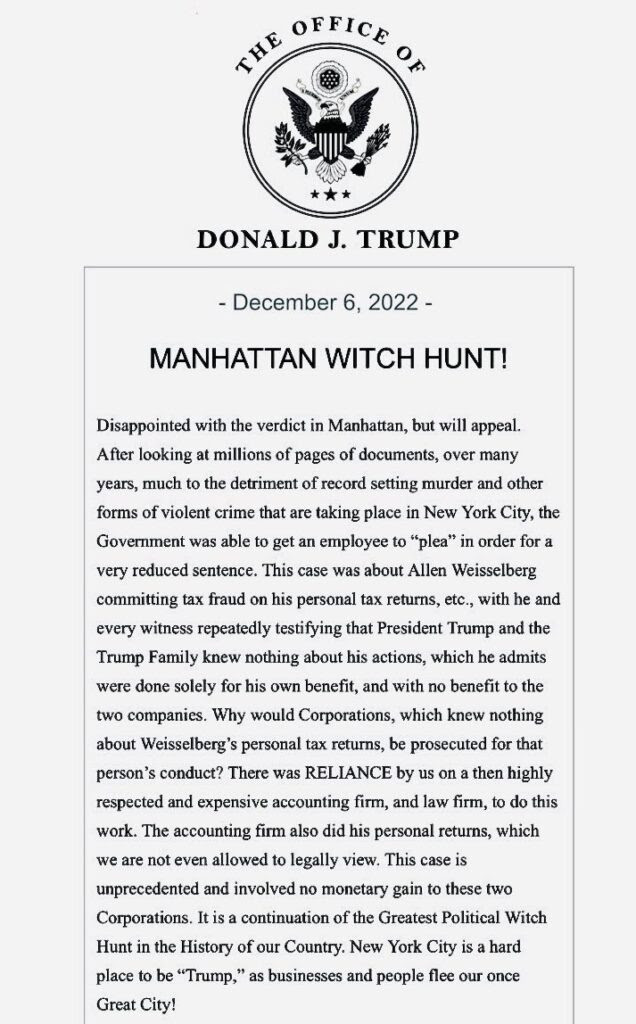
Trump responded to the verdict with this statement, which as usual is full of lies: 

It’s unlikely that this verdict will hurt Trump politically. But it could definitely damage his business and affect his ongoing legal battles, particularly the ones in New York, where he currently faces a major civil case brought by state Attorney General Leticia James, based on much of the same evidence used in this trial. But that case targets the individuals who run the company, specifically Trump himself, his sons Eric and Donald Jr. and his daughter Ivanka. The potential penalty in that case could be as much s $250 million. That’s not a rounding error.


Want a daily wrap-up of all the news and commentary Salon has to offer? Subscribe to our morning newsletter, Crash Course.


Earlier this week, Manhattan District Attorney Alvin Bragg, who successfully prosecuted the Trump Organization criminal case, announced he was bringing on a new prosecutor, Matthew Colangelo, who has extensive Trump experience, both working on the state’s civil case and the investigation of Trump’s foundation, which ended up with the Trump family barred from ever again running a charitable organization in New York. According to the New York Times, Colangelo is likely to take on a revived criminal investigation into allegations that Trump illegally inflated the value of his assets, as well as the Stormy Daniels hush-money payments.

While the financial penalty from this criminal verdict is insignificant, it’s hard to see how this case doesn’t shred the already tattered reputation of the Trump Organization. Sure, the Trumps can continue to do sweetheart deals with foreign countries, as they just did with a Saudi developer for a Trump-licensed golf resort in Oman. But his brand is now entirely contingent on his political influence. Nobody would want to do business with such a company without it.

Ivanka Trump has backed away from the business, “Succession” style, living instead on her husband Jared Kushner’s lucrative influence-peddling with many of the same actors. But Donald Trump Jr. and Eric Trump have never had any kind of real job other than working for the Trump Organization. Of course they seem to be spending all their time these days making trash-talk videos and appearing at fringe QAnon conferences, so perhaps the whole family has already moved on to greener pastures. The younger generation had better get real professions, however, because from the looks of things, there won’t be much left of the family business once Donald Trump gets through with it. 

Dreaming of beachfront real estate? Much of Florida’s coast is at risk of storm erosion

Back-to-back hurricanes left an unnerving scene on the Florida coast in November 2022: Several houses, and even swimming pools, were left dangling over the ocean as waves eroded the property beneath them. Dozens of homes and condo buildings in the Daytona Beach area were deemed unsafe.

The destruction has raised a disturbing question: How much property along the rest of the Florida coast is at risk of collapse, and can it be saved?

As the director of iAdapt, the International Center for Adaptation Planning and Design at the University of Florida, I have been studying climate adaptation issues for the last two decades to help answer these questions.

Drone footage shows homes close to collapsing into the ocean. WPLG/YouTube.

Rising seas, aging buildings

Living by the sea has a strong appeal in Florida — beautiful beaches, ocean views, and often pleasant breezes. However, there are also risks, and they are exacerbated by climate change.

Sea level is forecast to rise on average 10 to 14 inches (25-35 cm) on the U.S. East Coast over the next 30 years, and 14 to 18 inches (35-45 cm) on the Gulf Coast, as the planet warms. Rising temperatures are also increasing the intensity of hurricanes.

With higher seas and larger storm surges, ocean waves more easily erode beaches, weaken sea walls, and submerge cement foundations in corrosive salt water. Together with subsidence, or sinking land, they make coastal living riskier.

The risk of erosion varies depending on the soil, geology and natural shoreline changes. But it is widespread in U.S. coastal areas, particularly Florida. Maps produced by engineers at the Florida Department of Environmental Protection show most of Florida’s coast faces critical erosion risk.

Aging or poorly maintained buildings and sea walls, and older or poor construction methods and materials, can dramatically aggravate the risk.

Designing better building codes

So, what can be done to minimize the damage?

The first step is to build sturdier buildings and fortify existing ones according to advanced building codes.

Building codes change over time as risks rise and construction techniques and materials improve. For example, design criteria in the Florida Building Code for South Florida changed from requiring some new buildings to be able to withstand 146 mph sustained winds in 2002 to 195 mph winds in 2021, meaning a powerful Category 5 hurricane.

The town of Punta Gorda, near where Hurricane Ian made landfall in October 2022, showed how homes constructed to the latest building codes have a much better chance of survival.

Many of Punta Gorda’s buildings had been rebuilt after Hurricane Charley in 2004, shortly after the state updated the Florida Building Code. When Ian hit, they survived with less damage than those in neighboring towns. The updated code required new construction to be able to withstand hurricane-force winds, including having shutters or impact-resistant window glass.

However, even homes built to the latest codes can be vulnerable, because the codes don’t adequately address the environment that buildings sit on. A modern building in a low-lying coastal area could face damage in the future as sea level rises and the shoreline erodes, even if it meets the current flood zone elevation standards.

This is the problem coastal residents faced during Hurricanes Nicole and Ian. Flooding and erosion, exacerbated by sea-level rise, caused the most damage — not wind.

The dozens of beach houses and condo buildings that became unstable or collapsed in Volusia County during Hurricane Nicole might have seemed fine originally. But as the climate changes, the coastal environment changes, too, and one hurricane could render the building vulnerable. Hurricane Ian damaged sea walls in Volusia County, and some couldn’t be repaired before Nicole struck.

How to minimize the risk

The damage in the Daytona area in 2022 and the deadly collapse a year earlier of a condo tower in Surfside should be a wake-up call for all coastal communities.

Data and tools can show where coastal areas are most vulnerable. What is lacking are policies and enforcement.

Florida recently began requiring that state-financed constructors conduct a sea-level impact study before starting construction of a coastal structure. I believe it’s time to apply this new rule to any new construction, regardless of the funding source.

A comprehensive sea-level impact study requirement should also allow for risk-based enforcement, including barring construction in high-risk areas.

Similarly, vulnerability audits — particularly for multistory buildings built before 2002 — can check the integrity of an existing structure and help spot new environmental risks from sea-level rise and beach erosion. Before 2002, the building standard was low and enforcement was lacking, so many of the materials and the structures used in those buildings aren’t up to the standards of today.

What property owners can do

There is a range of techniques homeowners can use to fortify homes from flood risks.

In some places, that may mean elevating the house or improving the lot grading so surface water runs away from the building. Installing a sump pump and remodeling with storm-resistant building materials can help.

FEMA suggests other measures to protect against coastal erosion, such as replenishing beach sand, strengthening sea walls and anchoring the home. Engineering can help communities, temporarily at least, through sea walls, ponds and increased drainage. But in the long term, communities will have to assess the vulnerability of coastal areas. Sometimes the answer is to relocate.

However, there’s a disturbing trend after hurricanes, and we’re seeing it with Ian: Many damaged areas see lots of money pouring in to rebuild in the same vulnerable locations. An important question communities should be asking is, if these are already in high-risk areas, why rebuild in the same place?


Zhong-Ren Peng, Professor of Urban and Regional Planning, University of Florida

This article is republished from The Conversation under a Creative Commons license. Read the original article.

“This likely spells the end”: Experts say Trump Org verdict “increases the odds” of Trump indictment

Legal experts predicted that former President Donald Trump could face new legal threats after his company was found guilty of tax fraud on Tuesday.

A jury found the Trump Organization guilty on all 17 counts of tax fraud in Manhattan District Attorney Alvin Bragg’s investigation. Bragg previously secured a guilty plea from longtime Trump financial chief Allen Weisselberg, who testified in court about the company’s off-the-books perks to executives, including luxury apartments, cars and private school tuition that they did not pay any taxes on. Weisselberg and other witnesses never implicated Trump but prosecutors said the case showed that Trump had been “explicitly sanctioning tax fraud.”

The company faces penalties of up to $1.62 million, according to The New York Times.

The yearslong investigation, which started under former District Attorney Cy Vance, initially focused on a $130,000 payment longtime former Trump fixer Michael Cohen made to adult film star Stormy Daniels during the 2016 campaign but expanded to a larger probe of Trump’s business practices. Bragg after taking office in January appeared to move the probe away from Trump himself, prompting prosecutors on the case to resign in protest, but recent reporting suggests that Bragg’s office has a renewed interest in the payment to Daniels and is expected to continue the investigation into the former president.

“To me, this guilty verdict against the Trump Organization is not the end of, but just the beginning of juries holding the former president, his corporation and his inner circle accountable,” Vance predicted to the Times.

“This likely spells the end of the Trump Org,” predicted former federal prosecutor Glenn Kirschner, and “increases the odds of a NY prosecution of Trump himself, given that the prosecution argued evidence shows Trump ‘explicitly’ OK’d tax fraud.”

It’s unclear whether the Trump Organization will undergo any changes after the verdict, though it’s unlikely that the company itself will shutter. Trump could shut down the Trump Corporation and the Trump Payroll Corp., the two subsidiaries implicated in the case, according to the Times, but the verdict is likely to scare off potential lenders and business partners and may make it more difficult to retain employees and expand the company.

But “the implications for Trump of today’s convictions of the Trump Organization go well beyond the penalty to the business itself,” argued former U.S. Attorney Harry Litman, adding that the verdict has to “embolden Bragg to go after Trump on the renewed investigation of the Stormy Daniels fraud.”


Want a daily wrap-up of all the news and commentary Salon has to offer? Subscribe to our morning newsletter, Crash Course.


Bragg recently hired former top Justice Department official Matthew Colangelo, who previously led the New York Attorney General probe into Trump’s businesses.

“Today’s guilty verdict makes Matthew Colangelo’s move to the Manhattan DA’s office very timely,” tweeted former U.S. Attorney Joyce White Vance. “At the NY AG’s office he oversaw the dismantling of Trump’s ‘charitable’ org. At DOJ he oversaw complicated tax & civil rights prosecutions. He has a stellar reputation.”

Cohen, who has become a prominent Trump critic after being cast out of his inner circle, said Tuesday that he has spoken with Bragg’s office more than a dozen times.

“I can tell you he (Trump) should be very uncomfortable,” Cohen told MSNBC. “Alvin Bragg to have looking at this new attorney Matthew Colangelo, he really should be quite concerned.”

Trump still faces a $250 million fraud lawsuit from New York Attorney General Letitia James, who accused him, his three eldest children, his companies and executives of 200 instances of fraud spanning a decade. The lawsuit seeks to ban the Trumps from doing business in New York among other penalties.

Former federal prosecutor Renato Mariotti predicted that Tuesday’s conviction “will give even more leverage to New York Attorney General Tish James in her civil suit, which seeks extraordinary remedies that would cripple the company.”

James said that she also referred potential federal violations found by her team to federal prosecutors in the Southern District of New York and the IRS. Jennifer Taub, a white-collar crime expert at Western New England University School of Law, predicted that the SDNY prosecutors could build an even “more significant case” from James’ referral.

COP27’s ‘loss and damage’ fund could be a breakthrough — or an empty promise

Developing nations were justifiably jubilant at the close of COP27 as negotiators from wealthy countries around the world agreed for the first time to establish a dedicated “loss and damage” fund for vulnerable countries harmed by climate change.

It was an important and hard fought acknowledgment of the damage — and of who bears at least some responsibility for the cost.

But the fund might not materialize in the way that developing countries hope.

I study global environmental policy and have been following climate negotiations from their inception at the 1992 Rio Earth Summit. Here’s what’s in the agreement reached at COP27, the United Nations climate talks in Egypt in November 2022, and why it holds much promise but very few commitments.

3 key questions

All decisions at these U.N. climate conferences — always — are promissory notes. And the legacy of climate negotiations is one of promises not kept.

This promise, welcome as it is, is particularly vague and unconvincing, even by U.N. standards.

Essentially, the agreement only begins the process of establishing a fund. The implementable decision is to set up a “transitional committee,” which is tasked with making recommendations for the world to consider at the 2023 climate conference, COP28, in Dubai.

Importantly for wealthy countries, the text avoids terms like “liability” and “compensation.” Those had been red lines for the United States. The most important operational questions were also left to 2023. Three, in particular, are likely to hound the next COP.

1) Who will pay into this new fund?

Developed countries have made it very clear that the fund will be voluntary and should not be restricted only to developed country contributions. Given that the much-trumpeted US$100 billion a year that wealthy nations promised in 2015 to provide for developing nations has not yet materialized, believing that rich countries will be pouring their heart into this new venture seems to be yet another triumph of hope over experience.

2) The fund will be new, but will it be additional?

It is not at all clear if money in the fund will be “new” money or simply aid already committed for other issues and shifted to the fund. In fact, the COP27 language could easily be read as favoring arrangements that “complement and include” existing sources rather than new and additional financing.

3) Who would receive support from the fund?

As climate disasters increase all over the world, we could tragically get into disasters competing with disasters — is my drought more urgent than your flood? — unless explicit principles of climate justice and the polluter pays principle are clearly established.

Why now?

Acknowledgment that countries whose excessive emissions have been causing climate change have a responsibility to pay for damages imposed on poorer nations has been a perennial demand of developing countries in climate negotiations. In fact, a paragraph on “loss and damage” was also included in the 2015 Paris Agreement signed at COP21.

What COP27 at Sharm el-Sheikh, Egypt, has done is to ensure that the idea of loss and damage will be a central feature of all future climate negotiations. That is big.

Seasoned observers left Sharm el-Sheikh wondering how developing countries were able to push the loss and damage agenda so successfully at COP27 when it has been so firmly resisted by large emitter countries like the United States for so long.

The logic of climate justice has always been impeccable: The countries that have contributed most to creating the problem are a near mirror opposite of those who face the most imminent risk of climatic loss and damage. So, what changed?

At least three things made COP27 the perfect time for this issue to ripen.

First, an unrelenting series of climate disasters have erased all doubts that we are now firmly in what I have been calling the “age of adaptation.” Climate impacts are no longer just a threat for tomorrow; they are a reality to be dealt with today.

Second, the devastating floods this summer that inundated a third of my home country of Pakistan provided the world with an immediate and extremely visual sense of what climate impacts can look like, particularly for the most vulnerable people. They affected 33 million people are expected to cost over $16 billion.

The floods, in addition to a spate of other recent climate calamities, provided developing countries — which happened to be represented at COP27 by an energized Pakistan as the chair of the “G-77 plus China,” a coalition of more than 170 developing countries — with the motivation and the authority to push a loss and damage agenda more vigorously than ever before.

Finally, it is possible that COP-fatigue also played a role. Industrialized countries — particularly the U.S. and members of the European Union, which have traditionally blocked discussions of loss and damage — remain distracted by Russia’s war in Ukraine and the economic effects of the COVID-19 pandemic and seemed to show less immediate resistance than in the past.

Importantly, for now, developing countries got what they wanted: a fund for loss and damage. And developed countries were able to avoid what they have always been unwilling to give: any concrete funding commitments or any acknowledgment of responsibility for reparations.

Both can go home and declare victory. But not for long.

Is it just a ‘placebo fund’?

Real as the jubilation is for developing countries, it is also tempered. And rightly so.

For developing countries, there is a real danger that this turns out to be another “placebo fund,” to use Oxford University researcher Benito Müller’s term — an agreed-to funding arrangement without any agreed-to funding commitments.

In 2001, for example, developing countries had been delighted when three funds were established: a climate fund to support least developed countries, a Special Climate Change Fund, and an Adaptation Fund. None ever reached the promised scale.

Writing prior to COP15 in Copenhagen in 2009, Müller boldly declared that developing countries would never again “settle for more ‘placebo funds‘.” I very much hopes he has not been proven wrong at Sharm el-Sheikh.


Adil Najam, Professor of International Relations, Boston University

This article is republished from The Conversation under a Creative Commons license. Read the original article.

This course takes a broad look at failure — and what we can all learn when it occurs

Unusual Courses is an occasional series from The Conversation U.S. highlighting unconventional approaches to teaching.

Title of course:

“Failure, and How We Can Learn from It”

What prompted the idea for the course?

When I was a high school teacher, I found plenty of joy and fulfillment in my work. But I also felt the sting of failure: from a student who remained disengaged throughout the semester, or even just from a lesson that went off the rails. Now I prepare aspiring K-12 teachers to navigate that messy reality themselves, and I’m struck by how tough it can be for them to develop the resilience necessary to work so hard and yet inevitably fall short of their goals.

So I began to wonder how other fields and professions might view failure. What resources do they draw upon? What common threads might exist that could help future teachers learn from failure more effectively?

What does the course explore?

We explore the role of failure in a wide range of fields, and how what counts as failure varies as well. A bridge collapsing is pretty clear, and maybe a business that goes bankrupt. But what about a team losing or a patient dying? We also consider what mechanisms and strategies these fields employ in responding to failure, and the ways in which they see failure as part of the learning and achievement process.

What’s a critical lesson from the course?

As the semester unfolds, students begin to recognize that success and failure aren’t neat and simple categories. At its best, this course helps them understand how failure will be an ongoing presence in their lives. That means they need to figure out how to restructure their relationship with failure, rather than anticipate a time when they’ve finally and fully succeeded.

What materials does the course feature?

The most compelling elements of the course are the guest speakers from the various professions that we explore. Their honesty about their own struggles — and their willingness to avoid simplistic cliches about simply trying harder — offer my students insight and encouragement in their own journeys.

For instance, a doctor working on Los Angeles’ Skid Row — an area known for poverty and makeshift housing — describes how she navigates overwhelming need and the inability to heal many of her patients. A professional mediator explains how he deals with complex dynamics in relationships in search of compromise between the parties. Every single speaker is a portrait of someone who continues to fail, learn and grow.

What will the course prepare students to do?

We look at how to evaluate risk more accurately, and how to develop a mindset that views failure as part of the growth process. Persistence is vital, but rarely sufficient. They learn the value of focusing less on the simplistic categories of failure and success and focusing more on making good decisions, evaluating outcomes, responding thoughtfully and maintaining perspective about what they can’t control.

The course is offered through the honors college at the university where I teach. It draws students from a variety of majors.

Why is this course relevant now?

When is it not relevant? A major theme of the course is that if people play it safe and never take any chances, they may be able to avoid failure, but they may also miss out on opportunities to learn and grow. When they reinterpret the significance of failure and make room for its presence, possibilities for learning and growth emerge.


Robert Kunzman, Professor of Curriculum Studies and Philosophy of Education, Indiana University

This article is republished from The Conversation under a Creative Commons license. Read the original article.

Kari Lake goes out with a whimper: She couldn’t galvanize Trump’s Jan. 6 army

In the end, the Big Lie 2.0 went out with a whimper, instead of the bang Donald Trump and his acolytes were clearly anticipating. For months, Trump-loyal Republican candidates for state and local offices — often those hand-picked by Trump himself — recycled his false claims that a secret cabal of Democrats had secretly created a system to “steal” elections from Republicans. Not only did MAGA superfans like Arizona gubernatorial candidate Kari Lake argue that Joe Biden had somehow stolen the 2020 from Trump, they repeatedly suggested that, should they lose in 2022, that should be presumed illegitimate as well. 

There was plenty of cause for worry that all these conspiracy theories were building toward some kind of Jan. 6 redux, especially as several of these candidates had direct ties to the original assault on the Capitol. Pennsylvania state Sen. Doug Mastriano, the GOP gubernatorial candidate, wasn’t just at the Capitol that day, but literally paid for charter buses to send Trump supporters to the rally that turned into an insurrection. Tim Michels, the Wisconsin Republican running against incumbent Democratic Gov. Tony Evers, promised that “Republicans will never lose another election in Wisconsin after I’m elected governor.” Mark Finchem, the Republican candidate for secretary of state in Arizona, was also in D.C. on Jan. 6 and his attorney was deeply involved in the “fake elector” plot Trump hoped he could use to steal the 2020 election. 


Want more Amanda Marcotte on politics? Subscribe to her newsletter Standing Room Only.


In the days before the election, Homeland Security and the FBI circulated a memo warning of a “heightened threat” of election violence that might target “candidates running for public office, elected officials, election workers, political rallies, political party representatives, racial and religious minorities, or perceived ideological opponents.” 

Instead what happened, for the most part, was nothing, thank goodness. Most of the Trumpy candidates seeking swing-state offices that would give them control over the 2024 presidential election lost. They complained but mostly didn’t try to fight the results. And none of them actually incited violence in an effort to steal those elections. Maybe that’s a modest win for democracy, but it counts.

There was one holdout. Lake, who was a local news anchor in Phoenix before becoming the MAGA-tastic candidate for governor, stood out as something special in the highly competitive field of midterm election deniers. When asked by CNN in October if she would accept an electoral defeat, Lake gave the kind of trolly answer that makes Trumpist hearts soar: “I’m going to win the election and I’ll accept that result.” 

Well, she didn’t. Lake lost that election narrowly to Democrat Katie Hobbs, the current secretary of state. Unlike most of her fellow election deniers, Lake has created a public fuss since election night and, along with Finchem, has filed a number of frivolous lawsuits seeking to invalidate or overturn the election. But although Lake certainly tried to adopt Trumpian tactics — whining incessantly and shotgunning all kinds of irrational or ludicrous litigation into court — the whole effort has felt surprisingly tepid. Even Trump’s attempt to get involved, by releasing a statement demanding that Lake be “installed” as governor for some imaginary reason, did little to generate any real momentum. 

On Monday, Lake’s moribund coup effort fizzled out as Arizona officials certified the election in a placid document-signing ceremony, utterly free of screaming Proud Boys trying to smash in cop heads or hang election officials. Sure, Lake is trying to save face with endless tweets about a “crooked election,” and still shows up to bellyache on Steve Bannon’s podcast. (When does his sentence start again?) But she’s almost certainly reached the end of the road. Even the two Republican-controlled counties who initially refused to certify the election finally capitulated to reality and court orders, and did their duty. 

It’s amusing, of course, to watch Lake flail about impotently. But it does raise an interesting question: Why has it been so difficult for the myriad mini-Trumps of the 2022 midterms to build on his Big Lie? Why was he able to make Jan. 6 happen, but none of his followers have even come close to replicating that moment on the state or local level? 


Want more Amanda Marcotte on politics? Subscribe to her newsletter Standing Room Only.


It’s tempting to write this off to the structural differences between a national election and smaller, more spread-out state-level elections. Trump could draw on his fame and his enormous fanbase to get attention, and also on the singular, symbolic nature of the Capitol building and nation’s capital draw a big crowd in one place on one day. But that explanation leaves something to be desired, because it’s also true that it would be easier, in many ways, to stage a more localized insurrection. You would only need a modest-size group in a less secure location, such as a state capitol, to pull off a violent assault on a smaller scale. Just look at how successful far-right groups have been at dominating or disrupting school boards or intimidating drag performers over the past couple of years. You wouldn’t need the thousands of people Trump drew to the Capitol in January 2021 to do serious damage. A few dozen right-wing militia types — as in the Michigan lockdown protests of 2020 — would likely be enough in some places. 

No, I suspect the real reason the Big Lie is failing to incite fascist violence around midterm elections is that few, if any, Republicans actually believed the Big Lie in the first place. It was always a pretext for what its proponents really want, which is a movement to replace the process by which we choose American presidents with a dictatorship, ideally led by Donald Trump himself. Installing a bunch of mini-Trumps in state offices, even for the purpose of supposedly setting Trump up to steal the 2024 election, doesn’t have the emotional power of an actual, no-BS, top-down fascist revolution. 

“We’re not just going to call them ‘election deniers.’ They are MAGA fascists,” Adrian Fontes, the Democratic winner of Arizona’s state secretary position, said on MSNBC on Tuesday. 

This distinction isn’t just rhetorical flair. “Election deniers” implies that the conspiracy theory of stolen elections is the primary motivation of Trump’s insurrectionist movement. But really, the conspiracy theory is just a paper-thin excuse, one which Trump and his minions barely even try to establish as a functioning narrative. Fascists, as John Ganz writes in his most recent newsletter, “believe things have gotten so bad that only a radical move to break the present regime can save the nation.” Taking the White House by force is satisfying. Taking the Arizona governor’s mansion, not so much.

The fascist cult leader — and in this case you know who that is — draws his power from being the avatar of all his followers’ grievances, which are mostly about social and cultural issues and not really about a sincere belief in “election fraud.” The anger that drew people to the Capitol on Jan. 6 had nothing to do with any genuine concerns that Democrats had corrupted the election. It was driven largely by cultural grievances: Growing racial and religious diversity. Women’s increasing independence. Rap songs dominating the radio and LGBTQ characters on TV.

The Big Lie was just the excuse. The goal was to punish non-MAGA Americans by inflicting Donald Trump on them against their will.


Want more Amanda Marcotte on politics? Subscribe to her newsletter Standing Room Only.


That anger has more recenlty been rerouted into more direct expressions of right-wing cultural resentments, which is why we’re seeing attacks on Pride events and hysteria about “wokeness” or “critical race theory.” Having a tantrum, or staging a riot, over Kari Lake losing her bid to be governor of Arizona simply doesn’t have the same emotional resonance. Even if such a coup had been successful — a pretty big “if” in a moment when Democrats still control the executive branch of the federal government — it wouldn’t have done much to address the larger complaints that fuel modern fascism. Lake talked a big game about being the media’s “worst fricking nightmare,” but even if she had successfully wedged herself into the governor’s mansion, the “liberal coastal elite” media would still have viewed her as a backwoods novelty, rather than a real threat. 

The symbolism and power of the presidency is what makes it a prize worthy of violent insurrection. A governor’s seat can’t hold a candle to that. That’s probably the biggest reason why the MAGA movement that was ready to crack skulls on Jan. 6 didn’t get out of bed to protest lost midterm elections. The good news here is that the Big Lie 2.0 failed to rile up Trump’s jackass army in 2022. The bad news is that while Kari Lake fell on her face in trying to get the MAGA masses outraged on her behalf, those people could potentially be moved to violence again, if they think that means putting their true cult leader back in the White House. 

A new day? Voters stood up for democracy — and now we have the data

In November’s midterm elections, many Americans voted to slow down Donald Trump and the Republican Party’s assault on democracy. But how much of that was intentional and specific support for the vague concept known as “democracy,” and how much was motivated by more concrete issues, such as protecting women’s reproductive rights or a rejection of Trump?

The answers are not trivial or pedantic: whether and how much the American people are invested in defending democracy against the rise of neofascism is likely to determine the future of the country.

In a recent essay at the Huffington Post, Paul Blumenthal reports on a new poll of 71 competitive House districts which found that democracy was indeed an important concern:

Concerns about threats to democracy motivated Democrats and independents to turn out while also helping independents decide to vote for Democrats, according to a voter survey from Nov. 11-16 by Impact Research, a Democratic polling firm.

“The biggest takeaway here is just how important protecting democracy was for voters in this House battlefield immediately coming out of the election,” said Molly Murphy, the president of Impact Research, which conducted the survey for Democratic Party-aligned political action committees End Citizens United and Let America Vote.

Six in 10 voters cited protecting democracy as an extremely important reason that they decided to vote in November. This put the issue ahead of inflation (53%), abortion (47%) and crime (45%). When asked to choose the top two issues that motivated them to vote, 50% chose protecting democracy, second only to inflation at 55%.

These findings are largely in line with preelection surveys from The New York TimesThe Wall Street JournalCBS NewsNBC NewsQuinnipiac University Poll and the Grinnell College National Poll, as well as exit polling from The Associated PressNBC News and CNN.

These findings are in some ways surprising. Decades of political science research has repeatedly shown that the American people by and large are politically unsophisticated, not driven by ideology and do not possess a deep understanding of public policy. Much of Americans’ political decision making tends to be driven by questions of emotions, symbolic attachment to political parties and candidates (and increasingly by “negative partisanship”) as compared to more “rational” calculations about politics.


Want a daily wrap-up of all the news and commentary Salon has to offer? Subscribe to our morning newsletter, Crash Course.


But the evidence also shows that many voters use heuristics and other decision-making shortcuts to reason their way through complex questions of politics. To that point, Blumenthal quotes Rep. Pat Ryan, who was elected this year in a highly competitive district in New York and said he “saw the issue of protecting democracy overlapping with another top concern for Democrats:” the Supreme Court decision that overturned Roe v. Wade.

“What people missed in polls — which I heard over and over again in conversations, if you actually listen — is people link these issues together,” Ryan said. “People intuitively, of course, understood that if you’re taking away a fundamental right from more than half of the American people, then all these other rights and freedoms are on the table. And that becomes an existential democracy — small-d democracy — issue.”

Just as some voters saw an overlap between abortion and democracy, many interpreted the concept of protecting democracy beyond the sole issue of Republicans embracing Trump’s election fraud lies and efforts to overturn election results.

This suggests that in this year’s midterm elections many American voters in fact displayed greater sophistication than pollsters and other professional politics watchers assumed.

American politics frequently features a dynamic where the mass public tends to vote against candidates and issues that are deemed too far outside the mainstream. In essence, the vote becomes a type of thermostat to calibrate public policy and the overall direction of the country.

In keeping with that dynamic, Ryan also told Blumenthal that Democrats can win when they help voters “‘understand the stakes’ — that ‘one party really, increasingly, overtly was for blowing up our democracy, eroding trust in free and fair elections, denying election outcomes’ while the other party was saying, ‘No, we’re going to stand and fight. … We saw a rejection across the country of the extremist antidemocratic direction that extreme Republicans wanted to go.'”

It appears that many Americans are finally emerging moving from a defensive state of learned helplessness, in response to the Age of Trump and its ongoing attacks against democracy, to a position that is more pro-active and direct. That is unquestionably a good sign, but there remain great challenges ahead in what will be a very long struggle to defend and then improve American democracy against authoritarianism and neofascism and other threats.

A healthy democracy is based upon shared norms and values about reality, truth, legitimacy, compromise, consensus and power. Even more specifically, one of the most basic principles in a democracy is that elected officials and other democratic elites are held accountable to the public will, primarily but not entirely through elections. 

Today’s Republican Party and the larger “conservative” movement reject such values. In realpolitik terms, this makes sense: Often by overwhelming majorities, the American people as a whole oppose most of the policies advocated by Republicans.

The contemporary Republican Party and “conservative” movement are fixated on power above all other things. To them, public opinion is not just something to be “won,” or even massaged or manipulated, but rather something to be ignored or overruled whenever it does not their agenda.

For example, the Big Lie strategy is prefaced on the lie that votes for Democratic candidates, especially from Black and brown people in large cities, are somehow fraudulent as compared to the supposedly more trustworthy and “high quality” votes of white people in rural or exurban areas.

Republicans and the “conservative” movement also seek to advance their anti-democracy campaign through the Supreme Court and judicial branch, interest groups and think tanks, their own propaganda media, Christian nationalism, and a powerful network of donors and funders. Gerrymandering, voter suppression and outright voter nullification, along with the threat and reality of right-wing violence and terrorism as seen on Jan. 6, 2021, are central elements in the American right’s campaign to end democracy. In total, these tools and forces are a way to advance the “tyranny of the minority” by circumventing, subverting, negating, undermining, and/or outright ignoring and nullifying the democratic will and the common good. 

In a recent New York Times column, Jamelle Bouie reflected on the complexities of majoritarianism amid the ongoing democracy crisis:

It’s not the national majority that threatens the right to vote or the right to bodily autonomy or that wants to strip transgender Americans of their right to exist in civil society (on that last point, 64 percent of Americans, according to the Pew Research Center, support laws or policies that would “protect transgender people from discrimination in jobs, housing and public spaces”). If it were up to majorities of Americans — and if, more important, the American political system more easily allowed majorities to express their will — then Congress would have already strengthened the Voting Rights Act, codified abortion rights into law and protected the civil rights of L.G.B.T.Q. Americans. Even the legislative victories most Americans rightfully admire — like the Civil Rights Act of 1964 — were possible only with a supermajority of lawmakers assembled in the wake of a presidential assassination.

If it were up to the national majority, American democracy would most likely be in a stronger place, not the least because Donald Trump might not have become president. Our folk beliefs about American government notwithstanding, the much-vaunted guardrails and endlessly invoked norms of our political system have not secured our democracy as much as they’ve facilitated the efforts of those who would degrade and undermine it.

Majority rule is not perfect but rule by a narrow, reactionary minority — what we face in the absence of serious political reform — is far worse.

America’s political class, the mainstream media and other elites are deeply reluctant to consistently and plainly state that the modern Republican Party rejects multiracial, pluralistic democracy. To confront such a fact about one of the country’s two institutional political parties would be to acknowledge an epistemic crisis and the much deeper troubles plaguing the country. 

What will happen if Americans continue to vote and mobilize in defense of their democracy and then use that political energy to advance a truly transformative agenda that serves their collective interests? This would represent a great step forward, but we can be sure that those who despise and oppose real democracy would resist ferociously.

As the truism holds, power concedes nothing without a demand. This is simultaneously a dangerous moment as well as a potentially productive and exciting one in America’s struggle to become a true democracy. There are legitimate reasons to be hopeful — but that same hope must be accompanied by reasonable caution and vigilance.