Spring Sale: Get 1 Year, Save 58%

A decade after Sandy, Manhattan’s flood barrier is finally in sight — sort of

When Superstorm Sandy made landfall on October 29, 2012, it pushed 13 feet of storm surge into New York City’s harbor, sweeping across the Brooklyn and Queens waterfronts and wiping entire neighborhoods off the map in Staten Island. Flooding knocked out power in Lower Manhattan, plunging downtown into near-total darkness as water rushed through the streets. The storm caused $19 billion in damages in the city alone, and it was clear that future storms could be even worse unless something changed.

Less than a year later, the Obama administration unveiled a massive federal initiative to ensure that the city not only recovered from Sandy, but built back better. The initiative, dubbed Rebuild by Design, promised to funnel money toward long-term climate adaptation measures in the hardest-hit areas, supplementing the usual barrage of disaster aid with money earmarked for forward-looking projects. 

To say that officials aimed high would be an understatement. The Department of Housing and Urban Development, or HUD, which managed the initiative, threw its weight behind an idea called the “Big U.” The plan, drafted by the firm of Danish celebrity architect Bjarke Ingels, proposed to wrap the island of Manhattan, the financial and cultural capital of the United States, in miles of berms and artificial shorelines, creating a huge grassy shield that would both increase urban green space and defend the city from storm surge. The feds doled out an eye-popping $335 million for the first phase of the project, which soon captured the public’s imagination, in part thanks to iconic renderings from Bjarke Ingels Group (BIG) that showed a green paradise enfolding Manhattan. Ingels referred to it as “the love-child of Robert Moses and Jane Jacobs.” 

If you stand in Battery Park on the southern tip of Manhattan today, 10 years after Sandy, it might be hard to imagine that the city is about to make the Big U vision a reality. Look a little closer, though, and there are signs of progress. Multiple pieces of the borough’s flood barrier have broken ground in the past year, and almost all the money for the system has been secured, with only a few pieces left to fund. After years of planning, design, and debate, the physical structure is starting to take shape.

“Once you start to see it in real life, it feels totally different,” said Amy Chester, the managing director of Rebuild by Design, which has gone on to help other cities plan resilience projects. “I worked in city government forever, and I didn’t expect all these projects to happen, but it happened.”

Flooded NYC SubwayPeople take photos of water filling the entrance of The Plaza Shops in Battery Park in New York on October 30, 2012 as New Yorkers cope with the aftermath of Hurricane Sandy. The storm left large parts of New York City without power and transportation. (TIMOTHY A. CLARY/AFP via Getty Images)The Big U was a test case for large-scale climate adaptation. It wagered that cities could use a disaster like Sandy as a moment to rethink their relationship with nature, rather than just rebuild what had existed before. 

In some ways, the bet paid off. The Big U project did manage to secure funding, and it is now being built, albeit years behind schedule and in modified form. After almost a decade of design work and public engagement, the city has proven that unconventional adaptation projects can work, and that cities can look beyond traditional flood walls and levees. 

In another sense, though, the Big U is a reality check for these big projects. The project was kickstarted thanks to a rush of post-disaster money from a presidential administration that prioritized adaptation, but it couldn’t have gotten to this point without New York City’s unparalleled local resources. As Chester puts it, New York is a “different financial animal” than the rest of the country. Whereas other jurisdictions rely heavily on the federal government to fund big infrastructure projects, the city can also command huge amounts of municipal and state funding, which helps open the door for more ambitious and forward-looking projects. Absent a revamp of how the federal government funds climate adaptation, such projects will continue to remain out of reach for most cities. 

“There are so many communities across the coastline including other major cities like Houston, Los Angeles, Seattle, Boston, Miami, Tampa,” said Linda Shi, an assistant professor of city planning at Cornell University who studies climate adaptation. “Are they going to see such sums of money? And then what about much smaller municipalities? They for sure are not going to see such levels of investment. That’s a real challenge, to think about how our infrastructure spending is going to meet that gap.”


The first task in the Big U project was to break Ingels’s dramatic vision into achievable chunks.

The $335 million that the city received from HUD went to fund a huge segment along the east side of Manhattan, one of the city’s hardest hit areas by the storm. For centuries, this part of the island consisted mostly of wetlands, before developers filled it in to make room for dense residential neighborhoods and public housing developments. When Sandy hit New York, its storm surge sought out these historical low-lying stretches, but the tidal channels and mudflats that had once absorbed excess water were long gone, replaced by concrete buildings and streets.

Ingels’s initial plan for the east side called for a massive tiered berm that would slope up from the water at East River Park, but this vision soon hit a roadblock: Officials in Mayor Bill de Blasio’s administration determined that building the berm would be too disruptive for a nearby highway — the busy FDR Drive — and a subsurface power line owned by the utility ConEd. Instead they decided to elevate the whole park on eight feet of artificial fill. But the city made a few serious missteps in communicating with locals about the new plan, and a coalition of locals, artists, and activists soon banded together to oppose it, arguing that it would remove trees and reduce access to a valuable community space. 

Despite the public relations nightmare, the city began construction work on the east side project in earnest late last year, and has since ripped up about half the park. Dozens of trucks, cranes, and backhoes now fill the site, laying the groundwork for the fill that will raise it off the ground. The city now expects the project to be complete in 2026.

There’s a similar project in the works on the opposite shore of Manhattan, in an area called Battery Park City. Built in the 1970s on artificial land that extends out into the Hudson River, the neighborhood is governed by a state authority that can issue its own bonds, allowing local leaders to fund an $800 million resilience scheme to construct another segment of the Big U. As in East River Park, the plan here is to create a tiered series of elevated lawns that will stop coastal flooding from pushing inland.

But just like across town, this plan is not going over well with some locals, who have objected to the fact that it will close the park for multiple years. Earlier this summer, the campaigners attracted the attention of Republican gubernatorial candidate Lee Zeldin, who urged the state to pause construction until local concerns are heard. 

“Residents have pointed out that Wagner Park didn’t experience severe flooding during Superstorm Sandy,” said Zeldin in a statement to the press. “Others have raised concerns about the exorbitant cost.” A group of locals is pushing an alternative design for the park, but crews are still expected to begin construction in the coming weeks. 

The third and most difficult segment of the waterfront to protect is the two-mile stretch between these two other projects: the southern edge of Manhattan, stretching from lower Battery Park City past Wall Street and up toward the East Side. This stretch of shoreline is home to the towering skyscrapers of the Financial District, the offramps of the Brooklyn and Manhattan bridges, the packed historic neighborhood around the South Street Seaport, and another dense cluster of high-rise housing developments, not to mention a thicket of critical transportation infrastructure, including the elevated FDR Drive expressway and a subterranean car tunnel to Brooklyn.

Because the area is so overbuilt, with only a few dozen feet of free space between the water’s edge and the nearest street or building, the city doesn’t have the room to build big flood walls or berms like the ones it’s constructing in East River Park. Much of the waterfront territory in the neighborhood sits on concrete piles, which means it likely couldn’t support the two-story structure needed to protect the low-lying Financial District from a big storm event; the dense network of underground transportation and power infrastructure only further complicates such an effort. Plus, many of the buildings in the Seaport district are designated historic landmarks, making it even harder to build something new in their midst.

Faced with all these challenges, designers had to get creative. In one part of the problem area, near the dense Two Bridges neighborhood, the city chose a novel technological solution from the original Big U plan: a $500 million array of deployable flood walls that can flip up out of the ground during storm surge events, creating a temporary water barrier. Mayor Eric Adams broke ground on that project this week, and it is also expected to finish in 2026. Further down the shore, the city hopes to extend an artificial shoreline out into the water, creating a two-tiered berm with one segment that soars fifteen feet into the air and another that sweeps down toward the river.

Finding the funds for this last piece may be tricky. Much of the money for the flip-up flood walls arrived six years ago thanks to another Obama-era grant program that funded novel resilience strategies, but the berm around the Seaport will cost around $3.6 billion, according to the city’s latest estimates, and will take more than a decade to complete. Unless the city is hit by another Sandy, there likely won’t be another huge pile of post-disaster federal money for this project, which raises questions about how the city will pay for it. A recent federal grant to help support the project provided only $50 million, at most 1 percent of the total cost of the project.

Victor Papa, the president of the Two Bridges Neighborhood Council, which represents residents in the area, said he’s optimistic the project will come to fruition, and said he wasn’t disturbed by the long timeline. 

“We’re feeling very confident,” he told Grist. “I am of the mind that when a project affects thousands of people, in thousands of housing units, that is not an overnight process, that’s a process that’s going to have a learning curve. I think the city did a good job in their design and their implementation.”


Even with most of the funding locked down, the trajectory for finishing the Big U is difficult to predict. The construction timeline for the rest of the project stretches to the end of the decade and beyond, and that’s assuming everything goes well. Future mayors may have to contend with controversy over construction impacts and cost overruns. The long timeline may also jeopardize the effectiveness of the project: the flip-up flood gates, for instance, only provide protection against the sea-level rise that will occur by 2050, which could make them inadequate as little as two decades after they are completed. There’s also the risk that another Sandy could strike while the city is still building the Big U, setting the timeline back even further.

“I think some of the estimates on time that the city put out right after Sandy were the absolute best-case scenario, and not everything turned out to be best case,” said Daniel Zarrilli, a special advisor on climate and sustainability at Columbia University who served as a climate policy advisor to Mayors Michael Bloomberg and de Blasio. “These are big, billion-dollar infrastructure projects and things do tend to take time, which is unfortunate, because time is not on our side.”

The current framework is also notable for what it leaves out — the city’s ambitions for the Big U are smaller than the original proposal from the Rebuild by Design days. The original berm structure conceived by Ingels would have extended from 42nd Street on the East Side all the way around the island and up the West Side to 57th Street, but the city has lopped off sections on both sides. Rather than push the project up the sides of the island, the city scaled back its ambitions to the barrier segment it knew it could afford.

The responsibility for protecting the rest of Manhattan and New York City now lies with the U.S Army Corps of Engineers, the nation’s chief builder of flood projects. In most other cities, the Corps might have taken charge of storm surge adaptation from the beginning, drafting an infrastructure project and securing money for it from Congress, but that wasn’t the case in New York. The pot of money the city received from HUD allowed it to pursue the nontraditional vision of the Big U, and leaders later rejected the Corps’ controversial proposal to create a five-mile storm gate across New York Harbor. 

Now, though, the Corps has returned to fill in the gaps: The agency this month unveiled a $52 billion plan to build a series of storm gate structures across the city and in New Jersey as well. One structure would extend deployable flood gates up the West Side of Manhattan, approximating the extent of Ingels’s original scheme. If executed well, the Corps plan would also help bolster flood resilience in vulnerable parts of the city that didn’t receive the same jackpot of HUD money that Lower Manhattan did. There were other ambitious Rebuild by Design ventures for some of these places too, including the Bronx and Staten Island, but none so ambitious as the Big U. On its own, a flood barrier around Lower Manhattan wouldn’t help those areas, and might even push more water toward them during storm surge events. 

“There’s only so much money that the city had, and the federal funding streams allowed us to do some work, but not all of it,” said Zarrilli. For the rest of it, he said, “we need the Army Corps.” 

Even this some-but-not-all achievement would be difficult to replicate in other cities that don’t have New York’s local resources or a pot of recovery money from a friendly presidential administration. Bond measures and federal resilience grants can help fund smaller-scale adaptation projects, but transformative green infrastructure on the scale achieved in Manhattan will likely remain out of reach elsewhere in the United States.

Furthermore, Shi, from Cornell, cautions that new infrastructure can’t be the only way we adapt to climate change. The Big U may be an admirable example of how cities can rebuild for rising seas, but it won’t work unless accompanied by other measures that shift development away from flood zones and help people relocate from the riskiest places. 

“I think there is a certain kind of danger to the siren song that the Big U sings for us, because it is so visually appealing that we might think that it is going to solve the problem on its own,” she said. “But that’s just one kind of innovation. And that same kind of imagination needs to be there in those … non-design spaces in order for all of this to actually pencil out.”

Zombies abound in nature: Viruses and parasites can cause real-world zombification

One of the most influential texts of the 19th century, “Frankenstein; or, The Modern Prometheus” is widely regarded as one of the first true science fiction novels. The book’s Gothic author, Mary Shelley, was keen to the cutting edge science of her time, inspired in part by misinterpretation of galvanism, which is electricity produced by chemical action, causing behavior like muscle contraction, for example.

The term’s namesake, Luigi Galvani, believed that galvanism confirmed his theory of a form of energy called “animal electricity” that gives living things their life force. He demonstrated this by electrocuting dead frog legs and watching them twitch. Shelley was inspired by these experiments, weaving it into her story of Frankenstein’s creature made from a potpourri of corpses.

Since then, animal electricity has since been discarded as a scientific concept. But the idea of reanimating the dead hasn’t. In the 2020s, zombie stories and cinema still abounds; and the Silicon Valley tech elite, among others, are obsessed with the idea of being reanimated after death

It seems that some tropes never die. But is there actually any science to the notion of a zombie, something that lives on or reanimates itself after death? 

Depending on your definition of zombie, it appears there is some truth to the concept in nature. Take for example the zombie-ant fungus (Ophiocordyceps unilateralis), which targets foraging ants, hijacking their tiny nervous systems. If an ant becomes infected with the spore of this fungi, it will begin acting strange. It will seek out a more humid microclimate that helps the fungus to grow, climbing a few inches off the ground where it will clamp down on a leaf or blade of grass, then wait to die. Several days later, the fungus will erupt from the bug like the Chestbursters in “Alien,” spreading spores to ensnare more bugs. A true zombie in nature. 

But there are countless other examples of zombification in the real world as well. To learn about the real science of zombies, Salon spoke to Athena Aktipis, an associate professor at Arizona State University’s department of psychology. Alongside Dave Lundberg-Kenrick, she also co-hosts the podcast Zombified, which is not a George A. Romero fan club but rather a science education stream that aims to explain “why zombification happens, why we are susceptible to it, and what we can do about it.”

This interview has been condensed and lightly edited for clarity.

Let’s start with something basic. What initially sparked your interest in zombies?

Many people are surprised to learn that I’m actually not a zombie movie fanatic in general. What attracted me to zombies was their potential as a tool for education and learning, because they’re just kind of these weird, compelling entities that can be metaphors for a lot of things. But there’s actually a biological realism to zombification and many different ways that organisms can hijack each other.

With drugs [produced by plants], for example, that’s actually about the interaction that organisms are having with each other through these chemical signals. A lot of organisms evolved to produce chemicals that change the way that the brain of other organisms function. So there are many sort of intuitive pharmacologists that are just organisms evolving to do stuff that manipulates the brain chemistry of other organisms.

So when we’re talking about zombies, how literal are we getting? Or when we’re talking about this in the scientific realm, is it just metaphorical?

So it’s both. There are real life zombies in the biological world: organisms whose body, brains and behavior are hijacked by other organisms. Full-stop, completely hijacked. And there are degrees of that. So you can have everything from cordyceps fungus completely overtaking all of the ability of an insect to control its fate. Or you could have more subtle influences, like if you’re in a relationship with another human being. It could be a romantic relationship or a parent-child relationship. If you’re being conditioned to behave in a certain way, that’s a certain kind of zombification.

So that doesn’t feel as intense as like, oh, a fungus is like completely taking over the function of your body, and 100 percent hijacking you. But it exists on a spectrum of real life zombification but then we also have more metaphorical zombification.

But there’s a reality of brains and body’s behavior getting hijacked by things that are not you. And so if that’s your definition of a zombie and zombification, then it’s all over the place in the natural world. And we humans are not excluded from that. We’re vulnerable to being zombified as well.

When you talk about stuff like cordyceps fungus I guess I thought it was more of like a metaphor for that insect-fungus relationship. It’s not an actually a dead thing that comes back to life. But you’re talking more about how it’s like this hijacking of the brain. Can we talk about how that happens?

Yeah, there’s so many different kinds of zombies in the movies. Some of them, they’re dead, they’re buried, they come out of the grave. Others, you get bit and then you get turned into a zombie. So that’s more of like an infection kind of zombie.

The original idea of like a zombie that’s buried and then comes back to life comes from Haiti. These practices where people would be given pufferfish poison, and it could slow down their heart rate so much that they seem dead but they’re breathing. So like, sometimes they would be treated as dead, and then they would, you know, quote, unquote, come back to life, but have severe impairments at that point.

The idea is that this was potentially used as a way of controlling slaves back in Haiti. So the idea of the zombie has historical roots that also are quite real in terms of there’s this pufferfish toxin that does severe neurological damage and can create behaviors that seem zombie-like. Humans trying to control other humans is both the literal and the metaphorical aspect of zombies.

I’m really interested in this single-celled parasite called Toxoplasma gondii that turns rats into zombies. Can you explain what that is? I guess it’s spread by cat feces?

Yeah, it’s this organism whose lifecycle depends on parasitizing other organisms, and it can infect pretty much all mammals. It’s most well known in cats, but humans can be infected by it, even marine mammals can be infected by it.

If you’re a rat, and you get infected with it, it makes it so that cat urine doesn’t smell bad. In fact, it smells good. It’s sexually arousing to the rodents, and makes them approach the territory of cats, which makes it much more likely that they’ll get consumed by the cat, which then perpetuates the Toxoplasma gondii.

Obviously, [the parasite] is not consciously doing any of this, it just evolved to do it. Because that allowed it to perpetuate itself. A lot of the sort of lessons around zombification is you don’t need for there to be intention for really deep manipulation to be happening, because natural selection will favor organisms that are good at surviving, replicating, transmitting, and making it on to the next generation, regardless of the means.

People can be infected by Toxoplasma gondii. And there’s been some work showing that there’s greater susceptibility to some mental disorders, especially if your mother was infected with it while you were in the womb. Schizophrenia, for example. There have also been a number of studies looking at changes in sort of personality and behavior with Toxoplasma gondii infection. There’s some controversy around those, about whether the methods were sufficient to rule out alternative hypotheses. But there are some studies that show that there’s differences in risk-taking behavior and some differences in personality with different effects, depending if you’re male or female.

So it’s likely that it’s having some effect on humans, but I think that the research is still kind of early as to what exactly the nature is of those effects. Like, there’s no evidence that if you’re infected by Toxoplasma gondii, that makes you more likely to be a person with too many cats in your house. I mean, it’d be cool if that was the case. But I don’t think that anybody’s established that yet.

Tell me about this idea you wrote about with Joe Alcock in The Conversation about how SARS-CoV-2, the virus that causes COVID, can also sort of turn people into zombies in a way.

So the basic idea is that if you look at how COVID affects physiology, it actually interferes with pain perception. And so people will feel really good early on when they’re infected. My colleague Joe Alcock is an emergency room physician and we use this idea that if you’re infected, you might not be the undead, but you’re the unsick. Like, you’re actually sick, your body is suffering from this virus, it’s doing a lot of damage, but it’s interfering with your pain perception, so you feel good.

So you actually aren’t engaging in the sickness behavior that is typical, which would be more likely to keep you home and rest. And not just help you recover from the virus, but also would protect others. So by interfering with that pain perception, the virus is essentially putting off the negative effects, the damage that it’s doing to the body in order to keep the organism moving around. And probably transmitting the virus and also keeping the immune system more compromised, because if you’re like, “Oh, I feel great, I’m gonna go do stuff,” then your body isn’t investing as much in immune function. There are also a lot of people who are just completely asymptomatic when they have COVID.

That whole aspect of a COVID hasn’t been studied, in my opinion, in the kind of depth that it should. And I think that’s a strategy that is not uncommon when it comes to infectious agents that can benefit from their hosts being up and around. Sexually transmitted infections will also often have these kinds of features where they actually don’t have negative effects on the host. Because if they did, then they would be less likely to transmit.

So in my opinion, there’s a lot of work that can and should be done around understanding these dynamics [of zombies], because it’s really, really relevant to the new era that we’re in, which is an era of pandemics.

5 reasons I don’t want a bigger home

When I set out to write a book about small spaces, I wanted to find people like myself who had chosen to live in a smaller space (not ones who were forced to by circumstance). I was just as curious about why people were living small as I was about how they made it work. My own family could have stretched our budget to get a bigger apartment or we could have moved out to the ‘burbs, but we made a conscious choice to buy a smaller place close to where we work. We wanted to stay in the city we love, minimize our commutes, and keep our costs and stress low. As the years have gone by, I realized I don’t really want a bigger home. Here’s why I think my family will be living small for the long haul; maybe my reasons will help you see your small space in a new light:

1. A small home keeps our costs low

Every time my husband and I start talking about looking for a bigger apartment, we quickly conclude that we don’t want to spend any more money on housing than we already do. Living small has given us financial freedom. We’re not alone in our thinking: When my book came out it was the very first weeks of the pandemic. I checked in with the individuals and families featured in my book to see how they were feeling about their small spaces now that they were spending all their time in them. Again and again, they told me they were so grateful to have rent and mortgage payments that they knew they could handle even in uncertain times. My husband and I both found ourselves temporarily unemployed and were so grateful our monthly nut was low (and that we had savings because we hadn’t been spending every penny on a bigger mortgage).

2. Less space means to less clean

I’ve spent time in bigger houses and I can say for certain that a smaller space requires less upkeep. In my 690 square foot apartment, I have just one bathroom and minimal kitchen surfaces to clean. We also have fewer belongings to maintain and keep organized. Because I can tidy my whole house in less time I have more time for other pursuits.

3. Living small keeps my family close

Living in tight quarters, my husband, son, and I are often in such close proximity that we could lean over and touch one another. I believe that physical closeness allows for more moments of connection. My son is still young, so he wants to be around us, but I suspect that as he gets older, we’ll be glad he’s forced to be close and can’t hide in a remote corner of the house.

4. A tiny home gets us out of the house

Anyone can go a little stir-crazy in a small space, but (pandemic aside) I think that’s a good thing. Come the weekend, my family is ready to get out of our apartment. If we had a bigger space, I suspect we’d be less inclined to take mini adventures like trips to museums or Central Park, or even just a stroll to our neighborhood coffee shop. Because we keep our living costs low, we have more money for vacations too. Living small makes adventure on a grand scale possible.

5. We can indulge more

Because our home is small, all of our renovations were relatively cheap, which in turn meant we could splurge on a few things like marble countertops, pricier light fixtures, and new baseboards that weren’t strictly necessary. If I ever get around to painting my small bedroom, I won’t feel bad about buying the Farrow & Ball color I’ve been eyeing because I only need one gallon. Plus, those splurges have a bigger impact in a small space.

However, it’s not all sunshine and roses living (and working!) in a small-ish apartment. There are many days I wish we had more space. I have an ongoing daydream about busting a door through our foyer wall to the studio apartment that is for sale next door. Here are five honest reasons I long want a larger home:

1. More space = Room to breathe

I love my homey apartment, but I am not a natural-born minimalist. I love books, art, and dishes, and I’m a mom to a six-year-old maximalist. If we moved to a bigger home but did not increase the number of our possessions, our home would feel so much lighter—we’d have more breathing room. Living small means I need to be constantly vigilant about what’s entering our home.

2. There’s no dedicated work space

I have a small desk where I store my office-y things, but I almost never sit there because it is so tiny. Instead, I’m nomadic, rotating between the dining table and the desk in our bedroom, depending on who else is home and what they are doing. It would be a dream to have a small office where I could work, store my books, and not be distracted. I’ve tried renting an office space in the past (and I might again in the future), but for now, I am scheming up a better WFH set-up (which I’ll write about next month!).

3. I dream of a king-sized bed

I am sure other small-space dwellers can relate to this one! Whenever we stay in a hotel or rental house with a king-size bed, my husband and I absolutely luxuriate in the larger bed. If we could upgrade to a king, we’d sleep better, but it would be hard to walk around in our tiny bedroom if we did, so we continue with our queen and keep the king on our wish list. Maybe when our son moves out we can rearrange the furnishings to make it work!

4. Room to host overnight guests

When I bought my sofa more than a decade ago, I purposefully bought one that would be comfortable for an adult to sleep on, but it’s really a sleeping spot of last resort. When we have family visiting the city from out of town, they usually stay in a hotel. It would be wonderful to be able to host friends and family, but again, we cannot justify the additional monthly expense for the relatively rare occasion we have visitors. Plus, having houseguests sort of stresses me out, so maybe I should count this as a win?

5. Space to celebrate would be swell

We’ve hosted small birthday celebrations in our apartment, but there is not enough room to have one of those invite-the-whole-class parties or honestly, even a half a dozen kids. When my book club gathers at my house, I have to kick my husband and son out for the evening. I wish we had space to host in a bigger way, but that’s only one or two days a year.

This post contains products independently chosen (and loved) by Food52 editors and writers. As an Amazon Associate and Skimlinks affiliate, Food52 earns a commission on qualifying purchases of the products we link to. Prices are subject to change.

Lawmaker draws line between Trump and Pelosi attack

During an appearance on MSNBC on Sunday morning, Rep. Steve Cohen (D-TN) drew a direct line between the rise of Donald Trump in the Republican Party to the attack on House Speaker Nancy Pelosi’s husband by a rightwing extremist on Friday morning that shocked the country.

He then predicted at least one lawmaker will likely be shot and possibly killed in the near future. Maybe more.

Speaking with host Katie Phang, Cohen was blunt and unsparing in his criticism of the former president for still insisting that the 2020 election was stolen from him and for inciting violence that culminated in the Jan. 6 riot at the Capitol.

“It’s happened since Trump came in in 2017. There’s been a rise in incidents reported to Capitol police about the threats against congresspeople,” he began. “I had a threat against me in 2019, the same person called Rep. Emanuel Cleaver in 2021, he was sentenced to two and a half years in prison last year out of Springfield Missouri. He said he had a noose for me, was going to put it around my neck and drag me behind his truck because of some remarks I made concerning Trump.”

“This man that attacked Pelosi, he was antisemitic, he didn’t believe that the Jan. 6 commission was valid. He didn’t believe that climate change — he was a cultist,” he later explained. ” He got along with all the Trump lies, and he believed in Trump.”

“This is what got him to go against Pelosi,” he added. “Pelosi has had threats against her life, innumerable disparaging comments by Republicans. This has contributed to an atmosphere that I think will result in more violence. I’ve been saying this for quite a while. I suspect another congressperson to be shot, probably killed. I expect there to be multiple killings sometime in the future around the Capitol.”

Watch below:

Power, politics and persuasion: Why Democrats don’t win — and how they can fight back

According to Gallup, support for same-sex marriage has climbed from 27% in 1996 to to 71% this year. That fact alone should make it obvious that Anand Giridharadas is onto something in his new book, “The Persuaders: At the Front Lines of the Fight for Hearts, Minds, and Democracy.” As he put it in a tweet promoting an excerpt in the Atlantic: 

A lot of people — well-meaning and malevolent ones alike — want you to believe that trying to change minds is futile.

They are wrong.

On the other hand, more than 60% of Republicans still believe Trump’s big lie about the 2020 election being stolen, according to a recent Monmouth poll. But changing the course of history — that is, winning the fight against resurgent fascism — doesn’t depend on reaching those committed Trump supporters. It only requires shifting a few percentage points, either by attracting a few voters from the other side or convincing a few non-voters to vote.   

“The Persuaders” is about much more than just winning elections. It’s about creating meaning and creating community, the foundations on which a flourishing democracy depends. It’s about building a movement that speaks convincingly about a sustainable future that includes everyone. In a New York Times op-ed this month, Giridharadas warns, “The fascists are doing as well as they are because they understand people as they are and cater to deep unmet needs, and any pro-democracy movement worth its salt needs to match them at that — but for good.”  

But with the midterm elections looming, which could seriously imperil the future of American democracy, my attention is drawn to that threat. I recently interviewed Rachel Bitecofer about the midterms, and I’ve followed Anat Shenker-Osorio’s work for more than a decade. Although they come from different academic and ideological backgrounds and have different objectives, neither believes in “persuasion,” at least not in the classic style of the Democratic Party establishment, meaning watering down the policies and messaging that the base supports in an effort to lure in a few elusive moderates. Inspirational persuasion is an entirely different animal. In this model, there’s no either/or choice between boosting base turnout and reaching out to persuadable voters.

Turnout is persuasion

“I thoroughly believe that turnout is persuasion,” Shenker-Osorio says in the book. “And if the choice is not singing in harmony, then the congregation is not going to hear the joyful noise…. And it’s not out preaching and getting new adherents.” Giridharadas expands: 

In Shenker-Osorio’s vision of persuasion, you did indeed preach to the choir, so the choir would in turn conquer the hearts of the much broader audience in the seats — the moderates. She called it “engaging the base to persuade the middle.” You didn’t conquer the moderates by reaching out towards them and watering down your ideas beyond recognition. You won moderates over by so jazzing the base that they wanted to have what it was having.

Bitecofer’s emphasis is more pugnacious but largely compatible, as with this sports-themed TV spot touting Democrats’ superior performance on the economy. Her focus is on both positive and negative brand identity: Attacking Republicans, uplifting Democrats and energizing the base. She left the academic world of demographic electoral analysis to form Strike PAC, and thinks more in terms of fighting fire with fire, with an affinity for “Never Trump” ex-Repubicans. An April 16 tweet was typical of her approach:

The GOP’s new Contract On America includes a 11 pt plan to raise your taxes by $4500, steal the $ you invested into Social Security & Medicare, & leave America’s elderly either on the streets or living with their kids. Is it any wonder they want to hide it from you?

Shenker-Osorio has worked with a wide range of progressives on issue-based communication campaigns, while also doing path-breaking research — into the role of metaphors in economic thinking (her 2012 book, “Don’t Buy It“) and into development of the race-class narrative, along with Ian Haney López and Demos (Salon story here). Hers is more of an accentuate-the-positive approach. But that doesn’t mean trying to win everybody over, as Giridharadas makes clear. 

Dial tests are used to track real-time responses to political messages. Shenker-Osorio noticed that Republican pollster Frank Luntz had defined a winning message as “that which raised base approval, raised moderate approval, and reduced opposition approval,” rather than a message that raised all three measures, which was what Democratic testers looked for: 

It wasn’t just that you shouldn’t focus on pleasing the opposition and persuadables, at the cost of dilution, in order to win. It was that you should seek out ways to please your base, get it chanting in ways that encircled and wooed the persuadables, and, at the same time, alienate and marginalize the opposition.

This accords with three principles from an online guide Shenker-Osorio created that guided the creation of the race-class narratives: “1) Lead with shared values, not problems. 2) Bring people into the frame – offer clear villains and heroes. 3) Create something good, don’t merely reduce something bad.” 

The purpose of that work was to address racial justice and economic issues simultaneously in a way that unified progressives — the kind of broad-left coalition building that Giridharadas advocates, starting with the example of Linda Sarsour, the controversial figure who spearheaded the diversification of viewpoints and issues in the 2017 Women’s March. 

Shared values, shared problems, shared solutions

“Some of the most dangerous and anti-democratic movements of our time,” Giridharadas writes, “had managed, in spite of those features, to make their causes appear welcoming and make newcomers feel at home, whereas some of the most righteous, inclusive, and just movements gave off a feeling of being inaccessible, intractable, and alienating.”

Neither Bitecofer nor Shenker-Osorio buys the classic Democratic Party notion of “persuasion” — watering down the policies and messaging that the base actually likes, in an effort to lure in a few elusive moderates.

There are multiple reasons for this, but one speaks to the fundamental difference between left and right. The right speaks for and from power and is about preserving it. The left is about challenging it. Whenever the right is forced to yield or capitulate, it seeks to reorder the terms of debate, allowing some who were previously excluded into the charmed circle. That also puts the right in the position of defining social relations, starting with who the heroes and villains are, and why. Those outside the circle of power are compelled to compete against each other, struggling against the defined social relations that are imposed on them. 

Movements on the left, then, must struggle to overcome that constant competition, which is precisely what the race-class narrative project was designed to do. Here’s an example:

No matter where we come from or what our color, most of us work hard for our families. But today, certain politicians and their greedy lobbyists hurt everyone by handing kickbacks to the rich, defunding our schools, and threatening our seniors with cuts to Medicare and Social Security. Then they turn around and point the finger for our hard times at poor families, black people and new immigrants. We need to join together with people from all walks of life to fight for our future, just like we won better wages, safer workplaces and civil rights in our past. By joining together, we can elect new leaders who work for all of us, not just the wealthy few. 

This also fits within the broader framework discussed in “The Persuaders”: “Shared value, problem, solution.” Giridharadas describes this as “a callout sandwich: a generous heap of callout between two thick slices of call in”: 

Call people — all people — in with that universally appealing paean to values. Call out the people getting in the way of those values translating into better lives. But neither start nor finish there. Remind people that if they come together, things can change and other worlds are possible.

One apparent point of difference between Shenker-Osorio and Bitecofer comes on economic issues. Bitecofer relishes attacking Republicans on the economy, as part of what she calls a “brand offensive” approach. “The economy is always going to be the No. 1 issue,” she told me. “You can’t cede ownership of the most important issue to the other party. You have to fight on that turf.”  Shenker-Osorio tends to steer away from this area, as Giridharadas explains:

Worrying about what’s good for Mr. Economy — that is the right’s issue, the right’s conversation, the right’s question. Shenker-Osorio drew a contrast between that and, say, the concept of “freedom.” That idea was contested. People on the right spoke of freedom from taxation and regulation and vaccines. But people on the left spoke of reproductive freedom and freedom from police violence and freedom from want. To frame your ideas in the language of freedom wasn’t validating the right’s frame. It was staking a claim to the idea of freedom as being as much yours as theirs. It was participating in the debate about what freedom is and who guards it.

“The right wing has named and claimed freedom for a very, very long time,”  Shenker-Osorio told me. “I have argued that it is just utter stupidity for the left to let go of freedom.” Indeed, cognitive linguist George Lakoff — with whom she studied and worked at the Rockridge Institute — literally wrote the book about this, “Whose Freedom? The Battle over America’s Most Important Idea,” which I wrote about here in 2020. A decade later, the overturning of Roe v. Wade has placed the reproductive freedom model front and center as never before.  

Shenker-Osorio also argues that the left gave up the issue of “family” to the right for far too long. “There was no reason for the right to own ‘family,'” she told me. “Its ideas weren’t intrinsically pro-family in a way the left’s weren’t.” Lakoff dealt with this in his 1996 book, “Moral Politics” (my review here), which explains conservative politics as rooted in the “strict father” model, found in books like James Dobson’s “Dare to Discipline,” in contrast to the “nurturant parent” model found in most parenting and child-care books. 

Marriage equality: Remaking common sense

As a diversity of family structures have replaced the male-breadwinner model, it has become easier to contest the right’s claim to the concept of family. More than broad cultural change was involved, as highlighted by the dramatic change in acceptance of marriage equality, explored by Deva Woodly in “The Politics of Common Sense.” She studied both the living wage and marriage equality movements across the first decade of their emergence, from 1994 to 2004, and found that while the marriage movement lost far more battles, it ultimately had a much greater impact.

“We have to think about social movement success in a kind of different way and over a longer time period,” Woodly told me. “What social movements do is they change the political environment before they change individual people’s opinions.” That is, they change the ideas that people encounter, “and as they start to think more and more about those ideas, then social movements have an opportunity to begin to change people’s minds.” In the long run, that “changes the choice set that is available,” and the marriage equality movement did that differently and more effectively.

“People were taking it as self-evident that people would prefer to have a living wage,” Woodly said. “There was no mass campaign before Occupy to try to get people to think at regular intervals about why it was necessary and important to raise wages.” As a result, “technocratic economic arguments from experts and elites” drowned out everything else. While the movement recognized the need to persuade politicians to act, they failed to understand the more basic need to change the political environment. 


Want a daily wrap-up of all the news and commentary Salon has to offer? Subscribe to our morning newsletter, Crash Course.


Marriage equality activists did that — because they knew they had to. Their arguments “caused people to think about the merits of marriage equality all the time,” Woodly said. “Even when candidates were taking oppositional views, they were still talking about it all the time, which would raise the issue and the logic.” As a result, that logic “became more and more acceptable to people as time went on. It became harder and harder for people to refute based on just simple base prejudice.”

“We have to think about social movement success in a different way,” Deva Woodly says. “They change the political environment” — the ideas people encounter — “before they change individual people’s opinions.”

Proponents of marriage equality, she argues, were able to shift the nature of the fundamental question from “Do you think that same-sex sexual relationships are gross?” to “Do you think that people who are in long-term committed relationship should have access to the same legal rights as married people?” and also to more philosophical questions such as, “Do you think that families come in all kinds?” or “Do you think that love makes a family?” 

The discussion about what was public versus private was what changed first, Woodly says, and for a while there were “majorities of people both disapproving of same-sex sexual relationship and approving of marriage equality.” That eventually changed as prejudice faded, but it was what she calls the “decision rule” changed first.

“Defund the police” is actually winning

Something similar is happening now with the much-derided issue of defunding the police, as shown in a recently-released survey of Los Angeles residents. While 66% said they were very or somewhat satisfied with the overall performance of city police, there was overwhelming support for de facto defunding — even among households with police officers. When the question was asked directly, 69% said they were opposed to “defunding.” But when asked whether they supported “reallocating parts of LAPD’s budget to social workers, mental health care, and other social services,” the same proportion supported it — and households with a police officer, that actually rose to 75% support.

The Los Angeles Times badly misrepresented these nuanced findings, and when Alec Karakatsanis, founder and executive director of Civil Rights Corps, tweeted about this, Woodly — whose most recent book is “Reckoning: Black Lives Matter and the Democratic Necessity of Social Movements” — chimed in

I have been trying to tell y’all about the impact this discourse is having. This is how ideas become common sense. The top line isn’t what changes first — the logic becomes acceptable then the policy preferences change. Usually takes about a decade.

“For me, watching the discourse on ‘Defund the police,’ I see a familiar pattern happening,” Woodly told me. There was “a certain amount of unease,” with majorities claiming to trust police, but also recognizing the issues of bias and excessive force. Most want to keep police budgets the same, “but also agree that policing needs to be reformed. So you see how all these arguments are not hanging together. There’s instability here. You have both major political parties behaving as though this is absurd, obviously we’re not going to do this, but I’m going to talk about it all the time. We’re going to bring it up again and again, so you know that this is an issue that you need to be thinking about.”

In other words, the same thing that happened with marriage equality is happening with police reform. “They’re different issues, it’s different time periods, and so it’s not an apples-to-apples comparison in that way,” Woodly said. “Yet I see instability in the opinion data. I see the ambiguity. This opinion that everyone is pretending is set in stone — that this will never work — is actually a moment where the possibility is just now coming to fruition.”

Crime, the economy and national security are all closely identified with the Republican brand. Generally speaking, the more salient those are as election issues, the better Republicans are expected to do — even though their actual record in government  doesn’t warrant it. So it does make sense to attack them on their actual record, as Bitecofer argues, even as longer-term social change will be needed to erode these pre-existing presumptions. 

“Defund the police” isn’t dead, says Woodly. “This opinion that everyone is pretending is set in stone — that this will never work — is actually a moment where the possibility is coming to fruition.”

It’s noteworthy that the “family values” mantra doesn’t work the way it used to — and the organizing Woodly documents played a key role in changing that. Something similar is called for in these other areas as well. Shenker-Osorio herself provides some hints of how this might happen. In “Don’t Buy It!” she explains that conservative metaphorical models tell us that the economy is an autonomous, self-regulating body that makes moral demands of us, and punishes us when we go astray. Progressive models, which tend to be less clearly developed, tell us that the economy is a constructed object (typically, a vehicle) with use-value, one that exists to facilitate our dreams and desires. 

What I take from this is that the need to guide the economy — to drive the vehicle — is only going to keep growing. We need to drive that vehicle into a zero-carbon future, but also toward other broadly shared goals: an economy with more dignified work for all and less unaccountable power concentrated in a few hands. Movements working on every front that deals with the economy stand to gain enormously by changing the underlying “common sense” model of what the economy is, how it works and what it’s for.

As noted above, there are multiple reasons why right-wing anti-democratic movements may appear more welcoming than progressive ones, particularly that the right speaks for power and is all about preserving it. That has consequences that are worth exploring. While conventional wisdom sees the so-called center as threatened by extremes on both sides, there is nothing symmetrical about the battle between entrenched power and those who challenge it. The Republican Party has always been more dominated by conservatives than the Democratic Party is by liberals, and over time that disparity has grown increasingly extreme. Polarization has been asymmetric, as political scientists put it: Republicans have moved much farther to the right than Democrats have moved left, and part of that shift has involved the erosion of the right’s commitment to liberal democracy and the rule of law.  

Yes, there is polarization. But polarized positions in support of democracy and science are not “extreme,” and neither is the broader issue consensus on the left on climate change, racial justice, reproductive rights, LGBTQ equality and so on. In this context, persuasion-based organizing strongly favors liberal or progressive positions over the long haul. If and when we see some comeback by “normal” or “mainstream” conservatives, we should expect them to claim some of these previously-extreme positions as their own, just as they’ve done in the past. In short, rather than constantly retreating — which demoralizes their base — Democrats should learn to fight, heeding both Bitecofer and Shenker-Osorio’s advice.

But that’s in the long run. What about right now, with a midterm election in 10 days that could severely erode democracy? Is it possible to craft a compelling persuasive message that might preserve the potential to do so much more? Former Republican congressman David Jolly, an ally of Bitecofer’s, provided an example recently on MSNBC’s “Deadline White House”:

I think everything in the last six years leads to a very powerful contrast, and that is that today’s Republican Party is fighting to cling to power, today’s Democratic Party is fighting for you, the voter. Consider the Republicans through voter suppression, through election laws and gerrymandering, or through violence on Jan. 6: their main mission is to cling to power. The Democrats have demonstrated in the last six years that they are there to fight for the individual. There’s the thread from protecting democracy to protecting the individual. 

In tangible terms, that means Democrats should send the message that they’re fighting to allow you to vote and have your vote be counted, and be meaningful; to protect bodily autonomy and reproductive rights; to keep your kids safer from gun violence, in school and on the streets; to build a fairer economy that can lift everybody; to respect migrants who want to pursue the American dream and contribute to the economy; and to protect the individual dignity of every American, whatever their sexual orientation or gender identity. 

Is that enough to protect America’s future, in the larger sense? Maybe not: There are more radical voices to be found in “The Persuaders” — women like Linda Sarsour, reproductive justice advocate Loretta Ross, Black Lives Matter activist Alicia Garza, Rep. Alexandria Ocasio-Cortez — who are closer to my heart than David Jolly. But the message we need right now is one that can sway enough voters to keep hope alive that we can build a better world for everyone.

The eternal sadness of the child vampire

Some things are spoiled for you once you’re a parent. Staying up past midnight. Sleeping in. Last-minute plans with friends, and often, films or television where children are in danger (basically, Stephen King’s and Steven Spielberg’s oeuvre). But although many parents and guardians shy away from stories where children face harm, one wound directed at children in recent television is particularly and sneakily terrible. 

The vampire child. 

In theory, a child turned into a vampire would be a parents’ dream, at least according to ye olde moms of Instagram, where some post filtered photos of their darling kids with sappy captions like never grow up. But the eternal child is a tragic figure. From “Interview with the Vampire” to “Let the Right One In,” it’s a nightmare of powerlessness and always, a symbol of an adult’s bad decision. 

Name the most horrific moment in “The Walking Dead.” For me, it might have to be the scene where Carol is reunited with her missing child, as the girl bursts out of the barn. She is, naturally, a zombie, and Carol still tries to run to her arms, sobbing. I believe I checked out of the series for quite some time after that. The zombie kid is creepy, a cheap and easy shot at the grotesque. Remember the zombie baby from “Dawn of the Dead”? Zombie children are unnerving, approaching the uncanny valley flinch response of “this can’t be real.”

By giving her a little more life lived, the series also gives Claudia a lot more life lost.

But vampires? Vampires are cool. Vampires are smart. Vampires know what they are, unlike most zombies who know only chomping. If a child is turned into a vampire, they still retain themselves, albeit with a little of the squirmy fiendishness vampires are known for (and frankly, some kids are known for). One of the most wonderful aspects of Bailey Bass’ all-around wonderful portrayal of child vampire Claudia in the new “Interview with the Vampire” series is that she still seems very much to be a teen, scribbling in her diaries, starry-eyed over love. 

Interview with the VampireBailey Bass as Claudia in “Interview with the Vampire” (Alfonso Bresciani/AMC)She’s a teen forever, though. And those eyes? They’ve turned a devilish shade, as have the eyes of her “Daddy Lou” (Jacob Anderson), who hides his eyes from his extended, non-vampiric family behind tinted glasses. After Lestat (Sam Reid) turns the girl into a vampire at his lover Louis’ desperate request, Claudia attacks her new role with vigor, learning everything. She is a child, after all, and children are sponges. There’s no longing for her old life, at least not yet. But we the viewers long for it. We know what she’s given up, without even being asked.
Child vampires never consent.

 A kid vampire would be a target, were they not themselves a predator. 

The new AMC “Interview” series smartly ages Claudia up, both from her very young age in Anne Rice’s novel and from her slightly older age in the 1994 film, where a young Kirsten Dunst in ringlets won a Golden Globe nom for Best Actress. Claudia is older in the series, a young teen. Remember being 14? What about being 14 forever? Stuck in a confusing time of hormones, the series’ Claudia is poised on the brink of adulthood but will never move forward, never grow out of her shifting moods and dramatic fantasies. 

Claudia is in reach of but just out of sight of many of life’s milestones. Most of us have had the experience of losing a first love. But accidentally eating them? By giving her a little more life lived, the series also gives Claudia a lot more life lost.

Perhaps Claudia is also aged up in the show because a little kid vamp? It’s disturbing on multiple levels. The role can sexualize children, as in 2009’s “Orphan” (though that adult child is all human): a child pretending to be an adult pretending to be a child. It’s creepy. Continually mistaken for younger than her undead years, Claudia deals with insults, sneers and confusion. A kid vampire would be a target, were they not themselves a predator. 

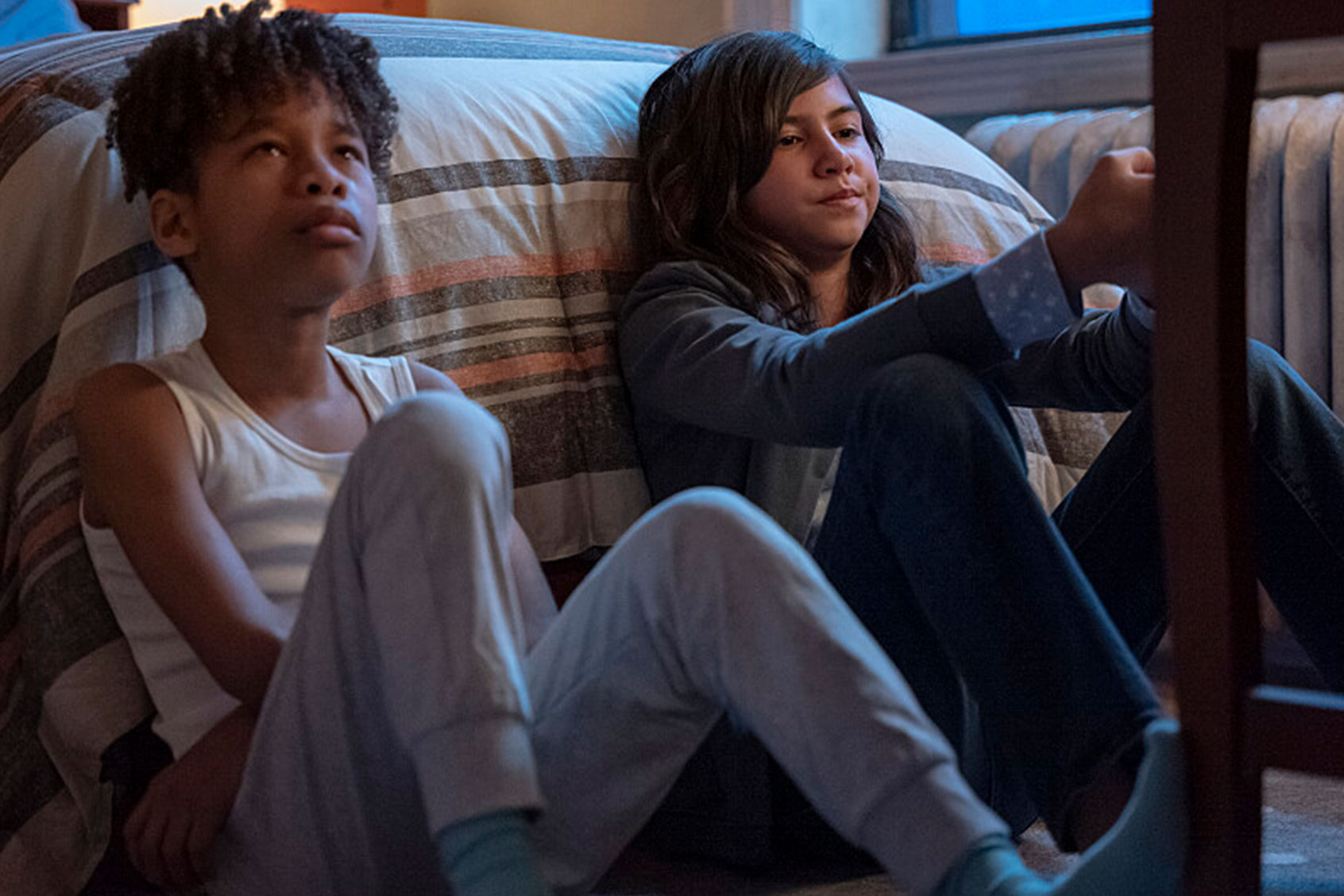
Let The Right One InIan Foreman as Isaiah Cole and Madison Taylor Baez as Eleanor Kane in “Let The Right One In” (Francisco Roman/SHOWTIME)
However a child vampire is made, they represent an adult’s mistake, a moment of weakness.

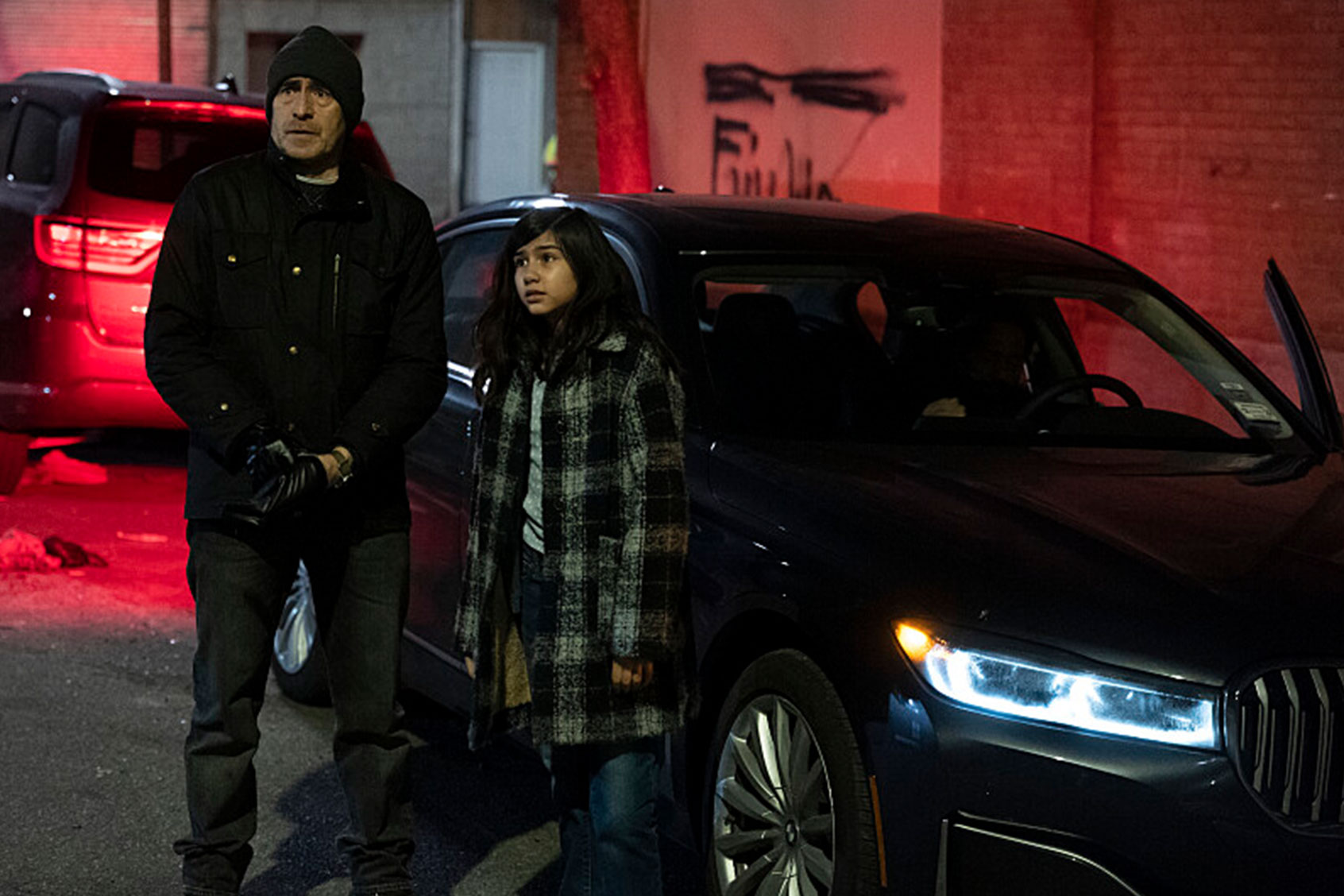
A parent or protector can never stop watching out for a child vampire. It’s aged Mark (Demián Bichir), the father of child vampire Eleanor (Madison Taylor Baez) in Showtime’s “Let the Right One In,” the new series adapted from the films. When Eleanor meets and befriends the neighbor boy, the heart-tugging Ian Foreman as bullied Isaiah, her father expresses concern. But Eleanor knows he’s not a typically protective father: “You’re not worried about me. You’re worried I’d do something to him.”

However a child vampire is made, they represent an adult’s mistake, a moment of weakness, poor judgment. Claudia was made due to Louis’ guilt, the girl trapped in a fire started because of something he did. Nearly consumed by the flames, Louis rescues her, and turning her into a vampire is the only way to save her. But what is he saving her for?

Let The Right One InDemián Bichir as Mark Kane and Madison Taylor Baez as Eleanor Kane in “Let The Right One In” (Francisco Roman/SHOWTIME)What kind of life does a child vamp have? Eleanor travels in a trunk, denied food. Although a powerful vampire, she’s at the mercy of the one who cares for her, a father who makes rules when she’s technically far too old for them. All children outgrow their family home, but children vampires outgrow their families, outlive them, without being able to grow at all. The resentment is strong as parent/child (or maker/child) roles reverse but never fully. A child vamp can never do anything fully, trapped in a body that cannot hold the experiences of their brain. 

Want a daily wrap-up of all the news and commentary Salon has to offer? Subscribe to our morning newsletter, Crash Course.


The aberrant child vampire highlights inequality, a deviant even among deviants. Someone’s got to be at the bottom of the bloodsucker rung, and it’s the kid vamps who have no power, no say and no future. As the supernatural creature’s popularity surges, children are, as always, the ones without a voice, the ones left behind.


24 ways to go savory with apples (because fall’s favorite fruit belongs in more than pie)

In Matt Bell’s 2021 novel Appleseed, the opening lines read “in the faun’s clawed and calloused hands the pomace comes out rich and sweet, a treasure of crushed cores and waxy skins and pulped flesh, a dozen colors of apples distinct in the gap between the cider mill’s grindstone and its wheel.”

Something about this exceptional sentence distills the sheer essence of the apple: from the seeds to the core, the skin to the flesh, the crisp bite and the heady aroma. To encapsulate the apple in a handful of words is a feat in and of itself.

The apple is more than just a fruit, more than just a symbol and more than an ingredient. It’s indicative of so much (the Garden of Eden, George Washington’s apple tree, “an apple a day,” etc.) and has been so deeply tethered to the cultural consciousness, perhaps more so than any other food item. 

When it comes to actual recipe applications, though, the apple is . . . not nearly as powerful. Frequently sliced and slathered with peanut butter, often absent-mindedly munched on or sometimes baked into a pie or crisp, the actual breadth of the apple’s culinary abilities is strangely limited, especially when it comes to savory applications.

Here, we outline two dozen possibilities for the humble apple, in hopes of elevating it to its rightful status:

1. Core, seed, stuff and roast a whole darn apple. 

In culinary school, we were tasked with a months-long, post-graduation “externship” in order to apply our learned knowledge in a “real world” capacity. One of the very first restaurants I called in order to inquire about a kitchen placement was New York’s since-closed Sorella, which had a stunning Italian-American menu that was daring, unique and mouth-watering.

Unfortunately, I didn’t complete my externship hours there, but I cherish its wonderful cookbook and remain fascinated by the roasted whole onion. This would be a take on that dish: Essentially, take a few apples and wash them well. Core and seed them carefully, so they remain perfectly spherical and have enough room in the center to be stuffed.

Any stuffings would work well here, but I’d venture to go with a bread crumb-heavy, almost oreganata-ish topping of sorts, possibly interspersed with little chunks of fresh mozzarella and maybe even some sun-dried tomatoes. Roast the apples in a hot oven, serve with a creamy, rich sauce (perhaps including apple cider?) and garnish with lots of fresh parsley. Voilà!

2. Top a pizza.

A local, Neapolitan-style pizzeria near me does a pizza topped with finely diced apple, as well as roasted walnuts, caramelized onion, mozzarella and blue cheese.

When it comes to making pizza at home, don’t spook yourself. Go buy some loose pizza dough from your neighborhood pizzeria, use whatever sauce you have on hand, add copious amount of cheese (omit if you’re dairy-free) and customize as you see fit.

Have some apples hanging out in your kitchen? Their added crunchiness and sweetness help balance out the savory flavors of traditional pizza toppings.


Want more great food writing? Subscribe to Salon Food’s newsletter, The Bite.


3. Add to a salad.

You’ve probably seen these on menus as “harvest” salads, often containing some amalgamation of greens, crisp apple, a nut or seed of some type, a creamy cheese, some sort of dried fruit, a maple-laced vinaigrette and perhaps a grilled protein or tofu. No matter the specifics, these are quite literally always sensational. At home, mix and match as you see fit, and you’ll undoubtedly wind up super satisfied (and feel very seasonal!).

4. Enjoy with baked eggs.

Eggs, cheese and apples go together quite well, whether in a tart, a quiche or even a frittata. A beautiful combination would be a few farm-fresh eggs, a touch of crème fraîche or fromage blanc, some cheese (perhaps goat cheese or gruyere?), a bit of freshly chopped chives and some very, very thinly sliced, peeled apples. Granny Smith’s bright tartness would be especially great here.

5. Finish off a cheese board.

Apples and cheese are a practically insurmountable combination. For this antipasti, I’d venture to go with a creamy or soft cheese, a sharp cheese, a hard cheese and/or a “stinky” cheese, along with Cerignola olives (or tapenade), jam/jelly/honey, some thick-cut apple slices (skin-on), a handful of your favorite nuts, a handful of some sort of dried fruit and some sort of carb (baguette, crackers, flatbreads, etc.). You really can’t go wrong.

6. Stuff a mushroom.

Stuffed mushrooms are one of the world’s best appetizers — no question. While some lean on cream cheese, bacon, spinach, bread crumbs, Parmesan, mozzarella or sausage as the primary stuffing ingredient, why not try apple? Super finely diced apples, along with a creamier element, a vegetable or an herb, a crunchy or textural note and perhaps even some apple juice or cider would beautifully tie a stuffing mixture together. Pop them in the oven for half an hour or so, broil for a bit to get them beautifully browned and your guests will be very happy campers.

7. Spruce up crostini.

Oftentimes, bruschetta is thought to be tomato-only, but this is a mistake. Take (or make) some crostini, top it with a slathering of puréed, lump-free ricotta, a drizzle of honey and a mixture of chopped apples, figs and shallot. If you’re not a ricotta person, try some feta, goat cheese or even a seasoned, herbed cream cheese. Not a fan of the sweetness? Omit the honey, or conversely, use hot honey for an interesting bite.

8. Bake with brie.

An enormous wheel of brie baked atop a fanned-out “circle” of sliced apple stacked concentrically is a surefire hit. Incorporate some dates, honey, bacon or tapenade for a really unique bite. Don’t forget to serve with an assortment of breads, crackers, endive or lettuce cups and other “scoops” that allow for slightly less-messy eating of the ooey, gooey cheese and its accouterments.

9. Use in a hash.

Chop up a whole bunch of potatoes (Idaho or sweet), as well as some squash or pumpkin, plus onions and apples. Add a heaping amount of butter to a hot pan and cook all together until lightly browned and cooked through. Top with a poached egg, so the yolk can ooze out and flavor the hash. You’ll see brunch in a whole new way.

10. Apple and cheddar: Is there a more classic pairing?

Another iconic combination, cheddar and apple is simply meant to be. This isn’t even a recipe, per se — crisp, fresh apple, sliced and served with thick-cut slices of sharp cheddar. A true masterclass in simplicity and perfect pairings, it doesn’t get much better than this.

11. Serve with pork. 

In many instances, the primary go-to for a savory apple option is pork and apples. It’s stellar in any iteration — braised, roasted, cooked in a slow cooker or Instant Pot, etc. Pork tenderloin or shoulder is usually a good pick, along with a non-mealy apple that’ll maintain its structure over the longer cooking process. Peeling (or not?) is up to you.

12. Elevate a chicken salad.

One of the best chicken salads I’ve ever made was Ina Garten’s version, which contains roasted chicken breasts, grapes, pecans, walnuts and a mix of mayonnaise, sour cream and tarragon (which I often think of as the unsung hero of the herb world). Toss in some chopped apples and golden raisins, sandwich in between rye or pumpernickel bread with a copious amount of crisp lettuce and you’ll be stunned by its outrageous flavor.

13. Cook down into a chutney. 

Part chutney, part charoset, part jam: Cook down finely diced apples along with alliums, sweeteners (brown sugar, fruit juices or honey), warmer elements (such as mustard seeds, cumin or chile flakes), some currants or dried apricot and a touch of sharp, acidic vinegar. The end result will be a fascinating condiment that adds a complex, hard-to-pinpoint flavor to anything you serve it with, all season long.

14. Turn into apple chips.

Cut your apples in half, discard the core, stem and seeds and then (incredibly carefully!) use a mandoline to carefully slice them into thin slices. They shouldn’t be gossamer, but imagine a thick-cut potato chip’s thickness. Deep-fry or bake until deeply golden, then top with a sprinkling of flaky salt.

You can add some cinnamon for a seasonal bite, some chile, paprika or turmeric for a hit of color and subtle heat or leave them plain. I’ve always loved the little “snowflake” like essence of the de-seeded/cored apple slice, especially once cooked, dehydrated or dried.

15. Make an apple salsa.

I’m the antithesis of a heat seeker, but if that’s you, feel free to go wild here with jalapeño, serrano or whatever your heart desires. Toss finely diced apple with red onion, a chile or some spicy element, some lime juice, a touch of cumin and a handful of chopped cilantro. Enjoy with parsnip or plantain chips — for an escape from standard potato chips — or go buck wild with pita chips or tortilla chips.

16. Flavor a roast chicken with onions, apples and potatoes.

This is amazing during the fall or winter. Place a 3-or-4 pound chicken in a roasting pan and positively load it up with chopped apples, onions and potatoes. Liberally add oil, salt, chopped herbs and freshly cracked black pepper, transfer to a roaring-hot oven for about half an hour, then turn the oven down to a standard temperature once the skin begins to brown. Baste throughout, check the temperature after about an hour and once cooked through, let cool slightly before carving. Enjoy!

17. Incorporate into a dressing or stuffing.

Stuffings truly run the gamut, but I’ve found that a mix of cragged, jagged bread cubes, tons of butter, celery, apples, alliums and an unruly amount of sage is unbeatable. While other additions are good (Bell seasoning, sausage, squash, walnuts, etc.), those six ingredients are the nexus of a truly sensational stuffing.

18. Roast with butternut squash and turn into a soup.

Roughly chop butternut squash, an onion, some fennel and a few apples, toss with olive oil and salt and roast until fork-tender. Transfer to a pot and cover with a mix of water, stock or your dairy product of choice. Cook for 10 to 15 minutes, then carefully blend until smooth and creamy and return to the same pot. Heat through until hot and adjust the seasoning. Serve the soup with popcorn garnished atop (the popcorn garnish is from an Alex Guarnaschelli recipe I always thought was downright fascinating).

19. Customize applesauce to your taste.

This is another instance in which you can add lots of heat or spice, especially if you’re not into the sweeter applesauce flavor profile. Here, omit any sweetener and simply cook the apples in water or apple cider until they completely break down. From there, flavor or tweak as you see fit.

It’s up to you whether you choose a thick, chunky applesauce; a puréed, strained, super-smooth applesauce; or a Goldilocks perfect balance mix made with a potato masher. Flavor-wise, you can add chile or spice for a kick; incorporate garam masala or ras el hanout for applesauce that’ll be deeply flavored and savory; or acquiesce to the season and simply flavor with cinnamon.

20. Reduce into a sticky glaze.

This is more so for apple butter, cider or juice than it is for a whole apple (but it still counts, right?). Use this glaze on an oven-baked chicken or even barbecue ribs. Purée apple cider/juice with roasted cherry tomatoes, molasses, tomato paste, apple cider vinegar, a touch of cocoa powder and lots of garlic and onion. This is half glaze, half barbecue sauce, but 100% delicious.

21. Roast with sausage, leek and sage.

This dish is also amazing served as a sandwich. Simply roast sausage (or plant-based sausage) in a hot oven with a few chopped leeks, some chopped apples, some balsamic or sherry vinegar, your oil of choice and a bunch of sage. It’s totally simple, but the flavor is outrageous.

22. Grate into mulligatawny soup.

This iconic soup traditionally does include grated apple, but I up the ante here, using more apple (grated on a cheese grater or even a microplane), as well as apple cider. It hails from India and was supposedly one of the world’s first “fusion” foods. In addition to the apples, it contains standard soup basics (mirepoix, bay leaves, stock or water), plus curry powder, chicken, rice and cream or yogurt. It is truly a wonderful option for a brisk night.

23. Flavor a grilled cheese

Feel free to use your favorite or family recipe here. I slather some butter on both slices of bread, place one of the sides butter-down on the skillet, top with copious amounts of shredded gruyere, cheddar, or fontina, top with some sliced apple and then pile the remaining bread slice on top, with butter on the exterior side and a touch of apricot jam on the interior side. Cook, flipping occasionally and lightly pressing down, until all of the cheese has melted, some has escaped the sandwich and caramelized on the skillet and the bread is browned and crisp. Cut in half and eat it while it’s piping hot.

24. Use as a base for roasted poultry. 

No matter if you’re making Thanksgiving dinner or whipping up a quick roast chicken on a weeknight, try the following method. Thickly slice a few apples, then use them as a foundation for your poultry, lining the entire bottom of the roasting pan with overlapping slices of apple. Add the poultry and season it heavily with butter, oil and/or lots of salt and herbs. Then fill in any open spots with chopped root vegetables, herb bundles, dry white wine, stock or apple cider. Roast away until the skin is brown and crispy and pulling away from the meat.

Carve and enjoy! The apple essence should’ve permeated the bird, adding a subtle-but-detectable flavor that will both beguile and titillate.

Why do pumpkins have warts? The weird science behind autumn’s most charismatic plant

What does a pumpkin have in common with a zonkey? It turns out: quite a lot. 

We don’t typically associate the two: Zonkey is the term for a rarely-seen zebra-donkey hybrid, while pumpkins are associated with Halloween jack-o’-lanterns, delicious desserts and trendy beverages. Yet just as a donkey can breed with a zebra to create a zonkey, so too can different types of pumpkin cross-breed with each other to create vegetables with unique designs. One of those crossbreeds involves being covered in warts.

Hence, in the case of warty pumpkins — a popular novelty gourd often sold this time of year — being covered in warts isn’t necessarily a bad thing. Stop staring — it could be in their genes! 

However, when it comes to other members of cucurbita — a genus of fruit in the gourd family that includes squashes and gourds — warts can be a sign of serious problems, and not genetic ones.

In other words, figuring out if the warted gourd you’re looking at at the farmers market got that way because it’s sick, or genetically predisposed to being wart-covered, is not always obvious. In that way, warts are somewhat akin to freckles on humans: some of us are predisposed towards harmless ones, while for others they can be a sign of skin cancer.

There are times when warted pumpkins — and, for that matter, all manner of warted cucurbits — look like that because something is terribly wrong.

Cucurbits like pumpkins are relatively unique among vegetable crops in that they produce separate male and female flowers on the same plant. The term for this is “monoecious,” and because pumpkins are monoecious, they can cross pollinate with other pumpkins to create vegetables with a wide range of colors, shapes, textures and other variations. One of those potential varieties involves putting in lots and lots of seemingly ugly bumps.

Yet one person’s ugly bump is another’s coveted wart, at least when it comes to pumpkins. The Michigan-based Siegers Seed Co. sells so-called “Super Freak” pumpkins which are renowned for their various bump-covered visages. The owners require at least 10 generations of breeding before they will sell a pumpkin under the Super Freak label, and there is a good reason for that. As the popularity of items like theirs Knuckle Head Pumpkins reveals, Super Freak pumpkins are amazing jack-o’-lantern material.

Meanwhile, there are warty pumpkins like the pink Galeaux d’Esyines. The warts on their outside are called “corking,” as horticulturalist Jessica Walliser said on WNYC. “What happens is that the sugar content gets so high in this fruit that it actually fractures the skin and then they develop these warts,” she explained, noting that the flavor would thus be very sugary. Hence, some warty gourds are actually quite sweet beneath that ornamentally beautiful or weird exterior (depending on your perspective).


Want more health and science stories in your inbox? Subscribe to Salon’s weekly newsletter The Vulgar Scientist.


Yet warted pumpkins don’t always look that way because of genetic variety. There are times when warted pumpkins — and, for that matter, all manner of warted cucurbits — look like that because something is terribly wrong.

If your squash or zucchini is covered in bumps, it is almost certainly due to a virus or some other health problem.

One possible culprits behind a bumpy pumpkin is the mosaic virus. In addition to discoloring leaves and causing some leaves and vines to grow in too small, the mosaic virus can cover a pumpkin’s surface in unsightly bumps. Insects like cucumber beetles can also give pumpkins a bumpy appearance if they start feeding on them before their shells have had a chance to harden.

While you would likely prefer to avoid pumpkins that are infested with beetles, mosaic virus-infected pumpkins are still safe to eat, although generally regarded as inferior in taste.

These same general rules apply to other cucurbits as well. If your squash or zucchini is covered in bumps, it is almost certainly due to a virus or some other health problem. Boring insects and too much calcium in the soil can cause squashes to be bumpy, as can rapid growth of the plant.

There are mosaic viruses that are named after cucumbers (cucumber mosaic), watermelon (watermelon mosaic) and zucchinis (zucchini yellow mosaic), as well as diseases like papaya ring spot. All of them can infect cucurbits and lead to discolorations as well as unsightly bumps. There is also a condition known as oedma in which water imbalances within the fruit causes the cells to grow bigger before eventually bursting, leading to scarring.

But if you’re buying a warty gourd purely for decorative reasons, the source of the warts might not be that important. Unlike dogs, which are sometimes cruelly inbred to select for traits, warty pumpkins are merely briefly-held autumn trifles — even when a lot of biological science underlies their appearance.

Obama shuts down heckler at Michigan rally

Appearing at a rally in Detroit with Michigan Gov. Gretchen Whitmer (D) on Saturday, former President Barack Obama cut off a heckler disrupting his comments as he smiled and told the man, “Right now, I’m talking, you’ll have a chance to talk sometime later.”

As the former two-term president ridiculed Whitmer’s opponent, Tudor Dixon, among other Republican Party candidates, Obama was interrupted and proceeded to talk over his critic as the crowd laughed and chanted “Obama” repeatedly.

“Come on,” Obama replied to the shouts from the man “This is what I mean, we are having a conversation.

“Sir, sir, sir. sir, this is what I’m saying. Look, we’ve got a process that we set up in our democracy. Right now, I’m talking, you’ll have a chance to talk sometime later,” he said as the crowd cheered. “We like each other, we don’t have to shout each other down — it’s not a good way to do business. You wouldn’t do that in the workplace. We wouldn’t just interrupt people having a conversation. It’s not how we do things.”

The man was later escorted out.

Watch below:

Despite Katie Couric’s advice, doctors say ultrasound breast exams may not be needed

When Katie Couric shared the news of her breast cancer diagnosis, the former co-host of NBC’s “Today” show said she considered this new health challenge to be a teachable moment to encourage people to get needed cancer screenings.

“Please get your annual mammogram,” she wrote on her website in September. “But just as importantly, please find out if you need additional screening.”

In the essay, Couric, 65, explained that because she tends to have dense breast tissue, she gets an ultrasound test in addition to a mammogram when screening for breast cancer. A breast ultrasound, sometimes called a sonogram, uses sound waves to take images of the breast tissue. It can sometimes identify malignancies that are hard to spot on a mammogram in women whose breasts are dense — that is, having a high proportion of fibrous tissue and glands vs. fatty tissue.

Couric, who famously underwent a colonoscopy on live television after her first husband died of colon cancer and who lost her sister to pancreatic cancer, has long pushed for cancer screening and better detection options.

Breast cancer experts applauded Couric for drawing attention to breast density as a risk factor for cancer. But some were less comfortable with her advocacy for supplemental screening.

“We don’t have evidence that auxiliary screening reduces breast cancer mortality or improves quality of life,” said Dr. Carol Mangione, a professor of medicine and public health at UCLA who chairs the U.S. Preventive Services Task Force, a group of medical experts who make recommendations for preventive services after weighing their benefits and harms.

Couric’s office did not respond to requests for comment.

In addition to an annual mammogram, some women with dense breasts get a breast ultrasound or MRI to help identify cancerous cells missed by the mammogram. Dense fibrous tissue appears white on a mammogram and makes it harder to see cancers, which also appear white. Fatty breast tissue, which appears dark on the mammogram, doesn’t obscure breast malignancies.

As digital breast tomosynthesis, or 3D mammography, has become more widely available, a growing number of women are getting that screening test rather than the standard 2D mammography. The 3D mammography has been found to reduce the number of false positive results and identify more cancers in some women with dense breasts, though the impact on mortality is unknown.

The task force gives an “I” rating to supplemental screening for women with dense breasts whose mammogram results don’t indicate a problem. That means the current evidence is “insufficient” to assess whether the benefits outweigh the harms of the extra screening. (The task force is updating its recommendation for breast cancer screening, including supplemental screening for women with dense breasts.)

One key harm that researchers are concerned about, besides the possible extra cost, is the chance of a false-positive result. Supplemental imaging in women who aren’t at high risk for breast cancer may identify potential trouble spots, which can lead to follow-up testing such as breast biopsies that are invasive and raise cancer fears for many patients. But research has found that very often these results turn out to be false alarms.

If 1,000 women with dense breasts get an ultrasound after a negative mammogram, the ultrasound will identify two to three cancers, studies show. But the extra imaging will also identify up to 117 potential problems that lead to recall visits and tests but are ultimately determined to be false positives.

“On the one hand, we want to do everything we can to improve detection,” said Dr. Sharon Mass, an OB-GYN in Morristown, New Jersey, and the former chair of the American College of Obstetricians and Gynecologists’ New Jersey section. “But on the other hand, there are lots of costs and emotional distress” associated with false-positive results.

The professional group doesn’t recommend supplemental screening for women with dense breasts who don’t have any additional risk factors for cancer.

Many other professional groups take a similar position.

“We recommend having a conversation with a health care provider, and for patients to understand whether their breasts are dense,” Mass said. “But we do not recommend everyone get tested.”

In particular, for the roughly 8% of women who have extremely dense breasts, it’s worth having a conversation with a doctor about additional screening, said Mass.

Similarly, for women with dense breasts who have additional risk factors for breast cancer, such as a family history of the disease or a personal history of breast biopsies to check suspected cancers, supplemental screening may make sense, she said.

Dense breasts are relatively common. In the United States, an estimated 43% of women 40 and older have breasts that are considered dense or extremely dense. In addition to making it harder to interpret mammograms, women with dense breasts are up to twice as likely to develop breast cancer as women with average-density breasts, research shows.

Studies have shown that mammograms reduce breast cancer mortality. But even though it seems intuitive that more testing would improve someone’s odds of beating cancer, research hasn’t found that women are any less likely to die from breast cancer if they get a supplemental ultrasound or MRI after a negative mammogram result.

A few studies have found that women with dense or very dense breasts who got an ultrasound or an MRI in addition to a mammogram had fewer so-called interval cancers between regular screening mammograms. But it’s unclear whether those results have any effect on their risk of dying from breast cancer.

“Not every small abnormality is going to lead to something that needs treatment,” said Mangione.

Thirty-eight states and the District of Columbia have laws requiring that patients be notified about breast density after a mammogram, though some require only a general notice rather than mandate that individual women be informed about their own status. Some states require insurers to cover supplemental testing, but others do not.

In 2019, the FDA proposed that information about breast density be incorporated into the letters patients receive after a mammogram. That rule hasn’t yet been finalized, but the agency told lawmakers that it expects to issue the rule no later than early next year.

In a statement to KHN, FDA spokesperson Carly Kempler said, “The FDA is committed to improving mammography services for patients and working diligently to finalize the rule to amend the existing mammography regulations.”

The cost of additional testing is another factor to consider. Because the preventive services task force recommends women get regular screening mammograms, health plans are generally required to cover them without charging people anything out-of-pocket. That’s not the case with supplemental screening for women with dense breasts, which the task force does not recommend. Some states require insurance coverage of those tests, but those laws don’t apply to the many plans in which employers “self-fund” workers’ benefits rather than buy state-regulated insurance coverage.

Supplemental imaging can be pricey if your health plan doesn’t cover it. A screening ultrasound might cost $250 out-of-pocket while a breast MRI could cost $1,084, according to the Brem Foundation to Defeat Breast Cancer.

Rep. Rosa DeLauro (D-Conn.) recently tweeted that she is working on a bill with Couric that would cover MRIs and ultrasounds for women with dense breasts without any out-of-pocket costs.

Some doctors recommend other steps that may be more effective than extra screening for women with dense breasts who want to reduce their breast cancer risk.

“If you really want to help yourself, lose weight,” said Dr. Karla Kerlikowske, a professor of medicine and epidemiology/biostatistics at the University of California-San Francisco, who has worked with other researchers to develop calculators that help providers assess patients’ breast cancer risk. “Moderate your alcohol intake and avoid long-term hormone replacement. Those are things you can control.”

KHN (Kaiser Health News) is a national newsroom that produces in-depth journalism about health issues. Together with Policy Analysis and Polling, KHN is one of the three major operating programs at KFF (Kaiser Family Foundation). KFF is an endowed nonprofit organization providing information on health issues to the nation.


KHN (Kaiser Health News) is a national newsroom that produces in-depth journalism about health issues. Together with Policy Analysis and Polling, KHN is one of the three major operating programs at KFF (Kaiser Family Foundation). KFF is an endowed nonprofit organization providing information on health issues to the nation.

Subscribe to KHN’s free Morning Briefing.

Jemele Hill opens up about the difficult, insulting and unseen parts of racism in newsrooms

One of the first gigs I got as a freelance reporter involved a crooked cop, a falsely imprisoned rapper and a collection of community members that proudly went on the record, saying how the cop had harassed them for years. I was from that community, so I knew the cop and I knew the victims and I knew that the newspaper was the only way to bring real attention to this matter – so I gutted the cop in a heavy article, clearly laying out his crimes and calling out some of the politicians and high-ranking officers who were aware of his crimes but still allowed this crooked cop to function. 
 
“This is great stuff, D,” the editor at the paper said, “Really, really great, but too raw,” – before he proceeded to tear my essay apart and water down the message I wanted to send to the city, about how horrible this cop was and the lives he ruins everyday. Now I was gutted because I felt like the editor didn’t believe in me enough, even though all of the stories I submitted came from angry residents who also wanted change. It felt as if certain kinds of Black stories don’t have places in white papers until they are viral or when the system finally says it’s cool to advance the conversation. 
 
Years later, that same cop I wrote about was indicted for racketeering amongst other charges, was convicted and is now serving 18 years federal prison. That same editor who questioned my early claims has since apologized – but I was a vet and no longer upset, because at that point, I knew what it meant to be Black in a white newsroom. Atlantic magazine contributor Jemele Hill had to deal with being Black in white newsrooms for most of her career. 
 
Hill, mostly known for her work at ESPN had the ultimate “Black in the newsroom” moment when she called out then-President Trump for being a white supremacist, a decision that ultimately led to Hill leaving the network. Hill details her upbringing in Detroit, her career in journalism and all of the events leading up to the moment she bravely spoke out against the 45th president in her new book “Uphill: A Memoir.” During our “Salon Talks” episode, we discussed the aftermath of her decision, her process of becoming vulnerable and the difficult and insulting aspects of being underestimated. Watch my “Salon Talks” episode with Jemele Hill here or read a Q&A of our conversation below. 

The following conversation has been lightly edited for length and clarity.

A memoir is different than reporting on other people. You have to open up and talk about your own stuff. What was that like for you?

It was definitely challenging at some moments, particularly dealing with incidents that I thought I pretty much had unpacked a while ago. And so then resurfacing those incidents and then living through them all over again was challenging at some spots. But overall, I wanted to approach this book in the spirit of transparency. Even if it resulted in reliving through some things, I think what I got out of it at the end of it was definitely worth those moments. 

There’s some parts in the book that’s really heavy, we’ll get to that. But then there’s some parts that could come off as heavy that’s just heavy dying laughing. Your mom showing you the crack was almost like a “Boondocks” episode, but her strategy worked.

Yeah, not that that was at the forefront of my mind at that particular age, but I think I compared it in the book to a very extreme “say no to drugs” commercial that was happening right in front of my face. It was one of those things, at least in the moment, where as even as a kid, I’m thinking like, wow, is this how bad things have gotten right now? Is that where we are? But a lot of the aggressive and intensive parenting that my mother did came from the place of her not wanting me to repeat the same mistakes. So, even though that was a serious and dramatic scare tactic, as you said, it did work. Because I’ve never wanted to have any association with any hard drugs.

I grew up in a family plagued with addiction as well. I feel like the long-term impact it had on me was it made me look at a lot of my early relationships in life as just temporary. Everything’s temporary. These people are going to be around for a short amount of time. Don’t get too comfortable, don’t get too close because anything can happen. Do you feel like addiction has shaped you in any way or just learning your coping mechanisms?

Oh, definitely. I think one of the biggest ways that it shaped me was that I have struggled throughout my life with vulnerability. A lot of that came from having to survive certain things, having to grow up earlier than I should have, in terms of being introduced to very adult and traumatic problems. It caused me to build an armor around myself. I think that armor has been difficult to break. It’s certainly broken at some points, but a lot of it is because I felt like through most of my life, and especially about what I saw as a child, that opening up, being vulnerable, those are things that can be very costly. You don’t want nobody to take advantage of you. 

[My mom] used to tell me all the time,”Guard your heart,” and all these other things that made me fearful about what that experience might be like. I think it was just a repeated pattern of being disappointed by some of the adults in my life, her included. These are things that made me question opening up and having those kinds of relationships with people. 

How do you break that armor? Is it even possible? Because we work in publishing and media where you need an armor.

“When you go into locker rooms and you’re the only Black person in there, or maybe the only woman, and certainly the only Black woman, you understand there’s a different scrutiny you’re under.”

I’m not saying that you should go around open-hearted and willing to share it with everyone, but I think in the relationships that I really valued, I wanted to be able to be more vulnerable and be more open, and I struggled to. I really couldn’t. It would have been an easier way for me to communicate with people instead of just being somebody who thinks about things and broods over things a long time. I think it’s healthy and human and normal to get things off your chest or to not necessarily in a negative way or trying to create any kind of conflict or in the midst of conflict, but just being able to openly communicate to somebody just even how much you care about them or feel about them. Those are things that were kind of difficult for me to do.

I was so happy when you mentioned your fifth grade teacher, Ms. Johnson. I think teachers don’t get their flowers enough. And I think so many of us who grew up in poverty, our first glimpse or our first chance to see something beyond our surroundings is through the eyes of a teacher. What did Ms. Johnson mean to you?

I sent her a signed copy of the book, and her and I connected as I was writing this book because I wanted to get her impressions of me as my teacher. What did she think about me and why did she take time out to build a relationship with me? I wanted to find out from her what made her form that relationship. 

She put me in my first play. I was Dorothy in “The Wiz.” I thank her in the acknowledgements [of the book], because she did that. That helped me get over a certain amount of shyness that I had. That was probably the first time I really had to publicly speak and not only publicly speak, but perform. Before anybody gets any kind of idea that I could sing, we were lip syncing. We were lip syncing. This was not me belting out like I’m Diana Ross.

There was a reason why I thanked her and a couple other of my teachers in my acknowledgements because there are so many pivotal points where you make decisions at the time that you don’t even know are crucial or that people are pouring into you and you don’t even understand what the lasting impact of that will be. Once you reach a certain place as an adult, you look back and, if you can, reach out to those teachers that really mattered in your life. I’ve been really lucky because I’ve been able to keep in contact with a few of my teachers. And I just want them to know from reading this book that they helped to change the course of my life.

I think a lot of people don’t really understand the culture shock that a Black person has when entering media. In the book, you compare your job in Orlando to living in Detroit. It’s almost like you have to learn a different language. Can you talk about what that assimilation was like for your younger self?

If you’re in media, and especially the type of media I chose to do — I chose to be a sports journalist — it’s a space that there’s not a lot of Black journalists are in and certainly not a lot of Black women. That is a very isolating experience in itself, and so when you go into locker rooms and you’re the only Black person in there, or maybe the only woman, and certainly the only Black woman, you understand there’s a different scrutiny you’re under. 

My time in Orlando, especially being the only Black female sports columnist at a daily newspaper in North America, there was a lot of scrutiny on me when I got that column.

“Am I about to lose my job over Donald Trump, of all things?”

Unfortunately when you’re in a lot of these white spaces, whether you’re in sports media or really any corporate space, as Black people our Spidey senses sense the fact that a lot of people in that room are questioning why we’re there and wondering if we’re the diversity hire or assigning some level of underperformance to us without us even having been on the job. I was 28 years old and there were sort of the industry whispers of people wondering how I got a column in this job at a paper the size of Orlando at just 28.

That was one of the more difficult and insulting aspects that I had to deal with at various points in my career. As I wrote about it in the book, to have a colleague at a competing newspaper tell me to my face that it was much easier for me to get a job than him and he’s a white guy and I’m the only Black woman in the room, it’s just like, are you serious? If it’s easier for me, how come I’m the only one in here and all y’all are white men? That math ain’t mathing.

Tough time for white men.

Yeah, exactly. I was like, y’all only have 85-90% of the jobs in sports media. Do you want 100% of them? I don’t think a lot of people who are in those spaces with us understand how extraordinarily insulting that can be and how it’s such a burden when all you want to do is do your job and do it to the best of your ability and not have people questioning why you’re there.

I bet that training made ESPN easy.

It did in some respects, but ESPN was such a different place to be because whatever attention, readership, viewership you were used to reaching before, it quadruples when you get to ESPN because they unintentionally created the celebrity sports journalists. That was probably the most difficult part to get used to at ESPN. The other stuff I dealt with in my career in terms of hate mail, having people wonder why I’m there, and the scrutiny. But it is just so much more magnified at ESPN because of the magnitude of the platform.

It was uncomfortable, especially coming from a newspaper background where you’re often told that you’re not the center of the story and that the journalist is not supposed to be out there. At ESPN, everything starts with the person. So it’s not just the Lakers aren’t very good, it’s Stephen A. Smith saying the Lakers aren’t very good. Because of that element of your name being strongly attached to the opinions that you have and people saying, “Oh, it’s not that you’re pointing out something obvious, it’s that you are the one pointing this out.” That took a lot of adjusting to.

One of the things that frustrated me is that in a time where a whole lot of people were biting their tongues about Donald Trump, you told the truth. Sports has had a history of being the only profession where winning was more important than race. You can hate Black people from Monday to Saturday, but when they got on that football field on Sunday, that was your brother, that was your main man. You used your platform to highlight something that was really, really problematic in our country — still is. And people responded as if you were speaking a different language. What was your head space like during that particular time?

Well, I guess one place was: Am I about to lose my job over Donald Trump, of all things? Then there was a concern of safety because when you criticize somebody like Donald Trump, who has an aggressive cult that follows him, whenever he’s criticized, they go on the attack. I had been getting hate mail since I was in college. So the hate mail aspect is not new, but it’s very different when it’s hate mail coupled with death threats and very strong opinions about how people feel about you. Just a barrage and nonstop barrage. 

I remember when one of the executives at ESPN had given me a batch of hate mail, snail mail, that people had sent to the network. I read a couple of the letters and then the rest of them I, didn’t even bother to read because at some point you have to protect your spirit.

What’s the most racist s**t Jemele ever heard?

Well, I got to be honest though, the racist slurs that always humorously, that I frankly laugh at are the old school ones. You used to being called the n-word. Like, all right, okay. But it’s when somebody breaks out the occasional d***ie or c**n, that’s when I’m like, man, you reach back for that one.

“I’m ready to be in a season in my life where if I don’t want to do something or if I do want to do something, there’s one person to consider and that’s me.”

They went back.

Which I should not be surprised at because if you are doing the old school thing of actually mailing me a letter, that’s a lot of commitment.

That’s a lot of commitment to racism.

You have to find some paper, you know what I’m saying? You have to write it down.

Get a stamp.

You had to take it to the mailbox or the post office. I was like, you really thought this through. So yeah, or the people who type racist slurs. And I’m just like, so you typed a letter to me calling me a n-word? Like man, I’m not even mad. I’m impressed that you took the time out to do that.

Even though racists are still racists, there are a lot more people who believe what you said. They now proudly call Trump a white supremacist. Knowing that, would you ever go back to ESPN?

I think one of the reasons why it was time for me to leave is that I kind of had outgrown what my role was there. You never say never, but there was just nothing else left for me to do. I hosted SportsCenter, I had my own daily sports show, I’d done radio, podcasting, wrote for espn.com, and did sideline reporting. I did everything there was to do there. And so it just felt like the mission was over. And it’s kind of like in a relationship where you kind of know it’s run its course. 

I wouldn’t just say this about ESPN, but I think the experience and how I left there, it really showed me that I’m ready to be in a season in my life where if I don’t want to do something or if I do want to do something, there’s one person to consider and that’s me. So I think the days of having to ask for permission to do things, of having email chains about whether or not you should do something, I’m just done with that. 

Yeah, f**k a email chain.

Definitely. For real. That’s not my testimony anymore. Any email chains I have now, it’s about strategy. It’s about things that make sense and my participation is understood. But yeah, I think I knew what I signed up for when I was in traditional media for as long as I was. And I was OK with that bargain. But now I don’t think I am. And even working in spaces still that our traditional corporate structures, I very much tell them what they can expect from me coming in. Like, if y’all are expecting me to be a different version of what you’ve seen, what got me through your door or why you wanted to work with me, you’re not getting a different version. You’re getting this. You got to be okay with this and you got to have the stomach for certain things. If you feel like you don’t have the stomach for this, we can just stop and end this now without further frustrating each other. So I think now companies that work with me are much more aware and have the ability to handle what it is I bring to the table.

So what I got from the book was coming out of Detroit in the era you grew up in, we already knew it, there’s toughness you had to have. But I feel like you take it to a different level and I appreciate that as a reader. What are some of the main things you want readers to take away?

I do want people to understand that your circumstances do not have to dictate the life you’ve imagined for yourself. This is not to say it will be easy, this is not to say that you’ll have to be resilient about some things, and that some things you may go through may be traumatic. All that being said is that as people read the book, even in these circumstances in which I grew up, the people around me always made the expectation very clear that success was a priority. Regardless of what my mother was going through, what my father was going through, my grandmother, they were not going to let me be mediocre in any area of my life just because they were having their own issues.

I say that to people out there who can relate to some of the things I talk about in the book, or have their own version of the things that I talk about in the book to let them know that sometimes just being able to keep going will get you to so many more places and that you can start to break some of the generational trauma or the family trauma or the generational curses. You have to decide that you want something different and better for yourself. I hope people take away that part. 

And, I hope people also look at this book and realize why it’s important to see their mothers, their fathers, their aunts, uncles, the people in their lives, their family members, as full people. You discover they’re full people if you ask them questions, if you give them the safety of being able to tell you maybe some of the failures and disappointments that have happened before you were even there, or even while you were there. I think it allows you to give them grace. To me, that helps build better relationships with the people that you love.

Be a product of your expectations, right?

Absolutely.

When we criticize Russia’s war crimes in Ukraine, we should remember the bombing of Tokyo

In its brutal campaign to seize territory from Ukraine, Russia has placed the bull’s-eye on the backs of men, women and children. Russian bombs and artillery have killed thousands of civilians while destroying Ukrainian schools, hospitals and apartment buildings. 

As of this week, the UN has tallied 15,908 civilian casualties, including 6,306 killed. Those numbers, which include hundreds of children, are likely low. Russia’s strike this summer on a crowded shopping mall drew the condemnation of leaders of the G7: “Indiscriminate attacks on innocent civilians constitute a war crime,” said the elected leaders of the largest Western democracies. “Russian President Putin and those responsible will be held to account.”

But that statement, endorsed of course by President Biden, glosses over America’s own complicated legacy of bombing civilians in World War II. 

Throughout that war, civilians worldwide sadly bore a heavy burden. The Japanese pulverized China’s wartime capital of Chongqing, while the Germans hammered British cities in the Blitz. The British subsequently retaliated, burning Hamburg, Berlin and, of course, Dresden, a city whose name has become synonymous with the horror of air warfare.  

Throughout that period of carnage, the U.S. had remained committed to the concept of precision bombing, convinced that it was not only morally superior but also a better way to destroy an enemy’s industry. “The ruthless bombing from the air of civilians in unfortified centers of population,” President Franklin D. Roosevelt declared in 1939, “has sickened the hearts of every civilized man and woman, and has profoundly shocked the conscience of humanity.” 

The war against Japan, however, changed that view. 

In the Pacific, terrible weather and violent jet streams combined to wreck bombing accuracy. At the same time, commanders were anxious to knock Japan out of the war before American troops had to slosh ashore in what promised to be a bloody invasion, one that would far exceed the horror experienced on Iwo Jima and Okinawa and could have led, based on one War Department estimate, to as many as four million American casualties.  

This prompted Maj. Gen. Curtis LeMay, only 38 years old at the time, to make one of the most consequential decisions of the war. As head of the 21st Bomber Command on Guam, LeMay chose to abandon America’s longtime strategy of daylight high-altitude precision attacks in favor of burning Japanese cities in low-level nighttime raids. For his inaugural strike on the night of March 9, 1945, he set his sights on Tokyo. 

LeMay’s 12-square-mile target area, which was 87.4 percent residential, had an average population density of 103,000 people per square mile, meaning the bombs fell largely on the kitchens, living rooms and bedrooms of the Japanese capital’s working-class civilians. LeMay justified the decision because many such homes doubled as small factories, a vital cottage industry that fed parts to Japan’s ravenous war machine.

LeMay’s incendiary bombs targeted an area that was 87% residential, with 103,000 people per square mile. He deliberately attacked the homes of Tokyo’s working-class civilians.

The general likewise knew that incendiary bombs did not discriminate. The fires his bombers ignited would consume everything and everyone in their path, from factory and armaments workers to artists, teachers and housewives. “We knew we were going to kill a lot of women and kids when we burned that town,” he later wrote. “Had to be done.”

To his aides, LeMay was even more blunt. 

“If we lose,” he warned, “we’ll be tried as war criminals.”

At 12:07 a.m., his first bomber unloaded on the Japanese capital. For the next 142 minutes, nearly 300 planes dropped 1,665 tons of incendiaries. These napalm-filled explosives were designed to punch through the metal and tile roofs of shops and homes, spraying flaming jellied gasoline on walls, furniture and bedding. 

Hundreds of blazes soon erupted, ultimately melding into a massive tidal wave of fire that rolled across the city. Temperatures amid the conflagration soared as high as 2,800°F., hot enough to melt concrete, liquefy asphalt and fuse coins together. “The town was a blazing hell,” recalled survivor Sumi Ogawa, “lit by the swirling and roiling flames.”

American airmen in the skies overhead inhaled the acrid aroma of the dying city, including the sickening stench of burnt flesh, from dogs and horses to mothers and fathers. “It was,” remembered pilot Charles Phillips, “the smell of death.”

The sun rose the next morning to reveal an apocalyptic wasteland. The attack incinerated 16 square miles of Tokyo and killed 105,000 men, women and children. Another 40,000 people suffered injuries and a million were left homeless. “There was still a light wind blowing,” one reporter observed, “and some of the bodies, reduced to ashes, were scattering like sand.”


Want a daily wrap-up of all the news and commentary Salon has to offer? Subscribe to our morning newsletter, Crash Course.


Back in Washington, officials monitored the nation’s editorial pages and radio broadcasts for evidence that the killing of civilians might spark outrage among the American public. Those fears, however, proved unfounded. “Properly kindled,” Time magazine declared, “Japanese cities will burn like autumn leaves.” 

The lack of any public outcry served as a green light for LeMay, who over the next five months proceeded to burn dozens of Japanese cities. His initial focus on urban industrial areas, like Tokyo, where home factories contributed to the war effort, faded as the attacks continued and his list of cities dwindled. In the latter raids, as the U.S. Strategic Bombing Survey noted, the No. 1 factor driving target selection was a city’s “combustibility.” 

America, in short, was waging war against Japan’s civilians. “The preponderant purpose appears to have been to secure the heaviest possible morale and shock effect by widespread attack upon the Japanese civilian population,” the Strategic Bombing Survey concluded. “Certain of the cities attacked had virtually no industrial importance.”

In the 177 days from his strike on Tokyo until the Japanese surrender on board the USS Missouri, LeMay torched 66 Japanese cities, leveling 178 square miles. Of all those operations, LeMay’s raid on Tokyo proved one of the deadliest, rivaled only by the fatalities caused by the atomic bomb attacks on Hiroshima and Nagasaki in the waning days of the war.  

All told, America’s bombing campaign against the Japanese homeland killed 330,000 people, injured nearly a half million more, and left 8.5 million homeless. “Curtis LeMay,” observed his biographer Warren Kozak, “ordered the deaths of more civilians than any other man in U.S. history. No one else comes close, not William Tecumseh Sherman, not George S. Patton — no one.”

It is important, as we grieve the awful war crimes Russia is committing in Ukraine, that we as Americans remember our own tragic history of attacks on civilians nearly eight decades ago in our quest for total victory.

Rubio canvasser speaks out at Proud Boys rally

The far-right activist who was attacked while canvassing for Florida GOP Sen. Marco Rubio insisted on Saturday that the attack was politically motivated, even though he did not tell that to authorities until after the senator had publicly claimed as much on Twitter.

Christopher Monzon, also known as “the Cuban Confederate,” was interviewed by the Miami Herald during an appearance at a Proud Boys rally in Hialeah.

“All I want is for the truth about what happened to get out. And the truth is it was politically motivated,” Monzon claimed.

But that was not what Monzon initially claimed.

“An initial police report mentioned nothing about politics,” the newspaper reported. “Monzon has a long history of supporting white supremacist causes and making racist statements.”

Monzon vowed he would clear his name.

The newspaper reported “he declined to answer specific questions about the beating or his past.”

Florida moves to ban gender-affirming care for minors

LGBTQ+ advocates expressed outrage—and resolve—after a joint committee of Florida’s two medical boards moved a step closer to adopting a draft rule backed by Republican Gov. Ron DeSantis that would ban doctors from providing gender-affirming healthcare to transgender youth.

After five often heated hours of testimony, a joint committee of the Florida Board of Medicine and the Florida Board of Osteopathic Medicine voted in favor of a proposal to bar doctors in the state from prescribing puberty-blocking and hormone treatments for patients younger than 18.

The proposed rule would also prohibit gender-affirming surgery for minors, which experts noted rarely occurs. The proposal is scheduled to advance for a final vote by the full medical boards on November 4.

Some supporters of the proposed rule shared testimony of how they rushed into treatments—the most common of which, puberty blocking-medications, are reversible—and later regretted their decision, a phenomenon studies show affects less than 1% of people who transition. The state also relied upon the testimony of doctors including Dr. Michael Laidlaw, who falsely claimed that as many as 90% of trans youth de-transition.

While some proponents of the prospective ban made misleading and sometimes outright false claims, medical experts, trans youth, and their parents and loved ones testified about the critical importance of gender-affirming care.

“I am 15 years old. I knew with certainty that I am trans when I was 10 years old. When I first came out, everyone rejected me and told me it was a phase,” said one person in their written testimony.  “Five years later, it is not a phase. When I was 10 years old, I was suicidal, and would self-harm because nobody believed me and I knew I couldn’t keep going through the wrong puberty and wait eight years before I could transition.”

The teen continued:

I became secretive, and would lie to my parents about anything related to my trans identity as to hide it from them. Because when I had told them at age 10, they didn’t believe me.

Last year, right before I turned 15, I came out to them again. And they were more accepting. At that point, I had wanted to start transitioning for five years. After telling them I want to try and start, they hesitantly accepted it and we tried to start the process of getting testosterone.

It took me six months to get testosterone. It is not easy. No matter what your propaganda says, I had to fight every step of the way and be denied every step of the way until finally, after four different professionals, I was given my prescription.

“Going on testosterone is the single best decision I have ever made in my life and that is not an exaggeration,” they added. “I am no longer suicidal. I can finally acknowledge and embrace the fact that I have a future, and a family that loves and accepts me for who I am. I don’t have to pretend to be someone else anymore. Until now. Until you.”

In written testimony against the proposed rule, American Academy of Pediatrics (AAP) president Dr. Moira Szilaygi noted:

Bullying, discrimination, harassment, and a lack of social acceptance are issues adolescents with gender dysphoria deal with on a daily basis and all these issues lead to increased risks of suicide and other mental health conditions…

By proposing an alternative standard of care, Florida is ignoring the broad consensus among the medical community and the weight of peer-reviewed medical literature. We call on the Florida Board of Medicine to reject the call for the development of new standards of care and ensure that the existing evidence-based standards of care are allowed to be used to care for children and adolescents with gender dysphoria. Only by doing so will the health and well-being of children and adolescents with gender dysphoria in Florida be preserved.

Accredited medical groups—including the AAP, American Medical Association, and the American Psychological Association—support gender-affirming care for transgender minors.

Public commentary was overwhelmingly against the proposed ban.

“Gender-affirming care saved my life at 16. Please do not take this vital care away from other young people like me,” Aaron Demlow pleaded.

“I am a retired social worker who did counsel a transgender youth,” said Susan Nasrani. “Having access to gender-affirming medical care kept this young person from deep depression and suicide.”

“Doctors took an oath to help, not hinder a person. Who a person is is none of your business,” contended Kathy Stomber.

“Actual medical providers understand the real need for this care,” asserted Liza Brazzle. “Don’t let bigotry get in the way of doing what’s best for patients.”

“Do not take away transgender Floridians’ right to healthcare away from them,” implored Steven Rocha. “Their blood will be on your hands if you do.”

Numerous observers accused the board of bias.

“The hearing was stacked against trans youth from the start,” tweeted legal expert Alejandra Caraballo.

“Despite local families and activists getting there first, nine anti-trans folks testified first,” she noted. “After selectively filtering to give a 50/50 split after, the board closed the hearing early, leaving many to not speak.”

Trans rights defender Erin Reed decried what she called a “sham hearing with fake experts,” noting along with other observers that the committee “relied on a report done in part by a dentist to ban gender-affirming care.”

Friday’s Florida committee vote came as legislatures and governors in Republican-controlled states continue to pass or propose dozens of laws eliminating or limiting the rights of LGBTQ+—and especially transgender—youth, including restroom and sports bans.

“Our votes do matter and can impact the future of LGBTQ+ rights in Florida,” the progressive political action group People Power for Florida tweeted Saturday. “Make your plan to vote for people that align with your values and care about equality.”

‘Silent Spring’ 60 years on: 4 essential reads on pesticides and the environment

In 1962 environmental scientist Rachel Carson published “Silent Spring,” a bestselling book that asserted that overuse of pesticides was harming the environment and threatening human health. Carson did not call for banning DDT, the most widely used pesticide at that time, but she argued for using it and similar products much more selectively and paying attention to their effects on nontargeted species.

“Silent Spring” is widely viewed as an inspiration for the modern environmental movement. These articles from The Conversation’s archive spotlight ongoing questions about pesticides and their effects.

1. Against absolutes

Although the chemical industry attacked “Silent Spring” as anti-science and anti-progress, Carson believed that chemicals had their place in agriculture. She “favored a restrained use of pesticides, but not a complete elimination, and did not oppose judicious use of manufactured fertilizers,” writes Harvard University sustainability scholar Robert Paarlberg.

This approach put Carson at odds with the fledgling organic movement, which totally rejected synthetic pesticides and fertilizers. Early organic advocates claimed Carson as a supporter nonetheless, but Carson kept them at arm’s length. “The organic farming movement was suspect in Carson’s eyes because most of its early leaders were not scientists,” Paarlberg observes.

This divergence has echoes today in debates about whether organic production or steady improvements in conventional farming have more potential to feed a growing world population.

2. Concerned cropdusters

Well before “Silent Spring” was published, a crop-dusting industry developed on the Great Plains in the years after World War II to apply newly commercialized pesticides. “Chemical companies made broad promises about these ‘miracle’ products, with little discussion of risks. But pilots and scientists took a much more cautious approach,” recounts University of Nebraska-Kearney historian David Vail.

As Vail’s research shows, many crop-dusting pilots and university agricultural scientists were well aware of how little they knew about how these new tools actually worked. They attended conferences, debated practices for applying pesticides and organized flight schools that taught agricultural science along with spraying techniques. When “Silent Spring” was published, many of these practitioners pushed back, arguing that they had developed strategies for managing pesticide risks.

Archival footage of crop-dusters spraying in California in the 1950s.

Today aerial spraying is still practiced on the Great Plains, but it’s also clear that insects and weeds rapidly evolve resistance to every new generation of pesticides, trapping farmers on what Vail calls “a chemical-pest treadmill.” Carson anticipated this effect in “Silent Spring,” and called for more research into alternative pest control methods – an approach that has become mainstream today.

3. The osprey’s crash and recovery

In “Silent Spring,” Carson described in detail how chlorinated hydrocarbon pesticides persisted in the environment long after they were sprayed, rising through the food chain and building up in the bodies of predators. Populations of fish-eating raptors, such as bald eagles and ospreys, were ravaged by these chemicals, which thinned the shells of the birds’ eggs so that they broke in the nest before they could hatch.

“Up to 1950, ospreys were one of the most widespread and abundant hawks in North America,” writes Cornell University research associate Alan Poole. “By the mid-1960s, the number of ospreys breeding along the Atlantic coast between New York City and Boston had fallen by 90%.”

Bans on DDT and other highly persistent pesticides opened the door to recovery. But by the 1970s, many former osprey nesting sites had been developed. To compensate, concerned naturalists built nesting poles along shorelines. Ospreys also learned to colonize light posts, cell towers and other human-made structures.

Wildlife monitors band young ospreys in New York City’s Jamaica Bay to monitor their lives and movements.

Today, “Along the shores of the Chesapeake Bay, nearly 20,000 ospreys now arrive to nest each spring – the largest concentration of breeding pairs in the world. Two-thirds of them nest on buoys and channel markers maintained by the U.S. Coast Guard, who have become de facto osprey guardians,” writes Poole. “To have robust numbers of this species back again is a reward for all who value wild animals, and a reminder of how nature can rebound if we address the key threats.”

4. New concerns

Pesticide application techniques have become much more targeted in the 60 years since “Silent Spring” was published. One prominent example: crop seeds coated with neonicotinoids, the world’s most widely used class of insecticides. Coating the seeds makes it possible to introduce pesticides into the environment at the point where they are needed, without spraying a drop.

But a growing body of research indicates that even though coated seeds are highly targeted, much of their pesticide load washes off into nearby streams and lakes. “Studies show that neonicotinoids are poisoning and killing aquatic invertebrates that are vital food sources for fish, birds and other wildlife,” writes Penn State entomologist John Tooker.

In multiple studies, Tooker and colleagues have found that using coated seeds reduces populations of beneficial insects that prey on crop-destroying pests like slugs.

“As I see it, neonicotinoids can provide good value in controlling critical pest species, particularly in vegetable and fruit production, and managing invasive species like the spotted lanternfly. However, I believe the time has come to rein in their use as seed coatings in field crops like corn and soybeans, where they are providing little benefit and where the scale of their use is causing the most critical environmental problems,” Tooker writes.


Jennifer Weeks, Senior Environment + Energy Editor, The Conversation

This article is republished from The Conversation under a Creative Commons license. Read the original article.

Don’t fear the flip phone: My year of living archaically gave me back more than I lost

In the early summer of last year, after I’d gone into a few stores that didn’t have anything dumb enough, a T-Mobile rep located a Kyocera flip phone somewhere in their shop’s back room. I don’t think he had sold this model to someone under 60 before. Once he gave up trying to upsell me, he seemed amused. Even before the SIM card was in, flipping the new device open and closed brought back memories of how visceral, how tactile, it was to end calls with a snap. No more dabbing the screen with my thumb.

Each time it cracked shut it felt like I was severing myself from all the bad habits which had accumulated around my smartphone. During some of my pandemic low points, my average smartphone use had crept upwards of six hours a day. The aspects of the internet that prove most ensnaring differ person by person, but for me, it had been YouTube videos and clickbaity articles. I won’t say I enjoyed either of those things, but that’s what trapped me in binges. It would often begin with something substantive and worthwhile — maybe two experts debating the projected impacts of global warming — and that would lead to something a little less illuminating, say, an MSNBC interview or a late-night comedy clip, and pretty soon I’d be watching hashed up clips of a movie I’d already seen or two hours of epic fails or whatever else the algorithm had identified as something my particular psychological profile would be unable to resist at that moment.

After a binge, all the colors of my aura felt faded to gray. There were times when I’d be too enmeshed to even get off my bed and plug my phone in, and I would feel immense gratitude when my phone finally died, like I had been freed from a spell, because I didn’t have an outlet next to my bed. I felt reduced into an almost hypnotic state — a paralysis digitalis. I was anxious and unhappy with how I was spending my time, but couldn’t seem to stop. My dentist told me I’d been grinding my teeth in my sleep.

I would feel immense gratitude when my phone finally died, like I had been freed from a spell.

On the one hand, this had to do with the world shutting down; in the void created by the shutdowns, before any more substantive or interesting routines could establish themselves, the easy frictionless entertainments of the phone and other screens rushed in to stake their claim to my habits and time. On the other hand, I had to admit that my screen time had been higher than I would have liked for years. Statistics suggested that I wasn’t alone in this. According to Statista, a consumer database company, 57% of Americans average five or more hours on their phone each day.

But before opting for anything so outlandish as rocking a flip phone in 2020s NYC, I first sought out more reasonable solutions. I downloaded an app that would pop an alert onto my screen once I’d gone over an hour per day. This worked for a couple of days, but once my reserves of determination had been depleted, the app lost all its power. Every 15 minutes, I would swipe away the warnings updating me on just how much I’d exceeded my limit.

I’d always felt myself more than equal to handling the gauntlet of pre-digital temptations. Alcohol, narcotics, gambling, high-calorie food: I vaguely understood the draws, but never felt any of them to be in a serious contest against my self-control. I had perhaps a mild tendency towards procrastination, an appreciation for staring at clouds as they drifted by, or the swaying of trees in the breeze outside my window, but that felt like a minor, charming flaw that refreshed me even as it picked off an occasional half hour of my life here or there. The internet was different, especially when it could be entered so easily through a portal held in the palm of my hand.

* * *

I’d joined a tribe that consists of those lacking tech savvy, those who don’t want to pay for a data plan, and those deliberately rejecting one of the most alluring fruits of modern technology.

The terms “net” and “web” were chosen for their images of computers as a vast array of interconnected nodes, but they were perhaps more apt choices of metaphors than we could have realized when we started using them. At the bottom of my gray-auraed binges, I’d feel every bit as captured as the fish or fly by the fisherman or spider. It became clear that 24/7 access to an infinity of engaging content wasn’t the ideal environment for me, and that I had to be more careful about the devices I kept on my person.

By the evening of May 1, 2021, the transition was underway, and I said farewell to my various WhatsApp and Signal threads, sending along a video of me unboxing the new device, which yielded the expected OMG vibes and slack-jawed emojis. I’d joined a tribe that consists of those lacking tech savvy, those who don’t want to pay for a data plan, and those deliberately rejecting one of the most alluring fruits of modern technology for one reason or another. A disparate tribe to be sure, which reportedly includes Rihanna, Aziz Ansari, Chuck Schumer, and, until recently, Warren Buffet (“It’s the one Alexander Graham Bell gave me,” he told Piers Morgan while burnishing his Nokia flip phone in an interview).

With a design that would have been considered nifty in 2004, my new (old) phone boasted a camera with just over 1% the pixelation of the current top-of-the line model and a texting interface that crammed 26 letters onto eight buttons. It could make phone calls and not much else. Web access could theoretically be achieved at mid-’90s dial-up speeds. I’d forgotten just how clunky were the interfaces of yesteryear: every incoming text had to be individually selected and opened, so it was hard to keep up with group texts that might have 50 entries. When someone “liked” a text, that showed up as a separate message. Picture texts and GIFs sometimes worked and other times didn’t, according to criteria I haven’t been able to suss out.

In too many ways to chronicle, it turned out to be easier to glamorize the minimalist simplicity of a smartphone-free life in the abstract. It was like the time I broke my arm and realized how even something as basic as getting dressed or putting toothpaste onto a toothbrush could be difficult. Showing tickets for movies, plays, trains, airplanes was no longer a smooth or automated process — there was almost always a workaround, usually involving getting a human or kiosk to print my ticket for me, but on at least one occasion I had to pull out my laptop to retrieve a confirmation number. What I missed most (other than Google maps) was a sleek no-sweat calendar app that I could access and modify quickly rather than pecking my flip phone for at least thrice the former amount of time. I toyed with the idea of buying a paper datebook. At one point early in the year-long experiment I even missed a flight since the airline had shifted its time of departure an hour earlier; my Google calendar automatically updated itself, but I’d neglected to manually make the change on my Kyocera.

My year featured a lot of jotting down addresses and directions on scraps of paper, a fair amount of relying on the kindness of strangers with smartphones, and not a small amount of getting lost.

I went back to asking for physical menus and hailing cabs when they could be found. I’ve never had an impressive sense of direction and what I’d once had was pretty well atrophied, so my year featured a lot of jotting down addresses and directions on scraps of paper, a fair amount of relying on the kindness of strangers with smartphones, and not a small amount of getting lost. Over time I’ve settled into a laconic T9 texting style. Pithy. Economical. Lots of “sounds good” and “copy that.”

Food delivery apps could all be accessed via computer, as could Venmo, Uber, or my bank. Meditation, it turned out, didn’t require an app either.

But my new system was fragile, unable to deal with unexpected events and generate a plan B. The directions I’d jot down to navigate an unfamiliar neighborhood worked fine unless the train line I was supposed to take was down and I needed to figure out the buses. And on upcoming trips, how will I navigate the strangely named streets of foreign cities and translate the menus?

* * *

As a kid in the ’90s, I used to be bored sometimes. I’d pace around, past my TV limit for the day, and I had to figure out something to do. It’s a nearly inconceivable feeling when you have access to a smartphone and other screens. We can be half-bored, doing something we derive no great satisfaction from, but not fully bored in the sense of being compelled to expend creative energy to come up with an activity or something to think about. Before my year of technological abstinence, I realized I hadn’t been properly bored in years. The second that uncomfortable blankness hit my mind, my hand would make a Pavlovian beeline for the phone, and within seconds I’d be surfing headlines or texting or immersed in some other stream of its digital flow.

But what if the sensation of boredom is not a flaw of existence, but a feature that causes us to search and grasp for some new idea or meaning to fill the void, just as hunger causes us to seek out food? Is our achievement of a techtopia devoid of an instant’s boredom shortchanging us in an intangible but profound way?

Time is a thing we’re always looking to kill, or at least fill, even if in the end it’s all we have. From Michael Cunningham’s Pulitzer prize-winning novel “The Hours”: “there are still the hours, aren’t there? One and then another, and you get through that one and then, my god, there’s another.” When that was published in 1998, Cunningham was writing about a dilemma that had plagued humanity since its inception but that was about to go the way of polio and smallpox. If the larger screens of televisions and computers have been providing us piecemeal cures for the unfilled hours of our lives for decades, then smartphones feel like the final step: omnipresent, mobile, hovering almost as close to our eyes as goggles, a conduit for content to rush in and fill every vacuum, every last empty bit of time that remained. For better and worse, we have cured the problem of the hours.

As I was working on this essay, I asked friends and family about their smartphone usage stats. Most were reluctant to show their numbers, but also maybe a bit relieved like we’d all been carrying around a secret shame. Said one friend: “Oh God, you really want to know? This is going to change how you view me.” His numbers were thoroughly ordinary: about six hours a day.

When I ask people the admittedly leading question of whether their phone time enhances their life, there is usually some combination of laughing and wincing before they shake their heads and admit that it doesn’t. Story after story had a similar theme. “Last night I picked it up because I had to send an email, and then I spent two hours on Tiktok,” one acquaintance said.

Questioning nearly everyone I knew on the topic painted a picture of a whole cohort whose attention spans have been shot to slivers by Instagram.

It’s also been fun hearing about the coping mechanisms people have developed. One person installed parental control software to shut down all her devices at 9 p.m. There was a lot of removing the phone from hand’s reach — to the bathroom, into a backpack, under a mattress — but I think the funniest I heard was from my brother, who tosses his phone onto a ledge he can’t reach and then moves the ladder to the other side of his apartment.

It’s anecdotal, but many people I spoke to reported reading less than they used to, or at least reading fewer books that required depth of concentration. Questioning nearly everyone I knew on the topic painted a picture of a whole cohort whose attention spans have been shot to slivers by Instagram and the myriad tools built to siphon off our time. In Nicholas Carr’s 2010 book “The Shallows,” he describes the situation thusly: “the Net seizes our attention only to scatter it. We focus intensively on the medium itself, on the flickering screen, but we’re distracted by the medium’s rapid-fire delivery of competing messages and stimuli.”

As I pass the one-year mark and re-evaluate my own relationship with technology, I have to weigh the healthier habits and increased free time and productivity against the inconveniences of being de-wired and the quixotic man-out-of-time neo-Amish oddness of it. “Do you have it ironically?” a woman new to Brooklyn asked about my flip phone, trying to decide if I was one of those hipsters she’d heard about. And it would be nice to get fewer texts saying “I tried to send you a picture but for some reason, I can’t seem to do it.”

But healthier habits are pretty undeniable. The algorithms still manage occasionally to hook me into screenland by pulling me in through one of my other devices, but those are less portable, less easy, less omnipresent, which gives me the ability to resist them more often than not. I would estimate that my non-work screen time is down by about half. Some of that regained time has been productive and some of it hasn’t, but even in the latter case, it feels more relaxing. Smartphone relaxation can be like drinking soda instead of water to quench your thirst.

My year of living archaically has heightened my sense of both the benefits and drawbacks of smartphones. There are times when not having one makes me feel less connected to the culture at large, like I’m not meeting the world where it’s at. Other times, given the state of the world and the collective ADHD, FOMO, depression, and anxiety we as a culture seem to be giving ourselves, that can feel like a distinct advantage.

At least 146 dead in Seoul Halloween tragedy

At least 146 people were killed in Seoul, Korea in what’s being described as a massive stampede at a Halloween event.

Emergency officials report that the incident occurred when party-goers flooded an alley around 1320 GMT, becoming “unruly and agitated as the evening deepened,” according to Reuters

Choi Sung-beom, head of the Yongsan Fire Station, gave a briefing at the scene saying many of the victims were women in their 20s, dozens of whom suffered cardiac arrests while being crushed amidst the pressing crowd.

“It was at least more than 10 times crowded than usual,” Moon Ju-young said in a quote to Reuters after escaping with his life.

Another party-goer, overheard in a circulating social media post, screamed out “Oh my God, oh my God, Jesus f**king Christ,” as the evening took a deadly turn.

“The area is still chaotic so we are still trying to figure out the exact number of people injured,” said Moon Hyun-joo, an official at the National Fire Agency.


Want a daily wrap-up of all the news and commentary Salon has to offer? Subscribe to our morning newsletter, Crash Course.


Yongsan Fire Department Chief Choi Seong-bum tells CNN that “1,701 response personnel are on scene, including 517 firefighters, 1,100 police and 70 government workers.”

Authorities are still working to identify all of the many victims, and also locate a number of missing people believed to have been at the Halloween celebration that are, as of yet, unaccounted for.

“The reports out of Seoul are heartbreaking,” says White House National Security Advisor Jake Sullivan in a statement made on Twitter. “We are thinking about all those who lost loved ones and hoping for a quick recovery for those injured. The United States stands ready to provide the Republic of Korea with any support it needs.”

“My deepest condolences to all who lost their loved ones in the tragedy in Seoul or saw them hurt,” tweets Anton Gerashchenko, Advisor to the Minister of Internal Affairs of Ukraine along with footage from the tragedy. “May something like that never happen again.”

“Truly the scariest halloween of my life—30 down, 400 rescue workers deployed. please avoid itaewon and stay safe,” a woman wrote on Twitter in the earlier part of the event, along with footage of crews attempting to help those at the scene.

A pesto from the New Mexican borderlands

Pesto-sized quotas of fresh basil are often hard to come by at the grocery store near my house in the New Mexican borderlands. Nor have I had much luck growing it, thanks to a pair of acrobatic resident squirrels with a similar penchant for its sweet perfume. Fortunately for you, I’m not here to discuss my mediocre gardening. Instead, I want to share a blistered pepper pesto that’s become my favorite when I can’t get my hands on a heap of basil, or when I simply want to switch things up. 

I’ll begin by roasting a bell pepper (any color besides green, which I find too grassy and bitter for this application). Then I’ll whiz it up in the food processor with toasted almonds, a fat garlic clove, a whisper each of sherry vinegar and tomato paste and a generous glug of olive oil. 

Do its component parts ring a bell? This quick sauce indeed shares a lot in common with the Spanish sauce romesco. Hailing from Tarragona, a Catalonian city just south of Barcelona on Spain’s northeastern coast, romesco traditionally comprises almonds or hazelnuts, ​​tomatoes, dried peppers, garlic and bread blitzed to a paste with olive oil and vinegar. 

This pesto-like iteration still delivers depth and tang, but is lighter, brighter and a little sweeter, thanks to the soft, char-speckled pepper. The combination of almonds and silky olive oil lends a lovely rich mouthfeel that sends it over the top. 

As you might imagine, the possibilities are endless with this sauce — as a dip alongside crackers, olives and cheese; smeared onto a meaty, veg or egg sandwich; tossed with pasta or roasted vegetables (both finished with a spritz of lemon, please!); or served with roasted or grilled fish, meat or fowl. As a general rule in life, you’re off to a good start meal-wise if you have homemade pesto on hand. 

I guess I have those enterprising squirrels to thank. 

Red pepper pesto
Yields
2/3 cup
Prep Time
5 minutes
Cook Time
5 minutes

Ingredients

1 red bell pepper
1 garlic clove, smashed
¼ cup slivered almonds, dry toasted in a skillet until lightly browned
½ tsp tomato paste
½ tsp sherry vinegar
¼ cup extra virgin olive oil
Salt 
Small pinch red pepper flakes
Fresh parsley, chopped, for garnish


Directions

  1. Roast the pepper directly on the gas burner (or under the broiler if your stove is electric), turning often until it is blistered black on all sides.
  2. Zip the pepper in a bag for 15 or 20 minutes, then peel off most of the skin with a cloth or paper towel before seeding and roughly chopping it.
  3. Add the pepper, smashed garlic, almonds, tomato paste and sherry vinegar to a food processor or blender. Process it for 30 seconds, until coarsely chopped. Add the olive oil, ½ tsp salt and a dash of red pepper flakes. Blitz again for about a minute, until combined and lightly coarse.
  4. Taste and adjust as needed with salt, vinegar or olive oil. Sprinkle with chopped parsley just before serving. 

Treat yourself to fancy versions of your favorite childhood Halloween candies

One of the best pieces of advice I ever heard was in the supermarket check-out line in 2018. The cash register and receipt printer had both somehow simultaneously jammed. While the cashier momentarily abandoned her post to locate a manager, those in line turned to polite chit-chat. Once the typical topics were covered — today’s weather, tomorrow’s predicted weather — talk turned to the contents of people’s carts and baskets.

“Hey, whose birthday is it?” asked a chatty man who kept shifting a jumbo bag of organic dog food from under one arm to the other, gesturing with his empty hand towards a sprinkle-covered birthday cake in a gray-haired woman’s cart.

“Nobody’s,” she said with a shrug. “I just got old enough that I realized I could buy nice things that make me feel good.”

I’m not sure exactly where this stems from — perhaps a decade of stupid crash dieting or seeing the bottom of my bank account one too many times — but I definitely used to (and sometimes still do) experience palpable guilt when I buy food that I want rather than food that I need. Hearing someone in real-life, as opposed to a faceless Instagram caption, reframe these small, occasional purchases as a low-stakes form of self-care was illuminating.

In the years since, that exchange has come to mind in a variety of situations, ranging from birthday dinners to wine store purchases to Halloween candy purchases. While Halloween is a candy holiday, I don’t think most people think of it as a fancy candy holiday — that’s reserved for Valentine’s Day.

Consider changing that up this year. Don’t worry, I’m not about to suggest that you drop extra cash on artisan candy for trick-or-treaters who will do just fine with fun-sized Snickers. Instead, I’m suggesting you use this Halloween as an opportunity to put that good self-care advice into practice by buying some adult-approved analogues of the Halloween candy that made you smile most as a kid.

And these? Don’t feel pressured to share.

If you liked Reese’s Peanut Butter Cups . . .

Try Justin’s Dark Chocolate Crispy Peanut Butter Cups. Each bite of these peanut butter cups has a distinct crunch, thanks to the addition of puffed quinoa. While quinoa is often associated with savory dishes, toasted puffed quinoa has a brilliant texture that pops between your teeth, revealing a warm, nutty flavor that beautifully complements the smooth peanut butter and bittersweet chocolate.

If you liked Sour Patch Kids . . .

Growing up, one of the things I always appreciated about Sour Patch Kids was the brand’s succinct slogan: “Sour. Sweet. Gone.” For me, the Yuzu and Kinkan Candy from Muji, a Japanese candy company, achieves the same sensation, thanks to the layering of citrus in these small hard candies. Yuzu has the sharpness of lime and grapefruit, while kinkan are small, orange citrus fruits with a sweet skin and sour flesh.

If you liked Twix . . .

Twix, in my mind, is getting close to Halloween candy perfection, thanks to the fact that it’s one of the few supermarket candies that really goes all in on textural contrast. In the middle of a Twix bar is a buttery, crisp strip of shortbread, which is decked in oozy caramel and mild milk chocolate. The decadent Donuts & Coffee Milk Chocolate Bar from Compartes in Los Angeles takes that flavor combination and really refines it.

“Our best-selling milk chocolate, Donuts & Coffee chocolate bar features donuts from the best Los Angeles donut shops,” the company writes on its website. “We break the donuts up and mix them into the most creamy delicious milk chocolate you will ever taste. Add in coffee grounds from some of LA’s best coffee shops and you’ve got yourself a winner!”

If you liked Almond Joy . . .

Like clockwork, October hits and a rash of posts — packed with, ahem, dubious information — begin flooding social media about how parents need to vigilantly check their children’s Halloween candy because it could be filled with drugs, often pot in popular lore. I wrote about this phenomenon last year and confidently came to the conclusion that the vast majority of people who purchase cannabis aren’t going to waste it on dosing Halloween candy.

However, that’s not to say that you can’t explore the world of gourmet cannabis edibles this Halloween. If you were a fan of Almond Joy — a bar manufactured by Hershey’s, consisting of sweetened, shredded coconut topped with whole almonds and covered in milk chocolate — give Mindy’s Dark Chocolate and Almond Toffee a try.


Want more great food writing? Subscribe to Salon Food’s newsletter, The Bite.


From James Beard Award-winning chef Mindy Segal, these 100-milligram edibles (there are 10 pieces, each with approximately 10 milligrams of THC) are made with two types of dark chocolate blended with a touch of milk chocolate. They’re topped with smoked almonds, crunchy toffee and smooth caramel, providing a decadent intersection of flavor and texture.

If you liked Twizzlers . . .

My sixth-grade teacher, with whom I’m still in contact and adore, was pretty laid-back when it came to classroom rules, though one in particular I remember was candy that was “more activity than candy” was banned. This included things like gum or taffy or, in retrospect, anything that made a distracting chewing sound. Twizzlers fell under that category.

And while that meant that I consumed many a Twizzler during a five-minute class change, this Wiley Wallaby watermelon-flavored licorice is worth lingering over a little longer. It’s a soft chew packed with bright fresh fruit flavors. (Bonus: Wiley Wallaby products are available at Targets nationwide, so this is an easy treat for indulging.)

If you liked Swedish Fish . . .

Alright, I’m not sure for whom Swedish Fish are the peak Halloween candy (you’re out there, according to Reddit). Kolsvart Sour Raspberry Candy Fish is for these folks — and for people, like me, who previously assumed they didn’t care for candy fish.

The classic Swedish fish get a flavorful update; with a satisfying chew and bright color, the raspberry flavor is reminiscent of the iconic American candy but tastes distinctly of pure raspberry, with a wonderful sweetness and a subtle tart note on the finish.

If you liked Kit Kat Bars . . .

Listen, you deserve to keep a Mayana Chocolate Kitchen Sink Bar around at all times, regardless of the holiday. This bar combines peanut butter and crispy rice with milk chocolate, fleur de sel caramel and Mayana’s signature 66% dark chocolate. Unlike a KitKat, which relies on layers of thin wafer for its distinct crunch, the Mayana bar is packed with little pockets of crisp pretzel.

Salon Food writes about stuff we think you’ll like. While our editorial team independently selected these products, Salon has affiliate partnerships, so making a purchase through our links may earn us a commission.

Dairy, drought and the drying of the American West

When most Americans think of U.S. dairy, they picture cows roaming on the verdant pastures of Wisconsin. But in reality, they should replace that image with the tawny fields of California, the largest dairy producing state.

California produces more milk and cheese than anywhere else, including Wisconsin, the second biggest producer. California is in the middle of a megadrought, and dairy cows need loads of water. Some of that water is for the animals to drink and wash, but most of the water consumed by dairy is connected to what cows eat, in the form of feed and forage.

Much of the region is situated in arid or semi-arid lands, and with the effects of climate change it’s becoming drier and more susceptible to deep drought. The U.S. Southwest’s 22-year megadrought has been determined the driest in 1,200 years, and is contributing to the water crisis in the Colorado River Basin. With California the biggest agricultural producer in the arid West, it’s essential to understand what’s grown and fed to dairy cattle there, and the water required to grow that feed.

Feeding dairy’s water footprint

Fluid milk consumption has steadily declined over the past 50-plus years, yet domestic dairy production continues to increase, with cheese or yogurt more often the choice than a cold glass of milk. For U.S.-produced dairy, an eight-fluid ounce glass of milk has an average water footprint of 50 gallons (188 liters), while the more oft-consumed cheese has a water footprint of 119 gallons (450 liters) per four ounces. Whatever the dairy product, cow feed accounts for almost all of its water footprint. Since cows tend to have long lives and eat large quantities of grass, forage and formulated feed, the cumulative amount of water required to produce enough of any feed-type eaten by one cow is immense.

With water, it’s not just the amount that matters; the source and impacts of that water also contribute to a water footprint. For instance, water footprint data shows that the majority of water consumed for feed crops grown for U.S. dairy comes from rain and soil moisture (i.e., green water footprint), but as dairy and alfalfa production shift to Western states that are getting progressively drier, more irrigation is needed to grow those crops. This means a larger share of water withdrawn and consumed from streams, rivers and groundwater (i.e., blue water footprint). Over the decades, irrigated agriculture in the United States has soared, even though total water consumed through irrigation has dropped with gains in efficiency since 1995. This doesn’t account for other water impacts such as the potential for water pollution from dairies as manure washes into waterways and groundwater (i.e., grey water footprint).

The American West has many attributes that make it great for agriculture — fertile soil and a climate that provides plenty of sun for long growing seasons and fewer pests — but abundant water is not one of them.

Underscoring this point, a 2020 Nature Sustainability study on beef and dairy’s impact on water scarcity reveals that irrigation of feed crops for cattle is the largest water consumer, comprising 23% of all U.S. water consumption, 32% in the West and 55% in the Colorado River Basin. Moreover, almost all irrigated cattle feed was grown in the West. The authors, Richter et al., also found that, in addition to dominating water consumption, cattle-feed crop irrigation in the West imposes the greatest depletion on rivers during summer low flows and times of drought. These river flow reductions can create water shortages and threaten the survival of fish species.

Of the total irrigation water used to irrigate cattle feed, the Nature Sustainability study demonstrated that one-third went to dairy products (and the rest to beef products). In effect, eating cheese and drinking milk produced in the western U.S. typically means slurping up irrigation water taken from depleted water sources.

Dairy’s alfalfa conundrum

Chief among the cattle-feed grown throughout western U.S. and Colorado River Basin states is alfalfa, the fourth largest U.S. field crop by acreage. Not a grain but a legume, alfalfa is in many ways ideal for Western cultivation and as cattle feed delivered as hay. A perennial crop, alfalfa extends deep roots that fix nitrogen in the soil and is good in crop rotations because it minimizes the need for fertilizers. It’s fairly drought tolerant, easy to grow and can be harvested multiple times in the West’s warm climate. Although alfalfa is a relatively low-value economic crop compared to other perennial crops like almonds and grapes, it holds value because it’s always in demand, especially for dairy cows. More than 60% of alfalfa hay produced is fed to dairy cattle.

Despite its many good qualities, alfalfa’s water demands are massive. All told, alfalfa consumes more irrigation water than any other crop, just ahead of corn. As Western drought and aridification desiccate soils, shrink mountain snowpack runoff and reduce river flows, irrigating alfalfa for dairy production will become more and more problematic. Alfalfa has long been tagged as a profligate water user, and scrutiny of the crop is back in the news, for good reason.

Jonathan Thompson of High Country News has pointed out that alfalfa makes up half of the acres that farmers in the dry Western states are irrigating. He reported that the “Colorado River Basin’s largest single water consumer is the Imperial Irrigation District in Southern California . . . [where] About one-third of the district’s irrigated acreage is devoted to alfalfa, which annually consumes at least 400,000-acre feet of Colorado River water — more than Nevada’s entire allotment.”

Thompson also observes that Western alfalfa fields create what he cleverly calls an “anti-reservoir” that draws an inordinate volume of water from the Colorado River’s source – the high Rocky Mountain snowpack – and distributes it to beef and dairy cattle within the U.S. and abroad. (Alfalfa is a major U.S.-export crop, with seven Western states exporting almost 20% of their alfalfa in 2021 to such countries as China, Japan and Saudi Arabia.)

Keeping the dairy system afloat in the dry West

The problem is that whether from the surface or below, water is dwindling. Can places with precarious water supplies continue to grow and irrigate feed crops for dairy cattle? California has been losing dairies over the recent decades for multiple reasons, including lower prices, stricter regulations, lack of land and, yes, lack of water. But where are many California dairies moving? To other water-scarce states such as Arizona and Texas.

What is water worth to the system? It makes sense for an individual farmer to use rather than lose water for cattle-feed crops. At this point, alfalfa or another animal feedstock is a valuable use of a farmer’s water because of guaranteed demand from industrial-style dairies that allow them to survive in times of uncertainty. But these individual, logical decisions can cumulatively harm the water system. For Western growers of alfalfa, hay and other cattle-feed crops now daunted by water shortages, options are available. There has been a move towards more water-efficient irrigation technology, which has benefits but can actually increase use. Federal and state governments are working on or have implemented plans in which farmers get paid to fallow fieldslimit water for crops or switch to crops with smaller water footprints, all to conserve water. These and other strategies will undoubtedly happen and help.

But these Western water crises might also be a wake-up call for the intensive dairy system. The dairy industry writ large should probably be more widely distributed. If water shortages decrease feed crop and dairy production, that suggests that the entire dairyindustry – from feed crop cultivation to cow-calf operations to dairies themselves – in California and other arid states might have to become smaller as they hit water limits.

Journalist Tom Philpott has argued that it probably makes sense for some of California’s agricultural production to be spread out across the country, and while he was talking about fruits and vegetables, it makes sense for alfalfa, too. Instead of the dry West doubling down on growing feed and raising dairy cattle, restoring more sustainable dairy operations in traditional dairy states, like Wisconsin and New York, with better water resource availability might be wise. This could also extend to the lower Mississippi River Basin states. To avoid falling further in Western water problems, the time to reassess how and where dairy is produced has arrived was yesterday.

Duran Duran’s Nick Rhodes on “Medazzaland” turning 25: “I love the sonic architecture”

On Nov. 5 in Los Angeles, Duran Duran are being inducted into the Rock & Roll Hall of Fame. Twenty-five years ago, when the group released their ninth studio album, “Medazzaland,” such an honor seemed very far away. 

“Wow. After this amount of years of us being together, we’ve still got such passionate fans that want us to succeed.”

That’s no knock on the album itself, which contains some of Duran Duran’s darkest and most experimental music. Inspired by technology and seismic cultural changes — as well as self-reflection and musings on friendship, loneliness, fame, and obsession — “Medazzaland” is full of dusky moodpieces. The meditative and delicate “Michael, You’ve Got a Lot to Answer For” is somber; “Out of My Mind” is paranoid synth melodrama; “Midnight Sun” is trippy psychedelic rock burnout; the title track (featuring Rhodes on spoken-word vocals) is avant-garde sound sculpting. The one major exception is the single “Electric Barbarella,” the kind of cheeky electrorock Duran Duran do so well.

This different sound also reflected a changing band lineup and creative approach. A co-founding member, bassist John Taylor, had left Duran Duran before “Medazzaland” was finished, leaving the band as a trio of Nick Rhodes, Simon Le Bon and Warren Cuccurullo. Le Bon frequently had writer’s block, meaning Rhodes contributed a hefty dose of lyrics; Cuccurullo and Rhodes also had a side project called TV Mania that was an ongoing concern.

“Medazzaland” had a challenging reception, as it peaked only at No. 58 on the U.S. Billboard charts. The album was also never released in England, as the band parted ways with their then-label there. The split was amicable — Duran Duran left with the rights to find another home for the album — but business got in the way. 

“I’d planned to put it with another label quickly,” Rhodes says now. “But then it just became really complicated. I was having to manage the band at that time too, which was really not a lot of fun. It’s not something an artist should ever be doing, but it was a necessity.”

Today, “Medazzaland” is receiving renewed attention thank to a lavish new vinyl reissue (and a CD reissue as well). However, Duran Duran are firmly in the present day, closing out an already busy year with another busy stretch.

There’s a Halloween show in Las Vegas (“That will be an interesting one — I’m not going to say more, but there won’t ever be another Duran Duran show like that one,” Rhodes says with a laugh) and a new live concert film, “A Hollywood High — Duran Duran Live in Concert,” playing in theaters on Nov. 3 and 9. And then there’s the band’s long-awaited Rock & Roll Hall of Fame induction.

“It was the fans, really,” Rhodes says of the honor. “We won the fan vote, hands down, and it just made us all smile so much, because I realized, ‘Wow. After this amount of years of us being together, we’ve still got such passionate fans that want us to succeed and to be in places that they think we should be in.'” 

These same fans buoyed Duran Duran in the late ’90s and early ’00s, Rhodes says, during a wide-ranging conversation about “Medazzaland” discussing the genesis, lyrical meanings and the time Duran Duran became early web pioneers thanks to the MP3.

Duran DuranSimon LeBon (L) and Warren Cuccurullo (R) perform with Duran Duran at the opening reception of the exhibit “The Warhol Look: Glamour, Style, Fashion” at the Whitney Museum of American Art on November 6, 1997 in New York City, New York. (Catherine McGann/Getty Images)
Looking back at the “Medazzaland” era, what sort of memories has this brought up for you?

“I wasn’t a big grunge fan overall, but I think Nirvana had something incredibly special.”

A lot of things. [INXS frontman] Michael Hutchence. When we wrote the song “Michael, You’ve Got A Lot To Answer For,” it was a very personal lyric that Simon wrote about friendship. He and Michael were joined at the hip for a period of a few years. I was very fond of Michael, too. We were all in the south of France together in ’94, ’95, when we were trying to complete the “Thank You” album. Simon wrote that song, and I thought, “What a great lyric it was,” at the time, because it really is like a lovely postcard.

We used to play it live when we were on the Medazzaland tour at the beginning. Then Michael passed away, and it suddenly took on this whole different meaning. What was a sweet, uplifting song suddenly became darkness to us, and it was such a terrible, sad period. And so we never played it again after that point. But when I listened to masters for the vinyl — it’s the first time I’d heard most of it in a long time, particularly that track — I was really taken with it again, and I thought, “Yes, it really worked well.” 

When we did it, Simon sung it in Warren [Cuccurullo]’s living room, where we were recording, in Battersea. It was literally just a very simple local house. There was traffic going by and airplanes going off above us. Usually, we would re-record the vocals on a better microphone and obviously with a room with better acoustics. But there was something about it that was so charming, because he was just sort of sitting in a chair, casually singing. And it captured what it should have been. And we could never, ever get it better. We tried several times. 

So the version that is used on the album is the first take he ever did, sitting on a couch with a cheap mic, just figuring out what he was doing.

When I was re-listening to the record to prep for this interview, it really struck me what a delicate vocal it was—probably one of the most delicate vocal performances I think Simon ever committed on an album.

I agree. We completely fell in love with it. We tried literally half a dozen times to make it better and make it more perfect, but every time we made it more perfect, it didn’t have the right mood for the song anymore. 

Another one of Simon’s lyrics on that album that I loved was “So Long Suicide,” which was written for Kurt Cobain. He’d recently passed away at that time, and we were all quite taken aback by that. I think Nirvana really were the first band that had come along for a long time that we all felt, “Well, those songs are proper. They’re really, really great pop songs.” The lyrics were interesting and the structures were good, and it felt new, for sure. 

I wasn’t a big grunge fan overall, but I think Nirvana had something incredibly special. So that really hit all of us, I think, when he went. It was a terrible, terrible shame and that was sort of Simon’s goodbye note to him.

“I’d written more lyrics on that album than any of the previous ones, because Simon had hit a bit of a brick wall. He had writer’s block.”

There was so much darkness and sadness in the ’90s, when you think about the high-profile musicians who passed before their time. It really was “The party’s over,” in a sense. It struck me that there is that undercurrent of darkness in this record, maybe more obviously than some other Duran Duran records. Maybe I see it more now because I’m an adult looking back at it — that there was just something about it.

I think you’re right. At the time, I don’t ever know. I’d written more lyrics on that album than any of the previous ones, because Simon had hit a bit of a brick wall. He had writer’s block and he said, “I don’t know what to do. I’ve written so many lyrics and I can’t think of new ways around it at the moment.” And it was strange, because we hadn’t been in that position before, and so I started throwing ideas at him. A few of them stuck, and a few of them didn’t. But I thought, “Well, the only way we’re going to get the record finished is if I write some of the lyrics.” So I started to do them. 

Simon is very much from his heart, and a lot of the lyrics, even the more abstract ones, usually relate to some sort of relationship or human interaction. I tend to think slightly more conceptually, and so it made the balance of the album quite unusual.

You’ve got those two we just discussed next to things like “Electric Barbarella,” which was really a song about loneliness. I’d started to look at the modern world and thought, “Wow. So people really are moving into this future ahead where their best friends could well end up being dolls or robots.” 

I’d seen a few bits of media, and I often go to these sort of tech conferences to look at what’s out there. And it occurred to me that the sex dolls of the future were going to be like people — and they are now in fact becoming much more like that. I found it both terrifying and rather depressing. At the same time, I was able to find some dark humor in it, and to say, “Well, yep. This is what’s coming.” So that was “Electric Barbarella.”

One of the other things I’ve always really liked about this record is that Duran Duran became the first major label band to sell an MP3, with “Electric Barbarella.” How much of a struggle was that to convince the label to let you do that, and where did that idea come from?

It was a complete nightmare, full stop. Firstly, the Napster technology . . . I’d seen it like everybody else at the time, being a musician, [and] I admired the technology because I thought, “How fabulous is that, that we can just click a button anywhere in the world and get a song that we want. That’s absolutely where things are going to go.” 

“We got it all set up so it would be the first download ever sold online.”

But at the same time, I was a little concerned, not just for me so much, but for other musicians, thinking, “Well, if this happens, none of us are ever going to get paid for anything, are we? And how will young bands survive? How will they ever even make it to their second album if everybody downloads their free album off Napster?” or whatever the other ones were, BitTorrent, all those things that came out.

I thought, “Well, the obvious answer is to make a legitimate version, so that at least people who are honest and who can afford it will say, ‘We’re going to support the music. We’re going to buy it.'” But if that doesn’t become available, then people are going to use the illegal downloads all the time anyway because of the convenience of it, and I understand it. 

So I went to the record label, that was Capitol Records I was dealing at the time [in the U.S.], and EMI in the UK, and I said, “This is what I’d like to do. Can we release this?” We’d found a company called Liquid Audio who said they could do it and you could pay. So I said, “Can we please do this for the record?” 

And nobody there wanted to do it; they really argued against it. There was one [employee] whose name I’ve forgotten now, who was much more forward-thinking, and she went and fought with them and said, “I think we should let them do it.” I think, in a way, because we were always known to use technology and to try to do things in a different way, they finally took a view on it, “Well, somebody’s going to have to do it, I suppose. We may as well let them do it.” 

I sat at Abbey Road Studios with Simon and Warren, and I pushed a button on the computer where we got it all set up so it would be the first download ever sold online. Of course, there’d be many free ones. The payment went through, because there was no PayPal or anything like that then. So, in fact, it worked. It came back. 

I was a little disappointed with bandwidth. I thought it really sounded like a slightly better cassette quality than even a CD. At that time, MP3s weren’t what they became. But it worked. 

We didn’t sell very many copies of it. I mean, the low thousands I think, because nobody wanted to put their credit cards online, understandably then. [Laughs.] And there were no other payment systems, so very few people actually bought it that way, but it did become a big story. 

In fact, most of the major retailers, certainly in the United States, banned the record and refused to sell it. They’d seen it as us really violating the system by going directly to our audience and cutting out retail when, of course, that was the last thing on my mind. It was much more, “I like the technology, let’s make it work for everyone and somebody’s got to do this.”

You were making music with a side project called TV Mania around the time of “Medazzaland” too. How much did that shape your mindset going into the record?

Quite a lot, because Warren and I were working very closely. Simon was going through a different sort of period, so he wasn’t at the studio as often as he would be, and I get bored if I’m not doing 10 projects at the same time, and so Warren and I just started this thing. 

“Both [Simon] and I knew in our hearts that Duran Duran without a Taylor in it was a very bizarre thing.”

It came from an idea: We were watching some TV show, some fashion thing one afternoon. It was just on in the background and there were these fabulous voices of all these fashionistas, and I said, “Wow, wouldn’t that be great if that one could sing?” And Warren said, “Well, we can make them sing, can’t we?” And I thought about it for a minute, and I said, “Yeah, actually.” So I sampled them and put them on a keyboard. I can make them sing whatever they’re saying in a different way.

There was something about that that was just fascinating, and we were at the time of sampling, so it was very easy to do. We started making a couple of tracks from these videos, taking the audio from TV things. I became obsessed with what was going on in the world with technology, with pharmaceuticals, with the internet. It just felt like a period of seismic change, and so that album to me was all about the new modern world. 

“Medazzaland” was this mix between Simon’s random thoughts about things that had happened and people, and a bit of my technological stuff seeping in through there. But there’s definitely a relationship between them. Obviously, the TV Mania album [“Bored with Prozac and the Internet?”] sonically sounds very different than “Medazzaland,” but I think both benefited in a way. The TV Mania album would never have been born without “Medazzaland,” and I’m not sure that “Medazzaland” would’ve ever got completed without the TV Mania album.

We’d work on it any time. Simon would perhaps pop in at 3 in the afternoon and go home at 6 or 7, and then Warren and I would maybe work till 10 or 11 p..m. on tracks for the other one. And we just laughed so much because, again, that one’s just riddled with irony and humor. That was what was driving us along.

And that is so 1997. I mean, when you look back at the musical climate, there were so many transition records. U2 put out “Pop,” and David Bowie had his great record “Earthling.” There was so much interesting energy and people embracing technology in new ways and trying to see how they could reshape their music. There was a lot of that in the air in 1997.

I agree. It was an interesting time for us because we sort of lost John [Taylor]. There’s the elephant in the room. And that was very odd, to say the least. It felt like something very serious had happened, but we hadn’t quite come to terms with it somehow. 

John’s on several of the tracks on the album, but obviously he’d withdrawn at that point and he wanted to change his life completely, moved to Los Angeles. And so we were soldiering on, but not really knowing. We were sort of walking around in the dark trying to find the way to get this record finished. And I think half of that was what affected Simon, too, because both he and I knew in our hearts that Duran Duran without a Taylor in it was a very bizarre thing. To lose one, to lose two, but to lose three really was just a bit much. 

I wrote “Buried in the Sand” about John. We’d had a conversation, and we’d known each other since we were kids. I was 10 when I met him, he was 12, and we’d been together that whole time. And we’d been on the journey until 1996 together. So it was really, really strange when he called up. I was sitting on a chair in my living room thinking, “Is this really happening?” 

And it was — and I of course tried to talk him out of it and said, “Take some more time. Think about this, think about that,” and he said, “No. Believe me, I’ve thought about it all, and this is what I have to do and what I want to do. We’ve had an amazing time together.” Then Simon and I had a conversation with Warren, too, of course, and I suppose we were just a little numb from it.

And we were halfway through the record anyway, so we just carried on. Then we did the tour and we had to get in a different band. Warren really helped with that again a lot. He got Wes Wehmiller, who was a lovely human being and a great bass player, and Joe Travers on drums who had come from the Zappa background. They were great musicians and they learned all our songs, and I think the sound of the band was good then. But it felt entirely different. 

Those couple of years from ’97 until 2001, those few years, were really difficult. We had a lot of fun too. I remember the Medazzaland Tour very fondly, but it was after that, and then when we’d done “Pop Trash,” we knew we’d really reached the end of that line, and either we had to stop or put the band back together again. That’s how the reunion happened.

Duran DuranSimon Le Bon (left) and Nick Rhodes of English new wave band Duran Duran, 17th November 1998. (Colin Davey/Getty Images)

“Medazzaland” was such a different time, different lineup, different everything. What in the album’s DNA is in modern Duran Duran? What do you see?

Smudged, I should say. Rather than muddier, it’s more smudged and smeared around, the sound on that record.”

What do I see? That’s an interesting question. Well, I see my personal contributions are still from the same DNA, meaning that this album had a lot of ideas in it that perhaps don’t surface in the same forms on later albums, in that I will throw an idea at Simon and if he likes it, he’ll grab it and he’ll write the lyric. I honestly think that he’s as good a lyricist as anyone out there when he’s got the idea in his head and he knows how to communicate it. 

So I have written plenty of lyrics since this period, but I feel that it opened a door more between — a gateway, if you like — between Simon and I to discuss lyrics more together than we ever had done. So that sort of remains even though I’ve happily handed the torch back to him to write most of them.

I think our spirit of experimentation remains. The first couple of . . . well, the first three albums that we made together were very much about trying out different ideas and crossing over genres. Then I think by the time we got to “Notorious,” that album was a singular vision. We wanted to make a funk record. And then some of the later ones — “Big Thing” became a different type of record, electronic with a bit of dance music, a bit of experimentation. 

But “Medazzaland” reclaimed a lot of that very early experimentation. And so when we made this record, I think that stuck and still is there now, in that all the records we’ve made after this, we’ve looked back a little at “Medazzaland” and the first three records, for the way that we do things.

Sound. I love the sonic architecture on “Medazzaland.” In a way we referred back to the ’70s a little bit more, to all those great Bowie records and even to The Beatles, for sure. I think there’s a few nods to them on the album. So that’s very particular to “Medazzaland” and “Pop Trash,” actually, I think that kind of sound. We normally have a bit more clarity, but I quite like blurring some of the lines. Smudged, I should say. Rather than muddier, it’s more smudged and smeared around, the sound on that record. So that sort of stuck with me too.

And a little bit of the darkness that’s always been there with the band right from the very first album. For me, what makes music interesting is the balance between lightness and darkness. If you don’t have that, if it’s just a happy-happy record — or even just a really dark, sad record — yes, some of those are amazing and can put you in the right frame of mind. But if you can balance both of them together in the same record, then that’s more of a representation to me certainly of what we are as a band and the sort of life that we live. We have great happy times and obviously darkness and sadness, like everyone else too. 

Would you consider playing any of the songs live again from this record?

Oh, definitely. Most definitely. Funny enough, we’re about to do a Halloween show in Las Vegas of all places, and one of the songs on the list for that show was “Out of My Mind.” In the end, we had so many other ones that we wanted to do that it didn’t quite make the list, but everybody loves that song. “Electric Barbarella,” we played in the last 10 years for sure. I’d love to play “Michael, You’ve Got a Lot to Answer For” again. 

I always wanted to open the show with “Silva Halo.” I was going to have Simon standing there very, very still at the center of the stage, and at a certain point in the song when the chorus comes in [during] “Silva Halo,” it’s a very short piece, I wanted to elevate him slowly up with his arms out almost like some kind of bizarre, Christ-like figure up into the rig. [Laughs.]

I thought it would be so dark and strange, but we never quite got to do it. And I think perhaps Simon sabotaged it once he’d realized he was going to have to get all these wires strapped to him. [Laughs.] But yeah, I love that song too, “Silva Halo.” It’s another little strange surrealist poem. But yeah, I absolutely would love to play them again. 

I’m thrilled that the album’s got a little bit of attention from people, because it’s always been one of those sort of sitting in the cupboard somewhere. But I hadn’t realized that it did mean something to quite a few people, so I’m glad it’s out there again.

I love having it on vinyl too.

Well, the special edition will come hopefully next year. I’ve got to go through all the tapes, because we’ve got endless tapes from “Medazzaland.” None of them are really finished songs, but I think there’s probably enough to add enough interesting pieces of music as sketches so that people can understand what else was going through our heads in that period. 

And I always look at things like a fan. I always think, “What would I like to hear from somebody else when we’re making things like that? And would that be interesting, or is that just overindulgent or too dull or not finished enough?” That’s how I make the judgements. And so I’m going to go through them, and if there’s enough interesting things there for sure, there’ll be a deluxe version later in the [next] year. There’s a plan, but now we got to see what’s there.


Every fan of “The Office” knows this Travis song — the beating heart of “The Invisible Band”

Scottish indie rock band Travis is back with a vengeance. With an American tour set to begin next week in San Francisco, the pop group is marking the 20th anniversary of their multiplatinum album “The Invisible Band.” “To support the reissue,” frontman Fran Healey observed, “we are bringing it all back home—well, home to where the album was recorded with a tour of the U.S.”

Remastered in a new edition with a host of unreleased demos, live recordings, and outtakes, “The Invisible Band” has never sounded better. Completed back in 2001 at LA’s Ocean Way studios with Nigel Godrich at the helm and Grammy-winning engineer Emily Lazar, “The Invisible Band” makes for an unforgettable musical journey that has only grown richer in the ensuing years since its original release.

In an interview this week for an upcoming episode of Salon’s “Everything Fab Four” podcast, bass player Dougie Payne shared the joy of revisiting the album, which Travis will be performing in its entirety during their upcoming shows. For Payne, playing the LP live has made for “a really great 45 minutes of light and shade and group dynamics. In my mind, I’m back at Ocean Way studios in LA, and I just lose myself in the moment.”

Payne has been especially surprised by the group’s rediscovery of the softer, more profound moments that live at the heart of “The Invisible Band.” The band has been particularly pleased with “how well the really delicate and quiet songs have come to life on stage. Songs like ‘Dear Diary’ and ‘The Cage’—they’re very fragile little things” that have been captivating audiences on the band’s latest tour.

“It just seemed like such a good marriage between the show and the song.”

And Payne is well aware that when Travis hits the road next week they’ll be joined by a host of new listeners thanks to the American version of the hit TV show “The Office.” In a season two episode of the show, officemates — and “will they, won’t they?” would-be lovers — Jim and Pam (John Krasinski and Jenna Fischer) listen to “Sing” on an iPod. It’s a stolen moment that sent hearts a-swooning to Travis’s lead single from “The Invisible Band.”

Watch the “Sing” video:

“It was such a powerful and lovely emotional moment,” Payne remarks. “It just seemed like such a good marriage between the show and the song. Instances like this are real magic, you know?” In this way, he admits, “music acts like a time machine that exists outside of time. It doesn’t matter how you get a hold of it or how it finds you—only that it does.”

For Travis, the synergy between “Sing” and “The Office,” one of the most successful syndicated TV shows of all time, has resulted in their music being discovered by new generations of listeners. And as lucky concertgoers will discover next week at the Fillmore in San Francisco, “Sing” is the beating heart that sets “The Invisible Band” into motion.

Trump says he’s being investigated for “bulls**t” and that the country is “going to hell”

Early Saturday morning Donald Trump took to his Truth Social page to snarl that he is being treated unfairly because he is under investigation for what he calls “bullsh*t” before raging that “Our country is going to HELL!!!

With the former president under investigation by the Department of Justice on multiple fronts, while also facing civil lawsuits and investigations in New York and Georgia, Trump expressed dismay at his own plight while saying prosecutors should be focusing on President Joe Biden’s son, Hunter.

According to Trump, “Can you imagine that I am constantly under investigation for ‘bullshit,’ while Hunter Biden, whose Crimes are MANY, DEEP, fully documented on his Laptop from Hell (and elsewhere!), and often times directly involve his father, Joe, ‘the Big Guy,’ sits back and doesn’t have a care in the World.”

He then added, “The U.S. Attorney in Delaware has been told to do NOTHING, other than make a ‘sweetheart’ deal, if even that. There are two sets of ‘Justice’ in the now Communist USA. Our Country is going to HELL!!!”

Previously he complained, “The greatest Witch Hunt in American History continues on all fronts, even as the Election rages, an unwritten ‘NO NO’ in Law and Politics. The Document Hoax Case I thought was over based on the fact that the documents were declassified, but more importantly based on the history of past Presidents and the way they were treated. The Clinton ‘Socks Case’ is conclusive, the Presidential Record Act is great & easy to understand, & my Fourth Amendment Rights were violated with the Raid on Mar-a-Lago!”


How schools (and parents) are losing the war against teen vaping

Historically, inhaling nicotine-laced air was difficult to do furtively. Cigarettes have an obvious stench when smoked indoors; yet e-cigarettes, most of which are smaller and more nondescript than a traditional cigarette, are practically designed to be clandestine. 

The ease with which one can vape subtly, and without leaving the noticeable stench of cigarettes on one’s breath or clothes, has led to the proliferation of e-cigarettes in high schools. The Food and Drug administration and the Centers for Disease Control and Prevention estimate that, in 2022, 14.1% of all American high school students used e-cigarettes actively (meaning in the past 30 days). 

And unlike cigarettes, their use by teens often happens in plain sight. Many teens have mastered the so-called “stealth vape” in school stairwells, hallways, bathrooms—or even in class. While schools are doing their best to try to curb underage nicotine product use, it is a struggle for them — as well as parents — given how easy to hide e-cigarettes typically are. Many parents and other older people who did not grow up with them are unable to  even correctly identify many “disguised” e-cigarette or vape products. 

Caroline, 18, a first-year-college student at Texas A & M University, and anti-vaping advocate, has spoken on some peer panels on the topic. While Caroline has close friends and family who avoid e-cigarettes like herself, Caroline often feels like she’s in the minority. In fact, a lot of people she knows at school think nothing about vaping, and don’t even seem to understand the risks of nicotine addiction or paying attention to what’s in their e-cigarette. 

“They couldn’t go a full school day without going to get a vape. It was shocking to me. It kind of became a big issue with my school.”

A few years back, when Caroline started high-school in West Central Texas, she said it was shocking to her just how many classmates and school acquaintances just all started casually vaping at their high school all of the time. In classes, at the cafeteria, in the school stairwells, in the bathrooms, outside of school and during student athletic games. None of the teens seemed to see a problem with how frequently they were taking in nicotine, Caroline said. At the time, flash drive-shaped vape products were extremely popular.

“They couldn’t go a full school day without going to get a vape. It was shocking to me. It kind of became a big issue with my school. It is such a common problem. I do my best to discourage my friends and acquaintances,” she said. “They are usually a vape pen, Puff Bars — it is mainly any type of nicotine vape, most of the time,” that she would see around the campus.

Many smokers don’t believe that secondhand vape smoke is real. 

In the rare instances when a high school student was “caught” chain-vaping at school, the student would be suspended, including in-school suspensions, for up to two weeks. Unfortunately these high school students did not get any kind of social work support or referral to substance use counseling services, Caroline said. Since then, things have slowly started changing at her high school, she noted. 

Now that Caroline is in college, she says that while most college student vape users try to refrain from using in college classes, many don’t believe that secondhand vape smoke is real. “Many vapers on my college campus don’t seem to understand that we really don’t want to walk through their super huge vape clouds, for lack of better terminology,” she said. “The smell is kind of rough.”

“Most of the time if you ask them, ‘don’t do that near me,’ most—but not all—of them will stop and put the vape away,” she added. 

E-cigarettes started being sold to American consumers in 2005, but they didn’t become mainstream with teens until fairly recently, around five years ago. Then, in the early days of the pandemic, teen vaping fell off the radar as a public health issue for obvious reasons. While some experts believe that fewer teens were vaping during lockdown, research shows that teen vaping rates are now rising again. 

According to the National Youth Tobacco Survey (NYTS), an annual public health report that measures self-reported data from middle school (6-8) and high school (9-12), vaping rates among teens decreased during the 2020-2021 lockdown. Yet it is possible that virtual data collection (as opposed to in-person data collection) methods may have skewed the research results. In contrast, more recent data from the 2022 Survey shows an increase in vaping and e-cigarette use among the same age group.

Organizations like Parents Against Vaping e-cigarettes have done work in raising awareness. Based in New York, PAVe is one of the only organizations nationwide dedicated specifically to preventing teens from vaping and using tobacco and nicotine-based products.

Some experts believe that e-cigarette companies — many who are actually owned by old-school Big Tobacco corporations — are easily lapping the combined efforts of schools, parents, public health agencies, nonprofits and substance abuse prevention organizations, who are fighting collectively to raise awareness regarding e-cigarette use and its health effects.

Part of the problem comes down to marketing. Vapes and e-cigarettes appear in many TV shows popular with teens, including “Euphoria”; it is unclear if this is paid product placement or organic. Anti-vaping education organizations, including the Truth Initiative, a national public health foundation that fights to stop youth smoking, are working on catching up.

The Truth Initiative believes that youth vaping is driven by advertising and marketing. As they write: “Youth prevalence of e-cigarette use is nearly four times that of adults, driven in large part by the broad availability and appeal of flavored products which are used by 84.9% of youth who vape and the growing popularity of disposable products used by 55.3% of young e-cigarette users. Disposable products with flavors like'”Cheesecake,’ ‘Bubble Gum,’ and ‘Strawberry Ice Cream’ now make up 35% of the vape market.” 

Marketing experts have railed against the candy-like flavors, which they see as clear signs that these products are meant to appeal to teens and youth. Indeed, e-cigarette maker Juul recently was forced to pay $438 million in order to settle an investigation into its marketing practices that, regulators and states said, targeted youths.

“The companies know they benefit from youth getting addicted.”

Meredith Berkman, a co-founder of Parents Against Vaping  E-cigarettes, (PAVe), turned into an advocate back in 2018 when her son Caleb, then 16, told his mother about a troubling school-sponsored event at his Manhattan high school. Branded as a mental health/addiction prevention program, students were expected to participate in an “ask me anything Q & A” where all teachers and school staff and other adults were asked to leave the room for student confidentiality purposes, Berkman said. 

An adult speaker spent a portion of this “off-the-record” Q & A telling the teens in the group about Juul in glowing terms. According to Berkman, one of the things the teens learned from this person was that “Juul was the iPhone of vapes.” While the individual told the teens the device was for adult use only, the representative falsely claimed they had insider knowledge that FDA was going to approve Juul in the near future. Even further, this individual told the teens that Juul was “totally safe.” Moreover, the speaker actually took out his own Juul device and showed a few of the teens how easy it was to use. 

Berkman’s son Caleb — then a high school student, now in college — told his mother that while the Juul representative shared that he knew people at the company, it wasn’t 100% clear to all of the ninth graders in the audience this speaker was there at the high school assembly as a representative of Juul to promote Juul and Juul products as an option for adult smokers interested in “harm reduction.” Once she found out, Berkman went on to testify publicly about the incident, prompting systemic changes. 

Nonetheless, these kinds of subtle insidious marketing and “influencer” events are not isolated incidents. Direct marketing to teens still happens often — not in person, but typically through social media platforms, online videos and other online methods. Pre-pandemic, Juul representatives leaned hard on social media youth-oriented presence, which is partly what resulted in the hefty settlement that the company is being forced to pay. 

“The companies know they benefit from youth getting addicted… These companies are making more money targeting kids. No company is going to come out and say, ‘we are targeting kids,’ but these companies are very strategic in their marketing campaigns,” said Dr. Ijeoma Opara, PhD, LMSW, MPH, who is a Yale Assistant Professor of Social & Behavioral Sciences, at the School of Public Health and founder and head of the Substance Abuse and Sexual Health Opara Lab.

“Greenwashing” vapes

Dr. Robert Jackler, M.D., is an expert on tobacco and media and advertising and the principal investigator of an interdisciplinary research group, the Stanford Research Into The Impact of Tobacco Advertising. According to Jackler, one trend in the industry is “greenwashing” — the false claiming that vaping and e-cigarettes have health benefits, or are at least “healthy” in some vague way. 

“Winston-Salem (the R.J. Reynolds American Tobacco company and subsidiaries like Vuse) calls their cigarettes and vape products, ‘natural,’ ‘additive-free’, and organic. Any way to suggest that their product is ‘healthy’ is a lie,” said Jackler, noting that all vaping and e-cigarettes have nicotine, other chemicals and substances that are detrimental to health. 

Greenwashing could include claims that a vaping or e-cigarette product is “additive-free,” “all-natural,” “organic” and has other supposed health benefits, he said. Yet the exact opposite is true. According to Jackler, it wasn’t until a few years ago that Juul started complying with the federal regulations requiring warning signs on both their products and advertising. Jackler says many vaping and e-cigarettes still try to get aways with dodging these regulations, especially on social media product placement and online promotions. 

The negative health effects of e-cigarette use are indisputable, said Jackler. Not only does vaping injure the lungs, but vapers may have chronic inflammation and respiratory issues in the long run, he said. A recent study linked e-cigarette consumption with brain inflammation. Decades ago, Jackler watched his mother, a lifetime cigarette smoker pass away from lung cancer. The same sophisticated tactics Big Tobacco used to try to convince Americans that smoking was safe back in the 1940s, 1950s and 1960s are being duplicated again with vaping, often with the same old-school tobacco companies, Jackler said. 

Besides being unhealthy, vape products typically contain toxic e-waste — something that Jackler said that adults should point out to environmentally-conscious teens. Vapes typically contain lithium-ion batteries, heavy metals, plastic, and residue from liquid nicotine, which is hazardous waste. 

Medical experts like Jackler and Dr. Michael K. Ong, M.D., Ph.D. professor of general internal medicine and health services research at the David Geffen School of Medicine at UCLA and of health policy and management at the UCLA Fielding School of Public Health, say that health risks to teens are overwhelming. Research shows that when teens start vaping at a young age, this invariably may lead to the likelihood of nicotine addiction. Teens who vape are more likely to start cigarette smoking once they are adults as well, research shows.

Some may brush off these claims, particularly adult vaping advocates who use the product to help with smoking cessation. Many adult ex-smokers swear that vaping helped them kick their smoking habit. Ong, who also serves as chair of the State of California Tobacco Education and Research Oversight Committee, says that e-cigarettes became prominent in part because of the confusion over whether they were sold as smoking cessation tools or as a vice akin to cigarettes.

“These products continue to change because they have been unregulated … These products fell into a loophole,” he said. “That led to the unregulated rise of teen vaping in the United States and elsewhere.” 

At the end of the day, it’s a group effort. Schools, parents, community groups, substance use prevention experts and others have to collectively work to educate teens on the risks of vaping. 

While Dr. Anu Ebbe, Ed.D, deputy associate superintendent of Middle Schools at the Madison District in Madison, Wisconsin, notes that while she does not believe that vaping is currently at a problem level within the middle schools she oversees, she strongly believes it’s definitely important to have a “restorative justice” approach to dealing with vaping students, rather than be strictly punitive.

“Vaping can happen in any demographic,” Ebbe told Salon. “The punitive approach of keeping kids out of the school doesn’t work as punishment for vaping or any other substance use. Our students are our children. We need to provide appropriate services and figure out what the underlying issue is.” 

This story was updated on November 5, 2022 to clarify PAVe’s mission statement as an advocacy group.