Spring Sale: Get 1 Year, Save 58%

Trump-backed Michigan Republican warns of “demonic possession” through sex

The research team KFile at CNN discovered a clip from the podcast by Kristina Karamo, the Donald Trump-backed secretary of state candidate in Michigan.

“Abortion is really nothing new. The child sacrifice is a very satanic practice, and that’s precisely what abortion is. And we need to see it as such,” Karamo said in Oct. 2020 episode called “It’s Solid Food.”

“When people in other cultures, when they engage in child sacrifice, they didn’t just sacrifice the child for the sake of bloodshed,” Karamo said. “They sacrificed the child cuz they were hoping to get prosperity and that’s precisely why people have abortion now. ‘Because I’m not ready. I don’t wanna have a baby. I don’t feel like it. I don’t have time. I wanna make more money. I want my freedom.’ So you’re sacrificing that child hoping to get something out of their death, which is your freedom, your happiness, your prosperity.”

Karamo is a community college professor and a devout Christian who serves on the “Right to Life” board.

She went on to explain that hundreds of years ago, people were doing human sacrifices to their gods but really they were demons. To make matters worse, demon possession is not only real, but it’s a sexually transmitted disease. According to a later episode, Karamo explained that people can have these “intimate relationships,” and the demon can be released from the infected person and then be transferred into the body of the other person. It’s unclear if someone can be protected from the transmission of demon possession by a condom.

“If a person has demonic possession — I know it’s gonna sound really crazy to me saying that for some people, thinking like what?!” Karamo said in a Sept. 2020 podcast. “But having intimate relationships with people who are demonically possessed or oppressed — I strongly believe that a person opens themselves up to possession. Demonic possession is real.”

See the full report at CNN.com.

“We’re going to get these guys”: Candid Trump family documentary video obtained by Jan. 6 committee

Newly revealed video footage shows how close British filmmaker Alex Holder got to the Trump family in the lead-up to the January 6th insurrection.

The family allowed Holder to gain exclusive access to them and the former president’s inner circle in the period between the 2020 election and the attack on the U.S. Capitol, and Politico obtained a new trailer for the upcoming documentary “Unprecedented,” which will stream on the Discovery+ network.

“Ivanka frets about a line on her dress, and jokes about covering it with a pet roaming about. ‘Can I borrow your dog?’ she asks her makeup artist,” Politico reported. “Jared nervously repositions his tie and asks, ‘Is that okay?’ Don Jr., seen at a rally, screams, ‘We will make liberals cry again!’ Eric is caught on a phone call, mysteriously saying, ‘For the sake of this country, we’re going to get these guys.'”

Those mundane moments build up to Jan. 6, and the film shows Donald Trump encouraging his supporters to march down Pennsylvania Avenue to the Capitol, and Holder’s photographer joins the throng.

“We’ve got to get the roaches out, all of them,” a Trump supporter yells to the photographer.

The documentary crew also recorded scenes from the ensuing attack, and Holder has turned over the raw footage to the House select committee investigating the riot.

“Gaining power is easy,” the narrator says in the trailer. “Surrendering it is not.”

“Terrifying and outrageous”: Protests after video shows Akron police shoot Jayland Walker 60 times

Hundreds of people in Akron, Ohio gathered outside the police department’s headquarters and marched through the city late Sunday, demanding justice for Jayland Walker after police footage was released showing that the 25-year-old Black man had been fatally shot from behind at least 60 times by officers as he tried to flee from a traffic stop on June 27.

Demonstrators chanted Walker’s name and “No justice, no peace!” outside the police department and the Harold K. Stubbs Justice Center, where they were confronted by officers in riot gear as the protest continued into the evening.

According to local news outlet WKYC, police officers deployed a dozen canisters of tear gas on the protesters after some knocked down barriers that were outside the police headquarters.

The response shook Rev. R. Stacey Jenkins, a pastor at the House of Prayer for All People, who joined the protests and told the Akron Beacon Journal that the bodycam footage showed no evidence of the police trying to peacefully deescalate the confrontation with Walker.

“Nothing can bring him back, but we can honor his life by seeing some quality change in how we police,” Jenkins told the newspaper.

The police department appeared to double down on defending the officers’ actions by responding to the community’s outcry with force, Jenkins suggested.

“I would respect them better if they would say, ‘We made a mistake,'” he said. “If they would say, ‘Maybe we shouldn’t have used so much force.'”

Olayemi Olurin, a public defender for Legal Aid in New York, called the “militarized” police response to the protests “insane, terrifying, and outrageous.”

Walker’s killing sparked protests and demands for the release of bodycam footage last week, as the community learned that he’d been killed after officers chased Walker during an “investigation of an unspecified traffic violation,” as the Washington Post reported.

Police claim Walker had fired a gun from his car, but his family disputes the claim and Walker was reportedly unarmed when he left his vehicle and was chased on foot by the officers.

“The police can do whatever they want,” a woman attending the protest told WKYC. “They can take our children’s lives and think it’s okay.”

Eight officers were involved in the chase which ended with the police firing about 90 rounds and shooting Walker roughly 60 times, according to an autopsy report.

“He was outgunned, outmanned,” Judi Hill, president of the Akron NAACP, told the Beacon Journal. “There’s just no reason for any of this.”

Activist Fela Sutton noted that recruiters for the Akron police department had recently attended a Juneteenth event with Black community members, giving hope to residents about amicable relations between law enforcement and the Akron community.

“You can’t build community relations doing things like [Walker’s killing],” Sutton told the Beacon Journal. “There is no reason to shoot somebody 60 times.”

Illinois GOP governor candidate says time to “move on” and “celebrate” — hours after July 4 shooting

Illinois Republican gubernatorial candidate Darren Bailey apologized on Monday after calling for people to “move on” just hours after a mass shooting at a July 4 parade in Highland Park.

At least 6 people were killed and 38 others were injured after a gunman using a high-powered rifle from a rooftop opened fire during the city’s July 4 parade Monday morning, officials said. More than 50 shots were heard in videos posted online. Authorities later detained suspect Robert Crimo, 22, whose rifle was “legally obtained,” Highland Park Mayor Nancy Rotering told NBC News on Tuesday. Crimo, who occasionally posted about former President Donald Trump and was photographed at a Trump rally and wearing a Trump flag as a cape, according to The Daily Beast, has not yet been charged.

Hours after the shooting, as the gunman was still at large, Trump-backed Republican gubernatorial candidate Darren Bailey posted a video to Facebook from Skokie, where he planned to attend a parade before it was canceled due to the shooting.

“Friends, let’s pray for the law enforcement and even the organizers of this parade,” Bailey said in the video. “The shooter is still at large. So let’s pray for justice to prevail, and then let’s move on and let’s celebrate the independence of this nation.”

Bailey, a state senator, later issued a statement apologizing if he “diminished the pain being felt across our state today.”

“I am heartbroken by today’s tragic events and the pain and loss felt by so many,” he said. “My intent was to pray for the victims and those affected by today’s tragedy and for the shooter to be caught and prosecuted without further loss.”

Bailey on Twitter offered “heartfelt prayers” to the victims of the shooting and called for a special legislative session to “demand law and order and prosecute criminals.”

“We need more police on our streets to keep our families safe,” he wrote.

Bailey made no note of the role of guns in mass shootings. Bailey is an ardent gun supporter who previously held a raffle to give away a Hammerli TAC R1 22 rifle to raise money for his campaign.

Bailey’s comments came days after he was endorsed by Trump and overwhelmingly won the state’s Republican gubernatorial primary.

“Darren Bailey represents the worst of Donald Trump’s agenda. Now with Trump’s endorsement, Bailey is ready to bring the same dangerous policies to our state,” Democratic Gov. JB Pritzker said on Twitter, vowing to serve as a “firewall against Trump’s destructive agenda.”


Want a daily wrap-up of all the news and commentary Salon has to offer? Subscribe to our morning newsletter, Crash Course.


Pritzker after the shooting said he was “furious” that more lives were lost to gun violence.

“It is devastating that a celebration of America was ripped apart by our uniquely American plague,” he said while visiting Highland Park. “It’s the Fourth of July, a day for reflection on our freedoms,” he added. “Our founders carried muskets, not assault weapons, and I don’t think a single one of them would have said that you have a constitutional right to an assault weapon with a high-capacity magazine or that that is more important than the right of the people who attended this parade today to live.”

Other state officials also condemned gun violence after the attack.

“To face senseless gun violence while out celebrating Independence Day is nothing short of horrific,” tweeted Sen. Dick Durbin, D-Ill.

“Absolutely terrifying,” wrote Sen. Tammy Duckworth, D-Ill. “Families from all over seek out this time-honored tradition on Fourth of July—and today, many found themselves running for their lives. Every community deserves to be safe from senseless gun violence.”

Dr. David Baum, a physician who was at the parade and treated victims of the shooting, recalled bodies that were “literally blown up by these bullets” fired from a high-powered rifle that the gunman bought legally.

“I saw horrific, devastating injuries, the kind that you normally see in a war,” he told The Daily Beast. “I don’t think I need to describe the horrific nature of what the bullets did to those bodies, but it was horrific. As a physician for 33 years, blood doesn’t bother me. But seeing people’s heads blown up, and bodies eviscerated, would be disturbing to anyone who was there besides maybe a physician.”

Read more

about gun violence

An endless arms race: How to fight the NRA’s absurd solution to mass shootings

As we celebrated Independence Day, there was no independence from the scourge of gun violence and the toll it is taking on the American psyche. The shooter who attacked a parade in Highland Park, Illinois, killing six people and wounding at least 38 others, used a “high-powered rifle,” according to authorities. Survivors report a rain of bullets at the height of the attack.

This attack is bound to renew calls for more “red flag” laws that would help identify and disarm emotionally or mentally unstable persons who are making threats of gun violence or praising mass murderers. But would the Highland Park shooter’s online record of participating in “death fetish” culture sites and making art featuring mass killing have been enough for a judge to order seizure of his guns? The Guardian reports that just one Reddit website featuring gruesome death videos has more than 400,000 subscribers, most of whom will never shoot anyone. Red flag laws may help, but they seem likely either to cast too wide a net or to miss key individuals, given that mental health is not a strong predictor of becoming a mass shooter.

RELATED: U.S. gun laws are causing mayhem — and Republicans couldn’t be more thrilled

With more than 22,000 deaths by gun reported by July 4 this year, it is not surprising that people are looking for quick solutions. After the execution of 19 elementary schoolers in Texas and a hospital shooting in Oklahoma in May, there were shootings at a graduation party and a nightclub during the first weekend in June. Then an armed man was arrested at the home of a Supreme Court justice

The outcry was even enough to motivate some Republican senators — enough for the 60 votes needed to surmount a filibuster and pass a new gun control law. But don’t get your hopes up. The Senate bill, now signed into law, does not include renewing the assault weapons ban that, for a decade, lowered deaths in mass shootings, and would have prevented many more in the years since the Senate declined to renew it in 2004. Nor does it expand background checks to all gun show sales. It does increase checks on buyers under age 21, but will not prevent them from buying high-capacity magazines. 

You will recall that the Uvalde shooter bought two semiautomatic rifles and more than 1,600 rounds of ammunition, and the Highland Park shooter clearly also had large magazines. Deaths almost triple when shooters use high-capacity magazines. The House passed a better bill that would ban high-capacity magazines and currently untraceable “ghost guns,” as well as requiring secure storage at home. The law we need should also require smart gun technology — a fingerprint or eye-scan lock — that makes handguns fireable only by their owners.

Instead, the “Safer Communities Act” now in effect throws money at the problem by funding more programs to help emotionally disturbed youth and to encourage every state to implement its own “red flag” procedures. That’s a far cry from a unified national standard to stop highly unstable people from buying powerful weapons (New York’s new law could be used as such a standard). As things stand, even a person flagged for severe mental disturbances in one state may be able to visit another state, a gun show or a website to buy an assault rifle with a magazine that holds 80 or more armor-piercing bullets. 


Want a daily wrap-up of all the news and commentary Salon has to offer? Subscribe to our morning newsletter, Crash Course.


This new law may create a false sense of hope, but will do little to reduce the 316 “routine” shootings that take place on average every day in this country, including around 74 in suicide attempts and another 91 in accidental shootings. This problem is driven by the fact that there are so many guns in American households that someone in a psychic meltdown can easily get hold of one. Gun sales tripled during the pandemic, and there is more than one private firearm per person in America, far more than in any other nation. In 2021 alone, 19.9 million guns were sold in the U.S., amounting to more than $1,1 billion in gross profits. Even if we assume half of that went to guns for hunting sports (which is unlikely), it is still a shocking figure. 

Like every crisis, this one produces new markets. In particular, beyond funeral homes and gun manufacturers, opportunities in security are booming. The number of law enforcement officers in this country has increased over 27% in just nine years since its low during the last big recession. The Bureau of Labor Statistics projects a 14% increase in the number of private security guard jobs during this decade. We can expect towns and cities to spend more on police protection for parades and public events. For example, one report shows that, in nominal dollars, Seattle’s expenses on police for large events almost doubled from 2010 to 2016.

That is essentially the NRA’s alternative to gun control: continuing to add armed security personnel without end. But this alleged solution to gun violence is a mirage that recedes as you try to approach it. The NRA wants more armed personnel not only at schools and churches, but also at bars, arts and music festivals, supermarkets, movie theaters, schools, parades,and workplaces where the mass shootings that uniquely plague America keep happening. A security detail will be needed for every federal judge, but also for their family members — potentially more than 3,000 new federal security officers. Eventually the same will hold for all 535 members of Congress and Cabinet members, plus an increasing number of state officials as well. 

How expensive that will be is rarely even discussed, but in fact the economic costs entailed by this approach are staggering. Imagine how angry Americans would be if their state doubled sales taxes on every product and service. The NRA’s “armed guards everywhere” approach might entail at least that much. 

After every school, movie theater, county fair, mall and nightclub has its own elite military unit at your expense, shooters will move on to farmers markets, dog runs, ski resorts and ice rinks. No amount of armed officers will ever be enough.

A “resource officer” with a handgun was never a familiar figure in school for most of us who are now adults. As one study noted, “in 1975, only 1% of schools reported having police officers on site, but by 2018, approximately 58% of schools had at least one sworn law enforcement official present during the school week” at an annual cost of many billions of dollars — even though, as the Journal of the American Medical Association reported in 2021, there is little evidence that they deter school shootings. This is hardly a sign of progress.

The NRA’s approach would require at least two or three officers with expensive training at every school building, because the presence of a single officer does not stop school shootings – as we saw in Parkland, Florida, and again in Uvalde, Texas. An average school district might need at least 24 SWAT-style security experts, whose salary, benefits and equipment would cost at least $2.5 million a year, at a conservative estimate). Such a midsize district could have hired perhaps 15 to 20 excellent teachers for that sum. And even then, two police officers in a school under attack might feel too outgunned to storm the shooter’s apparent location.

The target options will also expand. Every office, every government official’s home street and every floor of every hospital will need at least two guards with assault rifles and armor. After every school, cinema, county fair, mall and nightclub, every large holiday party or summer concert has its own elite militia unit at your expense — all priced into everything you buy — the shooters will move on to farmer’s markets, ski resorts, dog parks, rush hour traffic jams, ice rinks, you name it. No number of armed officers in the world will be enough, but their presence everywhere will create the numbing, tourism-killing sense of living in a war zone.

The law passed by the Senate will not stop our slide down this slippery slope. We will eventually see armed guards and vigilantes — including armed teachers, armed bus drivers, armed supermarket managers and so on — at cross purposes in mass shooting events, mistaking each other for the active shooter. How many innocent civilians will get caught in the crossfire during shootouts in ordinary public spaces as we “harden our targets” according to the NRA’s insane dictates? And how many more children will accidentally get shot at home because of all these newly armed ordinary civilians? An estimated 4.3 million kids already live in homes with one or more loaded and unlocked guns. 

In areas where violent crime is perceived to be high, we are also likely to see more ordinary civilians carrying guns, ostensibly for self-protection, now that the Supreme Court has made it much easier to get concealed carry permits by striking down a New York law. Everytown USA reports that direct and indirect costs of gun violence now top $280 billion a year. A study in Mother Jones gave a figure of $229 billion in 2015 dollars. Yet such calculations don’t usually even begin to add up the likely costs of all these additional security guards. 

For comparison, $280 billion is more than all state spending on Medicaid and all federal spending on Veterans Affairs. It’s more than 10 times the total amount of spending on Pell Grants, the main federal aid program for college expenses. After another decade, the money we spend on hordes of armed guards, health care for the injured, life insurance for the murdered, counseling for children traumatized by shootings, prisons for gun crime convicts, and other effects of the gun glut could equal half our entire national defense budget (which itself equals the combined defense budgets of the next seven nations). No other advanced democratic society would even consider sacrificing so much just to subsidize one destructive industry. 

When we start keeping our kids away from Fourth of July parades, we are allowing politicians like Ted Cruz, subsidiaries of the NRA, to destroy the fabric of our society.

There is another insidious and less obvious social cost of the gun glut: more isolation. Already parents have moved more than a million students out of public schools during the COVID pandemic, and one-third of American adults say that fear of shootings keeps them and their kids from going to certain events and venues. As shootings increase, more parents will decide to homeschool their kids or keep them from participating in sports, shopping with friends or visiting beaches and rock concerts. When we start keeping our kids away from Fourth of July parades, we are allowing politicians like Ted Cruz, who are fully-owned subsidiaries of the NRA, to destroy the social fabric of our society. 

In sum, the NRA plan is an arms-race spiral with no logical end. Because officers with handguns are not enough, we will need armor-piercing weapons to stop mass shooters. The armor will get stronger and so will the guns and bullets, with the weapons industry cashing in at every iteration cycle. It’s a bit like a web programmer who attacks your computer with viruses and then sells you antivirus software: Their goal is to direct attention away from the root of the problem.

That root, once again, is the vast number of guns in this society, including assault rifles, and their ready availability in most states. This is the main difference between the U.S. and other developed democratic nations, where most mentally ill people, suicidal people or those on a rampage of hate cannot easily get hold of a powerful firearm when their crisis arrives. 

To really fix the problem, we have to reduce the fears of neighbors cultivated by mass media, which drive gun sales. The sense that others around you are arming up also triggers second-order fears. Americans feel the need to own a gun because the enormous number in circulation make it far more likely that a criminal here will use a gun while committing a crime. There is no technological substitute for deep social trust, as sociologists researching “social capital” have found. The proliferation of guns erodes that trust like the strongest acid, and produces a defeatist sense that mass shootings are “inevitable.” 

There is no technological substitute for social trust, which the proliferation of guns corrodes like acid, producing a defeatist sense that mass shootings are “inevitable.”

That point also helps explain what’s wrong with the NRA’s main arguments against new gun laws. Against red flag laws, supporters of our disastrous status quo say they depend on family members, school officials or mental health professionals to report dangerous individuals; but as we saw in the Buffalo shooting, such people often face counter-pressures not to report. Against limits on magazines and armor-piercing semiautomatic guns (or “assault rifles”), they say that there is already an “immense stock” of them on hand, so a ban will do little. Against gun-show checks, they cite mass shooters who passed background checks.

Sadly, these arguments are largely correct: even the House bills would only reduce, not stop, the carnage from rising numbers of mass shootings. But that doesn’t mean that “resistance is futile” and we should give up. These objections only show that, in addition to such stronger laws, we must reject the spiraling addiction to powerful weapons and armed guards in our society, which fuels potential shooters’ sense that this is a quick route to fame. The only sane course is to reject the whole arms race that is so self-defeating for all of us. 

We could start by adding steep federal taxes on sales of all guns other than standard hunting rifles, which would recapture at least some of the costs in medical insurance, lost productivity and life insurance that are being imposed on us. For semiautomatics, the tax could be 1,000%, as one Virginia lawmaker recently proposed. Then we could end the immunity from civil liability lawsuits that gun manufacturers enjoy. 

Of course, none of this is possible while the filibuster curse endures. More fundamentally, we need a cultural shift, or even a crusade: We have to start heaping scorn on “gun culture,” and making everyone understand its appalling and ever-increasing social costs. We need to reverse the idea that masculine image and status come from AK-47s and instead project the message that this kind of posturing is immature and weak: You don’t need a gun to be a real man, or have a confident and powerful identity. That requires a society-wide effort to counter the NRA’s lies, starting with discussions in our homes and extending to mass advertising campaigns. It eventually worked with the tobacco peddlers, and we can set ourselves free from our addiction to guns too. 

Read more on America’s epidemic of gun violence:

Gen. Russel Honoré: Trump’s coup attempt “put us in the banana republic club”

On Jan. 6, 2021, Donald Trump and his confederates attempted a coup in order to nullify the results of the 2020 election. Had they succeeded, America’s experiment in democratic self-governance would effectively have ended after nearly 250 years. 

This was not “just” conceived as a “legal” coup. The terrorist attack by Trump’s followers on the U.S. Capitol was central to the plan.

As confirmed by Cassidy Hutchinson’s testimony before the House Jan. 6 committee last Tuesday, Donald Trump and his confederates knew that some of his followers were armed that day. Trump demanded that the Secret Service drop its defenses and allow his armed attack force to gather on the Ellipse. From there, Trump commanded his thousands of followers to march on the Capitol, perhaps in anticipation that they would kill Vice President Mike Pence, House Speaker Nancy Pelosi and other political leaders, with the goal of disrupting the certification of electoral votes. Trump apparently wanted to arrive at the Capitol himself, as a conquering hero who would overthrow congressional authority and declare himself “re-elected.”

RELATED: Beyond Jan. 6: Trump’s mob violence is now the standard GOP model

As we know, the latter part of that didn’t happen. The Secret Service refused to bring Trump to the Capitol, and instead he watched the attack from the White House, cheering on his followers as they tried to hunt down Mike Pence.

In all, the attack on the Capitol was planned and premeditated, not “spontaneous” or “random” or the actions of an unruly mob. It was like something out of a bad Hollywood action movie — with one important difference: The “good guys” did not arrive at a climactic moment to save America from the evildoers.

As I wrote in an earlier essay for Salon, on Jan. 6, 2021,

there were no Special Forces commandos, Secret Service assault teams or FBI hostage rescue units making a dramatic assault on the Capitol Building — as would have happened in a Hollywood movie — ready to fight off Trump’s terrorist mob and keep the members of Congress and other innocent people safe from harm.

Instead, it was rank-and-file Capitol police officers and other members of law enforcement who exemplified great courage in attempting to do that dangerous work. They were understaffed and unprepared, and ultimately could not keep Trump’s rage-fueled attack force from breaching the building’s defenses and running amok in an apparent hunt for Mike Pence, Nancy Pelosi, Alexandria Ocasio-Cortez and other perceived enemies. 

In the real world, there was no national leader who rose to the occasion, placing Trump and his cabal under arrest, delivering a rousing speech about the true values of American democracy and perhaps declaring the sixth of January as a new national holiday, a second Independence Day.

It is a matter of public record that some of Trump’s advisers encouraged him to invoke the Insurrection Act and declare a national emergency, then ordering the U.S. military to seize voting machines in an effort to “prove” that the election had been “stolen” by nefarious forces. Was the incompetence displayed by the country’s law enforcement, military and others on Jan. 6 just random happenstance or something more sinister?

In an effort to answer these questions, I recently spoke with retired Lt. Gen. Russel Honoré. He is a decorated 37-year U.S. Army veteran and a globally recognized expert on leadership, climate change and disaster preparedness. His expert commentary has been featured by the New York Times, CNN, CBS, the Washington Post, NPR, PBS and other leading media outlets.

Honoré is also the leader of an alliance of groups and individuals known as the GreenARMY, which is working to protect clean air and clean water and to create healthy communities in Louisiana. He first rose to public prominence for his role in coordinating relief efforts for Hurricane Katrina in 2005. Honoré was tasked by House Speaker Nancy Pelosi with reviewing security at the U.S. Capitol complex following the horrific events of Jan. 6.

Throughout this conversation, Honoré warns that American democracy is in extreme peril from the Republican Party and the MAGA movement. He shares his insights about the events of Jan. 6 and his belief that the Trump regime very likely left defenses at the Capitol vulnerable to attack on purpose, as part of the coup plot. He argues that Trump’s plans to use the military as part of his coup plot likely would have failed — but says that many questions still need to be asked about how such a scenario might play out, and the military’s adherence to constitutional order and the rule of law.

In addition, Gen. Honoré argues that Donald Trump must be prosecuted by Attorney General Merrick Garland  — and says that if Garland is unwilling to follow through on that responsibility, then President Biden should replace him with someone willing to defend the rule of law.

Toward the end of this conversation, Honoré implores the American people to vote as though the future of their country and democracy depends on it, saying that defeating the Republican-fascist movement in America is this generation’s defining struggle.

How are you managing your feelings right now, given everything that’s happening?

It’s all about figuring out how we go from being victims to being survivors. The role of a leader is to try to figure out how you survive and not drown in being victimized. If we lose our democracy, we’ll never get it back. Jan. 6 was an attempted coup that basically would have ended democracy in America as we know it.

It would have taken us down a path of authoritarianism. As a senior military officer, I used to speak to foreign armies in developing countries. I would share with them the concept of a peaceful transfer of power, the power of democracy, the power of the peoples’ right to vote and the concept that the military is subordinate to civil control. I would instruct them that coups are not acceptable.

Once Jan. 6 happened, the United States lost its place on the high ground as an example to the world, and especially developing democracies, that as much as we may disagree with one another we always have a peaceful transfer of power.

Once Jan. 6 happened, the U.S. lost its place on the high ground as an example to the world, and especially developing democracies.

What happened on Jan. 6 put us in the banana republic club. It gives me great discomfort and agitation that because of the thuggish attitude of Donald Trump, the United States is now on the level of the type of democracy that one would see in a developing country where coups are almost normal.

Watching American democracy being ambushed by the Republicans and their authoritarian movement, I don’t see that sort of urgency. The substantive resistance and the “urgency of now” is not there. Some people are waking up, but it’s afraid it’s too late.

Donald Trump is a political thug who basically said, “Hey, I’m the president. I’m empowered to do anything I want to do.” He is far worse than President Nixon. Nixon wasn’t a political thug. He still had some respect for the law, even though he broke it and said, “OK, I’ll leave.”


Want a daily wrap-up of all the news and commentary Salon has to offer? Subscribe to our morning newsletter, Crash Course.


The Mueller report was a clear indictment of Donald Trump for his crimes related to Russia, but there were no consequences in terms of prosecuting him because of a memorandum from the DOJ that says the president of the United States should not be indicted while in office. The Democrats and other pro-democracy people are playing by the rules, and the Republicans and Donald Trump are not. We have to adjust the Constitution and our laws to prevent another leader like Donald Trump from taking power ever again.

There are still so many people in the news media and political elites — including the Democrats at the highest levels — who are afraid to speak plainly and to describe Trump and the Republicans in clear and direct language. We are under attack by fascism here in America. Jan. 6 was an attempted fascist coup.

They’re afraid of Donald Trump’s voters. The Democrats are hamstrung by the Republicans and the filibuster in the Senate. These Trump MAGA followers send their people to Congress. Their underlying objective is to roll back civil rights and oppress people who are not white.

As I watched Jan. 6, I kept wondering if the Trump regime gave some type of stand-down order to the U.S. military and law enforcement. Is it that easy to decapitate the United States government? Help me understand what we saw that day.

It was plain to me that the White House was complicit. I watched the entire thing. I know how the United States government is supposed to respond to these scenarios. I used to work on the Joint Chiefs of Staff. I’d been acting J3 [director of operations] for about a month, and prior to that I was a deputy J3 in 1999 and 2000. So I knew this game. I knew the role of the military, because my role on the Joint Chiefs of Staff was to coordinate military support to civil authorities.

It was plain to me that the White House was complicit. I know how the government is supposed to respond to these scenarios. I knew this game.

I know the law. When we have a State of the Union and we finish one inauguration, guess what we do? We start the next inauguration committee. That’s how much planning goes into this. After 9/11, we created the term “national special security event,” and you’ve seen it. We use it for the Super Bowl. We use it for the inauguration. We use it for the president’s State of the Union. We call this an NSSE.

And what creates an NSSE is when we have both houses of Congress in session, and we have the president at the Capitol. That event, along with the chatter on the internet and what [Steve] Bannon and Trump were saying about Jan. 6, should have triggered a national special security event. There should have been hundreds of extra police there.

Who’s in charge of security at the Capitol? The Secret Service. Who declares a national special security event? Homeland Security. But on that day, where was the secretary of Homeland Security, who Trump appointed? On an overseas farewell tour. He wasn’t even here in country during what should have been a significant national security event.

There is something else to take into consideration: As Jan. 6 approached, Trump gutted the Pentagon after he lost the election. He put his own people in the Pentagon. In my opinion, those three to four hours of indecision in the Pentagon [on Jan. 6] had much to do with the secretary of defense at the time, who was being complicit in order to make Trump happy by not deploying the National Guard. Approval for the national guard has to go through the secretary of defense and the secretary of the Army, because D.C. is not a state.

But as somebody who knows the Constitution, every uniformed member of the military in the Pentagon should have strapped on his or her gear and went to the Capitol. First of all, the Capitol is federal grounds. We can use any troops we have, federal or National Guard, to protect federal grounds without instituting the Posse Comitatus Act. We have a right to protect federal grounds and we have plans to do that. We have 600 Marines on standby within a few miles of the Capitol. Their only purpose is to go to the Capitol in the event there’s a chemical or biological attack. That’s their only purpose. They were not called.

The D.C. Guard was not called because of the indecisiveness inside the Army and the Department of Defense. There were other federal troops available. Everybody in that military complex could have been mobilized to go help protect the Capitol, because what we saw unfold was an attempted coup on the Capitol to overthrow the government. And they did it on television in broad daylight.

If it were Black folks who did this, or brown folks or even white liberals or progressives, it would have been a bloodbath. Number one, they would never allow it to happen. If the attack had somehow happened, the security forces would have unleashed all hell on them.

Many people have come to that same conclusion. If the Trump followers who attacked the Capitol had been Black folks, then the extra shift of the Capitol police would have been there. They have about 1,800 uniformed police. Only 800 of them or so were on duty. The FBI was impotent. The FBI director himself said he didn’t know anything about the report that came in from the Norfolk field office. The Department of Homeland Security didn’t have standby teams. This is ridiculous. Our government failed that day because of complicit actions and the way the White House engineered these events so that there would not be a proper response.

It was a failure in government, failure in the Justice Department, failure in the FBI. And the Secret Service was certainly compromised. I will never think about the Secret Service the way I used to.

How much of this was just general incompetence and how much of if it was planned incompetence by Trump and his agents with the goal of leaving the government vulnerable to attack?

It looked incompetent at the time, but it was a complicit act from the White House down, with the intention of overthrowing the government.

Answering those questions is the purpose of the Jan. 6 committee. The Justice Department needs to answer those questions as well. It looked incompetent at the time, but it was a complicit act from the White House down with the intention of overthrowing the government, using a plan that included the Green Bay Sweep, which has been widely discussed. Had Donald Trump not been president he probably would have been arrested on Jan. 6 for his role in what happened with the coup and the attack on the Capitol.

If Trump invoked the Insurrection Act and tried to declare martial law, would the military have listened?

As incompetent as they were on that day, I still have confidence in our military’s leadership. The order would not have gone out. It’s just like if Trump had decided to launch a nuclear weapon, it would not have happened. The secretary of defense would have issued the order, but the order wouldn’t go out and the military lawyers would have stepped forward and somebody would have stopped Trump. It is rumored that [Michael] Flynn wanted the military to seize the voting machines as part of the coup attempt. That order would have been against the law. It would not have been followed.

The Trump attack force had guns. They were going to kill people. They wanted to kill Mike Pence. The Republicans and their followers are openly planning for political violence, if not an insurgency. None of this is a secret.

The racial demographics of this country are changing. The way to keep white people in power is to put Trump and people like him back in the White House. The demographics of the country might change, but the Republicans and the Trumpists and their followers want to own the Senate and they want to own the House and they want to own the Supreme Court and they want to own the White House. They have a whole media machine to help them do it, too.

In terms of another civil war or widespread right-wing political violence, how do you assess those possibilities, as a military expert?

I don’t think a second civil war would be like the last civil war. I do think that there could be attempts in Texas and Florida to secede. That is against the law. If a state secedes, the federal government imposes martial law there.

How close did Donald Trump and his coup cabal come to succeeding on Jan. 6?

Forty feet. Had they got to Pence, they would have disrupted the whole transition of power. Now, had they got to Pence, I do think the Secret Service would have started shooting people. I think they would have stood their ground, but you do need to understand that even Pence was questioning the intent of the Secret Service because he wouldn’t get in that car. There is so much going on with the Secret Service that needs to be investigated and resolved.

What would the military have done? Would they have followed the orders of Trump if he had successfully executed a coup and remained in power?

That’s not a scenario we’ve ever war-gamed in the military that I know of, and I was an officer at the highest level. I used to go to National Security Council meetings and meet with the chairman of Joint Chiefs of Staff just about every morning. We used to talk to other militaries about avoiding a coup or something of that nature. I would imagine if such a thing happened here in the U.S., as you described with Jan. 6 and that outcome, it would be a matter of the Constitution and of listening to the lawyers.

What do you think happens with Trump? Do you think Attorney General Garland prosecutes him? Does this man ever suffer any consequences?

If we lose our democracy, we’ll never get it back. Garland has no option. He either needs to charge within six months or Biden needs to fire him and put somebody in that will. Trump needs to be charged. He needs to go before a grand jury.

What advice would you give the American people in this moment of crisis?

You better get off your butt and go vote. That’s my message to America.

Do you think that the 21st century will be America’s century if we continue on this path?

We fought two world wars and we fought a civil war. The two world wars we fought were to secure the freedom of other people. We fought the Civil War to end slavery. Every generation has a war to fight. This generation needs to understand that their war is to save our democracy and to prevent authoritarian rule. You don’t need to pick up a weapon to fight this war. You need to vote for what is right. I’m still optimistic that we can maintain our democracy, but we need to remind people, as I often do, that we’ve got to hold the damn line, because if we lose our democracy, we are not getting it back.

Read more on Trump’s coup attempt and its aftermath:

Indictments are coming: At long last, criminal justice will catch up with Donald Trump

Putting a former president on trial for alleged criminal behavior would be the first prosecution of its kind in American history. It would also do much toward restoring the myth that no person or corporation is above the law. As James Doyle has explained, putting Trump on trial “redeems American justice.”

Looking both backward and forward, I would argue that putting the former racketeer in chief and his accomplices on trial for seditious conspiracy to overthrow the U.S. government — arguably the ultimate constitutional crime — is more tangible than the abstract goal of redeeming American justice. In this insurrectionary moment, “substantive” due process justice trumps “procedural” due process justice.     

After the first five public hearings held by the House select committee investigating the organized and coordinated activities of Donald J. Trump and his allies to steal the 2020 presidential election, culminating in the Jan. 6, 2021, Capitol attack, it seemed apparent that Attorney General Merrick Garland would not prosecute Trump for two likely federal crimes: “obstructing an official proceeding” and engaging in a “conspiracy to defraud the United States.”   

RELATED: Trump and his stooges must be punished: It’s the only way to save America

But the sixth hearing, and the dramatic testimony of Cassidy Hutchinson, an aide to former White House chief of staff Mark Meadows — the proverbial “fly on the wall” — was truly a game-changer. Knowing that Trump welcomed the armed weapons and the assault on the Capitol was certainly no surprise to most people who have been paying attention. 

Knowing Trump as a criminal biographer, I was not surprised to learn that he may have physically assaulted another person under circumstances similar to those on the occasion when he struck his first-grade teacher in the head before a whole classroom of his peers. 


Want a daily wrap-up of all the news and commentary Salon has to offer? Subscribe to our morning newsletter, Crash Course.


It was a surprise to me initially that Trump wanted to be present at the Capitol during the assault. For both legal and safety reasons, that would have been highly inadvisable. Jumping into Trump’s fantasy world, however, where he believed that he was not at physical risk, I could also imagine Trump envisioning himself riding up the stairs and into the Capitol on a white stallion, ahead of his troops.    

Recall that Trump had successfully defended himself from “incitement of insurrection” during his second impeachment trial, contending that his Ellipse speech was protected by the First Amendment and that he had no knowledge about the crowd’s makeup, its intentions or its possible weaponry.  

In Trump’s fantasy world, he believed he was in no physical danger, and imagined himself riding up the Capitol steps on a white stallion, leading his troops.

Trump’s defense was plausible, at least at that point, because after only four weeks of investigation the House impeachment managers’ case against him was based on circumstantial rather than direct evidence. All of that changed with the testimony of Cassidy Hutchinson.  

That’s why the testimony of Pat Cipollone, Trump’s former White House counsel, who was quoted by Hutchinson as saying, “We’re going to get charges of every crime imaginable,” including seditious conspiracy as well as jury tampering, has now been subpoenaed by the select committee. 

I do not imagine that any federal prosecution of Trump will occur before the end of 2023. In the meantime, however, it is  likely that the former president will be prosecuted before the end of 2022 for the felony of asking Georgia Secretary of State Brad Raffensperger to overturn the outcome in that state by “finding” 11,780 fake votes, one more than Trump lost the state by to Joe Biden. 

In the Georgia case, Trump could be charged with violating as many as four statutes. These include seeking to have ballots counted that Trump knew were “materially false, fictitious, or fraudulent under the laws” of the State of Georgia; conspiring with Meadows and two other lawyers “to injure, oppress, threaten, or intimidate any person…”; “soliciting another person” to willfully tamper “with any electors list, voter’s certificate…”; and engaging in “criminal solicitation to commit election fraud.”    

Following a lifetime of crime, corruption and impunity, it now appears that the criminal law is at last catching up with the man who has operated a criminal enterprise within the Trump Organization since the early 1980s. 

Over more than four decades, a non-exhaustive listing of the former president’s alleged crimes would include sexual assault; tax evasion; money laundering; the non-payment of employees, contractors and attorneys; financial fraud; racketeering; and obstruction of justice. 

Trump is a veritable Houdini of white-collar crime, a master of lawlessness and impunity. Not only has he never been convicted of any crime, he has never even been charged with a felony..

As a litigator, Trump is in a league of his own. Since 1973 he has been involved in more than 4,000 lawsuits, and in some 60 percent of those as the suing plaintiff.  

Until now, his litigation has almost always been about attracting attention and wearing down opponents. As the great litigator James D. Zirin, author of “Plaintiff in Chief: A Portrait of Donald Trump in 3,500 Lawsuits,” wrote of Trump: “What was important was to use the lawsuit to attract attention, to exert economic pressure, and to prove he was the kid on the block not to be messed with.” 

The impending criminal charges to be filed against Donald Trump by the district attorney of Fulton County, Georgia, and the U.S. Department of Justice are both very different from the thousands of previous lawsuits in Trump’s career. Those  civil cases, both past and present, have always been about money. The soon-to-be criminal cases will be about Trump’s personal freedom — and whether he will be wearing an orange jumpsuit for the next several years. 

Read more on the legal peril facing our 45th president:

“Dominion has a very strong case against Fox News” and other right wing media outlets: report

Attorneys for Fox News have been hoping that a massive $1.6 billion defamation lawsuit from Dominion Voting Systems would be thrown out in court. But that lawsuit, along with separate lawsuits filed by Dominion against Fox News competitors Newsmax TV and One America News (OAN), continues. And Fox News is claiming that its right to free speech is being violated.

“In the months following the 2020 U.S. presidential election, right-wing TV news in America was a wild west — an apparently lawless free-for-all where conspiracy theories about voting machines, ballot-stuffed suitcases and dead Venezuelan leaders were repeated to viewers around the clock,” journalist Adam Gabbatt reports in an article published by The Guardian on July 4. “There seemed to be little consequence for peddling the most outrageous ideas on primetime. But now, unfortunately for Fox News, One America News Network (OAN), and Newsmax, it turns out that this brave new world wasn’t free from legal jurisdiction — with the three networks now facing billion-dollar lawsuits as a result of their baseless accusations.”

After the 2020 presidential election, Sidney Powell and other far-right attorneys falsely claimed that that the election had been stolen from then-President Donald Trump with the help of Dominion — a false claim that Fox News, Newsmax and OAN were happy to promote. Fox News attorneys, however, have maintained that the right-wing cable news outlet was simply presenting a different point of view, and Dominion has countered that Fox News was reporting false information to drive ratings. Dominion has also filed lawsuits against Powell and attorney Rudy Giuliani, another promoter of the Big Lie.

Ciara Torres-Spelliscy, who teaches constitutional law at Stetson University, told the Guardian, “Dominion has a very strong case against Fox News — and against OAN for that matter. The reason Dominion is suing is because Fox and other right-wing news outlets repeated vicious lies that Dominion’s voting machines stole the 2020 election from Trump for (Joe) Biden. But all of these conspiracy theories about Dominion’s machines were just pure bunk, and Fox as a news organization should have known that and not given this aspect of the Big Lie a megaphone.”

Torres-Spelliscy added, “What’s particularly bad for Fox is (that) Dominion asked them to stop and correct the record in real time, and Fox persisted in spreading misrepresentations about the voting machine company.”

When the U.S. Supreme Court, under Chief Justice Earl Warren, handed down its ruling in New York Times v. Sullivan back in 1964, it was clear about what does and doesn’t constitute defamation. The High Court made it clear that an honest mistake is not “defamation” — there has to “actual malice.”

Many years later, former Alaska Gov. Sarah Palin sued the Times for defamation. But she couldn’t prove “actual malice” and lost the case. Now, far-right Justice Clarence Thomas, often slammed as an authoritarian by his critics, is calling for the High Court to revisit the “actual malice” standard and make defamation easier to prove, which is ironic in light of how quick right-wing media outlets are to push outlandish conspiracy theories; if Thomas had his way, there could be a lot more defamation lawsuits against Fox News and its competitors.

Torres-Spelliscy stressed that there are major differences between Palin’s defamation lawsuit against the Times and Dominion’s lawsuit against Fox News.

“In the Palin case, the New York Times quickly corrected the mistake about Palin that had been added while an article was edited,” Torres-Spelliscy told the Guardian. “By contrast, Fox News kept up the bad behavior and repeatedly told myths about Dominion’s voting machines. This is likely why judges in several of these Dominion defamation cases have not dismissed them.”

Fox News issued a statement saying: “Limiting the ability of the press to report freely on the American election process stands in stark contrast to the liberties on which this nation was founded and we are confident we will prevail in this case as the First Amendment is the foundation of our democracy and freedom of the press must be protected.”

CNN legal analyst names “simplest” Jan 6 criminal referral that could result in a Trump indictment

During an appearance on CNN on July 4th morning, former federal prosecutor Renato Mariotti was asked if there is any chance that the Justice Department will use anything being gleaned from the House Jan 6th committee hearings to indict the former president.

Speaking with host Christine Romans, the legal analyst first explained that the DOJ is not obligated to return any indictments against the former president and may fear doing so because it would look “political.”

Having said that, he explained the “simplest” charges that could be made against Trump that could get the DOJ’s attention.

“There is evidence Trump engaged in multiple violations of the law and that that should be investigated,” the CNN host prompted. “From the evidence you’ve seen so far laid out by the committee, what charges could the former president be looking at if the DOJ takes it before a grand jury?”

“I think the simplest would be incitement,” Mariotti asserted. “It’s actually a crime to incite people to commit violence. Ordinarily, there’s a very, very steep First Amendment bar there because, generally the First Amendment protects speech, particularly political speech.”

“Given the former president knew that people in his audience were armed and he knew they were going to be heading to the Capitol, I do think the DOJ might be able to meet that bar,” he continued. “There also is a potential charge for obstructing an official proceeding; we’ve seen others in connection with January 6th charged with that. I think those are the two most likely charges. There are some other charges bandied about, but I think those are the two we’re most likely to see.”

Watch the segment on YouTube.

The Catholic church is dictating reproductive health care — even in blue states

When the devastating Dobbs decision came down from the Supreme Court in late June, Americans all over the country — a vast majority of whom support Roe v. Wade — felt a collective surge of rage, frustration and fear. The concern was, undeniably, most profound in those states with trigger laws, where a wave of draconian restrictions have already been rolling out. But wherever you live, whether your state is for now red or blue, there’s another growing obstacle to abortion access and comprehensive gynecological services. It’s the Catholic Church.

Anyone familiar with how the Catholic church rolls would not be surprised that the Ethical and Religious Directives of the U.S. Conference of Catholic Bishops (ERDs) prohibit abortion and contraceptive — among other services like gender confirmation treatment, most fertility treatments and physician-assisted death — at a Catholic hospital. But Catholic doctrine is becoming a very big issue in subtler ways — in its ever widening role in American healthcare, and in the confusing, contradictory execution of religious dogma in medical options that can put patients at risk without their prior knowledge.

Your own local hospital may be taking its cues from the Vatican, and you may not know it.

“Catholic healthcare is now collectively the largest non-profit, non-governmental health care provider in the United States,” Jason T. Eberl, Ph.D., the Director of the Albert Gnaegi Center for Health Care Ethics at St. Louis University, told me in a recent phone conversation. “In fact, my understanding is, in the world.”

The Catholic Health Association reports that as of 2022, it represents 654 hospitals across the U.S. — including 299 that provide obstetrics services. And if a patient is not seeking services that conflict with the ERDs, then having more health care services in more places can be a win, especially for residents of rural and underserved communities. But if you’re among that half of the population for whom the possibility or reality of pregnancy has ever loomed in your life, then you should know that the U.S. Conference of Catholic Bishops has a great deal to say about your care.

In some areas, Catholic facilities are the only community hospitals — including regions of California, Colorado and Illinois. People who might otherwise think their reproductive options are secure because they live in a blue state may end up discovering that privilege can depend on how far they can drive. And with nearly 900 hospitals across the country at risk of closing, most of them in rural areas, it might be a very long drive.

Related: How to access abortion in a post-Roe world

Four out of the 10 largest health systems in the country are Catholic. They are all beholden to those Ethical and Religious Directives. Your own local hospital may be taking its cues from the Vatican, and you may not know it. As a 2020 Community Catalyst report on the growth of Catholic health systems entitled “Bigger and Bigger” explains, “Historically-Catholic hospitals that were purchased by for-profit systems may still be following the Catholic ERDs [Ethical and Religious Directives] as a condition of the sale. Non-Catholic non-profit hospitals that have merged with Catholic facilities are often required to adopt all or some of the ERDs. Public hospitals that are being managed by Catholic health systems may have agreed to eliminate any services that conflict with the ERDs.” 

Where this becomes uniquely thorny for pregnant patients is this directive: “No intervention is morally licit which constitutes a direct abortion. Every procedure whose sole immediate effect is the termination of pregnancy before viability is an abortion, which, in its moral context, includes the interval between conception and implantation of the embryo.”

The vaguely positive news for patients with an ectopic pregnancy or a large tumor is that a Catholic doctrine known as the double effect allows patients to receive lifesaving treatment and surgery as long as the death of the fetus is only an unintended consequence of the procedure. Patients should also, if they have miscarried, be able obtain the appropriate procedure or medication to expel the fetal remains.

The bad news is that in a crisis, patients may not be able to get anybody to actually take the risk of performing the procedure. This isn’t just about Catholic facilities, either. In 2018, Arizona woman Nicole Mone Arteaga’s Walgreens pharmacist refused to fulfill a prescription for medication after her miscarriage, citing his “ethical beliefs.” Now, post-Dobbs, health care advocates are concerned that will become more common practice. Texas physician Dr. Lauren Thaxton told NPR recently she’s already hearing from miscarrying patients who can’t get misoprostol prescriptions filled.


Want more health and science stories in your inbox? Subscribe to Salon’s weekly newsletter The Vulgar Scientist.


Patients with ectopic pregnancies share similar risks. In Missouri, treatments are reportedly being delayed because the state’s trigger law permits abortion only if “a serious risk of substantial and irreversible physical impairment.” In other words, doctors may feel comfortable waiting to assist patients until they’re in a provable life threatening emergency.

So while Jason Eberl said “Dobbs shouldn’t change anything” in how Catholic health care is administered, when I tell him I’m afraid that Catholic health care workers will now be more reluctant to provide certain care, even in allowable circumstances, he replied, “I share that fear.”

The Catholic church’s medical track record here certainly bears out those apprehensions. Ireland’s long-time-coming move toward reproductive rights was propelled in no small part by the 2012 death of Savita Halappanavar, a pregnant Galway woman who was refused appropriate intervention when she went into sepsis during a miscarriage as the hospital staff informed her, “this is a Catholic country.”

And it’s not just abroad. A 2008 report in the American Journal of Medical Health found that “U.S. obstetrician–gynecologists working in Catholic-owned hospitals revealed that they are restricted in managing miscarriages … Some physicians intentionally violated protocol because they felt patient safety was compromised.”

In 2011, the ACLU released a report, “The Growth of Catholic Hospitals and the Threat to Reproductive Health Care,” highlighting case studies of women being denied appropriate miscarriage care, or not being informed of their risks. In 2016, the Guardian published the findings of former Muskegon County, Michigan, health official Faith Groesbeck, who accused Mercy Health Partners of “forcing five women between August 2009 and December 2010 to undergo dangerous miscarriages by giving them no other option…. In each incident, [Mercy Health Partners] withheld medically indicated treatment and information from pregnant women experiencing emergency situations.”

And patients may not know about any of this potential harm until it’s too late, because the fact that their care options are being dictated by a team of bishops may be not apparent. Catholic directives state that “Catholic health care institutions are not to provide abortion services, even based upon the principle of material cooperation. In this context, Catholic health care institutions need to be concerned about the danger of scandal in any association with abortion providers.”

Patients may not know until it’s too late, because the fact that their care options are being dictated by a team of bishops may be not apparent.

So a search for “abortion” on the Catholic health system Ascension’s site gently redirects to “ablation.” And even as they promote among their obstetric services “advanced care for high-risk pregnancy,” they don’t mention that a high-risk patient would not be able to get an abortion if necessary. A search on Catholic health care system Dignity returns nearly identical results. Emails to Ascension and to Catholic healthcare system this week went unanswered. During a brief phone call to one Dignity birth center, the person who answered the phone told me, “I would love to talk, but I’m not allowed to,” before wishing me a good day.

The lack of transparency doesn’t appear unintentional. As the New York Times reported in 2018, after reviewing the websites of 652 U.S. Catholic hospitals, “On nearly two-thirds of them, it took more than three clicks from the home page to determine that the hospital was Catholic. Only 17 individual Catholic hospital websites, fewer than 3 percent, contained an easily found list of services not offered for religious reasons.”

This isn’t just about abortion on demand. This is about the impact on the health and safety of pregnant individuals. This is about the absolute absurdity of a group of religious men making broad advancements in the practice of American medicine, and the increasingly prolific aggressive interpretation of their directives. This is about what could easily happen to you, or someone you love, in a dire medical situation, where your physicians are taking their cues regarding your care not from what’s happening in your body but what the bishops have decided is best.

Even for practicing Catholics, it should be chilling. “I do fear Dobbs intersecting with a phenomenon we already have among Catholic and other Christian and even non-religious pro-life physicians or pharmacists or other healthcare workers,” said Jason Eberl. “Being overly scrupulous about their valuing of embryonic and fetal life, and occluding the respect, the valuing of the life of, the pregnant patient in front of them.”

Read more

about religion and reproductive rights:

For the love of Mexican cuisine: Revisiting “Like Water for Chocolate” on its 30th anniversary

The scene where Pedro is hypnotized by Tita’s dangling breast as she hovers over a metate, an indigenous grinder, used to pulverize the almonds and sesame seeds for her turkey mole, stayed with me for more than 20 years. I was a pre-teen and probably too young to be watching  “Like Water for Chocolate,” a movie based on the 1989 book by Mexican writer Laura Esquivel. At the time of its release, it was the highest-grossing foreign film in the U.S. To this day, it remains in the top 10 of the most profitable foreign-films.

The film left an undeniable mark on me. As a child, I did not have the words, experiences or range of emotions to understand what the two were feeling — but I knew I wanted to feel the passion of a love so intense that the possibility of a thousand worlds erupts when you lock eyes with someone you love. I recently rewatched the film for no other reason than to be swept away in the power of love. What I didn’t expect was to find a heedy homage to Mexican culture, the power of cuisine and the emotions it provokes — which are akin to love. 

In 1992, the year of the film’s release, Mexican restaurants were not receiving Michelin stars or James Beard awards. “Like Water for Chocolate,” showcased the complexity and sophistication of Mexican cuisine.. The movie spotlights diverse ingredients and highlights indigneous culture in a way that we’ve only begun to see celebrated in the last decade in restaurants such as Pujol in Mexico City, La Guelaguetza in Los Angeles and Tzuco in Chicago. It is a rich and revolutionary piece of cinema examining cultural and gender politics through a tale of food.

The tale revolves around Tita de la Garza, a young woman from the Rio Grande, who, because of bad fortune, is prohibited from marrying. Family tradition dictates that the youngest daughter in the De La Garza family must attend to her mother until she dies. When Pedro, a handsome and local boy arrives to ask for Tita’s hand in marriage, Elena, the matriarch, rejects his request and instead offers Rosaura, her eldest daughter, as a wife. Pedro agrees to the union. He justifies his actions with the belief that marrying Rosaura at least allows him to live in the same home as Tita, therefore being close to his one and true love. The story unfolds with these two lovers grappling with the consequences of this decision and the enormity of their feelings for one another. 

Under the tyrannical and watchful eye of Mama Elena, Tita works to stifle her feelings for Pedro and live up to the high standard of a respectful and diligent Mexican daughter. But the matriarch fails to underestimate the power Tita wields to communicate her feelings through food. Tita goes to work preparing the wedding feast for her sister and lover. The meal for 180 guests — chicken capon, where a rooster is castrated and fattened up before slaughter — is symbolic of both lovers living the life planned out for them, and sacrificing themselves for the greater good. Tita spends the entirety of the meal prep engulfed in her grief, crying while mixing the caker batter for the meringue-topped wedding cake. Nacha, the house cook and Tita’s closet confidante, urges her to shed all her tears before the wedding and sends her off to bed. Nacha dips a finger in the mixture to see if the salt from Tita’s tears changed the consistency or taste. The taste doesn’t seem off, but almost immediately Nacha is overcome with a feeling of longing for the love of her youth, and sadness for what could have been and never was.

Just before guests sit down to eat and celebrate the union of Pedro and Rosaura, Pedro whispers declarations of undying love to Tita. Tita’s mood changes and she leaves the party as the wedding cake is being served in order to share the news with Nacha. As guests consume the dessert made at the throng of Tita’s pain, nausea and sorrow overwhelms the entire group. Guests roil in vomit and tears as they experience the manifestation of the chef’s deepest pain, formed during creation. Tita finds Nacha laying dead, clutching a photo of a love never realized. 

Tita’s life and destiny may be controlled by her mother, but through her command of the kitchen, she is able to break free and bring others into her world. She fights. Not with words or weapons but with champandongo, a hearty casserole made of ground beef, pork, corn tortillas, queso manchego, mole, dried citron and walnuts. When Rosaura seeks to uphold the cruel family tradition of forbidding her only daughter from marrying, Tita’s anger is funneled into what can only be labeled a curse. Rosaura becomes a smelly ball of flatulence and bad odors that eventually leads to her death — freeing her daughter Esperanza to do what she pleases. Ox-tail soup brings Tita out of her selective mutism. 

The movie’s most iconic dish is a quail in rose petal sauce made with the petals of a bouquet Pedro gifts Tita. When Mama Elena demands Tita dispose of the flowers, Tita gets creative and repurposes them into the evening’s meal. Her excitement and desire from having received this token of affection from Pedro is funneled into the dish. When Tita’s other sister, Gertrudis, consumes it, she is overcome with a heatwave of desire. The fire radiating from inside her body engulfs the outhouse shower in flames and calls the attention of a revolutionary on horseback. He rides in and sweeps Gertrudis away naked. Tita and Pedro’s passion for one another is transmuted and consummated by these two surrogates. Thanks to Tita, Gertrudis finds love, escapes her mother’s authoritarian control and goes on to live a life that is her own.

Tita makes the deepest cuts, biggest impact and greatest healing through food. Through various dishes, she expresses her longing, hopes, pain, frustration and desires. Only those who can live without eating can avoid the power she holds. The book on which the movie is based begins each chapter with a different recipe and tips on how to best produce them. In the age of digital influencers and bloggers, the recipes beg to be turned into a journey of self-discovery.  

The possession of love, like a great meal, doesn’t last long. But the memory of it, and the potential of tasting it again fuels people to devote their whole lives in search of it. “Like Water for Chocolate,” is the rare film that provides you with the burning desire to experience everything you see onscreen — the love and the delicious delights. It’s a story that folds indigenous culture, Mexican cuisine and a love story into a sophisticated tale on Mexican identity. At a time when Mexican cuisine was narrowly defined as tacos, enchiladas and burritos, Esquivel showed us that it was so much more. 

Read more

pop culture and food


This isn’t just any chocolate cake — it’s designed to feed a crowd

This isn’t just any chocolate cake; it’s designed to feed a crowd and comes together using just one bowl and a couple of sheet trays. Rick tops it with fluffy chocolate buttercream frosting and sprinkles the top with crushed malted milk balls.


Watch this recipe

Rick’s Birthday Cake

Yields
1 18×13-inch cake
Prep Time
1 hour
Cook Time
40 minutes

Ingredients

For the cake:

  • Nonstick spray
  • 1 1/2 cups Dutch-process cocoa powder, sifted, plus more for the pans
  • 3 cups unbleached all-purpose flour, plus more for the pans
  • 3 cups demerara or granulated sugar
  • 1 1/2 teaspoons baking powder
  • 1 1/2 teaspoons baking soda
  • 2 1/2 teaspoons kosher salt
  • 4 large eggs plus 2 yolks, room temperature, beaten
  • 1 1/2 cups low-fat buttermilk, room temperature
  • 1 1/2 cups hot tap water
  • 4 teaspoons pure vanilla paste
  • 3 tablespoons malted milk powder
  • 3/4 cup vegetable oil
  • Buttercream frosting (below)
  • Milk chocolate and dark chocolate malted milk balls (I like the ones from Whole Foods), lightly crushed, for serving

For the buttercream:

  • 2 large eggs plus 2 yolks, room temperature
  • 1/2 teaspoon kosher salt
  • 3/4 cup granulated sugar
  • 1 1/4 cups unsalted butter, room temperature, cut into tablespoon sized pieces
  • 7 ounces dark (70%) chocolate, melted and cooled
  • 2 teaspoons pure vanilla paste
  • 3 tablespoons malted milk powder

Directions

  1. For the cake: Heat the oven to 350°F. Generously spray two half sheet trays, line with parchment, and spray again; dust with cocoa powder, tapping out excess. In a large bowl, whisk together the flour, sugar, cocoa, baking powder, baking soda, and salt. Whisk in the eggs, buttermilk, water, vanilla, milk powder, and oil.
  2. Divide the batter evenly between the prepared pans. Bake until the tops spring back when lightly pressed, about 30 minutes. Transfer the pans onto a wire rack; let cool 15 minutes. Invert the cakes, remove the parchment, then turn right side up (to prevent sticky tops from sticking to rack); let cool completely.
  3. Spread the frosting over top of one cooled cake layer. Top with the remaining layer. Spread a thick coat of frosting over top. Sprinkle with crushed malted milk balls.
  4. Do ahead: Unfrosted cake layers can be stored, wrapped in plastic, at room temperature or refrigerated overnight. The frosted cake can be refrigerated overnight.
  5. For the buttercream: Beat the eggs and yolks and salt in a stand mixer fitted with a whisk attachment until pale yellow, thick, and ribbony, about 5 minutes.
  6. Meanwhile, bring the sugar and 3 tablespoons water to a boil in a saucepan over high heat and cook until the mixture reaches 238°F; remove from the heat.
  7. With the mixer on low speed, slowly pour the hot syrup so that it streams down the sides of the bowl, cooling slightly before hitting the egg mixture. When all of the sugar syrup has been added, increase to high speed and beat until light, fluffy, and cool, about 8 minutes.
  8. Add butter a piece at a time, beating to incorporate completely before adding another piece and scraping the sides of the bowl often. Gradually add in the chocolate, vanilla, and milk powder, scraping the sides and bottom of the bowl occasionally, until completely incorporated and the frosting is thick, fluffy, and creamy.

Empowering “Dark Winds” Navajo women: “As Native people, our continuing existence is a radical act”

Murder and corruption drive AMC’s “Dark Winds,” which was recently picked up for a second season, but the bright coming-of-age celebration in Episode 3, “K’e,” provides a needed respite from all that.

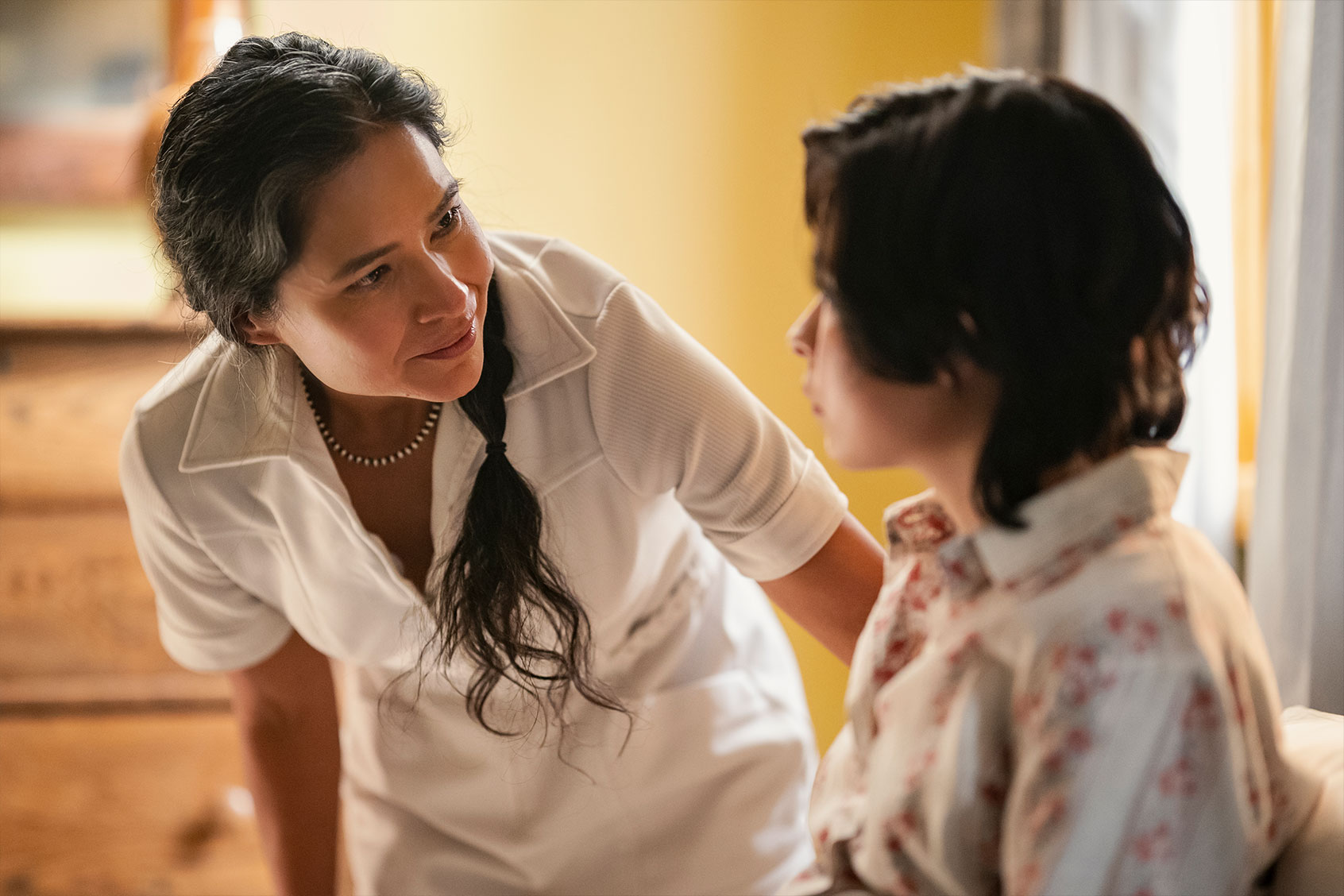
Women gather around Joe and Emma Leaphorn’s niece to mark the occasion of her first period, preparing food for and with her, cheering her on as she races across the landscape, smiling widely. These scenes add welcome layering to our view of the Leaphorns’ world, and importantly, never take the audience out of the overall story.

All of this is by design, explains Maya Rose Dittloff, who co-wrote “K’e” with Razelle Benally. A benefit of working in an entirely Native writers’ room is the shared understanding of the necessity of expanding the women characters in their adaptation of Tony Hillerman’s Leaphorn and Chee mysteries.

“Dark Winds” stars Zahn McClarnon as Joe and Kiowa Gordon as Jim Chee, but the plot widens the space for Leaphorn’s wife Emma (Deanna Allison) and Joe’s fierce sergeant Bernadette Manuelito (Jessica Matten) as a matter of staying true to the 1970s era and the experience of life in their Navajo community.

That encompasses grimmer realities – the anguished death of another teen girl (Shawnee Pourier) drives Joe’s investigation, forcing him to see the degrading regard with which white officers treat her remains. At the same time, Emma’s tender sheltering of another young woman, an abuse survivor named Sally Growing Thunder (Elva Guerra), highlights the ways these circles of mothers, grandmothers, aunts, and daughters care for each other.

In our interview Dittloff – who is Mandan, Hidatsa, and Blackfeet – talked about the ways she and other writers incorporate lesser-known details of Native women’s experience with reproductive injustice while highlighting the characters’ joy and resilience, “hand[ing] some level of female empowerment back to those characters,” she says.

This interview has been edited for length and clarity.

RELATED: From “Fargo” to “Dark Winds,” Zahn McClarnon keeps perfecting his art – but don’t call him an artist

One of the most enjoyable parts about this telling of “Dark Winds” is viewing the role women play in a story adapted from novels that primarily centered on two men. It seems the roles of Emma, Bernadette, and others are greatly expanded from the Leaphorn and Chee novels.

Definitely. So Season 1 of “Dark Winds” is mostly focused with on the Tony Hillerman novel “The Listening Woman,” which was originally published in 1978. And a lot has changed since then, particularly with regard to the role of women, so you’re completely right. The female roles needed to be updated. And as a part of the writers’ room, alongside myself and Erica Tremblay and Razelle Benally, the three women in the room, we very much wanted to spend a lot of time, a lot of care, and a lot of attention on building out of female roles in the series.

“For so long, Native women have been denied autonomy on screen.”

So of course, we’ve got Emma Leaphorn, we’ve got the addition of Sally Growing Thunder, Ada Growing Thunder (Amelia Rico), Bernadette Manuelito. And of course, you know, with the exception of maybe Emma, none of them are in the book. So we were picking and choosing across Tony Hillerman novels because Native women are such an important and integral part of our communities.

Specifically, in the episode that I co-wrote with Razelle, Episode 3, we wanted to celebrate the Kinaaldá, which is the Navajo coming of age ceremony when young girls get their period. So, also showing what it means to grow into womanhood – something that has never been seen on screen before, and something that we wanted to address with a lot of sensitivity and care. Because for so long, Native women have been denied autonomy on screen, and those stories had been co-opted. So we wanted to spend a lot of time with that love and care towards those characters.

Dark WindsMakena Ann Hullinger as Nanobah, Deanna Allison as Emma Leaphorn and Geraldine Keams as Grandma Alice in “Dark Winds” (Michael Moriatis/Stalwart Productions/AMC)

I wonder how many people realize how much of the history of, for instance, how this country has treated and exploited Indigenous women, is woven through “Dark Winds.” The way it is threaded through the story is very natural

For instance, there are aspects of the story that cover the reproductive history and reproductive politics within the Navajo community. One of those moments is the scene in the first episode, where Emma is speaking with Sally in the doctor’s office and telling her, in Navajo, what the doctor really intends to do to her while she’s giving birth if she has her child at the clinic. She’s talking about forced sterilization, which Emma has personal experience of, but in warning Sally, it’s also a protective and political act.

Yes, definitely. There is a very storied but a highly unknown history of forced sterilization in the United States and Canada.

Specifically, as to “Dark Winds” in the 1970s, about 25% of Native women would have been forcibly sterilized, which is an absolutely insane figure. And sometimes that looked like going in for like a tonsillectomy or like a normal procedure., joining the long legacy of Native peoples being tricked. And what happened while they were under anesthesia – Native women were often suggested to sign the document, not knowing not understanding that they were electing to have these sterilizations – and what would come out kind of having no idea what happened. Sometimes women would never find out that they had been forcibly sterilized; they just thought they couldn’t ever have children, when in fact, at a normal trip to the doctor, this had happened.

It’s such an immense tragedy, because when you think of that 25%, you know, think of all of the children that could have been born and the lives that could have been lived. Those are mothers in their own right, medicine men, leaders, people who were taken from us, because the federal government decided that Natives were having too many babies.

So yes, a lot of the autonomy of Native women has been taken away. And this is part of it.

In the past I’ve interviewed Sterlin Harjo about “Reservation Dogs,” and Sierra Ornelas about “Rutherford Falls,” and one commonality in those conversations is a real desire to bring real joy into their shows’ storytelling. I understand that, since there’s this common pop-cultural misperception that stories of Indigenous peoples in the Americas have to in some way incorporate suffering. Was that in mind for you, as you were expanding these roles?

“What we wanted to smuggle in was a greater story about what it means to be Native, but also to go beyond just representation.”

Oh, definitely. For so long in the history of Hollywood and of filmmaking, Native women have been invisible or existed on the periphery. And we get the same extremely tired tropes of the Indian maid and Native women as a symbol for a Wild West that has been lost. And oftentimes that does include being raped, as kind of one of those pillars of like the Western genre, which is absolutely abhorrent. So we wanted to reclaim the space that Native women exist, and like all other women, we deserve bodily autonomy.

In the same hand, although “Dark Winds” is not a comedy, we wanted to bring visibility to the stories of our Native women that we hope can be a comfort and that can start a conversation towards a greater sense of justice. So that was definitely our hope, and specifically with Emma and caretaking for Sally Growing Thunder and saying, “Hey, this is a possibility, this might happen to you.” That kind of care that you see between Native moms and aunties and elders in the community. Just to have this older Native woman caretaking for the next generation was important to us.

Dark WindsDeanna Allison as Emma Leaphorn and Elva Guerra as Sally Growing Thunder in “Dark Winds” (Michael Moriatis/Stalwart Productions/AMC)

It strikes me that this is one of the few stories on TV that isn’t just about Native culture, but specifically about a matriarchal culture. And I wondered how much of that tradition played into expanding the characters. For instance, Bernadette is a woman with a very independent personality. And there are signs of it within the relationship of Emma and Sally, particularly in the decision of having her stay with them, but also, within the Kinaaldá, their kinship and deference to the medicine woman and the different elders within the community.

Of course. Walking into a show that’s first and foremost about Leaphorn and Chee, we knew that that’s what audiences would be expecting, that they would want to be unraveling that mystery. What we wanted to smuggle in was a greater story about what it means to be Native, but also to go beyond just representation, like just having Natives on screen. We were looking into the future: what is the next iteration of telling Native stories?

And specifically, you’re right. In the role of our women, of course, Emma Leaphorn is the ruler of her house, and she’s putting together this Kinaaldá for [Nanobah]. She tells Joe, “We’re going to house Sally, we have to caretake for her, even though they have no blood relation. And Leaphorn just kind of has to go through with that, because that is ingrained into the culture. Homeownership is a women’s right. Women owned the hogans traditionally.

So, you know, these are the little ways that this culture informs the way that we approach storytelling. When women are in the house, how does that change how a man can operate in that space? And that’s fascinating, because, you know, Leaphorn is a strong character. We wanted to make Emma Leaphorn just as strong.

“As Native people, our continuing existence is a radical act. At the end of the day, this is about eugenics, and what is the goal of eugenics but to decimate a population?”

So let’s pull back and take a broader view of this moment. “Dark Winds” wrapped production on the season some time ago, obviously. What’s it been like to see it running in a time when reproductive rights have just experienced a huge rollback?

It’s been incredibly fascinating. Of course, Black and brown, Indigenous communities have faced an immensely different struggle as it relates to reproductive rights and justice. I’m so grateful to have the storyline about reproductive justice coming out and being introduced into the conversation because most folks don’t know the story or have the whole history. So to be able to say this is an issue that Native women have been facing since the ’70s is something that is so incredibly important for audiences to hear.

And I think in conversations of intersectionality, you know, is an element that people too often forget that is a part of an ongoing struggle. Only yesterday [June 29], the Supreme Court decided the case of Oklahoma v. Castro-Huerta, which effectively cuts into last year’s ruling of McGirt v. Oklahoma, which is an affirmation of tribal sovereignty.

So in these ways, in Native communities, all of these things are interconnected. An attack on tribal sovereignty is an attack on Native women’s bodily autonomy. So it’s definitely been just a wild time. But I’m hoping that we’re able to spark some greater conversation as well.


Want a daily wrap-up of all the news and commentary Salon has to offer? Subscribe to our morning newsletter, Crash Course.


In terms of heading into the second season, what storytelling goals do you have? Part of what I’m wondering is whether there’s a discussion of how social politics in America will inform these stories, as they did this time – not overtly, but just as part of the storytelling.

As Native people, our continuing existence is a radical act. At the end of the day, this is about eugenics, and what is the goal of eugenics but to decimate a population? So, I think that an affirmation that we’re still here, we’re still thriving, we’re in charge of our own narratives is something that is so incredibly important. And going into Season 2, we’ve got a deep commitment from the writers, the producing team, the directors to always be doing better. And that involves a great deal of listening and going to the community and asking, “Hey, what did you think? What can we do better?” That’s a goal that we all keep near and dear, because as an Indigenous person, we think of our community ties differently than white America. We’ve got obligations to our community to do better. We’re part of a larger whole. It’s something that will always be at the center of my approach as a writer, and I know that a shared by the other writers in the room as well.

“Dark Winds” airs Sundays at 9 p.m. on AMC and streams on AMC+.

More stories like this:

At least 6 dead, dozens wounded in mass shooting at July 4th parade in Highland Park, Illinois

Panicked children and adults ran for their lives Monday as at least six people were killed and dozens more were wounded in a mass shooting that took place during a Fourth of July parade in the Chicago suburb of Highland Park. 

Veteran Chicago Sun-Times reporter Lynn Sweet saw blankets covering three bloodied bodies and five other people wounded and bloodied near the parade viewing stand.

“We have an active shooter situation in Highland Park, at their parade. It’s been reported that there’ve been nine people shot,” Illinois Gov. J.B. Pritzker said. “I’ve been in touch with our state police, who are backing up local police and hoping to keep the crowd safe there.”

Highland Park resident Miles Zaremski told the paper: “I heard 20 to 25 shots, which were in rapid succession. So it couldn’t have been just a handgun or a shotgun.”

CBS Chicago digital producer Elyssa Kaufman, who was watching the parade with her family, said that “everyone was running, hiding and screaming.”

“It was extremely terrifying,” she added. “It was very scary. We are very fortunate, we got out very quickly.”

Gun control advocates lamented the latest of more than 300 U.S. mass shootings this year.

“Another horrifying day in America,” tweeted anti-poverty activist Joe Sanberg. “We must do everything we can to end gun violence.”

Democratic Kentucky U.S. Senate candidate Charles Booker tweeted that “freedom to die at a holiday parade is not freedom,” while Ohio progressive Nina Turner asked, “What freedom do we have if we fear being gunned down at a parade?”

How a “selective reduction” abortion saved my child’s life

I’m lying on an exam table, on that crinkly, uncomfortable paper known only to doctor’s offices. A lumpy vinyl pillow supports my head. Monitors hang from the ceiling above me. Various obstetric and gynecological tools sit and stand around the room. The room is cold and austere. 

Some enterprising interior designer tried to soften the harshness of the room with strategically-placed artwork. I can’t remember what the art was, except that it was there, and I remember thinking it was a nice attempt; but if they were trying to soften this reality, I would have much preferred a nice Valium instead of mass-produced department store art. 

Not that Valium was an option. 

It is 8 a.m. on August 2, 2019, at a building in Mount Sinai Hospital in New York City. I am 14 weeks pregnant with three babies — a set of identical twin girls and a fraternal boy. I am about to undergo a procedure called “selective reduction,” which will terminate the identical twins I am carrying and leave their brother safely behind.

The fact that I am pregnant at all, let alone with triplets, feels impossible after five years of inexplicable infertility. After countless medications, procedures, and various assisted reproduction technologies, the doctors concluded that using my eggs was unlikely to result in having a child. We chose to use donor embryos because they seemed like the most likely path to success for us. We wanted our baby. We were more than ready. 

At our seven-week ultrasound, the doctor said, “Hmm, I think I see… Never mind. It’s a shadow. I thought I saw another baby.”

I went through a medication cycle to prepare my body for embryo transfer. We had two embryos, and, given our history, our doctors advised transferring both. The chances of one embryo “sticking” were 60%. The chances of both: 40%. The possibility that one of them would stick and split, becoming twins? Less than 2%. A few days later, I saw two strong, beautiful pink lines —  lines I’d dreamed of all my adult life. A blood test confirmed that I was pregnant. Very pregnant, apparently. My beta numbers were off the charts. “I’ll be interested to see how many you’ve got in there,” the nurse mused. We assumed twins. At six weeks, my first ultrasound indeed showed two sacs. We were thrilled. 

At our seven-week ultrasound, the doctor said, “Hmm, I think I see… Never mind. It’s a shadow. I thought I saw another baby.”

I started bleeding a few days later. Fearing a miscarriage, we rushed back to the doctor. Aghast, she looked up from the screen: “You’ve got three in there.” She immediately referred us to a maternal-fetal medicine doctor. This was not good news.

After years of worrying we would never have children, now, in some cruel twist, we were being asked to choose to terminate two of them.

Time became sticky, a physical thing I could reach out and touch. Its edges shrunk to smother me and then sped away. I stood in a timeless void filled with nothing but the sound of our four heartbeats and the improbability of the situation: Triplets. It took a week to get in to see the specialist. My belly grew quickly: I started my pregnancy athletic and slim, and the three babies needed room to grow. By eight weeks, I had a small bump. Most people don’t even need to buy maternity clothes for months, but I did by eight weeks. I could feel little flutters. 

We consulted with multiple specialists. All said the same thing: You need to reduce the twins. They are sharing a sac. One of the twins is already showing signs of slowed growth. 

My husband and I had never even heard of the term “selective reduction.” After years of worrying we would never have children, now, in some cruel twist, we were being asked to choose to terminate two of them. 

What is selective reduction?

Selective reduction is a procedure to stop the development of one or more fetuses in utero (ACOG). Dr. Mark Evans pioneered the procedure in the 1980s, collaborating closely with Drs. Richard Berkowitz and Ronald Wapner. Speaking by phone, he told me about the call he received from a colleague that led to the first selective reduction procedure: A woman in Western Michigan had become pregnant with quadruplets. She was 4’10”. Her doctor said there was no chance for her to carry them to term. Could Dr. Evans, a known innovator in fetal medicine and therapy, perform half an abortion? This led to Dr. Evans performing the first selective reduction, reducing the quadruplets to twins. They’re now in their thirties. 

Shortly after, he received another call: A woman in Alaska was pregnant with octuplets. Dr. Evans reduced the pregnancy from eight to two. These children are also alive and in their thirties. Since then, Dr. Evans has performed this procedure for thousands of women from all over the world, devoting his career to helping women. “My goal,” he says, “is a healthy mother and a healthy family. That’s it.”

Experts recommend that fetal reduction take place between 12 and 14 weeks — before 12 weeks, there is a higher risk of miscarriage. 

Why reduce?

Before multifetal pregnancy is even considered, pregnancy with a single baby can be risky business in the United States. Compared with other wealthy countries, the United States has the highest maternal mortality ratio — even when that data is limited to only white women, typically the most privileged group.

States including Alabama, Arkansas, Kentucky, and Oklahoma reported maternal mortality ratios greater than 30 per 100,000 live births. Those are terrifying data to consider, particularly given that these are real birth mothers’ lives. 

Women can die during pregnancy or childbirth for all kinds of different reasons; multifetal pregnancies increase these risks. Unfortunately, these risks remain higher than average for the mother even after reduction — but still lower than if it isn’t. 

Mom isn’t the only one at risk. Multifetal pregnancies increase the risk to the babies, whether the fetuses are healthy or not, and these risks only increase with the presence of each additional fetus — even for twins. And the risk of spontaneous loss for the entire pregnancy is 25% for quadruplets, 15% for triplets, and 8% for twins.

Risks to the fetuses in high-order pregnancies include “intrauterine growth retardation, respiratory distress syndrome, miscarriage, and preterm delivery.” Compared to singleton pregnancies, multi pregnancies are approximately five times more likely to result in stillbirth and seven times more likely to result in neonatal death. Along with prematurity, which has complications, multifetal pregnancies have increased risks of cerebral palsy, children having learning disabilities, slower language development, chronic lung disease, developmental delays, and death.

The risk of selective reduction for the mother is low; statistics from the Pregnancy Mortality Surveillance System of the Centers for Disease Control and Prevention show that 0.0009% of women in the United States died from legal abortions, including selective reduction procedures. 

Risks for the remaining fetus(es) are often lower with selective reduction than if the pregnancy continues with higher multiples. Certain fetal pathologies, like cord entanglement or twin-to-twin transfusion syndrome, risk the development and survival of the other babies

Difficult choices — but our choices

People ask, how do you choose? It’s not always clear — or easy. 

“Sometimes you have to do unpleasant things to get the right result,” Dr. Evans says. I agree. Dr. Evans says, in his experience, about 50% of the time, women choose to reduce. Either way, it is always their choice.

In my case, our doctors said I was guaranteed preterm labor — or, as one put it, “You’ll be lucky to make it to 28 weeks.” The babies would be at least 12 weeks — three months — early.

Elizabeth chose selective reduction. “Having already buried a child due to a genetic condition, I couldn’t go through that again, and it wouldn’t have been fair to my other living children,” she said. “I made the gut-wrenching decision to be here for all of them versus losing one, or two, or three of them.”

In my case, our doctors said I was guaranteed preterm labor — or, as one put it, “You’ll be lucky to make it to 28 weeks.” The babies would be at least 12 weeks — three months — early. 

We also had a 40% chance that all or some of the babies would be born with profound congenital disabilities. There were significant chances the twins would have issues as the pregnancy progressed, including the one twin’s slowed and possibly completely stopping growth, or twin-to-twin transfusion, where one twin would leech all the nutrients and leave the other baby with nothing. And there were the ever-present risks a higher-order triplet pregnancy presented.

It felt profoundly unfair, a deal with a devil: Yes, you can carry and have a child, but in return, you will suffer an unknowable pain.

The decision was complicated. It involved my health, my feelings about my body, carrying children, women’s autonomy, our family’s future, my husband’s feelings, his worry for my health, and the health of our babies. We worried about what we would tell the surviving baby when they got older. We feared we would have regrets. We worried we would lose them, any and all of them. We worried we would lose each other. We worried we would lose ourselves. The lives we had built, the expectations we had for the future. Our careers, our home, the next sixty years — for us, for them.

It felt profoundly unfair, a deal with a devil: Yes, you can carry and have a child, but in return, you will suffer an unknowable pain. 

We made a choice. We had to.

But it was not made lightly.

Dr. Evans likens it to the lifeboat phenomenon: Sometimes, sacrifices are needed and legitimate when the interest of the many outweighs the few. Sometimes the choice is bleak: You can save some, but you cannot save all. But, you do get a choice. 

You can choose to save some or to sink the whole boat — that is a choice, too. 

Elisabeth also chose to reduce — it was the right choice for her family. “I would have lost my entire pregnancy, and instead, I have two healthy, thriving 9-year-olds. I knew in my gut that I needed to do this to save them. I was right. Women know our own bodies — if you expect us to be mothers, you must trust our judgment and our decisions about our bodies and our lives,” Elisabeth says. 

Medical procedure — not a crime

Dr. Evans asked: “If you told someone they had cancer, and one treatment had a six percent mortality rate, and one had a two percent mortality rate, would you judge them for taking the one with the lower mortality rate? Of course not.”

Yet, to be a woman in the United States is to be judged. When it comes to conception, pregnancy, and motherhood, that includes the unchecked opinions of everyone you encounter on how you should mother. My husband certainly never had to deal with strangers sending him anonymous Bible verses and death threats about this decision, or questioning his ability to be a father. 

That was all reserved for me. 

Sadly, many of the women I’ve met through this experience choose not to share their selective reduction with anyone outside of their immediate or close family. Anya said, “The fact that it isn’t widely supported or understood in my state and by my religious extended family meant alienation and a sense of shame that wasn’t necessary and didn’t help navigating what was already a very difficult decision. I know for a fact that if I hadn’t reduced, I would have lost my pregnancy. It was his (Dr. Evans) reassurance that enabled us to have a family versus losing it all.” 

When I learned I needed a selective reduction, I turned to the internet. I expected social media groups, articles, and interviews. There were a couple of articles and lots of academic papers. I found zero support groups, the reason for which became apparent as I started writing about and sharing my story, first through the People interview. Some people really, really hate anything that looks like an abortion, even if it’s the thing that saves your life or your other baby’s life. Shawna was called a murderer when someone found out she received a reduction. Even with the reduction, her boys were born three months early. “We all almost died,” she said. “I lost a ton of blood.”

Eventually, a woman reached out to me from a social media group that operates like the Aunties network from the Handmaid’s Tale — you have to be invited in, you have to be vetted, you have to be approved. Why? Because this is a dangerous world for women who make choices about motherhood. 

I found solidarity with these women. And, they found solidarity with me. A week hasn’t passed since I started sharing my story that a woman hasn’t reached out to me to say that she, too, has been blindsided by the possibility of selective reduction, and she, too, doesn’t know where to turn. We connect, and I help her find the nearest resources, and if she wants, I invite her to the group. It’s a good feeling to find other people who have been faced with one of the worst decisions, one of the most horrible life events you can imagine. 

I call it the Terrible Sisterhood. 

Saying the A-word: does it matter what you call it?

So, is selective reduction abortion? Selective reduction and abortion both involve terminating fetal life, yet they’re different medical procedures performed by different physicians and possibly for different reasons. However, in the minds of many in the anti-abortion camp, the distinctions don’t matter. 

In that sense, they’re right: It doesn’t matter — because it shouldn’t matter. Lawmakers should not get to make decisions about what a woman carries in her womb or when. Choosing to have a child or multiple children is the most significant life change one can make, affecting every relationship, decision, expenditure — everything that family touches for the rest of their lives. 

Whether or not selective reduction is abortion, however, is now an important matter of distinction. The Supreme Court has overturned Roe v. Wade in the Dobbs v. Jackson Women’s Health Organization decision — and we don’t know what that will mean yet for selective reduction, particularly for the women and families who live in states where access will be further restricted.

When I started trying to get pregnant, I didn’t think I’d have to utilize assisted reproductive technology like IVF, let alone donor embryos. And when I transferred two donor embryos, the last thing on my mind was that I would have to reduce two extremely wanted fetuses.

But it happened. It happened to me, it happened to hundreds of women I now know, and it will continue to happen despite the court’s decision — it will just become even more difficult for people to access care. Anya, for example, had to travel out of state to see Dr. Evans. 

“The fact that it wasn’t available in my state meant that I had to incur travel expenses that I couldn’t afford and the stress of finances and travel in addition to the stress of the decision and procedure itself,” she said.

Choice is justice 

If you’re concerned about protecting life, the way to do that is by protecting access to safe and quality healthcare and supporting the women and families seeking it. This is healthcare. Women require access and support. No one should lack access to necessary resources, or be shamed, because biology happens. No government should mandate how a person chooses to handle their own biology. 

The science is clear: Pregnancy itself is risky, and higher-order multiple pregnancies are even more so. My triplet pregnancy required a choice.

Even after choosing the selective reduction, I still had complications with my remaining baby: I had a shortened cervix starting around 20 weeks. I was diagnosed with Deep Vein Thrombosis at the beginning of my third trimester, leading to hospitalization. I had a filter installed into my vena cava so that the clot wouldn’t move. I was on blood thinners for the remainder of my pregnancy and six months beyond.

My son was born at 37 weeks and one day. Despite the reduction, he was still early. There were still complications. 

And I did deliver the twins. After 23 more weeks in the womb, physically, they were little more than tissue. But, as I held my son on my chest and our tears mingled for the first time, some of them were for his sisters, too. I was relieved. I was overjoyed. And I grieved, too. I am a mother of three, with one living son. Things could not have been different. I do not regret my choice. And yet, I catch my breath when I hear someone speak their names. 

I wish I had gone through the entire experience with the support of a community, and a society, that valued and understood the science of reproduction. My wish, moving forward, and the reason I keep talking about it and keep bringing attention to it, is that we live in a society that values, understands, and respects the health and autonomy of our women. 

Selective reduction was not an easy choice. But it was my choice. 

Women deserve to be supported in that choice. We deserve a society that recognizes — and embraces — reproductive justice.

Read more

on reproductive justice


What is “heteropessimism,” and why do men and women suffer from it?

A friend introduces their partner as “my current husband.” Another jokes about marriage as a life sentence. Everyone laughs, no one is surprised.

The sentiments at the heart of these asides are pervasive and familiar to many people in (or who have had) heterosexual relationships. There is now a term for this negativity: “heteropessimism.”

Heteropessimism is a new word for an intuitive, possibly very old, concept in white Western culture. Coined in 2019 by writer Asa Seresin, heteropessimism is an attitude of disappointment, embarrassment or despair at the state of heterosexual relations  – specifically about being in one.

Seresin’s definition is useful because this pessimism is accompanied by the paradoxical practice of sticking with heterosexuality in its current forms, even as it is judged to be “irredeemable.”

Seresin now uses the term “heterofatalism” to emphasise how dire, hopeless, and lacking in visions for an alternative, this attitude is.

So what is heteropessimism?

Heteropessimism describes a negative attitude that pervades heterosexual culture, within many of the men and women who co-create it.

Heteropessimism does not necessarily imply violent or harmful relationships, overt sexism, abuse or even a hierarchy. In fact, many heteropessimistic relationships likely start with real desire for romantic, sexual and intimate connection.

Heteropessimism describes something more mundane. It’s a pervasive disappointment, ambivalence, if not doubt, about the quality of the lived heterosexual experience.

It is either unhappily ever after, or living with compromises that are fundamentally unsatisfactory. While life can be a little disappointing at times, the problem with heteropessimism is the negativity stifles thinking about how things could be different.

It is easy to find examples of heteropessimism in culture. Stories that highlight the power of female friendship or sisterly love (from “Sex and the City” to “Frozen”), often do so by comparing it to the disappointments of heterosexual romance.

Out of a sense of anger and frustration about the monotony and violence of it all, the queer internet has turned heteropessimistic culture into jokes. The Instagram account Hets Explain Yourselves is a growing archive of heteropessimism memes (on clothing, greeting cards, masks, mugs, bumper stickers) without a compelling vision for change.

Meanwhile, writer Andrea Long Chu claims heterosexuality is on the verge of collapse, held together with “sticky tape and crossed fingers.”

The persistent desire to keep it together is clearest in a show like “Married at First Sight.” In “MAFS,” there is no space for exploring or developing a new kind of heterosexual relation. There is only time for a man and a woman to say hello and be stuck together with matrimonial glue.

So, why are heterosexuals so pessimistic about heterosexuality?

Many couples feel resentful in relationships with unequal caring responsibilities. This imbalance was given a new clarity during COVID.

Rising living costs also compel compromises. One partner’s career is prioritised over the other’s, work hours increase and it takes multiple jobs to sustain a household. All this increases relationship pressure.

Even if some couples negotiate happier and more equitable relationships, we can’t ignore the ubiquity of intimate partner violence and sexual assault. This is the darkest and far too often fatal expression of dissatisfaction with the heterosexual ideal.

Although heteropessimism might manifest as a personal or private feeling, Asa Seresin says “heterosexuality is nobody’s personal problem.”

On one hand, pessimism works like cynicism. It thwarts an examination of the other forces shaping intimate relations – misogyny and normative gender roles, economic stresses and the moral and emotional pressures of monogamy.

On the other, pessimism diverts attention from the lack of cultural encouragement to imagine alternatives beyond the nuclear family household.

For an interview as part of our research, author Sophie Lewis identifies this fatalism as especially acute amongst straight women in heterosexual relationships. Lewis observes many women seem to see “no alternative to their trajectory” within heterosexuality. This kind of dissatisfaction is “unaccompanied by political experimentation and response.”

Where do we go from here?

There are established alternative ways of living and loving in other cultures and LGBTQAI+ communities. These include expanded kinship arrangements with friends or family, platonic or romantic polyamorous relationships, or even just good relationship therapy.

But a feature of heteropessimistic culture is that proponents are uninterested in, even hostile to, such possibilities.

Although heteropessimism as a concept is useful in raising awareness of an enduring cultural problem, pessimism can’t help solve it. We need other visions for heterosexuality that are neither straightforward, nor particularly straight.

We hope for new forms of liberation that don’t rely on the binary opposition of heterosexual versus LGBTQAI+. We want them to recognise all kinds of desire and breathe optimism into relationships by emphasising equality, freedom, consent, creativity, kindness and respect.

Jennifer Hamilton, Senior Lecturer, School of Humanities Arts and Social Sciences, University of New England; Christina Kenny, Lecturer, University of New England; Felicity Joseph, Casual lecturer in Philosophy, University of New England, and Matt Allen, Lecturer in Historical Crimininology, University of New England

This article is republished from The Conversation under a Creative Commons license. Read the original article.

Why haven’t we been storing canned food like this all along?

There are a few types of canned goods I always keep stocked in my pantry—I like to have a few jars of black beans and kidney beans (for chili, of course), as well as crushed tomatoes, tomato paste, and chicken broth, just to name a few. However, to this day, I still haven’t figured out a great way to store canned food. Stacking in the cupboard is just asking for disaster, and the can dispenser I recently bought takes up a whole lot of space and doesn’t fit cans of different sizes. It left me thinking: There has to be a better way to store canned goods, right?

Perhaps unsurprisingly, Pinterest had plenty of ideas for me, each more ingenious than the last. There are options that accommodate just a few cans, as well as DIY projects that can hold hundreds of canned goods—after all, they last for ages, so why not stock up? No matter the size, shape, and number of your cans, there’s sure to be a storage solution here that will work perfectly for you. Now why didn’t I discover these sooner?

1. DIY Can Dispenser

How smart is this? We’re absolutely obsessed with this DIY can dispenser—it’s the perfect solution to mount in your pantry or garage. It’s fairly easy and affordable to make, thanks to the instructions provided by Ana White, and we love that the clear glass front lets you see exactly what’s inside.

2. Reversed Wire Shelves

If you have adjustable wire shelves in your pantry, you’ve got to try this cool hack. All you do is flip the shelves over so the little lip is facing up, then adjust the brackets or pegs so each shelf slants downward. BAM! A super simple can dispenser.

3. Wire Baskets

Not big on DIY? No worries. There are plenty of ways you can store cans without breaking out the toolkit. For instance, check out these neat stackable wire baskets—they’re the perfect size to store cans, and they slip right into your existing cupboards or pantry. There are also super-affordable can racks that you can buy.

4. Behind-The-Door Organizer

I’ve written before that the back of doors is prime storage space that many of us are wasting, and if you have a closet or pantry door in your kitchen, you can turn it into a designated space for canned foods. With an over-the-door storage rack, you’ll be able to keep all your cans neatly organized, easily visible, and within reach. Just be sure that whatever rack you choose is sturdy enough to support the cans—they can be quite heavy!

5. Custom Cabinet Built-In

If you like to stock up on canned goods, this solution is the one for you. The built-in organizer is designed to fit perfectly within a kitchen cabinet, and you could easily customize the size or shape to suit your needs. Plus, the self-feeding system ensures that you’re using the oldest cans first and that nothing ever gets stuck in the back where you can’t reach. So smart!

6. Skinny Shelves

Most canned goods are only a few inches wide, so in theory, you only need a few inches of free space to store them. This person installed several skinny shelves along the pantry wall, creating the perfect space to line up canned foods. All the items are easily visible, and there’s a little lip on the shelves to keep everything securely in place.

7. Gutter Storage System

This solution takes the cake in terms of creativity! This person mounted inexpensive vinyl guttersto the wall of the closet under their staircase, and they’re the perfect size to hold small- to medium-size cans. Plus, a 10-foot section of these gutters only costs around $5, so this is a great budget-friendly project.

8. Upcycled Soda Boxes

Wait, don’t recycle those soda boxes just yet! These long, skinny boxes are the perfect size to store soup and canned vegetables. All you have to do is cover soda boxes in pretty paper, and voila—they become lovely upcycled can dispensers. Extra points if you add cute labels to each box to keep things organized.

9. Slide-Out Pantry

It’s no secret that we love a good sneaky sliding pantry, and these skinny storage solutions are the perfect place to store your cans. The slim shelves are an ideal width for canned goods, and they’ll let you see everything with one glance. You can purchase a pre-made pull-out pantry to slide into the gap beside your fridge, or if you’re handy, it could be a fun DIY project—check out this tutorial from Classy Clutter for guidance.

10. Good Ol’ Pantry Steps

Sometimes you just have to keep things simple, and there’s no easier way to organize your canned goods than with a classic tiered-shelf organizer. These inexpensive products look like a set of stairs, and they allow you to stagger cans so you can see what’s going on in the back. Just make sure to get one that’s wide enough for bigger cans—certain organizers are designed for spices, and their steps might be too skinny.

11. Old Magazine Holders

Cleaning out your office? Hold onto those old magazine holders—they’re the Holy Grail of pantry organization! (If you don’t have any, keep an eye out at the Dollar Store—you can usually score them for cheap.) Ones that are wide enough can be used to store canned goods, but we’ve also seen them used to hold produce like onions and potatoes, paper goods like napkins, or reusable water bottles.

12. Corner Lazy Susans

The far corners of pantries or kitchen cabinets often become no-man’s-land, filling up with forgotten ingredients. You can make use of this underappreciated space with oversized lazy susans, which you can load up with all you must-have canned goods. You can get 18-inch lazy susans from the store, but if you need something bigger, you can easily make your own—all you really need is a set of lazy susan bearings.

This post contains products independently chosen (and loved) by our editors and writers. As an Amazon Associate and Skimlinks affiliate, Food52 earns a commission on qualifying purchases of the products we link to. 

Stevie Nicks’ abortion and the freedom to choose you

The weekend after the Supreme Court, in a drastic reversal, upended Roe v. Wade, taking away the right to a safe and legal abortion, a post appeared on the Instagram feed of my favorite neighborhood brewery. One of the co-founders and owners of the small business said the brewery, still a rarity as a woman-owned entity, was able to exist because she had had an abortion at 15. “I chose me,” she wrote.

The post echoed something music superstar Stevie Nicks said in a 2020 interview with The Guardian, an interview that is now gaining traction again in the wake of the reversal. Nicks said that she had had an abortion in 1979, six years after Roe v. Wade became law, and that “If I had not had that abortion, I’m pretty sure there would have been no Fleetwood Mac.”

Roe v. Wade fell just days before Independence Day. America has always prided itself on being the land of opportunity, where the America dream is to make something of yourself. But those opportunities have never extended to everyone. It’s a self-made man, not a self-made anybody else. When cisgender men choose themselves, they are considered go-getters, enterprising and driven, an inspiration. When people of other genders do, they are pariahs, selfish, even if their decisions make great things possible or save lives, including their own. 

RELATED: Stevie Nicks on her life in isolation: “We have to believe”

In 1979, Nicks was in her early 30s and dating the Eagles musician Don Henley. Henley had commented on Nicks’ abortion briefly in 1991 article in GQ: “I believe to the best of my knowledge she became pregnant by me.” Henley also attributed Nicks’ song “Sara,” a 1979 single, to “the spirit of the aborted baby.” But Nicks herself said the song she wrote was partially inspired by a good friend of hers named Sara who dated Mick Fleetwood, Nicks’ bandmate, shortly after or possibly while Nicks was dating him; Sara ended up marrying him. In a 2014 interview, Nicks addressed the rumors of the song’s title: “Had I married Don and had that baby, and had she been a girl, I would have named her Sara . . . It’s accurate, but not the entirety of it.”

But Nicks did not marry Henley. Henley dated a Bond girl after her, and in 1980 was charged with delinquency of a minor after paramedics called to his home discovered a naked 16-year-old girl and a 15-year-old under the influence of drugs. He pled no contest and was sentenced to probation. Henley later married Sharon Summerall, to whom he is still married today, and the couple have three children. But that was 20 years after Nicks.

The late ’70s were tumultuous for Nicks too. She was coming off a massive tour with Fleetwood Mac for “Rumors” and she and Lindsey Buckingham were recording their third album with the band. In October of 1979, “Tusk” was released and the band went on a world tour with hardly a break. At the time, Nicks also sang backup on every track of a Walter Egan album and wrote and recorded demos for her own solo project, which would become 1981’s “Bella Donna.” 

Nicks said in The Guardian interview: “There’s just no way that I could have had a child then, working as hard as we worked constantly . . . And I knew that the music we were going to bring to the world was going to heal so many people’s hearts and make people so happy. And I thought: You know what? That’s really important.” Nicks spoke to the fact that at the time, in the late ’70s, there wasn’t “another band in the world that has two lead women singers, two lead women writers.”

These stories illustrate how disruptive a birth, especially a forced birth, can be to the person birthing — and not usually to the one impregnating.

Musician Phoebe Bridgers shared that she had an abortion in October 2021 when she was in the midst of a tour. Actor Ashley Judd has gone public with the fact she had an abortion after becoming pregnant due to rape, as have multiple celebrities including model Ireland Baldwin. When actor Uma Thurman shared the story of her abortion, after being impregnated by a much older man when she was a teenager, she wrote: “Choosing not to keep that early pregnancy allowed me to grow up and become the mother I wanted and needed to be.”

No one needs to provide a reason to have an abortion, other than the fact they want an abortion. But these stories illustrate how disruptive a birth, especially a forced birth, can be to the person birthing — and not usually to the one impregnating. Would the Eagles still exist if Stevie Nicks had not had an abortion? It seems likely. Men rarely talk about careers, art, or personal advancements made possible because of abortion, and maybe they should. Or, maybe they should speak up about the lack of sacrifices they have to make and why that is.

As she said about the composing of her song, “Storm”: “I sat at my piano, a feminist woman, and I wrote it.”

Nicks’ abortion was not only to facilitate the making of music, but because she realized having a child in her current circumstances was irresponsible. She spoke in the 2020 interview about “a lot of drugs,” admitting she herself was doing them at the time, not to mention everyone around her. The decision to have an abortion was made partially looking out for others. And yet, it’s presented as selfish. It is not selfish when a man chooses himself, as they do all the time in order to live their lives, simply be alive, have their careers and make the right decisions for their futures. Why does only one gender get to have a future? Why does only one gender get to have a say, to have the right to make something of themselves? 

When news of the Supreme Court’s upheaval reached her, Nicks released a statement on social media, directing fans to the HBO pre-Roe v. Wade documentary “The Janes,” and writing: “History is repeating itself . . . and its [sic] even more frightening this time.”


Want a daily wrap-up of all the news and commentary Salon has to offer? Subscribe to our morning newsletter, Crash Course.


In the 2020 interview, Nicks said it was her “world’s mission” to make music to help people. She still does, generations of people, and by her very standing up on stage, performing and writing her own songs at a time when mostly only men were allowed to do so, she continues to inspire. As she said about the composing of her song, “Storm”: “I sat at my piano, a feminist woman, and I wrote it . . . Freedom.”

More stories like this

He’s on a mission from God: Pennsylvania GOP candidate Doug Mastriano’s war with the world

An animating element of politics in the age of Trump is that some people are increasingly living out religious metaphors. These metaphors are derived from contemporary understandings of the Old Testament by new elements within Christianity. This has been central to the campaign of Pennsylvania state Sen. Doug Mastriano, who recently won the Republican nomination for governor. (He will face Democrat Josh Shapiro, Pennsylvania’s current attorney general, in November.) These metaphors are also integral to a movement of the post-insurrection religious and political right that is still in its formative stages.

As reporting by the New Yorker, the Philadelphia Inquirer, Word & Way and Paul Rosenberg at Salon has shown, there is something going on in Pennsylvania that is transforming politics in the state, and maybe on a larger scale as well.

Mastriano, a retired Army strategist and intelligence officer who served in Iraq and Afghanistan, appears to have a disturbing understanding of the relationship between metaphor and reality when it comes to biblical narratives. He suggested to an interviewer that today’s Christians should emulate the warriors of Old Testament Israel.

RELATED: Trump’s army of God: Doug Mastriano and the Christian nationalist attack on democracy

“God can intervene in history,” he said, adding that such interventions are carried out by “a man or a woman,” such as the biblical Queen Esther (who got authorization from the King of Persia for the Jews to kill all their enemies); and the prophet Gideon (who led 300 soldiers against a far greater force). 

Mainstream media generally describe Mastriano as an “election denialist” and a “Christian nationalist.” He unconvincingly denies the latter, but he and his supporters are also more complicated than the label usually suggests. He is well known for having spoken at the Jericho March in December 2020 that unsuccessfully called for the Electoral College to switch its votes to Donald Trump. He was also slated to speak at the “wild protest” on Jan. 6, 2021, organized by “Stop the Steal” activist Ali Alexander, along with the likes of Roger Stone, theocratic activist Lance Wallnau and Rep. Paul Gosar, R-Ariz. And of course, promoting the Big Lie has been central to his politics since Trump’s election defeat.

But there’s more.

Some religious leaders who back Mastriano’s campaign say they are in direct communication with God, see themselves as God’s army, and see Mastriano as a general in their war for the world.

Mastriano’s core support is a fusion of QAnon, the far-right Patriot movement and the revivalist New Apostolic Reformation — which views him as a military and political leader in advancing the biblically prophesied end times. We see this in his role in the Jericho March during the run-up to Jan. 6, and more recently when he joined members of the “Shofar Army” in a ceremony of “spiritual warfare” on the Gettysburg battlefield, and as the headliner at a conference, Patriots Arise.

May the metaphors be with you

The Jericho March was derived from the biblical story of the battle of Jericho, which took place during the journey of the Israelites, led by Joshua, to the Promised Land. God had instructed them to march seven times around the city blowing shofars. The walls of the city collapsed, and the army rushed in, carrying the Ark of the Covenant, and killing everyone in the city. The Ark of the Covenant, as fans of the “Raiders of the Lost Ark” film (among others) will recall, is a chest containing the two stone tablets inscribed with the Ten Commandments that God gave to Moses. 

Religious extremists who back Mastriano’s campaign say they have direct messages from God, and see him as a general in God’s army of conquest.

The story of the 2020 Jericho March purportedly began with God giving two different individuals the same vision, calling them to set up a march in Washington as well as in the capitals of the swing states of Arizona, Georgia, Michigan, Nevada, Pennsylvania and Wisconsin in the days before the presidential electors were to cast their votes. (They were ultimately held in other states and Canada as well.)

Supposedly God wanted the marchers to oppose alleged corruption and restore election integrity — as well as Donald Trump’s presidency. In Washington, crowds marched around the Capitol, the Department of Justice and the Supreme Court. 

“God commanded this to happen like he did to Joshua,” Apostle Abby Abildness explained on a religious talk show. “We believe God is gonna move” and “that there will be that victory,” she continued. There was “great hope” that Pennsylvania’s electoral votes, which Joe Biden had won convincingly, would “go to the president.” Of course that did not happen. 

In instances like this, believers see a difference between a foretelling of events and a prophecy that reveals God’s intentions. If an event doesn’t turn out as expected, they believe, it is necessary to keep on trying, to ensure that somehow, someday, God’s will will be done.

Her immanence

Apostle Abby Abildness is a quietly powerful national and international religious leader, as well as a legislative lobbyist at the Pennsylvania State Capitol in Harrisburg. She says she meets with legislators at least once a week, praying and “bringing forth a religious freedom agenda.” She also led Jericho marches in Harrisburg.

Her manner is more that of a soft-spoken college professor (which she used to be) than a political preacher. She is nevertheless an important leader in the contemporary religious movement called the New Apostolic Reformation (NAR), a dynamic theological and organizational revamping of much of pentecostal and charismatic Christianity. For decades, NAR has led the abandonment of traditional mainline Protestant and evangelical denominations in favor of prayer networks.


Want a daily wrap-up of all the news and commentary Salon has to offer? Subscribe to our morning newsletter, Crash Course.


These prayer networks are led by what is known as the “fivefold ministry” as mentioned in the biblical book of Ephesians: Apostle, prophet, teacher, pastor and evangelist. The networks comprise both physical churches and prayer groups of various sizes.

Abildness is a leader in several such networks, which aim to take control of what they call the “Seven Mountains” of society in order to achieve Christian dominion. These metaphorical mountains are religion, family, government, business, education, arts & entertainment and media. Abildness, whose chosen mountain is government, is working with her allies to increase electoral engagement in apostolic networks, and to involve them in pushing for legislation. She heads the Pennsylvania Apostolic Prayer Network and plays leading roles in other important international networks, including the Oklahoma-based Heartland Apostolic Prayer Network headed by Apostle John Benefiel and the Texas-headquartered Reformation Prayer Network, led by Apostle Cindy Jacobs.

The NAR has generally abandoned written doctrines along with denominations, in favor of its own notions of Old Testament biblical law. Its movement is further informed by revelations from those understood to be apostles and prophets revealing what God wants. They believe God wants Doug Mastriano.

Dancing with the ones who brung him

Last year, Mastriano denied to Eliza Griswold of the New Yorker that he was a Christian nationalist. “Is this a term you fabricated?” he asked. “What does it mean and where have I indicated that I am a Christian Nationalist?” Of course Griswold did not invent the term, which has been used by scholars and journalists for decades.

Mastriano doth protest too much. He has sponsored several bills based on models found in the Christian nationalist legislative playbook formerly called “Project Blitz.” These bills would have mandated teaching the Bible in public schools and made it legal for adoption agencies to discriminate against same-sex couples. In the face of organized opposition and intensive media coverage by the New York Times, the Guardian and Salon, among others, the Congressional Prayer Caucus Foundation, which published the Project Blitz legislative playbook, scrubbed all mention of Project Blitz from its website in 2019. But the affiliated Pennsylvania State Legislative Prayer Caucus remains. Its state director, then as now, is Abby Abildness.

RELATED: A grassroots Christian movement joins the fight against Christian nationalism

Mastriano has denied that he works directly with NAR, but has clearly had a close relationship with Abildness and the wider NAR movement. She has, for example, interviewed him on her podcast and worked with him in the legislature. She calls him “a military strategist” who leads a group of about 30 conservative state legislators (although he’s only been in the legislature since 2019). She also introduced him at a regional NAR conference of several hundred people in October 2020, in Gettysburg, which is in Mastriano’s senatorial district.

On the Fourth of July in 2019, Mastriano joined Apostle Abby Abildness on the Gettysburg battlefield, where they prayed to “preserve the monuments” from antifa. They were victims of an internet hoax.

There, Abildness told the story about walking the Gettysburg battlefield with Mastriano, his wife and a “prayer team” on the previous Fourth of July. The senator and the apostle went to “pray to preserve the monuments” from antifa, which she believed might be coming to destroy them. She had trepidations, she said, but explained, “When the people pray, God is with us. We’re not to fear, we have God. We need to stand up. Speak out. And move forward in this battle. Amen!” (Hundreds of armed militia members, bikers and others who had also heard the rumors showed up to defend the monuments and prevent the burning of the American flag. It turned out the whole thing was a hoax perpetrated by a troll on social media and then hyped by right-wing media.)

The conference’s headline speaker, Apostle Chuck Pierce from Texas, was preceded by the sounding of the shofar by the Shofar Army, which then led the crowd in shouting, “Arise, oh God, and let your enemies be scattered!” This refrain is from Psalm 68, one of many Old Testament imprecatory prayers in which the faithful ask God to smite his enemies.

A new Joshua

Reported here for the first time are two videos featuring Mastriano before his run for governor. Filmed on the Gettysburg battlefield on July 18, 2020, just days after his prayers against antifa with Abildness, the videos reveal his involvement with a group called the Shofar Army. In the videos, Mastriano performs a ritual act of spiritual warfare — blowing shofars with the Shofar Army and Prophet Bill Yount of Blowing the Shofar Ministries. But as later became clear, they understood the warfare as physical, not just spiritual.

Some of these Christians wore the Jewish prayer shawl or tallit, and wielded the three-foot-long hollowed-out ram’s horn called a shofar, which was used by ancient Israelite armies to sound battle commands and community alerts, and is used today in religious services for the Jewish High Holidays. 

In one video, the leader, Earl Hixon, prays, “Thank you, Father. We tread upon the enemy.” Pointing to Mastriano, he continues, “Father God, I am looking to our new general here, that you have appointed, this Joshua. In Jesus’ name!” Mastriano raises his outstretched arm in apparent acknowledgment. A year later, Warren Baker, a member of the group, sounded the shofar at the launch event for Mastriano’s campaign for governor. (Former national security adviser Michael Flynn and Trump campaign attorney Jenna Ellis also attended the launch.)

In the second video, Hixon follows the Army’s shofar blasts by declaring he wants to “mark this day in the history of eternity.” He then leads the Army in shouts of the imprecation, “Arise, oh God, and let your enemies be scattered!”

Salon asked André Gagné, professor of theological studies at Concordia University in Montreal, and author of a study of Trump’s evangelical followers, to help interpret the videos.

Hixon recognizes “the ‘angelic hosts, the warring hosts that have gathered here on this journey,'” Gagné explained. “This is a reference to the assistance of angelic beings in the battle to be waged. Hixon thanks God for this ‘Joshua,’ pointing to Mastriano, believing that from this moment there will be new ‘anointing’ on him.”

Joshua, of course, led the Jews to the Promised Land, fighting the Canaanites along the way, including the genocide at Jericho.

Gagné continued, “Hixon also says that Mastriano now has ‘got new eyes, the new eyes of a seer’ and connects it to the idea that we’re on the physical ground, yes, there’s the grassroots, but there is a double-edged sword as well in Jesus’ name.”

This, Gagné says, refers to the “opening of Mastriano’s ‘spiritual eyes’ and the presence of the ‘angelic and warring hosts.'” It may also refer to the need to wage war on two fronts, both the physical and the spiritual.

“This entire ritual,” says theology professor André Gagné, builds a bridge between the language of ‘spiritual warfare’ and possible physical violence.”

“This entire ritual,” Gagné continued, “potentially builds a bridge between the language of ‘spiritual warfare’ and the physical realm, where possible physical violence could eventually be enacted to push back against the forces of darkness and establish the Kingdom of God.”

“Now, the blowing of trumpets,” he concluded, “is found in different contexts in the biblical record, and the ritual means different things for Christians. But in this specific ‘spiritual warfare’ ceremony, the most likely meaning is associated with the expectation and possible eruption of physical warfare.”

Rising and shining

Mastriano was the star of a two-day Patriots Arise conference at a hotel near the Gettysburg battlefield the following year, in April 2021. The small stage was festooned with flag bunting and “Mastriano for Governor” signs. The event announcement declared,

It is TIME (sic) for the Patriots to Arise for God & Country! Just as they did in the first American Revolution during 1776.

The conference opened with a sounding of the shofar by 10 members of the Shofar Army. The call, blown three times, was what leader Don Kretzer called “an alarm sound that has been around for almost 4,000 years.”

“Blow the trumpet in Zion! Sound the alarm on holy mountain! The day of the Lord is here!” Kretzer declared. Paraphrasing (and embellishing) God speaking to Moses in the Old Testament book of Numbers, he continued:

When you go into a land against an enemy who appears to be stronger than you, that tries to oppress you; when I hear the sound of alarm, I will remember the covenant I’ve made with you, and I am coming to rescue you, America!

The Shofar Army and NAR leaders envision themselves as waging “spiritual warfare” against a host of enemies, whom they understand to be possessed or controlled by demons. So when they repeatedly ask God to smite his enemies in this way, some people, as Gagné suggests, may feel compelled to act out the metaphors in more literal fashion. (It’s probably fair to wonder whether that informed what happened on Jan. 6.)

The conference hosts, “apostolic and prophetic” leaders Allen and Francine Fosdick, auctioned items as a fundraiser for Mastriano (“our dear brother in Christ warrior”) but not for any of the other far-right Christian GOP primary candidates from Pennsylvania and Maryland who were also present. 

Prophet Julia Green of Iowa preceded Mastriano at the podium. She said Mastriano had heard about a prophecy God had given her, and that was why he had invited her to appear at his events. She read the prophecy from her laptop while Mastriano waited to speak at a nearby banquet table:

Doug Mastriano, I have you here for such a time as this, saith the Lord. It is now time to move forward with the plan that you have been given. Yes, Doug, I am here for you and I have not forsaken you. The time has come for their great fall; for the great steal to be overturned. So keep your faith in me.

Green further prophesied that current Pennsylvania Gov. Tom Wolf, a Democrat, would be “removed by my hand” in the wake of a scandal, and that “Treason will be written on him for all eternity.” The crowd cheered. Wolf’s allegedly treasonous acts were not identified (and have not surfaced to this point). Mastriano said nothing. 

The conference began with a dramatic QAnon video comparing conspiracy-theory adherents to American soldiers. It was followed by anti-vax, anti-mask and anti-tax speakers, as well as Bobby Summers, an advocate for the idea of “sovereign citizenship.”

Making the demons tremble

The event was similar (albeit much smaller) in terms of theme, tone and content to the ReAwaken America tour, led by Michael Flynn. There have been 15 such conferences since April of last year, drawing thousands of people to each event.

These events are headlined by such figures as Roger Stone, Jenna Ellis and Eric Trump, along with anti-vax and anti-mask presentations and, of course, endless propaganda about alleged election fraud. There is also a strong revivalist Christian component, including opening the event with the blowing of shofars, and speeches by pastoral provocateurs such as noted book-burner Greg Locke.

At a ReAwaken event last year, Prophet Amanda Grace explained the meaning of blowing the shofar, saying it had driven some of God’s greatest biblical victories: 

When the shofar was blown the walls of Jericho fell. When the shofar was blown, Gideon and an army of 300 men defeated over 147,000 Midianities. It’s an announcement to the enemy that his stronghold is about to fall. Demons tremble at the sound of the shofar.

She calls the shofar “a weapon of our warfare. And when we blow it, the power of God comes full force into that situation.”

One aspect of the tour is the evident cross-fertilization of the factions of the religious and political right that is reshaping American conservative politics and public life, from the MAGA movement to Jan. 6 to the Mastriano campaign.

Controversial right-wing activist and publisher Floyd G. Brown explained a bit about how this works in his introduction of tour regular Pastor Dave Scarlett at an April 2022 ReAwaken event in Salem, Oregon. Many people who watch Scarlett’s “His Glory” show are Christians, Brown said, “but many of them aren’t.”

“They are Patriots,” he continued. “And I’ve heard him say many, many times, if you watch ‘His Glory’ and you’re a Patriot, you often become a Christian. And if you watch ‘His Glory’ and you’re a Christian, and if you don’t know what’s going on, you slowly become a Patriot.”

Brown announced that “His Glory” would air on his new commercial streaming service, Liftable TV, which seeks to promote a “biblical worldview” and “truth-centric news.” It’s like a Reader’s Digest of Christian-right streaming, rebroadcasting shows from the likes of anti-abortion activist Abby Johnson, Tony Perkins of the Family Research Council, 7 Mountains Dominionist Lance Walnau and, of course, Dave Scarlett, who often hosts Julie Green as a guest.

Green’s May 25, 2022, interview with Scarlett illuminates much about the Mastriano campaign and the wider movement. Green says that Mastriano campaign functions “are not a normal, everyday political event. … They are all focused on the Lord. They are powerful! They are anointed!” She calls Mastriano “a very powerful man of God.”

Scarlett replies that he has talked with a “certain general” (without naming him) who said, about candidates he supports, “that these rallies in the 2024 cycle will start out with [evangelical Christian] praise music, then the candidate, who is a Patriot Christian, will come forward, give whatever their message is, then it will end with revival. It’s going to end with altar calls.”

Green replied that this was “already happening” at Mastriano’s events.

Throughout Mastriano’s rise, those around him have been open about their intentions. In a December 2020 broadcast of “The Damascus Road,” host Earl Hixon explains their common purpose, to murmurs of agreement from his panelists: Abby Abildness, shofarists Don Kretzer and Bill Yount, and Pastor Brett McKoy, whose Maryland church hosts the broadcast. 

Mastriano was supposed to be present, but was under COVID quarantine at the time. Hixon says that in light of that, they wanted the group to serve as Mastriano’s “surrogate”: 

What we have here is the introduction of an army. This is what our King is endeavoring to do — especially on this battlefield we call the United States. This is what we are here for. … We are all on the front lines. We are aware of what’s happening in this country … that’s why we’re here, talking about the Mountains of Dominion. 

A time to “break the bonds”

Those around Mastriano and his campaign — from Abildness to the Patriots Arise conferees, the Shofar Army and Prophet Julie Green — see themselves as entering a future where the temporal meets the supernatural.

When God is ready, they believe, the heavens will open and angelic forces allied with Christians of the right sort will battle the demonic forces of Satan to the end. This apocalyptic vision drives their support for Mastriano.

Those around Mastriano believe that when God is ready, angelic forces allied with Christians of the right sort will battle demonic forces to the end.

There is always some tension, in this domain of Christianity, between what people believe may be imminent and what may turn out to be a long way off. Regardless of the timing, they have no doubt about God’s intentions, and about their commitment to carry them out.

Abildness made this clear in her keynote on the second day of Patriots Arise, when she revealed an experience she had on the Gettysburg battlefield. God had called her there, she said, because he was ready to answer a general’s 150-year-old prayer. She and members of her apostolic network found themselves “in a portal where the general had prayed.”

“We realized heaven is watching,” she said, and that “we are joining heaven. We are joining the people of the ages in this prayer.” The time was coming, she said, to “break the bonds” with “a government that is not leading the way they should.”

“We realized that heaven is with us.”

Mastriano himself declared, later that day, “We will win in November, and my God will make it so.”

Read more on the rising force of Christian nationalism:

What “Love Island” can teach young people about commitment

It’s summer in the UK, which means that millions of viewers are piling onto their sofas every night to watch how the gaggle of “hot young tings” from the four corners of the UK (and Ireland) are getting on – or who they’re getting with . . .

It is easy to dismiss Love Island as just another frivolous reality TV show featuring horny, conventionally attractive young adults looking for fame and some fun along the way. But beneath the fake tans, and cringey banter, Love Island can actually help us understand the forces that push people together and help maintain commitment in long-term (off-camera) relationships.

In fact, “Love Island” is a perfect illustration of the investment model of relationships. This model helps explain whether people are going to “stick or twist” in their relationship (i.e. stay committed or move on to greener pastures).

According to investment model of relationships, our commitment and desire to persist in our relationships is influenced by three distinct pieces of information:

  1. Our quality of alternatives (aka whether anyone’s head is turning)

  2. Our investments in the relationship (aka how many eggs you’re putting into one basket)

  3. Our satisfaction with the relationship (aka whether you are happy cracking on)

According to this model, we are more likely to be committed to our current partner when our investments and satisfaction are high and our quality of alternatives are low.

The day-to-day toss-ups and surprises on the show allow us to watch in real-time how each of these three predictors of commitment can fluctuate and interact with each other to decide who couples up, recouples and ultimately, who gets dumped from the island. It’s the experiment no psychologist will ever get permission to run. So, let’s break it down with some examples courteously of the 2022 Islanders.

Is your head turning?

A lack of quality alternatives is sometimes referred to as the “having no option but for the relationship to persist.”

Quality alternatives are anything that can help us satisfy our needs outside of our relationship with our partner. This could include time spent with the family and friends who support us, hobbies that make us feel accomplished and happy, and romantic alternatives.

As quality alternatives go up, commitment starts to go down. It is the last type of alternative – alternative romantic partners — that most people in monogamous relationships (or who want to be in a monogamous relationship) are often most worried about and which take centre stage in Love Island. From new “bombshells” to strange challenges, Love Island constantly tries to increase the availability of alternatives, often to shake things up and undermine any attachments people might be forming.

On this series, the love triangle between Ekin-Su, Davide and Jay is a great example of how attractive alternatives can shake things up. Before Jay arrived in the villa, Ekin-Su and Davide seemed to have a really intense connection. As soon as Jay enters the villa, however, Ekin-Su’s head starts turning leading to a total breakdown in her and Davide’s connection. She quickly gives into temptation.

We might meet alternatives in unsuspecting places in our real lives: at work, at the gym, at school, at the pub. And these people pose just as much of a threat to our relationships in real life as they do on Love Island.

But luckily, commitment isn’t determined by quality alternatives alone.

Putting your eggs in one basket

The size of the investments we make in our relationships is often referred to as the “need for the relationship to persist” because of what is lost when that relationship ends. These investments include mutual friends, blended families, family pets, shared living spaces, and even just the time spent on that one person.

The more investments we put into a relationship, the more losses we incur by breaking up with that partner. This can help explain both why people might be hesitant to put too much time and energy into one potential partner to avoid investing resources that could get lost.

For example, Davide claims that he didn’t want to put too much time and energy into Ekin-Su right away because he was afraid of getting hurt. On the flip side, investments can help explain why some people might stay despite a lack of fireworks. Another contestant, Indyah, recently saved Ikenna over Remi. Indyah had invested time and energy into getting to know Ikenna. By contrast, she invested very little time and energy into her connection with Remi, and sending him home didn’t risk her upsetting the mutual friends she shared with Ikenna.

So even when our quality of alternatives are high, our invested resources can help us understand why we might choose to stay even when we’re maybe not getting as much out of the relationship as we could.

Happy cracking on and seeing where it goes

Satisfaction is one of the strongest predictors of commitment and captures how happy we are in our relationship. We are satisfied with a partner when we experience more positive than negative interactions with them, and our connection meets or exceeds our expectations.

Satisfaction is important because it can also help us to discount or play down the availability of quality of alternatives. For example, Luca recently demonstrated this protective power when he told Gemma he didn’t enjoy talking to Danica as much as he enjoys talking to her, and has no desire to see where that relationship might go despite Danica being interested enough in Luca to break up a coupling.

Once again, even when quality of alternatives are high, or our investments are low (like a two-week-old relationship), our satisfaction with our current partner can help us keep us focused on them and see the positives rather than the appeal of others.

The perfect michelada demands restraint

I used to think I didn’t like micheladas, until I realized that I’ve just been drinking them wrong for most of my life. Usually, when I’ve ordered or followed a recipe for this spicy beer cocktail, the results resembled a beer meets Bloody Mary flavor bomb, rather than what it should be: a refreshing, spicy seasoned beer on ice.   

One of Mexico’s most popular drinks, the michelada comprises hot sauce, lime and cheap, light beer — plus perhaps a splash of tomato juice and Maggi seasoning or Worcestershire sauce. The drink’s name represents maybe the world’s best contraction, combining “chela,” a slang term for beer; “ada” from “helada,” meaning cold; and “mi” for mine — a.k.a “my cold beer.” Depending on which bar’s door you darken in which part of the country, you’ll find countless riffs — all quenching enough to ease you through a blazing summer afternoon. 

It took moving to the borderlands of southern New Mexico — where micheladas are affectionately called red beers — to realize the error of my ways. One scorching Friday at the Elephant Ranch in Las Cruces, we ordered a round, which arrived in clear plastic cups rimmed with lime and salt, already beading condensation. Easy-drinking Mexican lager stained pale red from tomato juice and puckering with lime, salt and chile, they went down remarkably fast. As we crunched on the spicy ice remains, someone asked, “Another round of red beers?” 

“Sí, claro.” 

When my husband and I set out to recreate them a couple weeks later for a cookout, we began as we often do, combing through food magazines and recipes to piece together the right combination of flavorings and ratios. Some called for worcestershire, others for Maggi seasoning; some preferred clamato juice over tomato. Some drizzled in Cholula, others swore by Tabasco or Tapatío. Some rimmed the glass with salt, others with that glorious, tangy chile salt, Tajín. Unlike before, though, we now knew that while our seasoning options were endless, a light hand would yield the very best red beer.


Cook’s Notes

If you rim the glass with salt instead of Tajín, add an extra dash each of hot sauce and worcestershire.

Don’t feel limited by the flavorings I’ve listed. Swap in your favorite hot sauce. Increase or reduce the lime or tomato juice to your taste. It helps to taste the concentrate at the bottom of the glass before adding the beer to be sure it’s calibrated to your liking. 
 

(My) Perfect Michelada
Yields
1 servings
Prep Time
5 minutes
Cook Time
minutes

Ingredients

Tajín or coarse salt for the rim
1 thick lime wedge
2 tsp fresh-squeezed lime juice
3 or 4 dashes hot sauce (I like Tapatío)
Half a jigger tomato juice
Scant 3 dashes worcestershire
1 light Mexican beer, such as Corona, Modelo, Pacífico or Tecate


Directions

  1. Shake a few teaspoons of Tajín or salt onto a plate or shallow bowl. Rub the lime wedge along the rim of the pint glass and then dip the rim into Tajín or salt.
  2. Fill a pint glass ¾ of the way with ice. Add the lime juice, hot sauce, tomato juice and worcestershire. Mix to combine.
  3. Fill the rest of the way with beer and garnish with the lime wedge. Drain and repeat a reasonable number of times. 


Read more

by this author


This Independence Day, we are less free than the year before. We must work together for liberty

It’s parade season. The season of celebrating hard won freedoms. As a queer Nigerian American woman, the three weeks between mid-June and early July — when Juneteenth, Pride and Independence Day collide in rapid succession — should be a cause for joy. But instead, I look out at these spectacles, and feel cognitive dissonance.

“It’s not shame,” I say over Zoom to my friend Darrel Alejandro Holnes, who is vacationing in Istanbul with his partner. “I’m just not sure how to uncomplicatedly celebrate Pride when, as a Black person — queer or otherwise — in the U.S., the biggest threat to our life is this country.”

Darrel is Panamanian, a queer Afrolatino poet and playwright, and one of the friends I count on to help untangle my mind when the world gets too knotted for me to understand.

“When Pride becomes a parade instead of a march, it becomes about selling things, which prioritizes the people with the most buying power—cis-white men,” laments Darrel. “It’s no longer about protecting the most vulnerable, which means Pride is seldom if ever about Black people.” 

As I look around, I see how right he is. Restaurants along the pride parade route in New York charged hundreds of dollars to brunch-goers for two hours of bottomless mimosas. The Standard Hotel at High Line hosted no fewer than five events and featured a special PRIDE! package for the month of June, which included “a complimentary flight of curated, limited-edition Pride cocktails.” The commodification isn’t limited to Pride. Earlier in June, Walmart’s Great Value label marketed a “Celebration Edition: Juneteenth Ice Cream.” Thrillist reports that celebrating Independence Day can cost you anywhere from $50 at The Summer Club in Long Island to $500 at Harriet’s Rooftop & Lounge at 1 Hotel Brooklyn Bridge. Celebrating freedom has never cost so much money. What began as public and communal demands for dignity and human rights, or commemorations of freedom, have become marketing schemes.

How do I fully participate in Pride — or commemorate any freedom — when I can’t fully participate in America? I can’t.

What does it mean to be a proud feminist in a country that’s just overturned Roe v. Wade and birthing people’s right to choose? What is it to be out and proud in a country where trans people are under siege and marriage equality appears to be next on the chopping block? What does it mean to be a woman with a Black American artist father and a Nigerian Muslim mother in a country that hates Black people? How do I fully participate in Pride — or commemorate any freedom — when I can’t fully participate in America? I can’t.

Luckily, being raised in a community of Black and African people, I was shown other possibilities beyond consumerism. As a child, I lived in my head because I lived in a world where Black people were — and still are — at constant risk of being murdered by both individual white people and the police. A world that was, and still is not, made for me. I had to be constantly imagining another one. Raised by a Black American visual artist father and a Nigerian Muslim mother, art, oral storytelling, and literature became the vehicles by which I dreamed.

The first march I ever attended was a protest in January 2000, to bring down the confederate flag from the top of the South Carolina State House. There, at age 15, I marched along with 46,000 others. The parades we attended in my childhood celebrated Juneteenth and were full of catfish fries and Black marching bands and color guards. I saw firsthand through those experiences that marches were about community.

As a kid, I didn’t know any adult or person my age who was queer like me. As a result, the future I imagined was full of blank spots and dreams that weren’t mine, though I tried to convince myself they were. Whatever I imagined my adult life would be like, it wasn’t marches turned into marketing points. I dreamed of a world that let me be me in all my queerness, Blackness and womanhood. And if a parade came, it wouldn’t be about corporate commodification. It would be to celebrate a world where freedom was more than an ideal or a talking point for politicians, pundits and CEOs.

The right markets liberty as being for individuals, but liberty is — and always has been — a public good.

Like any month of any year, Pride Month was a month where Black trans women were most at risk to be murdered. It was the month when the anti-union establishments of Starbucks and Amazon, Twitter, online advertisements, and city-hung Pride posters leveraged queerness to sell me lattes and groceries barely a month after an 18-year-old-white man has been charged with domestic terrorism and hate crimes for the shooting deaths of ten Black people in a Buffalo grocery store. Leveraging the same queerness that incited a mass shooter to kill 49 people and injure 53 at Pulse nightclub in 2016. The same queerness that, as we speak, is being banned in books across the country and targeted by Proud Boys, TERFs, politicians, school boards and public figures.  

The right markets liberty as being for individuals, but liberty is — and always has been — a public good. Like progress, transformation and activism, the act of living out and proud begins in magical thinking. Being out and proud is a life that every queer and trans person in this world deserves. I seek community. Community being the place where magical thinking comes true. I imagine, act and write towards a world that can carry us beyond the freedoms of this one. Where coming out is the work of “I am,” a world safe for us all. W world that protects Black people — especially Black trans women — is the work of “We.”  

This Independence Day is one where we have fewer freedoms and safeties than we did a year ago. As a Black person, I follow in my ancestors’ footsteps, knowing that the only way to honor the ideals of the U.S. is to return to community centered labor, to collective resistance — the only true arbiter of change. After all, freedom is something gained and lost, not individually, but together.

Read more

about July 4, Juneteenth, Pride and freedom:

America and the “Heathen”: How we set ourselves apart from “sh**hole countries”

The story of the “heathen,” writes Stanford religious studies professor Kathryn Gin Lum, in her new book, “Heathen: Religion and Race in American History,” is a familiar one. It’s a story “about how Americans have set themselves apart from a world of sufferers, as a superior people and a humanitarian people — a people who deserve the good fortune they have received and have a responsibility to spread it to others.” 

The necessary center of that story is the idea of “the heathen”: whether in its historical sense of people holding the “wrong religion” or its contemporary incarnation as a pitiable “third world” other, but always a figure in need of transformation and salvation. Under the supposedly beneficent mission of offering that salvation, Gin Lum writes, the concept has served as a wide-ranging “get out of jail free ticket” that “renders any harm excusable if done in the name of eradicating wrong religion.” 

“Heathen” is a story about religion but also about race, colonialism, empire and identity — particularly American identity. The concept of heathenism was used to rationalize the slaughter of indigenous people, the burning of “witches,” the enslavement of Africans, the exclusion of Chinese immigrants, the abduction of Native American children and the usurpation of U.S. territories’ and colonies’ right to self-rule. In some ways, Gin Lum notes, the idea of heathenism is a large part of the origin story of the American concept of race.

RELATED: From the Pilgrims to QAnon: Christian nationalism is the “asteroid coming for democracy”

But it’s not merely a historical notion either. “Just because the word ‘heathen’ fell into disrepute does not mean that the mental maps through which Americans envisioned the heathen world similarly disappeared,” Gin Lum writes. It’s there still in the softer language Christian missionaries use today, as well as the corresponding secular discourse wherein “the poor and needy heathen has been reborn as the starving child living in the ‘third world.'” It was certainly there in early 2020, as the COVID-19 pandemic was blamed on slightly modernized accusations of “heathen” practices in China. 

The notion of the heathen hasn’t always been fixed or universal. Abolitionists and people under colonial rule have often turned the term back on itself, pointing out that American saviors have long been in thrall to idols of their own. Heathenism is also one of America’s most enduring foils, shoring up the country’s fragile sense of who we are. “The heathen world is precisely this: an elastic realm of individual-less Others who reflect back to Americans, as in a fun-house mirror, the selves they wish to deny, pity, control, or romance,” writes Gin Lum. “As long as Americans are not the interchangeable child starving overseas — as long as they are the ones putting money in the offering plates for the poor heathens in Africa or Asia, they tell themselves they are blessed.” 

Gin Lum spoke with Salon this June. 

Could you talk about what inspired this book? 

There’s both a personal and an academic story to where the book came from. From a personal standpoint, I’m the daughter of Chinese immigrants and I grew up in a conservative religious tradition, with the belief that people from China who did not receive the gospel were heathens. So I grew up believing that if I hadn’t been so lucky to be born in the U.S., to a Christian family, I would have been in “heathen China” and bound for hell. 

I grew up in a conservative religious tradition, believing that if I hadn’t been born in the U.S. to a Christian family, I would have been in “heathen China” and bound for hell.

I wrote my first book about hell, so you could say I’ve been grappling with questions about hell and the heathen for a long time. I write in the book that as a child, I could have been a primary source for myself as a historian now. As an adult, I could be a primary source for myself because the people I write about are trying to grapple with these things continually, as I still am. So I guess you could say this book is the attempt of a historian to understand myself and my people — people understood to be heathens in the history of this country. 

From an academic standpoint, I was writing an undergrad thesis 20-something years ago on admission to Gold Rush-era California and looking at missionaries to the Chinese immigrant population and to the Euro-American population. I was struck by how much the Chinese were constantly referred to as heathens. Then I came across this 19th-century missionary map of the world that color-coded the world by religion, and was struck by how much of the world was colored gray for “heathen.” On one hand, it’s this term applied to the Chinese population, but on the other hand, it incorporates the vast majority of the world. I was really interested in what it is about this category that is so capacious and also so politically useful.

What is a heathen? Is there a way to define the term, given how widely it’s been used to paint so many different places and people? 

The term “heathen” is the rough Germanic translation of the term “pagan,” which originates as a description of people in the ancient Greco-Roman past who failed to accept Christianity. It refers to the people “wandering in the heath,” understood to be on the outskirts of society, continuing to worship Thor, Odin and the old gods. Then that term takes on a much wider use as Europeans and Euro-Americans begin to realize there are many other people in the world who hold many different kinds of beliefs. Often, the term refers to people who hold “wrong religion.” But as I tried to show in the book, “wrong religion” manifests in many different ways, so the heathen comes to incorporate people who supposedly don’t know how to take care of their bodies, don’t know how to take care of their land, don’t have any progressive history, so to speak. It incorporates much more than just interior beliefs. 

You open the book by citing a recent essay that invoked heathenism — and the necessity of converting “heathens” — as seeming justification for the deaths of First Nations people in Canada who were removed to residential schools meant to assimilate them. 

That story came out a year ago with the discovery of indigenous children’s graves in Canada. It was a troubling article, from my perspective, as a way of almost justifying the deaths. I think the author actually says that “whatever sacrifices were exacted in pursuit of that grace,” including the extinction “of a noble pagan culture,” is worth it. That’s what I call the “Get out of jail free” card: the use of this concept of saving the heathen to excuse all manner of atrocities. The residential school system was justified as a means of Christianizing heathen children; enslavement was justified as a means of Christianizing supposed heathens from Africa. This “heathen ticket” has been a very effective rationalization, as one of my colleagues puts it, of blessing the brutalities Americans have engaged in, in the name of helping other people. 

How does the concept of heathenism play into Christian nationalism?

The question of what is America and who gets to be an American is at the heart of part two of the book, about the body politic. And the question there is whether America is a Christian nation, and should we be allowing “heathen” people into the body politic? That was really the question around Chinese exclusion in the late 19th century, which raised a lot of the same issues that come up today around the anxieties of white Christian nationalists about what this nation is and who can belong in it. 


Want a daily wrap-up of all the news and commentary Salon has to offer? Subscribe to our morning newsletter, Crash Course.


The term heathen was one of the most common derogatory terms applied to the Chinese in the late 19th century. A lot of scholarship on Chinese exclusion focuses on reasons for exclusion that concern labor competition and economics. That’s important, just as today it remains extremely important in conversations around replacement theory, for instance. But the rationalizations that religion offers to justify these economic claims are crucial. 

In the late 19th century, there were Christians saying that America is and needs to remain a Christian nation, and allowing the immigration of heathens into this nation threatens the bedrock of who we are. We’re supposed to be an example for the rest of the world of what Christian civilization should look like. But the fact that they’re so worried about the immigration of “heathens” reveals how unstable the foundations are of this supposed city on a hill. They’re actually worried that Christians are going to be converted to heathenism faster than supposed heathens can convert to Christianity. So for me, it reveals how tenuous this identity of white Christian nationalism is. 

You discuss how the term “heathen” has been adapted over the years to apply to many different groups: Native Americans, enslaved people, Chinese immigrants, subjects of missionary work in other countries and even later waves of European immigrants to the U.S. Can you talk about the history of how heathenism has been tied to race? 

By the late 19th century, there were already Christians saying that America needed to remain a Christian nation, and that allowing the immigration of heathens threatened the bedrock of who we are.

Oftentimes, when we think about race, we think about it in terms of hierarchies based on supposed physical differences that are obviously socially constructed, but which try to distinguish between groups. The thing about the heathen is that it collapses racial hierarchies: It collapses everyone below the white Christian colonizer into one category. That is a racial process, too. I’m building on the work of the scholar Sylvester Johnson in his book “African American Religions,” where he argues that race is a process of separating the European from the non-European, the colonizer from the colonized, and the governor from the governed. The heathen is essential to that process of separation. 

So often when we think about race, although it’s socially constructed, it’s understood as an inherent quality that can’t be changed. But the heathen is a changeable figure: the heathen can be converted, the heathen can become the Christian. So some scholars have seen it as not a racial category. I think that the changeability of the heathen is exactly what makes it so powerful in the separation of the world into these binaries of European/non-European and governor/governed. Again, it’s that “Get out of jail free” ticket: the notion that people can be changed to be something else rationalizes European and Euro-American interventions in broad regions of the world under the heading of saving heathens. We don’t use the term heathen much anymore, but that doesn’t mean the ideas underlying this binary view of the world have disappeared. They’ve just become subsumed under the language of the “third world,” “developing nations” or, in religious contexts, of “frontier peoples” or “unreached peoples.” 

Before getting to the more modern, polite versions, is it fair to say that the concept of heathenism has basically been used as justification for empire or subjugation? 

You can certainly say the term has been used for that, but I don’t want to discount the motivations of missionaries, volunteers and humanitarians who believe they are helping people and, in some cases, are. I don’t want to just boil it down to a justification for empire, because I don’t think everybody using the concept of the heathen is doing it with that in mind. But as I said before, the idea of bringing salvation blesses brutalities. So even if that’s not the motivation, it has the effect. 

You write a lot about how both the language and the general approach of missionary work has changed over the past century. 

Well, it changes and it doesn’t. There were increasing challenges to the concept of the heathen by the late 19th and early 20th centuries. By the 1930s some mission organizations basically abandoned the term and said that the point of missions was not to convert people or save souls but to help the human conditions people are living in. But there still are mission organizations that continue to see the world in this framework of unreached peoples and some of the language completely parallels that used in the 19th century, even if the term heathen isn’t used. 

Can you talk more about how these ideas show up today in discussing “developing nations” and “white saviorism”? 

To go back to the question about whether this is just a way of justifying empire, I would make an analogy to the ways we think about racism and the difference between critical race theory, which understands racism as embedded in systems, and the ways that people who push back against CRT think that you can’t be racist if you don’t intend to be racist. There are people who say or believe they are not doing harmful things, but helpful things. But at the same time, they are constructing long-lived systems that have divided the world into this stark us-versus-them — the white savior and everyone else. And these systems remain, even if the motivations are “positive.” 

A lot of the early war coverage was about shock: Ukraine is not supposed to be the “heathen world” or a “shithole country.” It’s supposed to be Europe.

I write in the book about the “third world” or developing nations as euphemisms for this figure of the heathen, in both the religious and the secular realm. I live in Silicon Valley so I am very exposed to Silicon Valley tech-saviorism, which I see as very connected to this rhetoric, even though those people would be horrified to hear that. The idea that you can do good for others while also helping yourself traces back to this dynamic in the 19th century, that going out and saving the heathen is a way of ensuring your own salvation. Now, in this secularized understanding of it, Silicon Valley is all about doing good and lining your pockets at the same time. Within tech salvationism there continues to be this stark binary between people who have technology and can change the world and those who are the receivers of that, which also traces back to many assumptions that have been attached to the figure of the heathen.

You also write about how the language of “heathen countries” has been replaced by Donald Trump’s talk of “shithole countries.” 

If you Google Trump’s language around “shithole countries,” you can find maps that show America and Northern Europe as the only parts of the world that are not “shitholes.” And you can see that in some of the media and social media coverage around the war in Ukraine. Particularly at the beginning of that crisis, a lot of the coverage was shocked, because Ukraine is in a part of the world that is not supposed to be the “heathen world” or the “third world” or “shithole countries.” It’s supposed to be Europe. So people were explicitly saying things like, “It’s shocking to see this happening here, to people with blond hair and blue eyes, in a civilized country.” It wasn’t supposed to happen in a “civilized country,” it’s supposed to happen elsewhere. 

In 2019, when the Vatican hosted a synod for people from the Amazon region of South America, it sparked a fierce backlash from some right-wing Catholics who used virulently anti-indigenous language to condemn an effort by the church to be more inclusive. Have you seen things like that show up: corners of Christianity re-embracing old-school “heathen” language? 

Not many corners of Christianity use heathen terminology out loud.  But even if they don’t, this idea that salvation is in Christ alone provides the stakes for missionary work. It’s a way of demarcating the boundary of what it means to be Christian and what is outside of that. That’s really what the concept of the heathen is about. What is the not-Christian like? What does that identity entail? To blur that boundary, to say we are going to bring other traditions into that conversation, traces back to what I was saying about Chinese exclusion: it strikes at the heart of these anxieties about: Who are we? What is the border of our identity? What’s the difference between the “us” and the “them”? That’s where you see this language emerge.

It’s really important, in these debates over becoming more “respectful” of other traditions, to look at Christians from communities that were historically deemed heathen. In global Christianity, people from the “heathen world” who adopted Christianity have done so with extremely clear eyes. They’re not people who were just coopted and colonized. They are people who see the hypocrisy that white Christians have often brought and they have provided alternatives. So the question of what it means to respect another culture or tradition, and to put Christianity in conversation with other traditions, they live that out on the daily. And they are much less interested in the border policing that white Christian nationalists get all up in arms about, about who the “us” and the “them” are. 

How does this idea show up in debates about how the U.S. grapples with our history and our racial history in particular? 

A lot of this story is about people who think they’re doing really good things. I think that is analogous to how people push back against CRT by saying, “We’re not racist, we don’t have bad motivations,” but then fail to see the systems they have created, that they participate in, which uphold whiteness as superior. You can believe you are not doing something harmful while also benefiting from and perpetuating systems that are doing harm. I think the story I’m telling here helps to explain that by bringing religion into the conversation, because one of the most powerful things about religion is the way that it blesses things that are really ugly. Religion can provide language to make things look good. 

You can see that with American exceptionalism. America is exceptionally violent. It’s exceptionally racist. So how can white Christian nationalists claim that it’s exceptionally good, a city on a hill? It’s the power of religion that does that. 

Your postscript includes a fascinating discussion of how the concept of heathen-ness was deployed during the pandemic. 

I was finishing the book as the pandemic hit, and originally wasn’t planning to write anything about it. But I couldn’t ignore how much what I was writing about seemed to be everywhere. Particularly as someone who’s Asian American, the language around “the Wuhan flu,” and the anti-Asian violence, the anti-Chinese hate, just paralleled so much of what I saw in the history. 

In one of the articles I cite in the postscript, the author writes something to the effect that “The Chinese wet markets must go,” which sounds like a direct echo of Denis Kearney, an anti-Chinese demagogue in the late 19th century, whose famous refrain was, “The Chinese must go.” That refrain from Chinese exclusion was used again in 2020 to scapegoat the Chinese as being responsible for the pandemic, because they’re “backward,” they have “dirty” eating habits, they believe in “magical” practices connected to food. All of this was blamed for starting the virus and spreading it to the world. 

Language from the time of Chinese exclusion was used in 2020 to scapegoat the Chinese as responsible for the pandemic: They’re “backward,” they have “dirty” habits, they believe in “magical” practices regarding food.

At the same time, I also saw a really interesting way in which America was held up to what I call “the heathen barometer.” I explain that as a way to identify heathenism in the world and to call out things that appear to be “heathen” at the heart of America itself. With the COVID pandemic, I saw what I call a “third world barometer,” where people were completely shocked that there wasn’t enough PPE, there wasn’t enough hand sanitizer. People were saying, “It isn’t supposed to be like this. America isn’t a third world country. Why are we acting like one?” For me, that was this long history manifesting again in really stark ways. 

At the end of the book, you come to this powerful conclusion: The concept of the heathen as either scary or pitiable is used to make Americans feel blessed by comparison. 

Exactly. It’s almost like deflection. It’s the same thing we were talking about with Ukraine: “This is not supposed to happen here.” But then moments like the pandemic expose that. I think that’s where that heathen barometer has been so powerful as a way of showing, actually, this has always been the case. America has always had its own idols, whether that’s the idolatry of guns, of money, of white supremacy. These are all things people have called out to criticize the hypocrisy of Americans claiming that, no, this just happens in the heathen world. In the 19th century, Frederick Douglass drew on the heathen barometer to say: How can we send foreign missionaries overseas to save the so-called heathen when white Americans are bowing at the altar of King Cotton? It rips the veneer off white American exceptionalism and shows this is happening here. 

Is the idea of “true religion” versus “heathenness” a missing piece in the conflicts we’re having over history? 

A lot of scholars have looked at the relationship between religion and race, so I don’t know that it’s “missing,” though maybe it hasn’t been described in this way. But I think once you see it, you can’t unsee it. It’s everywhere. Maybe that can contribute to conversations about where we go from here. 

I’m a historian, not a theologian or an ethicist. But a question I often get when I talk about this work is, “What are we supposed to do?” I can’t give you answers for that. I just want to tell the story of what I’ve seen people doing. But I hope it causes people to think about it for themselves. Because I understand this as humans doing something with religious truth-claims, I think humans can change that too. This is not a story that can’t be changed. 

Read more on religion in American politics:

Trump biographer says ex-president projecting mental instability on Hutchinson after Jan. 6 hearing

Former President Donald Trump used a far-right channel to attack former senior White House aide Cassidy Hutchinson, but one of his biographers alleges that his comments are all just projections.

“This lady yesterday, there’s something wrong with her,” Trump said on Wednesday. “Is there something wrong? the woman is living in fantasy land. She’s a social climber, if you call that social. She has serious problems. Mental problems. But for this girl to sit there and just, I think, make up stories and I, again, hardly know who she is.”

In the past, Trump has been caught trying to discredit former top aides by claiming he doesn’t even know them when photos and videos show otherwise. He infamously called his foreign policy adviser George Papadopoulos nothing more than a coffee boy, when, in reality, he was told to organize foreign trips for Trump and speak to international agents as a representative of the campaign.

Similar to Papadopoulos, Hutchinson has been photographed with Trump, and she’s well-known in Trump world. The House Select Committee began the hearing with her by showing photos of her on Air Force One and wherever chief of staff Mark Meadows went.

“Well, we always expected Trump world to try and discredit her, and they are not disappointing us in that regard,” Rep. Zoe Lofgren (D-CA) told NBC News on Sunday. “I thought her testimony was credible. She has nothing to gain by stepping forward and telling the truth. And Trump world has everything to lose by the truth. So they are doing their best to try and attack her, to discredit her.”

Trump biographer Michael D’Antonio has written books about Trump using these tactics and explained on CNN that it’s “straight out of the playbook.”

“I’m reminded of the saying that the character is destiny so we’re now seeing play out Donald Trump’s destiny based on his character and Ms. Hutchinson’s destiny playing out based on her character and we know that in the wings with Pat Cipollone and we’re going to try to see where his character leads him,” D’Antonio explained. “Yes, Donald Trump has always done this and the strange thing is that it has worked for him. It has allowed him to attract only the most loyal people who are afraid of him. It has allowed him to bully people into submission.”

D’Antonio noted it’s interesting that Trump actually uses the exact same words to attack people.

“He always says that people are crazy,” the biographer explained. “People are seeking to raise their profile. People are just making up stories. Well, who does that remind you of? Who does it remind you of when he says someone is making up stories or trying to raise their profile or even being a little bit crazy. It reminds us of one former president.”

Those who know Trump have been asked about what they’ve witnessed from the ex-president’s behavior and if what Hutchinson is describing is accurate.

“It sounds like the person that he imagined himself to be,” said D’Antonio about Trump’s behavior. “So this is a fellow who told me he’s the hero in his own comic book, that he loves to fight all kinds of fights, even physical fights. The record doesn’t show he’s really done that.”

Former lawyer Michael Cohen explained on CNN that he’s never known Trump to actually get into physical altercations with anyone, even as a child. There are rape accusations in Ivana Trump’s book as well as sexual assault and sexual harassment allegations from over 20 women. Trump even bragged on video about sexually assaulting women.

“I think it’s unlikely that he would somehow make his way across the beast and grab the steering wheel, but I think it’s the kind of story people would tell about him,” said D’Antonio. “The part that is credible to me is the idea he insisted on going to the Capitol himself. Now we can only tremble at the thought of what would have happened if he had done that. I think the outcome would have been very different. The idea that he imagined being the president that would take over the car, and force it to go up to the Capitol, is how he would have thought about himself. But it’s not what I expect he did.”

See the full discussion on YouTube.