Spring Sale: Get 1 Year, Save 58%

Those first post-birth meals are the most special — 6 parents explain why

In the days after my daughter was born, my husband made for me what I can only describe as the best BLT in all of existence. It was mid-July, and he’d carefully selected a juicy heirloom tomato from the farmer’s market. The bacon was thick and smoky, nearly a meal unto itself. The bread? Impossibly crusty, scraping the roof of my mouth in the best kind of way. A generous heap of raw alfalfa sprouts, forbidden for months to my pregnant self, added an herbal crunch, while slivers of avocado lent divine creaminess. A tangy slathering of In-n-Out-inspired “secret sauce” brought it together.

I devoured the whole thing while perched atop my Boppy pillow — I still needed a cushion under my bum at all times — and cried. It was just. So. Good.

Later, I learned that my reaction was probably, at least in part, hormonal. In the days after childbirth, hormone levels can precipitously drop; for some women, the falloff can translate to a few days of weepiness, while for others it can be a harbinger of more serious mood disorders. But in my experience — and for many others, as revealed by the parents I spoke to for this article — this period of heightened emotion can transform even mundane experiences into ecstatic ones. Perhaps that’s why so many postpartum memories tend to revolve around food, which even in the absence of raging hormones are so often more than mere body fuel.

For me, that BLT came to represent the way my partner cared for me during that strange and wonderful time, not to mention the rapturous highs and humbling lows that accompany new parenthood. Other parents’ post-birth meal experiences, it turns out, were just as memorable as my own.

Hitha Palepu, a pharmaceutical executive and author in New York City, remembers exactly the things she ate and drank from her hospital bed following the birth of her child in 2015. “My husband ran down to Hell’s Kitchen for Taco Bell” — Palepu is an unapologetic superfan, it’s even in her Twitter bio — “and my dad went to my favorite wine bar, Ardesia, and asked them to pick out a special bottle of Champagne for me since they know my palate so well,” she said. The bubbles paired perfectly with a Crunchy Taco Supreme (with beans instead of meat), an order of chips with nacho cheese, and churro-like Cinnamon Twists.

Meanwhile, Palepu’s mother brought in homemade Ayurvedic dishes made with various types of podi, a coarse powder made of ground dry spices thought to have medicinal properties.

“Karvaypaku podi, kandhi podi, and nuvu podi were what she mixed for me, along with yogurt rice to cool the stomach,” she said. The podis were rich with fenugreek, thought to boost breast milk production, and are traditional to the area of India from which Palepu’s family hails.

While everything was delicious — and indeed, Palepu remembers every lip-smacking detail — she believes that the experience of being cared for so tenderly is what made the meals so memorable.

“​​Too often we focus on the babies who have just been born, but the mother needs mothering, too — and everyone showed up to care for me perfectly,” Palepu recalled. “I felt really loved and supported, and frankly every mom deserves that.”

For others, postpartum meals were transformative moments of celebration. Erin Cataldo, an account director in Rockford, Michigan, still relishes the feast that followed the birth of her daughter in the last moments of 2015. “My daughter was born on New Year’s Eve, and when we called my in-laws to let them know, they canceled their plans for an NYE party with their friends,” Cataldo said. They also packed up all of their party food — a monstrous prime rib, crispy roasted potatoes, a huge tossed salad, and plenty of Champagne — and brought it all to Cataldo’s house.

“It definitely made coming home feel like a celebration,” she said. The immense spread had an added benefit: Leftovers for days, a blessing since Cataldo soon realized that “no one in our house was awake enough to cook!”

Chocolate cake holds particular meaning for Priscilla Bloom, a journalist in Denver, Colorado. When her son was born in 2014, severe pulmonary hypertension sent him to the NICU for two months. “I was completely devastated and terrified, but a good friend came by to visit and see how I was doing,” Bloom said. In the friend’s arms as she entered the hospital room: a round chocolate cake.

“Having someone bring me a cake — something to celebrate with — even at what felt like one of the darkest moments, it helped me to remember I had still brought [my son] to life, that I was still doing what I could to be a good mom to him, and that in itself was cause to celebrate.”

Others chose to mark the birth of their child with symbolic foods that carried personal emotional weight. For Jamie Shanker-Passero, the associate director of a nonprofit and food tour guide in Philadelphia, an order of soup dumplings were on the menu three days after her son’s birth in late 2020. A breast cancer survivor, Shanker-Passero had long associated the month of her diagnosis, November, with difficult memories of illness.

Two years later, in 2018, her husband had helped her “reclaim and reshift” those feelings by proposing marriage in November with a ring secreted inside a soup dumpling steamer. Since then, soup dumplings have become a symbol of rebirth and joy for Shanker-Passero. It only made sense to eat them when her son was born, with chopsticks precariously positioned atop his head. (Don’t worry, Shanker-Passero is a pro.)

“My baby is a gift — I’m a breast cancer survivor so we didn’t know if this could happen,” Shanker-Passero said. Marking her son’s arrival with special, meaning-infused foods was essential since, as she explained, “food is definitely a love language of mine.”

“It’s the eating and enjoying, but it’s also the sharing and experiencing together,” she continued. “When you have so many senses triggered, your memories are stronger.”

Meanwhile, for others still, whatever was on the menu postpartum came to carry special meaning later. Macaroni and cheese became a symbol of resilience for Lizann Lightfoot, an author and military spouse in Jacksonville, North Carolina. Her third child was born in the midst of Hurricane Isabel in 2011, while her husband was deployed in Afghanistan.

“I was alone and the hospital lost power, so when I was moved to the recovery floor, I was given a flashlight and told to shelter in the hallway during a tornado watch,” Lightfoot recounted. With no electricity to fire up the hospital kitchen, staff could only supply Lightfoot with fruit snacks and a granola bar. “It wasn’t until the following day that a food truck parked outside the hospital and I was finally able to get a hot meal,” she continued. But it wasn’t as simple as merely placing a delivery order: At only one day postpartum, Lightfoot ended up gingerly carrying her newborn down several flights of stairs to procure sustenance from the food truck — mac and cheese — before climbing back upstairs to eat.

“I had never worked so hard for a meal, which is probably why it tasted so good!” she said. To this day, Lightfoot whips up large batches of macaroni and cheese for new mothers in her social circle. She lets them stay in bed, though.

Sometimes, the best and most meaningful postpartum foods are the ones you make for yourself. For Sarah Stoller, a historian and writer in Berkeley, California, it was a steaming hot bowl of garlicky lentil soup with sausage and chard, which she’d prepared and frozen weeks before her daughter was born in 2020.

“​​It was something the midwives asked me to think about. They were like, ‘What would you most like to eat after birth?'” Stoller remembered. “I felt like something with iron and protein. Hearty, fatty. Comfort food, basically.”

Preparing the frozen soup felt like her first act as a mother. She was caring for herself, so that she could better care for her child. It helped too, that the soup was delicious. “Nothing on earth could have tasted better,” she said.

* * *

Though I couldn’t share them all here, these postpartum food stories reflect only a small percentage of those shared with me. When I started asking, it seemed as though every parent I knew had one, whether it was a tale of eating take-out in the hospital room or adhering to a strict postpartum diet tenderly prepared by a family member. The dishes in these stories were rarely the same, but all convey emotion of singular intensity — of love, of being cared for, of resilience, of celebration. Perhaps it proves that the actual dish is less important, less memorable in of itself, than the story behind it.

I can say one thing for sure: I’ll never forget that BLT for as long as I live.
Where we are now: The dire state of America in 2022

The final big legislative achievement of 2021 was a bill authorizing $768 billion in military spending for the next fiscal year. President Biden signed it two days after the Christmas holiday glorifying the Prince of Peace.

Dollar figures can look abstract on a screen, but they indicate the extent of the mania. Biden had asked for “only” $12 billion more than Donald Trump’s bloated military budget of the previous year — but that wasn’t enough for the bipartisan hawkery in the House and Senate, which provided a boost of $37 billion instead.

Overall, military spending accounts for about half of the federal government’s total discretionary spending — while programs for helping instead of killing are on short rations at many local, state and national government agencies. It’s a nonstop trend of reinforcing the warfare state in sync with warped neoliberal priorities. While outsized profits keep benefiting the upper class and enriching the already obscenely rich, the cascading effects of extreme income inequality are drowning the hopes of the many.

RELATED: Can we stop calling our humongous military spending the “defense” budget?

Corporate power constrains just about everything, whether health care or education or housing or jobs or measures for responding to the climate emergency. What prevails is the political structure of the economy.

Class war in the United States has established what amounts to oligarchy. A zero-sum economic system, aka corporate capitalism, is constantly exercising its power to reward and deprive. The dominant forces of class warfare — disproportionately afflicting people of color, while also steadily harming many millions of white people — continue to undermine basic human rights, including equal justice and economic security. In the real world, financial power is political power. A system that runs on money is adept at running over people without it.

The words “I can’t breathe,” repeated nearly a dozen times by Eric Garner in a deadly police chokehold, resonated for countless people whose names we’ll never know. The intersections of racial injustice and predatory capitalism are especially virulent zones, where many lives gradually or suddenly lose what is essential for life. Discussions of terms like “racism” and “poverty” too easily become facile, abstracted from human consequences, while unknown lives suffocate at the hands of routine injustice, systematic cruelties, the way things predictably are.

An all-out war on democracy is now underway in the United States. More than ever, the Republican Party is the electoral arm of unabashed white supremacy as well as such toxicities as xenophobia, nativism, anti-LGBTQ bigotry, patriarchy and misogyny. The party’s rigid climate denial is nothing short of deranged. Its approach to the COVID pandemic has amounted to an embrace of death in the name of rancid individualism. With its Supreme Court justices in place, the “Grand Old Party” has methodically slashed voting rights and abortion rights. Overall, on domestic matters, the partisan matchup is between neoliberalism and neofascism. While the abhorrent roles of the Democratic leadership are extensive, to put it mildly, the two parties now represent hugely different constituencies and agendas at home. Not so on matters of war and peace.

Both parties continue to champion what Martin Luther King Jr. called “the madness of militarism.” When King described the profligate spending for a distant war as “some demonic, destructive suction tube,” he was condemning dynamics that endure with a vengeance. Today, the madness and the denial are no less entrenched. A militaristic core serves as a sacred touchstone for faith in America as the world’s one and only indispensable nation. Gargantuan Pentagon budgets are taken for granted, as is the assumed prerogative to bomb other countries at will.

Every budget has continued to include massive outlays for nuclear weapons, including gigantic expenditures for so-called “modernization” of the nuclear arsenal. A fact that this book cited when it was first published — that the U.S. had 10,000 nuclear warheads and Russia had a comparable number — is no longer true; most estimates say those stockpiles are now about half as large. But the current situation is actually much more dangerous. In 2007, the Doomsday Clock maintained by the Bulletin of the Atomic Scientists pegged the world’s proximity to annihilation at five minutes to apocalyptic midnight. As 2022 began, the symbolic hands were at 100 seconds to Midnight. Such is the momentum of the nuclear arms race, fueled by profit-driven military contractors. Lofty rhetoric about seeking peace is never a real brake on the nationalistic thrust of militarism.


Want a daily wrap-up of all the news and commentary Salon has to offer? Subscribe to our morning newsletter, Crash Course.


With the withdrawal of U.S. troops from Afghanistan, the third decade of this century is shaping up to unfold new wrinkles in American hegemonic conceits. Along the way, Joe Biden has echoed a central precept of doublethink in George Orwell’s most famous novel, “1984”: “War is Peace.” Speaking at the UN as the autumn of 2021 began, Biden proclaimed: “I stand here today, for the first time in 20 years, with the United States not at war. We’ve turned the page.” But the turned page was bound into a volume of killing with no foreseeable end. The U.S. remained at war, bombing in the Middle East and elsewhere, with much information withheld from the public. And increases in U.S. belligerence toward both Russia and China have escalated the risks of a military confrontation that could lead to nuclear war.

A rosy view of America’s future is only possible when ignoring history in real time. After four years of the poisonous Trump presidency, the Biden strain of corporate liberalism offers a mix of antidotes and ongoing toxins. The Republican Party, now neofascist, is in a strong position to gain control of the U.S. government by mid-decade. Preventing such a cataclysm seems beyond the grasp of the same Democratic Party elites who paved the way for Donald Trump to become president in the first place. Realism about the current situation — clarity about how we got here and where we are now — is necessary to mitigate impending disasters and help create a better future. Vital truths must be told. And acted upon.

More from Norman Solomon on inequality and the struggle for global justice:

New York AG: “Significant evidence” Trump committed fraud

The New York attorney general’s office filed a motion Tuesday aimed at forcing former president Donald Trump to testify as part of an ongoing probe into his company’s financial dealings.

In addition to the former president, the motion seeks to compel the testimony of his son Donald Trump Jr. and daughter Ivanka Trump, as well as the production of documents. According to a news release from the AG’s office, “each of the individuals was directly involved in one or more transactions under review.” The release notes that earlier this month, the Trumps filed a motion seeking to quash the interviews. Tuesday’s filing by the AG’s office opposes their motion.

“Since moving to compel the testimony of Eric Trump in August 2020, the Office of the Attorney General (OAG) has collected significant additional evidence indicating that the Trump Organization used fraudulent or misleading asset valuations to obtain a host of economic benefits, including loans, insurance coverage, and tax deductions,” the release states. “While OAG has not yet reached a final decision regarding whether this evidence merits legal action, the grounds for pursuing the investigation are self-evident. The OAG filed today’s motion to get necessary testimony and evidence from high-ranking corporate personnel with close involvement in the events under investigation to determine, among other things, their relevant knowledge about those events.”

Attorney General Letitia James said: “For more than two years, the Trump Organization has used delay tactics and litigation in an attempt to thwart a legitimate investigation into its financial dealings. Thus far in our investigation, we have uncovered significant evidence that suggests Donald J. Trump and the Trump Organization falsely and fraudulently valued multiple assets and misrepresented those values to financial institutions for economic benefit. The Trumps must comply with our lawful subpoenas for documents and testimony because no one in this country can pick and choose if and how the law applies to them. We will not be deterred in our efforts to continue this investigation and ensure that no one is above the law.”

“Christian flag” case reaches Supreme Court: Is the Proud Boys flag next?

In the late 19th century, a Sunday school leader in New York, Charles C. Overton, called for the creation of a Christian flag: a white banner with a blue field and red cross. The colors were meant to symbolize, respectively, purity, loyalty and the blood of Christ, but they also clearly mirrored those of the American flag. And when a pledge was later developed to accompany Overton’s flag, it similarly entangled Christianity with patriotism, offering a Christianized version of the Pledge of Allegiance. For decades, the flag has been a fixture in conservative churches and religious schools, but many Americans saw it for the first time on Jan. 6 of last year, when rioters paraded it onto the floor of the House of Representatives.

On Tuesday, the Supreme Court heard oral arguments in a case about that flag, Shurtleff v. Boston. The case revolves around complicated constitutional questions about the interplay of the First Amendment’s clauses concerning free speech and the government establishment of religion, but it also speaks to the growing prominence of Christian nationalism — with its highly dubious claim that the U.S. was founded as a Christian nation, and that Christians should therefore enjoy a privileged place within it — and its demands for public accommodation. The arguments yesterday also suggested that the case might, at least hypothetically, open the door for neo-Nazis and white supremacists to demand to fly the swastika or Confederate flag, the Proud Boys flag or even, warned Boston’s lawyer, a Yankees flag, on public property.

In September 2017, a Christian nationalist group called Camp Constitution requested permission to hold a “Constitution Day” event at Boston City Hall to highlight the role of Christianity in America’s founding. For the duration of the hour-long program, the group wanted the city to raise the Christian Flag on one of the three flagpoles on the City Hall grounds. On two of those poles, Boston always flies the U.S. flag, the Massachusetts state flag, and the military memorial POW/MIA flag. About 90 percent of the time, the third pole flies Boston’s city flag, but occasionally that gets replaced to commemorate different events: the rainbow flag during LGBTQ Pride Month, or Juneteenth’s starburst banner to mark the end of slavery in Texas, or other nations’ flags, either to recognize a visiting foreign dignitary or to honor Boston’s different ethnic groups. Between 2005 and 2017, Boston agreed to 284 applications to raise a private, non-city flag. But in 2017, the city denied Camp Constitution’s request to fly Overton’s. 

RELATED: How Christian nationalism drove the insurrection: A religious history of Jan. 6

The city’s position was that doing so would imply a government endorsement of Christianity, in violation of the First Amendment. Camp Constitution founder Harold “Hal” Shurtleff argued instead that the denial violated his First Amendment right to free speech, since the city was refusing him access to a public forum of sorts — the flagpole — that had been made available to groups with other viewpoints. Shurtleff lost his lawsuit against the city in a federal district court and then an appeals court, but last June, represented by the Christian right legal organization Liberty Counsel, he successfully requested that the Supreme Court consider the case. 

“It’s really a free speech case, about how there are legal rules governing free speech for individuals that don’t apply to government speech,” said Holly Hollman, general counsel of the Baptist Joint Committee for Religious Liberty (BJC), which advocates against government sponsorship of religion and last week dedicated an episode of its podcast to the Shurtleff case. The government’s interest in not promoting a religion is a sort of backdrop.” 

The question boils down to whether whatever flies atop Boston’s municipal flagpoles represents government speech from the city itself or just that of private individuals who are participating in a public forum the city has provided. If the flagpole is deemed to be government speech, Hollman said, there’s no question about whether the city can be compelled to “speak” about religion — in fact it would be prohibited from doing so. But if the court rules that Boston had unwittingly “designated some kind of forum for private speech, then free speech rules would require them to let people in, regardless of their viewpoint.” 

The legal questions in the case have brought together some unusual bedfellows. While church-state separation advocates, led by the ecumenical National Council of Churches, warn that a government entity flying a religious flag would be widely interpreted as the endorsement of that religion a message that Boston sees itself as a Christian city, promoting the Christian faith both the ACLU and President Biden’s Justice Department have filed briefs in support of Shurtleff. In doing so, they joined groups like Notre Dame’s Religious Liberty Initiative, which charges that Boston’s “exclusion of religious perspectives from the public square” is “antithetical to the Founders’ conception of religion as central — not peripheral — to our national order.” 


Want a daily wrap-up of all the news and commentary Salon has to offer? Subscribe to our morning newsletter, Crash Course.


In light of that interpretation, advocates argue that it’s important to understand how Shurtleff highlights the growing prominence of Christian nationalist ideology. 

“This is a high-profile opportunity for people who merge their understanding of what it means to be American and what our Constitution holds with Christian preferentialism,” said Hollman. “The Constitution is explicitly not a Christian document. It does not favor Christianity. So it’s dangerous that the idea that our nation is somehow tied up in Christianity, legally, is being promoted by this group in such a high-profile way.” 

Last week, at the religious issues Substack called A Public Witness, the Rev. Dr. Brian Kaylor and the Rev. Beau Underwood, who are respectively Baptist and Disciples of Christ pastors, published a long investigation into Shurtleff and his organization’s background. They note that Camp Constitution, which inspired a candlelight vigil on the Supreme Court steps Monday night, also peddles merchandise celebrating Kyle Rittenhouse and classes on the “Deep State,” 9/11 trutherism and “exposing the New World Order.” Shurtleff himself worked for more than two decades as a field director for the far-right John Birch Society. In that capacity, in the early-2010s, he drafted model legislation to block the UN’s “Agenda 21” — a non-binding environmental measure that became the subject of feverish one-world government conspiracy theories — that was introduced in numerous states. 

These days, Kaylor and Underwood write, Shurtleff helps oversee a far-right group called Super Happy Fun America, which is tied to white nationalists and, among other things, hosted a 2019 “Straight Pride” parade, organizes events to protest pandemic public health measures, and chartered buses to bring hundreds of people to Washington on Jan. 6, 2021. He’s appeared publicly alongside right-wing heroes like disgraced former Arizona sheriff Joe Arpaio (who was convicted on contempt charges after ignoring a court order to stop detaining undocumented immigrants who had committed no crimes, and then pardoned by Donald Trump) and Oath Keepers founder Stewart Rhodes, who was recently charged with sedition for his alleged actions in and around the Jan. 6 attack. Shurtleff regularly issues outrageous, fact-free claims, such as that the Black Lives Matter movement has killed more Black people than the Ku Klux Klan and the Deep State is trying to reduce the population by promoting homosexuality.

“The fact that Shurtleff holds a lot of weird and offensive conspiracy theory ideas” has no bearing on his standing in this case, Kaylor told me. “But the Christian nationalist ideology found in Camp Constitution is relevant to understanding the claims in dispute about the Constitution here.

“My fear with this case is that Christian nationalists basically want to throw away the non-establishment clause,” he continued, referring to the First Amendment’s prohibition of any “established” or official state religion. “They don’t see ‘establishment’ as a problem, because if we were founded as a Christian nation, then we should be one today.” 

Indeed that seems to be Shurtleff’s ultimate goal. He told Kaylor and Underwood that he hoped a favorable Supreme Court ruling could set a precedent for reinstating religious instruction in public schools and allowing religious groups use of government buildings. 

“The importance of the case will depend on how the court decides it, if Shurtleff wins,” said Hollman. “It may be on the simple idea that Boston unintentionally opened up a forum for private speech” and then kept one specific group from exercising it. “That’s not a remarkable win. On the other hand, if Shurtleff wins, he might use that to promote the idea that government has to promote religion or that a government has to speak about religious matters.” 

A win that declares Boston’s flagpoles as open forums for public speech could have significant implications, since the First Amendment’s bar on viewpoint discrimination is absolute, as Ian Millhiser writes at Vox:Not only would Boston be forbidden from excluding religious flags, it would also be forbidden from rejecting swastikas, Confederate flags, or flags endorsing the failed January 6 effort to install former President Donald Trump as an unelected leader.” 

When it comes to the “Christian flag,” that distinction is pretty blurry, since Kaylor points out that in recent years, that flag has become associated not with Christianity writ large, but with Christian nationalism — and, increasingly, with white nationalism as well. In an earlier article at A Public Witness, Kaylor and Underwood note that the Christian flag has been used almost interchangeably with the Confederate flag in a number of instances since 2015, including at the reinterment, last June, of Nathan Bedford Forrest, a Confederate Civil War hero who became the first grand wizard of the KKK, along with his wife. 

“Such back-and-forth swapping between the flags occurs because of claims by defenders of the Confederate battle flag that it is a ‘Christian’ symbol for what they believe was a ‘Christian’ nation,” Kaylor and Underwood write. “With White Supremacists needing more palatable symbols amid a backlash to Confederate imagery, we will likely see an increased effort to co-opt Christian symbols like Overton’s flag to convey these ugly messages.” 

More on the rising power of the Christian right in the Trump era:

America’s new class war: Organized labor is back

There is one last hope for the United States. It does not lie in the ballot box. It lies in the union organizing and strikes by workers at Amazon, Starbucks, Uber, Lyft, John Deere, Kellogg; the Special Metals plant in Huntington, West Virginia, owned by Berkshire Hathaway; the Northwest Carpenters Union, Kroger, teachers in Chicago, West Virginia, Oklahoma and Arizona; fast food workers, hundreds of nurses in Worcester, Massachusetts, and the members of the International Alliance of Theatrical Stage Employees.

Organized workers, often defying their timid union leadership, are on the march across the United States. Over 4 million workers, about 3% of the work force, mostly from accommodation and food services, health care and social assistance, transportation, housing and utilities have walked away from their jobs, rejecting poor pay along with punishing and risky working conditions. There is a growing consensus — 68% in a recent Gallup poll, with that number climbing to 77% of those between the ages of 18 and 34 — that the only way left to alter the balance of power and force concessions from the ruling capitalist class is to mobilize and strike, although only 9% of the U.S. work force is unionized. Forget the woke Democrats. This is a class war.

RELATED: The economic cost of Republican tantrums: GOP customers are chasing workers out of their jobs

The question, Karl Popper reminded us, is not how we get good people to rule. Most of those attracted to power, figures such as Joe Biden, are at best mediocre and many, such as Dick Cheney, Donald Trump or Mike Pompeo, are venal. The question is, rather, how do we organize institutions to prevent incompetent or bad leaders from inflicting too much damage. How do we pit power against power?

The Democratic Party will not push through the kind of radical New Deal reforms that in the 1930s staved off fascism and communism. Its empty political theater, which stretches back to the Clinton administration, was on full display in Atlanta when Biden called for revoking the filibuster to pass the Freedom to Vote Act and the John Lewis Voting Rights Advancement Act, knowing that his chances of success are zero. Georgia Democratic gubernatorial candidate Stacey Abrams, along with several of the state’s voting rights groups, boycotted the event in a very public rebuke. They were acutely aware of Biden’s cynical ploy. When the Democrats were in the minority, they clung to the filibuster like a life raft. Then Sen. Barack Obama, along with other Democrats, campaigned for it to remain in place. And a few days ago, the Democratic leadership employed the filibuster to block legislation proposed by Sen. Ted Cruz.

The Democrats have been full partners in the dismantling of our democracy, refusing to banish dark and corporate money from the electoral process and governing, as Obama did, through presidential executive actions, agency “guidance,” notices and other regulatory dark matter that bypass Congress. The Democrats, who helped launch and perpetuate our endless wars, were also co-architects of trade deals such as NAFTA, expanded surveillance of citizens, militarized police, the largest prison system in the world and a raft of anti-terrorism laws such as Special Administrative Measures (SAMs) that abolish nearly all rights, including due process and attorney-client privilege, to allow suspects to be convicted and imprisoned with secret evidence they and their lawyers are not permitted to see.

The squandering of staggering resources to the military — $777.7 billion a year — passed in the Senate with an 89-10 vote and in the House of Representatives with a 363-70 vote, coupled with the $80 billion spent annually on the intelligence agencies, has made the military and the intelligence services, many run by private contractors such as Booz Allen Hamilton, nearly omnipotent. The Democrats long ago walked out on workers and unions. The Democratic governor of Maine, Janet Mills, for example, killed a bill a few days ago that would have allowed farm workers in the state to unionize. On all the major structural issues there is no difference between the Republicans and the Democrats.

The longer the Democratic Party does not deliver real reforms to ameliorate the economic hardship, exacerbated by soaring inflation rates, the more it feeds the frustration of many of its supporters, widespread apathy (there are 80 million eligible voters, a third of the electorate, who do not cast ballots) and the hatred of the “liberal” elites stoked by Donald Trump’s cultish Republican Party. Its signature infrastructure package, Build Back Better, when you read the fine print, is yet another infusion of billions of government money into corporate bank accounts. This should not surprise anyone, given who funds and controls the Democratic Party.

The suffering and instability gripping at least half the country living in financial distress, alienated and disenfranchised, preyed upon by banks, credit card companies, student loan companies, privatized utilities, the gig economy, a for-profit health care system that has resulted in a quarter of all worldwide COVID-19 deaths — although we are less than 5% of the world’s population — and employers who pay slave wages and do not provide benefits is getting worse. Biden has presided over the loss of extended unemployment benefits, rental assistance, forbearance for student loans, emergency checks, the moratorium on evictions and now the ending of the expansion of the child tax credits, all as the pandemic again surges. The handling of the pandemic, from a health and an economic perspective, is one more sign of the empire’s deep decay. Americans who are uninsured, or who are covered by Medicare, often frontline workers, are not reimbursed for over-the-counter COVID tests they purchase. The Supreme Court — five of whose justices were appointed by presidents who lost the popular vote — also blocked the Biden administration from enforcing a vaccine-or-testing mandate for large employers. And on the horizon, fueled by the economic fallout from the pandemic, are large-scale loan defaults and another financial crisis. The worse things get, the more discredited the Democratic Party and its “liberal” democratic values become, and the more the Christian fascists lurking in the wings thrive.

As history has repeatedly proven, organized labor, allied with a political party dedicated to its interests, is the best tool to push back against the rich. Nick French, in an article in Jacobin, draws on the work of the sociologist Walter Korpi, who examined the rise of the Swedish welfare state in his book “The Democratic Class Struggle.” Korpi detailed how Swedish workers, as French writes, “built a strong and well-organized trade union movement, organized along industrial lines and united by a central trade union federation, the Landsorganisationen (LO), which worked closely with the Social Democratic Workers’ Party of Sweden (SAP).” The battle to build the welfare state required organizing — 76% of workers were unionized — waves of strikes, militant labor activity and SAP political pressure.

“Measured in terms of the number of working days per worker,” Korpi writes, “from the turn of the century up to the early 1930s, Sweden had the highest level of strikes and lockouts among the Western nations.” From 1900 to 1913, as French notes, “there were 1,286 days of idleness due to strikes and lockouts per thousand workers in Sweden. From 1919–38, there were 1,448. (By comparison, in the United States last year, according to National Bureau of Economic Research data, there were fewer than 3.7 days of idleness per thousand workers due to work stoppages.)” There are a few third parties, including the Green Party, Socialist Alternative and the People’s Party, that provide this opportunity. But the Democrats won’t save us. They have sold out to the billionaire class. We will only save ourselves.


Want a daily wrap-up of all the news and commentary Salon has to offer? Subscribe to our morning newsletter, Crash Course.


Unions break down political divides, bringing workers of all political persuasions together to fight a common oligarchic and corporate foe. Once workers begin to exert power and extract demands from the ruling class, the struggle educates communities about the real configurations of power and mitigates the feelings of powerlessness that have driven many into the arms of the neofascists. For this reason, capitulating to the Democratic Party, which has betrayed working men and women, is a terrible mistake.

The rapacious pillage by the elites, many of whom bankroll the Democratic Party, has accelerated since the financial crash of 2008 and the pandemic.

Wall Street banks recorded record profits for 2021. As the Financial Times noted, they milked the underwriting fees from Fed-based borrowing and profited from mergers and acquisitions. They have pumped their profits, fueled by roughly $5 trillion in Fed spending since the beginning of the pandemic, as Matt Taibbi points out, into massive pay bonuses and stock buybacks. “The bulk of this new wealth — most — is being converted into compensation for a handful of executives,” Taibbi writes. “Buybacks have also been rampant in defense, pharmaceuticals, and oil & gas, all of which also just finished their second straight year of record, skyrocketing profits. We’re now up to about 745 billionaires in the U.S., who’ve collectively seen their net worth grow about $2.1 trillion to $5 trillion since March 2020, with almost all that wealth increase tied to the Fed’s ballooning balance sheet.”

Kroger is typical. The corporation, which operates some 2,800 stores under different brands, including Baker’s, City Market, Dillons, Food 4 Less, Foods Co., Fred Meyer, Fry’s, Gerbes, Jay C Food Store, King Soopers, Mariano’s, Metro Market, Pay-Less Super Markets, Pick’n Save, QFC, Ralphs, Ruler and Smith’s Food and Drug, earned $4.1 billion in profits in 2020. By the end of the third quarter of 2021, it had $2.28 billion in cash, an increase of $399 million in the first quarter of 2020. Kroger CEO Rodney McMullen made over $22 million, nearly doubling the $12 million he made in 2018. This is over 900 times the salary of the average Kroger worker. Kroger in the first three quarters of 2021 also spent an estimated $1.3 billion on stock buybacks.

“Kroger is the only employer for 86 percent of their workers, making it their sole source of earned income,” Economic Roundtable found in a survey of Kroger workers. “Working full-time to earn a living wage would require Kroger to pay $22 per hour for an annual living wage total of $45,760. The average annual earnings of Kroger workers, however, equal $29,655. This is $16,105 short of the annual income needed to pay for basic necessities required for the living wage. More than two-thirds of Kroger workers struggle for survival due to low wages and part-time work schedules. Nine out of ten Kroger workers report that their wages have not increased as much as basic expenses such as food and housing have increase. Since 1990, wages for the most experienced Kroger food clerks have declined from 11 to 22 percent (adjusted for inflation) across the three regions surveyed. Across the entire grocery industry, 29 percent of the labor force is below or near the federal poverty threshold.”

More than one-third (36%) of 10,000 employees at Kroger-owned stores in Southern California, Colorado and Washington said they were worried about eviction. More than three-quarters (78%) were food-insecure. One in seven Kroger workers faced homelessness in the past year. Nearly one in five (18%) Kroger employees said they hadn’t paid the previous month’s mortgage on time.

More than 8,000 unionized Kroger’s King Soopers employees went on strike on Jan. 12 in Colorado, demanding higher wages and better working conditions from the country’s largest grocery store chain and fourth-largest private employer.

This is where one of the emerging front lines in the class struggle are located. It is where we should invest our time and energy.

Our capitalist democracy from the start was rigged against us. The Electoral College permits presidential candidates such as George W. Bush and Trump to lose the popular vote and assume office. The awarding of two senators per state, regardless of the state’s population, means that 62 senators represent one quarter of the population while six represent another quarter. The founding fathers disenfranchised women, Native Americans, African Americans and men without property. Most citizens were intentionally locked out of the democratic process by the ruling white male aristocrats, most of them slaveholders.

All the openings in our democracy have been the result of prolonged popular struggle. Hundreds of workers were murdered, thousands were wounded, tens of thousands were blacklisted in our labor wars, the bloodiest of any industrialized country. Abolitionists, suffragists, unionists, crusading journalists and those in the antiwar and civil rights movements opened our democratic space. These radical movements were repressed and ruthlessly dismantled in the early 20th century in the name of anti-communism. They were again targeted by the corporate elites following the rise of new mass movements in the 1930s. These popular movements, which rose again in the 1960s, moved us, inch by bloody inch, towards equality and social justice. Most of these gains made in the 1960s have been rolled back under the onslaught of neoliberalism, deregulation and a corrupt campaign finance system, legalized by court rulings such as Citizens United, which allow the rich and corporations to bankroll elections to select political leaders and impose legislation. The modern incarnation of 19th-century robber barons, including Jeff Bezos and Elon Musk, each worth some $200 billion, summon us to our radical roots.

Class struggle defines most of human history. Marx got this right. It is not a new story. The rich, throughout history, have found ways to subjugate and re-subjugate the masses. And the masses, throughout history, have cyclically awoken to throw off their chains.

More from Chris Hedges on the decline of American empire:

Senate Dems push the talking filibuster in “Hail Mary” attempt to save voting rights

U.S. Senate Majority Leader Chuck Schumer confirmed Tuesday evening that if Republicans continue to obstruct a long-delayed voting rights package, he will move to bring back the talking filibuster for just that legislation.

“Now that they have found a way to open debate, under the current rules, Democrats can and must force a public debate that ends with a majority vote.”

Schumer (D-N.Y.), flanked by other top Senate Democrats, announced the plan during a press conference after a caucus meeting that followed a floor debate on the House-approved bill, the Freedom to Vote: John R. Lewis Act.

The strategy was welcomed by progressives, including Christina Harvey, executive director of the advocacy group Stand Up America.

“Senate Democrats are on the Senate floor right now embracing a rare opportunity to substantively debate voting rights,” Harvey said. “But they have an even rarer opportunity to pass the Freedom to Vote: John R. Lewis Act at the end of this debate, if they are willing to stand together and do it.”

“Now that they have found a way to open debate, under the current rules, Democrats can and must force a public debate that ends with a majority vote after every senator has exhausted their time,” she said. “It may take weeks, but if Senate Democrats can find the political courage this moment requires, they have the tools right now to pass voting rights legislation and save our democracy.”

Throughout the current congressional session, voting rights legislation has been blocked by Senate Republicans as well as two Democrats—Sens. Joe Manchin of West Virginia and Kyrsten Sinema of Arizona—who have so far opposed abolishing or reforming the filibuster.

“The Senate spent an entire year drafting, considering, and debating voting rights legislation,” Schumer said during the press conference. “Senate Republicans have spent the same amount of time refusing to negotiate with our members, including Sen. Manchin, or even debate this legislation.”

The Democratic leader highlighted that over the past year—in the wake of former President Donald Trump’s “Big Lie” about the 2020 election—GOP state legislators have enacted voter suppression laws in key states across the country, sparking demands for Congress to fight back.

“If the Senate cannot protect the right to vote, which is the cornerstone of our democracy, then the Senate rules must be reformed,” Schumer declared. “If the Republicans block cloture on the legislation before us, I will put forward a proposal to change the rules to allow for a talking filibuster on this legislation.”

“We feel, very simply, on something as important as voting rights, if Senate Republicans are gonna oppose it, they should not be allowed to sit in their office,” he added. “They gotta come down on the floor and defend their opposition to voting rights, the wellspring of our democracy.”

While Democratic Sens. Tim Kaine (Va.), Amy Klobuchar (Minn.), Jeff Merkley (Ore.), and Raphael Warnock (Ga.) all spoke after Schumer, whether the rule change happens will ultimately depend on Manchin and Sinema.

After Sen. Dick Durbin (D-Ill.), the majority whip, suggested the talking filibuster approach to journalists earlier Tuesday, Manchin signaled that he would not support the change.

Politico‘s Burgess Everett tweeted that “Manchin says he doesn’t support a talking filibuster that goes around [the] 60-vote threshold and won’t support the nuclear option to change rules,” adding that the senator “says he’s fine with a primary challenge over this.”

According to the reporter, Manchin specifically said: “I’ve been primaried my entire life. That would not be anything new for me… It’s rough and tumble. We’re used to that. Bring it on.”

Though Schumer refused to indicate whether he would support 2024 primary challenges to Democrats who don’t get onboard with filibuster reform, only saying that “I’m not getting into the politics,” earlier in the day Sen. Bernie Sanders (I-Vt.) told journalists that he would back such efforts.

“What’s at stake is the future of American democracy,” said Sanders. “And the fact that all over this country, Republican governors and legislators are moving aggressively to suppress the vote and to impose extreme gerrymandering, among many other things.”

“Anybody who believes in American democracy has got to vote to enable us to go forward with 50 votes to suspend the filibuster, at least on this vote,” he added.

As Common Dreams reported earlier Tuesday, the progressive advocacy group Indivisible found that 94% of its members in Arizona said they would support primarying Sinema when she is up for reelection in two years if she sinks voting rights legislation.

Indivisible and Stand Up America are among the organizations urging Senate Democrats to hold the Senate floor for “as long as it takes” to pass their voting rights package.

As Megan Hatcher-Mays, Indivisible’s director of democracy policy, put it: “We want a full airing of the ways Republicans are undermining our right to vote across the country—on a partisan basis, for the record—and how the Freedom to Vote: John R. Lewis Act would save our democracy from these attacks.”

Wife of Supreme Court Justice Clarence Thomas signs letter against Jan. 6 committee

It has been less than a week since 11 Oath Keepers were arrested with seditious conspiracy, but the spouse of Justice Clarence Thomas believes that they “have done nothing wrong.”

Bulwark’s Charlie Sykes pointed to a letter signed by Ginni Thomas along with many other fringe conservatives like the Family Research Council, the chair of the Tea Party Patriots Fund and the president of the Club for Growth. The letter speaks out against Rep. Liz Cheney (R-WY) and Adam Kinzinger (R-IL), who serve on the Jan. 6 committee which bothers Republicans who believe the GOP should be unified in protecting those who participated in a “coup,” as three retired U.S. Army generals characterized it.

“The actions of Reps. Cheney and Kinzinger on behalf of House Democrats have given supposedly bipartisan justification to an overtly partisan political persecution that brings disrespect to our country’s rule of law, legal harassment to private citizens who have done nothing wrong, and which demeans the standing of the House,” the letter Thomas signed says.

It adds to questions about Mrs. Thomas that surfaced after the attack at the U.S. Capitol. On Jan. 6, she was supporting the violence as it unfolded on her social media. When screen captures were being circulated, she promptly deleted her Facebook account, as Law and Crime observed at the time.

Mrs. Thomas has a “long history of incendiary rhetoric, particularly online,” CNN.com reported in a report about “rankled” former clerks of Judge Thomas.

It prompted progressives to ask the Jan. 6 Committee to call Thomas to answer questions about whether she helped fund any of the operations through her Republican organization Groundswell. Others said that Thomas should be recused from any cases that ultimately involve Jan. 6 as a result.

“Even worse, however, is the fact that no matter how far his wife takes her antics, Justice Thomas will likely not face any real repercussions for it,” CNN noted in their expose of Mrs. Thomas. “Under federal law, justices must recuse themselves from cases in which their ‘impartiality might reasonably be questioned,‘ or where their spouse has ‘an interest that could be substantially affected by the outcome.’ However, such recusals almost never happen on the Supreme Court. The reality is that while Congress can impeach justices for egregious conduct — a step not taken since 1805 — there is no real mechanism for enforcing ethical rules against them.”

Republicans in Florida can’t keep their messaging on voting rights straight

Over the past two weeks, Sen. Marco Rubio, R-Fla., has been adamant that America is a paragon when it comes to voting rights. 

“In America it’s never been easier to vote than it is today,” Rubio tweeted on Sunday. “Ever.”

“It is easier to vote in 2022 than it ever has been,” he echoed days later in a Federalist op-ed. “Voter registration has been streamlined, and record turnouts show that Americans of all backgrounds are freely exercising their rights.”

Over the past two years, however, Florida’s Republican Gov. Ron DeSantis has made a clear and concerted effort to make voting more difficult for residents of Rubio’s home state. 

RELATED: Top Georgia Republican wants to ban ballot drop boxes — months after voting to install them

In June, DeSantis signed a sweeping restrictive voting law requiring voters to request vote-by-mail more frequently, limiting where and when drop boxes can be opened, and expanding powers to partisan poll watchers. Voting rights activists overwhelmingly objected to the measure, calling out its potential to suppress minority voters in the state. 


Want a daily wrap-up of all the news and commentary Salon has to offer? Subscribe to our morning newsletter, Crash Course.


For instance, voters of color are especially reliant on after-hour voting via drop boxes because it’s disproportionately harder for them to take hours off during their shift, noted The New York Times. But according to CNN, DeSantis’ new law restricts dropbox accessibility to twelve hours per day, when no such time restriction existed prior to last year. 

Back in November, DeSantis framed the bill’s dropbox provisions as being conciliatory, saying “I don’t even think we should have drop boxes.” It goes without saying, however, that dropboxes make voting unquestionably easier. 

To make things even more intimidating for voters, DeSantis has also introduced a designated law enforcement body tasked with enforcing election law. 

“I guarantee you this: The first person that gets caught, no one is going to want to do it again after that,” said DeSantis during a November press conference. 

At the time, the governor also announced that ballot harvesting – the practice of using third-parties to collect ballots on behalf of voters – would be banned. Historically, the practice has been used to enfranchise voters who lack access to polls or drop boxes.

RELATED: Marco Rubio wants to go after corporations — but there’s a catch

Rubio’s comments come as Senate Democrats push for a sweeping voting rights overhaul – combining the Freedom to Vote Act and the John Lewis Voting Rights Advancement Act – that would counteract the GOP-backed push to curtail voting rights across the country. Both bills have the support of all Senate Democrats, but they need 60 votes to pass the chamber.

Hulu’s “How I Met Your Father” is the sad cover version of a show that’s best left forgotten

The experience of “How I Met Your Father” – and I use the word experience intentionally since, as I will explain, this is not a show one simply watches – has a lot in common with a terrible cover version of a solid pop song hitting you for the first time.

We’re talking Miley Cyrus’ rendition of “Smells Like Teen Spirit” awful, or wrongdoing on par with Alien Ant Farm afflicting Top 40 radio with its version of “Smooth Criminal.”  You don’t have to be a fan of the original versions of these songs to know that what these artists did to them qualifies as misdemeanor assault.

The same holds true for Isaac Aptaker and Elizabeth Berger’s modern contribution to the Book of “How I Met Your Mother,” a sitcom that ended poorly enough to be forgotten, more or less, by those who watched faithfully when it was on.

RELATED: The Worst TV of 2014

Remember all the fuss that accompanied the various “Friends” anniversaries? That was denied “HIMYM” although, and likely because, the two series had much in common. Both featured entirely white casts of 20-something professionals trying to establish their careers and find romance in whitewashed versions of New York, filmed on Southern California backlots.

Each wrung mileage out of its principal characters’ romantic pairings, mainly with a parade of other conventionally hot and mostly white guest stars. “HIMYM” differentiated itself with its gimmickry – the various slap contests, the entirety of Neil Patrick Harris’ playboy Barney Stinson – one of several aspects about its humor that aged poorly alongside jokes that were ill-conceived in the first place, like season 9’s yellowface episode.

“HIMYM” diehards stuck with it through seasons’ worth of diminishing returns nevertheless because Craig Thomas and Carter Bays struck paydirt with an ensemble of charismatic actors playing lovable, relatable characters.

Well, that and the promise that the show would deliver a satisfying answer to the mystery upon which the entire series is predicated – the identity of “the mother,” aka the woman about whom Future Ted (voiced by the late Bob Saget) rambled on about with his kids for nine seasons.

When the final reveal turned out to be that the show actually should have been called “How I Took Millions On a Decade-Long Ride To Get My Kids’ Permission to Bang Aunt Robin,” people were quite understandably finished with it forever. (“Fool me once…” et cetera.) This is likely the reason for the lack of awe-stricken reports about its popularity in syndication or on streaming platforms, or bidding wars over the rights to its 208 half-hours, now available on Hulu.

Like its NBC counterpart, this was a fine fantasy about #adulting. Unlike the adventures of Ross, Rachel and the rest, Ted, Robin, Barney, Marshall and Lily are more caricature than original creations whose speak in contrite dialogue snippets jammed down our ear holes with a canned laughter chaser.

While “How I Met Your Father” corrects several shortcomings of its predecessor starting with its inclusive cast, its producers adamantly refuse to abandon that part of the formula. Hence that descriptor of experiencing its failure as opposed to simply watching its heroine Sophie (Hilary Duff) meet cute with a pair of new guy friends, Jesse (Chris Lowell) and Sid (Suraj Sharma) who may or may not end up being the “Father” by the end of this mess, whenever that comes.

But Sid is in a long-distance relationship, and Jesse is still recovering from an embarrassing video of him going viral. He’s also hosting his sister Ellen (Tien Tran), who is newly arrived from the Midwest and freshly divorced, setting him up as the “will they/won’t they friend.”

Their first quippy exchanges have the effect of someone leaning into your face and whispering the word “moist” over and over again. It’s a legitimate adjective but one that disgusts enough of the world’s population that wordsmiths stretch for other ways of describing snack cakes and basements.

Hearing the affected patter of “How I Met Your Father” educes the same reaction: they’re not saying anything offensive, it’s the way they’re saying it – as if they’re playacting 2022 from the perspective of 2005. From another era, you say? Why yes,  Sophie – an entirely . . . wait for it . . . different . . . wait for it . . . era. (Moist.)

Proposed versions of “How I Met Your Father” were bandied since the cancellation of “HIMYM,” including one that would have been helmed by Greta Gerwig, the writer and director of the Oscar-nominated “Little Women.” That’s something I would have liked to see. This is not to disparage Duff’s acting ability in the least; the sad part is that she has the charm to pull off a version of this show written with slightly more naturalism and intelligence. Lowell, too, has an appeal that dates back to his “Veronica Mars” days and slides easily into this friend-zone role. The stilted, overly stylized writing and set-ups are beneath both their abilities.

Aside from incorporating a few racy elements that never would have made it through CBS’ standards and practices department, like a visual gag involving a technologically advanced sexual aid for men, its main change is that Tinder features prominently. You know, the same as in every show about the difficulties of mating and dating in in today’s world.

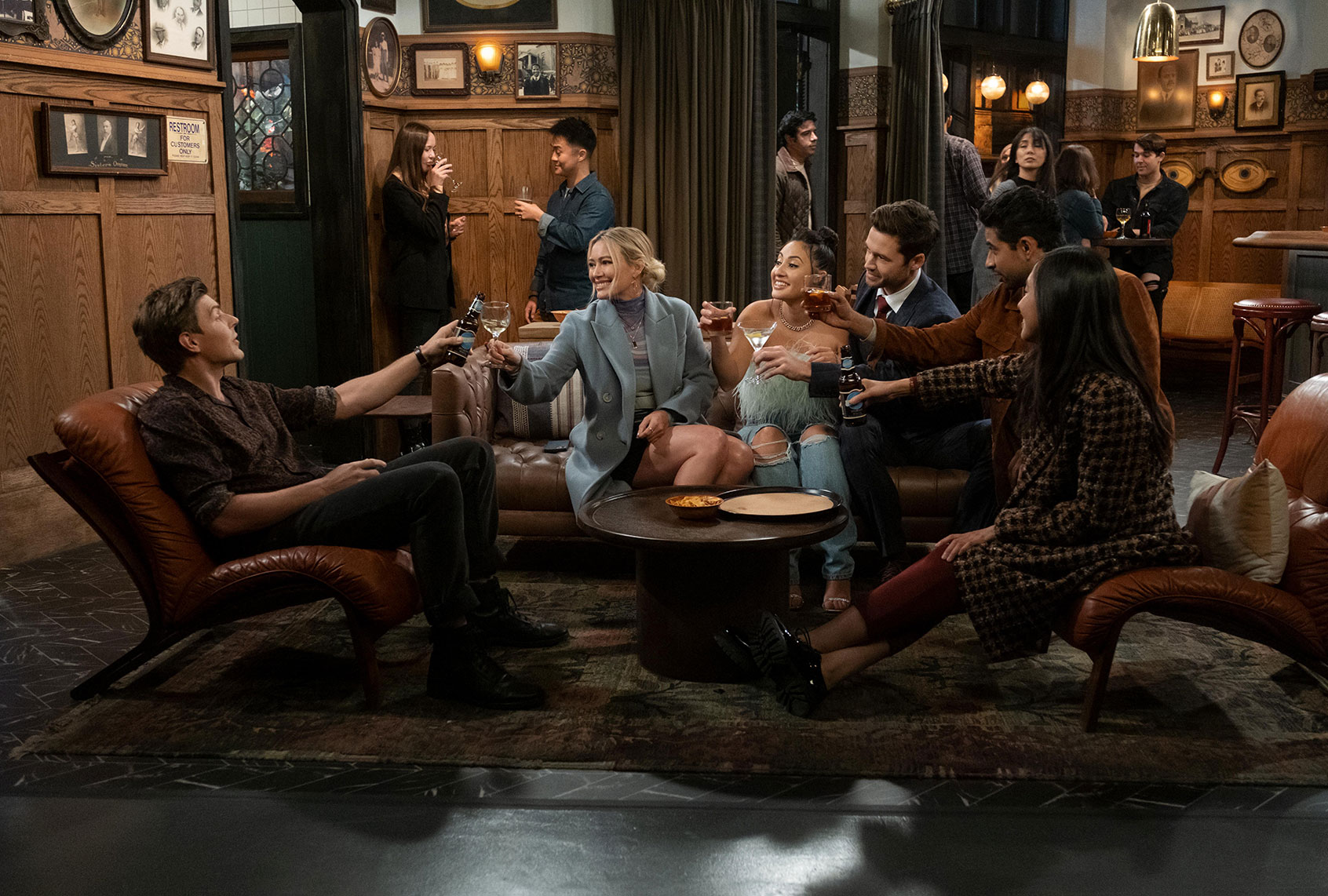
How I Met Your FatherChris Lowell, Hilary Duff, Francia Raisa, Tom Ainsley, Suraj Sharma and Tien Tran in “How I Met Your Father” (Patrick Wymore/Hulu)

Beyond that the bar scene is still alive and disappointing. Fortunately, Sophie has her Marshall equivalent in Valentina (Francia Raisa), who, despite being a New York stylist (because who needs lawyers anymore?), ends up Donald Ducking it in public for no good reason for most of the opening episode. (She’s dating Tom Ainsley’s Charlie, a “to the manor born” British guy who somehow escaped ever having to take the tube or experience unpleasant scents.)

Another switch is that we see our narrator Future Sophie, played by Kim Cattrall, instead of merely hearing her; it’s her son who remains offscreen this time. But as wonderful as it is to see Cattrall in a New York separated by “And Just Like That” by the span of an entire country, her asides are more distracting than anything else. The mystery son keeps moaning about her wine-soaked ramblings, which doesn’t make the 2022 version of her life any funnier.

This is one of several reasons the wan comedy defies classic TV debates about what constitutes a reboot versus a revival. Reboots share a premise with the original property versus the revival’s shared continuity. “How I Met Your Father” squishes aspects of both together, returning to the same diluted version of New York with a few more people of color and a queer character, and placing one of them in a very familiar-looking apartment.

But other than the main characters holding gigs that didn’t exist in 2005 (Sophie is a street photographer and Jesse’s an Uber driver), most of the show amounts to a gender bend on the same old lyrics – a cover version of an architect’s sentimental search for lifelong partnership.


Want more health and science stories in your inbox? Subscribe to Salon’s weekly newsletter The Vulgar Scientist.


Wonderful cover songs abound, of course. To continue that conversation about thematic refrains between eras, “How I Met Your Father” could have easily been the TV equivalent of No Doubt’s 2003 rendition of Talk Talk’s “It’s My Life,” released in 1984. The melody and lyrics are the same. It’s the delivery that individualizes each, with tonal differences that make Gwen Stefani’s take invigorating and upbeat where Mark Hollis’ original has a doleful air.

But “How I Met Your Father” never takes such pains to distinguishes itself quite so well. Instead its shortcomings remind us of why there’s been relatively little clamoring to revisit that old CBS comedy that ended up letting us down. We’ve seen this story before and better versions of it since life moved on, making the writers’ choice to retrace its dated habits so odd.

It’s kind of like Sophie’s habit of sadly singing along to Train’s version of “Drops of Jupiter” whenever her heart gets broken. That song is also 20 years old, and Taylor Swift’s moving, updated cover version is right there. Maybe the message is that there’s no reason to mess with the timeless potency of a classic. When it comes to a show that has yet to fully achieve that designation, “How I Met Your Father” proves there certainly is.

The first two episodes of “How I Met Your Father” are currently streaming on Hulu. Watch a trailer for the series below, via YouTube.

More stories like this:

How I turned broccoli-rice casserole into new creamy, cheesy “arancini”

My current season of cooking is defined by two themes: a) a craving for texture and b) a craving for old-school comfort food. It’s actually a really beautiful pairing of desires because most of the “winter food” I grew up with definitely would have benefited from added crunch. 

Pasta bakes are better with breadcrumb toppings; meaty (or mushroom-y) stews work best with hunks of freshly-toasted croutons; and flavorful chilis and pozoles should be topped with fried tortilla strips. My favorite part of the casseroles that tended to sit in the spotlight of our family dinners were the crispy, browned edges that formed on the tops and corners of the baking dishes. I’ve often wished that I could create something that had the same flavors but multiplied the crisp-factor tenfold.

RELATED: This impossibly cheesy one-pot copycat Hamburger Helper belongs in your winter recipe rotation

Well, I finally did it! Let me introduce you to these broccoli and cheddar “arancini,” which are a loose mash-up of my mother’s broccoli-rice casserole and fried risotto balls (a popular Italian appetizer). 

I took the best of both worlds — starchy arborio rice, bright broccoli and punchy sharp cheddar — and contained them in a substantial breadcrumb crust. While these are perfect on their own or with the dipping sauce of your choice, I really like adding one or two to a bowl of broccoli-cheddar soup for a little extra coziness.

***

Recipe: Broccoli and Cheddar “Arancini”

Yields
16 servings
Prep Time
01 hours 15 minutes
Cook Time
30 minutes

Ingredients

  • 1 cup arborio rice
     
  • 1 egg, whipped 
     
  • 1 tablespoon heavy cream 
     
  • 4 ounces (or 8 tablespoons) of sharp cheddar, shredded 
     
  • 1 shallot, minced 
     
  • 1 clove garlic, minced 
     
  • 1/2 cup broccoli florets, chopped 
     
  • 2 tablespoons unsalted butter 
     
  • 1 1/2 cups of breadcrumbs 
     
  • Salt and pepper to taste 


Directions

Step 1
Cook the arborio rice according to package directions, then spread the rice on a baking sheet and set aside until completely cool. (You can pop it in the refrigerator to speed up this process.)

Step 2 
Meanwhile, melt the unsalted butter in a small pan, then bring the heat up to medium-high. Add the minced shallot and garlic and sauté until just softened, about 3 minutes. Add the broccoli florets and salt and pepper to taste. Continue to sauté for an additional 3 minutes. Place the mixture in a large bowl and set aside. 

Step 3
Add the cooled rice to the large bowl with the broccoli, shallot and garlic mixture and stir until completely combined. 

Step 4 
Add the shredded sharp cheddar, the whipped egg and the heavy cream to the same same bowl. Next, fold in 2/3 cups of breadcrumbs. At this point, using your hands, you should be able to form small, round balls from the rice and broccoli mixture. Make 16. (They don’t have to be perfectly round!)

Step 5
Pour the remaining breadcrumbs in a shallow bowl and roll the arancini until they’re fully coated. Place on a sheet pan and refrigerate for at least 30 minutes. 

Step 6
From here, you have a few options for cooking. You can place them in batches in a 400-degree air fryer and cook for 10 minutes, flipping once at the halfway mark. 

You can also bake them on a parchment-covered sheet pan at 350-degrees for 20 minutes, flipping halfway through. 

Or you can fry them. To do so, heat 1/2 inch of vegetable oil in a large saucepan over medium heat until a deep-fry thermometer registers 350 degrees. Working in batches, fry the rice balls, turning until golden brown on all sides, about 4 minutes. Remove with a slotted spoon and drain on paper towels; season with salt.

Step 7
Enjoy! Serve as a side dish, a snack or — my personal favorite! — as a topper for a hot bowl of broccoli-cheddar soup.

More super simple weeknight meals: 

Salon Food writes about stuff we think you’ll like. Salon has affiliate partnerships, so we may get a share of the revenue from your purchase.

To skirt air pollution oversight, states can play hide and seek

When Paula Brooks stands in front of her two-bedroom house on Camp Street in Indianapolis and glances south, she sees brightly painted historic homes and towering oaks. When she glances north, she sees traffic. All day, cars, ambulances, buses, delivery trucks, dump trucks, and semi-tractor trailers rumble by. At rush hour, the traffic crawls as commuters squeeze onto nearby Interstate 65.

“The majority of those heavy vehicles are using diesel, so when it gets congested, you know cars idling, then it really hits you, the fumes,” says Brooks, who grew up in this historic African American neighborhood known as Ransom Place.

Those diesel engines spew microscopic bits of pollution called fine particulate matter, which are 30 times smaller than the width of a human hair, roughly 2.5 microns in diameter. (Scientists call this pollution PM2.5) Researchers have linked the particles, which can lodge deep in the lungs and enter the bloodstream, to cardiovascular disease, diabetes, autism, asthma, chronic obstructive pulmonary disease, and even Alzheimer’s disease.

In theory, a network of Environmental Protection Agency monitors should help track this pollution in Brooks’ neighborhood — and similar places across the country. The most common EPA monitors consist of a metal box with a protruding device at the top to draw in air. Inside are instruments that carefully control the volume of air flow and deliver it to a filtration system that captures pollution particles. Under the Clean Air Act, state regulators are required to put these monitors around geographical regions — usually counties. The regulators then use the monitors’ data to show they are complying with the National Ambient Air Quality Standards, which limits how much of a certain pollutant is allowed in a cubic meter of air.

In practice, many experts and advocates say, that system is broken. Data collected by researchers at the nonprofit Resources for the Future, along with studies from at least one academic group, suggests that actual levels of some air pollutants in Ransom Place and other U.S. neighborhoods are higher than what the monitors indicate. There are simply too few monitors, they say, to give an accurate picture of local pollution levels.

Indeed, in Marion County, where Indianapolis is located, there are five PM2.5 monitors to cover 400-square miles. None are in the urban core, where traffic is among the heaviest. “Our stationary monitors are not well suited to pick up our worst emitters,” says Gabe Filippelli, a biogeochemist at Indiana University-Purdue University Indianapolis who studies air pollution.

Some researchers suggest that state regulators may have an incentive to keep the limited supply of monitors away from pollution hotspots. And gaming the regulatory system may not be limited to monitor placement. Some recent work suggests that regulators take advantage of intermittent monitoring, an EPA practice that allows regulators to turn on monitors just once every three or six days. Other research shows how facilities may exploit a Clean Air Act provision to avoid penalization by claiming any excess emissions — above what their EPA permit allows — were unintended.

The result of all this overlooked pollution, the researchers say, is that people get hurt — mostly people of color. A 2021 study in Science Advances shows racial-ethnic minorities in the United States are disproportionately exposed to higher levels of PM2.5. The authors modeled pollution concentrations from vehicles, construction, industry, and more, and found Black, Asian, and Hispanic people breathe dirtier air than White people.

This unequal exposure is due to racism, says Julian Marshall, study coauthor and a civil and environmental engineer at the University of Washington. He points to historic discriminatory housing and land-use policies, including mortgage red-lining, which made it so Black Americans and other people of color could not get government-backed home loans where they lived. City planners viewed these redlined neighborhoods as good places for industry and highways because redlining rendered the land cheaper; residents also lacked the political clout to fight such developments. These explicitly racist policies from decades ago still impact the people who breathe the dirtiest air today, says Marshall: “The past is still present.”


Traffic near the historic Walker Building at the intersection of Indiana Avenue and Doctor M.L.K. Jr. Street. I-65 traverses the city just to the north. “The majority of those heavy vehicles are using diesel, so when it gets congested, you know cars idling, then it really hits you, the fumes,” says Brooks.

For years, the EPA’s ground monitors were the only way to measure pollution. Then in 1999, NASA launched a rocket from California’s Vandenberg Air Force Base — and with it, a new system for gathering pollution data. Hitching a ride on that rocket was a satellite that flies over every inch of the planet once per day. Along with another satellite launched in 2002, it gathers data on the concentration of pollution particles by comparing solar radiation at the top of Earth’s atmosphere with how much is reflected back from Earth’s surface — the more particles, the less radiation is reflected back.

Researchers have now been analyzing satellite data for two decades to get a more complete picture of Earth’s pollution, but they are still refining the statistical tools needed to interpret the data. Because satellite measurements are not direct samplings of pollution particles, researchers must use a statistical conversion process that at least one study showed can involve a lot of error. This means the data should be viewed with some caution, according to University of California, Berkeley professor Meredith Fowlie, a co-author on the study. In an email to Undark, she explained that the EPA monitors provide a direct measure of pollution; whereas, the satellite-based estimates are “informed guesses coming out of a very challenging prediction exercise.”

Still, Fowlie and others see value in looking at satellite pollution estimates to fill in the data gaps inherent among the nation’s ground monitoring network. The satellite estimates reveal, for instance, that the monitors may be missing pollution. And some researchers, including Alan Krupnick, a senior fellow at Resources for the Future, and Corbett Grainger, an environmental economist at the University of Wisconsin-Madison, say that may be strategic. Both have been comparing satellite data with ground monitor data and have found evidence that in some counties, including where Brooks lives, monitors may sit just outside pollution hotspots — perhaps because state regulators want to avoid costly investments necessary to bring down pollution levels

EPA officials disagree, pointing to guidelines on where their monitors should be sited. And Barry Sneed, a spokesperson for the Indiana Department of Environmental Management, told Undark via email that his agency follows those guidelines as best they can, adding that “there are limitations to locations that may otherwise be ideal such as vegetation, structures, or the lack of access to power.”

In other parts of the country, regulators may be taking advantage of possibly unintended air monitoring loopholes, such as an EPA policy that allows regulators to monitor pollution on an intermittent basis. (EPA data show that the annual cost to operate a monitor that is turned on every day is about $41,000; whereas, to turn it on once every six days is about $21,000.) The one-in-six-day schedule ensures that the monitor will be actively measuring pollution on different days of the week; the EPA says the pollution captured should then average out to a representative number.

But according to recent research by Eric Zou, an economist at the University of Oregon, local regulators may have found a way to skirt this rule. Zou says local regulators are tasked with gathering data to forecast local pollution levels and thus know ahead of time when upcoming air quality may be bad. They also know the day that intermittent monitors will be turned on (the EPA publishes a public schedule). And, critics say, local regulators should know that if they issue a pollution advisory — a warning to residents to stay indoors and drive less — they may be able to quickly lower pollution.

Zou compared daily NASA satellite PM2.5 data to one-in-six-days measurements from ground monitors in hundreds of counties. He found that pollution levels dropped on the day the monitors were turned on, then rose again once they were turned off. He also found that local regulators were 10 percent more likely to issue an advisory, which have names like “Spare the Air,” on the days the monitors were turned on. “If you look at when these warnings are issued, look at the timing,” Zou says. “You can see a pile up of these issuances exactly on the days when the federal monitors are monitoring.”

The Ransom Place Pocket Park gives visitors a window into the history of this historically Black neighborhood. In the U.S., racial-ethnic minorities are disproportionately exposed to higher levels of PM2.5.
A historic home in the Ransom Place neighborhood. Because of where Indianapolis’ monitors sit, the state may not be accurately measuring the neighborhood’s air quality.
Paula Brooks’ mother, Violet, is commemorated with a brick in her name alongside other long-time residents of the neighborhood at the Ransom Place Pocket Park.

Intermittent monitoring can be a problem for other reasons, as residents in Grays Ferry, a formerly redlined south Philadelphia neighborhood, learned in 2019.

On June 21 of that year, three explosions ignited a massive fire at an oil refinery in Grays Ferry. Due to an intermittent monitoring schedule, the nearest hazardous chemical air monitor was off, and other monitors that measure PM2.5 and run on a daily schedule were too far away. With limited data, city officials said the blasts posed no immediate danger to residents. Peter DeCarlo, an environmental engineer at Johns Hopkins University, calls the response “mind-boggling.” DeCarlo, then at Drexel University, about two miles north of Grays Ferry, says residents could see a huge black plume of smoke hanging in the air and some told news reporters they could smell burning petrochemicals. “You know, your nose might not spit out a number,” he says, “but it certainly alerts you to the presence of things that shouldn’t be there.”

The refinery’s emissions were far beyond EPA limits. Still, the EPA doesn’t penalize companies for such accidental emissions, providing they take steps to show it was due to a malfunction, according to Britney McCoy, an environmental engineer who now works for the EPA but was not speaking for the agency in an official capacity. “We know that the refining process is a very complex process in nature,” she says, “and so there may be occasions for accidents.”

But that accidental emission rule is also ripe for exploitation, according to research McCoy performed before she joined the EPA. In 2010, when McCoy was a doctoral student at Carnegie Mellon University, she analyzed when such accidental emissions occurred at Texas oil refineries and found that they weren’t random. “Overall, across all of the refineries in Texas, you see a lot of patterns,” she says, pointing out that many happened at the beginning of the week, during morning hours, and during the summer months.

She also found that in communities with several refineries, such as Port Arthur, Texas, these extra emissions created so much pollution that it was equivalent to having another small local refinery.

The findings don’t surprise John Beard Jr., who founded and runs the environmental nonprofit Port Arthur Community Action Network. Beard grew up in predominately African American West Port Arthur.

“I was born and raised in this part of town where you have a nice white house and you’re sitting out on the porch drinking coffee in the evening, talking with your neighbor and working the flower gardens and the flower beds,” he says. “You come out the next day and the side of your house facing the refinery’s yellow. Something got released that night. You may have not smelled it because you were asleep.” Beard’s parents taught him not to turn up his nose at those sulfury smells because the refinery meant jobs. Today he feels differently: “You shouldn’t have to sacrifice your health and your environment and where you live in order to make a living.”

* * *

While Beard’s family chose to live close to the refinery for work, in Indianapolis, Brooks’ family had settled in Ransom Place before the highway was built. In 1966, when Brooks was starting grammar school, Indiana state highway officials decided to create a freeway around the city’s downtown. It included I-65, which those same officials decided would slice through the city’s northwest side, a predominantly African American area. To make room for the steel-and-concrete behemoth, the officials evicted thousands from their homes.

At the time, Brooks lived with her mother, Violet, a few blocks from her present address. The two narrowly missed having to relocate; entrance and exit ramps to I-65 were built just a block away.

Back then, few people considered the highway’s impact on air quality. Today, hundreds of studies illustrate the health effects of traffic pollution; a number show that living near a highway — especially within three to five blocks — can lead to impaired lung function, premature death, and fatal cardiovascular diseases.

Despite mounting evidence of harm, nobody is rushing to improve the standards. But even if the EPA did lower the PM2.5 standard, it’s not clear how much that would help Brooks. Because of where Indianapolis’s monitors sit, the state may not be accurately measuring the quality of the air that Brooks and neighbors breathe. For Brooks, that’s not a surprise. She has spent her life witnessing governmental indifference to the fate of Indianapolis’s Black residents.

“What fuels my anger more than anything is the destruction of the entire area as a community,” she says. “And the health impacts and the lack of greenery that went along with it.”

* * *

Nancy Averett is an independent journalist who covers science and environmental issues from Cincinnati, Ohio. Her work has appeared in Discover, Audubon, Sierra, Yale Environment 360, TakePart, Environmental Health Perspectives, Pacific Standard, and many other outlets.

All photos by Faith Blackwell for Undark. 

This article was originally published on Undark. Read the original article.

Al Yankovic gets the “weird” biopic he deserves, with the perfect actor to play him

“Weird Al” Yankovic is finally getting the biopic we didn’t know we wanted but now understand is necessary. And who’s cast to play him already bodes well for the proper “weird” tone for the project.

Playing the younger Al will be none other than “Harry Potter” star Daniel Radcliffe who has officially bagged his greatest and, shall we say, weirdest role yet. He’ll play the Grammy-winning musician and pop culture icon in the upcoming Roku Original biopic, “WEIRD: The Al Yankovic Story,” Roku announced Tuesday.

“When my last movie ‘UHF’ came out in 1989, I made a solemn vow to my fans that I would release a major motion picture every 33 years, like clockwork,” Yankovic said in a statement. “I’m very happy to say we’re on schedule.”

RELATED: Weird Al on why Paul McCartney said no to his “Live and Let Die” parody

“WEIRD: The Al Yankovic Story” is written by Yankovic himself and Eric Appel, who previously directed the 2010 short comedy feature of the same name. In addition to reprising his role as director, Appel will serve as an executive producer.

“When Weird Al first sat me down against my will and told me his life story, I didn’t believe any of it, but I knew that we had to make a movie about it,” Appel said.

The anticipated project promises to hold nothing back and will explore everything from Yankovic’s childhood and rise to fame to his “torrid celebrity love affairs and famously depraved lifestyle.” Known for his melodic parodies of pop culture and humorous renditions of contemporary tunes, Yankovic is hailed as the biggest-selling comedy recording artist of all time. His 2014 studio album “Mandatory Fun” became the first comedy album to earn a No.1 spot on Billboard’s Top 200 list. Yankovic notably had Top 40 hits in each of the last four decades, starting in the ’80s — a historical accomplishment also achieved by Michael Jackson, Madonna and most recently, U2. And in 2018, he was awarded a star on the Hollywood Walk of Fame in Los Angeles.

For Radcliffe, “weird” roles are simply the norm considering his unconventional and eclectic repertoire. To follow his star-making turn as Harry Potter, a 17-year-old Radcliffe jumped to a 2007 Broadway revival of playwright Peter Shaffer’s “Equus,” in which he appeared fully nude to play the troubled and horse-obsessed Alan Strang. Radcliffe also starred as Manny — a flatulence-filled corpse — in the 2016 comedy-drama “Swiss Army Man” and currently plays Craig Bog — a self-sacrificing solitary angel — in the HBO anthology series “Miracle Workers.”    


Want a daily wrap-up of all the news and commentary Salon has to offer? Subscribe to our morning newsletter, Crash Course.


“[I] am absolutely thrilled that Daniel Radcliffe will be portraying me in the film. I have no doubt whatsoever that this is the role future generations will remember him for,” Yankovic said.

“WEIRD: The Al Yankovic Story” is produced by Funny Or Die and Tango and will be available exclusively on The Roku Channel. Yes there is a channel on your Roku device that actually has content. Production for the film will start in February.

More weird stories you might like:

Watch: Trump comes up empty when asked a very simple question about Republicans in power

When former President Donald Trump appeared on right-wing Newsmax TV this week, he was asked about the 2022 midterms and the things he would like Republicans to prioritize if they regain control of the U.S. House of Representatives. But Trump didn’t offer any specific policy recommendations should the GOP have a House majority in 2023 and seemed to ignore the substance of the question entirely.

Newsmax TV, a Fox News competitor, prides itself on being more right-wing and more pro-Trump than Fox News and Fox Business.

“Sounds like the Republicans are going to take back control of Congress,” the interviewer asked, “and what would you like to see them do?”

Trump responded, “Number 1: take back. That’s what has to be Number 1; we have to take it back.”

RELATED: 

Trump was asked by Newsmax what Republicans should do first if they retake Congress. He didn’t offer an answer.pic.twitter.com/LaRcUoutgb

— Aaron Rupar (@Aaron Rupar) 1642440683

Obviously referring to the Democratic majorities in Congress, Trump continued, “These are radicalized, horrible people that hate our country — what they’re doing with the open borders and the judges and all of the things they’ve been doing is so sad. And then you look at Afghanistan is a topper…. We were coming out strong, with dignity. There’s never been a lower point than what happened with Afghanistan, in my opinion. So, we’ve gotta, Number 1, we’ve gotta win the House — and I think we can win the Senate also.”

Despite Trump’s claim that Democrats have enacted an “open borders” policy, Biden has actually preserved many of his predecessors’ immigration policies, much to the dismay of some critics on his left. The borders are in no sense “open.”

Here are some responses to Newsmax’s Trump interview:

I just checked the tape u2014 not only did Trump fail to name a single thing a GOP majority should do, the interviewer failed to follow up and ask again.https://twitter.com/atrupar/status/1483129840853299203u00a0u2026

— Brian Stelter (@Brian Stelter) 1642444238

u201cThese are radicalized, horrible people that hate our countryu2026u201dpic.twitter.com/86zmiECbmR

— Jo (@Jo) 1642441254

READ: ‘Performative drivel’: Marco Rubio mocked and schooled after taking MLK quote out of context

There is no republican agenda. I mean there just isnu2019t. Itu2019s cut taxes for the very wealthy and control power thatu2019s literally it.

— Eric Gallion (@Eric Gallion) 1642440817


I think heu2019s also so focused on winning that he doesnu2019t give a damn about the governance part so he doesnu2019t think about it and has no answers for questions that require thought and application.

— Devin Nunes’ Cancelled Cultures (@Devin Nunes’ Cancelled Cultures) 1642442159


u201cTake a look out at Afghanistanu2026the way came out..we were coming outu2026we were coming out strongu201dnnCan someone at the New York Times interpret this rambling for us. I am sure itu2019s sheer genius

— Look here, Jack (@Look here, Jack) 1642441679


Translation: I have no idea what they should do other than win. And I just want them to win so I can get back into office and get that sweet sweet Presidential protection from prosecution back.

— The Godfather of 1690 (@The Godfather of 1690) 1642441252


They have no platform!!! The mess in Afghanistan was because of HIS deal with the Taliban. The border policies are HIS remain in Mexico policy. If they gain control againu2026NOTHING will be done for the people in this country again. Nothing will be done about climate.

— evie u10e6 ud83dude37 (@evie u10e6 ud83dude37) 1642449697

Nope, no ideas. And he made the deal with the Taliban and HE allowed 5000 prisoners go.

— That Vaccinated Karen (@That Vaccinated Karen) 1642440910

A fourth vaccine dose doesn’t seem to fully stop omicron, study finds

Besides being incredibly contagious, COVID-19’s omicron variant is frightening for its vaccine-resistant properties. The novel strain has more mutations around a crucial group of proteins that were used to create the original mRNA vaccines. Because of this, said vaccines are not as adept at protecting against the omicron strain, meaning breakthrough infections are common.

But as far as public health officials and immunologists are concerned, no infection at all would be preferable to even a mild breakthrough case — as such cases mean the virus can and will continue to spread. 

Hence, two weeks ago, a group of Israeli scientists studied whether the existing Pfizer-BioNTech vaccine can protect against omicron infections if patients are given four doses of vaccine, meaning a two-shot vaccine and two boosters. 

Now, they have an early answer: The booster shot helps somewhat, but not enough to prevent infections. The findings speak to the unique and squirrelly nature of the omicron variant. 

Preliminary data from the clinical trial, which included 154 medical personnel at Tel Aviv’s Sheba Medical Center, revealed that those who received four doses of the vaccine had higher antibody levels than those who did not. While this regimen partially defended patients against omicron, the same vaccines that were effective against other mutant SARS-CoV-2 viruses proved weaker when confronted with omicron.

The good news was that the fully vaccinated patients infected with omicron reported either mild symptoms or none at all. This is consistent with previous studies which have found that omicron is not as deadly as other strains and that fully vaccinated people are still much safer from COVID-19 — both in terms of getting the disease and in terms of developing severe symptoms — than those who are not.

This is not the end of the Israeli research. Sheba researchers are also currently testing the efficacy of a fourth dose of the Moderna vaccine, which like the Pfizer-BioNTech inoculation utilizes mRNA technology. In addition, the Israeli government has already made fourth doses of vaccines available to people who are elderly or immunocompromised.

RELATED: Omicron’s lower mortality rate may be explained by how the variant spreads through the body

It is unclear whether the United States will also start offering fourth doses. Some public health experts, including those at the European Union, have warned that receiving too many COVID-19 vaccines could weaken a patient’s immune system. In addition, policymakers have to consider our limited resources.

“You have to then ask yourself, ‘What is the goal?'” L.J Tan, chief strategy officer for the Immunization Action Coalition, told Salon in December. Tan observed that policymakers should try to get initial booster shots to everyone if their goal is to “reduce hospitalizations, reduce the surge on the systems, and reduce the number of people getting severely ill.” At the same time, he added that “if the goal is to stop transmission and stop people from passing omicron from one person to another, then perhaps a fourth dose is necessary.”


Want more health and science stories in your inbox? Subscribe to Salon’s weekly newsletter The Vulgar Scientist.


Albert Bourla, the CEO of Pfizer, told CNBC’s “Squawk Box” last week that his company is already working on a vaccine specific to the omicron variant and it hopes to release it within the coming months.

“This vaccine will be ready in March,” Bourla explained. “We [are] already starting manufacturing some of these quantities at risk.”

He added that the vaccine will also try to target other mutant variants, as it is unclear whether an omicron vaccine is necessary at this point. At the same time, Bourla said that Pfizer will have some doses ready for those countries that say they want them as soon as possible.

“The hope is that we will achieve something that will have way, way better protection particularly against infections, because the protection against the hospitalizations and the severe disease — it is reasonable right now, with the current vaccines as long as you are having let’s say the third dose,” Bourla told CNBC.

It may not be realistic for pharmaceutical companies to produce inoculations for all of the COVID-19 variants that arise. Because it takes four to six months from the moment a company learns of a variant to when it could have batches of bespoke vaccines ready for distribution, business leaders are wary of creating a vaccine for a bug that may no longer be a problem by the time the shots are ready. This is what happened with the beta variant, which peaked and subsided in two months, although the omicron variant presents unique challenges of its own.

While other SARS-CoV-2 viruses can be traced back to the ancestral virus that originated in Wuhan, China, omicron has mysterious origins. All of the existing vaccines were designed to protect against the original version of the virus.

Read more on omicron’s rise:

GOP Rep. Dan Crenshaw booed at Tea Party meeting: “Let’s go Brandon!”

Republicans now seem to be deploying their new favored insult against President Joe Biden, a Democrat, to take swipes at their own. 

Rep. Dan Crenshaw, R-Tx., a Methodist Christian, was booed by a crowd in Texas on Monday after ostensibly snapping at a young woman who asked him to clarify his past comments on whether Jesus “is real.” The awkward incident unfolded during a Q&A at a Montgomery County Tea Party meeting, where a girl began reciting remarks Crenshaw made back in April about Jesus being a “hero archetype” but not a “real character.”

“I can’t wrap my head around this,” the girl said to Crenshaw after quoting him. 

“Well, I’ll help you,” the lawmaker forcefully interjected. “Put a period after the word Jesus, and don’t question my faith!”

RELATED: Marjorie Taylor Greene berates fellow House Republican Dan Crenshaw

The quip was met with a chorus of boos from members of the audience, one of whom pointed out the girl’s young age. A tense back-and-forth ensued between the girl and Crenshaw, who accused her of “twisting” his words. The accusation then prompted multiple members of the crowd to shout, “Let’s Go Brandon,” a minced oath for “F*ck Joe Biden.”

The bizarre slogan first surfaced during the September Sparks 300 at Talladega Superspeedway, when an NBC reporter mistook a crowd chanting “F*ck Joe Biden” for “Let’s Go Brandon” – an apparent reference to racing driver Brandon Brown. 

The phrase quickly took hold amongst conservatives as a euphemistic way of disparaging the Biden administration, with multiple lawmakers – including Rep. Lauren Boebert, R-Colo., Rep. Bill Posey, R-Fla., Florida Gov. Ron DeSantis, and Texas Governor Greg Abbott – having employed the phrase in various ways. 


Want a daily wrap-up of all the news and commentary Salon has to offer? Subscribe to our morning newsletter, Crash Course.


It remains unclear why “Let’s Go Brandon” was hurled at Crenshaw, given that the Texas conservative has consistently condemned decisions made by the Biden administration while applauding those of Trump. 

Comedian Jay Black suggested that the phrase, in its apparent overuse, has simply become a rhetorical crutch for conservatives aggrieved by anything at all. 

“When they’re shouting “Let’s Go Brandon” at the end… are they yelling at Dan Crenshaw? The girl?” tweeted Black. “Or does MAGA just shout that now whenever they’re uncomfortable, like Macaws screeching at a predator.”

It isn’t the first time Crenshaw has been in hot water with his own party.  

During a December campaign event, in a scathing critique of his own party, Crenshaw labeled several unnamed members of the GOP as “grifters” and “performance artists.”

“We have grifters in our midst,” Crenshaw apparently said of the Freedom Caucus, which includes Reps. Marjorie Taylor Greene, R-Ga., Paul Gosar, R-Ariz., Jim Jordan, R-Ohio, and more. 

“I mean in the conservative movement,” he added. “Lie after lie after lie because they know something psychologically about the conservative heart — we’re worried about what people are going to do to us, what they’re going to infringe upon us.”

RELATED: GOP civil war heats up: Dan Crenshaw calls out GOP “grifters” and “performance artists” in Congress

Crenshaw later clarified those comments after facing the wrath of multiple members of the caucus, claiming he was not referring to the group. 

Following the Jan. 6 Capitol riot, Crenshaw again departed from many of his Republican colleagues when he said that claims of voter fraud in the 2020 election were “mass manipulation.”

“They said they were protecting the Constitution. They knew full well they were shredding it,” he said on his podcast. 

Asked about his many spats with conservatives, Crenshaw told Politico that “he’s not looking for fights.”

“But if a false narrative is spreading quickly, you have to say something,” he said. “I think politics has changed radically, where people want a freewheeling, authentic person. Fine, that’s good. And that’s certainly what I deliver. But you also need to be thoughtful and correct in what you say.”

*Correction: A previous version of this report incorrectly identified Crenshaw’s questioner as a “10-year-old girl.” Subsequent reporting, however, revealed that the teenager is 18 years old. 

Why voters don’t blame Republicans for the Capitol riot — no GOP leaders have been arrested yet

Over the long weekend, Gallup released a poll that sent a shock wave through Democratic circles: There’s been a 14 point swing in party preference from Democratic to Republican in the past year. While 49% of Americans leaned Democratic and 40% leaned Republican in January 2021, at the beginning of 2022, the parties have nearly reversed positions. Now 47% of Americans prefer Republicans while a mere 42% prefer Democrats. 

From one angle, it makes sense. The COVID-19 pandemic continues to be the dominant political issue, and President Joe Biden is getting blamed for it, even though the real cause is Republican pundits and politicians convincing their followers to be disease vectors in order to sabotage Biden’s presidency. The ongoing failure of Democrats to pass any of Biden’s political priorities can’t be helping, either, especially as the result is a drumbeat of headlines about Biden failing. 

But it still is stunning to see this dramatic swing, for one major reason: The Republicans are actively trying to destroy democracy. Worse, there was a high-profile assault on the Capitol a mere year ago that should, by any reasonable measure, illustrate the profoundly fascistic leanings of the current GOP.

RELATED: One year later, mainstream media still doesn’t see Jan. 6 attack as racial

The implicit and sometimes explicit support for the insurrection by Republicans is obvious to the politically aware. Not only does the Republican Party continue to cover up Donald Trump’s role in inciting the riot, but the party nationwide is acting on Trump’s demands to help him steal the 2024 election through voter suppression and election interference. Meanwhile, prominent Republican figures continue to promote political violence, while Trump is the strong favorite for the GOP nomination 2024, with an overtly insurrectionist campaign built around his Big Lie. 


Want more Amanda Marcotte on politics? Subscribe to her newsletter Standing Room Only.


The problem is that the voters who are swinging hard to the GOP know basically none of this. Instead, they assume that the Republicans are a normal political party. There are lots of people to blame for this, of course. Biden and Democrats didn’t do themselves any favors by spending the past year talking up “unity” and “bipartisanship,” instead of focusing like a laser on the fact that the GOP is actively conspiring with Trump to cover up for January 6 and perpetuate his war on democracy. The media also plays a role, exhibiting an unwillingness to challenge Republicans directly about their anti-democratic ideology

But, ultimately, the biggest problem is the utter lack of accountability for any of the prominent Republicans involved in Jan. 6. Neither Trump nor any Republican leader has been arrested for their efforts to steal the election that led up to the Capitol riot. So far, the only people who have been arrested for the Capitol insurrection have been the people who actually stormed the building or far-right militia types who coordinated their actions that day. So that ends up reinforcing the impression, especially with people who don’t follow the news very closely, that the riot was a result of a bunch of self-directed fringe characters, and has nothing to do with the mainstream Republican Party. Unless the cuffs start coming out for Trump and his fellow elite Republicans, it will be hard to convince these voters to see the insurrection as anything but an anomalous event, instead of part of a larger anti-democratic conspiracy. 

RELATED: Democrats hit the panic button. Is it too little too late for Joe Biden?

Focus group data confirms this. As McClatchy reporter Alex Roarty explained last week in a tweet thread, swing voters simply don’t see January 6 as a “big deal” and talk about it as a “tragedy,” as if it was a weather event, instead of what it was, a partisan political effort to overthrow an election. Participants in the focus groups repeatedly talked about the Capitol riot as if Democrats were exaggerating when they talk about that day or its implications. 

In one focus group, however, one participant linked the attack to the larger assault on democracy and, crucially, expressed concern that the people behind the attack weren’t facing justice. After that, the tone of the group switched to genuine concern for democracy. Participants, Roarty explained, then expressed “a desire to find person responsible for attack.” Without that, however, connecting the attack to the GOP didn’t make sense to them. 

This comports with findings of other focus groups. One conducted by Axios found that swing voters think the jury is still out on who is to blame for the Capitol insurrection, though they repeatedly expressed interest in finding out through legal investigation. Another, held by the New York Times, found that even though the Democratic voters took the Capitol insurrection seriously, they expressed frustration “that those responsible for the events on Jan. 6 had not been brought to justice.” Even some Republicans called the event “scary,” but again, as the only people being arrested for it are the small-timers, they can tell themselves a story about how it has nothing to do with the mainstream GOP. 


Want more Amanda Marcotte on politics? Subscribe to her newsletter Standing Room Only.


The logic of the typical low information voter isn’t all that hard to parse: If Trump and other Republicans had actually tried to commit a coup, then why aren’t they in jail for it? It’s a serious crime, after all. The lack of arrests sends a strong signal that it must not be that important. Most people tend to consume a lot more “Law and Order” than they do investigative pieces by the Washington Post. They likely won’t read the umpteenth investigative piece on this complex coup. They would, however, notice Trump and GOP members of Congress getting arrested. 

Last week, there were some high profile charges of Stewart Rhodes and other members of the Oath Keepers for “seditious conspiracy” for their part in the January 6 riot. As some commentators pointed out, this undermines efforts from Republican pundits to deny that the attack was an insurrection. However, it does little to dissuade swing voters from viewing the events of that day as driven by an otherwise powerless right-wing fringe. Rhodes has a past as a congressional staffer and a judicial clerk, but he deliberately dresses like he’s a wild-eyed militiaman, helping reinforce the false narrative that he and his fellows have no real relationship to mainstream Republican politics. 

RELATED: Oath Keepers founder Stewart Rhodes charged with seditious conspiracy for Jan. 6 role

Democrats can make speeches blaming Trump and other Republicans for the insurrection, but they can’t make skeptical swing voters believe them. On the contrary, such voters tend to be the first to ascribe cynical and self-serving motives to political speech, and see such sentiments as empty rhetoric — if they aren’t backed up by action. In political media, there tends to be a lot of hand-wringing concern about how charging GOP leadership that was involved in the coup with crimes could be read as “political.” For ordinary voters who pay little attention to politics, the opposite is true: The lack of charges reads as evidence that there’s nothing to charge Trump and his coup conspirators with. They see political rhetoric blaming Republicans as therefore partisan hyperbole. 

To be certain, things could change. There are some hints that the Department of Justice(DOJ) is not ignoring the role of Trump and other high-level Republicans in the insurrection, and Salon’s own Brian Karem reports that sources in the DOJ suggest there’s even a conspiracy investigation into Trump. The January 6 committee, meanwhile, keeps turning up more information that could, in theory, lead to Trump’s prosecution. 

But, by definition, low information voters aren’t going to get into the weeds on this sort of thing. They glance at the headlines, see Trump is still free, and assume therefore that he didn’t do anything worth arresting him over. They continue to view him as a jackass and not a criminal. Unfortunately, “jackass” is someone that a lot of people will vote for, as previous elections and current polls showing Trump neck-in-neck with Biden demonstrate. Without the public perp walk, a significant number of people won’t see Trump as the mastermind behind Jan. 6. So Democrats will continue to fail to paint Republicans as the authoritarian insurrectionists they actually are. 

Ron DeSantis wants to hijack Florida redistricting — and cut number of Black districts in half

In an unprecedented move, Florida Gov. Ron DeSantis’ office has submitted a congressional map for the state’s redistricting process that seeks to cut the number of heavily Black districts in half.

The state legislature, led by Republicans in Florida, typically oversees the redistricting process. But over the weekend DeSantis became the first governor in modern history to submit a congressional map that drastically alters district boundaries, according to Florida Politics. Lawmakers don’t have to accede to DeSantis’ preferred map, but the governor holds veto power over any final redistricting plan. DeSantis’ office told Politico that they have “legal concerns” with the proposed maps from the state legislature.

“Nobody has commanded that orchestra like DeSantis,” one unnamed Republican congressman told Politico of the state legislature. “It would be a hell of a flex if he gets this map.”

DeSantis’ map would cut the number of predominantly Black congressional districts from four to two, while increasing the number of districts with majorities of 2020 Trump voters from 16 to 18. Ryan Newman, the governor’s general counsel, submitted the map on Sunday night, shortly before DeSantis posted a tweet to “honor” Martin Luther King Jr.

“This map is not only unconstitutional, but it dilutes black representation in Florida,” state Sen. Shevrin Jones, a Black Democrat, told Politico. “To add insult to injury, the Governor submitted this map all while tweeting a quote ‘honoring’ Dr. King.”

RELATED: Are Dems really “winning” redistricting — in the face of voter-restriction laws and GOP extremists?

DeSantis’ map would effectively wipe out a Jacksonville-area district currently represented by Rep. Al Lawson, a Black Democrat.

“People were contacting me from all over when the map came out,” Lawson told Politico. “They were concerned about things like what it would do to places like Jacksonville’s urban core, which is African American. It does not sit well with people. For nearly 30 years it has had minority representation.”

Florida voters approved a constitutional amendment in 2010 to ban partisan gerrymandering but that has not stopped Republican state lawmakers from carving out as many favorable districts as possible. The state Supreme Court threw out the Republican-drawn congressional map in 2015, implementing its own districts instead. Republican mapmakers in red states have largely sought to shore up their own seats rather than carve out new districts for themselves but DeSantis’ plan appears to be an exception, and would give Republicans two more favorable seats than the plan drawn up by the state Senate. The Princeton Gerrymandering Project graded the state Senate proposal a “B,” saying it only has a “slight Republican advantage.”

DeSantis, who is widely perceived as a potential 2024 presidential candidate, has sparked a minor feud with Donald Trump in recent days as the former president bristles over the governor’s perceived rise in the party. Some Republicans have suggested that DeSantis’ proposal came amid pressure from Trump supporters.

“I had a TON of people come up to me at the Trump Rally in ARIZONA asking about Florida Congressional Maps & if DeSantis was going to get involved,” tweeted Christian Ziegler, the vice-chair of the Florida GOP. “24 hours later … Looks like we have an answer!”


Want a daily wrap-up of all the news and commentary Salon has to offer? Subscribe to our morning newsletter, Crash Course.


Newman defended the map, arguing that the governor’s office has valid concerns about whether certain districts in the state Senate proposal would stand up in court.

“We have submitted an alternative proposal, which we can support, that adheres to federal and state requirements and addresses our legal concerns, while working to increase district compactness, minimize county splits where feasible, and protect minority voting populations,” he told Florida Politics. “Because the Governor must approve any congressional map passed by the Legislature, we wanted to provide our proposal as soon as possible and in a transparent manner.”

But some Democrats argued that the DeSantis map was a troll rather than a serious proposal.

“DeSantis wants to appear he’s still the MAGA boy, so he’s proposed a map that is purposely ridiculous — namely destroying minority seats,” wrote Democratic redistricting consultant Matt Isbell, dismissing the plan as a “stunt.”

The state Senate proposal appears to try to avoid another court fight over whether new districts comply with the 2010 amendment, but DeSantis’ proposal could run afoul of the state’s ban on partisan gerrymandering. Democratic attorney Marc Elias, who has challenged multiple Republican gerrymanders in court, threatened legal action in response to the proposal.

“I look forward to my team deposing [DeSantis] and his staff to fully understand the illegal partisan motivations of this map,” he tweeted.

The proposal comes after DeSantis signed a sweeping set of new voting restrictions sparked by Trump’s false claims of election fraud. Many of those new restrictions are likely to disproportionately impact voters of color. He has proposed additional voting changes and a new voter fraud investigation unit that would have a huge budget and more investigators than most police department homicide units, even though voter fraud is exceptionally rare and statistically meaningless.

Every Democrat in Florida’s congressional delegation last week signed a letter penned by Rep. Val Demings, D-Fla., who is running for Senate, calling on Attorney General Merrick Garland to investigate “partisan efforts at voter suppression” in the state.

“Proposed legislation would further criminalize standard ‘get out the vote’ practices, making it a criminal act to, for example, notify a homebound voter of his or her option to request a mail-in ballot,” the letter says. “In addition, there is a shameful attempt to reduce the number of drop boxes, particularly in certain precincts, and finally, the imposition of new deadlines on election supervisors to ‘clean voting rolls,’ an all too familiar strategy to purge voters of color throughout the country.”

Read more on the GOP’s push to limit voting rights:

On MLK Day, Rep. Marjorie Taylor Greene says the unvaccinated face a “new segregation”

Rep. Marjorie Taylor Greene, R-Ga., declared that the unvaccinated face a “new segregation” on Martin Luther King Day, suggesting that the country’s treatment of the unvaccinated likens that of racial discrimination against Black Americans. 

“Thanks to the hard work of Rev MLK Jr. and others, growing up in Georgia, I’ve seen the beautiful fruit that blossomed from the Civil Rights Era, where segregation ended & equality began,” Greene wrote in a GETTR post. “Today, I believe we are seeing a new segregation and discrimination beginning, wrongfully forced upon unvaccinated Americans by the tyrants of the Democrat Party.”

She added: “Our freedoms come from our Almighty God, and we must not let any man take them away.”

Countless cities and states have enforced testing, mask-wearing, and vaccine requirements for admission into certain businesses and venues in a bid to halt the spread of COVID-19. Back in September, President Biden issued a requirement, starting in January 2022, that businesses with 100 employees enforce vaccine mandates or compel their employees to undergo routine testing. But last week, the Supreme Court ruled against Biden’s vaccination policy, calling it “a significant encroachment into the lives — and health — of a vast number of employees.”

RELATED: The radical right’s takeover of the Supreme Court is complete

Greene isn’t the only high-profile figure to put King’s philosophies of justice in the context of COVID-19. 


Want a daily wrap-up of all the news and commentary Salon has to offer? Subscribe to our morning newsletter, Crash Course.


On Monday, Senate candidate Jackson Lahmeyer from Oklahoma tweeted: “Democrats: judge people by the color of their skin, class, gender, pronouns and vaccine status. MLK: judge people by the content of their character. 

“Not exactly on the same page,” Lahmeyer added. 

Last November, when asked about his feelings on the NFL’s protocols for unvaccinated players,  football quarterback Aaron Rodgers likewise replied, “The great MLK said you have a moral obligation to object to unjust rules and rules that make no sense.”

“In my opinion, it makes no sense for me, I test every single day,” Rodgers added.

Other Republicans invoked King in their attack on the left’s alleged “infiltration” into America’s public school system. 

On Monday, newly-elected Virginia Governor Glenn Younkgin issued an executive order forbidding the instruction of forbidding “inherently divisive concepts” like critical race theory. “We must equip our teachers to teach our students the entirety of our history — both good and bad,” the order states, “Only then will we realize Dr. Martin Luther King Jr.’s dream that our children ‘will not be judged by the color of their skin but by the content of their character.”

RELATED: How Democrats can win the critical race theory war: Call out the Christian right behind the movement

Can wax paper actually go in the oven?

We’ve all done it, just admit it. You’ve put wax paper in the oven when you should have used parchment paper. Maybe you made a genuine mistake, or maybe you ran out of parchment paper in the kitchen and needed to find a swap fast. You thought to yourself, “Can wax paper go in the oven?” and then probably shrugged your shoulders and said, “Eh, it’ll be fine.” Except the you in this case is actually me. This is my memoir.

What is wax paper? 

First things first: What even is wax paper? It’s paper that has been coated in a thin layer of paraffin wax, which makes it nonstick and moisture resistant, but not heat resistant. If the paraffin wax makes you feel concerned, don’t worry — it’s totally food-safe. And if it makes you feel better, the paper used to be dipped in earwax. Yes, literal earwax. So paraffin wax is a substantial improvement.

Can wax paper go in the oven? 

Wax paper and parchment paper seem like basically the same thing. They look the same, they’re sold in the same section of the store, they’re more or less the same price. So what’s the difference? Parchment paper can go in the oven, but wax paper cannot go in the oven.

OK, I lie. Wax paper can go in the oven at a very, very low temperature for a very, very short period of time, but frankly nothing fits that criteria. If you put wax paper in a hot oven, it’ll start to melt, just like wax, thus ruining your cake pans, baked goods, and likely your oven, too. The USDA says that wax paper can go in the microwave, but honestly, I wouldn’t risk it.

TL;DR: No, wax paper cannot go in the oven. Wax paper is not designed to withstand high temperatures for a prolonged period of time. Plus it’ll make your food all waxy!

What can you use instead? 

If you’re looking for a nonstick surface for baked goods, stick to parchment paper or silicone baking mats, which prevent food from sticking and are totally oven-safe.

Is wax paper good for anything? 

Yes, I promise it is! You can use wax paper for anything that you’re cooking or baking and leaving in the refrigerator or at room temperature (think homemade marshmallowschocolate bark, or even pre-rolled meatballs). Cut a piece of wax paper to fit the size of your pan and line baking sheets with an instant smooth, nonstick surface — parchment paper could never! (OK, it could, but wax is better!)

The other thing that wax paper is especially good for is rolling out dough. Place cookie or pie dough in between two sheets of wax paper to help create a smooth, even dough, sans any sticking to a rolling pin. Same goes for pounding meat like chicken or veal for homemade parmigiana. It’s way less likely to crinkle, shrink, or just absolutely fall apart the way that plastic wrap does when you’re pounding the meat.

You can also sift dry ingredients like all-purpose flour or confectioners’ sugar directly onto wax paper, then fold it and pour it directly into a mixing bowl, forming a makeshift funnel.

Or use wax paper as deli wrap to wrap food such as sandwiches or meats to store in the refrigerator. This is where the nonstick, moisture-wicking coating comes in handy.

5 quick tricks to make school lunches so much better

The bento-style lunches that TikTok star Jessica Woo packs for her three young kids are, in a word, amazing. “Let’s make some lunch for my kids!” Woo announces at the start of most of her cooking videos. In one, Woo molds an adorable bear out of white ricecomplete with eyes, mouth, and paws made of delicate nori cutouts. In another, she conjures an entire Squid Game-inspired spread featuring hot dog “squids” and the show’s iconic dalgona candy. It’s little surprise that Woo’s TikTok channel has more than 5.5 million followers. Her creations are enough to make us wonder: Can Woo make our lunches, too?

They’re also enough to stir up some feelings of, ahem, inadequacy, in even the best of us — case in point, this hilarious guy. But fear not: You don’t have to go all-out to improve your kid’s lunch situation. Even Woo agrees. “It’s just the little things,” she says. Most of what’s so impressive about her meals is the presentation, she adds, and even small adjustments can have a major visual impact. “If you’re packaging it in this pretty way, [the food itself] can literally be dinner leftovers,” she says.

Intrigued? Here are five ways to improve your kid’s lunch without going overboard (or breaking a sweat). Who knows, maybe you’re the next TikTok influencer in the making.

1. Break out the cookie cutters

Kids love foods cut into cute shapes. We don’t know why, but they do. Just roll with it. Woo cuts everything from sandwiches and cheese to fruits and vegetables into fun shapes like stars, hearts, and flowers. It might take an extra few minutes, sure, but the visual effect is huge. Plus, there’s no need to buy a ton of gear. “Most people have cookie cutters at home,” Woo says. “If you’re making a sandwich, just use a cookie cutter to make it into the shape of a star.” Her kids go wild for this trick, even if that “star sandwich” is just a pedestrian PB&J. As for the discarded edges? Woo usually eats them herself.

2. Say it with us: Rice is nice

Rice is endlessly moldable, which Woo says is the secret to creating some of her most fun designs. Yes, you could create an uncannily accurate rice version of Olaf, the snowman character from Frozen, or you just make a couple simple rice balls, a.k.a. onigiri. Most of the time, Woo doesn’t even use a fancy mold, instead roughly shaping things with plastic wrap or even her bare hands. Sometimes, she’ll stuff her rice balls (or sushi rolls!) with foods that her kids might not otherwise touch, like new-to-them veggies. Best of all, “they’ll end up liking it,” Woo says. If that’s not a parenting win, we don’t know what is.

3. Rejigger last night’s leftovers

That precious white rice bear we mentioned earlier? In Woo’s video, it’s floating in a gravy of savory black bean sauce leftover from the previous night’s dinner of jjajangmyeon, a popular Korean noodle dish. But reconfigured in lunch boxes the following day, it takes on a whole new life. “[Leftovers] make it easy — I just warm them up in the morning,” Woo says.

Relying on leftovers also means she doesn’t have to make everything from scratch, plus it gives her more time to add flair like her rice bear. The possibilities are endless: Stuff leftover stir-fry into a quesadilla. Chop up rotisserie chicken and toss it into a chicken salad. Literally anything — buttered peas, petite mozzarella balls, olives, the list goes on — can be thrown into cold pasta salads. In their new form, even the most mundane leftovers can “suddenly seem kind of exciting,” Woo says.

4. Don’t be afraid to accessorize

Woo’s videos often feature delightful utensils, like these darling dog and cat-shaped food picks. Her children go gaga for them, because, well, they’re just so gosh-darned cute. They may translate to a more thoroughly clean plate, too: If you’ve noticed that your Moana-obsessed kid is more likely to eat food off their Moana-themed plate, the same rule applies here. “It’s kind of like a cocktail party!” Woo says. “You don’t need all these things, but as you get more creative you can always add on all these cute little accessories.” For what it’s worth, Woo says her kids bring the food picks home so they can be washed and reused.

5. Add a love note

Even if you don’t change a thing about your existing routine, consider secreting a handwritten note in your kiddo’s lunchbox. In her notes, Woo often includes inspiring quotes by everyone from Nelson Mandela (“Education is the most powerful weapon that you can use to change the world”) to Bruno Mars (“If you ever forget how much you really mean to me, every day I will remind you”).

At the end of the day, Woo says her lunchbox creations are about keeping her kids well-fed and making them feel loved. Oftentimes, “the notes were [my kids’] favorite part,” Woo says. “I feel like those notes, and not even the lunches themselves, give everything the most loving touch.”

One year later, mainstream media still doesn’t see Jan. 6 attack as racial

Public opinion polls and other research have repeatedly shown that white racist attitudes, whether presented as “old-fashioned” racism or in less direct fashion as racial resentment and racial hostility, are strongly associated with support for Donald Trump and his Republican fascist movement. It is certainly true that feelings of economic insecurity, inequality and social alienation among the white working class are central to understanding the rise of American neofascism. But throughout American history, those forces have primarily manifested through white racism in its various forms.

As social theorist Stuart Hall described this dynamic: “Race is the modality in which class is lived.”

W.E.B. Du Bois explained it this way in a memorable passage from “Black Reconstruction“:

Slavery bred in the poor white a dislike of Negro toil of all sorts. He never regarded himself as a laborer, or as part of any labor movement. If he had any ambition at all it was to become a planter and to own “niggers.” To these Negroes he transferred all the dislike and hatred which he had for the whole slave system. The result was that the system was held stable and intact by the poor white.

President Lyndon Johnson offered a famous observation in a similar vein: “If you can convince the lowest white man he’s better than the best colored man, he won’t notice you’re picking his pocket. Hell, give him somebody to look down on, and he’ll empty his pockets for you.”

RELATED: Right-wing media and the pandemic: A toxic feedback loop that nurtured fascism

In this sense, the Age of Trump is the latest iteration of a much older politics of white rage and white supremacy whose origins extend well back before the Founding.

Last January Trump’s agents and allies attempted to nullify the results of the 2020 presidential election. Their plot consisted of a multifaceted nationwide plan to disqualify Joe Biden’s votes — and some participants literally suggested deploying the military after declaring a national state of emergency to cement Trump’s control over the country.

The evidence shows that the Capitol attack of Jan. 6 was an integral component of Trump’s coup attempt, intended to delay the certification of the Electoral College votes and prevent the final and formal election of Biden as president. In none of these events was race in any way a peripheral or irrelevant issue.

It is simply factual to describe Jan. 6 as a white supremacist attack on multiracial democracy. But if one were to rely on the consensus of the America’s mainstream news media on the one-year anniversary, one might come away with the belief that racism and white supremacy played little or no role in the events of that day.

Very few of the personal essays and reflections from journalists and others who were at the Capitol or nearby on Jan. 6 explicitly mentioned that Trump’s attack force was almost entirely all white. Instead, those accounts depicted a race-less and colorless horde of angry political hooligans attempting to overthrow American democracy.

Other writing about the events of Jan. 6 focused more impersonally on the role of authoritarianism and “populism.” But again, the specific racial marker was missing: It was not described as “white” populism or “white” authoritarianism or, better yet, “white fascism,” “white terrorism” or “white violence.”


Want a daily wrap-up of all the news and commentary Salon has to offer? Subscribe to our morning newsletter, Crash Course.


Likewise, Trump’s attack force and coup plotters were involved in an “insurrection” — but not a “white” insurrection. They were “enraged” about the 2020 election and its results but not driven by “white rage.”

By not centering the role of race in the events of Jan. 6, other realities are obscured as well. Trump’s attempted coup and the ongoing attacks on American democracy are a function of toxic white masculinity, militant “Christianity,” collective narcissism and other pathologies, including a profound societal impulse towards violence, self-destruction and death.

Many journalists may object to this criticism by responding that race and racism are not their “beat,” and they lack expertise in that area. My response would be that they are neglecting one of the most important aspects of American society, and therefore failing to understand crucial context for the current political crisis.

To those who say they don’t want to “make a mistake” when writing about race and racism, I would respond: Learn and study. Talk to experts, ask questions and educate yourself. Treat those topics as you would any other matter of critical societal importance. 

If the answer is, “I chose to not write that story,” I would say you made a choice to ignore a central element of the Age of Trump, and America’s actual or potential descent into fascism and racial authoritarianism. If the answer is more that the role of race on Jan. 6 “did not occur to me.” The luxury not to “see” or understand racism and white supremacy is itself an example of white privilege and how it works on day-to-day manner. I do not question your good intentions — but those have little, if anything, to do with racist or white supremacist outcomes.

If the answer is to respond that it’s “obvious” that the Trump attack force was white and it serves no purpose to mention said fact, I would explain how that is still a form of racial erasure which is doing the work of white supremacy. Assuming that these things are “obvious” helps to make invisible the myriad ways that whiteness and white power structure American society.

The power of racial colorblindness as a tool of white supremacy is easily understood: If the Jan. 6 attackers had been black or brown or Muslim, there would have been no such racial erasure. They would have been described in racial terms by the media, and in public discourse more generally, likely almost every single time the event was mentioned.

My concerns about racial erasure and the events of Jan. 6 are directed primarily toward the mainstream news media and its “reasonable” liberal or moderate voices. Right-wing media is a propaganda machine that serves the interests of white supremacy, and has no legitimacy or credibility in this discussion. But if mainstream “centrist” and liberal voices in the media are to play any kind of effective role as defenders of democracy in this moment of crisis, they must remove the blinders of whiteness.

At its core, American neofascism is a white supremacist project. To blind yourself to that fact is to limit your ability to understand it — and to grasp the magnitude of the existential danger now facing American society. That is the road to defeat, and the literal end of America’s experiment in multiracial democracy. Mainstream media can do better — and it absolutely must.

Read more on the resurgence of white supremacy in America:

GOP trying to recruit Arizona Gov. Doug Ducey to run for Senate, despite FBI investigation

Republican Senate leaders are trying to recruit outgoing Arizona Gov. Doug Ducey to run for Senate despite an ongoing FBI corruption investigation into his administration’s efforts to issue tax refunds worth up to $100 million to aid one of Ducey’s campaign donors.

Ducey, who is term-limited, has repeatedly said he has no plans to run for Senate but according to Politico is the “preferred candidate” of Senate Minority Leader Mitch McConnell in the 2022 race against first-term Democratic Sen. Mark Kelly. The National Republican Senatorial Committee has tried to recruit Ducey into the race and NRSC chair Sen. Rick Scott, R-Fla., has “patiently tried to warm” former President Donald Trump to the idea after Ducey refused to help Trump try to overturn his election loss.

Trump fired a warning shot in response to the recent reports.

“Rumors are that Doug Ducey, the weak RINO Governor from Arizona, is being pushed by Old Crow Mitch McConnell to run for the U.S. Senate,” Trump said in a statement on Friday. “He will never have my endorsement or the support of MAGA Nation!”

The recruitment comes as the FBI’s public corruption unit investigates the Ducey administration’s efforts to secure a tax break for a prominent Texas Republican donor. The probe was launched last summer after the Arizona Republic reported that current and former Ducey staffers had pushed for a closed-door deal to undermine state tax law to aid a key supporter, while the governor had his “eyes on higher office.”

The Republic reported that Ryan LLC, a Texas tax firm founded by Ducey donor G. Brint Ryan, pressured the Arizona Department of Revenue (DOR) to give a tax break to an oil client and filed a lawsuit against the agency. The firm pushed the DOR to agree to refund sales taxes on fuel for mining companies even though the tax had been in place for decades. The firm sought a $12,000 tax refund for an oil client but officials said the change would have triggered refunds in all other similar cases, which would cost taxpayers more than $100 million and $30 million per year in subsequent years. Ryan LLC stood to make millions in commissions.

RELATED: GOP governor’s staffers under FBI probe for pushing deal to give tax break to campaign donor

The tax firm hired three top Ducey deputies to push for the refund within months of their departures from the administration, in defiance of a state law that requires a one-year “cooling-off” period for public employees before they can lobby their former employers. Ducey’s administration argued that the law did not apply to the former aides because they oversaw public agencies but were not “employees” and therefore were not lobbying former employers.

Two of the former aides, former Ducey general counsel Mike Liburdi and former deputy chief of staff Danny Seiden, even signed on to represent Ducey in an unrelated lawsuit while simultaneously pushing for the tax break. The third aide, former chief of staff Kirk Adams, was still serving as a consultant to Ducey on state gaming policy.

The three former deputies and others working for Ducey met with DOR officials at least 16 times to push for the tax break, according to the report. Ducey’s deputy chief of staff Gretchen Conger and budget manager Glenn Farley also joined the effort to push the DOR for the refunds. Conger was involved in the effort for nearly a year before reporting that she had a potential conflict of interest because the refund would have resulted in a $10 million windfall for her father’s mining company.

Then-DOR director Carlton Woodruff and deputy Grant Nulle opposed the change. Attorney General Mark Brnovich, also a Republican candidate in this year’s Senate race, launched an investigation into the matter in 2020. Brnovich backed the DOR and took the fight to court, which ruled against the tax firm. Ducey later fired both Woodruff and Nulle, though the administration claimed the firings were unrelated. Nulle and Woodruff both told the Republic they believe they were fired for pushing back against the proposed refund.

Ducey spokesman C.J. Karamargin denied any wrongdoing and claimed the former aides had not violated the state’s cooling-off period.


Want a daily wrap-up of all the news and commentary Salon has to offer? Subscribe to our morning newsletter, Crash Course.


The 18-month campaign by current and former Ducey aides underscores the administration’s close ties to the governor’s political supporters, as well as the active revolving door between the governor’s office and corporate interests who have business before the state.

Adams, who continues to work as a consultant for companies with business with state agencies, also led negotiations to expand sports betting in the state, benefiting Arizona’s professional sports owners — who have collectively donated $400,000 to Ducey’s campaigns.

“Ducey’s tenure as governor has been marred by corruption scandals, and it’s been scarred by numerous pandemic failures as he’s repeatedly put his political aspirations ahead of keeping Arizonans safe,” Brad Bainum, a spokesman for the Democratic super PAC American Bridge 21st Century, said in a statement to Salon.

Last year, Cara Christ resigned as director of the Arizona Department of Health Services (ADHS) to take a top job at health insurer Blue Cross Blue Shield of Arizona one month later. The move came just weeks after her department gave Blue Cross Blue Shield a no-bid contract to run COVID vaccination sites in the state. Christ said company officials had approached her about the job opportunity while she was working with them on vaccination sites. Arizona law bars state employees involved in contract procurement from having “employment discussions” with contract recipients for one year.

Other no-bid pandemic contracts have also raised eyebrows in the state.

The Ducey administration last year awarded former campaign consultant Mario Diaz a no-bid contract worth more than $1 million for COVID vaccination outreach. Diaz’s contract was initially limited to a single zip code in Phoenix. Local news outlet KNXV-TV reported one month later that the zip code lagged behind the rest of the county, with just 16% of residents being vaccinated, compared to more than 54% in the area nearby, but the administration continued to extend and expand the contract.

In July of 2020, Ducey’s administration also awarded a $4 million no-bid contract for prison COVID testing to Centurion of Arizona, whose parent company Centene had donated money to Ducey’s campaign. The state now faces a fine of up to $23 million after failing to comply with a court order to improve prison health care, which officials may try to pass along to Centurion, according to the Associated Press.

In 2018, state inspections found that under Ducey, ADHS failed to verify background checks for some employees at the notorious Southwest Key shelters where migrant children separated from their families at the border were housed, which came as distressing news amid multiple news reports of sexual abuse at the shelters. A ProPublica investigation found that one employee at a Tucson shelter had been convicted of groping a 15-year-old boy.

In 2015, then-Theranos CEO Elizabeth Holmes stood behind Ducey as he signed a new law in a Theranos laboratory that allowed state residents to order lab tests of any kind without approval from a doctor. Ducey signed the law after lobbying from Holmes, who was convicted of fraud this month after lying to investors about the capabilities of her blood test startup. Ducey’s backing of Holmes’ unproven technology turned Arizonans into “guinea pigs,” wrote Arizona Republic columnist Laurie Roberts, after Theranos rolled out its tech into Walgreens and wellness stores around the Phoenix area, pumping out blood test results that were inaccurate. In 2017, Brnovich, the state attorney general, negotiated a $4.65 million consumer fraud settlement with the company on behalf of 175,000 Arizona residents who paid for the blood tests. Ducey stayed silent on the scandal and his office said after the settlement that Ducey had “no second thoughts” about promoting the company.

The Arizona Republic rang in 2022 with a damning New Year’s Eve exposé detailing the administration’s “efforts that focused on directly enriching Ducey’s supporters.” There “seems to be a general theme where Ducey has been able to use his position as governor to implement a number of changes in state policy that raise questions about whether the public interest is being served or whether narrower private or political interest are being served,” John Pelissero, a senior scholar at the Markkula Center for Applied Ethics at Santa Clara University, told the outlet.

“We completely reject the premise of these stories and we know Arizonans will too,” Ducey spokesman C.J. Karamargin said in response.

Evidently these tales of alleged corruption have not prevented Republicans from trying to recruit Ducey into the Republican field vying to face Kelly, which already includes Brnovich, Peter Thiel protégé Blake Masters, energy executive Jim Lamon and former state National Guard chief Mick McGuire. Ducey stoked speculation about his plans after name-checking Kelly during his State of the State address this week in a speech largely focused on criticizing the federal government. The governor has also recently hired four former aides to ex-Sens. John McCain, R-Ariz., and Jeff Flake, R-Ariz., Politico reported on Friday, and an announcement could be made by the end of February.

Karamargin shrugged off the reports in an interview with Salon, without specifically denying them. “It seems like just a lot of crystal-ball gazing, from our perspective,” he said.

Arizona Republican strategist Paul Bentz said he doesn’t expect Ducey will actually enter the Senate race, but not because of the corruption allegations.

“The criticisms against the governor and his supporters have not gained a foothold in the electoral consciousness,” Bentz said in an email to Salon. “His biggest challenge would be the criticisms he would receive from Trump if he were to enter the race.” Bentz suggested that Trump might “pick a candidate” while in Arizona over the weekend for a campaign-style rally, but Trump did not do so.  

None of this means that Ducey doesn’t have his sights set on running for higher office. Bentz said that Ducey’s team “is working diligently to continue to strengthen his national reputation,” noting that he had campaigned for Glenn Youngkin, the newly-elected Republican governor in Virginia. Ducey’s final State of the State speech was focused on national GOP issues, Bentz said, including “supporting parental choice in public schools and investing in border security. His vision for 2022 sounds to me more like someone who has his eyes set on president or vice president,” not the Senate.  

Read more on Arizona’s ever-wilder Republicans:

Oath Keeper indictment shows DOJ “methodically working its way up the chain of command”: experts

A major bombshell from Attorney General Merrick Garland and the U.S. Department of Justice came on Thursday, January 13 when Oath Keepers founder Stewart Rhodes was charged with seditious conspiracy in connection with the January 6, 2021 attack on the U.S. Capitol Building. Harvard University law professor Laurence H. Tribe and former federal prosecutor Dennis Aftergut analyze this indictment in an op-ed published by NBC News’ website a few days later, laying out some reasons why it is a very big deal.

“The monumental lead count of the 17-count indictment alleges that (Rhodes) and his co-defendants, along with unnamed others, were part of a ‘seditious conspiracy,'” Tribe explains. “That crime is, in effect, treason’s sibling.”

The legal experts continue, “Under 18 USC §2384, seditious conspiracy is an attempt ‘to overthrow, put down, or to destroy by force the Government of the United States, or…. by force to prevent, hinder, or delay the execution of any law of the United States.’ It is punishable by up to 20 years in prison.”

The indictment on January 13 came only two days after the Boston Globe published a Tribe/Aftergut op-ed in which they expressed skepticism about Garland’s willingness to vigorously prosecute those he described as the “January 6 perpetrators.”


Want a daily wrap-up of all the news and commentary Salon has to offer? Subscribe to our morning newsletter, Crash Course.


But in their NBC News op-ed, Tribe and Aftergut write, “This historic indictment creates an enormous incentive for the defendants to cooperate with the government and help fulfill Attorney General Merrick Garland’s January 5 commitment to hold ‘all January 6 perpetrators, at any level, accountable under law — whether they were present that day or were otherwise criminally responsible for the assault on our democracy.’ Four other Oath Keepers, at least, are already cooperating…. As a legal scholar and a former prosecutor who have been critical of the pace and seeming incompleteness of Garland’s investigation, we tip our hats to the attorney general for this enormous step forward.”

According to Tribe and Aftergut, the indictment of Rhodes and other Oath Keepers “confirms that the Justice Department believes the plotters of the Capitol siege specifically intended to overturn the election, prevent the lawful transition of power and shatter our democracy.”

“In addition, the new conspiracy charge sends a message that the prosecutorial door to everyone involved in the seditious scheme has officially swung open,” Tribe and Aftergut argue. “Finally, it shows the Justice Department is indeed methodically working its way up the chain of command of what it believes to be an exquisitely organized, multipronged plot.”

More stories like this: 

Billionaires “had a terrific pandemic” — as inequality killed millions: report

Oxfam International’s latest report on global inequality finds that while the 10 richest individuals in the world more than doubled their collective wealth since Covid-19 hit in 2020, the related result of this billionaire surge has been a deadlier and more prolonged pandemic for the rest of the world in which the incomes of 99 percent of humanity fell, over 160 million people were forced into poverty, and billions of the poorest were denied access to life-saving vaccines. 

Entitled “Inequality Kills,” the new report states that intense global inequality is “contributing to the death of at least 21,000 people each day”—approximately one person every four seconds—even as ultra-billionaires like Elon Musk, Jeff Bezos, Mark Zuckerberg, Warren Buffett, and a handful of others grow richer and richer with each passing hour.

In total, using data from Forbes, Oxfam found that the 10 richest men in the world saw their fortunes grow from an estimated $700 billion to $1.5 trillion dollars, a rate of over $1.2 billion per day, since the pandemic hit nearly two years ago.

“If these ten men were to lose 99.999 percent of their wealth tomorrow, they would still be richer than 99 percent of all the people on this planet,” said Oxfam International’s executive director Gabriela Bucher. “They now have six times more wealth than the poorest 3.1 billion people.”

The outrageous wealth of these billionaires is not simply benign inequality, says the group. An economic system that allows a handful of individuals to amass such vast fortunes while billions go hungry and without proper medical care during a pandemic, according to Oxfam, is an overt act of violence aimed at huge swaths of humanity.

“The coronavirus pandemic has been actively made deadlier, more prolonged, and more damaging to livelihoods because of inequality,” states Oxfam in their report. “Inequality of income is a stronger indicator of whether you will die from Covid-19 than age. Millions of people would still be alive today if they had had a vaccine—but they are dead, denied a chance while big pharmaceutical corporations continue to hold monopoly control of these technologies. This vaccine apartheid is taking lives, and it is supercharging inequalities worldwide.”

As the overview of the report states:

The wealth of the world’s 10 richest men has doubled since the pandemic began. The incomes of 99% of humanity are worse off because of Covid-19. Widening economic, gender, and racial inequalities—as well as the inequality that exists between countries—are tearing our world apart. This is not by chance, but choice: “economic violence” is perpetrated when structural policy choices are made for the richest and most powerful people. This causes direct harm to us all, and to the poorest people, women and girls, and racialized groups most. Inequality contributes to the death of at least one person every four seconds. But we can radically redesign our economies to be centered on equality. We can claw back extreme wealth through progressive taxation; invest in powerful, proven inequality-busting public measures; and boldly shift power in the economy and society. If we are courageous, and listen to the movements demanding change, we can create an economy in which nobody lives in poverty, nor with unimaginable billionaire wealth—in which inequality no longer kills.

“Billionaires have had a terrific pandemic,” lamented Bucher. “Central banks pumped trillions of dollars into financial markets to save the economy, yet much of that has ended up lining the pockets of billionaires riding a stock market boom. Vaccines were meant to end this pandemic, yet rich governments allowed pharma billionaires and monopolies to cut off the supply to billions of people. The result is that every kind of inequality imaginable risks rising. The predictability of it is sickening. The consequences of it kill.”


Want a daily wrap-up of all the news and commentary Salon has to offer? Subscribe to our morning newsletter, Crash Course.


In response to the report, Sen. Bernie Sanders (I-Vt.) on Sunday night issued a simple prescription to combat the current reality.

“Tax the billionaires,” said Sanders. “Invest in the working class.”

According to Oxfam, if just the top 10 billionaires alone paid a 99% tax on their windfall profits generated during the pandemic, it be enough to pay for “vaccines for every person in the world, universal healthcare, and social protection.”

Abigail Disney, Walt Disney’s grand-niece and a member of the U.S.-based Patriotic Millionaires, which advocates for higher taxes on the rich, agreed with Sanders that the solution is clear.

“The answer to these complicated problems is ironically simple: taxes,” said Disney. “Mandatory, inescapable, ambitious tax reform on an international level—this is the only way to fix what is broken.”

“Without high-functioning governments actively using plentiful resources to redress these injustices,” she added, “we will head yet further down the rabbit hole the wealthy class has dug for us all. There is more than enough money to solve most of the world’s problems. It’s just being held in the hands of millionaires and billionaires who aren’t paying their fair share.”

More stories about inequality: