Spring Sale: Get 1 Year, Save 58%

Meghan McCain isn’t the champion of pregnant people her book claims she is

Since Meghan McCain left her co-hosting duties at “The View” this past summer, we all knew this day was coming: the announcement of a tell-all audio book, with its first excerpt dropping Tuesday in Variety. In the excerpt, McCain’s lack of self-awareness and self-victimization remain as intense and fresh as ever, as she opens by subjecting readers to her latest round of white tears. 

McCain launches into petty rants about how rude and terrible everyone at “The View” was to her, at no point considering the angle that having horrible views necessarily invites people to not like you. It’s really not complicated, although McCain tries to make it so by invoking her experiences with postpartum anxiety and mental health struggles. 

Shortly after McCain returned to “The View” from maternity leave, co-host Joy Behar said she hadn’t missed McCain at all and later declined to apologize. After that, McCain claims she wept and “no longer felt safe working at ‘The View.'” 


Want a daily wrap-up of all the news and commentary Salon has to offer? Subscribe to our morning newsletter, Crash Course.


She says, “It was a perfect storm of hormones, postpartum anxiety and a lot of demons on ‘The View’ coming out to bite me.”

McCain probably intended to make her postpartum mental health struggles the focus of this excerpt of her book. But it comes out instead as a self-pitying rant about being bullied for being conservative, and utilizes the same sort of targeted, bad-faith gossip that she claims to condemn throughout the excerpt.

We can all sympathize with McCain’s postpartum struggles, and appreciate her newly declared, common sense support for paid family leave for all people. But this is still the same Meghan McCain who’s said and done all of the things she’s said and done, like her out-of-touch attacks on NBA players who spoke out against police violence, or, of course, her obsession with spreading dangerous, anti-abortion misinformation, equating abortion care with infanticide

Who can forget when McCain’s co-host Sunny Hostin spoke in support of abortion later in pregnancy, a common medical procedure that can sometimes arise out of extreme health circumstances, McCain accused her of supporting “infanticide” and babies “born from a botched abortion should be put down like a dog or a cat?!”

Despite McCain’s quickness to make herself the victim-hero of her own narrative, we can’t forget she remains a wealthy, white woman who’s spoken out against abortion and the full spectrum of reproductive care time and again. To her credit, McCain acknowledges her privilege, and that she can’t “imagine what it’s like for women who are less privileged than I am, women who work minimum wage jobs, and single mothers struggling to make ends meet,” who may struggle with postpartum mental health issues. 

But that appears to be mere lip service. She doesn’t at any point consider how the need for universally accessible postpartum care is inextricable from the need for full-spectrum reproductive care that includes abortion and birth control. Specifically, research has shown that in states that enact more restrictions on abortion, often resulting in shutdowns or defunding of reproductive health clinics, maternal and infant mortality rates are disproportionately higher

The United States as a whole has the highest maternal mortality rates in the industrialized world, a first place finish that is hardly ever acknowledged. And of course, Black women and other women of color are significantly more vulnerable than white women.

McCain’s attacks on abortion and other pregnancy-related health care options are inseparable from a greater culture and political landscape that dehumanizes pregnant people, takes away their options, and subjects them to threats to their physical or mental health and safety. Her penchant for racist ignorance — at varying points writing off conversations about inclusivity and Asian communities as “identity politics,” and earlier this year blaming Black Lives Matter protesters for the Jan. 6 insurrection — is also inseparable from conversations about how we treat pregnancy in America. 

Because of systemic racism, women of color are more likely to be the “women who work minimum wage jobs, and single mothers struggling to make ends meet,” whom McCain briefly references in her book. They’re more likely to struggle with postpartum mental health challenges, those same issues that McCain has experienced – with the added dimensions of experiencing economic insecurity and lack of access to essential postpartum health care, possibly as a result of policies that defund or create barriers to this care, which McCain has consistently supported.

At the end of the day, we can be appreciative of McCain sharing her personal experiences with postpartum anxiety and her support for paid family leave. But we can’t take her book, and its relentless self-pitying about being a rich, white conservative woman who wants to advocate for marginalized people losing their rights, all while no one can be rude to her, at face value. 

For all her personal struggles, McCain has been a part of the very problems she complains about by opposing full-spectrum pregnancy and reproductive care, frequently parroting racist talking points, and falling back on white tears whenever she’s challenged about it. If you want to lift up the voices of real advocates for pregnant people and new parents, there are plenty of other, more consistent and intersectional voices we should all be listening to instead.

Jan. 6 committee votes unanimously to recommend Steve Bannon for criminal prosecution

Hours after Donald Trump sued the bipartisan congressional January 6 committee investigating the Capitol riot, the group of representatives in the House unanimously voted to approve the contempt of Congress citation against longtime Trump aide Steve Bannon, who has refused to cooperate with the investigation in direct defiance of a subpoena. The Democratic-controlled House is now expected to vote on Thursday to authorize the panel to refer the matter to the Department of Justice to punish Bannon for his non-compliance.

Trump is trying to block the committee’s work by directing his former White House aide not to answer questions. In another bid to block Democrats from obtaining White House files related to Trump’s conduct ahead of the insurrection, his legal team filed a 26-page suit in a D.C. district court on Monday.

Calling the Democratic-led probe “a vexatious, illegal fishing expedition,” Trump’s lawyers argued that the former president should be immunized from scrutiny by dint of executive privilege, according to Politico. The suit specifically makes mention of national archivist David Ferriero, select committee chair Rep. Bennie Thompson, D-Miss., and a number of other panel members. 

“In a political ploy to accommodate his partisan allies, President Biden has refused to assert executive privilege over numerous clearly privileged documents requested by the committee,” Jesse R. Binnall, Trump’s lawyer, wrote in the complaint.

Earlier this month, President Biden pledged that he wouldn’t assert executive privilege on Trump’s behalf, citing “unique and extraordinary circumstances.”

“The Documents shed light on events within the White House on and about January 6 and bear on the Select Committee’s need to understand the facts,” the White House said at the time.


Want a daily wrap-up of all the news and commentary Salon has to offer? Subscribe to our morning newsletter, Crash Course.


However, official transcripts released by the Senate Judiciary Committee – which is leading its own probe into Trump’s role in the riot – might indicate that the Department of Justice is not acting in concert to suspend executive privilege. On a related note, the DOJ has come under fire for defending Trump in two lawsuits, alleging in one that he cannot be held personally liable for defamation because of his official duties during his time in office. 

Despite Monday’s hiccup, the select panel appears to be steadfast in their inquiry, with Thompson and Vice Chair Liz Cheney, R-Wyo., saying in a joint statement that “the former President’s clear objective is to stop the Select Committee from getting to the facts about January 6th and his lawsuit is nothing more than an attempt to delay and obstruct our probe. Precedent and law are on our side.”

The duo also promised to “fight the former President’s attempt to obstruct our investigation while we continue to push ahead successfully with our probe on a number of other fronts.”

“As President Biden determined, the constitutional protections of executive privilege should not be used to shield information that reflects a clear and apparent effort to subvert the Constitution itself,” White House spokesman Mike Gwin echoed in a statement.

Legal scholars have noted that there is very little precedent for Trump’s suit, suggesting that it might establish new rules around whether a current president can withhold executive privilege from a former one.

“The book of prior decisions by the courts about presidential disagreements over confidentiality is an empty book,” Peter Shane, an Ohio State University law professor, told The New York Times. “I don’t think there has ever been such a case adjudicated by a court.”

According to CNN, the National Archives is set to hand over materials related to the January 6 riot by early next month.

How the WNBA is light years ahead of its male counterpart

Amid news that vaccine mandates have spawned chaos in the NBA, following a number of top players vocally espousing anti-vaccine views, the WNBA simply can’t relate. 

Coming off the Chicago Sky’s victory over the Phoenix Mercury for the 2021 championship this weekend, WNBA players are making it clear their off-season doesn’t mean they’ll be taking a vacation from advocating for public health and social justice

The league already leads all other sports leagues in the nation with a 99% COVID vaccination rate, reports Sports Illustrated. But on Sunday, the WNBA Players’ Association also unveiled a full-page ad in the New York Times, in partnership with Planned Parenthood, SisterSong Women of Color Reproductive Justice Collective, and other organizations in support of access to reproductive health care. Nneka Ogwumike, Chiney Ogwumike, and Layshia Clrendon, the first openly non-binary player in the WNBA, are among just some of the players who signed and helped organize the full-page ad.

“Reproductive rights are human rights. Family planning is freedom,” the ad reads. It’s a direct response to the near-total abortion ban in Texas, which prohibits abortion before most people know they’re pregnant, and places a bounty on abortion providers and patients to incentivize lawsuits against them.

Using gender-neutral language to acknowledge how women aren’t the only people who can become pregnant, the ad continues: “Abortion, birth control, and fertility care are vital — not just for athletes who can get pregnant, but for all families and gender identities. . . . We as members of the WNBPA are proud to stand with everyone who’s fighting back against the cruel abortion bans in Texas and across the country.

“We invite you to join us in speaking out against oppressive laws — and lawmakers — that dehumanize us, deny our fundamental freedoms, and attempt to dictate our most basic rights.”

It’s a statement that speaks for itself at a time of terrifying attacks on bodily autonomy, reproductive health care, and the health and safety of all pregnant-capable individuals. The ad and its powerful message certainly fly in the face of the conventional wisdom that the NBA is the most social justice-oriented pro-sports league. 


Want a daily wrap-up of all the news and commentary Salon has to offer? Subscribe to our morning newsletter, Crash Course.


To be clear, a number of NBA players have certainly been vocal on crucial issues of racial justice, organizing in the wake of racist police shootings and killings last summer. The Brooklyn Nets’ Kyrie Irving, who’s more recently caused a stir for refusing COVID vaccination and being unable to play as a result, was among the players who organized a strike to pressure the league to take action in response to police violence. 

But the women of the WNBA, and especially its players’ union, have consistently led the way in massive collective actions — from vocal political messages throughout the Georgia Senate special election race that took place in January, to now, uniting to support health providers and call out dehumanizing attacks on pregnant people.

This sort of unity and collective action certainly contrasts with the current, internal ruptures on vaccines within the NBA. Anti-COVID vaccine players and those who support their individual “freedom to choose” have seemingly given no consideration to how other people are affected by the public health risks inflicted upon others by their decision to not take a life-saving vaccine. The pandemic and vaccinations ultimately present not just a life-or-death public health issue, but also a social justice one, as the communities that are most vulnerable to COVID tend to be communities of color and low-wage essential workers.

Per reporting from the Rolling Stone, social media misinformation and conspiracy theories were a driving force in NBA players like Kyrie Irving, Andrew Wiggins, and others developing anti-vaccine viewpoints and putting themselves and others at risk by not taking the vaccine. In contrast, the WNBA prepared extensively to combat anti-vaccine misinformation by convening to roll out a vaccine education campaign as early as last winter, Sports Illustrated reports.

This campaign would include “one-on-one outreach to players to gauge their concerns.” This focused outreach, led by the players themselves, would “form the basis of panels with health care professionals on Zoom, where the focus would be on creating an open, shame-free space for everyone to ask questions.” These efforts, spearheaded by the WNBA players’ union executive director Terri Jackson, ultimately culminated in the WNBA becoming the first North American sports league to reach a 99% vaccination rate. 

Even prior to the WNBA’s massive, community-oriented vaccine information campaign, it was already widely recognized — including by the New York Times — as the most progressive pro-league in the nation. According to the Times, players who were interviewed said the dynamic, unified activism among players has been “borne of necessity in a league dominated by Black women, many of them lesbians.”

Today, as Jackson and other players have said of their full-age ad in the Times, this level of speaking out specifically against abortion bans and in support of the full spectrum of reproductive care is new ground for the WNBPA. But it’s perfectly in line with their long history of vocally tackling the intersections of public health and social justice. And it’s a reminder that if you’re sick of the pettiness, selfishness and conspiracy theories that have overrun the NBA lately, there’s another league that’s equally talented, and exponentially more community-oriented.

House Republican says colleagues scared to “be replaced by somebody like a Marjorie Taylor Greene”

Republican Congressman Adam Kinzinger has become something of a persona non grata within the GOP following his vote to impeach former President Donald Trump for the Jan. 6 Capitol riots. While Kinzinger hasn’t shied away from speaking out against Trump and the far-right wing of his party, his fellow representatives have — and Kinzinger says he knows why: They are scared.

“The only thing that can happen is you lose, and you’ll be replaced by somebody like a Marjorie Taylor Greene. And that’s how these people [in Congress] convince themselves, ‘Hey, the best thing I can do is go limp,'” the congressman said in an interview with Heard on the Hill on Tuesday.

For Kinzinger, his battle is not only for the soul of the Republican Party but for a democracy “under siege” and the future of the country as a whole. Yet, he says, it feels like he is fighting it virtually by himself.

“There are moments where I wake up and I’m like, why? Why am I the only one, am I doing something wrong?” he explained in the interview. Of course, he is not the only one, but he is certainly the loudest. 

Nine other Republicans voted to impeach Trump for “incitement of insurrection.” They instantly became the victim of the former president’s – and his supporters’ –wrath. Rep. Cheney lost her position as House GOP conference chair earlier this year, Rep. Anthony Gonzalez announced he would not be running for re-election following his current term due to the “toxic dynamics” in the party, and more generally, Trump’s condemnation of the group has been persistent and targeted since the vote.

Despite the backlash, Kinzinger sees the need for a more concerted effort within the party to do the right thing.


Want a daily wrap-up of all the news and commentary Salon has to offer? Subscribe to our morning newsletter, Crash Course.


“It’s not the 10 of us who are going to save this democracy,” he said. “It’s the 190 who finally get fed up enough to say something.”

His exhaustion, however, doesn’t stem from his fights in Congress over issues like debt ceiling, or even from answering questions about his convictions, but rather from the beliefs of the far-right wing of his party.

“What I get tired of is watching every day a man — who if he’s not close to insane, he sure knows how to play being insane — convincing people that truth doesn’t matter,” he said. “And then watching good friends who are military officers, college educated, spouting vaccine disinformation because it’s a tattoo of their politics.”


“Only Murders in the Building” boss on the killer, who’s back next season and a case for rewatching

Only Murders in the Building” Broadway showman turned hobbyist detective Oliver Putnam (Martin Short) is charming and ambitious to the very last. In the penultimate episode of the season when all seems lost, including his apartment, he refuses to give up on the mystery podcast he still believes will be his biggest hit since . . . ever. He may be couch surfing and demoralized by implicating the wrong killer in his main case, but he still  wants the ending “to be better than the ‘Jinx’ guy confessing in the pisser.”

The finale revealing who killed Tim Kono (Julian Cihi) didn’t quite top that shocker, and that’s fine. The truth is still a satisfying bombshell, and heartbreaking to boot. After Salon spoke to “Only Murders in the Building” showrunner John Hoffman, though, it’s apparent that Oliver’s could have been speaking his creator’s ambitions out loud.

Hoffman, along with the writing team and the mystery-comedy’s co-creator Steve Martin, pored over every detail of that intoxicating tête-à-tête Martin’s glum Charles-Haden Savage shared with the manslayer he, Oliver and their young partner Mabel Mora (Selena Gomez) had been hunting, to ensure the perpetrator would not be very easy to guess. 

Even if you did, the show is so marvelously constructed from end to end that solving the case is almost secondary to the thrill of unraveling the individual enigmas of each of our main players. 

Hoffman recalled in a recent phone conversation with Salon that when they pitched the series to Hulu, which happened sometime around the turn of the New Year in 2020, the opening line was, “This is a show about connection in the modern age.”

In that regard “Only Murders In the Building” fulfilled its mission by reeling us into a ride-along with the trio’s Hardy Boy-flavored exploits,  augmented by cleverly deployed celebrity cameos and an entertaining red herring in the form of a feline with great gams.

As their Manhattan apartment’s residential sleuths, Charles, Oliver and Mabel were separately distrusted or barely tolerated before they teamed up for the love of mysteries, and a shared affection for a podcast called  “All Is Not OK in Oklahoma.” But once they figured out how good they are together, and for each other, how could their passion for solving homicides be denied?

That’s impossible. But it was nearly derailed.

We had a good time watching Oliver, Mabel and Charles wildly assemble clues, but experiencing the ways they found solace in each other is the irresistible part of their story.

Together they discover reasons to open themselves to a world from which they’d retreated, especially Charles, the former star of a detective show called “Brazzos.” As the ten-episode season progresses, Martin poignantly blossomed his bachelor from a misanthrope into a romantic, finding new love with his neighbor Jan (Amy Ryan), a bassoonist with the symphony. Mabel received absolution and resumed a relationship with her other childhood friend from the Arconia Oscar (Aaron Dominguez), who went to prison for a crime he didn’t commit, while Oliver repaired his relationship with his estranged son.

They all made diehard Arconiacs out of true-crime fans by satirizing the genre as it affectionately indulges in all of its tropes. That’s less an effect of the popularity of podcasts like “Dirty John” and “Serial” than the magic born from the magnetic trinity of Martin, Short and Gomez.


Want a daily wrap-up of all the news and commentary Salon has to offer? Subscribe to our morning newsletter, Crash Course.


Although Mabel, Oliver and Charles stumbled at first by pinning Tim Kono’s murder on their podcast’s sponsor, New York deli king Teddy Dimas (Nathan Lane), they did figure out that he was covering up the murder of Mabel, Oscar and Tim’s childhood friend Zoe, partnering with his son Theo (James Caverly) in a lucrative grave robbing racket on top of that.

Every good mystery resolves through a series of misadventures, and “Only Murders” was like a sturdy dipping pretzel that way – twists were baked within twists.

Before launching into our post-finale interview with Hoffman about the process of how he and Martin walked viewers up to unmasking their killer, make sure you’ve watched the finale. (Yes, this is a last chance SPOILER WARNING.)

Provided you’ve already seen it, and collected yourself accordingly, Hoffman hopes you’ll appreciate the detailed, orchestral machinations that went into constructing this mystery, along with interrogating our relationship with true crime entertainment, be it via podcasts or the likes of “Dateline.”

“A lot of the connection between our trio is about their love of this podcast and the true crime stories that they’re invested in,” Hoffman explains. “And we play very sort of meta by sort of asking questions about you know, what does this mean for our trio and for our world?”

The short answer to this question is there’s another murder to be solved. Shortly after our three heroes lock up their killer, the Arconia is set back on its heels by the presumably accidental stabbing of Bunny (Jane Houdyshell), the petty head of the tenants board.  

Cause of death: a knitting needle to the sterum, right down to the bone. The prime suspect is none other than Mabel, but the cops also place cuffs on Charles and Oliver just in case.

As we know, and they know, nothing is ever as it first seems. But as Hoffman shared over our hourlong conversation, the latest butchering is merely meant to whet our appetite for the second season, which Hulu picked up shortly after the series premiered. He couldn’t say much about it, and we wouldn’t want him to. But he happily discussed the elaborate care with which he and everyone else who makes the show constructed the first season’s mystery, the romance of Oliver, Mabel and Charles’ friendship and how they landed on the very classic choice of the real killer’s identity.

This interview has been edited for length and clarity.

Throughout the season people were formulating their theories as to the killer’s identity, and Jan kept on coming up on a few discussion board threads. But the fact that she actually turned out to be the murderer also broke my heart a little.

In a way I’m happy to hear that broke your heart, because I didn’t want it to be a feeling of like, “Get her!” I didn’t want that. Hopefully the show feels like it comes from sort of a humanist point of view.

Let’s talk about that reveal. How did you decide that Jan would be the culprit?

This is a show that started out and is very much all about three lonely people living in New York City and looking to break out of their boxes in some way – to get pulled out of their darkness, their isolated little worlds, and connect.

That scene is what really angled us back around to Tim Kono’s life. Once we started fleshing out his history, we started really looking at what those 10 years were in between, when he didn’t divulge the truth of what he saw up on that rooftop. What his life looked like, how his days unfolded and, again, a very lonely existence which he talks about in Episode 10. It brings us back around to the theme which is, “What connects everybody?” They’re all lonely souls, as he says, and when you’re lonely, you make decisions that sometimes are not so good.

He, in that moment, drew a woman who was also very lonely and very adamant that she needed to feel as though she was the center for someone. And that drove her in many ways. That is where we landed as far as a motive as well, the feeling of just utter frustration and madness, truthfully, as you start to see in Episode 10.
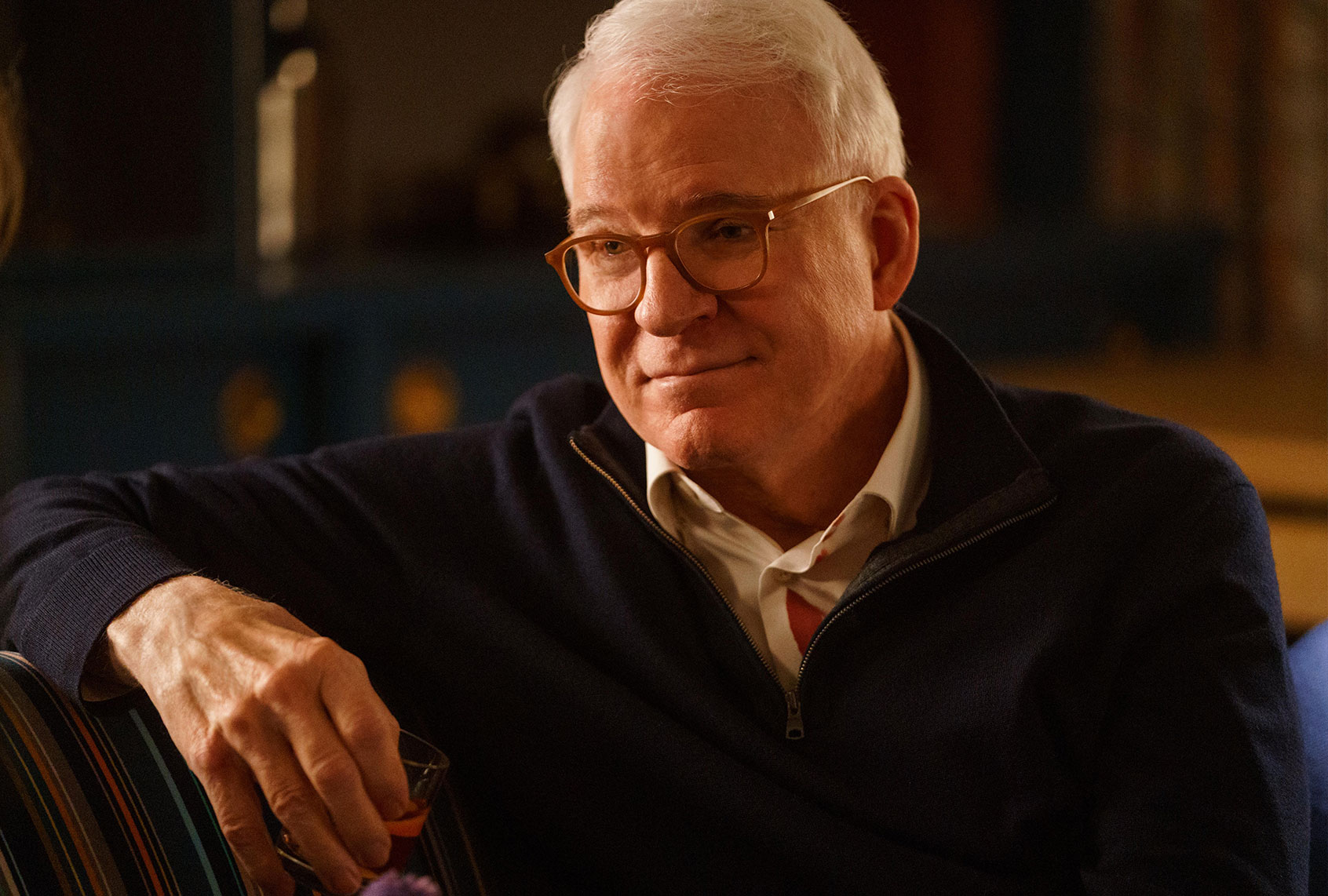
Only Murders In The BuildingOnly Murders In The Building (Barbara Nitke/Hulu)

That back and forth between Charles and Jan is so wonderful because I know a lot of people are watching this for the Easter eggs, the indicators of who might be the killer –  watching this like true crime fans would, which is what you and Steve had intended. But I would love to hear about how the choreography of that scene unfolded.

With Episode 10 there was something delightful to me about sort of showing a new side of Charles and Jan’s relationship in the moment of her confession. They sort of have a whole new level of thrill between them in this perverse way, I guess. They’re both loving being able to talk openly and freely about this now, and they’re cracking the case together: “When were you first on to me?” And he’s playing the game with her of cat and mouse, taking sips of his drink. All of that felt exciting to write – and heartbreaking underneath it, yes – but exciting, because ultimately the relationship that we wanted to come back around to, the one that mattered the most to Charles, was lying there within Mabel and Oliver.

I also felt Charles: I like watching the character both get caught up and lost in the thrill of romance, as he was doing in Episode 8, and even 9. But I also very much wanted to see him lean into how clever and smart he is, and be his own true crime aficionado. So once he was in the game of it, and once he realized he’d been played, he just sort of kicked into that. Now the emotional side of it will come later and is running underneath it, but that was the dance of that scene.

But I’m not saying Jan is done yet. That’s what I would say about that.

When I have spoken to people of different ages who watch the show they tend to have two different in responses. Older viewers say, “Oh, I wanted to watch it for Steve Martin. And then I found out that I really like Selena Gomez!” But I recently spoke to someone their 20s who said, “Yeah, I watch with my girlfriend because she likes Selena Gomez, but man, that Steve Martin guy is great.”

That makes me so happy, I really have to say! We’re all recognizing this part of the show, too, as we learn how people receive it. What you just said is delightful – and that part, I will say, was less intentional.

That’s interesting.

Obviously, we are hitting intergenerational aspects, and we leaned into them in the writers room for sure. But I was more curious to see, will people accept this trio? Right from the moment that they all came together. I said, “Oh, I love the way this works.” But we really didn’t know that Selena and Steve and Marty would jibe the way they do, that there would be this sort of lovely bit of chemistry. That’s a rare thing. But I think sometimes the show lets the audience tell you what is connecting to more than you might have intended.

. . . The other part that fascinated me a little bit was, before coming onto the show, I was on “Grace & Frankie” for several seasons.  Our audience for that show was a huge number of young women. And that surprised me. I was delighted to be around those legends, but it was like, are we only for the older set? And that clearly was not the case.

God knows when this opportunity came to me with Steve and Marty, that that immediately led me to thinking that I would love to do that for them in this moment, to have a whole new younger generation connect to them. How best to do that? You find the most modern young woman who connects with millions on a daily basis to be the facilitator of that and then lo and behold, she’s this delightful comedian with this very wry energy that’s just laser focused in a slam at these two delightfully silly men.

I’m going to rewatch with my husband because he’s only seen the first episode with me. What would you say are the elements you would love people to drill into a little bit more on a second viewing?

I want you to know that there will be mistakes, there will be things that like might not make some sense – but very few, I hope. I feel like I probably know all of them. But there aren’t that many things where you say, “Wait a minute, that doesn’t make sense.” And it doesn’t make sense, you’re probably right . . . But I, with our writers, brilliant staff, everybody involved, our focus was exactly for the rewatcher.

And so I helped edit, helped to write how to execute everything we were doing on stage in a way for viewing a second time through.

Now, what to look for? Certainly I think the care all of the characters take to slowly unpeel their personal onions in front of each other, that’s underneath everything. I think back on the pilot and I think of the moment of Mabel being confronted by seeing her friend on the floor and not talking about that. Watch the limited amount she speaks after that moment.

I think you go back, obviously, with Jan to the early days. You can watch the development of that relationship and find clues that are laying in plain sight. Those are the big things, I think, that immediately come to mind.

Here’s something I’ve got to ask: Did the weirdness of how the bassoon cleaner looks play into the decision to have Jan play the bassoon, or was she a bassoonist first?

Great question. Actually, the bassoonist came first, and that came from one of our writers, Madeleine George. She had a story about someone she knew who played the bassoon, and then we were able to build sort of a character around some of that.

I very much wanted the classical music world represented in this building. And I just wanted something playing through that courtyard. I think people in orchestras are fascinating because they have this relationship to their instruments. But beyond that, the big selling point was, what can we lay in that drops a clue early on in the season without looking like a clue? Only upon going back can you go, “Oh my god, I remember seeing that thing.” And it looked weird to be in a sex toy box.

I thought that would be a fun thing to imagine. Now we had, of course, in our room lots of discussions about the sexual proclivities of Jan. The fun of it was once we started looking at bassoon accoutrements. So when we found this cleaner, and there were a couple of different versions of bassoon cleaners – honestly, that’s when we thought, “This one looks like it could be something you can bring into bed and just play with.” So it was a fortuitous thing of like of like, “Let’s make that our big clue.”

I screamed when I saw it and said, “Okay, that, we now know, is the last line of Episode 9.” And that line was, “Oliver, why is there a bassoon cleaner in Tim Kono’s sex toy box?”

Did you hear from any bassoonists?

Well, that was my worry too, was that some bassoonist out there was going to go, “That’s a bassoon cleaner,” right off the bat in Episode 2. That was my nightmare. But the good part of it was the variation of bassoon cleaners. Most of them look more fabricky, or almost like a wood or metal dowel that has fabric on the end of it . So then you might have a bassoonist here and there saying, “I’ve never seen an instrument cleaner that looks like that.” But they do sell them!

Before I let you go, I just watch to get a couple of glimpses into the second season. When did you know how you were going to lead into it? And do you have that mystery figured out?

We do have the ultimate mystery figured out for Season 2, which is very exciting. In a way we couldn’t start without it. In between Season 1 and Season 2 I worked that out, and I know who did what in Season 2. It’s so crazy writing on this show in so many ways, because . . . I never wanted, truthfully, to be a mystery writer. But here I am.

Why didn’t you want to want to write mysteries?

Because I just admire it so much and think, how did they do that? Now I kind of know. But really, it takes such effort to have the whole thing planned all the way through to the end and then twist your way there. We don’t start actually writing the episodes until very late in our rooms for that reason. Everything has to line up accordingly, just so. But actually, we set up Season 2 in the initial pitch of Hulu.  

So way back when we knew that, which was helpful. Who was the body and who was the killer was still yet to be fully ironed out. But I think of the second season as an entry into the sort of thing we start dabbling in and investigating in true crime and podcasting. By the end of Season 1 and clearly at the beginning of Season 2, they really have stepped in it. And now it’s about navigating how to get out of something when you might be the focus of a case.

About Tina Fey as Cinda Canning: Sometimes when big celebrities make cameos within a series or in recurring roles, there’s the notion that a light touch is better – that you don’t want this character to draw attention away from the main cast. We got a clue early on in the season that she’s doing her own version of  “Only Murders,” hinting that it had become a larger story. So is she going to be a more regular presence in the second season?

I don’t want to give too much away there. But you know, we have this incredible supporting cast of recurring players in our show, all thanks to our cast being tremendous magnet. 

. . . Because Cinda is the queen of all podcasts, there’s a natural sort of spectral quality that once she has her sights on you, you’ll feel her a lot more even if she’s not as present. But she’ll be in your ear and she’ll be popping up at times when it’s probably the worst time ever. And you’ll feel her all throughout Season 2. So yes, Tina will be coming back.

Since we’re talking about this, it was established at one point that Sting was leaving for an extended trip. Is he staying away from the Arconia or is his place going to be subletted by, I don’t know, somebody like Peter Gabriel?

Here’s what I’ll say to that without spoiling: That is a very apt and pertinent question.

All ten episodes of “Only Murders in the Building” are currently streaming on Hulu.

Republican governors see approval ratings plummet after fight against vaccine requirements

Some Republican MAGA governors have not only been slamming President Joe Biden for his vaccine/COVID-19 testing mandate — they have also been forbidding school districts or private businesses from having vaccine or mask requirements for their adult employees. That type of thing plays well with the MAGA crowd, but in Politico, reporter Lisa Kashinsky stresses that some GOP governors are seeing their poll numbers fall after fighting vaccine requirements.

“From Florida to Texas to South Dakota, GOP governors have been on the front lines of the war against vaccine mandates, barring immunization requirements in their states and threatening to fight President Joe Biden’s federal vaccine mandate in court,” Kashinsky explains. “Just last week, Texas Gov. Greg Abbott flat-out banned vaccine requirements, and Florida Gov. Ron DeSantis followed up by vowing to sue the Biden Administration. But new research shows governors in states without vaccine mandates — or where they’ve outright prohibited such a requirement — have ‘significantly lower’ approval ratings for their handling of COVID-19.

Not all Republican governors have been handling the COVID-19 crisis badly. Vermont Gov. Phil Scott, Massachusetts Gov. Charlie Baker and Maryland Gov. Larry Hogan, for example, have always taken the pandemic seriously — and they have never promoted dangerous anti-vaxxer or anti-masker views or engaged in COVID-19 denial. But Florida Gov. Ron DeSantis, Texas Gov. Greg Abbott and South Dakota Gov. Kristi Noem, pandering to their MAGA base, have downplayed the severity of a pandemic that has killed more than 4.9 million people worldwide, according to Johns Hopkins University in Baltimore.

The COVID States Project reports that 52% of Americans approve of their governors’ handling of the pandemic. But Kashinsky reports, “That coronavirus approval rating drops to 42% for governors in states with no vaccine requirements. And it takes yet another hit — dropping to just 36% — in states where governors have barred vaccine mandates.”

Alauna C. Safarpour, who is with the Harvard Kennedy School’s Shorenstein Center on Media, Politics, and Public Policy and is among the Covid States Project’s researchers, told Politico, “Our findings really suggest that individuals in our survey were rewarding these governors who took proactive steps to combat the pandemic, and they were punishing governors who prohibited public health policies that would combat the pandemic like vaccine mandates.”

Animals near Fukushima are doing surprisingly well despite radiation from nuclear accident

Radioactivity is one of humanity’s deepest existential fears, perhaps because unlike most existential threats, it is invisible. Vast swathes of the region around Chernobyl and Fukushima, site of the two most prominent nuclear power plant accidents in human history, have become “exclusion zones” — vacant of human habitation for fear of radiation-induced diseases, like cancers and leukemia.

Yet while humans have sacrificed productivity and livelihood to flee from radioactivity, animals seem less convinced of the negative biological consequences. And animals that have repopulated some radioactive areas don’t seem very stirred, a new study finds. 

In a piece published by the journal Environment International, scientists and graduate students from Colorado State University and the University of Georgia worked with Fukushima University’s Institute of Environmental Radioactivity to study wildlife within the Fukushima Exclusion Zone. This area is so called because, after the Fukushima Dai-ichi Nuclear Power Plant was destroyed by the Great East Japan Earthquake and Tsunami in 2011, it released massive quantities of radiation into the environment.

While more than 150,000 people were evacuated from an area of roughly 444 square miles, a wide variety of flora and fauna remained behind. They continued to live in that area for multiple generations, offering scientists a fantastic opportunity to study the effects of lifelong radiation exposure.

And what they learned was quite surprising.


Want more health and science stories in your inbox? Subscribe to Salon’s weekly newsletter The Vulgar Scientist.


Scientists studied biomarkers of DNA damage and stress in populations of wild boar and rat snakes that lived in the Fukushima Exclusion Zone. Those biomarkers were chosen because they were the most telling signs of radiation’s consequences on animals.

Interestingly, researchers failed to find any significant adverse health effects, even though they collected their samples between 2016 and 2018 — only five to seven years after the nuclear accident. These findings are especially significant in the case of the boars, because pigs are anatomically similar to humans. That suggests that humans may not need to be as fearful as they currently are about moving back into exclusion areas.

The study also has some interesting implications about what causes stress in animal populations. Because the boar and snakes receive large doses of radiation through the soil — one because of rooting, the other due to slithering — scientists looked at whether the telomeres or “caps” at the ends of their chromosomes had shortened; or, whether board had elevated levels of the stress-correlated hormone cortisol. Neither the boar nor the snakes showed signs that their telomeres had shortened because of radiation, and the boars’ cortisol levels were quite low.

“It’s similar to what they’re seeing in Chernobyl,” Colorado State University Professor Susan Bailey, senior author on the paper, explained in a statement. “The animals are flourishing mostly because there aren’t people around, and they don’t experience the related stress that brings.”

Bailey was referencing the Chernobyl Exclusion Zone, an area in Ukraine that was evacuated after the Chernobyl Nuclear Power Plant disaster in 1986. Some biologists regard Chernobyl’s exclusion zone as an ecological success, as plants and animals have flourished in the absence of humans. Deer, lynx, bison and other animals are thriving in the area around the plant, and enough vegetation has sprouted up that a thick forest now exists. There are so many wolves in the Chernobyl Exclusion Zone that by the 1990s they had become a nuisance to local farmers.

The Ukrainian government is now leaning into the Chernobyl example as a fantastic case of real-life rewilding and is trying to learn more about its unintentional ecological experiment. Meanwhile the Chernobyl Exclusion Zone has become the third-largest nature reserve in mainland Europe, albeit entirely by accident.

Even so, the prospects for Chernobyl area wildlife are not entirely rosy, a fact that may prophesy the future of wildlife near Fukushima, too. In 2003, a study found that two species of irradiated worms near Chernobyl had altered their sexual behavior, in many cases becoming more prone to sexual reproduction than asexual reproduction. Likewise, a 2001 study published in the journal Biological Conservation found that the mutation rate of animals and plants in the region had increased by a factor of 20 due to lingering radioactivity from Chernobyl. 

Good coffee has become my go-to gift: I want you to have something delicious to start your day

Once during an interview, when asked for his definition of paradise, Johnny Cash replied simply: “This morning, with her, having coffee.” It’s a strikingly beautiful phrase, though one that lost its initial impact on me after repeated exposure during a back-to-back-to-back series of trips to Nashville (home of both The Johnny Cash Museum and the Country Music Hall of Fame), where it was printed on everything from coffee mugs to throw pillows in area boutiques and cafés. 

For that reason, I didn’t think much about that phrase again until last year. 

A little background on the coffee front: I’d been a beat reporter at the local NPR affiliate in Louisville, Ky., for several years. The station was in a central corridor of the downtown area and less than two blocks from a miniature deli called Nancy’s Bagel Box. Daily coffee from there was non-negotiable because of proximity. I didn’t think about whether it was “good coffee,” I suppose — but it went down easy and powered me through early morning editorial meetings. 

That was my view on coffee for a long time — function over form, typically bought while rushing around between interviews. Then about three years ago, I began dating a man named Stephen.

RELATED: Giada De Laurentiis’ lemon ricotta muffins are the perfect treat to pair with a cup of coffee

As our lives slowly combined, so, too, did our respective, massive collections of cookware. I brought the Dutch oven, the sturdy colander and the blender; he brought the knife roll, the stock pot and the good cutting board. He also slowly set up a coffee station in my apartment after it was revealed that I had no “coffee infrastructure” in my home kitchen. It started small — a grinder, a moka pot and a bag of beans from a local coffee chain down the block. 

Then a mutual friend of ours, Ren Doughty, who is the outreach and customer support coordinator at Batdorf and Bronson Roasters, sent us a bag of the company’s “Whirling Dervish” blend. The taste of that first pour is one of those gustatory experiences that is forever tucked into my brain. It was like a chocolate-covered cherry in a cup, and it was my first time really thinking about what makes “good coffee.” 

The longer we’ve been together, the bigger our coffee prep station has become. These days, it includes an espresso machine, a better grinder, a milk frother, a standard countertop pot and so many bags of beans. 

While the pandemic interrupted many people’s morning coffee routines — just as it would have interrupted mine if I still worked in a physical newsroom — I was lucky. 

RELATED: Coffee and community improvement districts: Unpacking the mystery of the $7 Starbucks macchiato

Every morning, Stephen wakes up a few minutes before I do, and the sound of him grinding fresh coffee or frothing milk is my alarm. By the time I walk into the kitchen, there’s a cup of coffee waiting for me. No one would describe the pandemic as paradisiacal, but to me, our routine — “This morning, with him, having coffee,” to borrow from Cash — had become just that. 

For that reason, “good coffee” has become one of my go-to gifts for people nowadays. I order beans for folks. During what little travel is possible right now, I snag bags and mugs to bring home. I look forward to making cups of coffee for overnight visitors when reality allows for that again. It’s a simple way to show love, the implication being, “Hey, I want you to have something delicious to start your day.” 

From the Salon Food archives, here are some of our favorite stories about coffee — whether that means making it at home, drinking it out, or cooking and baking with it, as well. If you like this collection of writing, do sign up to receive “The Bite,” Salon’s food newsletter — which is where this essay was first published and subscribers receive recommendations of what to read, watch and eat every week. 


Want more great food writing and recipes? Subscribe to Salon Food’s newsletter.


Read

In July, we ran a series on Salon Food called “Coffee Week,”  a series of stories about America’s favorite caffeinated beverage. From reporting about professional coffee tasting to an essay about the importance of LGBTQ cafes as queer, sober spaces, our writers covered so many different facets of the world of coffee. Here’s a sampling: 

Watch 

A few months ago, I was introduced to the work of Craig Mod, a writer and photographer who has spent the last 20 years living in Japan. I became fascinated by one of his most recent projects, in which he walked over 1,000 kilometers along the ancient Nakasendō highway exploring mid-20th century Japanese cafés called kissaten and the food they serve there. 

It resulted in the beautiful book “Kissa by Kissa: How to Walk Japan,” as well as this stunning micro-documentary “Pizza Toast & Coffee: Kissa Būgen.” It’s this beautiful, 5-minute slice of life piece that showcases the routine of kissa proprietor Yamane-san, who has run his cafe for close to 45 years. 

“He makes a mean pizza toast with a unique cutting style,” writes Mod. “Pizza toast is a staple of kissa culinary culture.” That pizza toast? It also naturally comes with a fresh cup of coffee. Give the documentary a watch on YouTube.

Drink 

As part of “Coffee Week,” writer Maggie Hennessy called on Bailey Manson, innovation manager at Chicago-based Intelligentsia, for some tips on brewing better French press coffee at home. I learned a lot from this piece, but my big takeaway was that Manson’s “optimized French press method calls for stirring the coffee grounds almost constantly throughout immersion for better flavor extraction.” Give the full piece a read for all of Manson’s insight. 

For some other at-home coffee tips, I also talked with Ren Doughty (yes, the same Ren from above) about, more generally, how to make better coffee at home, simply and without expensive gear. My favorite tip involved making iced coffee with coffee ice cubes. 

Simply add some of your room temperature coffee to an ice cube tray. You can add these to your cold coffee without worrying about diluting the flavor. They’re also handy for making at-home Frappucino knock-offs.

Want to mix and match booster shots? Here’s why public health officials aren’t letting you — yet

Confused about whether you’re eligible for a COVID-19 booster shot? You’re not alone.

A series of piecemeal recommendations for different combinations of boosters for different groups has left many confused about if they need a booster or not — or if they even qualify. It doesn’t help that pharmacies have varying rules in place, sometimes lax and sometimes strict, regarding who gets additional inoculations.

Last week, an expert committee called the Vaccines and Related Biological Products Advisory Committee that advises the Food and Drug Administration (FDA) unanimously agreed that the agency should authorize boosters of Johnson & Johnson’s COVID-19 vaccine to nearly 15 million Americans who have already received the initial dose. The same committee recommended Moderna booster shots to people over the age of 65 and and other high-risk adults. (Formal FDA “approval” is separate from the Vaccines and Related Biological Products Advisory Committee’s recommendations, though the FDA is usually influenced by the committee.)

Meanwhile, many of those who received Pfizer’s COVID-19 vaccine already have been approved for booster shots — provided they fall into certain groups.

Now, as early as this Wednesday, the FDA is expected to formally decide the question of booster shots for those who received Johnson & Johnson or Moderna’s COVID-19 vaccines. What is still up in the air, however, is whether the FDA will let Americans receive a vaccine booster manufactured by a different company than the vaccine they initially received. 

But until the FDA gives the final stamp of approval, only a small group of Americans are eligible for booster shots. Indeed, COVID-19 vaccine booster shots are currently only available for those who received a Pfizer-BioNTech vaccine at least six months ago and who fall under one of the following categories: people who are over the age of 65, people over the age of 18 who live in long-term care settings,  have underlying medical conditions,  work in high-risk settings, or live in high-risk settings.

“If you work in an occupation that puts you at higher risk of exposure, such as a first response, medical work or health care or someone who works in food and agriculture, teachers, education, and public transit, if you work in a grocery store, you are now all eligible,” said L.J Tan, chief strategy officer for the Immunization Action Coalition, a nonprofit that works with the Centers for Disease Control and Prevention to distribute vaccine information. The reason, Tan said, was “because you’re considered in an environment for an occupational setting that puts you at increased risk of exposure and transmission from those other people who are not eligible for boosters.”

However, many of those who fall into these categories aren’t eligible for a booster shot because the FDA hasn’t approved a “mix and match” vaccine approach just yet.

At the meeting last week, researchers presented their findings of a federally funded study of people who received Johnson & Johnson’s single-dose and then proceeded to receive a Moderna booster shot. Their antibody levels increase 76-fold in 15 days. Those who had previously been inoculated with Johnson & Johnson and then received a booster of the Johnson & Johnson vaccine only saw a four-fold increase in antibodies.

“If you boost people who have originally received J&J with either Moderna or Pfizer, the level of antibodies that you induce in them is much higher than if you boost them with the original J&J,” Dr. Anthony Fauci, Director of the National Institute of Allergy and Infectious Diseases, said on ABC’s “This Week” on Sunday. “But the data of boosting the J&J first dose with a J&J second dose is based on clinical data; so what’s going to happen is that the FDA is going to look at all those data, look at the comparison, and make a determination of what they will authorize.”

Tan questioned whether the FDA will approve the mix and match approach.

“There was a lot of really good discussion about what was called mixing and matching, what I call heterologous boosting — there [were] a lot of good discussions about safety and efficacy and whether we had enough data and whether the data is extensive enough,” Tan said. “And so, as much as we want to be able to kind of mix and match our booster doses, I don’t think that’s going to happen.”

Tan speculated that based on the FDA vote and the specific criteria set, those who received the Moderna vaccine or the J&J vaccine will be able to get boosters of the same vaccine. As he noted, that does not mean mixing and matching is completely out of the question. It is likely, Tan said, that more data will be needed to make a decision for what he termed an “evolving” situation.

Moreover, there may be a second round of boosters in the future — perhaps even annual COVID-19 vaccines, akin to how human civilization manages the flu with annual shot regimes.

“I wish I had a crystal ball,” Tan said, when asked if boosters will be recurring.

At least for the immediate future, the public should know this week. For those who are confused if they qualify, Tan said, “I really think that the public should seriously be talking to their healthcare professionals to discuss the appropriateness of booster jabs for them.”

Tan emphasized the importance of immunity-enhancing measures. 

“It is my opinion that it’s critical that we reduce transmission of this virus as much as possible,” Tan said. “I do think that we have to keep an eye on reducing transmission, because we need to somehow stop the emergence of these variants, and to stop transmission of the virus, even from people who have been vaccinated.”

FBI raids home of Oleg Deripaska, Russian oligarch who worked with Trump campaign

The FBI raided the Washington home of Russian business tycoon Oleg Deripaska on Tuesday, but the exact circumstances around the incident remain unclear. 

NBC News reported that FBI agents are “conducting law enforcement activity,” according to an agency spokesperson, who declined to provide further details. According to a CNN source, Tuesday’s action is part of an “ongoing” probe into Deripaska. 

The 53-year-old Russian oligarch with a $5.1 billion net worth is the founder of one of Russia’s most prominent industrial groups, and reportedly has close ties with Vladimir Putin. Once Russia’s richest man, Deripaska became widely known back in 2017 when AP News reported that he had a business relationship with Paul Manafort, Donald Trump’s 2016 campaign manager who was convicted with eight charges of tax and bank fraud in 2018. Manafort was originally charged as part of special counsel Robert Mueller’s investigation into Russian meddling in the 2016 presidential election.

Deripaska and Manafort have reportedly worked together since 2005, when they negotiated a $10 million annual contract “to covertly promote the interests of the Russian government,” according to AP News. Manafort also reportedly suggested to Deripaska that Russia should forge relationships with journalists in order to drive a sense of camaraderie between the two nations. 

Deripaska shortly denied the allegations made by the AP report. The billionaire later filed a defamation lawsuit against AP, but the suit was shot down, with the U.S. District Court in D.C. ruling that he hadn’t disputed any “material facts” presented by AP. 

Additionally, Manafort’s lawyers claimed that Deripaska received internal campaign information from Manafort. 


Want a daily wrap-up of all the news and commentary Salon has to offer? Subscribe to our morning newsletter, Crash Course.


In 2018, the Treasury Department imposed sanctions on Deripaska in addition to over two dozen Russian oligarchs for “threatening the lives of business rivals, illegally wiretapping a government official, and taking part in extortion and racketeering.” 

That same year, Deripaska was denied a visa to enter the United States over his sanctions, according to an NBC News report. However, the Russian government reportedly granted the tycoon a diplomatic passport, allowing him to enter the country with immunity. Deripaska later sued the U.S. over its sanctions but the bid failed in court.

In February 2018, Alexi Navalny – a prominent Russian anti-corruption activist recently sentenced to three and half years in prison for violating the terms of another 2014 conviction – released a video suggesting that Deripaska may have served as a middleman between Deputy Prime Minister of Russia Sergei Eduardovich Prikhodko in the nation’s bid influence the 2020 presidential election. The video was shortly made illegal for anyone in Russia to access. Prikhodko had denied any claims of playing a part in Russian meddling. 

Claims of a similar nature were made by a Belarusian escort, who said she had 16 hours of audio recordings to corroborate Deripaska’s role in election meddling, but the videos never came to light.

Colin Powell’s legacy: How his WMDs lie led to Donald Trump’s Big Lie

On February 5, 2003, Colin Powell gave the most important speech of his life. He argued before the United Nations that the George W. Bush administration should invade Iraq based on a bunch of evidence-free accusations that Iraqi president Saddam Hussein was developing weapons of mass destruction (WMDs). The theory drew heavily on a logical fallacy that then-Secretary of State Donald Rumsfeld was fond of: “Simply because you do not have evidence that something exists does not mean that you have evidence that it doesn’t exist.” Throughout the speech, Powell suggested that the lack of evidence for weapons development simply showed that Iraq was really good at hiding weapons, as opposed to what it should have been seen as: a lack of evidence, and thus a lack of justification for war. 

Powell famously didn’t want to give the speech. But Vice President Dick Cheney wanted it, knowing that they could leverage Powell’s stellar reputation to put an ennobling face to a pack of insinuations and evidence-free claims. So Powell did it.

The fallout from that decision was ghastly.

An estimated 600,000 people died due to the invasion of Iraq. Over $2 trillion was spent on Bush’s quagmire adventure. And, unsurprisingly, as soon as the invasion was underway and the “weapons of mass destruction” nonsense was no longer needed as a justification, the Bush administration dropped the pretense like a hot potato

The sociopolitical impact in the U.S. is harder to measure — but still catastrophic.

Eighteen years after Powell’s speech, it’s clear that the Bush administration’s embrace of conspiracy theories over evidence has had a lasting influence on not just the Republican party, but the conservative base. After all, if you can lie your way into a war, then why not lie about whatever you want? It’s not at all hard, therefore, to draw a direct line between the vortex of lies and conspiracy theories that led to the Iraq War to Donald Trump, the rise of QAnon, or the widespread GOP embrace of wild conspiracy theories on every topic from whether the 2020 election was stolen (it wasn’t) to whether COVID-19 vaccines are safe and effective (they are). 


Want more Amanda Marcotte on politics? Subscribe to her newsletter Standing Room Only.


Powell died on Monday from COVID-19, and the mainstream press is awash in hosannas for the man. It’s as if his reluctance to go to war somehow counts more for the fact that he ultimately took immoral actions that led to catastrophic results. In reality, Powell’s highly touted trepidation prior to the Iraq War should be taken with a grain of salt, as MSNBC editor Zeeshan Aleem succinctly pointed out on Twitter. 

As I note in Tuesday’s Standing Room Only newsletter, there’s a dark irony in the cause of Powell’s death. The continued severity of the pandemic is due to forces that Bush and Cheney — with Powell’s help — unleashed in the early part of this century. For instance, the DNA of the GOP’s war on vaccination can be traced back to the Iraq War propaganda. There’s the same dismissal of expert consensus and material evidence in favor of speculation. Vaccine opponents dismiss research showing that vaccines are safe in favor of wild claims that there might be side effects science hasn’t yet discovered. It’s very reminiscent of the tactic that war propagandists took when they dismissed weapons inspectors who showed no evidence of weapons development in Iraq by asking if they’d looked in every barn and apartment in the nation. 

Powell was vaccinated. He likely died because his already poor health made the vaccine’s protections inadequate. His death should be a reminder that vaccine refusal doesn’t just endanger those who refuse the vaccine. The unvaccinated are the ones spreading this virus, making it far more likely that breakthrough infections like Powell’s will happen. And it’s all due to right-wing leaders cynically embracing anti-vaccination conspiracy theories for political gain, just as they cynically embraced conspiracy theories about Iraq and weapons of mass destruction in the early aughts. 

There can also be no doubt that Trump’s success as a politician owes quite a bit to the Bush years and the normalization within the GOP of lying for political gain. (Not that Trump shows any gratitude.) Trump’s lying tactics owe quite a bit to the strategies Bush and his allies used in those years. As laughable as it is, Trump’s speculation that bleach injections might be a miracle cure for COVID-19 owes a lot to the tactics that Powell used in his famous U.N. speech, particularly his prioritizing of what-ifs and fantasies over the cold, hard facts turned up by experts. 

The echoes of “WMDs in Iraq” are especially prevalent in Trump’s Big Lie.

To Big Lie proponents, it doesn’t matter that there’s no evidence for widespread voter fraud any more than it mattered to the Bush administration that there was no evidence of WMDs in Iraq. The Big Lie is entirely structured around the Rumsfeldian assertion that the inability to prove a negative is blanket permission to do whatever terrible thing you want to do. Want to invade a sovereign nation or overthrow your own country’s democratic election? Why do you need proof for your allegations? All you need to do is say it’s theoretically possible that the proof is out there — of WMDs in Iraq, of a fraudulent vote in Detroit — and voila! It’s as good as actually having the proof. 


Want more Amanda Marcotte on politics? Subscribe to her newsletter Standing Room Only.


Even QAnon, a right-wing cult built around evidence-free assertions that Democratic leaders are involved in a worldwide pedophilia conspiracy, owes so much to the Bush years.

The first political blogs, unfortunately, rose up largely to defend the Iraq War and perpetuate conspiracy theories about weapons of mass destruction in Iraq. Looking back, it’s easy to see how these blogs — some, like Gateway Pundit, which are still out there spreading lies today — laid the groundwork for what we have today, which is an increasingly wild-eyed, anti-reality right-wing driven by social media conspiracy theories. 

In the wake of Powell’s death, the usual Beltway hacks are contrasting him with the ugliness of the GOP in the Trump era. And sure, it was good that Powell occasionally spent his later years speaking out against what the Republican Party has become. But Powell never really took responsibility for his role in helping turn his own party into an authoritarian movement that sees truth as little more than an obstacle to be stomped out in the rush to power. Colin Powell played a momentous role in the radicalization of the Republican Party and that, more than anything else he did, remains his most important legacy. 

Senate Republicans reportedly blocking Biden nominee to lead Jan. 6 prosecutions

Senate Republicans are blocking the confirmation of President Biden’s nominee to oversee the prosecutions of hundreds of Trump supporters charged in the Jan. 6 Capitol riot, according to an Insider interview with Del. Eleanor Holmes Norton, the nonvoting House member from Washington, D.C.

Biden in July nominated Matt Graves, a partner at the law firm DLA Piper and former federal prosecutor, to head the U.S. attorney’s office for the District of Columbia, which is prosecuting more than 600 cases stemming from the riot. The Senate Judiciary Committee unanimously advanced his nomination with bipartisan support last month, along with six other Biden picks, but Graves is the only one of the group who has yet to be confirmed. The delay comes after Senate Republicans quietly placed a hold on his nomination, according to Norton.

Norton, who recommended Graves for the job, told Insider that the nomination is being “used as leverage” by Republicans, though she did not say which Republicans placed the hold or what they want to release it.

“Importantly, this leverage doesn’t have to do with the District of Columbia or with the nominee,” she told the outlet.

Norton said she expects Graves to be confirmed in “the near future,” stressing that “it’s not unusual for senators to put a hold on something in order to make a point or as leverage.”

“We’ve learned this on condition that we not speak about it specifically, but I can tell you that what we have learned is that the Graves nomination is not being held up for any reason connected to the nomination. And I can also say we do expect approval of this nomination eventually,” she told the outlet.

Senate Judiciary Chairman Dick Durbin, D-Ill., told Insider he was aware that Republicans had placed a hold but did not know which nominee it was. A Democratic Senate aide told the outlet that Graves’ nomination is “currently subject to a Republican hold, but efforts are underway to have that hold released and have Graves confirmed.”


Want a daily wrap-up of all the news and commentary Salon has to offer? Subscribe to our morning newsletter, Crash Course.


Biden previously tapped Channing Phillips, who previously served as acting U.S. attorney for D.C. under Barack Obama, to lead the office until a Senate-confirmed prosecutor can take over. Norton told Insider that she is confident in Phillips.

“Fortunately there’s no cost to the district because it has a prior U.S. attorney handling issues,” she said. “He knows exactly how the district would have wanted these issues handled.”

The U.S. attorney’s office in D.C. is the largest in the country and uniquely prosecutes both federal and local cases. The office has charged 674 people in connection with the riot so far, 100 of whom have pleaded guilty. The FBI is also searching for hundreds of other suspects its agents are still trying to identify.

But the D.C. office has also drawn criticism from judges who think prosecutors are going too easy on some of the rioters.

District Court Judge Tanya Chutkan last week rejected a prosecutor’s recommendation of probation for a woman who entered the Capitol, issuing a two-week jail sentence instead. In another case, she sentenced two rioters to 45 days in prison, more than the 30 days sought by prosecutors.

“There has to be consequences for participating, even in a small way,” she said.

Attorney General Merrick Garland has told Justice Department officials that he is concerned that jailing rioters who were not “hardcore extremists” could “further radicalize them,” according to the Wall Street Journal, and defended prosecutors during a speech last week.

“I am quite aware that there are people who are criticizing us for not prosecuting sufficiently and others who are complaining that we are prosecuting too harshly,” he said. “This is, you know, part of the territory for any prosecutor in any case.”

The U.S. attorney in D.C. will also be tasked with responding to any criminal contempt referrals from the House committee investigation the events of Jan. 6. On Tuesday, the panel is expected to unanimously move forward with proceedings to hold former Trump White House strategist Steve Bannon in contempt for defying its subpoena. If the full House votes to refer Bannon to the U.S. attorney’s office, the office must bring the matter to a grand jury but will make its own determination on whether to prosecute.

Contempt of Congress cases can take years and rarely lead to convictions. If Bannon is convicted, he could face up to a year in prison and up to a $100,000 fine.

Rep. Adam Schiff, D-Calif., a member of the committee, told CNN that he hopes potential charges against Bannon will pressure other witnesses to cooperate.

“If the Justice Department prosecutes Steve Bannon, other witnesses will see they will face real consequences, including jail time and potentially stiff fines. That is a way of getting people’s attention,” he said. “Bannon’s an important witness in his own right, but it’s also important to send a message that the rule of law is back and people are going to need to pay attention.”

Meghan McCain reveals “toxic” Joy Behar spat pushed her to quit “The View”

In her new book, Meghan McCain attributes her July resignation from the “The View” to the show’s “f**ked up culture,” alleging that she was repeatedly met with “toxic, direct and purposeful hostility” from her liberal co-hosts. 

In the forthcoming tell-all book, excerpted by Variety, McCain, the show’s self-described “resident conservative,” reveals that she’d been in talks with producers about stepping down “for weeks” and that she “had to get out” when things came to a head. The daughter of the late Republican Sen. John McCain first joined “The View” back in October 2017 after leaving her post as co-host of the Fox News daytime talk show “Outnumbered.” Upon joining, McCain wrote in her book, she felt safe in the hands of her liberal co-host and an entertainment powerhouse, Whoopi Goldberg. 

“She had made a promise to my father that she would look after me, and she kept her word for the first two years that I was on the show,” the conservative commentator said of Goldberg. However, as time wore on, Goldberg allegedly began to show “open disdain” for McCain. 


Want a daily wrap-up of all the news and commentary Salon has to offer? Subscribe to our morning newsletter, Crash Course.


“The thing about Whoopi, though, is that she yields so much power in culture and television, and once she turns on you, it can create unfathomable tension at the table,” the conservative said, citing two instances in which Goldberg “harshly” cut her off during live segments. 

McCain also turned her attention toward Joy Behar, another one of her former co-hosts on “The View,” claiming that she had an exchange with Behar that brought her to her breaking point. The back-and-forth came in January, just after McCain came back from maternity leave and had experienced a long stretch of “severe” postpartum anxiety. 

During a squabble over the Democratic Party, Meghan joked, “Joy, you missed me so much when I was on maternity leave! You missed fighting with me!”

“I did not,” Joy replied on-air. “I did not miss you. Zero.”

McCain wrote that she “felt like” she’d “been slapped” following the exchange, after which she broke into “uncontrollable sobbing” during a commercial break. 

“If you guys didn’t want me to come back, I wouldn’t have come back!” she later told an ABC producer. Mccain insisted that Behar apologize, but her co-host apparently refused. “I never talked to Joy one on one again after that day,” McCain wrote in her book. 

Despite all of the storm and stress, McCain maintained that she’s “not mad about what happened to me” at The View, but added “there are some things about the show that feel stuck in 1997 when The View first went on air. In this era of dismantling toxic work environments and refusing to accept the poor treatment of employees, how is The View still immune?”

Religion scholar Anthea Butler on “White Christianity” and its role in fueling fascism

Since at least the 1980s, the conservative movement has increasingly been governed by faith, which can be described as a belief in things that cannot be proved by empirical means. In practice, this means that the Republican Party and the larger right-wing movement’s policies and ideology across a range of issues — the economy, the environment, science, health care, democracy and the rule of law — have little if any basis in fact.

In the Age of Trump, movement conservatism has metastasized or devolved into its purest form: American fascism, a form of religious politics taken to its most illogical extreme. Facts, truth and even the conception of reality itself are being replaced with lies, fictions, and fantasies that serve the American fascist movement and its leader.

As public opinion polls and other research have repeatedly shown, white right-wing Christians, especially Protestant evangelicals, have pledged their loyalty to Donald Trump and his movement. Many view him as a literal prophet or savior: His evident immorality has been rationalized as somehow necessary to his prophetic role.

Violence is a key feature of the new American fascism, as dramatically illustrated on Jan. 6 but also at many other moments. Trumpists and other Republican fascists, many or most of whom identify as Christian, have widely embraced political violence, including outright terrorism, as a necessary measure to “protect” their “traditional way of life” against “radical socialist Democrats”, Black and brown people, Muslims, LGBTQ people and pretty much all Americans who still believe in the constitutional separation of church and state and the rule of law.

Together, these forces exist in a state of collective narcissism and shared malignant reality. In that relationship, white right-wing Christianity is a nexus or type of glue.

To discuss this profoundly disturbing phenomenon, I recently spoke with Anthea Butler, professor of religious studies and Africana studies at the University of Pennsylvania. She has been a guest on MSNBC, CNN, PBS and the BBC, and her essays have been featured in the Washington Post, the New York Times, the Guardian, the Religion News Service and MSNBC. Butler’s new book is “White Evangelical Racism: The Politics of Morality in America“.

In this conversation, she discusses the phenomenon of “white Christianity” and its role in the Age of Trump and America’s current crisis of democracy. She also explores the specific role this phenomenon played in the events of Jan. 6 and the ascendant fascist movement, and its crucial role in legitimating and normalizing the society-wide moral crisis catalyzed and empowered by the Age of Trump. 

Toward the end of this conversation, Butler warns that too many white people have erroneously convinced themselves that racial privilege will protect them from escalating right-wing Christian terrorism and related political violence.

This conversation has been edited, as usual, for clarity and length.

Imagine that American democracy is a patient in the hospital. If you were a type of religious figure — a priest, an imam, a rabbi or the like — what counsel would you be offering that patient in this dire moment?

I will answer that question in the context of the Catholic tradition. In that faith tradition there is something called “extreme unction.” This is when you are on your deathbed, and they come to you to give you a prayer. Before the changes of Vatican II, the priest also carried a little kit, which had what would be used for communion and other needs. If I were diagnosing democracy right now in America, it is in a state of extreme unction. American democracy is in its last moments and it is going to need a miracle to get up from that deathbed. I would whisper in that patient’s ear right now that you had better decide to fight back or you are dead in the next 15 minutes. Your 15 minutes are about up.

What would penance look like?

Continuing with the Catholic tradition. Most of the time the penitence, in the old Catholic tradition, would involve beating oneself. Self-flagellation. There would be bloodletting. You would not want someone else to make the bloodletting happen for you.

In the case of American democracy, especially with the Democratic Party, they are holding on to some old, tired notion that they are still in power and that the things that they have counted on before will work for them in this moment of crisis. The Democrats are counting on Black folks standing in line for 20 hours to vote. They are counting on Black people to ignore the fact that the Democrats have not done much for them. The Democrats are counting on the good Black Christians to come and save them, once again, from themselves.

There are all these political leaders and others who claim to be Christians and say that America is supposedly a “Christian nation.” But there is little talk of the many forms of evil both summoned and empowered by the Age of Trump. How is this being reconciled?

There are two primary reasons, as I see it. Half the time they do not believe that there is in fact a devil. Moreover, many of these Christians are the devils at work in this society. Two, if you don’t believe in the devil, then you don’t have to deal with anything that is evil.

Instead, you use language such as “people are misguided” or “they have the wrong idea” or “they didn’t really mean to lie like that.” Evangelicals of the 1950s, and even the ’60s and early ’70s, would have looked at Donald Trump and said that he was the Antichrist. Now evangelicals worship him. To be clear, I am not offering a position on whether not I believe that Trump is the Antichrist or whether he should be worshipped. I’m just telling you what is happening.

Donald Trump, his regime and the Republican fascist movement are objectively evil. How do white Christians explain away such behavior?

Because they’re in a bubble. Their pastor is reinforcing these messages. The people they live around are reinforcing these messages. They listen to Fox News. Their other information sources reinforce the same message.

Let’s be frank: I don’t care how many times they carry a Bible. Half of them are not reading it anyway. One may think that these people are evangelical Christians and therefore they know scripture. Yes, some of them do. These evangelicals may know it very well. But even though these evangelicals say, “I’m living by scripture,” the reality is that they are living by the scriptures that are written by their politicians and their pastors.

The Jan. 6 coup attempt and attack on the Capitol was an act of white right-wing Christian terrorism against multiracial democracy. Given the Christian iconography and behavior seen on Jan. 6  — that huge cross, the prayers, the horns, and other examples — why do mainstream news media and others refuse to state such obvious facts?

It’s intentional. They cannot come to grips with the fact that the Christianity of America is just like any other fundamentalist religion that gets weaponized in order to hold on to power. Therefore, they have to continue to tell themselves that everything that happened on Jan. 6 was an aberration and not something religious in nature. Those people are not “Christians” like us.

But the reality is that those people are you. And not only are those people you, they sat with you in the pews. They prayed with you. And if they had succeeded on Jan. 6, you would be right there on their side. And you would say that God must have blessed them to be able to overthrow the United States government.

Can you explain more about the horns and specific prayers that were used on Jan. 6?

They had horns, what are known as the ram’s horn or the shofar, which appeared in the Old Testament. Those horns were blown before the walls of Jericho came down. It was like a battle. Those horns were used in rituals in ancient Judaism. That horn is also used in Jewish rituals today to mark certain kinds of events, whether that’s Rosh Hashanah or Yom Kippur. The blowing of the horn means that we are going into battle — in this context, that God is going with us into the Capitol.

The kinds of prayers we saw on Jan. 6 at the Capitol are called “imprecatory prayers.” There are the kinds of prayers used when you want your enemy to die. On Jan. 6 they believed that they were on a mission from God to go into the Capitol and get Nancy Pelosi, Mike Pence and other people they saw as enemies.

And that huge Christian cross?

They used that cross to be like the crusaders during the European Middle Ages.

Tate Reeves, the Republican governor of Mississippi, recently said that Christians are not afraid of the coronavirus because they believe in “eternal life.” How did you process his assertion? The country is in the midst of a deadly plague, and right-wing leaders are summoning God and their faith to encourage people not to take proper health precautions.

Those words are a claim that “we” are not afraid of death because we Christians. It is a claim of certainty on going to heaven. It will all be fine, because if you die from the coronavirus then you are going to see Jesus. Well, what if Jesus is not there? What if there’s no Jesus? What if you just drop straight down into the pit of hell?

I’m not saying that’s what’s going to happen, but the way in which the governor of Mississippi spoke about the pandemic was as though if you die, then it is all going to be all right. What kind of sense does that make?

As a matter of public policy, Christian nationalists, dominionists and other Christian fascists are trying to impose their End Times eschatological fantasies onto secular America in opposition to the Constitution and the separation of church and state. These are fantasies of death and destruction. These white right-wing Christians literally seem to be seeking out death.

They do in fact appear to be seeking out death. They have this huge desire to live the way they want to live without restraint. At some point it is death for you, but it is not death for them.

One of the dimensions here that many people do not understand is that when the pandemic started and many of these red-state and other right-wing leaders were telling people not to wear masks, they were kind of hoping that the “right people” would die. We know who the “right people” are.

Now, people in red states are dying and those Republican and other right-wing leaders can’t get out of the spiral of telling people not to get vaccinated. They were hoping that all the people of color were going to die. But now in the red states, it’s a lot of white folks dying. A lot of white children are going to die, and they still are doubling down on the same thing. It hasn’t changed.

What is “White Christianity”? 

White Christians tend to do very different things than Black Christians or Asian American Christians or Latino Christians in this country. You can be a Black Christian and believe in white evangelicalism. You can be Black and a Christian and be bought out and sold out to white evangelicalism or white Christianity because you accept the premises of what these white preachers are telling you, especially about how you’re supposed to love America for example.

There are Black Christians, and others, who are not being discerning about what is Christianity, as opposed to what is better described as White American Christianity.

For some Christians, the question becomes, “Well, I’m a red-letter Christian,” which basically refers to how the words of Jesus are red in the Bible. “I believe what Jesus says.” My intervention there is: If that’s the case, great. That means you have to be for the poor and all that comes with that.

White Christianity is a Christianity that is based on the following: Jesus is white. Jesus privileges white culture and white supremacy, and the political aspirations of whiteness over and against everything else. White Christianity assumes that everybody should be subsumed under whiteness in terms of culture and society.

White Christianity assumes that it does not have to look at poverty. We see this in the form of the so-called prosperity gospel, and that any blessing you get from God is because God favors you. If anybody else is out of favor, let’s say some poor kid in Northwest Philadelphia who doesn’t have enough to eat, well, that’s just too bad because they’re not blessed of God.

When suffering happens, it’s blamed on anybody else but God.

As part of the right-wing culture war narrative there is a martial language that includes Christianity. There is talk of “Christian struggle” and “Christian war.” What are the connections between such militant language and actual right-wing violence?

That language has a long history in this country. There’s war imagery all through Biblical scripture. There are war songs that people sing in churches. This idea about battling for the Lord, whether we’re talking about the Crusades or the Civil War or fighting communism and everything else, is embedded in our history. That language of war and fighting is being used to incite people now.

Most people in America do not want such violence to happen. The problem is that if you’ve got enough people who want such an outcome, who can make it hell for everybody else, and there are people in power who want to use the public to create decay and destruction, such violent language is going to be used to that end. Donald Trump knows how to push every one of these buttons.

How do you explain the role of white Christianity in the right-wing disruptions and threats of violence at local school board meetings about “critical race theory,” vaccinations and other topics?

It is as though nobody remembers the 1950s, when white people were standing outside yelling and screaming and cussing Black children who were actually integrating these schools. These were Christians who were in churches, who were out there yelling and spitting and screaming. Women especially. Evangelicalism and harsh rhetoric have always been part and parcel of this.

We need to quit talking about evangelicalism as though it is some type of coddling religion and understand it for what it has been and what it is doing.

The language of “religious freedom” is central to the power of white Christianity in America. Other religions are rarely able to make such claims and have them accepted as normal or reasonable by the public, or especially by the Supreme Court and political leaders. In practice, the “freedom” of white Christianity is something unique in America. Muslims, for example, are rarely if ever afforded such protections and special rights.

The rhetoric of freedom is being used to elevate “freedom” for white Christians and to suppress freedom for everyone else. In order to remain on top, the freedom of everybody else is being suppressed. These types of white Christians want you to do what they want you to do. In turn, you will be controlled by them. Limiting women’s reproductive freedoms is a way to keep everybody in check.

What is the role of white privilege in explaining why so many white Americans are able to deny the serious dangers embodied by white Christian fascist violence?

White privilege convinces many white people that they will not personally have to deal with the violence. They believe that, unlike other people, they will just be able to melt away into the background when the violence happens and nobody is going to shoot people who look like them.

White privilege has convinced them that nobody’s going to take their home away from them. Nobody’s going to kill their kids. Nobody’s going to march them out as an example and shoot them. White privilege has convinced them that they can take some type of loyalty oath or pledge and they will be safe.

COVID testing, turnaround times are still uneven this far into pandemic

In one recent week, a New Yorker got a free COVID-19 test in a jiffy, with results the next day, while a Coloradan had to shell out $50 for a test two cities from her hometown after a frantic round of pharmacy-hopping. A Montanan drove an hour each way to get a test, wondering if, this time, it would again take five days to get results.

While COVID testing is much easier to come by than it was early in the pandemic, the ability to get a test — and timely results — can vary widely nationwide. A fragmented testing system, complicated logistics, technician burnout and squirrelly spikes in demand are contributing to this bumpy ride.

“We’re still where we were 18 months ago,” said Rebecca Stanfel, the Montana woman who had to wait five days for test results in Helena last month after being exposed to someone with the virus.

Unpredictable waits can be a problem for those trying to plan travel, return to school from a quarantine — or even get lifesaving monoclonal antibody treatment within the optimal window if they do have COVID.

The White House said in early October it plans to buy $1 billion worth of rapid antigen tests to help improve access to the hard-to-find over-the-counter kits. But people are also facing problems getting molecular testing, including the gold-standard PCR tests.

Public health labs are no longer hamstrung by supply bottlenecks on individual test components such as swabs or reagents, said Kelly Wroblewski, director of infectious disease programs for the Association of Public Health Laboratories. But they are still bearing a large testing load, which she had expected to shift more to commercial or hospital-based labs by now.

Testing labs of all stripes are also facing worker shortages just like restaurants, said Mara Aspinall, co-founder of Arizona State University’s biomedical diagnostics program, who also writes a weekly newsletter monitoring national testing capacity and serves on the board of a rapid-testing company.

“The staffing shortage is very, very real and holding people back from increasing capacity,” she said.

Something as simple as proximity also still dictates how quickly test-takers get results.

“Northern Maine is a good example,” Aspinall said. “Anything you do with PCR is going to take an extra day because it’s got to be flown or driven a ways.”

Even in a place such as Longmont, Colorado, near many laboratories and hospitals, PCR samples from the local mass-testing site get shipped by air each evening to a lab in North Carolina.

That mass-testing operation recently moved back to its original location at the county fairgrounds after a summer stint in a small church parking lot. Demand for PCR tests in the county quadrupled from 600 weekly tests in July to 2,500 a week in September. Chris Campbell, emergency manager for Boulder County Public Health, attributes the heavy traffic to schools reopening, an uptick in infections and the difficulty in acquiring over-the-counter rapid tests.

Campbell said it sometimes took residents four or five days to get their PCR results, though that’s dropped to two as the contractor they work with, Mako Medical, has built its laboratory capacity back up.

“It’s pretty inexcusable to have a turnaround time that long. It really does impact our ability to really stop transmission,” Campbell said. “And also, it has an economic impact to businesses, to schools, to early childhood facilities.”

Mako’s lab operates 24/7 and the company uses private planes to speed up shipping, according to a statement from chief operating officer Josh Arant. While Mako’s weekly median turnaround time never exceeded 72 hours last month, the statement said, in recent weeks it has returned results to area residents an average 46 hours after specimen collection.

Portable devices now exist that can eliminate the need for shipping samples. They can do molecular analysis, including PCR, in under an hour — a process that typically takes at least four to five hours in a lab. A Washington, D.C., testing truck has three Cepheid machines on board, each about the size of a printer. Combined, they can give a dozen people PCR results in under an hour, at no cost to test-takers.

Still, demand outweighs supply for such fast molecular tests, due largely to the roller coaster of case surges, said Doug Sharpe, vice president of lab capital sales with Medline Industries, which supplies COVID testing components to labs across the country. “I don’t think anybody thought we’d be sitting here,” he added. “We’re selling more assays than we did at the height in 2020.”

Gigi Kwik Gronvall, an immunologist with the Johns Hopkins Center for Health Security who leads the center’s tracking of COVID testing, suggested that the variability in how long it takes to get results has created a seller’s market if companies can deliver results by a specific time. “People are going to pay for that sort of guarantee,” she said. “There’s this potential for people to get fleeced, for sure.”

MedRite offers PCR results analyzed in three hours in New York and Florida for those willing to pay more than $200 a pop. The company offers other tests, such as antigen tests and slower lab-based PCR tests, at no out-of-pocket cost.

Celeste Di Iorio felt fleeced after she spent a day driving from pharmacy to pharmacy in Fort Collins, Colorado, in search of a test that would give an answer in less than three days. As a musician, she’d been traveling out of state and wanted to know if she might be infectious before attending, among other things, a memorial for a relative who died of covid. She and her partner eventually found rapid antigen tests at a pharmacy two cities over.

“We just paid $50 apiece for these tests, which pisses me off,” she said. “Because, you know, we’ve all been out of work for a year and a half, and this state has the money.”

In Helena, Montana, Stanfel has gotten a PCR test every week for many months because she takes immune-suppressing drugs for a rare condition called sarcoidosis. Her doctors told her to get the tests regularly because, even though she’s fully vaccinated — and has received an additional “booster” dose — she would likely need a treatment of monoclonal antibodies as soon as possible if she contracted covid to prevent an early infection from “developing into something really bad.”

When Stanfel found out a friend she had visited later tested positive for covid, she immediately got a test at her doctor’s office. It took five days to learn she had tested negative.

Montana’s public health lab is in Stanfel’s city, but state health department spokesperson Jon Ebelt said the volume of tests since early August has regularly exceeded the lab’s capacity. As such, they’ve had to prioritize tests from hospitalized or symptomatic people and send other specimens to private labs, a process that can stretch the wait time for results to up to seven days.

In New York City, where mobile-testing vans are parked in every borough and in-person home testing is offered, residents are reporting quick turnaround for molecular tests because the labs analyzing their samples are close by.

For example, in Manhattan, Justin Peck got back from a road trip to Canada on a Tuesday night, walked about five minutes to a mobile-testing van on Wednesday, and had PCR results by Thursday morning, clearing him just in time to go to work for the first time in 18 months as a dancer in “The Phantom of the Opera” on Broadway.

Aspinall said flu season will likely lead to an increase in demand for covid testing as people with COVID-like symptoms seek answers about the cause of their illness, compounding existing staffing issues. “We’re at a very precarious point,” she said. “It’s not enough to go forward if the testing volume continues as I expect it will.”

Subscribe to KHN’s free Morning Briefing.

Book review: How our planet grew so warm

Given the 300,000 or so years of modern human existence, it’s remarkable how drastically we’ve altered our planet over the last few hundred. For nearly all of recorded history, our understanding of the atmosphere was negligible, as was our impact on it. As Alice Bell points out in “Our Biggest Experiment: An Epic History of the Climate Crisis,” the word “gas” — derived from the Greek khaos — only entered into the scientific lexicon about four centuries ago. The discovery of carbon dioxide was even more recent, having first been identified in the mid-18th century. Yet in a relatively short period of time afterward, humans have pumped enough of this compound into the atmosphere to potentially threaten the survival of our entire species. 

To be sure, we’ve lived through dark times before. As Bell recounts, the spring of 1815 saw the most powerful volcanic eruption ever recorded. Along with being heard over a thousand miles away, the explosion of Mount Tambora — located in present-day Indonesia — shot out an enormous plume of black dust that lingered in the atmosphere for years. Throughout the world, the light from the sun dulled and temperatures dropped. The following year was christened the “year without a summer,” as snow fell in New England in June and famine swept through Asia and Europe.

There is a good reason, however, to use pre-industrial society as a baseline when discussing global warming. We live in a world of abundant natural phenomena, but the weirding of the weather is mostly human-made. “[T]he warming we’re talking about isn’t just the sorts of climate fluctuations that would be happening whether humans lived on this planet or not,” writes Bell, “but has been caused by the massive influx of greenhouse gases into the atmosphere since the Industrial Revolution.”

A London-based climate campaigner with a Ph.D. in science communication, Bell examines anthropogenic warming through the lens of technological advancements. Given that the climate crisis is closely linked with energy consumption and resource extraction, her sweeping chronicle is in large part a history of fuel. Before 19th-century advances in refining and drilling ushered in the Age of Oil, an array of combustibles were set alight for heat, illumination, and power. Our earliest fuel was wood, although it’s worth noting that we’ve likely done more damage to the planet through deforestation than we have burning logs, as trees help keep our planet cool by absorbing large quantities of carbon dioxide.

Bell estimates that the fossil fuel era began around the middle of the 16th century. She suggests that global warming may have been a gradual process had it not been for the development of the coal-powered steam engine, which opened up a market for the burning of fossil fuels. The coal-powered steamship holds special significance, as it enabled the expansion of industry and empire while laying the groundwork for oil and gas.  

Yet, as Bell notes, “Long before we built offshore rigs for fossil oil and gas, we mined our seas for whales.” She makes a strong case for including these mammals in the climate crisis narrative, arguing that they extend our problematic history of energy consumption beyond fossil fuels. American colonists in the 17th century boiled whale blubber for oil, which was then used for light. By the 1850s, the country’s wealthiest city per capita was New Bedford, Massachusetts, home to over 300 whaling vessels and nicknamed “the city that lit the world.” Whale oil was eventually supplanted as an energy source, though it could still be found in commercial products like margarine and lipstick well into the 20th century. “Arguably, in saving the whale we simply shifted our destruction elsewhere,” Bell writes.

Gas lighting began to spread in the early 19th century, appearing first in factories and then in private residences. A brighter light sans the smell of fish, gas light extended the workday into the evening hours and created a network of homes connected through one of the country’s earliest forms of energy infrastructure.

By the 1930s, electric liberation was being marketed to the American middle-class in the form of household appliances. Washing machines and refrigerators set a new standard of domestic comfort that eventually spread across the globe and reshaped day-to-day life. While gas and electricity flowed through shared networks, their use created a culture of self-sufficiency that was nevertheless dependent on complicated supply chains and the burning of fossil fuels. 

Around the same time, the rise of the automobile began to transform the world. For all of the speed and progress engendered by the 20th century, Bell suggests that the end result was a mass culture of disposability and a sharp rise in greenhouse gases that have come to define “the pattern of aspiration for 20th-century life.” In her assessment, “the great utopian promise of fossil-fueled abundance” has fallen flat.

Bell provides a thorough record of scientific discovery and denial related to the hazards of unfettered energy consumption, a problem that took off in the late 1800s. Earlier in the century, in 1856, Eunice Newton Foote raised concerns about carbon dioxide’s ability to heat the atmosphere. Tragically, the male-dominated scientific community largely dismissed her findings. A century later, Roger Revelle, studying the relationship between oceans and carbon dioxide, referred to the burning of fossil fuels as “a large-scale geophysical experiment.” However, global warming wouldn’t become a mainstream concern until the late 20th century.

Bell cites the 1970s as the era in which climate science began to gain traction, spurred on by the oil crisis and an increased understanding of greenhouse gases. She describes how Mario Molina and Sherwood Rowland’s groundbreaking work in 1973 on the warming threat of chlorofluorocarbons, compounds that were used in manufacturing refrigerants and aerosols, brought the vulnerability of the ozone layer into full view and expanded climate consciousness beyond carbon dioxide. She also writes about “The Jasons,” “a secret group of elite scientists” who prepared briefings for the U.S. government. Toward the end of the decade, they submitted a measured report on the irrefutable threat of atmospheric warming. Meanwhile, the oil industry was conducting its own research on the matter.

By the early 1980s, multinational oil corporations were well aware of the crisis they were precipitating. They downplayed the negative impacts of burning fossil fuels and withheld key information from the public to protect their bottom line. “Of course they knew,” Bell writes, reminding us that big oil’s investment in science was what made them so successful at extracting, refining, and profiting from fossil fuels in the first place. “Sometimes fossil fuel companies and their defenders get painted as ‘anti-science,'” she writes. “In truth they’ve run on science and always have done. They’re just strategic about how they use it.”

Bell raises objections to how the scientific community is traditionally structured, claiming that “the dominant working cultures of science” have made it difficult for climate researchers to receive adequate monetary and professional support. She criticizes the reflexive tendency of climate scientists to avoid dramatic forecasts, arguing that it has effectively reduced the credibility of those sounding notes of caution throughout history. Bell also does not spare nonprofits, asking, “Are environmental NGOs really happy to settle for 2 degrees Celsius warming and the number of people that would kill?” In her estimation, the pulling of punches among professional campaigners is but one example of the environmental movements’ endemic shortcomings. Still, the bulk of responsibility for the climate crisis is aptly assigned to the fossil fuel industry.

Because it’s such a broad account, “Our Biggest Experiment” is at times overwhelming. As Bell crisscrosses several centuries’ worth of environmental and scientific history, it’s difficult to keep up with the dizzying amount of characters and information. Even so, though nearly every chapter feels condensed and capable of being its own book, there are benefits to viewing climate change from Bell’s vantage point. Through such a wide-ranging history of energy, technology, and science, the world we’ve built appears fragile and our problems interconnected, the crisis fully underway.

Bell notes early on that the impacts of climate change will not be evenly distributed, citing research indicating that “the poorest half of the global population are responsible for only around 10 percent of global emissions,” yet tend to live in the places most vulnerable to our warming world. In her conclusion, she nods to the present-day regularity of extreme weather and the growing acceptance of climate change as an underlying cause. Nonetheless she expresses a sense of guarded optimism in the potential of collective anger aimed at politicians and corporations.

We still have choices, Bell asserts, even if they’re more limited than they used to be. But she insists that any meaningful change to mitigate the impact of global warming will require radical, long-range action: “Climate change simply isn’t a pass/fail issue. It’s not something you win or lose.”


Andru Okun is a writer living in New Orleans.

This article was originally published on Undark. Read the original article.

Big corporations that claim to support voting rights are still funding right-wing state AGs

Major corporations that have publicly touted their support for voting rights amid the nationwide Republican crackdown on ballot access are still funding many Republican state attorneys general who are working to scuttle federal voting rights legislation.

Leaders of companies like General Motors, Coca-Cola and Home Depot denounced the Republican onslaught of voting restrictions in states like Georgia earlier this year. But those companies and others have kept on funding Republican attorneys general who urged congressional leaders to block the John Lewis Voting Rights Advancement Act, a proposed law that would restore a section of the Voting Rights Act — recently gutted by the Supreme Court — requiring states with a history of racial discrimination to pre-clear new voting changes with the Justice Department.

That also came after an arm of the Republican Attorneys General Association sent robocalls on Jan. 5 of this year, urging supporters to come to Washington to “fight” Congress in support of former President Donald Trump’s election lies. The following day, of course, pro-Trump rioters stormed the U.S. Capitol. The group also received $150,000 from a major Republican donor who helped fund the “Stop the Steal” rally that preceded the riot.

Indiana Attorney General Todd Rokita led 22 other Republican attorneys general last month in condemning the John Lewis Voting Rights bill, claiming it “would allow the United States Department of Justice to usurp the authority states rightly possess over their own elections, essentially federalizing the election system.”

“This legislation is a misguided, clumsy, and heavy-handed effort to circumvent Supreme Court decisions, state sovereignty, and the will of the people,” the group said in a letter to congressional leaders, claiming that states responding to Republican concerns about election integrity would “inevitably be targeted by the Department of Justice leading to more confusion, litigation, and concerns over the validity of elections going forward.”

Two of Rokita’s top corporate sponsors have been adamant publicly about supporting voting rights. Brewing giant Anheuser-Busch, which donated $5,000 to Rokita and $75,000 to Missouri Attorney General Eric Schmitt, another signatory, last year launched a “Brew Democracy” initiative aimed to promote voting participation, claiming it was “committed to uniting our communities, strengthening our democracy and encouraging even greater participation in the political process.” General Motors, which also gave $5,000 to Rokita, signed a statement earlier this year criticizing Georgia Republicans for passing a law that would “reduce participation in elections — particularly among historically disenfranchised communities.”

Georgia is just one of 19 Republican-led states that have already enacted at least 33 new laws that will “make it harder for Americans to vote,” according to the Brennan Center for Justice, including laws “making mail voting and early voting more difficult, imposing harsher voter ID requirements, and making faulty voter purges more likely.”

Other Republican attorneys general who signed the letter have also received big donations from companies touting their voting rights support, according to data compiled in a new report by the progressive government watchdog group Accountable.US, shared with Salon this week.

“With the freedom to vote under attack across the country and targeted at communities of color and people with disabilities, corporations — especially those claiming to value democracy — need to put their money where their mouths are,” Kyle Herrig, the group’s president, said in a statement. “Instead, many big companies with household names are trying to have it both ways, telling their customers, shareholders and employees that they embrace voting rights while they fund the campaigns of politicians trying to block this fundamental right from vulnerable Americans.”

To make matters even more confusing, some of the big corporate donors involved have explicitly backed the John Lewis bill. Facebook, which gave nearly $13,000 to Georgia Attorney General Chris Carr and $4,000 to South Dakota Attorney General Jason Ravnsborg, was among more than 240 companies to sign a statement calling on Congress to “restore the protections of the Voting Rights Act, removing barriers to voting and building the truly representative 21st century democracy our country deserves.”

“The undersigned group of U.S. employers urges Congress to address these problems through legislation amending the Voting Rights Act of 1965,” the statement says. “Last Congress, the House of Representatives passed the John Lewis Voting Rights Advancement Act. We support the ongoing work of both the House and the Senate to enact legislation amending the Voting Rights Act this Congress.”

The law firm Cozen O’Connor, which gave $10,100 to Arizona Attorney General Mark Brnovich, previously touted its work alongside the NAACP Legal Defense and Educational Fund in a court case that found that Louisiana violated the Voting Rights Act.

Coca-Cola, which is headquartered in Atlanta and was one of the top companies criticizing Georgia’s voting law as “unacceptable” and vowing to advocate for voting protections, also donated more than $13,000 to Carr. Home Depot, which issued a statement opposing the Georgia law, also gave Carr more than $13,000. The retail giant also donated more than $16,000 to West Virginia Attorney General Patrick Morrisey, another signatory.

AT&T responded to the backlash over the Georgia law by issuing a statement in support of voting rights. “We believe the right to vote is sacred and we support voting laws that make it easier for more Americans to vote in free, fair and secure elections,” said CEO John Stankey. But the company has been a top funder of right-wing Texas Attorney General Ken Paxton, donating more than $108,000 to his campaigns. Paxton was one of the signatories of the letter and led a doomed lawsuit last winter asking the Supreme Court to throw out the election results in four states Trump lost despite no evidence of significant or widespread fraud.

“Corporations that pay lip service and play both sides during this critical fight are giving a free pass to politicians hellbent on disenfranchising voters — and that says everything about a company’s true values,” Herrig said.

The House in August voted 219-212 along party lines to pass the John Lewis Voting Rights Advancement Act. Senate Democrats formally introduced the bill earlier this month but the bill is expected to face a Republican filibuster. Sen. Lisa Murkowski, R-Alaska, is the only Republican who has expressed support for the bill, and at least nine more GOP votes would be required to break the filibuster.

“Voting rights should never be a partisan issue, and for decades it wasn’t,” Karen Hobert Flynn, president of the nonpartisan good-government group Common Cause, said in a statement. “Many current GOP senators have backed strong voting rights protections in the past. In fact, 10 current Republican senators voted for the Voting Rights Act reauthorization when it passed the Senate 98-0 in 2006, only one week after it was passed by the House. If 10 Senate Republicans will not support this bill, then Senate Democrats must reform the filibuster.”

Republicans earlier this year filibustered the For the People Act, a sweeping Democratic proposal aimed at countering the slew of new voting restrictions in GOP-led states. The two doomed bills have ramped up pressure on “centrist” Democrats like Sen. Joe Manchin of West Virginia to agree to reform the filibuster rule.

Manchin, who has so far ruled out any changes to the filibuster, negotiated a compromise bill, the Freedom to Vote Act, in hopes of winning over enough Republicans to at least make a floor vote possible. The Senate this week is expected to vote on the bill, which includes provisions to codify voter protections, ban the improper removal of local election officials, set stricter election administration standards, expand automatic voter registration and mail voting and ban partisan gerrymandering. To appease Republicans, it would also create a national voter ID requirement and scale back proposals in the For the People Act requiring states to provide mail-in ballot applications to all voters, banning voter list purges, creating independent redistricting commissions and overhauling the Federal Election Commission.

Yet despite Manchin’s attempt at compromise, not a single Senate Republican has agreed to back his legislation either.

“The Freedom to Vote Act went through endless debate and compromises, but even a compromise bill won’t win 60 votes in our broken Senate,” said Stephany Spaulding, a spokesperson for Just Democracy, a coalition of racial and social justice groups, in a statement. 

“Republicans are committed to using every tool to prevent Black and brown voters from accessing the ballot box, and the Jim Crow filibuster is the ultimate weapon to block progress,” Spaulding continued. “Sen. Manchin searched for 10 Republicans to support voting rights legislation, but Republican senators willing to break with Sen. [Mitch] McConnell and stand on the right side of history simply don’t exist. Senate Democrats can no longer divorce the filibuster from the promises and issues they ran on — they must act with urgency to get rid of the filibuster.”

After Steve Bannon’s Virginia event, Glenn Youngkin’s Trump-adjacent balancing act is wearing thin

Last week’s TrumpWorld event spearheaded by former White House strategist Steve Bannon and fellow radio host John Fredericks in Richmond, Virginia, was not attended by Glenn Youngkin, the Republican gubernatorial nominee. Indeed, Youngkin was later forced to issue a statement denouncing part of the event, after attendees recited the Pledge of Allegiance before a flag allegedly present at the Jan. 6 insurrection.

But at least one powerful Youngkin ally was at the event cozying up to MAGAWorld allies, lending credence to charges that the nominee is, if not a full-on Trumper, at least Trump-curious. A man who identified himself as a board member at a Youngkin-connected PAC told Salon the GOP candidate was at the gathering “in spirit.” 

Although this “campaign adviser” did not identify himself, further investigation makes clear that he was Phil Rapp of nearby Midlothian, Virginia, who serves on the executive board of the Middle Resolution PAC. At the Bannon event in a suburban restaurant, he was wearing a navy blue Youngkin cap and a button-down shirt, and was surrounded by self-identified Youngkin volunteers, many with and yard signs.

A biography on the Middle Resolution website identifies Rapp as a onetime “activist member within the Tea Party movement” and former “Chief of Staff, Senior Advisor and Campaign Manager” to Rep. Dave Brat, a far-right Republican who unseated Rep. Eric Cantor in a 2014 GOP primary and lost his seat to Democratic Rep. Abigail Spanberger in 2018. Indeed Rapp showed Salon a photo of himself with Brat and Donald Trump taken during his days on Capitol Hill.

In April, the Middle Resolution PAC endorsed Youngkin for governor “following an extensive interview and vetting process.” The multimillionaire Republican candidate said at the time that the “powerful endorsement” was a sign that “conservative momentum is with our campaign, and I’m the only candidate strong enough to beat Terry McAuliffe in November.” 

Youngkin’s running mate, Republican lieutenant-governor nominee Winsome Sears, was originally slated to speak at the Bannon gathering in Richmond gathering but did not appear. A campaign spokesperson did not respond to questions about the last-minute no-show. 


Want a daily wrap-up of all the news and commentary Salon has to offer? Subscribe to our morning newsletter, Crash Course.


The delicate needle Youngkin is apparently attempting to thread with Trump supporters has not gone unnoticed. Bannon’s co-host recently described Youngkin’s strategy as “brilliant.” by hardcore Trump supporters, who believe the idea of duping voters into believing he is “moderate” is rather genius.

“He doesn’t go around talking about Nov. 3 [2020], but here’s what he’s done,” Fredericks told Bannon last Thursday. “Glenn Youngkin has put together the greatest voting integrity infrastructure in the history of Virginia. He’s got the RNC behind it, they have lawyers, they have a hotline, they have this whole thing. Obviously, Glenn Youngkin believes that the election in 2020 got stolen, because he’s pouring millions and millions of dollars into Virginia to set up a voting integrity infrastructure that will stand the test of time.” 

Late last week, Youngkin issued a statement denouncing the presence of the supposed Jan. 6 flag at the Richmond event, in which he also denied any connection to the evening. “I wasn’t involved, and so I don’t know” anything about the flag incident, Youngkin told The Hill. “But if that is the case, then we shouldn’t pledge allegiance to that flag.” 

With CIA assassination plot exposed, press freedom groups urge DOJ to drop Assange case

A coalition of more than two dozen press freedom groups on Monday intensified an earlier call demanding the Department of Justice drop its charges against WikiLeaks founder Julian Assange, saying the demand is now even more urgent due to recent reports that the CIA plotted to kidnap — and possibly kill — the journalist.

In a letter sent Friday to Attorney General Merrick Garland, groups including the Knight First Amendment Institute, Committee to Protect Journalists, Freedom of the Press Foundation and Reporters Without Borders said the prosecution of Assange by the U.S. government is “a threat to press freedom around the globe.”

“We appreciate that the government has a legitimate interest in protecting bona fide national security interests, but the proceedings against Mr. Assange jeopardize journalism that is crucial to democracy,” wrote the organizations. “In our view, a precedent created by prosecuting Assange could be used against publishers and journalists alike, chilling their work and undermining freedom of the press.”

As Common Dreams reported last month, under former President Donald Trump, the CIA reportedly discussed kidnapping or assassinating Assange, who is currently imprisoned in London’s maximum-security Belmarsh prison.

Yahoo News first reported the revelations that officials at the “highest levels” of the agency considered attacking Assange, as well as “extensive spying on WikiLeaks associates, sowing discord among the group’s members, and stealing their electronic devices.”

“In February, members of this coalition wrote to the Acting Attorney General, urging that the criminal charges against Mr. Assange be dropped,” the groups said. “We now renew that request with even greater urgency, in light of a recent story in Yahoo News describing alarming discussions within the CIA and Trump administration.”

The letter comes two months after the Biden administration won an appeal at the United Kingdom’s High Court in its case seeking to extradite Assange. Earlier this year, Judge Vanessa Baraitser of the Westminster Magistrates’ Court ruled that extradition would “be oppressive by reason of Assange’s mental health” and would pose a risk to the WikiLeaks’ founder’s life due to conditions in U.S. prisons.

Assange is charged with violating the 1917 Espionage Act and the Computer Fraud and Abuse Act for publishing classified U.S. military documents that revealed U.S. war crimes.

After news outlets around the workd published countless reports based on the information provided by Assange and WikiLeaks, the coalition wrote Monday that “journalists routinely engage in much of the conduct described in the indictment: speaking with sources, asking for clarification or more documentation, and receiving and publishing official secrets.”

“News organizations frequently and necessarily publish classified information in order to inform the public of matters of profound public significance,” the advocates wrote.

As former intelligence consultant and press freedom advocate Edward Snowden tweeted Monday, the case against Assange “criminalizes the sort of journalism you read every week in the newspaper.”

The Freedom of the Press Foundation noted Monday that last year, it identified the U.S. government’s prosecution of Assange as “the most dangerous press freedom issue.”

“The actions laid out in the indictment are virtually indistinguishable from common practices in newspapers around the country. It’s exactly why both The New York Times and The Washington Post — themselves no fans of Assange — have denounced the charges against him in the strongest terms,” wrote Parker Higgins, advocacy director for the group.

“And it’s why everyone who cherishes our press freedom rights should too,” he added.

At last! “History of the World Part II” is finally being made – prepare for “phoney baloney stories”

It’s good to be the king . . .  again! More than 40 years since the release of “History of the World, Part I,” Mel Brooks & Co. are back with an eight-part sequel series titled — you guessed it! — “History of the World, Part II.” It took long enough.

On Monday, Hulu announced the comedy-variety series will begin production this coming spring, while the writers’ room convenes this month. Brooks – who is a spry 95 years young – will return as a writer and executive producer to the sequel series, along with familiar young comedic names like “Big Mouth” co-creator Nick Kroll, Wanda Sykes, Ike Barinholtz of “The Mindy Project,” David Stassen and Kevin Salter. But little else has been revealed about casting, plot or historical events to be included in this iteration of “History of the World.”

“I can’t wait to once more tell the real truth about all the phony baloney stories the world has been conned into believing are History!” Brooks said in a statement released by Hulu. 


Want a daily wrap-up of all the news and commentary Salon has to offer? Subscribe to our morning newsletter, Crash Course.


You’ll recall that “History of the World, Part I” explores comedic retellings of the Stone Age, the Old Testament of the Bible, the Roman Empire, the Spanish Inquisition, and the French Revolution. 

In the original movie’s most memorable scenes, Brooks is Moses during the Old Testament arc of “Part I,” announcing the original 15 commandments, before dropping five of the tablets and announcing, instead, the 10 commandments. Under the Roman Empire, Brooks is a stand-up comedian, Comicus, employed at different points by the doomed Julius Caesar and the notoriously cruel Emperor Nero. In the early days of the French Revolution, aka the most iconic and violent class war in history, Brooks is King Louis, shocked upon being informed that the peasants don’t exactly like him.

As for what delights “History of the World, Part II” will hold, the final moments of “Part I” may offer some insights. “Part I” ends with a joke trailer for the next installment, promising to include plot lines like Hitler on Ice, stories of the Vikings, and “Jews in Space,” which would parody “Star Wars” and “The Muppet Show.” (Or you know, maybe that was “Spaceballs.”) That trailer, of course, wasn’t intended to be taken seriously, as there were no plans at that point for a sequel.

And as the decades wore on, the lack of sequel seemed like the ultimate joke of all. Until now.

With “Part II” now confirmed and in the works, the last 40 years since the release of “Part I” contain more than enough content for an eight-part series, alone, between the end of the Cold War, the internet, the 2016 presidential election, the global COVID pandemic, and more. 

Of course, there would be no “Part II” if not for how well “History of the World, Part I” has stood the test of time, with its scathing and hilarious critiques of racism, sexim, wealth inequality and violence. It’s the sort of satire we need more than ever today, as these potent forces, ripe for mocking and derision, persist.

It’s unclear yet when “History of the World, Part II” will release on Hulu, but with every day of 2020 and much of 2021 feeling like history being made, “Part II” certainly has our attention

Dean Cain’s critiques of a queer Superman reveal someone hasn’t done the reading

The new Superman of DC Comics is now openly bisexual, reports CNN, and naturally, Dean Cain, the exclusive arbiter of all things bold and brave, has thoughts.

In a recent segment on “Fox & Friends,” Cain, who played Superman in the ’90s show “Lois & Clark: The New Adventures of Superman,” sounded off on a fictional 17-year-old comic book character’s sexuality.

“They said it’s a bold new direction. I say they’re bandwagoning,” Cain said. “I don’t think it’s bold or brave or some crazy new direction. If they had done this 20 years ago, perhaps that would be bold or brave.

“Brave would be having him fighting for the rights of gay people in Iran where they’ll throw you off a building for the offense of being gay,” Cain continued. “They’re talking about having him fight climate change and the deportation of refugees, and he’s dating a hacktivist — whatever a hacktivist is.”

Interesting that Cain references the harrowing experiences of LGBTQ folks in a country like Iran, when he just as easily could have cited Texas and other states in their war to stop trans kids from playing sports. In any case, what Cain and other conservatives are predictably up in arms about — this week, of course — is the remarkably modern story of Jon Kent, son of Clark Kent and Lois Lane, who will be coming out as bisexual in the Nov. 9 issue of DC Comics’ “Superman: Son of Kal-El” series. 

Since the series’ release over the summer, Jon has confronted a variety of uniquely modern crises, and is emerging as a uniquely modern hero, now with the added dimension of his bisexuality. He’s fought climate change-induced wildfires, stopped a school shooting, and even protested the deportation of refugees. DC Comics also recently changed Superman’s 83-year-old slogan, “Truth, Justice and the American Way,” to “Truth, Justice and a Better Tomorrow.” As you might have guessed, conservatives are having a perfectly normal reaction to this change.

Speaking of perfectly normal reactions, Cain’s “Fox & Friends” rant becomes especially comical in the full context of all of Jon Kent’s adventures in his groundbreaking comic series.

“Why don’t they have him fight the injustices that created the refugees whose deportation he’s protesting?” Cain asked. “That would be brave. I’d read that. Or fighting for the rights of women to attend school and have the ability to work and live, and boys not to be raped by men under the new warm and fuzzy Taliban — that would be brave. There’s real evil in this world today, real corruption and government overreach, plenty of things to fight against. Human trafficking — real and actual slavery going on  . . .  It’d be great to tackle those issues.”

As Superman writer Tom Taylor has pointed out, all of these suggested plot points by Cain have either already been told in recent “Superman: Son of Kal-El” issues, or will be very soon.

“That’s actually a big part of the story we’re telling,” Taylor tweeted, quoting Cain’s suggestions. “Glad Dean thinks it’s brave and that he’ll be reading our #Superman.” 


Want a daily wrap-up of all the news and commentary Salon has to offer? Subscribe to our morning newsletter, Crash Course.


In “Son of Kal-El #4,” Jon Kent rescues a boat full of refugees, and later, is willingly arrested with them along with other activists protesting the U.S. government’s decision to deport them. As for the many other issues Cain raises of human trafficking and the erosion of women’s rights in other parts of the world, Superman could very well face these challenges in future issues. Also, there’s no reason to go elsewhere to find these problems; he could very well face them right here in the U.S.

Among the other reasons Cain decried Jon Kent’s bisexuality as not “bold or brave,” he cites a number of other superheroes who have come out as LGBTQ – like Robin as bisexual, a new gay Captain America, and Alex Danvers, Supergirl, as gay, too. Of course, coming out in a heteronormative society will never not be brave, no matter how many people come out before you. And while all of these aforementioned queer superheroes are an important step in the right direction, onscreen representation of queer superheroes remains minimal or nonexistent.

Marvel Studios’ “Eternals” will feature the MCU’s first ever gay superhero next month. In the Disney+ series “Loki,” Loki came out as bi and gender fluid, but his queer identity played little to no role in the series’ plotline.

Whatever Dean Cain and his friends at Fox might think of Jon Kent’s story, its undeniably more modern and relatable to most readers — and especially young readers — today. And it’s certainly a fresher, more fun story than that of Cain’s Superman.

“Sex and the City” author blasts show as “not very feminist” and defends Kim Cattrall leaving reboot

HBO’s iconic series “Sex and the City” has had its share of contoversies over the years, ranging from its racy themes and cringe movie sequels to its upcoming reboot “And Just Like That . . .” Now, the author who started it all is airing her grievances with the franchise.

In a new interview with the New York Post, Candace Bushnell, author of the books that inspired the show, weighed in on a number of issues, first of them being the show’s rather unfeminist adaptation. In “Sex and the City,” Carrie (Sarah Jessica Parker) and her three best friends Samantha (Kim Cattrall), Miranda (Cynthia Nixon), and Charlotte (Kristin Davis) for the most part center their lives around dating and chitchatting about their relationships over cocktails and brunch. The series is also rife with particularly cringe financial decisions made by Carrie, who often winds up relying on friends or romantic partners to bail her out. 

According to Bushnell, “Fiinding a guy is maybe not your best economic choice in the long term,” and “Men can be very dangerous to women in a lot of different ways,” especially when women rely on male partners financially. 

The author also took issue with the series finale in which after six seasons, Carrie’s search for love concluded with a fairy-tale ending with wealthy financier Mr. Big (Chris Noth).

“The TV show and the message were not very feminist at the end,” Bushnell said. “But that’s TV. That’s entertainment. That’s why people should not base their lives on a TV show.”

It’s been nearly two decades since Carrie got her happy ending, so to speak, on “Sex and the City,” but the franchise didn’t die out. After receiving critical acclaim, two sequel films and a prequel series, “The Carrie Diaries,” the reboot was a foregone conclusion.

“And Just Like That . . .” will star three of the original four leading ladies from “Sex and the City” navigating love and friendship as women in their 50s.

Of course, not everyone is all that enthused about the show’s return: Kim Cattrall, who stole the original show as the perpetually inappropriate Samantha Jones, declined to return to her role early on

Bushnell defended Cattrall’s decision to let sleeping Samanthas lie. “I absolutely love Kim,” Bushnell told the Post. “But it seems she wants to do other things, and she doesn’t feel like doing the show. Maybe she doesn’t want to be that character anymore.”


Want a daily wrap-up of all the news and commentary Salon has to offer? Subscribe to our morning newsletter, Crash Course.


Bushnell also emphasized that despite its name and the show’s emphasis on sex and dating, “Sex and the City” was about more than sex alone, and was more broadly about “the larger idea of what’s sexy: ­Doing business is sexy, being ambitious is sexy, staying up until 4 in the morning and partying is sexy. Power conversation is sexy. Getting to the number-one table in the restaurant — that’s sexy.”

And while acknowledging the glamour and appeal of New York City, she also highlighted its more harrowing realities, like her experience being unable to “walk half a block without being harassed” when she first moved, and the city’s “landmines like Harvey Weinstein.”

Overall, Bushnell hardly seems all that excited about the reboot, noting that “HBO’s going to make money on it” and “they’re going to exploit it as much as they can,” while still ultimately conceding she’ll be watching the show, and hopes it will run for six seasons like the original. Bushnell herself will star in a one-woman show based on her book “Is There Still Sex in the City?” that will open in New York City next month.

Specific storylines for “And Just Like That . . .” have not yet been disclosed, beyond rumors that Carrie and Big may be headed for divorce, per an alleged leaked script, and Carrie now has a podcast, which certainly tracks in 2021. Many changes will be essential for the show to transition from a ’90s and 2000s hit into appropriate fare for 2021, or at the very least, to compensate for the void left by Cattrall’s absence. We’ll have to wait to see if the reboot is successful in adapting.

HBO Max has yet to announce an official release date for “And Just Like That . . .” but it looks like it will start streaming sometime in December.

Those magical “Only Murders in the Building” main titles – including each hidden Easter egg

It's all about telling a good story.

On Hulu's "Only Murders in the Building," that's the philosophy held by a trio of NYC apartment tenants who team up to solve the murder of a neighbor while simultaneously recording a podcast of their investigation. And telling a good story extends to the opening credits sequence, which captures the series' mix of comedy, mystery and the characters' sense of poignant longing.

The animated main titles opens with a woman walking her sweater-clad dog in front of the Arconia before offering glimpses of the tenants through their apartment windows. The camera zooms upward on its voyeuristic journey pausing at the rooftop during sunset before dipping back down to peek in on neighbors. Nighttime brings the three friends standing outside the front of the building, which has now become a crime scene. Bookending the entire sequence is the lady walking her dog, this time in the opposite direction. 

The series, created by Steve Martin and John Hoffman, turned to Elastic, known for designing a number of opening credits, including ones for "Game of Thrones," "Watchmen" and "Captain Marvel," among others.

"The brief was this idea of a love letter to New York in a way and true crime and true crime podcasts," Lisa Bolan, a creative director at Elastic, told Salon. "John really wanted to capture this romantic illustrative approach to New York, building on the magic of Hirschfeld and The New Yorker – illustrators who have abstracted New York in a way that's beautiful and also speaks to these little glimpses of magic in the urban landscape.

"When you're walking around New York City, whether it's the steam coming out of a manhole cover or how when the sun sets, you'll see a glimpse in between two buildings or a water tower shadow on the top of a building." 

Take a look at the "Only Murders in the Building" main titles below:

Bolan immediately pitched to have award-winning illustrator and comic artist Laura Pérez to tackle the look of the project.

"[She's] a friend of mine who came to mind because her illustration style just seemed like a beautiful modern aesthetic that would work and would feel unique," she said. "This would be our illustration style."

It's easy to see why. Pérez's use of fluid lines, muted color palette and characters with haunted eyes capture the show's eerie beauty and themes of loneliness, all set in a bustling apartment building.  

The fictional Arconia is shot at The Belnord in Manhattan, which provided a template for the main titles, along with other iconic Upper West Side building such as the Apthorp. Viewers can see such details included, such as the ornate iron gates and even the bas-relief sculpture of two cherubs over the gate's archway.

Only Murders in the Building"Only Murders in the Building" main titles – Woman walking her dog (Hulu)

"I wanted to put her illustrations into the geometry of the windows and make them these apertures you can see through to see the isolation of the various characters and how the crime brings them together," said Bolan.

Through these windows, each of the main characters are introduced: lonely actor Charles-Haden Savage (Steve Martin) making eggs for someone who's no longer in his life, gregarious theater director Oliver Putnam (Martin Short) on the phone while drinking wine and solitary artist Mabel Mora (Selena Gomez) sketching. 

While the opening credits emphasize a primary color palette, the color red is featured in particular.

"What came from the the creative direction was this sort of pink and factory gray kind of beginning and then as the sun sets have the color be golds and rich oranges. And as the sun sets, in turns red to suggest this idea of danger," said Bolan. "And then as the fire alarm is tripped, we have those little lights strobing and the red flooding those those hallways and the stairwell."

Only Murders in the Building"Only Murders in the Building" main titles – Neighbors in the windows (Hulu)

And even though we can see some people evacuating, other residents seen through the window aren't budging. 

"John had this wonderful story of a lady he would see tweezing her eyebrows in front of the window and makeup mirror for what seemed to be hours. So we featured tweezing lady," said Bolan. "There's also a lady who's opening the curtains like, 'What's going on?' Most of the people have left because the fire alarm is going off, but there are a few stubborn people who are like, 'I'm not leaving. This isn't a real fire alarm. These things go off every week. I'm not leaving.'"

As we see from the series, Charles, Oliver and Mabel barely acknowledged each other previously but became friends when they're forced to evacuate to the diner across the street and realize they share a love for the same true crime podcast. When they discover that an actual murder has taken place at the Arconia, their friendship is sealed as they investigate possible suspects.

It's why the second shot of the three of them together is so important. 

"We thought about maybe putting them on the roof, and then eventually it made sense that they've just come back from the diner and they realize what's happened," said Bolan. "It makes perfect sense for that to be the moment where they all meet in the courtyard."

Only Murders in the Building"Only Murders in the Building" Mabel's mural (Hulu)

Pérez's images became so integral to the identity of the show that they're actually part of one character's story.

"The coolest thing that happened for me was I suggested Laura and then she became the illustrator for the show . . . so she's Mabel," said Bolan. "She made the drawings [of Tim Kono] on the iPad. She becomes Mabel as the artist. Just everything she makes is magical. There's movement to things, there's leaves and hair moving, and it just I just felt like she's the perfect fit for this because it's a little dark, but still her, like Edward Gorey."

The hidden Easter eggs

Shortly after the series premiered, Hoffman told E! Online, "Within our gorgeous open opening credits, which we worked very hard on, there is a slight difference. An Easter egg is dropped, basically. A slight thing to pick up and find in each episode's opening credits that points to a little mystery within that episode, or within the mystery at large."

If Reddit threads weren't clogged enough with theories and fans pointing out clues, this just added to the meticulous viewing and conversation. Here's a breakdown of the location of each Easter egg, episode by episode.

Only Murders in the Building"Only Murders in the Building" main titles Easter eggs: Episode 1 – Easter egg, Episode 2 – Hardy Boys flashlight beams, Episode 3 – Bee outside Charles' window (Image split by Salon/Hulu)

Episode 1, "True Crime"
Easter egg: Literally, an image of an Easter egg can be seen in the last scene of the opening credits after the camera pulls out of the front gate of the Arconian. It's perched between the two bas-relief cherubs over the archway.

The decision about what the Easter egg was and where it would show up was a topic of debate.

"We we had a list that was really long for what they could potentially be. It was pretty long, but we probably had like three or four ideas per episode," said Bolan. "And some of them we didn't end up doing. You don't want to disrupt too much, you want it to be hidden."

Hoffman noted that at one point, an image of a whale was considered as an Easter egg as a reference to Mabel's whale tattoo that is seen at the end of the pilot as she says in voiceover, "The secrets are the fun part. Who's telling the truth? Who's lying? What are they hiding?"

Episode 2, "Who Is Tim Kono?"
Easter egg: As the show's title "Only Murders in the Building" flashes onscreen, two bright beams of light move around and pause on the building. 

"They're the flashlight beams that are on the building," Hoffman told Salon. "It was never intended to sort of focus on any window. The flashlight beam was mainly there to represent young Mabel and young Tim, starting their sort of Hardy Boy-ing around the Arconia the way they are in flashback in Episode 2."

Episode 3, "How Well Do You Know Your Neighbors"
Easter egg: A bee can be seen flying outside of Charles' window. This is a reference to Sting, who plays a version of himself in the series and whom Oliver talks to in the elevator. Sting becomes a suspect by the next episode.

Only Murders in the Building"Only Murders in the Building" main titles Easter eggs: Episode 4 – Tie-dye moon, Episode 5 – Hula figurine in Oliver's window, Episode 6 – Angel shadow (Image split by Salon/Hulu)

Episode 4, "The Sting"
Easter egg: As the sun sets over the building, instead of just turning red, it becomes a multi-colored tie-dyed moon. This is a reference to the tie-dye hoodie suspect that Charles first saw going up the stairs during the fire alarm in the pilot, and who is seen following Mabel at the end of this episode.

Also, the moon turns tie-dye when Aaron Dominguez's name pops up in the credits. He just happens to be the actor who plays Oscar, the person revealed in the next episode to be wearing the hoodie in question.

According to Hoffman, this Easter egg almost didn't happen.

"I know there was discussion about the tie-dyed moon," he said. "We went back and forth on what was the right way to go that way. Actually, the tie-dyed moon felt like the more obvious one than some of the others. So I think I was a little hesitant about that one. But I thought, 'Well, in the balance of all of it, let's do something a little more obvious.'"

Episode 5, "Twist"
Easter egg: In Oliver's window, there's a Hula dancer figuring swaying. This is a direct reference to the figure on the dashboard of Oliver's car, which he and Charles drive to follow Mabel, and also a slight reference to the episode's title.

Episode 6, "To Protect and Serve"
Easter egg: The shadow of an angel appears on the side of the building as the camera pans upward. This is a reference to the company that Teddy wrote a check from, Angel Inc., which is named for one of his yaya.

The shadow was made possible by the layered effects used in the main titles.

"We wanted to have this combination of illustration and the realism of light, so that was something that CG could bring to this," said Bolan. "I desperately wanted to have the shadows of the leaves on the front of the building. I was obsessed with that, the light coming into apartments casting shadows with the people in the apartments on their walls, and that warm glow. And just to have [the Easter egg] be a detail like the bee, and the shadow was really great because it's subtle."

Only Murders in the Building"Only Murders in the Building" main titles Easter eggs: Episode 7 – Scrabble tiles, Episode 8 – Box fans on the rooftop, Episode 9 – Two hats in Charles' window (Image split by Salon/Hulu)

Episode 7, "The Boy From 6B"
Easter egg: Scrabble tiles reading "ENSLEIC" are seen in Mabel's window. 

"There was discussion about was how best to represent Episode 7, the episode with no [verbal] dialogue," said Hoffman "I really was happy when we landed on the Scrabble tiles that were an anagram for 'SILENCE.'"

Episode 8, "Fan Fiction"
Easter egg: As the camera pans up, three rotating fans can be seen perched on the rooftop. This is a reference to the in-show podcast fans who've camped out in front of the Arconia and become part of the crime-solving team.

"One of my favorites is the fans on top of the building. I thought many people will miss that," said Hoffman. "But then I thought people will enjoy it because it's maybe one of the more clever ones."

Episode 9, "Double Time"
Easter egg: Two pork pie hats can be seen in the background through Charles' window. This is a reference to Charles' stunt double Saz who shows up out of the blue . . . and is played by Jane Lynch!

Spoiler alert! Here's your last chance to stop reading if you haven't watched the finale yet. If you're all caught up, then please proceed, and also check out Salon's postmortem interview with John Hoffman.

Episode 10, "Open and Shut"
Easter egg: There's a key difference with the neighbor who peers out her window to find out what's happening. Her curtain this time around features a rabbit print. This is a reference to the second person who will be murdered in the building, which was teased in the pilot. Although they are wearing a rainbow hoodie, it's not Oscar but rather tenants board leader Bunny (Jayne Houdyshell), leaving the finale on a cliffhanger. If you want to be cheeky about it, you could also see this as a sly reference to Tim Kono's neighbor Ndidi Idoko (Zainab Jah), who claimed to hear Tim and a woman have very loud sex frequently, aka going at it like rabbits, if you will. 
 

"Only Murders in the Building" main titles Easter egg – rabbit-print curtain (Hulu)

That haunting tune

While much attention is rightfully paid to the main titles' visuals, its audio component is just as important. The haunting yet playful theme song by Siddhartha Khosla completes the experience and provides a recurring motif heard throughout the series. It also slyly includes a bassoon, the instrument that Jan (Amy Ryan) plays that is also the subject of many puns.

Even though the music is now part of the overall experience, it hadn't been nailed down yet when Elastic was trying to create the opening credits. 

"It came in later. We were working with I think 'I'll Take Manhattan' as a as a placeholder," said Bolan. "We knew that there would be a composer, and it was probably halfway when we were doing our CG moves that we got a rough track, a click track of what the composer eventually made."

"It was shocking to me because I thought, 'Oh my gosh, it's gonna be torture, landing on the music theme for the show,'" recalled Hoffman. "Because it's gonna be really hard to find something with a mix of feeling about the tone of the show – something buoyant enough, something joyful enough and yet mysterious enough. And something light that makes you giggle in a way or tickles you in some way."


Want a daily wrap-up of all the news and commentary Salon has to offer? Subscribe to our morning newsletter, Crash Course.


Fortunately Khosla is a veteran musician with a mix of backgrounds. He is a founding member of the indie band Goldspot that's enjoyed popularity here and overseas. Since then, Khosla has become an Emmy-nominated composer for NBC's hit drama "This Is Us," Hulu's "Love Victor" and numerous other other shows.

"Sidd is a deep-thinking guy, and I love to get into the deep-thinking conversations about every little thing we're doing on the show. And so we were very much a mind-meld on this one," said Hoffman. "We talked a lot about the various music of New York and trying to create something that has touches, little hits of all varying parts of New York.

"So yes, there are the voices, the choral thing. And he's got buckets in there, you know, like you hear street musician playing on the corner or in the subway," he added. "Literally, like Home Depot buckets I think is what he went and got and had someone play. That's the percussive thing you're hearing. So that's part of this against this more orchestral sort of vibe he's got going plus there's a bassoon in there. I believe he leaned into that for obvious reasons."

Amy Ryan; Only Murders in the BuildingAmy Ryan as Jan in "Only Murders in the Building" (Craig Blankenhorn/Hulu)

That airy melody was apparently present from the start, even though Khosla tried to improve upon it.

"He had written this piece and just played it for me as an example of kind of a direction to go," said Hoffman. "I heard it and said, 'Sidd, that's the theme.' He's an emulator: 'Let me riff off of it.' Then he riffed many times over on that. And I kept saying, 'Stop that. Come back, come back to that original piece, because that's it, you have it. That's it. That is the show.'

"It was unbelievable because it was like buying the first house you see. But I knew it when I heard it. It was carrying everything we wanted to carry. I was delighted by it. He rocked it in every variation that we needed it."

The first season of "Only Murders in the Building" is now available to stream . . . and rewatch!

Additional reporting by Melanie McFarland

[CORRECTION: A previous version of this story stated that the theme song originated from a piece written years ago for another project when it was written specifically for this series.]

From COVID to SARS to MERS, scientists believe they can create a “universal” coronavirus vaccine

One of the trickiest parts of containing the COVID-19 pandemic with vaccines has been keeping up with mutations. Variants from the virulent and deadly delta to the mercifully short-lived mu proved to be able to evade some of the existing vaccines’ defenses, as current vaccines were created to fight against earlier iterations of the virus. For instance, AstraZeneca’s COVID-19 vaccine was found to be 74.5% effective against the initially-detected alpha variant, whereas the same vaccine proved only 67.0% effective against the delta variant.

Indeed, virus’ mutations thus create something of an arms’ race between humans and viruses. Influenza is a prominent example of such an arms race: every year pharmaceutical companies develop a new flu shot for the latest mutation, and every year a new mutation spawns for which new vaccines must be developed.

So it makes sense that the holy grail of vaccines would one that could defend against all variants of a category of virus. That dream, according to the researchers behind a recent paper in the Journal of Clinical Investigation, could one day become a reality — at least for coronaviruses. 

Scientists from Northwestern Medicine have discovered that people who develop immunity to one species of coronavirus — be it immunity through vaccination, or because of a natural infection — often have broad immunity against similar coronaviruses. Patients with prior coronavirus infections possessed immunity that partially protected them from infections caused by different coronaviruses. Similarly, antibodies extracted from humans who had been vaccinated against SARS-CoV-2 showed that they had some protection from coronaviruses like one that causes a type of common cold (OC43), as well as some protection against a close relative of SARS-CoV-2, SARS-CoV-1 (colloquially known as SARS).

The correspondence between vaccination for one coronavirus, and protection against others, also appeared in other animals. Mice that received a vaccination against SARS-CoV-1 had immune protection from intranasal exposure to SARS-CoV-2.

The idea of a universal coronavirus vaccine has tantalized public health experts for years. Such viruses are the cause of many pandemics across different species, including humans and birds. A type of RNA virus, coronaviruses are known for the club-like spikes that jut out from the exterior of their spherical center. There are three species of coronavirus that can cause diseases in people: Embecoviruses, often responsible for common colds; merbecoviruses, which are responsible for MERS; and sarbecoviruses, which includes SARS-CoV-1 (the virus behind the 2003 SARS outbreak) and SARS-CoV-2.

These three different coronavirus families are so unique that it is unlikely a single vaccine could fight species within all three groups, scientists say. Yet this latest study suggests that a day may come when one vaccine is effective for every species within each family.


Want more health and science stories in your inbox? Subscribe to Salon’s weekly newsletter The Vulgar Scientist.


“These findings provide the first demonstration that coronavirus vaccines (and prior coronavirus infections) can confer broad protection against heterologous coronaviruses, providing a rationale for universal coronavirus vaccines,” the authors conclude.

“Our study helps us re-evaluate the concept of a universal coronavirus vaccine,” lead author Pablo Penaloza-MacMaster, assistant professor of microbiology-immunology at Northwestern University, explained in a statement. “We might end up with a generic vaccine for each of the main families of coronaviruses, for example a universal Sarbecovirus vaccine for SARS-CoV-1, SARS-CoV-2 and other SARS-related coronaviruses; or a universal Embecovirus for HCoV-OC43 and HKU1 that cause common colds.”

Penaloza-MacMaster also told The Denver Channel that, while existing vaccines target the spike protein on a coronavirus’ shell that helps it enter cells, a universal coronavirus vaccine might take a different approach. One possibility would be to target the interior of a coronavirus, such as by attacking the nucleocapsid in the virus sphere. Other research conducted by Penaloza-MacMaster and his team suggests that this approach can both confer broader protection and help prevent breakthrough cases.

A vaccine development foundation in Norway is currently giving $200 million in grants to scientists working on a universal coronavirus vaccine. In addition to Northwestern Medicine, there are scientists trying to develop universal coronavirus vaccines at the University of Virginia, UNC Chapel Hill and the University of California–Irvine.