Spring Sale: Get 1 Year, Save 58%

“I persevered”: Trump celebrates case dismissals, calling them “political hijacking”

Following the announcement on Monday afternoon that the judge overseeing Donald Trump's election interference case has ruled in favor of dismissal, shortly after special counsel Jack Smith filed a motion to drop the case, along with his classified documents case, Trump took to Truth Social to celebrate.

Referring to both cases as "a political hijacking," Trump wrote, "These cases, like all of the other cases I have been forced to go through, are empty and lawless, and should never have been brought. Over $100 million dollars of taxpayer dollars has been wasted in the Democrat Party’s fight against their political opponent, ME. Nothing like this has ever happened in our country before. They have also used state prosecutors and district attorneys, such as Fani Willis and her lover, Nathan Wade (who had absolutely zero experience in cases such as this, but was paid MILLIONS, enough for them to take numerous trips and cruises around the globe!), Letitia James, who inappropriately, unethically, and probably illegally, campaigned on “GETTING TRUMP” in order to win political office, and Alvin Bragg, who himself never wanted to bring this case against me, but was forced to do so by the Justice Department and the Democrat Party."

According to ABC News, Trump campaign spokesperson Steven Cheung, in a statement, called Smith's motions a "major victory for the rule of law" and said, "The American People and President Trump want an immediate end to the political weaponization of our justice system and we look forward to uniting our country."

"I persevered, against all odds, and WON. MAKE AMERICA GREAT AGAIN!" Trump wrote in an additional post to Truth Social. 

“The View’s” Alyssa Farah Griffin says she’s rooting for a “smart” Donald Trump presidency

In a segment of "The View" on Monday, the show's resident Republicans — former Donald Trump White House aide Alyssa Farah Griffin and former Republican strategist Ana Navarro — came head to head in a discussion on Trump, with Navarro questioning Griffin's credibility in the wake of a perceived softening of tone toward the president-elect now that he's approaching his second term.

Griffin, whose most recent on-air clash was with cohost Sunny Hostin over why such a large percentage of Latino voters in Texas tipped toward Trump in this election, caused a rift this time around by commenting, “I root for America, so I root for a smart, serious Donald Trump presidency and I root for push back when he doesn’t do things that are smart and serious.”

Disputing this with an expression of her own take on how a second Trump presidency should be approached, Navarro responded to Griffin by seemingly giving a nudge to perhaps rethink what she had just said, and how it could backfire on her.

“I spent weeks telling people that he was apocalyptic, I’m not going to change now,” Navarro said “He is still the same man. I think that’s when we lose credibility.”

After Whoopi Goldberg dipped into the discourse with a "we’re going to wait and see" stance, Navarro stamped down even harder on her initial counter-point to Griffin, saying, "I have no false expectations that at 78, he’s going to all of a sudden [be different in office].”

Watch here:

On the hunt for a perfect Thanksgiving dessert? Look no further: This Pumpkin Cheesecake is sublime

In the 1980’s, the brand Prego ran a television ad for tomato sauce with the repeated phrase, “It’s in there.” It featured a dad softly criticizing his son and daughter-in-law for using bottled sauce instead of making their own from scratch, because in his opinion there was no way anything commercial could compare to homemade.

In a heavy Italian accent, the son tells his dad, “It’s in there,” every time his father rattles off each necessary ingredient for the perfect sauce.

By the end of the short ad, the two men happily agree that everything really is “in there,” and I think of that refrain when I bake this Pumpkin Cheesecake.

Cream cheese, sour cream, heavy cream, whipped cream . . . It’s in there! Whole eggs, pumpkin, maple syrup, liqueur…It’s in there! It’s all in there! It is all in there — everything you can think of for the most gorgeous, autumnal spiced  cheesecake you have ever tasted is in there. 

This honey hued showstopper with its cookie crumb, pecan crust and mile high filling pleases pumpkin lovers, skeptics and those on the fence. It is light yet dense, tangy, sweet and spicy and velvety smooth, except for the chewy texture of the crust, which ranks for some as the best part.

Go on and take a gander at the ingredients list. How could it not be the most luscious thing ever?   


Want more great food writing and recipes? Subscribe to Salon Food's newsletter, The Bite.


Make this cheesecake a day and a half to two days in advance of when you plan to serve it. It only improves as it ages and settles and thanks to the topping, it never cracks or folds in on itself like some cheesecakes are prone to do. It needs nothing extra, like whipped cream, because it is already in there!

A light sprinkling of coarse brown sugar or coconut sugar right before serving looks pretty against the paler shade of the top layer, but, honestly, this cheesecake is ready, set, go straight from the refrigerator.

We need your help to stay independent

Pumpkin Cheesecake
Yields
12 servings
Prep Time
30 minutes
Cook Time
70 minutes (plus 12+ hours cooling time)

Ingredients

For the crust

2 cups gingersnap or graham cracker crumbs, or mix of the two

1 cup ground pecans or walnuts

1/3 butter, melted

1/2 teaspoon ground cinnamon

1/2 teaspoon ground ginger

2 tablespoon brown sugar or coconut sugar


For the filling

16 ounces cream cheese

1 cup brown sugar/coconut sugar

3 tablespoons pure maple syrup

4 large eggs

1 cup sour cream

1/4 cup Grand Marnier, brandy or cognac 

1 teaspoon ground cinnamon

1 teaspoon ground ginger

1 teaspoon pumpkin pie spice

1 can pure pumpkin

1/4 cup heavy cream


For the topping

1 cup sour cream

1 cup heavy cream

Scant 1/4 cup brown sugar/coconut sugar

1/4 cup Grand Marnier, brandy or cognac, same as used in filling


Directions

  1. Preheat oven to 350 degrees fahrenheit.

  2. Make the crust: In a food processor, pulse cookies and/or graham crackers to large crumbs and then add chopped pecans or walnuts and spices and pulse until the texture is the size of uniform small crumbs. 

  3. Pour out into bowl and stir in melted butter and sugar. Press mixture into bottom and as far up sides as mixture will go of a 10” springform pan. 

  4. Bake for 7-10 minutes until fragrant but not browed. Remove from oven and set aside. (I have never had a problem with this crust sticking to the bottom of the pan – once the first piece is removed. You can take the extra precaution of placing a well buttered, cut circle of parchment about the size of the base into the bottom of the pan before continuing with instructions for the crust.)

  5. Make the filling: Have all ingredients at true room temperature. Do not over beat. You want the filling smooth and creamy but not too airy.

  6. Beat cream cheese and a dollop of sour cream until smooth then add sugar and beat until light. Add remaining sour cream, maple syrup, Grand Marnier/brandy/cognac and spices and beat to combine well. 

  7. Add eggs one at the time beating in between each addition. 

  8. Add pumpkin and cream and beat until incorporated.

  9. Pour into prepared crust. Do not fill to the top of the pan. Make sure to leave 1 1/2” to  2”. Bake 60 to 70 minutes or until edge of cheesecake pulls away from the inside of the pan. Check often, but without opening the oven door, after 50 minutes. 

  10. Make the topping while cheesecake is baking: Beat cream until fluffy then add sour cream, sugar and Grand Marnier/brandy/cognac. Place in refrigerator until ready to use. 

  11. When cake is ready (when edge pulls away from pan), remove from the oven, but do not remove from pan. Increase oven temperature to 400F.

  12. Once oven heats to 400F, spread topping over cheesecake and return it to the oven for 10 minutes. 

  13. Do not remove from the pan. Allow cake to come to room temperature, then cover and refrigerate overnight. 

  14. When ready to serve, remove from refrigerator and then remove pan.

  15. A light sprinkling of brown sugar or coconut sugar is all you need to spruce up this cheesecake before serving. 

  16. This cake is best when made 2 days ahead of serving. 


Cook's Notes

Sweetness: I prefer a less sweet filling and use only 1/2 cup coconut sugar, but a whole cup of sugar is to most people’s taste.

Brandy/Cognac/Grand Marnier: The subtle orange flavor of Grand Marnier is delicious with pumpkin, so it is always my choice. If you choose brandy or cognac, add a 1/2 teaspoon of vanilla extract to the filling for extra flavor.

Excess filling and topping: Because there is cream in both the filling and the topping, you may find you have extra according to how much it expands when whipped. You can fill a buttered ramekin or small casserole dish to bake whatever does not fit in the pan. 

Former FBI agent urges Biden to order background checks on Trump’s Cabinet picks

President-elect Donald Trump’s decision not to do background checks on his Cabinet picks could come back to haunt him, a former FBI assistant director for counterintelligence said in an MSNBC interview on Sunday. 

"Be careful what you ask for, you might get it. If you want an FBI vetting process that tells you risk and threat qualifications and competency and reputation, you're going to get it, and he may not like the answers,” Frank Figliuzzi told MSNBC host Alex Witt.

Last week, CNN reported that Trump’s transition team is bypassing standard FBI background checks for some of his Cabinet picks, instead relying on private investigation companies to vet candidates. Thorough background checks have long been a norm used by incoming presidents when choosing their Cabinet.

A number of allegations against some of Trump’s nominees have surfaced in recent weeks, most notably a rape allegation against Pete Hegseth, who was tapped to lead the Department of Defense. Trump’s transition team says they were unaware of the allegations before Hegseth’s nomination.

Not wanting further information like this to be made public is possibly why Trump is avoiding background checks altogether, Figliuzzi said.

President Joe Biden or members of Congress could order the investigations instead, he added. 

"With regard to why President Biden or the Senate Judiciary Committee might want to do this now, I do have an answer for that: The answer is they can do it," he argued, pointing to a 1963 law that states presidents can request investigations into nominees from the FBI. “If Trump isn't going to comply with the existing protocols and practices, then we should comply with it and ask the Senate and the White House to request it now."

Despite widespread scrutiny about the dubious pasts of some Trump nominees, at least four of whom have allegations of sexual misconduct against them, a top GOP Senator dismissed the need for FBI background checks in an ABC News interview on Sunday. 

When asked whether we should “do away with” FBI background checks for Cabinet members, Sen. Bill Hagerty, R-Tenn., responded: “Certainly."

"What the American public cares about is to see the mandate that they voted in delivered upon,” Hagerty said.

Jack Smith drops election subversion and classified documents cases against Trump

Special counsel Jack Smith has filed a motion to drop his election subversion case and his classified documents case against President-elect Donald Trump, CNN first reported Monday. 

Citing a longstanding rule from the Justice Department that it can’t charge a sitting president with a crime, Smith wrote in his six-page filing that “prosecution must be dismissed before the defendant is inaugurated” on Jan. 20, 2025. 

Last year, Trump was indicted on four felonies in connection with his efforts to overturn the results of the 2020 presidential election, including the Jan. 6 attack on the U.S. Capitol. In a separate case, he was indicted on 37 felonies related to the mishandling of classified documents.

Earlier this month, Smith requested more time from U.S. District Judge Tanya Chutkan, who has been overseeing the election interference case, to make a decision about how to proceed following Trump’s election on Nov. 5.

“The Department and the country have never faced the circumstance here, where a federal indictment against a private citizen has been returned by a grand jury and a criminal prosecution is already underway when the defendant is elected President,” Smith wrote in the filing, before asking Judge Chutkan to drop all charges. "That prohibition is categorical and does not turn on the gravity of the crimes charged, the strength of the Government’s proof, or the merits of the prosecution, which the Government stands fully behind."

While the case requires dismissal "in this context," Smith added that presidential immunity is temporary and the case could be revived after Trump leaves office. 

“The Constitution requires dismissal in this context, consistent with the temporary nature of the immunity afforded a sitting President,” Smith wrote. But, he added, constitutional immunity for sitting presidents does not require that the case be dismissed “with prejudice”

Smith and his team plan to resign before Trump takes office in January, The New York Times reported. The president-elect has repeatedly promised to fire Smith when he becomes President. 


Meat has a distinct taste, texture and aroma − how do plant-based alternatives mimic the real thing?

When you bite into a juicy hamburger, slice into the perfect medium-rare steak or gobble down a plateful of chicken nuggets, your senses are most likely responding to the food's smell, taste, texture and color. For a long time, these four attributes set meat apart from other food groups.

But in recent years, food companies have started to focus on the development of meat alternatives. Many people believe that transitioning away from meat-heavy diets can help with environmental sustainability as well as improve their own health.

The two main focuses of research have been on plant-based meat alternatives and lab-grown meat. Both have interesting challenges. Lab-grown meat requires growing animal cells and generating a meat product. Plant-based meat alternatives use plant materials to recreate animal-like structures and flavors.

Major food companies that have generated plant-based meat alternatives that consumers seem to enjoy include Impossible, Beyond Meat, Mosa Meat and Quorn.

From a scientific perspective, the development of plant-based meat alternatives is especially intriguing, because food manufacturers and researchers attempt to create products with similar textures, flavors, appearances and nutrient compositions to those juicy hamburgers or tender chicken fingers.

As a biochemist who teaches students about how food fuels our bodies, I focus my research on the composition and the production of these products and how they can mimic animal meat is intriguing to me.

Animal meats are composed primarily of protein, fat and water, with small amounts of carbohydrates, vitamins and minerals. The animal tissue consumed is typically muscle, which has a distinctive shape made from fibers of protein that are bundled together with connective tissue.

The size and shape of the protein fibers influence the texture of the meat. The amount and identity of natural lipids – fats and oils – found within a specific muscle tissue can influence the protein structure, and therefore the flavor, tenderness and juiciness, of the meat. Meat products also have a high water content.

Typically, plant-based meat alternatives are made using nonanimal proteins, as well as chemical compounds that enhance the flavor, fats, coloring agents and binding agents. These products also contain more than 50% water. To produce plant-based meat alternatives, the ingredients are combined to mimic animal muscle tissue, and then supplemented with additives such as flavor enhancers.

Developing a meat-like texture

Most meat replacements are derived from soy protein because it is relatively cheap and easily absorbs both water and fat, binding these substances so they don't separate. Some companies will use other proteins, such as wheat gluten, legumes – lentils, chickpeas, peas, beans – and proteins from seed oils.

Since most animal meats include some amount of fat, which adds flavor and texture to the product, plant-based meat alternative manufacturers will often add fats such as canola oil, coconut oil or sunflower oil to make the product softer and tastier.

Proteins and fats don't easily mix with water – that's why the ingredients in salad dressings will sometimes separate into layers. When using these components, food manufacturers need to emulsify, or mix them, together. Emulsification is essential to making sure the proteins, fats and water form an integrated network with an appealing texture. Otherwise, the food product can end up greasy, spongy or just plain disgusting.

Many vegan meat alternatives also use gelling agents that bind water and fat. They help with emulsification because they contain starch, which interacts strongly with water and fat. This allows for more of a mixed network of the proteins, fats and water, making them meatier and more appealing to consumers.

Creating a product with a meatlike texture is not just a dump and stir process. Since animal meat is primarily muscle tissue, it has a unique spatial arrangement of the proteins, fats and water.

In order to mimic this structure, manufacturers use processes such as stretching, kneading, folding, layering, 3D printing and extrusion. Right now, the most popular processing method is extrusion.

Extrusion is a method by which the dry ingredients – plant proteins and fats – are fed into a machine along with a steady stream of water. The inner part of the machine rotates like a screw, combining the molecules, converting the structure of the plant material from spherical shapes to fibers.

Each plant protein behaves differently in the manufacturing process, so some plant-based meat alternatives might use different ingredients, depending on their structures.

Adding the savory flavor

Although the texture is essential, meat also has a distinctive savory and umami flavor.

A set of chemical reactions called Maillard browning helps develop the complex, rich flavor profiles of animal meats while they cook. So, additives such as yeast extracts, miso, mushrooms and spices can enhance the flavor of plant-based alternatives by allowing Maillard reactions to occur.

The aroma of cooked meats typically comes from chemical reactions between sugars and amino acids. Amino acids are the basic components of proteins. Lots of research has focused on attempting to replicate some of those reactions.

To promote these reactions, alternative meat developers will add browning agents, including specific amino acids such as cysteine, methionine and lysine, sugars and the vitamin thiamin. Adding natural smoke flavorings derived from hickory or mesquite can also give alternative meats a similar aroma.


Eating with the eyes

As the first-century Roman lover of food Apicius said, "We eat with our eyes first."

That means that even if the texture is perfect and the flavors are on point, the consumer will still decide whether they want to buy and eat the vegan meat by the way it looks.

For this reason, food manufacturers will usually develop plant-based meat alternatives that look like classic meat dishes – hamburgers, meatballs, sausages or nuggets. They'll also add natural coloring agents such as beetroot, annatto, caramel and vegetable juices that make plant-based alternatives look more like the color of traditional meat.

Plant proteins such as soy and wheat gluten do not brown like animal meat. So, some food manufacturers will increase the proportion of pea and lentil proteins they're using, which makes the meat alternative look more brown while cooking.

With some research, it's not too difficult to mimic the structure, texture, flavor and appearance of animal meats. But the question remains: Will people purchase and consume them?

It seems people do want plant-based meat. Countries all around the world have increased their demand for these products. In 2023, the global market was over US$7 billion, and it is predicted to grow by almost 20% by 2030.

Julie Pollock, Associate Professor of Chemistry, University of Richmond

This article is republished from The Conversation under a Creative Commons license. Read the original article.

“No public transparency”: Trump still hasn’t disclosed who’s funding his transition team

President-elect Donald Trump still hasn’t disclosed the donors behind his transition efforts, causing concern among Democrats and political experts about the peaceful transfer of power, The New York Times reported Sunday. 

Trump is also yet to sign several Memorandum of Understandings (MOUs) required to facilitate a transfer of power, a White House official told reporters on Thursday. The documents place limits on private transition fundraising in exchange for $7 million in federal funding to help with the transition.

Without Trump's commitment to financial transparency, any private donor, including foreign nationals, can contribute to his transition efforts without their names or companies being disclosed. 

“When the money isn’t disclosed, it’s not clear how much everybody is giving, who is giving it and what they are getting in return for their donations,” Heath Brown, a professor of public policy at John Jay College of Criminal Justice told The Times. “It’s an area where the vast majority of Americans would agree that they want to know who is paying that bill."

Until the MOU is signed by Trump, the current administration cannot provide briefings or security clearances for incoming officials, a typically arduous process.

"We require these background checks of … drug enforcement agents. We require [them] of first-time prosecutors for the federal government. Why wouldn't we get these background checks for the most important job in the United States government?" Sen. Amy Klobuchar, D-Minn., said Sunday on ABC's "This Week."

Under the Presidential Transition Enhancement Act, which Trump himself signed into law in 2019, incoming presidents are “required to develop and publicly release ethics plans for their transition teams prior to the election.” The law also restricts the amount a person can donate to a Presidential transition to $5,000.

Trump’s transition team leaders, Linda McMahon and Howard Lutnick, have both repeatedly said the president-elect will sign the documents, the Times reported. But Trump has already missed two deadlines for doing so, including the release of his transition ethics plan and entering a MoU with the White House “regarding access to federal employees, facilities, and documents,” by Oct. 1.

We need your help to stay independent

Sen. Elizabeth Warren, D-Mass., warned that Trump’s refusal to enact a smooth transition is “threatening the American public.” On Thursday, she wrote the Administrator of the General Services Administration (GSA), which manages the transition of power, a letter expressing her concern.

"The Transition remains unbound by donor contribution limits and disclosure requirements, and is relying on private donors rather than federal funds — opening Trump’s team to financial corruption with no public transparency even before he takes office," the letter reads. "In effect, President-elect Trump is undermining his administration’s ability to manage urgent national security threats, health and safety threats, and serious conflicts of interest starting on day one of his presidency."

Sen. Sheldon Whitehouse, D-R.I., also took a jab at Trump’s secrecy. 

“What do you bet Trump’s transition is being funded by a bunch of looters and polluters, out to loot our country and pollute our country?” he wrote in a post on X.

White House Press Secretary Karine Jean-Pierre told reporters that President Joe Biden has offered Trump and his team the “assistance needed to make sure that happens in a way that is peaceful, obviously, and efficient,” but the president-elect has yet to officially begin the transition process. She added that Trump’s team “have what they need/"

“Those conversations continue, and we want this to go smoothly, and that’s what we’re trying to get to,” Jean-Pierre said.

Brian Hughes, a Trump transition spokesperson, told The Times that the president-elect lawyers "continue to engage with the Biden-Harris administration lawyers regarding all agreements contemplated by the Presidential Transition Act."

Fox News contributor says Pete Hegseth’s nomination “is a problem” for her as a rape victim

A Fox News contributor said Pete Hegseth’s nomination to lead the Department of Defense "is a problem" for her as a survivor of sexual assault.

Speaking on Fox News' “MediaBuzz” on Sunday, Leslie Marshall said she likes Hegseth “as a person,” but a suitable leader should be not be facing sexual assault allegations. 

“You can’t lead an entire organization and all these people if you can’t lead by example, one,” Marshall said on air.

Last week, a police report released to Mediaite detailed an accusation of sexual assault against Hegseth. The alleged assault took place at a Republican women’s conference in 2017 where Hegseth was a keynote speaker. The alleged victim took a rape test days after a sexual encounter with Hegseth, who paid the woman an undisclosed sum but insists he committed no crime.

“I dreaded talking about this today,” Marshall continued before taking a deep breath. “I am a rape victim, and I can tell you there’s a reason one in 10 rapes go unreported, and it’s very difficult for a woman to go in and have a rape kit done. It’s physically, mentally, and emotionally very difficult to go through that process, as I have,” she said, visibly distressed.

“And I have to say, I, as a woman and as a victim, I believe the victims, and this is a problem for me,” she added, referring to Hegseth’s nomination. 

Fox News host Howard Kurtz thanked Marshall for her "candor."

Hegseth is one of four of Trump's Cabinet picks to have faced allegations of sexual misconduct. Trump's first pick for attorney general, Matt Gaetz, who withdrew his nomination last week, had been under investigation by the Justice Department and the House Ethics Committee for sex trafficking. Trump's "efficiency Czar," Elon Musk, is being sued for sexual harassment in the workplace, while RFK Jr., up to lead the health department, was accused of assaulting a family babysitter in the 90s. Linda McMahon, who Trump tapped to lead the Department of Education, has been named in a lawsuit pertaining to the sexual abuse of minors. 

No need to overload your cranberry sauce with sugar this holiday season

The holidays are full of delicious and indulgent food and drinks. It's hard to resist dreaming about cookies, specialty cakes, rich meats and super saucy side dishes.

Lots of the healthy raw ingredients used in holiday foods can end up overshadowed by sugar and starch. While adding extra sugar may be tasty, it's not necessarily good for metabolism. Understanding the food and culinary science behind what you're cooking means you can make a few alterations to a recipe and still have a delicious dish that's not overloaded with sugar.

Particularly, if you're a person living with Type 1 diabetes, the holidays may come with an additional layer of stress and wild blood glucose levels. It's no time for despair though – it is the holidays, after all.

Cranberries are one seasonal, tasty fruit that can be modified in recipes to be more Type 1 diabetic-friendly – or friendly to anyone looking for a sweet dish without the extra sugar.

I am a food scientist and a Type 1 diabetic. Understanding food composition, ingredient interactions and metabolism has been a literal lifesaver for me.

Type 1 diabetes defined

Type 1 diabetes is all day every day, with no breaks during sleep, no holidays or weekends off, no remission and no cure. Type 1 diabetics don't make insulin, a hormone that is required to live that promotes the uptake of glucose, or sugar, into cells. The glucose in your cells then supplies your body with energy at the molecular level.

Consequently, Type 1 diabetics take insulin by injection, or via an insulin pump attached to their bodies, and hope that it works well enough to stabilize blood sugar and metabolism, minimize health complications over time and keep us alive.

Type 1 diabetics mainly consider the type and amount of carbohydrates in foods when figuring out how much insulin to take, but they also need to understand the protein and fat interactions in food to dose, or bolus, properly.

In addition to insulin, Type 1 diabetics don't make another hormone, amylin, which slows gastric motility. This means food moves more quickly through our digestive tract, and we often feel very hungry. Foods that are high in fat, proteins and fiber can help to stave off hunger for a while.

Cranberries, a seasonal treat

Cranberries are native to North America and grow well in the Northeastern and Midwestern states, where they are in season between late September and December. They're a staple on holiday tables all over the country.

One cup of whole, raw cranberries contains 190 calories. They are 87% water, with trace amounts of protein and fat, 12 grams of carbohydrates and just over 4 grams of soluble fiber. Soluble fiber combines well with water, which is good for digestive health and can slow the rise of blood glucose.

Cranberries are high in potassium, which helps with electrolyte balance and cell signaling, as well as other important nutrients such as antioxidants, beta-carotene and vitamin C. They also contain vitamin K, which helps with healthy blood clotting.

Cranberries' flavor and aroma come from compounds in the fruit such as cinnamates that add cinnamon notes, vanillin for hints of vanilla, benzoates and benzaldehyde, which tastes like almonds.

Cranberries are high in pectin, a soluble starch that forms a gel and is used as a setting agent in making jams and jellies, which is why they thicken readily with minimal cooking. Their beautiful red jewel-tone color is from a class of compounds called anthocyanins and proanthocyanidins, which are associated with treating some types of infection.

They also contain phenolics, which are protective compounds produced by the plant. These compounds, which look like rings at the molecular level, interact with proteins in your saliva to produce a dry, astringent sensation that makes your mouth pucker. Similarly, a compound called benzoic acid naturally found in cranberries adds to the fruit's sourness.

These chemical ingredients make them extremely sour and bitter, and difficult to consume raw. To mitigate these flavors and effects, most cranberry recipes call for lots of sugar.

All that extra sugar can make cranberry dishes hard to consume for Type 1 diabetics, because the sugars cause a rapid rise in blood glucose.

Cranberries without sugar?

Type 1 diabetics – or anyone who wants to reduce the added sugars they're consuming – can try a few culinary tactics to lower their sugar intake while still enjoying this holiday treat.

Don't cook your cranberries much longer after they pop. You'll still have a viscous cranberry liquid without the need for as much sugar, since cooking concentrates some of the bitter compounds, making them more pronounced in your dish.

Adding cinnamon, clove, cardamom, nutmeg and other warming spices gives the dish a depth of flavor. Adding heat with a spicy chili pepper can make your cranberry dish more complex while reducing sourness and astringency. Adding salt can reduce the cranberries' bitterness, so you won't need lots of sugar.

For a richer flavor and a glossy quality, add butter. Butter also lubricates your mouth, which tends to compliment the dish's natural astringency. Other fats such as heavy cream or coconut oil work, too.

Adding chopped walnuts, almonds or hazelnuts can slow glucose absorption, so your blood glucose may not spike as quickly. Some new types of sweeteners, such as allulose, taste sweet but don't raise blood sugar, requiring minimal to no insulin. Allulose has GRAS – generally regarded as safe – status in the U.S., but it isn't approved as an additive in Europe.

This holiday season you can easily cut the amount of sugar added to your cranberry dishes and get the health benefits without a blood glucose spike.

Rosemary Trout, Associate Clinical Professor of Culinary Arts & Food Science, Drexel University

This article is republished from The Conversation under a Creative Commons license. Read the original article.

“History is not linear. It’s circular”: The “Dune” Sisterhood reflects on how fear informs power

While preparing to play Tula and Valya Harkonnen, “Dune: Prophecy” stars Olivia Williams and Emily Watson studied the faces of famous queens in the National Portrait Gallery. Williams recalled spending time with paintings of Mary, Queen of Scots and Elizabeth I.

“You know, in order for Elizabeth to rule and be queen, there had to be the cult of the Virgin Queen,” she observed, connecting the monarch’s trajectory to that of the Bene Gesserit, women quietly influencing power behind the scenes of Frank Herbert’s universe. The Sisterhood operates much like a convent, albeit one whose members train their bodies and minds to dominate their opponents, even a hardened soldier like Travis Fimmel’s Desmond Hart. 

When Watson’s Mother Superior Valya warns him, “I would advise against playing games with me — I will win,” we believe her. By the time we’ve seen “Two Wolves” the second episode where this confrontation takes place, we’ve seen Valya command her rival to drive a knife into her throat. “Two Wolves” ends with Valya trying to repeat that finishing move on Desmond. It doesn’t go as planned. 

“Remember that, as you no doubt know, the ‘Dune’ universe was created by a man in the ‘60s, and it's still quite a paternalistic view of how women can be powerful,” Williams added. “And one of the powers that we have is how terrified men are of women who get together and form a powerful base without them there.”

Dune: ProphecyOlivia Williams in "Dune: Prophecy" (HBO)

When I spoke with Williams, Watson and “Dune: Prophecy” co-creator and showrunner Alison Schapker, this moment in our world was not yet written. The election hadn’t yet happened; therefore the United States hadn’t refused to elect its first woman president in favor of returning a 34-count felon found civilly liable of sexual assault to the Oval Office.  

As the co-stars chatted with me in a video call from Britain there was still a sense of possibility that, somehow, things might turn out differently. And yet.

“Who could have foreseen that we would be back with laws pre-Roe v. Wade?” Williams said. “Who could have foreseen that we, politically, actually are back to when Frank Herbert wrote this? Well, it seems that history is not linear. It's circular. It keeps on coming around that women's rights, if you don't keep strong and pushing and keep it present, then they get they get lost in a cyclical way.”

If the adage that people tend to get the government they deserve is true, then the rise of “Dune” in the interregnum between Donald Trump’s first and second presidency is fitting. Every era of political disunity since 2000 has been met with a suitable cinematic epic.

Peter Jackson’s adaptation of J.R.R. Tolkien’s “The Lord of the Rings” trilogy defined the discontent of the George W. Bush era post-9/11. “Game of Thrones” and its cynical view of what makes a worthy leader saw us through the end of Barack Obama’s presidency. The dawn of the Trump era was met by “Rogue One: A Star Wars Story,” a herald of the resistance era.

Dune: ProphecyDune: Prophecy (HBO)Herbert intended “Dune” to be a cautionary tale about charismatic leaders, a concept his son Brian continues in the trio of prequel novels “Dune: Prophecy” is based on. Under Schapker’s guidance, the story set 10,000 years before “Dune” hero Paul Atreides’ birth offers an additional layer of contemplation equal to its examination of power. 

The first question Valya poses to the viewer is, “What holds more truth: history or prophecy?”

"One of the powers that we have is how terrified men are of women who get together and form a powerful base without them," Williams says.

“’Dune’ very much explores the power of the stories we tell, especially around charismatic leaders,” Schapker said in a separate conversation, further musing, “Who puts those stories into motion, and why, and to what end? Do they reflect the truth or not?

“It’s probably always good in a political moment to be examining those questions, but certainly, like you said, around an election, where you feel like there’s a sea change afoot,” Schapker continued. “To me, those are really pertinent questions to be asking of power.”

Filtering that interrogation through the Bene Gesserit’s perspective offers a different challenge from those we’re accustomed to confronting in other fantasy stories. 

Reading the “Dune” universe from a woman’s perspective can be complicated. Aspects of Frank Herbert's construction of the Bene Gesserit seem empowering: The women of the Sisterhood represent total bodily autonomy, developing physical and psychological skills to master control over their bodies, down to their reproductive cycles. (One article I read accurate sums up the typical guy's view of the order by calling them "psychic space nuns who [bleep].")

We need your help to stay independent

They train to impose their will on others, manipulating royal bloodlines in the shadows and inserting members in crucial roles within every social strata. On the screen, David Lynch and Denis Villeneuve amp up the sinister side of their mystery, making the insult of calling them witches seem more justifiable.    

Through “Prophecy” Schapker strikes a balance between Valya’s darkness and her determination to see through the mandate assigned to her by the Order’s founding Mother Superior Raquella Berto-Anirul (Cathy Tyson). 

In the name of saving the Sisterhood from a prophesied annihilation, she uses the order’s maxim of sisterhood above all to consolidate power under her.  Pushing younger, guiltless members to sacrifice themselves is part of the effort.

“’Dune’ very much explores the power of the stories we tell, especially around charismatic leaders,” Schapker said.

“I like both Frank and Brian [Herbert’s] extension of how women are operating in the Imperium because they're as formidable as anybody else,” Schapker said, explaining the story as a means of examining the perils of structural dominion.

“For any of us who've been involved in larger institutions, you realize there's the rhetoric of it, and then there's the reality of it. And you're constantly trying to negotiate that gap,” she said. “What I love about this is they exert power in so many ways. They're publicly exerting power: they're advising leaders, they're standing there being their human Truthsayers. And they're secretly exerting power. They have plans within plans.”

Dune: ProphecyEmily Watson in "Dune: Prophecy" (HBO)This is precisely why Fimmel's Desmond Hart has positioned himself as their adversary, first by knocking off the Bene Gesserit Reverend Mother who served as the emperor’s Truthsayer and then, once he’s let Valya know he intends “to wipe out every trace of you and your sisters from our worlds,” demonstrates he’s immune to her greatest power: a Voice that compels those who hear it to do her bidding. 
“I always wondered what your greatest fear would be. Now I have seen it,” he tells her at the close of “Two Wolves.” “It’s not that no one will hear you. It’s that they’ll hear you and just won’t care.”  Forgive us if that sounds like the plight of everyone on the cusp of a second Trump age that promises to roll back civil rights even further.


Want a daily wrap-up of all the news and commentary Salon has to offer? Subscribe to our morning newsletter, Crash Course.


Watson understands, although she believes viewing “Dune: Prophecy as a “sort of feminist tract” would be a mistake. "The Bene Gesserit are very flawed individuals, and they exist in a complex world,” she said. “What they do have is power, not necessarily in a good way.” 

Besides, as William cites, Herbert’s concept of what it takes to read truth from lies in a person’s expression is outdated. The cast received a handbook explaining how the sisters can tell if someone's lying. Veins in their forehead and throat pump more quickly. They break into a sweat. Their eyes drop to the left.

“And we all know now that charismatic leaders don't do any of that when they lie. That there are people around who can look you straight in the eye and laugh and lie, and lie and laugh,” she said. “In a way, the ‘60s sci-fi writers couldn't foresee a time when lying was so completely done without conscience or redress to the truth.” 

“Or consequence,” Watson added. 

“That's something that has changed since the books were written,” Williams continued.  “I think in Frank Herbert's generation, liars may still have had a trace of conscience . . . But there's none of that now.”

Having said all that, Watson does see one positive evolution since the “Dune” author’s time. “Olivia and I, we’ve known each other decades,” she revealed. “And if we'd sat down in our 20s and gone, ‘You know what? When we're in our 50s, we will be leading a major TV series playing incredibly powerful women,’ you'd have gone, ‘No way. That's never going to happen.’ So in that sense, in our world, this is a sea change.”

“I think what we're saying is emulate Olivia and Emily,” Williams finished, “not Tula and Valya.”

"Dune: Prophecy" airs at 9 p.m. Sundays on HBO and streams on Max.

“I can’t see anything”: Elton John opens up about dealing with vision loss

Elton John's new music is on pause as the singer continues to deal with an ongoing infection that has impaired his vision.

The 77-year-old singer explained on "Good Morning America" Monday that his previously reported eye infection has caused the decline of vision in his right eye and altogether halted the production of a new album announced last year.

He updated audiences, stating, “I unfortunately lost my eyesight in my right eye in July because I had an infection in the south of France. And it’s been four months now since I haven’t been able to see. And my left eye’s not the greatest.”

Despite the challenges around the sudden vision impairment, John said he was optimistic. He said, “So, there’s hope and encouragement that it will be OK. But I’m kind of stuck in the moment because I can do something like this [the interview], but going into the studio and recording, I don’t know. Because I can’t see, a lyric for start."

He further explained, "We’re taking an initiative to try and make it better. I can’t see anything, I can’t read anything, I can’t watch anything.”

In September, the musician shared on social media that he had been dealing with a "severe eye infection" that left him with limited vision in just his left eye. He said that he was healing but it has been an "extremely slow process and it will take some time before sight returns to the impacted eye."

https://www.instagram.com/p/C_dmxp1iX4P/

The Disney+ documentary "Elton John: Never Too Late," will be released on Dec. 13.

Turkey talk: An expert’s tips for effortlessly roasting the perfect golden-brown turkey

I love turkey. One of my absolute favorite Thanksgiving traditions is prepping the turkey with my brother on Thanksgiving Eve: We opt for a compound butter — primarily chockfull of sage, thyme and rosemary — and a legitimate shower of coarse kosher salt before setting it (uncovered) in the fridge to help the skin further dry out before awakening at the crack of dawn to throw it in the oven with some mirepoix, bay leaves, garlic, lemon halves and a touch of wine or stock. 

I'm a proponent of a truly bronzed, immensely crisp skin. I could also drink gravy by the gallon, a trait that I most certainly inherited from my mother. A tip I once learned was — after your bird has rested — to carve it carefully with the sharpest knife imaginable, ideally keeping the skin and meat intact and arranging it on a platter with a touch of stock or broth on the bottom, which will help keep the meat as moist as can be during any residual cooking. Also, don't forget a final sprinkling of salt before bringing the platter to the table.

In addition to loving turkey, I also think the way people tend to hate on it — saying that it's bland, dry and boring — is also pretty reductive. You're really just telling on yourself  Perhaps you just haven't had well-made turkey

Which, to be fair, I totally get it. For many, that turkey can feel like the singular most inundating culinary project of the year, especially if you're serving a crowd and haven't worked with such a large bird before. So, Salon Food spoke with Heidi Diestel of Diestel Turkey Ranch to get the lowdown on all things turkey cookery for everyone from the top expert to the neophyte. You'll be able to master the piece de resistance of the Thanksgiving tablescape before you know it.

The following interview has been lightly edited for clarity and length.

Is a frozen or fresh turkey better? Is there a distinct difference in taste or quality between the two once the bird is cooked?

“Better” depends on personal preference and how the bird is handled.

For convenience, frozen birds can be purchased early and stored accordingly, keeping you out of the hustle of the fresh bird frenzy. Frozen birds require a "slow as possible" thaw time, so make sure you have space in your fridge.

While it really doesn’t cost a farmer less to produce a frozen bird, they are usually a more value-driven price point. 

Chefs and consumers alike think a fresh bird have an optimal texture. However, this can also depend greatly on how the turkey is cooked, prepared and not just whether it was fresh or frozen.

What is your opinion on brining? Dry or wet? Is it necessary?

With Diestel birds, brining isn’t necessary. However, it is super tasty! Whether you are choosing "wet or dry,’"make sure you practice before the big day. Brining can make the bird super salty and that would be such a bummer to serve.

When prepping the turkey, is it best to drizzle with oil or coat with butter? I'm an herb compound butter guy.

Ohhhh! Such a good debate. Oil — depending upon the type you use — has a high smoke point and can help achieve a crispier skin set-up. Most are more neutral in flavor. However, butter usually adds a more rich and creamy flavor that feels more luxurious when eating. Match up the butter with herbs and spices and you can really add a more complex flavor to the turkey. In the Diestel Family, we use olive oil. Only because we are biased towards the bird and want to taste the turkey first!

We need your help to stay independent

Should the turkey always be trussed? Or is it OK to not tie the legs?

It’s OK to leave your legs untrussed. However, tying the legs is both practical and aesthetically ideal. When trussed, the birds also tend to cook more evenly since the birds legs create a more compact shape. Trussing the bird ensures whatever herbs or stuffing in the bird stay in place. This also looks most ideal when presenting your bird. However, ultimately this is a personal preference and completely optional.

If you — or the people you're feeding — are only interested in white or dark meat, would you advise skipping the traditional purchasing of the whole bird and instead opting only to buy breast, thighs or drumsticks?

It is certainly is easier to buy “parts or roasts” if you are looking for more of one style of meat than another. In general, most birds have a 70/30 split of white to dark meat. We’ve seen consumers who don’t want to manage a whole bird or are planning a smaller gathering opt for this approach to help simplify the holiday.

Of course, common knowledge is to roast the bird. Is there another cooking method that you actually prefer?

In the Diestel family, specific for Thanksgiving, we still roast the bird – low and slow. However, there are so many ways to have a delicious bird. Throughout the year, we have many family dinners where we gather around our birds. We love spatchcocking and barbequing them. Also, if you don’t mind setting up all the equipment, there isn’t anything wrong with a fried bird (so good!).

What would you say is the ideal amount of turkey per person?

One and a half pounds of meat per person is a great marker. But in our family, we always want leftover turkey sandwiches, so we usually have more than that.


Want more great food writing and recipes? Subscribe to Salon Food's newsletter, The Bite.


What are the best go-to strategies for timing when it comes to cooking the turkey, especially for someone with a small kitchen or oven?

Roast your bird early, cover it with foil and kitchen towels — to keep the heat in — and let it sit prior to serving. Just be sure you don’t over-roast the bird prior to letting it rest on the counter as your bird will continue to roast when it comes out of the oven. Rest is key to a super juicy bird.

Is it best to tent or cover the turkey once it's done? At what temperature should it be pulled?

USDA requires poultry to temp at 165 degrees Fahrenheit. But what most don’t consider is that the turkey will continue to cook when it is pulled out of the oven. As long as the bird temps at 165 degrees at some point, you are in the safe zone. If temperature is something that is of the highest priority to you, we suggest getting a smart thermometer so that you can have a "live feed" of the temperature throughout the duration of the roasting time.

How do you like to make gravy?

Keep it simple! Here is our recipe.

What are your favorite flavor profiles for turkey seasonings and preparations?

We love a salt, paprika, olive oil seasoning. That is our favorite way, as it allows the flavor of our birds to really shine.

Do you recommend stuffing the bird? 

We do suggest stuffing the bird! There is a tremendous amount of flavor that is infused into the stuffing when cooked inside the bird.    

What are the safety considerations for stuffing a turkey? Does it need to be removed after the turkey comes out of the oven? 

Temp the stuffing just as you would the bird, deep in the center of the stuffing. Ensure the stuffing or dressing reaches an internal temperature of 165 degrees. You can always cook some stuffing outside the bird for guests who are nervous about enjoying stuffing from a stuffed bird. 

What types of roasting pans or dishes do you recommend? Should the turkey be covered throughout the cooking process?

A standard roasting pan with sides is our suggestion. Pour 1 to 2 cups of water or broth into the bottom of the pan prior to roasting to introduce some humidity into the oven and increase the amount of drippings collected. The turkey doesn’t need to be covered throughout the entire cooking process, however you can tent the bird with foil in the back half of the roasting time if the bird is showing too much color. Do note that covering the bird can result in less crispy skin. 

Do you recommend organic turkeys? What's the difference?
We recommend a premium turkey, like a Diestel Turkey. Our birds have been raised more slowly with consistent high-quality feed, giving the birds the time to develop their texture and flavor. No matter if you choose our Original Diestel Turkey our Certified Organic bird or our Pasture-Raised Regeneratively Raised bird – you will have a delicious holiday meal. 

How often should I be basting my bird? Follow up: If there's barely any liquid at the bottom of my roasting pan, what should I be basting with? 

First, start roasting your bird with broth or water in the bottom of your pan to ensure a more humid environment in your oven. If for some reason you are lacking moisture in your roasting pan you can bast with almost any kind of fat: butter, oil or even duck fat for a richer flavor. Baste every 25 to 40 minutes depending upon the turkeys total roasting time, aim to baste four to five times over the entire roasting time for your particular bird. Do note that basting can result in less crispy skin. 

My turkey always turns out dry. How do I fix this?

There are several ways to address a dry bird. First ensure you start a fully thawed and oven-ready bird, not a partially frozen turkey. Once you know your bird is soft and oven-ready, ensure your oven will be a touch more humid by adding water or broth in the bottom of your roasting pan.

Second, roast your turkey using the low and slow roasting method to ensure you have more time to manage the temperature of your bird. Check your bird's temperature about halfway through the cooking time. Note that your bird will roast more quickly in the back half of the roasting time, so be sure to not over-roast the turkey.

Once you pull the turkey out of the oven, rest your bird for 20 to 30 minutes before carving. This step is critical to keep all those juices inside the bird versus loosing those tasty juices into the bottom of your serving platter.

Pro tip: consider that your bird will continue to roast when you pull it out of the oven, while it is resting. 

My turkey always takes so much longer than the recipes indicate. How do I resolve this?

Ensure you start with a fully thawed and oven ready bird. Starting with a super cold turkey will result in a longer roasting time. Check your oven temperature before the big roasting day. It is easy for an oven to be 5-10 degrees off — so be sure you know the quirks behind your equipment. You might find you need to factor in more time or less time!

Any final notes about prepare before the big day? 

[Here is our] Turkey Day To-Do’s – a nice list to organize the week into more manageable pieces. Thanksgiving Theme: Make simple dishes with exceptional ingredients and let those ingredients work for you! 

“I believed Cherilyn was my name”: Cher was “shocked” discovering her legal name before changing it

New bombshells continue revealing themselves in Cher's new book, "Cher The Memoir: Part One."

One revelation was a surprise for the actor herself. Cher discovered a new side of herself when she began the process of legally changing her name from Cherilyn to Cher. However, the 78-year-old music legend reveals in her memoir that when she applied for a copy of her birth certificate in 1979, she found out her actual legal name was in fact Cheryl Sarkisian.

She explained she was "shocked" to learn this information. "I believed Cherilyn was my name until the day years later when I decided to legally change my name to simply Cher," she wrote. 

The memoir traces the first half of her life, including how she got her legal name. Cher was born in 1946 in El Centro, California to Georgia Holt, a young, struggling actress, who endured a long, unmedicated labor. "She was exhausted by the time I arrived at around 7:30 a.m. on Monday, May 20," Cher wrote.

During the recovery period after birth, a nurse asked Holt what she planned to name her child. "My mother had no idea, but the woman insisted so she replied, 'Well, Lana Turner's my favorite actress and her little girl's called Cheryl. My mother's name is Lynda, so how about Cherilyn?'" Cher recounted.

When Cher learned of the error on the birth certificate, she asked her mother, "Do you even know my real name, Mom?" The singer wrote that her mother grabbed the paper from her hands and shrugged it off.

Holt told her daughter, "I was only a teenager, and I was in a lot of pain. Give me a break."

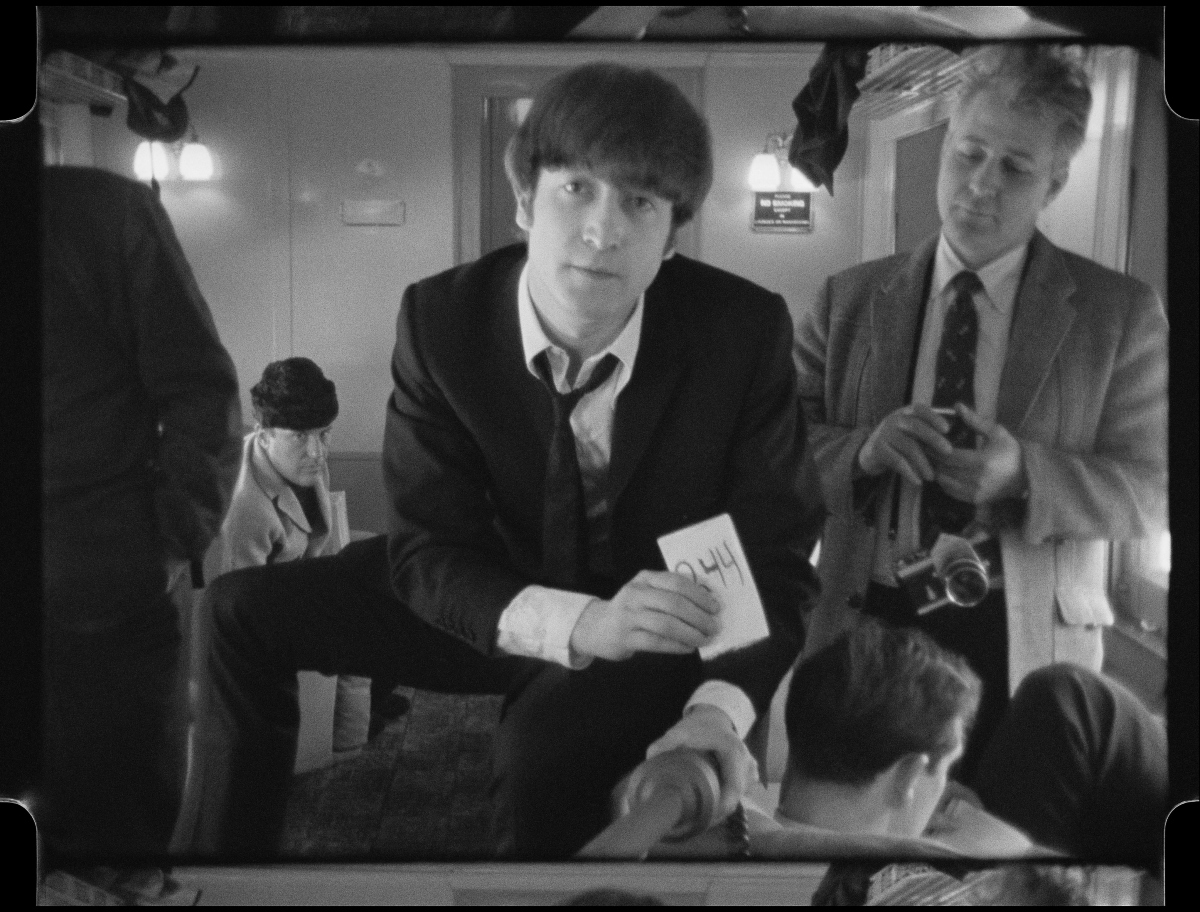
“Beatles ’64” is a captivating guided tour of the Fab Four’s fateful maiden voyage to the US

With healthy doses of exuberance and plenty of raucous, good-time rock ‘n’ roll, "Beatles ’64" takes music lovers on a captivating guided tour of the group’s maiden American voyage. Directed by David Tedeschi and produced by Martin Scorsese, the film is a much-welcome respite from our bewildering times in much the same way that the Fab Four acted as a tonic in the tragic months following the Kennedy assassination. Brilliantly capturing the heady days of Beatlemania, "Beatles ’64" holds the power to make your heart sing with pure joy.

The film includes rare footage filmed by pioneering documentarians Albert and David Maysles, beautifully restored in 4K by Park Road Post in New Zealand. Viewers are treated to crisp footage of the Beatles’ February 7, 1964 arrival at the recently rechristened John F. Kennedy International Airport. The Fabs take it in stride as fans swoon over them in advance of their bravura Feb. 9 appearance on "The Ed Sullivan Show," when 73 million Americans tuned in to meet the Beatles.

While the footage is masterful, the music, as always, is king. The audience at a New York City screening broke into spontaneous applause during the group’s performance of “Long Tall Sally” at the Washington Coliseum, their first proper U.S. concert. The big moment came as the song reached its fever pitch with drummer Ringo Starr going into a mind-boggling double-time.

During a post-screening talkback, actor Ethan Hawke interviewed Tedeschi and Scorsese about the making of "Beatles ’64." As the production team behind the Rolling Stones’ "Shine a Light and George Harrison: Living in the Material World," Tedeschi and Scorsese commented upon their feelings of awe and reverence for the source material. Scorsese attributed the early days of Beatlemania as harbingers of an artistic change that not only impacted the 1960s, but that can be felt in the popular culture of the present day.

As a documentary, "Beatles ’64" is well-served by a host of interviews, including contemporary takes from Starr and Paul McCartney, as well as a flurry of heartwarming anecdotes from the likes of producer Jack Douglas and author Jamie Bernstein, among others. Archival footage of John Lennon and George Harrison reminds us that while the group’s music will enchant listeners for the ages, the Beatles’ story is a transitory one.

John Lennon in "Beatles '64" (Disney+)

To the filmmakers’ great credit, "Beatles ’64" always has one eye tightly focused on the future. While the footage celebrates the group’s first fortnight on American soil, the documentarians shrewdly give Lennon the last word. Drawing its coda from 1975 interview footage, "Beatles ’64" leaves it to Lennon to explain the significance of the band’s inaugural American visit. “My picture of it now,” says Lennon, “is that there was a ship going to discover the new world, and the Beatles were in the crow’s nest. And we just said, ‘Land Ho!’”


Want a daily wrap-up of all the news and commentary Salon has to offer? Subscribe to our morning newsletter, Crash Course.


Oh, but what a discovery it was. What makes the Beatles’ 1964 visit so special is that it wasn’t a one-off pop-cultural moment. The Beatles made good on it and then some. While they may have been the darlings of the teenyboppers in February 1964, they would grow their demographic in powerful and lasting ways over the coming years on the shoulders of such classic tunes as “Yesterday,” “Michelle,” “In My Life” and “Eleanor Rigby.” By 1966, everybody was listening to the Beatles. And then, in their final act, they reeled off a slew of classic albums in "Sgt. Pepper’s Lonely Hearts Club Band," "The White Albumand "Abbey Road."

A visual and aural feast, "Beatles ’64" will undoubtedly inspire new generations of fans who, like their forebears all those years ago, simply couldn’t wait to meet the Beatles.

"Beatles '64" streams on Disney+ beginning Friday, Nov. 29. 

Trump’s brain drain: Fox News personalities tapped to become America’s next top scientists, doctors

A couple of days after the election this year I wrote that I thought a lot of the anti-incumbent movement these past couple of years had to do with unprocessed trauma from the global pandemic. Here in America, we lost over 1.2 million people in a very short time from a deadly disease that humans had never seen before. Within just a few weeks in the spring of 2020, New York City alone had lost more than 15,000 people. All of our medical systems were strained, supplies were unavailable and the whole country, the whole world, was in a state of barely suppressed panic. I don't think we've ever really dealt with exactly what happened. And now we are in danger of doing it all over again.

Donald Trump failed miserably at the most important thing he was tasked with doing at the time: reassuring the public. He instead lied, complained, pushed snake oil cures and worried more about the effects of the pandemic on his re-election prospects than the health of the American people. Bob Woodward's book "Rage" lays out a terrifying narrative, from taped interviews with Trump himself, of just how inept and dishonest he was.

It appears that Trump is intent on stacking the nation's most important health agencies with people who are hostile to modern public health science and vaccines.

Mother Jones's David Corn reported on the findings of The Select Committee on the Coronavirus Crisis which found that senior Trump officials tried to block CDC scientists from warning the public and barred them from holding press conferences as would be the usual protocol, substituting those demented Trump TV briefings instead. The White House listened to conspiracy theorists and unorthodox quacks with little experience in the field and leaned on the Centers for Disease Control (CDC) to change its recommendations. The result of Trump's mismanagement of the crisis is estimated to have resulted in hundreds of thousands of unnecessary deaths in the days before the vaccines became widely available.

We all recall Trump's cult followers' reaction to the government guidelines to try to save as many lives as possible. They rebelled like wild-eyed teenagers, burning facemasks, staging protests and indulging in conspiracy theories. Trump soon followed their lead since it dovetailed with his own political needs to get out on the campaign trail. The consequences were grave. Vaccine refusal caused over 200,000 more unnecessary deaths.

Trump has not forgotten about any of that even if the rest of us have tried to suppress the sense of insecurity and chaos that crisis left us with. He is a man who bears grudges and the scientific community that disagreed with him is now in his crosshairs. He cannot accept that they were right and that he was wrong so he's going to make them pay.

He's found the perfect instrument for his revenge in Robert F. Kennedy Jr, a conspiracy theorist with a whole lot of crackpot ideas but who, like Trump, believes that he knows better than scientists. He apparently was responsible for some of the funding for the dangerous documentary called "Plandemic" which likely contributed to many deaths.

His left field theories about vaccines and other standard life-saving medical treatments are well documented. And despite his alleged commitment to changing the food Americans eat to make them healthier (good luck with that), it's fair to assume that his lack of ability to be anything but a gadfly will likely result in chaos rather than reform. His previous efforts have been deadly.

We need your help to stay independent

To the extent there are any scientists RFK Jr. or Trump respect they are all heretical and eccentric. Trump named a group of those very scientists this week to top posts at the Food and Drug Administration and the Centers For Disease Control. They were all opponents of the standard COVID guidelines and are all opponents of mainstream medical science, notably in opposition to vaccines.

Trump has nominated Dr. David Weldon an internist and former GOP congressman from Florida to head the CDC. Weldon is best known for pushing the thoroughly discredited theory that thimerosal, a preservative compound in some vaccines, causes autism. He's a fanatic who tried as a congressman to pass a “vaccine safety bill” in 2007 to create a separate agency for vaccines within the Department of Health and Human Services.

Dr. Martin Makary, a pancreatic surgeon at the Johns Hopkins School of Medicine, is Trump's choice to head the Food and Drug Administration. He questions some of the vaccines routinely given to children and in his Fox News appearances he's made it clear that he opposed the COVID policies. He wrote in the Wall Street Journal that it would be gone by April of 2021 due to natural immunity and vaccines. He was very wrong. More than 450,000 people died in 2021.

For Surgeon General, Trump has named Dr. Janette Nesheiwat a former Fox News contributor and supplement salesperson who also happens to be married to his new National Security Adviser, Florida Rep. Michael Walz. She has a book coming out called, “Beyond the Stethoscope: Miracles in Medicine,” which shows the “transformative power of prayer." The good news is that she doesn't seem to be hostile to vaccines which makes her an island in a sea of anti-vaxxers.


Want a daily wrap-up of all the news and commentary Salon has to offer? Subscribe to our morning newsletter, Crash Course.


Trump hasn't formally nominated anyone to the National Institute of Health but the smart money is on Jay Bhattacharya, a Stanford University-trained physician and economist. Apparently RFK Jr vetted him this week and really liked the cut of his jib. Of course, he would. Bhattacharya is one of the lead authors of the notorious Great Barrington Declaration, which argued against lockdowns during the pandemic. It was sponsored by the American Institute for Economic Research (AIER), a libertarian free-market think tank associated with climate change denial, which gives you some idea of the kind of "scientific" analysis that went into it. The Washington Post reported plans to gut the NIH:

Bhattacharya has called for rolling back the power of some of the 27 institutes and centers that constitute NIH, saying that some career civil servants wrongly shaped national policies at the height of the pandemic and did not tolerate dissent. Bhattacharya and other critics have singled out Anthony S. Fauci, the infectious-disease expert who led one of NIH’s centers for 38 years and helped steer the nation’s coronavirus response before leaving the federal government in December 2022. […]

Bhattacharya and Makary collaborated on a blueprint for a proposed commission to investigate the nation’s coronavirus response.

It appears that Trump is intent on stacking the nation's most important health agencies with people who are hostile to modern public health science and vaccines, which is exactly what you would expect from a vengeful megalomaniac who's put an anti-vaxx conspiracist in charge of them.

The pandemic did an immeasurable amount of damage and caused endless heartache for millions of families around the world. Here in America it was taken up as a political weapon by the right-wing and will be the catalyst for the destruction of our public health system. We may be through with COVID but it still isn't through with us.

Return to office policies: What makes them work?

When COVID-19 struck, millions quickly adapted to remote work, ditching the commute for home offices and discovering perks like flexibility, time saved and a better work-life balance. 

Many companies responded by offering hybrid models that blend in-office and remote work. While some have embraced this new way of working, others are doubling down on stricter return-to-office (RTO) policies. Companies like Amazon and Dell are making headlines by mandating employees return to the office three to five days a week. 

But Dave Cairns, a "Future of Work" strategist at workplace software company Kadencesaid most companies are taking another approach. 

"According to a Flex Index study, 79% of tech companies in North America allow employees to decide when they work in the office (56%) or are fully remote (23%), 18% have a ‘structured’ hybrid mandate (specific days are mandated) and only 3% are fully in-office," Cairns said.

Proponents of RTO policies, however, cite collaboration, productivity and company culture as their drivers. Companies like Amazon and Dell argue in-person interaction is critical to productive teamwork.

Others, like Spotify, prove building strong, effective teams without a physical office is possible. Spotify has fully embraced remote work as part of its culture, trusting employees to manage their time. “You can’t spend a lot of time hiring grown-ups and then treat them like children,” Spotify claims, placing respect for employee autonomy at the center of its approach.

We need your help to stay independent

Here is a closer look at what might be behind the push to bring people back to the office and why using data and employee feedback is essential to ensuring that RTO is the right choice.

Keeping power in check

Historically, office culture centered around managers who could easily “swing by” desks and oversee their teams face-to-face. This reinforced a clear power structure with a physical presence-based hierarchy. Managers who relied on in-person oversight found themselves managing from afar during the pandemic, which some perceived as a loss of control.

RTO allows companies to reestablish this dynamic. Physical presence becomes a tool for control, making it easier to track arrival and departure times and establish accountability through visibility. For these companies, RTO is more about restoring traditional power dynamics than productivity gains.

Justifying real estate investments

Office space is costly, and remote work has left some companies paying for empty desks and meeting rooms, unused utilities and building maintenance. An RTO mandate can help justify these costs.

Some companies are also influenced by pressure from local businesses that rely on office workers. As cities have seen drops in tax revenue, public transit use and local business profits, some companies face pressure from local governments to “help bring people back.” In these cases, RTO mandates are as much about supporting the local economy as company culture.

Reducing headcount, subtly

RTO mandates can also be a strategic way for companies to reduce staff without layoffs or severance. For employees who value remote work for personal or practical reasons, RTO mandates may push them to resign and seek other opportunities.

RTO mandates can be a strategic way for companies to reduce staff without layoffs or severance

Implementing the RTO policy allows companies to trim headcount without the costs or reputational risks of traditional layoffs. By paying severance or unemployment, companies save money and avoid the backlash often associated with workforce cuts.

As CNN reports, President-elect Donald Trump’s new Department of Government Efficiency, a nongovernmental entity led by his allies Elon Musk and Vivek Ramaswamy, is expected to push for an end to remote work across federal agencies as a way to help reduce the federal workforce through attrition.

Why some take a different route

While some companies enforce RTO, others allow employees to choose where they work best. Spotify, for example, has committed to a remote-first model, trusting employees to manage their time and priorities. Their philosophy is simple: People work best when given autonomy and respect, balancing their work and personal lives without restrictions.

Companies like Spotify prioritize cultivating relationships and productivity, regardless of where their teams are. A 2023 Gartner report that employees are often more productive and satisfied when they control where and when they work. Flexible workplaces are also more inclusive, supporting women, people of color, caregivers and those with chronic health conditions.

"Don't try to recreate the old world. Imagine what can be.” According to Phil Libin, co-founder and CEO of mmhmm and All Turtles, co-founder and former CEO of Evernote.

From Libin's perspective, the focus should be on managing distributed teams well. It is less about choosing a side and more about how to work more effectively regardless of companies’ 'work from' policies.

What makes an RTO strategy work?

Salvatore Affinito, assistant professor of management and organizations at NYU Stern School of Business, said it's important for companies ending remote work "to make a compelling case to employees for why being in the office is important to company leadership."

"Make a compelling case to employees for why being in the office is important to company leadership"

"I think what many employees are hungry for is a clear rationale behind these initiatives and widespread role modeling from company leadership of using time in the office effectively," Affinito said.

Successful RTO strategies are not based on assumptions or executive preference but on complex data and employee feedback, experts said. Companies must genuinely listen to their teams to understand how RTO policies affect different groups. With flexibility and an open mind, leadership can reduce the turnover and disengagement that often result from enforcing rigid policies.

“Leadership must prioritize supporting middle managers," Phoebe Gavin, a career and leadership coach, said. "[They] face pressures from multiple angles: their supervisors, who may push them to enforce policies they didn’t create; their lives, which are affected by the changes; and their direct reports, who may be unhappy with the new direction.”

A flexible RTO strategy helps companies retain talent by addressing challenges like long commutes and childcare costs, which stricter mandates often overlook, experts said.

The best RTO policies respect individual needs, allowing employees to work in ways that suit them best. Companies can build a culture that fosters growth, inclusivity and productivity by focusing less on mandates and more on flexibility and trust.

Rural water utilities in North Carolina are still reeling from Helene

The most exciting part of the day at Spruce Pine Montessori School is when the truck arrives to empty the porta-johns. At that point in the afternoon, the kids abandon their toy dinosaurs and monkey bars, throw up their hands, and yell in excitement as they run to watch the truck do its work. It’s lucky that they find something to be so joyful about, Principal Jennifer Rambo said on a recent sunny afternoon, because things have been a mess for the past seven weeks.

The flooding that devastated western North Carolina during Hurricane Helene laid waste to communities all around the region, spitting up great torrents of mud and washing away homes, cars, and people. The landscape along the creeks and mountainsides has been forever changed. 

Beyond the fallen trees, sliding hillsides, and damaged buildings, Helene took out critical infrastructure, like internet and electricity, water, and sewer. Everyone would have liked more time to get things in order, but working families were desperate for childcare and the desire to resume classes was too great. “We had to get open,” Rambo said. “The kids needed some routine and structure and consistency, and families needed to go back to work.”

Although folks in Spruce Pine were told Thursday they could finally stop boiling water before using it, the school still can’t flush its toilets because the sewers remain a mess. In addition to two portable toilets (and special seats so the smaller children wouldn’t fall in), it has had to buy water by the barrel and spend $600 to install portable hand-washing sinks. The bills continue adding up: $360 per week for the johns and $350 every time they need emptying. Everyone has had to adjust to these changes and more, even as they’ve dealt with similar problems at home.

It’s been that way everywhere. The storm killed 103 people throughout western North Carolina and surrounding areas. Many more were injured. All told, the wind and the water damaged as many as 126,000 homes, and dozens of roads and bridges simply washed away.

Town manager Darlene Butler has asked residents to conserve water as she works with county officials and the Federal Emergency Management Agency to erect a temporary treatment facility.

Helene also decimated more than two dozen water utilities. For weeks after the storm, people had to boil anything that wasn’t poured from a bottle, and many of them drew from creeks and ponds just to flush their toilets. Folks in Asheville, where taps ran dry for three weeks, were told just this week that their water is safe to drink without boiling it first, but thousands of people served by 16 utilities still deal with sketchy water, low pressure, and other frustrations. In an effort to make their lives a little easier, officials dipped into a $273 million relief package to dot this end of North Carolina with 650 portable toilets and 15 “community care stations” with showers and washing machines.

Asheville was lucky enough to have upgraded its reservoir last year, something that prevented even worse flooding and allowed the region’s largest city and the communities that rely upon it for water to recover sooner than they otherwise might have. But for towns like Spruce Pine, the financial and engineering challenges of repairing their water systems are as formidable as the hurricane that broke them.

The water that flows into the North Fork Reservoir, which serves Asheville and the towns of Black Mountain and Swannanoa, always ran clear and clean from its headwaters high in Pisgah National Forest. But mud and debris have turned it murky brown and damaged much of the equipment needed to pump it. Crews have worked around the clock to set things right, reconnecting pipelines in record time and drawing muck from the lake.

Repairing municipal water systems leveled by a storm that washed away distribution lines, overwhelmed intakes, and inundated treatment plants is no easy feat. The challenge is acute in mountain communities, where geography is a hassle. Much of the infrastructure required to draw, treat, and distribute water often sits alongside reservoirs, placing them squarely in a floodplain when the torrent arrives and increasing the likelihood of damage. Reaching anything needing attention can take days or even weeks because the lines that carry water to customers meander through valleys, over ridgelines, and along roadways, many of which remain impassable. Spruce Pine Water & Sewer has restored service to 90 percent of its 2,000 or so customers, but can’t do much for the rest of them until the roads are fixed.

The sewer system remains a mess too. Town manager Darlene Butler has asked residents to conserve water as she works with county officials and the Federal Emergency Management Agency to erect a temporary treatment facility. The equipment is only now arriving and will, at best, be a Band-Aid for a multi-year fix. “We had a lot of damage there, so we’re trying to encourage people not to use a lot of water and put it into our sewer system,” she said.

A lot of these utilities struggled even before Helene. In many Appalachian towns, the companies that once paid to maintain water and sewer systems have shut down or moved on, and shrinking populations generate less revenue to keep things shiny and new. This is endemic throughout Appalachia. Residents in McDowell County, West Virginia — where one-third of families live in poverty — have for example given up on the often discolored water that flows from their taps and buy it by the case instead. Pipes in Martin County, Kentucky lose about 64 percent of what flows through them, a problem that started 24 years ago when a toxic coal slurry spill damaged them. The burden of these failures falls on customers who must adapt to the situation even as their rates climb. (Rates in Martin County, North Carolina, to offer one example, are among the nation’s highest.)

Yet other systems, particularly those in tourist towns, struggle to keep up with rapidly growing populations. The challenges are compounded by the difficulty of running new lines in the mountains and maintaining the complex pumps needed to maintain pressure over ridgelines. “This is a really, really great place to live,” said Clay Chandler, Asheville’s water resources information officer. “It’s beautiful. The people are amazing. But, man, it makes it hard to operate a water system.”

Spruce Pine’s system is so old that Butler has no idea when its pipes were laid, though she guesses it was 60 years ago. The pump station, recently upgraded with money from the American Rescue Plan, was built in 1967. It has seen overhauls as things broke, but rural utilities rarely make wholesale improvements because they are expensive and disruptive. “I think, like most small towns, we’ve struggled for the funds to be proactive instead of reactive,” Butler said.

Even as communities deal with the aftermath of so much deferred maintenance, others are facing the inescapable fact that rebuilding on a floodplain may no longer make sense. Spruce Pine is banking on hazard mitigation funding from FEMA and help from federal officials to move its wastewater treatment plant to higher ground.

The work needed to fully, and permanently, restore water and sewer service in these communities will by most estimates take two to four years and cost many millions of dollars. Meanwhile, crews continue playing whack-a-mole as aging lines break. Another one gave way in rural Yancey County last week, sending a geyser dozens of feet into the air


About 2,000 people live in Spruce Pine, a busy place with water-intensive businesses that have been impacted by the disruption. There’s the mine that produces some of the purest quartz in the world and sent heavy equipment to help restore service. There are the restaurants and kitschy attractions that drive a burgeoning tourism industry. And then there are the two state prisons, each of which holds about 800 people (who were relocated after spending a week in flooded cells) and, like prisons everywhere, burden the local water and sewer systems.

The ongoing crisis also has made providing basic services a challenge. Blue Ridge Regional Hospital, which serves three counties, has long had a standby power supply but scrambled to cope with losing water. Trucks haul in what’s needed, and enormous bladders collect what’s been used. “We had backup generators to supply the hospital in case of an emergency,” said Alex Glover, chair of the hospital’s board of directors. “But we never dreamed we would lose water and sewage capabilities, and we lost them all at once.”

With water in short supply, the volunteer fire department banned burning the yard waste, brush, and other debris people have been clearing for weeks. “If we had a big fire and we needed to take several thousand gallons or more out of the system, we don’t really know for sure how long that supply would hold up,” said firefighter Chris Westveer.

The department has experienced some close calls. Westveer recalled one frightening night when wiring in a damaged home sparked a fire. The road had been washed away, forcing crews to approach on an all-terrain vehicle. With no water on tap, they drew what they needed from a river and hoped the wind wouldn’t spread the flames beyond their ability to fight them.

Such strains on public services, already scarce throughout mountain communities, compound the stress felt by those who have gone nearly two months without reliable water. People in Banner Elk, a community of 1,000 or so that had to rebuild a road before it could repair water and sewer lines, couldn’t flush their toilets for a month. County officials worried that the raw sewage would flow into the Elk River. Meredith Olan, director of the Banner House history museum, has been hauling water from the creek and boiling it just to do the dishes. “I’m very adept at carrying buckets now,” she said ruefully. Anyone wanting to take a shower had to rely upon the goodwill of friends with wells to draw from. But even that was no guarantee. Some were inundated with floodwaters and might have been contaminated with E. coli and other pathogens, and the electric pumps that pull water from the depths aren’t any good when the power is out. 

Even as these communities work nonstop to restore service, local and state officials are looking ahead to the next big storm. Members of the state Water Infrastructure Authority, a body tasked with financial planning for the state’s water and sewer utilities, gathered last month to ponder updates to North Carolina’s water infrastructure master plan. The document, created in 2017, explored ways of ensuring the financial stability of water utilities. Members of the panel, which includes several utility directors, a water engineer, and the head of the state Division of Water Infrastructure, acknowledged that local officials often have little idea how water and wastewater work and need help navigating the aftermath of a disaster and applying for grants to recover from it. 

Experts on the subject said consolidating the region’s patchwork of small systems may be the key to rebuilding and maintaining them. Some are doing just that. Four counties in southwestern Virginia are working together to install dozens of miles of water lines. Such efforts are easier among towns that are close together, like Mars Hill and Weaverville. These small towns, which are rapidly becoming suburbs of Asheville, have linked their water systems so they can ensure there’s enough to supply new housing. That connection allowed Weaverville to quickly buy and move water when the flood knocked out its municipal system. A similar arrangement proposed for nearby Marshall would cost about $15 million.

Teamwork can provide a backup supply of water, reduce maintenance costs, and allow small utilities to share these essential resources and collaborate on, rather than compete for, grant applications. Such efforts will grow increasingly important as development and a warming world further burden these systems. “I think the fiefdom of water supply has to change for everyone to thrive in an era of climate catastrophe,” said Will Harlan, the Southeast director of the Center for Biological Diversity and a resident of Barnardsville, another community not far from Asheville.

Even if a physical collaboration isn’t possible, an organizational one might be. “If you’ve got three tiny towns and nobody can afford to hire a public works or public utilities director, the three of y’all go in together and hire a qualified utilities director,” one member of the master plan committee said during a public conference call. 

Barring any changes, the region is at risk of simply rebuilding what it has, only to watch it all wash away in the next big flood, said Francis de los Reyes. He is an engineering professor at North Carolina State University who focuses on sanitation systems. He’d like to see communities move their water infrastructure to higher ground, as Spruce Pine is doing, and relocate flood-prone neighborhoods, as is happening in eastern Kentucky. “Your choices are mitigation, adaptation, or staying in fight-or-flight,” de los Reyes said. 

But it takes more than a collaborative spirit and skilled leadership to repair a water system and harden it against future disasters. It requires communities to pool resources or seek federal support because they do not have the millions of dollars that work requires. Even before Helene struck, the bipartisan infrastructure law set aside $603 million to help North Carolina replace old pipes and other hardware. The fate of that money remains in question, however, because President-elect Donald Trump has vowed to undo much of the Biden administration’s climate work.

Back at Spruce Pine Montessori School, Jennifer Rambo is trying not to let uncertainty about the future get to her. It’s hard enough dealing with the present. Beyond the weeks without potable water, she is grappling with spotty internet access and electricity, and an inescapable sense of loss. In the days after Helene, she spent much of her time trying to determine if people were still alive. Her voice wavered as she said more or less the same words that so many in her community, and others like it, have echoed over the past two months: “Nobody was prepared.”

Tech CEOs sell out Democrats in rush to curry favor with Trump

Democrats made a strategic alliance with Silicon Valley during Barack Obama’s presidency that they would be wise to shake in the face of a second Donald Trump term. Since the Obama era, Big Tech CEOs have portrayed themselves as champions for climate action and social justice, defenders of reproductive rights and fundamental freedoms, and thus allies to Democrats and progressives. “The good guys” of corporate America. But those days are long gone. And it's time to stop giving them a free pass.

Leading up to this year’s election, these same CEOs showed their true priorities: zero oversight, bigger government contracts, and unfettered monopoly power superseded years of lip service about social responsibility, protecting our democracy, or even U.S. national security.  

We have agreed that every other industry ought to design its products safely. Why not social media platforms?

A recent YouGov poll found that two-thirds of Americans agreed misinformation on social media has gotten worse since 2020. And by now, so many Americans cannot distinguish fact from fiction that legitimate politics can barely function. An October Ipsos poll found that voters who answered factual questions about political issues like inflation and immigration incorrectly were more likely to prefer Donald Trump over Kamala Harris. 

This means there’s no downside for Trump and his MAGA propagandists to keep spewing out lies on Big Tech’s platforms. And that’s to say nothing of the Russian, Chinese, and Iranian election interference that was even more rampant.

None of this happened by accident. Elon Musk ended content moderation when he bought Twitter and turned it into X. Meta, TikTok, and Google cut tens of thousands of trust and safety jobs, axed fact-checkers, and ended transparency tools. This unquestionably made platforms less prepared to address election-related disinformation and made the public less able to understand the content in their feeds. 

Why? The answer is simple: profit. Spreading lies and conspiracy theories makes tech platforms so much money that they design their products to actually amplify those bad-faith actors despite repeated calls from lawmakers and the public to do better. 

Despite numerous tongue-lashings (and crocodile tears for the cameras) before Congress, it’s business as usual for these CEOs. The Facebook Files revealed that they’ve put a value on the life of a child (it’s $270). Their engagement-at-all-cost algorithms are designed for profit and not to protect against sexual predation or degrading children’s mental health.

We have agreed that every other industry ought to design its products safely. Why not social media platforms?

It turns out that pushing MAGA conspiracy theories and driving our children to depression and self-harm is a lucrative business. Facebook alone made more than $1 million running ads falsely claiming the 2024 race would be rigged or postponed and that the country might be “headed for another civil war.” Google made money off hundreds of YouTube right-wing disinformation videos with tens of millions of views. Altogether, social media apps make more than $11 billion a year off children, including $2 billion off kids under 13. 

We need your help to stay independent

The CEOs knew the stakes were high this year – they were warned by lawmakers and researchers across the country and the globe – yet they chose profit and servility to Trump over preparedness and transparency. 

Indeed, almost every single one of these CEOs lined up to kiss Trump’s ring before the election. Google’s Sundar Pichai has reportedly been courting Trump for months; Meta’s Mark Zuckerberg vowed to stay out of the election and deployed the time-tested strategy of playing to Trump’s ego with overt flattery. Amazon’s Jeff Bezos, who owns the Washington Post, instructed his editors not to endorse Kamala Harris. Apple’s Tim Cook called Donald Trump directly for help dodging European regulations. And Elon Musk put in $130 million to ensure a Trump win. 

Under Trump, they know the government will stop trying to rein in their abuses and let them freely trample the American people in pursuit of ever-higher profits. That’s also why these companies have deployed an army of lobbyists and lawyers to block legislation and go to war against Biden administration enforcers at the Federal Trade Commission and the Department of Justice. 

I don’t want my children or yours to grow up in a country where Big Tech companies traffic in hate, division, and exploitation, which lead to real-world violence, depression, and suicide. It’s time to draw a line: we’re done accepting this. We’re done watching U.S. companies abandon their responsibility to safeguard the integrity of our citizens, democracy, or society. 

After letting these companies distort our political discourse for the third presidential election cycle in a row and poisoning ourselves, our children, and our neighbors for profit, Americans are ready to say: enough. 

So. What are we waiting for? Let’s pass the Kids Online Safety Act, right now, which would force tech platforms to put children over profits, before a Big Tech-friendly Trump administration and its allies in Congress water it down. And state and federal antitrust enforcers must continue to keep up the pressure on Big Tech — because forcing these companies to face the music has strong bipartisan support. Republicans, including the incoming vice president, love to rail against Big Tech; well, with a likely governing trifecta in 2025, they should put their money where their mouth is. Democrats cannot come to the rescue. 

And it’s time to show Big Tech CEOs that, even for them, there are limits to what money can be allowed to do.

Big Tech is not untouchable. In America, no one is above the law.

Before Donald Trump destroys it, Democrats must “re-envision what democracy needs to be”

Donald Trump is quickly consolidating and expanding his power. Trump has promised to be a dictator on “day one” of his administration. Trump has also demonstrated, repeatedly, that he will rule as an autocrat who will crush all those individuals and groups that he and his MAGA agents and other allies deem to be “the enemy within.” Trump has been remarkably transparent and direct about how his rule will be driven by revenge, retribution and corrupt unlimited power.

The Democrats, the mainstream news media and others who are searching for some desperate hope in this time of extreme dread and peril are currently fixated on whether Trump has a “mandate” for his agenda because he did not win 50 percent of the popular vote. Ultimately, Trump and his MAGA forces do not care about democratic legitimacy and the popular will. They are autocrats and authoritarians (and fascists) who impose their will on the public.  

To that end, Trump is selecting people for his Cabinet and other senior administration positions whose first qualification is loyalty to him. Their professional qualifications, competence and belief (or lack thereof) in the basic tenets of real democracy, the Constitution and the rule of law are of little, if any, importance.

The manifestly incompetent Trump 2.0 Cabinet members and other senior appointees are being joined by very serious and very dangerous ideologues. As shown by Project 2025, Agenda 47 and other documents and planning, these people have spent years and decades studying how to destroy the American government and democracy as a way of advancing their revolutionary and reactionary project to tear down the social safety net, social democracy and “the bureaucratic/deep state” with the goal of bringing the country back to the Gilded Age (if not before) when rich white men, big business, White Christianity and other antidemocratic forces ruled largely uncontested. The grossly unqualified Trump officials will be the camouflage and distraction — to aid and enable — the work of the second, smaller group of ideologues. Both groups will be extensions of Trump’s will and the worst aspects of his personality, impulses, emotions and mind.

Those Americans who voted against Donald Trump and MAGA are collectively shell-shocked and wounded emotionally, psychologically and spiritually. This is especially true for “the resistance” and their news media and opinion leaders who got high on the “hopium”, having convinced themselves, contrary to the abundance of the evidence, that there would be some great groundswell of support for Kamala Harris and the Democrats. Trump would be stopped because “the American people are fundamentally decent” or “American Exceptionalism” would kick in or “suburban white women and the Dobbs decision!” would spark a backlash or, at the very least, “how could anyone possibly want to return to the Trump years?” Of course, none of this happened.

"If there is a silver lining to defeat, it’s that we have a chance to dig deep, learn lessons and make major course corrections that may aid us in the future."

In all, these fantasies and fictions about America and the character of its people have collided with the reality of what America actually is, with all of its historical and current deep ugliness as embodied by Trump’s victory over Kamala Harris. During these last few weeks, I have experienced several moments where more “familiar strangers,” those people we encounter as part of our daily routine but have never spoken to before, are saying hello and seem to be seeking out conversation and comfort from others.

As reported by The New York Times on Thursday, the shock and disappointment are so great that many members of the anti-Trump pro-democracy movement (aka "the Resistance") are feeling like giving up:

In the days after Donald J. Trump’s electoral victory, thousands of people revived the grass-roots movement that opposed his first term in office.

Marchers in Manhattan took over streets carrying a block-wide banner that read, “We Won’t Back Down.” Activists in Los Angeles and Chicago decried Mr. Trump’s abortion and immigration policies and vowed to descend on Washington to protest his inauguration in January.

But participants noted that Mr. Trump had not appeared to be swayed by protests, petitions, hashtag campaigns or other tools of mass dissent. Many have been calling for a fresh playbook.

“I thought the first women’s march would be a turning point,” said Laura Bartek, a 45-year-old nurse from Virginia, referring to the protest — with nearly half a million people — that took place after Mr. Trump’s 2017 inauguration.

“To be here eight years later with these signs,” Ms. Bartek said during a recent protest in Washington, “it breaks my heart.”

“I keep getting emails to sign petitions,” said Leslie Mac, a digital strategist and communications expert who works with grass-roots organizations. “These people coming to the White House don’t care about petitions. They don’t care how many people sign them. They don’t care what they say.”

The first Trump presidency spawned the largest protests the country had seen in half a century.

But not everyone wants to participate in another four years of mass movement work. When Women’s March shared information about an upcoming rally on Instagram, one person responded, “No im tired, yall have fun though.” (Women’s March later hid some of the pushback and limited who could respond to a handful of posts.)

We need your help to stay independent

The Age of Trump shows no sign of being over any time soon. It is an epic of the worst type that we “the Americans” are trapped inside of — now by choice.

In an attempt to make better sense of Trump’s surreal second election, our collective emotions and where we go from here, I recently spoke with Alan Jenkins and Gan Golan. They are the co-writers of “1/6: The Graphic Novel.” (Issue number 3 is available now.) Jenkins is a Professor of Practice at Harvard Law School where he teaches courses on Race and the Law, Communication, Law, and Social Justice, and Supreme Court Jurisprudence. Before joining the Harvard faculty, he co-founded and led The Opportunity Agenda, a social justice communication lab that harnesses the power of media and popular culture to move hearts, minds and policy. Golan is an artist, bestselling author, grassroots activist, organizer and one of the lead designers of The People’s Climate March, which was one of the largest climate mobilizations in history. 

This is the first of a two-part conversation.

How are you feeling given the election and Trump’s return to power? Were you surprised by his victory?

AJ: As we’ve been saying all along, the shadow of autocracy and bigotry will be with us as a nation for years, whoever our next president is. That’s why Trump is depicted mostly in shadow in our series. One of the main messages in our books is that we always must work to protect democratic values and institutions, year in and year out. Now we know what we’ll be facing.

GG: Shocked but not surprised. There have been so many off-ramps not taken and yet here we are. If there is a silver lining to defeat, it’s that we have a chance to dig deep, learn lessons and make major course corrections that may aid us in the future. Here is one important lesson: Democrats have been undercutting their own progressive grassroots movements for decades, while Republicans have been nourishing theirs. Which strategy succeeded? I think the results are in.

How are you sleeping?

AJ: I’ll quote John McCain after he lost to Barack Obama in 2008: “I slept like a baby… sleep for two hours, wake up and cry, sleep for two hours, wake up and cry.”

GG: Let’s just say that my family members who are bothered by my *consistent* snoring are getting a nice break these days.

What are you doing with those emotions to process them if anything? To balance out the worry tank and the hope tank?

AJ: Our graphic novel series is about loss and grief, but also about hope, resistance and reconstruction. That balance has always sustained me through tough times.

GG: We tend to believe we need hope to inspire action when it’s more the reverse. It is action that inspires hope. I’ve kept working with people at the grassroots level and been thinking of how we can weather the storm and protect people and still make forward progress where we can.

We are still doing an autopsy of the 2024 election. What role do you believe that racism and sexism played in the outcome?

AJ: Research and experience tell us that both conscious and subconscious bias created a much steeper hill for Harris to climb. The hill was surmountable, in my view, with a more compelling narrative and a bolder, more transformative set of ideas. But there’s no question that it was a far higher obstacle to victory than either Biden or Trump faced.


Want a daily wrap-up of all the news and commentary Salon has to offer? Subscribe to our morning newsletter, Crash Course.


GG: The role of racism, sexism and transphobia as a factor in our electorate is undeniable. Full stop. But this was still a winnable election for the Democrats. We are in a populist moment and this was a “change” election. The Harris campaign had an opportunity to break from Biden on Gaza and also push forward a strong progressive vision rooted in popular economic policies.

That didn’t happen. Trump brought “faux-populism” while the Democrats brought “no populism” and that doomed them.

Of course, it’s not all on Harris. Biden couldn’t communicate his own successes as he had a mute button on. Then he waited too long to step aside, depriving the Democrats of a wider field of new candidates and a longer campaign run. This is another example of the Democrats holding on to power and failing to create a strong transition to a new generation. We saw this with RGB refusing to step down and then Trump appointing her successor. They forgot that your legacy is secured by the next generation, not your own and they have failed to make that transition. In tumultuous times, those new leaders often come from outside the establishment, not inside and Democrats have been very resistant to that.

Alan, you are a legal scholar and advocate for democracy. What role does the law and our democratic norms and traditions have when confronted by an elected autocrat who has promised to be a dictator on “day one”? 

AJ: One of the lessons of Trump 1.0 is that democratic norms and traditions can and will be ignored by this president. Institutions, however, are made up of people and it’s up to us to ensure that they hold. That means countering the tremendous pressure that will be put on them by Trump and his allies, supporting independence and insisting on equal accountability. This will also be a supreme (no pun intended) test of our judiciary, which is the only branch of our federal government that the Framers of the Constitution insulated from public pressure. During the last administration, the courts (including judges appointed by Trump himself) occasionally stood up to him, but more often let him ride roughshod over the Constitution. Those of us who are lawyers are going to have to push judges to live up to their allegiance to the law and to our country’s highest values.

Trump's return to power has echoes of the end of Reconstruction and the rise of “Redemption” and Jim and Jane Crow. I feel like we are in some twisted simulation and pocket of the multiverse where it is "Idiocracy" and "They Live" mixed with "Robocop", "Brazil", Octavia Butler’s novels and "Groundhog Day."

AJ: There are a lot of parallels between now and the end of Reconstruction when our nation walked away from its commitment to equal justice and redefined the Civil War as a disagreement among friends instead of a battle for freedom and the soul of the nation. Whether we spend another century wandering in the wilderness of tyranny and bigotry is, in part, up to us. We can never stop working toward a more perfect union, even when prospects look bleak. Without the work of “Redemption-era” and early 20th century activists like W.E.B. DuBois, Ida B. Wells and Charles Hamilton Houston, the modern Civil Rights Movement never could have happened.

GG: We are definitely in a dystopian fiction mashup. Artists and storytellers are often our early warning system and they’ve been sounding the alarm bells for years. Leaders and activists are also visionaries and storytellers. Their vision for a better society, which we might have taken for granted in our own lives — like, the weekend, or the women’s vote, or interracial marriage — was at one point practically science fiction. It then took organizing to bring those visions into being as part of our daily, lived experience. That is the work we are being called to do: To re-envision what democracy needs to be, then do the hard work to make it a reality. The future is not yet written and we can’t miss the opportunity to define what happens next.

TikTok is being flooded with birth control misinformation. Is it stopping women from taking it?

TikTok has become a hotbed of birth control misinformation, with videos accumulating millions of views in which women blame their IUDs for pelvic floor dysfunction, autoimmune conditions, liver failure, and other conditions. In one video, the text reads: “I cannot believe my 'for you' page today. Every video is of a girl getting autoimmune/cancer from her IUD. Why did we pop birth control like candy because doctors told us to?”

Virtually all American women have used some form of birth control at some point in their lives, most commonly female sterilization, oral contraceptive pills, and long-acting reversible contraceptives like intrauterine devices (IUDs). These forms of birth control each carry risks, but doctors say they are sometimes taken out of context on social media. In some cases, users have falsely said that birth control can lead to infertility or cause abortions.

Misinformation for various medical treatments circulates far and wide on the internet, and some doctors are concerned that the true risks of birth control are being misconstrued and might make women get off it when there are fewer options available for unintended pregnancies as states move to restrict abortion access after Roe v. Wade was overturned in 2022 with the Supreme Court's Dobbs decision.

“We want to respect our patients and not make decisions for them,” said Dr. Jenny Wu, an OB-GYN resident at Duke University who studies how birth control is discussed on social media. “We are really having to address these questions around mistrust and distrust with hormonal birth control while living in a state where we have much more limited access to abortion care.”

"IUDs have so many other benefits besides just contraception."

Some videos negatively discuss hormone therapies and prioritize “natural” new-age therapies instead. But this can also make patients more hesitant to get an IUD for conditions that they are sometimes recommended to treat, like endometriosis, heavy periods, fibroids or menopause, Wu said.

“IUDs have so many other benefits besides just contraception,” Wu told Salon in a phone interview. “Yet I worry that with all this negative content online, it's hard to talk about those other things that are beneficial about an IUD.”

In a study Wu published earlier this year in Obstetrics and Gynecology, videos on TikTok tagged with “#IUD” were more often negative than positive, with nearly all of them discussing pain or other side effects. In updated 2022 guidelines, the American College of Obstetricians and Gynecologists (ACOG) said that misperceptions and “exaggerated concerns about the safety of contraceptive methods are major barriers to contraceptive use.”

Whether social media is causing a significant portion of the population to get off birth control is unclear. In another study published in Health Communications in September, researchers found that women who interacted with these posts reported intentions to stop using birth control, suggesting posts do have an influence on viewers, said study author Emily Pfender, an associate fellow at the Leonard Davis Institute of Health Economics who studies women’s health and social media.


Want more health and science stories in your inbox? Subscribe to Salon's weekly newsletter Lab Notes.


“My experimental research shows that when people perceive an influencer to be more credible, both with having greater expertise and trustworthiness, they're more likely to intend to use a less effective, nonhormonal method,” Pfender told Salon in a phone interview. 

According to a study in JAMA Network Open, the use of all contraceptive types except vasectomies declined among the U.S. population between 2019 and 2022 before increasing post-Dobbs. Reports since then have shown more women are choosing to get sterilizations, use birth control pills, or IUDs. And an analysis by The New York Times earlier this year found the number of women who picked up prescriptions for birth control pills increased by roughly 7% nationwide between 2018 and 2023. 

Nevertheless, misinformation is affecting some women, even if not the majority, and doctors anecdotally told Salon they are increasingly seeing women who are concerned about the side effects of their birth control pills. In a study by the Society of Obstetricians and Gynaecologists of Canada, more women reported side effects like weight gain and headaches from hormonal birth control methods in recent years, and these side effects often led to discontinuation. In the study, one-quarter of women who discontinued hormonal birth control methods stopped using birth control completely instead of switching to another method.

“The top reasons people are discontinuing hormonal contraception is because they are saying that it negatively impacts mental health, they want to be more 'natural' and use less synthetic hormones, and because of a whole host of side effects,” Pfender said.

Online, many of the women sharing their experience getting off birth control promote the “natural rhythm” method, which involves timing sex to align with the non-ovulating part of the menstrual cycle. However, data suggests this method is far less effective in preventing pregnancy compared to birth control methods like the IUD or the pill, which each are close to 99% effective.

“Planning is hard because it requires tracking your cycles, and not everyone has regular cycles,” Wu said. “And there are all those privacy concerns with period tracking apps.”

Despite their dark origins of being tested in low-income Puerto Rican women, birth control pills have been credited as being key players in the women’s liberation movement because they helped women take their fertility into their own hands. They have only gotten safer since they were first marketed in the 1960s. Today, 14% of women between ages 15 and 49 are on the pill and about 10% have an implant or IUD, according to national data from the Centers for Disease Control and Prevention (CDC).

Yet, according to a review published in 2021, many women reported wanting to regain control over their bodies as the reason for getting off birth control, indicating the pendulum of personal choice that began in the 1960s with the introduction of the pill might be showing signs of swinging in the other direction, at least for some.

Today, many women report not being informed of the risks of birth control pills or the IUD, which can lead to mistrust in the medical system when some of these risks are realized. In a 2022 study by KFF, just 30% of women reported that they were adequately informed of all of the risks and information they needed to know about their birth control method before getting on it. 

Birth control pills with estrogen do carry a slightly elevated risk for blood clots and stroke. While some studies have also linked hormonal birth control pills and IUDs to an elevated risk of breast cancer, other studies have shown these methods can actually reduce the risk of endometrial or ovarian cancers. These nuanced discussions of risks should always occur between patient and provider before selecting a birth control method. 

We need your help to stay independent

Even though the risks for most birth control pills are low, they can seem more common when they happen to someone a patient knows. It’s unclear how much information circulating on social media plays into decisions about birth control, but generally, stories can sometimes move people more than a statistic can, said Dr. Jonas Swartz, an OB-GYN at Duke University. Yet it's important to keep in mind that people who post about their experience online are also more likely to have an extreme experience, either positive or negative, he said.

“When I was a resident, people were more often getting this information from friends and relatives, and oftentimes you talked about how effective a particular contraception type was or what the bleeding profile was and someone would say, ‘Well, I don’t want that one because my cousin’s friend had a bad experience with that,’” Swartz told Salon in a phone interview. “I think the difference now is that people see these anecdotal bad experiences on social media and those play heavily into their decision-making.”

In some cases, increased visibility online has helped shed a light on underrecognized women's health issues. In recent years, women have posted videos of their faces contorting in pain during an IUD removal or insertion to demonstrate how painful they are. As a result of this increased attention, the CDC recently updated its guidelines to recommend offering women more pain management options during the procedure.

“Social media can be negative because there's not necessarily vetting of the quality information, but it can also be really positive because it democratizes who can provide perspectives on different types of contraception,” Swartz said.

Regardless, people are increasingly turning online for information as distrust in public health increases. After all, it took a flood of videos showing painful IUD insertion procedures for professional organizations to change their guidelines and take women's pain seriously. In general, women's health research is underfunded and U.S. mothers, particularly Black mothers, die at a higher rate in the U.S. than they do in any other high-income country.

Health disparities create a vicious cycle of medical mistrust that can prevent people from seeking help in medical establishments. Without that support, it makes sense that many would do their own research online. But for more than just birth control, it is becoming increasingly difficult to disentangle the truth from the deluge of information one comes across on the internet every day.

“We're attuned to this balance between respecting our patients' wishes but also keeping them safe,” Wu said. “I'm really hopeful that our generation of gynecologists are really thinking about these topics, and hopefully will change the conversation. Hopefully, we will be able to rebuild the trust that has been lost with a lot of our patients.”

“Democrat propaganda”: Marjorie Taylor Greene plans to team up with Musk to defund NPR

 When she's not claiming that her opposition controls the weather or accusing her own party of covering up sexual assault, Georgia congresswoman Marjorie Taylor Greene is gearing up to work in President-elect Donald Trump's second term, and she has some novel ideas about bringing down the deficit.

Greene has been tapped by Elon Musk and Vivek Ramaswamy to lead a new House subcommittee working with the pair's not-yet-created Department of Government Efficiency. During a stop by Fox News on Sunday, Greene gave a glimpse at the sort of line items the government-budget-slashing department would focus on. 

"It's all over," Greene said of supposed government waste. "We'll be looking at everything from government-funded media programs like NPR that spread nothing but Democrat propaganda…all kinds of programs that don't help the American people."

The statement led "defund NPR" to trend briefly on Musk-owned social media app X. In truth, NPR receives very little of its budget directly from the federal government. How exactly to calculate its funding is up for debate as money granted to local public radio stations via the government-funded Corporation for Public Broadcasting is frequently used to pay for the rights to air NPR-produced national programming locally. However, the conception of NPR as an entity that only exists thanks to government largesse is false. 

To hear tell from experts, it wouldn't be the first time that the newly minted DOGE had a surface-level understanding of government programs they hoped to cut. The Center for American Progress' Bobby Kogan told Salon earlier this week that DOGE leadership's proposal to cut all programs whose spending authorizations had lapsed betrayed a "fundamentally superficial" understanding of how government budgets work.

'Let's get rid of unauthorized spending' is the sort of thing that you might see in a Facebook meme," Kogan said."People have this idea of just huge and absurd amounts of government waste, and it's just not borne out in the data."

“She ripped up her own formula”: How Taylor Swift single-handedly changed pop music

There are no accidents in Taylor Swift's world. On the bright June night my family and I saw the Eras tour, her surprise songs were "I Forgot That You Existed" and "This Is Why We Can't Have Nice Things." Did I mention it was Scooter Braun's birthday? It was classic Taylor, sliding in an Easter egg for the fans to interpret. It was also, as critic and author Rob Sheffield puts it in his new book, "Heartbreak Is the National Anthem: How Taylor Swift Reinvented Pop Music," classic "Petty Taylor." That's the thing, she contains multitudes. She's Taylor, the wistful girl. Taylor, the tortured poet. Taylor, the epic grudge holder. 

Sheffield, a contributing editor at Rolling Stone and author of prior books about The Beatles, Duran Duran and David Bowie, has been writing about Swift since the earliest days of her career, so he's uniquely qualified to declare, as he does in "Heartbreak," that "nothing like Taylor Swift has ever happened before." In our recent "Salon Talks" conversation, Sheffield made the compelling case for why, at age 34, Taylor Swift has already built a body of work and a community of fans staggeringly unparalleled in the annals of popular music.

"She never wants people talking about what she did last year," he noted. "She's never satisfied." And now, with the Eras era at an end and an avowed anti-Swiftie about to enter the White House, Sheffield talked about how Taylor has impacted a generation of young musical artists, how she manages to remain so fascinating and divisive, and the Taylor song he thinks sums up the moment we're living in right now.

The following conversation has been lightly edited for clarity and length.

We all have a version of Taylor Swift that exists in our heads, what do you think we're getting wrong or missing about the Taylor we don't see?

We feel like we see everything, and she is so meticulous in constructing these Taylor characters that she brings to life. All the different characters in her songs. We all have our personal Taylor and it's funny that so much of that is what songs we think of as speaking directly to us. 

I'm very much a “‘mirrorball” person, I'm very much a “New Romantics” person. I'm kind of a “mirrorball” person who wishes he were the “New Romantics” person. I would love to be the “Blank Space” person, but realistically for me, “New Romantics” is me at my best. That's how I picture it, whereas “mirrorball” is probably more the day-to-day. 

But there's always this idea that everybody feels like they get things about the real Taylor that nobody else does, and to me that's something that's really fascinating, but also beautiful about the phenomenon. Everybody feels like they have their own lens on Taylor that's different from everybody else’s, and everybody's right about that.

And everybody's right, because you used the word "character." It's very easy to interpret everything she says as, "I'm speaking exactly the truth," instead of seeing that she's also creating characters and telling stories. That's part of her songwriting.

An analogy I make in the book is Dante writing the "Divine Comedy." Dante is the main character, and we speak of Dante the poet and Dante the pilgrim. When you're talking about Dante's poetry, it's just understood that one is the person in the poem and one is the author who's writing the poem, and it's very much like that with Taylor. She is the one writing the songs. She's the one constructing the albums, putting everything together, putting the show together with so much meticulous care so it's different every night. Also, she is this realm of characters that she creates in these songs that we identify with, or relate to, or are terrified of becoming, or are terrified that we already are, or are threatened by. She creates these vivid characters that we all have intense emotional reactions to.

I want to talk about that intense emotional reaction, because she's so polarizing. That's part of her brand, and she knows it and she loves it.  

She loves it. She is so fanatically driven to keep topping herself. She never wants people talking about what she did last year. She's never satisfied with people saying, "Yes, that album she did a couple years ago or the one before that, that was so great." That's never going to be enough for her. She's never going to repeat herself even when it's the obvious, sensible, sane move. 

"So many people were convinced that she didn't write the songs and you still see that, you still hear that."

“Red” is a huge favorite for me and that's a perfect pop album, it's a perfect country album, it's a perfect rock album with that '70s Laurel Canyon singer-songwriter vibe in so many of the songs. It's got disco, it's got dubstep, it's kind of a perfect pop album.

After “Red,” I thought, “Wow, I hope and assume she spends the rest of her life making that album over and over again.” I'd be absolutely delighted if that's what she'd chosen to do. I would not at all mind if in 2024 we were saying, "OK, this year's version of ‘Red,’ this is pretty good. A little better than last year's version. Maybe not as the one, three or four years ago."

And that's something she absolutely decided not to do in ways that seem completely insane. Immediately after that, she ripped up her own formula that she spent so long building and perfecting and made a new wave synth pop ‘80s record. Decisions like that I think are part of what make her so polarizing because she is never settling down in one spot long enough for people to categorize her.

I wonder if that's also part of what is vexing to critics. You are a man, you write for Rolling Stone. Do you think that that's part of why she may be not taken as seriously critically, especially by men?

Absolutely. Especially when she first appeared and a lot of people just took a look at her and assumed that she was just bubblegum pop. It was amazing how long that went on and you still see it. You still see a lot of that. It was pretty much universal in her early years, a lot of people were convinced that she was just this year's model of a disposable teen pop idol.

Do you think there was an inflection point where the world outside of her regular fans started seeing her as a real artist?

I think the last walls pretty much tumbled with “Folklore” and “Evermore.” She had just made “Lover,” which was designed to be a very pop album, one that had a little bit of everything – a little bit of country, a little bit of pop, very much designed for radio, very much designed to be a crowd pleaser, lots of pink on the cover. Then less than a year later, she's making these indie folk albums where the cover is in black and white and she's standing in the woods and doing all these acoustic songs.

I think it's partly the way that the pop world changed in her wake. It's really strange to think when she first arrived in the late 2000s, the idea was that she was a teenage girl with a guitar writing her own songs. People thought, “What a concept! Isn't that cute? That's like a novelty, that's her gimmick. That's why the little girls are attracted to her, because of her supposedly writing songs.” So many people were convinced that she didn't write the songs and you still see that, you still hear that. It’s something that Oasis and Blur can agree about; they will both accuse Taylor Swift of not writing her own songs.

For her early years, she was this young girl with a guitar singing her own songs about her own life. She was the only one doing that. That was a real stepping out on a limb thing for a pop artist to do, and people were really slow to see that she actually was a real songwriter and that these young girl fans that she had were a very sophisticated and discerning audience.

A lot of people are always threatened by the teenage girl fans of pop music, and you look at what Taylor was doing in 2007, 2008 when she was just fighting so hard to prove this could be done. Young girl, guitar, her own songs – there's no male producer or a male Svengali who's pulling the strings. She is the one telling the story as she goes along. 

"The people that she had described in her liner notes as family had sold her catalog to her worst enemy."

You look at just a few years later, right now in 2024, and that's what pop music is. What is huge in pop music right now is all the Taylor Swifts that have arrived in her wake because after she proved it could be done, lots of these fans that she had picked up guitars and started writing their own songs. That's why we see what's huge now, whether it's Chappell or Sabrina or Charli or Billie or Olivia, so many of these artists who are women writing their own songs about their own lives on this very real and candid level and not having any male producer writing the songs for them, which used to be the standard practice for decades and decades. There were all these teenage pop girls who had some male producer writing their songs and that just doesn't exist anymore. Now it's like these women writing their own songs.

The music industry is cutthroat and a very dangerous place for young talent. How do you think she was able to sidestep all of its pitfalls?

I think she'd studied the past. I think part of how she stayed out of those pitfalls was she's always been a super music geek, and that's something that's always been very apparent in what she does. I think she had studied the past and studied the [former teen music] stars. She was always a pop fan. I love the moment when NSYNC appeared at the Video Music Awards and were a surprise on stage with her and she said, "I had your dolls." I just love that. I love picturing so much of Taylor comes out of that primal experience for her being a really young music fan and being into NSYNC, being mostly into the female country stars of the '90s, and for her to understand the pop world and understand pop history. I think she made a lot of decisions really young about what she did and didn't want to do and she stuck to those.

When you talk about the male Svengali, I want to talk about Scooter Braun, and what happened when he purchased the masters to Taylor’s first six albums. She’s been rerecording those albums and releasing them under her “Taylor’s Version” banner to be able to own a version of her music again. I think the aggressiveness of her making a move like that is part of why people don’t like her. Can you explain the significance of “Taylor’s Version”?

Aggressiveness is a very, very good word for it. So the news breaks that her record company, the people that she knew and trusted and had spent her whole career with, the people that she had described in her liner notes as family, they had sold her catalog to her worst enemy and how she responded was saying that she was going to rerecord all her old albums her own way. That sounded at the beginning like the most ridiculous idea anybody had ever heard. It's one of those things now nobody wants to admit that they were skeptic[al] about it. It's like Bob Dylan going electric; nobody wants to admit that they were the one who booed.

It's such a Taylor idea, and again, people thought it was an empty threat, and I am more than willing to admit that I was one of those people. I felt, based on everything I know about the music industry and everything I know about her and her career, this would be a crazy use of her time at this moment, her energy, her effort. She's Taylor Swift right now, she needs to keep on being Taylor Swift. I couldn't see any scenario where she would follow through on that threat and rerecord her life's work in her spare time while she is also making these new records. 

"I'm not saying it's not a banger, I'm saying that there's 273 better songs in her catalog. "

Needless to say, she made good on that threat and not only got away with it, not only didn't embarrass herself, but made it a triumph that made people relate to those albums more.

People related to the idea of an adult revisiting these stories that they told about themselves at a younger age. The clearest cut example of that is “All Too Well,” the 10-minute version. That was my favorite song in the world before she did the 10-minute version. I didn't think I could love that song more. For her to go back in her 30s and revisit the person she was in her early 20s, writing a song about herself when she was a late teen – that sense of going through life and revisiting your own story as you move on and as you grow older, I think that made people relate to her more than ever.

Your least favorite Taylor song is “Bad Blood.” Rob, one question: how dare you? Why?

That's a fair question. It doesn't have a tune. Usually Taylor doesn't cut a corner [on] a melody. The chorus is just two notes sung over and over again, and not the two most melodious notes in the world. I get the idea behind it. It's not like I leave the room when she does it live, as she always does. I always sing along. I always have a good time. 

The worst Taylor Swift song is still better than most people's best songs. I'm not saying it's not a banger, I'm saying that there's 273 better songs in her catalog. It was so strange for me when that was a single. “1989” has so many genius songs on it and that's a single? But again, she does everything her own way. She is clearly not taking any wise industry advice from any wise industry men and she just calls these shots herself.

She is ending her Eras tour; we are also ending an era as a nation. What will it mean to have the future president of the United States tweeting out, "I HATE TAYLOR SWIFT"?

We have a real misogynist resurgence with this male candidate who, it's no exaggeration to say, has based his campaign around declaring war on women. That he won the popular vote is certainly a devastating manifestation of the misogyny that is so deeply embedded in American culture, and that's definitely part of this story that she's telling unfortunately, that this is a moment where there is both intense feminist activity and intense misogynistic backlash.

If you were to sum up this moment in history with a Taylor Swift song, what would it be?

Honestly, I'm going to say it's “New Romantics,” which is a song that I've loved forever. It's always been one of my very favorites, I think it's always No. 2 on my Taylor Swift songs rank list. It has more resonance now, hearing it at a moment when heartbreak really is the national anthem.

“Look what they’re doing with their right hand”: McBride says trans bathroom fight is a distraction

Sarah McBride isn't falling for House Republicans' con.

The first openly transgender woman ever elected to Congress has yet to be seated, but GOP leadership has already moved to make her time on the Hill as uncomfortable as possible. Speaker Mike Johnson barred transgender people from using bathrooms aligned with their identity earlier this week, restricting bathroom use along the lines of "biological sex."

In a visit to CBS' "Face The Nation" on Sunday, McBride said the controversy is a ruse meant to provide cover while Republicans strip the state for parts.

"Every single time we hear them say the word 'trans,' look what they're doing with their right hand," she said. "Look at what they're doing to pick the pocket of American workers, to fleece seniors by privatizing Social Security and Medicare."

McBride stuck to a similar message she shared earlier in the week: that she was heading to Congress to work on kitchen table issues for the people of Delaware and not to be a culture warrior.

"Every bit of time and energy that is used to divert the attention of the federal government to go after trans people is time and energy that is not focused on addressing the cost of living for our constituents," she said.

That message might ring true in the halls of Congress, but there's no doubt that McBride is coming up against some real bigotry as she moves toward being sworn in. Rep. Nancy Mace, who spearheaded the initiative to bar McBride from women's restrooms, went on Fox News on Sunday and referred to McBride as a man. Rachel Campos-Duffy repeatedly called McBride "he" during the segment.

A new culture war is brewing — and Coca-Cola’s AI Christmas ad is at the center

The concept of a sociopolitical “culture war” has become so expansive that it feels, at times, reductive. It’s both broad enough to cover everything, from coffee chains to cookie commercials, yet predictable enough for the factions’ opinions to fall roughly along well-worn partisan lines. But now, a new kind of culture war is brewing among the creative class — one that cuts deeper into professional and personal identities. 

At its center is debate over the use of generative artificial intelligence, the technology behind tools like ChatGPT, DALL-E and MidJourney. While some hail AI as a breakthrough, enabling near click-of-the-button speed and innovation in industries ranging from marketing to medicine, many see it as a profound threat to creative industries. 

The debate over AI’s role in creative work has surfaced in unexpected ways over the past year and reached a fever pitch in recent months. Last fall, Zelda Williams, daughter of the late Robin Williams, denounced AI recreations of her father’s voice, calling them exploitative and made without consent. Over the summer, the Grammy-winning Tedeschi Trucks Band apologized to fans after discovering that one of their tour posters — sold as merchandise — had been generated by AI. In October, CNN reported on the rise of AI-powered virtual K-pop bands in South Korea, while some U.S.-based crowdfunding platforms introduced rules banning campaigns relying entirely on AI-generated content.

Amid this growing divide, Coca-Cola entered the conversation with a bold move: the release of a new Christmas commercial created using generative AI, thrusting the global brand into the heart of this contentious debate. 

Festive flashpoint 

The Coca-Cola commercial in question, released earlier this month, features all the hallmarks of holiday nostalgia: families exchanging warm smiles, people in cozy knit scarves and gloves clutching the iconic glass bottles, big red trucks rumbling through snowy streets. The imagery is an unmistakable homage to the company’s 1995 “Holidays Are Coming” advertisement, which was made using human actors and real trucks. 

But this time, Coca-Cola’s commercial promising “real magic” wasn’t assembled on a set or a soundstage. Instead, it was conjured into existence by artificial intelligence and featured a few otherworldly touches, like a snowy village melting into a Coke bottle here, or a gingerbread house animating itself there.

We need your help to stay independent

According to Forbes, the video was a collaborative effort by three AI studios — Secret Level, Silverside AI and Wild Car — using four different generative AI models, a kind of technical choreography. Each studio created their own version of the ad (though Silverside’s AI developer, Chris Barber, has since clarified on X, formerly Twitter, the now-viral version of the advertisement wasn’t their studio’s contribution). 

Many creators and customers were quick to criticize the campaign as being emblematic of a worrying trend of replacing human artistry with machine-generated substitutes. For instance, Alex Hirsch, the creator of the beloved Disney series “Gravity Falls,” joked online that Coca-Cola’s signature red color scheme was now “made from the blood of out-of-work artists,” while other social media commentators described the advertisement as “disastrous” and “dystopian.”

“Coca-Cola just put out an ad and ruined Christmas,” Dylan Pearce, a TikTok user, said of the commercial. “To put out slop like this just ruins the Christmas spirit.”

A broader battle 

The debate over Coca-Cola’s commercial is just the latest flashpoint in a growing culture war among the creative class. Similar tensions arose earlier this year when Apple faced backlash for an iPad Pro ad that depicted art supplies —  brushes, paints, canvases, musical instruments, typewriters — being pulverized by a hydraulic press, a message many saw as a dismissal of traditional methods in favor of digital tools.

Supporters of generative AI often liken this moment to past technological upheavals, such as the invention of photography or the rise of digital publishing. They argue that each disruption faced its own wave of skepticism before becoming a standard tool for creators. But critics say this comparison misses the mark. Generative AI doesn’t merely augment creativity — it fundamentally reshapes the economics of creative work.

"Generative AI doesn’t merely augment creativity — it fundamentally reshapes the economics of creative work."

While a traditional ad campaign might require weeks of brainstorming sessions, focus groups and meticulous production schedules, AI can spit out a ready-made storyboard in minutes. Coca-Cola’s ad crystallizes these fears, even though, as Shelly Palmer, a professor of advanced media in residence at Syracuse University, said in a recent blog post, it “truly sucks.” 

In an industry where holiday campaigns are major cultural touchpoints — think of the iconic Coca-Cola polar bears or the "Holidays Are Coming" truck — replacing traditional methods with AI feels, to some, like a betrayal. This is especially true after Pratik Thakar, a vice president of Coca-Cola and the company’s global head of generative A.I., touted the budgetary and speed advantages of the project in a recent conversation with Ad Age.

So, for every artist who sees AI as a tool to expand their imagination, there’s another who views it as a threat to their livelihood. Coca-Cola’s Christmas ad, for all its shimmering visuals, is more than just a marketing campaign. It’s a litmus test for the future of creativity in an increasingly automated world. For the brand, the move was a calculated risk — and one they aren’t turning away from despite the divided viewer response. 

“The Coca-Cola Company has celebrated a long history of capturing the magic of the holidays in content, film, events and retail activations for decades around the globe,” a spokesman for the company said in a statement provided to The New York Times. “This year, we crafted films through a collaboration of human storytellers and the power of generative A.I.”

In the meantime, the holidays — and the culture wars — roll on.