Spring Sale: Get 1 Year, Save 58%

Infighting Trump lawyers plotted “murder-suicide” pact — and were overheard by reporter: report

For months, former President Donald Trump’s legal team has been embroiled in an internal conflict and deep distrust that ultimately led to the departure of top lawyer Tim Parlatore last month, six sources told The Guardian.

After his resignation two weeks ago, the attorney cited irreconcilable differences with colleague and senior Trump advisor Boris Epshteyn as his reason for leaving, bringing into the public eye the legal team’s long-term discord.

Parlatore’s departure was “the culmination of months of simmering tensions that continue to threaten the effectiveness of the legal team at a crucial time,” the outlet reported. As special counsel Jack Smith’s investigation into Trump’s handling of classified documents nears an end, many of those issues have gone unresolved. 

In one instance, Trump attorney James Trusty complained about the “Game of Thrones nonsense” on the legal team.

Trusty complained about having to run legal decisions by Ephsteyn “even though he did not consider him a trial lawyer and objected to how, in his eyes, he gave more priority to Trump’s perceived PR problems than to genuine legal problems,” according to The Guardian’s Hugo Lowell.

“The conversation was overheard by this Guardian reporter who happened to be sitting at the table next to them,” Lowell wrote.

The legal team’s struggles largely involve several instances of hostility between the lawyers and toward Epshteyn over what they believe is his oversight of their work and restriction of direct access to Trump. Some of the lawyers also withheld information from colleagues they believed would brief Epshteyn among other failed efforts to push him out.

The tensions eventually escalated into the lawyers’ agreement to what sources called a “murder-suicide” pact, where some said they would resign if Parlatore was dismissed from the team. 


Want a daily wrap-up of all the news and commentary Salon has to offer? Subscribe to our morning newsletter, Crash Course.


As the turmoil reached a fever pitch, the attorneys reportedly felt as though the infighting would cause the greatest detriment to their defense of the former president as opposed to cooperation from one of their own with prosecutors.

The special counsel recently interviewed Ephsteyn. Parlatore and fellow Trump lawyer Evan Corcoran have also testified before a grand jury in the Mar-a-Lago documents investigation.

According to the sources, Trump’s remaining lawyers confidently believe that Parlatore will not turn against Trump, especially after he testified last year that the former president gave him clearance to search his properties for any remaining documents, according to a transcript of his testimony.

A spokesperson for Trump denied the report.

“This is completely false and is rooted in pure fantasy,” the spokesperson said in a statement. “The real story is the illegal weaponization of the Justice Department and their witch-hunts targeted to influence an election in order to try and prevent President Trump from returning to the White House.”

“It’s a pro move”: What Leslie Bibb learned from acting vets, from Robert De Niro to Carol Burnett

“I didn’t go to Second City. I didn’t study improv,” says Leslie Bibb. Yet from her roles as Carley Bobby in Will Ferrell’s “Talladega Nights” to Satan in Melissa McCarthy’s series “God’s Favorite Idiot,” the versatile actor (“Popular,” “Iron Man”) always seems to find herself standing toe-to-toe with some of the most dexterous talents in comedy. Now, in her new movie “About My Father,” she costars with stand-up star Sebastian Maniscalco in a warmhearted culture clash comedy inspired by Maniscalco’s real-life Italian family.

On “Salon Talks,” Bibb shared that she relished the chance to do an ensemble centered on the premise of “a weekend and people coming together and comedy ensues.” But the bigger draw was getting to be “partners in crime” with Maniscalco — and the likes of David Rasche, Kim Catrall and Oscar winner Robert De Niro. “I really love it,” she said.

Bibb talked to us about the comedies that changed her life, working with her idol Carol Burnett for an upcoming project, letting go of perfectionism and how watching Bravo has shaped her as an actor. Watch Leslie Bibb on “Salon Talks” here.

The following conversation has been light edited for clarity and length.

I love this movie “About My Father” so much.

Everybody keeps saying it. I’m like, “Do you really mean that you love it?” But I think people really do. When Kim Cattrall and I were doing the junket together, everybody who came in, they were like, “I love this movie. I went and I called my dad. I called my grandmother. I called my grandfather. My mother just passed away and it made me feel [better],” because it’s a real love story. 

“I watch this movie and I don’t have a critical eye with it, which is unheard of.”

Sebastian Maniscalco and Austen Earl wrote this script together. I heard at one of the screenings, Sebastian said that he and Austen sort of married up. They were these kids that didn’t grow up with a lot of money. They have very loving parents, but not a lot of money. Then they married these girls who had parents who took them to Aspen and had all these traditions and stuff. They were talking about it and then they were like, “We’ve got to write a script about this.” It’s really a love letter to his father. That’s the part that’s really truly Sebastian’s. They shared the commonality about the girlfriends and going to families. I kept saying to Salvo, Sebastian’s dad and who Robert De Niro plays, “How does it feel? It’s such a love letter to you, Salvo.” He was so moved and he said, “Yeah, Leslie, it really is.” In the movie, his mom is dead. Sebastian’s mom is not dead in real life. I was like, “Oh, she got the short end of the stick.”

You had already worked with Maniscalco in the 2018 movie “Tag.”

I did. I had just gotten back from Australia from doing a show with Melissa McCarthy [Netflix’s “God’s Favorite Idiot”]. I got back and I went straight into another job, and they’re like, “We need you to come. You have to go meet a director.” It was 2021, so it was the first meeting I had in person because we were in a pandemic — and we’re still in it. We’re in the thick of it.

But New York was starting to come out, and life felt a little normal. It was kind of a magical summer. I met [director Laura Terruso] on the Upper West Side and we sat for three hours talking about movies and things that we love in film, because she’s a real cinephile. We just got on so well, and I was like, “God, I hope I get to read with Sebastian.” Then they said, “They want you to do a chemistry read with Sebastian.” I was at my sister Kim Bibb’s house, down in Charleston, and I was like, “Kimmy, I’ve got to do this reading.” We did a chemistry read via Zoom, but we’d briefly met on “Tag.” He married Jeremy Renner and myself [in the film], and he was really sweet.

Part of why this movie is already resonating with people is because we all have family. It also very intentionally is a throwback to classic culture clash movies, nodding its head to “Meet the Parents” and “My Big Fat Greek Wedding.”

And a little like “Wedding Crashers.” It’s not raunchy in that way, but just the idea of a weekend and people coming together and comedy ensues.

What are the movies that influence you? 

“Adam McKay once said to me, ‘Never stop a take, just keep going. And don’t edit yourself.'”

It runs a gamut. “Tootsie” is one of my all time favorite, favorite, favorites, and I love “Bringing Up Baby” with Cary Grant and Katharine Hepburn. “The Philadelphia Story” with Jimmy Stewart too.

But they’re so mean to her in it.

She holds her own. She’s incredible. She’s so remarkable in those, and Cary Grant to me is just, his timing of everything. He’s great. What else do I love? I love “Private Benjamin.” Goldie Hawn was a big staple. “Nine to Five.” I love Carol Burnett

When I was a kid, my sisters were older than I was, so they didn’t really want me around. I would spend a lot of time by myself and in my imagination. I grew up in the country, so you couldn’t go to your next door neighbor’s house because you didn’t have anybody who was that close or of your age. It wasn’t like a neighborhood block. I would watch “The Carol Burnett Show,” and I remember thinking it was happening then. It sort of was lost on me that it was not current, not in the ’80s. But Carol Burnett and Tracy Ullman were big to me, icons of comedy, that I don’t even realize that it was imprinting so much on me as a child that really did. “Stripes,” that’s a movie that I love so much. There’s so much.

When you see somebody like Goldie Hawn, there’s an effortlessness to her when she’s in that. She’s truly on the balls of her feet. As a kid, I was watching these things and realizing that they were very impactful on me.

Leslie, did I hallucinate this or are you going to be working with Carol Burnett?

Yes, I am. Which is crazy, right? I don’t have a lot of scenes with her, but I’m working with Kristen Wiig. I think Kristen’s a genius. 

“I would spend a lot of time by myself and sort of in my imagination.”

The show was called “Mrs. American Pie,” but now it’s called “Palm Royale” and it’s coming out on Apple. It’s Laura Dern, Kristen Wiig, Carol Burnett, Allison Janney, myself, which is bananas, Ricky Martin, Josh Lucas. It’s wild. Abe Sylvia wrote it and showran the show. He did “The Eyes of Tammy Faye,” did the George and Tammy show that Jessica Chastain just won the SAG Award for Best Actress for it. She plays Tammy Wynette. 

It’s wild. Last year, I was working with Melissa McCarthy, and it was, it’s just f**king crazy. Sorry, but it is. I literally get to this moment where I don’t know how lucky I got to be in the company of these great actors as of late, but I’m so grateful and I just want to be a sponge and absorb as much as possible.

You’re also working with Robert De Niro, who’s won every award, been in every movie. He’s done comedy, he’s done drama. Then you’re also working with Sebastian. This is his first leading role.

And you know what? He was so great. I can’t imagine what it must be like to not only write it – it’s so deeply personal – but to be No. 1 on the call sheet. He was truly remarkable. He was such a good partner in crime. We have these crazy families that sort of surround us. We’re like ports in a storm, and then each of our respective families are out of their fricking minds. If you weren’t rooting for these two, the movie’s kind of lost. 

It was just easy. Chemistry is this elusive thing. You never know when it’s going to happen. Will it happen? Or if you have it, it doesn’t translate on film. But somehow it did on this movie. I really love it. I always sort of find fault and go, “Oh, you should have done this better. Oh, you could have done that better.” I watch this movie and I don’t have a critical eye with it, which is unheard of.

One of the things I also found so sweet about it is your character’s family is very, very wealthy, but they’re not evil.

Right? Isn’t that the thing? David Rasche, he’s so interesting. I think David and Kim steal the movie in a way. But I think David’s part is really difficult. He could come off so unlikable, and there’s something sweet about him and bumbling. You see that Second City is where he started acting. You really see that with his improv.

There are moments when we were filming and the scene could have gone south because the dog wasn’t doing what he’s supposed to do. In the movie, the dog’s supposed to go right with us and the dog would never do what he was supposed to do. He went left, and [David] was like, “Oh, we don’t like to touch him because we’re scared he’ll kill us. ” It’s such a funny line, but we were able to continue through. As corny as that sounds, it’s a really pro move. 

“Sometimes with Kristen Wiig and with Melissa McCarthy, I’m just holding on for dear life.”

If Bob [De Niro] ever goes up on a line, he just uses it and always stays on course. There’s this dangerous thing that we do as actors when we mess up a take. We go, “Oh, cut.” The perfectionist part of us steps in and the anxiety comes up. I watched Bob do it. He forgot somebody’s name. He was like, “Look at me. I’m forgetting where I am. Your name is this.” I said to Sam [Rockwell], my partner, who’s also an actor, “It was so incredible because he used it and kept the scene going.”

It seems benign to say that, but it’s a pro move. It’s also a move that is fearless because you’re like, “What’s going to happen?” I didn’t go to Second City. I studied acting in New York and it’s Meisner, which is listening and responding, but I didn’t study improv. I remember Adam McKay once said to me, “Never stop a take, just keep going. And don’t edit yourself. Even if it falls flat, the improv, there might be a nugget in there that we can light up.” It was really the most incredible advice to get early on for me because it stops me from editing myself. It stopped me from being like, “Well, how do I do this perfectly? How do I stick this take so it’s perfect, perfect, perfect?” Because a movie is edited and there’s never a take that’s perfect from soup to nuts, from A to Z.

So much of your work is with people who are from the world of improv. You’ve been able to stand and hold your own ground in that company, which is incredible.

Sometimes I feel like I’m holding my ground. Sometimes with Kristen Wiig and with Melissa McCarthy, I’m just holding on for dear life. I’m like, “Just stay on the horse. Just stay on the horse. Just stay on the horse.” Because those women are fast. Sometimes I’ll be in the scene and there’s a part of my body watching how they’re so agile and quick, and then trying not to pee your pants and laugh when you’re doing a take and screw up. You don’t want that to happen.

I imagine that probably also happened a lot on this film, because you’re working with someone who’s worked in the world of stand-up for as long as Maniscalco has.

It is. But he has such a dry sense of humor. He has this thing that’s sort of undercut. He says stuff, and it really tickles me. We just had a real dialogue, the two of us. I would look at him sometimes and the director’s like, “What are you two laughing about?” I was like, “I don’t know.” I don’t know how that happened and we got so lucky on this that I felt safe with him, and I think he felt safe with me. We were real partners in crime on this.

One of the first scenes we filmed was the shack when we went for lunch. Sebastian and I had been together for a week. It was just sort of the two of us filming. Then it’s Bob, Kim, David, and Brett [Dier].

Kim and David have this bananas chemistry. There was a rhythm that just started to happen, that they were improvising stuff that wasn’t in the script. Bob had this crazy ring[tone]. When it happened I was like, “What is that ring Bob’s doing?” [Sebastian] goes, “That’s my dad’s ring.” I said, “Of course,” because Bob spent time with the real Salvo, and it was this little nugget that he loaded in to play Salvo. As soon as it happened, I looked at Sebastian and I was like, “We’re fine. This movie’s going to work.” Then Brett pulled out his crystals and was putting his crystals on.

You have these characters that could become caricatures, but somehow all the actors really rooted it, and you root for them. These families, though seemingly very different — one comes from money, one doesn’t come from money — they’re two different immigrant stories in a way. What you realize is that they’re both people that love their children. There’s a scene that Bob and Kim Cattrall have, right before a haircut, and they’re like, “Oh, I see you.”

“My mother’s not even with me anymore, and I still will sometimes go, ‘Would she like this?'”

I remember when I took Sam’s mom home to visit my mother for one Thanksgiving. I live in Virginia. Sam’s mom lives in New York. I was very nervous and I was like, “They’re so different. They’re so different.” His mother is an artist and she’s wild and fun. My mom is fun, but she’s just worked in politics and had this nine-to-five job. I thought, “This is going to be a disaster.” I brought my best friend and her husband with us. I was like, I need a buffer. They’re amazing and the easiest humans. I was so nervous. I remember we’re sitting in the living room and I look over and my mom and Sam’s mom, Penny, are just on a couch, huddled up having this great talk, laughing. I was like, “Oh, both of our mothers are crazy. They get on. They seem different, but they’re both nut jobs.” Very strong women, different backgrounds, different ways of growing up. But crazy was the tether for them, in a good way, crazy.

I love that in this movie, you are not playing 23-year-olds. You’re playing people who are over a certain age and still need their parents’ approval.

Don’t you always though? My mother’s not even with me anymore, and I still will sometimes go, “Would she like this?” I mean, I just referenced her. I was like, “Well aren’t you a trick?”

My father passed away when I was three, but he’s storied in my mind. He’s like this romantic hero. I always look at Sam and I go, “My dad would really like you.” I think that, even though he would be like, “You’re living in New York, what’s happening?” But I think you always do.

This is what I found, after pandemic. We spent so much time alone. What’s nice about this film is that we realize that we do need people. We need a family, if you’re lucky enough to have a mom and dad or have a parent. If you don’t have a blood family you can have a chosen family, but we need that. We need this, we need a community. We can’t do it alone. I’m tired of doing it alone. I’m tired of Zoom. It’s so nice to sit in a room.

You are a big Bravo fan. You know all the Housewives. I know almost nothing.

I started my Bravo obsession under the guise of research. When I was doing “Talladega,” “Being Bobby Brown” was on. It was one of the first reality shows. Somehow my manager got a few episodes that they sent to me. I don’t even know what network it was. I thought there was something, a chemistry, a thing that Bobby Brown and Whitney Houston had in that show that they really loved each other. It was a little codependent, but I rooted for them. It was very strange. But I was fascinated by them. I pitched it to Will. I don’t know if he remembers this. I was like, “There’s a show and they’re sometimes inappropriate, but I love that they love each other and there’s this thing.” So I sort of rooted a little Carley Bobby on Whitney Houston.

Well, now I can’t unsee it.

I did a little bit of that for “Confessions of a Shopaholic.” Rachel Zoe had a reality show on Bravo. I put on the hat of, I’m doing research, but then suddenly it also felt easy. Sometimes when I watch a movie, I’m watching like, “That’s an interesting moment. Maybe there’s something,” because you’re constantly stealing from great actors. You’re like, “That’s something I want to try to recreate or put into something else.” Sometimes with Bravo, it just seems benign and I will let it wash over me. But it started as I’m doing research. I don’t think I based anything recently on them, but now it is just like it’s crack cocaine.

Where should I start if I’m afraid to jump in?

If you’re afraid to begin, I feel like you go old school to “Real Housewives of New York” with Bethenny Frankel and Luann [de Lesseps] and all of that. I love that. Sometimes you watch it and you’re like, “This is a lot,” but sometimes it’s really good television.

Trump melts down on Truth Social as his lawyer struggles to defend damning secret recording

Former President Donald Trump on Wednesday fumed over a damning report that special counsel Jack Smith has obtained an audio recording of him that undermines his long-held argument that he had the power to declassify documents with his mind.

In the audio, which was recorded in 2021 and relayed to reporters from several sources who had heard it, the former president is heard weighing the dangers of sharing classified Pentagon documents about a potential attack on Iran. According to CNN, Trump acknowledged in the recording that he retained classified documents and “suggest he would like to share the information but he’s aware of limitations on his ability post-presidency to declassify records.”

The audio recording, which is now in the hands of federal prosecutors, is another bombshell revelation that could impact the evolution of Smith’s investigation into Trump’s handling of classified materials after leaving office.

The Republican presidential frontrunner fumed over the “leak” on Truth Social Wednesday evening.

“Massachusetts’ top federal prosecutor leaked sensitive information from the Justice Department in an effort to help a friend win an election, and hurt the opponent. The prosecutor just resigned. Big ramifications,” he wrote. “BUT WAIT, all of the Democrat ‘Persecutors’ that are trying to Interfere with the 2024 Presidential Election are leaking constantly, and illegally, about me. Will they be resigning, and will there be an investigation into their leaking? There should be!”

Trump’s reference was to Rachael Rollins, who resigned from her role as U.S. attorney last month following a DOJ probe into her appearance at a Democratic National Committee fundraiser among other ethical concerns. The resulting federal reports accused Rollins of leaking sensitive information to a journalist to influence a local election, lying to investigators and improperly attending the fundraiser.

During an appearance on CNN Wednesday night, Trump lawyer James Trusty refused to “try the case in the media” and echoed some of his boss’ sentiments while being questioned about the report by anchor Kaitlan Collins, who co-authored it.

“Jim, if this was declassified, then why are we told that [Trump] is on this tape basically telling the people in the room that he can’t share it with them?” Collins asked Trusty, who said he doubted the validity of the report.

“You are told by the DOJ or FBI or whoever filtered that to you anything they can think of to justify the persecution,” he responded, adding, “They had rumors out yesterday. There is going to be one every day. They had rumors out yesterday characterizing the theoretical testimony of Evan Corcoran. It was completely false.”


Want a daily wrap-up of all the news and commentary Salon has to offer? Subscribe to our morning newsletter, Crash Course.


When Collins replied that the story, which said that the Trump lawyer Corcoran was steered away from searching the former president’s Mar-a-Lago office for classified documents, was completely irrelevant, Trusty insisted it was not. 

“It calls into question whether any of their leak-based reporting is legitimate. And whether or not you got it through some third-hand person, this is leak-based reporting,” he argued. “I’m not second-guessing you for running the story. But what I’m telling you is it’s factually inaccurate, and I’m not going to treat it like it’s gospel.”

Later in the interview, political correspondent Abby Phillip made note of Trusty’s reluctance to explain Trump’s actions.

“We invited you here to provide some clarity, and I — honestly, in this conversation — I’ve heard a lot about the leaks. I’ve heard a lot about the prosecutors. But I really haven’t heard any explanations for your client’s alleged behavior. And I think that’s the disconnect here,” she said.

Trusty responded in the affirmative, and she continued, calling attention to his inability to say whether the document in question was classified or not. 

“Right,” he answered.

“If you’re listening to this, most people would come away from it saying you can’t have it both ways. You can’t say they were all just declassified and not say that this document that we’re talking about is declassified,” Phillip said.

Trusty doubled down on his stance.

“I actually think your viewers are smart enough to realize that I’m taking a stance on principle that no matter how feverishly you want to pursue the story that was leaked to you, I’m not going to dignify it by treating it as [a] fact,” he said. “We’re not going to try the case on CNN.”

Biden and McCarthy step back from the abyss: It’s a huge defeat for Donald Trump

On Wednesday evening the House finally passed debt ceiling legislation — over the heads of the members of the Freedom Caucus, who threatened “a reckoning” for Speaker Kevin McCarthy because he compromised with Democrats, and over the heads of some progressives who felt the bill sold them out.

While compromise has often been the key to our democracy, for some today it is as popular as Marjorie Taylor Greene banging the gavel and asking for decorum in the House — it gets a lot of laughs, but nobody takes it seriously.

This week, that changed.

One of the symptoms of the cancer that afflicts our political system is the “zero-sum game.”

Since the Newt Gingrich era or, some will argue, since the Richard Nixon era — and they wouldn’t be wrong — there is the idea that politics is an all-or-nothing venture.

Nixon and his “silent majority” were without doubt the impetus for much of this. He was addressing the war on Vietnam and called on the “silent majority” to support him and his “secret plan” for peace. The implication was that if you cast your lot with Nixon it was a total win, and if you didn’t buy what he was selling, then you lost everything.

Ronald Reagan leaned into that mindset a bit more, but it found its chief proponent in Gingrich as speaker of the House during the Clinton years. Books have been written about his brazen political polarization and partisan prejudice, as well as his misuse of the words “communist,” “fascist,” “patriot” and “traitor.” Instead of working together with political opponents to achieve solutions, Gingrich led the Russian Revolution — sorry, I mean, the Republican Revolution — that embraced extremism in politics. Obstruction, name-calling and gridlock became the norm.

If that sounds familiar, it is because Donald Trump perfected it. With his innate ability at hucksterism and bombast, Trump is the crowning achievement of what American politics has become since Richard Nixon: a festering dung heap. 

Michael Cohen, Trump’s former confidant and attorney, believes it was a natural move. “He’s played the zero-sum game his entire life, and thus fit well within the GOP’s modus operandi,” he told me. 

The art of the deal? No. It’s the art of all or nothing. He still plays that game. Trump is now finding out how that game ends. He’s facing a felony charge in Manhattan (Cohen is set to testify in that case) and is the focus of as many as three other criminal investigations, from potential seditious conspiracy to his refusal to return classified documents and numerous campaign finance violations.

“His Achilles heel is his lack of loyalty and appreciation for those in his close orbit — and, as an extension, the entire United States,” Cohen explained.

Trump became blinded by his obsession with winning and threw everyone under the bus. That has been his undoing. 

“Imagine for a moment: Had Michael Cohen not extricated himself from the Trump cult, not met with Mueller, not testified before six congressional committees and the Manhattan district attorney’s office. Where would Trump be today, politically?” Cohen asked.

Trump’s adherence to the doctrine of winning at all costs will ultimately cost him everything.


Want a daily wrap-up of all the news and commentary Salon has to offer? Subscribe to our morning newsletter, Crash Course.


Joe Biden and Kevin McCarthy took a step back from that abyss this week by working out a compromise on the debt ceiling. But the implications are much more important than the national debt, which the deal does very little to address.

Shalanda Young, the director of the Office of Management and Budget and a Democrat highly respected by most Republicans, said this on Tuesday in the Brady Briefing Room: “I’ve worked in many divided government situations. I think this is where you would expect a bipartisan agreement to land. It’s just the reality.”

And the reality is that many Republicans and Democrats hated the compromise. “I want to be clear: This agreement represents a compromise, which means no one gets everything that they want, and hard choices had to be made,” Young said. “Negotiations require give-and-take. That’s the responsibility of governing.”

Republican Rep. Chip Roy of Texas, evoking the mindset of the Texas hill country he represents, called the deal a “turd sandwich.” 

Biden took some heat from the press on his tactics: He said he “wouldn’t negotiate” and then he did. (Hint: Saying you won’t negotiate is itself a negotiating tactic.)

Rep. Matt Gaetz of the Freedom Caucus told Newsmax, in his best Yosemite Sam impression, that the agreement amounted to fightin’ words. “If a majority of Republicans are against a piece of legislation, and you use Democrats to pass it, that would immediately be a black-letter violation of the deal we had with McCarthy,” he said. 

In other words, if McCarthy shows actual leadership, the hostage-takers will cut his throat and move to oust him. Better start sending out the “proof of life” request.

And what is it that the Freedom Caucus labels a “black-letter” violation? National unity.

They favor the scorched-earth policy of Donald Trump, the Gingrich zero-sum game. They are too blinded by their own ambition to understand that all they can do is destroy. They cannot build anything. They don’t know how.

President Biden took some heat from the press about his tactics in coming to a compromise with McCarthy. He said he “wouldn’t negotiate,” but he did. Reporters asked him about that. (Hint: saying you are not going to negotiate is itself a  negotiation tactic, and Biden knows it.) Reporters asked press secretary Karine Jean-Pierre to guarantee a deal — when she wasn’t on the negotiating team. In other words, the press handled the issue about as well as we have handled the Biden administration from its inception: We stink.

Nobody was listening, but two weeks ago we knew the truth: Both Biden and Senate Minority Leader Mitch McConnell told the world from the White House that there would be no default on the national debt. “We’re not going to default. We know it. They know it,” McConnell said from the sticks at the White House two weeks ago. Some of us even reported it that way.

What we’ve witnessed is political theater. At the end of the day, “This isn’t about the debt,” as former Tea Party congressman Joe Walsh told me Tuesday. “If they want to do something about the debt, 70 percent of it is all the entitlements and mandatory spending — and they won’t touch defense. They go after non-defense discretionary spending. If we had a $100 budget, they’re negotiating over pennies. It’s a joke.” 

Walsh said that if he were still in Congress, “I’d probably be one of those saying we didn’t get enough. But the whole thing is a joke.” It’s true enough that this compromise deal does almost nothing to reduce the debt.

Walsh did note that these negotiations are a return to Washington norms. Biden and McConnell, for all the criticism they get from their opposition, still are among the most seasoned (OK, among the oldest and most experienced) politicians in the country. They are also very good at brokering deals. You may not like the deal they cut, but at the end of the day they got both sides to work together. Gridlock? No. Some see this as a small victory, others as a great failure. It is neither.

Biden, McCarthy and McConnell cut the legs out from under the hostage-takers. The Freedom Caucus are the biggest losers in this deal.

What happened was that because of this deal McCarthy may be able to rely on some Democratic votes when the Freedom Caucus tries to flex its muscles and oust him as speaker. That’s progress, whether you like him or not. The politics behind this deal cannot be dismissed or trivialized: Biden, McCarthy and McConnell cut the legs out from under the hostage-takers. The Freedom Caucus, should it try to get rid of McCarthy, will now have a much more difficult time doing it. They are the biggest losers in this deal. This frees McCarthy up to embrace saner and more serious minds — or at least to find them, if he can. 

Meanwhile, the Democrats will do what they did Wednesday on the open floor: Allow all the Republicans to vote first to show how fractured they are and then swoop in and “save the day.” Hollywood loves this kind of stuff. This was noted by Rep. Jamie Raskin of Maryland, who said the vote was about saving a Congress “held hostage by an extremist faction in Congress which threatens to force a devastating fiscal default on American society if it does not get to dismantle social programs and destroy environmental protection.”

Chip Roy said the Republican Party is headed for “a reckoning.” The Freedom Caucus has made clear what they intend to do, according to Rep. Dan Bishop. “It is clear that, as steward of Republican unity, Kevin [McCarthy] has made an unrecoverable failure,” Bishop told Axios — adding that the motion to vacate “will be at a time and circumstance of our choosing.”

That unity they speak of is within the Republican Party, not the country as a whole. The compromise deal on the debt ceiling ought to expose Republicans for the national cancer they are.  

The Gingrich revolution is dead. Donald Trump effectively killed it by endowing clowns like Gaetz and Greene with power they cannot wield and do not deserve.

There is a reason most people, including many Republicans, laughed at Greene when she called for decorum in the House as she wielded the gavel. She has had no decorum. She is incapable of it.

Finally, after all these years, we’re seeing a Congress capable of working together — even if  they differ wildly in their views.

In itself, that’s a repudiation of Trumpism — the repudiation Michael Cohen has encouraged for several years. It is a repudiation of the divisiveness Joe Walsh has preached against since he left Congress.

You don’t have to like everything in the compromise deal — one that we all knew was coming — but it’s a breath of fresh air in D.C. after years of the name-calling and extremist tactics that have reduced our supposed representatives to sideshow barkers, clowns or worse.

This is further evidence that Donald Trump’s time on the national stage is up, the Freedom Caucus is neutered and there are still a few adults around to get things done — oh, and that Kevin McCarthy is proving to be a useful fool.

“Game over”: Legal experts say secret recording shows Trump “essentially confess”

Federal prosecutors obtained an audio recording in which former President Donald Trump admits retaining a classified Pentagon document about a potential attack on Iran, raising the threat of a potential indictment in the Mar-a-Lago investigation, according to CNN.

The recording indicates that Trump knew he kept classified material. The former president suggests in the audio that he wants to share the information but is unable due to the classification, undercutting his claims that he “declassified” the documents he took home.

The recording includes about two minutes of Trump talking about the Iran document, according to the report, but is part of a much longer meeting. Special counsel Jack Smith has focused on the meeting as part of the Mar-a-Lago probe and sources told CNN it is an “important” piece of evidence in a possible case against the former president.

Prosecutors have also questioned witnesses about the recording, including Joint Chiefs of Staff Chairman Gen. Mark Milley.

The meeting took place in July 2021 at Trump’s Bedminster, N.J., golf course with two people working on former White House chief of staff Mark Meadows’ autobiography and Trump aides including communications specialist Margo Martin, according to the report. The individuals did not have security clearance required to see classified material.

Martin, who recorded the conversation, according to The Guardian, was asked about the recording during a grand jury appearance after having her laptop and phones imaged by prosecutors. Her March testimony was the first time Trump’s lawyers learned about the recording, a source told the outlet.

Meadows’ autobiography describes the meeting, during which Trump “recalls a four-page report typed up by (Trump’s former chairman of the Joint Chiefs of Staff) Mark Milley himself. It contained the general’s own plan to attack Iran, deploying massive numbers of troops, something he urged President Trump to do more than once during his presidency.”

The document was not actually produced by MIlley, according to CNN.

Trump in the meeting was angry about news reports that Milley urged him not to attack Iran in the final days of his presidency and appeared to believe the document would undercut Milley’s reported statements.

A Trump spokesman decried the “leaks” in the investigation.

“The DOJ’s continued interference in the presidential election is shameful and this meritless investigation should cease wasting the American taxpayer’s money on Democrat political objectives,” the spokesman told the network.

Trump attorney Jim Trusty insisted in an interview with CNN that Trump had the authority to declassify the documents on the flight from the White House to Mar-a-Lago.

“When he left for Mar-a-Lago with boxes of documents that other people packed for him that he brought, he was the commander in chief. There is no doubt that he has the constitutional authority as commander in chief to declassify,” he said, before declining to say whether Trump had declassified the Iran document in question.


Want a daily wrap-up of all the news and commentary Salon has to offer? Subscribe to our morning newsletter, Crash Course.


In fact, Trump at the meeting suggested that he should have declassified the document, which is reportedly classified as “secret,” sources told The Guardian.

Legal experts said the recording undercuts Trump’s declassification claims — and raises the possibility that he will be charged under the Espionage Act.

“War plans are among the most highly classified documents. Puts pressure on DOJ to indict, and a jury to convict,” tweeted New York University Law Prof. Ryan Goodman, a former Pentagon lawyer.

“Make no mistake. This is squarely an Espionage Act case. It is not simply an ‘obstruction’ case,” he wrote. “There is now every reason to expect former President Trump will be charged under 18 USC 793(e) of the Espionage Act. The law fits his reported conduct like a hand in glove.”

Former federal prosecutor Andrew Weissmann, who served on special counsel Bob Mueller’s team, said the recording was devastating for the former president’s case.

“If this reporting is true — and I’m trying not to use hyperbole — this is game over. There is no way that he will not be charged,” he told MSNBC.

Weissmann added that the document “is of the most sensitive types of classified information, which is war plans involving potential attack on Iran.

“So, from every single aspect of this, if this report is accurate and there is this tape recording, there will be an indictment, and it is hard to see how, given all the evidence that we’ve been talking about, that there will not be a conviction here,” he said.

Former federal prosecutor Maya Wiley told MSNBC the “explosive” recording is “the last nail in a coffin that already has a whole lot of nails in it.”

Former U.S. Attorney Joyce Vance told the network that it would be “unbelievably powerful to play a tape recording for a jury and to have them hear the defendants essentially confess that he knew that he could not declassify information on the spot.”

Conservative attorney George Conway, a frequent Trump critic, mocked the president for risking potential federal charges over his personal gripes.

“It would actually be perfect for the most colossally nihilistic moron the world has ever seen to go to prison for doing something so brazenly illegal,” he tweeted, “yet at the same time so unimaginably pointless and stupid.”

Pop star Sia says she’s on the spectrum. Do you think you’re autistic? Here are some signs

Acclaimed pop star Sia found herself in the middle of a negative publicity whirlwind in 2021, when her filmmaking debut “Music” was widely panned by both movie critics and autism activists for its perceived low quality and self-admitted “ableism.” (Full disclosure: I denounced the film at the time as both a movie critic and autism activist.) Flash forward two years and Sia has once again put herself in the headlines this week on an autism-related matter: Speaking on the program Rob Has A Podcast, Sia claimed to actually be on the autism spectrum herself.

“Having a diagnosis or seeking one, or even self-diagnosis, can be a very valuable discovery and tool in your own self-concept and growth.”

“I’ve felt like for 45 years, I was like, ‘I’ve got to go put my human suit on’,” Sia declared. “And only in the last two years have I become fully myself.”

Regardless of one’s views about Sia as an artist or person, her description of autistic life as equivalent to not feeling fully human certainly rings true. Yet autism is not some trendy persona to be adopted by the privileged because it seems chic: It is a real-world medical condition, one that can be clinically diagnosed based on pre-set traits. It is always best if one has access to quality health care to receive an official, medical diagnosis. Self-diagnosis, though appealing, is hard to do objectively. At the same time, there are a few shorthand ways that you can see if it is possible that you are actually autistic.

These criteria include a “preference for sameness, barriers to understanding others’ thoughts and emotions [and] inflexibility in adapting to new situations,” writes Prof. Samuel S.-H. Wang of Princeton University’s Neuroscience Institute. “I think of all of this as being captured in the umbrella phrase ‘aloneness and sameness.'”

As explained by the Centers for Disease Control and Prevention (CDC), autism spectrum disorders operate in patients’ brains by causing them to communicate and interact with their environment in atypical ways — which is why non-autistic people are dubbed “neurotypicals.” Examples of this include cultivating obsessive interests, being easily upset by minor changes, insisting on routines and struggling to both make and maintain eye contact. Yet in some autistic patients, their most conspicuous traits include inattentive behavior (or literal ADHD), while for others it may be hyper-sensitivity to pain. Some autistic people flap their hands, rock their bodies and struggle with anxiety attacks. Others deal with physical disabilities like hand-eye coordination problems or epilepsy.

As one saying goes, “When you’ve met one person with autism, you’ve met one person with autism.”

Haley Moss, an author and activist who is also Florida’s first openly autistic female attorney, elaborated to Salon by email about the highly individualized nature of autistic experiences.


Want more health and science stories in your inbox? Subscribe to Salon’s weekly newsletter The Vulgar Scientist.


“The definition of the autism spectrum is broad. It should be within our reach as a civilization for more and more people to find a satisfactory place.”

“The traits that might be most disabling to me or which major life activities are substantially limited for me personally are not the ones that might apply to another autistic person, especially and including someone who may also be non speaking and/or have an intellectual disability as well,” Moss explained. “As for assessing whether you or someone you know is autistic, this is great to keep in mind since no diagnosis or group of people is a monolith. You know yourself. Having a diagnosis or seeking one, or even self-diagnosis, can be a very valuable discovery and tool in your own self-concept and growth. But a formal diagnosis goes much further when it comes to protection under the law.”

Moss added that although the law does not include a specific definition for autism, autistic individuals are recognized as disabled and therefore protected under the Americans with Disabilities Act. As for her own personal definition, “I use a blended version of the Autistic Self Advocacy Network’s definition and the DSM definition. Autism is a complex neurological condition and developmental disability characterized by a spectrum of differences in social communication and interaction, heightened sensory processing and experiences, intense passions or interests and repetitive behaviors.”

Although autism can be disabling, that does not mean that autistic people cannot overcome their neurological challenges and lead successful lives. When Dr. Wang was asked about the most common stigma surrounding autism that needs to be dispelled, he identified “the idea that it is difficult for persons on the spectrum to lead fulfilling and productive lives.”

“Modern society creates many possible roles, and the definition of the autism spectrum is broad,” Wang wrote to Salon. “It should be within our reach as a civilization for more and more people to find a satisfactory place. This is especially true as therapies and treatments help people to develop to reach their potential.”

All of this brings us back to Sia, who was reportedly suicidal after the critical backlash to “Music” and recently described her mental health and drug counseling. When talking about her autism diagnosis, the pop star explained that “being in recovery and also knowing about which kind of neurologicality you might have, or might not have, well, I think one of the greatest things is that nobody can ever know you and love you when you’re filled with secrets and … living in shame.” It is doubtful that any autistic person would disagree that struggling in secret is extraordinarily painful.

Yet there is also hope. The first step is knowing yourself.

Trials and triggers: Psychiatrists warn Trump’s psychosis will grow “as he becomes more desperate”

Donald Trump, the traitor ex-president who attempted a coup on Jan. 6, a confirmed sex predator, an indicted felon who has been arrested for his alleged crimes, a white supremacist, an enemy of democracy and the humane society, a man who behaves as though he is a sociopath if not a full-on psychopath, a criminal mastermind, and presumed Republican 2024 presidential nominee made the following pronouncement via his Truth Social disinformation platform in “honor” of Memorial Day on Monday:

HAPPY MEMORIAL DAY TO ALL, BUT ESPECIALLY TO THOSE WHO GAVE THE ULTIMATE SACRIFICE FOR THE COUNTRY THEY LOVE, AND TO THOSE IN LINE OF A VERY DIFFERENT, BUT EQUALLY DANGEROUS FIRE, STOPPING THE THREATS OF THE TERRORISTS, MISFITS AND LUNATIC THUGS WHO ARE WORKING FEVERISHLY FROM WITHIN TO OVERTURN AND DESTROY OUR ONCE GREAT COUNTRY, WHICH HAS NEVER BEEN IN GREATER PERIL THAN IT IS RIGHT NOW. WE MUST STOP THE COMMUNISTS, MARXISTS AND FASCIST “PIGS” AT EVERY TURN AND, MAKE AMERICA GREAT AGAIN!

While too many among the American news media have convinced themselves – incorrectly – that repeatedly listing Trump’s many crimes and other horrible behavior is “counter-productive” and “unnecessary” because “everyone knows it already,” it remains critically important to continue to do so. Why? One of the main ways that fascism and authoritarianism and other anti-democracy movements take hold in a society is through normalization.

In total, the mainstream news media, political class, and the American people have, for various reasons, become largely numb to the aberrant, anti-human and generally pathological behavior of Donald Trump and the larger Republican fascist and MAGA movement. Moreover, in the case of the mainstream news media (see CNN’s recent Trump “town hall” special), as an institution it has largely decided that Donald Trump and his 2024 presidential campaign and legions of MAGAites are too good for business to be condemned and then subsequently treated as the existential threat to American democracy they actually are.

As such, the denial, normalization, hope-peddling and wish-casting and the other obsolete and dangerous habits and norms (bothsidesism, fairness, neutrality, balance, objectivity, access journalism, etc.) that helped to normalize Donald Trump in 2016 are being committed again.

“There is a through-line that fuels the inner Trump. Though his words seem to tumble out spontaneously, their essence is consistent: He is a racist and a xenophobe.”

To make these errors again, after seven years of experience, is a choice.

So how should the American news media be covering Donald Trump and his 2024 campaign?

In a time of democracy crisis, the news media should be (even more) speaking truth to power by holding elected officials and other elites accountable, engaging in bold truth-telling, consistently sounding the alarm about the many threats facing American democracy, and then explaining to the public what they should know about them. The news media should also be explaining to the public how the various policies advocated for and put in place by the country’s political leaders are directly impacting their day-to-day lives.

A critically important new article at The Washington Post, “The deepening radicalization of Donald J. Trump,” takes on this task by thoroughly documenting how the traitor ex-president has spiraled, becoming even more extreme and dangerous in his threats and behavior as the 2024 Election approaches.

The Washington Post begins:

Now, as Trump seeks to return to the White House, he speaks of Jan. 6 as “a beautiful day.” He says there was no reason for police to shoot the rioter attempting to break into the House chamber, and he denies there was any danger to his vice president, Mike Pence, who was hiding from a pro-Trump mob chanting for him to be hanged. He has promised to pardon many rioters if he becomes president again.

On this and a host of subjects, from sexual assault to foreign and domestic policy, Trump’s positions have become even more extreme, his tone more confrontational, his accounts less tethered to reality, according to a Washington Post review of Trump’s speeches and interviews with former aides. Where he was at times ambiguous or equivocal, he’s now brazenly defiant.

The Post continues:

The hardening of Trump’s stances comes as he has been operating for more than two years without the official apparatus of the White House, putting fewer gatekeepers and layers of review between him and the public. It also follows a long list of grievances he has accumulated from his eight years in politics.

To experts who have reviewed his proposals, Trump is sketching out the contours of a second term potentially more dangerous and chaotic than his first. Critics across the political spectrum have voiced alarm at his increasingly menacing rhetoric. But Trump’s most loyal supporters have relished his combative speeches and followed him in espousing harsher stances.

“When authoritarian leaders lose office, they come back, like, 10 times worse — they never get less extreme, they always get more extreme,” Ben-Ghiat said. “January 6 was a profoundly radicalizing event for the base, for the GOP and for Trump himself, because even assaulting the Capitol you could get away with. His campaign events have to be seen as that of an extremist radicalizing people and emotionally reeducating people to hate people.”…

For all its strengths, however, this new reporting by The Washington Post continues with the same dangerous choice(s) that has plagued and undermined the mainstream news media’s ability to accurately and effectively communicate to the public the extreme dangers to American society and democracy embodied by Donald Trump and the Republican fascists and larger MAGA movement: No mental health experts were quoted or otherwise featured in the text of the article.

“Trump’s behavior is worse now but that’s only because we’re seeing a peeling away of his façade as he becomes more desperate.”

Trumpism, like other forms of fascism, is first and foremost an example of collective pathology and other maladaptive behavior on a societal scale. Mental health professionals have the training to explain and diagnose such behavior, as manifest by both individuals and on the collective level. 


Want a daily wrap-up of all the news and commentary Salon has to offer? Subscribe to our morning newsletter, Crash Course.


As an intervention against this consistent failing by the mainstream news media, I asked two of America’s leading mental health professionals, Dr. Lance Dodes and Dr. Justin Frank, for their insights about The Washington Post’s new profile of Donald Trump’s increasingly dangerous behavior.

Dr. Justin Frank, who is the author of the book “Trump on the Couch”, said this:

The Washington Post article, “The deepening radicalization of Donald J. Trump” is mistitled. I would call it, “The deepening recognition of the real Donald J. Trump.” Trump is best described in the article by his former advisor, John Kelly, who said, “There is no compass. What is right today is not necessarily tomorrow.”

From a psychoanalytic perspective, Trump manages his chronic, massive anxiety by searching for certainty in the moment. Kelly is right:  Trump is always situational. But his divisive, dangerous rhetoric is the same old story.

There is a through-line that fuels the inner Trump. Though his words seem to tumble out spontaneously, their essence is consistent: He is a racist and a xenophobe. Just one week after his 2017 inauguration, he released an executive order to protect America from “foreign terrorist entry into the United States,” unleashing mass protests at airports nationwide. To keep the peace in that moment, he modified his language. But make no mistake, that ban was the real Trump speaking loud and clear. We heard it in his position on the Central Park Five in 1989 and decades earlier when he and his father systematically refused to rent apartments to Blacks.

Today’s unhinged, amplified, unencumbered by minimal guardrails Donald J. Trump may seem more radical than ever. But he is the same as he’s always been; even more so. It’s said that once people reach the age of 70, their only change is to become more the way they are. So it is with Trump. Though the media refuses to call him a demagogue, that is what he is, plain and simple. Each day more people are taking notice, though apparently not yet enough to put him in jail for inciting the insurrection attempt on January 6, 2021.

Dr. Lance Dodes, who is a retired assistant clinical professor of psychiatry at Harvard Medical School and a training and supervising analyst emeritus at the Boston Psychoanalytic Society and Institute, shared the following insights with me via email:

When a person has a chronic illness, we all know to expect recurrence of symptoms of that problem. Donald Trump is a permanent, chronic psychopath who has repeatedly demonstrated an inability to be empathic with other human beings, a frightening need to dominate, control and destroy others, an inability to tolerate criticism or accept any defeat, an utter disregard for facts and the truth, endless lying, and clear delusions, insisting things are true that are demonstrably and unquestionably false. As with other permanent conditions, these aspects of his psychopathic personality will not change.

Trump’s behavior is worse now but that’s only because we’re seeing a peeling away of his façade as he becomes more desperate; his actions and speech will continue to show more of what he really is. He’s already saying he will call out the National Guard to suppress dissent, as dictators have done forever, and it would be no surprise if eventually, like Saddam Hussein when he was finally put on trial, he shouts that he is the one true ruler and any effort to hold him accountable is illegal and immoral.

Unfortunately, nations being taken over by psychopathic dictators is common in human history. It happened in Germany, in Iraq, in Russia, and for centuries earlier all over the globe. It could certainly happen to us unless enough people recognize that Trump is psychologically just another Hitler, Stalin, Saddam or the other malignant tyrants throughout history.

The picture is clear: As the 2024 presidential campaign begins in earnest, Donald Trump will become more dangerous, violent, threatening, unhinged, and his true horrible self, further unmasked and unleashed if such a thing is even possible.

Unfortunately, because of its horse race coverage and other failed norms and approaches to the news and politics in a time of democracy crisis and ascendant neofascism, the American news media will continue with its failed fixations on the “heroes” and “villains” and “winners and losers” of the week, month, and election cycle. In practice, this means that the American mainstream news media will desperately try to find a “normal” Republican character to juxtapose with Donald Trump’s increasing extremism and radical threats to American society and democracy.

As of now, the mainstream news media has decided that the more “reasonable” and “sane” and “traditional” Republican is Gov. Ron DeSantis. In reality, DeSantis is as least if not more dangerous than Donald Trump. Both are neofascists who want to destroy America’s multiracial pluralistic society. The choice between them is a false one because the outcome will be the same: the American people will be made to suffer even more as the fascist fever dream nightmare and its culture of cruelty takes hold even more and threatens to become permanent.

Time to move on from the “Ted Lasso” way after a bloated season

Midway through the recently completed third season of “Ted Lasso,” Jason Sudeikis‘ existentially adrift football coach stumbles into a revelation that would alter his ailing team’s fortunes – the triangle offense.

This apparently complex strategy tasks players with maintaining a constantly moving web of triangles ensuring that the player with the ball always has passing options, giving them a measure of control over an ever-changing field.

Phil Jackson implemented it while coaching the Chicago Bulls in the early ’90s, which dawns on Ted while he’s watching a rerun of a classic Bulls game in an American-style burger joint in  Amsterdam. That’s about as close to kismet as a man like him gets, so he decides to adapt it for AFC Richmond’s Greyhounds.

When Ted shares his bright idea with Beard (Brendan Hunt), his assistant coach breaks the news that soccer’s triangle offense already exists. It even has a name: Total Football. And, to Ted and Beard’s satisfaction, it proves to be an elegant way to manipulate a game that perpetually fluctuates between order and chaos by requiring players to be adaptive, thereby defying predictability.

If the show employed such discipline in its third and possibly final season, we may not be walking away with such mixed feelings.

Don’t get me wrong — the season (series?) finale “So Long, Farewell,” written by Hunt, Sudeikis and their fellow executive producer Joe Kelly, is precisely the ending we should have expected from “Ted Lasso.” Heavy on nostalgia, and expanding the circumstances surrounding the titular coach’s teary exit, it won the long game promised from its starting whistle.

The finale culminates the goals Ted, Beard, AFC Richmond’s owner Rebecca Welton (Hannah Waddingham) and fellow coach Roy Kent (Brett Goldstein) set for themselves once the team truly became a team. First, they healed. Next they climbed out of of relegation barrel. Then they bolted to the top of the Premier League.  The team makes Ted’s “BELIEVE” sign their talisman, and are devasted when kit man turned assistant coach turned heel Nate Shelley (Nick Mohammed) tears it in half in a jealous fit in Season 2.

Some plot resolutions require more of an explanation than an ethos informed by kindness.

Sagely Ted tapes it together again only to rip it into smaller pieces in this final run – which, we find out in a moving halftime locker-room scene, every member kept a piece of, waiting to reassemble it at the right moment. That turns out to be halftime in a defining match against their rivals West Ham United.

This is but one of the many ways “So Long, Farewell” brings the story full circle, rolling its way back to all the cues that made viewers fall for “Ted Lasso” in the first place. As a gift to their departing leader, the team performs that signature ditty from “The Sound of Music,” complete with adapted choreography, and Dani Rojas (Cristo Fernández) tying a bow on it by performing the Gretl verse – “The sun has gone to bed and so must I/Adios! Adios!” – a response of sorts to their performance of NSYNC’s “Bye Bye Bye” at the end of Season 2.

The finale game glimpses AFC Richmond at its best as individuals and collectively, with the winning sprint coming from a play originated by a forgiven Nate. And the goal is achieved by reformed showboat Jamie Tartt (Phil Dunster) stepping out of the spotlight to let Sam Obisanya (Toheeb Jimoh) claim the glory. When Ted first arrived, Jamie refused to pass the ball to anyone else. Now both men win as a unit. 

Circles are wonderful containers. They can also become distended by forcing too much inside at once, which describes this “adios” season. Too many characters were forced to compete in too small of a capacity to allow them to cleanly execute their ambitions. With episodes clocking in at nearly an hour each, it’s as if the writers tried to jam two seasons in one.

Similar bloat has plagued many great shows over the years. Remember the overly long later episodes of “Sons of Anarchy“?  The jam-packed yet substantially slight chapters that wound down “Game of Thrones“?

Notice, those are dramas. “Ted Lasso” is, or was, a comedy. But it veered into the same territory that lost Westeros for us, abandoning some of its humor’s punch in the bargain.

Ted LassoTed Lasso (Apple TV+)

A circle neatly divides into triangular pie slices, a manageable  way to consume treats. And “Ted Lasso” had a stalwart system made up of stable, three-sided shapes, along with appealing duos like Ted and Beard, Keeley (Juno Temple) and Rebecca; Keeley and Roy, who never should have broken up; Roy and his niece Phoebe (Elodie Blomfield); and the bromance between Roy and Jamie.

As for those triads, we had Ted, Beard and Roy; Rebecca, Ted and the team’s kindly Director of Football Operations, Leslie Higgins (Jeremy Swift); Keeley, Roy and Jamie and others. Conceptually, there’s also Ted, his guilt over leaving his son Henry (Gus Turner) and his urge to encourage the young men he’s coaching to become their best selves. We have Ted, England and Kansas; and the three-way battle between Rebecca, her ex-husband and West Ham United owner Rupert Mannion (Anthony Head), and Rebecca’s self-respect.

That’s quite a stack, and was enough to support the plot. But with this third season – the only one of the three where executive producer Bill Lawrence did not have a direct grip on the reins – Sudeikis, Hunt, Kelly and the rest of the writers diluted the narrative stability by tossing in other conflicts without fully baking them. We saw a bit more of Sam but somehow learned less new information about him. We discover that left-winger Colin Hughes (Billy Harris) is gay, only to have the writers treat his journey with all the thoughtfulness of an afterschool special.

Ted LassoTed Lasso (Apple TV+)

Most egregiously, a necessary redemption arc for Nate, teed up by his villainous transformation at the close of the second season, never materialized. Instead of steadily evolving Nate through regret and penitence, the writers magically dissolve his self-loathing by . . . getting him a nice girlfriend in Jade (Edyta Budnik), the hostess at his favorite restaurant. Somehow she, paired with the magical balm of his withholding father’s declaration of love, is the cure for Nate’s propensity to spit at his reflection.

This logic isn’t only lazy, it’s disconcerting. But it also returns us to our TV geometry lesson. Increasingly thinner triangles weaken the integrity of a slice until the portion crumbles into a pile, which is what happened to Nate’s arc and Season 3.  Nate, who once angered everyone on the team, is welcomed back with open arms because, I guess, it’s The Lasso Way.

That was always the main premise, and a very simple one. But some plot resolutions require more of an explanation than an ethos informed by kindness.

Ted came to England as a broken man with a gentle smile on his face, a head full of homespun similes, cornpone puns and a heart bursting with Midwestern niceness. He also fixed the dysfunction wrecking the team’s chemistry.  Ted’s sanguine optimism makes us believe, in all capital letters, in the first season, even when certain developments didn’t entirely make sense.

Ted’s way also calls for embracing a dizzying array of concepts, which may explain why we learned new details about many of the team’s players, but not enough to truly matter, aside from constructing a basis upon which a spinoff or several can be built.

There’s no reason to believe that “Ted Lasso” couldn’t keep going in some form.

At least the show earns the title character’s departure: Every episode that follows the team’s Amsterdam sojourn solidified what had been nagging at Ted since the beginning of the season when he said goodbye to Henry after his long summertime visit to London.

The Amsterdam episode is titled “Sunflowers,” Kansas’ official state blossom; at the burger place, the server brings Ted his favorite barbecue sauce. The slow smoke over Kansas pine continues with an array musical cues, like playing a Brandi Carlile cover of “Home” from “The Wiz,” and the scene from “You’ve Got Mail” where Meg Ryan and Tom Hanks meet in a blooming garden as Harry Nilsson’s rendition of “Over the Rainbow” lilts in the background.

Ted LassoTed Lasso (Apple TV+)

All of this builds up to the words Rebecca utters in a tender moment when it’s only her and Ted in the stands at Nelson Road staring out at the empty pitch at nighttime. Rebecca tries to sell Ted on staying, saying that if she sells 49 percent of the team, she could make him one of the highest-paid coaches in the league. (Higgins ballparks the team’s full worth at around £2 billion.) Henry could attend the finest schools. She adds that Michelle could teach too, presuming that Ted’s ex would uproot her life for his career.

Still, Rebecca speaks for many when she says, “It’s not that I refuse to talk about you going home, Ted. It’s that I refuse to accept that you’re not coming back.”


Want a daily wrap-up of all the news and commentary Salon has to offer? Subscribe to our morning newsletter, Crash Course.


Along those lines, there’s no reason to believe that the “Ted Lasso” story couldn’t keep going in some form. “The Conners” went on without Roseanne Barr. TV is full of spinoffs of landmark series. Heck, “M.A.S.H.” yielded several, the most successful being “Trapper John M.D.” I am not saying that “Ted Lasso” is equivalent to “M.A.S.H.” even if it is one of Apple TV+’s most popular titles.

But as Sudeikis hinted in many interviews at the start of the season, it was time for a triumphant Ted to return to Kansas, leaving “The Lasso Way” not just behind, but in the bin. One of the last shots of journalist-turned-author Trent Crimm (James Lance) shows him reading Ted’s feedback on the book he wrote about Richmond’s winning season, where Ted suggests that he change the title from “The Lasso Way.”

“It’s not about me,” Ted wrote. “It never was.” So Crimm calls his book. “The Richmond Way.”

Whatever path this show takes next – if it moves forward at all – hopefully it’ll prioritize simple direct routes over unnecessary chaotic side trips. That strategy is a proven path to scoring. Ask any coach you like.

All episodes of “Ted Lasso” are streaming on Apple TV+.

Were the founding fathers “woke”? Well, compared to the modern-day GOP — definitely

It is, of course, deeply ahistorical and borderline offensive to call the founding fathers of the American republic a bunch of “woke” liberals. Yes, I can hear the objections coming in from all directions, and we’ll get to those — but let me explain. 

It’s all relative, and if the relative standard is the troglodyte ideology of Donald Trump, Ron DeSantis and their various followers, hearkening back variously (and incoherently) to the Jim Crow era, the Confederacy and even medieval Europe, then the comparison is easy. With ideas gleaned from reading Greek and Roman philosophers and from the Enlightenment that surrounded them, the men who founded the United States were, given their era and their backgrounds, as “woke” to the themes of justice and equality and universal human rights as could possibly have been expected of anyone. 

Let’s do a thought experiment, shall we? Compare and contrast the fertile, curious and open minds of our most renowned 18th-century founders — Thomas Jefferson, John Adams, James Madison, Alexander Hamilton, Ben Franklin, George Washington — names so often invoked by Republicans in tones of stultified reverence but with no actual comprehension, with present-day Republicans. Imagine a deep-thinking, competent statesman like James Madison (whether or not you agree with his opinions!) confronting, let’s say, Kevin McCarthy. Consider Madison and Hamilton composing their Federalist Papers and struggling to parse the difficult, often painful compromises needed to get ratification of the new Constitution from slave-owning states. Then consider McCarthy remarking, after the political infighting and 15 ballots needed for him to gain the House speakership — with his colleagues inexplicably chanting “USA! USA!” in frat-boy style when the excruciating embarrassment finally concluded — that Republicans of 2023 had, in the process, somehow “learned how to govern.”

Done with the thought experiment already? I thought so.

Hearing pretty much anyone on today’s extremist right invoking the founders is invariably cringeworthy. Consider Rep. Marjorie Taylor Greene, during her unfortunate “60 Minutes” interview in April, giving voice to her unhappiness with the separation of church and state. We should ditch all that, she suggested, because “the founders read their Bibles all the time and lived their faith.”

That would almost be comical, if not for the fact that Greene was doing the authoritarian’s primary work: undermining the foundations of democracy and normalizing bad ideas. Greene’s no-longer-BFF, Rep. Lauren Boebert, was even more direct in saying, “I’m tired of this separation of church and state junk.” That’s either deeply ignorant or profoundly insidious or both. If they knew any history and were sincere in their understanding, Boebert and Greene might understand that the founders knew enough about the dangers of religious fervor to understand that the separation of church and state was essential to building America’s new democracy. As journalist and historian Garry Wills writes, it was “a stunning innovation.”

This points us directly at the question facing this country, as well as quite a few other countries, where wannabe authoritarians (and aging grifters) appeal to bigotry and Christian nationalism in an effort to gain power in the face of economic inequality and population shifts, largely by attacking an imagined “deep state” and a “woke” cultural elite.

That question is whether intelligence, good faith and renewed collegiality can prevail over proud ignorance, bad faith and an intransigence that even advocates violence. Can we correct our course? It’s not a question with easy or obvious answers.

OK, let’s get back to those obvious objections, because I rode right over those, didn’t I? How can I possibly claim that the founders — many of whom owned, bought and sold other human beings, brutalizing them and disrupting their families to an extent difficult to imagine — were actually “woke,” even in relative terms? In some sense, of course I can’t: There is no possible excuse for the heinous historical crime of chattel slavery.

That said, perspective is important in history and I don’t believe in “presentism,” the idea that we can hold people who lived in other times to the moral and legal standards of our own. It’s also important to note that even in their own time most of the founders understood slavery had to be stopped. That consciousness manifested more in spirit than in deed, and certainly can’t correct for some obvious hypocrisy.


Want a daily wrap-up of all the news and commentary Salon has to offer? Subscribe to our morning newsletter, Crash Course.


Hamilton and his wife, Eliza, for example, worked to bring a gradual end to slavery in New York State, but Hamilton trafficked in enslaved people, for his father and almost certainly for himself. Washington offered freedom to his human property in his will, but not during his lifetime. The painful case of Thomas Jefferson, author of the Declaration of Independence, lifelong slave-owner and father of enslaved children, is even more complex.

In many cases, including that of Jefferson, the founders understood slavery, both intellectually and spiritually, as an abomination. But they were too deeply entrenched in the economic system of slavery to extricate themselves.

Did these founders give more than lip service to the idea that all men are created equal? In many cases, including that of Jefferson, they understood slavery, both intellectually and spiritually, as an abomination but were too deeply entrenched in the economic system of slavery to extricate themselves. John Adams, less conflicted because he always opposed slavery, was much less idealistic — or “ideological,” a word he had fun with in his famous letters to Jefferson — about public opinion and human nature in general.

Historian Stephen E. Ambrose writes that amid all the contradictions of his personal life, Jefferson never relinquished his idealism about all men being created equal: 

In his last message to America, on June 24, 1826, ten days before he died on July 4 (the same day that John Adams died), Jefferson declined an invitation to be in Washington for the 50th anniversary of the Declaration of Independence. He wrote, “All eyes are opened, or opening to the rights of man. The general spread of the light of science has already laid open to every view the palpable truth that the mass of mankind has not been born with saddles on their backs, nor a favored few booted and spurred, ready to ride them.”

There is no way to lessen the magnitude of the founders’ failure to live up to their own rhetoric. But there is little room for doubt as to how they would view the right-wing mania for book banning, or the current Supreme Court’s efforts to tear down the walls between church and state. They would be astonished at the rank unfreedoms justified by invoking their names and saddened by conservatives’ efforts to ossify the Constitution in an imaginary past. Jefferson, for one, thought it should be amended by the people frequently, to keep up with the more enlightened human mind and the particular issues of their own times:

[O]ther laws and institutions must go hand in hand with the progress of the human mind. As that becomes more developed, more enlightened, as new discoveries are made, new truths disclosed, and manners and opinions change with the change of circumstances, institutions must advance also, and keep pace with the times. We might as well require a man to wear still the coat which fitted him when a boy, as civilized society to remain ever under the regimen of their barbarous ancestors.

It is important, indeed crucial, to reclaim our 18th-century founders from those who have used them far too long as mere props of a sham patriotism. As James Baldwin wrote, specifically addressing our nation’s history of racism: 

In the context of the Negro problem neither whites nor blacks, for excellent reasons of their own, have the faintest desire to look back; but I think the past is all that makes the present coherent, and further that the past will remain horrible for exactly as long as we refuse to assess it honestly…. Appearances to the contrary, no one in America escapes its effects and everyone in America bears some responsibility for it.

We must face up to the ugliest aspects of our history and also to its noblest and most inspiring words and deeds. The erasure of history, DeSantis-style, will mean the certain doom of America. Ralph Waldo Emerson, as quoted in the preface to Richard Hofstadter’s “Anti-Intellectualism in American Life,” lamented that America “has a bad name for superficialness,” concluding: “Great men, great nations, have not been boasters and buffoons, but perceivers of the terror of life, and have manned themselves to face it.”

America’s founders, with all their flaws and limitations, faced the “terror of life,” writing about justice and equality in the context of holding a brand new nation together in greatly trying circumstances and pointing it at much higher goals than they would live to see. What could be more woke than that?


The killer orcas aren’t winning. They could be self-sabotaging

Last Thursday, another group of orcas (Orcinus orca), also known as killer whales, rammed into a sailboat off the southern coast of Spain and nearly sank it.

As detailed by Reuters,  the pod damaged the rudder and pierced the hull of the 66-foot vessel. The apparent attack adds to a running list of incidents where orcas have caused damage to, or had physical interactions, with boats off the coast of Spain and Portugal this year. It’s estimated that at least 20 interactions between boats and orcas whales have happened this month alone — and it’s not just exclusive to this year. In 2022, there were 207 reported incidences.

The rising trend was first observed in 2020. The altercations have turned the orca into a personified meme on the internet in an anthropomorphized narrative in which the orcas are rebelling against seemingly wealthy people with boats. Jezebel reported “Solidarity! Orcas are sinking the rich.” Memes suggest that the orcas are leading an uprising against billionaires. It’s a nice thought given that private yachts have an outsized negative impact on the environment, but the reality is more complicated.

The news first surfaced when LiveScience published an article on May 18, 2023, suggesting that orcas could be teaching each other how to sink yachts. The report explained that out of 500 recorded interactions since 2020, there have been three sunken ships. The reported behavior also appeared to follow a “clear pattern,” where an orca approaches the stern of a ship, strikes the rudder, then loses interest when the boat stops moving.

One researcher theorized that a female orca, called White Gladis, could have had a traumatic collision with a boat and is suspected to have started the “trend” of orcas having physical contact with other boats.

“That traumatized orca is the one that started this behavior of physical contact with the boat,” Alfredo López Fernandez, a biologist at the University of Aveiro in Portugal, told Live Science. “The orcas are doing this on purpose, of course, we don’t know the origin or the motivation, but defensive behavior based on trauma, as the origin of all this, gains more strength for us every day.”

“Our hope is still that they kind of lose interest in it and move on to something else”

As Dr. Luke Rendell, who researches learning, behavior and communication among marine mammals at the University of St Andrews, told The Conversation recently, it’s not “outlandish” to believe that this behavior is happening in solidarity with White Gladis and that this is a move out of self-defense among the orcas. Rendell also said there have been multiple accounts of “orcas developing idiosyncratic and not obviously adaptive habits.”

“These range from one group engaging in what seemed like a short-term fad of carrying dead salmon on their heads, to another vocally mimicking sea lions (there may be an adaptive outcome to convincing sea lions that you are a sea lion too, not a voracious predator, but there’s no evidence of this occurring),” Rendell said.

Does that mean that this fad is here to stay?

Monika Wieland, director of the Orca Behavior Institute, told Salon that fads in orcas can last anywhere from a couple of weeks to a couple of years. She said it is concerning that this particular one has been going on for a couple of years now. “Our hope is still that they kind of lose interest in it and move on to something else,” Wieland said, noting that for several years, orcas in Washington state have gained an interest in moving crab pots. “They’ll pull buoys underwater, and they’ll drag the crab pots and move them several 100 meters, and that’s been going on for several years as well. It could just be one of those things that does stay as a popular fad for longer term.”


Want more health and science stories in your inbox? Subscribe to Salon’s weekly newsletter The Vulgar Scientist.


Wieland said the reality is that scientists have no way of predicting when a behavior like this will appear or disappear.

Lance Barrett-Lennard, PhD, senior research scientist at the Raincoast Conservation Foundation, told Salon another example of a fad is when humpback whales were observed playing with kelp and blowing it up in their air.

“When we see those kinds of behaviors, they usually go on for two years, and then eventually the whales move on to other things,” he said, cautioning though that it’s hard to compare killer whales to other animals. “Their offspring are like empty vessels, a great deal of their behavioral repertoire, they learn social and emotional learning, and so they’re prone to fads.”

Barrett-Lennard said behavior becomes a way for the young whales to “demonstrate their membership of the group and to demonstrate their prowess.”

He added that whales have become acclimated to the sounds of boats, and they likely aren’t intimidated by them. However, that doesn’t mean that the behavior among the orca whales off the coast of Spain and Portugal are aggressive.

“All of the evidence that I’ve seen in the people I’ve talked with, it doesn’t really seem as if they are deliberately sinking boats,” he said, adding that this isn’t the first time a whale has had physical contact with boats and was potrayed as “attacking” them. An orca named Luna, also known as Tsux’iit, also made headlines in the 2000s for damaging boats near Vancouver Island.

While some might see this as “winning” for the whales in this so-called uprising, others are worried this could be a form of self-sabotaging.

Another example of a fad is when humpback whales were observed playing with kelp and blowing it up in their air

“If these killer whales continue attacking boats, it will make protecting them harder,” Rendell wrote in The Conversation. “Not only does interacting with revolving propellers increase the risk of injury to these animals, it also threatens people – from the injuring of crews to the sinking of vessels – which will create political pressure for something to be done.”

Wieland told Salon she is concerned this could be a “step backwards” for orcas and how they’re perceived by the public. Wieland said that the human relationship with orcas has shifted over the last 50 years.

“We used to fear them as these blood-thirsty predators and they were often shot at by fishermen. I think we’ve learned so much more about them as social creatures much like ourselves,” Wieland said. “I have some friends here that work in the whale watch industry, and they’ve already been asked by passengers, ‘Is this boat safe?’ People don’t realize that this is very specific to these few whales in this one region.”

Wieland emphasized that it’s extremely unlikely for this behavior to catch on with other pods across the world.

“Whale culture tends to be very insular, they don’t really associate with other populations,” Wieland said. “I think the chance is very low that they’re going to show this to other whales from another region.”

If there’s anything that can be learned from Luna’s story, it’s not good, as the orca eventually died after getting caught in a tugboat’s propeller in 2006. SeattlePI.com reported that “Bonding with people and boats may have led to Luna’s demise.”

Barrett-Lennard said he hopes what’s happening with the whales off the coast of Spain and Portugal evoke wonder and awe in people — not fear.

“I hope a lot of people will look at this as evidence that we live in a world with fascinating animals,” he said. “And that sort of fascination and awe overwhelms the sort of concerns about inconvenience and mild danger.”

“Reckless hostage-taking”: Progressive Democrats vow to vote against bipartisan debt ceiling deal

The number of Democratic lawmakers who said they plan to oppose legislation to raise the debt ceiling steadily grew on Wednesday, due to provisions that would slash food assistance, require approval of a gas pipeline that would cause the equivalent of more than 89 million metric tons of carbon emissions, and end the federal moratorium on student loan payments—all while maintaining hundreds of billions of dollars in Pentagon spending and low taxes for corporations and the wealthiest Americans.

Ahead of a vote in the U.S. House that’s expected Wednesday evening, Rep. Pramila Jayapal (D-Wash.), who chairs the Congressional Progressive Caucus (CPC), told reporters that she plans to vote no on the so-called Fiscal Responsibility Act of 2023, and that the caucus at-large may also actively oppose the legislation.

An internal count on Wednesday showed that “the majority of our members” oppose the bill, she said.

Jayapal said that progressives in the House object both to the Republican Party’s tactic of threatening a default on the United States’ debt—which could send the U.S. and global economies into turmoil—in order to secure concessions from Democrats, and the policies that were included in the bill as a result of that approach, such as new work requirements for programs that serve low-income households.

“We should have raised the debt ceiling long ago with no strings attached,” said Jayapal.

Jayapal was among the progressives stating their opposition in the hours before lawmakers voted 241-187 in favor of the rule governing debate on the bill, with more than 50 Democrats joining Republicans to clear the procedural hurdle.

The CPC chair’s comments followed Rep. Alexandria Ocasio-Cortez’s (D-N.Y.) statement of opposition last week, when she told The Hill, “My red line has already been surpassed.”

“I mean, where do we start? [No] clean debt ceiling. Work requirements. Cuts to programs. I would never—I would never—vote for that,” said Ocasio-Cortez.

U.S. Treasury Secretary Janet Yellen has said Congress has until June 5 to raise to nation’s arbitrary debt limit. While lawmakers have increased or suspended the debt ceiling 78 times before, mostly under Republican presidents, House Speaker Kevin McCarthy (R-Calif.) has refused to do so without major spending cuts.

“House Republicans raised the debt ceiling with no preconditions three times under the Trump administration, and yet, [House Speaker Kevin McCarthy (R-Calif.)], at the urging of his extremist members, manufactured an economic crisis and threatened default to impose a partisan agenda,” said Rep. Raúl Grijalva (D-Ariz.). “The hypocrisy reeks.”

Rep. Cori Bush (D-Mo.) also confirmed Wednesday afternoon that she will vote no on the debt ceiling legislation, noting that she filed an amendment that would have eliminated from the bill the expansion of work requirements for the Supplemental Nutrition Assistance Program (SNAP)—but the Republican House leadership refused to allow a vote on the proposal.

“We need to break away from the vicious, nonsensical cycle where Republicans get to hold our economy hostage every few years,” said Bush.

Confirming his plan to vote no, Rep. Ro Khanna (D-Calif.) cited the bill’s provisions for the Mountain Valley Pipeline, a $6.6 billion project that’s been held up in legal battles over its threats to drinking water and public health. The bill requires the U.S. Army Corps of Engineers to approve all remaining permits for the pipeline, which would carry gas from West Virginia across nearly 1,000 streams and wetlands to Virginia.

“Of everything in the debt ceiling agreement, the Mountain Valley Pipeline is the hardest to justify to future generations,” said Khanna. “We are facing a climate crisis; locking us into fossil fuel dependency is a big step in the wrong direction.”

Grijalva said he would not support Republicans’ “reckless hostage-taking” and rejected the party’s demand that Democrats “choose between economic catastrophe or a healthy planet.”

“We shouldn’t compromise on protecting our most vulnerable and disproportionately impacted communities,” said Grijalva, who chairs the House Natural Resources Committee. “I’m drawing a red line in the sand against devastating cuts that impact the health and well-being of my constituents and the communities I represent. It’s time House Republicans stopped the gamesmanship. The American people deserve better.”

Sen. Bernie Sanders (I-Vt.) was the first senator to say that if the legislation comes up for a vote in the upper chamber, he will vote against it.

“The best thing to be said about the current deal on the debt ceiling is that it could have been much worse. Instead of making massive cuts to healthcare, education, childcare, nutrition assistance, and other vital programs over the next decade, this bill proposes to make modest cuts to these programs over a two-year period,” said Sanders. “Having said that, I cannot vote for this bill.”

“At a time of massive wealth and income inequality I cannot, in good conscience, vote for a bill that takes vital nutrition assistance away from women, infants, children, and seniors, while refusing to ask billionaires who have never had it so good to pay a penny more in taxes,” he continued. “At a time when climate change is, by far, the most existential threat facing our country and the entire world I cannot, in good conscience, vote for a bill that makes it easier for fossil fuel companies to pollute and destroy the planet by fast-tracking the disastrous Mountain Valley Pipeline.”

House Minority Leader Hakeem Jeffries (D-N.Y.) said Wednesday that he is supporting the legislation “without hesitation or reservation or trepidation,” but the message to Democrats in a closed-door caucus meeting was, “Do what you think is right,” Rep. Steny Hoyer (D-Md.) told Axios.

Republicans including Reps. Nancy Mace (R-S.C.), Chip Roy (R-Texas) have indicated they will vote against the bill.

A senior House Democrat toldAxios that McCarthy will likely need to “solicit [Democrats’] support and offer a sweetener to get them” in order to pass the bill.

Newly obtained recording features Trump weighing dangers of sharing classified Pentagon information

In a newly obtained audio recording that’s now in the hands of Federal prosecutors, former President Trump is heard weighing the dangers of making use of classified information pertaining to a potential attack on Iran.

According to CNN, the audio was recorded during a meeting in 2021 and serves as proof that Trump sat on classified Pentagon documents post presidency — which he has previously and consistently denied doing, “assert[ing] he could retain presidential records and ‘automatically’ declassify documents.”

As the outlet makes clear, with help from information received from several sources as reporters had yet to hear the audio themselves, “Trump’s comments suggest he would like to share the information but he’s aware of limitations on his ability post-presidency to declassify records.” 

On Tuesday, Salon published an update on Trump’s possible “Espionage Act” charges for mishandling of classified documents after news broke from The Washington Post that he made a habit out of showing off sensitive government information.

“The news report suggests an escalation in the seriousness of the charges Trump faces,” former federal prosecutor Kevin O’Brien told Salon. “Evidence that he showed highly sensitive documents to third parties implicates the Espionage Act, which forbids willfully conveying such a document ‘to any person not entitled to receive it,’ or willfully failing to deliver the same on demand to a government officer or employee entitled to receive it. Trump appears to fall under both prongs of the statute, which is punishable by up to 10 years in prison per violation.”


Want a daily wrap-up of all the news and commentary Salon has to offer? Subscribe to our morning newsletter, Crash Course.


In a reaction to the news of this further damning evidence against Trump, Los Angeles Times Sr Legal Affairs Columnist, Harry Litman, tweeted, “Trump saying that he’s limited in his ability to show classified documents is game, set and match as far as intent and guilty knowledge go. Blows the various ‘I am entitled’ claims out of the water.”

Sources close to Mike Pence tip off plans for presidential campaign announcement on his birthday

On Wednesday, anonymous sources close to Mike Pence leaked news of the possibility of a 2024 presidential campaign announcement from the former vice president as soon as June 7 — his 64th birthday.

According to NBC‘s recounting of the source’s intel, reportedly gleaned from Pence’s launch schedule, he’s readying a campaign video and is prepped to deliver a kickoff speech in Des Moines, Iowa.

“We view this race as absolutely wide open, and Iowa is really going to solidify itself as the pivotal player,” one source said. “It’s a place that values Mike Pence’s principles — traditional conservative principles — deep-rooted faith and uncommon character.”

Back in April, Pence had not yet come to a firm public resolution as to whether he’d enter a race that will position him against Trump, Ron DeSantis and Chris Christie, saying only that if he did make that announcement it would be made “well before late June,” according to The Guardian. So the timing here is right on track.   

“Anyone that would be serious about seeking the Republican nomination would need to be in this contest by June,” he furthered in a statement.

Per NBC’s source, Pence plans to “campaign in all 99 Iowa counties before the caucuses.”


Want a daily wrap-up of all the news and commentary Salon has to offer? Subscribe to our morning newsletter, Crash Course.


Speaking to CNBC earlier this month, Pence touched upon the possible ways he would differ from Trump as president saying, “The [former] president and I have a difference in terms of American leadership in the world. I think we need to lean in and support the Ukrainian military and repel the Russian invasion. I think that’s in our interest and the interest of the free world.”

Trump makes xenophobic campaign pledge to end birthright citizenship — but it would be illegal

On Tuesday, former President Donald Trump announced on his campaign site that, if he’s elected in 2024, on his first day back in the White House he’d issue an executive order ending birthright citizenship — an action that would be unconstitutional and likely face an immediate challenge in the courts.

“As part of my plan to secure the border, on Day One of my new term in office, I will sign an executive order making clear to federal agencies that under the correct interpretation of the law, going forward, the future children of illegal aliens will not receive automatic U.S. citizenship,” Trump said in a statement, wrongly asserting that current law was being interpreted incorrectly.

In addition to claiming without evidence that his executive action would “secure the border,” Trump’s campaign website also stated that the order would stop so-called birth tourism — a practice that is so rare it is often labeled as a myth.

The announcement by Trump came during the same week as an important legal anniversary directly related to the topic of birthright citizenship. It was this week 125 years ago, in the court case United States v. Wong Kim Ark, that the Supreme Court first recognized that the 14th Amendment established the legal right of people born in the country to be citizens.

The idea that Trump could change that precedent through an executive order (or anything short of a constitutional amendment) borders on the absurd. The amendment’s first sentence says:

All persons born or naturalized in the United States, and subject to the jurisdiction thereof, are citizens of the United States and of the state wherein they reside.

Legal experts have suggested that, rather than being a serious promise to alter law, Trump’s call to end birthright citizenship is simply a dog whistle to appeal to xenophobic and bigoted far right members of his base of support.

“I think it’s pretty clear that, for political purposes, he thinks that this kind of announcement will appeal to his base,” said Stephen Yale-Loehr, an immigration law professor at Cornell University, speaking to CBS News on the matter. “It shows that he has anti-immigration credentials. And most of his voters don’t know or don’t care about whether such an executive order would be legal.”

Trump set off a firestorm of anger when he made a similar promise weeks before the 2018 midterms, stating in an interview with Axios that he’d soon make an executive order ending birthright citizenship, and that it’d be easy for him to do so in a purportedly legal way.

“It was always told to me that you needed a constitutional amendment. Guess what? You don’t,” Trump said incorrectly.

If Trump’s theory was true, it would render any section or amendment of the Constitution pointless, as presidents in the future could nullify it by decree.

Ultimately, Trump didn’t follow through on his pledge.

Fifteen professors from prestigious law schools throughout the U.S. blasted the former president in 2018 for suggesting he could ignore the rule of law and legal precedent, noting that there was “no serious scholarly debate about whether a president can, through executive action, contradict the Supreme Court’s long-standing and consistent interpretation of the Citizenship Clause of the 14th Amendment.”

Civil and immigration rights groups also condemned Trump’s bigotry. Mijente, a Latinx rights organization, described his calls for ending birthright citizenship as a “barely-veiled assault on the rights of immigrants and other communities of color” that sought to rile up his base of voters before the 2018 midterms.

“[Trump] is using us for his political purposes right now — as scapegoats, as punching bags, as bogeymen and bogeywomen, as a collection of old stereotypes to be exploited for the benefit of sowing division and hate,” the group said.

A new trade deal ostensibly delivers cheaper foods — but does little to avert climate change

A free trade agreement between Australia and the United Kingdom begins on Wednesday. When it was announced in 2021, then-prime ministers Boris Johnson and Scott Morrison cheerily exchanged packets of chocolate biscuits. Meanwhile, one British newspaper celebrated the prospect of cheaper steaks.

The agreement eliminates tariffs on a range of Australian exports, including beef and lamb and makes it easier for Australians to work in the UK. British exporters of cars, whisky and confectionery will also benefit. But the deal is notable for another reason.

As our research has found, it does relatively little to tackle climate change. In the context of growing damage from climate change — internationally, in Australia and in the UK — this is a missed opportunity.

The Albanese government inherited this free trade agreement and describes it as “gold standard“. It is not, however, gold standard on climate action. Both the Australian and UK governments must now ensure the deal does not damage efforts to keep global warming at safe limits.


Hopes were high

Trade is vital to the global economy. It is also inextricably linked to climate change.

Trade increases greenhouse gas emissions. And climate change can damage trade when severe weather disrupts supply and distribution networks.

Free trade agreements can be used to tackle climate change. For example, they can lower the cost of goods needed in the low-carbon transition, such as solar panels and bicycle parts. And trade partners can provide leadership on emissions reduction.

When the UK hosted the COP26 climate conference in 2021, it sought to establish a reputation as a global leader on climate action. The nation seemed well-placed to ensure emissions reduction was on the agenda when it negotiated a post-Brexit trade deal with Australia.

But the free trade agreement with Australia failed to put climate change at the forefront.


‘Regrettable’: The deal lacks climate ambition

The final text of the deal acknowledges each nations’ commitment to addressing climate change and notes “the role of global trade and investment in these efforts”. It also recognizes the Paris Agreement.

However, a report last year by a British parliamentary committee noted the agreement’s lack of climate ambition, saying:


Given the UK’s generous tariff offer, it could have pressed [Australia] for more ambitious commitments on climate change, stronger enforcement provisions, and for an explicit reference to the Paris temperature goals.


The report also noted:


it is regrettable that the agreement did not include any references to reducing or reviewing Australia’s reliance on coal.


There was speculation that the UK government prioritized securing the agreement over holding Australia to account on climate action.

In Australia, the Department of Foreign Affairs and Trade analysed the impact of the free trade agreement with the United Kingdom and did not raise concerns over its climate ambition.


What the deal should have done

So how might the trade pact have properly addressed climate change? There are many options.

A UK-New Zealand trade deal, for example, signals that in some circumstances, it may be justifiable for climate action to affect trade. The European Union has proposed such action, in its plan to impose reporting – and potentially, a financial charge — on emissions-intensive imports.

The UK-NZ agreement also takes steps to eliminate fossil fuel subsidies, in recognition that government support for the coal, oil and gas industries distorts prices and discourages climate action.

And the pact between the European Union and Canada requires the development of climate-friendly labelling and certification standards on products.

The Australia-UK deal seeks to ensure that each nation encourages high levels of environmental protection. These provisions could be strengthened with respect to climate change — for example, by tying them to each party’s emissions-reduction commitment under the Paris Agreement.

The agreement requires Australia and the UK to promote trade and investment in environmental goods and services, such as low-emissions technologies and renewable energy infrastructure. Yet the UK-NZ deal goes further. It eliminates customs duties on listed environmental goods, such as bicycle parts and plants.

The Australia-UK deal might have had stronger climate provisions if it incorporated a wider range of public views.

Public participation is key to good environmental decision-making. But the Australia-UK trade deal has been criticized by non-government organizations for its lack of public input.

In Australia, a parliamentary committee last year examined the deal. It said while peak business groups were often satisfied with the level of consultation on free trade agreements, others — including civil society groups and unions — were frequently not.


Looking ahead

The Albanese government was elected on a platform of enhanced climate action and has since entrenched temperature targets in national legislation. While the Australia-UK trade deal was finalized when it took office, opportunities exist to strengthen its climate ambition.

The agreement establishes a working group to review and monitor environmental provisions relating to matters such as marine pollution from ships, ozone-depleting substances, illegal logging and the wildlife trade. This group could also work to better integrate the climate and trade goals of both nations.

This might involve monitoring land-use change caused by agricultural trade between the countries and exploring prospects for sustainable food systems. It could mean removing customs duties for low-emissions goods and discussing ways to constrain subsidies on fossil fuels.

Doing so would help ensure this agreement and others to come, meet the urgent need to avert dangerous global warming.

Margaret Young, Professor, The University of Melbourne and Georgina Clough, , The University of Melbourne

This article is republished from The Conversation under a Creative Commons license. Read the original article.

“The Little Mermaid” and Disney’s dilemma: Why no Black prince?

I took my baby girl to see Halle Bailey in Disney’s live-action remake of “The Little Mermaid.” Now I have unnecessary explaining to do. 

Getting a three-year-old excited to see a Disney movie is never a hard sell. Add that to the fact that she and my wife both watched the trailer a zillion times, mouthing the songs aloud with ear-to-ear grins. I was excited as well, as Halle and Chole Bailey, actress and singers in thr group Chole x Halle, have grown into America’s little sisters. Seeing the talented duo win in their joint and separate ventures (Chloe was recently seen in “Swarm”) makes something feel right about this racist, sexist, divided country, so I was sold. 

I’m old enough to remember the first “Little Mermaid” from back in ’89 and to know that Disney princesses were historically white women. It took Disney, a company founded in 1923 all the way up until 2009, to introduce its first Black princess, Tiana, in the original animated film “The Princess and the Frog.”

“Hey baby,” my wife said, “Come watch this ‘Little Mermaid’ trailer.” 

And then I prepared to watch for the first time and her thousandth. After clicking the link, I was introduced to the cast that makes up the film. Halle as Ariel, of course, Melissa McCarthy as the deviously manipulating Ursula, Jonah Hauer-King as the charming Prince Eric, Daveed Diggs as the annoyingly lovable crustation Sebastian and Javier Bardem as the ever-so-powerful King Triton. Diverse, star-studded, with all the bells and whistles. 

“Hey baby,” I asked, “Am I tripping, or is the prince and her father white?” 

“I think her father is Latino.” 

I Googled Javier Bardem. “Nah, that dude is Spanish, like he’s from Spain, which kinda means white in America.” 

We laughed before agreeing to take our daughter to see the film anyway. After all, she was so excited and had viewed the trailer with joy a ridiculous number of times, so there was no turning back.

The Little Mermaid, 2023The Little Mermaid, 2023 (Disney)“Last thing, and then I’ll put this to rest,” I said, “You know Morgan Freeman is still alive, and James Earl Jones is putting in work, and my favorite actor Forest Whitaker would probably be the best king you could find for a little Black girl, but I guess Disney is gonna Disney.” 
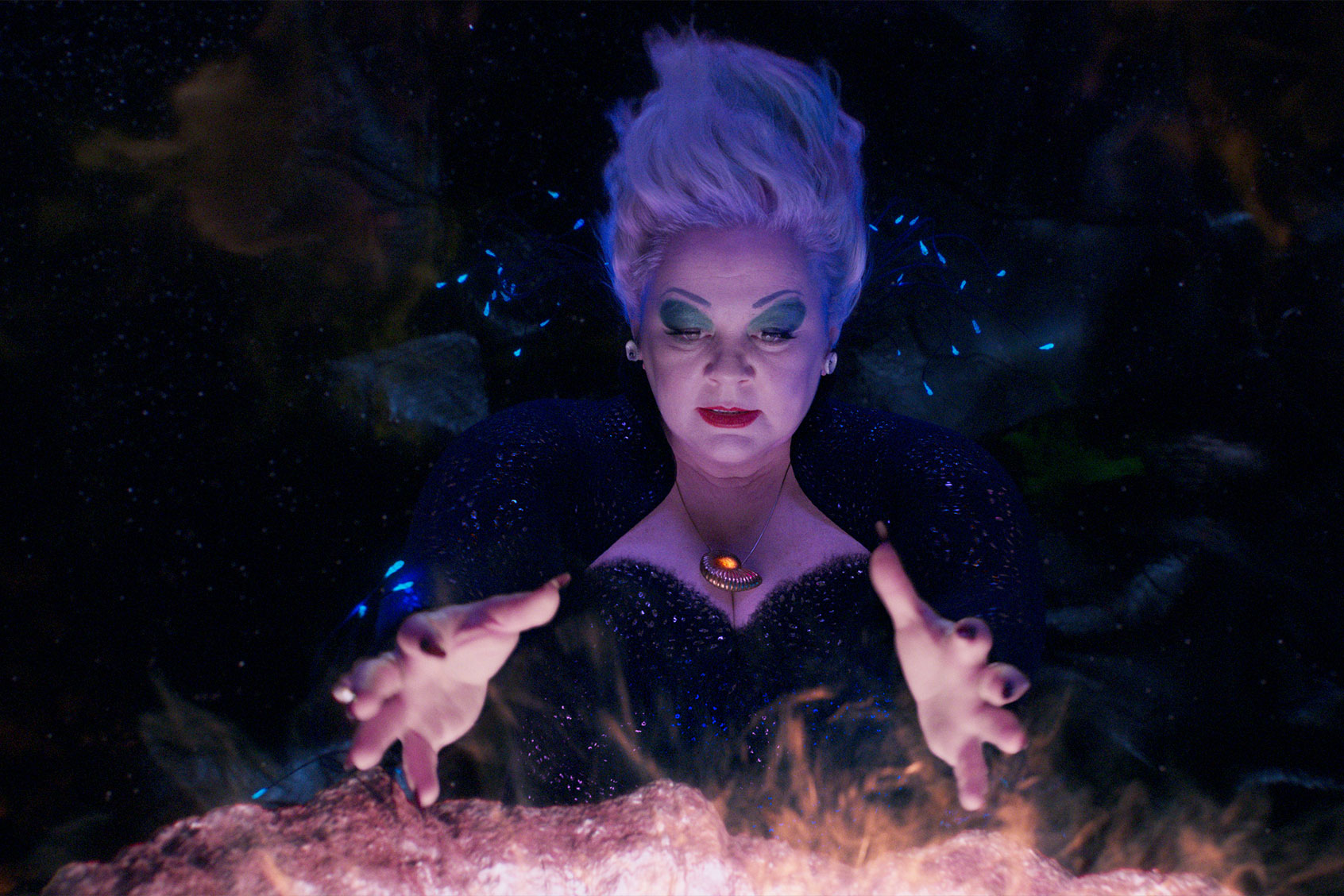
“We are still going to give it a chance.” 

America, business and especially Hollywood continues to make everything about race.

Movie day arrived. And my small family, including me, my wife, the baby and Auntie, hit the theater. 

Don’t make this about race, don’t make this about race, please don’t make this about race – swirled around in my head. The attempt is easier said than done because America, business and especially Hollywood continues to make everything about race. 

Seeing little Black girls in red wigs and mermaid dresses snapped me out of my thoughts. It made me think about the first time I saw “Do the Right Thing.” That feeling you get when you realize that you actually matter in cinema. Before that Spike Lee classic, I never thought there would be a film full of characters that dressed like me, obsessed over Air Jordans like me and dealt with racist police officers like me. I must have watched it on bootleg 20,000 times. Maybe my daughter will feel this way about seeing Halle portray Ariel. 

The new live-action “Little Mermaid” is very similar to the earlier Disney version. Ariel, forever curious about humans, saves a dude from a shipwreck. They fall in love to the point where she trades her beautiful voice and displays the willingness to abandon her sea royalty, ability to breathe underwater, beautiful tail, culture, family and all of her friends in an effort to pursue that love. The prince doesn’t have to give up anything, like he doesn’t even have to learn how to swim underwater, so you know all of the holiday dinners will take place with his side of the family. How fair is that? 

At the beginning of the film, we’re introduced to a rainbow collection of mermaids, from Asian to African – in what made-up a kind of all lives matter pool of mermaids. And then Queen Selina, Eric’s adopted mother, played by Noma Dumezweni, is also a Black woman (who does not have a Black king as a husband). But I’m not going to make it about race. All the races are here in some way or another – every box seemed to be checked, even though we weren’t there to check boxes, we were there to have fun. Sadly, race dictates fun

Because I don’t think it’s strange to question why the first Black Ariel had a European (white) father; her aunt Ursula is white and sets her sights on a white prince. What is the point of having a Black little mermaid if she’s just going to be thrown into a center of a white world? Ariel could not even save a Black dude from the shipwreck, because everyone on Prince Eric’s boat is white – she doesn’t even have a Black option. What is Disney trying to say? 

If Black lives matter, then shouldn’t Black families too?

Would giving “The Little Mermaid” a Black family turn the production into an undesirable Black movie? Both “Black Panther” films did extremely well with a mostly Black cast, as they rank amongst the top grossing Marvel movies. If Black lives matter, then shouldn’t Black families too? 

The Little Mermaid, 2023The Little Mermaid, 2023 (Disney)My daughter sings and dances to all of the songs, bouncing back and forth between her seat, my lap, her mother’s lap and Auntie’s arms. Her tiny face lights up the beauty of Ariel ripping through the cold sea, at Scuttle’s bizarre rap song and the quirkiness of Sebastian’s rants. Bailey does an amazing job, singing like an angel while mastering the delicate cadence of Ariel, and the film is beyond beautiful. Baby girl had a ball, and I wasn’t going to ruin it for her like they ruined it for Jessica. 

Jessica was a student in my writing class a few semesters ago. A young Black woman from west Baltimore, she identifies as awkward and loves anime. During the course, Jessica told a story of a time when she attended Miryokucon, an anime convention dressed as Goku from “Dragonball Z.” 

“I was so proud of my costume,” she explained, “Until some white kids dressed like Goku as well surrounded me, screaming that I looked stupid because Goku could never be a n****r.”

“Wait,” I chimed in. “They even racist at Comic-Con? What the hell! Really?” 

“Professor, this wasn’t Comic-Con; this was Miryokucon,” she corrected. “But yes, they are racist at Comic-Con too.” 

“What you do?” another student asked with a raised eyebrow. 

“I told those dumbasses that Goku isn’t white either so if I looked stupid, I didn’t, then they looked stupid too and to get the f**k out of my face,” she answered. “They left me alone, but it still ruined my experience.” 

I was not going to ruin this mermaid experience for my baby.

I just sat back in my chair and watched, wondering how cool it would be if Disney or Amazon created some special 3-D glasses that turned all of the white characters Black so that even when they made their attempts at diversity, Black parents like me didn’t have to leave theaters having to explain colorism to their kids. 

After watching the live-action “Little Mermaid,” a conversation about race will be had at some point, which has been a constant for Disney films. The singer Brandy wasn’t even allowed to have a Black prince when she played Disney’s “Cinderella” (Paulo Montalban, a Filipino American actor portrays the Prince) the same as Tiana’s prince voiced by Bruno Campos, in “The Princess and the Frog.” Maybe Disney doesn’t believe in Black fairy tales? Or maybe they feel like the multiracial fairy tale is an easier sell at this point. 

Either way, I settled for my daughter having the opportunity to feel represented in a world where there’s no such thing as a regular Black Disney prince and will try to push that conversation off until she’s old enough to understand why Hollywood still has the need to shy away from Blackness, even in diversity efforts. 

Because at this tender age, if my baby smiles, I smile, which is what these cartoons are about anyway.


Legal expert: Trump’s trusted Mar-a-Lago aides may soon be “testifying witnesses” against him

An employee at Mar-a-Lago who assisted with moving boxes of documents last June was questioned regarding his behavior in relation to a government request for surveillance footage from former President Donald Trump’s property, according to The Washington Post

The employee has been questioned several times by authorities after video footage revealed their involvement in assisting Walt Nauta, a Trump aide, in moving boxes into a storage room at Mar-a-Lago a day before Justice Department officials came with FBI agents to collect classified material in response to the subpoena, the Post reported last week.

“If true that the President Trump’s employees moved classified documents ahead of a DOJ visit to Mar-a-lago, those actions, if linked to President Trump, could be demonstrative of his intent to unlawfully prevent the retrieval of the documents,” Temidayo Aganga-Williams, partner at Selendy Gay Elsberg and former senior investigative counsel for the House Jan. 6 committee, told Salon. 

Special counsel Jack Smith’s investigators are trying to determine whether Trump or people close to him attempted to obstruct justice in response to a grand jury subpoena requiring the return of classified documents, or if they lied about what happened, people familiar with the matter told the Post.

As part of the investigation, authorities have also looked into incidents in mid-July related to a separate subpoena that sought surveillance footage from the property. 

During that period, the employee reportedly engaged in a conversation with an IT worker at the site, discussing how the security cameras worked and asked about how long images were stored in the system, a person familiar with the investigation told the newspaper. 

The employee later informed investigators that he had no intention of concealing anything from the authorities and was unaware of the investigation or the existence of the subpoena at the time of the conversation, according to another person familiar with the matter.

“But those answers were met with skepticism,” people familiar with the situation told the Post.

John Irving, a lawyer representing one of the two employees involved in moving the boxes, told The Post that the worker was unaware of their contents and was only trying to help Nauta, who was using a dolly or hand truck to move several boxes.

He later added that the employee helped Nauta pack an SUV when Trump left for Bedminster for the summer.


Want a daily wrap-up of all the news and commentary Salon has to offer? Subscribe to our morning newsletter, Crash Course.


“The DOJ’s next likely step is to seek the formal cooperation of both employees in its case against President Trump,” Aganga-Williams said. “The employees could very possibly be testifying witnesses in any future trial.”

He added that their testimony “could strengthen the special counsel’s case against President Trump by demonstrating his intent to not only obstruct the DOJ’s investigation, but also his knowledge that his continued retention of the classified documents was unlawful.” 

Before receiving the subpoena in May, Trump and his associates had engaged in what some officials have referred to as a “dress rehearsal,” which involved the movement of government documents that he wished to retain. 

Prosecutors also have evidence of Trump keeping classified documents in his office and sometimes showing them to people, according to The Washington Post. Legal experts have said that the report suggests the former president may be facing more serious charges than obstruction.

Recent reports indicate that Smith’s team is in the final stages of concluding its investigative work.

“It’s only 99 pages”: Republican mocked for whining that 3 days isn’t enough time to read debt bill

After returning to work Tuesday following Congress’ long weekend recess, a House Republican complained that legislators only have 72 hours to review the 99-page debt deal that President Joe Biden and House Speaker Kevin McCarthy, R-Calif., struck over the weekend. 

Rep. Ralph Norman, R-S.C., expressed disappointment with the new legislation, which would suspend the debt ceiling until 2025, institute federal spending caps and add work requirements for welfare recipients, during a Tuesday appearance on Fox News’ “America Reports.” 

Host John Roberts referenced Rep. Dan Bishop’s, R-N.C., opposition to the bill and call to bring a motion to vacate the chair, which would prompt a vote on whether McCarthy would remain speaker. 

“Would you consider a motion to vacate the chair over this?” Roberts asked.

“It depends how McCarthy deals… from here on out,” Norman responded. “I mean, we were over Memorial Day, and to get a call to comment, support a bill, the negotiated bill we hadn’t even read. It’s like the Pelosi days. You have to pass it before you can read it. This needs–”

Roberts interrupted Norman, reminding him that McCarthy is granting members of Congress 72 hours to review the document before voting on it, something former Speaker Nancy Pelosi, R-Calif., whose infamous comments on the 2010 Affordable Care Act Norman referenced, did not do.

“For this serious of a bill affecting the dollars that it is, and the financial security which is national security, you oughta have a lot more time and I think the date–” Norman continued after acknowledging the allotted consideration time.

But Roberts interrupted again.

“It’s only 99 pages,” he noted about the debt deal. When Norman responded seeking clarity, Roberts repeated himself.

“It’s only 99 pages – not the 2,000-plus that the Affordable Care Act was,” he said.


Want a daily wrap-up of all the news and commentary Salon has to offer? Subscribe to our morning newsletter, Crash Course.


Norman laughed and brought up one of Biden’s previous bills, which he said was over 4,000 pages and Congress had less time to review, before expressing his “serious concerns” about the legislation.

“At the end of the day, I think we gave away way too much and it’s time to negotiate and go back to the table,” Norman said.

Rep. Ted Lieu, D-Calif, mocked his Republican colleague’s claim on Twitter.

“Let’s do some math,” he wrote. “If GOP Rep Ralph Norman works 8 hours a day, that’s 24 hours over 3 days to read 99 pages. That comes out to reading a little over 4 pages every hour. And these are double spaced text pages.

“Alternatively, he can have AI summarize the bill for him in 1 min,” he added.

“Krebs will make a great trial witness”: Experts say new special counsel subpoena threatens Trump

Special counsel Jack Smith’s team investigating former President Donald Trump’s efforts to remain in office after the 2020 election subpoenaed two former White House aides in connection to the firing of former cybersecurity official Christopher Krebs, two sources with knowledge of the matter told The New York Times.

The subpoenas were issued to officials in the Presidential Personnel Office two weeks ago, the sources said, as Smith’s team seems to be turning its attention to determining Trump’s perspective of Krebs’ firing and a timeline of events leading up to the Jan. 6 Capitol attack.

Former federal prosecutor Andrew Weissmann, who served on special counsel Bob Mueller’s team, said it was a “very natural thing for Jack to examine as part of plot to overthrow the election.”

“Krebs will make a great trial witness for govt,” he predicted on Twitter.

Investigators have been questioning witnesses about the circumstances and events around Krebs’ termination. Krebs concluded after the 2020 race that the election was secure, countering Trump’s unfounded claims that it was a “fraud on the American public.”

Krebs’ agency affirmed the results’ security in a statement released nine days after the election with a scathing rebuke in boldfaced type of Trump’s claims.

“There is no evidence that any voting system deleted or lost votes, changed votes or was in any way compromised,” it read. 

Trump announced in a tweet five days later that Krebs had been “terminated” following the release of a “highly inaccurate” statement about the 2020 election.

In later testimony to the House Jan. 6 committee, Krebs said that he knew of “skepticism” among Trump’s allies of his “loyalty to the president.”


Want a daily wrap-up of all the news and commentary Salon has to offer? Subscribe to our morning newsletter, Crash Course.


A small group of those allies in the Presidential Personnel Office made a goal out of identifying and firing people within the administration believed to be disloyal to the former president, The Times reported, landing on Trump-appointed Krebs as one of the defectors.

The loyalist staff members wrote a memo detailing reasons to distrust Krebs, listing a swath of his alleged displays of disloyalty against Trump including: “Wife posted a family photo on Facebook with the ‘Biden Harris’ logo watermarked at the bottom.”

Investigators are probing witnesses about broader efforts, such as a questionnaire for new employees that asked questions like “What part of Candidate Trump’s campaign message most appealed to you and why?”, to determine loyalty among government officials and potential hires, the sources said. 

Smith’s team is also looking into how White House officials engaged the Department of Justice, which the sources said Trump turned to for support in his efforts to stay in power following his 2020 loss.

Former U.S. Attorney Joyce Vance said the subpoena is a “reminder of Trump’s efforts to corrupt the federal bureaucracy into a pro-Trump force of loyalists, after his efforts to have DOJ call the election for him failed.”

“Trump started by asking the FBI director for a loyalty oath to him personally, not the Constitution,” Vance tweeted. “He continued & finished as he started.”

“Et tu, Chick-fil-a?”: Far-right pundits turn on Chick-fil-A over diversity and equity initiative

After discovering a months-old update on Chick-fil-A’s website about the company’s diversity and inclusion initiatives, some ultra-conservative pundits have vowed to boycott the restaurant chain. 

As the Daily Beast’s Brooke Leigh Howard reported on Tuesday, the executive director of Citizens for Renewing America, Wade Miller, tweeted that “everything good must come to an end” after discovering that several years ago Chick-fil-A had hired a director of diversity, who also happens to be Black. 

“Here @Chickfila is stating it’s [sic] commitment to systemic racism, sexism, and discrimination. I cannot support such a thing,” Miller tweeted.

According to Howard, Erick McReynolds had been promoted to Chick-fil-A’s VP of Diversity, Equity and Inclusion in November 2021. Starting in July 2020, he served as executive director of Diversity, Equity and Inclusion. 

So, he was hired a while ago for both positions, but what seemed to alert conservatives to his newest role at the company was an update to Chick-fil-A’s website. On the page regarding their diversity and inclusion initiatives, corporate leadership writes they believe communities are “Better Together.” 

“When we combine our unique backgrounds and experiences with a culture of belonging, we can discover new ways to strengthen the quality of care we deliver: to customers, to the communities we serve and to the world,” it said. 

A statement from McReynolds is also included, which reads in part: 

Chick-fil-A restaurants have long been recognized as a place where people know they will be treated well. Modeling care for others starts in the restaurant, and we are committed to ensuring mutual respect, understanding and dignity everywhere we do business. These tenets are good business practice and crucial to fulfilling our Corporate Purpose. 

On Tuesday morning, Jeff Clark, an assistant attorney in the Trump administration, retweeted Miller’s tweet about the chain with the caption: “Disappointing. Et tu Chik-fil-a?” 

However, as Howard wrote, “self-described political strategist, Joey Mannarino, took the cake with his unhinged take.”

“It’s only a matter of time until they start putting tranny semen in the frosted lemonade at this point,” he tweeted. “I don’t want to have to boycott. Are we going to have to boycott?” 

It’s ironic, in a way, because conservatives have long viewed Chick-fil-A as being a company that has the same values as they do — and understandably so. 

“I don’t want to have to boycott. Are we going to have to boycott?”

You probably remember in 2012 when Dan Cathy — who is the son of the chain’s founder S. Truett Cathy and was the then-president and chief operating officer of Chick-fil-A — went on The Ken Coleman Show, a syndicated radio program and said he felt people were “inviting God’s judgment on our nation” by supporting the legalization of gay marriage. 

Then on July 2, about a month after speaking on The Ken Coleman Show, Cathy spoke with the Baptist Publication, The Biblical Recorder,  and when asked about opposition to his company’s “support of the traditional family,” Cathy responded that he was “guilty as charged.” 

“We are very much supportive of the family, the biblical definition of the family unit,” he said. “We are a family-owned business, a family-led business, and we are married to our first wives. We give God thanks for that.” 

He continued, “We know that it might not be popular with everyone, but thank the Lord, we live in a country where we can share our values and operate on biblical principles.” 

This kicked off a series of protests against the company, as well as a number of queer “kiss-ins” at the restaurant. The statements — along with the company’s long history of donating to anti-LGBTQ causes — left an incurably bad taste in many people’s mouths. 

“Let’s face it: despite what the company’s president says, Chick-Fil-A is an anti-gay corporation,” Tyler Coates wrote for BlackBook in 2012. “And, on that note, I’m just going to have to assume that anyone who spends their money there are completely fine with the fact that an anti-gay corporation not only exists, but pushes money to other groups to continue the widespread practice of discriminating against everyone in the LGBT community.”

Chick-fil-A isn’t the only ‘conservative-coded’ company that has drawn the ire of their fanbase in recent weeks.

Chick-fil-A isn’t the only “conservative-coded” company that has drawn the ire of their fanbase in recent weeks. Prominent right-wing talking heads — ranging from Kid Rock and Travis Tritt to Dan Crenshaw and Ted Cruz — boycotted Bud Light after the band partnered with trans activist and actor Dylan Mulvaney for a March Madness Instagram post. 

And, as Salon Food reported, Bud Light is now simultaneously being investigated by the Senate and chastised by the Human Rights Campaign for their tepid response to the transphobia their campaign ignited. Bud Light entered the culture war fray without picking a side and in trying to please everyone, the beer brand angered everyone. 

Something similar may be happening here with Chick-fil-A, though on the surface, the timing looks a little suspect. As Howard reported, according to internet archives, it seems like the passage on Chick-fil-A’s about being “Better Together” has been up since at least September (so for almost nine months). 


Want more great food writing and recipes? Subscribe to Salon Food’s newsletter, The Bite.


Why are these pundits noticing it now? 

Well, leading up to Pride month, when all eyes are on companies and their respective responses to the mounting homophobia and transphobia across the United States — it seems like maybe they’re looking for something fresh with which to anger their audiences, just as they’ve done again and again. And what’s more bittersweet than when the target was someone or something you thought was one of your own? Let’s see how long this boycott lasts. 

What was behind Australia’s potato shortage? Wet weather and hard-to-control diseases

If you’ve been into a fish and chip shop in the last twelve months, you may well have seen a notice tacked to the wall about the impact of the potato shortage. Supermarkets, too, slapped temporary limits on frozen chip purchases.  

What was behind it? Wet weather, floods — and highly persistent fungal diseases. Growers in Tasmania were worst hit, with mainland growers in New South Wales and Victoria also hit.

Even 175 years after Ireland’s devastating famine caused by an introduced potato blight, we’re still struggling to combat these diseases. That’s a problem, because potatoes are vital. More than a billion of us eat them regularly. They’re the fourth most important staple food after rice, wheat and corn and the largest non-cereal crop.

Diseases such as pink rot and powdery scab can live in the soil for years. They’re almost impossible to eradicate down there. When there’s a sudden pulse of water, they spread and can destroy entire fields of potatoes.

What we can do is be better prepared. Our research team is monitoring soil moisture and temperature levels to help us predict whether we’re likely to see an outbreak. This knowledge could let growers respond quickly with fungicide or stopping irrigation to slow or prevent a severe outbreak.


So what caused the shortage?

In the lead-up to Christmas last year, Australia had a major potato shortage.

Our main growing regions in Tasmania, Victoria and South Australia were hard hit by flooding and heavy rain due to La Niña, which created conditions ripe for potato diseases to spread. Waterlogged or diseased potatoes cannot be sold.

Other issues included delays to harvesting and planting due to the weather. And the skyrocketing costs of fuel and fertilizer have forced some growers not to plant potatoes. Potatoes need a lot of fertilizer and water.

While you might associate these tubers with snack foods, in reality they’re highly nutritious and an important source of complex carbohydrates.

The way we grow them is very efficient. The amount of food energy we get per hectare of potatoes is many times greater than other staples like rice and wheat.

Stored properly, potatoes can last up to eight months.

Many growers find them to be one of the most profitable crops they can grow — as long as they’re prepared to face risks such as disease.


What’s next for our potato sector?

With the major rains at an end for now, potatoes are returning to the shelves and frozen food section.

But potato lovers aren’t out of the woods yet. For producers, there are still many worries. The increasing costs of production in fertilizer and other inputs. The chance of renewed heavy rainfall. And the continual battle against soil-borne disease.

Take Tasmania’s growers, who produce almost a third (31%) of Australia’s potatoes.

Unexpectedly wet soil conditions in spring last year forced many growers to delay planting until after mid-November.

Planting after this date comes with a cost. It means that by the time the plants mature, Tasmania will be through summer and into cooler months, reducing available sunlight and growing temperatures. That can mean a lower yield.

Facing delays like this, growers often simply don’t plant a crop at all. But because of the shortages, Tasmania’s major processing companies offered a bonus to encourage a late crop to ensure factories could keep running.


The eternal fight against disease

Ever since potatoes emerged from the Andes to become a global crop, growers have battled the threat of soil-borne fungal and bacterial diseases.

Backyard gardeners may well be familiar with some of these. If you’ve ever pulled up a potato plant only to find a half-rotten tater, you’ll know the disappointment.

What keeps Australian growers up at night are diseases like powdery scab, as well as rot diseases like black leg, soft rot and pink rot.

Powdery scab is mainly a cosmetic issue, turning nice-looking potatoes into unappetizing, lesion-covered blobs.  

But rot is real trouble. These bacteria and fungi can destroy entire fields.

Pink rot is heavily influenced by free water in the soil. Heavy rainfalls just before an autumn harvest have triggered major rot epidemics with significant losses to growers in three of Tasmania’s last five growing seasons.

In severe cases, growers have to abandon fields with the tubers left to rot away,  while in less severe cases there’s still substantial loss of crop and lower product quality.

If we see these levels of unprecedented rainfall again — as is likely with climate changes warping weather patterns — we’re like to see more potato shortages.

So what can growers do? For pink rot and powdery scab disease, we don’t have good options. There are a few disease-resistant varieties, but their resistance comes at the cost of desirable properties like crop yield and how well they cook. Chemical controls are limited and if we overuse them, we risk these fungi developing resistance just as bacteria do with antibiotics.

Fungi and bacteria can lie dormant for many years or stay alive on other plant species between crops. That limits how effective crop rotation is as a tool.

Cropping land proven to be pathogen free is in very short supply. Food industries which rely on potatoes are compensating for these expected losses by contracting a greater number of growers and over-planting.

But it’s not a hopeless case. We and other researchers are working on it. Recently, we made a new tool to help rapidly spot powdery scab disease in new potato varieties.  

Now we’re working on ways to track changes in soil moisture and temperature against rot and powdery scab outbreaks. This, we hope, will let us predict outbreaks before they occur.  

Sometimes, you don’t have to defeat a disease outright. Better prediction and containment may be enough to keep us supplied with hot chips.

Ronika Thapa, PhD Student, University of Tasmania; Calum Wilson, Professor, University of Tasmania, and Robert Tegg, Research Fellow, University of Tasmania

This article is republished from The Conversation under a Creative Commons license. Read the original article.

Is AI really a threat on par with nuclear war? Some experts aren’t convinced

The artificial intelligence world faced a swarm of stinging backlash Tuesday morning, after more than 350 tech executives and researchers released a public statement declaring that the risks of runaway AI could be on par with those of “nuclear war” and human “extinction.” Among the signatories were some who are actively pursuing the profitable development of the very products their statement warned about — including OpenAI CEO Sam Altman and Google DeepMind CEO Demis Hassabis. 

“Mitigating the risk of extinction from AI should be a global priority alongside other societal-scale risks such as pandemics and nuclear war,” the statement from the non-profit Center for AI Safety said. 

But not everyone was shaking in their boots, especially not those who have been charting AI tech moguls’ escalating use of splashy language — and those moguls’ hopes for an elite global AI governance board. 

TechCrunch’s Natasha Lomas, whose coverage has been steeped in AI, immediately unravelled the latest panic-push efforts with a detailed rundown of the current table stakes for companies positioning themselves at the front of the fast-emerging AI industry. 

“Certainly it speaks volumes about existing AI power structures that tech execs at AI giants including OpenAI, DeepMind, Stability AI and Anthropic are so happy to band and chatter together when it comes to publicly amplifying talk of existential AI risk. And how much more reticent to get together to discuss harms their tools can be seen causing right now,” Lomas wrote

“Instead of the statement calling for a development pause, which would risk freezing OpenAI’s lead in the generative AI field, it lobbies policymakers to focus on risk mitigation — doing so while OpenAI is simultaneously crowdfunding efforts to shape ‘democratic processes for steering AI,'” Lomas added.

Other field experts promptly shot back at the tech execs’ statement. Retired nuclear scientists, AI ethicists, tenured tech writers and human extinction scholars all called the industrialists to the carpet for the use of inflammatory language. 

“This is a ‘look at me’ by software people. The claim that AI poses a risk of extinction of the human race is BS,” retired nuclear scientist Cheryl Rofer said in a Tuesday tweet. “We have real, existing risks: global warming and nuclear weapons.” 

The use of scary language and fear as a marketing tool has a long history in tech.

Émile Torres, a historian of human extinction (and Salon contributor), was quick to point out the hypocrisy of tech giants’ role in manufacturing an already unethical AI development environment. 

“You’ll never see these people signing a document like this about prioritizing the mitigation of harms, some profound, already being caused by AI companies like OpenAI,” Torres said is a series of tweets. “No, those harms are just ‘mere ripples’ and ‘small missteps for mankind’ in the grand cosmic scheme of thing.”

“A few weeks ago [Altman] was pontificating about leaving the EU market due to proposed training data transparency requirements. Do not take these statements seriously,” said tech writer Robert Bateman in a tweet. 

The use of scary language and fear as a marketing tool has a long history in tech. And, as the LA Times’ Brian Merchant pointed out in an April column, OpenAI stands to profit significantly from a fear-driven gold rush of enterprise contracts. 

“[OpenAI is] almost certainly betting its longer-term future on more partnerships like the one with Microsoft and enterprise deals serving large companies,” Merchant wrote. “That means convincing more corporations that if they want to survive the coming AI-led mass upheaval, they’d better climb aboard.”

Government tech contracts can be just as lucrative as enterprise contracts for a burgeoning company at the head of a digital revolution — as Microsoft would know, with its financial foundations rooted in mass public-sector deployment. It’s too early to speculate on whether government contracts may be a target market for a company like OpenAI, as it is for Clearview AI, the controversial facial recognition software often used by law enforcement agencies to monitor protests. But with Microsoft’s latest announcement that some OpenAI features will be integrated into certain upcoming Windows systems — and the recent successes of Altman’s Congressional charm offensive — lawmakers have reason to pause when considering the gravity of the tech executives’ wording here.

Fear, after all, is a powerful sales tool. 


“Attacking Kayleigh McEnany is insane”: Right-wingers turn on Trump over Truth Social attack

Former President Donald Trump is facing a deluge of criticism after he attacked Fox News host Kayleigh McEnany, his former White House press secretary, on social media Tuesday.

Trump went after McEnany on Truth Social after she referenced poll numbers for the 2024 Republican primary, which Trump claimed were false, during an appearance on the conservative news network’s “Jesse Waters Primetime” on Tuesday. 

“The DeSantis team would say, you know, ‘We just had polling come out that shows we closed the gap by 9 points since we announced in Iowa,'” McEnany said during the segment. “Still, Trump’s hugely ahead, but they say they’re closing the gap. That’s their argument… If you look at the polling now, it was Trump 34 in Iowa, it’s now Trump 25.”

Trump spouted off against McEnany in response, calling the “Outnumbered” co-host milquetoast, though he misspelled the term.

“Kayleigh ‘Milktoast’ McEnany just gave out the wrong poll numbers on FoxNews,” Trump posted. “I am 34 points up on DeSanctimonious, not 25 up. While 25 is great, it’s not 34.”

“She knew the number was corrected upwards by the group that did the poll,” he continued. “The RINOS & Globalists can have her. FoxNews should only use REAL Stars!!!”

Rep. Chip Roy, R-Texas, added to Trump’s tirade against the anchor in a Tuesday night appearance on “The Ingraham Angle,” where McEnany was filling in, as he discussed the debt deal President Joe Biden and House Speaker Kevin McCarthy, R-Calif., reached over the weekend. 

When McEnany asked Roy what he felt would be a “realistic alternative” to the agreement, which would raise the debt ceiling until January 2025 among other measures, Roy responded with a reference to Trump’s Truth Social post.

“Everything that we’re seeing out of… this deal hatched this weekend is pretty milquetoast, if that word might mean something to you,” he told McEnany, according to The Daily Beast, before explaining his opposition to the deal. 

“The alternative is pretty simple: you have about $28 or $29 billion in COVID funds, you have $80 billion in IRS money—all of us agreed it should go away,” he added. “The No. 1 thing we campaigned on was getting rid of that IRS money.”


Want a daily wrap-up of all the news and commentary Salon has to offer? Subscribe to our morning newsletter, Crash Course.


Trump’s attack, however, drew the ire of some conservatives, including several of his former White House aides and staffers during his 2020 campaign for the presidency, many of whom flocked to McEnany’s defense, Mediaite reports

“This nonsense from Trump is a disgrace. @kayleighmcenany slayed the fake news hoaxers and the liberal media activists day in and day out for years,” Matt Wolking, a former deputy director of communications for Trump in 2020, tweeted. “She took countless arrows defending him and she was great at it.”

Former Trump legal advisor Jenna Ellis also agreed with criticism of the GOP frontrunner’s post, which said that the former president’s insult was a “bad pitch for a second term,” in a tweet of her own.

“I will simply leave this here for when people ask why I and *many* others didn’t return for 2024,” she said.

Fox News anchor Brian Kilmeade slammed Trump and defended his colleague on “Fox & Friends” while covering Republican primary candidate and Florida Gov. Ron DeSantis’ “subtle shots at Trump” during a recent Iowa stump speech.

“Restoring sanity means we’ve got every major institution in our country going in ideological joyrides; we have to be guided by reality, by facts, and our enduring principles,” Kilmeade read from DeSantis’ speech.

“Three shots at common weaknesses of the president,” Kilmeade said. “They see you make things up. They say he’s he flies off the handle. For example, attacking Kayleigh McEnany is insane. She was one of the best press secretaries ever. Dana Perino, as Ari Fleischer watching to say she was fantastic, but she’s an analyst now. She doesn’t work for any campaign.”

Biden sexual assault accuser Tara Reade defects to Russia and asks Putin for citizenship

A former Senate aide who in 2020 accused President Joe Biden of sexually assaulting her has relocated to Russia ahead of the upcoming election and is asking Russian President Vladimir Putin for citizenship, CBS News reports.

Tara Reade, who worked in then-Sen. Biden’s office in 1993, told Russian press organization Sputnik that when visiting Russia for a vacation, she decided to stay after a Republican legislator warned her of potential danger. 

“I’m still kind of in a daze a bit but I feel very good,” she said of the move while sitting beside Maria Butina, a Russian agent convicted and jailed in the US who’s now a member of Russia’s Parliament. “I feel very surrounded by protection and safety.

“I just really so appreciate Maria and everyone who’s been giving me [protection] at a time when it’s been very difficult to know if I’m safe or not,” she continued. “I just didn’t want to walk home and walk into a cage or be killed, which is basically my two choices.”

Reade first garnered media attention during the 2020 presidential election when she claimed Biden sexually assaulted her in August 1993 in a Capitol Hill corridor. The 59-year-old said she had filed a complaint after the alleged incident, but there are no records of it, nor is it clear if her claims have been investigated. A 1996 court document, however, cites her ex-husband as having mentioned her complaints of sexual harassment in the then-senator’s office.

Biden has repeatedly denied the allegations.

“It is not true. I’m saying unequivocally it never, never happened,” he said in a 2020 “Morning Joe” interview.

Reade, a self-proclaimed geopolitical analyst, also told Sputnik that she faced threats against her life after going public with the accusations in 2020. As campaigns for the 2024 election begin, according to The Guardian, she has recently considered testifying against Biden before the House Republican committees.


Want a daily wrap-up of all the news and commentary Salon has to offer? Subscribe to our morning newsletter, Crash Course.


The decision to relocate to Russia “was very difficult,” she said. “I’m not an impulsive person. I really take my time and sort of analyze data points.

“And from what I could see based on the cases and based on what was happening and sort of the push for them to not want me to testify, I felt that while this election is gearing up and there’s so much at stake, I’m almost better off here and just being safe,” she continued.

During the Russian press appearance, Reade, according to CBS News, said she has “always loved Russia” and alongside many other Americans does not see the country “as an enemy.”

“To my Russian brothers and sisters, I’m sorry right now that American elites are choosing to have such an aggressive stance,” The Guardian quotes her as saying. “Just know that most American citizens do want to be friends and hope that we can have unity again.”

As reported by CBS News, Reade also made a request of Putin: Though she would like to keep her U.S. citizenship, she would “like to apply for citizenship in Russia, from the president of the Russian Federation, Vladimir Putin… I do promise to be a good citizen.”