Spring Sale: Get 1 Year, Save 58%

The frittata that bought us a house

No matter how many times I brought it up, Epiphania always gave the same sad answer in her cadenced, Italian accent: “No, you can’t buy it! The house is not on the market!”

I knew the instant we walked into the Connecticut farmhouse that this was the place for us. Initially, we were there looking for a place to rent because my husband, Bob, had been offered the directorship of a museum nearby. Our plan was to get to know the area and eventually buy a place. This would mean a long commute for me back to the Hudson Valley, but this was a terrific new opportunity for him. Even though we were only there to consider renting the place, in those first few moments in the grandma kitchen, with its tiny-apple wallpaper and vintage wood stove, I had an uncanny feeling that this was where we belonged.

A few weeks later, at the lease-signing around the dining room table, after all the real estate agents had left, Epi, as she is called, offered us a slice of pear cake, made with fruit from a tree woven into a pergola over the back deck. Taking a bite, and recognizing the taste, I asked her if it was Marcella Hazan’s famous recipe, to which she replied: “No.” Then, quickly, “YES! Yes, it is . . . I’ll have to tell her!” Having spent weekends and summers here for more than 30 years, Epi had been renting out the house for a few years now and lived in New York City, where she had met and become acquainted with her. I had made Hazan’s cake many times myself. It seemed like another sign that we were in the right place.

In short order, it was very apparent Bob’s new job was a terrific fit, so we put our Hudson Valley home on the market. Sensing that this was how things were developing, every time I spoke with Epi, I mentioned how much we loved the house, and asked if she would consider selling, but her answer never varied.

“No, it’s not on the market. It’s not for sale!”

Even as she repeated this, deep down, I knew something that she did not yet understand: we belonged in this house. The past year of living there only deepened my sense that this was the house for us.

Having tasted the sweet ether of equity with our first house, we were eager to stop paying rent and get back to owning something. Once we got an offer on our Hudson Valley house, we started looking in earnest for a place in Connecticut. We saw many houses, a few of them OK, but none compared to Epi’s farmhouse. If you stand at the sink in the farmhouse and look out the window you can see that pear tree in the pergola, a deep yard with a variety of trees and shrubs, an old stone barn foundation, a meadow, and finally, distant hills. None of the views from any of the other houses could offer even half of this happy distraction.

As our house-hunting went on, I kept Epi informed of our constant search hoping this could somehow persuade her to change her mind but it never worked.

The closing date was set for our old house and we needed to renew our rental lease. Epi said she could meet us to discuss the details on a weekend in November when she was visiting her daughter, who lives nearby. We settled on a Sunday afternoon, and in the hopes of softening her resolve, I offered to prepare a simple lunch.

Whenever hosting a meal, I always try to figure out what can be made ahead of time, and for a light lunch I decided frittata would be perfect. Growing up, frittata was one of the dishes my mother relied on to stretch the budget to feed our family of six. Once I had my own kitchen, it was one of the dishes I could count on to feed a crowd on the cheap. Now, its frequent appearance at the table is more a matter of just how much I like it.

My favorite combination is the one I chose to make for Epi: a mix of bitter greens, sautéed potato, and sharp cheese. This time around, though, it felt like the stakes were very high. This woman knows Marcella Hazan! She’d certainly know if my lunch wasn’t up to snuff.

I never took more care with the completion of a frittata. I squeezed every drop of moisture out of that spinach. I babied those potatoes so they would not brown. I diced the fontina so it was the perfect size to melt into sharp and salty surprises. I cooked the whole thing over the gentlest heat, flipping it over halfway so it would be evenly cooked. I carefully slid it onto a cooling rack so no moisture would dampen the bottom. I pulled out my best frittata-sized platter and set the table.

Epi arrived on time for our noon showdown. Unfortunately, Bob had to work that morning and was delayed, so we were forced to make small talk around the kitchen table. Although we weren’t seeing eye-to-eye on the house, it was clear we were fond of each other. I suggested we go ahead and eat, but she insisted she didn’t want anything. It seemed her only desire was to finish negotiations and be on her way. But we sat so long waiting for Bob — the aromas of the frittata wafting up from the platter on the table — that once he arrived, she finally agreed to have a slice. By then, it was the perfect temperature. Although you can enjoy a frittata hot, warm, or cold, I think it is truly best when just barely warm. All the flavors come through and are at their most harmonious.

I watched her take her first bite. She seemed surprised, then pleased. Then she finished the slice I gave her. And she allowed me to give her a little more.

After we agreed on the lease terms, I made one last pitch for buying the house. Once more, she wouldn’t budge. I was sad that our house-hunting would have to continue.

The next day, though, I received an email from her summarizing our discussion, and much to my surprise, at the end of it she wrote that we could revisit the discussion of a possible sale in March. It was the first time she seemed remotely open to the idea.

My opening salvo to sweeten the deal was to offer to store her belongings in the adjacent barn for a year to give her more time to make plans. Eventually, after much complicated back-and-forth, we came to an agreement. We could scarcely believe it when we signed the contract that made the farmhouse ours. Bob always joked that it was my frittata that sealed the deal, but I always laughed it off — until she came to retrieve her furniture.

Epi returned a year later, with a rented truck and some hired hands to help her. I mostly left them on their own as they emptied the barn. I couldn’t wait to turn it into a summer kitchen.

At the end of the day, as the truck was pulling off, she knocked on the kitchen door to say goodbye. I walked her to her car, where we were alone for a few moments.

She looked over at the new picket fence we’d installed along the road between the grand maples. “Are those roses?” she asked.

“Yes,” I said. “We hope they will eventually climb along the fence.”

She nodded approvingly.

Adjacent to the driveway, there is a door to the basement and two narrow, eight-pane windows that are from the original construction in 1785. They had been painted a very drab grey. Since they are the first details you see when you arrive at the house, we painted them a pale blue-green, which contrasts nicely with the stone lintels that surround them.

“I like this color here,” she said.

Then she turned to me, “You know I had no intention of selling you this house. But I knew you loved it . . . and you made me that frittata . . .” she said, wagging a finger in my direction.

She took one final spin around, taking in everything, and just before she headed to her car, she looked me in the eye and said, “I found the right people for this house.”

Recipe: Spinach, Potato and Cheese Frittata

17 quinoa recipes from chewy cookies to salads

You might hear “quinoa” and be immediately be transported back to around 2009, where you couldn’t avoid the grain anywhere, and you keep hearing the word “superfood.” (For the record, I think all food is super). Those days are gone, but we still love quinoa. It’s versatile, filling, and an excellent grain to have in your repertoire. From savory quinoa salads and stews to sweet applications (like quinoa cookies and cakes!), we’re sharing 17 quinoa recipes that are anything but boring.

Our best quinoa recipes

1. One-Pot Kale and Quinoa Pilaf

I would normally run away from any recipe that calls for both kale and quinoa, but this one is actually delicious (promise). If you’re looking for a way to up your intake of greens and grains, it doesn’t get better than this salad.

2. Quinoa Salad with Hazelnuts, Apple, and Dried Cranberries

Serve this for your next fall harvest party (because that’s obviously a thing, right?) and then have the leftovers for lunch the next day. Shhh: Don’t tell your guests, but we like it better on day two anyway!

3. One-Pot Corn, Tomato, and Quinoa Pilaf

If this salad doesn’t say summer, I don’t know what does. It calls for fresh corn kernels
 and cherry tomatoes, both of which are at their best when the weather is warm.

4. White Bean and Quinoa Burgers with Sumac Yogurt

Your new favorite veggie burgers!

5. Apple Cider Chicken with Butternut Squash and Quinoa Salad

Did you stock up on too much apple cider at the orchard? Been there, done that. Fortunately, this chicken and quinoa recipe uses a lot of it in both the apple cider glaze and the salad vinaigrette.

6. Dark Chocolate Ganache Tart with Rosemary-Quinoa Crust

The secret to this extra-crunchy crust is uncooked black quinoa, which is blended in a food processor until it breaks down into almost flour (there will still be some crumbs and that’s a good thing).

7. Autumn Chili Bowl with Roasted Sweet Potatoes and Quinoa

As soon as I turn the calendar to September, this quinoa bowl is exactly what I’ll be digging into, day in and day out.

8. Quinoa Almond Tuiles

Tuile cookies are notoriously difficult to make, so the idea of making them potentially more finicky by changing the recipe and adding quinoa scared the living daylights out of me. However, Susan Spungen insists that there’s no need to fear — “These lacy cookies are quite easy and quick to make, despite their impressive appearance.”

9. Quinoa and Mango Salad with Lemony-Ginger Dressing

This gorgeous salad is inspired by Trader Joe’s mango-black bean salsa. You can make it even more appealing come summertime by grilling the onions and mango, and adding corn on the cob.

10. Baked Quinoa-Pork Meatballs

“Instead of breadcrumbs, these meatballs call in cooked quinoa.” Did you do a double-take because I did? I am as obsessed with these meatballs as I am with Emma Laperruque’s recipe brilliance.

11. Toasted Almond and Coconut Quinoa Porridge

Switch up your usual bowl of overnight oats for this cozy, creamy quinoa that’s studded with slivered almonds and pitted dates.

12. Quinoa Cookies with Coconut and Chocolate Chunks

Not only do our readers consider this dessert their favorite quinoa cookie, thanks to its chewy texture and earthy flavor — it’s their favorite quinoa recipe of all time.

13. Guacamole Quinoa

Bet you never imagined that this grain was not only a good source of energy, but also a delicious twist on guacamole. Mash together the makings of guacamole (avocado, tomatoes, garlic, jalapeño peppers, and cilantro) and cooked quinoa for a salad, dip, or both!

14. Paula Shoyer’s Chocolate Quinoa Cake

Flourless chocolate cakes are delicious, but their texture stands alone. While fudgy and decadent, they don’t exactly produce a traditional slice of chocolate cake . . . at least until now. When run through a food processor, cooked quinoa turns into a superfine crumb that gives this gluten-free beauty the body we’ve been craving.

15. Quinoa–Red Lentil Risotto with Asparagus and Peas

Don’t tell your Italian grandmother, but you actually can make delicious risotto with a combination of red lentils and quinoa.

16. Strawberry and Quinoa Salad with Tarragon, Soft Goat’s Cheese, and Poached Egg

Jammy soft-boiled egg, tangy goat cheese, zesty orange, and juice strawberries come together for the quinoa salad of the summer.

17. One-Pot Red Curry Quinoa with Coconut and Greens

For years, I gave quinoa an unfair rap for being bland and uninspiring. Recipes like this one, which features a fragrant mix of red curry paste and coconut water, make it so much more interesting. “The quinoa will be infused with bold, bright flavor and stained a beautiful red from the curry paste, and by using coconut water versus coconut milk, it’ll be light and fluffy,” explains recipe developer EmilyC.

Making the bodies of “The Staircase”: The challenge of depicting Kathleen both in life and in death

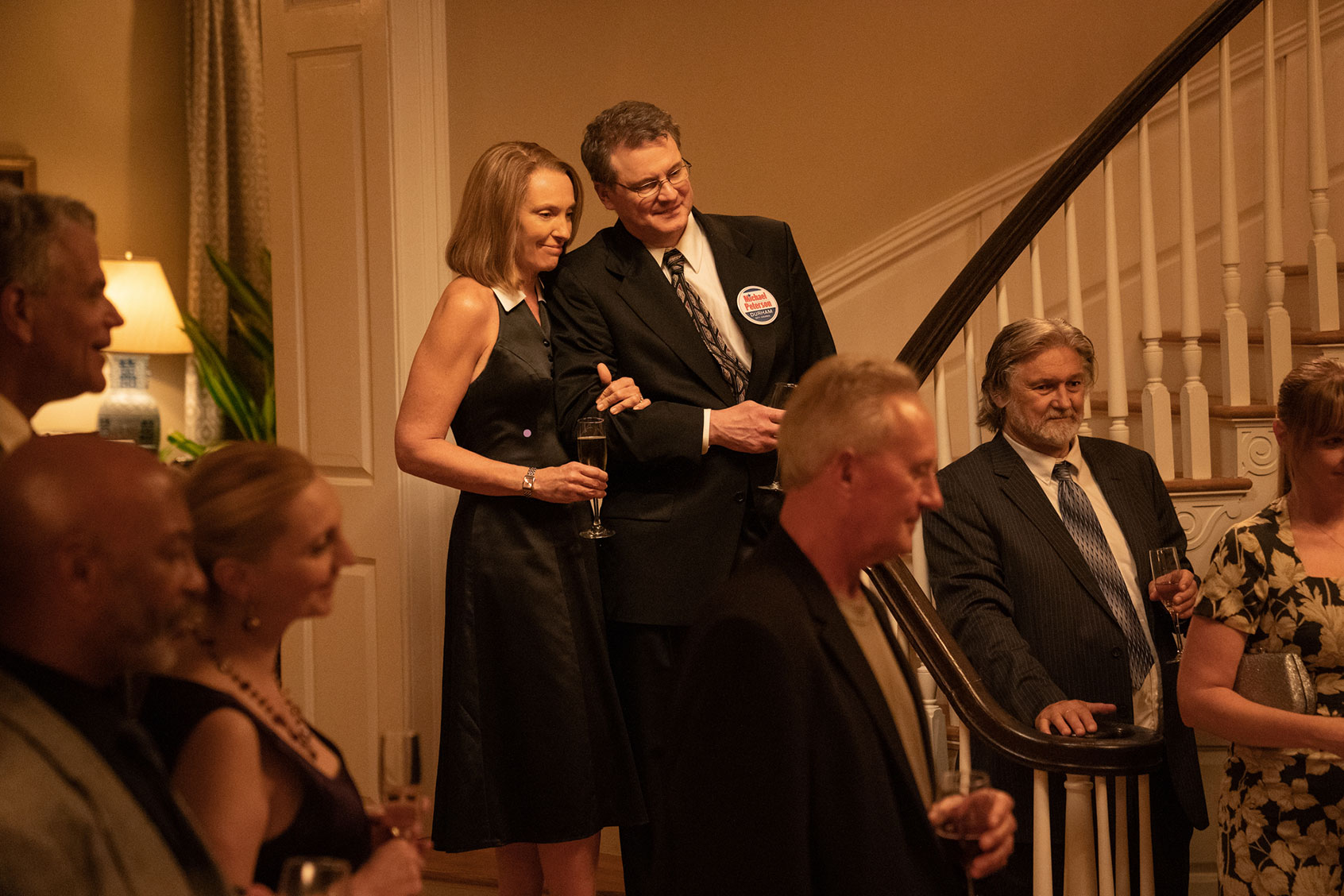
In “The Staircase,” Kathleen Peterson (Toni Collette) falls. Later, we see her fall again and again. We see the violence from multiple angles, in present time and reenacted by investigators trying to figure out what happened, what killed the woman who died in 2001 and if her husband, writer Michael Peterson, had anything to do with it. 

But in the first episode of the HBO Max series, we see the aftermath of the violence in difficult, lingering detail for the first time (there will be other times). We see the body, its stillness, its horrible silence. And it looks real.

RELATED: Before stepping into “The Staircase,” let’s take a swoop through The Owl Theory

This is certainly not the first time this story has been told and may not be the last. But at its heart is a woman who was lost. How to convey the magnitude of that loss, and also, the shocking and confusing violence that took her from the world? 

To make Kathleen seem real, “The Staircase” turned to Collette, who inhabits the role in scene after scene of a woman — an executive, once the first female engineering student at Duke University, a mother and stepmother — who appears dynamic, engaging, loving and full of life. To make her death seem real, and the tragedy it is, series creator, writer and director Antonio Campos turned to Mike Marino, an Oscar-nominated makeup and prosthetic artist.

Marino, who has pictures of “The Staircase” prosthetics and remarkable special effect work on his Instagram [warning: some of the images are graphic] called Campos “a perfect director, because he understands the technical value of effects . . . he’s very aware of each department. And I think that he trusts, much like Martin Scorsese does, trusts his people he hires, and collaborates with them and doesn’t disappear.” Marino’s long list of credits include “Black Swan,” “Batman” and “The Dead Don’t Die.”

But the challenge for Marino and “The Staircase” was that the show is not about monsters, but about a real person who lived and had something monstrous happen to them (and is still the subject of a cold case). How did they make the bodies of “The Staircase,” and how did they recreate a lived life? How does the series walk the line between being respectful and being realistic? 

The StaircaseThe Staircase (Photo courtesy of HBO Max)Salon interviewed Campos and Marino as well as “The Staircase” writer/executive producer Maggie Cohn.

This interview has been edited for length and clarity. 

You have such a large cast here, a big, blended family that go through time. What were some of the challenges of showing this real family and their long and complicated relationships?

Antonio Campos: Well, the challenge when you’re telling a story that’s this expansive and that covers a lot of time and ground is okay, so what are the beats? What do we include here? How do we collapse time? Some of that was very subtle because it’s not like people are aging drastically in that amount of time, so you have to figure out how do you communicate that with hair or with makeup? And then, how does the actor, through their performance communicate that they’re older? The way they move or the way they talk.

“She is this ball of life. She is the anchor, she is the glue. And then the minute that she’s gone, the family starts to come apart, the seam starts to tear.”

How do you convey three different timelines, but still make each one feel very present? Because we don’t want the past to feel like the past or the future to feel like the future. They all have to feel like they’re happening at the same time and as urgent. We made them all feel the same in a way. 

Everything was so connected and there is this idea that it is all kind of happening at the same time. Even though you know that Kathleen Peterson will die on this day, you still feel like – one of the things we built into the story are moments where something dangerous happens, where she falls off a ladder, where she hits the deer. And then, you have to remind yourself,  “Oh, right. There are still months to go.” Playing with the audience’s expectations and making everything again, feel urgent and very present . . . you feel like it’s all happening at the same time. 

We get a real sense of Kathleen in the show. And so, we know we’re going to lose her and the loss is going to hurt.

Campos: I think the thing with Kathleen, when you watch the documentary, you feel her absence, but you also feel there’s a void because it’s like, who is this person? So often in documentaries, in crime documentaries, the deceased is just that. There is a photograph or fleeting images in home movies. 

The StaircaseThe Staircase (Photo courtesy of HBO Max)Part of the series that we were so excited about was to try and breathe life into our version of Kathleen and to find the person that could complicate her and make her multidimensional and multifaceted. And we always knew that – I mean, there was no one else in our mind besides Toni Collette, because immediately, you knew that there was going to be this kind of performance that she was going to give that would be so human and layered and have light and dark and everything in between.

“In true crime, the victim is typically expressed as an absence. It’s the last of the person.”

Basically the way Toni’s schedule worked out on the shoot was she would come in for her block and we would shoot her scenes first and then she would be gone for like the next three or four weeks, and then she’d come back. When she would leave, you would all of a sudden feel that energy just disappear. It really felt like all of a sudden, oh, Kathleen’s gone. You would feel that shift in the energy. In a way, that is what happens after Kathleen dies. She is this ball of life. She is the anchor, she is the glue. And then the minute that she’s gone, the family starts to come apart, the seam starts to tear.

What are some of the challenges of portraying real people like Kathleen? How were you able to create her as a character in a way that felt realistic while still being respectful?

Maggie Cohn: In true crime, the victim is typically expressed as an absence. It’s the last of the person. Of course, that’s what you would do because they’re gone. It’s that absence that then puts things into the sense of the journey. In this case, because of the concurrent timelines we had the opportunity to show what you were missing. Because we showed you who Kathleen was. She was, by all accounts, a very very dynamic woman. And while there’s a lot of disagreement about what happened that night, it’s very infrequent that there’s disagreement about what a compelling person she was.

And that’s not to say that we fully understand who Kathleen Peterson was. It’s not to say that we didn’t take creative liberties, but what we chose to do with her, and by extension, all our real characters is embody an essence that seemed to be the most pronounced characteristic that they had . . . She was a mother, a wife, a sister, daughter. She was a businesswoman. She was involved in her community. She was incredibly intelligent. She broke the glass ceiling at her college . . . What an ascent to our story. And the fact that she’s no longer with us, it’s something that we can investigate. And something we can learn from.

The victim is not an afterthought; she’s really present here. But then we also have the body, which is very present too, different than anything I’ve seen before: after the fall and in the autopsy. How did you construct that body? And what were the creative decisions in deciding how to show it and how to make it?

Mike Marino: There’s multiple bodies. There’s this staircase body where she does fall down the stairs and is laying in this uncomfortably contorted position, this very specific way that almost like a dead body only can hold . . . [We asked] “Why don’t we just use Toni Collette to lay there?” We realized that’s probably a bad idea because there’s so much technical work that has to go on. There’s blood matching, there’s completely laying still for long period of time. If she has to get up and go on breaks, is the continuity going to be ruined? So, we said, “Let’s just make a totally realistic fake body that can get in that position and stay there.” 

“That is probably why people are saying, ‘Holy s***, that looks really real,’ because it’s almost verbatim her, in a way.”

We 3D-scanned in Toni Collette, her head mostly and hands. We used a body double for her body in the contorted position, found someone that really matched Toni. Because this is a long, long process I didn’t want to put her through, other than the face. We had scanned in the double body nude . . . We made an elaborate rig that she could sit in that mimicked the stairs, at the same angle. We had her lay there and make an expression and we 3D-scanned her. And once the scan is done, it captures everything that’s true to form on Toni.

We 3D-printed the copy that we scanned in of Toni, added some textures, some eyeballs, things like that. Once we printed the 3D print, we made a mold of it and cast it out in clay. And the clay version was further detailed, and the sculpture of that was made. And then we made another mold of that, and then we cast it in silicone. Now the body was a complete 3D print that was designed to bend and be jointed and move and all of this. So, like a giant toy . . . you can bend it and move it in any kind of position.

We put it all together, and it looked like an exact version of her. I airbrushed it and painted it with the little intricacies and color changes and veins. It’s an elaborate process, but we did something on this job that not many studios are doing . . . I think it’s worth it, because what you’re able to achieve is a hyper-realistic perfect representation of Toni in a very complicated position. That is probably why people are saying, “Holy s***, that looks really real,” because it’s almost verbatim her, in a way.

The StaircaseThe Staircase (Photo courtesy of HBO Max)Another thing that feels different to me is the violence. It’s very real, but it’s also technical. We have the investigators trying to recreate the blood splatter, which we see in such detail. It feels in this show, like we understand more the consequences of violence. Can you talk about the creative decision making what went into how you wanted to show violence?

Campos: Yeah, it’s hard. I’ve always felt compelled to do it in a way that is real and visceral but not sensational . . .  We really felt like the right way and the right language within our series was to almost be a fly on the wall. To take an objective perspective and imagine: Well, if there were cameras there that night and you could see, where would they be? And they couldn’t move. And if someone kind of dips in and out of frame, that’s what happens.

“If you’re going to pick violence, it’s always going to be uncomfortable.”

We started to explore this idea that we were going to let the action of either the fall, or the beating as is the case in Episode 4, just play out in basically real time. And for us  – as painful as that felt — it also felt like the way to not be commenting, to not be going: look here, look here, look at this blood spatter, look at this impact. It was like: No, this is what it looks like. And this is how it could have happened if it happened, like this or like that. 

It felt, by cutting, the other thing you’re doing is you’re commenting. The minute you make a cut into something, into a close-up, you’re really saying something to the audience. Anytime you put an image on a screen and cut from one thing to another, you’re obviously making a suggestion. We’re trying to limit that as much as possible and to give the sense of objectivity. We found our angles and then allowed the action to unfold in them. 

Something that then became very important in post was to do our best to not cut on a moment of action . . . What we really tried hard to do is to allow, say, a fall or a hit to happen in a frame, wait, and then cut so that we weren’t sensationalizing any of the action, we were kind of letting it happen.

If you’re going to pick violence, it’s always going to be uncomfortable if you’re trying to do it in a realistic way. But because there are images of this crime scene, there are images from autopsy table, these are things that we felt like we had to try and be true to.


Want a daily wrap-up of all the news and commentary Salon has to offer? Subscribe to our morning newsletter, Crash Course.


Something I appreciate about this storytelling too is that it’s complex, it’s complicated.

Cohn: We wanted to posit a lot of questions and some of those questions we’d answer within the same episode and some of those questions are going to play out throughout the entirety of the season.

Campos: At the end of the day, our hope is that you arrive at a place of accepting the not knowing. People are so uncomfortable with uncertainty and the idea that you can’t know something, and so they force themselves to make a decision to say, this is the answer. And what we hope for at the end is that you can accept that there is gray and that there are things that we just do not know. You have to learn how to live with those things.

“The Staircase” finale debuts Thursday, June 9 on HBO Max.

More stories like this:

The challenges of calculating a lab leak risk

On a sunny September morning in 2011, at a conference on the Mediterranean island of Malta, virologist Ron Fouchier made an announcement that shook the scientific world. His lab, he said, had taken H5N1 avian influenza virus — which kills around 60 percent of people with known cases, but which cannot spread easily from person to person — and altered it to transmit among mammals.

He had created, he told a reporter later that year, “probably one of the most dangerous viruses you can make.”

Fouchier and others have said such research can help scientists prepare for future pandemics. But several thousand miles away in Massachusetts, Lynn Klotz reacted with concern. A physical biochemist, Klotz was on the Harvard University faculty in the 1970s, during contentious disputes about recombinant DNA research. Since 2005, he has been a senior science fellow at the nonprofit Center for Arms Control and Non-Proliferation, where he has written about biological weapons.

Other scientists were also expressing alarm about the risks of Fouchier’s experiments, which were performed at the Erasmus Medical Center in the Netherlands, and of similar research at a University of Wisconsin-Madison lab. Klotz decided to search for an actual figure: What were the odds that a virus would escape from a high-containment lab, and then spark a global pandemic?

Klotz began by scouring the academic literature, searching for records of laboratories working with viruses that are worrisome for pandemics: SARS coronaviruses or especially risky strains of influenza. Then, based on a government risk assessment and past incidents of escape at high-containment laboratories, he estimated the probability that laboratory workers could accidentally become infected with a pathogen — rare incidents that, at least in theory, might seed outbreaks.

Overall, Klotz estimated in 2012, there was perhaps a 50 percent chance that a pathogen would escape from one of those laboratories in the next five-and-half years. His less conservative estimates calculated an even greater likelihood of an escape. (Klotz now describes these results as out-of-date.) Whether that leak would lead to a pandemic or simply fizzle out, he and a collaborator wrote in an article that year, was uncertain, but the risk was “too high.”

Not everyone agrees the risk is so steep, and federal officials point to the extensive measures that high-containment laboratories take to mitigate risks. But, a decade later, such questions are in the news again, amid concerns that the Covid-19 pandemic could have emerged from a laboratory accident. Now 81 years old, Klotz continued to analyze lab accident risk from his home on the New England coast until last year. He has been joined by other scientists, who use the methods of formal risk analysis to estimate the odds of a lab escape.

The figures they have produced can range dramatically. And some experts say producing reliable figures about the risks of a lab-induced pandemic is impossible with existing data, and perhaps even counterproductive.

At the very least, some analysts say, the ranges highlight the large unknowns that remain about laboratory safety — and the challenges of using specific risk estimates to make sense of the complexities of human error and system failures.


In 2014, after a string of embarrassing safety lapses at government laboratories, the federal government placed a moratorium on funding studies that, like Fouchier’s work on H5N1, give a pathogen new, enhanced properties. (Such work is called gain-of-function research, although the exact definition of the term is contested.)

Shortly afterward, two prominent infectious disease experts, Marc Lipsitch and Tom Inglesby, called for a rigorous, quantitative analysis of the risks of such research, “so as to provide specific calculations and information to inform decisions.” (Both scientists assumed senior pandemic response roles in the federal government, at the Centers for Disease Control and Prevention and the White House, respectively, though Inglesby left his position recently; neither was available for comment.)

In their paper, Lipsitch and Inglesby also came up with their own risk assessment, following a similar recipe to what Klotz has also used. It goes something like this: First, the risk analyst draws on historical records of laboratory accidents to estimate the frequency of escapes. In one recent paper, Klotz, for example, drew on a series of nearly 200 incident reports that he received via a Freedom of Information Act request from the National Institutes of Health in 2017. (Klotz’s paper, published on the website of the Center for Arms Control and Non-Proliferation, was not peer-reviewed.)

A summary of the reports, which he shared with Undark, is a catalog of mishaps: Researchers have pricked themselves with contaminated needles, dropped plates of monkeypox-infected cells, and spilled a vial of Rift Valley Fever virus. In one 2013 incident, a lightly anesthetized mouse, infected with a genetically altered strain of SARS virus, slipped from a researcher’s hands and ran underneath a lab freezer. (The scientists eventually caught it.) Laboratories maintain extensive safety precautions, and most of these incidents did not cause an infection. But the reports reveal several cases where workers left their laboratories and later tested positive for tuberculosis, tularemia, and other diseases.

Based on the number of those infections that occur in a particular time period, analysts can approximate the probability of such accidents. Next, analysts estimate the odds that an infection from a lab accident would actually start a pandemic. That can depend on many factors, such as the transmissibility of the pathogen and the location of the laboratory, which are fed into sophisticated epidemiological models. Finally, risk analysts try to estimate the number of deaths such a pandemic would cause, based on the mortality rates of various pathogens.

At times, these assessments can grow elaborate. For instance, a 1,021-page risk/benefit analysis of gain-of-function research, commissioned by the U.S. government, estimates a probability for various kinds of mishaps, and then builds complex models to simulate the odds that those events line up to permit a catastrophe. One of their models, attempting to simulate the release of a bird-transmissible virus from a facility, factors in the volume of air inhaled each minute by a typical duck.

Risk analyses may be rigorous, but they can involve a lot of subjective decisions. Which accident data is relevant? When scientists disagree on the lethality of a specific virus, whose results are the most believable? Should the model factor in malicious actors stealing a pathogen — and, if so, how?

“What people often fail to appreciate is how many underlying assumptions there are in these risk analyses,” said Daniel Rozell, a researcher at Stony Brook University and the author of “Dangerous Science,” a 2020 book on science policy and risk analysis. “Very well-informed and reasonable people will often look at the data in totally different ways and come up with entirely different assessments.”

Indeed, risk analyses of pandemic pathogens can vary widely in their conclusions. In their 2014 paper, Lipsitch and Inglesby estimated that for each year of experimentation “on virulent, transmissible influenza virus,” a single laboratory had a .01 to 0.1 percent chance of causing a pandemic. That pandemic, they projected, would kill between 20 million and 1.6 billion people.

Fouchier, in a reply, said they had ignored crucial safety measures in place at many labs. There, he argued, the odds of seeding an outbreak in a given year were more like .0000000003 percent. Such an event, he continued, “would be expected to occur far less frequently than once every 33 billion years.”

“This probability could be assigned the term ‘negligible,'” he added, “given that the age of our planet is only 5 billion years.”

Some experts found that estimate implausible, based on the historical record. SARS viruses alone, for example, have escaped from laboratories at least five times in the past 20 years. (Fouchier declined to comment for this story.)

Perhaps the most authoritative estimates come from the federal government-commissioned risk/benefit analysis. Completed in 2016 by a company called Gryphon Scientific, the report estimated that the odds of a lab causing a pandemic were low, but not zero. An accidental infection acquired from a U.S. influenza or coronavirus laboratory could be expected once every three to 8.5 years, with a roughly 1 in 250 chance the incident would lead to a global pandemic.

Most notably, though, the Gryphon report questions whether it’s even possible to produce an accurate estimate of absolute risk. Data on the frequency of human error in the lab is sparse. And, as two of the report’s authors would write in 2017, “the United States has no standardized or comprehensive system for tracking laboratory incidents or near misses in high-containment laboratories,” making it hard to gauge how often such incidents occur. Meanwhile, security breaches — such as someone intentionally letting a pathogen loose — pose unknown, hard-to-quantify risks.

“In the very short amount of paper we spend on talking about absolute risk — because we, you know, had to — we say why it’s a bad idea,” said Rocco Casagrande, an author of the report and the co-founder of Gryphon Scientific, a research and consulting firm that often works for government agencies. In subsequent public writing, Casagrande has argued for more rigorous research into the sources and consequences of laboratory accidents, in order to give policymakers a clearer sense of the possible risks, and to improve safety in facilities.

Klotz, whose estimates have drawn on data obtained through FOIA requests as well as other laboratory accident reports, told Undark he disagrees with Casagrande that there is too little data to produce a specific risk estimate. One recent analysis he conducted found that, in a given five-year period, labs like Fouchier’s have a 2.37 percent chance of seeding a global pandemic.

Such odds, Klotz says, are far too high. He opposes nearly all research on enhanced potential pandemic pathogens. “It doesn’t have to be a very high probability,” he said, “that you would start being afraid of it.”


Formal risk analysis has its roots in nuclear research — where, as with pandemic pathogens, a safety lapse at one facility can have global consequences. By the 1960s, officials at the U.S. Atomic Energy Commission were seeking to quantify the risk of nuclear power accidents. They developed techniques for estimating the odds of an accident and the expected number of lives lost.

Not everyone was convinced by this exercise. Critics of the emerging discipline sometimes described it as a kind of political strategy, aimed at using authoritative-sounding expert pronouncements to quell public debate. Some critics also questioned whether the figures were all that reliable. “Actual risk estimates are always very rough and imprecise,” wrote the philosopher Kristin Shrader-Frechette in a 1991 book on risk. And, she added, “some of the most important aspects of hazards, whether real or perceived, are not amenable to quantification.” That includes unknowns that people may not even think to factor into their analysis.

When, in 2014, the federal government began reevaluating funding for gain-of-function research, at least one adviser raised concerns. Baruch Fischhoff, a psychologist and risk analysis expert at Carnegie Mellon University, served on an advisory panel to the National Science Advisory Board for Biosecurity, which was tasked with providing recommendations on the evaluation process.

Fischhoff, a past president of the Society for Risk Analysis, said the tools can be useful — but, he stresses, they have limits.

“Nobody understands these systems in toto,” he said. Corporations and government regulators may feel pressure to find and use a specific number for the risk — and can often find well-meaning contractors able to fill that need. “I think the whole system has kind of spun out of control,” he added. “Things are impenetrable to members of the general public, largely impenetrable to other technical experts.”

Fischhoff had specific concerns about analyzing pathogen research. “I was really skeptical that you could do formal risk analysis, partly because we don’t have the numbers,” he told Undark. Fischhoff said the Gryphon Scientific team did a “conscientious job” on the report, even as he expressed some reservations about its implications. “It looked authoritative,” he said. “But there was no sense of just how much — you know, what you should do with those numbers, and like most risk analyses, it’s essentially unauditable.” The reason it was difficult to assess, he added, was that the analyses were so complex and the report so long.

Casagrande said he agreed with some of the concerns about calculating absolute risk, although he stressed that the report had helped clarify the risks of gain-of-function research relative to other pathogen research. (For example, he noted, the report finds that experiments altering the transmissibility of coronaviruses could be risky.)

But he said the team’s “desire to show all our work undermined us, in that the report was just too complex.” Today, he said he wonders whether a two-page report that highlighted specific risks and benefits would have been better. “I think a lot of people would have maybe hung on to that a bit more. But unfortunately, what we did is we wrote the Bible, right? And so you could basically just take any allegory you want out of it to make your case.”

A year after the report was published, the National Institutes of Health decided to restart funding of gain-of-function research, with new oversight procedures. To some observers, it seemed that little had changed.

“In the end, the moratorium was lifted, and the process that they ended with was not all that different from the starting point,” said Rozell, the “Dangerous Science” author. “So one might wonder if this is one of those examples of the fig leaf: We were going to do this anyway, and here’s our cover.”


Today, it’s difficult to know exactly how risk analyses are used to evaluate gain-of-function research. The current federal framework for evaluating such work, released in 2017, instructs U.S. Department of Health and Human Services officials to review a risk/benefit analysis of proposed research before recommending whether to fund it. (The report uses the term “research involving enhanced potential pandemic pathogens” rather than gain-of-function research.) But, despite recommendations from the National Science Advisory Board for Biosecurity and the Obama White House, those deliberations are conducted out of the public view. (An NIH spokesperson referred questions about the gain-of-function review process to HHS; HHS did not respond to requests for comment from Undark.)

In February 2022, federal officials announced a review of this process. The new recommendations are expected later this year.

Within the biosafety research community, there has recently been a push to develop better data on how — and how often — accidents occur in laboratories.

Casagrande’s team is currently conducting human reliability studies, with funding from Open Philanthropy, a Silicon Valley-linked foundation. “We’re basically using real clinical settings and simulator settings and watching people make mistakes of various kinds,” he said. “Some of them involve, you know, just: How clumsy are people? How often do we spill crap?” The team is also measuring how often people actually follow protocols, like washing their hands before leaving the lab.

At least in principle, that work may one day help formulate more evidence-based biosafety policies — and give a better sense of how often human errors occur. But as Casagrande points out, even then there are elements of human behavior that are harder to pin down. “You can’t necessarily catch the really big oopsies, like, being told that you can’t work, you can’t travel, because you might have been exposed to a pathogen, and you just ignore it and do it anyway,” said Casagrande. “But you can catch the ‘Oh, I was supposed to wear a lab coat, and I didn’t.”

This article was originally published on Undark. Read the original article.

Discriminating tastes: Why academia must tackle its “race science” problem

Former University of Toronto Professor of Clinical Psychology Jordan Peterson recently received a flurry of condemnation for a tweet in which he criticized Sports Illustrated’s choice to put plus-size model Yumi Nu on the magazine’s cover. His tweet (below) not only criticized her looks, but also suggested that her appearance was an authoritarian attempt by the left to force people like him to appreciate her beauty.

The backlash to Peterson’s comments was swift and broad, and included social media influencers; online political commentators (like Hasan Piker and Vaush); independent news outlets (like The Young Turks); mainstream news sources (NBC News, New York Post); and even international news outlets (The Independent, and Toronto Sun). In America’s current political climate, incidents like the one caused by the aforementioned tweet are becoming more common as culture war issues are at the forefront of the public mind. Popular intellectual figures like Peterson have built their careers off of stoking these hot-button issues and then claiming that they are being persecuted when others disagree with them. 

Interestingly, much of the blowback ignored Peterson’s follow up tweet (above), in which he justifies his position by linking to scientific articles that purportedly validate his opinion. Peterson raises an interesting question: Can science be used to measure whether or not someone is attractive? While some recent studies have tried to do just that, far more studies refute these claims. 

The sociology of human sexuality and race has long held that concepts like beauty and race are social constructions — determined by a range of cultural, biological, and other complex social factors. On some innate level, just about everyone recognizes this truism; famously, it was embodied in the classic The Twilight Zone episode “Eye of the Beholder,” whose lesson is that beauty is a local characteristic rather than a universal one. Yet, the intellectual dark web (of which Peterson is an adherent) and practitioners of this kind of “science” try to apply their model to nearly everything — linking and reducing all kinds of aspects of human behavior as serving an evolutionary function.

The crowd that engages in this type of oft-sophistic debate over beauty should be familiar to anyone who follows the machinations of this latest iteration of the culture wars. Sometimes dubbed the Intellectual Dark Web (or IDW for short), they constitute a group of disgraced academics and other pseudo intellectuals (including podcaster Joe Rogan, and conservative commentator Dave Rubin) who claim that their voices are being silenced by traditional institutions who have become overly concerned with political correctness or “wokeness.”  

Peterson’s claims run the full spectrum of biological determinism, from justifying social hierarchies as natural to claiming patriarchy should be the preferred organizing principle in societies.

However, researchers in the field of evolutionary studies (an area which focuses on how much of our behavior is a product of our biology) whose work is well-regarded tend to be far more cautious than Peterson and his ilk in their claims as to what we can definitely say about the so-called science of beauty. Against the overly deterministic model posed by the IDW, current consensus among scholars in this field is that human “nature” is a complex combination of biology and other social factors. These researchers are quick to note that they can’t tell us with any great deal of precision what their findings necessarily mean for society at large. 

The kind of model advocated by the IDW more closely resembles that of the 18th and 19th century biological determinism — the kind that served as the basis for eugenics programs in Nazi Germany and even here in the United States. Peterson’s claims run the full spectrum of biological determinism, from justifying social hierarchies as natural to claiming patriarchy should be the preferred organizing principle in societies. He also appears, at points in his book, to vindicate violent men — like the Buffalo shooter or the Uvalde shooter — by asserting that young men have to endure an unfair burden. To say that the ideas espoused by Peterson and the IDW connect to white supremacist ideology is more than just conjecture, as their ideas are observably trickling down from  academia to far-right groups online

RELATED: How the far right co-opted science

Indeed, the parallels between the rhetoric of the Buffalo shooter, and of the rhetoric espoused by Peterson and the like, are eerily similar. Far-right groups rejoice in Peterson’s claims that hierarchies are natural and good for society, as they serve as a “legitimate” scientific basis for promoting racist ideologies. Laced throughout the manuscript left behind by the Buffalo shooter are references to a range of claims espoused by race scientists. These include tweets, memes, and links to prominent thinkers in this field like Steven Pinker and his colleagues who have published and espoused flawed literature directly cited by the shooter. The most infamous of these models is Charles Murray’s book “The Bell Curve,” in which he argues that intelligence and race are correlated – the implication being that most people of color are “naturally” somehow less intelligent. These models continue to be invoked by prominent academics like Stanley Goldfarb, a former Dean of Medicine and current faculty at the University of Pennsylvania’s medical school, who also opposes anti-racist efforts in medicine.

Taken together, these events suggest that biological determinism has permeated the ivory tower of academia more than many realize. While some of the examples mentioned here are explicit in their bigotry, there are far more cases of miscommunicated or poorly communicated scientific research being co-opted by far-right groups. 

Some anti-racist academics in genetics have criticized their colleagues (above) and called for change from within. They emphasize that scientists can and should protect against the exploitation of their work in recognizing the importance of clearly communicating their findings.

When scientists fail to consider the ways their ideas might be used, for good and for bad, the results can be disastrous. Such was the case when some sociologists levied a social constructionist critique of the use of the psychiatric system, which was subsequently used by conservatives to justify dismantling the state public health system in the United States. Scientists must use caution when trying to convey their ideas — lest they be used to justify heinous acts, including terrorism. 

The radicalization of the Buffalo shooter should serve as a warning to other scholars, as he was one in a long line of domestic terrorists who relied heavily upon “race science” to justify their actions.

The radicalization of the Buffalo shooter should serve as a warning to other scholars, as he was one in a long line of domestic terrorists who relied heavily upon “race science” to justify their actions. The same kinds of logic have also motivated people to commit heinous attacks against the LGBTQ+ community.

While the Buffalo shooter may have lacked the scientific literacy necessary to understand the studies he cites, researchers must work to not be complicit in this process. Whether it be scientific racism to justify one’s beliefs, or a lack of full consideration as to the larger impact of one’s findings, scientists need to better understand how working in science is a social activity. Science itself is a powerful tool when used in pursuit of helping lead the way towards the betterment of society, and it is equally a tool for harm when used to naturalize hierarchies and inequality found throughout society.

Frankfurt School philosopher Max Horkheimer famously wrote a critique of instrumental reason, in which Horkheimer argued that science could be co-opted if it was not consciously guided by those practicing it. This was the focus of his classic work, “The Eclipse of Reason,” in which he showed how the Nazi party weaponized science by treating it as an end to itself, rather than a tool to be harnessed in pursuit of an goal. Today we face the same issues and problems in science, and for our collective good we must decide to what ends these tools are used — and what we as a society wish to prioritize. 

Read more on race and pseudoscience:

I can’t forget — but I can’t remember what: Trump, the pandemic and memory

Just before Memorial Day, the Washington Post published a largely factual front-page report on the intractable nature of the COVID pandemic, now in its fourth or fifth wave — really, who’s counting? — as we head into another bewildering summer. Perhaps the article’s central theme is that everything felt different a year ago, “with predictions of a ‘hot vax summer’ uninhibited by covid concerns” and the virus “on the brink of defeat as cases plummeted to their lowest levels since spring 2020 and vaccines became widely available for adults.”

Even setting aside my grumpy complaints about easy-breezy, overly fatuous newspaper prose, that kind of threw me for a loop, and at first I had trouble figuring out why. I’m confident that I never thought the summer of 2021 would be an endless Katy Perry video, and I would have been tempted to fire anyone at Salon who employed the phrase “hot vax summer.” But it’s not just that: I don’t dispute that in some vague and general journalistic sense, the statement is true. 

After sitting with the article for a minute, I worked my way backward to memories of being vaccinated in April of last year at a small-town pharmacy in upstate New York, and being on vacation with my kids on Cape Ann on the day in June when Massachusetts lifted its statewide mask mandate. Even in the nosebleed-expensive, woman-owned organic food market, everybody took them off immediately. We went to a crowded, boozy Mexican restaurant that night and literally nobody was wearing masks. So, yeah: Hot vax summer!

RELATED: Did you lose touch with a pre-pandemic acquaintance? You’re not alone

But here’s the thing: It took significant effort to dig up those memories and pin them to dates on the calendar, and even so it felt like I was doing research about events in someone else’s life, or things that happened in a movie I’d seen once — but could be mixing up with another one? They feel less like normal human memories than like fading family photos in a water-damaged album in the attic, or like the notes the guy in Christopher Nolan’s film “Memento” scribbles on his arm in a vain attempt to keep track of reality.

How much do I actually remember about last summer, or last Christmas, or the one before that, or pretty much any of the seasonal changes or major holidays of the last two-plus years? It’s not that nothing has happened: Far too much has happened, but for me — and I strongly suspect I’m not alone here — memory and cognition and the passage of time have been fundamentally disordered. I can remember things, but not as part of a consistent temporal narrative, and not attached to any sense of growth or change or development. It’s a bit like a brain-damaged version of the hallucinogenic top-down view of time attributed to God in classical Christian theology, in which past, present and future all occur simultaneously. (No wonder He acts like an asshole so much of the time.)

For me — and I suspect I’m not alone — memory and the passage of time feel fundamentally disordered. I can remember things, but not as part of a consistent narrative, and not attached to any sense of growth or change.

This is because of the pandemic, of course, and because of the lockdowns and social isolation and masking and overall anxiety. It’s also because of a lot of other stuff, including a new political and cultural split in our already hopelessly divided society, driven by an emerging and empowered coalition of anti-science and anti-government dissidents who have been drawn out from under the rocks scattered across our ideological landscape. If I woke up with my memory wiped, like the Guy Pearce character in “Memento,” and read a bunch of notes on my arm about Marjorie Taylor Greene and WWG1WGA and Aaron Rodgers “doing his own research” and the Jan. 6 insurrection and a president who thought the Chinese had a “hurricane gun” and the sub-“Fargo” plot to kidnap Gretchen Whitmer, I would conclude that none of it was true and I was a paranoid schizophrenic. 

There’s another aspect of that dislocation and disorientation that’s difficult to talk about clearly, especially for those of us in the supposedly enlightened left-liberal quadrant of American society, with our plug-in hybrids and our elaborate cocktails and our charmingly “reclaimed” urban neighborhoods and our tiptoeing-on-eggshells approach to every aspect of language and thought. We don’t agree with the Trumpers or the anti-vaxxers or the Big Lie purveyors or the Great Replacers on any substantive questions, of course, but we understand where they’re coming from a little better than we wish we did.

It’s possible that I’m just speaking for myself here, but I bet I’m not. The sense of disempowerment and disenfranchisement that has driven Trump’s voters and Tucker Carlson’s viewers to embrace conspiracy narratives in which they are simultaneously victims and heroes is not imaginary, even if their solutions — somewhere between knockoff Ayn Rand fantasy and Franco’s Spain circa 1955 — definitely are. Consumerism, worsening inequality, cultural and geographical “sorting,” mental health and addiction crises and an increasingly corrupt and undemocratic political system, all of it juiced up by two years of pandemic and the flaming bag of dogshit left on America’s front porch by Donald Trump, have produced something close to a state of national psychosis.


Want a daily wrap-up of all the news and commentary Salon has to offer? Subscribe to our morning newsletter, Crash Course.


If you claim you don’t feel that and don’t understand it, if you insist that you and the people you know still believe in science and democracy and rational discourse and literary fiction that addresses the Big Questions, and that all we need to do now is buckle down and work to save the (so-called) Democratic majority in November — well, I’m verging on being mean but you get the point. There was no massive election fraud in 2020 and the COVID vaccines are not part of a totalitarian power grab. But I’m honestly not sure that the naive faith still cherished by many vote-blue normies that someday soon the Trumpian fever will fade and we’ll get back to what I once heard Jeb Bush — in the snows of New Hampshire in 2016! — call “regular-order democracy” is any less delusional.

One aspect of our collective loss of memory, then, is that none of us can actually remember the era when America was “great” or politics was “normal.” Because when was that, exactly? I’m getting pretty damn old at this point, but JFK was assassinated when I was a baby, and by the time I could read, American soldiers were burning down villages in Vietnam. The various visions of the paradisiacal American past remind me of Joan Didion’s line about how every Californian knows exactly when the state went to shit: a year after they moved there.

The New York Times recently surveyed a bunch of school counselors across the country who reported that many of their students were “frozen, socially and emotionally, at the age they were when the pandemic started.” Jennifer Fine, a counselor in Chicago, told the Times, “Something that we continuously come back to is that our ninth graders were sixth graders the last time they had a normative, uninterrupted school year.” As the father of two teenagers, that hit me right in the solar plexus. But while the phenomenon being described is undoubtedly more acute for children and adolescents, I think it’s a lot more general than that.  

I don’t enjoy writing about myself in a personal or non-performative way, but I think the last thing to say here is that our understanding of time and memory has been disordered by grief and loss, and for me that aspect of the pandemic will never be abstract or “political.” Five people I knew personally died during the pandemic, including my mother, my aunt and one of my oldest friends. Another friend, a journalist several years younger than me, spent two months in the hospital with an infection of the “mild” omicron variant.

I have not been able to mourn any of those deaths properly. That’s my problem, and no doubt reflects my personal pathologies, but it is not my problem alone.

I have not been able to mourn any of those people properly, or to think clearly about the larger context of their lives and my own. That’s my problem, and certainly reflects some of my specific pathologies, but it is not my problem alone. It connects me to the experience of millions of people around the world who have lost loved ones without what many of us regard (in our privileged Western bubbles, no doubt) as the usual rituals of farewell, mourning and closure. It’s a dreadful kind of sharing: shared loss, shared loneliness, the shared absence of something we cannot quite name.

I suspect that five is a relatively high number, considering my race and class and privilege and all that stuff. But I am also aware that a few miles south of where I live now, in the housing projects of the central Bronx where thousands of health care aides and transit workers and mail carriers and other “essential workers” live, knowing five people who died might be an average or low number. When I consider how much my life has been disordered and try to imagine that multiplied by the true scale of grief and loss and death in my city, in our nation or around the world — well, of course I can’t do that. Nobody can.

My mother — who was my best friend, my writing mentor and my model in all things, especially borderline-inappropriate humor — died the day before the presidential inauguration in January of 2021, which was pretty cruel: She had vowed to live long enough to outlast Trump, and would have enjoyed that moving day of celebration. I got up the next day as usual and turned on the TV, because it was obviously a historic moment and because it was my job, and cried through the whole thing. (I don’t remember crying on any other occasion in the last two and a half years, but as stated, my memory isn’t reliable.)

On the other hand, my mom didn’t have to watch the Biden presidency slowly collapse into despondency and chaos, which would have driven her crazy. And consider this: She left this world never having heard of Marjorie Taylor Greene, which strikes me as a tiny data point in favor of a merciful God. 

I have written very little for publication during the pandemic years (as a handful of Salon readers have noticed, and thank you), and I suppose this article is a way of explaining, largely to myself, why that happened. I focused on where I could be functional, or at least where I could fake it: Running Salon’s political coverage, parenting two teenagers frozen in time. Both my kids have been depressed, isolated and confused; one of them suffered a life-altering injury (but not life-threatening, thank God) that has required one major surgery and will soon require another. 

I moved twice, or maybe three times, depending on the definition of “moving.” I have completely lost track of a few supposedly important possessions, but others have resurfaced that I had forgotten about: My Irish grandfather’s dog tags from World War I; a scrapbook my mother made during a trip to Europe as a teenager, in which she drew a sketch of the Nazi flag flying from the stern of the luxury passenger ship that took her there. (The menus are amazing!)

A long-ago girlfriend sent me a photograph of her, on the street in London, and told me I had taken it. I looked at it without the faintest glimmer of recognition: “You and I were never in London.”

I tried at some point to begin a relationship, and all I can say to that person now (and to a number of other people in my life) is that I literally, not metaphorically, have no idea what I was thinking. One of the objects I found recently was a snapshot sent to me a few years ago by a different woman, someone I was involved with decades ago. She was throwing stuff away but thought I might like to have this picture I had once taken of her on a London street. I looked at it without the faintest glimmer of recognition: “Some other boyfriend,” I wrote back to her. “You and I never went to London.” 

Yes we did, she reminded me, gently adding that she could understand why I didn’t remember. At the time, I was shocked to encounter such a noticeable gap in my supposedly excellent memory. I understand it better now. 

When I look at that photograph today, I still don’t remember taking it, or being on that street at that moment with someone who was beautiful and kind. But I remember other things: The cat who lived in our B&B near Paddington Station, the creaky, uncomfortable bed we slept in, and then, a few days later, standing on a cliff in the west of Ireland with a group of beloved relatives (all of them dead now) and throwing my father’s ashes into the Atlantic Ocean. It almost feels like an invented scene, a literary scene. But I’m pretty sure I was there.

Read more on the long-term consequences of the pandemic:

In the new season of “The Boys,” everyone’s selling out, and society gets stuck with the check

From an outsider’s view, Annie January (Erin Moriarty), better known as Starlight, has achieved everything she’s set out to do. Not only is she a member of the most powerful superhero team on Earth, The Seven, she’s been named co-captain by Stan Edgar (Giancarlo Esposito), the CEO of the company that owns the team, Vought International.

In the third season of “The Boys,” Stan assures her that this should put her on equal footing with Homelander, (Antony Starr), The Seven’s invincible leader, who happens to be a psychopath. The only force keeping Homelander in check is fan worship: as long as he feels loved, he has no reason to subjugate humanity.

That shouldn’t be a problem. Vought has insinuated The Seven into every corner of American life. Its heroes’ faces are on food packaging, toys, clothing, everywhere you look. They star in TV shows and movies and croon hit pop anthems.

Through them, Vought influences government policy and is gunning for control over the military. What does Annie have to do with any of this? That’s the question she’s been asking herself since she joined the squad, hoping to use her position to be a true hero and help the average person. But from the start, she’s been harmed, baited, and gaslit.

Annie never got real justice after she told the world that a fellow team member sexually assaulted her. Her assailant, The Deep (Chace Crawford), was fired. Maybe she could have quit then. Instead, Vought transformed her trauma into a marketing opportunity. It treated The Deep’s supposed redemption arc the same way. Now that he’s been reinstated on the team by Homelander, it is increasingly clear that whatever power Annie once had was compromised away some time ago.

Currently Annie’s life depends on her ability to persuasively cosplay Starlight instead of wielding her might to protect and serve. Behold the trap of selling out, the selfishness that fuels capitalism. The concept’s meaning has changed over the years, transforming in some ways from an ethical crime to a professional goal.

RELATED: Peak superhero? Not even close: How one movie genre became the guiding myth of neoliberalism

In 2006, when the first installment of the comic on which the show is based hit the stands, the mainstream concept of selling out was already on the wane. It’s not hard to see why. Artists have to buy food and pay rent, leaving little romantic appeal in the image of the starving artist. Of course, the term has a different meaning among marginalized people, where the accusation holds the sting of betraying one’s culture and people.

The BoysJessie T. Usher in “The Boys” (Courtesy of Prime Video/Amazon Studios)

This brings us to A-Train (Jesse T. Usher), supposedly the fastest man on Earth, and the team’s only Black member. The attention-starved hero has been sidelined but is promised a rebrand as long as he keeps his mouth shut and does what the company tells him to do. That’s a challenge in a society where white supers arbitrarily hunt Black people and get hailed on newscasts as heroes.

Sometime around the middle of the Great Recession, selling out became the thing to do.

A-Train could do something about it, his brother points out.  But the speedster shrugs. “I’m Michael Jordan. I’m not Malcolm X,” he says.  Soon after, the geniuses in marketing come up with a new opportunity to raise his rating among the African American demographic.

Sometime around the middle of the Great Recession, selling out became the thing to do. It translates to commercial success, which brings with it more money and a better shot at financial survival.  

In the third season of Prime Video’s adaptation of “The Boys,” Starlight is far from alone in paying dearly for selling out. Everybody’s doing it. It can’t be helped. And when activists, professors, and other intellectuals dissect how late capitalism is accelerating democracy’s slide into fascism, these stories either directly or metaphorically illustrate what they’re talking about.

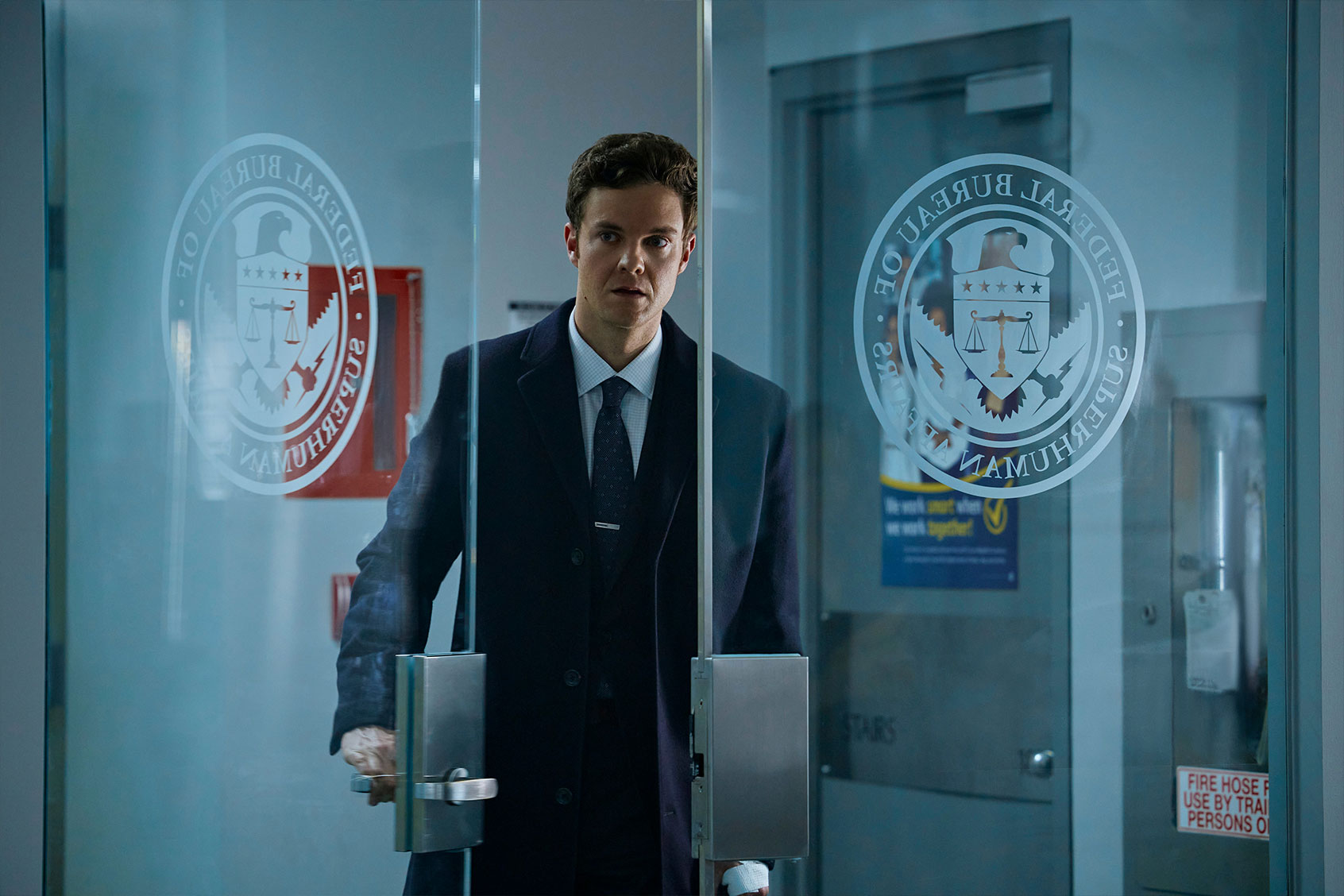
Among the non-powered humans who hunted the out-of-control members of The Seven, Annie’s boyfriend Hughie (played by Jack Quaid) has traded his vigilante status to work for the Federal Bureau of Superhuman Affairs and its head Victoria Newman (Claudia Doumit).

The BoysJack Quaid in “The Boys” (Courtesy of Prime Video/Amazon Studios)

His former leader Billy Butcher (Karl Urban) and Billy’s compatriots Frenchie (Tomer Capon) and Kimiko (Karen Fukuhara) contract with him to do the Bureau’s dirty work. Their remaining member, Marvin Milk (Laz Alonso), left the team to restore his relationship with his now-ex-wife and daughter.

And in everybody’s lives, selling out has paid off. Hughie has a shiny apartment with a view, which is many steps up from hiding in a rat hole. Butcher and the rest are headquartered in New York’s Flatiron Building, an architectural icon. Their work through the Bureau of Superhuman Affairs has resulted in a 60% decline in collateral damage.

Such evidence of progress and getting ahead tends to be temporary at best, and mainly illusory. And in the rare case where someone comes out as a winner, lots of others must lose. The price for The Deep rejoining The Seven, for example, is that he must eat a friend to prove his loyalty. A-Train is cast to fit the illusion of Vought caring about Black lives without doing anything to rock the boat.

Hughie’s relative gullibility is a constant source of entertainment to Butcher, so when the junior member of the vigilante team discovers his boss is just like the out-of-control supers they purport to hunt, Butcher works him over with punchlines.

That means Victoria and the Bureau are arms of Vought, too.

Series creator and showrunner Eric Kripke doesn’t make the sellout theme as front-facing in these new episodes as he and the writers do with the second season’s take on the rising tide of fascism, fed by the introduction of Stormfront (Aya Cash), a Nazi who hid her white supremacy behind a cloak of girl boss feminism.

“The Boys” is still a superhero show flipped underbelly up, meaning its dedication to wild fights ending in cartoonish gore still figures prominently. So does Butcher’s obsession with satisfying his vendetta against Homelander, which has placed him on a quest to find yesterday’s superman Soldier Boy (Jensen Ackles), presumed by most to be long dead.

Of course, Butcher is selling out too, compromising his morals to secretly juice up on a temporary Compound V to get an invulnerability boost, becoming the thing he hates.  

One wonders if Darick Robertson and Garth Ennis, the original comic book creators of “The Boys” imagined society would veer so close to realizing the twisted hero-worship parody they fashioned. They probably wouldn’t have predicted that a corporation that shares Vought’s goal of global saturation would make their tale into a TV show, either.

You don’t even have to watch this show to participate in the big sellout.

That’s always been the cynical kicker within this show’s gleeful joke. It is a great show, one that counts a former president among its fans and plays its part to give us comfort and convenience through an hour of power fantasy escapism. It’s also pointing out how easily we trade away our agency and our rights in exchange for entertainment.

You don’t even have to watch this show to participate in the big sellout, either. All you have to do is be a fan of a brand, or a star, instead of valuing the ways that one person being denied justice could stand to impact all of us.


Want Amanda Marcotte on politics? Subscribe to her newsletter Standing Room Only.


Annie, A-Train, and Hughie have gotten as far as they have by being blind, whether by choice or unintentionally. Butcher’s trading his principles, and his body, for a short-term win, and damn whatever it costs him over time.

 “The Boys” still presents a fantasy version of America where people can fly, rip metal apart with their bare hands and make people’s heads explode using psychic powers – and it does that very well.  But if this season makes us feel more squeamish, that may be for reasons other than the exploding victims, broken bones, and gross-out scenarios . (A bit involving this world’s Ant-Man doppelganger leaping inside another man’s urethra is . . . inspired.)

Perhaps it’s because the show has gotten very good at reminding us that our nation’s reality is not so far removed from the one it depicts: A world fueled by the average person’s willingness to bankrupt its values in exchange for tasty snacks and a good time.

The first three episodes of “The Boys” are currently streaming on Prime Video. New episodes debut on Fridays.

More stories like this:


Scientist says interstellar travel might be possible without spaceships

While a warp drive almost certainly isn’t a thing that will ever exist, there’s no law of physics that says interstellar travel isn’t possible. Perhaps that is one reason why the sci-fi idea isn’t out of the realm of possibility, and why some scientists aren’t afraid to seriously contemplate how such a thing might work.

Enter a new research article in the International Journal of Astrobiology, in which author Irina Romanovskaya, a professor of Physics and Astronomy at Houston Community College, proposes extraterrestrial civilizations could already be doing this in a peculiar way. Indeed, Romanovskaya says that interstellar travel would likely create technosignatures — such as radio waves, industrial pollution, light pollution, or anything that would suggest advanced technology is being used — when aliens engage in such travel.

Astronomers and astrophysicists have generally searched for extraterrestrial life by looking for biosignatures — such as water, oxygen or chlorophyll — on other planets. But interestingly, Romanovskaya proposes that interstellar travel might be happening via free-floating planets, not spaceships, like we see in the movies.

“Modern telescopes can search for various technosignatures that extraterrestrials, including migrating civilizations on free-floating planets, can produce,” Romanovskaya wrote in an email to Salon. “For example, James Webb Space Telescope can search for signs of extraterrestrial life on planets in planetary systems, as well as technosignatures produced by extraterrestrial technologies on free-floating planets, which I propose in my research paper.” 

RELATED: Are we looking for aliens all wrong?

Indeed, in the paper, Romanovskaya suggested the free-floating planet scheme as a means of “migrating” to another planetary system, like a vast transport. Such a proposal is certainly a means for a civilization to flee a dying star that would engulf them otherwise; indeed, Earth’s own sun will render the planet uninhabitable in less than a billion years, unless our orbit shifts. 

“Some extraterrestrial civilizations may migrate from their home planetary systems to other planetary systems,” Romanovskaya writes in the research paper. “They would most likely encounter serious or insurmountable technical problems when using spacecraft to transport large populations over interstellar distances.”

“With little starlight reaching free-floating planets, extraterrestrials could use controlled nuclear fusion as the source of energy, and they could inhabit subsurface habitats and oceans of the free-floating planets to be protected from space radiation.”

Essentially, Romanovskaya thinks that aliens could be “cosmic hitchhikers” by taking advantage of various flyby events via free-floating planets. Unlike Earth, free-floating planets are not gravitationally bound to their stars like Earth, hence making them more mobile. A study published in the journal Nature Astronomy found at least 70 nomad exoplanets in our galaxy, suggesting that they’re not as rare as scientists previously thought. It’s possible that these planets have liquid oceans under thick layers and some could even host simple life forms.


Want more health and science stories in your inbox? Subscribe to Salon’s weekly newsletter The Vulgar Scientist.


“Some advanced civilizations may send their populations or technologies to other stars during flyby events, some advanced civilizations may build stellar engines and some advanced civilizations may use free-floating planets as interstellar transportation to relocate their populations to other planetary systems,” Romanovskaya wrote. “Various methods of interstellar migration and interstellar colonization may contribute to propagation of advanced extraterrestrial civilizations in the Galaxy, and each method of interstellar migration can produce a set of observable technosignatures.”

OK, but how exactly would alien civilizations use these planets to travel through the galaxy?

“With little starlight reaching free-floating planets, extraterrestrials could use controlled nuclear fusion as the source of energy, and they could inhabit subsurface habitats and oceans of the free-floating planets to be protected from space radiation,” Romanovskaya said. “That would also prepare them for colonization of oceans in planetary systems.”

Not everyone in the astrophysics world agrees that hitching a ride on lost planets is a viable method of interstellar transit. Avi Loeb, the former chair of the astronomy department at Harvard University, told Salon that he saw “no obvious benefit to using a free floating planet instead of a spacecraft.” Loeb has previously argued that a rare interstellar object, called ‘Oumuamua, bore almost all of the traits one might expect of an interstellar alien probe when it whizzed through our solar system in 2017. 

“The only reason Earth is comfortable for ‘life as we know it’ is because it is warmed by the Sun,” Loeb said. “But a free floating planet is not attached to a star, and its surface would naturally be frozen.”

Moreover, Loeb said a free-floating planet’s large mass would make it more difficult to navigate to a desired destination.

“It is much easier to design a small spacecraft that offers the ideal habitat, engine and navigation system,” Loeb said. “It is far better to own a car than to hitchhike.”

Romanovskaya responded to Loeb’s criticism of the concept in an email to Salon, noting that manufactured interstellar spacecraft would be exceedingly difficult to manufacture for large populations. “As a means of interstellar migrations of large populations, free-floating planets offer obvious benefit of offering ‘natural’ gravity and huge resources for migrating civilizations,” Romanovskaya noted, adding that scientific studies have suggested that it is “very unlikely that advanced civilizations can build world ships for large populations.”

Romanovskaya noted that ‘Oumuamua, were it some kind of interstellar craft, would certainly not be a transport.

“Oumuamua-type objects are too small (e.g., Oumuamua is less than 800 meters long) to carry tens of thousands or millions of intelligent beings,” she noted. 

Editor’s note: This story was updated on June 6, 2022 to add additional comments from Dr. Romanovskaya. 

More stories on astronomy:

“Tiger King’s” Bhagavan “Doc” Antle arrested for money laundering

Bhagavan “Doc” Antle, one of the stars of the Netflix reality TV show, “Tiger King: Murder, Mayhem and Madness,” is set to appear in court on Monday to face federal money laundering charges.

After being apprehended by the FBI on Friday, Antle is being held at the J. Reuben Long Detention Center in Conway, South Carolina, according to AP News. When news broke of Antle’s arrest this weekend it was not initially known what the charges were, but an anonymous source reached out to The Associated Press saying it was an issue of money laundering.

Antle has been a point of controversy over the years for questionable animal practices. In 2020, he was indicted for charges of animal cruelty and wildlife trafficking and he’s additionally facing two felony counts of wildlife trafficking, conspiracy to wildlife trafficking, 13 misdemeanor counts of conspiracy to violate the Endangered Species Act and animal cruelty charges tied to trafficking lion cubs, all of which he will stand trial for in Virginia next month.

RELATED: Enough already with the “Tiger King” – Joe Exotic doesn’t deserve more attention or rehabilitation

“It’s fitting that “Doc” Antle is behind bars after years of locking up the endangered animals he uses in tawdry photo ops. His legal woes are mounting, as PETA recently blew the whistle on his apparent ‘charity’ scam, and the end to his reign of terrorizing tiger cubs can’t come soon enough,” said Debbie Metzler, associate director of PETA’s Captive Animal Law Enforcement division, in a statement reported on by AP News.


Want a daily wrap-up of all the news and commentary Salon has to offer? Subscribe to our morning newsletter, Crash Course.


In May, PETA reached out to the IRS and asked for Antle’s Rare Species Fund to be investigated. The fund is a nonprofit Antle created that he claimed was to raise money for wildlife conservation. PETA made this request under the suspicion that Antle had been using money from the fund to subsidize the safari he owns in Socastee, which is near Myrtle Beach. 

Going back as far as 1989, Antle has accumulated over 35 USDA violations for mistreating animals.

Read more:

Is Nebraska building a $500 million “canal to nowhere” just to own the libs?

Earlier this spring, Nebraska lawmakers passed a bill authorizing construction of a canal that would siphon water from neighboring Colorado, igniting a war of words between the two states’ leaders. Nebraska’s governor, Republican Pete Ricketts, says that the canal will “protect Nebraska’s water rights for our kids, grandkids, and generations beyond.” Colorado’s Democratic governor, Jared Polis, calls the scheme a “canal to nowhere” that is “unlikely to ever be built.”

The two states share rights to water from the South Platte River, and Republican politicians in Nebraska say that a new canal is necessary to guard the state’s water supply from encroachment by its fast-growing neighbor to the west.

The strange thing about the political firestorm, according to water experts, is that the canal wouldn’t really do anything. The water Nebraska wants to protect doesn’t face an immediate threat from Colorado, and in any case it’s not clear the canal would provide Nebraska any additional water beyond what it already receives. The total amount of water that could flow through the planned $500-million-dollar canal is unlikely to change the course of either state’s future.

“It’s sort of a weird claim,” said Anthony Schutz, an associate law professor at the University of Nebraska–Lincoln and an expert on water issues. “I’m not sure what exactly this thing would protect us from.” 

Even if the canal doesn’t alter the balance of water between the two states, however, it does help Nebraska lawmakers spend down federal funding they received from the $1.9 trillion stimulus package passed by Congressional Democrats last year. It might also allow them to score political points by antagonizing the Democrats who govern Colorado. The episode comes as other parts of the western U.S. really do face wrenching, zero-sum tradeoffs in allocating water during an ongoing megadrought that has been exacerbated by climate change — and it may be a preview of how anxieties around those issues can be mobilized for partisan warfare.

The history behind the canal project is a curious footnote in the larger story of western water. Way back in 1923, Colorado and Nebraska signed a treaty that governed the use of one segment of the South Platte River, which flows from the Colorado Rockies through Denver and into Nebraska. The treaty required Colorado to send 150 cubic feet of water per second to Nebraska for the duration of the irrigation season—in other words, it prevented Colorado from drying up the river before Nebraska farmers could use it. The treaty also gave Nebraska the right to build a canal large enough to divert an additional 500 cubic feet of water per second during the irrigation offseason, but the project never came to fruition: Engineers had already tried and failed to build a canal through the rocky territory connecting the states in the late 1800s, and no one ever revived the idea.

For about a century, the treaty collected dust. Nebraska has perhaps the largest groundwater resources of any state, not to mention thousands of miles of rivers, so water wasn’t a huge issue. Plus, Colorado often exceeded its treaty obligations on the South Platte: From 1996 through 2015, the state delivered Nebraska almost 8 million more acre feet than it was required to deliver under the treaty. Around the same time, however, Colorado began drawing more from the South Platte to support booming population growth, primarily in the Denver area. 

In January of this year, Colorado officials released an updated plan for the South Platte, outlining almost 300 possible water diversion projects along the river. This list of projects was just hypothetical, but it caught the attention of Nebraska lawmakers. Governor Ricketts released a statement saying he was “vigilantly watching” the construction of new water infrastructure in Colorado, and he told the legislature “they are trying to take our water.” Even though water from the South Platte is far from essential to the survival of Nebraskan agriculture, and even though Colorado already delivered far more to Nebraska than it needed to under the treaty, Ricketts insisted the state needed to protect its water rights from the growing liberal metropolis to the west.

“It’s a bit of a straw man,” Schutz, the University of Nebraska water law expert, said of Nebraska’s concern about the Colorado projects. “A lot of those projects that [Colorado] is proposing wouldn’t actually decrease the availability of water.”

Even so, the century-old treaty gave Nebraska the theoretical rights to build a canal of its own, and the state had plenty of money to pursue such a project. That was thanks to President Biden’s American Rescue Plan, which doled out billions of dollars of pandemic recovery aid to Nebraska and left the state with a significant budget surplus. The state’s unicameral legislature has spent most of this year’s session trying to find ways to spend down that surplus, and the $500 million canal project was a perfect candidate. The legislature passed a bill in April that allocated $50 million to start canal construction, enough to start purchasing land in Colorado and conduct preliminary designs.

The legislature’s sudden move on the bill came as a shock to water experts. As one Colorado water manager put it, “the water world was rocked” when the bill passed. 

That’s because, according to Schutz, the very premise of the canal project is flawed. Ricketts argued that the canal would avert a “decrease [in] agricultural water supplies and [increased] pumping costs,” but neither scenario is in the cards, even if Colorado’s population keeps growing. Nebraska relies on groundwater for more than 80 percent of its farming irrigation, and the water that comes from the hypothetical canal would only arrive during the offseason anyway, so it wouldn’t help the state’s farmers. Meanwhile, the state’s water rights only cover one section of the South Platte, and Colorado has unlimited rights over a section of the river farther upstream, meaning the Centennial State can sustain future growth even without encroaching on Nebraska’s water.

Furthermore, Schutz says, it isn’t clear that there’s even enough water in the river to fill the canal, should it ever be built.

“If you look at the amount that’s coming in right now, that’s probably the maximum amount of water that we would ever get in the canal,” he told Grist. “And that is not a lot of water.” Not only that, but the treaty also only gives Nebraska the right to build a canal that can divert 500 cubic feet of water per second. It doesn’t actually give the state the right to that much water.

“From a political perspective, I think that the governor had to make Colorado into a bad guy, but then when you really get into the weeds I don’t know how bad of a guy Colorado is,” Schutz said, arguing that the state’s conservative government has been straining to find ways to spend away the federal stimulus money so that lawmakers “don’t have to deal with the political dynamics of having a bunch of extra cash to spend on social programs.”

As the bill neared passage this spring, the two governors sniped back and forth at each other in the media. Colorado Governor Polis called the project a “boondoggle” and said his state would “aggressively assert” its water rights. Ricketts shot back: “I didn’t know Jared Polis was so concerned about taxpayers here in Nebraska…. In fact, he’s never really talked to me.”

For now the debate is just a war of words, but it could escalate if the canal moves forward. Colorado and Nebraska have sued each other in the past over water, and indeed Colorado reached a settlement with Nebraska just a few years ago over claims that Colorado violated a water-sharing compact on a different river. Building the canal would require Nebraska to purchase or condemn farmland across state lines in Colorado, which would likely lead to litigation from private landowners as well. Colorado probably wouldn’t sue Nebraska until the latter actually began to build the canal, but if it did sue, the dispute would go straight to the U.S. Supreme Court.

The fact that such a minor water project can generate so much controversy is a sign that water security is becoming a key political issue even in places where the drought situation is not yet catastrophic. The century-old compact between Nebraska and Colorado, like the treaties that anchor the use of the Colorado River farther to the west, was designed in an era of cooperation and compromise between the states. As water supplies across the region continue to vanish, though, that interstate friendliness is vanishing with them. In its place has emerged a conflict over how to balance competing interests like agriculture and urban growth. In this case, though, the conflict is more reminiscent of a schoolyard fight than a grand political debate.

Why Wonder Woman is a queer icon (and always has been)

For Mother’s Day this year, my child reverently picked out a Dolly Parton prayer candle for me, Dolly smiling and resplendent with fluffy hair and a pink sequined show outfit. Equally fitting would have been Wonder Woman (a poster from the 2017 film hangs above my desk). Light up your Wonder Woman candles now for Pride month, because the superhero is a queer and trans icon. 

Lynda Carter said so, and she should know.

Carter played the superhero in the live-action TV series of the same name from 1975-1979, the embodiment of the character with her jet black hair, light eyes and starry hot pants. On Twitter on the first day of Pride, Carter wrote, “If you want to argue that she is somehow not a queer or trans icon, then you’re not paying attention,” and referenced the many fans who have told her Wonder Woman “helped them while they were closeted.”

This is not a new phenomenon. For those who’ve paid attention, Wonder Woman also shares some innate qualities that make her not only celebrated in queer circles but queer herself.

RELATED: Will no one think of the tweens? Kids need more queer stories than just “Heartstopper”

Wonder Woman was created by writer Charles Moulton and artist Harry G. Peter. The physical appearance of the character was allegedly based both on Moulton’s wife Elizabeth Moulton and that couple’s partner Mary Olive Byrne. Yes, you read that correctly. Charles and Elizabeth were married and then Byrne later married both of them in a ceremony. The trio (perhaps a throuple, to use modern parlance?) lived together and shared their lives, raising four children. 

Moulton’s idea of Wonder Woman was of a modern, liberated woman. That includes being queer; specifically: bisexual, according to “Wonder Woman” comic writer Greg Rucka. When a commentor responded to Carter’s tweet in all caps: “Wonder Woman IS NOT A SUPER HERO FOR GAYS!” Carter shot back, “You’re right. She’s a superhero for bisexuals!”

But the “Wonder Woman” movie actors danced around the notion of the superhero being openly queer, a dance that only became more desperate. 

That’s canonically true. As Anthony Gramuglia writes on CBR, “Wonder Woman may be the first bisexual superhero. Her bisexuality has been either implicit or explicit over the decades, and only now, in recent times, has this been given both a name and direct manifestation in art.” 

In Patty Jenkins’ 2017 movie, the character muses matter-of-factly about same sex attraction (“men are essential for procreation, but when it comes to pleasure, unnecessary”). Wonder Woman resides on an island populated only by women, after all, which is, as Rucka said, supposed to be “paradise” where you can live authentically, be yourself and love who you love. Being raised in a society without men, her outlook was not been formed on the binary or even hetero. But the “Wonder Woman” movie actors danced around the notion of the superhero being openly queer, a dance that only became more desperate when the sequel, “Wonder Woman 1984” released.

Then last year, in the DC comic series “Dark Knights of Steel,” Wonder Woman was illustrated kissing her girlfriend Princess Zala in a sunlit tableau. 

From the very beginning, Moulton also worked into the superhero story of Wonder Woman his personal interests in bondage, dominance and submission – a look at sexuality that is not strictly tied to the bioessentialism of anatomy. Bad guys are often tied up. Wonder Woman has that magic lasso. Called the Lasso of Truth, it can hypnotize those in its constraints, return memories, squeeze out the truth or protect people. She wields it like a cowboy. 

The notion of a secret identity may appeal especially to queer youth who do not have the resources or support to come out.

Like some other superheroes, especially those forced or choosing to live in our humdrum Muggle world, Wonder Woman has a secret identity, although it’s murky. As The Hollywood Reporter writes, “What Wonder Woman does when she’s not fighting crime has been in flux for much of the character’s 75-year history.” Part of this may be due to her immaculate origin: Diana, the Princess of the Amazons, was made out of clay and brought to life by Zeus. Try enrolling in public school with that spotty paper trail. 

But that changed in the 1942 comic when Wonder Woman adopted the alias Diana Prince, based on an ordinary woman the character met, and managed to get a job as a secretary.

What I remember most from the classic TV show is Wonder Woman’s transforming spin, when Diana pirouettes from an evening dress or contemporary casual or ’70s workwear into her superhero costume, into Wonder Woman in a flash of blinding green light. Unlike Clark Kent, she didn’t even need a phone booth. This female superhero changes in the open air, in alleys, on construction sites. She makes it work.

The notion of a secret identity may appeal especially to queer youth who do not have the resources or support to come out. You’re a different person inside, even if some people can’t or won’t recognize you for who you truly are, even if you don’t have a community yet. You have to keep the knowledge of who you are close, safe until you are safe. 


Want a daily wrap-up of all the news and commentary Salon has to offer? Subscribe to our morning newsletter, Crash Course.


In press for “Wonder Woman 1984,” the most recent actor to step into the go-go boots and bullet-defying bracelets, Gal Gadot, mused that the queer community’s embrace of the character may be because she’s “the embodiment of femininity, and to be a strong woman and to celebrate that and owning it.”

She fights the Nazis, but also for your right to be yourself, to live your life, to be safe.

It goes deeper than that. In every format, in every year, Wonder Woman is gorgeous, true. Her hair is perfect and bouncy, sometimes under a starry tiara, and her outfits shine: bright satin with skirts, hot pants and those high boots.

But Wonder Woman is also kind, one of the strongest features of Jenkins’ first superhero film for me: her protectiveness. She’s an activist. She fights the Nazis, but also for your right to be yourself, to live your life, to be safe. Queer kids need an icon like Wonder Woman, who exemplifies that you can be strong and loving at the same time.

After being deluged both with supportive comments about her assertion of Wonder Woman’s queer icon status and a bit of angry criticism, the fiery Carter, an icon herself, recently posted a picture of herself in the ’70s, fists raised, smiling and staring straight at the camera, with the caption: “Now here’s one I call the ‘ready to fight your homophobic relatives‘ pose. Just kidding. (Or am I?)”

More stories like this

Violence in America: Gun control is an important step — but we also must address root causes

Amid the horrifying but ever-increasing scale of mass shootings in America, the most recent school shooting in Uvalde, Texas, was especially heartbreaking. Nineteen beautiful children never returned home to their loved ones. Many more will suffer severe PTSD for a long time to come. Despite these exhausting, seemingly incessant mass killings, as usual there has been much grandstanding from many political leaders and pundits — including a powerful address to the nation by President Biden — but it is likely that little or nothing will done. It’s a shameful, rotting, entrenched pattern. 

Why can’t we allow these all too frequent tragedies to become the wakeup call we use to invoke real change — one where we not only address gun control, but even more importantly, dig deep and tend to the root causes of violence. Maybe we are growing too numb, or too many of us feel resignation about our leaders’ in ability to shift the trajectory, but we can’t sit quietly and allow this to continue to spiral further out of control. This is a moment that is calling us all to step up in ways we have not yet, but must.

RELATED: Gun violence is the health care crisis we’re ignoring

It’s not just mass shootings that are terrorizing our nation. Daily violence in America is widespread. One person is shot dead every 51 minutes across the U.S. Youth homicide rates are more than seven times that of other Western nations, and as of 2020, gun violence is the leading cause of death for children. These are just some of the harrowing examples. The horrors millions of children face, living in what are essentially our own war zones in too many communities across America — which can even lead to PTSD at levels similar to returning combat veterans — should alone be enough to motivate fundamental change. 

It’s not just mass shootings that are terrorizing America: Someone is shot dead every 51 minutes. Our youth homicide rate is seven times higher than other Western nations. Gun violence is the leading cause of death among children.

While there are many approaches we can take to turn this tide, the complex, multifaceted, root-cause measures that would actually help treat the underlying causes of violence aren’t even on the table in our mainstream discourse, much less given serious consideration among policymakers. We typically only hear the stock pitches from the mainstream political camps:  Gun control on one side (yes, please!) and not much of anything from the other, or sometimes a vague, less than half-hearted mention of mental health support and/or placing armed guards, um, I guess, everywhere?

To be clear, we must maximize any momentum we have in this moment and implement gun control measures now. In particular, semiautomatic weapons should be banned, background checks implemented and “red flag” laws enacted, along with other crucial gun control laws. But as we try to address the overall scourge of violence, gun control alone will never be enough. Until we begin to more deeply explore and ultimately tend to the underlying causes of why so many people desperately turn to violence in the first place, we will likely see these kinds of horrors continue to grow unabated. 

We need to delve deeper and do some collective soul-searching. One of the most important questions we should examine is what engenders so much desperation in people, and causes them to lash out through violence in these ways.

What we know for sure about the vast majority of mass shootings, as well as the daily incidents of less spectacular violence that don’t regularly grab the national headlines, is that there was often some tragic experience or, more often, repetitive tragic experiences, in the lives of the perpetrators that brought them to a place of acting out in such horrifying ways. We don’t always know what the exact triggers are with each specific mass shooter, but we know many of the potential culprits. Experiencing an intense life trauma that has gone unaddressed, or multiple traumas, is almost always a dominating factor. These sources of trauma emerge from homes, communities, workplaces and even schools.

It is imperative that people feel as safe and secure as possible throughout their lives, feel they are part of families or communities of support and nurturance that allow all to better flourish and that make violent tendencies less likely to develop. After all, regular exposure to violence creates widespread trauma and even PTSD in these populations, and can lead people to continue to act out violently for ensuing generations. Addressing all this is no small task, but we must move robustly towards its fruition nevertheless.


Want a daily wrap-up of all the news and commentary Salon has to offer? Subscribe to our morning newsletter, Crash Course.


We need to invest in solutions that help ease human despair, which is often born from physical and emotional abuse, as well as entrenched family and community violence. We must better support those who are falling through the cracks when they are young, rescuing them from violent circumstances. We must also find better ways to support adults who show signs of emotional or mental distress, and even work to address widespread loneliness and isolation. Deep investments in the alleviation of poverty and inequality are also crucial. These and many other challenging factors can be breeding grounds for despair, and too often for violence. There are many indicators that demand our engagement, but we aren’t systematically monitoring or responding at anywhere near the scale that is needed. 

There are many effective, leading-edge violence prevention and intervention efforts happening across the nation. They are, however, enormously under-resourced. With better public policy support, we can bring this work up to scale. These efforts could help build much more emotional and psychological resilience throughout society — and for the individuals most at risk. 

What does this look like?

At the interpersonal and intra-personal level, we need robust resources to address mental health, domestic violence, trauma, PTSD, workplace violence and suicide, and to offer supports for life skills, parenting skills and related areas.

At the community level, we must employ comprehensive strategies and programs working to address the challenges of community violence and to heal collective trauma. Effective efforts include wrap-around family support services, hands-on street outreach and intervention, mental health services, competent child care supports, out-of-school programs and improved police/community relations, among others.

Our schools are also an important vehicle of support. We can focus more on teaching and practicing conflict resolution and social and emotional learning, which are proven to build emotional resilience and reduce violence. These can include restorative justice processes, mindfulness and other proven skills and modalities to transform violence, bullying, and other challenges facing youth. School systems are too often hyper-focused on GPAs and test scores, rather than on whole-person-focused education that includes life skills which can be the building blocks for a more resilient life.

We must humanize our criminal justice system, moving away from overly punitive policies toward those that can help transform entrenched patterns of violence.

And finally, we must refocus and humanize our criminal justice systems. We need to dismantle the monetary incentives built into the current prison-industrial complex and eliminate the cradle-to-prison pipeline. We must move away from overly punitive policies toward healing-oriented criminal and juvenile justice approaches that address underlying causes and help transform entrenched patterns of violence. Restorative justice, diversion or alternative incarceration programs, trauma-informed court systems and leading-edge prisoner rehabilitation and re-entry programs offer some of the most promising solutions. 

If we do not systemically address the roots of violence in America, we will continue to suffer the consequences in ever more frightening ways. Properly tending to the challenges we face will set us up for a much more secure and flourishing future, with far fewer of the horrors we so helplessly witness far too often.

Read more on gun violence in America:

John Waters says Trump “ruined bad taste”

In an interview with the Guardian, filmmaker John Waters — creator of cult classics “Pink Flamingoes” and “Female Trouble” — lamented the rise of Donald Trump by claiming he ruined “bad taste,” a hallmark of Waters’s storied filmmaking career.

Reflecting on his career during which he has been called “the Pope of Trash, the Sultan of Sleaze, the Duke of Dirt, the Baron of Bad Taste, the King of Puke and Queer Confucius,” Waters was asked about his influence on “camp” in the arts and why it has faded away as a cultural touchstone.

As the Guardian’s Catherine Bray wrote, Waters’ demeanor took a serious turn when he brought up the former president.

According to Bray, “at a moment when fashion’s elite seem to be bringing back some of the ugliest looks ever to grace a millennium-era runway,” she pressed Waters about the zeitgeist when it comes to campiness and bad taste.

“Trump ruined it, ” Waters replied. “As soon as Trump was president, it just ended the humor of it. He was the nail in the coffin. He’s the first person that had accidental bad taste that wasn’t funny.”

“Usually, accidental bad taste is what camp originally meant. But today people try too hard. And I think that never works. Because true camp is innocent, it doesn’t do things on purpose. It takes itself very seriously,” he added.


Sanders says forget marijuana, go after Wall Street

Sen. Bernie Sanders suggested Friday that instead of bringing the weight of the criminal justice system down on marijuana users, the United States should use its resources to crack down on corporate crime as prosecutions of law-breaking businesses and white-collar offenders remain at record lows.

Noting that a disproportionate number of those arrested for marijuana possession are poor people and people of color, Sanders (I-Vt.) wrote in an email to supporters that the Justice Department must “start prosecuting the crooks on Wall Street for laundering money from drug cartels, suspected terrorists, and corrupt foreign officials.”

Additionally, the Vermont senator called on Congress to finally legalize marijuana at the federal level, arguing it is an issue of both criminal and economic justice.

“When you fill out an application for a job, one of the first questions you are asked is whether or not you have a criminal record,” Sanders wrote. “It is extremely unfair for people to be denied jobs because they were once arrested for smoking marijuana. Enough is enough.”

Despite Senate Majority Leader Chuck Schumer’s (D-N.Y.) vow to prioritize the issue, he has yet to unveil a marijuana legalization bill in the upper chamber as he continues holding talks with members of both parties in an effort to secure the 60 votes needed for passage.

In April, the House approved legislation that would decriminalize marijuana nationwide and expunge federal cannabis convictions.

“We must reform our broken and racist criminal justice system, and one of the ways we can do that is by finally legalizing marijuana at the federal level,” Sanders wrote Friday, promoting a petition calling on Congress to pass a legalization measure.

“It starts with changing the Federal Controlled Substances Act which, if you can believe it, currently puts marijuana in the same category as heroin. That’s absurd and defies all scientific judgment,” Sanders added. “The good news is that in recent years, we have seen state after state decriminalize marijuana, and we have seen communities expunge the criminal records related to marijuana offenses.”

“What we are now seeing is a radical change of consciousness among the American people on this issue,” the senator continued. “So now is the time for Congress and the federal government to end the war on drugs and legalize marijuana nationwide.”

Recreational marijuana is currently legal in 19 U.S. states and the District of Columbia, and 37 states have legalized cannabis for medicinal purposes.

While marijuana arrests in the U.S. fell substantially in 2020 amid the coronavirus pandemic, there were still an estimated 350,150 arrests for marijuana-related offenses that year, the latest for which federal data is available. In 2019, U.S. police arrested 545,602 people for marijuana-related violations—and 92% of those arrests were for possession.

“We have a criminal justice system today that is not only broken—it is racist and it is unjust,” Sanders wrote in his message to supporters. “Many thousands of Americans, often Black and Brown, are sitting in jail today because of marijuana convictions or because they can’t afford bail. That injustice must end.”

Meanwhile, recent research shows that prosecutions of corporate and white-collar crime have plunged in recent years.

According to Syracuse University’s Transactional Records Access Clearinghouse, federal white-collar prosecutions were down 24.4% in Fiscal Year 2021 compared to five years earlier.

In late April, Public Citizen released an analysis showing that just 90 corporations either pleaded guilty or were found guilty of federal crimes last year—a record low.

“Allowing corporate crime to go unpursued and unpunished is not an option,” the group said. “Rampant corporate crime means Americans are at increased risk of being victimized by businesses putting the pursuit of profit above the law, and faith in the American justice system, which so often brings the harshest consequences down on the most powerless defendants, is undermined.”

Why the war in Ukraine might make root canals more difficult

Russia’s assault on Ukraine is being felt worldwide, and the U.S. health care system is not immune.

Both Russia and Ukraine are powerhouses in supplying certain commodities — in this case, ammonium nitrate and natural gas. These commodities, after being refined, can produce two gases crucial for the health care system: nitrous oxide, popularly known as laughing gas, and helium. They are used in millions of procedures each day. And crimped supplies could make every root canal that much more painful and every MRI scan that much pricier.

The disruption also represents more turbulence for the U.S. health care system’s supply chain.

“The shortages we are experiencing now have been years in the making and are therefore a surprise to no one,” said Wally Hopp, a University of Michigan professor who specializes in the medical supply chain. Hopp led a group convened by the National Academies of Sciences, Engineering, and Medicine to deliver a March report on securing supplies for U.S. industries.

These problems could’ve been addressed earlier by government and the private sector, Hopp said. “But now they can only scramble to cope with the crisis with the health of American citizens at stake,” he added.

The years since the pandemic began have been punctuated by supply chain problems. The baby formula shortage — which began after a Michigan factory was closed because of contamination concerns — is only the latest. Hospitals are facing a scarcity of contrast dye used in diagnostic scans, the result of a covid lockdown at the Shanghai plant where most of it is produced. As a consequence, hospitals from New Jersey to Washington state have been trying to ration scans for the most serious cases. And early in the pandemic, the scarcity of personal protective equipment for front-line health care workers was a defining characteristic of the unprepared and haphazard response to covid.

Such shortages are among the most-pressing patient-safety problems today, ECRI, a safety organization, said in a January roundup of the top safety concerns of the year. Shortages ranked second. “Unavailability of products could result in an inability to treat patients and protect staff, which could lead to injury, illness, or even death for both patients and clinicians,” the roundup said. It noted that many areas have few key suppliers, meaning that a problem in a far-off corner of the world could send dominoes falling into the U.S. health care system.

The impact is being felt in the guts of body scanners and other medical machines.

“Helium is a terrific element for diffusing heat,” said Bob Karcher, a contract services executive for Premier, a company that offers group purchasing services to providers. “It’s used in large MRIs and CTs, to draw heat away from the source.”

Hopp said the helium supply has been constrained for some time and that the war exacerbated the problem.

Russia is now sending relatively smaller amounts of natural gas to Western countries. That has prompted other countries to transport gas to those nations via pipelines, rather than shipping it in liquid form. These decisions affect the helium supply, as converting natural gas into a liquid entails removing trace helium, so shipping by pipeline has the unintended consequence of reducing the amount of helium for industrial use.

Other idiosyncratic factors also negatively affect supply: For instance, a Texas facility that produces helium keeps getting shut down for safety violations.

All of that together means higher costs for providers. Hopp said he had seen estimates that helium costs were about $34,000 per MRI machine in 2019. “It’s certainly higher than that now and heading higher,” he said. “Worse, I’ve seen speculation from health systems that the shortage may get serious enough to force them to shut down MRI machines.”

David Facchini, director of radiology at Yale New Haven Hospital in Connecticut, said the effects would likely hurt community hospitals the most. In the long run, he suggested, manufacturers may build machines that don’t need helium. But that’s “months to years away,” he said.

Helium isn’t the only gas to run short. Nitrous oxide is used primarily by dental offices during surgeries. About 40% of ammonium nitrate — laughing gas’s source — comes from Russia.

Premier is “seeing price pressures, rising costs,” said Donna Craft, a senior director. That’s likely to hurt dental practices, which generally get an allotment based on normal and customary use. As the country emerges from the pandemic shutdowns, that baseline might be too low for practices seeing more patients or trying to expand.

What’s more, Karcher warned, the medical sector might find securing scarce gases to be tough. Suppliers might prefer to shop their wares to higher bidders outside health care.

ECRI says health care providers relied on a “just-in-time” inventory strategy — that is, to purposely keep supplies in low stock to avoid storage costs. That strategy is reasonable when everything’s tranquil. It’s less tenable when there’s a major land war and a pandemic.

Because these snarls are the product of decisions made years ago and solving them requires more than some quick stitch-up work, short-term reactions are “usually too little, too late,” Hopp said. “Once a full-blown supply shortage is underway, the options available to the government are narrow.”

KHN (Kaiser Health News) is a national newsroom that produces in-depth journalism about health issues. Together with Policy Analysis and Polling, KHN is one of the three major operating programs at KFF (Kaiser Family Foundation). KFF is an endowed nonprofit organization providing information on health issues to the nation.

Subscribe to KHN’s free Morning Briefing.

A love letter to Roe and my first pregnancy

Roe is falling, and so am I. 

I am falling into a deep ocean of memories, nearly a decade old.

My first pregnancy is both meticulously planned and easily joyous. I am in my medical training, and my husband is starting a career eight years in the making. In our dual-doctor household, expanding a family is a fine balance of timing, but voila, we are there.

There are little hiccups after 12 weeks — every test comes back slightly out of range, and we pour over journal articles to figure out their significance. It’s just a one-off, we decide — surely it couldn’t be that every possible thing that could go wrong in one pregnancy would?

Despite all of this, we are smiling as we walk into the hospital for our 20-week anatomy scan. I am breaking from service and consults for this happy morning hour and then I’ll run back to work with news to share with my team.

I need amniocentesis, genetic testing, counseling — all of it now, because there is a clock in Harrisburg that is ticking.

The bad news hits us with gale force, although apprehension prickles when the ultrasound tech falls silent. Things are not looking well for our extraordinarily, profoundly growth-restricted baby. I am not going back to work that day, or the next. I need amniocentesis, genetic testing, counseling — all of it now, because there is a clock in Harrisburg that is ticking. My husband sobs as I sit motionless on the table. We squeeze each other’s hands until they are white and numb.

Time does strange things as we fall into a limbo where we can only hurry up and wait, as the saying goes. My parents and my best friend arrive, small and unsure, to help us move into a new apartment, which we have chosen for its child-friendly layout. 

I am reaching for a heavy box when my friend cautions me to be careful. 

I explode at her then, suddenly and unfairly. It probably doesn’t matter anymore, I yell.

She gently takes the box from me anyway. You matter, she seems to say.

A very large box of brownies materializes from my husband’s close-knit circle of “fellow-fellows,” who experienced the victories and tragedies of pediatric oncology fellowship together. Grief brownies, we joke. I eat them exclusively for days, sorrow and sweetness mingling seamlessly on my tongue.

By fate or happenstance, I am involved in the care of a small, sick and septic child in the intensive care unit. A tiny baby caught in a terrible catch-22, as it is near impossible to find intravenous access if we take the infected IV out. So, we work to save this gossamer line that ties him to life and death. I see the parents so clearly in my mind’s eye, parallels sharp through time and space, agonizing over their circumstances as I agonize over mine. 

They eventually withdraw care, with heartbreak and compassion and love.

We anguish over this final exam we never wanted for a pregnancy we desperately did.

Bad news pours forth, and my husband and I are adrift in a sea of grey, despite our combined pediatric knowledge. We anguish over this final exam we never wanted for a pregnancy we desperately did. 

The obstetrician who counsels me prior to my abortion is unfailingly kind and effortlessly competent — perhaps she has spent her prior appointment talking to a woman who feels only relief after making her decision or a woman who decides not to proceed with abortion. Or maybe someone like me. Anyway, I never feel the weight of her judgment. Your decision is the right one, she says, the wisdom of her experience shining in her eyes. 

RELATED: How will laws against abortion be enforced? Other countries offer chilling examples

The night before, I fall into my husband’s embrace, and he holds me through painful cramps and profound grief.  We are somehow at peace with this decision, made with heartbreak and compassion and love.  

The gruff anesthesiologist we meet the next day abruptly stops talking when he scans my chart. We wait anxiously for a rebuke, but instead receive a gentle hand on my arm. I’m so sorry, he says.

I fall into the twilight of conscious sedation. When I wake up, we go home and try to piece ourselves back together.

In a parting kindness, my first pregnancy stands sentinel over the two nail-biting ones that follow, which are closely monitored thanks to knowledge and surveillance.

For far too long has the anti-choice movement vilified those who seek abortions, raising the specter of “bad motherhood” over women like me.

For far too long has the anti-choice movement vilified those who seek abortions, raising the specter of “bad motherhood” over women like me, and using the far smaller number of later term abortions as a way to foment shock and impede access to this important healthcare need. 

I may grieve my circumstances, but never my choice, the kindest thing I could do. 

Resources, access, education, love, empathy. I have been given all of these in spades. I am lucky. Many are not. It is gut-wrenching and infuriating that people like me need to be flayed open, the contents of our life stories examined for veracity and worth. But we are here. At this moment. I have always been pro-choice but am more fiercely and more compassionately so now. Because “the decision whether or not to bear a child is central to a woman’s life, to her well-being, and dignity,” as Justice Ginsberg so eloquently said. Because the diverse circumstances that lead people to seek abortions illustrate the need for reproductive autonomy. Because a woman’s reason does not need to look like mine to make her choice valid or legal.

It is nearly a decade later, a Tuesday afternoon marked by protests across the nation. I am falling as I attend a rally for reproductive rights (and dignity and bodily autonomy). A friend’s strong arm loops around my shoulder — actually one strong arm, and two soft fallopian tubes. A giant, crocheted uterus gently floats into view, its anthropomorphized face expressing anger and disgust over the state of affairs. Uterati, my friend explains impishly, breaking the solemnity in the best way.

Crocheted uterus: UteratiCrocheted uterus: Uterati (Crafted by Kira Coviello / Photographed by Mike Maney)

She presses into me, soft and sturdy. I’m here for you, she says. I am here to catch you, and I am ready to fight.

Roe is falling. Time to fight.


Want a daily wrap-up of all the news and commentary Salon has to offer? Subscribe to our morning newsletter, Crash Course.


More personal essays about reproductive health and choice: 

Summer meal prep: How to heat up your kitchen just once to eat all week

I’m going to admit something to you: I am not typically a huge fan of meal prep. While I, and my wallet, do enjoy having a general sense of how I’m going to combine the groceries in my refrigerator into meals over the course of a week, I tend to also really value spontaneity as part of the cooking process. 

I saw a recipe I liked while scrolling Instagram in the afternoon? Great, I’ll mix-and-match what I have in my pantry to make my own version that night. One of my friends has something to celebrate? I’ll be over with something sugary (what exactly that is TBD) in an hour. That flexibility is one of the great joys of being at least a little proficient in the kitchen. 

Related: Prep these two summer sauces for when it’s too hot to turn on the oven

But then summer hits, and my motivation to so much as turn on my stove seemingly plummets overnight. 

There are things I’d rather be doing instead in the evenings, not least of which is eating ice cream and watching dogs frolic at the beach a couple blocks from my house. I have my own ways of dealing with this inertia— lots of smoothies, dips for dinner, etcetera — but by far the most fulfilling is designating one night a week as the time to turn on all the heat-making appliances to meal prep certain recipe elements. 

I wait for the sun to set, blast my portable fan and a good playlist and just knock out cooking things like rice, grains, proteins and roasted vegetables. Is it the sexiest way to spend an evening? Not at all, but the relative freedom in my schedule that it affords for the rest of the week is priceless. 

The process

A big part of cooking at home is that push-pull tension between a desire for variety and not wanting to waste food. In recognition of both, I try to center my summer meals around seasonal produce. It’s often affordable and, importantly, it doesn’t require too much coaxing for good flavor. This week, I packed my cart with summer squash, corn, strawberries, spinach, scallions and sugar snap peas. 

On weeks when I’m low on time (or the temperature is really up there), there’s also something really nice about having a few adaptable proteins on-hand that don’t require any cooking, like rotisserie chicken, smoked salmon and chickpeas. Quick-cooking grains are a must, as well. This week, I’m going with orzo and farro. 

Finally, there are the extras — the things that aren’t totally necessary to make your weekly meals, but by god, do they make them better. In this case, I’m making sweet biscuits for a lazy strawberry shortcake and pickled summer squash. 

The recipes below are meant to serve as suggestions for how to structure your own week, using ingredients you like and are available to you. I’m currently only cooking for two people, so scale up or down depending on your family size. 

Your meal prep checklist 

  • Wash and store your produce 
  • Grab a big pot and cook the farro according to package instructions. Drain the farro if needed, let it cool to room temperature and then store in an airtight container. Repeat with the orzo.
  • Using boxed mix (I like Bisquick and their proposed recipe), prepare drop dough for shortcakes. They, blessedly, only take about ten minutes to cook. Once cooled, place them in an airtight container and store. 
  • Make the coconut-corn and chicken chowder (more details below) and, once cooled, store in an airtight container and refrigerate. 
  • Finally, thinly slice one or two of your summer squashes. Place them in a sealable container or jar, then cover them in a bath of apple cider vinegar, salt them and add any flavorings you might have on hand, ranging from black pepper pods to fresh dill. Refrigerate. 

Meal 1: Coconut-corn and chicken chowder 

This is one of my favorite throw-together meals that just inherently tastes like summer. Rough chop ¼ onion — or a couple shallots or the white portion of a leek — and toss them in a large pot with a glug of olive oil. Stir them occasionally over medium heat until they are just softened. Cut the kernels from 2 to 4 fresh corn cobs and add them to the pot. Salt generously, then season the mixture with 2 teaspoons each of: paprika, coriander and cayenne pepper. 

Continue stirring the mixture over medium heat until the spices become fragrant. Then add one 13.5-ounce can of full-fat coconut milk to the mixture, followed by 2 cups of chicken or vegetable stock. 

Allow the chowder to simmer for 30 minutes, before adding a cup of chopped rotisserie chicken. Simmer for another ten minutes, then remove from the heat. Store in an airtight container in the refrigerator.

When you are ready to serve, simply reheat the chowder and garnish. I like to use a lot of chopped scallion and a slice of lime, but go crazy: Corn nuts, tortilla chips, sliced avocado and a big handful of cilantro are all delicious. 

Meal 2: Orzo pasta salad 

Remember that orzo you made on prep day? It’s time for it to step into the spotlight, alongside the very supportive pickled summer squash. Place 4 cups of orzo in a large mixing bowl, along with ½ cup of your pickled summer squash, ½ cup of sugar snap peas, ¼ cup of chopped scallions and ¼ cup of chopped herbs of your choice (this is a great opportunity to use leftover herbs that are just sitting in your refrigerator). Toss until combined. 

Now, we’re going to make a simple vinaigrette with ¼ cup of olive oil, 2 tablespoons of lemon juice and lots of ground black pepper. Use it to coat the pasta salad, then serve. 

Meal 3: Smoked salmon grain bowl with herby yogurt 

This is one of my favorite, simple meals that works for breakfast, lunch or dinner. Simply divide room temperature farro and a little fresh spinach among bowls. Top the mixture with flaked, smoked salmon. In a small bowl, mix whole-fat Greek yogurt with a little lemon zest, salt and pepper and chopped herbs. Whatever you have on hand that’s fresh-ish will do. 


Want more great food writing and recipes? Subscribe to Salon Food’s newsletter.


Spoon the yogurt sauce over the salmon, drizzle the entire bowl with a little good olive oil and enjoy. 

Meal 4: Shaved summer squash salad and rotisserie chicken 

The summer squash that you haven’t pickled gets new life in Abra Berens’ Shaved Summer Squash with Parmesan, Lots and Lots of Herbs, and Olive Oil — a recipe about which Maggie Hennessy wrote for Salon.

“The tender squash snaps softly with a delicate crunch that gives way to a creamy middle punctuated with tiny seeds,” Hennessy wrote. “Its — ahem — mildness, makes it an ideal canvas for the bright lemon, salty shaved cheese and a punchy mix of chopped herbs. (I particularly love this with a mixture of mint, basil, parsley and chives or tarragon, dill and thyme. But, as Berens points out, you can even use all parsley leaves if that’s all you have.)” 

Serve it alongside your leftover rotisserie chicken. 

Meal 5: Strawberry salad with feta and chickpeas

In a large bowl, combine a few generous handfuls of spinach, ½ pound of sliced strawberries, 8 ounces of feta cheese and one can of chickpeas (drained, rinsed and patted dry). This combination is delicious enough to work with a simple dressing of olive oil and lemon juice, but it’s also a good opportunity to break out the balsamic vinegar if you have it. 

Meal 6: Smoked salmon sandwich with scallion cream cheese and pickled summer squash 

I love a sandwich that is hearty enough to feel like a full meal, and this smoked salmon sandwich definitely does the trick. In a small bowl, combine cream cheese and some finely chopped scallions. Spread the mixture onto a few slices of crusty bread — sourdough is great — and top with smoked salmon and your leftover pickled summer squash. 

The result is shockingly nuanced — creamy, onion-y, briny and fresh — for what is basically a four-ingredient sandwich. 

Meal 7: Riffing on leftovers, plus strawberry shortcakes 

There’s at least one evening a week where my dinner is composed of bibs and bobs from other prior meals, plus a homemade dessert. The promise of dessert makes the “hunting and gathering” vibes of picking over the leftovers feel more whimsical and less scroungy. 

This week, it’d probably end up being some combination of leftover orzo, chicken, vegetables and feta tossed together into a room-temperature pasta dish. At the end of it all, however, is strawberry shortcake. 

Pull the premade shortcakes out and give them a little reheat if you like. Meanwhile, cover ½ pound of strawberries with about 3 tablespoons of sugar and allow that mixture to rest in the refrigerator for a half hour. The strawberries will release their juices which, when combined with the sugar, make a delicious syrup, perfect for spooning over the shortcakes and covering with store-bought whipped cream. 

This guide originally appeared in Salon Food’s weekly newsletter, The Bite. Be sure to subscribe so you don’t miss other dispatches, recipes, how-to’s and essays. 

Our favorite 2- and 3-ingredient recipes: 


5 classic sauces to add to your cooking arsenal

As any culinary student could tell you, the “mother sauces” are an iconic, fundamental element of the culinary school curriculum, including some of the most ubiquitous sauces imaginable (tomato, béchamel, and hollandaise, to name a few). Others — including velouté and espagnole — are less well-known, but just as important.

To put it frankly, sauces make the meal. Yes, yes the protein, starch, and vegetables are paramount, but the sauce is what ties everything together. It makes the meal cohesive, it adds moisture to dry proteins, it adds color to nondescript dishes, and it lends flavor to dishes that are a bit … benign. 

Related: Prep these two summer sauces for when it’s too hot to turn on the oven

A hefty sauce pour, ranging from gravy to gastriques, can transform a middling dish into a sensational one. But what about the realm of sauces that fall outside of that esteemed roster of the “mother sauces”? 

Well, all sauces fall into a relatively standard matrix: they’re all essentially an amalgam of fat, acid, herbs and aromatics. Mix-and-match as you see fit and you can come with a wild myriad of flavorful, robust sauces. In the meantime, here are five sauces that should be in contention for Mother Sauces V2.0. 

Beurre Blanc

Beurre Blanc is an acidic, bright sauce that is often off-white in color. It is wonderful served with lighter food, such as fish or vegetables. It consists of shallots, white wine or vinegar, and lemon. Sometimes the shallots are removed prior to serving, yielding a smooth sauce unencumbered by shallot shards which beautifully adheres to whatever it’s drizzled over. The name translated literally means “white butter.” It’s often tweaked or modified in various capacities, but as a base sauce, it is relatively clean and neutral, with a subtle acidity that balances the warmed butter.

Soubise

Soubise sauce is viscous, elegant, and onion-centered, with butter and bechamel (or heavy cream) to round it out. It’s thick, rich, and clearly onion-forward, so this may not be your favorite if you have any sort of allium aversions. The onions are traditionally pureed, but they don’t have to be if that extra bit of chew and texture is to your liking. Soubise is lovely added to any dish and is also sometimes added to casseroles (think of a homemade swap in the place of “cream-of-whatever” canned soups). It’s one of a few sauces listed here that is bolstered by one of the mother sauces, bechamel, in this case. 


Want more great food writing and recipes? Subscribe to Salon Food’s newsletter.


Classically, the onions are cooked gently, with no caramelization or color whatsoever, which results in a purely white sauce. When blending, a high-speed Vitamix is an excellent option — a standard food processor may not break down the onion as well as possible, so straining through a tamis or fine-mesh strainer after blending is a necessary step in that case. 

Salmoriglio 

A Marcella Hazan recipe in Food & Wine describes salmoriglio sauce as a “tangy, buttery … Sicilian classic,” and that pretty much sums it up. It’s yet another sauce that’s oftentimes served alongside fish, its inherent flakiness complimenting the tart notes of the salmoriglio. It often contains Dijon, lemon, butter, oil and sometimes fresh herbs. Piedmontese notes that salmoriglio also works well with grilled meats and hails from the Sicilian word “salmurigghiu, ” which means “a light brine.” Some variations also contain garlic. This sauce is a simple emulsion that unites the disparate flavors and becomes something far more than the sum of its parts.

Nantua

Nantua is luxurious, smooth, and reminiscent of classic French seafood dishes. While some fish can be subtly flavored, this sauce is anything but, which LA Times calls an “aromatic essence of crayfish … with a mirepoix of onion and carrot, white wine, and fish stock,” along with generous pats of butter melted into the rich sauce. It’s (obviously) primarily served with fish, as well as with fish quenelle, a finicky, elegant preparation of a seafood mousse of sorts.

The sauce also sometimes contains a thickening, creamy agent such as creme fraiche. The Spruce Eats notes that its hue is akin to that of the iconic lobster bisque, but of course, Nantua sauce is a bit thinner in consistency. Taste Atlas states that its name comes from that town in the French region called Bugey.

It’s a sophisticated sauce which requires a bit more work than some of the others listed here, but it’s beyond well worth it

Bordelaise

Bordelaise is a sauce that doesn’t come together easily, but sings of glamor. It is smooth and incredibly deeply flavored, with a heavy meatiness and the roundness of butter, cream, demi-glace and veal stock. It’s almost always served with red meat, and it contains red wine hailing from the Bordeaux region — hence the name. 

A little goes a long way, and shallots are always included. Some even incorporate marrow for an exponentially rich touch. The classic iteration takes a lot of time and its ingredients — primarily veal stock and demi-glace — also take quite a bit of time, so there are many “shortcut” recipes throughout the interwebs and cookbooks. 

Bearnaise

The New York Times deems bearnaise as the “piquant child of hollandaise,” an emulsion of yolks, butter, vinegar, shallots, and tarragon, the now quasi-elusive herb that frequently pops up in French classic recipes. Its name comes from the town of Bearn.

Its relation to hollandaise is evident in both appearance and flavor, with bearnaise clearly encompassing that same balance of butter and lemon, but amped up a bit with wine, vinegar, and the aforementioned tarragon. It also uses clarified butter, as well as sometimes white wine vinegar in the place of white wine itself. It’s a stelar option that can elevate nearly any dish.

While it can be tempting to just serve a properly cooked or seasoned piece of protein as is and enjoy it on its own volition, adding a sauce to your meal will help make the dish overall much more cohesive, lending color, flavor, and moisture, and amplifying every flavor on the plate – from the starch and the vegetables and even the protein itself. 

When using sauces like this, don’t forget the importance of texture, temperature, and accouterments: a soubise might play well with a sharp, flavored oil drizzled over top, while a bordelaise might be complemented by a tart, acidic vinaigrette to help cut its richness. All of these sauces add a lovely, glossy aesthetic and mouthfeel, but don’t skimp on a garnish that can help add contrasting textures. Fresh herbs are always welcome, but sometimes a dish that is ‘soft on soft’ might also benefit from something like toasted nuts, puffed rice, pickled fruit, or buttered and crisped breadcrumbs. 

The interplay between uber-smooth, silky sauces, well-cooked proteins, starches, and veg, and a bit of textural differentiation by way of garnish will ensure that your dish is a surefire, A+ hit.

More by this author: 

How long does that open bottle of wine last, really?

Internet memes may tell you “there’s no such thing as leftover wine.” — a joke about drinking that misses the point that very often in daily life we might not finish an open bottle. If we do have leftovers, the conventional wisdom is that the clock is ticking, since wine is best the same day it’s opened, or should be consumed by the next day at most. This is frustrating, though, if you don’t want to drink that opened wine the very next day or if you don’t have the chance, especially when the leftovers are of a great quality. And pouring “old” wine out feels like a waste. Many of us will ask under these circumstances, But how bad can it be? Understanding how long an open bottle of wine lasts is key to making the most of every last drop — before it turns into vinegar.

The process that starts when you open a bottle of wine is called aeration, which leads to oxidation, which “increases color change and the loss of fruity characteristics,” according to professor Gavin Sacks, Professor of Enology and Viticulture in the Department of Food Science at Cornell University. It also “leads to the loss of sulphur dioxide, which preserves the wine,” he says, and dissipates aromas. Even if you put the cork or a wine stopper back in, the process continues, since no closure is airtight and oxygen has already been introduced.

What is oxidation?

The great news is that although it’s not good in large doses, in small amounts, oxidation can be welcome, or even beneficial, to a bottle of wine. It occurs naturally inside the barrel and bottle when the wine ages. Sometimes if a fine wine hasn’t aged enough (meaning it still tastes overly tannic and astringent), experts will decant it or allow it to aerate for a few hours. This helps optimize the flavor by making it mellower, and also can allow unwanted aromas to dissipate. Swirling one’s glass may look showy, but it is also a practical way to aerate. These are positive examples of allowing a wine to “open up” or “breathe.” And even with some medium-quality bottles, wine-nerdy people will open them and taste over the course of a few days, to watch how the flavor changes over time.

Thus, if you can control the oxidation, you can sometimes drink a bottle of wine up to a week after opening it, depending on a number of factors such as how full the bottle is, the light exposure, the temperature at which the wine was stored, and what kind of wine it was in the first place.

The following can help you judge how long an opened bottle might still be drinkable. For our purposes, we are assuming that you don’t have any fancy wine preservation gadgets, such as a Coravin, and that you want your wine to taste not just good enough, but still very good.

How much air has it gotten?

The trick with making a wine last is to avoid exposure to air. A bottle that has been left open overnight or has been decanted has gotten a lot more air than one that was opened and immediately re-corked. A re-corked bottle that’s almost full has much less air in it than a re-corked bottle that’s almost empty. An opened bottle resting on its side in the refrigerator is creating a much greater surface area for air exposure. A bottle whose cork has been lost is better off covered with foil or plastic wrap than just left open. There’s no hard and fast rule, but the more you can minimize air exposure, the longer the wine will taste great.

Where has it been stored?

Heat hastens oxidation in wine, and colder temperatures slow it down. Both reds and whites should ideally be stored in the refrigerator, according to professor Sacks. Light is also a factor. UV rays, which travel easily through both clear and green bottles, instigate a sulphur-releasing process which affects the wine’s scent, a major factor in taste. (Consumer tip — you might not want to buy the wines displayed near the big front windows of your favorite wine store, especially those in clear bottles.) Again, the refrigerator is the answer. It’s dark in there when you don’t have the door open. If you’re concerned about drinking your reds too cold, you can do as professor Sacks suggests: He pours a glass and pops it in the microwave for five seconds.

What is the wine’s flavor profile?

Wines that are more tannic or acidic tend to hold up longer, since acids and tannins can often use some softening before they taste best. Any wine can be acidic — if it tastes a little fizzy or zingy or sharp, that’s how you know. Tannins come from the grape skins during the winemaking process, as does color, so you’ll find them mostly in red and to a lesser extent in rose and orange wines — they’re what give you that chalky taste in your mouth. If a wine tastes too acidic or tannic to you, there’s a strong chance that you’ll like it much more the next day, as oxidation acts to beneficially tame those characteristics.

In general, natural and organic wines tend to have more acidity and tannins and less perceived sweetness, so they also can be longer-lasting than their mass-produced counterparts. From the opposite perspective, fruit flavors fade first, so wines that are perceived to be sweet and fruity on day one will often have lost their magic by day two. And wines aged on the lees, (aka, the dead yeast originally added live to start the fermentation process), have a creamy, delicious mouthfeel, but start out fairly “flat,” and age less well.

Is the wine aged in oak?

Wine that has been aged in oak barrels has a vanilla aroma and palate-pleasing smoothness. Oak can be good because it balances big, bold, jammy, fruity flavors and higher alcohol contents. But unfortunately, since notes of fruit in a wine are the first to go, oaky wine can quickly taste like oak water.

What grape is it?

Some grapes, particularly Pinot Noirs, are known to not be so sturdy. Pinot Noir, the main grape in red Burgundies, is called the “heartbreak wine” because it’s so fickle that even bottles from legendary makers are sometimes lacking on arrival, and there can be a wide quality differential within the same case of wine. Other wines made from lighter red grapes can also potentially degrade faster. Professor Sacks added that Sauvignon Blanc based-wines are some of “the most readily oxidizable.”

By contrast, the most tannic grapes tend to make the sturdiest wines, such as some Cabernet Sauvignons from California and Bordeaux, some Brunellos from Tuscany, which are made from Sangiovese, some Barolos from Piedmont, which are made from Nebbiolo, and some Syrahs. And if that all sounds delicious now, try them on day three.

So, how long does an open bottle of wine last?

Well, the short answer is that it really depends on the type of wine. The tips above can help you identify elements about your wine to deduce how long you might have to drink it before it goes bad. Generally speaking, an open bottle of wine can last between 3 and 5 days, though that timeline varies when you get more specific with the bottle in question.

Sparkling wines can keep their flavor and fizz for up to 4 days in the fridge when sealed with a sparkling wine stopper (they’re easy to find and inexpensive, so grab one if you’re a fan of bubbles!). In the fridge, white wine can stay flavorful for up to 5 days when stored with a cork or wine stopper. As for red? ighter ones can taste off after a few days, while hearty red wines can last for a few weeks in the fridge, and fortified wines like port can last for months. Extra points if you decant your wine into a smaller bottle to limit oxygen exposure — pro tip: a thoroughly rinsed glass Snapple bottle works great for this.

Wondering what to do with that wine you’ll never drink but don’t want to pour down the drain? Fill an ice tray with your leftover wine, freeze, and use the wine ice cubes for cooking! A couple cubes can be used to deglaze a pan when searing steak, add depth and richness to a soup or stew, or amplify jarred tomato sauce.

“High maintenance” is a red flag on dating apps. Women are still expected to shrink themselves

The term “high-maintenance” is part of everyday speech, and usually refers to a woman who places a high value on her personal image, wants or needs. Often uttered within the context of dating, the implication is the woman in question is too much hard work; an easier, more relatable mate would be preferred.

Rarely, if ever, do we come across the term “high-maintenance man.”

On dating apps, users make split-second decisions, relying on profile pictures to guide them.

In my research into dating apps and heterosexual matches, I found men sought to portray themselves as handsome, muscular — tanned, even — in their profile shots to attract more matches.

Conversely, women sought to portray themselves against a cultural idea.

Women looked to develop profiles which conveyed them as “not high-maintenance.”

What does “high-maintenance” mean on dating apps?

“High-maintenance” was a slippery and yet sticky category defined by physical and behavioural characteristics.

In her profile photos, the high-maintenance “girl” (as she was often described by the men and women in my research), was likely wearing “too much” make-up, or form-fitting clothes. She would be dressed for a party (or “going out”). She would be pouting at the camera Instagram-style, or toting an expensive handbag.

Once tarnished with the high-maintenance brush, it was difficult to be perceived as otherwise.

Behaviorally, she was perceived as difficult. She wanted things, and expected a high standard. There was a labour involved in dating her, and therefore, a financial burden.

As one male participant indicated:

There are plenty of super attractive girls on dating apps […] but I mean, I can’t afford that sort of thing. It’s too high-maintenance.

Women within my research sought to present themselves as “pretty” but “relatable.” They didn’t want to “intimidate” a potential match through their images and behavior.

As one female participant indicated, a high-maintenance woman expected too much.

The need to appear attractive and yet not high-maintenance meant women had to conduct a balancing act.

There was a kind of effortless, pretty, nonchalance required:

My everyday look is an oversized tee and very comfy clothes, but on my profile there’s the festival picture where I’m obviously done up and there are two other photos where I’m with friends […] I did feel the pressure where you should at least look pretty, but at the same time you need to look relatable. So I guess at the same time, people aren’t intimidated to approach you.

There is that pressure that you need to look friendly enough, but pretty enough, but not too friendly at the same time. It’s a weird line.

Identity management

This kind of identity management is nothing new, particularly on social media. It is distinctly pervasive for girls and young women who are generally represented as having (or being) too little or too much. Too fat or too thin; too clever or too stupid; too free or too restricted.

Here, the line was between sexiness and effortlessness. Female participants felt the urge to look pretty, but also not so pretty that they might scare prospective matches off.

Physical attributes, or ways of presenting oneself, were also often conflated with personal behaviours and expectations. In effect women had to portray themselves as naturally pretty, capable, expectation-less, fun-loving, and, most importantly, easy-going.

All to ensure a man’s comfort.

Hidden behind this seemingly insignificant, even innocuous statement, was something far more sinister.

It seemed to describe the multitude of ways women rein themselves in to appease men: not complaining, not demanding too much, not expressing needs, not having expectations for emotional openness or fulfilment.

In effect, not making any of the demands, which are the necessary requirements for an intimacy based on relations of equality and mutuality.

Ultimately, the “high-maintenance” woman was too much to handle — which confirmed known stereotypes that women are expected to be quiet, subservient, opinion-less, and always amenable. That they shouldn’t be difficult.

It hardened feminine mainstays that a woman is required to smile and make nice. Not be too overt, and ultimately not take up too much space.

A certain invisibility was required, even in an online dating space.

Lisa Portolan, PhD student, Institute for Culture and Society, Western Sydney University

This article is republished from The Conversation under a Creative Commons license. Read the original article.

“Obi-Wan Kenobi” reminds us that the Force is not always with us – and that’s fine!

Days before “Obi-Wan Kenobi” premiered, a meme circulated that features Ewan McGregor’s mug next to that of Sir Alec Guinness – the two faces of the “Star Wars” universe’s second most beloved mentor. McGregor’s lined face still carries some youthful ruddiness, and his mane and beard are dark.

Guinness’s hair, on the other hand, is completely white. He looks grandfatherly.

And as the post’s author points out, Obi-Wan Kenobi goes from Ewan – Generation X’s cool boyfriend, star of “Trainspotting” and a series featuring him roughing it on motorcycles – to stately old Sir Alex in nine years.

“You’re a Jedi? It just . . . you seem kinda old and beat up.”

The “Star Wars” movies and TV shows don’t specify the ages of its characters, save for Master Yoda, who announced that he was 900 years old before he laid down for his long Force nap. This leaves room for actors like McGregor to age into the version of the character that’s been etched into Generation X’s consciousness since we were toddlers.

RELATED: Maybe we expected too much of “The Book of Boba Fett”

Less expected, though, is the fact that the Obi-Wan we’re meeting in this series, a version one decade removed from the fall of Anakin and the rise of Darth Vader, does not have it together. He’s out of shape and fearful. His connection with the Force has gone to seed. And when he comes face to face with 10-year-old Leia Organa (Vivien Lyra Blair) for the first time, her initial evaluation of him is, “You’re a Jedi? It just . . . you seem kinda old and beat up.”

Obi-Wan Kenobi (Ewan McGregor) and Princess Leia Organa (Vivien Lyra Blair) in “Obi-Wan Kenobi” (Lucasfilm/Disney+)When a person spends a lifetime marinating in “Star Wars” mythology, as so many members of my generation did, certain traits of a character are assumed to be changeless. Obi-Wan is marked by his bravery, a trait McGregor develops in the prequels that carry through this galaxy’s animated chronicles of the Clone Wars. But if the first version of a personality roots in us the deepest, then Guinness’ guru is the one I’m betting many were expecting would show up in this series.
McGregor could have played the Jedi we looked up to as some space zaddy. Instead, he’s … dragging him down the dad bod route.

One of the kindest acts a show can perform is to demystify our legends and heroes. That also can be one of the cruelest thing its writers can do, depending on what transpires. Either way, making our myth bleed a little enables us to be kinder to ourselves when it comes to setting expectations.

With this take on Obi-Wan, McGregor is doing a favor for “Star Wars” fans that are his age. He could have played the Jedi we looked up to as some space zaddy. Instead, he’s throwing in with the mere mortals and dragging him down the dad bod route.

Obi-Wan Kenobi (Ewan McGregor) in “Obi-Wan Kenobi” (Lucasfilm/Disney+)It’s long been drilled into us that Yoda is all-knowing, and Obi-Wan is mysterious and wise. But this version of the former General Kenobi, Jedi legend, is an exploding jar of rookie mistakes: blowing his and young Leia’s cover in front of stormtroopers, getting his cloak handed to him in a creaky duel with his former apprentice, asking the twin sister of the boy he’s watching over how old she is.
He has much in common with today’s Earthlings that have lost all connection to calendars and clocks. Like many of us, he’s also fatigue-weathered and figuring out how to navigate a sea of people when he’s forgotten how to swim through connecting with Blair’s Leia, an observant kid who isn’t so sure she fits in anywhere.

“Obi-Wan Kenobi,” like other “Star Wars” series building out established characters, is equal parts fan service and bridge-building. But in many ways, the stakes for it are higher than they may have been for “The Book of Boba Fett.” We never really knew that bounty hunter and, as it turns out, the show may have been better off maintaining his mystery.

But McGregor’s reprise of his character is saddled with expectations. This season establishes the history Leia references in “A New Hope” when she sends for him; that part is easy. Depending on who you are, watching Ben Kenobi flail and be defeated in the third episode by his former student Anakin Skywalker (Hayden Christensen), now wearing Darth Vader’s suit, might feel like an attack. Perhaps that’s the point.

Obi-Wan Kenobi (Ewan McGregor) wields a lightsaber in “Obi-Wan Kenobi” (Lucasfilm/Disney+)The top “Star Wars” headline involves its fandom’s latest wave of hate-mongering against Moses Ingram, the actor playing the Imperial Inquisitor Third Sister. The racist attacks she’s enduring, sad to say, have happened before to John Boyega and Kelly Marie Tran, as well as to non-white actors cast in other genre series. McGregor took a public stand for Ingram, as an executive producer/ TV series paterfamilias should.


Want a daily wrap-up of all the news and commentary Salon has to offer? Subscribe to our morning newsletter, Crash Course.


Concurrently, part of me wonders if some of the vitriol being hurled toward Ingram is a reaction to her wielding power while the show’s legendary hero is being tossed around like a rag. The hero’s journey involves falling and rising again, and the way these “Star Wars” series have played out, I’m guessing that Obi-Wan will get at least some of his mojo back by the end of the season.

This takes us closer to the version of the Jedi Master Guinness originated in the first “Star Wars,” when he was 63 years old. McGregor was 28 when he assumed the part, playing him as a padawan in 1999’s “Episode I – The Phantom Menace,” and 35 in 2005’s “Episode III – Revenge of the Sith,” when Obi-Wan closed the book on his apprenticeship of Anakin Skywalker by cutting him off at the knees.

That doesn’t mean the character’s age corresponds neatly with the actors when they played him. But as we reconnect with McGregor in “Obi-Wan Kenobi,” he’s a lot closer to the age Guinness was in 1977, which means a lot of the original trilogy’s generation is too. It’s a weird but wonderful thing to meet a fictional hero we’ve grown up with, at a time when his life may align with our own so uncomfortably well. As turns out, even Jedi doubt themselves and the Force. Somehow, that gives us hope.

New episodes of “Obi-Wan Kenobi” debut Wednesdays on Disney+.

More stories like this:


How the rhetoric around monkeypox recalls biases in early HIV news coverage

The emergence of the monkeypox virus in the United States in the past two weeks has stoked fear of a second pandemic and prompted widespread, often fearful news coverage regarding the unfamiliar virus. Currently, cases of monkeypox, a relative of smallpox, are rare outside some parts of West and Central Africa. Occasional outbreaks in endemic areas typically stem from animal populations such as rodents, presumed to be reservoirs of the monkeypox virus. Unlike COVID-19, poxviruses like the monkeypox virus do not rapidly mutate; hence, vaccines effective against the virus already exist as do treatments, and the mortality rate ranges from one to ten percent.

Yet in the way the media discourse has shaped itself around monkeypox, some public health advocates fear that falsehoods about how the virus spreads may stoke discrimination among certain groups. Specifically, among members of the LGBTQ+ community, misinformation regarding monkeypox has become reminiscent of the stigma surrounding HIV. Part of this is because much recent reporting has cited health experts who claim that monkeypox has some connection to the LGBTQ+ community, and that such groups are at higher risk. 

Now, experts are pushing back against framing the narrative on monkeypox this way — stating that it is both untrue as well as potentially damaging and discriminatory. 

“If we learned anything from the early years of HIV, it is that when you say that any particular group is the high-risk group you drive people underground, you drive them away from healthcare, and you stigmatize an already underserved and stigmatized group,” HIV specialist Dr. Howard Grossman told Salon.

“If we learned anything from the early years of HIV, it is that when you say that any particular group is the high-risk group you drive people underground, you drive them away from healthcare, and you stigmatize an already underserved and stigmatized group,” HIV specialist Dr. Howard Grossman told Salon, emphasizing that “there’s no such thing as a gay disease.” 

One story that gained particular traction went a step further. AP News reported that sex at Pride-related events in Spain’s Canary Islands and in Berlin was to blame for the monkeypox outbreak. Citing an interview with Dr. David Heymann, former head of the WHO emergencies department, the author asserted that sexual transmission was the leading theory for the spread. 

In an interview with Salon, Heymann told a very different story, indicating that it appears he was misquoted for the sake of a sensational headline.

RELATED: The scramble for the smallpox vaccine

“Transmission is not sexual,” he told Salon, explaining that while transmission can occur from sexual contact “it’s not a sexually transmissible disease. Transmission occurs when there’s skin to skin contact in the genital area or in any other area on the body where there is an open sore caused by the monkeypox virus.”

Claims from the AP story continue to circulate in other news outlets despite corrected statements appearing on the website of the London School of Hygiene and Tropical Medicine. One particular bolded quote appears at the top of the page, highlighted in an orange block: “It is important not to jump to conclusions or stigmatise certain groups or individuals.”

Researchers like Dr. Gregg Gonsalves, a professor of epidemiology at Yale University specializing in policy modeling of infectious diseases, were quick to denounce claims that monkeypox was spread this way.

“It’s certainly not a gay disease,” Gonsalves asserted. “WHO and CDC and others have been sort of pretty clear about this. What is true is that the initial cases have been in a lot of men who have sex with men. The accident of history is that, whatever the chain of transmission, it showed up in a party in the Canary Islands. Gay men, who were at those initial events are at risk. Now the infection is disseminated across several different countries.” 

Later in the same AP story, the author even noted that “scientists say it will be difficult to disentangle whether the spread is being driven by sex or merely close contact” and stated that health officials in Germany only linked four cases to Pride events “where sexual activity took place” while health officials in Spain had yet to confirm any links to these events.

As a professor at the school and one of the world’s leading tropical disease epidemiologists, Heymann’s words carry significant weight. According to the statements from Heymann, the “leading theory” or rather a hypothesis AP noted “is not proven,” though it is being studied. Relatively little is known about this virus.


Want more health and science stories in your inbox? Subscribe to Salon’s weekly newsletter The Vulgar Scientist.


“We’ve known about this infection for over 50 years,” Tropical disease specialist Dr. Isaac Bogoch told Salon. “It’s obviously existed for millennia, There are some very good studies out there looking at disease, transmission and prevention, … so it’s not like we’re starting from scratch. On the other hand, this is what’s called a neglected tropical infection.”

Because it does not often impact high-income countries to the extent that heart disease or cancer does, funding for research is minimal, he added.

With almost 300 confirmed cases in Europe, North America, and Australia, in their latest situation report WHO reiterated that while the outbreak has been prevalent in the LGBTQ+ community, anyone in contact with an infected individual can contract monkeypox.  Human exchange of the virus can occur through respiratory droplets but generally requires actual contact with lesions or contaminated items including clothing and bedding.

“What we know today is that the biggest risk factor is close or direct contact with an infected individual,” Dr. Bogoch emphasized. “We don’t know if there’s a monkeypox sample in semen. We don’t know that.”

“The way it’s being talked about is in a way, the direct result of the way we talked about HIV and AIDS — and that was in an appallingly judgmental, dehumanizing way that led to such misery and suffering and still haunts us.”

Officials from UNAIDS, the United Nations joint program to address the threat of AIDS, denounced the spread of misinformation regarding the virus, stating that portrayals of African people and LGBTQ+ people as being more susceptible to the virus “reinforce homophobic and racist stereotypes and exacerbate stigma.” Instead, UNAIDS Deputy Executive Director Matthew Kavanagh emphasized a rights- and evidence-based approach. 

“Stigma and blame undermine trust and capacity to respond effectively during outbreaks like this one,” Kavanagh stated. “Experience shows that stigmatizing rhetoric can quickly disable evidence-based response by stoking cycles of fear, driving people away from health services, impeding efforts to identify cases, and encouraging ineffective, punitive measures.”

Reiterating that this virus can affect anyone, Kavanagh emphasized the effort of the LGBTQ+ community to bring awareness to the outbreak. Likewise, Dr. Grossman and other health experts have applauded the level of care health officials have taken to avoid misinformation and get information out to high-risk groups without fomenting stigma. 

Over 40 years ago at the onset of the HIV epidemic, health officials were silent, and the media filled the gap with a more damaging narrative, according to Dr. Larry Mass, one of the doctors at the front lines early in the HIV epidemic.

“People in the media and elsewhere leapt to the conclusion that gays were spreading this major disease, and they were saying two things out of both sides of their mouth,” Mass said. “They were saying it was a serious threat to everybody. At the same time, they were saying only the gays are getting it, so it’s not such a big deal. These are the people who were ignorant, who ignored certain facts, who didn’t acknowledge different risk groups, they just focused on gays.”

“Clearly we have learned lessons,” Grossman said. “The WHO keeps saying anyone could get this. That would not have happened. There is progress.”

Grossman did however question the relevance of “safe sex practices” WHO lists in its report as a means of preventing spread.

“Being careful about say party venues, clubs, to me is a better warning than worrying about safe sex,” Grossman added. “Condoms aren’t gonna protect you from monkeypox unless somebody only has it on their genitals.” 

According to Dr. Gonsalves, the emphasis on sexual behavior is counterproductive.

“Telling people they should stop having sex and that they should stop doing this and that,” he said. “Suggesting that they’re spreading disease creates climates of fear and shame and makes people draw away from the public health people that they need to be confident are on their side right now.”

When Randy Shilts, a journalist and a gay man, broke the cultural silence around HIV when he published “And the Band Played On.” The book capitalized on public fascination with alleged “patient zero” for HIV, Gaëtan Dugas. According to Dr. Mass, centering a narrative around perceptions of promiscuous behavior was a problem then, even in the LGBTQ+ community.

“The sound-bite level of misinformation that got out there — that the public latched onto — was that this whole epidemic basically emerged from this one promiscuous gay man who had had all these contacts in different nations and different localities all over the world,” Mass explained. “The simple concept, in translation, that the public grabbed onto was that promiscuous gays are spreading this disease.” 

Former collaborating researcher with United Nations Research Institute for Social Development Tadzio Müller described hearing about monkeypox from his husband, who described an unsettling reminiscence to the way HIV was reported. At first, Müller brushed it off. Then he saw the news reports. To him, the potential damage of their rhetoric represents a far larger problem than the disease itself.

“Even to those who are not consciously against gay men or MSM in any way, shape or form will start telling the story,” described Müller. “They see it through the lens that’s been shaped by this story of AIDS as the gay plague, the plague that kills the amoral.”

“The way it’s being talked about is in a way, the direct result of the way we talked about HIV and AIDS, and that was in an appallingly judgmental, dehumanizing way that led to such misery and suffering and still haunts us — haunts every man who has sex with men,” Müller described. “We are talking about it in terms that evoke Sodom and f***ing Gomorra.

It is not surprising to Müller, political scientist and LGBTQ+ activist, that the spread is attributed to promiscuous sex among gay men.

“Even to those who are not consciously against gay men or MSM in any way, shape or form will start telling the story,” described Müller. “They see it through the lens that’s been shaped by this story of AIDS as the gay plague, the plague that kills the amoral.”

Müller was still a child in the early days of the HIV epidemic but remembers coming into his own in Berlin during that time.

“There was literally a discourse about putting us in camps in Germany, and that memory is fresh,” Müller expounded. “German politicians debated putting us — HIV/AIDS victims — into concentration camps.”

In the United States, prominent conservative commentator William F. Buckley pushed similar rhetoric, advocating in one New York Times piece to “tattoo gay men’s buttocks” and spoke of “quarantining” the HIV-positive, as Dr. Gonsalves, noted.

“The way we approach lesbian/gay health right now is about information, about meeting people where they’re at, trying to create sort of the conditions for people to make better health choices because coercion and the heavy fist of public health generally drive people underground,” Gonsalves explained.

Dr. Mass, physician and co-founder of Gay Men’s Health Crisis, said this kind of targeted stigma surrounding the emergence of a new disease is to be expected. 

“Anti-science, ignorance, prejudice are endemic to the human race,” Mass concluded. “That’s a kind of chronic infection of humanity that just keeps erupting all the time like a plague.”

Read more on disease and epidemiology:

The hands-free cleaning hack for those stubborn burnt bits

clean to procrastinate.

So it was bittersweet when, a few years ago, by way of dinner party chaos, I accidentally discovered a trick that both dissolves all of the burnt build-up on my dirtiest dishes with ease, and is nearly completely hands-free.

It is shamefully simple: Drop a dishwashing detergent pod into the dirty dish in question, fill with hot water, and let sit for a few hours. Then, scrub for mere moments with a sponge — any crusty, gunky residue will melt right off.

Recently, I felt incredibly validated when a variation of the trick went viral in a post by @carolina.mccauley on TikTok: Click to watch.

In her video, McCauley plugs the drain of her kitchen sink, fills it with hot water, and tosses in two dishwashing detergent tablets. She then lets her dirty stove top grates soak, submerged, for some amount of time. When she pulls them out later, they are spotless, sans scrubbing.

Since discovering her video, I’ve begun to branch out with the trick, and have successfully used it on my own stove top grates as well as metal cookware, like my fish spatula and a metal slotted spoon that often battles with congealing cheese in various pasta sauces. As in McCauley’s video, two tablets are sometimes needed for bigger, messier jobs, but one typically does the trick for a pot or pan and several utensils. The amount of pressure you’ll need to apply for the micro-scrub (truly, it is only necessary for a few seconds) varies based on the stickiness of the mess, with something like completely carbonized bits on the tougher end of the scale, and eggy cheesy remnants on the easier end.

Unfortunately for my future in Professional Procrastination, no matter the offending mess, the method has worked each time like magic, leaving me free to . . . work. Or . . . return text messages. Or . . . exercise.

Now, is a hyper-concentrated soak in dishwashing detergent the smartest thing for the longevity of your pots and pans, or grates, or utensils? One source points out that it’s wasteful, but doesn’t comment on whether it’s necessarily bad for the pots. Another mentions that it can be a harsh experience for your skin. But whether it’s actively degrading for the kitchenware, I could not tell you.

Unless I ran a series of elaborate tests and trials — in which case, I might have a new way to procrastinate.

Why “Stranger Things” should have let Hopper stay dead

The fourth season of “Stranger Things” is here, and it’s the most ambitious yet. The creators have called it their “‘Game of Thrones’ season” on account of how much it sprawls. We’ve got one group of characters in Hawkins, we’re got Eleven diving into her past, we’ve got the Byers family adjusting to life in California and we’ve got Sheriff Hopper trying to escape a Soviet prison. Most of the time “Stranger Things” keeps itself confined to the sleepy, extremely haunted small town of Hawkins, Indiana, but now it’s a proper globe-trotting adventure!

And that . . . mostly works out? The season feels slower than it has before, in part because there can be so many stories to juggle that none of them can progress much over the course of one episode. And the stories can vary so wildly in tone — from standard mystery-horror to light comedy to gritty action — that they can feel in conflict with each other.

I have a bad habit of watching shows or movies and starting to think about how to alter the things that annoy me. And when I was thinking of how to address my issues with “Stranger Things 4,” the same thought kept occurring to me: Jim Hopper should have stayed dead.

Jim Hopper’s resurrection makes “Stranger Things” weaker

A quick story recap: Jim Hopper (David Harbour) appeared to die at the end of “Stranger Things” season 3, when he was caught in an explosion deep beneath the Starcourt Mall; the Soviets, obviously, had set up a secret laboratory down there where they were trying to punch through to the dark Upside Down dimension. Just another day in Hawkins.

The show committed to Hopper’s death, even including a lengthy, tear-jerking epilogue where Eleven (Millie Bobby Brown) finds a letter he wrote but never read to her. It was a great way for Eleven to say goodbye to her father figure and for the show to say goodbye to one of its most important characters. It raised the stakes for the story, letting the audience know that if a character as important as Hopper could die, no one was safe.

. . . only no, because the show couldn’t even wait until the start of the fourth season to start teasing that he somehow lived. We got a hint of his survival in a post-credits sequence, and the show outright confirmed that Hopper was alive — and somehow in a Russian prison, no less — with a teaser trailer released online well over two years before the fourth season would hit Netflix.

We finally learn how Hopper survived his brush with death in the second episode of Season 4, “Vecna’s Curse.” Remember that explosion that engulfed him? Ends up it didn’t. He was bruised, but not badly, and was shortly thereafter kidnapped by the Soviets and shipped off to Siberia.

Now, to start, that’s a bit of a lame explanation because it’s not anything fans could have figured out on their own. When a show dangles a mystery in front of us — say, how did this person survive his own death scene? — the fun is in putting together clues in a way that’s difficult but not impossible. Just saying “the explosion wasn’t as bad as it looked” is a cop-out.

But whatever, he’s back; the real test for the show is to make his resurrection worth it, and I don’t think it does. When a show resurrects a character, it spends a lot of narrative capital. “Stranger Things” has already asked us to mourn Hopper’s passing, to sympathize with the other grieving characters. If it’s gonna bring him back, it better earn it. It better give him something spectacular to do.

I liked some of Hopper’s stuff in Season 4 — the gladiatorial fight against the Demogorgon in the finale was particularly fun — but too often his storyline felt like an unneeded appendage sticking out the side of a different show. The gang in Hawkins is trying to fight Vecna, Eleven is trying to get her powers back so she can help them fight Vecna, and Mike is trying to help Eleven so she can help them fight Vecna . . . and then we have Jim Hopper trying to escape a Soviet prison, complete with corrupt guards and snowmobile heists. It was well-acted and well-produced, but I didn’t think it fit, and it took away from other stories that did.

I think it did the most damage to Joyce (Winona Ryder), who goes on a quest to rescue Hopper. Joyce was never the best parent, but it’s asking a lot of the audience to believe that she would leave behind her family — and the out-of-state teenager she’s hosting — to jet off to Alaska to play spy games. This storyline required her to be stupid; see the moment where she leaves the younger kids in the care of her son Jonathan, who she has no idea is baked out of his mind at the dinner table.

Finally, I don’t like that resurrecting Hopper will give Eleven someone to lean on just as she’s really coming into her own. The mentor figure often dies in stories like this, which is sad but also clears the way for the protagonist to stand on their own two feet and show what they’re made of; think of Obi-Wan Kenobi dying in “Star Wars” or Dumbledore biting it in “Harry Potter.” By bringing back Hopper, it’s almost like the show is giving Eleven a life raft when it should be throwing her in the deep end and seeing if she sinks or swims.

TV shows still haven’t learn one of the most important lessons from “Game of Thrones”

I don’t know why “Stranger Things” creators Matt and Ross Duffer chose to resurrect Hopper after making a show of killing him. Maybe they thought his comeback story would be good television, maybe they didn’t wanna stop working with David Harbour, maybe they just felt like it. Whatever the reason, I think Season 4 would be better off without him.

And I’m not the only one who thinks “Stranger Things” puts on the kid gloves when it comes to death. Millie Bobby Brown herself opined that the show could stand to knock off a few members of its ballooning cast. “The Duffer Brothers are sensitive sallys who don’t want to kill anybody off,” she recently said. “We need to have the mindset of ‘Game of Thrones.’ Kill me off! They tried killing David [Harbour] off and they brought him back!”

She’s obviously joking, but it is interesting that the Duffers call this season of “Stranger Things” their “‘Game of Thrones’ season” and yet it’s missing one of the things “Game of Thrones” was most known for: brutal, final death. From Ned Stark to Robb Stark to Catelyn Stark to Tywin Lannister to Stannis Baratheon to Margaery Tyrell, “Game of Thrones” proved over and over that it was willing to kill off characters who were vital to the story and to keep going anyway. And the couple times the show did bring someone back (most famously Jon Snow after his death in Season 5), fans accepted it because we knew it was the exception to the rule; the show had proved many times over that it was capable of following all the way through.

This is one of the things that made “Game of Thrones” so uniquely thrilling, but “Stranger Things” had not picked up on it. And it’s even weirder when you consider that the one time “Stranger Things” did actually kill a semi-important character — Barb in Season 1, a death the show is still milking to this day — it got them a ton of notoriety. Why wouldn’t they want to double down on that success?

But they haven’t. Instead they have clung to their ever-expanding cast, while we at home watch certain in the knowledge that none of the characters are ever in real danger.

And “Stranger Things” is far from alone in this timidity. “Westworld,” a prestige drama that hails from HBO, the home network of “Game of Thrones,” airs its fourth season later this year, and the trailer gives away that Dolores Abernathy — the main character who sacrificed herself at the end of Season 3 — is somehow back. “Fear the Walking Dead” is currently in the final stretch of its seventh season, which once again stars lead character Madison Clark (Kim Dickens) years after the show left her for dead in Season 4. These shows would love to have the success of “Game of Thrones,” but don’t seem willing to do what it takes to get it.

Mind you, I’m not saying “Stranger Things” is a bad show because it didn’t kill off Hopper. I enjoyed the fourth season, as we explain in great detail here. But I think it could be even better, richer, and more impactful if it had a bit more backbone. I think a lot of TV could.