Spring Sale: Get 1 Year, Save 58%

GOP candidate John James starts high-dollar legal fund to challenge Michigan election loss

John James, the Republican challenger who lost last week to Democratic incumbent Sen. Gary Peters in Michigan, has started a legal defense fund in anticipation of the costs of challenging his 85,000 vote defeat, according to records filed Monday with the Federal Elections Commission.

The organization, called the James Legal Fund, is a joint fundraising vehicle between the James campaign and the Republican National Committee (RNC). It can collect donations, pay fundraising expenses and disburse money to both committees. Further, the partnership allows the fund to accept six-figure donations from individuals and transfer money out of the RNC to other GOP committees, such as the Trump campaign.

James has plenty of high-dollar donors in his Rolodex. For instance, he has his deep ties to the wealthy DeVos family, members of which have donated tens of thousands to his campaign. The DeVos family has also given to the Better Future Michigan Fund, including hundreds of thousands of dollars from Dan and Pam DeVos. The super PAC spent upwards of $7 million supporting James.

The James campaign has also taken money from GOP megadonor and current Postmaster General Louis DeJoy, whose campaign donations have become the subject of congressional and legal scrutiny. James also appeared in a documentary soliciting support from a Steve Bannon political incubator. (It is unclear whether Bannon has funneled money to James.)

Brett Kappel, a top campaign finance attorney at Harmon Curran, told Salon that contributions could find their way to the Trump team’s legal expenses.

“The money that James raises here can go to his campaign or to the RNC, which can use them however they like,” Kappel said. “The group’s statement of organization doesn’t specify that funds going to the RNC are going to be deposited into the RNC legal proceedings fund. Even if it did, the RNC could still use the money to pay for any Trump campaign legal challenges in Michigan or elsewhere.”

“John James is ending his failed campaign the way he started it: ‘2,000%’ with Trump as he continues to prove his loyalty to the Trump team until the very end and damaging whatever credibility he had left,” a Democratic aide in Michigan told Salon.

Peters, a one-term incumbent and ranking member of the Homeland Security and Government Accountability Committee (HSGAC), which oversees the DeJoy-run U.S. Postal Service, trailed James as early results poured in on Tuesday. After mail-in ballots were counted, media outlets called the race in the Democrat’s favor on Wednesday. The final tally put Peters ahead by about 85,000 votes, or about eight times the size of Trump’s 2016 margin of victory in the state (which opponent Hillary Clinton did not challenge).

Once heralded as a rising Republican star, James, who got 10,000 votes less than Trump statewide, has now lost back-to-back Michigan Senate races. Trump, whose legal challenges have already failed in the state, lost to Biden there by about 145,000 votes.

Both margins are highly unlikely to be swung in a recount, but James, under pressure from Trump surrogates to keep up the fight, has not conceded. Michigan law grants requests for recounts if the complainant alleges fraud or an error and completes a statewide canvass.

“John James: Do not concede,” South Carolina Sen. Lindsey Graham, a Trump loyalist, said during a Fox Business appearance on Sunday. “These computers in Michigan do not pass the smell test. Keep fighting for every legal and live vote.”

Two judges have tossed legal challenges from the Trump campaign — one to halt the counting of votes and another to postpone the certification of results. 

Stuart Sandler, a consultant for the James campaign, alleged to Fox News that the Republican candidate had lead Peters until ballots mysteriously appeared under the cover of the night.

“There were all kinds of chicanery, including ballots that came in reportedly in the middle of the night at 3:30 a.m. — 35,000 ballots that were deceptively brought in,” Sandler said, without evidence. 

Sandler also alleged that a former state Democratic chairman had bussed lawyers and activists to “disrupt the process” in Detroit. It is unclear why the Democratic Party would want to interfere with ballot counts a heavily Democratic area.

Democrats continue to fight for majority control of the U.S. Senate, which will likely be decided by two mandatory run-offs in Georgia this January.

Georgia GOP senators demand GOP election chief resign after failing to outright win their elections

Georgia’s two Republican senators called on the state’s Republican secretary of state to resign over unspecified “failures” as they echoed President Donald Trump’s baseless claims sowing doubt in the results of the election.

Sens. Kelly Loeffler and David Perdue, who face run-offs in January after they both failed last week to clinch 50% of the vote needed to win their elections outright, said Secretary of State Brad Raffensperger, a fellow Republican who was repeatedly praised by Trump, “has failed the people of Georgia” and “should step down.” The statement, which Raffensperger called “laughable,” came as numerous top elections officials refuted claims pushed by Trump and enabled by Republican leaders.

“The management of Georgia elections has become an embarrassment for our state. Georgians are outraged, and rightly so,” the senators said. “We have been clear from the beginning: every legal vote cast should be counted. Any illegal vote must not. And there must be transparency and uniformity in the counting process. This isn’t hard. This isn’t partisan. This is American. We believe when there are failures, they need to be called out — even when it’s in your own party.”

Raffensperger said last week “there will be a recount” of the ballots cast in the presidential election. Though the secretary of state vowed that his office would investigate any reports of irregularities, he pushed back on baseless claims of fraud. 

Without citing any evidence, the senators calling on Raffensperger to resign claimed that there had been “too many failures” in the state’s elections this year

“While blame certainly lies elsewhere as well, the buck ultimately stops with the secretary of State,” they said. “The mismanagement and lack of transparency from the secretary of state is unacceptable. Honest elections are paramount to the foundation of our democracy. The secretary of state has failed to deliver honest and transparent elections.”

Raffensperger responded to the call for his resignation by telling the Republican senators “that is not going to happen.”

“I know emotions are running high. Politics are involved in everything right now,” he said in a statement. “If I was Senator Perdue, I’d be irritated I was in a runoff. And both senators and I are unhappy with the potential outcome for our president. But I am the duly elected secretary of state. One of my duties involves helping to run elections for all Georgia voters. I have taken that oath, and I will execute that duty and follow Georgia law.”

Raffensperger said that the allegation about a lack of transparency was “laughable” and called the election a “resounding success.” Though Raffensperger believes there were some votes cast illegally, he added that it was “unlikely” the total rose to the “numbers or margin necessary to change the outcome.”

“As a Republican, I am concerned about Republicans keeping the U.S. Senate,” he added. “I recommend that Senators Loeffler and Perdue start focusing on that.”

President-elect Joe Biden is on track to win the state, which would mark the first time a Democrat carried Georgia since Bill Clinton in 1992. Loeffler, who was always expected to head to a run-off, will face off against Rev. Raphael Warnock, a Democrat, after placing second in the state’s open primary. Perdue appeared headed for a win on Tuesday night before his total fell just short of the 50% needed to outright defeat Democrat challenger Jon Ossoff after mail-in votes in the Atlanta area were counted. The two races are expected to determine control of the Senate if Democrats lose the outstanding Senate elections in Alaska and North Carolina.

Though Trump has pushed baseless allegations about fraud without citing any evidence, Georgia’s Republican officials have forcefully pushed back on the claim that anything was amiss about the result, where Biden leads Trump by about 11,400 votes.

Raffensperger said in his statement that his office had been extraordinarily transparent, and the reporting process had been orderly. He said his office had investigated allegations of illegal voting and sent a monitor to oversee elections in Fulton County, which includes much of Atlanta.

Lt. Gov. Geoff Duncan, a fellow Republican, told CNN on Monday that he had seen no evidence of widespread fraud.

“We’ve not had any sort of credible incidents raised to our level yet,” he said, “and so we’ll continue to make sure that the opportunity to make sure every legal ballot is counted is there.”

Gabriel Sterling, the head of the voting system for Raffensperger’s office, told reporters on Monday that the baseless allegations about the state’s elections were “disinformation” and “fake news.”

“Hoaxes and nonsense,” Sterling said. “Don’t buy into these things. Find trusted sources.”

Even as top election officials pushed back, Republican Gov. Brian Kemp, another Trump ally, appeared to echo the president’s unfounded claims sowing doubt in the count. But he stopped short of criticizing Raffensperger.

“Given the close outcome and the record number of mail-in and absentee ballots cast in this election, this needs to be a wake-up call to the secretary of state’s office to take a serious look at any and all voting irregularity allegations that have been made,” his office said in a statement. “Georgians deserve to have every legal vote counted in order to have full confidence in the outcome of our elections.”

Republicans, including senior Trump advisers, acknowledged to the Associated Press that finding “proof” to back his fabricated allegations “isn’t really the point.”

Republicans privately admit that “they are in a tough spot, wary of crossing Trump and his most ardent supporters” and say they’re “trying to give Trump the time and space he needs to come to grips with the election results,” according to the AP.

A Politico/Morning Consult poll released on Monday showed that 70% of Republican voters do not think the election was free and fair as Trump has continued to push lawsuits, many of which have already been quickly rejected by judges in multiple states.

While some Republicans believe that enabling Trump to sow doubt in the election is key to holding on to his voter base ahead of two Senate-deciding run-off elections, others believe the party is self-inflicting potentially major long-term damage.

“Trump is gonna cost the GOP the Senate,” conservative commentator Erick Erickson wrote. “His supporters are internalizing that the election in Georgia was stolen so why bother even trying.”

Longtime Republican election lawyer Barry Richard, who represented George W. Bush in the 2000 Florida recount, said the groundless allegations pushed by Trump and his allies did little but undermine the system.

“Nothing that I’ve seen regarding the election raises a legal issue that could succeed. There is just is nothing there,” he told the AP. “When these kind of lawsuits are filed it just breeds contempt for the whole legal system.”

How an errant tweet connects a GOP politician, a mysterious Twitter account, and Patti LaBelle

On Tuesday afternoon, Pennsylvania politician Dean Browning — a white, heterosexualself-described “proud pro-life & pro-2A Christian conservative” — tweeted, “I’m a black gay guy and I can personally say that Obama did nothing for me, my life only changed a little bit and it was for the worse.” 

The tweet continued: “Everything is so much better under Trump though. I feel respected — which I never do when democrats are involved.”

Browning, who is a former commissioner in Lehigh County, Pennsylvania, sent this tweet in response to one of his earlier posts, in which he said, “What Trump built in 4 years, Biden will destroy in 4 months.” 

Twitter users leapt on Browning’s bizarre response, many speculating that it was obvious that he had forgotten to log into his “sock puppet” account. A sock puppet account is an online identity used for purposes of deception by concealing its owner’s real identity. In this case, it seemed Browning had exposed an account on which he masquerades as a gay Black Trump supporter. 

Or had he?

If this situation already seems bizarre to you, just buckle up. Things are about to get much weirder. 

After several hours had passed, Browning posted an explanation by way of an additional tweet. 

“Regarding the tweet that is going viral from my account — I was quoting a message that I received earlier this week from a follower,” he wrote. “Sorry if context was not clear. Trump received record minority votes & record LGBTQ votes. Many people won’t say it vocally, but do in private.”

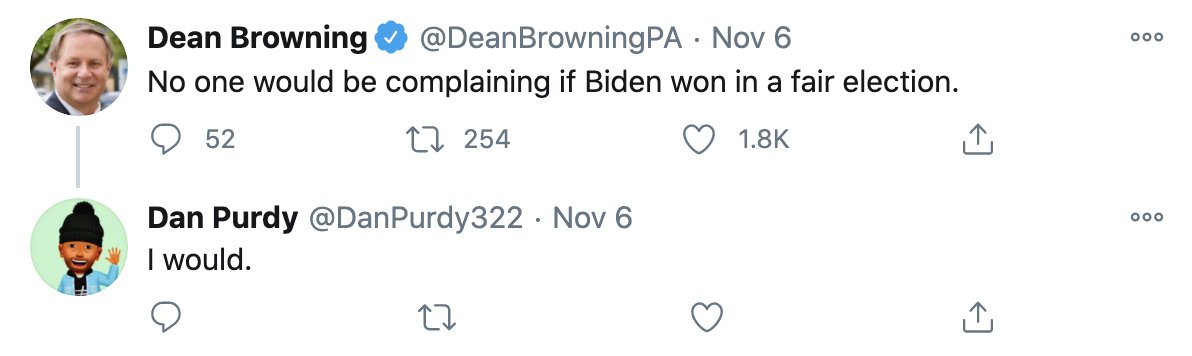
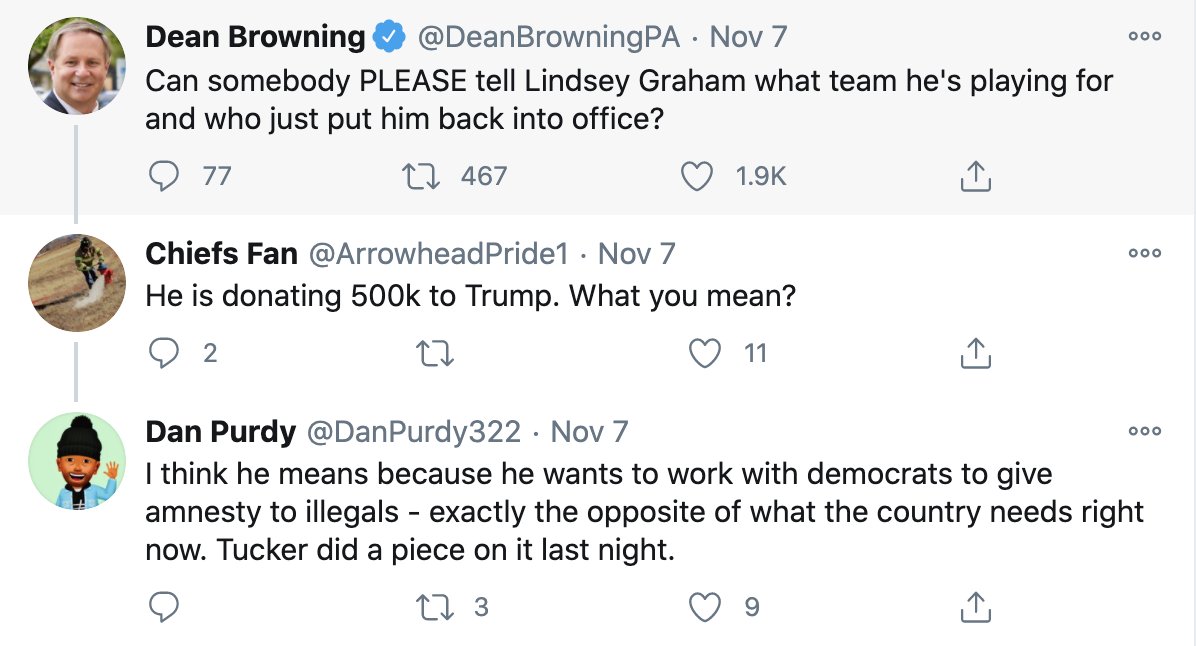
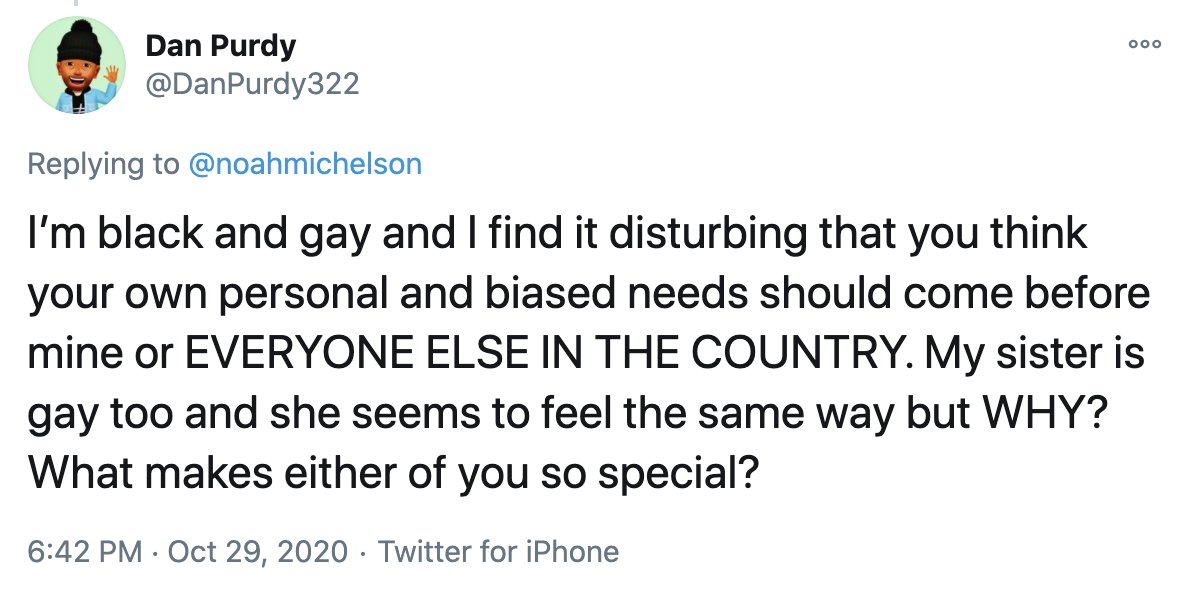
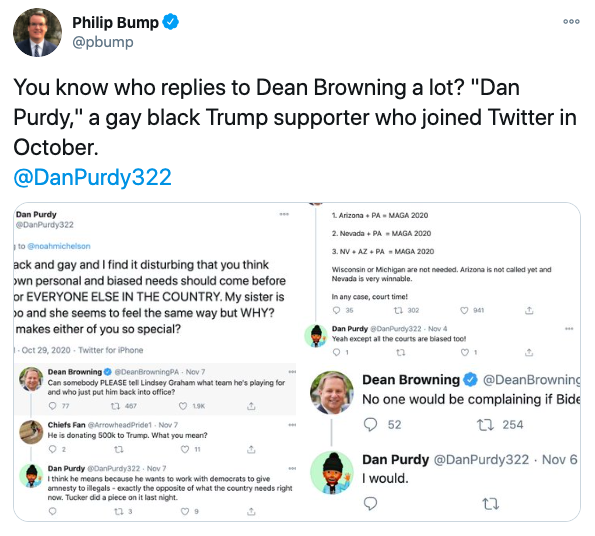
But then, in a now-deleted tweet, the Washington Post’s Philip Bump found a contender for Browning’s sock puppet account. “You know who replies to Dean Browning a lot? ‘Dan Purdy,’ a gay black Trump supporter who joined Twitter in October,” wrote Bump.

He included multiple screenshots of Purdy’s frequent interactions with Browning’s account. 


The Dan Purdy account featured an illustrated avatar of a Black man in a black beanie and bright blue jacket. The header image was a Trump 2020 logo. Many Twitter users quickly pointed out that the account also had a history of posting racist and sexist statements like, “I love the taste of black girl fear” and “black women will be the death of America.” 

When Salon reached out to Browning, he responded via email that his failure to make it clear that his viral tweet was a follower’s quote was “an oversight on [his] part” and that “there will be a video up shortly that will clear things up.”

Sure enough, just after 5pm, the Dan Purdy account posted a video — the first to be posted from the account — that featured a middle-aged Black man claiming, “I sent that message to Dean, Dean accidentally posted it somehow, that’s the end of the story. No, he’s not a sock puppet. No, I’m not a bot.”

At this point, the entire saga had gone bananas on social media, and a horde of Twitter sleuths began dissecting the video. Some theorized that Purdy was merely an actor hired by Browning to help cover his gaffe. “Fiverr will get you any Dan Purdy you want,” one tweeted in response, referring to online platform fiverr.com, in which anyone can quickly hire freelance talent.

Then there was a break in the case. 

Some internet sleuths noticed the avatar used on the Dan Purdy account was identical to one used as a profile picture on the Facebook account of a Philadelphia man named Byl Holte — and that the man tagged in photos as Holte bore a shocking resemblance to the man who appeared in Purdy’s Twitter video (purported to be Purdy). 

A dive into Holte’s background reveals several interesting things: He’s written several articles on Medium, where he identifies himself as an “Anti-feminist TV Critic” and complains about anti-racism and feminism in the film industry; he is listed on LinkedIn as a “boutique landscape designer” in Pennsylvania; And, in the weirdest twist yet, he is music legend Patti LaBelle’s adopted son. 

LaBelle adopted the two children of her sister, Jackie Holte, after her death in 1989. They are named Stayce and William, or “Byl.” Byl Holte’s Facebook account features public photos of him with LaBelle at family gatherings. 

The Dan Purdy account has since been deactivated, and Browning’s last tweet reads: “I see I’m trending with Patti LaBelle tonight. I guess we’ve not gone only viral  — but over the rainbow.” 

Regardless, some questions still remain unanswered: What is the relationship between Holte and Browning? Is the “Dan Purdy” account actually Holte’s?  Was Browning ignorant of the racist and sexist comments on the fake Dan Purdy account — and if not, why choose to quote that specific follower? And, most importantly, what does Patti LaBelle think about all this?

Can Trump really stage a coup? Experts weigh in on whether it’s possible

For the first time in history, an incumbent president is refusing to concede after clearly and indisputably losing a presidential election. That’s making observers, citizens, and experts nervous that Trump may be preparing to stage a coup of some sort, or perhaps call again on his supporters to commit violence to sustain his rule. 

Though it sounds alarmist, such happenings are certainly not unprecedented in the global arena; the United States frequently interferes with the Democratic process in other countries, and often undermines it in order to provoke a coup or make a citizenry lose faith in a governing party, as US interests did in Bolivia last year. What is more unprecedented is for such a thing to happen in the United States. We’ve certainly had bitter and controversial presidential elections, including, infamously, in 2000Moreover, the Founding Fathers prophesied this happening: as my colleague Matthew Rozsa noted, in early American history George Washington warned against Americans electing a president who’d refuse to step down.

But in a historical first, Trump is the first president to flat out refuse to concede, leading some to believe he’s setting the gears in motion for a coup d’etat. Since the election was called on Saturday, Trump has tweeted baseless claims that there’s a pathway to invalidating counted ballots. In addition to his refusal to concede, he’s pushed to fight the election results with evidence-free lawsuits. 

As Barton Gellman wrote in The Atlantic before the election, the possibility that Trump might not concede was a prophecy that turned out true. “We have no precedent or procedure to end this election if Biden seems to carry the Electoral College but Trump refuses to concede,” Gellman said, noting that there are “endless happenstances in any election for lawyers to exploit.”

Now that we find ourselves one week post-election, there are various opinions about what Trump might do, and what is actually possible for him to do given his limited political power. Here’s what experts are saying about the potential for a coup. 

While a coup may not be imminent, some fear Trump’s baseless election lies are eroding faith in democracy

Some political scientists are arguing that rather than a coup, we should be more concerned that Trump’s baseless claims erode faith in democracy. Such moves are often the first step in a longer process towards a future coup — a kind of death spiral for democracy.

In an article in the Washington Post, political scientist Henry Farrell said Trump’s baseless claims about voter fraud “corrode American democracy.” In part, Farrell writes, because when Trump’s followers and supporters believe his claims, they are saying they don’t believe in our democracy. That’s borne out by polling: A recent Politico/Morning Consult poll found 70 percent of Republicans say they don’t believe the 2020 election was “free and fair,” an alarmingly high percentage.

As Farrell wrote:

“They will think that the game is fixed so that they have no opportunity of winning. In a worst-case scenario, this can lead to accelerating democratic breakdown. If the people on one side believe that democracy is systematically rigged against them, they are unlikely to submit to the democratic process and may instead turn to other means to protect their interests. This may, in turn, provoke a spiral of retaliation and counter-retaliation.”

Farrell points to an interview he did with political scientist Adam Przeworski, who said: “Regulating conflicts by elections is then self-enforcing.”

“Violence and other costly forms of conflict are avoided by the mere fact that the political forces expect to take turns,” Przeworski told Farrell. “Yet this mechanism fails when the short-term stakes in an election are too high or when the opposition sees no chance to win according to rules.”

A coup won’t happen because the courts will save us

In The Nation, Elie Mystal, who covers the courts, the criminal justice system, and politics, writes that yes Trump is trying to overturn  the election, but is not likely to succeed. The main reason is that none of Trump’s lawsuits provide evidence of voter fraud.

“Trump’s claims that his poll watchers were not allowed to watch the counting of mail-in ballots in Pennsylvania is flatly untrue, and his lawyers have had to admit in court that they were allowed in the room,” Mystal writes. “They’ve been reduced to arguing that their poll watchers were not close enough, which, whatever. The remedy for that is to move them closer, not throw out tens of thousands of votes.”

As Mystal explains, none of Trump’s flawed claims would result in the courts throwing away counted votes because that “is not something that courts do.”

In fact, what Mystal argues is that the Trump campaign is going to put America through 70 days of turmoil all in the name of a grift.

“These lawsuits purportedly challenging the election are a huge money-making opportunity for the Trump campaign,” Mystal writes. “If you read the fine print on the new fundraising e-mails Trump’s campaign is sending out to supporters, they say that ’60 percent of contributions’ will go toward retiring campaign debt.”

But as Mystal notes, if Trump launches “a full-scale coup d’état and uses the military to keep him in power” then yes, we’d be at war.

Yet as Salon columnist Amanda Marcotte opined, Trump’s attempted coup appears disorganized, as he clearly doesn’t have the support of generals. Marcotte likened it to a “clown show.”

Coups are one thing, but what about a civil war?

It’s important to remember that an estimated 71 million Americans voted for Trump, and 76 million voted for President-elect Joe Biden. Our country remains just as divided, if not more so, than in 2016. But research shows that such divisiveness isn’t enough fodder for a civil war. As the Washington Post explained, while Americans are at odds with each other civil wars usually happen when “the state is weak.” In other words, when both the country has high poverty rates and it lacks the law enforcement and military capabilities to control armed rebellions.

Others are less optimistic that a civil war isn’t on the horizon. Salon’s Chauncey DeVega recently interviewed Richard Kreitner, who writes for The Nation. “The United States never resolved the first civil war,” Kreitner said. “The idea of a second civil war has been around literally since within months of the end of the first one. Too many Americans do not appreciate that fact.” He continued:  

The issues that led to the first civil war remain in many ways unresolved. There is a massive reckoning over the country’s own history that has been long postponed. Resolving such matters is rarely peaceful. There are also foreign adversaries and other forces who are interfering in the election. All the elements for the story are present right now in America.

Theory: Trump is just playing to get out the vote for special elections

Trump is trying to keep his base engaged for political reasons, some political scientists suspect. However, claiming voter fraud falsely still undermines democracy.

“By all appearances, yes it looks like Trump is trying to reverse the outcome of elections that by all accounts had equal monitoring of ballot counting by Republicans and Democrats, and in states where the Chief Election Officer is a Republican (GA, NV),” Wendy Schiller, chair of Brown University’s political science department, told The Boston Globe. “As unrealistic as these efforts are, they are a direct attack on the fundamental system of elections.”

The appearance of what Trump is doing matters most to the GOP, Schiller argues.

“Everything Mitch McConnell is doing and saying is about keeping the Trump voters enraged enough to get out in full force for those Senate seats,” Schiller wrote, referencing the upcoming runoff elections for both Senate seats in Georgia. 

Paul M. Collins Jr., a professor of legal studies and political science at the University of Massachusetts – Amherst, agreed that Republicans are trying to keep their supporters engaged and angry to leverage the base for whatever Trump is planning for next.  

“They see them as a way of delegitimizing the Biden administration and the electoral process itself,” Collins told The Boston Globe. “I think they believe this will help maintain their base of support, whether for a potential 2024 presidential run or to help the president succeed in whatever other plans he has after January of 2021.”

Trump is already using his electoral loss to raise money for his new leadership PAC

President Donald Trump has already begun to use his election loss to raise money for his “Save America” leadership PAC, a new committee which would allow Trump to wield influence over the Republican Party after he leaves office.

Trump registered the PAC with the Federal Elections Commission (FEC) on Monday — only two days after major news outlets called the election for President-elect Joe Biden. The move raised speculation that Trump may privately acknowledge a second term in the White House is out of reach, even though his campaign continues to contest the results in court.

Indeed, that same day, the Trump Make America Great Again committee (TMAGA) — a joint fundraising vehicle between the Trump campaign and Republican National Committee — blasted out emails to supporters soliciting donations, ostensibly to support Trump and other Republicans who are challenging the results:

KEEP FIGHTING FUND

GIVE TO PRESIDENT TRUMP, 2 SENATE RUNOFFS IN GEORGIA AND RECOUNTS IN THE HOUSE

But the fine print on the donation page, which recently said 60% of donations would go to paying down the campaign’s debt, now reveals that 60% of contributions will instead be directed to the new PAC.

Save America was formed as a “leadership PAC,” a type of committee which allows former and current elected federal officials to raise money and distribute it directly to campaigns. The arrangement thus permits an ex-president Trump to retain influence over the GOP, a party which he and his die-hard base of supporters have defined over the last four years. It may also offer Trump an exit ramp after a bitter electoral loss, even as rumors circulate that the president has not ruled out a 2024 run.

Tim Murtaugh, chief campaign spokesperson, told The New York Times that the PAC was long in the making.

“The president always planned to do this — win or lose — so he can support candidates and issues he cares about,” Murtaugh said.

Unlike super PACs, which can accept unlimited donations, fundraising for leadership PACs is capped at $5,000 per donor each year. They can also accept money from other committees, and unlike super PACs, they can contribute directly to campaigns — an important asset if Trump wants to exert control over candidates and their agendas.

However, Save America’s FEC filing says it is affiliated with Donald Trump and TMAGA, one of two joint fundraising vehicles shared between the Trump campaign and the Republican National Committee (RNC).

As an authorized committee for both the leadership PAC and the RNC, TMAGA may hold fundraising events that funnel money to both groups — even if the PAC is not directly affiliated with the RNC.

Leadership PACs also offer wider berth for expenses. They do not restrict politicians from using contributions for personal use, acting as something of a slush fund. Such a perk may appeal to Trump, campaign finance expert Brett Kappel told Salon.

“Leadership PACs are subject to very few spending restrictions — they can use their funds for any legal purpose,” Kappel said. “A leadership PAC could be used to pay for travel all around the country, and it could have all of its fundraising events at Trump properties as long as they charge the leadership PAC the fair market value for those services.”

Kappel added, “Because the prohibition on the personal use of campaign funds also does not apply to leadership PACs, Save America funds could be used to pay many of the legal fees Trump will incur after he leaves office.”

Since Election Day, the Trump campaign has sent more than 140 emails to prospective donors, including some with a threatening tone, ABC News reported.

“This is your FINAL NOTICE,” one read. “So far, you’ve ignored all our emails asking you to join us in DEFENDING THE ELECTION. You’ve ignored Team Trump, Eric, Lara, Don, the Vice President AND you’ve even ignored the President of the United States.”

Through blurred lines “A Teacher” is a difficult examination of consent and trauma

“A Teacher” is designed to perplex and sow discomfort. You may not realize that until the back half of the limited series’ 10 episodes, especially given the cavalier treatment with which pop culture has historically treated relationships between teachers and underage students.

In song and show, such situations get the fantasy treatment, a popular example being the affair between Lucy Hale’s Aria and her high school English teacher and boyfriend Ezra (Ian Harding) at the center of the cult hit cable series “Pretty Little Liars.” Hale herself described it to critics as, no kidding, “statutory romance.”

Real-life examples are understood in far more sordid terms and yet still packaged as sordid sideshows, exemplified by the very famous tabloid drama surrounding the story of the late Mary Kay Letourneau and her relationship with her sixth grade student Vili Fualaau, who she went on to marry. Because of this it may be easy to peg a show like “A Teacher” as a lurid portrayal of some misunderstood romance. Certainly the opening episodes seem to telegraph that treatment.

Keep watching and you’ll soon comprehend that what series creator Hannah Fidell is placing the viewer inside is an approximation of the precarious nature of trauma, particularly the variety where the victim doesn’t realize they’re being exploited . . . and the abuser can’t bring themselves to admit they’re preying on a susceptible person.

That “A Teacher” casts Kate Mara as its titular character Claire Wilson only heightens the slow and queasy build of the implied conversation about consent and assault that forms the undercurrent the plot.

Mara has a knack for embodying a simultaneous fragility and brittleness, and next to Nick Robinson, who plays Claire’s student Eric Walker, she’s the one who looks vulnerable. And it is this very fact that makes Fidell’s approach susceptible to criticism, depending on one’s paradigm. Looking at how the plot develops from one perspective, Eric is the one who comes on to Claire, the new English teacher at the suburban Texas high school where he’s a popular senior and all of 17.

Claire is in her 30s, and chafing in a marriage that’s lost its spark. She and her husband Matt (Ashley Zukerman) are having problems getting pregnant, and like his wife, Matt is struggling with a bit of an identity crisis and dissatisfied with his career as a medical supplies salesman.

Even so, “A Teacher” doesn’t make a sexual relationship between Eric and Claire inevitable because of her situation. Fidell, who writes the first two episodes and the finale and directs six out of 10 episodes, takes pains to make the lines blurry. Even the cinematography has an uncertain haze to it. Mara plays this up with an extraordinary multilayered performance designed to throw us off balance and at various times she leaves the viewer unsure of what to think.

And in case the viewer isn’t clear as to the central conceit of the series, each episode opens with a warning: “This series contains sexual situations as well as depictions of grooming that may be disturbing.” Each closes by directing viewers who may need support to a website FX created in conjunction with RAINN (Rape, Abuse & Incest National Network).

Claire’s motivations read clearly when she recites Dylan Thomas’ “Do not go gentle into that good night” to her English class, telling them that the poem relates to their status of lingering on the cusp of graduation and adulthood when clearly Thomas’ message of “rage, rage against the dying of the light” is vastly more relatable to her situation. And this method of saying one thing while telegraphing another informs her style of grooming Eric.

They bump into one another at a local diner where Eric works and his friends hang out, and she gets an ego boost out of the attention being paid to her by these teenage boys. Soon, though, Eric stands out. She offers to tutor him in preparation to take his S.A.T.s, and surprises him by replacing one of their sessions with a trip to the university he wants to attend. Once there, she’s mistaken by a former high school classmate of Eric’s as his girlfriend and doesn’t disabuse the young man of that assumption, accepting his invitation to attend a frat kegger with Eric on top of that.

She never touches Eric before this. In fact, he’s the one who makes the first move. A person accustomed to viewing other treatments of inappropriate adult-teenager relationships as romantic taboo may see this as tawdry romanticizing and it certainly looks like that before “A Teacher” presents the full picture.

In its totality, however, “A Teacher” is an examination of the wreckage created by power imbalance and a clear-eyed look at the lasting, rolling effects of sexual trauma over many years. The plot takes two jumps in time that allows the story to show how Claire’s impact on Eric leaves a crater in his life in the immediate wake of their discovery and years afterward when their story has dropped out of the headlines, and its in these portions that Robinson’s portrayal takes on a depth that eludes him in earlier episodes.

Fidell’s 2013 film of the same name, upon which the series is based, digs into this much more economically in its 75 minutes. Expanding its examination over 10 half-hour episodes enables a more thorough examination of the wreckage created by Claire’s actions, and very consciously refrains from pleading sympathy for her.

Instead it invites the viewer to grasp the difference between that and understanding the how of it all without necessarily offering benediction. “A Teacher” saves any malice other series’ writers would be tempted to heap on Claire and instead indicts the lack of empathy or care in the world around her and Eric. But it is he who suffers the most unnecessary pain as a young man whose peers treat his abuse as something triumphant to be bragged about when in his torn heart and psyche it take a shape resembling confusion and pain.

But the story also allows room for each character to move on as best as they can from the pain they’ve caused one another – Claire by confronting the lasting emotional bruises created by an alcoholic father (M.C. Gainey) and Eric finding some ability to forgive himself by leaning on his mother (Rya Ingrid Kihlstedt) and commiserating with kind-hearted strangers he meets along the way.

The final solemn scene of “A Teacher” take a blunt edge to any illusions of what Claire and Eric’s shared and separate stories are about and lets us know, once and for all, that this was not some tender romance. It’s more like a lesson about the ways that extensive harm can hide so well within apparent benevolence that the perpetrator doesn’t always notice she’s committing it – not a love story, but a tragedy.

The first three episodes of “A Teacher” are currently streaming on FX on Hulu with subsequent episodes debuting on Mondays weekly.

Brett Kavanaugh appears to reject “frivolous” Republican argument seeking to strike down Obamacare

Supreme Court Chief Justice John Roberts and Justice Brett Kavanaugh signaled they’re likely to uphold the Affordable Care Act after appearing to reject a Republican argument that the entire law must be struck down after Congress zeroed out the individual mandate.

Roberts and the high court have already twice upheld the healthcare law, including when the chief justice joined his liberal colleagues in declaring the individual mandate constitutional under Congress’ tax powers in 2012. Republicans in Congress reduced the individual mandate to $0 in 2017, prompting a group of Republican attorneys general to file a lawsuit alleging that the change had invalidated the entire law.

While it’s not clear whether the Supreme Court would strike down the individual mandate, both Roberts and Kavanaugh signaled that they would not strike down the rest of the law.

Kavanaugh told attorney Donald Verrilli, who is defending the law on behalf of the House of Representatives, that he “tend[s] to agree” that the mandate could simply be removed while allowing the rest of the law to stand, Bloomberg Law reported.

“It does seem fairly clear that the proper remedy would be to sever the mandate provision and leave the rest of the law in place,” Kavanaugh said.

Roberts, for his part, made a similar argument.

“I think it’s hard for you to argue that Congress intended the entire act to fall if the mandate was struck down when the same Congress that lowered the penalty to zero did not even try to repeal the rest of the act,” he told an attorney representing Texas. “I think, frankly, that they wanted the court to do that, but that’s not our job.”

While the individual mandate imposed a sliding tax on individuals without health coverage, the rest of the law expanded health care to tens of millions of people, guaranteed coverage for those living with pre-existing conditions and allowed children to stay on their parents’ health plan until 26, among other provisions.

After the Supreme Court upheld the Affordable Care Act in 2012, it subsequently ruled in 2015 that the law’s health subsidies must be available nationwide — not only in states which had created individual exchanges.

Paul Clement, the former George W. Bush administration lawyer who led the 2012 challenge, acknowledged in an interview with NPR that the new challenge “doesn’t have any teeth.”

Since the previous challenges, Kavanaugh and two additional Trump appointees — Justices Neil Gorsuch and Amy Coney Barrett, who criticized the 2012 and 2015 decisions — have since joined the court. And unlike the Obama administration, Trump’s Department of Justice aligned with the Republican attorneys general to back the law’s repeal.

A district judge in Texas sided with Republicans to rule that the entire law should be invalid. An appellate court later agreed that the individual mandate was unconstitutional after it was zeroed out. But it declined to rule on whether the rest of the law should stand, sending the case back to the Texas judge to reconsider.

The House of Representatives and multiple Democratic attorneys general intervened in the case, asking the Supreme Court to consider whether the mandate was constitutional and whether it was severable from the rest of the law. The court must also weigh if the Republican attorneys general have standing to bring the case in the first place.

Roberts questioned whether the court should let a plaintiff who was “not injured” by a provision to “roam around through those thousands of pages” of the Affordable Care Act and “pick out whichever ones” they want to sue over. 

The justices’ comments at the hearing suggested that the Affordable Care Act was “safe,” Supreme Court experts predicted.

“Worst-case scenario is that [the court] invalidates the ‘individual mandate’ while leaving the rest of the law in place — but even that is hardly a given,” Steve Vladeck, a federal court expert at the University of Texas at Austin, wrote. “Also possible that a majority holds that the plaintiffs lack standing — avoiding the merits entirely.”

Reporters who cover the court agreed that Tuesday’s comments were the most straightforward signal yet that the law was likely to survive its third challenge.

Slate’s Mark Joseph Stern predicted that the court’s six conservative justices would find the individual mandate unconstitutional, but a majority “will just sever the individual mandate from the rest of the ACA, which will have no impact on anyone.”

Vox’s Ian Millhiser agreed that the majority was likely to uphold the law, but cautioned that it should not be “falsely read a sign that maybe SCOTUS isn’t so conservative.”

“I’m fairly confident that there are at least five votes to save the law,” he wrote. “But in a sensible court, the only question in this case is whether the plaintiffs’ lawyers should be sanctioned for filing frivolous litigation.”

“We Keep the Dead Close” author Becky Cooper on the ritualistic murder that shocked Harvard

Becky Cooper was haunted. As a student at Harvard University, she’d heard the tale of the brutal murder of a female student, decades before. There were whispers of a cover-up, a collection of suspects and a series of clues straight out of a whodunit.

The death of Jane Britton, and the hunt for her killer, became a decade-long obsession that has now turned into Cooper’s new book, “We Keep the Dead Close: A Murder at Harvard and a Half Century of Silence.” But the story isn’t a conventional true crime tale. Instead, it’s a story of a real woman whose hopes and ambitions were ended violently. It’s of what she left behind. As Cooper became more and more entangled in the way Britton’s life ended, she discovered what’s so often left out of the narrative of murder: the life that preceded it. 

Salon spoke to Cooper recently about the case that shocked Cambridge, and how a woman who died in 1969 changed her life.

Tell me what happened on January 7, 1969.

It’s the day when Harvard anthropology graduate students were taking their general exams. This big moment in their graduate student career. One student had failed to show up to take her exams. Her name was Jane Britton. Her boyfriend was also in the exam room that day. He noticed that she was missing. She hadn’t answered her calls that morning. So, right after the exam finishes around noon, he goes over and he climbs up the four flights of stairs to her place. He knocks on her door, even though he knows better than almost anyone that Jane just didn’t lock her door. There was no answer.

He then talks to Jane’s neighbor, Don Mitchell, asks him if he’d seen Jane. He hasn’t. That’s when they both realized something is likely seriously wrong. They go in and discover that Jane is lying on her bed. Her legs are splayed. Her right leg is off the bed and she’s covered in her fur blankets that she had around her apartment. Her body is sprinkled with red ochre. At least to her neighbor Don, [it’s] the kind of bright red powder that’s sprinkled at ancient burial sites associated with the earliest burials of humanity. There’s also a headstone next to her bed.

Police get called. Her parents get called. They come in. They don’t see anything notable missing. Her jewelry and her money are still lying there. They call her family and close friends in for questioning. Then, over the next few days, call in professors in the anthropology department, because the recreation of a burial ritual seems to narrow the field of suspects to somebody in the anthropology department, as if it were a kind of Agatha Christie construct.

Then three days later, after this flurry of tabloid interest that makes its way to tiny papers across the country, the police chief issues a press blackout. Pretty much from that day on, other than a little mention of a grand jury hearing that takes place in February and gets dissolved six months later, that’s it for Jane’s murder in the public sphere. It really only seemed to stay alive within the community of people who knew her and the community of Harvard’s anthropology department.

This case got you almost from the beginning. It had become this ghost story. Then years later it winds up taking over your life. What do you think it is about this girl, this murder, this crime that spoke so deeply to you?

I think the reason for my compulsion to take the story as far as I could go changed over the course of working on it. When I first heard the story, it was told to me like an academic fairy tale. It had made a villain, not just out of the alleged professor who had killed her, but also out of Harvard.

I was a Harvard undergraduate when I first heard the story. I had a pretty miraculous time there as an undergraduate. It really felt like, you got three wishes and anything was possible with those three wishes. It was not the world in which I grew up at all. But that omnipotence, that ability to make kind of anything come true, it wasn’t too hard to imagine it having a kind of flip dark side. That the same place that could make anything possible could also make an unflattering story disappear, which was consistent with at least the version I first heard of the story – that the university had caught wind that the school newspaper was about to publish an article linking their kind of famed, up-and-coming professor to the murder and squashed the story.

I eventually learned that it turned out not to be true. That was one of the reasons it felt so compelling. It had crafted a villain out of an institution that I both loved and recognized. As I got further into the story, I got to know Jane, the woman who was killed. What was interesting to me is that in so many versions of the story about her, she had no name. One of the hardest parts of reconstructing the book for me was trying to remember that moment when I first Googled her case after I learned that it wasn’t just a fairy tale. Yes, some details were kind of grotesque and exaggerated. A lot of the central tenets of it were grounded in some kinds of reality.

I learned her name. I read some articles that described her as ambitious, a little vulnerable, but nothing even close to what I came to learning about her, that would explain why I felt this flush of utter recognition. It was more alchemical than rational. I really don’t know how to describe how I knew in that moment that she and I, I think, were at least at that point, haunted by the same demons.

As I got deeper and deeper into the story, I learned more and more about her and how funny and ambitious and compelling she was. Getting to know her, the people who loved her, it also then morphed into a responsibility to get the story right for them.

When someone becomes a victim, suddenly there’s that part where the detective says, “Who would have had a reason to hate her? Who would have had a reason to be angry at her?”

That is the story that happens then after an act of violence. That is not the 1969 story. This is not a 50-year-old story at all. It has an extremely contemporary resonance.

The resonance never escaped me at all. The ways in which stories of female victims are compressed into a question of, “In what way was she at fault? In what way did her lifestyle kind of place blame on her for the event that happened?” I tried to steer clear of comparisons for the book, because I wanted to have my conscience in the clear for any kind of unintentional pilfering of either structure or character development. You described it as a choice to describe Jane in the fullness of her humanity. That was always the crux of my interest in the case once I learned about her.

One of the reasons I actually chose my editor was because she was one of the few people who didn’t really describe it as a true crime book. It’s kind of strange, because it is obviously. But she was like, “Oh, this is a book about ritual. This is a book about how we tell stories and relate to the past.” It was not just a biography of Jane, but also an exploration of the afterlife of a murder. The ways in which the narrative of it ripples out and continues to affect people and continues to be something through which we can insert our own desired morals.

One of the theses in the book is that her story had been re-appropriated as a kind of academic cautionary tale. I was interested in reverse-constructing it. What was the fiction that people had turned Jane’s story into? What was the reality that fiction was trying to gesture at?

And the search is so full of red herrings and MacGuffins.  

As I was writing the book I had in mind Nabokov’s “Pale Fire,” in which many of the footnotes are these infinitely, self-referential symbols. I remember reading it in high school and we would go down these rabbit holes of searching for meaning. There would be these moments of almost authorial humor, where it was Nabokov laughing at the reader for having desired meaning so much that you made it for yourself. I wanted to tell a story about the ways in which we do that.

There are certain unresolved cases now that you can just see people picking apart. “Why did he do that on that day he went missing? What did that mean? Why did he take his wallet with him? Why did he buy a one-way ticket?” All of the things that maybe don’t mean anything at all.

It’s comforting to think that it does. But I wanted people to stop and be like, “Is it dangerous to do that, though?”

You really explore the danger of that and you explore what has happened to people’s lives for 50 years because of that. That is hard to shake off. Someone can be accused or suspected, and that never, ever really goes away. And you show your own fascination with that. You could’ve written a story that you didn’t insert yourself into. Was that ever a question for you?

I inserted myself in the book as little as possible. I really didn’t want it to be a thinly veiled memoir and navel-gazing effort. There were multiple reasons I inserted myself in the book. One, because for eight of the years that I worked on the book, it was unsolved. I needed to be in there as a character in order to bridge the gap between the event, and the investigation in 1969. Then the rumors that kept cropping up 40, 45 years later.

Without me as a character in there, you really didn’t have that time bridge or the ability to make time collapse. I hope there’s a sense of dislocation for the reader. Once the solution to the case was found, I think to tell it as a straightforward, “This is what happened. This is who killed her,” you then miss so much of that meta-narrative about storytelling. The ways in which we construct desire of guilt or find ourselves compelled to find meaning in the clues. My existence in the book I hope is both a proxy for the reader and as somebody whose journey allows the reader to go on the same kind of experiential visceral path.

That’s really different in the narrative. “Oh, I was looking into this guy and pursuing his story. It turns out I learned so many things that I didn’t know about him, or I was wrong about some of my assumptions.”

I talk so much about the bias of the historian, whether it’s the person constructing the past as an archeologist or as a detective or as a biographer. It would have felt disingenuous to not have inserted myself in the very active role of the historian. I acknowledged that despite my best efforts, this story that you’ve read is still colored or influenced by who I am. I needed to be very honest about my own blind spots, my own journey.

What was the hardest part in living within a story of sexual assault of violence, of home invasion, for that long? That’s a tough, grainy place to be for a long time. I think you can certainly see from “I’ll Be Gone in the Dark,” the toll that takes on the author is very real.

There was definitely a little bit of the psychosis of paranoia. The kind of physical vulnerability I felt working on an unsolved murder, that for all I knew was committed by a very powerful person or the person was protected by a powerful institution. One of the surprising parts of working on the book, and maybe the reason that I could really get through the 10 years of working on it, was that there was a community of people that developed around Jane and developed around my working on the book.

Mike Widmer, that 80-year-old journalist, was the first reporter on the scene and was also extremely touched by her case. He would then try to get files 50 years later, as well. He said to me in the car, coming back from the announcement, “Even before we had the solution, there was catharsis and solace in just being able to talk about it.”

I think I was doing at least some people some good and helping them process this and maybe see things in a new light and have them in return comfort me. The hardest part, I think, honestly, was the prospect of hurting people who had healed. I don’t know the extent to which the scabs really can ever cover over a wound that is left to fester for so long. The responsibility I take as a journalist is very great in terms of wanting to get to the truth, but also really trying to not hurt people in the process.

What is it like writing a book when you don’t know what the outcome is going to be and spending so much time in a story that doesn’t have a conclusion? You began this in a much more ambivalent place in terms of what information has since come to light.

I feel very lucky that working on the book, working on Jane’s story, has felt inevitable regardless of the ambiguity of where it would end. It for me was never really a question that this was something I had to do. When I left The New Yorker, I didn’t know whether the book was going to be fiction or nonfiction, because I didn’t know how much was knowable. At that point I hadn’t even met Jane’s brother. We talked, but that was it.

The other thing that I feel really lucky for is my parents. I wouldn’t really let myself look over the wall of that finish line, because I didn’t know what it looked like. I couldn’t tell you if I could get there. My mother said, “You’ll be done with the book, whether or not you finish it.” As in, it was necessary to see how far I could get with the book in order to be free from it. The permission to just see how far I could go, regardless of the kind of output of that effort, was so freeing. I feel so grateful for it.

Martha McSally refuses to concede Arizona Senate race even as math shows she can’t win

Sen. Martha McSally, R-Ariz., refuses to concede her election, even though she trails her Democratic rival by a margin which exceeds the total number of outstanding ballots by the thousands.

The Associated Press projected that Senator-elect Mark Kelly, a retired astronaut and the husband of former Rep. Gabby Giffords, D-Ariz., would win the election nearly a week ago. Kelly has already named his transition team, and he’s been assigned temporary office space.

McSally, who also lost her 2018 Senate bid before being appointed by Republican Gov. Doug Ducey to fill the late Sen. John McCain’s seat, refuses to concede the race. With no more than 59,993 ballots left to count, McSally trailed Kelly by 81,322 votes as of Tuesday morning, according to Arizona Mirror reporter Jeremy Duda.

Though McSally graciously conceded her 2018 race to Sen. Kyrsten Sinema, D-Ariz., she appears to have latched onto President Donald Trump’s baseless allegations sowing doubt in the election result this go around.

McSally has neither addressed her constituents nor posted any formal statements to her social media accounts. She also has not privately reached out to Kelly, his campaign told the Arizona Daily Star.

Declaring victory in the race, Kelly has wasted no time waiting on his opponent. Unlike the other senators elected this month, Arizona held a special election. That means Kelly could be sworn in to replace McSally as early as Nov. 30, when election results are certified. He will serve the remainder of McCain’s term, which ends after 2022.

“As I prepare for the work of representing all Arizonans in the U.S. Senate, I want Arizonans to know that I am committed to being a senator who will work to get things done and be an independent voice for them in Washington on day one,” Kelly said in a statement. “This team of community leaders, Republicans and Democrats, will help ensure we are successful in this next mission, serving and getting results for Arizonans.”

McSally is not the only Republican who has refused to concede her loss despite insurmountable math.

Republican Michigan candidate John James, who also lost his 2018 Senate bid, refused to concede his race to Sen. Gary Peters, D-Mich., nearly a week after the race was called. James, who lost by about 85,000 votes, has baselessly alleged cheating without citing any evidence.

“It’s sad and it’s pathetic. They lost,” Peters said at a press conference. “This is where you see someone’s character.”

Peters called Republican legal challenges filed in the state “frivolous.”

“I would just say to Mr. James and their campaign: Accept the opinion and the votes of the people of the state of Michigan,” he added. “That’s the right thing to do.”

While the refusal by McSally and James to admit their losses mirror Trump’s attempts to try to discredit the election he lost, some Republican candidates’ complaints have been even more egregious.

Errol Webber, a Republican who trails Rep. Karen Bass, D-Calif., by a whopping 72 points, called for an “audit” of the vote. “I will NOT concede,” he vowed.

Republican Kimberly Klacik claimed that her campaign would “investigate” the results of her race against Rep. Kweisi Mfume, D-Md., which she lost by more than 40 points.

Election officials in both states said there was no evidence of irregularities, but that has not stopped Trump and his allies from undermining the elections. 

Republican leaders have increasingly backed Trump’s unsubstantiated claims in spite of strong pushback from Republican officials who oversaw the vote in some of the states being targeted with legal actions.

Republicans and Trump advisers are “increasingly resigned to a Biden victory,” but they have resisted pushing back on the baseless fraud claims in order to avoid angering the president’s base of supporters, The Washington Post reported.

“What is the downside for humoring him for this little bit of time? No one seriously thinks the results will change,” a senior Republican official told the outlet. “He went golfing this weekend. It’s not like he’s plotting how to prevent Joe Biden from taking power on Jan. 20. He’s tweeting about filing some lawsuits. Those lawsuits will fail. Then he’ll tweet some more about how the election was stolen, and then he’ll leave.”

Sen. Chris Coons, D-Del., also told CNN on Tuesday that Republicans had privately called him to pass along congratulations to Biden.

Some Republicans, on the other hand, have warned that attempts to appease the president and his supporters could backfire. A Politico/Morning Consult poll released Monday showed that 70% of Republican voters now believe the election was neither free nor fair.

Rep. Will Hurd, R-Texas, called Trump’s unfounded allegations “dangerous.” Sen. Pat Toomey, R-Pa., said they were “very disturbing.” Reps. Adam Kinzinger, R-Ill., and Denver Riggleman, R-Va., called on the president to “respect the democratic process” and stop “spreading debunked misinformation.”

Trump is “wrong to say the election was rigged, corrupt and stolen,” said Sen. Mitt Romney, R-Utah, adding that his unfounded claim “damages the cause of freedom here and around the world . . . and recklessly inflames destructive and dangerous passions.”

In North Carolina, Democrat Cal Cunningham concedes to Republican Sen. Thom Tillis

Democrat Cal Cunningham conceded to incumbent Republican U.S. Sen. Thom Tillis in North Carolina on Tuesday. According to the Associated Press, Tillis led Cunningham by more than 95,000 votes, or 1.76 percentage points.

“I just called Sen. Tillis to congratulate him on winning reelection to a second term in the U.S. Senate and wished him and his family the best in their continued service in the months and years ahead,” Cunningham told the Associated Press. “The voters have spoken and I respect their decision.”

As soon as the general election campaign between Cunningham and Tillis kicked off, it captured the national spotlight. Political experts deemed it one of the “core four” races — alongside Maine, Iowa and Arizona — that would be most likely to determine control of the United States Senate. Those high stakes attracted big money spent on both sides, earning the distinction of being the most expensive Senate race in U.S. history.

Control of this swing-state seat has flipped back and forth between the two parties in recent years after conservative Jesse Helms retired in 2002. Two-time Republican White House Cabinet member Elizabeth “Liddy” Dole succeeded Helms, then was unseated after one term by Democrat Kay Hagan in 2008. Tillis defeated Hagan narrowly in 2014. 

Tillis identified himself through his campaign as a “common-sense fiscal conservative for North Carolina,” and while he occasionally broke from the president’s policies — like when he flip-flopped in 2019 over Trump’s plan to take border wall money from other parts of the government — he largely stood in support of Trump. He backed the president when Trump faced impeachment and in his run for reelection, according to The News and Observer.

Meanwhile, Cunningham was identified early on as the type of Democrat who had a shot at winning in North Carolina. (Trump narrowly won the state by 4 percentage points in 2016.) He spent 18 years in the U.S. Army Reserve, is an ordained elder in the Presbyterian Church and has already served one term in the state Senate, from 2001 to 2003. 

North Carolina is a state with a complicated voting history. Its U.S. House delegation includes 10 Republicans and only three Democrats, and their General Assembly is known for passing some of the most conservative policies in the country, like the 2016 anti-transgender “bathroom bill” that thrust the state into a legal battle finally settled last year. (Last year, a panel of judges threw out the state’s Republican-drawn legislative map, calling it an “extreme partisan gerrymander,” with a new redistricting plan approved for 2020.) Registered Democrats in North Carolina currently outnumber registered Republicans, and Democratic Governor Roy Cooper has been a vocal critic of President Donald Trump and his pandemic response. The president ended up canceling most of the planned activities surrounding the Republican National Convention in Charlotte in August. 

In October, Tillis tested positive for COVID-19 after attending the Supreme Court nomination ceremony in the White House Rose Garden for Amy Coney Barrett, which was later described as a “superspreader event.” 

As the Associated Press reported, Tillis has supported mask-wearing. He was among the small minority of attendees at a Trump rally in Winston-Salem seen wearing a mask on Sept. 8, and he’s also routinely seen on Capitol Hill wearing a mask.

News of Tillis’ diagnosis, however, was eclipsed when texts that suggested an intimate relationship between Cunningham and Arlene Guzman Todd, a public relations strategist from California, were published on a conservative website. Further text messages were obtained by the Associated Press, which confirmed the relationship. 

In a statement Guzman Todd said, “the relationship spanned several months and consisted primarily of a series of text exchanges and an in-person encounter.” Cunningham released a statement in response indicating that he hurt his family and friends. 

“The first step in repairing those relationships is taking complete responsibility, which I do. I ask that my family’s privacy be respected in this personal matter,” Cunningham said at the time. 

The North Carolina race garnered national attention for the amount of money the candidates spent. As the Charlotte Observer reported, “dozens of deep-pocketed national groups such as super PACs and ‘dark money’ organizations that don’t have to reveal their donors have spent nearly $141 million to influence the Senate race, according to an analysis by the Center for Responsive Politics.” 

In combination with candidate spending, approximately $233 million was spent on advertising alone, which ultimately paid off for Tillis. 

Joe Biden’s tech task force may be surprisingly critical of Silicon Valley’s power

One rare political arena with bipartisan support is the movement to break up and curb the power of tech giants, particularly those operating in search and social media. Early reports indicate that President-elect Joe Biden is aware of this, and that his upcoming policy agenda may reflect that.

Some of these reports come directly from the Biden campaign itself, with former head of press Bill Russo retweeting “Hell yes” to a Sacha Baron Cohen post that depicted outgoing President Donald Trump alongside Facebook CEO Mark Zuckerberg paired with the caption, “One down, one to go.” There are also reports from reputable outlets like The New York Times, which on Tuesday revealed that Biden is not only expected to pursue an antitrust lawsuit filed against Google last month, but may pursue additional antitrust cases against Amazon, Apple and Facebook.

“Many technology giants and their executives have not only abused their power, but misled the American people, damaged our democracy and evaded any form of responsibility,” a Biden campaign spokesman told the Times. “That ends with a President Biden.”

This approach would mark a sharp contrast with how Big Tech was treated by the former president with whom Biden is closely tied, Barack Obama. Perhaps epitomizing Obama’s laissez-faire approach to Silicon Valley, many of Obama’s top advisors ended up working for tech companies after his administration concluded. Yet as former Obama tech adviser Tim Wu told the Financial Times, “There has been a shift since the Obama administration, even among the people working in that administration, in the way they think about power in the tech world. Obama came to power in 2008 — Google was pretty small in the tech industry, so was Facebook, no one knew if they would survive. Both the facts and the tenor have changed.”

The news is not entirely auspicious if one looks at a list of some of Biden’s advisers. His transition team includes former Google CEO Eric Schmidt, former Facebook associate general counsel Jessica Hertz and former Apple vice-president for government affairs Cynthia Hogan. In a similar vein, Vice President-elect Kamala Harris’ brother-in-law, Tony West, is Uber’s chief legal officer, while she has received regular support from Big Tech power players like Salesforce CEO Marc Benioff and Facebook COO Sheryl Sandberg.

At the same time, Biden has received informal advice from Sarah Miller, the executive director of the American Economic Liberties Project, who supports breaking up big tech companies. The president-elect has already said he will create a task force to study ties between online harassment and abuse, extremism and violence in the real world. According to Axios, there will likely be a quick reversal of Trump’s Section 230 executive order, which retaliated against companies like Twitter that had fact-checked him by posing the threat that they would become liable for the content posted by their users. In a similar vein, a Biden administration can be expected to halt the vendetta campaigns that Trump has waged against other social media platforms he perceives as hostile, such as TikTok.

“It’s hard to read the tea leaves at this point. Generally, Biden’s tech policy will follow, not lead, how he chooses to navigate the factions within his own party,” Gus Hurwitz, an associate professor of law at the University of Nebraska – Lincoln, wrote to Salon. “The advisors that he is engaging with so far suggest that he will tack centrist and try to moderate the more aggressive voices within the party. This would also be in line with his public statements so far about the approach he would take with his Presidency. Whether that proves to be the path he takes, or that the party leadership allows him to take, obviously remains to be seen.”

Hurwitz speculated that Biden could find a middle ground between those on the left who want more content removed and those on the right who want less content removed, instead seizing “a real opportunity to work with laws like Section 230 by identifying actual legal harms that are occurring in the shadow of the law, and endeavoring to remedy them without disturbing the obviously valuable liability shield that comes from Section 230.”

Hurwitz made a similar point about antitrust laws against Big Tech.

“There are legitimate antitrust-adjacent concerns to be addressed in the tech economy,” Hurwitz explained. “The calls from both the left and right to dramatically reform antitrust laws to address these concerns in the tech sector risk significant harm to the efficacy of those laws and the competitive markets that they protect.”

He concluded, “By and large the antitrust laws work well and are foundationally important to our entire economy, no just to the tech sector. So far, Biden seems inclined to steer a more moderate course that will be aggressive towards the tech sector but cautious about broad antitrust reform.”

There has been some overlap in Democratic and Republican concerns about Big Tech, with a House Judiciary Committee hearing last month showing members of both parties criticizing Silicon Valley giants. They had very different types of complaints, however, with Democrats focusing on antitrust concerns and Republicans accusing Big Tech companies of discriminating against conservatives.

One key difference between Trump and Biden is that the current president has made it clear he views his policies toward Big Tech as ways of inflicting punishment. In May, after threatening to “close down” social media platforms that fact-check him, Harvard Law professor Laurence Tribe told Salon by email that “the threat by Donald Trump to shut down social media platforms that he finds objectionable is a dangerous overreaction by a thin-skinned president. Any such move would be blatantly unconstitutional under the First Amendment.”

He added, “That doesn’t make the threat harmless, however, because the president has many ways in which he can hurt individual companies, and his threat to do so as a way of silencing dissent is likely to chill freedom of expression and will undermine constitutional democracy in the long run.”

Despite Trump’s threats towards them, Twitter and Facebook have slapped warning labels on a number of posts put up by Trump disseminating misinformation in the aftermath of the 2020 election.

Could you stay sane on Mars? Real-life mission simulator put six people to the test in “Red Heaven”

While everyone worldwide is being forced to quarantine to some degree, three men and three women participated in a year-long NASA experiment from August 2015-2016, to recreate a mission to Mars and test the limits of the human mind. The six strangers holed up in an approximately 1,100 square foot “Mars simulation habitat” (that was actually located in the Mauna Loa Volcano area in Hawai’i). The footage from their year in isolation has been edited into the film, “Red Heaven,” co-directed by Lauren DeFilippo and Katherine Gorringe.

The film (and NASA) ask, “What do humans need to be sane and happy in isolation?” Water is one answer, as there are concerns among the team about levels of consumption. Privacy seems to be another issue, as everyone can see and hear everyone else 24/7/365. (Folks are allowed to go outside two times a week in space suits for explorations). The “astronauts” endure isolation, darkness, and living with the same people every day. They are cut off from the outside world with only emails and video messages from friends and family, and newsfeeds from NASA.

How the team fared is not unsurprising; but the more they suffered, the more accurate and useful the data. (Folks could voluntarily leave any time, but that would destroy the mission). 

The filmmakers chatted with Salon about living in isolation and their documentary “Red Heaven.”

How did you find out about this program and decide to make a film about it?

Katherine Gorringe: Lauren and I studied film together at Stanford, and around that time, the idea of putting humans on Mars was having a huge resurgence. They wanted a backup planet in case something catastrophic happened on earth. We thought: there’s a film in this. There’s an existential question about what is happening in our present, so we researched and heard about the HI-SEAS [Hawai’i Space Exploration Analog and Simulation] program, funded by NASA. We heard they were going to put six people in simulation for a year. We got in touch [to make a film] and they said, “No, this is a scientific experiment.” We couldn’t check in; it ruins the simulation. So, we asked if we could film the crew before they went in, on their last days “on Earth,” and as we got to know the project and crew, we gave them cameras to film their experience over the year.
Lauren DeFilippo:  It was like a commissioned found footage film. 
Gorringe: We sent shot lists and interview questions, so we could look and get feedback. 

How much footage did you comb through to make the film? And can you talk about the narrative structure?

DeFilippo: We had a total of about 100-125 hours of footage. We did other interviews for the film with outside voices that didn’t make the final cut because we got so immersed in the experience of the dome. We were lucky to have a 365-day structure to build on. The [crew] would go in, have trials and tribulations, and come out, so we could bank on that. What happened over the course of the year — and this is true of a lot of simulations NASA has done — is that they have a structure. For our purposes, it is typical of a narrative — they enter, and have lofty goals on how they will spend their time, then the monotony sets in, and it starts to get real, and people come to know each other on an intimate level, then total doldrums come and there is no end in sight, and then finally, there’s the light at the end of the tunnel and they see the greater good they are working towards, and it brings them unity and cohesion and togetherness. We saw that in the footage. 

The team endures extreme boredom and extreme stress, which is what life on a space station for six months would be like. Did you ever anticipate the lessons from this experiment would be so timely and topical?

Gorringe: We were putting the finishing touches on the film for the premiere at SXSW and then they cancelled. That was before the onslaught began. There is a weird [overlap] in recent months. We learned lessons from our crew on how to stay sane while quarantined. The basic human needs — that’s a fundamental question in the film: What do we need to be healthy, happy, and sane? COVID had made us think about that, and what we need to get through that strange time. 

What did you think of the dynamic between the crew members? They started out as six strangers in what is almost an MTV “Real World“-like living situation. Some paired up professionally, some for emotional support, and two romantically. What were your thoughts about the participants? 

DeFilippo: What’s funny about the film is the casting was out of our hands. We were at the whim of who the NASA researchers chose. We were lucky that we got a storyteller-poet and an antagonist, and a good cast of characters. Things unfold between people when you put six folks in 1,100 square feet for a year. But the challenge is the type of person who will go to Mars. They might not be the most exciting or dramatic [on screen]. They can handle extreme boredom and stress well and that was a challenge — we were poking them to open up and give us more. Over the course of making the film, they did that. Talking to the camera was a catharsis. 
Gorringe: You really must have this impossible combination of traits to want to live on Mars. You need “The Right Stuff” mentality — shoot-me-in-a-rocket courageousness — but you also have to be even-keeled and unflappable. That’s what we thought was the main conflict between the crew — they fell onto either side of the dynamic. Should we explore, or play it safe and stay sane? 

There are several references to Ernest Shackleton in the film to address why we explore. Can you discuss the inclusion of Shackleton footage and the larger theme of why we quest for knowledge and explore sometimes at great risk?

Gorringe: That’s a huge question, and we hope the film explores that from different angles and that people ask questions. Christiane, one of the crew members, asked, “Why do we put ourselves in these situations?” We included Shackleton to show the drive to do the best quest a human can achieve. But there’s a quest for science and knowledge — to know and understand; a collective goal with other humans, and to test the limits of body and mind. That’s an internal and external journey.
DeFilippo: We initially stumbled upon Shackleton in Christiane’s journal. She was keeping a blog, and we had her record these entries. As we learned more about him, we saw he was ahead of his time and had a documentarian with him, photographing him and what he was doing, so there was a treasure trove of footage. 

Tristan, one of the crew members, calls the experience, “a horrible psychological nightmare,” and there is a question raised in “Red Heaven” about who would volunteer for such an experiment. Surely, the mood of the crew didn’t offer any surprises, so what did you learn from making “Red Heaven?”

Gorringe: When we started, we came at it from the perspective that we will put people on Mars as a backup for humanity. But we were skeptical of that mindset. It was like denial — we don’t have to address climate change. We can send people to Mars and make the same mistakes. But when we were on the ground with these real scientists, they were interested in knowledge and further scientific understanding of our solar system. It was inspiring, and it changed my personal understanding of space exploration and the reasons for it.
DeFilippo: The other wonderful surprise for us was a deeper understanding of humans. You can put humans on pretend Mars, and we framed the film around our basic needs as humans. Watching that unfold was eye-opening for us, and a great question to ask now as we are all living in captivity. Take a moment to see what we need — not just to survive, but to thrive. It’s a film about people. 

I liked how the film talked about the decline of cognitive abilities; Christiane can’t remember a question during an interview. And there were difficulties regarding time perception and efforts to “make every day special.” What observations do you have about the effects this program had on the crew members?

DeFilippo: That experiment put them through the wringer. We were there when they unzipped the door. They were pale and had lost weight and had been through a stressful experience. It took them a while to process how stressful it was. Christiane not remembering her sentences was an illuminating moment of the gravity of what they were experiencing in there. It was truly impactful.

Obviously, everyone asks themselves if they could do this and what they would need to make it a year in isolation. How would you fare (or how have you been faring under quarantine) and what are your creature comforts?

Gorringe: [Laughs] We are split. I think I can do it.  Lauren — no way. I edited the film, and I would have dreams where I would spend a day or two in the dome. We learned so many lessons from the crew. Create markers for every day, so they don’t blend into one, exercise, and eat together. 
DeFilippo: If you get a little romance in there, that can’t hurt . . . 
Gorringe: I need good food and movies. 
DeFilippo: Luckily, we have outdoor time. They did, but it was in spacesuits.
Gorringe: And booze. They weren’t allowed alcohol!

“Red Heaven” is screening online at Nov. 11-19 at DOC NYC, where the public can purchase tickets.

Trump’s coup is morphing into a grift — but Mitch McConnell sees it as a power grab

Donald Trump’s attempted coup started as a clown show. Over the weekend as Joe Biden was declared the winner by the mainstream media, and then by the entire world, it morphed into an outright grift. In a hilariously weird press conference outside a Philadelphia landscaping company on Saturday, Rudy Giuliani and other Trump flunkies — including a registered sex offender — pushed the idea that they could somehow invalidate Biden’s robust electoral victory. On Twitter, Trump continued to hype the utterly false notion that there’s some pathway to invalidating opened and counted ballots in various states he has clearly lost, and somehow reverse the results of this election in the courts.

Trump was backed up, as usual, by his corrupt administration. White House press secretary Kayleigh McEnany, lied so boldly about the possibility of invalidating votes that even Fox News was forced to cut away and offer a fact check to viewers. Attorney General Bill Barr, in a move to validate Trump’s evidence-free claims of voter fraud, told federal prosecutors they were free to open investigations into these baseless allegations. And the usual opportunistic sleazeballs in the Senate — including Sen. Ted Cruz of Texas and Sen. Lindsey Graham of South Carolina — are all over right-wing media, trying to hype Trump’s election lies. 

Trump’s attempted coup, to be clear, has zero chance of working. His election lawsuits are pathetic and keep getting thrown out, including by Republican judges. All the whining about “illegal” voters — which is mostly code for voters whose skin color or political leanings are not to Trump’s taste — amounts to nothing, since the votes he’s complaining about are already opened and counted. At this point, the main purpose of all the false promises that the courts will invalidate the election appears to be money — the fine print on the solicitations for Trump’s “legal defense fund” makes clear that the money will mostly be used to pay down Trump’s campaign debts. Since Election Day, more than 130 such emails begging for cash have gone out to gullible marks — sorry, I mean Republican voters. Considering what a practiced con artist Trump is, he’s probably already working out how to leverage his fake victim status to squeeze his hapless supporters for more cash down the road. 

The problem, unfortunately, is that Senate Majority Leader Mitch McConnell has decided to back Trump’s play, as I predicted he would a year and a half ago


Want more Amanda Marcotte on politics? Subscribe to her newsletter Standing Room Only.


In a repulsive speech in the Senate Monday, McConnell avoided actively endorsing Trump’s false accusations of fraud, but nonetheless put a gloss of legitimacy on the president’s fiction by saying that “no states have yet certified their election results” — something that doesn’t happen until December in any event — and that Trump is “100% within his rights” to pursue bogus allegations that the election was rigged.

Both claims are meant to sound reasonable, but are in fact deeply dangerous.

For one thing, McConnell implied there could be something shady about the presidential election, but affirmed the legitimacy of down-ballot elections, where Republicans did better than expected. Problem is, these are literally the same ballots. How can the same ballot be legitimate one when it comes to a congressional or Senate race, but a fake in the presidential race?

It’s the same Mitch-style logic under which confirming a Supreme Court justice nominated by a Democratic president nine months before the next election is somehow unacceptable, but confirming a justice just days before the next election is perfectly fine, as long as a Republican president nominated that person. Put more bluntly, it’s just bad faith. 

Secondly, while Trump may technically have the right to file frivolous legal actions, the real question here is whether he has the right to deliberately undermine the clear verdict of the American electorate with a pack of ludicrous lies. McConnell is using this rules-lawyering to avoid the real question, which is why he and other Republicans are refusing to stand up for the integrity of our democracy. 

Some folks, like never-Trumper journalist Bill Kristol, have theorized that McConnell and other Republicans are backing Trump’s coup efforts not because they think Trump will succeed, but to humor the president’s injured ego.

I think that’s unlikely. McConnell has barely hidden his contempt for Trump from the beginning, and openly treats the president as a man-child to be exploited and discarded the second he’s no longer useful. It’s highly doubtful he cares one bit about coddling Trump’s hurt fee-fees. 

No, the real reason McConnell is doing this is simple: He does not believe in democracy, not really.

That’s why he has spent his entire stint as majority leader first refusing to seat Barack Obama’s nominees to the federal courts and then, the second Trump was in office, stuffing the bench at lightning speed. McConnell sees the courts as a way for Republicans to stage an end-run around democracy, because judges can strike down democratically passed laws with no accountability to voters. 

McConnell’s unwillingness to recognize duly elected Democratic leaders as legitimate only appears to have hardened. That’s why he’s treating Trump’s efforts to invalidate this election as an opportunity. It’s not that he thinks Trump’s clownish power-grab will succeed, although McConnell would certainly be delighted if he did. It’s that McConnell sees Trump’s false accusations of fraud as a pretext he can use to undercut Biden even before he takes office — and in all likelihood to refuse to acknowledge Biden as a legitimate president once he does. 


Want more Amanda Marcotte on politics? Subscribe to her newsletter Standing Room Only.


McConnell’s main goal with Biden, as it was with Obama, is to make a Democratic presidency look like a failure. That means not just blocking major legislation, but also judicial nominations and quite possibly Cabinet appointments. Trump’s fraud accusations won’t even come close to allowing him to remain in office — but they sure do make a lovely excuse for McConnell to ruin Biden’s ability to govern. 

Not is all lost. McConnell is taking a big gamble here. His increasingly open contempt for democracy could backfire. In Georgia, which Biden has apparently won this year, has not one but two Senate runoff elections in January that will determine who holds the majority. Republicans are clearly worried about losing those races, as evidenced by Gov. Brian Kemp’s evident warnings that he will escalate the state’s voter suppression. It’s certainly conceivable that Georgia voters angered by McConnell’s efforts to undercut the president-elect they voted for will punish him at the polls by taking away his Senate majority. 

In the meantime, however, McConnell’s actions should not be downplayed or misunderstood. He’s not in this to coddle Trump’s feelings or to spout pointless hot air. He almost certainly doesn’t think Trump’s coup attempt will succeed, but is eyeballing a “soft coup” of his own, one in which he kneecaps Biden’s presidency well before Biden even takes the oath. 

As Salon’s Andrew O’Hehir wrote on Monday, while Biden’s win was a relief, it “cannot resolve the crisis of democracy.” McConnell’s power play here is exhibit No. 1. Trump may be on his way out, but McConnell’s war on democracy is both cleverer and subtler more than anything Trump has ever tried. Because of this, McConnell’s soft coup is far more likely to be successful. Our best hope is that enough voters wake up and realize that democracy isn’t safe until the entire Republican Party is disempowered, not just the orange reality-TV host currently at its head. 

Top DOJ voter fraud official resigns in protest after Barr authorizes nationwide investigations

Despite his apparent admissions in private that there is no evidence of widespread fraud in U.S. elections, Attorney General William Barr on Monday authorized Department of Justice prosecutors to investigate “substantial allegations” of irregularities, should they exist, before final results are certified.

Hours later, Richard Pilger, the career official at the agency who oversaw voter fraud investigations, resigned in protest.

In a narrowly worded memo, Barr authorized U.S. attorneys to look into “specific instances” of possible fraud. At the same time, he cautioned that “specious, speculative, fanciful or far-fetched claims should not be a basis for initiating federal inquiries.”

“Given that voting in our current elections has now concluded, I authorize you to pursue substantial allegations of voting and vote tabulation irregularities prior to the certification of elections in your jurisdictions,” Barr wrote.

The new guidance allows U.S. attorneys to skirt Pilger’s office and go directly to Barr, bypassing a measure in place to safeguard the department against potential politicization.

“Having familiarized myself with the new policy and its ramifications, I must regretfully resign from my role as director of the Election Crimes Branch,” Pilger wrote in an email obtained by The New York Times.

So far, officials have not substantiated any allegations of voter fraud with the potential to impact the outcome of the election. As of Sunday, the Trump campaign was 0 for 11 in its lawsuits targeting elections administrators in four key states.

Barr’s move raised alarms in the legal community. The memo broke with longstanding DOJ policy against investigating an election until after results have been certified. Those rules were designed to protect voters and election officials from being influenced by any appearances of wrongdoing.

“Public knowledge of a criminal investigation could impact the adjudication of election litigation and contests in state courts,” the guidance says. “Accordingly, it is the general policy of the department not to conduct overt investigations.”

Reaction among experts was mixed.

“It seems pretty qualified and measured. I’m not super-concerned,” Jon Sherman, senior counsel at the Fair Elections Center, told Salon, referencing Barr’s narrow phrasing. “If there are credible allegations of fraud, they are always investigated by law enforcement. But there aren’t any such credible allegations as to any substantial chunk of ballots that could have an impact on the outcome, and Barr makes clear that such piecemeal investigations that could not possibly affect the outcome should wait until after the election results are certified.”

Stephen Vladeck, professor of political science at the University of Texas School of Law, called Barr’s decision “one of the more problematic acts of any attorney general in my lifetime.”

“It would be problematic enough if Barr were reversing longstanding Justice Department guidance because of significant, substantiated claims of misconduct — that could presumably be handled at the local and state level,” Vladeck told The Times. “But to do so when there is no such evidence — and when the president’s clear strategy is to delegitimize the results of a proper election — is one of the more problematic acts of any attorney general in my lifetime.”

A Politico-Morning Consult poll released on Monday found that 7 in 10 Republicans do not believe the presidential election was free and fair. Trump campaign surrogates and GOP elected officials have contributed to the instability by making baseless allegations of fraud and questioning the legitimacy of Biden’s election.

Sen. Lindsey Graham, R-S.C., claimed to Fox Business’ Maria Bartiromo on Sunday that 100 dead people had voted in Pennsylvania.

“But here’s the one that gets me, six people registered after they died and voted. In Pennsylvania, I guess you’re never out of it,” Graham said, without providing evidence or specifying the party affiliations of the individuals.

On Monday, Barr visited Senate Majority Leader Mitch McConnell on Capitol Hill. He left without taking questions from reporters. Earlier that day, McConnell, who had remained quiet on Trump’s allegations of voter fraud, came to the president’s defense on the floor of the Senate.

“Our institutions are actually built for this,” the Republican leader said. “We have the system in place to consider concerns, and President Trump is 100% within his rights to look into allegations of irregularities and weigh his legal options.”

However, Barr has privately told officials that he saw no evidence of massive fraud, and most of the allegations brought this year by Republicans reflected isolated instances not indicative of larger systemic issues, according to The Times. Further, Barr has reportedly told individuals briefed on the conversation that any disputes should be settled in court via legal actions from campaigns.

Nonetheless, Barr has already authorized probes into allegations of voter ineligibility in Nevada and backdated mail-in ballots in Pennsylvania, despite the dearth of evidence behind those allegations.

Individuals close to the White House and the Trump campaign told the Associated Press and The Washington Post that the efforts were not serious attempts to override Biden’s election but rather efforts to salve Trump’s ego and secure his base’s loyalty even in defeat.

“What is the downside for humoring him for this little bit of time? No one seriously thinks the results will change,” a senior Republican official told The Post. “He went golfing this weekend. It’s not like he’s plotting how to prevent Joe Biden from taking power on Jan. 20. He’s tweeting about filing some lawsuits, those lawsuits will fail, then he’ll tweet some more about how the election was stolen and then he’ll leave.”

“This is decades of lies about voter fraud hitting terminal velocity and a party that won’t buck its leader,” Sherman, of the Fair Elections Center, told Salon.

“Different people obviously have their reasons for engaging in this anti-democratic shadow play. But when push comes to shove, I think people will pull back from the brink of authoritarianism,” Sherman added. “Failing that, I think the Supreme Court will prevent it.”

“In fact, investigations, recounts and litigation could even be healthy: While none will change the outcome, they might help underscore the integrity of the election for people inclined to believe those incendiary lies about fraud,” he said.

It’s Biden’s job to act like a grownup. But “unity” and “civility” are a long way off

If there’s one thing President-elect Joe Biden understands it’s that chief executives lead by example. Presidents set the tone for the nation. In that regard, there’s nothing wrong with the next president “going high” in the face of a soon-to-be ex-president whose entire business model is going low — underground septic-tank low. In fact, Biden’s sentiments about healing a deeply divided nation are commendable, even if he only ends up reducing the fever by one or two degrees. Irrespective of the outcome, Biden will have to balance noble outreach, reconciliation and, yes, political hardball. We all have our roles to play in the discourse, and this is his. 

One of the myriad differences between Biden and Donald Trump is that Biden knows that the president’s role is vastly different than a cable news pundit’s role, or a podcaster’s role, or an activist’s role. Hillary Clinton believed this as well, which is why she conceded on the morning after election night in 2016. She not only conceded but then disappeared from public view for at least a year, despite an unprecedented Russian cyber-war and calls to “lock her up,” whereas Donald Trump continues to throw a conniption fit like a bloated Veruca Salt. 

Yes, rank-and-file Democrats were enraged and horrified by the outcome of the 2016 election, but the top brass of the Democratic Party, including Barack Obama and especially the losing presidential ticket, accepted the result with dignity and acquiesced to a normal transfer of power. That’s one of the many characteristics that distinguish the grownups of the Democratic Party from the whining hyenas of the Republican Party. Democratic leaders tend to behave in a manner that reflects adulthood and traditional leadership qualities, while Republicans at every level act like toddlers with machine guns.

So, yes, Trump and his GOP henchmen, including Senate Majority Leader Mitch McConnell, believe it’s perfectly acceptable for leaders to behave with the same kind of knee-jerk shrieking as social media comment trolls. Trumpism craves all the power and none of the monumental responsibility commensurate with such rarefied posts. Biden, thank goodness, possesses the capacity to balance his newly earned power with humility, honor and competence. Accordingly, while our political trench warfare will surely continue after the inauguration, millions of Americans will be grateful to wake up each morning without that queasy, off-balance sensation of leaning too far back in our chairs and almost falling over — the instability of a wholly unstable president with the nuclear codes in his pocket. 

Nevertheless, Republican leaders will continue to disrupt the transfer of power to salve Trump’s brittle ego, while simultaneously pandering to the wounded rage of Trump’s loyalists. There will be no concession speech. There will be no peaceful handoff to the Biden team. There will be no reciprocal attempt at decency or civility. Expecting Trump or his loyalists to do any of those things is just as foolish as expecting Trump to pivot suddenly to being “presidential.” It’ll never happen, because it’s physically impossible for him to accept defeat graciously. It’s not in his DNA. 

And, by proxy, it’s not in the DNA of his followers. I mean, how do we reason with people who believe there’s a deep state of blood-drinkers running the government? How do we find common ground with people who support the indefinite incarceration of children? How do we reach out to voters who, for the second time in a row, voted for a known sociopath? How do we engage in dialogue with people who seriously believe that “herd immunity” is an acceptable means of fighting a pandemic — one that has already killed more than a quarter-million Americans? These are badly deluded people who will only be redeemed when they’ve been burned by their own paranoia, hatred and myopia. As with confronting an addict, nothing you say or do will change their minds. And when they come at me, I don’t intend to suffer through their ludicrous tall tales about Hunter Biden or nonexistent voter fraud without responding accordingly.

For the next four-plus years, the Republicans will behave with just as much venom and provocative nincompoopery as Donald Trump has for the previous four. In response, we won’t be carrying flower arrangements onto the proverbial battlefield — not with democracy on the line and a current president who’s willing to abuse his power to remain in office illegally. We won’t ignore their obstructionist shenanigans and counterfactual nonsense. We won’t ignore the racism, the contempt for the rule of law, the destruction of norms, the elevation of tyranny over democracy, or the pandering to ignorance. We won’t ignore Trump’s crimes or the damage he has inflicted on our system or our once-esteemed reputation. Any expectation to the contrary is badly mistaken.

Sure, bilateral civility would be a monumental achievement, if it were at all possible these days. Unilateral civility, on the other hand, is an outstanding recipe for being constantly pantsed by the other side, and the Biden White House would do well to keep its eyes open. We all will. Trumpism isn’t going anywhere, and neither will the Trump copycats. There will continue to be a trend toward acting like Trump — among 71 million or so Americans — whether at department store checkout lines or in Congress or in discussion threads on Twitter. This is America now. Either the Democrats continue to win elections, or this corrupted faction of idiocrats and easily-led conspiracy cultists occupying the Republican Party will bring it all down on our heads. If they had achieved another four years of Trump, they might have. Now that particular doom is at least stalled for a while, although there’s always a chance Trump will run again.

There’s something immensely satisfying about watching an irredeemable bully lose, and lose spectacularly. Now, with his impotent fury and cringe-worthy tweets, he’s protracting his defeat rather than dulling the humiliation with a dignified concession. Once again, Trump’s supporters are mistaking his desperate, undignified, unspooled attempts at self-preservation for steadfast leadership and a fighting spirit. They still don’t get it. After four years of this madness, they continue to make the same colossal error in judgment — the blindness of a cult — and it has metastasized into their bones.

For more than 244 years, we’ve always had political shovel fights, and we always will. But the commander in chief shouldn’t be one of the shovel fighters. You won’t hear Joe Biden screaming nonstop about radical Republican districts. You won’t see Biden withholding federal aid from states that voted for Trump. You won’t see videos of Biden ordering shock troops to clear out Republican protesters for a photo-op. You won’t see Joe Biden accusing anyone of being “enemies of the people,” except for our actual enemies. You won’t see Biden tweeting before sunrise about how unfair everyone is to him. He won’t purge the rightfully apolitical bureaucracy of those he believes disloyal. And he won’t hold hands with dictators. By these standards and more, the national tone will absolutely improve thanks to our new president — but the divisiveness isn’t going anywhere.

Joe Biden gave a great speech — but we’re not ready to make peace with fascists

During Donald Trump’s four years in office, the mainstream American news media, in a desperate effort to normalize the grotesque and abominable, have groped and searched for moments when he could somehow become “presidential.” These attempts were largely about reassuring the nation, and themselves, that everything would somehow be OK with Trump as president, but such an authentic and real moment never came to be. It was an impossibility. Donald Trump is a fascist authoritarian, a strongman who is simultaneously a coward, a man without gravitas or substance, inflated and lifted up by supplicants and a political cult that exists in a knot of collective narcissism and other shared pathologies.

Last Saturday, Joe Biden, who will not become president until Jan. 20, showed himself to be more “presidential” than Donald Trump could ever be — and made it look effortless.

The American people rejoiced in Biden’s ascendance. Throughout that day and evening the American people danced and cheered in the streets because Joe Biden had secured an insurmountable lead over Donald Trump in the electoral vote.

The celebration was cleansing, something akin to what one sees in developing countries when an autocrat or other authoritarian is removed from office by a people’s revolution. Unfortunately, there was no Trump statue to be pulled down, beaten with shoes and spat upon.

That evening, Joe Biden and Kamala Harris made their first public appearances as president-elect and vice president-elect at an outdoor rally in Biden’s hometown of Wilmington, Delaware.

Kamala Harris, who will become the first woman, the first black person and the first person of South Asian descent to be vice president, spoke first. She reflected upon what being an American means to her, her personal journey and family life story as the child of immigrants, Joe Biden’s character and their relationship, and the work that will need to be done to rehabilitate America from the Age of Trump. Wearing a white pantsuit (the unofficial color of the suffragist movement), Harris also located herself within a long struggle for women’s human rights and equality on both sides of the color line.

President-elect Joe Biden then delivered his acceptance speech, where he too talked about the hard work that needed to be done to defeat the pandemic and restore the country’s greatness in the world. Biden also spoke of the honor, privilege and responsibility of becoming president of the United States. He acknowledged the hard work of the diverse coalition which elected him. Biden also singled out Black Americans for special thanks, given their long-term loyalty to the Democratic Party and particular role in helping him with the election. Biden is also the first president-elect to acknowledge the humanity of transgender people in a presidential acceptance speech.

Biden also spoke of the need for unity and an end to political “demonization”:

For all those of you who voted for President Trump, I understand the disappointment tonight. I’ve lost a couple of times myself. But now let’s give each other a chance. It’s time to put away the harsh rhetoric, lower the temperature, see each other again, listen to each other again. To make progress, we have to stop treating our opponents as our enemies. They are not our enemies. They’re Americans. They’re Americans.

Biden observed that while he was “a proud Democrat,” he would “govern as an American president,” and promised, “I’ll work as hard for those who didn’t vote for me as those who did. Let this grim era of demonization in America begin to end here and now.”

With those words Joe Biden almost lost the audience. Cheers suddenly became muted. The energy among the crowd dissipated. Attendees at the rally and those people watching from likely said to themselves, “I am not so sure about that.”

Biden’s supporters and people of conscience more generally have suffered great and deep wounds from Donald Trump’s cruelty. The Trump regime’s machinery of cruelty has been especially focused on hurting Black and brown people, women, LGBTQ people, Muslims, Jews, migrants and refugees, poor people, working-class people, the disabled and other vulnerable communities.

Joe Biden wants forgiveness, comity, and a type of civic reunion and healing. But such things cannot properly occur without a true accounting, which includes sincere contrition, punishment for crimes, and ownership of what deeds have been done by the victimizers to the victims, the abuser to the abused.

Letting “bygones be bygones” and bland words about unity and healing are not a sufficient remedy for a society where some 71 million people who voted for Donald Trump apparently reject the premise that the United States is a multiracial democracy where nonwhite people are full and equal members. By doing so, they embrace fascism, whether they see it that way or not.

In so many ways, and to his credit, Joe Biden’s comments during Saturday’s acceptance speech were reminiscent of Abraham Lincoln, recalling what one of America’s greatest presidents said in his 1861 inaugural address:

We are not enemies, but friends. We must not be enemies. Though passion may have strained it must not break our bonds of affection. The mystic chords of memory, stretching from every battlefield and patriot grave to every living heart and hearthstone all over this broad land, will yet swell the chorus of the Union, when again touched, as surely they will be, by the better angels of our nature.

The Confederacy responded to Abraham Lincoln’s words with a war of secession, waged by the South against the North in defense of owning Black people as human property in perpetuity. The Confederacy’s commitment to white supremacy would kill 750,000 Americans. Trumpism and today’s Republican Party are the 21st-century heirs to that ignominious cause.

Biden’s hope that the American people can heal after Donald Trump’s destruction faces many basic challenges.

Donald Trump and his movement have declared that liberals, Democrats, and anyone else who disagrees with them are their enemies, not “real Americans,” people literally to be dominated and crushed.

For Joe Biden, these threats are personal. Trump supporters and other members of the American far right have repeatedly threatened Biden, Hillary Clinton, Barack Obama and other leading Democrats with imprisonment or lethal violence.

For more than five years, from the beginning of Trump’s presidential campaign to the end of his term in office, Trump’s followers have acted on his suggestions.

The examples include mass shootings, an attempted bombing, a kidnapping plot and other acts of terrorism and political violence. The Age of Trump has also seen a record increase in hate crimes and other violence against nonwhite people, Jews, Muslims, journalists and reporters, and other individuals and groups who have been deemed the enemy by Trump and his followers.

As a group, Donald Trump and his supporters have declared themselves to be the enemies of multiracial democracy, civil society, secular society, the rule of law, and an America where white people share substantive power with nonwhite people. As political scientists and other researchers have shown, Trump’s supporters are racial authoritarians who would jettison democracy if it means they can maintain their special place of superiority in American society.

What of Joe Biden and the Democratic Party’s obligation to their own voters, who want nothing to do with anyone who supports Donald Trump and his American fascist movement?

In an interview with Salon last June, novelist and screenwriter Aleksandar Hemon told me this:

Trump’s supporters are participating in a project that directly impacts my life, my family and the people I love in a very negative and dangerous way. We are past the point of understanding with Trump and his supporters. That moment was gone a long time ago. Any intelligent, active citizen understands the consequences of their actions. The whole idea that somehow these white people voted for Donald Trump while not meaning to be racist is just nonsense. If they somehow did not know that Donald Trump is a racist, then it is their responsibility to find out.

Now it is evident because Trump is a rabid white supremacist who is aligned with the worst racist elements in the country. To support Donald Trump is to be complicit with white supremacy. It is to actively support a white supremacist project.

I do not talk to Donald Trump’s supporters. They are my enemies. I want them to go away and not be anywhere near me. I do not want to “unite” with such people in this country. I do not care if they live in the same country as me. Donald Trump’s supporters are my enemies and I want them gone from my life. And that’s a hard thing to say. Countries break up over such things. This is imaginable in this country now. And what is imaginable is possible.

Joe Biden’s generosity of spirit must confront what appears to be an insurmountable challenge: Trump received 8 million more votes in 2020 than he did in 2016. Contrary to the hopes of Democrats, white supremacy and neofascism hav not been repudiated.

How does a person make peace with those who willingly want to stay in TrumpWorld? Who choose and prefer a malignant reality — and who even want the madness of Trump’s realm to engulf the rest of American society?

For a recent feature story in the New York Times, Ellen Barry profiled one such die-hard Trumpist:

Casting his mind into the future, past this election, he could imagine any number of outcomes.

He could imagine the United States splitting into two countries, one governed by Mr. Trump and one not. He could imagine suspending elections so Mr. Trump and his family could rule without interruption for 20 years.

“I guarantee you, Trump supporters would not care,” he said. “I guarantee you, if you got 69 million Trump supporters, and you said, ‘Would you be good with Donald Trump and Donald Trump Jr. and Eric Trump and Ivanka Trump as president?’ a lot of people would be 100 percent behind that.”

He was gathering his things — he had a shift at the salon — and his tone was calm. He is only 26. There is plenty of time. He was waiting for cues from his leader.

“In Trump we trust, and as far as everything else, it’s all going to fall into place,” he said. “It’s not happening today, and it’s not happening tomorrow.”

Given the level of enthusiasm for Donald Trump among his base, such sentiments are not uncommon.

For Biden to heal a country stained and infected by Trumpism and other forms of American fascism and social injustice, he must become what political consultant and longtime Democratic insider David Rothkopf describes as a “scorched-earth Democrat” — a leader willing to burn down the Republican Party and its policies in order to save America’s democracy.

It is the obligation of liberals, progressives, and other good Americans to force Biden’s hand in that direction if he wavers or resists.

Ultimately, when Republicans and their propaganda media begin to spout lies about wanting to “move forward,” find areas of  “compromise” to serve the interests of all Americans and “put the past behind us,” President Biden must tell them the great truth of politics: Elections have consequences.

Biden won the election. Now can he save the planet?

After five days of nail-biting, anxiety-inducing ballot counting in half a dozen key swing states, Joe Biden has been declared the winner of the 2020 presidential election. And while Biden’s victory will put an end to the notoriously anti-environment Trump era, it also comes with one burning question: Will the former vice president — who made climate change a centerpiece of his campaign — be able to push the country onto a safer, and cooler, path?

“A Biden win is a first step to a better future,” said Ken Caldeira, a climate scientist at the Carnegie Institution, via email. “But we have a long road ahead of us.”

The stakes have never been higher. The United States is responsible for approximately 15 percent of the carbon dioxide spewing into the atmosphere from the burning of fossil fuels. Without dramatic action to slash those emissions in the coming years, the globe is expected to face dangerous levels of warming, combined with heat waves, runaway floods, and catastrophic wildfires. Scientists have recently been warned that another four more years of Trump could have terrible consequences: Michael Mann, an eminent climate scientist, portrayed it as “game over” for the climate.

That’s part of why Biden entered the general election with the most ambitious climate planof any major presidential candidate — ever. The former vice president promised to spend $2 trillion on clean energy, create a new civilian “climate conversation corps,” and completely eliminate emissions from the electricity sector by 2035. In a debate with Trump, he promised to “transition away from the oil industry,” a remark previously considered unthinkable for a presidential candidate. Climate activist groups, like the youth-led Sunrise movement, initially scorned his plans — then joined him on the campaign trail.

Those big plans seem to have energized voters. According to one NPR poll in September, a record 12 percent of voters (and 22 percent of Democrats) identified climate change as their number one issue in the presidential race — even in the midst of the COVID-19 crisis. Early analysis from the nonprofit Environmental Voter Project showed that more than 500,000 “environment-first” voters cast their ballots in 2020 for the first time. Even on the morning of Election Day, some groups were already calling it “the first climate election.”

Now comes the hard part. The House of Representatives remains firmly in Democratic hands. But Democrats lost crucial Senate races in Maine, Montana, and Iowa, likely leaving Biden with a divided Congress. With a Republican-controlled Senate, the new president will have to fight to get any legislation through — let alone a proposal to overhaul the country’s energy policy. And attempts to regulate carbon emissions through executive action could be foiled by the new, highly conservative Supreme Court.

That means Biden will probably focus first on undoing the damage of the Trump era. (Trump has repeatedly called human-induced warming a Chinese “hoax,” and suggested that supporters of the Green New Deal were going to “take out” America’s cows.) In 2017, Trump vowed to pull the U.S. out of the landmark Paris Agreement, a move that, due to a combination of complex rules and random chance, was officially completed this week; Biden has said he will rejoin the agreement immediately after his inauguration in January. Trump dismantled at least 70 Obama-era environmental rules intended to keep fossil fuels in the ground and dangerous toxins out of American air and water; Biden has pledged to reverseas many of those actions as he can.

Other climate-friendly initiatives — funding for renewable energy, or for building more efficient homes — will have to be wedged into spending bills, or otherwise snuck into legislation that could get through a Republican-led Senate. Biden might have an advantage in this, however: With 36 years in the Senate, he has more Congressional experience than any other president.

To be sure, the results of the election weren’t exactly what activists and advocates were hoping for. The next four years are more likely to feature incremental action than the sweeping dreams of the Green New Deal, and — much as in the Trump era — progress may be led by left-leaning states and big corporations willing to cut carbon.

At the same time, the problem of climate change is becoming too big to ignore. In the past few months alone, there have been so many hurricanes that meteorologists started naming them after Greek letters. In September and October, fires over California, Oregon, and Colorado turned the skies a sickly, Blade Runnerorange. As even ordinary Americans become tuned in to the issue, a victory for a presidential candidate who recognizes the scale of the problem looks like a necessary first step — that will still leave many wanting more.

“What we do in the next years and decades will affect the Earth for tens of thousands of years, if not longer,” said Caldeira, the climate scientist. Biden, he added, “needs to show us that there is a reason for hope.”

Did Sen. Kelly Loeffler take advantage of a Trump tax loophole to write off campaign jet?

Sen. Kelly Loeffler, a Georgia Republican now seeking to hold her seat in a crucial runoff election, has been hopping between campaign stops in a multimillion-dollar private jet that she and her husband bought soon after Gov. Brian Kemp appointed her to the Senate last December.

Despite her campaign’s claims that she uses the plane to “save taxpayer money,” Loeffler, a former asset management executive, may well now have joined the “frenzy” of Wall Street money managers who leapt at a loophole in President Trump’s 2017 tax bill that turns private jets into flying tax shelters.

Embedded in that bill is a provision that permits a company to write off the full price of a new or used airplane against the company’s earnings. It is not clear how much Loeffler paid for the jet, a 2010 Bombardier Challenger 300 that she has used for campaign travel, but an online listing asks $9.7 million for the same model and year.

Loeffler’s federal financial disclosures put the value in the range of $5 million to $25 million, and indicate that the plane is jointly owned by Loeffler and her husband, Jeffrey Sprecher, chair of the New York Stock Exchange.

A Loeffler aide told The Atlanta Journal-Constitution last February that Loeffler had paid for the airplane “out of her pocket,” but these disclosures suggest that isn’t true. 

Individuals cannot write off the purchase of a jet; only businesses can. However, the ownership arrangement for this particular jet is opaque. For one thing, the couple chartered the plane under a company called TVPX Aircraft Solutions, which provides an “owner trust” that, among other things, offers anonymity. According the aircraft tracking site Flight Aware, that airplane is “not available for public tracking per request from the owner/operator.”

A Federal Aviation Administration lookup for a mandated two-year regulatory test that Salon conducted shows that the plane’s operator is not listed as an individual, but as a company, Descante Capital Holdings.

Loeffler’s financial disclosures list several versions of Descante Capital LLC companies, which serve as holding companies for her primary residence, “Descante,” her $10.5 million Atlanta mansion. However, those disclosures do not list a company called Descante Capital Holdings.

Loeffler and Sprecher appear to have put their Atlanta house on the market this July, at a $19 million asking price.

A Loeffler campaign spokesperson did not respond to multiple detailed questions for this article.

Loeffler has taken the plane, which she bought last December, on campaign flights as short as an 18-minute hop from a central Georgia hot dog stand to Savannah, as well as between the Peach State and Washington, D.C.

Loeffler’s husband also owns a Fulton County jet hangar worth $1 million, which pulls in anywhere between $100,001 and $1 million annually in rent, according to the senator’s federal disclosures.

Loeffler’s former Republican rival in this year’s Senate race, Rep. Doug Collins, frequently invoked the plane to paint Loeffler, the wealthiest member of Congress, as out of touch with Georgia voters.

“Who buys a $30 million jet in secret then posts a picture with their new KIA on Facebook around the same time?” a Collins spokesperson told the Journal Constitution. “That’s all you need to know about Kelly Loeffler.”

“Yes, like other senators and candidates, Sen. Loeffler has a plane,” a Loeffler spokesperson told the Journal-Constitution. “She uses it to best serve Georgians and save taxpayer money in an effort to see as many of her constituents as possible.”

Previously, buyers of new planes could deduct at least 50% in the first year, while used airplane purchasers had to take it more slowly. Trump’s loophole, which offered an immediate 100% deduction for used or new purchases, was a hit with corporate owners.

According to Bloomberg, Thrive Capital Management, the venture capital firm owned by Joshua Kushner — the brother of presidential son-in-law Jared Kushner — bought a used Bombardier Challenger 300 in 2019. Hedge fund manager Harsh Padia scooped up a used Bombardier Global Express in 2018. Matthew Bronfman, of BHB holdings, registered a used Bombardier 600 around Christmas that year.

“It’s like a frenzy out there,” Bill Papariella, chief executive of Jet Edge International, which helps clients buy and manage planes, told the Wall Street Journal in 2018. Suzanne Meiners-Levy, who runs a Florida-based boutique tax firm that helps companies buy planes, told the outlet that her firm saw a 30% increase in new clients in 2018, and that 80% of people mention the tax bill.

If a buyer sells their plane, however, they must repay that write-off in full.

Loeffler and Sprecher themselves have made a number of sales this year, most notably several million in stock trades months ahead of the coronavirus pandemic. Those sales drew the attention of Justice Department investigators, who eventually cleared Loeffler.

But Loeffler’s financial disclosures reveal that she and her husband have continued selling off millions in assets over the course of the year, as she poured money into her campaign. In September, Rep. Matt Gaetz, R-Fla., called Loeffler out for seemingly bribing Trump with $50 million in exchange for helping her knock out Collins, her Republican opponent.

Loeffler edged out Collins on Election Day, and now faces a runoff against Democratic challenger Dr. Raphael Warnock in January. Together with another Georgia runoff between Republican Sen. David Perdue and Democrat Jon Ossoff, this will decide whether Democrats or Republicans hold a Senate majority.

3 scholars explain Senate results in South Carolina, Iowa and Arizona—and what they say about voters

The past few election cycles have seen notable geographical shifts in voting. Rural voters — already a bedrock of GOP support — have supported the party by wider margins. The 2018 midterms, meanwhile, showed the suburbs increasingly turning blue.

Going into this year’s general election, political observers wanted to know: Would these trends persist in 2020? And how would they influence the battle for the Senate?

Three scholars from three battleground states — South Carolina, Iowa and Arizona — weighed in on the 2020 results.

Harrison coalition falls short

Todd Shaw, University of South Carolina

In a decisive victory, incumbent Republican Sen. Lindsey Graham of South Carolina won his race against Democratic challenger Jaime Harrison.

Based on 96% of the reported vote, Graham netted 55% to Harrison’s 44%. This is nearly the exact same percentage of the South Carolina vote Donald Trump commanded over Joe Biden in the presidential race.

Not only does this suggest there was little split-ticket voting down ballot, but Graham also outperformed many of the polls, which had indicated a much closer contest. At one point, the Cook Political Report had even deemed the race a toss-up.

Harrison, who is African American, raised $57 million dollars in a final quarter prior to the election — setting an all-time quarterly record for a Senate race.

And yet this mass infusion of funds wasn’t enough to unseat the three-term incumbent.

South Carolina has long been a Republican stronghold. Democratic statewide candidates can usually rely on the vast majority of Black voters, who make up around 30% of the total electorate, and tend to try to pad that with some percentage of remaining votes. Rarely is this enough to put a Democratic statewide candidate over the top; they’ll usually get somewhere between 43% of the vote, with a ceiling of 47%.

With 44%, Harrison was on the low side of that range.

Why?

Graham’s strategy, in which he took pains to demonstrate his loyalty to Trump and his agenda, clearly paid off. And as the chairman of the powerful Senate Judiciary Committee, he recently presided over the confirmation of Amy Coney Barrett as the sixth conservative justice on the Supreme Court. It’s possible his platform during the October hearings helped him rally the support of South Carolina’s conservative voters.

Yet it seems as though Harrison ultimately failed to pad his base of Black support.

According to exit polls, majorities of the non-Black constituencies who might typically have voted for Harrison in higher numbers — young people, middle-income earners, white college-educated women — reported voting for Trump over Biden.

With strong Republican turnout and little split-ticket voting, this partly explains why Harrison — like so many Democrats across the nation — faced a much steeper uphill climb than the polls predicted.

A “farm girl” fails to woo Iowa’s rural vote

Paul Lasley, Iowa State University

In Iowa, there were rumblings that the unpopularity of some of Trump’s policies with farmers would drag down incumbent Republican Sen. Joni Ernst, a reliable ally of the president.

Instead, Ernst maintained her strong support among evangelical Christians, who make up about 28% of Iowa’s population, and farm families. It was enough to fend off a challenge from Democratic businesswoman Theresa Greenfield. Trump also outperformed preelection polls and defeated Joe Biden in the state.

Rural voters in Iowa make up 36% of the population. They’re a significant voting bloc and an important part of Iowa’s Republican base. Any Democratic candidate who wants to win needs to appeal to these voters.

Greenfield showed signs of making inroads; during her campaign, she stressed her background as a “feisty farm girl” with deep roots in rural Iowa. She also was able to hammer the Trump administration’s tepid support for renewable fuels and its bashing of wind energy, two important industries in the state.

Trump’s trade war was another issue. China’s retaliatory tariffs have cost Iowa farmers over US$500 million. Yet thanks to the ethanol fuel waivers granted to small refineries, farmers have largely remained loyal to Trump. And it certainly didn’t hurt that the Trump administration funneled millions of dollars into Iowa to shore up the state’s flagging farm economy.

On social issues, rural Iowans are deeply conservative. Many are staunch pro-lifers, and Ernst has cultivated a strong alliance with the Family Leader, a socially conservative political organization, to help secure the votes of the state’s religious voters.

Sen. Joni Ernst speaks at the 2019 Family Leadership Summit.

Greenfield did make the race competitive. She enjoyed strong support among urban voters in cities such as Des Moines and Cedar Rapids and performed better than Ernst’s 2014 opponent, U.S. Rep. Bruce Braley.

But, like Biden, she ultimately failed to cut into the incumbent’s traditional rural base.

A battle for “soft” Republican women in Arizona

Gina Woodall, Arizona State University

Two years ago, Republican Martha McSally lost to Democrat Kyrsten Sinema in a close contest to replace retiring Sen. Jeff Flake. This was a big deal for Arizona Democrats: The last time a Democratic Senate candidate had won an open seat in the state was in 1976.

After Republican Sen. John McCain died in August 2018, Gov. Doug Ducey appointed McSally to McCain’s seat. In the 2020 cycle, she found herself facing Democrat Mark Kelly, a former astronaut.

McSally is now 0 for 2.

Kelly proved a formidable opponent. Throughout the course of the campaign, he retained a lead in the vast majority of polls, while outraising McSally.

In the last few weeks of the campaign, it appeared that both Kelly and McSally were jockeying for the suburban independent and “soft” — or persuadable — Republican female vote.

This strategy played out in the campaigns’ dueling ads. McSally focused on Kelly’s role as a brand ambassador for the watch company Breitling, which has come under fire for using sexist ads. McSally also highlighted her biography as both a combat pilot and sexual assault survivor.

Kelly, in his own ads, noted how his mother became the first female police officer of his town. He’s also focused on the women in his family — his two grown daughters and his wife, former U.S. Rep. Gabby Giffords.

It seems as though McSally’s attempt to win over this bloc of soft Republican female voters fell flat.

It’s certainly possible increased voter turnout among Democrats — together with a female suburban revolt against Trump — ultimately dragged down the sitting senator.

And now traditionally “red” Arizona is set to have two Democrats simultaneously serving in the United States Senate — something that hasn’t happened since 1952.

Paul Lasley, Professor of Sociology, Iowa State University; Gina Woodall, Senior Lecturer at the School of Politics and Global Studies, Arizona State University, and Todd Shaw, Associate Professor of Political Science, University of South Carolina

This article is republished from The Conversation under a Creative Commons license.

Trump’s coup attempt is very real — luckily there are several gaping holes in the plan

As President Donald Trump continues to challenge the result of the Nov. 3 election that every credible media outlet has called in favor of Joe Biden, his attempt to illegitimately hold on to power came clearly into view.

Some observers diminished the significance Trump’s attempts to attack the legitimacy of the election and throw its results into doubt as a mere emotional outburst, and they claimed that those Republicans who offered support for the disinformation campaign were simply mollifying him. For these people, Trump allegations of voter fraud and rigged elections were nothing more than his previous attempts to cry foul when he didn’t get the results he wanted, only to move on. But Trump’s assault on democracy, as emotionally driven as it may be, is also a genuine attempt to overturn the results of the election, even if it is ill-fated and poorly thought out.

Before the election, Trump made his strategy clear. He repeatedly said he thought that the election would be decided by the Supreme Court, and he used this point as a justification for rushing through the confirmation of Justice Amy Coney Barrett. Now, his campaign is launching a series of lawsuits — which many serious legal analysts dismissed as frivolous and baseless — hoping that something will stick and enable him to remain president.

And while it initially seemed other Republicans might not stick by him in this fight, they increasingly fell in line. Sens. Ted Cruz and Lindsey Graham appeared on Fox News to support Trump’s refusal to concede. On Monday, Sens. David Perdue and Kelly Loeffler of Georgia, both of whom face runoff races against Democrats in early January, wrote a letter demanding their own Republican secretary of state step down, lobbing vague and, again, unsupported allegations of misconduct in the state’s election — which Biden appears to have won. Senate Majority Leader Mitch McConnell, on the chamber’s floor, defended Trump’s refusal to concede and offered support for the president’s effort to pursue lawsuits on Monday.

Within the administration itself, the situation looked even worse, as described by the Associated Press. A top official in charge of starting the transition when an Electoral College victor is “apparent” refused to start cooperating with Biden. Trump fired Defense Secretary Mark Esper, and tried to replace him with Christopher Miller, the director of the National Counterterrorism Center, though it’s not clear he had the legal authority to do so. Reports indicate other important officials could soon be fired as well.

And on top of all that, Attorney General Bill Barr told prosecutors in a letter released Monday evening that they were authorized to investigate “substantial allegations” of voter fraud after the election, despite the fact that no credible evidence has emerged of these kinds of crimes.

Some argued that Barr’s message was mostly about placating Trump, and they noted that the investigations can only be carried out if there a “apparently-credible allegations” that could impact the outcome of a federal election. That’s a pretty high threshold to meet. But regardless of how far the potential investigations go, one major point is served: Undermining voters’ confidence in the election.

“This is equal parts pathetic and frightening,” said Lawfare’s Susan Hennessey. “The next 72 days may be some of the most perilous this nation has faced.”

Ben Ginsburg, a Republican attorney for George W. Bush during 2000 recount, argued on “60 Minutes” Sunday night that Trump should give in and that his lawsuits were not going to change the results. But they are taking the country down a dark path.

“This could be an instance of trying to slow down counts in individual states, in the hope that those states don’t complete their job of certifying election results in time for the Electoral College to meet,” Ginsberg said. “And then he would go back to something else he’s talked about, which is telling [state] legislators to go and vote Trump slates, even in states that were won by Biden.”

He added: “Sir, you need to take a step back, look at the results. It is a democracy. It is a country that has been very good to you. And you need to respect the institutions. And the greatest institution of all is our elections that lead to the peaceful transition of power. And you cannot be destructive of that.”

There are, however, several key problems in the plan that it appears Trump is trying to scramble together.

First, in Pennsylvania, one of the key states Biden won and where Trump has ongoing litigation, the Republican speaker for the state legislature has made clear that he doesn’t believe the body has the power to appoint an alternative slate of electors to that decided by the election. The state’s Democratic governor may also serve as a roadblock to such a plan.

One potential alternative is to get the judiciary, perhaps the Supreme Court, to throw out a slate of electors for some reason. But even if the right-wing justices were willing to go along with this scheme — and that’s far from certain, given that their reputations are on the line — it wouldn’t necessarily help Trump. As has been explained in Verdict, throwing out the electors of say, Pennsylvania, wouldn’t prevent Biden from getting a majority, even if it were the only state to put him over the top to 270 (which it’s not). That’s because the constitution requires simply that the president will be the person who gets a majority of the electors that are accepted; since Trump is on pace to earn far fewer electoral votes than Biden, probably 232 to Biden’s 306, many states’ electors would have to be thrown out before Trump would win. That’s very unlikely to happen.

Third, though Trump has often said he wants the Supreme Court to decide the election, it’s not really up to the judiciary. It’s Congress that accepts the slates of electors put forward by the states and ratifies the decision.

And on this point, there’s much reason for hope that, whatever chaos Trump tries to stir up, democracy will prevail. The House is expected to continue to have its majority of Democrats. While the Senate should still have a Republican majority by January — with two runoff races outstanding in Georgia — when it meets to accept the slates of electors, at least four Republicans have already congratulated Biden and referred to him as president-elect: Sens. Mitt Romney of Utah, Susan Collins of Maine, Lisa Murkowski of Alaska, and Ben Sasse of Nebraska. That means that there should be a majority of both the House and the Senate who, at the time when it’s crucial, acknowledge that Biden is the rightful president.

Defeated Trump is already tearing our government apart

America is entering a very dangerous time. For his next 11 weeks in office, Donald Trump will be in a position to exact revenge.

It’s a word that by his own account is his entire life philosophy.

We should all hope that he goes into one of his down emotional periods for an extended time so that lethargy, not blind rage, dominates his behavior until Jan. 20.

Through phony charges of ballot-box stuffing, firing officials, issuing pardons to friends and family and Trump can do great damage between now and Inauguration Day. On Jan. 20, his shield against criminal prosecution vanishes. He also can hobble the transition to a Biden administration.

Trump’s first act of post-election political vandalism came in the wee hours Wednesday morning. He claimed the election was being stolen (video at 8:00) through “a major fraud on our nation.” He has yet to show a scintilla of evidence to support that lie.

That’s the kind of immoral rhetoric that damages faith in democracy and furthers the goals of Russian leader Vladimir Putin who aims to undermine every major democracy because he considers self-governance a joke.

Three firings

On Friday, while the election outcome was still uncertain, Trump abruptly removed three high-level officials, two women and a man of color.

In a reckless move, Trump forced the resignation of Lisa Gordon-Hagerty, who since 2018 had run the National Nuclear Security Administration. Thet agency keeps high-grade radioactive elements, known as fissile material, out of the hands of terrorists and rogue states. Trump’s Energy Secretary Dan Brouillette wanted to cut the budget for this work while Gordon-Hagerty sought increased funding.

Senator James Inhofe, a far-right Republican from Oklahoma, criticized the Trump administration for going soft on keeping nuclear materials from rogue states and terrorist groups. “People who should be doing all they can to support the critical work of the NNSA are instead trying to undermine it,” Inhofe said in September.

After Gordon-Haggerty was ousted, Inhofe challenged the competency of the Energy secretary, a rare break with the obsequious deference to Team Trump by Republican lawmakers over the past four years. The firing, “demonstrates he [Brouillette] doesn’t know what he’s doing in national security matters,” Inhofe said.

Trump also fired Bonnie Glick, deputy administrator of the U.S. Agency for International Development, in what appears to be a move to ensure that Islamophobes exercise greater power in the agency.

The third appointee, Neil Chatterjee,  was demoted from the chairmanship of the powerful Federal Energy Regulatory Commission to being just one of the five commissioners. Running diversity training, which Trump generally banned by executive order, was behind the demotion, Chatterjee told The Washington Post. “Guilty as charged,” he told EE News.

However, it wasn’t diversity, but Trump’s love of dirty coal that was behind Chatterjee’s demotion, both Green Tech Mediaand  The Wall Street Journal reported. Chatterjee had supported a tax on carbon, which economists across the spectrum have said for years would be the most efficient way to create incentives that speed the shift away from fossil fuels.

Spewing more pollution

In his remaining weeks, Trump can  speed his many actions to spew more pollution under the guise of ending overly burdensome regulations. That’s an issue DCReport has covered intensely for the last four years.

One of the most destabilizing things Trump could do is refuse to release, or severely limit, funds to pay for the transition to a Biden administration.

The General Services Agency is charged with funding the office needed to prepare for a new administration, including hiring hundreds of temporary workers, many of whom will end up working in the Biden administration.

And he could really hobble the new administration by refusing to provide or limit the availability of FBI agents and other investigators to run background checks on the roughly 4,000 political appointees of the incoming Biden administration.

Let’s hope the next 70 some days are marked by golf, lazily watching Fox and Trump’s now well-known executive incompetence so that the vandalism he does commit is random and repairable come 2021.

This article is republished from The Globalist: On a daily basis, we rethink globalization and how the world really hangs together.  Thought-provoking cross-country comparisons and insights from contributors from all continents. Exploring what unites and what divides us in politics and culture. Follow us on Facebook and Twitter.  And sign up for our highlights email here.

“A dangerous attack on our democracy”: McConnell backs Trump’s refusal to concede to Biden

Senate Majority Leader Mitch McConnell on Monday made his first public remarks since President-elect Joe Biden was declared the winner of the 2020 presidential election, but he made no mention of the Democratic former vice president—instead claiming the election results have not been decided and that President Donald Trump is “100% within his rights” to refuse to concede.

Despite an absence of any evidence that irregularities or fraud took place during voting or ballot-counting, the president has so far refused to acknowledge that he lost the election. McConnell (R-Ky.) referred to the “preliminary results” of the election, two days after the Associated Press and other media outlets declared Biden the winner, having won at least 290 electoral votes versus Trump’s 214, according to the latest counts.

Ellen Weintraub, commissioner of the Federal Election Commission, acknowledged the AP‘s call on Saturday.

While suggesting the results of congressional races—in which Republicans, who are expected to retain Senate control, also picked up House seats—were legitimate, McConnell said that Trump’s legal challenges regarding the presidential race denotes that the election has not yet been decided.

“No states have yet certified their election results,” McConnell said. “We have at least one or two states that are already on track for a recount and I believe the president may have legal challenges underway in at least five states… All legal ballots must be counted, any illegal ballots must not be counted. The process should be transparent or observable by all sides and the courts are here to work through concerns.”

“President Trump is 100% within his rights to look into allegations of irregularities and weigh his legal options,” the majority leader concluded.

“The defiant rhetoric of Trumpism infused the majority leader’s speech,” tweeted Washington Post political reporter Robert Costa.

Few Republicans have so far acknowledged Biden’s victory. On Monday, a coalition of Republican attorneys general filed an amicus brief asking the U.S. Supreme Court to consider a ruling by the Pennsylvania Supreme Court, which allowed the counting of ballots received up to three days after Election Day.

Republican Sens. Kelly Loeffler and David Perdue of Georgia, both of whom face runoff elections on January 5, called on Monday for the resignation of their state’s Republican secretary of state, Brad Raffensperger, after he stated that “there is no evidence of widespread fraud” in the election. Biden is currently leading Trump in the state’s count and is expected to take Georgia’s 16 electoral votes.

Without evidence, Loeffler and Perdue echoed McConnell’s claim that ballots were cast “illegally” in the election.

“Every legal vote cast should be counted. Any illegal vote must not,” said the senators. “And there must be transparency and uniformity in the counting process.”

A massive voter turnout effort in Georgia, led by voting rights advocates including former gubernatorial candidate Stacey Abrams, resulted in more than 67% of eligible voters casting ballots this year, according to the Washington Post. Just 2% of eligible voters in the state were unregistered this year.

Journalists immediately objected to the GOP’s allusions to illegal voting, with some pointing out the claims are reminiscent of Trump’s repeated accusations of so-called “voter fraud” after the 2016 election.

Costa offered some insight into discussions he had over the weekend with Republican officials regarding the party’s current strategy.

“Most everything McConnell does from here on isn’t about January 20th,” Costa tweeted, “but January 5th (the Georgia runoff elections). To win the latter, [Republicans] believe the base must be stoked, especially in a fast-changing state.”


“Trump has not lost”: Lindsey Graham makes unsubstantiated claims that dead people voted in election

Sen. Lindsey Graham, R-S.C., urged President Donald Trump not to concede and Republicans to “keep fighting” for victory as claimed without evidence on Fox Business that dead people had voted in Pennsylvania.

To be clear, there is no evidence of substantive or widespread voter fraud. As of Sunday, the Trump campaign was 0 for 10 in its legal attempts to challenge the results of the election. Moreover, victories in recounts are virtually impossible.

Fox Business host Maria Bartiromo kicked off her interview with Graham on Sunday by asking the senator to “tell us about the evidence you have of dead people voting.”

“Number one, this is a contested election. The media doesn’t decide who becomes president. If they did, you would never have a Republican president for forever. We’re discounting them,” Graham said, even though the media network he was appearing on had already called the presidential race for Democratic nominee Joe Biden.

“So what happened — the Trump team has canvassed all early voters with absentee mail-in ballots in Pennsylvania, and they found over 100 people they think were dead, but 15 people that we verified to have been dead who voted,” Graham claimed, without providing evidence to substantiate the claims. “But here’s the one that gets me: Six people registered after they died and voted in Pennsylvania. I guess you’re never out of it.”

Graham, who last week promised Fox News host Sean Hannity that he would donate $500,000 to the Trump campaign’s legal fund, did not specify the party affiliation of the alleged dead voters. However, the Philadelphia Inquirer was able to track down the name of a 74-year-old woman in Allegheny County who was apparently mailed a ballot on Oct. 24 — two days after she died. The elections board said the ballot was returned, and it was received on Nov. 2. It was marked “recorded,” though reports said it was unclear whether that means the ballot had officially been tallied.

“My parents are not people who do voter fraud,” the woman’s daughter, who helped her mother fill in her ballot application before she died said. “My parents aren’t people who break the law. My dad never even paid a bill late in his life.”

The woman said she asked her father, who is 77, if he had returned the ballot, but he could not recall. She added that her mother did not keep up with politics, but she had planned to vote for Trump.

The ballot was among about 350,000 cast in Allegheny County.

In the Fox interview, Graham, who won his fiercely contested Senate election handily, warned that there will “never be another Republican president elected again” if the GOP does not change the electoral system. He urged President Trump not to back down. 

“If Republicans — if we don’t challenge and change the U.S. election system, there’ll never be another Republican president elected again. President Trump should not concede,” he said. “We’re down to less than 10,000 votes in Georgia. He’s going to win North Carolina. We’ve gone from 93,000 votes to less than 20,000 votes in Arizona with more votes to be counted. There are allegations of system failure, fraud.”

The margin in Georgia stands at little more than 10,000 votes, according to the New York Times running tally.

“John James: Do not concede,” Graham continued, referring to the Republican vying to unseat Democrat incumbent Gary Peters in Michigan’s senate race. “These computers in Michigan do not pass the smell test. Keep fighting for every legal and live vote.”

But a Michigan judge tossed the Trump campaign’s multi-pronged lawsuit challenging the administering of the election in the state last week.

Bartiromo, who saw a tweet flagged by Twitter last week for spreading election disinformation, asked Graham about another alleged instance of voter fraud.

“You were briefed by the campaign yesterday, and one thing that we spoke about over the phone this weekend is this postal worker who has a sworn affidavit saying that supervisors were backdating ballots,” she said. “What can you tell us about that?”

“The FBI is investigating along with the postal inspector, and our committee will be talking to this gentleman. I don’t know where that goes,” Graham, who chairs the Senate Judiciary Committee, responded. “But I do know that we have evidence of six people in Pennsylvania registering after they died and voting after they died, and we haven’t looked at the entire system. We have to fight back, or we will accept our fate.”

The allegation from the postal worker originated out of Traverse City, Mich. Local election officials dismissed it as immaterial, because Michigan only counts ballots that arrive by 8 p.m. ET on Election Day — not ones postmarked by Election Day.

“We already counted all the ballots received by 8 p.m., and they’re all secured. So we’re not counting any late ballots. So it doesn’t even matter if they did that, because it’s not going to affect anything,” Bonnie Scheele, Grand Grand Traverse County Clerk, told the Traverse City Record-Eagle.

But Graham continued to undermine the reliability of the U.S. Postal Service, without evidence.

“Explain how they died and voted. Explain the software. A lot of shenanigans going on here,” he said. “I’d take all this to court. Mail-in balloting is a nightmare for us. The post office is the new election center.”

A postal worker pleaded guilty this spring to election fraud after he changed party registration on a handful of ballot request cards from Democrat to Republican.

Graham concluded the interview by again declaring that the election was not over. 

“Trump has not lost,” he said before making a direct plea to the president. “Do not concede, Mr. President, fight hard.”

You can watch the clip below via Fox Business

Putin refuses to congratulate Biden, Kremlin says win not “official” until Trump’s lawsuits end

Russian President Vladimir Putin is among the world leaders who have notably resisted congratulating President-elect Joe Biden on his victory, citing President Donald Trump’s dubious legal challenges.

Leaders across the globe have congratulated Biden since he was officially projected on Saturday to win the election by major news outlets. But Putin is still holding out along with the leaders of China and Turkey.

“Obviously, you can see that certain legal procedures are coming there, which were announced by the incumbent president. Therefore, this situation is different,” Kremlin spokesman Dmitry Peskov told reporters on Monday, according to the Associated Press. “So we consider it correct to wait for the official announcement.”

Legal experts roundly expect Trump’s legally dubious lawsuits to fail.

Putin quickly congratulated Trump in 2016, though Hillary Clinton conceded after media outlets projected Trump to win one day after the election. While Trump boasted about his win after media outlets projected Clinton to lose, his team now claims that courts — not voters — decide elections. 

“The differences are quite obvious,” Peskov said, explaining that “there were no announcements of legal challenges” in 2016.

The New York Times noted that Putin had been “trying to distance himself” from Trump in recent months. Putin chose “not to give Mr. Trump what would have been a prized foreign policy victory: a renegotiated New Start nuclear arms deal,” and he even pushed back on the administration’s claim that progress had been made.

“We will work with any future president of the United States — the one whom the American people give their vote of confidence,” Putin said last month.

But the CIA said earlier this year that the Kremlin appeared to be trying to meddle in the election in an effort to help Trump. U.S. intelligence agencies concluded that Putin had directed military intelligence to aid Trump in 2016, an effort which was welcomed by the president’s campaign.

Amid Putin’s silence, leading Russian opposition figure Aleksei Navalny, who was poisoned with a Russian nerve agent earlier this year, congratulated Biden and Vice President-elect Kamala Harris as he praised the country’s “free and fair election.”

“This is a privilege which is not available to all countries,” he wrote. “Looking forward to the new level of cooperation between Russia and the US.”

“Biden will work hard with partners and allies to push back on whatever Russia is up to — whether it’s trying to assassinate Russian citizens overseas; or kill their own opposition leaders like the alleged attempt with Navalny in Siberia; or activities in Syria, Crimea, etc.,” Karin von Hippel, the director-general of the Royal United Services Institute, an international defense think tank, told CNN. “So I do think he [Putin] knows that there will be much more of an effort to try to contain Russia.”

Putin is among a handful of prominent world leaders who have opted for silence in the wake of Biden’s win.

Chinese Foreign Ministry spokesman Wang Wenbin said President Xi Jinping had not congratulated Biden, because “the presidential election result will be determined following U.S. laws and procedures,” according to the AP.

Chinese officials expect a Biden administration to “push back against China’s growing assertiveness and team up with allies to confront Beijing over the treatment of Uighurs in Xinjiang and its crackdown on Hong Kong . . .” Bloomberg News reported. “Xi’s silence contrasted with Taiwanese President Tsai Ing-Wen, who quickly congratulated Biden with a tweet, reflecting that the ‘values on which we have built our relationship could not be stronger.'”

Omer Celik, a spokesman for Turkish President Recep Tayyip Erdogan’s party, told reporters that he was waiting “for the final results . . . because there are objections and other disputes.”

With Trump in office, “Erdogan has largely been given carte blanche to do what he wants,” while Biden has vowed to take a “very different approach,” CNN reported. Erdogan must “pay a price” for his aggression in the Middle East, Biden previously said.

Other world leaders who had allied themselves with Trump quickly congratulated Biden and Harris in hopes of maintaining good relations with the incoming administration.

Israeli Prime Minister Benjamin Netanyahu offered congratulations to the Democrats, citing his “long & warm personal relationship” with Biden on Twitter. Biden has vowed to restore the Iran nuclear deal, which Netanyahu opposes, Reuters noted. He is also likely to oppose illegal Israeli settlements on Palestinian land, as the Obama administration did.

U.K. Prime Minister Boris Johnson also congratulated the president-elect, saying he looked forward to “working closely” with the new administration.

“It was a blow to Trump that his closest personal transatlantic ally had endorsed Biden’s victory before any formal concession statement from the White House,” The Guardian reported. The outlet added that Johnson “faces a catastrophe in terms of future relations with Washington if he pursues a no-deal Brexit,” which Biden has long opposed.