Spring Sale: Get 1 Year, Save 58%

Company that makes Trump’s trading cards has same address as his golf course

On Thursday, after teasing a massive announcement the day before, former President Donald Trump unveiled a series of $99 “trading card” nonfungible tokens, or NFTs — images of himself backed by cryptocurrency technology.

The announcement was widely mocked — however, one slightly less discussed detail is the nature of the company making the cards.

It isn’t Trump’s campaign, nor is it the Trump Organization. Rather, it is a mysterious entity known as CIC Ventures, which, according to Ken Bensington of The New York Times, has a lot of overlap with Trump.

“The company that licensed Trump’s image and likeness for the $99 NFT trading cards appears to be one founded in 2021 by former Trump advisor Nick Luna and current Trump lawyer John Marion,” wrote Bensington on Twitter. “Its mailing address is the same as the Trump International Golf Club in West Palm Beach.”

“Little is known about CIC, but a little digging shows that a manila folder seized from Mar-a-Lago by the FBI in August was marked ‘Serio Contract’ and contained a contract with CIC Ventures and Gold Ventures, per a federal court filing,” Bensington continued.

Even some Trump supporters grumbled about the NFT announcement, complaining that the cards on offer were “worthless” and a “scam.”

This comes as Trump has suffered setbacks with his 2024 campaign launch, with some polls indicating he is losing the lead among the Republican base to Florida Gov. Ron DeSantis — which Trump took to his Truth Social platform to rail against this week.

Elon’s banning spree continues, and now he’s going after journalists

Multiple journalists had their Twitter accounts suspended on Thursday shortly after they wrote tweets that referenced Twitter CEO Elon Musk.

As of this writing, Twitter has suspended the accounts of CNN’s Donie O’Sullivan, New York Times reporter Ryan Mac, Washington Post reporter Drew Harwell, Mashable reporter Matt Binder, and independent progressive commentator Aaron Rupar.

Twitter has given no explanation for the suspensions, although all of the journalists mentioned were either writing stories on or commenting on Musk’s content moderation policies at the social networking website.

O’Sullivan, for instance, had just posted a report he filed in which he quoted the Los Angeles Police Department as saying there had not yet been a criminal report filed over Musk’s claim that an unidentified man attacked a car carrying his son earlier this week.

Harwell’s last post, meanwhile, was about Twitter banning the account of rival social media network Mastodon for posting a link to its own account that posts publicly available data about the flights of Musk’s private jet.

When Musk bought Twitter, he promised it would be a haven for “free speech” and restored the accounts of multiple neo-Nazis who had previously been suspended for engaging in racist harassment.


Giuliani could lose his law license over violating attorney rules in cahoots with Trump’s “Big Lie”

According to a bar discipline committee in Washington, D.C, evidence shows that Rudy Giuliani violated “at least one professional rule” during his efforts to assist Trump in his ongoing mission to wrongfully claim himself the victor of the 2020 presidential election. 

On December 6, Salon reported on Giuliani’s self defense at the D.C bar hearing that ultimately led to the above conclusion. At that hearing “the D.C. Bar accused him of misusing his law license and called for it to be revoked.” This comes after a state court in New York suspended Giuliani’s license in 2021 for willfully spreading misinformation pertaining to Trump’s claim that the 2020 election was stolen from him. Now there’s a good possibility that Giuliani may lose that license for good.

According to Politico, “the three-member disciplinary committee agreed that Giuliani’s handling of litigation in Pennsylvania crossed ethical lines.” This is in reference to the encouragement for Trump to call for a halt in the certification of the Pennsylvania vote count, which showed Biden in the lead during the 2020 election. 

“Mr. Giuliani has testified on several occasions that he believes there was a conspiracy,” said D.C. Bar counsel Phil Fox. “There was a conspiracy, and he was the head of it.”


Want a daily wrap-up of all the news and commentary Salon has to offer? Subscribe to our morning newsletter, Crash Course.


 Fox, furthering his conclusion as the result of the hearing and surrounding investigation, states “I think the harm that was done is unprecedented. The only sanction that’s appropriate for this kind of misconduct is disbarment.”

Next steps are for both Fox and Giuliani to “submit written submissions that the committee will consider before issuing a final finding,” per Politico’s reporting.

Reactions to this development so near to Trump’s “big announcement” that he’s made some superhero cards of himself lean towards the humorous. 

“Rudy Giuliani launches his own set of NFT trading cards.This one’s called, “Help, I s**t my pants!,” one person said on Twitter.

“Harry & Meghan”: The 11 biggest bombshells from the final part of Netflix’s tell-all docuseries

The Duke and Duchess of Sussex’s tell-all Netflix docuseries, “Harry & Meghan,” is back for a second and final part.

As a quick refresher, Vol. 1 of the six-part showcase spotlighted the royal couple’s high-profile love story, including their early beginnings, their familial relationships and their rifts with the British media, press and public. Now, Vol. 2 concludes on an explosive note, specifically pointing fingers at Buckingham Palace and delving into Meghan’s deteriorating mental health and the couple’s decision to leave the British royal family and start anew in California.

“The seriousness of what has happened to her and what . . . happened to us, and what continues to happen to her, that needs to be acknowledged,” Prince Harry said in the series.

In the same vein as the first part, the second part of the docuseries features intimate interviews with both Harry and Meghan Markle along with Meghan’s mother, Doria Ragland, the couple’s close friends and the journalists who covered the couple’s tumultuous ties with the royal family.

Here are the 11 biggest bombshells from the second part of the documentary:

01
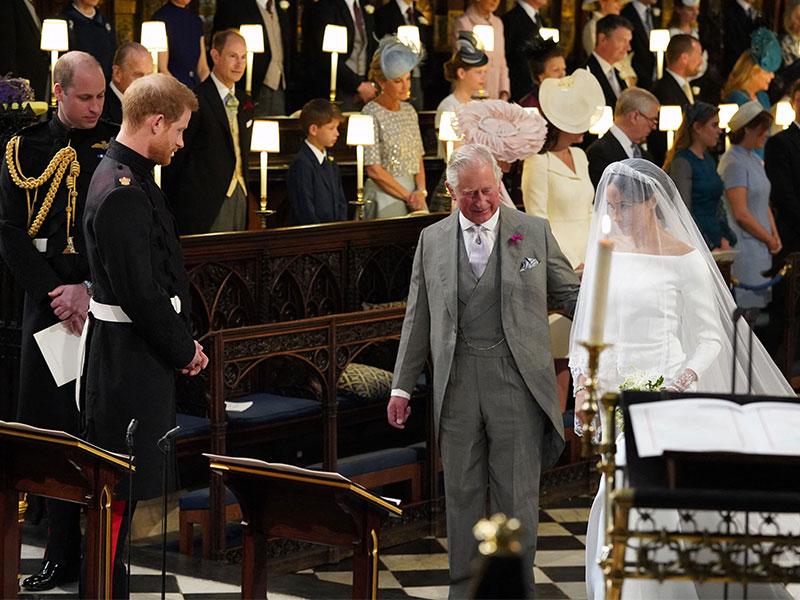
Meghan asked King Charles III to walk her down the aisle
Wedding ceremony of Britain's Prince Harry, Duke of Sussex and US actress Meghan MarkleWedding ceremony of Britain’s Prince Harry, Duke of Sussex and US actress Meghan Markle in St George’s Chapel, Windsor Castle, in Windsor, on May 19, 2018. (JONATHAN BRADY/POOL/AFP via Getty Images)
“Harry’s dad is very charming,” Meghan said when recounting her wedding. “And, I said to him, ‘I’ve lost my dad in this.’ So, him as my father-in-law was really important to me. So, I asked him to walk me down the aisle and he said yes.”
 
The king (who was a mere prince back then) was also involved in organizing Harry and Meghan’s big day. Per Harry, his father helped the pair choose a gospel choir and an orchestra, which the Duke said “made all the difference.”
02
The couple’s popularity caused tensions with other royal family members
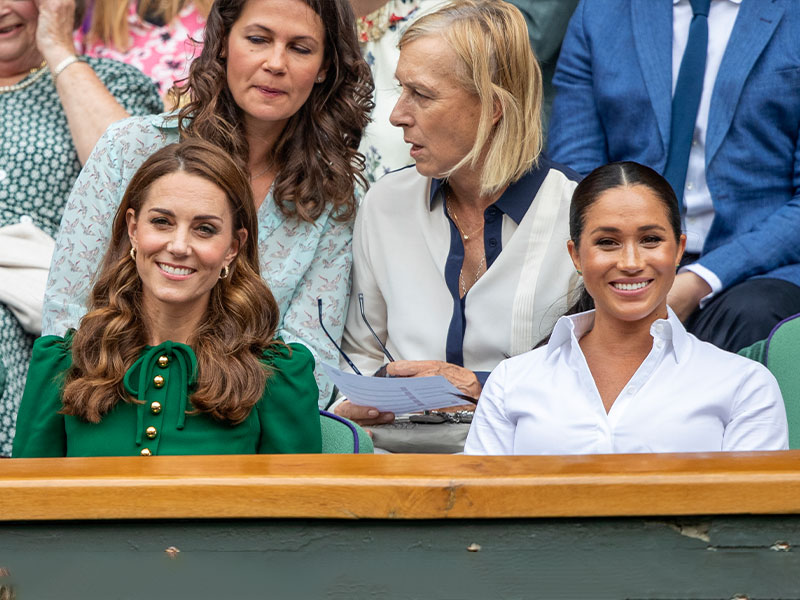
Catherine, Duchess of Cambridge and Meghan, Duchess of SussexCatherine, Duchess of Cambridge and Meghan, Duchess of Sussex in the Royal Box on Centre Court during the Wimbledon Lawn Tennis Championships at the All England Lawn Tennis and Croquet Club at Wimbledon on July 13, 2019 in London, England. (Tim Clayton/Corbis via Getty Images)

Lucy Fraser, a friend of both Harry and Meghan, said many royal members were increasingly threatened by the couple’s growing popularity with the public. This tension was also fueled by the media — a headline from the British tabloid newspaper The Sun read, “‘ROYAL RIVALS: ‘Forward thinking’ Meghan Markle and Prince Harry top Time’s most influential list but Kate Middleton and Prince William are snubbed.” Other outlets called Meghan “a version of the Antichrist” and asserted that her so-called “diva demands” were “wreaking havoc” at the palace.  


“The issue is when someone who’s marrying in, who should be a supporting act, is then stealing the limelight, or doing the job better than the person who is born to do this. That upsets people. It shifts the balance,” Harry explained. “Because you’ve been led to believe that the only way your charities can succeed and the only way your reputation can be grown or improved is if you’re on the front page of those newspapers.”


It didn’t take long for tabloids to create a media war between the Duchess of Sussex and her sister-in-law, Kate Middleton. A Daily Mail headline for Kate’s pregnancy read, “Not long to go! Pregnant Kate tenderly cradles her baby bump while wrapping up her royal duties ahead of maternity leave – and William confirms she’s due ‘any minute now,'” while a headline for Meghan’s pregnancy read, “Why can’t Meghan Markle keep her hands off her bump? Experts tackle the question that has got the nation talking: Is it pride, vanity, acting – or a new age bonding technique?”


The media coverage surrounding Meghan was also incredibly racist, with many outlets linking her to terrorism, drugs and gangs.

03
Meghan contemplated suicide
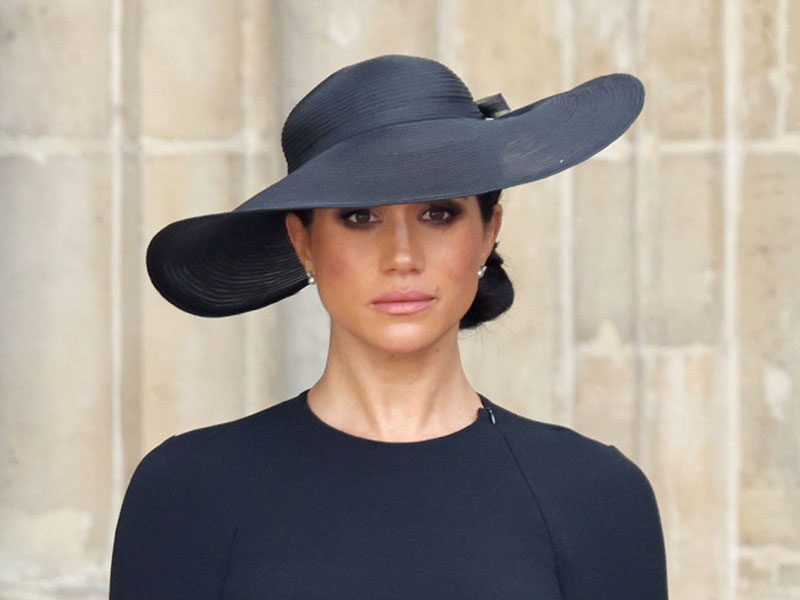
Meghan MarkleMeghan, Duchess of Sussex is seen during The State Funeral Of Queen Elizabeth II at Westminster Abbey on September 19, 2022 in London, England. (Chris Jackson/Getty Images)

Meghan’s mother, Doria Ragland, recounted how her daughter had wanted to take her own life:


“Well, I knew it was bad. But to just constantly be picked at by these vultures, just picking away at her spirit,” Ragland said of Meghan’s media attention. “That she would actually think of not wanting to be here. That’s not an easy one for a mom to hear.”


Harry added that he “never thought that it would get to that stage,” and when it did, he felt both “angry and ashamed.


“I didn’t deal with it particularly well. I dealt with it as institutional Harry, as opposed to husband Harry,” he continued. “And what took over my feelings was my royal role. I had been trained to worry more about, ‘What are people gonna think if we don’t go to this event? We’re gonna be late.’


“And looking back on it now, I hate myself for it.”


Meghan said she wanted to seek help but wasn’t allowed to because it would tarnish the royal family’s reputation.

04
The controversy around Archie’s birth announcement
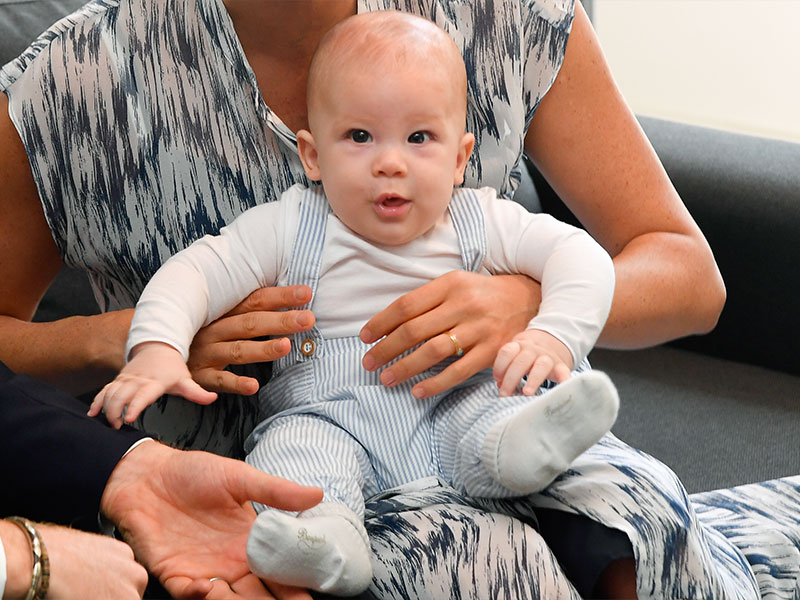
Baby Archie Mountbatten-WindsorBaby Archie Mountbatten-Windsor (Pool/Samir Hussein/WireImage/Getty Images)

Harry and Meghan recalled that they were met with anger and outrage for their decision to stay private about the birth of their first child, Archie Harrison Mountbatten-Windsor. 


“The amount of abuse that we got . . . for not wanting to serve our child up on a silver platter, was incredible,” Harry said. Shortly after Archie’s birth, the couple came across a tweet of a black-and-white photo of an unknown couple, meant to represent Harry and Meghan, carrying a chimp. A caption at the top of the post simply read, “Royal baby leaves hospital.”

05
Meghan’s father targeted his daughter
Meghan Markle, the Duchess of SussexMeghan, the Duchess of Sussex (MICHELE SPATARI/AFP via Getty Images)

As if the negative press wasn’t enough, Meghan’s reputation was further tarnished by her father, Thomas Markle. According to several headlines, Thomas slammed his daughter’s “sense of superiority,” erroneously claimed that he was being “shunned” by his daughter and likened the royal family to a “secretive Scientology cult.”


Per suggestions from the queen and Prince William, Meghan decided to write a letter to her father to mend the situation. The letter was discreetly sent via Meghan’s business manager in Los Angeles. However, when Meghan received a picture of the signature confirmation that the letter had been delivered, she alleged that the signature was not her father’s. Shortly afterwards, the private five-page letter was made public by Thomas.


“The toll was visible. The emotional toll that it was having on both of us, but especially my wife,” Harry said about the negative media coverage following the couple’s U.K. tabloid libel lawsuit. “We’re gonna have to change this, for our own sake. How are we gonna change our relationship with the institution, but in a way that protects us and our mental health and our well-being as well?”


Meghan also claimed that she “wasn’t just being thrown to the wolves,” she “was being fed to the wolves.” It was clear at this point that the palace wasn’t going to protect the couple, especially Meghan.

06
The royal institution allegedly leaked Harry and Meghan’s plans to move to Canada
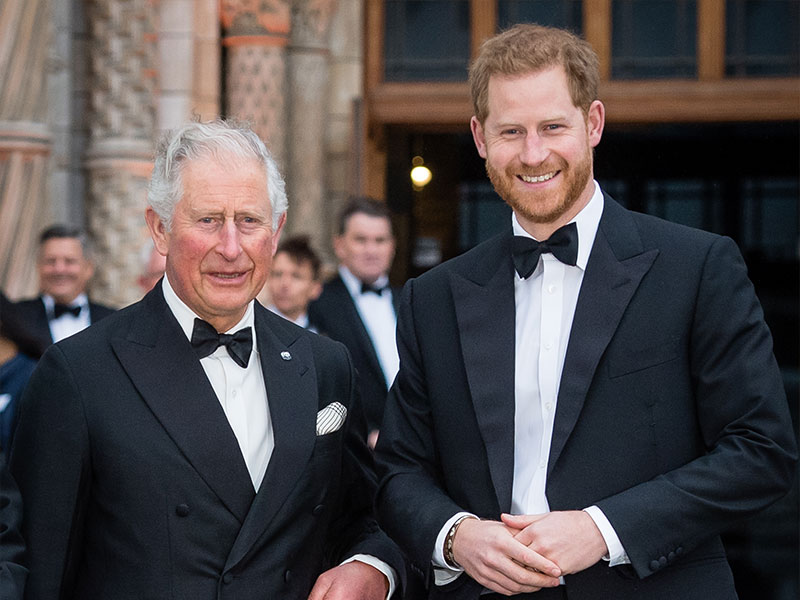
Prince Charles, Prince of Wales and Prince Harry, Duke of SussexPrince Charles, Prince of Wales and Prince Harry, Duke of Sussex (Samir Hussein/Samir Hussein/WireImage/Getty Images)

The couple decided to leave London and move to Canada, where they could step away from the public eye and continue their work throughout the Commonwealth. Harry said that he shared the exclusive plan with his father, who then asked if he could have it outlined in writing. The plan was shared with Prince Charles via emails, one of which mentioned that the pair would relinquish their Sussex titles if their plan didn’t work out. Five days later, the plan was leaked to several tabloids.


“It became clear that the institution leaked the fact that we were going to be moving back to Canada,” Harry asserted. “And the key piece of that story that made me aware that the contents of the letter between me and my father had been leaked was that we were willing to relinquish our Sussex titles. That was the giveaway.


“Our story, our life, literally got taken from underneath us.”


The couple, alongside their team, later released a statement saying they would step back from their roles.

07
The bitter quarrel at Sandringham
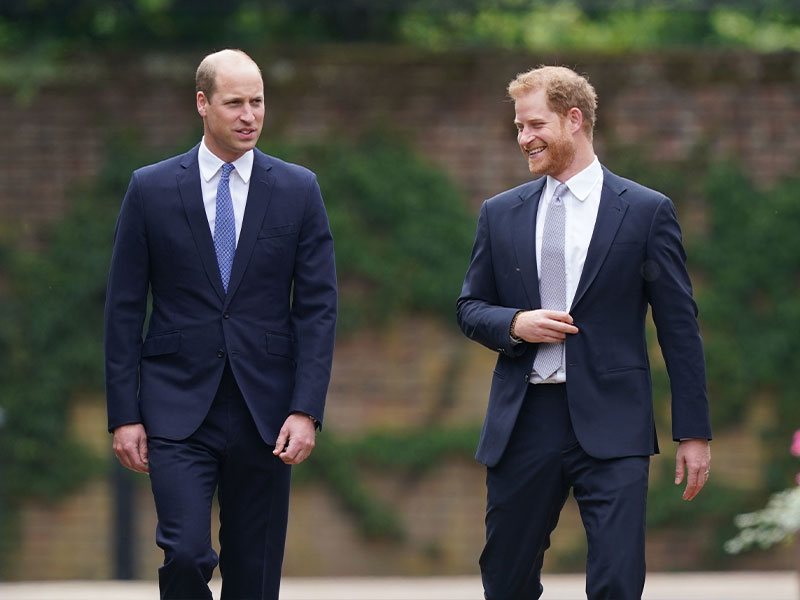
Prince William, Duke of Cambridge and Prince Harry, Duke of SussexPrince William, Duke of Cambridge and Prince Harry, Duke of Sussex (Yui Mok – WPA Pool/Getty Images)

Harry traveled to the royal residence Sandringham to meet with Queen Elizabeth II, Charles and William and discuss the couple’s future involvement in the royal family. Harry said he chose a “half in, half out” option, in which he and Meghan would have their own jobs but also work in support of the queen.


“It became very clear very quickly, that goal was not up for discussion or debate,” Harry said. “It was terrifying to have my brother scream and shout at me and my father say things that simply weren’t true, and my grandmother quietly sit there and sort of take it all in.”


He continued, “The saddest part of it was this wedge created between myself and my brother, so that he’s now on the institution’s side.” That day, a news story also claimed that a part of the reason why Harry and Meghan were leaving the family was because William “had bullied them out.” A joint statement was then released in January 2020, in which the brothers denied the aforementioned story and called it “false,” “offensive” and “potentially harmful.” The statement, however, was written without Harry’s permission.


“No one had asked me permission to put my name to a statement like that,” he said in the series. “And I rang [Meghan] and I told her, and she burst into floods of tears, because within four hours, they [the institution] were happy to lie to protect my brother, and yet for three years, they were never willing to tell the truth to protect us.”


Harry added, “So there was no other option at this point. I said, ‘We need to get out of here.'” The couple officially stepped back from their royal duties.

08
Meghan’s half-sister was part of a hate group that sent death threats
Meghan Markle, Duchess of SussexMeghan, Duchess of Sussex (Max Mumby/Indigo/Getty Images)

Samantha Markle, Meghan’s half-sister, was part of a hate group that was spreading disinformation about Meghan and sending her death threats. Her Twitter account was subsequently suspended, and it was revealed that she had 11 additional accounts that were spewing similar hateful messages. 


The documentary noted that Samantha’s attorney said Samantha’s Twitter account was never “suspended” but rather, it was “hacked, resulting in “imposter accounts” made by third parties to defame Samantha.


Such hate groups attacking the Duchess called her a “witch,” “gold digger,” “immoral sex maniac dirty b***h” and even the N-word. 


“The seriousness of what has happened to her and what . . . happened to us, and what continues to happen to her, that needs to be acknowledged,” Harry said of his wife’s treatment.


Meghan added that while she was looking through a manual for the couple’s security team, she came across the specific protocols for reporting a tweet like, “Meghan just needs to die. Someone needs to kill her. Maybe it should be me.”


“That’s my real life. And that’s the piece when you see it you go, ‘You are making people want to kill me,'” Meghan said tearfully. “It’s not just a tabloid. It’s not just some story. You are making me scared.”

09
Tyler Perry invited the couple to stay at his house
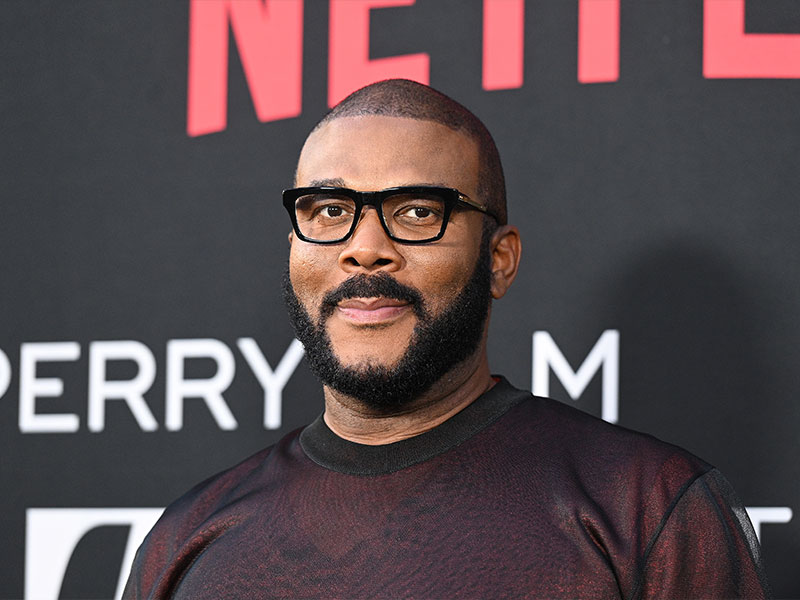
Tyler PerryTyler Perry (Gilbert Flores/Variety via Getty Images)

After Harry and Meghan stepped back from their royal roles, the couple’s security detail was removed and their location in Canada became public knowledge. 


“This was like a week before COVID,” Harry said in the series. “And we’d been stuck at this house where everyone in the world knew where we were, unprotected, no security.”


Amid their search for a new place to live, Harry, Meghan and their son Archie received help from filmmaker Tyler Perry, who invited them to stay at his mansion in Los Angeles. Perry first got in contact with Meghan in 2018, when news of Thomas Markle not attending her and Harry’s wedding made headlines. 


“I’d never met him before,” Meghan said of Perry. “He sent me a letter before the wedding, saying he was praying for me, and that if I ever need anything, he would be there.”


Years later, Meghan and Perry spoke for the first time over the phone. Meghan said she was “just a wreck” and “just crying and crying.”


“I could hear the fear. It was palpable. I could hear it,” Perry said. “So I asked her what was she afraid of, and she took a deep breath, and she started listing the things that [she was] afraid of, and I said to her, ‘Every one of your fears are valid.'”


Unfortunately, after spending six “blissful” weeks with Perry, the couple’s location was once again discovered by the media.


“I’d been at that house for many, many, many years,” Perry continued. “And across the canyon are all these other celebrities, and no one had seen an assault like this, with helicopters 24/7, drones flying over. We would go up every day, and the chain link on the fence would be cut, and people would sneak in onto my property . . . It was crazy.”

10
Harry blames the tabloids for Meghan’s miscarriage
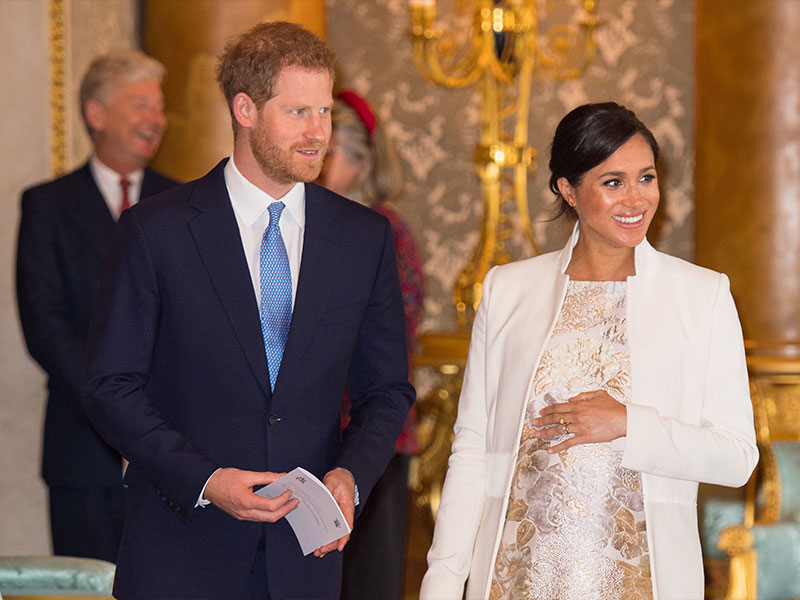
Meghan, Duchess of Sussex and Prince Harry, Duke of Sussex attend a reception to mark the fiftieth anniversary of the investiture of the Prince of Wales at Buckingham Palace on March 5, 2019 in London, England. (Dominic Lipinski – WPA Pool/Getty Images)

“I believe my wife suffered a miscarriage because of what the Mail did,” Harry said, referencing Meghan’s 2020 privacy lawsuit against the Daily Mail publisher, Associated Newspapers. Multiple outlets under the publisher printed sections of the five-page letter Meghan had sent to her estranged father. 


He continued, “Now do we absolutely know that the miscarriage was caused by that? Of course, we don’t. But bearing in mind the stress that caused the lack of sleep and the timing of the pregnancy, how many weeks in she was, I can say from what I saw, that miscarriage was created by what they were trying to do to her. I thought she was brave and courageous, but that doesn’t surprise me because she is brave and courageous.”

11
The Sussexes, now settled in California, miss lost friends
Prince Harry and Meghan, The Duke and Duchess of Sussex.Prince Harry and Meghan, The Duke and Duchess of Sussex. (Courtesy of Prince Harry and Meghan/Netflix)
When asked if there are things he misses about life in the institution, Harry said he misses “the weird family gatherings,” his hometown and his friends there. “I’ve lost a few friends in this process as well,” he added. 
 
But despite that, Harry emphasized that he settled in California because he was “changed” and had outgrown his old environment.  
 
“Part of what’s beautiful here is the freedom to have family moments out in the world,” Meghan also said of her family’s residence. “And I want our kids to be able to do that and to be able to travel. And to fall in love, you know. I just want them to be happy.”

The first and second volumes of “Harry & Meghan” are currently available for streaming on Netflix. Watch a trailer for the series below, via YouTube:

Previously sealed JFK assassination files released via an executive order signed by Biden

Prompted by an executive order signed by President Biden, The National Archives and Records Administration released 13,173 documents on Thursday that shed further light on the 1963 assassination of John F. Kennedy.

As CBS points out in their coverage of the release of this new batch of documents, the President John F. Kennedy Assassination Records Collection Act of 1992 called for the release of all documents pertaining to the assassination by October 2017, “unless doing so would harm national security or intelligence sources, or violate certain privacy protections.” Many of the documents previously made public were heavily redacted and many others were withheld for those very reasons stated above.

In Biden’s executive order to release further documents on Thursday he explains his decision saying “This significant disclosure reflects my Administration’s commitment to transparency and will provide the American public with greater insight and understanding of the Government’s investigation into this tragic event in American history.”

Biden highlights that previously released documents that had been redacted have now been re-released in transparency.


Want a daily wrap-up of all the news and commentary Salon has to offer? Subscribe to our morning newsletter, Crash Course.


“Pursuant to my direction, agencies have undertaken a comprehensive effort to review the full set of almost 16,000 records that had previously been released in redacted form and determined that more than 70 percent of those records may now be released in full,” per Biden’s statement. 

Back in October, The Mary Ferrell Foundation, which oversees an online database of JFK records related to his assassination, sued the Biden administration for failing to meet the 2017 deadline set by the President John F. Kennedy Assassination Records Collection Act of 1992, as pointed out in the CBS News report. 

“These failures have resulted in confusion, gaps in the records, over-classification, and outright denial of thousands of assassination-related files, five years after the law’s deadline for full disclosure,” the organization said at the time of their suit.

During Trump‘s presidency, he grandstanded that he would personally see to the release of the JFK assassination files, presumably in full, but backpedaled.

“After strict consultation with General Kelly, the CIA and other Agencies, I will be releasing ALL JFK files other than the names and addresses of any mentioned person who is still living,” Trump later said, going on to release an earlier batch of 19,045 documents, portions of which were redacted.

The available documents can be accessed via The National Archives. One of the documents dated 05/25/1964 looks into the significance of Oswald’s tourist visa to enter Russia from the Soviet Embassy at Helsinki. Another dated 11/26/1963, which is partially redacted, makes several mentions of Oswald’s visa in relation to the timing of JFK’s assassination.  

Architect of SCOTUS takeover funnels millions to groups trying to gut voting and discrimination laws

ProPublica is a Pulitzer Prize-winning investigative newsroom. Sign up for The Big Story newsletter to receive stories like this one in your inbox.


Flush with money after receiving the largest-known political advocacy donation in U.S. history, conservative activist Leonard Leo and his associates are spending millions of dollars to influence some of the Supreme Court’s most consequential recent cases, newly released tax documents obtained by ProPublica and The Lever show.

The documents detail how Leo, who helped build the Supreme Court’s conservative majority as an adviser to President Donald Trump, has used a sprawling network of opaque nonprofits to fund groups advocating for ending affirmative action, rolling back anti-discrimination protections and allowing state legislatures unreviewable oversight of federal elections.

The records also show that the Leo-aligned nonprofits paid millions of dollars to for-profit entities connected to Leo.

Leo and one of his top associates did not respond to requests for comment.

The money flowed mostly through so-called dark money groups, which don’t have to disclose their donors. They are required to reveal the recipients of their spending in their annual tax returns, which are released to the public, but often those are also dark money groups or other entities that have minimal disclosure rules.

As ProPublica and The Lever detailed in August, Leo was gifted a $1.6 billion fortune last year by a reclusive manufacturing magnate, Barre Seid. The newly revealed tax documents cover last year, just as Leo was in the process of receiving that enormous donation.

The Supreme Court case involving a Colorado-based website designer who refuses to work for same-sex couples provides a window into Leo’s strategy.

At least six groups funded by Leo’s network have filed briefs supporting the suit, which seeks to overturn Colorado’s anti-discrimination law. The Ethics and Public Policy Center, which records show received $1.9 million from Leo’s network, submitted a brief supporting the web designer. So did Concerned Women for America, which has received at least $565,000 over the past two years from the Leo network, as well as an organization called the Becket Fund, which got $550,000 from a Leo group.

Leo’s network has also been the top funder of the Republican Attorneys General Association, or RAGA, which spends money to elect GOP attorneys general and serves as a policy hub for the state officials. Twenty Republican attorneys general have also filed a brief in support of the case. One Leo group donated $6.5 million to RAGA during the 2022 election cycle, according to the association’s federal filings.

The largest donation by Leo’s network was $71 million given to DonorsTrust, a so-called donor-advised fund that pools money from numerous funders and gives it out to largely conservative and libertarian groups. Past reports havedescribed DonorsTrust as a “dark-money ATM” of the conservative movement.

Another case that Leo groups have sought to influence is Moore v. Harper, which could have sweeping implications for American democracy. The question posed in the case is whether the Constitution affords state legislatures the power to create rules for federal elections without state court oversight or intervention.

The Honest Elections Project, an initiative within another key Leo organization, the 85 Fund, has backed the plaintiff’s case with an amicus brief. The tax documents show that the 85 Fund also donated $400,000 in 2020 to the Public Interest Legal Foundation, an Indianapolis-based conservative legal group that filed a supportive brief in the case.

Thirteen Republican attorneys general filed a brief backing the suit as well.

The Supreme Court is also hearing two cases this term brought by the conservative group Students for Fair Admissions that are challenging universities’ affirmative action policies. The group received $250,000 from the 85 Fund in 2020, the tax records show, more than a third of the total it raised that year.

Speech First, which the records show received $700,000 in 2020-21 from the 85 Fund, filed briefs backing Students for Fair Admissions in both cases. Republican attorneys general, backed by Leo’s network, submitted briefs, too.

The other theme to emerge from the new tax records is the large amount of expenditures going to for-profit entities run by or connected to Leo. The 85 Fund’s largest outside vendor for 2021 was CRC Advisors, a for-profit consulting firm chaired by Leo. The 85 Fund paid CRC Advisors $22 million last year, tax records show.

The largest outside vendor to the Concord Fund, another hub in Leo’s network, was also CRC Advisors, which received nearly $8 million over the course of a year. Concord also paid $500,000 to BH Group, another for-profit firm led by Leo.

There is no prohibition on nonprofits sending business to companies they have connections to, but any deals must be made at a fair market value.

The companies did not immediately respond to questions about the payments.

The strange, psychedelic history of Christmas

How do reindeer fly Santa’s sleigh around the world? If you guessed hallucinogenic mushrooms, you might actually be right.

It almost sounds sacrilegious to mix psychedelics and winter festivities, but there’s actually a fair amount of historical evidence that suggests modern Christmas was borne out of trippy traditions. From flying reindeer to presents and ornaments to the bearded man with the North Pole address, a ton of iconography overlaps with indigenous psychedelic shamanism in Siberia and northern Europe.

Some historians argue that Santa Claus is actually a “magic” mushroom shaman, as indicated by his red and white outfit. It resembles the psychedelic fly agaric mushroom, a fungus as bright red as Rudolph’s schnoz sprinkled with white flecks like snow. Drawing on this and other evidence, quite a few scholars subscribe to theories that numerous Christmas traditions spawned from pagan psychedelic rituals, even if it’s not a mainstream belief.

But how much truth is there to this hallucinatory history?

The fly agaric (Amanita muscaria) mushroom is so iconic, it’s often the first breed of fungi that comes to mind. Its name derives from an old use as a fly-killing pesticide, but today it’s better known for its portrayal in emojis and ubiquity in popular culture, such as in children’s fairy tales or “The Smurfs.” It actually has some psychedelic properties, not unlike the weird effects of similar mushrooms in “Alice in Wonderland” and “Super Mario.”

In fact, one of the most commonly reported effects from eating or even smoking fly agarics are “gulliverian” and “lilliputian” hallucinations, both of which are named for the book “Gulliver’s Travels,” a story following the eponymous tourist as he encounters little people known as Lilliputians. The similarly named hallucinations can give people the illusion of shrinking or growing, which means there’s some truth to the resizing effects associated with Alice and Mario.

“In the oldest known text that seems to refer to lilliputian hallucinations, St. Macarius the Elder of Alexandria (AD 300-390) speaks of ‘little strangers,'” Jan Dirk Blom wrote in his 2010 book “A Dictionary of Hallucinations.” “Ancient Siberian peoples referred to ‘fly-agaric men’ and ‘amanita girls’ in connection with the lilliputian hallucinations said to occur in the context of Amanita intoxication.”

Some historians argue that Santa Claus is actually a “magic” mushroom shaman, as indicated by his red and white outfit.

Fly agaric mushrooms are very different from psilocybin-containing “magic” mushrooms. While psilocybin is at the center of a growing scientific and cultural revolution, A. muscaria mushrooms don’t contain any psilocybin. Instead, they carry a cocktail of psychoactive compounds such as muscimol and even bufotenine, which oddly enough is also secreted by desert toads. Other compounds in the mushrooms, like ibotenic acid, can be neurotoxic in high doses.

Users of fly agarics may also experience dreamlike, sedating feelings, as well as agitation, confusion, dizziness, auditory and visual perceptual changes and distortions of space and time. The effects usually wear off after 24 hours, but one case report detailed a man who had “a 5-day paranoid psychosis after A. muscaria ingestion,” while another man slipped into a coma after eating half a kilo of fly agaric mushrooms. Both survived, but death, while rare, is not unheard of from these mushrooms, which are widely considered by mycologists to be toxic (though they can be detoxified for safe consumption).

What does any of this have to do with Christmas? Well, fly agaric mushrooms are scattered across the globe, on every continent except Antarctica. Humans have been using them as an entheogen — that is, a drug with a spiritual purpose — since ancient times in Europe, Asia and the Americas. “It has been speculated that it may well be the oldest entheogen or hallucinogen known to mankind,” Blom wrote.

Even more intriguing, the mushrooms only grow beneath trees, but the fungus especially loves pine trees. The reason is because fly agaric mushrooms are mycorrhizal, a combination of the Greek words for “fungus” (mýkēs) and “root” (rhiza), which means the fungi need trees to survive.

The red-and-white bulb we call the mushroom is really just the fruit. The rest of the fungus is underground, forming a network of filaments called mycelia that worms its way into the roots of trees. The two organisms trade nutrients, so it’s a symbiotic relationship. But no roots, no mushrooms. That’s why it’s not easy to reproduce these mushrooms at scale, though some researchers are trying to solve this issue.

When they sprout up — almost like magic — the mushrooms may give the appearance of “presents,” similar to the gift boxes we now associate with Christmas. They can even get quite large, about 30 centimeters tall or the height of a sheet of A4 paper. Fly agarics are commonly depicted in old Christmas cards, and the mushrooms themselves were often used as ornaments.


Want more health and science stories in your inbox? Subscribe to Salon’s weekly newsletter The Vulgar Scientist.


For reindeer, these mushrooms are a delightful treat, and yes, they seem to experience some kind of intoxicating effect from ingesting them. Humans aren’t the only animals that like to get high. Many creatures, from dolphins to bears and jaguars, have been studied seeking out intoxicating substances in nature.

When reindeer get buzzed on A. muscaria, they behave somewhat drunkenly. Their prancing behavior — especially to someone who had taken mushrooms themselves — might appear like flying. People are even known to drink the urine of reindeer that have eaten A. muscaria.

The Sámi people of Lapland, who hail from northern Finland — not far from the North Pole — centered both reindeer and fly agaric mushrooms in their culture. Sámi religious leaders called shamans would act as mediators between this world and the spirit world, traveling by reindeer as they visited homes during the Winter Solstice to perform healing rituals with the psychedelic mushrooms. The shamans were even known to dress in characteristic red and white. But during the winter, many doorways would be snowed in, leaving only one way to enter: down the chimney.

When you start adding up these details, the idea that Santa was a mushroom shaman who flew around on tripping reindeer starts to make some sense.

“Santa is a modern counterpart of a shaman, who consumed mind-altering plants and fungi to commune with the spirit world,” John Rush, an anthropologist and instructor at Sierra College in Rocklin, California, told Live Science.

When you start adding up these details, the idea that Santa was a mushroom shaman who flew around on tripping reindeer starts to make some sense. At least some of these elements could have bled together with other Christmas origin stories, such as St. Nicholas being one of the progenitors of Santa.

In the end, how strong is the evidence for this psychedelic Christmas tale? It’s intriguing, but far from definitive. Part of the problem is that shamanism in Siberia was stamped out by the Soviet Union, which banned the religion and assassinated many who practiced it. The Sámi also experienced colonization from Finland, which has helped make reindeer herding all but obsolete. There isn’t really anyone to ask about how much truth there is to these rumors, but perhaps writing it all off as coincidence is dismissive, as well.

Either way, it’s a good reminder that, despite Christ in the title, most Christmas traditions have very little to do with Jesus Christ. That isn’t necessarily a bad thing. Instead, these traditions are an amalgamation of many different cultures, religions and ways of understanding the world — or just surviving the harshness of winter using fantastic stories while getting a little buzzed.

Ex-Trump lawyer: No doubt Jan. 6 panel will refer my ex-client to DOJ — and evidence “justifies” it

A former White House lawyer who worked under the Trump administration recently offered a grim prognosis of President Donald Trump’s legal entanglements.

On Wednesday, December 14, Ty Cobb appeared on CNN with host Erin Burnett where he admitted he believes the House Select Committee investigating the Capitol insurrection will ultimately provide a criminal referral to the U.S. Department of Justice (DOJ).

Since his departure from the White House back in 2018, Cobb has been deeply critical of the former president, and his remarks during the recent CNN appearance were no different.

At one point during the discussion, Burnett, per HuffPost, asked if Cobb had “‘any doubt’ the committee probing the violence that Trump incited at the U.S. Capitol would refer the ex-POTUS.

“I do not,” Cobb admitted. “I think they started out with that as a goal and I think they certainly have put forward evidence that would justify, even in the absence of cross-examination, which I think is an unfortunate product of the committee’s constitution, but even without the cross-examination, clearly the evidence they have put forward justifies them to make a criminal referral.”

The former White House lawyer went on to highlight that a criminal referral like this might be “largely symbolic” and the DOJ would not be “required to do anything with it.”

However, he also added, “I’m sure they will refer the former president.”

Watch the video below or at this link.

Shame and sugar-free cookies: On navigating the holidays after a life of disordered eating

As a child, I spent hours poring over the pages of “D’Aulaires’ Book of Greek Myths,” using my finger to trace over vivid illustrations of scenes that brought me both delight and dismay. There was the story of Artemis, the goddess of the hunt, who fiercely defended women and wildlife with her bow. There were tales of heroes’ risky voyages along the River Styx, the waterway that connected the human world with the underworld, and of their attempt to thwart Hades, the god of the dead.

The story that interested me the most, however, was that of Dionysus, the god of wine, fertility and mirth. Dionysus was the son of Zeus, the result of one of his seemingly innumerable affairs with mere mortals, which ended poorly. Zeus’ “jealous wife” Hera convinced Semele (Dionysus’ mother) to ask to see him in all his godly splendor. Zeus tried to dissuade Semele of this request, saying that he would appear in a light brighter than a thousand earthly sons, but she didn’t listen.

After his mother’s death, Dionysus was raised by Maenads, the nymphs of the valley, and had tigers and leopards for playmates. He eventually grew to be handsome (in that unearthly way that I suppose only gods are handsome) and traveled the world teaching men and women how to make wine.

When Dionysus was eventually given a throne on Olympus alongside his resurrected and now-immortal mother, “the music was filled with the music of flutes and tambourines; never had there been such din and merriment on Olympus.”

Compared to some of the more conniving and vengeful gods, Dionysus was pleasantly simple. When he approached mortals, he’d make them some variation of this promise: I bring you pleasure — all you have to do is take it.

I bring you pleasure — all you have to do is take it.

It was an appealing proposition because even as a child, I understood that in my modern life — one ruled by fearing the wrath of a very specific God rather than that of a series of storybook gods — people want to tell you that pleasure comes with strings

This is something I’m reminded of as I open my work email every winter. It’s the time of year when my inbox becomes increasingly punctuated with words like “guilt” and “shame.” Not over anything I’ve said or done, but rather in reference to what I’m planning to eat.

As soon as October hits, the emails start, touting “healthy” substitutes for Halloween candy, such as boxes of raisins or non-caramelized apples. When Halloween passes, it’s time to make a game plan for Thanksgiving, which may include — as one email put it — swapping mashed cauliflower for “your grandmother’s fat-laden mashed potatoes” and bringing your own sugar-free pumpkin pie to gatherings if “you’re worried about temptation.”

Working in food, these emails come all year, but the connections made between shame and consumption are far more acute — and thus more bleak — during the holiday season. Film and TV reinforce that this is supposed to be the most joyful time of the year, and you’re kind of a Scrooge if you don’t partake. Simultaneously, there’s an undercurrent of messages that shame individuals for eating and drinking with glee. Of course, evidence of this dichotomy isn’t only restricted to my inbox.

Diet culture works overtime during the winter months, which has resulted in a slate of holiday recipes based on deletions, substitutions and swaps. While some of these are for folks who have dietary restrictions and distinct health needs, others are simply marketed to the masses under the ambiguous guise of “health,” when they’re often really talking about thinness.

About a week ago, a dear friend of mine — who also happens to be a dietician — sent me a screenshot of a list she saw online for “healthy holiday foods.” The first item was cruciferous vegetables, and the last item was water. It said that if you wanted to be “a little naughty,” you could have some fruit and nuts . . . or a sugar-free cookie.

Her only comment? “This is some bulls**t.”

Indeed, the idea of sitting at the holiday table with a plate of broccoli, a few apple slices and some pecans in pursuit of thinness is some bulls**t, but remember, diet culture is built on the notion that pleasure comes with strings (and you should never confront someone about what is on their plate).

For a very long time, the god of pleasure who had so appealed to me as a young child was replaced with a crueler god, The Pursuit of Thinness. Under its omnipresent, watchful eye, I could indulge in joy, but only if I deprived myself first.

As a 90s kid, I definitely remember eating two bowls of Special K or drinking two Slimfast shakes in lieu of breakfast and lunch in order to compensate for holiday dinners. Eventually, I just stopped eating in the hours — and then days, as I got older — leading up to a party. I carried a pocket-sized book, which I rescued from the bottom of my mother’s junk drawer. It was filled with the calorie and fat counts for hundreds of popular foods. Meanwhile, my father’s copy of “Eat This, Not That” became a Bible of sorts.

For a very long time, the god of pleasure who had so appealed to me as a young child was replaced with a crueler god, The Pursuit of Thinness. Under its omnipresent, watchful eye, I could indulge in joy, but only if I deprived myself first.

Over the years, my relationship with food and festivity has evened out. Through working in food, I’ve been able to rediscover the joy inherent to it, waiting to be discovered as you bite into a nectar-filled peach or a pillowy layer of ricotta spread between lasagna noodles. Moderation has its place in its life, but the disdain I used to show for my body and its hunger does not.

While some view calling one’s behavior “Dionysian” as an insult, conflating sensuality with lecherousness or debauchery, this holiday season, I mean it to say, “Don’t choose famine when you have the opportunity to feast.”

New study of online dating reveals the secret to getting more suitors

In the span of a few decades, online dating went from the fringe to the mainstream; now, more than half of Americans say relationships formed through online dating can be just as successful as those forged in real life. As of 2019, meeting online was the most popular way for couples to find each other, according to a Stanford study. With such a large pool of singles, there’s a cottage industry of sorts for online dating advice. Some singles even hire ghostwriters for the job of penning their profiles.

The study analyzed what exactly a profile’s text needed to do to be perceived as “original.”

Now, science has turned its eye towards the study of how to stand out in online dating. A new study in the journal PLOS One offers insights into how one can create the most successful dating profile. The name of the game, it turns out, is originality.

“The first goal was to examine whether the perceived originality of authentic online dating profile texts affects online daters’ perceptions of attractiveness,” the authors explain, adding that their results confirmed that online daters do indeed prefer partners perceived as original. More specifically, they enjoyed traits such as intelligence, a sense of humor and creativity. Online daters were particularly drawn to profiles where the language itself stood out from the generic.

In addition, the study analyzed what exactly a profile’s text needed to do to be perceived as “original.” Intriguingly, there were specific quirks that consistently proved to be “attractive” to line daters. For instance, profiles that used clever metaphors received highly favorable responses, as did those which included concrete and easily verifiable self-disclosures.

“Taken together, our results suggest that perceived originality in profile texts is manifested in both meaning and form, and is a balancing act between novelty and appropriateness,” the authors write.

The corresponding author for the study, Dr. Tess van der Zanden, told Salon by email that one limitation was that most of the subjects were elderly.

“Our sample consisted of members of online dating platforms,” van der Zanden explained. “While this is a strength of the study, it should at the same time be mentioned that the average age of the respondents was around 65 years. This is because we collaborated with the dating platform 50PlusMatch, which is a specific platform for active people of 50 years or older. Given this sample, we can thus not generalize our findings and draw any conclusions about general effects of perceived profile text originality on impression formation across all ages, as the participant’s mean age was 63.5 years.”


Want more health and science stories in your inbox? Subscribe to Salon’s weekly newsletter The Vulgar Scientist.


As anyone who has struck out online can confirm, this is easier said than done — and the authors unpack the exact reasons why that is the case. For one thing, even though online daters want to stand out, they also need to remain in the realm of “appropriate.” In addition to following obvious rules about avoiding abusive or overly-sexual language, this also means coming across as someone who is generally approachable. A profile that seems “weird” may be off-putting, despite standing out from the pack.

“Profile texts that do not conform to existing conventions, such as those that do not contain any personal information, negatively violate (social) expectancies and norms,” the authors write. “Such unexpected behavior can, in turn, negatively affect impression formation, for instance with regard to general favorability.” People want their mates to be memorably different, “but only so long as it happens within the boundaries of appropriateness.” As such, online daters must find a way of learning about which behaviors are expected in their Internet forums, and to abide by those rules of etiquette accordingly.

“The vast majority of profile texts still appear cliché-ridden and generic and show a high level of predictability.”

Yet being just one more animal in the herd means that you run the risk of being ignored completely. Only original profiles avoid that fate — but original profiles are most easily written by original people, and unfortunately not all of us are quirky, unique snowflakes.

“The vast majority of profile texts still appear cliché-ridden and generic and show a high level of predictability,” the authors point out. “Most profile owners present similarly (selective) information in which common attributes, such as self-descriptions of being spontaneous and kind, and common interests and activities are emphasized (e.g., love to laugh and travel, like to sip wine by fireplaces, go for romantic strolls on the beach).”

To the extent that any formula exists for writing profiles that balance originality with appropriateness, it can be boiled down to intelligence, humor, and being able to self-disclose. This does not mean that you should be condescending or arrogant (grammar snobs, for instance, do not do well in online dating), but that you should display non-threatening intelligence through use of metaphors and by speaking in an informed, confident way about matters other than yourself.

Invest time in both the profile picture and text, as our research (other studies) show that people actually pay attention to profile texts as well and that what is written in a profile and how this profile is written affects impression formation,” van der Zanden explained. “It is recommended to avoid language errors and to try to make a profile stand out by using metaphors and self-disclosure that is concrete (something that can be visualised and is more unique for you, such as your favorite type of holiday and/or country instead of mentioning that you like to travel).”

As the authors put it in the study, “Our results reveal that primarily stylistic and self-disclosure features predicted higher text originality scores. It seems that profiles that were perceived as more original were more likely to contain fixed and novel metaphors (stylistic features), and more and concrete self-disclosures (self-disclosure features). Finally, profiles deemed original were less likely to be (fully) written from a self-perspective (perspective-taking feature).”

The truth about CIA-backed Afghanistan night raids that killed countless civilians

ProPublica is a Pulitzer Prize-winning investigative newsroom. Sign up for The Big Story newsletter to receive stories like this one in your inbox.


On a December night in 2018, Mahzala was jolted awake by a shuddering wave of noise that rattled her family’s small mud house. A trio of helicopters, so unfamiliar that she had no word for them, rapidly descended, kicking up clouds of dust that shimmered in their blinding lights. Men wearing desert camouflage and black masks flooded into the house, corralling her two sons and forcing them out the door.

Mahzala watched as the gunmen questioned Safiullah, 28, and 20-year-old Sabir, before roughly pinning them against a courtyard wall. Then, ignoring their frantic protests of innocence, the masked men put guns to the back of her sons’ heads. One shot. Two. Then a third. Her youngest, “the quiet, gentle one,” was still alive after the first bullet, Mahzala told me, so they shot him again.

Her story finished, Mahzala stared at me intently as if I could somehow explain the loss of her only family. We were in the dim confines of her home, a sliver of light leaking in from the lone window above her. She rubbed at the corner of her eyes; her forehead creased by a pulsing vein. The voices of her sons used to fill their home, she told me. She had no photos of them. No money. And there was no one who would tell her, a widow in her 50s, why these men dropped out of the sky and killed her family or acknowledge what she insisted was a terrible mistake.

But now there was me. I had ended up in Rodat in the heart of Nangarhar province while researching my own family’s story of loss in this desolate rural region in eastern Afghanistan.

Mahzala’s neighbors had pressed me to meet her; I was a foreigner, I must be able to help. Three months had passed since the raid. The neighbors believed it was the work of the feared Zero Units — squadrons of U.S.-trained Afghan special forces soldiers. Two more homes in the area were targeted that night, they said, though no one else was killed. Everyone acknowledged the Taliban had been in the area before; they were everywhere in Nangarhar province. But Mahzala’s sons? They were just farmers, the neighbors told me.

That trip was the first time I’d heard of the secretive units, which I’d soon learn were funded, trained and armed by the CIA to go after targets believed to be a threat to the United States. There was something else: The Afghan soldiers weren’t alone on the raids; U.S. special operations forces soldiers working with the CIA often joined them. It was a “classified” war, I’d later discover, with the lines of accountability so obscured that no one had to answer publicly for operations that went wrong.

Back in Kabul, I tried to continue my personal hunt, but Mahzala’s story had changed the trajectory of my journey. Her words and her face, with its deep-set wrinkles that mirrored the unforgiving landscape, lingered in my thoughts. Who were these soldiers? And what were they doing in remote farming villages in Afghanistan executing young men under the cover of night? Did anyone know why they were being killed?

As a journalist, I knew that Afghanistan’s story was most often told by outsiders, by reporters with little cause to explore barren corners like Rodat. Far from the world’s eyes, this story felt like it was being buried in real time. It was clear no one would be coming to question what happened that night or to relieve Mahzala’s torment.

Mahzala’s sons’ lives, it seemed, were being shrugged away, without acknowledgement or investigation, disappearing into the United States’ long war in Afghanistan. I began to focus on a basic question: How many more Mahzalas were there?

As I write this today, America’s war in Afghanistan is already being consigned to history, pushed from the world’s consciousness by humanity’s latest round of inhumanity. But there are lessons to be learned from the West’s failures in Afghanistan. Other reporters, notably at The New York Times, have documented the cover-up of casualties from aerial bombardment and the drone war in Iraq, Syria and Afghanistan. This story is a deep look inside what happened after America embraced the strategy of night raids — quick, brutal operations that went wrong far more often than the U.S. has acknowledged.

As one U.S. Army Ranger ruefully told me after the Taliban’s triumph last year: “You go on night raids, make more enemies, then you gotta go on more night raids for the more enemies you now have to kill.”

Although I hadn’t revealed it to Mahzala, I’d come to Afghanistan hoping to answer questions similar to her own.

Like Mahzala, I’m from Afghanistan. People call me “lucky” because I was adopted by a British family running a school across the border in Pakistan. At age 12, I moved with them to Israel and then on to England, where I attended university and later became a journalist. I had a few traces of my Afghan and Pakistani origins: a couple photographs of my biological mother — a Pakistani, young and lovely with hands like my own — a newspaper clipping advertising me, an orphan girl, for adoption and a few other scraps of information. But really, I had nothing.

I’d returned to Afghanistan as an adult, and with plans to also go to Pakistan, to investigate my past: Who were my birth parents? And what had happened to them? I was spurred by a mix of emotions from curiosity to a desire for closure.

Thirty years earlier, when I was 2, my mother, a refugee to Afghanistan, and younger sister were killed in a nighttime raid in the very same district as Mahzala’s sons — long before the Americans arrived. Like her, I also had no answers. A distant relative told me that my Afghan father was likely the intended target of the attack. He would be killed two years later during the increasingly violent civil conflict, but the people who murdered my mother and sister would never be held to account. One war bled into the next, and one family’s story of loss was replaced by another’s.

Trauma, I’ve learned, creates a rippling pool; its ravages spread to unseen edges. After I was adopted, I underwent numerous medical and psychological assessments. One declared that I’d had a “neurological insult” likely from an incident of trauma to the brain. I have no idea when or with what I was hit. The doctors observed that I had an “abnormal gait” that stymied my ability to run and a string of learning disabilities that affected my speech and my ability to interact with others. Doctors suggested that my adoptive father slowly push me on a swing to introduce me to movement. But I’d shut down and go rigid or, with white knuckles gripping the swing, scream.

My adoptive father recalls some friends suggesting that I “had demons and wouldn’t be at rest until they were cast out.”

Even as my physical and psychological ailments faded, questions of my origins taunted me. My personality and interests didn’t match those of my adoptive sisters. I was hardheaded, self-contained and struggled to show affection toward the people I loved. I had difficulty expressing my thoughts and feelings. Friends would ask me why I made things so difficult for myself. I didn’t have an answer.

I was middle of the road in most things in school and struggled to find my place among sisters who excelled academically and athletically. Although I did indeed feel “lucky,” I also felt an overwhelming pressure to make the most of the opportunities I’d been given.

In truth, I never felt British, Afghan or Pakistani. I tried to hire private investigators to find my birth parents. A slick businessman in a dodgy one-room London office above a bakery laughed off my request. A beefy man in hobnail cowboy boots met me at a swanky hotel in Dubai, then said he was reluctant to take on such a small but difficult job. No one was interested in digging around in a country at war.

And so I set out to Jalalabad to do it myself.

I learned from my conversation with Mahzala that the violence that tore apart my family had continued as Afghanistan lurched from civil war to a grinding conflict between the U.S. and the Taliban, al-Qaida and later ISKP (Islamic State Khorasan Province, the Afghan offshoot of the Islamic State). As I made calls and sifted through local news reports, my focus shifted from exploring my personal story to something else.

Over the next three and a half years, I did what it appeared that no one else was doing — nor will be able to do again — I tracked what the U.S.-trained and sponsored squads were doing on the ground, concealed from most of the world.

I cataloged hundreds of night raids by one of the four Zero Unit squads, which was known in Afghanistan as 02 unit, eventually identifying at least 452 civilians killed in its raids over four years. I crisscrossed hundreds of miles of Nangarhar interviewing survivors, eyewitnesses, doctors and elders in villages seldom, if ever, visited by reporters. The circumstances of the civilian deaths were rarely clear. But the grieving families I spoke to in these remote communities were united in their rage at the Americans and the U.S.-backed Kabul government.

My pursuit would take me from the palatial Kabul home of the former head of Afghanistan’s spy agency to clandestine meetings with two Zero Unit soldiers who were ambivalent about their role in America’s war. It would lead me back to the United States, where I met an Army Ranger in a diner in a bland middle American city. Over breakfast, he casually described how American analysts calculated “slants” for each operation — how many women/children/noncombatants were at risk if the raid went awry. Those forecasts were often wildly off, he acknowledged, yet no one seemed to really care.

My reporting showed that even the raids that did end in the capture or killing of known militants frequently also involved civilian casualties. Far too often, I found the Zero Unit soldiers acted on flawed intelligence and mowed down men, women and children, some as young as 2, who had no discernible connection to terrorist groups.

And the U.S. responsibility for the Zero Unit operations is quietly muddied because of a legal carve-out that allows the CIA — and any U.S. soldiers lent to the agency for the operations — to act without the same oversight as the American military.

The CIA declined to answer my questions about the Zero Units on the record. In a statement, CIA spokesperson Tammy Thorp said, “As a rule, the U.S. takes extraordinary measures — beyond those mandated by law — to reduce civilian casualties in armed conflict, and treats any claim of human rights abuses with the utmost seriousness.”

She said any allegations of human rights abuses by a “foreign partner” are reviewed and, if valid, the CIA and “other elements of the U.S. government take concrete steps, including providing training on applicable law and best practices, or if necessary terminating assistance or the relationship.” Thorp said the Zero Units had been the target of a systematic propaganda campaign designed to discredit them because “of the threat they posed to Taliban rule.”

My reporting, based on interviews with scores of eyewitnesses and with the Afghan soldiers who carried out the raids, shows that the American government has scant basis for believing it has a full picture of the Zero Units’ performance. Again and again, I spoke with Afghans who had never shared their stories with anyone. Congressional officials concerned about the CIA’s operations in Afghanistan said they were startled by the civilian death toll I documented.

As my notebooks filled, I came to realize that I was compiling an eyewitness account of a particularly ignominious chapter in the United States’ fraught record of overseas interventions.

Without a true reckoning of what happened in Afghanistan, it became clear the U.S. could easily deploy the same failed tactics in some new country against some new threat.

When I conceived this investigation, I knew if I was going to track the dead, I’d need some help. I met Muhammad Rehman Shirzad, a 34-year-old forensic pathologist from Nangarhar.

As a government employee, Shirzad had access to official records to verify the identities of those killed. But helping me was a risk. Nevertheless, he was keen to join. “We have to share the truth,” he told me. We began building a database of alleged civilian casualties and hit the road.

In the late spring of 2019, the trail led to the basement office of Lutfur Rahman, 28, former university professor who’d found himself unexpectedly chronicling the stories of Zero Unit survivors. He’d taught literature but had also acted as a counselor to young men with no one else to talk to.

“Nangarhar is the most restless province,” Rahman said. “They witness these raids every day.” He handed me a beat-up notebook. Inside were 14 stories of deadly Zero Unit raids that his students had described to him over two years.

We’d just started talking when Rahman got a call from a professor at the University of Nangarhar who said one of his students had missed classes for several days and then returned distracted and distressed, saying there’d been “an incident.”

A few days later, I found Batour, 22, in the university’s science lab, sitting sandwiched between plastic models of dissected human bodies. Slight, disheveled and with wild eyes, he looked lost. I suggested that we move to the privacy of the roof. He didn’t have to talk to me, I said. “It’s OK,” he said, then took a deep breath and cocked his chin, as if bracing for a blow.

They came a week earlier, on April 26. “It was a normal Thursday,” Batour said. He and his brothers prayed at the mosque and then returned to their home in Qelegho in Khogyani district. As Batour spoke, his skinny ankles swayed back and forth, not quite reaching the ground.

Around 9 p.m., he said, the 02 soldiers descended from helicopters and he knew a raid had started. They hit four houses before reaching his home hours later and “blew up the door.”

A soldier with a megaphone announced: “Your house is surrounded. Come out.” Inside, soldiers were asking everyone: “What is your name? What do you do?”

Batour and his father were led out of the house while his two brothers remained inside.

Two soldiers were speaking in English, he said, but there was a man with them translating their words into Pashto. Batour told them he was a student at the university and gave them his university ID. The soldiers checked his name against a list, he said, then ordered him to sit under a tree. As long as the planes are circling above, they told him, do not move.

Batour paused and stared at his hand, flexing his fingers.

“My back was to the house and I don’t know how long I was sitting there,” he said quietly, but that’s when he heard the sound of firing. “It was just like pop-pops, so it was silenced guns.” Batour heard the helicopters take off. “Immediately my father ran to the house screaming, but I couldn’t hear him. I ran after him. My father said: ‘Come on. They are finished.'”

They found his two brothers dead. They’d been shot many times.

That night, 11 people were killed including Batour’s brothers: Sehatullah, 28, a teacher at a secondary school in Khogyani district, left behind a wife and three young sons, and Khalid Hemat, 26, who went to university with Batour, had married just four months earlier.

The following day, Batour heard the local radio station announce that teachers from a government school were killed in the raid by the 02 unit. There was no mention that insurgents had been successfully eliminated.

“While my brothers were alive, I was free to study. But now they are gone; no one is here to support me. My lessons are left half-completed.” He told me he can’t concentrate and has nightmares about the night of the raid, but his family can’t afford to move from the village. “We still don’t know the reason my brothers were slaughtered.”

Batour believes the Zero Unit strategy had actually made enemies of families like his. He said his brothers had both supported the government and he did, too, vowing never to join the Taliban. Now, he said, he’s not so sure. As Batour spoke, something round and black dropped onto the roof by his feet. He briefly cowered, before realizing it was a taped-up black cricket ball that soared up from the ground floor. After a moment he exhaled. It’s as if he’d forgotten to breathe the whole time we were talking.

As Batour told me his story, I heard echoes of the other witnesses I had spoken to about the psychological toll of the raids. As long as most of them could remember, the country had been racked by violence. The hum of drones, the whirr of helicopters and the deafening blasts of suicide bombings and missile strikes had scarred the land and seeped into daily life.

Kurdish-German psychologist Jan Ilhan Kizilhan trains psychologists who specialize in trauma to work with war victims in Iraq and Syria. He told me that in Afghanistan trauma has become an inescapable legacy. “They experience past trauma again and again as if it is immediate,” he said. “The repetition reinforces these experiences many times over, keeping them alive for numerous future generations.”

At the more than 30 raid sites Shirzad and I visited, we were often greeted with surprise, particularly by women, who had seldom been asked about what they’d seen and, if they were victims, sometimes not mentioned. One 60-year-old woman told me that after her three sons and son-in-law were killed in a July 2019 night raid, she simply washed, shrouded and buried them. At the provincial governor’s office, she was told that the 02 conducted the operation and “it was a mistake.”

“Not once did I think I had any other options, that any Afghan official, court or anyone would believe me,” she said.

In Qala Sheikh village in Chaparhar district, more than a dozen people witnessed Zero Unit soldiers shoot five teachers in their homes, leaving behind the blackened shell of one home with two burned bodies inside.

The 02 unit later said it carried out the raid in a statement, announcing that the men were ISKP members — a claim Abdul Rahim, who saw his brother and nephews burning in the fire, denied. “If they were ISIS, why didn’t they arrest them in the city where they teach at government schools?” Rahim said that October. “It’s the obligation of the Afghan government to ask this unit why they are killing civilians.”

Rahim told me that a presidential delegation had traveled to Jalalabad, ostensibly to investigate the raid, but it never came to Qala Sheikh or spoke to witnesses or the doctors who treated his brother’s injuries before he died.

U.S. military and intelligence agencies have long used night raids by forces like the 02 to fight insurgencies and since the Vietnam War have defended the tactic, arguing that the raids are less likely to cause civilian casualties than aerial bombing.

But even a cursory review of U.S. military history raises serious questions about the operations, especially in places like Afghanistan, which is defined by deep tribal loyalties and where the high civilian death toll has, time and again, turned people against the United States and the local government it supported.

In 1967, the CIA’s Phoenix Program famously used kill-capture raids against the Viet Cong insurgency in south Vietnam, creating an intense public blowback. William Colby, then-CIA executive director and former chief of the Saigon station, conceded to Congress in 1971 that it wasn’t possible to differentiate with certainty between enemy insurgents or people who were neutral or even allies.

Despite the program’s ignominious reputation — a 1971 Pentagon study found only 3% of those killed or captured were full or probationary Viet Cong members above the district level — it appears to have served as a blueprint for future night raid operations.

The U.S. used night raids against al-Qaida in Iraq, under Gen. David Petraeus and Gen. Stanley McChrystal. Military officials said many of the operations killed or captured their targets. But it’s impossible to determine how often the intelligence was wrong, or misguided, and civilians paid the price. As in Afghanistan, complete casualty data has remained either classified, unavailable or untracked.

When McChrystal took over operations in Afghanistan in June 2009, he declared that Afghan officials would now take part in the planning and execution of the raids, but he also accelerated them. As in Iraq, the raids were met with protests, and former President Hamid Karzai repeatedly called for them to be banned.

The raids, along with drone strikes, were part of America’s vast counterterrorism apparatus known as the “kill-capture program.” When Petraeus replaced McChrystal in Afghanistan, he expanded the program and in 2010 released figures to the media claiming spectacular success — thousands of al-Qaida and Taliban leaders captured or killed.

In a subsequent press conference, a U.S. admiral revealed that more than 80% of those captured “terrorists” were released within weeks because there wasn’t supportable evidence that they were insurgents. And the raids seemed counterproductive: as they ramped up, so did the insurgent attacks.

Petraeus and McChrystal declined to answer questions for this story.

Meanwhile, the CIA was separately funding, training and equipping its own series of paramilitary forces in Afghanistan. The Zero Units were officially established around 2008, according to Afghan officials and soldiers, and modeled on U.S. special operations forces like the Navy SEALs. Regionally based and staffed by local soldiers, the units were sometimes accompanied by CIA advisers, transported by American helicopters and aided by armed support aircraft.

Sandwiched between bomb blasts and attacks on government institutions by insurgents, the Zero Units, whose members are estimated to be in the thousands, received scant scrutiny until 2013. Under the Trump administration, CIA Director Mike Pompeo announced that the agency was ramping up its approach in Afghanistan: “The CIA, to be successful, must be aggressive, vicious, unforgiving, relentless — you pick the word.”

The following year, in 2018, The New York Times published a report about the 02 unit using brutal tactics to terrorize Afghans. In October 2019, Human Rights Watch documented 14 cases — some amounting to war crimes — involving the 02 unit and other CIA-backed strike forces. In 2020, The Intercept reported on 10 night raids by another Zero Unit, 01, that targeted religious schools.

While the stories described deadly raids, not much was said about why the intelligence guiding them was often flawed. It appeared to be a pattern that went hand in hand with the night raid strategy. I spoke with two self-proclaimed “geeks” who helped build or operate spy technology during the peak years of war. They said failure was predictable, despite the huge advances in technical intelligence. The most cutting-edge equipment in the world, they said, didn’t make up for the deficits in understanding “the enemy” by the Americans processing the intelligence.

Lisa Ling spent 20 years in the military and built technology that was ultimately used to process intelligence that targeted Afghans. “I understand very viscerally how this tech works and how people are using it,” she said. The counterterrorism mission is essentially: “Who am I fighting, and where will I find them,” she said. But the U.S. struggled to differentiate combatants from civilians, she said, because it never understood Afghanistan.

Her thoughts echoed what I’d heard from Afghan intelligence officials. “Every gun-wielding guy in this country is not a Talib because people in rural Afghanistan carry guns,” said Tamim Asey, former deputy minister of defense and Afghan National Security Council director general.

In Afghanistan, Air Force technician Cian Westmoreland built and maintained the communications relays that underpinned America’s drone program. His grandfather’s distant cousin was Gen. William Westmoreland, a key architect of the night raid operations in Vietnam. His father was a technical sergeant and, Cian said, “ordered the missile parts for the initial bombing of Afghanistan.”

It became clear to Westmoreland that civilian casualty reports from the drone strikes sent up the chain of command were inaccurate. “Unless there are operators physically checking body parts on the ground, they have no idea how many civilians were killed,” he said. “And they have no idea how many ‘enemies’ they actually got.”

When he finished his deployment in 2010, Westmoreland says he was handed his evaluation, stating that he’d assisted on 200-plus enemy kills in five months. He ran to the bathroom, he said, and threw up. “How many is the plus? Who is counting? And who knows who was killed?”

A source familiar with the Zero Unit program said it “stayed in close contact with a network of tribal elders,” who alerted program officials when civilians were killed. Any such deaths, the source said, were “unintended.”

At times, Westmoreland said, bystanders paid the price simply because they were near a suspected target’s cellphone.

Speaking with them, it became clear that the language of the intelligence world itself could hide its weaknesses. Ling said that when intelligence officers cite “multiple sources” of intelligence to justify an operation, it doesn’t necessarily mean they have confirmatory information. It could simply mean that they have an overhead image of a house and an informant telling them who’s inside.

For six months, I pursued the most elusive perspective on the U.S. night raid strategy — the Zero Unit soldiers themselves; the men killing their own compatriots on U.S. orders.

In October 2019, two men whom I’ll call Baseer and Hadi finally agreed to meet me. Both in their mid-30s, they were friends, fathers and comrades-in-arms. Hardened by violence and the isolation of the Zero Units, they were initially baffled by my interest, not just because they feared discovery. Why would I want to talk to killers? They decided to speak, they said, because of their unease with missions gone awry — and their distrust of the motives of those directing the attacks. I agreed to protect their identities.

“They are Americans killing Afghans, and we are Afghans killing Afghans,” Baseer told me. “But I know the Americans do not lie awake at night with the guilt I have.”

Clouds of cigarette smoke swirled through shafts of sunlight in the dimly lit backroom of a quiet fish restaurant on the outskirts of Kabul where we finally met. Outside, the day’s first light paled into a gray glare glinting off gridlocked cars waiting to pass through fortified checkpoints into the capital.

Baseer sat cross-legged on the well-worn carpet, balancing a cellphone on each knee and grasping a cup of green tea between his jeweled fingers. His neat mustache caught a bead of sweat as it dripped from his brow. His impeccable grooming was at odds with the mismatched socks peeking from beneath his shalwar kameez.

He took a long drag on his cigarette, and I noticed finger-sized bruises stretching around his neck. Although he caught me looking at the bruises, he made no effort to explain them. He rolled his neck from side to side to loosen kinks and rubbed his hands together. He was eager to talk.

Sitting off to one side, Hadi wore a leather bomber jacket (“like Top Gun”) that dwarfs his wiry frame. It was 80 degrees, but Hadi only removed his beanie briefly, to absently rub a long, silvery scar that stretched across the top of his head. He was wary and toyed nervously with the gold watch that hung from his skinny wrist. His eyes darted to the door at every hint of movement.

According to Baseer, Hadi is the joker of the two. He squeezed his friend’s shoulder reassuringly, grinning at him. “Don’t worry, she’s not American,” he said in Pashto. In an attempt to reassure them, I tell them I am English, not American, and of Afghan and Pakistani descent. Hadi smiled weakly, but it was clear he was unconvinced.

Both soldiers had obtained leave passes under false pretenses to meet me. The relationship between journalist and soldier seemed to offer them a space where they could discuss their actions — even boast about them when marveling at their superior training and autonomy — because I think they knew I wasn’t going to turn them in or use their stories as leverage.

Baseer’s family had left Afghanistan when he was 3, during the same fractious conflict that killed my own family. Eventually, his family settled in a refugee camp in Peshawar in Pakistan. Growing up, he considered both the Americans and the Soviets infidels, but he later came to realize that the Taliban have their own cruelties.

When he returned to Afghanistan at age 16, he lived in yet another refugee camp. “I wanted to be a politician, but there were no jobs.” Baseer eventually became a bodyguard for his father, a police officer, before signing on with the police as well. The poor pay pushed him to join the military and then the 02 unit in late 2016, where he said he was paid about $700 per month in American currency — more than three times what regular soldiers made. He also received eight months of training from Turkish and American soldiers at several locations in Afghanistan. “The 02 had the weapons and power, and I liked the idea of duty related to operations and fighting,” he said.

Hadi transferred to the 02 from the Afghan commandos in 2017. “It was my dream to join ‘the Infamous Zero Unit,'” he said. “I thought I would be part of building and securing a new Afghanistan, and as the Americans say,” Hadi briefly switched to English, with an American twang: “‘blast them out of their holes’ and ‘send them to hell.’ I wanted to get the bad guys.” He paused. “At first, the thrill was intense. But the job wasn’t this clear in the end. You know, I became the bad guy, or maybe I wanted to be the bad guy all along.” He looked away, fingering a frayed edge of the carpet.

Once in the units, the men said, it often seemed like they weren’t fighting Afghanistan’s battle at all. The CIA, with the aid of American soldiers on the ground, they said, ran the show. “They point out the targets and we hit them,” Baseer said, adding that about 80 soldiers go on a raid and “10 Americans, sometimes 12, join every operation.”

“After we return to base, we count how many soldiers were lost,” he said. Many Afghan soldiers have been killed, but not Americans: “They are out of the war.”

Over the weeks, Baseer, Hadi and a third Zero Unit soldier, Qadeer, updated me on their raids. They showed me chaotic videos they’d kept on their phones. Baseer had been keeping a diary, and he began sharing extracts with me.

At first, he gave me simple reflections: the time he stole the car keys for a joy ride or when they played volleyball and watched Bollywood movies with the Americans at their base. But over time, he began to share stark excerpts that showed he was keeping a count of those killed. One noted that a dead boy reminded him of his own son.

At an abandoned office one morning, Baseer and Hadi told me about a raid that seemed to haunt them. Hadi took a deep breath. It happened in July 2019 in the remote village of Kamal Khel in Pul-e-Alam district of Logar province, in eastern Afghanistan.

That night, he said, word had come that a handful of suspected Taliban militants were holed up in Kamal Khel. Thunder from a coming storm rumbled in the distance as he, Baseer and their 70-strong battalion scrambled aboard a fleet of camouflaged, heavily armed Toyota Hilux trucks. Tucked in “the cradle” in the middle, protected, were a dozen men he described as American special forces soldiers.

At 2 a.m. they roared out of the pitted concrete walls of Forward Operating Base Shank, a former U.S. stronghold famed for the sheer volume of Taliban rockets that had battered it. En route, their Afghan commander relayed details about the night’s four targets. As the city’s lights faded, the convoy split, driving into the storm to approach the village from opposite directions. Half a mile outside of Kamal Khel, they left the trucks to approach on foot over the rocky terrain and dry riverbeds.

As they grew close, their night vision goggles illuminated in fluorescent green hues a handful of family homes. Moving swiftly, they trained their weapons and laser sights on the houses ahead.

Suddenly, a rocket-propelled grenade shrieked out of the blackness behind them, exploding against one of the trucks. Even under his noise-canceling headset, Baseer said, the blast deafened him. Ears ringing, he and the other soldiers scrambled for cover. As bullets snapped overhead and muzzle flashes erupted from the surrounding darkness, one of the American soldiers gave the order to open fire.

“Smoke ’em,” an American voice ordered over the radio.

Baseer said he flattened himself against the mud wall of a nearby home. To his left, a soldier relayed updates to the base. To his right, Hadi squeezed off shot after shot.

It was 4 a.m. when the echo of gunfire finally subsided. As the first hints of dawn crept over the nearby mountains, the soldiers moved door to door searching for the raid’s targets. The suspected Taliban militants were nowhere to be found. But in a nearby doorway, four bodies lay on the ground — a man, a teenage girl and two children.

Baseer says he crouched by the bodies, his helmet camera capturing the carnage. The children were so covered in blood that it was difficult to guess their ages. The teenager’s body was twisted at an unnatural angle. “Don’t touch them,” Baseer said his commander ordered, calling the soldiers back to the trucks.

Baseer and Hadi looked at me angrily. “The militants were not in the target house,” Baseer said. “They were not even inside the village. They had changed location and started firing on us from behind,” he said. He paused and locked eyes with Hadi.

“I can’t say who killed them, the Americans or us … all of us were shooting,” he said, and there were no Taliban members residing in the compound they targeted. “The intelligence was incorrect. Or the Taliban had better intelligence than us.”

The raid, though it was like so many others, felt like a tipping point. They returned to the base that night with questions and anger. It was the responsibility of their commander to write the after-action report and send it up the chain of command, and they didn’t know if it included the four dead. After the raid, they asked him if anything would be done about those killed, but they said they never got an answer.

Instead, they said, all the soldiers on the raid were required to sign a battle damage assessment, prewritten by their superior, along with a nondisclosure agreement. The assessment, Baseer said, noted no civilian casualties.

“These deaths happened at our hands. I have participated in many raids,” Hadi said, his voice thin and raspy, “and there have been hundreds of raids where someone is killed and they are not Taliban or ISIS, and where no militants are present at all.”

The person I really needed to talk to, prominent Afghan officials said, was Rahmatulah Nabil. The former director of the National Directorate of Security had overseen the units during a critical transition period that began in 2012, when the CIA gave the Afghan intelligence agency nominal control. Although Nabil was no longer at NDS, I’d come to learn his ears, and his hands, are everywhere.

For months, Nabil avoided me, but in September I received a message around 1:30 a.m. telling me to meet him at his Kabul home later that day. I was granted 30 minutes. After navigating a maze of towering, pockmarked blast walls, a taxi dumped me by a nondescript gate in the east of the capital. Nabil was a compromised man, so when I saw six men guarding a gate, I knew I was in the right spot.

I was buzzed through a series of armored doors and guided into a large basement room by two burly bodyguards. The room was adorned with backlit murals of turquoise lakes under snow-capped mountains. Dozens of velvet chairs lined the walls and a few men milled around at the door. Nabil strode in and took a seat in a chair at the end of the room, larger than the others and with gold trim. He crossed his legs, lit a cigarette and asked if he could use my tea saucer as his ashtray. Before I could answer, he reached over and took it.

The conversation started easily enough. The CIA, he said, provided the logistics, intelligence and money in cash, and the Zero Units “conduct” the raids and “deliver” the target, with U.S. special operations forces soldiers joining in. If there was an area where the Americans didn’t have a presence, they had the Zero Units to go there for them, he said. “They needed us and we needed them.” Nabil oversaw the units from 2010 — around two years after their founding — until December 2015, except for a short stint as deputy national security adviser.

In 2014, with local anger growing over the raids, Nabil said, the U.S. and Afghan governments signed a security agreement that all American operations must be approved by the Afghan government, a protocol that was “followed for a while.” The agreement also gave the units more autonomy to conduct raids of their own.

Under such an arrangement, I asked, who’s responsible when the Zero Units get it wrong? The U.S., Nabil said matter-of-factly. “If they provided the intelligence, and the intelligence turns out to be false.”

But he also said that if the system was working, the Afghan government “should take responsibility” because all intelligence is supposed to go through it as well.

He switched the subject to how he professionalized the Zero Units, instituting a code of conduct after “something really horrible happened” and the government asked him what the rules of engagement were. Soldiers, he explained, killed the wrong target, perhaps because of what he called “personal” problems with local people.

“Before me,” he said, “they were basically without any laws. The U.S. was under pressure before because these units were misusing their power.” Nabil said the United States’ plan to staff the units with local Afghans who were “cheaper” and knew the area had backfired. The U.S., he said, failed to understand that tribal ties might cause the Afghan soldiers to provide false intelligence or have conflicted allegiances.

Nabil said he also oversaw the creation of the Afghan National Threat Intelligence Center in 2015. Known as Nasrat, it unified Afghan intelligence used in combat operations with the help of Resolute Support, the NATO-led multinational mission in Afghanistan. “It was because some of these operations went wrong that we put this center together,” he said.

I interrupted this mild boasting to tell him that I’d been tracking all the operations that the 02 unit had recently gotten wrong, killing civilians. He turned to face me. Despite some problems, he said firmly, the majority of the operations were correct.

I told him that I’d seen videos of civilians killed by the 02 unit. Even though he’d left the agency, had he seen those videos?

Nabil paused and the conversation took a startling shift. “Yeah, but the problem is, nobody takes it seriously.” When these accidents increase, you become used to these deaths, he said, “and then you lose the sense of seriousness. Like when you see blood for the first time, you feel something. Tenth time, nothing.”

In 2019, I said, I found more deaths due to incorrect targeting or crossfire than any other year, pulling my crumpled notes from my pocket to show him just how many I had found.

“Yes, I agree,” Nabil interrupted, without looking at my notes, then offered a startling admission: He was aware that the units had been going on operations based on botched intelligence and that the soldiers, the commanders and higher-ups had faced no consequences if civilian deaths resulted. Nabil said he didn’t know how many civilians had been killed. He believed, in the end, that the units were used as tools by both sides, and that their targets were not always legitimate.

“One of the operations went wrong in Bagrami District and I went to the family myself and said: ‘We are sorry. … We want to be different from the Taliban.’ And I mean we did, we wanted to be different from the Taliban,” he said, trailing off.

After months of searching, the only night raid I could find that the Afghan government said it investigated was one so audacious that it captured the attention of both the current and former Afghan president. The raid killed four brothers, including one who was a legal adviser to the Afghan Senate and another who was a lawyer.

The night of the September 2019 raid, the family was at their home in Jalalabad, celebrating the recent return of one of the brothers from a religious pilgrimage. Qadir Seddiqi, the eldest brother who worked in the Senate, was in his room sleeping with his 10-day-old son in the crook of his arm. His father was joking with the youngest brother, while the other two drank tea with their mother.

After the raid, the 02 unit posted pictures on the NDS Facebook page of the brothers with weapons laid across their bodies, declaring that four ISKP militants had been killed. But when Shirzad and I visited in October 2020, family members told us that the photos were staged after the fact.

Mohammad Ibrahim, who found his nephews that night, believed the staging was to make them look like they had been killed because they had guns. As he talks, Ibrahim is jittery and keeps his head tilted, preoccupied by a helicopter circling above us in the fading light. Accounts of weapons being planted have emerged in several eyewitness reports about controversial operations led by British and Australian troops.

That night, the Zero Unit soldiers bound the brothers’ hands and wrote their names on pieces of tape they stuck to each man before shooting them, said their cousin Wasiullah. “That was the last time I saw my cousins, with labels on them.”

Wasiullah said a hood was placed over his head and he and eight others were taken to Forward Operating Base Fenty, the home of the 02, to gather biometrics, including facial images, iris scans and fingerprints. They were then left in a cell overnight, he said.

A day later, on President Ashraf Ghani’s orders, an investigative team arrived from Kabul. It was joined by prosecutors, the governor and the NDS director. “We gave them evidence,” Ibrahim said, including a bullet that had gone straight through one of the brother’s feet and into the mattress beneath him. One of the brothers was shot in the head and stabbed; another was “shot in the hands and feet and then twice in his head,” Ibrahim said. “His wedding ceremony was only two weeks away. My heart broke.”

A press release issued by the NDS initially claimed that the 02 soldiers targeted alleged members of the Islamic State. Afghan government officials later backtracked and admitted that the brothers were innocent. The provincial government said in a statement that the 02 had conducted the raid.

After the family protested, Mohammad Masoom Stanekzai, the director of the NDS at the time, resigned. Ghani tweeted that the raid happened despite “previous assurances and changes in guidelines” for operations and declared that there was “zero tolerance for civilian casualties.” He ordered the attorney general to investigate the incident immediately “and to bring the perpetrators to justice.”

Family members said they were assured that an investigation would be carried out into the incident but told me they were never contacted again.

As my tally of the dead and injured grew, tracking civilian deaths through official American channels was proving nearly impossible. Afghan officials told me they lacked the resources to investigate and reiterated that these were CIA operations. Researchers and experts questioned whether “collateral” deaths could even be tracked, arguing that such a count would be classified.

Michel Paradis, a national security expert at Columbia Law School and a senior attorney with the Department of Defense, said that civilian deaths during U.S.-Afghan operations can fall into a bureaucratic gray area, with no one interested in claiming casualties they don’t have to.

Under the international Law of Armed Conflict, the military must differentiate between civilian and combatant, but in Afghanistan civilians and fighters often live in the same villages. I found that civilian casualties could easily be shifted to categories that allow them to be labeled as legitimate kills. In Afghanistan, there are many reasons one would need to protect themself. If a woman picks up a gun because masked men with weapons have invaded her home in the middle of the night, she could be labeled a combatant, involved in “direct participation in hostilities,” despite any other evidence.

The law specifies that “in case of doubt whether a person is a civilian, that person shall be considered to be a civilian,” and it’s up to the military to establish “combatant status.” In reality, I found the families of those targeted in Zero Unit raids had no way to prove otherwise. And it was impossible to find out how, or if, the CIA recorded their deaths. And then there were those whose deaths were written off as “collateral.”

Two lawyers working for years with whistleblowers on Afghanistan war crimes told me they’d experienced similar roadblocks. “There is not any real desire from the Pentagon or the executive branch to track civilian casualties accurately,” said Jesselyn Radack, a national security and human rights attorney who represented Daniel Hale, a former U.S. Air Force intelligence analyst, among others. Hale was convicted for disclosing classified information that nearly 90% of the people killed by U.S airstrikes in Afghanistan were not the intended targets. Radack said Afghans who were killed because of faulty intelligence or botched raids were often classified as if they were caught in legitimate crossfire or were part of a terrorist group.

Radack said she’d seen official accounts from operations in Afghanistan in which children killed by mistake were called “TITS,” or terrorists in training. Or, she said, a child “had the wrong father, so he was adjacent to terrorist activities. The ages of children had been changed to make them appear older than they were. … The pressure to make civilian casualties not civilian casualties is pretty intense.”

By the time the reports get to the congressional oversight committees, she said, they’re “undercounting deaths and overstating accuracy.”

She and others I spoke to said they believe U.S. officials create the impression that the night raid strategy is effective by “sanitizing,” or removing relevant details from, the reports before they are shared with Congress.

A CIA official denied this: “When reports — which can be lengthy — are provided to the Hill, they are not ‘sanitized,’ but simply summarized as is regular practice.”

Congressional aides and former intelligence committee staffers said they don’t believe they’re getting an accurate picture of the CIA’s overseas operations. They added that intelligence committee members who theoretically monitor such operations lack the capacity, and sometimes the willpower, to get information about the programs — or even understand which questions to ask.

A congressional source on the House Foreign Affairs Committee told me that Congress had also abdicated its authority over the CIA’s operations. “It is really clear that we have backed a lot of groups that did pretty horrific things,” he said. “It benefits people up here to not have to actually deal with these sort of things.”

Over the years, the task of publicly counting the dead had fallen to human rights organizations, which have produced a series of strongly worded, but largely ineffectual, reports detailing some incidental deaths, summary executions, torture and disappearances resulting from the Zero Units’ night raids. Even so, more than a dozen human rights groups I spoke to conceded it’s nearly impossible to track such incidents, especially those involving civilians.

The only organization I found that appeared to be consistently attempting to document those killed during raids was the United Nations Assistance Mission in Afghanistan. It reported on one raid in which NDS special forces supported by international soldiers entered a medical clinic in 2019 and “shot and killed three civilian males, two of whom worked at the clinic and one of whom was accompanying a patient.” The organization said deaths of civilians during the operations in 2019 were at their highest level since 2009. They found that the 02 unit alone killed 80 civilians and injured 17.

In trying to count the civilian dead from 02 raids from June 2017 through July 2021, Shirzad and I used news reports, nongovernmental sources and eyewitness reports. We mapped the raids using geographical coordinates and satellite imagery, then used medical records, birth and death certificates, in-person witness interviews and a forensic database to identify the dead.

At medical facilities, doctors told us they’d never been contacted by Afghan or U.S. investigators or human rights groups about the fate of those injured in the raids. Some of them later died, quietly boosting the casualty count.

One coroner in Jalalabad described how, at times, 02 soldiers had brought bodies to the morgue themselves, dismissing the staff and using the facilities before leaving with the dead. These deaths were not allowed to be recorded by him or other staff.

After years of searching, we realized that our resulting tally of at least 452 civilians killed during 107 raids was almost certainly an undercount. In some of these raids, authorities claimed to have killed or captured insurgents, an assertion that is difficult to independently substantiate. There were hundreds of additional operations in which we couldn’t determine if the dead were civilians or militants.

And this count also does not capture another cost of the raids: all of those who were injured, sometimes suffering permanent disabilities. Among those I met was a young man who’d been struck in the cheek by shrapnel. Unable to afford surgery to remove it, the metal shard migrated to his eye, leaving him partially blind.

Shirzad and I were overwhelmed. We kept thinking: If this count was from just one of the four units for just four years, what was the full tally?

In the spring of 2021, I squeezed into the backseat of a beat-up Toyota Corolla off the highway between Kabul and Jalalabad to tell Baseer and Hadi that I’d finally tracked down what happened in the raid that they had told me about back in October 2019.

It had taken me a year and a half to find any record corroborating the raid at Kamal Khel despite the four civilians killed. Then I discovered a radio reporter who had gone to the site the following day.

In Kamal Khel, the relatives of the dead met me and described what happened: That July day, a drone had dropped a missile just outside their mosque, killing 13 people, including Nasibullah, 11, and injuring his cousin Sebghatullah, 18, who died in his brother’s arms on the way to the hospital. Such airstrikes often came in tandem with the ground operations.

Later that night — when Baseer and Hadi and the Zero Unit descended on their home — the family was still awake, in shock, and mourning their deaths. Nasibullah’s body was cradled in the arms of his grandfather, Ghulam Rasul.

Chaos ensued in the blaze of explosions and gunfire. Masked soldiers stormed into the house, forcing the men outside to face the courtyard wall until the soldiers had left.

Only then did Rasul find his 16-year-old granddaughter, badly injured in the hand and abdomen, lying on the ground by the bodies of Nasibullah and Sebghatullah. She later died. Her uncle had also been shot in the raid and died from his injuries. Rasul’s wife and a grandson were injured.

Rasul, who was forced to drop his dead grandson and flee when the shooting started, said that when he protested the killings, the provincial governor told him, “They have their own intelligence and they do their own operation.”

At the end of the meeting, Rasul told me bitterly, “the provincial governor gave us a parcel of rice, a can of oil and some sugar” as compensation for their loss. But no one ever told the family members why they were targeted or if the Zero Unit had simply got it wrong.

Baseer said it didn’t make a difference who had killed the family, a drone strike or the unit. “They were just children.” He paused, “I don’t know how in any meaningful way I can say I am sorry to that family. How do I even express it? I can’t.”

“I have had the feeling many times, you know, when you feel like you’re trapped in a corner, with no way out … but I made the choice, I joined the unit, and there’s nothing I can do to undo it now,” he said.

In the three years I’d spent interviewing Baseer and Hadi, I’d come to see them as flawed soldiers who, in their way, were trying to pull some good out of their lot by sharing what they know, even if it meant exposing their role in killing innocents.

Hadi said that Afghans lived in fear. “They get killed by all — if it’s 02, if it’s Taliban, ISIS, criminals and others. It’s the same for them. Everyone kills these civilian Afghans.”

Hadi whispered to himself: “In war, nobody wins. I have caused unforgivable pain on my people. We can’t ignore these deaths. Our minds are damaged, too. So are the Americans’.”

But neither Baseer or Hadi believed that there would be a day of reckoning for the Zero Units. As our conversation ended, they climbed out of the car and disappeared into the night.

Early in my reporting, a former U.S. special operations forces member told me that “no one would give a shit” about the killing of Afghan civilians. But it “would be more of a story” if I had American soldiers coming forward. Since then, I’d been searching for an American willing to speak candidly about his time with a Zero Unit.

It shouldn’t be that hard, I reasoned. The CIA had been pointing Army Rangers and other special operations forces at targets in Afghanistan for more than a decade.

My conversations with a Ranger I call Jason, who agreed to talk as long as I withheld identifying details about him, started over the phone after he’d left Afghanistan and finished several months later when I traveled to meet him in the United States just two weeks after the final U.S. planes left Kabul. I confirmed his service with one of the units and corroborated his impressions with other Rangers.

When we first began talking, Jason had recently left a stint with a Zero Unit after six years with two unrelated Afghan special forces units who joined the Rangers on night raids throughout the country. Now he was sitting in a booth in a diner in the heart of the Great Plains watching the Taliban set up their new government more than 7,000 miles away.

The Department of Defense did not respond to questions about the Zero Unit operations.

He was stocky and trying to sit tall, perhaps to appear taller than he was, even though he wore flip-flops.

Initially, he was focused, puffing his chest out as he talked. He wanted me to know that he understood Afghanistan. His reasons for joining the fight echoed those of Hadi’s, “to catch the bad guys,” but like his Afghan counterpart, he now wondered if the units’ mission had been squandered. His rage is not over the civilians killed — those, he said, are the cost of war — but for the terrorists left alive.

I asked him to lead me through how the raids worked and how intelligence could go wrong. “That just happens. If you do enough operations, there’s gonna be some times where it’s not the right person. The intelligence isn’t perfect.”

As the conversation went on, he began waffling: They didn’t kill civilians. They never botched operations. They just shot back. OK, they did kill them, but they were just collateral.

I was startled to learn that military planners baked potential “collateral damage” into the pre-raid calculus they prepared from overhead photography and other intelligence. “Ninety percent of the casualties are because you just can’t see them,” Jason said. “We have something we call a slant, which predicts the number of people in the compound. So 3/6/8 is 3 men, 6 women and 8 children. But because the women and children are hidden inside, that slant in reality will end up being 3/14/36, and a lot of times it’s the kids and women who get caught in the crossfire.”

In other cases, he said, civilians just happened to be in the wrong place at the wrong time. “There’s a time we threw a grenade into a hole where an ISIS guy was,” he said. “But there were a bunch of women and kids and in the crossfire a pregnant woman got shot. She was fine, but obviously the kids’ eardrums exploded and everything like that.”

During his four months with the Zero Units, Jason said, Americans were often present at every stage of the operation. The questioning of suspects at the scene was done by the Afghan soldiers, and the “verification” of terrorists was typically done by the American soldiers through biometrics “or people at the site of the raid saying they are terrorists.”

“While the unit did get some known bad guys,” he said, it was also sent after the wrong people or just low-level Taliban to boost their count.

He initially tells me that every death was accounted for in after-action reports and sent up the chain of command, and that any raid gone wrong was investigated. The reports included “what went well and what went bad and how to fix it,” he said, and were written by senior commanders.

When I told him that his account conflicts with what I discovered, that the injured often died later or in hospitals and that the dead were sometimes misidentified as insurgents, he paused, then conceded that only those at the scene would know if they counted the dead and if they double-checked who they had killed.

“I don’t know how many times we said we killed this one Taliban commander before we actually killed him,” he said. “But the U.S. just claimed they got the right guy.”

I was working to put the final touches on my reporting when I began to see alarming reports from Afghanistan. City after city had surrendered to the Taliban. U.S. authorities were scrambling to evacuate tens of thousands of Afghans with ties to the American forces from the Kabul airport. The Zero Units had been deployed as a last line of resistance against the Taliban. In the end, they stood arms’ reach from one another securing the airport. Only some Zero Unit members made it out of the country.

Months later, I returned to see what was left of America’s secret war. Government offices were now inhabited by the Taliban, who targeted enemies much as the Zero Units did. The news archives I’d scoured had been deleted and the statistical records burned. The families of some victims had left the homes that bore the Zero Units’ bullet holes. The Afghan government officials who once brushed me off were now texting me to help them leave the country. And those heavily armed, widely feared Zero Unit trucks? They were now being used by the Taliban, who rode around the streets aimlessly with brand-new, American-made M4 rifles on their laps.

Baseer is one of those left behind. Our final meeting was at the fish restaurant where we’d first talked three years earlier. He and others who had served with the 02 were living off the grid. The Americans’ promises that they would never abandon their Afghan allies had proven empty.

After sending me months of desperate texts from different hiding spots, Baseer told me he no longer wants to leave his homeland. He said he realized he fought a messy, failed war for a country that he now believes never cared about Afghanistan. Angry, bitter and disappointed, he wants no part of America.

His feelings are the same reason that the Taliban grew, he said. “The U.S. and our NDS made a lot of enemies,” he said. “Look at me now. I will never support an American war in Afghanistan again.” (After months on the run, Baseer would later be detained by the Taliban. No one has been able to contact Hadi since the Taliban takeover. He is presumed to have been killed.)

After the fall of Kabul, my reporting partner and now friend, Shirzad, was airlifted with, ironically, thousands of Zero Unit soldiers and their families to Fort Dix in New Jersey. He was deeply troubled by the units’ killing of Afghans. But amid the foreignness of America, the soldiers were just Afghans like him, lost and frightened. He sounded almost confused by this realization. In December, he was finally allowed to leave Fort Dix to study for a doctorate at an American university.

I tried to find out what the U.S. was going to do with all the men it had trained to kill with precision. Would it just dump them into America? Or would it find a new use for them?

Only one of the 02 unit commanders picked up my call. He’d just arrived in Sacramento, California, after five months at a U.S. base and 20 days in a hotel in Los Angeles. There is no plan yet for him or his men. They’d been dispersed across the country, “but our skills and abilities are not being utilized and we are jobless.”

As for me, the trauma of compiling a body count had taken a toll. As I processed the grief of family after family and the photographs of blood-soaked bodies, I started waking up with bruises on my arms and legs. “It’s a psychosomatic disorder,” a psychologist friend told me. The splotches had started appearing, I realized, when I started sharing my personal story for the first time. It made me wonder what kind of bruises the Zero Units, and America, had left on Afghanistan.

I was devastated to find out that Mahzala died quietly in her home in December, just days from the anniversary of her sons’ deaths. She never got her answers.

Neither did I. The path to Pakistan to uncover my mother’s roots still taunts me, as do the questions about what happened the night of the attack that killed her. For now, the answers remain buried under so many other tragedies.

In the end, I got closure for my own personal story from the unlikeliest source: Baseer. He was not the one who killed my mother and sister, but he was a perpetrator nonetheless. Seeing his remorse, his torment over the hideous things he’d done to his country and his compatriots for someone else’s agenda loosened something in me.

“It will be good if you leave Afghanistan as soon as possible,” he said, warning of escalating violence. “At first I was thinking: ‘Everyone wants to get a visa to go out. Why do you want to come in?'” As he got up to leave, he turned to me. “I understand it now; I understand you now. You came for your story, not mine.”

In the summer of 2022, I was in Afghanistan on another story when I was approached by a skinny teenager named Spin Ghar who wanted my help reading a letter from the U.S. military. Six years earlier, he told me, he’d been shot by 02 soldiers next to his home outside their base in Jalalabad. He was 12 when it happened, pulling up his shirt to show me scars from three bullet wounds. He still lives next to the once heavily fortified base, which is now empty, except for a lone Talib on his phone.

After the shooting, he received surgery at two U.S. bases, he said. The 02 soldiers gave his family the commander’s name and number. “They said they would give assistance.”

He showed me the claim form, which had been filled out in English by the Americans at the base. His age had been bumped up to 14.

In 2020, they finally received the letter, written in English. I told him the letter said the U.S. military had rejected his claim: “I understand that you suffered a serious injury in the incident, and sympathize with your situation,” wrote Capt. Andrew R. Dieselman, the U.S. foreign claims commissioner at the Jalalabad air base. “Unfortunately, because our investigation determined U.S. Forces were not involved in the incident, I am unable to compensate you.”

Spin Ghar looked straight ahead in silence and finally seemed to gather some strength, turning to me and saying, “What should I do now?”

Resolute Support, which is named on the letterhead, told me my questions are best directed to the CIA.

As I left Spin Ghar’s home that day, feeling helpless yet again, a woman, his neighbor, rushed toward me, waving a piece of paper. It was a claims card from a U.S. task force. Her sister, she said, “lost her mind” in 2019 after an American drone crashed into their house right next to the base, killing all three of her young children.

She asked me to take the claims card to the Americans. I told her the Americans have left Afghanistan.

She looked at me stunned. She had no idea. “When are they coming back?”

Trump ridiculed after his “pathetic” major announcement turns out to be “just a grift”

Donald Trump hyped a “major announcement” that turned out to be a commercial for digital trading cards, which some saw as a sign he’s “losing the plot.”

The former president, who announced he would run again for re-election in 2024, promoted his $99 non-fungible tokens that enter buyers into a sweepstakes to win prizes that include golf, dinner and Zoom calls with Trump.

“Would make a great Christmas gift,” Trump posted on his Truth Social website. “Don’t Wait. They will be gone, I believe, very quickly!”

The announcement was met with widespread ridicule.

“Losing the plot,” said Washington Post columnist Philip Bump.

QAnon adherents had speculated Trump would announce he was making himself a candidate for speaker of the House, reported author Mike Rothschild, who noted that conspiracy theorists believed that would be his next step in returning to office.

“Trump’s MAJOR ANNOUNCEMENT was an NFT collection,” tweeted Rothschild, author of “The Storm Is Upon Us.” “It’s so lame that I’m not even including a screen shot. Congrats to everyone who saw this for the pathetic attention grab that it always was.”

“So Trump’s ‘MAJOR ANNOUNCEMENT’ was actually just a grift to promote a bunch of worthless trading cards,” tweeted conservative Ben Kew, editor-at-large for Human Events. “Even my grandmother knows NFTs are a scam.”

“The funniest part of the post-crypto crash Trump NFT drop may just be that there are sweepstakes involved,” posted blogger Emily Colucci. “Look what you could win for just $99!”

“I think we might be underrating the odds that the 2024 Trump campaign will be what everyone initially assumed the 2016 Trump campaign would be,” tweeted Atlantic staff writer McKay Coppins.

“When he announced in 2015, Trump was on a mission to ridicule the establishment,” said EpochTV host Hans Mahncke. “Now he’s just ridiculing himself.”

“Sure, inflation is wrecking the economy, Russia and China are on the move, the culture war wages at home, but at least presidential candidate Donald Trump is offering voters Trump Digital Trading Cards they can buy for $99 each,” wrote Fox News breaking news editor Chris Pandolfo. “Get your NFT today!”

“Good lord the former president is hawking $99 nfts of amateurish photoshops of himself,” wrote Minnesota Reformer reporter Christopher Ingraham. “I normally try to avoid doing Trump Discourse but this is one of the most cringe things I have *ever* seen.”

“Donald Trump just announced a brand new way to steal from his supporters,” tweeted comedian Steve Hofstetter.

How Medicare Advantage plans dodged auditors and overcharged taxpayers by millions

In April 2016, government auditors asked a Blue Cross Medicare Advantage health plan in Minnesota to turn over medical records of patients treated by a podiatry practice whose owner had been indicted for fraud.

Medicare had paid the Blue Cross plan more than $20,000 to cover the care of 11 patients seen by Aggeus Healthcare, a chain of podiatry clinics, in 2011.

Blue Cross said it couldn’t locate any records to justify the payments because Aggeus shut down in the wake of the indictment, which included charges of falsifying patient medical files. So Blue Cross asked the Centers for Medicare & Medicaid Services for a “hardship” exemption to a strict requirement that health plans retain these files in the event of an audit.

CMS granted the request and auditors removed the 11 patients from a random sample of 201 Blue Cross plan members whose records were reviewed.

A review of 90 government audits, released exclusively to KHN in response to a Freedom of Information Act lawsuit, reveals that health insurers that issue Medicare Advantage plans have repeatedly tried to sidestep regulations requiring them to document medical conditions the government paid them to treat.

The audits, the most recent ones the agency has completed, sought to validate payments to Medicare Advantage health plans for 2011 through 2013.

As KHN reported late last month, auditors uncovered millions of dollars in improper payments — citing overcharges of more than $1,000 per patient a year on average — by nearly two dozen health plans.

The hardship requests, together with other documents obtained by KHN through the lawsuit, shed light on the secretive audit process that Medicare relies on to hold accountable the increasingly popular Medicare Advantage health plans — which are an alternative to original Medicare and primarily run by major insurance companies.

Reacting to the audit findings, Sen. Chuck Grassley (R-Iowa) called for “aggressive oversight” to recoup overcharges.

“CMS must aggressively use every tool at its disposal to ensure that it’s efficiently identifying Medicare Advantage fraud and working with the Justice Department to prosecute and recover improper payments,” Grassley said in a written statement to KHN.

Medicare reimburses Medicare Advantage plans using a complex formula called a risk score that computes higher rates for sicker patients and lower ones for healthier people.

But federal officials rarely demand documentation to verify that patients have these conditions, or that they are as serious as claimed. Only about 5% of Medicare Advantage plans are audited yearly.

When auditors came calling, the previously hidden CMS records show, they often found little or no support for diagnoses submitted by the Advantage plans, such as chronic obstructive pulmonary disease, diabetes, or vascular disease. Though auditors look at the records of a relatively small sample of patients, they can extrapolate the error rate to the broad population of patients in the Medicare Advantage health plan and calculate millions of dollars in overpayments.

Overall, CMS auditors flagged diagnostic billing codes — which show what patients were treated for — as invalid more than 8,600 times. The audits covered records for 18,090 patients over the three-year period.

In many cases, auditors found that the medical credentials of the health care provider who made the diagnosis were unclear, the records provided were unacceptable, or the record lacked a signature as required. Other files bore the wrong patient’s name or were missing altogether.

The rates of billing codes rejected by auditors varied widely across the 90 audits. The rate of invalid codes topped 80% at Touchstone Health, a defunct New York HMO, according to CMS records. The company also was shown to have the highest average annual overcharges — $5,888 per patient billed to the government.

By contrast, seven health plans had fewer than 10% of their codes flagged.

Registering excuses

One Medicare Advantage health plan submitted 57 hardship requests, more than any other insurer, though CMS approved only six. In three cases, the health plans said the records were destroyed in floods. Another cited a warehouse fire, and two said the records couldn’t be turned over because a doctor had been convicted for his role in illegally distributing millions of oxycodone pills through his network of pain clinics.

Other Medicare Advantage health plans argued they had no luck retrieving medical records from doctors who had moved, retired, died — and in some cases been arrested or lost their licenses for misconduct.

CMS found most excuses wanting, telling health plans they granted exceptions only in “truly extraordinary circumstances.” CMS said it receives about 100 of these requests for each year it audits and approves about 20% of them.

The Medicare Advantage plan issued by Minnesota Blue Cross won its appeal after it relied on Aggeus Healthcare for diagnoses of vascular disease for 11 of its patients who got podiatry care.

Dr. Yev Gray, a Chicago podiatrist who owned the Aggeus chain that operated in more than a dozen states, was indicted on federal fraud charges in Missouri in October 2015.

The indictment accused him of creating an electronic medical record that fraudulently added billing codes for treatment of medical conditions patients didn’t necessarily have, including vascular disease.

Gray pleaded guilty in May 2017 to charges of conspiracy to defraud the United States and making false statements related to health care matters. He was sentenced to 90 months in prison.

Blue Cross said it “terminated” its network agreements with Aggeus about two weeks after learning of the indictment. Jim McManus, director of public relations for Blue Cross and Blue Shield of Minnesota, had no comment on the case but said the insurer “is committed to investigating credible cases of fraud, waste, and abuse.”

Dara Corrigan, a CMS deputy administrator, said that as a “general matter,” its Medicare Advantage audits “are not designed to detect fraud, nor are they intended to identify all improper diagnosis submissions.”

Protecting taxpayers

The costs to taxpayers from improper payments have mushroomed over the past decade as more seniors pick Medicare Advantage plans. CMS has estimated the total overpayments to health plans for the 2011-2013 audits at $650 million, yet how much it will eventually claw back remains unclear.

Payment errors continue to be a drain on the government program. CMS has estimated net overpayments to Medicare Advantage plans triggered by unconfirmed medical diagnoses at $11.4 billion for 2022.

“This isn’t a partisan issue,” said Sen. Sherrod Brown (D-Ohio). “I’ve requested a plan from CMS as to how they plan to recoup these taxpayer-funded overpayments and prevent future overbilling.”

Leslie Gordon, an acting director of health care for the Government Accountability Office, said CMS needs to speed up the audit and appeals process to get quicker results.

“That is money that should be recovered,” Gordon told KHN.

As Medicare Advantage faces mounting criticism from government watchdogs and in Congress, the industry has tried to rally seniors to its side while disputing audit findings and research that asserts the program costs taxpayers more than it should.

AHIP, an insurance industry trade group, criticized KHN’s reporting on the newly released audits as “misleading,” while the pro-industry group Better Medicare Alliance said the audits were “in some cases, more than a decade old.”

Jeff De Los Reyes, a senior vice president at GHG Advisors health care consulting group, said he believes the health plans have improved their documentation in recent years. But, he said, “coding is never 100% perfect and there will be errors despite the best of intentions.”

Rep. Katie Porter, a Democrat from Southern California and a critic of Medicare Advantage, countered: “When big insurance bills taxpayers for care it never intends to deliver, it is stealing our tax dollars.”

KHN (Kaiser Health News) is a national newsroom that produces in-depth journalism about health issues. Together with Policy Analysis and Polling, KHN is one of the three major operating programs at KFF (Kaiser Family Foundation). KFF is an endowed nonprofit organization providing information on health issues to the nation.

Ina Garten serves this Trader Joe’s dessert to guests with vanilla ice cream and caramel sauce

Fans of Ina Garten would likely say the Barefoot Contessa epitomizes the best a “celebrity chef” has to offer: comfort. (We love the iconic Food Network star for her Friday night roast chicken, good olive oil and large cosmos.)

Trader Joe’s, meanwhile, has legions of loyal shoppers who wax poetic about the supermarket’s prepared and refrigerated foods, which are budget-friendly time savers.

Each of these culinary stalwarts is beloved for different reasons. Thus, it’s perhaps unlikely that you would have used them in the same sentence . . . until now.

In a convivial segment earlier this week on “Today,” Garten shared her no-nonsense advice for holiday hosting (and called Willie Geist a funster?). The queen of comfort’s tips echoed her recent viral proclamation that “store-bought is fine,” so can you guess where this is headed?

“When people arrive at the door, I want all of their senses engaged,” Garten told the co-hosts of “Today.” “I want something delicious to eat like caramelized pecans.”

If you’re entertaining, engaging the five senses is a wonderful concept to keep in mind, no matter the time of year. According to Garten, hosts should think beyond food to the smells (think festive candles and what’s in the oven) and sounds (such as crackling fires and timeless holiday songs).

In short, Garten noted that “hosting is about the people.” That being said, hosting may mean something as simple as greeting guests with store-bought apple cider warming in a pot, plus cookies for munching.


Want more great food writing and recipes? Subscribe to Salon Food’s newsletter, The Bite.


In response to a question from “TRL” icon Carson Daly about the pressure to use expensive or fancy ingredients, Garten revealed that she had recently picked up an apple tart from Trader Joe’s, heated it in the oven and dished it out to guests. She served it with vanilla ice cream and a drizzle of warm caramel sauce from a jar.

Now, can you picture Garten asking, “How easy is that?

Intrigued? TJ’s describes the tart, which features sweet Northern Spy apples and tart Granny Smiths, as “a thing of rustic beauty.”

If you’re looking for more life-changing kitchen shortcuts, try our favorite Barefoot Contessa sheet pan trick. It’s guaranteed to forever change how you make bacon.

Are you an optimist? Could you learn to be? Your health may depend on it

When you think about the future, do you expect good or bad things to happen?

If you weigh in on the “good” side, you’re an optimist. And that has positive implications for your health in later life.

Multiple studies show a strong association between higher levels of optimism and a reduced risk of conditions such as heart disease, stroke, and cognitive impairment. Several studies have also linked optimism with greater longevity.

One of the latest, published this year, comes from researchers at Harvard’s T.H. Chan School of Public Health in collaboration with colleagues at other universities. It found that older women who scored highest on measures of optimism lived 4.4 years longer, on average, than those with the lowest scores. Results held true across races and ethnicities.

Why would optimism make such a difference?

Experts advance various explanations: People who are optimistic cope better with the challenges of daily life and are less likely to experience stress than people with less positive attitudes. They’re more likely to eat well and exercise, and they often have stronger networks of family and friends who can provide assistance.

Also, people who are optimistic tend to engage more effectively in problem-solving strategies and to be better at regulating their emotions.

Of course, a feedback loop is at play here: People may be more likely to experience optimism if they enjoy good health and a good quality of life. But optimism isn’t confined to those who are doing well. Studies suggest that it is a genetically heritable trait and that it can be cultivated through concerted interventions.

What does optimism look like in practice? For answers, I talked to several older adults who identify as optimists but who don’t take this characteristic for granted. Instead, it’s a choice they make every day.

Patricia Reeves, 73, Oklahoma City. “I’ve had a fairly good life, but I’ve had my share of traumas, like everyone,” said Reeves, a widow of seven years who lives alone. “I think it’s my faith and my optimism that’s pulled me through.”

A longtime teacher and school principal, Reeves retired to care for her parents and her second husband, a Baptist minister, before they died. During the covid-19 pandemic, she said, “I’ve been developing my spirituality.”

When I asked what optimism meant to her, Reeves said: “You can see the good in each situation, or you can see the negative. When something isn’t going the way I wish, I prefer to ask myself, ‘What am I learning from this? What part did I play in this, and am I repeating patterns of behavior? How can I change?'”

As for the challenges that come with aging — the loss of friends and family, health issues — Reeves spoke of optimism as a “can-do” attitude that keeps her going. “You don’t spend your time concentrating on your health or thinking about your aches and pains. You take them in as a fact, and then you let them go,” she said. “Or if you’ve got a problem you can solve, you figure out how to solve it, and you move on to tomorrow.”

“There’s always something to be grateful for, and you focus on that.”

Grace Harvey, 100, LaGrange, Georgia. “I look for the best to happen under any circumstances,” said Harvey, a retired teacher and a devoted Baptist. “You can work through any situation with the help of God.”

Her parents, a farmer and a teacher in Georgia, barely earned enough to get by. “Even though you would classify us as poor, I didn’t think of myself as poor,” she said. “I just thought of myself as blessed to have parents doing the best they could.”

Today, Harvey lives in a mobile home and teaches Sunday school. She never married or had children, but she was surrounded by loving family members and former students at her 100th birthday party in October.

“Not having my own family, I was able to touch the lives of many others,” she said. “I feel grateful for God letting me live this long: I still want to be around to help somebody.”

Ron Fegley, 82, Placer County, California. “I’m positive about the future because I think in the long run things keep getting better,” said Fegley, a retired physicist who lives in the Sierra Nevada foothills with his wife.

“Science is a very important part of my life, and science is always on the upwards path,” he continued. “People may have the wrong ideas for a while, but eventually new experiments and data come along and correct things.”

Fegley tends a small orchard where he grows peaches, cherries, and pears. “We don’t know what’s going to happen; no one does,” he told me. “But we enjoy our life currently, and we’re just going to go on enjoying it as much as we can.”

Anita Lerek, over 65, Toronto. “I was a very troubled younger person,” said Lerek, who declined to give her exact age. “Some of that had to do with the fact my parents were Holocaust survivors and joy was not a major part of their menu. They struggled a lot, and I was full of resentment.”

When I asked her about optimism, Lerek described exploring Buddhism and learning to take responsibility for her thoughts and actions. “Mine is a cultivated optimism,” she told me. “I go to my books — Buddhist teachings, the Talmud — they’ve taught me a lot. You face all your demons, and you cultivate a garden of wisdom and projects and emotional connections.”

At this point in life, “I’m grateful for every moment, every experience, because I know it could end any moment,” said Lerek, a lawyer and entrepreneur who writes poetry and still works part time. “It boils down to, ‘Is the glass half-empty or half-full?’ I choose the fullness.”

Katharine Esty, 88, Concord, Massachusetts. When Esty fell into a funk after turning 80, she looked for a guide to what to expect in the decade ahead. One didn’t exist, so she wrote “Eightysomethings: A Practical Guide to Letting Go, Aging Well, and Finding Unexpected Happiness.”

For the project, Esty, a social psychologist and psychotherapist, interviewed 128 people in their 80s. “The more people I talked with, the happier I became,” she told me. “People were doing interesting things, leading interesting lives, even though they were coping with a lot of losses.

“Not only was I learning stuff, having this purpose and focus brought me a tremendous amount of joy. My vision of what was possible in old age was greatly expanded.”

Part of what Esty learned is the importance of “letting go of our inner vision of what our life should be and being open to what’s really happening.”

For example, after stomach surgery last year, Esty needed physical therapy and had to use a walker. “I had always prided myself on being a very active person, and I had to accept my vulnerability,” she said. Similarly, although her 87-year-old boyfriend thought he’d spend his retirement fishing in Maine, he can’t walk well now, and that’s not possible.

“I have come to think that you choose your attitude, and optimism is an attitude,” said Esty, who lives in a retirement community. “Now that I’m 88, my task is to live in the present and believe that things will be better, maybe not in my lifetime but decades from now. Life will prevail, the world will go on — it’s a sort of trust, I think.”

KHN (Kaiser Health News) is a national newsroom that produces in-depth journalism about health issues. Together with Policy Analysis and Polling, KHN is one of the three major operating programs at KFF (Kaiser Family Foundation). KFF is an endowed nonprofit organization providing information on health issues to the nation.

Trump lawyers’ bid to delay trial over “pyramid scheme” lawsuit just backfired on his 2024 campaign

A federal lawsuit accusing former President Donald Trump and his family of promoting a pyramid scheme will finally go to trial on Jan. 29, 2024 – at the start of a presidential election year.

The lawsuit, which was anonymously filed in Oct. 2018, alleges that the Trump Corporation promoted a multi-level marketing scheme — or a pyramid scheme — through the company ACN Opportunity, LLC, which operates under the name American Communications Network, Law & Crime reports. 

The four plaintiffs claim that Trump should be held liable for lending his and his children Donald Trump Jr, Eric Trump and Ivanka Trump’s names to a pyramid scheme that broke state and federal laws around “racketeering and conspiracy to racketeer.” 

The Trump family falsely endorsed and promoted ACN by insisting that the enterprise “offered a reasonable probability of commercial success” and even embedded advertisements on the show, The Celebrity Apprentice. In exchange, they allegedly received millions of dollars in secret payments.

The former president also personally endorsed the company under the guise of a “renowned entrepreneur and multi-billionaire,” the suit alleges.

The lawsuit also says that the Trump family’s promotion of ACN encouraged the plaintiffs to invest hundreds of dollars into the company, but they never reaped any benefit from the investment.

The case will finally see a jury roughly six years after its initial filing. It encountered repeated delays after Trump’s attempts to dismiss the case and to publicly disclose its plaintiffs.

“Plaintiffs have no desire to interfere with the upcoming campaign, and are mindful that, should the schedule in this case extend into 2024, Defendants likely will, as they have in the past, use the campaign as a basis to seek further delay,” plaintiffs’ attorney Roberta Kaplan wrote in a four-page letter soon after Trump declared his candidacy. “Setting a trial date now will provide certainty and avoid any such delay later. In addition, aligning summary judgment briefing with class certification briefing makes sense, given that discovery will be complete and there is no reason to wait.”

Kaplan added that “Trump is a lead Defendant and his participation at trial and availability for cross examination are obviously critical.”

She estimated that his campaign events would likely begin in January or February 2024 so an October 2023 trial date would avoid undue intrusion and facilitate a resolution of the case. 


Want a daily wrap-up of all the news and commentary Salon has to offer? Subscribe to our morning newsletter, Crash Course.


But Trump’s legal team argued that an October 2023 trial date would interfere with another trial against Trump and his family. The $250 million fraud lawsuit filed by New York Attorney General Letitia James will head to trial in state court that same month.

“Plaintiffs’ initial request for an October 2023 trial date is nothing more than an unfortunate attempt to interfere with another case in which my partner and I are counsel for Donald Trump, Jr. and Eric Trump, both of whom are also Defendants in this case,” attorney Clifford Robert wrote in a letter.

U.S. District Judge Lorna Schofield warned that there would be no further delay in her Tuesday order.

“The trial date is firm,” Schofield wrote, “as the trial is scheduled far advance to accommodate the parties’ stated availability in their letters.”

“Ghosts” star Rose McIver on poking fun at the Christmas movie, cultural appropriation and all

Before Rose McIver became CBS’ best-known bed and breakfast proprietor-slash-apparition whisperer, she spent four and a half years portraying a sentient zombie in The CW’s “iZombie,” and three holiday films portraying a writer who marries a royal in Netflix’s “A Christmas Prince” and its sequels.

As it turns out, her previous acting experiences came in handy for the “Ghosts” one-hour holiday episode “The Christmas Spirit.” Each week the hit CBS comedy finds McIver’s Sam and her husband Jay (Utkarsh Ambudkar), who does not see dead people, at the center of several overlapping and potentially disastrous situations – which occur regularly at Woodstone Mansion.

“As soon as I started getting into the Christmas movie universe, I realized it’s like watching your favorite old kind of comfy comedy.”

The holidays present special circumstances, even for a pleasantly haunted house. Sam adores holiday movies and decks out her recently acquired old mansion to suit her wildest candy cane-and-mistletoe fantasies. But not all the couple’s phantom housemates are as enthusiastic as she is. (Hilariously among those who are as hyped as Sam is Asher Grodman’s Trevor, the stock broker bro spending eternity pants-free, who sets about securing a Hanukkah miracle for himself.)

“The Christmas Spirit” is a heartwarming homage to Hallmark’s Yuletide flicks that implicitly addresses the critiques the channel sustained concerning years of insistently featuring white heterosexual romances at their center.

Brandon Scott Jones as Isaac and John Hartman as Nigel Chessum on “Ghosts” (Bertrand Calmeau/CBS)“Ghosts” features one of the most inclusive ensemble casts on broadcast TV, which means it couldn’t replicate that without contorting itself into something it is not, thank goodness. For example, Revolutionary War officer Isaac (Brandon Scott Jones) is igniting a relationship with British officer Nigel (John Hartman). Their prominence in the show immediately achieves something Hallmark waited years to do by featuring a gay courtship in a major ongoing storyline.
“These are movies we love to laugh at, but they’re definitely movies we love as well,” she told Salon. “So it kind of felt like the perfect marriage and the right forum like to do something like this, where you can kind of lovingly poke fun at the genre, and also still recognize how sweet it is.”

It’s best to come into “The Christmas Spirit” cold, more or less, to preserve the sweetness of the humor and the joyful twists. But in our recent conversation with McIver, her enthusiasm about what the “Ghosts” writers and casts have achieved in these episodes is infectious. We discussed her connection with this genre, the reality of shooting a Christmas episode well outside of the holiday season, and hinted at a few of the more pleasant developments in this hour-long installment, all while doing her best not to spoil anything.

The following interview has been lightly edited for length and clarity.

As an actor, you have jobs that you take for work, and there are the roles you have passion for because you love them. So: how did you feel about holiday movies before these episodes, and not only that but before working on “A Christmas Prince”?

I wasn’t super well-versed in holiday movies, I would say, before I got introduced to the Christmas universe by “A Christmas Prince.” I kind of came into them at that point, although I did grow up loving feel-good movies. There are certain movies I could just watch over and over again, like Mary-Kate and Ashley Olsen taking on Paris, [in “Passport to Paris”]. That kind of movie was my sweet spot for just comfort and escapism.

As soon as I started getting into the Christmas movie universe, I realized it’s like watching your favorite old kind of comfy comedy or something that you fell in love with, and it’s not going to challenge you or confront you. It’s going to support you after what may have been a long year. Especially in these last couple of years.

“It’s a really significant time of year for people well outside the sort of cisgender white male system that we may assume these Christmas movies were first made for.”

Christmas movies used to get a lot of eye-rolling. And more and more now people are like, it’s been a very hard, challenging time and to have something that we can just escape to and feel warmed by and comforted by is very valuable.


Utkarsh Ambudkar as Jay and Rose McIver as Samantha on “Ghosts” (Bertrand Calmeau/CBS)This episode acknowledges the Hallmark movie format, starting with the big, beautiful snow-covered house and all the other holiday details that Sam raves about. At the same time, and this is part of the DNA of “Ghosts,” the subplots are very inclusive in a way that, until recently, Christmas movies were not. I don’t know how much the cast gets to sit down with the writers and talk about the story beyond simply getting the scripts. But was that discussed in terms of honing this episode’s focus?
Well, “Ghosts” really prides itself on being an inclusive show. And I think that it’s sort of a given that based on the characters that we know and love . . . if we’re going to have a Christmas experience that does cover everybody, hopefully people watching the show feel well-represented and like they’ve been taken into account.

It’s a really significant time of year for people well outside the sort of cisgender white male system that we may assume these Christmas movies were first made for. So I think it was a given with our show that we were never going to approach this in a way that wasn’t inclusive.

But I was very proud of the way that they did it. It really does ride that line between earnest and sort of self-deprecating. We see Sam really, really invest in Christmas, and I know that there are very earnest undertones for why she is so caught up in this escapism. A lot of people who love to escape into very sweet movies may not have always had the easiest family dynamics themselves or, you know, didn’t get the picture book version of what Christmas represented as kids or even as young adults.

For Sam, we lean into that and we were able to imbue this holiday with meaning for people and complications. But at the same time, they’re still able to have a twinkle in their eye about like watching Christmas movies themselves and the silly tropes people get caught up in. It rides that line between enjoying the genre without meanly mocking it.

Yes, I appreciate that the subplots are chosen for very specific reasons. One that I thought was very clever was the way that Thorfinn (Devan Chandler Long) was brought into it. You would expect Thor to be the one who would say, “Yay, Christmas!” given how many of the holiday’s traditions are taken from Yule, but his reaction is a surprise.

Absolutely. And everybody kind of has funny, slightly unpredictable angles on these things, which I love. You know, we may assume that somebody just because they’re from one world, or era or culture or generation that they are going to feel one way. There are moments on the show that I think the writers really smartly subvert those or put them askew just enough that you have to rethink what you what your own predetermined ideas were for each of these characters. I really liked the line, and this isn’t much of a spoiler, when Sam is talking about Christmas, and Thor brings up how much of it is cultural appropriation. She’s willing to turn a blind eye to cultural appropriation in this moment because it suits her and humanizes Sam as well. She really tries her best, but she falls short and she gets caught up. Nobody’s perfect. And I think the writers and the creators are really smart about how they allow us to be fallible on the screen.

Devan Chandler Long as Thorfinn and Rose McIver as Samantha on “Ghosts” (Bertrand Calmeau/CBS)
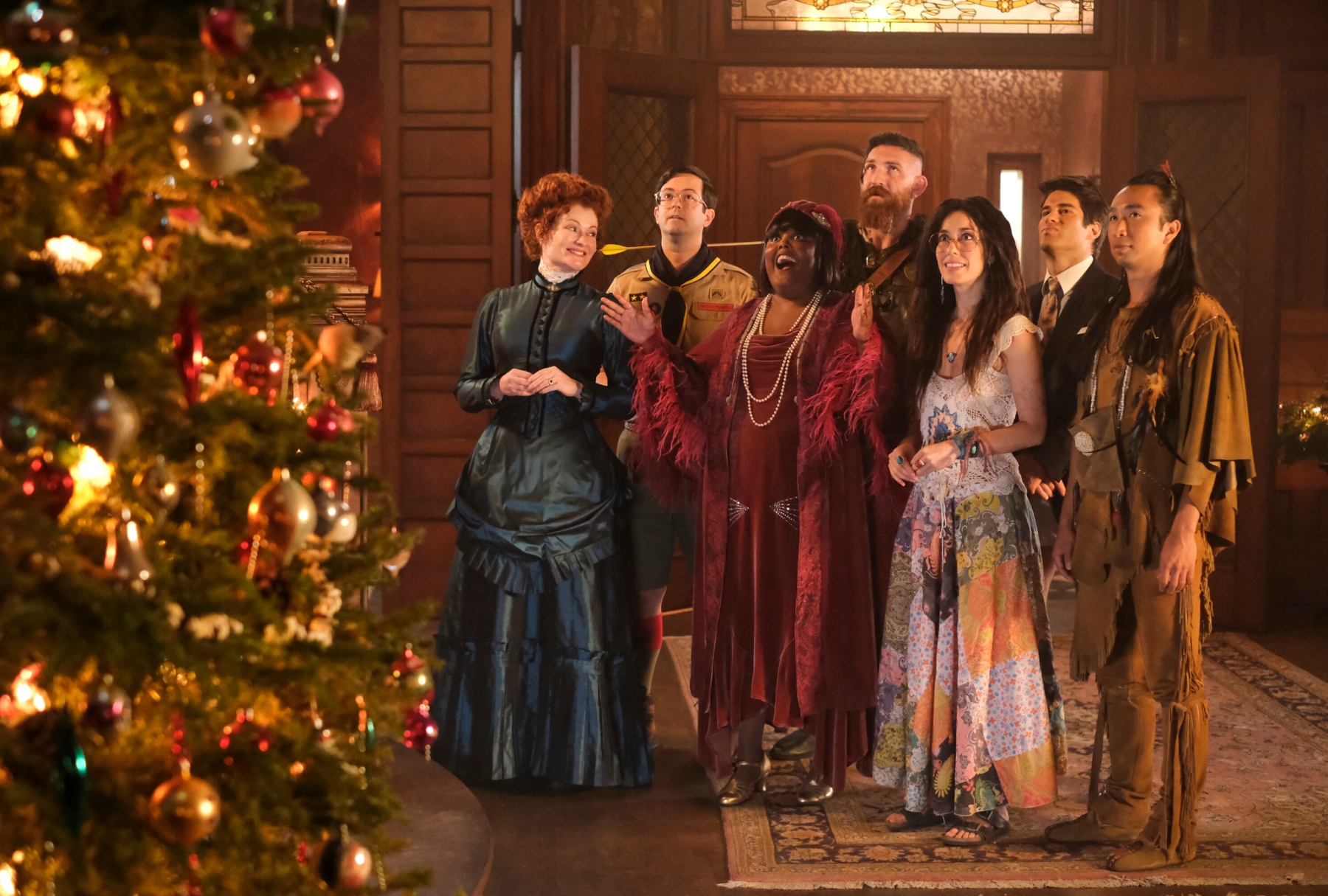
You got to engage in some interesting physical humor, too. Did you have to prep much for that?

Well, I think it’s fair to say that on “iZombie,” which is a show I did for five years, I did eat a brain each week and I took on different people’s characteristics. And I got used to working really fast to try to impersonate and become other people. What’s nice is that working at that kind of speed . . .  doesn’t allow perfectionism. You just do your best, working with as much research as you can do in a very short time, but a lot of instinct and impulse as well. And it was fun to put some of those skills that I felt like I developed on that show to use, to get to play in this really silly and quite farcical world again.

Yeah. This might be a nerdy production question, but I think a lot of people know that Christmas episodes are generally produced when it isn’t Christmastime. When was this one shot?

Well, we had a sneaking suspicion that we were going to get a second season when sometime towards the end of our first, we saw on a call sheet that our second unit was going out and shooting snow sequences for a Christmas scene. And we were all like, “Wait, we’re well past Christmas in Season 1. What is happening?”

Obviously, they had anticipated that would be something that they would want to do in a second season, should they get it. So the exteriors were shot last Christmas, I believe, just at the mansion and dressed in the snow. And then everything that we shot inside the mansion – this whole episode takes place inside, except the one scene at the railway station – aside from that scene, everything was inside and in Montreal . . . I think it was shot in August or something. Maybe July or August.

Yeah. Definitely not Christmas time.

It was crazy to feel Christmas-y when outside, you’re not needing to walk in with mittens on at all.

That level of preparation of nearly a year ahead of time to get those exteriors for a first-season show seems unusual.

Well, it makes a big difference. Because when I shot “A Christmas Prince” in Romania three years running, we were regularly shooting without snow. And we were having to regularly pump shampoo foam all over the ground, so as we walked through, suds would traipse off our feet. So it was a pretty different experience than outside in Montreal, where they were able to capture real fresh snow for that sequence.

With Christmas episodes of long-running shows, there’s either the tendency to present them as one-off plots, especially for sitcoms, or something major happens that changes certain dynamics going forward in the season. Which would you say that this episode is?

I need to think of how to answer these questions . . .

It’s tough!

I think, yeah, [the writers] have to be very selective about the moments when there are things that elevate relationships or change storylines or open the rules of the “Ghosts” universe. Once you open those doors, it does change things. The landscape is different. But it’s also very important. You don’t want things to feel stale. What’s good is that this enormous cast is that there are so many different pieces of history and backstories to explore. There is room to fairly frequently open something new and interesting and sort of tack towards the landscape changing rather than, like, overnight, everybody is now in a giant fight and that’s over. That doesn’t happen. Something irreversible may happen to two characters, and for the rest of them, it kind of holds the status quo. So yeah, it’s like chess moves, you know? There are little pieces moving forward all the time, and the writers do a great job at being selective of when to do that. And there’s definitely some of that going on in this episode.

Rebecca Wisocky as Hetty, Richie Moriarty as Pete, Danielle Pinnock as Alberta, Devan Chandler Long as Thorfinn, Sheila Carrasco as Flower, Asher Grodman as Trevor and Roman Zaragoza as Sasappis on “Ghosts” (Bertrand Calmeau/CBS)
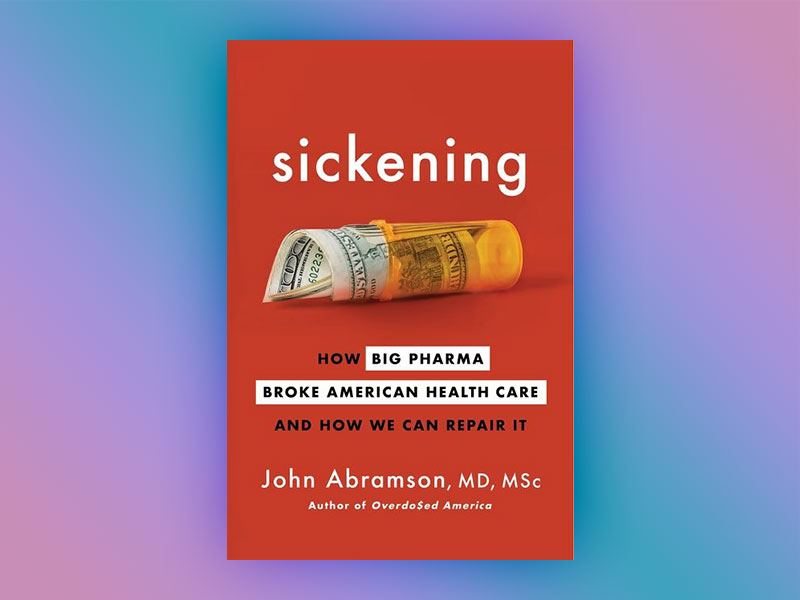
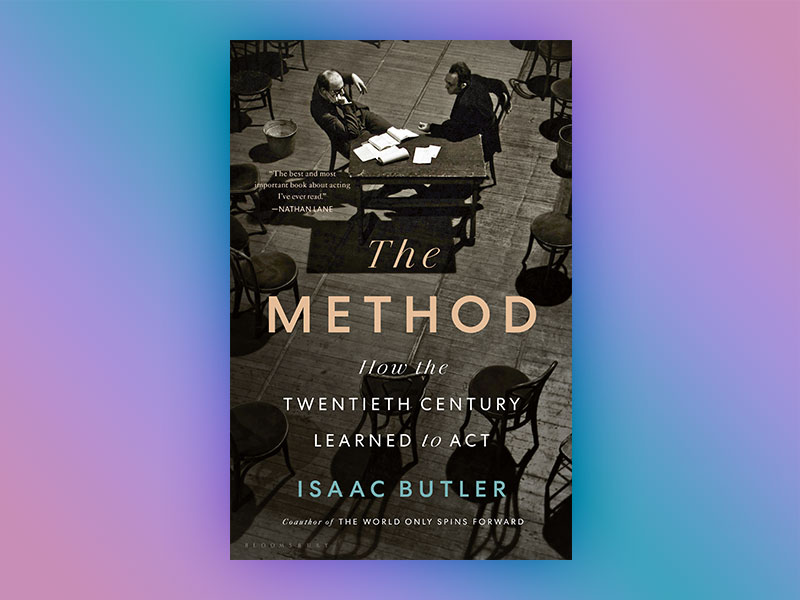

Hopefully, this will be simpler to answer without going into specifics. What was your favorite part about this episode both from the production side of it, and also after seeing the finished product?

I really, really loved the ghost choir. That’s not a terrible spoiler. We get to hear the musical prowess of most of our ghost cast. I think seven out of eight ghosts sing for us. And it just got us all excited about something we’ve talked about for a long time, which is we want a musical episode. A lot of us come from musical or dance backgrounds and everybody got very excited at hearing the ghosts singing in multiple-part harmonies. There’s something so communal about singing together . . . it felt really lovely and kind of gave some nice focus to a few of the days on set.

The one-hour holiday episode of “Ghosts” debuts at 8 p.m. Thursday, Dec. 15 on CBS and on Paramount+.


“Everybody was disgusted”: Juror reveals how Trump Organization’s lawyers “pissed off” the jury

On Tuesday, December 6, a Manhattan jury found two companies under the Trump Organization umbrella, The Trump Corp. and Trump Payroll Corp., guilty of criminal tax fraud and falsifying business records. Former President Donald Trump and his children Ivanka Trump and Eric Trump were not defendants in the case, which was prosecuted by the Manhattan District Attorney’s Office. This was strictly a case against the Trump Organization itself.

In a separate case, the Manhattan DA’s office prosecuted Allen Weisselberg, long-time chief financial officer for the Trump Organization, for financial crimes. And Weisselberg entered a “guilty” plea in August, agreeing to pay $1.9 million in back taxes along with interest and penalties. Donald Trump wasn’t a defendant in that case either.

Following the December 6 verdict, one of the jurors in the Trump Organization case granted an interview to the Daily Beast. The juror did so on condition of anonymity, fearing possible retaliation from MAGA Republicans and Donald Trump loyalists.

In an article published on December 14, the Daily Beast’s Jose Pagliery explains, “The juror, whose identity we have confirmed, asked to remain anonymous to avoid threats from angry MAGA loyalists. This person carefully detailed the way the 12 jurors examined the evidence, wrestled over the various criminal charges, and reacted to the lawyers’ presentations during the two days of deliberations in a room at the Manhattan criminal courthouse.”

The trial, Pagliery notes, took six weeks.

The juror told the Beast, “I constantly fought my knee-jerk belief that, of course, anything with the name Trump on it is crooked. I shocked myself in mid-November when I realized that I wasn’t sure I could find the Trump Corporation and Trump Payroll Corporation guilty. We talked in the jury room about having to put on blinders and look just at these two companies. One of the guys started calling Trump ‘Joe Smith.’ From there on, we referred to ‘Mr. Smith’s company.'”

The juror recalled that during the deliberations, one of the other jurors commented, “Do you want the potholes fixed sooner? That’s where this money comes from.”

Similarly, the juror told the Beast, “The total Medicare tax they dodged was maybe $25,000. We were supposed to consider (it) pittance. It might be a pittance for you, but it wasn’t a pittance for any of us. I want my Medicare funded.”

The juror also told the Beast, “I was very clear, as was every juror, that DJT was not a party to this lawsuit. But I couldn’t help but remember the 2016 debate with (Hillary) Clinton when she showed he hadn’t paid federal taxes and he proudly remarked that was because he was ‘smart.’ That was his opinion of taxes, and this was his company. Taxpayers are losers in Trumpland.”

The jurors, according to the interviewee, disliked the way Trump Organization lawyer Michael van der Veen, during the trial, mocked one of the witnesses: Donald Bender of the firm Mazars USA. The juror interviewed by the Beast recalled, “Michael van der Veen did nothing to help himself by imitating Donald Bender’s voice and speech impediment…. impugning his manhood because the guy spoke with a high voice. People really, really didn’t like that.”

One of the jurors, during deliberations, described van der Veen’s attack on Bender’s voice as “small-minded and unnecessary.”

Pagliery notes that “nothing seemed to piss off jurors more than the way the company enriched its executives by paying them part of their salary as ‘independent contractors,’ which allowed several of them — even ones who weren’t indicted — to dodge even more taxes.”

The juror interviewed by the Beast recalled, “Everybody was disgusted to some degree that they were making good salaries and yet, they still had to get more.”

The juror predicts that Manhattan DA Alvin Bragg, Jr. will eventually indict Donald Trump but believes that Bragg is taking it slow and being extra cautious.

“You’ve gotta know you’re gonna win,” the juror told the Beast. “You can’t waste the money. You can’t take Trump to court and lose because then, he’s not ‘not guilty.’ He’s ‘innocent.’ That’s how he’d interpret it.”

Salon’s favorite books of 2022 — fiction and nonfiction

We write about books pretty extensively here at Salon. Rather than have one section for books, our coverage extends through all verticals, often through in-depth interviews with authors ranging from bestsellers like Adam Hochschild for “American Midnight: The Great War, a Violent Peace, and Democracy’s Forgotten Crisis” and well-known artists like “SNL” star Kevin Nealon for “I Exaggerate: My Brushes with Fame” to food personalities like Andrew Zimmern for “Family Dinner” and university press authors like Neema Avashia for “Another Appalachia,” her memoir about growing up queer and Indian in West Virginia. We publish recommendation round-ups like “A bolder than ‘Bridgerton’ reading list: Regency books with a twist Eloise would love” and “Books for hard-to-shop-for tweens and teens, from Star Wars and Harley Quinn to gothic horror,” and mourn authors we’ve lost like Julie Powell of “Julie and Julia” fame.

It was a productive year for Salon authors, too. 2022 saw new books published from editor at large D. Watkins (“Black Boy Smile: A Memoir in Moments” and “The Wire: The Complete Visual History“), editor in chief Erin Keane (“Runaway: Notes on the Myths That Made Me“), nights and weekends editor Kelly McClure (“Something Is Always Happening Somewhere“), frequent music contributor Annie Zaleski (“Lady Gaga: Applause“) and new in paperback, culture writer Alison Stine’s “Trashlands.”

Every year we see so many excellent books cross our desks, and 2022 was no exception. And like all passionate readers, when we find a book we love, we want everyone else to love it too. Here, in no fixed order, are 14 nonfiction books and 10 novels published in 2022 that stood out as favorites of Salon writers and editors. 

NONFICTION

Sickening: How Big Pharma Broke American Health Care and How We Can Repair It by John Abramson (Courtesy of Mariner Books/Harper Collins)
Here’s a snapshot of what I said when I reviewed this book back in March: “Compared to other high-income countries, the fitness of Americans is in dismal shape — and has been declining for decades. According to John Abramson, a health care policy lecturer at Harvard Medical School, the sap of this poisoned tree is so-called Big Pharma, the coalition of drug companies that have structured American health care into a money-generating machine. In ‘Sickening: How Big Pharma Broke American Health Care and How We Can Repair It,’ Abramson sets out to answer the ‘paradox of American health care,’ building his case using the testimony of patients and former drug executives. In the book, Abramson reveals how doctors are regularly duped into prescribing expensive drugs with extreme side effects while major pharmaceutical companies rake in record profits. Yet recent research suggests that 46 million Americans can’t afford health care. According to a 2020 survey, two-thirds of consumers live in fear of medical bills. The book is a crash course in the profit-driven systems built by Big Pharma that dominate the U.S. health care industry and how they can cause undue suffering, starting with several recent pharmaceutical scandals that have cost the lives of thousands of Americans while enriching major corporations.” [Read the full review.] — Troy Farah, reporter, science & health
The Method: How the Twentieth Century Learned to Act by Isaac Butler (Courtesy of Bloomsbury Publishing)

Full disclosure: Isaac is a personal friend of mine. It’s always more fraught reading a friend’s book since there’s always the risk that it’s dull. Luckily, Butler knows how to liven up history by focusing on human personalities and foibles. Even as he writes about the various legends who sculpted modern acting, he never fails to find the humor and humanity in his subjects. Seminal acting gurus like Konstantin Stanislavski and Stella Adler are giants, but Butler never loses sight of the fact that they were also goofy theater kids


Crucially, however, this book succeeds at its main mission, which is persuading often skeptical American audiences that acting — just like writing, directing or composing — is an art, not just a set of technical skills. In our data-centric world where much of life gets reduced to pseudo-objective statistics, it’s a real pleasure to sink yourself into the story of people who gave their lives to upholding the ineffable but still-necessary subjective power of art. Also, Isaac has done his share of acting, so his reading of the audiobook is great fun. — Amanda Marcotte, senior politics writer

A Waiter in Paris: Adventures in the Dark Heart of the City by Edward Chisholm (Courtesy of Pegasus Books/Simon & Schuster)

From FX’s “The Bear” to Mark Mylod’s “The Menu,” this has been the year prestige entertainment has mined professional kitchens for all their inherent dramatic potential. If, after watching those works, you’re still hungry for more — and you’ve already read Bourdain’s seminal dispatch “Kitchen Confidential” — try Chisholm’s “A Waiter in Paris.” (Read an excerpt on Salon.)


“As a waiter,” he writes, “you quickly get used to the fact that people believe they can talk to you like a lower species.” 


Chisholm moved from London to Paris in 2011 and, despite having very little knowledge of the French language or culture, he quickly fell in with a ragtag group of cigarette-fueled waiters at a fine dining restaurant. Through Chisholm’s punchy prose, readers will be taken through his whirlwind career filled with angry knife-wielding chefs, demanding customers, squalid living conditions and panic attacks in the Pass. — Ashlie Stevens, deputy food editor

California Soul: An American Epic of Cooking and Survival by Keith Corbin (Courtesy of Penguin Random House)

Did you ever hear the story about the former gang member who was so good at cooking crack he was flown around the world to teach other gang members, before going to prison, then coming home and working his way up the ranks in professional kitchens by developing an impeccable style, helping to launch a successful restaurant bringing high-end cuisine to the most vulnerable people in his food-desert neighborhood of Watts? And after being nominated for a James Beard Award, launched his own establishment that quickly became a hot spot for Black celebrities like Issa Rae, Tracee Ellis Ross and too many others to name? I hadn’t either until I read Alta Adams chef and owner Keith Corbin’s memoir.


The beauty of this book is that every time you think the story is over Corbin slaps you with another problem, another issue, another feat he must overcome. And he does. It feels just like real life — and unlike many books on the urban experience, where our hero’s only goal is to make it out, Corbin reaches above and beyond, changing to imagine success at the highest level. The book deals with passion, purpose and redemption in the most beautiful way &mdash by not telling, but showing us that it’s not how you start, but truly, how you finish. — D. Watkins, editor at large

How to Read Now: Essays by Elaine Castillo (Courtesy of Penguin Random House)

Once in a while, a book comes along that lands like a well-timed shake of your shoulders, a persuasive, invigorating invitation to try harder and do better. That’s exactly what Elaine Castillo’s “How to Read Now,” the most entertaining case for critical thinking I’ve enjoyed in ages, feels like.


Castillo, author of the 2019 breakthrough novel “America Is Not the Heart,” is not arguing against the power of literature to expand your worldview. What she takes issue with is the performative empathy of reading about the experiences of others merely to, as she told Salon earlier this year, “justify the presence of these writers on our bookshelves.” And she challenges the cowardly fiction that art ever is apolitical. Castillo doesn’t want to wrest us away from the so-called classics. Instead, she suggests we can — and should — read our Austen with eyes open.


The highest praise I can give of Castillo’s book is that it truly has changed how I read now. Months after I put “How to Read Now” down, I still feel it with me in my other reading, peeking over my shoulder, asking questions. It’s made me a more ambitious, active, curious book lover, whether I’m engaging with Madame Bovary or Carrie Soto. It’ll do the same for you. [Read my interview with Castillo.] — Mary Elizabeth Williams, senior writer

Dear Damage by Ashley Marie Farmer (Courtesy of Sarabande Books)
Ashley Marie Farmer’s debut collection of essays opens with an act of violence in her immediate family that shocked the community: “On January 19, 2014, my grandfather Bill walked into my grandmother Frances’s hospital room with a loaded gun he’d purchased that morning.” In what was meant to be a final act of love, Bill shot his paralyzed wife in her hospital bed, then tried to shoot himself, but the gun broke, and he was arrested. It was deemed a “mercy killing,” with all the sensationalized press coverage and impassioned public debate a case like that tends to spark. This cataclysmic event — a very public story collides with a family’s specific, private loss — is the axis around which Farmer’s meditations and explorations of guilt, place, grief and violence revolve, in memorable essays that take both traditional and experimental forms. Interspersed throughout are fascinating transcripts of interviews she recorded earlier with both grandparents, allowing them to be known on the page as the dynamic, loving couple they were. [Read my interview with Farmer from April.] — Erin Keane, editor in chief
Inciting Joy by Ross Gay (Courtesy of Algonquin Books)


Ross Gay follows “The Book of Delights” with another dazzling collection of lyric essays. Who writes about joy in a time like this, doubting voices ask him? This book answers: Someone with a keen understanding of sorrow, and how to embrace it. His incitement-of-joy subjects vary from gardening to skateboarding to the cover song, but grief and loss are never far behind. This is by design. As he points out in his introduction, “it is a kid’s fantasy … to imagine any emotion discreet from another.”


Gay, an acclaimed poet, infuses his sentences with a wild abandon — so appropriate to channeling wild emotional takeovers — that sometimes threaten to careen out of control, but that’s an illusion, one so enjoyable it thrilled me every time a long passage took me for a ride to somewhere I couldn’t previously imagine. Just as satisfying are his footnotes, some of which contain entire sub-essays tucked away at the bottom of the pages, like treasures waiting to be discovered.— Erin Keane, editor in chief 

I'm Glad My Mom Died by Jenette McCurdy (Courtesy of Simon & Schuster)

Jennette McCurdy cracked something open in the world with that confetti-filled urn of hers. In the title of her hilarious and frequently devastating memoir, the former “iCarly” and “Sam & Cat” star admitted bluntly that “I’m Glad My Mom Died” — and at least a portion of the grateful readers who catapulted the book to the bestseller list nodded back a collective, “Girl, same.”


McCurdy no doubt had a built-in readership thanks to her teen stardom, and her candor in revealing the unhealthy alchemy of a toxic industry and an emotionally abusive parent. But the deeper resonance of the book was in its clear-eyed understanding that although “Moms are so romanticized,” reality is a lot more complicated. And by finally acknowledging who her mother truly was, McCurdy was better able to confront her own demons, and arrive at something resembling forgiveness. 


McCurdy’s memoir providentially came along shortly after both my mother and mother-in-law died within weeks of each other. At the time, I was barraged on all sides with well-meaning condolences, even while my own primary emotion was one of profound, silent relief. Now, because of this book and its runaway success, the conversation around grief is expanding, revealing the spectrum of emotions possible in the aftermath of death. And if I can say today without shame that I’m glad both my moms died, it’s because McCurdy eloquently paved the way. [Watch my interview with McCurdy.] — Mary Elizabeth Williams, senior writer

Predator by Ander Monson (Courtesy of Graywolf Press)

I love an intricate and highly personal immersion into a pop culture obsession. In Ander Monson’s eighth book — and his first memoir — he takes us, frame by frame, through a meticulous close reading of the original 1987 “Predator” movie in all its violent spectacle and Schwarzenegger glory. “I believe that if you look hard and long enough at what you loved best at fourteen and how you lived then and what you saw in the world, it will reveal both the world and you,” Monson writes. Mission accomplished.


Indeed, what Monson reveals about violence, death and America through his obsession with “Predator” goes deeper than special effects and cinematic suspense — internal tension between his attraction to and rejection of destruction; grief over the loss of his mother; the murder of his childhood babysitter; gun culture, male friendship and male anger; the shooting of his congresswoman, Gabrielle Giffords; and perhaps surprisingly, the life and writings of poet, memoirist and gay rights activist Paul Monette, who wrote the movie tie-in novelization of “Predator” while his partner Rog was dying of AIDS. Monette, who died in 1995, haunts the pages of Monson’s “Predator,” another writer doing his best to make something new and worthy out of someone else’s images. Fair warning for 2023: If I run into you and I know you like movies, I’m going to ask you if you’ve read this brilliant book. If not? Get to the choppa already! [Read Alison Stine’s interview with Monson.] — Erin Keane, editor in chief

We Don’t Know Ourselves by Fintan O’Toole (Courtesy of Liveright Publishing)
Many Irish or Irish-affiliated readers may be exasperated by Fintan O’Toole’s alternately tragic, comic, wistful, profoundly observant and ultimately optimistic memoir, which as his subtitle tells us, is also a history of that rain-drenched island nation’s social and cultural transformation since his 1960s childhood. But we will be exasperated because we are a nation (or, as in my case, a national diaspora) of begrudgers, belittlers and grandiose self-dramatizers, and O’Toole is having none of that. How exactly did a poor, backward, profoundly conservative and inward-looking Catholic nation become a generally tolerant multi-ethnic global crossroads within the last half-century? What was lost, what was gained and how much did “Riverdance” have to do with it? No two Irish people will agree on answers to those questions, but O’Toole — for much of his journalistic career a scathing critic of Irish, British and American politics — offers the story of his own life as a corrective to the built-up mythologies that surround Ireland and Irish identity. [Read my interview with O’Toole.] — Andrew O’Hehir, executive editor
Reader's Block: A History of Reading Differences by Matthew Rubery (Courtesy of Stanford University Press)

There is a psychological pressure attached to reading that doesn’t exist for most other forms of entertainment. People aren’t shamed for not watching a movie, listening to a song or observing a painting in “the right way,” yet how often is a reader told they’re reading a book “wrong”? In Rubery’s light-hearted yet monumental text, he deconstructs the psychology of how people process information while reading. In the process, he proves that there is no “right” way to read a book. A human being can “get” a book’s content, and interact with it in a meaningful way, even if they do not read it in the “normal” manner. Unsurprisingly, Rubery unpacks troubling deeper prejudices behind the assumptions that there is a “right way” and a “wrong way” to read. For centuries, people with learning disabilities like dyslexia and autism have been mischaracterized as lazy and stupid simply because their brains process information differently. By its very nature, “Reader’s Block” is designed for casual reading — and particularly for people interested in science, history, literature and neurodiversity. [Read my interview with Rubery.] — Matthew Rozsa, staff writer

I Want to Die but I Want to Eat Tteokbokki by Baek Sehee (Courtesy of Bloomsbury Publishing)
I’ve never read a food book quite like South Korean author Baek Sehee’s debut “I Want to Die but I Want to Eat Tteokbokki.” On the surface, it’s a therapy memoir. Despite having a successful job working as a social media director at a publishing house, Sehee is depressed and anxious and has this exhaustion building inside her that is becoming harder and harder to ignore, so she begins to see a therapist and records their sessions. But woven throughout Sehee’s notes on self-doubt and burnout, is an engaging love letter for her favorite street food, the hot, spicy rice cake, tteokbokki. It’s a short, meditative book that will cause readers — myself included — to really consider what’s at the root of the little comforts that bring us joy. — Ashlie Stevens, deputy food editor
Our Fermented Lives: A History of How Fermented Foods Have Shaped Cultures and Communities by Julia Skinner (Courtesy of Storey Publishing/Hachette Book Group)
Fermentation has been a hot topic in artisan food circles for years, but Julia Skinner’s “Our Fermented Lives” breaks down the ways that fermentation itself and its products — including kimchi, coffee, cheese, bread starter and craft beer — have literally shifted the ways societies (and our individual gut microbiomes) operate. Both history nerds and home cooks will appreciate this book, which comes with 42 supplemental recipes for items like sauerkraut, pickles, vinegars and soy sauce. — Ashlie Stevens, deputy food editor
It Was All a Dream: Biggie and the World That Made Him by Justin Tinsley (Courtesy of Henry N. Abrams)

We lost the Notorious B.I.G 25 years ago, and he is still named by many as one of the best hip hop artists to ever touch a mic. Fans remember his smooth flow, the legendary poeticism intertwined with some of the most graphic lyrics in the history of the genre that made up those vivid tales, entire novels being recited over beats: That was Biggie’s gift to us, that’s who he was as an artist. But who was Biggie the person? Reporter Justin Tinsley took a deep dive into the parts of Biggie the public never really got to know by interviewing those who had the luxury of spending time with the late rapper. We knew Biggie sang about going to North Carolina to push weight on multiple songs, and Tinsley takes us to the location where the rapper was arrested for it — and would hop on stage at a nightclub for one of his very first performances. Tinsley also introduced us to Biggie the momma’s boy, the family man, the jazz connoisseur, the mixologist (yes — Biggie loved to cook up a fancy cocktail and gained joy when others expressed how good his concoctions were) and one of the funniest people from his Brooklyn neighborhood. We knew Biggie had a talent for making us laugh with the punchlines in his rhymes; but the people who knew Biggle from the old Brooklyn say he could have chosen stand-up comedian as a profession instead of rap and would have been just as successful. Think you know Biggie Smalls? Until you read this book, you have no idea. — D. Watkins, editor at large

FICTION

More Than You'll Ever Know by Katie Gutierrez (Courtesy of William Morrow/Harper Collins)
Every now and then a bestselling novel lives up to the hype. “More Than You’ll Ever Know” is that lovely novel. First-time novelist Katie Gutierrez balances an alternating timeline, the late 1980s and 2017, to tell the story of Lore Rivera, a woman who has two husbands: one in Mexico City and one in Laredo, Texas, with whom she has twin sons. It’s even more complicated than that, as struggling true crime writer Cassie Bowman is about to discover when she stumbles upon Lore’s story and thinks it might be a book. The tangled intricacies of love, motherhood, duty and sacrifice are cracked open in this novel, whose most compelling scenes are rich descriptions of a historic Mexico City. — Alison Stine, staff writer, culture
The Work Wife by Alison B. Hart (Courtesy of Graydon House/Harper Collins)
I like to learn a little when I read, even fiction. I especially like to be transported to a new or different world, and “The Work Wife” does that in spades. Alison B. Hart’s novel is about the personal assistant to a Hollywood mogul, a George Lucas-type figure who lives with his family on a sprawling compound. Also on the estate are a series of buildings where a stable of employees, like Zanne Klein, work to make sure everything runs smoothly behind the scenes. Though she never intended to be an assistant for so long, putting aside her own dreams, Zanne does it all, from updating her employer on personal space flight to organizing a huge fundraising event at his estate. But the powerful, eccentric genius who happens to be her boss has secrets, like what happened to his former business partner Phoebe, a woman in a field dominated by men. The novel shifts perspectives from Zanne to Phoebe to Zanne’s boss’s wife, Holly, in order to paint a riveting, nuanced picture of being a woman in Hollywood. — Alison Stine, staff writer, culture
The Cloisters by Katy Hays (Courtesy of Atria Books/Simon & Schuster)
Katy Hays’ smoldering debut novel “The Cloisters,” a museum thriller set at the eponymous New York institution, is an engrossing read for fans of secret rituals, shady antiquities types, and the dark academic trait of securing first author position by any means necessary. Ann, brimming with talent but lacking in pedigree and wealth, scores a coveted summer curatorial assistantship at the Met but finds herself reassigned uptown to The Cloisters, where the tapestried walls and grounds, tended by a punk-rock gardener, hold more mysteries than even Patrick, her elegant, enigmatic new mentor, knows. Fellow research assistant Rachel, who has everything Ann doesn’t, takes her under her wing like “the poor relation in an Edith Wharton novel” as they become obsessed with unlocking the hidden potential of a 15th-century deck of tarot cards before anyone else can. The men in “The Cloisters” are consequential to the story but not the point of it, thankfully: That’s reserved for the intricately wrought friendship between Ann and Rachel and their internal struggles between ambition and the need for chosen family. —Erin Keane, editor in chief 
A Ghost of Caribou by Alice Henderson (Courtesy of William Morrow/Harper Collins)
You’ve heard of cozy mysteries, that crime fiction subgenre with an amateur sleuth as the lead, and where sex and violence take a backseat to the mystery solved in a small community. What about nature cozies? The highest praise I can give this novel is that I was barely a few pages in before I immediately went and bought everything else Alice Henderson has published. Her book “A Ghost of Caribou” is the third in a trilogy about Alex Carter, a wildlife biologist whose solitary and awesome job — conducting field observations of the likes of polar bears and wolverines in places such as the Canadian arctic and remote Montana — keeps bringing her into contact with bodies and bad guys. And a man from her past, who goes to radical lengths for his environmental idealism. Think “The Shining” but with realistic suspense, gorgeous prose and small, meaningful lessons about the natural world sprinkled like breadcrumbs in the snow. Get the whole trilogy. Henderson’s books and her relatable, likable protagonist will help you make it through the winter. — Alison Stine, staff writer, culture
Lark Ascending by Silas House (Courtesy of Algonquin Books)
Our world is burning, but for a time at least, young Lark has grown up in wilderness seclusion, with his family and just one other, relatively protected from the theocratic government and climate disasters that have overtaken the United States. After a grueling trip to Ireland, the last country they hear is taking in refugees, Lark has to survive alone in a strange land. With the help of a good dog and a woman he’s not sure he should trust, Lark needs to stay alive in a hostile landscape long enough to see if his destination is truly the salvation he’s living for. House’s powerful novel asks necessary questions against the backdrop of a speculative near-future that feels more realistic with every passing day: How do we retain our humanity in a degraded, dangerous world, and what keeps us moving forward when all appears to be lost? [Read Alison Stine’s interview with House.] — Erin Keane, editor in chief
Babel: Or the Necessity of Violence: An Arcane History of the Oxford Translators' Revolution by R.F. Kuang (Courtesy of Harper Voyager/Harper Collins)

“Welp,” was my first thought in disappointment — not in the book, but in myself for not being able to conceive such an imaginative, ambitious and well-researched novel. R.F. Kuang’s follow-up to her sprawling grimdark fantasy “Poppy War” trilogy leaves the martial behind for a different type of battle in dark academia. In this alternate history set in 1840s Oxford, orphan Robin Swift is taken from his home in China and raised by Professor Lowell, who gives his ward a foundation in various foreign and classical languages. All the better for when Robin lands a spot in Oxford University’s prestigious Royal Institute of Translation, aka Babel, which is the center of translation — of words, and by extension, the mysterious and magical silver bars that are the source of power upon which the British Empire is built. In some respects, this is the ultimate story for lovers of language, knowledge and their power – while also interrogating the history of what that entails, which naturally includes colonialism. This novel has been divisive among fans of the fantasy genre, mainly because of its rather didactic nature, which frankly fits within Kuang’s unique approach. She fills the novel with epigrams, allusions and footnotes from actual texts and literature, ranging from “The Wealth of Nations” and “The Wretched of the Earth” to Wordsworth and nursery rhymes. (There are also two maps, which are essential to all fantasy novels.) As a student of Oxford herself, Kuang made a deliberate choice to set this in the 19th century with its dark academia aesthetic that has been criticized for its Eurocentrism, exactly what she has Robin grapple with here. Kuang once again crafts a unique Bildungsroman that doesn’t fulfill the usual expectations for what fantasy is or perhaps, what a Western fantasy is expected to be — and that is its most profound strength.  — Hanh Nguyen, senior editor, culture

All I Should Not Tell by Brian Leung (Courtesy of C&R Press)

It’s the 1980s and Conner, 14, is stuck in a muddy little Ohio River town outside of Louisville, Kentucky, with an abusive stepfather, unstable mother, innocent little brother and a secret love for his best friend Mark. One day his hated stepfather disappears, igniting a series of events that tear Mark and Conner apart, and leaving Mark to question what he thought he saw, and who else might know. Twenty years after the fateful day, the past comes back to town, and Conner — now grown, with a wife and a boyfriend — has to face his life’s biggest unknowns and solve the mysteries that have haunted him all those years. “All I Should Not Tell” is both a page-turner of a crime novel and a sensitive family drama, offering a compelling portrait of queer late-Gen X small-town life, when “It Gets Better” was more a survival mantra than a sure thing. — Erin Keane, editor in chief

Lapvona by Otessa Moshfegh (Courtesy of Penguin Press/Penguin Random House)

Since the release of her 2015 debut novel, “Eileen,” I’ve been obsessed with the writing of Ottessa Moshfegh and her sharp, unique ability to craft narratives that go from horrifying to hilarious to moving, sometimes all in the same chapter. After my intro to her writing with “Eileen,” I quickly moved through the rest of her releases, keeping a close eye out for news on the release of anything new. Thankfully in 2022, a year that made it somewhat difficult to find joy in much of anything, we got a new full-length novel from Moshfegh which added itself to the whole vibe of the year perfectly, “Lapvona.” Not a feel-good story by any means, but a wonderful one nonetheless, “Lapvona” centers on the unlikeable character Marek as he shuffles through the dirt-poor eponymous village in misery, until one day when a dreadful act changes his life for what should seem like the better, but actually lands him in more dire straits than where he started. It’s disgusting, brutal and vaguely medieval. Basically perfect.— Kelly McClure, nights & weekends editor

Daughters of the New Year by E.M. Tran (Courtesy of Hanover Square Press/Harper Collins)
The only thing better than a good story might be multiple stories in one. Beautiful and heartbreaking, “Daughters of the New Year” is a tale of survival, focused on the women in a Vietnamese immigrant family. The novel moves backward through time, starting with the present-day in New Orleans and reaching back to wartime Vietnam, French colonial rule and even 40 A.D. Each leap is rich with strong, warrior women. The story-within-a-story format of E.M. Tran’s debut novel, which the New York Times called “daring,” helps readers better to understand generational trauma, family and the heavy legacy of time. It’s also a gorgeous, transporting read. — Alison Stine, staff writer, culture
The Department of Truth by James Tynion	(Courtesy of Image Comics)

James Tynion IV’s (and artist Martin Simmonds’) graphic novel/comic book series “The Department of Truth” is captivating from the first page of the first issue. America, Europe and many other parts of the world are now in thrall to conspiracy theories and the larger disimagination machine. This war on reality is one of the primary weapons that fascism and other forms of authoritarianism and societal evil have used to conquer the hearts and minds of many millions of people around the world. “The Department of Truth” is a tour of this alternate reality and the idea of “conspiracism” – a meta construct where the idea of the conspiracy itself defines our understandings of reality and truth. It would be unfair to describe “The Department of Truth” as a more “literate” version of the X- Files or Kolchak: The Night Stalker or The Outer Limits. It is so much more. Tynion has created a very humane and subversively entertaining story that also functions as a powerful sociological document for understanding the Age of Trump and the rise of the global right and the chaos and other dark forces they have empowered and unleashed. Tynion and Simmonds are unapologetically committed to their vision. “The Department of Truth” is a rare achievement in graphic novels and comic books, and literature more broadly. The bound series is up to Volume 3, with Volume 4 shipping December 20. — Chauncey DeVega, senior politics writer

Leaked text: Louie Gohmert urged White House to use “loyal DOJ personnel” to prove antifa did Jan. 6

Newly revealed text messages from former Trump chief of staff Mark Meadows’ phone show that former Rep. Louie Gohmert, R-Texas, was a true believer in the false conspiracy theory that Antifa was really behind the January 6th Capitol riots.

As reported by Talking Points Memo, Gohmert sent Meadows a text message on January 8th, two days after the assault on the Capitol, pushing the Trump chief of staff to get the Department of Justice involved in an investigation to uncover the purported truth about the riots.

“Constitutional loyal DOJ personnel have 11 days to prove the truth: Antifa led the breach of the Capitol,” Gohmert wrote to Meadows. “If the evidence is not shown to the public in 11 days, then it will be subverted & the false narrative will likely be the Trump legacy that DT & his loyal supporters under his urging attacked the Capitol. It was a brilliant leftist op, but it’s got to be exposed by DOJ quick.”

In fact, there is no evidence that “Antifa” led the assault on the Capitol, and every single person charged for breaking into the building on that day has a documented history of supporting former President Donald Trump.

Joe Biden, Cyndi Lauper and friends celebrate a big win — that really isn’t much of a win

It may be the last victory lap for the Biden administration.

On Tuesday, the president celebrated the signing of the Respect for Marriage Act with members of Congress and more than 5,300 invited guests, with the press dutifully in attendance.

It was a great Christmas present for supporters and the LGBTQ+ community, but the New Year promises a return to Republican control in the House of Representatives, so the chances are slim that we will hear about anything more than Hunter Biden’s laptop during the next two years.

The administration is well aware of this, of course, and prepared an appropriate celebration to “get while the gettin’ is good” on the South Lawn. A party-like atmosphere not seen since the Obama administration prevailed on a crisp, cold, December afternoon. The Marine Corps band provided musical accompaniment while guests broke out in spontaneous cheers and dance. You know the holy rollers were spewing hatred at seeing such an assemblage, but luckily no one gathered on the South Lawn had to listen to it.

Sam Smith and Cyndi Lauper performed for the crowd. If nothing else, the Biden administration has proven to be a bigger fan of a wider range of music than his predecessor, and far more successful at getting stars to appear at the White House. Jon Batiste and James Taylor, among others,  have also performed during the Biden administration.

Senate Majority Leader Chuck Schumer and House Speaker Nancy Pelosi performed their two-person act, perhaps for the last time. (Pelosi is standing down from a leadership role, although not resigning from Congress.) Schumer drew applause, but Pelosi drew applause, praise and wild screams from a variety of attendees. “We love you Nancy,” “Lesbians for Nancy” and other cheers could be heard. She drew her greatest cheer when she said that marriage equality wasn’t about “tolerance” but “respect” for one another.

In my decades of covering events on the South Lawn, I’ve never experienced anything like that moment: no vitriol, no divisiveness, no guile.

Those who will benefit from the new law and who had suffered from oppression without it showed up to testify. Vice President Kamala Harris was mercifully brief in her introduction and then we got to hear from Biden — but not before an audio recording of his now famous appearance on “Meet the Press” 10 years ago, when he was vice president, played over the loudspeakers. “I am absolutely comfortable with the fact that men marrying men, women marrying women, and heterosexual men and women marrying another are entitled to the same exact rights, all the civil rights, all the civil liberties,” Biden said.

CNN’s Don Lemon, who found a place on the riser overlooking the proceedings, stood next to his fiancé in between appearances on television and smiled. He said he was “overwhelmed” by the event, adding, “Quite honestly, I feel like I’m having an out-of-body experience.” For many, the moment — long in coming — seemed almost like a dream.

Biden opened his remarks by saying, “Marriage is a simple proposition. Who do you love? And will you be loyal to that person you love?” the president asked from the South Lawn. “It’s not more complicated than that.”

Lemon was smiling as he walked down the steps from the riser to address his CNN audience, joking about Biden: “The gays will always love him.”

Of all the events I’ve covered on the South Lawn during the decades of life that have seen me gain weight, lose hair and have what’s left on my head turn gray, I have never experienced anything quite like that moment. It was without vitriol, without divisiveness, without guile.

Not only were the performers enjoyable, from the Marine Corps band (which is always a top draw) to Smith and Lauper, but there was nothing but joy in the air. The feeling was palpable. Spontaneous dancing. Singing. No fear. No protesters. No homophobia. I’ve never seen a more comfortable gathering of people at the White House — ever. I have never seen anything so genuine and unfettered by the politics that ruins D.C. — even though it was a political moment that could only have occurred in D.C.

So it’s more than a little disconcerting to realize that the celebration that accompanied the signing of the legislation was not the total victory the president claimed it to be.


Want a daily wrap-up of all the news and commentary Salon has to offer? Subscribe to our morning newsletter, Crash Course.


Politics has long been considered the art of “half a loaf,” meaning that neither side gets what it wants, but everybody gets a little bit of something as we march forward. That has not been the case since Newt Gingrich blew into town, taking advantage of divisiveness and encouraging a “zero-sum” game in D.C. politics. People have forgotten the old ways, but in some ways they’re back. The bill that Biden signed into law Tuesday was — strictly speaking — half a loaf. He was rightfully proud to promote it as such, pointing out that it took a bipartisan effort to get it done. But the question remains: Did the Democrats make a Faustian deal?

The new law does not require all 50 states to allow same-sex marriage, as under the 2015 Supreme Court decision Obergefell v. Hodges. It also does not prohibit states from taking steps to ban or restrict same-sex marriage if Obergefell is overturned — a distinct possibility, given  the current makeup of the U.S. Supreme Court. Jim Obergefell, the namesake of the Supreme Court decision, was noticeably not present at the historic signing. He told CBS News he was out of the country.

While we speculate as to why, it is worth noting that a Republican-sponsored amendment to the law that Biden signed Tuesday guarantees that churches, faith-based social agencies and religious educational institutions will not be required to “provide services, accommodations, advantages, facilities, goods, or privileges for the solemnization of celebrations of a marriage,” and there is no civil cause for action if they don’t.

What does that mean? CBS Radio reporter Steve Portnoy asked that question to Karine Jean-Pierre in Tuesday’s press briefing just prior to the big party on the South Lawn. He outlined “the concerns that some have expressed that what’s actually in the bill could be read as something that codifies discrimination,” citing the passage quoted above.

Jean-Pierre defended the bill and sidestepped the problems the new law could bring,  emphasizing what Biden said about marriage 10 years ago. “It comes down to a fundamental question of …who do you love and will you be loyal to that person,” she said, parroting the president. “This law ensures that . . .  And that’s why so many faith leaders and religious traditions have advocated in support for this bill.”

It isn’t a stretch to say that faith-based organizations might be in favor of the legislation because it allows them to “just say no” to marriages they wouldn’t sanction. I followed up Portnoy’s question with my own:

“We understand how the legislation was framed and will be signed by the president. Do you anticipate that this administration will go back, or that the Democrats will go back, and try to clean up the language in the legislation so it does not codify discrimination?”

After all, that’s the art of half a loaf: Later on, you’ll try to take some more. That’s simple enough. “What we’re saying to you today is that this piece of legislation was done in a bipartisan, bicameral way,” Jean-Pierre said, “and it will make a difference for millions of Americans across the country. And we’re going to celebrate this moment.” 

But she also addressed the problems the law will face: “Conservatives who are going to continue to attack this, who are — who want to take away fundamental rights. We saw what happened just in June with the Dobbs decision, and so we take that very, very seriously.”

Thanks to a Republican amendment, the law Biden signed essentially allows religious groups to discriminate openly against same-sex marriages, without facing any consequences.

All the new law really does is guarantee that no one working in government “under color of state law may deny full faith and credit to any public act, record, or judicial proceeding of any other state pertaining to a marriage between two individuals on the basis of the sex, race, ethnicity or national origin of those individuals.” That is significant because Obergefell and his fiancé had to travel to Maryland to get married and their marriage wasn’t recognized in Ohio. That won’t happen anymore — provided couples can find someone in their own state to provide the services. But the law also allows religious organizations to deny any participation in a given marriage. While some may find that to be a wonderful sign of freedom, it clearly gives such groups the ability to discriminate without recrimination.

Furthermore, there is little doubt that the Supreme Court, which is dominated by six conservative Catholics, will overturn Obergefell if and when it gets the chance. Plenty of red states are lining up to roll back their marriage laws if that happens. 

But on Wednesday that was far from anyone’s thoughts on the South Lawn. 

After the songs were sung and the speeches were made, Biden worked the crowd for more than 45 minutes. He shook hands and spoke with numerous guests as he walked through the gathering. Those who continue to doubt his mental acuity should take note. Of course they never will, but Biden works a crowd with a vim and vigor I haven’t seen since Bill Clinton. 

Finally, long after the throngs had left, with just a handful of folks left, Biden spoke with a child and their parent before retreating into the residence as “Respect” from Aretha Franklin boomed across the South Lawn.

There is no doubt those in attendance respected the moment. But as historic as it was, I left the event with an ominous feeling that the other shoe has yet to drop. And based on comments by the president, who clearly recognizes that this law does not end discrimination, although it takes a “critical step to ensure that Americans have the right to marry the person they love” — he later qualified it  as a “measure of security” rather than a definitive guarantee — he knows it too.

Free speech warrior Elon Musk bans, vows “legal action” against student for tweeting public info

Billionaire Twitter owner Elon Musk has framed his takeover of Twitter as essential for the future of free speech and even civilization itself, even though he tried for months to get out of the deal and was sued by the company in an attempt to force him to buy it. Since the takeover, Musk has unbanned countless accounts that spread misinformation and incited violence, including former President Donald Trump, while attacking previous Twitter executives for restricting free speech and enforcing rules that did not exist. But now Musk is suddenly banning accounts that share public information and threatening to sue a 20-year-old college student for posting his publicly-available flight information on the platform.

Musk has long been frustrated by the Twitter account @elonjet, set up in 2020 by Jack Sweeney, a young Musk superfan, to track the billionaire’s private jet flights using publicly available information. Musk asked Sweeney, who also ran the popular @CelebJets account that exposed the wealthy and famous taking short private jet flights, to take down the account for $5,000 in January, calling it a “security risk” and saying he didn’t want to be “shot by a nutcase,” according to Protocol.

Musk after buying Twitter declared that his commitment to free speech is so absolute that it “extends even to not banning the account following my plane, even though that is a direct personal safety risk.”

That didn’t last long. Twitter appended a fact-check to Musk’s tweet on Thursday to note that the account has since been banned. The site also banned @CelebJets, Sweeney’s personal account and other accounts that tracked flight paths, and even banned links to their accounts on other platforms like Instagram.

The bans came after Twitter suddenly changed its policy to suit Musk’s desires on Wednesday. The new exceptionally broad policy bans “live location information, including information shared to Twitter directly or links to 3rd-party URL(s) of travel routes, actual physical location, or other identifying information that would reveal a person’s location, regardless if this information is publicly available.”

“Real-time posting of someone else’s location violates doxxing policy, but delayed posting of locations are ok,” Musk tweeted, even though publishing flight records is protected under the First Amendment, as noted by a fact-check appended to his tweet.

The rule change came after Musk complained for weeks about former Twitter executives changing content moderation rules on the fly to ban Trump and restrict access to an article about Hunter Biden’s laptop — as well as nude photos of him that were taken off the laptop.

“So posting someone’s dick pics is cool, but not their publicly available private plane flight logs?” the folks at local news outlet The Tennessee Holler questioned.

Journalists also raised questions about the broad nature of the policy.

“The total ambiguity of the rule — would it prohibit tweeting a picture you just took of Times Square, thereby disclosing the exact location of every stranger in it? — will give Musk a great deal of latitude in how and when it’s enforced,” wrote The Intercept’s Sam Biddle.


Want a daily wrap-up of all the news and commentary Salon has to offer? Subscribe to our morning newsletter, Crash Course.


Musk defended the policy change on Twitter and said that he would also take legal action against Sweeney. Musk claimed that on Monday, a car carrying his young son “was followed by a crazy stalked (thinking it was me), who later blocked” the car from moving and climbed onto the hood, tweeting a video showing the alleged stalker and his license plate, potentially in violation of Twitter’s doxxing rules.

“Legal action is being taken against Sweeney & organizations who supported harm to my family,” Musk wrote, even though it’s unclear how the jet-tracker can help people track cars or who is in them.

Musk provided no additional details on what Sweeney did wrong by publishing publicly available information. Sweeney “shared publicly available information about Musk’s flights, not his family members or his cars,” The Washington Post noted. “The records stopped and ended at airports, and Musk has provided no further detail as to what legal basis Musk would cite in a lawsuit.”

“He said this is free speech and he’s doing the opposite,” Sweeney told the Associated Press on Wednesday, adding that he suspects the ban was retaliation in response to him posting internal Twitter communications ordering the company’s Trust and Safety division to suppress the reach his account — essentially the same “shadow-banning” that Musk and his right-wing fans have decried.

“So if there’s harm to Musk or his family, then it isn’t free speech and it is restricted,” tweeted MSNBC host Mehdi Hasan. “Harm to anyone else or their families, it’s free speech – nay, it’s the future of Western civilization! – and there can be no restrictions. Got it?”

Talking Points Memo’s Josh Marshall called the ban “more child king behavior from an entitled freak.”

“But it’s also an example of something more general in our society: a belief that the ultra rich deserve additional protections precisely because their wealth has elevated them so far above ordinary mortals that special protections are needed to protect them from people not liking them, not believing they are accountable,” he wrote. “Anyway, Musk’s a clown. This is obviously not about safety. It’s about feelings,” he added.

“One way you can tell Elon Musk is a free speech absolutist,” wrote The Intercept’s Jon Schwarz, “is his plan to use the power of the state to crush someone for engaging in free speech.”

The world is struggling to figure out conservation. First Nations have some ideas.

This story was published in partnership with Mongabay.

As nearly 200 countries struggle to negotiate a new plan for nature conservation at the United Nations’ Biodiversity Conference in Montreal, Canada, known as COP15, Indigenous-led guardian programs in Canada may offer tangible successes in protecting crucial lands and waterways.

Representatives from around the world are aiming to hammer out a new agreement on a number of issues, a critical one being the preservation of at least 30 percent of the planet’s land and water resources by 2030, a plan known as “30×30”, to create protected areas and halt ecosystem and biodiversity loss.

Talks are currently moving slowly and Indigenous leaders say the conservation target must include Indigenous rights and inclusion for a successful final agreement, pointing to serious human rights violations and land expropriations as one potential outcome of an agreement without Indigenous input. The Democratic Republic of Congo (DRC), Tanzania, Kenya, Nepal and India have become flashpoint cases of people displaced to create protected areas, with large conservation NGOs such as the World Wildlife Fund and Wildlife Conservation Society linked to human rights abuses including group rape and killings

Many scientists, and some governments, say the best way to meet the 30×30 goal involves working with Indigenous communities to expand formal protected areas on their lands. Recommendations include the recognition of ownership, and management or governing rights to traditional lands, which often coincide with better conservation outcomes. According to estimates by the ICCA Consortium, an equity in conservation organization, 30 percent of land on Earth is already conserved if Indigenous lands are taken into account, and Indigenous communities conserve an estimated 80 percent of Earth’s remaining biodiversity. 

In Canada, First Nations guardian programs may offer one example of how governments can work with Indigenous peoples to reach global goals, Indigenous delegates at COP say.

“This COP is all about halting and reversing biodiversity loss,” said Valérie Courtois of the Innu community of Mashteutiatsh and director of the Indigenous Leadership Initiative. “The best way to do that is by enabling Indigenous leadership.”

Courtois points to the Edéhzhíe Dehcho Protected Area and National Wildlife Area, a conservation zone covering 14,200 square kilometers (about 3.5 million acres) in Canada’s Northwest Territories, an area more than fifteen times larger than New York City. With wetlands storing climate-changing carbon dioxide, plenty of freshwater fish, and rich boreal forests, “the protected area on a northern plateau has long been an essential for local Indigenous culture and food security,” said Courtois. Designated a National Wildlife Area in 2022, it’s home to a diverse mix of northern wildlife, including woodland caribou, peregrine falcons, wood bison, wolverines and rusty blackbirds, according to Canadian government data. It is managed by local Dehcho and Tłichô Dene Indigenous communities and government officials say it offers an effective model for conservation.

Under the terms of the deal between the Canadian government and local Indigenous communities, the lands and waters of the area are permanently protected by federal legislation and safeguarded from any future oil, gas or mineral extraction.

As part of the area’s management, local community members – or guardians – are tasked with protecting the land, providing frontline eyes and ears monitoring ecosystem changes. This can include working with outside scientists on tracking animal populations or medicinal plants, negotiating with industrial interests nearby, or liaising with government officials on water management. “There is no typical day as a guardian,” Courtois said.

The guardians’ success in protecting species and water resources is part of a global trend, campaigners said, with territories controlled by Indigenous communities showing better conservation outcomes than other lands. Five years ago, there were 30 guardians programs in Canada. There are over 120 today.

Currently, some 370 million Indigenous people manage more than a quarter of the Earth’s land surface, according to a 2022 study published in the journal Nature Sustainability. These territories, where Indigenous communities have land rights, intersect with about 40% of the world’s protected areas and at least 36% of intact forest landscapes, providing data to campaigners who argue expanding Indigenous protected areas is among the most effective strategies for improving conservation.

“The 30×30 target is the world catching up to Indigenous ambitions,” Courtois said. “We tend to look at landscapes as what needs to stay rather than ‘what can I take.'” 

But some delegates say the plan doesn’t go far enough, pointing to research published earlier this year in the journal Science which found that 64 million square km (about 15 billion acres), or about 44% of Earth’s land area, needs to be protected in order to halt declines in biodiversity. In Latin America, Indigenous leaders are calling to protect 80% of the Amazon.

“Some provinces and jurisdictions may need 60 or 70 percent protection because of the type of environment they have and some not. We can’t just think of protecting 30 percent and we’re good. It’s about protecting the right 30 percent,” said Steven Nitah, former chief of the Łutsël K’é Dene First Nation and chief negotiator for the establishment of Thaidene Nëné or “Land of the Ancestors” Indigenous Protected Area. Nitah says Indigenous communities can provide key knowledge and information in designating which areas should be protected.

However, Indigenous delegates at COP15 remind observers that none of these spatial conservation targets should lead to “fortress conservation“, a practice grounded in the idea that for biodiversity to thrive, humans must be absent.

“Without a serious overhaul, the so-called 30×30 target will devastate the lives of Indigenous Peoples and will be hugely destructive for the livelihoods of other subsistence land-users, while diverting attention away from the real drivers of biodiversity and climate collapse,” a coalition of human rights groups including Amnesty International and The Rainforest Foundation said in a statement ahead of the COP15.

Between 1990 and 2014, more than 250,000 people were evicted from protected areas across 15 countries, according to a report from the Special Rapporteur on Human Rights and the Environment last year. 

Amid these differences over conservation targets and approaches, COP15 opened without agreement on draft language that would set up high-level negotiations at the conference. 

“Negotiators are wasting time,” said Marco Lambertini, director general of WWF International, during a press conference. There are currently about 400 brackets in the agreement’s text – areas where negotiators still need to agree on. “We see slow progress, squirting around issues and attempts to dilute the text as a cover for continuing business as usual.”  

This will be the fifth time COP leaders will meet without a draft ready and are quickly running out of time to clean up the text’s brackets before the arrival of ministers on Thursday. Ministers need to have relatively clean text to discuss and agree on.

“After more than two years of working group negotiations and five meetings, what have they done? Did they use their time efficiently in the Geneva, Nairobi and Montreal negotiations?” Hindou Oumarou Ibrahim, President, Association for Indigenous Women and Peoples of Chad, asked in a press conference. “Or did they use their time vacationing from one country to the next?”

At a press conference kicking off the beginning of COP15, Canada’s Environment Minister said Indigenous conservation will be a core topic at COP15 – and the biodiversity framework must be completed with the full partnership of Indigenous peoples. However, during a speech by Canadian Prime Minister Justin Trudeau, Indigenous protestors interrupted the proceedings, holding a banner that read “Indigenous genocide = Ecocide. To save biodiversity stop invading our lands” and called Trudeau a “colonizer.”

The following day, Canadian Prime Minister Justin Trudeau pledged an additional $800 million CAD ($560 million USD) over seven years to support Indigenous protected areas, with plans to expand the conservation zones by nearly 1 million square kilometers (about 247 million acres), an area larger than Turkey.

That funding pledge follows multiple others over the years. In 2018, the Canadian government committed $118 million to support Indigenous-led conservation initiatives, including guardian programs in the Edéhzhíe Dehcho Protected Area and National Wildlife Area. In 2021, the country pledged another $454 million to support a host of Indigenous-led conservation initiatives, such as conservation on Inuit Owned Lands and Indigenous Partnerships for Species at Risk.

“Our Nations have governed and managed our territories for more than 14,000 years. When we exercise our stewardship authorities and responsibilities, everyone benefits,” Heiltsuk Chief Marilyn Slett, who is also president of Coastal First Nations in British Columbia, said in a statement following Trudeau’s announcement.

Some analysts say elements of the guardian programs – with local communities having land tenure security coupled with usage rights for hunting, fishing and ceremonial purposes, backed by outside financial support for on-the-ground monitoring – could offer a model for other ecologically sensitive areas, such as the Congo Basin. 

“First Nation delegates showed us that Canada was able to meet its own area-based conservation goals because it included Indigenous lands and management in conservation,” said Jennifer Tauli-Corpuz, global policy and advocacy leader at Nia Tero, during a conference event. “We are hoping that this can be a model for other countries to emulate.”

Others say what works in northern Canada doesn’t easily translate to other communities or ecosystems and there is no simple model for ensuring conservation and community land rights.

“We would never tell anyone how to behave,” Courtois said. “But we do hope that we serve as a bit of a model and inspiration for efforts of Indigenous communities in asserting their nationhood and rights and titles on their lands.”

States challenge Biden to lower drug prices by allowing imports from Canada

The Biden administration is facing mounting pressure from states to let them import medicine from Canada to help lower prescription drug costs.

Colorado on Dec. 5 became at least the fourth state to seek federal permission to use the strategy, following Florida, New Hampshire, and New Mexico.

President Joe Biden has endorsed the approach, but his administration has yet to greenlight a state plan.

“States have done the work, and the only thing preventing them from going ahead is the Biden administration,” said Jane Horvath, a health policy consultant who has worked with states on importation plans.

Health and Human Services Secretary Xavier Becerra told KHN on Dec. 5 that the Biden administration welcomed applications for drug importation programs from Colorado and other states. But he would not pledge that the FDA would rule on any application in 2023.

Asked what his message was to states, he said: “Sign up and submit an application, and we will take a look and see if you are able to get through the process.”

Buyers in the United States pay among the highest prices in the world for brand-name pharmaceuticals. Drugs are generally less expensive in neighboring Canada, where the government controls prices.

Under President Donald Trump, the U.S. government declared that importing drugs from Canada could be done safely — satisfying a condition spelled out in a 2003 federal drug importation law. The Trump administration finalized rules in September 2020 for states to apply.

During his campaign for the White House, Biden said he would allow consumers to import prescription drugs from other countries if the federal government certified those drugs as safe.

After Biden took office in 2021, he ordered the FDA to work with states to import prescription drugs from Canada. In a speech last year about how he was going to reduce drug prices, he cited estimates by Colorado about how much money people in the state could save through importation.

Despite the administration’s public show of support, early applicants have been frustrated by the FDA’s inaction.

In August, almost two years after submitting its drug proposal, Florida sued the federal government, accusing the Biden administration of slow-walking its review. The federal government denied the accusation. Florida Gov. Ron DeSantis, a potential Republican presidential contender for 2024, has championed the state’s effort.

In November, about three months after Florida sued, the FDA sent Florida a 15-page letter asking it to fill dozens of gaps in its plan. The letter asked whether the state wanted to withdraw its application and submit another.

In a December court filing, Florida said “suddenly conjuring so many supposed defects” in its proposal was another “stall tactic” by the government.

New Hampshire Health and Human Services Department spokesperson Jake Leon said New Hampshire’s proposal was rejected because it did not identify a Canadian wholesaler that would provide the drugs. He said the FDA told the state it could reapply when it found one.

New Mexico remains in discussions with the FDA, said David Morgan, a state Health Department spokesperson.

Other states have signaled interest in importation but have yet to seek federal approval.

The drug industry, wary that a government-organized importation program could eat into its profits, opposes the strategy and has argued it would circumvent controls that keep drugs safe in the United States.

The Pharmaceutical Research and Manufacturers of America, the drug industry lobby known as PhRMA, sued the federal government in 2020 to block drug importation. That lawsuit is still pending. The Biden administration has argued in court that the lawsuit is invalid because it’s unclear when, if ever, the administration would approve a state’s importation plan.

Many brand-name drugs sold in the U.S. are already made abroad. In addition, millions of Americans have purchased lower-priced drugs from Canada and overseas through online pharmacies and by visiting other countries.

Colorado officials said their proposal aims to save residents and employers an average of 65% off the cost of dozens of medications, including drugs for diabetes, asthma, and cancer.

Kim Bimestefer, executive director of the Colorado Department of Health Care Policy & Financing, told KHN the state wants to disrupt the current drug pricing system in which manufacturers can charge as much as the market will bear. The FDA told state officials it would take the agency six months to review its proposal, she said.

Colorado’s proposed plan would use an Ontario, Canada, wholesaler to send drugs through the border at Buffalo, New York, to an importer headquartered in Boise, Idaho. The drugs would be tested by an Ohio laboratory before being sent to pharmacies in Colorado and then sold to residents and employers.

Colorado will add safety checks for drugs brought in from Canada that go beyond those for drugs sold in the United States, Bimestefer said. “We are highly confident of their quality and bullish on the savings,” she said of the Canadian drugs.

Colorado’s application said the state’s importation strategy faces not only resistance from drug manufacturers but also concerns on the part of pharmacies and the Canadian government.

Canadian officials have opposed U.S. import plans because they fear the efforts could lead to drug shortages in Canada. However, Bimestefer said Colorado would bring in drugs only if ample supply exists for both countries.

The Colorado Business Group on Health, which includes large employers, strongly favors importation but realizes the Biden administration is under pressure from groups that profit from the status quo, said Robert Smith, the coalition’s executive director. He called concerns about patient safety a “red herring.”

“The one thing we know about health care is that it is driven by economic self-interests,” he said.

KHN (Kaiser Health News) is a national newsroom that produces in-depth journalism about health issues. Together with Policy Analysis and Polling, KHN is one of the three major operating programs at KFF (Kaiser Family Foundation). KFF is an endowed nonprofit organization providing information on health issues to the nation.