Spring Sale: Get 1 Year, Save 58%

No, AI probably won’t revolutionize drug development

Drug development is expensive, time consuming, and risky. A typical new drug costs billions of dollars to develop and requires more than ten years of work — yet only about 0.02% of the drugs in development ever making it to market

Some claim that AI, or artificial intelligence, will revolutionize drug development by ushering in much shorter development times and drastically lower costs. Many scientists and business consultants are especially optimistic about AI’s ability to predict the shapes of nearly every known protein using DeepMind’s AlphaFold, an artificial intelligence tool developed by Google parent company Alphabet; predicting this information with great detail would be key to quickly developing drugs. As one  AI company boasts, “We … firmly believe that AI has the potential to transform the drug discovery process to achieve time and cost efficiencies.” 

That kind of rhetoric might be dismissed as typical fake-it-til-you-make-it puffery. But the Washington Post, a presumably neutral observer, has promoted this narrative, too. “New research on proteins promises drug breakthroughs, and much else,” said one op-ed that they ran. The New York Times concurred in a similar article titled “We Need to Talk About How Good A.I. Is Getting.” One thing is certainly true: “Investors bet on AI start-ups to turbocharge drug development,” as the Financial Times reported.

Moderna claims that AI computer simulations helped analyze genetic sequence data in an “optimal way.” Never mind that the “optimal” anything is seldom known. In addition, most of the time and effort involved in drug development is not spent in computer simulations, but in clinical trials — a highly uncertain and risky process that isn’t made faster or less expensive by artificial intelligence algorithms. A Nature article titled “The lightning-fast quest for COVID vaccines—and what it means for other diseases” doesn’t even mention AI among the reasons for the rapid development of COVID-19 vaccines. Instead, it emphasizes that,

The world was able to develop COVID-19 vaccines so quickly because of years of previous research on related viruses and faster ways to manufacture vaccines, enormous funding that allowed firms to run multiple trials in parallel, and regulators moving more quickly than normal. Some of those factors might translate to other vaccine efforts, particularly speedier manufacturing platforms.

Determined to get a COVID-19 vaccine to the public before the November 3, 2020, presidential election, the U.S. government devoted $14 billion to support the pharmaceutical companies’ vaccine efforts. The government agreed to pay Pfizer $5.87 billion for 300 million doses if Pfizer developed an FDA-approved vaccine — regardless of whether the vaccine was still needed. Moderna was given $954 million for research and development and a guaranteed $4.94 billion federal purchase of 300 million doses. Johnson & Johnson was given $456 million for research and development and promised $1 billion for 100 million doses. 


Want more health and science stories in your inbox? Subscribe to Salon’s weekly newsletter The Vulgar Scientist.


The relative unimportance of AI in COVID development is consistent with the conclusion of many scientists that AI is not about to revolutionize drug development. The biggest problem is that clinical trials are the longest and typically most expensive part of the process, and AI cannot replace actual trials. Even AI’s impact on drug discovery may be limited. A Science op-ed recently argued that, “[AI] doesn’t make as much difference to drug discovery as many stories and press releases have had it…. Protein structure prediction is a hard problem, but even harder ones remain.”

The data deluge has made the number of promising-but-coincidental patterns waiting to be discovered far, far larger than the number of useful relationships — which means that the probability that a discovered pattern is truly useful is very close to zero.

An often crucial part of drug development is to determine whether a drug binds to the candidate protein, something that MIT researchers have shown that AlphaFold cannot do and DeepMind admits AlphaFold can’t do: “Predicting drug binding is probably one of the most difficult tasks in biology: these are many-atom interactions between complex molecules with many potential conformations, and the aim of docking is to pinpoint just one of them.”

Likewise, the CEO of drug company Verseon is deeply skeptical:

People are saying, “AI will solve everything.” They give you fancy words. “We’ll ingest all of this longitudinal data and we’ll do latitudinal analysis.” It’s all garbage. It’s just hype.

One huge hurdle for all AI data mining algorithms is that the data deluge has made the number of promising-but-coincidental patterns waiting to be discovered far, far larger than the number of useful relationships — which means that the probability that a discovered pattern is truly useful is very close to zero. Verseon’s CEO says that the total number of possible chemical compounds in the universe is on the order of 10 to the 33rd power. Companies cannot do clinical trials on every possible compound, nor can they rely on AI to find needles in this enormous haystack.

It will take real intelligence — not artificial intelligence — to determine which compounds are most likely to generate payoffs that justify the enormous costs of testing. Likewise, it will take real intelligence — not artificial intelligence — to conduct the clinical trials needed to gauge the efficacy and possible side effects.

Climate change threatens food but microscopic algae offer answers

In 2021 the Intergovernmental Panel on Climate Change issued the first volume of its latest authoritative report on climate change. The United Nations secretary-general branded its findings a “code red for humanity.”

The emerging and predicted impacts on agriculture and food supplies are stark, according to the panel. For instance, heat waves, drought and increasing rainfall variability could adversely affect crop yields and livestock productivity. This, in turn, could cause problems with food availability and nutritional quality, as well as risks of malnutrition and hunger.

Some parts of the world disproportionately bear this burden: over 3 billion people are currently deemed highly vulnerable to climate change, most of them in Africa, South Asia and Latin America. Small-scale farmers and pastoralists are particularly at risk.

The need for climate action is now evident, but finding viable pathways can be challenging. Yet effective climate actions can reduce climate-related risks while fostering sustainability. “Climate smart” agricultural technologies offer various proven climate actions, such as agroforestry or drought-tolerant seeds. Such technologies can potentially raise farm productivity while also mitigating (that is, combating) climate change or helping farmers adapt to it, or both.

Growing interest in microalgae

Microalgae are a diverse group of microscopic aquatic organisms. Like plants, they typically generate energy from sunlight through photosynthesis. But they differ from plants in basic ways. For instance, they grow in water instead of on land and absorb nutrients directly instead of via roots. While some microalgae are seen as harmful, others provide useful products.

Consumers, businesses and researchers have shown growing interest in microalgae in recent years. Use of Arthrospira platensis (spirulina) as a food supplement is one example. Others include how microalgae can be used as crop support tools, bioplastics or biofuels.

One question that has remained largely unexamined, however, is whether “agri-food” applications of microalgae might offer promising options to mitigate or adapt to climate change.

A new academic paper set out to provide provisional answers. It reviewed the available evidence on microalgae as food supplements, livestock feeds, biofertilizers, biostimulants and biochar feedstocks. It then assessed the potential of these five microalgae applications to serve as the basis for climate actions.

Agri-food applications and climate action

Microalgae have been used as traditional foods in various countries where suitable species occur naturally, such as Mexico and Chad.

Nowadays, microalgae food supplements are principally eaten by health-conscious consumers. Yet they can also be used to address malnutrition and to improve health in places where diet is poor. As foods, microalgae can be potent sources of nutrients, including high-quality proteins, lipids and vitamins.

Microalgae production has characteristics that clearly distinguish it from plant or animal production. It doesn’t require fertile land. It is largely independent of local weather patterns and could potentially recycle water. It has elevated productivity and scope for continuous harvests. This technological profile is well suited to coping with climatic shocks, so microalgae production can be climate resilient. The delivery of microalgal biomass for use as a food or for other applications can thus also be climate resilient.

Novel feeds like microalgae, seaweed and insects offer options to improve the sustainability of livestock production by providing protein-rich complements to staple feeds like grasses and feed crops. Microalgae feeds have been tested on cattle, goats, sheep, pigs, poultry and fish. The results have typically included improved productivity, better nutritional quality of products or both. Microalgae could also provide a secure source of feeds in places where livestock deaths linked to climate change are a growing concern.

Global crop production continues to rely heavily on chemical fertilizers to boost crop productivity. However, such products can sometimes undermine agricultural sustainability or not cope well with climate change impacts.

Biofertilizers and biostimulants are natural alternative options for boosting crop production. Biofertilizers provide nutrients to plants. Biostimulants promote plant growth by stimulating biological or chemical processes in plants or microbes associated with roots.

Early studies of microalgae-based biofertilizers and biostimulants suggest they can boost productivity while also building the resilience of crops to climate-related stresses like elevated temperatures, water scarcity and soil salinity. Treated maize plants, for example, showed more developed roots than untreated plants. This resulted in better resistance to drought.

Microalgae could also support crop production by using algal biomass to make biochar, or charred biomass. Applying biochar to fields can improve soil fertility and enhance soil’s capacity to hold water. Such effects could help crops cope with climate change impacts like erratic rainfall and extreme weather events.

Biochar was a traditional soil management tool in some cultures, and treated fields sometimes remain distinct. For instance, fields treated many centuries ago in South America were found to contain up to 9% carbon compared with 0.5% on neighboring fields. Moreover, their productivity was twice as high as that of untreated fields. Early studies on biochar made from microalgae have suggested it could be an effective soil amendment.

Mitigating and adapting to climate change

Taken together, these five agri-food applications of microalgae could be seen as possible ways to enhance the climate resilience of food production, and hence as climate change adaptation measures. Concretely, they offer options to help secure both food supplies and agricultural livelihoods despite climate change.

These five applications were also found to offer possible ways to mitigate climate change, whether by reducing greenhouse gas emissions or transforming these gases into physical form. One example is partially replacing an imported livestock feed like soymeal – associated with transport emissions and tropical deforestation – with microalgae-based feeds that need comparatively little land and could be locally sourced. Another example is using microalgae-based biochar to build up soil organic carbon in stable form.

In future, such mitigation measures could perhaps be supported by the carbon markets. These markets offer mechanisms to pay for projects that mitigate climate change. In theory this could provide cash flows to participating stakeholders, including farmers. Such projects might moreover be attractive to potential participants given sharp rises in carbon credit prices in recent years, even if these initiatives have sometimes proven disappointing in the past. Several institutional developments would, however, be needed to make this possible.


Agri-food applications of microalgae can help mitigate and adapt to climate change. (Dr. Jules Siedenburg)

The five microalgae applications examined clearly hold promise, both as avenues for fostering climate-resilient food production and as climate change mitigation measures. These applications could thus be framed as climate actions. But more research is needed to explore and verify this potential, and to examine issues like consumer acceptance and managing possible contamination risks.

In the meantime, these five microalgae technologies merit greater attention from consumers, farmers and governments as timely and hopeful innovations.

Jules Siedenburg, Research fellow, School of International Development, University of East Anglia

This article is republished from The Conversation under a Creative Commons license. Read the original article.

Five myths about Shakespeare’s contribution to the English language

Shakespeare’s language is widely considered to represent the pinnacle of English. But that status is underpinned by multiple myths — ideas about language that have departed from reality (or what is even plausible). Those myths send us down rabbit holes and make us lose sight of what is truly impressive about Shakespeare — what he did with his words.

The Encyclopedia of Shakespeare’s Language project at Lancaster University, deploying large-scale computer analyses, has been transforming what we know about Shakespeare’s language. Here, incorporating some of its findings, we revisit five things that you probably thought you knew about Shakespeare but are actually untrue.

1. Shakespeare coined a vast number of words

Well, he did, but not as many as people think — even reputable sources assume more than 1,000. The Shakespeare Birthplace Trust puts it at 1,700, but carefully add that this number concerns words whose earliest appearance is in Shakespeare’s works.

The word “hobnail” first appears in a text attributed to Shakespeare, but it’s difficult to imagine it arose from a creative poetic act. More likely, it was around in the spoken language of the time and Shakespeare’s use is the earliest recording of it. Estimates of just how many words Shakespeare supposedly coined do not usually distinguish between what was creatively coined by him and what was first recorded in a written document attributed to him.

Even if you don’t make that distinction and include all words that appear first in a work attributed to Shakespeare, whether coined or recorded, numbers are grossly inflated. Working with the literature and linguistics academics Jonathan Hope and Sam Hollands, we’ve been using computers to search millions of words in texts pre-dating Shakespeare. With this method, we have found that only around 500 words do seem to first appear in Shakespeare.

Of course, 500 is still huge and most writers neither coin a new word nor produce a first recording.

2. Shakespeare IS the English language

The myth that Shakespeare coined loads of words has partly fueled the myth that Shakespeare’s language constitutes one-quarter, a half or even all of the words of today’s English language.

The number of different words in Shakespeare’s texts is around 21,000 words. Some of those words are repeated, which is how we get to the total number of around one million words in works attributed to Shakespeare. (To illustrate, the previous sentence contains 26 words in total, but “of,” “words” and “to” are repeated, so the number of different words is 22). The Oxford English Dictionary has around 600,000 different words in it, but many are obscure technical terms. So, let’s round down to 500,000.

Even if every word within Shakespeare had been coined by him (which is of course not the case, as noted above), that would still only be 4.2% of today’s English language. So, Shakespeare could only ever have contributed a very small fraction, though quite possibly more than most writers.

3. Shakespeare had a huge vocabulary

Ludicrously, popular claims about Shakespeare’s huge vocabulary seem to be driven by the fact that his writings as a whole contain a large number of different words (as noted above, around 21,000). But the more you write, the more opportunities you have to use more words that are different. This means Shakespeare is likely to come out on top of any speculations about vocabulary size simply because he has an exceptionally large surviving body of work.

A few researchers have used other methods to make better guesses (they are always guesses, as you can’t count the words in somebody’s mind). For example, Hugh Craig, a Shakespearean scholar who has pioneered the use of computers for analyzing language in literature, looked at the average number of different words used across samples of writings of the same length. He found that, relative to his contemporaries, the average frequency with which different words appear in Shakespeare’s work is distinctly . . .  average.

4. Shakespeare has universal meaning

Sure, some themes or aspects of the human condition are universal, but let’s not get carried away and say that his language is universal. The mantra of the historical linguist is that all language changes — and Shakespeare isn’t exempt.

Changes can be subtle and easily missed. Take the word “time” — surely a universal word denoting a universal concept? Well, no.

For each word in Shakespeare, we used computers to identify the other words they associate with, and those associations reveal the meanings of words.

“Time,” for instance, often occurs with “day” or “night” (for example, from Hamlet: “What art thou that usurp’st this time of night”). This reflects the understanding of time in the early modern world (roughly, 1450-1750), which was more closely linked to the cycles of the moon and sun, and thus the broader forces of the cosmos.

In contrast, today, associated words like “waste,” “consume” and “spend” suggest that time is more frequently thought of as a precious resource under human control.

5. Shakespeare didn’t know much Latin

The myths above are popular myths, spread by academics and non-academics alike (which is why they are easy to find on the internet). Myths can be more restricted.

Within some theatrical circles, the idea that Shakespeare didn’t know much Latin emerged. Indeed, the contemporary playwright Ben Jonson famously wrote that Shakespeare had “small Latin, and less Greek.” Shakespeare lacked a university education. University-educated, jealous, snooty playwrights might have been keen to take him down a peg.

Working with the Latin scholar Caterina Guardamagna, we found that Shakespeare used 245 different Latin words, whereas in a matching set of plays by other playwrights there were just 28 — the opposite of what the myth dictates.

That Shakespeare used so much Latin without a university education makes his achievement in using it all the greater.

Jonathan Culpeper, Chair professor in English Language and Linguistics, Lancaster University and Mathew Gillings, Assistant Professor, Vienna University of Economics and Business

This article is republished from The Conversation under a Creative Commons license. Read the original article.

“White Psychodrama” and the culture wars: A self-reinforcing cycle, going nowhere

The culture wars are, to quote Pat Buchanan, a struggle “for the soul of America,” and they’ve been consuming our political discourse for centuries. As Andrew Hartman writes, “the history of America, for better or worse, is largely a history of debates about the idea of America.” Are we a racist country? Should gay people be allowed to marry? What about gun control, abortion, transgender medicine, affirmative action, equal pay for women, book banning, deplatforming, cancel culture, safe spaces and so-called wokeness?

Fought on many fronts, the outcome of this war can have — to state the obvious — profound real-world consequences. Last year, there were 693 mass shootings that left 703 people dead and 2,842 injured, and a recent study found that overturning Roe v. Wade could cause a “21% increase in the number of pregnancy-related deaths,” with this disproportionately affecting Black women. Children go through active shooter drills in school, and transgender people are sometimes denied the treatments prescribed by their doctors. Pay inequality makes being a single mother difficult, and the question which books our children are allowed to read could shape a whole generation’s understanding of the American project. The list goes on.

How, then, should one engage in the culture wars? What actions can one take to make a difference? Or is all of this really just a distraction? Is the best way to bring about real change in the world to sidestep the often-heated public squabbles over values and ideas?

These are among the central questions that Dr. Liam Kofi Bright, a professor of philosophy at the London School of Economics, addresses in his fascinating new paper “White Psychodrama.” Bright’s focus isn’t the culture wars in general, but the particular battle among white people over race relations in contemporary America.

To understand what’s going on here, Bright offers an insightful breakdown of the situation, which he conceptualizes as a cast of characters, on the one hand, and a narrative that gives rise to their disputes, on the other. Let’s begin with the characters:

First, you have the Repenters, who “see the group they identify with as having committed horrible crimes globally and domestically, and they are ever so aware of the ways in which present material conditions generate continued deprivation for black people alongside relative comfort for many white people.” As such, Repenters are wracked by “an overwhelming sense of guilt,” a hard-to-shake feeling that one is blameworthy for having benefited from historical injustices, and for continuing to benefit from the racist systems currently in place.

Repenters are wracked by “an overwhelming sense of guilt,” a hard-to-shake feeling that one is blameworthy for having benefited from historical injustices, and for continuing to benefit from racist systems.

To ease this guilt, Repenters might encourage their workplaces to openly celebrate diversity, make a point of following people of color on social media and supporting Black-owned local businesses. Some will seek guidance about proper racial etiquette from books like Robin DiAngelo’s “White Fragility.” Through such “self-work,” by acknowledging their special position in society and trying to improve the world around them in small but meaningful ways, Repenters aim to foster “a positive self image” as someone on the right side of history, and hence not personally — or at least not actively — part of the problem.

Next, you have the Repressers. This group is keen on downplaying the importance of race in America. They advocate for a “colorblind” approach to understanding inequality, and are quick to dismiss those who single out skin pigmentation as “playing the race card.” Repressers worry that people are “too easily offended” over “mere” peccadillos like wearing Blackface at Halloween, and suggest that those who whine about such infractions fail to appreciate just how far America has come from the bad old days of slavery and Jim Crow.

Our country has made great progress with race relations, in this view, and we currently live in the most racially tolerant society ever. Sure, there may still be instances of racism here and there, but Repressers insist that these are individual rather than systemic in nature. Hence, talk of “white privilege” is overblown and only makes the problem worse by foregrounding racial identity. Repressers deal with the problem of guilt not by repenting for their whiteness but by repressing any discussion of race in the first place.

As you may have experienced first-hand, these two characters cannot stand to be in the same room together. They don’t get along, and never will. Imagine a “woke” progressive white person in the same room with Dennis Prager or Sam Harris. How long could this last before a shouting match erupts?

Yet there is a third character in the fight as well, an important supporting role played by well-educated nonwhites whom Bright dubs the “PoC intelligentsia.” As he describes the situation, not without amusement:

Of course the rest of us do not simply sit by and watch the whites duke it out amongst themselves. If nothing else they still have ownership of the stuff and a democratic majority, so most of us are dependent on them for making a living. How then have the PoC intelligentsia — people of colour sufficiently engaged in politics to be tapped into the white culture war and the historical narrative underpinning it — responded to the opportunities and challenges presented thereby? With a dexterous entrepreneurial spirit! Which is to say, by cashing in.

This “cashing in” is possible because both Repenters and Repressers draw from the PoC intelligentsia to support their perspectives. On the one hand, PoC intellectuals function as “bearers of black thinkers’ insight” who are willing to affirm the guilt-stricken worldview of Repenters. On the other, one finds a handful of prominent Black thinkers no less inclined “to give voice to an intelligent version of the Represser narrative.”

Repressers admit there may still be instances of racism here and there, but insist that these are individual rather than systemic in nature. Hence, talk of “white privilege” is overblown, and only makes the problem worse.

The mainstream media (including Fox News), which are largely white-owned, will eagerly prop up the voices of PoC intellectuals in each camp, and indeed “a vital part of Repenter strategy for alleviating guilt [is] that they listen to such voices.” “Repressers are not as tied to this strategy,” Bright notes, “but if one is troubled by accusations of racism … the fact that black thinkers agree with your perspective will be salient and interesting.”

Here we have the cast of characters in the American culture war over race. But there’s a twist: despite the obvious differences between Repenters and Repressers, these characters actually have a lot in common. For example, they both accept that the ideal that we should aim for is a racially egalitarian society in which, to borrow Martin Luther King Jr.’s immortal words, people should “not be judged by the color of their skin but by the content of their character.”

They also concur that America is far from this ideal today. They will generally acknowledge facts such as that the median net worth of Black households in 2019 was $24,100, compared to $188,200 for white families, Black people still greatly outnumber white people in U.S. prisons, and the unemployment rate for Black people is nearly twice as high as for white people. Hence, both characters agree that while America should be egalitarian, it is in fact far from this: There’s a glaring mismatch between reality and ideal, and that’s a problem.


Want a daily wrap-up of all the news and commentary Salon has to offer? Subscribe to our morning newsletter, Crash Course.


The defining difference between these two groups is how they react to this problem. As alluded to above, Repenters react by feeling guilty and trying to assuage this feeling through attitudinal shifts and everyday acts. In contrast, Repressers react by trying to avoid the question of race altogether by suppressing talk of racial differences, which they disparage as “identity politics.”

Yet in both cases the dual strategies of assuaging and avoiding are ultimately aimed at one thing: relieving the cognitive dissonance produced by the aforementioned mismatch, which is why Bright labels this a “psychodrama.” As he writes:

Repenters and Repressers are engaged in a fundamental conflict, but it is a conflict over how to psychologically manage the results of living in a materially deeply unequal society, not a conflict about how or whether to reduce that material inequality.

This leads to one of the most important points of Bright’s article: Even though both characters affirm the ideal of racial egalitarianism, both are invested in perpetuating the status quo — as are, to a lesser degree, the PoC intellectuals, who personally profit off the endless white psychodrama. It’s one thing for Repenters to put a “Black Lives Matter” sign on their front lawns after a white police officer kills an unarmed Black person, but quite another to, say, support “defunding” police departments. After all, Bright notes, defunding the police “could actually upset the ability of the police to perform the social function of protecting their lives and property.”

Meanwhile, Repressers will respond to such incidents by looking for any reason at all to minimize the role of race. They will insist, for example, that the police officer is just one bad apple in the orchard. The problem isn’t the police, but some particular police, which makes calling for police departments to be defunded completely absurd. Don’t blame the institution for the actions of single individuals!

Both sides affirm the ideal of racial egalitarianism, but in fact both are invested in perpetuating the status quo — as are, to a lesser degree, the PoC intellectuals who profit off endless white psychodrama.

The result of all this is that nothing changes. Neither Repressers nor Repenters are keen on the sort of fundamental, systemic renovations of America’s social, political and economic infrastructure needed to actually solve the problem — to fix the mismatch between reality and ideal. As Bright makes the point, neither side’s strategies “involve surrendering white wealth and are thus relatively advantageous to white elites when compared to seriously redistributive policies that might actually advance the material welfare of black people.”

In a phrase, the culture war over race tends to resist rather than promote change. It’s a psychodrama among whites that both feeds off and sustains the status quo of material disadvantages, inequalities, and injustices experienced by people of color.

So how does one break free of this cycle? One possibility begins with this question: Did you in any way feel seen while reading the profiles of Repenters and Repressers? Was it uncomfortable? As Bright observes, while “none of the above characters are entirely unsympathetic, … in so far as one sees oneself in them it is probably with a profound sense of unease.”

Speaking for myself, yes. I have at times fit the Repenter stereotype. I’ve gone out of my way to signal, both to myself and others, that my concern for racial equality and justice is deeply held, genuine and passionate. I’ve preferentially shopped at Black-owned stores, tried to amplify PoC voices on social media and elsewhere, and included a “BLM” hashtag on my Twitter profile. In the most minimal sense, I’ve “done my part” to “not be a part of the problem,” and in the process I felt a little better about myself as a white person.

That counts for something. But the crucial point is that none of these actions address the underlying root causes of the reality-ideal mismatch. As Bright told me by email, “it is certainly worth investing some of your time in doing something to ameliorate things where they are hurting you or those around you.” But when such efforts take the place of working toward real change, they are not nearly as commendable as they might feel to people like me. “Please don’t pretend that you doing” such things, Bright continues,

is really in my interests. The psychological and communal work of coping with a sense of guilt and unease is something yinz will have to work out for yourselves; but it should be done in tandem with, rather than in lieu of, work to redistribute resources and control to the multi-racial proletariat.

Hence, a practical upshot of Bright’s paper is that by seeing oneself in the characterological mirrors that he holds up to our faces, white people, in particular, can begin to extricate themselves from the never-ending, status-quo-perpetuating psychodrama of the culture wars. After all, as Bright notes, “earnestly trying to win the culture war in the sense of achieving victory for either Repenter or Represser is a fool’s errand; if those are the teams then the only winning move is not to play.”

Bright argues that “earnestly trying to win the culture war … is a fool’s errand.” If Repenters and Repressers are the competing teams, “the only winning move is not to play.”

Fortunately, though, these are not the only teams. Bright points to yet another archetype that he identifies with himself, the ironically detached narrator of the drama (to paraphrase his words). He calls this fourth character the Non-Aligned person, a term borrowed from the Cold War, during which countries not formally allied with the Western or Eastern blocs were part of the “non-aligned movement.”

Unlike Repenters, Repressers, and the PoC intelligentsia, Non-Aligned persons resist getting swept up in the white psychodrama over race relations in America. They understand that the culture wars cannot be won, are perpetuated by the “racialised psychopathology” that they simultaneously generate and hence are nothing more than a distraction from what really matters.

The Non-Aligned person thus aims “to act in such a way that they can earnestly see themselves as sensibly working towards the eradication of the material inequalities between racial groups.” Their goal is to secure “the physical and cultural conditions necessary for nonwhite people to enjoy republican freedom.”

What might this look like in practice? One example might be putting the police under community control, an idea advocated by the Black Panther Party 50 years ago, perhaps with the ultimate aim of abolishing the police force altogether.

Another draws from the work of Olúfẹ́mi Táíwò, a philosopher at Georgetown University. In his recent book “Reconsidering Reparations,” Táíwò examines how anthropogenic climate change will disproportionately affect PoC and the global South. “Climate change,” he writes, “threatens to turn existing forms of injustice into overdrive at every scale of human life,” and hence “our response to [the] climate crisis will deeply determine the possibilities for justice (and injustice) in what remains of this century — and if we survive to the next.” Táíwò continues:

It is not that every aspect of today’s global racial empire is rooted in the impacts of climate change. But every aspect of tomorrow’s global racial empire will be. Climate change is set not just to redistribute social advantages, but to do so in a way that compounds and locks in the distributional injustices we’ve inherited from history. If we don’t intervene powerfully, it will reverse the gains toward justice that our ancestors fought so bitterly for, ushering in an era of what the United Nations Special Rapporteur on extreme poverty and human rights calls “climate apartheid.”

Táíwò thus argues that we should address the impending climate catastrophe through a sort of “forward looking vision of reparations, concerned with what sort of world we can make together,” quoting Bright. This approach “very much mirrors the concerns of the Non-Aligned person,” as it focuses on changes to the fundamental, underlying conditions — social, political and economic — that may be required to achieve racial equality and justice in the future, in a world increasingly turned upside-down by massive flooding, mega-droughts, wildfires, sea-level rise, famines, biodiversity loss and other climate-related disasters.

I find this very compelling: There is, it seems, simply no way to resolve the mismatch between reality and ideal without addressing the fact that, as Táíwò notes, climate change will exacerbate and reinforce the underlying causes of present-day problems. But achieving this end will require radical shifts in the racial power dynamics that currently exist. It will require overturning what Charles Mills famously called “white supremacy,” or “the unnamed political system that has made the modern world what it is today,” which would mean white people giving up their accumulated wealth to achieve racial egalitarianism, not just within America but the world more generally.

Are Repenters and Repressers willing to do this? No, which is precisely why the Non-Aligned person does not engage in their bickering but, instead, uses what resources they have to investigate alternative solutions focused on reshaping global systems themselves, rather than on tweaking particular components of the system currently in place — the very system responsible for the endless series of culture-war flashpoints that Repenters and Repressers, along with the PoC intelligentsia, are constantly fighting about.

If you’re tired of the culture wars over race, the best way to end them may not be — paradoxical as this may sound at first — to try and “win” them. The take-home message of Bright’s illuminating discussion is that we need to build a Non-Aligned movement. At the very least, he writes, “it is imperative that we cease investing our psychic energy in the white bourgeoisie’s culture war. It will never get better, and only makes us worse.”

The Smithereens’ previously unheard “The Lost Album,” from 1993, is worth the long wait

In the music industry, there’s nothing like “lost music” to pique fans’ interest. Too often, it turns out to be much ado about nothing, with the so-called “lost” tracks not amounting to much.

Enter the Smithereens, whose LP “The Lost Album” has proven to be the exception to the rule. Originally recorded back in 1993, “The Lost Album” delivers the goods in the form of a dozen honest-to-goodness, previously unheard original Smithereens recordings.

“The Lost Album” finds its roots in the fall months of 1993, when the New Jersey quartet found themselves in the unenviable position of having been dropped by Capitol Records. With the notion of recording new music for their own label, the band booked time at New York City’s Crystal Sound Studios. Originally formed in 1980, the hard-driving Smithereens included lead singer Pat DiNizio, guitarist Jim Babjak, bassist Mike Mesaros and drummer Dennis Diken.

In the wake of DiNizio’s untimely death in 2017, “The Lost Album” takes on a special poignance. The LP exists as a documentary of sorts, depicting the band in a strange interregnum before they landed a new contract with RCA and recorded the hit album “A Date with the Smithereens,” which featured radio hit “Miles from Nowhere.” With the band suddenly back on track, courtesy of their new record deal, the tracks that comprised “The Lost Album” went into cold storage. Until now, that is.

“And so The Lost Album lives,” says Mesaros in the press materials. “Listen and float with us in between labels purgatory. Pat D. is in fine fettle and we are young, together, and tight.” Thinking back about those heady days at Crystal Sound, Mesaros points out that the surviving Smithereens are “jazzed about this project because, for the first time, we are producing ourselves, and mum’s the word to the outside world. Somehow, it evokes the early days when we were our own best kept secret and a fan club of four.”

The result is a breath of fresh air, an unexpected blast from the past. With the band preparing for an upcoming tour — Marshall Crenshaw will handle lead vocals in place of DiNizio — “The Lost Album” affords fans with new music in a propitious moment, to say the least.

For Mesaros, the album has provided an unforgettable, even touching walk down memory lane. “At this point we were really listening to each other,” he recalled, “and this was key in our individual styles meshing so well. A real band. We could be mean, sweet, joyful, or brooding. As need be. We still were in our prime—young, battle-scarred vets who were fluent in the lingua franca of rock ‘n’ roll but still not far removed from Jimmy’s garage and Pat’s basement. (We still aren’t.).”

A hard-rocking tour-de-force, “The Lost Album” doesn’t disappoint.

The original Nurse Ratched, “One Flew Over the Cuckoo’s Nest” star, Louise Fletcher, has died at 88

Louise Fletcher, the actress best known for her role as Nurse Mildred Ratched in Miloš Forman’s film adaptation of Ken Kesey’s 1962 novel, “One Flew Over the Cuckoo’s Nest,” has died at the age of 88.

In a statement made by her family, Fletcher died while staying in the home she had custom built from a 300-year-old farmhouse in Southern France. No exact cause of death has been given at this time.

Fletcher had only a handful of film credits to her name when she was cast in the role of Nurse Ratched in her early 40s. When “One Flew Over the Cuckoo’s Nest” was released in 1975, the cranking wheel of the Hollywood film industry did not overly favor young actresses for roles in the harsh way it does today but, still, rising to stardom at her age was considered a much earned rarity.

Starring alongside Jack Nicholson in the film that centered on a group of patients in a mental institution, Fletcher’s scene-stealing role as Nurse Ratched went on to gain her an Academy Award and Golden Globe in 1976, both for Best Actress. 

Following the success of her breakout role, Fletcher went on to star in a string of films that further highlighted her intense acting style such as “Exorcist II: The Heretic,” “Firestarter,” and “Flowers in the Attic.”

In the mid to late 1990s, Fletcher popped up in “Cruel Intentions” as Helen Rosemond, aunt to Ryan Phillippe’s character Sebastian Valmont, and had a recurring role on television as Kai Winn in “Star Trek: Deep Space Nine.” Her last listed film credit is for “Grizzly II: Revenge,” a Hungarian horror film originally shot in 1983.

Fletcher’s most famous character was given an origin story in 2020 with the release of Ryan Murphy’s Netflix series, “Ratched,” starring Sarah Paulson as Nurse Ratched and Cynthia Nixon as love interest Gwendolyn Briggs. 

In an interview with Entertainment Weekly, Paulson said she initially had reservations over taking on such an iconic role.

“I felt worried that there’d be self-inflicted pressure to recreate, emulate something that was so very special,” Paulson said. “I felt that she [the character] was so alive and yet revealed so little that not only was it a lesson in stillness and the performance, and how doing all that can be so powerful, especially when it’s infused with so much internal life

In another interview with The Washington Post, Paulson talks about taking on Ratched saying, “No one could deny the multifaceted, multidimensional aspects of this role, and that there are not a ton of them just hanging off trees that are for women my age, that are this complicated and this nuanced and this rich.”

“I mean, there is no way to improve upon perfection,” Paulson says. “Louise Fletcher’s performance is so extraordinary that I thought, ‘Oh, this might be really scary.’ When I was younger, I found her terrifying. Of course, on second viewing . . . I had to find a way that I could get inside it.”


Want a daily wrap-up of all the news and commentary Salon has to offer? Subscribe to our morning newsletter, Crash Course.


After news of Fletcher’s passing broke on Saturday morning; fans, friends and co-stars shared memories of the actress on Twitter.

“Sad to read of the passing of Louise Fletcher,” writes actress Marlee Matlin. “Brilliant actress & Academy Award winner, I remember her as the daughter of Deaf parents (CODA) who was the FIRST to sign her acceptance speech at the Oscars. And she was so lovely as my mother on “Picket Fences.” RIP dear Louise.”

“Louise Fletcher’s Oscar acceptance speech for One Flew Over the Cuckoo’s Nest is one of my faves,” says BuzzFeed Deputy Editorial Director, Spencer Althouse. “RIP to a legend. [signing to her deaf parents] ‘For my mother and my father, I want to say thank you for teaching me to have a dream. You are seeing my dream come true.'”

“Louise Fletcher played some great love-to-hate them characters,” writes a fan. “DS9 wouldn’t have been the same without the wickedness of Kai Winn. May you walk with the prophets, Louise. RIP.”

Sarah Paulson memorialized the actress whose shoes she slipped into by sharing a photo to her Instagram stories of Fletcher holding her Academy Award for Best Actress. 

“Hocus Pocus” knew what really scared us: Reckless parents

“Hocus Pocus 2” is crash-landing on Disney+ soon, and it already has an advantage over the original which came out in theaters during the — blech — summer of 1993. Witchy content, even of the comedic variety, just hits harder in the fall. 

Over the decades, the original “Hocus Pocus” has made its way to cult status slowly, like a witch on an unsteady broom, thanks to DVD sales and repeated cable showings. The merchandise game has been strong for years. You can buy “Hocus Pocus”-themed candles, wine tumblers, makeup, cardigans.

This despite the film’s grumpy reviews. Rotten Tomatoes described it as “Harmlessly hokey yet never much more than mediocre.” Gene Siskel was more harsh in The Chicago Tribune, calling it “dreadful.” Some critics seemed shocked that the great Bette Midler would stoop to silly acting in a lowly children’s movie, along with Sarah Jessica Parker, years before her “Sex and the City” reign, and Kathy Najimy, just after her “Sister Act” one. Roger Ebert gave the film one star and labeled it “confusing.”

Is it scary? No. Does it realize what scares us? Yes. “Hocus Pocus” taps into that key element of childhood fear: adults don’t know what they’re doing.

“Hocus Pocus” first introduces the Sanderson sisters in1963 Massachusetts when young Thackery Binx (Sean Murray) witnesses his little sister Emily (Amanda Shepherd) get lured away to certain doom. Trailing to a cottage in the woods, he finds Winnie (Midler), Sarah (Parker) and Mary (Najimy) in the process of using Emily as the secret child ingredient in their potion to stay forever young. The Sandersons get caught and hanged, though not before transforming Thackery into a black cat and casting a curse upon the town. In a setup for the conflict of the film it’s foretold that the sisters will be reborn if a virgin lights the Black Flame candle in their cottage.

Fast-forward to a blustery Halloween afternoon in 1990s Salem and a teacher is recounting the tale of the Sanderson sisters to a classroom of teenagers, more rapt and delighted than any teenagers I’ve ever known. The only one not into it is new kid Max (Omri Katz from the wonderful “Eerie Indiana“), who is forced to take his sister Dani (young Thora Birch) trick-or-treating. On their route, they run into the rich girl Max has a crush on, Allison (Vinessa Shaw). They all head to the Sanderson’s cottage, which, in bad ideas, has been preserved as a museum. Seeking to impress Allison, Max lights the Black Flame candle. He’s a virgin, as the film tells us incessantly, and the Sandersons come back.

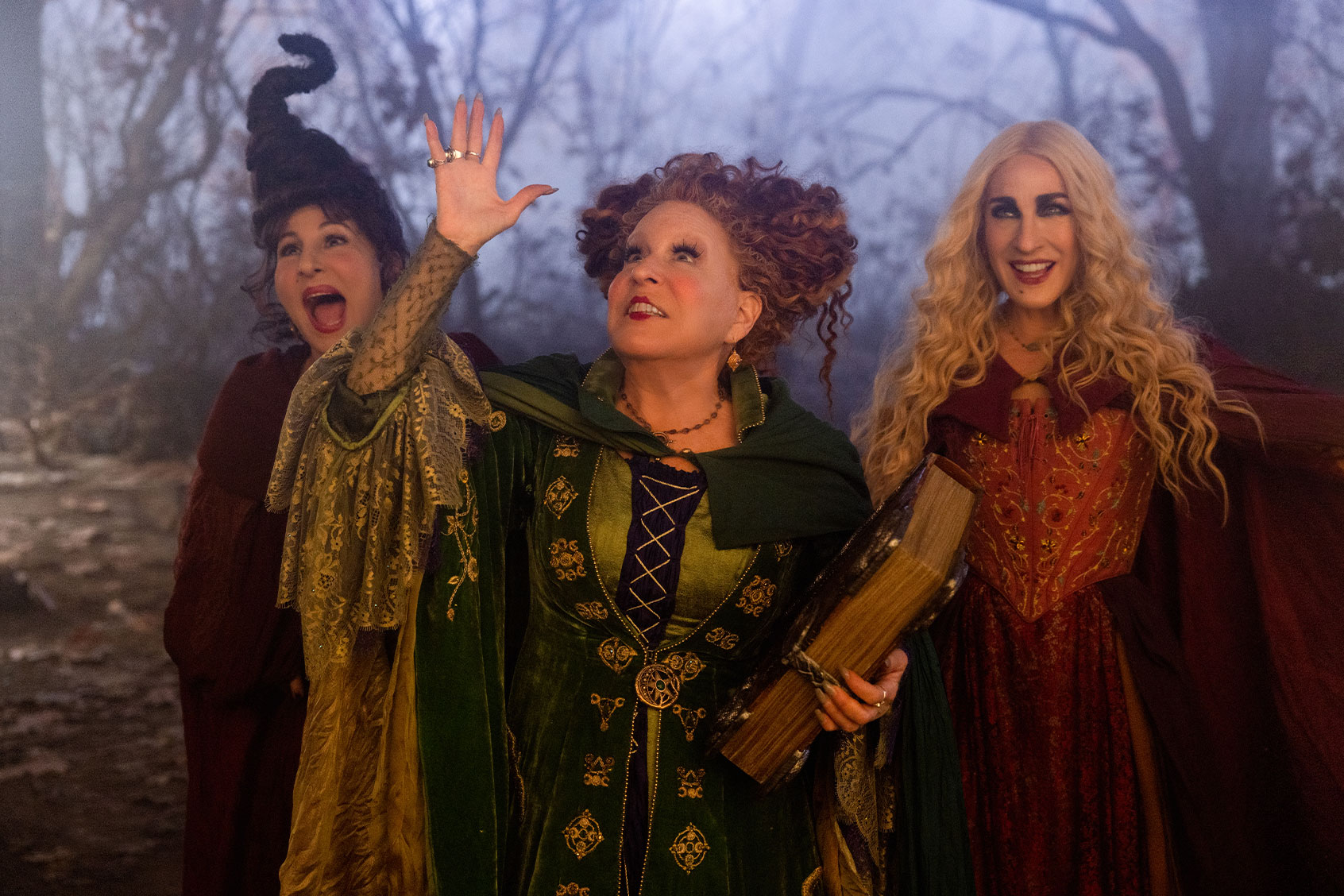
Hocus Pocus 2Kathy Najimy as Mary Sanderson, Bette Midler as Winifred Sanderson, and Sarah Jessica Parker as Sarah Sanderson in “Hocus Pocus 2” (Photo by Matt Kennedy/Disney)
It’s mostly three kids against the forces of darkness. Or at least, the forces of dimness.

For much of the original film, it’s Max, Allison and Dani on their own. Binx joins them; he can talk and has a wealth of knowledge, having kept tabs on the sisters for generations (he’s also immortal), but he is still a cat. Toward the end of the film, the group has the assistance of a charming zombie, but it’s mostly three kids against the forces of darkness. Or at least, the forces of dimness. Mary is clumsy and Sarah is ditzy, but Winnie is determined; and they’re on the hunt for children for the makings of nefarious spells. 

This might be concerning to the children’s parents if they were around to take notice. 

Max has been saddled with trick or treat duty because his and Dani’s parents are going to a party, a big Halloween rager held at town hall. Being forced to babysit when you’re a teen who just wants to have fun is a big trope for ’80s and ’90s spooky fare, showcased in classics like “Adventures in Babysitting” and “Labyrinth.” Max doesn’t sic goblins on his little sister but he does drag her along on his quest to impress Allison and banish the risen Sanderson sisters.

Essentially, the parents are out of the way. You can’t have fun, solve crimes and/or get into terrible danger with the ‘rents around to tell you no, call the cops or fix things. Just ask the Goonies, the SzalinskisKevin McCallister or any number of unaccompanied minors in films. For instance, in 2022’s “The Cellar” the parents miss the supernatural showdown because they’re working; in “Labyrinth” and “Hocus Pocus,” the guardians are playing. 

It’s not simply that the parents are not around. It’s that they’re bewitched and behaving badly. 

All of Max’s and Dani’s and Allison’s parents are at parties; drinking, eating treats, wearing costumes, enjoying themselves and generally behaving like children on a holiday that’s supposed to be for children. Allison’s parents even make her go (and dress up) to their very grownup fête. And while Max’s father has adopted a fanged costume that is basically a dad joke come to life (“Dadcula”), his mom (Stephanie Faracy) dresses as Madonna. Cone bra Madonna. As Entertainment Weekly writes, “Imagine if your mom dressed up as Madge for Halloween.”

This continues an unfortunate thread often found in movies marketed towards kids: breast jokes. It’s funny how you don’t remember the sexual immaturity of a story from your childhood until you show it to your own kid (how many times can they say “virgin” in one movie?). But inappropriateness is part of the role reversal too. It’s not simply that the parents are not around, It’s that they’re bewitched and behaving badly. 

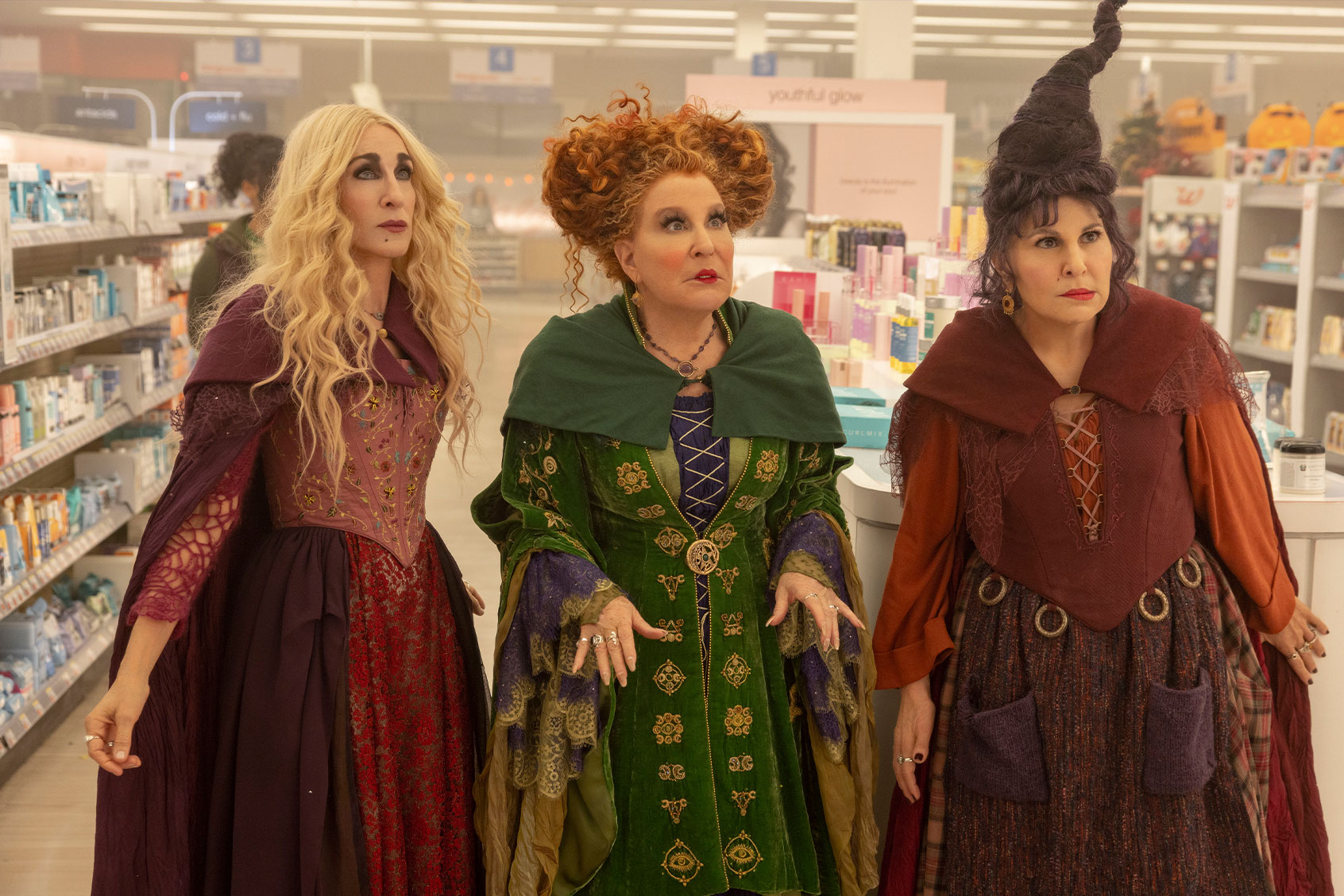
Hocus Pocus 2Sarah Jessica Parker as Sarah Sanderson, Bette Midler as Winifred Sanderson, and Kathy Najimy as Mary Sanderson in “Hocus Pocus 2” (Photo by Matt Kennedy/Disney)

Having the Sandersons put a spell on the grownups at town hall gets around the ickiness of having the parents be drunk. They’re useless and wasted – but on magic. 

They eat children; you can’t get less maternal than that.

Few things may be as actually scary for a young child as being unable to trust their guardians to properly care for them, or for their own selves. And in parents’ absence, the teenagers of “Hocus Pocus” are forced to be parental, much like beloved babysitter Steve of “Stranger Things.” Max saves the day because he has to. Binx has carried the guilt for years of not being able to rescue his own sister, a weight that shouldn’t have been placed on him as he was still a child too. Where were his parents? At a barn dance?


Want a daily wrap-up of all the news and commentary Salon has to offer? Subscribe to our morning newsletter, Crash Course.


The Sanderson sisters are not only childless, they eat children; you can’t get less maternal than that. They also use children for selfish, shallow purposes: to make themselves look younger and live forever. The trio isn’t very villainous but in their crooked, goofy way they present another path for women, not as mothers but as supernatural beings with power.

So too the beloved, if fluffy film, presents a very real fear for children: nobody is in charge and nobody, not even grownups, knows what to do.

“Hocus Pocus 2” is available for streaming Sept. 20 on Disney+. Watch a trailer via YouTube.

Burning Man highlights the primordial human need for ritual

At the end of each summer, hordes of people flock to the Black Rock Desert in Nevada to erect a makeshift city the size of the Italian town of Pisa. They call it Black Rock City. A few days later, they will burn it to the ground, leaving no trace.

During their time together, they partake in an extravaganza of unique experiences. Wearing wild costumes and riding carnivalesque vehicles, they attend colorful parades, spectacular light displays and interactive art installations.

Since its inception in 1986, attendance has increased from a few dozens of individuals to over 70,000 — and hundreds of thousands in various regional versions around the world.

In surveys, Burners, as they call themselves, report experiencing strong feelings of connection during the event. Over three-quarters say that their experience was transformative, over 90% say that these transformative effects lasted beyond their stay, and over 80% say that they made a permanent impact on their lives. The great majority return again, many of them every year.

What makes this bizarre event so meaningful to so many people?

The ceremonial experience

The overwhelming majority of Burners identify as nonreligious, yet the deeply spiritual experiences they report resemble those of religious groups. Indeed, the similarities with religion are no accident.

Burning Man, as the event became known, started as a solstice get-together by a handful of friends on Baker Beach in San Francisco. In 1986, they decided to build a wooden effigy and then torch it. Co-founder Larry Harvey called this a “spontaneous act of radical self-expression.” As people started gathering to watch, they realized they had created a ritual. The next year, they put up fliers and drew a bigger crowd. It has been growing ever since.

Harvey was an avid reader of anthropological theories of religion. He was particularly interested in the role of ritual in creating meaningful experiences. These experiences, he argued, address a primordial human need: “The desire to belong to a place, to belong to a time, to belong to one another, and to belong to something that is greater than ourselves, even in the midst of impermanence.”

As an anthropologist of ritual myself, I can see that ceremony is at the essence of Burning Man. It begins as soon as Burners walk through the gate. Upon entering, people signal their arrival by ringing a bell. They hug and greet each other by saying “Welcome home!” That home is treated as sacred, symbolically demarcated and protected from the polluting influence of the “default world,” as they call the outside. Upon their departure, they will perform a purification rite, removing all “matter out of place” — anything that doesn’t belong to the desert, from plastic bottles to specs of glitter.

Leaving their default name behind them, they use their “playa name.” It is a name gifted to them by another Burner and used to signify their new identity in the playa (the desert basin). They also abandon many of the comforts of the outside world. Monetary transactions are not allowed, and neither is bartering. Instead, they practice a gift economy, modeled on traditional ceremonial customs.

Anthropologists have noted that such ceremonial exchange systems can have important social utility. Unlike economic exchanges that produce equivalent outcomes, each act of donation creates feelings of gratitude, obligation and community, increasing both personal satisfaction and social solidarity.

The Burning Man Temple is yet another testament to the power of ritual. When sculptor David Best was invited to build an installation in 2000, he erected a wooden structure without any use in mind. But when a crew member died in a motorcycle accident, visitors started bringing mementos of people they had lost, and later gathered to watch it burn at the end of the event.

Since then, the temple has become a symbol of mourning and resilience.

Its walls are covered with thousands of notes, photographs and memorabilia. They are reminders of things people wish to leave behind: a personal loss, a divorce, an abusive relationship. It is all consumed by the fire on the final night as onlookers gather to watch silently, many of them in tears. Such a simple symbolic act seems to have surprisingly powerful cathartic effects.

The weeklong event culminates with the ceremonial destruction of the two largest structures looming at the center of the ephemeral city. On the penultimate night, a wooden effigy known as “the Man” is reduced to ashes. And in the final act, everyone gathers to watch the burning of the temple.

The human thirst for ritual

The oldest known ceremonial structures, such as Göbekli Tepe in Turkey, predate agriculture and permanent settlement. Although they took enormous effort to build, they too, like Black Rock City, were only used by ephemeral communities: groups of hunter-gatherers who traveled long distances to visit them.

It is not until hundreds of years later that evidence of settlement in those areas was found. This led archaeologist Klaus Schmidt to propose that it was the thirst for ritual that led those hunter-gatherers to permanent settlement, paving the way for civilization.

Whether this radical hypothesis is historically true is hard to know. But phenomena like Burning Man could confirm the view that the human need for ritual is primeval. It both predates and extends beyond organized religion.

Burning Man defies a strict definition. When I asked Burners to describe it, they used term such as movement, community, pilgrimage or social experiment. Whatever it might be, Burning Man’s unprecedented success, I believe, is due to its ability to create meaningful experiences for its members, which reflect a greater human yearning for spirituality.


Dimitris Xygalatas, Associate Professor of Anthropology and Psychological Sciences, University of Connecticut

This article is republished from The Conversation under a Creative Commons license. Read the original article.

The father of television grew to hate his own invention — until one miraculous day

The year was 1957, the game show was called “I’ve Got A Secret” and the guest had a most mysterious and ominous name: Dr. X.

Since the premise of “I’ve Got A Secret” was that contestants had to guess an unknown fact about the show’s guests (Dr. X was joined that night by a popular comedian, Buster Keaton), the contestants immediately probed Dr. X for details. When one of them asked if he invented a machine that is painful when used, the soft-spoken Dr. X cracked up the audience by replying, “Yes, sometimes it’s most painful.”

Dr. X, as it turned out, was Philo Farnsworth — inventor of the electronic television when he was only a teenager. While today television is widely lauded for providing us with great works of art (it even has a golden age and platinum age), in Farnsworth’s time it was regarded by many with the same contempt reserved for new forms of entertainment media in every era. Farnsworth, however, had additional and personal reasons for feeling bitter toward television.

He had lived the American dream by coming up with a great invention all on his own, then suffered because he was woefully underprepared to face the hyper-competitive, often cruel business world that defines American capitalism.


Want more health and science stories in your inbox? Subscribe to Salon’s weekly newsletter The Vulgar Scientist.


Like a character from a Horatio Alger story, Farnsworth was born in 1906 in a log cabin built by his grandfather in southwestern Utah. From an early age he showed a knack for science, voraciously reading magazines like Popular Science and Science and Invention, teaching himself physics and the works of Albert Einstein, and tinkering with machines whenever he found them (he even set up electricity in his rural farmhouse). In 1922, Farnsworth worked with his high school chemistry teacher Justin Tolman on a sketch for a so-called “image dissector” vacuum tube that essentially created the technology for modern television.

Before most people have even decided on a career path, Farnsworth had already figured out that the most effective way of transmitting images across large distances was to send them as a beam of electrons, which are then reproduced line by line along a light-sensitive screen. He did this at the age of 14, in fact, while plowing his family farm and visualizing beams of electrons patterned like the furrows he was created. With this epiphany, Farnsworth solved an intractable problem that had existed with previous attempts at television, which had used a more primitive and less reliable method.

Farnsworth had the right ideas, but lacked the economic good luck required to make the most of them in a capitalist society. Despite being admitted to Brigham Young University at the age of 16 (his grandfather had been a follower of the original Young), Farnsworth ultimately withdrew because his father’s unexpected death meant he could no longer afford college tuition. Refusing to let his dream die with his formal education, however, Farnsworth rustled up funds for his invention even while supporting his family with a full-time public service job in Salt Lake City. By Sept. 7, 1927 (the same year as the release of the first sound motion picture, “The Jazz Singer”), Farnsworth and his team of engineers were successfully transmitting televised images of a line and a triangle to impressed investors. His last image, a dollar sign, was met with amusement — and, more importantly, additional funding.

When one of them asked if he invented a machine that is painful when used, the soft-spoken Dr. X cracked up the audience by replying, “Yes, sometimes it’s most painful.”

Funding that Farnsworth very much needed. While he had revolutionized television technology, he still struggled with picture clarity and other technical issues. He was not alone in developing new ideas for transmitting images; among others, an engineer named Vladimir Zworykin was working with the president of electronics firm Radio Corporation of America (RCA), David Sarnoff, to one day become the so-called “fathers of television.” In 1930 Zworykin met Farnsworth in his San Francisco laboratory (Farnsworth believed it to be a good faith exploratory visit), observed and expressed admiration for his improved image dissector, and then returned to his own facility in Camden, New Jersey to make an even better camera tube known as an iconoscope.

This is where Sarnoff enters the picture — a man who was later described by one of RCA’s successor companies as “the Bill Gates of his age” because he insisted on having “a stranglehold over an entire sector of the economy.” Unable to run Farnsworth out of business through fair competition, Sarnoff paid a surprise visit to Farnsworth’s business in 1931, and shortly thereafter offered to buy Farnsworth out. When Farnsworth refused, Sarnoff cooked up a bogus legal case, filing frivolous patent lawsuit after frivolous patent lawsuit against him in order to tie him up in court. Although Farnsworth ultimately prevailed, the ordeal broke him both physically and mentally. Soon he developed severe depression and alcoholism. Even though Farnsworth’s legal victory in 1939 technically meant that RCA would have to start paying him to manufacture televisions, World War II temporarily stifled the television market. By the time the general public actually took an interest in television, Farnsworth’s patents had expired. Soon thereafter, he went out of business.

If there is any consolation to this story, it is that Farnsworth did continue inventing in his later years. While he stumped the contents on “I’ve Got A Secret” (winning a carton of cigarettes and $80, or roughly $843.19 by modern standards), Farnsworth’s name would soon overtake Zworykin and Sarnoff in the popular consciousness as the primary inventor of television. Before his death from pneumonia in 1971, Farnsworth even somewhat revised his earlier dismal opinion of television, which his children recalled him outright lambasting while they were growing up. His widow, Elma Farnsworth, later told historians that when he saw Neil Armstrong land on the moon on July 20, 1969, he finally believed that his own contribution to sharing that event with the world made his travails somewhat worthwhile.

“You are going to hear our voices”: Rev. William J. Barber on the midterms and the road ahead

I recently spoke to the Rev. Dr. William J. Barber II, co-chair of the Poor People’s Campaign, on the campus of Princeton University, where he delivered the keynote address for the U.S. chapter of the World Student Christian Federation, a global network of more than 100 progressive Christian student movements around the world.

In January of 2021, Barber delivered the homily at President Joe Biden’s inaugural prayer service at Washington’s National Cathedral. Over the past two years, he has repeatedly expressed disappointment that the Biden administration and a Democratic Congress have been unable to raise the federal minimum wage above $7.25 an hour, nor to make the expanded child tax credit permanent.

After Barber’s keynote address, I sat down with him to discuss the coming midterm elections and the larger choices facing American society. 

We are having an election soon, here in New Jersey and around the country. In 2021, you had a national study done of voters and you found that in New Jersey alone, some 400,000 low-wage and low-wealth voters were registered to vote but did not go to the polls in 2020. How would you counsel people that want these people to turn out? Could you coach them on being successful going door-to-door in communities where folks did not vote?

It’s waking a sleeping giant with that study from the Kairos Center and Repairers of the Breach/Poor People’s Campaign. I was talking to Shailly Barnes and I said, “We need to look at this.” Ee had touched 2 million people in 2020 and we know that Biden got 53 percent of the poor and low-wealth vote, What we found were three things: No. 1, don’t go into these communities and say, you just need to vote. Say, we honor you, because we respect that some of them have not voted because they never heard anybody call their name. Politicians don’t talk about them most of the time. They talk about the middle class, the upper class or those desiring to the American Dream. But we need to say the word “poor.”

If you look at the number of poor people — 52 million without a living wage, 140 million [overall] — you have to talk to them as human beings. Second of all, say to them, “I am not here to ask you to vote. I am here for you to join a movement that says there’s something wrong with our policies that this many people can be left disinherited.” Thirdly, I am asking you to believe that democracy is not just an idea, but democracy and justice are on the ballot. 

So who you are going to elect is going to determine health care. It is going to determine if you can push them to do the right thing because if people who get elected tell you upfront, “Don’t come to me about a living wage, don’t even talk to me,” then you don’t have a real chance with them. And lastly, let people know how much power they have. There is not a battleground state where the presidential election has been decided within three percentage points where poor and low-wealth people don’t make up 45 percent of the electorate. There’s not a state in the country where poor and low wealth people don’t make up 33 percent of the electorate. In my state, North Carolina, it wouldn’t take more than 19 percent, which is right around 120,000, of the 600,000 poor and low-wealth people who didn’t vote [to make a difference].

Is it fair to say that we have Sens. Jon Ossoff and Raphael Warnock today because of the turnout of low-wage and low-wealth voters?

There is not a battleground state where the presidential election has been decided within three percentage points where poor and low-wealth people don’t make up 45 percent of the electorate.

Sure. What we found in that study was that if you looked at the numbers, they turned out because they and the president were running on the living-wage issue. That’s why politicians can’t go back — politicians, hear me today! — you can’t stop talking about a living wage and voting rights. That’s what people heard. Yes, we have done some things on climate change — historic things. Great. Yes, we have done some things with Medicare and pricing on the drugs. Great. But you can’t dismiss what was left off: voting rights and a living wage. You have to tell people, “Give us the kind of majority where we can’t be overturned easily and we will deal with that — we will deal with the filibuster. We will give you a living wage.” That’s how Warnock and them won. We touched about 200,000 people in Georgia and then we went back and looked at how they voted and where they voted, and large percentage of them who had not voted before — they voted for an agenda.

So you have to come to people with your heart and ears open and ask what’s hurting them. How has the system failed them? You have to get involved in a deeper conversation.

If there are 85 million low-income voters in this country and 58 million voted in the last election, —the highest turnout in recent years — that’s 27 million people who did not vote. You don’t say, 27 million people are stupid or 27 million people are uninformed or 27 million don’t have consciousness. They have had some legitimate reason, and it may not be your reason but we already know what the reasons are — and we have to hear that and let those people know what their power is.


Want a daily wrap-up of all the news and commentary Salon has to offer? Subscribe to our morning newsletter, Crash Course.


For the politicians, they need to go and apologize sometimes. Look at these campaigns we are running now. Tell me one state where there’s been a debate about what they are going to do about poverty. Even in the presidential race it didn’t happen. Every problem we face — poverty, lack of health care, lack of a living wage — is created by policy. They can be changed by policy, and poor and low-wealth people hold the power to put people in office that can make a difference.

I was speaking with George Gresham, who leads 1199 SEIU East and has taken a heroic stand for universal health care. I was just in Trenton at a rally where public workers and health care workers involved with fighting the pandemic were protesting a 20 to 24 percent increase in their health insurance premiums, which would do away with whatever wage increase they got. Why are we dodging this issue? Why don’t we hear about universal health care in this election campaign?

Too many of these consultants, especially Democratic consultants, try to find one issue. They say now we can just focus on Jan. 6 or rolling back Roe v. Wade. What you have to do is connect that: The same people that did Jan. 6 also rolled back Roe, also block living wages, also block health care and also block voting rights. Connect the dots. Don’t disconnect the dots. 

Democratic consultants try to find one issue: We just focus on Jan. 6, or Roe v. Wade. You have to connect that: The people who did Jan. 6 also rolled back Roe. They also block living wages, health care and voting rights.

But we also have this group called “moderates” on both sides and they believe more in order than reordering society. We have universal congressional health care because every Congress member and senator gets health care the minute they get elected. It’s universal and we pay for it. So we are the only country of the 25 wealthiest countries in the world that does not offer some form of universal health care. In essence, we say in America that your health care is connected to your job, and not your body. That’s immoral, particularly to me as a Christian. My health care should be connected to my body. I never saw Jesus charge a co-pay. I never saw  Jesus say, “I will heal you of leprosy — but wait a minute, I got to get something from you first.” 

We have to have a retooling of the narrative, but it is only going to happen if poor and low-wage people do it. That’s why we are organizing poor and low-wealth people, advocates and religious leaders, because we have to be the ones to reshape the moral narrative.

This seems to be happening in workplaces: Amazon, Starbucks, Dollar General, Chipotle.

Oh my — the poorest workers are organizing like never before. There is something happening in this country and I am glad of it, because I am going to tell you: There is a flip side, Poor and low-wealth people realize that addressing these interlocking issues like systemic racism, systemic poverty, ecological devastation, denial of health care and the war economy are all critical to the soul of the nation. If people ever stop believing the nation has a soul, that’s the breeding ground for demagogues, autocrats. That’s how Hitlers, Putins and other folks get into office. That’s not healthy ground. We saw Jan. 6. I don’t want to ever see 140 million poor and low-wealth people in this country lose hope and start operating from a place of despair.

You mentioned the tribulation of the pandemic. Government and businesses failed to protect the people. Isn’t it possible we are looking around after this tribulation and our families and immediate households are in a higher position in our hearts because it’s all we had to get us through this?

That is all we ever had, but the pandemic forced us to realize that our breath is not promised to us, that all of us have six minutes and all of our loved ones have six minutes, I have had to wrestle with that. I have an immunodeficiency. Why am I not dead? Other people around me have died. I am not here because I am better than those people. I am here because the spirit says to me that the question is not why am I still here, but what I am going to do while I am still here.

We watched a million  people die and we have not had a month of mourning — not one month. Think about that. Some people are starting to say, wait a minute, I have to restore some sense of caring, because something is wrong here when billionaires can make $2 trillion and poor people can’t even get a living wage or health care or paid family leave in the middle of a pandemic.

That’s a brokenness, and that is only going to be changed when poor and low-wealth people, religious leaders and advocates start activating that song we sing, “Make Them Hear You”. It’s an old song that comes from a Broadway play. It says make them hear you, not with hatred, not with insurrection but with moral resurrection. That’s why people are saying we are not going to be silent. You are going to see our faces. You are going to hear our voice and you are going to feel our votes. 

Are super-Earths more friendly to life than our planet?

Astronomers now routinely discover planets orbiting stars outside of the solar system — they’re called exoplanets. But in summer 2022, teams working on NASA’s Transiting Exoplanet Survey Satellite found a few particularly interesting planets orbiting in the habitable zones of their parent stars.

One planet is 30% larger than Earth and orbits its star in less than three days. The other is 70% larger than the Earth and might host a deep ocean. These two exoplanets are super-Earths — more massive than the Earth but smaller than ice giants like Uranus and Neptune.

I’m a professor of astronomy who studies galactic cores, distant galaxies, astrobiology and exoplanets. I closely follow the search for planets that might host life.

Earth is still the only place in the universe scientists know to be home to life. It would seem logical to focus the search for life on Earth clones — planets with properties close to Earth’s. But research has shown that the best chance astronomers have of finding life on another planet is likely to be on a super-Earth similar to the ones found recently.

Common and easy to find

Most super-Earths orbit cool dwarf stars, which are lower in mass and live much longer than the Sun. There are hundreds of cool dwarf stars for every star like the Sun, and scientists have found super-Earths orbiting 40% of cool dwarfs they have looked at. Using that number, astronomers estimate that there are tens of billions of super-Earths in habitable zones where liquid water can exist in the Milky Way alone. Since all life on Earth uses water, water is thought to be critical for habitability.

Based on current projections, about a third of all exoplanets are super-Earths, making them the most common type of exoplanet in the Milky Way. The nearest is only six light-years away from Earth. You might even say that our solar system is unusual since it does not have a planet with a mass between that of Earth and Neptune.

Another reason super-Earths are ideal targets in the search for life is that they’re much easier to detect and study than Earth-sized planets. There are two methods astronomers use to detect exoplanets. One looks for the gravitational effect of a planet on its parent star and the other looks for brief dimming of a star’s light as the planet passes in front of it. Both of these detection methods are easier with a bigger planet.

Super-Earths are super habitable

Over 300 years ago, German philosopher Gottfried Wilhelm Leibniz argued that Earth was the “best of all possible worlds.” Leibniz’s argument was meant to address the question of why evil exists, but modern astrobiologists have explored a similar question by asking what makes a planet hospitable to life. It turns out that Earth is not the best of all possible worlds.

Due to Earth’s tectonic activity and changes in the brightness of the Sun, the climate has veered over time from ocean-boiling hot to planetwide, deep-freeze cold. Earth has been uninhabitable for humans and other larger creatures for most of its 4.5-billion-year history. Simulations suggest the long-term habitability of Earth was not inevitable, but was a matter of chance. Humans are literally lucky to be alive.

Researchers have come up with a list of the attributes that make a planet very conducive to life. Larger planets are more likely to be geologically active, a feature that scientists think would promote biological evolution. So the most habitable planet would have roughly twice the mass of the Earth and be between 20% and 30% larger by volume. It would also have oceans that are shallow enough for light to stimulate life all the way to the seafloor and an average temperature of 77 degrees Fahrenheit (25 degrees Celsius). It would have an atmosphere thicker than the Earth’s that would act as an insulating blanket. Finally, such a planet would orbit a star older than the Sun to give life longer to develop, and it would have a strong magnetic field that protects against cosmic radiation. Scientists think that these attributes combined will make a planet super habitable.

By definition, super-Earths have many of the attributes of a super habitable planet. To date, astronomers have discovered two dozen super-Earth exoplanets that are, if not the best of all possible worlds, theoretically more habitable than Earth.

Recently, there’s been an exciting addition to the inventory of habitable planets. Astronomers have started discovering exoplanets that have been ejected from their star systems, and there could be billions of them roaming the Milky Way. If a super-Earth is ejected from its star system and has a dense atmosphere and watery surface, it could sustain life for tens of billions of years, far longer than life on Earth could persist before the Sun dies.

Detecting life on super-Earths

To detect life on distant exoplanets, astronomers will look for biosignatures, byproducts of biology that are detectable in a planet’s atmosphere.

NASA’s James Webb Space Telescope was designed before astronomers had discovered exoplanets, so the telescope is not optimized for exoplanet research. But it is able to do some of this science and is scheduled to target two potentially habitable super-Earths in its first year of operations. Another set of super-Earths with massive oceans discovered in the past few years, as well as the planets discovered this summer, are also compelling targets for James Webb.

But the best chances for finding signs of life in exoplanet atmospheres will come with the next generation of giant, ground-based telescopes: the 39-meter Extremely Large Telescope, the Thirty Meter Telescope and the 24.5-meter Giant Magellan Telescope. These telescopes are all under construction and set to start collecting data by the end of the decade.

Astronomers know that the ingredients for life are out there, but habitable does not mean inhabited. Until researchers find evidence of life elsewhere, it’s possible that life on Earth was a unique accident. While there are many reasons why a habitable world would not have signs of life, if, over the coming years, astronomers look at these super habitable super-Earths and find nothing, humanity may be forced to conclude that the universe is a lonely place.


Chris Impey, University Distinguished Professor of Astronomy, University of Arizona

This article is republished from The Conversation under a Creative Commons license. Read the original article.

Why is the U.S. Olympic agency meant to stop sexual abuse investigating its top critic?

This is a tale full of Kafkaesque twists about the efforts of the U.S. Olympic Committee (USOC) and its affiliated national sport governing bodies (NGBs) to make it look as if they’re doing something about their sexual abuse problem. It’s also a story that gets pretty deep in the weeds and one that bumps up against a basic reality: Although many millions of viewers watch the Summer and Winter Olympics and debate the internal or international drama hyped up by multibillion-dollar broadcast rights holder NBC, very few of them know or care anything about USOC’s lords of the rings or their apparatchiks’ day-to-day operations, far from the flag-waving captured on TV.

One effect of that is near-total public indifference toward the exploitation of local age-group clubs as faux community-based programs for youth athletes. This is especially true in swimming, where the main purpose of the clubs, from an Olympics perspective, is to serve as precincts for development of the next generation of gold medalists. It’s a PR bonus that the accompanying after-school practices and weekend meets are staples of feel-good Americana.

This system offers many incentives that contribute to opportunities for widespread abuse of underage athletes. These clubs enjoy subsidies in two forms. First, high school, community college and recreation center swimming pools are rented at below-cost rates. Second, parents contribute volunteer labor as officials, timers and concession stand operators.

Badminton, of course, is not nearly as popular a sport as swimming, and its athlete age level skews higher. But a new scenario involving an attorney employed by USA Badminton, Jonathan Little, illustrates the dysfunctions and at times the desperation of the American branch of the Olympic movement on the abuse issue.

The story involves a complaint against Little,by the U.S. Center for SafeSport — USOC’s de facto internal affairs division. If it goes adversely, Little could be banned from organized sports in this country. To be absolutely clear, no one at SafeSport, or anyone anywhere else, alleges that Little has ever sexually harassed or abused anyone. This isn’t about that.

Indeed, you could almost say this is the opposite of that: Little is one of the country’s leading advocates on behalf of victims of coach sexual abuse in youth sports. Now 41, Little is a former collegiate runner who competed in the 2008 Olympic Trials in the marathon. He still dabbles in independent coaching and consulting for aspiring Olympians.

What’s happening to him now can perhaps best be understood as a case of classic retaliation by SafeSport. It’s not entirely unlike the extreme IRS audits of former FBI director James Comey and acting director Andrew McCabe that were ordered under the Trump administration, except that the Olympic agency’s harassment of this particular persistent critic is actually even worse. At least Comey and McCabe were under investigation for possible tax fraud (albeit without probable cause and with apparent corrupt intention), which is undeniably the portfolio of the IRS. The Little case amounts to nothing more than a conceptual disagreement between Safe Sport and activists on behalf of youth athlete safety, a disagreement going straight to questions about the agency’s fundamental legitimacy and efficacy.

This case of classic retaliation is not entirely unlike the aggressive IRS audits of James Comey and Andrew McCabe during the Trump years. Except that it’s worse.

Little is not a member of USA Badminton or any other NGB, and as stated above has never been accused of any sexual misconduct. Instead, thanks to the power vested in it by a vaguely organized nonprofit that was vaguely codified in 2018 revisions of an act of Congress, the SafeSport center is seeking to bust him for violating its procedures.

What is Little’s alleged crime? He routinely counsels young athletes who say they’ve been abused not to waste their time filing complaints with SafeSport, telling them instead to go directly to law enforcement. As we’ll see, given the history and practices of both the SafeSport center and the SafeSport departments of the affiliated NGBs, this seems to be good advice.

The U.S. Center for SafeSport did not respond to Salon’s request for comment for this story.

Little himself says the following: “Calling SafeSport about a coach committing abuse is like calling the Vatican to report a priest. What you have to understand is that SafeSport exists to limit the criminal liability of USOC and the NGBs. Its purpose is not to protect youth athletes.” 

He adds, “The law in Indiana and in two-thirds of the states requires any adult who has a reasonable suspicion of abuse to report it to law enforcement. There is no such law requiring a report to SafeSport.”

What makes SafeSport’s investigation of Little in his work for USA Badminton even more absurd is that it either amounts to a moot point or is actively damaging with respect to the safety of this group’s athletes. Several years ago, USA Badminton’s board of directors was taken over by athletes, making it something of a unicorn among the NGBs. Since then, the sport’s tally of abuse allegations is a grand total of three: two against one coach, one against another.

According to Little (and contrary to the basis of last year’s SafeSport notice of allegations against him), USA Badminton did in fact duly report all three coach complaints both to the police and to the SafeSport center, more or less simultaneously. As if to confirm Little’s overall critique of the system, the upshot was that no action was ever taken against either coach by SafeSport. Furthermore, that means USA Badminton cannot discipline these coaches itself, even if the organization were so declined. (Since Salon has not independently investigated those allegations, this article will not name the coaches.) 

Before getting to all that, let’s introduce you to Jon Little, an activist who has been a thorn in the side of the Olympic establishment from the moment he began practicing law a decade and a half ago. In fact, it can be reported here for the first time that Little and his wife, Jessica Wegg, a fellow anti-abuse lawyer, were the original assemblers of much of the evidence in the sensational USA Gymnastics sexual abuse scandal. Superstar gymnast Simone Biles is now part of the group of famous Olympians who have filed a billion-dollar lawsuit against the FBI for botching, over many years, the investigation and cover-ups surrounding Larry Nassar, the infamous doctor who abused numerous gymnasts. 

*  *  *

Little is a Hoosier, which is fitting on several narrative levels. Over the years, the state of Indiana has been ground zero for much of Olympic sport governance, and also abuse cover-up. The current athletic director at the University of Notre Dame, Jack Swarbrick, was a lawyer for both USA Swimming and USA Gymnastics.

Dale Neuberger, a onetime USA Swimming board president and longtime board member of FINA, the international sport governance body, was a partner in an Indianapolis-based consulting company, where he was accused of corruptly steering lucrative and prestigious events to the venues of his company’s clients. Part of his handiwork was the 2010 open water swimming championships in unsafely warm seas off the coast of the United Arab Emirates, resulting in the death of swimmer Fran Crippen.

Chuck Wielgus, the late and disgraced chief executive of USA Swimming, was originally part of this network of Indiana sports MBA types when he ran USA Canoe & Kayak.

Little’s involvement in fighting coach abuse, which drove  his decision to devote much of his legal career to this cause, began when he was on the track and field team at Indiana University in the early 2000s. His girlfriend at the time was Indiana swimmer Brooke Taflinger, one of the victims of Brian Hindson, a coach at  the Central Indiana Aquatics club in Kokomo who later went to prison for sexual abuse and possession of child pornography. 

A suit against USA Swimming, spearheaded by Little and filed on behalf of swimmer Jancy Thompson, led the California Supreme Court to order the group to turn over thousands of pages of internal documents.

Pointedly, the charges against Hindson included evidence that he clandestinely videotaped his athletes disrobing in the locker room. Testifying in 2010 in a related civil lawsuit against USA Swimming, chief executive Wielgus falsely claimed that his organization had never heard of any controversy involving illicit videos prior to the infamous 2008 viral clip that captured the sport’s biggest star, Michael Phelps, taking a hit of marijuana from a bong at a party.

There’s a lot of contrary evidence. For starters, there had already been another peeping-tom coach in Pennsylvania, John Trites, who while on the run literally made the FBI’s Most Wanted list and was featured on the “America’s Most Wanted,” prompting USA Swimming to issue an alert to aquatic facilities across the country. That was in 1998. Six years after that, hidden video cameras became  the basis for a compelling (yet never prosecuted) abuse case against Brazilian-American coach Alex Pussieldi, an assistant to the late Hall of Famer Jack Nelson in Fort Lauderdale, Florida. (Nelson was the coach whom celebrity open water swimmer Diana Nyad has accused of molesting her when she swam for him at Pine Crest School in Fort Lauderdale. And on and on.)

As it happens, Little’s girlfriend Taflinger was close friends with another Indiana swimmer, Susan Woessner. When USA Swimming started its SafeSport program in 2010, Woessner, who has social worker credentials, was hired to direct it. Discovery in subsequent lawsuits would establish that this new department to monitor and eradicate abuse was a PR ruse and Woessner acted as a glorified secretary to Wielgus, who continued to call the shots on which complaints rose to the level of full investigations and hearings.

In 2018, Woessner resigned amid allegations that she’d had an undisclosed romantic relationship with a coach named Sean Hutchison, the subject of the swimming SafeSport program’s very first high-profile investigation. (Hutchison had groomed and abused gold medalist Ariana Kukors for years, starting at the King Aquatic Club in Seattle. Shortly after Woessner left, USA Swimming settled Kukors’ lawsuit for an undisclosed sum.)

Another Indiana University swimmer from Little’s circle of campus jock acquaintances was Megan Ryther, who was on the board of directors of USA Swimming and is now on the board of the U.S. Center for SafeSport. 

As an anti-abuse lawyer, Little has spearheaded some of the most groundbreaking youth sports coach abuse cases, often in association with another prominent attorney in the field, B. Robert Allard of San Jose. In 2012, their lawsuit against USA Swimming on behalf of Jancy Thompson, who had been abused by club coach Norm Havercroft, led the California Supreme Court to order the group to produce thousands of pages of internal documents that had been withheld in defiance of lower court discovery orders (amassing tens of thousands of dollars in sanctions). These documents, finally submitted under seal, were subpoenaed by the FBI’s field office in Campbell, California. The files would feed investigations of USA Swimming by Rep. George Miller, a California Democrat (since retired), as well as by a grand jury impaneled by the U.S. attorney for the Southern District of New York. (The Miller probe fizzled out. The grand jury probe — reported by a few major newspapers in “one and done” fashion in 2020 — likely remains active in some form. Grand jury work is supposed to be secret.) 

Many of these USA Swimming files were leaked to me by an FBI source and have informed my reporting on this subject over the last decade. 

In 2013, the Allard-Little legal team first brought the case of taekwondo athlete Yasmin Brown for her three years of abuse, between the ages of 16 and 19, by her coach Marc Gitelman. Five years later, they had an even larger case in this sport, a mass action on behalf of dozens of taekwondoins and allegations of cross-state and cross-country human trafficking by USA Taekwondo and leading coaches-predators, including the brothers Steven and Jean Lopez. That case is part of a wedge of actions, especially in California, that are slowly piercing the veil of the liability protections of NGBs for bad actors at the local club level, and may eventually lead to exposing USOC itself.

Little’s greatest legal hits also have included the sports of diving, tennis, fencing and speed skating. But his involvement in reeling in the biggest fish, gymnastics, has never before been publicized.

In 2009 Little began working with Georgia attorney W. Brian Cornwell on Jane Doe v. USA Gymnastics, which would become the root case of cascading scandals involving coaches and the Indianapolis-based NGB’s head, Steve Penny, along with the now notorious Larry Nassar. And Little and Wegg then began a campaign to bring the case to the attention of Indiana-based prosecutors and media.

In 2012 Little had lunch at the Saffron Cafe in Indianapolis with Eric Holcomb, chair of the state Republican Party, who would become governor five years later when Mike Pence became vice president. (If you want to know why a young lawyer was dining with a top local politico, then you need a primer on Indiana’s small-town ways. Little lived near Pence before he was governor. He met Supreme Court Justice Amy Coney Barrett several times when she taught law at Notre Dame. He has brushed shoulders with former South Bend mayor Pete Buttigieg, now the secretary of transportation.)

Little says he told Holcomb he had culled a dossier of more than 100 cases of lurid allegations and their cover-ups by NGBs. More than half of these were in gymnastics and the cover-ups led all the way up to CEO Penny. Nothing came of that meeting. (Holcomb’s press secretary Erin Murphy acknowledged Salon’s request for comment, but did not otherwise respond.)

In 2013, Little tried without success to push his information, in phone conversations and various meetings with two Marion County deputy prosecutors: Mark Busby and Abigail Howard. (Busby went on to become general counsel for USA Gymnastics; he resigned last year. Howard would become general counsel for USA Swimming.)

Also in 2013, Little gave his gymnastics information to the U.S. attorney’s office in Indianapolis, in numerous emails and conversations with assistant U.S. attorneys Cynthia Ridgeway, Zachary Myers and others. In October of that year, during a fire drill on Monument Circle outside their office, where he had business on an unrelated case, Little had a chance encounter with Ridgeway, Myers and their boss, U.S. attorney Joe Hogsett. Little says he pressed the gymnastics information to Hogsett in a conversation through the ensuing 10 or more minutes of the fire drill, but again, no law enforcement action followed.

Hogsett’s communications director Mark Bode told Salon: “Mayor Hogsett does not recall this quick encounter during what you describe as a fire drill. However, since federal law enforcement investigations are undertaken by federal law enforcement agencies rather than the U.S. Attorney’s Office, Mayor Hogsett is confident his office would have referred any individual with similar allegations to the appropriate law enforcement agency.”

Finally, in 2016, Little and Wegg connected with Marisa Kwiatkowski, an investigative reporter for the Indianapolis Star. The lawyers had a practice of following the local dockets for non-sports sexual abuse cases, and showing up at hearings in the hope of connecting with prosecutors or journalists to advocate pursuit of their sports cases. This time, at the courthouse for a hearing involving the well-publicized case of an Indianapolis public school teacher, Little and Wegg spoke to Kwiatkowski, and she began work on the series of articles that broke open the gymnastics scandal. (Kwiatkowski is now at USA Today.)

*  *  *

As Salon reported last year, the U.S. Center for SafeSport’s problems go far beyond its huge backlog of cases and arguably inadequate funding. The bigger problem is that this agency is just another tool for consigning complaints to lengthy and legalistic oblivion. Its highest-paid employee, Michael Henry, was an investigator (previously with a university Title IX bureaucracy) who represented himself as “director of legal affairs” even though he apparently never passed a state bar exam. SafeSport’s PR consultant, Dan Hill, has publicly bragged that he works pro bono on abuse issues, even though the organization’s tax filings reveal payments to his company of at least $180,000.

The U.S. Center for SafeSport has many problems. The biggest is that this agency is just another tool for consigning complaints to lengthy and legalistic oblivion.

Aside from the occasional steering of a case into a finding that a coach — usually an obscure name — has been banned, SafeSport by and large leans into the criminal justice system’s “beyond a reasonable doubt” standard, rather than forging its own path to clean up the administration of NGBs with a “preponderance of the evidence” standard. That is why Little advises his clients to go to the police, not SafeSport, with their allegations. If cops and prosecutors proceed to give the charges traction, Little surmises, then SafeSport just might get around to doing their job. Otherwise, it is a mistake to invest in SafeSport’s illusion of a solution. It is only a recipe for open-ended frustration.

SafeSport’s Oct. 13, 2021, notice of allegations to Little states:

It was reported to the U.S. Center for SafeSport’s Response & Resolution Office that you: were made aware of allegations of sexual misconduct and failed to timely report such allegations to appropriate authorities; discouraged the reporting of sexual misconduct; encouraged the concealment and destruction of evidence on the subject; contested the need to follow federal reporting requirements; refused to cooperate in the Center’s investigation; and retaliated against a USA Badminton employee for reporting sexual misconduct to the Center. It has been further alleged that you engaged in Abuse of Process by improperly disclosing the identity of Claimants in communications with both the USOPC and the United States Congress.

Little says it’s all baloney. Notwithstanding his standard advice to victim-clients to ignore SafeSport, he directed USA Badminton to pass along the three complaints about the coaches to the agency immediately after submitting them to the police. The idea that he discouraged reporting of sexual misconduct, he says, is ridiculous. The charge that he encouraged concealment and destruction of evidence, he says, is a fabrication. He never retaliated against any employee, he insists, for reporting to the center.

The truly Kafkaesque smear here is that Little improperly disclosed identities in communications with Congress. On Oct. 1, 2021 — 12 days prior to SafeSport’s notice of allegations against Little — USA Badminton received an admonishing letter from Sen. Chuck Grassley, R-Iowa, ranking member of the Senate Judiciary Committee. The letter concerned reports from SafeSport “about allegations of child sex abuse within USA Badminton, and allegations that USA Badminton is interfering with the Center’s investigation of the matter.” Grassley’s letter concluded by saying he had alerted the FBI, “and I strongly urge you to make appropriate contact with state and local law enforcement.”

It is particularly rich that this letter came from a Republican. Though neither party has shown any real eagerness to confront the power of the Olympic brand, Democrats in Congress have been far more active than Republicans in taking measures to combat youth sports coach sexual abuse.

In any event, at Little’s direction, USA Badminton wrote back to Grassley with full details of their cases and what they had done with them — including the information that all such allegations had been reported to law enforcement first, and SafeSport second. Less than two weeks later, Little was hit with SafeSport’s notice, whose counts included the allegation that he had made improper disclosures to Congress.

What it comes down to is something like this: “In a SafeSport violation, you failed to report to Congress. Oh, you say you did? We mean, in a SafeSport violation you did report to Congress.”

There is nothing to see here, as they say, except for SafeSport’s whine that Little, along the way, has “contested the need to follow federal reporting requirements.” By federal reporting requirements, they mean playing ball SafeSport’s way. But in fact SafeSport is just an administrative agency with no legal teeth. There’s only one group or entity anyone is required to notify of sexual abuse allegations, on pain of prosecutorial consequences. That would be the cops.

Little says that within the last four years, “SafeSport, in one case, alerted a perpetrator prior to the law enforcement authorities getting organized and executing a warrant. In another case, SafeSport gave cops inaccurate information about an accused abuser’s sexual encounter with a teenager – falsely saying that the victim was above the age of consent. In yet another case involving a prominent coach who did not report abuse, SafeSport stonewalled police and refused to comply with a subpoena.”

What all this adds up to is a position supported by many anti-abuse activists: It does no good to legitimize the U.S. Center for SafeSport. That, not whatever has been trumped up in an effort to make a critic look bad, is what SafeSport v. Little is all about. 

Giuliani faces jail time for skimping on divorce settlement

On Friday, the New York Daily News reported that Donald Trump ally and former New York City mayor Rudy Giuliani could face jail time for contempt of court if he doesn’t come up with $235,000 for his ex-wife Judith Nathan next month.

“Judge Michael Katz’s order came after Giuliani, the ex-mayor and current Donald Trump adviser, skipped a court hearing in a lawsuit Nathan filed over his failure to heed the terms of their December 2019 divorce settlement, court officials said,” reported Molly Crane-Newman.

“At a hearing Sept. 8, Giuliani said he would pay Nathan what she is owed — but complained she didn’t file her paperwork properly,” said the report. “‘It’s literally about three or four payments that amount to $45,000, which I will obviously pay,’ Giuliani told the Daily News at the time. ‘There was no reason for this because I would have paid them had she sent me a correct complaint.'”

This comes after a long string of embarrassments for Giuliani, who was a vocal proponent of former President Donald Trump’s conspiracy theories about the election being stolen.

Giuliani is facing a lawsuit from Dominion Voting Systems, an elections equipment company he falsely accused of rigging votes against the former president. He was also stripped of his license to practice law in New York over his election antics.

On top of that, Giuliani has also come under scrutiny by federal investigators for his dealings in Ukraine while he served as Trump’s personal attorney, with the FBI even searching his apartment last year.

MAGA candidates scrub references to “stolen election”

On Friday, The New York Times reported that several candidates who have pushed the conspiracy theory that the 2020 presidential election was stolen from Donald Trump are now scrubbing and revising these claims, both walking them back in public and trying to delete them from their websites.

“Blake Masters in Arizona, Tiffany Smiley in Washington State and Dr. Mehmet Oz in Pennsylvania have all made pivots — some artfully, some not — as the ardent, Trump-loyal voters who decided the Republican primaries shrink in the rearview mirror, and a more cautious, broader November electorate comes into view,” reported Jonathan Weisman. “These three Senate candidates haven’t quite renounced their questioning of the 2020 election — to right-wing audiences of podcasts, radio shows and Fox News, they still signal their skepticism — but they have shifted their appeals to the swing voters they need to win on Nov. 8.”

Masters, for example — who famously writes all the code for his own website — deleted a line from the site that read, “If we had had a free and fair election, President Trump would be sitting in the Oval Office today.” Smiley deleted a website section that said, “The 2020 elections raised serious questions about the integrity of our elections.” And Oz, who once said we “cannot move on” from 2020, told reporters this month he “would not have objected to” certifying the electors if he were in the Senate.

Perhaps one of the most dramatic about-faces on the issue, said the report, has been Don Bolduc, a retired brigadier general now running for Senate in New Hampshire.

Before the primary this month, Bolduc said, “I signed a letter with 120 other generals and admirals saying that Trump won the election, and, damn it, I stand by my letter.” But immediately after winning the nomination, he appeared on Fox News and said, “I’ve done a lot of research on this and I’ve spent the past couple weeks talking to Granite Staters all over the state from every party, and I have come to the conclusion — and I want to be definitive on this — the election was not stolen.”

This comes as some Republican Senate candidates also retreat from absolutist anti-abortion positions, amid rising public anger over the Supreme Court’s decision clearing GOP legislatures to pass total bans of the procedure. Masters also deleted references to his support for “a federal personhood law” that would ban abortion nationwide, and now claims in ads that he only supports a limit on “very late term abortions,” while declining to define what that means.

There’s no hiding from it: The politics of “Andor” look a lot like the type troubling our world

Cassian Andor’s introduction to the world came a month after America elected Donald Trump, when “Rogue One: A Star Wars Story,” hit theaters. Back then, the horror of that historic turn was still raw, and most people refused to name the obvious reason Trump won, which was bigotry and white grievance. Most, but not all.

Rogue One” co-writer Chris Weitz unleashed a barrage of anti-Trump tweets, including one he was made to delete: “Please note that the Empire is a white supremacist (human) organization.” Then-Disney CEO Bob Iger downplayed the connection Weitz tacitly made between “Rogue One” and anti-MAGA sentiment.

“Frankly, this is a film that the world should enjoy,” he told The Hollywood Reporter, insisting that a movie about a ragged, multicultural band of anonymous freedom fighters sacrificing themselves to bring down Imperial fascism was not “in any way, a political film. There are no political statements in it, at all.”

Six years later, Disney+’s “Andor,” the backstory of Diego Luna’s rebel spy, requires no such prevarication. Set five years before the events of “A New Hope,” “Andor” rewinds to the time before there was a Rebel Alliance, and Cassian Andor is simply a thief trying to stay off the Empire’s radar. Cassian’s friends on the industrial planet Fennix, such as they are, tolerate him more than they like him. He doesn’t mean them any harm, though it’s obvious that he tests their patience.

ANDORNurchi (Raymond Anum), Cassian Andor (Diego Luna) and Vetch (Ian Whyte) in Lucasfilm’s “ANDOR” (Lucasfilm/Disney)

Cassian Andor’s origin story as a mercenary, operative and killer is not especially unique. Film and television are full of self-serving criminals transformed into self-sacrificing heroes by circumstance. Should aspects of his journey seem familiar, that could be because series creator Tony Gilroy wrote the screenplay for the Jason Bourne trilogy.

Initially, “Andor” is presented as a character study. It doesn’t take long for it to set up an examination of how capitalism supports oppressive systems, making life difficult for anyone trying to eke out a living independent of those structures.

That’s what “Star Wars” has always been about — if you look beyond the florid speeches about searching one’s feelings. Of course, the Skywalker Saga never called attention to that part, preferring to mesmerize children and the young at heart with philosophical musings about not giving into hate and lifting boulders with focused thought.

Cassian and his compatriots . . . don’t have the time or luxury to contemplate the Force and its mysteries.

Cassian and his compatriots on Ferrix, which could be any working-class community left to pick the bones left behind by a greedy conglomerate, don’t have the time or luxury to contemplate the Force and its mysteries.

In a similar vein, flashbacks to Cassian’s childhood reveal him to be a victim of environmental exploitation. The Force didn’t protect Cassian’s home planet of Kenari from being mined to the brink of extinction when he was a boy (played by Antonio Viña) hiding in the forest with other children, including his sister. It didn’t save him when Imperials showed up to bury the mining disaster that had turned the place into poison. Other people did that. “Andor” is a show the world should enjoy, to use Iger’s words, mainly because Gilroy uses the title character to depict how a world degraded by malevolence can be saved by people who find common cause in fighting it. 

Gilroy writes Cassian as a man who understands what it means to live in a constant state of anxiety and navigate political uncertainty, a feeling to which plenty of us can relate. His arc is one of the ways “Rogue One” establishes that behind all the noble speeches about freedom made by senators and royals in war rooms on secret bases are everyday people pressed to make the sacrifices deemed necessary for the good fight to be possible. Sometimes, that means committing unthinkable acts.

In “Rogue One,” his introduction comes by way of a sequence that closes with him murdering an ally. This doesn’t valorize Cassian; on the contrary, right after he pulls the trigger, his expression goes blank. For a moment, he looks horrified with himself. Then he presses onward with cold purpose.

ANDORSyril Karn (Kyle Soller) and Cassian Andor (Diego Luna) in a scene from Lucasfilm’s “ANDOR” (Lucasfilm/Disney)Prior to all that, however, Cassian is simply a guy searching in a place he shouldn’t be who draws attention from the wrong people. A couple of Pre-Mor Authority jackboots target him for a shakedown, which is the last mistake they ever make — and one that makes Cassian a wanted man.
But the true eye-opener is what happens next. The dead men’s boss urges his subordinate, Deputy Inspector Syril Karn (Kyle Soller), to cover up the murders. His reason is simple: They weren’t especially well-liked, and since few will miss them, turning their deaths into a murder investigation isn’t worth risking being hassled by the Empire.

As cheap as their unknown perp’s life may be, the lives of two employees breaking rules and causing trouble are even cheaper. At least Karn’s boss can place a monetary value on them; in the end, the company is better off without them. Workers are expendable.


Want a daily wrap-up of all the news and commentary Salon has to offer? Subscribe to our morning newsletter, Crash Course.


Careers are made by stepping on the necks of the unworthy, which is why Karn sees finding his colleagues’ murderer as the key to rising through the corporate ranks. His zealotry isn’t motivated by a need to do the right thing – he wants to succeed, and therefore rise. Thus, he redirects Pre-Mor Authority resources to hunting Cassian, recruiting a sergeant eager to put his restless unit’s militarized training into practice by cracking a few bystanders’ skulls to get the job done. Their non-sanctioned field mission crumbles into an explosive example of overuse of police force resulting in an unarmed civilian’s death.

Gilroy and the show writers are not particularly oblique in making these parallels between the strife fracturing these places in that galaxy long ago and far away. But their resemblance to the existential and moral crisis our democracy faces in 2022 only makes “Andor” more relevant than nearly every other title in the “Star Wars” TV series stable except, perhaps, for “The Mandalorian.”

“Andor,” like “Rogue One” before it, assures the viewer that there are no magical paths to overcoming evil.

Neither Din Djarin’s journey nor Cassian’s are rooted in the Force or ominous mumbo-jumbo about the Dark Side, though “The Mandalorian” is obligated to remind us of the Jedi’s presence because of Baby Yoda’s central role in the show, which nobody minds.

Meanwhile “Andor,” like “Rogue One” before it, assures the viewer that there are no magical paths to overcoming evil. Only effort, sweat and a willingness to take incredible risks for the sake of either holding the line or gaining inches of ground can get it done. If a broad audience gets behind Cassian Andor, that’s because he’s the man this nascent rebellion needs. But he’s also the type of figure we now realize any of us could become.

The first three episodes of “Andor” are now streaming on Disney +. New episodes stream on Wednesdays.

Unregulated capitalism makes you poor, miserable — and short: New study

When supporters of capitalism claim that capitalism is an effective economic system, they often will begin by disputing capitalism's dual legacies of environmental destruction and inefficiency before arguing that capitalism leads to widespread prosperity. To support that last point, capitalists may cite a popular graph developed by the World Bank economist Martin Ravallion. At first glance it seems unremarkable, showing nothing but a straight diagonal line that plummets down. Upon further analysis, however, the Ravallion graph purports to prove that the global percentage of humans living in extreme poverty fell from roughly 90% in 1820 to roughly 10% in the early 21st century.

"The social dislocation associated with capitalism was so severe that, as of the most recent year of data, in many countries key welfare indicators remain lower than they were hundreds of years ago."

The Ravallion graph has gone viral since its inception, having been promoted by capitalists and capitalism sympathizers from Bill Gates to Steven Pinker. Yet despite its popularity, a new study in the journal World Development argues that the Ravallion graph's premise is fundamentally flawed — and, more importantly, that for the last 500 years unregulated capitalism has consistently worsened rather than improved living conditions.

The study — which was led by co-authors Dr. Dylan Sullivan of Macquarie University in Australia and Dr. Jason Hickel of Autonomous University of Barcelona and the London School of Economics and Political Science — concludes that extreme poverty was uncommon throughout history except when there were external causes of severe economic and social dislocation. Indeed, the rise of capitalism half a millennium ago led to a sharp uptick in human beings living below subsistence levels. When mass conditions began to improve around the turn of the 20th century, it was because of political movements that threw off colonialist regimes and used the government to redistribute wealth.

Sullivan and Hickel also pointedly critique the Ravillion graph, which Sullivan told Salon by email "suffers from several empirical flaws." By estimating poverty incomes with historical data about gross domestic product (GDP), the graph overlooks the suffering that occurs when people lose access to resources that they need but did not previously obtain as commodities. "If a forest is enclosed for timber, or subsistence farms are razed and replaced with cotton plantations, GDP goes up," Sullivan pointed out. "But this tells us nothing about what local communities lose in terms of their use of that forest or their access to food." In addition, the study relied on the World Bank's definition of the poverty line as being $1.90 purchasing power parity (PPP) per day, even though poverty is best assessed by determining whether wages are high enough and prices are affordable enough that the masses have easy access to essential goods like housing, food and fuel. Finally, Sullivan and Hickel criticize the graph for only going as far back as 1820, even though the current system of global capitalism began in the late 15th and early 16th centuries.

That last criticism explains why, for their paper, Sullivan and Hickel started with the dawn of modern capitalism in the late 15th and early 16th centuries. The scholars' research then spanned all over the globe while focusing on three data points linked to human welfare — real wages, height and mortality.


Want more health and science stories in your inbox? Subscribe to Salon's weekly newsletter The Vulgar Scientist.


"Thankfully, we were able to draw on the invaluable work of economic historians, who have painstakingly gathered historical data on real wages, human height, and mortality rates over several centuries," Sullivan wrote to Salon. Analyzing the data, Sullivan and Hickel found that any region of the world which developed a capitalist economic system — defined here as an economic system global in scale and that is predicated on what Sullivan described as "the ceaseless accumulation of private wealth" — soon suffered from a sharp decline in living standards for the masses.

"Everywhere capital goes, it leaves a footprint on the empirical indicators of human welfare," Sullivan told Salon. "The social dislocation associated with capitalism was so severe that, as of the most recent year of data, in many countries key welfare indicators remain lower than they were hundreds of years ago." As of the 2000s, an unskilled Mexican wage laborer earned on average 23% less than that person would have earned in 1700. Meanwhile, on the other side of the globe, real wages in India in the 2000s are lower than they had been more than 400 years earlier — in 1595.

There are documented physical consequences to this historic poverty. In Tanzania, heights were 0.67 inches lower in the 1980s than the 1880s. In Peru, a man born in the 1990s is on average 1.5 inches shorter than a man born in the 1750s. In the European nations of France, Germany, Italy and Poland, the average adult male height fluctuated wildly depending on whether the prevailing capitalist system provided for enough basic needs — which was often not the case. As such, Germans and Poles born in the 16th century were much taller than those born in the 1850s, and conditions (and height) did not improve until the 20th century.

"After the Chinese Communist Revolution in 1949, wages, height, and life expectancy improved rapidly. This is because the new government invested in public health care, education, and the universal distribution of food."

Indeed, in every region of the world — the study looked at Europe, China, South Asia, Latin America and sub-Saharan Africa — the trend was the same: Capitalism led to declining standards of living, and only improved when progressive social movements implemented necessary reforms.

"Life expectancy is higher today everywhere than it was in the past, and infant mortality lower," Hickel wrote to Salon, attributing this progress primarily to improvements in quality and ease of access to healthcare, vaccines, public sanitation and other important goods that improve human health and previously did not exist. As a result, despite capitalism's negative effect on human welfare, in most areas of the world today standards of living are much better than they were prior to capitalism — although this is not universally the case.

"It's true that there are several cases in the global South where wages and/or heights have not recovered from the immiseration they suffered during the process of integration into the capitalist world-system," Hickel acknowledged. He pointed to India, where extreme poverty is worse than it was several centuries ago and 1 billion people live on wages that are no more effective at purchasing food and goods than the wages of a 16th century laborer. At the same time, Hickel distinguished these examples "from quality of life in a more general sense." In regions of the world that have redistributed wealth and shed the shackles of colonialism, human welfare has vastly improved.

"Capitalists' opposition has always delayed and often destroyed working class efforts to improve their circumstances. The claimed improvements, when real, occurred despite and against capitalist's efforts, not because of them."

"It is not only Western Europe that has experienced progress," Sullivan explained. "After the Chinese Communist Revolution in 1949, wages, height, and life expectancy improved rapidly. This is because the new government invested in public health care, education, and the universal distribution of food." Latin American wages and heights improved in the mid-20th century when political leaders in those nations began to focus on industrialization, Sullivan added, and during that same period living conditions improved in sub-Saharan Africa when anti-colonial leaders like the Congo's Patrice Lumumba and Ghana's Kwame Nkrumah successfully fought for the rights of poor people. Conditions began to worsen in these regions in the 1980s and 1990s, however, when the World Bank and International Monetary Fund (IMF) began forcing countries to cut their social spending, deregulate their markets and privatize assets previously owned by the government.

This last development perhaps explains why, when Sullivan was asked about polices that could eliminate poverty, he started by suggesting that the World Bank and IMF be democratized. "In addition, we can establish universal public provisioning systems so that everyone can afford food, health care, and education," Sullivan added. "We can ensure all people's basic needs are met through a global universal basic income. And we can guarantee employment, as a basic right, in publicly owned enterprises. The history of the 20th century shows us that socialist policies like these can greatly improve human welfare."

Dr. Richard D. Wolff, professor emeritus of economics at the University of Massachusetts Amherst and an expert on capitalism, responded in writing to a Salon inquiry about the new study by elaborating on exactly how capitalism as a system has led to a reduction in overall quality of life.

"Capitalist employers from the system's beginning to this present moment have striven mightily to oppose wage increases, improved job conditions, tax-based public services and all other mechanisms to improve living standards," Wolff explained. "Capitalists' opposition has always delayed and often destroyed working class efforts to improve their circumstances. The claimed improvements, when real, occurred despite and against capitalist's efforts, not because of them."

It’s looking less likely that Matt Gaetz will be charged in relation to sex-trafficking

Prosecutors have recommended against charging Rep. Matt Gaetz (R-Fla.) in relation to an extensive sex-trafficking investigation due to a lack of credible key witnesses. 

This information comes to light less than a week after news broke that Gaetz had allegedly sought a preemptive pardon from Trump after Gaetz associate Joel Greenberg pleaded guilty to sex trafficking in 2021.

“To the best of our knowledge, Matt Gaetz is the only sitting Congressman to ever ask for a pardon for sex trafficking,” The watchdog group Citizens for Responsibility and Ethics in Washington (CREW) tweeted when word of Gaetz’s pre-pardon began to circulate. 

According to The Washington Post, “senior department officials have not made a final decision on whether to charge Gaetz, but it is rare for such advice to be rejected.”

The investigation involving Gaetz began in 2020 and included allegations that he’d paid for sex with a 17-year-old girl years prior. Responding to these allegations, Gaetz has maintained that the statements made against him in respect to this are false and that “the only time he had sex with a 17-year-old was when he was also 17,” per The Washington Post’s coverage of the investigation. 

Two of the key witnesses called into question in the investigation into Gaetz are an ex-girlfriend who claims to have been in close proximity to Gaetz and the 17-year-old in question during a trip to the Bahamas; the other witness being Joel Greenberg.

“Nobody’s going to believe anything that Joel Greenberg says by itself,” says lawyer David Bear. “His statements would need to be corroborated by testimony or evidence.”

Bear served as counsel for a schoolteacher who Greenberg admitted to fabricating allegations against during his own trial.


Want a daily wrap-up of all the news and commentary Salon has to offer? Subscribe to our morning newsletter, Crash Course.


The news that Gaetz may be in the clear set off a storm of reactions on Twitter Friday.

“Whatever happens with Matt Gaetz he will forever have admitted his guilt in sex trafficking when he asked for the pardon,” says Dem Strategist & Consultant Adam Parkhomenko.

“All the ‘career prosecutors’ I know would never ever blab to a reporter about an ongoing case,” tweets lawyer Tristan Snell. “Something doesn’t add up about this Matt Gaetz story.”

“In fairness – Matt Gaetz, who is totally innocent of sex trafficking of minors, tried to get a pardon for his sex trafficking of minors,” quips comedian John Fugelsang.

As this investigation hangs in the balance, a spokesperson for Gaetz stands behind the Congressman saying “Those who told lies about Rep. Matt Gaetz are going to prison, and Rep. Matt Gaetz is going back to Congress to continue fighting for America.”

Kathleen Turner on loving Marvel and disbelief at Roe v. Wade repeal: “We are not simply vessels”

Kathleen Turner has played several moms on screen, from the classic titular “Serial Mom” for John Waters, to the dour, protective Mrs. Lisbon in “The Virgin Suicides,” and the living-in-denial Eileen Cleary in “The Perfect Family.” She also famously portrayed Chandler Bing’s parent on “Friends.” 

” I believe that independent films are where the real creativity is today.”

In her latest film, the delicate romantic drama, “The Swearing Jar,” Turner plays Bev, who has a complicated relationship with her son Simon (Patrick J. Adams of “Suits“). She is admittedly, “not the warmest person.” Simon actually says this about his mother: “She makes me want to kill people with my hands.” Moreover, when Simon announces that he and his wife Carey (Adelaide Clemens) are going to have a baby, Bev refuses to let him utter the word, “grandma.” 

Bev is flinty, and Turner, with her distinctive voice and been-around-the-block attitude, makes her character a tough, uncompromising woman. When Carey steps out of Bev’s car to take a phone call, Bev drives away. 

“The Swearing Jar” captures the shifting family dynamics between these three characters as a situation unmoors them all. The rhythm of the film makes it easy to get caught up in the characters’ lives. 

Turner spoke with Salon about her new film, playing mothers, and her career as a whole.

Maybe let’s start with this, since the film is called “The Swearing Jar.” Are you big into cursing that we should keep a running tally of your F-bombs, or are you going to be all Beverly Sutphin and scold me if I use “the brown word?” 

I am given to casual cursing. I wouldn’t say I’m heavy-duty. I rarely say “F**k,” and when I do, I really mean it.  

I was wondering if you were going to split the difference and say, “Pussy Willow?”

No, won’t do that. Gave that up years ago.

What appealed to you about “The Swearing Jar?” 

” I don’t mind mothers. We’re real, and we’re powerful, baby!”

One of the things that drew me to the film was all the women involved. It was directed, written, and produced by women, and that was important to me. I would like to support women’s films as much as I can. I believe that independent films are where the real creativity is today. I love a lot of Marvel. Right now, I’m in love with the “She-Hulk,” but I don’t want to do that work. 

What observations do you have about playing mothers on screen? It is certainly a pivotal moment, a turning point in an actress’ career when they are cast as mothers — 

I’m resisting grandmother. I’m still not open for that, although I have been receiving scripts that put me in my 70s — and I’m not 70 yet. I accepted mother roles some time ago. Being a mother, I have a great admiration for them. And I have a wonderful relationship with my daughter. I am thrilled and grateful for it. We both live in New York. And I’m very lucky, because I lived most of my life far away from my mother, who lived in Missouri. Although I would go back at least three times a year, I hated going there. They keep wanting to name streets after me, and I kept telling them, “Please don’t.” I am very fortunate. I don’t mind mothers. We’re real, and we’re powerful, baby!

My question is more that male actors never really have to contend with that. If a male actor plays a father, it is not as big a deal. 

Aah, yes, it is a classification and a category, and men don’t have to deal with that. Hell, what’s new about that?! They still get paid a hell of a lot more than we do. If they accepted the same responsibility, that would be nice. 

And when men do get to play dads on screen, it is often a comedy, “Mr. Mom”-type stuff. They can’t change a diaper or cook. Mothers are often polarized into earthy, warm, accepting tolerant moms or . . .

The cold bitch. We have to go back to the studio s**t. Thank God that festivals have become important for independents. Studios are not a creative system. They are banks. They are formula, and their research tells them what sells tickets. That’s all they are focused on. I read an interesting piece in the New York Times about motherhood not being a given. The mores are changing. We are not defining women only by whether or not they are mothers or how successful they have been as mothers — i.e., how successful their children have been. We are starting to put that onto fathers as well. 

“I want women in every non-essential emergency profession to agree on a day and stay home.”

In this age and in this time when women’s bodies are no longer considered their own by so much of the country, this burden of motherhood cannot be considered universally a blessing. It is not. It’s starting to really — myself included, of course — enrage women because we are not simply vessels. We have a hell of a lot more to do with our lives and our community and our country. And to relegate us to vessels, well, I want to start fires. 

I love that women are reacting to the repeal of “Roe V. Wade by registering to vote in massive numbers. If people accept things as status quo, that’s the end of society.

Pretty much! I have had a thought for years and it’s absolutely terrible, and I’ve been told time and time again not to speak of this — but I want women in every non-essential emergency profession to agree on a day and stay home. I’m not asking to gather under banner, just sit down. I just would love to see the country then. 

I had dinner with my mother last Sunday, and she was saying that women in the post-war years were not expected to go to medical or law school, but become teachers, nurses, and secretaries. They couldn’t have checking accounts or credit cards in their own names. 

When my dad died, my mother’s credit cards were canceled because they were all through him. I’m not saying we haven’t come a hell of a long way, but we shouldn’t be having this fight right now. I marched 40 years ago for the ERA and Planned Parenthood as I have for the last 40 years, but this is unbelievable to me.

The Swearing JarPatrick J. Adams and Adelaide Clemens in “The Swearing Jar” (Gravitas Ventures)

Bev is wise and jaded, so I think you’re perfectly cast. She enjoys Manhattans, has given up on men, and pretty much speaks the truth, with candor. How did you find her character? 

She’s a little bitter. Her husband died but she considers it that she’s been left. She is not a very kind woman or very compassionate in her relationship with her son which could use some work. Carey, the role Adelaide played, makes you think Bev would value that more. She learns to do that. She’s a very selfish woman. I’m not judging. Not everyone is explicable or easily defined, nor should they be. God, I hope nobody tries that on me! I think Bev could have given more. 

I loved Bev’s advice to Carey in one scene about being happy. She says, “Cling to it. Memorize it.” What moment in your life were you so happy that you cling to it and memorize it?

I’m happy to say many. Many, many, many. [Laughs.] I am a very fortunate woman.  I have had extraordinarily wonderful work colleagues. I am working on a piece I created called “Finding My Voice,” a life story show. When I sing with the pianist, I am so filled up with happiness. A lot of that has a lot to do with breathing, and that’s a good thing to feel. But just being part of creative process, performing, teaching, and writing. I’m going to be working with the graduate students in acting at the University of Virginia next fall. It’s just so satisfying. I don’t mean to sound Pollyanna-ish — I am not. But when you have time — and I’ve been doing this for 45 years now — to simmer, you figure out what you love, and I love creating.

Another smart line Bev has is when she says, “Secrets killed my marriage.” There is a secret that Bev keeps in the film, and she does it to be protective. What are your thoughts about marriage and honesty and communication? Bev says she is not one to give romantic advice, but I’m curious about your thoughts about relationships, which Bev says are “rare and miraculous things.” 

Bev has had time to think about her marriage, and I think she has real regrets. She was secretive, and he might have been too. But they weren’t sharing with each other. My marriage was 22 years — most of great. I don’t think that there is any formula. You know, wouldn’t that be nice — if I do this, this happens . . . It doesn’t work like that. You go day-to-day. When you have a larger family, with parents, siblings, and children, you have to put all of that info formula and keep focus on each other. That’s where many of us go wrong. I think that’s where I went wrong. I was so involved with my work and so loving it, that I didn’t give him the same priority. I’m not saying it’s anyone’s fault, but we did not have that common ground of understanding that I hope would be a good relationship.

Bev also says, “Go after what you want.” Can you talk about how you did this in your life and career? 

In January on HBO, I play Dita Beard in the “White House Plumbers,” who blew the whole f**king cover — there you go! — off Watergate when she wrote a check for $400,000 to Mitchell. 

It stars Woody Harrelson and Justin Theroux. It’s the funniest damn thing. I’m wearing polyester and nylons and a wig, and I looked in the mirror and said, “Do I have to?” And they went, “Yes!” 

I was thinking of contrasts in roles. Let’s go back to “Swearing Jar.”

Let’s talk more about your career. Like many people who first saw you in “Body Heat,” I responded to you being so sultry, and I like that you shifted to comic and dramatic roles in “The Man with Two Brains” and “Romancing the Stone,” before “Prizzi’s Honor” and “Peggy Sue Got Married.” You actively avoided being typecast. Did you feel you had something to prove because it was too easy to be the femme fatale type?

It was too boring, and what kind of lifespan does that role have? The first thing I wanted to do was counteract that. “The Man with Two Brains” was a spoof of the femme fatale. “I love to see the veins in your neck throb!”

Then there is, “Into the mud, scum queen!” 

Oh yeah. Never live that one down! That was absolutely deliberate. Can you imagine when I went from “Romancing” to “Crimes of Passion.” You should have heard the f**king screams! — there we go! — the screams from agents and everyone. “You can’t do this. You can’t work with him.” But Ken Russell is a genius. He doesn’t always make great films, and I don’t’ think “Crimes of Passion” is a great film, but it is some of the best work I’ve ever done, so there!

I recall having high hopes for you and “V.I. Warshawski” and an expectation for you to play a series of films based on the character.

So did I. And then here’s what happened: They sold the character to Disney, and I wouldn’t work with Disney, so it died. 

“V.I Warshawski” was a film you headlined, and it didn’t turn out as well as it could have. Whereas “Serial Mom,” which you headlined three years later, has become a cult classic. Like those parts, Bev and many of your other roles provide you with characters that have the courage of their convictions. Were these parts the ones you were being offered, or just the best of what was available? Was there an agenda to your career?

They were always my choices. Some of the roles I have been offered over the years which are very much the same as the roles I done before. They bore me. Been there, done that. I have no desire to do the same thing I know I can do or have done. It’s more interesting to explore something I haven’t done yet. That has always guided me. 


Want a daily wrap-up of all the news and commentary Salon has to offer? Subscribe to our morning newsletter, Crash Course.


Is there a role you wanted and didn’t get?

Unfortunately, it was too early, and I was already shooting “Body Heat.” Jessica Lange got  . . . that extraordinary film star. I read the script for “Frances” when I was shooting — we were on the same lot. I just wanted “Frances” very badly. I wanted to see if they would wait. They got Jessica, so there you go. There are not many others I regret. 

What about the fact that an entire generation knows you as Chandler’s mom on “Friends? 

It’s very useful. “Romancing” and “Body Heat” were 35-40 years ago. This generation doesn’t know them, but everybody watches “Friends.”

“The Swearing Jar” is available on demand on Sept. 23. Watch a trailer via YouTube.

Trump judge backtracks after court rebuke — legal experts say it may sink his chance to appeal

District Judge Aileen Cannon on Thursday struck portions of her special master ruling barring the Justice Department from investigating former President Donald Trump just hours after the 11th U.S. Circuit Court of Appeals ripped apart her decision to halt the criminal probe.

The three-judge panel — which included two Trump appointees — said Cannon, a fellow Trump-appointee, “abused” her discretion by barring the DOJ from continuing to investigate the classified documents seized from Trump’s Mar-a-Lago residence and allowed investigators to resume their probe.

“For our part, we cannot discern why Plaintiff would have an individual interest in or need for any of the one-hundred documents with classification markings,” the panel said. “Classified documents are marked to show they are classified, for instance, with their classification level.”

Cannon on Thursday issued a revised order stating that the special master in the case would review all documents “except the approximately one-hundred documents bearing classification markings.” She also struck two portions from her original order preventing the DOJ from probing the classified documents during the special master review and requiring them to disclose the materials to the special master.

Some legal experts, like NYU Law Professor Ryan Goodman, say that Cannon’s revised order essentially “erased Trump’s chance to appeal to Supreme Court.”

Steve Vladeck, a federal courts expert at the University of Texas School of Law, explained that Cannon’s amendment doesn’t “formally” kill Trump’s ability to ask the court to vacate the stay — since the stay is still out there — but in practical terms, it makes it impossible.


Want a daily wrap-up of all the news and commentary Salon has to offer? Subscribe to our morning newsletter, Crash Course.


“Cannon’s amendment moots DOJ’s appeal, and means Trump can’t show any harm — let alone irreparable harm — that the Eleventh Circuit’s stay is causing,” he explained on Twitter. “So there’s still *technically* a stay for #SCOTUS to vacate, but no possible legal justification for asking the Court to do so.”

Former appellate lawyer Teri Kanefield agreed that “changing the order moots Trump’s appeal to SCOTUS.”

“I suspect that [Cannon] doesn’t like being overturned on appeal and wants to avoid more appellate thrashings,” Kanefield said.

Even if Trump does appeal, legal experts say he will likely lose.

“I know some justices have stunned us before, but I see no way they overrule 11th Circuit on this issue,” tweeted Barbara McQuade, a former U.S. attorney and law professor at the University of Michigan.

Vladeck agreed that the odds of there being five votes to override the ruling — even on a court stacked with Trump appointees — are “exceedingly close to zero.”

Former US Acting Solicitor General Neal Katyal explained that Trump can attempt to go to the US Supreme Court but “it’s a loser every day of the week.” He added that the former president got “obliterated” by the appellate court and that they confirmed what legal experts have been saying, “the whole declassification thing is a red herring.”

Trump-backed candidates are mainstreaming white nationalism and racist conspiracy theories

In September 2022, President Joe Biden convened a summit called United We Stand to denounce the “venom and violence” of white nationalism ahead of the midterm elections.

His remarks repeated the theme of his prime-time speech in Philadelphia on Sept. 1, 2022, during which he warned that America’s democratic values are at stake.

“We must be honest with each other and with ourselves,” Biden said. “Too much of what’s happening in our country today is not normal. Donald Trump and the MAGA Republicans represent extremism that threatens the very foundations of our republic.”

While that message may resonate among many Democratic voters, it’s unclear whether it will have any impact on any Republicans whom Biden described as “dominated and intimidated” by former President Donald Trump, or on independent voters who have played decisive roles in elections, and will continue to do so, particularly as their numbers increase.

It’s also unclear whether Trump-endorsed candidates can win in general elections, in which they will face opposition not only from members of their own party but also from a broad swath of Democrats and independent voters.

What is clear is that this midterm election cycle has revealed the potency of conspiracy theories that prop up narratives of victimhood and messages of hate across the complex American landscape of white nationalism.

Campaigning on conspiracy theories

In my book, “Homegrown Hate: Why White Nationalists and Militant Islamists Are Waging War on the United States,” I detail how the white nationalist narrative of victimhood and particular grievances have gained traction to become ingrained in the present-day Republican Party.

I also examine four key strands of white nationalism that overlap in various configurations: religions, racism, conspiracy theories and anti-government views.

Conspiracy theories allow white nationalists to depict a world in which Black and brown people are endangering the livelihoods, social norms and morals of white people.

In general, conspiracy theories are based on the belief that individual circumstances are the result of powerful enemies actively agitating against the interests of a believing individual or group.

Based on the interviews I conducted while researching my book, these particular conspiracy theories are convenient because they justify the shared white nationalist goal of establishing institutions and territory of white people, for white people and by white people. While conspiracy theories are not new, and certainly not new to politics, they spread with increasing frequency and speed because of social media.

The “great replacement theory” is one such baseless belief that is playing a role in the anti-immigration rhetoric that is central to the 2022 strategies of many Republican candidates who are running for seats at all levels of government.

That theory erroneously warns believers of the threat that immigrants and people of color pose to white identity and institutions.

For months on the 2022 campaign trail, Republican Blake Masters, a venture capitalist who is running for a U.S. Senate seat in Arizona, has portrayed immigration at the U.S.-Mexico border as part of an elaborate plot by Democrats to dilute the political power of voters born in the United States.

“What the left really wants to do is change the demographics of this country,” Masters said in a video posted to Twitter last fall.

Georgia Gov. Brian Kemp is another Republican leader who decries what he calls “the invasion of the southern border.”

The lie of the ‘Big Lie’

Aside from the inflammatory anti-immigration rhetoric, the conspiracy theory currently having the biggest impact on local, state and federal political campaigns across the country is Trump’s “Big Lie” that he won the 2020 election.

Of the 159 endorsements Trump has made for proponents of the Big Lie, 127 of them have won their primaries in 2022.

In addition, Republican candidates who align themselves with the Big Lie are also emerging victorious in races for state- and county-level offices whose responsibilities include direct oversight of elections.

The continuation of QAnon

On his social media site Truth Social, the former president quotes and spreads conspiracy theories from the quasi-religious QAnon. A major tenet of QAnon is the belief that the Democrats and people regarded as their liberal allies are a nefarious cabal of sexual predators and pedophiles.

Trump is not the only Republican politician who welcomes and spreads such disinformation.

Two of the most prominent politicians who have been linked to supporting QAnon are U.S. Reps. Lauren Boebert of Colorado and Marjorie Taylor Greene of Georgia, both of whom have been resoundingly endorsed by Trump.

Democracies under threat

The blatant use of conspiracy theories for political gain reflects the open embrace of white nationalism in not only the United States but also throughout Sweden, France, Italy and other parts of the world.

In my view, the conspiracy theories that drive the 2022 midterm campaigns reflect the global threat of hate around the world.


Sara Kamali, Professor, Creative Writing, University of California San Diego

This article is republished from The Conversation under a Creative Commons license. Read the original article.

Ken Paxton lets officials funnel COVID relief funds into their own paychecks — without public notice

Sign up for The Brief, our daily newsletter that keeps readers up to speed on the most essential Texas news.


While Texas counties have to notify taxpayers before increasing elected officials’ salaries, they likely don’t have to have to give such advance notice when using federal COVID-19 relief funds for certain pay increases, Texas Attorney General Ken Paxton said in a nonbinding opinion this week.

Tyler County, located about 120 miles northeast of Houston, received more than $4 million in direct federal funding under the American Rescue Plan Act last year. Now, elected or appointed county officials who have worked during the COVID-19 pandemic could each receive up to $25,000 of that funding.

This week, Paxton’s office issued the nonbinding opinion in response to a February request from the Tyler County auditor.

According to state law, any increases in elected officials’ “salary, expenses, or allowances” must be noted in advance for public review before the annual county budget is approved. Tyler officials wanted to know whether they were allowed to pay their employees and officials from those federal funds even though the payments were not included in the annual budget. The opinion likens those relief funds, known as “premium pay,” to hazard pay and said a court would likely conclude they do not fall under the category of salary that requires advance notice. According to the attorney general office’s opinion, that means the county could allocate the funding to its officials without waiting for the budget review.

According to the U.S. Department of the Treasury, Tyler County has received $4.2 million directly from the federal government in state and local fiscal recovery funds as part of the American Rescue Plan Act. Tyler County Judge Jacques L. Blanchette said approximately $2.2 million of the funding was granted in 2021 while the rest was granted in 2022. Of that $2.2 million, approximately $450,000 went to county employees, including elected officials, who each received $3,500.

Blanchette said the auditor’s letter was sent after the county already paid the extra funds to its employees and officials, both appointed and elected, from the relief funding last September. At the time, the county “believed that it was acceptable from what the auditor had recommended” when the county commissioners court first considered it, Blanchette said. However, Blanchette added that the county’s decision sparked a controversy within Tyler County, which is what led to the auditor’s letter to Paxton’s office.

“It was uncharted waters, and I believe many counties were evaluating to determine if and how much that they may choose to distribute within the county government,” Blanchette said. “A number of the other counties that I spoke with were not of the belief that they could, based upon some language that legal counsel had shared with them.”

Three Tyler County employees returned their checks to the county treasury when they first got them, Blanchette said: treasurer Leann Monk, clerk Donece Gregory and Blanchette himself. He added that a fourth, publicly unnamed county employee returned their $3,500 check in January.

While Paxton’s opinion would indicate that Tyler County is in the clear for its choice to pay its employees, including elected officials, Blanchette expressed doubt that the county would repeat the decision.

“It became so controversial in the county that I strongly sense that there will be no additional distribution to the employees or the officials from that second half of the allocation,” he said.


The Texas Tribune Festival is here! Happening Sept. 22-24 in downtown Austin, this year’s TribFest features more than 25 virtual conversations with guests like Eric Adams, Pete Souza, Jason Kander and many others. After they air for ticket holders, anyone can watch these events at the Tribune’s Festival news page. Catch up on the latest news and free sessions from TribFest.

This article originally appeared in The Texas Tribune at https://www.texastribune.org/2022/09/22/texas-counties-covid-hazard-pay-attorney-general/.

The Texas Tribune is a member-supported, nonpartisan newsroom informing and engaging Texans on state politics and policy. Learn more at texastribune.org.

The right loves to say “politics is downstream from culture,” but on the right the opposite is true

For those living in that blessed intersection of hyper-aware of the music charts but totally ignorant of the world of far-right politics, it was no doubt a mystery: A comically terrible rock song called “Only Ever Wanted” by a band called Timcast had hit #2 on the iTunes music chart. It’s a song so bad that it provokes retroactive respect for the songcraft and musicianship of the mid-2000s cut-rate emo bands that it’s ripping off. 

Unfortunately, the answer to the mystery is far more terrible than “a lot of people have bad taste.” Timcast is the, uh, brainchild of Tim Pool, a YouTube personality who pretends to be a liberal to give cover to what is, in fact, a steady stream of fascistic propaganda. As the Southern Poverty Law Center has documented, while claiming to be a “disaffected liberal,” Pool has “pushed his commentary in an extreme hard-right direction in recent years,” amplifying figures like January 6 organizer Ali Alexander, Proud Boys leader Enrique Tarrio and Infowars founder Alex Jones. As Daily Beast documented, Pool has garnered more than a billion views for his videos hyping far-right conspiracy theories and white nationalist ideas. 

In other words, people aren’t listening to this embarrassingly subpar emo “music” because they like it. They like white nationalism and think that, by listening to this song, they’re helping support the cause. For most people, what they like in a pop song is if it has a good beat and you can dance to it. For the far right, however, the only question is “does this song trigger the liberals?”


Want more Amanda Marcotte on politics? Subscribe to her newsletter Standing Room Only.


One of the shibboleths of the increasingly fascist American right is a quote commonly attributed to the decade-dead Andrew Breitbart: “Politics is downstream from culture.” It’s a notion that drives a lot of the relentless right-wing whining about “woke Hollywood.” The belief, which isn’t entirely irrational, is that the more people see same-sex couples, drag queens, Black hobbits, and female superheroes onscreen, the more tolerant they’ll become of the idea that one can be a person while not being a straight white male. For the right, that can’t be countenanced, which is why mobs of aggrieved bigots diligently review-bomb popular shows and movies with diverse casts, in hopes of scaring Hollywood into believing the mantra “go woke, go broke.” (Sadly, the campaign appears to be working on Warner Brothers, threatening the future of many of the best shows on TV.)

But many on the right aren’t content just with trying to bully Hollywood into making more conservative products. Conservatives like to argue that they need to make their own movies, music, TV shows, children’s books, etc. as alternatives to compete with, and in their fantasies, best the popular “woke” content they complain about vociferously. The idea is to lure ’em in with their pop culture products and convert ’em to right-wing views. 

Anyone who grew up in evangelical culture is aware of this mindset, which has led to many childhoods suffering through “Christian rock” and religion-tinged cartoons for those forbidden to ingest the good stuff. But, as the production values on Pool’s video show, there’s more money for the right’s culture war project than ever before. But if you unmute your computer while watching Pool’s video, however, it becomes obvious that the actual appeal of said products remains wanting.

Far-right sites like Breitbart and the Daily Wire have been able to raise a decent chunk of money to produce movies. The Daily Wire, in particular, claims to make “entertainment-first content, challenging content, adult content” that just happens to be conservative. Folks were rightly skeptical from the start. As The Mary Sue pointed out, Shapiro is a “failed screenwriter” who couldn’t cut it in real Hollywood. His novels are so bad that they are featured as fodder on comedy podcasts. The people they’re recruiting for these projects are only hired because of their hard-right political views. Plus, the studio is already falling back hard on “documentaries” like “The Greatest Lie Ever Told: George Floyd and the Rise of BLM” and “What Is A Woman,” an anti-trans diatribe hosted by Matt Walsh. Meanwhile, Breitbart’s breakout, uh, “hit,” is “My Son Hunter,” a movie attacking President Joe Biden that is so weird and boring that Kelly Weill of Daily Beast said, “it wasn’t really fun to make fun of.”


Want more Amanda Marcotte on politics? Subscribe to her newsletter Standing Room Only.


With these products, politics is very much upstream from culture. It’s hard to imagine that any of this would get an audience at all, but for conservatives who have convinced themselves that consuming this crap somehow triggers the liberals. (No doubt some will see this article and desperately try to round up my opinion to “triggered.”) No one is watching “Terror on the Prairie” starring former MMA fighter Gina Carano because it seemed like a fun romp. In fact, the marketers know that the only reason someone might watch the movie is to stick it to the liberals. The ad copy reads, “Disney canceled her. Now, the un-canceling begins.” They’re not marketing a movie. They’re taking your money with false promises you are buying liberal tears. 

Of course, no one making conservative “art” wants to think of themselves as two-bit hacks profiting solely off the grievances of audiences who long for the days when Elton John pretended to be straight. Pool, for instance, tried to spin his iTunes success as a sign that there’s a deep well of desire for his music. 

But even this petulant tweet belies the political-not-aesthetic impulses driving his audience. The Billboard Hot 100 is stacked with artists of color, a dress-wearing Harry Styles, and women who will never, ever have sex with a Timcast fan. He’s peddling a fantasy that this is due to a “woke” conspiracy and that what people really want to hear is whiny white guys playing half-written emo songs. This tweet speaks directly to the racist, sexist grievances in his audience about the pop culture that Americans actually like. Even Pool’s followers are probably asking how many times they have to play his song to make their point.

The irony of all this is that there’s actually plenty of stuff out there doing pretty well that appeals to more conservative audiences: The new “Top Gun” movie, “Yellowstone,” the endless stream of “bro country” on the radio. But what the people making this content share with “woke” Hollywood is this: They are more interested in making art than political propaganda. Their products tend not to satisfy the kinds of people who say dumb stuff like “politics is downstream from culture.”

That’s the problem for the Ben Shapiros and Tim Pools of the world. They are more interested in making a point than making art. But their point is dumb, and their art is even dumber. 

“This is gross”: GOPer brags his aide leaving to work for top bank at Wall Street oversight hearing

During a bank oversight hearing this week, Republican Rep. Trey Hollingsworth boasted that one of his staffers would soon be leaving Congress to work on Wall Street, offering a glimpse of the legalized corruption that permeates the highest levels of the U.S. political system.

Perhaps free to speak so candidly because he’s not running for reelection, Hollingsworth (Ind.) happily announced that one of his top aides, Sruthi Prabhu, is departing his office next week to join Bank of America, a powerful institution whose CEO testified at Wednesday’s House Financial Services Committee hearing alongside other top industry executives.

“She is very, very excited,” said Hollingsworth, whose past campaigns were funded heavily by the finance and investment industries. “I hope you will take good care of her and know and recognize the talent she has shown already in our office. I’m sure she’ll do the same at Bank of America.”

“We will do that,” responded Bank of America CEO Brian Moynihan. “And her father already works for us.”

Watch:

Rep. Alexandria Ocasio-Cortez, D-N.Y., a member of the House Financial Services Committee, wrote in a Twitter post Thursday that she “was in the room when this happened and it was just as gross and wild in person as it is here.”

“People rightly discuss conflicts of interest of members of Congress, but lobbying of senior staff (who move on behalf of members and committees) is a huge part of the problem too,” Ocasio-Cortez noted.

Donald Sherman, chief counsel at Citizens for Responsibility and Ethics in Washington, expressed a similar sentiment, writing, “This is gross.”

The exchange between Hollingsworth and Bank of America’s CEO provides a striking look at a phenomenon commonly known as the revolving door, which describes the seamless employment track from Congress to the industries lawmakers are tasked with regulating, and vice versa.

The revolving door between committees that oversee the nation’s banks spins particularly fast: Many lawmakers and aides involved in crafting—and watering down—Wall Street regulations in the wake of the 2008 financial crash went on to take jobs at large financial institutions.

Public Citizen has estimated that in the midst of the economic crisis, the financial services industry deployed more than 1,400 former federal employees—including ex-committee staffers—to lobby Congress on banking issues.

Walter Shaub, a senior ethics fellow at the Project on Government Oversight and the former head of the Office of Government Ethics, called Hollingsworth’s jovial back-and-forth with Bank of America’s top executive “absolutely wild.”

“I’m not an extremist who thinks people should be unemployable, but anyone who says Washington’s revolving door isn’t a problem is either lying or hasn’t spent much time with folks working on the Hill or in presidential administrations, including this one.”

Some who have spent substantial time working on Capitol Hill, such as Sen. Bernie Sanders, I-Vt., aide Warren Gunnels, reacted with disgust to Wednesday’s hearing.

“I’ll never forget, after a meeting with GOP staff on the financial services committee one day, I said I had to work with Bernie on a statement and questions for an upcoming hearing,” Gunnels recounted. “They laughed and said, ‘You’re so funny! Banking lobbyists write all of our statements and bills for us.'”

Giada De Laurentiis’ creamy shrimp pasta is the decadent, weeknight-friendly dinner of your dreams

Seafood and cheese are a controversial combination — though one we (mostly) endorse here at Salon Food, especially when you have recipes like Giada De Laurentiis’ creamy shrimp pasta.

“Seafood with cheesy pasta is one of our favorite culinary rules to break,” De Laurentiis wrote on Instagram.

Though this dish features a formidable combination of cheeses, it’s not as heavy as you would think, thanks to the inclusion of herbs, tomato and acidic wine. 


To start, add the pasta to a pot of salted boiling water until it is al dente, which means that it is soft enough to bite, but still slightly firm. This will usually take about eight to ten minutes. Then, drain the pasta and set it aside for later. 

Over medium-high heat, add the shrimp, garlic, salt and pepper to a skillet. Stir often until the shrimp turns pink; this should take about three minutes. Once fully cooked through, also set the shrimp aside for later. 

Next in the skillet, stir in the tomatoes, basil, parsley and the red pepper flakes for two minutes. Then after, add the wine, clam juice and heavy cream, which you will bring to a boil. Once the sauce begins to bubble, reduce the heat to a medium-high for seven minutes. While simmering, the sauce will thicken to a luxe, velvety texture. Then, add back the pasta and shrimp, along with parmesan and the remaining herbs. And of course, salt and pepper to your taste. 

With the finishing touch of a sprinkle of cheese, your dish is ready to serve immediately. It’s easy enough to be a weeknight go-to meal. It’s also decadent enough for the upcoming holiday season, though it can be the kind of dish that you’ll serve year round, making your loved ones say, “So, what’s the special occasion ?” Click here for the full recipe.


Want more great food writing and recipes? Subscribe to Salon Food’s newsletter.


Salon Food writes about stuff we think you’ll like. While our editorial team independently selected these products, Salon has affiliate partnerships, so making a purchase through our links may earn us a commission.