Spring Sale: Get 1 Year, Save 58%

CNN host corners top intel Republican on Trump: “Do you take home docs marked special access?”

CNN host Brianna Keilar on Saturday appeared to stump House Intelligence Committee Ranking Member Rep. Mike Turner, R-Ohio, as he tried to explain away Donald Trump’s mounting legal troubles after the FBI searched the former president’s Mar-a-Lago estate last Monday.

As Keilar noted, the Department of Justice “is investigating possible Espionage Act violations” after agents recovered 11 sets of classified documents from Trump’s estate.

“Are you concerned that Donald Trump was keeping these highly classified documents at his resort?” Keilar asked.

Turner replied that he has a “number” of concerns, including “whether or not the raid itself was justified.” Turner argued there isn’t yet conclusive information “as to whether or not this is actually classified material and whether or not it rises to the level of the highest classified material.”

“You are familiar with special access programs and the level of classification that is,” Keilar pressed. “Why are you casting doubt on how classified this information was if you see the property receipt and it’s very clear this was SCI information, some of it?”

Turner argued the documents in Trump’s home “are two years old,” insisting “we don’t know if they rise to the level of being a national security threat.”

He then pivoted to talking about Hillary Clinton and Attorney General Merrick Garland.

“The fact you have here the attorney general, who is going after President [Joe] Biden’s political rival, whose own personal career was derailed on the way to the Supreme Court by Donald Trump himself, and unequal application of the law between Hillary Clinton and Donald Trump, and the fact you have the FBI previously submitting — in warrants — materials that were bogus, that were politically motivated that targeted Donald Trump, there’s a high level of skepticism,” Turner said.

As Turner called for an investigation into whether Garland abused his discretion by OK’ing the Mar-a-Lago search, Keilar pointedly asked the Republican representative: “Do you take home documents marked ‘special access?'”

“No,” Turner replied.

Watch the full video below or at this link.

Trump defender falsely claims he can declassify documents just by “standing over” them

Kash Patel, a former official in the Trump administration, argued on Sunday that the former president could declassify piles of documents with a single utterance.

In an interview with Fox News host Maria Bartiromo, Patel defended Trump after FBI agents reportedly used a search warrant to seize classified documents at Trump’s Mar-a-Lago home.

“On the way out of the White House he issued further declassification orders declassifying whole sets of documents,” Patel said. “And this is a key fact that most Americans are missing. President Trump, as a sitting president, has the unilateral authority for declassification.”

Patel added: “He can literally stand over a set of documents and say these are now declassified and that is done with definitive action immediately.”

According to The Washington Post, there is a declassification process for a president to follow when declassifying documents. And there is no evidence that the documents found at Mar-a-Lago had been declassified.

Watch the video below.

Trump claims Truth Social post is official legal request for FBI to “return” seized Mar-a-Lago docs

Former President Donald Trump on Sunday demanded the FBI return documents he claims are protected by attorney-client and executive privilege that were seized from his Mar-a-Lago residence.

The FBI last week seized 11 sets of classified documents, including some that were marked as “top secret,” from Trump’s home. Fox News reported on Saturday that the documents seized in the raid may have included “records covered by attorney-client privilege and potentially executive privilege.” Trump seized on the report on his Twitter knockoff Truth Social, “respectfully” requesting the return of the documents and claiming that his post qualified as a formal legal request.

“Oh great! It has just been learned that the FBI, in its now famous raid of Mar-a-Lago, took boxes of privileged ‘attorney-client’ material, and also ‘executive’ privileged material, which they knowingly should not have taken,” Trump wrote. “By copy of this TRUTH, I respectfully request that these documents be immediately returned to the location from which they were taken.”

The Justice Department does not just hand documents back. The DOJ has already set up a “filter team” to review the seized materials before they are viewed by investigators to determine whether any of them are protected by attorney-client privilege, according to the Wall Street Journal.

Trump’s claim of executive privilege is far more legally dubious, legal experts said.

“Anything that falls under ‘executive privilege’ doesn’t belong to him. It’s still government property and belongs in the archives,” tweeted Teri Kanefield, a former appellate defense attorney. “So he admits to being in possession of stolen material. Someone needs to tell him he has the right to remain silent.”

Sarah Isgur, a former Trump DOJ spokesperson, said she could not think of an example where executive privilege would apply to a document that was not also covered under the Presidential Records Act, which requires all of Trump’s records from the White House to be preserved.

“Which means all such documents belong to the National Archives… and can’t legally be held by Trump” at Mar-a-Lago, she tweeted.

Trump and his defenders have trotted out a slew of shifting defense strategies since the raid. Trump has speculated that FBI agents may have “planted” something on him without any evidence, citing only the fact that his lawyer was prevented from observing the search even though he was able to view the “whole thing” through surveillance footage, according to his lawyer.

Some Trump defenders have also pushed a novel claim about Trump’s declassification powers. Trump’s office issued a statement over the weekend claiming that he had a standing order in the White House that “documents removed from the Oval Office and taken to the residence were deemed to be declassified the moment he removed them.”


Want a daily wrap-up of all the news and commentary Salon has to offer? Subscribe to our morning newsletter, Crash Course.


“As we can all relate to, everyone ends up having to bring home their work from time to time. American presidents are no different,” the statement said, adding, “the power to classify and declassify documents rests solely with the president of the United States. The idea that some paper-pushing bureaucrat with classification authority delegated by the president needs to approve the declassification is absurd.”

John Bolton, who served as Trump’s national security adviser, said he was never informed of such a policy while working at the White House.

“I was never aware of anything even remotely approximating that policy,” he told MSNBC.

“When somebody begins to concoct lies like this, it shows a real level of desperation,” Bolton told The New York Times.

Other Trump defenders have gone even further, arguing that Trump could declassify documents with his mind.

“This is a key fact that most Americans are missing: President Trump, as the sitting president is the unilateral authority for declassification,” Kash Patel, a former Trump administration official, told Fox Business on Sunday. “He can literally stand over to the documents and say these are now declassified and that is done with definitive action immediately.”

House Intelligence Chairman Adam Schiff, D-Calif., told CBS News on Sunday that he not has evidence that the seized documents were declassified.

“A former president has no declassification authority,” Schiff said. “The idea that 18 months after the fact Donald Trump could simply announce, ‘Well, I’m retroactively declassifying’ or ‘Whatever I took home had the effect of declassifying them,’ is absurd.”

Longtime GOP insider Cheri Jacobus: America is “not going to recover from Donald Trump”

The numerous catastrophes of the Age of Trump could all have been averted, or greatly mitigated. But too many Americans, including at the highest levels of government and society, instead chose to remain silent about the nature of the emergency, or to normalize Trump and the Republican-fascist movement as a slightly exaggerated version of “politics as usual.”

Those who did speak out were frequently dismissed and mocked as alarmists by the mainstream media, while also being personally targeted for harassment, abuse and political revenge by Trump and his acolytes. That has been especially true of former Republicans and conservatives who spoke out against Trump, and were then branded as traitors and heretics by his followers and the right-wing rage machine.

Cheri Jacobus can claim to be one of the first Republican “Never Trumpers.” A former media spokesperson at the Republican National Committee, she has years of experience as a conservative political strategist, communications expert and commentator. Jacobus is founder and president of the political consulting and PR firm Capitol Strategies PR, and has appeared on CNN, Fox News, MSNBC, CBS, PBS and ABC and other outlets. Her opinion essays have been featured in USA Today, the Guardian, the Hill, the Daily Beast, the Daily News and elsewhere.

In 2016, Jacobus unsuccessfully sued Donald Trump for defamation, claiming that his public attacks on her had resulted in millions of dollars in losses to her professional reputation and other harm. In this conversation, she discusses how the American news media and the rest of the country’s political class normalized Trump and boosted his candidacy, in search of ratings, money, access and power. She also explains why so many leading Republicans and right-wing elites ultimately supported Trump even when they knew that he and his followers represented an extreme danger to the country.

Jacobus reflects on questions of accountability and penance for conservatives who betrayed their supposed principles and enabled Trumpism, and argues that many of the Republicans who have testified before the Jan. 6 committee — and are now being celebrated as patriotic heroes — are actually self-interested actors who should not be trusted. At the end of this conversation, Jacobus cautions that the Republican Party cannot be redeemed or rehabilitated and that Democrats and the public must act accordingly if American democracy is to survive.

Given all that is happening from the Jan. 6 hearings, the escalating assault on democracy by Trump and his allies, and what feels like a never-ending torrent of other troubles, how are you feeling? How do you make sense of it all?

I’ve been in this fight for seven years. I’m an original “Never Trumper.” Donald Trump came after me and got me kicked off Fox News in October of 2015, because I publicly confirmed a Washington Post report that he had a super PAC. Ever since then, I became a target. Of course this was mainly Fox News, but also CNN. There are a lot of guilty parties.

This was very distressing to me, as someone who’s been a part of the American news media for many decades. You know, I have a healthy cynicism about politics and political media. You know they’re in it for the ratings. You know people aren’t going to be perfect. But you still expect some basic level of decency and ethics. I was shaken to my core real early on with how the news media normalized and amplified Donald Trump.

All these years later, to see it’s still going on — that is immensely disappointing. Donald Trump and these right-wing extremist Republicans and the bad guys more generally are winning, and have already won bigger than I ever could have feared.

What are your feelings about the House Jan. 6 hearings?

The hearings have been blockbusters. They exposed the breadth and depth of the effort to overturn an election, overtake our government by force and impose a type of government never seen or experienced in America. It should not have taken a year and half for us to get this information. We came close to losing our democracy and we are still in peril.  But the hearing witnesses were credible, had a wealth of valuable information and were almost exclusively Republicans, so it’s impossible to blame it all on the Democrats.

What about the Republicans who testified and the media narrative that presents them as heroes? I see few if any heroes there. They were coerced, or otherwise testified out of self-interest — including Cassidy Hutchinson. They have almost to a person said they were proud of having worked with the Trump regime and would vote for him and other Republicans in the future.

The witnesses are not heroes. They were under oath and had no choice. If they were heroes, they would have come forward 12 to 18 months ago. Cassidy Hutchinson even tried to go work for Trump at Mar-a-Lago after Jan. 6. If the coup had succeeded and Trump had forced his way back into office, these people would all still be with him. They were saving themselves with their testimony.

Do you still believe that Trump and his confederates will never be properly punished for their obvious crimes? We have this narrative that “the walls are closing in” everywhere. I remain very suspicious of that, and will not be satisfied until Trump is in prison for a long time.

The [committee] witnesses are not heroes. Cassidy Hutchinson tried to go to work for Trump at Mar-a-Lago after Jan. 6. If the coup had succeeded, these people would all still be with him.

Merrick Garland allowed Trump to keep those documents at Mar-a-Lago for a year and a half. He did not initiate the FBI raid — he merely gave his OK. He has harmed our democracy by not acting on the Jan. 6-related Trump crimes, the obstruction outlined in the Mueller report and other Trump crimes. I do believe that public pressure and the excellent work of the Jan. 6 committee is effectively pushing him into action, even though it’s tardy. As well, Trump forced his hand by ignoring a subpoena to return the stolen documents, and now we know they were highly sensitive documents about nuclear weapons. It’s almost as if Trump wanted this drama and showdown.

How do you explain the level of denial from people in the mainstream media, the political class and other professional smart people about Trump and his fascist movement? They are stuck on this hamster wheel of supposed shock and surprise. To me, it’s sickening to watch.

Everybody in the American political establishment and those circles in Washington knew what Trump was. That includes the Republicans and the media. They just didn’t think he was going to win. They thought they were going to have their fun. I left the Republican Party the day after they nominated Trump. People kept asking me, “Why are you doing that? He’s going to lose. We’re all going to pull back together.”

I didn’t want to sit at that table. I couldn’t imagine being in strategy meetings with people who had ever been fine or accepting of Trump. When he won, I was already well along in my decision to leave the Republican Party. I didn’t need to wait to be convinced. I already knew how bad it was.

I try to call out corruption on both sides of the aisle. There are Never Trumpers who I believe are frauds. Maybe they started out doing the right thing but along the way turned it into a grift. I welcome everybody. That includes people who worked for Trump and changed their minds. Or maybe they just, for the sake of history, wanted to end up on the right side.

I also don’t trust the people who have always been very successful in politics and media, and who flip-flopped back and forth and claimed that they didn’t know how bad Trump really was. They knew how bad he was. They were just trying to get something out of Trump. When it didn’t work out, they backed off.

The professional centrist types and the Beltway careerists are some of the worst offenders in terms of being in perpetual denial about Trumpism and what that man and his movement did to the country. They truly believe that a return to “normal” is possible.

They’re not in denial. They all know, and have always known, what Trump is. They put their finger in the air to see which way the wind is blowing. You would not believe all the messages I have from people who work professionally in politics and media who never thought he could win and who opposed him. But then those same people turned around and got in line. They wanted to keep their TV contracts and their lobbying gigs. They wanted to keep their place as a cog in the wheel. Where else were they going to go? They saw what happened to me. The professional politics and media types don’t want to take the risk of being retaliated against and punished.

What do you say to those in the media and political classes, or among the public, who argue that the best way to defeat Trump and his fascist movement is to ignore him — that taking away the attention will weaken him?

You can’t ignore Donald Trump. He is too dangerous. One of the main problems now is that Trump has successfully said to his followers, “Only pay attention to Fox or Breitbart or Newsmax. Everybody else is fake news. They’re all lying to you.” Once you put those tens of millions of people in an information vacuum with their blinders on, we are in very dangerous territory as a society.

The Trumpists and Republicans and others who follow him don’t care about democracy and a good society. It is tribalism. All they care about is their side winning. They like the white supremacy. They like the misogyny. They like the fighting and chaos. They like the idea of beating up on people they view as being below them or too different from them.

His followers also like the feeling of belonging, the feeling that they are part of something bigger than themselves. It makes them feel smart and strong. In their minds, being MAGA and in TrumpWorld gives them a sense of importance and an identity they may have never felt before in their entire lives.

There are people who, if they had more accurate information about reality, might change their minds about Trump. … Close elections are won or lost on those margins.

There are other people, however, who, if they had accurate information about reality, the news and politics more generally, might change their minds about Trump. Those people are in information silos. The Republicans and other members of the right know that once you put people in these information silos, blocking them off from accurate information, you control them. You control what they know. They think they’re informed because they spend a lot of time in these spaces consuming information. Some of these persuadable voters can be pulled away from the Republican Party and Trump. Close elections are won or lost on these margins.

As someone who was a Republican insider, how do you explain this version of the Republican Party? How did it come into existence?

When I first started out in politics, I was working for Bob Michel. He was House Republican leader at the time. There was this weird right-wing fringe element here and there in the party and conservative movement, but they were nowhere near as prevalent as they would become years later.

When the Republicans took over Congress in the mid ’90s, these fringe elements got more power. They were part of a coalition, and they were going to get something as part of that bargain with the Republican leadership. That fringe became stronger until it was able to bully and drown out the more reasonable voices in the Republican Party and conservative movement. The extremists are not interested in compromise with the Democrats to advance legislation that would be in everyone’s interest. They just want to win at any cost.

Did Trump transform the Republican Party, or did he just give them permission to be their true selves?

Trump boiled the frog slowly. There are Republicans who say and believe things and tolerate behavior now because of Trump that they would not have 10 years ago. More generally, Trump and his allies were able to move Republican voters to become more extreme. What they did is really a type of brainwashing, for lack of a better word.

The news media is also to blame for this discord and extremism. When I started out in politics, 80% of Americans were more or less in the center or slightly to the left or right of it. But the news media got to a point where they only wanted to highlight the conflict between the extremes on either side. They want drama. They want fights.

I used to be on TV all the time. But what happened is that Fox would want me to come on only if I stuck to certain talking points and had a far right-wing perspective on a given topic. Fox usually wanted catfights. They actually used that language. Fox wanted that drama. And if I was not sufficiently right-wing or if I wasn’t going to say the thing that would cause fireworks and draw eyeballs and create drama and controversy, they weren’t interested.

Fox News only wanted me to come on if I stuck to certain talking points and had a far right-wing perspective. They wanted catfights. They actually used that language.

A reasonable moderate that actually knows her stuff, especially if she’s a woman, was not something Fox wanted. So they started dumbing down the entire political debate. The cable networks more generally do that now. The result is that the public is done a disservice and are not in a position to really learn what is going on in politics and the world from the 24/7 news cycle.

What about your Republican colleagues who made the bargain with Trumpism? What was their calculus? Was it just power and money? Was it ideology? Something else? You know many of these people personally.

Some of them reasoned that Trump was going to be nominated, so let’s back him. Others didn’t jump on board with Trump until he won. Others backed Trump because they wanted to fit in and still be able to go to their monthly Republican Women’s Club meeting. Those higher up in the food chain wanted to keep their lobbying and TV jobs.

What does Donald Trump represent to you?

He’s absolutely a corrupt crook. I wouldn’t be surprised if we find out that he is owned by Russia and Putin. Trump is an unbelievably evil human being. I believe that he is one of the most evil people that we’ve ever seen in American public life. He brings out the worst in people. Once Trump is emboldened a little bit, he doesn’t stop, he keeps going. The biggest mistake Democrats made was not impeaching Trump for obstruction of justice as proven in the Mueller report.

Once he knew they were going to back down, he felt he could do whatever he wanted, and he has. The world is paying a price. And then to see all the people who follow him and deny what he is, or think it doesn’t matter. It’s disheartening. And I do not believe that the United States is going to recover from Donald Trump and what he did in my lifetime.

We defeated him. Democrats were given the majority. One of the main reasons the Democrats were put in power is because the American people wanted accountability and justice. We don’t have it yet. If Donald Trump is not punished for his crimes, then this country is done for.

It should be easy to attack and defeat Trump and the Republicans, based on the literal harm and death their policies have caused and continue to cause. Their actual policies are unpopular across the board. Yet the Republicans have, for the most part, gained the momentum. What advice would you give the Democrats about messaging and strategy?

Everything has to be about the Jan. 6 hearings — getting that information out to the American people and keeping it front and center. This has to be done on the local level and through other means, not just through national news media.

Communicate clearly to the American people and those Fox viewers and Republicans and others who back Trump that are persuadable. Tell them that what Trump did on Jan. 6 is treason. Don’t be hyperbolic. Focus on the facts and information. Convince those people who can be convinced. Don’t fight with people who you’re never going to convince. Tell these Republican persuadables, “This is no longer the party that you were once a part of.”

Don’t shame people because they’ve been Republicans for 40 years. Convince them that the party they’re with now is not what they think it is, it’s not what they remember. I guarantee you that many of these people are in that information silo and do not understand how much the Republican Party has changed for the worse.

In addition, some of the best spokespeople in the Democrat Party are not visible enough. For example, Sheldon Whitehouse, Amy Klobuchar and Elizabeth Warren. Those are the people who should be on the news all the time on Sundays, and even on the opinion shows. Republicans are using every tool in their toolbox and then some. Democrats are not — and they’re the majority party in Congress.

What about accountability for the Republicans who helped to build this monster? There’s a whole class of consultants, advisers, elected officials, media commentators and activists who helped to birth American neofascism. They should not be allowed to wash their hands of it all just by announcing they no longer support Donald Trump.

There are different levels here. Everybody didn’t help to build this monster in the same way. Yes, there are political consultants and/or advertising experts who did such a thing. There are sincere Never Trumpers like me who can help the Democrats. There are some things I regret — but to want me to do penance because I was a Republican? You are not going to win over these persuadable Republican voters and win elections if the approach is to make them feel guilty.

That kind of message is not going to work for people who are still Republicans but could be won over if they had different sources of news and other information outside the right-wing echo chamber. In the end, there were some people who were more responsible for getting us to this point with Trump and this democracy crisis. One of my errors was actually believing that the Republican Party was a “big tent.” Now I realize that was absolutely not true. Hindsight is 20/20. When should I have known that the Republican Party wasn’t really a big tent? I am still grappling with that.

So many centrist types and others, especially in the media class, have this standard line where they say that Republican elected officials and party elites, the news media personalities, the strategists and the like don’t actually believe what they are saying. In other words, these talking points about “critical race theory” or “grooming” or the “great replacement” are so ridiculous they don’t really believe it. My response is: Who cares? They are saying those things because it works to win elections and gain power. And the people who make excuses for them are just protecting their peer group.

It doesn’t matter if the Republican elites believe what they are saying, because they are getting their public to believe it. I don’t care what Tucker Carlson believes. I care that Tucker Carlson has a huge platform, and he’s saying things that are getting people killed. I don’t care if he believes it or not. He’s doing it. Is the problem with Rupert Murdoch, for giving him a platform?

I don’t care what Tucker Carlson believes. I care that Tucker Carlson has a huge platform, and he’s saying things that are getting people killed.

It doesn’t matter if they believe it. They’re doing it. They have no conscience. They’re doing it because they know how to fool the rubes. They know how to get people to be OK with it. And I hate to say it, but: American voters — are they stupid? Some of them are, yes. We’ve seen the stupid people at the Trump rallies. There are others who think they’re informed because they’ve been told not to watch other media except Fox. They’ve been told that everybody else is lying to them. They think if they get the newsletters from Judicial Watch or Heritage Foundation, and they watch Fox and go to political gatherings that they are being informed. Again, they are not.

Can this Republican Party be rehabilitated or otherwise saved after Donald Trump?

I left the party the day after they nominated Trump. I’d been an RNC spokesperson. I’ve worked on Capitol Hill. For years, I had been a lobbyist. I was a TV pundit. All of it. I left the party, because I knew that it was over. Is the Republican Party salvageable? No. I didn’t think it was salvageable even if Trump had lost in 2016.

My fear is that the Democrats are still pretending that the Republican Party can be saved. They are pretending this is true because they are afraid to directly take on the Republican Party and the horrible things it now represents and has done. The Democrats in Congress are afraid that if they push for indictments for the Republicans who aided and abetted Trump and his coup, there will be retaliation when and if the Republicans take back control of the House and Senate. That’s the driving force now behind a lot of the reticence on the part of Democrats: fear.

House Democrats want “damage assessment” on classified docs recovered from Trump

Reps. Adam Schiff, D-Calif., and Carolyn Maloney, D-N.Y., asked federal intelligence officials on Saturday to immediately review the top secret documents that FBI agents retrieved during last week’s search of former Donald Trump’s resort in Florida and to provide a classified briefing on their findings as soon as possible.

“Former President Trump’s conduct has potentially put our national security at grave risk,” Maloney, who chairs the House Oversight Committee, and Schiff, who chairs the House Intelligence Committee, wrote in a letter to Director of National Intelligence Avril Haines.

“The facts that are now public make clear that a damage assessment is appropriate,” the chairs added.

The unsealed warrant authorizing the FBI’s search of Mar-a-Lago last Monday shows that the Department of Justice is investigating Trump for potential violations of the Espionage Act, obstruction of justice and the unlawful removal of government records.

The Washington Post reported last Thursday that the DOJ was seeking to recover classified information related to nuclear weapons. It remains unclear whether such documents were among the 27 boxes of material that FBI agents took from Trump’s Palm Beach offices on Monday.

As Maloney and Schiff summarized:

The recovered materials span 45 categories, including 11 sets of classified documents ranging from “Confidential” to “Secret” to “Top Secret” and “TS/SCI documents.” The unauthorized disclosure of Top Secret information would cause “exceptionally grave damage to the national security.” In addition, at least one report indicates that FBI’s investigation focused in part on highly classified documents “relating to nuclear weapons,” which are among our nation’s most closely guarded secrets. If this report is true, it is hard to overstate the national security danger that could emanate from the reckless decision to remove and retain this material.

“If you have not already done so,” the lawmakers wrote to Haines, “we request that you instruct the National Counterintelligence Executive, in consultation with the Inspector General of the Intelligence Community and other inspectors general as appropriate, to conduct a damage assessment.”

“In addition, we ask that you commit to providing an appropriate classified briefing on the conduct of the damage assessment as soon as possible,” Maloney and Schiff continued. “Even as the Justice Department’s investigation proceeds, ensuring that we take all necessary steps to protect classified information and mitigate the damage to national security done by its compromise is critically important.”

As the two members of Congress pointed out, the committees they lead “have conducted oversight of issues presented by the apparent mishandling of government records, both during and after the Trump administration.”


Want a daily wrap-up of all the news and commentary Salon has to offer? Subscribe to our morning newsletter, Crash Course.


“In February,” the letter notes, “Chairwoman Maloney wrote to the National Archives and Records Administration (NARA) expressing serious concerns that records ‘appear to have been removed from the White House in violation of the Presidential Records Act’ and that reports indicated that ‘President Trump repeatedly attempted to destroy presidential records.'”

“While the former President returned 15 boxes of records to NARA earlier this year, recent developments show he continued to retain sensitive and classified materials belonging to the U.S. government,” adds the letter.

The New York Times reported last Thursday that the DOJ sent Trump a subpoena for the documents in question this spring and only asked a federal judge to approve a search warrant after he refused to comply.

At least one member of Trump’s legal team “signed a written statement in June asserting that all material marked as classified and held in boxes in a storage area [at Mar-a-Lago] had been returned to the government,” the Times reported Saturday.

Trump has claimed that the material he took to Florida “was all declassified,” but that’s unlikely to have any bearing on the possible charges against him.

Last week’s recovery of additional classified documents suggests that the former president’s lawyer was untruthful and may explain why the DOJ, in seeking the search warrant, cited criminal statutes related to concealment of public records and obstruction of justice, in addition to espionage.

In a statement posted to his Truth Social platform on Friday, Trump claimed that the material he took to Florida “was all declassified,” even though legal experts question whether he used the formal process required and say that is unlikely to have any bearing on the charges that may be brought by the DOJ. (None of the laws potentially violated directly have to do with classification status of documents.)

Meanwhile, amid heightened threats against federal law enforcement personnel and facilities, congressional Republicans on Sunday stepped up their calls for the DOJ to release the affidavit in support of the warrant, which so far has not been made public in order to protect the ongoing investigation, sources and classified information.

As Sen. Sheldon Whitehouse, D-R.I., explained Friday on Twitter, “That disclosure may come later, if Trump litigates the search, or to the defendant if/when someone is charged with an offense in this matter.”

“Federal search warrant applications and affidavits are ordinarily not made public (a) to protect [the] reputations of uncharged persons and (b) to protect witnesses and [the] integrity of [an] investigation,” Whitehouse (himself a former federal prosecutor) continued. “Lawsuits challenging a search as illegal and motions to suppress evidence as wrongly seized are the usual ways where applications and affidavits are made public.”

“These policies protect individual liberties, so it ordinarily takes affirmative act by [an] individual — like [a] lawsuit or motion to suppress — for materials to become public,” he added.

Mary Trump points towards Jared Kushner as FBI informant

During an appearance on MSNBC on Sunday afternoon, Donald Trump’s niece, Mary Trump, claimed there are a multitude of reasons to believe that Jared Kushner is the FBI informant working with the Justice Department before the Mar-a-Lago search — possibly to avoid a criminal investigation of his own.

Agreeing with former Trump lawyer Michael Cohen that there is something suspicious about the fact there is no hint that the DOJ is scrutinizing Kushner’s $2 billion business deal with the Saudis, the ex-president’s niece said that should raise red flags for her uncle.

“We need to look at the potential pool of people which would be very, very small that would benefit from — potentially benefit from — the documents that Donald allegedly stole,” she suggested. “You have to look seriously at Jared Kushner in that instance because, first of all, he was not supposed to get security clearance and that decision by top security professionals was overridden.”

“He recently got $2 billion from the Saudi government to fund this hedge fund company he started,” she continued. “Nobody has been asking tough questions about why wasn’t he supposed to get a security clearance? Why was that overridden? Also, why haven’t we heard anything from this guy for months now?”

“So let me just take what you’ve said and put it back this way,” host Witt interjected. “Would it mean that by cooperating with the government Jared Kushner or someone in his world would then be immune or at least escape, you know, further investigation, any prosecution if he did anything wrong, maybe, if he did something wrong?”

“Yeah, two things: first of all we know how this works,” Trump replied. “We know they always want to get the bigger fish. So, if somebody like Jared is in a position to see that he might be in a lot of trouble, there’s really only one person who has more power, more interest than he does in these documents, right?”

“The other thing we need to remember about Donald’s relationship with his children and probably with his son-in-law,” she continued. “It’s entirely conditional and transactional. The point at which one party begins to realize that there is nothing in it for him or her anymore is the point at which they part ways.’

Watch below:

Missouri paper calls out Trump for not liking to read

An editorial published Saturday in Missouri’s St. Louis Post-Dispatch called out former President Donald Trump’s well-documented distaste for reading, posing the question: “Why would an ex-president who doesn’t read want boxes of documents at his home?”

The Post-Dispatch referenced a series of stunning reports published over the past week detailing the FBI’s seizure of nearly “two-dozen boxes of documents that belonged to the federal government and reportedly contained top secret material.” Those documents were found at Trump’s Mar-a-Lago estate last Monday.

Noting the former president’s proclivity towards boredom, general lack of interest in reading and abject love of TV, the editorial board writes:

“Against that backdrop, the existence of perhaps 25 boxes full of government documents, reportedly including top secret material, in a Mar-a-Lago basement seems particularly curious. Why would Trump want them at his private residence when he didn’t like to read and had no legal right to possess them?”

Referencing Trump’s relentless 2016 campaign against Hillary Clinton over her private email sever, the editorial board insists, “Trump certainly had to grasp how serious it is to unlawfully retain classified documents”

“And after the FBI collected 15 boxes full of documents at Mar-a-Lago earlier this year, Trump must have had a good reason to hide the existence of another 10 boxes,” the editorial continues. “It was only after an informant tipped off the FBI to the additional boxes that a federal judge authorized last week’s search.”

The editorial board goes on to slam Republicans who are “apoplectic” over the FBI search of Mar-a-Lago but mum on Trump’s decision to take documents that “were never his.”

“Regardless of the justification, the documents were never his, and Republicans who are apoplectic over the FBI search should first be asking why it was ever O.K. for him to break the law in the first place,” the board writes.

Read the full piece at the St. Louis Post-Dispatch.

Disco ain’t dead: how Beyoncé resurrected dance music and its queer history for “Renaissance”

If you felt the world stop turning for a moment in July, it’s because Beyoncé dropped her new album, “Renaissance.”

Rolling Stone has described her as the world’s “greatest living entertainer,” with a stardom that intersects fashion, dance, multiple genres of music and visual albums.

“Renaissance” is her seventh solo studio album, and her first in five years. It is being widely acclaimed as an “immaculate” dance record.

Part of Beyoncé’s continued success involves her sampling from a diverse range of artists across history to layer and create new meaning. She has done this repeatedly as a way of showcasing African artists, and on Renaissance she pays special tribute to house and disco music, and especially its queer history.

In fact, the entire album is dedicated to her late gay Uncle Johnny. “He was my godmother and the first person to expose me to a lot of the music and culture that serve as inspiration for this album,” Beyonce wrote.

Thank you to all the pioneers who originate culture, to all of the fallen angels whose contributions have gone unrecognised for far too long.

The first single from the album, “Break My Soul,” features two key samples and songwriting credits. The first is New Orleans artist Big Freedia, previously featured on Beyoncé’s 2016 “Formation.” The second is from “Show Me Love” by Robin S., a song that typifies the house genre that grew from the ’80s and became mainstream in the ’90s.

The use of house music throughout the album, and her sampling of queer artists such as Big Freedia, points to a queer history of disco and house music that was once controversial enough to cause public riots.

The day they killed disco

On a warm night in July 1979, disco was murdered.

Referred to as “Disco Demolition Night,” 50,000 people showed up to a baseball park in Chicago to watch a crate of disco records be blown up. In the aftermath, the crowd rushed onto the field. A riot followed in which over 30 people were arrested and many were injured.

Disco had grown in popularity across the 1970s reaching its apex with the release of “Saturday Night Fever” in 1977. A concentrated rebellion against the genre grew in popularity among rock music fans, who felt the genre was too fixated on mechanical sounds that lacked authenticity.

Rock fans genuinely feared they would lose out to disco, but it is difficult to separate their fears from racism and homophobia.

John Travolta’s starring role in “Saturday Night Fever” in 1977 presented a different version of masculinity, concerned with fashion and dancing. Acts such as The Village People did little to ease fears of the death of rock and roll. The gradual rise in gay and queer visibility in New York and San Francisco, particularly in music clubs, were also seen as a threat.

Critics have since identified the anti-disco movement as almost completely populated by white men between 18-37. The leader of the movement was radio DJ Steve Dahl and in the weeks leading up to the explosive protest, Dahl and press agencies covering the movement conflated disco with R&B and funk music, and with gay men.

Disco Demolition Night was the climax of a protest years in the making. To a certain extent, it was successful in its desire to kill disco. In the years that followed, disco disappeared off the charts and glam-rock began to take its place.

The artists and audiences who adored disco were forced underground, particularly the queer community, and such was the birth of house music.

Don’t stop the beat

As disco declined in popularity, artists were no longer able to afford the lush sounds of a full orchestral backing, forcing a reliance on cheaper, synthetic sounds. Disco clubs moved to literal warehouses, giving house music its name.

House music, like disco, is dance music for clubs. It focuses on mechanical sounds, fixed tempos and repetitive sounds. By the 1990s, thanks to hits like Show Me Love by Robin S., house music became mainstream, and was used by Cher, Madonna, Kylie Minogue and even Aqua’s quintessential ’90s pop hit “Barbie Girl.”

In recent years, disco has seen a steady re-emergence, spearheaded by producers such as Pharrell, who collaborated with Daft Punk for the 2013 hit “Lose Yourself to Dance.” Dua Lipa’s “Future Nostalgia” (2020) was a finely crafted, album length tribute to disco music.

Beyoncé’s new album also features a pantheon of other queer artists (Ts Madison, Honey Dijon, Syd, Moi Renee, MikeQ and Kevin Aviance), and is deliberately designed to be played in dance clubs. In contrast to her other albums, each track blends seamlessly into the next, as if the entire album is an elongated DJ set.

Beyoncé has been particularly open about the release of an acapella and instrumental versions of “Break My Soul” for use by DJs who may remix the work. She has even released a new remix of the single featuring Madonna.

Beyoncé’s “Renaissance” may secure 2022 as the year disco and house fulfilled their resurrection. Lizzo’s new album, “Special,” features “About Damn Time,” a retro-disco dance hit that is currently sitting at the top of America’s Billboard charts.

These female artists follow a trend already set by Cher, Madonna and Kylie Minogue, who publicly ally themselves with the queer community and deliberate create dance albums for their dedicated audience. In doing so, they have become the biggest pop stars of their time.

David Burton, Lecturer, Theatre, University of Southern Queensland

This article is republished from The Conversation under a Creative Commons license.

How AMC’s “Interview with the Vampire” will expand on Lestat

AMC is readying a new series based on “Interview With The Vampire,” the landmark 1976 book from author Anne Rice that was eventually turned into a landmark 1994 movie starring Brad Pitt and Tom Cruise as sexually fluid bloodsuckers who spend the centuries moping through their melancholy un-lives. Rice released a follow-up, “The Vampire Lestat,” in 1985, officially kicking off a Vampire Chronicles universe that is beloved to this day.

The extended universe is definitely attractive to AMC, which is hoping this first series leads to several spinoffs. But Interview remains Rice’s most popular story, and the wicked Lestat her most enduring character. Tom Cruise played him in the original movie, and now Australian actor Sam Reid will play him in the AMC show.

Reid told ComicBook.com that he is “super familiar” with Rice’s books. “Huge fan of the books, huge fan,” he said. “When I read that it was going to be made into a TV show I was just really hopeful that I had the opportunity to audition for it. So yeah, huge amounts of pressure because you feel that pressure to make sure that you live up to the character in the world that you love so much. I mean, there’s a huge amount of pressure because they’re so loved these books and this world that she created but also the pressure that you put on yourself to live up to them as well is full on. But what an extraordinary opportunity and gift and privilege to be able to be a part of it.”

“Interview With The Vampire” will work in elements from “The Vampire Lestat”

The pressure is definitely on, in part because the show is changing a lot about the books, which is making fans (okay, making me) nervous. Louis (Jacob Anderson) and Lestat’s relationship begins a couple centuries later than it does in the book, and Daniel Molloy (Eric Bogosian) — that’s the interviewer who interviews the vampire — is older, and is actually interviewing Louis for the second time in his career. That’s an odd one.

“I love the film. I love Tom Cruise’s performance in the movie, too,” said Reid. “But what we get to do is, when Anne wrote the second book, she sort of broke the character open a little bit and you understand a little bit more, brings in more backstory. And so, that’s what we’ve done.”

I get to bring in all these fantastic elements that she sort of talks about in the books that you don’t really get to see in the movie because there’s only two hours and because it’s more based on that original book and we’re sort of looking at the whole universe. So, it’s super exciting.

Now, that actually sounds more amenable to me; if they’re making a whole TV show out of “Interview With The Vampire,” it would make sense to include some of the backstory we get in “The Vampire Lestat,” since the title character is such an important part of the plot. I’ll remain optimistic…

Is “Disney Princess Culture” messing with our daughters?

The word “toy” implies something frivolous, fun — not to be taken too seriously. But as Peggy Orenstein, a journalist whose primary focus is gender issues, tells me: “toys are not just toys.” Rather, they are imbued with deep meaning that rubs off on our children — and can warp, or affirm, their sense of self. 

“From the earliest ages, [girls] are trained into consumerism and how that defines femininity,” Orenstein tells me. “They learn to see themselves from the outside in. And what they play with when they are little does matter. Toys have always been used to communicate to children what our expectations are of them for their adult roles.” Orenstein says girls were encouraged to play with baby dolls in response to Teddy Roosevelt’s fear that “old-stock” white women weren’t having enough babies, while Erector Sets were pushed on boys in a bid to win the Space Race.

Orenstein’s work never fails to pique my interest. I remember tearing myself away from my infant daughter for the first time on a Sunday to see her speak. Afterward, I cited her in an essay on female pubic hair, an article on why girls’ clothing these days still rarely has pockets, and a mythbuster on girls preferring pink. As a parent, Orenstein’s book “Girls & Sex” changed my thinking, and then “Boys & Sex” came along and did it again. All of which is to say, I’m not impartial. I have faith in both the rigor of Orenstein’s research and the rightness of her impulses when it comes to female-identifying kids and the many crosses they continue to bear.

“From the earliest ages, [girls] are trained into consumerism and how that defines femininity,” Orenstein tells me. “They learn to see themselves from the outside in. And what they play with when they are little does matter. Toys have always been used to communicate to children what our expectations are of them for their adult roles.”

And so, Orenstein’s work came to mind immediately after reading an installment of Emily Oster’s ParentData newsletter entitled “Are Disney Princesses Ruining Your Daughter?” Oster, an economist who has turned an analytic lens on parenting, is wildly popular with a subset of parents these days. Her books, including “Expecting Better: Why the Conventional Pregnancy Is Wrong — and What You Really Need To Know,” are all about approaching childrearing armed with the tools of her trade — things like critical reviews of academic literature and Bayesian reasoning. In the newsletter on Disney princesses, Oster’s conclusion was this: “I do not see anything in the data that would suggest your child will be less successful if they like Disney princesses, although we’d likely do well to remind them as they age into puberty that princess proportions are not for people.” 

Through the lens of Orenstein’s oeuvre, red flags waved: Nothing in the data?! Waiting for puberty?! So I gave Orenstein a call to get her read. Our exchange has been edited for brevity and clarity.

Emily Oster starts her newsletter post with a question from a reader: “I have friends who make a big deal about how girls who like princesses grow up to be less successful than girls who like superheroes. I was wondering if the research supports that?” Oster, who often writes about the importance of carefully framing questions, recasts the inquiry fairly narrowly as, “What, precisely, do we know about Disney princesses and their impacts, nefarious or otherwise?” And she cites your book, “Cinderella Ate My Daughter.” How would you sum up that one?

That book is really about the encroaching sexualization and commodification of little girls. When I was writing the book, I saw that many of the things our daughters were playing with revolved around beauty. The science kits for girls were things like, the science of perfume, the science of lip gloss. That has an impact on how they think of themselves. 

Part of what concerned me about the Disney princess thing was the massive amount of marketing to three- and four-year old girls, starting that sad process of teaching them that their bodies constantly need to be improved, that they are not good enough as they are. That is a really new phenomenon. But to frame the question as, “she’ll be less successful” — I’m not sure what that means. Will she make less money when she grows up? I don’t know. There is certainly evidence that by age 6 girls are less likely than boys to think they can be “brilliant,” for what that’s worth. 

What I do know is that girls are bombarded with messages that reduce their value to their appearance. That starts from pretty much birth and accelerates during those preschool years; by the time they’re on social media, it’s a fire hose. Does that mean that if your daughter plays with Disney princesses at three she’ll be anorexic at 15? That would be absurd to say. But it does mean that if we’re not in there thinking about and countering the ways the media is training our girls around body image and sexuality, we are letting them raise our girls for us.

What I hear you doing is zooming way out. Oster framed her next question as, “Does this mean that girls who play with princesses are destined to feel the need to adhere to more gender stereotypes?” But in answering it, she seemed to set aside a vast body of research on media and self-image and turn instead to a much narrower universe of papers: those specifically on the Disney princesses and their evolution over time.

Any Russian troll with a Facebook page knows that media affects our thoughts, feelings, beliefs, and actions, even when — maybe especially when — we think it doesn’t. Understanding that, to say that media, including what you play with, has no impact on how you see the world or how you see yourself is ridiculous. I think it’s disingenuous to limit the conversation to those specific studies. What you need to look at, in terms of research, is the American Psychological Association’s two different reports on girls and body image and media. They have done a survey of all the studies and the conclusions are damning and important. 

So that would include studies like the one on teens who love reality TV reporting less egalitarian gender role beliefs; or another showing that girls who watch cosmetic surgery shows rather than home improvement shows report more dissatisfaction with their weight and appearance. And it’s not just girls. There’s one on video games featuring muscular avatars and how they leave males with decreased body esteem. 

That’s called “bigorexia.” There has been an uptick in guys who are engaging in unhealthy behavior around supplements or around dieting because they think they are not big enough, and it can be seriously unhealthy. And it is linked to social media use.

Going back to little girls, I looked at a study where preschool girls were shown two drawings of a girl, and one of them had sort of nondescript, loose clothing and the other one had tighter clothing, lower-cut clothing, jewelry — not “sexy” exactly, but more body conscious. And they were asked things like, which was more popular, which was nicer, which would you rather be friends with? They overwhelmingly chose the more sexualized figure. 


Want more health and science stories in your inbox? Subscribe to Salon’s weekly newsletter The Vulgar Scientist.


There is also a study with game board pieces, little figurines. Preschool girls were asked to choose between ones that were sort of more square looking, the classic kind that we had as kids, and ones that were thinner. They wanted the thinner ones, and they wanted them because they were thinner. So those messages have already been absorbed by girls before age 5. Will that make them less “successful”? I guess it depends on how you define that. Professionally? I don’t know. But could it affect their psychological well being, their sense of self, their happiness in the world, their ability to take pleasure in their bodies? Yeah. There’s pretty good evidence that yeah, it sure could.

The other piece, which is not female-specific, is about scripted play. So much of kids’ play, again because of our media age, has become about reenacting the same pre-prescribed stories over and over. And that is unhealthy. So maybe instead of giving your daughter the Disney-branded costume, give her some Playsilks, these large pieces of pastel-colored and jewel-colored silk. Yes, you can play princess with them, but you can also make them into a cape or do whatever you want. That encourages actual imagination. 

Okay, we’re starting to put a finger on the daylight between your views and Oster’s message. She writes, “It’s not clear from the research that this princess play is actually changing anything. It might be!” She turns to causation and says even if there’s a connection between girls who engage with princesses and buy into gender stereotypes, it might be that girls who were already more likely to do the latter are doing the former, rather than princess culture driving mindset. Fair enough. But then she concludes, “Based on what we see, I think any such links are a big stretch.” Which seems like a leap!

I don’t want to say that princess play is inherently bad. Kids have been playing princesses and knights since time immemorial, and that is perfectly normal and legitimate and fun. I think the issue is with the commercialization and also the emphasis on body and beauty. When “Tangled” came out, there was such a great image of her leaving the tower and coming into her own and recognizing who she is, and then you go into the store, and that moment became — this was a real product — the “Escape from the Tower Lip and Nail Set.” So it’s not really the movies that are the problem necessarily, though even there I would recommend alternatives. “My Neighbor Totoro” and “Kiki’s Delivery Service” are movies with strong, interesting, complex, fallible, little girl characters who look like little girls.

This is where I see a divide. Oster writes, “The ways in which modern society imposes a particular body ideal on girls are undoubtedly more complicated than one set of movies,” which is what I’m also hearing from you, but then she essentially tells parents not to worry about it. That’s the overall tone. And you’re saying, “Don’t just worry about Disney, also worry about xyz.

I would agree, we can’t pin it all on Disney. But I think you can pin a great deal on media and marketing to girls. It’s imperative to help them be critical consumers, to help broaden their ideas. So if you’re somebody who is like, “My daughter can play with princesses,” okay, fine, but what else is she playing with? How are you trying to help her get beyond thinking that beauty and body are going to be the most important thing to her? 

When does that start? I think the other important piece of this is timing. We should not be waiting for the onset of puberty, right?

If you think you’re going to enter the conversation when your daughter is 15, good luck with that. You want to start conversations about femininity and consumption in an age-appropriate way, teaching them to question what they’re being fed early so that when they’re eventually on social media, you’ve already established the foundation. You can ask a question, like, “Gee, I noticed that the princess’s eyes are bigger than her wrist, are your eyes bigger than your wrist? I wonder why they make them that way?” Or: “Look how tiny her waist is. I wonder where she keeps her uterus.” 

“Girls’ bodies are a battleground in the culture, and it’s more intense than ever, even as girls have more opportunity educationally and professionally than they did in the past. Our role is to help them feel as embodied and as whole as possible, to value their bodies for what their body does, for how their body feels to them.”

It’s a lot harder to enter the conversation at puberty because they’ve already absorbed myriad messages, plus you have made the topics taboo by not mentioning them. The truth is, there will be so many voices competing to be the voice in your daughter’s head; you better have your voice in there too. 

My daughter was a beautiful child and people commented on it all the time. And I would always say, “Pretty on the inside too.” And just thinking about her body being hers, that what’s important is how it feels to her, not how it looks to other people. There are little things, like when she’s eating a piece of fruit, you can say, “Isn’t it wonderful that you got that juicy sweet orange? Isn’t that a great flavor on your tongue?” Or even, “Doesn’t that feel nice when you stroke your arm?” The sense you want to convey is that your body is for you, that there are other ways to feel good in your body besides how it looks to other people.

Thank you for drawing that connection. I know some readers are saying to themselves, “y’all were talking about body image and princesses and now it’s sex, and what does the one have to do with the other?” The idea is if we want girls to enjoy sexual pleasure when they are old enough to do so consensually, the messaging about their bodies and what their bodies are for has to start a lot earlier, yes?

Yes. That was why I went from “Cinderella Ate my Daughter” to “Girls and Sex.” One of the main things I found was how overwhelmingly often girls felt that what sex was about how they looked to somebody else, and how their partner felt, especially male partners, but not about them. And not only did it diminish their own sense of joy and pleasure, but it was putting them in danger. Girls’ bodies are a battleground in the culture, and it’s more intense than ever, even as girls have more opportunity educationally and professionally than they did in the past. Our role is to help them feel as embodied and as whole as possible, to value their bodies for what their body does, for how their body feels to them. And that’s something we can start in little ways from when they are very young.

I’d love to hear about the Netherlands and the research on what happens when we have these kinds of conversations with kids.

Our culture is simultaneously super-prude and super-sexualized, which is just a toxic brew. In other cultures, like in Holland and Denmark and places like that, they start having conversations with kids around bodily autonomy, around relationships, around family at really young ages and build toward open discussions about sexuality. The differences in outcomes are significant. There was a study comparing early sexual experiences of 400 randomly chosen girls from Dutch versus American universities that were demographically similar, and they found that everything we say we want for our girls was true of the Dutch girls, whether it was fewer pregnancies, less disease, less regret. They were more likely to have enjoyed their experience; they were more likely to be able to communicate their wants, needs, and limits. Whatever it was, they had it, we didn’t, and the big difference, when they talked to them further, was that Dutch parents — they weren’t more comfortable having conversations about sex, but while American parents tended to frame them exclusively in terms of risk and danger, the Dutch talked about balancing responsibility with joy. 

So back to three-year-olds playing with princesses: We start out with the “none of it matters,” and then we shift in adolescence to “risk and danger, risk and danger!” And nowhere along the line do we talk about what does this all mean, how do you decode it, what are the responsibilities that you have to yourself and to other people, and what does it mean to feel joy in your body and relationships? So, yes, it’s a little hard to fathom when you have a small child, but it’s not irrelevant.

I want to say one other thing about the “successful” piece. Even if you construe that very narrowly around professional success, there is research, and it’s compelling, that how girls dress and present themselves affects their cognition. One of the foundational studies of objectification theory was called “That Swimsuit Becomes You.” They took male and female college students and put them in fitting rooms in a mall and gave half the men and half the women sweaters to try on, and half the men and half the women bathing suits to try on. And the girls in the bathing suits had one-pieces so they weren’t really skimpy, and they had heaters in the fitting room so they wouldn’t be cold. Then they had them all take a math test. And I believe the students were all in a math class together so there was a common baseline. And the girls in the bathing suits scored lower than the girls in the sweaters. There was no such differential for the boys. So dressing in a way that calls attention to their bodies or gender stereotypes did directly affect cognitive performance. 

There was another study where when students wore a doctor’s coat in a test — a math test — they did better. 

Does that mean that wearing a princess dress when you are three is going to mean you won’t do well on a math test when you are 15? Again, I can’t say that. It’s a bigger issue, but that contributes.

It matters. We are not going to know, we are not going to definitively prove causation because there are too many factors, but the weight of the evidence …

Yes, it’s that it matters. The weight of the evidence is that princesses are just the tip of an iceberg, and as a parent you have to start thinking about how you are going to raise a daughter who doesn’t feel like her appearance is disproportionately important versus who she is or what she does or how she feels. And the best news is: You can have an impact.

Sweet white vinegar and parsley are the keys to these lemony grilled chicken skewers

Carandini is one of the oldest noble families of Modena, and they have been producing fine vinegar since 1641. This isn’t your typical supermarket white vinegar (you know, the kind that works just as well as a cleaning solution base as a kitchen staple). Carandini’s Bianca Sweet Wine Vinegar has a bright, honeyed flavor that lends a delicate sweetness to dishes. 

It’s especially appealing in marinades, like the kind used on these grilled chicken skewers. The acidity of the sweet white vinegar is offset by a simple mixture of extra virgin olive oil, salt and ground pepper. That’s all that’s needed. 

Mimic the brightness of the marinade by making a punchy, lemony parsley sauce — which is tasty enough that it’s worth making extra to drizzle on other dishes, like grain bowls or grilled fish, throughout the week. 

Grilled Chicken Skewers with Bianca Sweet White Vinegar

Courtesy of Carandini  

Yields
5 servings
Prep Time
40 minutes
Cook Time
20  minutes

Ingredients

5 medium-sized chicken breasts
2 tablespoons, plus one teaspoon of Carandini Bianca Sweet White Vinegar 
4 tablespoons extra virgin olive oil, divided
Parsley, finely chopped 
Salt and pepper to taste
1 lemon 
Fresh aromatic herbs to garnish


Directions

  1. Combine 2 tablespoons of Carandini Bianca Sweet White Vinegar, 4 tablespoons of extra virgin olive oil, and a pinch of salt and ground black pepper in a large bowl.
  2. Cut the chicken breast into medium-sized cubes. Then, add the chicken cubes into the large bowl, and mix with the marinade. Let chill in the fridge for 30 to 40 minutes. 
  3. Thread the marinated chicken cubes onto wooden skewers and cook on a very hot grill. Grill on all sides until the meat is fully cooked and golden, 15 to 20 minutes total. 
  4. Mix parsley with a tablespoon of extra virgin olive oil and a teaspoon of Carandini Bianca Sweet White Vinegar. Add a pinch of salt and freshly ground black pepper. Drizzle the dressing over the cooked chicken skewers. 
  5. Serve the chicken skewers hot, and enjoy!

What condiments would you take on a cross-country move?

I’m not sure how many shelves of the fridge door you devote to condiments. I technically reserve two and a half — though of course I don’t count the rogue jars and bottles I cram behind the yogurt and tofu

My condiment hoard has slowly spread with time, like any collector’s obsession deepens with each coveted new acquisition. After all, one must first dip a toe in the wide world of artisanal mustards before embracing the obvious value of owning eight different kinds ranging from sinus-clearing to curried to honeyed, and coarse to silky smooth.

And so it’s gone with almost every condiment, except for mayonnaise (Hellman’s for life, unless I’m south of the Mason Dixon, then Duke’s) and ketchup (Heinz — Hunt’s when desperate — or nothing.) The hot sauces have inevitably multiplied because grilled cheese called for vinegary-hot dribbles, while rice and beans preferred smokey heat; chicken shawarma cried out for sweet Sriracha, and rice noodles with shrimp and veggies begged for chili-garlic sauce. A reasonable umami section of miso, fish sauce, kimchi and worcestershire likewise ballooned out of control once the collector sampled her first barrel-aged soy, and so on and so forth through chili oils and pastes, relishes, pickled peppers and jams. 


Want more great food writing and recipes? Subscribe to Salon Food’s newsletter.


Knowing all this, you can imagine that moving some 1,500 miles from Chicago to New Mexico with a single cooler’s worth of space presented a problem when the time came to perform the final fridge cleanout. How does one cram the time capsule of an entire seasoning and saucing life into a 32-quart Igloo?

We’d spent the final weeks before moving working our way through the big-brand standbys, knowing they’d be easy enough to replace. I left just enough Hellman’s in the jar — which I scooped into a smaller plastic container — for roadtrip ham and cheese sandwiches. From there, the uneasy game of condiment Tetris began. We’d have to bring at least two jars of giardiniera — Chicago’s quintessential tangy, crunchy condiment — one mild, coarse and oily, the other a finer-diced hot relish. I nestled them beside a skinny bottle of barrel-aged hot sauce and the vinegared cherry tomato jewels I’d taken to smearing on grilled bread. Room grew particularly scarce once the fancy mustards and artisanal kimchi went in. 

“Yes, I know we can buy fish sauce online,” I argued with myself, quarter-full bottle in hand. But I deem it all but criminal to so glibly toss out any amount of the little black dress of umami. Likewise for the chili crisp, which arguably doesn’t require refrigeration, but we fretted over temperature swings on the three-day drive. “Should I sacrifice the tamari then? Or the last four sport peppers? But that’s just enough for two Chicago-style hot dogs!”

It’s an unexpectedly sentimental exercise to take stock of how you bedazzle, spice, umami and sweeten your eating life — almost like paging through old photo albums. As I sat on the kitchen floor surrounded by assorted bottles and jars, some hard to open and sticky from use, I thought about how I’ve changed and stayed the same as a cook — ever seeking new avenues to the vinegary and savory. How my husband and I can never get enough variations on fiery heat — even if they don’t always love us back. 

Emotion won out over rationality every time, but I didn’t care. Some condiments had to form the essential flavoring foundations of our weekly cooking repertoire as we settled into our new life. Others bore the considerable burden of being the last threads connecting us to our old life, for however long they lasted. After all, condiments are forms of self-expression, aren’t they? A spoonful of chili crisp shines up green beans like glossy, crunchy jewelry, telling the eater that the maker likes a little tingly heat and salty crunch in their life. 

Hours later and with no shortage of theatrics, I determined that we had a satisfactory representation of home and ourselves in that tightly packed cooler. They made it mostly unscathed until we climbed to 8,000-feet. elevation somewhere outside Santa Fe. A low hiss and rush of cabbagey funk in the air told us the kimchi had bubbled over. 

When we finally moved into our new house last winter, I was delighted by the chance to rebuild my condiment hoard more or less from the ground up. “Maybe I’ll curate it more thoughtfully this time,” I told myself. Of course, that was until I discovered jalapeño mustard, Korean Doenjang and nopales en escabeche (essentially borderlands giardiniera — trust me). Suffice to say, I’ve long since broached the third shelf. 

Skip the Hurricane — frozen Irish Coffee is a New Orleans staple worth sipping

If you ever find yourself in New Orleans’ French Quarter, perched on a stool inside Molly’s at the Market, a frozen Irish Coffee sloshing in your gut and feeling that kind of inner glow that translates to “Man, I wish I could stay here forever,” you would not be the first.

In fact, you’d be next in a long line of bar patrons, many of whom have had that exact wish granted while seated inside. As its name implies, Molly’s sits on Decatur Street near the French Market, and on busy days, customers can either head inside the doors or be served sidewalk-side from a window facing the street. But inside, behind the bar, urns contain the remains of longtime customers (yes, you read that right); they’re interspersed between top-shelf liquors, dangling patches, and baseball caps from first responders, years-old photos of patrons and bartenders, drawings, and satirical bumper stickers.

In a city with no shortage of dive bars, family celebration-worthy restaurants, gas station food counters, and snowball stands, it’s still remarkable to find an institution that demands that kind of loyalty, let alone as diverse of a clientele. On any given day at Molly’s, you’re as likely to find yourself chatting with a local news anchor or a French Quarter resident en route from work as you are a city visitor who stopped by on a nightly ghost tour.

What do they come for? A deliberately bright bar room, a heavy pour, and, at least 20 to 30% of the time, if the bar’s estimates are to be believed, the famed frozen Irish Coffee.

The drink itself is a blend of coffee concentrate, ice cream mix, whole milk, brandy, and coffee liqueur, but the magic is in the machine: frozen Irish coffee is churned out into a creamy consistency more akin to a Wendy’s Frosty than a frozen daiquiri, which you, of course, can find at any number of nearby Bourbon Street bars. The frozen Irish Coffee pours so thick that it curls into itself as it flows from the machine, the chocolate-colored swirl filling a plastic cup in seconds. Bartenders top it with a heavy shake of coffee grounds, which they incorporate using a plastic straw, creating a striking, spiraling swirl.

“The recipe is dialed in,” said Trey Monaghan, who runs day-to-day operations at Molly’s at the Market and another of his family’s bars, the Junction, both of which serve the beloved beverage. “Everyone [who works here] knows what the recipe is.”

The recipe has a 40-year French Quarter history. It started when Trey’s grandfather, Jim Monaghan Sr., who began the Monaghan family’s long tradition in New Orleans’ bar scene, noticed another bar down the block from Molly’s serving up a frozen beverage. In consistently hot and humid New Orleans, it was a lightbulb moment for the barman and his then-wife, Carol.

“In their mind, they were just like, we need to have that,” Monaghan said. The experimentation began, and soon enough, the pair created the frozen Irish Coffee, a nod to the family’s Irish heritage.

Still, it took time for the drink to really take off, according to Angie Koehlar, who was one of Monaghan Sr.’s business partners. With her husband, Troy, Koehlar eventually inherited the Erin Rose bar, which also serves frozen Irish Coffee.

“In the early 1990s, as always, I gave samples of the frozen Irish Coffee while (a bar patron) thought about what they wanted,” Koehlar said. She’d even offer up samples if a patron thought they knew what they wanted in a bid to find a bigger audience for the drink. “It really was a huge investment emotionally to get bartenders to understand that this is worth fighting for, worth preserving. It’s delicious, a beverage like no other. You can’t compare it to the mudslide, a Brandy Alexander — it’s on its own. Aside from being delicious and a standalone product, it’s a history, a tradition of the family, of Jim Monaghan.”

By the time Hurricane Katrina came along, Koehlar said, the drink was a New Orleans staple, as well known at the Monaghan bars as a Hurricane at Pat O’Brien’s.

Unlike other famous New Orleans drinks, however, it would be impossible to try to replicate the frozen Irish Coffee at home without a significant investment in a frozen drink machine. The consistency just isn’t possible with a blender, Trey Monaghan said.

Over the years, occasional bar patrons have sensed a change, which Monaghan admits has happened but only as a result of what ingredient brands have been available during the pandemic, or tiny adjustments made to the frozen machines in the three bars that serve it.

Recently, customers have been riffing on the frozen Irish Coffee recipe themselves — asking for extra shots of whiskey, vanilla vodka, or coffee liqueur. Rather than be overly precious about the recipe, Monaghan and Koehlar’s teams encouraged customization, especially during the pandemic. They welcomed the easy extra cash during so many slow months when tourism and French Quarter foot traffic were unreliable.

“They’re getting the frozen Irish Coffee with their own personality put into it,” Koehlar said.

Beyond getting the recipe right, it’s impossible to replicate the experience of getting the drink — a blend that’s as much about the creamy-boozy-coffee concoction as it is about the history and hospitality from the people and places that serve it — at one of the three bars serving it.

“The frozen Irish Coffee is a labor of love. You can’t duplicate it,” Koehlar said. “It’s a part of the walls of the bar, it’s a part of the people. It stands alone — and it’s delicious.”

How the tragic imagery of “Better Call Saul,” rendered in black & white, tells the “emotional story”

It would probably warm “Better Call Saul” showrunner Peter Gould‘s heart to think of the show as a keepsake, something we’ll return to time and again to enjoy its consistent excellence despite knowing how many of its tragic protagonist’s decisions wreck us and, ultimately, will destroy him.

Vince Gilligan, who co-created the “Breaking Bad” prequel with Gould, understands the addictiveness of that pain. “The more you love the characters – and we’re not immune to this, we’re kinda the first fans of the show – the more you grow to like these characters,” he said at a recent Television Critics Association press conference, adding, “And when you watch Jimmy/Saul/Gene devolve as a character, I picture him, like, snipping pieces of his own soul off with a pair of tin snips. . . . It’s a tragedy, and it gets more and more uncomfortable and sad.”

Nevertheless, the show provides many a lot of reasons to refrain from looking away, starting with Bob Odenkirk‘s and Rhea Seehorn‘s outstanding evolutions of Jimmy McGill (aka Saul Goodman, aka Gene Takavic, aka Viktor Saint Claire) and Kim Wexler, respectively.

Jimmy’s recklessness in recent episodes prove that regardless of whether he’s evaded the law, he can’t outrun his impulse to destroy himself. But the delight in “Better Call Saul” has always been in the details.

The visual language of “Better Call Saul” does its own share of heavy lifting, fully ensconcing us in the black and white wilderness of his post-Heisenberg life in Omaha, Nebraska as the story careens towards its conclusion. That, along with the assortment of objects that define who Odenkirk’s con man was and is, saturate the most seemingly mundane corners in the series with meaning and magnitude in ways no other TV show can match.

Before the series finale, Salon chatted with Gould about the impending conclusion in addition to the cinematic artistry and conscientious employment of props and objects that made watching the tragedy of Jimmy McGill unfold over six seasons such an addictive, timeless pleasure. 

Let me start by asking about the finale’s title: “Saul Gone.”

“S’all gone!”

How long did you have that in mind?

You know, my wife and I have a theory about babies: that you don’t really know the name of the baby until you meet the baby. And oftentimes, with TV episodes, you have to watch the episode to really understand what the episode really is, as opposed to what you thought it was going to be. And in this case, it came when I watched it. I had a couple other pitches – I can’t think of what they were right at the moment – but it seemed like the right thing once we got there.

And of course, it’s playing on Jimmy McGill’s Saul Goodman. Just . . . what a ridiculous name. Saul Goodman. “It’s all good, man.” So: “Saul Gone.”

Better Call SaulBTS, Executive Producer Peter Gould of “Better Call Saul” (Michele K. Short/AMC/Sony Pictures Television)
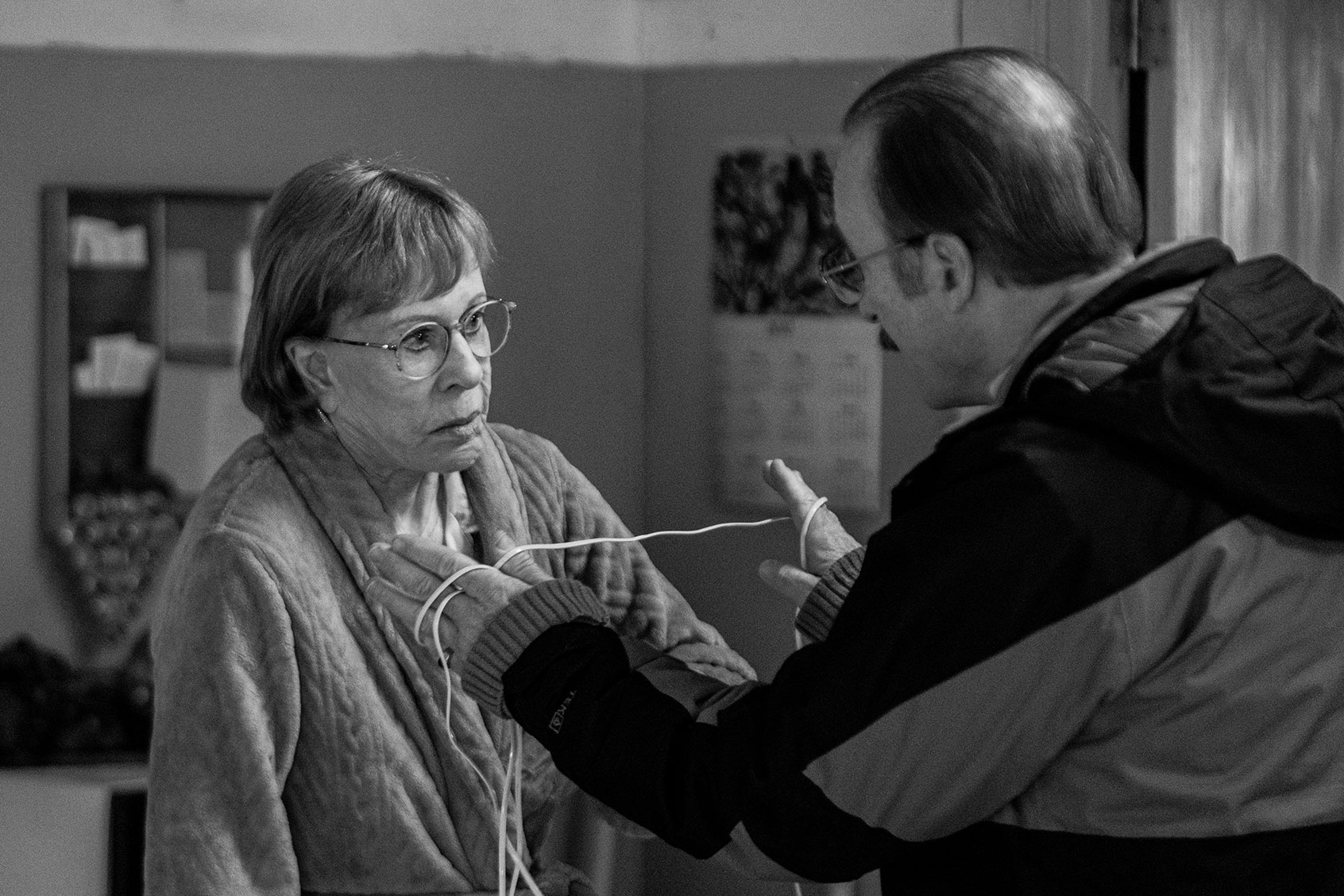
Well, you’ve been building to that from the beginning of this entire fraud scheme . . . we’ll see how it happens in the finale. What I want to talk about is the cinematic language of this final season.

You’ve incorporated a lot of small classic cinema homages throughout the season, and certainly more since the season shifted over to more to Gene’s perspective and went more heavily into black and white film. . . . Gene Takavic has existed in black and white since the beginning of “Better Call Saul.” Now that we’re enmeshed in his timeline, how did that affect the filming of the final episodes of the series?

Filming in black and white is its own thing. It’s not just the absence of color. And that’s one of the things that we discovered as we shot the previous black and white sequences. Knowing that we were going to spend a lot of time in Gene’s world and in black and white, we did some thinking about what that meant.

“The great thing about television is that you can pull out every technique that’s available.” 

I actually did a little slideshow for all the directors and the [directors of photography] for these last few episodes. I went back over some of the black and white movies I admire . . . I picked, you know, “Rumble Fish” . . . and “Sweet Smell of Success” was one that we looked at quite a bit. We’d take images and say, “Well, what what’s interesting about this? . . . What can we learn from the way black and white has been used in the past?”

We learned a lot of things. One is the importance of texture. Because if you don’t have color to distinguish surfaces, you need texture. . . . And it’s a tricky thing. Another of the things you always have to deal with in a two-dimensional medium like film is separation. How do you know, if you have two things that are dark? How can you separate them visually? It creates a whole different level of composition and in some ways, it’s really challenging. But they ran with it and did a wonderful job.

Those sequences make me think of the film noir era and the way directors used black and white to augment the emotional tone of those stories. That suits what you are doing with, and did, with “Better Call Saul” by constructing the psychological explanation of how this character came to be. Can you talk about how using black and white adds to the script? Or maybe I mean to say subtracts because, correct me if I’m wrong, but but seems like there’s a lot less dialogue in Gene’s segments.

There is less dialogue, especially in the beginning, because all the time that Gene’s been in Nebraska, he’s been terrified of being found out. He does not want to get caught. At least, that’s what he thinks. So there is less dialogue, and especially at the beginning.

And then also we use music differently. One thing that we didn’t do very often earlier was to underscore dialogue scenes. And Dave Porter, our composer, started to suggest underscoring some dialogue scenes, right from the first black and white episode.

If you see that that first scene where Gene meets Marion (Carol Burnett), there’s a little bit of an underscore, which is different than the regular scoring. Dave adds a little theme to it that sounds a little bit like “Peter and the Wolf.” It’s this little devilish theme that comes in when Gene is worming his way into Marion’s life. So yeah . . . we’re all big movie buffs. And the great thing about television now is that you can pull out every technique that’s available. I think we’re determined to try to use every part of the medium that we can to tell the story.

Better Call SaulCarol Burnett as Marion and Bob Odenkirk as Gene in “Better Call Saul” (Greg Lewis/AMC/Sony Pictures Television)
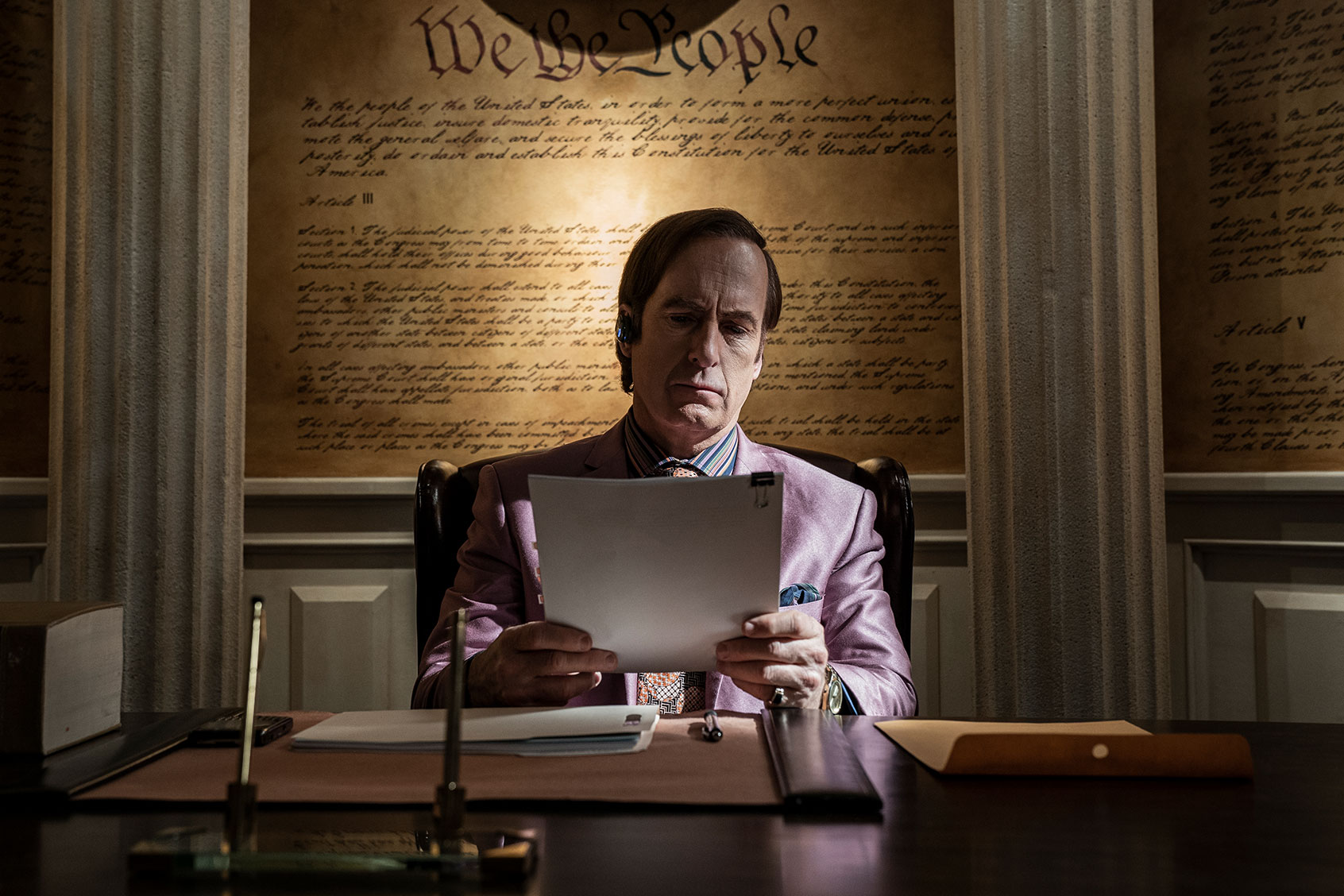
That brings us to the visual symbols that people have always kept an eye on in “Breaking Bad” and “Better Call Saul.” How much is that coordinated in the script, and how much is left up to the director’s spontaneity?

Not all of those things come out of the writers’ room, but I’d say more than half does. Like you know, the candle in Tom [Schnauz’s] episode, “Plan and Execution,” that was very specifically discussed in the writers’ room. We were thinking, how do we give Lalo an entrance here?

I love the question, because we’re fascinated by the physical world and by what happens if you pick a little detail out –  like the way a character ties his tie or a slide rule embedded in Lucite – all of these things just add to the dimensionality of the world.

Probably one of the biggest ones on the show is the pinkie ring. You know, the very first time Bob was on “Breaking Bad,”  we put a pinkie ring on him. And then we started thinking, where’s the pinkie ring come from? What does it mean? And as the show has evolved, we found out that it was his friend Marco’s ring. And for a long time, “Better Call Saul” he has to wear it with a little bit of red thread around the ring to size it. But by the time we get to Omaha, he’s had this ring resized. We think about all these things.

So what do you think are the defining symbols, besides the ring, of Gene or whoever this man that Jimmy McGill is, as he’s leaving us?

I like to think that we’ve given a lot of these characters important objects and symbols. Kim, certainly has the earring and necklace set that she’s wore. And her ponytail turns out to be very, very important, to the point that when it’s gone in the black and white sequences, it’s kind of disturbing.

Peter, all of Kim’s fashion choices in the black and white sequences are disturbing.

I couldn’t agree more!  Look, Rhea Seehorn made it work for her. That shows she’s such a fantastic actor.

But boy, I don’t know if I can tell you what’s most important. Certainly, there’s Saul’s color palette, and all the symbols of Saul’s office, you know: the Statue of Liberty, the Constitution wallpaper, all the references to Greek architecture.

Better Call SaulBob Odenkirk as Saul Goodman in “Better Call Saul” (Greg Lewis/AMC/Sony Pictures Television)
I like to think that there are objects that tell the story. And there’s a very important object produced a couple of times this season that becomes really important in the series finale. And it’s exactly the kind of thing that we’re talking about. It’s never mentioned in dialogue, really, but it turns out to be a thread that ties a lot of pieces together. So yeah. you’re definitely picking up what we’re putting down, you’re seeing things that we put there with great care. It’s not so much that we’re trying to hide things. We’re trying to use the physical world to tell the emotional story.

“I think it’s going to be devastating to me once it really sinks in,” says Gould.

I mean, one example of that is the teaser for the entire season; we had a tour through Saul Goodman’s house, right? At the very beginning where people were stripping it. Well, I wrote that script. And in the script I wrote that we should see as many objects as we can crammed into this sequence. And I sort of threw it open not just to the director, but to the whole crew in the prop department.

And, you know, what are the significant objects that we can put in here? The reason that’s interesting to me is not just, “Oh, look at that. That’s fun that we’re revisiting that.” But it helps you think about all the decisions, and all the things that happened that brought this character to this point

Maybe for some folks, it’s just fun, which I think is fine. But for me, it gives me an emotional way to think about how all these decisions and all these moments added up. And what a terrible path this guy took at the end of that road. Those are things that we’re thinking about for sure.


Want a daily wrap-up of all the news and commentary Salon has to offer? Subscribe to our morning newsletter, Crash Course.


Yeah. Jimmy McGill is clearly a man who has defined himself by what he has, and not necessarily by who he is, although he is many different people at once. That comes across in the visuals.

And like a lot of us he’s searching for who he is. I think that in some ways, that’s the human condition.

What are what do you think that you’re going to miss the most about this show? You’ve said that this will probably be the last series in the “Breaking Bad” universe. What are going to miss most about “Better Call Saul”?

You know, there’s two sides of what I’m gonna miss. One thing I’m gonna miss is playing in this world, because it’s this world that Vince started and we all got to contribute to it. It’s a fantastic playground.  But the other creative side is the personal side, which is, you know, I’ve been working with a lot of these people for 15 years straight, and working very hard, long hours. And everyone in the crew, the cast, the writers room are incredibly important to me personally. I can understand why there’s a temptation for a show to just go on  indefinitely, and certainly part of that is monetary.

But the other part of it is you have this urge to keep the band together. This is an amazingly talented, nice group of people. . . . And it’s gonna be really tough, not working all together again. I’m gonna miss all of that. And I think it’s going to be devastating to me once it really sinks in.

The series finale of “Better Call Saul” airs Monday, Aug. 15 at 9 p.m. on AMC.

Is this the worst time in American history to be a mom?

Earlier this year, while attending one of my first prenatal appointments, my doctor explained to me how pregnancy care had changed during the pandemic. In the new care regime, my husband wouldn’t be able to attend most of my prenatal appointments; in fact, many would be virtual. I would be able to have two support people in labor and delivery, no visitors (although that could change soon). I was given this spiel in a chilly, dark office, as news notifications popped up on my phone: another depressing climate change report, a survey about how parents have never been as stressed as they are today.

“Motherhood is just the best,” an older mom assures me. And I want to respond: Have you read anything about parenting lately?

The next few months, my pregnancy would unfold over an even more unsettling backdrop. A war was ravaging Ukraine, prompting fears of nuclear war. A baby formula shortage emerged, and then the U.S. Senate declined to pass the PUMP ACT that would have given 9 million working women breastfeeding protections at work. Surprise, I’m having a girl! — but, oh no, she will now be growing up in a country without guaranteed reproductive rights

At night, before I fall asleep, I scroll through Reddit parenting forums to see what new parents are saying about what it’s like having a kid right now. Many of the posts have depressing titles: “Stressed,” “Lost myself,” or “Logistically, how do I manage going back to work?”

At the beginning of my pregnancy, a friend warned me to prepare for a chorus of voices emphasizing all the worst parts about becoming a mom: sleepless nights, how my world will completely change, how hard it is to be a working mom, and the unaffordability of childcare. Yet at the grocery store, older women ask how far along I am. Is this your first? “Motherhood is just the best,” one assures me. “You’re going to love it.” And I want to respond: Have you read anything about parenting lately?

Throughout my pregnancy, I found my mind wandering to thoughts of what motherhood must have been like for earlier generations of Americans — when it seemed easier, or at least was portrayed that way. Certainly, my mother, and my mother’s mother, raised children in an era when income inequality was less stark, when the middle class still existed, when our planet was less polluted — even if gender equality was in a less developed state than it is now. 

Perhaps there is some toxic positivity to this line of thinking. But it seems that millions of moms — and moms-to-be — are feeling something similar: a collective feeling that this might be the worst time in American history to be a mom. Is there any truth to that? 

“There’s no straightforward answer,” Sarah Knott, author of “Mother Is A Verb: An Unconventional History,” and a professor at Indiana University, tells me over email. “It depends who we’re asking about: Americans’ experience of motherhood has always depended on factors like race and class.”

Knott provides a few examples. Like how before the Civil War, “enslaved mothers were exploited for both their reproductive and productive labor by white overseers and masters.” Indeed, babies were forced to be separated from their mothers during slave auctions. The children of indigenous women were forced to attend boarding schools that were created to “civilize the savage.” Clearly, those were some pretty horrible times for mothers in America.

“[T]he hardest time was in the 19th century when people had this culture that valued their individual attachment to individual children so highly, but children were dying at high rates.”

“So there is very ugly American history in which mothers’ power over their own lives and the lives of their children were shockingly constrained,” Knott said. “Meanwhile, white mothers often benefited from the labor of Black and indigenous women, and they fashioned a sentimental idea of motherhood as natural, fulfilling and frictionless.”

Rebecca Jo Plant, an associate professor of history at the University of California-San Diego, agreed there have been historically more challenging times.

“I think the hardest time was in the 19th century when people had this culture that valued their individual attachment to individual children so highly, but children were dying at high rates,” Plant said. In 1800, the child mortality rate in the United States for children under the age of five was 462.9 deaths per 1,000 births. “I wouldn’t say there has never been a worst time to be a mother, I would not go that far — but it’s hard [right now].”

Plant brings up how despite remarkable medical advances, Black women in America are facing a maternal healthcare crisis. Researchers estimate that Black women are up to four times more likely to die from a pregnancy-related cause than white women. Overall, the United States has a much higher maternal mortality rate compared to other developed countries. In 2017, 41 percent of moms were the only or primary breadwinner for their families, but many women were forced to leave the workforce to care for their children during the pandemic. Indeed, COVID-19 exacerbated challenges American mothers were already facing: a buckling education system, lack of accessible childcare, no guaranteed paid time off for new parents.


Want more health and science stories in your inbox? Subscribe to Salon’s weekly newsletter The Vulgar Scientist.


“We have basically no social support for families and motherhood, we have maybe the second highest rate of child poverty among so-called industrialized or wealthy nations… you’re more likely to be poor if you’re a child than if you’re an older person,” Plant said, noting that social security exists for older Americans, but not for dependents like children, which speaks to how American society values “producers.”

“Downward mobility, the assumption that you’re one generation is going to do better than the next, has really taken a hit — if you do have kids, so much more is required today.”

Dr. Harvey Karp, pediatrician and Founder & CEO of Happiest Baby, told Salon he thinks of motherhood today as akin to the introduction to “A Tale of Two Cities” by Charles Dicken, which begins “‘It was the best of times, it was the worst of times.” Medical advances are saving more children’s lives; hunger in America is less than it was in earlier eras. Yet, as Karp says, “there are some very serious concerns underneath that.”

“I see a lot of people who have a child, and then it dawns on them how much they are longing for a childhood that they had in Iowa, Indiana or Minnesota or Louisiana.”

Those serious concerns include “anxiety in children and depression among young mothers — and one of the things from my point of view, that is a critical issue, is the loss of the extended family,” Karp said. “Parents have this terrible misconception today, and mothers especially, that they are supposed to be everything, do everything and provide everything for their babies — that’s what a good mother does — but a good mother always had a network, and matter of fact, when you had a baby, you were a babied as much as you were babying the baby.”

Karp says that as more people move away from where they grew up, they lose support from extended family.

“It’s interesting for me having been a pediatrician in Los Angeles where there are so many transplants there,” Karp said. “I see a lot of people who have a child, and then it dawns on them how much they are longing for a childhood that they had in Iowa, Indiana or Minnesota or Louisiana and the things that were part of what it really meant to be a child — being around family, having cousins around.”

So perhaps this isn’t the worst time in history to be a mom, though the situation isn’t great. But why is everyone so negative on motherhood?

Knott noted that we are aware of a lot of the visible hardships that surround motherhood due to “20th-century feminist commentary.” In other words, it’s the “dismantling of sentimentalism,” which Knott said is “good news.”

“It owes to the difficult situation of American women today, especially compared to their peers in other wealthy nations: the loss of reproductive rights that allow people to determine whether and when they want to have children; the absence of a welfare state that offers healthcare from cradle to grave, and the now notorious racialization of maternal and infant health; weak maternity leave provision; expensive childcare; the underfunding of the public school system; and so forth,” Knott said.

I’d be lying if I said I didn’t occasionally have thoughts like, “am I crazy for having a child in America?” It certainly feels daunting, scary, and really hard. Unlike many women in America, I do have resources for childcare and family nearby to support me.

On a late night social media scroll, I ask a parenting forum: is this going to be as hard as everyone makes it out to be?

“Honestly, yeah, at times it can certainly be as bad as everyone makes it out to be,” one parent writes back. “But watching them experience everything for the first time really helps you appreciate all the things in life we take for granted; I always say that our kids wrecked our life, but in the most awesome way.”

The movement of life inside me slithers like a snake in the water. Her feet poke against my ballooned uterus, shifting the symmetry of my belly from minute to minute. Each tap and kick ticks like the hand of a clock, a countdown to the end of our time entwined together. In a way, pregnancy has been a microcosm of life itself — a lot of pain, a lot of joy, a lot of discomfort, and uncertainty. I suspect motherhood will be more or less the same. 

This DIY toaster strudel has an ultra-flaky homemade crust and creamy chocolate-hazelnut filling

These tasty pastries are a homemade version of something I’ve dreamed about since childhood. My mom never let me buy those pastries in the freezer section, but I was in love from the first time I snuck a bite at a friend’s house. This version is filled with chocolate-hazelnut spread, but you could also substitute it for another favorite creamy spread, like nut butter or cookie butter. If you want to imitate the packaged stuff, skip the optional folds I recommend in step 4 — but if you’re as big a fan of flakes as I am, the end result is delightfully worth it. — Erin Jeanne McDowell

Watch this recipe

Chocolate-Hazelnut “Toaster Strudel”
Yields
5 pastries
Prep Time
2 hours
Cook Time
40 minutes

Ingredients

Dough

  • 3 cups (360 grams) all-purpose flour
  • 1 teaspoon (4 grams) fine sea salt
  • 12 tablespoons (170 grams) cold unsalted butter, cut into 1/2-inch cubes
  • 1 large (56 grams) egg, cold
  • 1 large (21 grams) egg yolk, cold
  • 1/4 cups (60 grams) ice water, plus more as needed

Filling, Frying, and Finishing

  • 1 large (35 grams) egg white
  • 1 (13-ounce / 370-gram) jar chocolate hazelnut spread
  • neutral oil (such as vegetable or canola), for panfrying
  • 1 cup (113 grams) confectioners’ sugar
  • 3 tablespoons (45 grams) heavy cream, plus more as needed
  • 1/2 teaspoons vanilla bean paste (or 1 teaspoon vanilla extract)

Directions

  1. Make the dough: In the bowl of a food processor, pulse the flour and salt to combine. Break up the butter into the food processor and pulse until the butter is very finely incorporated, looking like tiny flecks or pearls amid the flour.
  2. Add the egg, egg yolk, and water and pulse until the mixture comes together into a fairly smooth dough. If needed, add more water 1 teaspoon (5 grams) at a time until the dough comes together.
  3. Divide the dough into two even pieces (about 330 grams each). Form each into a rectangle 1 inch thick, wrap tightly in plastic wrap, and refrigerate for at least 1 hour (or up to 48 hours). After chilling, you can move immediately to step 5. For flakier dough, proceed with step 4.
  4. (Optional step for extra flakiness!) Working with one piece of dough at a time on a lightly floured surface, roll out the dough to 1/2 inch thick. Fold the dough into quarters, then immediately roll out again to 1/2 inch thick. Fold again into quarters. If desired, you can repeat this process a second time for even more flakiness. Then rewrap the dough and refrigerate for at least 2 hours (or up to 24 hours). Repeat with the second piece of dough. 
  5. To roll out the dough, work with one piece of dough at a time. Roll out the dough into a rectangle 1/8 inch thick (it should be about 12 x 14 inches). Trim the rectangle of dough to 10 1/2 x 12 inches.
  6. Use a paring knife to gently score the dough in half (do not cut through the dough, just leave a light indentation), dividing it into two 6-inch-wide segments. Then, use the paring knife again to gently mark the dough into three even portions on the lower 6 inches of the dough (each should be about 3 1/2 inches wide). 
  7. Lightly whisk the egg white with 1 tablespoon of water to combine. Spoon about 2 heaping tablespoons of chocolate-hazelnut spread into the center of each pastry and spread into an even layer, leaving the outer 1/2 inch of the dough uncovered all the way around.
  8. Brush the egg white mixture evenly around the uncovered outer edges of the pastry. Then gently fold the excess pastry dough in half over the filling. Lay it down slowly, ideally not allowing any air pockets to form. Firmly press the dough together around the edges of the filling with your fingers to seal well.
  9. Use a pastry wheel to cut the pastries into three even pieces and transfer to a parchment-lined baking sheet. Crimp with the tines of a fork all the way around.
  10. Freeze until firm, at least 1 hour (to freeze longer, transfer once firm to an airtight container or freezer bag; freeze for up to 1 month). Heat the oven to 375°F and line a baking sheet with parchment paper. 
  11. Panfry the pastries: In a large skillet, heat 1/2 inch of neutral oil over medium heat until the corner of a frozen pastry sizzles when you add it to the oil. Fry the pastries two or three at a time (don’t overcrowd the pan) until the surface is evenly golden brown, 3 to 5 minutes. Adjust the heat as needed to brown the pastries slowly and evenly. 
  12. Turn the pastry over and cook on the other side until golden brown. Use a large spatula (I like a flexible fish spatula) to gently transfer the fried pastries to the prepared baking sheet. Continue to fry the remaining pastries, placing them evenly on the baking sheet once they are browned.
  13. Transfer the baking sheet to the oven and bake until the pastry is fully baked through, 15 to 18 minutes. Cool at least 10 minutes on the baking sheet before serving warm. 
  14. While the pastries cool, make the icing: In a medium bowl, whisk the confectioners’ sugar, cream, and vanilla to make a thick icing. Add more cream as needed to make the icing easily pipable or spreadable.
  15. When ready to serve, pipe or spread icing onto the surface of the pastry. Serve immediately.

“Either Trump has to be indicted or Merrick Garland has to resign,” says CNN’s Scott Jennings

During Sunday’s “State of the Union,” CNN political commentator Scott Jennings spoke on the aftermath of the FBI’s raid of Mar-a-Lago saying “Either Trump has to be indicted or Merrick Garland has to resign.”

“In the immediate aftermath of the raid, there was some polling done that showed him [Trump] ticking up a few points among Republicans because there is a reflexiveness with him — and I heard this from people who are even ready to move on from Trump — that ‘we don’t wanna let them,’ you know, like ‘we wanna take him out. We don’t wanna let them do it.’ So I do think, at least temporarily, that’s helping him,” Jennings said. “I sort of felt this week like, we’re at the circus now. We’re all under the big top. And this can only end one of two ways. He has to be indicted, or Merrick Garland has to resign.”

After Monday’s raid of Mar-a-Lago, Garland made it clear that he “personally approved the decision to seek a search warrant,” to carry out the raid, in which the FBI sought out documents that Trump took from the White House after his presidency, breaking legal protocol. And now that that search has been conducted, many are wondering what will happen from here.

“You can’t raid the president’s house — the former president and possible future candidate — and say to the American people ‘we think he’s violating three different laws,’ and then do nothing,”Jennings said.

When asked if he thought the raid was justified, Jennings commented, “. . . If you think there are classified documents — which we don’t know what it is, by the way — but if you’ve got these documents, and they’re not supposed to be out in the open, absolutely. But this cannot end in any other way. How could it possibly end with just ‘well, we got him back and it’s over now.’ There’s no going back now.”


Want a daily wrap-up of all the news and commentary Salon has to offer? Subscribe to our morning newsletter, Crash Course.


Watch the clip here:

When they came for the librarians: My profession is under attack — what happens now?

America’s libraries are under attack. It’s no longer enough that far-right interest groups and politicians are coming for our collections; they’ve turned their ire towards our staff too. In recent months, there has been an alarming trend of community members and officials calling for the dismissal of librarians over books they’ve purchased for their patrons — usually titles focusing on race, gender and sexuality. Groups like Moms for Liberty are training their members on how to target us on our personal social media pages. Library workers are being vilified in the same way as teachers — a troubling phenomenon that’s contributing to the nationwide educator shortage

Morale among library workers has been suffering for a while now. Fobazi Ettarh’s 2018 essay on vocational awe in the profession first called attention to the high rates of burnout among librarians based on the pressure of working in a noble-presenting field with little support. The new stress, fatigue and even danger that the pandemic brought to frontline workers has made it worse. 

To fully grasp where we stand, it’s important to understand how public libraries work. Although state laws vary in the specifics, your local library is funded through tax dollars. Some libraries are fortunate enough to have their budgets supplemented through charitable giving, usually channeled through a nonprofit like a Friends of the Library group or a foundation. Like most social services, we are constantly living with the real threat of budget cuts, and our funding is often inadequate. To put things in perspective, I own an average-priced home in a county with one of the highest property tax rates in the country. A bit more than $100 of my annual tax bill goes to my local library — a library that is funded above our state’s legal minimum. That tax-based income funds every aspect of the library’s budget, from maintaining collections and programming to personnel to caring for the building. 

I live in an average home in a county with one of the highest property-tax rates in the country — and about $100 of my annual tax bill goes to the public library.

I’ve worked in public libraries since I was a teenager and am now on my third directorship. One of the first things I learned after starting my first job was how grossly misunderstood our roles are. Our frequent patrons generally understand what we do, but society as a whole does not. Thanks to pop culture, we are perpetually seen as uptight women who spend our time shushing people. If I had a nickel for each time I’ve introduced myself to someone and been greeted with some version of, “Oh, it must be so nice to read all day!” my library would be safeguarded against future budget crises. There is also little understanding that a master’s degree is required to become a librarian, something most of us struggle to pay off on our public salaries. 

When I decided to go back to graduate school to obtain my master’s in library and information science, I knew I would be facing these annoyances. Student loans aside, I viewed them as just that: annoyances. I had already worked in libraries for eight years at that point, and was well aware of the pitfalls of working with the public and the unpredictability of library funding. I started grad school in 2011, on the heels of then-New Jersey Gov. Chris Christie’s historic and devastating cuts to public library budgets in my state, so I knew I had my work cut out for me. I will say, however, that it’s exhausting to feel that my job is still not taken seriously after all these years. 

Although we may wish to believe otherwise, libraries continually face an existential crisis. Funding is uncertain and, at least in my state, is wholly dependent on politics and property values — two things we cannot control. In today’s world, even though data shows that our collections are still circulating and our programs are still being attended, people love to ask why we still exist as “everything goes online.” We offer downloadable content like e-books and e-audiobooks, but our purchasing power for these collections is limited by publishers who love to price-gouge and change license terms without notice. For every happy patron we serve, we may encounter another community member who dislikes us for our radical inclusivity or who feels they should be entitled to whatever they want because, after all, they pay our salaries. Over the nine years since I earned my master’s degree, this constant struggle and the invalidation that comes with it has worn me down. I went into this field because I wanted to do the good work of connecting people with the right books and resources. It’s difficult to keep doing that when our very existence is constantly being called into question. 


Want a daily wrap-up of all the news and commentary Salon has to offer? Subscribe to our morning newsletter, Crash Course.


As the leader of my organization, I do everything I can to shield my staff from the flack that comes with library work. I have no problem being the face of my library; I fully understand that’s what I’m paid to do. My fundamental goals are to keep my employees safe, happy and supported. At a certain point, however, the abuse starts to take its toll. 

Two months ago, I was publicly called a “groomer” — one of the far right’s homophobic insults — for daring to wade into the waters of promoting Pride Month. 

For the last several weeks, my name has been dragged on social media and I’ve been publicly accused of lying and violating state law for asking a patron not to photograph a nearly 250-year-old expensive document in my library’s possession. Another resident stated I needed “to go” and urged others to “get the pitchforks.” Why? Because I was doing my job.

Prior to that, a patron posted incomplete screenshots of emails I had sent her after she didn’t like my answer about why our Friends group had recycled some moldy donated books. This spiraled into personal attacks about my leadership abilities. 

The list goes on.

As a public official, my ability to respond to this bullying — and that’s what it is — is limited. Unlike an elected politician, however, I did not sign up for this. I took a job for a paycheck and with the aim of trying to help others, not to feel that my mental health and work-life balance are under constant attack.

I want to say that my situation is atypical for librarians. Unfortunately, I don’t think that’s true. We are living in an increasingly divided society in which those with differing opinions are seen as inherently bad. Without systemic support from our stakeholders, I don’t see these issues getting much better. 

Two months ago I was publicly called a “groomer” for promoting Pride Month. For the last several weeks, I’ve been dragged on social media for asking a patron not to photograph a rare historical document.

So what happens when you come after librarians? If things keep getting worse, there is little incentive for us to remain in the field. We are categorically underpaid, and especially for those living in deep red states, the fear of losing our jobs over political differences is very real. With a recent high-profile study highlighting the trauma that library workers face, how can you blame us? Thanks to budget and staffing cuts, many of us are also chronically overworked. It wasn’t until I took my current job about two years ago that I could finally afford not to work a second job on top of full-time library work. 

If librarians leave the field in droves, as teachers are doing right now, we have too much to lose as a society.

We will lose access to one of the last free, open and climate-controlled community spaces where people from all walks of life can gather freely. 

We will lose a wealth of knowledge, experience and passion that helps connect readers with the right books.

We will lose a tremendous weapon in the fight against false information and fake news.

We will lose creative thinkers who work tirelessly to plan fun and informative events for you and your family, free of charge. 

Franklin D. Roosevelt said, “I have an unshaken conviction that democracy can never be undermined if we maintain our library resources and a national intelligence capable of utilizing them.” In other words, if we lose our librarians, we lose a core element of our democracy. It’s time to stand up for our librarians and their institutions before it’s too late.

“Never Have I Ever” should let Devi be single

If the first two seasons of Netflix’s teen comedy “Never Have I Ever” offered a warm and funny coming-of-age story grounded in emotional meditations on grief and familial expectations, the third season is a stark reminder that protagonists need to grow, preferably in tandem with their show’s ongoing arcs.

In Season 3, Devi (Maitreyi Ramakrishnan) has finally embarked on a real relationship with her dream boy, Paxton Hall-Yoshida (Darren Barnet), after he swept her off her feet (hit her with his car) at the school dance in the Season 2 finale. There is no shameful sneaking around this time, no trying to date multiple people at once — they are in a public, committed relationship (well, as committed as someone in high school can be). But it becomes clear very early that while Paxton has forgiven Devi for her actions in Season 2 and is all in on their relationship, she can’t quite get out of the way of her own happiness. Consequently, the show stumbles when they’re together and becomes much stronger once they call it quits.

Instead of obsessing over how to get Paxton to like and/or date her, Devi spends the first three episodes of the season channeling her energy into finding obstacles within their relationship over which to obsess. For example, after overhearing girls gossiping in the restroom at school, she becomes laser-focused on having sex beause she fears Paxton won’t stay with her if she doesn’t sleep with him (for the record, he’s cool with taking things slow). In the second episode, Devi receives an anonymous message warning her that Paxton isn’t who she thinks he is, which makes her panic. We soon learn the message is from Haley, Paxton’s former best friend with whom he had sex and then never spoke to again. Fearing she could be next, Devi gives her new boyfriend an ultimatum: apologize to Haley or she can’t be with him. Although he initially refuses, Paxton eventually agrees, making amends with Haley and, in the process, several other people he’s hurt in the past, too. Unfortunately, his sincerity leads to the end of their relationship anyway.

Rather than setting Devi on a path of personal growth, the breakup ultimately means very little for our would-be heartbroken protagonist.

In the pivotal third episode, Paxton and Haley rekindle their friendship, sending Devi into a self-sabotaging spiral. Despite Paxton showing her time and again how much he likes and cares for her, she can’t stop fixating over their differences, comparing herself to Haley and wondering why Paxton would want to be with someone like her when he could be with Haley. She insists people think they make no sense as a couple, and by the end of the episode, Paxton has had enough. He tells Devi she’s the only person who thinks they don’t make sense, and that although he likes her, he can’t be in a relationship with her until she likes herself

It is a major moment, one that feels like a catalyst for a season of change. But rather than setting Devi on a path of personal growth, the breakup ultimately means very little for our would-be heartbroken protagonist. An abrupt time jump opens the season’s fourth episode, allowing the show to skip over any introspection and emotional healing that otherwise might have occured (apparently no one in the writers’ room saw the fourth season of “Veronica Mars”). It’s an obvious storytelling shortcut, one that does the show no favors. For a series that has spent a considerable amount of time on its lead’s grief — and handled it well — it’s embarrassing that it would skip the ensuing pain of Devi’s breakup with her supposed dream boy, even if it’s been clear from the start they likely wouldn’t last. And it is even more baffling once it’s clear Devi has seemingly learned nothing from the entire ordeal, as she has found a new crush by the end of the fourth episode and begins the cycle anew. 

Now, it’s possible that Netflix executive interference derailed producers’ plans for exploring Devi’s heartbreak and healing in more detail — it wouldn’t be the first time network notes or studio directives harmed a show’s narrative — but we’ll likely never know if that’s the case. So we have to take everything in Season 3 at face value, which means we’re stuck staring down an ill-advised time jump of interminable length that allows Devi to come out the other side mostly intact but without growing much at all.

Once he ends things with Devi, Paxton is essentially set free, and the writers are able to focus on more substantial storylines that deepen his character arc.

Never Have I EverDarren Barnet as Paxton Hall-Yoshida in “Never Have I Ever” (Netflix)
But even if “Never Have I Ever” fails Devi post-breakup, Paxton and the show benefit from their parting. For much of the series, Devi has been obsessed with Paxton and has treated him as a shiny object to be attained rather than a person with feelings of his own. Once he ends things with Devi, Paxton is essentially set free, and the writers are able to focus on more substantial storylines that deepen his character arc. To put it another way, the show finally treats him like a human being, with his own wants and desires. 

We first saw glimpses of this in Season 2 when Paxton learned he wouldn’t be able to attend college on a swimming scholarship and had to start focusing on academics. That arc continues in Season 3 once he’s allowed to exist on his own outside of Devi’s story. We see him interacting with different characters, like when he gives Fabiola (Lee Rodriguez) relationship advice, films an audition tape for Eleanor (Ramona Young) and takes Ben (Jaren Lewison) to the hospital when the latter boy thinks he’s suffering from appendicitis. It turns out to be something else (and something much funnier), but the situation allows the two most important men in Devi’s life to talk to one another, giving us a glimpse into Paxton’s own insecurities, like how he was once jealous of Ben because he was smart like Devi, or how he still doesn’t know who he is below the surface. Later on, we even see Paxton apply to and get into college in Arizona, confirming that all of his hard work was ultimately worth it.

So much of what we see in “Never Have I Ever” is naturally filtered through Devi and her wants and needs. But a show in its third season can’t sustain itself on a limited viewpoint, especially when its lead refuses to grow and learn from her mistakes. Every single second we spend with the show’s supporting cast is a detour that helps to expand the show’s world and strengthen its ongoing narrative. As silly as Ben’s arc was in his POV episode this season, it was a welcome reprieve from Devi’s cycle of insecurities and constant boy chasing. That it allowed Ben’s and Paxton’s stories to both move forward — and the latter to reach his full potential — is a bonus. And it was largely possible because neither Ben nor Paxton were dating Devi at the time.

As we look toward the fourth and final season of “Never Have I Ever,” it’s just as imperative that Devi make progress, too.

So while it’s a shame Devi does not evolve in tandem with Paxton in Season 3, their breakup at the end of the third episode is still a positive development for the show overall. Not only does it mean the writers no longer need to seek out obstacles to throw in their path or fabricate ways for Devi’s anxiety and insecurities to derail them as a couple, but it also means there is more time to explore other storylines and focus on the bigger picture. We’re treated to new and different points of view, creating a more well-rounded and balanced narrative. 

Never Have I EverJaren Lewison as Ben Gross and Maitreyi Ramakrishnan as Devi in “Never Have I Ever” (Lara Solanki/Netflix)
But as we look toward the fourth and final season of “Never Have I Ever,” it’s just as imperative that Devi make progress, too. The show flirts with growth in the Season 3 finale when Devi gets into a prestigious boarding school in Colorado and contemplates spending her senior year away from her family and friends. Upon visiting, she discovers she fits in with the other students, and moving away would allow her to prioritize herself, so she initially decides it’s what’s best for her and her future. But it would be ridiculous to think a show would blow up its entire world ahead of its final season, so Devi ultimately decides to stay put in California. Her dreams have changed, and she’s not ready to leave her mom so soon after losing her dad. 

Although the new school storyline appears out of nowhere and has to do a lot of heavy lifting that could have — and should have — been done throughout the season, it’s a good reminder that although much of the show is focused on Devi’s love life and her interpretation of how others view her, “Never Have I Ever” is about much more than that. It’s also a poignant story about family, about grief and adversity, about meeting one’s potential, and about the complex relationship that exists between mothers and daughters. The writers would be smart to remember this more than a few times a season as Devi’s story comes to a close. 


Want a daily wrap-up of all the news and commentary Salon has to offer? Subscribe to our morning newsletter, Crash Course.


The end of high school is, by nature, a transformative time. While Devi’s decision to cash in Ben’s “one free boink” at the end of the Season 3 finale doesn’t exactly signal that we’re going to see a period in which she truly prioritizes herself in order to grow and mature, a potential relationship between Devi and Ben might still allow our protagonist to see herself as he does, as so many already do. With only one year left of high school and one season left of the show, Devi and “Never Have I Ever” both need to make the most of the time that remains. Hopefully the forward movement that started in the Season 3 finale is a sign that deeper change is on the way.

Man takes his own life after crashing car into U.S. Capitol barrier

Shortly after 4 a.m. on Sunday morning, a yet to be identified man drove a car into a barrier on the east side of the U.S. Capitol. According to CBS News the man’s car erupted into flames following the crash at which point he exited the vehicle, fired several shots into the air, and then turned the gun on himself, ending his life.

“At this time, it does not appear the man was targeting any Members of Congress, who are on recess, and it does not appear officers fired their weapons,” Capitol Police said. Although he has not yet been identified, “investigators are looking into the man’s background,” according to the provided statement.

CBS points out in their coverage of the incident that Capitol security has increased following the Jan. 6 riots, with other events similar to today’s taking place near the building. In April 2021, a man later identified as 25-year-old Noah R. Green ran his car through a security barricade killing one Capitol officer and injuring another. 

“Important to note that Capitol Police are coming off of another exhausting few months but have been muscling through it,” says PBS NewsHour Correspondent Lisa Desjardins. “Between SCOTUS threats, Congressional threats and long sessions in both chambers, many had time off canceled and faced repeated long shifts.”


Want a daily wrap-up of all the news and commentary Salon has to offer? Subscribe to our morning newsletter, Crash Course.


“USCP is not saying here how far the man got after hitting the barricade,” says Desjardins on Twitter. “But says officers were approaching him when he *shot* himself. They are investigating and are not yet commenting on the man’s identity or if it is known.”

Cognitive biases and brain biology help explain why facts don’t change minds

Facts First” is the tagline of a CNN branding campaign which contends that “once facts are established, opinions can be formed.” The problem is that while it sounds logical, this appealing assertion is a fallacy not supported by research.

Cognitive psychology and neuroscience studies have found that the exact opposite is often true when it comes to politics: People form opinions based on emotions, such as fear, contempt and anger, rather than relying on facts. New facts often do not change people’s minds.

I study human development, public health and behavior change. In my work, I see firsthand how hard it is to change someone’s mind and behaviors when they encounter new information that runs counter to their beliefs.

Your worldview, including beliefs and opinions, starts to form during childhood as you’re socialized within a particular cultural context. It gets reinforced over time by the social groups you keep, the media you consume, even how your brain functions. It influences how you think of yourself and how you interact with the world.

For many people, a challenge to their worldview feels like an attack on their personal identity and can cause them to harden their position. Here’s some of the research that explains why it’s natural to resist changing your mind – and how you can get better at making these shifts.

Rejecting what contradicts your beliefs

In an ideal world, rational people who encounter new evidence that contradicts their beliefs would evaluate the facts and change their views accordingly. But that’s generally not how things go in the real world.

Partly to blame is a cognitive bias that can kick in when people encounter evidence that runs counter to their beliefs. Instead of reevaluating what they’ve believed up until now, people tend to reject the incompatible evidence. Psychologists call this phenomenon belief perseverance. Everyone can fall prey to this ingrained way of thinking.

Being presented with facts – whether via the news, social media or one-on-one conversations – that suggest their current beliefs are wrong causes people to feel threatened. This reaction is particularly strong when the beliefs in question are aligned with your political and personal identities. It can feel like an attack on you if one of your strongly held beliefs is challenged.

Confronting facts that don’t line up with your worldview may trigger a “backfire effect,” which can end up strengthening your original position and beliefs, particularly with politically charged issues. Researchers have identified this phenomenon in a number of studies, including ones about opinions toward climate change mitigation policies and attitudes toward childhood vaccinations.

Focusing on what confirms your beliefs

There’s another cognitive bias that can get in the way of changing your mind, called confirmation bias. It’s the natural tendency to seek out information or interpret things in a way that supports your existing beliefs. Interacting with like-minded people and media reinforces confirmation bias. The problem with confirmation bias is that it can lead to errors in judgment because it keeps you from looking at a situation objectively from multiple angles.

A 2016 Gallup poll provides a great example of this bias. In just one two-week period spanning the 2016 election, both Republicans and Democrats drastically changed their opinions about the state of the economy – in opposite directions.

But nothing was new with the economy. What had changed was that a new political leader from a different party had been elected. The election outcome changed survey respondents’ interpretation of how the economy was doing – a confirmation bias led Republicans to rate it much higher now that their guy would be in charge; Democrats the opposite.

Brain’s hard-wiring doesn’t help

Cognitive biases are predictable patterns in the way people think that can keep you from objectively weighing evidence and changing your mind. Some of the basic ways your brain works can also work against you on this front.

Your brain is hard-wired to protect you – which can lead to reinforcing your opinions and beliefs, even when they’re misguided. Winning a debate or an argument triggers a flood of hormones, including dopamine and adrenaline. In your brain, they contribute to the feeling of pleasure you get during sex, eating, roller-coaster rides – and yes, winning an argument. That rush makes you feel good, maybe even invulnerable. It’s a feeling many people want to have more often.

Moreover, in situations of high stress or distrust, your body releases another hormone, cortisol. It can hijack your advanced thought processes, reason and logic – what psychologists call the executive functions of your brain. Your brain’s amygdala becomes more active, which controls your innate fight-or-flight reaction when you feel under threat.

In the context of communication, people tend to raise their voice, push back and stop listening when these chemicals are coursing through their bodies. Once you’re in that mindset, it’s hard to hear another viewpoint. The desire to be right combined with the brain’s protective mechanisms make it that much harder to change opinions and beliefs, even in the presence of new information.

You can train yourself to keep an open mind

In spite of the cognitive biases and brain biology that make it hard to change minds, there are ways to short-circuit these natural habits.

Work to keep an open mind. Allow yourself to learn new things. Search out perspectives from multiple sides of an issue. Try to form, and modify, your opinions based on evidence that is accurate, objective and verified.

Don’t let yourself be swayed by outliers. For example, give more weight to the numerous doctors and public health officials who describe the preponderance of evidence that vaccines are safe and effective than what you give to one fringe doctor on a podcast who suggests the opposite.

Be wary of repetition, as repeated statements are often perceived as more truthful than new information, no matter how false the claim may be. Social media manipulators and politicians know this all too well.

Presenting things in a nonconfrontational way allows people to evaluate new information without feeling attacked. Insulting others and suggesting someone is ignorant or misinformed, no matter how misguided their beliefs may be, will cause the people you are trying to influence to reject your argument. Instead, try asking questions that lead the person to question what they believe. While opinions may not ultimately change, the chance of success is greater.

Recognize we all have these tendencies and respectfully listen to other opinions. Take a deep breath and pause when you feel your body ramping up for a fight. Remember, it’s OK to be wrong at times. Life can be a process of growth.


Keith M. Bellizzi, Professor of Human Development and Family Sciences, University of Connecticut

This article is republished from The Conversation under a Creative Commons license. Read the original article.

The lessons Alan Tudyk learned on “Resident Alien”

As someone with food allergies, I just want to say: Alan Tudyk, I feel you.

The actor, star of “Resident Alien,” which has now returned for the second half of its second season, was asked on a recent Television Critics Association panel in support of the show, what he had learned from his character on the Syfy hit. While his talented castmates gave thoughtful answers like discovering they were always part of a community or that listening is more important than talking, Tudyk considered for a long time. He finally said, deliberately: “I personally have learned that I love pizza.” 

“Resident Alien” finds Tudyk (“Firefly”) as an extraterrestrial being who crash-lands his spaceship in rural Colorado. Once there, he kills a doctor named Harry (it’s fine — he was actually a bad guy), assumes the former life of the man and takes his human form. 

In human disguise, Harry befriends his nurse colleague, Asta (the magnificent Sara Tomko). She eventually learns his secret and that he was sent to Earth to destroy it. More of the wonderful small town, including a small child (Judah Prehn) who can see not dead people but aliens, and Asta’s loving father (Gary Farmer), uncover the truth about Harry. And Harry uncovers that all people aren’t so bad, after all. He loves some of them, actually. And there is much to appreciate, protect and fight hard to save about Earth, including its pizza.

So much pizza.

Harry awkwardly fumbles his way around being human, and as Scraps from the Loft writes, “he begins to wrestle with the moral dilemma of his mission and asking the big life questions like: ‘Are human beings worth saving?’ and ‘Why do they fold their pizza before eating it?'”

Alien Harry adores the hot greasy goodness of pizza. This is complicated because Tudyk? He’s allergic.

As the actor said, he has “just a lot of food allergies, and I can’t eat pizza. I haven’t been able to really eat pizza for a few years now, and because the character eats pizza, I have to eat pizza.” He described “a whole props department and chefs and things that find ways to make pizza that I’m not allergic to. So, the only time I can ever eat pizza is at work.” 

Another revelation Tudyk disclosed on the panel? He doesn’t know how to say his character’s name, despite performing it on the show.

Resident Alien Panel at San Diego Comic-Con 2022Alan Tudyk and Judah Prehn at the “Resident Alien” Panel at San Diego Comic-Con 2022 (Todd Williamson/Peacock)As an alien, Harry has a native language that is complicated, at best. On screen, as viewers see it on an alien artist-created mural, it recalls signage from the video game “Stray” or maybe a Meow Wolf art installation. Tudyk described the spoken aspect of that language as a collaboration between himself and the writers. As creator Chris Sheridan said at TCA, “At this point, now that it’s established, once we get to any point where Alan is going to talk in his language, I don’t know if we write in something like ‘alien nonsense’ or something, but we pretty much leave that up to Alan to riff on it.”
That sounds like a good idea on paper, given the massively talented Tudyk’s gifts include comedic vocal stylings, and Harry’s alien utterances feature clicks, warbles and guttural swallows. “I come up with the sounds, and then the editors put in whatever they want,” Tudyk said, describing the scene at the end of Season 1 when Harry tells Asta his real identity — and real name: “That was a couple of different takes that they married together . . . so it extended the name.”

In practice, Tudyk says he can’t remember what he did. At least, not on cue. At least not yet. But he swears he will. “And now that we’ve been to Comic‑Con, I’ve learned that I need to learn that so I can recite it on cue, and I promise to do that before my next Con.”

As for the pizza?

Resident AlienAlan Tudyk as Harry Vanderspeigle in “Resident Alien” (SYFY)To my expert, allergic eye, the slices that Harry holds lovingly up before devouring them look possibly like a rice-flour based crust. As someone who cannot eat more traditional pizza either, due to food allergies, I can personally vouch for cauliflower crusts


Want a daily wrap-up of all the news and commentary Salon has to offer? Subscribe to our morning newsletter, Crash Course.


“I have really come to love those days when I eat pizza,” Tudyk said. “It’s pretty deep but true.” As the frequent deliverer, but not always consumer, of piping hot pizzas to Harry’s cabin, Tomko chimed in, “I don’t like it when actors don’t eat on screen . . . If you are going to write it in the scene, then I will eat it. I will eat anything you put in front of me, but please make it reasonable and yummy.”

And to the creators of “Resident Alien,” I beg you: please send me a pizza recipe. 

“Resident Alien” airs Wednesdays at 10 p.m. on Syfy and next day on Peacock.

Lincoln’s midterms: The lessons of 1862, and how they may still apply

When Joe Biden met last week with a “select group of scholars” for a “Socratic dialogue” about America’s future, the esteemed historians compared the current crisis facing our democracy with two other historical periods: The years immediately preceding the Civil War, which broke out shortly after Abraham Lincoln’s victory in the 1860 presidential election, and the years before World War II, when proto-fascist or explicitly fascist movements like those led by aviator Charles Lindbergh popped up all over the land.

Yet there is a third, and closely related, chapter of American political history worth examining at this moment: The one that occurred not immediately before the Civil War, but during that conflict. Even during the worst carnage of the worst war in American history, elections were still held — a remarkable accomplishment all on its own. One of the two major parties of that period, the Democrats, who dominated the South and were largely pro-slavery (or at best not opposed to it) were severely depleted because so many of them had joined the Confederate rebellion. The Republicans, a party that had only existed for a few years, held commanding majorities, but in a climate of intense partisan division. 

It would be ludicrous to suggest that Joe Biden can ever match Lincoln’s legacy. Except, perhaps, when it comes to the question of how to handle Donald Trump. 

This is uncomfortably similar to the United States today. While a handful of Republicans have denounced Donald Trump’s coup attempt, most are either sticking with the disgraced former president or trying to find some (nonexistent) middle ground. So Biden faces with the question of how to deal with an opposition party that seems ready to tolerate or even encourage actual violent rebellion when it loses an election.

So how did Abraham Lincoln and the Republicans of his era handle this situation? First, it’s important to note that congressional elections were quite different 160 years ago at this time. For one thing, they were scheduled in a manner that might seem bizarre to modern Americans. That was especially true during the 1860 elections, which were spread out over an extended period of time that included the secession of 11 Southern states, giving the Republicans (almost exclusively a Northern party at that time) overwhelming majorities in both depleted houses of Congress. In the Senate, Republicans held a 30-11 advantage, while in the House they held 105 of the 149 seats.

For a party that had only been formed in 1854, this was an astonishing opportunity to transform America, and the Republicans seized it. Going into the following midterms, in 1862-63, Lincoln’s party faced intense public backlash for the Union’s inability to end the war, the intense controversy around the Emancipation Proclamation, government policies that restricted free speech and civil liberties, and a range of economic issues, including inflation and taxes. Republicans lost 22 seats in the House but managed to hold onto effective control of that body — and actually gained three seats in the Senate.


Want a daily wrap-up of all the news and commentary Salon has to offer? Subscribe to our morning newsletter, Crash Course.


In other words, because the Democrats both literally and figuratively relinquished power during Lincoln’s presidency, the Republicans reaped political capital even during extremely adverse conditions. They spent some of that capital on the history-changing project of ending chattel slavery — the Emancipation Proclamation didn’t actually do that, but it certainly started the process — and also pursued a wide range of economic programs that appear remarkably progressive, even by modern standards: Creating the Department of Agriculture, funding the transcontinental railroad, reforming monetary policy, and creating the first national parks and land-grant colleges. One policy, the Homestead Act, made millions of acres of government-held land available at very low cost. (For good measure, Lincoln made Thanksgiving into a national holiday for the first time.)

“His vision of the Union meant opportunity for all — hence homestead acreage for the many,” Lincoln historian Harold Holzer told Salon about the 1862 Homestead Act during an interview last year. “It meant encouraging farming over hunting — independent farming to replace plantation aristocracies — hence [creating] the Agriculture Department.”

Because the opposition party both literally and figuratively relinquished power, Lincoln and his party were granted a historic opportunity to change America — and seized it.

Just as important, most Republicans understood it was essential to hold the Confederate traitors accountable. Despite critics from moderate Republicans and Northern Democrats, Lincoln wanted to make sure that prominent Confederates would be barred from political office in the future. He was inclined to be lenient with rank-and-file rebel soldiers, while the so-called Radical Republicans favored a more punitive policy. But no one doubted there had to be consequences for people who took up arms against the government because they were unhappy about losing an election.

This brings us back to the present, and the historic passage of the Inflation Reduction Act of 2022, which might not match the grandeur of Biden’s original Build Back Better agenda, but still counts as the landmark achievement of his term and one of the biggest pieces of policy legislation in decades. Biden has had other achievements, as well as a number of obvious setbacks, but it would be ludicrous to suggest he comes anywhere near Lincoln’s legacy. Arguably, he does face a similar problem in deciding how far to go in pursuing and prosecuting Donald Trump and supporters of the Trump insurgency. Whether or not Biden truly holds Trump and his enablers accountable is likely to determine how history views his presidency. 

Fetterman back on campaign after stroke

“I’m back.”

That’s what Pennsylvania Lt. Gov. John Fetterman, the Democratic nominee for the crucial battleground state’s open U.S. Senate seat, said immediately after Friday night’s rally in Erie—his first major campaign event since suffering a stroke in May.

Decked out in a characteristic hoodie, Fetterman walked on stage to AC/DC’s “Back in Black” and the cheers of more than 1,350 supporters in Erie County, a key jurisdiction that President Joe Biden flipped in 2020 following his predecessor’s 2016 victory there.

During an 11-minute speech, Fetterman criticized his filthy rich Republican opponent Dr. Mehmet Oz, telling the full-capacity audience that the far-right celebrity television doctor “doesn’t live here” and “doesn’t care about us.”

“Feeling very grateful to be here,” Fetterman tweeted after his speech. “The stroke I suffered a few months ago was a very grave situation. I almost died. So, I’m not only grateful to be alive, but also for the campaign we’re building together.”

Mike Dropcho, a retired x-ray technician and former union member, told CNN he likes that Fetterman is “down to earth.”

“He’s not some celebrity that’s just in it for who knows what,” Dropcho said. “He appears to me to be somebody that’s for the people. He’s one of us.”

Despite being largely sidelined from the campaign trail for three months, Fetterman is beating Oz in fundraising and in the polls, thanks in part to creative online efforts highlighting, for instance, how the “out of touch” multimillionaire exploited a tax break intended to help struggling Pennsylvania farmers when he purchased 34 acres of rural land in Montgomery County for $3.1 million late last year.

Oz, who is backed by former President Donald Trump and has long resided in a New Jersey mansion, acquired the Pennsylvania farmstead—one of his many properties around the globe—weeks after he launched his Senate campaign. He used the address of a Pennsylvania house owned by his in-laws to switch his voter registration in 2020, when Sen. Pat Toomey (R-Pa.) announced his impending retirement.

“Dr. Oz does not want to live in Pennsylvania, and he doesn’t want to pay taxes here,” Fetterman said last week. “He just wants our Senate seat.”

In sharp contrast to Oz’s Koch- and self-financed bid, Fetterman recently celebrated his one-millionth campaign donation. He raised $11 million in the second quarter of 2022, crushing Pennsylvania’s previous record for money amassed by a Senate candidate over a three-month period.

Since launching his Senate campaign last February, Fetterman—a long-time advocate for economic, environmental, and social justice and the former 14-year mayor of Braddock, a Pittsburgh-area steel town hard-hit by deindustrialization—has received donations from every one of Pennsylvania’s 67 counties and over 88% of its zip codes.

Pennsylvania’s Democratic Senate nominee has also garnered support from people around the country. According to his campaign, Fetterman received more than 358,000 donations from over 200,000 unique donors nationwide in the second quarter alone, including contributions from more than 139,000 first-time donors. Fetterman has brought in over $26 million from more than 330,000 unique donors since announcing his candidacy.

Like Sen. Bernie Sanders (I-Vt.) during his 2016 and 2020 runs for the Democratic Party’s presidential nomination, Fetterman is harnessing the power of thousands of ordinary working-class donors.

To date, the average donation to Fetterman is roughly $29, with virtually all contributions coming in at under $200 and more than 94% totaling $100 or less. All but a few donors “have not given the maximum contribution and can give again and again,” his campaign said recently.

Recent polls, meanwhile, show Fetterman with a nearly 11-point lead over Oz.

With November fast approaching, many see Pennsylvania as the Democratic Party’s best opportunity to pick up a Senate seat in this year’s pivotal midterm elections.

“This is the most important race in the country,” Fetterman declared after winning his May primary. “Control of the Senate is going to come down to Pennsylvania, and we have to flip this seat.”

“We have a hard fight ahead of us—but Pennsylvania is worth fighting for,” said Fetterman, who has vowed to be a decisive Senate vote in favor of abortion rightspro-labor legislation, and eliminating the filibuster.

“We’re going to win in November,” he added, “by fighting for every county, and every vote. Because every place matters, and no place deserves to be written off.”