Spring Sale: Get 1 Year, Save 58%

Lauren Boebert’s neighbors call 911 over family ruckus

Law enforcement officials in Garfield County, Colorado, have released audio recordings of 911 calls they received from neighbors of Rep Lauren Boebert (R-CO), complaining her kids were speeding on the street, her husband was driving drunk and he drove over their mailbox and was trying to start a fight.

According to the report from the Denver Post, the altercation happened on Aug 4, and led to a spate of calls requesting deputies respond.

As the Post’s Conrad Swanson wrote, “Garfield County Sheriff’s deputies decided to let neighbors of U.S. Rep. Lauren Boebert settle a dispute between themselves and the congresswoman’s husband after he reportedly threatened them and destroyed their mailbox. But 911 calls from the incident, obtained by The Denver Post, show just how upset and nervous the neighbors were over their run-in with Boebert’s husband, Jayson Boebert.”

According to the report, a neighbor asked one of Boebert’s sons to stop speeding down the street in a dune buggy, which set off a dispute that then escalated.

One caller to 911 stated, “He’s going like 50 miles an hour and this is a residential lane, there’s kids. We tried to stop him, and he’d just freakin’ cuss at us and just left.”

Another complained about Boebert’s husband and the GOP lawmaker, telling the dispatcher, “I’m sure he’s loaded to the hilt. Do you know who his wife is? Lauren Boebert. She’s loaded. They all have guns. He just got chest to chest, face to face, looking to fight.”

The report adds, “Jayson Boebert did not respond to a message seeking comment, nor did the second neighbor. However, over the phone, the second neighbor told the 911 dispatcher that Jayson Boebert had driven to their house with his son ‘trying to claim that someone took a swing at his kid and nobody did.'” 

Listen to the audio below:

Abortion is just the latest dividing line between the twin cities of Bristol and Bristol

BRISTOL, Tenn. and BRISTOL, Va. — The community of Bristol is proud to straddle the border between two states.

Tennessee flags fly on the south side of State Street, Virginia flags on the north. A series of plaques down the middle of the main downtown thoroughfare mark the twin cities’ divide. A large sign at the end of town reminds everyone they’re right on the state line.

After the U.S. Supreme Court’s June decision in Dobbs v. Jackson Women’s Health Organization, which gave regulation of abortion back to states, such borders make all the difference in what care is available. In Tennessee, most abortions will soon be illegal. In Virginia, they won’t be.

For staff members at Bristol Regional Women’s Center, an OB-GYN practice that offers abortions in Bristol, Tennessee, the proximity to Virginia created an opportunity. They could ensure access by helping open a clinic on the other side of the state line in Bristol, Virginia.

“Why did we choose Virginia?” asked Diane Derzis, who owns the clinic, which opened in July about a mile across town. “It just made sense.”

Clinics across the country are still adjusting to the new legal landscape created by Dobbs. Some have shut down completely. Others have scaled back the services they offer. Still others have relocated hundreds of miles away.

A federal appeals court allowed Tennessee’s six-week abortion ban to take effect, and a near-total ban is set to begin in late August. Meanwhile, Virginia still allows most abortions through the second trimester.

The adjoining towns govern independently and are subject to different state laws, said Anthony Farnum, mayor of Bristol, Virginia. The covid-19 pandemic, he said, provided a good example. “It was interesting,” Farnum said as he sat outside the Burger Bar, a diner just a stone’s throw from the state line. “The bars on the Virginia side closed at 10 p.m., and masks were required. The bars were open to 2 a.m. on the Tennessee side, no masks required.”

Also, each state handles sales and income taxes differently, Farnum said. And his city is home to Virginia’s first casino, something that can’t be found in Tennessee. What’s happening with abortion is just the latest example.

Derzis said a doctor at the Bristol Regional Women’s Center reached out to her with the idea for the Virginia clinic. Derzis owned Jackson Women’s Health Organization, the Mississippi clinic at the heart of the Dobbs case. She said she’s working to offer abortions to people across the Southeast who have lost access as states restrict the procedure. She opened Las Cruces Women’s Health Organization in southern New Mexico in late July after closing her clinic more than 1,000 miles away in Jackson, Mississippi.

“It’s like a game of dominoes. It’s just a huge swath of states not offering the service any longer,” Derzis said. “So those women have to go north or west.”

Derzis opened the clinic in Bristol, Virginia — registered with the state as Bristol Women’s Health — in late July and said she’s already had a few patients. Derzis said the Tennessee and Virginia clinics are separate, distinct operations.

Moving a medical practice across state lines presents several costly logistical challenges.

Deborah Jo Adams, who works at Bristol Regional Women’s Center, has raised more than $100,000 for the new clinic through an online fundraiser. The money will help cover “extra legal fees, new certifications, licenses, and regulations to practice in Virginia, a raise in prices of certain medical equipment, and unexpected building repairs,” she wrote on the fundraiser page.

In the past, Dr. Howard Herrell, an OB-GYN in Greeneville, Tennessee, referred women to clinics in the Tennessee cities of Bristol and Knoxville and in the North Carolina city of Asheville — all about the same distance from his practice.

But even those clinics — at least an hour away by car — are not guaranteed to be there forever, he said. In recent months, both clinics in Knoxville that offered abortion services have closed, one of them after an act of arson, and the future of clinics in nearby states is uncertain.

“All of that is dependent upon what might happen with laws over time in Georgia, North Carolina, and Virginia,” said Herrell, the incoming chair of the Tennessee chapter of the American College of Obstetricians and Gynecologists.

Bristol Regional Women’s Center, the Tennessee clinic, sits along a busy, four-lane highway that rumbles with heavy truck traffic. But that doesn’t stop protesters from gathering outside on the few days a week the clinic provides abortions.

On a recent weekday morning, a handful stood on the sidewalks around the clinic holding large anti-abortion signs. On the clinic property, a group of volunteers who call themselves the Pink Defenders had put up pro-abortion rights signs and hung large sheets in various shades of pink and purple around the clinic parking lot. They’re here regularly, in an effort to keep patients from being bothered by anti-abortion protesters.

“Honk twice for choice,” read one of the signs, which faced oncoming vehicles. Pink Defenders cheered when drivers obliged.

Erika Schanzenbach, who opposes abortion and whose longtime protests outside the Tennessee clinic have led to civil lawsuits, said she heard about the Virginia clinic from the online fundraiser. This summer, she distributed flyers in the neighborhood around the new clinic encouraging locals to call city officials and the property owner to complain.

“As we were informing people about this clinic coming to their neighborhood, there were quite a few people that didn’t know,” Schanzenbach said. “A lot of people don’t want it in their neighborhood.” She said she plans to protest there, too.

Farnum, the Virginia mayor, said he received dozens of calls and emails — “a lot for a city this size” — from residents concerned about the clinic. But he told them he can’t do much to stop it. “It’s really more of a state decision. And currently, right now, the state law is that it is legal to operate that in the state,” Farnum said. “Our hands are sort of tied. We don’t really have anything to vote on.”

For now, there’s not much activity at the Virginia clinic. The low-slung brick building sits at the end of a residential street. On a recent weekday morning, a small pile of empty boxes, formerly full of new office supplies, sat outside. While Pink Defenders and protesters gathered at the Tennessee clinic about a mile away, the Virginia one sat quiet, empty.

To Max Carwile, it’s a symbol of resilience. She’s the director of programs at Abortion Access Front, a national abortion rights group, and a co-founder of Mountain Access Brigade, an abortion fund that works in East Tennessee.

She grew up in the region, which she called a “desert of health care access,” and said the clinic opening in Bristol, Virginia, will mean a “world of difference to patients” — even if the people running it can’t keep the doors open forever.

“For the ones who have the chance to move a short distance, that’s amazing,” said Lori Williams, chair of the National Abortion Federation’s board of directors. “For the ones that are able to move great distances, that’s also amazing. But there’s many of us who won’t be able to make that move.”


KHN (Kaiser Health News) is a national newsroom that produces in-depth journalism about health issues. Together with Policy Analysis and Polling, KHN is one of the three major operating programs at KFF (Kaiser Family Foundation). KFF is an endowed nonprofit organization providing information on health issues to the nation.

Subscribe to KHN’s free Morning Briefing.

Monogamy, without the “-ish”: A humble and definitely not cool defense of the closed relationship

It’s not said often enough: The concept of marriage is berserk. What hope can there be to stay in love with one person across decades when you’re both changing and evolving (as well you should), and when the chances are minuscule that you’ll both be changing and evolving in the same direction (as well you won’t)? So if a lasting marriage or partnership is your goal and you told me your open relationship is what’s making it work, I’d salute you. Meanwhile, I’ll be keeping my own marriage shut tight.

Like marriage, monogamy is a fishy concept: It’s basically the way we take our sweeties off the market. Another way to look at it: Monogamy is what you do if you would circle “more” to complete the following statement:

It would hurt (more/less) to know that my partner is having sex with someone else than it would hurt to turn down sex with someone else.

Two people who would circle “less” are the authors of a couple of sturdy new books I’ve just read: “Bad Sex: Truth, Pleasure, and an Unfinished Revolution,” by Nona Willis Aronowitz, and “All of This: A Memoir of Death and Desire,” by Rebecca Woolf. Both authors are open-relationship enthusiasts and practitioners. (Probably not irrelevantly, both authors are more than a decade younger than I am.) I suspect the fact that I would circle “more” means that I’m less sexually evolved than Aronowitz and Woolf, and I also suspect I should feel some embarrassment about this, but it’s just not taking hold.

Of course I’m attracted to other guys, but I don’t even like to think about the fact that my husband of 22 years could possibly be attracted to other women, although I accept that this is true. There are, I understand, legions of people made of sterner stuff than I am. Figuring I might benefit from exposure to their thinking, the other day I clicked on Catherine Pearson’s recent New York Times story, “Are We Still Monogamous? And 6 Other Questions to Ask Your Partner,” which led me to Susan Dominus’s 2017 New York Times Magazine article, “Is an Open Marriage a Happier Marriage?,” which led me to conclude that her interview subjects’ “pro” argument is built on a foundation of quicksand-dusted wishful thinking.

Isn’t sexual attraction often the gateway to falling in love?

Stressed repeatedly in Dominus’ piece is the notion that open relationships can work if the participants commit to putting the brakes on sex when it’s on the verge of morphing into something more meaningful. “Within the new notion of monogamy,” Dominus writes, “each partner assumes that the other is, and will remain, the main attachment, but that outside attachments of one kind or another are allowed—as long as they don’t threaten the primary connection.” OK, but how can one know that the outside attachments won’t turn threatening? For some couples in open relationships, Dominus writes, “that meant that they would each have unattached sex but not do anything crazy, like fall in love with outside partners.” How, exactly, can that be controlled? Like sexual arousal, falling in love can be involuntary. And isn’t sexual attraction often the gateway to falling in love?

As I was reading Dominus’s piece I detected some principled disingenuousness among her interviewees — I’m going to call it sexual virtue signaling. This might be at least in part a product of these assiduously signal-y times, as I also sensed sexual virtue signaling in “Bad Sex,” Aronowitz’s largely superb book. I was dumbfounded when, after writing at length of her actively libertine sex life, Aronowitz admits that she isn’t especially orgasmic. Wait a second: So the scads of sex she’s having, some of it within open relationships, isn’t even particularly arousing to her? This made me wonder how many people who live as libertines aren’t libertines at heart so much as libertines in spirit — that is, enticed by the idea of being libertines. Might the same be true for some of the subjects in Dominus’s story?

One married man she interviewed rhapsodized like so about his open communication with a woman he was sleeping with:

I could share my love for my wife with her, and not…even be awkward, even though she’s naked, lying on top of me—I really felt like it was kind of beautiful. And it struck me that she could have gone to this other place, and been insulted, “How dare you talk about that, you have me here now.” But instead, she kind of saw it as a beautiful thing, too.

Did she really, though? Did it not occur to this man that this woman might be smiling through gritted teeth in effort to telegraph her cucumber-cool tolerance?

I don’t even like to think about the fact that my husband of 22 years could possibly be attracted to other women, although I accept that this is true.

For me the most preposterous argument for the open relationship in Dominus’s story is distilled in this pull quote: “For the nonmonogamous, jealousy presents an opportunity to examine the insecurities that opening a relationship lays bare.” Must jealousy reflect insecurities that necessitate examination? Why can’t jealousy be just an honest and logical response to the news bulletin that one’s partner finds someone else sexually appealing?

I know that some couples do this, but I have never once indicated to my husband when I have found someone else alluring. In what way, I’ve always wondered, would this be helpful? I remember that early on in our relationship he made a remark about finding a young Audrey Hepburn adorable, after which I internally registered that in a side-by-side comparison I would not stack up against a young Audrey Hepburn. This did not make me feel good. I must have given my husband a look to this effect, because he never mentioned Audrey Hepburn, or any other crush object, living or dead, again.

Is this provincialism on my part? Or is keeping mum about sexual yearning for another person just basic kindness, or tactfulness, or good manners? And would it be a stretch to posit that the reason my husband and I, two decades in, still love having sex with each other is because we’ve kept alive the delusion that we only have eyes for each other? I wouldn’t say we’re a perfect match — we’re comically bad communicators, and about four times a year I want out, and then it blows over — but I can tell you that if this marriage is going down, it won’t be because of sex.

Even if I could know in advance that straying would lead me to quiver-making sexual adventures, I’d have to ask myself: What price the orgasm? Sometimes I think the promise to be faithful is just a stand-in for any promise that two people in a partnership might make to each other to prove the magnitude of their devotion: Instead of promising to stay faithful, could it just as well be, “I promise never to remove that SpongeBob mug from the kitchen counter if you promise never to move it either”? Maybe promising to be sexually faithful is no more or less stupid than that, but isn’t this the only concrete proof a person has of a partner’s unyielding devotion? And for a promise to mean something, shouldn’t it be difficult to keep?


Want a daily wrap-up of all the news and commentary Salon has to offer? Subscribe to our morning newsletter, Crash Course.


“Great British Bake Off” veteran Ruby Tandoh: “I see the show and I feel a pressure from it”

Maybe you wouldn’t expect a former “Great British Baking Show” finalist to write a book that includes advice on how to eat a Cadbury creme egg. Or describes the pleasures of existing in the same era in history as Cheetos. But as Ruby Tandoh writes in “Eat Up! Food, Appetite and Eating What You Want,” “All of the silly, forgettable, delicious little things that make up life and make life worth living…. This is the stuff that matters.”

Tandoh has not abandoned her passion for homemade brownies and breads. But she has, over the nine years and several books since she first appeared as a self-deprecating university student in that famed tent, emerged as an articulate advocate for wider inclusion in the food world — both in the things we eat and the people we turn to for guidance.

“Eat Up!” arrived in the UK four years ago, but is only now finally being published in the US. It is a simultaneously challenging and forgiving manifesto, one that combines memoir, research and recipes in a call for us all to be skeptical of fads, inviting of others, and gently confident with ourselves and our tastes. Salon spoke to Tandoh via Zoom recently about wellness culture, playing with her food, and life after competitive baking. 

This conversation has been lightly edited and condensed for clarity.

It’s interesting revisiting this book because I was in the UK a few years ago and read it while I was there. Then the whole world changed. I’m curious what you initially wanted this book to be when you published it four years ago ,in such a different world and different environment?

Around that time, 2017, 2018-ish, in the UK at least, wellness culture was reaching this absolute crescendo. It really built up a head of steam. It was so popular, and it was manifesting in these myriad ways that looked really different superficially, but all boiled down to one premise, which is that there are ways to be certain of health. There are ways to make sure that you are thin. I saw in that culture so many weird and quite unsavory veiled and not so veiled references to fatphobia and ableism and all of that stuff.

I just didn’t really like it. I started looking into some of the more spurious claims that these people were making. I realized not just that there were problems with what they were saying. The reason that these books and Instagram accounts were able to channel into people’s psyches was that they were already fault lines in the ways that people were thinking about food and feeling about their bodies. “Eat Up!” was an attempt to address those fault lines in the first place and to question how we feel about food. What do our own appetites feel like to us? How do we read them? What do they remind us of ?

In this world where we of necessity had this seismic shift, so many people were approaching the kitchen for the first time or had never been really in their own kitchens. Or they were in the kitchen, but they were now suddenly cooking three meals a day. We were having to understand food in a way that a lot of us never had before on that extreme level. The fear around it, the anxiety around it, but also the comfort in it. And you tap into all of those things in this book.

I have to say, I like being at home. I’m very often in my own head. I like cooking rather than going out and stuff like that. In a sense, I had the jump on some of the patterns that we would get used to during the pandemic. So I wrote this book from my own personal perspective before everyone else would be forced, unfortunately, to live a little bit like the sad way that I tend to live in my daily life. The pandemic definitely brought a focus onto the domestic for a huge number of people. For a lot of people, it’s stripped back a lot of the ceremony around food and eating, especially with not eating out, and probably for a lot of people, not eating with company, with friends, with family. You are not as distracted as you would ordinarily be from what’s actually in front of you on the plate, what it feels like to cook that food, what it tastes like to eat that food, and all of these things.

Without the ceremony, I think sometimes the intensity of the focus on food when all that’s stripped away can be quite a lot for people. Some people felt quite overwhelmed by just having to face up to the sensations of a stomach grumbling and having to then cook the food. Within that perspective, the book might have particular resonance. I can see that.

You are known to us because you were on this show that is so beloved and so aspirational and so comforting and outside of a lot of our experiences. I think for a lot of people it’s like watching sports. They love shows like “Great British Bake Off” because it’s not anything they would actually do themselves. It’s a way of experiencing it vicariously. And this is a book that is encouraging people to do it themselves.

Because I was obviously in “Bake Off,” I see the show and I feel a pressure from it. I feel the pressure to perform. That’s just a product of being part of it. But it hadn’t occurred to me just how detached it might actually be from a lot of people’s expectations of themselves, that they might see it like sports. Nobody’s watching the women’s Euros in soccer, and thinking, “Yeah, I think I’m going to score a howler from the halfway line.” It hadn’t occurred to me people are watching it like that.

What has changed for you as a home cook over the last two and a half years? How do you approach it differently now?

Honestly, not much has changed at all for me. I was never someone that would entertain or anything like that. I’m not particularly sociable. Maybe I’m slightly easier on myself in the kind of recreational cooking that I do. I’m more prone these days to do a cooking project. Like recently I made cake donuts. I bought little hopper thing that dispenses a perfect ring of batter into the oil when I did them. And they turned out terrible. But I just enjoyed it in a way that I think I might not have done before. I was a bit more immersed in the processes and the sensations. In a way it did force me to slow down a bit within the cooking that I do do.

I wonder if some of that is also a product of just time passing by in general. I think the beauty of getting older is letting go of perfectionism.

I’ve just turned 30 and I wrote the book when I was 25-ish, which isn’t a huge amount of time to pass, but it’s significant in my lifetime. It’s weird reading it back now. If I’m being honest, it’s an uncomfortable process in a way, having to confront that text again and be like, did I write that? But that is just what it is to put a little bit of you out in the worl,d and hope that it ages well.

You describe the “exotic, expensive and rarefied mentality around cooking and food.” There are so many psychic obstacles that people have to cooking and even more so to baking. Even people who cook often feel intimidated around baking.

You talk about different sized bodies, you talk about marginalized communities, you talk about the LGBTQ community in cooking and the ways in which different populations don’t have a seat at the table or don’t have a place at the stove. Who do you want to be reading your books and who are you thinking of when you’re having this conversation with the reader?

When I first wrote this book, I was probably, without really realizing it, writing it for a younger version of myself. When I was a teenager and into my early twenties, I had an eating disorder. Even when I wasn’t in the throes of that at its worst, I was just so bad at taking care of myself. Really, really just bad at it, messy, disorganized. And so everything had so little grace, nothing came with an extra flourish. If I was going to have chickpea pasta, it’d be the plainest version of that I could do, because anything that would bring joy just felt either not worth it or just too much to face.

I wrote it for that version of me. And also just for anyone who enjoys food or wants to enjoy food, and just feels, as you put it, I really liked what you said, the psychic obstacles to actually really embracing it and getting in the kitchen. Or even if you don’t want to get in the kitchen, just to enjoying whatever foods you do find on the plate in front of you. I think that’s a huge number of people. I don’t think you have to have an eating disorder or anything that is kind of exceptional about the way you approach food in order to struggle to reconcile yourself with your appetite.

It’s very, very American, but also very English, this idea that everything should be efficient, should be maximized, should be the most nutritious and the most beautiful. I talked to Nigella Lawson very early in the pandemic, and she talked about that too, that enjoying food doesn’t mean, “Go drink a jug of heavy cream.”

Walking that balance, it’s a really difficult line to tread and I’m really curious how you manage that in your life of “How do I like what I like? How do I cook what I cook? How do I listen to my appetite while also understanding what feels good and what feels bad?”

That’s such a big anxiety that people have, whenever you say anything about enjoying food or the idea that foods don’t have different intrinsic worth based on how healthy they are or not. People get so panicked that it’ll be a runaway train. That speaks more to people’s relationships with their own appetites than anything to do with the food itself. I think if you feel that having permission to enjoy your food and having permission to like what you like means that you will never be able to stop eating or never be able to start eating or whatever it is, then that speaks to something that’s probably worth addressing and addressing with some amount of compassion and patience. I definitely used to feel that way. If I had a big bar of chocolate in the house, I would start it and not be able to stop. That’s just my particular vice. It’ll be different for everyone.

There are some lessons to be taken from schools of thought around intuitive eating. I’m not saying it’s the cure, but there’s some interesting things there. The more you expose yourself to these things, the less you are tormented and haunted by them, the less they wriggle their way into your brain and set up camp. And yeah, it’s tricky because you only need to spend five minutes in any workplace, for example, to hear like 350 comments about feeling guilty about eating something, looking at other people’s lunches, making little comments and stuff like that. These pernicious influences are everywhere, but that’s why you need to be able to find some kind of calm and some kind of understanding of what you like. And it gives you a little base, a little piece of resilience that helps you weather those storms.

A lot of people like the dogmatic approach of, “If I just follow these rules, then I will be saved. Then I will have salvation.” Instead of thinking “What do I like? What do I want?” I loved when you talked about people wearing avocados on their shirts like they’re band names. For a lot of us, when we become more sophisticated in our taste and our eating, when you reach that point where you go, “Wait a minute, maybe I don’t like avocados,” it can be really scary.

As a food writer as well, it’s something that I feel like I see all the time, that like when a lot of particularly acclaimed food writers are people who take a strong stance and have quite clear opinions on what they like and what they don’t. And we enjoy that. Sometimes it comes across as matronly. Sometimes it comes across as bossy or just very clearheaded. Like you’re an arbiter of taste. And I think people like that tone in food writing sometimes.

However, it does lend itself to these hierarchies of taste. I found it difficult when I was writing it up because I wanted to take that tone, I wanted to be this decisive person who was really sure of what they like, and happy to tell everyone else what to like. But that’s exactly what the book is not about. I had to take a softer tone and risk, potentially in the eyes of some people, seeming a bit soft or a bit non-committal and a bit wishy washy. But I would rather that than try and make up everyone’s minds for them about what to eat.

And if you don’t like eggplant or whatever, it’s okay. So let me ask you one last question, Ruby, what are you cooking now?

What am I making? At the moment I’ve been making life extremely difficult for myself trying to develop this recipe for a yeasted cake. It is a staple of lots of central European and German cooking in particular. It is a thing that is done, but I just can’t nail it. I’ve spent days, hours, weeks, trying to perfect what is essentially a bread that feels like a cake. This is exactly the kind of folly that takes up my time and kind of puts me behind deadline on other things. But it feels fun. I feel like in a sense I’m playing with my food when I do these just experiments, which is nice.

A “Great British Bake Off” inspired Nutella dessert — with no baking

When you don’t feel like baking, you can find some really good ideas from a baking star.

It was Season 4 of “The Great British Baking Show” that made me truly fall in love with the show — the technical precision of Frances Quinn, the innovative flavor combinations of Kimberly Wilson, and the natural, improvisational talent of Ruby Tandoh. Tandoh, a university student back in 2013, was always candid when she was having a rough time, was always up front that she didn’t usually work with expensive equipment in ideal conditions. And I always appreciate the bakers who who know how bake in the real world.

In Tandoh’s new book of essays and recipes, “Eat Up! Food, Appetite and Eating What You Want,” she is as frank, inquisitive and playful as ever, exploring the ethics and power of food and serving up evocative recipes both sweet and savory. And in a section of the book in which she urges us to “take our budgets, our kitchens, and our skills as they are, and from those things cook something wonderful,” she offers a Nutella fudge bar, perfect for those days the thought of heating up the kitchen seems appalling.

The beauty of this recipe is multi pronged. You don’t have to actually bake — but you also barely have to measure or clean anything up. It’s ideal for when feeling like a low-effort task, and tailor made for when you’re staying in a vacation cottage somewhere and making do with an unfamiliar space. I have tweaked Tandoh’s recipe slightly to adjust for our American lack of inclination to weigh things, but otherwise kept the deliriously plush vibe.

Inspired by Ruby Tandoh’s “Eat Up! Food, Appetite, and Eating What You Want”

No Bake Nutella Bars
Yields
 12 servings
Prep Time
 5 minutes
Cook Time
 10  minutes, plus chilling

Ingredients

  • 7 ounces of graham crackers (half a standard box)
  • 1/2 cup of butter (one stick)
  • 3 1/2 ounces of dark chocolate (one standard Lindt bar; I like the 85%.) 
  • 1 3/4 cups of sweetened condensed milk (1 small can) 
  • 1/2 cup of Nutella or similar chocolate nut spread


Directions

  1. Crush the graham crackers in a food processor, or stick them in a bag and bang into crumbs with a rolling pin or similar.
  2. In a medium saucepan, melt the butter over medium heat. Stir in the graham cracker crumbs until well combined.
  3. Press the crumbs into an 8″ x 8″ tin.
  4. Using the same saucepan, because why not, gently heat the condensed milk, stirring constantly so as not to scald it. When it’s just simmering, remove from heat.
  5. Stir in the Nutella to thoroughly combine. Break up the chocolate bar into the mixture and stir until melted.
  6. Pour the mixture over the graham cracker base and smooth out.
  7. Chill at least one hour, then cut and serve. These are meant to be gooey and fudgy, not firm, so don’t stress. They’re best straight from the fridge.

Cook’s Notes

I think these would be equally incredible with peanut butter swapped out for the Nutella.


Want more great food writing and recipes? Subscribe to “The Bite,” Salon Food’s newsletter.


Salon Food writes about stuff we think you’ll like. Salon has affiliate partnerships, so we may get a share of the revenue from your purchase. 

Rocket Fuel is Fire Island’s signature cocktail

Few things delight me as much as discovering a new place through local drinks. As a tri-state native, my parents took me to Fire Island a few times as a child and I’ve spent a handful of debauched gay weekends there as an adult. Despite more than a passing familiarity with this part of the world, I was surprised to learn that Fire Island has its very own signature cocktail: The Rocket Fuel.

It can vary, but at its core, the Rocket Fuel is a blended drink made from amaretto liqueur, coconut cream, pineapple juice, and high-proof dark rum, which is, of course, floated over the top. Think of a slightly nutty Piña Colada and you’re close to what a Rocket Fuel tastes like.

For many, Fire Island is synonymous with the majority-queer communities like Cherry Grove and The Pines. A small slice of land just off Long Island’s south shore, Fire Island was recently made notorious by the eponymous movie featuring a group of mostly Asian American men navigating the racial and class dynamics while trying to have fun and get laid.

In reality, Fire Island includes a number of enclaves — the aforementioned Pines and Cherry Grove, as well as decidedly less-queer areas like Saltaire, Kismet, and Ocean Beach. The latter is the claimed home of the Rocket Fuel, and both the drink and the destination were, to me, undiscovered country.

My penchant for exploring local culture through cocktails runs deep. A few years ago, a consulting gig brought me to Singapore where I spent my downtime sampling that nation’s most iconic contribution to the cocktail pantheon, the Singapore Sling. My quest brought me from the birthplace of the drink, the Raffles hotel, to a massive 541-foot observation wheel where my husband and I sipped on surprisingly well-made Singapore Slings in our private cabin, to lowbrow beachside bars serving uninspiring drinks in disposable red cups. As soon as I heard about Fire Island’s Rocket Fuel, I found myself, my husband, my friend, and her dog on the first ferry over.

During the ferry ride, we happened to sit next to a cluster of locals who were loudly — and in classic Long Island accents — anticipating their first Rocket Fuels of the weekend. Naturally, I chatted them up, curious to hear their thoughts on what separated the good ones from the bad. The consensus was that a Rocket Fuel should have a smooth creamy texture, due to proper use of coconut cream and blending technique, and that the rum should pack a strong punch of flavor. They also filled us in on where the best (and worst) Rocket Fuels were to be found.

Located in Ocean Beach, the bar CJ’s claims to be the “home of the Rocket Fuel;” they even went so far as to trademark the phrase in 2019. (Fun fact, though you can trademark a phrase, you cannot trademark cocktail recipes or their names because the US Patent and Trademark Office considers them to be facts and instructions rather than a uniquely and ownable piece of creativity, but that is a topic for another piece entirely.)

CJ’s was the first stop on our journey. We cautiously walked into the nearly-empty bar at 1pm and the bartender immediately had us pegged as tourists. “A round of Rocket Fuels?” she asked. Weary from our long subway, train, and ferry rides, we agreed and watched the bartender go to work. She free-poured the requisite ingredients into a blender, blitzed with ice, and poured into plastic cups. After that, she applied the rum on top and dutifully dropped a neon-red cocktail cherry as the final touch.

I’ll be honest: It was pretty drinkable, but not life-changing. It was smooth enough, with the coconut cream and ice giving the needed consistency, but there was a bit of saccharine sweetness that lingered on the finish.

As we tentatively sipped our drinks, one of the helpful locals who had given us such candid guidance during our ferry ride suddenly burst into the bar to correct herself: The place she had said was the best place to get Rocket Fuels was, in fact, the worst place. She urged us to skip the latter.

But you really can’t fully understand a cocktail (or a beach town) until you see it at its best — and worst. We made it next on our itinerary. The establishment will remain nameless but their rendition of the Rocket Fuel was indeed bad: there was an acrid, bitter note to the drink that I suspect is from substandard amaretto liqueur, or stale coconut cream (or both). To boot, the drinks came ungarnished and the rum float was barely apparent. It was simply an undifferentiated slop of beige. We left before finishing them, weaving our way through a gaggle of regulars who all seemed to be sticking to beer.

Nursing brain freezes, we spilled out onto the concrete-lined boardwalk that makes up much of Ocean Beach and headed to Maguire’s, one of the area’s more upscale dining locations, for a sit-down lunch. While it wasn’t on our helpful local’s list, fueling up with a solid meal felt like a smart move — not to mention, an opportunity to taste another rendition of the local beverage.

At Maguire’s, our Rocket Fuels were served in a true glass, making them orders of magnitude fancier than any other we’d have that day, and featured one curious twist: the rum was at the bottom. I asked our server if we were supposed to use the straw to suck up the rum from the bottom before finishing the rest of the drink. He guffawed and clarified that, no, you’re supposed to mix everything up with the straw, blending the rum throughout. Despite the rum inversion (or maybe because of it), these drinks were solidly enjoyable. The coconut cream was smooth and well-integrated and the drinks were not overly sweet. And the rum made its presence known at every sip.

Still, the inverted rum placement made me wonder: what’s the philosophical justification for the float of high-proof rum? It would make more sense if it were simply mixed in from the jump. Then again, the pour of rum over the drink adds a bit of visual flair and drama to an otherwise unremarkably-hued drink. What’s more, drinks with ice (especially those served in sunny, warm-weather locations) get watered down as the ice melts. The rum float is a countermeasure against the watering-down that happens over time. This clever trick can keep the drink balanced to its last sips.

But perhaps it’s not that deep. The Rocket Fuel is, at its essence, a fun vacation drink. If you want a serious cocktail, order a Vieux Carré or a Bijou at a fancy cocktail bar. The Rocket Fuel is a cocktail with its hair down and sunscreen sloppily slathered on an already-sunburned shoulder. So whether you’re bar-crawling Fire Island, or making them for yourself at home, you could do far worse than the nutty-smooth local celebrity known as the Rocket Fuel. Just remember, a beverage is only as good as the quality of its ingredients.

Recipe: Rocket Fuel

How the conscientious casting of women in “The Sandman” defies the gender-swapping trope

In “The Sandman,” the titular hero’s stronghold sits at the heart of The Dreaming, a plane where anything is possible if its master wills it. Humans can be reborn as ravens; ravens can become people. Nightmares have the potential to transform into kindly reveries. Lands can expand and shrink, vanish, and be remade.

To believe that “Sandman” author Neil Gaiman wouldn’t afford himself the same latitude in adapting his graphic novels in a lush live-action vision for Netflix would be silly. Then again, anyone making that assumption doesn’t know Gaiman or his work too well.

Along with being a lifelong student and philosopher concerning myth, the author adjusts his work to suit the medium and the era in which it’s being presented. That is why a story once believed to be unfilmable flourishes as a TV series: Gaiman and showrunner Allan Heinberg are faithful to the original work without being zealously beholden to recreating it exactly as it was first rendered in 1989.

The Netflix series is a stellar example of how a classic literary work’s plot can be streamlined, and its characters’ motivations tweaked to better serve the TV audience without losing any of its intellectual heft. “The Sandman” is molded for TV to be even more inclusive than it was when it was originally published. Given the prominence of LGBTQIA and gender-fluid characters in the graphic novels, that’s notable.

Gaiman…[is] faithful to the original work without being zealously beholden to recreating it exactly as it was first rendered in 1989.

That also makes the series’ means of introducing women in the place of characters originally written as men, or genderless, especially pleasing.

As Gaiman explains it, their roles are not gender swaps but characters developed for the show. This means more women hold empowered roles in a story whose original version disproportionately featured men in positions of might or authority.
Best of all, these are not small, easily overlooked parts. Each of the figures examined here is central to the larger mythos and played by a performer who contributes to broadening the story’s appeal without losing any of what makes it extraordinary. But then, fans already get this . . . which is why very few of these changes caused an outcry.

The SandmanGwendoline Christie as Lucifer Morningstar in “The Sandman” (Laurence Cendrowicz/Netflix)

Lucifer Morningstar

When Netflix announced Gwendoline Christie was cast as the Hell’s ruler fresh off of playing Brienne of Tarth in “Game of Thrones,” only a fool wouldn’t have recognized the genius of that choice. Such a move isn’t entirely unprecedented, after all; wasn’t it thrilling to see Tilda Swinton swoop in at the end of 2005’s “Constantine” as the archangel Gabriel? It felt right.

Christie has a similar pull. She wields her 6-foot-3 height masterfully on the screen and the stage and uses her physique and regal chilliness to lord over Tom Sturridge’s Dream in the scenes they share.

The actor also resembles the graphic novel’s golden-haired vision of Lucifer more closely than Tom Ellis’ raven-haired devil at the center of the popular 2016 TV series bearing that name. Then again, who’s not to say they aren’t the same being?

Gaiman pictured the devil to be somewhat chameleonic and, as he reminded readers in a recent New York Times interview, sexless: “We see naked Lucifer,” he said. “There is nothing between Lucifer’s legs!”

That could also be true of this Lucifer. But who would dare to ask?

The SandmanEleanor Fanyinka as Rachel and Jenna Coleman as Johanna Constantine in “The Sandman” (Liam Daniel/Netflix)

Johanna Constantine

“The Sandman” scrubs several familiar links to the popular DC Universe out of its script. For example, the mental health facility where David Thewlis’ John Dee is kept is not called Arkham, one of several changes made to that character’s profile. In the comics Rose Walker’s companion Lyta Hall (Razane Jammal) has a very famous mother.

Casual “Sandman” readers can’t possibly ignore Jenna Coleman’s Johanna Constantine, the detective, grifter, magician, and master of the occult whose storyline is similar to that of John Constantine. Constantine figures prominently in the graphic novels and starred in his own DC series, “Hellblazer.” He’s also been played by Keanu Reeves and Welsh actor Matt Ryan, who drew enough of a following based on his portrayal in a gone-too-soon NBC series from 2014 to move DC to hire Ryan to voice Constantine in its animated films.

All of which is to say that if a producer isn’t going to cast one of those actors, introducing a new-ish character, albeit a figure descended from an existing one, makes more sense.

Coleman, a popular “Doctor Who” companion, fills a dual role as present-day Johanna and her adventuresome ancestor who crosses Dream’s path in the 1700s (as seen in the episode “The Sound of Her Wings”). Coleman’s Johanna plays it cool but lacks the grit and moodiness of John. She dresses to navigate polite society but, like the hero of “Hellblazer,” is haunted by her failures and demonic nightmares.

Johanna is also kinder to her ex-girlfriend than John was to his, even if the woman she abandoned similarly succumbs to an addiction to Dream’s bag of sand. In response to a fan mourning Johanna’s lack of self-loathing, Gaiman said, “I think the self-loathing is there. She just hides it better.” We may see more of it spill out in the second season.


Want a daily wrap-up of all the news and commentary Salon has to offer? Subscribe to our morning newsletter, Crash Course.


The SandmanVivienne Acheampong as Lucienne in “The Sandman” (Laurence Cendrowicz/Netflix)

Lucienne

If “The Sandman” graphic novels were favored by emo and goth kids, The Dreaming’s chief librarian Lucien was the patron hero of the extreme bookish. Gaunt, polite, and extremely loyal, he holds The Dreaming together as much as he could during its ruler’s century-long absence.

Vivienne Acheampong’s Lucienne plays a similar role but with an enhanced agency. She carries herself with unerring calm, elegance, and quiet strength. She’s the voice of reason, the same as her counterpart on the page. But she also stands up to his arrogant displays when they risk the integrity of their existence and takes a direct role in helping Dream protect their home from a cosmic threat called the Dream Vortex. Lucienne also is one of the few beings before whom Dream can be vulnerable – and the only one to whom he admits that maybe he isn’t as all-knowing as he claims.

People who know what it’s like to hold everything together gracefully and thanklessly may relate to Acheampong’s Lucienne and her situation more closely than that of Morpheus – which takes nothing away from the Lord of Dreams, mind you. Rather, it acknowledges that every being needs someone to watch their back and keep them out of trouble. In this case, that task happens to fall to one of the universe’s most competent women. Why wouldn’t it?

All episodes of “The Sandman” are currently streaming on Netflix.


J.K. Rowling offers condolences after Salman Rushdie attack and is told “You are next”

J.K. Rowling paid tribute to fellow author Salman Rushdie, who was stabbed on Friday before a lecture at the Chautauqua Institution in western New York, and in return she received a threat upon her own life. 

“Horrifying news. Feeling very sick right now. Let him be ok,” Rowling Tweeted on Friday in regards to Rushdie’s attack and ailing condition.

“Don’t worry you are next,” replied Meer Asif Aziz, whose Twitter bio identifies him as a “student, social activist, political activist and research activist.”

On Saturday, Rowling tagged Twitter asking “any chance of some support?” The threat from Aziz remained visible for some time but it appears as though the account has now been removed.


Want a daily wrap-up of all the news and commentary Salon has to offer? Subscribe to our morning newsletter, Crash Course.


“To all sending supportive messages: thank you,” Rowling said in a new tweet on Saturday. “Police are involved (were already involved on other threats).” 

“I am worried for you. I hope you and your family have all the protection money can buy, while still being able to live a happy and normal life. Throw all the money at it, JK. Lots of love,” said a person showing support for Rowling.

Others were a bit less supportive.

“Dang I’m surprised you stopped the trans hate combo to post this, gotta start over at x1,” commented @cjonesaudio.

“What are you upset about? The Islamic Extremists are team TERF,” said  @DumbPunchMan

According to authorities, Salman Rushdie was stabbed 15 times in the abdomen and neck during his attack and “was on a ventilator Friday evening and could not speak,” according to his agent, Andrew Wylie, in a statement made to the New York Times. On Saturday the NY Daily News reports that the 75-year-old author suffered a damaged liver, severed nerves, and is likely to lose an eye.

The man held as a suspect in Rushdie’s attack, 24-year-old Hadi Matar, was arrested Friday and has been “arraigned and remanded without bail to the Chautauqua County Jail,” New York police said in a statement.

“Prey” is the No. 1 premiere on Hulu; original “Predator” stars sing its praises

Dan Trachtenberg’s “Prey is out now on Hulu, and it is making serious waves. The new​​​​​​“Predator” prequel film takes place 300 years before the iconic 1987 original starring Arnold Schwarzenegger, and sees the alien hunter fightings warriors of the Comanche tribe of Native Americans on the Great Plains. At the story’s heart is Naru (Amber Midthunder), an aspiring hunter with insane parkour skills and a loyal dog named Sarii who seeks to prove herself to her peers. But the strange presence Naru encounters in the forest proves far more deadly than expected.

20th Century Studios, the longtime producer of the “Predator” franchise, has just announced that “Prey” is the No.1 premiere to date on Hulu, based on hours watched for its first three days. That includes both television and movie debuts. We don’t have exact numbers, but it’s still exciting to hear that the great word of mouth the movie has been getting is translating to actual viewership.

Internationally, “Prey” was the most watched film during its premiere weekend on Star+ in Latin America, and on Disney+’s Star Banner in all other territories.

“Prey” is setting a lot of firsts, especially with its representation

Beyond the viewing numbers, “Prey” is notable for a lot of other reasons. It’s the first major movie to feature a Native American woman as the lead, and features an almost all Native cast as well as Indigenous people in “every department” of the film’s production, according to producer Jhane Myers. Hulu released the movie in English alongside an overdubbed version in Comanche, which makes “Prey” the first time a major movie has ever been released in that language and the first time in general that a new big budget movie has been released with a Native American language overdub out of the gate. Myers talked to Movieweb about the multiple versions

That’s never been done for my tribe, ever. There’s only a couple of movies. I think “Star Wars,” which was 30 years old when they transcribed it into Navajo, and then there was Navajo again for “Finding Nemo,” which was 20 years old when they did that. But this is the first time for a brand new film to come out and have that option to hear it all in the whole language. So that not only inspires the young language speakers of my nation, but that inspires a lot of other people and shows them, and like I said, shows the world what our language is about. Which is thrilling for me.

Myers also talked to Yahoo! News about it. “So I think this shifts that Hollywood paradigm when they think about Native content and shows that it can be done and it can be done on a large scale.”

We also need to note that the film’s cast recorded their lines for the Comanche overdub, as opposed to having a separate cast of voice actors. So when Naru is on screen, that’s really Amber Midthunder saying those lines.

“For that, it was a much more intense language process involving several Comanche language speakers breaking down each scene and the language, and exactly the sounds and what certain words mean versus another one and how it changes,” Midthunder explained to InStyle. “That opportunity, for me, was really neat and unique to be able to get such a close look at another tribe’s language from people who are so knowledgeable, so I’m really excited about that.”

Original “Predator” cast praises “Prey”

PreyThe Predator (Dane DiLiegro) in “Prey” (David Bukach/Hulu)
Critics and fans alike are responding well to “Prey,” shouting from mountaintops and in Twitter threads about how awesome it is. That includes some of the stars of the original Predator film.

Before his days as a Minnesota governor, Jesse Ventura played Blain Cooper in 1987’s “Predator.” The day after “Prey” released, Ventura sounded off on Twitter about how much he enjoyed it:

#PreyMovie Great, great, film. @AmberMidthunder you definitely ain’t got time to bleed. Welcome to the Predator family. @DannyTRS Thank you for making a such a thoughtful, creative, and wonderful film.

Ventura wasn’t the only one from the original “Predator” cast to offer their two cents. Bill Duke, who played Mac, also sang Prey’s praises:

Have you checked out the #PreyMovie on @hulu, if not, do watch it. It’s an amazing film and @AmberMidthunder is phenomenal. This young woman has a bright career ahead of her. As @GovJVentura mentioned…welcome to the #Predator Family. “I see you.” #Success #Blessings

“Prey” is out now on Hulu in both English and Comanche, and most certainly worth the watch in both to get the full experience!

Our reproductive years are longer than ever — and our health may be paying a price

It’s a brutally bitter confluence of biology and bureaucracy — just as the restrictions on our reproductive autonomy are becoming increasingly rigid and punitive, the duration of our fertile years been never been longer. And for millions of us living in the U.S., that means that managing if and when we become pregnant, as well as the mental and physical health risks associated with this extended fecundity, have never been greater.

As Salon’s Nicole Karlis has reported, the average age for the onset of puberty has been steadily declining for the past century — though medical experts have no conclusive explanations for why. In the wake of the Supreme Court’s polarizing Dobbs decision, this downtick now has chilling implications, as the recent controversy over a pregnant 10 year-old rape victim’s odyssey to obtain a safe, legal abortion demonstrates. The fact that the birth rate for children aged 10 to 14 has been dropping dramatically over the past thirty years speaks to the power of accessible reproductive health options for the most vulnerable among us. But with a diminishing safety net beneath them, what becomes of those pregnant children now?


Want more health and science stories in your inbox? Subscribe to Salon’s weekly newsletter The Vulgar Scientist.


Even without pregnancy, reaching puberty very young presents multiple other potential complications. A rapidly maturing body with a brain that’s at a developmentally different stage can a tremendous psychological burden. One four-year study from Developmental Psychology found a correlation between the timing of puberty and an “enduring” risk for depression in girls, while a UK study from BMC Public Health found a higher likelihood of “sexual risk-taking, substance use and anti-social behaviors during early adolescence” in children who’d started menstruating before the age of 12.

Then there are the physical risks. The Journal of the American Heart Association warns that “both early and late age at menarche have been associated with increased risks of coronary heart disease,” and notes that “others have reported that early age at menarche is associated with increased risk of [cardiovascular disease] events and all‐cause mortality.” Cross-cultural research out of Korea highlights other possible long term issues, including obesity and diabetes. There’s also research from the United Kingdom suggesting that those who experience earlier menarche are more likely to report more heavy bleeding and period pain. Of course, there are genetic and socioeconomic factors to consider when exploring why early puberty seems to be associated with certain health risks, but the consequences still need to be better examined and addressed.

Then, there’s the monetary factor. Periods happen to cost lots of money. It’s not just tampons, pads and cups, either. It’s everything from pain relief to replacing clothing to missed days of school and work. And the sooner those periods start, the greater the financial burden.

“A 2020 study out of Norway found the onset of menopause has extended by almost three years.”

While the downward trend in the onset of puberty has been well observed and reported over the past several years, less written about is the extension of the onset of menopause. A 2021 Research Letter in JAMA stated that  “Trends of increasing age at natural menopause have been reported worldwide. Over the past six decades, the mean age at natural menopause increased by 1.5 years and the mean reproductive life span by 2.1 years.” A 2020 study out of Norway and published in Human Reproduction revealed similar results, noting that since the late 1930s in that country, the age of first menstrual period has on average lowered, while the onset of menopause has extended by almost three years.

Having periods for decades and decades comes with health hazards. “More years of ovulatory cycles may increase the risk or burden of disease for conditions that are associated with frequent menstruation,” explains Tom Hannam, MD, the owner of the Hannam Fertility Centre in Toronto. “The most common concern here would be endometriosis.” He adds, “More years of estrogen exposure and anovulatory cycles is a cancer risk.” Later onset menopause has been associated with a higher risk of breast, ovarian and endometrial cancer.

There may be other health problems as well.

“In most cases, late-onset menopause is caused by estrogen dominance,” says registered geriatric nurse and contributing writer at Assisted Living Nancy Mitchell. “This typically occurs among women with thyroid dysfunctions, since the thyroid plays a fundamental role in hormone regulation. Your OB-GYN may choose to work with an endocrinologist to address this issue.” She adds, just in case anybody needs to be reminded, “As long as a woman is menstruating, there’s the possibility of having an egg fertilized and implanted during intercourse. Couples need to be prepared for the risks of these pregnancies.” And having expanding populations potentially facing high risk pregnancies should make it abundantly clear, yet again, why abortion care is healthcare.

There are, however, upsides to all of this elongated fecundity. Starting menstruation late or menopause early can be more clearcut signs of serious health problems, from infertility to autoimmune disorders. Starting early and ending late, in contrast, may be an indication of our overall modern improved nutrition and longer lifespans. It also means, thanks to better opportunities for prenatal testing and care, that the biological clock is ticking less loudly than it did a few generations ago. For those who still have the opportunity and ability to plan their families, this eases the pressure, especially in uncertain economic times. And Dr. Hannam posits that perhaps instead of pushing menopause later, we might just be staving off infertility more efficiently.

“Debilitating diseases (symptomatic ovarian cysts, aggressive endometriosis) may be treated earlier and with greater efficacy than in the past,” he says, “preserving fertility the natural date of menopause rather than rushing a personal journey too fast.”

Whatever the causes, for many of us, our fertile years are growing longer and longer. We need better research on the implications of this on our bodies, and we need greater care for managing the pregnancies that may arise at the far end of those years. We need to be prepared, because periods can now stretch into eons.

How to properly shut down a grill

Summer might be halfway over, but I’m determined to make this the season I finally invest in a grill for my backyard. After chatting with plenty of pitmasters, barbecue enthusiasts, and professional chefs, it seems like a charcoal grill is the way to go. (While I love the ease that a gas grill offers, you just can’t replicate that charred goodness a charcoal model can bring.) Still, I do have some hesitations about officially jumping on the charcoal bandwagon. How will I master that perfect char? Trial and error, I suppose. What about creating two cook zones? Looks like I’ll need to be strategic about where I place my coals. And what about putting out my charcoal grill? Oh, right. Though it might seem like a small step to wrap up your grill session, it matters.

“When cooking with fire, it’s very important that we’re responsible for the fire from the moment we start it until it’s fully extinguished,” explains Christie Vanover, pitmaster and owner of Girls Can Grill. “If not, we run the risk of catching something nearby on fire.”

Since I don’t want to re-create the San Francisco Fire of 1851 in my neighborhood, I asked Vanover how to safely put out a charcoal grill and the tools I need to do it right. Turns out, it’s a lot easier than you’d think! Whether you’re itching to get a charcoal grill or want to make the most of your current setup, her tips below are here to help your next barbecue sizzle.

How to put out a charcoal grill with a cover

According to Vanover, putting out your backyard’s charcoal grill can be as easy as closing all its vents. “This will shut off the oxygen and extinguish the fire,” she explains. “The coals will eventually stop burning and will cool.” Once the coals are cool, you’ll want to scoop out the ash and discard it in your trash can. “If there are briquets that haven’t burned all the way, you can actually reuse them for your next cookout,” Vanover adds.

It’s worth pointing out that this method does take several hours, and Vanover says you should only follow these steps if you’re going to be in close proximity to the grill the entire time.

Tool to Use: Want to keep your hands safe and scorch-free as you close the vents? You’ll need a pair of heat-resistant gloves, which are designed to keep your hands protected from the heat.  These RAPICCA BBQ Grill Gloves might look more functional than fashionable, but they go as high as your elbows and are designed to be slip-resistant and easy to clean.

How to put out a charcoal grill without a cover

Getting your grill on in a communal park or campsite? Their charcoal option might not have the same bells and whistles as your home grill, but it’s still possible to put out this fire. Vanover says you’ll want to put on your heat-resistant gloves, shovel your hot coals and transfer them to an aluminum trash can, and put a lid on it. “This will suffocate the fire. Place the can in an open space away from structures. Be careful; the trash can will remain hot for several hours.”

Tool to Use: Since the trash can will be very hot for a few hours, it’s important to find an empty container that can stand the heat. Behrens’ trash can is made from galvanized steel, plus it’s small enough to fit in the trunk of your car. Perfect for those impromptu campsite grills.

How to put out a gas grill  

This one is much easier than putting out a charcoal grill, but still just as necessary to do correctly. When you’re done cooking your food, keep the grill on with the lid open, and set a 5 minute timer. When the timer goes off, it’s time to clean your grill grate. Metal tongs and a ball of aluminum foil work perfectly fine. 

Now you can turn off your grill by turning all the knobs to the “off” position. You should hear an audible popping sound as the gas stops flowing into the grill grates and the flames should also disappear. Once that’s done, turn off the gas tank. On top of the tank, there should be a small knob with arrows pointing to the “open” and “close” positions. Turn toward the “close” position, which should be clockwise (righty tighty, lefty loosey!). If you have a grill cover, wait until the grill is cool before covering. 

Regardless of what type of flame you’re working with, putting out a grill takes time and patience. Before you b​​reak out the coals or turn on the gas, you’ll want to plan your cooking from beginning to end. That way, you can walk away from your grill knowing that everything is calm, cool, and most importantly, extinguished.

Tool to Use: Extra-long barbecue tools come in clutch when you’re cooking over a flame, but they’re also handy for cleaning up too. Thers Wood-Handled Stainless Steel Grill Tools from Barebones Living will keep hands cool and far away from flames whether they’re roaring at full-blast or winding down. 

This post contains products independently chosen (and loved) by Food52 editors and writers. Food52 earns an affiliate commission on qualifying purchases of the products we link to.

How Vin Scully scored his Dodgers gig at 22 years old

Vin Scully, who died on Aug. 2, 2022, is widely viewed as the greatest baseball announcer of all time. But for an earlier generation, his mentor, Red Barber, held that distinction.

In our recent biography “Red Barber: The Life and Legacy of a Broadcasting Legend,” we uncovered moving private letters and public references documenting the rich personal bonds between these two great voices of the game.

In 1939, Barber brought daily radio broadcasts of Dodgers baseball to Brooklyn’s fans for the first time. By the time Scully arrived in 1950, Barber – known as “the Old Redhead” – was the toast of Flatbush.

For a combined century – 33 years for Barber and 67 for Scully – the two blessed baseball fans with some of the sharpest word pictures ever painted of the grand old game. Together in the Brooklyn booth for four crucial years, from 1950 to 1953, they forged a relationship that proved to be both demanding and gratifying.

The chance of a lifetime

After Scully graduated with a degree in English from Fordham University in 1949, he papered East Coast radio stations with applications. He eventually scored an interview with CBS Radio, where Barber was director of sports. Barber came away impressed, but there were no openings at the time.

Barber later phoned Vin Scully when, at the last minute, he needed a reporter to cover a college football contest at Fenway Park in Boston for CBS College Football Roundup. Scully’s mother answered the phone and took the message for Vin that “Red Skelton” wanted to talk to him about a job – confusing Barber with the popular entertainer.

Fortunately, Scully figured out who was calling. He hustled to the park, only to learn there was no room for him in the press box. With only a light topcoat to defend himself against the cruel New England elements, he had to call the entire game from the roof, braving the winds on a chilly fall day with only a 60-watt light bulb to warm his hands. Barber, initially unaware of Scully’s plight, later wrote that when he learned his announcer had called the game from the roof, he was impressed by the young broadcaster’s stamina and even more impressed that Scully had never complained about the brutal conditions.

When Ernie Harwell, who would become the legendary voice of the Detroit Tigers, left the Brooklyn Dodgers’ broadcast booth for the New York Giants, Red Barber needed to find a replacement. He decided to go with the young broadcaster who had so impressed him – later describing Scully as “a pretty appealing young green pea … a boy who had something on the ball.”

So Vin Scully, just 22 years old, was given the chance of a lifetime, to broadcast the games of the Brooklyn Dodgers, the National League’s most successful team.

But this golden opportunity was challenging in ways Scully did not foresee.

Barber takes Scully under his wing

Red Barber, who early in life planned to be a college professor, was a tough grader. He demanded a lot of himself, and he held those who worked with him to just as high a standard.

When Vin first entered the Dodgers broadcast booth, Barber told the young man that his job was to do whatever Red and his colleague Connie Desmond didn’t want to do. He also made it clear that any Scully errors would be corrected on air for all to hear. When Barber saw Scully drinking a beer with his pregame sandwich – a common practice at the time – he told Vin he never wanted to see him do it again.

Barber was no teetotaler – far from it; leisure hours drinks were something he treasured. But he believed a broadcaster should never have a drink, even a beer, on the job. Barber reasoned if Scully made an error, something inevitable for a broadcaster ad-libbing for hours at a time, anyone who saw him sipping the press room brew would conclude that alcohol had clouded his performance.

One of Red’s broadcasting mantras was pregame preparation. So before one game, when Scully told his mentor that a Dodgers’ regular would be out of the lineup, Barber demanded to know why. Scully told him he had no idea. To Barber, that was unacceptable.

Scully quickly realized that he needed to know the “whys”; he had to get to the stadium early and spend time talking with managers and players, absorbing compelling facts and stories to keep listeners engaged during slow stretches of each contest.

The delicate bonds that develop between any mentor and mentee, though often fruitful, almost always involve some degree of resentment and frustration, likely because each member of the pair has so much vested in winning the respect and affection of the other. Some of Barber’s barbs must have stung. But throughout his career Scully always credited Red for instilling in him the discipline and values of a professional baseball announcer. He claimed that the greatest virtue of Red as a mentor “was the fact that he cared. I wasn’t just another kid in the booth, just another announcer. … He made sure that my work habits were good, and he rode me if I drifted away from his ideal of the right way to work.”

Scully in the spotlight

In 1953, Barber left the Brooklyn booth after a dispute over his pay.

Ahead of that season’s World Series between the Dodgers and the New York Yankees, the Series’ sponsor, Gillette, offered Barber only $200 per game, take it or leave it. Barber left it, and when he did not get the support he wanted from Dodgers owner Walter O’Malley, he decided to sit out the Series and sign with the Yankees for the following season.

Gillette then turned to Scully, asking him if he’d announce the Series. Scully called Red seeking his permission. Barber was genuinely moved by Scully’s request, given that his permission clearly was not needed.

All of a sudden, Scully, at the age of 25, was thrust onto the national stage. He remains the youngest person to ever call a World Series. Two years later, he announced the Brooklyn Dodgers’ only World Series win, and in 1958 he moved with the club to Los Angeles, where he would call games for the next 59 seasons.

Barber and Scully maintained an affectionate dialogue for the remainder of Red’s life.

When Barber and Mel Allen were honored by the National Baseball Hall of Fame as the first recipients of the Ford C. Frick Award, presented yearly to a broadcaster for “major contributions to baseball,” Scully wrote his old teacher, “I know as well as anyone alive what a true artist you were behind the mike. There is a great deal of you in anything I do well in play-by-play, and it will live in me as long as I am working.”

When Barber died in 1992, Scully penned a tribute in Reader’s Digest, calling him “radio’s first poet . . . and the most honorable man I ever met.”

At Barber’s funeral, Scully told a reporter that he was preparing to announce the fourth game of the World Series when he first learned of Red’s death. After absorbing the sad news, he began hearing his old mentor chiding him: “Now don’t you talk about me during the game. These people aren’t tuning in to hear about me. Talk about the game.”

James Walker, Past Executive Director, International Association for Communication and Sport, Emeritus Professor of Communication, Saint Xavier University and Judith R. Hiltner, Emeritus Professor of English, Saint Xavier University

This article is republished from The Conversation under a Creative Commons license.

Beyond the right-wing panic: Why “critical race theory” actually matters

The 2020 Black Lives Matter protests were the largest civil rights protests in American history, so it was virtually a given there would be a potent backlash. The only question was what it would look like. The answer caught most everyone by surprise: an attack on “critical race theory,” which most people — including most of the 2020 protesters — had never even heard of. 

But for those who did know, it made a lot of sense. Critical race theory was created in the late 1970s and early ’80s as a framework for understanding why the civil rights movement’s historic gains in the 1950s and ’60s did not produce an enduring trajectory of progress, and how a successful backlash against them had begun gaining steam.  

“If you’re trying to mount an effective backlash now, it’s pretty smart strategy to discredit the ideas that explain how that works,” explained sociologist Victor Ray, author of “On Critical Race Theory: Why It Matters & Why You Should Care,” as I sat down to interview him about his just-published book. 

Ray, who holds a PhD from Duke and is a nonresident senior fellow at Brookings, doesn’t waste time trying to refute bad-faith arguments, nor does he give serious attention to those who make them. “Somewhat paradoxically, part of taking these attacks seriously means not attempting to directly refute or debunk many of the lies about critical race theory spread by bad-faith actors,” he writes. In the 1920s, “the New York World published a national exposé of the Klan. Of course, many found the Klan revulsive. Nonetheless, engagement from the mainstream press increased Klan membership as their ideas were spread and seemingly legitimated.”

Ray’s focus is entirely on the body of ideas that the backlash promoters don’t want the broad general public to understand. Because if people did understand what critical race theory really is, the backlash would be far less likely to succeed. The core ideas of critical race theory aren’t obscure or difficult to understand, but they certainly pose challenges to the racial contradictions that have been part of American culture from the very beginning, from the first European contacts with Native Americans well before the first enslaved Africans were brought here in 1619. 

To the extent that racist ideas have been woven into America’s cultural fabric, it can be very difficult to grab hold of them. As the saying goes, “We don’t know who first discovered water. We only know that it wasn’t a fish.” It’s precisely because African-Americans have always been “othered,” always been fish out of water in their native land, that they’ve been the ones to see clearly what white Americans as a whole are still struggling to see — or not to see. Ray’s book provides a lucid account of the key concepts developed in critical race theory, and it’s written specifically for those who do want to see, in hopes of give them the tools and language to work together to resist and reverse the current backlash and, in the words of Martin Luther King Jr., to “rededicate ourselves to the long and bitter, but beautiful, struggle for a new world.” 

This transcript has been edited for length and clarity. 

As you note, the 2020 Black Lives Matter protests following George Floyd’s murder were the largest civil rights protests in U.S. history, with record levels of white participation and ripple effects that included a conservative moral panic over “critical race theory,” which was a brand new term to most people. That’s a familiar pattern. “Historically,” you write, “backlashes have attempted to roll back progress created by progressive social movements.” So how is this backlash similar to earlier ones? 

When we think of this backlash, we need to think of it on multiple fronts. So you have the backlash against what they’re calling “critical race theory,” which is often not critical race theory, it’s diversity programs, more often a one-off complaint about a school. We have a long history of these backlashes targeting Black thought or Black thinkers, or even white abolitionists earlier than that, in order to suppress agitation and a collective body of knowledge used to mobilize against the taking of rights. 

But it’s also important to note that the same folks who are passing or attempting to pass anti-critical race theory bills all across the country are tied to a movement to overturn the last election. They’re still working on that, or working to make sure that they can cast doubt on future elections — that’s probably the most polite way to put it — by taking over state election machinery all over the country.  So I think this is one movement. It’s often considered like, they’re doing this and they’re doing that. I think it’s good to think of it as one movement attacking voting and the manifestation of democracy, but also ideas that are about multiracial democracy and full inclusion in U.S. politics.

How does critical race theory itself help us understand what’s going on here?

Critical race theory arose to explain the backlash that was constant during the civil rights movement, but really gained ground after the victories of the Voting Rights Act, the Fair Housing Act, the later civil rights movement. By the late ’70s and ’80s school desegregation in a lot of places had slowed, access to jobs, which had increased quite a bit, also started to slow. Critical race theorists wanted to explain why. 

One of the reasons critical race theory is under attack is that it does an excellent job explaining the backlash. So if you’re trying to mount an effective backlash now, it’s smart strategy to discredit the ideas that explain how that works.

So folks like Derrick Bell and Kimberlé Crenshaw looked at the law and saw that there were parts of it that were very accommodationist. They saw that colorblind legal theory didn’t allow for more profound interventions that could not just say “stop discriminating,” but could deal with the long-term effects of structural discrimination in things like segregated housing. So they came up with a critique of the law that interrogated both liberal and conservative ideas about the law to explain the backlash. 

I actually think that this is one of the reasons that critical race theory is under attack at the moment, in that it did an excellent job explaining the backlash, and it spread to other fields. So if you’re trying to mount an effective backlash now, it’s pretty smart strategy to discredit the ideas that explain how that works.

You write that “race is a social construction,” and that seeing things this way “turns mainstream ideas about race on their head.” First, what does that mean, to see race as a social construction? Why is that so, and why is it important? 

So what it means is that the social and political aspects of race are what is most important. I think the idea is probably pretty widespread that race is somehow a biological category. What critical race theory says is that’s not the case, and that race has been constructed, in part, through the law. 

The example that I use here is the history of racial categories in the United States. It started under slavery, and these categories incentivized enslavers to enslave their children and they also incentivized sexual assault. But the law early on said that the race of a child followed that of the mother. So if an enslaved woman had been assaulted and had a child, her child was considered Black, and therefore could become the literal economic property of the slave-owner. 

The laws changed over time, and who was categorized as Black often varied by state, but I also discuss the eugenics movement, in which fears about interracial dating and the “degeneracy” of the white race because of interracial dating led to the rise of the “one-drop” rule, and the idea that anyone with any portion of Black blood was considered Black. So these don’t follow any kind of logic — or, I mean, they follow an economic logic and a logic of racial domination. But they don’t follow any kind of biological rule. So that’s what social construction means, that the social and political aspects are more important.

So why does that turn mainstream ideas about race on their head? 

Well because mainstream ideas are tied to biology, and critical race theory undermines that. It says there’s nothing essential about racial categories, there’s nothing biological about them. These are social facts that are employed in the use of racial domination, and they actually developed historically to justify various kinds of domination and exclusion. 

The mainstream understanding of racism is in terms of conscious individual attitudes, but you write: “Rather than seeing racism as purely individual, critical race theorists argue that racism is structural,” adding that “Structural racism created race.” First of all, what is meant by “structural racism”?

Structural racism doesn’t mean that individuals aren’t important, but it means that racism is often built into law, policy and practice in ways that compel individuals, sometimes independent of their own personal like or dislike for another group, to behave in ways that reinforce racial inequality. 

You hear these codewords about how parents want to send their children to good schools, in good neighborhoods. Well, those “good neighborhoods” were constructed in an era of explicit racial exclusion.

We can think about this in a whole bunch of ways, but one of the ways we can think about it is segregated schools and segregated school districts, where you hear these codewords about how parents want to send their children to good schools, and want to be in good neighborhoods. Well, those good schools and good neighborhoods were constructed, oftentimes, in an era of explicit racial exclusion. Folks literally had deeds on their homes that did not allow white families to sell their homes to Black folks.  

So our landscape in America is still based on that kind of discrimination, although that discrimination is now illegal. We hear about it being reinforced all the time in studies that show that black homeowners receive less remuneration for their homes, which are less valuable so their taxes go less far in providing schools in Black areas, since in many places school funding comes from local property taxes. So this creates a cycle of advantage and disadvantage that’s often reinforced by what appear to be individual choices, but it’s built into how we’ve structured our physical environment and how we’ve structured our tax laws. 

That answered the second question I was going to ask, about the kinds of things the individual account misses or obscures.  So how does structural racism create race? 

There are accounts of the rise of racial categories, and in fact I just gave one: Under slavery and colonialism a racial group was identified, and then the identification of that group was a sort of after-the-fact justification for being able to exploit them. So you can enslave African-American folks because they are somehow different, and then you come up with the justification: That difference is biological, eternal, unchanging, the kinds of thinking you hear from eugenics thinkers. There was a whole edifice built on top of economic and political rationales that became taken-for-granted racial categories. And that is the inverse of how folks typically think about racism as a feeling of animus based on difference. It’s actually a use of difference to justify colonization or slavery or other forms of exploitation. 


Want a daily wrap-up of all the news and commentary Salon has to offer? Subscribe to our morning newsletter, Crash Course.


Another key concept that comes out of critical race theory is “colorblind racism,” which, you write, “uses allegedly neutral language and policy toward racially biased ends.” What’s an example that illustrates how this works? 

So I quote Lee Atwater, who was a Reagan adviser and one of the key architects of what became known as the “Southern strategy.” I’m not going to quote it in full here, but Atwater has this quote about how “we,” meaning conservative politicians, used to be able to use the n-word, and at a certain point — after 1965, I think he said — that became a liability. So “we” started talking about things like states’ rights and taxes, and the thing that connects all these is the fact that Black folks get hurt more than whites. I also use this quote from a Nixon adviser, in which — again, I’m paraphrasing — Nixon said the whole problem was really the Blacks, but he needed to devise a system that recognizes that without appearing to. 

So I will say that colorblind racism isn’t a secret. Like, they told us they were doing this. It’s not some secret strategy that was cooked up in smoky back rooms. They were very open about the Southern strategy and they were very open about weaponizing race in order to get these kinds of social policies through. The key, they knew, was using dog whistles and code words like “welfare queens” or “states’ rights” that were tied to racialized conceptions but also offered a kind of plausible deniability that wouldn’t necessarily land them in political trouble.

This has evolved. You cite examples such as trying to portray Martin Luther King Jr. as aspiring to a colorblind paradise. So why is that problematic? How does it evolve, beyond just the strategy of those who promote racial exclusion to something that confuses the broader political mainstream?  

Well, it offers plausible deniability, and it allows folks to support policies that are going to, as Atwater said, hurt Black folks worse than whites while feeling like they haven’t done that. There’s good evidence that welfare — partially in response to Reagan’s conception of “welfare queens” — became a policy that was heavily associated with Black Americans. And in a lot of states you’ll see that as the proportion of minorities rises, welfare generosity actually decreases. Now, welfare helps everybody, and just in pure numbers, more whites benefit from welfare. Yet they oftentimes can be induced to vote against their self-interest because, asAtwater said, these other folks are getting hurt worse than whites. 

You saw this around things like Obamacare — “Obamacare” itself is a kind of dog whistle for the Affordable Care Act — where polls at the time showed that if you told people what was included in the policy they supported it, and then they heard “Obamacare” and immediately no longer supported it. So it’s a strategy to get folks to vote against their self-interest. 

There’s a set of four narrative frames that have been used to explain what’s going on in colorblind racism. I’d like you to talk about a couple of those, starting with “abstract liberalism.”  

This framework came from Eduardo Bonilla-Silva, who was my graduate adviser, in his book “Racism Without Racists.” It allows a sort of commitment to equality in the abstract to stand in for policies that will achieve or get us closer to equality in reality. So the abstract commitment can sort of undermine the material commitment. An example is affirmative action. You hear a lot of folks say, “I believe in equality, and therefore I’m against affirmative action,” even though affirmative action has been shown to be very effective in intervening in widespread schooling inequalities that lead to differential rates of college entrance between Black and white Americans. So that abstract commitment allows folks to still feel like good liberals while voting against or being opposed to policies that would make equality closer to reality. 

The second framework I’d like to ask about is minimization. 

So with minimization, the idea is that the past is the past. Yes things used to be bad, but we have overcome — not we shall overcome, but we have overcome — and a focus on continued inequality is detrimental. The idea is that everyone has it equally hard in the United States, although empirical evidence just doesn’t show that. So by minimizing existing inequalities and existing barriers it minimizes the importance of race and racism. 

Critical race theory does recognize racial progress, but also sees it as a contingent product of struggle and always subject to reversal. It also highlights what’s called “interest convergence,” when white interests overlap with the Black freedom struggle. How was interest convergence crucial to the decision in Brown v. Board of Education?

Bell’s notion of interest convergence again challenges mainstream ideas of racial progress as happening because of white goodness or commitment to equality — although Bell is very clear, and I want to be clear here, that there have always been white Americans who are committed to equality in principle, and who have worked toward it. But Bell says it has not always been a majority or enough to lead to substantive progress. So Brown v. Board is held up — rightly so — as a crowning achievement of the civil rights movement, and as the victory of reason over base prejudice. 

One of the decisive things that led to Brown v. Board of Education was that elite white interests converged with something the Black civil rights movement had pushed for for a very long time.

Bell says, look, the reasons to oppose segregation were there all along. But it was actually worries about the Cold War, and the successful use of Soviet propaganda on American race matters to undermine America’s position as a democracy, because they rightfully saw American race relations as hypocritical. Bell says that was one of the decisive things that led to the Brown decision, because white interests — or elite white interests — converged with something that the Black civil rights movement had been pushing for for a very long time. These elite white interests could claim a kind of propaganda victory in the Cold War based on now having desegregation as the law of the land. So that, in a nutshell, is interest convergence — the idea that Black progress on race matters has most often occurred when Black interests converge with white interests more broadly. 

You could also say something similar about the Reconstruction Era, and then about how that passed very quickly. 

Bell actually says that part of the Civil War was fought over interest convergence, and over differing interests between the white industrializing North and the “backward,” slaveholding South, and the repeal of redemption, after Reconstruction, was white Northerners agreeing to basically take the troops out of the South and be hands-off. That allowed the rise of Jim Crow and nearly a century of racial terror and disenfranchisement, consignment to the lowest jobs and opportunities, inferior education, all the horrors of Jim Crow. 

Another concept you discuss is “whiteness as property.” That might strike some people as an odd notion. So what does that mean? 

Whiteness as property means that throughout U.S. history whiteness has provided differential access to property, and has served as a kind of property. It allows one access to getting a job, to buying property. When we think of the history of U.S. enslavement, Black folks were actually property for quite a long time. And we think of the movement across the frontier and the theft of Native lands — there were all kinds of rationales developed to explain why Natives had no right to that property.  

Cheryl Harris wrote this, I think, classic piece, “Whiteness as Property,” which outlines that history and shows how whiteness provided access to various kinds of property. That has led — this is not necessarily in Harris — through things like compounding interest or the ability to inherit, to the profound wealth gap we see now, where the average white family has something like 10 times the wealth of the average Black family. 

There’s a lot in your book that I haven’t had time to mention or explore in any depth. So what’s the most important question I didn’t ask? And what’s the answer?

Did you ask why this is happening now? Yes, we talked about the backlash. I will say this: I think critical race theory matters because race is a central political fault line in U.S. history. It is an enduring problem that is very difficult to solve. This backlash is intentionally sowing confusion and panic, and I think critical race theory tends to provide some clarity and profound solutions to dealing with this problem, or at least thinking through it in a better way. I think losing the ability to do that is harmful.

National Archives calls BS on Trump accusing Obama of mishandling documents

In the days following the FBI’s raid of Trump’s Mar-a-Lago residence, the Former President has erupted into a series of misdirections regarding Former President Obama and his own handling of documents during his presidency.

On Friday, Trump kept at it on Truth Social saying “President Barack Hussein Obama kept 33 million pages of documents, much of them classified. How many of them pertained to nuclear? Word is, lots!”

Producing evidence proving Trump’s accusations to be false, The U.S. National Archives and Records Administration show that Obama did no such thing.

 According to the National Archives, after Obama left the White House they “moved approximately 30 million pages of unclassified records to a NARA facility in the Chicago area, where they are maintained exclusively by NARA.” They also point out that Obama, same as any other president following correct procedure, has “no control over where and how NARA stores the Presidential records of his Administration.”


Want a daily wrap-up of all the news and commentary Salon has to offer? Subscribe to our morning newsletter, Crash Course.


In their own investigation of Trump’s claims against Obama The Washington Post doubles down on the National Archives’ clarification saying “As was reported back in late 2016, the Obama team was transferring the records to Chicago through the National Archives, which legally owns the documents once a president leaves office . . . “Once the documents ultimately reached a warehouse in Chicago, the Obama Foundation was then due to pay the National Archives and Record Administration to digitize the documents. The lengthiness of that process aside, there isn’t the faintest hint of legal violations.”

Dan Pfeiffer, co-host of “Pod Save America” and former Obama Senior Advisor chimed in on Trump’s skewed chain of events with a humorous timeline on Twitter:

“Can’t wait for the televised Obama and Clinton live reading of the Trump Mar-a-Lago Search Warrant,” joked another person weighing in on Twitter.

In defense of Hope: Why the so-called worst character on “Virgin River” is actually the best

Maybe it’s the Mr. Darcy effect.

The fictional Northern California town of Virgin River, despite being small, sure has its share of characters. And the Netflix show has attracted a following to rival the population of Los Angeles, where heroine Mel (Alexandra Breckenridge) a nurse practitioner who escapes to the picturesque community after tragedy, hails from. 

Viewers have their favorites. Cameron stans, devotees of various couples like Mel and Jack, or Brie and Brady. But perhaps it’s the transformation that I as a viewer went through, moving from being annoyed by a character to sympathetic to her plight, to having great empathy for her, even hoping she appears in more scenes. I’d like to propose an ode to a different kind of heroine: Hope, the cranky grand dame of “Virgin River.” 

She’s not going to dye her gray hair for you. She’s not going to stop talking about you. She’s probably not going to like this article. But Hope is unapologetically herself and by doing so, provides a much-needed presence on TV: that of an older, uncompromising woman dealing with a life unexpectedly changed by illness.  

Articles have called Hope the worst character on “Virgin River.” Several bulging Reddit threads have declared her the most annoying while one boldly appoints her the “worst character in television history.” (Perhaps that Redditer has not met Danny from “For All Mankind.”) 

Hope, played by the great Annette O’Toole, starts out the show as the mayor of Virgin River, steering a lovely, wooded riverfront town that has a bit of a drug problem (but never mind that; you won’t be able to remember it, anyway). From the beginning, she’s a meddler. She meddles to get Mel to town — and to stay there when things are not what Mel expects – to assist Hope’s husband Vernon (Tim Matheson) in his small town doctoring. She meddles in bar owner Jack’s relationship when she suspects he’s having feelings for Mel. He does, and Hope might be a good matchmaker. 

Except Hope has romantic problems of her own. 

In the series’ first season, Hope has been living separately from her husband for decades. Vernon still carries a torch for her, however. Let’s give it up for Vernon, possibly the most romantic character in a community of hopeless (sometimes deludedly so) Romantics.

Virgin RiverTim Matheson as Doc Mullins and Annette O’Toole as Hope in “Virgin River” (Courtesy Of Netflix)Hope and Vernon have a different kind of marriage from what we normally see on TV. “Virgin River” does a surprisingly good job of featuring older characters (despite a ton of pregnancies, we don’t seem to have many children in this town — should we be worried?). Hope and Vernon are childless — they think, and when Hope learns her husband fathered a child years before, a child whose grandson shows up on their doorstep, she accepts him. 
As Hope and Vernon have a fire-tested, long-term marriage so too they will deal with long-term illness. 

Of all the things hot-tempered Hope gets annoyed about, the big, important stuff she takes in stride. When it matters, Hope is rock-solid, and Hope and Vernon provide an example not often present in fiction: that of an older, long-married couple working it out over time.

Yes, Vernon had an affair once, 20 years ago. Sure, Hope is still pissed about it. Yes, Hope tried to set him up with a frenemy, in a weird case of anxiety about her and Vernon’s rekindled romance. But at the end of the day — or more specifically, at the end of an early season — Hope and Vernon stay together. They choose to, and choose each other again and again, even if their marriage is somewhat unconventional. 

Virgin RiverAnnette O’Toole as Hope McCrea and Tim Matheson as Doc Mullins in “Virgin River” (Courtesy Of Netflix)Part of Hope’s problem — and likely, viewers’ problems with her — is that she doesn’t tell people what she’s planning or thinking. Hope is in her own head a lot of the time. As an overthinking introvert, I’m with you, Hope. She doesn’t communicate; she simply acts, often impulsively. 
Hope keeps things to herself, and yet can’t stop spreading news like wildfire. She has trouble calming her racing thoughts or keeping her mouth from spilling them. How does Mel find out Jack’s ex is pregnant? From Hope. Who is the resident Mrs. Rachel Lynde of Virgin River? Hope. 

Hope interferes because she cares. She loves Virgin River and all the people there (case in point: all the fundraisers she organizes for the town). She wants to do it all her way — like putting together a bench without first looking at the instructions — because she has difficulty trusting anyone. She lived alone for years, and has developed the eccentricity of a loner, once quipping: “I keep odd hours and vacuum in the nude.” She’s strong, independent and capable. She’s had to be, and that toughness can feel like walls to others: impenetrable, made of steel.

Virgin RiverAnnette O’Toole as Hope and Teryl Rothery as Muriel St. Claire in “Virgin River” (Courtesy Of Netflix)So it’s all the more affecting when Hope’s life is changed by disability. As Hope and Vernon have a fire-tested, long-term marriage so too they will deal with long-term illness. Several of them, actually, as Vernon has a diagnosis of age-related macular degeneration. And Hope has a diagnosis of a traumatic brain injury, after getting in a car accident at the end of Season 3.

This was an unexpected storyline of convenience for the show, necessitated by COVID, but though O’Toole took the change in stride, Hope struggles. For an independent person suddenly restricted by a disabling event . . . well, it sounds a lot like life right now

Virgin RiverTosca Baggoo as Dr Freeman, Tim Matheson as Doc Mullins and Annette O’Toole as Hope in “Virgin River” (Courtesy Of Netflix)Hope has terrible headaches. She has difficulty doing the activities that used to bring her joy, like knitting. O’Toole is a knitter as well, and thought consciously about how Hope’s ability to do the crafts she loves would change. As O’Toole told Parade: “She’s using [crochet] as an exercise to try to get better with her motor skills, but it’s frustrating because she can’t do it. In one of the later episodes, she’s knitting without looking. In little ways, I was trying to say she’s getting better in this regard.”

Hope falls asleep in the middle of the day. She does not consistently remember important events, such as the fact that her best friend passed away. Stubbornly, she resists help. Importantly, Hope’s recovery is not linear, as Mel’s grief over her first husband and stillborn baby is not. 

The talkative person now has difficulty finding the right word.

Hope has her own experience with grief and loss, which she shares with Mel in order to help the younger woman. In recovery from a brain injury, Hope has good days and bad days. As O’Toole said in the Parade interview: “I didn’t feel like it was wrong to have her be able to be OK in some areas and not others, because it just doesn’t seem like there’s one way.”

And Hope is angry about it. Finally, her famous crankiness has a worthy target: she’s mad at life. She’s frustrated with circumstances beyond her control. The brain injury has also changed her personality, a realistic characterization O’Toole manages with deft and sensitivity. Noted busybody Hope doesn’t want to socialize as much. The talkative person now has difficulty finding the right word at times, but she tells Vernon: “Treat me like a human cat.”

A cat is perhaps the best metaphor for Hope: more standoffish and discerning than a dog, yet capable of great love and warmth when it matters. Like my weird orange cat anyway, she’ll come when you call. She’ll drop everything (well, maybe everything except her sewing kit, which she’ll bring) and come when her friends need her. 


Want a daily wrap-up of all the news and commentary Salon has to offer? Subscribe to our morning newsletter, Crash Course.


Cats aren’t for everyone. Neither perhaps is Hope, yet the continuing storyline of her long-term disability humanizes her. And like many characters who start off grating, from Mr. Darcy to Logan Echolls, disarming realness can make them beloved. When their walls fall down, they are just like us, doing the best they can to be OK. And to be loved.

Hope has been on a journey, and we’re along for the ride. Sure, Mel’s path is a twisty, dramatic one, littered with love, sex, death and confusing paternity, but Hope’s journey is the most complicated of the show. It’s the most relatable. And by being so — and by Hope being herself — the most real. As Hope says: “I’ve come to the conclusion that you need to go after what you want, even if it’s a rougher road.”


Swinger film “Bloom Up” explores polyamory with a couple whose love is “really, really pure”

Before the opening credits of “Bloom Up: A Swinger Couple Story” are over, director Mauro Russo Rouge has fully immersed viewers in the polyamorous life of its married protagonists, Betta and Hermes. The tastefully filmed — and sexually graphic — scenes depict each partner in various throes of passion. The intimacy is more sensual than shocking, but it shows the pleasure this couple experiences sharing their sex lives with others.

While the film certainly has erotic moments — there is a sensuous scene of bodies being massaged by multiple hands — as well as some hardcore activities, “Bloom Up” is more fascinating than titillating. Hermes and Betta run a pet store in Italy and take pains to coordinate a session with the “right” couples or singles. (Folks who don’t kiss are unwanted.)  

“I wanted to tell a story about unconditional love — love no matter what.”

However, “Bloom Up” is neither endorsing nor objecting to swinging; it is simply trying to normalize this behavior that many think is “perverted.” Rouge does this by letting viewers judge polyamory for themselves. Betta and Hermes are very likable, sharing some very candid, romantic and ordinary moments together when they are not swinging. And, at the end of the film, the seemingly insatiable couple discuss how opening their marriage impacted their relationship.

Rouge spoke to Salon, with the assistance of the film’s sound editor Paolo Armao, who interpreted, about the film and polyamory. 

Did you find out about Betta and Hermes first, and decide to make a film about swingers, or did you come up with the idea and then meet the couple? Why does this topic interest you?

I had an idea about shooting a documentary on swingers and I started looking for swingers on a swingers’ website. I reached out to various couples to find the perfect match for my message. The topic is interesting to me because I wanted to tell a story about unconditional love — love no matter what.

There are many sex scenes, and some are a bit explicit, but your focus is less on the audience’s pleasure and more on the couple’s, which I appreciated. Given that you were the cinematographer for the documentary, can you talk about filming the sexual scenes and what you wanted to show?  I found the casual nudity of the couple getting dressed far more intimate than the sex scenes. 

It’s a film that is more about love than sex, because that’s what I was looking for. In my research, I was looking for a couple that [felt] something special about love. We see and get that watching the film. They accept experimenting with their bodies and their emotions. They really opened themselves up to it. You can see it’s very honest and sincere; it’s the way they are. Shooting the sex scenes was important, and it is explicit, but I am not showing clear scenes of penetration. What came out of shooting is the relationship that was created between me and the two protagonists. The balloon sequence in the film illustrates their essence of love. I didn’t want to be too explicit about that, but it conveys the “motion” of their love.  

Regarding shooting the sex scenes, it was very easy to shoot them because the couple was open and had no restrictions. I was able to go wherever they were. There were some restrictions imposed by other couples who are in some shots, but they are not clearly seen. The swingers’ world, they wear masks in some situations. The sex scenes are very romantic for me. They are elusive in some ways. It is not about showing the sex; it is to make you feel the couple’s passion.

I’m curious about this because I like that your film shows Betta and Hermes enjoying sex, and it appears they did like being filmed/watched. Why are we all such voyeurs? Your film isn’t judgmental. 

I wanted to explore a world that is usually judged. I am not a porn film consumer, but this topic made me curious. I was curious to explore this world in a nonjudgmental approach. I wanted to be a spectator and show the world that these are human beings, and their love is really, really pure. Having this privilege of being a spectator was also the secret for the editing as well. 

Bloom Up: A Swinger Couple StoryBloom Up: A Swinger Couple Story (Kino Lorber)

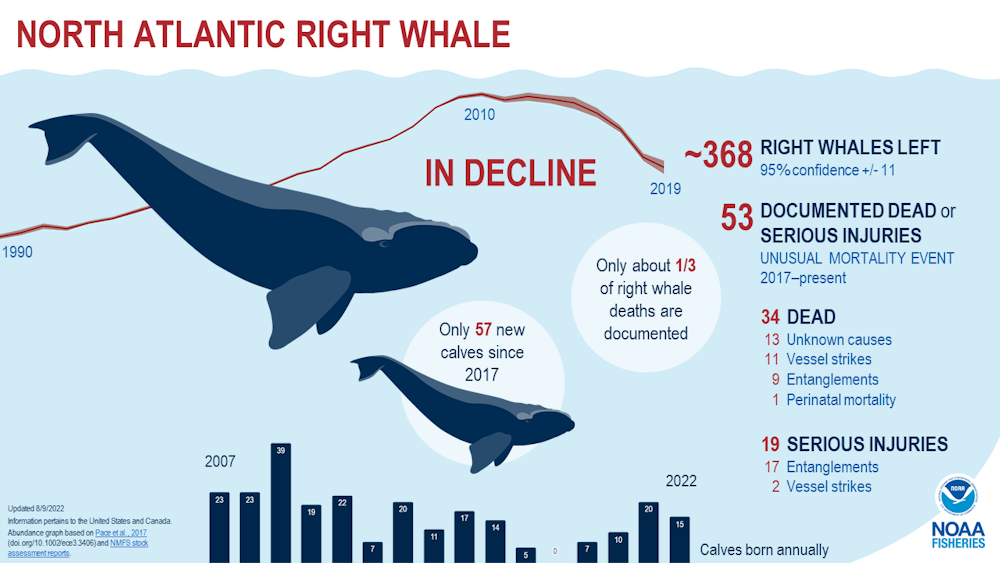
One of the best scenes has Betta, blindfolded, having sex with a single male partner, while her husband Hermes also pleasures her. She is unable to distinguish who is doing what to her, although she figures some of it out. That is exciting for her, and interesting to watch. Betta says it was “proof of love,” but to me, it was about consent. Can you talk about this idea, or the “rules” of polyamory and how couples negotiate what they do? It’s hinted at in the film.

“I am not polyamorous, but I believe nothing is forever, and nothing is sure. Polyamory is a great opportunity to listen to feelings . . . What we can learn from being polyamorous is that you have the right to have sex with other people.”

It’s not easy to deconstruct the rules they have. They are not written anywhere. Different couples have different rules. But these rules are absolutely necessary to keep the relationship intact. The idea is that they are a couple and are free to have sex with other people. How do you protect the relationship? You need some rules that always put the couple at the top of the hierarchy. 

An episode that is not in the film — there was a night where the couple had a fight because Hermes went with another girl without signaling Betta first. He didn’t look for her nod of approval, so they fought. The same night, another couple had a fight for the same reason. Another girl went into a room with other couples without having her husband’s approval. The film leaves this question open — What are the rules? Do we care about rules? Are they important? If you are in a more “accepted” relationship with your partner, would you accept those rules?

On that same note, there are questions in the polyamorous community about singles being seen as a “sex object” only. There are concerns about having feelings, or not having a sense of detachment. What are your observations about this? 

Singles play a very important role in the polyamorous world, as the film shows. A single guy can create a crisis in a polyamorous couple. You can see the power a single man can have — there is a political importance; singles know how to behave. It’s easier to find single women than men — at least in northern Italy. And that is why [couples] have so many important rules, and need approval, and have these codes of behavior. It is very easy to break this fundamental rule, and if you do that, you are going to break the essence of being polyamorous. 

Likewise, there is a brief discussion of fear and bisexuality. It appeared that many of the women in the scene engage in same-sex practices, but the men do not. Do you think this is a double standard? 

Of course, there are couples where both members are bisexual, but that wasn’t the case when I was filming. I had a set number of nights to spend with Hermes and Betta’s group. I know there are some [polyamorous] people are bisexual, but I am not sure that Hermes is bisexual.

Do you think Europeans are more open-minded towards swinging than other countries?

We can answer yes if we talk about northern Europe and central Europe. The importance of an Italian film like this is because in Mediterranean countries like Italy, Spain, Portugal, and Greece, the church, and being Catholic, is so much at the root of our culture. It is hard for people to evolve and be who they are, sexually speaking. 


Want a daily wrap-up of all the news and commentary Salon has to offer? Subscribe to our morning newsletter, Crash Course.


My team and I spent months to resolve an issue about this film being censored in Italy. There are several degrees of censorship, and this film received the maximum restriction. That is likely related to the topic. They had three revisions with a court that had to judge the film. They stopped the film and said, “If you want to show this film on private TV, you need to cut 20-25 minutes —all the sex scenes.” But we have to think about how this film relates to all the violence we see in other films. How can this film be judged more violent and dangerous compared to films where we see physical violence? It is a big topic here in Italy. Even if in the past three to five years we have had freedom to feel and express our sexual needs, but we are some years behind northern Europe, the U.S., and the UK.

You present the couple’s ideas about polyamory — “it’s a fantasy” — in the film. What do you think about the fantasy element of polyamory? 

I am not polyamorous, but I believe nothing is forever, and nothing is sure. Polyamory is a great opportunity to listen to feelings, sensations, and emotions, and what we can learn from being polyamorous is that you have the right to have sex with other people. We need to give voice to that and what I find interesting, and what I like that I learned from the polyamorous people is that they listen to their needs. They feel a need to celebrate their essence. Being polyamorous now, they don’t feel a need to wear a mask or feel shame. They are happy to represent who they are. 

“Bloom Up: A Couple Swingers Story” is currently in theaters. Watch a trailer, via YouTube.


A new Langya virus has infected 35 people in China. Here’s what you need to know

Just as COVID-19 began its life as a mysterious virus that crossed over from an animal to humans, it is natural that the public might look at other emergent zoonotic viruses with similar wariness. This, perhaps, explains the recent attention paid to a new Langya virus outbreak in China that has already infected 35 people. Could this lead to another global pandemic?

Fortunately, that is very unlikely, experts say. Unfortunately, that does not mean that the virus is not a threat, as a recent study in the New England Journal of Medicine revealed that there were 35 infections in a pair of eastern Chinese provinces in 2021.

Yet one reason not to be alarmed is, quite simply, that none of those patients died. Another lies in the nature of the Langya virus itself: It does not appear to have spread through human-to-human contact, and the infected patients all had close contact with animals like fruit bats and shrews, which were likely the original hosts.

RELATED: How 40 years without smallpox vaccinations could make the monkeypox outbreak worse

“There are clearly repeated transmission events from what looks to be a common reservoir in shrews,” Vaughn Cooper, an evolutionary biology professor at the University of Pittsburgh, told NBC News. “The team did a very nice job of evaluating alternatives and finding that as the most likely explanation.”

Yet while this virus does not seem to pose a global threat, it is part of a classification of viruses with a long and ugly history. They are known as henipaviruses.


Want more health and science stories in your inbox? Subscribe to Salon’s weekly newsletter The Vulgar Scientist.


Henipaviruses are negative-strand RNA viruses that are commonly found in mammals like shrews and fruit bats. Some henipaviruses are very dangerous; the Nipah virus, for instance, has a fatality rate between 40% and 75%. In addition to causing fevers, headaches, coughing and other flu-like symptoms, the Nipah virus can lead to serious side effects like brain swelling (encephalitis), seizures and even comas. Then there is the Hendra virus which has a fatality rate of 57% for the humans that it infects, bringing with it symptoms that can as with the Nipah virus also seem flu-like — and, likewise, can lead to brain swelling and death.

While the Langya virus does not appear to be a global threat, other henipaviruses do pose large problems on the regional level. A February article in the scientific journal PLOS: Neglected Tropical Diseases had this observation about the Nipah virus (NiV).

“Malaysia (43%), Bangladesh (42%), and India (15%) represent all incident cases of human NiV infections worldwide,” the authors explained. “Apart from the human catastrophe of high morbidity and mortality rates during documented epidemic outbreaks, the economic impact is tremendous. After the first NiV outbreak in 1999, Malaysian pig industry and related sectors suffered enormous damage, i.e., 1.1 million pigs were culled costing about US$66.8 million with a total decrease in the Malaysian economy of around 30% during that time.”

The authors also said that a global spread could arise from henipaviruses that can be spread through person-to-person transmission — such as NiV.

“The capacity for NiV to spread in hospital settings between staff and patients was shown in an outbreak 2001 in Siliguri, India, which affected 66 people,” the authors wrote. “The outbreak originated from an unidentified patient admitted to Siliguri District Hospital who infected 11 people. Thus, the ability of NiV to spread from patients to nursing staff has raised concern that the virus might adapt to more efficient human-to-human transmission.”

Far-right platform Gab veers into overt antisemitism — and only some Republicans back away

On Friday morning, Andrew Torba, founder of the far-right social media platform Gab, issued a seeming ultimatum to the Republican Party: “Gab is becoming the litmus test for candidates. Many have passed the test and doubled down. Some have lied and disavowed to gain points with the enemy. A truly great service to the American people to see who has a spine and who does not.” 

The occasion for the post was the fact that, over the last month, Torba and his platform, a hotbed of Christian nationalism and overt bigotry of various kinds, have become the center of numerous political controversies. After Torba endorsed a series of Republican candidates from the party’s MAGA wing, one after another has been pressed to explain their relationship with a figure long associated with racist and antisemitic speech, including, just this Thursday, his calling Pennsylvania gubernatorial candidate Josh Shapiro, the state’s Jewish attorney general, “this antichrist.” 

Much of the controversy began last month when Media Matters revealed that Shapiro’s Republican opponent, state Sen. Doug Mastriano, an outspoken Christian nationalist who was at the U.S. Capitol amid the Jan. 6 riots, had paid $5,000 to Gab for “consulting services.” The money, Mastriano later said, was a one-time payment for advertising services, which, as HuffPost later reported, may have been an agreement to help Mastriano gain new followers by automatically signing all new Gab accounts up to follow the candidate. 

While Mastriano had previously interacted with Torba — including a May interview for Gab News in which Mastriano thanked God for the platform — news of the payment brought renewed attention to Gab’s long history of extremism. 

Most notoriously, the platform was the preferred outlet of Robert Bowers, the man who killed 11 people at Pittsburgh’s Tree of Life synagogue in 2018 in the deadliest act of antisemitic violence in U.S. history. Bowers was motivated by the “great replacement” conspiracy theory, and in particular the version of it that claims Jews are orchestrating a deliberate effort to replace white majorities in Europe and North America with nonwhite immigrants. 

After the massacre, Politico reported, Gab users posted memes celebrating Bowers as well as surveys about what “the future of Jewish people in the West” should be, with 47% voting for “repatriation” and 35% for “genocide.” 

Gab was the preferred outlet of the man who killed 11 people at Pittsburgh’s Tree of Life synagogue in 2018, the deadliest act of antisemitic violence in U.S. history.

A report published this June by the Stanford Internet Observatory found that was par for the course, with “Extreme anti-Semitic, racist and homophobic content” rife across the platform, alongside “open praise of Nazism, encouragement of violence against minorities, and ‘Great Replacement’ narratives.” The rhetoric used by the perpetrator of the massacre this May in Buffalo, the report continued, was “indistinguishable” from content on even Gab’s most “‘mainstream’ user groups.” 

The problem isn’t just Gab’s users, but Torba himself, a self-declared Christian nationalist who has shared memes accusing Jews of crucifying Jesus or controlling the U.S. government. In 2021, Torba began promoting Gab as the first step in establishing a “parallel Christian society” so that, as Torba told far-right Catholic outlet Church Militant in early 2021, “when the communist takeover happens, Christians will have alternative systems built up.” Last October, he elaborated that such a parallel society was necessary “because we are fed up and done with the Judeo-Bolshevik one.”

“That’s a phrase right out of Nazism,” said Richard Steigmann-Gall, a history professor at Kent State University and author of “The Holy Reich: Nazi Conceptions of Christianity, 1919-1945.” Noting that the Nazi party used such language to blame Jews for communism, he continued, “I mean, he just lifted that out of some Nazi text, whether it’s ‘Mein Kampf’ or another one.” 


Want a daily wrap-up of all the news and commentary Salon has to offer? Subscribe to our morning newsletter, Crash Course.


The same year, as Mother Jones reported, a cache of hacked private messages from Gab showed Torba praising E. Michael Jones, a writer known for his claims that Jews are attacking both the Catholic Church and Western civilization. Gab’s Twitter account has also publicly praised Nick Fuentes — the leader of the white nationalist America First/groyper youth movement who revels in grossly offensive rhetoric, including elaborate jokes about the Holocaust and calls for “total Aryan victory” — as embodying “the true and relentless spirit of American excellence, ingenuity, grit and defiance in the face of tyranny.” On Gab News, Torba has published numerous antisemitic articles written by himself and others, including one distributed in Gab’s newsletter this July arguing that Judaism is a “made-up,” “LARP religion” and that the “very best thing the church can do for modern Jews is to heighten the distinction between Christianity and their false religion. Only then can they come to know salvation in Christ.”  

In recent days, Torba has posted a video about Jewish bankers and “usury,” suggested that Trump’s Jewish son-in-law Jared Kushner was an FBI informant and shared a post by a Gab user called “Kitler,” whose avatar is a cat with a Hitler mustache and who has previously written, “You can tell jews are a persecuted minority by the way they use their total control over government and media institutions to slander and ban anyone who says they hold a disproportionate amount of power.”

Given all this, the news of Mastriano’s payment to Gab drew extensive media coverage, as did Torba’s statements noting his policy to not “conduct interviews with reporters who aren’t Christian or with outlets who aren’t Christian.” He went on to claim, “Doug has a very similar media strategy where he does not do interviews with these people.” 

Mastriano responded with a Twitter statement saying that he rejected antisemitism “in any form” and that Torba did not speak for him. He also deactivated his Gab account. When that failed to quell the controversy, he pointed to the fact that his campaign events have included the blowing of shofars — an instrument traditionally used in Jewish religious celebrations but widely adopted in recent years by some far-right Christian groups as a symbol of spiritual warfare — and complained he was being accused of having “too much Jewishness” in his events. 

Torba’s own response to the controversy has been to double and triple down. In a livestream video responding to coverage of the controversy on MSNBC, Torba said he was building an explicitly Christian nationalist movement in which Jews and other non-Christians were not welcome, adding that “we’re not bending our knee to the 2 percent anymore” — a reference to the rough proportion of Americans who are Jewish. 

“This isn’t a big tent,” he continued, but rather a “Christian movement, full stop.” And consequently, he said, “we don’t want people who are atheists. We don’t want people who are Jewish.” 

Torba went on to attack Jewish conservatives such as Ben Shapiro and Dave Rubin, saying, “These people aren’t conservative. They’re not Christian. They don’t share our values. They have inverted values from us as Christians.” 

Torba says he’s building an explicitly Christian nationalist movement, in which even right-wing Jews and other non-Christians are not welcome: “We’re not bending our knee to the 2% anymore.”

In another video posted in July, and pointedly directed at Anti-Defamation League CEO Jonathan Greenblatt, Torba said, “This is a Christian nation. Christians outnumber you by a lot. A lot.” Again referencing Jewish demographics, he continued, “You represent 2 percent of the country, OK? We’re not bending the knee to the 2 percent anymore.” Christians, he said, were “done being controlled and being told what we’re allowed to do in our country by a 2 percent minority or by people who hate our biblical worldview, hate our Christ, hate our Lord and savior.” 

The media attention led to even more antisemitic language and threats on Gab, Media Matters reported earlier this month, with user posts calling to “exterminate all jews,” asking “WHERE IS ADOLPH WHEN HE IS NEEDED” and praying “Dear Lord, SMITE JOSH SHAPIRO, that weasel, lying Jew.” When Torba plaintively posted, “According to the New York Times it’s ‘anti-semitic’ to describe demographic percentages,” a user responded with a genocidal proposal: “if the jewies do not like to hear or read 2% then let’s make it zero %.” 

On Thursday, after Shapiro tweeted that Mastriano had used Gab’s “alt-right platform” to build support, Torba wrote, “Lol this antichrist can’t stop talking about us,” invoking the antisemitic slur of Jews as Christ-killers. The next day, after Greenblatt denounced that comment, Torba responded, “If you reject Christ and actively work to undermine Him, you are by definition antichrist. I’m praying every single day for your conversion too, Jonathan. Every knee will bow to Christ the King.” 

Following the controversy over Mastriano, attention fell on a number of other far-right Republicans whom Torba has endorsed as part of what he calls “the Gab Caucus,” including six politicians in Arizona: gubernatorial candidate Kari Lake, Senate candidate Blake Masters, incumbent U.S. Reps. Andy Biggs and Paul Gosar, state Sen. Wendy Rogers and secretary of state candidate Mark Finchem, all of whom won their primary races on Aug. 2. 

Some of the candidates welcomed his endorsement as an honor, including Finchem, an apparent supporter of the QAnon conspiracy theory and the Oath Keepers militia, and Rogers, who spoke at the white nationalist America First Political Action Conference last February, where she called for the execution of political enemies. (The same month Rogers posted an antisemitic meme depicting herself, Torba and Fuentes crouched over the carcass of a dead rhinoceros emblazoned with the word “CPAC” — referring to the more mainstream conservative conference — and a Star of David.) This Monday Gosar posted on Gab, “They’ve been going after Andrew Torba for months now — some would say years — because the platform that he is building threatens the Liberal World Order and their control over what we’re allowed to say and see online. …I don’t listen to the media. I’m not leaving Gab.”

But others, including Lake and Masters, disavowed the Gab endorsement, with Masters saying in a statement to the Arizona Mirror, “I’ve never heard of this guy and I reject his support. The reason I’ve never heard of him is because he’s a nobody, and nobody cares about him except the media.” 

Torba called Masters a liar, and this week Jewish Insider found a recording of a recent and genial live Twitter conversation between Masters and Torba, wherein Masters offered sympathy for Gab’s exclusion from major internet hosting companies like Apple. 

“Let this be a lesson to all of the GOP establishment shills, liars and deceivers,” Torba said in a video this week. “Don’t mess with me.” 

After Media Matters unearthed another current candidate’s lavish praise of the Gab founder — Ohio Republican congressional candidate J.R. Majewski, a Jan. 6 rioter who last year called Torba one of “America’s Greatest Patriots” — Torba urged Majewski to “Double down!” on his support for Gab, writing that doing so was quickly becoming “the litmus test” for conservative candidates.

To experts on antisemitism, all of this is a deeply worrying sign of the state of U.S. politics today. 

The swirl of controversies around Gab, Torba and the GOP clearly demonstrates a broader increase in and acceptance of explicit antisemitism in the U.S., said Susannah Heschel, a Dartmouth professor of Jewish studies and author of “The Aryan Jesus: Christian Theologians and the Bible in Nazi Germany.” “It’s a very troubling development,” she said, to see “candidates for high office in the United States accepting endorsements from someone like [Torba], which means that they’ve already made their own evaluation that an endorsement from him will be effective.”

Noting that scholarship has pointed to a “culture of despair” in Germany that preceded that country’s descent into fascism, Herschel suggested a similar dynamic is playing out today. “I don’t think we really have a culture of despair, but we do have an emotional politics going on,” she said. “And antisemitism is one of the primal templates for being emotional. There’s so much that antisemitism has to offer people who want to be angry and outrageous.” 

“Antisemitism is centuries long. It comes and goes. It’s tidal,” said Richard Steigmann-Gall. “Now it’s back, and not, I think, just because of Trump, but because of the larger cultural crisis among white Americans that Trump exploited.” 

“We are tempted in such moments to decry this as the demagoguery of an opportunist who may not believe a word they say,” Steigmann-Gall continued. “But if that’s true, then it actually makes things a little more dire, because what then would be happening is a politician putting their fingers in the air to see which way the wind is blowing.” 

Torba has clearly drawn his own conclusions on that front. “Establishment Republicans literally can’t disavow us because if they do they disavow 80% of their voters,” he wrote Friday night. “We own you now. This party belongs to Christ. Tell your antichrist donors to get the heck out of our way.” 

The USSR once hunted endangered whales — while its scientists secretly tracked its toll

Every year, an estimated 13 million people go whale-watching around the world, marveling at the sight of the largest animals ever to inhabit Earth. It’s a dramatic reversal from a century ago, when few people ever saw a living whale. The creatures are still recovering from massive industrial-scale hunting that nearly wiped out several species in the 20th century.

The history of whaling shows how humans have wreaked careless havoc on the ocean, but also how they can change course. In my new book, “Red Leviathan: The Secret History of Soviet Whaling,” I describe how the Soviet Union was central both to this deadly industry and to scientific research that helps us understand whales’ recovery.

A humpback whale breaches in Boston Harbor on Aug. 2, 2022. Whaling greatly reduced humpback whale numbers, but the species is recovering under international protection.

From wood to steel and bad to worse

At the start of the 20th century, it seemed whales might gain a reprieve after years of hunting. The era of whaling from sail boats, depicted in such memorable detail by Herman Melville in “Moby-Dick,” had nearly wiped out slow, fat species like right and bowhead whales, and also wreaked substantial harm to sperm whales.

In the 1800s, U.S. whalers sailed without restraint or hindrance into every corner of the world’s oceans, including waters around Russia’s Siberian empire. There, tsarist officials watched in helpless rage as Americans slaughtered whales upon which many of the region’s Indigenous peoples relied.

In the 1870s, petroleum began to replace whale oil as a fuel. With few catchable whales remaining, the industry appeared to be near its end. But whalers found new markets. Through hydrogenation – a chemical process that can be used to turn liquid oils into solid or semi-solid fats – manufacturers were able to transform smelly whale products into odorless margarine for human consumption.

Around the same time, Norwegians invented the explosive harpoon, which killed whales more efficiently than hand-thrown versions, and the stern slipway, which allowed whale carcasses to be processed on board ships. Along with diesel engines and steel hulls, these technologies enabled whalers to target previously untouched species in once-inaccesible locations, such as the Antarctic.

Large metal vessels on a stony beach

These cookers and boilers at Whalers Bay, Deception Island, Antarctica, were used to boil down whales’ skin and blubber, extracting their oil, from 1912 to 1931. David Stanley/Flickr, CC BY

Late to the party, late to leave

As mechanized whaling gained force in the 1920s and ’30s, Norwegian, British and Japanese whalers cut through populations of blue, fin and humpback whales on a scale that is hard to believe today. In what scientists once thought was the peak catch year, 1937, over 63,000 large whales were killed and processed.

World War II briefly suspended this slaughter, which many governments were starting to realize threatened the survival of some whale species. In 1946, whalers, statesmen and scientists created the International Whaling Commission in hopes of heading off a return to disastrous prewar levels of whaling.

That same year, the USSR joined the IWC and took control over a former Nazi whaleship, which it renamed the Slava, or Glory. No one suspected the central role the country would play in the most disastrous two decades of whales’ long history on Earth.

The madness of modern whaling

Despite the IWC’s best intentions, postwar catches rose quickly. By the mid-1950s, even longtime whalers had to admit that big whales were becoming too scarce for their industries to be profitable. All nations except Japan began to ponder the end of whaling.

It thus came as a shock when the Soviet Union announced in 1956 that it planned to build seven new “floating factories” – gigantic industrial processing ships, accompanied by fleets of smaller “catcher” boats that would scour the oceans for whales.

Soviet whale scientists were as stunned as observers elsewhere. These biologists and oceanographers had been watching the decline from ships and from their labs in the Fisheries Ministry and Academy of Sciences since the 1930s.

Instead of supporting the fleet expansion, they argued forcefully that whales stood on the brink of extinction, and whaling should decrease radically, not expand. This was how the Soviet planned economy was meant to work: Science, not profit, would help guide economic decisions, letting planners know how much could be extracted from the natural world and when to stop.

But Soviet officials were determined to finally catch whales on a large scale, as Western nations had done for so long. The Fisheries Ministry ignored its scientists’ recommendations and built five of the seven planned floating factories over the next decade.

By the 1960s, the Soviet Union was the world’s largest whaling nation. Whalers such as the legendary captain Aleksei Solyanik were celebrated as superstars, comparable to astronauts like Yuri Gagarin.

But the scientists had been right: Many whales species were nearly gone. To produce large catches, Solyanik and other captains decided to ignore international quotas and secretly targeted the most endangered whale species, including blue, humpback and fin whales in the Antarctic and the North Pacific.

In 1961, for example, Soviet fleets killed 9,619 rare humpbacks south of New Zealand, while reporting only 302 to the IWC. This was only a portion of their global catch, which the Soviet Union continued to underreport for years. Driven by Moscow’s demands for ever-increasing production, whalers worked at reckless speed, wasting much of the fat and meat taken from the dead whales. It is doubtful the industry was ever profitable.

Thanks to Soviet scientists who preserved some records of these illegal kills and to subsequent work by other scholars, it now appears likely that the Soviet Union killed around 550,000 whales after World War II while reporting only 360,000. We now know that global whale harvesting peaked in 1964, not 1937, with a total of 91,783 whales killed – about 40% by Soviet whalers.

In this 1976 news video, Greenpeace activists confront a Soviet whaling ship on the high seas. NOTE: Contains footage that some viewers may find disturbing.

Not quite extinct

By the 1970s, populations of large whales had dwindled to insignificance. Many observers were sure extinction was inevitable. But momentum for whale conservation was growing.

The U.S. listed blue, fin, sei, sperm and humpback whales under the law that preceded the Endangered Species Act in 1970, then continued to protect them under that law, enacted in 1973. Whales also received protection in U.S. waters under the 1972 Marine Mammal Protection Act.

Thanks to pressure from environmentalists and its own citizens, the Soviet Union ended its whaling industry in 1987. The country accepted a global moratorium on commercial whaling, which remains in force today with only three holdouts: Norway, Iceland and Japan.

Whale numbers almost immediately began to rebound. Humpback whales were especially successful, but populations of bowhead, fin and sperm whales also expanded in the near absence of commercial whaling. However, some species, notably North Atlantic right whales, remain endangered or critically endangered.

Graphic showing number of whale calves born yearly 2007-2022.

North Atlantic right whales are critically endangered, with a population estimated at less than 368 animals. NOAA

In one of the greatest conservation successes, Eastern Pacific gray whales are today estimated to have returned to pre-exploitation abundance, and may actually be reaching the limits of what their primary foraging grounds in the Bering Sea can support. And in 2018 and 2019, German scientists and researchers from the BBC observed and filmed fin whales feeding around the Antarctic peninsula in vast pods that recalled the way the ocean must have looked before the 20th century.

Thanks to the Russian scientists who opposed their country’s disastrous whaling expansion and kept its records, we know how many whales were lost in the 20th century. That information can also help scientists, governments and conservationists judge whales’ remarkable but far from complete recovery.


Ryan Jones, Associate Professor of History, University of Oregon

This article is republished from The Conversation under a Creative Commons license. Read the original article.

How Chris Christie’s 2016 “lock her up” speech fueled Trump’s rise — and brought us here

Of course, in the midst of the late Friday afternoon media feeding frenzy over the release of the Justice Department search warrant and inventory of what was taken by the FBI from Mar-a-Lago, Donald Trump issued a statement claiming “it was all declassified.”

According to the Wall Street Journal and the New York Times, the classified treasure trove removed from Trump’s Florida manse on Monday included 11 sets of documents, “some marked as ‘classified/TD/SCI’ documents — shorthand for ‘top/secretive/sensitive compartmentalized information.”

As soon as the news broke about the FBI raid, Republican partisans declared it was a political witch hunt. With no confirmed information of what the agents were looking for, they began imputing the most corrupt motives possible to these public servants. Just as in the lead up to the Jan. 6 insurrection, Trump and the right-wing media whipped the infantry up to a lather, with predictable results. On Thursday morning, a man later identified as 42-year-old Ricky W. Shiffer turned up at the Cincinnati FBI field office with a nail gun and as AR-15 style rifle. After firing off the nail gun in an attempt to breach the FBI office he drove off, and a police chase ensued followed by a six hour standoff, which ended with police shooting Shiffer dead after less lethal strategies failed.

Shifter reportedly was part of the mob at the U.S. Capitol on Jan. 6, 2021. He was locked and loaded. Even now, more than 18 months after Trump kneecapped the Biden transition and carried out a multi-pronged attack on the peaceful transition of power, his partisans are casting the former president as a victim. They are also going to great lengths to encourage America’s distrust of institutions, including the Justice Department, the FBI and the IRS.

“The FBI raid on President Trump’s personal residence is unprecedented and raises a number of concerns about the power of the ruling party to investigate its political opponents,” wrote Bob Hugin, chairman of the New Jersey Republican State Committee. “Just this week, Democrats here in New Jersey voted to fund another 87,000 new IRS agents. Make no mistake about it: this new robust agency will harass small business owners, political adversaries, and law-abiding Americans. It is more essential than ever to elect a Republican Congress this November to put an end to one-party rule.”

How did we come to this nadir, where the DOJ must go to a judge to sign a warrant so the FBI can search the residence of a former president? I flash back to that hot July night in Cleveland, at the 2016 Republican National Convention, when then-New Jersey Gov. Chris Christie delivered an ad hominem attack on Hillary Clinton, during which delegates devolved into a mob yelling, “Lock her up! Lock her up!”

I was on the floor of the convention, at the lip of the stage, as Christie threw the red meat out to the vengeful crowd. I knew in that instant that America would never be the same because the Republican Party’s glue, what now held it together, was an anger and a sense of grievance that Christie channeled as he played judge, jury and executioner, with the howling mob as his Greek chorus.

He relished it. In all my years of covering political conventions, I had never heard a more incendiary speech.

Since then Christie has attempted to pirouette away from his persona as Trump’s hatchet man. But he told America that night in Cleveland that Trump was “not only a strong leader but a caring, genuine and decent person.”

I was on the floor of the convention as Chris Christie flung the red meat out to the vengeful crowd. I knew in that instant that America would never be the same.

“I am here tonight not only as the governor of New Jersey, but also as Donald Trump’s friend for the last 14 years,” he said. Christie was an early booster of Trump’s candidacy and as former chairman of the Republican Governors’ Association lent Trump some legitimacy to compensate for his thin political résumé.

Christie suggested that since the Department of Justice under Barack Obama had refused to prosecute Clinton, he would use his speech to allow the American people to be “a jury of her peers, both in this hall and in living rooms around our nation,” in order to “hold her accountable for her performance and her character.”


Want a daily wrap-up of all the news and commentary Salon has to offer? Subscribe to our morning newsletter, Crash Course.


He took policy choices of the Obama administration, executed by Hillary Clinton as secretary of state, tossed in the supposed issue of how she handled her work emails and then hit the juicer button on his rhetorical blender.

He went on to blame Clinton for the status of every global hotspot. Just as Trump would do with his attack on the integrity of election officials, Christie, himself a former Justice Department employee, sought to undermine the DOJ’s legitimacy for not prosecuting Clinton.

It was Strongman 101: Your institutions are rotten — only the junta will manifest your will!

“Since the Justice Department refuses to allow you to render a verdict, let’s present the case now, on the facts, against Hillary Clinton,” Christie said. “She was America’s chief diplomat. Look around at the violence and danger in our world today. Every region of the world has been infected with her flawed judgment.”

Rereading this speech offers some real ironies, in light of how Trump actually governed as president. Christie took Clinton to task for going easy on Vladimir Putin by “going to the Kremlin on her very first visit” and giving him “the symbolic reset button. The button should have read ‘delete.’ She is very good at that, because she deleted in four years what it took 40 years to build.”

In the years since Christie recommended him, Trump pitted blue states against red states, dividing a nation as it faced a once-in-a-century mass death event and badly needed cohesion. And when weary voters overwhelmingly rejected him, he obstructed the orderly transition of power and plotted a multi-faceted insurrection to derail the peaceful transition of power.

And as we saw on Jan. 6, 2021, this particular strain of self-righteous Republican politics, which Christie’s 2016 speech helped spawn, is capable of seizing the U.S. Capitol and building a gallows. Now, as the justice system finally attempts to hold Trump accountable, Republican members of Congress openly call for “defunding the FBI.

House passes Inflation Reduction Act

Without the support of a single Republican, Democrats in the U.S. House on Friday gave final passage to a $740 billion piece of legislation that includes historic investments in renewable energy development, a minimum tax on large corporations, and a landmark requirement for Medicare to directly negotiate the prices of a subset of prescription drugs.

Democratic proponents of the bill and outside groups have hailed the Inflation Reduction Act (IRA) as the most significant climate action measure ever passed by U.S. lawmakers, even though the package contains substantial handouts to the fossil fuel industry alongside the slew of tax incentives and subsidies for green energy that could substantially curb greenhouse gas emissions.

The Senate passed the reconciliation bill along party lines last weekend, and Friday’s final vote in the House was 220 to 207, with all Democrats in favor and a “nay” from every single member of the Republican caucus who voted.

“Today, Democrats are keeping our promises to the American people and advancing key progressive priorities,” said Rep. Pramila Jayapal (D-Wash.), chair of the Congressional Progressive Caucus, following the vote.

“After more than a year of negotiations and even longer campaigning on these issues, the Democratic majority in Congress has unanimously sent a sweeping bill to tackle climate action, tax fairness, and lower drug costs to the President’s desk,” Jayapal said. “Like their Senate colleagues, not a single House Republican voted for this legislation, despite its popularity with the majority of Americans across the political spectrum.”

President Joe Biden is expected to sign the bill into law as soon as Friday evening, capping off more than a year of negotiations that were repeatedly sabotaged by Sens. Joe Manchin (D-W.Va.) and Kyrsten Sinema (D-Ariz.), who succeeded in dramatically scaling back their party’s agenda.

While acknowledging the IRA “is not perfect” given provisions that “that risk expanding fossil fuel extraction and use,” Union of Concerned Scientists president Johanna Chao Kreilick said the IRA is “a game-changer and reason for hope.”

“We finally have a Congress that’s heeding the science on the severity of human-caused climate change and incentivizing the clean energy solutions that are supported by the vast majority of people in the United States,” said Kreilick. “It’s extremely disappointing and alarming that despite the urgency to act, Republican lawmakers have largely refused to support critical climate policy.”

Every member of the Congressional Progressive Caucus voted for the bill despite grassroots climate advocates’ vocal concerns about the legislation’s giveaways to the fossil fuel industry, including a section that requires new oil and gas lease sales as a prerequisite for wind and solar development.

“It is a start, and we have more work to do to fully respond to the cost of living crisis,” said Rep. Jamaal Bowman (D-N.Y.) after the bill’s passage.

“People deserve lower insulin prices and lower drug prices in general, including if you have private health insurance,” Bowman continued. “We need to protect frontline communities from fossil fuel pollution, and finally end our dependence on oil, gas, and coal. Our work continues to deliver affordable, quality housing, child care, and education, a $15 minimum wage, immigration justice, and more. As we celebrate the progress made today, we recommit to addressing every priority in Build Back Better and more.”

During a press conference ahead of Friday’s vote, Rep. Pramila Jayapal (D-Wash.)—chair of the Congressional Progressive Caucus—said the IRA “marks the largest-ever federal investment in climate action, putting the United States back on track to cut carbon pollution by 40% by 2030,” a projection that some climate advocates have questioned given its dependence on the effectiveness of unproven carbon capture technology.

“We’ve got more to do,” Jayapal said on the House floor, pointing to the bill’s exclusion of housing and child care funding. “But today, let’s celebrate this massive investment for the people.”

House Speaker Nancy Pelosi (D-Calif.), for her part, said the IRA takes steps toward “loosening the stranglehold” of corporate interests on Congress.

But the bill in many ways reflects the power that corporate America continues to exert over the legislative process. In addition to the gifts to Big Oil secured by Manchin, the private equity industry—with the help of Sinema—won the last-minute removal of tax provisions targeting the notorious carried interest loophole.

Republicans, given an opening by the unelected Senate parliamentarian, also axed a provision that would have imposed a $35-per-month insulin copay cap for patients with private insurance. The bill still contains an insulin copay cap for Medicare Part D enrollees as well as a $2,000 annual cap on beneficiaries’ prescription drug spending.

Despite regressive late-stage changes to the bill, corporate lobbying groups such as the U.S. Chamber of Commerce mobilized aggressively against the IRA, with particular focus on tanking its drug price provisions and the 15% minimum tax on highly profitable companies.

“Multibillion-dollar corporate special interests including Big Pharma claim the sky will fall if they finally pay their fair share in taxes or negotiate fairer prices,” Liz Zelnick, spokesperson for Accountable.US, said shortly before Friday’s vote. “Industry rhetoric contradicts their own public filings which show record profits, virtually no reasonable taxes paid, and huge giveaways to wealthy investors and executives.”

“The reality is highly profitable corporations can afford to contribute more towards an economy that works for everyone, but many would prefer to keep charging seniors and families whatever they please while paying virtually nothing in return,” Zelnick added. “That is why Congress must finish the job of reining in corporate greed, lowering costs, and ensuring wealthy companies finally pay their fair share.”

Wenonah Hauter, executive director of Food and Water Watch—a group that has been highly critical of the Inflation Reduction Act—said Friday that the bill “takes important steps to promote clean energy, but utterly fails to rein in toxic, destructive fossil fuel extraction.”

“The Inflation Reduction Act can only be seen as the beginning of our response to the climate crisis. Much more is needed, specifically to restrict any and all new fossil fuel projects,” said Hauter. “Unfortunately the bill aims to actually promote additional drilling and fracking, an unconscionable trade-off that will increase pollution in frontline and environmental justice communities.”

“Our focus now must shift to stopping Senator Manchin’s awful ‘side deal’ to fast track fossil fuel permitting,” Hauter added. “This giveaway to big corporate polluters would doom any progress that might result from the passage of this legislation.”

Marjorie Taylor Greene plans to impeach Merrick Garland

WASHINGTON, D.C. — Rep. Marjorie Taylor Greene (R-GA) on Friday said she would soon introduce articles of impeachment against U.S. Attorney General Merrick Garland in the wake of the FBI’s raid of Mar-a-Lago.

A copy of the resolution, obtained by Daily Caller reporter Henry Rodgers, states that Garland should be impeached for personally approving search of Donald Trump’s Florida home. The resolution describes the search as “a blatant attempt to persecute a political opponent.”

“They’ve been trying to impeach President Trump and they’ve been attacking President Trump for six years now,” the congresswoman told reporters. “The left has led violence against the right for a long time.. Anyone that wears a MAGA hat is demonized. You talk about a movement to politically paint a group of people into something bad — the left has done that to the right for six years now, specifically Donald J. Trump.”

“Nobody is calling for violence against the FBI or Department of Justice,” Greene continued. “We are just sick and tired of the two-tiered justice system in America where people are jailed just a couple of blocks from here in the D.C. jail and where, you know, antifa and BLM rioters, they are let go. But yet people who just walked into the Capitol here on January 6 are demonized and called terrorists every single day. Enough of the two-tiered justice system in America, and that’s why Merrick Garland has to be impeached, because he’s the leader of it.”

Garland has faced furious rebukes from Republicans over the search of Trump’s resort, which is related to the potential mishandling of classified documents.

“I personally approved the decision to seek a search warrant,” Garland told reporters on Thursday. “The department does not take such a decision lightly.”

“The search warrant was authorized by a federal court upon the required finding of probable cause,” he said.

While noting that “ethical obligations” prevented him detailing the basis of the raid, Garland said he had asked a Florida judge to unseal the warrant because Trump had publicly confirmed the search and because of the “substantial public interest in this matter.”

The Justice Department typically does not confirm or deny whether it is investigating someone. Garland, a former prosecutor and judge who has a reputation as a stickler for protocol, took pains to emphasize the law was being applied fairly.

“Faithful adherence to the rule of law is the bedrock principle of the Justice Department and of our democracy,” he said. “Holding the rule of law means applying the law evenly without fear or favor.”

The warrant and related materials, released Friday, indicated that Trump is facing a federal investigation over the removal or destruction of records, obstruction of an investigation, and violating the Espionage Act. The documents also showed that federal agents took away with them a significant number of documents labelled “top secret.”

Greene said earlier this week that she would work with her Republican colleagues to “totally gut” the FBI and Department of Justice.

“Many Republican members are now unified and we’ll be taking back the House and once we do, we’re going to be going after and taking down this corrupt communist-style government,” she added. “And we have got to do something to totally gut the Department of Justice and the FBI.”

Since leaving office, Trump has remained the country’s most divisive figure and a force in the Republican party, continuing to sow falsehoods that he actually won the 2020 vote.

On Wednesday, the 76-year-old Trump was questioned for four hours by Letitia James, the New York state attorney general who is investigating the business practices of the Trump Organization.

Trump is also facing legal scrutiny for his efforts to overturn the results of the 2020 election and over the January 6 attack on the US Capitol by his supporters.

Trump was impeached for a historic second time by the House after the Capitol riot — he was charged with inciting an insurrection — but was acquitted by the Senate.

Sean Hannity says that Trump could run for president from jail, if he wanted to

On Friday’s episode of Premiere Radio Networks’ The Sean Hannity Show, the host claims that Trump being sent to jail would not necessarily be a road block of any kind in terms of him deciding to run for president in 2024. 

Going over possible scenarios for what’s to come, Hannity says “What do you think the next thing that happens here is, do you think that they would try and indict the former president in the hopes of convicting him and having him in jail at the time of the next election to prevent him from running . . . Because a conviction by the way, constitutionally, would not prevent him from running for office.”

Following the FBI’s raid of Mar-a-Lago to search for sensitive documents that Trump took from the White House, Marc Elias, top lawyer for Hillary Clinton’s 2016 presidential campaign, tweeted “The media is missing the really, really big reason why the raid today is a potential blockbuster in American politics.” Included with Elias’ tweet is the image of a document detailing U.S. Code Title 18, Section 2071, which states that anyone “having the custody of any such record, proceeding, map, book, document, paper, or other thing, willfully and unlawfully conceals, removes, mutilates, obliterates, falsifies, or destroys the same, shall be fined under this title or imprisoned not more than three years, or both; and shall forfeit his office and be disqualified from holding any office under the United States.” 


Want a daily wrap-up of all the news and commentary Salon has to offer? Subscribe to our morning newsletter, Crash Course.


But Hannity seems to have other thoughts on the matter.

“You know, this code that is being cited by Marc Elias and all these other people negates the very enumerated qualifications in the Constitution, and the specific requirements for somebody not to be eligible to run, and that would be impeachment and conviction,” Hannity said during Friday’s show. “It doesn’t mention anything about being, you know, maybe not following every single dotted ‘I’ and crossed ‘t’ in the Presidential Records Act of the National Archives Act.”

Listen to a clip from the episode here.

“A League of Their Own” makes up for the past’s missed swings, but isn’t quite a home run

Thirty years ago the inimitable Penny Marshall made her best effort to satisfy sticklers for historical accuracy and her desire to spotlight DeLisa Chinn-Tyler in “A League of Their Own.”

Chinn-Tyler’s name may not be known to most people, but Marshall designed the former competitive softball player’s part to leave a mark. Recently Chinn-Tyler told Consequence.net that she showed up at the movie’s casting call only to be told at the end of the day that there were no parts for Black actors on the Peaches, explaining that the teams were segregated in the 1940s.

But Marshall was so impressed by the ball player’s skill that she wrote a part for her anyway. Chinn-Tyler is the Black woman who returned an overthrown ball to Geena Davis’ Dottie Hinson with such accuracy and heat that catching it requires Dottie to pause and shake off the pain. Chinn-Tyler’s character responds with a proud nod of her head.

The whole exchange takes up around 15 seconds but stands out enough to inspire Abbi Jacobson and Will Graham to do what Marshall could not in 1992.

While Chinn-Tyler’s ballplayer was left unnamed and uncredited, the eight-episode adaptation of “A League of Their Own” devotes extensive screen time and deep character development to Chanté Adams’ Maxine, a Black woman living in the United States in 1943. While men of fighting age are drafted to fight in World War II, women are called to serve by entering the workforce, whether by taking jobs in factories or on the ball field.  

Max, as she prefers to be called, can handle both kinds of work. But the men running the All-American Girls Professional Baseball League won’t even allow her an official tryout, and her mother presumes she’s going to take over her hair salon. One obstacle after another stands in Max’s way. On top of it all, Max is queer.

A League of Their OwnA League of Their Own (Courtesy of Prime Video)
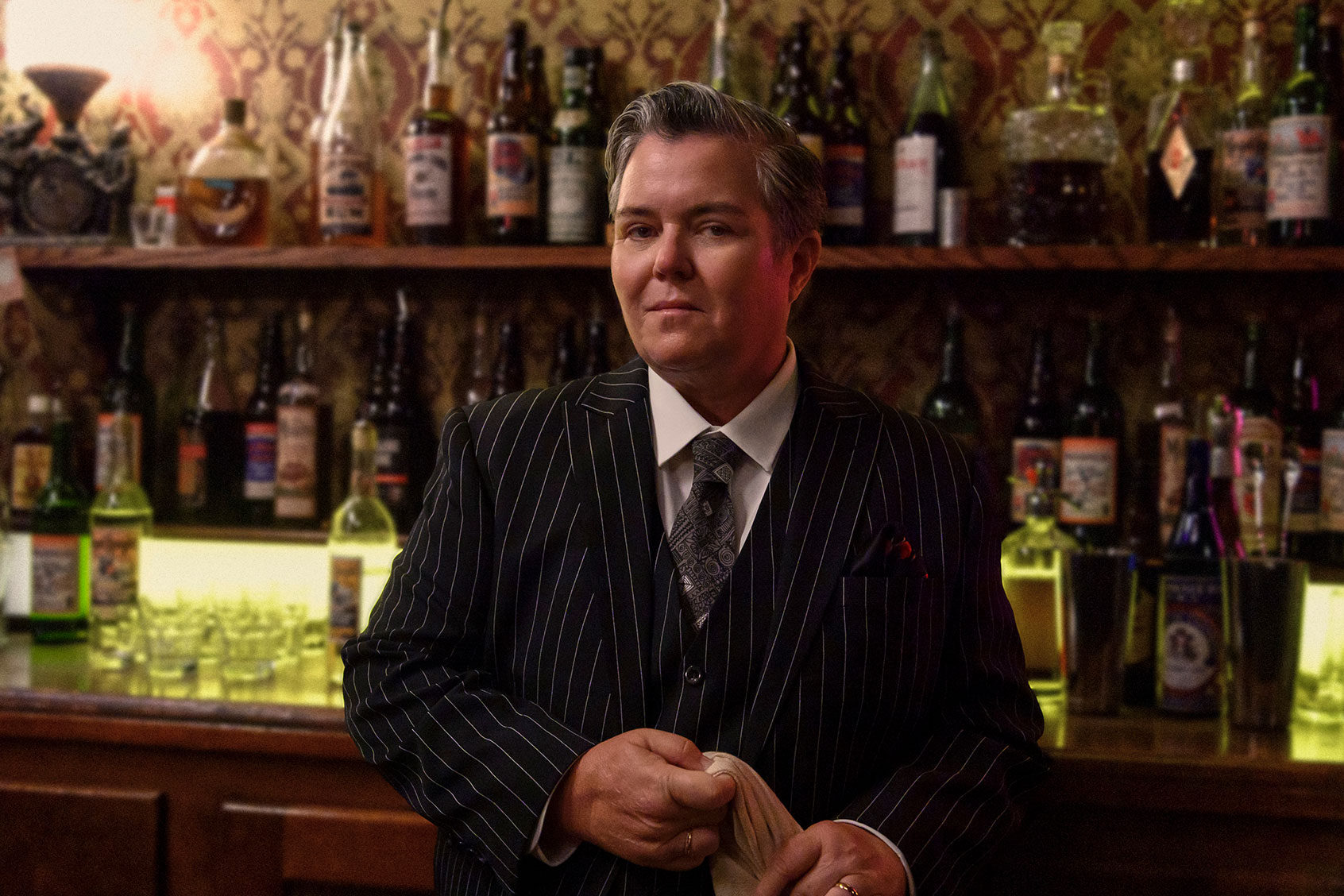
You may be wondering what her storyline has to do with the one we know from “A League of Their Own,” centered on the Rockford Peaches. It’s a fair question that the first season doesn’t answer with utter satisfaction . . . if you are looking for the show to simply run the same narrative bases as the movie.

It does that to a point. The famous “There’s no crying in baseball” line? It’s in there. None of the characters from the movie appear in the show, although many of the new Peaches resemble women we’ve met before.

The most prominently featured characters crystallize the show’s focus on queerness and marginalized perspectives.

Carson, like Davis’ Dottie, is married and hails from a farming town,. D’Arcy Carden’s glamorous Greta is the show’s answer to Madonna’s All the Way Mae, a flirtatious, fame-seeking slugger flanked by her best friend Jo (Melanie Field). Together they march into the Chicago ballpark hosting the tryouts and earn spots on the Peaches’ lineup along with other talents, some of whom break out from the pack and others that are there to populate the dugout.

You may find a few likable traits in Nick Offerman’s washed-up major league player turned coach, Dove, although he’s considerably less sympathetic than Tom Hanks’ Jimmy Dugan.

Neither Hanks nor Davis makes a cameo, but Rosie O’Donnell has a part to play as the proprietor of a speakeasy that serves as a LGBTQIA sanctuary. Through all of these changes and many more, the writers reinterpret the title to encompass a feeling along with delivering a fictionalized account of a real women’s professional team.

A League of Their OwnA League of Their Own (Anne Marie Fox/Prime Video)

This makes room for Max’s story. It does not prevent it from existing separately from that of Jacobson’s lead character Carson and the other Peaches. Carson and Max cross paths in key moments and eventually spark a friendship, albeit in secret. However, Carson is part of the group of white and white-passing women drawn to Chicago from towns and cities across the United States for their shot at playing professional baseball.

But while Carson’s dramas mirror some of Dottie’s – which is to say, she mainly worries about how to deliver her team to victory and win the world’s respect – Max would consider it a win if she were to get any chance to play anywhere.

The most prominently featured characters crystallize the show’s focus of queerness and marginalized perspectives. Organizing the plot around that vision lends the opening season a profound sense of mission and heart, enabling us to know enough of the Peaches intimately enough to root for them on the field and off.

Plus it’s nearly impossible for anyone to deny Carden’s charisma here. If she was an attention-seizing spark in previous shows, she’s the gravitational pull holding her side of “A League of Their Own” together with verve and passion.

A League of Their OwnA League of Their Own (Anne Marie Fox/Prime Video)

That said, the story connects most effectively once the plot widens its lens beyond Carson and Greta’s tumultuous friendship beginnings, which is halting at first before picking up speed. Roberta Colindrez is a gift in any show that features her, so her pitcher, Lupe, benefits the most from this expanded focus.

Dubbed by the press as the team’s “Spanish Striker,” Lupe is caring and marvelously rough around the edges while also looking after the team’s youngest member Esti (Priscilla Delgado). Esti doesn’t speak English, which often means she’s left out of the team’s bonding sessions.

At least she’s allowed to play because she doesn’t look like an outsider to the folks in stands. Max, on the other hand, leads a separate existence despite having as much talent as any of the Peaches, if not more.

“A League of Their Own” isn’t one story built around a highly engaging main character but two plots running in parallel.

Max has her fan club in her best friend Clance (Gbemisola Ikumelo), a recently married comic book nerd whose husband loves his wife’s nerdiness. Ikumelo is the show’s other significant magnetic force, and her humor and spirit prevent Max’s storyline from being defined by setbacks and frustration. She makes Clance a welcome comic presence in a community that doesn’t easily accept women who don’t match the standard picture of a churchgoing wife or eager, self-sacrificing mother.

A League of Their OwnA League of Their Own (Courtesy of Prime Video)

At the same time, her performance also highlights one of the main errors in the show. “A League of Their Own” isn’t one story built around a highly engaging main character but two plots running in parallel, with one more extensively staffed with speaking roles than the other, and neither of whose leads are more compelling than the people around her.

None of this impedes the show’s ability to deliver on the joy and nostalgia that is the original film’s hallmark. Everyone making this series takes great care to cultivate that feel-good spirit, capturing enough of it to keep the audience hooked on the Peaches’ exploits through the most anxious stages of the season.

This approach cannot help but manifest as the imperfect solution to a conundrum of inclusion. Jacobson, Graham and the other writers ardently devote the story to representing voices and perspectives that were absent in Marshall’s movie while acknowledging the brutal truth of how dangerous that era was for queer and Black people.

Presenting Max’s and Carson’s storylines separately acknowledges the reality of segregation in Jim Crow America. But this also means Max doesn’t get to participate in the heights of each Peaches victory or the nail-biting worry of the team’s setbacks. The scripts create an engaging arc through which Max discovers where she belongs, but she’s never a fully enfranchised participant in their emotional highs and lows.

That also means her journey never completely shakes free of the nagging question of when and how Max will finally join Carson and the rest of the Peaches. That’s the side of the show pitching the joy of watching women triumph at a sport they and much of America loves.

Judging by how the first season plays out it’s tough to predict whether the producers will ever grant Max that shot. Still, their earnest effort to do right by her comes off well. Maxine is a wonderful tribute to the three women who played professional baseball in the American Negro Leagues: Mamie Johnson, Connie Morgan, and Toni Stone. And Adams is wonderful to watch, especially when she’s partnered with Ikumelo.

She’s also as made-up as Carson, Greta, Lupe, Jo, and every other character, which makes a person wonder how long a fictional journey like this is obligated to adhere to historical accuracy.

“A League of Their Own” steals home by presenting two shows under a single awning in Season 1. But if it manages to earn another season, hopefully its creators will take that as a signal that it’s OK to merge Max’s and Carson’s paths.


Want a daily wrap-up of all the news and commentary Salon has to offer? Subscribe to our morning newsletter, Crash Course.


Because while it’s wonderful to feature Black baseball players alongside the Peaches’ adventures in the AAGPBL, it could be even more rewarding for the show’s creators to realize, through Max, the dream that Black women who wanted to play professional ball were denied.

It’s true that women’s professional baseball teams weren’t integrated in 1943, and the color line in professional baseball wouldn’t be broken until Jackie Robinson got his shot in 1947. But most people didn’t fall for the first version of “A League of Their Own” for the history, much of which was and is underexposed anyway.

They loved it for the same traits the show capitalizes upon, which is the warmth, sisterhood, and friendship that endured decades after the women’s league shut down. Done well, that can feel as honest as anything recorded in the history books, even if it is a fantasy. Women like Max deserve to play a part in that vision too. Perhaps in another season, she will.

All episodes of “A League of Their Own”are streaming on Prime Video. Watch a trailer via YouTube.