Spring Sale: Get 1 Year, Save 58%

Hugh Grant trolls Boris Johnson’s resignation with wacky “Benny Hill” theme song

British Prime Minister Boris Johnson officially announced his resignation on Thursday following the recent departures of his government ministers amid a string of political scandals and catastrophes. The news was met with widespread celebration and a goofy soundtrack, courtesy of Hugh Grant.

RELATED: So what the hell happened to Boris Johnson — and can it happen to Donald Trump?

Earlier that day, the actor, who plays a fictional U.K. prime minister in the 2003 rom-com “Love Actually,” asked activist and Anti-Brexit campaigner Steve Bray if he could blast “Yakety Sax” — aka the iconic theme song for the slapstick comedy “The Benny Hill Show” — outside the British Houses of Parliament. The wacky tune, which frequently accompanies the protagonist’s ludicrous escapades, is now a stand-in soundtrack for clownery and tomfoolery.


Want a daily wrap-up of all the news and commentary Salon has to offer? Subscribe to our morning newsletter, Crash Course.


“Morning @snb19692,” tweeted Grant. “Glad you have your speakers back. Do you by any chance have the Benny Hill music to hand?”

Lucky for Grant, Bray had the song at his disposal and made sure to play it at full volume for all to hear. The audio can even be heard in the background of a few British news broadcasts, which went viral on social media:

More stories you might like:

Crispy and cheesy, these two-ingredient fritters would sparkle next to anything

Crispy and cheesy, these two-ingredient fritters would sparkle next to anything. But a citrusy, herby salad — packed with green parsley and crunchy cucumber — hits the spot. Inspired by tabbouleh, this recipe only needs a handful of ingredients. The secret is to use them smartly. Toasting the grains first, then adding a splash of feta brine to the cooking water yields deeply flavored bulgur. And crumbling the cheese into two textures means that some melts as a binder, while other pieces stay intact (picture: surprise pockets of warm feta). When you’re shopping for bulgur, be mindful of the coarseness. This recipe uses a medium grind, also known as #2 bulgur. Don’t get coarse or fine, since they wouldn’t cook up in the same way. Most bulgurs you’ll find will be made with durum wheat. But there are some brands that use red wheat, like Bob’s Red Mill. Because this is a different type of wheat, it acts differently, go figure. So if that’s what you have or bought, make the following adjustments: Use 1 1/2 cups of water and 1/4 cup of feta brine (or 1 3/4 cups of water plus a pinch of salt), and cook for 15 minutes. — Emma Laperruque

Watch this recipe 

Bulgur-Feta Fritters with Lemony Parsley Salad

Yields
3-4 servings
Prep Time
25 minutes
Cook Time
30 minutes

Ingredients

  • 1 cup (168 grams) medium-grind (also known as #2) bulgur
  • 4 ounces (113 grams) feta, brine reserved
  • Kosher or flaky salt
  • 1 large bunch (about 6 ounces/170 grams) flat-leaf parsley
  • Extra-virgin olive oil, for sautéing and dressing
  • 2 Persian cucumbers
  • 1 large lemon, preferably organic

Directions

  1. Add a drizzle of oil to a medium pot and set over medium heat. Add the bulgur and cook, stirring constantly, until it smells toasty, 1 to 2 minutes. Add 1 3/4 cups of water and 1/4 cup of feta brine (or if you don’t have any brine, 2 cups of water plus a pinch of salt). Bring to a boil, then reduce the heat to low, cover the pan, and simmer for 18 to 20 minutes, until the bulgur is very soft, almost mushy, and the water has absorbed.
  2. Meanwhile finely crumble about 2/3 of the feta and roughly crumble the rest.
  3. Use a fork to mash and stir the hot bulgur a few times, encouraging it to get sticky. Stir in the finely crumbled feta until mostly melted, then gently stir in the roughly crumbled feta.
  4. In heaping 1-tablespoon portions, scoop the bulgur mixture onto a parchment-lined sheet pan (yielding 18 to 22). Use your hand to flatten each scoop into a disc (1 1/2 to 2 inches in diameter). Let these firm up in the fridge while you work on the parsley salad. (At this point, you could also wrap and refrigerate the fritters for up to 2 days before moving onto the next step.)
  5. Cut and discard the tough stems from the parsley. Wash the leaves and tender stems, then roughly chop. Halve the cucumbers lengthwise, then roughly chop. Transfer both to a medium bowl. Finely grate some lemon zest (about 1/3 the lemon for me) on top of the parsley and cucumber. Halve the lemon, then squeeze some juice (about 1/2 the lemon for me) on top. Generously drizzle with olive oil and sprinkle with salt. Toss, taste, and adjust as needed.
  6. To a large cast-iron or nonstick skillet, add enough oil to coat the bottom and set over medium heat. When the oil is hot, carefully add enough fritters to comfortably fit with room for flipping. Cook until golden brown and crispy on the bottoms, 4 to 5 minutes, then flip and cook until golden brown and crispy on the other side, 3 to 4 minutes. (If they seem too delicate, let them firm up for longer before cooking.) Transfer to a paper towel-lined plate or a wire rack to cool. Repeat with the remaining fritters, adding more oil if the pan starts to look dry.
  7. Serve the warm fritters on top of or alongside the salad.

Uvalde schools police Chief Pete Arredondo resigns from City Council — but not police force

Uvalde schools police Chief Pete Arredondo resigns from City Council” was first published by The Texas Tribune, a nonprofit, nonpartisan media organization that informs Texans — and engages with them — about public policy, politics, government and statewide issues.

Sign up for The Brief, our daily newsletter that keeps readers up to speed on the most essential Texas news.


Pete Arredondo, the law enforcement official state police said was most responsible for a flawed response to the Uvalde elementary school shooting in May, has resigned from the Uvalde City Council.

Arredondo, the chief of the Uvalde Consolidated Independent School District police department, had been elected to the City Council a few weeks before the May 24 shooting at Robb Elementary School that killed 19 children and two teachers.

He took the oath of office in secret and has not attended any of the council meetings since.

The Uvalde Leader-News first reported Arredondo’s decision to resign. The city on Saturday afternoon released an unsigned statement that said officials learned of Arredondo’s intentions through the Leader-News article but had not received formal notice from him even though resigning was “the right thing to do.” An hour later, the city said it received Arredondo’s resignation letter and publicly released it.

“After much consideration, it is in the best interest of the community to step down as a member of the City Council for District 3 to minimize further distractions,” Arredondo wrote in the letter. “The Mayor, the City Council, and the City Staff must continue to move forward to unite our community, once again. God bless Uvalde.”

The city charter dictates that voters will choose Arredondo’s replacement in a special election.

The school district placed Arredondo, 51, on administrative leave June 22, the day after Department of Public Safety Director Steve McCraw told a state Senate committee that police officers under the command of Arredondo could have ended the shooting within minutes of arriving, but the chief made “the wrong decision” not to do so.

It took more than an hour until law enforcement officers, including agents in a Border Patrol tactical unit, acting on their own initiative, entered the classroom and killed the gunman.

For weeks, some residents in Uvalde have called on Arredondo to step down as police chief. At the City Council meeting on Thursday, several family members of shooting victims demanded to know why Arredondo failed to show up for the second meeting in a row. According to the city charter, the City council Could remove Arredondo if he missed a third straight meeting.

Residents have also criticized local police and city officials, whom they feel have provided inadequate information about the shooting. The city of Uvalde has refused to immediately release any records, even those unrelated to the shooting, and has hired a private law firm to assist in an effort to withhold information permanently.

Whether Arredondo intends to resign as the school district police chief is unclear. A district spokesperson said Arredondo remains on administrative leave. His lawyer did not respond.

Arredondo, a native of Uvalde who attended Robb Elementary as a child, has generally avoided appearing in public since the shooting. He said he chose not to attend any victims’ funerals because he did not want his appearance to interfere with the ability of families to grieve.

In a lengthy interview with The Texas Tribune in early June, Arredondo maintained he was not the incident commander and never ordered officers to stand down. Arredondo said he spoke with the Tribune in part to refute the state police narrative that he was incompetent. He said he acted decisively as one of the first officers to arrive on scene but was thwarted by a classroom door he determined was locked. Arredondo said he then focused his efforts on finding a key that would open it, a process that took more than 40 minutes.

McCraw, the head of the state police, said last week that the doors were designed so they could not be been locked from the inside.

Officer body camera and school surveillance footage reviewed by the Tribune do not support some of Arredondo’s claims. At no point before officers breached the classroom does Arredondo or any other officer try to turn the handles to the doors of the adjoining classrooms where the shooter was.


Join us at The Texas Tribune Festival, happening Sept. 22-24 in downtown Austin, and hear from 300+ speakers shaping the future of Texas including Joe Straus, Jen Psaki, Joaquin Castro, Mayra Flores and many others. See all speakers announced to date and buy tickets.

This article originally appeared in The Texas Tribune at https://www.texastribune.org/2022/07/02/uvalde-school-police-chief-pete-arredondo-resigns/.

The Texas Tribune is a member-supported, nonpartisan newsroom informing and engaging Texans on state politics and policy. Learn more at texastribune.org.

Legal experts: Lindsey Graham can try to avoid Georgia’s subpoena — but he is still screwed

At least two legal experts this week blasted Sen. Lindsey Graham, R-S.C., for attempting to bat away a subpoena to participate in the probe into his call with Georgia Secretary of State Brad Raffensperger after Donald Trump’s loss in the 2020 election.

On Wednesday, Graham officially vowed to fight a grand jury subpoena seeking more information about Trump’s effort to overturn the election. The subpoena specifically mentioned at least two calls from Graham to Raffensperger in November 2020, during which the GOP senator asked the Republican state official about Georgia’s ballot-counting procedures and expressed an interest in exploring “the possibility of a more favorable outcome” for Trump.

Immediately after Graham indicated that he would fight the subpoena, numerous pundits cast doubt over Graham’s self-professed innocence.

On Thursday, Glenn Kirschner, a former federal prosecutor, said that the Republican lawmaker was “desperate” to avoid testifying under oath, in part because he might incriminate himself. 

RELATED: Graham’s pressure campaign to throw out ballots may have violated federal law, legal experts say

“Why is Lindsey Graham so desperate not to be placed under oath by a Georgia state grand jury and have to testify about all that? Well, looks like we have to go back to the Fifth Amendment privilege against self-incrimination,” Kirschner said. 

“Because it sure looks like […] Lindsay went down to Georgia, he was looking for some votes to steal,” Kirschner added. “He was in a bind because Trump was way behind and he was willing to make a deal.”

Neal Katyal, the acting solicitor general under President Obama, accused Graham of talking “out of both sides of his mouth.”


Want a daily wrap-up of all the news and commentary Salon has to offer? Subscribe to our morning newsletter, Crash Course.


“He says this is all politics. Well, if it is all politics and you know so much about the situation, Senator Graham, and you’re so confident there’s nothing of substance, then I’m sure you’re eager to go and testify before the grand jury and comply with the subpoena, but of course he’s not,” Katyal said during a Wednesday segment on MSNBC.

“He wants to try to block the subpoena,” Katyal added. “He’s claiming it’s some sort of separation of powers problem, which I guess is convincing if Lindsey Graham is trying to prove he has no business being on the Senate Judiciary Committee.”

RELATED: “Abuse of office”: Graham hit with formal ethics complaint amid allegations of election meddling

Graham’s legal team, for their part, has called the inquiry a “fishing expedition.”

“Should it stand, the subpoena issued today would erode the constitutional balance of power and the ability of a Member of Congress to do their job,” his attorneys said. 

Atlanta-area District Attorney Fanny Willis, who is heading the probe, has said that if Graham does not comply with her subpoena, she will seek a court order to compel his appearance for testimony.

Ken Griffin spent $54 million to fight tax hike on the rich. Secret IRS data shows it’s paying off

For billionaire Ken Griffin, it was well worth spending $54 million to ensure he and other rich Illinoisans wouldn’t have to pay more tax.

By the time Illinois voters streamed into voting booths on Election Day in 2020, Griffin, then Illinois’ wealthiest resident, had made sure they’d heard plenty about why they should not vote to raise taxes on him and the state’s other rich people. His tens of millions paid for an unrelenting stream of ads and flyers against an initiative on that year’s ballot, which would have allowed Illinois lawmakers to join 32 other states in setting higher tax rates for the wealthy than for everyone else.

In the end, Griffin spent about $18 for every one of the 3.1 million votes against the initiative. After initial optimism about its prospects, the measure came up hundreds of thousands of votes short and went down to defeat.

Rarely does the public get a clear view of the payoff for wealthy Americans who put their money down to achieve a political outcome. But in this case, ProPublica’s trove of IRS data can provide crucial context for the ballot fight. For Griffin and many of his fellow ultrawealthy Illinoisans, spending even such a vast amount was well worth it when compared with what a tax hike might have cost them.

According to the data, Griffin averaged an annual income of $1.7 billion from 2013 to 2018. That was the fourth-highest in the country, behind only the likes of Bill Gates.

Using that average income as a guideline, the new state tax increase, which aimed to raise the rate from 5% to 8% on the highest incomes, would have cost Griffin around $51 million every year in extra tax. In especially good years — in 2018, Griffin reported income of almost $2.9 billion — he might have been forced to pay more than $80 million more.

A Citadel spokesperson responding on Griffin’s behalf pointed out that, according to ProPublica’s previously published data, Griffin paid the second-highest amount of taxes of any American from 2013 to 2018. “Over the past decade,” he said in a statement, “it is almost a certainty that Ken has been the largest individual taxpayer in the State of Illinois — a state notorious for profligate spending and rampant corruption.” Griffin has said he’s not against raising taxes; he opposed the measure, he added in his statement, because “Illinois needs to put its fiscal house in order before burdening hard-working families with yet more taxes.”

The state’s current flat tax rate of 5% is far below the top rates in other large states run by Democrats like California and New York and comparable to those in some Republican-led states like Utah. Advocates for raising the rates on the wealthy in Illinois say the state needs additional revenue, pointing to its regular budget deficits and deep pension debts.

Not all Griffin’s political bets pay off. A candidate for Illinois governor he supported with tens of millions of dollars went down to defeat in June’s Republican primary. Meanwhile, even though the income tax initiative was defeated, Griffin announced last month that he was moving Citadel’s headquarters to Miami and relocating there himself.

Though no other donor to the anti-tax fight came close to matching the tens of millions that Griffin gave, others made contributions that were more than what most Illinois households earn in a year. ProPublica analyzed the tax data of nine other ultrawealthy supporters of Griffin’s anti-tax campaign. According to our estimate, this group of heirs and business owners, which includes some of the wealthiest people in Illinois, can expect to see a healthy return on their contributions and save millions in taxes over the coming years.

The math behind our estimate is simple: Wealthy Illinoisans will save about 3% of their income, because that was the size of the proposed tax increase on the wealthy. That’s essentially how Illinois’ state income taxes work for Illinois residents. With some adjustments, a state tax rate is applied to the income listed on their federal returns. ProPublica contacted all 10 of the anti-tax donors mentioned in this article and the accompanying chart. None challenged the methodology used to estimate their tax savings.

Richard Uihlein, who along with Griffin has emerged as a conservative megadonor on the national stage, pitched in $100,000 to the anti-tax campaign — for him a modest amount given his average annual income of $492 million in recent years. Through his family foundation, Uihlein has also given millions of dollars to the Illinois Policy Institute, a small-government group that fought the graduated tax plan. Uihlein’s average income would lead to about $15 million of annual tax savings from the defeat of the ballot initiative.

Sam Zell, the real estate mogul known in Chicago for putting together a leveraged buyout of the Tribune Company that preceded its bankruptcy, gave $1.1 million. Based on his recent income, he would save $1.6 million in taxes each year. A spokesperson for Zell declined to comment.

Patrick Ryan made his billions in insurance, and Northwestern University’s football stadium and basketball arena bear his family’s name, thanks to the hundreds of millions he’s given the school. He gave $1 million. His recent income suggests $2.1 million in annual tax savings.

Richard Colburn, whose billionaire family owns the electrical parts maker CED, gave $500,000 to the anti-tax campaign, which would help save him $5.5 million each year in taxes, according to our estimates. In an email message to ProPublica, Colburn said his reasons for opposing the graduated tax were simple: It would have “eaten substantially” into his investment earnings, some of which he passes on to a nonprofit foundation he manages. Like Griffin, he contended the state would not have used the money well.

“Though I enjoy living in the Chicago area, I could save immensely by moving to a lower-tax state, and therefore I ‘invested’ to limit the temptation on me to relocate,” Colburn wrote. “Another element of my ‘investment’ stems from my desire to limit the mis-spending by the State of Illinois that occurs every time Springfield has extra money.” (His full statement is here.)

Donald Wilson, founder of the trading firm DRW, gave $250,000 to the anti-tax campaign. That donation in particular looks modest when weighed against his potential tax savings: Based on Wilson’s average annual income of $114 million, the proposed tax increase would have cost him $3.5 million more every year.

Some of the contributions to the anti-tax campaign came from trusts, special legal entities often used by the wealthy to hide or protect assets, as well as to avoid the estate tax. Richard Stephenson, founder of a chain of for-profit hospitals called Cancer Treatment Centers of America, contributed $300,000 through his Celebrate Life Trust. Stephenson is a longtime Republican donor and such an enthusiast of Ayn Rand’s message of uncompromising self-interest that he was an executive producer on two movies based on the novel “Atlas Shrugged.”

Uihlein, Ryan, Wilson and Stephenson also did not respond to requests for comment.

One $25,000 contribution came from the Philip M. Friedmann Family Charitable Trust. Friedmann made his fortune by selling the greeting card company he co-founded to a private equity firm.

Friedmann’s trust, unlike Stephenson’s, is a personal foundation. That means Friedmann likely received a tax deduction for donating to his own organization, which then used some of the funds to fight an increase in his taxes.

The contribution to the anti-tax campaign by Friedmann’s foundation appears to have violated federal tax law, three nonprofit tax law experts told ProPublica. Personal foundations are prohibited from spending to try to influence legislation, a category that includes contributions to a ballot initiative committee, said Lloyd Hitoshi Mayer, a law professor at Notre Dame. Organizations that break that law are required to pay a penalty of up to 25% of the expenditure in addition to attempting to retrieve the money.

Although this prohibition is spelled out on the IRS’ online guide for private foundations, “smaller family foundations don’t always know the applicable rules,” said Ellen Aprill, a law professor at Loyola Marymount University.

Friedmann did not respond to requests for comment.


Illinois didn’t have an income tax of any kind until 1969, when a deal between GOP Gov. Richard Ogilvie and Democratic Chicago Mayor Richard J. Daley resulted in a flat statewide tax of 2.5% on individuals and 4% on corporations. Some Democrats said the tax disproportionately punished low-income families, and pushed for higher rates on the wealthy. But Republicans and other critics argued for expiration dates or rate limits, warning that otherwise lawmakers would simply keep hiking and expanding income taxes. The following year, a compromise was encoded in the state’s updated constitution. It clarified that the General Assembly had the power to impose an income tax but only “at a non-graduated rate.”

As the state’s fiscal problems grew in the following decades, governors and legislators repeatedly raised the flat tax rate until it was up to 5% on individuals. In 2014, multimillionaire private equity investor Bruce Rauner, a Republican backed by Griffin, was elected governor after promising to slash taxes, and the rate was lowered to 3.75%. But as Rauner fell into a bitter standoff with the Democratic-controlled General Assembly, the state went without a budget for more than two years, leaving it in an even deeper financial hole.

The General Assembly, including some Republicans, voted in 2017 to raise the income tax again, to 4.95% on individuals.

Democrat JB Pritzker, a billionaire investor whose family founded the Hyatt hotel chain, launched his campaign for governor by casting himself as a wealthy man who would fight for the middle class — and for a graduated tax that was less burdensome for low-income families than the flat-rate system. Rauner vowed to stop him. Their 2018 campaigns spent more than $250 million combined, including $22.5 million that Griffin gave to Rauner, before Pritzker won that November.

With the support of a committed and rich governor, a graduated income tax suddenly seemed possible in Illinois.

“That created a bunch of new momentum,” said Ralph Martire, executive director of the Center for Tax and Budget Accountability, a think tank that argued in favor of a graduated income tax. “That was enough political support to really get the grassroots groups working on it.”

Outside of a special convention, both the Illinois House and Senate must sign off on a state constitutional amendment by three-fifths majorities. Voters then need to approve it, either by a clear majority of all voters casting ballots in a general election or a three-fifths majority of those voting on the measure itself.

In 2019 the Senate and then the House each met that threshold, passing a measure that would eliminate the graduated income tax ban if voters approved an amendment. Companion legislation laid out what the new tax schedule would be: Rates would either drop or remain at 4.95% for people reporting income up to $250,000; they would climb from there, to a rate of 7.99% on individuals earning above $750,000 and couples above $1 million. The top rate was within the range of those in other Midwest states with graduated systems — higher than Missouri’s but lower than Iowa’s.

Supporters and opponents then had more than a year to make their cases.

Illinois election laws set some limits on campaign donations and spending. But the rules are riddled with loopholes, and they impose no limits on political committees formed to advocate for or against ballot initiatives like the income tax proposal.

Opponents of the graduated income tax formed at least five different campaign committees that raised nearly $63 million altogether. The best funded, by far, was the Coalition to Stop the Proposed Tax Hike Amendment, which collected almost $60 million, including the $54 million from Griffin. The coalition received most of its remaining money from other billionaires and millionaires, according to state campaign donation records.

On the other side, Pritzker created the Vote Yes for Fairness committee, plowing $58 million of his own fortune to support the “fair tax” campaign. Apart from Pritzker’s donations, the committee received just one $250 contribution, records show.

Griffin also launched other offensives. In October 2020, the Chicago Tribune reported that Griffin had lambasted Pritzker as “a shameless master of personal tax avoidance” in an email to Citadel’s Chicago staff.

The bulk of Pritzker’s wealth ($3.6 billion, according to Forbes) is in trusts, some domestic and some located offshore. Pritzker has said some were set up by his grandfather. As ProPublica reported last year, it was common for 20th century patriarchs to set up trusts that passed fortunes down through the generations free of estate taxes.

Pritzker has released his personal tax returns, but has not provided detailed information about the trusts. For 2020, Pritzker’s office released returns showing $5.1 million in personal income for the governor and his wife, MK. The domestic trusts benefiting the governor also paid $16.3 million in Illinois taxes and $69.6 million in federal taxes in 2020, according to Pritzker spokesperson Natalie Edelstein.

ProPublica’s IRS data does not shed light on those trusts. When ProPublica requested further detail, Edelstein said the governor is not releasing documents concerning the trusts because he “is not the only beneficiary, so he does not have authority to release all of the information.” She said that the governor had not personally accepted any disbursements from the offshore trusts, instead giving them to charity. She did not address whether the trusts had been set up to avoid estate taxes, only saying they were “established generations ago.”

At the height of the graduated income tax campaign, advertisements for and against the initiative seemed to be everywhere in Illinois — in mailboxes, online, all over the airwaves.

“You couldn’t even watch TV — it was just one ad after another,” recalled David Merriman, a public administration professor at the University of Illinois Chicago.

Merriman’s research had found that Illinois received less revenue from income taxes and placed a higher tax burden on low-income taxpayers than neighboring states with graduated systems, including states led by Republicans. But, perhaps predictably, the ads largely avoided policy discussions in favor of political appeals.

“At the worst possible time, Springfield politicians are pushing a constitutional amendment that would give them new powers to make it easier to raise taxes on all Illinois taxpayers,” a narrator in one anti-tax ad declared. “And if there’s one thing we know about Springfield politicians, it’s that you can’t trust them.”

The fair-tax campaign accused the rich of trying to fool middle-class families and claimed, based on the state Senate bill that had already passed, that as many as 97% of taxpayers would pay the same or less under the governor’s plan.

But voters weren’t convinced. Federal investigations of several Chicago and state politicians were making headlines, and Merriman said the graduated tax advocates failed to persuade voters that they would benefit from the amendment. The initiative failed by a vote of 53% to 47%.

“It showed just how distrustful everyone is of the government,” he said.

The big money battle has continued in the Illinois governor’s race this year. This January, Pritzker deposited $90 million into his own reelection fund — the largest single political contribution in Illinois in decades and probably ever. Under state election law, candidates can lift donation limits in a race by funding their own campaigns.

Several of the anti-tax funders contributed large sums to Republicans aiming to unseat Pritzker this fall. Once again, Griffin led the way, spending $50 million, but his handpicked candidate lost the GOP primary last week to Darren Bailey, a right-wing state senator propelled by more than $17 million Uihlein gave to his campaign and an aligned super PAC. Pritzker and the Democratic Governors Association also went head-to-head with Griffin, paying for ads attacking his candidate, Richard Irvin.

Bailey received an endorsement from Donald Trump the weekend before the election and finished with about 58% of the vote. Irvin faded to third place with 15%. In his election night victory speech, Bailey ripped Pritzker as an “out-of-touch, elitist billionaire.”

“Do you feel overtaxed?” Bailey called out to his supporters. Their response: “Yeah!”

By then, Griffin had made a big announcement that meant his state tax bill would plummet.

In a letter to Citadel employees, Griffin announced that he was moving the company’s headquarters to Miami and that he himself had already moved his family to the area.

Florida does not have a personal income tax. Experts told ProPublica Griffin will still pay some personal income tax in New York and Illinois since Citadel has offices there. But his bill is sure to shrink dramatically, likely saving him tens of millions a year.

In response to ProPublica’s questions, Citadel did not address whether taxes motivated his move. Instead, in its statement the spokesperson cited crime concerns as the prime motivator: “Ken left Illinois for a simple reason: the state is devolving into anarchy. Senseless violence is now part of daily life in Chicago.”

Griffin’s letter to Citadel staff also made no mention of taxes as being a reason for the move. Instead, it rhapsodized about how Miami “embodies the American Dream — embracing the possibilities of what can be achieved by a community working to build a future together.”

Greg Abbott’s lead over Beto O’Rourke shrinks in new poll as unfavorability rating hits record high

Gov. Greg Abbott’s lead over Beto O’Rourke narrows to 6 points, poll finds” was first published by The Texas Tribune, a nonprofit, nonpartisan media organization that informs Texans — and engages with them — about public policy, politics, government and statewide issues.

Sign up for The Brief, our daily newsletter that keeps readers up to speed on the most essential Texas news.


Republican Gov. Greg Abbott‘s lead over Democratic challenger Beto O’Rourke narrowed to 6 points last month, according to a poll conducted by the Texas Politics Project at the University of Texas at Austin. That’s a smaller gap than when Republican George W. Bush ousted Democrat Ann Richards in 1994 with a 7.6-point win.

Abbott’s unfavorability ratings are also the highest they’ve ever been at 44%, according to the poll, which was conducted after the deadliest school shooting in state history and almost entirely before the U.S. Supreme Court overturned the constitutional right to an abortion.

Jim Henson, director of the Texas Politics Project, said the mass shooting in Uvalde and scrutiny over how it was handled could have contributed to Abbott’s increased unfavorability, but it’s hard to say how much exactly.

The political poll did not include specific questions related to the shooting in Uvalde, but it did ask participants to rate Abbott’s performance on handling gun violence. About 36% of participants said they approve of how the governor has handled this issue, while 45% said they disapprove.

The mass shooting in Uvalde and the overturning of Roe v. Wade have laid the groundwork for a contentious final four months in the race to lead the state. While O’Rourke works to harness the anti-incumbent energy spurred by the seismic events of the past few months, Abbott is banking on a general election centered on stronger issues for him: the economy and the border.

Mounting expectations over how the Supreme Court would rule on abortion access could be another factor that contributed to Abbott’s weakened ratings, Henson said. Although the poll ended the same day Roe v. Wade was overturned, it included questions about abortion access that show how voters feel regarding the issue. About 36% of participants said they approve of how Abbott has handled policies related to abortion access, and 46% said they disapprove.

Now that Roe v. Wade has been overturned and Texas is poised to completely outlaw abortion access, it will likely be a pivotal topic in the upcoming months, Henson said.

“If we look back at the half dozen times we’ve asked the standard abortion questions since 2014, no more than a quarter of Republicans have ever said that by law abortion should never be permitted,” he said.

Voters will see that reality reflected in how Abbott and O’Rourke discuss abortion access in the upcoming months, he said.

“In terms of that affecting the election, we can expect Democratic candidates to talk about this a lot, and we can expect Republican candidates to not want to talk about it very much,” Henson said.

Despite the ratings, Abbott carries most of the advantages in the race: His campaign is well funded for a midterm election that is expected to favor Republicans across the country. The governor’s allies argue that voters are more worried about skyrocketing inflation and illegal immigration — and that O’Rourke cannot separate himself from President Joe Biden, who is very unpopular in Texas.


Disclosure: University of Texas at Austin has been a financial supporter of The Texas Tribune, a nonprofit, nonpartisan news organization that is funded in part by donations from members, foundations and corporate sponsors. Financial supporters play no role in the Tribune’s journalism. Find a complete list of them here.


Join us at The Texas Tribune Festival, happening Sept. 22-24 in downtown Austin, and hear from 300+ speakers shaping the future of Texas including Joe Straus, Jen Psaki, Joaquin Castro, Mayra Flores and many others. See all speakers announced to date and buy tickets.

This article originally appeared in The Texas Tribune at https://www.texastribune.org/2022/07/06/greg-abbott-beto-orourke-poll-governor-2022/.

The Texas Tribune is a member-supported, nonpartisan newsroom informing and engaging Texans on state politics and policy. Learn more at texastribune.org.

Educators sound the alarm on DeSantis’ classroom censorship

In his latest effort to regulate higher education, Florida Gov. Ron DeSantis signed legislation back in April that will allow the state to oversee the inner workings of universities, or what DeSantis referred to as a “hotbed for stale ideologies.” The series of regulations, collectively called the “Stop W.O.K.E. Act,” took effect on July 1st and includes changes to the tenure system, the abolishment of widely accepted accreditation practices, and mandatory yearly “viewpoint diversity surveys” — perhaps the most controversial part of the new regime. The law also places a ban on training focused on race or diversity in schools and in the workplace.

“It used to be thought that a university campus was a place where you’d be exposed to a lot of different ideas,” DeSantis said at a press conference earlier this year. “Unfortunately, now the norm is, these are more intellectually repressive environments. You have orthodoxies that are promoted, and other viewpoints are shunned or even suppressed.”

The “Stop W.O.K.E. Act,” where “W.O.K.E.” stands for “Wrongs to Our Kids and Employees,” falls in line with the right wing’s nationwide campaign to rid public education of “critical race theory.”

DeSantis, who himself attended Yale and then Harvard Law School, has been a longtime critic of elite universities that he believes have become “repressive environments” for conservative thinking and ideas. At its inception, DeSantis championed the legislation as a strong stand against what he saw as state-sanctioned critical race theory. “We won’t allow Florida tax dollars to be spent teaching kids to hate our country or to hate each other,” he said.

“I also want Florida to be known as a brick wall against all things ‘woke,'” DeSantis said back in February. “This is where ‘woke’ goes to die.”

Since Friday, when the law went into effect, the “Stop W.O.K.E. Act” has faced strong legal challenges. Led by Associate Professor Robert Cassanello at the University of Central Florida, critics argue that the law violates teachers’ constitutional rights.

“The governor, and the Florida Legislature acting at his behest, has repeatedly sought to punish companies who have engaged in speech that displeases him, in flagrant violation of the First Amendment,” the preliminary motion filed last week read.

A professor of the civil rights movement, Jim Crow America, emancipation, and reconstruction, Cassanello is worried that the regulations will restrict his ability to fully teach his courses. DeSantis’ new law restricts the “ability to accurately and fully teach these subjects,” he said.

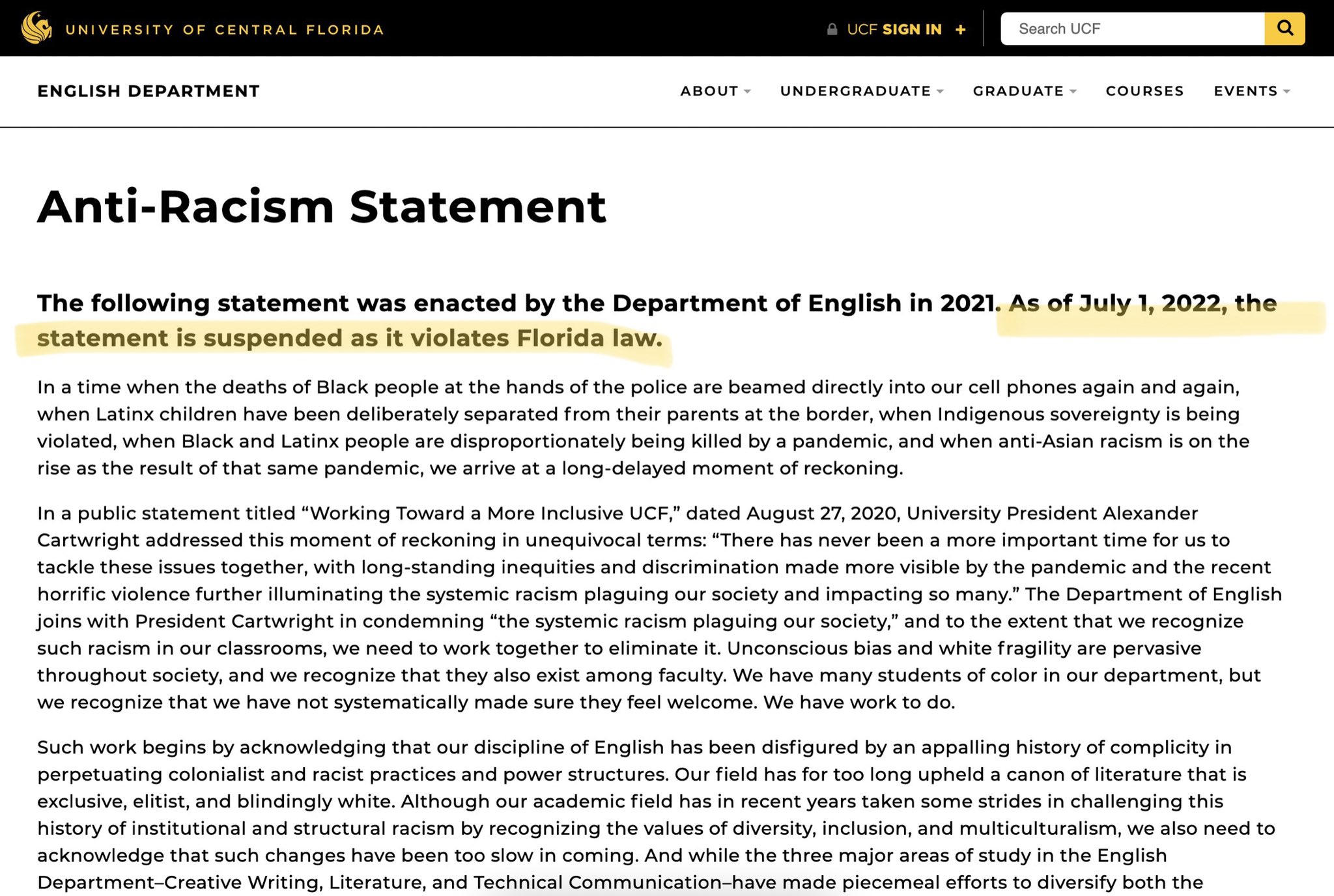
Cassanello’s institution, the University of Central Florida, withdrew its anti-racism statement after the law went into effect. 

Screenshot of anti-racism statement being suspended due to Florida law.

Teachers, a student, a professor and a diversity consultant filed a lawsuit in April to challenge the constitutionality of the legislation, but their suit was thrown out after a U.S. District judge determined teachers and students do not have the standing to sue, writing that he was not “determining whether the challenged regulations are constitutional, morally correct or good policy.” So a new group of plaintiffs asked a federal judge to issue a preliminary injunction against the law.

After the initial passage of the act, several Florida legislators came out strongly against the governor’s attack on higher education.

Member of the Florida State Senate Bobby Powell sees the legislation as an attempt to suppress the history of people of color. “You cannot discuss Robert E. Lee, or George Wallace, or Selma or Charlottesville without context…Slavery happened. Hangings happened. Burnings happened. Massacres happened. Jim Crow happened. George Floyd happened. And no amount of legislative banishments can erase those uncomfortable facts,” Powell said.

Even amid the lawsuit, Florida’s state government started approving mechanisms to enforce the new legislation this week. The board is working on passing penalties for university employees who do not go along with the new regulations. Additionally, the implementation will now tie state university funding to compliance.

Brett Sokolow, president of the Association of Title IX Administrators, told The News Service of Florida last month that many targeted trainings attempt “to sensitize the participants to how common racism and other forms of bigotry can be in academia, how to be allies to those impacted by bias, how to intervene in situations of hate speech.”  

Depending on how the judge rules, this legislation could have large implications for other states.

In Texas, for example, Gov. Greg Abbott already passed a controversial bill in 2021 regulating the teaching of slavery and racism in PreK-12 classrooms and could take the passage of the “Stop W.O.K.E. Act” as a green light to continue to regulate education.

One of Cassanello’s main concerns is that the nature of these “critical race theory” bans is so vague, making their future impact currently unknown. “People are really concerned about their freedom in the classroom,” he said. “A lot of this legislation is unclear about where the lines are.”

Jan. 6 filmmaker reveals Trump kids’ “incredibly bitter and angry” reaction to election loss

On Thursday, Business Insider reported that Alex Holder, the British documentary filmmaker who went behind the scenes during former President Donald Trump’s plot to overthrow the 2020 presidential election, revealed new details about how the former president’s children reacted to his loss in private.

“Holder in a Tuesday interview with Insider described seeing a ‘mixture’ of reactions among Trump’s three eldest children: Ivanka, Eric, and Don Jr,” reported Sophia Ankel.

“There was an attitude that one of them would give which was sort of incredibly bitter and angry about the end result,” Holder said. “And then there were the other children who were totally in denial and would not even refer or discuss or engage with anything to do with the fact that they were no longer in the White House and the catastrophe that had taken place earlier.”

Holder did not elaborate on which of the three children had which reactions.

“Trump’s two eldest sons, Don Jr. and Eric, have vocally stood behind their father in his unfounded claims the election was stolen,” the report noted. “In a string of text messages, first reported by CNN, Don Jr. encouraged former White House Chief of Staff Mark Meadows to pursue ‘multiple paths” to overturn his father’s election loss. In a separate interview with The Independent, Holder said that Eric was unconcerned about potential violence from Trump supporters reacting to false claims of election fraud. In contrast, Ivanka and her husband Jared Kushner, stayed tight-lipped in the final weeks of Trump’s presidency while slowly distancing themselves from the administration, according to The New York Times.

Holder’s documentary, which is scheduled to air on July 10th on Discovery+, has gained significant publicity after the House Select Committee investigating the Capitol riots subpoenaed his footage as part of their investigation.

This comes as Ivanka’s conduct in the run-up to the January 6 attack has come under fresh scrutiny. She claimed in a deposition for the House January 6 Committee that she agreed with former Attorney General William Barr’s assessment debunking Trump’s conspiracy theories about the election, but privately in 2020, she said she believed Trump should “continue to fight” the election results.

The Joe Biden reality show: Most stage-managed presidency in history keeps undermining itself

What a difference an administration makes.

Donald Trump had nothing to say and said it all the time.

President Joe Biden has more to say and rarely says it.

Or at least that’s what a lot of his fellow Democrats seem to think.

Following the shooting in Highland Park, Illinois, on the Fourth of July, there is growing criticism from members of Biden’s party, who accuse the president of not saying enough about this important issue. White House press secretary Karine Jean-Pierre says Biden has approached the continuing gun violence issue with “passion” and “fury.” Some of his fellow Democrats, however, have reportedly begun to doubt both of those. Some of that criticism comes from Congress, where it is obvious they mistake “fury” for action. It would also explain why Congress often seems so furious and yet takes so little action. 

Biden has done himself no favors because even the press (which, until recently, was still in a honeymoon with the White House) says he continuously hides from the public. He’s had just one full news conference at the White House — during the pandemic, with relatively few reporters present — and he routinely avoids putting himself in situations where the press can ask him questions.

RELATED: Joe Biden is finding out that “better than Trump” is not nearly good enough

Donald Trump used the Oval Office as an interactive bully pulpit and battering ram — screaming and ranting and raving at the press while taking questions in a variety of venues that he believed gave him an advantage, whether in his infamous “chopper talk” sessions on the South Lawn, in pool sprays or elsewhere. Trump could make an ass of himself anywhere, always did and still does.

But today, the president of the United States is a role played by a septuagenarian in a reality show.

Or at least that’s the way it seemed last Friday.

For the first time since January, I was given permission, along with perhaps two dozen other reporters, to walk into the South Court Auditorium and serve as a temporary audience during a presidential reality show episode. Of course, that’s not how it was billed. But the auditorium has morphed into a Hollywood sound stage over the last 17 months. During previous administrations, the room was pressed into service as anything from an overflow workspace to an auditorium hosting presidential press events. The first COVID briefings under Trump took place in that auditorium, before approximately 200 members of the press corps.

Today that would be impossible. The producers, cameras, sound technicians, lighting director and assorted staffers, as well as the auditorium’s physical transformation, make large audiences impossible. The largest readymade press venue on the White House campus right now is the 49-seat Brady Briefing Room. 

After getting a two-minute warning Friday, the president, bless his heart, showed up almost on time. That alone is refreshing to most reporters who are accustomed to a more fluid schedule when it comes to the leaders of our country. Biden walked in and, relatively unceremoniously, sat downstage right. He was at a desk, at a 45-degree angle to the audience and facing a backstage wall that served as a video screen for his call with Democratic governors following the Supreme Court’s decision to overturn Roe v. Wade. Ten minutes later, the press was ushered out. Who knows what happened next? If, for some strange reason, the nation had to rely on reports from the Washington press corps as to what happened, we’d be stumped. The reporters and photographers were gone. Apparently there was video. Thank God, right? 


Want a daily wrap-up of all the news and commentary Salon has to offer? Subscribe to our morning newsletter, Crash Course.


I swear, at one point I thought the president might turn, look at the audience and say, “We’ll have more with irate governors after this important commercial message . . . “

Not one moment for questions from the press.

No real moment in which to interject one.

Completely scripted, down to the usher-like tones from the wranglers who whispered, “Time to go.”

Trump called us the “enemy of the people” and “fake news.” He personally insulted reporters. But he also mixed it up with questions, pro or con. Biden simply avoids the press. He’s the most managed president in history.

If this had happened under Trump, he would have been late, combative and surly. He would have accused us at least once of being the “enemy of the people,” called us “fake news” at least twice and might have personally insulted a reporter just for good measure. But he’d mix it up with questions, not caring if they were pro or con. He was ready to fight with anybody. That was Trump’s game plan. After he got comfortable in any venue in the White House, he stayed and fouled the nest. At first, there was no chopper talk. Then, after trying it once and being invited back, he kept doing it. After he showed up in the Brady Briefing Room to discuss the pandemic, with a little more than a year left in his term of office, he was again invited back. 

We couldn’t get rid of him, in either venue, after that. 

Maybe I shouldn’t have invited him to stay?

The Biden administration is, of course, thank God, nothing like Trump’s. But Biden’s administration is also the most staged presidency in history. I mean, he literally has a soundstage. I couldn’t ask a question on Friday. And the next time he was in front of the open press — on Wednesday afternoon, as he left for Ohio — there was also no opportunity to talk to him. 

This time he pulled a trick I’ve seen other presidents pull in years past. The pool report put it this way: “POTUS, giving the pool a bit of a fake-out, exited via the East Wing garden (and not the traditional exit) at 12:21 p.m. He waved but was too far from the pool to hear a few shouted questions, and didn’t come over to chat.” 

If Biden is actually incapable of occasionally taking unscripted questions from a wide variety of journalists, then the Democrats should be looking hard for someone who can — though they should heed the warning of history and avoid creating a Kennedy vs. Carter moment, as in 1980, that divides the party and allows a demon seed like Ronald Reagan to fall through the cracks and take root. In short, if the Democrats are going to proceed without Biden, it has to be at his initiative, or at least appear to be so. (Wink, wink.) The Democrats definitely don’t need a competitive primary season where the incumbent president is fighting for survival. But given that this is the Democratic Party, they might just do that. 

On the other hand, if Biden is capable of taking unscripted questions and his staff won’t let him, then he needs to look for different staff. Either way, the longer Biden remains disconnected from the public, the more room he gives the Republicans to maneuver — and let’s face it, that’s what the Republicans do best. They can’t find their moral compass despite all the devout Catholics on the Supreme Court  (or maybe because of them), but they’re well-equipped to play dodgeball.

Meanwhile, the Biden White House is hamstringing itself with the press, for reasons that defy logic. It has instituted arbitrary press restrictions, whose motives are suspect and which hamper the administration’s ability to get its own message out — especially to those who aren’t exactly fans and thus have the greatest need to hear it. 

If Biden is actually incapable of taking unscripted questions, Democrats should be looking for someone who can — although they fear a 1980-style Kennedy vs. Carter disaster.

“The continued inability of the White House to be candid and transparent about the selection process for reporters attending his remarks undermines President Biden’s credibility when he says he is a defender of the First Amendment,” I wrote in a letter signed by 70 other reporters and given to the Biden press office Friday. “The incongruity of these restrictions underscores the belief by many reporters that the administration seeks to limit access to the president by anyone outside of the pool, or anyone who might ask a question the administration doesn’t want to answer.”

 “Let us be candid,” I explained further. “Our job is not to be liked, nor is it to be concerned about whether or not you like what we ask. A reporter’s ability to question the most powerful man in our government shouldn’t be discretionary. The administration’s continued efforts to limit access to the president cannot be defended. Any notion that space is ‘limited’ is not supported by the fact that every other president before Biden (including Trump) allowed full access to the very same spaces without making us fill out a request form prior to admittance.”

To be blunt, I doubt any president’s commitment to a true free press. It runs antithetical to the desires of any politician who runs for office. It has been my experience that most administrations are tolerant of a free press as long as we freely agree with them — and they dole out access accordingly.

Trump, on the other hand, was a reactionary who would strike out at friends as well as perceived foes, but always tried to destroy the free press by any means available. If he had thought of taking off a shoe and throwing it at us, he would probably have done it.

Today, however, there is some hope. Biden’s new press secretary, Jean-Pierre, is both pragmatic and responsible, two words rarely or never used in combination to describe any press secretary of the Trump years. When I asked her during Tuesday’s press briefing about the letter I wrote regarding press restrictions, she said the administration would work with us to provide greater access. “This is also a priority of ours,” she assured us.

I hope so.

Meanwhile, where’s the engine driving the Biden message? The North Lawn is unusually quiet these days, compared to what I’ve seen under previous administrations. No high-ranking White House officials are at the sticks. They’re not out at the tents talking to press. None are willing to appear “live” from the White House. You almost never see a Biden staffer on the North Lawn. If the Biden administration doesn’t lack energy, then what does it lack? People?

There simply is no comparison between Biden and Trump, and it’s absurd even to raise the issue. Yet the Biden administration has brought such comparisons on itself, through its own inaction, and its limited interaction with the rest of the world. Trump is still out there, still ready to suck up every molecule of attention by any means possible. The world needs to hear a lot more of the Biden administration’s sanity than of Trump’s insanity — at least up to the point when Trump is indicted, convicted and jailed. 

I mean, who’s gonna care about him after that?

Read more from Brian Karem on Biden, Trump and America:

Uvalde officer asked for permission to shoot gunman before he entered school — but got no response

Uvalde officer asked permission to shoot gunman outside school but got no answer, report finds” was first published by The Texas Tribune, a nonprofit, nonpartisan media organization that informs Texans — and engages with them — about public policy, politics, government and statewide issues.

Sign up for The Brief, our daily newsletter that keeps readers up to speed on the most essential Texas news.


An Uvalde police officer asked for a supervisor’s permission to shoot the gunman who would soon kill 21 people at Robb Elementary School in May before he entered the building, but the supervisor did not hear the request or responded too late, according to a report released Wednesday evaluating the law enforcement response to the shooting.

The request from the Uvalde officer, who was outside the school, about a minute before the gunman entered Robb Elementary had not been previously reported. The officer was reported to have been afraid of possibly shooting children while attempting to take out the gunman, according to the report released Wednesday by the Advanced Law Enforcement Rapid Response Training Center, located at Texas State University in San Marcos.

The report provides a host of new details about the May 24 shooting, including several missed opportunities to engage or stop the gunman before he entered the school.

The lack of response to the officer’s request to shoot the suspect outside the school was the most significant new detail that the report revealed.

“A reasonable officer would conclude in this case, based upon the totality of the circumstances, that use of deadly force was warranted,” according to the report. The report referred to the Texas Penal Code, which states an individual is justified in using deadly force when the individual reasonably believes the deadly force is immediately necessary to prevent the commission of murder.

The report said one of the first responding officers — a Uvalde school district police officer — drove through the school’s parking lot “at a high rate of speed” and didn’t spot the gunman, who was still in the parking lot. The report said the officer might have seen the suspect if he had driven more slowly or parked his car at the edge of the school property and approached on foot.

The report also found flaws in how the school maintains security of the building. The report noted that propping doors open is a common practice in the school, a practice that “can create a situation that results in danger to students.” The exterior door the gunman used to enter the school had been propped open by a teacher, who then closed it before the gunman entered — but it didn’t lock properly.

The teacher did not check to see if the door was locked, the report said. The teacher also did not appear to have the proper equipment to lock the door even if she had checked. The report also notes that even if the door had locked properly, the suspect still could have gained access to the building by shooting out the glass in the door.

An audio analysis outlined in the report shows 100 rounds were fired in the first three minutes after the gunman entered rooms 111 and 112 — from 11:33 a.m. to 11:36 a.m.

The report highlighted other issues with the law enforcement response before the gunman — an 18-year-old Uvalde man — entered rooms 111 and 112 for the last time.

The gunman was seen by security cameras entering room 111, then leaving the room, then re-entering the room before officers arrived. The report determined that the lock on room 111 “was never engaged” because the lock required a key to be inserted from the hallway side of the door.

Uvalde school district police Chief Pete Arredondo previously told The Texas Tribune that he had checked the door on room 111, but it was locked.

The officers were also in multiple teams at both ends of the south hallway of the school “resulting in a high likelihood of officers at either end of the hallway shooting officers at the other end” if the suspect had emerged from the classroom again, according to the report.

The report said that after the gunman entered the building, the officers did not properly engage the shooter and lost momentum.

“Ideally, the officers would have placed accurate return fire on the attacker when the attacker began shooting at them,” the report said. “Maintaining position or even pushing forward to a better spot to deliver accurate return fire would have undoubtedly been dangerous, and there would have been a high probability that some of the officers would have been shot or even killed. However, the officers also would likely have been able to stop the attacker and then focus on getting immediate medical care to the wounded.”

The report is likely to inform any policy responses to the tragedy, the deadliest school shooting in Texas history.

“ALERRT’s 26-page report outlining the attack on Robb Elementary School in complete detail was very difficult for me to read today as it will be for all Texans,” Lt. Gov. Dan Patrick said in a statement. He noted that more reports from the FBI, the Texas Rangers, and the Uvalde County district attorney are expected to be released in the coming weeks and months.


Join us at The Texas Tribune Festival, happening Sept. 22-24 in downtown Austin, and hear from 300+ speakers shaping the future of Texas including Joe Straus, Jen Psaki, Joaquin Castro, Mayra Flores and many others. See all speakers announced to date and buy tickets.

This article originally appeared in The Texas Tribune at https://www.texastribune.org/2022/07/06/uvalde-school-shooting-robb-elementary-report/.

The Texas Tribune is a member-supported, nonpartisan newsroom informing and engaging Texans on state politics and policy. Learn more at texastribune.org.

Prominent evangelical leader caught on a hot mic boasting about praying with SCOTUS justices

A right-wing, anti-abortion religious activist was caught bragging about praying with various Supreme Court Justices, according to a hot mic audio tape obtained by Rolling Stone

The admission was made by Peggy Nienaber, the executive director of Liberty Counsel’s D.C. ministry, during a celebration of the court’s decision to overturn Roe v. Wade, the landmark 1973 ruling that established America’s constitutional right to abortion. On a live stream, Nienaber was directly asked whether she prays with any members of the court. 

“I do,” she responded, seemingly unaware that the stream was being recorded.

“They will pray with us, those that like us to pray with them.”

RELATED: “Impeach Justice Clarence Thomas” petition has nearly 1 million signatures so far

She later added that her comments were “totally off the record.”

If true, Nienaber’s allegation would pose a significant conflict of interest for the court.

Since its inception in the late ’80s, Liberty Counsel has vociferously fought to curtail abortion rights by building access to anti-abortion lawmakers in different branches of government. The group has brought legal cases to the Supreme Court and specifically submitted a friend-of-the-court brief in Dobbs v. Jackson Women’s Health, which officially ended the federal right to abortion last month. 

Mat Staver, Liberty Counsel’s founder, vehemently denied Nienaber’s claims, telling Rolling Stone that there is “no way” the group has prayed with any justices.

“She has prayer meetings for them, not with them,” he claimed. 


Want a daily wrap-up of all the news and commentary Salon has to offer? Subscribe to our morning newsletter, Crash Course.


However, the ministry’s founder, Rob Schenck, who originally launched the group under the name of Faith and Action in the Nation’s Capital, affirmed that the group has hosted prayer ceremonies with members of the Supreme Court since the late ’90s. Schenk told Rolling Stone that the group built personal relationships with Justices Samuel Alito, Clarence Thomas, and the late Antonin Scalia.

RELATED: “Radical power grab”: New Supreme Court case could allow right-wingers to ignore voting right laws

“The intention all along was to embolden the conservative justices by loaning them a kind of spiritual moral support – to give them an assurance that not only was there a large number of people behind them, but in fact, there was divine support for very strong and unapologetic opinions from them,” Schenk explained.

Nienaber’s comments come as the public’s view of the court continues to sour. 

Last month, Gallup found that only a quarter of all respondents in the U.S. has “a great deal” or “quite a lot” of confidence in the judiciary – an eleven-point drop since last year.

U.K. PM Boris Johnson will resign as Conservatives quit en masse over latest scandal

British Prime Minister Boris Johnson announced his resignation Thursday after dozens of his government ministers stepped down earlier this week, jumping ship as the U.K. leader was engulfed by scandal, backlash over skyrocketing costs of living and other crises.

As the Associated Press summarized the situation, Johnson “managed to remain in power for almost three years, despite allegations that he was too close to party donors, that he protected supporters from bullying and corruption allegations, and that he misled Parliament and was dishonest to the public about government office parties that broke pandemic lockdown rules.”

“But recent disclosures that Johnson knew about sexual misconduct allegations against Chris Pincher, a Conservative lawmaker, before he promoted Pincher to a senior position turned out to be the last straw,” the AP added.

Johnson, who has also come under fire for badly mismanaging the U.K.’s coronavirus response and working against diplomatic efforts in Ukraine, said Thursday that he intends to stay on as a caretaker prime minister until a successor is chosen.

“I want to tell you how sorry I am to be giving up the best job in the world,” Johnson told a crowd outside 10 Downing Street. “But them’s the breaks.”

With the resignation highly anticipated, progressive critics over recent days have said Johnson’s ignoble ouster would be a fitting end for the right-wing politician reviled by so many.

Nicola Sturgeon, first minister of Scotland, questioned whether it is “sustainable” for Johnson to remain prime minister until the fall.

“Boris Johnson was always manifestly unfit to be PM and the Tories should never have elected him leader or sustained him in office for as long as they have,” Sturgeon said. “But the problems run much deeper than one individual. The Westminster system is broken.”

In a statement, Labour Party leader Keir Starmer declared that “it is good news for the country that Boris Johnson has resigned as prime minister.”

“But it should have happened long ago,” said Starmer. “He was always unfit for office. He has been responsible for lies, scandal, and fraud on an industrial scale. And all those who have been complicit should be utterly ashamed. The Tory Party have inflicted chaos upon the country during the worst cost of living crisis in decades. And they cannot now pretend they are the ones to sort it out.”

“We don’t need to change the Tory at the top — we need a proper change of government,” he added. “We need a fresh start for Britain.”

Former Labour leader Jeremy Corbyn sent a similar message earlier this week, writing on Twitter that “12 years of cruel Tory rule” have been “inflicting pain for the many to feather the beds of the few.”

“Johnson should resign now,” Corbyn added, “but real change can only come when the Tories are swept away and replaced with a people’s government to redistribute wealth and power.”

Trump may have committed “serious federal crime” with “targeted” IRS audits of Comey, McCabe: expert

Former FBI Director James Comey and his top deputy Andy McCabe faced rare, intensive IRS audits after investigating former President Donald Trump, according to The New York Times.

Comey, whom Trump fired in 2017 while he oversaw the FBI’s investigation into the Trump campaign’s ties to Russia, and McCabe, who was similarly terminated after investigating Trump over the Coney firing, were selected for a “random” audit known as an “autopsy without the benefit of death,” according to the report. Out of about 153 million individual tax returns filed in 2017, only about 5,000 people are selected for this type of invasive audit each year.

Comey and McCabe, along with their spouses, defied the odds, being selected for the audit after being fired. The two men were selected for an IRS research program that uses “compliance research examinations” to try to catch tax cheats. Unlike typical audits, these audits force individuals to produce bank records, copies of checks, receipts and letters effectively recreating their finances for the year in question. The process takes months and often costs thousands in accountant fees.

“Your federal income tax return for the year shown above was selected at random for a compliance research examination,” the IRS said in letters to both men. “We must examine randomly selected tax returns to better understand tax compliance and improve fairness of the tax system. We’ll give you the opportunity to explain any errors we may find during the examination.”

The “minuscule chances” of the top two FBI officials being selected at random raised questions about whether Trump appointees in the government or at the IRS purposely targeted them, noted Times reported Michael Schmidt.

“Lightning strikes, and that’s unusual, and that’s what it’s like being picked for one of these audits,” former IRS Commissioner John Koskinen told the outlet. “The question is: Does lightning then strike again in the same area? Does it happen? Some people may see that in their lives, but most will not — so you don’t need to be an anti-Trumper to look at this and think it’s suspicious.”

A Trump spokeswoman denied any knowledge of the audits.

IRS Commissioner Charles Rettig, a Trump appointee who remains on the job, declined an interview with the Times but said in a statement that he was not involved in any audit.

“Commissioner Rettig is not involved in individual audits or taxpayer cases; those are handled by career civil servants,” the statement said. “As I.R.S. commissioner, he has never been in contact with the White House — in either administration — on I.R.S. enforcement or individual taxpayer matters. He has been committed to running the I.R.S. in an impartial, unbiased manner from top to bottom.”

The IRS did not specifically comment on the cases but says it forwards any allegations of wrongdoing it receives to the Treasury Department for “further review.”

It is illegal under federal law for nearly anyone in the executive branch to request an IRS audit of a specific individual’s taxes.

Comey’s audit, which lasted over a year, actually found that he and his wife overpaid their federal income taxes and they received a $347 refund, according to the Times.

“I don’t know whether anything improper happened, but after learning how unusual this audit was and how badly Trump wanted to hurt me during that time, it made sense to try to figure it out,” Comey told the Times. “Maybe it’s a coincidence or maybe somebody misused the I.R.S. to get at a political enemy. Given the role Trump wants to continue to play in our country, we should know the answer to that question.”

McCabe said his audit found that he and his wife owed a small amount of money, which they paid.

“The revenue agent I dealt with was professional and responsive,” McCabe told the outlet. “Nevertheless, I have significant questions about how or why I was selected for this.”


Want a daily wrap-up of all the news and commentary Salon has to offer? Subscribe to our morning newsletter, Crash Course.


Months before McCabe’s audit, Trump publicly questioned McCabe’s finances, repeating a false claim about donations that his wife received when she ran for a Virginia state Senate seat.

“Was Andy McCabe ever forced to pay back the $700,000 illegally given to him and his wife, for his wife’s political campaign, by Crooked Hillary Clinton while Hillary was under FBI investigation, and McCabe was the head of the FBI??? Just askin’?” Trump tweeted in September 2020.

McCabe was fired by Trump Attorney General Jeff Sessions in 2018, which cost him his pension shortly before he was set to retire. The Justice Department in October 2021, under new Attorney General Merrick Garland, reinstated his pension and cleansed his personnel record. He was informed his audit was completed last month.

McCabe claimed he was directly targeted for the audit.

“There was no penalties, there was no fines or anything like that, it was really pretty minimal thing in the end. But it’s nerve-wracking, you know, it’s really, it’s really, kind of, you know – it’s scary, really, to be … targeted like that,” he told CNN. “I don’t know what happened here. And like I said, I think they handled the business okay, you know, the person I dealt with was fine, but the question remains, how was I selected for this?”

McCabe called for an investigation into the audits.

“It just defies logic to think that there wasn’t some other factor involved,” he said.

“No coincidence, for sure. Odds are 30,000 to 1,” tweeted Harvard Law Professor Laurence Tribe, warning that “this kind of political targeting is a serious federal crime.”

Read more

Trump’s war on Comey and McCabe

Guardian reporter Hugo Lowell: What we still don’t know about Jan. 6 and Trump’s “full-blown coup”

The House select committee investigating the events of Jan. 6, 2021, has collected more than 140,000 documents and interviewed at least 1,000 people. It has held six televised public hearings so far (with another scheduled for July 12) which have been viewed by tens of millions of people in America and around the world.

A veritable legion of reporters, filmmakers, legal scholars, historians and other researchers have also been doggedly pursuing the truth about Jan. 6 and its larger implications. In a very real sense, the Capitol attack was the most documented crime scene in American history.

great deal of information is already known about Donald Trump and his confederates’ coup attempt, and about their escalating campaign to end American democracy. Nonetheless, there remain many unconfirmed rumors, unanswered questions, unexplained details and a variety of secrets not yet forced out into the light.

During the committee’s hearing last Tuesday, Cassidy Hutchinson, a former aide to Trump chief of staff Mark Meadows, gave testimony making clear that Trump and his closest advisers anticipated and welcomed the violence on Jan. 6. Trump was told by the Secret Service that his followers were armed with pistols, assault rifles, and other lethal weapons. Trump ordered that they be allowed to gather by the thousands on the Ellipse anyway. It appears highly likely that Trump intended to go the Capitol himself. Following the pattern of coups that have occurred in other countries, after his followers attacked the Capitol and disrupted the certification of the 2020 Election, Donald Trump would have announced himself as “president” for some indefinite time in the future because of a “national emergency” — one that he and his confederates actually created.  

RELATED: What Cassidy Hutchinson told us — and why we should have known it already

So the question now is not whether Donald Trump and his confederates committed high crimes against American democracy and the rule of law, but whether they will ever be prosecuted by the Department of Justice.

To discuss that possibility and many other matters related to Jan. 6, I recently spoke with Hugo Lowell. He is a congressional reporter for the Guardian, and one of the sharpest observers of the House select committee’s investigation. In this conversation, Lowell reflects on what it was like to hear Cassidy Hutchinson’s testimony in person, and whether that marked a turning point in the Jan. 6 hearings and the country’s possible reckoning with Donald Trump and his legacy.

Lowell says the committee has conclusively demonstrated that Donald Trump was (and remains) at the center of a violent plot to end American democracy and that he is responsible for his own actions and behavior. He also suggests that the Department of Justice may ultimately prosecute Donald Trump for financial crimes, just as the FBI often targets organized-crime figures for tax evasion. 

Lowell also discusses how close Trump actually came to declaring martial law, and says many questions remain about the role of retired Gen. Michael Flynn and various right-wing paramilitary groups in the events of Jan. 6 and beyond.

Toward the end of this conversation Lowell ponders the questions that the House select committee has not yet addressed, most notably about the relationship between militia groups, Donald Trump and the members of Trump’s inner circle who met in the “war room” at the Willard hotel on the eve of the Jan. 6 insurrection. 

As someone who is reporting on the Jan. 6 hearings and related matters, how are you managing it all? How did you feel after last week’s hearing and the testimony by Cassidy Hutchinson?

The testimony that Cassidy Hutchinson gave was truly extraordinary from a legal perspective, and for what it showed about potential criminal exposure on the part of Trump. But also think her testimony was extraordinary from an emotional perspective.

It was very powerful for me to hear Cassidy talk about how she felt that what Donald Trump was doing was unpatriotic and un-American, and how it saddened her. I thought to myself that it saddens me too, a great nation like the United States being reduced to talking about a president who is throwing dishes, sending armed people to the Capitol and trying to attack a Secret Service agent because he wouldn’t drive him there. It was all actually quite sad. I just sat there for a minute contemplating what Cassidy was saying. As extraordinary as it was, it was also very disappointing. It really felt like America has regressed.

What does it feel like to see America brought so low by Jan. 6 and the Age of Trump more generally? And specifically, by what is being revealed by the House Jan. 6 hearings?

I disagree with your premise a little bit. I recently went to a British embassy event, a Jubilee celebration. I asked a senior person there, “What do you make of all this? Isn’t this all crazy?” And she said, “Well, if I look at it from a God’s-eye perspective, America’s not even 300 years old and it has done so many amazing things. But there are obviously going to be some blips along the way.”

Donald Trump and Jan. 6 were a blip in the lifespan of a nation. I think about where the U.K. was, 200 or 300 years after its founding: Civil wars, people getting decapitated. This was transient. It’s temporary.

Jan. 6 and Trump was a blip in the lifespan of a nation. I think about where the U.K. was, 200 or 300 years after its founding. There were civil wars. People were getting decapitated. What happened with respect to the Capitol attack and Trump and the division of America was transient, in this person’s opinion. It was temporary. It’s just that America has condensed its history into a much shorter span than other countries. She was very optimistic about America.

The tired phrase “history was made” has been summoned up by many in the news media to describe Hutchinson’s testimony. What history is really being made? And what does it mean, in the long term, in terms of Trump and his confederates being punished for Jan. 6?

The effect of that hearing was to jolt the American public, to wake them back up to the gravity and seriousness of Jan. 6. In my opinion, a type of collective fatigue had set in over the Capitol attack during these last 10 or so months. There’s been a drip, drip, drip of news and some little investigative findings. We have heard some things from the House committee, but not much. People who are focused on what happened on Jan. 6 already knew a lot about Donald Trump’s efforts to overturn the 2020 election and how it all culminated with the Capitol attack. In the broadest terms, most people know that Trump was responsible to some degree for inciting the Capitol attack. The Senate Judiciary Committee and the House Oversight Committee already uncovered most of what the Jan. 6 committee covered about how Trump tried to pressure the Department of Justice into overturning the election.


Want a daily wrap-up of all the news and commentary Salon has to offer? Subscribe to our morning newsletter, Crash Course.


Hutchinson’s testimony was like an electric shock to the collective public consciousness because the testimony was so riveting and so extraordinary and so appalling, and because what Trump did was so unbecoming of a president.

Yes, there were the tabloid dimensions, with the accounts of Trump throwing his lunch at the wall in anger and throttling a Secret Service agent. But the testimony was still so riveting because you can picture in your mind’s eye Trump doing these things. What Trump did on Jan. 6 is objectively bad. Hearing Hutchinson explain what Trump did was a seminal moment for a lot of people. The committee was able to use her testimony to get the public focused back on Trump’s conduct on Jan. 6 — what Trump was doing and what he wasn’t doing and these questions of his criminal exposure.

What was it like to witness Hutchinson’s testimony in person? How would you assess that moment as storytelling and theater?

The atmosphere before the hearing was unlike what it felt like before for any of the previous hearings, it was markedly different. You could sense this was a big deal. Through my reporting, even though we didn’t know what Cassidy was going to say, we knew it was going to be bad.

Members of Congress went into a secure briefing room that’s normally reserved for the House Intelligence Committee. They were in that room for hours before the hearing started. Everyone’s very tightlipped about it. I got the sense that there were more Capitol police officers there as well. Everyone was on a higher stage of alert. It felt like the stakes were suddenly very, very high.

Hutchinson was sworn in, and she sat down and then she started talking. Almost every single sentence she said was new and it was riveting. The atmosphere in the room was very sharp, that is the best way to describe it. It wasn’t like a thriller or a novel. There was a sense of anxiety and trepidation. It was almost like watching a horror film. You want to know what’s about to happen. You know it’s going to be bad, because the music is getting ominous and you want to look away, but you can’t look away. That was how I felt in the room watching Cassidy Hutchinson’s testimony.

Who is the main audience for the Jan. 6 hearings? Are observers such as myself just too cynical? To my eyes, we are learning new details, but the broad strokes of the Trump plot have been known for some time. What am I getting wrong with such an assessment?

These hearings are for the public — independent voters and suburban voters, especially — who might not already have a concrete idea in their minds about what happened on Jan. 6 and who was responsible for it. The salacious stuff about Trump is for the public audience as well.

The other audience is the Justice Department. The committee is presenting the evidence to them in great detail, so that the DOJ knows what evidence it will have when matters are turned over to them. Trump’s response, when he was told that the crowd outside the Ellipse didn’t want to go into the secure rally area because they didn’t want to give up their weapons — he responded, “I don’t fucking care. They’re not here to hurt me. They can march to the Capitol from here.” That was really revealing, from a potential criminal exposure standpoint. Not only does it show that Trump knew the crowd was armed, but that he knew they were armed to cause harm to someone, just not him.

He knowingly sent them to the Capitol. He encouraged the crowd to go to the Capitol, knowing full well before he took the stage that they were armed. In terms of incitement to violence and obstruction of congressional business, that was very significant.

The final audience for Hutchinson’s testimony was the reporters. The reporters and the news media more broadly have been very cynical about these hearings and whether much of what is being presented is new information. Last Tuesday’s hearing was very different. It spoke to me in a different way, and I thought I’d lost the ability to be shocked.

What is the relatively simple and direct story about Jan. 6 so far? How do we connect the dots for the American people, especially those who have not been following these matters closely?

We have now learned for the first time that Donald Trump incited armed people to go to the Capitol. We learned that Rudy Giuliani and Mark Meadows may have criminal exposure.

That the Capitol attack was the combination of this multi-pronged, multi-month effort by Donald Trump and his allies to overturn the election. It was just one part of a multi-pronged strategy. But last week we learned for the first time how directly Trump was involved. We also learned more about how his top aides were involved in the plan. We always knew that Trump knew about the plans to overturn the election and how he was pressuring Mike Pence to be part of that plan.

But we have now learned for the first time, and under oath, that Donald Trump incited armed people to go to the Capitol. We also learned that Rudy Giuliani, his personal lawyer, and Mark Meadows, his White House chief of staff, may have criminal exposure themselves. They were asking for pardons, which shows a consciousness of guilt. They were also in communication with Roger Stone, Michael Flynn, John Eastman and other high-ranking figures.

All of the pieces came together. We can now connect Trump and Meadows at the White House to Roger Stone and Michael Flynn and Rudy Giuliani at the Willard war room, and then we also tied it all to the rally. That was particularly significant.

Michael Flynn is central to the events of Jan. 6, both the coup plot and attack on the Capitol. What role did he play?

The short answer is, we don’t know. The long answer is that a number of reporters, investigators and the Department of Justice are trying very hard to understand what Mike Flynn was doing in the weeks between Dec. 18, 2020, when his idea to seize the voting machines was discussed and not taken up at the White House, and Jan. 6. Flynn does not go away.

After he and Sidney Powell get thrown out of the White House, they don’t go away. They hang around. The way I’ve been looking at Flynn and his involvement with Jan. 6 is how he pops up at key moments in the timeline. The first major point with Flynn is that he is present on Dec. 12 at a rally in Washington, the Jericho March. Flynn makes a speech in front of the Supreme Court. He is seen with the Oath Keepers and the 1st Amendment Praetorian, his personal protective security detail. These are volunteers, ex-military. That’s the first time we see Flynn interact with the Oath Keepers. The leaders of the Oath Keepers have been indicted by the DOJ for seditious conspiracy.

We fast-forward to Dec. 18 where Flynn is pitching the idea of using Executive Order 13848, that would give the president effectively broad authority to use emergency laws in order to seize voting machines. We then fast-forward through to early January. Mike Flynn is at the Willard hotel, the same venue as Roger Stone and Rudy Giuliani. He has no obvious connection to Jan. 6, but he is at the Willard, and he is at the center of everything. It’s almost like Flynn is gathering intelligence for his own purposes.

Cassidy’s testimony revealed that on Jan. 5, Donald Trump told Meadows to call Flynn. On Jan. 6, Flynn’s 1st Amendment Praetorian are seen around the Capitol. They don’t really break into the Capitol, which is why they’ve not been charged. One of Flynn’s operatives has been tracked at key events. Independent journalists have been doing this work.

Mike Flynn pops up at key moments in the timeline. He has no obvious connection to Jan. 6, but he is at the center of everything. He was there for something — we just don’t know what.

The person in question was at the Dec. 12 rally, and then he’s at the Capitol grounds on Jan. 6. He never goes inside, but he’s got an earpiece in his ear and he’s walking around the Capitol. You see him on the East Front earlier in the day. You see him on the West Front when the Capitol is actually being stormed by Trump’s followers. You see him at various points. It’s almost like he’s gathering intelligence or is directing people somehow.

It’s very difficult to figure out what Flynn wanted to do on Jan. 6, but he pops up at all these key moments. It is very strange. He was there for something. We just don’t know what it is yet.

What do we know about Ginni Thomas, the wife of Justice Clarence Thomas?

Internally, the committee for the longest time was not interested in Ginni Thomas. They do not believe that she played an active role in organizing the Jan. 6 attack on the Capitol. They also don’t believe that she played an active role in the legal memos that form the underlying basis for Trump’s strategy to have Pence throw the election in his favor. They also don’t believe that she was actively involved in writing the Georgia “proof of concept” letter that Jeff Clark wanted to use to weaponize the Justice Department. The committee has always seen her as a political activist. She would try to get herself involved in this because that is what she does. She’s a right winger. She’s offering help if it can be used.

Recently, the House committee got ahold of the final set of John Eastman emails and other communications. And according to one source — and this is why I’ve not reported it — but one source tells me that the text messages between Ginni Thomas and John Eastman are potentially incriminating, to the degree to which she ended up inserting herself into efforts to overturn the election. I think it’s clear Ginni Thomas is not a key player. She might have had some involvement, but the committee is not focused on her is because she wasn’t seen as a key player.

I think she’s interesting. Her involvement is something for the Senate or House Judiciary Committee to investigate, because the wife of a Supreme Court justice is getting involved in election litigation. That’s bad. But that does not necessarily mean that Ginni Thomas was a ringleader in organizing the Capitol attack, based on what we know so far.

Where is the committee in terms of holding the Republicans in Congress who appear to have been involved in the coup plot responsible? We now know that several Republicans actually requested pardons from Donald Trump for their role in the events of Jan. 6 and the larger attempt to nullify the 2020 election.

They’re pending subpoena. Initially there was not much discussion about forcing subpoenas for Republican members of Congress. Some of the committee members were quite content for the Republicans to just ignore the subpoenas. In theory this would mean that if Republicans tried to subpoena Democrats in the next Congress, they could respond, “Well, you guys set our precedent and if you guys didn’t have to appear for our subpoenas, then we’re not going to appear for yours.” That was the strategy at one point, at least among some members. That has changed. There’s a real appetite now to try and get these Republicans before the committee. The committee members and the investigative counsel have had enough.

The email they obtained about Rep. Mo Brooks asking for pardons was part of that change. It’s one thing to get testimony to say Republicans are seeking pardons. It’s another completely different thing when you have the email that shows that Mo Brooks was asking for pardons on behalf of hundreds on them. The committee really wants to get to the bottom of why they were seeking pardons.

Were they seeking pardons just because Trump was hinting that he was going to give them out like candy, and therefore the Republicans thought it would be useful to have a pocket pardon? In and of itself, that is not a great explanation anyway.

Anytime you’re asking for a pardon, it almost always shows some consciousness of guilt. But if it was because they genuinely thought they’d committed a crime and they needed protection, then for what crime? Was it for obstruction? Were these Republicans involved in some sort of seditious conspiracy? Was it because they had contacts with people who they thought might have criminal exposure? There are so many questions.

Based on the available evidence, what can we reasonably conclude about the role of violence and the attack on the Capitol in the overall coup plot?

It was the last-chance opportunity for Donald Trump to remain president, by hook or crook. He knew, and every one of his advisers knew, that the moment Congress certified the presidential election on the 6th, that was it. No more post-election litigation is possible after that, because Congress has certified it. They already blew through the “safe harbor” day, the Electoral Count Act deadline by which point post-election litigation is normally supposed to stop, but then they pushed it all way to Jan. 6. It was the last chance Trump had to make sure the certification didn’t happen.

The Capitol attack was a Hail Mary play, a last chance for Trump to remain president, or at least kick it into the House. It was like, let’s throw everything we have at the wall and see if it sticks.

The attack on the Capitol was a type of desperate ploy, a Hail Mary-type play, a last chance for Trump to remain president, or at least have the matter kicked to the House in a contingent election so the Republicans could return him to the presidency. Everyone in Trump World thought this was the final opportunity he had to get back to the White House for a second term, and so they threw everything at it. This is why you had Eastman admitting in emails that his whole strategy for Jan. 6 was unlawful: “But let’s do it anyway, because we have no other choice and we have no other strategy left.” It was like, let’s throw everything we have at the wall and see if anything will stick.

How close did Donald Trump come to declaring martial law in order to remain in power?

We obviously know that people were in Trump’s ear talking about it. We know for a fact that Mike Flynn and Sidney Powell were talking about martial law at the Dec. 18 meeting at the White House, where Powell was trying to become special counsel and get Trump to sign the document that said we can seize voting machines.

According to one of my sources, and again this is only one source, there was a discussion late in January, a few days before Inauguration Day, where another of his aides asked Donald Trump if he was going to declare martial law. In each case Trump demurred.

I don’t think we will ever know how close Trump came, inside his own mind, to actually declaring martial law. Trump doesn’t like to make big decisions. But he was certainly being told about it and being urged to do it by at least some people all the way from Dec. 18 through close to Inauguration Day. On the one hand, he thought martial law would be a very straightforward way to just get what he wanted. On the other hand, I think Trump knew deep down the implications of declaring martial law and that there was potential for it not to end up the way that he wanted.

At some prominent places in the news media we are still seeing questions such as “How much did Trump actually know? Did he ever explicitly give commands or orders? Was he really responsible?” You’ve seen all those qualifiers from the usual suspects. How do you put such claims to rest? It is clear that Donald Trump was at the center of the whole damn scheme.

My approach with all of this has been that you do not actually have to prove what Donald Trump knew. All you have to show is what a reasonable person could have known. Would a reasonable person have believed that the election was stolen if your attorney general says it wasn’t? If your own campaign data experts say the numbers aren’t there? If your own advisers are saying the evidence for fraud claims never materialized? The “earnest belief” defense flies out the window because Trump is being willfully blind to the fact that the election was not stolen.

The committee has done a very good job in laying that out, in terms of charges such as obstruction of an official proceeding or conspiracy to defraud the United States. We have also recently learned about fundraising fraud. Real, genuine fraud, with Trump trying to get people to donate to a fund that doesn’t exist, and that Trump knew did not exist.

There are straightforward charges that carry heavy sentences that could potentially apply in Trump’s case. One might never be able to prove beyond a reasonable doubt that Trump engaged in seditious conspiracy. Even if he had, for the sake of argument, the bar to prove it is so high that the DOJ may not want to bring that type of charge. But the DOJ can bring charges against Trump that have severe penalties but are not as sexy. You get the mafia boss on financial crimes and on fraud and RICO. The DOJ does not have to get Trump on seditious conspiracy.

I actually think there is a very good chance, especially with the testimony from Hutchinson, that the DOJ considers bringing indictments against Trump personally, but not for a big headline-grabbing crime such as treason. The penalties for fraud and other such crimes are very severe as well.

Here is my summary based on what we know about the attack on the Capitol. Please intervene if need be. Violence was a central part of the coup plot. Trump wanted to go to the Capitol. He unleashed his armed supporters. There were right-wing paramilitaries who actually breached the Capitol before the main attack force appeared. The ultimate plan was to disrupt the certification of the election.

In keeping with what authoritarians and demagogues do, it was political theater, a banana-republic moment. Donald Trump wanted to be at the Capitol, if not on the floor of Congress, to take over and declare the election null and void, whatever verbiage he wanted to use. The violence and mayhem by his followers were a means for Trump to declare himself president during a time of national emergency. Trump was enraged because the plan was disrupted and he wasn’t allowed to go to the Capitol for the victorious moment.

I believe that you are correct. Trump knew that his supporters were armed. He knew they were likely to cause harm — just not to him. He knowingly sent them to the Capitol with the biggest incentive he could give, which is, “I’m going to be there with you.” If he had gone to the Capitol and wasn’t stopped by Secret Service and, let’s say, had given a speech outside Congress, that would have incentivized his followers even further.

Donald Trump was not going to the Capitol to pontificate. His intentions were to go to Congress and forcefully stop that certification from taking place. That is the definition of a coup.

The fact that Trump did not go to the Capitol insulated him, in Pat Cipollone’s words, from “being charged with every crime imaginable,” because then you are actually at the scene of the crime. If Trump had gone into the House chamber, that would have almost certainly been a crime. He is obstructing Congress, and he is also at the place of the crime. The fact that he was stopped protected him from that. But in his mind, Donald Trump’s intentions on Jan. 6 were to go to Congress and forcefully stop that certification from taking place.  

Donald Trump was not going there to pontificate and make general remarks about how the election was stolen from him. Everything in Trump’s conduct on the 6th was about sending his supporters to somehow make sure that certification didn’t happen and that Biden wasn’t certified as the next president by Congress. Trump had exactly the same conversation with his lawyers at the Willard hotel on the night of Jan. 5. If you put everything together, the picture you get is a president who should know he lost the election and trying to weaponize his supporters to forcefully stop the certification. That is the definition of a coup. Trump knew his followers were armed. That makes it a full-blown coup.

There are a lot of secrets still out there about Jan. 6, even after Cassidy Hutchinson’s testimony. What questions do you want to see answered? 

I’m fixated on the nexus of the militia groups, the White House and the Willard hotel figures. This is directly out of Cassidy Hutchinson’s testimony. I want to know why Mark Meadows believed that the 6th was going to be, “I don’t know, Cass, real bad.” I want to know why Giuliani told her, “Things are going to be bad on the 6th.” I want to know why the Oath Keepers and the Proud Boys were being mentioned around the White House when Giuliani was there. I want to know why Trump directed Meadows to talk to Roger Stone and Mike Flynn on the night of the 5th. I want to know why Meadows desired so desperately to go to the Willard, but then instead just connected via a conference call.

What was it that compelled Trump to get Meadows to talk to his operatives at the Willard? What was it that compelled Rudy to discuss the militia groups at the White House? What was it that gave Meadows so much pause days before the insurrection? What was it that gave Rudy the excitement that something bad was going to happen? I think the Cassidy Hutchinson hearing posed brand new questions and gave us more questions than answers.

Read more on the Jan. 6 committee and Trump’s coup attempt:

America as a war zone: Trump has turned the nation toward anger and violence

Increasingly, it seems, Americans have an anger problem. All too many of us now have the urge to use name-calling, violent social media posts, threats, baseball bats and guns to do what we once did with persuasion and voting. For example, during the year after Donald Trump entered the Oval Office, threats of violence or even death against lawmakers of both parties increased more than fourfold. And too often, the call to violence seems to come from the top. Recently, defendants in cases involving extremist violence have claimed that an elected leader or pundit “told” them to do it. In a country where a sitting president would lunge at his own security detail in rage, I guess this isn’t so surprising anymore. Emotion rules the American political scene and so many now tend to shoot from the hip without even knowing why.

Increasing numbers of us, however, respond to the growing extremity of the moment by avoiding the latest headlines and civic engagement, fearful that some trauma will befall us, even by witnessing “the news.” As a psychotherapist who works with veterans and military families, I often speak with folks who have decided to limit their news intake or have stopped following the news altogether. Repeated mass shootings in places ranging from schools to houses of worship combined with the increased visibility and influence of militias at theoretically peaceful demonstrations can be more scarring than the wounds soldiers once sustained in combat zones.

RELATED: Buffalo, Jan. 6 and the rise of partisan violence: These scholars saw it coming

I must admit that my family and I have sometimes practiced a similar form of political avoidance. Recently, I considered taking my two young children to the March for Our Lives gun-control event on the National Mall in Washington. However, my spouse, an active duty servicemember, urged me to reconsider. If extremists showed up, it might prove difficult for me alone to get our children out of danger. I thought better of it and stayed home.

In a country where a Republican senatorial candidate can run an ad featuring himself with an armed military tactical unit on a residential street, urging Americans to hunt “RINOS” — Republicans in Name Only, or those who criticize Trump — without widespread censure from his party, I believe my family’s fears are well founded.

The question “What if something happens?” at a protest would never have occurred to either my spouse or me when we first met more than a decade ago.

As a human rights activist who spent years working in Vladimir Putin’s Russia, I can say that I’m now more afraid of the hair-trigger responses of right-wing Americans than I was of that Kremlin strongman’s far more carefully targeted violence. I guess the memory of the Jan. 6 Capitol riot, insurrection, coup attempt (or any descriptor of your choice) by a mob of angry Trump supporters still weighs heavily on me.

The devil’s in the details

These days, it’s the mundane stuff like Republican Party meetings that contain the details we’d do well to notice. Such proceedings reveal a new level of combativeness as party leaders attempt to shape state and local laws and policies to their ever less democratic desires. For instance, Politico recently obtained recordings of Republican National Committee (RNC) operatives training thousands of volunteer poll watchers to disrupt future elections in Democratic districts of swing states like Michigan by actively challenging the eligibility of voters.

I worked in Vladimir Putin’s Russia, and I’m more afraid of hair-trigger right-wing Americans than I ever was of Putin’s targeted violence.

The RNC and its affiliates are linking those poll watchers to hotlines and websites that list party-friendly lawyers, police officers and district attorneys who might be ready to stage real-time interventions during voting and vote counts. For example, district attorneys recruited by the right-wing organization the Amistad Project will be able to start investigations and issue subpoenas ever more quickly.  

Of course, the RNC initiative at the polls is rooted in the baseless claim that the 2020 election was stolen from former President Donald Trump. That committee’s identification with such a lie should instantly debunk any idea that such would-be poll watchers could act fairly. The very roles of poll watcher and poll challenger are supposed to be legally different, with only poll challengers authorized to interfere in the voting process in most states, including Michigan — and then only based on facts.


Want a daily wrap-up of all the news and commentary Salon has to offer? Subscribe to our morning newsletter, Crash Course.


Yet we’re clearly in a world where Republican leaders have begun to treat our polls as war zones. In the spirit of this moment, an RNC election-integrity officer for Michigan, Matthew Seifried, described his future poll volunteers and the public officials supporting them this way: “It’s going to be an army.” He added that his party is “going to have more lawyers than we’ve ever recruited, because let’s be honest, that’s where it’s going to be fought, right?”

Seifried and his Michigan colleagues are anything but alone in their combative rhetoric. Such militarized language and imagery are now all-too-regularly part of our political DNA. Only recently, the Texas Republican Party released a statement refusing to recognize the legitimacy of Joe Biden’s 2020 election victory. All too typically, it also called for that state’s Republicans to “go on offense and win the fight for our country!”

In Texas and beyond, individuals expressing such anger (and sometimes a vision of a future white ethno-state as well) are gaining elected office. Surprising numbers of Republican candidates and public officials who share the view that the 2020 election was stolen also regularly echo the white racist Great Replacement Theory. Meanwhile, across the country, multiple electoral bills are being considered by Republican-controlled state legislatures that would, in the future, enable them to overturn elections.

According to the International Center for Not for Profit Law, 45 state legislatures have considered 230 bills that would criminalize the “threat” of violent leftist or Black protests. And sadly enough, far-right activists are anything but a “fringe minority” movement as they challenge the very idea of peaceful elections and public protests (that aren’t theirs).

Left-wing violence does exist: Of 450 murders by political extremists during the last decade, approximately 4% were by left-wing groups — and 75% by right-wing groups.

To be sure, left-wing violence and combative rhetoric is a thing in this country, albeit a small one. The shooting of a Trump supporter by an antifa protester in Portland, Oregon, during a Black Lives Matter demonstration in August 2020 is the lone example of a lethal attack by that left-wing group or other anti-fascists over the past 25 years. Of 450 murders by political extremists during the last decade, approximately 4% of them were committed by left-wing groups and about 75% by right-wing (white supremacist, anti-government) ones.

In my own extended family of parents, siblings, aunts and uncles, most of whom support Trump, about half have stopped speaking to me, while some have called me “weak” and a “coward” on social media because of the ideas I discuss in essays like this, where I’ve openly criticized the U.S. government and its military. (Of note, my immediate military family and friends accept our differences far more gracefully.)

Saving democracy

So, what are we to do? As a start, given where the Trumpist movement and much of the Republican Party seems to be heading, we really need to do something — almost anything. As Michigan Secretary of State Jocelyn Benson, a Democrat, pointed out, facing the growing crisis on the right, “I have seen no significant increase in support from national party leaders than what we experienced in 2018” when party vigilance was significant enough but not nearly what was needed.

A headline of an article in the satirical online newspaper The Onion caught the mood of the moment among progressives: “Left Wing Group Too Disorganized for FBI Agents to Infiltrate.” In it, a fictional FBI agent says, “These people don’t ever do anything violent — they don’t ever do anything at all.”

Recently, a local Democratic candidate in Maryland knocked on my door seeking my name and contact information as a possible volunteer for his campaign. It turned out, however, he wasn’t even carrying a pen or paper. That seemed to capture the problem I often note in progressive activism these days. I gave him a couple of our first-grader’s overdue library slips to write on and a marker we had lying around. And it’s sadly true that Democrats and progressives more generally lack a concerted response to right-wing anger and violence.

Ironically, one government institution that has at least made a nod toward countering right-wing violence is our military. Since the Jan. 6 attacks, the Department of Defense under Secretary of Defense Lloyd Austin has acknowledged an increase in domestic extremist violence carried out by active-duty or reserve service members. In response, he initiated a multipronged strategy to screen new recruits, educate military personnel about extremism and begin investigating extremist activity within the ranks.

While I’ve encountered my share of bigoted remarks in the five duty stations where we’ve served, I’ve also met far more people in those military communities than in civilian ones who are willing to form friendships with those of different ideological leanings. When you depend on one another for companionship and even survival, at home or abroad, you can’t be too choosy about the beliefs of your companions.

As partisan rhetoric heats up, progressives need to find a unifying message of community and love, and find it soon, before all the guns out there are put to use in unspeakable ways.

As partisan rhetoric heats up in this country, I’d say progressives are guilty of focusing too hard on the most politicized identity issues, however valuable, or even whatever asinine behavior ignites our airwaves at a given moment, be it Trump’s QAnon-style conspiracy-mongering or ex-New York Gov. Andrew Cuomo’s groping. The problem is that, as the Trumpists ramp up their anger, if progressives don’t find a unifying message of community and love, and find it soon, the guns already out there may be put to use in unspeakable ways.

Progressives would do well to step back and think about the genuine big-tent issues like how to show everyone from white suburban women to rural farmers to Black single parents that they have so much to lose in life if we don’t have a government willing to continue regulating health care and doing so in a far better fashion. They would gain so much if, in this all-too-angry country of ours, they could refocus our attention on the importance of child care for every family who needs it.

Above all, if they could focus in an intense way on the ever more dangerous world we’re living in, that would be a positive. Whether or not we agree on what’s causing global warming, it’s hard not to agree right now that we’re living in an ever hotter, ever more drought-stricken, ever more extreme America. Who can’t agree that it’s already damn hot and the summer’s just beginning?

Something needs to be done — and soon — to mitigate the effects of climate change, but no political campaign has yet emerged that captures the urgency and extremity (and for once I’m not thinking about Donald Trump!) of this moment. Most immediately, those of us who favor democracy and a better planet would do well to support the criminal prosecution of former President Trump because if he becomes this country’s leader again, we could find ourselves in trouble too deep to ever get out of.

And yes, on so many issues, many of us may not agree with Rep. Liz Cheney, the top Republican on the House committee investigating the Jan. 6 attacks, or even former Vice President Mike Pence, who risked his own life and his family’s to certify Joe Biden’s victory. But I agree with Rep. Jamie Raskin that they’re among the Republican heroes of this Trumpian moment (who are few and far between). As the Russian novelist and historian Aleksandr Solzhenitsyn once wrote, “The line separating good and evil passes right through the human heart.”

Occupying the hearts of many Americans, however, is Donald Trump, a damaged man who personifies our basest instincts. He needs to be identified forcefully by leaders of all stripes as the threat to democracy he is. (Hurry up, Attorney General Merrick Garland, and bring charges against him!)

Meanwhile, we should all seek opportunities to find common ground among ideological opposites. Invite over a neighbor for dinner, even though you know he listens to conservative radio on his way to work. Help another family with child care even though the political signs on their lawn aren’t ones you agree with. Just try to avoid the angry, armed ones or have them check their guns at the door. They’re the ones who need to change their tactics. Otherwise, judging by the flight of tens of thousands of highly skilled Russian professionals from Vladimir Putin’s warmongering regime, I’m sure he has a few job openings for them.

If only their hatred had no place here. It’s time to be less angry and far more focused.

Read more on the rising threat of political violence:

Ending gun violence isn’t an “either/or” question: It must be a “both/and”

“It’s not guns; it’s mental illness.” 

“It’s not guns; it’s violent media.” 

“It’s not guns; it’s bullying.” 

“It’s not guns; it’s toxic masculinity.”

“It’s guns, not mental illness” (or violent media, bullying, toxic masculinity or something else).

It frustrates us to witness debates like the ones above that seek to explain gun violence, because, as behavioral scientists, we know that rarely can any behavior be explained by a single cause. Nearly all behaviors are multiply determined.

In other words, the answer to “Is it guns or mental illness or bullying or toxic masculinity or violent media?” is “Yes, it is.”

RELATED: An endless arms race: How to fight the NRA’s absurd solution to mass shootings

Why are these “either/or” debates clouding “both/and” problems? Often it is because people attached to certain positions seek to deflect criticism by citing other causes for the violence. Most notably, those with emotional or financial attachments to the unfettered availability of firearms need to find some other plausibly related cause in order to try to convince audiences that, as we so often hear, “Guns are not the problem.”

For instance, in the aftermath of the horrific Sandy Hook Elementary School massacre, NRA CEO Wayne LaPierre blamed gun violence on the ubiquitous presence of violent media, calling for armed guards in every school because, he claimed, “the only thing that stops a bad guy with a gun is a good guy with a gun.”

The problem with this line of reasoning is that, as Christopher Vogler writes in “The Writer’s Journey,” “Every villain is the hero of his or her own story.” Nobody commits an act of gun violence without some sort of justification. In other words, killers like Kyle Rittenhouse, Adam Lanza and Seung-Hui Cho — the list goes on and on, added to nearly every day — all saw themselves as a good guy with a gun.

There is a long list of risk factors for gun violence, and if we, as a society, have the will to address at least some of them, we can significantly reduce the carnage. 

Men and boys who subscribe to distorted beliefs about masculinity, such as that the only acceptable emotion to display is anger, or that it is manly to be violent, are at risk for perpetrating gun violence, especially if they believe that their masculinity has been threatened and if they have experienced significant psychological trauma, such as child maltreatment or bullying. We can educate parents on how to raise boys with the emotional intelligence to address hurt feelings directly, instead of transforming their vulnerabilities into aggression. We can provide professional mental health services to at-risk people, and we can re-engineer schools to address bullying and other forms of maltreatment, including that which takes place on social media.


Want a daily wrap-up of all the news and commentary Salon has to offer? Subscribe to our morning newsletter, Crash Course.


We know that the viewing of violent media by those who have other risk factors for physical aggression can increase the probability of their acting violently by about 10 percent. Ten fewer dead people out of every hundred is indeed significant. We can teach people how to be critical of the violent messages they hear from media. Doing so has been shown to inoculate children as young as eight years old against violence. Most pernicious is media violence that is portrayed as justified. How often have we been in a movie theater where viewers cheer when someone kills the villain? Viewed uncritically, such portrayals fuel the “good guy with a gun” narrative.

A major factor in all violence is the means to do harm. If we can reduce the availability of firearms, especially high-capacity military-style assault weapons, we will go a long way toward decreasing the violence. Eighteen-year-olds, whose brains are not yet fully mature, cannot legally rent a car or buy a six pack of beer, yet they are allowed to purchase such weapons.

A comprehensive approach to solving the problem of gun violence must address all risk factors. We can intervene from many directions: legal, educational, law enforcement, psychotherapeutic, and social-environmental, reducing violence incrementally.

Where to start? Our suggestion: Let’s begin by reducing access to the means to do harm, especially for young men.

Read more on America’s epidemic of gun violence:

El Salvador woman gets 50 year sentence for pregnancy loss

Reproductive freedom advocates are condemning a 50-year prison sentence given to a woman in El Salvador this week, after she was convicted of homicide following what rights groups say was a stillbirth.

The case of Lesli Lisbeth Ramírez Ramírez, who was 19 when she suffered the pregnancy loss in June 2020, is the result of the type of “draconian abortion ban” which is “now being replicated in states across the U.S.,” said journalist Max Granger.

According to Vice, Ramírez “suffered an obstetric emergency and lost her fetus in the ninth month of pregnancy.” She said she hadn’t known she was pregnant and didn’t know what was happening when she gave birth. She was taken to a hospital and was detained shortly thereafter on suspicion of murder.

The judge who sentenced Ramírez, Ricardo Torres Arieta, also sentenced a woman identified as Esme in May to 30 years in prison, a year and a half after she sought help for a medical emergency during her pregnancy and lost her unborn child.

While sentencing her, Arieta told Ramírez that “mothers are the source of protection for their children in any circumstance of life, and you were not,” according to the Citizen Group for the Decriminalization of Abortion, an advocacy group based in San Salvador.

Since 1998, El Salvador has been one of a small minority of countries where abortion is completely illegal with no exceptions. People who have abortions face up to eight years in prison and providers face up to 12 years. A number of women have been charged with murder after suffering stillbirths and miscarriages.

The Inter-American Court of Human Rights ruled last year that the government violated the rights of a woman who died in prison in 2010 while serving a sentence for experiencing a stillbirth.

The citizen group on Wednesday condemned the judge for ignoring evidence “of the gender-based violence to which Lesli had been subjected.”

Ramírez’s lawyer, Abigail Cortez, noted that her client was one of many women in El Salvador who suffered pregnancy losses amid the coronavirus pandemic, when access to gynecological care was limited.

Cortez she plans to appeal the sentence.

“My heart aches because we have tried to close the page on the sad history of El Salvador that unjustly condemns impoverished women due to obstetric emergencies, but the Salvadoran state, once again, continues to be cruel to women,” said Morena Herrera, president of the citizen group. “Despite these penalizing intentions, we are going to change this reality, because we are capable of imagining a fairer world.”

The cases of both Ramírez and Esme offer “a stark warning to women in the United States,” said educational charity the Female Lead.

Ramírez’s sentence was handed down less than two weeks after the U.S. Supreme Court overturned Roe v. Wade, immediately eliminating abortion rights for millions of people in at least eight states, with several other states to follow.

The Republican Party intends to introduce a nationwide six-week abortion ban if they win control of Congress in November.

“There is an emboldening of conservative positions after the ruling of the Supreme Court of the United States,” Herrera told El País in Spain.

Man with Molotov cocktails arrested by U.S. Capitol Police

U.S. Capitol Police (USCP) have arrested a man with Molotov cocktails, the department announced on Wednesday.

“USCP officers arrested a man with two Molotov cocktails around 3:30 p.m. along Massachusetts Avenue, west of North Capitol Street,” the department announced.

The location is just west of Union Station and only a few blocks north of the Capitol.

“There is no indication this was related to the Capitol, Members of Congress, or any protests,” USCP said.

The block includes the headquarters for US Citizenship and Immigration Services (USCIS) and the National Guard Memorial Museum.

“Two molotov cocktails steps from Union Station, the rail transportation hub of the nation’s capital,” noted Bloomberg reporter Zach Cohen.

The Austrian sparkling wine worthy of a spot on your picnic table

Scan the sparkling wine list at any restaurant and you’ll see a few familiar names: Champagne, Prosecco, Cava. But you probably won’t find one of Europe’s lesser known, food-friendly, and affordably-priced wines: Sekt, a sparkling wine from Germany and Austria.

Though it may not be there yet, Sekt should be one of the first wines that comes to mind when you’re planning any cheers-worthy activity. As the weather warms up, Sekt — with its enormous range of styles and price points — is versatile enough to suit everything from a birthday brunch to a wedding toast. While Sekt hasn’t been widely exported outside Germany and Austria in the past, it’s increasingly making its way to wine shops around the world, and its under-the-radar profile means that hype hasn’t yet inflated its price.

What is Sekt?

Sekt, in German, just means “sparkling wine.” The word “Sekt” describes not one style of sparkling wine but a range, from cut-rate grocery store bubbly to complex wines rivaling Champagne. While Sekt always comes from Germany or Austria, it can be made from almost any grape, and in white, red, or rosé style, with ABV typically between 10% and 13%.

With so much variation, how do you know what to expect when you open a bottle? Price can offer a clue. The cost of the wine — and therefore the winemaker’s budget — plays a big role in Sekt’s quality and taste. A higher budget means higher quality grapes and more complex, time-consuming winemaking techniques. Fortunately, well-made Sekt can be found for considerably less than you’d pay for better-known sparklers of similar quality, and even award-winning bottles are often sold in the $15 to 30 range. (Unlike with other sparkling wines, the barrier to entry isn’t the price, but finding it without flying across the Atlantic. Most large wine shops will carry Sekt, but if yours doesn’t, you can ask them to special order it or buy it from an online retailer.)

The making of Sekt

All Sekt starts out as a still, low-alcohol wine. Winemakers then add sugar and yeast, and the wine undergoes a second fermentation in a pressurized environment, forcing carbon dioxide bubbles and a bit of extra alcohol into the wine. Lower-end Sekt usually undergoes its second fermentation in large tanks, while higher-quality Sekt is often bottle-fermented like Champagne. (Carbon dioxide injection — the method used to make soda and the cheapest sparkling wines — can’t be used to make Sekt.) Budget Sekt—usually under $15, and most of it destined for domestic consumption in Germany and Austria — is released right away, while the best Sekt spends months aging on its leftover dead yeast, called lees, which adds flavor notes of toast, nuts, and buttermilk.

Price also influences which grapes are used and where those grapes are grown. Cheap Sekt — the kind you’d be comfortable mixing into a mimosa — is simple and fruity, and can be made from grapes sourced outside Germany and Austria, often international grape varieties like Chardonnay and Pinot Noir grown in bulk winegrowing regions of France, Spain, or Italy. High-quality Sekt — usually over $15, but rarely over $60 — is grown in premium winegrowing areas like Austria’s Burgenland or Germany’s Mosel, where cool climates help grapes retain their acidity. These styles of Sekt are often made from grapes native to Germany and Austria, each with their own distinctive flavors. Piercingly tart Riesling, for example, contributes green apple, stone fruit and citrus notes to Sekt, while fragrant Gewurztraminer adds flavors of lychee and spice. Still wines made from different grape varieties can be blended prior to secondary fermentation to add balance and complexity to the resulting Sekt.

Reading the label

When shopping for Sekt, it helps if you have a bit of German under your belt. Alongside details like grape variety and ABV, the label will tell you all about the Sekt’s quality designation — written into strict winemaking laws in both Germany and Austria — and the place where it’s grown and made. Deutscher Sekt can only be made from German grapes, while Sekt bestimmter Anbaugebiete must be grown in one of Germany’s 13 quality winegrowing regions. The highest German quality tier, Winzersekt, is bottle-fermented and lees-aged for at least nine months. In Austria, three tiers of quality — Klassik, Reserve, and Große Reserve — regulate region of origin, alcohol level, winemaking methods, and lees aging with increasing strictness.

Labels also reveal Sekt’s sweetness level. Wines labeled herb (equivalent to “brut” in Champagne) contain little to no sugar, while trocken (“dry”) wines can be a tiny bit sweet. You’ll find more sugar in halbtrocken (“off-dry”) or mild (“sweet”) wines, perfect for pairing with dessert (or on those days when a pint of ice cream doesn’t cut it). Sweetness levels are also sometimes expressed in French terms like “brut,” or English words like “dry,” especially in wines intended for wide export.

Sekt to try and recommended pairings

To get started with Sekt this spring, you won’t need to spend much more than the price of a sad desk lunch. Austrian winemaker Szigeti produces a dry, bottle-fermented Klassik made from Grüner Veltliner grown in the Neusidlersee region. The bottle I picked up last week — for about $20, the sweet spot for a host gift — boasted vigorous bubbles, fresh apple and pear flavors, and just-noticeable sweetness. The wine works well as a refreshing counterpart to fatty, salty snacks, like cured meat, smoked salmon, or almonds.

Another affordable choice at around $15 is Sektkellerei Ohlig’s 50° N Brut Weiss, the name of which refers to the latitude of the German winemaking town of Rüdesheim am Rhein. Bottle-fermented and crafted from Müller-Thurgau, Sylvaner, and Pinot Blanc, you can pair this brightly acidic, citrusy wine with something equally acidic, like strawberries, cherries, or a green salad with vinaigrette.

For rosé lovers looking to splurge, Von Buhl’s Rosé Brut Sekt comes in at around $42. Grown in Pfalz, where the Haardt Mountains provide one of the driest, warmest climates in Germany by sheltering the region’s vineyards from wind and rain, this Sekt is bone dry with fine bubbles and notes of strawberry, raspberry, and toast. It’s made from 100% Pinot Noir (called “Spätburgunder” in German) and ages on its lees in the bottle for 20 months. Pair it with a seafood dish like Rhine-style mussels, or a soft, fatty cheese like Limburger.

Congresswoman Debbie Lesko says she would shoot her grandchildren in opposition of gun safety bill

Arizona Congresswoman Debbie Lesko is under scrutiny for a statement made to the House in which she said she would rather shoot her five grandchildren than have a gun safety bill advance. 

“I rise in opposition to H.R.2377,” Lesko said on Tuesday. “I have five grandchildren. I would do anything, anything, to protect my five grandchildren. Including, as a last resort, shooting them if I had to, to protect the lives of my grandchildren. Democrat bills that we’ve heard this week wanna take away my right, my right, to protect my grandchildren. They wanna take away the rights of law-abiding citizens to protect their own children, and grandchildren, and wives, and brothers, and sisters. This bill takes away due process from law-abiding citizens.”

After the public caught wind of Lesko’s statement she made an attempt to back it up, taking to Twitter on Wednesday afternoon to say “It never ceases to amaze me the lengths gun control zealots will go! They turned my speech about protecting Second Amendment rights and my right to protect my grandchildren from violent criminals into a claim I would harm my own grandchildren. Absolutely ridiculous!”


Want a daily wrap-up of all the news and commentary Salon has to offer? Subscribe to our morning newsletter, Crash Course.


Earlier this year, Lesko made headlines for receiving Trump’s endorsement for her run for a second term in Arizona and Trump called her a “Conservative Warrior,” according to AZ Central

“Congresswoman Debbie Lesko is a Conservative Warrior for the people of Arizona,” Trump said in a written statement. “A strong supporter of our MAGA Agenda, Debbie is working tirelessly to secure our border, uphold the rule of law, defend our second amendment, support our military and vets, and hold the Biden Administration accountable for their absolute incompetence. Debbie Lesko has my complete and total endorsement!”

Read more

about this topic

How to decorate your kitchen counter — without sacrificing space

Ah, the kitchen counter — the final decor frontier. Even after the walls, windows, and cabinets have been updated, it seems daunting to decorate a space that seems so strictly functional. It’s a decidedly utilitarian part of the home, intended for chopping things, holding drippy dishes, and dough-rolling. Bits of decor that make it to the counter often feel superfluous — or run the risk of getting splattered with cooking oil. How then, does one make the counters as intentional as the rest of your home, and without losing precious space?

First, ask yourself what you can get off the counter and into a different storage zone. The sides of the fridge, inside the cabinets, and above the stove are just begging to be used. Second, corral the rest of the clutter into trays and baskets to keep it as contained (and hidden) as possible. Finally, add a few decorative elements in here and there (having good-looking and functional objects like crocks, cutting boards, and dish racks also helps)

Here’s how to get it all done:

1. Get things off the counter

Before you reorganize or go on a spending spree, try to get every unnecessary item off the counter. A pile of mail, the giant air fryer, and loose pill bottles simply don’t belong out on the counter. Even that bowl of fruit might look better as a focal point (more on that later) or on the kitchen table. Once that’s done, you can start rearranging what you already have.

Similar to storing things in a pantry or cabinet, countertops benefit greatly from racks and risers to elevate existing canisters, utensil holders, and dishes. In most kitchens, there’s over a foot of space between the countertop and the bottom of the upper cabinet, and it’s easy to take advantage of that space by adding height to your countertop items.

2. Keep essentials at hand over the stove

Did you know that the space above your stove is a goldmine of storage? It makes sense, especially, when you think about all the different items you end up reaching for while cooking. A simple rack that fits right over the stove keeps essentials like salt and pepper, measuring cups, and olive oil directly within reach.

3. Put things on the walls and fridge

Another hidden storage area that no one thinks about? The sides of the fridge. An unused surface such as this is the perfect place for a magnetic storage rack, which holds everything from tea towels to measuring spoons. Use the walls, too, to get items off the counter (and make room for more decorative pieces).

4. Stick to a theme

Pare down all the neon cookware you still have hanging around from college (or, make neon the theme if that’s your thing!) and find a color scheme to stick with. All utensils, tools, and accessories could fit into the color scheme. Try all-wood, black and white, a single metallic finish, or do a deliberate mix ‘n’ match . . . making this simple change will ensure everything on the counter hangs better together, and looks styled as opposed to cluttered.

5. Invest in storage you really love

If you’re going to keep the flour, sugar, and salt out on the counter, put them in pretty canisters. Even items like a dish rack or knife block don’t have to be eyesores. When the pieces are color-coordinated and more design-forward, your counter will look a lot less cluttered in practice.

6. Repackage store-bought items

Anything that came from the store with a label (dish soap, pepper grinder, bags of coffee, etc.) gets transferred to a vessel that coordinates with the rest of the kitchen . . . unless, of course, the packaging is already beautiful.

7. Make use of trays

We’ve already detailed our love of trays for corralling clutter at length, so we don’t need to get into it again. Suffice it to say: a roomy tray or lazy Susan are perfect for holding all manner of things (plants, olive oil, salt cellars, utensils, etc.) and smaller trays catch keys, sunglasses, and other small bits.

8. Display cutting boards

Instead of hiding oiled acacia and expertly joined bamboo, display your cutting boards by leaning them against the wall.

https://www.instagram.com/p/B_DtXDrlVv-/

9. Lean small pieces of art against the wall

Similar to the cutting boards, small pieces of art leaning against the wall and on floating shelves elevate the kitchen from strictly functional to design-forward. If you’re worried about cooking splatter, be sure to use a frame that’s easy to clean, like painted wood or metal.

10. Style with plants

Don’t be afraid of styling with plants in the kitchen . . . think: droopy vines trailing from open shelving and sturdy succulents by the sink. It’s no secret that plants bring life to any room, and kitchens are no exception. Try perching a plant on top of a lesser-used canister, or even hanging it from the bottom of the cabinet with a hook.

https://www.instagram.com/p/B8ga13SqF_L/

11. Make fruit a display item

Your bananas can totally function as a display item (think about how many fruit bowl still lifes you’ve seen in museums!) or keep lemons in a visible bowl — fresh fruit always makes a kitchen feel more vibrant and lived-in.

12. Opt for a countertop lamp

Sure, your counter space is limited, but is there anything that replaces the glow of a table lamp? (The answer is no.) “There’s nothing like a soft, slightly-yellowed glow to make your home — and any room in it — feel totally welcoming and warm,” writes Home52 contributor, Alyssa Longobucco, “And in no place is it more difficult to achieve that vibe than in your kitchen, where harsh top lighting or single pendants over the island reign supreme.” The answer, of course, is to place a petite table lamp on your counter, adding both ambience and convenient task lighting. Just be sure to place it away from the stove where it risks being splattered.

https://www.instagram.com/p/CG8e5mxrT-k/

13. Choose Statement-Making Appliances

This one is a bit controversial, since there are firm camps on either side of the aesthetics vs. function debate when it comes to kitchen gear and appliances. But we say: Why pick one? There are so many brands that make subtle-hued and luxuriously-finished appliances, like this retro-styled Smeg espresso machine, this copper-toned electric kettle, and this sleek, minimal coffee grinder.

There’s no need to buy them all at once, either. In fact, we’d recommend purchasing your most sought-after pieces over time, since your taste and color preferences will continue to evolve, and variances in colors will add to a collected feel.

14. Keep Seasonal Florals And Greens Stocked

Just like your dining table or bedside stand, kitchen counters (and your kitchen in general) can be brought to life with some seasonal florals and greens. Fall and winter branches are ridiculously easy to maintain, but spring tulips and summer daisies will keep the space feeling fresh.

A protein powder is being recalled due to the presence of undeclared milk

Natreve, a sustainably-focused wellness company, has voluntarily recalled select batches of its French vanilla wafer sundae-flavored vegan protein powder due to the presence of undeclared milk. An “external manufacturing production error” was cited in the announcement posted by the U.S. Food and Drug Administration (FDA).

Trace amounts of whey were discovered in a pair of batches of the protein powder. Whey, one of the primary proteins found in milk, may trigger serious or life-threatening allergic reactions in individuals who are either allergic or sensitive to dairy

RELATED: Jif peanut butter is recalled over salmonella concerns

One illness linked to the recall was reported in the manufacturer’s notice. A review by the contract manufacturer revealed the mix-up was caused by a production error. A “whey-derived flavoring ingredient” was mistakenly included in the blend for the impacted items.

In total, two contaminated batches were sold in retail and online outlets in the U.S. Both contain a best-by date of February 2025. The UPC codes are as follows: “628831120003,” “628831110073” or “628831120003.”


Want more great food writing and recipes? Subscribe to Salon Food’s newsletter, The Bite.


If you have a dairy allergy or sensitivity and purchased one of the recalled vegan protein powders, throw it away. Refunds are available at the point of purchase. (If you bought the product from the brand’s official website, you may contact Natreve via email to request a refund.)

This isn’t the only recall to be aware of right now. Last week, Blount Fine Foods, a prepared foods and soup manufacturer based in McKinney, Texas, voluntarily recalled a limited amount of Panera-branded soups over an undeclared wheat allergen. Here’s everything you need to know

Read more:

Most picnics are awful. Yours doesn’t have to be, thanks to these helpful tips

In the summertime, we’re confronted with a certain, inescapable reality. Most picnics are not very good. In fact, most picnics are actively bad — uncomfortable afternoons of questionable mayonnaise-packed salads and tepid soda.

As the cold, dark winter months drag out, we forget this unspoken truth, only to emerge alongside the sun, convinced this is the year that things will be different. 

I’m here to say things can be different. 

This summer, with a little pre-planning and some light rethinking about tradition, you can finally master the art of the picnic. Here are five helpful tips to get you there:

Think about what tastes good at room temperature 

If there’s a universal truth about picnics, it’s what follows. Nothing keeps truly cold, especially when served outdoors in the summer. You may wonder, “What about ice cream cones? Those keep pretty cold.” But ice cream cones — as well as other frozen treats peddled from carts and trucks — are meant to be eaten with a certain level of expediency. The vibe of a picnic, meanwhile, is aimless luxuriating. 

After schlepping all the components of a good picnic (which isn’t as expansive as you’d think, see below) from my home to a plot of grass outside my home, I’m not going to rush the experience. I’m packing a multi-hour playlist and low-stress, picnic-approved games, such as cards or ring toss.

To cement the plan of being in one spot for a few hours, an edible may also wind up in my picnic tote. Ideally, I like to enjoy snacking on and off over the course of the afternoon. 

One of the biggest mistakes you can make when planning a picnic menu is asking, “What would taste good cold?” First, consider what holds up at room temperature. Some foods that appear to be winners — such as hoagies topped with shredded iceberg and mayo or pre-cut fruit salad — begin to wilt or get a little spongy after sitting in the sun, even if on ice, after a few hours. 

Instead, consider items such as sturdy sandwiches built on crusty bread; oil-topped pasta and grain salads packed with punchy ingredients like sun-dried tomatoes and olives; and spicy sweet potato dip or hummus

Keep it simple (well, simple-ish) 

One of the surest ways to sink a perfectly good picnic? Feeling like you have to do the absolute most. Following the prime cottagecore years of the pandemic, Instagram and TikTok timelines are flooded with images of bespoke picnic blankets covered with multiple charcuterie plates, glass (!) pitchers of iced tea and vases packed with flowers that are decidedly not from Trader Joe’s.

These photographs, however, are likely the product of a staged set decoration versus an actual desire to, you know, eat food on the ground. 

To each their own, of course, but if you’re planning a practical picnic as opposed to an outing for content, the preparation is going to look a tad different. 

You don’t need a full DIY-sandwich bar with 17 different topping options. The best picnic sandwich I can think of is a jambon-beurre, the very simple, very delicious French sandwich made by slathering butter on a crusty loaf and topping it with delicate slices of paper-thin ham. (Smoky marinated eggplant works well for those who don’t eat meat.)


Want more great food writing and recipes? Subscribe to “The Bite,” Salon Food’s newsletter.


You don’t need to whip out a meticulously-assembled cheese and fruit board. A paper bag of peak-season peaches and plums is easy to transport and even easier to divide among friends. Glass pitchers are gorgeous, but they’re a pain to keep safe among boisterous dogs and kids. 

I’m not in any way trying to dissuade you from cute touches. In fact, as the world completes its transformation into a 196.9 million square-mile dumpster fire, I’ve started to live for cute touches. Dress up your jambon-beurre with crinkly sandwich paper and twine. Pack a strawberry slab pie in one of these adorable insulated containers. Heck, grab some flowers at the corner store and toss them in an eco-friendly paper vase.

Ultimately, don’t feel pressured to transform a simple gathering into an “event.” 

Ina Garten is the queen of navigating this particular brand of effortless-enough entertaining. For inspiration, watch a few episodes of “Barefoot Contessa,” in particular, the one where she throws a beachside birthday party for a very good dog. Consider this your textbook for outdoor summer entertaining. 

Grab a few punchy condiments 

The one place I’d recommend going above and beyond, however, is the condiment department. If this advice seems contradictory, let me remind you that I once wrote “Saucy,” a column entirely about condiments, for Salon Food. Offering and being offered a good condiment selection is my love language.

You don’t have to go crazy here — simply consider what’s on the menu. Would some chili crisp make a good addition to that cold noodle salad? Would those sandwiches benefit from a little smear of grainy mustard? The best picnic I ever attended was hosted by a friend who packed homemade biscuits, a couple of jars of jam and little else. It was magic

To take things to the next level, carefully toss a few good condiment options in your bag or cooler.

Don’t futz with plastic cups and bottles 

To enjoy quality drinks at a picnic, you don’t have to exert yourself by decanting wine and transporting it in flasks or tumblers. You also don’t need to juggle liters of soda that won’t stay cool or stacks of plastic red cups. From RTD cocktails to sparkling teas and wine, almost anything you could want to drink comes in a can these days. Specialty grocers and liquor stores are both good places to peruse the options. 

Optional: Don’t forget about the park grill 

It could be argued that this tool turns a picnic into a cookout, but I’m still going to throw it out there. Park grills are ridiculously underutilized, and they can add a lot of extra flavor to eating outdoors. 

Of course, the sky’s the limit. I recently watched in awe as a woman whipped out a cast-iron skillet and proceeded to make a full berry cobbler in a Chicago city park. 

To preserve your sanity, keep the menu simple. Grill some ears of corn and amp up the flavor with butter and Tajin, or toss some peaches on there for a ridiculously easy dessert paired mint and whipped cream.

Want a sweet treat for your picnic?

Try these:

Salon Food writes about stuff we think you’ll like. Salon has affiliate partnerships, so we may get a share of the revenue from your purchase.

Through Bunny, “Only Murders in the Building” pays tribute to the watchful neighborhood matron

Not so long ago, many of us could claim to know some version of Bunny Folger, The Arconia’s less-than-dearly departed grand dame on Hulu’s “Only Murders in the Building.” A few of us still do.

She is that neighbor who remembers when your decades-old house was nothing more than a field of weeds or the old lady who has lived in her apartment since the building was new. Everybody knows her name. Everybody suspects she knows much more about them, and where they’re living, than they do about her and how she lives.

Maybe her watchfulness is a matter of self-preservation, or an adherence to some philosophy of minding thy neighbor that died out sometime in the changing of the generational guard between the Silents, the Boomers, and Generation X. Whatever that woman’s motivation is, the fact that she knows everyone’s business makes her a community treasure to some and a menace to others.

In “The Last Day of Bunny Folger,” writer Ben Smith reveals Jayne Houdyshell’s recently murdered Bunny to be both, depending on who someone was to her. For the coffee cart guy who has her morning octane ready for her as she walks by, she has nothing but smiles and small talk.

RELATED: “Only Murders in the Building” makes me long to reconnect with our elders

To Ivan, a server at the local diner, she’s that regular who’s been coming around long enough to hear him talk about his dream of becoming a DJ. The unusual part is that she remembers that detail and cares enough to help get him on his way.

If you didn’t live with Bunny, she’s a charmer, a sweetheart, a generous tipper perpetually swaddled in a fur coat. To the residents of the Arconia, the people she served as the building’s board president for 29 years, she is “an actual witch,” “a cranky old bitch,” “a relic” who becomes more beloved in death than in life.

“If Bunny acted like she knew better than you,” Charles narrates, “it’s probably because she did.”

Solving a murder makes Charles (Steve Martin), Oliver (Martin Short), and Mabel (Selena Gomez) the building’s heroes for a time. But Bunny’s decades of service are rewarded with avoidance and a sparsely attended surprise retirement party, complete with a funerary banner reading, “It’s Over.”

“We never got along, but still. Poor Bun-Bun,” Oliver coos into his recorder in a different scene, pausing for half a beat before hitting the stop and jauntily asking Charles and Mabel: “That plays, right?”

“Only Murders in the Building” is buoyed by its appeal to a shared sense of longing, both the kind endured by two elderly men and the young woman who befriends them and the version tugging at an audience stretched thin by societal separation.

Living through a pandemic makes this feeling more acute, but long before the first lockdown, we were already a country of neighbors living next to each other without comfortably coexisting. Exurban sprawl and a generation-wide philosophical shift away from focusing on what’s best for the community and toward aggressive individualism have only intensified our culture-wide loneliness.

But this episode illustrates how that sense of separation is a lot harder on hard-boiled women like Bunny, who are saddled with the thankless task of holding everything together. “If Bunny acted like she knew better than you,” Charles intones in voice-over, “it’s probably because she did.”

Only Murders In The BuildingNina (Christine Ko) and Bunny (Jayne Houdyshell) in “Only Murders In The Building” (Craig Blankenhorn/Hulu)

Bunny receives no such grace in the first season of “Only Murders in the Building,” when she’s introduced as a heartless obstacle to Oliver, Charles, and Mabel’s fun. She doesn’t want their podcast to besmirch the building’s reputation or, worse, goad the killer into taking another victim. Even without the podcast, she’s still Oliver’s biggest nemesis, glaring at him from behind her oversized glasses and hounding him over his delinquent payment of building fees.

Another way to see her, as this episode shows us, is as an exhausted, no-nonsense caretaker.

Bunny never had a choice to be anything else. She was born into her position, the granddaughter of the architect who designed The Arconia. Bunny lived every day of her life in her apartment, we’re told, inheriting an enviable piece of real estate and with it the curse many women end up bearing, that of responsibility.

It’s telling that Bunny’s mother, not her father, held the Board President role before her. Based on The Arconia’s timeline, which begins in 1908, her mother’s time in the role would have been sometime after the war but pre-women’s liberation, a time when ladies were supposed to be polite and smile pretty, two useless traits when you’re collecting money or trying to keep your building’s common areas tidy. If Bunny is terse, it’s probably in her blood.

Bunny [is] a custodian of tradition: The Arconia’s and that of a vanishing version of New York.

It’s also telling that the people who see her sweet side – the man at the coffee cart, or Ivan, the waiter at The Pickle diner – are also people in the caretaking business. They’re relative strangers who she treats as friends because she gets them. They look out for her, and their jobs are probably pretty thankless too.

Showing these small details also reveals Bunny to be a custodian of tradition – The Arconia’s and that of a vanishing version of New York, illustrated by her day starting with her listening to a local talk radio host lamenting the inability to get a decent bagel and the changing names of its bridges. One person’s custodian is another’s janitor, there to keep things tidy but easily replaceable.

She’s cruelly reminded of this by Nina (Christine Ko), a very pregnant, do-it-all career woman driven to balance taking over as Board President with her career in finance and new motherhood. She wants The Arconia to be made more efficient, modernized, and monetized; Bunny merely wishes for it to be preserved.

That doesn’t matter. Bunny’s time is over while elsewhere, Charles and Oliver, along with Mabel, get to hit the reset button.

This was the story of Bunny’s life. Explaining her death is still in progress, but its tragedy began while she was still breathing, as Charles, Oliver, and Mabel point out. In a rare act of magnanimity, after Nina’s insult, she hears the amateur sleuths celebrating and brings over a bottle of good champagne. 

In a polite world, the trio would have invited her to join their celebration and let bygones be bygones. But this is the modern age of people keeping to themselves and having enough friends. They hand her a sweatshirt, smile, and close the door in her face, leaving her to sob her way back to her apartment alone with nobody to witness her murder except her parrot.

One common story about old age is that men keep to themselves, while a certain type of matron makes it her business to be aware of everything happening on her street. And yes, this gendered generalization is intentional, drilled into us through a variety of TV and cinematic versions of nosy neighbors and strict, rule-keeping neighborhood killjoys like Mrs. Kravitz from “Bewitched.”

Only Murders In The BuildingUma (Jackie Hoffman) and Bunny (Jayne Houdyshell) in “Only Murders In The Building” (Craig Blankenhorn/Hulu)

Of course, some stereotypes have a shred of truth to them. When you move into a new neighborhood, if there’s a welcome wagon to greet you, women tend to be the ones steering it with one hand and balancing a plate of cookies in the other. These are the ladies who want to smooth your transition into their orbit. But they also want to get a closer look at the person who’s living a few doors away from them.

Houdyshell, a Broadway legend, makes Bunny’s stony façade an extension of The Arconia with a demeanor to match. She’s immovable regarding excuses and procedural violations but quite charming when you get to know her. She’s also one of the few people in the place who knows enough of its quirks to keep it running and remembers enough about what it once stood for to keep it classy.


Want a daily wrap-up of all the news and commentary Salon has to offer? Subscribe to our morning newsletter, Crash Course.


Humanizing Bunny is in keeping with the show’s general nimbus of empathy for all of its personalities, even its villains. But Smith’s profile makes a case for the necessity of women like Bunny while mourning the fact that they’re often pushed to trade being loved for being respected. To wit: in her impromptu run-in with Charles, Mabel and Oliver’s small group of fans, one admits he thought she killed Tim Kono, Season 1’s victim, “because Tim was behind on his building fees, and I distrust women in positions of power.”

Such is the way of the world, in national politics and local, on a global stage, or in our hallways and the streets outside her front door.

The people who depended on Bunny were trained to avoid her. She’s not alone in that. One of her few friends in the building, Uma (Jackie Hoffman), is a deadpan, cranky gossip who never warms to our trio’s charms. And Uma is among the few Arconia residents who choose to spend time with Bunny on her last day alive, taking a short walk to hear her mull over wintering in Florida.

With her deadly serious face, Uma jokingly threatens to break into Bunny’s apartment while she’s away and wear all of her clothes. At this remark, Bunny flips Uma the bird, spicing it up a dispirited “f**k you,” that Uma returns in kind.

But there’s no anger to this exchange, just the exhausted affection of two ladies of a certain age accustomed to the world seeing them a certain way. They’ve seen enough of the world and their neighbors to accept that good things, and decent people, rarely stick around forever.

“Only Murders in the Building” streams new episodes Tuesdays on Hulu.

More stories like this: