Spring Sale: Get 1 Year, Save 58%

The folklore-filled history of absinthe

My first encounter with absinthe was in downtown Los Angeles, at a macabre cirque-esque show in a rundown theater, full of faded glamour. The event’s pop-up bar boasted a handful of cocktails, including “Death in the Afternoon,” whose ingredients were listed as “Champagne, Absinthe, and Ennui,” the latter of which greatly cheered up the goth in me.

I wasn’t ready for how much I loved absinthe. The anise-y, licorice-forward notes were refreshing and livening. They felt at once new and exciting, the opposite of the ornate—yet decaying—theater I was surrounded by, but also full of avant garde artist energy, pushing boundaries. Sordid and salutary all at once. I sensed history in it all.

It’s fitting that my introduction to the spirit was amongst disheveled artists. The spirit garnered both glory and its bad-news reputation in 19th-century France, where everyone from Van Gogh to Oscar Wilde was a fan (or at least absinthe-curious), producing works of art both glorifying it and demonizing it whether or not that was the artist’s intent. No spirit has had quite the reputation, though perhaps whiskey and country songs would give it a run for its francs.

But what is absinthe? It’s named for the chief ingredient that makes it unique: artemisia absinthium, which you might know as wormwood. Traditionally, wormwood—along with a host of other botanicals such star anise and fennel—is macerated in high-proof, distilled alcohol (although once upon a time wine might have been used). Once flavored, the alcohol is diluted and redistilled. These days there are some producers who take the shortcut of simply adding extracts to flavor an already distilled alcohol, although these are considered to be of lesser quality.

People seemed to look past the uptick in reported cases of alcoholism and the rise in drugs like opium and morphine, focusing instead on the alleged misuse of absinthe. True, the intake of absinthe in France had grown from 700,000 liters a year in 1874, to 36 million liters in 1910. But, these were misleading statistics, as absinthe only made up 3% of alcohol consumed in the country, with wine taking the lead at 72%.

Still, absinthe was the villain in this melodrama, the thing to blame for all societal ills. The wine industry, go figure, was one of its biggest enemies; happy to get a contender out of the alcohol race. France banned sales of absinthe in 1914, and soon it was prohibited pretty much everywhere but the UK and Spain.

The anti-absinthe party blamed wormwood, the crucial ingredient in absinthe making. Wormwood contains a compound known as thujones, which is a terpene. In large doses terpenes could cause convulsions, but one would die of the alcohol in absinthe far before they would be affected by the level of thujones.

In the absence of absinthe, quite a few anise-based spirits that didn’t contain wormwood grew in popularity, but never quite hit the mass appeal of absinthe. (At least there weren’t artists carrying it in a hollow cane around the Moulin Rouge as Henri de Toulouse-Lautrec once did.)

Nearly a century later, science prevailed as studies revealed that the amount of thujones in absinthe were not behind the madness. In 2007, challenges to the absinthe ban were raised and countries began to repeal the ban. Lucid became the first absinthe approved to be imported to the United States in 2012.

As the bans lifted, drinks like the Sazerac and Pastoral Wander reentered the modern bartender’s wheelhouse of classic cocktails. As for me, I love to riff on absinthe as a nod to its wacky and storied history. Thusly, I created The Last Sword, a quick and easy drink perfect for a gin lover.

Kari Lake, Steve Bannon and a side of Orwell: My adventures at CPAC 2023

By the time I got in line for the Ronald Reagan Dinner, I was already a few minutes late. During check-in I was instructed to hurry up and find a seat. I figured there’d only be a few spots still available. 

But when I walked into the ballroom it was the opposite: At each of the 10-person circular tables, spaced at intervals from the distant stage, there were more options than I could count. The empty place-settings seemed to outnumber those that were taken.

I shouldn’t have been surprised. It had been like this all week. Attendance at the 2023 Conservative Political Action Conference was down across the board. And most of those who’d made the trip counted themselves as supporters of a single politician who was scheduled to speak Saturday. You know who I mean.

Conference-goers I talked to blamed the downturn on the venue’s location, the Gaylord National Resort & Convention Center in Fort Washington, Maryland, just downriver from D.C. Maryland is a blue state, and the affluent Washington suburbs are one of its bluest regions; for the previous two years the festivities had taken place in Orlando. Among journalists, there’d been talk of intra-party rivalries and boycotts and the increasing presence of extremists. Supposed 2024 presidential frontrunner Ron DeSantis was skipping the event altogether. Nick Fuentes, the baby-faced white supremacist made famous for his dinner at Mar-a-Lago shortly before Thanksgiving, was staging his own counterprogramming at a nearby hotel. And then there was the issue of the conference’s embattled chairman, Matt Schlapp. 

Schlapp, who along with his wife, Mercedes, has become the face of CPAC, was accused in a recent lawsuit of sexually assaulting a male Republican staffer.

Eventually I found a half-full table near the back. I sat down across from a cordial older couple, who were dressed in black-and-white evening wear. Just then, Schlapp took the stage to announce the evening’s menu. “How many fish eaters do we have here tonight?” he asked. “Fish? Who’s abstaining from meat? There we go. That’s my crowd.” His voice had a playful lilt to it. “Raise your hand if you’re abstaining from meat tonight. OK, be careful — the DOJ will probably be visiting your hotel room tonight. We learned that.”

The Ronald Reagan dinner bills itself as an exclusive opportunity to hear from a rising Republican star — tonight it would be Kari Lake, the onetime local newscaster and defeated gubernatorial candidate in Arizona whose false claims of election fraud echo Trump’s — while hobnobbing alongside the usual conservative celebrities. Tickets start at $375, with the price for the VIP section running at 10 times that. I’ve been writing about CPAC for half a decade, but this was the first time I’d attended the dinner; in the past, it had always been sold out.

We were served the first course, a baby spinach and citrus salad. Then the main, a beef medallion with some shredded rockfish and garlic mashed potatoes. The conversation at our table throughout the meal was cordial. Eventually the topic turned to Ronald Reagan. Part of my interest in attending was to see, among other things, exactly what a 20th-century politician like the Gipper — broadcaster, movie star, corporate spokesman, governor of California, and finally, at the end of his life, two-term president — had come to mean to this current subsection of the Republican Party.

But before we could say much, the music started up and the beams of the overhead lights crossed together and parted again. Kari Lake was taking the stage.

In Kari Lake’s CPAC narrative, real historical figures become character actors in a sinister drama of “globalist” conspiracy, which JFK, Nixon, Reagan and Trump all struggled to defeat.

She was wearing a floor-length navy gown cuffed above the elbows.  Her hair was cropped short in her signature style, with a pair of gold earrings at her neck. She opened by acknowledging the “heroes” in the VIP station. One of the perks that comes with shelling out thousands of dollars for the most elite ticket is that, instead of finding yourself with the half-full crowd at the back, you get to sit near the stage, where each table is hosted by a celebrity guest. There was Mike Lindell, the MyPillow CEO now facing a billion-dollar lawsuit for his voting-machine conspiracies: “That man has done more for this country and election integrity than anyone,” Lake intoned. And James O’Keefe, recently ousted founder of the discredited activist group Project Veritas. There was also Steve Bannon. “I call him the patriotic stud-muffin,” Lake said, pointing to him with an enormous smile.

For the next 40 minutes, speaking in the tones of a local drive-time radio jock or a high school assembly speaker — her voice an octave deeper than you might expect — Lake laid out what amounted to a step-by-step counter-history of the country we’re all living in today. 

In this narrative, real historical figures were reduced to character actors in the larger conspiracy, which was infused throughout with QAnon references and blatantly antisemitic tropes. John F. Kennedy was killed, she intimated, for trying to expose a “globalist” conspiracy. Richard Nixon was forced from office for the same reason. “Then the great Ronald Reagan, he warned us as well and they called him senile when they tried to take him out. Then Donald Trump: he started to dismantle that entrenched globalist machine and we all know what they did to him. That man was a bull in a china shop. I miss that man so much.”


Want a daily wrap-up of all the news and commentary Salon has to offer? Subscribe to our morning newsletter, Crash Course.


She went on to mention Reagan twice more. Once when talking about how Bill Gates and the Chinese Communist Party were conspiring to buy up the country — “I grew up in the ’80s under Ronald Reagan. That he would allow the USSR to come in and buy one blade of farmland?” — and again at the very end, after a joke about how Hillary Clinton and George Soros have started to look alike, when she offered her own greatest-hits list of Americans: “We stand with our patriots past and present, with George Washington, with JFK, Ronald Reagan, Steve Bannon. We stand with Donald J. Trump.”

Steve Bannon? Here he was again, the former investment banker, film producer and presidential adviser pardoned by Trump on his last day in office. Except that now he’d been promoted into the company of four former presidents.

Lake finished her speech a few lines later. “I want these globalists to know that damn right we are dangerous. It’s not just me. It is all of us. And I am not just the most dangerous politician in America when it comes to globalism, I am the most dangerous politician in the world because we are not letting these guys win.”

Two years ago, I was in the crowd on Jan. 6, 2021, for Donald Trump’s speech at the Ellipse,  and I didn’t have any illusions about his capacity to inspire violence, which was exactly what happened. The same goes for Bannon, who, in addition to calling for the beheadings of prominent government officials, currently faces a host of new legal troubles, including the very real possibility of jail time (his conviction for contempt of Congress is currently being appealed).

Still, it can be hard to tell, amid the choreographed ballroom pomp of what I was witnessing now, how much of a threat someone like Kari Lake poses to our democracy. Who is she really? A failed local newscaster and defeated candidate looking to monetize every possible link to the far wealthier, and objectively more successful, donors in her midst? Or is this someone who genuinely revels in the violence infused in her speeches?

I felt just then the way I always tend to feel at CPAC: bewildered and dismissive and increasingly restless. It was time to put my expensive ticket to work in the only way that still made much sense: the open bar at the back.

Instead, the stage was being prepared for another event. A woman in a dazzling gown was crossing from the podium to the floor. The occupants of my distant section were leaving their seats and proceeding toward the VIP area up front, where, contrary to the logic of all the other CPAC events I’ve attended, they were being encouraged to leave behind their preassigned area in favor of a better one. 

I followed. The auction, I learned, was about to begin.

*  *  *

Yve Rojas clutched in her right hand the microphone, which contrasted darkly against the livid shimmer of her dress, a mermaid-tail cut that, with its long sleeves and mock-neck, reflected the conference’s fuchsia-infused theme lighting. From her perch below the stage she rattled off numbers with a sing-song rapidity: “Can I get one one one one two thousand money ware?” Rojas, a 53-year-old former “Survivor: Nicaragua” contestant (she was voted off the island halfway through the 2010 season), bills herself as an “International Auctioneer Reserve Champion” who left behind her acting career to “specialize in the philosophy of how, when, and why people commit to action at charitable events.” 

Multiple items, donated by the conference’s patrons, were up for bidding. There was an enormous portrait of Donald Trump by Vanessa Horabuena, a self-described “Christian worship artist and performance speed painter,” which was accompanied by an equally large action photo of the 45th president autographing it. “Have your eyes right there,” Rojas exclaimed, “watching him sign the original piece.” It went for $6,000. 

There was also a photograph — boxed in a small showcase — of Ronald Reagan himself, taken at the beginning of his presidency. To Lou, the inscription read, with every good wish and best regards, Ron.

“It’s right up there,” Rojas told us, “encased in the beautiful shadow box.”

At this point of the auction I was standing in the center of the VIP section, a few feet away from Rojas. On the stage above, Reagan’s photograph was dwarfed by Trump’s portrait. 

In preparation for this dinner I’d been reading selections from Reagan’s biographer Edmund Morris, known for characterizing his subjects through their physicality, as opposed to relying on political motivations and ideology. In fact, Morris’ eye for detail was so striking, I found myself sketching out his version of the Gipper in the margins of the book.

This was a Ronald Reagan who loved swimming and diving. Who, in his teens, danced the foxtrot. From the start he had impeccable balance. His gait was that of an athlete’s, long and lean. He wrote short stories in college. They were never published. As an actor he didn’t wear makeup. The lights on set, with their heat, were something he didn’t recall feeling. Before he was a conservative, he was an avid New Dealer. In 1938, he submitted an application to the Hollywood Communist Party, but was rejected; he was too patriotic. In 1988, as president, he was told by a delegation from Bangladesh about the catastrophic floods that had killed more than 1,000 people and left millions homeless. He smiled wistfully. “You know,” he replied, “I used to work as a lifeguard at Lowell Park Beach, on the Rock River in Illinois, and when it rained upstate you wouldn’t believe the trees and trash, and so forth, that used to come down.”

He had saved 77 people from drowning, as a lifeguard, in that river. 

He disliked taking naps in the afternoon. He talked to children the same way he spoke to adults: smoothly, indifferent to their broader capacity for understanding. What interested him — and this applied to all audiences — was the warmth of general applause. In the daily journal he kept during his eight years at the White House, he wrote more than 500,000 words. But the entries in this journal were mostly copied verbatim out of the presidential schedule, which was printed for him each morning. Over the course of his life he rarely questioned himself, except for a stretch of two years, from 1948 to 1949, after his marriage with the actress Jane Wyman fell apart. The reason for the divorce: Wyman said he was too boring. He loved his second wife, Nancy, without hesitation. In 1961 he wrote a poem about her footprints on a shag-rug carpet. Its final line: “I am glad that the carpet sweepers can never erase them.” At the end of his life, dying of Alzheimer’s, he couldn’t recognize images of himself as president. He died in Los Angeles, at the start of the 21st century, no longer capable of saying his own name.

But here he was, on stage at the Potomac Ballroom, his photograph trapped in a shadow box half the size of the portrait of Donald Trump hanging above. The bidding for this item concluded at $16,000. 

By now the crowd around me seemed to be growing restless. “Ladies and gentlemen,” Rojas interjected, “taking selfies is not why we’re here. We are here to raise funds.” 

The next item up: an all-expenses-paid trip with Matt Schlapp and his wife, Mercedes, to the Inn at Little Washington, a secluded destination an hour west of the D.C. metro area. This trip included, along with dinner at the inn’s lavish restaurant, a room for the night. 

“Don’t worry!” Rojas exclaimed. “You have accommodations right there at the lodge.” 

An all-inclusive overnight trip to the Inn at Little Washington with Matt Schlapp — recently accused of handling the “junk” of a Republican male staffer — went for $11,000.

The allegations of sexual misconduct against Schlapp, reported in a series of articles, include phone records, video testimonies and text messages. The male Republican staffer who filed the suit described, among other things, being trapped with the CPAC chairman over the course of a Georgia car ride that he felt helpless to escape. “Matt Schlapp,” he revealed to the Daily Beast, “grabbed my junk and pummeled it at length. What is wrong with me? This is OK to happen?” (Recently he chose to identify himself in response to a court order to allow the case to proceed, and in the time since, he has faced his own allegations of sexual misconduct, which he in turn denies.)  

Rojas kept searching for a higher offer. “You can say yes too!” she told a young woman at a nearby table. Eventually, the all-inclusive night with the Schlapps went for $11,000. Rojas congratulated the winning bidder: “Enjoy your meal and conversation!”

At this point in the auction, many of the Ronald Reagan Dinner’s celebrity guests had stopped paying attention altogether. To my right, Mike Lindell, dressed in a very blue suit, was talking to an older woman with a cane, who was wearing, over her evening gown, an elegant black cape with a mink trim.

“You know what pillow I like,” she said to him. “A feather pillow.”

“You’ve got my new feather pillow now?” he asked.

“I’ve got to check that out.”

“It’s great,” Lindell said.

“I like a down pillow.”

“That’s what I’m talking about!” he told her. He threw his hands in the air. “Otherwise, you’re gonna be walking like this.” Lindell pinned his head to his shoulder, and crimping his neck as if in pain, proceeded to mock-step forward, crying out, “Ah! Ah! It’s the pillow!”

The woman laughed brightly. 

Near the stage, Yve Rojas was doing her best to drum up interest in the final item: a week at a four-bedroom ranch house in Sun Valley, Idaho.

But the bidding was stalled. Suddenly she turned her attention to a man and woman sitting nearby. “They’re thinking about it,” she said into the microphone.

The man held up his palms. “I have a big family,” he told her. “Fifteen people.”

“Well,” she replied. “You can get another place too. This comfortably sleeps up to six. You’re here for the donation — to be a champion of CPAC! — not to worry about the other eight members of your family.”

At that instant, Yve Rojas let out a soundless, sustained laugh — broken into three distinct beats — that I understood, standing a few feet off, as an attempt, after so much continuous auctioneering, to catch her breath.

The couple demurred. The week-long stay at the ranch house wouldn’t receive another bid. It went for $7,000. 

At last the auction was done. “Let’s get back to the stage,” I heard Rojas tell an assistant. Then she was gone.

Matt Schlapp appeared. He stood at the main podium. “Shhhh,” he said into the microphone. “Shhhh. See? We can get quiet. Guess what we do now. The bar is open. Please go dance and have fun.”

*   *   *

The next day, Donald Trump closed out the conference with a speech in the Potomac Ballroom. Attendance, again, appeared to be down. “That room was half full,” Chris Christie said afterward. 

Trump spoke for nearly two hours. At the podium he looked lethargic. There were his familiar volleys of nonsense — Zuckerbucks! I want a baby boom! We will press forward with push! — but his threats were as unmistakable as ever. “I am your justice,” he told us. “I am your retribution.”

There shouldn’t be any doubt: this is a man who’s determined to see through his latest bid for the presidency, once again, to the bitter end.

Now it was evening. A blue night was coming up over the water, moon-bright and clear, the wind breaking the surface of the Potomac in waves. CPAC was over. But there was still one more event left to attend: over at the Brass Tap, a bar just down the street from the Gaylord Resort, Steve Bannon was holding the first annual “Warriors Ball,” a private affair. To get in you had to arrive with someone already on the guest list — which, as it turned out, I did. (This person has asked that I not use his name.) 

Inside, the place was so packed you could hardly reach the bar. I spotted many of the same faces from the night before. Kari Lake was there, along with James O’Keefe. Bannon was holding court in the corner, cordoned off by a pair of what appeared to be very large bodyguards. 

But the rest of the crowd was new to me. It was mostly male, many of them in their 20s and 30s. They were dressed in blazers and T-shirts and jeans. Some wore “War Room Posse” baseball caps, merch for Bannon’s podcast. Others sported high-and-tight haircuts, still popular with the far right. A few had even gone full cowboy; as far as I could tell, their Stetsons were authentic.

I ordered a drink. Bannon had bought out the entire bar. Anything you could name, you could have. I thought then about the Republican staffer who’d accused Matt Schlapp of assaulting him. A number of the people at this gathering probably knew him personally, I had the feeling. What were the odds he’d have been here too, another face in this crowd, had he not made his allegations?

Just after 10 p.m., a microphone appeared. Someone passed it to Bannon. “Was Donald Trump great today or what? Is this Trump 2024 kickoff right here?” He introduced Kari Lake, “our first warrior.” As the crowd chanted her name she smiled and started to speak.

But it was hard to catch what she was saying. “Quiet on set!” someone yelled. “Simmer down!”

“Man,” Lake said. “I feel like a DJ.” People got quiet now. “These damn criminals,” she intoned. “They are stealing our elections. This is the issue of our time.”

She pointed her finger for emphasis. The buttons at the cuff of her blazer flared. “I’m sick of these bogus, bullshit, fake ballots,” she said. Her eyebrows, narrowly arched, stood a shade darker against the short, soft coif of her hair. “The first step is, we root these corrupt individuals out of office.”

The crowd couldn’t get enough. There was no fury in her voice. They amplified back at her the growing sense of menace the words contained. She turned left, then right. She was taking the time to look directly at each of them. 

“Yes!” someone shouted. 

 “There’s a mob here,” another said. “I don’t ever want to leave!”

She nodded soberly. “I’m in this fight to the bitter end.” 

And that was it. In under two minutes she’d made her case. Of the two nights in question this was by far the better speech. 

As she handed back the microphone a chant broke out, one I hadn’t heard before. “Kari for vice president!”

Bannon was elated. “This is the War Room right here. Feels like France 1792!”

Ah, the Jacobins. I looked around the room to see if anyone got the reference, but now it was James O’Keefe’s turn to speak.

He talked briefly about creating his own media network. “O’Keefe News? O’Keefe Report? O’Keefe Files! I love that.” In the wake of Lake’s performance he was small and self-promoting, somehow wooden and scattered at the same time. 

Bannon came back to close things out. “Look at what our movement is made of! Is there any political movement in the country as strong as this? Are we gonna party down hard tonight? I want to make sure that the War Room’s First Warrior’s Ball sets new lows!”

Afterward, he made sure to shake hands with the young men invited to his event. He posed for their photographs and answered every question they had. He didn’t look like someone expecting to spend the next few months behind bars.

Which Orwell book, I asked Steve Bannon, was his favorite? “‘Homage to Catalonia,'” he said, looking directly at me. “There’s no question. It’s absolutely his very best.”

A few minutes later I ducked into the line too, taking my place behind the row of boys ahead of me. Of all the questions I heard him asked, not one was about politics. Instead, they kept seeking advice on dating, on how to be successful and on the business of podcasting — on what they might do to become more like him. 

When I made it to Bannon, we had a chance to talk. Well aware of his longstanding reputation as “the most well-read man in Washington,” I was interested in hearing his take on an author whose work I’ve associated with him in the past: George Orwell. I introduced myself, and as we shook hands I asked if there was an Orwell book he considered a particular favorite.

“‘Homage to Catalonia,'” he said. He was looking directly at me. “There’s no question. It’s absolutely his very best.”

That was my favorite book by Orwell — an unparalleled braiding of memoir and political analysis that beautifully depicts the writer’s experience, in 1936 and 1937, fighting against Franco’s Fascists in the Spanish Civil War.

We recounted, together, our favorite scenes. He mentioned the depiction of the infighting that broke out among the revolutionaries in Barcelona in May. I quoted, as best I could, the moment Orwell was shot through the neck (only to survive, miraculously) by a distant sniper: “Roughly speaking it was the sensation of being at the center of an explosion.”

We could have gone on like this for I don’t know how long. But then we were shaking hands and he was asking if I’d like a picture.

“You know,” he said as we leaned together for a shot from my phone. “It’s a parable for Ukraine today.”

I glanced at him quickly as the camera went off. I understood what he meant: The Western coalition that’s come together against Vladimir Putin’s invasion is doomed to suffer the same failure that the international left met, nearly a century earlier, in its fight against Franco. 

Not that I agreed. Still, what could I say? Before me was the sort of person, I told myself, who liked the right things for all the wrong reasons. 

The line of young men still waiting to meet the party’s host stretched out before us. “Is this the kind of book you’d recommend to people here?” I finally asked. 

Steve Bannon smiled. “Without hesitation.”

“She goes chic very fast”: “Poker Face” costume designer on creating Natasha Lyonne’s iconic outfits

Rian Johnson’s comedy-mystery-drama series “Poker Face” gets a lot of things right.

First, there are its case-of-the-week-style murder mysteries, which never fail to keep viewers on the edge of their seats. Then, there are the seamless gags, which provide some comic relief in between each incident of brutality. And most importantly, the quirky costumes give the Peacock show a retro-cool vibe reminiscent of popular detective shows from the ’70s (think “Columbo” and “Get Christie Love!”). 

In the series, Natasha Lyonne’s Charlie Cale basks in the spotlight with her impressive lie-detecting abilities and her killer Western-inspired wardrobe. She can make a pair of black booties look effortlessly badass, an oversized printed cardigan look chic and a pair of simple black skinny jeans not look cheugy. Keep in mind, she does this all while on the run from a ruthless security hitman (Benjamin Bratt) following the suspicious death of Charlie’s casino boss Sterling Frost Jr. (Adrien Brody).

Each episode follows Charlie taking up odd jobs in a new city, where she also solves a series of murder cases. In Texas, she works at a popular BBQ joint and befriends a possibly racist dog. She then finds herself working as a merch seller for a struggling (and murderous) heavy metal band. Later, she works as a dinner theater waitress and finds herself embroiled in drama with two feuding actors.     

“There’s a little bit of a desert vibe.”

It’s in these instances when Charlie’s innate ability to detect lies comes in handy. There’s no case that’s too difficult for her to tackle. Sure, it may take her some time to put the puzzle pieces together. But in the end, she’ll always solve every one of her mysteries — and do so with a perfectly curated wardrobe.

To wrap up such a stellar season, Salon spoke with “Poker Face” costume designer Trayce Gigi Field, who explained Charlie’s most iconic outfits — including her horse costume in Episode 8 and her body-con sequin dress in the finale — and shared a few details on what’s in store for Season 2.

This interview has been lightly edited for clarity and condensed.

The vintage fashion on the show reminded me of the fashion typically seen in detective shows of the ’70s and ’80s. There were times when I forgot that the show is set in the present day, especially when looking at Charlie’s personal style. Did you receive any notes on what Charlie’s look was supposed to be? Or, did you have free rein?

I’ve worked with Natasha in the past and I knew that she was playing Charlie Cale. So, I had both the actor and the character in mind. My process is that I like to go through a bunch of books, and a bunch of old catalogs and the Internet — it all just kind of depends on what kind of character we are creating.

So, for Natasha, you read the script and you realize a few things that come to mind. She’s in the desert, right? So, there’s a little bit of a desert vibe. She’s also in Nevada. So I was like, “Oh, maybe a little Western.” And then Natasha and I are both into vintage, so I combined a little bit of ’70s inspiration. I created a mood board and then presented that to Natasha and Rian, and they both were on board with it. Even the brown leather jacket, which is kind of her staple, was on my original mood board. It’s kind of cool. I knew that was her piece right from the beginning.

At the end of the pilot, Charlie suffers a gunshot wound and is running for her life. I’m sure she didn’t have much time to pack a bag of clothes and yet, her outfits still look incredibly stylish. I’m curious how she’s sourcing her clothes? And did you take that into consideration when building Charlie’s wardrobe?

“What also was extremely important was repetition. … She wears the same belt through every episode.”

I always strive for authenticity and I always have a backstory in my mind for how something works. Through Episode 1, Charlie lives in a trailer and she’s got that Banana Republic sweater. She’s just kind of like a free-for-all kind of person. So in my mind, she has a bunch of jackets and maybe some old T-shirts in her car. I mean she goes to work every day and then she changes into a cocktail waitress uniform, so she just has some stuff from her car that she throws on. And then during her road trip, we were like, “Oh, maybe she stopped at a Goodwill or a thrift store and she bought a T-shirt for $5.” That was the idea behind her being able to change clothes.

What also was extremely important was repetition. She’s living out of her car, so you’ll see that she’s wearing the same T-shirts a bunch throughout. There is a vest she repeats. A jacket she repeats. She only has two pairs of shoes. It’s not like we went crazy. She wears the same belt through every episode. There’s a lot of consistency. It was also important to Natasha and I that Charlie be fashionable-ish but also, based in reality.

Poker FaceNatasha Lyonne as Charlie Cale in “Poker Face” (Karolina Wojtasik/Peacock)

Where did you source Charlie’s clothes from?

Kind of just like all over, you know. I like to find smaller brands and then use those kinds of pieces just because they’re not at a Bloomingdale’s. It’s like you want the clothes to be accessible, you want them to be interesting. I used a company called Classic Rock Couture, which I think is great. They have a lot of ’70s inspiration. I used another one called Stone Immaculate, which is very ’70s influenced. I was just sourcing things that I felt were right for the character.

One of the things I always talk about, as a creative design theory person, is that I inherently have a feeling when something’s gonna be right. The brown jacket is her YSL jacket and although it’s expensive, in my mind she got it when she was gambling. So, she bought herself some key pieces. She probably bought her Dolce Vita boots then too. And listen, the belt is from a vintage store. 

One of my favorite things to do is to go to a vintage mart, it’s kind of like an antique mart and each booth is owned by a different person. There will be days where I’ll just go into every single booth and look at every single piece. And that’s how I end up finding some of these really fun, interesting pieces. It’s a treasure hunt.

In each episode, we see Charlie tackling a new murder case as travels across the United States. How did the different settings and background influence her outfits?

Where she is and what she’s doing influences her outfits. When she’s doing stunts, we have to have multiple options available. In one instance, we had to recreate Charlie’s black vest with the cream rickrack. There was only one and we needed it for a stunt, so we recreated it for that. I think it’s important to protect the actress or actor in what they’re doing. Sometimes you have to hide stunt packs and things like that — it’s all movie magic! 

“The thing about Natasha is she just wears clothes so well. She goes chic very fast without even trying, which I love.”

Overall, where she is, what the weather is like and what job she’s in all influence Charlie’s looks. Like in the BBQ episode, she’s in Texas and she’s in T-shirts and a ball cap and she has Western boots on. When she’s a janitor at the old folks home, we made her look as interesting as possible. She’s wearing Dickies. It’s something the brand issued her, but we then tried to put her own spin on it. So, she had her glasses that flipped up and she’s wearing a jacket from the lost-and-found and an “older lady sweater,” which I got on Amazon. It all looks really cool and vintage on her. The thing about Natasha is she just wears clothes so well. She goes chic very fast without even trying, which I love.

Charlie is often seen wearing a brown leather bomber jacket with a pair of black skinny jeans, a pair of aviator sunglasses, and a vintage Western silver-buckle belt. What I found really interesting are her black booties. I don’t think booties would be my go-to choice of comfortable shoes. Why did you choose that as Charlie’s preferred footwear?

Well, first of all, I have a little style. But mostly, Charlie didn’t know that she was going to be on the run. She wears the clothes that she would normally be dressed in — her brown leather jacket, her tank top and jeans. So, we stuck with what would be authentic, which is those she had. I think it’s easier to justify a T-shirt than it is to justify a whole new pair of shoes. So, we just stuck with that. It felt real.

Poker FaceNatasha Lyonne as Charlie Cale in “Poker Face” (Peacock)
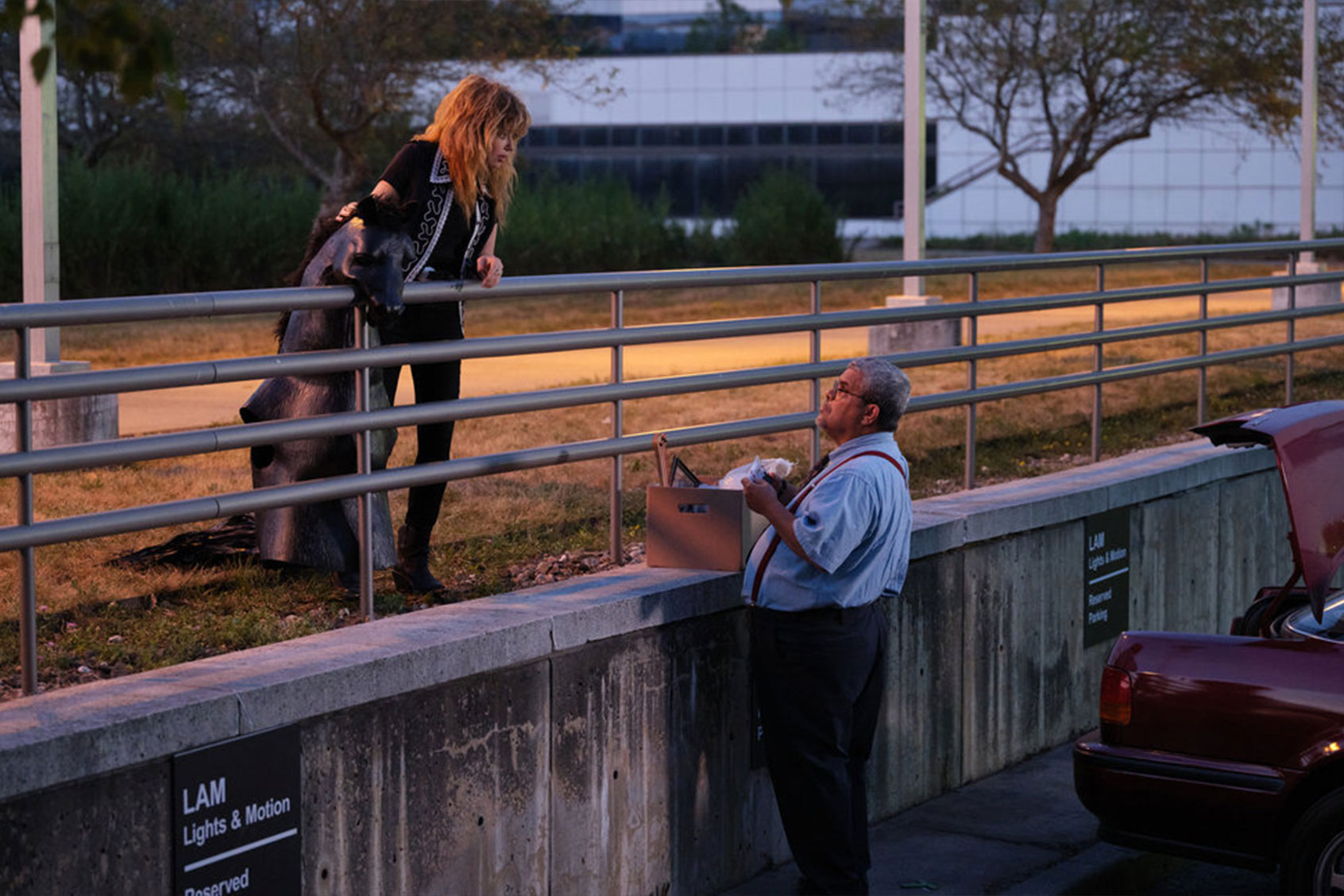
Let’s talk about Charlie’s horse costume in Episode 8, which Natasha directed herself. What’s the significance of having Charlie wear the horse costume that looks like it’s straight from Jean Cocteau’s “Testament of Orpheus”?

Natasha wrote it. She’s extremely intelligent. She’s extremely well-read. She is a cinephile. So, all of these things come into play when she’s creating the world. So that was the inspiration, the Cocteau horse and she was like, “Tracy, you got to make a horse!” And I was like, “Uh, what?” And that was before I saw the script. When I saw the script, I was like, “Oh, of course, OK, no problem!” 

The costume needed to be a sinistery-looking horse, but it also needed to have all these other elements that were workable for the script. Charlie has to be able to crawl on the floor and run around. She takes it off in one scene or, at least, takes off the armhole. There’s a lot of physical comedy. The costume is made out of lightweight foam. The hairs are faux hair, but it looks very real. The tail is actually made out of palm leaves, which are spray-painted black. And this is all very lightweight but also, incredibly realistic and creepy. I feel like it all came together. When you see it on screen, it looks pretty cool.

Interestingly, the costume has elements of Charlie in it — it’s retro, cool and plays into her Western aesthetic. What were some challenges you encountered when designing the costume? How did you make the look more comfortable for Natasha so she could run around in it?

One of the challenges was that the costume is rather hot inside. I wanted to make sure Natasha was comfortable, so I had a fan built into it that would blow cool air onto her when she was wearing the costume. That was one of the elements. Also, we were trying to figure out a way to actually get the head off in a scene. And that ended up being a little cumbersome because of the weights. You know, people don’t always realize when you’re doing costume designing, it’s something in the fitting where you really figure out how to make it all work.

Poker FaceNatasha Lyonne as Charlie Cale and Luis Guzman as Raoul in “Poker Face” (Karolina Wojtasik/Peacock)

Can you talk more about Charlie’s casino look in the finale and the dildo ring that she can’t get off of her finger? The body-con dress is form-fitting and covered in sequins and yet, Charlie is able to run in it and crawl into a laundry cart. How did you find that balance between looking party-ready but also, comfortable?

That’s another one of those inherent things that was addressed from the beginning. It was the first dress I bought. It was the first dress I tried on her and it was perfect. But, as Natasha and I are very similar, we had to do our due diligence. We tried on 50 other dresses, and I’m not kidding. But that one really fit the bill. It was long-sleeved, so she could crawl and run. It was stretchy enough but still looked really sexy and held its shape. And it was the pop of color that we needed. So, it’s one of those things where just kind of all came together. I wish I had a better story other than we knew it was the one and then we used it. And the shoes are Prada. And you know, I really just feel like it all came together. And it’s not like the character’s aesthetic to wear dresses like that, but I really do feel like if she was going to wear a dress, it fit the bill. It kind of just was perfect.

Poker FaceNatasha Lyonne as Charlie Cale in “Poker Face” (Peacock)“Poker Face” has been renewed for a second season! What’s next for “Poker Face” Season 2? 

I definitely already have some ideas for sure! You know, without having a script, it’s kind of hard to actually know what I’m going to need. But she’s still Charlie Cale, and I’m sure she’ll still be super cool. And you know, we’re not going to deviate from that. So yeah, I already have some ideas and I think people are going to be into the clothes yet again in the upcoming season.

“Poker Face” is currently available for streaming on Peacock. Watch a trailer for it below, via YouTube:

Joe Biden isn’t the first president to have secret cancer surgery — this one did it in 1893

Joe Biden is not the first president to have a secret cancer surgery.

At the time of this writing, the only confirmed facts are that a small lesion was discovered on President Biden's skin — and that it was later found to have been cancerous. Specifically, it was a basal cell carcinoma (BCC), a common type of skin cancer with an excellent prognosis for recovery. (BCC rarely returns or spreads to other parts of the body.)

The incident has some odd parallels with an incident that happened 130 years ago, when America had a president who discovered a deadly tumor on the roof of his mouth. Whereas Biden only kept his surgery secret for a few weeks, this president went to his grave never admitting that he had had an operation during his presidency. Indeed, it took almost a quarter-century for the truth to come out.

[The sore patch] was "an ulcer as large as a quarter of a dollar, extending from the molar teeth to within one-third of an inch of the middle line and encroaching slightly on the soft palate."

The president in question was Grover Cleveland, best known as the only American president to serve two non-consecutive terms. Our story begins in 1893, at the start of Cleveland's second term, when America was grappling with the worst economic depression in its history (up to that time). As a lifelong conservative, Cleveland believed the government should not provide any relief to the impoverished citizens; instead he wanted to maintain America's gold reserves and otherwise cultivate a healthy business environment. Philosophically, Cleveland was as opposed to labor activists like Eugene Debs as he was to bimetallic populists like William Jennings Bryan. Whether or not one shares Cleveland's views, he was unquestionably sincere in his conviction that America needed a steady and nonpartisan hand at its helm during its harrowing economic ordeal. Consequently, Cleveland emphatically did not want power to fall into the hands of Vice President Adlai E. Stevenson, a career politician who wanted to solve the depression through bimetallism (Bryan's proposal to expand monetary policy by allowing the unlimited coinage of silver).

It was during the midst of this high-stakes, high-pressure moment in history that Cleveland suddenly discovered a sore rough patch in his mouth. 

Thanks to a 1917 account written by one of the surgeons present, Dr. William W. Keen, we know that it was "an ulcer as large as a quarter of a dollar, extending from the molar teeth to within one-third of an inch of the middle line and encroaching slightly on the soft palate, and some diseased bone." A sample was removed and a pathologist was selected who would have no idea of the patient's identity; the pathologist diagnosed it as "strongly indicative of malignancy." Cleveland quickly decided that the tumor had to be removed as soon as possible; Congress was scheduled to meet in August to make critical decisions on economic policy, and Cleveland believed his active presence was vital to the republic's future. Within weeks, Cleveland had made all the arrangements, and on July 1, 1893, surgeons operated on him aboard a yacht called Oneida, which lolled gently along the Long Island coast.


Want more health and science stories in your inbox? Subscribe to Salon's weekly newsletter The Vulgar Scientist.


"The doctors who operated on Cleveland were using equipment and techniques that would appear almost medieval to us today."

The doctors' biggest concern was knocking Cleveland out. "The patient was 56 years of age, very corpulent, with a short, thick neck, just the build and age for a possible apoplexy," observed Keen, who had experienced that exact complication with one of his own patients. As such "our anxiety related not so much to the operation itself as to the anesthetic and its possible dangers." In addition, Cleveland was experiencing tremendous stress due to his job, which further worsened his health.

Fortunately for Cleveland, his doctors were more competent than those who unsuccessfully attempted to remove a bullet from President James Garfield's back only a dozen years earlier. These doctors successfully anesthetized their patient with nitrous oxide and ether, then surgically extracted the following:

The entire left upper jaw was removed from the first bicuspid tooth to just beyond the last molar, and nearly up to the middle line… A small portion of the soft palate was removed. This extensive operation was decided upon because we found that the antrum — the large hollow cavity in the upper jaw — was partly filled by a gelatinous mass, evidently a sarcoma.

After the surgery "a hypodermic of one-sixth of a grain of morphine was given — the only narcotic administered at any time." Before long Cleveland was back to work as president. The press suspected something was amiss — American politics, then as now, was full of leakers — but no one came close to unearthing the surgery. It took Keen's confession for the truth to come out… and what a truth it was.

"An oral surgeon I spoke with expressed amazement that the surgery was performed so quickly (in about 90 minutes) and successfully (the patient survived another fifteen years)," writes Matthew Algeo, journalist and author of "The President Is a Sick Man," an account of the surgery. "The treatment Cleveland received is the same treatment recommended today: surgical removal of the tumor. But the doctors who operated on Cleveland were using equipment and techniques that would appear almost medieval to us today. There was no operating table; he sat in a chair with his head resting on pillows. The only artificial light available was a small light bulb attached to a portable battery."

It is also difficult to not be impressed with Cleveland's character during this anecdote. Democrats today would likely not agree with Cleveland on most issues; he was president at a time when Democrats tended to be conservative and Republicans tended to be liberal. Nevertheless, Cleveland was known by all to be an extremely stubborn man, and the same mulishness that could make him an obsessive ideologue also gave him great strength of spirit as he struggled with what was undoubtedly unbearable pain.

"After several weeks he was fitted with a prosthesis, a piece of vulcanized rubber that attached to his (remaining) upper teeth. This restored his normal speaking voice, which was crucial to maintaining the cover-up."

"He experienced considerable post-operative discomfort," Algeo told Salon. "The surgery left a large cavity in his upper palate that was packed with cotton gauze. This made eating and drinking difficult and his speech unintelligible. After several weeks he was fitted with a prosthesis, a piece of vulcanized rubber that attached to his (remaining) upper teeth. This restored his normal speaking voice, which was crucial to maintaining the cover-up. But he would remain in some discomfort more or less for the rest of his life."

Given that Cleveland was only human, the upstate New Yorker already notorious for a sullen and phlegmatic disposition became even more prone to unpleasantness.

"Friends and associates said his temper became much shorter after the operation, given to outbursts and rash decisions," Algeo wrote to Salon.

Despite these flaws, Cleveland's handling of the surgery is one that patients everywhere should internalize. If Dr. Keen is to be believed, Cleveland was a dream patient — at least, according to a distinctly conservative view of how an ideal patient ought to behave.

"For a man of his rugged temperament, self-conscious power, and concentrated will and purpose, he was the most docile and courageous patient I ever had the pleasure of attending," Keen wrote. "Once a decision was reached and announced to him, he observed the prescribed regimen steadfastly and with unquestioning obedience."

Who’s afraid of ChatGPT?: In the real world, teachers have little to fear

ChatGPT has sent shockwaves through higher education, creating a moral panic about the threat that artificial intelligence (AI) poses to the classroom. As critical media literacy scholars, we are not panicking, and we do not think any educator should. Developed by OpenAI, ChatGPT is a chat bot released in late 2022. Industry insiders were amazed by the technology, with Microsoft quickly moving to integrate OpenAI features into its products. 

Among other functions, ChatGPT, currently offered as a free research preview, can write well-formulated essays on a series of topics. According to Inside Higher Ed, students are using it to generate outlines, bibliographies and tutoring concepts. Meanwhile, educators are confirming cheating rings composed of students using ChatGPT. The ubiquity and effectiveness of ChatGPT has “alarmed” universities and led many professors to alter their syllabus and pedagogical approach. 

Much of the reports on ChatGPT serve to foster panic. For example, the New York Times has warned that ChatGPT “hijacks democracy,” and Arab News claims it will “deepen the disinformation crisis.” The reporting also suffers from a disaster movie-like understanding of AI, where the programs become sentient and overtake humanity and free will. In “Machine Unintelligence,” computer scientist Meredith Broussard reminds us that the autonomous AI popularized by films was abandoned by serious researchers decades ago. Indeed, Gary Smith refers to the public’s continued faith in the development of the film version of AI “The AI Delusion.” 

To quell the panic, it behooves us to remember that the machine learning possible today is dictated by human-created algorithms. It is humans, not autonomous machines, who set the parameters for what AI can and cannot do. Digital technologies are not autonomous actors free from human influence and they are certainly not sentient. Rather, they are designed by humans and thus reflect and communicate the various biases, values and self-serving interests of their creators.

A critical media literacy lens reminds us that, rather than fret over academic dishonesty, it is more worthwhile to investigate what goes into building ChatGPT: The human element reveals the values of the larger society, including adherence to racism, sexism and classism. For example, in 2022 when asked “whether a person should be tortured,” ChatGPT responded yes — if that person is from North Korea, Syria or Iran. The xenophobic and jingoistic response illustrates how AI technology such as ChatGPT recreates the bias of its human creator. Furthermore, it threatens to compound class inequities by serving privileged students who can access the fast computer and high-speed internet necessary to utilize ChatGPT. 


Want a daily wrap-up of all the news and commentary Salon has to offer? Subscribe to our morning newsletter, Crash Course.


ChatGPT is simply the latest tool in the the century’s long saga of academic dishonesty. While there are certainly instances where students cheat simply for the sake of cheating, students are more often driven to cheat when backed into a corner. For example, the contradiction of finding no time to study because they need to work in order to pay for college or the pressure of maintain a high GPA because that appears to be the route to professional and financial success, post-graduation. 

There are those who believe more tech is the solution, and have turned to a Princeton student-generated app that claims to be able to determine if ChatGPT wrote a particular essay. Using technology to determine the veracity of technology may be helpful, but it leaves out the process of critical analysis of said technology.

ChatGPT’s hazards merely reflect the values of the larger society. It presents a unique opportunity for teachers and students to build knowledge together, since this technology is new to all of us.

Our solution, and one way to dampen the moral panic, is for teachers to take a critical media literacy approach and bring ChatGPT in the classroom so that students can understand the threats and benefits it poses to their learning. ChatGPT presents a unique opportunity for teachers and students to build knowledge together; because the technology and its applications are brand new to all of us, this is an opportunity to co-create understanding and, in working together, we may dampen both the fascination with the tech as well as the desire to use it for nefarious purposes. Utilizing the skills of critical inquiry fostered by critical media literacy, teachers and students can work together to analyze assignments. This may include presentations on their papers, the development of in-class outlines prior to writing, or a simple conversation about the content and structure of the assigned work. Such lessons serve two purposes: give students an opportunity to sharpen their understanding and provide educators with an opportunity to test students’ depth of knowledge about the essay they claim to have written.

It is incumbent on educators to communicate to students the benefits and threats posed by the utilization of technology. As teachers, we know that to write well is to think well. While teaching our students this, we can also remind them that, while it is possible to attain a degree in higher education without attaining the broader knowledge linked to one’s own ability to think and write critically; students who use ChatGPT or engage in similar forms of academic dishonesty position themselves to achieve none of these indispensable life skills. Employing ChatGPT may provide one a pathway to a job that is quickly lost once the employer realizes they lack basic skills, thus, putting themselves in a position where they cannot pay the loans for the education they chose not to receive.

We argue that ChatGPT is not something that educators should panic over, instead they should do what they have always done: Adapt to educate the citizens of an ever changing society. Cheating is nothing new, but how those in education make sense of cheating may need revision. 

More young Colorado children are consuming marijuana despite efforts to stop them

The number of children — especially very young ones — ingesting marijuana is rising in Colorado despite regulations meant to keep edibles out of kids’ hands, and state leaders said they have no plans to revisit those rules this year.

The number of reports the Rocky Mountain Poison and Drug Safety office received of kids age 5 or younger exposed to marijuana skyrocketed from 56 in 2017 to 151 in 2021. By 2021, this age group made up nearly half of all marijuana exposures — in which the drug is ingested, inhaled, or absorbed through the skin — reported to the office, which is part of the nonprofit Denver Health organization.

In each of those five years, children were most often accidentally exposed by eating edibles — gummies, cookies, drinks, and other products infused with the psychoactive chemical tetrahydrocannabinol, or THC — and not by inhaling smoke or consuming the drug in other forms, like capsules or tinctures. In 2017, 35 children age 5 or younger were unintentionally exposed to marijuana through edibles, compared with 97 in 2021. Exposures don’t necessarily mean the children were poisoned or overdosed, according to the poison and drug safety office.

Marijuana exposures among children are increasing nationwide, with Colorado playing a notable role in this trend. However, the federal government has yet to create uniform protocols, and Colorado health officials haven’t conveyed any plans to revise the regulations meant to prevent children from consuming marijuana.

“Marijuana laws and regulations are regularly evaluated by lawmakers, state agencies, local agencies and the various stakeholders,” Shannon Gray, a spokesperson at the Marijuana Enforcement Division, which regulates the marijuana industry in the state, wrote in an email to KHN. “A top priority is preventing youth access and to the extent we see opportunity in rules to address youth access, we do so.”

Since legalized recreational marijuana sales began in 2014, Colorado has implemented a handful of directives to stop children from mistaking these products for safe, delicious sweets.

Regulations state that:

  • No edibles may be manufactured in the shape of a human, an animal, or a fruit.
  • All edibles must be sold in child-resistant packaging.
  • “Candy” or “candies” isn’t allowed on packaging.
  • Advertising must not include cartoon characters, or anything else meant to appeal to children.
  • The universal THC symbol (! THC) must be on all packaging and stamped on all edible products.

Data from Rocky Mountain Poison and Drug Safety does not distinguish between incidents involving marijuana sold by licensed retailers and those involving marijuana from sources that don’t follow the state’s packaging rules, state health department spokesperson Gabi Johnston told KHN.

When asked whether the mandates are effective, Gray said the Marijuana Enforcement Division has “observed material compliance with these regulations” among marijuana businesses.

Regulation changes could be considered, including those proposed by state legislators, Gray said. But no forthcoming bills concern edible mandates, according to Jarrett Freedman, spokesperson for the Colorado House of Representatives majority. Democrats control both houses of the state legislature.

One limitation of regulating marijuana packaging is that most children 5 and younger can’t read, said Dr. Marit Tweet, a medical toxicologist at the Southern Illinois University School of Medicine. And, she said, many parents don’t know how to store marijuana safely.

The state health department has worked to address this knowledge gap through its Retail Marijuana Education program, established in 2014 to teach the public about safe, legal, and responsible cannabis use. One fact sheet advises parents to store marijuana in a locked area, keep products in child-resistant packaging, and avoid using marijuana around children.

Public health officials also launched a series of marijuana education campaigns in 2018 targeting new parents and adults who influence kids’ behavior. Between fiscal years 2015 and 2020, the department spent roughly $22.8 million on those efforts.

It’s hard to say exactly how well marijuana regulations in states like Colorado are working, said Tweet. “It’s possible if those regulations weren’t in place that the numbers would be even higher.”

What’s happening in Colorado is part of a national trend. In a study published in January, researchers looked at the number of children younger than 6 who ingested marijuana edibles nationwide from 2017 to 2021. They found 207 reported cases in 2017. In 2021, that number rose to 3,054 cases, according to data from the National Poison Data System.

The legalization of cannabis has likely played a significant role in the rise of accidental child exposures, said Tweet, a co-author of the study. “It’s more readily available and more of an opportunity for the children to get into.”

Parents may also feel less stigma nowadays in reaching out to poison centers and health clinics, she said.

To understand what factors are driving these numbers, more research is needed into marijuana regulations and the number of child exposures nationwide, said Tweet.


KHN (Kaiser Health News) is a national newsroom that produces in-depth journalism about health issues. Together with Policy Analysis and Polling, KHN is one of the three major operating programs at KFF (Kaiser Family Foundation). KFF is an endowed nonprofit organization providing information on health issues to the nation.

Subscribe to KHN’s free Morning Briefing.

Former prosecutor explains why Trump “indictment is coming” — and it’s “coming soon”

The Manhattan district attorney’s office has invited former President Donald Trump to testify before a grand jury investigating his role in the hush money payment to porn star Stormy Daniels, according to The New York Times.

Such invitations almost always indicate an indictment is close, the newspaper reported, adding it would be unusual for District Attorney Alvin Bragg to notify a potential defendant without ultimately seeking charges against him.

“It seems likely that an indictment is coming soon,” former federal prosecutor Barb McQuade told Salon. “I say that because the target is the last person prosecutors would want to question in an investigation after they have talked to everyone else, so that they could be as informed as possible.”

The case centers around a $130,000 payment Trump’s former personal lawyer Michael Cohen made to Daniels in the final days of the 2016 presidential campaign in an attempt to keep her from going public about an alleged affair she had with Trump before he ran for office. Cohen testified that he was later reimbursed by Trump.

“[If] prosecutors were planning to decline prosecution in this case, there would be no need to invite Trump in to testify,” McQuade said. “For those reasons, it seems likely that an indictment is coming, and that it is coming soon.”

Trump, who is facing multiple criminal investigations, including a DOJ probe into his handling of classified documents and a Georgia investigation into his efforts to overturn the results of the 2020 presidential election, has never been charged with a crime. Bragg could become the first prosecutor to charge a former president.

Trump took to Truth Social to push back on the report and dismiss the Manhattan probe as a “witch hunt” in a lengthy statement.

“I did absolutely nothing wrong, I never had an affair with Stormy Daniels, nor would I have wanted to have an affair with Stormy Daniels,” Trump wrote. “This is a political Witch-Hunt, trying to take down the leading candidate, by far, in the Republican Party.”

Cohen was sentenced to three years in prison after pleading guilty to multiple federal crimes, including a campaign finance violation related to the payments to Daniels and former Playboy model Karen McDougal, who also claimed she had a months-long affair with Trump before he took office.

In his 2018 guilty plea, Cohen said Trump directed him to arrange payments for the two women during the 2016 campaign to keep them from speaking publicly about affairs they said they had with the former president. 

Prosecutors are deciding whether to charge Trump with falsifying the business records of the Trump Organization for how it reflected the reimbursement of the payment to Cohen. While hush money payments aren’t illegal, falsifying business records is a misdemeanor in New York.


Want a daily wrap-up of all the news and commentary Salon has to offer? Subscribe to our morning newsletter, Crash Course.


For the crime to be elevated to a felony, Bragg’s prosecutors must show that Trump’s “intent to defraud” included an intent to commit or conceal a second crime, The Times reported. 

Trump’s potential indictment could impact his political future, including his 2024 presidential campaign. Trump accused prosecutors of “trying to take down the leading candidate, by far, in the Republican Party while at the same time also leading all Democrats in the polls.”

“Now, they fall back on the old, and rebuked case which has been rejected by every prosecutor’s office that has looked at this Stormy ‘Horseface’ Daniels matter, where I relied on counsel in order to resolve this Extortion of me, which took place a long time ago,” Trump wrote on Truth Social. “Since then, I have won lawsuits for hundreds of thousands of dollars against Stormy Daniels, and every prosecutors’ office which has looked at it, which are numerous, including the FEC, have turned this fake case down. “

Alice Walker defends J.K. Rowling’s TERF views in new essay

In a new essay posted to her website last week, “The Color Purple” author, Alice Walker, defended the trans-exclusionary radical feminism views of fellow writer, J.K. Rowling.

“I read the first Harry Potter novel and thought it extraordinary, Walker writes. “I felt something old and wise, fresh and exciting had been offered humanity. Life with its vicissitudes prevented reading volumes that followed.”

Addressing the anti-trans statements made by Rowling that have led to what she refers to as a “witch hunt,” Walker goes on to say “I consider J.K. Rowling perfectly within her rights as a human being of obvious caring for humanity to express her views about whatever is of concern to her. As she has done.”

Rowling, whose notoriety as the author of the Harry Potter books has been shadowed in recent years by the infamy of her TERF opinions, appeared on a Bari Weiss produced podcast last month to shrug off the backlash. 

When asked by podcast host Megan Phelps-Roper — a one-time affiliate of the Westboro Baptist Church — if she’s worried about what her “legacy” will become, Rowling remarked, “Whatever, I’ll be dead.”

“The use of “guy” for both male and female eroded the ability of children to easily feel confident in which gender they were,” Walker writes in her essay, defending Rowling’s views. “From that confusion, considered irrelevant, apparently, to the forming of young minds, has come much cutting off of parts and restructuring of essential physical equipment. If such restructuring is freely chosen at eighteen or twenty, at least there is a sense the person involved may have lived long enough to know, definitely, what is desired.  Younger than that, I feel there may in fact be reason, later on, to mourn and weep. After all, the human body is a miracle, of whatever sex, tampering with a miracle is unlikely to serve us.”


Want a daily wrap-up of all the news and commentary Salon has to offer? Subscribe to our morning newsletter, Crash Course.


Walker’s essay, which was covered by Out Magazine on Thursday, received backlash of its own ramping up to the weekend, with many people taking to Twitter to express their disappointment.

“I think the worst part of Alice Walker’s support for J.K. Rowling is the cynical deployment of her community elder status as if almost reassure us that her support for gender-confused is well-informed when in fact she sounds like every other TERF,” tweets Zoé, a writer and assistant professor of photography at RISD.

“I think what Alice Walker revealed is that many of our Black Feminist faves are probably TERFs,” comments dr. jenn m. jackson. “Not only that, they have a host of terms, concepts, and theoretical principles they can attempt to marshal to navigate around their transphobia. It just is what it is.”

Irish whiskey panna cotta is like Baileys you can eat

By the time she met up with my friend Kate in Dublin, my daughter had already been traveling around Europe solo for a month — a compressed version of the junior year abroad that was hijacked by COVID. She had seen castles and cathedrals, as well as eaten in bierhauses and Lagkagehusets. But in Dublin, along with a rugby match and the Book of Kells, my vagabond on a budget experienced something that really blew her mind: an epic meal in an iconic restaurant.

Kate had taken her to the Irish outpost of The Ivy, where upscale cuisine is served with a Celtic twist. And while every part of the heavenly meal my daughter later described made me want to hop on Aer Lingus immediately, it was the whiskey-spiked creme brûlée that really me drool.

Creme brûlée is one of the richest, most decadent desserts in the book, which is why I almost always have to have it when I see it on a menu. While it’s not particularly difficult to make at home — even if you don’t have a kitchen torch — I somehow rarely ever do. Besides, panna cotta is so much easier. In the Italian dessert, gelatin does the work of eggs, creating an idiot-proof, creamy treat that is incredibly versatile. 

And so, borrowing from a good idea from The Ivy, but making it simpler for my own life, I found an enticing recipe for a bitters-infused panna cotta that takes its cues from an old-fashioned cocktail. I’ve liberally adapted Gastronom’s recipe here, skipping the bitters, swapping in brown sugar for white and upping the quantity of the whiskey. The flavor is lush yet cozy, unapologetically strong, and if you toss a dusting of cocoa on top, it’s basically Baileys you can eat.


Hungry for more great food writing and recipes? Subscribe to Salon Food’s newsletter, The Bite.


The only catch with most things in the pudding family is that you do have to give them time to set. The tradeoff? They’re really minimalist and easy. You can make this recipe in 10 minutes in the morning and slide it in the fridge for later.

If Dubliners can appreciate something this exquisite all year long, why on earth would you wait for St. Patrick’s Day to do the same?

* * *

Inspired by Gastronom and The Ivy (Dublin)

Irish Whiskey Panna Cotta
Yields
 2-4 servings
Prep Time
 15 minutes 
Cook Time
 10 minutes

Ingredients

  • 1 1/2 teaspoons gelatin
  • 1 3/4 cups half & half
  • 1/4 cup brown sugar
  • 3 tablespoons Irish whiskey (See Cook’s Notes)
  • 1 pinch sea salt


Directions

  1. Pour 1/4 cup half & half into a small bowl. Sprinkle the gelatin over it and let it sit for 10-15 minutes to bloom.

  2. To a medium saucepan, add the remaining half & half, sugar and salt. Simmer over medium heat until the sugar is completely dissolved.

  3. Add the gelatin mixture to the saucepan and stir until everything is combined and dissolved. 

  4. Remove from the heat and whisk in the whiskey. 

  5. Divide into 4 small serving cups or 2 larger ones.
  6. Chill for at least 2 hours, until set.

Cook’s Notes

Reach for your favorite whiskey or bourbon if you’ve already got a bottle on hand.

For an extra Irish vibe, try serving this with shortbread.

Salon Food writes about stuff we think you’ll like. While our editorial team independently selected these products, Salon has affiliate partnerships, so making a purchase through our links may earn us a commission.

“They don’t even try to hide it anymore”: House GOP refuses to denounce white supremacy

Led by ranking member Rep. Jamie Raskin, Democrats on the U.S. House Oversight and Accountability Committee this week warned that Republicans doubled down on “a dangerous lie” when they refused to back a statement denouncing white supremacy.

Raskin, D-Md., was joined by all 20 Democrats on the committee in signing a brief, straightforward statement condemning “white nationalism and white supremacy in all its forms, including the ‘Great Replacement’ conspiracy theory,” which claims that white Americans are intentionally being “replaced” by people of color, particularly through immigration policy.

“These hateful and dangerous ideologies have no place in the work of the United States Congress or our committee,” reads the statement.

Raskin sent the statement along with a letter to committee Chairman James Comer, R-Ky., saying he was driven to call on his 26 Republican colleagues to sign on to the statement after the panel held a hearing in February titled “On the Front Lines of the Border Crisis.”

In that hearing, Rep. Paul Gosar, R-Ariz., asked whether immigrants arriving in the U.S. via the southern border are “changing our culture” and both Reps. Lauren Boebert, R-Colo., and Marjorie Taylor Greene, R-Ga., claimed an “invasion” by migrants and asylum-seekers is taking hold at the U.S.-Mexico border.

In his letter to Comer, Raskin noted that he had explained to the chairman at the hearing that “such language borrows from the ‘Great Replacement’ theory, the central dogma of contemporary white supremacy,” and that the theory has been invoked by white nationalists who have committed deadly acts of domestic terrorism in Buffalo, New YorkEl Paso, Texas; and Pittsburgh.

Republican lawmakers including Sens. J.D. Vance of Ohio and Ron Johnson of Wisconsin have also alluded to the theory in their attacks on Democratic immigration policy.

Presented with the facts about the rise of white supremacy in the U.S. at the hearing and in Raskin’s letter, Comer and the committee’s other Republicans refused to sign the statement.

A spokesperson for the committee’s Republicans claimed the Democrats were attempting to “distract from President Biden’s border crisis and their failure to conduct oversight of it for two years,” and did not address the embrace of the Great Replacement theory by Republican lawmakers and domestic terrorists.

The Biden administration has garnered condemnation from progressives and human rights advocates for a number of anti-immigration policies, including his expansion of the Trump-era Title 42 expulsion policy and his current reported consideration of migrant family detentions.

As the Trump and Biden administrations have pushed anti-immigration programs, advocates have maintained that the “crisis” at the border is one of denying asylum-seekers their internationally recognized right to seek refuge in another country.

Politicians and media pundits quickly reduce this mounting humanitarian crisis to ‘border security,'” wrote Farrah Hassen of the Institute for Policy Studies at OtherWords in January. “That narrow focus puts real solutions out of reach—and imperils the universal right to seek refuge from danger.”

In his letter, Raskin noted that Republicans have been given previous opportunities to condemn white supremacy.

“On June 8, 2022, following the racially motivated Tops Supermarket mass shooting in Buffalo, New York, House Democrats passed H. Res. 1152, a resolution to condemn the ‘Great Replacement’ theory and affirm the commitment of the People’s House to combating white supremacy and race hatred,” wrote Raskin. “Despite then-Minority Leader Kevin McCarthy’s acknowledgment that white supremacy and white nationalism are ‘definitely not American,’ not a single House Republican voted in favor of the resolution.”

“As chairman, you have another opportunity to take a public stand against the deliberate amplification of dangerous racist rhetoric that has had deadly consequences in this country,” he continued, referring to Comer. “If committee Republicans intend to continue examining the southern border and related policies, it is imperative for every member of this committee to make clear to the American people that we speak with one voice to reject dangerous conspiracy theories and racist and antisemitic ideology in our committee’s deliberations and decision-making.”

“MH370”: The 6 most shocking theories surrounding the disappearance of the Malaysia Airlines flight

On March 8, 2014, Malaysia Airlines Flight MH370, an international passenger flight, was headed towards Beijing from Kuala Lumpur. Shortly after takeoff, however, the aircraft mysteriously vanished from radars, thus propelling a lengthy yet inconclusive search into its whereabouts.

The case remains a great tragedy to this day, as investigators, online sleuths and loved ones of the departed continue to look into what went wrong. What’s known is that MH370 carried 239 passengers — 12 crew members and 227 passengers. Around 1:19 a.m. (MYT), the aircraft made its final contact with air traffic control — now an infamous message — before it disappeared three minutes later. Some say the plane crashed into the South China Sea while others speculate that it vanished in the Strait of Malacca or, even, Kazakhstan. More elaborate theories suspect the captain was at fault or aliens took over the entire aircraft.

MH370 isn’t the first major case of an aircraft gone missing. But, it’s certainly the most bizarre. Almost a decade after the incident, the mysterious case is revisited in Netflix’s docuseries “MH370: The Plane That Disappeared.” The three-part series spotlights several theories from investigators, journalists and family members on the plane’s disappearance. Keep in mind, “MH370” doesn’t offer a clear answer to the mystery at hand, but it does offer some new insight into what may have happened on that flight.

Here are six theories from the docuseries:

01
MH370 pilot Zaharie Ahmad Shah flew a suicide route
“MH370: The Plane That Disappeared” (Netflix)

Jeff Wise, an aviation journalist, suggests a theory involving MH370’s pilot Zaharie Ahmad Shah, who was believed to have deliberately downed the plane. 


Shortly after one in the morning, Shah flew over the South China Sea and sent his final signal to air traffic control in Kuala Lumpur before entering Vietnamese airspace. Wise’s conjecture follows: He suspects that Shah then prompted his co-pilot to leave the cockpit and locked its door. Then around 1:20 a.m., Shah turned off all the plane’s electronics, causing it to go off radar, and directed the aircraft back towards the Malaysian peninsula.


At this time, Shah is still by himself and his co-pilot remains locked out of the cockpit. It’s believed that Shah began depressurizing the cabin, thus causing the emergency oxygen masks to go down in the cabin. Unbeknownst to the passengers, their masks were useless as the plane’s oxygen generators only worked for about 15 minutes. Shah, however, wore a more “sophisticated, longer lasting” oxygen mask, which allowed him to continue flying the plane until his fuel ran out. After six hours of flight, the plane’s engine stopped running and Shah dove the plane, killing everyone on board.


Despite the plausibility of this theory, Wise still had doubts:


“It is worth pointing out that there have been a handful of cases of pilots who have decided to kill their passengers,” Wise said. “But, there has never been a case that someone has taken six hours to commit mass-murder suicide. I started to wonder, maybe it wasn’t Zaharie after all.”

02
Tomnoders” believe the plane crashed in the South China Sea
“MH370: The Plane That Disappeared” (Netflix)

A group of online sleuths, known as the “Tomnoders,” used a satellite imagery platform called Tomnod to locate the plane’s crash site. Cyndi Hendry, a Tomnod volunteer, found bits of plane debris in the South China Sea and identified one piece as MH370’s nose cone and another as its fuselage and tail.


“I literally cried because I knew someone had died there. Because I knew that was a part of the plane,” Hendry said. “That meant they were no longer alive and that wasn’t the answer their family members were looking for.”


However, Malaysian authorities were convinced that MH370 flew a different route northwest towards the Malacca Strait.


“I knew that what we had in the South China Sea was the debris of MH370 and I was not going to sit around and not be vocal about that,” Hendry said. “I already had notified Tomnod that this debris existed. But I never got an acknowledgement that I tagged debris.”

03
The nonsensical theories on social media
“MH370: The Plane That Disappeared” (Netflix)
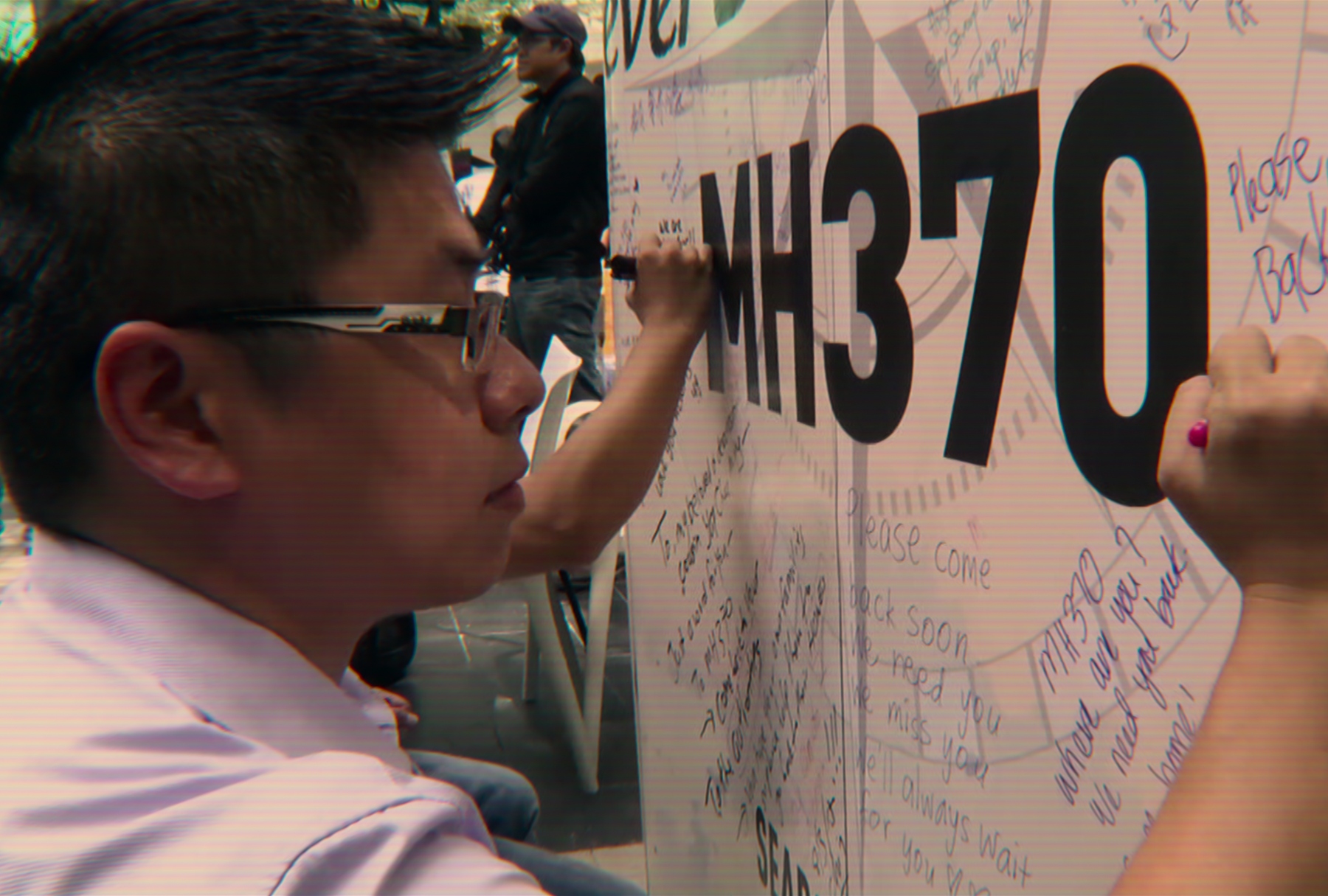
A year after MH370’s disappearance, more ludicrous conspiracy theories surrounding the plane cropped up across social media. Many people claimed they had solved the big mystery. But in actuality, they were incredibly wrong.


Some said the “real” Malaysian Airlines flight was hijacked and flown to Iran in preparation for a terrorist attack. Others said fire from lithium batteries in the plane’s cargo brought it down. A few more theories said the plane’s disappearance was tied to an insurance scam, an undisclosed semiconductor technology and, yes, even aliens. North Korea was somehow involved in it all. And a meteorite was also believed to have hit the plane.    


“Sometimes you just feel like you’re drowning in horses**t. Because there are so many baseless ideas,” said Wise.

04
MH370 was hijacked by three Russian passengers
“MH370: The Plane That Disappeared” (Netflix)

On July 17, 2014, a second Malaysia Airlines Flight, called MH17, was shot down by Russian controlled forces in eastern Ukraine. As a result, investigators speculated that Russian spies were involved in the disappearance of MH370. Inmarsat data also suggested that the plane flew north and crashed in Kazakhstan, a client state of Russia.


Upon further investigation, Wise learned that three Russian passengers were aboard MH370. One of them was sitting about 15 feet away from an unlocked carpet hatch that led to the aircraft’s electronics bay, where the plane’s communication with the Inmarsat satellite could be controlled.     


For Wise’s second theory, he believes that the Russian passengers began their hacking operation around 1:15 a.m., when Shah flew MH370 over the South China Sea. The passenger sitting near the plane’s hatch was able to access the electronics bay thanks to a ruckus in the first class cabin, which distracted nearby flight attendants. Around 1:20 a.m., the plane was under the control of the passenger, who turned off all the plane’s electronics, causing it to go off radar. The passenger then directed the aircraft back towards the Malaysian peninsula and depressurized the cabin. They also cut off the emergency oxygen systems for the pilot and co-pilot.


Prior to the plane’s suspected crash, the passenger turned the plane towards the northwest and tampered with the Inmarsat data, which showed that the plane traveled south instead.

05
MH370 was intercepted by two American AWACS
“MH370: The Plane That Disappeared” (Netflix)

Florence De Changy, an author and investigative journalist, proposed that MH370 was interrupted by two US AWACS planes. MH370’s cargo list noted that 2.5 tons of electronics, including lithium batteries, walkie-talkies, and accessories, were being carried in the plane. However, the cargo was loaded without being scanned, which caused De Changy to believe that it contained highly sensitive U.S. technology.


De Changy also learned that two US AWACS planes were spotted near MH370. The planes, De Changy said, must have asked Shah to land so they could inspect the cargo. But he refused to do so, thus prompting the AWACS to shoot down MH370 over the South China Sea.


There were a few naysayers to De Changy’s theory, including adventurer Blaine Gibson, who found MH370 plane debris on La Reunion Island and in Mozambique. However, De Changy’s theory reinforced Hendry’s findings in the South China Sea.

06
MH370’s disappearance still remains a mystery
“MH370: The Plane That Disappeared” (Netflix)
Two years and 10 months after MH370’s disappearance, Malaysian authorities officially stopped the search to find the aircraft, saying it may resume once credible evidence is obtained. 


In 2018 — four years and four months after the disappearance — Malaysian investigators released their final report on MH370, which states that Shah had no involvement and that the case remains unsolved.


But that hasn’t stop online investigators and family members of the long-lost passengers from continuing on with their efforts:


“I don’t know whether I’ll ever get closure but I will try for as long as I can to find my mother, to find out what happened,” said Grace Nathan, the daughter of an MH370 passenger.


“I believe there are people out there who know something, who know the true story,” said Ghyslain Wattrelos, the husband and father of MH370 passengers. “We’re still here and waiting for answers. We want answers.”

“MH370” is currently available for streaming on Netflix. Watch the trailer for it below, via YouTube:


Food prices are not the only obstacle to achieving food security

Increasing food prices and stagnant incomes have been identified as major obstacles to achieving food security. About one in six, or 15.9%, of households in Canada experience food insecurity.

Economic barriers like food prices are not the only obstacles to food security. Our study, published by Food Secure Canada, outlines that systemic barriers like colonialism, racism and other systems of injustice are among the root causes of food insecurity in Canada.

According to the Food and Agriculture Organization of the United Nations, food security requires economic, physical and social access to food.

Economic access involves factors such as income, poverty and food affordability. Physical access is related to infrastructure and facilities like roads and transportation. Social access focuses on ensuring people have access to all the necessary resources within society for nutritious and culturally appropriate foods. Food insecurity happens if any of these paths fail.

The interlinked barriers to food security

Our research reveals three major barriers to accessing food:

  • affordability
  • policies that perpetuate wealth and income disparity and
  • systemic forms of discrimination like colonialism and racism.

The findings demonstrate that those living with a low income demand long-term solutions that comprehensively address all forms of food access.

Our study identified affordability as the main barrier to food access. The Consumer Price Index shows that food prices have increased by 10.4% in 2022. Similarly, Canada’s Food Price Report in 2023 indicates that food prices remain a major concern for Canadians, increasingly putting pressure on household food security.

Income inequality in Canada has increased over the past 20 years. The Canada Emergency Response Benefit (CERB) is a policy targeted at reducing the effects of job disruption during the pandemic. For many food activists, CERB is an example of how a basic income measure can address income inequality. Recent statistics, however, show that it was ineffective in improving food security for those receiving the benefit.

This suggests that future policies need to better address income disparities. Policies also need to address why certain groups — like Indigenous people living off reserves, recent immigrants and people with disabilities — are consistently among those who are living with low incomes compared to other groups.

Discrimination, racism and colonialism

Various systems of discrimination such as racism and colonialism furthermore impact access to food. The highest percentage of individuals living in food-insecure households in Canada are Indigenous Peoples (30.7%), Arab/West Asian (27.6%) and Black (22.4%). Our study also highlights that racism and colonialism significantly shape the relationship that Black, Indigenous and people of color have with food. A study participant stated that:

“Colonialism has an ongoing impact on how we view food, portions, and our relationships with food that needs to be challenged in order to move towards sustainable consumption.”

Historic and ongoing colonialism has separated Indigenous Peoples from their land and food systems. This created significant barriers to accessing foods integral to Indigenous health and well-being. Indigenous communities also face challenges in maintaining practices like hunting and fishing, which are necessary for obtaining culturally appropriate food.

In addition, our study found that community initiatives led by Indigenous, Black and people of color face barriers to receiving grants and funding due to the Eurocentric structures and processes included in the application and reporting processes. This limits the number of culturally or heritage-specific programs that organizations can offer to their communities.

A road map towards food security for all

A drop in food prices might immediately address the lack of economic access to food but will not address the root causes of food insecurity. Addressing systemic barriers is vital to ensure economic, physical and social access to food for all people, at all times. These three types of food access are interconnected.

Participants in our study highlighted some initiatives that are a step in the right direction. For instance, in 2021 the City of Toronto approved the Toronto Black Food Sovereignty Plan. This is a community-led, five-year program focused on addressing and creating long-term solutions to food insecurity among Black Torontonians.

One participant described its significance:

“(The plan) aims to champion the right of people of African descent to healthy and culturally-appropriate food, produced through ecologically sound and sustainable methods, and their right to define their own food and agriculture systems and build their own institutions to advance community capacity and resilience for food access.”

Simply identifying systemic barriers to food security is not enough to create change. Long-term solutions will require elected officials and industry leaders to make significant institutional changes. As proposed in this Food and Agriculture Organization report, inclusivity and accounting for structural inequalities is required for tackling food insecurity.

Our study argues that any solution must be done in a democratic, just and inclusive manner. These approaches should consider Indigenous traditional knowledge and address racism, colonialism and other systems of discrimination. Achieving food security requires Canadians to focus on the underlying causes of food insecurity, not only saving money at the grocery store check-out counter.

Farzaneh Barak, Research scientist, School of Human Nutrition, McGill University and Monika Korzun, McCain Foundation Postdoctoral Fellow at Faculty of Agriculture, Dalhousie University

This article is republished from The Conversation under a Creative Commons license. Read the original article.

Pentagon refuses to share Russia war crime evidence — over fear of future probes of U.S. atrocities

The Pentagon is helping to shield Russia from International Criminal Court accountability for its atrocities in Ukraine, fearing such a reckoning could set a precedent allowing the tribunal to prosecute U.S. war crimes, a report published Wednesday revealed.

According toThe New York Times, Defense Secretary Lloyd Austin III and other Pentagon brass are blocking the Biden administration from sharing evidence of Russian war crimes in Ukraine gathered by U.S. intelligence agencies with the International Criminal Court (ICC) over the objections of officials in those agencies, as well as in the State and Justice departments.

Neither Russia, the United States, nor Ukraine are party to the Rome Statue, the treaty governing the ICC. However, according to “current and former officials briefed on the matter” who were interviewed by the Times, Austin and others are wary of the Hague tribunal targeting the crimes of countries outside its jurisdiction. Ukraine last year accepted the ICC’s jurisdiction so the court could open an investigation of Russia’s conduct during the invasion.

“The Pentagon is flouting the rest of the U.S. government to try to block sending evidence of Russian war crimes in Ukraine to the International Criminal Court,” tweeted human rights expert Kenneth Roth. “It fears a precedent: prosecuting non-parties on the territory of governments that accept the ICC.”

Author and war correspondent Megan K. Stack wrote on Twitter that “basically, we want others punished, but not ourselves.”

U.S. Sen. Lindsey Graham, R-S.C.,—whose resolution urging accountability for Russian war criminals and encouraging ICC member states to investigate documented and alleged atrocities unanimously passed the Senate last year—told the Times‘ Charlie Savage that the Pentagon “opposed the legislative change—it passed overwhelmingly—and they are now trying to undermine the letter and spirit of the law.”

“It seems to me that [Department of Defense] is the problem child here, and the sooner we can get the information into the hands of the ICC the better off the world will be.”

Documented and alleged war crimes committed by Russian forces and contractors in Ukraine include—but are not limited to— massacres and other murders of civilians and soldiersindiscriminate attacks on densely populated areas; attacking critical civilian infrastructure; bombing hospitals and shelters; torture; rape and sexual enslavement of women and children; and stealing children.

American troops and contractors have perpetrated each of those war crimes in U.S. attacksinvasionsoccupations, and peacekeeping operations in the years since the ICC was established in 1998.

President Joe Biden has called Russian President Vladimir Putin a “war criminal” and demanded he be tried for Russia’s atrocities in Ukraine. The Biden administration and Congress even explored ways of helping the ICC prosecute Russian war crimes without the U.S. being subjected to the tribunal’s authority.

As Savage noted:

Lawmakers enacted two laws aimed at increasing the chances that Russians would be held accountable for war crimes in Ukraine.

One was a stand-alone bill expanding the jurisdiction of American prosecutors to charge foreigners for war crimes committed abroad. The other, a provision about the International Criminal Court embedded in the large appropriations bill Congress passed in late December, received little attention at the time.

But that provision was significant. While the U.S. government remains prohibited from providing funding and certain other aid to the court, Congress created an exception that allows it to assist with “investigations and prosecutions of foreign nationals related to the situation in Ukraine, including to support victims and witnesses.”

“The Ukrainian people deserve accountability,” Rosie Berman, a project manager at the advocacy group Center for Civilians in Conflict, asserted via Twitter. “By blocking the sharing of evidence with the ICC, the administration, contrary to its stated position, is undermining it.”

Under a law signed by former President George W. Bush, not only is the U.S. Congress barred from funding the ICC or from providing other assistance to the court, but the U.S. may use “all means necessary and appropriate”—including invading NATO ally the Netherlands—to secure the release of any U.S. or allied personnel held by or on behalf of the tribunal.

In March 2020 the ICC, then led by Prosecutor Fatou Bensouda, determined that an investigation into documented and alleged war crimes committed by all sides in the war in Afghanistan, and at secret CIA prisons in Eastern Europe, could proceed.

In retaliation, the Trump administration slapped sanctions on Bensouda and other ICC lawyers and investigators, as well as on journalists who provide evidence of U.S. war crimes. A federal judge later blocked former President Donald Trump’s executive order authorizing sanctions.

In September 2021, human rights defenders were outraged when the ICC, under new Prosecutor Karim Khan, said the investigation would focus only on potential war crimes perpetrated by the Taliban and Islamic State in Afghanistan, while excluding U.S. and allied atrocities.

Last April, progressive U.S. Rep. Ilhan Omar, D-Minn., introduced a resolution calling on the United States to join the ICC, as well as bills that would have repealed the so-called Hague Invasion Act and codified the Office of Global Criminal Justice Act so that the State Department can more effectively respond to crimes against humanity.

“If we oppose investigations into countries, like our own, that haven’t joined the ICC, how can we support an investigation into Russia, another country that hasn’t joined the court?” Omar asked at the time.

Colin Farrell’s best, most quietly smoldering roles, from “Banshees of Inisherin” to “Phone Booth”

In 2022, Colin Farrell appeared in no fewer than four films:  Kogonada’s sci-fi drama, “After Yang,” Ron Howard’s retelling of the Tham Luang cave rescue “Thirteen Lives,” Matt Reeves’ “The Batman” in which Farrell plays The Penguin and “The Banshees of Inisherin.”

That last movie scored him his first ever Oscar nomination for Best Actor and reteamed him with “In Bruges” costar Brendan Gleeson and writer/director Martin McDonagh, both of whom also received nominations.

At the recent Oscar luncheon – in which Farrell was asked to take five photos – he responded that “he didn’t have five facial expressions. He favored two: smile and smolder.” But that’s hardly true; the actor has shown over the course of his career spanning over two decades that he has considerable range. 

While his Hollywood efforts include several genre films, from “Minority Report” and “The Recruit” to “S.W.A.T.” and “Miami Vice” as well as remakes of “Total Recall” and “Fright Night,” it is Farrell’s low-key performances — such as his role in “Banshees” — that showcase him at his best. Farrell’s quiet intensity is exciting to watch because he has the capability to explode with enthusiasm or anger at any moment. Farrell fans also acknowledge that he often acts with his bushy eyebrows, which emphasize the expressions in his dark brown eyes.

Here is a look at some of Farrell’s best “smile and smolder” roles.

01
“Tigerland” (2000)
Colin Farrell in “Tigerland” (Monarchy Enterprises)
Farrell’s star-making performance as an insubordinate recruit in director Joel Schumacher’s gritty antiwar film shows his magnetism as a leading man. In 1971, Roland Bozz (Farrell) is in an infantry training program to prepare for Vietnam. Bozz has nothing but contempt for his superiors, which makes him kind of a folk hero among his fellow soldiers. He helps two cadets, Pvt. Cantwell (Tomas Guiry) and Pvt. Miter (Clifton Collins Jr.), get out of the army, and as he listens to their stories of hardship, Farrell absorbs their pain. His empathy is deep; he walks away from Sgt Filmore’s (Michael Shannon) demonstration on how to electrocute a Vietnamese person claiming he would never do that to another human.


But it is his friendship with Pvt. Paxton (Matthew Davis) — they support each other and talk about courage and bravery — that reveals his true character. Bozz also has an escalating feud with Pvt. Wilson (Shea Whigham) that comes to a head in several intense scenes, but Farrell often plays Bozz as having grace under pressure. He may be unflinching when his superiors yell at him for his latest indiscretion, but his defiance is inspiring. So too, is Farrell’s phenomenal performance as a man who “couldn’t soldier if he wanted to.” 

02
“Phone Booth” (2002)
Colin Farrell holds a phone to his ear in a scene from the film ‘Phone Booth’, 2002. (20th Century-Fox/Getty Images)
The thriller penned by veteran B-movie screenwriter Larry Cohen reunites Farrell with “Tigerland” filmmaker Schumacher. Stu (Farrell) is a fast-talking publicist who is caught in a trap when he gets a call in a phone booth from “the caller” (Kiefer Sutherland), an anonymous, disembodied voice who threatens to kill Stu if he hangs up. The caller is wielding power over Stu, a man who is abusing his power and manipulating others — taking Stu down for being “guilty of inhumanity to his fellow man.”

Farrell, sporting a thick Bronx accent and attitude, gives an unrelenting performance, as he encounters angry sex workers or tries pathetically to spin the truth using avoidance or deception. As the caller tightens the noose, gunshots are fired, and the cops get involved. Farrell’s best moments are when he is humbled and confesses his sins. Schumacher employs a spinning camera, split screens, and picture-in-picture to keep this taut film moving, but it is Farrell’s showy performance — equal parts flop sweat and bravado — that makes this scrappy, albeit dated, film watchable. 

03
“Alexander” (2004)
“Alexander” movie poster in Arclight Hollywood, 2004 (Stephen Shugerman/Getty Images)

 Oliver Stone‘s craptacular epic features a golden-locked Colin Farrell as the King of Macedonia. Not even trying to hide his Irish accent, Farrell whispers affections to Hephaistion (Jared Leto) and shouts inspiration to his men before going into battle. Farrell is impassioned, playing Alexander with both arrogance and reckless abandon. He camps it up with his seduction of Bogoas (Francisco Bosch), a Persian eunuch he loves, and rages both at Philip (Val Kilmer), his father, and Cleitus (Gary Stretch), an officer who insults him. He is rousing when he is strategizing, but also has fits of madness. But his best exchanges may be those with Olympias (Angelina Jolie), his mother, who goads Alexander to gain power and whom he kisses in a most risible moment. Farrell is not miscast in the unhinged “Alexander” – it is more that he delivers a “you must see it to believe it” performance.

04
“A Home at the End of the World” (2004)
“A Home at the End of the World” poster (Warner Independent)

Farrell gives a tender performance in this underappreciated 2004 film adaptation of Michael Cunningham’s novel. As Bobby Morrow, a young man whose only brother and parents die while he is an adolescent, he folds himself into the family of his best friend, Jonathan (Dallas Roberts). Bobby “catches whatever happens to blow through,” and his openness, expressed by Farrell’s thoughtful, shy performance, is why Jonathan, as well as Jonathan’s mother Alice (Sissy Spacek), and Jonathan’s East Village roommate Clare (Robin Wright) all fall in love with him.


Watching Bobby crying while losing his virginity to Clare, hugging Alice tightly, or dancing with Jonathan are heartbreaking moments that showcase not just his love of his chosen family but his inability to be alone. Farrell’s guilelessness is appealing (although his bad wig is not) in this understated performance. 

05
“Ask the Dust” (2006)
“Ask the Dust” poster (Warner Bros.)

Farrell is positioned as a romantic lead in this melodrama adapted from John Fante’s celebrated novel by “Chinatown” writer/director Robert Towne. The handsome actor certainly looks the part of Arturo Bandini, a broke, down-on-his-luck writer in 1930s Los Angeles. When he goes to spend his last nickel on a cup of coffee, he meets Camilla (Salma Hayek) and insults her. Their love-hate relationship forms the spine of this film, as they fight and make love with equal vigor. (One scene has them riding ocean waves naked at midnight.)


After Arturo meets Vera (Idina Menzel), a damaged young woman who professes her love for him, she helps him articulate what it is about Camilla that bewitches him. His speech about her purity and his fear of corrupting her is touching. But Arturo, mad at the world, also has moments of rage. Farrell gives a mostly sedate performance here imbuing Arturo with a quiet dignity. His shame, when he resorts to stealing milk (that turns out to be buttermilk) contrasts with his strut after being paid for a short story. Farrell also looks dapper in and out of his period wardrobe. 

06
“In Bruges” (2008)
Brendan Gleeson and Colin Farrell in “In Bruges” (Focus Features)
As Ray, a hitman who has a crisis of conscience after a job, Farrell’s character is described by his pal Ken (Brendan Gleeson) as being moody “like a five-year-old who’s dropped all his sweets.” And Ken’s right; Farrell’s fidgety performance — which won him a Golden Globe — is all anxiety and despair. Farrell squints so hard at times his bushy eyebrows form a barrier on his forehead as if he’s trying to keep the world or at least his dark thoughts out of his head. When he speaks, he is often rude to everyone, including Ken, and impatient. He just doesn’t want to be exiled and forced to go sightseeing in a quaint medieval Belgian town awaiting Harry’s (Ralph Fiennes) call. But when he meets Chloe (Clémence Poésy), Ray turns on the charm — even though he says some inappropriate things, and even punches two Canadians (Zeljko Ivanek and Stephanie Carey) while on their dinner date.


Farrell displays a remarkable dexterity with writer/director Martin McDonagh’s hyperverbal script. The way he emphasizes the word “tip” in one line about culture is very funny, as is his punctuating much of his speech with f-bombs and other profanities. Farrell’s role also allows him to display some moments of sensitivity, shedding a tear over an accidental death he caused. It is an accomplished performance that proves how the actor is able to balance big showy moments with small interior ones, especially playing an inchoate male character who is not too bright but feels things deeply.


Want a daily wrap-up of all the news and commentary Salon has to offer? Subscribe to our morning newsletter, Crash Course.


07-08
“The Lobster” (2015) & “The Killing of a Sacred Deer” (2017)
Colin Farrell and Rachel Weisz in “The Lobster” (Despina Spyrou/Element Pictures)

As David, Farrell deliciously underplays in Greek Weird Wave director Yorgos Lanthimos’ absurdist love story. A paunchy, bespectacled, depressed widower with back pain, Farrell oozes melancholy as he checks into a hotel where he hopes to make a love match in 45 days or be turned into the titular animal. His deadpan line deliveries as he tries to romance the Heartless Woman (Angeliki Papoulia) are dryly amusing, but so too is his response checking in when he is asked if he wants to register as heterosexual or homosexual — Farrell takes an uncomfortably long pause as he weighs his options. The actor also gets to do some physical humor, brushing his teeth and taking off his trousers with one hand tied behind his back, but mostly his performance is in a low-key mode. David often reflects on his situation and what he must do to maintain a sense of self-worth in this dystopian future. “The Lobster” shifts gears in its second act, where David escapes the hotel and finds community and love with the Short Sighted Woman (Rachel Weisz). Watching Farrell spin tales of imagined Mediterranean holiday destinations, or do things for the woman he loves, is achingly poignant. Farrell is deeply moving here in a performance that shows his range as an actor by showing how restrained he can be.


Farrell reteamed with Lanthimos for “The Killing of a Sacred Deer,” a somber drama about Steven (Farrell) a cardiologist who acts fatherly towards Martin (Barry Keoghan, Farrell’s Oscar-nominated “Banshees” costar), the teenage son of a late patient of Steven’s. Steven introduces Martin to his wife Anna (Nicole Kidman) and their children, Bob (Sunny Suljic) and Kim (Raffey Cassidy), and bonds start to develop between the youths. But things are awkward when Steven has dinner with Martin and his mother (Alicia Silverstone). Eventually, Martin tells Steven, threateningly, that he must sacrifice a member of his family. Farrell speaks in a flat, emotionless tone, hiding his expressions behind his heavy, graying beard, as if he has absorbed all the guilt he feels about the death of Martin’s father. He is also anxious about his current situation. As his children become paralyzed and stop eating, Steven becomes unnerved, descending into madness and behaving rashly. Farrell gives a tightly controlled performance here, with outbursts that express his emotional pain and suffering. He modulates Steven’s crisis of masculinity from big confrontational scenes with Martin to smaller moments, as when he rejects the sexual advances of his wife. As with “In Bruges,” Farrell’s work here informed his performance in “Banshees.”

09
“After Yang” (2021)
Colin Farrell in “After Yang” (A24)

Don’t be fooled by the fabulous dance-off during the credit sequence, mono-monikered writer/director Kogonada’s sci-fi film is a slow-burning meditation on grief as Jake (Farrell) tries to save Yang (Justin H. Min), an android companion for his adopted daughter Mika (Malea Emma Tjandrawidjaja). One of the loveliest scenes has him talking about his love of tea with Yang; he even gets to do a Werner Herzog impression.


But Farrell is strongest in silent mode, as when he contemplates his emotions walking through a forest after spending time with Ada (Haley Lu Richardson), a clone Yang knew. “After Yang” is deliberately paced, allowing Farrell to give a small, quiet mild-mannered performance. And it is fun to see him reunited with his “Tigerland” costar, Clifton Collins, Jr., who plays a friendly neighbor.

10
“Banshees of Inisherin” (2022)
Colin Farrell and Barry Keoghan in the film THE BANSHEES OF INISHERIN (Jonathan Hession/Fox Searchlight)
When Colm (Brendan Gleeson) tells his best friend, Pádraic (Colin Farrell), “I just don’t like you no more,” it sends shockwaves through him as well as their island community. As Pádraic reacts, Farrell contorts his face as if he was going through all five stages of grief. The comment gets under Pádraic’s skin in a way he can’t shake, and Farrell’s performance makes his dejection and emotional pain palpable. His demeanor changes at almost every turn — he gets angry and withdrawn, jealous and hopeful. He is determined to fix a situation he just can’t accept, and his cockeyed optimism in the face of a harsher reality is why Farrell’s performance here is among his best. Farrell’s intelligence and maturity as an actor is why he can make this not-too-bright man sympathetic and pathetic. When Pádraic goes from being punched to crying in the space of a single scene, it is a powerful bit of acting. Moreover, a drunken speech Pádraic has, railing against Colm in a pub about not being nice, is likely to be his Oscar clip. But it is Farrell’s ability to look with incredulity at everyone who tries to get Pádraic to leave Colm alone shows why his work here is pure gold.  

“Covering it up”: Los Angeles sheriff’s second-in-command has alleged “deputy gang” tattoo

Los Angeles County Undersheriff April Tardy, the Sheriff’s Department’s second-highest-ranking official, said she has a tattoo on her ankle that signifies her dedication to a station she was assigned to early in her career. But several current department sources say the tattoo signifies membership in the V Boys, a deputy gang.

The V Boys allegedly existed at the Sheriff’s Temple Station in the San Gabriel Valley, where Tardy worked in the 1990s.

Deputy gangs have long been a problem in the Sheriff’s Department. A special counsel report to the Los Angeles County Civilian Oversight Commission released last week said deputy gangs have been present since at least 1973. 

“It is indisputable that for nearly 50 years, Deputy Gangs and Deputy Cliques have existed within the Department and their existence and negative impacts were known to the leadership of the Department. Yet there was no sustained effort during this period to eradicate Deputy Gangs and Deputy Cliques from the Department,” the report stated. 

The special counsel report found that deputy cliques “run the stations or units where they exist, as opposed to the sergeants, lieutenants and the captain.”

Tardy has said she is committed as undersheriff to eliminating the gangs from the department. 

In an interview with Capital & Main, Tardy confirmed that she has a tattoo. But she says it is not a mark of affiliation with any department gangs or self-selecting social groups. 

She described the tattoo as “a Roman numeral five, which is a V, which means Temple Station is the fifth station for the Sheriff’s Department.” The top displays the letters “TEM” for Temple, and the bottom reads “LASD.” 

Several current LASD members said the tattoo is that of the Temple Station V Boys, a deputy gang that formed in the late 1990s at the Temple Station. At the time, another deputy gang also operated out of the station — the Tasmanian Devils, who share a common tattoo of the Warner Brothers cartoon character the Tasmanian Devil. The V Boys gang was created by deputies who were not admitted to the Tasmanian Devils, the sources say, and the two gangs kept up a rivalry within the station. Two department sources have identified additional members in the V Boys deputy gang, including another woman. 

Tardy said in the interview that she had no knowledge of the V Boys. She did say that she had heard of the Tasmanian Devils, but that the gang was active in the 1980s, prior to her arrival at the station. Tardy says she “never heard of any nefarious behavior related to any tattoos” while at Temple Station.  

A current department member who worked with Tardy said both the V Boys and Tasmanian Devils were active gangs at the station when Tardy was assigned there and deputies’ affiliations were common knowledge to all working there.

The department member asked to speak anonymously due to fear of retaliation.  “It is widely known that speaking ill of executives in our department can be career ending,” they said. They said that both the V Boys and Tasmanian Devils were believed by other deputies to participate in filing false police reports, which is a crime. 

Another current department member who asked to speak anonymously said that speaking out can bring retaliation and ostracism. The person also said that “some people that have known about [the existence of deputy gangs], supported it and been part of covering it up are part of the highest ranks of the department.” They said Tardy is among those officials. 

On Wednesday former Sheriff Alex Villanueva appeared on Instagram Live and asked, “Is it true that [Sheriff Robert G. Luna’s] acting undersheriff also has a station tattoo? That’s what I am hearing, tell me if I am wrong. Does that mean Mr. Luna has to fire his undersheriff?”

Tardy was assigned to patrol at the Temple Station in 1997, following her time at the Inmate Reception Center at the Men’s Central Jail campus in downtown Los Angeles. She later moved to the Compton Station, where she worked as a gang investigator and was promoted to sergeant in 2006. Tardy served as a lieutenant, starting in 2011, at Men’s Central Jail and at the Carson Station, and was promoted to captain of the South Los Angeles Station in 2017. Prior to being appointed undersheriff, she was chief of the Central Patrol Division. There is no test for advancement beyond the rank of lieutenant in the Sheriff’s Department — those named to higher positions are selected by executive staff.

In 2022, the Civilian Oversight Commission, which monitors the department, convened hearings to investigate the issue of deputy gangs. The hearings, which came a year after Knock LA published a 15-part series on deputy gangs, were the basis for the recently released special counsel report. 

Tardy said she has been open about having the tattoo throughout her career at LASD. “There were people in the community that I served who knew that I had a tattoo. I spoke about it in some community meetings with small groups of people who I dealt with on a weekly basis.” 

Tardy said that she informed executives in 2013 that she had a tattoo. She said she also told current Sheriff Robert Luna about it when she interviewed for the position of undersheriff. “I wanted him to know that I did have a station tattoo and how I got the tattoo and what it meant to me … It just means where I worked and my dedication to the department, to the station where I worked and to the community that I served.”

Many department personnel who have testified to being tattooed members of deputy gangs have also stated that they received the tattoos out of a sense of pride for the station. Deputy gang members have been implicated in misconduct including false police reports and fatal shootings that were out of policy. 

Tardy said that her master training officer invited her to receive her tattoo once she completed her training at Temple Station. Master training officers oversee the instruction of all deputies new to a station. Several department members who have spoken publicly about deputy gangs have shared that training officers are frequently affiliated with deputy gangs.  

Tardy said she was told where and when to get her tattoo. When she arrived, there was a group of deputies also waiting to get the tattoo. Several deputy gang members have described receiving their tattoos in a similar fashion, including Jaime Juarez, a so-called shot caller or leader in the Executioners deputy gang, who said he has attended tattooing parties at deputies’ homes.

In July 2022, Tardy, then chief of the Central Patrol Division, testified before the Civilian Oversight Commission. The commission, which monitors the department, was investigating deputy gangs. Bert Deixler, lead counsel in charge of questioning witnesses, says he knew about Tardy’s tattoo ahead of her testimony. Tardy was not asked any questions about the tattoo. 

“We have worked with Undersheriff Tardy both before she assumed her position and presently, and we have found her to be a person who is committed to the elimination of deputy gangs from the LASD.” 

Helen Jones, a community organizer with Dignity and Power Now, said she was sad to learn of Tardy’s tattoo. Jones’ son, John Horton, was found dead in Men’s Central Jail on March 30, 2009. Initially, the department said Horton hanged himself. Evidence of physical assault to his body led the coroner to rule the cause of death as “hanging and other undetermined factors.”

“We already had an undersheriff with tattoos. Look what it got us: more killings, more deaths,” Jones said. 

Paul Tanaka, a previous undersheriff and tattooed member of the Vikings deputy gang, was later convicted of obstruction of justice. Tanaka was overseeing the operations of the county jails when Jones’ son died.  

Attorney Sarah Moses spent five minutes questioning Tardy about the definition of a deputy gang during the 2022 hearing. Tardy refused to use the term “deputy gang,” opting instead to call them “subgroups,” saying: “Just because we call it a gang doesn’t necessarily make it a gang.” She incorrectly stated that a judge needed to make the determination. Tardy has been in law enforcement for 28 years.

Eventually, she conceded that a deputy gang is defined by California law as a group of three or more people that have a name, common identifying symbol and violate fundamental principles of professional policing. When asked specifically about the Banditos, a gang created at the East Los Angeles Station, she agreed that they met the definition of a deputy gang.

Deixler said, “In fact, she testified under oath that the Banditos meet the statutory definition of a deputy gang, which was an admission that was both important to the commission and suggested her willingness to take a risk given the prospect for retribution that exists within the organization.”

Tardy said that she does not believe that department members testifying had any reason to be afraid of retribution. 

But during the hearings Deixler presented photographs of dead rats left at the homes of witnesses, as well as department vehicles parked outside those homes. Larry Waldie, a lieutenant, told the commission that he feared that deputy gang members would take violent action against his family in retaliation for his testimony. 

Tardy testified to the commission that as a division chief, she had been instructed by Los Angeles County counsel not to ask deputies about gang affiliation. She said the attorney told her she could only ask about deputy gang affiliation if an investigation into deputy gangs was being conducted.

Tardy also recounted to the commission that she oversaw investigations into the Banditos and the Executioners, a deputy gang at the Compton Station. The Banditos investigation was opened after several deputies were assaulted by self-admitted members of the gang at an off-duty party. Tardy said that she did not inquire about current shot callers, or leaders in the gang, during the course of her investigation. She also said that she found several victims of the assault worthy of discipline, saying: “There were policies victim deputies violated as far as not reporting the incident, so I dealt with everything across the board.”

Tardy oversaw the transfers of 15 deputies, at least some of whom were perpetrators of the beating. Some of the transfers were voluntary, where the deputies were able to choose a preferred station for assignment. Similarly in Compton, Tardy oversaw the transfer to other stations of deputies identified as members of the Executioners gang in the course of outside civil litigation. “A Bandito is only a Bandito at the East L.A. station,” she told the commission. “At another station just a deputy sheriff.”

Deputy gang members historically have continued their allegedly brutal tactics, including shootings and beatings, in other assignments

Raquel Derfler, a member of the steering committee for Cancel the Contract: Antelope Valley, a group calling for the end of the LASD’s contract for law enforcement services in North Los Angeles County, said she was not surprised by Tardy’s tattoo. “There’s no way you’re going to rise to that level if they think that you’re going to cause problems.” 

In its report, the Civilian Oversight Commission did not mention the V Boys as one of the gangs in the department, which included the Executioners, Gladiators, Reapers and Banditos. But in addition to those named gangs, the report authors stated that what they describe as self-associating “deputy cliques” also “engage in gang-type and criminal behavior directed against the public and other Department members…Deputy Cliques, whether they meet the definition of ‘law enforcement gangs,’ must be eradicated as they are the seeds from which Deputy Gangs develop.” The commission recommends prohibiting participation in both as a condition of employment. 

“The fine distinction, if any, between ‘Deputy Gangs’ and ‘Deputy Cliques’ is not important,” the report said. 

Tardy said she is committed to eliminating deputy gangs during her tenure as undersheriff. “Everyone knows that we have to be better. We are held to a higher standard and our actions have to dictate the same.”

How learning to plate food changed how I felt about cooking at home

Plating food matters. I wish I knew this as a kid, but at least I get to consider it when feeding my own. 

This was the 90s, and young me could gaze down at any plate, during any family holiday function and painfully see that the chicken wings were smeared with the yellow from the square of macaroni and cheese — that same square of macaroni and cheese that was all dusted with barbeque sauce from the chicken. Collard greens peek out from under everything, while a deviled egg with half of the yellow knocked off, maybe onto someone else’s plate, is tucked in a corner. It’s all topped with a single biscuit that is now slightly soggy because it caught contact with the collard juice. 

My parents, most of my aunts and my grandma didn’t get the memo about plating food. Collard juice shouldn’t wet biscuits, just as random deviled eggs shouldn’t be smashed against anything because presentation matters, almost as much as flavor. This is the single reason why I never finished my food. It’s why adults and older cousins would feed me last and it acts as my origin story for not caring too much for home-cooked meals

Sure, an adult — especially one who puts a full and an overall culinary experience at the bottom of their priority list — may enjoy these different dishes slopped together and stacked on top of each other, but most children don’t, and we all know one of the biggest challenges is getting children to eat. A 2011 Cornell study found that a poor presentation and lack of color could deter young people from eating. 

“The assumption that children prefer food presentations that match adult preferences appears to be unjustified. Future research and interventions that are designed to improve childhood nutrition should test for the impact of diverse presentations on actual food consumption among a variety of populations across institutional settings.”

“Sit down, I’ll make you a plate?” Is a constant phrase I heard from my mom or aunts as a child, and then a number of the women I dated throughout my life continued with this kind gesture. As I got older, I didn’t want anyone to make my plate. My go-to answers became a hard no or “I got it, I’m not sure what I want,” or “I just ate,” even though I didn’t. Sometimes these exchanges ended awkwardly with me struggling to find the language to properly explain, without sounding weird or disrespectful, that I don’t want any of my food to touch. 

The responses were normally a combination of  “Weirdo,” or “Why are you so finicky?” or “This guy is bougie!” 

Finicky maybe, and that could be attributed to trust issues, but bougie? Never–– I grew up in the trenches where the roaches were a little bigger than kittens, and spent too many nights out throwing dice on indicted blocks during war time. For the first half of my life, I exclusively ate at dumps like corner stores and sub shops where the food is fried and boxed behind nicked bulletproof glass. We don’t even know what bougie is. I just don’t like sweet potato juice splattered on my potato salad. 

And if you are making me a to-go plate, Jesus, please don’t sit the sweet potato pie on top of the turkey and stuffing. It deserves to be wrapped individually in foil, on its own. 

Then my own big-bang moment for culinary appreciation happened. I graduated from those dusty local carryouts and discovered the wonderful world of fine dining. It started with fancy dates at expensive chains like Ruth’s Chris, but quickly turned into me entering local gems like Woodberry Kitchen and Charleston in Baltimore. I would go multiple times a week and sit at the bar, alone, trying different parts of the menu. I met chefs, sauciers, craft cocktail artists, professional servers and food critics who worked as a collective, taking me from street dude to snob. From tap water to sparkling, and from Hennessy and Coke to aged wine and Moscow mules (infused with a housemade hibiscus syrup and garnished with locally-sourced mint). My limited corner store palate grew quicker than mold on organic strawberries — as I literally tried anything these different chefs and bartenders would send my way. 

It didn’t take long for me to realize that food could touch, and should touch, but it has to be intentional. You don’t stack food for the sake of loading your plate. There’s a beautiful, delicate art to it. The love and effort that goes into preparing food should be identical to the care used to place the items on the plate. Again, it is art. Edible art, but still art. 

The love and effort that goes into preparing food should be identical to the care used to place the items on the plate. Again, it is art. Edible art, but still art.

I used to love playing basketball, going to the movies to see films that I didn’t plan on seeing and hanging on my block or down the projects where we traded dreams, ambitions and war stories. But my new love was food. Before I had any platform as a local writer in Baltimore — my legendary restaurant tabs afforded me the opportunity to be invited to special nights at my favorite restaurants, multiple Christmas parties that were normally staff-only, and soft openings of new places putting their spin on the restaurant scene around town. I was so greedy that I worked my way onto a scene I had no expertise in. 

Which is why I was gutted during the pandemic. 

I missed sporting events and other social gatherings like most of my friends but having to live without restaurants was tough. Who thought I’d survive three years of my own cooking?

Luckily my wife and I experimented with all kinds of dishes while the country was on lockdown. We ate at enough fancy establishments in the past that we both fully understood the importance of plating food and could actually be considered as amateur plating experts ourselves . 

Since breakfast was my thing–– I loved to fold my omelets into triangles over beds of slightly sauteed spinach, allowing the sliced shrimp to dangle out the center of the eggs. I’d also stack all of the bacon on the center of another plate, arranging the pieces into a perfect square, and then filling the middle of that center square with fresh fruit. 


Want more great food writing and recipes? Subscribe to Salon Food’s newsletter, The Bite.


My wife bought all kinds of fun cartoon stencils, plates and forks for our daughter, and we both took time crafting her meals in ways that got her excited about food early on. I don’t want to overstate the power of plating, as my child is as finicky as me; however, when we take our time and arrange her food correctly, she enjoys it and eats it. To this day, our child eats more than most of our friends’ children who are close to her age and we  know that plating plays a serious role. 

As she gets older, plating will become even more important–– and I highly recommend you put some time and energy into plating your own food, because your meals catch your eye before they enter your mouth. 

La Tourangelle has helped me bump my plating skills up a notch and offers seven steps that could help you plate like a chef as well.  

  • Plan ahead, prepare and organize
  • Experiment with color and texture 
  • Choose the perfect plates 
  • Experiment with layers and height 
  • Choose your plating method
  • Use the right tools for food plating 
  • Consider how to change the color of food

Newly discovered comet arriving in 2024 could be brighter than Venus

At the end of last February astronomers spotted a brand new comet, dubbed C/2023 A3 (Tsuchinshan–ATLAS), which will dazzle Earth’s night sky in October 2024, with some predicting it will be as bright as many of stars or even the planet Venus.

Astronomical models suggest that C/2023 A3 orbits the Sun once every 80,660 years and has swooped out of the Oort Cloud, the interstellar fog of debris that extends beyond the influence of the sun’s magnetic field. It is believed that many space objects that enter our solar system originate from the Oort Cloud, which is a distance about 5,000 times the distance between Earth and the Sun.

C/2023 A3 is currently about 680 million miles (1.09 billion kilometers) from Earth and will make its nearest approach to the Sun, also called its perihelion, on Sept. 28, 2024. Its closest approach to Earth will occur Oct. 13, 2024, the day before Indigenous People’s Day.

When it does arrive, it is estimated the comet will shine at a brightness magnitude ranging from 0.7 to 0.2, which is pretty bright for a space object that isn’t a star or planet. The scale for brightness is reverse logarithmic, which means the brighter an object is, the lower its magnitude number. For reference, the brightest star in the sky (aside from the Sun) is Sirius at -1.46 and a full Moon is -13.

A lot of this depends on what the comet is made of and the exact path it takes. The closer it gets to the sun, the more it will melt. Comets are typically made of dust, rock and ice. When they get closer to a star like the one in our solar system, they start to dissolve, producing a long, beautiful tail, one of the features that distinguishes them from asteroids. As C/2023 A3 gets closer to the sun, not only will its brightness increase, it could reach a magnitude -5, which is on par with the planet Venus at magnitude -4.7.

There’s still a lot we don’t know about C/2023 A3, including its actual size and composition, but that will become more clear as it gets closer. It was first detected on Feb. 22 by the Asteroid Terrestrial-impact Last Alert System (ATLAS) telescope in South Africa, a NASA-funded project consisting of four telescopes: one in Chile, one in South Africa and two in Hawaii. While it’s ATLAS’ job to look out for planet-dooming asteroids, there’s no risk of C/2023 A3 crushing Earth.

After it was first noticed by ATLAS, the comet was then independently verified by astronomers at the Purple Mountain Observatory in Nanjing, Jiangsu, China. Tsuchinshan means Purple Mountain in Mandarin, which is why the comet’s full name is C/2023 A3 (Tsuchinshan–ATLAS).


Want more health and science stories in your inbox? Subscribe to Salon’s weekly newsletter The Vulgar Scientist.


This observatory, which was established in 1934, and is known as “the cradle of modern astronomy in China,” has found other comets in the past, including two in 1965: 60P/Tsuchinshan and 62P/Tsuchinshan, the latter of which will be close to Earth in December 2023. So you don’t actually have to wait until October 2024 to see a comet again, though 62P/Tsuchinshan will much harder to spot with the naked eye.

So while comets aren’t entirely a rare thing to see in the night sky, it will be especially spectacular, much more so than the green comet that swung by in late January and early February or C/2020 F3 (NEOWISE), which was visible for 113 days in 2020. Space is always giving us new reasons to bust out the telescope and look up.

Could we all be buying lab-grown meat soon?

In November 2022, the FDA made a surprise announcement: It had no further questions about the safety of a lab-grown chicken product from Upside Foods, one of the largest startups attempting to produce marketable lab-grown meat. This de facto approval of the product surprised most industry analysts, who expected the regulatory battle over lab-grown meats to be much more drawn out. While the approval didn’t put the product directly on shelves, it brought a previously abstract possibility — that people could buy real meat without killing an animal — much closer to reality.

When compared to conventional meat products, best-case-scenario lab meat production could avoid many of the ethical and environmental issues that come with conventional meat production. These products aren’t completely free of animal inputs, since cell cultures, hormones and some other inputs originate from animal samples, but growing meat without livestock would largely sidestep the immense cruelty of factory farming. Supporters and investors hope that lab meats would be more appealing to some consumers than plant proteins manipulated to resemble real meat. But whenever a product alleges it has the potential to fundamentally reshape an industry, it’s worth digging deeper to figure out just how realistic those claims are.

The basics of lab meats

Growing meat without animals isn’t a new idea: It’s been a longtime staple of science fiction and futurist predictions. But it’s only in the last few decades that scientists have been able to make substantial progress on growing animal muscle that can actually be used for food. Much of the technology that’s used to grow animal cells in a lab comes from medicine, where both human and animal cells are routinely isolated and grown for both research and the production of vaccines and other medical supplies.

To produce cultured meats, scientists isolate specific cell types from animals and then grow them in tanks called bioreactors. In the bioreactor, cells are bathed in a nutrient and oxygen-rich solution that provides them with everything they need to grow and divide. After enough growth, the cells are harvested and then processed further into meat products.

As with plant-based meat alternatives, the simplest meat products to replicate are ground and processed forms like chicken nuggets and ground beef. While scientists might have figured out how to grow individual meat cells, getting them organized into something that resembles muscle is a lot more difficult. Whole-muscle cuts of cultured meat would need considerably more effort, utilizing an organic scaffold or 3-D printing techniques to organize cells into fibers that have realistic inclusion of fat and connective tissue. With those techniques still in development, marketable cultured meat products that can actually replace the wide array of meat cuts people buy still have an uncertain future.

For now, scientists have made prototypes of many different products, with chicken, pork and beef leading the pack. But many more proteins are also in development, including fish. So far, only Singapore has products for sale: Lab cultured chicken from the company Eat Just. But with the FDA’s recent approval of Upside’s chicken products, the main obstacles to cultivated meat being sold in U.S. grocery stores won’t come from bureaucratic hurdles, but instead from the difficulties of scaling and selling entirely new products.

It’s early to be evaluating lab meat’s benefits

With so few products scaled up for mass production, evaluating the nascent industry’s ethical and sustainability claims can be difficult. It certainly could score well in the animal welfare department; because the cells used in cultured meats do come from live or slaughtered animals, a cultured meat product may not wholly eliminate animal slaughter or suffering in a way that satisfies everyone who avoids meat for ethical reasons, but cultivated meat production at scale would functionally produce meat without animal deaths. Whether or not that counts as a reduction in animal suffering, however, depends entirely on whether the products actually replace conventional meat consumption rather than just sit alongside it (as with plant-based meat alternatives), which is impossible to evaluate yet.

4:1

The pounds of feed needed to create 1 pound of beef muscle in lab cultures.

Sustainability claims are also hard to evaluate at this point, though easy to understand in theory. Because cell cultures aren’t a living, breathing, moving animal, they can (at least theoretically) be much more efficient at converting nutrients into edible protein. A living cow only gains about one kilo of body weight for every six or seven pounds of food it eats and this doesn’t account for the fact that much of that body weight isn’t edible. In comparison, lab cultures are able to turn four pounds of feed into one pound of beef muscle cell , all of which is edible. For animals that are more efficient at turning feed into food, like chicken and fish, these gains would be smaller, but still significant.

With the nutrient inputs for cultured cells almost universally coming from grain and soy products, the system is still dependent on industrial crop production and all of its attendant problems, heavy chemical use that contributes to water pollution and climate change being foremost among them. So while it’s not a complete divestment from the problems of the current meat industry, it would still use dramatically fewer of these inputs than livestock do. There are also still a number of unanswered questions around energy and water usage, though early studies indicate cultivated meats would outperform conventional meat in both categories. Ultimately, cultivated meats would be a clear cut improvement over conventional meat, though this is once again contingent on their ability to replace them.

Lab meats still face significant hurdles

Unfortunately for the industry, translating the huge leaps they’ve made in product viability into product affordability isn’t so clear cut.  There’s a big difference between producing a prototype of a product and producing it for actual sale. Scientists developing lab meats are working in pristine conditions, using pharmaceutical-grade inputs and stringent anti-contamination procedures. Those ingredients and practices don’t move cheaply or easily to a production floor.

Scaling animal production is fundamentally different from scaling up a cell culture: Animals might be bad at converting their food into meat, resulting in a big foodprint, but they do grow themselves. Lab-grown cell cultures need man-made infrastructure to grow inside of and the amount of it required to produce a significant amount of food is staggering, dramatically outstripping the number of bioreactors used by the medical and pharmaceutical industries today. Because cell cultures don’t have the immune system that would protect them within the body of an animal, they’re especially vulnerable to bacterial and viral contamination, which biosecurity experts say is nearly inevitable at scale.

“Unfortunately for the industry, translating the huge leaps they’ve made in product viability into product affordability isn’t so clear cut.”

Those cells also aren’t organized in a way we’d recognize as meat, which takes even more infrastructure, development and labor.  With the costs of making the cells at a commercially viable volume so high, the cost of the products that use them as building blocks would be prohibitive for most consumers for the foreseeable future.

Per the industry’s analysis, this is a temporary setback: The Good Food Institute, a nonprofit that promotes plant-based and cell-cultured foods, commissioned an analysis that suggested cultivated meat products could be price-competitive as early as 2030. But other experts, as quoted by journalist Joe Fassler in 2021, say that even outside of that sanguine prediction, whether or not cultivated meats can achieve cost parity — or ever be produced at a mass-market scale at all — is still deeply uncertain.

Then there’s the image problem: Obviously, the people working on these products prefer not to call them lab meats, which conjure up conspiratorial fears of mad scientists and soylent green. But regardless of what you call them (with “cultured meat” and “cultivated meat” the industry-preferred terms) these meats are especially vulnerable to those fears. As one recent analysis pointed out, the cell lines used to develop these products are usually immortalized (mutated in a way that allows them to divide indefinitely rather than die off), a quality they share with cancer cells. And while scientists agree this doesn’t present any risk of cancer or other harms to eaters, the probability that the meat industry will label them “tumor burgers” seems inevitable.

As with the newest generation of bleedingly (literally) realistic plant-based meat alternatives, there’s a question about who cultured meats are for. While there certainly are vegetarians who miss the taste of bacon, many simply aren’t interested in eating meat, so real meat, even cruelty-free, is even less appealing than the Beyond Burgers that haven’t made their way into the diets of many vegetarians. Once again, it seems that the target customer is the conscientious omnivore, who is drawn to cultured meat because of animal welfare, environmental or social concerns.

But the existence of this class of consumer in the first place points to the battle facing cultivated meat producers. The conscientious omnivore is, by definition, aware of the issues with meat production and still buying it anyway. And given that conventional meat still dramatically outsells more expensive meat produced to some kind of higher ethical or environmental standard (pasture-raised, grassfed, humanely produced, etc.), we know that price ultimately dictates most people’s purchases, regardless of their ideas about animal welfare and the environment. Therefore, any product that actually intends to compete with conventional meat in the marketplace enough to disrupt it is going to have to come very close to it in price, which may still be years away.

Of course, it’s important to remember that food prices are, in large part, policy choices. So if we’re scrutinizing the feasibility of lab meat on cost, we have to acknowledge that conventional meat’s low price doesn’t just stem from its purported efficiency. Instead, it’s the result of farm subsidies that keep feed grain inexpensive, worker exploitation that keeps labor cheap and lax environmental policy that offloads the costs of pollution onto the environment and surrounding communities, all while completely ignoring animal welfare. Some have suggested the answer is to increase public investment in the plant-based and cultured protein industries.

But that isn’t the only answer and as other feasibility studies about cultured proteins suggest, it may not be the best place to invest. If the goal is lowering the impact of the meat industry, then dismantling those counterproductive subsidy structures and tightening regulations to actually protect the environment would go much further than pouring investment money into alternatives that still have lots of barriers in front of them. As we’ve seen from economic downturns and inflationary cycles past and present, meat demand does fall when its price rises enough, often spurring a flurry of meat-free culinary creativity independent of higher-tech substitutes.

Ultimately, cultivated meat needs a lot more investment before it can really be competitive with the conventional meat industry’s offerings. It’s clear from abundant private investment in the industry that interest isn’t going away anytime soon and there’s certainly enough scientific progress being made to justify further work. But in a high-stakes battle to reshape the food system to be more climate friendly, framing lab meat as a serviceable, demand-driven tool to chip away at conventional meat production seems premature.

Biden sidelines potential primary rivals — and delights the party’s corporate wing

Sunday President Biden used Selma’s iconic Edmund Pettus Bridge to mark the 58th anniversary of Bloody Sunday as a backdrop for what really sounded like a re-election speech. It was there that in 1965 John Lewis was almost beaten to death by Alabama State Troopers as he attempted to peaceably march to Montgomery to protest for voting rights.

President Biden hasn’t announced he’s running for president, but it’s been widely reported that the Democratic National Committee is looking to Gov. Murphy to be part of a team of prominent Democrats to help the 80-year-old incumbent fend off any primary challenges.

“Biden aides said some Democrats are still being asked to join the effort, but they have already enlisted more than 20 national figures,” reported the Washington Post. “They include such influential governors as Gavin Newsom of California, J.B. Pritzker of Illinois, Gretchen Whitmer of Michigan, Wes Moore of Maryland, Josh Shapiro of Pennsylvania, and Phil Murphy of New Jersey.”

Such a heavily stage-managed non-contest would no doubt delight the party’s corporate types who don’t want messy moral debates about just what Democrats should stand for. This contingent thinks it should suffice to be able to say they are not Donald Trump. There’s also the argument put forward that a primary challenge only weakens an incumbent.

While there’s been a lot of press speculation about Gov. Murphy’s Oval Office ambitions, he’s already positioned himself at the epicenter of America’s power politics simultaneously serving as a vice-chair of the Democratic Governors Association and the chair of the  National Governors Association. Back on Feb. 12 on Meet the Press, in a joint appearance with Gov. Spencer Cox (R-Utah), Murphy touted Biden’s re-election when Cox told Chuck Todd he was hoping the GOP would nominate a governor or even an ex-governor.

Of course, there’s no better way to sideline potential rivals than to make them part of your political quick response team. Last month, the DNC officially put South Carolina’s primary ahead of New Hampshire, making it appear that Team Biden is doing everything in its power to clear a glide path for the incumbent’s 2024 nomination.

This past weekend’s carefully choreographed Selma event featured elected officials and celebrity civil rights activist Rev. Al Sharpton that are part of the Democratic Party establishment. Of course, 58 years ago John Lewis and his hundreds of fellow activists were challenging that establishment, very much on the outside looking in.

The 1965 TV images and black and white newspaper photos that captured the unprovoked violent attack by mounted law enforcement officers on hundreds of peaceful civil rights protestors pricked the conscience of a nation that had so long been in denial about the brutality of its systemic racism.

Selma came less than two years after President Kennedy’s head was blown off in Dallas so the gratuitous police violence in Selma actually strengthened President Johnson’s hand such that just six months after the bloody melee the Voting Rights Act was signed into law. It was a time of activism when people put their life and liberty at great risk.

“Six hundred believers put faith into action to march across that bridge named after the Grand Dragon of the KKK,” Biden told the crowd.  “They were on their way to the state capitol in Montgomery to claim their fundamental right to vote laid in the bedrock of our Constitution but stolen by hate harbored in too many hearts.”

He continued. “With unflinching courage, foot soldiers for marched — for justice marched through the valley of the shadow of death, and they feared no evil.”

Yet, on Sunday summoning the moral courage in the present to challenge the comfortable status quo wasn’t coming from the incumbent president who takes pride in his bi-partisan moderation ‘all in good time’ approach. He believes it all works out in the end because it did for him.

“We weren’t poor, but we weren’t wealthy,” Biden said with the Pettus Bridge as his backdrop. “We were a typical middle-class family with a three-bedroom home and four kids and a grandpop living with us.  I don’t remember anything trickling down from my — on my dad’s kitchen table with the trickle-down economic problems.”

The ‘truth to power’ call to action would have to come from Rev. Dr. William Barber who was also in Selma offering a sermon for the congregation of the Brown Chapel AME Church. It was that congregation was directly engaged in the 1965 protest and its church was the sanctuary where Lewis and his fellow marchers repaired to dress their wounds and reaffirm their resolve.

And as Rev. Dr. Martin Luther King did more than a half-century ago, Barber had the moral clarity to hold the nation’s power structure to account for its vast racial wealth disparity that became even more pronounced through the COVID pandemic.

“In this country we have 400 families who make $97,000 an hour while you can get arrested simply for fighting for a $15 an hour living wage,” Barber said, noting that while the country created more billionaires during the pandemic, poor people died at a rate three to five times higher “not because the germ discriminated but because we discriminated the way we delivered services.”

“Our military budget is $800 plus billion. If we cut it in half we would still have more [military spending] money than Iran, Iraq, Russia, North Korea, and China combined,” Barber said. “If we took just ten percent of our military budget, we could provide healthcare and public education for all the people in this country.”

He called out the “50 Senate Republicans and two Senate Democrats” who he said obstructed passage of voting rights legislation and raising the federal minimum wage from the $7.25 an hour where it has been stuck since 2009.

“I wish members of the Black Caucus were here, because I was going to say that in hindsight every member of the Black Caucus, the Progressive Caucus, and the Latino Caucus, the Women’s Caucus should have said ‘No, we are not voting for nothing until voting rights and living wage.”

Meanwhile, the Rev. Al Sharpton, who the New York Times described as a “confidant” of President Biden, told the newspaper that he and other civil rights leaders had hoped that the White House would have “pushed more” for the restoration of voting right but he was assured by the president he would do more to bring awareness to the issue.

Awareness to the issue? Seems like a really low bar.

Monday, Biden was in front of the International Association of Firefighters’ annual legislative conference back in Washington regaling the audience with his accomplishments and said he was “determined to finish the job.”

Back in April of 2019, just four days after Biden announced his bid for the presidency, the IAFF became the first union to endorse him. As Biden reminded the firefighter, they have been with him in every election he’s run in since 1972.

“For as long as I can remember you have been with me from the very, very beginning—first outfit ever to endorse me,” Biden told the enthusiastic crowd after he walked in to “Hail to the Chief on Monday. “There are three political parties in Delaware, Democrats, Republicans and firefighters.”

That produced a laugh.

As any ambitious local elected official will tell you, firefighters comprise a critical block of votes. Often the polling place is in the firehouse. In 2016, when the IAFF opted to sit out the contest between former Secretary of State Hilary Clinton and Donald Trump it gave the political newcomer an opening in America’s rustbelt in places like East Palestine, Ohio, where he recently returned to pose with local firefighters after the Norfolk Southern rail disaster.

At the IAFF gathering, President Biden pressed for Congressional action on a bill sponsored by Rep. Bill Pascrell Jr., D-N.J., to extend death benefits now available through the Public Safety Officers’ Benefits Program to the families of firefighters who die from cancer. According to the IAFF, Occupational cancer is the leading cause of death among firefighters, accounting for almost three-quarters of the line-of-duty deaths last year.

President Biden used the friendly group to tout his pro-union bona fides.

“It’s about your dignity,” Biden declared. “That’s why I fight so damn hard to protect your right to collective bargaining. Make sure you have what you need to manage the risk of your job today. … I promise you; you’ve had my back and I’ll have yours.”

Evidently that wasn’t the case just before Christmas for the nation’s railroad workers he had Congress order back to work after a majority of them rejected a contract that didn’t have paid sick days.

Of course, that went down after the mid-term elections were over. Timing is everything.

Don’t s**t where you eat: Amid “Vanderpump Rules” scandal, Schwartz & Sandy’s gets an age-old lesson

Schwartz & Sandy’s Lounge (S&S), a Los Angeles bar and eatery co-owned by reality TV stars Tom Sandoval and Tom Schwartz and featured on “Vanderpump Rules” (“VPR”), is ground zero for an unfolding scandal affecting the future of their real-world business.

Will the impact prove to be negative or positive in the long run? The answer depends on a few varying factors, and Salon asked a Bravo expert to weigh in.

Last Friday, TMZ broke the news that Ariana Madix, Sandoval’s girlfriend and “VPR” castmate, had ended their nine-year relationship after discovering that Sandoval was embroiled in a cheating scandal with yet another castmate, Raquel (Rachel) Leviss.

From there, the intricate and messy details of an affair that would affect no one outside of a relatively small circle of friends and co-workers — were they not part of a popular Bravo reality TV show — has evolved into a JFK/Grassy Knoll level piecing together of facts and rumors resulting in friends and fans taking sides and taking it out on S&S.

Presently, the websphere is awash with people from all walks of life who are learning about both “VPR” and S&S for the first time, due to what is now being referred to as the #Scandoval. For anyone new to the drama of this show and the businesses that have popped up like little freckles on its shoulder, an easy conclusion to jump to may be that this cheating business is all “for ratings,” but there are real lives and relationships being fiddled with here.

Sure, one could claim that signing up to be on a reality show is an “at your own risk” scenario, and applying to work at a place like S&S or TomTom, another bar from the same owners, would imply a certain lessening in personal privacy given both are filming locations and this is — above all — the playground for a TV show. But bad Yelp reviews, which have been flooding into all Vanderpump-adjacent establishments since last week, have a way of putting things into perspective by turning “good” bad publicity into just bad publicity.

After a considerable delay due to Sandoval and Schwartz being new business owners learning their way, S&S officially opened its doors to the public in November 2022. As of the time of this writing, the establishment only has 77 Yelp reviews, a small number that is not so unusual for a business that has only existed for a short period of time. What is unusual, however, is what those Yelp reviews say.

Television personalities Tom Sandoval (L) and Ariana Madix attend the Friends and Family Opening at Schwartz & Sandy’s with the cast of “Vanderpump Rules” at Schwartz & Sandy’s Lounge on July 26, 2022 in Los Angeles, California. (Amanda Edwards/Getty Images)“This business is being monitored by Yelp’s Support team for content related to media reports,” a banner at the top of the page reads, with another text box alerting to unusual activity that has impacted the visibility of reviews.

While it’s clear that the owners of S&S have been trying to scrape away at some of the negative comments recently pouring in on Yelp, a scan of the first few still paints a clear picture of what’s going on beneath the surface.

In a review from March 4, an individual gives a one-star rating saying “great marketing for this place, but pictures are deceiving. The place is small, decor is tacky, and food is mediocre. Much better food & drink options in the area. Also, it was weird to see Raquel was there for photo-ops with the Toms, instead of Ariana.”

“There has been intense backlash from fans around the world because this scandal is truly so shocking.”

Further down in the reviews, also from March 4, a person gives a three-star rating, ending a lengthy review with “BTW, I feel bad for Ariana but also think people should stop slut-shaming Raquel. Tom is the one who did this to Ariana. He is the one who deserves his head to be photoshopped onto roaches.”

This has to be confusing for someone visiting Los Angeles from elsewhere, perhaps sitting in a hotel seeking out a place to grab drinks for the night, who may see something like this and think: “Who the hell is Raquel? I’m just trying to get an espresso martini.”

With even The New York Times reporting on this drama, “VPR” has been garnering so much press as the 10th season airs that Bravo resumed filming to capture the scandal unfolding in real-time, a move which is largely unprecedented.

Since the previous season was such a snooze in terms of fan feedback and general ratings, the timing of this may seem suspicious. Salon reached out to Maggie Kelley, founder of Best of Bravo, who weighed in with her thoughts on the matter, as well as how she sees this playing out for S&S.


Want a daily wrap-up of all the news and commentary Salon has to offer? Subscribe to our morning newsletter, Crash Course.


“I see a lot of people commenting that they think this drama is fake and production’s way of boosting ratings. I don’t think that at all. I think it is very, very real,” Kelley said in an email. “As for Schwartz and Sandy’s, I could see it going either way. I could see fans wanting to go to the bar in case they run into Schwartz, Sandoval or Raquel, so they can see them in action and maybe get some tea. Or, I could see people never wanting to go there . . . Right now, I think people will flock there in hopes to see ‘VPR’ being filmed.”

As far as ratings go, Kelley seems to think this is the best thing to happen to “VPR” in the history of the show.

“Obviously, there has been intense backlash from fans around the world because this scandal is truly so shocking. This is all anyone can talk about or wants to talk about,” Kelley continued. “The early seasons of ‘VPR’ are the best reality TV I’ve ever seen, and we all became instantly hooked. In my opinion, it’s the biggest scandal in Bravo history because we have spent the last 10 years of our lives completely invested in the Pumpers’ lives. Not only that, but there are so many layers when it comes to this friend group, making the scandal even more enthralling. We have an entire season of ‘VPR’ left to watch and analyze . . . and I know more news will continue to come out. I don’t see this ride stopping anytime soon, and in fact, I think we’re just getting started.”

Salon reached out to S&S for a response to the scandal but has yet to receive a response.

When we were Vladimir Putin: The American war from hell, 20 years later

Who remembers anymore that, in 2003, we were Vladimir Putin? Today, our cable and social-media news feeds are blanketed with denunciations of the president of the Russian Federation for his lawless and brutal invasion of Ukraine. When Secretary of State Antony Blinken met briefly with Russian Foreign Minister Sergei Lavrov in New Delhi on March 2nd, he told him in no uncertain terms, “End this war of aggression.”

Putin himself, however, has a longer memory. In the speech that launched his “special operation,” he pointedly denounced the U.S. for “the invasion of Iraq without any legal grounds.” Then he added, “We witnessed lies made at the highest state level and voiced from the high U.N. rostrum. As a result, we see a tremendous loss in human life, damage, destruction, and a colossal upsurge of terrorism.”

Yes, it’s true, on the 20th anniversary of the invasion of Iraq, that war is long forgotten here. No one in the Biden administration today cares that it ruined what credibility America had as a pillar of international order in the global south and gave Putin cover for his own atrocity. So, sit back for a moment and let me take you on a little trip into a long-lost all-American world.

Mission (Un)Accomplished

On May 1, 2003, arrayed in Top Gun gear, President George W. Bush sat in the co-pilot’s seat of a fighter jet and was flown to the USS Abraham Lincoln, the aircraft carrier then stationed just off the coast of San Diego. No rationale drove this high-priced jaunt save the visuals his propaganda team hoped to generate.

Then, from that ship’s deck beneath a banner that proclaimed, “Mission Accomplished,” he made a televised speech about the invasion of Iraq he had ordered less than two months earlier. Bush proudly announced that “major combat operations in Iraq have ended. In the battle of Iraq, the United States and our allies have prevailed.” Of course, neither assertion would prove faintly true. In fact, some 2,500 U.S. troops are still stationed in Iraq to this day, aiding in the fight against leaders of that country’s former Baath Party government who have now become fundamentalist guerrillas. And keep in mind that those troops remain there even though the Iraqi parliament has asked them to leave.

The rest of Bush’s speech deserves more infamy than it’s attained. The president declared, “Today, we have the greater power to free a nation by breaking a dangerous and aggressive regime. With new tactics and precision weapons, we can achieve military objectives without directing violence against civilians.” Dream on, but of course Bush gave that “Mission Accomplished” speech to whitewash a war of aggression as a routine instrument of presidential policy. Describing the ramshackle, fourth-world country of Iraq then as “dangerous” and “aggressive” was as hyperbolic as Putin’s categorization of Volodomyr Zelenksy’s Ukraine as a “Nazi” state.

Note, however, that one phrase was missing from Bush’s Napoleonic screed about forcibly spreading “democracy” and “freedom” with that new tool, “precision warfare,” and that was, of course, “international law.” At the Nuremberg trials after World War II, the International Military Tribunal had observed,

“War is essentially an evil thing. Its consequences are not confined to the belligerent states alone but affect the whole world. To initiate a war of aggression, therefore, is not only an international crime; it is the supreme international crime differing only from other war crimes in that it contains within itself the accumulated evil of the whole.”

And, of course, the United Nations charter forbids military aggression. It allows war only in self-defense or if the Security Council authorizes it.

On the deck of that aircraft carrier, however, Bush had the nerve to say: “When Iraqi civilians looked into the faces of our servicemen and women, they saw strength and kindness and goodwill.” 

In fact, Iraqis had spent a significant part of the twentieth century trying to get British colonialists out of their country and it was hardly surprising that, in 2003, so many of them didn’t see such virtues in the forces that had invaded their land. The U.S. military personnel on the ground I talked to, then or later, often spoke of the sullen, angry gazes of the Iraqis they encountered. One acquaintance of mine, Lieutenant Kylan Jones-Huffman, sent me a message that very summer in which he described sitting in the back of a troop transport with other American forces on a road in southern Iraq and being passed by a truckload of armed Iraqis. One of them squinted sourly at them and lifted his rifle menacingly. Kylan said he just patted his M1 rifle, returning the threat.

A Navy reservist and Middle East specialist, he planned on a post-military academic career, having completed a Ph.D. in history. Insightful and easy-going, a crafter of exquisite haiku poetry, Kylan promised to be an exciting colleague for me. He told me he was being sent from Bahrain to brief the military brass in the city of Hillah in southern Iraq. On the evening of August 21, 2003, as I was watching CNN, on the scroll at the bottom of the screen I noticed an American had been shot dead in Hillah and that left me uneasy. The next day I learned that Kylan had indeed been the victim, killed by a young Iraqi as he waited in a jeep at an intersection. It was an elbow to the gut that left me in tears — and it still hurts to tell the story.

He was, in fact, one of more than 7,000 U.S. military personnel to die in Iraq, Afghanistan, or other “War on Terror” locales, along with 8,000 Pentagon contractors. And that’s not even to mention the more than 30,000 veterans of those conflicts who later committed suicide. One of them took my class on the modern Middle East at the University of Michigan. Well-informed and good-natured, he nevertheless couldn’t survive to the end of the semester, given whatever demons his experiences over there had burdened him with. In fact, for those still thinking about Iraq, the gut-punches of that war never stop.

And don’t forget the more than 53,000 American military personnel in Iraq and Afghanistan who were injured badly enough in battle to end up in a hospital. About 10% of them had wounds on an injury severity scale of nine or greater, suffering, according to one National Institutes of Health study, from horrors that included traumatic brain damage, open wounds, chronic blood-clotting, and burns.

Corpse Patrols

And all of that was nothing compared to what the U.S. military did to Iraqis.

It should come as no surprise that President Bush, Vice President Dick Cheney, Secretary of Defense Donald Rumsfeld, Under Secretary of Defense Paul Wolfowitz, and the other architects of one of America’s biggest foreign-policy fiascos in its 246 years of existence could support the bald-faced lie that they had invented a new kind of warfare that didn’t produce significant civilian deaths or casualties. Mind you, they also told serial whoppers about Iraqi dictator Saddam Hussein’s nonexistent ties to the al-Qaeda terror group and his supposedly active biological and nuclear weapons programs.

Contrary to President Bush’s glib assertions, the death toll in Iraq only burgeoned as the fighting went on. American planes routinely struck targets in densely populated Iraqi cities. Some American troops committed massacres, as did Blackwater mercenaries working for the U.S. military. During the civil war of 2006-2007 that emerged from the American occupation of the country, the Baghdad police had to establish a regular corpse patrol dispatched at the beginning of each workday to load up carts with human remains tossed in the streets overnight by rival sectarian militias.

In the years just after the Bush invasion, one Iraqi widow from the southern port city of Basra told me that her family barely avoided being attacked by members of a destitute, displaced Marsh Arab tribe then running a protection racket in the city. The family’s escape cost them all the cash they had on hand and required them to provide a feast for the tribesmen. Determined to try to improve the situation, the man of the household ran for public office. One day, he had just gotten into his car to go campaigning when a masked assailant suddenly appeared and shot him point blank in the head. His tearful widow told me that she could never get over the sight. And such events were hardly uncommon then.

By the time the Islamic State of Iraq and the Levant (ISIL), the terrorist cult that emerged from the U.S. occupation of the country, finally went down to defeat in 2019, Brown University’s Costs of War Project estimates that some 300,000 Iraqis had died “from direct war-related violence caused by the U.S., its allies, the Iraqi military and police, and opposition forces.” Several times that number were wounded or crippled. Hundreds of thousands of widows lost their family breadwinners and some of them were reduced to a lifetime as beggars. Even larger numbers of children lost one or both parents. And keep in mind that such figures don’t include Iraqis who died from indirect but war-related causes like the breakdown of the provision of potable water and electricity thanks to U.S. bombing raids and damage to the country’s infrastructure. 

The American Example in Iraq

In the first phase of the war, during the Bush years, four million Iraqis were displaced, some 1.5 million leaving the country and the rest internally. Many could never return home. One evening in the summer of 2008, while interviewing Iraqi refugees in Amman, Jordan, I had dinner with a professional couple, an architect and a physician. I mentioned that the worst of the civil war seemed to be over and asked if they planned to return to Baghdad. The man was a Sunni, his wife a Shiite. She explained that their home had been in an upscale Shiite district and they feared returning since so many neighborhoods had been ethnically cleansed of the rival sect.

Another man — call him “Mustafa” — was then in exile in the slums of East Amman. The members of his Sunni Iraqi family, denied work permits, were living off their dwindling savings. His wife was thinking of taking in sewing to make ends meet. Mustafa explained that he had gotten an envelope in the mailbox of his old Baghdad apartment from a militant Shiite militia, saying that if he and his family were still there in 24 hours, they would be dead. So, he and his wife had immediately packed everything they could fit into their car, awakened the children, and driven the nine hours to Amman. Mustafa hesitated. He looked around and lowered his voice. He had, he said, gotten threatening mail even in Jordan and moved to another apartment. The militia still had its eyes on him and had likely penetrated the expatriate Iraqi community. So, no, he and his wife couldn’t, he assured me, go home to Baghdad.

Under the Americans, there was no security for anyone. Two decades ago, Bush appointees dissolved the old Iraqi army and failed to train an effective new one or institute professional policing. I visited Baghdad in May 2013 during the interregnum between the two American campaigns in Iraq, to attend an international conference. We were taken by our kind Iraqi hosts to the National Museum and out to nice restaurants. To do so, however, we had to pile into white vans surrounded by Iraqi army vehicles, which strong-armed all the other traffic out of the way and ensured that our convoy never came to a standstill and so wouldn’t be the target of an ambush.

Bush’s disastrous war of aggression was a gift that just keeps giving. The disruption of Iraqi society and its government by that invasion ultimately paved the way for ISIL to take over 40% of that country’s territory in 2014. Six million Iraqis fled the brutal cultists and a million and a half of them are still displaced. Some fled to Turkey, where their lives were only recently devastated by the February 2023 earthquakes.

Today, the coffers of the Iraqi state treasury are empty, even though the country should have earned $500 billion in oil revenues since 2003. Corruption and inefficiency have become a hallmark of the new order. The unstable government installed by the U.S., dominated by Shiite religious parties, has gone through three prime ministers since 2018. Journalist Jonah Goldberg’s confidence that Iraqis would come to love the new constitution crafted under American rule in 2005 was woefully misplaced. He exemplified the pro-war intellectuals who insisted that their right-wing politics endowed them with superior judgment when it came to a country about which they, in fact, knew next to nothing. 

In Iraq itself in recent years, young crowds have repeatedly gone into the streets to demand that the government once again provide basic services. The current prime minister, Mohammad Shia al-Sudani, is close to the Iran-backed militias that now play an outsized role in Iraqi politics. If anyone won the Iraq War, in fact, it was Iran.

Economists had estimated that the cost of the Iraq War to the United States, once you added in care for wounded veterans for the rest of their lives, had already reached $6 trillion even before the ISIL campaign of 2014-2019. Without the sums squandered in Iraq, our national debt would still be below our annual gross national product, putting us in a much more favorable economic position in 2023. As in today’s Russia, in the zeros of this century a war mentality fostered a fierce intolerance of dissent and of difference on the right, which is still unfolding.

One of the mantras of the U.S. government today, facing Russia’s brutal invasion of Ukraine, is the championing of “the United Nations Charter” and a “rules-based international order.” That stands in contrast, of course, to what Washington now sees as the true international outlaw on Planet Earth, Putin’s Russian Federation. The Russian economy has been treated as the Iranian one was, subjected to relentless sanctions and boycotts. A Senate resolution sponsored by Senator Lindsey Graham, R-S.C., called on the International Criminal Court, the authority of which the U.S. doesn’t even recognize, to put Russian officials on trial for war crimes.  

Graham was one of the chief cheerleaders of the equally illegal Iraq War. Hypocrisy on such a scale is hardly impressive for a country still seeking to be the global power on this planet. In retrospect, on the 20th anniversary of the nightmarish decision to invade Iraq, we’ve lost more than our credibility in the Global South or a true commitment to international law. As a country, we lost our moral compass and now, amid Russian crimes in Ukraine, it seems that we have also lost all memory of the path we paved and the example we set in Iraq, as well as the crimes that went with it.

Daylight Saving Time is proof we hate parents

If you haven’t prepared it may already be too late. That’s the advice given by sleep medicine experts about that most dreaded of times, Daylight Saving. Experts like Daniel Lewin, PhD, recommend easing children into the abrupt waking up in total darkness thing by incrementally adjusting their bedtimes, 15 minutes at a time, several nights in advance before the cursed day when the clocks shift.

That day is this Sunday. It’s here.

Like a horror film franchise, Daylight Saving Time is coming for us. Again. And this time of year, it’s the worst, the spring ahead, that gleefully, maddeningly named process where we lose an hour, setting clocks forward. Most adults loathe it. As CNN reported in 2021, only 28% of Americans want to continue switching back and forth, trying to figure out blinking dashboard and oven clocks, from Daylight Saving to Standard Time. But children? The younger set stage all-out riots, their bodies, hearts and minds protesting as (usually) only children can: basically, screaming and not sleeping

Why do parents and families with young children hate Daylight Saving Time so much? I think the question is rather, why do you hate us so much to do this to us, America? 

Today’s Parent writes, “Nothing is designed to screw with us more than changing the clocks.” If you’re a parent, or if you’re been to a family function or party where a young child is present, you know the lengths guardians will go to preserve an established bedtime. They’ll bring pack n’ plays, special toys and blankets. They’ll leave parties early, desperate to outrace the clock and get a kid to their own bed in time.   

When my child was a baby, I remember trying to schedule a doctor’s appointment, and the only time left was in the middle of his nap. I mentioned that, but said the appointment was fine and we’d just skip the nap that morning. The doctor closed his eyes, as if I had physically pained him. “One day you’ll learn to protect the nap at all costs,” he said.

The schedule is sacred when it comes to the difficult task of raising a child, and nowhere is it more urgent than sleep. An established bedtime routine is crucial — like having a snack, taking a bath, reading a book – in the same order and at the same time every night. Daylight Saving throws a huge wrench in the well-oiled gears of parenting. Parents writes, “Your child is now dealing with a change in schedule that might throw them off.” (Every guardian you know is giving a side-eye to that might.) 

How do kids deal with the sky suddenly being dark when they awake — or not nearly dark enough when it’s time for them to go to bed? Not well. Not well at all. It throws many children into total chaos, causing them to wake up hours early or stay up, confused, exhausted and upset over why the clock is lying to them.

Do you want to know what it’s like to live among zombies, as in “The Last of Us”? Spend time with tiny children whose world has been plunged into dark anarchy. The mushroom-headed monsters are probably less upset. Author and Psychotherapist Dr. Katie Hurley wrote on Twitter,Ah, Daylight Savings Time. It’s like having jet lagged kids for a week without the fun trip to show for it.”


Want a daily wrap-up of all the news and commentary Salon has to offer? Subscribe to our morning newsletter, Crash Course.


Children respond worse than adults do to the seemingly random change in routine, but kids are also canaries in the coal mine when it comes to inexplicable adult nonsense. They can sense when we don’t believe what we’re telling them, like that skipping an hour ahead in spring is a good thing, important for . . . farmers? (As a member of a farming family, going back generations, I call BS on that — don’t blame the people who grow your food.) Daylight Saving Time is confusing —  and most parents are going to be so sleep-deprived by next week, the questions, tears and complaints of their offspring will begin to form a strange, exhausted logic. What is time? Why do we even sleep? Will we ever sleep again indeed? 

Kids point out as ridiculous what adults accept as normal. It’s inexplicable, unacceptable. And they won’t stand for it. Good luck and goodnight to everyone with kids this weekend. 

A nationwide boycott against Walgreens is brewing. Here’s why

California Governor Gavin Newsom recently announced that the state will no longer do business with Walgreens Boots Alliance. In a tweet earlier this week, Newsom declared: “California won’t be doing business with Walgreens or any company that cowers to the extremists and puts women’s lives at risk. We’re done.”

According to a press release from Newsom’s office, this means the state will not be renewing its $54 million contract with the retail pharmacy. The contract is between the California Department of General Services (DGS) and Walgreens, allowing the state to “procure specialty pharmacy prescription drugs, primarily used by the California Department of Corrections and Rehabilitation (CDCR) and its correctional health care system.” Newsom gave formal notice that DGS withdrew its renewal that was set to take effect on May 1, 2023, “and will instead explore other options for furnishing the same services.”

As this plays out on a state level, the hashtag #boycottwalgreens has been growing on Twitter and TikTok. “We’re boycotting Walgreens,” creator Chasing Oz said on TikTok. Hundreds of commenters shared they were moving their prescriptions to other pharmacies.

In his newsletter, filmmaker Michael Moore also advocated for a boycott. “Please join with me and others in a NATIONWIDE BOYCOTT OF WALGREENS,” Moore said. “They must reverse their decision immediately. They must acknowledge that nearly 70% of all Americans believe this legal prescription be made easily available to all women — and that the vast majority of Americans still support Roe v Wade.

The boycott erupted after Walgreens said it will not distribute the mifepristone in dozens of states after conservative state officials threatened legal action against the retailer, as reported by Politico. “Walgreens does not intend to dispense Mifepristone within your state and does not intend to ship Mifepristone into your state from any of our pharmacies,” Walgreens said to the attorney general in Kansas in a letter. “If this approach changes, we will be sure to notify you.”

Medication abortions occur through the brand name drug Mifeprex. In the two-step process, a pregnant person first takes a mifepristone pill, which has been targeted by conservative legislators recently.  Either 24 to 48 hours later, a second pill containing misoprostol is taken.

“California won’t be doing business with Walgreens or any company that cowers to the extremists and puts women’s lives at risk.”

In January, the Food and Drug Administration (FDA) updated a rule on medication abortion pills which expanded access to retail pharmacies like Walgreens. Previously, the pills could only be dispensed by certified doctors, clinics or a few mail-order pharmacies. While the January update paved the way for more retail pharmacies to dispense the pills, these pharmacies would be required to complete a certification process. At the time of the news of the update, Walgreens said they had plans to get certified. “We intend to become a certified pharmacy under the program,” Fraser Engerman, a spokesperson for Walgreens, told The New York Times in January. “We are working through the registration, necessary training of our pharmacists, as well as evaluating our pharmacy network in terms of where we normally dispense products that have extra FDA requirements and will dispense these consistent with federal and state laws.”

The letters from Walgreens signaled that the retailer walked back its initial stance, hence the boycott. However, this week, Walgreens clarified its position saying that it will dispense the abortion pill mifepristone — but only in every state where it’s legal. “We want to be very clear about what our position has always been: Walgreens plans to dispense mifepristone in any jurisdiction where it is legally permissible to do so,” Walgreens said in its statement. “Providing legally approved medications to patients is what pharmacies do.”

Legally, Seema Mohapatra, a professor of law at SMU Dedman School of Law, told Salon, Walgreens has the right as a private business to not get certified to distribute the abortion pill in states where medication abortion can’t be dispensed by pharmacists, according to state law.

“They’re definitely allowed to make decisions of what they carry,” Mohapatra said. “When you have a company that operates in all states and each state has its own complex rules about what constitutes abortion at what stage and how restrictive it is, these are the kinds of things that businesses are going to have to be grappling with.”

“These are the kinds of things that businesses are going to have to be grappling with.”

Mohapatra added she is “sympathetic” to Walgreens, as the situation speaks to how anti-abortion laws are putting providers in difficult situations.

“These are the kinds of things that we’re going to be seeing play out in litigation,” Mohapatra said. “It’s just a question of whether Walgreens wants to be part of that litigation or not, what the Biden Administration says is that no state can restrict FDA approved drugs, but we haven’t seen that play out in court.”

Mohapatra said one of the biggest consequences of not getting certified in states will certainly be boycotts. Ultraviolet, a non-profit women’s advocacy group based in the United States, has a petition signed by 70,000 people calling on all U.S. pharmacies to provide medication abortion to all customers.

“The overwhelming majority of American people support access to mifepristone, a drug that has been legal and deemed safe for over two decades,” Shaunna Thomas co-founder of UltraViolet said in a media statement. “Now it’s time for major pharmaceutical providers – like Walgreens – to put their ethical obligations above those of a radical political fringe by declaring their promise to provide patients with access to these medications.”

Indeed, another consequence is even more restrictive access in states where any type of abortion is increasingly hard to obtain. If retail pharmacies like Walgreens refuse to mail medication abortion in states where it’s hard to obtain, it will continue to put pregnant people in more dangerous situations.


Want more health and science stories in your inbox? Subscribe to Salon’s weekly newsletter The Vulgar Scientist.


“For most, it’s not a question of whether it’s going to prevent somebody from having an abortion but whether it’s going to prevent somebody from having an earlier and safer abortion,” Mohapatra said. “And a lot of times that means that they’re going to have extra costs with it to go to another state, it’s going to be later in pregnancy where there are more risks, those are all things that could happen.”

This isn’t the first time Walgreens has faced a boycott. A movement started brewing in the summer of 2022 after reports surfaced that people were denied being sold contraceptives. While the FDA approved mifepristone for the medical termination of pregnancy over two decades ago, Mohapatra said it hasn’t been sold in retail pharmacies for political reasons. 

“When the FDA made a change that retail pharmacies could carry this, before that, it was really for political reasons why you didn’t have that done, and so that’s why this is not a question of public health or safety,” Mohapatra said. “This has been a healthcare issue that’s been politicized.”


“Florida man sounds mad”: Trump has extended Truth Social meltdown over Manhattan indictment threat

Former President Donald Trump lashed out at prosecutors after The New York Times reported that Manhattan District Attorney Alvin Bragg may be close to criminally charging him in connection with the 2016 hush money payment to adult film star Stormy Daniels.

Prosecutors at the DA’s office offered Trump the opportunity to testify before a grand jury investigating the case next week, a signal that an impending indictment is likely near, The Times reported on Thursday, which could potentially mark the first indictment of a former president in history.

Prosecutors have interviewed a growing number of former Trump aides, including former spokeswoman Hope Hicks, former adviser Kellyanne Conway, and former personal attorney Michael Cohen — who pleaded guilty to federal charges for wiring $130,000 to Daniels during the 2016 campaign and testified that Trump reimbursed him for the expense. The Trump Organization wrote off the payment as a legal expense to Cohen.

Trump responded to the report with a lengthy diatribe on Truth Social, claiming that he “did absolutely nothing wrong” and that he “never had an affair with Stormy Daniels.” Trump repeated his allegation that the probe is a “political witch hunt” aimed at “trying to take down the leading candidate, by far, in the Republican Party while at the same time also leading all Democrats in the polls.” He claimed that the probe was part of a larger politically motivated conspiracy including the Justice Department to bring him down.

“Now, they fall back on the old, and rebuked case which has been rejected by every prosecutor’s office that has looked at this Stormy ‘Horseface’ Daniels matter, where I relied on counsel in order to resolve this Extortion of me, which took place a long time ago,” Trump wrote. “Since then, I have won lawsuits for hundreds of thousands of dollars against Stormy Daniels, and every prosecutors’ office which has looked at it, which are numerous, including the FEC, have turned this fake case down. “

Trump linked the Manhattan probe to previous federal investigations into his campaign and his presidency.

“It is Russia, Russia, Russia, Ukraine, Ukraine, Ukraine, the no-collusion Mueller hoax, and other targeted, false attacks against me all over again. It is a weaponization of our judicial system,” Trump wrote, claiming that it “only means that they are certain that they cannot win at the voter booth.”


Want a daily wrap-up of all the news and commentary Salon has to offer? Subscribe to our morning newsletter, Crash Course.


“I, and hundreds of millions of the American People who are backing me, because they want to see our nation be great again, are the victims of this corrupt, depraved, and weaponized justice system where Hunter Biden and his father can commit horrendous crimes, all accurately documented on his laptop, and nothing happens, but with me, after looking at 11 million pages worth of documents, they go after a hoax that every other prosecutor’s office which reviewed it, and even the U.S. Congress, has long ago dropped,” he concluded.

Even if Trump is ultimately indicted in Manhattan, securing a conviction or even prison time could be a challenge. The Times report noted that the case relies on a complex legal theory. Prosecutors could charge Trump with a misdemeanor in connection to his company falsifying records but he could be charged with a felony if prosecutors can show an “intent to commit or conceal a second crime,” which in this case would be a violation of state law against campaign expenses designed to evade legal limits. If Trump is ultimately convicted of a felony, he could face up to four years in prison.