Spring Sale: Get 1 Year, Save 58%

“Far-right agenda”: Fringe ideology of “constitutional sheriffs” is infecting Texas law enforcement

Last summer, the sheriff of Coryell County in Central Texas took to an elevated platform in a small Las Vegas ballroom and made an unusual announcement: He was a “born-again sheriff,” he said, having “realized that I wasn’t doing my job 100%.”

Sheriff Scott Williams runs a 92-bed jail and provides security for the courthouse in Gatesville. He oversees around two dozen employees. The county is known for its six state prison facilities, and Williams has struggled to keep his overcrowded jail in compliance with state standards. He cannot keep his department adequately staffed because his deputies are “tired of working like Hebrew slaves for very little money,” Williams told a local news source.

In Vegas, he told the audience that he wanted to protect America from “globalists that are coming to destroy our nation,” saying “the moment we start acting like we are Americans, we are going to take our country back.”

First elected in 2016, Williams is part of the growing “constitutional sheriff” movement, which claims that sheriffs have the power to override federal and state authority on matters from border enforcement to gun control to election security.

Legal scholars say the movement has no grounding in law, yet it is gaining steam: A study last year by scholars at Texas Christian University and Tulane University on behalf of The Marshall Project found that as many as 1 in 10 of America’s 3,000-plus sheriffs believe they have the authority to stand between their constituents and higher government entities, a tactic they call “interposition.”

The Constitutional Sheriffs and Peace Officers Association, the key organization fueling the movement, led around a dozen training sessions in Texas in 2020 and 2021. A February 2021 session in The Woodlands drew at least 27 sheriffs or deputies. At an October 2021 session in Mesquite, the keynote speaker was Texas Attorney General Ken Paxton, and attendees included state Sen. Bob Hall, R-Edgewood, and former state Sen. Don Huffines, who unsuccessfully challenged Gov. Greg Abbott in the Republican primary for governor. Other attendees have included justices of the peace, police captains and members of the Texas Farm Bureau.

The seminars count for six to eight hours of continuing training credit required by the Texas Commission on Law Enforcement, which certifies peace officers. Last summer, the Institute for Research and Education on Human Rights, a nonprofit advocacy group that tracks far-right organizations, raised concerns that the agency was effectively blessing the training.

In response to that complaint plus an email from the Anti-Defamation League, TCOLE sent a field agent to attend a July 2021 training session in Houston County, which he recorded. In a one-paragraph report, the agent wrote that “the class was a study of the law and making sure law enforcement, particularly Sheriffs, were following their oath, standing up for, and protecting the individual rights of every citizen they swore to protect … some officers [said] that they had not covered this material as in depth before and thought it was a good class.”

Another agent attended a session in Burnet County in July 2021 and noted, “I heard no negative or derogatory comment made, or provided, about any segment of society.”

TCOLE’s director of government relations, Gretchen Grigsby, said in a phone interview for this story that the trainings remain under investigation by her department.

Richard Mack, a former sheriff in southeastern Arizona, founded the CSPOA and has become well known for opposing COVID-related business closures and health measures, holding absolutist views on the Second Amendment and arguing that the federal government is an unwanted intrusion into people’s lives. Most recently, the association and Mack have taken to fueling rumors about widespread voter fraud and encouraging sheriffs, in particular, to investigate complaints of voter fraud, which scholars say falls outside their authority.

Mack is a former board member of the Oath Keepers, two of whose leaders were recently convicted of seditious conspiracy for their involvement in the Jan. 6, 2021, attack on the U.S. Capitol.

At the event in Las Vegas, Williams acknowledged the controversies around Mack. He explained that he was initially reluctant to attend a training session sponsored by the CSPOA, then looked up Mack on the internet at the suggestion of a community member.

“According to the internet, Sheriff Mack is the antichrist, so don’t believe none of that crap,” he said with a chuckle, adding that Mack had converted him to the movement. Mack explained the conversion was “not to the gospel of Jesus Christ, but to the Constitution. Some people think they are one and the same, and I’m one of them.”

Violent roots

The constitutional sheriff movement has its roots in the Posse Comitatus (“power of the county”) movement of the 1970s and ’80s.

Posse Comitatus founder William Potter Gale was a self-ordained minister who called on sheriffs to supersede federal agencies and serve as quasi-vigilantes, primarily to resist school desegregation.

His ideas went on to influence sovereign citizens and militia movements. Many Posse Comitatus adherents were violent; in one incident, an acolyte of Gale’s instigated a shootout that left two U.S. Marshals dead. Later, the same man was killed in another shootout, in addition to a local sheriff. Gale himself was convicted of mailing death threats to a judge and IRS agents.

Mack, who leads the modern-day sheriffs’ movement, counts as an inspiration W. Cleon Skousen, a member of the John Birch Society who proposed that the Constitution was divinely inspired and under attack from communists and liberals.

After attending a seminar by Skousen, Mack has said in various speeches and books, he was inspired to run for sheriff in his home county of Graham County, Arizona. He won in 1988 and was reelected in 1992. During his second term, Mack was one of a handful of sheriffs recruited by the National Rifle Association to challenge the gun-sale restrictions of the Brady Bill in court. When the U.S. Supreme Court ruled in 1997 that the federal government could not require state and local governments to conduct background checks, he became a far-right hero.

After losing his bid for a third term, Mack began going around the country talking to far-right groups and moved to Fredericksburg, Texas, around 2011 to start the CSPOA. He described a far-right group geared toward recruiting law enforcement officers, although anyone is allowed to join.

A group called the Patriots of Gillespie County was instrumental in persuading Mack to move, advertising on its website that he would “bring government back to its proper role in these United States.” (In an email, Mack said he lived in Texas for 20 months “under contract” with the group. He did not agree to a phone interview.)

In 2012, he ran as an far-right, libertarian Republican primary candidate for Congress from Texas’ 21st Congressional District, which includes parts of Travis and Bexar counties. (He lost, receiving only 15% of the vote.)

Mack stepped down as the formal head of the CSPOA in November, but a CSPOA announcement in November 2022 has said he will retain a leadership role.

Mack asserts that elected sheriffs are accountable only to their voters, not judges or legislators, even when other branches of government make or interpet the law. In effect, sheriffs can nullify a law by refusing to enforce it. “The federal government, the White House, or Congress do not hire us, they cannot fire us, and they cannot tell us what to do,” he wrote in his 2009 book “The County Sheriff: America’s Last Hope.”

Mainstream legal scholars say the theory is quackery. “Mack has history wrong, and dangerously so,” says Robert Tsai, a Boston University law professor. James Madison explicitly repudiated nullification as a doctrine, Tsai said, noting that politicians used the theory to justify the expansion of slavery in the 1850s and to resist desegregation in the 1960s and 1970s.

The COVID-19 pandemic gave Mack and his movement a burst of new attention, as did the unrest in 2020 that followed the murder of George Floyd, an unarmed Black civilian, by a Minneapolis police officer. He argued in August 2020 that sheriffs could call upon posses to deal with protesters.

According to Mack, 27 Texas sheriffs or deputies attended a CSPOA event in February 2021 in The Woodlands. The speakers included:

  • Rev. Mark Collins, a former pastor in Sutherland Springs, where a gunman killed 26 churchgoers in 2017. Collins dressed as George Washington for the training.
  • KrisAnne Hall, an ex-prosecutor who describes herself as a constitutional lawyer and who, according to the Southern Poverty Law Center, “travels the country preaching that U.S. citizens do not need to comply with the government.”
  • Michael Peroutka, previously the Maryland leader for the League of the South, which the Southern Poverty Law Center designated as a white supremacist organization. Its new project is the Institute of the Constitution, which promotes a form of Christian nationalism.
  • Gary Heavin, a former women’s fitness entrepreneur from Waco who has donated to the Oath Keepers.
  • Pamela Elliott, a controversial former Texas sheriff who is featured on the cover of Mack’s book “Are You a David?”

Speaking early in the conference, Sheriff Randy Hargrove of Houston County, in East Texas, said that Mack had endorsed both his runs for sheriff and spoke about his struggles enforcing pandemic-related business closures and mask mandates. “I took a step back and went back to what I had been taught by Sheriff Mack … look to the Constitution first,” he said. He explained it was a learning process for him: “Thank God that we got someone like Sheriff Mack who is out there helping us with that.”

Then Mack took to the stage. “We have never and we will never advocate violence of any kind,” he said, mentioning Martin Luther King Jr. and Mahatma Gandhi. “The backdrop of this entire conference is, what is government’s role?”

“We have sheriffs who will interpose. Stand in the way. And make sure we are not victimizing our citizens all in the name of ‘it’s for your own good,'” he said.

Later, Hargrove wrote, “What this CSPOA training is, in reality, is a good old-fashioned Constitutional Revival!”

According to documents obtained through public records requests from Williams’ office, the CSPOA had a list of 50 Texas sheriffs who attended its trainings and at least 50 more it sought to recruit. Some sheriffs sent multiple employees. Williams went to one training with 12 other sworn officers from his office, which cost the office and taxpayers just under $700.

Along with sheriffs, several elected officials and county judges have attended, according to a CSPOA 2021 year-end report.

A bare-bones syllabus appears to be the only documentation submitted to TCOLE to qualify the CSPOA conferences as training, alongside a letter in which Mack claimed that the syllabus and all his information was proprietary. There are no assessments or other tests at the end of the training sessions, nor is there a textbook or manual.

After each event, sheriffs were given a “Statement of Constitutional Sheriff” to “use as a guide in all law enforcement endeavors.”

In July 2021, as part of the so-called “Texas Tour,” Mack held a training session in Burnet County, in the Hill Country, that offered six hours of TCOLE continuing education credit. Burnet County Sheriff Calvin Boyd provided an introduction, explaining that what people want from a “constitutional sheriff” is someone who “will protect you from a government that attempts to overreach.”

“And this thing’s grown,” he continued. “One of the things we need to change is that this is not radical. It’s not radical to follow the rules. It’s not radical to follow the Constitution. The other side is pretty good at turning that around.”

According to a recording provided by TCOLE, the law-enforcement-only portion of the training that counts as continuing education credit does not include legal analysis or legislative history. Mack says nullification doctrine “has nothing to do with racism,” and merely leaves it to states “to judge the constitutionality of laws and decrees.”

Interposition, he has told attendees, is like playing defense in basketball. “The bureaucrat is here trying to get to the innocent citizens and your job is to stay in the way. You make it messy for them. You make it difficult for them.”

Other sections of Mack’s training are plainly in opposition to the federal government. He told sheriffs and deputies that the IRS “is violating the constitution” when it conducts audits. “If your legislature can legislate anything in your life, they own you,” he said, saying the government makes people “slaves” through laws and excessive government spending.

Not all sheriffs who attend CSPOA training fully buy into the dogma. Sheriff Brad Norman of Ellis County, south of Dallas, said he attended a training but did not remember very much about it. He said he identifies as a “constitutional sheriff” but isn’t “part of any card-carrying organization or anything like that.”

Sheriff Trace Hendricks of Bosque County, in Central Texas, said he’s gone to three CSPOA trainings over the past two years. He was reluctant to speak about them, he said, because the media was “trying to make sheriffs look like fools.”

Hendricks said he didn’t “understand the hype” and certainly doesn’t think a sheriff can overrule federal law enforcement. While Hendricks said he identified as a “constitutional sheriff,” he added that Mack has “a couple of points that I disagree with. I didn’t go and join any cult.”

Sheriffs on the border

Experts in extremism argue that the CSPOA training events introduce fringe ideas into political discourse that gradually push the Republican Party further to the right.

“Law enforcement officers and other attendees who took part in trainings or events hosted by constitutional sheriffs have used what they see as their newfound knowledge to speak out or lobby for new policies that are often aligned with a far-right agenda, one that has been developed and promoted by constitutional sheriff’s organizations, conspiracy theorists and an anti-immigrant hate group,” said Rachel Goldwasser of the Southern Poverty Law Center.

Nowhere is this more evident than in Texas, where Abbott has poured around $2 billion into Operation Lone Star, benefiting sheriffs who can militarize their departments in the name of “border security.” (Mack said in an email that the “disaster at the border” was a reason Texas sheriffs were interested in his trainings.)

Some far-right sheriffs willingly partnered — informally at least — with border militias. In Kinney County, for example, the sheriff — who is on a CSPOA member list — and the county attorney wanted to use state funding to hire private citizens, many of whom were members of a local militia called Patriots for America, to conduct patrols of the border: an official posse. Community members and civil rights groups like the ACLU objected, so the plans were dropped. But the sheriff continued to communicate with these militia groups.

The Operation Lone Star task force is also primarily composed of sheriffs who have attended at least one of Mack’s trainings. Sheriff Raymundo Del Bosque of Zapata County has repeatedly praised Operation Lone Star, and his county has received substantial funding from the state.

“Good always prevails against evil,” he said at the July 2022 Las Vegas conference. He claimed Operation Lone Star was curbing “Biden’s open-border policies.”

“We are holding the front line together,” he said. “We need to join the fight and protect the front line.”

Four Texas sheriffs in leadership positions with the Sheriffs’ Association of Texas, which represents sheriffs all over the state, are listed as having attended at least one CSPOA training: Greg Capers of San Jacinto County, Del Bosque of Zapata County, Rand Henderson of Montgomery County and Mark Reynolds of Comal County, according to a list from the CSPOA. None returned calls for comment.

Part of the reason CSPOA trainings are popular in rural Texas might be linked to the role of the sheriff in Texas life. Texas has 254 counties, and many are lightly populated. Most of the sheriffs who participated in CSPOA trainings run departments with fewer than 50 employees. The Deason Center report on rural Texas sheriffs, the result of a focus group conducted by the Deason Criminal Justice Reform Center at SMU’s Dedman School of Law, points out that sheriffs, unlike other law enforcement offices, are elected and maintain connections with their voters in a hands-on, personal way.

Many sheriffs cited community as a reason for joining the CSPOA. Sheriff Cutter Clinton — who joined the CSPOA before he became sheriff of Panola County — shared his experience after Mack at one Texas conference. “We’re blessed that we haven’t been troubled with a lot of the troubles that have plagued the country. … The year 2020, though, we saw things like that. Things we haven’t seen … the different executive orders, the mandates. I began to question a lot of things I believed in for a long time.” He said a friend referred him to the CSPOA.

“You got a lot of reading material,” he said, explaining that such reading helped him make sense of the role of sheriff. He praised the trainings as a chance to be “among my people.”

Williams, the sheriff of Coryell County, has said that after the CSPOA training his “relationship with the community blossomed.” All of his deputies, he says, now carry one of Skousen’s pocket constitutions.

Chasing voting fraud

In recent months, CSPOA-affiliated sheriffs have aligned with election-denier groups to form coalitions that appear ready to promote “the big lie” and pounce on any chance to highlight potential fraud in their communities. At a July event in Las Vegas, at least three Texas sheriffs appeared onstage with Mack to promote a new partnership with True the Vote, a Houston-based organization that peddles election conspiracies. (Mack claimed more Texas sheriffs were in attendance, but that could not be confirmed.)

These sheriffs have also been influential in the far-right push for more election policing, including concerns that people are voting illegally, worries about the accuracy of voting machines and the desire to appear willing and ready to investigate and arrest individuals, even members of their own county government. In rural Michigan, for example, Sheriff Dar Leaf, who works closely with Mack to steer CSPOA policies, has spent nearly two years investigating what he alleges are local election fraud claims. Despite limited resources, he has a full-time detective focused only on election investigations and has targeted local election officials, making them the target of threats of violence from radicalized community members.

While it’s not clear that all of the Texas sheriffs who attended CSPOA trainings are election-deniers, some expressed those views in interviews. Hendricks, the Bosque County sheriff who did not agree with Mack entirely, said he believes there was election fraud: “I don’t have evidence one way or the other. I follow the news pretty closely, and I’m not comfortable with the way the outcome was.” In an interview after the press conference in Las Vegas, Williams confirmed: “Where there’s smoke, there’s fire,” when asked about election fraud.

In November of last year, Mack announced that he would be stepping back from the day-to-day operations of the CSPOA. He said he plans to remain active but has taken a formal position with America’s Frontline Doctors, an anti-vaccination group whose founder, Simone Gold, was sentenced to 60 days of incarceration for her role in the Capitol attack on Jan. 6. Sam Bushman, a long-time collaborator with Mack, is now the CEO of CSPOA. Bushman is best known for his daily far-right podcast “Liberty Roundtable,” which has hosted guests like Eric Trump, son of the former president; he said in November 2022, “I don’t believe that (convicted Oath Keepers founder) Stewart Rhodes was guilty.”

Shortly after Mack’s announcement, Williams appeared as a guest on “Liberty Roundtable” with Mack, who discussed the change in command at the CSPOA. Mack said that he hopes other sheriffs will get more involved with CSPOA events and trainings.

“We are just growing so quickly, and we need sitting sheriffs like Sheriff Williams to help shoulder that load,” Mack said. Williams is a member of the new CSPOA Advisory Board, alongside Leaf and other well-known far-right sheriffs.

Kirk Launius, a one-time candidate for Dallas County sheriff, is the Texas State Director for the CSPOA. He recently said that the CSPOA plans to expand its presence in Texas, using local connections and county groups like the True Texas Project as “leverage” and a way to “grease the skids.” In another recent podcast, Bushman cited the success of TCOLE certification in Texas as inspiration to expand to other states like Nevada and Utah.

Williams agreed and added, “What the CSPOA has done is taken like-minded, liberty-, God-loving sheriffs and brought us together.”

Jessica Pishko is a New America fellow working on a forthcoming book about sheriffs, to be published by Dutton.

Disclosure: Southern Poverty Law Center, Texas Christian University and Texas Farm Bureau have been financial supporters of The Texas Tribune, a nonprofit, nonpartisan news organization that is funded in part by donations from members, foundations and corporate sponsors. Financial supporters play no role in the Tribune’s journalism. Find a complete list of them here.

This article originally appeared in The Texas Tribune at https://www.texastribune.org/2023/01/13/constitutional-sheriffs-texas/.

The Texas Tribune is a member-supported, nonpartisan newsroom informing and engaging Texans on state politics and policy. Learn more at texastribune.org.
34 best nonalcoholic cocktails for flavor-filled, booze-free sipping

Here’s something to sip on: nonalcoholic cocktails. The next time you’re craving a booze-free beverage that’s refreshing, flavorful, and admittedly far more interesting than seltzer water mixed with a splash of cran or OJ, turn to these 34 recipes. From variations on homemade lemonade to a zero-proof espresso martini, these drinks are creative takes on punches, spritzes, and more.

These recipes call on beautiful seasonal produce like rhubarb during the springberrieswatermelon, and stone fruit during the summer; and root vegetables like beets during the colder months. Rim a glass with fiery spices for a bit of heat, or add a sprig of thyme or rosemary for a subtle earthy flavor and a stunning visual aid. Low-ABV and nonalcoholic cocktails are finally getting their time in the spotlight, and we’re so excited to celebrate them with these recipes from our superstar recipe developers.

1. The NYC Special from Lainey Collum

Mix up a thirst-quenching trio of Coca-Cola, a cinnamon- and coffee-infused simple syrup, and sweetened condensed milk together for one ultra-indulgent bubbly beverage. There’s plenty of caffeine to give you a jolt whenever you need it . . . say, at 5 p.m.?

2. Non-Alcoholic Espresso Martini

Non-al meets ’90s nostalgia in this booze-free twist on an Espresso Martini. Seedlip Spice 94 takes the place of vodka, and the rest is pretty standard — chilled espresso, light brown sugar syrup, and all.

3. “Pimm’s” Crown from Rob Brouse

Instead of using the original Pimm’s liqueur, a gin- and fruit-based cordial, recipe developer Julia Bainbridge developed a genius, nonalcoholic version using an assortment of citrus fruit, two types of tea, raspberry vinegar, and juniper berries. Mix it with ginger ale and even more freshly squeezed lime juice for a pleasantly bitter beverage.

4. Jardín Verde from Bryan Dayton

Seedlip is the premier brand of nonalcoholic mixers, and here, recipe developer Julia Bainbridge paired her favorite flavor (an herby, grassy, floral elixir) simply with tonic water, a cucumber twist, and a sprig of fresh basil.

5. Yu The Great from Samantha Azarow

A homemade basil-matcha syrup paired with coconut milk and soda water is a graciously green nonalcoholic drink. “You really want Thai basil, which is less sweet, more herbal and licorice-like — spicy, even,” says recipe developer Julia Bainbridge.

6. Padova Spritz from Tobin Shea

“It’s 5 o’clock on a summer Friday. This is the drink for that,” says recipe developer Julia Bainbridge. A four-ingredient cocktail made with chinotto soda (an amber-colored, orange-flavored bubbly), red verjus, soda water, and an orange twist sounds like it’s exactly what we need.

7. Change of Address from Eric Nelson

Soy sauce, maple syrup, and Coca-Coca don’t at all sound like three ingredients that go together, but trust us when we say it’s the perfect not-too-sweet, not-too-savory mocktail.

8. Tepache from Yana Volfson

Whether or not you live in a warm, sunny climate, this mocktail will instantly transport you to the tropical vacation of your dreams.

9. Non-Alcoholic Raspberry Mojito

Consider this mojito-inspired mocktail a bright and bubbly tonic for chilly winter days. Fresh lime juice, mint, and homemade raspberry syrup join muddled fresh raspberries and LaCroix Black Razzberry for a sparkling sip.

10. Sparkling Rhubarb Lemonade

Move over, pie! We have a new use for rhubarb that we can’t get enough of — it’s this nonalcoholic cocktail. Cook the rhubarb with sugar, lemon zest, and fresh mint until it has released its pretty-in-pink color and tart flavor. From there, strain the mixture and then combine it with freshly squeezed lemon juice and lemon-lime soda for a fun, fizzy drink.

11. Beet Tonic Spritzer

For a nonalcoholic cocktail that has a serious wow factor, shake up a trio of beet juice, honey syrup, and lemon juice. Strain the mixture into your favorite highball drinking glass and top with ginger beer and tonic water.

12. No-Proof Banana Daiquiri

Inspired by Bananas Foster, this luxurious non-alcoholic drink has a few tricks up its sleeve to recreate the essence of the classic dessert. Full-fat yogurt adds a creamy mouthfeel, while the turmeric brightens the palate, and the Seedlip Spice 94 makes it a well-rounded mocktail.

13. Booze-Free Toddy with Apple Shrub

Homemade apple and black pepper shrub teases out the citrus and amps up the ginger’s natural zest. Before serving, warm your glassware so that your toddy stays toasty for as long as possible (and keeps your hands warm, to boot).

14. Tea Thyme Soda

“This recipe is a riff on a delightful iced tea that gets served in the summer at both Queen of Sheba Ethiopian Restaurant and Stumptown Coffee in Portland, Oregon,” said recipe developer hardlikearmour. Skip the bourbon for a nonalcoholic sip.

15. Cucumber-Fennel Fizz

The fresh flavor of puréed cucumber and fennel adds a delightful crispness to this fizzy beverage. Garnish with a sprig of fennel fronds and a sprinkling of frozen blueberries, which add a purple-blue pop of color.

16. Mango Lemonade

The juice of poached mangoes is blended with sugar, saffron, and lemon juice for a tropical twist on a classic drink. It serves four, but you can easily double (or triple!) the recipe to satisfy a crowd of summertime partygoers. 

17. Retro Raspberry Lime Rickeys

Let’s take a trip back in time to something simple and delicious — like this nonalcoholic drink inspired by the original lime cocktail. We dressed our version up with macerated, syrupy raspberries and fizzy sparkling water for pizzazz.

18. Watermelonade

Puréed watermelon juice is mixed with a three-ingredient homemade lemonade (simple syrup, water, and freshly squeezed lemon juice) for a thirst-quenching mocktail.

19. Fizzy Orange Sherbet Cooler

Cool off with this family-friendly nonalcoholic cocktail that features a refreshing combination of homemade orange sherbet bobbing about in orange juice and seltzer. If you need us, we’ll be on the front porch sipping on this all summer long.

20. Red Bull Cranberry Mocktail

A Red Bull and vodka is a fierce cocktail, but this nonalcoholic version pairs ginger beer, apple cider, and Red Bull together (with an assortment of warm spices and herbs) for a fragrant beverage that will soothe the soul come fall.

21. Seedlip’s Stewart Howard

When you need delicious, high-quality nonalcoholic mixers, turn to the brand Seedlip. Here, we’ve made use of their Spice 94 (a blend of allspice, cardamom, and citrus) by shaking it with lemon and grapefruit juices and simple syrup.

22. Lemonade

No powdered mix here! Keep things simple, sweet, and a touch sour with our recipe for homemade lemonade. All you need is the zest and juice of 4 or 5 lemons, granulated sugar, and water to make this nonalcoholic drink.

23. Moonlight Sonata

“If Beethoven had been a mixologist instead of a composer, this might have been one of his signature pieces. It’s sweet and pleasant at first, with a bit more excitement as the limeade melts and makes its presence known,” says recipe developer AntoniaJames. It may sound too good to be true, but we promise it’s not — try it for yourself.

24. Vanilla-Thyme Lemonade

For a little sweetness, a little earthiness, a little tartness, and an all-around delicious drink, try making this simple infused lemonade, which serves four thirsty pals.

25. Rhubarb Lime Spritzer

Normally when we hear rhubarb, we instantly think of its partner-in-crime: strawberry. However, we decided to pair it with something entirely new and just as complementary: lime!

26. Andrew Chau and Bin Chen’s Japanese Coffee Cola

Think of this as an American Coke Float, said recipe developers Andrew Chau and Bin Chen. A cool combination of cold-brew coffee and cola is poured over ice and topped with the most decadent salted buttercream, because why not?

27. Mango and Basil Fizz Mocktail

Sweet mango and fragrant basil are truly a genius pairing (if we do say so ourselves) in this marvelous, measured mocktail.

28. Tomato Shrub

Skip the vodka and make this nonalcoholic version of a Bloody Mary. We didn’t skimp on the flavor — chopped tomatoes sit overnight with a combination of spices (whole coriander seeds, whole cumin seeds, cinnamon sticks, and red pepper flakes) and white wine vinegar for a serious sip.

29. Spicy Mango Limeade

There’s a double dose of spice in this mocktail — the glasses are rimmed in a combination of smoked paprika and sea salt, and then are filled with a juicy combination of mango nectar, lime juice, and a homemade jalapeño simple syrup.

30. Kristin Donnelly’s Watermelon Agua Fresca

Six cups of watermelon are blended into a smooth purée and mixed with club soda, fresh lime juice, and lots of drops of Angostura bitters. The best part (aside from the refreshing taste) is that you can make the base a couple of days in advance, which will make party prep feel like a light summer breeze.

31. Grapefruit Radler from Jeffrey Morgenthaler

Make use of your favorite nonalcoholic beer (recipe developer Julia Bainbridge prefers Busch NA) in this citrus-forward, booze-free cocktail.

32. Saffron and Cardamom Lemonade Concentrate

This extra-yellow nonalcoholic lemonade gets its super sunny hue from saffron. The strands are scarlet red, but once you infuse them into simple syrup, they release a vivid yellow color and floral flavor that works so well in this earthy mocktail.

33. Snow Peony Punch

We couldn’t believe that this uber-elegant drink was nonalcoholic. It features an all-star cast of coconut water, ginger ale, and lychee syrup for the beautiful punch base. Rim each glass with flaked coconut for a peek at the flavor waiting inside the glass.

34. Blackberry Lemonade

We’re switching things up from the usual strawberry lemonade with its berry beautiful relative — blackberries! They’re puréed with lemon juice and then stirred into a homemade lemonade mixture for a purpley nonalcoholic cocktail that everyone will love.

“They’re trying to George Floyd me”: Teacher and cousin of BLM co-founder killed by LAPD

Harrowing video footage released this week shows officers with the Los Angeles Police Department forcibly restraining and repeatedly using a Taser on 31-year-old Keenan Anderson—a high school teacher and cousin of Black Lives Matter co-founder Patrisse Cullors—following a traffic accident.

Soon thereafter, Anderson was transported to a local hospital where he suffered cardiac arrest and died.

Footage of the incident shows one LAPD officer holding Anderson down with an elbow on his neck while another, wielding a Taser, yells orders for Anderson to turn over.

“I can’t,” Anderson says as he struggles to breathe. “They’re trying to George Floyd me.”

Seconds later, one of the officers uses the Taser on Anderson several times as he pleads for help.

Watch (warning: the video is disturbing):

Anderson, who was visiting Los Angeles on winter break, was a 10th grade English teacher at the Digital Pioneers Academy in Washington, D.C.

In a statement, the school said it is “deeply saddened” by Anderson’s death and called the details of the police encounter “as disturbing as they are tragic.”

“Keenan is the third person killed by the Los Angeles Police Department in 2023, and we’re 12 days into the new year,” the statement notes, referring to the police killings of 45-year-old Takar Smith and 35-year-old Oscar Sanchez earlier this month.

Last year, U.S. police killed at least 1,176 people, the highest number on record. A Reuters investigation published in 2017 showed that “more than 1,000 people in the U.S. have died after police stunned them with Tasers, and the stun gun was ruled to be a cause or contributing factor in 153 of those deaths.”

“Keenan’s family deserves justice,” the Digital Pioneers Academy said in its statement. “And our students deserve to live, to live without fear, and to have the opportunity to reach their fullest potential.”

Cullors, the Black Lives Matter co-founder, said in an interview with The Guardian that “my cousin was asking for help, and he didn’t receive it. He was killed.”

“Nobody deserves to die in fear, panicking and scared for their life,” Cullors continued. “My cousin was scared for his life. He spent the last 10 years witnessing a movement challenging the killing of Black people. He knew what was at stake and he was trying to protect himself. Nobody was willing to protect him.”

Summarizing the video footage released by the LAPD, The Guardian’s Sam Levin reported that “an officer who first arrived to the car collision at around 3:30 pm at Venice and Lincoln boulevards found Anderson in the middle of the road, saying, ‘Please help me.'”

“The officer told him to go on the sidewalk, and issued commands, saying, ‘Get up against the wall,'” Levin noted. “Anderson held his hands up, responding, ‘I didn’t mean to. I’m sorry.’ Anderson complied with the officer’s commands and sat down on the sidewalk. After a few minutes, he appeared to be concerned with the officer’s behavior, saying, ‘I want people to see me,’ and ‘You’re putting a thing on me.’ Eventually, Anderson started to flee, at which point the officer chased him on his motorcycle, shouting, ‘Get down to the ground, now,’ and ‘Turn over on your stomach.’ Anderson repeatedly responded, ‘Please help me,’ and ‘They’re trying to kill me,’ as multiple officers arrived and held him down.”

In a statement issued Wednesday following the release of the video footage, Los Angeles Mayor Karen Bass said she has “grave concerns about the deeply disturbing tapes.”

“Full investigations are underway,” said Bass. “I will ensure that the city’s investigations will drive only toward truth and accountability. Furthermore, the officers involved must be placed on immediate leave.”

“No matter what these investigations determine, however, the need for urgent change is clear,” the mayor continued. “We must reduce the use of force overall, and I have absolutely no tolerance for excessive force.”

“Not sure that’s how it works”: Experts mock Kevin McCarthy’s plan to “expunge” Trump impeachment

House Speaker Kevin McCarthy, R-Calif., announced on Thursday that he would consider expunging one or both impeachments of former President Donald Trump. 

Trump — who is running for president for the third time in 2024 — was impeached twice during his time in office. The first was in 2019 after it was discovered that he withheld military aid from Ukraine in exchange for political favors, and then in 2021 for instigating the Jan. 6 riot at the Capitol. While he was acquitted during Senate trials, the impeachments by the Democrat-led House were a part of the historic record.

McCarthy was asked at a news conference whether he may entertain the prospect of an expungement now that Republicans control the House. 

“I would understand why members would want to bring that forward,” McCarthy said of the possibility of expungement. “I understand why individuals want to do it, and we’d look at it.”

He did not explicitly mention whether the House would try to expunge one or both of the impeachments, but shared his sympathy for what Trump “went through,” including allegations of collusion with Russia during his 2016 presidential campaign.  

In January 2021, McCarthy condemned Trump for his role in the Capitol attack that resulted in the deaths of five people and over 140 injuries to law enforcement. 

“The president bears responsibility for Wednesday’s attack on Congress by mob rioters,” McCarthy said on the House floor on Jan. 13, 2021. “He should have immediately denounced the mob when he saw what was unfolding. These facts require immediate action by President Trump.”

However, later that month, McCarthy visited Trump at his Mar-a-Lago estate to discuss the GOP strategy to take over the House. The pair took a photo together and McCarthy later voted against impeaching Trump. 

Last week, during the historically long voting process for Speaker of the House, Trump urged Republicans to vote for McCarthy and personally spoke to those in the party who opposed his bid. 


Want a daily wrap-up of all the news and commentary Salon has to offer? Subscribe to our morning newsletter, Crash Course.


Experts are reacting to McCarthy’s statement on Thursday, calling it “outrageous.”

Noah Bookbinder, the president of the watchdog group Citizens for Responsibility and Ethics in Washington, wrote in a tweet that “it is outrageous that Speaker McCarthy would consider expunging Donald Trump’s impeachments. Trump incited a violent insurrection and tried to overturn an election he lost. Congress should have barred him from office. But the Trump wing is now ascendant.”

Georgia State University law professor Anthony Michael Kreis mocked McCarthy’s announcement, tweeting “not sure that’s how it works.”

Ronald Brownstein, a political analyst for CNN, wrote that House Republicans are still protecting Trump.

“More evidence that [the] whole elite GOP donor/strategist “it’s time to move past Trump” consensus after 2022 hasn’t reached the House GOP,” he tweeted Friday.

Award-winning journalist Joel Mathis pointed to the absurdity of the possibility of expunging the Jan. 6 impeachment. 

“The insurrection? Never happened. You’ll be astonished how much it never happened,” he tweeted. In a sarcastic follow up, Mathis wrote that McCarthy’s consideration “will definitely divert the American public’s attention away from the GOP’s slavishness to Trump.”

McCarthy is not the first Republican to consider expungement for the former president’s impeachments. In the last Congress, Rep. Elise Stefanik, R-N.Y., and then-Rep. Markwayne Mullin, R-Okla., supported a resolution to expunge Trump’s 2021 impeachment over Jan. 6.

At the time, Mullin accused Democrats of engaging in “personal politics” during the impeachment process. 

“Democrats used their second impeachment resolution to once again weaponize one of the most grave and consequential powers of the House,” Mullin said at the time. “This was never about the Constitution; it was rooted in personal politics.”

Last year, Stefanik, who currently serves as the Republican conference chairwoman, said that the Jan. 6 impeachment was a “sham process,” and that Trump was “rightfully acquitted.”

“It is past time to expunge Democrats’ sham smear against not only President Trump’s name, but against millions of patriots across the country,” Stefanik said.

While the Democratic-led House ignored the resolution at the time, Republicans are now in the majority, which means the resolution could potentially reach a vote.

Trump Org fined just $1.6M for tax crimes — but experts say “it spells doom” for the company

The Trump Organization was ordered by a Manhattan State Supreme Court judge on Friday to pay $1.6 million, the maximum fine allowed under the law, after it was convicted on felony tax fraud and other charges. 

Former President Donald Trump’s real estate company was convicted in December for giving illegal perks to executives. Allen Weisselberg, one of the top executives at the business who testified that he orchestrated the years-long scheme, pleaded guilty and testified that he received off-the-books perks during his time at the company. On Tuesday, Weisselberg was sentenced to five months at the infamous Rikers Island jail in New York. 

While the financial penalty is small for a company like the Trump Organization, the verdict made it known that the company broke the law, and handed more evidence to the former president’s political opponents. There is also the chance of a criminal investigation by prosecutors into Trump for his role in the financial scheme, and the former president and his family still face a $250 million civil tax fraud lawsuit from New York Attorney General Letitia James.

The Trump Organization’s lawyers tried to argue for a smaller penalty on Friday by shifting the blame onto Weisselberg and outside accounting firm Mazars USA. However, Joshua Steinglass, a prosecutor for the Manhattan district attorney’s office, called the company’s conduct “egregious” as they carried out “a multidimensional scheme to defraud the tax authorities.”

“To avoid detection, they simply falsified the records,” he said.

Steinglass acknowledged that the financial penalty will not severely hurt the Trump Organization, but that “this court should nonetheless impose such fines.”

Judge Juan Merchan agreed and doled out the maximum penalty of $1.61 million.

Merchan said that the defense’s repeated argument that only Mazars and Weisselberg were to blame was unsupported by the evidence, and that “it is certainly not what the jury found.”


Want a daily wrap-up of all the news and commentary Salon has to offer? Subscribe to our morning newsletter, Crash Course.


The Manhattan district attorney, Alvin Bragg, argued in a statement that New York should change its law “so that we can impose more significant penalties and sanctions on corporations that commit crimes.”

Bragg also pointed to a symbolic victory in his message.

“While corporations can’t serve jail time, this consequential conviction and sentencing serves as a reminder to corporations and executives that you cannot defraud tax authorities and get away with it,” he said.

Trump Organization lawyer Susan Necheles said in court on Friday that the company plans to appeal the conviction and that “the D.A., as usual, or again, does not understand the tax law.”

The trial ended with the Trump Corporation and Trump Payroll Corporation being found guilty of all 17 counts of tax fraud. Under state law, companies can be held criminally accountable for crimes of its top executives if they acted “in behalf of” the company, which Merchan says prosecutors must prove by showing Weisselberg didn’t act in his sole interest, but also that of his employer. Despite the end of this trial, Trump and his family business are still under investigation in Manhattan. 

Legal experts predicted the fallout from Friday’s sentencing is likely to go beyond the fine. 

Former U.S. attorney and UCLA Law professor Harry Litman wrote that the “collateral financial and practical consequences could be far greater,” than the relatively small financial penalty. 

Trump organization sentenced to fine of $1.6M for the fraud conviction (trial at which Weisslberg testified). Collateral financial and practical consequences could be far greater.

— Harry Litman (@harrylitman) January 13, 2023

“It spells doom for the Trump Organization — I really see it as a death knell,” said Bennett Gershman, a former prosecutor in the New York State Anti-Corruption Office, in an interview with CBS MoneyWatch

Gershman says the company will have a hard time finding business or lending partners in the future. 

“It would be implausible for any responsible lending institution, bank, insurance company or institutions that provide financial support for companies to have anything to do with the Trump Organization now,” Gershman added. “Here you are convicted of a financial crime where your existence depends on financing.”

Cornell University law professor Randy Zelin told CBS that while the financial penalty is negligible (the Trump Organization made $2.4 billion in revenue from 2017 to 2020, according to Forbes), the collateral consequences are significant, especially for a company that relies on banks and insurers to keep hotels, golf resorts, and other properties open. 

“A criminal conviction will impact the ability to get licenses, to borrow money, to get insurance, to do business with anyone,” Zelin explained. “Who wants to lend money to or insure a convicted felon organization? There will be statutory disqualifications because of the convictions.”

Legal experts say that the Trump Organization may look to foreign investors, including Saudi Arabia, if it face issues with domestic banks and lenders as a result of the conviction. In November, Reuters reported that the Trump Organization signed a deal with Dar Al Arkan, a Saudi real estate developer that will use the Trump brand for a $4 billion project in Oman that will include a golf course, hotel and villas.

While Trump was not personally charged, his company’s conviction will likely help to speed up James’ civil suit against the former president. “With the conviction, the pending New York Attorney General’s case will go on a fast track,” Zelin said. “The AG now has set in stone proof of fraud.”

“It’s the NYAG who has the power to kill the company,” Zelin said, adding that Trump is “no longer Teflon Don.”

Prince Harry’s special relationship with the American media proves it’s good to be the “Spare”

Prince Harry represents everything American audiences love. Being the “spare” to his brother Prince William’s “heir” makes him an underdog. He’s a former substance abuser living a better life and extolling the virtues of therapy. He’s also a wealthy man who, by all appearances, has a good heart. No wonder the press on both sides of the pond wants to devour him.

Each stop on his recent Stateside media tour to promote his bestselling memoir “Spare” proves this while also showing how he’s “feeding the beast” in one country and leading it on a tether in the other.  As The Economist’s review puts it, with “Spare” U.K. press. “had an embarrassment of riches; Harry had the riches of embarrassment.”

Hundreds of thousands of people in the U.K. made “Spare” that country’s fastest-selling nonfiction book ever. It moved 1,430,000 copies on its first day in the U.S., Canada, and Great Britain combined, according to Penguin Random House.

Of course, people aren’t tearing into its pages or binging “Harry & Meghan” to receive an education in the parasitic relationship between the British tabloid press and the business that runs the royal family, The Firm.  

To the U.S. media and its consumers “Spare” is a celebrity’s offering of the most exclusive of access around, in the form of primo dish on the royal family. Queen Elizabeth II made a life out of being mysterious and unknowable; here we have her grandson willing to make her human for us. The people’s love for Princess Diana is eternal, and many Americans vicariously bestow their affection for her on the son who married Meghan Markle, one of our daughters.

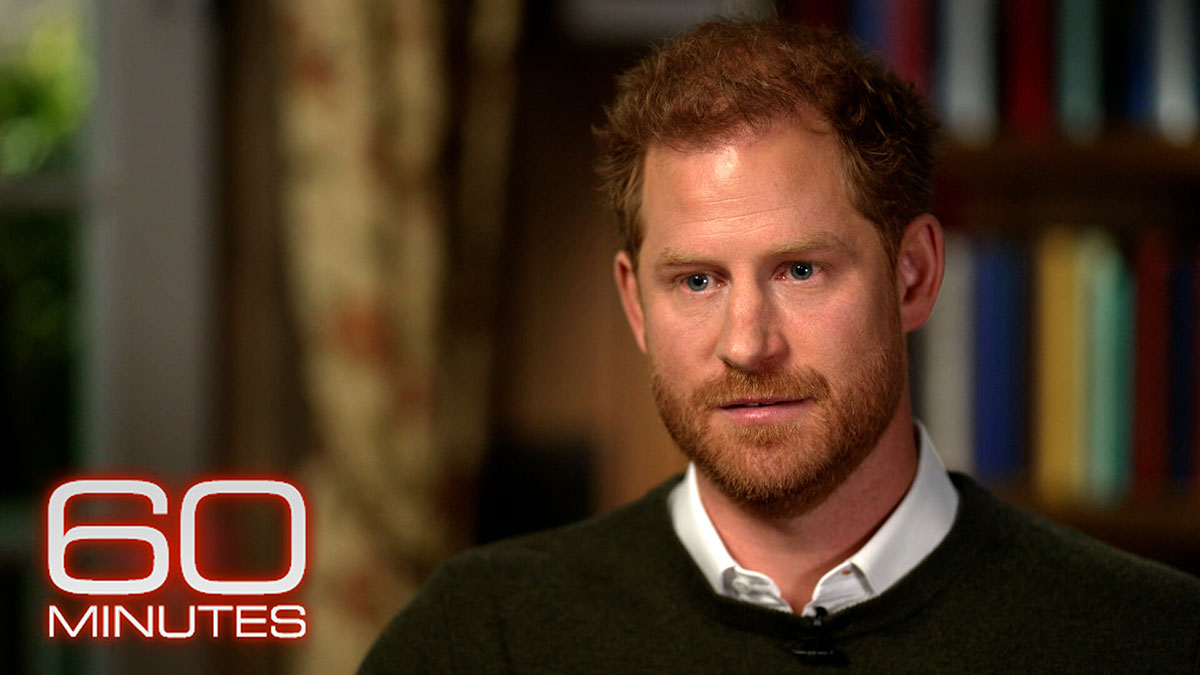
So to mark his book’s release, the Duke of Sussex sat down with Anderson Cooper on “60 Minutes” before appearing on “Good Morning America” for a 12-minute conversation with Michael Strahan that ran in an extended 29-minute version in prime time and on Hulu.

Whichever version you chose to watch didn’t matter, since Cooper and Strahan essentially covered the same ground, starting by rehashing Harry’s disdain for the British tabloid media.

When one recalls the true purpose of Prince Harry and Meghan’s extended coming out to American society, Colbert was always going to outdo the others.

Cooper and Strahan separately and similarly invited Harry to open up about his mother, and the unresolved grief that gripped him years after her death. He explained the extent and depth of the rift between him and his brother William; revealed his true feelings about his father King Charles III’s Queen Consort, Camilla; and established what he intended to accomplish in writing a book so revealing that it takes millions of strangers not only under his skin but behind his pants zipper.

Prince Harry: The 60 Minutes InterviewPrince Harry: The 60 Minutes Interview (CBS Broadcasting Inc.)
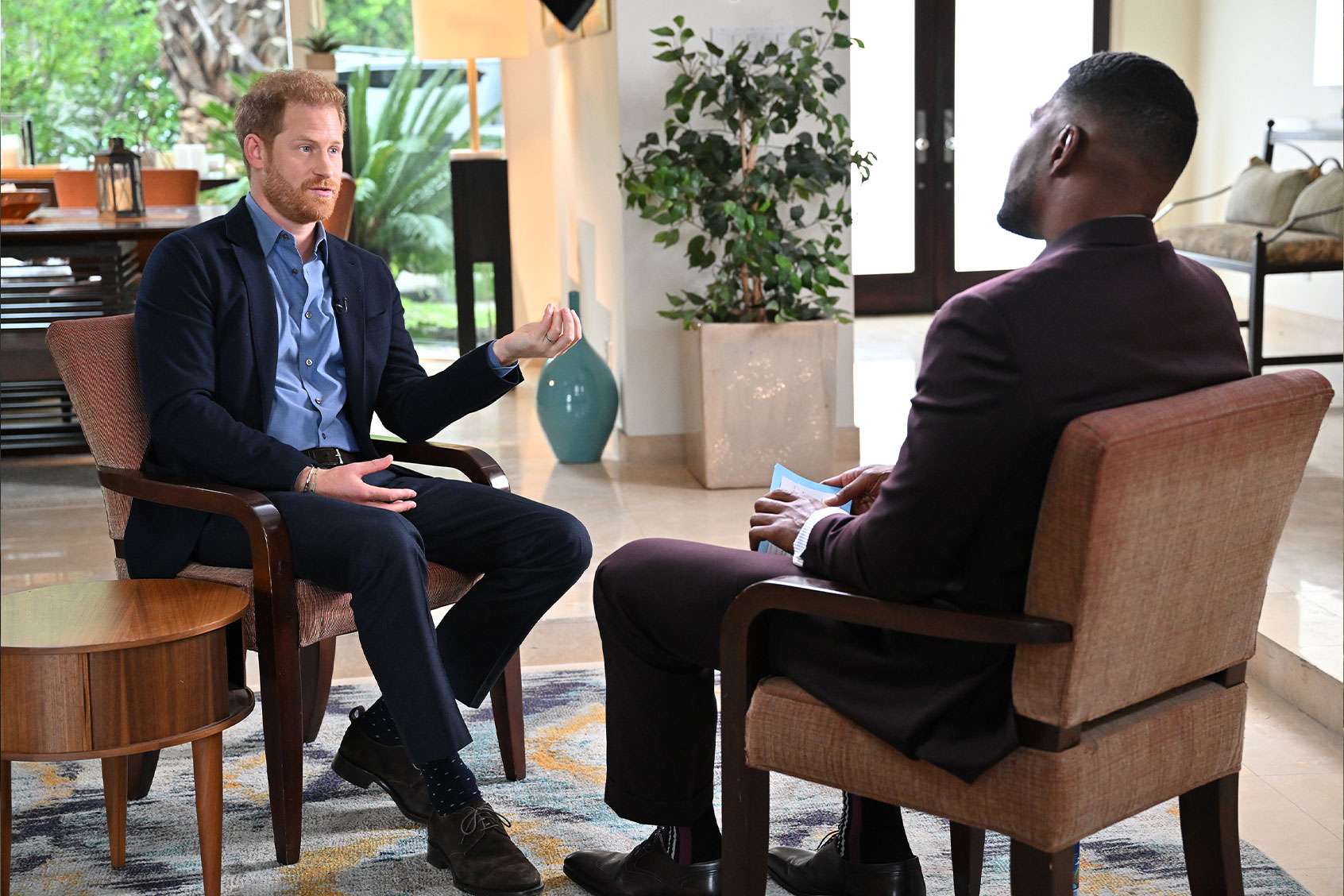
“Now, trying to speak a language that perhaps they understand, I will sit here and speak truth to you with the words that come out of my mouth, rather than using someone else, an unnamed source, to feed in lies or a narrative to a tabloid media that literally radicalizes its readers to then potentially cause harm to my family, my wife, my kids,” he says to Cooper . . . and Strahan, in similar terms.

Still, neither enabled commoners to know the self-exiled celebrity prince better than Stephen Colbert did on “The Late Show,” where the host and Harry engaged in a 40-minute combination of repartee and emotional unburdening over tumblers of tequila with a lime twist. Take this as a statement of respect for Colbert and disappointment in Cooper and Strahan, with the understanding that the late-night hosts and the news anchors have different job descriptions.

Without intending to, the geyser of mainstream news coverage marking the release of Harry’s book exposed the soft bellies of the interviewers tasked with testing the royal’s veracity. Then again, when one recalls the true purpose of Prince Harry and Meghan’s extended coming out to American society, Colbert was always going to outdo the others.

Fame is the only currency the Duke of Sussex truly has; his truth and reputation are the main products he has to trade. He’s also in a unique position as the only member of a highly exclusive and opaque in-group, the British royal family, willing to speak publicly about what growing up in a palace is like. Therefore, Harry needs the American media to be on his side to get the American people on his side.  

“This is the other side of the story, after 38 years,” Harry tells Stephen Colbert on Tuesday’s episode of “The Late Show.” “They’ve told their side of the story. This is the other side.”

Declarations like this should automatically make a journalist skeptical. But Cooper and Strahan played the part of hospitable guides rather than curious conversationalists, doing their part to validate and verify Harry’s charisma instead of revealing unexpected sides of him.

As many people have pointed out in the discourse that’s surrounded the royal family since the eruption of florid coverage of Queen Elizabeth’s death in the fall, the American media has bent over backward to support the Sussexes without soberly interrogating Harry’s role in perpetuating his family’s colonialist views.

A pillar in his North American public relations campaign is to establish himself as an anti-racist standing up to the bigotry of the British tabloids, not only in defense of his wife but in solidarity with non-white people. “The UK is not bigoted. The British press is bigoted,” he tells Strahan. “But the source of your information is inherently racist, biased and just wrong, then that thought infiltrates everybody’s minds.”

Later he adds, “The way that they speak about her and the way they treat her is incredibly relatable to everybody else of color.”

Michael Strahan interviews Prince HarryMichael Strahan interviews Prince Harry in Los Angeles, California on Tuesday, January 3, 2023. (ABC/Richard Harbaugh)
But that doesn’t necessarily square with people who remember the headlines about a video from 2009 in which he referred to a Pakistani army officer as “our little Paki friend” and joked that an officer cadet looked like “a raghead,” two offensive slurs used against Pakistani and Middle Eastern people. This plays into our culture’s habit of viewing racism in Black and white terms, relying on Harry’s reaction to what happened to Meghan as something that can be applied to everyone.

Harry needs the American media to be on his side to get the American people on his side.  

This is worth bringing up because Cooper had a perfect opportunity to confront Harry about that within their interview, and without necessarily making him look hypocritical.  Harry paves that road for him when he says, “I went into this incredibly naïve. I had no idea the British press were so bigoted. Hell, I was probably bigoted before the relationship with Meghan.”

“You think you were bigoted before the relationship with Meghan?” Cooper asks, leading Harry to suddenly pull back and haltingly answer, “I don’t know,” before adding, “Put it this way: I didn’t see what I now see.”  Like, say, that incident . . . for which the palace apologized on Harry’s behalf, a common PR move he now says can’t be trusted.


Want a daily wrap-up of all the news and commentary Salon has to offer? Subscribe to our morning newsletter, Crash Course.


In the broader pantheon of famous figures who rate highly enough to dominate important real estate on two network schedules, Harry is not, say, a public threat. These were low-stakes interviews whose main purpose, regardless of what Harry insists, is to out-charm his brother William in the eyes of the American public. This week’s conversations and the shows that came before probably achieved that end.

Therefore Cooper’s and Strahan’s respective weak interviewing demonstrations matter less than Harry’s performance on “The Late Show,” where he revealed his comedic side, played to the folks in the theater, and easily kept up with Colbert’s comedy dance.

Colbert, who describes “Spare” as “factually honest and emotionally honest,”  is the ultimate sympathetic ear, given his public experience with grief, mourning, and healing. The lion’s share of their conversation concerned Harry’s struggle to contend with losing his mother, and his fury at having his words about his military service and the Taliban fighters he killed taken out of context.

“That’s dangerous. My words are not dangerous, but the spin of my words is very dangerous to my family,” he tells “The Late Show” host and viewers, adding later that after working with veterans for most of the last two decades, “my whole goal, my attempt with sharing that detail is to reduce the number of suicides.”

But the interesting points in the interview were when the host asked follow-up questions that knocked Harry off of his script, widening the crack of the window to his psyche. After Harry describes the media’s chipping away at Meghan’s reputation and self-esteem by besmirching her reputation, Colbert muses, “Do you think that the intent was always to make her leave, or to break her spirit so she’d be easier to control?”

This makes Harry pause and, after a sober answer and few beats, sip his drink.

Separately the three stages achieved what Prince Harry wanted, which was to use one media ecosystem against the other that maligned him and his wife, the same one that drove a wedge between his family and his brother, father and their wives. You can’t blame a guy for fighting The Firm by tightening up his alliance with Hollywood. But one should expect ABC’s and CBS’ news divisions not to make it so easy for him.

In this instance, they did not. However, they did give Harry a reason to enthusiastically opine to Colbert’s audience, “America is a great place to live.” From what we witnessed of the kid glove treatment he received this week, the man ain’t lying.

Ex-GOP candidate’s wife hit with 52 felony charges after casting 23 votes for husband: DOJ

The Department of Justice charged the wife of Woodbury County Supervisor Jeremy Taylor for her role in an alleged voter fraud scheme during the Iowa 2020 primary and general elections to get her husband elected to Congress.

Kim Phuong Taylor was arrested Thursday on more than 50 felony charges, including 26 counts of providing false information in registering and voting, three counts of fraudulent registration, and 23 counts of fraudulent voting, according to the Des Moines Register.

Kim Taylor allegedly filled out voter registration forms using the names of members from Sioux City’s Vietnamese community and submitted them to the county auditor’s office. She also submitted absentee ballots, signing affidavits with their names, according to the DOJ.

She approached voters who had limited ability to read and understand English and offered to help them vote, according to the indictment.

“For example, although these documents required the signer to affirm that he or she was the person named in them, Taylor signed them for voters without their permission and told others that they could sign on behalf of relatives who were not present,” according to the Justice Department press release

Her actions took place ahead of the June 2020 primary election, in which Jeremy Taylor unsuccessfully ran for the Republican nomination for Iowa’s 4th District Congressional seat as well as during the November general election in which Taylor defeated incumbent Democrat Marty Pottebaum for the District 3 seat on the county board.

Woodbury County Auditor and election commissioner Pat Gill said Thursday he notified the Iowa Secretary of State’s Office after his office was contacted about the potential voter fraud prior to the November 2020 election, the Sioux City Journal reported


Want a daily wrap-up of all the news and commentary Salon has to offer? Subscribe to our morning newsletter, Crash Course.


“We received a call from one of the folks that had a ballot voted for them,” Gill said.

He was instructed to contact the FBI and notify them. 

Kim Taylor, who pleaded not guilty to the charges, was released on a personal recognizance bond and was ordered to surrender her passport and is not allowed to apply for a new one, according to the Sioux City Journal. A trial is scheduled for March 20 in U.S. District Court in Sioux City.

Jeremy Taylor is currently the vice chair of the Woodbury County Board of Supervisors serving his third term with the board, according to the county website. 

He had to previously resign from the board after Gill ruled Jeremy Taylor had improperly used an address for a former home in Sioux City on his voter registration. Since he was living in a home in District 3, he violated a state law that required county supervisors to live in the district in which they were registered.

After redistricting, Jeremy Taylor now represents District 5 and currently serves as the board’s vice chairman. He’s up for re-election in 2024.

Pentagon report reveals over 500 new UFO sightings — and experts have no explanation for 171 of them

Since August 2021, U.S. intelligence agencies have collected more than 500 new accounts of unidentified aerial phenomena, according to the latest report from the Pentagon. An increase in surveillance drones and weather balloons accounts for the majority of the reported UFO sightings — but 171 witness reports remain a mystery to officials. Meanwhile, a new amendment in the latest Defense budget aims to answer renewed calls for an investigation of UFO-related incidents surrounding the 1945 Trinity nuclear test site. 

The 12-page report says the Office of the Director of National Intelligence (ODNI) found no instances of collisions with a UAP, though the threat of foreign intelligence surveillance weighs heavily among its topics.

Ronald Moultrie, the undersecretary of Defense for intelligence and security, offered further details of the findings to reporters. On the question of whether the office found evidence of alien life, Moultrie said they had nothing. So far. 

“We have not seen anything that would … lead us to believe that any of the objects that we have seen are of alien origin,” he said. “If we find something like that, we will look at it and analyze it and take the appropriate actions.”

After a 2021 congressional report found 143 UAP sightings — many made by military pilots — still unexplained since 2004, the Pentagon formed a task force to investigate. The DOD created the All-domain Anomaly Resolution Office in 2022, now directed by Sean Kirkpatrick, former chief scientist of the Missile and Space Intelligence Center. 

“We are structuring our analysis to be very thorough and rigorous. We will go through it all. And as a physicist, I have to adhere to the scientific method, and I will follow that data and science wherever it goes,” Kirkpatrick said at the briefing. 

CNN’s Oren Liebermann asked whether the data offered any potential national security threats.

“Yes,” Kirkpatrick said, according to a DOD transcript. But Moultrie was quick to caveat: any unauthorized system in U.S. airspace is always considered a potential threat to safety.

“We’re still trying to resolve some of these cases. Some of them probably could not be characterized as civilian balloons or UASs or UAVs or whatever. So, in the absence of being able to resolve what something is, we assume that it may be hostile. And so, we have to take that seriously,” Moultrie said. 


Want a daily wrap-up of all the news and commentary Salon has to offer? Subscribe to our morning newsletter, Crash Course.


A new amendment to this year’s defense budget, which was signed into law by President Joe Biden in December, calls for AARO to investigate the long trail of reported UFO-related incidents surrounding the famous Trinity Site — the world’s first atomic bomb detonation in the White Sands Missile Range in 1945. As first reported by Politico, AARO has to deliver a historical record of the government’s efforts on UFOs, from 1945 onward. 

The new defense bill also aims to fully staff the AARO and requires it to work with intelligence agencies to navigate UFO-related non-disclosure agreements. It must share its findings with the DOD and create a process for people to share information of any classification level. 

UAP Outreach chair and former Navy Lt. Ryan Graves, of the nonprofit American Institute of Aeronautics and Astronautics, praised the latest budget inclusion and called the sharp uptick in reported sky debris a safety hazard. 

“With 247 new incidents of UAP since the 2021 report, including events in sensitive airspace, it is clear that there is an urgent and critical need to improve aerospace safety by dedicating scientific research into UAP,” Graves, a former F/A-18 pilot, said in a statement on Twitter. 

“I am glad to see the government is taking the accounts of pilots and other witnesses seriously, and I am heartened by ODNI’s acknowledgment of the profound, harmful effect stigma has in preventing the necessary data collection we need to understand UAP.”

In an interview with The New York Times, astronomer and ufologist Dr. Jacques Vallée — who previously assisted the French space agency, Centre National d’Études Spatiales in UFO studies — celebrated the budget announcement.  

“This is what all scientists and my colleagues have always dreamed of,” Vallée said Thursday, calling the move “an absolute turning point.” 

Vallée’s scholarship includes an examination of Trinity incident reports. He said that while reports from civilians less technologically equipped than the military may have previously been met with a sense of unreliability, the creation of a wider reporting net opens up research to new data.

“The civilian observations tend to be longer, they tend to be more detailed, they tend to leave a trace that we can analyze,” he said. 

“He certainly did”: Trump’s brag that he showed how “corrupt our government is” badly backfires

Twitter users are mocking former president Donald Trump following his latest Truth Social post, Huffpost reports.

Trump, who is currently under investigation by the Department of Justiceamong other entities, posted: “Importantly, I have single-handedly shown the American Public how Crooked and Corrupt our Government is. NOW WE CAN FIX IT!”

Former federal prosecutor and Republican Ron Filipkowski started the chain of reactions by tweeting a screenshot of Trump’s post along with a sarcastic jab at the former president: “He certainly did that every single day he was in office.”

Many users added their reactions to Filipkowski’s tweet in agreement.

Former sports editor of The Tacoma News Tribune Darrin Beene posted, “What’s really funny about this statement is this guy couldn’t fix a sandwich.”

Other users hailed the former president’s post as a “confession.”

“It is odd how often he points out how horrible he is himself,” Ohioan @cincygreghoodin tweeted.

Teacher, @BowiesNana responded, “For sure, DJT …You showed the World “how crooked and corrupt Government can be!”

“Unreal, just about everything he blurts out is a confession of sorts……” user @lanna_mick responded.

And some users sarcastically agreed with Trump’s statement.

An “ex republican after 60 yrs” @BUSH1940 tweeted, “Yep, he showed us. His corruption has been quite obvious.”

“I have to agree with him on all but the last 5 words,” @syfy09 wrote.

Lawyer @Fly_Sistah replied, “Wow. I actually agree with Donald Trump. His decades long crime spree that reached the White House did singlehandedly show us how corrupt government is.”

“He is a proven loser”: Paul Ryan “can’t imagine” Trump winning in 2024 after string of defeats

Paul Ryan wrote off Donald Trump as a non-factor going forward in the Republican Party.

The former House speaker cast doubts on the twice-impeached former president’s chances for winning the GOP nomination for 2024, despite being the only candidate who has so far announced a campaign, and he told CNN’s Jake Tapper that Republicans should move on from his leadership.

“He’s fading fast, he is a proven loser,” Ryan said. “He cost us the House in ’18, he cost us the White House in ’20 and he cost us the Senate again and again, and I think we all know that, and I think we are moving past Trump. I really think that’s the case. I can’t imagine him getting the nomination, frankly, and I don’t mean this because I don’t want him to — I don’t want him to — but I don’t think he will.”

“The thing I take solace in, with all the machinations you saw last week, most of that wasn’t personal,” he added. “Most of that was around fiscal responsibility, most of that was about a concern about spending inflation and debt — that’s great. I think you need to persuade the country with the solutions on the problem, and I don’t think brinksmanship solves those things, but what is behind that is a good thing, which is Republicans finally reacquiring their moorings on the party of fiscal responsibility and limited government. That is the good thing I see in all of this weird stuff, and I am a Republican. I am not a member of an organized party, I am a Republican.”

Watch below or at the link:

GOP claims it’s creating a new Church Committee: The real historical parallel is Joe McCarthy

During the George W. Bush years, as the nation waged the “global war on terror,” there was massive concern among civil libertarians about the government’s indifference, if not hostility, to human rights and civil liberties. While the “Bush Doctrine” held that “either you’re with us or you’re with the terrorists” and professed a commitment to spreading democracy (at the point of a gun) around the globe to defeat them, Vice President Dick Cheney articulated an even darker vision in a “Meet the Press” interview five days after the 9/11 attacks:

We have to work the dark side, if you will. Spend time in the shadows of the intelligence world. A lot of what needs to be done here will have to be done quietly, without any discussion.

It wasn’t long before it became clear what he meant. Eventually, the press and other investigators uncovered evidence that the government had gone very dark indeed. It had unleashed the FBI on innocent American Muslims, while military units and the CIA were kidnapping and torturing supposed terrorism suspects in secret “black sites” all over the world. There were secret no-fly lists and warrantless surveillance of U.S. citizens, nearly all of this occurring in total secrecy without oversight by the courts or the Congress.

Many civil libertarian organizations, from the ACLU to the Brennan Center, protested all this blatantly illegal or unconstitutional government activity and those voices grew even louder after the 2013 revelations by Edward Snowden, which showed the vast scope of these programs. From the beginning there were calls for a “new Church Committee” to investigate the vast overreach of the intelligence community. That was a reference to the semi-legendary committee led by Sen. Frank Church, an Idaho Democrat (!), in the wake of Watergate, whose unwieldy official name was the Senate Select Committee to Study Governmental Operations with Respect to Intelligence Activities.

Although it was associated with Richard Nixon’s scandals, the Church Committee was truly bipartisan — conservative hero Barry Goldwater was among its five Republican members — and examined the excesses and illegal activity of the FBI, CIA and NSA during the entire postwar period, much of which had been revealed in the press during that era of aggressive investigative journalism. That committee, along with the similarly aligned Pike Committee in the House, uncovered information about such programs as COINTELPRO, which involved the surveillance and infiltration of American political and civil rights organizations, and Family Jewels, a covert assassination program aimed at removing foreign leaders the U.S. didn’t like. One of the most shocking discoveries was Project MKULTRA in which the government used torture and drugs on unwitting Americans for illegal experiments in mind control. Several other programs were revealed involving a cooperative relationship between Intelligence agencies and the news media to disseminate government propaganda both domestically and overseas.

It may all sound like something out of a dystopian science fiction novel, but it all actually happened right here in the good old USA. These astonishing revelations led to the passage of the Foreign Intelligence Surveillance Act, which created the (still secret) FISA court, and to the creation of the standing committees on intelligence in both houses of Congress. But while the Church Committee has a historical reputation as having substantially reformed the Intelligence agencies, the truth is that its effect was limited. It wasn’t easy to get any significant reforms through Congress, and it didn’t take long before those changes began to erode.

Nonetheless, the Church Committee stands as a symbol of strong bipartisan investigative oversight and reform of the most powerful and secretive law enforcement and Intelligence agencies. So when civil libertarians called for a “new Church Committee” a decade or more ago, that made sense.


Want a daily wrap-up of all the news and commentary Salon has to offer? Subscribe to our morning newsletter, Crash Course.


Throughout the post-Church era, the American right has almost entirely been on supportive of government secrecy and the intelligence agencies (as with the notorious Dick Cheney quote cited above), allowing for a handful of self-styled libertarians like Sen. Rand Paul and his dad, former congressman Ron Paul. In fairness, most Democrats have been as well. It has mainly been progressive Democrats (like Rep. Barbara Lee and Sen. Ron Wyden, for instance) who opposed these programs while the rank-and-file right enthusiastically endorsed torture and mass surveillance and asked for more. But ever since Donald Trump and his inexplicably Russia-friendly campaign came on the scene seven years ago — cheering on illegal hacking of his opponents by foreign agents — the right has worked itself into a frenzy about the “deep state” abusing its power by investigating Trump’s suspicious behavior.

The true leader of the new House majority, Fox News host Tucker Carlson, came up with a plan to turn the tables, now that the GOP has subpoena power:

The real name of this Republican snipe-hunt committee gives away what this is all about: The Select Subcommittee on the Weaponization of the Federal Government. The New York Times reports it will have “access to information on par with the House Intelligence Committee,” and Republicans say they have a mandate “to scrutinize … a concerted effort by the government to silence and punish conservatives at all levels, from protesters at school board meetings to former President Donald J. Trump.” You can see why they’d need the highest security clearances for such important work.

This latest “investigation of the investigators” will specifically go after the law enforcement officials investigating the Jan. 6 insurrection and will be chaired by Rep. Jim Jordan of Ohio, who was intimately involved in the attempt to overturn the election results in 2020. In other words, this neo-pseudo-Church Committee has been tasked with investigating the law enforcement agencies that are investigating them.

This bears almost no resemblance to the bipartisan Church Committee, which was established by a nearly unanimous vote in the Senate to look at systematic abuses going back decades under administrations led by both parties. But it does bear great resemblance to some earlier committees that purported to be rooting out abuses in the U.S. government. Ironically enough, the name McCarthy is associated with both of them.

Jim Jordan’s jury-rigged “investigation of the investigators” bears no resemblance to the bipartisan Church Committee. But it does resemble an earlier effort to root out alleged government abuses by hurling wild, made-up accusations.

Sen. Joseph McCarthy of Wisconsin first made his name in a 1950 speech claiming that he had a list of communist sympathizers in the State Department. He spent the next half decade accusing hundreds of federal employees, including members of the military and the Truman administration, of being Soviet spies or “fellow travelers.” His investigations and public hearings were a cavalcade of lies and spurious accusations. He was coddled and enabled by Republican leaders, all the way up to President Dwight Eisenhower, who were too timid to confront him lest they anger his multitude of online fans. (Joe McCarthy would have been sensational on social media.)

There is no single figure like that McCarthy leading the charge in this new GOP majority. There are dozens of them, and they have no genuine interest in abuses of power or the excesses of the “deep state” (which most certainly have continued under both parties). They simply want to avenge their leader Donald Trump and intimidate the authorities into backing off from any potential prosecution of Trump and his closest allies. So they intend produce a full-blown televised McCarthy-esque spectacle aimed at proving that Trump was the innocent victim of liberal (perhaps communist?) cops and spies within the federal government who seek to ruin everything America stands for.

Joe McCarthy was washed up and dead from alcoholism at the age of 47. These heirs to his legacy will end up clowning on Fox News and fundraising big bucks online from suckers who will themselves into believing it’s all real. As the O.G. commie Karl Marx famously observed, “all great, world-historical facts and personages occur, as it were, twice. The first time as tragedy, the second as farce.”

Right-wingers push conspiracy that Biden classified docs are a leftist plot: “Clear that it is”

Some right-wingers are convinced that the scandal over classified documents found by President Joe Biden’s lawyers at several locations is actually part of a Democratic plot to damage the president’s 2024 hopes.

Attorney General Merrick Garland on Thursday named former Trump-appointed U.S. Attorney Robert Hur as special counsel to oversee the probe into classified documents found at Biden’s former private office and at his Delaware home. Biden told reporters he is cooperating fully with the DOJ and the White House said it is confident that the investigation will show that the documents were “inadvertently misplaced.” Unlike former President Donald Trump, whose attorneys claimed to the DOJ that he had returned all of the classified documents at Mar-a-Lago before an FBI search turned up another trove of classified materials, Biden’s lawyers immediately turned over the found documents to authorities.

Though legal experts widely believe the Biden special counsel is unnecessary and unlikely to turn up evidence of a crime, right-wingers have spun the incident as potentially fatal to Biden’s 2024 chances — and they think Democrats are behind it.

Fox News host Tucker Carlson on Thursday claimed that it is “really clear that it is” an “organized effort from within the Democratic Party to prevent Biden from running again.”

Rep. Ronny Jackson, R-Texas, told Newsmax that Democrats may be pushing the issue to sabotage Biden.

“That could be happening here,” he said. “I’ve been saying for a long time that the Democrats are going to have to figure out a way to get rid of Joe Biden.”

Jackson claimed that Democrats “don’t want this man to run for president again.”

“I said all along, I thought maybe they would let the Hunter Biden thing blow up a little bit, but maybe this is what they’re doing,” he said. “Maybe this is the first shot that they’re going to fire to try to get him in a position where he ultimately has to resign or at least has to decide that he’s not going to run again. Something’s going on here. A lot of stuff has been exposed.”

Rep. Troy Nehls, R-Texas, suggested that Democrats are happy about the scandal.

“Maybe, there are some people with [Biden’s] own party that appreciate the fact that he has these documents…cause there are many in his own party that don’t want him to run again,” he claimed.

Nehls even suggested that Hur, a former Trump appointee, may be a plant because he served as an assistant to FBI Director Christopher Wray — another Trump appointee that right-wingers view as insufficiently loyal to the former president.

“They’re all in on it,” Nehls tweeted.

Kash Patel, a former aide to Trump and a key witness in the Mar-a-Lago documents case, also accused Hur of being part of the so-called deep state even though he was appointed by Trump.


Want a daily wrap-up of all the news and commentary Salon has to offer? Subscribe to our morning newsletter, Crash Course.


“This guy is a swamp monster of the tier-one level. He’s a government gangster. He’s now in charge of the continued crime-scene cover-up,” Patel said in an interview.

Some on the left also went into full conspiracy theory mode after the discovery of the documents by Biden’s own attorneys.

“I’ve never seen a luckier person than Donald Trump. Just as we’re this close to getting him, somehow these documents appear,” Joy Behar, one of the hosts of The View, said Thursday.

Co-host Sunny Hostin asked whether it felt like “Republicans were behind it.”

“It did originally,” co-host Whoopi Goldberg replied, “but not now, because one of the things he’s saying is that, you know, some of the locations where the docs may have been shipped in the transition may have gotten taken and put.”

Despite Biden’s team confirming the discovery of the documents and vowing to cooperate with the probe, Rep. Hank Johnson, D-Ga., suggested that the documents may have been “planted” — echoing Trump’s own baseless claim that the FBI may have planted documents during the August search of Mar-a-Lago.

“Alleged classified documents showing up allegedly in the possession of Joseph Biden… I’m suspicious of the timing of it,” he told Fox News on Thursday. “I’m also aware of the fact that things can be planted on people… things can be planted in places and then discovered conveniently. That may be what has occurred here. I’m not ruling that out. But I’m open in terms of the investigation needs to be investigated.”

Why do I say we should defund the police? My lived experience

Earlier this week, I learned via social media that there is a national day of appreciation for law enforcement set aside in January of every year. One clip that went around showed Dean Cain, former Superman and current Fox News favorite, gushing about cops to “Fox & Friends.” 

“Every single day should be Law Enforcement Appreciation Day,” said Cain, who now serves as both a reserve police officer in Pocatello, Idaho, and a deputy sheriff in Frederick County, Virginia. 

Every day? 

Maybe I’m a hypocrite, because I know there’s a day for veterans and a day for moms and dads; a day for white people’s independence and another for Black independence, because they aren’t the same; a girlfriend day and a boyfriend day and an ice cream day and a cheese day and a burger day, and none of these days bother me. But I see a National Law Enforcement Day hashtag and it irks me.

Anger wells up inside of me at the idea of celebrating cops just for the sake of celebrating cops. Read the room, America. You’ve heard of Mike Brown, Tamir Rice, Freddie Gray? Breonna Taylor, Sandra Bland, George Floyd? Is there no internet in Pocatello? Should we be celebrating cops before we designate a National Hand Sanitizer Bottler Day? Because those folks are real heroes. 

This is normally the part where a person with a different lived experience would step in and say something like, You guys who complain about the cops always call the cops when you are in trouble!

Well, I don’t. As a child, when armed gunmen stormed my home, held my family hostage and stole our belongings, my dad called the police after they fled, only to be greeted by two cops who showed up hours late with terrible attitudes. That incident was followed by years of cops digging in our pockets and stealing my money, chasing and beating on my friends and me; cops who booked us for stats, the countless traffic tickets for DWB (Driving While Black); the times they made us lie face-down on cold concrete just because they could, the years of senseless trash talk; the brave officers who fixed their lips to call us “Black ass n****rs,” and “Jungle n****rs”; and one particular, pale Baltimore City cop who dragged his chunky index finger slowly across his neck, calling me a “dead n****r.” 

Some cops can’t wait to wreak havoc on a peaceful block, but never show up during shoot-outs like real heroes would. 

For the most part, the Black inner-city male experience teaches you to never call the cops unless you need to make an insurance claim. But I’ve even had bad experiences with police officers doing just that, as if I scam because I’m Black, not worthy to make a complaint so I can be reimbursed for my money because I’m Black, fractured my own windshield or punctured my own tires because I’m Black. And still, to be greeted with sourness — even from cops who are as Black as me. How or why should anyone celebrate an institution like that? 

I still couldn’t bring myself to dial 9-1-1 because police always, always make situations worse.

“The Baltimore Police department does a wonderful job,” I overheard a poshly-dressed woman say in a fancy Baltimore bar a few months ago. She wasn’t talking to me or trying to get my attention, and I wasn’t actively eavesdropping, even though her comments burned the side of my face. “I’m thinking about documenting the horrors cops face in this city in my next book.” 

As a Baltimore writer, I like to know who the other Baltimore writers are, and I’d never seen this woman before. Her friends high-fived her, as she continued praising city cops and the newly elected States Attorney Ivan Bates. We had just passed 300 murders, and I don’t think that number warranted a celebration. Especially since one of those murders was my friend Heavy, a good dude who was abducted in broad daylight under what seemed like multiple modes of police surveillance. No one saved him. 

“Two writers at one bar?” the bartender said to the woman, pointing at me. “Do you know D Watkins?” 

“Actually, no,” the woman responded. “Nice to meet you. Are you a poet?” 

“I wish,” I laughed, holding my glass up in a cheers motion, and then quickly went back to minding my business. That didn’t last long because this was the part when the “where are you from” and “what do you think about the hard-working cops, the mayor, the future of the city” part of the conversation began. 

I told her I didn’t have any faith in cops without going into my backstory. I didn’t explain how you could hit me with a car, push me through a glass window, stick a gun in my face or even shoot at me  — all those things have actually happened — and I still couldn’t bring myself to dial 9-1-1 because police always, always make situations worse.


Want a daily wrap-up of all the news and commentary Salon has to offer? Subscribe to our morning newsletter, Crash Course.


Instead, I landed on this: “I’d never call a cop. Well, except for insurance paperwork. Insurance companies require a police report.” 

“That’s ridiculous. I’ll call the cops in a second,” she said. Her eagerness made the bar, her friends, and even me laugh. I couldn’t hold it in. 

You’d even call them on me, I mumbled under my breath, before taking myself out of the conversation for good.

I’m sure a cop has saved someone at some point, but that hasn’t been my lived experience. I understand that my lived experience isn’t the same as everyone’s, just like I understand that all cops aren’t out in the world working toward my destruction. I grew up in a poor neighborhood where N-word-spewing cops regularly acted out without repercussions. Now I live in a middle-class neighborhood where cops wave and tell us to enjoy our weekends. Everyone in my old neighborhood wasn’t a criminal. And I know not everyone in my new neighborhood is a saint. However, our class allows us to have a different experience with law enforcement. And we need to change that.

Changing the mentality that police officers take into poor Black neighborhoods is way more important than creating a holiday in celebration of bad-to-mediocre service for most of the country via a failed institution that we are all forced to pay for. Instead of being so quick to aimlessly celebrate or honor the police, let’s put that energy into making policing work for all. Defunding and reallocating those funds to some of the poor communities cops helped destroy would be a great start. 

EPA’s proposed air pollution standards for soot could save thousands of lives

Late last week, the Environmental Protection Agency proposed tighter limits to one of the country’s most dangerous air pollutants: fine particulate matter, or soot. But while the long-awaited move could save thousands of lives per year, health experts say it’s still not enough.

Soot is also known as fine particulate matter because its fragments are so small — 2.5 microns in diameter or less. When inhaled into the lungs over time, these harmful materials can cause damage leading to premature death, heart attacks and cancer. Sources for the deadly pollutant include construction sites, power plants, and refineries. Those who live nearby (disproportionately low-income households and people of color) face the greatest risk of exposure.

Since 2012, the national annual air quality standard — a number that represents a limit to the average amount of particles in the air outdoors — has been 12 micrograms per cubic meter for fine particulate matter. The Clean Air Act requires these standards to be revisited every five years. The last time the matter came under discussion was 2020, when the Trump administration rejected tougher standards on particulate matter, despite public health officials’ calls for more stringent protections.  

Under the Biden administration, the new proposed limit is between 9 and 10 micrograms per cubic meter. An even greater range, between 8 and 11 micrograms per cubic meter, will be open to public comment following the proposal. Only after the period of public comment, which will last 60 days following the publication of the proposal in the federal register, will a new standard become official.

“Our work to deliver clean, breathable air for everyone is a top priority at EPA, and this proposal will help ensure that all communities, especially the most vulnerable among us, are protected from exposure to harmful pollution,” said EPA Administrator Michael S. Regan in a press release. 

But while the EPA asserted its new proposal “reflect[s] the latest health data and scientific evidence,” public health experts have said this is not the case; the EPA’s own Clean Air Scientific Advisory Committee actually recommended an annual standard as low as 8 micrograms per cubic meter. The World Health Organization’s guideline for annual average exposure to particulate matter is even lower, just 5 micrograms per cubic meter.

“EPA is soliciting comment consistent with the [Clean Air Scientific Advisory Committee’s] full range of recommendations,” said the agency’s public affairs specialist Shayla Powell in an email, explaining that while the committee’s advice is important, it is not the only factor the agency considers when making a proposal. 

“The Agency also takes into consideration the available scientific evidence, quantitative risk assessment information, and public comments received throughout the reconsideration,” she wrote. 

Some health advocates remain unmoved by that logic. “The proposal falls far short of what is necessary,” said Paul Billings, national senior vice president of public policy for the American Lung Association. “Eight [micrograms per cubic meter] would provide the most protection, particularly to low-income and people of color.” 

Research shows particulate matter exposure causes between 85,000 and 200,000 excess deaths each year in the U.S. According to the EPA, a new primary annual standard of 9 micrograms per cubic meter would prevent up to 4,200 premature deaths per year. Billings said these benefits are far greater if the standard was just one microgram per cubic meter lower — preventing up to 12,000 premature deaths. 

“Any improvement from our current standard brings us to better health,” said Joshua Apte, an associate professor of environmental engineering and environmental health sciences at UC Berkeley, “but the lower the better.”

Apte, who has researched the impact racist real estate practices like redlining have had on exposure to air pollution, said that national standards, no matter what they are, often fall short of protecting communities facing the greatest risk. 

“A tighter standard alone is not going to solve this problem,” he said. National air quality standards applied across an urban area, for example, will still result in disproportionate exposure among residents depending on whether they live and their proximity to sources for pollution, even if the area meets national standards overall. 

“Rather than focusing our emissions reductions uniformly across the entire country,” Apte said, “if you focus on targeting the communities that are most disparately exposed … we could eliminate most of the disparities.”

Washington state just started capping carbon emissions. Here’s how it works

Washington state rang in the New Year with the launch of its most ambitious plan to slash carbon pollution. The new “cap-and-invest” program is designed to follow in the footsteps of California, where a cap-and-trade system began in 2013, while trying to learn from its missteps.

Signed into law by Washington Governor Jay Inslee in 2021, the Climate Commitment Act works by setting a statewide “cap” on greenhouse gas emissions that steadily lowers over time. Washington, like California, is establishing a market for businesses to buy pollution “allowances” that will become increasingly expensive — an incentive to cut emissions and a way to raise money to counter climate change.

The first auction to sell off these allowances is scheduled at the end of February, and if all goes according to plan, Washington’s emissions will drop to 95 percent below 1990 levels by 2050, an even steeper cut than California’s, which aims for an 80 percent reduction by the same year.

“We see the Climate Commitment Act as the new gold standard for climate policy across the nation,” said Kelly Hall, the Washington director for the regional nonprofit Climate Solutions, which helped shape the legislation. “The policy not only ensures that we reduce greenhouse gas emissions in line with what science requires, but that equity and environmental justice are also foundational to the law.”

It’s the most recent example of a blue state putting a price tag on carbon dioxide, a longtime goal of climate advocates that has come with controversy. Last year, Oregon instituted a cap-and-trade system via executive order from former Governor Kate Brown after years of failed bills — including two attempts thwarted by Republican state senators going into hiding to avoid a vote. In the Northeast and Mid-Atlantic, a collection of almost a dozen states participate in a regional cap-and-trade program that began in 2009.

The federal government, however, has taken a different approach after two decades’ worth of abandoned attempts to make polluters pay for their emissions. Last summer, a Democratic-controlled Congress broke through the deadlock to pass the historic Inflation Reduction Act, which aims to lower emissions through green tax credits intended to speed up the adoption of clean energy and low-carbon technologies.

Proponents of Washington state’s approach say that other states could learn from its equity-focused approach to climate policy, the outcome of years of consultation with green organizations, businesses, labor groups, Native American tribes, and environmental justice advocates. A standard cap-and-trade system can help cut global carbon emissions, but it doesn’t ensure that locals will see benefits. 

Washington is the first state to pair cap-and-trade with a regulatory air quality program to help people in the most polluted areas breathe cleaner air. It also relies on advice from an environmental justice council for implementing the policy and deciding how to spend the revenue.

Passing a price on carbon took more the state than a decade. After years of failed bills starting in 2009 — and ballot measures that voters rejected twice, once in 2016 and again in 2018 — the legislature finally approved the Climate Commitment Act in the spring of 2021.

It could prove to be a turning point for Washington’s emissions, which in recent years have been heading in the wrong direction. According to the state’s most recent analysis, greenhouse gas emissions in 2019 reached their highest level since 2007: 102 million metric tons, a 7 percent increase from 2018. 

The program will work to cut emissions in tandem with a suite of policies that the state’s Democratic legislature has passed in recent years, including a commitment to 100 percent clean electricity by 2045 and a clean fuel standard that just went into effect. Last year, the legislature passed new rules requiring energy-efficient heat pumps in new buildings and set a goal to end the sale of new gas-powered cars by 2030.

In developing its new cap-and-invest system, Washington had the benefit of seeing how California’s played out over the past decade. The state struggled with debates over local air pollution and the unreliability of carbon offsets. 

Where does the money go?

The revenue raised from Washington state’s auctions — projected to be nearly $1 billion a year — will go toward implementing clean energy projects, reducing emissions from buildings and transportation, and adapting to the effects of climate change. Washington is looking to emulate California’s successes by creating an energy efficiency program for homes and offering vouchers for electrifying vans, trucks, and buses to counter rising emissions from those sources. Legislators also plan to use the money to add more electric vehicle charging stations and expand renewable energy projects.

“The investments are what’s going to ensure that we accelerate those emissions reductions so that they’re actually happening sooner rather than later,” Hall said. “They’re also what’s going to ensure that overburdened communities are benefiting.” At least 35 percent of the revenue will be invested in vulnerable communities — similar to California’s updated rules — with an additional 10 percent set aside for projects that directly benefit Native American tribes.

Cleaning the air

You’d think that forcing companies to pay for carbon pollution would mean that people would breathe less dirty air overall, given that they often come from the same sources. But the reality is more complicated. After California’s cap-and-trade system launched in 2013, studies showed that pollution in Black and Latino communities actually increased in the ensuing years. Just implementing a cap-and-trade system wasn’t enough to clean up the air for local residents.

To avoid running into the same problem, Washington state took the novel approach of pairing an air quality program with its cap on carbon dioxide. It will monitor and regulate air pollution in the state, locating the communities that are overexposed to air pollution. Once the Department of Ecology nails down what counts as an “overburdened” community, it’ll work to expand an air monitoring network, set air quality goals, and start conducting regular analyses to make sure those targets are being met.

“It’ll start this chain of good things around air quality, which is really positive, but it’s up to [the Department of] Ecology to really get that program running as soon as they can,” said Altinay Karasapan, the regulatory policy manager for Washington at Climate Solutions. 

One motivating factor behind the air quality program was ensuring that smaller sources of pollution won’t be ignored, said David Mendoza, the director of public engagement and policy at the Nature Conservancy in Washington. The cap-and-invest program only covers “permitted” businesses that emit more than 25,000 metric tons of CO2 per year. But the air quality program will give the state power to also take action on all levels and sources of pollution, including smaller businesses and “non-permitted” sources such as transportation or wood-burning stoves, Mendoza said.

Counting carbon

Another issue plaguing California’s cap-and-trade program is the tricky math around carbon offsets. The idea is that a polluting company can cancel out its CO2 emissions by buying so-called “offsets” that will suck up the same amount of carbon, such as a tree-planting project. The problem is, some of the forests used as offsets in California’s system have gone up in flames, threatening to erase the state’s progress on climate change.

​​To get around some of these issues, Washington is implementing stricter rules around offsets. If a business relies on an offset for compliance, an allowance will also be removed from the pool when it pollutes. In other words, it’s not considered a replacement for reducing emissions. “The way that offsets are designed in our program, offsets have additional emissions reductions benefits above and beyond the cap,” Hall said. In the initial stage of the program, companies are only allowed to use offsets for a small portion of their required emissions reductions, 5 percent.

Over the years, California has also sometimes struggled with having too much wiggle room in its market, Hall said. If you have too big a bank of allowances, companies won’t be required to reduce their emissions further, so Washington’s system allows the state to reset the allowance cap to adjust to shifting conditions and to make sure it meets its emissions goals.

The cap-and-invest system covers 75 percent of statewide emissions, including utilities and fuel suppliers. Sources like agriculture and aviation had to be left out due to existing laws.

One criticism of Washington’s new system is that many large emitters — those designated as industries that are susceptible to fluctuations of global and regional markets, such as paper mills and petroleum refineries — will be able to buy allowances at little or no cost for the next dozen years. The exception was a response to concerns that big polluters might pick up their business and move to another state where they didn’t have to pay for their emissions.

“I think that is a concern,” Mendoza said, referring to how some companies are getting a free pass. “I don’t think it ruins the program though, right? It does decrease the amount of money coming into the program. All those entities are still covered by the declining amount of allowances, so they still have to reduce their emissions.”

Getting lung cancer to own the libs: House Republicans want to make smoking great again

As a member of Generation X, I’ve found a reliable way to spook Gen Z-ers: stories of the bad old days of my youth, specifically the era of indoor smoking. Some of you will remember this: Homes, cars, restaurants, bars, college classrooms and even high schools pretty much let smokers have their way with the commonly shared air. Those of us who spent our nights in bars and clubs reeked of tobacco smoke all the time, even if we didn’t actually smoke. Our hair and our clothes permanently emanated that distinctive sour odor of it. Bans on indoor smoking were controversial at first, but when they finally arrived, it was something like seeing in color for the first time. The world, it turned out, is a lot more pleasant when you can smell things other than the reek of cigarette smoke. Going back to indoor smoking sounds about as much fun as having someone follow you around dragging their fingernails down a chalkboard all day long.

This is so self-evident that most Republicans I know agree personally, despite belonging to a political party whose guiding ethos is to be deliberately unpleasant in hopes of getting a rise out of some liberal somewhere. Even people who think Fox News host Greg Gutfeld is funny have enough sense to know that it sucks to smell like an ashtray sucks. Or at least I thought they did.

I wrote an entire book about Republican trolling, so I’m ashamed to admit that I underestimated how pathetic it can get. With the GOP now in control of the House of Representatives, people are smoking indoors again in the Capitol, or at least the half of it governed by the oh-so-powerful Speaker Kevin McCarthy. Gross! I suppose Republicans can congratulate themselves, since they have successfully triggered me with this news. Of course, if they’d like to, they can trigger me even more — maybe by refusing to take regular showers or to wipe their butts after using the bathroom. 


Want more Amanda Marcotte on politics? Subscribe to her newsletter Standing Room Only.


But in fairness, this isn’t just about trolling. It’s also about a close cousin to trolling, in the constellation of motivations that make right-wingers such baffling and exhausting people: Toxic masculinity. For about as long as supporters basic public health have argued for restrictions on tobacco use, conservatives have acted as if any regulations whatsoever on their foul-smelling phallic symbols literally amounts to prying the penises off their bodies. Before Rush Limbaugh died of lung cancer, the right-wing radio host who coined the term “feminazi” often portrayed smoking as a wholesome, manly activity that liberals wanted to take away from men purely to emasculate them. 

“It’s true that everybody who smokes dies, but so does everyone who eats carrots,” Limbaugh said

He wasn’t the only one. Former Vice President Mike Pence, when he wasn’t denouncing the Disney film “Mulan” for teaching girls they could have military careers, also wrote a sneering 2001 op-ed portraying anti-tobacco regulations as “back handed big government disguised in do-gooder health care rhetoric” and making the blatantly false declaration that “smoking doesn’t kill.”

Years later, members of the Proud Boys filmed themselves smoking inside the U.S. Capitol during the Jan. 6 insurrection, a visual fuck-you to those who prefer not to smell like a bar’s trash can. They each got four years in prison, where cigarettes are famously a form of currency, as well as a way to speed up your inevitable demise. But just as House Republicans have made the anti-democratic desires of the Jan. 6 insurrectionists the center of their political vision, this juvenile and offensive gesture of impotent rage at the “nanny state” has gone from the rioters to the offices of members of Congress.

Members of the Proud Boys filmed themselves smoking inside the U.S. Capitol on Jan. 6 insurrection — and once again House Republicans have felt it necessary to emulate juvenile and offensive trolls.

As the Limbaugh and Pence examples show, Republicans have long framed public health measures as a feminizing threat to their snowflake-fragile masculinity. But that rhetoric has gone into overdrive in recent years, as Donald Trump and then the GOP masses made dying of COVID-19 into a marker of partisan identity politics — and almost a noble sacrifice for the cause of so-called freedom. The deep irony of seeing a man behave pathetically while claiming to be “strong” was amply illustrated in Trump’s attempt to deny that he nearly died from COVID by dramatically ripping his face mask off on a White House balcony. He definitely believed he looked confident, but that moment was uncomfortably reminiscent of Trump’s repeated claims that his stubby fingers tell us nothing about what he’s carrying in his pants. 


Want more Amanda Marcotte on politics? Subscribe to her newsletter Standing Room Only.


So we’ve been forced to endure nearly two years of Republicans defending their masculine bona fides by claiming they’re not afraid of COVID-19, often by acting very, very afraid of the vaccine. So many manly men running around declaring they will prove their toughness by refusing to get stuck with a little tiny needle! Joe Rogan, current king of the trying-too-hard culture of talk-radio masculinity, has been an avatar of this hilarious un-self-aware paradox of dudes who will thump their chests and claim they’re too much man to be felled by a virus, before squealing like babies at the idea of getting the shot. 

I don’t know that the “good health = small dick” mentality has actually gotten dumber over the years, but man, it sure feels that way when you see Republicans like Sen. John Kennedy of Louisiana complaining about liberals who carry around “Ziploc bags of kale” and pronounce that “kale tastes to me like I’d rather be fat.” The gender politics of this stuff are never hard to suss out, as Kennedy also complained about “yoga mats” in that same speech, objects generally associated not just with blue-state exercise routines but also with women. 

The crowd that witnessed Kennedy’s rant — at a December campaign rally for soon-to-be-defeated Georgia Senate candidate Herschel Walker — ate it up, evidently never asking themselves how lion-hearted a man is if he’s terrified of a vegetable. Women have long been subject to stereotypes about being afraid of mice and spiders, which supposedly makes us weak. But somehow the epitome of rugged manhood is to flee at the sight of a leafy green.

Almost nothing is funnier than someone with a massive gulf between the way they perceive themselves and the way they look to other people. I’ve witnessed decades of Republicans declaring themselves to be John Wayne heroes while acting like petulant kindergartners making faces because Mom told them to eat their broccoli. It never stops being hilarious. But there are real costs when conservatives seek relief from their yawning insecurities by sacrificing public health to partisan loyalty. 


Women have long been subject to stereotypes about being afraid of mice and spiders, which supposedly means we’re weak. But somehow it’s the epitome of rugged manliness to flee at the sight of kale.

As Scientific American reported in July, there’s “a growing gap in mortality rates for residents of Republican and Democratic counties across the U.S.” Even before vaccine refusal led to huge numbers of Republicans pointlessly dying of COVID, the GOP hostility toward routine public health measures already meant that people in more conservative counties are likelier to die of many other causes, including suicide, heart disease, opioid overdoses and obesity-related illness. Some of this is cultural: Republicans are less likely to get enough exercise, for instance. But a lot of it is also due to policy decisions, such as poor access to health care, lax gun laws and inadequate road maintenance.  

As nearly all sensible people understand, perfect health is not a realistic goal for any of us. There are always tradeoffs between the best possible health practices and actually living our lives. People are going to take sexual risks, stay up late, drink alcohol, do drugs, skip workouts and eat fattening food. Most of us have decided that the risks of post-vaccination COVID-19 aren’t severe enough to live like shut-ins for the rest of our lives. Despite hysterical right-wing media claims to the contrary, the government is not coming to take away your gas stove. Contrary to right-wing stereotypes that Democrats will deploy secret-police tactics to make us all live like vegetarian monks, progressive health regulations always try to balance improved public health with ordinary people’s understandable desire to decide how they want to live their lives.

When I was a teenager, more than a third of young people smoked. Now it’s less than 9%, and continuing to fall. High cigarette taxes and prohibitions on smoking in most public and commercial spaces have contributed, but it’s much more that people have realized that the temporary high of nicotine isn’t even remotely worth it. You’re risking agonizing disease and an early death for the payoff of smelling like an old shoe. There are just way too many other good times to be had, with nowhere near the danger. You can have non-procreative sex, take your friends a drag show or read a book, for instance — which as you probably noticed, are all things the modern GOP would like to legislate out of existence. Smoking, by comparison, is just a bummer. Republicans’ petty and self-destructive enthusiasm for it is just another reminder that they’ve become a party devoted to being terrible for its own sake. 

The dangerous myth of the “moderate Republican” keeps pushing the media rightward

The current notion of a “moderate Republican” is an oxymoron that helps to move the country rightward. Last week, every one of the GOP’s so-called “moderates” voted to install House Speaker Kevin McCarthy, who won with the avid support of Donald Trump and got over the finish line by catering to such fascistic colleagues as Matt Gaetz and Lauren Boebert. Recent news reports by many outlets — including the Washington PostUSA TodayThe Hill, BloombergCNNNBCReutersHuffPost and countless others — have popularized the fanciful idea that there are “moderate Republicans” in the House. The New York Times reported on “centrist Republicans.” But those “moderates” and “centrists” are actively supporting neofascist leadership.

Notably, Joe Biden made this implausible claim while campaigning in May 2019: “The thing that will fundamentally change things is with Donald Trump out of the White House. Not a joke. You will see an epiphany occur among many of my Republican friends.” During his celebratory victory speech in November 2020, Biden bemoaned “the refusal of Democrats and Republicans to cooperate with one another,” proclaimed that the American people “want us to cooperate” and pledged “that’s the choice I’ll make.”

Later, as president, Biden came to a point when — in a ballyhooed speech last September — he offered some acknowledgment of ongoing Republican extremism, saying: “Donald Trump and the MAGA Republicans represent an extremism that threatens the very foundations of our republic. Now, I want to be very clear up front: Not every Republican, not even the majority of Republicans, are MAGA Republicans. Not every Republican embraces their extreme ideology. I know because I’ve been able to work with these mainstream Republicans. But there is no question that the Republican Party today is dominated, driven and intimidated by Donald Trump and the MAGA Republicans, and that is a threat to this country.” 

But as with routine media coverage, Biden does not acknowledge that every Republican now in the House is functionally a “MAGA Republican.” Claiming otherwise — calling some of them “moderate” or “mainstream” — is like saying that someone who drives a getaway car during an armed robbery isn’t a criminal. Those who aid and abet right-wing extremism are part of the march toward fascism.

If a handful of House Republicans — by some accounts a half-dozen, by others as many as 20 — count as “moderates,” then such media framing normalizes and legitimizes their tacit teamwork with the likes of Trump and Rep. Marjorie Taylor Greene that made McCarthy the speaker. In the process, this slickly evasive language makes possible the continual slippage of public reference points ever-further to the right.

So, during last week’s multiple ballots that concluded with McCarthy’s win, Rep. Don Bacon of Nebraska was portrayed in the news as a “moderate Republican” who talked of seeking Democratic votes to help elect McCarthy and of possibly working with Democrats to find a “moderate” GOP speaker. Bacon labeled the anti-McCarthy holdouts “cowboys” and “the Taliban.”


Want a daily wrap-up of all the news and commentary Salon has to offer? Subscribe to our morning newsletter, Crash Course.


But if Bacon is a “moderate Republican,” it’s odd that he would have helped lead a rally before the 2020 election with MAGA firebrand and Students for Trump leader Charlie Kirk, which ended with a yell from Bacon: “Making America great again!” Or that he voted both times against impeaching Trump, including after the Jan. 6 Capitol assault. Or that he co-sponsors the extreme Life at Conception Act. Or that he has questioned climate science: “I don’t think we know for certain how much of climate change is being caused by normal cyclical changes in weather versus human causes.” 

Looking ahead, you can bet that after years of being touted as “Republican moderates” in Congress, a few of these folks will be trotted out in prime time at the 2024 Republican National Convention to assure the nation that the party’s nominee — whether that’s Trump or Ron DeSantis or some other right-wing extremist — is a great fit for the presidency. The impacts of such deception will owe a lot to the frequent media coverage that distinguishes between the most dangerously unhinged Republican politicians who dominate the House and the “moderate” ones who make that domination possible.

Applying adjectives like “moderate” to congressional Republicans is much worse than merely bad word choices. Our language “becomes ugly and inaccurate because our thoughts are foolish,” George Orwell wrote, “but the slovenliness of our language makes it easier for us to have foolish thoughts.” And also to have downright dangerous ones.

Two huge black holes are on the verge of colliding. When they do, the explosion will be incalculable

Stars like our sun are violent creatures — constantly spewing out radiation, gamma rays and all kinds of nasty stuff (though luckily Earth’s ozone layer and atmosphere protect us from the worst of it.) But when stars die, especially big ones, their wrath becomes even more merciless. Stars at the end of their life cycle that are sufficiently huge will collapse in on themselves, forming a black hole. These singularities are defined by their gravitational pull, which is so incredibly strong that nothing — not even light — can escape. In other words, what happens in a black hole stays in a black hole. 

But black holes aren’t too limited by size or number. On average, a standard black hole is about three to ten times the size of our sun. As massive as “regular” black holes can get, supermassive black holes — which likely form over billions of years as black holes merge — can reach a size millions or billions that of our nearest star. And the universe could be filled with billions of supermassive black holes. In fact, there’s one at the center of our galaxy, the Milky Way, called Sagittarius A*, around which all things in the galaxy rotate.

The closest two supermassive black holes ever recorded are each about 200 million and 125 million times the mass of our sun.

Supermassive black holes really live up to their name, but if two were to bump up and mutually envelope each other, it would create one of the most insanely large explosions in the universe — sending out reverberations in the form of gravitational waves that would ripple throughout the entire universe. Scientists recently announced the discovery of just such a situation: the closest two supermassive black holes on a collision course, at least that humans have detected so far. The discovery also suggests that merging black holes may be more common than previously believed.

Despite their relative frequency and unfathomable size, finding a supermassive black hole is no easy task. They don’t generate light of course; thus, scientists have to deduce the size and location of black holes using indirect clues, such as how they warp spacetime, their effect on nearby stars, the speed of orbiting nearby stars, and the detection of tremendous gravitational waves that are produced when black holes smack together. When this happens, two become one even more massive black hole.

To find these particular two supermassive black holes, a team of 29 scientists had to crunch a lot of data. They analyzed records from a dozen instruments across seven telescopes scattered around the world and in orbit, including the Hubble Space Telescope, the Keck Observatory in Hawaii and the cluster of 66 radio telescopes in a desert in Chile known as the Atacama Large Millimeter Array. They were looking at UGC 4211, a galaxy tucked away in the constellation of Cancer.

The gap between them “is fairly close to the limit of what we can detect, which is why this is so exciting.”

No single observation was enough to pinpoint these gigantic dead stars, but together the data paints a clear picture. At the center of UGC 4211 — which is technically two galaxies that crashed into each other — is an extremely bright blob of matter called the active galactic nuclei (AGN). Astronomers believe that AGNs are caused by supermassive black holes, but when they looked closer and closer at the center of UGC 4211, they found not one black hole, but two. Their research was published this month in Astrophysical Journal Letters.

Both are approximately the same size and they appear to be super close together — again, the closest two supermassive black holes ever recorded — and are each about 200 million and 125 million times the mass of our sun. Thankfully, these monstrosities are nowhere near us, positioned some 480 million light-years away from the Milky Way. 


Want more health and science stories in your inbox? Subscribe to Salon’s weekly newsletter The Vulgar Scientist.


The gap between them “is fairly close to the limit of what we can detect, which is why this is so exciting,” Chiara Mingarelli, one of the study authors and an associate research scientist at the Flatiron Institute’s Center for Computational Astrophysics in New York City, said in a statement.

“It’s important that with all these different images, you get the same story — that there are two black holes,” Mingarelli added, comparing this new multi-observation research with previous efforts. “This is where other studies [of close-proximity supermassive black holes] have fallen down in the past. When people followed them up, it turned out that there was just one black hole. [This time we] have many observations, all in agreement.”

Eventually, the two supermassive black holes will collide, but it won’t happen any time soon. Even though these two giant dead stars are closer together than any other supermassive black holes we’ve detected, they’re still about 750 light years apart. This inevitable collision probably won’t occur for another hundred million years or so.

But when it does happen, the wave of energy it will blast out into space will be incomprehensible. First, the two former stars will swirl ever closer, eventually crashing and sending out gravitational waves larger than anything humans have ever captured before. Currently, the biggest black hole merger ever detected by Earth’s gravitational wave observatories resulted in a new black hole with a mass of 142 solar masses (or 142 times our Sun’s mass). Upon merging, eight solar masses were deleted from the universe and immediately converted into energy in the form of gravitational waves. When these two supermassive black holes merge, the energy release will be exponentially greater. 

This research is about a lot more than just finding some cool space objects. It can help us better understand the evolution and life cycles of stars and might help astronomers pinpoint more black holes in the nearby universe. In turn, this information might help researchers better calibrate gravity wave detecting devices. Black holes may be mysterious and hard to find, but it just got a little easier to know how and where to look.

Tucker Carlson and Alex Jones text each other conspiracy theories

A new report is shedding light on text message conversations between Fox News’ Tucker Carlson and InfoWars influencer Alex Jones.

According to an exclusive report by HuffPost, the timeline of the conversations began at the onset of the pandemic.

HuffPost reporter Sebastian Murdock —who received copies of the conversations from Houston, Texas-based attorney Mark Bankston after he retained them in connection with the Sandy Hook case— offered context into the messages and how Carlson and Jones devolved into the world of conspiracy theories.

Although the two eventually developed a reputation for diminishing the severity of the COVID-19 pandemic by way of conspiracy theories and misinformation, their early conversations appear to contradict their later reporting on the virus.

Initially, there was a report about Carlson warning former President Donald Trump about the severity of the virus; something he actually discussed with Jones. However, their tune quickly changed.

“Yet by the following month, as Trump continued to minimize the seriousness of the virus, the two right-wing media personalities appeared to follow the president’s lead, texting conspiracy theories with each other that downplayed the threat even as thousands of Americans were dying daily,” Murdoch wrote.

He also highlighted details from a particular conversation between the two that took place on April 27, 2020.

“Early on the morning of April 27, Jones texted Carlson a link to an Infowars article that complained about a pharmaceutical company that was briefly suspended from Twitter after it posted a video that depicted an experimental ultraviolet technology designed to kill the coronavirus,” he wrote. “YouTube also removed the video from its website for promoting unsubstantiated claims, but not before the video racked up more than 17 million views.”

In a statement to HuffPost, Bankston weighed in on the text messages saying, “We have always favored public transparency in this litigation, and we think it’s clear that these conversations between Mr. Jones and one of the nation’s most widely watched political pundits are newsworthy and a matter of genuine public interest.”

Gaetz claims Kevin McCarthy bartered Jan. 6 security footage for votes

House Speaker Kevin McCarthy (R-CA) agreed to release all security camera footage of the January 6 attack on the U.S. Capitol as part of a backroom deal he made with far-right Republicans to get them to step aside and allow him to be elected Speaker, Rep. Matt Gaetz (R-FL) is claiming.

This revelation came from CNN’s Melanie Zanona, who reported Gaetz’s new claim about the details of the deal.

“Gaetz hinted in a tweet tonight that was part of their hand shake deal, and confirmed to CNN that was what he was referring to. It shows how the full extent of McCarthy’s concessions still not fully known,” reported Zanona. “Earlier today, when asked at a press conference about how some Republicans had called on former-Speaker Nancy Pelosi to release all the security footage from January 6, McCarthy said, ‘Yeah, I think the public should see what happened.'”

Republican lawmakers have been demanding the release of this footage for almost a year, arguing that it could help exonerate some of the Capitol defendants. Some have also called for footage of the previous day to be released, to settle longstanding rumors that some representatives gave “reconnaissance tours,” unintentionally or otherwise, to some of the rioters.

Gaetz is one of more than 20 lawmakers who blocked McCarthy from having the votes for Speaker for a week — the first time this has happened in 100 years. McCarthy made numerous public concessions ceding his own power to secure the necessary votes, including seating extra members of the far-right House Freedom Caucus on the Rules Committee and allowing any member to call for a motion to vacate him as Speaker at any time.

However, members of the House are still suspicious that McCarthy may have made even more guarantees to the holdout members behind closed doors, as part of a deal that hasn’t been made public.

As “A Man Called Otto,” Tom Hanks’ gruff yet noble curmudgeon will warm your heart

The title character in “A Man Called Otto” (Tom Hanks) is described as a “nasty bitter man” by someone he encounters, however, what others see as rude is really Otto expressing his inability to suffer fools gladly. He considers most folks “idiots” because they simply fail to prove him otherwise. 

Otto is a man who goes by the book. If he wants 5 feet of rope, then he should only be charged for 5 feet of rope, not 2 yards. If someone does not follow the rules, like locking the gate in their neighborhood, he calls them out on it. His pragmatism makes him an oddly likeable curmudgeon; Otto is a man who abides by the rule of society and expects others to do the same. His inflexibility is not obstruction, it is going by the book to ensure equality and fairness for all.

Otto is not some cranky white supremacist, nor is he a toxic man trying to force his will on to others. He is a decent and respectful senior who expects everyone else to be decent and respectful, too. And because they are not, he has more contempt than patience for them.

“A Man Called Otto” directed by Marc Foster and written by David Magee — they previously collaborated on “Finding Neverland” — is both adapted from the book “A Man Called Ove” by Fredrik Backman, and is a remake of the 2015 Oscar-nominated film of the same name. This American version (produced by Hanks and his wife, Rita Wilson) is very similar to the original Swedish film, with some slight tweaks that neither destroy nor improve upon the original. 

As the film eventually reveals, Otto is a man whose unfriendly demeanor masks a real pain. He is a widower whose wife died six months ago. He has just retired from his job as an engineer and he is planning to kill himself (hence the rope purchase) to join his late wife. 

Alas, Otto’s plans to die by suicide are derailed by the arrival of new neighbors, the pregnant Marisol (Mariana Treviño) and Tommy (Manuel Garcia-Rulfo from “The Lincoln Lawyer“), and their two young children. Otto does an act of kindness for them — he helps park their U-Haul — and is rewarded with a nice meal. Although Otto wants to be left alone, his neighbors keep knocking on his door. Tommy asks to borrow an “Alvin” [Allen] wrench. They just won’t go away — not unlike the stray cat that keeps getting in Otto’s way. (It is, of course, no surprise that he eventually takes in the adorable animal.) 

“A Man Called Otto” depicts how Marisol helps warm Otto’s cold heart, and she generates a real laugh when she mocks his unfriendly nature, “Your every word is like a warm cuddle.” Treviño is terrific and a perfect foil for Hanks’ misanthrope. The film delivers the feels as these characters spend more time together, helping each other and getting closer. A scene where he teaches her to drive is a highlight because he empowers her without belittling her. (And give credit to the filmmakers for not going for an easy joke of her having an accident.) A heart-to-heart that Otto and Marisol have at a café provides another poignant moment, as does a later scene where he explains why he was brusque with her. 

A Man Called OttoA Man Called Otto (Sony Pictures)

Otto’s personality thaws because he rallies against injustice, and secretly cares about the people in his community. One subplot has him fighting a realty developer (Mike Birbiglia) who is preying on his neighbors, Anita (Jaunita Jennings) and Reuben (Peter Lawson Jones). Another storyline has Otto giving shelter to Malcolm (Mack Bayda), a young trans man who was a former student of Otto’s late wife, who was kicked out of his home by his father. There are also points made about how seniors and people with disability are treated poorly that never feel forced or heavy-handed. Moreover, race is never an issue in the film, and Malcolm’s transgender character is treated without shame or disgrace.

Foster and Hanks make this increasingly sentimental film go down easy. There are several flashbacks to Otto as a young man (he is played by Truman Hanks, Tom and Rita’s son). These scenes are gooey, sepia-toned memories that pull hard at the heartstrings. As a young man, Otto, in a burst of uncharacteristic spontaneity, returned a book Sonya (Rachel Keller) dropped, and met the woman who became his wife. The flashbacks are treacly, but they serve to explain why Otto is so grumpy. 


Want a daily wrap-up of all the news and commentary Salon has to offer? Subscribe to our morning newsletter, Crash Course.


Viewers who give in to the film’s schmaltziness will appreciate “A Man Called Otto,” which even includes a joke at the irony of Otto’s hypertrophic cardiomyopathy, a genetic enlargement of the heart. Marisol’s reaction is infectious, and Treviño easily steals her every scene. 

Hanks’ performance is also a key to the film’s success. It is not just his gruff attitude and stiff body language, it is that his character is noble, justly fighting over a specific quarter with a hospital clown or saving an old man who has fallen on the very train tracks where Otto had planned to kill himself. Hanks nicely underplays here, amusing without being overly comical. And he never makes Otto saintly. A past beef Otto had with Rueben provides him with an opportunity to apologize and right things.

The messages of being kind and living right provide is an “It’s a Wonderful Life” vibe to “A Man Called Otto.” But this heartwarming film is exactly something someone like Otto would resist.

“A Man Called Otto” is in theaters Friday, Jan. 13.

“They come for the fighters”: Gaetz asks Santos about funding as guest host of Bannon’s “War Room”

During Thursday’s episode of Steve Bannon’s “War Room,” the show featured a special guest host as Bannon was “away on assignment.” 

Republican Rep. Matt Gaetz, seated in front of a small American flag and a large picture of Jesus, was on hand to fill in for Bannon, closing out the show with a discussion with Republican congressman-elect from New York, George Santos, regarding the source of his campaign funding.

Asking Santos to explain where he got the $705,000 dollars that he personally deposited into his campaign fund, Gaetz did not exactly receive a straight answer.

Broaching the topic of various criticisms against Santos, Gaetz said “One of the principal critiques I’ve heard is that a lot of money was donated to your campaign by you . . . where did it come from?”

“Well, I’ll tell you where it didn’t come from. It didn’t come from China, Ukraine or Burisma,” Santos replied. 

“That is an answer,” Gaetz said in return, having not received much of an answer at all. From here he goes on to say that he also partially funded his own campaign by selling off properties, which led to Santos opening up a bit more.

“I’ve worked my entire life. I’ve worked an honest life,” Santos said. “I’ve never been accused of any bad doings. It’s the equity of my hardworking self.”


Want a daily wrap-up of all the news and commentary Salon has to offer? Subscribe to our morning newsletter, Crash Course.


As far as any “bad doings” in relation to Santos, he and Gaetz go into a bit of that at the top of their interview when Gaetz brings up that Santos was found to have embellished his resume.

“You have admitted embellishing your resume. You’ve acknowledged it. You’ve apologized for it. Some have said that you shouldn’t be seated on committees for it. I would offer that if we didn’t seat people on committees who embellished their resume for Congress we probably wouldn’t be able to make a quorum,” Gaetz said, offering Santos an easy out on the topic which he took by offering no further comment on the matter.

Watch Gaetz as guest host of “War Room” below.

Seth Rogen said Tom Cruise tried to recruit him and Judd Apatow into Scientology in resurfaced clip

Looks like Tom Cruise tried to enlist two Hollywood celebrities into the Church of Scientology but ultimately, failed.

The recent revelation was shared by “Neighbors” actor Seth Rogen in a resurfaced 2021 SiriusXM interview with controversial shock jock Howard Stern. Rogen alleged that Cruise had pitched him and Judd Apatow on Scientology in 2006, adding that the “Top Gun” actor claimed the religion was vilified by the media.

“A few hours into the meeting, the Scientology stuff comes up,” Rogen recalled his conversation with Cruise. “He said, ‘I think the pharmaceutical industry is making me look bad. You should see what they do to my friend Louis Farrakhan.'”

“I’ll never forget the wording he used: ‘It’s like with Scientology. If you let me just tell you what it was really about, just give me like 20 minutes to, like, really just tell you what it was about,” Rogen continued. “You would say no f**king way. No f**king way.’ I remember being like, the wording was like, is that a good thing to be saying?”

Rogen then described himself as “generally a weak-willed, weak-minded person” and questioned whether he and Apatow would be able to resist Cruise’s plea to convert:

“Can we come out of this? Are we strong enough to have him do this to us and not be converted? . . . If they got him, what chance do I have?” Rogen said. “Thank God Judd was like, ‘I think we’re good. Let’s just talk about movies and stuff.’ Woof. Dodged that bullet.”

Rogen’s SiriusXM interview was discovered shortly after Jerrod Carmichael made a joke about Scientology — which has been deemed a “dangerous cult” — while hosting the Golden Globe Awards on Tuesday night. Carmichael emerged from backstage with three Golden Globe statuettes in his hands, saying, “Backstage, I found these three Golden Globe awards that Tom Cruise returned . . . I think maybe we take these three things and exchange them for the safe return of Shelly Miscavige.”

Shelly Miscavige, the wife of Scientology leader David Miscavige, was last seen publicly in 2007. A missing persons report for Shelly was filed in 2013 by actor, activist and former Scientology member Leah Remini.

Per a November 2022 tweet, Remini explained that she had filed a missing person’s report with the LAPD after she abandoned Scientology. “By the time I filed the report, it had been nearly eight years since I had seen or heard from Shelly. Hours after I filed the missing person’s report, the case was closed, and the LAPD announced to the press that they had found Shelly.


Want a daily wrap-up of all the news and commentary Salon has to offer? Subscribe to our morning newsletter, Crash Course.


“When I asked where Shelly was, Tommy Davis, Tom Cruise and David Miscavige’s henchman told me, ‘You don’t have the f**king rank to ask about Shelly,'” she continued. “I was subjected to months of cruel interrogations and reprogramming for the ‘high crime’ of asking where Shelly was.”

Following Carmichael’s joke, Remini praised the host, tweeting, “Thank you Jerrod Carmichael! Where is Shelly??”

Alabama official “caught stuffing ballots” in Democratic primary: prosecutors

On Wednesday, The Daily Beast reported that Albert Turner Jr., the chair of the commission of Perry County, Alabama, has been indicted in an election fraud scheme.

Turner, who is also the son of civil rights activist Albert Turner Sr., was “allegedly caught stuffing ballots into a voting machine during the May Democratic primary election, and later mailing an undisclosed number of absentee ballots during the November general election,” reported Ellie Quinlan Houghtaling. Officials have not explained who the illegal ballots were for.

“He was there most of the day stuffing filled out ballots in favor of the candidates he was supporting,” District Attorney Michael Jackson said in a statement. “Witnesses came forward, and we felt we had enough to present to a Perry County grand jury.”

According to the report, the newly elected D.A. taking over from Jackson is Robert H. Turner Jr., who happens to be Turner’s cousin — so the case is being turned over to the Alabama Attorney General to avoid conflicts of interest.

Voter fraud cases around the country are rare, despite Republicans’ invocation of the crime to push for tougher voting restrictions, and limits on the types of identification voters can use to verify themselves. However, it does happen in some cases, and generally easy to spot due to a litany of security measures for ballots in every state.

In 2021, for example, multiple Republicans in The Villages retirement community of Florida were charged for illegally casting multiple ballots in the 2020 presidential election.