Spring Sale: Get 1 Year, Save 58%

Polenta lasagna is comfort food for when you’re burned out on pasta

It doesn’t have to be because you’re gluten-free, or you’re doing keto or paleo or for any other health-based reason. Sometimes — and I realize this might sound crazy — you just get tired of pasta.

I love my carbs as much as the next person — even if that next person’s last name is De Cecco. Yet there are certain burned-out evenings when I just can’t face the thought of boiling another noodle. Enter polenta.

In her latest “Forest Feast” edition, “Road Trip,” author Erin Gleeson offers plenty of lush, California-inspired vegetarian fare that’s designed to fit comfortably around long, full days. And after spending several recent weeks abroad confined to stovetop dinners, all I could think about lately was getting home to my own oven and baking her quick, cheesy lasagna.

Polenta in the tube is one of my favorite modern inventions. Pan-fried and topped with a generous grind of pepper and a shower of cheese, it’s the side dish of champions. Quick-cooking polenta — which is a stand-in for lasagna noodles — and jarred sauce make Gleeson’s interpretation of the hearty project recipe into a mostly hands-off dinner.


Want more great food writing and recipes? Subscribe to Salon Food’s newsletter, The Bite.


Gleeson bakes her polenta lasagna in a pan, but I take my laziness to the next level with a smaller skillet version that goes straight from the stovetop to the oven. She also makes hers with chard, but that’s a tough sell in my family, so I’ve omitted it. If your crew is more leafy green-friendly, by all means cook up some along with the leeks. I also have a heavy hand with cheese; you may decide as I did to throw a little more on just for good measure.

* * *

Inspired by The Forest Feast Road Trip by Erin Gleeson

Polenta Lasagna
Yields
 4 servings
Prep Time
 10 minutes
Cook Time
 35-40 minutes

Ingredients

  • 2 leeks, sliced into rounds and well rinsed
  • 2 cloves garlic, thinly sliced
  • 2 tablespoons olive oil
  • Salt and pepper, to taste
  • 24 ounces jarred marinara sauce
  • 1 tube polenta
  • 1 cup (or more!) shredded mozzarella
  • 1/2 cup grated Parmesan


Directions

  1. Preheat the oven to 375 degrees.
  2. In a cast-iron skillet over medium flame, heat the oil. Cook the garlic and leeks to soften, about 5 to 8 minutes. Add salt and pepper to taste, then remove from the pan.
  3. Slice the polenta tubes in half lengthwise, then into even half circles. Cover the bottom of the skillet with polenta slices. Spoon half the leek mixture on top. Cover with half the sauce.
  4. Repeat the process with one more layer of polenta, leeks and sauce. Top with both cheeses.
  5. Bake for roughly 30 minutes, or a few minutes more if you like things more done. Serve piping hot.

Cook’s Notes

As someone who usually prefers her meals entirely composed of the crunchy bits, I’ll advise that this is a dish served best with a shatteringly crisp baguette for balance.

Salon Food writes about stuff we think you’ll like. While our editorial team independently selected these products, Salon has affiliate partnerships, so making a purchase through our links may earn us a commission.

Trump rages on Truth Social after special counsel John Durham’s years-long investigation flops

Former President Donald Trump on Thursday attacked the American legal system after his much-hyped probe into the FBI’s investigation of his 2016 campaign’s contacts with Russian agents failed to convict another alleged wrongdoer.

Days after Trump-appointed special prosecutor John Durham lost his second case before a jury in the last six months, Trump baselessly claimed on his Truth Social platform that Durham’s failure was due to purported “bias” in the judicial system.

“The disgraceful judicial system was on full display yet again with the Danchenko Verdict,” Trump wrote. “Durham could not get a fair shake in the Swamp of biased and partisan juries, where you are told that no Republican based or supported case can be won no matter how good it is, & judges that are so biased, unfair and angry that it is literally dangerous to be in court! I was told by many that Durham’s case was a great one but he has ZERO chance of winning in ‘that Court.’ Sorry Justice Roberts, but so true!”

Many legal analysts believed that Durham brought weak cases against ancillary figures in the Trump-Russia investigation, and he never came close to proving Trump’s baseless claims that former President Barack Obama conspired with Hillary Clinton and FBI Director James Comey to frame him after he made overtures to Russia to help him win by releasing Clinton’s hacked emails.

In total, the Durham probe has lasted for three years and has produced just one guilty plea to a charge that was unrelated to the origins of the Trump-Russia probe.

Both men whom Durham indicted in his probe were acquitted at their trials.

Reality bites, so of course Generation X was always going to sell out and vote Republican

Among the movies purporting to have captured the essence of Generation X’s identity, “Reality Bites” probably has the highest name brand recognition and one of the lower levels of realism.

Nevertheless, three decades after its release, the romance it peddles is easy to comprehend. The movie stars Winona Ryder, Ethan Hawke, Janeane Garofalo, and Steve Zahn as four friends, all recent college graduates, settling into some version of adult independence in Houston, Texas, only to discover that the game of life isn’t as straightforward as Milton Bradley led them to believe.

Ryder’s heroine Lelaina Pierce is an aspiring documentary filmmaker who plummets from her aspirational heights as the valedictorian of her class to taking abuse as a lowly production assistant at a local daytime show. Her roommate and will they/won’t they pal Troy Dyer (Hawke) shambles through his days, cigarette dripping from sullen lower lip and bouncing from one minimum wage gig to another while pouring his creativity into his coffee house band.

Ben Stiller, who made his directorial debut with this movie, cast himself as Michael Barnes, a successful TV executive competing for Lelaina’s affection. He wears nice suits, drives a new convertible he can plainly afford, and expresses passionate interest in Lelaina’s biographical documentary project. He’s also terribly uncultured.

Snappy comebacks don’t pay the rent.

Michael is kind, patient and clear about how much he cares about Lelaina. Troy, meanwhile, is emotionally distant and fickle. Troy can also quote lines from “Cool Hand Luke” and rattle off the correct definition of irony – something Lelaina couldn’t do when asked by a potential employer – whereas Michael thinks I.Q. stands for “intelligence quotations.”

Their differences come to a head in a scene when Michael picks up Lelaina for a date and Troy goads him into an argument that ends with Michael telling Lelaina, “Let’s go. You don’t need this.”

Troy snaps, “You don’t know what she needs.”

At this Michael turns back to him and says in a menacing voice, “I think I know what she needs in a way that you never will.”

Another snippet of dialogue from this scene is quoted more frequently; it’s the exchange where Michael asks Troy, “Have I like stepped over some line in the sands of coolness with you? . . .  Because, excuse me, it’s as if somebody has to know a secret handshake with you.” Troy replies, with the sexiest sneer, “There’s no secret handshake. There’s an IQ prerequisite, but there’s no secret handshake.”

But the back-and-forth about knowing what Lelaina needs nails the Gen X mindset more accurately than nearly everything in else the film. Troy is always locked and loaded with the perfect comeback which, through the coke bottle lenses of 1994, makes him the hero, the erudite area iconoclast reminding Lelaina to never compromise her creative vision, and never sell out.

“Reality Bites” is an idealized distillation of what popular culture decided Generation X was as opposed to reflecting the truth.

Viewing the movie three decades later, and from the perspective of our low social tolerance, high economic anxiety era, that edit doesn’t quite fit. Snappy comebacks don’t pay the rent. For that, you need a steady paycheck, ambition and a dedication to protecting what’s yours. Selling out gets you paid.

This illustrates why “Reality Bites” is an idealized distillation of what popular culture decided Generation X was as opposed to reflecting the truth of what the majority of the 65 million Americans born between 1965 and 1980 have turned out to be – a cohort that is overwhelmingly planning to vote Republican in the midterms, according to recently published findings from a New York Times/Siena poll. And that is not an aberration: a poll from NPR, PBS NewsHour and Marist released in April reflected the same skew.

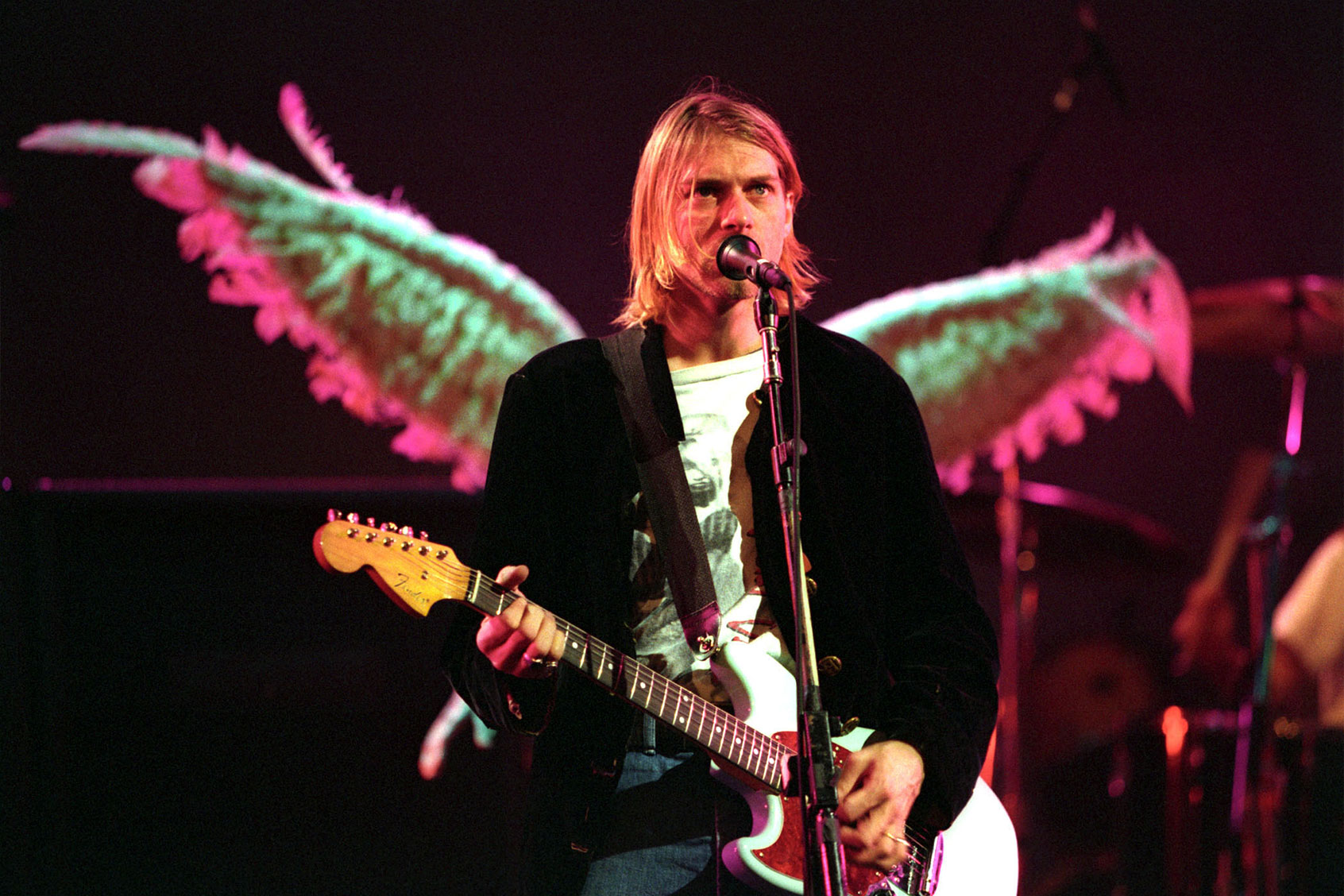
Kurt Cobain of NirvanaKurt Cobain of Nirvana (Getty Images/Jeff Kravitz/FilmMagic)

Gen Xers were defined by our apathy, and nobody wants to look at that.

“How on Earth can this be?” you may be asking. We get it. For the second half of the 1990s, the entertainment industry tried to convince the world that the MTV Generation was dominated by Troys. Troys, we are led to believe, idolized Nirvana and Kurt Cobain and, we assume, agreed with his proclaimed anti-racism and support of gay rights.

Then the world forgot about us. No joke. The willful overlooking of Generation X by mainstream news organizations and popular culture has become a meme.

The same marketers who benefited from the FCC deregulating restrictions on advertising in children’s programming after Ronald Reagan took office skipped on down the road to the Millennials. But not before replacing “Schoolhouse Rock” and “Captain Kangaroo” with half-hour animated toy commercials we know as “G.I. Joe” and “Transformers.”

Gen Xers were defined by our apathy, and nobody wants to look at that.

Most Xers were raised to fend for themselves in a societal environment that showed there were no guarantees in life, evidenced by the poor job market that greeted many college graduates in the so-called “Slacker” era. (But let’s put this in perspective: Millennial college graduates had, and are having, a much tougher time.) Those are reasons to crave career success and economic stability, like Stiller’s Michael. This is reflected in findings from the Pew Research Center from 2014, when 44% of Xers were more pessimistic than Boomers or Millennials that they’ll have enough money for their retirement.

They’re also the reason many people prefer not to think too much about the ramifications of how their choices might affect the world around them, like Stiller’s Michael, who reacted to being dumped by Lelaina by creating a TV melodrama featuring characters based on her and Troy.

Posters of the Benetton brand including the newborn on the right in September 1991 in Paris, FrancePosters of the Benetton brand including the newborn on the right in September 1991 in Paris, France (William STEVENS/Gamma-Rapho via Getty Images)
Remember, we’re also the United Colors of Benetton generation, the same demographic for which CK One – a gender-neutral fragrance! – was developed. We were the ones who bought into the music and fashion world’s ’90s global vision of multiracial harmony. Racism? Solved! So why should we promote divisiveness in our kids’ education in 2022?

The view from 2022, when Generation X has inherited the sins of the Boomers and seems content to continue perpetuating them, may lead one to conclude that Michael was the true Xer while Troy is an apathetic elitist. He’s the kind of fellow who’s convinced he knew what the world needs in the way the rest of the slouches around him never did. He explains why Generation X is overwhelmingly more likely to vote Republican, including supporting Donald Trump.

After all, what is Trump if not the perfect collision of a generation’s programming to accept branding as truth, including his claims to be a great businessman and a “political outsider” who could drain the swamp?  

Once reality set in, and it became obvious that the alligators and mosquitoes weren’t going anywhere, the Xer’s allegiance to their chosen political product morphed into pragmatism, convincing themselves that the lying showbiz huckster may be better for our retirement plans. 

Boomers still hold the most sway in Congress and have spent several decades loosening regulations that were meant to protect the environment and provide a social safety net for the most vulnerable among us. Boomers and the Silents before them also made tremendous strides in the arenas of civil rights and women’s equality and secured protections for reproductive autonomy.

Generation X benefited the most from these gains. Now, three Supreme Court justices hailing from that generational cohort – Neil Gorsuch, Brett Kavanaugh, and Amy Coney Barrett – are taking tremendous pleasure in joining their Boomer counterparts in rolling them back. We got ours, right?

Again, there are many movies and TV shows that encapsulate the Generation X experience better than “Reality Bites,” although the makers and stars of most of them may be loath to describe their work as strictly reflective of that cohort. The creators of “Friends” made every effort to distance themselves from the label when the show first came on the air. I also doubt that, for example, Mike Judge would describe his modern classic  “Office Space” as a Generation X movie even though it brilliantly reflects the 1990s workplace experience.

Neither of those titles is set to be revived as a TV series. But “Reality Bites” is being developed, again, into a TV show for NBC’s streaming service Peacock, written by the original screenwriter Helen Childress. (The network first tapped Stiller to adapt it for TV in 2013; the “Severance” creator is not attached to this version.)

Regardless, Childress and Stiller’s original fantasy about that age inadvertently explains why so many white Generation Xers are ready to blithely slide the meter back on progress. As author Ted Halstead directly describes in a philosophically corrective essay on Xers published in a 1999 issue of The Atlantic:

. . . there is a general decline in social trust among the young, whether that is trust in their fellow citizens, in established institutions, or in elected officials. These tendencies are, of course, related: heightened individualism and materialism, as Alexis de Tocqueville pointed out, tend to isolate people from one another, weakening the communal bonds that give meaning and force to notions of national identity and the common good.

Halstead prophetically added: “Today’s young adults will be remembered either as a late-blooming generation that ultimately helped to revive American democracy by coalescing around a bold new political program and bringing the rest of the nation along with them, or as another silent generation that stood by as our democracy and society suffered a slow decline.”

Or, in the words of Hawke’s Troy, “I’m not under any orders to make the world a better place, Lelaina.”

We can’t claim we weren’t warned.

Someone leaked Kelly Loeffler’s texts — including damning message from Brad Raffensperger’s wife

The Atlanta Journal-Constitution has obtained 59-pages of text messages from the iPhone of former GOP Sen. Kelly Loeffler.

The newspaper noted messages reportedly sent by Tricia Raffensperger after Loeffler called for her husband, Georgia Secretary of State Brad Raffensperger, to resign on Nov. 9, 2020.

“Never did I think you were the kind of person to unleash such hate and fury on someone in political office of the same party,” Tricia Raffensperger reportedly wrote. “I hold you personally responsible for anything that happens to any of my family, from my husband, children and grandchildren.”

The newspaper noted Tricia Raffensperger’s text “did not appear to receive a reply” from the senator.

“The copies of the text exchanges were sent to the AJC anonymously, and it’s not immediately clear how the messages were obtained. The AJC’s efforts to identify who sent the text messages were unsuccessful,” the newspaper reported. “The AJC confirmed the veracity of the exchanges with four people who were participants in some of the conversations. Reporters contacted everyone identified in the exchanges cited in the story. Several declined to comment; others didn’t return phone calls and text messages.”

The newspaper said it appeared the 59-page document only related to the elections as there were no other messages or personal texts included.

“As Trump’s plan to overturn the election on Jan. 6 unfolded, Loeffler came under increasing pressure from her Georgia colleagues, Republican activists and some of her own aides to join in. One of the most ardent voices who sought to enlist Loeffler was then-Congresswoman-elect Marjorie Taylor Greene,” the newspaper reported. “But Loeffler ultimately could not resist Trump’s insistence that she support his plan, given threats that he would abandon her campaign. He demanded she announce her support in exchange for Trump holding the last-minute Georgia rally that she desperately needed.”

Loeffler ended up announcing she would object to the Electoral College certification and received her election eve rally.

Hours before the rally, Loeffler reportedly texted two Trump aides, Taylor Brown and Stephen Lawson.

“Please make sure Trump [retweets] my statement so I don’t get booed off the stage!!” she reportedly texted.

Loeffler went on to lose her runoff election the day before the Jan. 6 attack on the U.S. Capitol.

Read the full report.

The 10 best Costco bakery goods being sold this autumn

The backdrop of many of my best childhood memories, Costco’s industrial, cavernous locations were a cherished spot where my father would take my brother and me, allowing us to run amok collecting free samples as he hauled bulk products onto his super-sized shopping cart. Fast forward 25 years, and Costco became my family’s ideal store during the early days of COVID-19 back in spring 2020. The bulk superstore is no frills, offering everything from razors to liquor, food to electronics, glasses to hearing tests. Whether you’re enjoying their amazingly delicious baguettes or you’re tearing into a moist, well-seasoned and crisp-skinned rotisserie chicken, Costco truly has something for everyone. 

Originating in the 1970s and now based out of Washington state, Costco Wholesale now has 839 warehouses (the company’s nomenclature for stores or retail outlets) worldwide. Introduced in 1995, Costco’s private label brand is Kirkland Signature, which is emblazoned across a bulk of their products. Costco is known for its low pricing, especially when it comes to their food products. 

Costco bakery items have a true cult following, with copious, robust discussion across Reddit, Instagram and other social media platforms detailing favorite baked goods, favorite ways to prepare and serve them, storage suggestions and nostalgic reminiscing about long-gone bakery options. 

Here’s a quick deep-dive into what items and baked goods are lining the bakery shelves this fall. 

Due to Costco’s nature, pricing and availability may vary by location.

1
Apple Pie
Kirkland Apple PieKirkland Apple Pie (Photo courtesy of Joseph Neese)Image_placeholder
Apple pie is a staple during the fall months, but if you’re not looking to bake up a fresh pie at home, perhaps Costco’s offering will be the ideal choice for you this autumn. According to Reddit user NookinFutz, the pie can be elevated even more with this approach: “Apple pie, each slice reheated to be warm enough to melt [and] Kirkland vanilla ice cream on top with just a small sprinkle of cinnamon.” We’d venture to say that that’s probably a pretty terrific bite, no matter what time of year you may be enjoying it. 
2
Pumpkin Streusel Muffins
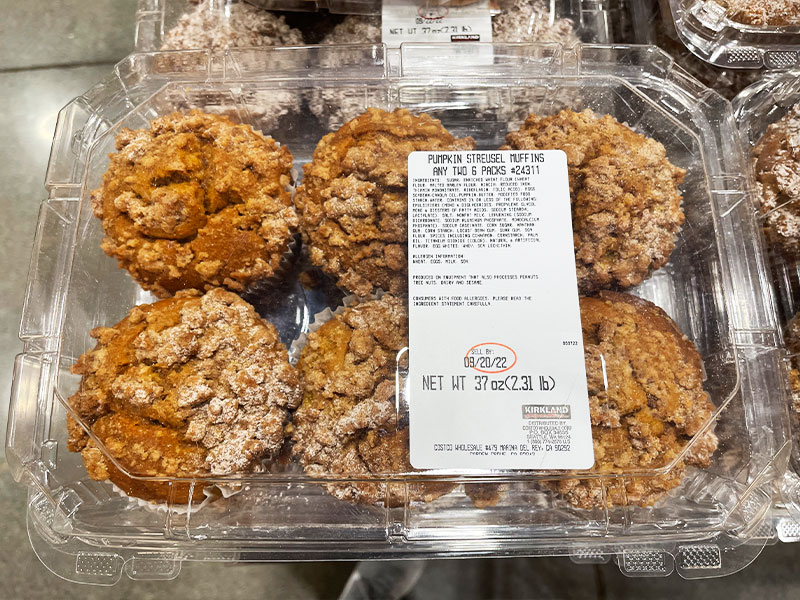
Kirkland Pumpkin Streusel MuffinsKirkland Pumpkin Streusel Muffins (Photo courtesy of Joseph Neese)Image_placeholder

As noted by @costcohotfinds on Instagram, “Pumpkin Streusel Muffins are back in the Costco Bakery!!! These are all things pumpkin spice, cinnamon and sweetness. They’re TOO good!!”
 
Sizable, soft and terrific when toasted, these autumnal muffins have a feverish following during the fall months. The streusel crumble is especially fantastic. If you’re not a pumpkin person, though, then Costco also has numerous other streusel or crumble muffin options which may tickle your fancy.
3
Pumpkin Pie
Kirland Fresh Baked Pumpkin PieKirkland Fresh Baked Pumpkin Pie (Photo courtesy of Joseph Neese)Image_placeholder

Of course, pumpkin pie is emblematic of the season. According to Reddit user Revolutionary_Fly769, the Costco pumpkin pie is something special. “Costco Pumpkin pie is my favorite. Maybe not quite mom’s, but way better than any other store bought pie I’ve tried.” High praise, indeed!


Costco superfan CostCuisine describes the flavor of the cherished pie, stating that it’s “The filling is soft, sweet and has slight hints of nutmeg and cinnamon. The spices are definitely not strong and are well balanced and blend well with one another. The crust is buttery, flaky and soft. Not overly crisp or hard.” Delicious! 

4
Almond-Filled Danish
Kirkland Almond Filled DanishKirkland Almond Filled Danish (Photo courtesy of Joseph Neese)Image_placeholder

This danish has some serious fans. Reddit user ChaserNeverRests says “If you like marzipan, you’re going to love the almond danish things. They’re too good!” while Reddit user julznlv contests that “The almond Danish are better than most I’ve had from expensive bakeries.”


CostCuisine describes the popular pastry, noting that “the middle filling is a dense, moist, sweet almond filling with a strong almond flavor. The almond flavor seems to diffuse from the middle filling to [these] surrounding pastry on the outside so you get a hint of almond in every bite.”


5
Caramel Tres Leche Bar Cake
Kirkland Caramel Tres Leche Bar CakeKirkland Caramel Tres Leche Bar Cake (Photo courtesy of Joseph Neese)Image_placeholder
This indulgent beauty is a great option for an event or celebration, or as Reddit user rfm18 notes, “for when I feel like a treat .. the Caramel tres leches cake!” The cake is aesthetically pleasing and outrageously delicious. Enjoy on its own or with a steaming hot mug of coffee or tea. 

6
Cherry-Filled Danish
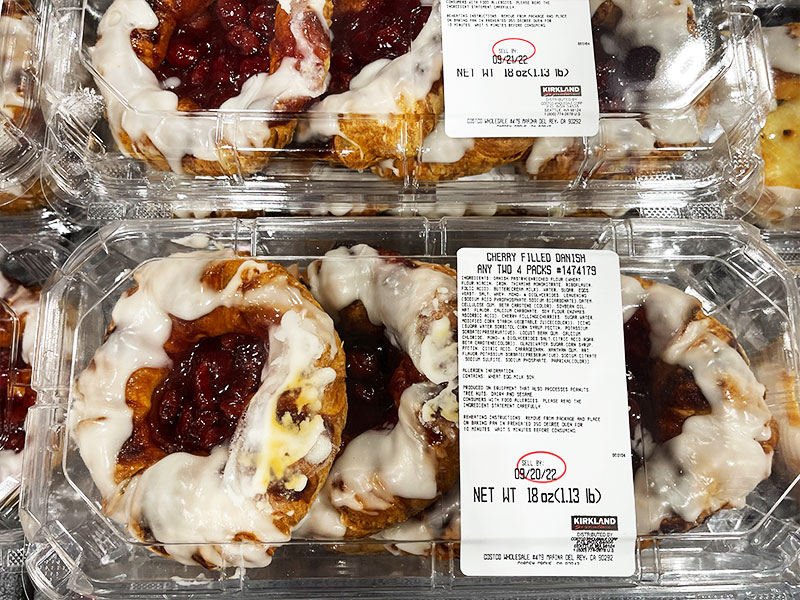
Kirkland Cherry Filled DanishKirkland Cherry Filled Danish (Photo courtesy of Joseph Neese)Image_placeholder
Bright and slightly acidic, these cherry danishes are a fan favorite. 


Yimsie on Reddit notes that they’re a “new favorite item!” and CostCuisine describes them in detail, noting that “There’s chunks of actual cherry which I like … The pastry itself is buttery, crisp on the outside, soft on the inside and fairly flaky.” In addition to the pastry and cherry filling, there’s also a sweet icing that ties the pastry together. It’s stellar for breakfast, as a snack or enjoyed any time of day. 

7
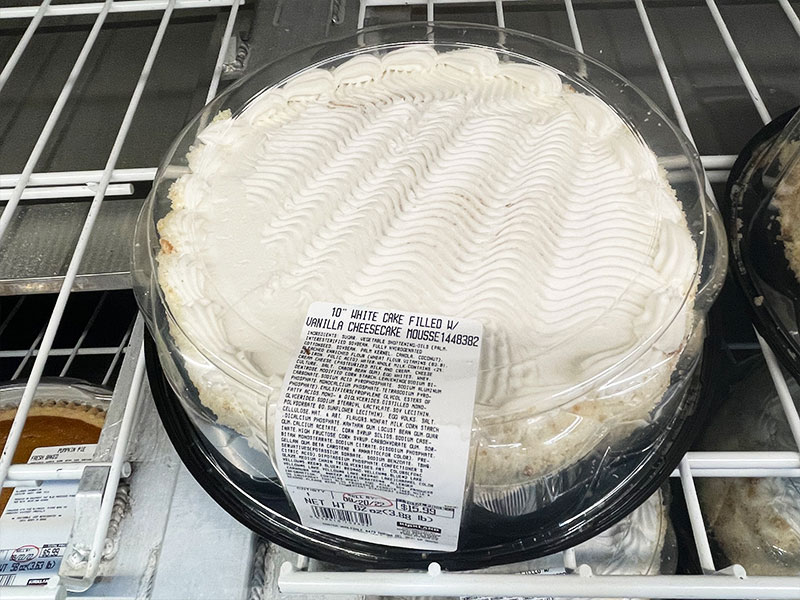
White Cake Filled with Vanilla Cheesecake Mousse
Kirkland White Cake Filled with Vanilla Cheesecake MousseKirkland White Cake Filled with Vanilla Cheesecake Mousse (Photo courtesy of Joseph Neese)Image_placeholder
A mash-up of two beloved desserts that are typically disparate, this amazing amalgamation features layers of moist, just-sweet-enough white cake and creamy, smooth vanilla cheesecake mousse. If that doesn’t make you involuntarily mutter the word “yum,” then I’m not sure what will.
 
This cake is also incredibly picturesque, making it an ideal option for a birthday or some other anniversary. Or heck, maybe even just a random Wednesday night, for no other reason than the fact that it was something you were craving. Regardless of the affair or the occasion, this cake is a real winner.
8
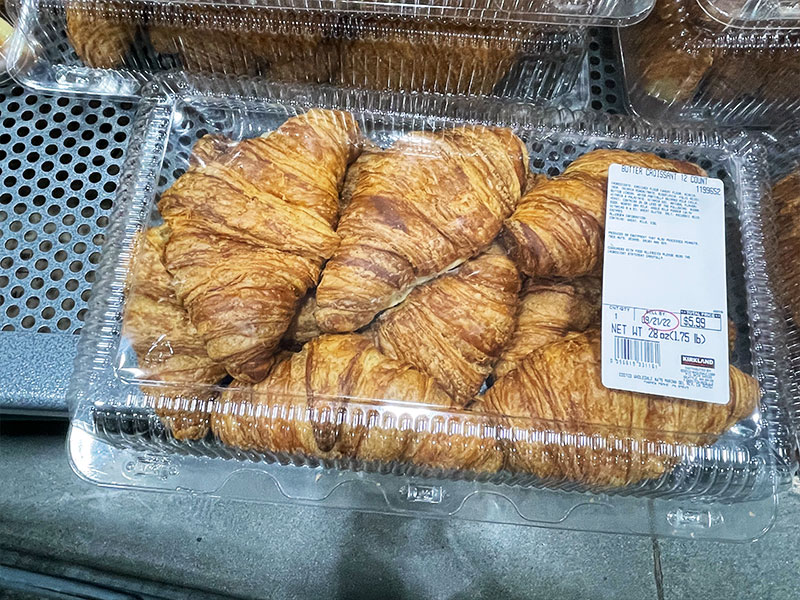
Butter Croissants
Kirkland Butter CroissantsKirkland Butter Croissants (Photo courtesy of Joseph Neese)Image_placeholder
Croissants are one of the world’s most wonderful culinary offerings, but making them at home can be quite a laborious process. Why not instead pick up a 12-pack at Costco? As corgicorgibutts on Reddit notes, ” I individually wrap them and pop them in a freezer bag if I don’t want a dozen on my counter all the time. They defrost quickly and are so good!” 


In this Reddit thread, the users run down the gamut of the amazingly inventive uses hey’ve found for leftover or slightly stale croissants, including croissant french toast, croissant bread pudding, croissant sandwiches, toasted with jam, enjoyed with cheese, cold cuts, rotisserie chicken, or chocolate, or simply enjoyed with reckless abandon on their own. You really can’t go wrong. 

9
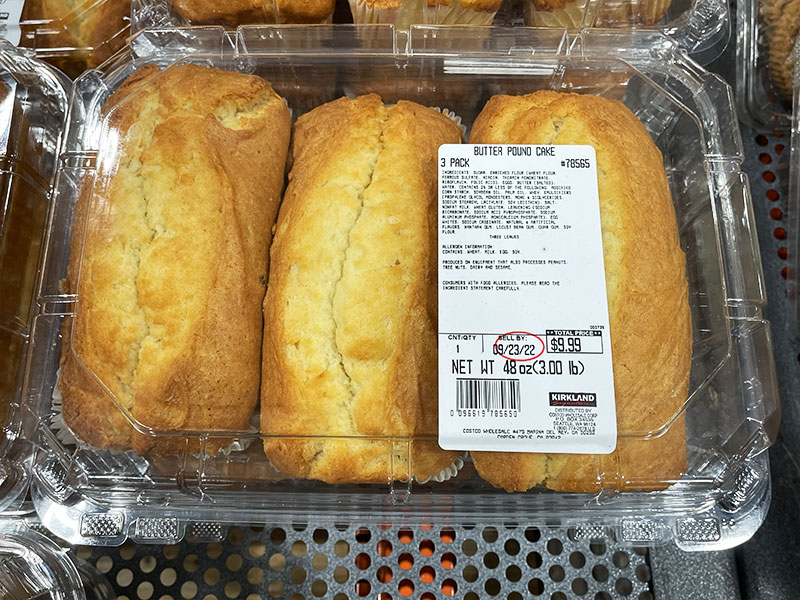
Butter Pound Cake
Image_placeholderKirkland Butter Pound CakeKirkland Butter Pound Cake (Photo courtesy of Joseph Neese)
Buttery, moist, and incredibly flavorful, Costco’s butter pound cake is amazing on its own or incorporated into other dishes. Enjoy a slice with your coffee or tea, toast some and slather it with (even more) butter, crumble it and enjoy it over ice cream or yogurt, or cube it and turn it into a wonderful trifle complete with a layered mountain of fresh fruit and whipped cream. 

Costco sells this in a three-pack, so save one to enjoy and pop the other two in the freezer. They defrost and reheat very well.  

10
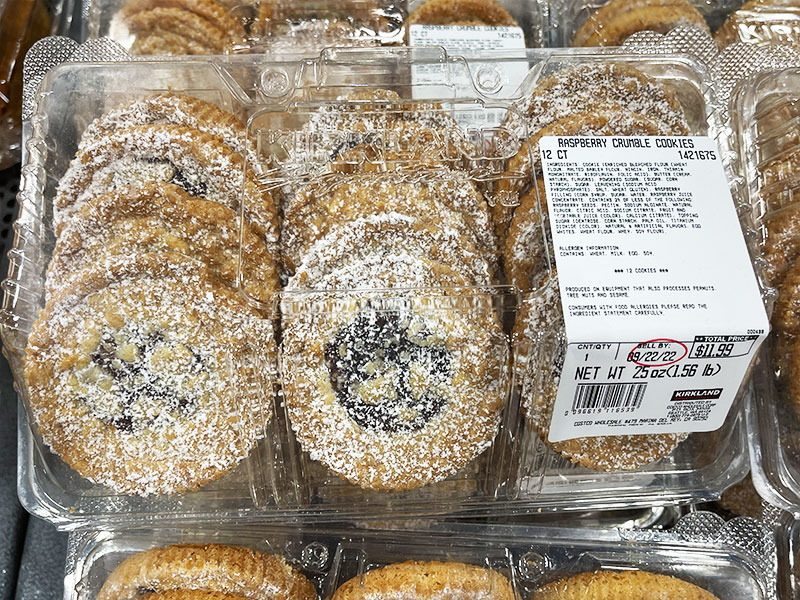
Raspberry Crumble Cookies
Kirkland Raspberry Crumble CookiesKirkland Raspberry Crumble Cookies (Photo courtesy of Joseph Neese)Image_placeholder


Did we save the best for last? The answer is yes, according to swaths of Costco members who absolutely adore these cookies. Kathysef on Reddit says “They are fantastic. A box of 16 usually lasts us 3 days. Oops I mean 2 days. I’m embarrassed to say their are only 2 of us.” CostCuisine states that “These Costco raspberry cookies are delightful. They’re like a butter shortbread cookie, soft, slightly sweet and crumbly. There’s a delicious, sugary, flavorful raspberry jam in the middle that pairs perfectly with the buttery soft cookie.”


CostCuisine also notes that the microwave helps to make the “jam extra gooey and the cookie slightly warm,” which sounds pretty darn terrific. 


“Most disastrous PM in history”: Liz Truss resigns after pushing tax cuts for the rich amid crisis

U.K. Prime Minister Liz Truss announced her resignation Thursday after just 44 days in office amid a worsening cost-of-living crisis and continued fallout over a scrapped plan to cut taxes for the ultra-rich.

“I recognize given the situation I cannot deliver the mandate on which I was elected by the Conservative Party,” Truss said in a speech. “I’ve spoken to his majesty the king to notify him I’m resigning as leader of the Conservative Party.”

Truss is expected to leave office by the end of next week, after the Tories hold a leadership election to select her replacement.

In response to Truss’ announcement, Nick Dearden of the U.K.-based advocacy group Global Justice Now called her “the most disastrous PM in our history.”

“But, this is not just about one person,” Dearden wrote on Twitter. “Truss’ party has driven this country into chaos over 12 long years. We’re all bearing the consequences. They need to go. GENERAL ELECTION NOW.”

Labour MP Jeremy Corbyn argued that “the debacle of Liz Truss’ short-lived premiership is a symptom of a broken economic system and a trashed democracy.”

“We will continue to lurch from crisis to crisis—and ordinary people will pay the price—until we finally build a society for the many, not the few,” Corbyn added.

Melting glaciers could spread mysterious pathogens that cause future pandemics, scientists warn

Situated on a Canadian body of land known as Ellesmere Island, Lake Hazen is drop-for-drop the largest freshwater lake in the High Arctic. While its surface area is surpassed in size by Lake Taymyr in Russia and Lake Inari in Finland, it contains more water than either of those bodies, owing its mammoth volume in large part to the numerous glaciers that feed it. Yet as climate change worsens, increased glacial melt — the kind that is causing glaciers from Mount Everest to Africa to disappear altogether — is going to spur all kinds of natural disasters. The most obvious one is sea level rise: for instance, the glaciers in the Greenland Ice Sheet just east of Lake Hazen are currently melting so dramatically that experts believe they could cause a mass rise in sea level displacing as much as 40% of the population.

As Mann put it, “there are actually a variety of mechanisms by which climate change could increase the spread of novel pathogens, of which this is just potentially one.”

But beyond frozen water, there are other horrors lurking within the vicinity of the glacial ice, waiting patiently to spread anew across the landscape.

Enter a new study published in the journal Proceedings of the Royal Society B. The study raises the Lovecraftian prospect that glacier melt like that which will run off from Lake Hazen will help spread pandemics.

The scientists behind the study arrived at this conclusion by analyzing soil and lake sediments from Lake Hazen. Using DNA and RNA sequencing technology, they reconstructed the complete virosphere (or ecosystem of viruses) that exists in the Lake Mead area and then tried to ascertain the risk of “viral spillover,” or events where a virus moves from a host in one species to a host in a different species. To do this, they studied how closely the viral evolutionary histories compared with those of nearby organisms. Their conclusion was, quite simply, that “spillover risk increases with runoff from glacier melt, a proxy for climate change.” All it would take is for climate change to force species to move northwards, which would expose them to these new mysterious viruses that they can in turn spread to humans.

“We show that as glacier runoff increases, as it is predicted to do in a warming world, so does spillover risk,” Dr. Stéphane Aris-Brosou, a biology professor at the University of Ottawa and the corresponding author behind the study, told Salon by email.

Dr. Michael E. Mann, Director of the Penn Center for Science, Sustainability & the Media (PCSSM) and a Presidential Distinguished Professor at the University of Pennsylvania, told Salon by email that he views the study as “interesting” but added that further research needs to be done about its larger implications. Aris-Brosou also told Salon that the study is only part of the larger research that needs to be done on this subject, writing that “as we adopted a global approach, based on the compared history (phylogeny) of the viruses and of their hosts, we do not predict any future pandemic.” Indeed, this study is not even the first to cover the possibility that glacial melt will cause more pandemics.


Want more health and science stories in your inbox? Subscribe to Salon’s weekly newsletter The Vulgar Scientist.


A paper published by the journal Nature in May also highlighted the fact that, as climate change causes animals to move to different regions, they will be exposed to new viromes and will in turn make humans more vulnerable to new types of viral infections. “Our findings highlight an urgent need to pair viral surveillance and discovery efforts with biodiversity surveys tracking species’ range shifts, especially in tropical regions that harbor the most zoonoses and are experiencing rapid warming,” the authors of the May study concluded.

“The problems arise from flows over the surface and especially contamination from feces from cattle and other animals.”

Dr. Kevin E Trenberth, a Distinguished Scholar at the National Center for Atmospheric Research, wrote to Salon that flooding (which will be much more common) due to climate change will also increase the likelihood of new pandemics.

“The flows and percolation of waters through soils remarkably filters the waters, and the problems arise from flows over the surface and especially contamination from feces from cattle and other animals,” Trenberth observed. “That leads to various outbreaks of things like cryptosporidia,” a parasite that causes the diarrheal disease cryptosporidiosis.

As Mann put it, “there are actually a variety of mechanisms by which climate change could increase the spread of novel pathogens, of which this is just potentially one.”

If human beings are going to survive these pandemics, the first thing they must do is raise awareness that they are likely to break out. Dr. Ken Caldeira, Senior Scientist (Emeritus) at the Carnegie Institution for Science, was pessimistic.

“Enough Americans are dying from COVID to nearly fill a jumbo jet full of people every day. Yet most seem to be acting like the pandemic is over,” Caldeira wrote to Salon. “Many think that as climate damage and risks become more pronounced, we will do more to reduce emissions and avoid climate damage. But maybe we will just become immune to bad news.”

Court rejects Trump’s bid to dodge judge he called “unbelievably unfair” in NY fraud case

Former President Donald Trump on Wednesday lost his bid to dodge a New York judge he called “unbelievably unfair.”

New York Attorney General Letitia James last month filed a $250 million lawsuit against Trump, three of his adult children and his company, accusing them of a decade-long fraud scheme following a three-year investigation. James and Trump have battled in court throughout the probe as Trump and his children sought to avoid record requests and interviews with investigators. Judge Arthur Engoron, who heard matters related to the probe, at one point fined Trump $110,000 for defying his order to sit for a deposition, prompting Trump to complain that “we have a judge that frankly has been unbelievably unfair.”

“We’ve given millions and millions of pages and he says give more, give more, always give more,” Trump protested in May.

Trump ultimately relented and sat for a deposition, invoking his Fifth Amendment right nearly 450 times.

After James filed her lawsuit last month, Trump requested that the case be transferred from Engoron’s court to the court’s Commercial Division. An administrative judge on Wednesday denied his motion, meaning that the case will remain before Engoron, according to Bloomberg News.

The ruling leaves Engoron, “who is already VERY knowledgeable about the alleged years-long fraud, in place to hear the NYAG’s motion to enjoin the Trump Org. from moving material assets,” tweeted NBC News legal analyst Lisa Rubin.

James had asked the court to keep the case before Engoron as a “related matter” and last week filed a motion for a preliminary injunction to bar the Trump Organization from transferring assets.

James in the filing revealed that the Trump Organization registered a new company called “Trump Organization II LLC” in Delaware on the same day that she filed the lawsuit.

“Beyond just the continuation of its prior fraud, the Trump Organization now appears to be taking steps to restructure its business to avoid existing responsibilities under New York law,” the filing said.

Trump attorney Alina Habba lashed out over the motion, calling it “nothing more than a thinly-veiled attempt to keep this case with Justice Engoron rather than have it transferred to the Commercial Division where it belongs.”

Habba has repeatedly clashed with Engoron in court. Habba in February pushed Trump’s claims that James was biased against him in court, interrupting the judge and drawing a rebuke from his clerk, Allison Greenfield.

“When the judge speaks, you need to stop speaking,” Greenfield repeatedly told Habba, according to Insider.

Engoron ultimately ordered Trump and his adult children to comply with the subpoenas.

“The target of a hybrid civil/criminal investigation cannot use the Fifth Amendment as both sword and a shield; a shield against questions and a sword against the investigation itself,” he wrote.


Want a daily wrap-up of all the news and commentary Salon has to offer? Subscribe to our morning newsletter, Crash Course.


Trump refused to comply with the subpoena and James went back to court to hold Trump in contempt. Habba during a May hearing complained about the judge’s rulings in the case.

“If you would like a bunch of more affidavits, you can order that,” Habba snapped. “You can order anything you like.”

Engoron held Trump in contempt and at one point fined him $10,000 per day for refusing to comply with the subpoena.

“I don’t understand why we are still in contempt,” Habba complained during a June hearing after Engoron refused to lift the order until Trump fully turned over documents in the case. “I think the opinion is based on who my client is,” Habba claimed, “and that’s concerning to me.”

Trump and Habba have repeatedly claimed that he is the victim of political discrimination.

“There’s no viewpoint discrimination,” Engoron said during a hearing in February after Habba claimed James had “disdain” for Trump and argued that he was a member of a “protected class.”

“What protected class is he a member of?” the judge pressed.

“His political speech,” Habba replied. “If he was not sitting as a Republican and was not a former president who might run again, this would not be happening. So she is discriminating against him for that.”

Engoron noted that protected classes include race, gender, and religion.

“Donald Trump doesn’t fit that model. He’s not being discriminated against based on race, is he? Or religion, is he? He’s not a protected class,” Engoron said. “If Ms. James has a thing against him, OK, that’s not in my understanding [of] unlawful discrimination. He’s just a bad guy she should go after as the chief law enforcement officer of the state.”

We could face the sunset of democracy — or the end of the world: Get off your butt and vote

The midterms are nigh upon us, and the concerned crazies are riding their social media platforms far and wide, alerting the countryside.

The pundits are screeching like banshees, warning of gloom and doom.

Extremist voters are on high alert and spewing maximum venom, while casual observers are wondering why the NFL sucks so damn much.

Some might say we’ve all done gone plumb crazy from the heat and pandemic. How else do you explain all of these people trying to turn left from the far right lane?

Crowds are cheering Sen. Tommy Tuberville of Alabama for spouting racist comments. Crowds are cheering Nancy Pelosi after video surfaced of her on Jan. 6 saying she wanted to punch out Donald Trump.

Crowds cheer misogyny, hatred, “wokeness,” ignorance, climate change, asteroids crashing into the earth and nuclear hellfire, as well as the lifelong argument regarding ontogeny recapitulating phylogeny. 

Meanwhile, the Democrats — who continuously scream that their representatives aren’t framing the narrative well enough — seem to forget they outnumber the Republicans. There’s your argument framed nicely. 

There’s no need to scare the populace: Just encourage your guys to vote. Quit telling us how scary the Republicans are — the GOP’s big stars do a fine job of that all by themselves. No one need explain the extremism of Marjorie Taylor Greene, Louie Gohmert or anyone else on that side of the ledger. More than 300 of the people running for office as Republicans across this country believe in the “Big Lie.” If they won’t see facts, there’s no point in talking to them — or about them. 

So: Shut up and vote.

Quit telling us how scary the Republicans are, and how they have an unfair advantage through voter suppression and gerrymandering. It’s all true — but shut up and vote.

One real problem that needs to be framed and discussed, and that’s key to the “Get out and vote” issue, is that voter suppression in some areas may give the Republicans an unfair advantage — and they will definitely seize whatever edge they can to grab and hold power. They’re likely to claim that if they lose, the election was fixed against them, while they were busy trying to fix the election for themselves. Classic bait and switch.

Vote anyway.

Hey, originality isn’t the strong suit here. We’re talking about the Republican Party, or what’s left of it. They’re the vampires who are still hanging around after the overnight keg party wiped out the venue. Drunk on the Donald Trump corn liquor, the lost remnants of the GOP rely on anger and fear. The only arrows left in their quiver are the ability to run a bait-and-switch on key issues or to rant like a toddler who just soiled their diapers. Sometimes they do both. That’s just enough to make the Republicans a credible threat to the Democrats — a party of soft-hearted do-gooders who want to help you out, unless you disagree with them.

For the will of the people to be exercised, the will of the people must be expressed accurately. Rather than pulling our hair out and running around screaming tht the sky is falling and we’re out of Adderall, we should ask some pointed questions of those running for office, and take some decisive actions.

So vote. And do it after taking the time to get informed.


Want a daily wrap-up of all the news and commentary Salon has to offer? Subscribe to our morning newsletter, Crash Course.


At the bare minimum, know who is running for office. I’ve known people who’ve walked into the voting booth on Election Day and had no idea who was on the ballot. They voted any way. If you’re going to vote the straight party ticket because that’s the way you’ve always done it, then you’re part of the problem. Casting an informed vote is the minimum required of every registered voter. The League of Women Voters produces wonderful voter guides across the country, as do other civic groups. So at least attach a name and a face to every office on the ballot. If you’ll spend hours binge-watching your favorite show, if you can manage to sit through an NFL game without vomiting, then you can spend at least that amount of time getting informed before you cast a ballot. You can always binge-watch old episodes of “Seinfeld.” This election matters.

If you have to, think of it as studying your roster in a fantasy football league or getting to know your favorite “Game of Thrones” character. Only it’s real life, and it really matters. 

Gather information from a variety of sources — especially from the candidates themselves. And don’t worry about the polls.

Polls are not facts. They’re ephemeral snapshots of questionable entertainment value. They are the bargain basement of all debasement of facts. You can make statistics say anything, and we always do. Remember; 80 percent of the people polled say 100 percent of the polls suck.

“Ask not what your country can do for you, but ask what you can do for your country,” said John F. Kennedy. Vote. That’s what you can do for your country right now.

Ignore the polls. Polls are not facts. They’re the bargain basement of the debasement of facts: 80% of people polled say that 100% of the polls suck.

But there’s a deeper reason for casting an informed vote. “Government, even in its best state, is but a necessary evil; in its worst state, an intolerable one,” Thomas Paine wrote. Through our own actions, we have reached a place in history where our country has the potential to become truly intolerable — or even to cease to exist altogether, along with the rest of humanity. 

Being uninformed isn’t a viable option. The doomsayers are right about one thing: Your vote counts. Use it wisely.

By now, maybe you’ve actually met or seen a couple of candidates who are on the ballot where you live. If not, there’s still time. Go take in a couple of appearances. Hear them for yourself. Ask questions if you can. If you can’t, there’s this wonderful invention called the internet to help you gain access to all the information you need — as well as plenty you don’t.

Be discriminating. Use some common sense. Be willing to change your mind. If you find out the emperor has no clothes, don’t pretend he does. Move on. Use the scientific method in assessing facts and candidates. If your favorite candidate gets heckled by his own family, admits to paying for an abortion but says he doesn’t know that he did and otherwise embarrasses himself on a grand scale, then maybe he’s not worthy of your vote — even if he did play football and you love football. Don’t you deserve something better? Think about it.

Or use a dog. Does your candidate have a dog? You can always take your dog to a political event and introduce him to the candidate. If your dog growls at the candidate, you should then immediately know not to vote for that person. Dogs know. Conversely, if the candidate has neither children nor dogs (sorry, cats are covered in the column “Men of power who love their kitties”), don’t trust that candidate.

Curiously, Donald Trump had no dog. Joe Biden’s dog bit Secret Service agents. I rest my case.

Other guiding factors to consider, as you stand in line for the voting booth, mail in your vote or show up for early voting, includes how the media is covering the elections. 

We in the media love false equivalence — as if a party that embraces racism, authoritarianism and misogyny should ever be held equivalent to a party of do-gooder incompetent underachievers.

We in the media love nothing more than a false sense of equivalence — as if a political party that embraces racism, bigotry, authoritarianism and misogyny, and is both greedy and careless, should ever be seen as equivalent to a party that merely consists of Constitution-respecting, do-gooder incompetent underachievers.  Nonetheless, we in the media think we need to appear balanced and we’ll bend over backward to do so. Why? Well there’s money in it, and the press needs to make bank. So, we’re going to serve it up, and if it smells and looks like what comes out of Trump’s front or rear orifices, we don’t care. As long as it sells. Again, you only have yourselves to blame if you keep buying the crap we’re serving. Demand better. We’ll do whatever it takes to make a sale.

*  *  *

In a few weeks, the American people will get the government they deserve. Quit whining about how anti-American everything is, or how woke you are, or how you want to cancel or kill someone because they don’t think as you do. Just go get the voters. Let them vote. Count the vote fairly. Accept your win or your loss like an adult and move on.

Those who claim victory without ever achieving it may find themselves happy for a time in their mistaken belief that they have succeeded. But remember Gandhi’s words: “Whenever I despair, I remember that the way of truth and love has always won. There may be tyrants and murderers, and for a time, they may seem invincible, but in the end, they always fail. Think of it: always.” 

Well, let’s hope so. But they won’t fail if we don’t put in any effort to make sure they do.

Logically, the greatest tool to make sure that tyrants and murderers fail under a democratic government is the educated, well-informed voter. Our democracy cannot live without such voters. Look around if you doubt that.

Yet today’s media world is simply incapable of supplying the raw information needed to drive the democratic engine. Consolidation, vulture capitalists, incompetent management and government interference — all of which began under Ronald Reagan and dominate the media industry today — are to blame. The press is no longer capable of doing the job that is demanded of us. 

The masses rail against us, but also have no idea what’s wrong or how to fix it. We’re all too busy being distracted by things that do not matter.

There is a reason why there have been more Marvel movies than climate-change conferences. We love our comforting myths and fictions. We believe our status in the world gives us a pass on arrogance and showing our ass. It does not. But the media won’t tell you that — we’re busy covering the Marvel movie.

Too many reporters and media companies act subservient to the people we elect. It’s rare that we actually speak truth to power. In most cases, we think of ourselves as part of the inner circle. The funny thing about that is we’re setting ourselves up to be used, because no politician actually considers us their confidant. We’re just a tool to be used and thrown away. 

Donald Trump was supposed to be a public servant, a guy who worked for us. Worshiping a politician makes as much sense as worshiping the pool boy.

For that matter, so is the general public. It is among the rank and file where this subservience to elected officials does the worst damage. One thing we can all agree on is that those people who support Donald Trump passionately worship him. That’s wrong and distorted: Donald Trump is (or rather was) a public servant. His actions were supposed to be for the benefit of the nation as a whole. Whether or not he accepted his mandated pay, or jacked up the price on his hotels for Secret Service agents, he was an elected politician, who supposedly worked for us and got paid with our taxes. Why would you worship the pool boy? That’s all politicians are. They are the guys we pay to maintain our democracy. They are not our leaders. They are our representatives — hired to keep the pool of democracy reasonably clean.

Worshiping any of them makes less sense than worshiping the sun god in ancient times. At least the sun brings warmth and makes life possible. Worshiping politicians is like worshiping canker sores. 

Yet the public and the press continue to do so with near-pornographic glee.

*  *. *

The state of the world has everyone concerned, but what we still don’t understand is that we’re all in this together. The threat of obliteration by a stray asteroid, the threat of nuclear war from Russia, the threat of a global pandemic and the threat of civilization-killing climate change have done nothing to alert us to the fact that we must all hang together or we will most assuredly all hang separately.

Benjamin Franklin never experienced today’s world. He didn’t have to face a pandemic. He didn’t have to deal with nuclear threats or global climate change. But he understood democracy, and he understood why it was more important for us to work together for our common interests than to be divided and conquered by politicians and kings who capitalize upon our superficial differences.

The midterm election is a chance to silence both the naysayers and the crackpots. Yes, it is an important election. Yes, democracy is in the balance, and yes indeed, we could be watching the sunset of American democracy if we do not act.

But the sun always rises after a sunset. Democracy isn’t done, and we can silence the critics, pundits, sideshows and batshit crazy politicians if a majority of us will just exercise our right to vote — no matter how personally taxing it is and no matter how painful and time consuming we find it to be.

If we inform ourselves, if we vote, and if we can keep our heads while everyone else is losing theirs (and blaming us for it), then we should be OK.

Fear is the currency of the Republicans — and of all politicians whose real fear is they won’t have any power after the next election and will have to find a real job that entails real work.

Hope is the currency of democracy. So if you still have hope, get your soft, wide gluteus maximus off the couch, get informed and go vote. 

Breast cancer awareness campaigns too often overlook those with metastatic breast cancer

Is there anyone who isn’t aware of breast cancer?

Since 1985, cancer-related nonprofits, along with pharmaceutical firms and other businesses, have sponsored an international campaign to observe October as “Breast Cancer Awareness Month.” During these weeks, the public is bombarded with awareness and education messaging featuring the campaign’s symbol, a pink ribbon.

A wave of pink products typically appears, too, including clothing – think about the “Save the Ta-Tas” shirts – as well as events like marches and walkathons. This onslaught has led some to term the campaign “Pinktober.”

These efforts often focus on encouraging women to get screened with mammograms to increase the possibility that the cancer will be detected early. Breast cancer patients are celebrated for “beating” cancer, “winning” the battle, having survived and being cured. But these messages overlook the experiences of millions of breast cancer patients.

I am a sociology professor who specializes in studying gender as well as how having a serious illness affects identity. These themes also hit close to home for me: In 2009, I was diagnosed with metastatic breast cancer – also referred to as stage 4 on a scale from 0 to 4 – which means a cancer that has spread beyond the breasts to other parts of the body. Since that time, I have participated in face-to-face and online support groups, joined retreats and met myriad health professionals who specialize in oncology while also continuing my research.

In 2019, I began a nationwide study to examine the experiences of women with stage 4 breast cancer. The first of my papers on religion’s role in coping with metastatic breast cancer was recently published in the Journal for the Scientific Study of Religion. I am now working on research that examines metastatic breast cancer and a range of spiritual experiences.

The seriousness of metastatic breast cancer, which is the only breast cancer that kills, is rarely discussed. This leaves people with this diagnosis feeling ignored and angry – and largely invisible to most of the organizations focused on breast cancer.

A need for inclusion

Breast cancer is the second most common cancer in women in the U.S. after skin cancer. One in 8 American women will be diagnosed with breast cancer at some point in her life.

Although women of color are less likely to get breast cancer, they are more likely to die from it. Male breast cancer makes up less than 1% of all cases of breast cancer.

Nearly 30% of people with early stages breast cancer will see their cancer metastasize to stage 4, which kills about 44,000 American women and men each year.

To find participants with stage 4 breast cancer for my survey, in 2019 I sent out requests through online support groups, cancer organizations and societies, and word of mouth. Ultimately 310 women completed a questionnaire about their experiences with metastatic breast cancer, such as perceived support, feelings about breast cancer organizations and the pink ribbon, and ways of coping.

I selected 33 of those women to participate in in-depth interviews to provide additional information about some of their survey answers.

Recognizing people with metastatic disease

I’m a member of several metastatic breast cancer social media groups. For the purpose of this article, I asked people in these groups to share their thoughts about Breast Cancer Awareness Month and specifically the term “survivor.” Most people who responded aren’t overly excited about October: They don’t find terms like survivor and related language relevant. Nor do they feel the pink ribbon represents them.

Of the women who took my original survey, the majority – at least 70% – felt that pink-ribbon events tend to minimize the seriousness of metastatic breast cancer and tend to ignore stage 4 altogether. They also believe that pink-ribbon campaigns focus too much on breasts and selling products and services, a practice known as “pinkwashing.”

As one respondent in a social media group wrote, “I don’t like the term survivor. That and October are aimed at early stage cancer, not at supporting people who have Stage 4 cancer. We won’t survive. We aren’t going to be cured. Early detection didn’t save many of us. Removing boobs didn’t save us. All the pinkwashing does nothing to help us.”

Asking women to rate their preferences on a scale of 1 to 4, from “not at all” to “a great deal,” I found that far more metastatic people prefer “patient” and “a person who has cancer” over the term “survivor.”

On average, many participants also say there isn’t much recognition that those with metastatic disease have a different treatment plan. Often, stage 1 to 3 patients can look forward to a treatment end date after they finish radiation, surgery – mastectomy or lumpectomy – and what are called systemic therapies, such as chemotherapy. The vast majority of metastatic patients will be in treatment for the rest of their lives.

For stage 4 breast cancer, there is some debate as to whether lumpectomy or mastectomy are effective options. The effectiveness of radiation treatment is also debatable. So metastatic patients more typically receive chemotherapy and – more recently – immunotherapy, with no surgery.

I also learned that many stage 4 breast cancer patients find it necessary to manage the diagnosis in ways that don’t apply to those with earlier stages. Metastatic patients must go into treatment simultaneously hoping the drugs will calm the cancer and confronting potential end-of-life issues. They may worry about leaving their families. Some may set milestones, such as seeing their children or grandchildren graduate from school or get married.

They may also be contending with issues like how many possible treatment options are left, or maximizing both quantity and quality of life amid a range of side effects.

Overturning worn-out narratives

I surveyed participants about the degree to which they feel excluded from breast cancer organizations, and why. They firmly indicated feeling a recognition gap among breast cancer organizations and awareness campaigns. So many seem to emphasize early detection and survivorship, and leave out the concerns and needs of metastatic patients.

One respondent talked about the “early detection mantra.” Another referred to the “ringing of the bell,” a common celebratory ritual when one is done with chemotherapy or radiation. I’ve been known to use the phrase “that damn bell” to express frustration that I will always be on treatment and won’t get to ring that bell.

People echoed these same sentiments when I posed my question in social media groups. One woman wrote, “I am not going to ever be a survivor. Feels like we are the under belly. … No ‘you got this.’ … There is no stage 4 fanfare.”

Many women with stage 4 breast cancer also feel like little is being done to showcase the less optimistic and more frightening aspects of metastatic disease.

Several organizations are starting to fill these gaps. Some are devoting themselves to funding research for breast cancer, while others are now paying more attention to stage 4 patients – or at least moving in that direction. Metavivor is one organization focused exclusively on serving the metastatic breast cancer community. The Susan G. Komen organization has also begun offering resources and information about metastatic breast cancer.

I see hopeful signs that some of these efforts are making a difference. Just the other day, I stopped by my cancer center’s gift shop to buy some mastectomy bras and saw that they were handing out pink-ribbon bracelets. So I asked the woman running the shop if they could get bracelets representing metastatic breast cancer. I was encouraged that – without hesitation – she said it shouldn’t be a problem.

This is an updated version of an article originally published on Oct. 29, 2021.


Rachel Kraus, Professor of Sociology, Ball State University

This article is republished from The Conversation under a Creative Commons license. Read the original article.

Where the environment is on the ballot — and where it’s not

Every election year a handful of statewide ballot initiatives carry high stakes for the environment. In 2020 there were four major ones, including Colorado’s Proposition 114 requiring a plan for the reintroduction of gray wolves. There were even more in 2018, including battles in Nevada and Arizona over how much renewable energy to require from utilities, while Florida debated an offshore-drilling ban.

This year the biggest story about environmental ballot initiatives is that there are only two.

Cost could be one reason.

“Typically initiatives are brought to the people because a policy can’t make it through the legislature,” says Nick Abraham, state communications director of the League of Conservation Voters. “But it’s extremely expensive and difficult to run a ballot initiative campaign, to not only get the signatures necessary but also to win at the ballot.”

Recent state wins on environmental issues and more action in Congress may have played a role, too.

“There’s much more work to do, to be sure, but I think often initiatives come out of frustration with the process,” says Abraham. “As more progress is made with lawmakers, people need initiatives less and less.”

This year just New York and California voters will take up environmental issues with ballot initiatives — but both could pack a big punch.

Transformational funding for the Empire State

In New York, legislators hope their ballot initiative will put a lot of money on the line.

The Clean Water, Clean Air, and Green Jobs Environmental Bond Act of 2022 would allow the state to sell bonds to fund $4.2 billion for environmental improvements that, according to the proposal, would “preserve, enhance, and restore New York’s natural resources and reduce the impact of climate change.”

That includes $1.5 billion for climate change mitigation, $1.1 billion for restoration and flood risk reduction, $650 million for open space conservation and recreation, and $650 million for water quality in resiliency infrastructure. More than one-third would also be earmarked to support disadvantaged communities.

In New York ballot initiatives need to be advanced by the state legislature before they can go to voters. This effort initially began with then-Gov. Andrew Cuomo in 2020 as a $3 billion bond, which was supported by the legislature. But it was withdrawn from the ballot that year because of economic concerns during the pandemic.

In April 2021 the legislature again passed the measure, but incoming Gov. Kathy Hochul asked legislators to add an additional $1 billion. In April 2022 the legislature cleared the way for $4.2 billion in the budget for the bond, which will now go before voters.

“It’s been a generation since we’ve done an environmental bond act,” says Julie Tighe, president of New York League of Conservation Voters, which has been advocating for the effort. If passed, it would represent “the largest investment the state of New York has ever made in the environment in a single tranche.” It would help fund electric school buses, the removal of lead pipes from communities, and addressing water contaminants, like PFAS and 1,4 dioxane, which can cause cancer risks.

The initiative is estimated to generate 100,000 jobs and an additional $4 billion in economic activity as both federal and local revenue will be leveraged for projects, too, she says.

“We’re really excited about helping to jumpstart this transition to protect our communities and make sure our infrastructure is in good shape,” Tighe adds.

Clean cars in California

On the other side of the country, California voters will decide the fate of Proposition 30, the Tax on Income Above $2 Million for Zero-Emissions Vehicles and Wildfire Prevention Initiative, on the ballot following a push by a coalition of businesses and environmental groups.

That initiative, which unlike New York’s doesn’t need prior legislative support, would apply increased tax revenues from high-income earners toward funding zero-emissions vehicles, charging stations and related infrastructure, as well as training and hiring wildlife firefighters.

It’s needed to help combat climate change and its direct effects, says Oscar Garcia, the ballot initiative coordinator of California Environmental Voters, one of the groups supporting the proposition. It’s also needed, he says, to equitably meet the state’s new directive to ban the sale of new gas-powered cars and light trucks by 2035. That’s because half of the funds designated for vehicle and infrastructure investments in the ballot initiative will aid disadvantaged communities.

The initiative has been heavily financed by the rideshare company Lyft, which has tossed in $25 million in hopes of its passage.

In a break with his party, Gov. Gavin Newsom has come out against Prop 30, saying that rideshare companies like Lyft are using public tax money to help meet their own state mandate to have 90% of their miles driven in electric cars by 2030. He called it “one company’s cynical scheme to grab a huge taxpayer-funded subsidy.”

Rideshare companies don’t own passenger fleets themselves and won’t directly benefit from the proposition, says Garcia.

“We need a dedicated revenue source like Prop 30 to make headway in an equitable and fair way,” he says. “And this initiative goes toward combating catastrophic wildfires, bringing charging infrastructure into low-income communities, and to people who need vehicle rebates and subsidies to afford the transition to zero-emissions vehicles.”

Were neanderthals meat-eaters? A new study provides the strongest evidence yet

Homo sapiens have given neanderthals have a bad rap. The problem probably started with when we turned it into an insult; indeed, “neanderthal” is often used to refer to someone who is stupid and/or brutish, an unfair reputation to attach to a real-life human subspecies that roamed Eurasia for hundreds of thousands of years before mysteriously vanishing roughly 40,000 years ago. (Technically, because neanderthals mated extensively with humans, they’re not completely vanished from the genomic record: those of us with European or Asian heritage have DNA that is one to two percent neanderthal.)

Fortunately for their public image, modern scientists are continuing to learn new facts about neanderthals that are complicating the prevailing narrative. A 2018 study revealed that neanderthals practiced community health care, while that same year a group of experts concluded that the famous artwork Panel of the Lions in France’s Chauvet Cave was likely painted by neanderthals.

Now a new study in the journal PNAS has used state-of-the-art technology to break down the complexities of the neanderthals’ diet — and cast doubt on one popular theory about why they went extinct.

Neanderthal teeth are the key ingredient in this story. By measuring zinc isotope ratios in the tooth enamel of a neanderthal found at a site in the Spanish hamlet of Gabasa, an international team of scientists could determine the likelihood that neanderthals in that region regularly ate meat. When they found a low proportion of zinc isotopes (most plants contain a lot of zinc), they concluded that this Neanderthal — and, by extension, others in its community — likely ate a lot of meat. As the authors explain, large herbivores usually have higher proportions of zinc isotope ratios in their bones than carnivores, and this neanderthal’s scores were “substantially lower than that of the lowest carnivore’s value.” To have a basis for comparing the neanderthal’s results, the study also examined other animals from the region, including carnivores like wolves and lynxes and herbivores like rabbits and chamois.

Some scholars speculate that the neanderthal diet may not have been able to adapt to changing environmental conditions.

Of course, this is just one neanderthal tooth, a fact that the authors readily acknowledge. Their next step will be to perform the same test on neanderthal remains at the Payre site in southeast France to see if doing so confirms their current results.

“It does not mean indeed that they were carnivores anywhere,” Klervia Jaouen, PhD, the corresponding author of the study and a scientist at France’s Géosciences Environnement Toulouse at the Observatoire Midi-Pyrénées, told Salon by email. Jaouen explained that what the studies proves for sure is that “as soon as we use a method based on isotope ratios (an approach that help having an idea of the proportion of meat and plant in the diet of an individual), we find that neanderthals are carnivores, anywhere, anytime.” In addition, while previous studies of late neanderthals had used remains from France and the Netherlands, “here we have a probably older individual from Spain — where the plant consumption has been often debated.”

The study’s conclusions also raises provocative questions about why neanderthals went extinct. There are many theories including disease, climate change and assimilation into the main human genome, and some scholars speculate that the neanderthal diet may not have been able to adapt to changing environmental conditions.

While other studies had also indicated that neanderthals ate a lot of meat, none had utilized the zinc isotope method.

“Neandertals’ diets are a topic of continued debate, especially since their disappearance has been frequently attributed to their subsistence strategy,” the authors write. “There is no clear consensus on how variable their diets were in time and space.”

While previous research on neanderthal diets had focused on nitrogen isotope analyses of collagen, there were a number of practical problems with basing conclusions off of nitrogen isotopes; among other things, those proteins are rarely preserved in samples after they reach a certain age. By successfully using zinc isotopes to measure meat consumption among neanderthals, the researchers hope they have pioneered a new method for addressing questions about neanderthal diets. While other studies had also indicated that neanderthals ate a lot of meat, none had utilized the zinc isotope method.


Want more health and science stories in your inbox? Subscribe to Salon’s weekly newsletter The Vulgar Scientist.


Though pop culture depicts neanderthals as brutish, club-wielding, pelt-wearing fellows, it was not actually known if they were indeed hunters and therefore meat-eaters. That means that previous depictions of them, say, gnawing on a hunk of flesh from a mammoth, were based on speculation. This study, though not definitive, certainly clears up some of that speculation.

While pruud carnivores may rejoice in this news, Jaouen cautioned against over-simplifying the study’s conclusion: Neanderthals may have preferred meat, but “as evidenced by dental calculus studies, neanderthals probably ate plants” as well.

“What we conclude in this study, is that the frequency of this consumption (for the individual that we analyzed) is low, or that the amount eaten is very low,” Jaouen told Salon. “However, some plants have a very small zinc content like fleshy fruits. If a Neanderthal was eating one or two per day, we would probably not see it with this method. But the diet of the Neanderthal was mostly based on meat, in any case.”

Even in human diets, meat consumption varies tremendously. Traditional diets of circumpolar indigenous groups, such as Inuit and Inupiaq peoples, thrived on a diet that was almost fully carnivorous; whereas the The Toda tribe of India’s Nilgiri Hills has subsisted for generations on a strict vegetarian diet.

We appear to be unsettlingly close to a McDonald’s and Krispy Kreme “doughnut burger” collaboration

Next week, McDonald’s is launching a pilot program at nine locations — all in the Louisville, Ky., area — in which Krispy Kreme doughnuts will be available for purchase alongside Big Macs, fries and McFlurries.

According to a press release, McDonald’s customers will be able to order original glazed, chocolate iced with sprinkles and raspberry filled doughnuts either individually or in six packs. And while the treats won’t be available for delivery, they will be available all day. This fact led me to feverishly send a prediction to my sibling group chat: “Guys, we are 90 days out from a McDonald’s/Krispy Kreme ‘doughnut burger’ collab. Mark my words.”

One brother responded that it was, indeed, an inevitability; the other brother, who is a college sophomore, simply sent back a “welp.” Meanwhile, our younger sister sent back a string of emojis: a doughnut, a burger and a person shrugging, all punctuated with a question mark. I took that to mean, “What in the world are you talking about?”

Let me fill you in: I first became familiar with the doughnut burger about five years ago when wandering the grounds of the Kentucky State Fair as a public radio reporter. At the time, I was new to the job, so I was simply sent to collect “color tape,” or interesting audio clips indicative of being at the fair. I was somewhere between the cattle contest and the beckoning neon lights (and a lot of beeping and clanging carnival attractions — so, good tape!) of the midway when I saw dozens of people waiting in line at a food stall.

One by one, they left with a steaming sandwich made by placing a fully-dressed burger — cheese, bacon, bright red onion rings, lettuce and a squiggle of mustard — between two glazed doughnuts. As Salon’s editor in chief Erin Keane captured in a photo from this year’s Kentucky State Fair, the booth remains, as does its simple, yet memorable, slogan: “Donut burger: Donuts are the bun.”

Armed with my audio recorder, I asked a few folks to describe the sandwich for me. While most of the responses were monosyllabic — “sweet,” “sticky,” “heavy” — the conversation also produced my favorite bit of tape that never aired. A walking caricature of a man wearing cannabis-leaf tube socks and Crocs told me, “It’s stoner food, mama. Good ol’ f**king stoner food.”


Want more great food writing and recipes? Subscribe to Salon Food’s newsletter, The Bite.


I suppose one could argue that most state fair food falls into the “stoner food” category. It’s an extravaganza of disparate flavors that have been fused and deep-fried: bacon-wrapped caramel apples; fried pickles in chocolatehot beef sundaes. All these dishes, which are served at state fairs across the country, feel like recipes that would be shared in the cannabis-centered subreddit r/stonerfood.

They also feel a little bit like foods that are the creation of “food hackers,” a subgenre of social media influencers whose posts and videos deal with topics like secret menus and strategies for “hacking the menu” at various chain restaurants. That’s how you end up with viral Starbucks drinks and creations like the Monster Mac (eight Big Macs stacked on top of each other) and Land-Sea-and-Air Burger (a Big Mac stuffed with fish and chicken patties).

As Jaya Saxena wrote in her recent Eater article “Hacked to Bits,” in recent years, the menu hack has gone into overdrive.

In recent years, the menu hack has gone into overdrive.

“Proliferated by YouTube, Instagram and now TikTok as well as online ordering apps, these hacks are more complicated than ever — asking for two sauces or extra-crispy fries no longer cuts it,” she wrote. “Videos detail ways to get cheaper burritos, rainbow layered lattes and Big Macs at half the normal price.”

But Saxena reports that some menu hacks have become so popular that chains have added them to their permanent menus. One such example is the Starbucks Pink Drink, which was formally adopted by the chain after droves of customers used the online ordering app to request coconut milk instead of water in a Strawberry Acai Starbucks Refreshers beverage.

Starbucks wrote in a 2017 press release that the drink “first gained popularity last spring when the beverage customization took social media by storm.”

“It has enjoyed much fandom online as Pink Drink lovers continue to share photos on social media channels using #pinkdrink,” the release added.

It seems pretty inevitable that if McDonald’s gives customers the building blocks for a doughnut burger, they will build doughnut burgers. It also seems pretty inevitable that someone will post a photo of one with the hashtag #McDonaldsDoughnutBurger and others will follow suit.

Whether McDonald’s will fully embrace becoming the state fair of drive-thrus, however, remains to be seen.

Report: World Bank invested nearly $15 billion in fossil fuel projects despite climate commitment

In December 2018, the World Bank made a public commitment: The international financial institution, known for providing funding and policy advice to developing countries, would align its spending more closely with the goals of the 2015 Paris Climate Accord. 

But that promise didn’t exactly pan out. According to a new report, the World Bank Group has since financed nearly $15 billion across 144 fossil fuel projects and policies, many in areas of the world already experiencing some of the most dire consequences of climate change. 

The report comes from Big Shift Global, a coalition of NGOs that work to bring transparency to global energy investments, which analyzed public data from Oil Change International’s Public Finance for Energy database. It found that net new investments from the World Bank Group between the fiscal years of 2018 to 2021 amounted to roughly $14.8 billion. 

“There is no excuse for a new fossil fuel project to be constructed,” said Elaine Zuckerman, who left the World Bank in the 1990s to hold the group accountable for the gender and climate impacts of its decisions. Her organization, Gender Action, is a member of Big Shift Global and a contributor to the report. 

About a quarter of the $14.8 billion identified in the report is associated with just ten World Bank-financed projects, the most expensive of which is the Trans-Anatolian Pipeline. The natural gas pipeline, which will stretch roughly 1,150 miles across the entire country of Turkey, is expected to deliver 16 billion cubic meters of gas from Azerbaijan to Europe annually — more than triple Azerbaijan’s current annual exports.

Before making the $1.1 billion investment, the agency conducted an environmental and social impact survey, which warned that the Trans-Anatolian Pipeline could have “unprecedented” and “irreversible” social and environmental consequences on water quality, air quality, and worker health and safety. The investment was still green-lit. 

The report is not the first time the World Bank has faced environmental criticism. While the mission of the World Bank Group is to end extreme poverty, the institution has faced multiple controversies for allegedly ignoring the rights of Indigenous peoples and rigging data to boost China’s climate ranking. Just last week, current World Bank President David Malpass, came under fire for balking at a question about whether human-related greenhouse gas emissions are causing climate change. “I don’t even know — I’m not a scientist,” the Trump appointee said to a New York Times reporter. Malpass has since apologized.

While multiple projects highlighted by the report list job creation as a major benefit, Zuckerman says local communities often see less of the financial benefit and much more of the social and environmental consequences once construction for fossil fuel projects begins. 

“My view, based on more than 40 years of experience with the World Bank is that the biggest beneficiary of world bank loans are these very large corporations — often multinational corporations,” she said.

From a strategy standpoint, clean energy projects are better, cheaper vehicles for job creation than fossil fuel projects, said Jim Barrett, a energy and environmental economist who consulted with the World Bank in 2021.

It’s not a matter of whether or not a fossil fuel investment creates jobs, he said. “It will no doubt create jobs. The question is, is there a better, more productive way to invest a million dollars in developing countries? And the answer is yes.”

A spokesperson from the World Bank Group told Grist: “We dispute the findings of the report: it makes inaccurate assumptions about the World Bank Group’s lending. In fiscal year 2022, the Bank Group delivered a record $31.7 billion for climate-related investments, to help communities around the world respond to the climate crisis, and build a safer and cleaner future.”

But the report’s authors argue those investments can end up locking communities and economies into a future dependent on fossil fuels “at a time when politically, scientifically and in the real world, the case to divest from fossil fuels and invest in clean renewables should have been obvious.” Leaders from the World Bank and the International Monetary Fund are expected to meet in Washington, D.C., this week to discuss a range of investment questions moving forward.

Trumpists want you to be cynical — it’s how they’ll destroy democracy

Everyone who is paying attention to politics knows it: The 2022 midterms may determine the fate of American democracy. If Republicans win key offices, especially gubernatorial and state secretary seats, they are prepared to steal the 2024 election for Donald Trump by invalidating and falsifying election results. Once he’s installed illegally, Trump has signaled that he’s going to fill his government with anti-democracy cronies, helping make sure a free and fair election is never held again in this country. As Heather “Digby” Parton noted Monday at Salon, issues like abortion rights and economic fairness are crucial, but “none of that will matter if these authoritarian, anti-democratic election deniers win their races.” If Trump and his allies successfully end democracy, all avenues Americans have to protect their rights and solve economic problems will be shut down. 

And yet polling shows time and again that voters don’t seem to care. With a poll that sent a traumatic shockwave through #Resistance Twitter Tuesday, the New York Times reported, “Voters overwhelmingly believe American democracy is under threat, but seem remarkably apathetic about that danger, with few calling it the nation’s most pressing problem.” Even though 71% of voters said democracy is at risk, only 7% identified that as the most pressing issue of the election. 

To be certain, the polling data is complex and difficult to parse. A big reason is the results are distorted by Republicans who are mad that Joe Biden won the presidency in 2020, and say therefore it’s a sign democracy has failed. Some are arguing in bad faith and some really are deluded by the Big Lie, but either way, these aren’t legitimate concerns about the state of democracy. On the contrary, Republican enthusiasm for voting for election deniers is a rejection of democracy in favor of rigging the system so they cannot lose, regardless of what rationalizations they prop up to defend their views. 


Want more Amanda Marcotte on politics? Subscribe to her newsletter Standing Room Only.


But this isn’t just a matter of Republicans justifying their attacks on democracy by claiming to defend democracy. The data shows that only 11% of Democrats and 9% of independents rate the state of democracy as their number one issue. That’s compared to 35% of Democrats and 40% of independents who rank the economy as their top priority — even though solving economic problems will become much harder, if not impossible, without democracy. 

People don’t care about democracy because they’ve been convinced it’s already failed.

What’s going on? Are people just that daft? No, the likelier — and sadder — possibility is that they are just cynical. People don’t care about democracy because they’ve been convinced it’s already failed or that it’s not salvageable. Because of this, they’ve downscaled their expectations of what politics can do. 

Unfortunately, this is a very dangerous attitude to have. In a very real sense, the biggest threat to democracy isn’t the authoritarians themselves, who still represent a minority of Americans. It’s cynicism. It’s people who don’t think democracy can be saved and therefore won’t spare the time to fight for what they believe is a hopeless cause. If one believes democratic collapse is inevitable, then it becomes a lot easier to vote for election-denying Republicans or just not vote at all. 

As Russian sociologist Greg Yudin told New York magazine in April, cynicism is the main tool Russian president Vladimir Putin uses to maintain power. “Russians are completely certain that there is no possible way to change anything through politics, that no change is possible in general,” he explained, and “political activity is all just complete nonsense to a vast majority of Russians.” Putin isn’t popular. It’s just that the population has no hope for change and so don’t bother to fight back. Of course, the effects of that are immeasurably bad, as shown by the Ukrainian invasion that would have never happened if Russia had a real democracy. 

That Americans are sliding in that direction is unfortunately what the polling data suggests is happening. Another poll from the Associated Press and NORC Center for Public Affairs Research released on Wednesday shows only 9% of Americans feel our democracy is working well. Even when you remove the distortion effect caused by Republicans who define “working well” as their party winning every time, the data is dispiriting. Only 15% of Democrats and 6% of independents think democracy is working well. Forty percent of Democrats and 49% of independents don’t think it’s working at all. 


Want more Amanda Marcotte on politics? Subscribe to her newsletter Standing Room Only.


As Nate Cohn explained in his analysis of the New York Times polling, few people even mentioned the ongoing GOP efforts to destroy democracy when asked to identify the threats. Instead, most people, even Democrats, said the issue was corruption. Most voters were skeptical that voting translated into power to the people, in other words. “Overall, 68 percent of registered voters said the government ‘mainly works to benefit powerful elites’ rather than ‘ordinary people,'” Cohn writes. This is true across party lines: 58% of Democrats, 75% of Republicans, and 69% of independents see the American government as fundamentally corrupt. 

When people feel like democracy is a rigged game and the bad guys win no matter what, it’s hard not to turn nihilistic. That’s a large part of how Trump won. His voters are indifferent to his off-the-charts corruption because they falsely believe all politicians are that corrupt. Trump merely offered a path for them to spite their perceived enemies and kick at people they view as lower than themselves. 

When people feel like democracy is a rigged game and the bad guys win no matter what, it’s hard not to turn nihilistic.

Still, those folks have been and remain a minority of Americans. The larger issue is that most Americans, who are not spiteful, just check out entirely. They don’t like Trump or Trumpists, but they also don’t want to put effort into voting — why bother if it doesn’t matter anyway? They have, unfortunately, good reasons to be cynical. Democrats won in 2020, and until recently, the filibuster tanked the vast majority of agenda items that the Biden administration wanted to pass. (There have been some improvements with the passing of a major climate change bill and the student loan forgiveness program.) Meanwhile, the Supreme Court has asserted itself as a right wing power that can impose its will over the democratic will of the people. Broad majorities of Americans want better gun control, better health care, reproductive rights and better voting laws. Almost none of that is possible, because our system has already been thoroughly corrupted. 

One reason authoritarianism is hard to fight once it gets entrenched is that it creates a vicious cycle. Under right wing leadership, corruption flourishes, and the will of the people is denied, which creates more skepticism about the utility of voting. That’s why Republicans are bragging that they plan to force government shutdowns and gin up fake scandals if they get back in power, even though all of that is wildly unpopular with the public. Republicans, especially in the era of Trump, realize they don’t need to be popular to win. All they need is for the majority of Americans to grow disgusted with politics to the point of checking out entirely. 

Of course, the irony of all this is that the people do, for now, have the power to change things. Even in 2022, the Biden administration managed, even with a slim majority, to pass a massive climate bill that will pay dividends for years. If more people vote, then more good politicians would be elected and more bills would likely pass. In a very real way, the cynicism of American voters is a self-inflicted wound. But it’s in the interest of Trump and his allies to never see it heal. They’ll never get the majority of Americans to agree with them. All they can do is get a majority of Americans to give up fighting them. 

Did the Jan. 6 hearings even matter? Maybe to history — but they haven’t turned the tide

With the House Jan. 6 committee hearings now behind us (in all probability), the question for history will be what they meant and what they accomplished. That question is impossible to answer now with any clarity. It will be answered by future historians, political scientists and other experts years or decades from now. 

In his influential 1961 book “What is History?” E.H. Carr answered the title question this way: History is a continuous “process of interaction between the historian and his facts, an unending dialogue between the present and the past.” In other words, history is not a neutral set of facts separate from the observer. Historians, like other scholars, have agency and subjectivity. They inhabit, exercise, serve, and are driven and impacted by the currents of power (what have been described as “regimes of truth”) in their societies.

With the understanding that the history of this chapter in America’s democracy crisis is still being created, I have allowed myself to reach a tentative conclusion: The House Jan. 6 committee hearings were anticlimactic.

That may be an unpopular opinion, at least among many Democrats, centrists, and mainstream liberals and progressives. Some may feel that reaching such a conclusion — and then sharing it — is unhelpful or “defeatist.” I believe that in a moment of crisis our first obligation must be to the truth, especially when it’s uncomfortable. To ignore the truth will likely prove fatal. Moreover, the Age of Trump and America’s worsening democracy crisis illustrate what happens to a society when it surrenders to denial and avoidance. Many other people, no doubt, will agree with my conclusion but feel reluctant to say so.

I would largely echo Lucian K. Truscott IV’s column for Salon last weekend, where he observed that “Donald Trump’s stranglehold on 40 percent of the electorate looks unassailable, since it hasn’t been affected by the House committee hearings or a steady drumbeat of news about the DOJ investigation of Trump for possible serious felonies”:

The select committee has proved to the public, or at least to those who were watching, that Donald Trump conspired to overturn the 2020 presidential election in multiple ways, including inciting an armed mob to attack the seat of federal government. He knew his vice president’s life was in danger. He watched the insurrection on TV in the White House and listened to reports that Capitol and Metropolitan police were being attacked by his supporters, and he did nothing. The Department of Justice is amassing evidence of crimes that could end up with Trump being indicted. A conviction could send him to prison.

And here’s the thing: Forty percent of the country is apparently just fine with all that. They will try to vote him back into office if he decides to run for president again. Given that Trump may end up convicted of a felony that could bar him from holding any federal office, the words “constitutional crisis” come to mind. So do the words, we’re fucked.

For a few days I allowed myself to listen to the consensus opinion of the hope peddlers and happy-pill sellers of the mainstream media and larger political class who held that the committee hearings amounted to an explosive epiphany that might break through the fascist fever dream and return those tens of millions of Trump supporters to some version of collective sanity.

Then, last Friday night, I was riding the bus, sitting opposite an older Black man who reminded me of my late uncle. He was talking loudly on his phone about last Thursday’s Jan. 6 hearing, exclaiming: “Donald Trump is a crook. You’re surprised? Don’t be stupid. What’s new!” Just as my uncle would have, he followed that exclamation with some artfully delivered profanity.

His was the first voice that helped me regain perspective. As a Black working-class American I should know better than to be seduced into fantasies about this country and its politics and character. I do not have the privilege of believing the self-soothing fables promulgated by the mainstream media; I may travel in that world, but I will never fully belong to it. In many ways, I believe that is an advantage: Sometimes it allows me to see things more clearly, and not be led astray by chimeras and shadows. 

The second voice that returned me to clarity was that of Noam Chomsky, in his interview at Truthout earlier this year, before the House committee hearings had even begun. He suggested that the events of Jan. 6 had already been “investigated so fully… that nothing much of substance is likely to be revealed”:

Republican elites who want to portray the insurrection as an innocent picnic in the park, with some staged violence by antifa to make decent law-abiding citizens look bad, will persist no matter what is revealed. …

Suppose that the select committee were to come up with new and truly damning evidence about Trump’s role or other high-level connivance in the coup attempt. The Rupert Murdoch-controlled mainstream media would have little difficulty in reshaping that as further proof that the “Deep State,” along with the “Commie rats” and “sadistic pedophiles” who supposedly run the Democratic Party, have conspired to vilify the “Great Man.” His adoring worshippers would probably be emboldened by this additional proof of the iniquity of the evil forces conniving at the “Great Replacement.” Or whatever fabrication is contrived by those capable of converting critical race theory into an instrument for destroying the “embattled white race,” among other propaganda triumphs.

My guess is that the committee’s work will end up being a gift to the proto-fascist forces that are chipping away at what remains of formal democracy, much as the impeachment proceedings turned out to be.

It’s worth proceeding for the sake of history — assuming that there will be any history that will even care if the plan to establish lasting Republican rule succeeds.

That prediction was largely correct — which does not mean the hearings were unimportant. They offered a crucial public accounting of what happened that day and the larger plot against democracy, and highlighted the growing neofascist threat to the continued existence of American democracy. They also served as a public civics lesson that facts and reality do exist independent of the toxic ideology, lies and distortions that Donald Trump and the Republican fascists have tried to force upon American society.

Indeed, it’s fair to say that the House Jan. 6 hearings did essential work toward accountability, deterrence and justice — assuming that Attorney General Merrick Garland and the Department of Justice act on the evidence and prosecute Trump and others in his cabal to the full extent of the law.


Want a daily wrap-up of all the news and commentary Salon has to offer? Subscribe to our morning newsletter, Crash Course.


But the American mainstream media, which so visibly failed in its responsibility to warn the country and the world about the existential danger of the Trump presidency — relying on obsolete standards of “normal politics” and the supposed strength of “democratic institutions” — has largely repeated those bad habits in covering the House Jan. 6 hearings. The dominant narrative about the hearings is one of continual shock and surprise, as if the Trump regime’s crimes were unimaginable or unbelievable. That is rhetorical, intellectual and moral laziness: There were plenty of public voices who tried to sound the alarm, and were largely not taken seriously. 

As philosopher Jason Stanley summarized on Twitter, those who said, “It’s a fascist political movement” were told, “You’re crazy” — and then, a year or two later, were told, “Oh, come on — that was obvious. Everyone knew that.” The same pattern repeated itself when some of us warned that Trump was planning and executing a coup.

The dominant narrative about the Jan. 6 hearings is one of continual shock and surprise, as if the Trump regime’s crimes were unimaginable or unbelievable. That is rhetorical, intellectual and moral laziness.

A similar problem arises with such empty questions as, “Who could possibly support Donald Trump now?” or the even more impossibly naive, “Who are these people?” This amounts to the assertion that knowable or obvious facts are instead incomprehensible or mysterious. It is a form of projection by mainstream liberals or moderates who are in deep denial about the realities of American fascism.

Too many such people have convinced themselves that most Americans share their values and beliefs when there is no evidence of that. Such denial and projection helps to explain why so many members of the media and the pundit class have been steamrolled by Trumpism. As a group (and as individuals), their collective hubris and denial make it impossible for them to see or understand what is happening before their eyes. 

Psychiatrist Justin Frank, author of the book “Trump on the Couch: Inside the Mind of the President.” discussed this dynamic in a July 2021 interview with Salon: 

One of the ways of managing their anxiety, especially among liberals, is to laugh at Donald Trump. Trump’s power to stir up hatred scares a lot of people. When I see people laughing at Trump, it disturbs me. There is nothing funny about what he represents and what he is doing….

Most people do not want to believe that a person could be as destructive and evil as Donald Trump. That fact changes their worldview and their fantasies about life having a happy ending. The fantasy is that we are all protected, we are all going to be safe, which is a very childlike way of thinking. This is why many people do not want to acknowledge what Trump really is: They do not want to face the fact that Donald Trump, in my opinion, has shown himself to be a psychopath.

Political scientists, psychologists and other researchers have repeatedly documented how Trump’s followers feel hatred and resentment toward the same people Trump hates and fears. These emotions unite the leader and his followers in a knot of collective narcissism and other pathologies. The Trumpists and Republican fascists have not been deluded or misled; they are eager to create an authoritarian America where white people like them (or so they imagine) will dominate society far into the future. Some are willing to kill and die for that mission.

Those who protest that Trump is a terrible person and a pathological liar, and that his followers must not understand that, are also willfully failing to understand the truth. This 2019 Pacific Standard article, addressing why so many right-wing evangelical Christians love Trump despite his blatant lying, offers a useful explanation:

Why are they so willing to discard the core principle of not bearing false witness? New research suggests the Ninth Commandment is subject to amendment when you hold an authoritarian mindset.

The research, published in the journal Personality and Individual Differences, finds Republicans are more likely than Democrats or independents to consider overt lying on the part of a politician morally acceptable behavior. This difference is largely driven by Trump supporters’ endorsement of authoritarianism.

While relatively few Americans find it acceptable, “these results suggest that right-wing individuals are more tolerant to the spreading of misinformation by politicians,” write Jonas De keersmaecker and Arne Roets of Ghent University in Belgium….

The results provide new evidence that our current political polarization reflects deep-seated differences that extend far beyond individual issues. “Right-wing authoritarianism captures the tendency to defer to legitimized authority,” the researchers write. If, in your mind, your leader can do no wrong, it follows that he can lie with impunity.

Relatedly, people who score high in social-dominance orientation “consider the social world as a competitive jungle,” they add. It’s easy to see how lying would be viewed as acceptable if you hold what the researchers describe as “the dog-eat-dog worldview where everyone does whatever is needed to get ahead.”

The House Jan. 6 hearings, despite revealing a wealth of new details about Trump’s coup plot and the attack on democracy, did not produce significant movement in public opinion. Yes, it appears that “democracy” has become a more prominent concern but whether that will translate to any tangible results in the midterm elections is still unclear.

The Republican fascists have not been deluded or misled; they are eager to create an authoritarian America where white people like them will have social and political hegemony. Some are willing to kill and die for it.

Public reaction to the committee hearings is also highly divergent along lines of party and “ideology,” as could be expected. Most Republicans and “conservatives” now live in an alternate reality where faith and ideology have supplanted facts and reason. In their malignant reality Jan. 6 was a mostly peaceful protest, Trump’s terrorists were heroes (and are now political prisoners), the 2020 election was “stolen” by Biden and the Democrats, and the House hearings are a “witch hunt” aimed at persecuting and victimizing Trump and the “real Americans” who support him. 

Democrats and others who exist in reality as it actually exists have processed the information presented by the House hearings as yet more evidence that Trump and his cabal attempted a coup and must be held responsible. But considered in total, the American people’s reaction suggests a deep immaturity a profound lack of civic engagement, civic literacy and responsible citizenship. As shown in a new Monmouth University poll more than half of all Americans want the hearings to end “as soon as possible”

Political expediency, partisanship and a limited attention span are more important to a large proportion of Americans than revealing the whole truth about Jan. 6 and its implications. It is impossible to have a healthy democratic culture in a climate of those beliefs and behavior.

In a new essay for the Atlantic, Tom Nichols writes:

In a country that still had a functional moral compass, citizens would watch the January 6 hearings, band together regardless of party or region, and refuse to vote for anyone remotely associated with Donald Trump, whom the committee has proved, I think, to be an enemy of the Constitution of the United States. His party, as an institution, supports him virtually unconditionally, and several GOP candidates around the country have already vowed to join Trump in his continuing attack on our democracy. To vote for any of these people is to vote against our constitutional order. …

In the confusion of the moment back in January 2021, it was easier to believe that perhaps the mob was spontaneous, that elected Republicans were sincere in reviling Trump for his part in creating it, and that the GOP might come to its senses, at least where Trump is concerned. Today, thanks to the January 6 committee and the evidence it has amassed, we know better. To vote for anyone still loyal to a party led by the narcissistic sociopath who put our elected officials and our political system itself in peril is to abandon any pretense of caring whether the United States remains a constitutional democracy. The question is whether enough of us will care, in little more than three weeks from now, to make a difference.

Those Americans who convinced themselves that the House Jan. 6 hearings would somehow save the country from Trumpism and the Republican fascists will have their idealism and hope severely tested in just a few weeks. There is likely to be great disappointment and sorrow, as well as continued incomprehension, in the wake of the November midterm elections. I sincerely hope I am wrong, but we must also find a way to go forward if I am not. 

Systemic racism blunts the genetic diversity of urban wildlife

From piping plovers to coyotes, eastern bluebirds to mountain lions, urban wildlife takes many forms — differing from other undomesticated wildlife in that such animals have adapted to a life that involves close contact with humans. That proximity sometimes has effects on both sides, creating feedback loops that can be positive or negative. For example, some human activities may encourage the domination of West Nile Virus vectors like house sparrows over other bird species, whereas restoring wetlands can attract more diverse species of birds and insects like dragonflies.

And remarkably, systemic (human) problems like inequality and racism can have outsized impacts on the evolution of urban wildlife as well. The two may seem unrelated, but a growing body of research has made this link apparent. A 2020 study in the journal Science compared racist practices like redlining, a form of residential segregation, to patterns of plants and animals in urban environments.

In more affluent areas, where there are often more green spaces (like parks and community gardens) there is a “luxury effect” in which plants and animals are more diverse compared to poorer neighborhoods. And this can actually influence the evolution of the creatures that live there.

New research published this week in the Proceedings of the National Academy of Sciences (PNAS) found a strong link to a decline in genetic diversity in wildlife that is influenced by systemic racism in human infrastructure. The reason is probably because of “environmental differences” that come to exist between segregated neighborhoods.

“Systemic racism alters the demography of urban wildlife populations in ways that generally limit population sizes and negatively affect their chances of persistence,” the authors write. In other words, how we design our urban living spaces is yet another example of environmental racism that is damaging to wildlife as well.

“Residential segregation creates race-based disparities in natural resource availability, land use, pollution, and habitat connectivity, such that neighborhoods that historically excluded minorities tend to be better wildlife habitat,” the authors, Dr. Chloé Schmidt and Colin Garroway at the Univeristy of Manitoba in Canada, reported.

Researchers found a pattern of reduced genetic diversity in marginalized neighborhoods that persisted even when adjusting for various outliers.

Part of the reason for this is due to redlining, a U.S. government program that facilitated the growth of the suburbs, but excluded non-white people, forcing them into urban housing projects. The practice was ended in the 1960’s, but some of the harms still linger.

“There were many specific government actions that prevented African Americans and whites from living among one another,” historian Richard Rothstein wrote in his 2017 book “The Color of Law: A Forgotten History of How Our Government Segregated America,” describing “scores of racially explicit laws, regulations, and government practices combined to create a nationwide system of urban ghettos, surrounded by white suburbs.”

These dividing lines persist today, but it hadn’t typically been linked to the health of urban wildlife. Biodiversity isn’t just a nice-to-have thing. It’s critical for the health of ecosystems, helping balance clean air and water, but it also promotes food security and even benefits the world economy. Biodiversity is also inherently valuable, meaning it doesn’t have to directly benefit humans to be a good thing worth preserving. Some things deserve to exist for the sake of existing.

Genetic diversity is a little different than biodiversity, having more to do with the overall health of a species. Robust genetic diversity helps organisms adapt to a changing environment and prevents inbreeding. So the fact that genetic diversity suffers along racial lines, as demonstrated in the recent PNAS study, is pretty alarming.


Want more health and science stories in your inbox? Subscribe to Salon’s weekly newsletter The Vulgar Scientist.


To determine this, Schmidt and Garroway looked at 11 genetic datasets containing almost 8,000 individuals with 39 different species of birds, mammals, amphibians and reptiles. It included moose, red foxes, rough-skinned newts, bobcats, boreal chickadees and much more.

The samples were sourced from nearly 300 urban locations throughout the United States. The researchers compared these sites to demographic data from the 2010 US Census, then correlated it with their genetic samples. They found a pattern of reduced genetic diversity in marginalized neighborhoods that persisted even when adjusting for various outliers.

“It seems likely that the combination of systemic racism and the development of urban landscapes are responsible for the patterns we find,” Schmidt and Garroway wrote. “Our results suggest that neighborhoods that are largely non-White support smaller, more fragmented, less genetically diverse wildlife populations.”

“The urban landscape is a dynamic product of human choices,” they went on. “By actively choosing to develop certain areas, forcing minorities to live in undesirable areas, preferentially investing in greening majority White neighborhoods, or placing industrial facilities near communities of color, systemic racism contributes to the structure of the urban landscape, which in turn shapes wildlife demography in cities.”

There’s an easy fix: improve the green spaces in poorer, minoritized neighborhoods. Having access to nature is critical in urban spaces. Some studies have linked it to improved physical and mental development of children and the health of adults, but it can also reduce heat and pollution. Today, the majority of people on Earth live in cities, so most interactions with nature occur in urban surroundings. It is critical that we cultivate these areas for all people, regardless of skin color.

Dershowitz recalls explaining to Trump why Jewish Americans don’t vote for him

Attorney Alan Dershowitz revealed this week that he advised former President Donald Trump on multiple occasions that American Jews are unlikely to vote for Republicans because of their socially conservative policies.

Trump on Sunday sparked widespread fury after he complained on his Truth Social app that Jews are unappreciative of him and his relationship with Israel. American Jews, he wrote, “have to get their act together before it’s too late.”

According to Dershowitz’s recollection of the conversations that he had with Trump, “the first thing he asked me was, ‘why don’t more Jews vote for me? What more can I do? I’ve been so good for Israel. I’ve been so good to the Jewish people. Why don’t they vote for me?'”

Dershowitz said that Trump posed that question “at least three or four times” and that he has “always given him the same answer, and that is, Jews like me, and you know, he was pointing a finger at me because he knows I didn’t vote for him, I said, ‘Jews like me admire what you did for Israel. We appreciate it. We thank you. You did the right thing. But we can’t vote Republican, ’cause Israel is not the only issue that we deeply care about. We’re Americans.'”

Dershowitz added that he had also explained to Trump that “we care about – me as a liberal – I care about a gay person’s right to marry somebody of his own sex. I care about a woman’s right to have an abortion at the early stages of her pregnancy. I care about climate control. I care about reasonable gun control. I care about separation between church and state. And those are issues that Republicans are not good on. They’re terrible.”

Dershowitz served on Trump’s defense team during his first impeachment trial in the United States Senate and has authored editorials in which he slams the Federal Bureau of Investigation for its August 8th search warrant execution at Trump’s Mar-a-Lago beach house in Palm Beach, Florida. Since then, however, the Democratic lawyer has distanced himself from Trump. Over the summer, Dershowitz conceded to Fox News host Sean Hannity that the Department of Justice has amassed “enough evidence” to indict Trump for obstruction of justice, although he noted that he believes that Trump will ultimately evade accountability.

Watch below:

Herschel Walker had a combative campaign event in Atlanta

Republican U.S. Senate candidate Herschel Walker faced an angry crowd as he conducted a campaign event on Tuesday.

Walker spoke in Atlanta outside of Columbia Towers apartment building, which is owned by Sen. Raphael Warnock’s (D-GA) church. Walker blasted Warnock because the church is reportedly evicting some of the tenants.

“I’m going to take a couple of questions,” Walker announced before being asked if any of the people being used as props at the event had received eviction notices.

The candidate became combative instead of answering the question.

“Uh, no, we want you to go in and see the people behind us,” Walker said. “That’s the reason we’re here.”

“You’re here in Atlanta and you have not come down to see this so I have brought you,” he added. “Now, you can go in and see the people right here. I hope you’re going to go in. Are you going to do that? Are you going to do that or not?”

“Yes,” the reporter replied before asking her question again.

“Walk over and visit the people,” Walker repeated.

“Answer the question!” the crowd shouted. “Answer the question! Answer the question!”

“Next question!” Walker shouted back.

“Answer the question!” the crowd continued.

Fox News reported that one angry man in the crowd used a slur against Walker.

“This is all a stunt. He’s nothing but a house n—–,” the man reportedly said. Fox News, however, could not back up its claim with video of the incident.

Watch here:

Federal judge says Trump knowingly signed legal documents containing fake voter fraud numbers

In an 18-page opinion on Trump affiliated lawyer John Eastman’s push-back on a subpoena for emails relating to the events of Jan. 6, U.S. District Court Judge David O. Carter revealed that Trump knowingly signed documents containing fake voter fraud numbers.

According to The Washington Post, Carter determined that several documents exchanged within Trump’s circle need to be made public as they’re proof of “knowing misrepresentation of voter fraud numbers in Georgia when seeking to overturn the election results in federal court.”

Looking over the evidence in hand, Carter has found that a filing made to a Georgia state court in early December alleged that 10,000 fake votes had been counted by Fulton County but email exchanges from Trump’s team show that they knew those numbers were not real.

“The emails show that President Trump knew that the specific numbers of voter fraud were wrong but continued to tout those numbers, both in court and to the public,” Carter wrote in a quote obtained from The Washington Post. “The Court finds that these emails are sufficiently related to and in furtherance of a conspiracy to defraud the United States.”

In Carter’s filing on Wednesday, he stated that the documents in question “make clear that President Trump filed certain lawsuits not to obtain legal relief, but to disrupt or delay the Jan. 6 congressional proceedings through the courts.”


Want a daily wrap-up of all the news and commentary Salon has to offer? Subscribe to our morning newsletter, Crash Course.


In Politico‘s reporting on the filing they highlight an email Eastman wrote to colleagues in which he states “Although the President signed a verification for [the state court filing] back on Dec. 1, he has since been made aware that some of the allegations (and evidence proffered by the experts) has been inaccurate . . . For him to sign a new verification with that knowledge (and incorporation by reference) would not be accurate.”

“The tower of provable crimes by Trump keeps growing taller,” lawyer Laurence Tribe says on Twitter. “The tipping point — the point the looming tower will topple — gets nearer with every passing day. Then: KABOOM.”

Judge Carter has given Eastman until the afternoon of October 28 to disclose further requested documents relating to this issue.

Olivia Wilde’s “special salad dressing” is Nora Ephron’s vinaigrette, as we suspected

You might be wondering why the internet is buzzing about Olivia Wilde’s salad dressing, and that’s fair enough. The short answer is that Wilde, her boyfriend Harry Styles, and her ex-fiancé Jason Sudeikis (yes, the same actor who made Ted Lasso’s biscuits famous) are caught in a controversy over alleged text messages that their former nanny leaked to The Daily Mail. One of the texts refers to “a special salad dressing” that Wilde makes, which meant that for 24 to 48 hours, the internet was full of sleuthing darlings who were trying to figure out what kind of incredible vinaigrette could fuel so much drama. Not since the Nicolas Cage favorite pasta shape mystery had so many people become instant food detectives.

A few folks narrowed in on a recipe that Wilde contributed to the Food Network in 2020, which features a very simple red wine vinaigrette. When I saw that dressing — red wine vinegar, mustard, olive oil, and shallot — I knew it looked familiar. It was suspiciously similar to my own back pocket vinaigrette that I learned from Nora Ephron’s novel, “Heartburn.” So when Wilde posted a photo from “Heartburn” that describes the dressing recipe on her Instagram Stories, I felt wildly vindicated.

What’s so special about the Nora Ephron vinaigrette? The full recipe is this: “Mix 2 tablespoons Grey Poupon mustard with 2 tablespoons good red wine vinegar. Then, whisking constantly with a fork, slowly add 6 tablespoons olive oil until the vinaigrette is thick and creamy.”

That’s it. It’s nothing fancy but it is incredibly reliably good on all kinds of salads, and it’s so simple that you can easily memorize it. You can add in things if you’d like — chopped shallot, herbs — but you don’t have to. It stands up all by itself, and can even be drizzled over roast chicken or steak. It’s a classic for a reason. When I was dating in my 20s, if I liked someone, it was one of my go-to dressings to make for a date meal. The ingredients are so bare bones that almost everyone — even the whirling dervish bachelors of my youth — had the ingredients, and you’d be surprised how impressed my dates were by the simple task of whipping up a salad dressing from scratch without consulting a cookbook.

That salad dressing isn’t Ephron’s only excellent recipe from “Heartburn.” The book has so many good tidbits woven throughout that it has become a staple for a generation of food writers — many of whom have written about Ephron for Food52. It’s a world worth digging into, if you’re so inclined. And even if you’re not, it’s worth giving that famous salad dressing a try.

Recipe: Really Good Vinaigrette

New York is the latest state to ban sales of new gas-powered vehicles by 2035

New York is the latest state to push for a ban on the sale of new gas-powered vehicles by 2035.

New York joins Massachusetts and Washington state in following the plans of California, which on August 25 passed the nation’s first measure banning the sale of new gas-powered cars by 2035. 

New York’s mandate is part of a nationwide push for widespread electric vehicle ownership, supported by the Biden Administration as part of its climate policies. In addition, New York has set a 2050 goal to reduce vehicle emissions by 85 percent from 1990 levels. The state also plans to completely electrify its school bus fleet by 2035. A 2021 state emissions report found that transportation was responsible for 28 percent of total greenhouse gas emissions

Both Washington and Massachusetts immediately set their own plans in motion to ban sales of new gas-powered vehicles after California’s decision. The two states have so-called trigger laws, which direct them to follow whatever emissions reduction policies are put in place in California. While Washington’s mandate has an identical 2035 deadline, the state hopes to completely phase out new gas-powered vehicle sales by 2030.

New York’s regulation will go into effect in stages in order to reach the state’s 2035 target. Thirty five percent of new cars purchased will need to be zero-emission by 2026, and 68 percent by 2030. 

But promoting electric vehicle adoption and reducing transportation emissions would require an easier path for low and middle income households to afford to buy an electric vehicle. To address affordability, New York is providing assistance for potential electric vehicle buyers in the form of tax credits, in addition to the existing ones available through the Inflation Reduction Act. 

Across the country, lack of access to charging infrastructure remains a significant barrier for many of the nation’s low-income households and communities of color. Last week, EVolve NY, a program of the New York Power Authority, the largest state public power utility in the U.S., celebrated the completion of its 100th high-speed charging station, part of a statewide network. But electric vehicle advocates argue that prioritizing the placement of the nation’s charging stations along major highways might encourage long-distance travel but bypass many low-income urban neighborhoods. While a handful of cities are partnering with the private sector to provide streetside charging infrastructure, concerns remain about access to charging stations for those living in apartments or without parking garages.

The health risks associated with vehicular air pollution have a disproportionate impact on the state’s most disadvantaged communities — often low-income Black, Indigenous, and Latino — who are more likely to live adjacent to transit routes with heavy vehicle traffic. A report this year from the American Lung Association found that a transition to 100 percent sales of zero-emission vehicles would prevent 110,000 premature deaths, three million asthma attacks, and over 13 million workdays lost due to air pollution. 

Only you will know that this shockingly sophisticated cake began with a box of pancake mix

On a week-to-week basis, Thursday night dinner tends to be one of my favorite meals. It’s my “TBD day,” which separates my meticulously meal-planned start to the week from my more laissez-faire weekend dining.

It’s also an opportunity to use whatever leftover ingredients remain — a half-full box of pasta, any peeled and shredded carrots on their way out, a random sprig of rosemary, a hunk of fontina — in unique ways that honestly tend to turn out pretty well.

That is, unless you ask me to make dessert. 

While intuitive cooking — relying heavily on eyeballed ingredients and tasting as I go — has resulted in some fantastic, savory “TBD day” dishes, it’s a style of cooking that doesn’t tend to produce beautiful baked goods. Believe me: I’ve tried, and I have a litany of stories about mealy muffins and wet-bottomed pies to prove it. Let me put it this way: You can mess around with a lot of ingredients, but baking soda or flour measurements aren’t on that list.

This doesn’t mean there aren’t other shortcuts to sweet treats out there. Of course, there are boxed cake and brownie mixes, but I’d like to direct your attention to a humbler ingredient: Bisquick. I mistakenly received a 96-ounce jumbo box in a grocery order, which I’ve steadily used up by making pancakes, waffles and biscuits.

A couple weeks ago, Thursday rolled around, and I had a distinct craving for something sweet. I didn’t have the right ingredients to make chocolate chip cookies or throw together a quick three-ingredient cheesecake (a perennial Salon Food favorite). What I did have, though, was a lemon, a jar of agave, a lot of butter and eggs, vanilla-flavored almond milk, a partially-used container of cream cheese icing and that big box of Bisquick.


Want more great food writing and recipes? Subscribe to Salon Food’s newsletter, The Bite.


After doing a little Googling and consulting my grandmother for a little pep talk (“Just add a little extra melted butter,” she said, which is solid life advice in general), I decided I had enough to pull together a decent sheet cake. The added butter and eggs would naturally combat the, well, biscuit-y texture of Bisquick; the vanilla-flavored almond milk would add a little extra fat and flavor; the agave would bump up the sweetness; and the lemon would give a nice, mellow citrus flavor to the batter.

In under an hour, I had a moist, golden-brown sheet cake ready to be iced. For new bakers — or for those just looking for a quick, low-pressure sugar rush — this is a dessert that yields a shockingly sophisticated flavor with minimal ingredients. Only you will know that it all began with a box of Bisquick.

Lemon-Agave Cake 
Yields
1 9″-by-13″ sheet cake
Prep Time
10 minutes, plus cooling
Cook Time
35 minutes

Ingredients

  • 2 cups original Bisquick baking mix
  • 2 eggs, beaten
  • 2 tablespoons butter, melted, plus extra for greasing the cake tin
  • 1/2 cup vanilla almond milk
  • 1 lemon, zested
  • 1/4 cup agave
  • Salt to taste (See Cook’s Notes)
  • Pre-made cream cheese icing


Directions

  1. Preheat the oven to 350 degrees. Use the butter to grease a 9″-by-13″ cake tin or pan and set aside.

  2. In a large bowl, combine the Bisquick, eggs, melted butter, vanilla almond milk, zest of one lemon, agave and salt to taste. Stir until cohesive and smooth.

  3. Add the batter to the prepared baking dish, then place it in the oven for 30 to 35 minutes. The top of the cake should be golden brown, and if you insert a toothpick into the center, it should come out clean. This indicates that the cake is fully baked.

  4. Allow the cake to cool until it reaches room temperature. Finally, spread with cream cheese icing and serve.


Cook’s Notes

I added an additional teaspoon of salt.

Salon Food writes about stuff we think you’ll like. While our editorial team independently selected these products, Salon has affiliate partnerships, so making a purchase through our links may earn us a commission.

Left out to dry: Wildlife threatened by Colorado River Basin water crisis

In the Colorado River basin, our past has come back to haunt us.

We’re not just talking about the dead bodies emerging from the drying shoreline of Lake Mead. The river’s water crisis has caused the nation’s two biggest reservoirs to sink to historic lows.

It’s a problem of our own making — in more ways than one.

The Colorado River Compact, signed a century ago, overallocated the river’s water. Experts have long warned that nature can’t continue to deliver the water that the government has promised to farms, cities and towns.

A drying West, warmed by climate change, has now made that shortage impossible to ignore.

For years demand has outstripped natural flows on the river, and some states and Tribes have already taken cuts to their allocations. Additional conservation measures were expected as the seven U.S. states that share the river — Colorado, New Mexico, Utah, Wyoming, Arizona, California and Nevada — have been working on hammering out a new deal. The region’s more than two dozen federally recognized Tribes have also been fighting for a seat at that table and a hand in the river’s management. But the deadline for a revised agreement between all the parties came and went this summer with no resolution in sight.

To say there’s a lot at stake would be an understatement.

Some 40 million people rely on the 1,400-mile-long river in the United States and Mexico, including in many of the West’s biggest cities. It also greens 5 million acres of irrigated agriculture.

But that’s come at a cost. Long before cities and industrial farms emerged, the river supported diverse mountain and desert ecosystems, providing refuge and resources for countless animals and plants.

Many of those species now struggle to survive the cumulative pressures from drought, climate warming and human developments. And they remain an overlooked part of the region’s water crisis.

“The story continues to be about water supply and water management, and how to continue to drain the river to support the growth economy,” says Gary Wockner, executive director of the nonprofit Save the Colorado. “There’s been very little discussion about the ecological health, wildlife and habitat.”

Hot drought

A lot can happen in two decades.

In 2000 Lake Mead and Lake Powell, which help manage water supplies along the Colorado, were nearly full. Today they’re both hovering just above one-quarter capacity — the lowest ever since being filled.

In the intervening 20 years the Colorado River basin has seen a prolonged drought that’s now believed to be the driest period in the region in the last 1,200 years. River flows have fallen 20% compared to the last century’s average.

And it’s not just from a lack of precipitation. Researchers attributed one-third of that reduced river flow to climate change. Warming temperatures increase evaporation, as well as evapotranspiration by plants. So even when the Rocky Mountains do receive snow or rain, less of that runoff makes it to the Colorado River and its tributaries.

Experts say we’ll see more of these so-called “hot droughts” as the climate continues to warm. The basin is expected to see a five degree-Fahrenheit jump by 2050. That will make things not just hotter but drier. If we don’t dramatically cut greenhouse gas emissions, the Colorado’s flow could drop 35% to 55% by the end of the century.

Years ago the region’s prolonged drought was dubbed a “megadrought,” but some of the region’s top scientists say “aridity” may be a better term. That means that the combination of warming and drying will be much more permanent.

Aridity and animals

The region’s ecosystems — and those who live in them — are feeling the heat.

“Climate warming is just hammering this basin, and part of what we see in addition to the water disappearing is this protracted wildfire season,” says Jennifer Pitt, the Colorado River program director for Audubon, the bird-conservation organization. “The fires are more intense and cover ever-larger landscapes, that in turn has the possibility to severely impact the health of the watershed.”

Millions of trees have also been lost to insects and disease exacerbated by drought, including along riverbanks, where less shade is warming streams. Many desert plants, like ocotillos, Washington fan palms and Joshua trees, are also declining from warming temperatures, less precipitation and thirstier animals.

Across the region streams and springs are drying up, too, leading to declines in populations of aquatic amphibians, fish and insects that make up the base of the food chain.

“We haven’t seen any entire species go extinct yet,” says Michael Bogan, an assistant professor in the School of Natural Resources and the Environment at the University of Arizona. “But if you project this into the future, that’s certainly something we’re worried about.”

His concern includes the fate of endangered desert pupfish and Gila topminnows.

“They used to be present in large river systems, but the changes in the habitat and the introduction of non-native fishes have basically excluded them from all of those large historic habitats,” he says. “Now the only refuge where they can survive is these smaller habitats — these headwater streams and springs — and those are the exact types of places that are disappearing now.”

Birds are at risk, too, a recent study found. The researchers visited areas of the Mojave Desert that had been studied in the previous century and found that, on average, the sites lost 43% of their species. The main driver, they believe, is decreased precipitation from climate change.

Birds who live in the desert already endure harsh conditions, but climate change could push them past tolerable limits, causing lethal hyperthermia or dehydration. A lack of water can also cause reduced fitness and or force birds to skip a breeding cycle.

We already see this happening with burrowing owls. A study by researchers from the University of New Mexico looked at how increasing air temperature and aridity affected the species.

Between 1998 and 2013 the birds at their study area in New Mexico experienced a decline in the number of young that left the nest and a precipitous 98.1% drop — from 52 breeding pairs to just one.

The researchers associated the declines with the effects of decreased precipitation and increased temperature. “An increasingly warm and dry climate may contribute to this species’ decline and may already be a driving force of their apparent decline in the desert Southwest,” they concluded.

Mammals aren’t immune to the changes, either. Another recent study found grave threats to pronghorn across the region. Their models predicted that half of the 18 populations they studied would disappear by 2090.

A decrease in water supply affects animals’ health but can also cause behavioral changes that could put them in harm’s way. If animals need to move outside their normal range in search of declining food or water, it could lead to more interactions with predators or more human-wildlife conflicts, especially if animals look for resources in more urbanized areas.

Fewer sources of water also force a greater number of animals to congregate at the remaining watering holes. Experts say this increases the risk of disease outbreaks like the one that happened in 2020 along the Pacific flyway in California and Oregon, when 60,000 birds crowded into sparse wetlands perished from avian botulism.

An altered river

Many of the most severe ecosystem impacts currently affecting the Colorado basin predate the 20-year drought.

Hoover Dam’s construction in 1936, followed by the building of Glen Canyon Dam 30 years later, dramatically altered river’s flow, blocked sediment that creates riparian habitat, and changed the temperature of the river.

“The Grand Canyon is a completely different hydrologic and ecological cycle than it was before [Glen Canyon] dam was built,” says Wockner.

Today the 360 miles between the two dams, which include the Grand Canyon, have become “a river that’s managed to pool-to-pool,” says Pitt. “There’s not much flowing river once you get below Hoover Dam.” That’s caused a loss of riparian forest, which supported birds and other wildlife, and pushed four native fish — humpback chub, bonytail chub, Colorado pikeminnow and razorback sucker — to the brink of extinction.

“There’s concern for quite a number of species because of the historically altered river flow,” says Pitt.

It also decimated 1.5 million acres of wetlands downstream at the Colorado River Delta in Mexico.

“For most of the last 50 years, the river has not flowed to the sea,” says Pitt. “An untold wealth of wildlife disappeared off the map because of the desiccation of that landscape.”

Compounding problems

Development, dams and water diversions along the Colorado, along with today’s drought and climate warming, have pushed many species to the razor’s edge. Some are barely hanging on.

Of particular concern right now are humpback chub, which suffered after Glen Canyon Dam’s construction. Managers have spent decades trying to recover the fish — with some recent success.

But now the species faces a new threat: non-native largemouth bass — a voracious predator of humpback chub — who thrive in the warmer water that’s being released from the diminished reservoir.

In June researchers detected the fish downstream of Glen Canyon Dam, in the same habitat where humpback chub numbers were finally improving.

“The National Park Service is really worried that if those populations of non-native fish get established in the Colorado River downstream from Glen Canyon Dam, that could be catastrophic for the humpback chub,” says Pitt.

The situation is emblematic of the larger ecological consequences stemming from our river management.

“How we manage the dams and the water levels is directly affecting the ecology of the Colorado River itself,” says Bogan.

And while that imperiled ecology may not be the headline news regarding the Colorado River crisis, its significance shouldn’t be understated.

Millions of people visit the Grand Canyon each year to peer over the canyon’s lip and glimpse the Colorado’s path through the ancient towering walls. They come, too, to see California condors, bald eagles and southwestern willow flycatchers — all of whom could disappear if the river does.

The loss of plants and animals across the basin is also a loss of cultural resources for the region’s Tribes.

And as the river declines, so does everything around it.

“The hydrological cycle is the cycle of life on the Earth,” says Wockner. “That’s true everywhere, but it’s especially easy to see in a desert environment like the southwestern United States where so much diversity and abundance happens in streams, at the edges of streams, near streams. As you drain the river, you drain the life off the land that depended on that water.”

Worse before it gets better

As states work to deal with shortages of water from the Colorado River, there’s a chance that things could get worse before they get better.

One concern is an overdrafting of groundwater, particularly in Arizona, which legally bears the brunt of shortages on the Colorado and has many areas where groundwater pumping is not regulated.

That can leave groundwater-dependent springs and streams at risk of drying.

Another area of concern is California’s Salton Sea — the famously saline lake in the desert fed now only through agricultural runoff from the neighboring irrigation districts. One of those is the Imperial Irrigation District, which gets the biggest chunk of California’s Colorado River allotment. As the region attempts to work out a new plan to decrease water use, there’s pressure on the agency to fallow some of its 475,000 acres, but that would also mean less runoff making it to the Salton Sea.

“The Salton Sea is some of the only remaining habitat for migrating water birds and shorebirds in interior California,” says Pitt. “The Central Valley was that habitat once upon a time, but has been completely developed. So it’s a critical habitat for many species.”

It’s also a public health threat. As winds sweep across the drying lake, particles of dust and pollution are swept into neighboring communities where residents suffer from high rates of asthma and respiratory problems.

“The answer is not that we can’t reduce any water use from the Imperial Irrigation District,” she says. “As uses of water are reduced in irrigated agriculture that drains to the sea, there needs to be mitigation.”

A plan, that includes habitat restoration and dust mitigation suppression projects, created decades ago to do just that has been slow to get off the ground. It needs to “ramp up quickly to protect wildlife and to protect public health,” she says.

The path forward

There is some good news.

Agreements between Mexico and the United States in the past decade have enabled “pulse flows” of water to flow downstream to repair a small amount of the lost wetland habitat in Mexico’s California River Delta. And in the desert, fortunately, a little can go a long way.

“We’re seeing improvements in both the number of bird species detected there and the populations of those species,” says Pitt. She’s optimistic that the two governments will continue to support that environmental program in the future.

It’s an idea that could help upstream habitat as well.

“I think really the most important thing that’s being done at both the state level and at the local level is trying to get dedicated flows in streams that are explicitly for the conservation of aquatic species,” says Bogan. Although right now, because of the complexities of water rights, that work is limited and usually local in scope.

“But it’s something that at least has given me a little bit of hope,” he says.

Another strategy, says Pitt, is “natural distributed storage,” which means restoring wetlands and high-elevation meadows to slow water down as it runs across the landscape. That can help recharge groundwater and provide moisture to soil and plants.

“The more moisture we’re keeping around the less vulnerable these areas are to fire,” she says. “It will have an incredible wildlife benefit because those meadows are rich habitat.”

It’s akin to the work that beavers do naturally, but people can replicate.

“It sounds small if you look at it on one little creek,” she says, “but if we can start to see it implemented across the upper basin, I think it could really scale up to make a difference.”

With the cumulative impacts of human development and climate change adding up, Pitt says we should look to the federal government and states to make sure that Endangered Species Act programs are supported to help protect and restore habitat for the dozens of already at-risk species in the basin. This means going beyond supplementing the number of endangered wild fish with hatchery-raised fish, which is the current management strategy.

And of course, the region still needs to grapple with how it allocates and manages the Colorado River’s water. Pitts says she’d like to see a greater role for Tribes in that process and the inclusion of adequate water to maintain healthy ecosystems.

“Environmental water needs to be recognized as part of our objectives for water management,” says Pitt.

“It’s both extremely challenging at this moment because there’s so much less water available to carve up between users,” she says. “But it’s a moment to really rethink how we do things.”

That rethinking should include changing how the river’s water is valued, says Wockner. If economy continues to trump ecology, the river basin will continue to decline.

“I don’t see environmental protection or ecological health rising to the forefront in any of the discussions,” he says. “I think as the chaos and crisis escalates, the environment is going to continue to be the biggest loser without a voice at the table. Because it’s all about trying to save the economies in the southwest United States that are dependent on the draining of the river.”