Spring Sale: Get 1 Year, Save 58%

Compared to oil and gas, offshore wind is 125 times better for taxpayers

Not only is offshore wind power better for the planet compared to oil and gas, it’s also better for taxpayers. That’s according to a new analysis from the Center for American Progress, a nonpartisan policy research institute.

“Americans are getting significantly more return on investment from offshore wind energy lease sales than they are from oil and gas lease sales” per acre, said Michael Freeman, a conservation policy analyst for the Center and author of the report. 

Offshore leases are essentially patches of publicly-owned waters rented out by the Bureau of Ocean Energy Management for energy production — a process governed by the National Environmental Policy Act, or NEPA. The money made from these leases goes to the U.S. Treasury Department, and, through public program funding, back into the pockets of taxpayers.

From 2019 to 2021, the average winning bid from offshore oil and gas lease sales was $47 per acre. By contrast, the average winning bid for a wind lease sale was 125 times higher — just over $5,900 per acre. And that number is likely to get even higher given the American wind industry is still in its relative infancy, said Jenny Rowland-Shea, the Director of Public Lands for the Center for American Progress.

With such a high return on investment, the new analysis suggests offshore wind leases could be a promising source of public revenue in comparison to oil and gas leases, while also reducing energy and fuel costs. Freeman said this money could be redistributed to taxpayers in the form of funding federal agencies or paying for health and education programs: “Expanding offshore wind energy is good for [taxpayers’] driving, for their wallet, for the air that they breathe.” 

And of course, there are environmental benefits too. Energy produced by offshore wind does not result in the same climate consequences as offshore oil and gas energy production, which releases up to 87 metric tons of carbon dioxide per active acre in the Gulf of Mexico. That’s roughly the equivalent carbon pollution of 19 cars driven for one year. And according to the report, the social cost of carbon emissions per acre for oil leases is over $16,000 and roughly $2,800 for natural gas leases. Meanwhile, the social cost of carbon emissions from offshore wind power is “essentially nil” per acre, Freeman said. “Clean energy really is clean.”

Offshore wind power has a long way to go before it can come close to the scale of its oil and gas equivalent, but the U.S. has announced big plans for the industry. Early in 2021, the Biden administration set the goal of producing 30 gigawatts of offshore wind power by 2030, or enough to power 10 million homes. This August, Biden signed the Inflation Reduction Act into law, which tied the Bureau of Ocean Energy Management’s ability to issue offshore wind leases to oil and gas leasing, effectively connecting the expansion of offshore wind to expansion of offshore oil and gas energy production.

Prior to the Inflation Reduction Act, the Bureau of Ocean Energy Management had only sold two offshore wind leases to U.S. operators, which contribute less than 1 percent of the energy required to reach the 30-gigawatt goal. 

While energy analysts say offshore wind lease sales create greater return on investment for the government and produce more energy per acre compared to offshore oil and gas, the latter is, at least for the present time, more cost effective. That’s because of the high start-up costs associated with the relatively new offshore wind industry. Nevertheless, Freedman said he expects offshore leases to shift away from oil and gas in the future. 

The report shows that offshore wind leasing is a valid way to harness ocean energy resources, Rowland-Shea said, and at a crucial time. “What’s at stake is acting on the climate emergency and our transition to a clean energy economy.”

You don’t have to read the whole article: “Reader’s Block” author says stop shaming over reading

There is no wrong way to read.

That’s the message behind “Reader’s Block: A History of Reading Differences,” a fantastic new book by Matthew Rubery, a professor of modern literature at Queen Mary University of London. “Reader’s Block” is a tribute to everyone who knows they are intelligent — but also knows that they struggle with the supposedly straightforward task of reading. Throughout history, people who need help learning how to read have been told that they are stupid, lazy or both, and then shamed for it. Even intellectually curious individuals who read without using their eyes (for example, consumers of audio books) are often told that what they do does not count as “real” reading.

“I’ve talked to a lot of parents of dyslexic children who really emphasize the point that no one wants to be perceived as stupid. They would much rather be perceived as a delinquent or a troublemaker. Anything besides that.”

Yet what does it mean to “read”? As Rubery points out repeatedly, from a strictly biological standpoint the act of “reading” is agonizingly complex, especially in terms of the neurological processes involved. Even if one attempts to come up with an informal definition, that proves challenging. Is reading the act of gazing at symbols (that is, words) and processing the information contained therein? If that is true, then what about blind people who “read” using braille? If you are dyslexic and have developed personal shortcuts so you can glean necessary information from a text even though the words appear to move and swim before your eyes, does that count as “reading”?

Rubery emphatically argues that it does — and that the very way in which society conceives of reading is fundamentally flawed. As Rubery himself writes near the end of “Reader’s Block,” “those of you reading this section of the book last should know better than to presume that other readers will necessarily be working their way through it sequentially, too. For all I know, you might be reading my book backwards.”

And according to Rubery, that is perfectly fine.


Want more health and science stories in your inbox? Subscribe to Salon’s weekly newsletter The Vulgar Scientist.


“Almost every definition will be suitable for some situations but not others,” Rubery told Salon. “That’s why I don’t get too hung up on the definitions.” He later added, “I think reading is about the brain rather than the sense that the information comes through.”

In “Reader’s Block,” Rubery reviews the cognitive experiences of people who read differently for a number of reasons. Most of them are neurodivergent, meaning that their neurological system does not function in ways that most people consider normal. Frequently neurodivergent people are diagnosed with autism (myself included). In his book, Rubery focuses on dyslexia, hyperlexia, alexia, synesthesia, hallucinations and dementia. Drawing from personal accounts, third party observations and the countless ways in which reading differences have been preserved in our culture, Rubery observes that people who hunger for knowledge, entertainment and the other benefits of “reading” will often find ways of getting what they want even if they can’t do so through the traditional approach of “eyes scrolling across the page until you’ve finished scanning the text.”

“I think one of the things we can gain by looking at other reading styles is that neurotypical readers will suddenly reflect on aspects of reading they have not paid attention to before,” Rubery reflected. “One thing I learned from talking to people over the last few years is that even most neurotypical readers, once you press them, they don’t necessarily think of their own reading as being that ‘normal,’ and they will suddenly — once I start talking about an orthodox method of reading — reveal that they have their own quirk, for instance.”

Rubery also commented on the “shame” that people who read differently are trained to feel. There is a “stigma” attached to not being a normal reader, Rubery pointed out, and it can profoundly hurt people.

“I’m expecting once the book comes out to hear from a lot of people with new unorthodox styles of reading that I haven’t encountered before.”

“I think there has been a change over the last decade; schools are much better at recognizing neurodiversity than they used to be,” Rubery commented. “But if you talk to someone who grew up with dyslexia a couple decades ago, it will all be about that sense of that turning point. One day they’re friends with everyone on the playground and then, almost overnight because of reading lessons gone wrong, suddenly they’re a social outcast and they’re perceived as stupid.”

He added, “I’ve talked to a lot of parents of dyslexic children who really emphasize the point that no one wants to be perceived as stupid. They would much rather be perceived as a delinquent or a troublemaker. Anything besides that.”

Children are not alone in being misjudged because they struggle to read.

“Children struggling to learn to read at school because they’re dyslexic, that can be one type of shame,” Rubery told Salon. “But then there’s other types. Let’s say an adult who struggles to read if they’re put on the spot, let’s say at church or somewhere. That’s a very different type of shame, but it’s still just based on the context of feeling somehow judged by your peers.”

While many authors hope that their books will be the final word on the subject they’ve chosen to cover, Rubery takes the opposite approach. The subject of what it means to read is under-explored, Rubery explained, and he hopes that people who discover his book will come forward to share their insights with the world.

“I’m expecting once the book comes out to hear from a lot of people with new unorthodox styles of reading that I haven’t encountered before,” Rubery told Salon.

“Next time you get in trouble, call a crackhead,” La. Sen. John Kennedy says in campaign ad

Louisiana Sen. John Kennedy has released a new campaign ad in his run for re-election that is causing a stir even outside state lines. 

In the 30-second ad, Kennedy speaks in a stern voice to the camera saying “Violent crime is surging in Louisiana. Woke leaders blame the police. I blame the criminals. A mom should not have to look over her shoulder when she’s pumping gas. I voted against the early release of violent criminals and I opposed defunding the police. Look, if you hate cops just because they’re cops, the next time you get in trouble, call a crackhead.”

In a recent interview with Fox News, Kennedy says “If we wanna get control of this crime problem that we have, we’re gonna have to do a couple of things. We’re gonna have to hire more cops. New Orleans and my state need 2,000 cops on the street. We’ve got less than 1,000.”

In the interview, Kennedy goes on to list further plans for action citing the need to pay cops a proper wage.

“You’re not gonna get cops to work in this woke environment without paying them.”


Want a daily wrap-up of all the news and commentary Salon has to offer? Subscribe to our morning newsletter, Crash Course.


General response to Kennedy’s campaign ad and earlier statements made regarding Louisiana crime vary from shock and disbelief to reminders of ways in which he hasn’t practiced what he’s preaching.

“We have to address violent crime,” Democratic challenger Luke Mixon said in a statement obtained from Nola.com. “We do that by funding our police departments. Sen. Kennedy voted against $350 billion in funding for local police departments. To paraphrase Sen. Kennedy, watch what people do, not just their embarrassing one-liners.” 

“So senator Kennedy from the great state of Louisiana said that if you don’t like police to call a crackhead when you need help,” says US Army combat veteran Kevin Smith on Twitter. “They seriously believe that we actually need police and it’s hilarious!”

Although crime in Louisiana has been an ongoing issue, locals are often left grappling with a dwindling “do nothing” police force. In one example of this, a New Orleans deputy constable was suspended in August for failing to respond to calls for help regarding a rape case.

On the night of the crime, which took place on July 26, a woman phoned 911 after witnessing another woman being raped in plain view on the street in the French Quarter.

“Actually, there’s a police officer in front of me now,” the woman told the dispatcher, via reporting by The Washington Post. “I mean, this police officer isn’t even moving — he’s still just parked here.”

“He’s gone. This … cop is still a block away . . . and this girl got raped in the street corner. There is a cop a block away.”

Although the officer accused of ignoring the woman’s calls for help wasn’t a member of the New Orleans Police Department but rather a deputy constable with the Second City Court, according to The Washington Post, the woman also claimed to have seen two more police officers drive past the scene without offering assistance. 

The absolute best way to grill vegetables

In Absolute Best TestsElla Quittner destroys the sanctity of her home kitchen in the name of the truth. She’s boiled dozens of eggs, mashed a concerning number of potatoes, and seared more Porterhouse steaks than she cares to recall. Today, she tackles grilled vegetables.


If I’m not manning the grill, I am standing right next to it, completely transfixed. (Just try to show me your vacation pics, I dare you.) Cooking over an open fire has always fascinated me, perhaps because I grew up with a father who quit organized religion to worship his Big Green Egg, or perhaps because a properly charred bite of pork belly is a universally transcendental experience. And unlike a neighbor with a story to tell me about his achilles tendon, the grill never ceases to run out of ways to surprise me at a cookout.

Enter: summer vegetables. Each has a distinct flavor profile and moisture content; each demands its own grill protocol. For this installment of Absolute Best Tests, I’ve focused only on the gas grill, though there are of course many (perhaps worthier) specimens with which to sear vegetables until tender, such as wood-burning grills, hibachi grills, charcoal grills (like the basic Weber, or like a kamado cooker), pellet grills, and so on.

Controls

  • With the exception of the brined batches, I seasoned all the vegetables with kosher salt and pepper roughly 30 minutes before they hit the grill.
  • Before each vegetable hit the grill, I rubbed it with avocado oil. You could also use canola oil, or any high-heat friendly oil you like the taste of.
  • The brined batches were prepared as follows: Brine in a cooled solution of 2 cups hot water, 1 Tbsp salt, 2 Tbsp sugar, and ½ cup unseasoned rice vinegar for about an hour. Remove from brine and pat dry, then brush with oil on all sides.
  • I oiled the grates with canola oil.
  • I seasoned vegetables to taste with salt and pepper after they came off the grill. (I also rubbed the grilled corn with butter, because although I value consistency in my experiments, I am not a monster.)
  • For the foil packet trials, I added soft herbs like basil and green onion, plus a tablespoon of butter, to each packet to test whether they made a material impact on flavor (as described below).

Vegetable preparations

  • Bell Peppers: For all tests, I removed the stems with a paring knife, cut each pepper into quarters lengthwise, and scraped out seeds and pith with a spoon.
  • Summer Squash: For most tests, I sliced the squash into ½-inch-thick rounds. For the Skewer trial, I cut the squash lengthwise into ½-inch-thick batons. (I don’t remove the seeds, but feel free to scrape them out with a spoon if they bug you.)
  • Broccoli: For all tests, I removed any leaves from the stem, then cut the heads of broccoli into large (about 2- to 2 ½-inch-wide) florets. Then, I sliced the stems into ½-inch-thick coins.
  • Corn on the Cob: For the Direct and Indirect tests, I simply removed the husks and silk. For the Skewer, Brine, and Foil Packet tests, I cut each husked cob of corn into thirds.

Methods

1. Directly on grates (direct heat)

  • Heat grill to medium-high (about 375°F to 425 °F). Oil grates with high heat-friendly oil.
  • Place vegetable directly on the side of the grill producing heat. (For a charcoal grill, this would be over the charcoals; for a gas grill, this would be over the flame). Grill until softened, charred in places, and fragrant, turning occasionally.
  • Remove from grill and season.

2. Directly on grates (indirect heat)

  • Heat grill to medium-high (about 375°F to 425°F). Oil grates with high heat-friendly oil.
  • Place vegetable on the grill grates away from the side producing heat. (For a charcoal grill, place it away from the charcoal; for a gas grill, place away from the flame). Grill until soft and starting to color around the edges, turning occasionally.
  • Remove from grill and season.

3. Foil-wrapped

  • Heat grill to medium-high (about 375°F to 425°F).
  • Place foil packet on the side of the grill producing heat. (For a charcoal grill, place on the grill grates over the charcoal; for a gas grill, place on the grill grates over the flame). Grill for about 10 to 15 minutes, until when you peek inside, vegetables are softened, taking on color in places, and fragrant.
  • Remove from grill, unwrap, and season.

4. Skewered

  • Heat grill to medium-high (about 375°F to 425°F). Oil the grates with high heat-friendly oil.
  • Place skewer directly on the side of the grill producing heat. (For a charcoal grill, place skewer on the grill grates over the charcoals; for a gas grill, place on the grill grates over the flame). Grill, flipping occasionally, until softened and charred in places.
  • Remove from grill and season.

5. Brined, then grilled

  • Heat grill to medium-high (about 375°F to 425°F). Oil the grates with high heat-friendly oil.
  • Remove vegetables from brine, pat dry, then rub with high heat-friendly oil.
  • Place vegetables directly on the side of the grill producing heat. (For a charcoal grill, place on the grill grates over the charcoals; for a gas grill, place on the grill grates over the flame). Grill until softened, charred in places, and fragrant, turning occasionally.
  • Remove from grill and season with salt, pepper, and (if corn), butter.

Findings

Broccoli

The best cooking method for broccoli turned out to be a combination of direct and indirect heat. (Using solely direct heat caused the florets to char before the stem could cook through; using just indirect heat took ages to produce limp, uneven florets.). Cooking the broccoli over direct heat first, then finishing it over indirect heat proved most effective. Brining also worked wonders on broc. It infused the florets with serious, tangy-sweet flavor that elevated the result well beyond the regular grilled trial. If you have time to brine your broccoli, brine like the wind.

The foil packet broccoli was also interesting, in that the buttery-herby flavor infiltrated the florets more thoroughly than it did any other vegetable…but the texture reminded me of soggy airplane food. (One friend began referring to it bitterly as “the buffet broccoli.”) I can’t imagine wanting broccoli so soft, then turning to the grill rather than simply roasting it en papillote (in parchment paper) or using the steamer basket.

With broccoli, skip the skewer unless you’re willing to spend extra time on the arrangements. Due to florets’ eclectic shapes, skewers made it difficult to achieve an even cook, and complicated the flipping process.

Bell peppers

“High-moisture vegetables lend themselves to quick, high-heat direct grilling, whereas lower-moisture vegetables require the gentle prolonged heat of indirect grilling,” writes Steven Raichlen in “How to Grill Vegetables.” This proved true for bell peppers, which were best after a direct heat-only sesh on the grill. They remained a touch firm, and got a nice char on the outside. (Their indirect heat counterparts were undercooked even after 20 minutes.) Direct heat also kept my peppers from turning the texture of canned green beans. (Looking at you, foil-packet bells).

To my surprise, when brined, the bell peppers did not absorb much additional flavor. When grilled on a skewer over direct heat, they were equally delicious to the unskewed direct-heat batch. There was one difference: slight variance in texture around the center of the peppers where they pressed against one another (like when two pieces of rigatoni stick together in boiling water so there’s a crunchy half-inch at the junction). If you’re looking for texture variation — some crunch, some softness — with your grilled pepper, reach for a skewer.

Summer squash

Squash grilled over direct heat was excellent: soft and custardy in the middle, going translucent in some places like baked apple, with crispy sear spots in others. The flavor was best after grilling it over direct heat only. (Or, mostly, since I sliced one batch a little too thick, and had to finish it over indirect heat, which was comparably good.)

The indirect heat squash was futile; it took forever to cook through, and never developed a good flavor.

Skewered squash was interesting; I cut it into long batons that were thinner than the discs I stuck directly on the grill, so the edges were soft and charred, with more al dente centers.

Foil packets produced squash that was borderline offensive. Rather than infusing it with flavor, the butter- and herb-filled packets caused the squash to self-boil, producing a weepy, flavorless mess. I could not endure a second bite.

The brined squash was delicious, but its texture wasn’t as appealing as the unbrined direct-heat squash. (It was weirdly swollen, and not as custardy.)

Corn

It’s not a particularly hot take to say that even poorly prepared corn, in corn season, is going to be excellent. That’s the thing about in-season corn: It’s a perfect food. You can eat it raw, you can eat it grilled, you can turn it into butter.

That said, the direct heat-only corn was my favorite of the batches. Its kernels retained quite a bit of juiciness and got a nice char in spots, which was both visually and textually alluring. The brined corn was also insane — salty-sweet — but reminded me of a beauty pageant contestant in too much makeup. Brining would be a great way to make shoulder-season corn more exciting, but it’s simply unnecessary for an already-good ear.

The foil-packet corn was good, but I missed the char of the direct grill. The indirect-heat corn was delicious, but a little more limp than I would have liked.

TL;DR

Grilled vegetables are an incredibly personal matter. Generally speaking, your grill set-up and preferences will determine your “best” cooking method — typically that will be a combination of direct and indirect heat and orientation (i.e., grill basket, versus right on the grates, versus on a skewer). That said, these tests show that when in doubt, you can’t go wrong with the following methods:

  • For excellent grilled broccoli, brine, then grill over a combination of direct and indirect heat.
  • For awesome grilled bell peppers, grill over direct heat.
  • For the best grilled summer squash, use mostly direct heat, with a little indirect heat at the end if need be, to finish (depending upon how thickly it’s sliced). You can also cut batons and use skewers to create a more varied texture.
  • For the best grilled corn, use direct heat and cold butter and salt to finish.

Who’s a “conservative”? Not these folks — the word has become meaningless

The present political chaos is connected with the decay of language.
— George Orwell (1946)

Words have meanings. Words have power. Words influence the way people think and act. Words must be used with precision if the people who read them are not to be misled.

No honest journalist would disagree with any of those four sentences.

Yet one of the reasons why the American experiment in democracy, equality, freedom and diversity is in grave danger is that certain words have been stripped of their meanings — and in some cases have been used in direct opposition to their actual meanings — and are reflexively, almost automatically, repeated in the mainstream media.

At least some journalists, at some point in their education, read George Orwell’s 1946 essay, “Politics and the English Language.” It’s time for them to read it again, and pay closer attention this time. 

“To think clearly,” Orwell writes, “is a necessary first step towards political regeneration.” Clear thinking requires the careful use of words. Language should be “an instrument for expressing and not for concealing or preventing thought,” but as we all know. in politics words “are often used in a consciously dishonest way.” Republican pollster and consultant Frank Luntz gave us such intentionally misleading terminology as “pro-life” and “death tax.” The wholesale adoption of the former by the mainstream media has contributed significantly to the denial of women’s control of their own bodies that we now confront.

What has been even more damaging, however, is the constant repetition of other misleading words, including “populist,” “conspiracy theory,” “Republican” and, most important of all, “conservative.” People in the media mechanically repeat these with no apparent thought to their meanings or their effects on people reading or hearing them. As Orwell says, “bad usage can spread by tradition and imitation, even among people who should and do know better.” Journalists and pundits may often be “almost unconscious of what [they are] saying, as one is when one utters the responses in church.” 

A great deal of political language is, as Orwell puts it, “designed to make lies sound truthful,” and it is unfortunately often easier to turn to that “catalogue of swindles and perversions” than to consider what a word means before repeating it. 


Want a daily wrap-up of all the news and commentary Salon has to offer? Subscribe to our morning newsletter, Crash Course.


Merriam-Webster defines “populist” as “a believer in the rights, wisdom or virtues of the common people.” Affixing the label to Donald Trump and the politicians who adhere to him, who believe nothing of the sort, helps them to deceive those common people. 

Embedded in “conspiracy theory” is the word “theory,” which in scientific usage refers to an explanation that has been repeatedly tested against evidence without contradiction. While it’s true that in common usage, “theory” has a more general meaning, to suggest that there is a cabal of Satanic cannibal pedophiles who drink the blood of children, headed by Hillary Clinton and various other famous people, and from which Donald Trump will save us, does not qualify as a theory in any sense of the word. Yet the media persistently refers to such patently absurd delusions as “theories,” inadvertently carrying them into the realm of potentially serious discourse.

“Republican” is of course still the name used by the antidemocratic, anti-republican and authoritarian forces that have taken control of that political party. Those forces refer to the rump movement that may still believe in a republican form of government as RINOs (or Republicans in Name Only) when that label better applies to them.

But by far the most dangerous manifestation of the media’s ingrained tendency to aid and abet the enemies of democracy through the careless use of language, intentionally or otherwise, is the ubiquitous use of the word “conservative” to describe extreme right-wing radicals and their beliefs, which only seek to conserve white supremacy — and more specifically the class or caste supremacy of a small minority of wealthy and nominally Christian white men — and the bloated fortunes of the super-rich.

As historian Nancy MacLean shows in her 2017 “Democracy in Chains,” many of those behind the scenes in the far-right movement that has been building for the past 40 years or more do not see themselves as “conservative” in any sense. They were and are radical right-wing revolutionaries. They embraced the term “conservative” as a marketing label, largely in order to conceal their true intentions from a public that would almost certainly reject those goals.

Many of those behind the scenes in the far-right movement of the past 40 years or so do not see themselves as “conservative” in any sense. They were and are radical right-wing revolutionaries.

There are indeed still conservatives on the American political landscape, like them or not: George Will, Bill Kristol, Liz Cheney, Mitt Romney, George W. Bush. But Ron DeSantis and Greg Abbott, as their recent words and deeds make clear, are not conservatives. Shape-shifting MAGA sycophants like Blake Masters, Kari Lake, J.D. Vance and Mehmet Oz are not conservatives. Openly insurrectionist members of Congress like Paul Gosar, Marjorie Taylor Greene and Lauren Boebert are not conservatives. Spineless House Republican leaders Kevin McCarthy and Elise Stefanik are not conservatives. The Proud Boys, Oath Keepers and other right-wing militias are not conservatives. Authoritarian-worshiping Fox News personality Tucker Carlson is not a conservative. 

These far-right extremists that media habitually call “conservatives” are conservatives in name only. Start calling them something that actually describes who they are and what they stand for.

“The invasion of one’s mind by ready-made phrases,” Orwell pointed out, “can only be prevented if one is constantly on guard against them.” It is essential to think about “what impression one’s words are likely to make on another person.”

Here’s a useful reminder: “Conservatives” are by definition not “extremists.” Using the former name to describe the latter group only makes it more likely that otherwise normal and sensible people will support them and vote for them. It may be too late to prevent that, but it is never too late to start using words more accurately.  

“The worst thing one can do with words,” Orwell writes, “is to surrender to them.” In this case, that surrender can also mean the surrender of American democracy. One of the most effective actions that those who use words for a living can take in this moment of dire peril is to call the self-described “conservatives” what they are: radical extremists, who seek the destruction of what we value most about America.

Whose truth? On “House of the Dragon,” what is unseen often matters more than what’s onscreen

How did Ser Criston Cole get away with it?

It’s a question burning up much online discourse about the two most recent episodes of “House of the Dragon,” the “Game of Thrones” prequel series that focuses on the dragon-riding royal family of House Targaryen. Cole (Fabien Frankel) first presents in the series as a dashing hero, a humble knight of a lower house who has risen to serve on the Kingsguard, primarily protecting Princess Rhaenyra (Milly Alcock and Emma D’Arcy). By the fifth episode, “We Light the Way,” however, Cole has revealed himself as a villain, interrupting Rhaenyra’s wedding feast by beating to death Ser Joffrey Lonmouth (Solly McLeod), the charming but secret lover of the groom. 

George R.R. Martin uses this structure to explore one of the stickiest problems of cataloging history: How do we know what we think we know?

Juicy soap opera drama stuff, of course, all against a backdrop of medieval tapestries and CGI dragons. But what has got people talking — many with no small amount of frustration — is everything we don’t see before and after this violent crime. We know the proximate reason Cole was angry at Lonmouth, who had previously been teasing Cole for his own secret affair with the bride. But we never see the interaction that tipped Cole over the edge to murder. Like the wedding guests, all we know is one minute everyone is dancing and feasting, and the next minute, one man is beating another man’s head into a pulp. 

To deepen the mystery, the next episode jumps forward 10 years and there Cole is, seemingly unpunished for a cold-blooded murder, one that ruined the royal wedding. All we know is he’s allied with the powerful Queen Alicent Hightower (Emily Carey and Olivia Cooke), but the particulars are left unspoken. Did she protect him? What story did they tell? Why didn’t Rhaenyra or her husband, Ser Laenor Velaryon (Theo Nate and John Macmillan), do more to have Cole punished?

Quite a few fans of “House of the Dragon” are driving themselves a bit mad wondering why we don’t have answers to these questions. But this deliberate ambiguity draws heavily from the book the series is based on, “Fire & Blood” by George R.R. Martin. “Fire & Blood” isn’t just a fantasy novel about the adventures of some rich, violent dragon-riders. The premise of the book is that it’s a historical tome written by a fictional Archmaester Gyldayn. Martin uses this structure to explore one of the stickiest problems of cataloging history: How do we know what we think we know?

Throughout “Fire & Blood,” Gyldayn draws on many conflicting sources and rumors, and repeatedly confesses to the reader that the full truth of events is lost to time. We often don’t know who murdered who — or why. We don’t know who slept with who. (The show is on HBO, however, so that question is often answered in great detail.) As a bit of postmodernism injected into a fantasy novel, it’s thought-provoking. But it’s also just plain fun for readers, because it invites speculation and debate. 


Want more Amanda Marcotte on politics? Subscribe to her newsletter Standing Room Only.


Before “House of the Dragon” aired, the assumption was that this aspect of the novel would be dropped. The camera is a blunt instrument. We believe what is onscreen, unlike what is whispered in corridors, is the plain truth. But the show constantly toys with that assumption, often simply by putting the camera somewhere else when the action is happening, especially when it comes to the mysterious Prince Daemon Targaryen (Matt Smith). Did he really call his dead infant nephew “heir for the day?” Did he really have sex with his niece? Did he intend to kill his first wife? Did he steal that dragon egg? We know what characters on the show believe, but we often don’t know the truth, because the camera either cuts away or uses ambiguous angles. 

House of the DragonMatt Smith in “House of the Dragon” (Ollie Upton / HBO)The frustrating inaccessibility of historical fact is a theme sewn throughout the show. It’s underscored in a conversation between King Viserys Targaryen (Paddy Considine) and his wife in the sixth episode, “The Princess and the Queen,” as they argue over Alicent’s belief that Rhaenyra’s children look more like her presumed lover than her gay husband. Defending his daughter, Viserys recounts the story of a black mare who mated with a silver stallion, producing an unexpectedly chestnut foal.

“How do you know? The silver stallion. How do you know it was him?” Alicent replies. “Did you witness the act itself?”

“How do you know?” is a question that plagues us in the 21st century, as the processes of establishing facts are increasingly under assault by malicious actors: Donald Trump and his Big Lie, COVID-19 denialists, apologists for police murders. And nowhere is this fight uglier than when it comes to how we know historical fact. Right wing activists across the country are purging schools of historical facts under the guise of fighting “critical race theory,” and propping up narratives to flatter their own sensibilities. When confronted about falsehoods and conspiracy theories, conservatives often respond like Alicent: How do you know? Were you there? Are you a scientist? Aren’t “alternative facts” as good as real ones

(Yes, Alicent happens to be right in this instance on the show, but the beauty of fiction is it can often have the nuance dumb real life politics don’t have.) 

The uncomfortable truth is that we often don’t know. We’re living through a pandemic, where the expert advice morphed from “don’t touch anything” to “nope, it’s airborne, so wear a mask.” Ignorance still plagues the human race. A lot of what we “know” is wishful thinking, as anyone who talks to a Fox News addict can tell you. But even those who have more rigorous standards and good intentions still often “know” things not because we saw it ourselves, but because we inferred it or we listened to those we believe to be experts.  


Want more Amanda Marcotte on politics? Subscribe to her newsletter Standing Room Only.


None of this is to say that truth is totally subjective and all “facts” are equal. Critical thinking really comes down to learning to infer with accuracy and selecting your expert opinions wisely. Close readers of “Fire & Blood” end up having a strong picture of the “true” story Martin is telling behind the muddled telling. It’s a book that rewards a reader for being a sharp thinker, and for applying what they know about the world of Westeros and about human psychology to the conflicting accounts. They may not be right all of the time, but if they’re good at this, they’ll be right most of the time. 

With that in mind, we return to the question: How did Ser Criston Cole get away with murder? No, we don’t know — and may never find out — the lie he told about his motives. But what we do know is that he is one of the most elite knights in Westeros and he’s aligned with a powerful, conservative queen. We also know it’s an open secret in their world that his victim was gay. We can draw on our real-life knowledge that, when police kill marginalized people, they often get away with it. From that, we can infer what happened. I personally don’t even want to know what lame story he concocted to excuse murder. All that matters, in the end, is power. That’s the kind of deeper truth that good fiction can convey, even as it obscures the more banal question of facts. 

“House of the Dragon” airs Sundays at 9 p.m. on HBO.

Why having an unpredictable childhood can be traumatizing

You don’t need to experience direct, deliberate abuse in order to experience trauma. There are lawyers who experience second-hand trauma while working on tough cases and health care workers who burn out after being overloaded with cases. Recent events in the news, such as the COVID-19 epidemic and former President Donald Trump’s inflammatory rhetoric, can also traumatize people even if they are not direct targets of mistreatment.

If nothing else, scientists and doctors have learned that the roots of trauma are extremely complicated.

Now a new study from the journal Depression & Anxiety has shed light on an unexpected potential origin of trauma — unpredictable childhoods.

Using an updated version of a questionnaire that assesses whether adults had unpredictable childhoods, researchers analyzed 156 individuals who had been exposed to trauma in order to determine whether there was any correlation between their mental health symptoms and their childhood experiences. The results were striking: Individuals who had experienced unpredictable childhoods were at a statistically greater risk of anxiety, anhedonia, higher depression and even suicidal ideation. This was true regardless of the traumas they experienced as adults — or even whether they were traumatized as children.

“Often unpredictable, unreliable and inconsistent parenting has to do with the parent’s difficulty with emotion regulation, distress tolerance and attunement to their child.”

“Unpredictability in the context of the Questionnaire of Unpredictability in Childhood (QUIC) instrument is focused on non-traumatic events, but instead on how predictable caregiving and the care environment was for the individual,” explained Victoria Risbrough, the lead researcher for the study. She said that the questionnaire focused on seemingly mundane matters such as after school routines; bedtime routines; the number of times a family moved from its household; and other environmental factors that lead to unpredictability, even if they are not considered intrinsically traumatizing.


Want more health and science stories in your inbox? Subscribe to Salon’s weekly newsletter The Vulgar Scientist.


These kinds of questions were designed to “capture a different element of environmental effects on childhood rather than frank trauma or deprivation, to understand how development might be affected by whether parental actions and care environment are consistent,” Risbrough wrote to Salon. “We know from foundational work in sensory systems that brain circuit development is dependent upon consistency of sensory signals, and we think a similar concept may be in play for consistency in environmental and caregiver signals, in particular for brain circuits associated with reward and emotion.”

Risbrough also emphasized that correlation does not automatically demonstrate causation; therefore, the study does not prove that unpredictable childhoods leave people more prone to trauma, but merely provides evidence suggesting this is possibly the case.

“Under a NIMH-funded Conte Center headed by Dr. Tallie Z. Baram, we are conducting studies across multiple fronts to identify and explore potential causal mechanism for the effect of unpredictable care on the brain and risk for mental health disorders,” Risbrough told Salon, adding that the studies include animals as well as humans and that their field is focused on “trying to identify the mechanisms of how unpredictability affects development.”

Gail Saltz MD — a Clinical Associate Professor of Psychiatry at The New York Presbyterian Hospital and host of the “How Can I Help?” podcast from iHeartRadio — told Salon by email that because the study mostly looks at veterans, its conclusions cannot necessarily be applied to the general population. In addition, because the researchers performed a retrospective study (that is, asking patients to recall their past experiences) instead of a prospective study (that is, assessing patients’ conditions at the present and then tracing their health over time), Saltz argued that “this greatly reduces the value of these findings.”

At the same time, Saltz did not dismiss the notion that childhood unpredictability is linked to adult trauma.

“It is meant to capture a different element of environmental effects on childhood rather than frank trauma or deprivation, to understand how development might be affected by whether parental actions and care environment are consistent.”

“There has been other research looking at early life trauma and early life difficulties that may underlie later life psychopathology, and findings that early life unpredictability which is a known stressor (even if it is not a trauma) can increase adult outcomes of psychopathology is not surprising and consistent with other research findings,” Saltz explained. When children feel they lack control over their environment, it creates high levels of stress which shape how their brains develop.

“Maintaining high levels of stress does impact the developing brain via neurochemicals and changes in neurocircuitry,” Saltz told Salon. “In this sense the outcome of this study is believable.”

Dr. Jessica January Behr, a licensed psychologist who practices in New York City, told Salon by email that the study’s conclusions are believable based on her own experiences with patients.

“These study conclusions are directly in line with what psychologists know in the field of attachment research,” Behr explained. “A disorganized attachment style has been linked to increased psychiatric symptoms and diagnoses later in life. Particularly, we see disorganized attachment related to disorders of psychopathy. Disorganized attachment results form unpredictable parenting where the child is unable to predict or rely on their parents behavior. This leads to difficulty later in life with trust, closeness, separation and forming bonds. As we know, social development is highly implicated in many psychiatric disorders.”

Olivia James, a London-based therapist who specializes in trauma and treats high-functioning professionals who struggle with anxiety, observed to Salon by email that “clients with unstable and unpredictable childhoods can experience lasting effects on self-esteem, confidence and anxiety levels. This can impact life and career choices.” As a result, she finds the study’s conclusions to be believable.

“Unpredictability is especially difficult because it’s hard to settle into a coping strategy,” James explained. “The only option is hypervigilance, distrust and feeling permanently unsettled.”

Perhaps one of the most important takeaways from the study is that parents can traumatize their children without intending to. In order to create a mentally healthy environment for a child, parents should recall that their good intentions are not the only thing that matters. Even parents operating with the best intentions can still traumatize their children. As Behr pointed out, most parents do not intentionally inflict distress on their children.

“Often unpredictable, unreliable and inconsistent parenting has to do with the parent’s difficulty with emotion regulation, distress tolerance and attunement to their child,” Behr explained. “My best advice for parents is to reflect, be honest and work on their ability to regulate their emotions, tolerate stress and keep their child and their experience in mind.” Children absorb their parents’ emotions and distress, even when they are so young that they can’t verbalize it.

Yet there are ways to avert this: parents who struggle with their emotions can seek certain types of therapy. Behr mentioned as one example DBT, or Dialectical Behavior Therapy, that for some parents helps them better regulate their emotional responses. “General mindfulness can also be useful,” Behr added. “Mindfulness practices can also help to increase attunement to both yourself and others in your environment — including your children.”

Risbrough pointed out that building consistent and safe household routines can offset the risk of trauma due to unpredictability.

“Unpredictability is one element of many potential factors that affect development,” Risbrough told Salon. She noted that trauma and deprivation are both very unhealthy for children, and there is evidence that healthy brain development depends on a level of consistency in one’s environment. When that consistency is lacking, children are more likely to grow into adults with issues like depression and anhedonia. “Establishing household routines and consistency in care may help build resilience,” Risbrough added.

Embedded bias: How medical records sow discrimination

David Confer, a bicyclist and an audio technician, told his doctor he “used to be Ph.D. level” during a 2019 appointment in Washington, D.C. Confer, then 50, was speaking figuratively: He was experiencing brain fog — a symptom of his liver problems. But did his doctor take him seriously? Now, after his death, Confer’s partner, Cate Cohen, doesn’t think so.

Confer, who was Black, had been diagnosed with non-Hodgkin lymphoma two years before. His prognosis was positive. But during chemotherapy, his symptoms — brain fog, vomiting, back pain — suggested trouble with his liver, and he was later diagnosed with cirrhosis. He died in 2020, unable to secure a transplant. Throughout, Cohen, now 45, felt her partner’s clinicians didn’t listen closely to him and had written him off.

That feeling crystallized once she read Confer’s records. The doctor described Confer’s fuzziness and then quoted his Ph.D. analogy. To Cohen, the language was dismissive, as if the doctor didn’t take Confer at his word. It reflected, she thought, a belief that he was likely to be noncompliant with his care — that he was a bad candidate for a liver transplant and would waste the donated organ.

For its part, MedStar Georgetown, where Confer received care, declined to comment on specific cases. But spokesperson Lisa Clough said the medical center considers a variety of factors for transplantation, including “compliance with medical therapy, health of both individuals, blood type, comorbidities, ability to care for themselves and be stable, and post-transplant social support system.” Not all potential recipients and donors meet those criteria, Clough said.

Doctors often send signals of their appraisals of patients’ personas. Researchers are increasingly finding that doctors can transmit prejudice under the guise of objective descriptions. Clinicians who later read those purportedly objective descriptions can be misled and deliver substandard care.

Discrimination in health care is “the secret, or silent, poison that taints interactions between providers and patients before, during, after the medical encounter,” said Dayna Bowen Matthew, dean of George Washington University’s law school and an expert in civil rights law and disparities in health care.

Bias can be seen in the way doctors speak during rounds. Some patients, Matthew said, are described simply by their conditions. Others are characterized by terms that communicate more about their social status or character than their health and what’s needed to address their symptoms. For example, a patient could be described as an “80-year-old nice Black gentleman.” Doctors mention that patients look well-dressed or that someone is a laborer or homeless.

The stereotypes that can find their way into patients’ records sometimes help determine the level of care patients receive. Are they spoken to as equals? Will they get the best, or merely the cheapest, treatment? Bias is “pervasive” and “causally related to inferior health outcomes, period,” Matthew said.

Narrow or prejudiced thinking is simple to write down and easy to copy and paste over and over. Descriptions such as “difficult” and “disruptive” can become hard to escape. Once so labeled, patients can experience “downstream effects,” said Dr. Hardeep Singh, an expert in misdiagnosis who works at the Michael E. DeBakey Veterans Affairs Medical Center in Houston. He estimates misdiagnosis affects 12 million patients a year.

Conveying bias can be as simple as a pair of quotation marks. One team of researchers found that Black patients, in particular, were quoted in their records more frequently than other patients when physicians were characterizing their symptoms or health issues. The quotation mark patterns detected by researchers could be a sign of disrespect, used to communicate irony or sarcasm to future clinical readers. Among the types of phrases the researchers spotlighted were colloquial language or statements made in Black or ethnic slang.

“Black patients may be subject to systematic bias in physicians’ perceptions of their credibility,” the authors of the paper wrote.

That’s just one study in an incoming tide focused on the variations in the language that clinicians use to describe patients of different races and genders. In many ways, the research is just catching up to what patients and doctors knew already, that discrimination can be conveyed and furthered by partial accounts.

Confer’s MedStar records, Cohen thought, were pockmarked with partial accounts — notes that included only a fraction of the full picture of his life and circumstances.

Cohen pointed to a write-up of a psychosocial evaluation, used to assess a patient’s readiness for a transplant. The evaluation stated that Confer drank a 12-pack of beer and perhaps as much as a pint of whiskey daily. But Confer had quit drinking after starting chemotherapy and had been only a social drinker before, Cohen said. It was “wildly inaccurate,” Cohen said.

“No matter what he did, that initial inaccurate description of the volume he consumed seemed to follow through his records,” she said.

Physicians frequently see a harsh tone in referrals from other programs, said Dr. John Fung, a transplant doctor at the University of Chicago who advised Cohen but didn’t review Confer’s records. “They kind of blame the patient for things that happen, not really giving credit for circumstances,” he said. But, he continued, those circumstances are important — looking beyond them, without bias, and at the patient himself or herself can result in successful transplants.

The History of One’s Medical History

That doctors pass private judgments on their patients has been a source of nervous humor for years. In an episode of the sitcom “Seinfeld,” Elaine Benes discovers that a doctor had condescendingly written that she was “difficult” in her file. When she asked about it, the doctor promised to erase it. But it was written in pen.

The jokes reflect long-standing conflicts between patients and doctors. In the 1970s, campaigners pushed doctors to open up records to patients and to use less stereotyping language about the people they treated.

Nevertheless, doctors’ notes historically have had a “stilted vocabulary,” said Dr. Leonor Fernandez, an internist and researcher at Beth Israel Deaconess Medical Center in Boston. Patients are often described as “denying” facts about their health, she said, as if they’re not reliable narrators of their conditions.

One doubting doctor’s judgment can alter the course of care for years. When she visited her doctor for kidney stones early in her life, “he was very dismissive about it,” recalled Melina Oien, who now lives in Tacoma, Washington. Afterward, when she sought care in the military health care system, providers — whom Oien presumed had read her history — assumed that her complaints were psychosomatic and that she was seeking drugs.

“Every time I had an appointment in that system — there’s that tone, that feel. It creates that sense of dread,” she said. “You know the doctor has read the records and has formed an opinion of who you are, what you’re looking for.”

When Oien left military care in the 1990s, her paper records didn’t follow her. Nor did those assumptions.

New Technology — Same Biases?

While Oien could leave her problems behind, the health system’s shift to electronic medical records and the data-sharing it encourages can intensify misconceptions. It’s easier than ever to maintain stale records, rife with false impressions or misreads, and to share or duplicate them with the click of a button.

“This thing perpetuates,” Singh said. When his team reviewed records of misdiagnosed cases, he found them full of identical notes. “It gets copy-pasted without freshness of thinking,” he said.

Research has found that misdiagnosis disproportionately happens to patients whom doctors have labeled as “difficult” in their electronic health record. Singh cited a pair of studies that presented hypothetical scenarios to doctors.

In the first study, participants reviewed two sets of notes, one in which the patient was described simply by her symptoms and a second in which descriptions of disruptive or difficult behaviors had been added. Diagnostic accuracy dropped with the difficult patients.

The second study assessed treatment decisions and found that medical students and residents were less likely to prescribe pain medications to patients whose records included stigmatizing language.

Digital records can also display prejudice in handy formats. A 2016 paper in JAMA discussed a small example: an unnamed digital record system that affixed an airplane logo to some patients to indicate that they were, in medical parlance, “frequent flyers.” That’s a pejorative term for patients who need plenty of care or are looking for medications.

But even as tech might amplify these problems, it can also expose them. Digitized medical records are easily shared — and not merely with fellow doctors, but also with patients.

Since the ’90s, patients have had the right to request their records, and doctors’ offices can charge only reasonable fees to cover the cost of clerical work. Penalties against practices or hospitals that failed to produce records were rarely assessed — at least until the Trump administration, when Roger Severino, previously known as a socially conservative champion of religious freedom, took the helm of the U.S. Department of Health and Human Services’ Office for Civil Rights.

During Severino’s tenure, the office assessed a spate of monetary fines against some practices. The complaints mostly came from higher-income people, Severino said, citing his own difficulties getting medical records. “I can only imagine how much harder it often is for people with less means and education,” he said.

Patients can now read the notes — the doctors’ descriptions of their conditions and treatments — because of 2016 legislation. The bill nationalized policies that had started earlier in the decade, in Boston, because of an organization called OpenNotes.

For most patients, most of the time, opening record notes has been beneficial. “By and large, patients wanted to have access to the notes,” said Fernandez, who has helped study and roll out the program. “They felt more in control of their health care. They felt they understood things better.” Studies suggest that open notes lead to increased compliance, as patients say they’re more likely to take medicines.

Conflicts Ahead?

But there’s also a darker side to opening records: if patients find something they don’t like. Fernandez’s research, focusing on some early hospital adopters, has found that slightly more than 1 in 10 patients report being offended by what they find in their notes.

And the wave of computer-driven research focusing on patterns of language has similarly found low but significant numbers of discriminatory descriptions in notes. A study published in the journal Health Affairs found negative descriptors in nearly 1 in 10 records. Another team found stigmatizing language in 2.5% of records.

Patients can also compare what happened in a visit with what was recorded. They can see what was really on doctors’ minds.

Oien, who has become a patient advocate since moving on from the military health care system, recalled an incident in which a client fainted while getting a drug infusion — treatments for thin skin, low iron, esophageal tears, and gastrointestinal conditions — and needed to be taken to the emergency room. Afterward, the patient visited a cardiologist. The cardiologist, who hadn’t seen her previously, was “very verbally professional,” Oien said. But what he wrote in the note — a story based on her ER visit — was very different. “Ninety percent of the record was about her quote-unquote drug use,” Oien said, noting that it’s rare to see the connection between a false belief about a patient and the person’s future care.

Spotting those contradictions will become easier now. “People are going to say, ‘The doc said what?'” predicted Singh.

But many patients — even ones with wealth and social standing — may be reluctant to talk to their doctors about errors or bias. Fernandez, the OpenNotes pioneer, didn’t. After one visit, she saw a physical exam listed on her record when none had occurred.

“I did not raise that to that clinician. It’s really hard to raise things like that,” she said. “You’re afraid they won’t like you and won’t take good care of you anymore.”


KHN (Kaiser Health News) is a national newsroom that produces in-depth journalism about health issues. Together with Policy Analysis and Polling, KHN is one of the three major operating programs at KFF (Kaiser Family Foundation). KFF is an endowed nonprofit organization providing information on health issues to the nation.

Subscribe to KHN’s free Morning Briefing.

What to expect from AMC’s “Interview with the Vampire” and how it differs from the Tom Cruise film

When megastar Tom Cruise was first cast as the legendary vampire Lestat, writer Anne Rice initially expressed disappointment. Based on her 1976 novel “Interview with the Vampire,” the 1994 movie version went on to become a box office success and win several Oscars — and Rice later praised both Cruise’s performance and Brad Pitt’s as Louis, an 18th century lord who is made a vampire by Lestat. 

Just in time for spooky season, there’s a new vampire in town. Or rather, a very old one given new life. AMC has adapted the book from the queen of the goths, this time in a series. Though Rice passed away in 2021 and will not be able to weigh in on the casting, AMC has already renewed the show for a second season.  

Didn’t we already do this story? Not like this. Salon sinks our teeth into what to expect from the new series and how it differs from the film. 

An aged interviewer

The 1994 film starts with reporter Daniel Molloy in present-day San Francisco interviewing the enigmatic Louis de Pointe du Lac, who swears he’s a vampire. What a get, for a journalist. Christian Slater plays Daniel in the film: a young, rash reporter. In AMC’s series, Daniel is back, this time played by Eric Bogosian. The character is the same but he’s aged, jaded. And ill at a time when a pandemic is raging outside. This “Interview with the Vampire”? it’s just like us. And this interview? It’s the second time around. Daniel is interviewing his subject again, decades later, hoping to get the truth this time. 

On a recent Television Critics Association press tour panel, Bogosian spoke about his older character: “It means that when Daniel/me goes after the story, it’s with a lot more experience, savviness, and I think a certain – well, just knowing how to get the story, how to cut through any kind of duplicity that Louis may be throwing my way.”  

Interview with the VampireEric Bogosian as Daniel Molloy in “Interview with the Vampire” (Alfonso Bresciani/AMC)More sex and explicit queerness
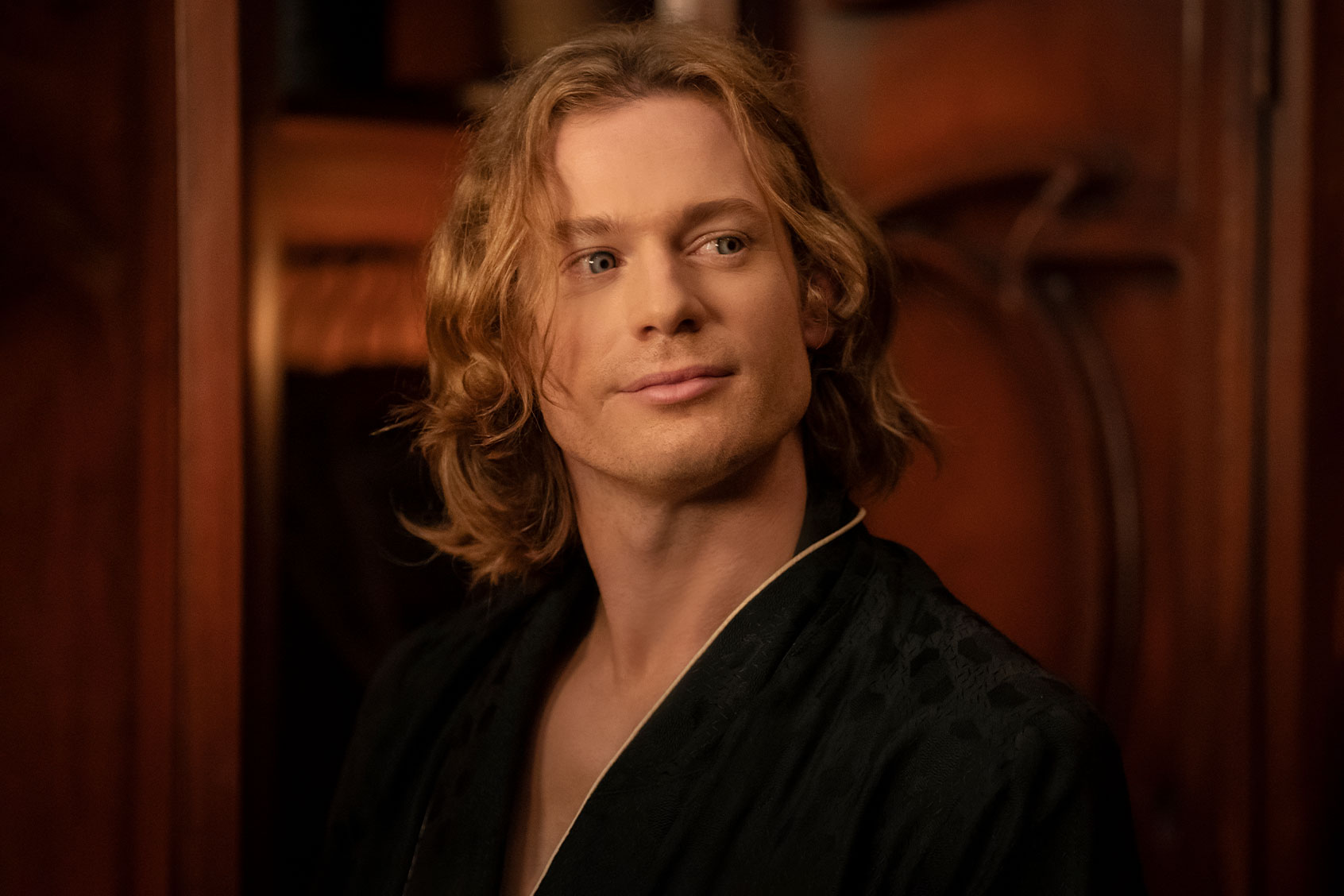
We’ve seen Lestat and Louis before, but the new series will show them steamier than we know the vampires, with more sex and sexuality.  The New York Times wrote, “The series doesn’t just adapt the novel; it fundamentally alters it, shifting the central timeline forward by over a century, exchanging the book’s suggestive homoeroticism for outright gay sex.”

“The sucking blood business is even more intimate.”

Although the characters in the novel are not explicitly queer, over the years they have become implicitly so, prompted in part by Rice herself. In 2016 the writer told The Daily Beast, “People told me ‘Interview with the Vampire’ was a gay allegory, and I was very honored by that. I think I have a gay sensibility and I feel like I’m gay, because I’ve always transcended gender, and I’ve always seen love as transcending gender.” Gayming wrote, “Since the 1970s, Rice had incorporated queer characters and feelings into her stories. ‘Interview with the Vampire’ is particularly interested in male-male desire.”

Interview with the VampireSam Reid as Lestat in “Interview with the Vampire” (Alfonso Bresciani/AMC)Creator and executive producer Rolin Jones told the TCA, when asked about the queerness of the show, “It seemed pretty obvious to me what the story was here . . . I said, ‘I don’t think it’s a horror show. I think it is a gothic romance.’ And I want to kind of write a very excitable, aggressive, toxic, beautiful love story . . . I mean there’s queer sexuality, but there’s queer ethics and queer aesthetics.”

The increased sex scenes also meant the use of intimacy coordinators, something the show was praised for early on. Sam Reid – who plays the updated Lestat opposite Jacob Anderson’s Louis – said, “We worked with an intimacy coordinator quite extensively . . . I think it’s important, and it treats those scenes a bit more like a stunt scene or a fight scene so they’re properly choreographed as well as trying to keep some spontaneity in it.”

Bogosian added, The sucking blood business is even more intimate. You know, because like sex we kind of know what it is . . . But [the] experience of actually sucking blood out of a throat. I’ve seen them doing it and you get really close and it’s intense.”

Extra gore and violence

While ramping up the sex, and making sexuality not something to dance around but something to show openly, the new series also takes a different approach to violence. Gizmodo wrote, “Any point, where it had to make choices, it made the most choice possible. The decisions are extra, dramatic, over the top, extreme, gory, and flamboyant.” Their review also described the show as “visceral” and “soaked in blood.” Vampires kill, after all, and alter lives forever. 

Interview with the VampireBailey Bass as Claudia in “Interview with the Vampire” (Alfonso Bresciani/AMC)Vampires with a difference
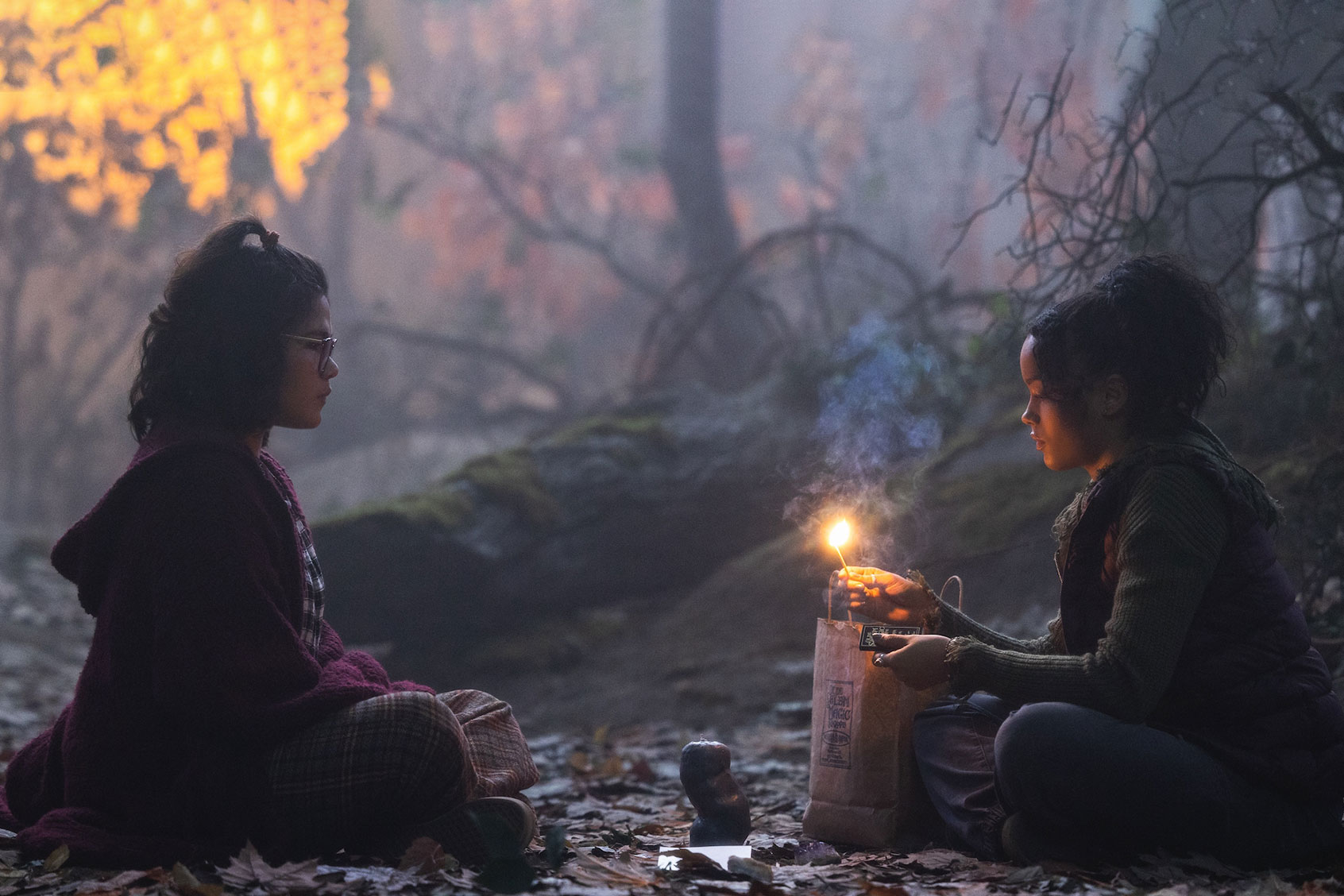
Along with a changed and older Daniel, the series takes liberties with the beloved character of Claudia (Kirsten Dunst in the film, in a life-changing role), aging her to 14 when she’s turned into a vampire. Bailey Bass plays Claudia in the show. In the book, Claudia is quite young. In the movie, the character is aged a bit as Dunst played her at 11. The series chose to age Claudia a little more for reasons both practical (the difficulty of having a child actor look the same across seasons) and for the possibilities of story.

Jones said on the panel, “We thought there would be a third way to go about this and that is to lock Claudia sort of in the chemistry of a 14-year-old, the body chemistry of that and all the fluctuations and passions that happen . . . I think Bailey’s done a really remarkable job of giving this third version of Claudia.”

“He’s somebody that to some extent feels cheated I think in this human existence.”

Both Claudia and Louis are Black in the series, another departure from the novel that gives the show a chance to explore characters of color navigating the American South in the 1900s. At the panel, Bass said, “We do touch upon what it means to be a Black woman, but also a Black child in that time. It was interesting doing research for Claudia being a Black child because there’s not much research to be found, so we kind of had to create it on our own from what we had. You can see a lot of pictures of Black women, but not necessarily Black children who were to a wealthier family.” 


Want a daily wrap-up of all the news and commentary Salon has to offer? Subscribe to our morning newsletter, Crash Course.


Director and executive producer Alan Taylor also spoke on the panel about Louis being Black: “There’s also another layer because Louis was not from the streets. Louis was from a fairly well-to-do family, and it’s a part of Black history that doesn’t get represented that much. So already him going to the streets and becoming a tough guy who could hold up his own in the business he’s in was a bit of a performance for him . . . layers in Louis even in the early part of the story that then just deepen over time as he becomes deeper.”

When asked on the panel “where the hell” the rage in Louis comes from, Jacob Anderson, said, “In me. I think he’s somebody that to some extent feels cheated I think in this human existence. I think he can’t quite find his place.”

One thing is certain. This “Interview with the Vampire” seems to have found a new place in the rich history of vampire stories.

“Interview With the Vampire” premieres Sunday at 10 p.m. on AMC. The first episode is currently available on AMC+


Most immigrants didn’t go to Martha’s Vineyard: What our schools can learn from that

Florida Gov. Ron DeSantis made headlines last month by shipping a relative handful of unsuspecting Venezuelan immigrants, like cargo, to Martha’s Vineyard. But the lessons that young people in this country are learning from that episode are entirely the wrong ones. It is time for teachers, parents, and our community of neighbors to change the way we talk about the cruel nature of politics and the inhumane treatment of immigrants in this country. 

As usual, the news is focused on talking about immigrants, not on talking with them. There are nearly half a million undocumented students in the U.S. schools today listening carefully to how teachers discuss the economics, policies or moral arguments around immigration policies. More likely, however, these students — and their more than 75 million classmates — are learning the uncompromising lessons of silence, apathy, inaction and fear. 

In a climate that makes it increasingly frightening and dangerous for teachers to discuss politics in their classrooms — not least because of policies enacted by DeSantis and his allies — far too many of our students are learning that the arithmetic of trafficking human bodies from one part of the country to another has nothing to do with the standards-aligned instruction in our classrooms, or that our national focus on “learning loss” leaves no time to talk about the lives imperiled by anti-immigration stunts.

There are more than 11 million individuals labeled as undocumented in this country, and the vast majority of them were not on one of DeSantis’ chartered planes or Texas Gov. Greg Abbott’s buses in recent weeks. We may be out of sight and out of mind for most readers, but we have been the unreported essential workers in this country decades before such a term came into common parlance.

Over the past year, we have been studying how to understand and construct a kind of critical empathy around the contexts of immigration, difference and change. Our research has focused on narrative and personal experience. The Martha’s Vineyard spectacle, for instance, is one of a set of cruel reminders of the lack of agency afforded to immigrants in this country. When it comes to the lessons about immigration that students — and adults, for that matter — could be learning, our schools have been resoundingly silent. 

In mainstream education, immigration is largely the domain of history classes, typically depicted as something that happened in the past or, more recently, as the flame below the multicultural melting pot that has created this “nation of immigrants.” If schools typically teach  immigration as an object-lesson of optimistic American progress, that in no way offers an accurate picture of the fractured state of debate and human anguish experienced today.


Want a daily wrap-up of all the news and commentary Salon has to offer? Subscribe to our morning newsletter, Crash Course.


Schools need to broaden where and how civic issues like immigration are discussed. As we’ve argued before, every teacher is a civics teacher, and the lessons of immigration must live in all subject areas. English teachers, for example, might connect the lessons here to related literature about contemporary immigration or to drive student-driven inquiry into the root causes of immigration. Perhaps a more cynical English teacher might offer a lesson about irony beneath DeSantis’ stunt: This summer has seen airports snarled with canceled flights and exorbitant airfares; the sheer luxury of chartering planes just for immigrants is strange messaging from the Florida governor. Most undocumented immigrants cannot safely enter airports without fear of deportation. So while a few dozen were flown across state lines at someone else’s expense, most would never attempt such travel. There are many things this country takes away from its immigrants — adequate health care, safety, family, the future — and the ability to travel safely on airplanes when ticket prices are too high to bother is pretty far down the list. 

STEM teachers in general are often treated as if their classroom work has no connection to  contemporary issues of justice like immigration. But as our own research has explored, quantitative reasoning and understanding the civic dimensions of the world through data are key to student learning. Immigration must be a topic taken up in science and math classrooms. 

Though there are obviously developmental differences among age groups, immigration is a topic that can be explored across all grade levels. Young children of all backgrounds know the feeling of peril that comes with being dropped off in the morning, the fear of being left behind. Might that knowledge lead to moments of empathy and understanding for the kinds of voluntary and involuntary sacrifices many individuals in this country must make in the name of family or survival?

In our ongoing research, one central problem we’ve identified — from personal experiences and analysis of curriculum — is that there are few examples of immigration-related instructional opportunities in schools in general. Immigrant youth may be mocked or offered fewer educational opportunities due to language differences. Discussions of financial insecurity and legal precarity may be treated as private sources of shame in even the most progressive school districts. We don’t talk or teach enough about immigration because, as a country, we don’t know how.

Ron DeSantis and Greg Abbott’s PR stunts should remind us how little control immigrants have over their own lives. That’s the lesson being implicitly taught in our schools right now.

Based on our own dialogue-driven research, that work starts with listening. Many of our classrooms are filled with immigrant youth with an abundance of expertise that is not often allowed to surface. Teachers can let young people share what they know, what they’ve heard and what they are wondering about as a starting place for our collective learning. This is the moral and civic imperative of immigration and education in schools today. 

The events of the past few weeks should remind us of how little control immigrants have over their own lives in this country. This is the lesson that is implicitly taught in our schools right now. To be clear, it wasn’t just immigrants living in Republican-governed states like Texas and Florida that watched this news with marked trepidation. 

Here, in California, where we live and work, violence toward immigrants is frequent enough that it warrants only passing mention in the news. From the scorching heat wave of early September that substantially burdened agricultural workers to the escalating violence that local street vendors face daily, life for immigrants in supposed liberal havens like California is anything but safe. 

It doesn’t take a Republican governor to remind us that immigrants are granted only temporary relief from the cruelty of America’s confused policies. Our own on-the-ground research and work from scholars like Angela Garcia makes it clear that undocumented immigrants face constant and barely visible danger. A traffic stop in the wrong municipality could lead to a life upended  and the deportation process started.

When will teachers and schools find the courage to discuss the fact that immigrants cannot reliably lead free, safe and humane lives in the U.S.?

Democratic denunciations of DeSantis and Abbott’s actions do little to impact the day-to-day experiences of those immigrants that didn’t happen to find themselves aboard an unscheduled flight to a resort island off the coast of Massachusetts. For most of us, this entire episode has been another reminder that our lives are not our own and that this country is more than happy to treat us as political pawns or livestock. 

Marjorie Taylor Greene lashes out at political enemies during Trump rally

Controversial first-term Georgia Rep. Marjorie Taylor Greene traveled to Michigan to speak at Donald Trump’s Saturday rally in Warren.

Speaking for more than twenty minutes, Greene lashed out at her political enemies and painted a dark portrait of a dystopian portrait of a country where Republicans are persecuted and transgender Americans are the “most protected class.”

Greene both took the stage to the song “Gladiator” by Zayde Wølf.

“I had to keep on reaching up ’cause it was my time; To tear down the kingdom and call out the liars,” Wølf sang. “Spent too much money on a therapist; Couldn’t fix me, I accepted it.”

Twice the crowd chanted, “lock her up” as Greene attacked Democratic Gov. Gretchen Whitmer and called for jailing doctors for gender reassignment surgeries.

She also attacked Speaker Nancy Pelosi (D-CA), Rep. Alexandria Ocasio-Cortez (D-NY), Transportation Secretary Pete Buttigieg and the governor of California, among others.

“Democrats want Republicans dead and they’ve already started the killing,” she said.

As Greene left the stage, Zayde Wølf played again.

“Picked a fight with the gods I’m the giant slayer,” he sang. “Bone shaker, dominator;Freight train, wrecking ball, I’m the gladiator.”

Watch below:

Trump sings Ginni Thomas’ praises

Donald Trump praised Ginni Thomas at a Saturday rally for continuing to believe his “big lie” about the 2020 presidential election, which he lost to Joe Biden.

Thomas, the wife of Supreme Court Justice Clarence Thomas, testified on Thursday before the House Select Committee Investigating the Jan. 6 Attack on the U.S. Capitol.

Following her testimony, Chairman Bennie Thompson (D-MS) told reporters Ginni Thomas still believes the election was stolen. That was confirmed by Rep. Jamie Raskin (D-MD).

“As we talk about and think of the rigged and stolen of 2020 — presidential election, rigged and stolen — I would like to thank a great woman named Ginni Thomas,” Trump said. “Do you know Ginni Thomas? Great woman.”

Trump also described her husband as a “great man.”

“But she said that she still believes the 2020 election,” Trump said. “She didn’t wilt under pressure like so many others that are weak people and stupid people, because once they wilt, they end up being a witness for a long time.”

Even though Ginni Thomas was incorrect about the election, clinging to his lie earned Trump’s praise.

“She said what she thought, she said what she believed in,” Trump said. “Too many Republicans are weak and they’re afraid and they better get strong fast or you’re not going to have a Republican Party and you’re not going to have a country anymore.”

Trump then introduced MyPillow CEO and prominent election denier Mike Lindell.

Watch below:

Death is anything but a dying business as private equity cashes in

Private equity firms are investing in health care from cradle to grave, and in that latter category quite literally. A small but growing percentage of the funeral home industry — and the broader death care market — is being gobbled up by private equity-backed firms attracted by high profit margins, predictable income, and the eventual deaths of tens of millions of baby boomers.

The funeral home industry is in many ways a prime target for private equity, which looks for markets that are highly fragmented and could benefit from consolidation. By cobbling together chains of funeral homes, these firms can leverage economies of scale in purchasing, improve marketing strategies, and share administrative functions.

According to industry officials, about 19,000 funeral homes make up the $23 billion industry in the U.S., at least 80% of which remain privately owned and operated — mostly mom and pop businesses, with a few regional chains thrown in. The remaining 20%, or about 3,800 homes, are owned by funeral home chains, and private equity-backed firms own about 1,000 of those.

Consumer advocates worry that private equity firms will follow the lead of publicly traded companies that have built large chains of funeral homes and raised prices for consumers. “The real master that’s being served is not the grieving family who’s paying the bill — it’s the shareholder,” said Joshua Slocum, executive director of the Funeral Consumers Alliance, a nonprofit that seeks to educate consumers about funeral costs and services.

Although funeral price data is not readily available to the public, surveys by the local affiliates of the alliance have found that when publicly traded or private equity-backed chains acquire individual funeral homes, price hikes tend to follow.

In Tucson, Arizona, for example, when a local owner sold Angel Valley Funeral Home in 2019 to private equity-backed Foundation Partners Group, prices increased from $425 to $760 for a cremation, from $1,840 to $2,485 for a burial with no viewing or visitation, and from $3,405 to $4,480 for a full, economical funeral.

In the Arizona city of Mesa, the sale of Lakeshore Mortuary to the publicly traded funeral home chain Service Corporation International led to price increases for a cremation from $1,565 in 2018 to $1,770 in 2021, for a burial from $2,795 to $3,680, and for an economical funeral from $4,385 to $5,090.

“We believe our pricing is competitive and reasonable in the markets in which we operate,” a Service Corporation International official said in an email.

Details of those price increases were provided by Martha Lundgren, a member of the Funeral Consumers Alliance of Arizona’s board. She said funeral home acquisitions have led to the cancellation of pricing agreements negotiated on behalf of consumers who are members of the alliance. In 2020, a cremation at Adair Dodge Chapel in Tucson cost members $395, nearly two-thirds off the $1,100 standard price. But after Foundation Partners Group acquired the funeral home, the member pricing agreement was canceled, and the price of a direct cremation rose to $1,370.

Foundation Partners Group officials said the price increases partly reflect the higher price of supplies, such as caskets, as well as increasing labor costs. But most of the increases, they said, represent a move to a more transparent pricing system that includes administrative and transportation fees that other funeral homes add on later.

“We don’t take advantage of people in there when they’re not thinking clearly,” said Kent Robertson, the company’s president and CEO. “That’s just not who we are.”

A big surge of consolidation happened in the U.S. funeral home industry in the late 1980s and early 1990s, and again around 2010, said Chris Cruger, a Phoenix-based consultant to the industry. And acquisitions have reached a feverish pace in the past two to three years. Many investors are banking on a significant uptick in demand for death care services in the coming years as 73 million baby boomers, the oldest of whom will be in their late 70s, continue to age.

“Sheer demographics are obviously in everybody’s favor here,” Cruger said. Funeral homes have attractive margins already, and combining them into chains to share administrative costs could boost profits even more.

Meanwhile, many funeral home owner-operators are reaching retirement age and have no one in the family willing to take over. A 2021 survey by the National Funeral Directors Association found that 27% of owners planned to sell their business or retire within five years.

The desire to sell, combined with the investment money pouring into the field, has driven prices for funeral homes to new heights. Before private equity turned its eye to funeral homes, they were selling for three to five times their annual revenue. “Now I’m hearing seven to nine,” said Barbara Kemmis, executive director of the Cremation Association of North America, a trade group for the cremation industry.

The value in funeral homes lies in more than their brick-and-mortar assets. Funeral home directors are often integral parts of their communities and have established significant goodwill with their neighbors. So when corporate chains acquire these homes, they rarely change the name and often keep the former owners around to smooth the transition.

Tony Kumming, president of the NewBridge Group in Tampa, Florida, helps broker funeral home sales. Many of his clients remain skeptical of the large firms and often will take less money to sell to someone they believe won’t stain their hard-earned reputations. Most former owners plan to live in the community and don’t want their friends and neighbors to be mistreated. “I’m not saying someone is going to take half of what another company is offering,” Kumming said. “But there’s two big pieces to a sale now: That’s money and the right fit.”

Five years ago, when Robert Olthof decided to sell his family’s funeral home in Elmira, New York, he contacted some of the large publicly traded funeral home chains. But as representatives from multiple companies visited him to make their offers, Olthof realized that none of the big chains had sent someone versed in the service side of the business. “They sent their accountants, and they sent their lawyers,” he recalled. “Everything was about the numbers, the numbers, the numbers. And I didn’t like that.”

Instead, Olthof sold to Greg Rollings, a former funeral director who had amassed a privately owned, 90-site chain of funeral homes throughout the Northeast. Rollings had offered less money than the big chains had, but he knew what it was like to be awoken at 2:30 a.m. and put on a suit to go help a grieving family. He knew what it was like to bury a child.

“I can’t put a dollar-amount value on how much it’s really worth selling to a person who is a funeral director themselves,” Olthof said. “Because moving forward, your name is still going to be on the front of that building.”

Victoria Haneman, a Creighton University School of Law professor who studies the funeral home industry, worries that new corporate ownership might be devastating for grieving families. “They are not behaving like normal, rational consumers,” she said. “They’re not bargain-shopping because death is viewed as an inappropriate time to bargain-shop.”

For most families, a funeral will be one of the largest expenses they ever incur. But they often enter the shopping process cognitively impaired by grief and unsure of what is customary or appropriate.

Only 1 in 5 consumers visit more than one funeral home to obtain a price list, according to a 2022 survey commissioned by the Consumer Federation of America. And online comparisons are virtually impossible — a study by the federation and the Funeral Consumers Alliance found that just 18% of the funeral homes they sampled listed their prices on their websites. As a result, families generally lean heavily on the expertise of a single funeral director, who has a motive to sell them the most expensive options. So consumers can be pushed into buying packages for open-casket funerals that include embalming and other services that drive up the cost and may be unnecessary.

“Is that sort of pickled, shellacked, cosmetized, preserved corpse where the future will be? I don’t know that the answer is ‘yes,'” Haneman said. “And I think there are investors who are betting that it’s not.”

Foundation Partners Group is a prime example. Backed by the private equity firm Access Holdings, the funeral home chain shifted five years ago to acquiring funeral homes with high cremation rates. Cremation rates nationally have been steadily climbing over the past two decades, with nearly 58% of families now choosing cremation over casket burials. Foundation Partners expects that rate to hit 70% by 2030.

The company has acquired more than 75 businesses in high-cremation states, including Arizona, California, Colorado, and Florida. Most of those funeral homes average a bit over 150 funerals per year.

Individual funeral homes “don’t have access to marketing budgets, they don’t have access to safety and health plans and benefits and these different things,” said Robertson, the Foundation Partners CEO. “And because we have the ability to drive marketing and do other things, we also take that 150-call firm to maybe 200 calls.”

Robertson said the funeral home industry is different from other sectors that private equity firms might consider investing in, describing it as a calling comparable to working in hospice care. Foundation Partners is fortunate their backers understand the service part of the industry, as well as the financials, he said. “Private equity firms aren’t necessarily known for having deep compassion for people. They’re more known for their financial returns,” he said. “To get both is really important.”

Foundation Partners owns Tulip Cremation, an online service that allows people to order a cremation with just a few clicks — and without having to set foot in a funeral home. Tulip currently operates in nine states where Foundation Partners has funeral homes. The company expects the service to eventually operate nationally.

Haneman said innovative approaches like Tulip’s are sorely needed in the funeral home industry, which has barely changed in 100 years. “It’s absurd to me that the average cost of a funeral is running $7,000 to $10,000,” she said. “People need less expensive options, and innovation is going to get us there.” Tulip charges less than $1,000 for a cremation; ashes are mailed back to the families.

Other online cremation services are Solace Cremation, Smart Cremation, and Lumen Cremation.

“Private equity investment has the potential to go one of two directions: It’s either going to entrench status quo and drive price, or the purpose of the investment is going to be disruption,” Haneman said. “And disruption promises the possibility of bringing more affordable processes to market.”


KHN (Kaiser Health News) is a national newsroom that produces in-depth journalism about health issues. Together with Policy Analysis and Polling, KHN is one of the three major operating programs at KFF (Kaiser Family Foundation). KFF is an endowed nonprofit organization providing information on health issues to the nation.

My great-grandparents died in the Holocaust and were almost forgotten

When I launched into “The U.S. and The Holocaust,” Ken Burn’s documentary exploring the United States’ response to Jewish refugees fleeing Hitler, I knew I’d be seeing images that have disturbed my consciousness most of my life: flocks of German war planes against a white sky, the shattered glass of Jewish businesses, crowds celebrating the processions of Nazi troops. According to the Nuremberg Laws, I’d be classified as a mongrel, a mischling of the first degree.  

Like many American children with even one Jewish parent, I dwelled on what would have happened if I had lived in the Nazi era, or if Nazis returned and took over the United States. I hold a vivid childhood memory of being awakened one night by the sound of men chanting war-like slogans, the stomp of them reverberating down our dark rural route. They were probably drunk teenagers stumbling from the nearby woods, but I was sure soldiers were coming to get us. As far as I knew then, we were the only remotely Jewish family in our small town. We were probably on a list somewhere. The Nazis would find me first, because my bedroom was on the ground floor while the rest of the family slept upstairs. I was separate. That’s what this sliver of identity made me feel like.  

My interest in my Jewish heritage was keen but shy. It didn’t feel quite legitimate, because it was my father who was Jewish, and traditionally the identity is passed through the mother. Though my dad never hid his background, it did not have much impact on our life. I experienced Jewish traditions only in relatives’ homes, in the big city of Pittsburgh, where we brought our country mouse ways to secular Seders. My hesitation to claim Jewishness also stemmed simply from not knowing enough. A voracious reader, I could usually glean a sense of things quickly from books, but something about Judaism escaped my grasp. Was religion the crucial bit? Culture? Blood? The long history of shared oppression? Where did allegiance to Israel fit? My father’s careful, both-sides answers to my questions were more mystifying than clarifying. He told me that his parents, both immigrants, hadn’t liked to talk about the past, so he knew little, and that his own childhood had not been happy, so he didn’t like to dwell on that either. 

It wasn’t until I was an adult that I learned my great-grandparents had died in a concentration camp. My dad told me in a phone call: He wanted to talk about the database of dormant accounts held by Jews in Swiss banks, not aware that he had never mentioned the fate of his grandparents before. He described his mother reading aloud their last letter, in which they said they were being sent to a camp and would probably not be heard from again. They never were.  

The news hit me hard. I reverberated with a sense of shock and betrayal that this information had been kept from me, their memory forgotten. After I hung up the phone, I crumpled to the floor and sobbed. A yawning grief followed me for weeks. Months. To be honest, I still sense it, a shadowy presence hovering just over my shoulder, or sometimes tucking itself beneath my clavicle, causing a tenderness in my lungs when I inhale.   

I reverberated with a sense of shock and betrayal that this information had been kept from me, their memory forgotten.

My reaction to the death of these long-gone strangers seemed — can still seem— extreme, unwarranted, yet I can’t subdue it. Perhaps the pain speaks to mystical ancestral connection of the sort in which I ostensibly don’t believe, and yet seem to crave. What remains clear is that when I learned my great-grandparents were killed in a genocide it was as if Nazis did burst into my darkened childhood bedroom. Instead of capturing me, the soldiers grabbed the two little-old people who had been hiding deep in my closet and dragged them out right before my eyes in a drama of screams and shouts, and no one — not me, not my father, none of our neighbors — said anything, stopped them. The fate of my great-grandparents haunted me, and I felt alone with my rootless mourning, separate again.  

But I did not remain that way. A few years ago, a woman doing genealogical research contacted me. We turned out to be distant cousins through my great-grandfather’s line, and our meeting caused a chain of events that led to one of my first cousins unearthing an autobiography written by my great-uncle Ludwig Engler, who is my grandmother’s brother, the son of the killed great-grandparents.  

Seldom have I had a more meaningful reading experience. Through Ludwig’s graceful prose I finally met my great-grandparents and got to know my grandmother, who had been a distant figure to me. I also gained a view into some of the historical events that have obsessed me. Ludwig immigrated from Vienna to the United States in 1926, among the limited number of Austrians allowed entry. In his manuscript, he describes his experience during the pre-war period captured by “The U.S. and the Holocaust,” when he was working as a telegraph operator:

As [the European Jews’ telegrams] were almost all sent in English or German, I could read them, and the hours and days spent on the radio circuit between New York and Berlin became an almost unbearable emotional ordeal. Anybody except the most callous individual would have been moved by these unbelievably tragic telegrams in which once dignified people begged strangers for help; I had close relatives in that maelstrom and was frequently reduced to tears and sleepless nights. . .    

One evening whilst at work on those pitiful telegrams, a colleague sent me a note to the effect that “Ha, ha you Jews are certainly getting it in the neck these days.” I stormed over to him, beside myself with rage, and others had to keep us apart. . . The propaganda barrage from Germany, coupled with frustrations nurtured by depression, gave rise to serious political anti-Semitism within the United States, and the same sense of insecurity which I had experienced in Europe took hold of me in New York.

This was what it had been like to be in the United States when the threat of Nazi invasion was nigh. Here was someone worrying about it, reacting to it, giving voice to the fear. Though I had never met my great-uncle, I felt related to him on a deep core level.  

Ludwig was able to channel his distress into action when, as an army veteran, he was called up to serve in World War II. In retirement, he became a leader in his local Jewish community. Raised like me in a mostly secular household and often apart from other Jews, he brought people together to find fellowship, celebrate their heritage, and practice self-help. Through him, I feel invited to share a Jewish identity.  

One thing Ludwig’s autobiography did not clarify was the fate of my great-grandparents. His memory is slightly different than my father’s, and he doesn’t recall them announcing their departure to a camp. He just says that they probably disappeared into one. The fog surrounding their precise fate reminds me that a blood tie to specific aspects of an atrocity need not exist.  

What would we do if Nazis rose again today? If they came for our parents? Our grandparents? For someone else’s? I still wake in the night with Holocaust fears clutching my throat. I say a secular prayer that I would have the strength to stand up and speak out, and that I would not be alone.

Two classic Italian favorites meet in this satisfying, cheesy Pizza Pasta casserole

I dearly love pizza. I love it fresh and hot from the oven or leftover cold, right out of the refrigerator. I never tire of the various combinations of basil, oregano, garlic and onions; of fennel seeds, artichoke hearts, olives and tomato sauce; of fresh mozzarella, feta and pesto and spinach and peppery arugula. 

Add some grated Italian cheese like Pecorino Romano or Parmesan and finish with some fruity-bitter-grassy extra virgin olive oil and crushed, dried red pepper flakes — well, it’s just my favorite thing. Thankfully, my husband, Tom, loves pizza, too, so he does not mind that pizza is on our supper menu almost every week. I should say he doesn’t mind weekly pizza night as long as it’s my pizza we’re eating. It might be why our marriage is so good: He loves my pizza. 

This Pizza Pasta was born out of necessity when the disruptions of COVID-19 included being unable to procure my favorite frozen pizza crusts that I had grown to depend on for our weekly homemade pizza fix. The only shop that carries them is Ever’Man, my favorite semi-local food co-op in Pensacola, Florida. From the time I discovered them years ago, they were always in stock and stacked twenty or more high in the freezer case. These crusts make my pizza-loving dreams come true. They baked up crispy and delicious every time. I totally took them for granted. 

These special crusts also work for my gluten-sensitive, grain-sensitive, this-sensitive and that-sensitive person in my life who loves pizza almost as much as I do, but can’t stand the feeling of eating a “big dough ball.” Tom doesn’t readily admit to being grain-sensitive, but he never feels well when he eats it, and, frankly, I can do without it, too. They are made primarily of tapioca starch, but in addition to being grain-free, they are the reason my homemade pizzas are leagues better than anything we can get at a restaurant.  

I should probably tone down my ego a bit, waxing on about my  homemade pizzas being so superior, and make clear there isn’t much competition where we live. We neither live in nor are we nearby a “pizza city” where magnificent pies are readily available. In fact, we live in what I might call a pizza-deprived area of the country. I will say, however, that the gluten-free pizza down the beach at our beloved local drinking joint is pretty darn good, but mine really are better!  

The thing is, I have perfected the pizza that Tom and I prefer — a thin, crispy crust with well-done toppings and lots of flavorful herbs. It is the best to us. I get that it probably would not be the best to those with different pizza preferences. Although I change it up, our pies almost always have a pesto base with tiny diced onion, a little bit of feta and/or buffalo mozzarella, portobello mushrooms, lots of fennel seeds, basil and oregano with spinach or arugula, which I bake separately then place atop our pizza as it comes out of the oven. Lastly, I grate Pecorino Romano, drizzle extra-virgin olive oil, and sprinkle crushed red pepper to finish. It is a taste sensation! 

For years I clicked along making my outstanding nutritious and delicious pizzas with my healthy grain-free crusts, basking in all the compliments I received, coasting through my pizza evenings on auto-pilot. Then a little thing called COVID-19 came along and really messed things up. All of a sudden the freezer cases at Ever’Man had big swaths of empty space where my favorite staples were once housed in large supply. After many months, their deliveries did pick up and become more regular, but my beloved grain-free crusts remained UNAVAILABLE. No one could say when they would be back in stock. 

And just like that, Pizza Pasta was born as a way to serve all my favorite pizza toppings — no crust required! And while eventually my crusts became available again, Pizza Pasta is here to stay. 


Want more great food writing and recipes? Subscribe to Salon Food’s newsletter.


Most of the time, I’m cooking for just Tom and me, so I make ours in one big 9-by-12″ casserole dish. But if you have a larger family or are having a group over, it’s fun to put out mixing bowls and small baking dishes, sauces, toppings and cheeses and allow people to create their own personal Pizza Pasta concoctions. It’s such an easy way to deal with everyone’s food allergies, sensitivities and preferences, while being really fun at the same time. People love to congregate in the kitchen, so set everything out buffet-style and let folks get creative. These days there is a type of pasta for everyone: some made from rice, from beans, from cassava (and from things you just can’t imagine could ever create pasta). 

And unlike many alternative-ingredient items, these various pastas don’t cost much more than regular wheat varieties.

Regardless of whether you are making Pizza Pasta for two or 22, you will need to pre-cook your toppings. Cook your pasta according to the directions on the package and allow time for it to completely cool. Be sure not to overcook it, keep it al dente, and cool it off with cold water immediately after pouring it into your colander. The pasta should be room temperature or cold when assembling your pies.

Cook any protein you want to include on the stovetop and drain off any fat. You will pre-bake your veggies in the oven. I use a large jelly roll pan for my vegetables. It’s as big as one of my oven racks and works perfectly as I can keep them separated and in the oven at once. If you have a “convection” option on your oven, use it to speed up the process and also keep your toppings crisp.    

Once your ingredients are pre-cooked, all you need is a greased baking dish and some imagination. The pasta becomes your crust, and it should be mixed with whatever base you like: pesto, tomato sauce, or olive oil with salted, roasted garlic are some of my favorites. Add a bit of cheese to your base-pasta as well. From there, you simply layer on your toppings and bake until hot. I use a larger baking dish for a thinner bake. Others prefer a thicker pasta base and, therefore, use a deeper, smaller dish. Basically, your pizza preferences get translated to this new platform. 

You won’t believe how good it is, and it really is lots of fun to create individual dishes to suit everyone’s preferences. My friend’s young daughter created her favorite while at my house. It is heavy on the pasta with lots and lots of cheese and chopped pepperoni. It looks a lot like macaroni and cheese with pepperoni, but that’s fine. It is a great supper for adults and children alike. I have no doubt it will become a top-requested menu item at your house as it has at mine.

Pizza Pasta 
Yields
 As many servings as you like
Prep Time
30-45 minutes
Cook Time
30 minutes

Ingredients

A small pasta variety, like penne, farfalle or shells, cooked according to package directions, rinsed and cooled.

Tomato based pizza sauce, red sauce, pesto or other choice of base.

Vegetable pizza toppings of choice — the sky’s the limit — chopped small and pre-baked.

Proteins of choice, chopped small and fully-cooked.

Cheeses of choice — mozzarella, feta, Italian shredded cheeses like Parmesan, Asiago or Pecorino Romano are some of my favorites.

Herbs and seasonings of choice — garlic, oregano, basil, Herbs de Provence, fennel seeds, crushed red pepper — whatever you like.


Directions

  1. The amount of each ingredient will depend on how many people you are serving and whether you are baking one dish or several smaller, individual dishes. Choose your ingredients according to everyone’s pizza topping preferences and pre-bake as follows:

  2. Proteins should be ground or cut into very small pieces, seasoned if necessary and cooked thoroughly on the stove, fat drained.

  3. Vegetables should be chopped small, placed on a lined pan, drizzled with olive oil and baked or roasted in a preheated oven at 350 degrees (use “Convection Bake” or “Convection Roast” if you have that option on your oven to speed up the pre-baking process and keep your vegetables crisp). Bake to your preference. 

  4. Note: If you like spinach or arugula on your pizza, I suggest spreading it out on its own baking sheet, allowing it to bake just to your preferred level of doneness, then adding it as a final layer to your Pizza Pasta just before serving.

  5. Grease your baking dish(es). Use a smaller, deeper dish if you like a thicker, softer “crust;” use a larger dish for a thinner “crust.”

  6. In a small bowl combine cooked and cooled pasta with the preferred base. Add a bit of cheese and herbs of choice (not too much as you will add more later) to your sauced pasta. Taste and add salt and other seasonings if desired. 

  7. Place the saucy pasta in the bottom of a greased baking dish.

  8. Sprinkle a layer of cheese over the pasta and add additional herbs of choice. (I love fennel seeds, basil and oregano.)

  9. Add pre-cooked toppings of choice except spinach and/or arugula (see note above). Once assembled, bake in a preheated oven at 350 degrees until hot.

  10. Optionally, at the end of final baking, take out and add more cheese and return to the oven just until melted.

  11. Also optional, once your Pizza Pasta is hot and out of the oven, drizzle with olive oil and finish with a sprinkling of crushed red pepper and your favorite Parmesan or Pecorino Romano.


Cook’s Notes

Some combinations to try if you are having “Chef’s Block”
My mother’s favorite: Italian sausage and green pepper with a red sauce base and mozzarella. Topped with a light sprinkling of oregano and Parmesan to finish.

My family’s favorite: Portobello mushroom, onion, feta, chopped artichoke hearts and olives with a pesto base and lots of fennel seeds, oregano and basil. Finished with olive oil, crushed red peppers, and Pecorino Romano.

The kids’ favorite: Lots of mozzarella and pepperoni with a red sauce base and a little oregano. 

Another popular combination is pesto and chicken with roasted garlic and additional Italian seasonings and vegetable toppings of choice.

Convection Bake versus Regular Bake
I mentioned using the “convection bake” setting on your oven. If you don’t have that option, use a higher temperature like 400 degrees or so. I like my convection option as it keeps air flowing, which helps to reduce moisture overall and keep things crispier. It is certainly not necessary though. Plenty of wonderful Pizza Pastas have been made using your regular “bake” setting.

Base Ingredients
I don’t make my own bases other than occasionally having homemade pesto around. Store-bought brands work just fine. 
 

Salon Food writes about stuff we think you’ll like. While our editorial team independently selected these products, Salon has affiliate partnerships, so making a purchase through our links may earn us a commission.
 

“Should I store my tomatoes in the fridge?” and other questions about culinary best practices

Last week, I received no fewer than two dozen emails asking how I store tomatoes in my kitchen. They popped up in my inbox, one by one, after I published an essay about how quickly using up beautiful end-of-summer tomatoes taught me to infuse special ingredients into everyday cooking instead of waiting for some mythical “special occasion.” 

As I wrote: “Since I was on a clock to eat these perfect tomatoes  — a tomato’s shelf life is about a week on the counter and two weeks in the fridge — I didn’t have the luxury of waiting for the perfect moment to use them.”

If you’ve been in the business of food for long enough, you know that certain phrases, such as “jarred garlic” and “pineapple pizza,” tend to ignite at least a spark of controversy when uttered. The allusion to keeping tomatoes in the refrigerator has a similar effect. As one reader (who gave me permission to share this) wrote to me, “I feel quite strongly about this. Sure, their ‘shelf life’ may be longer in the refrigerator, but what kind of life is that?” 

Now, a confession from my kitchen: While I do tend to keep tomatoes on my countertops, I’m not particularly militant about it. 

One of my most vivid childhood memories is of the small garden in the Chicago suburbs where my dad grew (as he put it) “salsa ingredients” — jalapeños, onions and tomatoes. Looking back, it strikes me as funny that he wasn’t particularly precious about the produce he grew. (I, meanwhile, romanticized the heck out of the herbs I grew in my pandemic windowsill garden.) He’d pick them and carry them inside using a stray Jewel-Osco bag, before transferring them to a bowl or basket that moved back and forth between the counter and refrigerator shelf. 

He liked them at room-temperature when making things like Sunday pasta sauce and (of course) salsa, but cool tomato slices ruled supreme when it came to making BLTs. Now, is this the “right” way to store tomatoes? Honestly, probably not. 

At some point, after I’d left home, I read (and observed in my own cooking) that leaving tomatoes in the refrigerator can make them a little pulpy and less acidic. Alton Brown — whose show “Good Eats” served as my first form of culinary education beyond watching my mom cook — has written about this several times, including in a pretty concise 2014 Facebook post. 

“Do me a favor: Never put tomatoes in the refrigerator,” he wrote. “If they drop below 50 degrees F, a flavor compound called (Z)-3-hexenal is just going to flip itself off like a chemical switch … permanently.”

Ann Ziata, a chef at the Institute of Culinary Education, broke down this change for me via email.

“Chilled tomatoes will have an unpleasantly mealy texture and a muted flavor,” Ziata wrote. “Room temperature is the ideal environment for serving tomatoes. Refrigeration can also prevent under-ripe tomatoes from fully ripening, so always hold under-ripe tomatoes at room temperature.” 


Want more great food writing and recipes? Subscribe to Salon Food’s newsletter, The Bite.


There are a few benefits to temporarily placing tomatoes in the refrigerator. 

“If your kitchen is very warm and humid, storing tomatoes in the fridge will prevent them from spoiling too quickly,” she said. “Also, if you have very ripe tomatoes that you won’t be immediately using, keep those in the fridge, too.” 

However, for many home cooks, the cons probably outweigh those benefits. As such, Ziata provided this advice: “Always make sure to bring refrigerated tomatoes back to room temperature before serving for best flavor. Let them sit on your counter until they don’t feel cold anymore.” 

The thing is, I could tell my Dad all this and he would dutifully listen, but that’s not going to change the fact that the man likes a refrigerator-chilled slice of tomato on his BLT — and I think that attitude is something more of us could embrace in the kitchen (I know I could). 

I’m a big proponent of doing better once you know better. For example, once I learned about blooming spices in oil or this hack for making mess-free bacon, there was no going back. But there are times where, in our own kitchens, it’s fine to be a little more laissez-faire. Sometimes it’s OK to view a recipe as a template and certain techniques as best practices, as opposed to infallible rules.

I guess this is a long way of saying, don’t worry if you, too, occasionally like a cool (if slightly mealy) slice of tomato from the fridge. I won’t kick you out of my kitchen. 

Salon Food writes about stuff we think you’ll like. While our editorial team independently selected these products, Salon has affiliate partnerships, so making a purchase through our links may earn us a commission.

The internet’s favorite chocolate chip cookie

These miraculous cookies are somehow even easier, faster, and — I’ll say it — better than the recipe on the back of the chocolate chip bag.

There is no waiting, no ambiguity — is my butter soft enough? room temp eggs . . . even when it’s 90°F? — about when to pass go. (Butter: Cold from the fridge. Eggs: Cold from the fridge. Go!)

But despite their speed and ease, they are the best sort of molten puddle cookies — buttery-bronze edges with a rippled give through the middle, and layers of pooling bittersweet chocolate throughout. There is nothing shortcut or half-measure about them.

I knew that they had to be a part of “Simply Genius” cookbook (which is finally, four years later, out today). The book was built around exactly this kind of smart, uncompromising recipe, with a desserts chapter driven by the promise that you don’t need a stand mixer, food processor, or blowtorch (or hours of prep time) to make memorable treats like this. Thankfully, Tara O’Brady, the cookie’s brilliant creator, agreed to share them with us.

When I first stumbled across the recipe on Tara’s blog Seven Spoons, their unassuming name drew me in: Basic, Great Chocolate Chip Cookies. Only later did I realize they’ve ridden wave after wave of popularity since Tara’s “Seven Spoons” cookbook debuted in 2015. They go by a tidy acronym (#BGCCCs) to those in the know, and were even recently referred to as “the best cookie recipe on the internet,” by Jesse Szewczyk on The Kitchn.

Their secrets? The right combination of gently melted butter and fridge-cold eggs to hit the perfect dough temperature for spreading. Chopped chocolate (or discs or feves — anything but stabilized chips) — to melt into layers and force the dough outward. The hefty 3-tablespoon portion — rolled into a ball, with no foot to restrain them — to give plenty of topography to crisp, ripple, crisp.

While we can’t necessarily go willy-nilly swapping melted butter and cold eggs into all our favorite cookie recipes (it took Tara over 700 batches to land on this one), Tara has riffed on her formula in countless ways. She mix-matches chocolates, sneaks in oatmeal and whole-grain flours and brown butter, and stirs in last-minute flair like sprinklestorched marshmallow fluff, malted cereal crackle, and peanut butter.

This was my — basic, great — dream for this cookbook: A collection of timeless recipes so simple they’ll bend around whatever is happening in your life, and so genius you never want to stop making them.

What will you do to make them your own?

Recipe: Basic, Great Chocolate Chip Cookies From Tara O’Brady

The “Simply Genius” cookbook is out now — you can snag a copy in our Shop, or so many other places! Like AmazonBarnes & NobleBooks-A-MillionBookshop.orgHudson BooksellersIndieBoundPowell’sTargetKitchen Arts & LettersNow ServingOmnivore Books on FoodBook Larder, or your favorite local bookstore.

This post contains products independently chosen (and loved) by Food52 editors and writers. As an Amazon Associate, Food52 earns an affiliate commission on qualifying purchases of the products we link to.

The power of Hannah Waddingham’s character Mother Witch in “Hocus Pocus 2”

One of the smart things Disney+’s “Hocus Pocus 2” does is go back in time. 

The long-awaited sequel starts in a way that recalls the original. Someone is wheeling high over historic Salem, Massachusetts. In the original 1993 film, it was the witch Sarah Sanderson (Sarah Jessica Parker), flying on her broomstick, about to lure away a small child from the girl’s sleepy village. In the new movie, it’s what looks like a gigantic redwing blackbird.

Which is about to turn into . . . Hannah Waddingham, everyone’s favorite football club owner (at least on TV). Although Waddingham’s role is small in “Hocus Pocus 2,” it’s memorable, essential to the film and rooted in lore. Waddingham’s character provides the villain origin story for Sarah, Mary (Kathy Najimy) and Winnie (Better Midler). 

Picture Bernadette Peters’ character from Stephen Sondheim’s “Into the Woods” in a Disney film. What if Glinda the Good Witch was actually a bad witch? What if there were no bad witches? What if the line between good and evil is blurry or nonexistent? There in that gray, muddled and glamorous middle lies Waddingham’s character, billed only as “Mother Witch.” 

In the new movie, we first meet the Sanderson sisters as children. Winnie’s refusal to marry has gotten them into trouble with the town’s reverend, who banishes her for disobedience and plans for the townsfolk to take the Mary and Sarah and “set them right.” The three sisters escape into the forbidden woods (shortly after apparently inventing gelatin) where the furious adults of their village won’t find them. The villagers are too superstitious to venture into the trees, à la M. Night Shyamalan’s “The Village,” and the sisters go deeper in the woods than they ever have before. It’s at this moment, as they realize they’re in the cold, dark heart of the forest, when Mother Witch makes her memorable entrance. She swoops down from the sky and transforms from a bird into a beautiful woman, velvet cloak swirling. 

The “Hocus Pocus” franchise isn’t big on scares. It’s more guffaws than grisly, but Waddingham’s character briefly provides a few nervous moments. She’s intense, her glowing crystal blue eyes, silver hair and long fingernails crossing that line into sexy-scary. That is, until she realizes Winnie isn’t an ordinary child. She smells power on her. She can’t simply eat her. Not her and not her sisters. 

Hocus Pocus 2Belissa Escobedo as Izzy and Whitney Peak as Becca in “Hocus Pocus 2” (Photo by Matt Kennedy/Disney)The weird glow leaves Mother Witch’s eyes, and her voice changes to a less saccharine register. She asks plainly why the girls are in “her” woods and realizes the children are different, that they are being pursued. The villagers “were right to fear thee,” she says, and praises Winne for something the girl has likely never been commended about before: her temper.
She’s going to give the girls a lesson on the woods.

Mother Witch then spins (literally, cape swishing like a community theater actor eating the scenery) right into teacher mode. She’s going to give the girls a lesson on the woods, that it’s feared by mere mortals because witches come there to recharge themselves. And Mother Witch swears Salem is a terrible place “only because it is run by fools.” Sounds a lot like Jennifer Barkley giving “Parks and Recreation’s” Leslie Knope a lesson on Pawnee being “run by monsters and morons” . . . and like many people in America watching their hometowns sink under misuse and corruption. 

Mother Witch is the fairy godmother of this tale and she’s not letting the girls go empty-handed. Also, it’s Winnie’s 16th birthday, which Mother Witch intuits. She’s going to give the girl a gift. At once and without much deliberation, she produces Book from behind her back. Yes, that Book

That Mother Witch simply gives the powerful book of spells to the young girl is a sign of the complexity of her character. Does she eat children? Yes. Is she helping these children? Also, yes. Mother Witch certainly sees something of herself in Winnie. She is also marked by loss. She warns the girl not to do the most powerful spell in the book, and hints at its terrible cost (or perhaps, the approaching Salem Witch Trials) when she tells them her coven is gone

There’s a long, rich history in fairy tales of the woman in the woods. That was always my favorite figure from stories because she was so enigmatic. The definition of ambiguity, the woman in the woods will help you, but at what cost? She gives gifts, but they have hidden prices and you may not be smart or cunning enough to realize that for some time, until the gifts with a catch have worked their darkness in you over a lifetime. Or, in the case of the Sanderson sisters, several lifetimes. 

They got into witchcraft to take their power back. Also, to save their own lives.

Mother Witch seems less a trickster than she does a helpful figure (although she’s certainly not sticking around to explain everything — she has kids to eat). She immediately takes a familiar tone with the girls. She addresses them as “we” and says “us.” She refers to them as peers, probably the first-ever time the young girls have been spoken to this way, giving them access to a lineage of powerful women in order to have agency . . .  and in order to escape. Would the villagers have caught up to the girls if Mother Witch had not given them the book? They got into witchcraft to take their power back. Also, to save their own lives.


Want a daily wrap-up of all the news and commentary Salon has to offer? Subscribe to our morning newsletter, Crash Course.


The Sanderson sisters have no mother that we know about. Their father is mentioned several times in the new film. He’s the village apothecary. But their only mother is . . . Mother Witch. “Because I said so,” she reasons after warning them against a certain spell. The mother of their powers. The parent of the book. The source who started it all, whose inheritance is felt in echoes throughout both films. 

Moments before Mother Witch’s first and only entrance, young Sarah has been entranced by a song. Sarah, whose later job it is to lure children to her witch sisters, first learns her song here in the woods. And the woman she learns it from is Mother Witch, singing. As the character says, “Magic has a way of uniting things that ought to be together.” 

“Hocus Pocus 2” is now streaming on Disney+.


Socca is the crêpe of the Mediterranean South

The French, by and large, do not eat standing up, though there are a few exceptions to this largely unspoken rule: the quignon of a warm baguette, torn off and consumed as the loaf is transported home. Petit gris snails, which, in Occitanie, are grilled over vinewood, flambéed with lard, skewered on metal picks, and shuttled straight into the mouth, chased with cold rosé. And then there’s socca, the three-ingredient chickpea flatbread of Nice, destined to be consumed hot and fresh as you wend your way through a local market.

Unlike wheat-and-egg-based crêpes or buckwheat galettes, which hail from northwestern Brittany, socca begins with a base of chickpea flour, water, and olive oil. Ladled onto an olive oil-greased copper pan as wide as the socca-maker’s wingspan will allow, it’s baked in a wood-fired oven, emerging crisp on the bottom and as tender as a good Yorkshire pudding within. And according to Niçois culinary historian Alex Benvenuto, it’s a specialty best eaten “seasoned heavily with pepper and very hot, and, of course, with the fingers.”

“You find people having it as an aperitif,” says Benvenuto, who is also the president of Cuisine niçoise, patrimoine de l’humanité, an association that successfully lobbied to classify Nice’s local cuisine as Intangible Cultural Heritage by UNESCO. “But if you want to stay really Niçois, you need to go to Cours Saleya [market] or to a bistro in the Old Town and have it in the street, with a glass of wine.”

Chickpea flatbreads like socca are omnipresent in the Mediterranean, with roots that go back thousands of years, according to Benvenuto. One Mesopotamian recipe he unearthed dates to 1700 BC. These days, you’ll find farinata or tarta cauda in Liguria, belecauda in southern Piedmont, cade in Toulon, cecina in Tuscany, and calentica in Algeria. While it’s simple to trace some origin lines, for example that of cade, which Niçois workers who arrived in Toulon to work in the arsenal in the 19th century, others are blurred.

“I can’t say who invented it,” says Benvenuto.

It’s not pure chauvinism that leads the historian to prefer the local iteration above all others, claiming it’s “thinner and crispier than its neighbor, farinata.” And he’s not the first who thought that socca was worth protecting. Honoring the great French tradition of culinary bureaucracy, in 1940, socca sellers united to form a guild to “defend their professional interests.” One of the five original guild members, Joseph Mazzone, sold his socca at 13 rue Bavastro, just steps from the port of Nice. Today, the address is still home to one of the best in the city.

Today, at Chez Pipo, Jean-Antoine Waechter makes about 15 of the 50-centimeter trays per lunch service and 20 every night. With 20 portions per dish, his rapid and constant work is a testament to the dish’s popularity.

Current owner Steeve Bernardo worked at Chez Pipo as a student before buying the restaurant in 2009. “We’re famous for our socca,” he says, noting that while other local specialties like pan bagnat and pissaladière certainly dot the menu, “Chez Pipo’s raison d’être is indeed socca.”

It’s also the centerpiece of the dining room. Before the wood-burning oven, shielded with just a transparent pane of glass, Waechter and his team work in clear view of diners. A special dispenser helps him generously grease the pan before it’s transferred to the oven to preheat. The batter is ladled in, and the socca is cooked for a few moments under his close supervision. He uses a paddle to burst any bubbles, brushing the top with even more oil to help it brown. “It’s difficult to make at home,” says Bernardo. “So the tradition is really to go out for it, to share it with your family or your friends.”

And while he says that locals lucky enough to have a country house with a pizza oven can indeed make it, “it’s pretty difficult, otherwise.”

René Socca has been selling socca since 1961 in the heart of Old Nice from behind a glass-paned counter, where customers line up for portions of not just this specialty but grilled sardines, pizza, and tourte de blettes – a sweet Swiss chard tart particularly popular during the holiday season. Selections can either be enjoyed to go or at one of a handful of tables on the side street adjacent to the restaurant, where the purchase of a drink earns you your spot. Zélie Bonge, who is the daughter and niece of two of the restaurant’s managers, agrees that making the specialty at home can be complex without the right material.

“It depends on if you’re lucky enough to have a wood-burning stove,” she says. “Those who do often make it at home.”

And while, she notes, it’s simpler to go out, “it’s also a moment to create great memories, if you make it at home.”

A Niçois resident of nearly 20 years, Canadian Rosa Jackson notes that while she loves buying socca out, she also frequently makes it at home or at her cooking school, Les Petits Farçis.

“We often make socca as a snack in class and serve it when the noon cannon goes off at the top of Castle Hill,” she says. “The cannon signals that it is time to start thinking about lunch!”

She has a few tips for those who would try their hand at it in a home kitchen. “It’s important to let the batter rest for at least two hours before cooking it, but if you let the batter sit in the refrigerator for between 24 and 48 hours, you will get the very best results,” she says.

A pan with good heat conduction is key, too.

“Socca should always be cooked in a metal pan,” she says. “The traditional socca pan is made of copper with a tin lining.”

But the crucial factor remains the screaming-hot temperature.

“The oven needs to be as hot as you can get it, and you should cook the socca for a little longer than you think it needs,” she says. “I find that adding some oil to the batter as well as to the pan also creates the best texture.”

Making your own socca is also an interesting way to play with the classic by adding toppings and mix-ins, something that’s far from traditional but that Bernardo embraced about five years ago at Chez Pipo.

“It already existed near Genoa,” he says, evoking farinata. “There, they vary it all the time. I thought the idea was great, so I duplicated it at my restaurant in Nice.” He has since started serving versions embedded with spring onions, marinated peppers, anchovies, and more. An extra oven just for the topping-laden versions helps him to keep up with the demand.

“It’s especially popular with foreign clients, because they’re naturally attracted to something with an extra ingredient, rather than plain,” says Bernardo. “Especially Americans.”

Both Bernardo and Waechter cite the Parmigiana, with eggplant, tomato, and parmesan cheese, as their favorite.

“You’re much farther from the flavor of the socca, though,” Bernardo says. “Since there are more ingredients, you cover up the flavor of the socca.”

Indeed, according to Jackson, “purists never serve socca with a dip, but always sprinkle it with finely ground black pepper.” It is just this seasoning that Waechter counsels as he slides a fresh plate across the table — for toppings aren’t the only way Chez Pipo breaks with tradition. Here, despite local custom, table service has seen the local specialty transition into a sit-down meal.

But whether you eat it standing up or sitting down, topped or plain, the most important thing, according to Benvenuto, is that socca be enjoyed with people you care about.

“It’s really only perfect at the market or at a bistro with friends and a glass of red wine,” he says. “It can be enjoyed during conversations at the bar, with that mix of aromas of wood fire and spices, drinks and stockfish.”

“It’s a dish,” he says, “that’s meant to be shared.”

***

La Socca (care of Alex Benvenuto)

For 2 50-centimeter soccas

  • 250 grams chickpea flour
  • 50 cl water
  • 2 tablespoons olive oil
  • Salt and pepper

Put the cold water in a pot. Whisk in the chickpea flour, oil, and a teaspoon of fine salt. Beat until smooth; strain as needed through a chinois to remove any lumps. Pour 2 to 3 mm of batter in a lightly oiled copper pan. Cook in a very hot oven. Enjoy nicely seasoned with pepper and very hot, and, of course, with your fingers.

Disney-esque and demented: Ti West on how his slasher flick “Pearl” compares to “Rocky Horror”

Writer-Director Ti West‘s “Pearl” is a brave, fun, and disturbing horror film that is simultaneously an homage to the Golden Age of Hollywood and a darkly comedic, irreverent, powerful psychodrama. It’s a testament to the director’s love of cinema.

“Pearl” is the prequel to West’s earlier 2022 slasher flick “X” – both of which were shot back-to-back secretly. “X” follows Mia Goth as aspiring porn star Maxine who attempts to shoot a film in 1970s rural Texas with her friends before a series of killings derail the production. The murderer is revealed to be a woman named Pearl – an octogenarian who is driven by a violent hunger for youth and sex, and whose story is now told here.

Who is Pearl? What combination of circumstances created her? Is the monster made or is it born? Both?

Ti West answers these questions in “Pearl,” set in 1918, which once again stars Goth, this time portraying the origins of how this farm girl became a killer. Pearl wants to run off to Hollywood. Her mother wants to stop her. There is great evil in Pearl. The tragic monster emerges and unleashes mayhem and destruction.

Here, West combines the aesthetic conventions and tropes of late 1920s and 1930s Hollywood films – the soldier husband away at war, a young woman seeking escape through dreams of fame and fortune, and a Technicolor palette, among others – with the contemporary sensibilities of a self-aware horror movie. The film’s impact also hinges on Goth as she conjures a transcendent performance as the villain, which comes to a crescendo with a show-stopping nine-minute monologue. An upcoming third film, “MaXXXine” will round out the trilogy.

In this conversation with Salon, West reflects on the wild journey of making these films, crafting the aesthetically ambitious prequel and Goth’s killer performance.

The following interview has been edited for length and clarity.

What has the journey been like? How are you feeling?

A little tired, but overall, I’m feeling pretty good. I had this crazy goal to make two movies back-to-back and have them come out in the same year. Thanks to A24 and the hard work of so many people we were able to make that happen. Both “Pearl” and “X” have been received very warmly by the public in a way that has exceeded my expectations. It really has been a pretty wild ride.

Is it surreal when you get what you want in this business? How are you managing such a rare and lucky thing?

“‘Pearl’ is going to be a defining part of [Mia Goth’s] career. “

Yes, it is a bit surreal. But that feeling is balanced by the fact that the amount of work has been so extreme to make two movies back-to-back that I have not really had a moment to think about it all. I have been immersed in making these movies and promoting them. I have not had a day off in two years. The upside of that is I have not had a moment to really stop and get freaked out by any of it. In the end, I feel so very grateful to even have the chance to do this. Things are going according to plan for the most part and that does not happen that often.

What is your confidence level like now given the success of “X” and now “Pearl”? You have gone from independent films to mainstream success in a relatively short amount of time. You put in the work to make that happen. You helped to create your own luck as they say to be in the position to take advantage of it. 

One should not ignore that success, whatever that means, is a result of good timing, luck, and hard work. But if you aren’t in a position to take advantage of the good fortune when it shows up then it mostly means nothing. Again, that is the importance of putting the work in. I try to be as appreciative as I can. From a craft standpoint, I felt like “X” was very sharp. I had done 17 episodes of television over five years and that really helped me. I felt ready to do something that reached a little further than maybe some people were expecting. 

But you should not rest on your past successes because each movie becomes more difficult.  You just keep moving the goalposts and raising the bar, because if you don’t do that, then you will regress, go backwards. Inevitably, everything that’s coming after “Pearl” is going to be harder. Hopefully, that will just make me and the other folks who I worked with on “Pearl” even better at what we do.

While watching “Pearl” the first time, I had a moment of realization that you are utterly committed to this vision no matter what. I said to myself, “This film could be the end of him in terms of Hollywood and mainstream success.” It was both uncomfortable and exhilarating to see such obsession. You are utterly committed to your vision for “Peal” no matter what. Where did that come from? The second thought I had while watching “Pearl” was that Mia Goth is a star.

Once you commit to an idea and certainly a film then you can’t second guess yourself. You just have to lean into what you’re doing. I so appreciate what you said about Mia because our very first Zoom meeting I felt the same way. That paid of with “X” and now “Pearl.” Mia is the perfect person to partner with for these films. Every day on the set it was a real pleasure to watch her excel in these roles. It won’t even be an argument. “Pearl” is going to be a defining part of her career. To be part of that felt really special and important.

PearlMia Goth in “Pearl” (Christopher Moss/A24)

Film is a series of choices. To that point you made many bold decisions in “Pearl” where others would have softened things, flinched or retreated. For example, you didn’t have to have the scene with Pearl having sex with the scarecrow. You didn’t have to have the murders take place in broad daylight. You didn’t have to actually show the stag film. In the end, you pulled no punches.

“The aesthetic of the movie [was] … an odd childlike, almost Disney-esque wholesome world that is used to tell a demented story.”

I think a lot of that was just a commitment to Pearl the character. When we made “X,” Mia and I spent a great deal talking about the backstory for Pearl. We don’t meet her until late in her life. We don’t learn a lot of specifics about her. But I wanted to know all those things in case Mia asked me questions. Those answers were important for Mia to create Pearl. As we developed the “Pearl” movie, we just tried to be as authentic and truthful to her character as possible. The character may be a little out there. She is unwell. The real goal was to put the audience into Pearl’s perspective so that you could empathize with her. This is a movie told from Pearl’s point of view.

For example, when Pearl goes to the dance competition, you’re really rooting for her despite some of the horrible things she’s done. You can look past it because it’s Pearl’s movie and we’re just along for the ride with her. I don’t want the audience to laugh at Pearl or feel any way about her other than admiration for her efforts. That was not easy to create as a filmmaker. Moreover, that was made even more difficult by the aesthetic of the movie, which is this obvious theatricality, the golden age of Hollywood, and an odd childlike, almost Disney-esque wholesome world that is used to tell a demented story.

I wanted “Pearl” to feel classic but to also have modern sensibilities. In the end I believe that we accomplished that with “Pearl.” I do feel like “Pearl” is a new way to tell an old story. It was all just very exciting.

“Pearl” is an example of pastiche with its late 1920s and 1930s Technicolor “Golden Age of Hollywood” filmic and aesthetic sensibilities combined with horror film conventions and psychological drama and character study. In that way, “Pearl” is a Technicolor dream made into a nightmare. There are also the narrative tropes and conventions of old Hollywood with the soldier away at war, the big dance competition, the girl stuck on the farm, the seduction of the innocent, the dreams of fame and reinventing the self by being in front of the camera, etc.

But that same pastiche and your choices about story and style can also be limiting too. How did you maintain the balance where the pastiche and other aesthetic and narrative choices and sensibilities did not hamstring the story?

We always knew that the climax of the movie was going to be a close-up. “Pearl” is larger than life and full of pastiche and aesthetics that are loud, so to speak. The close-up of a woman’s face would reveal her deepest feelings and thoughts. If we got it right that final shot would take away any feeling that the ending wasn’t earned and real.

The close-up of Pearl’s face at the end of the film brings the audience back to the psychological journey and pain and angst of the character. The ending is serious. It grounds the film and that was always the plan. There is something very relatable about the pain that Pearl is experiencing. Most people have some part of them where they wished that their lives were different and that they had made other choices. Dreaming of that alternate life through the movies or other media and fantasies. The isolation and loneliness of COVID. Obsessive desires. Regrets and angst more generally. That is who Pearl is. 

How did Mia Goth help to make the character Pearl real?

Mia Goth is the X factor of “Pearl.” Sure, I can write whatever I want. We can create some type of archetype. But in the end, it was Mia who took that performance to such a real place and created something truly genuine. People are enthralled by Mia’s performance. I saw it. I felt that way from when we first met and decided to collaborate on “X.” The character of Pearl is really an opportunity for Mia to shine in a way that most people were not expecting. 

PearlMia Goth in “Pearl” (Christopher Moss/A24)
“Pearl” is darkly humorous. It is a horror film too. It is a psychodrama. There are also these camp elements. You’ve got so many things going on at once. How did you make those elements cohere in a compelling way?

That is what we set out to do. I’m glad the film is hitting those notes. I can’t specifically tell you how we made that happen. It isn’t something functional or mechanistic or directly causal where we do “x” and then “y” happens with a film. Film does not work that way in terms of the totality of what we create. One has an idea, they follow through on it, and then we hope that people will connect with it.

Yes, there are choices . . . but those choices create something that you’re not always aware of. As a practical matter, which one of the hundreds of choices along the way was most responsible for the final result?

The humor is just my taste asserting itself. The pastiche of the movie helps to create a contrast with the disturbing and bizarre subject matter, the humor, the horror genre conventions and rules where in the end it all comes together coherently for the film. It is bizarre, and there’s something that is darkly humorous about that. I am sure that there are some people who could watch “Pearl” and be like, “This isn’t funny at all. This is horrible.” But I think that if you’re really in tune with the movie then you sense the irony.

Yes, what is happening in “Pearl” is horrible. It is a horror movie after all. But it is also funny and relatable and charming in its own way too. When people laugh during “Pearl,” I also believe that is because of a feeling of experiencing a guilty pleasure. You aren’t supposed to laugh at such horrible things. Yet, you do in the context of the movie. That is one of the great things about art. It stimulates a reaction in people they may not have expected. 

While watching “Pearl” I also kept thinking about “The Rocky Horror Picture Show.” “Pearl” hits on so many registers at once it could easily become a cult classic. The camp elements alone could put it in that conversation. Who is the target audience for “Pearl”?

The ideal audience is those people who love the movies and the experience of cinema. Those are people like me. I love your suggestion that “Pearl” could be viewed as a “Rocky Horror”-type movie – and I mean that in the best spirit. I knew that “Pearl” was something different and out there. We sensed that when we were making it. I hope that “Pearl” endears itself to people because there isn’t anything out there like it. That uniqueness is what is fun about a movie like “Rocky Horror.” Such movies are cult classics because they are so very special.

If “Pearl” becomes part of that conversation, it would be a feather in my cap. As someone who loves movies, I also hope that the style and aesthetic of “Pearl” will spark a curiosity in younger people and other viewers too, who may not know much about “old-fashioned” cinema. They may find something new to appreciate, and as someone who loves movies it is a great thing when we can spark a conversation and curiosity about movies, why we like them, the craft and the art. For me that is a real win.

PearlMia Goth and David Corenswet in “Pearl” (Christopher Moss/A24)

Given “Pearl’s” influences, what would be some other movies that you would recommend for viewers?

The Golden Age of Hollywood certainly does have a unique vibe to it. There’s a theatricality and audaciousness to those movies that doesn’t really exist anymore. That includes everything from “Singing in the Rain” to Douglas Sirk movies and of course “Wizard of Oz”, the latter being an obvious influence on “Pearl”. “Red Shoes” is also a really beautiful and brilliant film. One of my favorite things to do is to put on Turner Classic Movies. When I am traveling and finally get to the hotel that is what I do.

Those classic Hollywood films are presented as such. You’re not watching something modern and of the present in terms of cinematic conventions. The suspension of disbelief works differently. When you watch one of those classic films you are watching people perform in a movie, in a self-aware way, who are exercising their craft at a high level. I find something very comforting and beautiful about that.

Pearl is a very complex character. How did Mia summon her? Channeling such intensity and energy can take a great deal out of a person on a physical, emotional, psychic, and spiritual level. How is she doing?

Mia is doing great. She’s having a great time. She’s very happy when we did that scene. My directing mostly involved just getting the hell out of the way. The writing was on the page. I knew what Mia was capable of. We didn’t really rehearse it that much. We ran a portion of it at some point on a weekend just so she could show me that she knew all those words. That wasn’t acting though. It was just a reading of the line to make sure she had memorized all the words.

Once we pointed the camera at her face to film the final scene I felt fine. She gives 110% to everything. I knew that when the time came, she would just bring it. I didn’t know what was going to happen. But I knew that we just had to clear a path for her. We actually shot the close-up from when they walk into the room, sit down and they start talking. There’s a monologue, and then they get up and they leave. We shot the whole thing all the way through. It was probably a 15-minute take. In the middle of that 15 minutes there was an unbroken six minutes.

The goal was to just focus on her face the whole time. If anything had gone wrong on the set, it would need to happen before she started the monologue. It was almost like filming a stunt because if anything went wrong then we would have to go all the way back to the beginning and start over. For those 15 minutes we all had to be hyper-focused on the set to ensure that Mia could channel something transcendent and that is what she delivered.  

“Pearl” is currently in theaters. Watch a trailer, via YouTube.

Russian forces have allegedly detained the chief of Europe’s largest nuclear plant

On Saturday morning, news began to circulate that Russian forces have allegedly blindfolded and then kidnapped the head of Europe’s largest nuclear plant, which provides nuclear power to Ukraine. 

According to AP News, the event allegedly took place after Russian President Vladimir Putin escalated the on-going attack on Ukraine by “annexing four Ukrainian regions that Moscow fully or partially controls.”

Ihor Murashov, director-general of the Zaporizhzhia Nuclear Power Plant, is said to have been seized around 4 p.m. on Friday, according to word from the Ukrainian state nuclear company Energoatom.

As detailed in the report by AP News, “Energoatom said Russian troops stopped Murashov’s car, blindfolded him and then took him to an undisclosed location.”

“His detention by (Russia) jeopardizes the safety of Ukraine and Europe’s largest nuclear power plant,” said Energoatom President Petro Kotin, who is demanding the immediate release of the allegedly kidnapped Murashov.

The International Atomic Energy Agency states that they’ve received word from Russia on Saturday that “the director-general of the Zaporizhzhia nuclear power plant was temporarily detained to answer questions.” IAEA “has been actively seeking clarifications and hopes for a prompt and satisfactory resolution of this matter.”


Want a daily wrap-up of all the news and commentary Salon has to offer? Subscribe to our morning newsletter, Crash Course.


“Energoatom spokespeople told The Associated Press on Saturday that employees of the Zaporizhzhia power plant are being forced to submit applications to report to Rosatom, Russia’s state-run nuclear energy giant that operates Russian nuclear plants.”

 Last Sunday, United States National Security Advisor Jake Sullivan made an appearance on CBS’ Face the Nation and warned that “Putin will face ‘catastrophic consequences’ if he follows through with this threat of using nuclear weapons in Ukraine once Russia’s anticipated annexation of Eastern Ukrainian territories is completed.”

This most recent power plant maneuver increases the seriousness of such concerns.

Dogs can smell your stress, study finds

As any dog owner will attest, dogs can seem eerily attuned to human behavior. When humans yell or pick a fight, dogs often respond with anger and fear. Similarly, people with sedentary lifestyle may have seemingly sedentary pets: a 2021 study found a correlation between dog obesity and human obesity. 

Now, a new study sheds light on the peculiar ways that dogs seem to be able to pick up on human vibes. Specifically, researchers found that when you are stressed, your body produces a distinct odor — and our canine friends can smell it.

This likely is not a surprise for dog owners. Scientists have already demonstrated that dogs feel love for their owners, lead rich interior lives and can even cry tears of joy. Yet even though scientists know that dogs feel complex emotions, the research is still murky on whether they can literally smell a person’s emotions. A research team including scientists from Queen’s University Belfast and Newcastle University set out to shed light on the subject.

“While we as humans are very visual, this finding reminds us that there may be things that dogs are able to pick up on that we aren’t even consciously aware of.”

“Dogs possess an incredible sense of smell, which enables them to detect diseases and health conditions from odor alone,” Dr. Clara Wilson from Queen’s University Belfast told Salon by email. “Whether these capabilities extend to detecting odors associated with psychological states has been explored far less.”

To test their hypothesis, the researchers found pet dogs who had no previous scent training so they could teach them scent discrimination using odors that had known differences with each other. After 16 of the dogs displayed indifference to the “scent games,” the team narrowed their pool down to four individual dogs. Those dogs were then exposed to combined breath and sweat samples from humans — first when those people were in a relaxed state, and then when they were in a state of stress from doing difficult arithmetic problems. Each person acted as their own control.

The results spoke for themselves.

“From the very first time the dogs were exposed to the baseline and stress samples, they communicated that these samples smelled different,” Wilson told Salon. “In 94% of 720 trials they correctly chose the stress sample.”


Want more health and science stories in your inbox? Subscribe to Salon’s weekly newsletter The Vulgar Scientist.


This study has significant implications, but there are limitations to its effectiveness. As Wilson noted, the study does not provide any indication as to whether the dogs connected the difference in the stress samples with actual negative emotional states; all it establishes is that they could detect the odor differences. In fact, while dogs are uniquely attuned to human stress, it is almost certain that they use a number of cues to ascertain their companions’ emotional states.

The significance of the study, however, rests in how it underscores the deep connection between humans and dogs — as well as the different ways in which they process reality.

“Establishing that dogs can detect an odor associated with human stress provides deeper knowledge of the human-dog relationship and how they interact with the world around them,” Wilson told Salon. “While we as humans are very visual, this finding reminds us that there may be things that dogs are able to pick up on that we aren’t even consciously aware of, and I think that gives us a really great snippet of insight into how dogs’ may be perceiving the world around them through their noses.”

Salon also reached out to Dr. James A. Serpell, Professor of Ethics & Animal Welfare at the University of Pennsylvania School of Veterinary Medicine, who was not involved in the study. Serpell began by pointing out that because the study took place in a strictly controlled environment, it is unclear whether the results would hold when applied in the real world. At the same time, Serpell argued that the study has potential value.

“It might also argue for the use of dogs in airports, etc., to detect potential terrorists just on the basis of their odor—the so-called ‘scent of fear.'”

“The findings tend to reinforce anecdotal evidence that some dogs are sensitive to people’s moods and mental states, and might support the use of dogs therapeutically for people with conditions such as PTSD, etc.,” Serpell wrote to Salon. “It might also argue for the use of dogs in airports, etc., to detect potential terrorists just on the basis of their odor—the so-called ‘scent of fear.'”

More research will be needed to dig into these details — a fact that Wilson pointed out to Salon.

“As a within-subject design, we are confident that the odor change that the dogs detected was caused by the onset of stress,” Wilson explained, adding that this means odor is obviously important to how humans and dogs interact, perhaps even more so than scientists previously believed. “We can move forward with future studies that may want to address this more naturalistic setting with confidence that odor is likely an important component that we might not have prioritized when considering this interaction beforehand.”

In a previous interview with Salon about dogs, Dr. Catherine Reeve of Queen’s University Belfast’s School of Psychology (who also participated in the study) noted that dogs use their incredibly strong sense of smell to understand and communicate with each other.

“When sniffing one another, dogs are getting all the information they need about other dogs’ sexual status, health status, age, etc.,” Reeve told Salon.

Book bans reflect outdated beliefs about how children read

Banned Books Week, an annual event that teachers and librarians across the U.S. mark with a combination of distress and defiance, is here again. The theme of this year’s event, which takes place Sept. 18-24, is “Books Unite Us. Censorship Divides Us.”

It comes amid regular high-profile efforts to remove allegedly controversial or inappropriate reading material from libraries and schools. Nowadays, the small groups of parents who traditionally spearhead such efforts are joined by politicians authoring legislation that would outlaw or criminalize making controversial books available to children.

I teach a class on banned books at the University of Southern California, so I’m prone to notice headlines on the topic, but this isn’t just perception bias. The American Library Association reports that in 2021, it tracked 729 challenges to library, school and university materials, targeting a total of 1,597 books. That’s the highest number of attempted book bans since tracking began more than 20 years ago. This year is on course to surpass 2021’s record with 681 challenges as of Aug. 31, 2022.

Increasingly, bans have targeted books written by or featuring LGBTQ people and people of color. But perennial classics like “To Kill a Mockingbird,” “Huckleberry Finn” and “Grapes of Wrath” also have been challenged by parents concerned about their racist language and marginalization of Black characters.

“Book banning doesn’t fit neatly into the rubrics of left and right politics,” reminds Pulitzer prize-winning author Viet Thanh Nguyen.

What unites these challenges is a professed desire to protect young readers from dangerous content. But attempts to ban books are frequently motivated by misapprehensions about how children consume and process literature.

How children read

Many adults presume that exposure to particular literary content will invariably produce particular effects.

Christian author and editor David Kopp acknowledged as much when he addressed the controversy around the 1989 children’s book “Heather Has Two Mommies.”

“[T]he deeper dilemma for many Christians who oppose this book is often not a theological one, but an emotional one. It has to do with what we fear,” he wrote on the faith-focused website BeliefNet in 2001. “We fear our kids will be indoctrinated somehow. We fear they’ll come to consider homosexuality as normal and then . . . the part we don’t say . . . become one.”

Kopp found this fear “absurd.” He insisted that a “book, well intentioned or otherwise, isn’t likely to change our child’s sexual orientation.”

Many scholars would agree. Research shows that children’s reading experiences are complex and unpredictable. As scholar Christine Jenkins explains in an article about censorship and young readers, “Readers respond to and are affected by texts in ways specific to each reader in the context of a specific time and place.”

Put simply, children co-create their own reading experiences. Their interpretation of books is informed by their personal and cultural histories, and those interpretations may change over time or when readers encounter the same stories in different contexts.

Neither the supposedly healthy nor the supposedly dangerous effects of childhood reading, then, can be taken for granted. Children are not merely empty vessels waiting to be filled by a text’s messages and images, despite how adults tend to portray young readers as helplessly in thrall to the stories they consume.

Wall Street Journal contributor Meghan Cox Gurdon has argued that parents must be ever-vigilant against books that would “bulldoze coarseness [and] misery into their children’s lives.” Earlier this year, an Ohio school board vice president accused Jason Tharp, author of “It’s Okay to Be a Unicorn,” of “pushing LGBTQ ideas on our most vulnerable students.”

Who children are

Such perceptions reflect pervasive stories American society tells about children and the nature of childhood. These stories are the focus of an undergraduate class I teach called “Boys and Girls Gone Wild,” in which we explore themes of childhood innocence and deviance through texts such as “Lord of the Flies,” “When They See Us” and “The Virgin Suicides.”

On the first day, I ask students to brainstorm on common traits of children. They frequently choose words like “innocent,” “pure” and “naive” – although babysitters and students with younger siblings are more likely to acknowledge that children can also be “mischievous” and “strange.”

My students are usually surprised to learn that the Western notion of children as innocents in need of protection is a relatively recent idea, stemming from economic and social changes in the 17th century.

English philosopher John Locke’s late-17th-century idea that humans were born as “tabulae rasae,” or blank slates, had incalculable influence. The child with no innate traits must be carefully molded. Thus “childhood became a period of intense governance and control,” according to scholar Alyson Miller.

Some groups held divergent views, such as 18th- and 19th-century evangelical Christians, who believed children were born imbued with original sin. But the narrative of the inherently pure, helpless child came to shape fields as diverse as biology and political theory.

Perhaps no disciplines were influenced as powerfully as the intertwined fields of literature and education.

The value of “unsafe” books

Book bans gain traction in cultures that imagine themselves as upholding a barrier between the purity of children and the corruption of the world.

But this effort can have unintended consequences, argue scholars like Kerry H. Robinson. In her 2013 book on sexuality and censorship, she writes that “the regulation of children’s access to important knowledge . . . has undermined their development as competent, well-informed, critical-thinking and ethical young citizens.”

Debates about challenging books would go differently if participants understood young child readers as active participants in the discovery and creation of knowledge.

Jason Reynolds, the Library of Congress’ national ambassador for young people’s literature and author of the oft-targeted “All American Boys,” which depicts a racially charged police beating, offers a different – and, I’d argue, healthier – way to conceive of children’s relationship to reading.

“There’s no better place for a young person to engage and wrestle with ideas that may or may not be their own than a book,” he told CNN for an in-depth June 2022 feature on book banning in America. “These stories are meant to be playgrounds for ideas, playgrounds for debate and discourse. Books don’t brainwash. They represent ideas.”

For Reynolds and the other authors, librarians, readers, parents and educators commemorating Banned Books Week 2022, adults have a right to disagree with those ideas. But rather than fear the uncomfortable “conversations young people bring home,” adults can actively encourage them.

“If the adults are doing their jobs,” Reynolds says, the discomfort that often accompanies growth “doesn’t have to feel like danger.”

Trisha Tucker, Associate Teaching Professor of Writing, USC Dornsife College of Letters, Arts and Sciences

This article is republished from The Conversation under a Creative Commons license. Read the original article.

How “religious freedom” became a right-wing assault on equality and the rule of law

The Supreme Court’s decision overturning Roe v. Wade sent shockwaves through the American electorate. But as shocking as the destruction of a fundamental right may be, more radical changes may lie ahead, as Andrew Seidel warns in his new book, “American Crusade: How the Supreme Court Is Weaponizing Religious Freedom.” As I have argued repeatedly over the past several years, the religious right has mounted a sustained struggle to pervert the meaning of religious freedom, transforming it from a shield to protect the rights of all to worship freely into a sword wielded by the most powerful.  

There are many facets to this struggle, but there’s no doubt that the most consequential field of battle is the Supreme Court. Seidel’s book does a masterful job of laying bare the full scope of that struggle and the stakes involved — which could ultimately mean a de facto end to the rule of law as we normally understand it. As Seidel notes, 150 years ago the Supreme Court warned that weaponized religious freedom would  “permit every citizen to become a law unto himself,” so there’s much more at stake here than “just” the First Amendment. 

As Seidel explains, his book is not meant to be a comprehensive account of this entire complicated history. Instead, he focuses on a handful of key cases, including a few that predate the modern “religious freedom” crusade that are nonetheless crucial to the story. He doesn’t discuss these as lawyers normally do, in terms of court decisions and written and oral arguments. Instead, he tells the nitty-gritty story of what really happened in each of the cases, because official accounts often badly misconstrue the actual events. For example, in the famous “wedding cake” case, Masterpiece Cakeshop, Seidel interviewed the gay couple as well as two members of the Colorado civil rights commission that the Supreme Court majority slandered as anti-religious bigots. The result is closer to a living history of our time than any other book about the Supreme Court you’re ever likely to read.

I recently interviewed Andrew Seidel by Zoom. This transcript has been edited for clarity and length.

The title of your book is “American Crusade.” So how would you characterize this crusade? What are the crusaders trying to accomplish?

Religious freedom has long been a shield. It is this right that all Americans possess, and the words etched into the edifice of the Supreme Court tell us, “Equal justice under law.” This right applies equally to all of us. It was supported by a strong separation of church and state, but not anymore. 

There is a well-funded powerful network of Christian nationalist organizations and judges that are working to weaponize the First Amendment, to turn the protection of religious freedom enjoyed by all of us into a weapon of Christian privilege for the few. The crusaders’ religious freedom challenges are superficially about things like Christian crosses and veterans or playgrounds or private school vouchers or bakeries and gay weddings, but really they’re about religious privilege, often literally about privileging religion over non-religion, Christianity over other religions and the right kind of conservative Christians over other Christians. At its most basic level, they are trying to turn religious freedom into a weapon to reclaim and entrench their lost status as the dominant caste in American society. 

You write that to understand religious freedom, you must understand three basic lines of argument. I’d like you to explain each of them and why they matter. The first one is “action versus belief.” 

A powerful network of Christian nationalist organizations and judges is working to weaponize the First Amendment, to turn the protection of religious freedom enjoyed by all of us into a weapon of Christian privilege.

What I try to do in the book is really simplify what has become — I want to say it’s become a complicated issue, but that’s not true: It’s an issue that was deliberately complicated, and where so much disinformation has been pumped into this debate that the waters have been muddied. Because questions of religious freedom are not hard. Sometimes they’re emotionally fraught, but in their push to weaponize religious freedom, the crusaders have misled and confounded so many Americans about where we draw the legal lines on this founding principle. So, historically and legally they’re not hard questions, and I try to boil it down simply into these three lines.

The first one is that we distinguish between belief and action. So your right to believe is absolute. It’s probably the only absolute right we have under our Constitution. But your right to act on that belief is not. The example that really drives it home for a lot of people is to think about all those parents — there are far too many of them — who hear God telling them that they have to kill their children. They’re free to believe that, but I think everybody agrees that the civil law can step in and prevent them from acting on that belief. So the belief is unlimited, but the action is limited and can be limited by our laws. 

That brings us to the second line.

Right. Where is it permissible for the government or the law to step in and stop that action, religiously motivated or otherwise? The answer here is pretty simple as well: where the rights of others begin. Your right to swing your fist, as the old legal adage says, ends where the other person’s nose begins. It’s the same thing with your religion: Your right to swing your religion or your rosary or whatever it is ends where the rights of others begin. Put another way, religious freedom is not a license to infringe on any other person’s rights. 

And then finally line three: church and state. 

I think line three is pretty easy too. This line has been under assault for longer than the crusade has been in existence. I think the example here that’s useful is a citizen who wants to pray. Citizens are free to pray all they want, that’s line one. They’re free to pray all they want, so long as that prayer doesn’t infringe on somebody else’s rights. Perhaps praying on someone else’s property might not be OK. But they can even pray on public property, that’s religious freedom too. 

But they don’t get to broadcast that prayer over a government PA system, for instance, because then they are using the power of the state to impose their religion on everybody else. Similarly, they don’t get to use an office of the government, a position as governor or president, for instance, to impose that prayer on everybody else. I think the thing that is really important is that this line protects religious freedom. Mr. Johnson might pray every night, but Sheriff Johnson can’t lead prayers at staff meetings or with prisoners. That’s an abuse of power and sadly, the abuses of power in this context are pretty common. 


Want a daily wrap-up of all the news and commentary Salon has to offer? Subscribe to our morning newsletter, Crash Course.


We will decry similar abuses of power when a politician uses their official power to line their pockets or sexually harass staff or benefit partisan political campaigns. But when the abuse of power promotes Christianity, people tend to be silent, and I think it’s really crucial that people understand this: Every American has a right to a secular government as a matter of personal religious liberty. 

In Chapter 4, you take the case of the Kentucky clerk Kim Davis, who refused to issue a marriage license to David Emerald and David Moore. What do the different lines tell us about that case

First, I think it’s obvious that Kim Davis can believe whatever bigoted beliefs she wants about marriage, be they biblically accurate or otherwise. But when she is acting as a county clerk — and that is the only way that she has the power to issue these licenses — she is bound by other rules, including line No. 3. She doesn’t get to use the power of that secular office to impose her personal religious beliefs on other people. That’s not a question of religious liberty. It’s a question of line number three. It’s a question of the separation of church and state. 

Kim Davis can believe whatever bigoted beliefs she wants. But when she is acting as a county clerk, she is bound by other rules, including the separation of church and state.

This is actually, in my opinion, a pretty basic and easy case, and it was complicated or blown up, we might say, turned into a circus by one of the crusaders in that case, Liberty Counsel. So again, line No. 1 says she’s free to believe whatever she wants. Line No. 2 says that belief is not a license to act, and in that case she was denying other people their rights. That couple had a right under the law to be married, and Davis was violating that right using her official power.  So she trespassed on line No. 2 and she trespassed on line No. 3. 

The next case you take is Masterpiece Cakeshop. You note that the widespread unfamiliarity with civil rights was read into thousands of bad gotcha analogies. That’s critical because the crusaders want to use religious freedom to undermine civil rights. So what basics are involved in making it an easy case to decide, as opposed to all the bad analogies?

So with Masterpiece Cakeshop, it’s really crucial for people to understand how our civil rights laws function, because a lot of these religious freedom cases seek a license to trespass on those civil rights laws. It’s a measure of how far this crusade has come, because those arguments have been around since the Civil Rights Act was passed in the ’60s. One of the first challenges to the Civil Rights Act at the Supreme Court tried to argue that it contravenes the will of God and the religious freedom of business owners, and the Supreme Court laughed that argument off in a footnote. That’s where we were, and now we have the Supreme Court seriously entertaining these arguments and possibly in the future deciding one of these in favor of business owners. 

But the way public accommodation civil rights laws often work is that they list classes of people that are protected under the law, and often these are minorities that have faced discrimination in the past. So we often are protecting people on the basis of race or creed or color or sexual orientation or national origin. Different states in different civil rights laws protect different groups of people. But what they all do is to establish clear rights for those particular people, which is important because when you’re talking about line No. 2, you don’t have a license to violate somebody else’s rights. 

So you have three clear things for there to be a good analogy under any of the civil rights laws. There has to be a protected class that’s actually protected. It has to involve a business — usually referred to as a “place of public accommodation” — and then you have to have a service that business provides generally, but is denying to people in the protected class. A lot of the gotcha analogies that we saw just completely missed those things. 

One of my favorites was forcing a kosher deli to serve bacon. That’s never going to happen, because that’s not a question of discrimination. Kosher delis don’t serve bacon in the first place. No law is going to turn around and force them to. But if a kosher deli serves sandwiches to folks, then it has to serve them to everybody equally under those protected classes. 

In this case, you wrote: “The Supreme Court should have reiterated Line #2 in this case. Sorry, bakery, your owner’s religion does not trump the rights of others. Done.” But that’s not what happened, because Justice Anthony Kennedy wrote an opinion about the alleged “hostility toward religion.” You later say that there’s a trio of cases that shows the evolution of this idea of hostility in religious freedom cases, of which this was one. Describe that evolution and what it shows.

Religious liberty in the Santería case was a shield to protect a hated and stigmatized religious minority from the hostility of the majority. And then, in the case of Trump’s Muslim ban, you have the court using it as a cudgel to advance conservative Christianity. 

It’s really important to understand that there was no hostility in the Masterpiece Cakeshop case. That was completely manufactured by Kennedy and the Supreme Court. A really good example of genuine hostility occurs in Chapter 6 of the book,  Church of the Lukumi Babalu Aye v. City of Hialeah. You have what can only be described as a mob scene in the town in an effort to shut down a Santería church that was trying to open there. I tell the story of this city council meeting where you have the police chaplain — which is a whole other thing — and members of the city council saying, “What can we do to prevent this church from opening?” and members of the public talking about how the city needs to shut the church down. 

So you have very clear hostility from government officials acting in their official capacity toward a minority religion, and then the city council goes on to pass all of these laws that effectively outlaw the practice of Santería in the city. They did what the Supreme Court at the time called a religious gerrymander. Animal sacrifice was one of the sacred rites of Santería and the city outlawed it, just as a religious practice, but still allowed, for instance, exterminators to kill animals and vets to euthanize animals, still allowed kosher slaughterhouses to exist. So it was very clear that the laws they were passing targeted one particular religion for suppression. 

So where did it go from there in terms of the next cases? 

So that case lay dormant for quite a while. Actually Justice Kennedy wrote the decision in that Santería case, and then the next time it crops up, that I mention, is in the case of Donald Trump’s Muslim ban. So you have Kennedy writing a concurring opinion in that case too, and there’s a difference. Religious liberty in the Santería case is clearly this shield to protect a hated and stigmatized religious minority from the hostility of the majority. And then, in the case of the Muslim ban, you have the court using it as a cudgel to advance conservative Christianity.  

I don’t think it could be any clearer that that opinion permitted hostility against Muslims across the world, and actually favored immigration for Christians, which a lot of people tend to forget. Even though that hostility was very clear, very openly stated, the Supreme Court essentially ignored it. I think it’s a nearly perfect analogy to the Santería case. But for this court, for the modern Supreme Court under John Roberts, they didn’t care when it came to hostility against minorities. 

But with just a few weeks’ difference in time we get the Masterpiece Cakeshop case, where the Supreme Court allows a business to discriminate in the name of Christianity, at the same time as it is allowing the government to ban immigration of Muslims. To me it is one of the most striking examples of how this court is trying to favor Christianity and use religious freedom to enshrine Christian privilege into our Constitution. 

Employment Division v. Smith was a major case that led Congress to pass the Religious Freedom Restoration Act. What happened in that case, and what happened as a result?

This is such a complicated history. There’s been so much misinformation piled up over the years. I think the simplest way to tell the Smith case is that counselors employed at a private drug counseling organization were fired for using drugs. The question in the case is: Does religious freedom require the state to pay unemployment benefits to private drug counselors who took drugs and were therefore fired for cause?

Now that’s a pretty easy question to answer. I think it’s pretty uncontroversial that it is perfectly acceptable for private organizations to say that drug counselors can’t do drugs and keep their jobs. But it got complicated so much along the way, and up to this day, in part because Justice Scalia wrote a couple of paragraphs in the opinion that were far out of balance. He had a venomous pen and loved to use it, and here he essentially dared Congress to act. There were so many other explosive factors that went into this case, although the fact is that it was drug counselors who took drugs and were then fired for doing that led us to the Religious Freedom Restoration Act that Congress passed.

So what’s the arc from that response to its problems becoming apparent with the Hobby Lobby case?  

Congress responded by passing the Religious Freedom Restoration Act, which is essentially a constitutional amendment. It certainly oversteps its authority; it’s been called a super-statute. It cuts through every other law, and that is also known as a constitutional amendment, which should have gone through the proper amendment procedures in Article VII, but didn’t. Since then we have seen the crusaders abusing RFRA, as it’s known, to advance their crusade. The idea was that, first, we’ll get our weaponized understanding of religious freedom into this federal law, and once we’ve done that we’ll graft it onto the First Amendment of the Constitution, and we will no longer need RFRA. There are so many problems with that, too. RFRA restores — that’s the key phrase — it restores religious discrimination and Christian supremacy. 

So how does that lead to the Hobby Lobby case?

After RFRA passed, there were a whole bunch of state versions. As with the federal RFRA, a lot of people agreed that they were necessary, but when you get into the 2010s people start to wake up to the dangers these laws pose, especially to things like the Affordable Care Act, to public accommodation laws, to all sorts of civil rights laws. By the early 2010s you have this divide where conservatives are pushing for RFRAs as a way to weaponize religious freedom and liberals, progressives and other activists are fighting against those RFRAs. That divide comes to a head in 2014 with the Hobby Lobby case, which really begins the onslaught of this crusade. 

There were a flurry of COVID-related cases with the court ignoring precedents that go back 100 years. What happened there, and how did that break with precedent come about? 

There’s so many problems with the COVID cases, from how they were brought in this expedited shadow docket to how they were decided to the utter ignorance and denigration of medical expertise and science. Unfortunately, we saw a lot of American churches, especially the more conservative churches, attacking public health measures. The coronavirus seems to haunt churches; worship services are almost designed to be super-spreader events. I go over a number of these haunting examples in the book, where you get primary spread, secondary spread and even tertiary spread among people who go to church, then bring the virus home to their family members, who spread it at their workplaces. 

If you look at the evolution of the cases, two things become clear. One is that labeling some businesses, such as grocery stores, “essential” and labeling medical care “essential,” while labeling others as “nonessential,” was taken as an affront by a lot of the crusaders, including the crusaders on the Supreme Court. And they took not extending the “essential” label to churches as an affront, as did Trump. I wonder in the book whether, if we had chosen a different label, we would have seen such a backlash against these public health measures. 

The second thing that becomes clear is that Amy Coney Barrett proved absolutely pivotal to the crusade here. There is a very clear inflection point in this area of law, where Chief Justice Roberts, though he is a crusader himself, was not willing to allow the crusade to help spread a pandemic, at least not right away, and Justice Barrett absolutely was. Because once she gets on the court, all of a sudden our 100 years of precedent in this area is overturned. 

Amy Coney Barrett proved absolutely pivotal to the crusade. Chief Justice Roberts was not willing to allow the crusade to help spread a pandemic, at least not right away. Justice Barrett absolutely was.

And the precedent here, I should say, is absolutely clear. Your religious belief, your right to go to church, your right to exercise a religious belief does not include the right to spread a lethal pandemic. That’s line No. 2. Your rights don’t include the right to infect others with a lethal pandemic and possibly kill them. But once Amy Coney Barrett was put on the court — jammed onto the court, shotgunned onto the court — all of that changed. Not because the law changed, but because the personnel on the Supreme Court changed. 

In chapter 15, on religious freedom and “segregation academies,” you trace the modern concept of school vouchers back to their origins in the “massive resistance” to school desegregation. How do the current legal battles relate to those earlier ones? What do we need to know about them to clearly see what’s going on now? 

I think there’s a couple of important things. I think this is absolutely crucial, especially when you look back at things like Masterpiece Cakeshop and some of the other cases the Supreme Court has decided recently. The court has said that hostility toward religion, at any point in any law, means that law should be struck down. That’s where the court is evolving. Yet in the context of school vouchers or school choice or any of these newly created neo-voucher systems that we’re seeing crop up all over the country — which all trace back directly to clear attempts to maintain segregation — the Supreme Court has no problem with upholding those policies and practices. They’re more than willing to allow the privatization of education to continue even if the privatization actually furthers segregation, which we know for a fact happens. 

This is to me one of the more appalling aspects of this crusade. There is a deliberate assault on public education in this country, and it is being aided by the crusaders and the U.S. Supreme Court. One of the quotes I share in the book makes a point that I think a lot of people don’t realize. It’s not just an attempt to push for vouchers. It’s not just an attempt to privatize education. It’s also an attempt to destroy public education, and Jerry Falwell was explicit on this point when he said he  hoped “to see the day when . . . we don’t have public schools. The churches will have taken them over and Christians will be running them.” Kyle Olson, who created National School Choice Week, said that he thought “Jesus would destroy the public education temple.” So this is part of a deliberate push to destroy our public schools, and it’s rooted in the value of equality that the Supreme Court upheld in Brown vs Board of Education.

In Chapter 6 you write about Fulton v. Philadelphia, the same-sex foster parents case where the court reached a unanimous decision. Explain what that case was about and what you think the liberals missed in going along with it?

I think it’s kind of a sleeper case, or rather a sleeper opinion. in a way a lot of people don’t understand, part;y because of John Roberts’ trick here and partly because of how bad this case could be for the future. 

Philadelphia wanted to ensure that its citizens were treated equally. The city itself did not want to discriminate and did not want to ask its taxpayer funds to fund discrimination. It also has the duty to care for children who are in dangerous situations. There are something like 6,000 foster children in Philadelphia who need help and need homes. So the city doesn’t want to discriminate, but Catholic Social Services does, and Catholic Social Services had contracted with the city to do some administrative duties of the foster care system, including vetting children for foster care. Catholic Social Services told Philadelphia, “We are not going to vet any caregivers who are LGBTQ. Our God says we don’t have to do that.” 

Just to be clear, Catholic Social Services refused to do the job it was contracted and paid to do, and the city then terminated its contract for foster care vetting. It still contracted with CSS to do a bunch of other stuff where it wasn’t going to engage in that kind of discrimination or bigotry, but at bottom CSS refused to do the job it was paid to do, and it sued. It claimed a religious-freedom right to contract with the city to take that taxpayer money and then to discriminate in the name of its God. People need to grasp that in this case all nine members of the Supreme Court sanctioned discrimination against a minority in the name of God — taxpayer-funded discrimination — and that really ought to shock us all. 

You call it a sleeper case. Why?

It’s a sleeper case in that a lot of people think it had a minor impact, and that was probably why the liberals on the court joined. Roberts based his opinion, basically, on a technicality. It reads like the court was looking for a loophole or a technical formality, to avoid making the big decision in the case. But what Roberts effectively said was that unless a law applies to everyone all the time, anybody who claims religious freedom is exempt from that law. 

In a system that values one individual’s right to act on any belief, there is no law. We will have traded the rule of law for the rule of each conservative Christian’s personal God. I don’t think people realize how dangerous that is.

This is really hard for the average person to understand, but every law we have has some exemptions and exceptions and deliberate loopholes, because we don’t necessarily want the law to apply to absolutely every single person. What Roberts has said, then, is effectively that every single law in the country now must exempt people who make a religious-freedom claim against it. So if you take it back to the Smith case, that unemployment law was riddled with exceptions, meaning that that case would have come out the other way under Roberts’ reading. And that’s essentially what the court did in one of the COVID decisions early on. But I don’t think people really grasp how big a deal that is, and how much that torpedoes the rule of law and puts the rule of conservative Christianity in its place. 

Can you elaborate on that? You argue that by allowing religious exceptions, you’re essentially destroying the rule of law. You’re erasing at least the second of the three lines, and possibly even the first. 

A question I ask throughout the book is: What is the worst that could happen in this case? For instance, in the Kim Davis case, she still gets to go to church, she still gets to pray, she still gets to issue marriage licenses, she still gets to keep her job. She just doesn’t get to use the power of her office to impose her religion on other people. What’s the worst that would have happened in the Masterpiece Cakeshop case? A business that is incorporated and has all kinds of liability shields under the state law of Colorado would be required to follow other state laws of Colorado. These cases rarely involve a real violation of religious freedom. 

But let’s ask a different question: What’s the worst that could happen with weaponized religious freedom? Because that’s what the Crusaders are seeking, and that’s what we’re getting in a lot of these cases, and the answer really is alarming. Because the rule of law does disappear. The Supreme Court actually wrote about this 150 years ago. They asked what would happen if we allowed everybody to follow the rule of their God instead of the rule of law, and essentially what they said was that everyone would become “a law unto himself,” and government could exist only in name in such circumstances. In a system that values one individual’s right to act on any belief, there is no law. There is only what the individual believes their God commands. So we will have traded the rule of law for the rule of each conservative Christian’s personal God. I don’t think people quite realize how dangerous that is. 

So what needs to be done in response?

I do get into some solutions to this problem in the book, and I hope the window is still open for those possible solutions. But I think it’s very clear that our Supreme Court has been hijacked by the crusaders. The crusade depends on Mitch McConnell, Donald Trump and Leonard Leo cheating and stealing and packing the courts to put their collaborators in place and that requires an immediate fix. We need to expand and rebalance the Supreme Court. 

Finally, what’s the most important question I didn’t ask, and what’s the answer?

I think the most important question is why? Why is there a crusade to weaponize religious freedom? A lot of people may recognize that there’s this attempt to pervert the meaning of religious freedom, to turn this hallowed protection into a sword. But I don’t think a lot of people understand why. This is a question that I really try to get at in the book. I think it’s pretty clear that the goal here is to elevate conservative Christianity above the law, while disfavoring nonreligious and non-Christian citizens. 

This is a weapon to codify privilege and supremacy. But the answer to the “why” question is that it’s largely a backlash against equality realized. Conservative Christianity was once able to discriminate on the basis of race, and now that’s largely unthinkable. Conservative Christianity was once able to legally subjugate half the population, and that’s not really possible now. Conservative Christianity was once able to discriminate against LGBTQ people, but now it isn’t. As more people realize the rights that are due them by virtue of being human, the sphere of religious imposition shrinks, and the crusade is seeking to reclaim that lost ground. Really, when you get down to it, this is about a dominant caste that is waning in cultural status and is desperately trying to cling to that privilege and supremacy. They are using the First Amendment and religious freedom to try and do that.