Spring Sale: Get 1 Year, Save 58%

“It’s not over”: Indicted Colorado clerk cries “fraud” after losing Republican primary by 15 points

Controversial Mesa County clerk Tina Peters is refusing to concede after losing her efforts to secure the GOP nomination for secretary of state in Colorado.

“Anderson beat Tina Peters, the embattled County Clerk from Mesa County. Anderson took 44.7% of the votes; Mike O’Donnell took 28.8%; and Peters secured 26.5%,” CBS Denver reported.

The Associated Press also projected Anderson won.

Colorado Public Radio reported Peters, “gained a national profile for allegedly violating the security of her office’s election equipment to allow an authorized person to hunt for evidence of fraud. She is currently under criminal indictment and has been banned from overseeing elections in her county this year.”

But Denver Post reporter Saja Hindi reported, “Peters said they won’t back down, won’t give up, no matter what the results are.”

Peters, a 2020 election denier, offered a conspiracy theory about the election.

“Tina Peters is now speaking after AP calls the SOS GOP primary for Pam Anderson,” Hindi reported. “She says the numbers are flipped and the results are fraudulent. ‘It’s not over,’ she said.”

Colorado Public Radio photojournalist Hart Van Denburg posted a photo from Peters’ party.

Keep your hands on the wheel: What’s real — or a distraction — about Cassidy Hutchinson’s testimony

In the public hearings so far, the House Select Committee on January 6 has marshaled facts in fastidious detail showing that former President Trump’s attempted coup was plotted and organized by the president himself with the help of his chosen accomplices and enabled by Cabinet members, aides and staffers who knew it was wrong but said nothing. The first four hearings made it clear that Trump and his henchmen knew the election had not been stolen and yet they insisted to his followers that it had been. They launched spurious lawsuits, pressured election officials, tried to corrupt the Department of Justice and strong-armed Vice President Mike Pence all in an attempt to overturn the election. But we hadn’t heard any direct testimony — until yesterday — that Trump was aware in advance that Jan. 6 could turn violent but incited the mob anyway. Now we know that he even knew that day that many in the crowd were armed. Thanks to Cassidy Hutchinson.

The former Trump White House aide and assistant to Chief of Staff Mark Meadows gave extended live testimony on Tuesday about the tumultuous days leading up to Jan. 6 and on the day itself. There were colorful anecdotes about the president throwing his lunch against the wall when he heard that former Attorney General Bill Barr had told the press there was no vote fraud and a somnolent Meadows telling a frantic White House Counsel Pat Cipollone that Trump didn’t want to stop the riot because Pence deserved it. Her testimony that she was told Trump had tried to grab the wheel of the presidential SUV and force the driver to take him to the Capitol after his speech on the 6th has dominated the media, however, mainly because a source has disputed her account so that gives them a juicy “he said/she said” storyline.

But those stories are not particularly relevant to the meat of Hutchinson’s testimony, which addressed the stunning fact that just as people had begged Trump not to continue trying to overturn the election once the court challenges had come to the end of the line and tried to stop him from listening to daft conspiracy theories, people were once again trying to stop him from executing his final plot to overturn the election by personally leading his mob up to the Capitol to stop the vote count. As Amanda Marcotte wrote in Salon, “Trump’s minions saved him from himself.” Cipollone made the point most clearly, telling Hutchinson: “We’re going to get charged with every crime imaginable if we make that movement happen.”

RELATED: Cassidy Hutchinson’s surprise Jan. 6 testimony exposes the violence that fuels Trumpism

Trump said in his speech that he would “be there with you,” but there was a question as to whether he really meant it or if he was just saying it to inspire them to do it. According to Hutchinson, this was very much a discussion in the White House for days leading up to Jan. 6. Trump was adamant about going up to the Capitol himself. It is unclear what he planned to do once he arrived, but there was a hint offered in Hutchinson’s testimony about a conversation she had with Rudy Giuliani on January 2 after a meeting between him and Meadows:

As Mr. Giuliani and I were walking to his vehicles that evening, he looked at me and said something to the effect of, Cass, are you excited for the 6th? It’s going to be a great day. I remember looking at him saying, Rudy, could you explain what’s happening on the 6th? He had responded something to the effect of, we’re going to the Capitol.

It’s going to be great. The President’s going to be there. He’s going to look powerful. He’s — he’s going to be with the members. He’s going to be with the Senators. Talk to the chief about it, talk to the chief about it. He knows about it.

Later Hutchinson testified there had been talk that Trump might give another speech or would go into the House chamber, all of which suggest some kind of putsch in which Trump saw himself marching into Congress uninvited (which a president is not supposed to do because it is a co-equal branch of government) and doing something dramatic like running into the Senate chamber and seizing the dais or personally handing the “alternate elector” votes to Pence and ordering him to count them. Whatever he had in mind, he expected to have a riotous mob backing him up.

Hutchinson said that after that discussion with Giuliani she went back into the White House and asked Meadows about it and he dolefully replied as he doom scrolled through his phone, “There’s a lot going on, Cass, but I don’t know. Things might get real, real bad on January 6.”

The White House had been receiving a flurry of information from a variety of government sources during those first days of January that there was a serious threat of violence. On the 3rd they received a specific threat assessment that showed the Proud Boys were planning for violence on the 6th but were targeting Congress instead of counter-protesters. Hutchinson couldn’t say that she’d ever heard any specific discussions about their involvement in the rally and planned march but she did recall hearing the words Proud Boys and Oath Keepers when “Giuliani was around.”

RELATED: What Cassidy Hutchinson told us — and why we should have known it already

On the night of January 5, Hutchinson testified that Trump ordered Meadows to call his henchmen Roger Stone and Michael Flynn who had set up a “war room” at the Willard Hotel with Giuliani, John Eastman, Steve Bannon and others. (Stone was careful not to be with them in the suite at the Willard but he did meet with a member of the Oath Keepers who has since pleased guilty, just hours before the insurrection.) Meadows also planned to go to the Willard personally for a meeting but was talked into calling in instead. We don’t know what they talked about on these calls but it is a direct link between Trump and the plotters at the Willard who had ties to Proud Boys and Oath Keepers who have been charged by the Department of Justice with seditious conspiracy.

Just as Trump was preparing to give his big speech the next day he was told that people in the crowd were armed and dangerous and that many were refusing to come through the metal detectors and were instead gathering outside the perimeter. Trump told the Secret Service they wouldn’t hurt him, and demanded that the metal detectors be removed. Likewise, when Meadows was informed of the same thing, he said “all right, anything else?” Neither one of them seemed surprised to learn this and neither one showed even the slightest concern. If one didn’t know better, one might just think they knew in advance that there would be armed demonstrators in that crowd.

Remember what Mark Meadows told Cassidy Hutchinson back on January 2 after meeting with Rudy Giuliani. “There’s a lot going on, Cass, but I don’t know. Things might get real, real bad on January 6th.” They knew. That was the plan. 

Officials who disputed Cassidy Hutchinson bombshell testimony were Trump’s “yes men”: report

Multiple officials that disputed parts of former White House aide Cassidy Hutchinson’s testimony to the Jan. 6 committee were seen by some in the Trump administration as the president’s “yes men,” according to Washington Post reporter Carol Leonnig, who wrote a book about the agency last year.

Hutchinson, a former top aide to White House chief of staff Mark Meadows, testified to the House committee on Tuesday that former President Donald Trump knew his supporters had weapons and tried to get officials to remove metal detectors to allow them to pass. She also testified that Trump tried to drive to the Capitol with his supporters even though White House counsel Pat Cipollone warned that if he did, “we’re going to get charged with every crime imaginable.” After the attack, Meadows, former Trump lawyer Rudy Giuliani, and numerous House Republicans sought pardons, according to her account.

At one point in her testimony, Hutchinson recalled a conversation with Tony Ornato, then the White House chief of operations, who told her that Trump had a “very strong, very angry response” when Secret Service refused to take him to the Capitol.

Hutchinson said Ornato told her that Trump declared, “I’m the fucking president, take me up to the Capitol now,” before trying to grab the steering wheel and lunging at Secret Service agent Robert Engel.

Hutchinson told the committee that Ornato described the incident with Engel present and he did not dispute the account.

But after Hutchinson’s testimony, NBC News’ Peter Alexander reported that “a source close to the Secret Service” told him that Engel and the president’s driver were prepared to testify under oath that “neither man was assaulted and that Mr. Trump never lunged for the steering wheel.”

A Secret Service official also told CNN that Ornato denied telling Hutchinson that Trump “grabbed the steering wheel or an agent.”

The Secret Service itself did not directly respond to the allegations. The “Secret Service has been cooperating with the Select Committee since its inception in spring 2021, and will continue to do so, including by responding on the record to the Committee regarding the new allegations surfaced in today’s testimony,” the agency said in a statement to CBS News.

RELATED: What Cassidy Hutchinson told us — and why we should have known it already

A Jan. 6 committee aide told NBC News that the panel found Hutchinson’s testimony “to be credible.”

“The committee welcomes anyone who wishes to provide additional information under oath,” the aide said.

Hutchinson’s lawyer Jody Hunt, a former aide to Trump Attorney General Jeff Sessions, also called for the officials to testify under oath as she had done.

Leonnig, who last year released the book “Zero Fail: The Rise and Fall of the Secret Service” covering the Trump years, provided some background information on Engel and Ornato, a longtime Secret Service agent who now serves as the agency’s assistant director of training, in an interview with MSNBC’s Rachel Maddow.

Leonnig said the two men were “very, very close to President Trump.”

“Some people accused them of at times being enablers and ‘yes men’ of the president—particularly Tony Ornato—and very much people who wanted to do what he wanted and see him pleased,” Leonnig said. “And that was frustrating to agents who were more focused on, say, security, or being independent, or good planning. So, both of these individuals lose a little credibility because of how closely they have been seen as aligned to Donald Trump.”

Leonnig said that many members of the Secret Service privately and publicly supported his re-election.


Want a daily wrap-up of all the news and commentary Salon has to offer? Subscribe to our morning newsletter, Crash Course.


“There was a very large contingent of Donald Trump’s detail who were personally cheering for [Joe] Biden to fail. And some of them even took to their personal media accounts to cheer on the insurrection and the individuals riding up to the Capitol as patriots. That is problematic,” Leonnig said.

“I’m not saying that Tony Ornato or Bobby Engel did that,” she added, “but they are viewed as being aligned with Donald Trump, which cuts against them. However, if they testify under oath [that] this is what happened, I think that’s going to be important, because Cassidy Hutchinson can only say what she heard happened.”

Former White House communications director Alyssa Farrah also raised questions about Ornato’s credibility. Farrrah told CNN’s Jake Tapper that “she has told the truth under oath” to the Jan. 6 committee in interviews “only to have Ornato dispute her claim while NOT under oath.”

Ornato helped coordinate Trump’s controversial photo op at a church near Lafayette Square after the park was forcibly cleared of peaceful protesters, according to The Washington Post. Farrah told CNN she discussed the episode with the committee, recalling telling Ornato and Meadows to “give a warning to the press that they’d be clearing the park so members of the press wouldn’t get hurt.”

Ornato later told reporters that her claim wasn’t true, Farrah said, even though “half a dozen people heard it.”

Despite the dispute over the episode, there is already plenty of evidence that Trump clashed with Secret Service after demanding to go to the Capitol. He told The Washington Post himself in June that he wanted to go to the Capitol but “Secret Service said I couldn’t go.”

A source close to the Secret Service told CBS News that officials do not dispute that Trump was “irate or that he demanded to be taken to the Capitol.” The source added that Ornato and Engel have both appeared before the committee in closed-door interviews. Engel told the panel that Trump wanted to go to the Capitol but the agency determined it was unfeasible, according to Politico.

“The steering wheel incident that she testified hearing about it coming into question. But there’s ample testimony and reporting and, you know, Trump’s own statements that he wanted to go to the Capitol,” tweeted New York Times reporter Maggie Haberman. “Still true even without that anecdote.”

Read more:

What Cassidy Hutchinson told us — and why we should have known it already

Donald Trump has repeatedly shown himself to be a fascist, a political thug, a cult leader, a pathological liar and a malignant narcissist. Those are just facts; to deny them is like denying the law of gravity. For at least the last six years, a small group of public voices (myself included) have tried to warn the American people and the world about the existential danger that Donald Trump and today’s Republican Party represent to American democracy and society. For at least six years, the mainstream news media and the chattering classes have at best ignored us, or decried our warnings as hyperbolic and ridiculous.

This continued even after the events of Jan. 6, 2021, when Trump and his confederates attempted to overturn the 2020 presidential election and effectively end American democracy. Too many of those same voices insisted that a coup could not happen in America, that the dangers were exaggerated and that “the institutions” had held. The attack on the Capitol, they said, was a “spontaneous riot.” Trump’s attack force was not armed and would not have harmed Mike Pence or prominent Democrats, and the whole coup plot was disorganized and ineffective. An important corollary to that was the presumption that Trump himself was too stupid or inept to engineer or follow through on such a scheme, regardless of what may or may not have transpired on Jan. 6.

RELATED: Cassidy Hutchinson’s surprise Jan. 6 testimony exposes the violence behind Trumpism

There was also a sense, not explicitly stated but evident enough, that those of us who publicly said that Trump was a fascist and an authoritarian, and that his movement would bring ruin to this country, were being disloyal and unpatriotic. We lacked faith in the civil religion of American exceptionalism and its arrogant belief that fascism was not possible in this country, because America and its people — especially its leaders and governing elites — were inherently good.

With the public hearings before the House select committee investigating the Jan. 6 attack, each installment more damning than the last, it has become ever more clear that Donald Trump and his confederates committed a series of major crimes — and must face the consequences for their actions.

Those of us who repeatedly said Trump was a dangerous fascist were seen as disloyal and unpatriotic, apostates to the civil religion of American exceptionalism.

Tuesday’s “surprise” committee hearing was the most explosive of all, confirming beyond any reasonable doubt that violence was a central element of Trump’s coup attempt. In the most riveting testimony heard on Capitol Hill in many years, former Trump White House aide Cassidy Hutchinson told the committee (and the world) that Trump and his confederates were aware of the high probability that there would be violence by his followers on Jan. 6, and actively encouraged it. At the highest level, Trump and his allies understood that many of his followers — including members of right-wing paramilitary groups — were armed with lethal weapons, ranging from clubs, knives, bear spray and improvised spears to assault rifles.

According to Hutchinson’s testimony, Trump demanded that the Secret Service drop its defenses and allow his followers to gather at the Ellipse for the rally at which he told them to march on the Capitol, where they launched a violent attack in his name, with the obvious goal of nullifying the results of the 2020 election. Hutchinson told the committee that she heard Trump say of his followers, “I don’t care that they have weapons. They’re not here to hurt me.”

In combination with other evidence, Hutchinson’s testimony suggests that Trump intended to lead the march on the Capitol personally, and like some fascist leader in a banana republic, claim victory and declare himself the real president and ruler for the foreseeable future. When Trump’s Secret Service detail refused to allow him to go to the Capitol, according to Hutchinson’s second-hand account, he physically assaulted the driver. As Trump’s followers hunted down Vice President Mike Pence with the goal of killing him, Trump not only expressed no remorse but felt gratified. 

In the aftermath of the Capitol assault, Education Secretary Betsy DeVos and other Cabinet members discussed invoking the 25th Amendment and removing him from office.

Zack Beauchamp of Vox summarizes the importance of Hutchinson’s testimony, writing that “we now have good reason to believe” that the violence of Jan. 6 “was not accidental but intentional” and that Trump wanted “to use force to disrupt Congress’s certification of the election results and thus give him a chance at illegally holding onto the presidency”:

It appears, in short, to be a kind of attempted regime change: a coup that we would have no problem describing as such in any other country but our own….

I don’t have much faith that the gravity of this charge will change the way Republicans think and act about Donald Trump. Perhaps this time will be different, and it will prove too much for rank-and-file Republicans — and even for craven power-seekers like Senate Minority Leader Mitch McConnell and House Minority Leader Kevin McCarthy. When it comes to Trump’s offenses, “this time will be different” has a poor track record.

Yet those of us in the press should not judge the import of Hutchinson’s testimony purely by its likely legal and political consequences. One of the most important roles of the press is to tell the truth: to inform the public about what is happening in their country, describing it accurately and honestly to the best of our ability.

And to that end, it is important to be as clear as possible about what Cassidy Hutchinson has done. She told us, in no uncertain terms, that the sitting president at the very least condoned a violent attack that he knew ahead of time was likely — behavior that is, itself, an assault on the foundations of American government. What we do with that, as a democracy, is up to us.

In response to Hutchinson’s testimony — just as on Jan. 6 itself and in response to the other House Jan. 6 hearings — the mainstream news media is making much more frequent use of the words “coup” and “fascist” and observing that Trump was and is mentally unwell and “dangerous”.


Want a daily wrap-up of all the news and commentary Salon has to offer? Subscribe to our morning newsletter, Crash Course.


Once again, leading figures in the mainstream news media are making breathless announcements about how “stunned” or “flabbergasted” they are by the actions of Donald Trump and his co-conspirators. They are also making great use of the royal, all-encompassing “we”: We never imagined it could come to this. We can’t believe it! 

That collective performance by most pundits and other professional smart people rings false to anyone who has been paying an even modest amount of attention to the six years of Trump and the Republican-fascists’ and their movement’s public assaults on American democracy, freedom, the rule of law, truth, decency and reality itself.

Those who denied the reality of Trumpism are performing this act of being endlessly astonished in an attempt to exonerate themselves in the eyes of history and the public for their collective failures, which included normalizing the Trump disaster, chronic “both-sides-ism,” obsessive horserace journalism, and a series of supposedly reasonable excuses for Trump and his regime’s aberrant behavior.

At Dan Froomkin’s site Press Watch, he offers a useful analysis of the institutional forces at work in political media and how they limit its ability to properly confront the Age of Trump and ascendant neofascism:

As I wrote recently about the New York Times in particular, “The goal of a responsible news organization is not to get people to vote a specific way. But it is to make sure that everyone understands what’s at stake.”

This whole blessed website of mine is all about how political journalism needs a reset because of its inadequate response to the spread of disinformation and the asymmetry between the two political parties. That asymmetry now extends to whether Americans keep their rights.

It is way past time for political journalists to recognize basic truths, to stop hemming and hawing and trying to split the difference. Maybe now they have finally gotten the message.

Fundamentally, they need to be more honest than journalists have historically been about what’s going on….

They need to recognize that the idea of a white Christian authoritarian government is no longer abstract, it is upon us.

And should Republicans win Congress and the White House, there is no indication that they will ever give them back.

If you work in a newsroom, ask your colleagues and your bosses: Do you disagree with any of that? And if not, why are we continuing to do the same things that got us here?

At Washington Monthly, David Atkins echoes Froomkin and even cites him specifically, while writing about the “growing chorus of scholars and commentators” who see a critical problem in “media coverage that treats anti-democracy authoritarians as typical political actor”:

Molly Jong-Fast in The Atlantic describes the situation well, noting that the media determines common perceptions and warning that “the mainstream media must not cover these midterms as business as usual, because business as usual could end democracy.” The media scholar Jay Rosen and the journalist Dan Froomkin have long argued that if members of the press want democracy to survive, they must stop describing politics in horse race terms and start portraying politics as a struggle between democracy and authoritarianism.

The American mainstream news media is failing at navigating the American fascist nightmare because they are tethered to old landmarks that no longer exist — or if they do still exist, have become essentially useless.  

I often wonder what it would have been like to experience reality and history being rewritten in real time, in such dire times and places as Hitler’s Germany, Stalin’s Russia, Mao’s China, Pol Pot’s Cambodia or other authoritarian (and totalitarian) regimes. On the other hand, what would it be like to live in the science fiction dystopia of the “Matrix” films, where human reality is a computer simulation and when its code is altered we experience a moment of déjà vu? I have been experiencing such feelings while watching the American mainstream news media respond to the House Jan. 6 hearings. 

The mainstream commentariat, the hope peddlers and the professional centrists need what the old-timers describe as a “come-to-Jesus” moment. That would require critical self-reflection and clarity, and far more willingness to confront its own failings than the news media is likely to possess. 

Mainstream pundits could really use a “come-to-Jesus” moment. But that would require critical self-reflection, and a willingness to confront their failings.

To expect the American mainstream news media to apologize for their great errors in the Age of Trump is likely too much. But its leaders and other gatekeepers could promise the American people that they will do better going forward and acknowledge that the old ways are now obsolete, and only serve to empower Trumpism and American neofascism. Such a gesture would go a long way toward rebuilding at least some of the legitimacy that the news media has clearly lost.

But that isn’t likely either, since one of the foundational rules for becoming a member of the elite pundit class is never to admit you are wrong. Failing upward is a proven career path for such people, especially when they are white and male and come from the moneyed classes and have the right credentials and other bona fides. Thus, there will be no come-to-Jesus moment.

Those of us who have relentlessly kept ringing the alarm bells will not stop. Our audience is those willing to listen, those who are moved to action in defense of democracy, and those who feel some loyalty to that vague thing called “history,” which may be the only version of a hopeful future we have left in this losing struggle against American neofascism. How much longer can American democracy survive this assault by the Republican Party and the broader fascist movement? Certainly not the six years that most among the mainstream news media and political class have already wasted by being in denial and otherwise refusing to tell the American people the whole ugly truth about the Age of Trump, the country’s democracy crisis, and the growing neofascist threat.

Read more on the explosive Jan. 6 hearings:

Birth control access could be next for SCOTUS to roll back: “There’s no doubt Griswold is at risk”

When news broke that the United States Supreme Court had voted to overturn Roe v. Wade, the 1973 ruling which had legalized abortion nationwide, many people began to scramble and stock up on contraceptives.

Hoarding over the last few days has now caused some national pharmacy chains like CVS and Rite Aid to limit the number of emergency contraceptive pills customers can purchase. While the panic buying might seem reminiscent of the rush to buy toilet paper in the early days of the pandemic, it comes with a more consequential and very real threat. In Justice Clarence Thomas’ concurring opinion on the case of Dobbs v. Jackson Women’s Health Organization, he opined that SCOTUS should revisit precedents that codified same-sex marriage, same-sex relationships and the right to contraception.

“In future cases, we should reconsider all of this Court’s substantive due process precedents, including Griswold, Lawrence, and Obergefell,” Thomas wrote in the opinion. “Because any substantive due process decision is ‘demonstrably erroneous’ … we have a duty to ‘correct the error’ established in those precedents.”

Notably, the majority opinion wrote that the logic used to overturn Roe v. Wade — that the U.S. Constitution doesn’t guarantee the right to abortion access — only applied to abortions. David S. Cohen, a professor of law at Drexel University’s Kline School of Law, emphasized to Salon that right now the targets put on other rulings are just Thomas’ opinion, but that he’s right: the same reasoning could be applied to cases like Griswold v. Connecticut, which helped set the precedent for the right to contraception.

RELATED: Roe is dead, democracy is collapsing

The Griswold vs. Connecticut case cited by Thomas was decided in 1965, when the Supreme Court said married couples have the right to obtain contraceptives. This ruling determined that a state’s ban on the use of contraceptives violated the right to marital privacy. Despite the ruling, unmarried women still didn’t have the constitutional right to obtain contraceptives until the Supreme Court’s 1972 decision in Eisenstadt v. Baird — in 1965, 26 states prohibited birth control for unmarried women. But Griswold vs. Connecticut paved the way for legal contraception in the 1970s, and so overturning it could certainly have an impact on access to birth control.

Indeed, this is why some law professors fear that Thomas’ opinion could send a message to lower courts that the same logic could be applied.

“I do think the justices in the majority here have a radical conservative view of the law, and there’s no principled way to distinguish Griswold from Roe in terms of its reasoning.”

“I think that what Justice Thomas is doing is really signaling to the lower courts what his position is, and so when judges that have conservative ideology are faced with this issue, they are likely to be persuaded by Justice Thomas’s reasoning that this opinion really calls into question a lot of different rights,” Seema Mohapatra, M.D. Anderson Foundation Endowed Professor in Health Law at Southern Methodist University, told Salon. “Whether it’s the right to marriage equality, contraception or right to engage in sexual relations with whoever you wish in your home on home, but I do think that the first test is going to be on contraception, just because we’ve seen this before.”

Cohen agreed.

“I do think the justices in the majority here have a radical conservative view of the law, and there’s no principled way to distinguish Griswold from Roe in terms of its reasoning,” Cohen said. “And so now having overturned Roe, there’s no doubt that Griswold is at risk.”

But what would that look like? A lot would depend on what a case challenging Griswold’s precedent contained.

“If this [Griswold] is struck down on a federal level, similar to the abortion cases, it’s going to go to the states,” Mohapatra said. “But it will have certain impacts.”

In the event that Griswold is overturned in the future, both Mohapatra and Cohen agreed the country would likely see conservative states place restrictions or bans on contraceptives like Plan B or intrauterine devices (IUDs). Similar to restrictive abortion bans that penalize the providers, the country could see bans that punish physicians or pharmacists for dispensing contraceptives to specific demographic groups.

“I would not be surprised at all to see contraception being the next the next frontier, and I don’t necessarily think it’s going to be a state legislator saying ‘We’re going to ban contraception,’ it’s going to be wording that is so vague and broad,” Mohapatra said. “And then we could have cases where pharmacists are refusing to dispense certain medications because they feel like this is akin to abortion or against the law.”

Some states already have restrictions against emergency contraception like Plan B. In six states, pharmacists can refuse to dispense Plan B if it violates their moral or religious freedom, according to the Guttmacher Institute. But even without Griswold being overturned, some contraceptives are already at risk as some state legislators are reportedly weighing their options on restricting birth control methods, as Mohapatra said, falsely trying to argue certain methods are akin to abortion. In Missouri, Saint Luke’s Health System will no longer provide emergency contraception due to fears it might put medical personnel at risk, according to The Kansas City Star. Notably, the state’s abortion ban does not include exceptions for rape or incest.


Want more health and science stories in your inbox? Subscribe to Salon’s weekly newsletter The Vulgar Scientist.


“I think Plan B and IUDs are likely the ones states may target.”

“I think Plan B and IUDs are likely the ones states may target because they prevent implantation and fertilization,” Mohapatra said. “There are some who consider them abortion inducing — although that is not scientifically accurate.”

Cohen agreed that the consequences of overturning Griswold will depend on the case that challenges Griswold.

“If the case involves a state ban that human life exists at fertilization, not even implantation, so under that definition, someone goes after someone for having an IUD, and a prosecutor goes after someone for having an IUD because that stops implantation, then that case would be just about IUDs,” Cohen said. “Would the rule say that a state that bans IUDs, that’s perfectly constitutional, or would they say that all contraception can be banned? I don’t know.”

Cohen said he doesn’t think we are at a point where even the most conservative state would outlaw all contraceptives.

“Even the craziest anti-abortion states like South Dakota and Missouri, I don’t think they’re banning contraception across the board,” Cohen said. “But could they have banned Plan B, or they’re gonna ban IUDs? I could see that, and if the Supreme Court takes what it said on Friday seriously, then there’s no way for it to say there’s a right to IUDs or Plan B that’s deeply rooted in the history of the Constitution, and they would have to allow states to do that.”

Read more on the end of Roe v. Wade:

Border crackdown makes death a constant risk for undocumented migrants entering Texas

Sign up for The Brief, our daily newsletter that keeps readers up to speed on the most essential Texas news.

More than four dozen migrants were found dead in an overheated tractor-trailer on an industrial road in south San Antonio on Monday. Many of them had been sprinkled with steak seasoning in a possible attempt by smugglers to ward off authorities, law enforcement officials said.

The sheer scale and disturbing details, including migrants who apparently tried to escape the suffocating triple-digit temperatures inside the truck by jumping to their deaths along several city blocks, were horrific.

Large numbers of fatalities along the most heavily trafficked northbound path from Mexico and Central America, for decades the route of those seeking the American dream, are not unusual or unprecedented. Still, the staggering amount Monday, more than any in recent memory, stunned law enforcement and migrant advocates alike.

The magnitude may reflect more migrants seeking increasingly dangerous pathways to come here as enforcement policies along the border — both by the Biden administration and Texas Gov. Greg Abbott — have strengthened. Biden has kept in place a pandemic-era regulation from the Trump administration that expels many migrants immediately without asylum hearings.

Immigration officials have reported a record number of apprehensions at the southwest border under the Biden administration, with most single men and some families sent back to Mexico. People caught crossing repeatedly have also peaked under the administration’s policies, which effectively curtail many asylum-seekers.

[At least 50 people found dead in abandoned 18-wheeler in San Antonio]

As the prospect of being able to stay in the U.S. and seek that protection has become more difficult, deaths have risen. At least 650 migrants died crossing the U.S.-Mexico border in 2021, more than in any other year since the International Organization for Migration, a part of the United Nations, began tracking the data in 2014.

“The border is more closed down now than almost any time in history,” said Allison Norris, a supervising attorney for immigration legal services for the Catholic Charities of the Archdiocese of Washington. “This has led folks to increasingly seek out smugglers and engage in more dangerous ways of getting across the border.”

She said most of her clients would prefer to turn themselves in to official ports of entry at the border and seek asylum rather than crossing illegally, which is usually much more dangerous and involves risky journeys through thick Texas brush or deserts and ruthless smugglers.

But under the Trump and Biden administrations’ policies of expelling migrants or keeping them in Mexico to wait for their asylum hearings, that was more difficult, she said.

Before Monday, the worst smuggling-related mass fatality in recent Texas history was in 2003, when 19 people died after being trapped in an unrefrigerated dairy truck for hundreds of miles.

Authorities later estimated that the temperature rose above 170 degrees as the desperate migrants inside tried to claw their way out of the insulated trailer. The Houston-bound truck stopped in Victoria, where the driver unhitched the trailer and drove off.

Seventeen people were found dead in the trailer, and two later died. The driver was ultimately tried on federal charges and sentenced to 34 years in prison.

San Antonio was the scene of another mass tragedy in 2017, when 39 people were found in a truck trailer in a Walmart parking lot. Eight died in the truck, and two later at a hospital. The driver of the vehicle was sentenced to life in prison without parole.

In 1987, 19 men died after being left locked in a boxcar on a railroad siding near Sierra Blanca in far West Texas in what a Border Patrol official at the time called “a tragic series of errors and misjudgments.”

The men had crossed into the United States near El Paso and were herded by a smuggler into a heavily insulated boxcar with massive thick floors and walls. The Dallas-bound car sat on a siding for hours as the temperature inside soared.

The men tried to escape, but the floors were too thick, a lone survivor later told authorities.

The use of commercial vehicles to smuggle people into the United States from Mexico, or move undocumented individuals already in the country, is a decadeslong problem. There is little evidence the problem has lessened with the enhanced presence of National Guard and Texas Department of Public Safety troopers along the Texas-Mexico border this past year as part of Abbott’s controversial border security program, Operation Lone Star.

Earlier this month in Corpus Christi, a 24-year-old Mission resident pleaded guilty to federal smuggling charges for trying to transport 73 people in a tractor-trailer. He was arrested at the Border Patrol checkpoint near Falfurrias after a search of his vehicle found dozens of people inside from Ecuador, Guatemala, Honduras, Peru, Mexico and El Salvador.

In January, a Texas DPS trooper found 28 migrants hidden inside a tractor-trailer’s sleeping cab. The driver has been charged with 28 counts of human smuggling and evading arrest.

DPS, through the governor’s Operation Lone Star efforts, has tried to highlight how its efforts are working to stop illegal immigration, even as the number of migrants crossing the border into Texas has surged nearly every month.

On the agency’s Facebook site, videos show arrests including one from March in Carrizo Springs, where 76 migrants were discovered inside a commercial truck.

Not all commercial vehicles used are large 18-wheelers. In April 2016, a Michigan man was arrested trying to illegally transport 10 undocumented individuals inside a padlocked Penske rental truck. The defendant told Border Patrol agents that he had picked up the truck in Laredo and was driving it to Corpus Christi. The driver had no key to the truck’s rear cargo area, and temperatures were already in the 90s. An X-ray of the truck revealed the truck driver’s human cargo.

In recent years, Mexico has stepped up its own policing of smuggling, under pressure from the United States. In 2019, more than 200 migrants were discovered hidden in secret compartments in various trucks by an X-ray scanner used by Mexico border officials.

U.S. transportation officials have long waged a public relations campaign against human smuggling via commercial ground vehicles. The Federal Motor Carrier Safety Administration offers training on how to spot smugglers.

The more than a dozen migrants, including children, who remain hospitalized from Monday’s tragedy in San Antonio might qualify for visas providing legal residency in the United States for migrants who are crime victims or cooperating witnesses, said Norris, the attorney with Catholic Charities of the Archdiocese of Washington.

But some qualifying migrants could have a harder time tapping this immigration benefit because of Title 42, the pandemic health order the Trump and Biden administrations have used more than 2 million times since March 2020 to immediately expel a majority of recent border crossers, including asylum-seekers.

Taylor Levy, an immigration attorney in California, said it’s likely that the surviving migrants could be held in federal custody during the investigation and ultimately kicked out of the country.

“Unfortunately, we have seen in the past that being victimized by one’s smugglers is oftentimes insufficient to protect from being deported,” Levy said.

Terri Langford contributed to this report.

Disclosure: Facebook and Walmart Stores Inc. have been financial supporters of The Texas Tribune, a nonprofit, nonpartisan news organization that is funded in part by donations from members, foundations and corporate sponsors. Financial supporters play no role in the Tribune’s journalism. Find a complete list of them here.


Join us at The Texas Tribune Festival, happening Sept. 22-24 in downtown Austin, and hear from 300+ speakers shaping the future of Texas including Joe Straus, Jen Psaki, Joaquin Castro, Mayra Flores and many others. See all speakers announced to date and buy tickets.

This article originally appeared in The Texas Tribune at https://www.texastribune.org/2022/06/28/texas-migrant-deaths-smuggling/.

The Texas Tribune is a member-supported, nonpartisan newsroom informing and engaging Texans on state politics and policy. Learn more at texastribune.org.


Despite right-wing narrative, “hardening” schools is taking the easy way out

Consider this a rarity. In my introductions to TomDispatch pieces, I’ve seldom quoted myself, but in April 2021 I wrote a piece I called “Slaughter Central” and, as a lead-in to retired Air Force lieutenant colonel, historian, and TomDispatch regular William Astore’s thoughts on the mad Republican response to the recent school slaughter in Uvalde, Texas, let me offer these excerpts from it. Sadly enough, I wouldn’t change a word.

“By the time you read this piece, it will already be out of date. The reason’s simple enough. No matter what mayhem I describe, with so much all-American weaponry in this world of ours, there’s no way to keep up. Often, despite the headlines that go with mass killings here, there’s almost no way even to know.

“On this planet of ours, America is the emperor of weaponry, even if in ways we normally tend not to put together. There’s really no question about it. The all-American powers-that-be and the arms makers that go with them dream up, produce, and sell weaponry, domestically and internationally, in an unmatched fashion. You’ll undoubtedly be shocked, shocked to learn that the top five arms makers on the planet — Lockheed Martin, Boeing, Northrop Grumman, Raytheon, and General Dynamics — are all located in the United States.

“Put another way, we’re a killer nation, a mass-murder machine, slaughter central…

“Before we head abroad or think more about weaponry fit to destroy the planet (or at least human life on it), let’s just start right here at home. After all, we live in a country whose citizens are armed to their all-too-labile fingertips with more guns of every advanced sort than might once have been imaginable. The figures are stunning. Even before the pandemic hit and gun purchases soared to record levels — about 23 million of them (a 64% increase over 2019 sales) — American civilians were reported to possess almost 400 million firearms. That adds up to about 40% of all such weaponry in the hands of civilians globally, or more than the next 25 countries combined.

“And if that doesn’t stagger you, note that the versions of those weapons in public hands are becoming ever more militarized and powerful, ever more AR-15 semi-automatic rifles, not .22s. And keep in mind as well that, over the years, the death toll from those weapons in this country has grown staggeringly large. As New York Times columnist Nicholas Kristof wrote recently, ‘More Americans have died from guns just since 1975, including suicides, murders and accidents (more than 1.5 million), than in all the wars in United States history, dating back to the Revolutionary War (about 1.4 million).’

“…Think of all of this as a single weaponized, well-woven fabric, a single American gun culture that spans the globe… Much as mass shootings and public killings can sometimes dominate the news here, a full sense of the damage done by the weaponization of our culture seldom comes into focus. When it does, the United States looks like slaughter central.”

And with that in mind, let Astore, who also runs the Bracing Views blog, take you into the response from hell to that reality, the “hardening” of American schools. Tom


Why Going “Hard” Is Taking the Easy Way Out

American schools are soft, you say? I know what you mean. I taught college for 15 years, so I’ve dealt with my share of still-teenagers fresh out of high school. Many of them inspired me, but some had clearly earned high marks too easily and needed remedial help in math, English, or other subjects. School discipline had been too lax perhaps and standards too slack, because Johnny and Janey often couldn’t or wouldn’t read a book, though they sure could text, tweet, take selfies, and make videos.

Oh, wait a sec, that’s not what you meant by “soft,” is it? You meant soft as in “soft target” in the context of mass school shootings, the most recent being in Uvalde, Texas. Prominent Republicans like Senators Lindsey Graham and Ted Cruz have highlighted the supposed softness of American schools, their vulnerability to shooters armed with military-style assault rifles and intent on mass murder.

That “softness” diagnosis leads to a seemingly logical quick fix: “harden” the schools, of course! Make them into “targets” too intimidating to approach thanks to, among other security measures, surveillance cameras, metal detectors, bulletproof doors and windows, reinforced fences, armed guards, and even armed teachers.

Here’s the simple formula for it all: no more limpness, America, it’s time to get hard. Johnny and Janey may still find it challenging to read books or balance a checkbook (or even know what a checkbook is), but, hey, there must be an app for that, right? At least they’ll stay alive in our newly hardened schools. Or so we hope. There’s no app, after all, for reviving our kids after they’ve been shot and shredded by some assault-rifle-wielding maniac.

As a retired military officer and professor, and a former gun owner, the latest chapter in this country’s gun mania, the Republican urge to keep all those assault weapons circulating and still protect our children, strikes me not just all too strangely, but all too familiarly as well. Those voices calling for billions of dollars to “harden” schools reflect, of course, the imagery of a sexualized hyper-masculinity, but something else as well: a fetish for military-speak. In my service, the Air Force, we regularly spoke of “hardening” targets or “neutralizing” them.

In essence, politicians like Graham and Cruz seem way too eager to turn our schools into some combination of fortresses and bomb shelters, baby versions of the massive nuclear shelter I occupied in the 1980s during my first tour of duty in the Air Force (on which more in a moment). Button up and hunker down, America — not from the long-gone “red” enemy without, armed with nuclear missiles, but from the red-hot (as in murderously hateful) enemy within. These days, that increasingly means a school-age shooter or shooters armed with military-grade weaponry, usually acquired all too legally. Sound the klaxons! Lock and (especially) load! It’s time to go to DEFCON 1 (maximum military readiness, as in war) not in nuclear shelters but in America’s schools.

Speaking of my Cold War nuclear-bunker days in the 1980s, when I was stationed at Cheyenne Mountain, America’s command center for its nuclear defense in Colorado, a few things stood out then. Security guards, for one. Locking cipher doors, for another. Security ID badges. Razor wire. Video monitors. Blast doors. I was in the ultimate lockdown fortress. But tell me the truth: Is this truly what we want our schools to look like — pseudo-military bunkers for the (hot) war increasingly blazing in our society?

In fact, the whole “hardening” idea represents not a defense against, but a surrender to the notion of schools as potential sites of gun combat and mass death. To submit to such a scenario is, in the view of this retired military officer and educator, a thoroughly defeatist approach to both safety and education. It’s tantamount to admitting that violence and fear not only rule our lives but will continue to do so in ever more horrific ways and that the only solution is to go hard with even more “security” and even more guns. Hardening our schools implies hardening our hearts and minds, while we cede yet more power to security experts and police forces. And that may be precisely why so many authority figures so lustily advocate for the “hard” way. It is, in the end, the easy path to disaster.

The Hard Way as the Easy Way Out

Though six of my college-teaching years were at a military academy, where I wore a uniform and my students saluted me as class began, it never occurred to me to carry a loaded gun (even concealed). For the remaining nine years, I taught at a conservative college in rural Pennsylvania where, you may be surprised to learn, guns were then forbidden on campus. But that, of course, was in another age. Only at the tail end of my college teaching career were lockable doors installed and voluntary lockdown drills instituted.

I never ran such a drill myself.

Why not? Because I refused to inject more fear into the minds of my students. In truth, given the unimaginably violent chaos of a school shooting, you’d almost automatically know what to do: lock the door(s) to try to keep the shooter out, call 911, and duck and cover (which will sound familiar to veterans of early Cold War era schooling). If cornered and as a last resort, perhaps you’d even rush the shooter. My students, who were young adults, could have plausibly done this. Children in the third and fourth grades, as in the Uvalde slaughter, have no such option.

That mass shooting took place at a hardened school with locking doors, one that ran lockdown and evacuation drills regularly, and had fences. And yet, of course, none of that, including 911 calls from the students, prevented mass death. Not even the presence of dozens of heavily armed police inside and outside the school mattered because the commander at the scene misread the situation and refused to act. Well-trained “good guys with guns” proved remarkably useless against the bad guy with a gun because the “good guys” backed off, waited, and then waited some more, more than an hour in all, an excruciating and unconscionable delay that cost lives.

But combat can be like that. It’s chaotic. It’s confusing. People freeze or act too quickly. It’s not hard to make bad decisions under deadly pressure. At Uvalde, the police disregarded standard operating procedure that directs the immediate engagement of the shooter until he’s “neutralized.” But we shouldn’t be surprised. Fear and uncertainty cloud the judgment even of all-too-hardened professionals, which should teach us something about the limitations of the hard option.

A related hardening measure that’s been proposed repeatedly, including by former President Trump, is to arm and train teachers to confront shooters. It’s a comforting fantasy, imagining teachers as Dirty Harry-like figures, blowing away bad guys with poise and precision. Sadly, it’s just that, a fantasy. Imagine teachers with guns, caught by surprise, panicking as their students are shot before their eyes. How likely are they to respond calmly with deadly accuracy against school shooter(s) who, the odds are, will outgun them? “Friendly fire” incidents happen all too frequently even in combat featuring highly trained and experienced soldiers. Armed teachers could end up accidentally shooting one or more of their students as they tried to engage the shooter(s). How could we possibly ask teachers to bear such a burden?

Let’s also think about the kind of teacher who wants to carry a weapon in a classroom. My brother was a security policeman in the Air Force, and he understands all too well the allure of weaponry to certain types of people. As he put it to me recently, “A gun is power. To some, even the psychologically relatively stable among us, carrying a gun is indeed like having a permanent hard-on. You have the power of life and death as well. It can be a pure ego-driven power trip, sexual, every time you get to pull the trigger. You give a guy a gun and strange things can happen.”

Think of your least favorite teacher in your K-12 experience, perhaps the one who intimidated you the most. Now, think of that very teacher “hardened” with a gun in class. Sounds like a good idea, right?

Arming Lady Liberty (to the Teeth)

Arming teachers is a measure of our collective confusion and desperation, though some politicians like Donald Trump are sure to continue to press for it. Again, if I’m an armed teacher, perhaps with a concealed 9mm pistol, I’d have virtually no chance against a shooter or shooters with AR-15s and body armor. Does that mean I need an AR-15 and body armor, too? Who needs an arms race with the Russians or Chinese when we can have one in every school in America?

What, then, of hardening schools? We’re back to locking security doors, reinforced fences around campus, cameras everywhere, metal detectors at each entrance, and of course more armed police (or “school resource officers,” known as SROs) in the hallways. We’re talking about untold scores of billions of dollars spent to turn every American school into a fortress/bunker, a place to hunker down and ride out a violent weapons-of-mass-destruction storm of our own making.

And mind you, of all the things we don’t know, one thing we do: this hunkering down, this fear will be indelibly etched into the minds of our kids as they navigate our ever more hardened, over-armed schools. It won’t be healthy, that’s for sure. In seeking to reduce and eliminate school shootings in America, we should be guided by the goal of not making matters worse for our children.

As horrific as they are, headline-grabbing school shootings are rare indeed compared to the number of schools across America. Indeed, given the violence of this society and the extreme violence we routinely export to other countries across the globe, it’s surprising we don’t have more school shootings. Their relative rarity should reassure us that all is not lost. Not yet, anyway.

I get it. We all want to feel safe and, above all, we want our kids to be safe. But buying them bulletproof backpacks or hardening their schools is the wrong approach. Besides, if we spend massively on school security, what’s to stop a shooter determined to kill children from going elsewhere to find them? It’s horrifyingly grim logic, but he’d likely go to a playground, or the movies, or a dance recital, or any other “soft” place where children might gather. And what then? I for one don’t want to live in fortress America, surrounded by armed and armored police and intrusive security gadgetry “for my protection.”

Admittedly, in a country in which Republicans and Democrats can’t seem to agree on anything but the most modest gun reforms (forget banning military-style weapons or even restricting their sale to people 21 and older), the hardening of schools is an easy target (so to speak). As gun enthusiasts like to say: don’t focus on the weapons, focus on the shooters.

Guns don’t kill people; people kill people, right? As best we can, we must identify those crazed enough to want to murder innocent kids and get them the help they need before they start squeezing triggers. We should deny unstable people the ability to own and wield weapons of mass destruction — that is, assault rifles (and preferably simply ban such weaponry period). We must do everything possible to reform our blood-drenched society with all its weapons-porn. One thing is guaranteed, as a “solution” to the gun problem, adding more of them and other forms of “hardness” into an already deadly mix will only worsen matters.

Quick fixes are tempting, but school-hardening measures and even more “good guys with guns” aren’t the answer. If they were, those 19 children and two adults in Uvalde might still be alive. An exercise in over-the-top security, meanwhile, is guaranteed to do one thing — and that is, of course, starve schools of the funds they need to… well, teach our kids. You know, subjects like math and science and English and history. We’re trending toward graduating a generation of young people who may have trouble reading and writing and adding but will be experts at ducking and covering behind hardened backpacks.

Going hard isn’t the answer, America. Unless the “hard” you’re talking about is the hard I grew up with, meaning high academic standards instilled by demanding and dedicated teachers. If, however, we continue to harden and militarize everything, especially our schools and the mindsets of our children, we shouldn’t be at all surprised when this country becomes a bastion bristling with weapons, one where Lady Liberty has relinquished her torch and crown for an AR-15 and a ballistic helmet from the local armory.

And that’s not liberty — it’s madness.

Judge temporarily blocks Texas AG Ken Paxton’s plan to immediately enforce pre-Roe abortion ban

Abortions up to six weeks of pregnancy can temporarily resume in Texas, judge rules” was first published by The Texas Tribune, a nonprofit, nonpartisan media organization that informs Texans — and engages with them — about public policy, politics, government and statewide issues.

Sign up for The Brief, our daily newsletter that keeps readers up to speed on the most essential Texas news.


Abortions up to about six weeks in pregnancy can resume at some clinics in Texas for now after a Harris County District Court judge granted a temporary restraining order Tuesday that blocks an abortion ban that was in place before Roe v. Wade.

“It is a relief that this Texas state court acted so quickly to block this deeply harmful abortion ban,” Marc Hearron, senior counsel at the Center for Reproductive Rights, said in a press release. “This decision will allow abortion services to resume at many clinics across the state, connecting Texans to the essential health care they need. Every hour that abortion is accessible in Texas is a victory.

Whole Woman’s Health, which operates abortion clinics in McAllen, McKinney, Fort Worth and Austin, said it would resume providing abortions as a result of this ruling.

“We immediately began calling the patients on our waiting lists and bringing our staff and providers back into the clinics,” said Amy Hagstrom Miller, the organization’s president and CEO.

Abortions can resume only at the clinics named in the lawsuit. Besides the Whole Woman’s Health clinics, the others that will resume operations are Alamo Women’s Reproductive Services in San Antonio, Brookside Women’s Medical Center and Austin Women’s Health Center in Austin, Houston Women’s Clinic and Houston Women’s Reproductive Services in Houston, and Southwestern Women’s Surgery Center in Dallas.

A hearing has been set for July 12 to decide on a more permanent restraining order.

However, Tuesday’s ruling is only a stopgap measure that, at most, will extend abortion access in the state for two months.

Paul Linton, an attorney for the anti-abortion group Texas Alliance for Life, said he thought a higher court would soon vacate the temporary restraining order and that the pre-Roe abortion ban should stand.

“I don’t think it has any merit,” Linton said. “I don’t think there’s any plausible argument that the laws have been expressly repealed, and the repeal-by-implication argument, I think, is very weak.”

John Seago, president of Texas Right to Life, said, “The abortion industry has nothing to lose, so they’re going to try to challenge every law for the next 60 days. We do believe that the pre-Roe statute is valid and that the arguments they’re making to the court won’t stand.”

A group of abortion providers filed a lawsuit Monday to prevent an old abortion ban, which predates Roe v. Wade, from being enforced before a trigger law banning most abortions in the state goes into effect.

The U.S. Supreme Court issued an opinion Friday overturning the constitutional protection on abortion, but the ruling won’t be official until the court issues a formal judgment. It usually has taken the court about 25 days to issue a judgment after releasing an opinion. Texas’ trigger law, which was passed last year, would go into effect 30 days after that judgment.

Attorney General Ken Paxton issued an advisory Friday, noting that some prosecutors might immediately “pursue criminal prosecutions based on violations of Texas abortion prohibitions predating Roe that were never repealed by the Texas Legislature. Although these statutes were unenforceable while Roe was on the books, they are still Texas law. Under these pre-Roe statutes, abortion providers could be criminally liable for providing abortions starting today.”

Confusion has abounded since the Supreme Court issued its decision Friday. Clinics across the state immediately stopped providing abortions out of fear that they could be criminally prosecuted under the pre-Roe abortion ban.

The Center for Reproductive Rights noted in a press release that the “state’s antiquated pre-Roe abortion ban … once banned abortion entirely but has been interpreted to be repealed and unenforceable.”

The lawsuit filed Monday notes that the pre-Roe abortion ban “was expressly declared unconstitutional in Roe and has been absent from Texas’s civil statutes for decades.” The Texas Legislature website also notes that the ban was “​​held to have been impliedly repealed” in a 2004 case.


Join us at The Texas Tribune Festival, happening Sept. 22-24 in downtown Austin, and hear from 300+ speakers shaping the future of Texas including Joe Straus, Jen Psaki, Joaquin Castro, Mayra Flores and many others. See all speakers announced to date and buy tickets.

This article originally appeared in The Texas Tribune at https://www.texastribune.org/2022/06/28/texas-abortion-resume/.

The Texas Tribune is a member-supported, nonpartisan newsroom informing and engaging Texans on state politics and policy. Learn more at texastribune.org.

“Only Murders in the Building” returns with a lovable stab at familiarity

“Only Murders in the Building” has a structural skew that might be considered a red flag in other shows: its insistent lovability. Here, for the time being, the mystery-driven comedy’s trust in the audience’s affection for Oliver Putnam, Charles Haden-Savage, and Mabel Mora, along with the actors who play them (Martin Short, Steve Martin, and Selena Gomez, respectively) remain its greatest asset.

The Arconia itself becomes much more beloved of a character in these new episodes too, for obvious reasons; the murder of the building’s cranky Board President Bunny Folger (Jayne Houdyshell) drives the new season’s main investigation, exposing the ways that the building was an extension of Bunny’s spirit and a few other secrets.

Brick and mortar details are fine, but the attraction to the place is in the fantasy it represents. The Arconia embraces a motley community of personalities who sometimes barely endure one another but also know each other’s business.

They may gripe and gossip, but they also contribute to the building’s music. Most apartments or condominiums have distinct echoes and whispers, but in the first and second seasons of the show, we’re reminded of The Arconia’s harmony. This time the building’s too-close-but-comfortable neighbors sing a tune we’ve probably heard before, suspecting (correctly, I’ll bet) that we’ll be so caught up in the moment that we’ll sing along.

RELATED: “Only Murders in the Building” boss on the killer, who’s back next season and a case for rewatching

Second seasons of successful shows arrive with lofty expectations and multiple paths to common pitfalls. “Only Murders in the Building” almost steers into such icebergs within the first two episodes, front-loading the season with celebrity cameos that come off as reactive to the first season’s critical success, along with an urge to top the unexpected appearance of Sting.

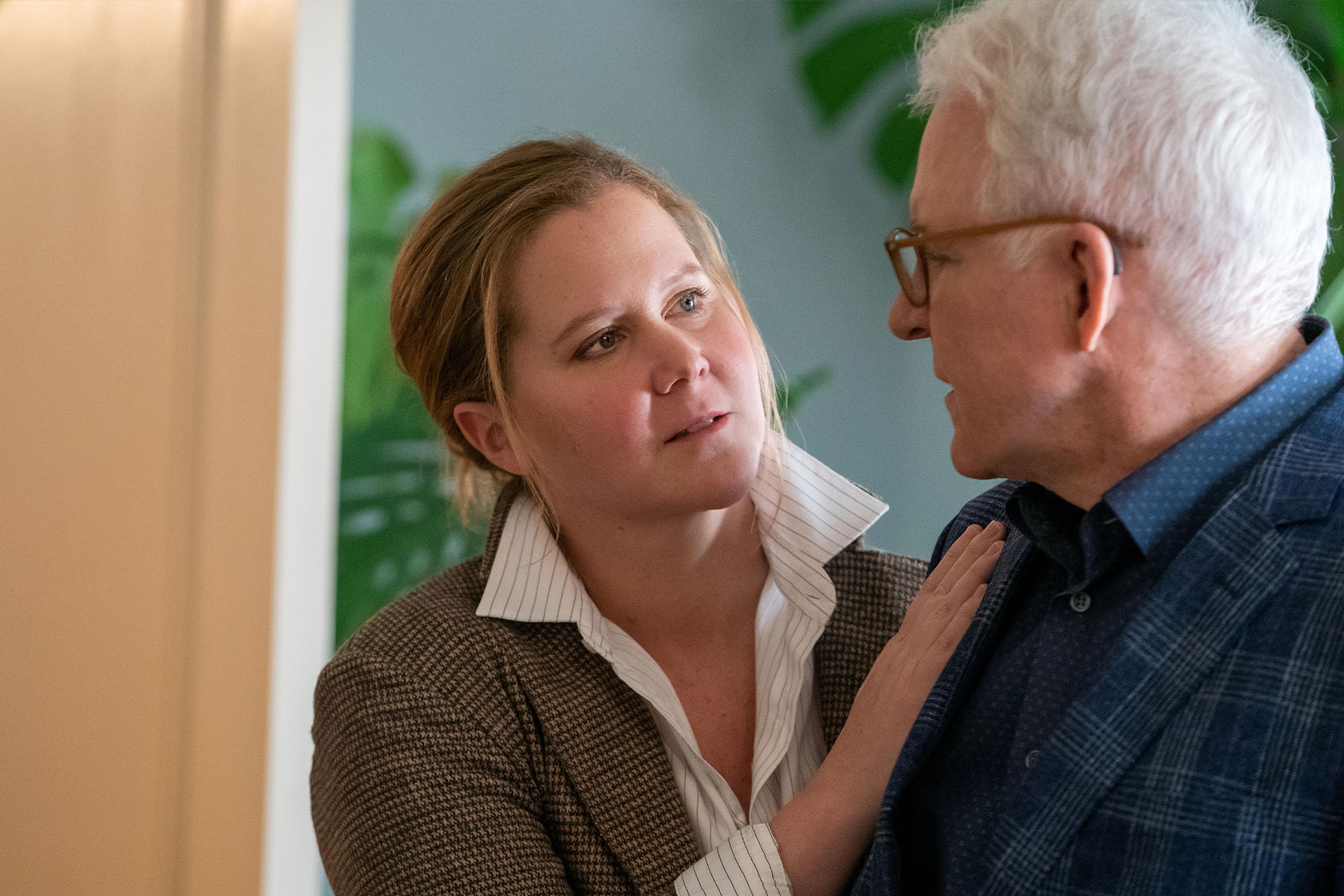
The “Police” frontman’s residency at the Arconia is an inspired bit, allowing him to showcase his comedic chops along with embracing his reputation as a deadly serious, pompous artiste. How do you best that? Maybe not with Amy Schumer, who is far too much to deal with right off the bat.

Only Murders In The BuildingAmy Schumer (as herself) and Charles (Steve Martin) in “Only Murders In The Building” (Barbara Nitke/Hulu)

This is one part of the dangerous urge to improve upon previous success that many series creators fall prey to. John Hoffman speaks aloud his awareness of this through dialogue that’s both self-referential and self-deprecating.

“You know, it’s very rare for a true-crime podcast to do a sequel,” Charles says when Oliver exhibits a stirring of wanting to mount another season of the podcast that made them minor local celebrities. “They usually move on a new case that never hits like the original . . . so, you know, we have a real opportunity here.”

He’s not wrong, on both counts. The new season of their “Only Murders” exploits requires them to be personal in front of the public, since Tina Fey’s superstar podcaster Cinda Canning decides to insert herself into their lives to add drama for her podcast. Oliver, Charles, and Mabel have their fans, after all, which means they were stealing audience share from her.

“Only Murders in the Building” could never claim to be understated.

Charles might as well have been speaking for Hoffman, too, since both the show’s creator and the characters have the advantage of conveying a story, and a mystery, that feels lived-in, nearly comfortable to viewers who have missed it.

This also means that the show and its main trio’s podcast push to the verge of overindulgence on multiple fronts, pulling back just enough to remind us that despite its unwise additions and unnecessary accessorizing, there’s no denying the great bones holding up everything.

“Only Murders in the Building” could never claim to be understated. Hoffman knows what he has in his stars and the co-stars who came along for the ride in the first season including Fey, Sting, Nathan Lane, and Jane Lynch, who all but walked off with the episode in which she was featured.

That makes Schumer’s blaring presence stand out in a season that also manages to incorporate Shirley MacLaine in a prominent role without taking us out of the story. Cara Delevingne‘s casting as Alice Banks, an artist who takes an interest in Mabel, slides somewhere into the middle on the scale of noticeability; given where her storyline goes, we get why the producers leaped at the thought of pairing two very famous and glamorous millennials onscreen.

Only Murders In The BuildingAlice (Cara Delevingne) in “Only Murders In The Building” (Craig Blankenhorn/Hulu)
Nevertheless, it doesn’t strike the type of harmonic balance that, say, the show’s humor achieves by equalizing the arch and the ludicrous with empathy for its characters.

This reflects the accord that develops between the straightlaced Charles and the farcical Oliver, whose friendship is rooted in a shared sense of caring for Mabel. Martin and Short’s comedy partnership predates “Only Murder in the Building,” of course, making Gomez the show’s unexpected source of extraordinariness. Nobody expected her to complete them instead of merely fitting in with their established chemistry.

Emphasizing the intricate puzzle of their lives with greater complexity and sensibility than the energy devoted to its mystery’s architecture seems like more of a longer-term strategy. Amidst the encore visits with widely loved minor characters and the obligatory hawking of Gut Milk, Oliver, Charles and Mabel have personal reasons for finding Bunny’s killer. Oliver wants to hold on to his return to the spotlight, however limited, while also making a few extra bucks. Charles is tempted by the offer of rebooting his old detective show “Brazzos” with a younger cast. Both of their opportunities are predicated upon clearing their names.

Mabel’s motivation is simple and to the point: Since Bunny was discovered in her apartment with a knitting needle sticking out of her sternum, she needs to get out from underneath impending murder charges and social media sensationalists’ eagerness to paint her as a modern-day Lizzie Borden.

When people talk about the show, it’s the personalities that move them.

She’s also an introvert in ways that are similar to Charles, which is what brought them together in the first place, and others resulting from deeply rooted blocks, which is probably the most compelling storyline in these new episodes.

But her meaty subplot fights to be noticed alongside a family-related blindside in Oliver’s life and several developments in Charles’ that are related to his past, one of which may be linked to what happened to Bunny. Following each of these threads is easy enough, and at no point does one lose confidence that all or most of it will come together in ways that make sense.

Yet after viewing eight episodes, I’m not entirely convinced they’ll weave together tightly enough to make a second viewing of the season its own distinct pleasure. Very little appears to be on par with the subtle hints Amy Ryan drops throughout a marvelous first season performance whose tone fundamentally shifts with a rewatch.


Want a daily wrap-up of all the news and commentary Salon has to offer? Subscribe to our morning newsletter, Crash Course.


This season sends their investigation in many different directions, none of which adequately gel enough on a first pass to make the whodunit’s mechanics the season’s main talking point.

On the other hand, was that ever the main reason people fell for “Only Murders in the Building”? When people talk about the show, it’s the personalities that move them – Martin’s, Short’s, and Gomez’s, certainly, but also the strange, relatable quirks of the Arconia’s residents, versions of whom have a place in our own lives.

Martin, Short, and Gomez have impeccable comedic timing, but their characters are attuned to the sense of loneliness and vicarious existence enveloping millions of us over the last few years. Their return invites us to spend time with a comfort we’ve been missing in a distinguished building with as many stories and secrets as the city around it.

Many will see this as nothing but vamping, a thought echoed by their “Only Murders” groupies. But Oliver might argue that one man’s vamping is another’s display of showmanship: “I’d rather be dead than boring!” he declares. And if you missed this show more for sentimental reasons as opposed to the sleuthing… oh baby, does it feel wonderful.

Season 2 of “Only Murders in the Building” debuts with two episodes June 28 with new episodes Tuesdays on Hulu. Watch a trailer via YouTube.

More stories like this:

An unexpected consequence of Roe v. Wade: Howard Stern for president?

The fallout from the Supreme Court overruling Roe v. Wade, the landmark decision which ensures the right to safe and legal abortion, continues in ways both large and small. Shock jock Howard Stern casually declared a possible presidency run on his show on Monday, in a reaction to the ruling. 

In the first time the SiriusXM host has commented publicly on the Supreme Court’s decision, Stern criticized the Justices harshly, describing Justice Clarence Thomas as “like Darth Vader” and stating: “As soon as I become president, you’re gonna get five new Supreme Court justices that are going to overturn all this bullshit.”

RELATED: Howard Stern slams Justices overturning Roe: “They can raise those babies that they want”

Stern strongly opposes the reversal made by the Supreme Court on June 24 (after a draft of the decision was leaked in early May), listing on his show some of the reasons a person might seek an abortion: “A lot of times women are raped. A lot of times contraception doesn’t work. And then there’s even a more confusing state where a man and a woman want to have a baby, and all of a sudden, things go medically wrong.”

Along with being vocal about almost everything else, Stern has long been outspoken regarding politics. In 2020, Stern said on his SiriusXM show that the Republican party had lost his vote forever due to supporting Donald Trump’s attempts to overturn the 2020 election results. “They want to have a win even if it means the end of our Democracy. It’s so scary.” In 1994, Stern did run for governor of New York (as a libertarian) but decided to drop out of the race when the New York Supreme Court required he disclose his personal finances. 

Last year, Stern floated the idea of his running for president again in response to anti-vaxxers who refused to get vaccinated against COVID. “I don’t feel good about what’s going on in my country. I might have to run just to clean this f**king mess up,” he said on his show. Earlier in the year, Stern said if Trump launched a 2024 run for the presidency, Stern would “beat his ass . . . There’s no way I’d lose.”

Trump has not yet publicly announced a new run, but if Stern were to seriously throw his hat into the presidential ring and win, he certainly wouldn’t be the first celebrity to become president. Along with reality show host and “Home Alone 2” performer Trump, Ronald Regan’s first career was as a radio announcer turned Hollywood movie star. 


Want a daily wrap-up of all the news and commentary Salon has to offer? Subscribe to our morning newsletter, Crash Course.


Stern, who also judges “America’s Got Talent,” was contemplative on his show about running for president, saying “I’m not afraid to do it.” Along with appointing new Supreme Court Justices, he said, if elected, he would do away with the Electoral College: “one vote, one person. No more Electoral College. I’m getting rid of it . . . The only agenda I would have is to make the country fair again.”

“I’m not f**king around,” he said on the air. “I’m really thinking about it.”

More stories like this:

“Smash capitalism” to “release your job,” what “Downton Abbey” & Beyoncé can teach us about progress

“Release your job,” chants Big Freedia on Beyoncé‘s new single, “Break My Soul.” It’s a risky proposition heading into what economists predict will be a new recession, but with wages stagnant and inflation ballooning, it’s clear the status quo is not sustainable. 

A century ago, as the stock market crash of 1929 approached, it was clear major societal change was afoot. Fascism was on the rise as people’s economic security grew ever more precarious — hm, relatable — and even in the escapist soap opera of “Downton Abbey,” the moneyed Crawley family could feel it coming. 

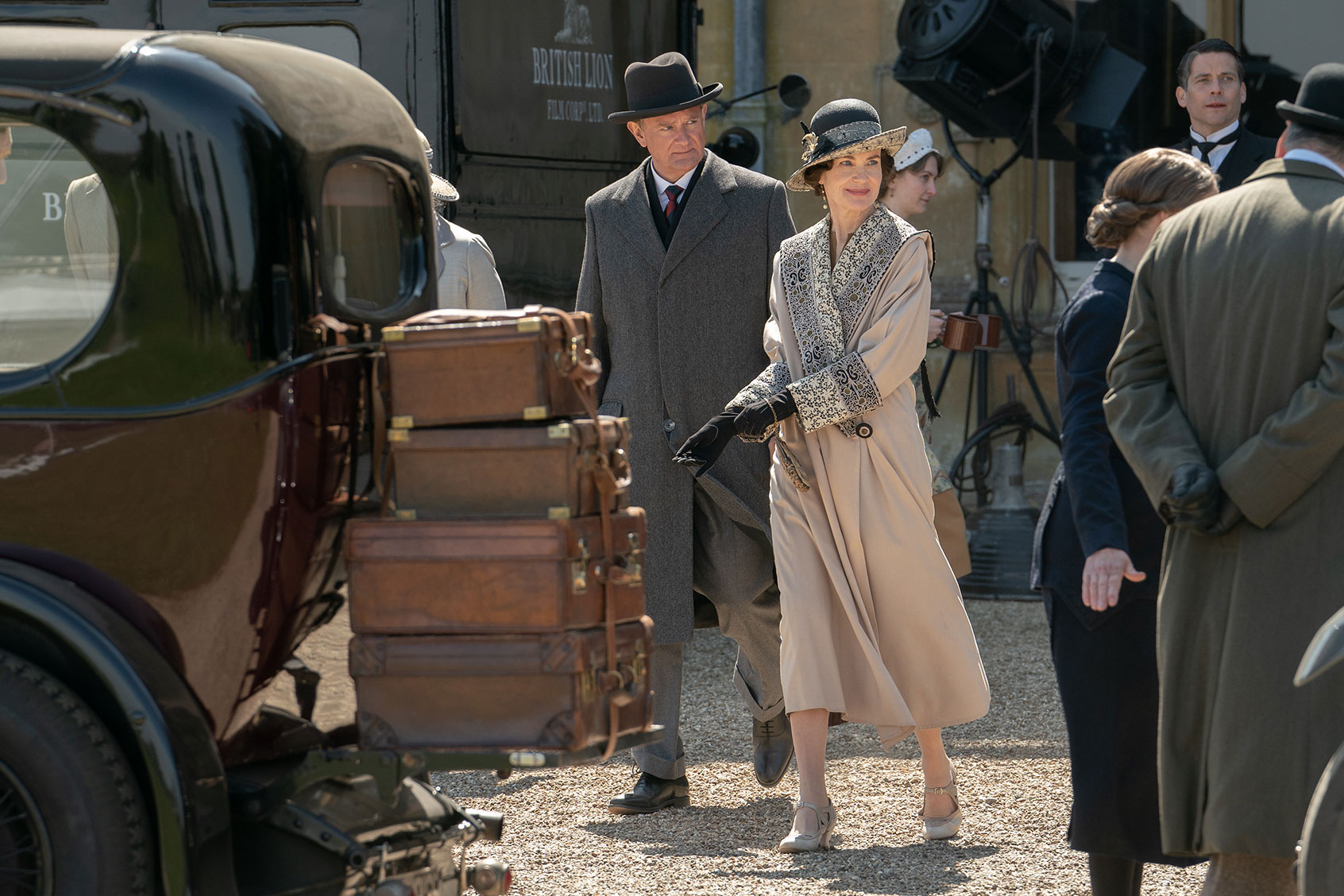
In “A New Era,” the TV hit’s second feature film (streaming now on Peacock and out on Blu-ray and DVD on July 5), head of household Lady Mary (Michelle Dockery) — already trailblazing, being a woman and all — invites a film crew to shoot a silent movie at Downton in 1928. Though at one time it would have been unheard of to stoop below her blue-blooded heritage and fraternize with showbiz professionals, Lady Mary knows that Downton is an expensive estate to run. The additional income will help keep the storied manor in top condition as the Crawleys’ peers are forced to sell off their own property to stay afloat.

Downton Abbey: A New EraHugh Bonneville and Elizabeth McGovern star as Robert and Cora Grantham, Robert James Collier as Thomas Barrow, Phyllis Logan as Mrs. Hughes and Jim Carter as Mr. Carson in Downton Abbey: A New Era (Ben Blackall / © 2022 Focus Features)
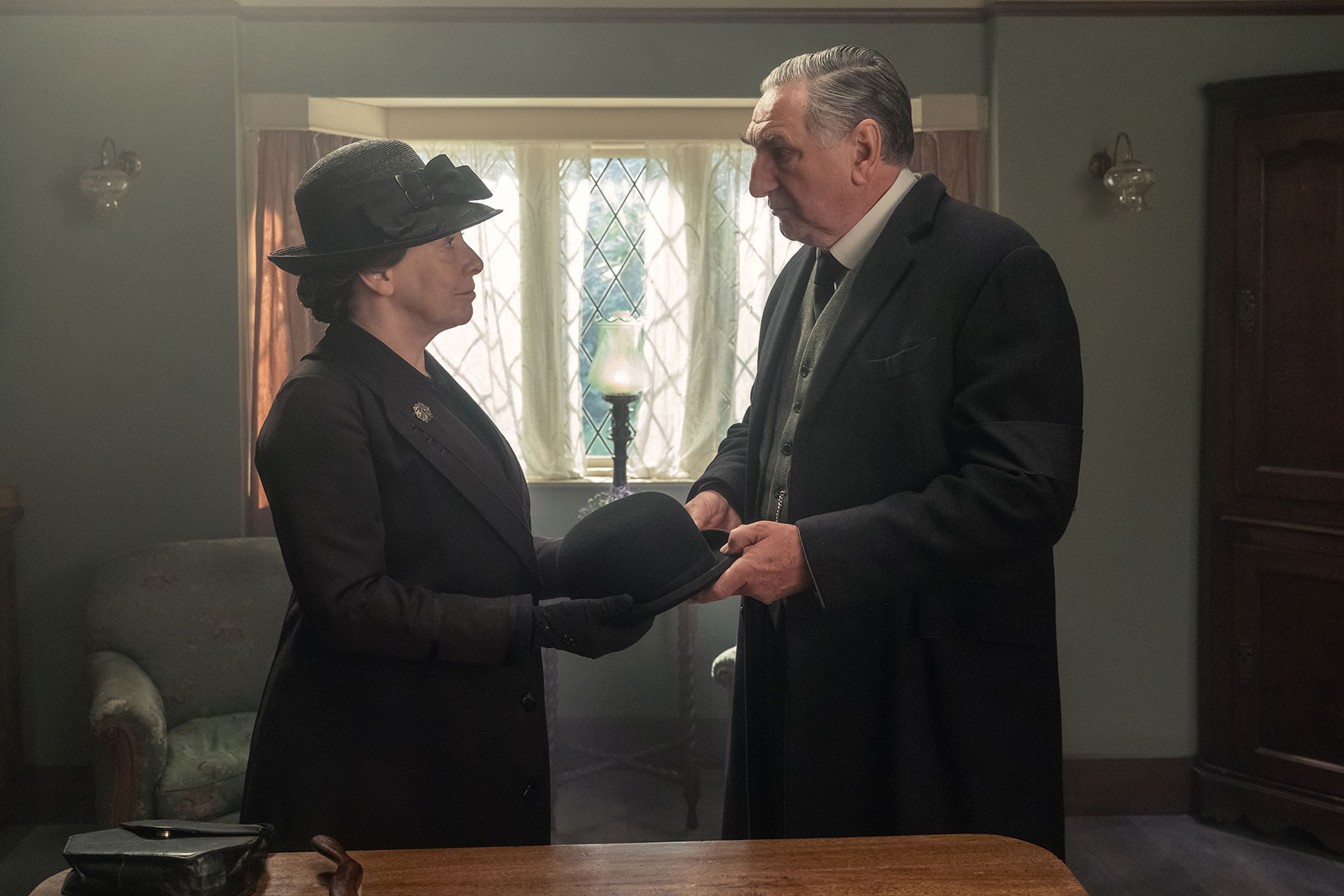
“The state of progress is agonizingly slow.” – Jim Carter

That willingness to adopt new ways – the upper classes used to only patronize the arts, not benefit from what was seen as common trade or labor – is what ensures the Crawleys are set up to survive the forthcoming economic downturn (though they don’t know exactly what’s headed their way). In 2022, similar economic and political conditions mean that the status quo — a minimum wage that hasn’t budged in more than a decade; a Supreme Court striking down decades of precedent in one session — just isn’t going to cut it anymore, either. Beyoncé is “looking for a new foundation,” and so are the people today.

RELATED: Hugh Bonneville on the enduring charm of “Downton Abbey”

The “Downton Abbey” cast and crew spoke to Salon about what it takes for progress to happen and insights from the franchise itself.

“It’s cyclical,” explains star Raquel Cassidy, who plays a lady’s maid in the franchise. “Maybe that’s one of the reasons why ‘Downton’ is so popular — or any of these period dramas — because we can see it all happening, but it’s that far away and therefore, although we’re moved by it or appalled by it or whatever, it’s still at a distance. So it’s not quite so raw.”

But why does it seem like we’re facing the same struggles as 100 years ago? And how do we prevent the same issues from popping up in another century? 

“The history of mankind proves that we never learn anything or else we wouldn’t be in this state with Ukraine now, would we? The state of progress is agonizingly slow,” says Jim Carter, aka the esteemed butler Mr. Carson. “We’ve got rail strikes today in the same way as we had them in the ’70s. I’m not pointing a finger of blame there, but self-interest wins out all the time, I’m afraid.”

Downton Abbey: A New EraPhyllis Logan stars as Mrs. Hughes and Jim Carter as Mr. Carson in Downton Abbey: A New Era (Ben Blackall / © 2022 Focus Features)In reality, progress is slow, but it’s still progress. And we’re going to keep facing the same issues “until we smash capitalism,” jokes Carter.

Beyoncé’s “Break My Soul” encapsulates the feelings of the Great Resignation, yes, but the song (and the sentiment) is not just about quitting.

The only option: to embrace change, just as the Crawleys are doing in “A New Era.” Even the fictional filmmakers who take over Downton are forced to pivot to a talkie mid-production. It’s a move “A New Era” director Simon Curtis likens to a shift the industry is currently feeling: “There’s a parallel with the film industry undergoing a great technological change with what’s going on now with cinemas versus streaming, so I think you have to embrace the new technology and make it work for you.”

But the Crawleys weren’t always so willing to embrace a new way of life. It took years for the family to adjust when youngest daughter Sybil (Jessica Brown Findlay) fell in love with and eventually married chauffeur Tom Branson (Allen Leech). And although the downstairs residents of Downton Abbey have aspired to more, only a few were able to move on to move on from a life in service to a new profession: Tom with his marriage, housemaid Gwen (Rose Leslie) becoming a secretary, and Mr. Molesley (Kevin Doyle) becoming a schoolteacher (and, no spoilers, his new venture in “A New Era”). Without that preparation, would the Crawleys have been open to the declassé movie industry as a way to keep up their home?

What will it take for someone to achieve real progress in today’s economic climate? Short of smashing capitalism, leaving behind what isn’t working could be a start. 

Beyoncé’s “Break My Soul” encapsulates the feelings of the Great Resignation, yes, but the song (and the sentiment) is not just about quitting. More importantly, it’s about recalibrating one’s priorities. And while the Crawleys figured this out peripherally, the circumstances are just right for people today to realize this on their own. If we want to survive our own societal shift, it’s best to heed the advice Cassidy’s character, Miss Baxter, offers: “Times change; we must change with them.”

“Downton Abbey: A New Era” is now streaming on Peacock and out on Blu-ray and DVD on July 5.

More stories to check out: 

Cassidy Hutchinson’s surprise Jan. 6 testimony exposes the violence that fuels Trumpism

We now know that Donald Trump imagined himself as the head of the violent, armed mob storming the Capitol on Jan. 6 to steal the election. He repeatedly tried to make his fantasy a reality, even as his lawyers and security personnel recommended against it. And when that didn’t work out for him, he threw a tantrum like the thuggish bully that he is, physically assaulting a Secret Service member in an attempt to force the agent to let Trump play out the Leni Riefenstahl remake in his head. 

There will be a world of deflection, bullshit, hand-waving and dithering from Republicans to distract from Tuesday’s revelations. But it will be difficult to erase the vivid picture painted by Cassidy Hutchinson.

A top aide to Trump’s chief of staff Mark Meadows, Hutchinson testifed before the House Select Committee January 6 in a surprise, last-minute hearing Tuesday. Hutchinson was already the source of much of the information about Trump’s behavior on and around Jan. 6, including his approval of the Capitol rioters threatening to murder his vice president, Mike Pence. So, even though some reporters, like Maggie Haberman of the New York Times, promised that Hutchinson’s testimony would be “explosive,” it was reasonable to be skeptical that much more of relevance would be revealed. 

The skeptics, however, were wrong. 

RELATED: Trump has a meltdown on Truth Social after Cassidy Hutchinson’s bombshell Jan. 6 testimony

Hutchinson had more to tell, and the main takeaway is so wild it would be hard to believe if it were any other president. Trump’s vision for January 6 was that he would be a general in an ill-fitting suit, standing before Congress with an army of armed red hats behind him, telling the legislature to give him the White House or else. But let’s face it: because it’s Trump it’s all too easy to believe. This is the same clown who dramatically pulled his mask off from the White House balcony like he was tearing down an enemy flag when he returned from the hospital from COVID-19. The same man who marched through a tear-gass-cleared Lafayette Park flanked by a battalion of security to wave a Bible around in the posture of some imaginary Christian soldier. We’ve endured enough of Trump’s reality TV-informed flair for cheesy drama. At this point, it would be more of a surprise to find out he didn’t want to pull off a knock-off remake of Mussolini’s march on Rome on Jan. 6

Hutchinson is everything that triggers the fragile egos of fascist thugs: A young, pretty woman who disobeys them.

The corniness of Trump’s fascist aesthetic is weird, but it’s important not to lose sight of the most important takeaway of Hutchinson’s testimony: There was a mind-meld between Trump and his minions who stormed the Capitol on January 6, based largely on their shared enthusiasm for violence.


Want more Amanda Marcotte on politics? Subscribe to her newsletter Standing Room Only.


As Hutchinson laid out, Trump was not only aware that many in the rally crowd were heavily armed, he seemed to be counting on it. He got angry with the Secret Service for not letting people with AR-15s and body armor clamor to his side during the rally, saying, according to Hutchinson, “I don’t fucking care that they have weapons. They’re not here to hurt me.” He demanded that the armed thugs that support him “march to the Capitol from here.”

Trump knew they were armed. Yet he directed his supporters to the Capitol on Jan. 6. He then repeatedly insisted on being the head of the mob. When Secret Service wouldn’t let him, he yelled, “I’m the f-ing president! Take me up to the Capitol now!” and physically attacked the agent driving the car in an attempt to grab the wheel. 

RELATED: Jan. 6 hearing: Meadows warned aide Jan. 6 could get “really, really bad” after Rudy teased plans

That Trump is a violent bully is, on one hand, not a surprise, and not just because he has a long history of publicly fantasizing about violence and encouraging his supporters to murder his political opponents. He is on tape, after all, bragging about his tendency to sexually assault women. He’s been accused of rape by journalist E. Jean Carroll and his ex-wife, who retracted her claim during a lengthy divorce proceeding where her alimony was threatened. Donald Trump Jr.’s college roommate additionally reports that he saw Trump slap his son “across the face, knocking him to the floor in front of all of his classmates,” because his son didn’t want to wear a suit to a baseball game.

Tuesday’s hearing also underscored some of the political and legal problems around dealing with Trump’s stochastic terrorism.

Trump frequently careens between an obvious longing to champion violence openly and a lawyer-induced awareness that such talk can create legal troubles. As Hutchinson’s testimony demonstrated, that tension was in full effect on Jan. 6 and in the days before and after. Her testimony indicates that Meadows, at least, seemed quite aware that all the hype around January 6 was about drawing a violent crowd to the Capitol, even telling her on Jan. 2 that “things might get real, real bad.” When that prediction came true, Meadows was too afraid to offend Trump to even discuss asking Trump to pull his foot off the gas. She also testified repeatedly that Trump’s lawyers seemed quite aware that the intent here was to incite a fascist riot. She paints a picture of lawyers fluttering around, trying to convince Trump to embrace plausible deniability by, for instance, removing the word “fight” from his inciting speech. 

“We’re going to get charged with every crime imaginable” if Trump follows through with his plan to join the rioters, she recalls Trump’s lawyer, Pat Cipollone, complaining. (One imagines that the word Jared Kushner would use is “whining.“) 


Want more Amanda Marcotte on politics? Subscribe to her newsletter Standing Room Only.


The irony is that, as usual, Trump’s minions saved him from himself. If he had his way and was able to lead the Capitol insurrection, it would have prevented him from playing the game he currently plays to deflect blame for Jan. 6. That gaslighting campaign, aided by the Republican Party and its propaganda arm of Fox News, centers around the claim that Trump was as surprised as anyone by the violence and had no intention of inciting it when he told the mob to march on the Capitol. Despite all the evidence that Trump is a violent thug we have seen over the years, his apologists keep insisting on portraying him as a victim. That tendency reached comical heights during the Fox News discussion of the Secret Service agent that Trump allegedly assaulted. 

The clip illustrates the constant tension between Trump’s desire to portray himself as a tough guy and Trump’s need to weasel out of legal accountability. The latter ends up making him look like a weak old man who can’t even get his supposed staff to follow orders. That provokes the kind of insecurity that, in turn, provokes more ridiculous macho chest-beating violent fantasies Trump has been rolling out regularly at his rallies, which have mostly been ignored by the press.

RELATED: Did violence follow Roe decision? Yes — almost all of it against pro-choice protesters

Tuesday’s hearing also underscored some of the political and legal problems around dealing with Trump’s stochastic terrorism. It may be that Trump never directly conspired with the Proud Boys and Oathkeepers and other right-wing militias to storm the Capitol that day. He didn’t need to. He’s spent years using public forums to signal his shared affinity for violence with these groups, even going so far as to tell the Proud Boys to “stand by” during his presidential debate with Joe Biden. They understood what he wanted from them. He just needed to give them a time and a place, and that’s exactly what he did. 

Why the January 6 committee decided to suddenly have Hutchinson testify is still somewhat of a mystery, but it’s reported that concerns about her safety were a major factor. That is, sadly, the least surprising thing in the world. Hutchinson is everything that triggers the fragile egos of fascist thugs: A young, pretty woman who disobeys them. Sitting before the world and offering her testimony, Hutchinson shows what true strength and courage look like. It’s not, as Trump and his violent supporters think, about how many skulls you can bash in or death threats you can make. It’s about knowing that it’s dangerous to do the right thing and doing it anyway. The only remaining question is whether enough of the public will see this and also know the difference. 

Daily Harvest faces its first lawsuit following widespread recall of Lentil + Leek crumbles

Daily Harvest, the celebrity-backed vegan meal company, is now facing its first product liability and personal injury lawsuit following the widespread recall of its now-discontinued French Lentil + Leek crumbles, according to the Los Angeles Times.

The suit, which was filed on Monday, was brought forward by Carol Ready, a 29-year-old woman residing in Tulsa, Oklahoma.

Ready told the outlet that she had eaten the lentil crumbles twice and was sent to the emergency room within 48 hours after suffering from gastrointestinal distress. There, Ready’s doctors found extremely high levels of liver enzymes in her system and problems with her gallbladder after performing a hepatobiliary iminodiacetic acid (HIDA) scan.

RELATED: Daily Harvest customers flood social media with food poisoning claims after eating vegan lentil dish

The severe damage prompted doctors to remove Ready’s gallbladder on June 22.

“It still didn’t change anything for me,” Ready said. “The dysfunction was there. The damage was done.”

Alongside Ready, nearly 500 Daily Harvest consumers experienced similar gastrointestinal issues, including stomach pain, liver and gallbladder damage, and vomiting. The complaints first appeared on Reddit, Twitter and Instagram and quickly garnered public attention as more individuals spoke up about their grueling symptoms.

“What started as extremely intense upper abdominal pain, fever, nausea, and fatigue took a dark turn with the test results for my liver enzymes,” wrote one user on Instagram. “The fatigue persisted for the next couple weeks and after almost a month I’m finally feeling like the energy levels are starting to come back.”

The lentil crumbles were initially recalled last week by the company via a social media post. An official recall was issued just a few days later on Friday in an announcement released by the U.S. Food and Drug Administration (FDA). The recall specifically concerns approximately 28,000 packages of lentil crumbles produced and distributed between April 28 and June 17 of this year.

Daily Harvest, which prides itself on selling an assortment of health foods made with sustainably sourced fruits and vegetables, also assured its consumers that it’s working hard alongside the FDA to figure out what caused the illnesses in the first place.


Want more great food writing and recipes? Subscribe to Salon Food’s newsletter, The Bite.


“We have reached out multiple times directly to consumers who received the product, instructing them to dispose of it and not eat it,” the company explained in a statement released on Monday.  

“In parallel, we launched an investigation to identify the root cause, working closely with the FDA, multiple independent labs, and a group of experts that includes microbiologists, toxin and pathogen experts as well as allergists. All pathogen and toxicology results have come back negative so far, but we’re continuing to do extensive testing so we can get to the bottom of this.”

More stories you might like:

The healing power of the peach

When the Earth was still young, the serpent seduced Eve with promises of forbidden knowledge and delicious fruit. Some say it was an apple, crisp and ruby red. Other theologians picture Eve entranced by an illicit pomegranate, its flesh cracked open to reveal gem-like seeds that glittered under the garden’s sun. I know what it’s like to lust after an elusive taste, hoping that in finding it, it will ignite something either completely unstirred or long deadened within your soul. My Eden was a Southern supermarket; a perfect summer peach was my blessed temptation. 

Growing up, men in black suits who howled about hell from the pulpit imposed upon me how unwieldy women’s desires could be. Women on television did the same, though instead of selling salvation, they hawked slimming shakes and 10-day diet plans. Both were in the business of making girls fear turning into women whose passions took up too much space. 

Related: Holy bodies, holy hungers: Pumping breast milk during the Pope’s pizza party for Mother Teresa

During the days, I recited calorie counts like catechisms and logged each mile run like a penitent prayer over a rosary bead. As a young teenager, I would lie awake in my blush-colored bedroom — the paint a vestige of childhood — terrified that if I died in my sleep my heart wasn’t pure enough to carry me to the other side because I was constantly fighting hunger. 

I craved the kind of touch about which we were warned in youth group meetings held in the church’s musty basement. A minister with a boyish grin that clashed with his crow’s feet described it as a lightning-crack shock that warmed your entire body. That warmth, he warned, was God’s embrace in the context of marriage. Outside of that, it was a preview of hell’s fire. 

The elders’ wives told us the scandal was a living metaphor for the ways in which we could cause our Brothers in Christ to stumble.

He left the church shortly thereafter, after confessing to the congregation as a whole that he had sinned in such a way that it would necessitate him stepping down from ministry. Eventually, other church leaders began to whisper that he had been carrying on an “emotional affair” with a 15-year-old girl who was too young to age out of youth group, but old enough in the elders’ minds to seduce a married father. So, eventually, she left, too. 

In hushed tones, the elders’ wives told us the scandal was a living metaphor for the ways in which we could cause our Brothers in Christ to stumble, thus we were left to make ourselves even smaller. 

I prayed for purity at the same compulsive rate that I checked my stomach for pinchable fat. I didn’t have a full-length mirror, so I’d stand on my toes in the hallway by the bathroom to look for any signs of bloating, my forefingers and thumbs spread into a gentle triangle over my lower abdomen. Did the triangle push out farther than it did last week? Than yesterday? Than before eating today? 


Want more great food writing and recipes? Subscribe to Salon Food’s newsletter.


When I was 18 or 19, I stole my first sip of hard liquor and was shocked by how much I liked it, especially on an empty stomach. 

It produced, of course, a kind of heady lightness that was difficult to attain while sober. But more than that, it burned. A single shot produced what can best be described as a lightning-crack shock that warmed my entire body. It, too, was perhaps a preview of eternal fire, but to burn would mean to feel something, and after a while that alone was appealing. 

After a period of acute hunger, the gnawing eventually subsides in favor of numbness. Self-control is one of the fruits of the spirit, but it never actually fills you up. Joy is another of the spiritual fruits, though it seemed impossible to pluck. 

Self-control is one of the fruits of the spirit, but it never actually fills you up.

But at a certain point I knew I’d have to try. I wanted to feel hunger again. More than that, I wanted to satiate it. 

One hot afternoon in early July, I found myself in a South Carolina supermarket face-to-face with a pyramid of ripe peaches, their fuzz lightly concealing supple skin that graduated sunset-style from pale yellow to burnt orange. Initially, I was held back from pulling one from the pile — perhaps they would be sweet enough to set off a chain reaction I couldn’t control — but I knew that one bite wouldn’t kill me. 

I bought two. 

The cashier placed them, gently, in a brown paper sack, which I carried to a bench that overlooked the scorching asphalt parking lot. The air was thick and muggy and filled with the sound of tourists’ flip-flops smacking the pavement. 

Just one bite, I told myself, as I balanced the peach’s velvet weight in my palm. It burst in my mouth as I tore through the tender amber flesh, sweet juice coating my lips and tongue. I hit the pit with my teeth and quickly rotated the fruit for more. I’m sure if anyone bothered to look in my direction, the spectacle was slightly animalistic, but it felt natural. After all, what’s more natural than the desire to be fed? God made this peach, perfect in its form. Perhaps I was perfect in mine, too, even with unwieldy passions and hunger. 

I bit into the second peach. 

More from this writer: 

Trump has a meltdown on Truth Social after Cassidy Hutchinson’s bombshell Jan. 6 testimony

Donald Trump called Cassidy Hutchinson, the surprise witness in Tuesday’s January 6 hearing, a “phony” after she delivered unprecedented testimony that the former president knew the Capitol riot could turn violent but did nothing to stop it. 

“I hardly know who this person is … other than I heard very negative things about her (a total phony and a ‘leaker’),” Trump wrote over Truth Social, his social media platform. “She is bad news!”

Trump’s remarks appear to be an attempt to discredit Hutchinson.

RELATED: Jan. 6 panel moved up hearing over fear that Meadows aide is in danger due to what she knows: report

On Tuesday, Hutchinson – a former top aide to Trump’s chief of staff, Mark Meadows – claimed that, during the “Stop the Steal” rally, the former president knew that the Capitol rioters had weapons but dismissed concerns around potential violence. 

“When we were in the offstage announce tent, I was part of a conversation — I was in the vicinity of a conversation where I overheard the president say something to the effect of, you know, ‘I don’t effing care that they have weapons. They’re not here to hurt me. Take the effing [metal detecting] mags away. Let my people in. They can march to the Capitol from here. Let the people in. Take the effing mags away,'” she recounted to the panel. 


Want a daily wrap-up of all the news and commentary Salon has to offer? Subscribe to our morning newsletter, Crash Course.


Hutchinson also detailed numerous instances in which Trump himself engaged in unruly and violent behavior.

On the day of the riot, Hutchinson recounted, as Trump was being driven away from the vicinity, the former president demanded that he be driven to the Capitol building. When the Secret Service agent driving Trump did not comply with the order, the former president allegedly “grabbed” the agent’s neck, as well as steering wheel, and said, “I’m the fucking president. Take me up to the Capitol now.”

Hutchinson also described the president as a frequent thrower of dishes in moments of ire and was known to flip entire tablecloths, leaving food and drinks plastered on the floor.

In one episode, shortly after hearing his attorney general Bill Barr cast doubt over his claims of election fraud, Trump allegedly threw his lunch against the wall. He left the scene, she said, with “ketchup dripping down the wall.”

RELATED: The gangster candidate: Donald Trump and his supporters behave like the mafia, with veiled threats and acting above the law

In a separate part of the hearing, committee member Liz Cheney, R-Wyo., who was questioning Hutchinson, revealed that witnesses who have been asked for testimony have received threatening, Mafia-style messages from Trump’s inner circle in order to ensure that they remain “loyal” to the president.

“[A person] let me know you have your deposition tomorrow,” one message, displayed during Tuesday’s hearing, read. “He wants to let you know that he’s thinking about you. He knows you’re loyal, and you’re going to do the right thing when you go in for your deposition.”

The exhibits led many commentators to suggest that Trump had engaged in witness tampering.

On Twitter, House Republicans on the Judiciary Committee mocked Hutchinson.

Mick Mulvaney warns ex-aides after “explosive” Hutchinson testimony: “I don’t think she’s lying”

Donald Trump’s one-time chief of staff Mick Mulvaney vouched for the “explosive” testimony provided by former White House aide Cassidy Hutchinson.

Mulvaney, who served as Trump’s chief of staff before Mark Meadows and as White House director of management and budget, said he believed Hutchinson’s testimony, and said that other officials she discussed should testify themselves.

“My guess is that before this is over, we will be hearing testimony from Ornato, Engle, and Meadows,” Mulvaney tweeted, after Hutchinson described Trump physically attacking his Secret Service detail on Jan. 6. “This is explosive stuff.”

Mulvaney was referring to deputy White House chief of staff Tony Ornato and Robert Engel, the Secret Service agent Trump allegedly attacked for refusing to take him to the Capitol in his armored car.

“If Cassidy is making this up, they will need to say that,” Mulvaney said. “If she isn’t they will have to corroborate.I know her. I don’t think she is lying.”

John Eastman runs to Fox News to beg for donations after avoiding Jan. 6 testimony

John Eastman, the right-wing lawyer who sought to overturn the 2020 presidential election, is raising thousands of dollars for a legal defense fund ostensibly designed to shield him from the House select committee investigation into the Capitol riot.

Eastman plugged his defense fund in a Tuesday interview with Fox News host Tucker Carlson, who asked him to explain why the FBI recently seized his phone in connection with the probe. 

“What exactly did you do wrong to be treated like a dangerous criminal by your government, that you paid for?” asked Carlson. 

“Well, we don’t know because the warrant doesn’t say,” Eastman replied. “But there’s no indication of any crime that this is connected to. That’s apparently attached in an affidavit, but the affidavit isn’t attached to the warrant.”

RELATED: Trump ready to throw John Eastman under the bus, claims he “barely” knows him: report

Estman also called the seizure an “abuse” of the Fourth Amendment, claiming that Biden was acting like a “British king.”

“And it’s just another reminder for anyone that didn’t vote for Joe Biden to erase your texts and emails every single day,” Carlson said. 

Toward the end of the interview, Eastman directly asked the audience to donate to his legal defense fund. “Help us,” he said. “Help us fight this abuse. We’ve got to stand together to fight against this.”


Want a daily wrap-up of all the news and commentary Salon has to offer? Subscribe to our morning newsletter, Crash Course.


Over the past year, Eastman has refused to cooperate with the committee’s investigation. 

Back in January, Eastman fought to court to shield his private emails with members of Trump’s inner circle, in which the right-wing attorney helped the former president concoct a legally dubious scheme to reverse the election. 

By June, a judge had ordered Eastman to submit 159 documents to the panel. Some of the materials obtained by the committee revealed that Eastman had coordinated with conservative activist Ginni Thomas, the wife of Supreme Court Justice Clarence Thomas, who pressured former White House Chief of Staff Mark Meadows to buttress Trump’s election conspiracy, according to The Washington Post.

RELATED: Judge orders John Eastman to give Jan. 6 committee email that contains evidence of likely “crime”

During the January 6 hearings this month, committee member Pete Aguilar, D-Texas, noted that Eastman pleaded the 5th Amendment dozens of times while providing closed-door testimony to the panel months ago.

Jan. 6 hearing: Meadows warned aide Jan. 6 could get “really, really bad” after Rudy teased plans

Former top Mark Meadows staffer Cassidy Hutchinson testified under oath on Tuesday that he was worried that Jan. 6 would get “really, really bad.”

Hutchinson held the title of “Special Assistant to the President for Legislative Affairs, Office of the Chief of Staff” on Jan. 6, 2021 and testified during Tuesday’s last-minute hearing of the House Select Committee Investigating the Jan. 6 Attack on the U.S. Capitol.

Under questioning by Vice-Chair Liz Cheney, R-Wyo., Hutchinson described walking Rudy Giuliani to his car after a Jan. 2, 2021 White House meeting with Giuliani.

“We’re walking to his vehicles that evening, he looked at me and said something to the effect of, ‘Cass, are you excited for the 6th? It’s going to be a great day.’ I remember looking at him and saying ‘Rudy, could you explain what’s happening on the 6th?’ And he responded something to the effect of, ‘We’re going to the Capitol, it’s going to be great. The president is going to be there. He’s going to look powerful. He’s going to be with the members. He’s going to be with the senators. Talk to the chief about it. Talk to the chief about it. He knows about it.'”

“And did you go back up to the West Wing and tell Mr. Meadows about your conversation with Mr. Giuliani?” Cheney asked.

“I did, after Mr. Giuliani had left the campus that evening, I went back up to our office and I found Mr. Meadows in his office on the couch, he was scrolling through his phone. I remember leaning against the doorway and saying, ‘I just had an interesting conversation with Rudy, Mark. It sounds like we’re going to go to the Capitol.’ He didn’t look up from his phone and said something to the effect of, ‘There’s a lot going on, Cass, but I don’t know. Things might get real, real bad on Jan. 6.”

Watch:

Uvalde mom says she was forced to move kids who survived shooting because police keep harassing them

A mother who took action to help rescue her children from the Robb Elementary School in Uvalde, Texas tells local news station News4SanAntonio that she is regularly being harassed by local police officers.

In an interview, Uvalde mom Angeli Rose Gomez describes how she defied police orders during the deadly school shooting to help rescue her two sons and some of their classmates as they were sheltering in place inside the building.

However, Gomez’s actions that day have come at a price in the form of increased scrutiny from local cops.

“The other night we were exercising and we had a cop parked at the corner like, flickering us with his headlights,” she tells the station.

What’s more, she says that she has decided to temporarily live apart from her sons “just so [they] don’t feel like they have to watch cops passing by, stopping, parking.”

Nonetheless, she has continued protesting against the police for their response to the shooting that left 21 people dead, including 19 children.

Among other things, she is demanding the firing of Uvalde School Police Chief Pete Arredondo and is working on filing a lawsuit for the police department’s decision to wait more than an hour after arriving at the school to attempt to confront the gunman.

Daughter of “Jane Roe” calls out Supreme Court for ripping away “fundamental right”

The woman born of the conception that led to Roe v. Wade back in the 1970s is speaking out to share her reaction to the U.S. Supreme Court’s decision to overturn the 1973 landmark.

During a recent news interview, Shelley Lynn Thornton, the biological daughter of Norma McCorvey, who used the alias “Jane Roe” during the court proceedings expressed her concerns about the latest ruling.

“Too many times has a woman’s choice, voice and individual freedom been decided for her by others. Being that I am bound to the center of Roe v. Wade, I have a unique perspective on this matter specifically,” Thornton said via a spokesperson.

She added, “I believe that the decision to have an abortion is a private, medical choice that should be between a woman, her family, and her doctor. We have lived in times of uncertainty and insecurity before, but to have such a fundamental right taken away and this ruling be overturned concerns me of what lies ahead.”

Until last year, Thornton’s identity was unknown. But last year, she opted to speak publicly. McCorvey never had a chance to get the abortion she was fighting for due to the amount of time litigation took. After giving birth, she opted to give her baby up for adoption.

In 2021, Thornton was also featured in a piece published by The Atlantic titled, “The Family Roe: An American Story.” She shared details about her life and how she learned that she was the child at the center of the case. Thornton shared her double-sided reaction to learning that her biological mother initially planned to terminate the pregnancy.

Per Business Insider, Thornton revealed the revelation “had affected her mental health, making her anxious and depressed. But she also said that she didn’t want to be used as an anti-abortion symbol.” While the revelation personally impacted her, she also questioned why it is a “government concern.”

“I guess I don’t understand why it’s a government concern,” Thornton told The Atlantic.

Thornton echoed remarks similar to McCorvey’s oldest daughter, Melissa Mills who recently appeared on CNN’s “New Day” to share her reaction to the overturning of Roe v. Wade.

“I was in disbelief. I was devastated,” Mills said during the appearance. “I knew it was coming, but it was just too real that it really happened.”

“It doesn’t look that bad”: Newsmax host calls out Giuliani as “assailant” gets charges downgraded

A host on the right-wing Newsmax network belittled Rudy Giuliani’s claims that he was assaulted at a Staten Island grocery store.

The former New York City mayor called in to host Greg Kelly’s prime-time program from a rally for his son’s gubernatorial campaign, and they discussed an incident Sunday afternoon at a ShopRite, where an employee approached Giuliani, tapped him on the back and called him a “scumbag.”

“I’m going to show the people what happened and you tell me, because let me see the video if you don’t mind, uh, this person with the hand on your back, I’ve got to be honest — it doesn’t look that bad,” Kelly said. “But I understand that looks can be deceiving.”

The district attorney downgraded charges for employee Daniel Gill to third-degree assault, third-degree menacing, and second-degree harassment over the caught-on-camera confrontation inside the supermarket, but Giuliani insisted he could have been seriously injured.

“You know that that was that was the woman who was rubbing my back, not the guy,” Giuliani said, as Kelly chuckled. “Are you watching? So the woman, that woman, uh, gave a statement to the police and the guy hit me so hard that she herself almost fell from the reverberation of it. She’s a city worker. There’s a second-grade detective there, that’s the lady who helped me.”

Kelly, who had been making skeptical and amused faces as Giuliani spoke, told the former mayor he was glad he hadn’t been injured.

“Alright, good, that makes sense,” Kelly said. “Well, look, I’m sorry you were roughed up.”

Clarence Thomas blames Americans for Supreme Court’s erosions of rights: “You protect your liberty”

Conservative Supreme Court Justice Clarence Thomas said that Americans are “more interested in their iPhones than their Constitution,” according to a recently released book. 

“I think we as citizens have lost interest and that’s been my disappointment,” Thomas said in an interview. “That certainly was something that bothered Justice Scalia, that people tend to be more interested in their iPhones than their Constitution. They’re interested in what they want rather than what is right as a country.”

RELATED: Clarence Thomas’ gun decision ensures that the next January 6 will be much deadlier

The justice’s remarks were featured in “Created Equal: Clarence Thomas in His Own Words,” a book written by Michael Pack and Mark Paoletta, who interviewed Thomas for more than 30 hours between November 2017 and March 2018. In the book, Thomas argued that America’s alleged lack of interest in the Constitution might lead to a loss of personal liberty. 

“You protect your liberty. It’s your country. [The Supreme Court is] one part of the effort, and it is the obligation of the citizens to at least know what their liberties are and to be informed,” he said. 

“I think we are allowing ourselves to be ruled when we turn all that over to someone else and we’re saying, ‘Rule me.’ Does it mean we get to make all the decisions? No,” Thomas continued. “We have a system for doing that, but a part of that is our role in it, and our informed role in it, not what is said on TV, not what is said by some half-informed person.”


Want a daily wrap-up of all the news and commentary Salon has to offer? Subscribe to our morning newsletter, Crash Course.


RELATED: Clarence Thomas: Supreme Court should strike down same-sex marriage and contraceptive rights next

In recent months, Thomas has come under public scrutiny for his rulings on gun rights, abortion, and the seperation of church and state. Last week, ruled to overturn Roe v. Wade, the landmark 1973 decision that established America’s constitutional right to abortion. In his concurring opinion, the conservative judge suggested that the court might also throw out the legal precedents for contraception, same-sex relations, and same-sex marriage. 

Thomas has also come under fire over the activities of his wife, Ginni Thomas, a right-wing activist who played a key role in attempting to overthrow the 2020 election. During the months leading up to the Capitol riot, Ginni Thomas repeatedly encouraged Mark Meadows, Donald Trump’s chief of staff, to continue challenging President Biden’s win. Critics of Thomases have argued that their relationship poses a conflict of interest for Clarence Thomas’ jurisprudence, and numerous House Democrats have already called on Thomas to resign from the court.

Fox News host calls Trump “unhinged,” says Jan. 6 was “the worst moment of” his political career

Fox News host Brian Kilmeade on Sunday said that Donald Trump was “unhinged” in the months leading up to the Capitol riot, during which the former president baselessly claimed that the 2020 presidential election had been stolen by dint of widespread voter fraud. 

“The president was unhinged during that period,” Kilmeade, usually a staunch Trump supporter, declared in a segment. “I interviewed him at West Point, and he was kind enough to give me a few minutes. I’ve never seen him so angry. That was in between the election and Jan. 6.”

RELATED: “Fox & Friends” co-host slaps down Brian Kilmeade after he says pregnant woman shouldn’t be hired 

“As soon as we were done, he just stormed off,” the host added. “And you know how long I’ve known him, for 15 years or 20 years prior to him going to the White House. I’ve never seen him so angry.”

Kilmeade’s remarks came shortly after the network played public testimony by former acting Deputy Attorney General Richard Donoghue, who alleged during the House select committee’s hearing on Thursday that Donald Trump attempted to weaponize the Justice Department in his failed coup attempt. In the aftermath of Trump’s loss, the former president specifically sought to replace the then-acting Attorney General Jeffrey Rosen with Jeff Clark, a pro-Trump DOJ official who was heading the agency’s Civil Division at the time. That plan ultimately unraveled after multiple DOJ officials threatened to resign. 


Want a daily wrap-up of all the news and commentary Salon has to offer? Subscribe to our morning newsletter, Crash Course.


During his segment, Kilmeade called this period “the worst moment of Donald Trump’s political career.”

“I think how you lose in life defines who you are,” he said. “And even if there are things that bother you, welcome to the world. A lot of times things don’t work out, and are so-called unfair. Your team couldn’t prove [the election was rigged], move on.”

RELATE: Trump’s acting AG testified about White House attempts to overturn the election: report

Kilmeade’s comments are noteworthy in light of past reports about his alignment with the MAGA-verse. 

Throughout Trump’s presidency, Kilmeade repeatedly defended the former president from attacks by the left. And in December, The New York Times reported that Kilmeade was one of two other Fox News anchors to act as an informal advisor to Trump during the Capitol riot. By January, however, Kilmeade began to shift his rhetoric, saying that Trump should “learn to lose” and that he had not seen any substantive evidence of election fraud. 

Kilmeade’s Tuesday comments come just a week after another Fox News host, Martha MacCallum, said there was a “stunning” lack of evidence to support Trump’s claims of voter fraud.

Abbott blames Biden after 46 migrants found dead in Texas — but experts fault closed-border policy

Lawmakers and rights advocates mourned the loss of life and decried the United States’ inhumane immigration system late Monday after an abandoned tractor-trailer rig containing 46 dead people and 16 survivors—including four children—was discovered in San Antonio, Texas.

Local authorities said it appears that the rig, which was found after a worker in the area heard a yell for help, was being used for a smuggling operation. Citing one law enforcement official, The Texas Tribune reported that evidence suggests “people were trying to jump out of the tractor-trailer because some of the deceased were found along several blocks.”

“The tractor-trailer had a refrigeration system, the official said, but it did not appear to be working,” the Tribune added. “Many of the people found inside the vehicle appeared to have been sprinkled with steak seasoning, the official said, in perhaps an attempt to cover up the smell of people as the smugglers were transporting them.”

The 16 survivors were transported to a nearby hospital. According to Mexico’s foreign minister, 22 Mexicans, seven Guatemalans, and two Hondurans were among the deceased.

Aaron Reichlin-Melnick, policy director at the American Immigration Council, wrote on Twitter that the smuggling incident appears to be the deadliest along the U.S.-Mexico border since 2017, when 10 people died in a truck carrying nearly 40 migrants in the sweltering San Antonio heat. On Monday, the temperature in San Antonio reached a high of 101°F.

In 2003, 19 migrants died in a similarly devastating incident in Victoria, Texas that was at the time considered the “deadliest smuggling incident in U.S. history.”

“Been dreading another tragedy like this for months now,” wrote Reichlin-Melnick. “With the border shut as tightly as it is today for migrants from Mexico, Guatemala, Honduras, and El Salvador, people have been pushed into more and more dangerous routes. Truck smuggling is way up.”

“Truck smuggling is VERY dangerous,” he continued. “It has the possibility to go horribly wrong. And when its use goes up, the possibility of mass-death incidents go up as well.”

As federal, state, and local authorities investigated the incident and details continued to emerge, Texas’ Republican Gov. Greg Abbott wasted no time blaming the deaths on President Joe Biden, claiming that “they are a result of his deadly open border policies.”

Experts and rights organizations were quick to respond—scathingly, in most cases.

Shouan Zhoobin Riahi, an immigration attorney, tweeted that “if the border was ‘open,’ people wouldn’t feel the need to pack themselves like fucking sardines in the back of an unventilated trailer in the middle of the god damn summer in order to enter the country.”

Frank Sharry, executive director of immigrant rights group America’s Voice, added: “How low can this man go? People seeking opportunities lose their lives. A tragedy of immense proportions. A time to rethink the myopic and stupid border debate. And this lowlife turns it into a despicable tweet to score cheap points. He’s the governor of Texas? Good God.”

The appalling discovery in southwest San Antonio also drew the attention of members of Congress, who demanded an end to the Trump-era border expulsion policy known as Title 42.

“This is horrific,” said Rep. Chuy García, D-Ill. “We need to end Title 42 and fix our broken immigration system so these unimaginable tragedies stop happening. People fleeing violence and poverty deserve a chance at a better life. Que descansen en paz.”

Rep. Joaquin Castro, D-Texas, who represents San Antonio, echoed García.

“The tragedy in San Antonio tonight, the loss of life, is horrific,” Castro wrote on Twitter. “My prayers are with the victims, their families, and the survivors being treated in our community. May God bless them. We must end Title 42, which has put desperate, oppressed people in grave danger of death.”