Spring Sale: Get 1 Year, Save 58%

Truth about Trump “starting to sink in” for Republicans, says Morning Joe

MSNBC’s Joe Scarborough was shocked by the results of a new poll showing a majority of Americans — including one in five Republicans — think Donald Trump should be prosecuted.

The survey conducted after the first week of public hearings by the House select committee found 58 percent of Americans believe the former president should be charged with a crime for his role in the Jan. 6 insurrection, and the “Morning Joe” host found the results astonishing.


Want a daily wrap-up of all the news and commentary Salon has to offer? Subscribe to our morning newsletter, Crash Course.


“You look at the number — only 19 percent of Republicans, let’s stop for a second and think about this,” Scarborough said. “In this world of small margins that we play by every election, whether it was 2016 or 2020, let’s just stop for a second and go, oh, wow. Only 19 percent of Republicans think he should be charged with a crime and go to jail. That’s one in five Republicans.”

“Now, I must say, I ran four times and won easily four times,” he added. “But if one in five of my base thought I should have been charged with a crime and gone to jail, I mean, I would have gone and practiced law a lot earlier. Again, this is starting to resonate, this is starting to sink in. I just — we love to knock around Washington institutions. I’m not saying you, but all of us, we love to talk about how ineffective people in Congress or committees are. This committee has gotten the truth out to the American people, and even at the beginning of the summer, they’re listening. That’s shocking to me.”

Watch the segment below or at this link.

Read more on our 45th president and his legal troubles:

All hail Uncle Clifford on “P-Valley,” a vision of Black queerness not seen anywhere else on TV

Recently “P-Valley” took us for an all-skate into Uncle Clifford’s 40th birthday party, a makeshift Xanadu set up somewhere in Chucalissa or parts nearby.

Clifford’s friends brought her to this temporary paradise in a car trunk after kidnapping her from her grandmother’s house, and given the high level of tension flooding this Mississippi Delta town, to say nothing of cable TV’s penchant for violence, this heist could have ended terribly.

But Katori Hall, the weaver of this beautiful broken-down patch of the dirty South, knows better than that this. She created Uncle Clifford as a non-binary vision, masculinity and femininity in flawless balance, and all gravitational pull. Fittingly, once she’s introduced to her friends and dressed in vestments appropriate to her station, Uncle Clifford is seated on a throne in the center of the party, orbited by the galaxy of extraordinary queerness.

RELATED: The “Queer as Folk” reboot does a kindness to New Orleans’ imperfect real-life queer scene

While “P-Valley” centers on the dancers at the Pynk, the strip club, and the thumping heart of the night scene in Chucalissa, Hall establishes Clifford as the divine source of its appeal. Hall introduced the character and the actor playing her, Nicco Annan, in her 2015 play “Pussy Valley” casting Nicco Annan to play her. (Annan uses he/him pronouns, while the character uses she/her.)

Uncle Clifford is a non-binary vision, masculinity and femininity in flawless balance, and all gravitational pull.

Considering the galvanizing, flamboyant figure that Uncle Clifford cuts in the series, it’s a wonder that one stage was enough to contain her back then.

And in a second season that’s a touch less disciplined in the organization of its storylines than the show’s impeccable first, Uncle Clifford is the character that makes sense of a world that’s increasingly losing its sanity.

“P-Valley” is one of the few dramas on right now that acknowledges the bludgeoning impact that the COVID-19 pandemic has had on Black communities in the deep South, especially cities that aren’t Atlanta, Tampa, or Orlando.

Chucalissa is fictional, but the struggles of Mercedes (Brandee Evans), Keyshawn (Shannon Thornton), and Autumn (Elarica Johnson) feel real to anyone who relies on their bodies and health to earn a living. To people whose entrepreneurial plans were blown up by a virus that emptied out the streets, it’s everything that makes their night sleepless, only bathed in pink and periwinkle neon lighting.

P-ValleyP-Valley (Photo courtesy of STARZ)

The Pynk’s main building is closed in the season premiere, but Uncle Clifford manifests a makeshift car wash as a placeholder, the setting for the highly stylized pole-dancing feats that launch the new season.

Uncle Clifford is in the thick of it too, making the world sparkle nevertheless and keeping order with her never-ending set of rules. Masks are mandatory in The Pynk; ones with rhinestones are optional but recommended because why try to stay alive otherwise?

Put all of these accessories together – her sparkling talons, glossy wigs, and immaculately shaped facial hair – and you have an incarnation of Black queerness not seen anywhere else on TV.

The mainstream picture of what that looks like has been locked down by RuPaul Charles, a performer who’s constantly shifting between men’s suits and operatic arias shaped into floor-length couture gowns. As the host of “RuPaul’s Drag Race,” he wrangles an array of divas slipping between personas as he does.

All the while Uncle Clifford is constantly herself, whether she’s at home with her grandmother (Loretta Devine) or dressed to kill in funerary-appropriate chartreuse for a quick drop-in to snag some chitlings from the repast. As the sun shines, she generates the hypnotic mirage bathing “P-Valley” in glamour, anchoring The Pynk in protection respected by her establishment’s cisgender male patrons. Uncle Clifford is a taskmistress, but she minds her dancers less in the way of a madam than a mother hen.

“P-Valley,” along with the feature film “Fire Island” and the “Queer As Folk” reboot are among the very few shows depicting non-white queer people as part of a city’s fabric.

She’s also the representational nexus for the sexual fluidity spicing this season’s scripts. Indeed, this show is one of the few I’ve seen on a major premium cable network featuring more than one or two Black gay male characters, each extensively developed and complex.


Want a daily wrap-up of all the news and commentary Salon has to offer? Subscribe to our morning newsletter, Crash Course.


Uncle Clifford’s secret romance with hypermasculine rapper Lil’ Murda (J. Alphonse Nicholson) remains a core subplot in this new season, but they’re not the only queer couple we see in Chucalissa or places beyond. They are, however, a singular vision in a TV landscape where “Pose” carried the banner for non-white gay and trans representation until it ended.

“P-Valley,” along with the feature film “Fire Island,” “Love, Victor,” the “Queer As Folk” reboot are among the very few shows depicting non-white queer people as part of a city’s fabric as opposed to outliers in a sea of whiteness or pariahs. Chucalissa may be a small place where everybody knows and either loves or puts up with nearly everyone else, but in New Orleans, where Murda and Keyshawn stop on their big tour, it’s Big Freedia, the Queen of Bounce, who introduces them.

Of course, soapiness still drives “P-Valley,”  along with the dancers’ aerial daring, lit and edited to resemble high art with a soundtrack of clacking heels and the painful screech of flesh on chrome. These, combined with each scene’s crisp, tart dialogue, keep it fresh and entertaining in ways that making it incomparable to much else on TV.

But Hall’s unique mastery of the female gaze, a vision that casts the world as a place that appreciates someone like Uncle Clifford, is worth hailing. She still makes “P-Valley” fantasy to be appreciated by everyone, one whose story is slick with sweat, dirt, and blood. But in an increasingly hostile world, Uncle Clifford and The Pynk posse remind us that there are still places in the world rich with welcome.

New episodes of “P-Valley” premiere at 10 p.m. Sundays on Starz.

More stories like this:

“We were homeless in Marrakech”: When budget travel with two kids goes sideways

“We were homeless in Marrakech.”

The first time my daughter told someone, I shot her the eye. People knew we spent summers in Morocco, but what happened in Morocco was supposed to stay there. My children weren’t to tell anyone — not even their father — about the smoke-filled cafés we frequented in Essaouira, or about the time we got stuck on a country road in hundred degree weather and had to hitchhike back to Ouarzazate.

That “homeless” summer, like all our Moroccan summers, there was another part of the deal — we did not travel in the way of tourists. We didn’t make hotel reservations, nor did we dine in lavish restaurants. Instead, we rented apartments in middle-class Moroccan neighborhoods, and shopped for our groceries in souqs where we could get to know our neighbors. We traveled within a budget that would let us stay in-country for weeks, and sometimes months, at a time.

That particular Moroccan summer, my children were aged two and seven. I was there in part to offer my children a different perspective on the world, but also to research the book that would become my second novel. At the end of each day, in a small notebook, I’d write a few entries under a line I wrote in block capitals: WHAT I LEARNED TODAY. Sometimes the entries were insignificant, as when I found the location of the Royal Gendarmerie school in Safi. Other times the entries were longer, as when I spent the day interviewing sub-Saharan migrants trapped in Rabat without work visas.

RELATED: One carry-on bag and one personal item

Our temporary homelessness bloomed out of this situation, that after those interviews we traveled from Rabat back to Marrakech, where we supposedly had a VRBO waiting for us. But when we arrived at the apartment, we found that we’d been allotted one room that was the size of a closet, with one twin bed for the three of us. The shared “bathroom,” up two more flights of stairs, held a toilet whose seat was crooked on its hinges and a shower that can be described simply as “questionable.”

The VRBO owner’s mother lived on the first floor of the building, and she repeatedly asked him, in Arabic I didn’t speak, why I was traveling with no husband. The apartment, in sum, was a no. All our suitcases and bags were outside on the pavement, and I was deeply panicked at the same time I wasn’t about to let on as much in front of my children. Still, I felt myself telling the owner we couldn’t possibly stay. “Please forget it,” I said.

“I do have another apartment,” he told me, and so we loaded my and my children’s suitcases into the back of his small sedan and began driving across the hustling city of Marrakech. As he drove, I asked him questions. “Are the rooms bigger?” He said they were. “A bigger bathroom?” I asked. Yes, he told me, though there was no hot water.

It was a small hitch — we were planning on staying in the apartment for five weeks, but after all, my children were by then intrepid travelers, accustomed to cold showers. And the apartment was in a prime location. I was ready to take it, until he told me about the “one thing you might not like: I’m living in the apartment.” I fought back laughter at the same time I fought back tears. We were speaking in French that would have been difficult for my children to decipher without concentration, and they were then fighting, viciously, in the back seat of the car, for which I was grateful. “I can’t take that either,” I said. “Just take us to the train station.”

I felt suddenly nuts for bringing two small children, for two months, to a country where I knew no one and didn’t even speak the official language.

He dropped us and our things off at the Gare de Marrakech, where I sat rubbing my temples for four hours while my children ran up and down the escalators for amusement. With my dwindling cash I bought my kids a pizza and two bottles of Fanta from a train station diner. I felt suddenly nuts for bringing two small children, for two months, to a country where I knew no one and didn’t even speak the official language. Our return flight wasn’t for six more weeks. To change the tickets would have cost a fortune.

Finally, as the sun sank and passenger traffic dwindled, as the gendarmes began eyeing us suspiciously, I gave in and hauled our suitcases to a nearby Ibis, which was part of a mid-range hotel chain. On the one hand, we were lucky. Our problems were mostly logistical in nature. We weren’t the homeless of that country. We weren’t even the homeless of our own country. I could swipe a debit card, albeit reluctantly, and fix everything.

On the other hand, the cost of a hotel wasn’t financially sustainable for me, not for six weeks. And as my children jumped around, shrieking with laughter, in the one bed they’d have to share that night, I knew the space wouldn’t sustain our sanity, not for six more weeks. That evening, my seven-year-old wrote on the small lined page of my notes journal. “What did you learn today?” she printed, in her neat, fledgling handwriting. She was gently kidding, but I felt like a parental failure.

I left our tiny room to go sit in the hotel’s garden space. The only other person in the garden was a man wearing a white robe customarily worn by Saudi men, sitting alone with a bucket of five beers. He invited me to sit with him and, over a drink, I relayed my plight. “I have an apartment for rent,” he said, excitedly. “I can show it to you!”

And so began one more surreal Moroccan night. I woke my children and we piled in the man’s car, where he blasted rai music as we made our way to Gueliz, one of the more fashionable Marrakchi districts. And the apartment did not disappoint: it had hardwood floors, a sparkling bathroom. “I’ll get you at noon tomorrow,” he said, “and you can move in.” I went to bed feeling triumphant. I’d long said Morocco was like an abusive spouse. Two days out of three, it beat you. But on the third day, it always, always delivered.

Finally the front desk clerk told me I had a phone call. It was the man in the white robe, sobbing into the phone.

Shortly before noon, my children and I brought down our suitcases. Noon passed. 12:30. One o’clock. The hotel clerks, all of whom seemed to know the man in the white robe, eyed me with amusement. I walked to the train station and got my children more pizza and Fanta. Finally, at 1:30, the front desk clerk told me I had a phone call. It was the man in the white robe, sobbing into the phone. “My wife died,” he began.

“I’m so sorry!” I said. “When did this happen?”

“Six years ago,” he said, and the call turned more surreal from there. He offered to come back at four that evening, but a voice from the more reasonable part of my mind told him it was fine — we’d figure out something else.

My children are now 12 and 17, and they’ve spent a lot of summers in Marrakech. We did end up finding an apartment that day, and we’ve gotten ourselves through a number of Moroccan adventures in the years since, from the time my younger daughter was gravely ill in the Sahara to the time we all found ourselves deposited, by bus, in the wrong town.

And all these years later, what I would write in response to my daughter’s question is that we learned not that we were failures, but that we were all three tremendously resourceful. I’d say we learned that when the three of us were determined about a thing as a family, we could overcome anything. When I say my kids grew up partially in Morocco, I’m not exaggerating. The thing is, in traveling with them, I did, too.


Want a daily wrap-up of all the news and commentary Salon has to offer? Subscribe to our morning newsletter, Crash Course.


More stories about challenging travels: 

Give this AI a few words of description and it produces a stunning image – but is it art?

A picture may be worth a thousand words, but thanks to an artificial intelligence program called DALL-E 2, you can have a professional-looking image with far fewer.

DALL-E 2 is a new neural network algorithm that creates a picture from a short phrase or sentence that you provide. The program, which was announced by the artificial intelligence research laboratory OpenAI in April 2022, hasn’t been released to the public. But a small and growing number of people – myself included – have been given access to experiment with it.

As a researcher studying the nexus of technology and art, I was keen to see how well the program worked. After hours of experimentation, it’s clear that DALL-E – while not without shortcomings – is leaps and bounds ahead of existing image generation technology. It raises immediate questions about how these technologies will change how art is made and consumed. It also raises questions about what it means to be creative when DALL-E 2 seems to automate so much of the creative process itself.

A staggering range of style and subjects

OpenAI researchers built DALL-E 2 from an enormous collection of images with captions. They gathered some of the images online and licensed others.

Using DALL-E 2 looks a lot like searching for an image on the web: you type in a short phrase into a text box, and it gives back six images.

But instead of being culled from the web, the program creates six brand-new images, each of which reflect some version of the entered phrase. (Until recently, the program produced 10 images per prompt.) For example, when some friends and I gave DALL-E 2 the text prompt “cats in devo hats,” it produced 10 images that came in different styles.

Nearly all of them could plausibly pass for professional photographs or drawings. While the algorithm did not quite grasp “Devo hat” – the strange helmets worn by the New Wave band Devo – the headgear in the images it produced came close.

Over the past few years, a small community of artists have been using neural network algorithms to produce art. Many of these artworks have distinctive qualities that almost look like real images, but with odd distortions of space – a sort of cyberpunk Cubism. The most recent text-to-image systems often produce dreamy, fantastical imagery that can be delightful but rarely looks real.

DALL-E 2 offers a significant leap in the quality and realism of the images. It can also mimic specific styles with remarkable accuracy. If you want images that look like actual photographs, it’ll produce six life-like images. If you want prehistoric cave paintings of Shrek, it’ll generate six pictures of Shrek as if they’d been drawn by a prehistoric artist.

It’s staggering that an algorithm can do this. Each set of images takes less than a minute to generate. Not all of the images will look pleasing to the eye, nor do they necessarily reflect what you had in mind. But, even with the need to sift through many outputs or try different text prompts, there’s no other existing way to pump out so many great results so quickly – not even by hiring an artist. And, sometimes, the unexpected results are the best.

In principle, anyone with enough resources and expertise can make a system like this. Google Research recently announced an impressive, similar text-to-image system, and one independent developer is publicly developing their own version that anyone can try right now on the web, although it’s not yet as good as DALL-E or Google’s system.

It’s easy to imagine these tools transforming the way people make images and communicate, whether via memes, greeting cards, advertising – and, yes, art.

Where’s the art in that?

I had a moment early on while using DALL-E 2 to generate different kinds of paintings, in all different styles – like “Odilon Redon painting of Seattle” – when it hit me that this was better than any painting algorithm I’ve ever developed. Then I realized that it is, in a way, a better painter than I am.

In fact, no human can do what DALL-E 2 does: create such a high-quality, varied range of images in mere seconds. If someone told you that a person made all these images, of course you’d say they were creative.

But this does not make DALL-E 2 an artist. Even though it sometimes feels like magic, under the hood it is still a computer algorithm, rigidly following instructions from the algorithm’s authors at OpenAI.

If these images succeed as art, they are products of how the algorithm was designed, the images it was trained on, and – most importantly – how artists use it.

You might be inclined to say there’s little artistic merit in an image produced by a few keystrokes. But in my view, this line of thinking echoes the classic take that photography cannot be art because a machine did all the work. Today the human authorship and craft involved in artistic photography are recognized, and critics understand that the best photography involves much more than just pushing a button.

Even so, we often discuss works of art as if they directly came from the artist’s intent. The artist intended to show a thing, or express an emotion, and so they made this image. DALL-E 2 does seem to shortcut this process entirely: you have an idea and type it in, and you’re done.

But when I paint the old-fashioned way, I’ve found that my paintings come from the exploratory process, not just from executing my initial goals. And this is true for many artists.

Take Paul McCartney, who came up with the track “Get Back” during a jam session. He didn’t start with a plan for the song; he just started fiddling and experimenting and the band developed it from there.

Picasso described his process similarly: “I don’t know in advance what I am going to put on canvas any more than I decide beforehand what colors I am going to use … Each time I undertake to paint a picture I have a sensation of leaping into space.”

In my own explorations with DALL-E 2, one idea would lead to another which led to another, and eventually I’d find myself in a completely unexpected, magical new terrain, very far from where I’d started.

Prompting as art

I would argue that the art, in using a system like DALL-E 2, comes not just from the final text prompt, but in the entire creative process that led to that prompt. Different artists will follow different processes and end up with different results that reflect their own approaches, skills and obsessions.

I began to see my experiments as a set of series, each a consistent dive into a single theme, rather than a set of independent wacky images.

Ideas for these images and series came from all around, often linked by a set of stepping stones. At one point, while making images based on contemporary artists’ work, I wanted to generate an image of site-specific installation art in the style of the contemporary Japanese artist Yayoi Kusama. After trying a few unsatisfactory locations, I hit on the idea of placing it in La Mezquita, a former mosque and church in Córdoba, Spain. I sent the picture to an architect colleague, Manuel Ladron de Guevara, who is from Córdoba, and we began riffing on other architectural ideas together.

This became a series on imaginary new buildings in different architects’ styles.

So I’ve started to consider what I do with DALL-E 2 to be both a form of exploration as well as a form of art, even if it’s often amateur art like the drawings I make on my iPad.

Indeed some artists, like Ryan Murdoch, have advocated for prompt-based image-making to be recognized as art. He points to the experienced AI artist Helena Sarin as an example.

“When I look at most stuff from Midjourney” – another popular text-to-image system – “a lot of it will be interesting or fun,” Murdoch told me in an interview. “But with [Sarin’s] work, there’s a through line. It’s easy to see that she has put a lot of thought into it, and has worked at the craft, because the output is more visually appealing and interesting, and follows her style in a continuous way.”

Working with DALL-E 2, or any of the new text-to-image systems, means learning its quirks and developing strategies for avoiding common pitfalls. It’s also important to know about its potential harms, such as its reliance on stereotypes, and potential uses for disinformation. Using DALL-E 2, you’ll also discover surprising correlations, like the way everything becomes old-timey when you use an old painter, filmmaker or photographer’s style.

When I have something very specific I want to make, DALL-E 2 often can’t do it. The results would require a lot of difficult manual editing afterward. It’s when my goals are vague that the process is most delightful, offering up surprises that lead to new ideas that themselves lead to more ideas and so on.

Crafting new realities

These text-to-image systems can help users imagine new possibilities as well.

Artist-activist Danielle Baskin told me that she always works “to show alternative realities by ‘real’ example: either by setting scenarios up in the physical world or doing meticulous work in Photoshop.” DALL-E 2, however, “is an amazing shortcut because it’s so good at realism. And that’s key to helping others bring possible futures to life – whether its satire, dreams or beauty.”

She has used it to imagine an alternative transportation system and plumbing that transports noodles instead of water, both of which reflect her artist-provocateur sensibility.

Similarly, artist Mario Klingemann’s architectural renderings with the tents of homeless people could be taken as a rejoinder to my architectural renderings of fancy dream homes.

It’s too early to judge the significance of this art form. I keep thinking of a phrase from the excellent book “Art in the After-Culture” – “The dominant AI aesthetic is novelty.”

Surely this would be true, to some extent, for any new technology used for art. The first films by the Lumière brothers in 1890s were novelties, not cinematic masterpieces; it amazed people to see images moving at all.

AI art software develops so quickly that there’s continual technical and artistic novelty. It seems as if, each year, there’s an opportunity to explore an exciting new technology – each more powerful than the last, and each seemingly poised to transform art and society.

“Peaky Blinders” and Tommy Shelby’s perceived crime of sobriety

Some characters stick in your brain. From Heathcliff to T’Challa, Anne Shirley to Jack Harkness, some fictional people seem so real and so compelling, losing them is an actual loss. The end of the fiction is the end of a life you’ve grown to know and love.

Everyone loves Tommy Shelby, and can you blame them? The leader of the Peaky Blinders, a powerful gang in Britain after World War I, in the show of the same name, Tommy is coolly efficient but sensitive. In touch with his Romani heritage and culture, a present father, Tommy is more progressive than all of his rowdy brothers, including when it comes to women, all of whom seem to fall for him (nearly everyone he meets does). 

As a criminal boss, he maintains a reign of trouble without being terrible or a monster. He has a heart. He isn’t cruel. When children run after he kills their father, Tommy doesn’t chase. His family looks to him as a leader, and his word and name are respected and feared above all others.

But in the current and final season of “Peaky Blinders,” Tommy stops drinking. And everyone gets really mad.

RELATED: “Single Drunk Female” isn’t just sobriety TV. It’s a show that makes recovery feel universal

Season six of “Peaky Blinders,” which aired first on BBC One and now, finally, has graced the shores of Netflix, follows a family gang in Birmingham. After returning home a war hero (and with plenty of invisible scars from the trauma), Tommy (the magnificent Cillian Murphy) has built an empire. But he wants more. He wants what many crime bosses before him have wanted: to go straight, build a legitimate business. In seasons past, he has done just that, while of course maintaining the other, darker side of his line of work (gambling, fixing races, running liquor and drugs) and in the process, secured a very nice lifestyle for his family and a position in government for himself.

Being a hero, though, Tommy still wants more. He wants to change the world, to stem the rising tide of fascism (good luck) and goes undercover to do so. This places him and his family in increasing danger, and widens his circle to include a lot of evil men and women. 

None of them take kindly to the way he starts the new season (his own family doesn’t take kindly to it, either): sober. Tommy Shelby, heir and instigator to a fortune founded in part by whiskey, is no longer drinking. Whiskey or anything alcoholic at all.

 “Peaky Blinders” has extremes when it comes to portrayals of addiction.

Tommy gave up drinking before the events of the newest season, which shows him early on in a dusky bar, speaking perfect French and ordering water. (There aren’t a lot of non-alcoholic options in post-WWI.) The order does not go over well for the drunken patrons who mistakenly identify him as a businessman taking away their smuggling livelihood after Prohibition has ended. A brawl ensures. Tommy says calmly and forcefully: “I no longer drink alcohol of any kind.” 

He’s been sober for a while, four years in fact, since the conclusion of last season and the violent death of his Aunt Polly, a guiding light of the gang and of the show (the great actor who played Polly, Helen McCrory, died of breast cancer in 2021 at the age of only 52). Later, he says the most recent person he killed was himself, murdering the person he was when he drank.

“Since I forswore alcohol, I’ve become a calmer and more peaceful person,” Tommy says, directly after shutting down the brawl by pulling out his gun and among other things, expertly shooting a pigeon in mid-air. This has to be one of my favorite moments in a show of dozens of favorite moments. As never before with onscreen animal death, I believed I cheered.

Peaky BlindersPeaky Blinders (Netflix/Matt Squire)Tommy always had a reserve of inner calm. It’s one of the aspects that defines his character, making him different from just another gangster. He’s a gangster with a moral compass, a center often in turmoil about the violence he witnessed and participated in during the war, and about the violence he participates in now. 

Tommy is mostly the same, in other words – and even sober, an excellent shot. But no one else thinks so. From colleagues to his sister Ada (Sophie Rundle) to his second wife, long-suffering, former sex worker Lizzie (Natasha O’Keeffe), people believe Tommy has changed for the worse (in Tommy’s defense, Lizzie has never been the happiest with him, and in Lizzie’s defense, Tommy has always shut her out). They don’t like the new person he’s become in recovery.

They don’t want a sober brother. At least not when that brother is Tommy.

Sometimes when a person is not drinking, others around them feel uncomfortable in part because it might shine a light on their own drinking and force them to reexamine their behavior. But “Peaky Blinders” has extremes when it comes to portrayals of addiction. Tommy’s older brother, Arthur (the incredible Paul Anderson), loyal and lovable with his distinctive floppy haircut and mustache, and limbs as spindly as the Purple Pieman, struggles mightily with a powerful addiction to opium. 

Always an intense, emotional character, given to his own extremes — bouts of rage and of tenderness, who once found religion after marrying a pious woman he still loves deeply — addiction has ravaged Arthur. And his family is furious about it, putting the tough in tough love when it comes to him and his drug suppliers: writing the name of Arthur Shelby (his family name: a threat of violence) with lipstick on Arthur’s chest when he passes out, threatening to bomb the den where Arthur buys, begs for or steals his drugs. The family is intolerant of his addiction, though they are in the business of addiction. 

A sober man is not easy for a drinking man to trust. 


And yet the Shelbys and their associates don’t want the opposite either. They don’t want a sober brother. At least not when that brother is Tommy. Drinking and drugs are the family business, the family bread and butter — running them, supplying them. And what does it mean when the head of the business won’t taste his own product? What does it say about trust, and the easy way of men? How much of that ease is lubricated with booze? 

Tommy’s sobriety might also give him an advantage over his shady business associates. A sober man doesn’t let his guard down. A sober man keeps his wits about him. A sober man is not easy for a drinking man to trust. 

Abstaining from smoking, another near-constant vice of the show, also comes up as the beloved character of Jewish gang-leader Alfie Solomons (an unrecognizable Tom Hardy) deals with cancer. He’s given up smoking and does not want any tobacco lit in his presence. Tommy, of course, is never one to follow the rules, even the rules of his good friend, even rules similar to his own new moral code, and lights up.

Peaky BlindersPeaky Blinders (Netflix/Matt Squire)Multiple times early in the new season, Tommy’s sobriety is pressured, threatened even, in tense challenges where his business — and his very life — depend on whether or not he slings back a full-to-the-brim glass. He passes every time. That emotional center? It’s also made of steel.

Control has always been something Tommy struggles to maintain: control of his business, of family members, and of the past. War trauma threatens to overtake him, his flashbacks sometimes seeming more real than the actual world. Not drinking is a way to stay in control of at least one part of his life.

The vehemence with which those around Tommy react to his not drinking speaks volumes as to how they view masculinity.

He doesn’t have that control over the way his family behaves (Arthur, his children; and Lizzie, who threatens to leave him this season). He doesn’t even have control of his own body, as he begins to deal with seizures. But refusing a glass? Refusing glass after glass? Tommy can do that. 

But Tommy’s sobriety is threatened, threatened in the worst way as the most awful thing that can ever happen to a person happens to him and to Lizzie. Tommy doesn’t pass the test this time. He turns back to drinking: first, wine in a devastating scene with Arthur and a cask where slow wine drips are filmed like rivulets of blood. Then, he turns once more to the harder stuff.

Having Tommy sober for the majority of this season, however (the final season, though thankfully a planned movie is apparently in the works), is not a wasted choice. It’s a key part of his journey and a defining time for a character who has always been strong.

Something terrible happens. It changes him. Something else terrible happens. And he changes again. Tommy is able to maintain control for a long time, but grief brings him to his knees and back to the bottle.


Want a daily wrap-up of all the news and commentary Salon has to offer? Subscribe to our morning newsletter, Crash Course.


The vehemence with which those around Tommy react to his not drinking also speaks volumes as to how they view masculinity. A man, the head of the family, drinks. A man drinks a lot (and yet, is not weakened by his addiction like Arthur). A man cheats. He cheats without remorse — a real man does everything, everything he wants, including acts of violence, without remorse and without being affected by it. 

But Tommy has always been a different kind of mob boss, a different kind of brother, father and husband, and a different kind of man. Emotional, tender and above all else, complex. He did it his way throughout “Peaky Blinders.” His way for most of this season was stone cold sober. I’ll miss him terribly when he’s gone. 

More stories like this

Summer is all about pork ribs — here are 5 seriously delicious recipes

Ever since that Chili’s ad campaign debuted in the late 1980’s — you know the one I’m talking about, the one that worms its way into your head for days — baby back has been the rib of choice for many meat-loving Americans. This means that they can be hard to get at the market, especially during grilling season, and priced as such. The good news is that there is a tender market of ribs beyond baby back ribs that’s waiting to be devoured. You have options and all of them are just as delicious, even if they don’t have their own catchy theme song. Let’s break it down:

What are baby back ribs?

Baby back ribs lay over the pork loin, which is one of the most tender parts of the animal — when you eat a bone-in pork chop, that bone is a baby back. Their location on the animal is one of the reasons they are so highly regarded; compared to other muscles on the animal’s body, the loin doesn’t get much work, which means that the meat on your baby backs is very tender (it’s the same reason why filet mignon meat is prized for its tenderness; it comes from an easygoing part of the cow). It also means that they don’t need much fussing over before grilling, so you can keep their preparation as simple as you want — even a basic salt and pepper rub will do. The leanness of baby back ribs makes them less conducive to long, slow braises or smokes than our other rib choices, because they don’t have a layer of fat to protect them from drying out. For quick, easy grilling, they’re your best choice, but not your only choice.

Spare ribs

Calling them “spare ribs” seems unfair — it makes you think that they are either unwanted leftovers or terribly lean, neither of which is true. Although they don’t come off of the prized loin section, spare ribs are meatier and more flavorful than baby backs. They lay over the belly of the pig and are usually removed before the belly is made into bacon. If these ribs are squared off on each side, they are referred to as “Saint Louis-style” ribs. They benefit from a salty rub or an acidic marinade that will help break down some of the tough muscle. Try bathing them in homemade barbecue sauce before grilling, or braising them in soy and rice vinegar marinade with a good dose of salt.

Country-style ribs

This cut come off of the pork shoulder. Country-style ribs aren’t cut the same way in all butcher shops: Some butchers will cut chops from the shoulder blade and call them country-style ribs, despite the fact that they don’t have any ribs on them. Otherwise, the rib rack that lays over the shoulder is removed and then sold as-is.

Country-style ribs are the meatiest and most flavorful of all the ribs, but they also have the most gristle and connective tissue. This means that, like spare ribs, they do well with an acidic marinade, which will help to tenderize the meat (the longer they can marinate, the better). They also benefit from a longer, slower cook, and work wonderfully when slow-cooked for pulled pork. So get yourself to the butcher! And hopefully in the meantime, that jingle will get out of your head.

Our best recipes for ribs

1. Seriously Delicious Ribs

Transform two slabs of baby back ribs with a sweet and smoky rub made with brown sugar, sweet paprika, garlic powder, instant espresso powder, allspice, and chipotle powder. This recipe requires a little bit of advance prep — the ribs should marinate for about an hour before being roasted in the oven for upwards of three hours.

2. Baby Back Ribs with Dry Rub

Clearly, we love ribs. But here’s the thing — they take a while to come together. While they’re not hard to cook, per se, you need patience, grasshopper. Here’s a brilliant cooking tip from recipe developer Emma Laperruque: use two different oven temperatures and strategies: first, 300° and covered in foil, so they can steam, and second, 500° and uncovered, so they can get crispy.

3. Slow Cooker BBQ Ribs

When you can’t imagine turning on the oven, click on the slow-cooker for these succulent baby back ribs. A quick makeshift barbecue sauce is made with apple cider vinegar, ketchup, honey, and a few different ground spices.

4. Irene Kuo’s 1-2-3-4-5 Spare Ribs

It’s easy as 1-2-3 to memorize this five-ingredient recipe for ribs — all you need is 1 tablespoon dry sherry, 2 tablespoons dark soy sauce, 3 tablespoons cider vinegar, 4 tablespoons sugar, and 5 tablespoons water to make the glaze for even more flavorful spare ribs.

5. Grilled Ribs with Salt and Pepper

Keep it simple with nothing more than salt and freshly ground black pepper.

6. Baby Back Ribs with Magic Spice Blend

“These ribs aren’t going to look and taste like the sticky, saucy, lacquered ribs of Southern yore — they’re a bit cleaner in taste,” writes recipe developer Eric Kim. The “magic spice blend” isn’t so secret after all — it’s a combination of dark brown sugar, smoked paprika, garlic powder, freshly cracked black pepper, cayenne pepper, and celery seed.

7. Gochujang Baby Back Ribs

Korean barbecue meets American BBQ in this seriously spicy rib recipe.

When abuse scandals hit, colleges hire “independent” investigators — and the cover-up begins

In the wake of a devastating series of reports by Scott Reid of the Orange County Register about the toxic, bullying culture of the University of California-Berkeley women’s swimming program under Teri McKeever — onetime head of the U.S. Olympic team staff — the most successful female coach in the sport’s history could be through.

If even a fraction of the massive allegations of McKeever’s (non-sexual) abuse of her athletes across decades are true — throwing equipment at them, refusing to acknowledge and properly treat their injuries, and even driving several of them to contemplate suicide (one swimmer says she was mocked to her face when she directly told McKeever of almost killing herself) — then she deserves to be through.

I come here, however, not to make a judgment on Teri McKeever’s employment future. That is the task, at least officially, of the San Francisco law firm of Munger, Tollos & Olson, which was recently named to conduct an “external investigation.” Exactly how much a public university pays for a job like that, out of its state legislature allocations, ever-rising tuition fees, real estate holdings and hedge fund investments, is unknown. University spokesperson Dan Mogulof told Salon: “We cannot anticipate the costs of an ongoing investigation. In addition, as a matter of policy, we do not release total expenditures until a firm’s work is completed.”

RELATED: Dead in the water: The tragic human cost of swimming’s abuse scandals

In a statement that many Cal swimmers and their families found frustrating, athletic director Jim Knowlton said the McKeever investigation could take six months.

In a sense, that is to be expected: The playbook of supposed independent investigators in situations like this is to broadcast no playbook. I told Hailyn Chen, the lawyer co-leading the Cal investigation, that one swimmer has described the structure of the probe as calculatedly passive, with no clear mission to reach out to accusers for in-depth interviews. (Such interviews, it’s worth noting, might go beyond the coach’s own malfeasance to the conduct of university administrators who, over the years, were informed of lurid details of alleged misconduct yet did nothing.) Chen directed me to Mogulof, who said he was barred from answering the question “by law and policy.”

Chen seemed unaware that by passing the buck to the campus flack, she was unintentionally revealing that the “independence” of her firm’s investigation was something of a fiction.

There is now a cottage industry of such supposed independent investigations of scandals in amateur or college sports, which remains largely unexamined. Those who conduct them are often figures of reputation as much as production, something like the Robert Muellers of the sports-entertainment complex, whose primary function is to make their patrons look good and themselves even better.

Those who conduct “independent” investigations of sports scandals are like the Robert Muellers of the sports world: Their main function is to make their patrons look good, and themselves even better.


Probity, or at the very least a convincing simulation of it, is their brand. The impression they seek to give is of being upfront, forthright, statesmanlike and tight-lipped — seeking just the facts, ma’am. Such investigations often deliver a few obligatory concrete findings, if only to keep the crowd thirsting for more. In pro wrestling, the credo of the bad guys goes, “Win if you can, lose if you must — but always cheat.” For the independent investigators, this could be boiled down  to “Exonerate if you can, indict if you must — but always make sure the check clears.”

*  *  *

I’ve been following abuses of the non-adult and non-professional (but exceedingly dirty and increasingly money-driven) sports system for more than a decade. For the most part, these have involved sex crimes in swimming, victimizing mostly but not exclusively girls, and egregiously avoidable deaths in football, cutting short the lives of boys. The work is grim, often soul-searing. Challenging the default nice-guy investigators and their subtle agendas is a subset of that work, but sometimes the takeaways can be dosed with comic relief.

In 2013 my colleague Tim Joyce and I broke the story of a 97-page police report of a mature criminal investigation, in Maricopa County, Arizona, of University of Utah swimming coach Greg Winslow, on allegations that he had serially molested an underage female swimmer while coaching the USA Swimming age-group club on the campus of Arizona State University. Utah promptly pulled Winslow from the deck of the Pac-12 swimming championships and suspended him. Next, the university hired Michael Glazier to handle the independent investigation.

The website for Glazier’s Kansas City law firm describes him as a prominent “collegiate sports attorney.” What this means is that, over time, he has made it to the NCAA shortlist for managing such clean-up operations. As wizardly with equivocal words as Harvey Keitel is with disinfectants in “Pulp Fiction,” Glazier and his co-author issued a report concluding that Winslow had done many bad things both earlier in his career and while at Utah, largely due to his alcohol addiction. (His abuse of the Arizona girl, who followed him to Utah before returning home and attempting suicide, was just the first item on a list of sexual offenses and other misdeeds.) Utah’s athletic director at the time, Chris Hill, announced that he’d had no idea about any of this.


Want a daily wrap-up of all the news and commentary Salon has to offer? Subscribe to our morning newsletter, Crash Course.


Of all the wimpy independent investigations I have covered, my personal favorite was the 2013 review of USA Swimming’s SafeSport program by the National Child Protection Training Center of Gundersen Health System in Wisconsin. That was a complicated, omnibus production with a national political context — although our society’s hunger for athletic divertissement, and its essential indifference to morality and child safety, are truly bipartisan sentiments.

USA Swimming covered up for D.C.-area coach Rick Curl for decades before he finally went to prison. The organization’s “action plan” treated the whole thing as a PR headache.


In 2012, USA Swimming’s decades-long cover-up of Washington, D.C.-area coach Rick Curl began unraveling, with portents both ominous and global. Curl had repeatedly abused an underage female swimmer, who went on to the University of Texas before her personal life cratered. In the intervening sub-criminal manipulations, Curl had been forced out of his coaching job at the University of Maryland and gone into gainfully employed exile as a coach in Australia. But by 2012 he was back on pool decks in the U.S. when the survivor spotted him in televised coverage of the Olympic trials and was enraged.

After a Washington Post reporter told the story, Curl was arrested, copped a plea and went to prison. The Post editorialized that swimming’s well-documented history and ongoing record of abuse required a congressional investigation. Rep. George Miller, a California Democrat, stepped up.

On July 2, 2013, the late and disgraced USA Swimming chief executive, Chuck Wielgus, along with president Bruce Stratton, distributed a long strategy memo to the board of directors, with the subject line “Updated SafeSport Action Plan.” The plan whittled the sexual abuse problem down to a PR headache. Here are some pertinent excerpts:

  • We recognize that some of the issues we face today are an increasing unfortunate fact of life for all youth-serving organizations and that our evolving role and responsibilities related to inappropriate conduct by our members is permanently with us.” [Emphasis added.]
  • While we believe that our Safe Sport program is a model for other sports and we are proud of the progress we have made, we acknowledge that there is always room for improvement. Therefore, we will engage a reputable and independent entity to undertake a thorough review of our entire Safe Sport Program and provide a report back to us that will evaluate our program against the best practices of other organizations, as well as make recommendations for how USA Swimming’s program might be improved. This review will help USA Swimming gain greater public trust with our membership, the media, and the general public. This is a big project …
  • There is a financial impact to this plan. By far, the most expensive piece will be the independent review, yet we are confident that it will be worth the cost in order to be able to improve our program and help victims of abuse. There will also be costs for media training and other PR and communications aspects of the overall plan. In total, we estimate the expenses could run between $100K and $200K. It’s still early in the quad and we’re hoping to be able to find the funds to cover the necessary expenses from the Executive and Business Development budgets.

In January 2014, Wielgus and Stratton released the report by National Child Protection Training Center “expert” Victor Vieth, without even sharing it first with the USA Swimming board. There is not enough space in this article to catalog that document’s extensive betrayal of abuse survivors and the overall cause. (Here’s one: Despite being beseeched by one victim’s mother, Vieth refused to talk to her, and five days after the report’s publication, USA Swimming dismissed that family’s complaint against the abusive coach.)

My executive summary paraphrase of the report, only slightly facetious, goes like this: USA Swimming is doing a fine job. One person we spoke with was unhappy with the job it’s doing. Needless to add, there is always room for improvement! And we hope swimming indeed continues to improve!

As USA Swimming had hoped, this report blunted the already glacially slow progress of Rep. Miller’s investigation. Late in 2014 — shortly before announcing that he was retiring — Miller sent a paint-by-numbers letter to FBI Director James Comey (later to become famous for other reasons). As someone who was in constant, at times near-daily contact with Miller’s staff members for more than a year, I can attest that the letter contained perhaps one percent of the information and well-documented allegations his office had received.

For his part, Comey didn’t even bother to respond to Miller himself, delegating that task to an assistant. The FBI thanked the congressman for the information and told him not to worry his pretty little head over abuse allegations in swimming: The bureau was already all over it.

The FBI tends to reinforce the bogeyman theory: Outside predators will somehow reach pool decks, seeking to harm children. But almost every abuse case in swimming involves a coach.

The FBI’s relationship with USA Swimming, the governing body of Olympic and youth swimming competition in the U.S., has always been, shall we say, a bit skewed. USA Swimming educational conferences promoting its SafeSport program have regularly included FBI agents on panels. These appearances reinforce the bogeyman theory, that is, the premise that outside predators may somehow pierce the perimeters of America’s pool decks, seeking to do harm to children. In point of fact, almost every single case of abuse of swimmers involves not a stranger but a familiar person: usually the swimmer’s coach.

A group of American gymnasts, including Simone Biles, Aly Raisman and others less well known, are now suing the FBI for doing nothing  for years with the voluminous complaints about Larry Nassar, USA Gymnastics’ infamous former doctor, now in prison after pleading guilty to 10 counts of sexual assault, among other charges. (Nassar allegedly abused as many as 265 young women and girls over an 18-year period.) Gymnastics richly deserves to be in these headlines. But the FBI’s fumbling of coach abuse allegations, at a bare minimum, is similarly outrageous in swimming.

When Miller retired from Congress, he announced that he would pass the baton to another California representative, Jackie Speier, as the House Democrats’ new unofficial watchdog for abuse issues in youth sports

In 2016, a visiting Irish legislator, Maureen O’Sullivan, met with Speier in Washington to discuss the two-continent campaign for justice and accountability for George Gibney, a former Irish Olympic swimming head coach and legal U.S. resident who had become the most notorious at-large sex criminal in the history of global sports. Speier issued a statement promising to continue to “monitor” the Gibney case “and look for ways to constructively engage in this ongoing legal process.”

In 2019, after I met with O’Sullivan and others in Ireland, I sent Speier a lengthy letter updating the information from my Freedom of Information Act litigation seeking material from Gibney’s immigration files, plus potential steps for Irish and U.S. activists concerned with the issue. Speier did not respond, instead forwarding my letter to Rep. Barbara Lee (also a California Democrat) with the explanation that I lived in Lee’s district and was, she surmised, seeking constituent services.

Speier, who herself will retire from Congress this year, did not respond to Salon’s questions about whether she would appoint a successor as the House Democrats’ youth sports abuse point person.

*  *  *

I have no special knowledge of the Teri McKeever scenario – that was Scott Reid’s story, and one I hadn’t even seen coming. I have, however, previously butted heads with the University of California over its “independent investigation” of the football team’s strength and conditioning program following the 2014 death of Ted Agu, a walk-on student-athlete. Agu, who was Black and was known to carry the sickle cell trait, died after an exertional attack, a well-understood risk of his condition. That happened during an especially grueling offseason drill directed by Damon Harrington, the strength and conditioning assistant under then-head coach Sonny Dykes.

I sued the university under the California Public Records Act, leading to the release of a batch of internal university documents exposing the cover-up of the circumstances and PR management of Agu’s death, which I would describe as unprosecuted manslaughter. Since I was the prevailing party, the judge ruled that my attorney, Roy Gordet, was entitled to reimbursement of his fees for five years of work. The parties negotiated a figure of $125,000 — at least until  Cal appealed the lower court judgment to the state Court of Appeal. The Reporters Committee for Freedom of the Press has weighed in with a “friend of the court” submission on my behalf. Oral arguments lie ahead.

The “independent review” after Ted Agu’s death did not interview the Cal football whistleblower, only players supposedly chosen at random. It found no problems with the conditioning program.


After Agu died, another Cal football player acted as a whistleblower, taking his concerns about Harrington’s lethal coaching methods, language and culture first to a deputy athletic director, then a senior vice chancellor and ultimately to the campus police. Yet the ensuing “independent review” did not interview that young man, and may not have interviewed any of the other players who were prepared to air their criticisms of a football program in which a teammate had died. Those chosen to be interviewed were said to have been plucked from a random computer-generated lottery.

University emails would reveal that the co-author of the review, an athletic department crony from UC Davis, Dr. Jeffrey Tanji, spent exactly one day in Berkeley interviewing football players. While there, he stayed at the historic Claremont Hotel, recently renovated as a luxury resort, where his wife joined him. 

Tanji’s report found no problems with the football conditioning program at Cal. But it struck so many observes as unprofessional and rife with blatant conflicts of interest that then-UC Berkeley chancellor Nicholas Dirks, near the end of his short and tempestuous tenure, was ultimately compelled to commission a second “independent review” of the program, by two sports medicine experts.

But before that review could get started, and while Agu’s parents were in the midst of settling their multimillion-dollar civil lawsuit against the university and sitting down for an interview with ESPN’s “Outside the Lines,” Dirks changed the rules of the game. The second review was directed to turn the page and look forward, without considering whatever mistakes may or may not have been made in the past. It took years for that report to be completed and published — and I will affirm that it offers an impressive model for healthy, science-based football conditioning programs and best practices.

But by then, as far as the public was concerned, the young man whose death had sparked the original controversy was effectively forgotten. Misled by the university, which also withheld key documents, the local coroner had ruled that Agu’s death was from a generic cardiac episode. Only later did the coroner admit that he was wrong, and that this had been a classic “sickling” attack that occurred in stages and could almost certainly have been curtailed with timely intervention.

In other words, Ted Agu’s life could have been saved. But if you Google him right now, you will learn that he died of “hypertrophic cardiomyopathy.” For the University of California, that’s the only thing that counts.

Read more from Irvin Muchnick on abuse scandals in sports:

Tumblr’s enduring appeal reveals the potency of the web’s cultural memory

When tech billionaire Elon Musk made a deal to acquire Twitter in April 2022, many Twitter users threatened to shut down their accounts and migrate elsewhere online.

Tumblr – a microblogging platform launched in 2007 long known as a laboratory for social justice causes and burgeoning fan cultures – became one contender.

However, many Twitter users proposing a migration to Tumblr seemed to be those who had abandoned the site only a few years prior.

In 2018, Tumblr content deemed sexually explicit – or NSFW – was banned. The controversial policy led to a mass exodus from the site, the so-called Tumblr apocalypse.

Both as a communication researcher and early era user of Tumblr, I’ve contemplated the site’s unique place in internet culture. And in the years following the NSFW ban, I’ve seen many try to make sense of Tumblr as a platform on the cusp of a comeback or a vestige of a bygone era.

And yet, long overshadowed by social media platforms like Facebook and Snapchat, Tumblr continues to resist easy answers to what it is and could be.

From ‘blue hellsite’ to hell in a handbasket

Since its inception, Tumblr has served as a countercultural hub for women, queer folks, young people and marginalized communities. At the same time, it has long dealt with issues such as recurrent bugs and functionality problems, bullying, hate speech and the glorification of self-harm, leading some users to term it the “blue hellsite.”

In spite of that, Tumblr remains a home to art, fandom, memes and social critique. This is partly due to the flexibility of the main user interfaces. Both the individualized blogs and real-time feeds display an array of original and re-blogged media, ranging from written posts to videos. In allotting greater control over how users presented themselves online – through, for example, pseudonymity and relaxed content moderation – Tumblr stood out as a bastion for creative expression.

This approach contributed to its explosive growth, which crested in 2013 and 2014 when Tumblr claimed users spent more time on the site than Facebook and Twitter.

Such openness also facilitated the rise in NSFW content that became a core part of Tumblr’s identity. For the user base, access to queer, feminist and alternative representations of sex and sexuality was meaningful, leading to self-exploration and community building for vulnerable groups such as LGBTQ+ youth. And for those who produced their own NSFW content, Tumblr’s leniency meant income.

The embrace of NSFW content – a rarity for social media platforms – was even endorsed by its founder David Karp, who once characterized Tumblr as “an excellent platform for porn.”

In 2013, after Yahoo acquired Tumblr, there was concern that the platform would tighten its content policies. However, Yahoo CEO Marissa Mayer promised Tumblr users that little would change.

Events that followed, however, would transform Tumblr.

First, in 2017, Verizon Communications bought Yahoo. Later that year, Karp left the company. Then, in early 2018, a federal law called FOSTA-SESTA passed, which made website operators like Verizon liable for sex trafficking or sex work carried out on their platforms. That November, Apple Store removed the Tumblr app after child sexual abuse material was found on the site. Weeks later, Tumblr announced a ban on NSFW content that went into effect on Dec. 17, 2018.

But that same month, Vox reported that the NSFW ban was underway well before the Apple Store controversy. The objective: to sell more ads.

Tumblr’s various parent companies have long tried to monetize a platform historically resistant to traditional advertising. The ban became a way to attract companies hesitant to advertise alongside pornography.

This move was transparent to many Tumblr users, who claimed that Verizon was repackaging its profit motive as a crusade to protect children.

I’ve researched how, in response to the NSFW ban, pockets of resistance emerged, ranging from boycotts and petitions to scathing critiques and memes. The policy, at its core, was a battleground for a deeper power struggle between platform owners and users.

The disconnect between how the two sides envisioned the platform ended up being mutually destructive. While Tumblr’s user culture was irreparably damaged, its corporate side also suffered, experiencing massive drops in site traffic. In 2019, Verizon sold Tumblr to WordPress’ owner, Automatic, for US$3 million – a fraction of the $1.1 billion Yahoo had paid for it.

The end or a new beginning?

While clashes over site policy persist to this day, I’ve started to see talk about Tumblr’s possible resurgence.

Even before Musk’s Twitter announcement, the platform seemed to be making strides in regaining public interest and relevancy.

There’s been the hype around the Dracula Daily newsletter, which percolated on Tumblr in May 2022. Fan cultures for newer shows like “Euphoria” and “Succession” have also flourished on the site. And in meme culture, “Tumblr humor” – typified by a dry, absurdist and self-deprecatory wit – continues to circulate widely online.

But Tumblr’s “resurrection” seems to rely primarily on a youth culture in the grips of nostalgia for the early 2010s. What has been termed Tumblrcore – a 2010s subculture with a particular media taste, internet experience and soft grunge style – is a recent addition to the trend. Its renewed popularity was affirmed earlier this year with Vogue’s coverage of the “2014 Tumblr Girl aesthetic.”

Tumblr, then, like the defunct video sharing platform Vine, has become a touchpoint for young people who grew up on the internet and have emotional ties to its cultural history. As companies like Facebook struggle with the Gen Z demographic, Tumblr has, for some of them, emerged as an attractive “vintage” alternative – comparable to the return of disposable cameras among young people.

The TikTok roadblock

But alongside these glimmers of regeneration, Tumblr faces two key obstacles.

The first is the ascent of TikTok. Though also prohibiting NSFW content, TikTok has imported many of Tumblr’s cultural features – from discourses around sexuality and social justice to the promotion of pro-anorexia content and bullying. With TikTok as the beating heart of online youth culture, Tumblr is pushed further to its edges.

The second is Tumblr itself. While fighting to increase site traffic and earn ad revenue without driving users away, the NSFW ban, like a vengeful spirit, continues to haunt Tumblr. One need only look at responses to Tumblr’s tweets in the wake of Musk’s acquisition announcement. Representing the loss of once-prized community values, the ban, for many, became an emblem of the broken social contract between users and ownership.

And so contradictory forces shape Tumblr’s standing. On the one hand, the memory of Tumblr keeps it alive in popular culture. At the same time, the underbelly of this memory – the part consumed by unresolved wrongs and resentments – seems to stop short any growth that could lead to a true renaissance.

Beyond platform ‘life’ and ‘death’

The peculiar case of Tumblr shows how classifying platforms as dead, dying or alive can be limiting. Such a frame often operates according to a capitalist logic in which “growth” means life and “stagnation” signals death.

Dwelling somewhere in between surge and stasis, Tumblr serves as a reminder that platforms are not just profit-driven businesses but gathering places with rhythms and cycles of their own. They are also cultural artifacts that, in moving through the collective imagination, take on different shapes and functions.

Attention to the in-between reveals a more complex relationship between users, platforms and owners. It is here the savviness of social media users is on display. Though platform owners wield unilateral power and control, users are increasingly equipped with an arsenal of resistance tactics, including exodus or migration. The rise of this untethered user – one who takes a nomadic approach to digital life – may pose an unexpected threat to digital intermediaries.

Tumblr is a case in point. And yet, in its new phase of existence, it remains a vibrant space for communication, culture and laughs. Its home at the margins should instead push us to imagine an internet free from the belief that bigger is always better.

Jeanna Sybert, Ph.D. Candidate in Communication, University of Pennsylvania

This article is republished from The Conversation under a Creative Commons license. Read the original article.

Get creative with summer mushrooms: Here’s how restaurant chefs are using these seasonal umami-bombs

While white mushrooms and the ubiquitous baby bellas are popular in supermarkets across America, summer brings out more uniquely shaped and flavored mushroom varieties, ripe for creativity in the kitchen.

Low in calories and fat and high in savory umami flavor, mushrooms have been dubbed nutritional powerhouses, packed with fiber, vitamins and minerals. Better yet, the funghi are versatile — dozens of varieties can be served raw, pickled, seared, sautéed and even blended with ground meats to help stretch protein and preserve the environment.

We asked five chefs which mushrooms excite them in summer and what they do with this power ingredient to make the most of the season’s finds.

Marinate wood ear mushrooms

Wood ear mushrooms are brown, grow on wood and resemble the shape of ears. This variety is typically dried in grocery stores and can be found fresh at New York’s greenmarkets in the summer.

“I love cooking with different kinds of mushrooms, so I get really excited when wood ear mushrooms arrive at the farmers market,” says Institute of Culinary Education alum Simone Tong, chef-owner of Little Tong and Silver Apricot, both in New York. “They’re very popular in my native China, and I love the earthy flavor and crunchy texture they bring to a dish. At Little Tong, I serve them marinated on top of fresh liangban scallops with celtuce (a Chinese lettuce), trout roe, goji berries, grapefruit tapioca pearls and fermented chili brown butter sauce. Then, the whole dish is presented tableside in a cloud of hickory-smoked tea.”

To pick high-quality wood ears, Tong looks for whole, succulent and firm mushrooms. They can also be added to stir fries for texture, sautéed with other vegetables or simmered in broth or soups.

Sauté wild mushrooms

Wild mushrooms are foraged in forests and coastal areas, with popular American varieties often found in the Pacific Northwest. Regionally, wild mushroom varieties vary in flavor, shape and texture, and many are commercially cultivated in America.

“When I’m shopping for mushrooms at markets, I look for a few things: variety, price and the care that has been taken to make sure they aren’t broken or damaged,” says Janelle Reynolds, former executive chef at Austin, Texas’ Rosedale Kitchen & Bar. She recommends checking Asian supermarkets for high-end, affordable options, though currently, she’s vibing with Texas-grown funghi.

Chef Reynolds has featured the Texas-grown, cultivated mushrooms as a side dish. “The mushrooms are simply sautéed with garlic and shallots, a bit of white wine and finished with butter,” she explains. “We finish them with lemon zest and fresh herbs from our culinary garden.”

A cultivated mix of Texas-grown mushrooms at RosedaleA cultivated mix of Texas-grown mushrooms at Rosedale (Photo courtesy of Rosedale)
Roast or pickle maitake

Maitake, or hen-of-the-wood, mushrooms have polypores, which absorb flavor. These grow in clusters at the base of trees, and the supple mushrooms are edible raw.

“It’s all about how they smell,” says Bogdan Danila, executive chef of Bluebird London NYC and Queensyard. He looks for firm maitakes with good perfume and flavor that are dry upon receipt, for optimum quality. “Many people associate mushrooms with the more damp and cool climate of the summer, but there are ample summer mushrooms, like maitake, that are incredibly versatile in our seasonal dishes and offer a delicate, almost feathery texture to dishes,” Chef Danila says. Cleaning and trimming the maitakes is essential, and beyond that, they can be enjoyed pretty much any way — roasted, pickled or lightly pickled so that they’re practically raw.

Grill chanterelles

A type of wild mushroom, chanterelles have an irregular bell-like shape and can be golden or white. The stems are completely edible.

“What’s special about summer mushrooms is, because of the heat, they produce exquisite and refined flavor profiles,” says Personal Chef Lisa Pucci Delgado. An ambassador for Big Green Egg, she enjoys cooking mushrooms outdoors in the summer, using a heat-proof pan and raising the temperature on high to about 500˚F. To prep, she washes and dries the mushrooms by hand to prevent bruising, especially knowing the chanterelles will be the protagonist of any dish. “These mushrooms are not meant to be hidden in anything; these mushrooms are the star of the plate. They are the main attraction,” she says; sauté them in butter with thyme, garlic and shallots, and grill mushroom kabobs or bacon-wrapped mushrooms stuffed with cheese.

Toss Raw Cordyceps

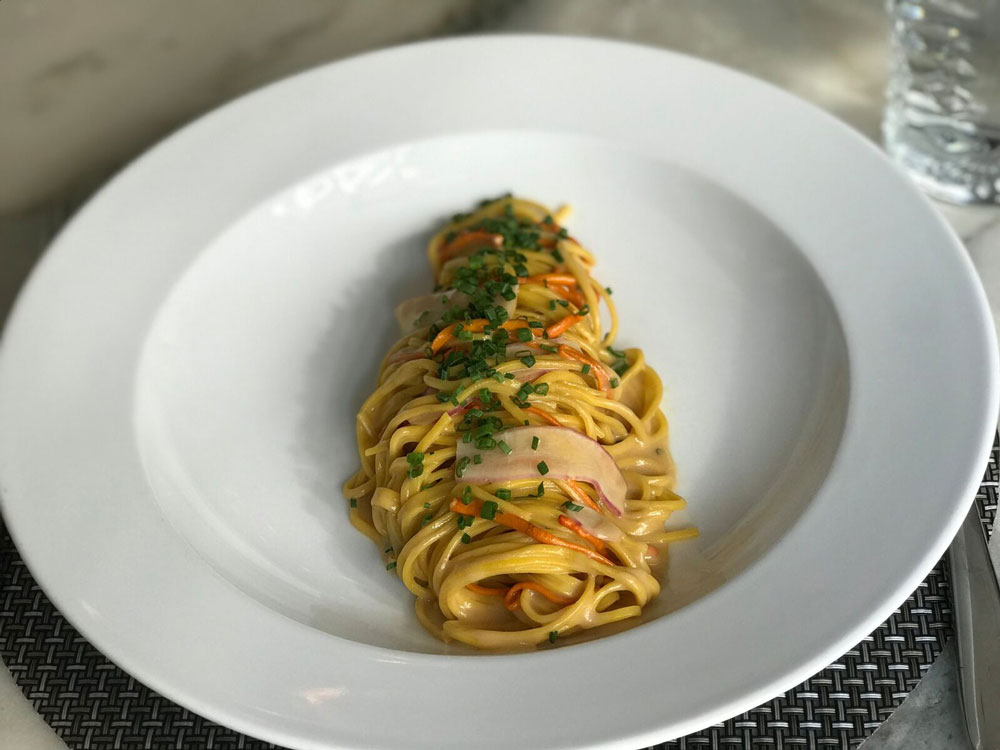
Cordyceps and spaghetti at BardoCordyceps and spaghetti at Bardo (Photo courtesy of Bardo)Dubbed the “coolest mushroom ever” by MushroomExpert.com, cordyceps are essential fungi that grow vertically on insects, which sounds gross until you remember all your food is grown around bugs.

“Cordyceps have a vibrant orange color, a great texture that mimics a spaghetti noodle when they are slightly wilted and provide a great savory umami flavor,” says Remy Pettus, executive chef of Dakota Jazz Club in Minneapolis. “They’re also delicious raw and have a slight chewiness.” Inspired by the unique shape and color, Chef Pettus has served cordyceps with spaghetti topped with raw shaved porcini. When the spaghetti is lifted out of the boiling water, the cordyceps are tossed in raw and then wilt in the noodles.

Chef also uses morels, porcini, matsutake and umbrella polypore mushrooms from Forage North.

By Melissa Kravitz Hoeffner, Institute of Culinary Education

George Wallace hoped to upend the 1968 election. Then Gen. Curtis LeMay dropped a bomb

If you’ve seen the classic Stanley Kubrick film “Dr. Strangelove or: How I Learned to Stop Worrying and Love the Bomb,” you’re familiar with Gen. Curtis E. LeMay — sort of. The four-star Air Force general didn’t personally appear in that 1964 movie, but two of its most memorable characters were based on him: The cartoonishly bellicose Gen. Buck Turgidson, played by George C. Scott, who practically salivates at the prospect of dropping bombs on the Soviet Union, and Brig. Gen. Jack D. Ripper, played by Sterling Hayden, a cigar-chomping madman who embraces every far-right conspiracy theory in sight.

Kubrick and the film’s writers created the archetype of the warmongering extremist based on LeMay — and four years later, LeMay unintentionally proved them right by acting exactly like his fictional counterparts. The stakes could hardly have been higher when he did so: LeMay was chosen as vice-presidential running mate for George Wallace, the white supremacist Alabama Democrat whose 1968 third-party campaign nearly threw the presidential election into chaos. For a brief moment, it seemed that a Kubrickian caricature might come disconcertingly close to the Oval Office. Yet one seven-minute press conference wound up pretty well demolishing LeMay, and probably ending any chance Wallace had of winning. One could argue that the general revealed the Achilles’ heel of far-right politics — a tendency to succumb to beliefs that literally threaten the survival of our species and the world. 

RELATED: How I learned the power of lies: Fact and falsehood in the age of Trump (and long before)

On paper, LeMay looked like a somewhat reasonable political candidate. Born into working-class poverty in Ohio, he displayed an aptitude for engineering and worked his way to a degree from Ohio State. In October 1929 — the same month that the stock market crash kicked off the Great Depression — LeMay was commissioned as a second lieutenant in the Air Corps Reserve. He served with distinction during World War II, rising through the ranks as he led the Air Force in Europe, Japan and the China-Burma-India theater. He intuited that there was a future in big bombs of all kinds, and became an avid proponent for their development. While that put him ahead of the curve in strategic terms, he was a traditional officer who was well-liked by his men. He was also a ruthless warrior:  His air raids on Japan led to as many as 900,000 deaths.

That wasn’t controversial at the time, and LeMay’s career thrived in the postwar era. He coordinated the Berlin airlift of 1948, served as commander of the Strategic Air Command (SAC) until 1957, and by 1961 had been appointed as U.S. Air Force chief of staff. That was when LeMay’s love of bombs — he had long argued for creating more nuclear weapons and making it easier to deploy them — finally became too much. During the Cuban missile crisis he pushed for preemptive missile strikes on Soviet facilities that would quite likely have triggered a global nuclear war, and he clashed with both John F. Kennedy and Lyndon B. Johnson over their reluctance to be more aggressive in the Vietnam War. After losing his job in 1965, he co-wrote an autobiography that summed up his philosophy: He believed the U.S. should tell the North Vietnamese that if they did not surrender, “we’re going to bomb them back into the Stone Age.”


Want a daily wrap-up of all the news and commentary Salon has to offer? Subscribe to our morning newsletter, Crash Course.


George Wallace intersected with LeMay three years later. Wallace emerged as a national figure after being elected governor of Alabama in 1963 and laying out a clear agenda in his inaugural address: “Segregation now! Segregation tomorrow! Segregation forever!” He immediately became the national champion of opposition to the civil rights movement, standing in front of the University of Alabama’s doors to oppose desegregation and repeatedly threatening to take his white supremacist ideology to the national stage. When he ran for president as a third-party candidate in the 1968 election, he shocked the political world by becoming a serious contender. At one point, Wallace polled in the low 20s, barely below Democratic nominee Hubert Humphrey, although both trailed Republican nominee Richard Nixon, who was in the mid 40s. 

Wallace posed a problem largely because of the Electoral College, which has bedeviled American politics both before and since. To be elected president, a candidate must receive a majority of electoral votes. (Then as now, the magic number is 270.) Wallace had Alabama locked down and was likely to win several other Southern states, such as Louisiana, Mississippi, Georgia and South Carolina. If he could swing a couple of other states elsewhere in the nation, neither Nixon nor Humphrey would win an electoral majority and, under the 12th Amendment, the House of Representatives would decide the election. Wallace hoped to do what John Quincy Adams had done in 1824 after receiving less than 31% of the popular vote: Strike a deal with the House speaker to win such a “contingent election.” If that didn’t work, Wallace believed he could force either Nixon or Humphrey to give him significant power in their future administrations.

Then Wallace picked LeMay as his running mate. One press conference later, their campaign had fallen apart. 

“I think there are many times when it would be most efficient to use nuclear weapons,” mused LeMay. But people “throw up their hands in horror” because of “propaganda that’s been fed to them.”


“We seem to have a phobia about nuclear weapons,” LeMay told the stunned group of reporters. After mouthing clichés about how of course he would prefer to avoid war, LeMay said, “I think there are many times when it would be most efficient to use nuclear weapons. However, the public opinion in this country and throughout the world throw up their hands in horror when you mention nuclear weapons, just because of the propaganda that’s been fed to them.” He even challenged the scientific consensus that nuclear radiation was bad for wildlife, insisting that flora and fauna from fish and birds to coconut trees and guava bushes were flourishing in the Bikini atoll.

At this point Wallace, visibly panicking, interceded. “Gen. LeMay hasn’t advocated the use of nuclear weapons, not at all,” Wallace said, contradicting the plain facts. “He discussed nuclear weapons with you. He’s against the use of nuclear weapons, and I am too.” A few moments later, a reporter asked LeMay directly whether he would use nuclear weapons to end the Vietnam War.

“If I found it necessary, I would use anything we could dream up — anything that we could dream up — including nuclear weapons, if it was necessary,” LeMay replied.

That, as they say, was the ballgame. Some historians have argued that organized labor’s mobilization and the general power of the Democratic Party machine ultimately helped Humphrey pull votes that might otherwise have gone to Wallace. That may well be true, but the trend in both polls and political momentum was the same. Before that press conference, Wallace was the champion of angry white voters around the country, not entirely unlike another right-wing rabble-rouser who would be even more successful 48 years later. After it was over, he was a bumbling would-be demagogue whose running mate had terrified voters with the prospect of nuclear holocaust.

Wallace and LeMay probably should have learned their lesson from 1964 Republican nominee Barry Goldwater, who was pilloried by Lyndon Johnson over accusations that he was willing to risk nuclear war, and who lost in a historic landslide. As mentioned, LeMay had already inspired two different parody characters in a widely acclaimed and popular movie. Maybe the lesson for future political candidates goes like this: Don’t threaten the end of civilization and expect to win. On the other hand, if your opponent advocates policies that might extinguish the human species — whether through nuclear war, climate disaster, ever-worse pandemics or capitalism run amok — you might want to bring that up, and not just once or twice, but all the time.

Read more on the dark corners of American history:

“We did it!” Workers in Maryland vote to form first U.S. Apple Store union

After Apple employees in Maryland voted Saturday to form the tech giant’s first retail store union in the U.S., workers’ rights advocates across the country celebrated the “pathbreaking win for labor.”

Workers at the store in Towson recently organized into the Coalition of Organized Retail Employees (CORE) and have decided to join the International Association of Machinists and Aerospace Workers (IAM).

“We did it!” IAM declared on Twitter, welcoming the Towson workers.

IAM international president Robert Martinez Jr. said in a statement that “I applaud the courage displayed by CORE members at the Apple store in Towson for achieving this historic victory. They made a huge sacrifice for thousands of Apple employees across the nation who had all eyes on this election.”

RELATED: Workers have had enough: Labor’s tide is rising, from Amazon to Dollar General and beyond

“I ask Apple CEO Tim Cook to respect the election results and fast-track a first contract for the dedicated IAM CORE Apple employees in Towson,” Martinez added. “This victory shows the growing demand for unions at Apple stores and different industries across our nation.”

The win in Maryland comes as Amazon and Starbucks workers across the nation are also pushing for unions — and the companies are fighting back.

Apple is no different, according to More Perfect Union and the Washington Post, which reported that “Saturday evening’s initial tally was 65-33, and the official count was pending.”

While an Apple representative declined to comment, Towson worker Billy Jarboe told the newspaper that the company’s campaign to undermine the union drive “definitely shook people,” but most supporters of the effort weren’t swayed.

“It just feels good to go into a new era of this kind of work, hopefully it creates a spark [and] the other stores can use this momentum,” Jarboe said.

Eric Brown, another employee in Towson, told the Post that organizers of an unsuccessful unionization campaign at an Atlanta store “let us know what some of the talking points and tactics were going to be, and we were able to let people know some of the things they may try.”


Want a daily wrap-up of all the news and commentary Salon has to offer? Subscribe to our morning newsletter, Crash Course.


Tyra Reeder similarly told the New York Times that “we kind of got some insight from the Atlanta store on things that were coming,” pointing to the company’s claims that a contract negotiation process could lead to workers losing some benefits.

“For that to happen, a majority of us have to agree,” Reeder said. “I don’t think any of us would agree to lose something we love dearly, that benefits us.”

As for being an Apple employee, Reeder said: “We love our jobs. We just want to see them do better.”

Sen. Bernie Sanders, I-Vt., was among the political figures who welcomed the development in Maryland.

“Congratulations to Apple workers in Towson, Maryland on becoming the first Apple store in the United States to form a union!” Sanders tweeted. “What we are seeing right now is a historic uprising of working-class Americans telling the corporate elite that they have to end their greed.”

Tom Perez, a Democratic candidate for Maryland governor, also congratulated the Towson workers while tying their win to the broader movement currently sweeping the country.

“This is a big deal,” he said. “All across our country we’re seeing workers demanding fairness and dignity. So proud that the nation’s first Apple store to form a union is right here in Baltimore County.”

Read more on the explosion of labor organizing:

Trump ’24 down the tubes? He’s losing big donors to Ron DeSantis: report

According to a report from Politico’s Matt Dixon, wealthy contributors to Donald Trump’s two presidential campaigns are now showering Florida Gov. Ron DeSantis with campaign contributions as they hedge their bets on the 2024 election.

As Dixon notes, several big-money contributors have begun making large campaign contributions to the Florida Republican after ignoring him when he previously ran for governor.

As Dixon notes, this should set off alarms in Mar-a-Lago.

RELATED: Betsy DeVos and Ron DeSantis: GOP dynamic duo team up to defund public schools

“DeSantis has attracted the attention of some of the nation’s wealthiest Republican donors, including many who were key financiers of Trump’s reelection bid or backers of high profile Republican candidates and causes, according to POLITICO analysis of campaign finance data,” he wrote before adding, “Most of the high-dollar donors had never given contributions in state-level Florida elections, while those who have previously provided funds have significantly increased their spending for DeSantis during the 2022 midterms.”

Although the contributions are for DeSantis’ current re-election campaign, the sudden interest in his political fortunes in a state where he will likely waltz to a win appears to show that donors are looking past Trump in 2024.

According to longtime GOP donor Francis Rooney, who grew disenchanted with Trump and felt he should have been impeached, “I think Ron’s fundraising really speaks for itself. It is possible Trump’s percentage of the Republicans keeps going down and I think it’s possible people will start looking elsewhere.”


Want a daily wrap-up of all the news and commentary Salon has to offer? Subscribe to our morning newsletter, Crash Course.


Shiree Verdone, who served as Trump’s campaign co-chair in Arizona, claimed more big donors may soon jump on the DeSantis bandwagon,. explaining, “I know a lot of donors who are kind of in wait-and-see mode. They really, really like DeSantis, who is very popular, but you don’t want to upset Trump.”

According to the Politico report, “Major Trump donors contributing to DeSantis since his 2018 campaign for governor includes William Buckley, a retired venture capitalist with a home in Lost Tree Village — a wealthy Palm Beach County enclave that’s home to some of the nation’s largest political donors. Buckley gave $1 million. Major GOP donor Richard Uihlein, an Illinois-based businessman who supported DeSantis in 2018, contributed $700,000 to the governor four years ago. He and his wife, Elizabeth, have given $1.2 million in 2022.”

“The Florida governor is also drawing huge political support from mega GOP donors who said they would not support Trump in the future, most notably Ken Griffin, the billionaire founder of Chicago-based Citadel LLC. He has been one of DeSantis’ biggest benefactors, giving $5 million in both the 2018 and 2022 election cycles. He did not contribute to Trump in 2020, and has publicly said he will not support him moving forward,” Dixon reported.

Explaining the exodus from the former president, Rooney bluntly stated, “The guy is so mercurial. And there are so many things floating around from lawsuits to the Jan. 6 stuff. If the primary were today, Trump gets it, but I think his popularity is going down.”

You can read more here.

Read more on the Sunshine State governor with his eyes on bigger things:

Ethereal, evocative, and inventive: why the music of Kate Bush spans generations

Keen observers of popular culture will have become aware of the recent inclusion of Kate Bush’s 1985 song “Running Up That Hill” into the storyline of the widely-watched Netflix show “Stranger Things.” As a result of this inclusion, Kate Bush’s classic song was catapulted (again) into the mainstream musical scene, experiencing a true resurgence in popularity and ranking highly in download charts around the world.

Kate Bush herself provided a response by issuing a rare message on social media about the whole affair, not only declaring her enthusiasm over “Stranger Things,” but also her gratitude for its ability to bestow “a new lease of life” upon her now famous song.

As a result of the boost in popularity of “Running Up That Hill,” there has been great talk of a whole new group of music listeners from the Gen Z demographic “discovering” Kate Bush’s work, and becoming instantly enamoured with it.

An anecdotal look would seem to suggest that, somehow, Kate Bush is reaching greater fame in 2022 than she did during the 1980s, a prolific creative period that many would rank (unkindly) as the peak of her musical journey. And yet, while there is no denying the instant hold that Kate Bush’s music seems to be having on current listeners, there is definitely something strange in suggesting that her fame was only moderate in previous decades.

Indeed, Kate Bush was popular during and after the ’80s, especially in the UK, and her music has been continuously well-received by a growing number of avid fans since.

In and out of the mainstream

Since her debut in the late 1970s, Kate Bush has released over 25 UK Top 40 singles, including “Babooshka” (No. 5, 1980), “Hounds of Love” (No. 18, 1986), “Rubberband Girl “(No. 12, 1993), “The Red Shoes” (No. 21, 1994), and “King of the Mountain” (No. 4, 2005).

The 2022 impact of “Stranger Things” on fans of her music only signals cycles of discovery, re-discovery, and re-appreciation that have been characteristic of Kate Bush’ music and performances ever since she first broke onto the scene as a decidedly avant-garde artist in 1978. Her now well-known hit “Wuthering Heights,” reached No. 1 in the UK Singles charts.

So, one is left to wonder as to the reason for Kate Bush’s long-standing appeal. While there are likely many different reasons for this – undoubtedly including the ever-changing circumstances of individual music listeners – there are certainly aspects of Kate Bush’s music, performances and perhaps even persona that feed her enduring attraction.

Experimental and innovative

Kate Bush’s music was undoubtedly experimental and innovative in the late ’70s and ’80s. Its seemingly open disregard for the dominant musical trends of the time conferred upon her songs a certain out-of-time quality, which transformed and materialised into a timeliness appeal.

Her music’s refusal to fit into strict categories of genre and audience classification is perhaps what makes it able to seemingly morph according to situation, attuning itself to changing tastes, and squeezing itself into the evolving bounds of cultural relevance.

In addition to the very particular sound qualities of her music, one must also take into account the visual appeal of Kate Bush’ actual performances. Her music videos, where she is known to display arresting, sinuous choreographies and floating gowns, create a dream-like atmosphere.

While a touch of the late ’70s and ’80s can certainly be spotted in her videos, with the typical soft-focus lenses of the time making an obvious appearance, her performances are beautifully strange and suggestively haunting. The choreography seen in the video for “Wuthering Heights” is particularly well-known in this respect. Here, Kate sports an arresting, floaty red dress, and dances lithely in a natural landscape, incorporating mesmerising movements into her routine, while a light mist surrounds her.

The recurring combination of unconventional sounds and visuals is arguably what established Kate Bush as a distinct icon: one who is not only instantly recognisable for her almost intoxicating individuality, but who is also seemingly unfettered by the restrictions of neither time nor space.

A contemporary icon

There is no doubting the fact that Kate Bush’s lyrics speak to a variety of identities and desires. She has been credited as an extremely influential figure by contemporary artists such as Lady Gaga, Tori Amos, and Florence + The Machine.

Unavoidably, there is a lot of nostalgia involved in the constant re-discovery of Kate Bush’s music as well, especially for those fans whose memories are attached to her songs from different moments in time. And yet, there also seems to be something more peculiar at play. Kate Bush’s music has a certain nostalgic feel to it, even if new fans and listeners do not have any actual memories of the past associated with her songs.

There is an intimate sense of longing that is interlaced within the fabric her work: a desire to feel, to experience, and to find oneself, which makes her performances so captivating. It is perhaps this definitive characteristic that maintains Kate Bush’s multi-generational appeal, as her music continues to speak to a multitude of fans across the years.

Lorna Piatti-Farnell, Professor of Film, Media, and Popular Culture, Auckland University of Technology

This article is republished from The Conversation under a Creative Commons license. Read the original article.

11 memorable facts about “History Of The World, Part I”

On June 12, 1981, Mel Brooks’s irreverent take on the course of human events opened in theaters. Though critics were thoroughly divided, “History of the World, Part I” grossed a respectable $31.6 million at the box office and left countless viewers hungry for a sequel (which is finally on the horizon). These 11 footnotes should get you ready for your next screening of this comedy classic.

1. Orson Welles breezed through his lines.

“History of the World, Part I” opens in a deceptively dramatic fashion. As we witness the very dawn of our species, a commanding voice declares “And the ape stood, and became man.” This unforgettable baritone belonged to Orson Welles. Brooks hired him to narrate the five major segments that make up the film.

Beforehand, it was agreed that the cinema legend would receive $5,000 per day in exchange for his services. Figuring that he’d have to spend five eight-hour days recording and re-recording these lines with Welles, Brooks paid him $25,000 up front. But by noon on the first day, Welles had recorded every single one of his lines to perfection. “Oh my god, I could have paid you $5,000,” Brooks lamented. After kicking himself for a few minutes, the funnyman asked Welles how he planned to spend the bounty. “Cuban cigars and sevruga caviar,” the “Citizen Kane” director replied.

2. The lead caveman was played by Mel Brooks’s former boss.

In 1949, the late, great Sid Caesar hired Brooks as a joke writer for “The Admiral Broadway Revue,” a short-lived NBC variety show. After the series ended, Brooks joined the staff of Caesar’s next program, “Your Show of Shows.” Working for a living legend was something the younger man would never forget. Even today, when Brooks is asked about his mentor, he often says: “No Sid Caesar, no Mel Brooks.”

Twenty-two years after “Your Show of Shows” ended its run, Brooks expressed his gratitude to Caesar by giving him a major role in 1976’s Silent Movie. Brooks would cast the comic again in “History of the World,” this time as Chief Caveman, who has a zeal for music (and slapstick).

3. According to Brooks, the Moses scene was a last-minute addition.

“Sometimes, you will get very lucky and the set will give you ideas for jokes,” Brooks said in a 2012 interview with the Directors Guild of America. One day, he was gazing out at the scenery that had been built for the caveman segments in “History of the World” when the gears in his head started turning. “I immediately thought, ‘Well, where do I go from here?'” Brooks recalled. Heading into the shoot, his plan was to “skip the Bible and go to Rome.” But eventually, he realized that the Stone Age set might enable him to explore another chapter in world history. With a few minor alterations, Brooks converted his faux caves into a mountaintop, and the Moses bit was born.

4. Richard Pryor was originally supposed to play Josephus.

Josephus is a principal character in the film’s Roman Empire segment. Richard Pryor seemed perfect for the part and, to Brooks’s delight, he accepted the role. Unfortunately, though, a terrible accident kept Pryor out of the movie. On June 9, 1980, less than a month after History of the World began production, the comic lit himself on fire while freebasing cocaine and had to be hospitalized. At the suggestion of Madeline Kahn (who played Empress Nympho), Brooks handed the role to tap dancer Gregory Hines.

5. To play Comicus, the “stand-up philosopher,” Brooks took some cues from Eddie Cantor.

Eddie Cantor was one of Brooks’s personal heroes. An actor, singer, comedian, and radio personality, Cantor’s talents were almost limitless. When Brooks cast himself as Comicus in “History of the World,” he proceeded to copy some of his idol’s manic facial expressions. “I made my eyes pop out in reactions, like he did,” Brooks said. “My Comicus was a tribute to Eddie Cantor. He was my timing, my excitement.” Even the character’s wardrobe, a “short little toga,” was modeled after the outfit Cantor wore in “Roman Scandals,” a 1933 musical comedy.

6. Brooks felt it was important to laugh at the Spanish Inquisition.

Brooks is no stranger to writing risqué material that pokes fun at real-world atrocities. He famously based “​​​​​​​The Producers“​​​​​​​ on a fictional musical about Adolf Hitler, and in “History of the World,” he put together an entire song-and-dance routine about the Spanish Inquisition. While he later admitted that the song earned him “a lot of write-ins from rabbis,” Brooks felt it was important to turn these historical tragedies into jokes. “Comedy brings religious persecutors, dictators and tyrants to their knees faster than any other medium,” he explained.

7. A longtime partner helped Brooks write the movie’s big showstopper.

Ronny Graham and Brooks first crossed paths as castmates in the hit Broadway revue “New Faces of 1952,” for which they co-wrote several skits. “[We] became fast friends,” Brooks said. Once Brooks decided that History of the World needed a Busby Berkeley-style musical number about medieval torture, he immediately reached out to Graham, who happened to be a successful musician.

“Together we began a fierce collaboration on a song called ‘The Inquisition,” Brooks recalled. The rest is, well, history. In the final film, Brooks takes center stage during this segment, hamming it up as the grand inquisitor Torquemada. Meanwhile, Graham makes a cameo as one of the Jewish prisoners.

8. One deleted scene involved a nuclear mishap.

Little is known about this segment. In an interview with film critic Gene Siskel, Brooks revealed that he had filmed a brief scene that made light of the notorious Three Mile Island incident. “I had a father and a mother made up to look like half a dog and half a cat as a result of a nuclear meltdown,” Brooks told Siskel. When test audiences reacted poorly, this bit was removed. However, at least one journalist managed to see an extended cut that contained the footage. In his (lukewarm) review of “History of the World” for The Washington Post, critic Gary Arnold wrote, “there’s a routine about Three Mile Island that’s almost awesome in its lack of comic point.”

9. King Louis’s scenes were filmed at an English palace.

It’s good to be the king, but language barriers aren’t much fun. Feeling that it would be easier to shoot the French Revolution chapter in English-speaking countries, Brooks chose Blenheim Palace in Woodstock, Oxfordshire, England — about 65 minutes northwest of London — as a stand-in for Versailles. Built in the early 18th century, Blenheim is where the Duke of Marlborough has historically resided. An architectural beauty, the palace has also made appearances in such films as “The Libertine” (2004) and “Mission Impossible: Rogue Nation” (2015) [PDF].

10. “History of the World” came with a steep price tag — at least for a Mel Brooks project.

Brooks himself claimed that “History of the World’s” budget — an estimated $11 million — exceeded that of his previous three films combined. Particularly expensive was the Inquisition scene, in which the set alone cost $1 million. By comparison, the entire budget of 1968’s “The Producers” was a paltry $941,000.

11. There’s a sequel series coming from Hulu.

With a title like “History of the World, Part I,” you’d assume that a “Part II” would be hot on its heels. But Brooks stated several times in years past that he never intended to make a sequel. On June 7, 1981 — just four days before the movie opened in theaters — the director weighed in on this subject in The New York Times. “Will there be a ‘History of the World, Part 2’?” he asked, rhetorically. “No. Maybe a ‘Part 4,’ never a ‘Part 2’.”

That changed some 40 years later when it was announced in 2021 that a “History of the World, Part II” series was being put into production at Hulu. Brooks will serve as one of the series’s writers and executive producers, along with Nick Kroll, Wanda Sykes, and others. “I can’t wait to once more tell the real truth about all the phony baloney stories the world has been conned into believing are History!” Brooks said about the project.

This article was originally published in 2016; it has been updated for 2022.

Sea moss gel: demystifying the new wellness trend that’s a lot older than you think

TikTok’s wellness world has been rife with people eating sea moss gel out of glass jars.

“Started taking sea moss gel about 3-4 weeks ago and now my skin is glowing more than ever before,” one LA holistic nutritionist wrote on TikTok. “Energy levels are higher & gut health is doing better.”

Others have shared videos on how to make your own: forage sea moss or buy it raw, mix with water, maybe add a cup of fresh fruit, and let it sit overnight — and voilà. What looks like applesauce, but tastes like seaweed, has quickly become a new health trend promising an array of benefits from weight loss to glowing skin, and perhaps even a way to fight Parkinson’s Disease. Devouring sea moss gel was recently featured on Kourtney Kardashian’s Goop-like Poosh website, and has previously been touted by Kim Kardashian herself who eats sea-moss smoothies.

RELATED: We’re not safe from Big Wellness: ‘They’ll get you with a crystal or pouf’

“This may be your first time hearing about sea moss, but it’s not new,” Mascha Davis, a Registered Dietitian Nutritionist, told Salon via email. “Sea moss is a type of red algae that has been used medicinally by different cultures, like Jamaican and Irish, for example, for hundreds of years.”

Davis added many people don’t know much about sea moss, but it’s certainly becoming more popular. A few of her clients in Los Angeles have been “seeing it on Erewhon shelves” and asking her about it.

“Sea moss’s cousin (seaweed) is much more well known and researched,” Davis said. “Up until recently, sea moss had not been extensively studied, but its benefits are believed to be similar to those of other seaweeds.”

For the unfamiliar, sea moss is a type of red algae. Also known as “Irish moss,” or more technically Chondrus crispus, it grows along the rocky parts of the Atlantic coasts of Europe and North America. Chondrus crispus is a “foundation species in the North Atlantic intertidal zone,” Susan Brawley, a professor at the University of Maine’s School of Marine Sciences, told Salon. “It provides 3-D structure for smaller organisms and food for invertebrate herbivores in the low zone.”


Want more health and science stories in your inbox? Subscribe to Salon’s weekly newsletter The Vulgar Scientist.


This algae specifically has an industrial history of being used as a natural source for a thickener in milk products (like half-and-half, coffee creamers, heavy cream), some processed foods and ice cream — and now it’s just starting to become more mainstream in the alternative health world. But is there any merit to this wellness trend, or is this yet another Goop-ified wellness fad that makes false promises and could come with more risks than benefits?

“There are a lot of health benefits in terms of vitamins and nutrients; it’s got fiber in it, plenty of vitamins B2, B12, calcium, magnesium, chromium, zinc, a ton of stuff, so that’s a really good thing,” Dr. Jen Caudle, family physician and an associate Professor at Rowan University, told Salon. “There are a lot of claims, that sea moss does this and does that — anything from preventing Parkinson’s to helping the immune system, and the thing about those claims is we don’t have a lot of evidence to back that up.”

Indeed, one 12-week study of people consuming 1,000 milligrams of red seaweed extract per day reported having a reduction in total body weight compared to the placebo group. However, it was a small study of 78 adults. Another study published in BMC Complementary Medicine and Therapies concluded that red sea moss can be used to support gut health as a prebiotic, but the study was done on rats. As for the Parkinson’s claims, these likely stem from one study where researchers concluded that an antibacterial extract from Chondrus crispus could possess a neuroprotective activity to potentially prevent Parkinson’s. It should be noted that this research was conducted on worms.

Caudle added there are many different ways to consume sea moss— yes, there’s sea moss gel which has become the popular form of consumption on TikTok, but there are also gummies, powder, supplements and vitamins.

“When it comes to vitamins and supplements, they’re not regulated in the United States, like prescription medications, and what that can mean is that the product may have varying amounts of ingredients in it,” Caudle said, adding that a concern is about how these supplements might interfere with medications and other supplements a person is taking. “[Sea moss] may not be right for some people based on their underlying conditions like sodium content and magnesium and potassium.”

However, in addition to the promotion of claims that lack sound scientific evidence and not knowing what’s in supplements, Caudle said one of the biggest concerns of the sea moss trend is perhaps ingesting too much iodine and potential exposure to heavy metals. While iodine deficiencies can be a concern for the human body, too much iodine is also problematic.

“It is possible to get too much iodine in your diet, and that’s one concern that many of us have about sea moss, too much iodine can affect the thyroid and so many other parts of your body,” Caudle said. “Sea moss is harvested in water sources, depending on where it’s harvested from it may be contaminated with heavy metals that can be very dangerous, potentially.”

Caudle emphasized “the risk is variable” and it depends on the type of sea moss a person is consuming, but these are risks people should be aware of, which is why she made a TikTok on the “dangers of sea moss.”

However, if people are going to collect their own raw sea moss, Brawley from Maine’s School of Marine Sciences said it shouldn’t be done in an area that’s close to a factory or a sewage plant.

“In many countries along the North Atlantic, wild harvest for sale is regulated both to protect the resource from over-harvesting and to ensure it is not from a polluted area,” Brawley added. “Small amounts for personal use can often be collected without a permit except for it being prohibited in conservation areas, marine parks, et cetera.”

Unlike how Instagram’s succulent trend drove a black market for succulent poaching and concerned environmentalists, Brawley said she doesn’t see a negative environmental impact if people forage for their own Chondrus crispus.

“Indeed, for centuries, that is exactly what coastal people did across the North Atlantic,” Brawley said. “When I came to Maine, a colleague who was a native Mainer gave me her handed-down family recipes for how to collect, clean, and prepare Irish moss, as well as a pudding recipe.”

Read more about wellness trends:

Strawberry season calls for Ina Garten’s country cake

Summertime produce is one of the many highlights of the season, and Ina Garten wants to make sure you take advantage of it while you still can. By trying out her strawberry country cake recipe, you get to indulge in the sweet flavors of summer without overcomplicating things. Commenters for the recipe on her Instagram raved about the cake, with many saying it had been a go- to staple for years. Who wouldn’t love that?

Related: A nostalgic southern dessert made from spring’s greatest treat: strawberries

The first thing you’ll need to do is preheat your oven to 350 degrees. While that heats up, butter and flour two 8-inch cake pans. This recipe calls for two cakes to serve a large group, but you can always halve it if you don’t need that much.

Now you’ll start on the cake batter. For this step, you’ll be using an electric mixer. To begin, take your unsalted, room temperature butter and combine it with your sugar at a high speed until it has a light and fluffy consistency. It should look creamy. 

Turn the speed of your mixer down to medium, and add in your eggs one at a time, followed by your sour cream, citrus zests, and vanilla extract, making sure it is all evenly combined. 

Now you’ll focus on the dry ingredients, which Ina suggests sifting to get the smoothest texture possible. Once your batter is mixed and distributed evenly between two pans, it only takes a 45-minute bake and 30-minute cool down for the cake to be ready. 

While you’re waiting, you can get started on your filling. Take heavy cream and whip it by hand or in a mixer until the texture is firm, but not too stiff. Then add your sugar and vanilla. 

Now comes the assembly. Slice one cake round in half with a long, sharp knife. The sharper the knife, the less likely your cake is to break or crumble while you layer. Start your construction by placing the bottom slice of the cake on your serving dish or platter. Spread about half of your whipped cream on top of it, and then scatter your sliced strawberries generously over top. Cover this filling with the top slice of the cake, and spread the rest of your cream over top. Take creative liberty to decorate the top of the cake with strawberries, either sliced or whole. What you’re left with is a delicious, refreshing, and simple dessert that screams summer. Find the full recipe and measurements here.

More seasonal desserts: 

Salon Food writes about stuff we think you’ll like. Salon has affiliate partnerships, so we may get a share of the revenue from your purchase.


I thought I didn’t like hummus until I tried this lighter-than-air version

For the longest time, I didn’t get the point of hummus. I confess I went years of my life knowing it only in the context of half-hearted party food, served alongside shriveled baby carrots and stringy celery sticks. I thought hummus came in a small plastic tub, and that it was as thick as paste and half as flavorful.

Obviously, I was dead wrong.

My life changed when I moved near a phenomenal Brooklyn restaurant called Zaytoons, and I discovered what hummus was supposed to be — creamy, nutty and light. By the time I started making it at home for my family, I had turned into a real fanatic of the stuff. That’s why I was so excited by Jeanie Roland’s delicate, cloud-like version from her new cookbook, “The Perfect Caper Home Cooking.”

RELATED: A summer caprese with a Middle Eastern twist

With the same relaxed elegance she brings to her restaurants, The Perfect Caper and Ella’s Food & Drink, Roland imbues her writing with approachable warmth, inviting you to make irresistible dishes like warm brie pastry with rosemary and peppered pears or her Momma’s spaghetti and meatballs.

“Cooking should be comfortable and natural, an expression of your state of mind,” she writes, “not something to be dreaded and feared.” When done right, few things are more comforting or easier to make than good hummus. Roland’s is exceptional — and it’s so much lighter and fluffier than your typical supermarket wallpaper paste.

“You have to overcook the beans,” Roland revealed to Salon Food during a recent Zoom chat. “For this, I was using fresh beans, but you don’t have to. You can get canned beans, but they’re a little bit al dente. If you purée that, you have to add a lot of everything else, so you’re really getting a heavier tasting hummus.”

RELATED: Falafel comes in many forms, but this beet incarnation is packed full of flavor and texture 

Instead, “when you take the beans, even if you use canned, put them back into the pot,” she said. “Cook them more until they’re overcooked. Now, they’ve absorbed some of that water, and they’re lighter and more airy. I feel that is the secret. With the minimalistic seasoning, you’re letting the beans shine, whatever you’re having it with. The water really is a magic trick on its own, because it adds that lightness and allows you to whip stuff in without being too heavy.”

I’ve reduced some of the quantities from Roland’s original recipe below to suit using canned instead of home-cooked beans. As much as I hate adding an extra step to anything, I would not skip cooking the beans down a little more before you purée them. It makes the final product the texture of whipped cream, except it’s better than whipped cream because it’s hummus.

Don’t even think of putting stuff this anywhere near an unhappy bowl of baby carrots.

***

Recipe: Fluffy Hummus
Inspired by Jeanie Roland’s “The Perfect Caper Home Cooking”

Yields
8 servings
Prep Time
 10 minutes
Cook Time
 10 minutes

Ingredients

  • 1 15-ounce can garbanzo beans 
  • 1-2 cloves minced garlic
  • 1⁄3 cup tahini
  • 2 1/2 tablespoons fresh lemon juice
  • 2 1/2 tablespoons water
  • 2 1/2 tablespoons extra virgin olive oil, plus more for drizzling
  • Sea salt and freshly ground black pepper, to taste
  • 2 tablespoons pine nuts, toasted if you have the energy
  • 1/2 tablespoon ground sumac

Directions

  1. In a medium pan, simmer the beans for 10 minutes or so, until they’re very soft. (You don’t want a firm bean here.) Remove from the heat and drain, reserving the aquafaba.

  2. In a blender or food processor, purée the beans, garlic, tahini, lemon juice, water and olive oil. A few tablespoons at a time, add the reserved aquafaba until the hummus looks exceptionally light.

  3. Transfer to a bowl and season with salt and pepper. Cover and refrigerate to let the flavors blend.

  4. When you’re ready to serve the hummus, unwrap the bowl and sprinkle with the nuts and sumac. 

  5. Serve with baked pita chips or your dippers of choice.


Cook’s Notes

Soom tahini will change your life.

Serving with baked pita chips? Here’s the Quick & Dirty way to make them.

You can play with this recipe in all kinds of ways. The easiest way to make this into Roland’s pea hummus is to swap out half of the garbanzo beans with thawed frozen peas. Blend with a few springs of fresh mint and top with sliced almonds, if you like. 


Want more great food writing and recipes? Subscribe to “The Bite,” Salon Food’s newsletter.


More Mediterranean-inspired recipes we love: 

Salon Food writes about stuff we think you’ll like. Salon has affiliate partnerships, so we may get a share of the revenue from your purchase.

Norm Eisen: Trump likely to face racketeering charges in Georgia

CNN legal analyst Norm Eisen predicted that former President Donald Trump will be charged with racketeering when he “finally faces accountability” for trying to overturn the presidential election in Georgia.

Eisen made the remarks ahead of a Jan. 6 Committee hearing on Trump’s efforts in Georgia, where he was recorded pressuring officials to find new votes for him after the election.

“What kinds of crimes do you believe [Fulton County District Attorney Fani T. Willis] in Georgia would be looking at?” CNN host Fredricka Whitfield asked the attorney on Sunday.

RELATED: Trump’s guys may lose in Georgia — but his Big Lie is going strong

Eisen predicted that Trump is in danger of being charged with solicitation of election fraud.

“You can’t ask for those 11,780 votes that don’t exist,” he pointed out. “She prosecuted the Atlanta teaching scandal as a RICO [Racketeer Influenced and Corrupt Organizations Act] case — Georgia state RICO. A racketeer and corrupt influence in organizations. In this case, that would be Trump and the Trump campaign. I think she’ll do RICO here.”

“I think charges in Georgia are looking increasingly likely,” Eisen continued. “Atlanta is the place where Trump may finally face accountability.”

“Wow,” Whitfield replied. “That would be — I mean, that’s extraordinary.”

Watch the video below from CNN:

Read more on Trump’s meddling in the Peach State:

Appreciating the mystery of “Endeavour” as the detective prequel approaches the end

Sometimes I contemplate an alternate timeline where “Sherlock” never existed and wonder whether “Endeavour” and its star Shaun Evans may have claimed whatever secret chamber in our hearts that Benedict Cumberbatch‘s detective conquered.

The two detectives have a few things in common. Sherlock Holmes and Endeavour Morse are two of many crime-solvers adapted from literature featured under the “Masterpiece Mystery!” tent recently interpreted as younger men in their prime.

Each has a long relationship with television, although Holmes’ overcoat has been worn by an assortment of actors. Morse is associated with two: Evans and the late John Thaw, who originated the character in “Inspector Morse,” which aired from 1987 through 1993, and was revived for five special installments that ran between 1995 and 2000.

Combined, they’ve ensured Endeavour Morse has been with U.K. and American TV audiences in some guise for more than 30 years, and longer for readers who forged a loyalty to the character in Colin Dexter’s books. Evans, however, achieves something we don’t often see in many modern detectives, in that he both creates and resolves the mystery of how Thaw’s flinty, hard-drinking, arrogant-yet-lovable detective came to be.

RELATED: I’m addicted to British jerks: Even the most awful TV dudes are sexy when they sound a bit posh

“Endeavour” is at its best when it draws our focus to solving the puzzle of its main character, a mission into which Evans’ performance draws us more deeply with each new season. His 1960s-era Morse is resilient, but not a hard case; refined, but put off by popular diversions that excite the average person. One of the funnier turns in the eighth season shows the Detective Sergeant visibly suffering through a live game show taping that he never would have chosen to endure if not for an assignment.

Morse’s willful ignorance of commonly loved pastimes exasperates his mentor DCI Fred Thursday (Roger Allam). Thursday is also one of the few people who respects Morse’s perspicacity and empathy. But in these 1971-set chapters, he’s concerned that his partner’s loneliness, sharpened by despair, poses a danger to himself and others.

EndeavorRoger Allam as Thursday and Shaun Evans as Morse on “Endeavor” (Courtesy of Mammoth Screen and MASTERPIECE)

And this is where the theoretical emotional terrain shared by Holmes and Morse ends. In the seventh season Morse fell for a mysterious woman he encountered in Venice, Violetta (Stephanie Leonidas), only to find out she was deceiving him before she sacrificed herself by stepping in front of a bullet meant for him.  

Sherlock of legend, as Cumberbatch plays him, probably wouldn’t have been so careless even if he allowed himself to be as vulnerable as Morse, who has taken to drowning his grief in liquor.

That may be simpler to understand than the reason I’m invoking a “Mystery” series that hasn’t been on for years alongside a very different one that’s been a reliable presence in our lives for the past decade.

The explanation is in that word: reliable. “Sherlock” hasn’t had a new episode since 2017 but flits around like a ghost, since it hasn’t been officially canceled and may theoretically keep people hanging on the hope of its return forever. It’s the ultimate example of emotional withholding.


Want a daily wrap-up of all the news and commentary Salon has to offer? Subscribe to our morning newsletter, Crash Course.


In contrast “Endeavour” has returned with new mysteries regularly since 2013, each carving fresh edges and curves into its detective’s soul. But that also means that the wider audience may not have appreciated the show as intensely as Evans’ and Allam’s performances warrant. It never got a Comic-Con panel or an Entertainment Weekly cover, for example, which says nothing about its merit or quality but a lot about the average couch potato’s passion for classic British mysteries.

There are other reasons “Endeavour” may not have caught fire as easily, namely series creator Russell Lewis’ adherence to the relatively straightforward whodunit structure, drawing more focus to the puzzles woven through the dialogue and implied by its characters’ behavior.

The cases themselves aren’t terribly complicated, tending to err on the side of theatricality as opposed to plausibility. Continuing its emphasis on style and character progression, these three new episodes take Morse and Thursday into the world of professional football, a nudist colony and an Agatha Christie-flavored mousetrap.

Each buzzes with a light energy that masks the quiet sickness slowly taking hold of the hero until the situation in the final episode, forbiddingly titled “Terminus,” makes it impossible to conceal.

Season 8 of “Endeavour” is the series’ penultimate, with production on the ninth and final round of episodes already underway. By the time the series ends, Evans will have played Morse in more TV episodes than Thaw had. With the end in sight the connection between Evans’ Endeavour Morse and Thaw’s feels closer than ever, previewed in a few surreptitiously placed lines of dialogue and the detective’s amplified dolor.

Watching Evans mature Morse from an incorruptible young man muddling through the 1960s into the disillusioned, heartbroken shade we meet in 1971 has been a pleasure. There aren’t many instances of TV shows that present younger versions of established sleuths that have enough staying power to last more than a season or two.

“Endeavour” will have run for nine by the time it’s finished, and owes its longevity to the crumpled, poetic humanity Evans brings to a detective millions have gotten to know but have only begun to fully appreciate.

“Endeavour” premieres at Sunday, June 19 at 9 p.m. on PBS. Watch a trailer, via YouTube.

More stories like this:

How the Black community finds beauty in the messiness of gardening

You can Grow Your Own Way. All spring and summer, we’re playing in the vegetable garden; join us for step-by-step guides, highly recommended tools, backyard tours, juicy-ripe recipes, and then some. Let’s get our hands dirty.

When I think about gardening and farming, I think about the innate messiness that comes with agricultural work. There’s dirt and mud everywhere and, no matter how much effort you put in or how much you “play by the book”, you cannot control when, or if, your plants thrive. Perfectionism is one of the many byproducts of generations of Black people trying to survive in the Western world. My mom always used to say “you have to be twice as good to get half as much” and I know she’s just one of many Black parents to teach their children this hard truth. This creates an unreachable goal of perfectionism that many Black people feel confined by. But where can creativity grow within these societal rules for survival? Can the joyful messiness that is gardening, or just being in nature, help to ease these ancestral tensions that we hold and create space for new passions?

My grandma, Maudry Robinson, was born into a farming family in the 1940’s in Sedbergh, Jamaica. Her parents rented plots of land and taught her how to grow fruit trees and vegetables like potatoes and corn, as well as how to raise every kind of animal that a farm would need to create its own thriving ecosystem.

For my grandma, farming wasn’t something that she necessarily enjoyed. It was a job that she had since she was a child. She was born into a poor family, taken out of school in the third grade to help her parents work the land and provide for the rest of the family. After she married my grandpa and started raising children, she was determined to give my mom and her siblings a life that she never had — a life that didn’t have to involve farm work — but my uncle fell in love with it. He created a miniature farm in the backyard of his New Jersey home. Farming and gardening are things that have always relaxed him and made him happy, so he decided that no matter where he would be, a garden would follow. He’s not the only one — gardening is a boon to mental health for lots of folks, particularly Black people.

Shayla Cabrera is a Jersey City-based, Afro-Latina plant guru and cannabis producer who is also the creator of Tia Planta. Creating a space for your plants to thrive while living in a city can be really difficult, but Cabrera has made a business out of teaching people how to create their own personal green spaces.

“Plants have, no pun intended, really grounded me,” says Cabrera. “There’s something about getting dirty and messy that’s so fun like harvesting your cannabis or when a new leaf unfurls or [bringing a struggling plant] back to life.”

As an entrepreneur, life can get hectic very quickly, but her business forces her to slow down and appreciate the little things (like a new bud on a flower that’s been struggling to grow). Some of Cabrera’s plants are six years old, which means that they’ve been alive through some of the highs and lows of Cabrera’s life. Looking at the growth in those plants is a gentle reminder of how far she has come in her career and in her personal journey.

We spoke about how, as Black women, we are not allowed the grace to be “messy” physically, emotionally, or career-wise. In working with plants, Cabrera has found a career path in which messiness is not just encouraged, but necessary. “I really love being able to show other [Black] people that you can still be happy and successful without following the norm”, she says.

“One of the greatest lessons I’ve learned from plants is that the plants that struggle are the strongest ones”, Cabrera said. She’s not the only one who feels that way.

Sandra Louis is a self-taught farmer on Gabriola Island in BC Canada and the creator behind On Our Farms, a medicinal herb farm located on seven acres of unceded indigenous lands on Gabriola Island. The climate is perfect for several subtropical fruit varieties that usually wouldn’t take root on the Canadian mainland, like figs and kiwis. Louis grew up around people who had a love for the agricultural arts, but it wasn’t until she was at a low point in her life that she turned to gardening as a form of therapy. It became a way to remind herself that if the earth can heal and grow beautiful things. With a little help, so could she. “I didn’t grow up in the best household,” Louis began. “I didn’t have somebody there to help me through the traumas I went through and farming is what helped me get clean. [Farming] is not just about helping me become a better person, it’s also about learning the land and learning how to handle my emotions . . . and it helps me teach these lessons to my daughter. That way as she is going through life, I can show her the things that I didn’t have, and the tools that I used, and how you can use them for different things; just like a tool in the garden.”

When she and I think about the idea of a farmer, this is the image that comes to mind: our beautiful Black grandmothers. For a lot of people, when they think of a happy farmer, the first image that comes to mind is a white, middle-aged man in middle America wearing plaid and overalls (think: American Gothic). Louis’s grandmother, now about 94, lives in Haiti, and still works on the land she loves. “There’s a tradition of love being put into the earth, being put into our bodies, that I feel like I’m a part of, ‘ Louis said.

When I think of my own grandma’s hands, I see her working in her garden in the back of her house. It looks like an oasis in the middle of the suburbs — it’s the only house with massive hibiscus plants, dozens of calla lilies, and a cherry blossom tree. While she wasn’t able to find peace in gardening and farming in her younger years, her garden has now become her safe space. Her hands have grown cantaloupes, watermelons, strawberries, callaloo, tomatoes, and so much more on her little plot in suburbia. I remember hopping the small fence to get into the strawberry patch when I was in elementary school to grab a berry or two before the squirrels got to them. I didn’t know it then, but I was following in her footsteps, learning how to take care of myself as I cared for plants, too. While I never fully inherited my grandmother’s green thumb, my window garden of scallions, basil, and succulents is evidence that she successfully passed something down to me.

How do drugs know where to go in the body? A pharmaceutical scientist explains

When you take aspirin for a headache, how does the aspirin know to travel to your head and alleviate the pain?

The short answer is, it doesn’t: Molecules can’t transport themselves through the body, and they don’t have control over where they eventually end up. But researchers can chemically modify drug molecules to make sure that they bind strongly to the places we want them and weakly to the places we don’t.

Pharmaceutical products contain more than just the active drug that directly affects the body. Medications also include “inactive ingredients,” or molecules that enhance the stability, absorption, flavor and other qualities that are critical to allowing the drug to do its job. For example, the aspirin you swallow also has ingredients that both prevent the tablet from fracturing during shipping and help it break apart in your body.

As a pharmaceutical scientist, I’ve been studying drug delivery for the past 30 years. That is, developing methods and designing nondrug components that help get a medication where it needs to go in the body. To better understand the thought process behind how different drugs are designed, let’s follow a drug from when it first enters the body to where it eventually ends up.

How drugs are absorbed in the body

When you swallow a tablet, it will initially dissolve in your stomach and intestines before the drug molecules are absorbed into your bloodstream. Once in the blood, it can circulate throughout the body to access different organs and tissues.

Drug molecules affect the body by binding to different receptors on cells that can trigger a particular response. Even though drugs are designed to target specific receptors to produce a desired effect, it is impossible to keep them from continuing to circulate in the blood and binding to nontarget sites that potentially cause unwanted side effects.

Many factors, like your age, genetics and diet, can affect how well your body processes a drug.

Drug molecules circulating in the blood also degrade over time and eventually leave the body in your urine. A classic example is the strong smell your urine might have after you eat asparagus because of how quickly your kidney clears asparagusic acid. Similarly, multivitamins typically contain riboflavin, or vitamin B2, which causes your urine to turn bright yellow when it is cleared. Because how efficiently drug molecules can cross the intestinal lining can vary depending on the drug’s chemical properties, some of the drugs you swallow never get absorbed and are removed in your feces.

Because not all of the drug is absorbed, this is why some medications, like those used to treat high blood pressure and allergies, are taken repeatedly to replace eliminated drug molecules and maintain a high enough level of drug in the blood to sustain its effects on the body.

Getting drugs to the right place

Compared with pills and tablets, a more efficient way of getting drug into the blood is to inject it directly into a vein. This way, all the drug gets circulated throughout the body and avoids degradation in the stomach.

Many drugs that are given intravenously are “biologics” or “biotechnology drugs,” which include substances derived from other organisms. The most common of these are a type of cancer drug called monoclonal antibodies, proteins that bind to and kill tumor cells. These drugs are injected directly into a vein because your stomach can’t tell the difference between digesting a therapeutic protein and digesting the proteins in a cheeseburger.

In other cases, drugs that need very high concentrations to be effective, such as antibiotics for severe infections, can be delivered only through infusion. While increasing drug concentration can help make sure enough molecules are binding to the correct sites to have a therapeutic effect, it also increases binding to nontarget sites and the risk of side effects.

One way to get a high drug concentration in the right location is to apply the drug right where it’s needed, like rubbing an ointment onto a skin rash or using eyedrops for allergies. While some drug molecules will eventually get absorbed into the bloodstream, they will be diluted enough that the amount of drug that reaches other sites is very low and unlikely to cause side effects. Similarly, an inhaler delivers the drug directly to the lungs and avoids affecting the rest of the body.

Patient compliance

Finally, a key aspect in all drug design is to simply get patients to take medications in the right amounts at the right time.

Because remembering to take a drug several times a day is difficult for many people, researchers try to design drug formulations so they need to be taken only once a day or less.

Similarly, pills, inhalers or nasal sprays are more convenient than an infusion that requires traveling to a clinic for a trained clinician to inject it into your arm. The less troublesome and expensive it is to administer a drug, the more likely it is that patients will take their medication when they need it. However, sometimes infusions or injections are the only effective way that certain drugs can be administered.

Even with all the science that goes into understanding a disease well enough to develop an effective drug, it is often up to the patient to make it all work as designed.


This article is republished from The Conversation under a Creative Commons license. Read the original article.


Your “clumsiness” may be a health problem hiding in plain sight

“I remember being at a resort in Mexico and I don’t know, I just kept stumbling,” recalls Angela Bradford. “I thought it was my sandals, my flip flops, or maybe it was just due to the alcohol. I kind of figured, whatever, right? But looking back, people were definitely commenting on it.”

The problem wasn’t her shoes, or her margaritas.

“May 25th, 2019 was the last day I could wear high heels,” Bradford, a Senior Marketing Director at World Financial Group in Alberta, Canada, says now. “I went to an event I was speaking at. I was having a tough go, so I took off my high heels and put on sliding shoes. Even then, that was a hard day.” Soon, she says, “I started going to the gym, trying to get in better shape. I was like, maybe I need to work out more. I don’t know. Am I that weak?” A month later, she was diagnosed with multiple sclerosis (MS). 

Lack of coordination is among life’s subtler shames. It’s embarrassing to bump into things. It’s a real-world slapstick comedy for a person to fall down. And most of the time, our stumbles are benign. They’re usually just a moment of humanizing vulnerability, a source of snickers but also, maybe, a little empathy from the more vertically stable among the crowd. Sometimes, however, there’s more to the story than a slippery sidewalk or a strong cocktail.


Want more health and science stories in your inbox? Subscribe to Salon’s weekly newsletter The Vulgar Scientist.


Fatigue, anxiety, distraction and drugs and alcohol will all raise your odds of banging into walls and tripping over your own two feet. That doesn’t mean they should be ignored, though.

Let’s start with the more straightforward — and usually transitory — causes for occasional clumsiness. Fatigue, anxiety, distraction and drugs and alcohol will all raise your odds of banging into walls and tripping over your own two feet. That doesn’t mean they should be ignored, though. After all, if you’re not the hero of an eighties teen comedy, falling down drunk is a not a sustainable lifestyle. And if you’re so exhausted and stressed that it’s affecting your coordination, your body is sending you a pretty clear message that something’s got to give.

There may be deeper, biological reasons for clumsiness. For Angela Bradford, it was one of her earliest symptoms of MS. The central nervous system disease, which affects approximately 2.3 million people, can often be difficult to diagnose, in no small part because the symptoms can masquerade as something as seemingly innocuous — if awkward — as lack of coordination.

RELATED: “Why can’t you be normal?”: How the neurodivergent are mocked for being different

For author Rebecca Schiller, a frequent series of falls turned out to be one of the symptoms of her ADHD. As she describes in her candid and insightful memoir “A Thousand Ways to Pay Attention,” Schiller’s slip-ups represented an increasingly recognized aspect of the neurodivergent experience for many people. Writing for Medium in 2021, Jillian Enright observed, “It turns out that neurodivergent people are not really ‘clumsy’ after all. In fact, there’s a perfectly reasonable scientific explanation for these types of issues: we neurodivergents often have difficulties with proprioception and interoception. I have a neurobiological disorder that influences how my body perceives itself and the world around me, among many other things.”

“Poor motor coordination or motor performance is another common coexisting difficulty in children with ADHD, though it has received less attention in research.”

Paying attention to coordination issues can mean getting our kids the right diagnosis and help they need. According to a 2019 study from the South African Journal of Psychiatry on children with ADHD, the authors noted that “Poor motor coordination or motor performance is another common coexisting difficulty in children with ADHD, though it has received less attention in research.”

“As a child, I clearly see now that a diagnosis of dyspraxia was totally missed,” says London physician Dr. Brian Kaplan, the author of “Almost Happy: Pushing Your Buttons with Reverse Psychology.” “Instead of being diagnosed and having appropriate responses from my school and parents,” he says, “I was simply mocked and bullied for being inept at sports at a school where the sportsmen ruled the show. My son inherited the condition and we picked it up quickly. After assessment by psych ed he was diagnosed with dyspraxia. The way his school and university dealt with this gave me both tears of joy (at helping him) and sadness in how missing this in me had impacted my life in a bad way.”

At the other end of the lifespan, clumsiness can also reveal significant changes in our elders. Though the “I’ve fallen and I can’t get up” trope has long made your grandma’s hip shattering spills seem inevitable, falls can actually be an important early clue to health changes. Tony Gilbert, a communications associate with the Masonic Medical Research Institute, a non-profit research center in Utica, says, “There’s a lot of mundane or innocuous things that could be the reason for clumsiness. But especially if it’s major incidents and they’re happening again and again, if there’s a pattern, it can be a sign of a lot of different things, including Alzheimer’s or Parkinson’s.”

“If someone can’t feel because their nerves are damaged, then there’s a reason behind that clumsiness.”

Those incidents can also signal neuropathy, a painful and common side effect of diabetes and other conditions. “When you have neuropathy, it’s nerve damage,” says Gilbert. “If you can’t feel, you’re not going to feel what you’re touching, so you can step on something that’s dangerous. You can stumble much easier. You can fall much easier. You could mistake that for just clumsiness, but if someone can’t feel because their nerves are damaged, then there’s a reason behind that clumsiness.”

So how can you tell the difference between everyday klutziness and a deeper issue? Context is everything. For most of us, our gracefulness or lack of it are fairly stable states. Having less coordination than anybody else isn’t a cause for concern. It’s when clumsiness starts becoming a bigger part of your life — or that of someone you care for — that you need to give it consideration and think about talking to a trusted medical professional.

“When you’re going through it, it’s a weird feeling because you don’t know what’s wrong with you and you think you’re crazy,” says Angela Bradford. She advises anyone noticing similar red flags to “Just look into deeper causes. If it’s something completely new that you haven’t had before, normally that can be a symptom of something happening. If you haven’t been that tripping person, why are you all of a sudden tripping?” She adds, “Then see if it’s connected to anything else at the same time. My vision would go blurry too. Is there something else that is weird? Are there things that set it off and make it worse?” Tony Gilbert concurs, “If there’s a pattern that’s noticed, if it’s unusual in comparison with other people of a similar age or similar health type,” he says, “that’s something that probably should be looked into.”

All of us will, from time to time, pratfall over the ottomans in our living rooms. Usually, the remedy is to just pick ourselves up with a sheepish smile. But falls can also be a symptom of a bigger problem, a clue hiding in plain sight disguised as those blundered moments we’d rather forget. If anything about how you move starts to feel like it’s not normal for you, then maybe it’s not normal. Get it checked out. You don’t have to stumble over taking care of your own well-being.

More stories about your health and wellness: 

How to light a charcoal grill for smoky, summery flavor

The start of summer is not defined by when the weather reaches a certain temperature or when school is no longer in session. It’s not entirely about when lines start forming at the ice cream truck or when community pools open up. It’s when I can walk around my neighborhood (because yes, the weather has reached a pleasant temperature) and I can smell the aroma of a charcoal grill in the air. Yes, starting a charcoal grill is a little bit more challenging and time-consuming than using a gas grill. But I firmly believe that the final flavor is so much better. You simply can’t replicate the charred, smoky flavor of charcoal from gas. Here’s exactly how to start a charcoal grill so that you too can enjoy the best burgerskebabs, and salmon fillets all summer long.

Step one

First things first: grab a couple of sheets of newspaper, form them into two balls, and place them at the very bottom of your grill. Place the bottom rack on top of the newspaper and create another ball using more newspaper (a paper grocery bag will also work). Place this ball on top of the rack and surround it with lump charcoal in the shape of a pyramid.

Step two

Light the newspaper at the bottom of the grill. Within 15 to 20 minutes, the coals will start to heat up and look ashy. Using extra-long tongs or a hand in a heat-resistant, fireproof glove, arrange your charcoal in a single layer on the grill grate to ensure that every piece is super hot (even if the coals don’t look hot, I promise you that they are so please do not touch them with your bare hands). Once the coals are hot, place the second grill rack on top of the charcoal pile.

How to extinguish the flame

Once you’ve grilled chicken breastseggplant planks, and vegetable skewers for dinner, it’s important to carefully and fully extinguish the flames. Charcoal retains enough heat that it could start another fire up to 24 hours after cooking. To ensure that the coals are safely extinguished, close all of the vents and gently spray the coals with cold water. Use extra-long tongs to move the coals around and get each one wet. Once you’ve done this, cover the grill and let it cool completely.

The chimney method

A chimney starter is a steel cylinder used to heat coals more quickly. To use a chimney starter, place a couple of newspaper balls at the bottom and fill it halfway with charcoal. Some grillmasters like to sprinkle a few wood chips over the coals to help indicate Don’t light the coals — light the paper! Within five minutes, the coals should be glowing, which is a sign that they’re hot and ready to use. Carefully dump the coals onto the grill grate.

Do you really need lighter fluid?

This technique is hotly contested. Do you need lighter fluid for charcoal? No. Is it helpful? Sure. The problem is that it’s tempting to use way too much lighter fluid, resulting in over-the-top flames that could result in a major accident and a call to the fire department. As cool as you might feel dousing charcoal in lighter fluid, don’t do it. Kingsford recommends using one to two ounces of lighter fluid per pound of charcoal. Light the goals immediately using a long barbecue lighter.

This post contains products independently chosen (and loved) by our editors and writers. Food52 earns an affiliate commission on qualifying purchases of the products we link to.

Judge Luttig: Here’s why I spoke so slowly at Jan. 6 hearing

There has been a great deal of speculation as to why retired Judge Michael Luttig spoke so slowly at Thursday’s hearing of the House Select Committee Investigating the Jan. 6 Attack on the U.S. Capitol.

“I like how this guy treats every line of his testimony like he’s engraving it on a national monument. And frankly, he really *is* engraving it for history. And he seems to know it,” Vanity Fair writer Joe Hagan wrote in a Twitter thread.

RELATED: Jan. 6 committee makes the case clear for Merrick Garland: Failure to prosecute Trump is political

“I also respect, despite how halting he may sound, that Luttig is not setting himself up to be a mere soundbite maker. He’s speaking to history, not TV,” he wrote. “His sobriety, his graveness, his hallowedness, is so foreign to our modern sensibilities — but that’s the point. That is the precise point.”

The thread was noticed by the former judge.

“Thank you so much for this thread, Mr. Hagan,” Luttig wrote, beginning his own Twitter thread. “You almost presciently understood precisely what I was at least attempting to do to the best of my abilities during the hearing Thursday.”

“What you could not know, and did not know, but I will tell you now, is that I believed I had an obligation to the Select Committee and to the country, first to formulate . . . then to measure . . . and then . . . to meter out . . .every . . . single . . . word . . . that I spoke . . . , carefully . . . exactingly . . . and . . . deliberately, so that the words I spoke were pristine clear and would be heard, and therefore understood, as such,” he explained.

“I believed Thursday that I had that high responsibility and obligation — to myself, even if to no other. Also please bear in mind that Thursday was the first time in 68 years, to my knowledge, I had ever been on national television, let alone national television like that. And though not scared, I was concerned that I do my very best and not embarrass myself, as I think anyone who found themselves in that frightening circumstance would be,” he continued.

“I decided to respond to your at once astute and understanding tweet finally this afternoon, because I have been watching the tweets all day suggesting that I am recovering from a severe stroke, and my friends, out of their concern for me and my family, have been earnestly forwarding me these tweets, asking me if I am alright. Such is social media, I understand. But I profoundly believe in social media’s foundational, in fact revolutionary, value and contribution to Free Speech in our country, and for that reason I willingly accept the occasional bad that comes from social media, in return for the much more frequent good that comes from it — at least from the vastly more responsible, respectful speech on those media,” he wrote.

“That is why, 16 years after my retirement from the Bench, even then as a very skeptical, curmudgeonly old federal judge, I created a Facebook account and then a Twitter account — slowly . . . very slowly . . . one account first . . . and then . . . followed . . . by the other. All of this said, I am not recovering from a stroke or any other malady, I promise. Thankfully, I have never been as sick or as so debilitated as that ever in my life, and would not want that for anyone. Knock on wood, I have never even been really sick a day in my life,” he revealed.


Want a daily wrap-up of all the news and commentary Salon has to offer? Subscribe to our morning newsletter, Crash Course.


“I was more ready, prepared and intellectually focused (I had thought) during Thursday’s hearing than I have ever been for anything in my life. I gather my face appeared ‘too red’ for some on Twitter, betraying to them serious illness. The explanation was more innocent than that. At the last minute, I had been able during the weekend preceding my testimony to help my daughter get settled into her new home, where the temperatures were in the upper 90s, and where I was appreciatively, though unwittingly, to get just a little bit of needed suntan!” he wrote.

“I was … supremely conscious that if I were chiseling words in stone that day, it was imperative that I chisel the exact words that I would want to be chiseled in stone … for history.”


“What I will say, though, is this. And I think it explains it all. All my life, I have said (as to myself, and at times, by way of sarcastic prescription for others) that I never . . . talk . . . any . . . faster . . . than . . . my . . . mind . . . can . . . think. I will proudly assure everyone on Twitter that I was riveted, laser-like as never before, on that promise to myself beginning promptly at the hour of 1:00 pm Thursday afternoon,” he wrote. “What is more, as consciously as one can be aware of something subconsciously, I was, in your poetic words of which I was, and am myself, incapable even of conjuring, Mr. Hagan, supremely conscious that, if I were chiseling words in stone that day, it was imperative that I chisel the exact words that I would want to be chiseled in stone, were I chiseling words in stone for history.”

“So, in all sincerity, thank you, all of you on Twitter, who are genuinely concerned about me. I can assure you that on last Thursday, June 16, I had never felt, or been, better in my life. And now, two days later, I feel better, still! For better or worse, I was as compos mentis as I have ever been last Thursday, June 16, 2022. But please keep checking on me from time to time! You just never know these days! Thank you, everyone! You’re the best!” Luttig said.

Read more on the Jan. 6 committee hearings: