Spring Sale: Get 1 Year, Save 58%

Turducken has been weird for a very long time

A turducken is weird. Like very weird. It may seem like it’s part of a recent trend in creating super over-the-top food creations all for the sake of posting a jaw-dropping photo on Instagram, but this opulent creation dates back centuries. Three incredible meats stuffed on top of one another and rolled up into one package? And a bread stuffing too? It’s the ultimate Thanksgiving dinner. But as bizarre as turducken may seem on the surface, it’s one dish that’s part of a robust culinary tradition known as engastration, which is essentially food stuffed into more food. As you slice deeper and deeper into the story (and the meat itself), it only gets more delicious and odd. Ahead, you’ll find tips for how to make a turducken and dive deep into the robust history of this popular 20th-century dish.

The History Of Turducken

The late Cajun chef Paul Prudhomme claimed to have invented the turducken (a turkey stuffed with a duck stuffed with a chicken) in the 1970s. He became synonymous with the dish—and even trademarked the name in 1986 (Turducken™). Yet, there are plenty of skeptics who aren’t quite sold on the origins of the turducken and Prudhomme’s ownership of the invention. 

When Amanda Hesser inquired into the turducken’s history for The New York Times in 2002, food writer John T. Edge told her: “It strikes me as a dish invented by men in a hunt camp.” Muddying the waters further, Wikipedia cites Dr. Gerald R. LaNasa, a New Orleans surgeon, as turducken’s creator. Go figure.

While the origin of turducken might forever be shrouded in mystery (much like the hamburger, the pavlova, and other essential foods), it is indeed part of a long history of “engastration,” the practice of stuffing and cooking one animal inside another.

Reports of engastration go all the way back to the Middle Ages, if not earlier. It may have started with the cockentrice, a monstrosity made by stitching together the head and upper torso of a pig with a capon, found on feast menus from the fifteenth century. Dating back to the Roman Empire, the fictional Satyricon featured the (possibly fictional as well) Trojan Boar, a thousand-pound hog stuffed with live birds.

Its heyday wasn’t until the eighteenth- and nineteenth-century, where stuffing meat inside of other meats was a way to show off one’s wealth and impress guests in Europe. A recipe for one of the most famous (or infamous) versions of engastration was published in 1807 by Alexandre Balthazar Laurent Grimod de la Reynière. In his Almanach des Gourmands, considered to be the world’s first serial food journal, a recipe for rôti sans pareil (“the roast without equal”) called for 17 birds to be stuffed into one another and roasted. The Yorkshire Christmas Pie, a combination of turkey, goose, pheasants, partridges, woodcocks, snipes, grouse, and widgeons (not to mention bacon, ham, truffles, and calves feet) wrapped in a crust and baked, was served at Windsor Castle in 1858. But the west isn’t the only place where you’ll find engastration.

Engastration: A Global Phenomenon 

The Kiviak, a traditional winter dish consumed by the Inuit in Greenland is a seal stuffed with 400 to 500 birds, fermented out of doors under a pile of rocks for anywhere from 3 to 18 months and then eaten raw. The Guinness Book of World Records gave the title of “Largest Meal” to the so-called Bedouin Wedding Feast, a whole camel stuffed with a lamb stuffed with 20 chickens stuffed with even more eggs, nuts, and spices. 

Vegetarians Can Join, Too

If you thought the urge to stuff was solely limited to carnivores, you were wrong. Sweets have found their way into the historical lineage of engastration as well. In 2009, home baker Charles Phoenix created the “cherpumple,” a three layer cake with pies baked into each layer. Dubbed the “turducken” of cakes, the cherpumple is composed of a cherry pie baked into a white cake, a pumpkin pie baked inside a yellow cake and an apple pie baked inside a spice cake, and then the whole thing is coated with cream cheese frosting. It takes three days to make because each layer must cool before being baked into another. 

Why Do We Do This?

Finding one’s inner Dr. Frankenstein? Maybe. A primal instinct to show off who’s on top of the food chain? Perhaps. But, let’s face it: Whatever the psychological impulse, the whole undertaking of using ingredients that could stand alone as their own dishes and then putting them together like so many puzzle pieces also has a geeky intellectual appeal. Engastration is like following a meta-recipe: a recipe of recipes. 

For the modern gastronome, turducken has emerged as the ultimate in holiday culinary projects. With all of the deboning and stuffing required—not to mention eight hours or more of cooking, basting, and worrying, it is the closest thing to a culinary marathon.

The turducken is likely the most famous form of engastration, so what did its supposed creator, Paul Prudhomme, think of the situation—the dish for which he is famed and will be forever associated with? In a 2008 CNN interview, Prudhomme practically swooned as he waxed about what it’s like to taste turducken. “Can you imagine how it would feel to have your fantasy girlfriend in front of you and you’re just going to get your first kiss,” Prudhomme told Anderson Cooper. “That’s the way it feels.”  

How To Make A Turducken

If you want to learn how to make a turducken for Thanksgiving—or just want to learn more about this over-stuffed concept—let’s start with the ingredients that you’ll need. A 12-14 lb. turkey, whole duck, and chicken. Oh yeah, and a flavorful, earthy sausage stuffing that you can make, too. The combination of the meat and stuffing is the ultimate all-in-one Thanksgiving dinner. Turducken recipes are quite long and involved but in short, the process involves boning a chicken and laying it flat side down on plastic wrap on top of a cutting board. Then, add a tightly rolled sausage link to the center of the chicken and roll the entire package up into a tight cylinder.

Next comes part two: bone and butterfly a duck so that the meat can lay flat on a board, skin side down. Spread more sausage meat over the inside of the duck meat. Take the chicken-sausage cylinder (remember that fun thing?) and place it in the center of the flatten duck. Sounds appetizing, we know. Roll it up into one larger package.

Now comes the fun part (if you weren’t already having fun). Add the chicken-duck-sausage (a chucksage? chick-a-duck-sage?) and place it in the center of a whole butterflied turkey. Wrap the two sizes of the turkey over the chicken-duck roll-up, secure the skin, truss the bird, and roast it. Simple, right? We thought so.

If you’re embarking on making a turducken, you should know that it will be significantly more expensive than roasting a regular turkey since you need to buy three to four expensive cuts of meat rather than just one. 

Because a turducken calls for so many different cuts of meat all in one (very large) bundle, plan for it to take significantly longer to cook than a regular turkey. Depending on the size of the bird, a turducken could take anywhere from 7 to 12 hours to cook in a large roasting pan. 

But there are some similarities between a turducken and a regular roast turkey. For example, you should generously coat the turkey skin for a turducken with olive oil or butter to ensure that it gets extra-crispy and super golden brown. You’ll want to make sure to heat the oven, of course, and cook the poultry, when the internal temperature of the turducken reaches 160-165 degrees F, that’s when you know it’s time to remove it from the oven. If you’re still prepping the rest of your holiday side dishes, leave the turducken in the roasting pan and cover it with aluminum foil to ensure that it stays warm (though with a centerpiece this large, it certainly won’t cool down immediately).

A turducken is the epitome of a labor of love and the process may turn you off from wanting to actually dig in, as it did for Food52’s own Kristen Miglore, it’s guaranteed to help achieve your most memorable Thanksgiving ever.

Rep. Marjorie Taylor Greene clears up the confusion: “I am not vaccinated”

Controversial Rep. Marjorie Taylor Greene (R-GA) on Monday bragged about being unvaccinated during an appearance on Newsmax.

The congresswoman complained to Newsmax personality Chris Salcedo about being fined over sixty thousands dollars for refusing to comply with congressional pandemic procedures.

“She’s fined me over $60,500 in mask fines. I refuse to wear a mask. And Chris, I have to tell you something else, I’m not vaccinated,” Greene admitted.

Not only is Greene personally refusing the free, safe, and effective vaccines, but she is vowing to defend others who share her anti-science perspective.

“And I will be standing strong, standing up for the people across this country that refuse to get vaccinated,” she vowed.

A “breathtaking cover-up”: New report reveals truth of U.S. war crime in Syria

Advocacy groups, human rights defenders, fellow reporters, and other readers of The New York Times were outraged Saturday after journalists Dave Philipps and Eric Schmitt published their investigation into a deadly 2019 U.S. airstrike in Syria and all that followed.

“This NYT report on the cover-up of U.S. war crimes in Syria should make your blood boil,” Medea Benjamin, co-founder of the anti-war group CodePink, tweeted Sunday. “The U.S. wantonly kills civilians, covers it up, and then tells other countries how ‘democracy’ works. Infuriating.”

Evan Hill, a journalist on the Times’ visual investigations team, said that “this is a long, complicated story, but it’s one that touches on nearly every problem with the global U.S. air war. At every attempt, the military tried to cover it up.”

The Times began by detailing the scene over two years ago, when the U.S. military was using a drone near the Syrian town of Baghuz to search for Islamic State of Iraq and Syria militants, and encountered women and children along a river bank:

Without warning, an American F-15E attack jet streaked across the drone’s high-definition field of vision and dropped a 500-pound bomb on the crowd, swallowing it in a shuddering blast. As the smoke cleared, a few people stumbled away in search of cover. Then a jet tracking them dropped one 2,000-pound bomb, then another, killing most of the survivors.

It was March 18, 2019. At the U.S. military’s busy Combined Air Operations Center at Al Udeid Air Base in Qatar, uniformed personnel watching the live drone footage looked on in stunned disbelief, according to one officer who was there.

“Who dropped that?” a confused analyst typed on a secure chat system being used by those monitoring the drone, two people who reviewed the chat log recalled. Another responded, “We just dropped on 50 women and children.”

An initial battle damage assessment quickly found that the number of dead was actually about 70.

After the strike, civilian observers “found piles of dead women and children,” reported Philipps and Schmitt, who spent months investigating one of the largest civilian casualty incidents of the war against ISIS, relying on confidential documents, descriptions of classified reports, and interviews.

“A legal officer flagged the strike as a possible war crime that required an investigation. But at nearly every step, the military made moves that concealed the catastrophic strike,” the pair explained. “The death toll was downplayed. Reports were delayed, sanitized, and classified. United States-led coalition forces bulldozed the blast site. And top leaders were not notified.”

Gene Tate, a former U.S. Navy officer who worked on the Defense Department inspector general’s inquiry into the strike, told the Times that he criticized the lack of action and was ultimately forced out of his position.

“Leadership just seemed so set on burying this. No one wanted anything to do with it,” Tate said. “It makes you lose faith in the system when people are trying to do what’s right but no one in positions of leadership wants to hear it.”

According to Philipps and Schmitt:

This week, after The New York Times sent its findings to U.S. Central Command, which oversaw the air war in Syria, the command acknowledged the strikes for the first time, saying 80 people were killed but the airstrikes were justified. It said the bombs killed 16 fighters and four civilians. As for the other 60 people killed, the statement said it was not clear that they were civilians, in part because women and children in the Islamic State sometimes took up arms.

“We abhor the loss of innocent life and take all possible measures to prevent them,” Capt. Bill Urban, the chief spokesman for the command, said in the statement. “In this case, we self-reported and investigated the strike according to our own evidence and take full responsibility for the unintended loss of life.”

The only assessment done immediately after the strike was performed by the same ground unit that ordered the strike. It determined that the bombing was lawful because it killed only a small number of civilians while targeting Islamic State fighters in an attempt to protect coalition forces, the command said. Therefore no formal war crime notification, criminal investigation, or disciplinary action was warranted, it said, adding that the other deaths were accidental.

Both Tate and an Air Force lawyer — who didn’t respond to the Times’ requests for comment — reached out to the U.S. Senate Armed Services Committee to share concerns. Chip Unruh, a spokesperson for the panel’s chair, Sen. Jack Reed, D-R.I., declined to comment on the incident.

However, Unruh told the Times more broadly that “when tragic errors occur on the battlefield, the United States, as the leader of the free world, has an obligation to be transparent, take responsibility, and do everything we can to learn from and prevent future mistakes.”

The “breathtaking cover-up,” as Washington Post investigative reporter Craig Whitlock called it, sparked criticism of the Defense Department as well as demands for accountability and reforms.

Nahal Toosi, senior foreign affairs correspondent at Politico, asked what the point is of having a Defense Department inspector general “if they a) don’t do their job b) never release public reports of what they find in a case like this.”

“This is nothing short of criminal conspiracy,” said Daniel Mahanty of the Center for Civilians in Conflict. “They bulldozed the strike site and manipulated logs. Who is going to jail for this?”

“The U.S. needs to leave Syria ASAP,” declared Trita Parsi, executive vice president at the Quincy Institute for Responsible Statecraft. “Our military presence there makes us LESS safe!”

CodePink reached the same conclusion of the U.S. presence in the Middle East, tweeting Saturday: “Make no mistake. There will be more of these atrocities and more dirty cover-ups if we if stay. We cannot allow that.”

Leftover canned pumpkin is a very good thing

Long live this season’s favorite squash: pumpkin! As a baker and pie fanatic, I love keeping a few cans of pumpkin in my pantry at all times and stock up each year when it comes into season (and goes on sale at the grocery store!). It’s versatile, can skew sweet or savory, and is useful for so much more than pie. While most pumpkin pie recipes will call for an entire can, many recipes do not, and there’s nothing worse than ending up with a half-empty can sitting in your fridge untouched. So I present to you this collection of recipes for that leftover pumpkin, whether it’s a full can or just a few tablespoons at the bottom. And remember, you can always decant pumpkin into freezer-safe containers and keep it for several months or up to a year, or treat canine companions to a spoonful—or even these sourdough pumpkin peanut butter treats; pumpkin is a superfood for dogs!

P.S. Somehow end up with leftover pumpkin pie filling? Take a tip from this pumpkin pudding recipe and bake it off in a ramekin or small casserole dish.

If You Have Just A Little Left In The Can

Honey Pumpkin Biscuits

If you have self-proclaimed pumpkin haters in your home, try these biscuits out. Pumpkin lends much-needed moisture to biscuits, and honey sweetens them just a little, enough that these could sway savory or sweet at breakfast time. Top with pumpkin or apple butter for full-force fall flavor, or split and stuff with scrambled eggs or breakfast sausage for a killer breakfast sandwich.

Pumpkin Brownies

Here’s another pumpkin-hater-friendly recipe to use up that last little bit in the can. No one will know that there’s pumpkin in these brownies, but they lend moistness and help create that picture-perfect crackly top.

Salted Pumpkin Caramels

These homemade caramels employ pumpkin, pumpkin spice, and pepitas to create a perfect fall treat that’s balanced and earthy, and not cloyingly sweet. Even better: It puts any corn syrup left over from Thanksgiving’s pecan pie to good use.

If You Have About Half A Can

Vegan Pumpkin Pancakes

Canned pumpkin is a brilliant pantry pull for vegan baking and cooking. Its water content helps provide the bounce and moistness that eggs would typically bring, and that’s exactly what they do in these superbly spiced pancakes.

One-Pot Penne With Sausage, Pumpkin & Fennel

Of this recipe, one reviewer writes, “Factoring prep and cook time, cost of ingredients, and flavor delivered, this is the best recipe on this website. Fight me.” High praise for this one-pot pasta that is balanced, comforting, and easy enough to add to your weeknight rotation this fall.

Sheet-Pan Mac & Cheese With Pumpkin & Brown Butter

Columnist and mac and cheese enthusiast Ella Quitner developed this fall spin on Amanda Hesser’s brilliant Sheet Pan Mac & Cheese recipe and made it infinitely adaptable. Only have a little pumpkin left over? That works! Want to add cubed squash or other herbs? All good. It will still end up tasting like two of the best fall pastas had a baby; think mac and cheese meets pumpkin ravioli in brown-butter-sage sauce.

If You Have An Extra Can Or Two

Birthday Pumpkin Muffins

Everyone needs a good pumpkin bread or muffin recipe, and this one certainly fits the bill. Author Sadassa Ulna writes, “Out of all my personal recipes, this one is The Recipe I Want to Be Remembered For, because it is so loved by my husband and kids.” Simple and hearty enough to enjoy for breakfast, they can also be frosted with cream cheese frosting, mascarpone, or lightly sweetened Greek yogurt for special occasions.

Chickpea, Pumpkin & Sage Stew

Dinner doesn’t get much easier than this. A few pantry staples come together to create a cozy stew in under 30 minutes that’s filling enough for dinner, but light enough to enjoy the leftovers at lunch the next day without falling asleep at your desk. To easily make this vegan-friendly, simply swap in vegetable or mushroom broth for the chicken stock.

Pumpkin Cheesecake With Gingersnap Crust

All pied out with lots of pumpkin left? Try this dessert on for size. It has all the warming spices of pumpkin pie with the added richness of cheesecake, but the best part is undoubtedly its brilliant gingersnap crust; you may never go back to graham cracker crust again.

It’s time we stop listening to economists on climate change

A tricky truth of the climate crisis is that it calls for humanity to act today on what we believe will happen in the future, which requires us to put our faith in the predictions of mathematical models. A trickier truth — one that has helped sow seemingly endless political division and inertia — is that not all of those models are created equal.

Take, for instance, the work of 2021 Nobel laureates Syukuro Manabe and Klaus Hasselmann, whose models accurately predicted the global warming and climate change we’ve experienced in recent decades. Their work inspired sophisticated ocean-atmosphere models that can take months to process on the world’s fastest supercomputers. Climate physics foresees an Earth undergoing essentially irreversible shifts, or tipping points, into a much-altered biosphere if global temperatures rise more than 2.7 degrees Fahrenheit (1.5 degrees Celsius) above preindustrial levels — a threshold we could reach within the next decade.

Contrast that grim forecast with the predictions of the Dynamic Integrated Climate-Economy model, for which Yale University’s William Nordhaus won the 2018 Nobel prize in economics. DICE is simple enough that a version of it can run in Excel, and Nordhaus has suggested society’s optimal climate trajectory — the one that best balances the economic harms of global warming with the costs of climate action — would correspond to a global temperature rise of 6.3 F (3.5 C) by 2100. (Note that DICE models can generate a range of results. One 2020 paper used the model to support the U.N.’s climate targets as the optimal trajectory. Here, let’s focus on Nordhaus’s influential prize-winning work.)

Arguably, DICE and the economic models it inspired have influenced climate policy far more than their counterparts from physics. The Nordhaus-style models undergird the ubiquitous concept of a social cost of carbon — which attempts to quantify the dollar amount of economic harm caused per ton of carbon emissions — and they have contributed to decades of policy inaction. Sure, we could act now on climate, these models suggest, but if we act too quickly or too forcefully, we’ll harm the economy.

Even key economists resist such conclusions. “It is irresponsible to act as if the economic models currently dominating policy analysis represent a sensible central case,” wrote Nicholas Stern of the London School of Economics and Political Science, in a 2013 paper arguing that economic models dangerously downplay the risks and urgency of the climate crisis.

I would take that a large step further: These economic models are so fundamentally flawed that the climate discourse would be better off without them.

That’s because, at their core, models like DICE attempt to do something that economics is simply unequipped to do: They try to quantify, with seemingly actionable precision, the impact of conditions unlike any humankind has ever witnessed on an economy that does not yet exist. They attempt to project the distant-future economic impacts of global warming from present-day correlations between temperature variations and economic activity.

This dicey approach has numerous flaws.

As economist Steve Keen has noted, the models can exclude large parts of the economy. A 1991 model by Nordhaus assumed that trade, manufacturing, finance, and other sectors — collectively responsible for 87 percent of total economic output at the time — were insulated from climate-change impacts because they occurred indoors or were otherwise “negligibly affected.” But climate change produces more than just higher temperatures, and its impacts absolutely reach indoors. Sea-level rise and flooding could disrupt every sector in coastal regions; increasingly intense storms would threaten supply chains; wildfires or cold snaps can crash power grids. That economic models ever ignored such obvious interdependences is troubling.

Another deficiency of DICE models is that they assume, based on little physical evidence, a smooth relationship between temperature rise and the economic impact of climate change. In mathematical parlance, the “damage function” that plots the presumed relationship between economic loss and temperature takes the shape of a quadratic curve. But we know from physics models that climate change won’t be gradual and continuous; it will be marked by vicious cycles and tipping points that abruptly shift our biosphere into a deeply different regime, potentially beyond what Nordhaus’s model assumes. Keen has cited this shortcoming as one among a host of flaws that “may be so great as to threaten the survival of human civilization.”

The mere idea that a model using today’s economic data can meaningfully tell us about economic output in the distant future, under climate-crashed conditions, strains credulity. A century ago, computers like the one I’m writing this on weren’t even widely imaginable. The global economy 100 years hence is similarly unimaginable. It’s unlikely that the myriad factors beyond temperature that affect today’s economy will have the same effects in a post-tipping-point world as they do now.

This general shortsightedness is one reason that economics writer Noah Smith says climate economics has “failed us” and that DICE’s recommendations are “obviously bananapants.” Many others agree. For instance, the European Climate Foundation’s Tom Brookes and New York University economist Gernot Wagner argue that “economics needs a climate revolution.”

To be fair, Nordhaus hasn’t hidden DICE’s key limitations. In the model’s 2013 user manual, he describes his optimal climate trajectory as an unrealistic scenario, but one that remains useful as “an efficiency benchmark against which other policies can be measured.” He notes that many economic models don’t include hard-to-model costs like biodiversity loss, ocean acidification, sea-level rise, and ocean circulation shifts, and so instead guesstimates them by tacking on an “adjustment,” set at 25 percent of the total damages — a figure which appears to be arbitrary.

Yet these models’ projections — particularly estimates of a social cost of carbon — are treated in media and policy circles as having an air of rigor on par with physics. A “science” this riddled with flaws and fudge factors isn’t one we should bet our kids’ life prospects on.

Our most egregious mistake may be letting economic thinking take the steering wheel. In abstractly pondering cost-benefit tradeoffs, it’s too easy to ignore our moral compass and lose track of who is harmed. Physics tells us that carbon we emit today will cause suffering for centuries — and disproportionately, the pain will be felt by poorer countries. By using cash as a universal yardstick, economists intrinsically underrepresent the needs, and even the rights, of the poor, who have contributed negligibly to the climate crisis.

As legal scholar Lisa Heinzerling writes, an “underlying premise of cost-benefit analysis is that there are no rights, only preferences.” Until the hidden preferences and biases baked into economic methods are changed to reflect more equitable and just values, they shouldn’t be our main guide on morally complex matters.

The justification for strong action on climate change should be on moral grounds, not economic ones. Should we have calculated an optimal social cost of slavery? Cheap sugar did not justify slavery, scientist and abolitionist Joseph Priestley rightfully observed in an 18th century sermon on the slave trade. Neither should cheap energy serve as an excuse for knowingly harming billions of the planet’s poorest people, generations yet unborn, and — in the nearer term — countless others we hold near and dear. As David Wallace-Wells noted in his book “The Uninhabitable Earth,” this is “an enveloping crisis sparing no place and leaving no life undeformed.”

A skilled user of any tool must know its limits. Whatever economists are up to, it isn’t like physics modeling. But policymakers and pundits seem intent on treating it as if it is. And that is a grave empirical, logical, and moral error. 


Jag Bhalla is a writer and entrepreneur.

This article was originally published on Undark. Read the original article.

Right’s cynical attack on “critical race theory”: Old racist poison in a new bottle

Last Sunday marked the 61st anniversary of the day a six-year-old Black girl named Ruby Bridges, escorted by four federal marshals, attended her first day of class at the previously all-white William Frantz Elementary School in New Orleans.

Many of the same people now raging about “critical race theory,” who want to ban any discussion of America’s history of racism and the color line in the public schools, would have been outside that school on that morning, heckling or threatening Ruby Bridges and determined to stop desegregation.

Today’s Republican Party has a love affair with the Jim Crow era. There’s nothing truly new about its racist moral-panic attacks on “critical race theory.” They are just another manifestation of decades-old or centuries-old narratives of white supremacy, updated and recycled for the 21st century.

As seen in the Virginia gubernatorial election and across the country, the Democrats have shown themselves generally unable or unwilling to fight back effectively. Democrats continue to believe, incorrectly, that the truth will serve as a shield in their battle against the Jim Crow Republican Party and other neofascists.

Of course it is true that what Republican Party and its propagandists are calling “critical race theory” has little or nothing substantively in common with the actual advanced scholarly framework of that name, which is focused on race, inequality and the law.

And no, critical race theory has nothing to do with making white children feel “guilty”.

RELATED: “Critical race theory” is a fairytale — but America’s monsters are real

And yes, of course responsible parents of all races and colors should want their children to understand the realities of racial inequality in American society and history, so that they will be better citizens and better human beings — and are better equipped to navigate and succeed in an increasingly diverse country and world.

Yes, of course it’s true that the Jim Crow Republicans and their propaganda machine are lying to the American people — and specifically to white parents — about all these things.

In a recent conversation here at Salon, political scientist and strategist Rachel Bitecofer explained the Republican weaponization of “critical race theory” — and why the facts don’t much matter:

What the Republicans did with “critical race theory” was to package it through the emotion about parental control over education. They used it basically as a proxy. It’s not really about critical race theory. It’s a stand in for a challenge in white privilege and whether white parents want their kids to feel guilty for being white. That’s what “critical race theory” as packaged by the Republicans really means.

It doesn’t matter if a random Republican voter can define what critical race theory is — he knows what it means. The Republicans knew what that man would know when they used that language. “Critical race theory” means that we are going to protect you from having to feel guilty about being white, and for your kids having to feel guilty for being white. For having your white hegemonic power challenged in this more diverse America….

It’s about invoking this white backlash, resentment and grievance politics. That’s really the undercurrent of the last decade of Republican politics. But it’s also about telling that small number of voters you can convert over to your side not to vote for the Democrats because they are going to make your kids feel horrible.

To prevail in this struggle against the Jim Crow Republicans and their racist moral panic, Democratic leaders (and voters) need to accept two basic facts.

First, white supremacy is built on the lie that those individuals and groups deemed “white” are superior to “Black” and “brown” people. To that end, white supremacy mandates that the feelings, emotions, beliefs, interests, needs and goals of so-called white people must supersede those of everyone else. Throughout its existence, American society has effectively been organized around those principles.


Want a daily wrap-up of all the news and commentary Salon has to offer? Subscribe to our morning newsletter, Crash Course.


Second, conservatism and racism have become functionally identical. The Republican Party is the world’s largest “white identity” organization. Embracing both white supremacy and fascism, the so-called conservative movement now functions as a political religion in which faith is far more important than facts and reason.

Unfortunately, to this point the Democrats are wasting their time throwing punches at hallucinatory swamp gas about “critical race theory” and other absurdities, rather than mobilizing their voters in what is becoming an existential battle for the future of American democracy.

RELATED: How Democrats can win the critical race theory war: Call out the Christian right behind the movement

The Republicans’ attack on critical race theory is almost like a haunted record player. Some unfortunate person finds the record player and turns it on. The scratchy old song from the 19th century that plays first is about the threat of “Negro domination”, the “colored vote,” and “black rapists” and other criminals who are going to attack white women, invade “safe” neighborhoods and destroy “respectable” white society. Over the decades, that record player morphs into new forms of media, and the song it plays is constantly updated. But the underlying rhythm, and the basic message, remain the same.

White conservatives, and too many of their Black and brown mercenary sycophants, know the song, in whatever form they may hear it. They love it; they dance to it; they sing along compulsively. But that song is killing them almost as surely as it destroys the lives of Black and brown people.

That is not hyperbolic or strictly a metaphor. Public health experts and others have repeatedly shown that racism and white supremacy, both by way of public policy and personal choices, negatively impacts the lives of white people in America.

What do we know about “critical race theory” and the Virginia gubernatorial election? More than half of white women and approximately two-thirds of white men voted for Glenn Youngkin, the winning Republican candidate. That includes nearly two-thirds of white women without a college degree — almost a 20-point increase from the proportion who voted for Donald Trump last year. 

Youngkin’s “racially coded” language about the role of (white) parents in schools and “education,” as well as his direct mentions of “critical race theory.” were a key factor in his victory over Democrat Terry McAuliffe.

RELATED: Meet Christopher Rufo — leader of the incoherent right-wing attack on “critical race theory”

School districts that experience “racial” demographic change tend to see greater white backlash against the supposed teaching of “critical race theory,” and increased opposition to diversity efforts more broadly. This reflects a larger pattern: Recent polls show that an overwhelming majority of Republicans (80%) oppose the premise that America’s history of racial injustice and inequality should be taught in schools.

This specific research about Youngkin’s victory in Virginia reflects a continuity in white racism and other forms of white racial animus in America. News images of enraged white women and men, threatening violence at school board meetings over the imaginary threat of “critical race theory,” mirror what so many Black children and their parents and allies encountered during the civil rights movement and the struggle for integration.

The language of “parents’ rights” now being deployed by Republicans and the larger white right is simply an updated version of much older white supremacist slogans and threats: the importance of “states’ rights,” the need for “local control,” the danger of “outside agitators” and the doctrine of “separate but equal.”

There are other parallels as well. White citizens’ councils and other such civil society organizations served as the “polite” and “respectable” face of the Jim Crow terror regime. In practice, these organizations worked with white terrorists such as the Ku Klux Klan to maintain white domination over Southern life and American society.

White right-wing evangelical churches and religious communities fervently resisted the civil rights movement — and today, they stand against the bogeyman of “critical race theory,” specifically, and the existence of multiracial democracy more generally. 

As in the age of Jim and Jane Crow, there is a network of rich and powerful right-wing libertarians and other conservatives funding and organizing the campaign of moral panic over “critical race theory.” Those people see this campaign as a way of defunding and ultimately destroying public schools, on the road toward privatizing every aspect of American society in order to create a totally unregulated corporate oligarchy. Allowing for some minor or cosmetic differences, Southern plutocrats and other white elites of the Jim Crow era (as well as the antebellum slave-owning aristocracy) shared many of those same values and goals.

One of the dominant media narratives after the Virginia election holds that Glenn Youngkin should be understood as “Trump-lite,” and offers a more “acceptable” or “respectable” version of Donald Trump’s overt fascism and racial authoritarianism. But we should not forget that white supremacists took off their Klan robes and donned suits and ties in the 1970s and ’80s, repackaging themselves as “white nationalists” or simply as “conservatives” and “populists” who stand for “traditional” values and the “real America.”

Youngkin has modified the tenor and tone of the Trump message, but the underlying values and goals are largely the same. Umair Haque writes about this in a new essay:

So how did Youngkin win? He triggered White Rage. He sent white Virginians into a frenzy. They literally lost their minds — they stopped thinking. Nobody asked: “Wait, does this man have a plan, an agenda?” It didn’t matter. What did? Supremacy did. White Virginians voted the way we might have expected pre-civil war Southerners to. Whipped up into a moral panic about … nothing real. Youngkin told them their kids were under attack — nobody’s attacking white Virginia’s kids — and they believed him. They believed him so much that Youngkin therefore won without a formal political agenda of any kind whatsoever.

That should frighten you, because the next part is: he did have an agenda, and he does have one. He told white Virginians the very same lies that Trump did. All those minorities and immigrants and foreigners are to blame for your woes. The soil belongs to you, because you are true of blood and pure of faith. Everyone else? Gay, immigrant, Jew, Black, Latino? They’re interlopers, aliens, who don’t belong here, and don’t deserve the same rights and powers you have. That is why Virginia’s kids weren’t to be educated about slavery — because just going that far triggered White Rage in Virginians.

Haque argues that “Youngkin’s agenda is fascism,” however lightly disguised, calculated to appeal to white hatred and make members of minority groups feel “shock and fear, unwelcome” in their own communities. He concludes:

And perhaps most importantly, white supremacy and racism are taught and learned behavior(s) that are passed along intergenerationally. It is of little doubt that many of the white parents who are now raging against the Jim Crow Republicans’ “critical race theory” bogeyman are the direct descendants of white parents and other family members who did the same thing in response to school desegregation and the larger Black Freedom Struggle and civil rights movement those years ago.

The color line in America is a story of continuity and change. Many members of America’s commentariat and political class — especially those who remain invested in the narratives of whiteness — emphasize change and minimize continuity. That serves to frames white supremacy and racism as aberrations — outliers that should be regarded with shock and surprise, rather than as an enduring status quo that demands radical action.

For example, many white people in America expressed shock and outrage at the police murder of George Floyd, but continue to oppose the types of systemic and institutional reforms necessary to purge white supremacy from American society. The psychological wages of whiteness, in their various forms, reinforce that type of behavior through a belief in the inherent goodness of American society and white racial innocence. Both beliefs are based on a fictional understanding of reality.

Ultimately, white supremacy and racism are like the roots of a tree. Too many people are angered or outraged by the poisonous branches and leaves instead of focusing on how and why they grew that way. It will be hard and difficult work to uproot that tree. But that will not happen as long as so many white Americans who complain about that dangerous tree still take refuge in its shade. 

Anti-vaccine conspiracy theorists say you can “reverse” vaccines with Borax

Once a vaccine is in you, there is no way to get it out.

This is the message from public health experts after a viral TikTok video circulated misinformation about how to “remove” a COVID-19 vaccine from one’s body. The post’s creator, osteopathic doctor Dr. Carrie Madej, claims that you can take a bath with baking soda and epsom salt to remove radiation and poisons. After that, Madej says people should add borax to rid themselves of “nanotechnologies.” That last instruction is where the video goes from merely silly to downright dangerous: Borax is used to treat mold and mildew, as well as kill insects, and can be caustic and harmful to humans who are directly exposed to it.

Of course, the real question is why anyone who has been vaccinated would want to reverse their inoculation. The answer, according to a recent NBC News story covering the trend, is that many of those who were vaccinated in accordance with President Joe Biden’s recent vaccine mandates or other company-specific mandates might have done so against their ideological beliefs — suggesting that at least some of those who were vaccinated in order to avoid losing their jobs or suffering other social sanctions still identify as anti-vaxxers. The Madej video, which was taken off of TikTok but has been vigorously recirculated online, caters to that milieu.

The un-scientific idea of reversing a vaccination precedes the COVID-19 pandemic. In 2017, a pair of doctors targeting an anti-vaccine audience claimed that there were viable ways of ridding one’s bodies of alleged injected “toxins.”

The COVID-19 era incarnation of this trend, many Reddit users pointed out, could seem like a net positive It allows the anti-vaccine contingent to maintain their pride despite being vaccinated, while protecting the rest of society from COVID-19. The problem, however, is that the suggestions for removing a vaccine — which, again, is not possible — are based in bad science and dangerous in some cases.

Bad science has an unsettling tendency to lead to hazardous consequences, as indicated by people willingly scrubbing themselves with a chemical that can lead to nausea, diarrhea, weakness, drowsiness, headaches and convulsions. Other supposed vaccine removal techniques include practices like cupping, an ancient medical method that involves creating suction on the skin; slicing up the injection site with a razor to remove the vaccine contents; trying to use syringes to “remove” an injection; and anything that can plausibly fit under the trending hashtag #vaccinedetox.


Want more health and science stories in your inbox? Subscribe to Salon’s weekly newsletter The Vulgar Scientist.


While Madej’s video has been taken off of TikTok and Twitter, imitators can still be found both there and on Facebook, where Madej still has a platform. This means that the movement to reverse vaccines still poses a public health threat.

“I think it is actually a good sign that these ‘how to undo your vaccine’ videos are taking off,”  Dr. Angela Rasmussen, a virologist and adjunct professor at the University of Saskatchewan in Canada, told NBC News. “It suggests that a lot of those people who previously were saying ‘vaccines are terrible and I will never do it’ are, actually, doing it.”

“This illustrates how these anti-vaccine communities are shifting and pushing these claims toward vaccinated people,” Ciaran O’Connor, a disinformation researcher for the anti extremism nonprofit group the Institute for Strategic Dialogue, explained to NBC News. Because remaining unvaccinated is no longer seen as a viable option, people who still wish to buck the need to get vaccinated can embrace scientifically tenuous “undo” ideas to feel better after getting their shots.

Social media platforms continue to struggle with anti-vaccine misinformation. A report in March by the nonprofit Center for Countering Digital Hate (CCDH) found that a mere twelve individuals and organizations were somehow responsible for 65% of the anti-vaccine misinformation spreading on those websites. Likewise, anti-vaccine conspiracy theorists may also be hesitant to back down on their positions due to an innate psychological tendency many people have to not want to admit when they were wrong. The end result is a perfect storm of ingredients to culminate in a large portion of the population remaining unvaccinated despite the fact that vaccines have contained the pandemic and not had any large-scale negative side effects.

Vaccines work by training the body to recognize proteins associated with pathogens (disease-causing microorganisms) so that the immune system can learn how to both recognize and effectively fight them off. Traditional vaccine platforms would do this by injecting dead or weakened versions of the pathogen into the body. A new technology called mRNA vaccines were used to quickly develop the COVID-19 vaccines created by Pfizer and Moderna. Instead of putting a dead or weakened SARS-CoV-2 virus into the body, the vaccines enter the cells and have them create proteins which resemble those on the surface of the SARS-CoV-2 virus, which will be recognized by the immune system to fight future SARS-CoV-2 infections.

Is the QAnon “movement” a tragedy, a danger — or a terrorist group?

A significant number of QAnon followers, according to NBC News reporter Ben Collins, believe the end-point of their religion will be reached when Donald Trump takes back control of America, unleashes police to mass-arrest elected and other high-profile Democrats, and QAnon followers then engage in an orgy of violence and murder against Democratic Party-aligned neighbors, friends and family.  

Already, one believer has murdered two of his children, saying they had “serpent DNA” and had to be killed to save humanity. There’s evidence that a majority of the people who stormed the U.S. Capitol on Jan. 6, leading to more than a half-dozen deaths and nearly overthrowing our republic, were solidly within the QAnon cult.

This isn’t quite as weird as it sounds; mass death or even murder of unbelievers, often for political or “End of Days” rationales, is a familiar trope within multiple world religions.

Over the years I’ve spent a lot of time in Israel, which is frequently the target of evangelists trying to convert Jews in anticipation of the End Times. 

Many of these evangelists are quite upfront about their belief that in the end times, in preparation for the return of Jesus, all but 144,000 of the roughly 7 million Jews in Israel must die. And those who survive will all be converted to Christianity and “wear the names of the Father and Son on their foreheads throughout eternity.” When that happens, Jesus comes down from the sky.

RELATED: QAnon expert: Unhappy believers are now being lured into far-right extremist groups

It’s a belief that millions of Christians — and a solid majority of white evangelicals — fervently hold, and one of the reasons why there’s so much support for Israel among the Republican white evangelical movement: That’s where the mass death has to happen to bring back Jesus. 

Jim Jones and David Koresh were proponents of such End Times beliefs, among others, and Adolf Hitler leaned heavily on Christian themes and prophecy to justify his slaughter of Jews, Roma people and LGBT folks. 

“In defending myself against the Jews, I am acting for the Lord,” Hitler said. “The difference between the church and me is that I am finishing the job.”

There are similar death-cult movements within Sunni Islam, most famously offshoots of the Wahhabism that’s as widespread in Saudi Arabia as evangelical Christianity is in the United States.  

In both cases, the death-cult aspect of these religions has emerged in just the past two centuries; the most spectacular unveiling of Wahhabism’s willingness to kill was seen by the world on Sept. 11, 2001 at the former World Trade Center in New York.


Want a daily wrap-up of all the news and commentary Salon has to offer? Subscribe to our morning newsletter, Crash Course.


The genocide of Muslim Rohingya people in Myanmar by the Buddhist majority (mostly promoted via Facebook, which has been accused of complicity in the slaughter) was justified, they said, by the religion of Buddhism, which is generally considered one of the more peaceful among the world’s great faiths.

Much like the Old Testament documents numerous slaughters called for or approved by G-d (particularly in the Book of Joshua), the Hindu Vedas detail multiple, sometimes genocidal wars, both as metaphors for the “battle for inner peace and enlightenment,” and as actual historical stories.  

So what are we to make of the apparent reality that several million Americans — many sucked into this by Facebook and other social media, just like the killers in Myanmar — are followers of a religion that either predicts or calls for the murder of Jews and Democrats?

So far they’ve racked up an impressive record, by American cult standards. They include, as reported by Lois Beckett at The Guardian:

  • “An Arizona resident blocks a bridge near the Hoover Dam with an armored vehicle. He later pleads guilty to a terrorism charge.
  • “A California man is arrested after being found with what appeared to be bomb-making materials in his car, in an alleged plot to blow up a satanic display in the capitol in Springfield, Illinois.
  • “In Staten Island, a 24-year-old man allegedly murders a leader in the Gambino crime family.
  • “A QAnon supporter allegedly smashes up the Chapel of the Holy Hill in Sedona, Arizona, while shouting about the Catholic church supporting human trafficking.
  • “Montana police arrest a QAnon supporter from Colorado in connection with an alleged kidnapping scheme.
  • “A Kentucky mother is charged with kidnapping twin daughters.
  • “A man is charged with intentionally derailing a freight train near the navy hospital ship Mercy in Los Angeles.
  • “A woman is arrested after driving to New York and allegedly making threatening statements against Joe Biden and Hillary Clinton.
  • “A Boston man leads police on a 20-mile car chase while livestreaming himself talking about QAnon.
  • “Corey Hurren, a reservist in the Canadian Rangers, allegedly rams a truck through the gates of the prime minister’s residence in Ottawa.
  • “A Texas woman is arrested after allegedly chasing and crashing into a car, then telling police she thought she was chasing a pedophile.
  • “Utah woman arrested in Oregon for allegedly kidnapping her young son.”

All, apparently, in the name of QAnon, the religion that has now become the core of their lives. 

RELATED: How QAnon convinced a Parkland shooting survivor’s dad that the tragedy was a hoax

And that doesn’t include the better-known instances, like the guy who shot up a pizza joint in Washington, D.C., looking for the basement where Hillary Clinton hid children whose blood she was going to drain to obtain adrenochrome

Or the fellow who blew himself up in front of the AT&T building in Nashville to stop the lizard people.

One theory is that a “tribe of the mentally ill” are finding each other through Facebook and other social media and being led by Donald Trump, himself a case study in mental illness.

The University of Maryland’s National Consortium for the Study of Terrorism and Responses to Terrorism notes that 68% of the open QAnon followers arrested at the U.S. Capitol on Jan. 6 who had also committed crimes before or after that coup attempt “have documented mental health concerns, according to court records and other public sources.” 

Their psychological issues included “post-traumatic stress disorder, paranoid schizophrenia, bipolar disorder, and Munchausen syndrome by proxy.”  

The “QAnon Shaman” of so many iconic 1/6 pictures has now pleaded mental illness as his reason for showing up at the Capitol, as have two others who “were found to be mentally unfit to stand trial and were transferred to mental health care facilities.” 

RELATED: QAnon followers allege photo of Biden’s White House “set” proves Trump is still in charge

Of the six women arrested on Jan. 6 who’d also committed crimes before or after the coup attempt, the researchers note, “all six … have documented mental health concerns.”

But that’s probably far too glib an explanation: Tens of millions of Americans are members of odd cults, many that believe in the end times, and most mental health professionals would be reluctant to call them all mentally ill. 

Mainstream Christians teach their children about a guy who has flying reindeer, after all, and most Americans profess to believe in a Jewish guy 2,000 years ago who rose from the dead after walking on water and turning water into wine. 

Another theory is that QAnon is meeting some deep social or psychological need for people who otherwise feel marginalized in society.  A year of lockdown from Covid could certainly exacerbate this loneliness and search for community and belonging.

Or maybe it’s just the power of Facebook’s algorithm and new “group” system. At the very least, it’s been mobilizing QAnon-friendly or QAnon-aligned white people across small-town America.

Last summer on a warm Sunday night in the small Oregon town of Klamath Falls, about 200 locals showed up downtown with guns, baseball bats and whatever other weapons they could find around the house to fight off the busloads of Black antifa marauders who they believed Jewish billionaire George Soros had paid to put on a bus in Portland and was sending their way.

Of course, George Soros had done no such thing and there were no busloads of Black people. But the warnings were all over the Klamath Falls Facebook group, and, it turns out, similar Facebook groups for small towns all over America.

Literally, from coast to coast, that weekend white residents of small towns showed up in their downtown areas with guns, rifles, hammers and axes prepared to do battle with busloads of Black people being sent into their small white towns by George Soros.

Nobody’s sure whether these messages, which activated frightened white people across the nation, came from local white supremacist groups trying to gauge if they could actually kick off a second American Civil War, or whether they came from some foreign government trying to tear America apart.

But they worked.

In the tiny town of Falls, Washington, frightened white people brought out chainsaws and cut down trees to block the road leading to their town.

In South Bend, Indiana, police were overwhelmed by 911 calls from frightened white people wanting to know when the “antifa buses” were arriving.

And in rural Luzern County, Pennsylvania, the local neighborhood social media group warned people that busloads of Black people were “organizing to riot and loot.”

Similar stories played out that week from Danville, California, to Jacksonville, Florida, as documented by NBC News

A few weeks ago, Facebook announced it was banning Qanon groups from the platform, but if its history banning right-wing extremism and COVID lies is any indication, it’ll have little impact. 

So what do we do about cult-aligned neighbors who are fantasizing about killing Jews and Democrats? 

The FBI has already designated the group as a domestic terrorism threat, although the laws against domestic terrorism are somewhere between weak and nonexistent.  

And for good reason: If you’re a progressive, for example, would you want the force of the federal government coming after you for “domestic terrorism” during a Trump or Josh Hawley administration? That’s exactly what’s happening in Russia, Hungary and Turkey at this moment, by way of taking down political opponents of those authoritarian regimes.

Deprogramming cult members is a terribly weak game of whack-a-mole. One of my closest friends worked with Ted Patrick back in the 1980s, deprogramming cult members who’d been kidnapped or lured away from their cults. It was the tiniest of drops in the bucket, although the deprogramming industry may re-emerge as Covid wanes.

Or are most of these people just so deeply craving social connection and meaning in their lives that QAnon is, for the moment, meeting those needs? 

If so, and that was probably the case with many of the cults that were widespread in the 1970s and 1980s, odds are as the cult is discredited they will fall away and join organizations that offer a healthier outlet for their social and activist needs. 

That’s certainly what happened in the 1980s around the McMartin Preschool “ritual Satanic child abuse” allegations that bear such a striking resonance to QAnon’s assertion that Democrats are drinking children’s blood in new Satanic rituals.

Given that millions of Americans are now members or followers of QAnon, it’s also possible the religion will undergo the same kinds of transformation that many of today’s smaller but mainstream religions have.  

The Seventh Day Adventists, for example, started out as a doomsday cult and are now a healthy and respectable Christian sect. Ditto for the Mormons, the Salvation Army and, some would argue, the Jehovah’s Witnesses.

On the other hand, if the emerging leadership in QAnon continues to center the religion around deifying Trump and fantasizing about killing Jews, Democrats and elected officials, it’ll continue to evolve more and more in the direction of being a political hate group like the Klan, which has its own set of Christian-aligned and antisemitic theories. 

To that end, the FBI is now tracking the movement. 

It’s not surprising that America — which has been an incubator for weird cults for much of our history, particularly in the 1600s and the late 19th century — has come to this place with this newest cult, which is now spilling over worldwide. 

And there are still open questions about how much of the Q activity in this country is being incited or driven by foreign actors

Over time, QAnon will probably either become more of a mainstream religion/social club with a gradually normalizing belief set, or will continue down the antisemitic and racist rabbit hole and shrink in size as its willingness to condone violence becomes more problematic. 

However this all shakes out, if a member of your circle of friends or family has fallen into the cult, cutting them off altogether may be the least useful strategy: It will just drive them deeper into the cult, seeking a replacement for lost friends and family and affirmation of their new worldview. 

If they’re hoarding weapons and talking about killing Jews and/or Democrats, though, it’s a good idea to flag family members and let someone in the law enforcement community know. 

Freedom of religion is one of America’s top values and deserves respect. Terror groups, on the other hand, have no place in a civilized society. 

Noam Chomsky details how Republicans exploit “deeply undemocratic features of the electoral system”

Noam Chomsky is offering an assessment of what the Build Back Better agenda suggests about the corporate interests of lawmakers on both sides of the aisle.

Speaking to TruthOut’s C.J. Polychroniou, Chomsky explained how the United States political system may appear to be run by two parties. However, the actually political system aligns more under one party: the business party.

“It’s often been observed that the U.S. has a one-party political system — the business party — with two factions, Democrats and Republicans,” Chomsky explained. “In the past, the Republican faction has tended to be more dedicated to the concerns of extreme wealth and the corporate sector, but with the resurgence of the one-sided class war called ‘neoliberalism’ under President Ronald Reagan, the leadership has been going off the rails. By now they barely resemble a political party in a functioning democracy.”

While Republicans have often been dubbed the party of the rich, Chomsky highlighted the evolution of Democratic lawmakers, as well.

He added, “Since the late President Jimmy Carter years, the Democrats have not lagged far behind, becoming a party of affluent professionals and Wall Street donors with the working class handed over to their bitter class enemy.”

One difference between the two political parties is voter base. It’s no secret that Democrats have a much larger base. However, there is a strategy that keeps Republicans in play. Referencing one of former President Donald Trump’s rare factual statements, Chomsky explained the political tactics Republicans have to deploy to win elections. They tend to focus on cultural and economic issues in order to not “lift the veil” and reveal their main constituency.

“One of Trump’s occasional true statements was that Republicans could never win a fair election on their actual programs, Chomsky said, adding, “Recognizing this, since President Richard Nixon’s Southern strategy, the party has been mobilizing voters on ‘cultural issues’ — white supremacy, abortion, guns, traditional patriarchal families, God (favoring the evangelical Christian variety)… anything that doesn’t lift the veil on their loyal service to their prime constituency. That way they can at least stay in the running, exploiting the deeply undemocratic features of the electoral system with its built-in advantages for their largely rural voting base.”

“Succession”’s Brian Cox felt “silly” for turning down “Game of Thrones” role

From “Manhunter” to “Braveheart” all the way through to his current star turn in HBO’s “Succession,” Brian Cox has had an incredible career. He specializes in playing grizzled, no-nonsense types with a bit of an edge to them, which is why he’s so successful as Logan Roy on “Succession.” It also would have made the Scottish actor a great fit for “Game of Thrones” in its heyday, which actually was a possibility . . . if he didn’t say no.

“Stupidly, I turned it down in the early days because they didn’t pay enough money,” Cox told Vodzilla back in 2016, shortly after the series wrapped on its sixth season. “Now they have more money. And I was silly. I was silly, it was silly, because I’m a complete addict now. But I don’t know what I could play.”

I just watched my friend Ian McShane and I thought, ‘Ooh, Ian’s in it’, so I settled down to watch him. And I thought, ‘Ian did that?’ and immediately I thought, ‘God, they must have paid him well’, because I know Ian! And there was Max von Sydow doing that character that he did, so in a way, it’s attracting certain people who do film, and, of course, I’ve got friends like Clive Russell and Liam Cunningham and Charlie Dance is an old pal, being in it, and they had a great time in it.

Ian McShane played Brother Ray, Max von Sydow played the Three-Eyed Raven, Clive Russell played Brynden “the Blackfish” Tully, Liam Cunningham played Davos Seaworth, and Charles Dance played the indomitable Tywin Lannister, who has a bit of a Logan Roy vibe about him. Cox would have been in excellent company, although I don’t know what part he would have been offered in the early seasons. He seems too sturdy to play Grand Maester Pycelle. Maybe Greatjon Umber? Davos? Even Tywin? Any ideas?

Who would Brian Cox have played on Game of Thrones?

In any case, Cox lived to regret his choice, especially after watching spectacular episodes like “Battle of the Bastards”:

Now I know what they spend on it, in terms of the visual aspect of it… [Battle of the Bastards] was phenomenal… If you think of “The Hobbit” or you think of “The Lord of the Rings,” the battle sequence in “Game of Thrones” was a lot more modest, but much more brilliant than any of the battle sequences in any of those movies and all those kind of CGI characters doing their bit, whereas this was real people, I mean, the CGI was just brilliantly done and clearly there was a bit of green screen, but it’s astonishing. For television, it is truly astonishing.

In 2016, Cox seemed willing to come on the show; “if they’ve got more decent money, I’ll be there!” (I agree with WhatCulture that he would have been perfect for Marwyn the Mage, a character from the books who didn’t appear in the series.) There’s always the prequel.

Why this “Baby, It’s Cold Outside” update works, where others have failed

I am not here to debate “Baby, It’s Cold Outside.” 

Just like the arrival of pumpkin spice in everything, arguing whether the classic tune should really be considered “a date-rape anthem” or not has become something of an annual holiday tradition. But I’m having none of it. 

Instead, I fully acknowledge that this delightful song, a favorite of mine since childhood, can also be disturbing in the right context. Yes, I’ve heard about its origins as a cheeky husband-and-wife duet sung at parties and its nuanced feminist intent for the 1940s. But this is 70-odd years later, and how we speak about power dynamics, manipulation and sexual coercion does actually matter. Both interpretations can be true.

RELATED: Salon reader comments of the week: “America has destroyed nuance”

The conversation – and the zillion covers of the song – is far too nuanced to be boiled down into one verdict. Instead, I want to examine what allows some remakes to capture the intended spirit of the original and what makes others fall into creepy territory. 

And in doing so, I’ll prove that the latest update of the song in Netflix’s new holiday rom-com “Love Hard” is the best reimagining so far.

Expression and interpretation, not just intent

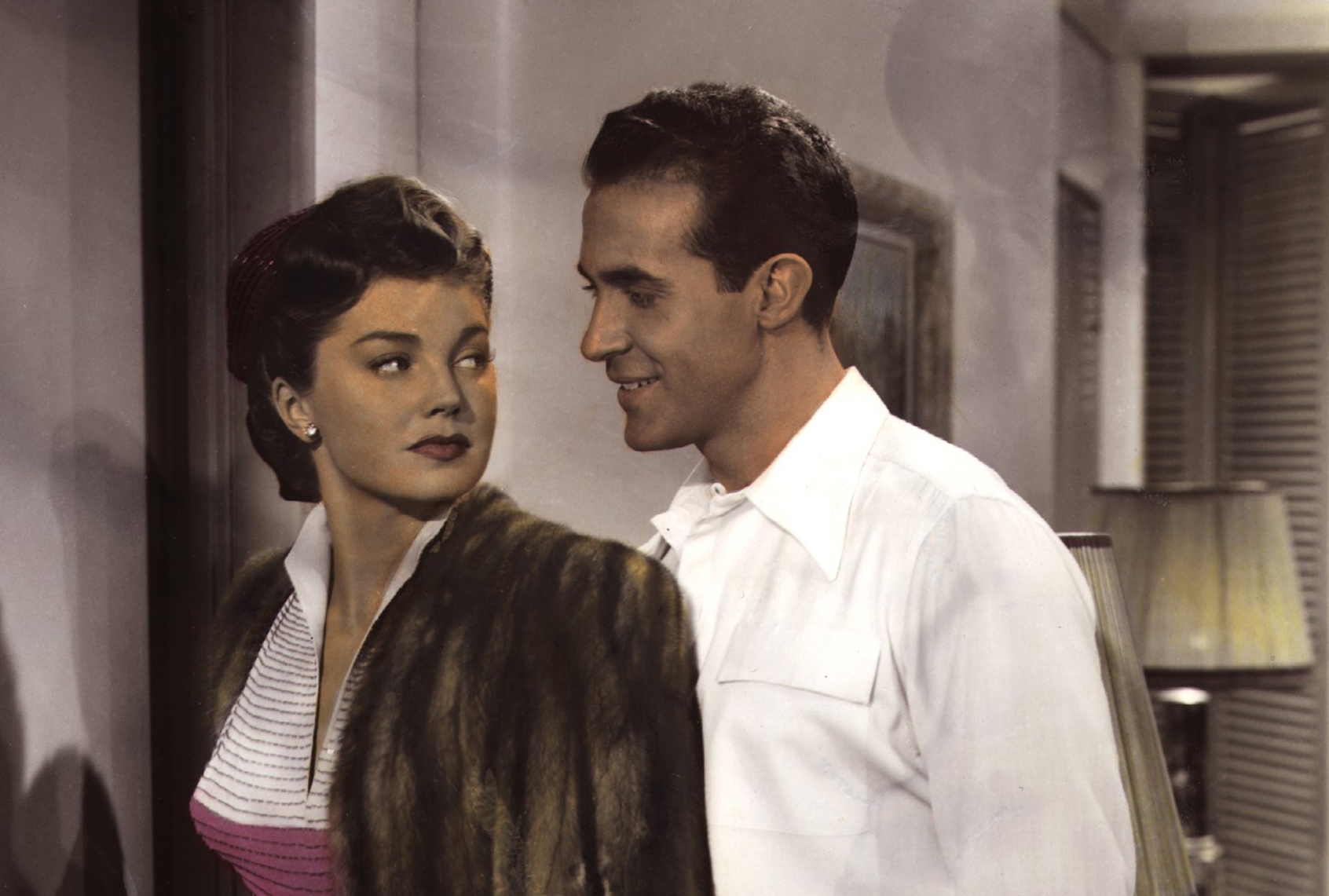
Esther Williams and Ricardo Montalbán in “Neptune’s Daughter” (1949) (FilmPublicityArchive/United Archives via Getty Images)

I’ve been attempting to parse my mixed feelings about this song for a while, but it wasn’t until I recalled the original way I saw the song performed that it gelled for me why some versions are more successful than others. And it was all right there from the beginning. 

Composer Frank Loesser’s song made its onscreen debut in MGM’s 1949 confection “Neptune’s Daughter,” which I caught on cable as a child. I was fascinated partly because of the pairing of Esther Williams – a swimmer who somehow became a marquee movie star – and a young Ricardo Montalbán, whom I only previously knew as Mr. Roarke from “Fantasy Island.” 

But watching the two perform “Baby, It’s Cold Outside” was also mesmerizing. Melodically the back-and-forth is dynamic and playful, and the intricately timed choreography reinforces this as an exciting courtship dance. The lyrics “I really can’t stay,” didn’t register with me that much because the performances – Williams calm and clever; Montalbán elegant and cheerful – feel balanced and, yes, consensual. At no point did I ever feel that the characters are at cross purposes. They are absolutely flirting.


Want a daily wrap-up of all the news and commentary Salon has to offer? Subscribe to our morning newsletter, Crash Course.


This for me is the key to the best covers of “Baby, It’s Cold Outside,” where both parties feel like equals entering into the duet. And a big part of that is context, which is why for me, the more multidimensional playacting performances trump the mere musical performances. (Although a master like Ella Fitzgerald can convey volumes vocally, which is why her duet with Louis Jordan is the gold standard.)

You see this in a 1986 performance of the song on “Saturday Night Live” between Sigourney Weaver and Buster Poindexter, in which she is draped over him for most of the song – her actions revealing her interest in him and reluctance to leave. The cover by Chris Colfer and Darren Criss for a “Glee” Christmas episode is also a sweet tribute, with both parties unable to keep their eyes off each other at the beginning of their burgeoning romance.

“Neptune’s Daughter,” however, also features a second performance of the song, one that horrified me. Red Skelton and Betty Garrett enter into a gender-flipped version of the song in which she plays the aggressor. Because of the duo’s fantastic slapstick skills (and perhaps owing to the subversive-for-the-time nature of the flipped narrative) her character is hands-on pushy to the point it made me anxious while watching it. 

I was reminded of my intense and longstanding distaste for Pepe Le Pew, that amorous, manhandling Looney Tunes skunk that has no regard for the cat he pursued. Skelton is literally trying to wriggle out of Garrett’s grasp. He even escapes her clutches, making it outside her quarters at one point until he realizes he’s wearing her coat not his. It was clear to me watching this that he wants to leave. When she switches off the lamp at the end of the song, presumably having her way with him, it feels foreboding. 

Yes, the two later continue to date and even become engaged, but that makes their initial hookup even more troubling, as if to perpetuate the idea that courtships are about “yes disguised as no.” And this discomfort is not even taking into account how Skelton’s character is there under false pretenses, putting on an atrocious Spanish accent after a case of mistaken identity. So yeah, I hated it. 

You can take your pick when it comes to creepy covers of “Baby It’s Cold Outside” that reveal an unbalanced power dynamic. There’s the Willie Nelson version where he croons to Norah Jones, who’s 46 years his junior. Or a mother-son duet (horrors!). Or the Selma Blair-Rainn Wilson one that allows her to be the aggressor, but concludes with them breaking the fourth wall and staring into the cameras (and our souls) for a GAP ad. 

And at the risk of angering the “Elf” fans, the duet between Zooey Deschanel and Will Ferrell is the ultimate in nonconsensual. She’s naked and singing to herself in the shower, while he lurks outside before surprising her by finishing the duet. I don’t care if he knows Santa. That should land him on the naughty list.

Consensual lyrics aren’t enough

Love HardNina Dobrev, Harry Shum, Jr. and Jimmy O. Yang in “Love Hard” (Bettina Strauss/Netflix)

Because of the rise of Me Too, “Baby, It’s Cold Outside” has had its reckoning of late, with a couple artists offering up new versions with “consensual” lyrics. While these do not come off as creepy per se, they haven’t made much of an impact either because they miss the mark of the original.

In 2016, musicians Lydia Liza and Josiah Lemanski offered up their version that emphasizes consent. Their acoustic song is gorgeously rendered, but lacks an engaging story. She really can’t stay  . . . and he’s cool with that. Repeat. Similarly, higher wattage doesn’t help when John Legend and Kelly Clarkson released Consent Version 2.0 three years later. Jazzier and with more production, it feels slick and similarly uninspired.

But these lyrics “fixed” the consent issue, so what more do the libs want? 

How about some narrative tension? Why in the world are we listening to two people agreeing that one person should vacate the premises? Even if she’s reluctant because of her romantic feelings, neither version seems to indicate this lyrically. Also, incredibly stilted lines like, “You reserve the right to say no,” or “It’s your body and your choice,” don’t help the mood either. No one talks like that in real life, and it’s counterintuitive to the chemistry built by the banter in the original song.

Legend’s version also includes him calling a rideshare for Clarkson, and the driver’s name is Murray. We know this because his name is repeated twice, which makes it seem that Legend is far more excited to see Murray than to stay with Clarkson.

All this brings us to the latest consensual version of the song heard in “Love Hard.” 

“That is like the sexual assault theme song!” Nina Dobrev’s character Natalie declares, as Jimmy O. Yang’s Josh convinces her to sing “Baby, It’s Cold Outside” with him during his family’s caroling outing. 

“This is what we’re gonna do, OK?” he says. “You just do your part. I will change my lyrics so the song doesn’t sound so, uh, rape-y.”

This setup alone already provides the necessary tension that has been missing in the previous two attempts. While the beginning sounds familiar, with Josh agreeing to her departure and offering to call her a car, the underlying subtext that we see onscreen is that he’s making the song safe and fun for her. She is charmed and surprised by his ingenuity and kindness, and what transpires is a duet that doubles as courtship. 

Since this is a rom-com based on a ridiculous premise – Josh catfishes Natalie on a dating app, and therefore must win her back as a friend before wooing her – the song itself skews towards lighthearted and funny. A sample of the updated lyrics:

Natalie: The neighbors might think –
Josh: It’s just my old friend Troy
Natalie: Say, what’s in this drink?
Josh: It’s just lemon La Croix

Josh also performs the song with a warmth and humor, finally pointing out in the lyrics Natalie’s apparent reluctance to leave. At one point he even cheekily sings, “I feel like you’re not trying [to leave] at all.” 

The reimagined song, named “Maybe Just Go Outside,” also functions to fulfill an essential element of the “fake dating” rom-com trope – that in the course of two people pretending to be a couple (in this case, to impress Josh’s family), the two fall for each other through displays of empathy and excellence. In fact, it provides one of the best examples of the couple’s chemistry in the film and allows Josh to prove himself through song.

In this way, this updated song in “Love Hard” continues the tradition that was started in “Neptune’s Daughter,” playing out a relationship with all the contextual clues, between two friends who come to an understanding over the course of singing together. 

While “Maybe Just Go Outside” is in no way amorous – and doesn’t lead to any immediate romantic overtures – it does what these other consensual versions could not. It actually focuses on the uncertain singer in a way that goes beyond lyrics. It puts her comfort and safety first, while also making her laugh. And isn’t that what we all want in a partner these days?

More stories you might like: 

Live performers find red state rules a tough act to follow

There was something a little different on stage at a recent performance of the musical “Sister Amnesia’s Country Western Nunsense Jamboree,” the first production for the Missoula Community Theatre since the beginning of the pandemic.

All the actors wore clear face masks. That way, the audience could better see the actors’ expressions, which is “a pretty big deal in live theater,” said Jess Heuermann, who played Sister Mary Wilhelm in the show.

Theater companies and musical ensembles looking to resume live performances are coming up with creative ways to make sure the show goes on safely, particularly in states that ban venues from imposing vaccine or mask requirements.

In states without such bans, productions can require proof of vaccines for cast, crew, administrative staffers and audience members to protect against transmission of the virus that causes covid-19. That’s what all 41 Broadway theaters in New York City have done.

Other performers and venues are taking additional measures. The Chicago Symphony, for example, is for now limiting performances to 90 minutes or less, with no intermission. A Rock Hall, Maryland, venue left the first row of seats empty, in addition to requiring masks and proof of vaccination, for a recent musical performance.

But raising the curtain has been more of a struggle in states like Montana, Florida and Texas, where the politicization of public health measures has found its way inside theaters.

Florida and Montana ban state and local governments from requiring masks, but private businesses and entities are allowed to do so. Montana prohibits both private employers and government entities from “discrimination based on vaccine status.” Florida Gov. Ron DeSantis barred businesses from requiring customers to show proof that they’d been vaccinated against covid. In October, Texas Gov. Greg Abbott banned private employers from issuing covid vaccine mandates.

Nine states — Arizona, Arkansas, Georgia, Indiana, New Hampshire, North Dakota, Oklahoma, Tennessee and Utah — also have varied restrictions on requiring proof of vaccines.

Some big-name performers are canceling shows over vaccine or mask bans. Singer Michael Bublé, for example, canceled a September show in Austin because the University of Texas arena said it could not impose a vaccine requirement for audience members. University officials said they were confident in their health and safety protocols.

Country singer Travis Tritt took the opposite stance. He canceled a series of shows at venues with mask and vaccine mandates or “pushing testing protocols on my fans.”

Local troupes and performers who had been on a pandemic hiatus don’t have that luxury. They must work with — or around — their state’s rules if they want to work at all.

A survey by the advocacy group Americans for the Arts found 99% of nonprofit arts groups canceled events during the pandemic, amounting to 557 million lost ticketed admissions as of July.

Though some losses have been offset by federal aid, most arts groups and performers are reporting significant financial losses.

In Montana, the Missoula Community Theatre has reduced capacity and eliminated assigned seating, allowing patrons to be spaced apart while still sitting next to their “bubble” of friends and family for performances. Some people who had lowered their masks after taking their seats raised them up again after an announcement just before the performance began that it was required.

“People came to the theater tonight because they know the theater is trying to keep everyone safe,” said Paula Jones, a retired nurse in attendance.

But some theater operators seem anxious about scaring away potential patrons with such rules. For instance, the recently renovated Alberta Bair Theater in Billings, Montana, whose normal capacity is 1,376, recommends patrons wear masks but does not require it.

In Florida, nine theaters in Sarasota, along with others in Miami and Tampa, joined to create a uniform set of requirements for theatergoers meant to get around that state’s ban on vaccine mandates. Audience members must show proof of vaccination or proof of a negative covid test conducted less than 72 hours before any performance.

Some people have complained about the policy to the Florida Department of Health, which can impose a $5,000 daily fine for violators of the state’s vaccine passport ban. Department officials have not acted on those complaints, but one small Sarasota theater canceled a scheduled November show, saying it feared the owners of the small operation couldn’t afford any fines.

Theater owners are also finding that a small percentage of people will resist their mask mandates, even after multiple reminders. If they try to impose a covid safety measure that isn’t barred by state law, individuals opposed to the rules will ignore it.

“It’s like playing whack-a-mole,” said Rebecca Hopkins, managing director of the Florida Studio Theatre in Sarasota. “As soon as you walk away from some people, they pull their masks down. We’ve had to tell people that ‘We’ve asked you three times politely that we require masks and if you can’t comply, you’ll have to go.'”

In Utah, the 360 singers in the Tabernacle Choir at Temple Square in Salt Lake City are vaccinated, along with the orchestra and anybody else who enters the rehearsal and performance space. A handful of singers declined vaccinations and were put on leave, according to choir president Michael Leavitt, the former Republican governor of Utah and President George W. Bush’s Health and Human Services secretary.

Additionally, every choir member is tested for covid before each rehearsal and performance. Performers are instructed to stay home if experiencing possible covid symptoms, including sniffles. The choir did, however, drop a mask mandate for singers during rehearsals after complaints that voices were being muffled. Mask-wearing is still required when the choir is not singing.

Orchestra members have the option to take off their masks while performing if they feel a mask inhibits their performance.

Most important, Leavitt said, the choir, which still hasn’t scheduled its first performance before an audience, is prepared to pull back rehearsals and performances if things go wrong. It hasn’t set rules for audiences when performances begin. Some state lawmakers have proposed blocking vaccine mandates.

“I have used the analogy of walking into a newly frozen lake. Take one step at a time. Listen for cracking and if we don’t hear any, we’ll move forward. If we do, we’ll scamper back to shore,” Leavitt said.

Since covid, performance groups are relying increasingly on members with medical backgrounds to advise them how to perform safely. That person for the Atlanta Symphony Orchestra is Dr. Susan Ray, a hospital epidemiologist and a soprano with the orchestra’s chorus.

Orchestra members now wear masks for both rehearsals and concerts. The choir is masked for rehearsals and plans to be masked for its first concert with the symphony, in December. The newly appointed conductor, Nathalie Stutzmann, does not wear a mask so she can better communicate with orchestra members, but is tested daily for covid.

Ray is confident the orchestra is taking all the right steps to protect the choir audience, including a requirement that audience members show proof of vaccination or a negative covid test. “But I’m still nervous,” Ray said. “We have a lot of chorus members with gray hair, and not everyone is nice and thin.”

People 65 and older are among those more likely to experience serious medical issues from covid, and obesity increases the risk.

Researchers from the University of Colorado-Boulder and the University of Maryland recently advised that while masks reduce the flow of droplets for both singers and instrumentalists, the quality of the filtering material and fit are key components of effectiveness.

They also found that the longer that musicians play and sing together, the greater the risk. They recommend breaks after rehearsing or performing for 30 minutes indoors and 60 minutes outdoors. And they also suggest leaving several feet of distance between musical instrument players and singers to reduce “aerosol flow.”

“I want to acknowledge the courage of the music directors and the teachers to go ahead and follow our suggestions in the face of all of this adversity, fear and worry,” said Shelly Miller, co-author of the study and a professor of mechanical and environmental engineering at Colorado-Boulder.

The Centers for Disease Control and Prevention says that more than 15 minutes of exposure in an enclosed space with poor ventilation in which an infectious person is shouting, singing or exercising can increase the risk of transmitting the virus.

Some college students hoping to prepare for future employment in the arts worried that canceled classes and performances due to covid might limit their future opportunities.

Lauren Bergen, 22, a senior theater student at Wagner College in Staten Island, New York, was so worried that she took the 2020-21 academic year off because of “so much potential for things to go wrong.”

Now, she’s back acting in Wagner College theater productions, and the school is following the same safety protocols required for Broadway shows.

Bergen’s first fall semester show was “Small Mouth Sounds,” a play chosen, in part, because it required actors to be “mostly silent,” according to Felicia Ruff, a Wagner College theater professor.

“We’ve very strategic in selecting shows that can be done safely,” Ruff said.


Subscribe to KHN’s free Morning Briefing.

Want to make a seasonal and splurge-worthy Thanksgiving dinner for $400? Here’s your menu for 4

A few weeks ago, I received an email from a reader named Carl who lives in Austin. “Hi, Salon Food team,” he wrote. “What Thanksgiving menu would you put together for a family of four for $40? What about $400?” 

Last Sunday, we published the answer to the first part of Carl’s question. The $40 menu — well, actually the $38.64 menu — includes game hens with cornbread stuffing, a citrusy shaved Brussels sprout salad, twice-baked sweet potatoes with honey-glazed pecans and an easy-to-make cranberry trifle.

Something you should know about me is that I thrive under budgetary constraints. Between you and me, I think liberal arts degree holders have an inherent ability to do the most with the least (perhaps born from being constantly reminded by friends, foes and family that we’re staring down a life of uncertain career opportunities?) and some of the best parties I’ve ever hosted or attended came in at $50, all totaled.

RELATED: Want to make a fun and festive Thanksgiving for $40? Here’s your menu

Plus, budget-friendly items like tinned fish, good beans and mocktails are now part of the greater culinary zeitgeist. That’s a godsend for cash-strapped hosts everywhere. 

All this to say, for me personally, the task of putting together a $40 menu for four was far less daunting than a $400 menu. 

Without a pressing budget, I was paralyzed by indecision for a few days. Where would I spend those additional $360? I eventually toyed around with a couple versions of this menu, some more decadent than others. I wanted something that played with the idea of luxury without turning into a caricature à la Salt Bae’s Nusr-Et Steakhouse and its infamous $1,170 gold-leaf crusted steak and $16 Red Bulls. 

Ultimately though, the budget went to where it should always go — to good food, good wine and good coffee (with a few special touches thrown in along the way). This menu first appeared in The Bite, Salon Food’s weekly newsletter. Be sure to subscribe for more special menus, recipes and collections from the Salon archives. If you have any questions about your own Thanksgiving plans, email us at food@salon.com. 


Want more great food writing and recipes? Subscribe to Salon Food’s newsletter, The Bite.


* * *

$400 Thanksgiving for Four
Parsnip soup with caviar crostini and creme fraiche ($81.82) 

I think parsnips are one of the most underrated fall vegetables. They have this nice nutty, earthy flavor that makes for a really nuanced soup without too much work. Cook them down with a simple combination of leeks, garlic, butter, whole and chicken stock and use an immersion blender for a smooth, thick soup. 

The soup would be absolutely delicious as-is, but it would be even better with a generous swirl of Russ & Daughters creme fraiche — which you can order on Goldbelly and is absolutely worth it — and a crisp crostini topped with a tiny dollop of Baika caviar.

Here’s the cost breakdown:

  • Leek ($1.99)
  • Unsalted butter ($0.80)
  • Garlic ($0.50)
  • Parsnips ($2.60)
  • Chicken stock ($2.49)
  • Whole milk ($2.99) 
  • Baika caviar ($62.00) 
  • Russ & Daughters creme fraiche ($5.50)
  • Crostini ($2.95) 

Pecan-crusted goat cheese, arugula, pomegranate molasses ($24.29)

Sometimes inspiration for a dish is born from really wanting to find a use for a special ingredient. That was the case here. I’ve wanted to play with pomegranate molasses, which is deeply concentrated pomegranate juice, for a while. I pair it with creamy and crispy pecan-crusted goat cheese medallions; make these by pulsing pecans with salt and pepper to taste into a coarse powder and pressing it gently into slices of firm goat cheese. Drizzle a sheet pan with olive oil and bake the medallions for about 12 minutes, flipping halfway through. 

Serve them on a bed of peppery arugula, dressed with pomegranate molasses. 

Here’s the cost breakdown:

  • Arugula ($3.00) 
  • Goat cheese ($6.00; four ounces) 
  • Pecan ($2.00) 
  • Olive oil ($0.50; 2 ounces) 
  • Pomegranate molasses ($12.99) 

Maple and pink peppercorn brined heritage turkey ($45.78)

If you really wanted to, you could easily eat up over half your budget with a huge, gorgeous heritage turkey. I opted here for an equally gorgeous, though smaller (10-pound) organic turkey from a regional farm. We’re keeping things simple with a flavorful brine made with sweet maple syrup, orange zest, fruity pink peppercorns, salt, onion and garlic powder. 

Dry brining is a method in which you coat a cut of meat — or a whole bird in this case — with a mixture of salt, spices and sometimes sugar and let it rest for a period of time. This both seasons the meat and ensures a moist final product because, during that resting period, the salt draws out the turkey’s natural juices, which are eventually reabsorbed into the meat.

In this version, maple syrup stands in for sugar. While it’s not technically a completely “dry” brine at that point, the resulting mixture has great flavor and is easier to spread all over the turkey.

The night before you’re ready to roast your turkey, combine the brine ingredients a small bowl until the mixture takes on the consistency of wet sand and rub it all over the turkey. Let it sit in the refrigerator overnight. The next day, coat that turkey in a stick of softened butter and roast. 

Here’s the cost breakdown:

  • Organic whole young turkey ($41.34)
  • Maple syrup ($0.70)
  • Orange zest ($0.79)
  • Pink peppercorns ($1.25) 
  • Onion powder ($0.26)
  • Garlic powder ($0.24) 
  • Kosher salt ($0.40) 
  • Butter ($0.80) 

Wild mushroom and apple-sage sausage dressing ($53.04)

Etsy is absolutely underrated when it comes to sourcing special ingredients; I used it to buy ramps earlier this year when they were in season from a small farm a few states over. It’s also a great place to find foraged items, like wild chanterelle mushrooms, which make for a tremendously flavorful base for this stuffing. 

Sauté them along with minced shallots and celery in a tablespoon of butter, followed by crumbled apple-sage sausage. It’s a popular variety that you can find at most grocery stores and butcher shops this time of year. 

Mix in torn, toasty country loaves from a local bakery (you can also order from some stellar bakeries, like Tartine, online) along with melted butter, a little chicken stock and a beaten egg. Arrange the dressing in a baking dish and zhush it up with some parsley. 

Here’s the cost breakdown:

  • Fresh-baked country loaves ($19.50) 
  • Foraged wild chanterelle mushrooms ($20.00; 1 pound) 
  • Parsley ($1.00)
  • Shallots ($1.80) 
  • Celery ($1.49) 
  • Apple-sage sausage ($4.49) 
  • Butter ($0.80) 
  • Chicken stock ($2.49)
  • Eggs ($1.47) 

Herby hasselback potatoes ($7.84)

Potatoes are a must on the Thanksgiving table and you could, of course, substitute in the typical mashed variety here, but I personally like a little crispiness. Bonus: Hasselback potatoes are really impressive looking, despite not requiring too much effort. Dress them up with rosemary and thyme before baking. Once they are out of the oven and slightly cooled, hit them with a handful of fresh parsley (a little smoked flaky sea salt wouldn’t hurt, either). 

Here’s the cost breakdown: 

  • Potatoes ($2.36; 4 potatoes)
  • Olive oil ($0.50)
  • Rosemary ($1.99)
  • Thyme ($1.99)
  • Parsley ($1.00) 

Green beans tossed with horseradish cream and panko breadcrumbs ($6.58) 

I like the idea of green bean casserole, even if I don’t always like the execution. It has almost everything going for it — the luxe texture from the “cream of whatever” soup, the crispiness of the French’s fried onions and the verdance of the green beans. However, there’s definitely room for improvement. When everything is tossed in a single casserole dish, the texture can become a little gloopy and the green beans lose a lot of their flavor. 

This dish is really simple. Blanch the green beans and toss them in ice water so they stay crisp and green. Meanwhile, whip together a quick béchamel — from the butter, flour and heavy cream — spiced with a little fresh, grated horseradish and a pinch of salt. The resulting sauce is velvety, punchy and a little funky. Fold it over the green beans until they are coated. 

Top each individual serving off with crispy panko breadcrumbs, toasted with olive oil and lemon zest. The brightness of the citrus plays really well against the creamy sauce. 

Here’s the cost breakdown: 

  • Green beans ($1.69)
  • Heavy cream ($1.99) 
  • Butter ($0.10)
  • Flour ($0.05) 
  • Horseradish ($0.42)
  • Lemon zest ($0.89) 
  • Panko breadcrumbs ($0.94) 
  • Olive oil ($0.50)

Bakery-bought Basque cheesecake with gold leaf ($84.95) 

One of the things that a bigger budget affords you as a host is the ability to outsource certain courses. For you, that may mean getting the turkey and dressing from a local restaurant or cocktail mixers from your favorite bar. For me, that means not having to dirty a pan making dessert. A friend of mine makes stunning Basque cheesecakes — which in the midst of holiday prepping I have no desire to even attempt to make myself. I will, however, sprinkle it with a little edible gold leaf upon its arrival just for an added sparkle. 

By the way, if you want to make your own simple Basque cheesecake, try your hand at Mary Elizabeth Williams’ version. It only requires seven ingredients and works without a springform pan. 

Here’s the cost breakdown:

  • Basque cheesecake ($75) 
  • Edible gold leaf ($9.95) 

Artisan coffee ($58) 

I will always pay good money for good coffee and Big Shoulders’ Gesha — sometimes called Geisha — coffee from Panama’s Hacienda La Esmeralda is some of the best. Make a pot to go with dinner and bag up any remaining beans for your guests to have the next morning. Before you do, sure to check out Maggie Hennessy’s guide to making better French press coffee.

Here’s the cost breakdown:

  • Big Shoulders’ Panama Hacienda La Esmeralda Gesha coffee ($58) 

Wine  ($35)

Lily’s Pet Nat, made with Chardonnay, has these tiny bubbles that burst into flavors of citrus, little hints of vanilla and honeysuckle and a touch of sweet brioche. It doesn’t overpower the more delicate courses like the parsnip soup, but it also cuts through the more decadent courses like the cheesecake and green beans with horseradish cream. Even if you don’t go with this wine, choosing something versatile and easy-to-sip is the way to go for a multi-course dinner.

Here’s the cost breakdown: 

  • 2020 Lily’s Pet Nat, Sparkling Chardonnay ($35)

Total cost: $397.30

There it is. A $400 Thanksgiving for four — likely with some leftovers for both you and your guests — that honestly feels really special. The food is wholesome and seasonal, with a few surprises thrown in. For more Thanksgiving advice, answers and tips, be sure to subscribe to The Bite and follow along here at Salon Food.

More of our favorite holiday dishes: 

“I am more than my procreative capacity”: The public and private grief of infertility

It’s a common feeling that many of us have when we get older. You think you know the life you’re going to have — and then your body tells a different story.

In her memoir “Flesh & Blood: Reflections on Infertility, Family, and Creating a Bountiful Life,” author N. West Moss does indeed share the tale of her experiences with pregnancy loss, hysterectomy and reinvention. But she also does so in way that’s self-reflective, intimate and often droll, as she grieves for the cervix “who never did anything to anyone” and grapples with facing a medical odyssey in a world in which “we don’t feel like we can admit that we’re ever sick, ever tired, ever injured.”

Salon spoke the author recently about the why she thinks of why unsolicited advice is “an act of aggression” and how the real story of her book is “about love.”

This conversation has been edited and condensed for clarity.

As you describe in the book, with your first pregnancy, you were very open about it. Then you have these miscarriages, and you go quiet. You become very private, and you say you don’t want to share about it, I think for very clear and completely understandable reasons. And then you write this book. What made you go full circle with sharing your story?

I don’t know. Writing memoir is a very public thing to do. But even when you’re writing memoir, you’re still protecting parts of your life and your heart. I don’t think we ever reveal ourselves completely. I have had friends of my husband’s think that they know me just from social media posts. It’s a funny thing. It’s like this public persona versus the private persona. I did share early on. I wrote a piece for The New York Times after a couple of the early miscarriages, and got a huge outpouring and felt great about it. And then I was exhausted physically. I was coming to terms with the ultimate decision I was going to be making, which is, let’s stop trying.

While I was wrestling with that, while the whole thing was coming into focus and I was going from hopeful and “Let’s keep going” to incrementally thinking, “No,” that’s when I went quiet. I start writing when I know what it is I have to say. There was a long period in there when I didn’t know what I had to say. I didn’t know what I thought. I didn’t know what my plan was. The noise of other people’s ideas and thoughts were problematic. So I went into my little cave, which wasn’t alone, but it just wasn’t public. It was my family and my husband.

Then at a certain point, years later, when I had this surgery and I got a little bit of narrative distance from all of it — the infertility, and then the hysterectomy and subsequent recovery, I had a lot to say. I had a lot to say to myself, and writing, I find to be quite cathartic. It’s how I’ve always processed everything, happiness, grief, confusion, through my writing.

Once I know what I have to say, I’m not a shy person. I have boundaries, so I know what I will share and what I won’t share. It was actually quite a lovely thing to write. I write a lot of drafts. My writing process is intense. By the time I had sold the book and was working with my editor at Algonquin, a lot of the emotional weight of it had kind of evaporated.

Every once in a while, as I write in the book, I still am hit by surprise grief or something like that. But for the most part, writing and writing and writing and revising and revising and revising makes you feel like, ugh, I’m sick of my own story to some extent. Which is very healthy. It’s healthy for me. It’s not like that story has to be my identity. I’ve moved through it to some extent. Now I’m already hearing from people who’ve read it, and that’s pretty powerful and very different too. 


Want more health and science stories in your inbox? Subscribe to Salon’s weekly newsletter The Vulgar Scientist.


You used the word “identity,” and that’s important. There’s a part in the book where you say, “I am more than my procreative capacity.” Because that’s how women are seen. Tell me why you wrote that line and what that means, to be more than your procreative identity.

There’s another part in the book about women over 50 being invisible. I’ve been told that a lot. I don’t feel it, and I refuse to accept it. I know what they’re saying. But I think that being seen as a projection of someone else’s vision of who you’re supposed to be is a kind of invisibility. Being younger and having people whistle or catcall or want to sleep with you is also a kind of invisibility. Being seen only as a sexual object or, an extension of that, a childbearing vessel, those all seem so limiting. I was raised by parents who were very cool about that kind of stuff. My mom and dad never were like, “I hope you’re going to have kids.”

Once I started getting pregnant, I started really being overjoyed at the prospect. I could see myself and my husband having a life with another creature that we had brought into it. That was was exciting and compelling. So it was coming to terms with my own disappointment more, in a way, than outside expectations.

A lot of people, as I was writing the book, were giving me feedback. I had two different agents who wanted me to be sadder about the hysterectomy, or wanted me to go into that more. I considered it. I just decided that wasn’t really my story. I understand that’s the story for a lot of people. It certainly came up, so it does get mentioned in the book. But I decided not to delve into it, because it didn’t feel that organic. It felt also like talking about that also felt like reinforcing this cultural imperative that’s put on women.

The working title of the book, for me, was “Fruitless.” I still love that title. There were a lot of people who felt that was too negative. That, I also bridle against. Can’t we feel like hell a little bit about these things and have our own version of it, that’s not a stereotyped version of what our grief is? It’s my own. It’s different from our everyone else’s. I want to be crabby about it a little bit, and also nonchalant when I feel like it. “Five steps of grieving” is a great concept, but in reality, it’s a lot messier and more circular. These attempts to label what we’re going through are just reductive.

When I finally had the book written, I realized I had a lot of gender stuff in there that I hadn’t even noticed. Like the praying mantis who’s male through the whole thing, and then has this egg sac, but Mom and I still call it “he.” And then there’s a list of questions that I wrote for McSweeney’s of what to ask my doctor. I do not want to be just one thing. I rail against that.

I think that the topic of women’s experiences, particularly of health and medicine, is so narrow. It’s often tied to our sexuality and our sexual viability, and anything that disrupts that is confusing to people.

We only have our stories to tell. One of the problems is that we have so few real stories like this that are told. So each person who’s telling the story carries so much weight, because they are almost inventing language to talk about these things in a void. Each person who contributes to the overall work on these subjects I think is adding their own language for other people to use. When I was going through this four and a half years ago, there was nothing I could find to read that either wasn’t written by a man, or was about out a catastrophic hysterectomy, or was wildly emotional. There was nothing that resonated for me.

I decided to write the book that I wished I’d had, that felt more like, this is nothing spectacular. This is a friend talking to you. This is a thing that happens to a lot of women. Let’s just demystify it and un-taboo it, if that’s a word.

I started the thing you’re not supposed to do, which is reading reviews on Goodreads. A few readers said things like, “it’s so graphic. I love her writing, but I wish she’d write about something else.” That just makes me want to double down.

It feels like, if we can watch cadavers being dissected on “CSI” and dead bodies in Central Park on “Law & Order SVU,” how on earth can we say that a woman talking frankly about bleeding and hysterectomy is too graphic in our culture? It speaks to just how shame-filled it still is. It’s still called a hysterectomy, for God’s sakes. The statistics from the CDC are that there are 600,000 women a year in America who get hysterectomies. We all know a lot of women who’ve had a hysterectomy, and no language to discuss it with our friends, I find.

RELATED: She was struggling with infertility. Her best friend was pregnant. Would their friendship survive?

I wanted to ask you about the things that people have said to you about motherhood. We’ve all had some version of some know-it-all telling us what we should do with our bodies. It really speaks to the way that women’s bodies are public property.

I have a good friend and neighbor who has five kids, and she and I joke. People give her a lot of grief for having five kids. “Why would you have so many kids?” “Are you crazy?” And then people give me grief for having no kids. When we both shared those stories a few years ago, it was a great relief because we said, “There’s no way to win, so I guess I’m just going to live my life.” It was a great moment.

You could have too many kids and not enough kids, and everyone has an opinion. Which I hate anyway. If you ask people’s opinions, there are few people who I want opinions from. There’s the people I love and people who I know love me. The rest of the world, I don’t understand what unsolicited advice is all about. It seems like an act of aggression to me.

I also recognize that even well-meaning people don’t know how to talk about stuff. I think a lot of people want to reach out and don’t know what to say. That’s where, I think, a lot of boneheaded comments come from. Like this woman who said, “Have you been blessed to have children?” I had to go lie down, basically. My reaction, I know, was sort of overreacting. Yet it caught me by surprise. It was a vulnerable moment.

Then she said, “Oh, well, you should adopt.” That’s a complicated, very personal thing. There are a million reasons we didn’t end up adopting, that I don’t share with strangers, you know. Then she said, “Well, get a dog.” I went and stood in the corner until my husband found me, because I couldn’t cope. Sometimes I can cope. And a lot of times I can’t.

The impulse is often to fix a problem rather than share the space. Because as long as you’re fixing somebody, you’re not empathizing with them.

There are a lot of things you can do. My dad died in 2013. And I have often thought, I wish people would ask about that. Not right after he died, but seven years later, 10 years later. Nothing deep, but I reach out to friends and I’ll say, “You know, I’m thinking about your mom. Do you still think about her a lot?” I get the most amazing stories and dreams they’ve had, or “Oh, yes. I’ve been cooking this dish…”

There are ways to engage with people that aren’t judgmental and that don’t shut things down. I think when people are shutting the conversation down, it’s discomfort, probably. It’s because we’re in a culture that doesn’t know how to talk about aging, that doesn’t know how to talk about illness. That doesn’t know how to talk about fertility without a lot of judgment.

The thing I hate even more than advice is pity. That’s another way that a lot of people enter into conversations. When someone is pitying, that’s the end of the conversation for me. Pity and contempt to me are like the same thing. It’s basically saying, “Poor you. I have it so much better and I feel really bad that my life is so good.”

For me, my reaction is like, Nope, I’m not going there. I did get a couple of phone calls from good friends, who had to tell me about their terrible experiences with hysterectomies right before surgery. One person who I adore, we’re on the phone and she just kept saying, “I don’t want to frighten you.” I did feel compassion even then, because I was okay. I knew I was going to be okay. I thought, “this person has never had an outlet to tell this story.” She perceives my surgery tomorrow as, “Thank God, someone I can talk to about this.”

This is a book about infertility and miscarriage and hysterectomy. Yet you very consciously frame the book around the mothers in your life, your mother and your grandmother. That feels like a very obviously deliberate choice.

The frame of the book is infertility, but the real story is love. Not to sound so goofy, but it’s a love story about my husband. That’s what I wanted to try and express what it feels like to have the miracle of a good relationship; the miracle of being cared for and the ways that at people display caring through gesture. It’s my husband holding up the corner of the blanket for me, or the way that my grandmother cared for me when I was little and I couldn’t sleep, the way my mother cared for me by, , bringing out coffee in my great great grandmother’s egg cup, because I couldn’t have very much. She found it and she was like, this’ll be fun and beautiful. There’s that whole aspect of it for me. The infertility is kind of incidental in that.

Part of what I was wrestling with as I was writing it, and maybe continue to wrestle with, is the family stories. I am the repository of the family stories, because I’m a writer, and because stories matter to me. A big part of my grief around my own inability to have children was, who’s going to tell their stories? Grandma’s story is over with her if I don’t tell it. I was always imagining telling it to a kid. That’s how I imagined sharing those stories. She was a big force, emotionally, in me writing the book. It was a delight to revisit her and spend time with her.

That feeling was of being part of a line of women who all have struggled with their own fertility and their own survival and overcoming things. What I love so much about all of them is that they never quit. And I don’t mean they never quit about having kids. I mean, they just never quit with life. This book took something that sucked and made something beautiful out of it. I feel like they would appreciate that. They would be standing on the sideline saying, “Way to not let life stop you in your tracks. Way to keep living. Way to keep going. And if you can’t create in one way, create in another way.”


More first person stories: 

DeSantis calls special session to prevent COVID-19 vaccination “coercion”

Florida Gov. Ron DeSantis, a Republican, called a special legislative session which commenced on Monday in a move aimed at blocking state efforts to institute vaccine mandates on businesses and government agencies. 

If successful, Florida – already one of twenty-six states already suing the Biden administration over its federal vaccine mandate – would become the first state to impose fines on businesses and hospitals that follow in Biden’s footsteps, according to CNN

“At the end of the day, we want people to be able to make informed decisions for themselves, but we’ve got to stop bossing people around,” DeSantis said last week, when he announced his bid for re-election. “We’ve got to stop the coercion. We’ve got to stop trying to browbeat people.”

“We’re going to be striking a blow for freedom,” the Florida governor added. 

According to The Washington Post, one of the measures in consideration would put Medicare- and Medicaid-certified workers in a double bind between Biden’s federal vaccination mandate and a potential state rule barring one. In the private sector, the bills would not bar vaccinate mandates but allow workers to apply for religious or medical exemptions. 

The session, the second of its kind this year, has been widely rebuked by state Democrats, who have accused the governor of using COVID-19 as a wedge issue to support his potential 2024 presidential bid. 


Want a daily wrap-up of all the news and commentary Salon has to offer? Subscribe to our morning newsletter, Crash Course.


RELATED: Trump serves notice to Ron DeSantis about his 2024 presidential election prospects

Democratic Florida Rep. Michael Grieco said that DeSantis wants “to throw some red meat to the base and keep them happy,” adding: “Decisions are being made based on politics, not based on the well-being and health and safety of Floridians.”

Over the course of the pandemic, DeSantis has repeatedly thwarted Democratic attempts to impose common sense health precautions in the Sunshine State. In May, DeSantis approved a bill that restricted schools, businesses, and government agencies from requiring proof of vaccination. Later in July, as Florida was experiencing a record uptick in COVID cases, the Republican governor formally barred schools from enforcing mask mandates, even when children under twelve were not eligible for vaccination. Several school administrations defied the order and a state judge ultimately shot it down. 

RELATED: Judge orders Florida to stop enforcing Ron DeSantis’ school mask mandate ban

In September, DeSantis made physician Joseph Ladapo the state’s new surgeon general. Ladapo, a staunch DeSantis supporter, has ties to a far-right group known for promoting unproven treatments to the virus and has repeatedly cast doubt over the efficacy of the vaccine, at one point saying that they’d “been treated almost like a religion. It’s just senseless.”

Since the start of the pandemic, Florida has seen about 3.67 million cases of coronavirus along with nearly 61,000 coronavirus deaths. Roughly 58% of the state’s population is fully vaccinated.

In the PBS doc “Storm Lake,” a tiny Iowa paper fights for the future of high-quality local news

“Storm Lake” is a folksy — and that’s meant as a term of endearment — documentary about a year in the life of the Storm Lake Times of Northern Iowa, the oldest continuously printed, twice-a-week newspaper in the country. With a circulation fo 3,000, the paper is a family affair: founded by John Cullen, who serves as publisher, the staff of ten also includes his brother, editor Art Cullen, with Art’s wife Dolores and son Tom working as reporters. In 2017, Art Cullen won a Pulitzer Prize for a series of editorials, making the Storm Lake Times the second-smallest paper to ever win a Pulitzer.  

Stories the paper covers include the 2020 Iowa caucuses (Alexandria Ocasio-Cortez, Bernie Sanders, Pete Buttigieg, Elizabeth Warren, and Jill Biden all make appearances); a Latino singer who works at the local Tyson food plant; members of the agricultural community, like Big John, a farmer; climate change; and, of course, a response to the pandemic. Filmmakers Beth Levison and Jerry Risius use these topics to address issues of democracy, the plight of the undocumented, freedom of the press, corporate takeover of farms, and other topical issues.

Throughout, Art Cullen remains an unflappable voice of reason — except when there’s a deadline. (And with good reason; every hour delay costs $100.)

RELATED: “Mayor Pete” director on capturing authenticity: “The process of campaigning is dehumanizing

Levison and Risius spoke with Salon about making the film, the importance of local news, and the shared future of newspapers and documentaries. 

How did you connect with Art and gain his trust to let you tell his and Storm Lake’s story, and what access did you have?

Jerry Risius: I grew up on a small farm in Iowa, even smaller than Storm Lake. Once I reached out to Art, and he learned of my Iowa-ness, he felt I was someone he could speak shorthand to and talk about farming and things Iowan. And there is a connection we had as journalists. We ask questions — who are you? what do you do? — and we definitely connected with him on the journalism and documentary side. It’s wasn’t an attempt to gain trust, but a real connection. 

Beth Levison: They were just so busy, and we didn’t get in their way. We shot and observed them and hung out with them. We didn’t ask them to do things that they didn’t do or didn’t normally do. The Iowa-ness was key. Dolores expressed such relief: “We don’t have to explain anything to you!” It was just spending time and following what was happening, and not expressing any kind of judgment and letting things happen. They were shocked when they saw the film and how it all did come together.

Every time we showed up, there was no pomp and circumstance. They were like, “Hi guys, great to see you. We’re really busy.”

What decisions did you make about your approach to the film, the topics you covered, and the style you employed — mostly verité, some interviews?

Levison: From the very beginning, once we got influx of cash to shoot Heartland Forum, we had this idea we would bookend the film with election day and include the caucuses, and that created a timeline of the democratic process in the film. But we knew we wanted to tell about struggle of newspaper and the role it was playing in the community. The conversation between Art and John, we asked them to speak to us about the struggle of newspapers. So, we were paying attention to that struggle and how it expressed itself. But it was ever-present on a day to day basis. We knew we wanted to show the value of the paper, so that meant us going out to see how they reported stories to show what they were doing.

We came to understand each Cullen’s individual role in the paper. Art is the editor. Delores does the human interest stories. Tom is hard news. John writes the checks. We knew what threads we had and where we were going, but we had no sense COVID was going to happen, which changed things. Art says he thinks it made the film better, and he’s probably right. 

“Storm Lake” allows you to illustrate the Iowa caucus process, talk about issues of immigration, politics, the economy, farming, big business and other subjects. Can you talk about the film’s (and by extension) the paper’s content and how a local story can have national or global impact? As Art says, a story can change the world — or at least your world.

Risius: Both Beth and I realized early on the true north of their reporting was that if it didn’t happen in Buena Vista County, it didn’t happen. Art says they are more interested if their garbage is picked up than if Elizabeth Warren is in town. As we learned about the Cullens and their roles in paper, we were thinking about all these things they were covering: Big Ag and labor issues, immigration and climate change, and we thought, how are we going to organize all of this? As we saw the edit come together, they were all naturally baked into the process and that’s the touchstone that cuts across universal themes. We have a micro story of a small community newspaper that touches on same theme everyone in the country is talking about. As we started editing, we realize it was all there. And it all came into relief during COVID.


Want a daily wrap-up of all the news and commentary Salon has to offer? Subscribe to our morning newsletter, Crash Course.


Levison: We went into the film wanting to just tell a story about the Cullens and the Storm Lake Times and how the paper reflects this local community back to the community itself. In the process, when we talk about climate change, Big Ag, immigration, they are massive, complex human constructs and issues, but they were playing out on a small scale and you can see how they are interconnected. Big John is a farming and agricultural story. Emmanuel [Trujillo, a Tyson employee] is an immigration story. But as the filmmaking proceeded, we saw how all interrelated it is. The beauty was seeing that on a small scale.

We didn’t intend to make a film that addressed these big national things, it was as we filmed that we realize this has national resonance. We got lucky not only to have Art, who is articulate and smart, and this family that was so fascinating. But also, that we were in this small town where these dynamics were visually at play.

I wonder if another key piece of it is that we directed together, and we were shooting and there wasn’t anyone on the outside. That had an impact on our ability to tell this story.

Do you think Art should change his business model and go weekly? Why try to produce two issues a week if it’s barely breaking even?

Risius: They have tried a couple of things. Art told us they lost $100,000 in the Aughts when they tried to go to a daily. Then they went back to biweekly. They did financial extrapolation and don’t think it would work as a weekly. Even though the last year has been rough, they feel they are turning a corner — but are not sure what’s around the corner. 

Levison: Every movie encapsulates a specific moment in time. Art has been very open. Five years ago, they would have said the print product is here to say. Now he is thinking in five to ten years, maybe they will go more heavily into digital, and a podcast is not off the table.

There is a line in the film about folks getting (fake news) from Facebook over breakfast, which emphasizes the need to be informed by a trusted source. What are your observations about the state of newspapers in particular and journalism in general today? Survival has been based on original reporting.

Levison: It’s funny, there’s this term out there now, “solutions” journalism. Dolores and Art never thought about it. But I recently thought she’s doing “solutions journalism” on small-town scale, telling happy stories about her community. With the film, what has been interesting is that we wanted to make a film that people enjoy; we hope the film has impact. What has taken us by surprise is how many people in the journalism world are taken with the film and want to use it to build the future of local news or show it to their community.

But it just seems like we are in this problematic, negative feedback loop right now. Newspapers are struggling and can’t do original reporting, that people expect or want to pay for. The newspapers are therefore not producing as “quality” a product. People are not buying it and they can’t do reportage and get out of this loop. At the same time, people are getting their news for free on social media.

There are so many forces at work, the loss of media literacy, and issues related to education that have nothing to do with journalism. Our education system is not keeping up. Newspapers are struggling across the country, and most readers don’t know about it. Art and John really communicate to their community that they are in trouble and that they need the community’s support. We have gotten a sense that not all newspapers do that, and people think their papers are going to be around forever. 

Risius: The Cullens are particularly special. Lorena López [editor in chief at the Iowa newspaper La Prensa] says there, it is the fake news. It’s Facebook. They live in the community. Art says we’re not given a license to be journalists. We are market driven. We will only be in business for as long as people buy our newspaper. It is a cycle: the market is failing, people are not buying and not putting advertising in, and they are trying to figure out the way through. At the same time, all these other news sources on social media are gaining traction and it creates a bigger issue.

Levison: There is also value to someone who sounds like you and talks like you when you are reading that voice. I think David Brooks and Maureen Dowd are fantastic, but someone who is speaking in the vernacular can be meaningful to a reader. To get news from someone who went to your high school.

Risius: If you read the Pulitzer Prize-winning columns Art wrote, he would be submitting articles to The Washington Post, and I would be shooting over his shoulder and he was getting edits back and they were almost all red. The skeleton of what he was writing was there, but they were removing all of the Iowa-ness of it. They wanted to create the liberal voice The Washington Post reader. They took out all the vernacular. 

There are discussions with La Prensa, the area Latino publication, about sharing articles and efforts to increase readership, help mom-and-pop outlets, and generate community goodwill. What did you see in terms of community engagement and change over the course of the period you covered the paper for the film? 

Risius: I showed up and a woman was there to talk to Art, and only John and Tom were there. They let me film this amazing discussion. Storm Lake has a meat packing plant, and she’s the journalist who writes for all six to eight towns around Iowa that read her paper. There are meat packing plants in all these towns, and they have immigrants — first generation — it is a real growing population. Her paper is all ad generated, and has its own business model. The Cullens realized early on they could not survive on the ads.

Levinson: Now that we’ve been steeped in the conversation about the paper, there is no one size fits all model. There is this idea that newspapers are all in competition with one another. This is not sustainable model anymore. Maybe there is a new model of newspapers coming together to ensure survival. This idea of let’s collaborate not compete, and see us all sink.

Given the difficulties that print journalism faces, what parallels do you see with documentary filmmaking? Your film is like a print newspaper, capturing a moment in time only. A great archival record, but almost out of date a day later, yet it still has importance, history and meaning. What are your thoughts?

Levison: I might cry answering this question. I’m also one of the cofounders of Documentary Producer Alliance. We have 500 members and advocate on health and welfare of larger documentary industry. When I make films, I experience something in parallel in front of the camera. It was true in the film with COVID. We were all facing uncertainty on every level. Art and the Cullens are fighting for a free independent press. I think that we are in a moment when independent documentary film is in peril when we have all these streamers and market forces. Everyone is competing for eyeballs. We are seeing the commodification and commercialization of nonfiction, and what that means for storytelling is problematic, and what that means for independent voices is problematic. If you are having to make something commercially viable to get your film made or make a living, that dictates what stories get told and who tells them.

This film is about the dangers of trusts, and vertical and horizonal integration. We are at this moment where the streamers have so much power, and they are horizontally integrating. Amazon is buying MGM. I just think it is scary. There was an IATSE strike about working conditions, and it is all about profit now, and when things become paramount, independent journalism and documentary films fall by wayside. It’s a really interesting moment in so many ways, and certainly, when it comes to media, journalism and documentary film. 

Risius: Many parallels. Even the style that we shot “Storm Lake” with — we went in thinking they are no-nonsense journalists, telling the story as it is, and we wanted to honor that. I am a cinematographer, and I shoot stylized. I will say, “We need a tilt and shift focus lens to create this crazy visual effect to pull people in…” but we wanted nothing like that. But we wanted simple no-nonsense storytelling, and that’s being coopted.

“Storm Lake” airs Monday, Nov. 15 on PBS. Check local listings. Watch the trailer below via YouTube.

Read more of Salon’s coverage of recent documentaries:

Is it safe to go to the movies again? Public health experts weigh in

At the beginning of the pandemic, when movie theaters around the country temporarily shuttered, our living rooms suddenly became our movie theaters. Gone were the days of meeting a friend or going on a date to the theater; Netflix and chill was the only option.

Yet as vaccination rates climb, and award season nears, movie theaters have been steadily reopening in most states; some recent theatrical releases, including the James Bond franchise’s “No Time To Die,” had huge releases (in more than 4,400 theaters in the case of the Bond flick).

Still, many consumers are hesitant to return to theaters, as weekly box office totals show: In the first week of November in 2019, domestic box offices posted $157,058,718 in ticket sales. In the same week in 2021, overall box office gross was only $88,381,531. 

Clearly, not all consumers are willing or ready to return to the cinemas again. Part of that may have to do with latent fears related to gathering in crowded spaces. But as vaccination rates continue to rise, are such fears grounded in science? 

Tellingly, many public health experts are unafraid of seeing movies in theaters — though, as they note, there are caveats. 

“I have not been to a movie theater yet because there hasn’t been a movie that I really wanted to see that was exclusively in theaters, as many are simultaneously available on streaming services,” said Amesh Adalja, a senior scholar at the Johns Hopkins Center for Health Security, last week. “However, ‘Ghostbusters: Afterlife’ comes out this Friday, and is only in theaters, so I will be there.”

Like most activities at this point in the pandemic, scientists now have a good sense of what is considered risky and what isn’t as risky. In the case of movies, risk is very dependent on whether movie theaters require masks or not. Masking, Adalja said, “will delimit outbreaks.”

Adalja added that since he is fully vaccinated and is “not someone who is trying to avoid an inevitable breakthrough infection at all costs,” he will go to see a movie that’s only available in theaters.

However, masking and vaccination guidelines in theaters do vary geographically, and are often very dependent on state and county laws. 

Regal Theatres, one of the largest theater chains in the country, states that masks aren’t required in their theaters unless mandated by state and local guidelines. If mandated, seated patrons can remove masks while eating and drinking. According to these guidelines, staff monitor the theater as a “standard practice” when possible. This appears to align with the industry’s CinemaSafe guidelines, which are followed by other top cinema companies, too.


Want more health and science stories in your inbox? Subscribe to Salon’s weekly newsletter The Vulgar Scientist.


As far as capacity limits go, which the CinemaSafe guidelines track, there are none in the U.S. at the moment. Notably, no major outbreaks have been linked to movie theaters to date.

As John Volckens, an aerosol scientist and professor in the Colorado School of Public Health at Colorado State University, explained to Salon, “‘safe’ or ‘risky’ is in the eye of the beholder.”

“Nothing is absolutely safe, but what I will say is that if you’re just breathing and not talking, you have made about 10 times fewer particles,” Volckens said. “And so being in a crowded space of other people being quiet, like a library or a theater is much less risky than being in a bar where everyone is talking or shouting to each other.”

Volckens recently co-authored a study that found singing produces 77 percent more respiratory aerosols than talking — an important finding as researchers now know that airborne transmission of infectious respiratory particles plays an important role in how the virus spreads. Volckens added that as a fully vaccinated and boostered individual, he feels comfortable going into a movie theater now wearing a mask.

“I will tell you that before my booster shot and before my children were vaccinated, I would not go there because I would want to protect them,” Volckens said. “But now that they’re all vaccinated, I would be comfortable going to watch a movie — assuming you know [the theater] had adequate ventilation, and I would wear a mask.”

According to a study published in the peer-reviewed journal Frontiers, the probability of infection and transmission in a movie theater decreases when patrons wear masks, social distance, and when there is proper ventilation.

But as Volckens noted, going to a movie theater can be considered a “less risky” activity than, say, going to a small bar where everyone is shouting over the music.

Why do we eat turkey on Thanksgiving?

Growing up in upstate New York, I used to wonder why we eat turkey on Thanksgiving.Throughout the year, we’d see all types of animals daily: squirrels and chipmunks scurrying; deer innocently dropping their heads into my mother’s shrubs for a nibble; even the occasional bear, clumsily sifting through our garbage in search of a late-night snack.

But turkeys, it seemed, mostly made their cameos on the cusp of fall (the worst possible time considering their signature party trick). Driving down windy roads, we’d see a cluster of the wild variety dart across the street—a hen leading a pack of small turkey chicks, aka “poults,” or the occasional male turkey, otherwise known as a “tom” or a “gobbler,” bright red waddle and fanned out tail feathers wiggling furiously as he ran to safety.

Don’t you know what’s going to happen to you? I’d think to myself. Soon enough, you’re going to become the Thanksgiving meal. Soon enough, my family members will be eating turkey for Thanksgiving dinner alongside pumpkin piegreen bean casserole, and mashed potatoes.

The History Of Thanksgiving

Thanksgiving occurs in the middle of the fall school semester, and in order to understand its history, we need to go back to American History class. For starters, we don’t eat turkey on Thanksgiving nowadays because the pilgrims at Plymouth Rock ate turkey on Thanksgiving. In 1789, President George Washington issued a proclamation for “a day of public thanksgiving and prayer.” Nearly a century later in 1863, during the midst of the Civil War, President Abraham Lincoln encouraged Americans to recognize the last Thursday of November as “a day of Thanksgiving.” Seven years later, Congress passed legislation declaring Thanksgiving a national holiday. And even then, the date was still up for debate. It wasn’t until 1941 that Thanksgiving would officially fall on the fourth Thursday in November of each year, per a resolution signed by President Roosevelt in the United States.

So, Why Do We Eat Turkey On Thanksgiving?

Well, you have Alexander Hamilton to thank for that. After George Washington encouraged Americans to celebrate the holiday, it is believed that Hamilton said, “No person should abstain from having turkey on Thanksgiving Day.” So there you have it. That is the origin of the main course, the one that leads to debates over white vs. dark meat, deep-fried vs. roasted turkey, and who will acquire the wistful wishbone.

Thanks to a first-hand account of the pilgrims’ harvest feast, written by colonist Edward Winslow in Mourt’s Relation: A Journal of the Pilgrims at Plymouth, we know a little bit about what they considered Thanksgiving food at the time. His recollection of the first Thanksgiving included no explicit mention of turkey, but did mention “wild fowl,” which could have referred to a number of different types of game. Turkey was not particularly prevalent in New England in 1621, so it’s unlikely that it was served, according to The Old Farmer’s Almanac.

According to the National Turkey Federation (an organization made up of humans, not turkeys), 88 percent of Americans eat turkey in one form or another on Thanksgiving. And the very reason that we eat them on this holiday is that they were abundant in the northeast during the first Thanksgiving celebrations years ago. Jonathan Gunther—environmental lawyer, avid outdoorsman, and this writer’s cousin—notes that turkeys become more active twice per year: in spring during mating season and again at the tailend of summer.

“They become more visible in late August possibly because they’ve finally grown to a certain size and are more mobile,” he tells me. “Also, they prepare for winter by loading up on grasshoppers and other bugs found in more open areas.”

So springtime they’re on the prowl and feeling frisky, but by end-of-summer, they’ve all but resigned to acquiring some extra winter pudge.

Sounds familiar.

My Own Thanksgiving Feast

Per tradition, most of us feel obliged to cook turkey on Thanksgiving. We might incorporate our own spin—deep-friedbrined, or preceded by a large serving of lasagna, like my Aunt Vicky—but turkey, in one form or another, remains the pièce de résistance on most Thanksgiving tables. Our home was no different.

Early in the morning, after coffee but still in pyjamas, my mom would start preparing the turkey. While giant cartoon characters floated down Fifth Avenue and packs of grown men chased each other around on football fields, the roasting aroma would drift throughout the house, luring us to the kitchen for a quick peek through the glass oven door. Using some of the drippings, my mom would start making the stuffing; closer to dinner, my dad, and later in life, my brother, would begin working the gravy.

At the table, my late grandfather would claim the “Pope’s nose” (though no one else ever wanted it anyway), aka the part of the turkey that supports the tail feathers, and make a spectacle of eating it. After dinner, two lucky hands would grab a side of the wishbone and pull in opposite directions. Following some television and a tryptophan-induced food coma, bread and mayonnaise would be splayed on the counter for the production of leftover sandwiches, with a layer of stuffing and a slice of cranberry sauce (“slice” because we’d always have the store-bought canned kind—which never loses its cylindrical shape, ridges and all.)

It’s Not Thanksgiving Without The Turkey—Or Is It?

There are various reasons for not eating the sacred bird on Thanksgiving. For starters, it’s not cheap—the average 12 pound turkey costs between $0.99 and $2.99 per pound, depending on if it is turkey. According to the Farm Bureau’s 35th annual survey, the average cost of a Thanksgiving feast in 2020 was just under $50 total (which frankly seems quite cheap). Then, there are the side stans and vegetarians, who opt for a smorgasbord of veggie-dishes, and maybe a loaf of tofurky to go with.

Despite my own nostalgia surrounding the ceremony of preparing and eating a turkey, I’m not the biggest fan. Frankly, the turkey isn’t the most sumptuous of birds—certain parts can be downright flaky. While some might have a special technique, like sous vide–ing their way to perfection (please, do yourself a favor and watch these bros and their sous-vide disaster), for most of us, the answer is gravy.

I count my one turkey-less Thanksgiving among the most memorable.

During a semester abroad, I was living in the dorms at the Cité Universitaire, a campus for foreign students in the 14th Arrondissement of Paris. In my building, the Collège Franco-Britannique, our communal kitchen was equipped with a sole toaster oven, in which you could heat things atop a bed of charred toaster crumbs. Most of my classmates were in similarly kitchenless situations—in student housing or 6th floor apartments only accessible by a rickety back elevator, traditionally the service entrance, with shared hallway bathrooms and a single hot plate for cooking.

We were an international bunch: from the U.S., Norway, Greece, Israel, France, Colombia, Germany, Canada, the Netherlands, and the Czech Republic. In late November, when the other estadounidensesAmericans and I began feeling a creeping sense of Thanksgiving FOMO, we decided to have a friendsgiving in Paris. The others were curious about this secular, American holiday. Our Norwegian classmate, Mai, who had a comfortable, adult-seeming apartment near Notre -Dame de Lorette, offered to host us.

We had no turkey or stuffing, or really any of the traditional dishes that a Thanksgiving meal is usually comprised of. But we bought several rotisserie chickens from the butcher shop, a dozen baguettes, and almost everyone prepared their favorite sides. And we spent the whole afternoon swapping dishes and stories, raising our glasses, and polishing off many bottles of French wine.

Maybe it was the Beaujolais. But as day turned to night and we continued to graze, I forgot about missing all the things I love about Thanksgiving in upstate New York—the foliage, the gobblers, the football games, and my mom’s stuffing—and enjoyed our ramshackle friendsgiving anyway.

Later it occurred to me that we had pulled it off. Because as long as you show up and commit to being a little more present and ceremonious for an otherwise ordinary Thursday meal, it will still feel like Thanksgiving—even without the turkey.

This year, my sister Mary Alice and her family are traveling from Dallas, Texas to spend the holiday at our apartment in Paris. My husband suggested we advance-order a turkey from the butcher. My response: Don’t bother.

Instead, let’s get a few roasted chickens from the boucherie on Rue des Martyrs. And we’ll make the sides so good, maybe my brother-in-law will forget he’s missing the Cowboys annual game back home. Together we’ll eat until we’re uncomfortably full and, of course, save some room for leftover sandwiches.

Recipe: Engagement Roast Chicken With Carrot Panzanella

Prep time: 20 minutes
Cook time: 1 hour
Serves:  (for dinner, plus a couple lunches)

Ingredients

  • 1/2 pound carrots, cut into 1-inch pieces on the bias
  • 1 medium red onion, thickly sliced
  • 2 teaspoons olive oil, plus 1 tablespoon for the chicken
  • Flaky sea salt, to taste, plus 2 teaspoons for the chicken
  • Freshly ground black pepper
  • 1 (3- to 3 1/2-pound) whole chicken
  • 1 lemon, halved, divided
  • 1/2 garlic clove, finely grated
  • 1/2 teaspoon anchovy paste, or 1 to 2 anchovy fillets, smashed to smithereens with a fork
  • 2 teaspoons malt vinegar (or any of your choice)
  • Pinch of red pepper flakes
  • Pinch of sugar
  • 4 ounces sourdough bread, crusts removed and torn into bite-size pieces
  • 1 bunch fresh Italian parsley, roughly chopped

Directions

  1. Preheat oven to 425°F.
  2. In a quarter sheet pan (the best vessel for crisping up a roast chicken), toss together the carrots, red onion, 2 teaspoons olive oil, and a little salt and pepper. (Don’t go too heavy on the seasoning here, as this is getting dressed in a vinaigrette later.)
  3. Perch the chicken on top of the vegetables, rubbing it with the remaining 1 tablespoon olive oil, and seasoning all sides (top, bottom, and inside cavity) with the 2 teaspoons salt and a very generous grinding of black pepper. Stuff the cavity with one of the lemon halves.
  4. Roast the chicken for 45 to 55 minutes, or until the thigh meat reaches 165°F. (Another trick is to just multiply the weight of your chicken by 15; in other words, go for about 15 minutes per pound.)
  5. Meanwhile, in a medium mixing bowl, whisk together the garlic, anchovy paste, vinegar, red pepper flakes, and the zest and juice of the other lemon half, and season to taste with salt, pepper, and sugar.
  6. Once the chicken is done roasting, remove the pan from the oven and carefully, with two forks, set the bird onto a wooden cutting board to rest for 10 minutes at least. Throw the roasted carrots and onions, along with all of the pan juices, into the bowl with the anchovy vinaigrette.
  7. Place the bread pieces onto the sheet pan you’ve just emptied and bake in the oven for 10 to 15 minutes, or until crispy. Throw into the salad bowl, along with the chopped parsley, and toss.
  8. Meanwhile, the chicken should have rested just the right amount of time. Carve it and plate a portion for yourself alongside some of the panzanella. Turn the chicken over and eat the two oysters before heading over to the television with your roast chicken dinner.
  9. Note: Store the rest of the chicken and panzanella in the fridge to eat throughout the week. (Don’t forget to save the carcass for stock later.)

Alex Jones found guilty, liable in all four Sandy Hook defamation suits after claiming “psychosis”

Far-right radio host Alex Jones, widely known for baselessly claiming that the Sandy Hook school shooting was a hoax, was found guilty in all four defamation suits filed by families of victims of the tragedy. 

The decision came on Tuesday, when a superior court in Connecticut handed down a sweeping win to the families of victims due to Jones’ “failure to produce critical material information that the plaintiffs needed to prove their claims,” according to Judge Barbara Bellis. The plaintiffs have broadly – and now successfully – argued that Jones stood to gain from promulgating damaging conspiracies about the tragedy. 

The ruling, which marks a conclusive end to the years-long suits, comes on the heels of three Texas rulings back in October that similarly found the “Infowars” host guilty by default. 

RELATED: Alex Jones cries foul after court rules he must pay for his Sandy Hook conspiracy theories

“The Court finds that Defendants’ failure to comply … is greatly aggravated by [their] consistent pattern of discovery abuse throughout similar cases pending before this Court,” Judge Maya Guerra Gamble wrote at the time. 

Jones, for his part, has vehemently denied ever profiting from his bogus claims, saying last month in an interview that “Sandy Hook is a blip on the radar screen in the different stories … I’ve covered.”

In a deposition from 2019, Jones claimed that his judgement was impoaired due to a “form of psychosis.”


Want a daily wrap-up of all the news and commentary Salon has to offer? Subscribe to our morning newsletter, Crash Course.


“I, myself, have almost had, like, a form of psychosis back in the past where I basically thought everything was staged, even though I’ve now learned a lot of times things aren’t staged,” he said at the time. “So I think as a pundit, someone giving an opinion, that, you know, my opinions have been wrong, but they were never wrong consciously to hurt people.”

RELATED: SCOTUS denies Alex Jones attempt to appeal sanctions for threats against Sandy Hook families’ lawyer

The tragedy took place back in December 2012, when 20-year-old Adam Lanza murdered 20 children and six adult staff at the Sandy Hook Elementary School in Newtown, Connecticut. 

Shortly following the shooting, Jones began to gin up baseless claims that the victims of Sandy Hook – and their families – were “crisis actors” in a false-flag operation perpetrated by the anti-gun lobby. Jones’ misinformation campaign reportedly provoked his listeners to harass the victims’ relatives, namely parents Leonard Pozner and Veronique De La Rosa, who later filed a suit of their own. Pozner has argued that he was forced to move several times as a result of death threats.

The judge is set to hold on hearing on the precise damages Jone will be expected to pay.

Is Mark Meadows next? Jan. 6 committee plans to “move very quickly” on criminal charges

The House committee investigating the Jan. 6 Capitol riot will “move quickly” to refer former White House chief of staff Mark Meadows to the Justice Department for criminal contempt charges after he refused to cooperate with the investigation, according to committee member Rep. Adam Schiff, D-Calif.

Meadows refused to appear for a deposition on Friday, citing Donald Trump’s dubious claim of post-presidential executive privilege after President Biden refused to shield White House documents subpoenaed by the committee. Schiff told NBC News on Sunday that the panel plans to refer the former top Trump aide to the Justice Department for criminal contempt over his refusal to comply with a congressional subpoena.

“I’m confident we’ll move very quickly with respect to Mr. Meadows also, but we want to make sure that we have the strongest possible case to present to the Justice Department and for the Justice Department to present to a grand jury,” said Schiff, who also chairs the House Intelligence Committee. “But when ultimately witnesses decide, as Meadows has, that they’re not even going to bother showing up, that they have that much contempt for the law, then it pretty much forces our hand, and we’ll move quickly.”

RELATED: “Presidents are not kings and plaintiff is not president”: Judge rules Trump can’t block Jan. 6 docs

Meadows, who previously served in the House and chaired the far-right Freedom Caucus, had a very different view on congressional subpoenas when he was in Congress, criticizing the Justice Department and then-Deputy Attorney General Rod Rosenstein in 2018 for “stonewalling” House subpoenas aimed at discrediting former special counsel Robert Mueller’s Russia probe.

“For nine months we’ve asked for documents. … And what we found is not only have subpoenas been ignored, but information has been hidden. The efforts have been stonewalled,” Meadows complained to Fox News host Laura Ingraham at the time. “It’s all about transparency, so the American people can judge for themselves. They may be able to ignore Congress but they can’t ignore the American people.”

The House voted to refer former Trump strategist Steve Bannon to the DOJ last month. A federal grand jury on Friday charged Bannon with two counts of contempt for refusing to appear for a deposition and refusing to turn over documents. Each charge carries a minimum of 30 days and up to one year in jail if he is convicted. Bannon surrendered to the FBI on Monday, flanked by attorney David Schoen, who also represented Trump in his second impeachment trial. Bannon is scheduled to be arraigned later on Monday.

“I view this as an early test of whether our democracy was recovering. If our law is to mean anything, it has to be applied equally,” Schiff told NBC News. “And so I’m very glad the Justice Department has moved forward in this fashion.”

Meadows, like Bannon, has argued that his communications with Trump are privileged. His lawyer said Thursday that Biden “is the first President to make no effort whatsoever to protect presidential communications from being the subject of compelled testimony. Mr. Meadows remains under the instructions of former President Trump to respect longstanding principles of executive privilege. It now appears the courts will have to resolve this conflict.”


Want a daily wrap-up of all the news and commentary Salon has to offer? Subscribe to our morning newsletter, Crash Course.


White House deputy counsel Jonathan Su said in a letter to Meadows last week that while executive privilege is important, Biden would not “shield information reflecting an effort to subvert the Constitution itself.”

“Consistent with President Biden’s determination that an assertion of privilege is not justified with respect to testimony and documents relating to these particular subjects, he has determined that he will not assert executive privilege with respect to your client’s deposition testimony on these subjects, or any documents your client may possess that bear on them,” Su wrote. “For the same reasons underlying his decisions on executive privilege, President Biden has determined that he will not assert immunity to preclude your client from testifying before the Select Committee.”

The committee is reviewing Meadows’ role in the days before the Capitol riot and in Trump’s efforts to pressure the Justice Department to help overturn his election loss. The committee has requested information related to Meadows’ role in Trump’s call to Georgia Secretary of State Brad Raffensperger pressuring him to “find” enough votes to overturn his loss and his communications with “organizers of the Jan. 6 events … high-level officials at the Department of Justice about federal investigations into purported voter fraud, and U.S. government officials during the attack at the Capitol.”

Meadows repeatedly tried to pressure the Justice Department to investigate Trump’s voter fraud allegations, which have been roundly rejected by the courts. Before Jan. 6, Meadows sent former Vice President Mike Pence’s top aide a memo written by Trump lawyer Jenna Ellis with a detailed plan for how Pence could block the certification of Biden’s electoral victory, according to ABC News’ Jon Karl’s upcoming book “Betrayal.” The memo claimed that Pence could disallow electoral votes from states Trump had lost narrowly, meaning that neither candidate would have a majority. If that happened, Ellis wrote, the election would be decided in the House of Representatives, where Republicans controlled the majority of state delegations.

Pence ultimately concluded that he did not have the power to block the results of the election before Trump sent a mob of his supporters to the Capitol on the afternoon of Jan. 6, where they attacked police officers and chanted, “Hang Mike Pence.” Trump defended his supporters’ threats in an interview with Karl.

“He could have — well, the people were very angry,” Trump said. “If you know a vote is fraudulent, right, how can you pass on a fraudulent vote to Congress? How can you do that?”

Read more on the aftermath of the Capitol insurrection:

From Kyle Rittenhouse to Steve Bannon, Republicans now openly embrace violent fascism

Despite weeks of worrying that Attorney General Merrick Garland didn’t have the guts, the good news finally came down: Former Donald Trump advisor and current fascist propagandist Steve Bannon is under indictment for refusing to honor a subpoena to testify before Congress. Additionally, the announcement appears to have empowered the January 6 commission to enforce its other subpoenas. Rep. Adam Schiff, D-Calif., says Congress will “move quickly” to do the same to former Trump chief of staff Mark Meadows, who is similarly refusing to answer questions about his role in Trump’s efforts to invalidate the 2020 election and the violent insurrection on the Capitol that ensued. 

Both Bannon and Meadows are clearly at the center of what is very much looking like an insurrectionist conspiracy helmed by Trump. As journalist Lindsay Beyerstein explained on Twitter, January 6 appears to be “an inside game and an outside game,” with the former focused on pressuring then-Vice President Mike “Pence steal the election procedurally” and the latter on using the violent mob “to terrorize potentially recalcitrant GOP reps into going along with the theft.” New reporting shows the extent to which Meadows was orchestrating the pressure campaign against Pence. Bannon was also in the thick of it and is on tape telling his  podcast listeners on Jan. 5 to “strap in” because “we’re pulling the trigger on something” and “we’re on the point of attack tomorrow.” 

Meadows and Bannon have always been prime examples of who wannabe fascist dictators like Trump depend on: the lickspittle and the aggro desk warrior, respectively. What really matters now is how the Republican Party responds to efforts to expose the role that Trump’s aides and allies played in the coup and the Capitol riot. And that reaction tells us all we need to know about who the GOP is now, and how far they’ve gone down the fascism rabbit hole. 


Want more Amanda Marcotte on politics? Subscribe to her newsletter Standing Room Only.


“Republicans are rallying around former White House adviser Stephen K. Bannon,” Amy Wang of the Washington Post reports, and “warning Democrats that they will go after Biden’s aides for unspecified reasons if they take back the House majority in next year’s midterm elections.”

The threat that Republicans will have a bunch of B.S. hearings to float right-wing conspiracy theories when they retake the House is meaningless, as they were going to do that no matter what. But it is relevant that they are defending Bannon, a human pile of chewed-up gum who barely even pretends not to see himself as the 21st century Joseph Goebbels. Republicans are no longer interested in upholding the pretense of support for peace and democracy. Embracing Bannon is embracing the ideology of violent fascism that led to the Capitol riot in the first place. 

RELATED: Beneath the Rittenhouse trial: Grim truths about the state of America

Outside of D.C., we see further evidence in this in the reaction to the trial of Kyle Rittenhouse, who shot three people, killing two, after picking up an illegally obtained AR-15 and going, totally uninvited and under the guise of “security,” to harass demonstrators at a Black Lives Matter protest.

In the euphemistic parlance of the mainstream media, this trial has “divided” Americans. “In Rittenhouse case, Americans see what they want to see,” reads a typical headline at the Associated Press, noting in the text that “he’s personified America’s polarization.”

That’s one way to put it. Another is to point out that Rittenhouse had no reason to even be at the protest, and would have been better off respecting the right of all Americans to protest and staying home, rather than trying to menace them with a gun. The rallying around Rittenhouse, as Ryan Busse of Giffords told the AP, is likely “empowering more actors like him who think it’s glamorous to go kill somebody with a rifle.” Historian John Baick linked the Rittenhouse advocacy to “military groups across the country, anti-mask protests, school board protests” — that is to say, a move among the GOP towards the view that violence and chaos is an acceptable response to political disagreement. 

Indeed, the celebration of Rittenhouse’s violence has been accompanied by Republicans in statehouses passing laws to make it easier to get away with killing left-wing protesters. As Jess Bidgood of the Boston Globe reported last month, “there have been scores of people hit, dozens of injuries, at least three deaths” due to right-wingers mowing down protesters with their cars. But rather than prosecute such people, “Oklahoma and 15 other states have considered bills protecting drivers,” and in many cases, they’ve passed them. 

RELATED: Cops and their allies have pushed hard for new wave of stringent anti-protest bills

The love for Rittenhouse — or similarly, the way Capitol insurrectionist Ashli Babbitt has been turned into a Trumpian martyr — is not an anomalous event. It’s a sign of a systematic shift across Republican America, in both the halls of power and at ordinary dinner tables, to the view that co-existence with liberal Americans is no longer possible. Conservatives continue to believe, despite the recent Virginia gubernatorial win, that they and their ideas cannot compete in free and fair elections. And so violence to crush the left is becoming an ever more acceptable answer in GOP circles. 

Late last week, ABC News reporter Jonathan Karl released audio of an interview in which Trump argues that it was “common sense” for his supporters who stormed the Capitol to be chanting “hang Mike Pence.” It was justified, Trump suggested, because “the people were very angry” and the “vote is fraudulent.” (The vote was not, in fact, fraudulent, and this is just a racist conspiracy theory like Trump’s other favorite racist conspiracy theory, that Barack Obama is not a natural-born citizen.) It’s clear that Trump continues to believe, as he did on January 6, that Pence both had the right and the obligation to simply declare the 2020 election null and void, even though there’s simply no legal or factual basis for the claim. And he sees violence in the name of trying to force this vision as justified and, in his words, “common sense.” 


Want more Amanda Marcotte on politics? Subscribe to her newsletter Standing Room Only.


But, of course, Republican leaders aren’t abandoning Trump over this. Instead, they bat away questions about whether or not such endorsements of political violence are a good idea. There’s absolutely no evidence this is slowing down Trump’s momentum for the 2024 GOP presidential nomination, which he has all but locked up nearly two and a half years before voting even starts. 

In their 2021 year out memo released Monday, the Democratic Congressional Campaign Committee wrote, “The moment Washington Republicans felt their grip on power loosen, they unleashed a full assault on American democracy, culminating in a murderous assault on the Capitol and the introduction of anti-voter legislation across the country.” 

This is not an exaggeration. If anything, it’s an understatement, if only because Democrats continue to sidestep the F-word. Understandably so — way too many Americans are still strapped to the “it can’t happen here” mentality, and check out mentally the second the word “fascism” is in play. But it’s all there in the GOP.

Republicans embrace violence to get their way. They promote a white nationalist definition of the national character. They display an eagerness to censor dissenting views, through violence or book-burning. And share a belief that the law is not about justice, but enshrining the power of a right-wing minority over everyone else. Theirs is an absolutist view of power and a rejection of democracy. Perhaps calling it by its name doesn’t help move the needle of public opinion or get voters to wake up any faster. But Trumpism is just fascism, and Trumpism is what the GOP is about these days. 

Steve Bannon’s criminal indictment is the best thing that’s ever happened to him

So Steve Bannon, former Trump adviser and current podcaster, got indicted on federal charges again. Last time he was charged with defrauding desperate MAGA donors with a scam called “We Build the Wall” that siphoned off a million dollars to cover his own personal expenses. With no care for his duped followers, Donald Trump granted Bannon a full pardon on his last day as president. Now Bannon stands accused of contempt of Congress for his refusal to respond to a congressional subpoena. He turned himself into authorities today — and it’s probably one of the best days of his life.

“We’re taking down the Biden regime,” he said with a sly smile facing a camera live-streaming his surrender in front of a D.C. courthouse. Bannon went on to promote Monday’s lineup for his War Room: Pandemic podcast before addressing his followers directly: “I want you guys to stay focused and stay on message. Remember. Signal not noise. This is all noise. That’s signal.”

The bipartisan congressional committee investigating the Jan. 6 Capitol riot subpoenaed Bannon because of the massive amounts of evidence that point to him being involved in plotting the attempted coup and his possible advanced knowledge of the insurrection. As Washington Post reporters Bob Woodward and Robert Costa point out in their book “Peril”: 

“Bannon told Trump to focus on January 6. That was the moment for a reckoning.

“‘People are going to go ‘What the [expletive] is going on here?’ Bannon believed. ‘We’re going to bury Biden on January 6th, [expletive] bury him.’

“If Republicans could cast enough of a shadow on Biden’s victory on January 6, Bannon said, it would be hard for Biden to govern. Millions of Americans would consider him illegitimate. They would ignore him. They would dismiss him and wait for Trump to run again.

“‘We are going to kill it in the crib. Kill the Biden presidency in the crib,’ he said.”

Sure, Trump may have persuaded himself that the election was stolen from him and believes it will be the rallying cry that will get him back to the White House in 2024. And it’s possible that Bannon had some advanced knowledge of some group like the Oath Keepers planning to invade the Capitol to stop the count. There’s no public evidence for that, however, except for his typically overwrought, macho-dude, rhetoric on his podcast the day before:

 “All hell is going to break loose tomorrow. It’s gonna be moving. It’s gonna be quick. And all I can say is strap in, the War Room, a posse. You have made this happen and tomorrow it’s game day.”

If you listen to his podcast, however, that’s how he talks about everything.

RELATED: The confrontation over Jan. 6: Conservatives seek martyrdom

Steve Bannon may or may not have thought that Trump could strong-arm Vice President Mike Pence to go along with their daft plan to refuse to certify the electoral votes of several states and send the issue to the House which would then certify the election for Trump. If he did, he almost certainly expected that the streets would immediately be flooded with angry Democratic voters, possibly leading to confrontations with police and maybe the military. And he wouldn’t be crazy to think so. But predicting the storming of the Capitol? That’s much more of a stretch. I’m not saying he couldn’t have known of some master plan but I haven’t seen any evidence of that.

Steve Bannon is not a stupid person. I suspect his goals were less dramatic, more strategic —and possibly even more consequential. He said it right out: The Big Lie makes it hard for Biden to govern because it denies him legitimacy in the eyes of half the country. This isn’t just about restoring Trump. It’s about destroying Biden’s presidency and delegitimizing democracy. It’s about creating chaos. And Bannon’s been agitating for that for many years.

RELATED: How Trump’s chaotic incompetence, and the “deconstruction” of the “deep state,” got us here

I think we all thought he had been banished from American politics once Trump kicked him to the curb after he got too much attention and bad-mouthed Trump to Michael Wolfe for his book “Fire and Fury.” Bannon tried to make himself into a kingmaker during the 2018 primaries but saw dismal results so he spent the next couple of years wandering around the world, connecting up with leaders of other authoritarian regimes, acting as something of an alt-right entrepreneur. Nothing much came of it, at least institutionally. Bannon’s ballyhooed global far-right movement he branded with an exceptionally catchy name, “The Movement,” failed to ever get off the ground. Likewise, his hopes to start a far-right Catholic political academy in an 800-year-old monastery in Italy were thwarted last March when The Council of State ruled against it after years of court battles. Bannon was designing the curriculum for the Academy for the Judeo-Christian West for Catholic activists in which, as The New Yorker’s Ben Munster put it, “a new class of right-wing ‘culture warriors’ would be trained.” Bannon told Munster that he saw it preparing the next generation of Tom Cottons, Mike Pompeos and Nikki Haleys, which sounds wholly unimaginative to me. Surely there are boatloads of young influencers and podcasters champing at the bit to get media training and learn all about  “Cultural Marxism, Radical Jihad, and the C.C.P.’s Global Information Warfare” and “The Early Church as a Business Enterprise.” 

RELATED: Steve Bannon’s second act: He’s back, and he wants to bring down the curtain on democracy

Bannon’s philosophy has been written about quite a bit, including by yours truly, because it is extremely radical and very, very weird. It’s all wacky mysticism mixed with antediluvian, pre-enlightenment, authoritarianism posing as nationalism based upon the writings of an obscure French writer named René Guénon from the early 20th century and the teachings of one of his followers (and Mussolini adviser) Julius Evola. (If you’re interested in going deep, these articles will fill you in.) The school of thought is called “Traditionalism” and it is like no tradition you’ve ever heard of. But Bannon is not alone with this philosophy. It’s held by members of far-right leaders’ inner circles throughout Europe and in places like Brazil and Russia. If there is an intellectual rationale for Trumpism beyond the Dear Leader cult of personality, this “traditionalism” is it.

It’s hard to know if Bannon has some kind of overarching plan or if he’s just winging it. He always sounds like he knows where he’s going but he never seems to get there and his foray into defrauding MAGA followers certainly gives credence to those who say that he’s just another Trumper on the grift. But it doesn’t really matter. Bannon being a “political prisoner” martyr to the cause works for him either way. He can make a mockery of the law with his antics and potentially turn any trial into a spectacle in order to foment more chaos and disillusionment in the country while, no doubt, making a tidy profit at it. As I said, from his perspective, being indicted for defying Congress is the best thing that ever happened to him. It’s made him relevant again. 

American democracy is on the treadmill of doom: How do we get off?

America is in deep trouble — and I say that not out of hatred but out of love. James Baldwin once explained that he loved America “more than any other country in the world and, exactly for this reason, I insist on the right to criticize her perpetually.”

With little fanfare, last Monday was World Freedom Day. President Biden offered an obligatory public statement, including the somewhat dubious claim that since the fall of the Berlin Wall 32 years ago, “we have seen great progress to advance human rights and fundamental freedoms as well as to build and consolidate democratic institutions across the formerly communist countries of Central and Eastern Europe and around the world.” But democracy, the president admitted, “remains under threat” in many parts of the world where “we see aspiring autocrats trample the rule of law, attack freedom of the press, and undermine an independent judiciary.”

Biden’s proclamation continues: 

Today, we reaffirm our commitment to the ideal that democracy — a Government of the people, by the people, and for the people — is how we best safeguard the rights, freedoms, and dignity that belong to every person. Together with other free nations, the United States remains committed to the vital work of strengthening our democratic institutions, defending civil society, advancing human rights, and holding those who commit abuses and foster corruption accountable.

It is a statement of what the United States wishes it were, not what it actually is, especially in this era of democracy crisis and ascendant neofascism. In total, there is something apprehensive and sad in this overly hopeful tribute, not to mention a hefty dose of denial. Biden’s proclamation almost sounds like the words of a president who knows his country is losing a war, yet tells the public: “Victory is imminent! Do not despair!”

Many Americans can sense the country’s inner turmoil and understand that something is very broken.

RELATED: Republicans would “rather end democracy” than turn away from Trump, says Harvard professor

That despair and feeling of wrongness reflect a deep intuition, even if our language is often insufficient to capture it, that this American interregnum will resolve itself in a period of chaotic transformation and perhaps the defeat of multiracial democracy. But many millions of people remain in denial about America’s escalating democracy crisis — or support the emerging fascist movement, mistaking it for “patriotism.”

The democracy advocacy organization Freedom House reports that the “democracy score” of the United States has decreased by 11 points since 2010, placing it in a group of countries with the largest such declines by that measure. As Freedom House reported in March, the Trump administration worsened that trend significantly:

The final weeks of the Trump presidency featured unprecedented attacks on one of the world’s most visible and influential democracies. After four years of condoning and indeed pardoning official malfeasance, ducking accountability for his own transgressions, and encouraging racist and right-wing extremists, the outgoing president openly strove to illegally overturn his loss at the polls, culminating in his incitement of an armed mob to disrupt Congress’s certification of the results. … Only a serious and sustained reform effort can repair the damage done during the Trump era to the perception and reality of basic rights and freedoms in the United States.

Groundbreaking research by the V-Dem institute at the University of Gothenburg in Sweden has found that the Republican Party has become so extreme that it more closely resembles openly right-wing authoritarian and fascist political parties in Europe and elsewhere than it does mainstream center-right parties like the Conservatives in Britain or the Christian Democratic Union in Germany.

As legal scholar Robert Kagan wrote in the Washington Post in September, “The United States is heading into its greatest political and constitutional crisis since the Civil War, with a reasonable chance over the next three to four years of incidents of mass violence, a breakdown of federal authority, and the division of the country into warring red and blue enclaves.” He concluded: 

We are already in a constitutional crisis. The destruction of democracy might not come until November 2024, but critical steps in that direction are happening now. In a little more than a year, it may become impossible to pass legislation to protect the electoral process in 2024. Now it is impossible only because anti-Trump Republicans, and even some Democrats, refuse to tinker with the filibuster. It is impossible because, despite all that has happened, some people still wish to be good Republicans even as they oppose Trump. These decisions will not wear well as the nation tumbles into full-blown crisis.

Social scientists, investigative journalists and other experts have shown that even before American neofascism’s rise that the country’s status as a “democracy” was already imperiled by the power of the richest Americans and corporate oligarchs to set the political agenda while the concerns of the average American are all but ignored by elected officials and other elites. 

The meaning and spirit of Biden’s World Freedom Day proclamation is further complicated by how much the world’s self-described “greatest democracy” now resembles the failed or aspiring democracies who supposedly look to it for inspiration.


Want a daily wrap-up of all the news and commentary Salon has to offer? Subscribe to our morning newsletter, Crash Course.


There are too many examples to list in full, beginning of course with the coup attempt and violent assault on the U.S. Capitol last January. That coup attempt was not decisively defeated. Republican fascists and their propaganda machine are using the Big Lie, claiming that the 2020 election was stolen and Biden’s presidency is illegitimate to further discredit and undermine American democracy.

That propaganda campaign has been highly effective: A large percentage if not majority of Republican voters believe that Trump is somehow still the real president, that the 2020 election was fraudulent, and the Democratic Party is an enemy of “real” Americans. Public opinion and other research has also shown that a large percentage of Republican voters and Trump supporters are willing to accept or condone political violence and other forms of terrorism in order to “protect” their “traditional way of life.”

Across the country, Republicans and their anti-democracy operatives are enacting laws and other policies (such as partisan gerrymandering) aimed at preventing Black and brown people and other Democratic Party’s constituencies from voting or otherwise receiving fair representation. Channeling the Jim Crow reign of terror, the Republicans are also using threats of violence and other forms of intimidation — including potentially armed “poll watchers” and “election police” — in an effort to suppress or restrict the votes of Black and brown people, among others.

In perhaps their greatest success, the Republican fascists, along with their propagandists and dream merchants, have also undermined the very idea of truth and empirical reality itself. Tens of millions of people exist in a right-wing echo chamber structured by conspiracy theory, anti-intellectualism, irrationality, hatred, and where authoritarianism is worshipped as a civic religion and personal identity. 

Too many liberals or “moderates” have deluded themselves into believing that rational dialogue or factual evidence can somehow persuade the Republican fascists and other members of the right wing to abandon their alternate reality. But such appeals to logic and reason hold little power over the emotional pleasures to be found in fascism.

Democratic leaders, the Biden administration and the Department of Justice are not acting with the necessary urgency to investigate and punish Donald Trump and other collaborators for the crimes of Jan. 6 and their ongoing coup attempt. Without the rule of law and justice, democracy will die.

America’s democracy crisis, when viewed in the context of the many other crises facing the country and the world, has led to the anxious coping behavior known as “doom-scrolling,” in which each individual dreadful event is lost amid many others in a never-ending stream.

We might more accurately described how the American people — at least those who are paying attention and remain invested in saving democracy — are stuck on a “doom treadmill,” which is creating a sense of physical, emotional, spiritual and intellectual exhaustion. The only way to escape is to run faster than the infernal machine forces those stuck on it — but most Americans lack the strength and endurance to do so.

What can be done?

Pro-democracy Americans must ally with others locally to find mutual aid and support in what will likely be a long struggle against American fascism. It’s not enough to support Democratic candidates and other “mainstream” political figures or organizations. Normal politics, almost by definition, is insufficient to defeat fascism. Political pragmatism will be required to prevail in this struggle.

Collective action will also be necessary — strikes, protests and other forms of corporeal politics and direct action — to confront and cause substantive consequences for those political leaders, businesses and organizations who support the Republican fascists and their movement.

Americans who support democracy need to share information, knowledge and other resources, in order to help create an alternative public sphere as a counterbalance to the Republican-fascist assault on truth and reality. As survivors of authoritarian regimes in other times and places have suggested, keeping a private journal is a valuable way to document the changes in society as neofascism gains power. When reality is under siege it becomes the responsibility of individuals and small groups to maintain some form of documentary record.

Democracy is a noun and a verb. Doing the work necessary to defend and reinvigorate American democracy will not be easy and cannot be understood as a short-term endeavor. As we have seen in the U.S. and other countries, this is likely to be an intergenerational struggle.

In a recent essay, anti-racism educator and activist Tim Wise observed: “Maintaining democracy, a livable planet, or a functioning society is like any other job. If you don’t work at it, it doesn’t get done.” Fascists, he noted, “are the only ones showing up and punching the clock. They don’t “take a break from the news,” and they don’t “do nomadism, digital or otherwise. They show the fuck up.”

Pro-democracy Americans must internalize the wisdom of others who have fought (and won) similar battles. That is certainly the best way to create solidarity and finding energy and inspiration for what will often be thankless or even dangerous political work.

The Italian philosopher and activist Antonio Gramsci famously spoke of the need for “pessimism of the intellect, optimism of the will” in the battle against authoritarianism. That combination will surely be necessary — but then the fundamental question becomes: Do the American people want a real democracy — and are enough of them willing to work and sacrifice to reclaim that possibility as reality? 

More from Salon on the Trump-era crisis of democracy:

Climate summit ends: Leaders reach “meek,” “weak” deal that falls short of 1.5°C goal

Faced with new research showing a significant gap between current commitments to cut planet-heating emissions and the Paris agreement’s 1.5°C target, negotiators from nearly 200 countries on Saturday struck a deal that critics say falls short of what is needed to tackle the climate emergency.

The agreement came out of COP26, the UN climate summit in Glasgow that was scheduled to wrap up Friday. As talks spilled over into Saturday, global campaigners expressed frustration with what they called “a clear betrayal by rich nations.”

That criticism of the European Union, U.K. and U.S. came early Saturday after they killed an effort by poor countries to create a new mechanism that would make rich nations pay for climate-related “loss and damage.”

Outrage over that omission and other elements of the Glasgow Climate Pact mounted — and mixed with some expressions of hope — as the meeting ended. Greenpeace International executive director Jennifer Morgan said in a statement about the deal that “it’s meek, it’s weak, and the 1.5°C goal is only just alive, but a signal has been sent that the era of coal is ending. And that matters.”

RELATED: As COP26 convenes in Glasgow, can a “climate action army” in the streets save the world?

While lamenting that “the offsets scam got a boost,” Morgan welcomed “progress on adaptation,” the recognition that vulnerable countries are already enduring loss and damage, a call for emissions cuts of 45% by 2030, and a line on phasing out coal and fossil fuel subsidies, which she said is “compromised but its very existence is nevertheless a breakthrough.”

Oil Change International executive director Elizabeth Bast said that “compared to just a few years ago, the progress and momentum made in the last two weeks towards phasing out fossil fuels is striking,” highlighting some specific wins from the U.K.-hosted conference.

“The joint commitment by nearly 40 countries and institutions to end public finance for oil, gas and coal projects overseas now puts pressure on all countries to end funding for all fossil fuels,” she said. “The Beyond Oil and Gas Alliance, launched by 12 countries and regions, is the first diplomatic initiative acknowledging the need for governments to manage the phase-out of fossil fuel production as a key tool to address the climate crisis.”

With the summit in Scotland now over, many activists are already setting their sights on COP27 in Egypt and demanding more progress.

“Glasgow was meant to deliver on firmly closing the gap to 1.5°C and that didn’t happen, but in 2022 nations will now have to come back with stronger targets,” said Morgan. “The only reason we got what we did is because young people, Indigenous leaders, activists and countries on the climate frontline forced concessions that were grudgingly given. Without them, these climate talks would have flopped completely.”


Want a daily wrap-up of all the news and commentary Salon has to offer? Subscribe to our morning newsletter, Crash Course.


Some activists framed this year’s talks as a total failure. As Sara Shaw, climate justice and energy program co-coordinator at Friends of the Earth International, put it: “The U.K. presidency and their allies are patting themselves on the back but no deal at all would have been better.”

“Perhaps it is no surprise that this was the moment a deal was finally forced through on carbon markets — a free pass for rich countries reluctant to cut emissions,” she said, noting the presence of fossil fuel lobbyists at the event. “This deal could mean a rise in global emissions and — combined with a weak commitment to ‘net-zero‘ by midcentury and the inclusion of seductive sounding ‘nature-based solutions‘ (read massive tree planting in the Global South) — will fuel a grabbing of Indigenous and developing countries’ land for carbon offsets, not to mention a rush for unproven technofixes.”

Grassroots Global Justice Alliance policy director Adrien Salazar said that “we came to COP26 with frontline Indigenous, Black, Asian, Pacific Islander and Arab leaders impacted by climate crisis, fossil fuel extraction and pollution. What we have witnessed here is another trade show for corporate and government schemes to evade real solutions that reduce emissions at the source, while they resist winding down fossil fuels.”

“This entire COP has been framed for net-zero targets, but net-zero and carbon offsetting schemes enable continued violence on vulnerable communities,” Salazar added. “We have been given smoke and mirrors in this agreement. Over 500 fossil fuel lobbyists were here at COP, more than any single delegation. Militaries, like the U.S. military — the largest single carbon emitter in the world — remain exempt from this climate agreement again. There is not enough in this document to protect human rights, and this outcome leaves far too many loopholes for fossil fuel corporations to continue their violent business model. People on the frontlines of climate chaos and extractive industry need real solutions and real reductions now.”

“It is nothing less than a scandal,” Shaw argued. “Just saying the words 1.5 degrees is meaningless if there is nothing in the agreement to deliver it. COP26 will be remembered as a betrayal of Global South countries — abandoned to the climate crisis with no money for the energy transition, adaptation or loss and damage.”

As The New York Times detailed Saturday:

A decade ago, the world’s wealthiest economies pledged to mobilize $100 billion per year in climate finance for poorer countries by 2020. But they are still falling short by tens of billions of dollars per year.

At the same time, only a small fraction of that climate aid to date has gone toward measures to help poorer countries cope with the hazards of a hotter planet, such as sea walls or early-warning systems for floods and droughts…

The new agreement tries to fill in some of those gaps. It calls out rich countries for failing to meet the $100 billion goal and urges them to “at least double” finance for adaptation by 2025. It also sets up a process for figuring out a collective goal for long-term finance, although that process could take years, and developing countries say they may ultimately need trillions of dollars by the end of the decade.

Shaw said that “the 150,000 people out on the streets for climate justice in Glasgow know the solutions to the climate crisis: a just transition to a world without fossil fuels and climate finance flowing from developed to developing countries. Disgracefully, rich countries opted instead for the Glasgow ‘get-out clause’ while hanging developing countries out to dry.”

While the two-week COP26 saw some participation from diplomats and activists of poor and frontline communities, Rachel Cleetus, a policy director and lead economist in the Climate and Energy Program at the Union of Concerned Scientists, noted that organizers of the event — which was delayed due to the COVID-19 pandemic — have come under fire for its exclusionary nature, and connected that criticism to the deal that emerged Saturday.

“The final COP26 decision is overwhelmingly compromised by countries that have contributed most greatly to the climate crisis,” Cleetus said, “and once again denies justice for climate-vulnerable developing countries already experiencing loss of lives, livelihoods, culturally significant sites and critical ecosystems.”

“It also reflects the pervasive access and equity issues that plagued the Glasgow talks from the start,” she continued. “Limited availability of COVID-19 vaccines in the Global South, a venue too small to accommodate those that made the difficult journey and glitchy technology shut out many negotiators and civil society members from participating in the process.”

Nick Dearden, director of the London-based group Global Justice Now, similarly called out the host government, declaring that “from the very start, the U.K. presidency set this summit up for failure. A sanitized COP, captured by corporate interests and inaccessible to the Global South, was never going to adequately or equitably respond to the climate crisis.”

Dearden celebrated that since the summit started on Oct. 31, “the climate justice movement that came out in force in Glasgow and around the world became mainstream.” However, he also said that “this hollowed-out agreement shows that, for all the lip service they paid, world leaders and big business have not listened.”

Warning the 1.5°C goal “may not yet be dead, but it is on life support,” he added that “the next COP must be a reckoning for the fossil fuel industry and the rich countries that caused the climate crisis. Anything less will consign us to devastation.”

Alok Sharma, the British politician who served as COP26 president, also recognized Saturday that more ambition going forward is essential.

“We can now say with credibility that we have kept 1.5 degrees alive,” Sharma said. “But, its pulse is weak and it will only survive if we keep our promises and translate commitments into rapid action.”

“It is up to all of us to sustain our lodestar of keeping 1.5 degrees within reach and to continue our efforts to get finance flowing and boost adaptation,” he added. “After the collective dedication which has delivered the Glasgow Climate Pact, our work here cannot be wasted.”

Martin Vilela, Latin America Climate Campaign coordinator at Corporate Accountability, was less optimistic, saying that “COP26 has effectively buried the opportunity to stabilize global temperatures below 1.5 degrees and condemned us to false solutions, impunity and irrationality.”

“Regardless of the success story that so-called leaders are selling to the world, we know that this only means more suffering for billions,” Vilela added. “We don’t believe them anymore! Now is the time to build solidarity with grassroots struggles that are challenging the powers and systems that have gotten us here, and build a just pathway forward.”

More from Salon on the climate crisis and the energy wars: