Spring Sale: Get 1 Year, Save 58%

Does chicken soup really help when you’re sick? A nutrition specialist explains

Preparing a bowl of chicken soup for a loved one when they're sick has been a common practice throughout the world for centuries. Today, generations from virtually every culture swear to the benefits of chicken soup. In the U.S., the dish is typically made with noodles, but different cultures prepare the soothing remedy their own way.

Chicken soup as a therapy can be traced back to 60 A.D. and Pedanius Dioscorides, an army surgeon who served under the Roman emperor Nero and whose five-volume medical encyclopedia was consulted by early healers for more than a millennium. But the origins of chicken soup go back thousands of years earlier, to ancient China.

So, with cold and flu season in full swing, it's worth asking: Is there any science to back the belief that it helps? Or does chicken soup serve as just a comforting placebo, that is, providing psychological benefit while we're sick, without an actual therapeutic benefit?

As a registered dietitian and professor of dietetics and nutrition, I'm well aware of the appeal of chicken soup: the warmth of the broth and the rich, savory flavors of the chicken, vegetables and noodles. What gives the soup that distinctive taste is "umami" — the fifth category of taste sensations, along with sweet, salty, sour and bitter. It is often described as having a "meaty" taste.


The notion that chicken soup is an elixir goes back centuries.


Improved appetite, better digestion

All that makes sense, because amino acids are the building blocks of proteins and the amino acid glutamate is found in foods with the umami taste. Not all umami foods are meat or poultry, however; cheese, mushrooms, miso and soy sauce have it too.

Studies show that taste, it turns out, is critical to the healing properties of chicken soup. When I see patients with upper respiratory illnesses, I notice many of them are suddenly eating less or not eating at all. This is because acute illnesses ignite an inflammatory response that can decrease your appetite. Not feeling like eating means you're unlikely to get the nutrition you need, which is hardly an optimal recipe for immune health and recovery from illness.

But evidence suggests that the umami taste in chicken soup may help spur a bigger appetite. Participants in one study said they felt hungrier after their first taste of a soup with umami flavor added in by researchers.

Other studies say umami may also improve nutrient digestion. Once our brains sense umami through the taste receptors on our tongues, our bodies prime our digestive tracts to absorb protein more easily.

This can reduce gastrointestinal symptoms, which many people experience when they're under the weather. Although most people don't associate upper respiratory infections with gastrointestinal symptoms, research in children has found that the flu virus increased abdominal pain, nausea, vomiting and diarrhea symptoms.


There are many ways to make chicken soup.


May reduce inflammation and stuffy nose

Inflammation is part of the body's natural response to injury or illness; inflammation occurs when white blood cells migrate to inflamed tissue to assist with healing. When this inflammatory process occurs in the upper airway, it results in common cold and flu symptoms, such as a stuffy or runny nose, sneezing, coughing and thickened mucus.

Conversely, lower white blood cell activity in the nasal passages can reduce inflammation. And interestingly, research shows that chicken soup can in fact lower the number of white blood cells traveling to inflamed tissues. It does this by directly inhibiting the ability of neutrophils, a type of white blood cell, to travel to the inflamed tissue.


Key ingredients

To truly understand the soothing and healing effects of chicken soup, it's important to consider the soup's ingredients. Not all chicken soups are packed with nutritious healing properties. For instance, the ultraprocessed canned versions of chicken soup, both with and without noodles, lack many of the antioxidants found in homemade versions. Most canned versions of chicken soup are nearly devoid of hearty vegetables.

The core nutrients in homemade versions of the soup are what set these varieties apart from canned versions. Chicken provides the body with a complete source of protein to combat infection. Vegetables supply a wide array of vitamins, minerals and antioxidants. If prepared the American way, noodles provide an easily digestible source of carbohydrate that your body uses for energy and recovery.

Even the warmth of chicken soup can help. Drinking the liquid and inhaling the vapors increase the temperature of nasal and respiratory passages, which loosens the thick mucus that often accompanies respiratory illnesses. Compared with hot water alone, studies show chicken soup is more effective at loosening mucus.

The herbs and spices sometimes used in chicken soup, such as pepper and garlic, also loosen mucus. The broth, which contains water and electrolytes, helps with rehydration.

So, to maximize the health benefits of chicken soup, I recommend a homemade variety, which can be prepared with carrots, celery, fresh garlic, herbs and spices, to name a few ingredients. But if you need a more convenient option, look at the ingredients and nutrition facts label and choose soups with a variety of vegetables over an ultraprocessed, nutrient-depleted kind.

In short, the latest science suggests that chicken soup — though not an out-and-out cure for colds and flu — really helps with healing. Looks like Grandma was right again.

Colby Teeman, Assistant Professor of Dietetics and Nutrition, University of Dayton

This article is republished from The Conversation under a Creative Commons license. Read the original article.

How a cybersecurity attack at Clorox caused a Hidden Valley Ranch shortage

As someone living in the Midwest, the region trains you to be on alert for certain troubling phenomena: the right conditions for a tornado, impending winter weather and the potential for a shortage of ranch dressing (both at the dinner table and on a more national level, too). 

We’re past tornado season and not yet quite eying down freezing fronts this year, which is maybe why I paid a bit more attention than usual to rumors of a Hidden Valley Ranch dressing shortage on the corners of the particular internet that care about such things. 

On TikTok last week, user Larissa (@rissy_roo_) filmed herself in the condiment aisle at Target. While most of the shelves were fully-stocked, the segment that typically holds Hidden Valley Ranch was totally empty. “I heard there was a ranch shortage, and I’m at the Tar-jay, and look what there isn’t any of,” Larissa says. “There’s no Hidden Valley Ranch. Hidden Valley, I need to know what’s going on.”

Similar observations began to pop up on the r/condiment subreddit, in a text thread with my hot wing-obsessed brothers and even in the “Non-Vegas” chat section of a Las Vegas city forum message board. “What fresh hell is this?” even one concerned resident wrote “Last week I noticed there were no dry packets of any of the Hidden Valley Ranch flavors  — dips or dressing at my local. The bottled was also low.” 

I’ll admit, briefly there was a part of me that wondered if there was a genuine run on the condiment because of the Taylor Swift “seemingly ranch” incident. After being spotted eating a chicken tender at a recent Kansas City Chiefs football game, a Taylor Swift fan account reported that the singer was “eating a piece of chicken with ketchup and seemingly ranch!" The unusually precise wording caught the internet’s collective interest, sparking an abundance of memes and an entire Heinz campaign

If anyone could single handedly break down the nation’s ranch dressing supply without lifting a finger, it would be Taylor Swift. However, the actual reason for the shortage is even weirder — and illuminates a troubling reality about our country’s food supply chain. It all starts with an August cybersecurity attack at Clorox. 

It all starts with an August cybersecurity attack at Clorox.

As ABC News reported, The Clorox Company detected "unauthorized activity on some of its Information Technology" on Aug. 14. The company took steps to "remediate the activity, including taking certain systems offline," per a September securities filing reviewed by the publication. 

"Clorox has already resumed production at the vast majority of its manufacturing sites and expects the ramp up to full production to occur over time. At this time, the Company cannot estimate how long it will take to resume fully normalized operations," the company said in the filing. 

In addition to producing bleach and sanitizing products, The Clorox Company also owns brands like PineSol, Fresh Step cat litter and (you guessed it) Hidden Valley Ranch. Representatives from the company have not commented on if it is known who carried out the cyberattack, but as a result of the attack, customers have started reporting shortages across the company’s brands: In September, the Washington Post reported that there was a cat litter shortage hitting the country; a day later, NPR warned listeners that they would have a harder time than usual finding Clorox wipes. Now, we’re seeing the impact on the condiment aisle, too. 

We need your help to stay independent

Because of the multilayered nature of this incident (the sentence “The Hidden Valley Ranch shortage is due to a cybersecurity attack at Clorox” is a weird one to write) it would be easy to think that it’s anomalous. However, if the current state of industrialized food production has shown us anything, it’s that as our supply chains continue to be both extended, and increasingly monopolized, the opportunity for bizarre breakdowns like this grows. 

As Salon Food reported in September, it’s been an interesting year within the realm of food safety and recalls; at the time, Trader Joe's had issued six voluntary recalls in five weeks, while companies like Hillshire Farms, Banquet and Skippy were warning customers that their groceries may contain foreign objects like plastic, stainless steel and even bone fragments. 

There are a number of reasons for this, but one omnipresent thread amidst discussions about changing technology and government oversight is that the distance between the origin point of our food and our plates is growing farther and farther apart with each passing decade; for instance, in 1870, 100% of all apples consumed in Iowa were also produced there, but by 1999, only 15% of apples consumed in Iowa were actually grown by Iowan farmers

In the case of food safety, this can make tracing individual contaminants particularly difficult, especially if there are mismatches in technology usage throughout the process. But in the case of the Hidden Valley Ranch shortage, it’s a reminder that often, we as consumers are often ignorant of who actually owns, crafts and manufactures the brands that are in our homes on a daily basis. 

In speaking with ABC News, Clorox has said they anticipate that this cybersecurity attack will impact 2023 and potentially 2024 profits. 

"Due to the order processing delays and elevated level of product outages, the Company now believes the impact will be material on Q1 financial results," the filing said. "It is premature for the Company to determine longer-term impact, including fiscal year outlook, given the ongoing recovery."

Trump fumes over leaked audio that alleges he demanded Melania parade around Mar-a-Lago in bikini

Donald Trump slammed a New York Times report on covert audio recordings that disclosed a series of unsavory claims about him, including various allegations from an Australian billionaire about his interactions with the former president. 

The New York Times on Sunday documented information contained within recordings shared with the publication by "60 Minutes Australia," which also aired commentary from magnate Anthony Pratt. The Australian businessman and Trump reportedly did not know each other well prior to the 2016 presidential election; however, Pratt soon "played the game," becoming a member at Trump's Mar-a-Lago resort, bolstering support for him publicly, and purchasing newspaper ads that endorsed Trump as a savvy job creator. In 2020, as Election Day approached, Pratt indicated via a message obtained by federal investigators that, '“If Potus is having his election party at mar Lago I’ll book as many rooms as available." As Salon's Heather Digby Parton points out, Pratt "did things like spend a million dollars for New Year's Eve party tickets that were sold to everyone else for $50,000."

However, despite Pratt and Trump's seemingly genial and financially lucrative affiliations, Pratt has since become wrapped up in the ex-president's legal woes, having already submitted to an interview with prosecutors in Trump's classified documents case in Florida. Pratt in the interview reportedly shared that Trump had told him secret information about American nuclear submarines, a claim which Trump has refuted. 

In the newly leaked audio, Pratt reportedly remarked that Trump's business tactics were "like the mafia," also claiming that Trump in 2019 shared aspects of a conversation with Iraq's leader days before a U.S. drone strike would hit Baghdad. Trump also allegedly discussed a scandalized phone call between himself and Ukrainian President Volodymyr Zelenskyy in which he effectively attempted to extort Zelenskyy's government. The call would play a pivotal role in Trump's first impeachment.  “That was nothing compared to what I usually do,” Trump reportedly said in Pratt’s recounting.

"The private comments," wrote Times' reporters Ben Protess, Maggie Haberman, Alan Feuer, and Jonathan Swan, "captured while Mr. Trump was still president, provide a rare glimpse into how a businessman on the other side of Mr. Trump’s transactions actually viewed the New York real estate developer’s tactics — with a mix of blunt acknowledgment and admiration for someone so willing to test the boundaries of the presidency."

Pratt in the audio clips also claimed that Trump asked his wife and former first lady Melania to parade around Mar-a-Lago in a bikini "so all the other guys could get a look at what they were missing," adding that Melania ultimately retorted “I’ll do that when you walk around with me in your bikini.” 

Trump blasted the report as "Fake News" on his TruthSocial platform late Sunday night, calling Pratt a "red-haired weirdo."

"The Failing New York Times story, leaked by Deranged Jack Smith and the Biden 'Political Opponent Abuser' DOJ, about a red haired weirdo from Australia, named Anthony Pratt, is Fake News," Trump fumed. "I never spoke to him about Submarines, but I did speak to him about creating jobs in Ohio and Pennsylvania, because that’s what I’m all about – JOBS, A GREAT ECONOMY, LOW TAXES, NO INFLATION, ENERGY DOMINANCE, STRONG BORDERS, NO ENDLESS WARS, LOW INTEREST RATES, and much more! Maggie Hagerman and the Misfits never called me for a comment. Why would they, they just write anything they want. Whether it’s correct or not is of ZERO importance to them. “All the News That’s Unfit To Print.” That’s why we call it the Fake News!"

We need your help to stay independent

Trump keeps stepping on the GOP’s so-called bombshells

The media has been so overwhelmed with news of the war in Israel and the trainwreck happening in slow motion in the House of Representatives that a lot of stories that would have normally received front-page treatment have been relegated to the back burner. When the news is emanating from the right-wing media, that's actually a good thing since it's almost never truly newsworthy and almost always a form of MAGA propaganda. A case in point is a breathless report released last Friday by the Chairman of the House Oversight Committee, Kentucky Rep. James Comer, announcing that Republicans have found evidence that President Joe Biden's brother paid him $200,000 in 2017, which is supposed to prove that the Bidens were part of some kind of criminal scheme. 

Upon examination, however, one can see that the check was marked as a repayment of a loan Joe Biden made to his brother a couple of months before, not a payoff of some sort. And furthermore, it was during the time that Joe Biden was completely out of office and hadn't even decided if he was going to run — three years later. Yet Republicans found this check and immediately started running around in circles shrieking "smoking gun! smoking gun!" 

Their reasoning is this: the repayment was sent on the day James Biden received a check for the same amount from a healthcare company (which later went bankrupt) that he had allegedly promised to get some investment from the Middle East due to his political connections. If that's true, then Biden's brother was influence peddling, just as Hunter Biden did in his various schemes. But there's nothing illegal in these people trading on their names no matter how slimy the practice. And it's certainly not confined to Biden's relatives or even just Democrats. Recall the activities of former President George H.W. Bush and his son Neil who parlayed their political contacts into big bucks from all over the world. Or Jared Kushner. 

We need your help to stay independent

Going back to the beginning of the republic, relatives of powerful politicians in America have made a bundle promising that they have special access and special interests giving them money based upon that promise. It's a shady business but unless there is some reason to believe that there is some reciprocation by a politician or some other benefit is exchanged it's usually just a lucrative game of perceptions, not unlike lobbying which, I would argue, is actually much more corrupt since the money is most often given right out in the open to the campaigns of the people they are trying to influence. Half of Washington, in both parties, is involved in that unseemly business. (And, once again, there is no evidence Joe Biden was personally involved in any of his son's or brothers' businesses.)

On Friday, Chairman Comer excitedly tweeted, "A document that we're releasing today raises new questions about how President Biden personally benefited from his family's shady influence peddling of his name and their access to him." The whole right-wing mediaverse went crazy with the usual suspects like Lauren Bobert tweeting, "Yesterday, the Oversight Committee unveiled a $200,000 check James Biden wrote to his brother on the same day he received a loan from a failing company. And it was even more than 10% for the Big Guy this time." 

After Democrats pushed back, Comer tweeted a video hedging his accusations just a little bit, saying "even if this was a personal loan repayment, it's still troubling that Joe Biden's ability to be paid back by his brother depended on the success of his family's shady financial dealings." Think about that. There's no evidence that Joe Biden knew anything about his brother's deal. All we know is that he loaned him some money and it was paid back. There's nothing "troubling" about any of that. Not to mention the fact that Joe Biden was a private citizen who didn't hold any office at the time. 

If you want "troubling," how about the latest revelations about the man James Comer and virtually the entire Republican caucus in Congress is supporting for president, Donald Trump? You'll recall a couple of weeks ago that it was reported Trump had shot his mouth off to a foreign businessman about the United States' nuclear submarine capabilities. Considering his sloppiness with all the classified documents he stole from the White House, this was hardly surprising. As president, he'd been known to share classified information with people who had no business getting it, putting allies and sources in danger in the process. He never cared. He never stopped. 

This man, an Australian billionaire by the name of Anthony Pratt, had Trump's number from the moment he became president and while he was unable to donate money to his campaign because he was a foreign national he saw a much more direct way to influence Trump: joining Mar-a-Lago. Pratt spent time there with Trump whenever he could. Trump liked him very much, especially when he did things like spend a million dollars for New Year's Eve party tickets that were sold to everyone else for $50,000. 

And Trump just loved to dish about national security with this big spender, telling him that he ordered the bombing of an Iraqi city before it had been reported and sharing that when the president of Iraq called to complain he said, "What are you going to do about it?" He claimed that his dealings with the Ukrainian president in the "perfect phone call" were nothing compared to what he usually did with foreign leaders. One shudders to think what he meant by that. 

All of this was reported in a big story in the NY Times on Sunday which was followed up by an Australian 60 Minutes report that has Pratt on tape discussing all of this. He considered Trump a sharp operator who "ran his business like the Mafia." 


Want a daily wrap-up of all the news and commentary Salon has to offer? Subscribe to our morning newsletter, Crash Course.


 As the Times reported:

Mr. Pratt was hardly the only favor seeker circling Mar-a-Lago, which became the fulcrum of the president’s two overlapping worlds, and a marketplace of sorts where favors, secrets and opportunities to lobby the president over clubhouse burgers were treated as currency. But Mr. Pratt, who rode in Mr. Trump’s motorcade and attended a White House state dinner, played the game better than most.

According to the Times, Pratt also made out like a bandit saving over $2 billion in taxes due to the 2017 tax cuts and dined out on America's national security secrets for years. This is just one of dozens of examples of Donald Trump getting paid directly by people seeking access and influence by spending vast sums of money at his properties and getting exactly what they paid for —- while Trump was the president of the United States. He is the most corrupt president in American history, blatantly selling access to rich people, foreign and domestic and these "drain the swamp" Republicans, howling about Joe Biden's brother paying back a loan, can't wait to put him back in the White House. 

All you need is a good blender and 3 ingredients for decadent, zesty lime ice cream

I highly recommend owning a Vitamix, which sounds like an asshole thing to say because they can run you around $500 bucks. For those who don't know, Vitamix is like the Rolls Royce of blenders: they’ve got super strong blades that can blend anything, even your forearm — so be careful — and they never (or at least rarely) break. I'm kind of a clumsy guy, and I've dropped mine a few times, but it still works like a charm. 

Full transparency: I did not buy my Vitamix from their website or a fancy department store. I actually got it from a guy named Trash Boy. We called him Trash Boy because that is precisely what he smelled like back when we played Little League.  The dude smelled so bad that the first word in your  mind when he came around was "Stink,” but we couldn't call him Stink because there were three other kids that already had that nickname in our neighborhood. Strangely, those guys didn't stink, and I felt like Trash Boy earned the name way more than they did, but that's what happens when you're young. You miss out on things like appropriate nicknames. 

"Yo, I got something for you," Trash Boy said on a call, "Something nice and fancy that I know you gonna love." 

I had no idea what he was talking about and was honestly a little offended that he thought I was the person to call when he had something nice and fancy. I didn't consider myself a fancy guy, especially then. I only wore sneakers, didn't own a suit and wasn't employed. I was working like ten odd jobs just to have enough to pay one set of bills. This guy has lost his mind, I thought. 

But still, I agreed to meet. 

I pulled up on Trash Boy, who has a reputation for selling items that fell off the back of a truck. I don't know where all of these trucks rolling around with broken doors were, but Trash Boy does, or at least he did before he was arrested for selling a fake Chanel bag — for an actual Chanel price — to the wrong lady. 

I didn't really buy stolen items, but that had nothing to do with morals, I wasn't buying anything because I was broke. That fact didn’t stop me from wanting to see what Trash Boy had special for me. I waited by my car, as he dipped into an alley and came out with a huge, beautiful box. Is that a…?

We need your help to stay independent

"Bro, this a $5000 food processing blender," Trash Boy said, "For you, $100." 

"That's a Vitamix!" I said, "They don't cost $5000, but let me give you this $100 before you change your mind! Got damn, Trash, you are right, I am fancy!" 

That was the story behind my very first Vitamix. I've since bought three different kinds of Vitamixes, all at discounted prices. With those magical machines, I've made salsa, smoothies, sauces, baby food, and the most delicious ice cream, a quick recipe I'm excited about sharing with you. 

Lime ice cream 
Yields
4 servings
Prep Time
1 hours 10 minutes
Cook Time
0 minutes

Ingredients

3 limes 

13 ounces of oat milk 

½ cup of agave nectar


Directions

  1. Clean limes and chop off the ends.

  2. Add all ingredients into the Vitamix and blend until smooth.

  3. Pour contents into a large silicon icetray and freeze for 1 hour 

  4. Serve


More than the law: Why Trump’s trials trigger him so much

Donald Trump does not like to be told what to do by anyone or otherwise have limits put on his behavior. That type of oppositional behavior is rooted in Trump’s childhood where he showed great pleasure in acting as a destroyer who refused to listen to his father. Trump’s delinquent behavior eventually led to him being sent away to military school. As Trump grew into adulthood, he would continue with his antisocial behavior, including a deep ideation for and attraction to violence and other antihuman behavior. In his mind, Trump is always a winner and has no use for “losers” or human weakness. Trump believes that he possesses “superior” genes and intelligence because of his German ancestry. In 21st-century reality, however, women and black and brown people, at least on paper, still have the same fundamental rights as rich white men like Trump. This means that black and brown people and women can be judges, prosecutors, attorneys generals, and other members of the courts and law enforcement with the power to hold rich white men like Trump accountable for his misdeeds and lawbreaking.

At his core, Donald Trump is a bully and a human predator – and loves being one. In many ways Trump’s defiant behavior and drive was responsible for his business “success” (along with millions of dollars from his father) and then taking the White House in 2020. He is an egomaniac, a fabulist, and a megalomaniac who believes that he has godlike powers. Trump loves conflict and humiliating his perceived enemies, be that in his personal relationships, business, politics, and in life more generally.

Trump is 77 years old. He is not going to change. When Trump must exercise restraint in his behavior and act in a reasonable and responsible manner more generally, he lashes out and rages. This is not the behavior of a private citizen; Trump is one of the most powerful people in the country and the leader of a tens of millions strong neofascist movement. In his role as leader of the Republican Party and the American neofascist movement, Trump will become the country’s first de facto dictator if he wins back the White House in 2025. These plans are detailed in Trump’s Agenda 47 as well as in Project 2025 and the “Red Caesar” scenario.

If Trump and the Republican fascists and larger white right are successful in their revolutionary plans to end America’s pluralistic multiracial democracy the civil and human rights of black and brown people, women, the LGBTQI community and other marginalized people will be significantly taken away, rolled back to a time at least until the 1950s if not the 19th century or before. When Trump and the other Republican fascists and “conservatives” talk about a return to “traditional values” and “restoring America” and “the good old days” and “Making America Great Again” what they really mean is a return to the near total control and power enjoyed by white men as a group in American society over others.

In a recent conversation with Salon, Journalist Katherine Stewart described what such an America will be like:

[W]e can say, broadly speaking, that there will be privileged groups in society, those who adhere to the “correct” religious and political viewpoints, and those who are despised and disfavored.

The far-right seeks to impose a culture of majoritarian fear, where if you don’t conform to a certain prototypical expectation and are not part of the “in-group,” then you are going to feel out of place and may have difficulty in the society they wish to create. We know from history that the people in the in-group often don’t end up feeling better either. They feel pressure to conform, and they live in a state of fear. It’s not a happy cultural place.

For members of disfavored groups, some of your most important life decisions may be out of your control; your vote may be marginalized; and an even larger share of your tax dollars will be funding other peoples’ religion.

This is the world that Trump was born into and socialized by; he desperately wants to return to it.

The idea and reality that a woman, never mind a black or brown woman could have such power is a type of narcissistic injury to Trump and his followers because of their collective investment in white supremacy, white privilege, hostile sexism, misogyny, and authoritarianism. Now Trump is forced to stand trial in a court presided over by black women such as U.S. District Judge Tanya Chutkan in Washington D.C., who is presiding over the federal trial for interfering in the 2020 Election, or Fulton County District Attorney Fani Willis, who indicted Trump and 18 others for their alleged efforts to rig the presidential election results in Georgia, or New York Attorney General Letitia James, who is responsible for Trump being put on trial for fraud and other financial crimes.

Trump has been transparent and direct with such feelings of angst and rage and white entitlement. Trump has attacked the black women (and black men) who are attempting to hold him accountable under the law with thinly coded racial slurs such as “thugs” and “criminals” and saying they are “corrupt”. Trump went so far as to attack prosecutor Letitia James as a “racist” “monster”. In his white rage temper tantrums, Trump has repeatedly claimed that he, a rich white man, is a “victim” of “racism” because he is finally being held accountable for his decades-long public crime spree.


Want a daily wrap-up of all the news and commentary Salon has to offer? Subscribe to our morning newsletter, Crash Course.


Last Monday, Judge Chutkan issued a limited gag order on Trump regarding the trial for Jan. 6 and the larger plot to steal the 2020 Election. 

“Mr. Trump is a criminal defendant," Chutkan made clear. "He is facing four felony charges. He is under the supervision of the criminal justice system and he must follow his conditions of release.” 

The judge was direct in her concerns about how Trump has repeatedly used the word “thug”:

“When you start to use a word like ‘thug’ to describe a prosecutor doing their job, that wouldn’t be allowed by any other criminal defendant,” Chutkan said. “Just because the defendant is running a political campaign does not allow him to do whatever he wants.”

"After Lauro launched back into sharp arguments about Trump's free speech rights, Chutkan sought to steer him back to the particulars of the gag order litigation: 'I do not need to hear any campaign rhetoric in my court,'" reported The Messenger's Steve Reilly.

Chutkan continued to "chafe" at Lauro's arguments during the hearing.

"'Obviously you have an audience other than me in mind,' she says, still pressing him to explain why Trump needs to call prosecutors 'thugs,'" Politico's Kyle Cheney reported.

At one point, Chutkan "literally" laughed in Lauro's face after he argued that Trump had abided by his pre-trial release conditions.

Judge Chutkan is not intimidated or impressed by Trump and his legal team’s attempts to delay and disrupt the trial. Such confidence and competence by a black woman is infuriating to Donald Trump and people who share his hostility towards black people and women. Unable to keep quiet even under threat of a gag order, Trump continued to attack Judge Chutkan later that same day.

We need your help to stay independent

“They think the only way they can catch me is to stop me from speaking. They want to take away my voice and a judge gave a gag order today,” Trump said during a rally in Clive, Iowa. “Did you hear that? On speech, which I believe is totally unconstitutional what she did. A judge gave a gag order, a judge doesn’t like me too much.”

By comparison, Donald Trump is very pleased that Judge Aileen Cannon, a white woman who he appointed to the court, appears to be following his directives in how she is presiding so favorably — to the consternation of legal experts and the Department of Justice — over the classified documents case in Florida. For Trump, and others who share his regressive worldview about race and gender, that is as it should be.

Given his demonstrated hostility towards black people and women, I have no doubt about the racist and misogynistic words and thoughts – those two or three vile and hateful words – that Trump is in all probability repeating over and over again inside of his head.

Because he lacks an effective internal censor, Trump has a habit of speaking his private thoughts publicly. I sincerely hope that Trump lets out his hateful thoughts towards Judge Chutkan (and/or the other black women — and men — who are working so hard to defend democracy and the rule of law by holding the ex-president accountable) during an interview or is caught on a “hot mic” unawares. Alternatively, perhaps Trump will quietly mutter or mouth that hateful language while in court in a moment when he is being admonished for his bad behavior or finally found "guilty" for his crimes, and a lip-reader or other such skilled observer will communicate them on the evening news.

But here is the problem: If Donald Trump’s racism and sexism is “revealed” again in such a manner it will only confirm what the public knows about him. And given how Trump’s racism and sexism are a central part of his appeal, as happened in 2016 when he was caught on video bragging about sexually assaulting women, he may just become even more popular with his followers and other members of the public.

Quark, skyr and ghee: Explore the wide world of dairy with these 7 underrated products

Dairy is a super important component of our (read: everyone but vegans) collective diets. For many, though, that often means milk, and related items like buttermilk, half-and-half or cream, butter, cheeses and yogurt — plus, some miscellaneous items like maybe sour cream or ranch.

But there's so much more that makes up the amazingly vast tapestry of dairy, such as differing forms of the "big four" as well as wholly unique products, from fromage blanc and crème fraîche to variations like mascarpone and skyr. 

Here's a breakdown of some of those lesser-known dairy products that in many cases, are just as good — if not better — than what's stocked on your basic supermarket shelves. 


Want more great food writing and recipes? Subscribe to Salon Food's newsletter, The Bite.


01
Skyr
Skyr is essentially an Icelandic yogurt that has been made incredibly rich and thick because the whey has been removed. It's a terrific breakfast or snack option, but it also adds considerable heft to baked goods. It's super nutritious, too, with tons of protein and calcium. As reported by Kristin Tice Studeman at Real Simple, skyr (pronounced skeer) has been produced in Iceland for over 1,000 years.
 
Fun fact: Technically, skyr is actually not even really yogurt, interestingly enough — it's more so a cheese.
02
Quark
This strangely named item is actually a softened German cheese that is very high in protein and is used in both savory and sweet dishes. It's probably one of the mildest items on this list — it has almost no immediately discernible flavor beyond a subtle milkiness. It could almost double as a very mild-flavored cream cheese or mascarpone substitute.
03
Fromage blanc
Alexandra Jones writes in The Spruce Eats that fromage blanc is "fresh cow's milk cheese with a soft, spreadable texture and tangy, milky flavor" that translates to "white cheese" in French. I find the neutral flavor of fromage blanc to be a great addition to many dishes and recipes; I used to use it often when making tarte flambe. It has a cleaner, softer flavor than items like crème fraîche or mascarpone and it's exponentially more nuanced than something like sour cream. It's also very thick and soft, making it perfect for spreading. It's also a fun, unique addition to a cheese or charcuterie board. 
04
Sweetened condensed milk and evaporated milk
Kelli Foster at The Kitchn writes that "the main differences between evaporated milk and condensed milk are sweetness and consistency," noting that both have 60% less water content than traditional milk products. Evaporated milk, though, is unsweetened, while sweetened condensed milk has a whopping amount of sugar.
 
This makes sweetened condensed milk a little more "thick and gloppy," while evaporated milk's consistency is more in line with traditional milk. Evaporated milk can be used in savory dishes or in baking for richness, while sweetened condensed milk is primarily only used in desserts and sweet drinks (Anne Burrell calls for evaporated milk in her "super thick" hot chocolate recipe, for example).
 
If this isn't clear from the above, the two are not interchangable in recipes and have very difficult applications and purposes. 

We need your help to stay independent

05
Ghee
Ghee is essentially clarified butter. It has a South Asian history and is primarily used in Indian cooking. In clarified butter, the milk solids have been removed or have evaporated, which results in a higher smoke point and a smoother mouthfeel. Lobster or crab is often served with clarified butter, if that helps you picture it better.
 
The flavor is deep, rich and immensely buttery, with a cleaner aftertaste than plain melted butter. You can also easily make ghee at home by merely clarifying butter that you already have on hand. It's terrific in practically any dish it's added to and it also makes an excellent cooking fat. Bonus: it's also casein and lactose-free! 
06
Crème fraîche
I use crème fraîche quite a bit; it's one of my favorite products on this list. It is not especially cheap, though.
 
Candace Nagy at EatingWell reports that its origins are based out of Normandy, France. It's rich and thick, with a high fat content that lends itself well to the texture, consistency and flavor of baked goods and rich, creamy savory dishes. It has a barely-there sourness and a rich mouthfeel. You can also make it at home with a mix of heavy cream, buttermilk and yogurt. 
07
Labneh
I love labneh. It's probably one of my favorite ingredients, dairy or otherwise. It's amazing in dips, perfect in dressings, sauces and marinades and it's a perfect addition to the ideal mashed potatoes.
 
It has a cool, refreshing creaminess with a subtle tartness, almost akin to a nuanced citrus flavor as an aftertaste. It is essentially a super-strained plain yogurt, so it's packed with healthy probiotics for a healthy gut, plus lots of vitamins and nutrients, too. You can also make it at home simply by straining regular, good ol' yogurt in some cheesecloth.

Hey, right wing ghouls! Hands off the Scholastic book fair

Regular readers will not be surprised to know that my childhood identity was that of Book Girl: The kid whose nose was forever in a book. Who read all the "Little House" books, including the one Almanzo Wilder. Who knew the difference between the Newberry Medal and Newberry Honor. Who read every book in the classroom library, and remembered the call numbers of favorite volumes in the school library. Who, when hospitalized for asthma (a common condition among Book Kids), asked only for concerned relatives to retrieve a stack of books from home. 

To the tribe of kids who keep paperbacks in their lunchboxes, the Scholastic Book Fair was akin to a religious holiday. I'd bring home the purchase form and negotiate with my mother over how many books I could buy on our strict family budget. Return to school with the form and a handwritten check neatly folded into an envelope with my name. After an interminable wait, which was actually just a few weeks, the books would show up after lunch, piled on our desks as if by magic. Everything from stone-cold classics like "Where the Red Fern Grows" to the latest "Babysitter's Club" release, to be devoured in a day. 

A lot of people feel nostalgia for book fairs, as I learned when a crowd showed up at the "Grown-Ass Book Fair" hosted at my partner's Philadelphia record store in May. It's why I'm not surprised there's a growing rumble of outrage at news reports that Scholastic has been giving into the far-right's anti-reading pressure campaign. 

Last week, Judd Legum at Popular Information reported that "Scholastic is facilitating the exclusion of books that feature people of color and/or LGBTQ characters." They've shunted books featuring characters who aren't straight or white into a separate category to give schools "the option to exclude the entire set of books from the book fair." In a dark twist, the category is called "Share Every Story, Celebrate Every Voice," though its purpose is to allow schools to banish books that suggest that characters that aren't straight white men have stories worth reading. 


Want more Amanda Marcotte on politics? Subscribe to her newsletter Standing Room Only.


Some of the books targeted for censorship include "Justice Ketanji: The Story of Us Supreme Court Justice Ketanji Brown Jackson," "Change Sings" by National Youth Poet Laureate Amanda Gorman, "Alma and How She Got Her Name," and "Because of You, John Lewis." Despite all the right-wing hysteria about "pornography" used to justify book banning, what clearly links these books has nothing to do with sex. No, what's offensive to the right is the possibility that a white kid might learn that some other people exist who are not white. 

Scholastic's argument is that red states are passing book bans that are both draconian and incredibly vague. "Critical race theory" is banned in some places, for instance, but what Republicans mean by that phrase is not defined. As Greg Sargent of the Washington Post points out, Iowa bans schools from stocking books with any "sex acts," without explaining what that means. (As any Regency romance fan can tell you, after all, a mere brush of the hand can be quite the sex act!)

Of course, the widespread understanding is these laws are meant only to suppress books with non-white or non-straight characters. To the censors, a gay couple kissing is a "sex act," but a straight couple is merely "normal." The bans also operate under the unspoken assumption that "white" is not a race, but a character merely being Black is "critical race theory." 

Scholastic, as Legum reports, is reacting to a sustained pressure campaign from the right, which routinely accuses the company of flooding "our schools and libraries with books that promote dangerous and anti-Biblical ideas." In doing so, Republicans give lie to their ludicrous claims that book banning is about "parents rights." This isn't a classroom or library, where, in theory, a kid could access a book forbidden by her parents. Book fairs are old-fashioned capitalistic marketplaces. Ask any nerd who wheedled her parents for a little more cash to buy books: What you get from Scholastic is what your parents are willing to buy you. 

This point came up repeatedly in my conversations with parents and educators who are resisting the book banning frenzy unleashed by Moms for Liberty and other right wing groups: These people are trying to strip away parents rights, not protect them. The goal is forcing every other parent to adhere to their fundamentalist fantasy of a world where everyone is white, straight, and conformist. 

"I do believe parents can decide for their own child, not the entire school district,” explained a teacher and a parent, who wished her name withheld for work reasons. 

Membership in the GOP tribe means refusing to criticize people that want to limit kids to "Christian Fables About How Homos Are Evil" or whatever else Kirk Cameron is selling. 

Elizabeth Mikitarian, a retired kindergarten teacher who founded Stop Moms for Liberty, argued that "the entire community" should not lose access to a book because a single parent or a single group doesn't "approve of something." 

"Children come to school and whatever they are, whatever they have going on in their lives that that comes into the school room door with them," Mikitarian said. Because of that, the anonymous teacher argued, it's important "all readers can find something that they can relate to." She also argued that reading books about people not like yourself helps kids develop empathy and understanding. 


Want more Amanda Marcotte on politics? Subscribe to her newsletter Standing Room Only.


My personal experiences certainly reflect what these teachers told Salon. It's not just bigger categories like race or gender or sexual orientation. Being a kid with divorced parents, reading books about divorce helped me feel safer. Being a brainy weirdo, I was drawn to books — such as "The Witch of Blackbird Pond" — that depicted girls who are marginalized for being too clever or independent. But I also enjoyed books about people I had less in common with, at least on the surface. But in the process, I learned how much I still shared with people who had different life experiences. 

And, crucially, being a voracious reader also meant I was a precocious reader. One way my mother and teachers could keep me from being bored was by letting me read books above my grade level. The Scholastic book fair was clutch on that front, especially when I was still too young to go to the bookstore by myself. 

Reading over these quotes and my own words shows why this has become such a contentious political issue. Kids learning that it's okay to be different? Girls developing intelligence and ambition? Students feeling empathy for people not like themselves? Those are all things that Republicans, as they become increasingly fascistic, oppose. Everyone agrees that books do these things for kids. It's just that the right doesn't want kids to develop open minds and kinder hearts. 

I learned this in a heart-breaking way recently, in a conversation with my mother, a loyal Republican. I told her about my investigative report (which natch, she hasn't read) about the fight between pro- and anti-book banning factions in Bucks County, Pennsylvania. She feigned ignorance of the entire book ban debate. I'm guessing she didn't want to hear criticism of her political party for doing something deeply wrong and un-American. It bummed me out. This is the same woman who let me read almost anything I wanted as a kid. In the pre-Fox News era, even Republicans thought it was a good thing when kids liked to read. But such is partisan polarization these days. Membership in the GOP tribe means refusing to criticize people that want to limit kids to "Christian Fables About How Homos Are Evil" or whatever else Kirk Cameron is selling. 

This stubborn refusal to admit "the libs" might be right and Team GOP might be wrong, of course, is gross — but the ultimate victims are kids. The world looks a lot different than it did in the 80s, but I suspect Book Kids are still with us. They still need the rush from opening a brand new book and smelling the ink on the page. They still need to get lost in the stories of other people, both real and fictional, that allow them to imagine a world outside the dull parameters of childhood. Quashing those kids and their imaginations is just another reminder that it's not "family values" or "morality" that motivates our modern GOP. It's the base sadism of people like Donald Trump, who treats books like hostile rodents that will bite him if he holds them too closely. 

We need your help to stay independent

The inventor of the CPAP machine wishes for a future where his device is no longer needed

It was a hot summer night in 1980, and the 45-year-old Australian builder was so exhausted he was nearly falling off scaffolding. He had sleep apnea — a condition that causes people to struggle to breathe while sleeping — and his body was barely holding itself together due to a severe lack of quality sleep. Finally his doctors told him that he had a choice: Either punch a hole in his throat so he could breathe while sleeping, a procedure known as a tracheotomy, or become a test subject for a new machine called a CPAP, short for continuous positive airway pressure.

"I don't think the significance of sleep apnea is still fully grasped often by the medical profession."

The builder chose the CPAP, and from July 8 to 9, 1980, he took a literally historic snooze. When the builder woke up the following morning, he remarked at how refreshed he felt. For the first time he could remember, he felt genuinely awake and well-rested. His brain fog had dissipated; his blood pressure had improved; and, perhaps most strikingly, he realized he had been rendered partially color blind from exhaustion. One thing he did not recall, however, was how he wound up in the room with the CPAP in the first place. It is a somewhat cruel ironic twist: The first person to ever sleep with a CPAP was so desperately tired when he agreed to wear it that he did not remember doing so the following morning. He even asked where he was because his brain had not recorded memories of his own pioneering slumber.

By contrast, I clearly remember my first experience wearing a CPAP. As a sleep apnea patient, I compare the sensation of wearing a CPAP to being embraced by the facehugger from Ridley Scott's 1979 film "Alien." Instead of impregnating a human host with a xenomorph, the CPAP releases a stream of positive air into the person's trachea.

While there are several possible designs, all CPAPs strap around a person's face in some capacity to force a mask over their nose (or nose and mouth) to blow an appropriately pressurized air stream into their tracheas as they breathe. The sensation is extremely unnatural and unpleasant, but I prefer sleeping with that discomfort over being so tired that I have to squeeze naps into my day like a dehydrated man gulping water.

When I shared my "Alien" analogy with Dr. Colin Sullivan, he laughed and empathized. Sullivan is the inventor of the CPAP, and he was the doctor leading the test on his hapless fellow Australian, the exhausted 45-year-old builder. Perhaps unlike other inventors, who might wish for their creations to last until the ends of time, Sullivan — despite using a CPAP himself for his own snoring — admitted that he wishes for a day when CPAPs will no longer need to be used.

80% of people who use CPAPs regularly report significant improvements in their sleep apnea symptoms.

That day may not seem anywhere close. As of last year, the American Medical Association estimates that roughly 30 million Americans have sleep apnea, although only 6 million are currently diagnosed with the condition. Millions who suffer from daytime sleepiness have sleep apnea and simply do not realize it, either because they sleep alone or those who hear their sleep dismiss it as "harmless" snoring. Indeed, sleep apnea may be yet another of the great undiagnosed epidemics: Virtually anyone who snores is at the very least on the spectrum for sleep apnea, as Sullivan pointed out.

What's more, as obesity rates continue to soar, our cramped necks will increasingly struggle to keep us breathing while we sleep. Sleep apnea, whether caused by obstructions, aging or anatomical problems, is more than an inconvenience; people with apnea are at a high risk of elevated blood pressure, heart disease, diabetes, Alzheimer's disease, strokes and a number of mental illnesses.

The good news is that, according to a 2014 study in the European Respiratory Journal, 80% of people who use CPAPs regularly report significant improvements in their sleep apnea symptoms. The bad news is that a lot of people — particularly those with claustrophobia or other mental illnesses — view the prospect of wearing that CPAP with about as much trepidation as they might an actual facehugger.


Want more health and science stories in your inbox? Subscribe to Salon's weekly newsletter Lab Notes.


"I can remember some of our early patients who literally could not stay awake, even during the day, even when we were studying them and asked them to stay awake."

It is a problem that Sullivan admits bedevils him to this day, although he also notes that CPAPs have evolved over the years to become much more comfortable than during his 1980 experiment. That primitive CPAP, as I witnessed myself, looked like two giant hoses connected to a clunky apparatus that was secured over the man's nose with tape. A hat with still more tape further held the device in place, and the patient had a netting wrapped around his mid-torso to keep it steady as well.

By contrast, even today's clunkiest CPAP looks like a walk in the park. Yet there is a good reason why patients like the 45-year-old Australian builder were willing to try the bulkier, more intimidating CPAPs. As explained by Sullivan's mentor, Dr. Eliot A. Phillipson of the University of Toronto, "when the science community first started to become aware of this syndrome, and to understand it, it was in the mid-1970s and all of the patients that were studied had severe daytime sleepiness."

Specific examples stood out in his memory. "I can remember some of our early patients who literally could not stay awake, even during the day, even when we were studying them and asked them to stay awake," Phillipson told Salon. "I can remember at least two police officers that were referred to me. And when they were on night shift and sitting in a patrol car, supposedly observing some action or some activity, they couldn't stay awake."

When Sullivan left his work with Phillipson in 1979 and moved to the University of Sydney in 1980, he continued his mentor's interest in learning about upper respiratory ailments. They had begun by studying SIDS, or sudden infant death syndrome, and had theorized that it might be caused by the infants literally being unable to breathe while they slept. As Sullivan's interests progressed to sleep apnea more broadly, he found himself wondering why people of all ages who struggled with breathing while they slept couldn't be helped with a little positive airway pressure into their tracheas.

While Sullivan hopes for a future in which CPAPs are unnecessary, the first step is for the medical profession to fully recognize the prevalence and seriousness of sleep apnea.

He felt this technique would be far less disruptive to the person's life than either constantly being tired during the day or, as a last resort, punching a hole in their throat with a tracheotomy. At the same time, Sullivan emphasized that CPAPs were always intended to be a temporary physical therapy measure, not a permanent solution.

"I've spent a lot of my career looking at pediatric sleep apnea, sleep disorder breathing, and I do think that trying to intervene early, identifying kids who have the risk factors, gives us a chance of preventing it," Sullivan explained. "There's no doubt that the size and shape of the upper airway is important. Some orthodontic procedures actually can be very effective. And I think if we can identify earlier, we have a chance of preventing it."

He also added that there are oral devices which, for some individuals, are quite effective, as well as various drugs — although unlike drugs, CPAPs are extremely safe and don't have side effects like being "Ambientoxicated." And while Sullivan hopes for a future in which CPAPs are unnecessary, the first step is for the medical profession to fully recognize the prevalence and seriousness of sleep apnea.

"I don't think the significance of sleep apnea is still fully grasped often by the medical profession," Sullivan told Salon. "One of the issues that I've become aware of is that I think snoring and sleep apnea put you at risk of getting a number of diseases. I still am astounded when I see patients who have got various cardiac conditions and no one's really looked at or even asked them about what happens to them at nighttime in terms of sleep."

He also encourages patients to lose weight, as doing so can at least relieve sleep apnea symptoms if not entirely eliminate them. He also hopes that weight loss drugs like Ozempic could reduce the prevalence of apnea, although he added that not all apnea cases are linked to weight. When asked if he thinks snoring more generally is always a sign of sleep disorders, Sullivan agreed without hesitation.

"That is absolutely correct," Sullivan told Salon. "Snoring is a forerunner for so many people, probably the majority, and I think that a very large number of patients I've seen, it's a typical story that they were okay and they started snoring at 30 or 35 or whatever, and then it kept going, and then they developed apnea after 10 years, nine years, etc. And I think snoring isn't good for you. It damages the airway, it interrupts your sleep, just like sleep apnea does. It's part of the same spectrum."

We need your help to stay independent

If you snore or have apnea and wish to break out of that cycle, the CPAP exists as a medical appliance that can change your life. It was innovated as a superior alternative to a life-altering surgery or continuing to live with a debilitating condition — but at the same time "from the beginning. I initially saw this therapy as a rescue therapy," Sullivan explained. "We and others were all trying to see if we could get a surgical solution by removing tissue from the upper airway. And certainly that can happen in some people, but that's sort of a big deal."

Liz Cheney teases a possible 2024 presidential run during appearance on “State of the Union”

During an interview with Jake Tapper on CNN’s "State of the Union" on Sunday, former Rep. Liz Cheney, R-Wyo., teased the possibility of throwing her hat in the ring in the 2024 presidential election.

The metaphorical door swung open during a point of the interview in which Cheney voiced her opinion on Donald Trump — the frontrunner for the Republican nomination  — describing him as “the single most dangerous threat that we face.” After which point she vowed to spend the next year "helping to elect serious people, helping to elect sane people."

When Tapper asked her outright if she herself is ruling out a presidential run, she replied, “No, I’m not."

As The Independent points out, "Cheney was one of only nine Republican representatives who joined Democrats in a vote to impeach Mr Trump for his role in the attack on the US Capitol on 6 January, 2021." Adding that "She was also one of only two Republicans on a House select committee investigating the Jan 6 attack and a multi-state effort to subvert election results."

“We could well find ourselves in a situation, given what we know the Trump folks are doing in terms of attempting to question the results of the election – we don’t want a situation where the election is thrown into the House of Representatives, and Donald Trump has any possibility at all of prevailing under those circumstances,” she furthered in her interview. 

It was inevitable that Apple would have a problem with “The Problem with Jon Stewart”

We are truly living in strange days when one can suggest that Jon Stewart might – and this is a very flimsy might — find more welcoming employment terms with a company whose primary source of revenue is not related to phone, computer or tablet sales globally.

Only he and the people closest to him know whether he’s interested in going down those avenues. All that the rest of us know is that “The Problem with Jon Stewart” is finished on Apple TV+.

According to the New York Times, where the story first broke on Thursday, Stewart's decided to end the show due to creative differences over proposed topics and guests for the upcoming season.

It's hard to picture Stewart agreeing to produce a topical talk show for anything less than complete editorial control.

The Times, quoting an insider, said that the former host of “The Daily Show” told his staff that Apple’s executives were particularly concerned about the show taking on China and artificial intelligence.  

Stewart and his staff also predicted they’d face more pushback as the 2024 presidential campaign season accelerated, another source said.

With that likelihood looming, Stewart bounced. It’s hard to blame him. I also suspect he knew this impasse was inevitable.

When Apple announced it was moving into the original content business in 2019, it reportedly threw vast sums of money at A-list creatives to supply original content for its iPhone and iPad customers.

The company brought Stewart into its fold in 2020, six years after he signed off from “The Daily Show,” which he hosted for 16 years. It's hard to picture Stewart agreeing to produce a topical talk show for anything less than complete editorial control.

Stewart constantly reminds people that he isn’t a journalist despite demonstrating the type of interviewing tenacity and prowess that many reporters could learn from. But at "The Daily Show" he was part of a company that also owns CBS, which has a long history in the TV news business and understands the ethics of keeping business concerns separate from its newsroom's editorial choices. 

Apple, in contrast, is a tech company whose CEO Tim Cook was reported by the Wall Street Journal in 2018 to be very hands-on in terms of deciding the suitability of its streaming service’s content. If that isn’t the case anymore, Apple still prioritizes the tech side of its business, demonstrated by Cook’s unexpected visit to China earlier this week.

We need your help to stay independent

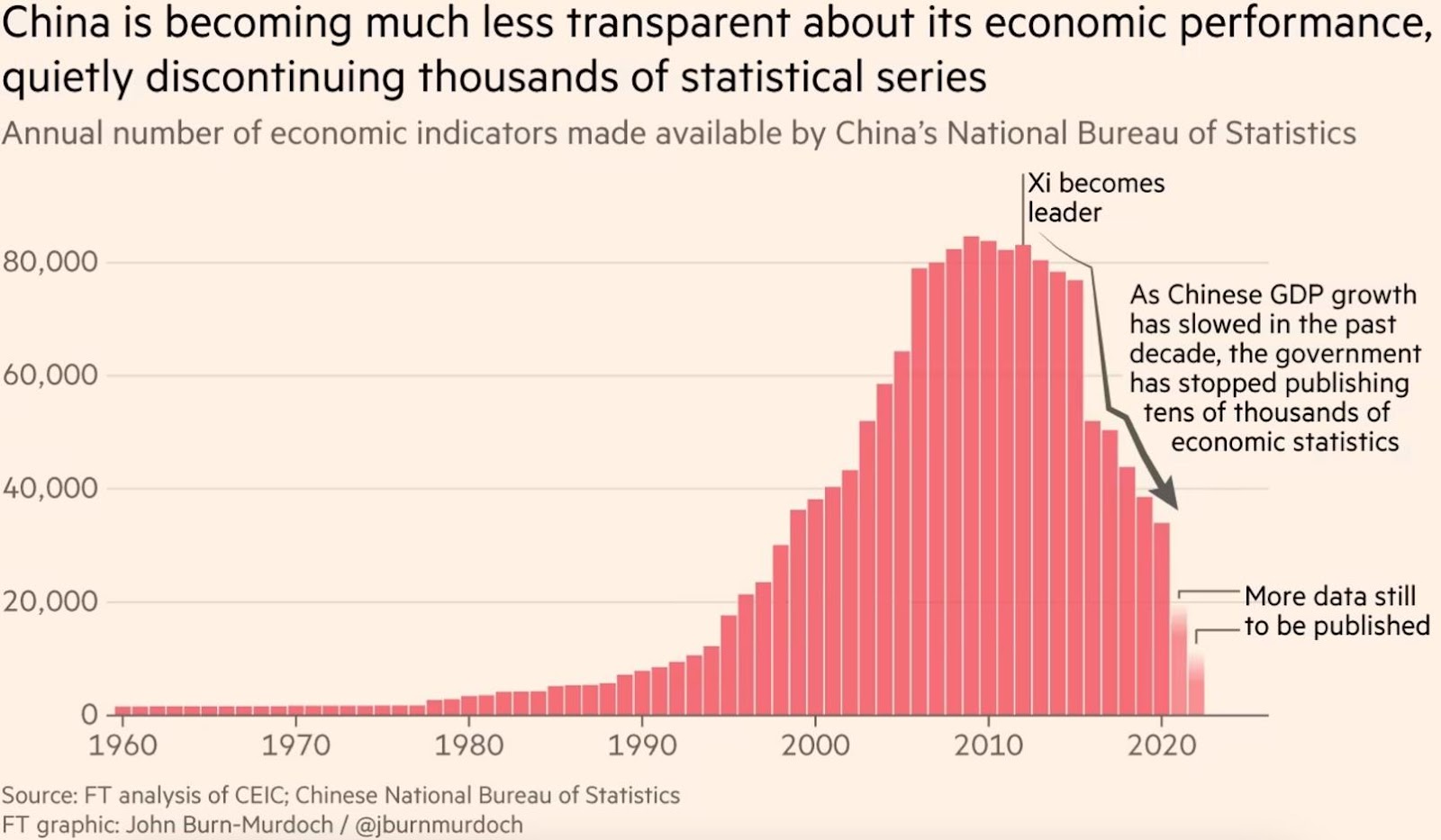
China is Apple’s third largest consumer market after Europe and the Americas. Those concerns were always going to be on a collision course with Stewart’s application of inquisitive skepticism to, say, the problematic repressive policies of a certain Asian superpower.

"The Problem with Jon Stewart" could have chosen to ignore China, but for how long? That nation owns nearly $860 billion of the United States’ debt. It’s a major trade and manufacturing partner and influences our politics to a significant degree. Most of the newest iPhones are made there.

China is also a major American entertainment consumer whose audience can make or break a film’s global success at the box office. Regarding the AI question – again, Apple is a behemoth in an industry focused on automated efficiency. In no universe could Stewart deliver an honest report on the subject while working there. But with mainstream news covering it more frequently, it would not go unnoticed if he were to skip it.

The Problem With Jon StewartJon Stewart in the “Midterms” episode of season two of “The Problem With Jon Stewart" (Apple TV+)It would be simple to lump “The Problem with Jon Stewart” in with other short-lived topical talk variety shows as another indicator that the format doesn’t work on streaming services. But this cancellation evinces something else. As tech companies increase their hold on the news and information space – of which “The Problem with Jon Stewart” was a part – we are seeing more examples of the people who run them exerting control over the flow of information. This was a major concern when Amazon founder Jeff Bezos purchased The Washington Post a decade ago but, until recently, he stayed out of its newsroom. (No longer.)
Elon Musk’s purchase of Twitter, which he since renamed X, was followed by the senseless smearing of public trusts such as NPR, PBS, the Canadian Broadcasting Corporation and the BBC. Misinformation runs rampant on X. Journalists are abandoning it ahead of the election.

"The Problem with Jon Stewart" could have chosen to ignore China, but for how long?

Perhaps more relevant to Stewart’s situation is the example set by Netflix in 2019, when it pre-empted an episode of Hasan Minhaj's "Patriot Act" that criticizes the Saudi-led War in Yemen and Crown prince Mohammed bin Salman. It was pulled from streaming in Saudi Arabia. At the time the company said they were simply complying with local law, but humanitarian and free speech advocates feared the company's decision would have a chilling effect.


Want a daily wrap-up of all the news and commentary Salon has to offer? Subscribe to our morning newsletter, Crash Course.


As yet unknown is whether Stewart will set up shop at another network. I mean, would Warner Bros. Discovery be as thin-skinned as Apple? It regularly puts up with "Last Week Tonight" host John Oliver calling it “business daddy” in proximity to jabs like “I do get the vague sense that you're burning down my network for the insurance money, but I'm sure that that will all pass!" and doesn't blink.

This is not to imply that WBD, Paramount, NBCUniversal or Disney, which owns ABC, are any nobler than their tech-based competition. The AI question would have rattled somebody at the top tiers of those organizations, too. But those conglomerates seem to view figures like Stewart, along with Oliver and their former “Daily Show” co-worker Stephen Colbert, as essentially very shiny scales on their gargantuan dragon bodies. Sometimes one or two cause an itch, but that subsides.

Still, it’s disappointing to lose Stewart’s weekly deep dives when we need them most. With war exploding between Israel and Hamas and the media doing a poor job of countering government spin; with the GOP unable to elect a Speaker of the House; and, pertinently, without a permanent host steering “The Daily Show,” viewers could use his blistering insight and common sense. Some network executives may agree with that. Unless they also allow the host to do what he does best without censorship, we may have seen the last of Stewart taking on major problems for a while.

The “missing law” of nature was here all along

A recently published scientific article proposes a sweeping new law of nature, approaching the matter with dry, clinical efficiency that still reads like poetry. 

“A pervasive wonder of the natural world is the evolution of varied systems, including stars, minerals, atmospheres, and life,” the scientists write in the Proceedings of the National Academy of Sciences. “Evolving systems are asymmetrical with respect to time; they display temporal increases in diversity, distribution, and/or patterned behavior,” they continue, mounting their case from the shoulders of Charles Darwin, extending it toward all things living and not. 

To join the known physics laws of thermodynamics, electromagnetism and Newton’s laws of motion and gravity, the nine scientists and philosophers behind the paper propose their “law of increasing functional information.”

In short, a complex and evolving system — whether that’s a flock of gold finches or a nebula or the English language — will produce ever more diverse and intricately detailed states and configurations of itself. 

And here, any writer should find their breath caught in their throat. Any writer would have to pause and marvel. 

It’s a rare thing to hear the voice of science singing toward its twin in the humanities. The scientists seem to be searching in their paper for the right words to describe the way the nested trills of a flautist rise through a vaulted cathedral to coalesce into notes themselves not played by human breath. And how, in the very same way, the oil-slick sheen of a June Bug wing may reveal its unseen spectra only against the brief-blooming dogwood in just the right season of sun. 

Both intricate configurations of art and matter arise and fade according to their shared characteristic, long-known by students of the humanities: each have been graced with enough time to attend to the necessary affairs of their most enduring pleasures. 

Some of these more diverse and intricate configurations, the scientists write, are shed and forgotten over time. The configurations that persist are ones that find some utility or novel function in a process akin to natural selection, but a selection process driven by the passing-on of information rather than just the sowing of biological genes. Here the scientists are writing William Carlos Williams’ “The Red Wheelbarrow” perhaps without realizing it, and I can’t help but squint into the article for any sign of a nod toward the humanities. 

This is how poetry was born from the same larynxes and phalanges that tendered nuclear equations

Have they finally glimpsed, I wonder, the connectedness and symbiotic co-evolution of their own scientific ideas with those of the world’s writers? Have they learned to describe in their own quantifying language that cradle from which both our disciplines have emerged and the firmament on which they both stand — the hearing and telling of stories in order to exist? Have they quantified the quality of all existent matter, living and not: that all things inherit a story in data to tell, and that our stories are told by the very forms we take to tell them? 

“Is there a universal basis for selection? Is there a more quantitative formalism underlying this conjectured conceptual equivalence—a formalism rooted in the transfer of information?,” they ask of the world’s disparate phenomena. “The answer to both questions is yes.”

Yes. They’ve glimpsed it, whether they know it or not. Sing to me, O Muse, of functional information and its complex diversity.

Form follows function follows form 

The principle of complexity evolving at its own pace when left to its own devices, independent of time but certainly in a dance with it, is nothing new. Not in science, nor in its closest humanities kin, science and nature writing. Give things time and nourishing environs, protect them from your own intrusions and — living organisms or not — they will produce abundant enlacement of forms. 

This is how poetry was born from the same larynxes and phalanges that tendered nuclear equations: We featherless bipeds gave language our time and delighted attendance until its forms were so multivariate that they overflowed with inevitable utility. And this is why the two were conjoined from birth, poetry and physics: A world lacking either is a world in which humans could not survive. 

In her Pulitzer-winning “Pilgrim at Tinker Creek,” nature writer Annie Dillard explains plainly that evolution is the vehicle of such intricacy in the natural world, as much as it is in our own thoughts and actions. 

“The stability of simple forms is the sturdy base from which more complex, stable forms might arise, forming in turn more complex forms,” she explains, drawing on the undercap frills of mushrooms and filament-fine filtering tubes inside human kidneys to illustrate her point. 

"The general principles of selection and function discussed here may also apply to the evolution of symbolic and social systems"

“Utility to the creature is evolution’s only aesthetic consideration. Form follows function in the created world, so far as I know, and the creature that functions, however bizarre, survives to perpetuate its form,” writes Dillard. “Of the multiplicity of forms, I know nothing. Except that, apparently, anything goes. This holds for forms of behavior as well as design — the mantis munching her mate, the frog wintering in mud.” 

Dillard’s conclusion should have been cited in the paper, given how close it lands to the scientists’ mark. She notes that, of all forms of life we’ve ever known to exist, only about 10% are still alive. What extravagant multiplicity. 

“Intricacy is that which is given from the beginning, the birthright, and in the intricacy is the hardiness of complexity that ensures against the failures of all life,” Dillard writes. “The wonder is — given the errant nature of freedom and the burgeoning texture of time — the wonder is that all the forms are not monsters, that there is beauty at all, grace gratuitous.”

Our many swirling eddies

“This paper, and the reason why I'm so proud of it, is because it really represents a connection between science and the philosophy of science that perhaps offers a new lens into why we see everything that we see in the universe,” lead scientist Michael Wong told Motherboard in a recent interview

Wong is an astrobiologist and planetary scientist at the Carnegie Institute for Science. In his team’s paper, that bridge toward scientific philosophy is not only preceded by a long history of literary creativity but directly theorizes about the creative act itself.  

“The creation of art and music may seem to have very little to do with the maintenance of society, but their origins may stem from the need to transmit information and create bonds among communities, and to this day, they enrich life in innumerable ways,” Wong’s team writes.  

We need your help to stay independent

“Perhaps, like eddies swirling off of a primary flow field, selection pressures for ancillary functions can become so distant from the core functions of their host systems that they can effectively be treated as independently evolving systems,” the authors add, pointing toward the elaborate mating dance culture observed in birds of paradise. “Perhaps it will be humanity’s ability to learn, invent, and adopt new collective modes of being that will lead to its long-term persistence as a planetary phenomenon. In light of these considerations, we suspect that the general principles of selection and function discussed here may also apply to the evolution of symbolic and social systems.”

The Mekhilta teaches that all Ten Commandments were pronounced in a single utterance. Similarly, the Maharsha says the Torah’s 613 mitzvoth are only perceived as a plurality because we’re time-bound humans, even though they together form a singular truth which is indivisible from He who expressed it. 

Or, as the Mishna would have it, “the creations were all made in generic form, and they gradually expanded.” 

Like swirling eddies off of a primary flow field.

“O Lord, how manifold are thy works!,” cried out David in his psalm. “In wisdom hast thou made them all: the earth is full of thy riches. So is this great and wide sea, wherein are things creeping innumerable, both small and great beasts.” 

In all things, then — from poetic inventions, to rare biodiverse ecosystems, to the charted history of our interstellar equations — it is best if we conserve our world’s intellectual and physical diversity, for both the study and testimony of its immeasurable multiplicity. 

Because, whether wittingly or not, science is singing the tune of the humanities. And whether expressed in algebraic logic or ancient Greek hymn, its chorus is the same throughout the universe: Be fruitful and multiply. 

“They’re not practicing what they preached”: WeightWatchers is shifting into weight loss drugs

When WeightWatchers was originally conceived, it was envisioned as a weight loss company that meshed support groups and an intensive diet plan into one cohesive program. At the forefront of the company was something called the “Prudent Diet,” which had been developed in the 1950s by Dr. Norman Jolliffe. The diet called for fish five times a week, eating liver once a week, two pieces of bread and two glasses of skim milk a day along with an abundance of fruits and vegetables. Alcohol, sweets and foods rich in fats were prohibited. All portions of foods were also encouraged to be weighed before eating.

Although the diet proved effective, it failed to provide any sort of mental support for its followers. That’s where WeightWatchers thrived — in providing those seeking to lose weight with the means, encouragement and strength they needed to attain their personal goals.

In 2018, WeightWatchers abandoned its weight loss motto and rebranded to “WW” to center on its new mission promoting overall health and wellness. But weight loss seemed to still be the company’s primary focus as it targeted a more vulnerable demographic. That year, WW came under fire for teasing a free weight-loss program for teens ages 13 to 17. Although that idea was tabled, WW announced a new mobile weight-loss app for children ages 8 and up called Kurbo by WW shortly afterwards.

“The name is WeightWatchers, not Health Enhancers,” wrote dietician Rebecca Scritchfield for The Washington Post at the time. “The second the focus turns to weight, the potential for mind and body damage begins.”

Unfortunately, WW hasn’t done much to redeem itself in recent years. The company is now entering the weight loss drug business, much to the dismay of many who have stood by its once-revered principles.

Specifically, WW is embracing blockbuster weight-loss drugs like Wegovy and Ozempic. As explained by Axios, the initiative “illustrates the way obesity has come to be viewed as a chronic illness treatable by drugs that could account for tens or even hundreds of billions of dollars of sales within a decade.” Investors, expectedly, are elated. But that can’t be said for customers, many of whom feel deceived.

“WeightWatchers has kicked us to the curb,” one 15-year member told Bloomberg

Others echoed similar sentiments, claiming WW ditched its message of self-restraint and behavioral change for the quick solution of weight-loss medication.

“They're not practicing what they preached… and now all of a sudden there's a drug involved," said another WW member during an April meeting, per Insider.

Earlier this year, WW International Inc. shut down thousands of in-person meeting locations and acquired telemedicine startup Sequence for $132 million. Sequence connects its patients with doctors who can prescribe GLP-1 drugs like Wegovy and Ozempic — a diabetes medication that gained popularity online and among celebrities as an anti-obesity drug

Although the acquisition garnered ardent backlash from current WW members, Goldman Sachs analysts predicted “that the move toward weight-loss drugs could save the 60-year-old company from financial collapse,” according to Insider. Analysts estimated that the company could generate $455 million in new revenue through an extra half million subscribers by 2025.

We need your help to stay independent

Additionally, WW is hoping to persuade Medicare to cover the medications for weight loss, Axios reported. If that comes to fruition in the future, Medicare’s coverage of anti-obesity medications (AOMs) would “increase overall federal spending,” congressional scorekeepers said in October. 

“Right now, these medications, as part of Medicare Part D, are in the same category as hair-loss meds,” WW CEO Sima Sistani said at the annual HLTH conference in Las Vegas. “That's what I'm talking about. It's trying to shift the conversation from vanity and a preoccupation within this to actual health.”


Want more great food writing and recipes? Subscribe to Salon Food's newsletter, The Bite.


Many health experts, however, are concerned about AOMs, especially in the wake of new reports claiming that the drugs may place patients at risk of three rare, but severe, stomach conditions. The drugs also put patients at an increased risk of stomach paralysis and inflammatory diseases like pancreatitis and certain types of bowel obstruction, according to a study published in the scientific journal JAMA.

“Experts caution that there still isn't enough data about how these drugs work long term and in certain populations, which could ultimately affect the market for them,” Axios wrote in July. Experts also warned that the drugs could cause patients above the age of 65 to lose too much muscle mass, per the New York Times.

Ozempic, in particular, remains a topic of concern within the health field, especially after it emerged as a kind-of cultural phenomenon. Unlike most AOMs, Ozempic has become popular among people who aren’t obese but are looking to shed a few pounds. That, in turn, has raised concerns about drug abuse and increased usage of over-the-counter laxatives, also known as “budget Ozempic.”

That being said, WW is determined about offering access to anti-obesity meds. Perhaps only time will tell if the move will actually save the company or ruin it for good.

“Like Google for the sky”: Vera Rubin Observatory will map the universe with more detail than ever

When astronomer Vera C. Rubin was growing up, she built her own telescope to watch the night sky from her bedroom in Washington, D.C. After being rejected from Princeton for graduate school (where women were prohibited until 1973), she was accepted at Cornell and later began studying how galaxies in the night sky change over time. Her research throughout the 1970s uncovered a mystery about the universe that scientists are still trying to fully understand today.

In collaboration with Kent Ford, Rubin’s calculations are generally seen as the first substantial evidence supporting the idea that dark matter actually comprises the majority of the universe’s mass. Today, the National Science Foundation and the Department of Energy are honoring Rubin for her work by naming a new observatory in Chile after her. 

Rubin’s calculations are generally seen as the first substantial evidence supporting the idea that dark matter actually comprises the majority of the universe’s mass.

As the first observatory named after a woman, the Vera Rubin Observatory will provide the most detailed map of the universe in history. While telescopes like Hubble and James Webb can zero in on specific regions of space to get high-quality images of particular galaxies, the Rubin Observatory instead casts a wide net, taking continuous snapshots of the entire visible night sky. Its Legacy Survey of Space and Time will measure the sky every three days over the course of a decade to create a slow-motion movie of observable changes in the universe. 

“You can think of it as a Google for the sky,” says Mario Juric, Ph.D., an astronomer at the University of Washington and the principal investigator of UW's contribution to the Rubin Observatory. “It downloads everything that's in the sky and then organizes that into a nice searchable index to offer to astronomers.”

In partnership with thousands of astronomers across the globe, the observatory has the potential to help us better understand dark matter and dark energy, detect asteroids with the potential to crash into Earth and answer other astronomical questions that have tantalized scientists for decades. Most of the data it captures will also be publicly available for scientists and amateur astronomers alike within 60 seconds of its capture, said Melissa Graham, Ph.D., a UW astronomer and the Rubin Observatory’s Head of the Community Science Team.

“To me, it is important that this observatory is named after [Rubin] not only because the data will enable advances in understanding the dark matter she proved existed, but because it represents contributions of women to astronomy and our higher goals of research inclusion: providing a cutting-edge astronomical data set that is accessible to all,” Graham told Salon in an email.

Salon spoke with some of the scientists involved with the Rubin Observatory during its construction over the past two decades to get a better sense of what to expect from the observatory. Here are four big astronomical questions it could help explain when it goes online in 2025.

01
The Rubin Observatory could quadruple the number of asteroids and other objects we know about in space


With the technology currently available, astronomers are constantly discovering new objects in the night sky, anything the size of a few feet across to objects as large as Pluto. Since the first asteroid was discovered 200 years ago, about 1.2 million asteroids at least one kilometer in diameter have been identified. The Rubin Observatory's massive scope is projected to nearly double that within the first three to six months after it opens, ultimately increasing the number of these objects we know about in the night sky to around five million by the end of its survey, Juric said. Asteroids detected by the observatory can provide clues into how the planets in our solar system formed and changed over time, he explained. 

“If you think of the solar system as a big construction yard, these asteroids are like rubble that's left over after construction is finished,” Juric told Salon in a phone interview. “You can sort of walk through a construction yard and figure out what's been going on by where all the rubble wound up — or where the tools are.”

Although most new asteroids will probably be discovered in the main asteroid belt between Mars and Jupiter, Vera Rubin will also be able to detect “near-Earth asteroids” that have the potential to strike the planet, said Zeljko Ivezic, Ph.D., a UW astronomer and director of Rubin Observatory Construction. 

“In order to rule out the possibility that they are dangerous, you need to observe them at least half a dozen times so that you can calculate their orbits,” Ivezic told Salon in a phone interview. “Then you can answer the question: Are they over the next few centuries going to pose any threat to Earth?”

02
It could help astronomers better understand how and why certain stars explode in supernovae

When a star explodes in a supernova, it can release the same amount of light as one billion stars emit at once, making a single point in the sky where the explosion takes place as bright as an entire galaxy, Graham said. Because these supernovae take place light years away, it’s very rare to detect which star in a cluster is the one exploding, she explained.

Some supernovae can last 10 days, while others last months, with all sorts of changes in color and light throughout the process, Graham explained. The Rubin Observatory, which will host the largest digital camera in the world, will be able to detect changes in light during supernovae that help explain what provokes them and, in some cases such as with carbon-oxygen white dwarfs, whether they might happen because two stars are colliding, Graham said.

“By finding millions of supernovae with the Rubin Observatory and the LSST, we will be able to test theories like this for all kinds of exploding stars,” Graham said. “Understanding supernovae is important, in part because they release the heavy elements fused in stellar interiors [and] these elements go on to form metal-enriched objects like our own planet Earth.”

03
It could help us understand the nature of dark matter and dark energy 

It has been proposed that dark matter and dark energy — the latter of which causes the universe’s expansion to speed up — together make up about 96% of the universe, with all of the matter and energy we encounter in our everyday lives making up the remaining 4%. This work builds on Rubin’s original calculations in the 1990s, which some have argued should have earned her the Nobel Prize.

Because dark energy is invisible — and no one is entirely sure what it is — scientists have to instead look to objects in space that are affected by it as clues that help explain its behavior. One of the main sources of evidence used to prove the existence of dark energy is supernovae. When a star explodes, scientists use the way its light ripples out to space to measure distances and calculate the expansion of the universe.

However, one controversial 2020 study found fluctuations in the brightness of supernovae, which cast doubt on whether they could be used to measure the expansion of the universe and put into question whether dark energy even exists. By measuring distortions of light across billions of galaxies, the Rubin Observatory has the potential to get to the bottom of this question that scientists have been disputing for the past decade.

“The ultimate result that we want to get is to see if there is really something that is dark energy that explains the accelerated expansion of the universe,” Ivezic said.

04
If there are interstellar objects out there, the Rubin Observatory will likely find them

In 2017, a telescope in Hawaii detected Oumuamua, the first of two interstellar objects to ever enter our solar system. While the origins of Oumuamua have been debated because it lacked any sort of tail that a normal comet would have — with some suggesting it was a spacecraft but more likely evidence suggesting it was indeed a comet — another interstellar object detected in 2019, 2I/Borisov, did have a comet’s signature tail trailing behind it.

Scientists have long thought more interstellar objects are out there, and the Rubin Observatory is expected to find anywhere between one additional object per year or even one per month, Juric said. In the next decade, the European Space Agency (ESA) is also planning to launch its Comet Interceptor mission, which can be deployed to take photos of what these interstellar objects look like up close. Through the observatory, the mission will likely be able to detect many such objects that would otherwise be missed, Juric explained.

“We just don't know what's out there and that's what makes it so interesting,” he said. “This will tell us immediately how many of these things are floating through space.”

The thought echoes what Rubin herself once said when asked whether dark matter does indeed exist: "We know so little about our universe," she said. "It is a strange and mysterious universe. But that’s fun.”

James Beard’s 7 most comforting recipes

With no qualifiers or explainers, it is evident that James Beard is legitimately prolific in every sense of the word. He's the epitome of a household name within the culinary world.

There he is right above this text, in all his glory, posing in front of his iconic pineapple wallpaper in his home — which is now preserved in the same building that's now known as The James Beard House. As noted by the official website, the James Beard Foundation officially opened the James Beard House in November 1986 “to provide a center for the culinary arts and to continue to foster the interest James Beard inspired in all aspects of food, its preparation presentation, and of course, enjoyment." To this day, it hosts endless swaths of chefs, cookbook authors and other food personalities who all recognize Beard's immense influence and pay him homage. 

Whether you know of him through his books, his shows, various, well-known friendships with other big names — such as Julia Child — or his namesake foundation, restaurant awards and ceremony, you've most certainly been acquainted with him in some capacity.

Beard was also a genuine pioneer. His cookbook "American Cookery," released in 1972, was unlike any other cookbook of the time: Chockfull of fresh, organic ingredients — with nary a frozen or canned item in sight — and tons of then-unknown "exotic" ingredients that many Americans at the time were wholly unaware of. Beard staked a new claim, not only in the realm of cookbooks, but also food TV and far beyond.


Want more great food writing and recipes? Subscribe to Salon Food's newsletter, The Bite.


Beard was a larger-life-than person in so many ways but his recipes hone in on the flavors and ingredients that were most important to him. Many of these flavors lent themselves to cozy, rich, comforting foods and classic dishes — which, of course, are a perfect go-to on a blustery, rainy autumn night. Peruse this short collection of some of Beard's best and find a dish that'll be perfect for an upcoming busy weeknight or leisurely weeknight.

Either way, you can rest assured that Beard has got you covered. 

There may be no better way to start a comforting meal than plush, warm, homemade rolls. Beard's recipe is simple, classic and absolutely delicious. Be sure to spring for some high-quality butter (maybe even some whipped or salted?) for a really special bite to your rolls to the next level. As Beard himself put it, "Parker House rolls should be delicate, soft, and rather sweet, typical of American rolls in the nineteenth century, and they consume butter by the tons." 
Zucchini bread can act as a snack, a breakfast, a dessert, a base for French toast or so many other things. Beard's recipe, from 1973's Beard on Bread, is incredibly moist and studded with walnuts. You can opt to swap out for different types of sugars, flours, extracts or even spices, but of course, don't skimp on the zucchini! It's kind of an important component.
Beard's macaroni and cheese contains nothing ostentatious: macaroni, butter, flour, milk, dry mustard, bread crumbs, a dash of hot sauce and three cups (!) of cheddar. It's traditional and iconic for a reason and there's no better way to spend a chilly fall evening than with a piping hot bowl of this macaroni.

We need your help to stay independent

This is almost stew-like, with tons of super-flavorful ingredients like oregano, olives and currants or raisins. The chicken that Beard calls for is skin-in and bone-in, but you can certainly swap in boneless and skinless if you have it on hand. I love the topping of parsley and almonds over the top of warm, fluffy rice or orzo.
 
Also, don't forget the lemon! It really adds an importnat pop of flavor just at the end of the cooking process. 
A super simple, yet immensely satisfying casserole comprised almost entirely of pantry ingredients (sans the turkey, of course), this comes together quickly and is perfect for feeding a large group. It's also ideal on Thanksgiving weekend. The touch of curry powder is a fascinating, subtle note that will make everyone who eats this perk up a bit and say "hm, what was that?" 
While this may seem like a superfluous amount of garlic, it is not. The garlic mellows beautifully. This will perform your house in the most amazing way. It also contains one of my favorite ingredient, vermouth, which is the perfect liquid with which to deglaze the bottom of your pan. I also love the tarragon, which is often an unsung hero nowadays.
 
One other point: It's a non-negotiable to serve this with bread that has been absolutely slathered with the softened, roasted garlic. Beard recommends pumpernickel, which would be stupendous, but feel free to use whatever you have on hand. 
Honestly, it's hard to mess up pumpkin pie . . . but this really might be one of the most supreme recipes for it to ever be written. It contains all the usual suspects, from brown sugar and eggs to cloves, mace and candied ginger — plus the pumpkin, of course.
 
Beard served his with Cognac whipped cream; who are we to disagree with this suggestion? 

Trump rewrites history, claiming Sidney Powell was never his attorney

Back in 2020, Donald Trump wrote a statement to Twitter — as it was called at that time — championing his "truly great team" of lawyers and representatives, naming Sidney Powell as one of them. But now, after she's pleaded guilty to a number of criminal charges in the Georgia RICO case, in which Trump is a co-defendant, he seems to be rewriting history by claiming that she was never his attorney, although there's plenty of evidence to the contrary.

In a new statement made on Truth Social Sunday morning, Trump writes, "Sidney Powell was one of millions and millions of people who thought, and in ever increasing numbers still think, correctly, that the 2020 Presidential Election was RIGGED & STOLLEN, AND OUR COUNTRY IS BEING ABSOLUTELY DESTROYED BECAUSE OF IT!!! Despite the Fake News reports to the contrary, and without even reaching out to ask the Trump Campaign, MS. POWELL WAS NOT MY ATTORNEY, AND NEVER WAS. In fact, she would have been conflicted. Ms. Powell did a valiant job of representing a very unfairly treated and governmentally abused General Mike Flynn, but to no avail. His prosecution, despite the facts, was ruthless. He was an innocent man, much like many other innocent people who are being persecuted by this now Fascist government of ours, and I was honored to give him a Full Pardon!" 

As MTN points out in their coverage of this flip-flop, "on November 14, 2020, Trump tweeted out that he was hiring Powell to join his legal team as one of the attorneys who would fight to overturn the results of the 2020 Presidential election." Adding to their reporting that "Sidney Powell testified under oath in front of the January 6th Committee where she confirmed that Trump asked her to join the team as a Special Counsel."

So who understands the Chinese economy? Definitely not China

In the end, the Party would announce that two and two made five, and you would have to believe it. It was inevitable that they should make that claim sooner or later: the logic of their position demanded it.
— George Orwell, "1984"

It’s hard to throw a metaphorical rock anywhere on the internet these days without hitting an article about Chinese economic statistics gone wrong. Anyone who has paid even a shred of attention to China’s official reports over the past 30 years is probably aware of the fact that they’ve consistently been manipulated, always in the same direction. 

“Clearly nobody believes the data,” said Sushil Wadhwani, a former member of the Bank of England’s Monetary Policy Committee, in 2015. Erik Britton of Fathom Consulting explained that at his company, “We think the numbers are a fantasy.” Reuters went one step further in 2017, proclaiming that “China’s economic statistics aren’t fake enough” to reach the People’s Republic’s future goals. (Emphasis added.)

NPR host Steve Inskeep once quipped, when relaying a story from the outlet’s “Planet Money” podcast, “If it were possible on the radio, we should broadcast each story about China's economy with an asterisk. For example, China's economy slowing down, asterisk. The footnote would mention that we don't know how much. Like the United States, China does publish economic numbers. Unlike the United States, nobody believes these numbers.”

Well, it turns out that China’s economy is slowing down, asterisk. China has slipped into deflation, which has virtually no modern correlation with a growing economy anywhere on the planet. Its youth unemployment rate has gotten so bad (about a quarter of the entire 16-to-24 population) that Beijing has decided to simply stop publishing that embarrassing data altogether. After the colossal Evergrande bankruptcy, an even larger Chinese real estate mega-corporation, Country Garden, has missed multiple bond payments and been removed from Hong Kong’s benchmark Hang Seng Index. Total U.S. imports from China have plummeted from over $50 billion per month in August 2022 to just under $35 billion, as of June of this year.

But Inskeep’s point about the lack of a clear overall picture of China’s economy remains true — we don’t know how bad the slowdown really is. That’s not because the central government is unwilling to put out negative indicators; plenty of those have been released in the past year. There is no reason, however, to assume that China’s National Bureau of Statistics (NBS) has ceased to massage numbers, even while being forced to adjust them downward in order to appear at least somewhat in touch with realities on the ground that both outsiders and Chinese citizens can observe. And if massaging proves too difficult, there’s always the option, as with the youth unemployment rate, of ditching the information altogether:

A graph of a number of people

Description automatically generated

(Reproduced with permission from original creator John Burn-Murdoch)

But even that policy is not the most significant problem with China’s data. The most significant problem is the same one that’s existed for decades. It’s the big kahuna. The whole enchilada. The giant, supposedly $18 trillion elephant in the room:

G. D. P.

Chinese GDP is “manmade,” “unreliable” and “for reference only,” according to Li Keqiang, who was head of the Liaoning province when he made those remarks “with a smile” in 2007. He would go on to be promoted to a national vice-premier and then full-fledged premier, the second-highest position in the country, where he would eventually smile far less as he admonished provincial officials to “tell the truth” in their reports to Beijing.

In 2013, stories about China’s “bonus” 32nd province circulated after the central government reported national GDP at a level 10% below the number that would result from simply adding all the reported provincial data together.

Those calls would go largely unheeded. Over and over again, Chinese provinces — including Li’s old stomping grounds, Liaoning — have been caught cooking their books. In 2013, stories about China’s “bonus” 32nd province were widely circulated after the central government reported national GDP at a level about 10% less than the number that would result from simply adding all the reported provincial data together. As it later turned out, this phenomenon had actually happened every year since at least as far back as 2002. Its origins lay in policies that the Communist Party initially supported wholeheartedly, which Thomas Rawski of the University of Pittsburgh illustrated just a few years earlier:

Beijing “announces a campaign to achieve 8 percent growth during 1998. Provincial officials were told, 'Whatever segment of the economy you're responsible for must contribute its share to 8 percent growth.' Shanghai's municipal government even ordered its subordinate units to draw up plans to achieve 12 percent growth. All plans that did not call for 12 percent growth were returned for revisions…. Pressured to meet impossible goals, local and provincial officials submitted exaggerated or even fabricated reports to national statisticians, who were powerless to verify the numbers.”

We need your help to stay independent

Rawski’s ultimate conclusion about that period in Chinese economic history? “[T]he Chinese economy actually contracted by about 2 percent in 1998, when the government was reporting an increase in GDP of 7.8 percent," he said. "A similar contraction may have occurred during 1999. Chinese reports of 7-8 percent growth during the last two years ‘probably are exaggerated, too,’ but closer to reality than the official numbers from the late 1990s.”

The NBS has gradually gained more authority to override or go around provincial officials, and has made public spectacles out of the wildest economic claims put forth by some of those officials, as a grand display of rooting out corruption. But as the NBS has accumulated clout, there are also signs that it has simply become the new state instrument for manufacturing the “proper” data. With great power, after all, comes great responsibility. 

One such great power was bestowed upon the NBS by a 2003 law that gave the agency the ability to change previous long-run GDP numbers. The bureau subsequently used this power to declare in 2005 that the Chinese economy was a whopping 17% larger than had been reported up until the previous day. 

Sometimes, two and two make five.

In 2014, “The NBS claimed the ‘sole right to evaluate GDP and growth rates of every province and municipality.’ But since then, the agency has never explained how it reconciles local data with national results.”

China’s National Bureau of Statistics used its extraordinary power to declare in 2005 that the Chinese economy was a whopping 17% larger than had been reported up until the previous day. 

Events like these, coupled with the transparent political motivations of the CCP, made much of the world skeptical about China’s headline economic numbers. “Engineering the greatest economic expansion in the world was a matter of self-preservation for the Party,” as U.S.-Asia Law Institute scholar Teng Biao explained the unspoken policy. The West “failed to consider that China’s economic metamorphosis was built on the bloody legacy of Tiananmen.”

Sometimes, that drive for self-preservation meant legitimate market liberalization which truly lifted millions upon millions out of poverty, as several of China’s neighboring countries had already accomplished. But quite often, it meant dazzling Chinese citizens and Westerners alike with bullet trains and massive solar farms, even if most of the trains were empty and most of the solar power was never used. It meant building fake cities full of fake apartment buildings, fake landmarks, fake airports and fake Pentagon-sized shopping malls, because maybe one day real people would actually live and work in those places. It meant that China started publishing trade data that did not match the corresponding numbers directly reported to other countries — amounting to more than 1% of Chinese GDP per annum.

And it meant that the NBS has declared in almost every year of this century that the government’s predetermined annual GDP target had been met or exceeded, a level of consistency that many economists consider utterly impossible. Radio Free Asia’s 2018 assessment of the NBS noted that “during China's unacknowledged slump in 2015, economists estimated that the NBS was overstating GDP by a far larger amount [than initially estimated], as much as 2 to 3 percentage points, as it reported steady growth of 6.9 percent. After recovery, China posted the same rate for 2017. The official rate so far this year remains nearly unchanged at 6.8 percent, posing questions about the data behind such rock-solid results.”


Want a daily wrap-up of all the news and commentary Salon has to offer? Subscribe to our morning newsletter, Crash Course.


To be fair to the NBS, it has likely been stuck playing the dual roles of both villain and victim since President Xi Jinping took power. Xi has consistently waged a war against corruption during his time in office, sometimes as an excuse for targeting political enemies, but just as often in an apparently honest clean-up effort. He tasked the NBS with the scrutiny of thousands of suspicious companies, and the results were overwhelmingly negative:

Since 2017, the NBS has inspected 2,051 companies and 2,942 fixed-asset investment projects with "abnormal data," state media reported. The agency found that figures were "severely fabricated" at 1,195 of the companies, or 58 percent of those inspected. … The investigation exposed even higher falsification rates among the investment projects with serious fraud in 2,775 cases, or 94 percent, of those examined. Companies in the privileged Port Economic Zone of northeast Tianjin city's Binhai New Area were found to have inflated their data by an average of 56 times the real levels. … Inner Mongolia's Kailu County pumped up its data by a factor of 10, while enterprises in Xifeng County in northern Liaoning province multiplied its results by 6.7 times, according to the report.

As Derek Scissors, a scholar at the American Enterprise Institute, asked, “Why does the central government believe that companies and government offices that have never submitted accurate information even know how to do so?"

All of this (and more) is why many outside organizations have tried to use various methodologies to determine what the actual size and growth rate of the Middle Kingdom’s economy might be. One group of economists used multiple factors and found China’s GDP to be roughly 20% smaller than advertised. Carnegie scholar Michael Pettis has stated that if the mountains of bad debt within the Chinese economy were treated as they would be in “any other country,” overall GDP growth would be half of what is normally reported. One remarkable study by Luis Martinez of the University of Chicago used satellite data of ground light produced at night across a wide variety of countries to conclude that the entire Chinese economy amounted to less than half of the official figure.

One remarkable study by the University of Chicago's Luis Martinez used satellite data of ground light to conclude that the entire Chinese economy amounted to less than half the official figure.

So the ultimate question is, what’s the real answer? What’s the actual GDP of the People’s Republic? Beijing claims it to be $18 trillion, and plenty of outlets just repeat the official line without a second thought. But that number was built upon the previous year’s number, which was built upon the previous year’s, and so on. Every year’s amount of growth (or “growth”) simply modifies whatever overall GDP figure was already in existence. Even China’s own National People’s Congress has acknowledged that “previous NPC reports and audits over the years suggest that local officials and enterprises may be stuck in a trap of past data inflation.” 

Looking back at the history of how China has arrived at that $18 trillion today — after years upon years of manipulated or completely fabricated provincial statistics that never even added up correctly, which were then taken by the NBS and “adjusted” skyward all at once, and then altered to include directly-reported corporate and local numbers that ranged from 58% to 94% fraudulent and included values that were up to 56 times larger than what existed in reality, and then were increased every January by whatever amount the CCP saw fit to announce the previous spring, and then were “fixed” to avoid massive levels of unacknowledged debt and giant inconsistencies in trade data, and then were annually thrown into an algorithmic “black box” to produce final results that nobody at the NBS has ever cared to explain — how could current officials not be trapped? How could any of them possibly go back in time, through decades of cooked books and made-up numbers, to somehow extract accurate information and correct the current facts accordingly? What would allow them to escape the mathematical prison of “past data inflation”?

When evaluating the big picture, this error-plagued progression’s current result — that shiny $18 trillion figure, which the CCP still hopes will one day surpass the American equivalent — seems so cartoonish that it might as well be written in crayon. Based on the preponderance of the evidence, there’s one conclusion about what China’s true GDP is that seems more likely than any other:

They don’t know. 

How could they? What part of the above series of events would somehow have resulted in landing upon anything close to the correct number today? And more importantly, from the CCP’s perspective, what purpose would be served by digging into the records and addressing the many obvious problems to be found therein, thus fanning the flames of the recent parade of bad economic news that the government has already been forced to acknowledge?

No, the party’s attitude towards this singular and psychologically crucial bit of information can perhaps be best summarized by returning to the wisdom of a great philosopher named George — not Orwell this time, but Costanza: 

“It’s not a lie … if you believe it.”

“Yoo-hoo, is this the loser’s office?”: “SNL” rips Jim Jordan in their cold open

In one of the funniest sketches in recent "Saturday Night Live" history, the show riffs on a variety of recent political headlines in one swoop this weekend, with Jim Jordan's speaker campaign flop at the center. 

At the start of the sketch, cast member Mikey Day portrays a frazzled Jordan sitting at his desk and talking to his wife on the phone, which he breaks in frustration after informing her of yet another loss in the votes for the position he so desperately hoped to land, saying all he wants to do is get Congress back to work so he can shut it down again.

Vocalizing his desire to gain more support — any support at all — a rogues' gallery of congressional peers reaches out, with Bowen Yang as George Santos first through the door, complete with mystery baby in his arms. "Why do you have a baby?" Day as Jordan asks. He receives the answer that lingers in reality . . . "No one seems to know." After Santos hands the baby to an aide, asking her to send it off in an Uber, he commiserates with Jordan for a bit, saying that he voted for him, and then goes on his merry way. Next in line is Chloe Fineman, doing her best Lauren Boebert — boob grabs and all — who phones Jordan from her seat at yet another musical — this time "Aladdin." "Look Jim, things are going exactly as planned," she says. "Just keep running for speaker, and even if you don't win, great, the government shuts down and we blow this whole thing up."

For the grand finale, James Austin Johnson as Donald Trump pops in, calling out, "Yoo-hoo, is this the loser's office?" When Jordan accuses him of giving his endorsement and then disappearing, Trump says that he himself would be a good speaker, but he's been too busy visiting court rooms city to city. 

Watch below:

https://www.youtube.com/watch?v=pE-BpHdYFK8   


All that remains: From liquid cremation to mushroom suits, why more people are opting out of burial

There are an awful lot of tombstones in my neighborhood lately. They bear names like "Noah Scape" and "Izzy Dead." They pop up regularly this time of year, and disappear again in November. And with each passing Halloween, they less resemble some familiar authentic counterpart as they do a vestige of a bygone tradition. 

"By 2035, a stunning 80% of us will be opting for cremation."

Here in the U.S., fewer and fewer of us are choosing to spend our afterlife six feet under. Since 2015, cremation has surpassed traditional burial as the preferred choice for our remains, and the National Funeral Directors Association (NFDA) estimates that by 2035, a stunning 80% of us will be opting for cremation.

A big driving factor, of course, is cost — caskets are expensive, cemetery plots are expensive and graveside maintenance is expensive. In my state, New York, funeral and burial fees can run between $8,000 and $12,000. And that's just the basics. Jack Mitchell, president of the National Funeral Directors Association, talked to Marketplace earlier this year about the “man hours to prepare for a viewing with embalming and dressing and cosmetics, and then to have staff there to oversee when a visitation was going on.”

Another factor is the peripatetic nature of modern life. "It’s a very transient world we live in today," Mike Nicodemus, the vice president of cremation services for the NFDA told CNN back in 2020. My in-laws rest side by side in a leafy plot not far from the home they used to share. But for many of us, a final resting place presupposes that one has had a final living place. And given that the average American moves around eleven times in a lifetime, where we end up is likely far from where we started. 

Then there's the unignorable limitation of space. In the U.K., a quarter of town council-owned cemeteries will likely be at capacity within the next decade. In America, urban centers are already facing a similar shortage of spaces, with historic cemeteries like Green-Wood and Arlington nearing capacity. (You thought it was hard finding a place to live in the city? Try finding one when you're dead.) My mother's ashes are tucked in a corner of a Catholic cemetery and mausoleum one state over. Her parents and deceased siblings are buried in an entirely different area — there was no room left for her there by the time she died.

You thought it was hard finding a place to live in the city? Try finding one when you're dead.

But while cremation is an increasingly popular and seemingly more environmentally friendly choice — especially if you opt for a biodegradable container — there are downsides. Marc Bisson, managing director at Catholic Cemeteries in Canada, says, "Both traditional burials and cremation have pros and cons when it comes to the environment. While cremation avoids leaving large coffins and remains in the ground, which can be potentially harmful, it still emits large amounts of pollutants and utilizes fossil fuels to power the furnace."

Bisson notes an increasing number of alternatives for what to do with one's body once it's shuffled off the mortal coil. "Some new processes are emerging as potentially more sustainable options for cremation, including liquid cremation or aquamation," he says, explaining the process. "Through using alkaline hydrolysis, organic body compounds can be dissolved, leaving only bone, which can then be cremated to ash for your urn. The hydrolysis liquid is safe for water disposal, and this process helps limit the use of traditional cremation incinerators."

He adds that for those who want a more traditional experience but with a sustainable twist, there are still more choices. "Different elements go into a green burial," he says, "including a biodegradable casket and tombstone, a natural fiber shroud, a shallow grave to accelerate biodegradation, and opting for overall smaller headstones. Additionally, if you are being kept in a casket over burying cremated remains, you can choose not to use chemical embalming, which helps to avoid polluting the ground when decomposition takes place." 

Artist and inventor Jae Rhim Lee created a stir with her proposal for an "Infinity Burial System," a spores-laden shroud that essentially composts the body.

But so-called green burials come with their own set of drawbacks. While the process is legal, the industry around it remains largely unregulated. Earlier this month, "at least" 189 decaying bodies were discovered in a Colorado funeral home called Return to Nature. The business had offered cremation services and "green" burials without the use of embalming fluids. The company had suffered recent business losses and had been operating with an expired license. It is expected to take several weeks to identify the decedents.

One of the more intriguing new developments in remains management is the so-called mushroom suit. Over a decade ago, artist and inventor Jae Rhim Lee created a stir — and a viral TED Talk — with her proposal for an "Infinity Burial System," a spores-laden shroud that essentially composts the body. Luke Perry chose this plan before his death in 2019, though there are questions regarding its effectiveness.

And for those who prefer the water to the woods, sea burials are another option, though the Environmental Protection Agency keeps an understandably tight rein on exactly what parts of the country they can occur, and how far out the body must be released.

My friend Fawn Fitter has written about her plans for a sustainable afterlife at the University of Tennessee in Knoxville Forensic Anthropology Center. At the "Body Farm," students learn how to extract critical information from decomposing bodies for identification and criminal investigations. "What I really want," she wrote at the time, "is to be as useful as possible for as long as possible."

My own hope is to follow a similar purposeful intention. Several years ago, I visited my doctor in the lab where he'd worked for years developing cancer immunotherapies. A former patient had arrived that morning, this time in a zippered bag, to make one final contribution to research. As a fellow long-term clinical trial patient, I can't imagine a more fitting place for me to wind up eventually, too.

For a host of practical reasons, the cemetery appears to be a dying proposition. But as evidenced by a multitude of atmospheric seasonal decorations, there is still nothing quite like a graveyard for drama. After all, there aren't too many great cinematic scenes involving urns — and even fewer that aren't comedic. A solemn gathering in front of a headstone, in contrast, has the weight of significance. But that may be less about any literal dead body in the ground than it is about our human need for memorial. 

"Traditional burial practices are being reimagined."

"As perspectives in our society continue to evolve, many traditional burial practices are being reimagined," says Elreacy Dock, a Las Vegas thanatologist and death educator. Historically, cemeteries have served as a place of remembrance and reflection. Many of the 19th-century cemeteries were intended to be spaces for peaceful recreation and lingering during visitations of loved ones, so these locations showcased lush landscapes that featured willow trees, flowerbeds and lakes."

We need your help to stay independent

She notes that "Although this approach to cemetery design is less popular in the 21st century," there are still ways of incorporating tradition into modern death rituals. "It would be most comparable to conservation and green burial cemeteries," she says, "which emphasize maintaining natural landscapes without disrupting the environment or surrounding habitats." She speculates, "The future of death beyond burial may shift to digital memorials, virtual tributes and interactive platforms that enable bereaved individuals to honor their loved ones without the limits of physical space."

We think of death as an event. It's not. It's a process, one that continues long after the last mourner leaves the funeral. We break down, we burn or liquefy, we become part of the earth or the air or the water. And understanding and making choices about what becomes of our corporeal remnants matters, not for us but for those who loved us and for the planet we were briefly alive on. "The way we choose to memorialize our loved ones will also significantly change over time," says Dock. "However, what will not change is the essence of remembrance."

In 2023, nobody knows how to discuss the Israeli-Palestinian conflict. In 2013, Anthony Bourdain did

Sweep aside the so-called “fog of war” engulfing live reporting on the Israel-Hamas conflict, and the plainest truth we may be able to agree on is our inability to have a constructive conversation about Israel and the Palestinians.

The sad part is, this statement would be true if it were published anytime over the last two decades, if not most of the last century. For proof, see X user @Cooperstreaming’s Oct. 11 post resurfacing a clip from “The Daily Show” . . . circa 2014.

The fun begins with Jon Stewart trying to settle into his opening monologue with, “We’ll start tonight in the Middle East, where Israel –”

At this the show’s correspondents at the time – which included Jason Jones, Jessica Williams, Michael Che and Jordan Klepper – encircle Stewart while erupting in common rebukes to critiques of Israeli government policies.  

"What, Israel isn't supposed to defend itself?" bellows Jones. Next Williams screams, “Oh yeah, if Mexico bombs Texas, would we exercise restraint?" Then Klepper demands to know what other country is held to the same standard as Israel before screaming, “Self-hating Jew!"

This happens a few more times, with Klepper popping up at the end of each howl-fest to yell slogans like “Traditioooon! Tradition!” and call Stewart a “Zionist pig.” Eventually Stewart balls up his notes and tosses them over his shoulder. "You know what? F**k it,” he says resignedly. “Why don't we just talk about something lighter like . . . Ukraine?"

That this clip's topical humor remains relevant nearly a decade later is almost entirely by design. Primary and secondary educational curricula in the United States barely discuss Middle Eastern geography let alone the region’s history and many cultures. What we learn about Israel comes to us through media coverage that is slight and slanted at best, mainly broadcasting government officials’ fiery declarations as a backdrop to scenes of rock-throwing protesters and explosions.

Of Palestinian day-to-day life we’re shown next to nothing, save for seconds-long clips of angry demonstrators, fighters wrapped in keffiyeh scarves or wailing victims of military strikes.

With this being the dominant lens, it’s no wonder that the Western audience conflates everyday Gazans and West Bank residents with Hamas militants terrorizing both their own civilians and Israelis.

There’s no better way to comprehend the humanity behind any longstanding conflict than to sit at a table with the people involved during peacetime, or whatever relative form of it one can witness.

We’re talking about "what is easily the most contentious piece of real estate in the world. And there's no hope, none, of ever talking about it without pissing somebody, if not everybody, off."

Those aren’t my words or Stewart's, by the way.  Anthony Bourdain opened the 2013 second season premiere of his CNN show “Parts Unknown” with those statements.

He was referring to Jerusalem, whose streets he walked in 2012 with fellow chef Yotam Ottolenghi, the Jerusalem-born British restaurateur who wrote the cookbooks “Plenty,” “Simple" and “Jerusalem.” Ottolenghi would later take Bourdain to visit Majda, a restaurant nestled in the serene village of Ein Rafa just outside of the city, where they would meet and eat with co-owners Michal Baranes, who is Jewish, and her Muslim husband Yaakov Barhum.

Had this been an ordinary gustatory-focused travel series its host would have played it safe – which is to say, Bourdain could have easily remained within Jerusalem and surrounding areas patrolled by Israeli military conscripts while he and Ottolenghi dive into controversial debates over, for instance, which culture gave us falafel. (Which they do, but briefly.)

Instead, Bourdain and his team escort his viewers into the Gaza Strip and the West Bank to dine with a Gazan woman in a Bethlehem refugee camp; and spend time with Laila El-Haddad, author of “The Gaza Kitchen: A Palestinian Culinary Journey,” who scores him invites to eat with a local family and a group Bedouin men who prepare a regional specialty starring fire-roasted unripe watermelon. He also breaks bread with a Jewish settler whose home sits in Palestinian territory, “in contravention of international law,” as he subtly puts it.

Recommending a culinary travel show episode as an entry point to understanding this conflict may seem trite. There is rarely a demand for context when obscene atrocities are playing out in real time in front of an international audience, especially when people around the world are still reeling in the aftermath of Hamas' coordinated attack on Israeli civilians that left more than 1,400 people dead and many more injured, with scores of people taken hostage.

Antisemitic violence has also spiked here and abroad in recent years; this crime fans those flames too. But I submit that there’s no better way to comprehend the common humanity behind any longstanding conflict than to sit at a table with everyday people during peacetime, or whatever relative form of it one can witness. Atrocities stir up emotions that make calls for calm consideration seem naive and insulting. Much of the mainstream media coverage compounds our anger as organizations, seeking authoritative voices in the region, end up platforming hawks who claim to speak for their entire people.

On Wednesday, for example, CNN's Anderson Cooper allowed far-right former Israeli prime minister Naftali Bennett to declare that Palestinians — not the Hamas militants who slaughtered civilians, but Palestinians in general — "rape young girls," "tear apart limbs," "burn whole families and shoot five month old babies." Cooper let this fly unchallenged, perhaps planning to feature a voice from "the other side" to counter Bennett at some point. 

Without most people having seen much of Palestinian life before Israel declared war on Hamas, believing a former government authority's dangerous rhetoric is as easy to do as reflexively retreating to the post-9/11 defensive stance that allowed Islamophobia to flourish. Hence, this episode of a series that's been out of production for years takes on a fresh urgency.

By journeying into Gaza, Bourdain was visiting a place described by numerous international officials and organizations as the world’s largest open-air prison. The sister of one of his hosts was shot down by snipers while standing in her kitchen. Gaza was not officially at war with Israel when that happened. She was going about her day, something most Western viewers can't picture.

The “Jerusalem” episode of “Parts Unknown” penetrates that ignorance by capturing Palestinians cooking together, playing with their children and teasing Bourdain. One of his hosts chides him for talking while he should be eating her excellent food, as anyone's mom would do. These common moments look as revolutionary and informative now as they did a decade ago.

We need your help to stay independent

It took a year and a half for Bourdain and his team to push beyond the Israeli government denying him the permits to enter Gaza and the West Bank. One can imagine why its officials may have finally relented. The primary aim of “Parts Unknown” was to eat wonderful food and discuss the tradition behind each cuisine. Lingering shots of a Gaza family’s maqluba preparation and that Israeli settler’s abundant, colorful plate fulfill that promise.  

The backdrop to Bourdain’s Gaza strip visit is that the people who opened their doors to him and fed him well have been subjected to limited movement in and out of the territory since 2007, a year after Hamas came to power by way of a democratic election, when Israel's government imposed a blockade on the territory. (Gazans haven't been able to vote in an election since, and with 47.3 percent of its population under the age of 18, that means nearly half of its 2.2 million population has never had a say in its leadership.)

During a visit to a local beach El-Haddad explains to Bourdain that Gazan fisherman can’t go more than six nautical miles from the shore, where the best catch is, because if they do the military will shoot at them or spray them with cold water, or "they'll destroy their boats, they'll cut their fishing nets, they'll detain them.”

Other side dishes materialize in Bourdain’s recurring confrontations with his own identity as a representative of a nation that supports a government that’s hostile to many of his hosts – although, as he points out near the end of the episode, they never show him anything besides kindness and hospitality.

What is there to fear, from what we're shown? The first residents he meets in the Aida Refugee Camp are grinning kids.

“Children play in the streets beneath walls covered in images of martyrs, plane hijackers and political prisoners,” Bourdain narrates, numbering the camp's population at 6,000 people with children making up 66 percent of that community. (Again, this is 2013.)

“The world has visited many terrible things on the Palestinian people, none more shameful than robbing them of their basic humanity."

“I don’t care where that is in the world, that's pretty much a recipe for . . . unruly behavior, I think would be the best way to put it,” he says to his guide Abed Abusrour, the founder of a children’s theater center.

Abusrour agrees. “Especially when you don't have any possibilities to evacuate the anger and the stress in a creative way.” This is why he began using theatre “as one of the most amazing, powerful, civilized and nonviolent means to express yourself,” he says, calling it “the remedy to build peace within.” 

Later, when Bourdain points out to Abusrour that the kids are looking up at effigies of politicians and military leaders while they’re playing, Abusrour reasonably replies, “We are people who are under occupation. People honor their heroes. And their heroes are those who resist the occupation, whether they resisted it with armed struggle or non-violence.” But if Bourdain were to ask these kids who their hero is, he says, “They will recognize a young man from Gaza who is on ‘Arab Idol’ named Mohamed Assaf, a singer.”

In the main Bourdain trusts his viewers will watch with a critical eye and decode the meaning of what isn’t being said out loud. That begins with the full title of the hour, which is “Parts Unknown: Jerusalem, West Bank and Gaza.” Israel and Palestine are mentioned plenty of times within the hour, but their absence from its title seems like an intentional effort to stave off prejudgment.

That doesn’t mean Bourdain doesn’t challenge some of his hosts’ views. When the chief executive of an Israeli settlement asserts that the Palestinians in villages surrounding it are happy that they’re here, saying,  “We gave them prosperity for the past 45 years, and wherever the PLO came, they lost it.” Bourdain says nothing to the man, remarking in his voiceover, “I'm guessing a lot of people would disagree with that statement.”

Later, Bourdain presses him about a swath of graffiti on an Arab house near the settlement, a menacing act Israeli settlers visit on Palestinian neighbors called “price tagging.” It reads, “Against Arabs, the state of Israel is alive, and death to the Arabs."

“Why not paint it over?” Bourdain asks, and the man pauses before saying, “Good question. I don't know. Maybe we should. You're right.”

In recent days El-Haddad appeared on CNN in a very different capacity from how she did on Bourdain's show 10 years ago, where both she and the host comforted her infant as they explored the place Israel recently ordered refugees to evacuate. An anchor asked her to explain where Gazans can go to seek safety. Nowhere, she answers, hammering home the ghoulish absurdity in this escalating violence.


Want a daily wrap-up of all the news and commentary Salon has to offer? Subscribe to our morning newsletter, Crash Course.


On Tuesday at least 500 Gazan civilians were killed by an explosion at the enclave's al-Ahli Hospital. The wanton obliteration of hundreds of innocents, many of them children, quickly became secondary to debates over who was responsible. If you’ve never seen Palestinian kids playing or their parents nourishing their loved ones, it may be simpler to emotionally distance oneself from the horror of so much death, reducing murdered families and vanished futures to casualties while focusing on culpability.

Gaza Health Ministry said on Wednesday that 3,478 Palestinians have been killed by Israeli airstrikes in the 11 days since Hamas' attack, and more than 12,000 have been injured, according to a PBS NewsHour report. The Israeli government also cut electricity and access to fresh water and food, creating a humanitarian crisis.

As "Jerusalem" begins, Bourdain predicts that “by the end of this hour, I'll be seen by many as a terrorist sympathizer, a Zionist tool, a self-hating Jew, an apologist for American imperialism, and Orientalist, socialist, fascist, CIA agent and worse.” I’m not sure how much of that came true. The episode did earn him the 2014 Voices of Courage and Conscience award from the U.S. Muslim Public Affairs Council, however.

“The world has visited many terrible things on the Palestinian people, none more shameful than robbing them of their basic humanity,” Bourdain said in his acceptance speech for the award. “People are not statistics. That is all we attempted to show.”

The episode's more overtly lasting legacy is its clear depiction of a truth often dismissed in times like this, which is that people simply want to live in peace, and would not claim to support the brutality committed or promised by extremists, whether that describes rogue actors or bloodthirsty politicians.

Bourdain knew as much. "One can be forgiven for thinking, when you see how similar they are, that the two peoples — both of whom cook with pride, eat with passion, love their kids, love the land in which they live or the land they dream of returning to, who live so close, who are locked in such an intimate, if deadly embrace — might somehow, some day, figure out how to live with each other," he says near the end of the episode.

"But that would be very mushy thinking indeed," he concludes. "Those things, in the end, probably don't count for much at all." Knowing that shouldn't silence attempts to understanding this hostility that shows no sign of ending. Here, in a small way, some of us have a start.

"Parts Unknown: Jerusalem, West Bank and Gaza" is currently streaming on Max.

Before Wikipedia, there was the Oxford English Dictionary, a Victorian era crowdsourcing project

After graduate school, I treated myself to a full set — that's 20 very large and heavy volumes — of the Oxford English Dictionary for my home office. It was a very on-brand purchase for me, and also a wildly impractical thing to own, as I am reminded every time I move. But where else can I flip through at random and discover that not only is the word "indeedy" (originating in the U.S., "used as an emphatic affirmative or negative") in the OED, its first documented instances originated in an 1856 volume of The Knickerbocker (or, New-York Monthly Magazine) — "Yes, indeedy" — followed swiftly by Mark Twain's 1872 book "Roughing It," with "No indeedy" this time?

How does an American colloquialism like this — I'm not sure I would have known it to be an actual unique word, and not simply a little flourish of noise Ned Flanders favored to make it sing, without the OED — make it into an Oxford dictionary? Now that I've read Sarah Ogilvie's surprising and delightful new book "The Dictionary People: The Unsung Heroes Who Created the Oxford English Dictionary," I can imagine James Murray, the venerable Dictionary editor, reading a slip of paper mailed to his Scriptorium, perhaps by a volunteer in the U.S., documenting the appearance in print of this folksy expression.

Such volunteers — the Dictionary People of Ogilvie's title — were an invaluable source of labor for the Oxford team tasked with completing the ambitious dictionary project that began with three original editors in 1857, was shaped largely by Murray, and finally finished in 1928 after his death. While some enjoyed notoriety — see Simon Winchester's 1998 book "The Surgeon of Crowthorne," adapted into the 1999 Sean Penn film "The Professor and the Madman" — there were also thousands of other volunteer readers who made up, as Ogilvie writes, "the Wikipedia of the nineteenth century — a huge crowdsourcing project," sending in examples of words they encountered in print. 

"I just thought they deserved credit, finally, and I wanted to shine a light on them. And I wanted to know where they lived, what they did with their lives, what they did with their daily life, who they loved."

While spending time in the Dictionary archives at Oxford University Press, Ogilvie — a linguist, lexicographer, current director of Oxford University's Dictionary Lab, and a former OED editor herself — came across the address books Murray kept for his volunteers, which to her knowledge had not been fully unpacked in any other OED histories. "I became obsessed," she writes, "with unearthing the lives of the people in his address book and reclaiming their place in the history of the OED." Using the information in those books, including codes that Murray used to annotate the entries, she and her research team were able to peel back the curtain on this largely unseen army of contributors who helped build the foundation for the OED to become the dynamic, expansive, exhaustive linguistic resource that it still is today.

"The Dictionary People" is an intriguing A-Z composite of the most intriguing and representative of those contributors, which include several murderers, institutionalized mental-health patients, suffragettes, inventors, a preeminent collector of pornography, and even Karl Marx's daughter. I spoke with Ogilvie recently over Zoom about the colorful cast of characters she discovered and the ongoing cultural significance of the OED. 

This interview has been lightly edited for clarity. 

The OED was designed to be different from the other authoritative dictionaries. Can you explain how?

In the middle of the 19th century, three men came up with the idea of creating a dictionary of every word in the English language. And this dictionary was going to be different from everything before it, because previous dictionaries had not necessarily been based on descriptive data, meaning they had been quite prescriptive rather than descriptive. And this dictionary was going to be one that was based on historical evidence of how a word is used, from its very first instance — more or less giving a biography of every word from the first time that it's used through to its current usage. And so that was how the dictionary was going to be different. It was going to be historical, rather than synchronic, which is what the others had been. So it was going to be a diachronic dictionary — dia [as in] across, chronos [as in] time — so it was going to show you the life of word across time.

And they realized that to do such a mammoth task that they — a small group of men living in London or Oxford — couldn't do alone. So that's why they came up with this brilliant idea of crowdsourcing it, and asking people around the world to read their local books and write out words from those books and send them in. When you think of it, they had no idea whether this was going to be a success or not. But you know, it ended up being a huge success. So many people sent in slips to James Murray's house, at 78 Banbury Road … so many people sent in slips that Royal Mail put this red pillar box outside 78 Banbury Road, and it's still there today.

I love that. So you write in the book about finding Murray's address books tucked away in the archives, seemingly not opened in forever. I think this always shocks us when we find out that there are things in archives that that are still to be discovered. I think people who have not gotten to spend time in archives like this think of archives as very orderly, like a bookshelf: Everything's cataloged, everything's very precise, and it's just a matter of pulling things out and already knowing exactly what they are. But you found these address books tucked away, containing all of these codes and details about these contributors. Can you talk a little bit about the moment you realized what you had found and what it could mean?

Because I used to be an editor on the Dictionary, I had always wondered — and because we knew that this was a crowdsourced project, like the Wikipedia of the 19th century — I had always wondered who those people were. We knew that there were several hundred, but we didn't know exactly how many. And so in the back of my mind, that's always been there: Oh, I would love to know, because I'm originally from Australia, I'd love to know who the Australians were who sent in slips and words. And because I worked in America for eight years, I've always wondered who those Americans were, as well. So that has always been at the back of my mind.

"I think that they were on the fringes of academia, and this project that was attached to a prestigious university was a chance for them to be part of a world that was otherwise denied to them."

I was killing time, because I was starting a new job at Stanford [University] and my visa was delayed. I was down in the basement of Oxford University Press where the Dictionary archive is, and I was just looking around. And in this box, as you say, I came across this little black book, and it was tied with cream ribbon. And when I opened it, I recognized James Murray's handwriting, the longest-serving editor. And then when I saw that there were all these names and addresses, and then, underneath everyone's address, he had a list of all the books that that person read, the number of slips they sent in, and the date that he had received it — he was, you know, quite obsessive, as you could imagine, right? He sort of had to be to do this task well.

And yes, it was just one of those moments. Because I didn't know about the address books, and no one had ever written about them or mentioned them in any of their publications, everything just sort of went into slow motion for me. I thought, My goodness, this might be his address book. And yes, it was. And then I found five other address books. So there are six in total, three belonging to James Murray and then three belonging to his predecessor, Frederick Furnivall.

To answer your question about archives, I thought, Surely I'm not the first person to see this. And sure enough, on one of the pages, as I was looking, I saw a little pencil mark. So an archivist had cataloged this because there was a pencil mark with an archive. But I guess this is a lesson in us making sure that we're always talking with archivists. The researchers really need to talk with archivists to get to know the archives. I was not the first person to see the address books, but I'm the first person to thoroughly go through them.

As I went through the pages, I saw that Murray, as you said, had little codes and little crosses and stars and very strange little symbols that he used. And he also had some very sweet notes about people, where when a woman would get married, he would put her her new married name or, he would write a note about how a contributor had died on a certain date. Or he would also write little notes, like "hopeless" or "no good."

The hopeless ones! I just loved them.

Yeah! So then I realized, Oh gosh, OK, I want to know more about these people. So that's how my journey for the last eight or nine years began. And then I just went down lots of rabbit holes, wanting to find out as much as I could about everyone.

"Women played a huge role in this project. And that did come as a surprise, actually."

I realized that a lot of these people were sending in thousands of slips and reading countless books. They were spending a lot of time on this. And they were doing it for free. They were volunteering their time and their skill. And so I just thought they deserved credit, finally, and I wanted to shine a light on them. And I wanted to know where they lived, what they did with their lives, what they did with their daily life, who they loved. I just wanted to find out everything that I could.

Thankfully, I was going to this new job in Stanford. Stanford really supported this project. And my students were so receptive. And so I worked with a wonderful group of students. And together, we went through the censuses, the marriage certificates, the death records, and we built two large databases and found out as much as we could about these people. So I'm very grateful to the students.

Your research team was like the Dictionary People as well. This quote really stood out to me: "Most of the Dictionary People, including Murray himself, were outsiders,” you write. Why do you think outsiders were drawn to this work, something that set out to be this authoritative?

Yeah, this was a big surprise to me, that these weren't the scholarly elites. And so your question was one that I kept asking myself for several years. What was it that was motivating these people? Murray left school at 14. A lot of these people left school young. And they taught themselves; they were autodidacts. And I came to the conclusion — and I think that there was a bit of this in Murray's motivation as well — I think that they were on the fringes of academia, and this project that was attached to a prestigious university was a chance for them to be part of a world that was otherwise denied to them.

And that includes many more women than we originally knew, right? What did you learn about women's roles overall in the creation of the Dictionary?

They were completely mixed. I learned that Murray really respected women and gave them the same tasks, appreciated them. So they were not just readers, meaning that they didn't just read books and send in words, but they were also sub-editors. And he also asked them as specialists in certain subject areas. Women played a huge role in this project. And that did come as a surprise, actually, to just see how many hundreds of women there were and to see how varied they were. They were from all social classes.

Karl Marx's daughter!

Karl Marx's daughter, who stars in the "H for Hopeless" chapter, unfortunately. Yes, Eleanor [Marx] was there. I've got a wonderful biography of her right in front of me here. She's definitely one of my favorite characters from the book.

Speaking of colorful characters, I thought it was fascinating to read these mini-biographies. Some of the more colorful characters especially had quite a lot going on in their lives. There are murderers, there are people at the forefront of social justice movements. There's a cannibalism strain. Who was the most surprising character to you that you encountered?

Really hard question to answer, because to be honest, each of them was unique and eccentric and devoted. So, right from the first woman: The book opens with "A for Archaeologist." Margaret Murray was a teenager living in Calcutta, reading the books from her mother's bookshelf. And she'd wake up early, while it was still cool, and go to go to the roof of her house and read two main things. One was the Bible — she sent in thousands of slips from the Bible. But then the other topic that she read a lot of were travelers' tales in India. So there were Indian words that she sent into Murray. And she worked for many years doing that, for, I think, seven or eight years. And she didn't quite know what to do with her life. She came over to Britain to visit an uncle and went to this lecture given by the famous archaeologist Flinders Petrie. And that's where she just fell in love with Egyptology, and she becomes the first female Egyptologist.

"I can just imagine James Murray perhaps blushing with these bundles of sex words coming in monthly."

She lives to be over 100. And on her 100th birthday, she publishes her memoir called "My First Hundred Years," one of my favorite books. It's fantastic. In the middle of the 20th century, she starts to specialize in witchcraft. And so what's lovely about Margaret Murray — and this happens with quite a few of the contributors who became specialists in their own fields — is other contributors then read her books and sent in words that she had been the first person to write. So now there are many quotations from Margaret Murray in the Dictionary for words to do with Egyptology.

There's a man who sends in 165,000 slips called Thomas Austen — and he is one of four people who has connections with what were called "mental asylums" or "lunatic asylums," they called them in the 19th century. And I think that these people who did this very repetitive, rigorous work, were perhaps just on the spectrum. But in the 19th century, they were classified — on the census, there was a column for whether you were a "lunatic, blind, deaf or dumb" — several of the contributors were classified as that.

There's the first female astronomer, Elizabeth Brown, and her sister. They're living in a rural village together, two spinster women. They send in between them about 15,000 words and slips. Her sister Jemima is especially devoted. And when she dies, she leaves in her will to James Murray over 1,000 pounds, which he really needs. Because that's the equivalent of a whole year's wage — not just for him, but for all of his staff as well. There are lots of little stories in here that I hope also tell the story of the making of the Dictionary, sort of through the eyes of the contributors and the people rather than from the top down. More from the bottom up.

I think also one of the delightful surprises of this book is getting to know the people who sent in great numbers of specific profanities, terms about sex that were contributed. "The Pornographer" is one of the one of the more colorful characters I'd say. It's also kind of at odds, I feel, this spiciness with our contemporary ideas about both word nerds and Victorians. But should it be should this be surprising?

"Dictionaries and lexicographers led the way in the early days of computer science and humanities computing. "

That's a great question. And look, you know, I think all of us have little hidden sides. And therefore, the "P for Pornographer" [chapter] was about Henry Spencer Ashby who lived in Bloomsbury and had the world's largest collection of pornography. But you're right, I mean, I can just imagine James Murray perhaps blushing with these bundles of sex words coming in monthly. And that's another reason why I admire Murray so much is that he was very true to the scientific method and the historical method of the Dictionary. And he was very principled and stuck to the rigor of the scientific principles of the Dictionary. So even though he may have felt compromised sometimes about whether or not to put a word in, in most cases, he did put the word in. So as I talked about in the book, with respect to coarse words and profanities, there was actually an Obscenities Act. And there was a big court case going on at the time, where a slang lexicographer, Stephen Farmer, was being sued for putting in the c-word and the f-word in his dictionary. And Murray, I found letters between them in the archive, so this was very much on Murray's mind. And so even though he gathered all the evidence for the c-word and the f-word, in the end, he decides not to put that in.

Those came in later, right?

Yeah, we then had to wait until the 1970s for those words to get in.

I'm glad that you mentioned the scientific theory behind the Dictionary, because that leads me to my next question. In the chapter that opens with The Big Stink in London, you write, "Dictionary People showed a strong tendency toward innovation." This was in the context of helping the city deal with its industrial revolution-caused sewage problem.  I wonder what that strong tendency towards innovation that you discovered in your research says about how we think about the role of a dictionary culturally. Somebody with a penchant for innovation, and yet also devotion to writing a dictionary, in some ways sounds like a contradiction.

It's true. And when you think about dictionaries, even in the 20th century, dictionaries have always been right at the frontier of technology and innovation. So all of the beginnings of computer science were working on dictionaries, because dictionaries, of course, are structured in the perfect way with these fields. And so dictionaries and lexicographers led the way in the early days of computer science and humanities computing. And even now, dictionaries are being used as the data — the data from dictionaries are powering the back end of the internet. It's thanks to dictionaries' data that we've got text-to-speech, that we've got morphological analyzers. This kind of structured and curated data is vital for certain tasks in machine learning.

That standardization is interesting in light of another historical detail in this book that you write about, the role that the Dictionary People played in the campaign for reformed spelling. The dictionary can be sort of wielded as a weapon, like: Well, is that how it's spelled in the dictionary? To find out that folks who are so devoted to this cause were also quite passionate about changing the way that English words are spelled to be more intuitive, that surprised me as well.

Absolutely. And I too was surprised by that tension there. And to think that Murray in his early career was also a proponent for spelling reform. But when you actually delve into the weeds of those movements for reforming spelling and simplifying the spelling of English, it's actually got a social justice route, where they were wanting to do that because they felt that it was the complicated and unnecessarily complex spelling of English which was a barrier to the working classes and to people learning to read and write. So they were trying to simplify it so that more people had access to reading and writing.

That plays into the outsider affinity perhaps as well.

That kind of philosophy is really present in one of the founders, Frederick Furnivall, who's quite a hero of the book. Frederick Furnivall wanted this dictionary to be a democratic dictionary. He said, "We must fling our doors wide. All must enter." And I think by that he meant all words must enter the dictionary, but also all people must be part of this creation process.

So what role does an institution like the OED play in today's wide open, technologically available, vastly connected internet-powered web of words and information that are instantly available and updated constantly? With Wikipedia, and other crowdsourced projects like the Urban Dictionary, which can go into great descriptions of slang terms and whatnot. What is the OED's identity today?

I think that it's got a dual identity, because I think that users of dictionaries still want an authoritative, rigorous source. So yes, we can go to all of those other freely available places on the internet, or we can just track words ourselves in real time on social media, but at the end of the day, I think many of us still like to go to an authoritative source to see what someone has come up with as either the meaning or the usage. Because basically, they've spent hours and days and sometimes weeks working on a single word. I, personally, really value their work. So I think that is one use of the Dictionary today, and why it's still important. But I think another one is what I was talking about, which is that this is curated rigorous data, which is really valuable to certain digital tools and methods. So I think it's got a dual role, and therefore, I think it will always have a place — at least I hope it will always have a place, at both the front end and the back end of digital work.

And there are still Dictionary People, right? That surprised me too. Can you tell us about the personal connection you made to the contributor Mr. Collier?

When I first started working at the Oxford Dictionary — actually, down in Australia, and then over in Oxford — I used to open the mail and every month would come in this eccentrically wrapped bundle of slips. They were wrapped in old cornflake packets with bits of dog hair and cereal stuck on them. And inside were always many slips. They were all from the same source. They were from a local newspaper that this man Mr. Collier read from his local town of Brisbane, Australia, which actually turns out to be my hometown as well. But growing up there, I had no idea that just two suburbs away, Mr. Collier was there. Every single day, he would read this local newspaper, cut out quotations and stick them onto little slips. So he, over 35 years, sent in over 100,000 slips.

I had the opportunity of going to meet him in 2009. I met him at a park in Brisbane. He said, "Meet me in my office." And it was this park behind the Paddo Tavern, which was quite a rough pub. So I turn up and there he is, sitting on the park bench in the sunshine, reading of all things the Courier Mail newspaper, and so we sat and talked together for several hours. He fits into the Dictionary People in many respects. He too left school at 14. And he said that in the 1970s, he read an article where the chief editor of the Oxford Dictionary at that time, Bob Burchfield, was putting out an appeal and asking people around the world to again read their local books and newspapers and send in slips. And he said to me, “I thought to myself, imagine if I could get one word into the Dictionary.” He in fact got thousands in.

When I did an analysis of how many quotations there are in the OED from the Courier Mail, turns out there are actually more from that very random newspaper than there are from T.S. Eliot or Virginia Woolf or the Book of Common Prayer. So there's this bias now towards the Courier Mail.

I said to him, look, you know, you've done the most incredible job at sending in Australian words to the dictionary. Would you consider flying over to Oxford, and we could show you the workings, and you could meet the editors? And he said to me, “Oh no, couldn't possibly, just imagine all the Courier Mails waiting for me when I got home?”

So they're just as devoted as ever — so typical of the Dictionary People. What I love about the OED today is they just launched a new website last month. And when you go in, and you're looking at an entry, they now have a contribute button where you can send a message to the editor. It shows me that they're still valuing the contribution of the public.

I learned about the OED and how to use it as a freshman in college in a philosophy of words seminar. We used it mostly for etymology. And then later I bought my own. It's an incredibly impractical item to own, the whole 20-volume set, but I can't bear to part with it, even though dictionaries have largely gone digital now. It's still special to me, I think, because of that first class that I took that I used it in. What makes the OED special to you?

That physicality, it's really special. Because when you look at those 20 volumes, you really realize the scale of this project, and the fact that without the contribution of these 3,000 people around the world, this text could not exist, this dictionary could not have existed without these people. So I think looking at the 20 volumes brings it really home. And that's why I wanted to shine a light on these people and give them credit, finally, because I think without them, the dictionary wouldn't exist.

CORRECTION: An earlier version of this article contained a transcription error misstating the address of James Murray’s red pillar post box. The error has been corrected. 

Moscow’s man in Africa: Yevgeny Prigozhin and the collapse of the French empire

One of modern history’s major empires is falling apart right now, right before our eyes. Yet precious few in the media have reported on this extraordinary event, much less offered any analysis of its implications for the fast-changing shape of global power.

Over the past 60 years, France has used every possible diplomatic device, overt and covert, fair and foul, to incorporate some 14 African nations into a neocolonial imperium called “Françafrique” — a vast region covering a quarter of Africa and stretching for nearly 3,000 miles from Senegal on the Atlantic coast to Chad in the continent’s center.

While the rest of that continent frequently suffered from wars, coups and chronic instability, Françafrique long enjoyed comparative peace. By dispatching paratroopers from its many African bases (or secret agents for the occasional assassination), Paris provided a rough version of stability — even if at the price of endemic corruption, entrenched autocratic rule and deep economic exploitation. Recently, however, a rising nationalist consciousness in many of those relatively new countries has begun chafing against that European land’s repeated transgressions of their sovereignty. As French colonial and postcolonial dominance over this vast region moved ever deeper into its second century, unease bordering on open hostility against that country’s presence began to build.

In less than a year, in fact, the sudden withdrawal of French troops from individual African nations has turned into a full-blown retreat from much of the region. As terrorists affiliated with ISIS first became active in 2014, France deployed some 5,000 elite troops for Operation Barkhane in collaboration with six nations of Africa’s arid Sahel region, the strip of territory extending across the continent, largely south of the Sahara Desert.

Yet just last December, French troops left the Central African Republic after Paris decided that the local government there was “complicit in an anti-French campaign allegedly steered by Russia.” In February, Burkina Faso’s new military government simply expelled French forces and hailed its new “strategic partnership” with Russia. And in August, following back-to-back coups in Mali, that country’s ruling junta grew resentful of the 2,400 French troops stationed there and forced them to withdraw into neighboring Niger, which became the new main base for their operations in the Sahel region. Then, last month, French President Emmanuel Macron was forced to announce that he was pulling his troops and his ambassador out of Niger as well. After seizing power in July, that country’s new military junta had demanded just such a French departure and, to drive the point home, closed its airspace to France. “Imperialist and neocolonialist forces are no longer welcome on our national territory,” the junta announced.

In less than a year, the sudden withdrawal of French troops from individual African nations has turned into a full-blown retreat from much of the region.

Amid such geopolitical upheaval, a most unlikely man from Moscow appeared on the spot in 2017. His name — now all too well known — was Yevgeny Prigozhin, founder and commander of a notorious mercenary army, the Wagner Group. As the French retreated slowly and exceedingly reluctantly from their post-colonial imperium, Wagner began moving in, becoming Moscow’s surrogate in an ongoing great-power contest for influence and control in Africa.

By the time in late 2022 that France’s failing nine-year effort to secure the Sahel was drawing down, Wagner’s forces were already operating secret gold mines in Sudan, running the largest gold mine in the Central African Republic with projected revenues of $100 million annually, and had earned $200 million since 2021 providing security for Mali, a land roiled by Islamist rebels. In March, Washington warned Chad’s president that Wagner mercenaries were plotting to assassinate him and were also preparing Chadian rebels to attack from their bases in the Central African Republic. After the July coup in Niger, cheering crowds were seen waving (as well as wearing) Russian flags. And as 1,500 French troops and that country’s ambassador were being withdrawn, Niger’s new military leaders promptly contacted Wagner for support, expanding Russia’s sphere of influence in the French imperium it was fast supplanting.

The strategic implications of this shift, should it continue, are potentially profound. As the NATO alliance moved ever closer to Russia’s sensitive western border in the 1990s, Moscow reacted early in this century (prior to the invasion of 2022) with repeated interventions in Ukraine, launched special operations to secure its allies in Central Asia, and, above all, engaged in a little understood geopolitical flanking maneuver across two continents.

The thrust of that move started in 2015 when Moscow leapfrogged over the NATO barrier of Turkey to open a massive air base at Latakia in northern Syria. Soon, Russian planes had reduced rebel-held cities like Aleppo to rubble. In 2021, leapfrogging again, this time over the close American ally Israel, Russia began supplying Egypt with two dozen of its advanced Sukhoi-35 jet fighters so its airmen could compete with Israelis flying advanced American F-35 fighter planes, which Washington refused to supply to Cairo. Completing Moscow’s southern push in the region, Russian President Vladimir Putin began building upon their shared interests as oil exporters to try to befriend Saudi Arabia’s functional leader, Prince Mohammed bin Salman, becoming so close by late last year that Western observers began to express concern about the possible loss of a key ally.

We need your help to stay independent

The final geopolitical pivot in Russia’s recent maneuvering proved particularly controversial and so initially remained significantly covert: The Wagner Group was used to extend Russia’s influence country by country, deal by dirty deal, across the Sahel. Should this process continue successfully into the near future, Moscow will have flanked Europe (and so the U.S. as well) by forming a geopolitical arc of influence sweeping south through the Middle East and extending west across the whole of the Sahel that stretches from the Red Sea to the Atlantic Ocean.

For this maneuver to succeed, however, the end of French neocolonialism proved crucial. To appreciate the historical significance of the impending fall of Paris’s post-colonial empire, it’s important to understand something of its tangled history — otherwise it would be hard to grasp the full import of Yevgeny Prigozhin’s extraordinary role as the man on the spot in extending Russia’s influence into Africa for the first time since the Cold War.

The hidden history of Françafrique

As the bitter, bloody French colonial war in Algeria was winding down to defeat in 1960, President de Gaulle realized that the age of empire was ending and used his enormous prestige to grant independence to 14 West African nations. Yet his move was far from altruistic. As part of his vision of France as an independent global power, he began working to create a postcolonial sphere of influence by subsuming the new nations into an exclusive French zone called Françafrique.  

While de Gaulle’s visionary rhetoric inspired an independent foreign policy, his “man of the shadows,” presidential adviser Jacques Foccart, built a full-scale covert apparatus for a postcolonial imperium that became the dark underside of the grand Gaullist state. During his service under Gaullist governments from 1960 to 1997, the shadowy Foccart used the state’s clandestine agency, Service de Documentation Extérieure et de Contre-Espionnage, to maintain a deft, delicate synergy between metropolitan power in France and covert control of Francophone Africa. As head of de Gaulle’s political party and architect of its secret services, he would become the key link between the French executive and Françafrique’s African leaders, whom he personally selected, befriended and defended with covert action.   

Although Africa suffered 188 coup attempts from 1956 to 2001, the readiness of the French military to quash any such effort provided Françafrique with an “effective inoculation against conspiracies.”

At the moment of independence in 1960, Foccart bound all of those former colonies (except Guinea) to Paris by defense agreements that granted France military bases and the right of armed intervention in each country. In the process, he also developed treaties meant to secure strategic materials (cobalt, copper, oil and uranium) from those countries, as well as a common currency pegged to the French franc that would ensure control of their economies.   

Under this postcolonial iteration of informal empire, French troops shuttled in and out of West Africa, conducting more than 40 military interventions between 1960 and 2002, while maintaining a permanent presence at a half-dozen military bases on the continent. Although the rest of Africa suffered 188 coup attempts from 1956 to 2001, the readiness of the French military to quash any such effort provided Françafrique with what political scientist Crawford Young called an “effective inoculation against conspiracies” and so minimized and even controlled coups. Despite vivid personality cults, systemic corruption and state terror, French complicity in all of the above assured its African allies of an extraordinary political longevity — exemplified by Omar Bongo, who ruled Gabon for more than four decades.

With its lucrative oil concessions and its full integration into Foccart’s network, the exemplary state in Françafrique was undoubtedly Gabon — an unbearably poor country of 500,000 people that was surprisingly rich in natural resourcesThree years after independence in 1960, as the country’s president lay dying of cancer in a Paris hospital, Foccart picked Bongo, a veteran of French intelligence with no political base, as the ailing president’s running mate in the next election. That ticket then captured 99.5% of the vote, assuring that Bongo, though still just 31 years old, would succeed the president at his death six months later.   

As Gabon’s political opposition revived in 1971, Foccart’s office dispatched the infamous mercenary Bob Denard as a “technical adviser” to President Bongo. Not surprisingly, when an influential opposition leader arrived home one night from the movies, an assassin stepped from the shadows and killed him, also wounding his wife and child. His body was never recovered.

During the long years of his rule, French officials enabled Bongo’s graft, making him a principal shareholder in that country’s lucrative Elf-Total oil company and facilitating illicit payments to him — estimated at $111 million a year — that were only exposed at the 2003 corruption trial of the company’s chief executive.   


Want a daily wrap-up of all the news and commentary Salon has to offer? Subscribe to our morning newsletter, Crash Course.


When he died in 2009 after a rule of 42 years, London’s Telegraph reported that he had looted revenues from the nation’s 2.5 billion barrel oil reserve to “become one of the world’s richest men,” while elevating “corruption to a method of government.” His son Ali-Ben Bongo succeeded him as president, inheriting, along with his siblings, 39 luxury properties in France worth $190 million and a country with a third of its population living on $2 a day.

The son continued many of his father’s policies, including ruthlessly rigging the 2016 election by enforcing a 99% turnout in key districts. In August, however, after one too many rigged elections and amid an eruption of coups across the region that marked the fading of France’s postcolonial power, Ali Bongo was finally toppled by a military coup, ending a dynasty that had lasted nearly six decades.

Advent of Moscow’s Africa man

To challenge that French postcolonial imperium built by cunning, corruption and covert skullduggery, Moscow needed an operative who could match Jacques Foccart’s legendary mastery of the dirty business of empire, measure for measure. And it found him in the person of Yevgeny Prigozhin, one of those quixotic, improbable adventurers who, over the past two centuries, have served as the vanguards of new forms of empire.   

Prigozhin's Wagner Group first appeared as the shadowy "little green men" during the Russian seizure of Crimea and then moved on to Syria, where they engaged in a war of atrocities.

Who was that extraordinary individual whose personal initiative shook up the world order in Africa, establishing a Russian mercenary troop presence and ties to governments in at least seven African countries? Emerging from Soviet prisons after a 10-year term for a teenage mugging spree, Prigozhin rose, through Vladimir Putin’s patronage, from a hot-dog vendor on the streets of St. Petersburg to a millionaire caterer for Russian schools and troops.

In 2014, his Wagner group of mercenaries first appeared as the shadowy “little green men” during the Russian seizure of Crimea and then moved on to Syria where they engaged in a war of atrocities. Between conflicts, his troll army fired off disinformation barrages meant to influence the 2016 presidential elections in the United States. As French influence in the Sahel was challenged by terrorist groups, Prigozhin inserted his Wagner mercenaries into the fissures being opened by the ending of Paris’ postcolonial empire and turned those cracks into gaping holes.

When, in 2022, as the first year of the Ukraine war was ending with Russian troops suffering demoralizing defeats at Kharkiv and Kherson, Prigozhin expanded his Wagner Syrian and African franchises to Ukraine, fielding some 50,000 convicts as troops for Putin’s military, a force that took heavy casualties while winning the battle for the devastated Ukrainian city of Bakhmut. Instead of celebrating his victory, Progozhin was growing ever more dissatisfied with Russia’s military chiefs.

“These are Wagner lads who died today,” he shouted on camera while pointing at a pile of corpses. “Those bastards who don’t give us ammunition, we will fucking eat their guts in fucking hell!” Within weeks his war of words had escalated into open conflict in Russia itself. In late June, Wagner’s troops were suddenly on the road to Moscow — smashing through barriers, shooting down Russian aircraft, and raising doubts about Vladimir Putin’s grip on power.  

Flailing desperately to survive after defying Putin and halting the advance of his troops on Moscow, Prigozhin returned to Africa, landing in his private jet at Bangui, the capital of the Central African Republic where his Wagner Group has gold mines and a security contract. After a private meeting with that country’s president on Aug. 18, he flew on to Mali and drove out into the desert where he produced what would turn out to be his last video ever. Holding an assault rifle, he proclaimed: “The Wagner PMC [private military company] makes Russia even greater on all continents, and Africa more free.” Five days later, his private jet crashed on a flight from Moscow, killing Prigozhin and everyone else on board.

Even though Prigozhin was undoubtedly assassinated (like so many of Putin’s critics), his extraordinary relationship with Africa highlights an overlooked aspect of modern empires in what still passes for the post-imperial age. Despite the oft-cited role of military power in creating and maintaining them, individuals have often emerged from the covert realm to play surprisingly significant parts in the making of the postmodern version of empire.

Instead of the gentlemen adventurers of the British imperial age, our modern analogues are usually, like Prigozhin, covert operatives, often from anything but gentlemanly backgrounds. And count on one thing: As the struggle to shape and control northern Africa continues through what will undoubtedly be countless new chapters, Prigozhin will not be the last of those extraordinary secret agents, those men on the spot, who leave their fingerprints on the crime scenes of world history.

What ’80s kids also remember: On stranger danger, Satanic panic and generations of trickle-down fear

In 2004 my daughters, ages 4 and 7 at the time, disappeared during the Christmas parade downtown.

They were riding on a float. A late afternoon in early December. Greensboro, North Carolina, a city of 300,000. The streets packed with parents and children and police cars, the parade route blocked off. The big buildings creating a canyon in which sound magnified, all the calls and car backfires amplified.

At the staging area my wife Lisa and I watched our daughters loaded onto the float with the other children, their legs swinging back and forth where they dangled over the edge. Lisa snapping pictures and waving and turning to tell me how cute they looked sitting among the snow and fake packages on the Christmas float.

The staging area was several blocks from where we would watch the parade, so when the girls got situated we waved and started walking. We were in a parking lot off an alley, on the outskirts of downtown, where the buildings were older and more dilapidated. Plastic bags washed up in the alley by the wind. A nest of blankets that signaled someone’s home. A few empty drug vials among hundreds of cigarette butts.

As we walked, Lisa kept turning to look behind her. I could see her worrying. There were a lot of people. A lot of cars, a lot of traffic, a lot of ways our children could be hurt. The float could fall over. A building could implode.  

Out of the alley, we made our way to the parade route. We watched the police cars come around the corner to signal the start, then we watched the local high school cheerleaders and majorettes march past. The Kiwanis club and the Rotary Club and the Lions Club. The city’s mayor and major officials. The floats filled with snow and reindeer and elves, many of them tossing candy, me scrambling in the street with the little kids, trying to snag some Sweettarts for my daughters, my wife and I waving fiercely as their float went by.

When the parade ended we headed back to the staging area. Downtown had turned to chaos—people walking everywhere, cars trying to creep through the packed streets, police horses shitting on the sidewalk. We ducked and dodged through the crowd, me holding Lisa’s hand and hurrying her along, wanting to get back as quickly as possible, already worried something could happen in a crowd like this. Men my age had heard about things happening all our lives, even before the Boston Marathon bombing and the videos we’d seen of cars plowing people over at political protests, the idea being it’s OK to kill someone with a car if they disagree with you politically. Or maybe just that it’s OK to kill people if they’re blocking your way.

I remember the first milk carton kids. I am of the stranger danger generation, and for men like me it’s easy to recall all the horror stories we’ve ever heard.

The alleyway was empty after the parade, even the blankets gone, as if whoever slept on them had enough of all this noise. I was just happy we’d managed to navigate the madness, but before I could congratulate myself, Lisa stopped walking suddenly, then sped up, almost running.

The parking lot where we were supposed to pick up the girls was empty. No float. No children. A handful of parents stood waiting, looking as worried as my wife. The men checking their watches and the women imploring them to ask someone where the float was and the men saying “Ask who?” with increased urgency each time.

Behind us, the streets were clearing out as the parade crowd headed for home. We could see where a few other floats had unloaded and we could see parents herding kids toward cars. The parade was over and the float driver was supposed to bring them back right here and I remember feeling like some creature was stirring inside me, some monster that was going to be ugly when unleashed. I kept walking to the street and looking for the float. My wife called the number of our parade contact again and again, our thoughts becoming darker the longer we waited.

The truth is, I don’t remember what I thought, and I doubt I could articulate it now, because it may be impossible to correctly communicate the fear we carry for our children. The absolute wild ways our bodies respond to that fear.

But what I want to say is that my fears were formed by honest means. I remember the first milk carton kids. I am of the stranger danger generation, and for men like me it’s easy to recall all the horror stories we’ve ever heard. The day my older daughter was born was the day I began imagining all the ways the world would try to take her, because that is what we were taught. Strangers were out there, and they would take your kids from you, kidnap them and tie them up with rope and duct tape and either keep them in some dark basement or kill them.  

I am a child of the ‘80s. I remember Adam Walsh.     

* * *

Adam Walsh, if you weren’t alive then, disappeared from a shopping mall in Hollywood, Florida on July 27, 1981. His mother had gone to buy a lamp. She left Adam near an Atari display where several boys were playing video games.  

She was gone less than 10 minutes. When she returned, Adam wasn’t there. According to reports from a security guard, the boys got into a scuffle over who would play Atari next. The guard made them all leave, thinking Adam was with the older boys.

Outside, the older boys must have wandered away. Adam, too shy to speak up, must have been left standing there by himself, and that’s a moment I have imagined many times. A small shy boy, probably scared he is in trouble, afraid he has done something wrong.

I am a child of the ‘80s. I remember Adam Walsh.     

For the rest there is only speculation. A car pulls up, a face that seems friendly to Adam. The man says he’s a friend. He says he has candy, and toys.   

Inside the store, Adam’s mother began to look for him, and this I imagine as well. I know how she would have been only a little worried at first, sure he would turn up, sure he had only wandered a little ways away. Then growing increasingly nervous the longer she can’t find him. A pit forming in the stomach, hard and hot and cold all at once. The head swivels, trying to look in every direction. She scans the faces of everyone passing, hoping they are coming to tell her he has been found.

She had Adam paged over the loudspeaker, but Adam was outside at that point. Or already gone, into the car with the stranger, driving toward some end I can’t even imagine. Or maybe I just don’t want to. Maybe I don’t have the strength to go down that road because at the end is some dark well of despair I’d rather avoid.

After searching for some time, Adam’s mother called the police. Family members were still searching the mall, but Adam was already gone. I imagine security guards shaking their heads. I imagine the one who sent Adam outside wondering what he had done.

Two weeks later Adam’s head was found by a fisherman over 100 miles away. In his confession, drifter Ottis Toole claimed to have lured Adam into his car with offers of toys and candy. Adam was calm at first, but began to panic as Toole drove, so Toole hit him. When that made the boy even more upset, Toole knocked him unconscious. On a deserted service road not far from the Florida turnpike, Toole strangled Adam to death with the seatbelt, then decapitated him with a machete. The rest of his body has never been found.

* * *

I said, “If you weren’t alive,” earlier because if you were alive in that era you remember Adam Walsh. People my age remember Adam, and if for some reason they do not remember Adam, they do remember Adam’s father, John. I suspect you do, too.

But you might not remember Etan Patz. In 1979, two years before Adam Walsh’s abduction, 6-year-old Etan Patz disappeared while walking to the bus stop. He was the same age I was. In the pictures I found online, he looks a little like me at that age—the same shy smile, the same unruly hair. He disappeared before he ever reached the bus. His body was never found.

Etan’s father, a professional photographer, had taken numerous photos of his son. They appeared on the nightly news. In newspapers. In 1984 they would be among the first photographs to appear on milk cartons when the National Child Safety Council began its Missing Children Milk Carton Program.

They understand the fear, but they don’t know it. They have never lived with it for long periods of time, although I am afraid my older daughter, who just gave birth to a son, soon will.

Both cases got national headlines, and both cases changed the way we saw the world. The response to Etan’s disappearance was the first step toward our modern child-safety laws, and the response to Adam Walsh’s disappearance was the second, but child abductions weren’t the only crimes we were concerned about in the early '80s. We were also dealing with the Satanic Panic, a string of now-debunked cases across the country. Books like "The Satanic Bible," published in 1969, became seminal texts for modern Satanism. The movie "The Exorcist" (1973) showed us what would happen if kids played with the occult. "Michelle Remembers," published in 1980, had as its cast a cult of murderous Canadian Satanists.

Suddenly we were seeing Satanists everywhere as well. In 1983, allegations against a child daycare center claimed that the workers sexually abused the children, that the workers could fly, and that children were taken into secret tunnels to be abused. Police in the ‘80s distributed documents to help teachers and school administrators pick out students who studied Satanism and the occult.

Besides the Satanists, we had serial killers to worry about. Ted Bundy walked into a sorority house in Florida and sent shockwaves of fear reverberating everywhere. Son of Sam shot six people beginning in 1976 and on into the sweltering summer of '77. The Hillside Strangler killed 10 women in the LA hills. Jim Jones and his 900 drank Kool-Aid to their deaths, a phrase that has come to mean “believing in any weird idea on social media” instead of “killing yourself with poison.”

We also had a struggling economy to worry about, and a Cold War to fear. The first cases of a deadly new disease were being reported, and crime was at an all-time high, thanks to the tanking economy, and a new drug called crack that flooded into economically depressed areas. The nightly news made our parents wary of everyone. The Satanic Panic had us looking for rites and rituals and men in vans who would nab young girls off evening streets. Etan Patz’s disappearance, and Adam Walsh’s, coupled with news stories about Bundy and Berkowitz, showed us there was a terrible world waiting for the unwary, and the only way to keep our children safe was to keep them home. 

There were also other, intangible, ways this fear expressed itself — in movies, in media, but also in the way we walked to school. Now we have neighborhood apps and phone tracking, but in 1981 we had nothing. The national network for missing children had not been started yet. Police departments were slow to respond to missing children, preferring to believe the children had run away. Some police departments demanded a 72-hour wait before they would begin looking.

A day after Adam’s disappearance, my stepfather saw the story on the nightly news. That fall my mother would begin driving my brother and me to school, so we did not have to wait along our lonely county highway for the bus. She and the other mothers talked about Adam’s disappearance at baseball practice, fanning themselves from the summer heat as they asked each other what could be done. They covered their mouths so we couldn’t see what they were saying, but we knew, after Adam’s severed head was found, what they were saying.

The nightly news also began running segments on how to keep kids safe, and we began to hear of “stranger danger,” that high-alert status we were supposed to always be on. Some police departments began fingerprinting kids, and went to schools to teach children how to be on the lookout for strangers. Parents implored children to play in groups. To come when called.  To stay close to home, or stay home.

Four days after their son’s funeral, Adam’s parents started the Adam Walsh Outreach Center for Missing Children. They lobbied for the Missing Children’s Act, which, enacted in 1982, required entry of missing children data into the FBI’s National Crime Information Center database (NCIC). In 1984, John Walsh would co-found the federally-funded National Center for Missing and Exploited Children, and four years later, he started hosting "America’s Most Wanted."

It is as host of America’s Most Wanted that I best remember John Walsh. In the atmosphere of the '80s, it seemed fitting that Walsh would lead such a show. I’ve mentioned how the time and all its fears got into us, how we were scared of abductions and murderers and serial killers and Satanists. By men wanted by the FBI, but now we could help catch them. And we did. The show is credited with helping bring home 63 children and capturing over 1,200 fugitives over more than two decades. As if we helped capture them. As if we helped John Walsh gain some sort of closure. As if we were making America safe again.

* * *  

When my brother was four and I was three, our mother left us alone for a moment, and we disappeared.

We were playing in the front yard. Our mother sat on the back porch smoking. When the phone rang she went inside to answer it. She could see us through the kitchen window, but at some point, perhaps when she was hanging up the phone and heading back outside, we disappeared.

She says, the dozens of times she’s told this story, that she stepped around the side of the house expecting us to be playing in the dirt or antagonizing the dog, but we weren’t there.

“I called a few times,” she says, “and then I started getting scared.”

She began to shout. She circled the house. She checked inside, not sure how we would have gotten past her, but by then she needed to do something. “Anything,” she says. “So I kept looking. I looked down the old boarded-over well. I didn’t want to, but I had to, even though I could see it was covered.”

The show is credited with helping bring home 63 children and capturing over 1,200 fugitives over more than two decades. As if we helped capture them. As if we helped John Walsh gain some sort of closure. As if we were making America safe again.

She pauses. “By that time I wasn’t thinking very clearly.”

She says she went down to the pond. She expected to see our bodies floating on the surface, and when she did not, she went to the highway. She looked both ways.

Over the years she has told me this story she has said she was about to cry. To scream at the sky and curse whatever god would allow this to happen. To sit down on the sidewalk and give up. She says she thought we drowned. That we had been abducted, and when I ask who would have abducted us, she always gives the same answer.

“Anyone,” she says, as if that makes sense, and, strangely, it does.

My daughters love this story. They howl whenever my mother tells it, but I don’t think they understand the story. Or, a better way to say it would be they don’t understand the story yet. They understand the fear, but they don’t know it. They have never lived with it for long periods of time, although I am afraid my older daughter, who just gave birth to a son, soon will.

* * *

America’s Most Wanted first aired on February 7, 1988. I was a sophomore in high school. A few years before, in 1981, I was a small shy boy who liked to play video games. My mother had left me alone in the arcade at the mall more than once. I looked a little like Etan Patz. Maybe like Adam Walsh as well. Maybe all small boys look alike: the awkward ears, the mischievous smile, the energy and excitement.

But it wasn’t 1981 anymore. In the years since, the world got smaller, and scarier. The Satanic Panic hadn’t yet died. Bundy had been caught but his presence had alerted us to the fact there were others out there. Adam Walsh’s case was still unsolved, as was Etan Patz’s, whose shy smile would never be seen again, and we knew now that at all times there were hundreds of men cruising the highways of America in search of prey. America’s Most Wanted told us about them every week. John Walsh told us about them—what they did and how we could get them—and we wanted to help John Walsh.

The show featured reenactments of crimes. It showed interviews with victims. Toward the end John Walsh implored us to help find the fugitives featured in the episode.

“Fugitives from justice,” John Walsh told us, as if justice was the highest aspiration of man. Numbers ran at the bottom of the screen for us to call, and some shows had updates on previous shows, so we could find out what happened to the man who murdered that girl in Gary, Indiana, or that a tip had led to the arrest of the guy who killed two kids in Kunkle, Iowa.

What I am trying to do here is explain the atmosphere of fear that popped up in the 1980s. The “moral panic” of Satanism, the “stranger danger” panic of our parents. The milk cartons and missing kids.

Suddenly we were seeing fugitives everywhere. That hitchhiker thumbing for a ride. That white van with out-of-state plates. At my high school, rumors began that a local homeless man was a serial killer. That he was wanted in seven states and soon John Walsh would be on him. In truth, he was a Vietnam Vet most likely suffering from PTSD and traumatic brain injury, but the way he walked with his bootlaces untied seemed too much for some townsfolk to handle.

Satanist stories were still everywhere as well. In 1988 police were still advising local communities about animal sacrifice. Church leaders were railing against rock and roll music that promoted Satanic activity, which included any band that could play a power chord. A few years before, in 1984, my church took a busload of kids to see Mike Warnke, a former Satanist high priest who had converted to Christianity. On the stage he told stories about kidnapping women to sell into the sex trade, which was, he told us, what Satanists did, along with a lot of drugs, and everyone—church leaders, parents, children—believed him when he said there were thousands of others out there.   

I might also mention the Cold War again as well, how in the early ‘80s a series of mishaps and misunderstandings almost ended the world. By the late ‘80s Gorbachev was in power, and talking about opening up the Soviet Union to the West, but here old prejudices die hard. We still saw the Soviet Union as a drab, summerless country, one that hated all our American freedoms, not realizing, of course, how much hating them was affecting us.  

What I am trying to do here is explain the atmosphere of fear that popped up in the 1980s. The “moral panic” of Satanism, the “stranger danger” panic of our parents. The milk cartons and missing kids. The songs and movies about the end of the world, the movement toward a war that was more than Cold. The Satanists and Soviets, the serial killers. The way women grew more afraid. The way men became more protective, and how gun sales soared.

The problem is, unlike Reagan’s economy, trickle-down fear does work. It trickles down into everything—into the way we see the world. The way we wait for our children to get home.

Most importantly, the way children of the decade began to carry all their parents’ fears. How they got into us as well, and we still drag them along everywhere. America’s Most Wanted ran from 1988 until 2013, from the time I was 16 until I was 41. That’s 25 seasons, or over a thousand episodes that told us to always BOLO, or be on the lookout. That told us there were wanted men out there who would stop at nothing to stay wanted. We heard about the FBI’s Most Wanted List. About John Walsh’s own personal list, the Dirty Dozen. About the monstrous things men do, about the darkest deaths, the deepest depravity, a constant recounting of criminals. John Walsh made us aware of what was happening, but the side effect of all this knowledge is that we began to see the world in a darker way.

I’d also like to tell you how these fears still come unbidden at times, like yesterday, when I saw a small boy riding his bike alone down the street and wondered who was keeping him from being kidnapped. I think about these fears when I hear of another mass murder. Another school shooting. When I wonder what has gotten into the hearts of men and what we might do to get it out. When I hold my grandson and see his small, mischievous smile. When I think of him not making it anymore.       

* * * 

In my mind Etan Patz and Adam Walsh look like every other boy who grew up in the late '70s and early '80s—the unruly hair, the small secret smiles. The baseball cap, the eyes bright with laughter and hope.

I wonder how long they would have kept the bright eyes and hope. I was seven when Etan Patz disappeared. Nine when Adam Walsh was killed. We were warned of stranger danger. We were told to walk to school with a friend. To always be on the lookout. To never get in a car with someone we didn’t know.

They never told us that wouldn’t be enough. I was twelve when James Huberty walked into a McDonald’s in San Ysidro, California and killed 21 people. At the time, it was the deadliest mass shooting carried out by a single person in U.S. History. Seven years later, when I was 19, George Hennard drove his truck through a restaurant window in Killeen, Texas and then shot and killed 23 people, wounding 27 others. At the time, it was the deadliest mass shooting in U.S. History, until it was surpassed in 2007 by the Virginia Tech shooting, which then became the deadliest mass shooting in modern U.S. history, and remained so for nine years until the Orlando nightclub shooting, which was itself surpassed the following year by the 2017 Las Vegas shooting, as if this is a record that will constantly be broken, again and again and again, because in this world too many missing children are murdered children. We don’t fear abductions anymore, at least not the stranger danger kind, because the stranger danger we fear now is when someone will walk into our schools wielding a weapon of war.

I also fear we will do nothing. Two child abductions changed the way we viewed the world in the early ‘80s, yet after hundreds of mass shootings—in our schools, our restaurants, our churches and synagogues and mosques, the highest houses of holy scripture—we’ve passed very little legislation to prevent more. Thoughts and prayers, mostly. And while I’m sure there were millions of thoughts and prayers when Adam Walsh went missing, not one of those prayers ever found him. Not a single thought kept him safe.

After each shooting, we become more afraid, just like we did in the ‘80s. Gun sales soar. Some people think they need protection. Others are afraid guns will be banned, so they better get as many as they can, none of them realizing that escalation of this sort will never end, nor that fear-based fixes, such as armed guards in our schools, cause far more problems than they solve.

Somewhere along the way we allowed fear to get inside us. Stranger danger made us fear strangers, so we began to see everyone as dangerous. This thought stained everything we touched.

An example of this is President Reagan’s response to Etan Patz’s disappearance, which was to assemble a task force on missing and exploited children. But the task force issued recommendations primarily based on keeping nuclear families intact so that children would be safe in their homes, with both of their parents, away from strangers.

This, of course, ignored the fact that Reagan’s trickle-down economics was making it harder for nuclear families to survive, and it ignored that most physical and sexual abuse of children is perpetrated by their own family members or well-known adults, not strangers in vans handing out candy.

Reagan and his administration stayed tough on crime, though. And the leading thought of the time agreed—throw these f**kers in prison until the walls fall down. The hysteria of the time demanded it. The country demanded it. No more would we be held in fear.

The problem is, unlike Reagan’s economy, trickle-down fear does work. It trickles down into everything—into the way we see the world. The way we wait for our children to get home. The way we pause when an unknown number calls, worried for a moment who it might be. It gets into the way we send our kids to school. How we flinch now whenever news breaks. When we see on Twitter some small Texas town trending. A nightclub we’d never heard of. A school somewhere in Florida.

Reagan’s speeches of the '80s told us of rampant crime. We began to hear the words “inner-city,” which was both short and longhand for all the crime committed there. We heard of strangers in vans. We heard of “welfare queens,” who existed only to take the taxes of hard-working Americans, yet no one bothered to explain that inner-city crime is an economic problem.

This is when mass incarceration began, and the reason it began is because we were so scared—of strangers and the danger they brought. Of kidnappings. Of mass murder, never mind we were the ones bombing everyone into oblivion.

Somewhere along the way we allowed fear to get inside us. Stranger danger made us fear strangers, so we began to see everyone as dangerous. This thought stained everything we touched—our laws, our labors, our way of looking at the world. Reagan and the media of the time told us, again and again, that the social order was breaking down. That everything was falling into chaos, and we better be prepared to bring it back. By being tougher. By being harder. By throwing people into prison at unmitigated rates.

The problem is, once the fear gets inside the gates, there’s no getting rid of it. You can’t put the toothpaste back in the tube. Even the dark holds its own dangers, because every child knows that’s where the things you can’t see come from.

* * *

My wife and I found our daughters, eventually. The parade driver—some man I’d still like to hit in the mouth, very hard—dropped them off at the wrong spot several streets over. Afterward, not realizing he had done anything wrong, he sped away, leaving our children standing there alone, confused and crying, until someone found them. We got a call from the parade organizer.

“They’re here,” she said. “Come get them.”

Let me tell you then how fast we ran. How all the fear came out in the few minutes it took to get to where they were. How we hugged them so hard they began to wonder if we’d ever let them go. 

I wish Adam Walsh’s parents had found that. I wish Etan Patz’s family still had him. Etan would be 51 now. The same age I am. And maybe he would have become as cynical as I am, looking back at the last 40 years and wondering how we let ourselves become this way. How society became this way. How we have moved America toward the armed camp some want it to become. How we can wear guns now like some fucking Western, when we knew who the bad guys were.  

We were complicit as well, all of us who sat in front of our TVs and listened to what they told us. And what they told us was to be afraid. There were drug pushers in the park, and strangers on the streets. There were razor blades in Halloween candy.

Or maybe he wouldn’t be like me at all. Maybe he would have some perspective I am unable to obtain, some view he acquired watching from the outside. How we keep trying to make our world safe but have been unable to, and every time we try, we make it worse, not better.

The Adam Walsh case awoke us to the danger out there in the world, but the problem is we began to see everyone that way. John Walsh, trying his best to protect us, scared us instead. The nightly news reports told us there were thousands of would-be abductors out there, and every week America’s Most Wanted confirmed our fears.

This fear helped pave the way for mass incarceration. Fear of inner-city crime sent white America fleeing to the suburbs, worsening the economic conditions in the inner-city, and it caused judges to crack down as tough-on-crime legislators implemented three-strikes sentencing laws in the '90s, and mandatory minimums — people of color suffered the most from this. During the '80s AIDS epidemic fear slowed the medical community’s response. Fear of the Soviet Union made us accept whatever military budgets Reagan threw before us, no matter it could be better used at home.

The media was complicit in stoking our fear. During the stranger danger panic of the mid-1980s, for example, it was widely reported that 1.5 million children went missing and 50,000 child abductions by strangers occurred each year. But these estimates included data about children who had run away, or children who had been taken by family members in custody disputes, vastly inflating the numbers.

We were complicit as well, all of us who sat in front of our TVs and listened to what they told us. And what they told us was to be afraid. There were drug pushers in the park, and strangers on the streets. There were razor blades in Halloween candy. There were people in Las Vegas who would cut out your kidneys and leave you in the bathtub. There were men so heinous we had to rank them according to their crimes.

There were so many things to be afraid of. There still are. I still wake some nights wondering where my daughters are, a faint dream lingering of searching for them in that dream way, as if I am moving underwater, never fast enough to find them, and I don’t need an expert to tell me where that dream comes from.  

“The Adam Walsh case created a nation of petrified kids and paranoid parents,” Richard Moran, a criminologist at Mount Holyoke College, told TIME in 2016. “Kids used to be able to go out and organize a stickball game, and now all playdates and the social lives of children are arranged and controlled by the parents.” Even despite the decline in actual abductions, Moran said, “the fear still lingers today.”

It still lingers in me. I suspect it does in you as well, else we wouldn’t have so many worries for the way our children walk around in the world. But for me it is only a nightmare. I know this because my wife and I found our daughters. They were crying in a parking lot, worried and lost, wondering if we would ever find them. They were holding onto each other when we got there, and we knelt before them and took them in our arms and breathed in their sweet scent. Later that night we sat on the side of their bed and tucked them in. We kissed them softly on their foreheads and when they were asleep we stood looking down at them, hearts wild with worry for what could have been. Thank god we found them, I thought. I cannot imagine what life would be like if we had not.

Toss that old paprika! What experts say you should do to build a better spice collection

The cloves just didn't smell sufficiently clove-y to me anymore. Based on the date I had scrawled on the lid with a Sharpie, I'd purchased the jar in November of 2018. Now, nearly five years later, the aromatic thrill was gone and I'd barely made a dent in the contents. Now, like several other equally fading but underused items on my spice rack, the cloves seemed to challenge me with an unwinnable quandary — do I toss and start fresh, knowing that the sun will be a cold rock in space before I bake enough to get to the bottom of another jar? Do I just put it back, destined to spend the rest of my days periodically eking out one-quarter tablespoon of the stuff at a time? Or could I figure out once and for all how to build a better spice rack?

There is no question that a well-curated arsenal of spices and dried herbs are essential for successful cooking and baking. But while an eclectic "global pantry" seems like the Pinterest board dream, reality can feel more like a collection of jars that resembles the family junk drawer and whose contents taste like… absolutely nothing. So determined to never throw out anything not completely used up was my late mother-in-law that her spices often carried the fonts of other eras. Needless to say, many of them were flavorless tubs of powder.

So, when should a jar get chucked? Conventional wisdom tends to hold that whole spices can last up to five years (Ask yourself, who was the president when I bought these cardamon pods?). In addition to longevity, whole spices also often offer more complex flavor. "Grinding spices a la minute helps toast the spices and coaxes out the oils with the friction of the blade or grinding mechanism," says James Beard Foundation Award-winning Chef Zach Engel of the Michelin-starred Chicago restaurant Galit. "At home, we try to buy whole spices and mostly from The Reluctant Trading Experiment. Their sourcing is excellent and the care they have for each spice during transit and storage is top-notch. I have a small hand-held grinder or a countertop coffee bean grinder for when I'm cooking at home."

With ground spices, you can expect them to  start to lose their potency after about six months, a span of time that may be true but sounds utterly impossible to keep up with. Fortunately, even plenty of pros don't think that's a hard and fast rule.

"It’s rare that anyone uses up any of their spices quickly."

"It’s rare that anyone uses up any of their spices quickly, unless they have some sort of catering business or their family really likes lots of oregano in their daily Italian food or cinnamon on their toast," reassures recipe developer, chef and cookbook author of "The Infinite Feast" Brian Theis. And Zach Engel advises that a spice that may be a little past its heyday can still be effective. "At Galit," he says, "we go through spices so fast we would never have any on hand older than three months. At home, I know we have some older spices lying around. It isn't the worst thing, but you'll have to use more of the older spices in a recipe in order to achieve the same level of flavor." 

Keeping dried herbs and spices freshest the longest ideally involves some thoughtful preservation. As a 2022 feature from Martha Stewart advised to "Steer clear of hot spots and designate a dark, cool, dry space in your kitchen for your collection." But I have one of those impossibly small New York City kitchens in which a metal rack hangs right next to the stove, and I just can't sweat about it. Theis takes a similar approach. "In a perfect world you’d keep your spices away from the heat of the stove in a cool cabinet to maintain flavor and freshness," he says. "I don’t, however. Mine are near each stove I have for easy reach and that works just fine. Convenience is more important to me than storage perfection."

Convenience also means simplification. It was revelatory to read recently, in the midst of a cookbook I otherwise did not care for, the author boldly suggesting a pared-down, minimalist approach to one's spice rack. I live in fear of the blandness I grew up on, but overcompensating doesn't help, and it isn't boring to be selective. It's also important to note too that the spice rack is just one part of an efficient — not overstocked — kitchen. If you've got lemons, garlic, fresh herbs, butter, honey and an interesting mix of oils, vinegars, mustards and the like, you've got the building blocks of limitless dishes.

"The average home cook can do everything they need to do with a dozen affordable bottles of spices."

"Pay attention to what you cook most often," says Theis. "I need Creole, Mexican, Italian, Indian, plus autumn and Christmas baking spices. It’s rare I say, for example, 'Shucks, I can’t believe I don’t have any marjoram.' I think the average home cook can do everything they need to do with literally a dozen affordable bottles of spices you use regularly." But Theis is hesitant to recommend leaning on spice blends, which can do the work of multiple jars of ingredients but don't allow for adjustment.

"You could get by with a few blends — Chinese, Mexican, Italian, Indian, for example," he says, "but you’re going to find yourself needing specific things like chili powder, or cumin, or garlic powder, or gumbo filé (sassafras) or fenugreek from time to time, so having individual spices in my experience is preferable."

Vered DeLeeuw, a Memphis recipe developer and creator of the Healthy Recipes blog, says it's all about making smart choices in the supermarket first. "I avoid using recipes that call for rarely-used spices and other ingredients. My advice is to think long and hard before using one of those complex, multi-special-ingredient recipes," she says. "Because if you make them, you WILL be stuck with stale spices." But if you're really intrigued by a new dish, Engel suggests, "If there's a particular recipe you need to get a spice for that's not in your pantry, red long pepper for example, try and plan for next week's dishes that also use that red long pepper. That way you don't end up with a ton of extra half-filled spice jars lying around." 

Letting go of the things I don't love and have lost their flavor anyway frees me to rely more on the workhorses of my own kitchen, which currently means sea salt, peppercorns, cinnamon (not just for baking, but adding a warm, subtle boost to chilis and sauces), cumin, smoked paprika, sumac, za'atar, everything bagel mix, garam masala, red chili flakes and good old oregano. If I had to pack up tomorrow and leave everything else behind, I'd be fine.

My current own imperfect maintenance for them involves buying the smallest-sized version of the item and using good quality brands I like, writing the purchase date on each jar, and periodically soul-searching about whether I really am a turmeric person after all. (I'm not.) And I care less about the date on the jar as the color and scent of its contents. "I replace spices on average every one to two years," says Brian Theis. "Your nose knows."