Spring Sale: Get 1 Year, Save 58%

Why the Red Delicious Apple isn’t actually delicious anymore

When it comes to ranking apples, some may pledge allegiance to the crisp and crunchy Pink Ladies, while others may hail the tart Granny Smiths as the superior variety. But almost everyone can agree that the worst (we’re talking bottom of the bottom-est tier here) kind of apple to ever exist is most definitely the Red Delicious.

It’s truly such a shame, considering that the word “delicious” is literally in the apple’s name. But nothing about it even screams delicious, appetizing or tasty. Biting into a Red Delicious is always a major gamble because oftentimes, you’ll be anticipating a nice juicy chomp, only to fill your mouth with mushy, brown-hued bits of fruit. So is the apple’s skin, which could be incredibly shiny on one side and all soft and splotchy on the other. And don’t even get us started on chewing a Red Delicious. Not only is it painful to do so, but it also takes forever to soften the apple before it can be properly swallowed.

On top of that, Red Delicious is an absolute pain to cook with. Forget about including them in pies, crisps or crumbles, you can’t even add the dang apple into salads because they are both an aesthetic and gustatory nightmare.

The Red Delicious isn’t actually delicious anymore. And yet, the apples are a common sight across grocery stores, local markets and school cafeterias. Why is this?

Red Delicious enjoyed its prime time in the 1980s and unfortunately, the apple’s rapid popularity led to its subsequent downfall.

During its heyday, the Red Delicious was indeed delicious, but it was still regarded as simple — the apple’s taste was good and its exterior wasn’t anything remarkable. As noted by Rowan Jacobsen in his book “Apples of Uncommon Character,” the fruit itself “kept well and had an inoffensive, pleasantly aromatic taste.” 

“Most of all, it was very sweet. What it wasn’t was solid red; instead, it had a light pink blush, reddish stripes, and a less pronounced strawberry shape, making it a pretty generic apple.”

Of course, with popularity also came mass production. And with mass production also came newfound competition amongst farmers to see who could bear the most beautiful — in this case, the reddest — apples possible. The Red Delicious was first discovered by a farmer named Jesse Hiatt, who stumbled upon a unique looking apple tree growing in his Peru, Iowa, orchard. That tree produced a “delicious, crisp, red-and gold-streaked fruit,” as described by The Counter’s Tove Danovich. And that fruit ultimately wowed a man named C.M. Stark, whose company Stark Brothers Nurseries and Orchards hosted an apple contest in 1894.

We need your help to stay independent

Stark immediately secured the rights to the Red Delicious and heavily marketed both the apple and its tree to curious customers. The apple was also incredibly enticing to countless farmers, who reached out to Stark in hopes of securing the tree so they could plant it on their own. After one grower noticed that a mutated branch on his Red Delicious tree bore deep crimson red fruits, other Delicious growers raced to spot similar mutations that would produce vibrant, striking red apples.

“As the Red Delicious continued to evolve, subsequent breeding privileged physical appearance and durability over taste,” Danovich wrote. In other words, apple growers and supermarkets began selling redder apples to convince consumers that redder meant riper and also, better.

Danovich continued, “The famous dimpled, coke-bottle bottom made the apple easy to stack and transport, while the tough skin reduced bruising and helped improve shelf life.” By the 1980s, the Red Delicious made up 75 percent of the entire apple crop grown in Washington.

But its taste wasn’t the same as before. The Red Delicious was now less delicious and more . . . gross.


Want more great food writing and recipes? Subscribe to Salon Food’s newsletter, The Bite.


On top of that, the apples were overshadowed by newer, tastier varieties like the Honeycrisp and Gala. People craved crispier, juicier, sweeter and tarter apples — qualities the Red Delicious failed (and continues to fail) to deliver.  

Today, the apples are still grown in large amounts mainly because it’s difficult and incredibly costly for Red Delicious farmers to switch over to a different variety. The apples have also become a major export fruit, thanks to their thick skin, low cost and red exterior. As of 2018, over half of the U.S.’s Red Delicious crop is exported. But still, approximately 580 million pounds of the apples are left behind to be consumed nationwide.

Grocery stores and other major food businesses are still buying Red Delicious en masse, even though they are aware that the variety has declined in popularity in recent years. That being said, consumers are pretty cognizant of the fact that Red Delicious are pretty abysmal. Just take it from the folks over at Reddit, who never refrain from bashing the apples.

“Change the name to ‘red long lasting,'” wrote one user, while another said, “Yep. They’re not delicious anymore.” A few haters even came up with a few alternative names for the apples: 

“Red Okay-ish.”

“Red durable.”

And finally, “Red shelf stable.”

Marjorie Taylor Greene worries that Burning Man attendees are being brainwashed about climate change

During an appearance on Alex Jones‘ Infowars show on Sunday, Rep. Marjorie Taylor Greene, R-Ga. weighed in on the flooding in the Nevada high desert that’s left a large number of Burning Man attendees stranded — with one death confirmed as of Monday. Attributing the flooding to a vengeful God wanting to make himself known, Greene lobbed another whomper into the mix with her opinion that the event is one big brainwashing session on the dangers of climate change.

“God has a way of making sure everyone knows who God is,” Greene said. “There’s 75,000 people in the Nevada desert now at this Burning Man. They’re locked in. They’re not allowed to leave. And they’re basically, probably, being brainwashed that climate change is the cause of all of it; it’s the root of all evil and it’s going to destroy the earth.”

Meanwhile, the majority of the folks still stranded there are mostly worried about where to go to the bathroom or, you know, get some clean drinking water or a bite of something to eat that’s not covered in dirty hair and weed crumbs.

“What’s going to happen? It’s the same way they launch any kind of movement,” she furthered. “After this is over and these 75,000 people disperse and they go back home, they’re gonna have these stories to tell about how terrible this is and how we have to do everything possible to stop climate change, [how] it’s caused by humans and it’s carbon . . .I believe this is the Left’s new lie.”

Atlanta, crucible of democracy: How the city’s tortured history got us here

The tumultuous aftermath of our last presidential election keeps washing up not just in Washington, D.C., but on the doorstep of Atlanta, Georgia. Of the four recent indictments of Donald Trump and his associates, the most sweeping is slated for a likely-to-be-televised trial as early as next March 2024 in a courtroom of Fulton County, where most Atlantans live, promising to keep the nation’s political spotlight fixated on this southern metropolis for months if not years to come.  

The national headlines emanating from Atlanta started well before that, in November 2020, when Georgia provided nearly half (44%) of Joe Biden’s electoral college margin and then held two runoff elections the following January that delivered a de facto Democratic majority in the U.S. Senate.  

Why has this particular city, former icon of moonlight-and-magnolias myths about the Confederacy and supposedly “too busy to hate” during the turbulence of the 1950s and 60s civil rights movement, turned into such a pivotal locus for our nation’s recent political dramas? Only the eighth-largest metropolitan area in the United States, Atlanta is the capital of a state with fewer than half the electoral votes of Florida or New York.  

No doubt Georgia’s own Racketeer Influenced and Corrupt Organizations act, passed in 1979 to furnish more expansive grounds for going after organized crime than did the federal version, helps explain the singular breadth of District Attorney Fani Willis’ election case: Nineteen defendants are charged with 41 criminal counts, as opposed to the four charges brought by federal special counsel Jack Smith against a single defendant, Donald Trump.  

But the current prominence of an Atlanta-area prosecutor and courtroom owes much more to this city’s larger and longer legacies. Since Reconstruction a century and a half ago, radically different versions of electoral democracy have battled one another in this capital city of a Deep South state. Each has gained dominion over the city for a portion of its last 150 years, providing starkly opposing precedents for the confrontations that may soon be beamed from an Atlanta courthouse into America’s living rooms.  

The Trump team’s intimidation and threats after the 2020 election distinctly echoed the violent end that white Southerners brought to Atlanta’s Reconstruction starting in the late 1860s.

The Trump team’s intimidation and threats in the weeks after the 2020 election distinctly echoed the violent end that white Southerners brought to Atlanta’s Reconstruction starting in the late 1860s. When the federal government widened the electorate to include recently emancipated Georgians, Southern whites turned to vigilante violence, terrorizing Black people away from the ballot box. In Columbus, Georgia, in 1868, some went so far as to assassinate a white Republican politician named George Ashburn whose advocacy for the Black vote qualified him as “Radical.” With Georgia still under federal occupation, the presumed killers were taken to Atlanta to stand trial in a federal military court.  

What happened next holds up a cautionary historical mirror to the impending Trump case.  Anti-Reconstruction newspapers and politicians turned the proceedings into what historian William Link terms “a story of northern oppression” and of “racial insubordination” by Ashburn himself, who was accused of consorting with Black people sexually as well as politically. The outcome augured what Georgia Republicans who are now targeting Willis for investigation may be hoping for with the Trump trial. When Georgia re-entered the Union, the military court closed up shop and newly empowered state prosecutors abandoned the case, letting the murderers off scot-free.      

Over the next few years, Atlanta became a bastion of white supremacy, as state headquarters for the first KKK and then the cradle for the Klan’s rebirth in the early 20th century. Paradoxically, the starkness of Georgia’s color line also made the city a welcoming haven for Black people fleeing the harsh poverty and racial violence of the Southern countryside. Despite Klan violence, Atlanta’s growing ranks of Black residents exerted increasing political power, raising their share of the city’s vote to a peak of 39% in 1885.

We need your help to stay independent

While violence-minded groups like the Proud Boys spearheaded the Jan. 6 insurrection in Washington, Trump’s attempted overturn of the Georgia results relied mostly on lawyers and fanciful legal theories, better recalling the advent of that era known as Jim Crow. A racially authoritarian version of electoral democracy emerged over the 1880s and ’90s, as white wealthy Georgians wielded their control of the state legislature and City Hall to tilt the entire political system decidedly in their favor.  

From then until the middle of the 20th century, very few Atlantans or other Georgians voted at all. Literacy tests, poll taxes, and all-white primaries kept the electorate tiny, rarely as high as 20% of all eligible voters, white or Black. Political campaigns featured explicit race-baiting and a virulent anti-statism exemplified by Eugene Talmadge, the “wild man from Sugar Creek” who insisted that a “good” government was a “poor government” and who staunchly opposed the New Deal.  

The boldness and resolve of Fani Willis’ case against Trump builds on the achievements of those who overthrew Jim Crow in Georgia, and the rise of Atlanta’s substantial and proud middle class.

So long as the state capital remained under the sway of one-party “rustic rule,” as political scientist V.O. Key put it, ballot-stuffing remained a well-known practice into the early 1960s, as Jimmy Carter learned in his first political campaign.  The ease with which many Georgians believe Trump’s allegations of electoral fraud rests on persisting memories of these earlier, confirmed experiences with it.

At the same time, the boldness and resolve of Fani Willis’ case builds on the achievements of those who overthrew Jim Crow in Georgia, many of them hailing from Atlanta. A longstanding locus of Black colleges such as Spellman and universities such as Atlanta and Clark, this city came to house a substantial and proud Black middle class. Nourished by some New Deal policies and enabled by local housing advocacy, even if constrained by federal and local backing of racial segregation, Atlanta’s Black middle class turned the city into a crucible for a vibrant civil rights movement at the local, state, and national level, helping usher in governments that were more democratic.  


Want a daily wrap-up of all the news and commentary Salon has to offer? Subscribe to our morning newsletter, Crash Course.


While the contributions of many Black Atlantans, especially the leader of the Atlanta-based Southern Christian Leadership Conference, Martin Luther King Jr., are well-known, less familiar but also important were their white Atlanta-based allies, who helped tip the balance toward Georgia’s democratization. In this process, an emergent environmental movement proved especially important. Not only did it become an additional driver for more expansive and public-minded government — to provide parks and protect against pollution — it also opened opportunities for aspiring Black politicians to win over whites, in the early 1970s still a majority of voters. 

In their first winning campaigns, both Andrew Young (who became, in 1972, the first African-American since Reconstruction elected to Congress from Georgia) and Maynard Jackson (who became, in 1973, the first Black mayor of a major city in the South) did well in many white neighborhoods, thanks to strategic and persistent outreach to white-dominated movements against freeway-building and for the establishment of a Chattahoochee River park.  

If Jackson and Young paved the way for Fani Willis, her willingness to take on a case of this magnitude responds to more recent turns in the political history of this city and state. From the 1970s, a new conservatism arose within a business community aggravated by stronger environmental and other federal regulations. At the same time, white evangelicals turned increasingly political, riled by government actions on abortion and women’s rights and decrying what they saw as cultural decay. A still-dominant Democratic Party that had turned biracial and more government-friendly cast about for ways to keep conservative whites on board. One such avenue was to pass new laws targeting crime and perceived immorality. So it was that in 1979, Democrats pushed through Georgia’s own RICO act, to aid prosecutors going after drug, gambling and pornography rackets.

Republicans finally conquered Georgia’s capital in the early 2000s, but the 2020 election made clear that their coalition of suburban and rural whites can no longer guarantee statewide wins.

But Democrats could not forestall what became known as the “Great White Shift” in Southern politics: In the 1980s and ’90s, whites who had formerly voted and identified with the Democratic Party turned Republican. An Atlanta-area congressman named Newt Gingrich led the way, figuring out how to draw the votes of rural as well as suburban whites. He did so by going silent on the environmental causes he had earlier supported as a member of a nascent Georgia Conservancy. Reducing government just to the “welfare” state, he now vigorously campaigned against it, claiming it stood in the way of market-driven technological and social progress. Over the next decades, that proved a winning strategy for Georgia Republicans. 

The Republican Party first took over the state capital during the early 2000s, uniting those constituencies that the Democrats had struggled to retain. The results of the 2020 election, however, show that their support can no longer guarantee statewide wins, even for Republican presidential candidates. Those state leaders whom Trump and his team pressed to “find 11,780 votes,” Secretary of State Brad Raffensperger and Gov. Brian Kemp, are the beneficiaries of a Republicanism that for two decades had dominated statewide elections. The Trump request placed them in a political bind.  

They had responded to recent electoral challenges from Democrat Stacey Abrams, a former state representative who nearly won the governorship in 2018, and her group Fair Fight, through measures such as shedding thousands from voter rolls and reducing ballot drop-box access. So their own political reputations were riding on the integrity of the 2022 elections, which Trump, glibly requesting thousands more votes, dismissed outright.   

An Atlanta-area judge and jury will now deliberate the legality of the Trump effort. But just as the makings of this Fulton County confrontation have been long in coming, so Atlanta-centered contests over the fabric and fate of our democracy won’t quickly abate, whatever the verdict. More likely they will intensify over the coming years and elections ahead, with not just Atlanta’s but the nation’s political future at stake.  

For some reason, Scientologists don’t want you to be able to repair their religious artifacts

It may not appear in the sacred writings of any religious figureheads but my informal spiritual, political and professional credo is this: If you’ve angered the Church of Scientology without breaking any laws, you’re probably doing something right. In the most hilarious case-in-point this week — as brought to light by the newly-launched media venture 404 Media — the right thing you’re probably doing is exercising your right to repair

That’s what appears to have sparked an outraged letter to the U.S. Copyright Office from a Church of Scientology-affiliated company, Author Services, on Aug. 10. In the letter, the Scientology-tied group is demanding a carve-out in right-to-repair laws that would almost certainly cover the Church’s special “auditing” device — the E-Meter, also known as the electropsychometer, as the shame-dowsing bunk boxes are more commonly known. The Church describes the electronic device, which was originally invented by a chiropractor named Volney Mathison, as a “religious artifact.”

Hard-won right-to-repair laws force tech giants, like Apple, to hand over device schematics to the day-saving heroes at your local independent repair shops. And there’s already a laundry list of exemptions in most of those laws, ranging from gaming consoles to tractors. But it appears the Scientology-tied group doesn’t want you to see behind the tech-curtain if a software-powered device can only be purchased by someone with special permission or training, or if the use of that device is limited by a license agreement (as has been the case with E-Meters). 

Could there be other reasons the Church of Scientology and the affiliated group want the carve-out added? Sure. The letter’s author and legal director of author services, Ryland Hawkins, claims that being able to repair the baubles could somehow interfere with the devices proper use, which is “essential for the device manufacture[r] to maintain its reputation and goodwill.”

Those entrusting their souls to the machinations of this corporation and church deserve a clear view of the Wizard before setting up shop in Oz.

Never mind the fact that any reputation which can be broken with honesty deserves it, the oddest part of this Wizard of Oz bit is that the Church of Scientology has already openly admitted that “in itself, the E-Meter does nothing … The E-Meter is not intended or effective for the diagnosis, treatment or prevention of any disease.”

It’s the wisened hand of the administrator, under Scientology’s ordination, that purportedly allows the E-Meter to reflect an accurate reading of the test subject’s negative emotions through low-grade galvanic skin-contact responses. If this is indeed the truth, and the results of an E-Meter reading are not intentionally manipulated by the test’s administrator, then I’ve got no beef. 

It would just mean the E-Meter plays the same role in this Scientology sin-confession ritual that other divination tools — like pendulums and dowsing rods — play in absolution rituals of other traditions of belief. The anthro-humanities student in me would be thrilled to discover as much. But let me be clear here: My insatiable devotion to the curious technological quest for the otherworldly, as undimmed in sheer delight as it may be, is irrevocably and happily married to my lifelong fury over religious con-artists who exploit spiritual pain for profit. 

We need your help to stay independent

And that’s exactly why the E-Meter should be given no quarter under right-to-repair laws. Those entrusting their souls to the machinations of this corporation and church deserve full access to the man behind the curtain, a clear view of the Wizard before setting up shop in Oz. 

It will take a few months, as 404 Media noted, before the Copyright Office will get to Hawkins’ letter and make a decision. In the meantime, I’ll be hungrily scanning the shelves of my local thrift stores for any loose E-Meters, gripping my iFixit screwdriver like it’s a fork waiting to tear apart a steak. If you find one before I do, drop me a line. I’d love to do lunch. 

Until then, I’ll just have to settle for the satisfaction of knowing that my own chosen tools of divination are wholly open source — even as I’m whetting my appetite watching some lucky tech hero pick apart a Hubbard-matic 9000 on YouTube.

The forgotten art of cooking with your hands

There’s an almost sensual pleasure found in separating egg yolks and whites by hand, something of which I was reminded recently when making a pan of late-night carbonara. While special tools exist to execute this task — from wiry mesh strainers to plastic separators meant to be hooked on the side of mixing bowls — I tend to keep it pretty low-tech in general; when I was a kid, I watched Emeril Lagasse casually crack an egg in front of a studio audience and use the neatly broken halves to pass the yolk back and forth, letting the white pool in a glass bowl below. I was blown away. 

That has been my method ever since. 

That said, unlike Emeril, occasionally I get in a bad crack. Such was the case the night I was making carbonara when I clumsily shattered half a shell and had to act quickly so that the yolk destined to become velvety, glossy sauce didn’t escape down the kitchen drain. I swaddled the yolk in the fold of my hand, allowing the white to slip through my fingers, before passing it to my other.. I repeated this with three more eggs, intentionally sifting the white from the yolk with my own two hands. Each time, I was freshly struck by the delicate weight of the golden orb in my palm. 

It was such a small thing, but as I did so, I found myself thinking, “Why don’t I do this more often?” To be clear, I wasn’t specifically referring to separating eggs, but rather the process of actually cooking with my hands. 

Let’s face it. In our fast-paced, technology-driven world, the act of preparing a meal is often more about sprinting to the finish line than enjoying the process of getting there. Such has been the case since mid-century appliance advertisements promised housewives they could “make kitchens brighter, housework lighter,” as a 1953 Coolerator spread heralded. It’s an argument that has been made for decades, from the original frozen dinner makers (“I’m late, but dinner won’t be,” said a retro Swanson ad) to Robert Wang, the inventor who made it his mission to “put Instant Pot in every kitchen.” 

These days, a gadget exists to expedite nearly every step of the cooking process. Want to remove the leaves from a head of tender parsley? Try a $10.97 herb stripper. Need to drain the excess liquid from a can of tuna? Consider buying a tuna can-shaped “tuna press.” Weeknight cooking sometimes can feel like frenetic treading against the tide of culinary burnout, with unitaskers and countertop gadgets as our buoys. 

But both culinary anecdotes and science point to another way: embracing the forgotten art of cooking with one’s hands. 

My late-night carbonara making had inspired me to call Margaret, a friend of mine who ghostwrites recipes and cooking pamphlets for appliance brands. She had just finished a project for an electric multi-cooker company that centered on 15-minute recipes. “It’s less time than it takes to watch an episode of ‘Friends,'” she joked over the phone. 

I asked her if she used kitchen gadgets more or less given her role. 

We need your help to stay independent

“If I tell you this, you can’t use my last name,” she said with a laugh. “But my countertop appliances collect dust for that exact reason. While it’s not practical every single night, I enjoy cooking so much more when I actually feel the ingredients in my hands, even if just in some small way, like tearing lettuce for a salad versus using a knife.” 

She continued: “I know it’s a little cliche, but your hands really are the best cooking tool.” 

When I put out a call in a recipe-swapping group of which I’m a member, asking other home cooks what cooking tasks they preferred doing by hand, the answers were varied: making pasta, molding pastries, rolling sushi, tossing salads, kneading bread, tearing greens, forming meatballs, sprinkling salt, mashing avocado, crimping dumplings. 

Weeknight cooking sometimes can feel like frenetic treading against the tide of culinary burnout, with unitaskers and countertop gadgets as our buoys.

However, when asked why, the majority of the cooks responded with a similar sentiment. Most responded with some variation of “When I really get into cooking with my hands, my brain feels different.” Scientists have actually developed a word for this: flow. 

Psychologist Mihaly Csikszentmihalyi originated the term, which he uses to describe the phenomenon when someone becomes so absorbed within a creative activity that their reality outside of it is “temporarily suspended.” This is because our nervous system is only capable of processing a finite amount of information at a time. 

“When we are involved in [creativity], we feel that we are living more fully than during the rest of life,” Csikszentmihalyi said during a TED talk in 2004. “You know that what you need to do is possible to do, even though difficult, and sense of time disappears. You forget yourself. You feel part of something larger.”

Csikszentmihalyi’s research makes me think of my grandmother, who, before she passed, likened snapping green beans to a form of meditation. She would run her fingers along the pointed nubs of the beans — almost like someone would press prayer beads between their fingertips — and stare at the black-eyed Susans coming up in her backyard. 

Now, I’m not saying that every cooking experience needs to be spiritual or sensual. On a Wednesday night when you’re coming home after a 12-hour shift capped off with a Little League game, that’s not realistic. However, on the off-chance that you find yourself making some late-night carbonara and want to feel a little more connected to the process, start with your hands. 

Gun owners: It’s time for us to stand up against the Second Amendment death culture

As a resident of Florida, I have carried a concealed firearm almost everywhere for years, everywhere, except where it’s specifically prohibited by law or by the policies of a specific business. 

Hanging in my office is a 100% American-made Gadsden flag. For quite a while I voted exclusively for Republicans, including twice for former Donald Trump, and once for Ron DeSantis, in 2018. I was formerly a lifetime member of the NRA — until I renounced my membership. I used to own an AR-15. 

And I’m here to tell you that Second Amendment mythologies and revisionist history continue to result in needless firearm-related deaths, suffering and trauma. If law-abiding gun owners do not start publicly speaking up, we cannot expect to find solutions to our nation’s unacceptable levels of gun-related violence. 

I understand and appreciate why gun owners — the large majority of whom are law-abiding — are reluctant to risk the slings and arrows of the Republican Party, the conservative media, right-wing pundits and conspiracy theorists and pundits, and perhaps even their friends and family. 

I ask gun owners this, respectfully: Which is more uncomfortable — the pain of potential ostracization, or the pain of a nonstop loop of stochastic and targeted terrorism, aided and abetted by an endless supply of handguns and rifles, the latter often equipped these days with 30 bone-shattering rounds per magazine? If you’re a parent with school-age children, the fear of a Columbine, Parkland or Uvalde-type event is impossible to fully suppress. 

Last week in Jacksonville, Florida’s most-populous city, we saw a ghastly mass shooting perpetrated by a delusional neo-Nazi yearning for the resurrection of the mythical Aryan super-race; in addition to taking his own life, he made his contribution to the ever-growing tabulation of gun-death statistics gun-dead, murdering Anolt Joseph “A.J.” Laguerre, 19; Jerrald Gallion, 29; and Angela Michelle Carr, 52. 

Such a violent death — from machines with the sole purpose of killing so swiftly that their victims are rarely allowed time for the dignity of final breaths — is uniquely American. A victim of any age is of course traumatic for their bereaved, grieving families, but the death of a teenager qualifies as yet another Molochian offering. Jacksonville’s mayor, Donna Deegan, took office in July; it took less than two months for her administration to be christened with the blood of gunned-down innocents. Responding to a mass shooting is a rite of passage for every elected executive of virtually every jurisdiction in America. Deegan now joins the club of elected officials whose membership increases daily. 

And what about our governor? As a husband and father of three, he doesn’t want to be surrounded by too many guns himself, even as he peddles the inane hypothesis that more guns make us more secure, which I suspect wasn’t part of the curricula of his Yale and Harvard Law educations. DeSantis signed a permitless carry law earlier this year, and would surely sign an open permitless carry law if our legislature passes it. I’m relieved he thinks that anti-Black murder (not “racially-motivated” murder, whatever that means) is “unacceptable,” but I wish he could have mustered up even half the righteous indignation he exhibited toward Dr. Anthony Fauci at the recent 2024 candidates debate aired by Fox News. Oh well. 

Google the name of a municipality name, and odds are the next word in the search will be “shooting”; if that word does not appear, consider that place very fortunate, and pray it remains that way. 

Unfortunately, it’s unlikely that your town or city will remain unaffected by this bloodshed forever.

Responsible gun owners: Are you OK with child sacrifice? I am certain you are not, but if we don’t hear from you it will keep happening.

By the way, for all the flack that Democratic-majority cities receive from the right, Jacksonville has long been the biggest GOP-controlled city. Even with the recent election of Deegan, a Democrat, 13 of the 19 city council seats are held by Republicans; the local sheriff, supervisor of elections and state attorney, among other local elected officials, are also Republicans. 

As for the purported urban/rural divide, in which big cities are wastelands of violence and rural areas are utopias? Another mythology propagated by GOP politicians and their yellow journalists. 

We need your help to stay independent

Responsible gun owners: Are you OK with child sacrifice? I am certain you are not; but if we don’t hear from you — loudly and frequently — our necessary voices are suffocated and held hostage by the most politically traumatized voices. 

Those who carry a firearm, such as myself, should be especially vocal: We are the ones who take an unofficial oath to protect our families and innocents. Though the “good guy with a gun” is more myth than substance, it is true that defensive gun use likely happens on a daily basis, given that Americans own 400 million (or more) guns and several trillion rounds of ammunition. It was not helpful that the CDC under the Biden administration removed information on defensive gun use from its website; that unforced error undermines gun safety advocacy. 

Deadly Second Amendment myths 

Even when I was deep down the MAGA rabbit hole, from 2015 until the summer of 2021, I was not a Second Amendment absolutist. But I was close enough. (Some of the reasons I left the manufactured reality of MAGA are catalogued here.) 

To paraphrase Hemingway, my personal and political epiphany occurred gradually and then, suddenly, all at once. One of the results of my road-to-Damascus moment was an increasing discomfort with an official GOP platform that accepts widespread, preventable death and suffering. I don’t actually believe most Republican voters accept that either, but the GOP apparatus does — not because party officials do not comprehend the gun-created, blood-splattered abattoirs in community after community, but because they need the votes of everyone who believes that any constitutionally reasonable laws to reduce gun-related deaths and injuries are a coordinated conspiracy between Democrats, RINOs, communists, socialists, globalists (aka a global Jewish cabal), Joe Biden, Barack Obama, Nancy Pelosi and the Marxists. (I ask you: What did the Marx Brothers ever do to incur the ire of the Republican Party?) 

My personal road-to-Damascus moment involved increasing discomfort with an official Republican platform that accepts widespread, preventable death and suffering

Anyone who believes that kind of outrageous hysteria has a right to do so. I question whether they should be legally permitted to own a gun. Such an individual likely also adheres to a mythology that the Second Amendment was crafted as a means to foment revolt against a tyrannical government. For all the ΜΟΛΩΝ ΛΑΒΕ perversion and lack of understanding of the amendment (on both left and right), historically speaking it was a compromise engineered by James Madison. Its most important goal was probably to prevent the federal government from starting a professional army. This was especially relevant to Southern states, where the population of enslaved people was disproportionately higher than in other states. Militias controlled security on the state level, especially because of anxiety over slave revolts. There was a fear among some of the founders that the Haitian revolution — the first known successful slave uprising in the Americas — would inspire similar events in the U.S. The Second Amendment at least partly assuaged these worries. (And in fact Black people were overwhelmingly prohibited from keeping and bearing arms.)

Nothing in the amendment legally permits insurrections against the government — and just to err on the side of caution, the 14th Amendment addresses the issue of rebellion directly. 

Our nation has a long and storied history of regulating firearms and other weapons, including a national registry of firearms (finally eliminated by Ronald Reagan). Post-Reagan, the Newt Gingrich political right and gun lobby discovered just how lucrative the fantasy was of taking up arms against Bill Clinton (who wanted to “make America great again”), Barack Obama — who raised more money for the GOP than a million Reagans could have — and other gun-grabbing Democrats. I once bought into this belief, and finally came to view it as the Big Lie of the gun fetishists. The NRA, which at one time, supported reasonable gun restrictions, chose literal blood money over saving lives.


Want a daily wrap-up of all the news and commentary Salon has to offer? Subscribe to our morning newsletter, Crash Course.


Was a nation awash in guns what the framers of the Constitution intended? I am loath to speak for them, but if those who constructed our Constitution and Bill of Rights were alive today, I doubt they’d ratify the Second Amendment. If they did, they would surely seek to modernize it. 

If they chose not to strengthen our current federal gun laws, then we would know they were not the sagacious, prescient, august and erudite intellects we’ve been taught to believe in. And if our constitutional rights are God-given, then the Lord did some sloppy work, considering that chattel slavery and the oppression of women were overlooked. To quote the late George Carlin, that doesn’t sound like divine planning to me. 

There are solutions

It would take some time to realize the efficacy of these proposals, but I guarantee they will save lives (including those by suicide, which account for more than half of all firearm-related deaths), reduce injuries and restore some of the freedom from fears that a trip to the bank, the mall, a movie theater a supermarket, an outdoor festival or our workplaces and schools will be the last trip we ever take:

  • A minimum age requirement of 21 to own any gun, long rifle and so on, with some reasonable exceptions, such as working in law enforcement, military service and inheritance exemptions (which would only cover certain types of guns, carefully stipulated by law);  
  • A national firearm registry, to assist law enforcement in criminal investigations;
  • Mandatory record-keeping and reporting to federal databases by all states; 
  • All firearms sales include background checks performed by federally-licensed dealers; 
  • Background checks on ammunition sales; 
  • Annual Bureau of Alcohol, Tobacco, Firearms and Explosives background checks, conducted by dealers; 
  • Reclassification of any firearm (handgun or rifle) that holds more than 10 rounds in a magazine; they will be subject to an excise tax at time of manufacture, with the funds collected from excise taxes used for gun violence studies and research and perhaps a federally-administered program of injury and liability insurance; 
  • Reduce magazine ammunition size on AR-15s and similar weapons from 30 rounds to 10 or fewer. Larger magazines should be regulated similar to the way fully automatic weapons are now, with buyers subject to lengthy, demanding (and entirely constitutional) background checks; 
  • Eliminate all “ghost gun” loopholes; 
  • Require mandatory permits for concealed carry in federal law; prohibit open carry. 

The work of perfecting our Union has always been accompanied by struggle. We are now a nation held hostage by trauma entrepreneurs who wield and brandish firearms as weapons of holy war. Believe it or not, the vast majority of my fellow firearm owners will broadly agree that these reforms are necessary. I speak to them now: Like all of us, you have the right to remain silent; but now it is time to consider your duty to lead the change you wish to see.

“The desert will try to kill you”: Thousands trapped at Burning Man after historic flooding

More rain is expected Sunday in the Nevada high desert where tens of thousands of attendees to the Burning Man festival have been left essentially stranded after heavy rains flooded their annual gathering for art, music and dance. 

On Friday night, the Black Rock Desert about 110 miles north of Reno, home to the makeshift Black Rock City for one week, was hit with more than half an inch of rain overnight. Organizers soon issued a flood watch and a flood advisory was still in effect on Sunday morning for portions of north-central and northwest Nevada. Heavy flooding was even reported on the Las Vegas Strip on Saturday. 

The roads leading into the Burning Man festival are closed to vehicles, leaving portable toilets unable to be serviced.The Pershing County Sheriff’s Office has also announced one death, although few other details have been released. 

“The desert will try to kill you in some way, shape or form,” Ed Fletcher of Sacramento, a longtime Burning Man attendee, told the Associated Press. “Radical self-reliance is one of the principles of Burning Man.” 

Celebrity attendees, meanwhile, took to social media to share their experiences. 

“A fan offered Chris Rock and I a ride out of Burning Man in the back of a pickup,” Diplo, the DJ, wrote in an Instagram video featuring the comedian and a group of people packed together in the back of a truck. “After walking six miles through the mud… all Chris could think about was a f—-ing cold brew.”

Organizers said that both “The Man” and “The Temple,” the festival’s iconic statue, will still burn.

“We’re not going to let anyone starve, you know? This is not ‘Hunger Games,'” one attendee told The New York Times.

The festival is set to close out on Monday. 

Despite the revived “Suits” giving streaming a victory, don’t cut the cord just yet

Around 2014, years before Apple and Amazon gave it any competition, Netflix co-founder Reed Hastings predicted that broadcast TV would be dead by 2030. “It’s kind of like the horse, you know,” he said to The Hollywood Reporter. “The horse was good until we had the car.” 

An attention-grabbing quote, but it’s merely punching up an ancient opinion because the deathwatch for “conventional TV,” i.e. cable and broadcast, has been going on for decades. In the early aughts, the fearmongering began when pay TV rapidly expanded. A few of the more established destinations – your TNTs and your USAs – began drawing larger audiences than programming on smaller channels like UPN and The WB. 

Pessimistic diagnosticians tut-tutted at the impending demise of everything from sitcoms, a genre that survived several near-death experiences after “Friends” left the air to veteran institutions like PBS, which some proposed was redundant given cable’s array of options. 

Both are still very much alive, along with linear TV itself. UPN and The WB merged to become The CW which, against the odds, lives on as well.

This is why these claims are nearly always countered by some bastardization of that quote about its death being greatly exaggerated. Keep that in mind when taking the pulse of broadcast and cable in its current state, which is far from hale and hearty. 

According to Nielsen, in July, fewer than 50% of viewers in the United States watched broadcast or cable TV – a historic first. In that same month, around 38.7% of total U.S. TV usage happened via streaming services, with YouTube (not including YouTube TV) and Netflix being the most popular. 

Broadcast and cable-originated titles have performed well on Netflix for some time.

This comes at the end of a season when Nielsen’s measurements indicate that no broadcast drama or comedy averaged more than 10 million viewers in its season-to-date average. Not even CBS juggernauts like “NCIS” or “Young Sheldon” surpassed that bar.

Instead, the most popular scripted series on broadcast or cable season-to-date  – again, measured by Nielsen – is Paramount Network’s “Yellowstone,” which averaged 11.5 million viewers. 

Something else happened in July, as you may have read: “Suits,” which has been dead since 2019, became the most streamed show on Netflix after debuting on the streaming in June, and has also done brisk business over on NBCU’s Peacock. It firmly sits in Netflix’s Top 10 TV shows as of this writing.

This news gave rise to a flurry of explanations as to why everyone is suddenly losing their minds over a “blue skies”-era USA drama that ended four years ago. Aside from the obvious Meghan Markle associations, we should say.

A caveat to all this is that streaming services don’t release precise viewership numbers, leaving Nielsen to sort through minutes streamed to obtain their rankings. Nevertheless, these developments tell us something about a consumer model that both embraces TV as we’ve long known it while appealing to an audience that’s increasingly turning to YouTube and TikTok.

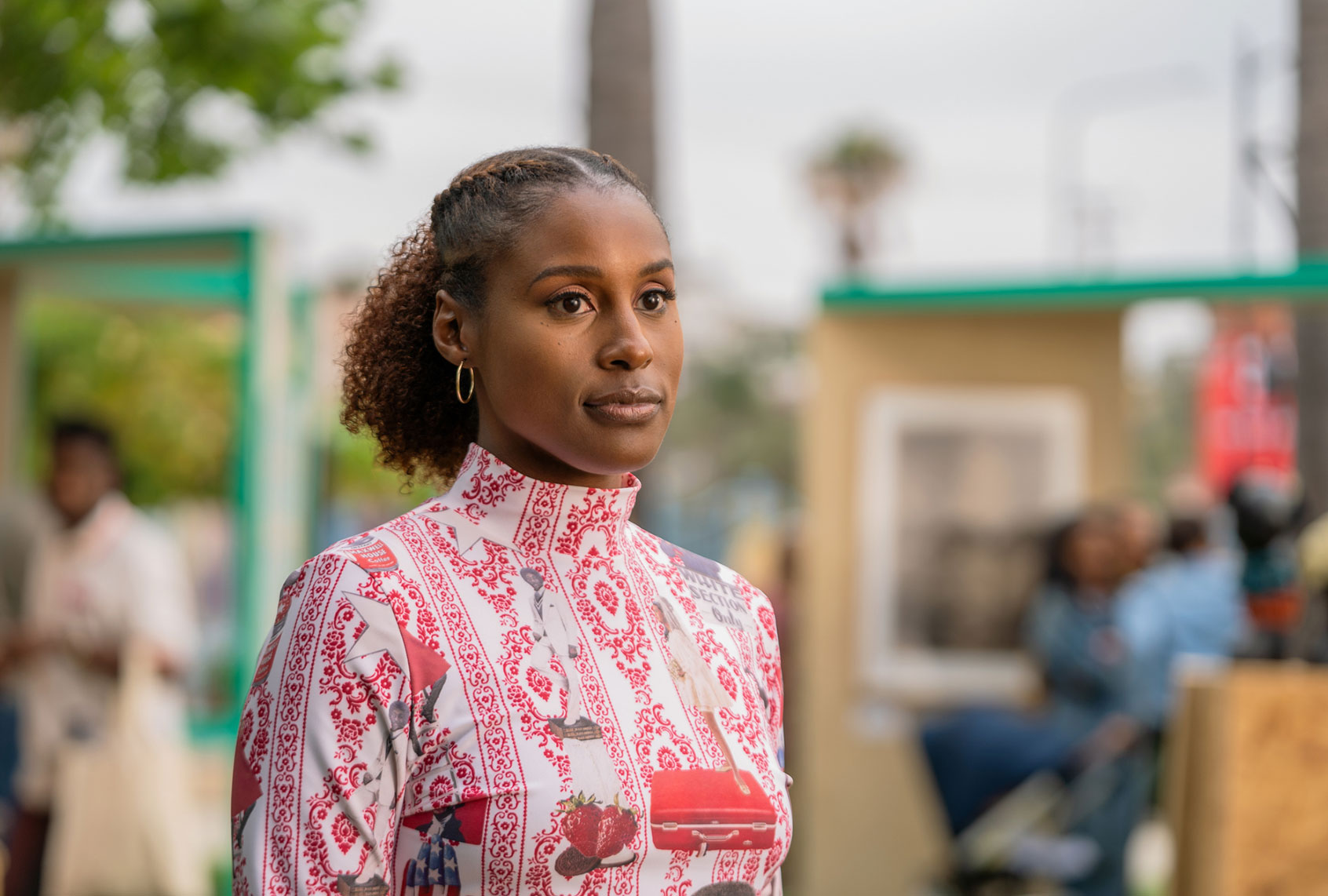
InsecureIssa Rae in “Insecure” (Merie Wallace/HBO)Broadcast and cable-originated titles have performed well on Netflix for some time. It’s just that a few of the prestige-flecked selections captured our attention recently because they weren’t widely available before. For instance, now that Warner Bros. Discovery is licensing HBO series to other distributors, “Insecure” and “Ballers” found fresh audiences on Netflix. 
We need your help to stay independent

Don’t forget that two years ago The CW’s “All American” topped Netflix’s rankings of most viewed shows for several weeks running. Many CW shows drew healthy audiences on Netflix while WarnerMedia (which became WBD) and CBS had an agreement with the service. (That deal expired in 2019.) 

Of course, their popularity is eclipsed by Netflix’s successful runs with “The Office” and “Friends” whose episodes were reclaimed to stream on Peacock and Max, respectively.

CW series’ success on Netflix may be more noteworthy because of how Netflix responded, ramping up productions appealing to younger audiences. (“Chilling Adventures of Sabrina” was a Netflix original initially conceived as a CW show. Although it only lasted two seasons it softened the soil for “Wednesday” to flourish.)

Reviving dead network shows is cheaper than making more homegrown procedurals with more expansive seasons.

The CW has since changed ownership and largely gotten out of the tween drama game, making Netflix the primary destination for young adult shows – challenged, perhaps, by Prime Video, which scored a hit in “The Summer I Turned Pretty,” which was released weekly. Sure, most people don’t ride horses anymore, but what is an engine’s output measured in? Ah yes – horsepower.

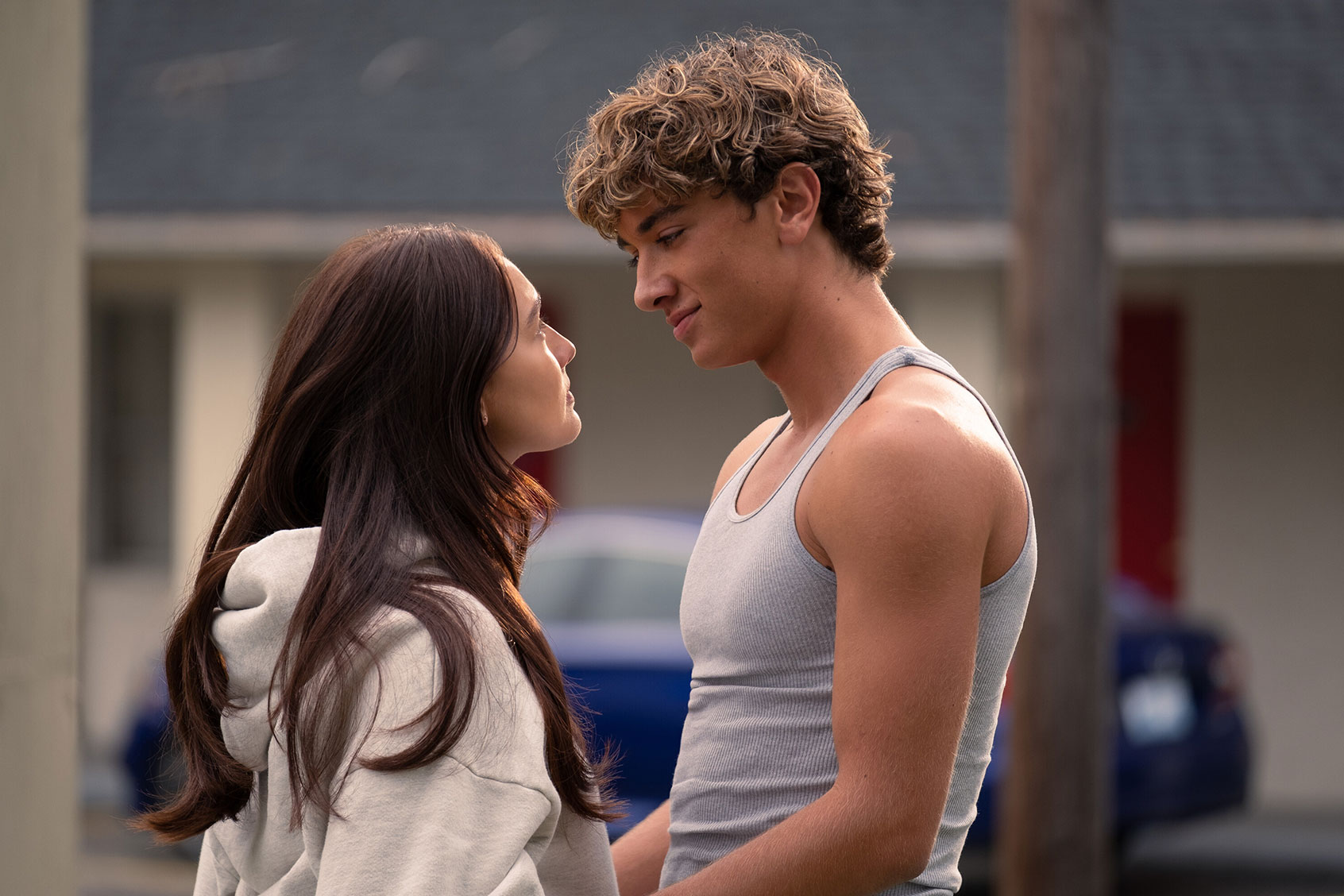
The Summer I Turned PrettyLola Tung as Belly and Gavin Casalegno as Jeremiah in “The Summer I Turned Pretty” (Prime Video)Meanwhile, looking at Nielsen’s measurement of total minutes viewed between July 31 and Aug. 6, as reported by Variety, “Suits” remains No. 1, but shares the Top 10 with network TV stalwarts “NCIS” and “Grey’s Anatomy” – all streaming on Netflix. 

There are two apparent commonalities between these very different shows. One is that they have far more episodes than most Netflix originals. Netflix’s longest-running original, “Grace and Frankie,” has 94 episodes versus the 134 in “Suits” run, or the hundreds of hours of “NCIS” and “Grey’s.”

Out of the three repurposed linear TV shows “Suits” is the lightest option, but all of them operate with the sweet spot between intense and brainless, making them perfect background noise or easy binges for lazy hot days spent indoors.

The main takeaway for streamers likely is that reviving dead network shows is cheaper than making more homegrown procedurals with more expansive seasons, which would necessitate larger writing staffs working at a faster pace. They’d have to replicate some version of classic network and cable TV productions, functionally and structurally. 


Want a daily wrap-up of all the news and commentary Salon has to offer? Subscribe to our morning newsletter, Crash Course.


They’re already doing that in some respects. Netflix’s most popular original title in the first week of August was “The Lincoln Lawyer,” a movie adaptation with procedural beats that came in second to “Suits.” And every streaming service is forgoing automatically serving every show as a binge in favor of rolling out episodes at a weekly clip or streaming some events live – you know, like broadcast and cable. Amazon is finding success in that arena with football, while Netflix’s live-streaming attempts have garnered mixed results.

All of which is to say, broadcast and cable TV aren’t quite dead — and it’s unlikely broadcast will ever be since by its very definition, it is free and available to anyone with a TV and an antenna. Granted, the fall season sure makes it look like the Grim Reaper is circling, with most broadcast network airing game shows, repeats and imported series to contend with  ongoing strikes by the Writers Guild of America and SAG-AFTRA, now creeping into their fifth month. (Salon’s unionized employees are represented by the WGA East.)

Hollywood’s labor stoppage will eventually resolve, but only when the studios accept that they and the industry at large must evolve. That requires finding a way to ensure conventional TV continues to be viable in a way that supports those who make its shows and the companies producing them. The feel-good TV hit of the summer proves linear TV’s continued existence also benefits Netflix and other digital platforms. Streaming is the future; there’s no getting around that. But those services would be foolish to completely starve out those stalwart workhorses of linear TV while viewers still bet on them.


Brazil’s struggling rainforests are so understudied, it’s not clear how bad the damage is

The world has watched, gripped by climate anxiety, the growing frequency and intensity of natural disasters as some of the effects of global warming. The planet’s biological clock seems to be ticking faster as years go by. Back in 2015, when the Paris Agreement recommended that countries strive to limit global average temperature to 1.5ºC above pre-industrial levels by 2100, the challenge looked achievable for the international community. Now, the global rush for climate action grows in urgency as recent projections show that, even in optimistic scenarios, we may reach the 2ºC mark by the end of the century — unless immediate measures are taken.

Amid collective efforts to preserve natural resources, some places have stayed in the spotlight as symbols of Earth’s biological treasures. The Amazon is one of these places: an enormous carbon sink with a global climate regulation power, sprawling across more than 6.7 million square kilometers. It is the largest and most biodiverse tropical rainforest in the world and is also home to millions of species — most yet to be discovered and cataloged.

Implementing effective policies to protect the Amazon, however, might be impacted by the fact that much of its areas are still understudied, which means biodiversity in such regions remains understudied and unknown. In its Brazilian territory, which comprises 60% of the forest’s total area, more than half of the uplands (non-flooded locations) haven’t been assessed.

Implementing effective policies to protect the Amazon might be impacted by the fact that much of its areas are still understudied.

That’s one of the key findings of a cross-national study recently published in Current Biology, part of an extensive data-collection process that involved about 500 researchers from Brazil and other countries. The research highlights that about 54% of upland, 17% of wetland and 27% of aquatic habitats in the Brazilian Amazon have less than 0.1% of research probability (that is, extremely low chances of ecological research being conducted in these areas). This has led to knowledge gaps that, as the study points out, are intensified by the inherent risk of species becoming extinct in these understudied areas, even before they’re researched.

All data collected is part of a collaborative research initiative called Synergize, and according to lead researcher Raquel de Carvalho, a postdoctoral fellow at the Institute of Advanced Studies of the University of São Paulo (USP), the compiled information “largely meets the criteria of other global databases, proving to be valuable in improving the Amazon region’s representation in future investigations about anthropogenic changes at a worldwide level.”

“We find similar data deficiency in other regions where few people live, like the Congo Basin in Africa, and the island of New Guinea, as well as in the deep seas.”

“The paper is right to shine a spotlight on knowledge gaps regarding Amazon biodiversity,” said Thomas Brooks, chief scientist at the International Union for Conservation of Nature (IUCN). He mentioned that out of the 34,869 terrestrial vertebrate species that are assessed globally against the IUCN Red List Categories and Criteria to date, 3,517 (14%) are categorized as “Data Deficient” — which means insufficient data are available to assess the species extinction risk. It’s difficult to conserve a species if you know nothing about it. “The prevalence of Data Deficiency is very similar for Brazil, which holds 398 Data Deficient terrestrial vertebrate species out of 4,229 assessed in total (9%),” Brooks added.

Deforestation; Amazon; Rainforest; Brazil (Leonardo Carrato/Bloomberg/Getty Images)

Adopting a machine-learning model framework based on metadata of over 7,600 sampling sites from multiple ecological community groups, the study mapped research probability across the Brazilian Amazon using key criteria such as the sites’ accessibility and distance to research facilities. The authors found that logistics are a major driver of research activity in the Amazon, since areas with the highest research probabilities are located near facilities such as universities and institutes. 

“We have to build communities of specialists for most taxonomic groups of the organisms we’re going to collect.”

“Better-studied places tend to be those close to cities and roads, while extensive regions of low human population density like the Amazon tend to be well less studied,” Brooks observed. “We find similar data deficiency in other regions where few people live, like the Congo Basin in Africa, and the island of New Guinea, as well as in the deep seas,” he said.

Aside from logistical obstacles, Unicamp emeritus professor Carlos Joly, a member of the Brazilian Academy of Sciences and coordinator of the Brazilian Platform on Biodiversity and Ecosystem Services (BPBES), highlighted the lack of local experts for all animal and plant groups as another gap that affects biodiversity research in the region. 

“This gap is much more difficult to fill short-term, as we’re not able to train taxonomists with the speed we need, for groups in which we don’t have specialists in Brazil,” he explained. Joly believes that establishing partnerships with foreign institutions is an essential strategy for reducing the expertise gap. “We have to build communities of specialists for most taxonomic groups of the organisms we’re going to collect. I think it’s the way we can solve this in a short period of time,” he said.

“When we don’t know what species comprise a forest, we can’t understand its functioning, nor can we predict the impact of climate change on that place’s biodiversity.”

Thinking about less-researched sites through a non-expert lens might lead us to the impression that, since many species have been assessed in similar regions of the forest, we can then predict their occurrence in understudied areas. But this assumption does not suffice in such a large and biodiverse place like the Amazon, where “we do not have similar areas among great distances since each combination of biotic and abiotic factors produces different environments,” explained the study researcher Angelica Resende, a current postdoctoral fellow at the University of Stirling. “We can try to predict that some areas are ‘similar’ in some aspects by combining environmental variables such as climate and soils, but always with degrees of uncertainty, since we do not know all the factors affecting each species,” she added.

According to the study, 15% to 18% of the less-researched locations in the Brazilian Amazon might also be vulnerable to severe human-induced changes in climate or land use by mid-century.

“When we don’t know what species comprise a forest, we can’t understand its functioning, nor can we predict the impact of climate change on that place’s biodiversity,” Joly said. “The better the initial data, about how the forest functions nowadays, the better will be the modeling of future scenarios,” he added.

Amazon DeforestationOfficials from Para State, northern Brazil, inspect a deforested area in the Amazon rain forest during surveillance in the municipality of Pacaja, 620 km from the capital Belem, on September 22, 2021. (EVARISTO SA/AFP via Getty Images)
Resende described that “with enough knowledge about the spatial patterns and occurrence of species, it would be possible to prioritize protecting areas with higher degrees of endangered, endemic or rare species.” Regarding climate change mitigation strategies, she went on, “we could focus on the conservation or restoration of areas with great carbon uptake and storage capacity.”


Want more health and science stories in your inbox? Subscribe to Salon’s weekly newsletter Lab Notes.


Traditional knowledge can help bridge research gaps

The Kunming-Montreal Global Biodiversity Framework, adopted during the 2022 UN Biodiversity Conference (COP 15) in Canada, reinforced the long-time discussed importance of integrating indigenous populations and local communities into biodiversity conservation, restoration and sustainable use. However, according to study findings, this is another challenging commitment: although indigenous lands constitute 23% of the Brazilian Amazon, these areas have lower research probability. 

Considering native communities’ knowledge is pivotal for improving the assessment of species and conservation strategies.

Considering native communities’ knowledge, Joly said, is pivotal for improving the assessment of species and conservation strategies. “First, because we have so much to learn from them — they know the forest better than anyone else. Moreover, because we must help preserve traditional knowledge,” he emphasized. 

Miguel Moraes, program senior director at the Brazilian branch of Conservation International, believes that integrating traditional knowledge into research development also involves a change in cultural perspective. “We need to rethink values, how we handle the multicultural aspect of the Amazon — because indigenous population comprises many cultures, with different values, beliefs and forms of interacting with nature,” he observed.

Developed countries play an important role in reducing gaps, experts say

In early August, the eight countries representing the Amazon Cooperation Treaty Organization (ACTO) attended the Amazon summit at Belém — the capital of the Amazon-based state of Pará. Although the countries, which included Peru and Colômbia, didn’t formally agree on how to end deforestation in the region, they demanded more effective measures from developed countries to prevent its destruction.

For the study researcher and Lancaster University professor Jos Barlow, one of the main steps developed countries should take to help protect the Amazon is reducing their own environmental footprints. “This includes reducing emissions from [burning] fossil fuels, as these make by far the greatest contribution to global warming, and climate change is making the conservation of the Amazon more difficult,” he told Salon.

“Climate change is making the conservation of the Amazon more difficult.”

According to Moraes, developed countries can provide a wide range of resources — not only financial but also technological and human (through research initiatives and partnerships with universities, for example), which he considers essential strategies for fighting Amazon’s deforestation. But ensuring that resources are implemented responsibly is also crucial, he observed; otherwise, they may end up concentrated in the same groups and therefore perpetuate inequalities. “We need payment-by-result mechanisms, green bonds, carbon credits or biodiversity credits — which have been discussed as well,” he explained.

Amid global demands for climate action, international NGOs also play a relevant role in policymaking. They’re able to connect different actors across all levels of natural resource governance, Moraes highlighted, including in global markets with local production processes — which therefore involve several interlocutors. “This transiting ability is very important for advancing not only biodiversity studies and knowledge building, but the actual conservation and knowledge application, as well,” he said.

We need your help to stay independent

Barlow ponders that, although international organizations aren’t the leading sources of biodiversity research, they can also improve the work of academic and research institutions by facilitating sampling in less-covered regions. This could be implemented through longer-term partnerships with organizations based in the Amazon, he said. “International NGOs and intergovernmental organizations could also play an important role in the synthesis and dissemination of new research, making sure it contributes to debates at international fora such as the climate and biodiversity COPs.”

The challenges posed by knowledge gaps “should never be used as an excuse not to act,” observed Brooks. Protecting the world’s most biodiverse forest is a commitment that all international actors have in common. “We must understand that this is a shared challenge. Biodiversity doesn’t consider political borders,” concluded Moraes. The future is, indeed, in our lands.

Alfredo: Forever and always the hood’s favorite

My friends and I had a funny joke we overused back when we were teenagers. Every time we got into some kind of romantic relationship, we’d say something like this to the girl we were dating: “Do you love me? Do you really love me?” 

Some of these significant others would crack a smile, while others would allow a look of seriousness to wash across their face — until me closed with, “Cuz if you really love me, baby, please, please don’t make no damn Alfredo!” 

On almost every occasion, the young woman would burst into laughter and she didn’t, then she sure would after we’d explain how every girl from our hood’s go-to dish was chicken Alfredo. 

Now, my mom never made it, my grandma has never heard of it and there were no Italians in our orbit but surprisingly it became a go-to dish. I never complained about it because, in my extremely unpopular opinion, Alfredo tastes way better than spaghetti with red sauce and I can’t remember turning any down. 

“What in the hell can you make, dummy?” Moni asked my close friend Al after he made the “East Baltimore girls only know how to make Alfredo” joke. 

“Not a goddamn thing,” he replied, pausing to hit his blunt, “But I’m sure that even my nothing that tastes better than your old-ass Alfredo!” 

Moni won the argument because Al had two or three servings every time she prepared the dish. As a matter of fact, we all had two or three servings every time we could get our hands on it­­ — and I don’t remember ever having it as a child. Alfredo popped up during high school and took over the neighborhood. Most of the people who experimented with Alfredo used store-bought sauce and it was still delicious.

We need your help to stay independent

Alfredo was the first pasta dish I tried to experiment with, adding different types of cheeses, chicken, chicken and shrimp, or lobster–– and it is a hit every time. 

Alfredo has stuck with me for years, but I stepped away from the store-bought stuff and really perfected my sauce over the pandemic. Well, at least from the perspective of an amateur chef. Full disclaimer: While I do use parmesan cheese, I prefer a vegan version of heavy whipping cream so that I’m not overloaded with dairy. Also, I boil my noodles in broth, using bowtie pasta because they are neater than fettuccine. I like mine soupy with crab meat, shrimp and lobster, but you should add the protein of your choice. 


Chicken Alfredo
Yields
4 servings
Prep Time
15 minutes
Cook Time
5 minutes

Ingredients

  •  ½ cup butter
  •  3  cups of vegan heavy whipping cream
  • ¼ teaspoon of red pepper
  • 3 cups freshly grated parmesan 
  • 2 teaspoons garlic, minced
  • 1 ½  teaspoons Italian seasoning
  • 1 teaspoon pepper

Directions

  1.  Cook pasta according to instructions and set aside.
  2. Throw the butter and vegan cream into your favorite skillet and let it warm for 3 minutes. 
  3. Sprinkle in the Parmesan. 
  4. Work in the garlic, Italian seasoning, red, and regular pepper for about 2 more minutes. 
  5. Add your desired cooked protein and pasta. Serve after you reach your desired temperature 

Why lack of sleep literally feels like dementia, according to experts

You could not have designed a better experiment had I been a rat in a maze. I’d been confidently getting by on five, maybe six hours of sleep a night for two weeks, juggling work with a rigorous academic seminar in Switzerland. I figured it was a small price for the experience of a lifetime. After all, no one ever said that having it all didn’t mean making some sacrifices — and what easier sacrifice is there to make in your schedule than sleep?

The only problem was that now I couldn’t figure out how to get to my clothes. I knew they were behind a door in the basement of my aparthotel. But was it the door with an image of a barbell, a bicycle or a washing machine on it? Why couldn’t I figure it out? And why couldn’t I even remember how to use my key card? 

There’s a good reason that sleep deprivation is an internationally recognized form of physical and mental torture — even in small doses, it feels like hell.

“You had a glimpse into what dementia feels like,” Sara C. Mednick, a cognitive neuroscientist and author of “The Power of the Downstate: Recharge Your Life Using Your Body’s Own Restorative Systems” and “Take a Nap! Change Your Life,” tells me a few days afterward. This wasn’t the groggy feeling of the aftermath of a late night out. This was the shambling, full system malfunction of a body and brain that could no longer outrun its own basic need for rest. I didn’t feel tired. I felt deeply, frighteningly disoriented. There’s a good reason that sleep deprivation is an internationally recognized form of physical and mental torture — even in small doses, it feels like hell.

Maybe you’ve been there too. Maybe you’ve jerked your head back abruptly during a lecture (or worse, while driving), embarrassed at the realization you’d nodded off for a few seconds. Maybe you’ve found yourself abruptly weepy or confused in the middle of the afternoon.

I am not unique in treating sleep as a mere inconvenience to be mastered. The CDC has estimated that one in three American adults is not getting enough sleep on a regular basis. Alarmingly, roughly 58% of middle school students and 73% of high school students are not either.

And the problem is just getting worse. A 2019 analysis in the Journal of Community Health from Ball State University found that sleep deprivation in working adults has been spiking — rising 5% in less than a decade, with the highest rates of diminished sleep hours found in “protective service and military, healthcare support occupations, transport and material moving, and production occupations.” We cut out sleep because we feel we have to, for our jobs or for our school work. We brag about how little sleep we get, because if we have the same number of hours in the day as Beyoncé, we’d better make them just as productive, right? But our bodies are like bank accounts, and we can’t keep subtracting sleep from it forever and think that debt’s not going to come due eventually.

We need your help to stay independent

“Sleep loss can have various sneaky side effects, affecting both short and long-term well-being,” says Brian Clark, CEO and founder of United Medical Education. “In the short term, it impairs cognitive functions, mood, and immune response, leading to reduced alertness and increased irritability.”

Tack on a whopper of a migraine, and you’ve got a good picture of my sorry recent state. But over time, the picture becomes far more concerning. “Chronic sleep deprivation,” says Clark, “can contribute to more serious issues such as cardiovascular problems, obesity and mental health disorders.” 

“Not only are you running on empty, you’re also keeping the stress hormones and the stress levels in your brain high.”

The National Institutes for Health further links “cumulative long-term effects of sleep loss and sleep disorders” to hypertension, diabetes, depression and stroke, as well as increased risk of injury. And as Sara Mednick points out, it can also do a terrifying number on your brain. “The thing about sleep is that it’s kind of the only time where you can restore your resources,” she explains. “When sleep deprive yourself over a long period of time, chronically, not only are you running on empty, you’re also keeping the stress hormones and the stress levels in your brain high.”

Furthermore, Mednick says, “At night, during sleep, the glymphatic system washes the brain of all these little proteins so that they don’t build up. If you don’t get enough sleep, they do build up and those are the particles and proteins that become the plaques and tangles related to later Alzheimer’s and dementia. So, you know,” she continues bluntly, “in general, you’re really screwing yourself.”

Our individual need for rest varies, and not everyone requires a perfect and uninterrupted eight hours a night. But the CDC estimates that most of us do need seven or more hours. “But I’m special,” you say, “I can thrive on far less than that,” you say. That’s great for you. I learned the hard way, when I practically collapsed in a basement somewhere in Basel, that I am not and I cannot.

I recognize that consistent, deep sleep can be elusive, especially as we get older. Menopause, sleep apnea, restless leg syndrome and all kinds of mental health challenges can do a fine job of throwing themselves between us and the sandman. But I also know that often, we’re not sleeping because we just don’t feel like we want to or that we ought to. And for that, I don’t really need to tell you what to do about it.

You know that pouring the contents of your phone into your eyeballs before bed is bad for your rest, both because the blue light disrupts your sleep cycles and because the content you’re viewing is not doing your mind any favors. You know that you should be steering clear of caffeine and alcohol later in the day; you know your room should be cool, quiet and dark. You know this like you know you should exercise and eat vegetables. But then a respectable hour of the evening comes and goes, and there you are again, scrolling your way through another night.

“Many people think sleep is a waste of time. What they don’t know is that their bodies have an inner to-do list.”

Neha Sangwan, MD, author of “Powered by Me: From Burned Out to Fully Charged at Work and in Life,” puts it this way: “Many people think sleep is a waste of time. And they’re right… if they’re referring to what’s not getting done on their external to-do list. What they don’t know is that their bodies have an inner to-do list. People think they can save time by sleeping less, but this only results in the body, over time, needing to reprioritize what it focuses on. And it’s surprising for people to know that if given less time to sleep, the body will prioritize emotional healing over physical repair.”


Want more health and science stories in your inbox? Subscribe to Salon’s weekly newsletter Lab Notes.


Sangwan recommends we all practice learning to “advocate for our own rest clearly, concisely, and compassionately,” being transparent with friends and colleagues that we simply need to get some sleep. And regarding my own recent sleep deprived situation, Sara Mednick says, “I would have even suggested that maybe skip out on lunch and try to take a nap. It would have restored you enough so that you weren’t running on empty in the evening.”

Those periodic late nights or long flights are part of everyone’s life, and most of us can bounce back pretty quickly from those. But starving oneself of sleep is just not a sustainable lifestyle, any more than starving oneself of food is. I’m still trying to find balance, to give myself permission to do less and rest more. It’s a work in progress to resist the illusion of limitless productivity, but in the long run, I want to stave off heart disease and dementia in the most easily preventable way possible. And this week when I did my laundry, I realized I had no trouble figuring out where the washing machines were.

As the seasons change, try Julia Child’s 5 most comforting fall recipes

And just like that —that show got much better, didn't it? — it's September. And as that subtle crispness begins to permeate the air in many regions, food cravings and meal planning go from grilling and salads to heavier, richer meals. The prime chef whose recipes fit that mold, for me at least, is Julia Child.

Every fall, as the leaves begin to change colors and dot the landscapes, I lean into my Julia Child era.

For some reason, I associate her with the season, as well as early winter. No matter if you've been cooking her recipes or 50 years, got into her only because of "Julie & Julia," or are a brand new fan, there's nothing like a Julia Child recipe. Comforting, reliable and timeless, Child's food makes for the perfect sustenance for a cool, blustery night leading into wintertime and the holidays

With "Julie & Julia" author Julie Powell's recent passing, I revisited her warm, inviting book and the subsequent film version. Much like Powell (or Amy Adams' depiction of Powell in the film version of "Julie & Julia," I sometimes like to imagine Julia as a pal, hanging out in the kitchen and sipping a martini while I cook and eat. 

Leisurely cooking a Julia-inspired feast, soundtracked by my favorite Spotify playlists while leaves fall outside and scarecrows, gourds and Halloween decorations begin to decorate the streets — it doesn't get much better than that. 


Want more great food writing and recipes? Subscribe to Salon Food's newsletter, The Bite.


Here are some Julia Child staples that truly will never, ever steer you wrong. If you have a tattered, stained old copy of "Mastering the Art of French Cooking," now's the best time to pull it out. Otherwise, use these handy recipe links to perfume your home and satiate your family with some of Child's classics. In her words: "Bon appetit!" 

Go ahead: Say it in Julia Child's voice. You know you want to.
 
Possibly Child's most iconic dish, there is truly nothing like beef bourguignon on a cool or cold night. It is the epitome of "stick-to-your-ribs" cooking and the long cook-time results in something outrageously delicious, warming and filling. 
 
Something I've always appreciated about Child's recipes are the consideration which go into them; most recipes today wouldn't have you buy a chunk of bacon, remove he rind, cut into lardons, simmer in water, drain and dry, then crisp up. There's a real "old-school" intentionality here and throughout Child's recipes that I always find refreshing.
Coq au vin is another Child staple and for many, the first dish that comes to mind when thinking of Julia. I'm not a dark meat person, so I rarely make it, but it really does have that special je ne sais quoi, if you will. 
 
A perfect iteration of the classic, it contains chicken, bacon, red wine, broth and mushrooms; the end result is truly so much more than the sum of its parts, as the wine imparts a deep richness and the sauce is liquid gold. Try not to drink it straight from the pan. 
Arguably one of my favorite Julia Child recipes overall, I have made this on many, many an occasion and holiday. It's kind of amazing to see what potatoes, Gruyere, milk or cream, a touch of butter and some salt and pepper can do. It's an excellent showcase for one of my favorite cheeses and the hands-on time is maybe 2 to 3 minutes. It's a star dish. 

We need your help to stay independent

Another classic depicted in "Julie & Julia," Sole Meunière is probably one of the simpler options in Child's pantheon. Consisting of nothing more than sole, butter, oil, flour, lemon juice, parsley and capers, the dish is an exercise in simplicity. It is also said to be the dish that "launched Child's career," interestingly enough. 
This is a real special one for me. The protein with which I primarily cook has always been chicken. Since I first made this, I've made countless iterations, sometimes swapping in something new, sometimes swapping out a staple ingredient, sometimes mixing up the flavor profiles — but the fact remains that this recipe is a true stalwart and it can be tweaked in any which way you'd like. At its core, though, it's a pretty pristine version of chicken, mushrooms and sauce and it's something that'll probably satisfy everyone.
 
It's also the perfect dish to teach you the technique of making sauced chicken dishes.

It takes more than one superhero

Warner Bros. Pictures and DC Comics’ “Blue Beetle,” the first live-action Latino superhero film, leapt over some high barriers to top the box office in its debut weekend, displacing Warner Bros. behemoth summer hit, “Barbie.”

Because the cast of “Blue Beetle” was sidelined from promoting the film due to the actors’ strike, Latino organizations wrote an open letter calling on audiences to watch the movie in theaters, and fans started their own social media campaigns under the banner #bluebeetlebattalion to drive turnout. They managed to pull out a victory.

“Blue Beetle” can be a blueprint for the kind of deeper change Hollywood needs.

But at the same time the first “Blue Beetle” audiences were buying their tickets for Thursday night screenings, the USC Annenberg Inclusion Initiative published the latest edition in its ongoing study on diversity in Hollywood. Representation both on and behind the screen is virtually unchanged since the study began in 2007. Women, people of color, LGBTQ+ and disabled persons continue to be cast aside.

Women and girls held fewer than 35% of speaking roles in films released in 2022, according to the study. Among racial and ethnic groups, Latinos continued to be the most underrepresented group per capita in film. The researchers found that Latinos accounted for about 5% of speaking roles in films. Latinos comprise about a fifth of the U.S. population, according to the U.S. Census.

With a cast that’s predominantly Latino, a Puerto Rican director in Ángel Manuel Soto, and a Mexican screenwriter in Gareth Dunnet-Alcocer, “Blue Beetle” could move Hollywood Latino representation up a few percentage points this year, but not enough to make up for decades of lost stories: Latino talent who missed out on casting opportunities, scripts centering on Latino experiences that were never produced, and underrepresented directors who never got a shot at a superhero-sized budget.

Still, it’s a start. “Blue Beetle” can be a blueprint for the kind of deeper change Hollywood needs. The film features more than a token diverse character and, critically, employs POC on both sides of the camera. In “Blue Beetle,” Jaime Reyes (Xolo Maridueña) is a young man with big ambitions and a big Mexican American family. When the reality of his family’s finances comes to light, he puts his dreams on hold to help them. By chance, Jaime crosses paths with a mystical blue scarab that attaches itself to him, and he becomes the superhero Blue Beetle. When crisis comes to the Reyes home, his family also steps up to help him, whether that’s pulling off a mischievous heist with his Uncle Rudy (George Lopez) or fighting alongside his Nana (Adriana Barraza), an anti-imperialist fighter in the Mexican Revolution. The movie goes beyond the usual CGI fight fests to weave in mentions of gentrification, undocumented family members and the harrowing legacy of the United States’ interventions in Latin America through the School of the Americas.

Blue BeetleElpidia Carrillo as Rocio, George Lopez as Uncle Rudy, Xolo Maridueña as Jaime Reyes, Belissa Escobedo as Milagro and Damian Alcazar as Alberto in “Blue Beetle” (Warner Bros.)
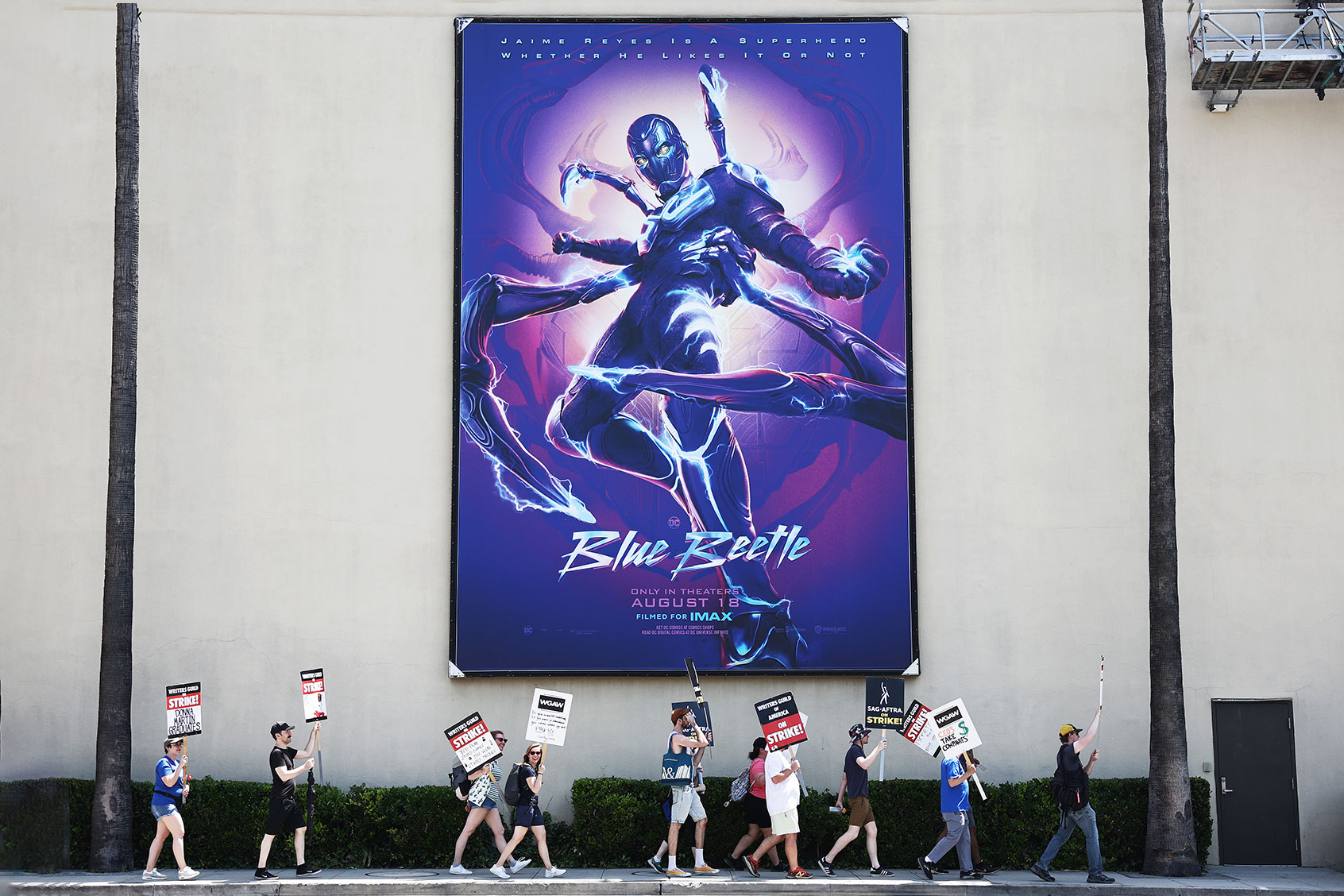
Cultural references roll off characters’ tongues like they were pronouncing their “rr’s.” They’re seamless and natural, from old school Mexican music to alluding to classic telenovelas, the long-running variety show “Sábado Gigante” and the Mexican horror movie “Macario.” The family switches easily between Spanish and English. It’s not just a few words of affection, either. There’s plenty of non-English dialogue blended naturally into the fabric of the Reyeses’ conversations. It’s more than just representation for representation’s sake. It reflects the care of the filmmakers and cast to hit the right tone, the body language, the word choices to feel authentic. In doing so, they reflect the actual lives of the millions of Latinos who watch U.S. films but seldom appear in them.

“Blue Beetle’s” big-screen appearance almost never happened.

Considering that the industry more often erases Latino presence than celebrates it, the fact that “Blue Beetle” is so unapologetically proud of its roots and celebrates us as heroes feels like progress — yes, even for a family-friendly superhero movie. At a time when a number of Latino-led TV shows are among the first to get the ax or taken off of streaming services, “Blue Beetle” is pushing back against corporate mandates and DEI initiatives that have failed to lead to more Latino creative talent in the entertainment industry.

“Blue Beetle’s” big-screen appearance almost never happened. The film was supposed to premiere on the streaming service now known as Max, the same release strategy that was slated for “Batgirl,” starring the Latina Leslie Grace Martínez. Warner Bros. Discovery (the parent company of the DC Extended Universe) controversially canceled “Batgirl” before its completion.

Although “Blue Beetle” is finally enjoying its long-delayed debut, Hollywood’s systemic issues require much more than one movie to be fixed. It will take a multiverse of different industrywide efforts and internal change at various decision-making levels to fix the industry’s broken talent pipeline, and the WGA and SAG-AFTRA strikes are a part of those efforts. The strike issues include shrinking residuals and mini-writers’ rooms, a new kind of economic precarity that may force more working class, underrepresented writers and actors to leave the business.

SAG-AFTRA WGA Strike Blue Beetle billboardStriking SAG-AFTRA members picket with striking WGA (Writers Guild of America) workers on Day 5 near a billboard for the Blue Beetle movie outside Warner Bros. Studio on July 17, 2023 in Burbank, California. (Mario Tama/Getty Images)

Striking a new deal would benefit someone like Maridueña, who broke out as a lead actor in Netflix’s “Karate Kid” spinoff series “Cobra Kai” and could earn more if streaming residuals are reformed (Maridueña’s parents founded the Boyle Heights Arts Conservancy to help underrepresented communities break into film and the arts).

A new deal would also support writers like Dunnet-Alcocer, who told The Hollywood Reporter  about the challenges many Latino writers face“Latino writers don’t usually come from wealth,” he said. “So that’s an extra pressure. The less economic infrastructure you have to help you survive this, it’s less chance to write and express their stories because you can’t write.”

The flux state of streaming platforms has proven to be a double-edged sword, with services greenlighting many diverse series but allowing few enough time to find an audience. Soto’s previous film, “Charm City Kings,” was among those acquired exclusively for HBO Max but later dropped from the service in the 2022 corporate shuffle. It’s now available to rent on VOD, which means curious viewers have to search a little harder and pay extra to see it.

Like most recent superhero movies, “Blue Beetle” is set to return for a sequel. Hopefully, he’ll enjoy the success of the animated Puerto Rican Spider-Man Miles Morales, and return in multiple big-screen adventures. But to truly make movie casts look more like the U.S. population, increased support for “Blue Beetle” will have to extend to Latino talent in scrappy indies, nonfranchise movies and comic book-inspired blockbusters alike.

The necessary quadrupling of Latinos in film will take more than a single heroic effort. Addressing the persistent lack of girls and women on screen, the USC study’s author, Stacy L. Smith, identified the same villain menacing everyone except straight, white, able-bodied men. “It is clear the entertainment industry has little desire or motivation to improve casting processes in a way that creates meaningful change,” she said.

Can’t we all get along? Actually, no — not when the other side behaves like that

New York Times columnist David Brooks has been writing of late about how we should all just get along. In two August opinion pieces, he places the onus on the “highly educated elite” to take more responsibility in forming Abraham Lincoln’s more perfect union.

This sort of appeal has been made for a number of years now. As many on the right turned away from public health measures in a pandemic and then determined to take down our democracy, those on the left were asked why they couldn’t fall in line and be … nicer.

The gist of Brooks’ argument seems to be that educated liberals need to take responsibility for annoying conservatives. In Brooks’ view, the highly educated are also to blame for the fact that America’s political culture has gotten so rancorous. Or at least we need to seriously consider that, he suggests. 

Brooks probably didn’t write the headline for “What if We’re the Bad Guys Here?“, published on Aug. 2. But his editor captured the tenor pretty well. Brooks is not entirely wrong in reminding the highly educated “elite” (of which he — author, New York Times columnist and decades-long commentator on “PBS Newshour” — counts himself a member) to consider how its exclusionary ways may have made people in more modest quarters of working America mistrust the system in general. This paragraph captures the main thrust:

The ideal that we’re all in this together was replaced with the reality that the educated class lives in a world up here and everybody else is forced into a world down there. Members of our class are always publicly speaking out for the marginalized, but somehow we always end up building systems that serve ourselves.

If you swap out “educated class” and replace it with “the rich,” you might start sounding like a left-winger. But I suppose the point is that liberals from wealthy backgrounds have, over many decades, ignored the working class or turned up their noses at them. Which is honestly fair enough.

Brooks attempts to bolster this point by noting that in the 2020 election, Joe Biden won 500 U.S. counties to Donald Trump’s 2,500. Most of us have seen that MAGA-friendly map, but those deep-red counties tend to have small populations (as do a number of red states, which nevertheless each get two U.S. senators). The idea being conveyed here is that an overwhelming geographical chunk of America voted for Trumpism out of frustration with being left behind and locked out of educational and economic opportunities.

Geographical areas don’t vote; people do. The counties Joe Biden won had 67 million more residents, account for 71% of U.S. economic activity and represent 54.5% of the American landmass.

But geographical areas don’t vote; people do. That map, which has circulated endlessly, is interesting because if you display it by population, it looks utterly different. As a January 2021 article from the Brookings Institution notes, the counties Biden won had 67 million more residents than the counties won by Trump. And, as Brooks himself points out, the Biden counties account for about 71% of U.S. economic activity of the country. They also represent 54.5% of the U.S. landmass, putting the lie to the MAGA-counties map. Trump didn’t actually win most of America; Biden did.

Brooks followed that one up with “Hey, America, Grow Up!” on Aug. 10. (Admittedly, that’s a sentiment much of the civilized world would agree with.) Mixed in with a lot of well-intentioned bromides about character and community are suggestions for the well-educated — meaning people who believe in facts and reality and democratic governance — on how to be friendlier fellow citizens to their QAnon, “stolen-election” brethren.

Brooks writes about the downside of our “therapeutic culture” — our need to feel better about ourselves as individuals — and how he thinks we can move past that:

In a nontherapeutic ethos, people don’t build secure identities on their own. They weave their stable selves out of their commitments to and attachments with others. Their identities are forged as they fulfill their responsibilities as friends, family members, employees, neighbors and citizens. The process is social and other-absorbed; not therapeutic. 

My lifelong best friend was swayed by Brooks’ message and suggested I read the essay. And yes, Brooks is good at the business political and cultural writers are in: crafting a persuasive argument. Yes, educated people can indeed be annoying — by, say, using words like indeed, as I just did, or other highfalutin words Brooks mentions, or by pretending to understand things they really don’t.  

I’m reminded of the bar scene in “Good Will Hunting,” where Matt Damon’s character pulls apart the scholarly B.S. of a Harvard student and then, when the Ivy man persists in insisting on his ultimate superiority, leans in and quietly offers, “But, hey, if you’ve got a problem like that, we can just step outside and figure it out.” Even educated people enjoyed that, I promise.

But here’s the thing: In discussing our so-called therapeutic culture, where we’re too “coddled” to face the “real world” and own up to our obligations and responsibilities — a go-to psychological projection of the right  — Brooks never mentions Trump voters, who remain in their own therapeutic bubble of right-wing media, which teaches them very little about the real world.

In discussing “therapeutic” culture, where we’re too “coddled” to face the “real world,” Brooks never mentions Trump voters, in their own therapeutic bubble of lies, obfuscations and conspiracy theory.

Many conservatives are coddled in a comfy blankie of lies, obfuscations and conspiracy theory. Fox News essentially acts as free day care for aging white right-wingers. Its viewers are constantly assured that harboring their darkest impulses about women, people of color and people with different sexual and gender identities is completely understandable, even proper. After years of this steady diet of malign disinformation, they trust their authoritarian cult leader more than their religious leaders or even family and friends.

This leads us to the Big Lie — and, well, to lies in general. Ask anyone in a bad relationship: When one partner cannot take responsibility for their actions, a healthy relationship is not possible.

In her superb book “Orwell’s Roses,” author Rebecca Solnit addresses the damage done by lies and why they are used by authoritarians:

Lies gradually erode the capacity to know and to connect. In withholding or distorting knowledge or imparting falsehood, a liar deprives others of the information they need to participate in public and political life, to avoid dangers, to understand the world around them, to act on principle, to know themselves and others and the situation, to make good choices, and ultimately to be free. The liar drives a wedge between what he or she knows and what the victim of the lie knows, though the lied-to person or people may be entirely convinced, confused, or suspicious. Or they may be aware they are being deceived, in which case they may or may not know the nature of the deception or what it endeavors to conceal. Authoritarians often coerce people to go along with what they know are lies, making them reluctant coconspirators who may be deceiving yet other parties. Knowledge is power, and the equitable distribution of knowledge is inseparable from other forms of equality. Without equal access to the facts, equal capacity in decision-making is impossible. 

Beyond the lies, there’s no functional relationship between the right and the left in this country because the right purposefully destroyed that relationship. Aping right-wing broadcaster Rush Limbaugh, Republicans turned from making policy to “owning the libs.” At the invitation of then-Speaker Newt Gingrich, Limbaugh came to the Capitol in 1995 and encouraged the incoming Republican House majority to vilify Democrats, training them to use a lexicon of hatred and dehumanization — “sick,” “evil,” “twisted” — and practice the politics of racism, misogyny and general resentment. The modern Republican cult was in many ways launched by Limbaugh, who trained his followers to be “ditto-heads.” 

As Salon’s Heather Digby Parton put it in a column published shortly after Limbaugh’s death in February 2021, “the cult Limbaugh created was simply appropriated by Donald Trump”:

There were plenty of racists, xenophobes, sexists, religious hypocrites and violent extremists long before he came along. But he found a way to synthesize their point of view into one overarching worldview: Coastal elites, Black people, immigrants, gays, feminazis and environmentalists are your enemy and they want to destroy America.

Limbaugh’s dark spirit lives on in his most devoted acolyte. Abraham Lincoln begged Americans not to think of each other as enemies and to look to the “better angels of our nature.” Rush figured there was no money in that sort of thing. He made selling hatred into the entertainment juggernaut on which Trump continues to capitalize.

Then came the more overt white grievance and the red-white-and-blue garb of the Tea Party years, which led to the Trumpian-authoritarian push for “alternative facts” as a tool for destroying people’s ability to discern reality itself. As a result, friendships have ended and many parents and children, brothers and sisters cannot speak to each other


Want a daily wrap-up of all the news and commentary Salon has to offer? Subscribe to our morning newsletter, Crash Course.


It’s largely more educated Americans who mourn the loss of their Fox News–addled parents, siblings and friends, not the other way around. (I essentially lost one of my best friends.) In their gleeful desire to own the libs, and their lazy desire not to do the hard work demanded by democratic politics, it was the latter who turned their backs on the responsibilities of governing. How, by embracing the Big Lie and all the smaller ones, do they “fulfill their responsibilities as friends, family members, employees, neighbors and citizens”?

Ron DeSantis understands precisely what Solnit is saying about the powerful effect of lies. She writes, “Authoritarians see truth and fact and history as a rival system they must defeat.” Orwell’s greatest novel, she observes, reflects a deep understanding of authoritarian tactics and the need to drive people apart, even parents from children. In “1984,” a child turns in her father for thoughtcrime, and the father, Solnit writes, “is so well indoctrinated that he ruefully commends the child from his prison cell.” What could be more heartbreaking than that? Well, the history of the slave trade in America, where family members were sold off from each other, never to see one another again in this life. But that’s a history not to be taught in Florida — and perhaps in your state soon, if Republicans can manage it.

It’s largely more educated Americans who mourn the loss of their Fox News–addled parents, siblings and friends, not the other way around.

Trump once blurted that he loved “the poorly educated,” who had overwhelmingly supported him. With Republicans’ ceaseless attacks on public education and higher education, they seemingly want to ensure there are many more of the poorly educated in future. For David Brooks to blame the educated — using the code word “elite”— is disingenuous and only serves to further the long history of anti-intellectual prejudice in America. 

A few years back, I wrote an article on “The Bully Hero,” asking when Americans had turned away from cheering for legitimate heroes (or even antiheroes) to boorish, know-nothing louts, who were formerly comic fodder for the actual hero. I concluded that if you tell a certain segment of Americans that you will do all their thinking for them, and encourage them to express their most bigoted and misogynistic impulses, they will elevate you to the heavens. They’ll even cheer you on as you deride people who have served their country in the military, in law enforcement, in the diplomatic service. At your behest, they will threaten violence against public servants, poll workers, prosecutors and judges.

And we are supposed to pal up with such people? 

I admire David Brooks’ prose style, his erudition and his evolution from reflexive support for all Republican policies to writing about character. I appreciate that he now admits that Donald Trump deserves to be in prison. If I had the opportunity to buy him a drink — say, at Bemelmans Bar in the Carlyle Hotel, a suitably conservative locale — I imagine we could have a friendly conversation, because it would not be undone by lies. Or at least I hope not; what he did not say in his recent columns makes me wonder. We all know how dangerous lies of omission can be.

Yes, the highly educated elite is something of an exclusionary tribe unto itself, but many of its members vote for candidates who take public service seriously and who support policies that will help all Americans. And let’s be real: Beyond the good-ol’-boy beards and put-on country drawls, the Republican (and Trumpist) leadership is largely part of that elite. Right-wingers of that class almost never work for the true needs of the middle- or working-class people who vote for them; instead, they offer the bread and circuses of the culture wars. Like Trump, they also grift on their government jobs and view their working-class supporters the same way Trump does. While thoroughly enjoying the news coverage of the Jan. 6 violent insurrection he worked so hard to achieve, he was reportedly dismayed that his followers looked “low class.”

The highly educated elites on the left may annoy David Brooks. They sometimes annoy me. But Republican political grifters consistently attack women’s rights, voting rights, civil rights and the right of LGBTQ people to be treated as full citizens, They fight every measure that might help those left behind: supporting public education, raising the minimum wage, bolstering union rights, forgiving student debt, rebuilding our infrastructure. They implacably work against the interests of the working class and younger people. I wonder if Brooks has considered how those attacks on the basic needs of human beings, along with the Trumpist attacks on democracy and decency in general, have affected our national mental health crisis.

There are many reasons we have broken relationships in this country. The blame must fall on those who have consciously lied to the public, dehumanized their political opponents and turned their back on democracy. How could we not have a mental health crisis when so much of the public has been instructed by their political leaders not to acknowledge the crises of gun culture and climate change that face us all? As Orwell writes, “The Party told you to reject the evidence of your eyes and ears. It was their final, most essential command.”

Parents reeling as ADHD drug shortage stretching into 10th month collides with starting school

Stephen Murray spent six months taking his daughter to appointments to try and reach a diagnosis for attention difficulties that were making her fall behind in school. In June, she was finally diagnosed with attention deficit hyperactivity disorder (ADHD) and prescribed Concerta (methylphenidate) to treat it. But nearby pharmacies are out of her medication and she has gone three months without taking a single pill.

“The problem is that she really can’t function in school,” Murray, who is a health researcher in Massachusetts, told Salon in a phone interview. “We’re really anxious about the school year starting and not being able to get her something that we are confident is going to help a lot.”

Nationwide, 97% of pharmacists have reported experiencing the on-going amphetamine drug shortage as it stretches into its 10th month. Although the U.S. Food and Drug Administration (FDA) recently approved generic Vyvanse (lisdexamfetamine) to treat ADHD, which is expected to ease the shortage, some still worry that demand will put even more pressure on supply chains as schools start.

In the meantime, patients are going without their amphetamine medications like Adderall, used to treat not just ADHD but also narcolepsy and binge eating disorder. As providers turn to alternative treatments, other drugs like Ritalin or Concerta, are becoming harder to find, too.

“Now there are these secondhand shortages, so even people who weren’t taking Adderall are having a difficult time getting their other medications.”

Some have been forced to go “cold-turkey” off of their medication and are suffering withdrawals, said Dr. Ryan Marino, an emergency medicine physician at Case Western Reserve University School of Medicine. Untreated ADHD and narcolepsy have been linked to higher rates of car accidents, as well as substance use. When untreated, these conditions can also impact a person’s school or work performance and relationships.

“Not only have people been cut off of their medications, which can be uncomfortable and miserable in itself,” Marino told Salon in a phone interview. “Now there are these secondhand shortages, so even people who weren’t taking Adderall are having a difficult time getting their other medications.”

On Aug. 1, the FDA and the Drug Enforcement Agency (DEA) issued a joint letter addressing the drug shortage, blaming one manufacturing delay last fall and high prescription rates. Stimulant prescriptions were already rising before COVID-19, but they increased even more during the pandemic when regulators allowed for prescribing via telehealth. 

“We want to make sure those who need stimulant medications have access,” the FDA and DEA statement reads. “However, it is also an appropriate time to take a closer look at how we can best ensure these drugs are being prescribed thoughtfully and responsibly.”

Because amphetamines are a Schedule II controlled substance, they have more hoops to jump through to get on the market. For medications like Adderall, the DEA is in charge of setting “quotas” for how much supply is produced. According to the letter, manufacturers only sold 70% of this quota for amphetamine products in 2022 and a similar trend is happening in 2023. 

While supply or manufacturing delays could have been to blame for not meeting this quota, some are critical of the DEA’s role in determining how much of certain medications go on the market in the first place, and question why the agency doesn’t just raise its quota to meet demand in light of manufacturing issues.

“The DEA is not a medical organization — they are law enforcement and prosecutors,” Marino said. “It’s a little strange that they are setting these quotas, and making determinations of what prescriptions are legitimate or not, without having any sort of medical facilities to do so.”

“It’s a little strange that they are setting these quotas, and making determinations of what prescriptions are legitimate or not.”

On the other hand, concerns have been raised that overprescribing is behind the surge in demand. The FDA cited “widespread misuse” of amphetamine medications in its letter, and some research has suggested as many as 1 in 4 students reported misusing ADHD drugs in the past year.

Additionally, additudes around ADHD are changing. Increased visibility and awareness — as well as less stigma — about the condition in recent years may be driving the uptick in diagnoses, particularly in adults whose symptoms were missed in childhood. The FDA called for more research into ADHD in adults, which has historically been underdiagnosed. As an “invisible” condition, it is treated differently than other neurological conditions and has been trivialized, Marino said. Although it was discovered at the turn of the 20th century, it wasn’t included in the American Psychiatric Association’s first “Diagnostic and Statistical Manual of Mental Disorders (DSM)” until 1968.

Regardless, just because more patients are diagnosed with ADHD doesn’t mean they’ll be prescribed mixed-salt amphetamine products like Adderall, and it can be difficult to calculate how much supply is necessary for an increasing demand, said Michael Ganio, the Director of Pharmacy Practice and Quality at the American Society of Health-System Pharmacists (ASHP). Expansions that allow for telehealth prescribing are set to expire in November, which also complicates manufacturing estimates.

“From the manufacturing perspective, cases are going up, but as far as understanding how much to increase production and how much to request from the DEA for quotas, it’s not clear,” Ganio told Salon in a phone interview. “It’s a moving target trying to find exactly how much to produce without overproducing and leaving products on shelves. … I think that’s why this has persisted so long.”

“It’s a moving target trying to find exactly how much to produce without overproducing and leaving products on shelves. I think that’s why this has persisted so long.”

In 2022, the DEA launched an investigation into telehealth startups like Cerebral that were advertising medications on TikTok and Meta for general symptoms that didn’t always meet the criteria for an official ADHD diagnosis. Since then, some major pharmacy chains stopped filling orders prescribed through the platform and Cerebral is currently not offering prescriptions, according to its website. Yet the shortage continues, suggesting that if the company was contributing to the problem, there is something more at play.

According to the ASHP, over 300 prescription drugs are currently in shortage, including cancer treatments and Ozempic, which was originally prescribed as a diabetes drug but has since become a popular weight loss drug. Drug shortages have become so widespread that one-third of hospitals reported rationing, delaying or cancelling treatments because of them, according to an ASHP survey

Close to a dozen of those shortages are caused by increased demand like Adderall appears to be, whereas it’s far more common for shortages to be caused by supply disruptions, Ganio said.


Want more health and science stories in your inbox? Subscribe to Salon’s weekly newsletter Lab Notes.


Although there may be supply chain or manufacturing issues at play, the DEA could also expand the number of companies they allow to make Adderall or allow other companies that are already making it to increase their quota, Marino said.

“The DEA has the power to solve all of this with a snap of their fingers, honestly,” he said.

“The DEA has the power to solve all of this with a snap of their fingers.”

As these agencies work to resolve the trilogy of issues related to manufacturing, demand, and supply quotas, patients will continue to go without their medications. Kelli Coviello, a principal’s assistant at an elementary school in Massachusetts, also struggled to find Concerta for her 13-year-old son, Jack.

Jack has long COVID and has been doing remote schooling for the past year as he slowly recovers. On top of organizing cardiology, physical therapy and neurology appointments to treat his long COVID, Coviello’s husband had to call 10 pharmacies in their area to try and find his medication. He didn’t have any luck, and eventually, they had to switch medications, even though Jack was doing well on Concerta.

“He has at times had to go without for a day or two but I think because he wasn’t in school it wasn’t that big of a deal,” she said. “Dealing with that going back, that could be a challenge for him.”

Ganio said controlled substances can’t be transferred from pharmacy to pharmacy, so patients must physically drive their prescription for these substances from store to store, or have their provider resend an electronic record of the prescription to each new pharmacy they try. 

“It becomes this kind of Whac-a-Mole game either over the phone or driving from pharmacy to pharmacy to try to find a prescription,” Ganio said. “It’s really most difficult on the patients, but you can imagine being a prescriber and having to manage this.”

We need your help to stay independent

Without her medication, Murray’s daughter fell behind in school last year. Tension arose with teachers and at home when she struggled to complete her schoolwork. This week, she started seventh grade, but Murray is worried she’ll withdraw and become distant and depressed like she did last year when her condition went untreated. 

“To see her suffering, knowing something so simple can be done is a grueling feeling as a parent,” Murray said. “I want her to feel better and I want her to feel like she can succeed. I am pretty confident this medication is going to do that for her, and here we are just twiddling our thumbs.”

Artificial intelligence may influence whether you can get pain medication

Elizabeth Amirault had never heard of a Narx Score. But she said she learned last year the tool had been used to track her medication use.

During an August 2022 visit to a hospital in Fort Wayne, Indiana, Amirault told a nurse practitioner she was in severe pain, she said. She received a puzzling response.

“Your Narx Score is so high, I can’t give you any narcotics,” she recalled the man saying, as she waited for an MRI before a hip replacement.

Tools like Narx Scores are used to help medical providers review controlled substance prescriptions. They influence, and can limit, the prescribing of painkillers, similar to a credit score influencing the terms of a loan. Narx Scores and an algorithm-generated overdose risk rating are produced by health care technology company Bamboo Health (formerly Appriss Health) in its NarxCare platform.

Such systems are designed to fight the nation’s opioid epidemic, which has led to an alarming number of overdose deaths. The platforms draw on data about prescriptions for controlled substances that states collect to identify patterns of potential problems involving patients and physicians. State and federal health agencies, law enforcement officials, and health care providers have enlisted these tools, but the mechanics behind the formulas used are generally not shared with the public.

Artificial intelligence is working its way into more parts of American life. As AI spreads within the health care landscape, it brings familiar concerns of bias and accuracy and whether government regulation can keep up with rapidly advancing technology.

The use of systems to analyze opioid-prescribing data has sparked questions over whether they have undergone enough independent testing outside of the companies that developed them, making it hard to know how they work.

Lacking the ability to see inside these systems leaves only clues to their potential impact. Some patients say they have been cut off from needed care. Some doctors say their ability to practice medicine has been unfairly threatened. Researchers warn that such technology — despite its benefits — can have unforeseen consequences if it improperly flags patients or doctors.

“Apparently being sick and having a bunch of surgeries and different doctors, all of that goes against me.”

“We need to see what’s going on to make sure we’re not doing more harm than good,” said Jason Gibbons, a health economist at the Colorado School of Public Health at the University of Colorado’s Anschutz Medical Campus. “We’re concerned that it’s not working as intended, and it’s harming patients.”

Amirault, 34, said she has dealt for years with chronic pain from health conditions such as sciatica, degenerative disc disease, and avascular necrosis, which results from restricted blood supply to the bones.

The opioid Percocet offers her some relief. She’d been denied the medication before, but never had been told anything about a Narx Score, she said.

In a chronic pain support group on Facebook, she found others posting about NarxCare, which scores patients based on their supposed risk of prescription drug misuse. She’s convinced her ratings negatively influenced her care.

“Apparently being sick and having a bunch of surgeries and different doctors, all of that goes against me,” Amirault said.

Database-driven tracking has been linked to a decline in opioid prescriptions, but evidence is mixed on its impact on curbing the epidemic. Overdose deaths continue to plague the country, and patients like Amirault have said the monitoring systems leave them feeling stigmatized as well as cut off from pain relief.

The Centers for Disease Control and Prevention estimated that in 2021 about 52 million American adults suffered from chronic pain, and about 17 million people lived with pain so severe it limited their daily activities. To manage the pain, many use prescription opioids, which are tracked in nearly every state through electronic databases known as prescription drug monitoring programs (PDMPs).

The last state to adopt a program, Missouri, is still getting it up and running.

Database-driven tracking has been linked to a decline in opioid prescriptions, but evidence is mixed on its impact on curbing the epidemic.

More than 40 states and territories use the technology from Bamboo Health to run PDMPs. That data can be fed into NarxCare, a separate suite of tools to help medical professionals make decisions. Hundreds of health care facilities and five of the top six major pharmacy retailers also use NarxCare, the company said.

The platform generates three Narx Scores based on a patient’s prescription activity involving narcotics, sedatives, and stimulants. A peer-reviewed study showed the “Narx Score metric could serve as a useful initial universal prescription opioid-risk screener.”

NarxCare’s algorithm-generated “Overdose Risk Score” draws on a patient’s medication information from PDMPs — such as the number of doctors writing prescriptions, the number of pharmacies used, and drug dosage — to help medical providers assess a patient’s risk of opioid overdose.

Bamboo Health did not share the specific formula behind the algorithm or address questions about the accuracy of its Overdose Risk Score but said it continues to review and validate the algorithm behind it, based on current overdose trends.

Guidance from the CDC advised clinicians to consult PDMP data before prescribing pain medications. But the agency warned that “special attention should be paid to ensure that PDMP information is not used in a way that is harmful to patients.”

This prescription-drug data has led patients to be dismissed from clinician practices, the CDC said, which could leave patients at risk of being untreated or undertreated for pain. The agency further warned that risk scores may be generated by “proprietary algorithms that are not publicly available” and could lead to biased results.

Bamboo Health said that NarxCare can show providers all of a patient’s scores on one screen, but that these tools should never replace decisions made by physicians.

Some patients say the tools have had an outsize impact on their treatment.

Bev Schechtman, 47, who lives in North Carolina, said she has occasionally used opioids to manage pain flare-ups from Crohn’s disease. As vice president of the Doctor Patient Forum, a chronic pain patient advocacy group, she said she has heard from others reporting medication access problems, many of which she worries are caused by red flags from databases.

“There’s a lot of patients cut off without medication,” according to Schechtman, who said some have turned to illicit sources when they can’t get their prescriptions. “Some patients say to us, ‘It’s either suicide or the streets.'”

The stakes are high for pain patients. Research shows rapid dose changes can increase the risk of withdrawal, depression, anxiety, and even suicide.

Some doctors who treat chronic pain patients say they, too, have been flagged by data systems and then lost their license to practice and were prosecuted.

Lesly Pompy, a pain medicine and addiction specialist in Monroe, Michigan, believes such systems were involved in a legal case against him.

His medical office was raided by a mix of local and federal law enforcement agencies in 2016 because of his patterns in prescribing pain medicine. A year after the raid, Pompy’s medical license was suspended. In 2018, he was indicted on charges of illegally distributing opioid pain medication and health care fraud.

“I knew I was taking care of patients in good faith,” he said. A federal jury in January acquitted him of all charges. He said he’s working to have his license restored.

One firm, Qlarant, a Maryland-based technology company, said it has developed algorithms “to identify questionable behavior patterns and interactions for controlled substances, and for opioids in particular,” involving medical providers.

The company, in an online brochure, said its “extensive government work” includes partnerships with state and federal enforcement entities such as the Department of Health and Human Services’ Office of Inspector General, the FBI, and the Drug Enforcement Administration.

In a promotional video, the company said its algorithms can “analyze a wide variety of data sources,” including court records, insurance claims, drug monitoring data, property records, and incarceration data to flag providers.

William Mapp, the company’s chief technology officer, stressed the final decision about what to do with that information is left up to people — not the algorithms.

Mapp said that “Qlarant’s algorithms are considered proprietary and our intellectual property” and that they have not been independently peer-reviewed.

“We do know that there’s going to be some percentage of error, and we try to let our customers know,” Mapp said. “It sucks when we get it wrong. But we’re constantly trying to get to that point where there are fewer things that are wrong.”

Prosecutions against doctors through the use of prescribing data have attracted the attention of the American Medical Association.

“These unknown and unreviewed algorithms have resulted in physicians having their prescribing privileges immediately suspended without due process or review by a state licensing board — often harming patients in pain because of delays and denials of care,” said Bobby Mukkamala, chair of the AMA’s Substance Use and Pain Care Task Force.

Even critics of drug-tracking systems and algorithms say there is a place for data and artificial intelligence systems in reducing the harms of the opioid crisis.

“It’s just a matter of making sure that the technology is working as intended,” said health economist Gibbons.

KFF Health News is a national newsroom that produces in-depth journalism about health issues and is one of the core operating programs at KFF—an independent source of health policy research, polling, and journalism. Learn more about KFF.

Subscribe to KFF Health News’ free Morning Briefing.

Jay-Z’s “The Black Album” turns 20 and is more relevant than ever

Jay-Z’s eighth studio album “The Black Album,” turns 20 this year, which makes me feel like looking at retirement brochures because who knows where the time goes? 

I was 23 when the album dropped, with a waist and a healthy hairline and a ridiculous amount of optimism. 

“The Black Album,” which was heavily promoted and marketed as Jay Z’s last album was everything that 23-year-old me needed and the most consumed piece of art in my life three months before it dropped – all the way up till “Kingdom Come” in 2006, after he abruptly ended his rapping hiatus. How did I the play the album months before it came out? 

Well, I wasn’t connected or in the industry. It was a glorious time when the word streaming had nothing to do with music or TV shows. We didn’t get albums from Tidal or Spotify, nope – to hear the latest everything, you had to go to the bootleg man. Every neighborhood had one, normally a toothpick-chewing dude in dark shades who drives a Honda Accord with non-factory rims and tinted windows. His merchandise is always stored in the trunk, under other items for sale like leather jackets and phony Chanel bags,  and he always, always has to complain about the price of something going up – normally gas or child support or lunch meat – before spitting something like, “Buy four for $20, nephew, and I’ll give you the fifth one free! That’s a deal because these CD prices are high!” 

The bootleg man never went by “Bootleg Man.” They were normally called by a nickname attached to the item that they were most known for selling – like CD Randy or Gucci Bag Gary and Burberry Belinda. Yes these are actual people. I bought “The Black Album” from Leather Rob. Avirex or Pelle Pelle or whatever kind of leather you needed, Leather Rob had it. 

If a single Jay-Z album went platinum 20 times, I was probably responsible for 2% of those sales.

Before we get into a deep conversation about stealing art, I should say that I purchased every studio Jay-Z album from Sound Garden, my favorite record shop in Baltimore, and I lost those CD’s, and loaned those CD’s out and didn’t get them back, and repurchased them over and over again. If a single Jay-Z album went platinum 20 times, I was probably responsible for 2% of those sales. I only bought the bootleg Jay-Z, because the album wasn’t out yet, and I was such a fan, that I could not wait to hear it. 

“Buy four for $20 ,nephew, and I’ll throw a DVD in for free,” Leather Rob said with a raised eyebrow, “Have you seen ‘The Alpo Story’?” 

“I don’t care about Alpo. Take the $5,” I responded, probably sounding like an addict. “Give me the Jay-Z joint.” 

Artists had to be really tricky at the time, so “The Black Album” that I purchased from Leather Rob, wasn’t the actual version that released in November, later that year. They knew that thousands of people like Leather Rob were all over America compiling albums made-up of their leaked music. So they had to put out phony versions in an effort to make sure fans got something new and fresh on the actual release date. 

The fake version didn’t bother me so much. Again, I was the biggest Jay-Z fan in the world. I wanted to hear all of the leaked music as well as the stuff he wants us to hear, and that was enough to hold me over to the actual release date. 

My friends and I are treated the unpackaging of a Jay-Z album like a spiritual ceremony.

My friends and I treated the unpackaging of a Jay-Z album like a spiritual ceremony. We purchased our copies before posting up on the curb right in front of the record shop. There we’d tear the packaging off of the CD’s, read the track list, and analyze the album’s artwork before breaking off to listen to the album individually. Just in case you wanted to hear the same song 30 times in a row. 

Jay-Z’s music were always perfect for riding. You had to take a trip around the neighborhood up and down your blocks before venturing into someone else’s neighborhood and the Beltway and maybe another city. The best thing about Jay-Z albums is that no one ever gets all of the references at once; it’s always some kind of tricky metaphor or complex double entendre that you won’t understand until one month or one year or a decade later. I love every track on the album, and believe that if it was released today, it would still be extremely successful. 

The song “Moment of Clarity” offers one of the easier references, that could potentially help a beginner understand the beauty in the way Jay-Z puts songs together. 

If skills sold, truth be told, I’d probably be lyrically Talib Kweli
Truthfully I wanna rhyme like Common Sense
But I did 5 mill’ – I ain’t been rhyming like Common since (Woo!)

When your cents got that much in common
And you been hustling since your inception
F**k perception! Go with what makes sense
Since I know what I’m up against
We as rappers must decide what’s most important
And I can’t help the poor if I’m one of them
So I got rich and gave back, to me that’s the win-win

In this stanza Jay-Z talks about his commitment to lyricism and how, at how he would opt out of mainstream to be that lyrically respected backpack rapper like Talib Kweli or actor Common who’s rap name back in the day was Common Sense. But Jay-Z sold 5 million records, and hasn’t been rhyming like “Common,” since. Get it? He then ties it to the greater mission of creating for his community by honestly saying he cannot help the poor if he’s not making money, and for him that’s wins all the way around. 

My favorite track from the album is still “What More Can I Say.” It’s the second song on the album, and Jay really gets into his bag, giving himself his flowers at a time when the industry was acting like he wasn’t the best to ever touch a microphone: 

With so many different flows
This one’s for this song
The next one I’ll switch up
This one will get bit up
These f**ks
To lazy to make up s**t
They crazy
They don’t paint pictures
They just trace me
You know what
Soon they forget who they plucked
They whole style from
And try to reverse the outcome
I’m like, cluck
I’m not a biter
I’m a writer
For myself and others
I say a B.I.G. verse I’m only biggin’ up my brother
 

In the verse he addresses the foolish people who say that he got his style from the late great Notorious B.I.G. While they were great friends who collaborated on some of the best songs in hip-hop history, you can clearly see the differences in their styles and approach. Jay has put some of Biggie’s lines in his music, not because he didn’t have anything to say himself, but to keep his late friend alive. In the tangled stanza he creatively plays with clucked and plucked and how other rappers don’t paint pictures, they just trace them. 

Parts of the song get extremely cold, and the artist apologizes at the end:

God forgive me for my brash delivery
But I remember vividly
What these streets did to me
So picture me
Letting these clowns nit pick at me
Paint me like a pickanniny

This was one of the bars that screamed directly at me, as I also vividly remember what the streets did to me­­; pain, addiction, suicide and mass murder felt like the foundation of my neighborhood. Jay-Z represented what it looked like and meant to make it out of these kinds of spaces, but at the same time he explained and questioned how or why should he or we get the opportunity to be seen and respected and loved with all of the madness in our past and entrenched into our realities.

I didn’t get the pickanniny line until years later, when I learned about the Jim Crow South, the racist ideas, in combination with the racist imagery used to dehumanize Black people and define the Black experience. The artist was saying that he won’t be treated like a clown or painted to be one. He took a hard stance on the idea of ownership, being your own boss and setting up the rules that you choose to live by, and he continues to follow those rules until this very day.

All ideas that are relevant now, more than ever. 

Labor Day showdown: Deep-pockets N.J. hospital chain vs. strong nurses union

By last Friday, all of the striking nurses at Robert Wood Johnson University Hospital in New Brunswick, New Jersey, were scheduled to lose their employer health care coverage. No new talks are scheduled.

“As of Sept. 1, RWJUH nurses must pay for their health benefits through COBRA,” said RWJ spokeswoman Wendy Gottsegen. “This hardship, in addition to the loss of wages throughout the strike, is very unfortunate. We hope the union considers the impact a prolonged strike is having on our nurses and their families.”

This painful standoff has some of the state’s wealthiest and most politically connected power brokers up against the United Steelworkers Nurses Local 4-200, which represents close to 1,700 nurses who weathered a once-in-a-century mass death event that around the country killed thousands of health care workers and disabled many more.

Our health care system in New Jersey and across the nation did not hold up well during COVID. The U.S. has 4% of the world’s population, but at least 12% of its COVID deaths. Multiple peer-reviewed studies have documented the lack of N-95 masks and proper staffing in our health care system helped drive the infection and death rate, particularly in underserved communities of color. 

In a reality that residents of New Jersey and New York know all too well, congregant care facilities where the most vulnerable are housed, became vectors for the disease.

Holding the American health care system accountable for its failure means being prepared to take on some of our nation’s most entrenched interests that have cultivated both major political parties. President Biden’s recent comment that “health care is a right” is a sign that we might see some attention to the health care affordability and access crisis that still grips our nation.

Even before the pandemic that killed 1.1 million Americans and disabled millions more, our health care system, largely based on nonprofits like RWJBarnabas that pay Wall Street wages for leadership, was ranked as the most expensive among peer OECD nations with the worst health care outcomes.

In the big picture, U.S. life expectancy continues to decline as costs go up. Our nation is likely to drop further in that ranking as the corporatization of health care accelerates.

In 2018, CNN reported the U.S. would “take the biggest drop in ranking of all high-income countries, falling from 43rd in 2016 to 64th by 2040, with an average life expectancy of 79.8. The U.S. will be overtaken by China, which rises 29 places to 39th in the table.”

That was before the pandemic.

U.S. life expectancy continues to decline as costs go up. Our nation is likely to drop further in that ranking as the corporatization of health care accelerates.

The RWJBarnabas system is a not-for-profit health care giant with a dozen acute care hospitals and a partnership with Rutgers University. The system has 38,000 employees and $6.6 billion in revenue. It relies on hundreds of millions of dollars in tax-exempt state issued bonds for capital construction.

Yes, it sounds like a public, almost quasi-governmental entity with a vital and noble mission, which, along with its workforce, is executed 24/7 in some of New Jersey’s poorest and most underserved communities.

Yet it also generates vast fortunes for some people on top of the health care pyramid.

The system’s recently-retired CEO and president, Barry Ostrowsky, earned $16 million in the second year of the pandemic, making him the highest paid hospital executive in the New York area, according to Crain’s New York.

He’s now on the board of directors of PSE&G, New Jersey’s largest utility. 

We need your help to stay independent

According to RWJBarnabas’ latest available 990 IRS form from fiscal year 2020, Ostrowsky made $5.59 million three years ago. More than a dozen other top executives listed were in the $1 million or more category.

The hospital system’s filing includes links to dozens of “related organizations taxable as partnerships,” identified with nondescript names like Medmerge LLC or Jersey ASC Ventures LLC. There’s a C-corporation called Major Investigations Inc., which is listed as “security” at the same address in West Orange, New Jersey, as the RWJBarnabas Health Foundation.

Any entity that operates on the scale of the RWJBarnabas system needs to have cash on hand and investments that can help it sustain its charitable mission. It’s all a matter of degrees and transparency.

Under Schedule F in the RWJBarnabas IRS filings, which catalogues its financial “activities outside the United States,” listed are “program services” in Central America and the Caribbean described as a “financial vehicle” worth $41.2 million.   

For its PR strategy, the nonprofit’s management is relying on MWW, the powerhouse firm founded by Michael Kempner, who has been described by Politico as a “major Democratic fundraiser who bundled millions of dollars for Barack Obama’s campaigns.”

According to Kempner’s LinkedIn profile, he is “active in progressive politics, having played roles in the presidential campaigns of Barack Obama, Hillary Clinton and most recently, Joe Biden.”

For its PR strategy during the strike, the nonprofit relies on MWW, the powerhouse firm founded by Michael Kempner, a “major Democratic fundraiser” who bundled millions in donations for Barack Obama.

The global crisis management firm has a high-powered team that includes Steve Sandberg, a former journalist and former chief spokesperson for U.S. Sen. Bob Menendez, a New Jersey Democrat who currently chairs the Senate Foreign Relations Committee. In his role as senior vice president for public affairs “at one of the world’s leading public relations agencies,” Sandberg is playing a key role in the RWJBarnabas system’s response to a strike it has consistently asserted it wanted to avoid.

Sandberg, who has been proactive about getting management’s message gets out, did not answer a query from this reporter as to whether MWW is providing its services pro bono.

He responded by asking if I was in the employ of any unions. I responded that I was not, but that I do benefit from a SAG-AFTRA pension and Social Security so I am grateful to the union movement.

Central to the labor-management dispute in this case the question of which side represents the best interests of the hospital’s workforce and the patients, as well as the broader community they serve. 

Three years ago in its IRS filings, RWJBarnabas reported it spent $18.5 million for advertising. In the present media landscape that buys a lot of space.

In one recent release, the nonprofit heralded the success of RWJUH’s heart transplant team, which “successfully performed a transplantation on August 4 within the first 24 hours of the nurse strike implemented by its nursing union.” That patient, a 52-year-old resident of Trenton, was reportedly discharged on Aug. 14 after 10 days in the hospital’s cardiovascular ICU and in-patient unit. 

Last year, Lester J. Owens was named as chair of the RWJBarnabas Health Board of Trustees. Owens “has served as Vice Chair since 2019 and has served on its Audit, Compliance, Compensation, Nominating and Governance, as well as Racism and Social Justice Committees,” according to a press release.

Owens is also senior executive vice president and head of operations for Wells Fargo & Company, where “he oversees a team of more than 70,000 employees and is responsible for building a more unified, integrated approach to Wells Fargo’s business operations functions,” according to the press release announcing his appointment. Before joining Wells Fargo, Owens held prominent positions at BNY Mellon, JPMorgan Chase, Deutsche Bank, Citibank and Bankers Trust.


Want a daily wrap-up of all the news and commentary Salon has to offer? Subscribe to our morning newsletter, Crash Course.


Residents of communities like Newark and Irvington know Wells Fargo well.

Earlier this year, Fortune reported on internal documents from the beleaguered banking multinational that privately expressed “increased concern that a years-long effort to unionize the bank’s employees could soon start notching victories” and outlined “plans to spend millions addressing the ‘pain points’ that can fuel organizing efforts.” 

Fortune further reported that Wells Fargo “has seen ‘an increase in organizing activity’ by employees working with the Communications Workers of America, according to an internal PowerPoint presentation. … That comes amid what it called a broader ‘resurgence’ of U.S. union activity.”

An unnamed source in Wells Fargo management told Fortune, “Leaders at the San Francisco-based bank have worried over the trends. … The company has estimated the extra expense of having unionized workers, and drafted plans to spend hundreds of millions of dollars on staffing improvements.”

In a statement, the bank responded: “Wells Fargo believes our employees are best served by working directly with the company and its leadership – not a third-party group like a union – to address matters of concern. The company is investing in employees through training and education, is boosting minimum pay and health benefits, and now has a Diverse Segments, Representation, and Inclusion leader who reports directly to its chief executive officer.”

Fortune observed that the bank had roughly 193,000 U.S. employees at the end of 2022, none of them unionized.

RWJUH, on the other hand, has had a nurses’ union going back decades. Back in 2005, the United Steelworkers Local 4-200 took up the mantle. As one of America’s legacy unions, it has 1.2 million active and retired members including 50,000 in the health care sector representing titles as varied as physicians and EMTs from New Jersey to California. The union even scored a recent organizing coup in Wyoming.

On day one of the strike, the plumbing in a church rented by the union suffered a “construction accident” that disabled its plumbing, taking out the toilets available for striking workers.

On day one of the job action, the plumbing in the Magyar Reformed Church in New Brunswick, which the union is renting as a strike headquarters, suffered a “construction accident” that disabled its plumbing, taking out the toilets available for striking workers on the picket line. The church sits at the center of the RWJUH complex, which includes the ongoing construction of its $1 billion cancer center.

“We’re nurses, we are resourceful, we do what we have to do, so we rented portable toilets,” Judy Danella, president of United Steelworkers Nurses Local 4-200, said. The union has filed several claims of unfair labor practices against the hospital system.

The union says its top priority is to improve nurse-to-patient ratios and to establish an enforcement mechanism to hold hospital management accountable when it falls short of that standard. The hospital counters by saying that it tried to prevent a strike and painting the union as an erratic and unreliable bargaining partner.

“RWJUH did everything it could to avoid a strike. The hospital agreed to and signed a memorandum of agreement (MOA) on July 13, which included the union’s core staffing proposal and compensation settlement,” according to the hospital. “The union leaders signed it and agreed to recommend the MOA to its membership but did not. It was voted down by the nurses and a notice to strike was presented to the hospital.”

Two days before the strike, the hospital narrative continued, RWJUH “submitted a proposal to the union that went even further than what was in the MOA, and the union never presented that proposal to its membership before they went out on strike.”

RWJUH further asserts that it “offered to enter binding arbitration or participate in a federal mediation and conciliation board of inquiry” and asked the union to “rescind its strike notice and return to the table to continue good faith negotiations,” and that the union refused those offers. The hospital chain also alleges that “during the 10-day window prior to the strike, the hospital made another counteroffer to attempt to avert the strike. The union did not respond to the offer until after the strike. Since the strike, mediation has not been productive; counteroffers from the union have far exceeded all previous asks, including those the union agreed to in the MOA.”

The union has a different narrative, of course. Danella told hundreds of her members on the picket line on Aug. 28 that the hospital was not coming to the table, and that the union had “never refused to bargain” with management. She said the failure to make progress “was not for the lack of the union trying.”

Danella told members she hoped that “somebody would push” New Jersey Gov. Phil Murphy, a Democrat, to become engaged in the almost month-long strike at one of the state’s Level 1 trauma centers. Unlike in a recent strike at Rutgers University, Murphy has stayed on the sidelines so far. He has committed to use the tragic lessons of the pandemic to improve New Jersey’s health care system. That’s no small task. A lot of powerful folks have made a killing from the way New Jersey handles health care. 

“Hospitals have been downsizing their staffs over the years to try and save money at the same time that some of the hospitals are full — so safe staffing is something that nurses not just in New Jersey but all over the country are looking at,” New Jersey AFL-CIO president Charlie Wowkanech told Insider NJ earlier this month. “The issue isn’t just about the nurses, it’s about you and me and our families. Someone gets sick and goes to the hospital and they’ve got one nurse for eight or nine patients, particularly in some of these wards with infants, or in intensive care units where people need pretty much constant attention. That’s really what the fight is all about.”

Local 4-200 nurse and activist Renee Bacany said, “We need to make sure that we can take care of our patients to the best of our ability, and that would mean less patients than we are taking on now on a daily basis. Better staffing reduces infection, reduces patient mortality — that’s what study after study shows.”

Christi Peace, a spokesperson for Gov. Murphy, said that the governor “remains a strong proponent of organized labor and believes employees deserve a seat at the table when negotiating labor matters. The administration encourages both parties to maintain an open dialogue and will continue to remain engaged with them as they work towards a fair and acceptable resolution to these negotiations.”

Last Monday, the striking nurses got a pep talk from state Assembly Speaker Craig Coughlin, a Democrat. He discussed his own daughter-in-law’s experience as a nurse during the COVID pandemic.

“To thank you requires more than a speech, it requires some action,” Coughlin said. “I know what this is about — fundamental fairness. This is about people getting paid what they ought to be paid, being able to provide the care that their patients need each and every day…. This is about patient care and fundamental fairness and that’s why it’s so important that you stand up for yourself today.”

He went on, “It’s time to stand up together and to get a contract. It’s time for all of you to be back inside doing what you love to do, what you care about doing and making the difference that you make each and every day.”

Last weekend, Sen. Cory Booker, D-N.J., also offered support for the striking nurses. “We hailed them as heroes during the pandemic, but when it comes to their compensation, the nursing ratios, we’ve got to make sure they are being treated like heroes, not just in words but in the kind of contract and living circumstances they have,” he said.

Will record heat make Europeans finally embrace the ice cube?

We were smack in the middle of a punishing heatwave in a nation whose name conjures up images of rosy cheeks and snowy slopes. Here in Switzerland this summer, the temperatures have been so wildly off the charts that the country’s the zero-degree line, the glacial altitude at which temperatures hit freezing, rose to a record breaking height. All across Europe, tourists and natives alike have sweltered in inferno-like conditions. But while the weather has been unique, one thing that has remained nearly universally steadfast in this hellscape of a summer — the drinks have remained firmly room temperature.

“I always held a ‘when in Rome’ attitude about frozen water in my glass — until Rome hit 107.24 degrees Fahrenheit.”

It’s a transatlantic cliche that we Americans are obsessed with our ice, while Europeans proudly prefer their beverages decidedly cube-free. In my own life, I have always held a striclty “when in Rome” attitude about the presence of frozen water in my glass — that is, until Rome hit 107.24 degrees Fahrenheit. When I arrived my Swiss aparthotel in August, I was greeted with a wide screen television, a hair dryer, a Nespresso machine — and not a single ice cube tray. I had to go to three different stores before I found one. And in my seminar rooms these past few weeks, my classmates and I hydrated all day long from large carafes filled directly from the tap, with nary a cube in sight. At times, I found myself fantasizing about nothing else in the world but the satisfying clunk of a torrent of ice from a self-serve soda fountain.

We need your help to stay independent

To understand the cultural divide, it helps to recognize why our love of ice is so persistent and deep. “The American obsession with ice is relatively to completely unique on the global stage,” explains Amy Brady, author of “Ice: From Mixed Drinks to Skating Rinks – A Cool History of a Hot Commodity.” It goes back so far, it’s practically embedded in our identity. “About 200 years ago in 1806, a wealthy Bostonian named Frederick Tudor landed on this idea that he wanted to sell ice out of his family estate to people living in warm climates around the world,” she explains. 

His dream took years to catch on, but Tudor eventually succeeded by showing his potential clients how delicious icy things could be — “Icy cocktails on the rocks, even ice water,” Brady says. And as demand increased, so did Tudor’s price. “In the new American ice trade, ice was marketed as a luxury item. Something to aspire to own. Even people who were not super wealthy were like, ‘I want to have a nice cold drink. I want to have an ice box,'” she explains. “By the time we get to the 1950’s, to own an electric refrigerator in which you can store ice was on par with owning a television set or a car. It was a sign that one had arrived at the American middle class.” Decades later, on some primal level, we still associate ice with abundance. But elsewhere, as Brady explains, “When you look at the rest of the world, there are very few, if any, other nation-states whose ideology is rooted in this idea of pulling oneself up by the bootstraps and this upward class mobility.” 

“In the new American ice trade, ice was marketed as a luxury item. Something to aspire to own. “

I have absolutely, on an unconscious level, felt that pull. For entire years of my early adulthood, my refrigerator frequently contained nothing but ice. I may not have had any actual food, but I would not have been caught dead without a few well filled trays. And I’m hardly alone in coasting for a much too long time on the messy flex that ice was the only thing I knew how to make. 

But ice is not just easy and aspirational. It’s also, for many of us, a sound, a texture, a ritual, a pleasant addition to a drink when used correctly. “I love ice, I have strong feelings on ice,” says Allison Kave, an American and the co-owner of the Parisian cocktail bar Abricot. “I do believe — and there’s plenty of research to back it up — that certain drinks benefit from certain kinds of ice. There’s the right ice for the right drink.” But she adds, “Differences are reflected in a few ways. The French feeling about air conditioning and the French feeling about ice are one and the same. You will meet lots of people who say, ‘Oh, God, I can never sleep with air conditioning. It makes me sick.’ Similarly, there’s an aversion to that extreme cold being on your body — or in your body — that really is cultural here.”

She has however been noticing a shift. Now, “people are more aware of cocktails here,” she says. “They’re more interested in exploring them; it’s not just about wine any more. And a big part of serving a cocktail well and right has to do with what kind of ice you’re using and how much.”

“Europeans don’t generally like to buck tradition, especially when it comes to food.”

Food historian Sarah Wassberg Johnson offers a few other ideas about why Europeans are less ice-friendly than we Americans. “There are a number of theories,” she says, “all of which have a grain of truth to them. One is that Europeans don’t generally like to buck tradition, especially when it comes to food, and many of their food traditions predate the commercial ice trade by centuries.” She adds, “Another is that they view ice as diluting the beverage or taking up too much valuable glass space. Some also claim icy cold drinks hamper digestion. But I think the most likely answer — besides the fact that Europe historically has been cooler than the US, temperature-wise — is that very cold drinks change the flavor of the beverage.”

I’ll confess that here is where I was ready to protest that I am pretty unconcerned about changing the flavor of my water, but Wassberg Johnson makes a very persuasive counterpoint. “Especially when you’re dealing with a continent that prides itself on its variety of historically bottled waters — a holdover from 18th century spa days,” she says, “even water is expected to have a flavor. In the United States, that is not the case. We don’t necessarily like our water to taste like anything. In fact, water that has a taste is often considered bad (see: iron-rich well water).” And if you’ve ever had a nasty ice cube ruin your drink, you can understand the concern.

Wassberg Johnson says she doesn’t believe Europe will embrace ice en masse any time soon “I’m skeptical,” she says. “I don’t see iced drinks gracing many tables any time soon, although the demand for refrigerated water may go up with the temperature.”

And with the planet getting hotter, we’d probably be better off following our European neighbors’ example instead of wondering when they’ll follow ours. All this ice is heating us up. “The Catch-22 here is that right now the technologies that we have to produce ice are in turn taking a toll on the planet, explains Amy Brady. “The average refrigerator, at least here in the United States, is the largest energy draw in any average American household. And collectively, the cooling industry contributes about 10% of all global carbon emissions, which is not insignificant.”

But Allison Kave wonders if that ship has already sailed. “We don’t have summers any more without a canicule,” she says. “That is just part of life here now, a trend that’s a very big change from 10, 15, 20 years ago. I think suddenly, people are like, ‘Okay, you know, whatever feelings I had about really cold drinks or an air conditioned apartment are changing,'” she observes. “Because it’s not as easy to contend with what Mother Nature is serving up to us any more.”

.


From lost to found: How I dropkicked assimilation in favor of being me

I can pinpoint the exact moment that I understood how a single decision changed the trajectory of my life completely. I was ten. The sun was blindingly white, and yogurt was dribbling down my chin. My cousin, Ly (not her real name), and I were savoring the cold dessert on a normal, hot and humid July day in Vietnam. My cousin was dressed in clothes we’d brought from America, and the woman running the stand said, “You two are so cute dressed like twins.” My cousin and I just looked at each other and giggled. Ly’s mom and my mom are sisters. When my grandmother fled Vietnam with three of her six children, my mother was on the refugee boat, and hers wasn’t. Our family forked back in March of 1979: Hers went one way and mine another. 

No one ever explicitly said this, but at the time, it was understood that our cousins back in Vietnam lived in poverty while we Americans lived in luxury, even though we really didn’t. All throughout my childhood, I was reminded of everything my family didn’t have back in Vietnam — flushable toilets, clean water, new clothes, candy — and when I used to look in the mirror hoping for more angular features and lighter skin, I sometimes would tell myself that at least I wasn’t Ly. Seeing where I could’ve grown up, how different my education could be, and how powerful my U.S. passport was had a profound impact on me. 

I felt like I’d gotten a golden ticket to Willy Wonka’s Chocolate Factory (my favorite make-believe candy shop), so I pushed myself to succeed in school. When I got a C in the fourth grade because I couldn’t handle fractions, I got workbooks from the library that I would complete in a week. I also did my best to blend in with my peers. My parents never told me to assimilate. But I felt their shame when people made fun of them, talked down to them, or were downright rude. And through those experiences, I understood that I needed to be perceived as American to succeed in America. 

Immediately, I began shedding my image of all things Vietnamese: I made sure I spoke without an accent, only ate American food when others were watching at school, and under no circumstance did I speak Vietnamese in public. Next, I started mimicking the white kids around me. Kari didn’t like peanut butter sandwiches, so I didn’t either — even though I did. Raven thought foursquare was lame, so I never learned to play this fun-looking game. Joe only drank chocolate milk, so despite thinking it tasted like chalk, I added it to my lunch tray. These small shifts became habits as I continued mirroring the identities of those around me all through high school and into my first year of college.

I made sure I spoke without an accent, only ate American food when others were watching at school, and under no circumstance did I speak Vietnamese in public.

I moved into my dorm at UCLA to find that I would live among 92 strangers. But I wasn’t concerned because I had perfected the art of becoming a chameleon by this point. To dislike me would be to dislike oneself (or so I thought). As I met my floormates, I’d suss out what their interests were and reflect those back as though I miraculously loved to fly fish (hadn’t tried), hike (truth), attend concerts (hadn’t been to any), wear pink (real, breast cancer is no joke), and the list goes on. 

In my mind, I was winning the friend game when I had already introduced myself to more than 20 people before our introductory floor meeting. Then 8 p.m. rolled around, and I went to the lounge where everyone gathered. As students found seats, I waved at a few familiar faces. One waved back, but it was to the person behind me, another looked behind herself, and the next few simply re-introduced themselves to me. Our mini conversations about traveling from Ohio and how hard it was to find extra-long sheets at the last minute had apparently happened in an alternate universe. At the time, I found this confusing and chalked it up to first-day jitters, but this scenario occurred repeatedly. Everywhere I went — to class, lab, the cafeteria, or gym — I was a walking amnesia pill. Thank god for my roommates. Without them, I probably never would have made friends. 

As panic set in and I considered that maybe college was a mistake, I scanned my neighbors. I looked for the “best” personalities to emulate — those who entered the same lounge I was in, opened a book and, minutes later, were surrounded by a group of talkative peers. Anytime I saw this happen, I’d casually sit at the edge of their conversation and try gleaning the recipe for their personality. The problem was, like most good cooks, they could often whip something together with random leftover ingredients and have it taste delicious. Their unique blend of spices created the confident, self-assured meal they served, and the aroma stirred up everyone’s hunger.

These people with the “best” personalities and I were diametric opposites. Assimilation is the absorption and integration of people, ideas or culture. In my drive to assimilate, I became a sponge. A sponge is not attractive. No one dresses up as a sponge for Halloween unless they’re also wearing square pants. Slowly, I started to understand why no one remembered me: No one wanted a mirror. College students pay large sums of money to learn, explore ideas and be challenged. Not to have their own thoughts regurgitated back to them. 

In my drive to assimilate, I became a sponge. A sponge is not attractive.

Okay, so let’s rewind here for a second and return to that yogurt stand in Vietnam. I wish I could grab little Jamie’s face and tell her to look around. To absorb what it means to be Vietnamese because that would be the key to unlocking all the doors to the future. College is the first time I remember non-Vietnamese people telling me they liked phở. Suddenly phở was fabulous, and I was a fraud. Looking back at my cousin and me standing there, I consider the two paths in our forked road quite differently. If I hadn’t had so much guilt about getting a golden ticket for doing virtually nothing, would I have tried so hard to be something I wasn’t? Would I have loved being Vietnamese? If I hadn’t felt this intense desire to hide my cultural identity, would I have been the one making a giant pot of phở in the dorms to share with my new friends? I don’t think I’ll ever know for sure. 

But I do know this: Assimilation killed my self-esteem because it said, “Don’t be you. Be everyone else.” And once I let go of wanting to assimilate, I knew I had to find myself. I’d fallen down a rabbit hole and climbing out of it was hard. Years of mirroring others made it challenging to trust my core self. 

Then sometime that year, I came across Joan Didion’s famous quote, “I write entirely to find out what I’m thinking, what I’m looking at, what I see and what it means. What I want and what I fear.” A light bulb clicked on in the basement of my brain, and I grabbed a pen and paper. As it turned out, I wasn’t devoid of ideas or interests; they were all there, sitting in the dark, collecting dust. So, box by box, I began unpacking, and you’ll find pieces of what I discovered scattered across my books. 

Former aide to Chris Christie arrested on child sex crimes charges

Kevin Tomafsky, a former aide to Chris Christie while he served as New Jersey Governor, was arrested on Aug.15 on charges of engaging in sexual conduct with a child, conspiracy to endanger the welfare of a child, permitting a child to engage in pornography, and the possession of child pornography, according to The Daily Beast, with intel sourced from New Jersey Globe.  

Per the Globe’s reporting, Tomafsky, 41, has been under investigation since October 2022.  According to court records obtained by the outlet, “Tomafsky was identified as the original recipient of a photo of a young female engaged in oral sex with an adult after the Gloucester prosecutor’s office reviewed records supplied by Snapchat as the result of a warrant.” Days later, a Superior Court judge authorized a search warrant of the home he shared with his mother, discovering “less than 1,000 items of child sexual abuse materials.”

Tomafsky held a state government job up until September 1, 2023. He has since resigned and is currently being held at the Salem County Correctional Facility in Mannington.

Teen girls are mad as hell and not going to take it anymore on screen

“Everyone seems angry these days” is all we hear from the conversation surrounding critiques of our cultural and social discourse. Of course, there are plenty of things to be angry about — climate change heating up our planet and destroying habitats, the dual Hollywood strikes sparking insight into our inequitable labor system in America and after seeing some headway with COVID, it’s back again.

When it comes to rage and violence “Bottoms” doesn’t hold back.

Yes, we’re all angry. Young women are no exception. In fact, not only are they angry, but we’re seeing them take their rage out violently onscreen. Take Emma Seligman’s latest comedy “Bottoms” – in which bestie PJ (Rachel Sennott) and Josie (Ayo Edebiri) start a high school fight club, in which other teenage girls learn to express themselves physically and with maximum force.

Throughout the film, the girls meet up in their school gym and take turns slapping, punching and shoving each other. They don’t ease up on one another either. To prove a point, Josie is talked into punching the ever-loving life out of PJ’s nose. PJ sports a double black eye for half of the film, and she’s not the only one with visible bruising either. Josie, and the other fight club girls all have bruising and scars on their split lips and on their cheekbones after rounds of tackling, wrestling and body-checking. 

When it comes to rage and violence “Bottoms” doesn’t hold back. It goes there. It allows the  fight club members to really sit and stew in their anger. Some are angry for real reasons like a messy parental divorce or less than supportive football player boyfriend. Some are also angry for no reason and only want to learn self-defense. That’s completely cool and acceptable too.

“Bottoms” isn’t the only time we’ve seen teen girls recently act out their anger either. Last year “Riverdale” starlet Camila Mendes and nepo baby and “Stranger Things” actress Maya Hawke starred in Netflix’s “Do Revenge” a high school take on “Strangers on a Train.” The film follows popular mean girl Drea (Mendes) and loser exchange student Eleanor (Hawke) get revenge on Drea’s weasely male-feminist ex-boyfriend, Max (Austin Abrams) for posting her sex tape. Drea and Eleanor never pretend to be anything but petty, foul-mouthed and vengeful. They openly seek retribution for how they were wronged. In Drea’s case, she was violated by her boyfriend to the highest degree literally punishable by crime. She therefore publicly humiliates him by punching him in the nose and plots his social and academic downfall. 

The world kind of sucks for teenage girls.

Then there’s British comedy “Polite Society,” in which Pakistani-British teenager Ria (Priya Kansara) aspires to become a stunt woman and is incredibly close with her supportive, older sister Lena (Ritu Arya) who records Ria’s fighting videos for YouTube and cheers her on when she needs it. Ria even has a catchphrase that encapsulates her drive. “I. Am. The. Fury!” she intones before executing a somewhat flawless flying reverse turning kick. But things get weird and dark when Lena falls in love with a wealthy suitor Salim (Akshay Khanna), and Ria steps up to protect her sister. She busts out her martial arts to free her sister from the repressive patriarchal demands Salim’s family.

A flashback scene from “Yellowjackets” (Showtime)Of course, one cannot forget the ultimate in bloody teen action with Showtime’s ’90s-set drama “Yellowjackets,” in which a girls’ soccer team ends up stranded in Canada after their plane crashes into the wilderness and they’re left survive in the woods for 19 months. Nobody cares that the girl’s soccer team is headed to the national championships because well they are girls. They don’t care until their plane crashes. All the girls’ clashing personalities come to a head when they are left to decide how they are going to survive the brutality of loneliness. Their rage and anger exist because of their difficult circumstances before the crash. Everything is a catalyst, bubbling under the surface just waiting to explode like a teapot filled to the brim. And it does, in the most gruesome ways — death by poison and cannibalism.  It takes more than just a need for survival to decide to hunt down, kill and eat one of your teammates.
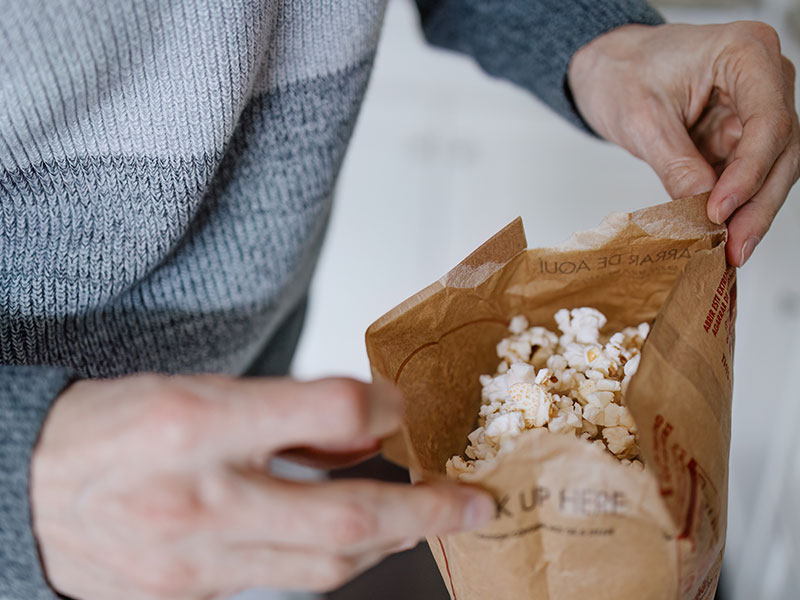
There’s an underlying tension in each of these teenage female rage-centered pieces of media. Whatever frustrations we feel in our daily lives from our society have bled so heavily into this new age of female-driven television and film. The world kind of sucks for teenage girls — our youth (I’m a 24-year-old teenage girl) seems to be fading too quickly. We feel anxious every day at the social and environmental degradation happening every second. We don’t feel protected from the abusers and monsters that run rampant in our lives. We bend ourselves into pretzels to be liked. We’ve lost our innocence at the brutality of death engulfing us during this ongoing pandemic.

We’ve all lost whatever optimism we had five years ago. To rectify that, I think people have created art to express the existential dread rooted at the center of girlhood and growing up. People are trying to reclaim it, and it’s manifested itself in palatable, flaming teen girl rage. It has landed with audiences because while it’s also cathartic and empowering, nobody is trying to label the girl rage as good, bad, sinister, heroic or saintly. Girls just wanna be rageful, wily girls.

The resurgence of teen angst-filled pop-punk from perpetually angry teenage 20-year-old Olivia Rodrigo, and the summer of girlhood has shown audiences what reclaiming our youth and adolescence looks like, especially through films like queer, teen girl-centered “Bottoms.” This girl rage feeling and theme have hypnotized people with its alluring revenge fantasy appeal. There’s something intensely gratifying about girls and how their deep well of anger can turn into action and ultimately empower them.

“Forever chemicals” are everywhere: Here are the 6 products most likely to be in your home

When a person hears the term “forever chemicals,” it is unlikely that their immediate reaction is, “Yum! I want that inside my body!” Yet these so-called forever chemicals — technically known as per- and polyfluoroalkyl substances (PFAS), as well as chemicals like bisphenols— are absolutely everywhere. It is a statistical certainty that a person reading this article has forever chemicals in their bloodstream, and perhaps in other tissues.

Substances like PFAS and PFOA (perfluorooctanoic acid) are known as forever chemicals because they do not break down either in the natural environment or in our own bodies. It is this very versatility that makes them so popular among businesses; smear some forever chemicals on a cooking pan and suddenly you have a non-stick pan. Put them on a fabric and perhaps your shirt will be stain-proof.

Although some regulators may want to monitor these chemicals to learn about their possible health effects, one can bypass them through a process known as regrettable substitution: When one chemical is banned, scientists simply develop a slightly different molecule that performs the same basic function but has not been banned.

Through this process, it is now an overwhelming likelihood that products you use have forever chemicals like PFAS inside them. PFAS have been linked to high blood pressure, heart attacks, strokes liver disease, increased risks of kidney and testicular cancer and even fertility problems. In the words of Dr. Sara Brosché, Science Advisor with the International Pollutants Elimination Network, the PFAS in our environment and bodies could create a future not dissimilar to dystopian science fiction like “The Handmaid’s Tale.”

“PFAS are related to issues around fertility and endocrine disruption,” Brosché said. She noted that “The Handmaid’s Tale” involves a fertility crisis partially caused by environmental pollution that results in a patriarchal and authoritarian society. “Not the whole scenario — obviously that has a lot of other implications — but just looking at the premise of, what if we cannot reproduce anymore?”

Here are six of the common products that contain PFAS or other forever chemicals.

01
Microwaveable popcorn bags
Man Opens a Bag of Microwave PopcornMan Opens a Bag of Microwave Popcorn (Getty Images/Grace Cary)
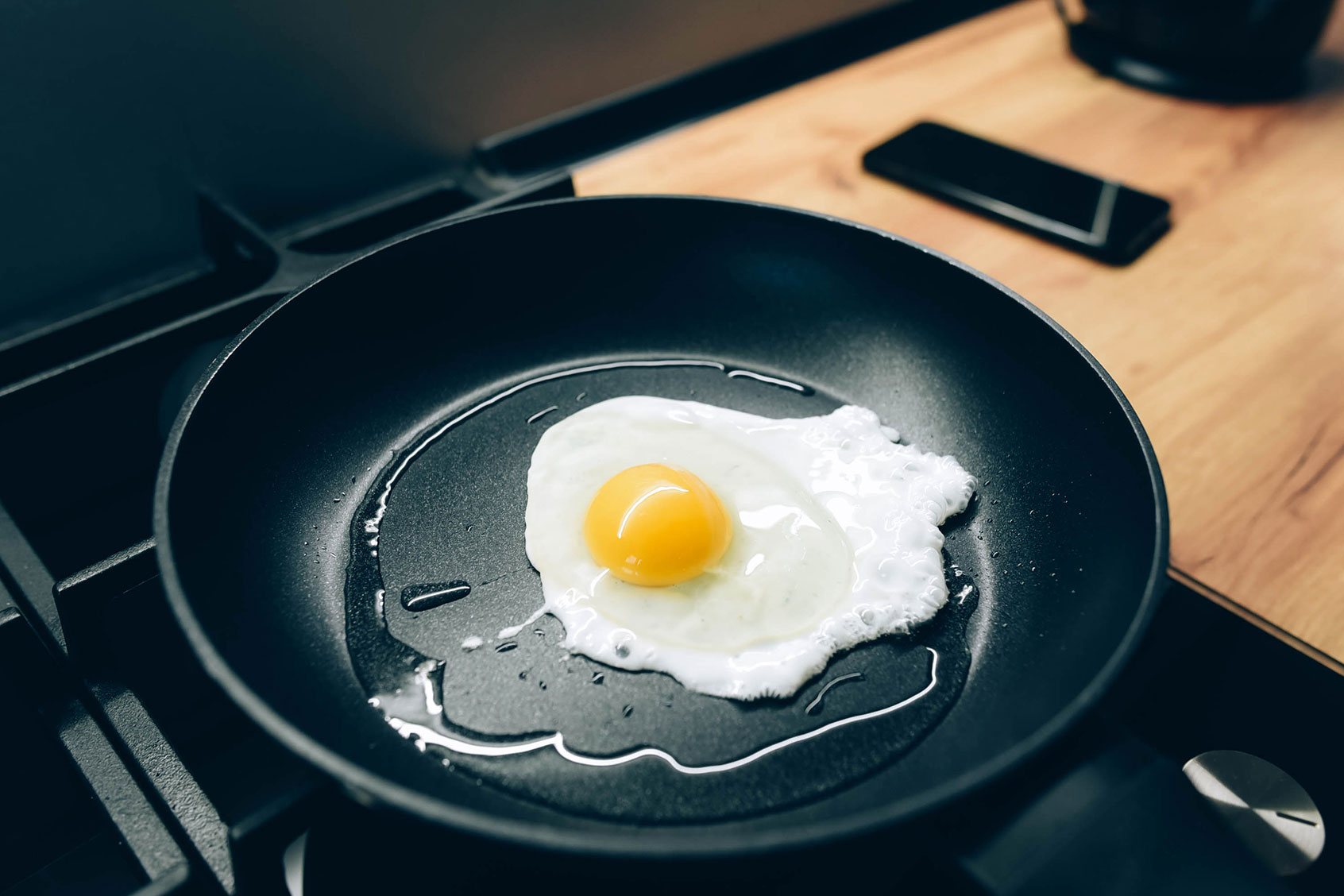
If you want to enjoy some quality science fiction to escape from the depressing reality of PFAS — whether it’s “Children of Men” or something else — chances are you might enjoy doing so with a snack. Should you choose a nosh, you’d probably be advised to stay away from microwaveable popcorn. According to a March 2023 study by the International Pollutants Elimination Network (IPEN), all of the microwaveable popcorn brands studied in their survey — including the American Popcorn Company, which makes Jolly Time; Conagra, which makes Act II; Ramsey Popcorn, which makes Cousin Willie’s; and Preferred Popcorn — had PFAS in their bags. The lists of PFAS are like an alphabet soup: Jolly Time and Act II bags often had perfluorobutanoic acid (PFBA) and perfluorohexanoic acid (PFHxA); Cousin Willie’s bags often had fluorotelomer alcohols (FTOHs); and Preferred Popcorn bags often had FTOHs and PFHxA.
02
Non-stick cookware
Fried Egg On Non-Stick Frying PanFried Egg On Non-Stick Frying Pan (Getty Images/Maryna Terletska)
Anyone who has cooked with a sticky pan or pot knows how frustrating it is when the food sticks to the utensil instead of landing on your plate. When people try to imagine a pan or other piece of cookware that does not stick to your food, they usually think of the word “teflon”; that said, it must be emphasized that there are countless other PFAS used for nonstick cookware that are not teflon. All of them, however, are chemicals that people do not want in their food — and unfortunately their wish often is not granted. As revealed by a 2022 study in the journal Science of the Total Environment, a single surface crack in the Teflon coating of a frying pan can eject as many as 9,100 plastic particles into the body. Many of those particles will, of course, contain the PFAS that the pan is supposed to use to separate your food from your cookware.
03
Receipt paper
Print ReceiptPrint Receipt (Getty Images/Image Source)
If you have ever purchased an item from a store that uses traditional receipt paper, you’ve probably noticed that that paper is not exactly like ordinary paper. It tends to be shinier and more solid; sometimes receipt paper is so slippery that it is difficult to write on it with a pen. That is because 80% of receipt paper used by large retailers contains a toxic forever chemical known as bisphenol S (BPS) according to a March 2023 study by Ecology Center. Other types of paper that can be described as “shiny” and “slippery” also contains PFAS, such as fast food wrappers.

Want more health and science stories in your inbox? Subscribe to Salon’s weekly newsletter Lab Notes.


04
Umbrellas
People walking under umbrellas during a rainy day in ShibuyaPeople walking under umbrellas during a rainy day in Shibuya. (Getty Images/DuKai photographer)
PFAS and other forever chemicals are particularly popular among manufacturers because they can help make products water-proof. This is why umbrellas, shower curtains and other plastic products that need to be water-resistant often contain one or a multitude of PFAS. The very slipperiness that you want on the top of your umbrella (but not under your feet) is, when it comes to this particular product, a double-edged sword.
05
Cosmetic products
Makeup brushes and cosmeticsMakeup brushes and cosmetics (Getty Images/Songsak rohprasit)
In the 1989 Tim Burton movie “Batman,” a villain terrorizes Gotham City by putting dangerous chemicals in common household products like cosmetics. Instead of making people look or feel better, the new products would kill you and leave you with a warped rictus grin on your face. While the situation with modern cosmetic products is nowhere near that dire, the Food and Drug Administration’s website sums up the situation quite aptly: “Certain PFAS are also intentionally added as ingredients in some cosmetic products, including lotions, cleansers, nail polish, shaving cream, foundation, lipstick, eyeliner, eyeshadow, and mascara. These PFAS are used in cosmetics to condition and smooth the skin, making it appear shiny, or to affect product consistency and texture. ” 
06
Carpets and furniture
Blue sofa with light blue rugBlue sofa with light blue rug (Getty Images/Westend61)
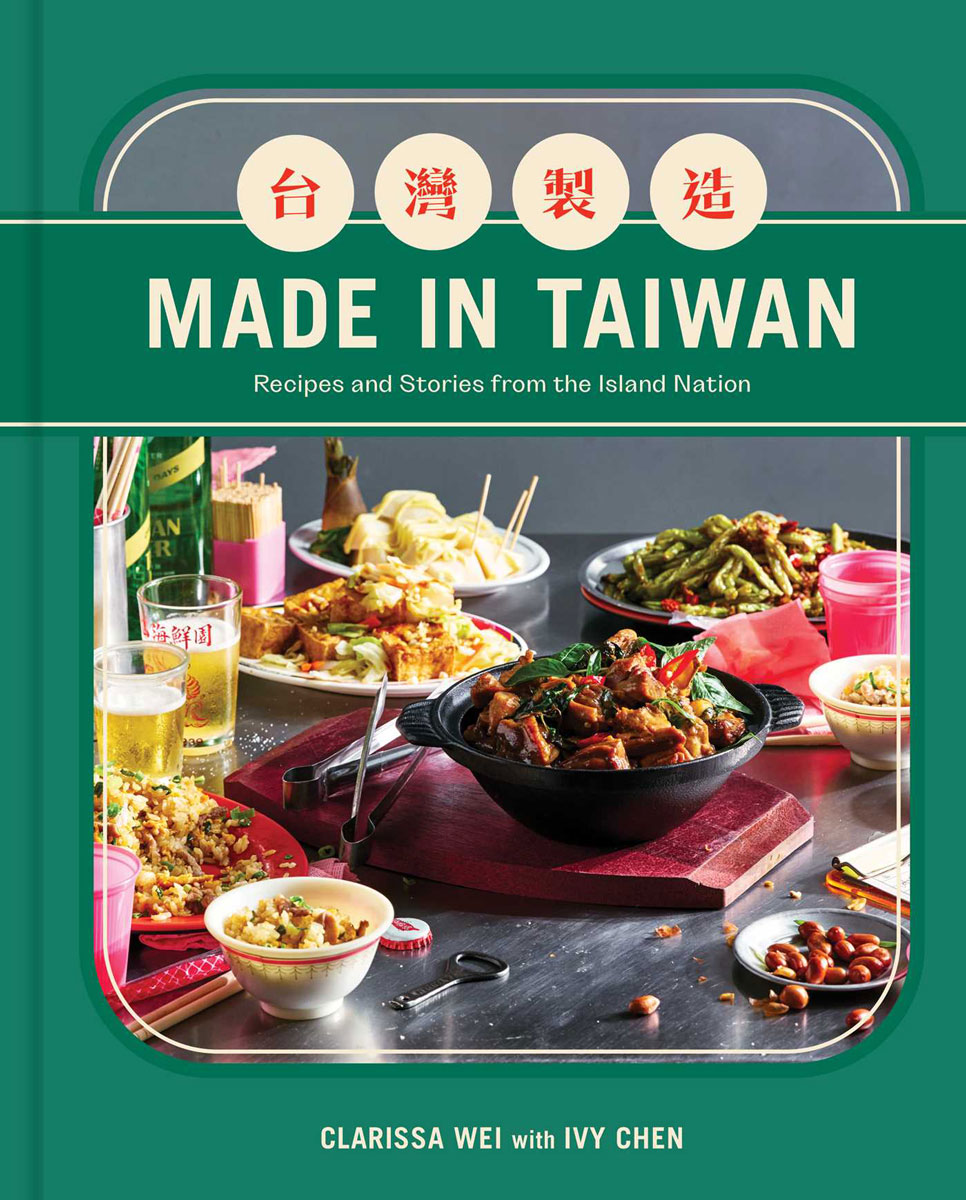
At this point you have likely figured out the pattern in much of the PFAS applications here — it is often used to make products more resistant to stains of various kinds. In the case of carpets and furniture, this is particularly ironic because an April 2023 study in the scientific journal AATCC Journal of Research revealed that these PFAS are not even the best way to make indoor upholstery stain-resistant. Indeed, simply using existing and different types of fabrics in creative ways is just as effective if not more so at producing stain-resistant fabrics than using PFAS — and, of course, with far less risk to the health of the people using them.

“Taiwanese food is an underdog”: In her new cookbook, Clarissa Wei writes a love letter to Taiwan

Clarissa Wei’s Taiwanese pride is unmistakable.

Her new cookbook is actually so much more than just a standard cookbook: It is a love letter to Taiwan, its culture, its history, its perseverance and, of course, its cuisine.

As Wei puts it, there’s a minimalism about Taiwanese food that she both cherishes and appreciates, which bridges the historic, storied cuisine with the ease of a weeknight meal: “If you can whip up an entire meal with just a wok, knife, soy sauce and sugar,” she states. 

Salon Food spoke with Wei in accordance with the release of this new cookbook, discussing the recipes itself, Taiwanese cuisine at large, what was most important to her in creating the book and so much more.

Made in Taiwan by Clarissa Wei book coverMade in Taiwan by Clarissa Wei book cover (Courtesy of Simon Element / Simon & Schuster)

The following interview has been lightly edited for clarity and length.

“Wei makes a case for why Taiwanese food should get its own spotlight”  I loved this quote. What about Taiwanese food has ostensibly made it an “underdog” in the global food spotlight? 

Taiwanese food is an underdog because it is often grouped underneath the broad umbrella of Chinese food. Part of the reason why that is was because in the 60s and 70s, Taiwan was portrayed as a rich hub of regional Chinese food. This was true to some extent because of the surge of Chinese refugees who had arrived in Taiwan post-1949 with the Nationalist government. They brought with them vibrant recipes from a diverse group of Chinese provinces. The refugees only made up 10 to 15% of the population, but their food and culture shaped the international perception of Taiwan.

A lot has happened since then and over 70 years have passed since that last wave of immigration. Taiwan transitioned from authoritarian state under martial law into a democracy and with that there’s been a major shift in how Taiwanese people perceive their food. Even the flavors of those regional Chinese restaurants have changed to be more Taiwanese (sweeter, lighter and less heavy on salt and spicy notes). 

I wrote this book in the hopes of broadening the international perception of Taiwanese food. Yes, we have dumplings and noodles and fried rice, but we also have wonderful dishes that are special to the island, like fried mackerel soup, savory rice puddings and crystal meatballs

What are some of the standout recipes in the book? Or your personal favorites?

I love the beef noodle soup recipe. It’s a bit involved because of all the spices in there, but it is also quite restrained in that it allows the natural flavor of the broth and beef to come through. I got the recipe from a five-time award-winning beef noodle soup chef and it is a recipe he teaches his students. 

I also really enjoyed writing the stinky tofu recipe. It took us a while, but my recipe developer Ivy and I figured out how to make the dish from scratch. The secret to the stink is a leafy green called amaranth. 

How would you describe Taiwanese cuisine to someone completely unfamiliar with it? 

Taiwanese food is hearty and sweet, mostly grounded in pork, seafood and rice. I’d also describe it as a melting pot. We have influences from China, Japan and even America. 

We need your help to stay independent

This is so much more than just a cookbook. What do you hope readers glean from the incredibly comprehensive book of recipes, stories, pride, perseverance and recollection? 

Thank you! Even though Taiwan may look like an ethnically homogenous society from the outside, it is actually quite diverse. This applies to the food. With every different wave of immigration and governance has come a plethora of new dishes. The food brought over by Chinese immigrants from southeast China from the 18th century, for example, is very different from the food brought over by Chinese immigrants from the 20th century after the Chinese Civil War. Also in the 20th century, Japan monopolized most of Taiwan’s major industries. Many of our pantry items like soy sauce, rice wine and rice vinegar are still made with Japanese-era recipes. 

I hope through the food of Taiwan, people can learn more about the history of Taiwan. 

Can you briefly tell me a bit about the essays in the book, their general thesis and what they touch on?

So every time after I finish watching a movie, I’ll immediately pull up my phone and look up fun facts about the movie. I love reading esoteric tidbits about the production, plot and cast. 

I wanted the essays in my cookbook to provide that same function. They’re fun facts about Taiwanese cuisine that most people don’t know about. Some of the topics are heavy, like how American aid during the Cold War shaped Taiwanese food culture or on the politics of the island. Others are more lighthearted, like how to shop at a wet market or how to feed the Gods. 

I know that you worked as a freelance journalist prior to publishing the cookbook. What was the turning point that made you want to focus on Taiwanese food and culture beyond daily news? 

I’ve been a food journalist for well over a decade. I lived in Hong Kong from 2018 and 2020 and was there throughout the pro-democracy protests. My job at that time was to film food and culture videos in China and Hong Kong. In China, there was this distinct sense of optimism and nationalism. People were proud to be Chinese and to showcase their rich culture and food. In Hong Kong, there was pride, but there was a clear existential crisis that people were facing because of all the political upheaval. 

Naturally, as a Taiwanese citizen, I couldn’t help but wonder if Taiwan would one day face a similar fate as Hong Kong. I wanted to tell the story of Taiwan through the lens of food before it’s too late. 

Clarissa WeiClarissa Wei (Photo by Ryan Chen)

I read on your website that the book was “shot and written entirely in Taiwan by an all-Taiwanese team.” How incredible! What was it like putting that team together? 

First of all, I had an incredible editor who let me bring on whoever I wanted to, which isn’t always the case in the industry. Because I’m based in Taiwan, I knew immediately I wanted an all-Taiwanese team. Second, I got really lucky. My recipe developer Ivy Chen is a cooking teacher in Taipei whose classes I’ve attended many times before and we’ve always had a really good rapport. My researcher Xin Yun slid into my DMs one day out of the blue asking if I needed an assistant. I hired her immediately and she was the one who found my food stylist (Yen Wei) and photographer (Ryan Chen). 

My team and I got along really well and without even talking about it, we all collectively felt this immense pressure to represent the food of Taiwan as best as we could. None of us had ever worked on a book by a major publisher before and we treated this like a once-in-a-lifetime opportunity. I was the only person in my team who was not born and raised in Taiwan and I learned so much from them. 


Want more great food writing and recipes? Subscribe to Salon Food’s newsletter, The Bite.


I know that you hired a Taiwanese historian to fact check the essays. Tell me a bit more about that? 

There’s not a lot of mainstream books on Taiwanese history in English— let alone on Taiwanese cuisine. Most of my research was derived from academic articles, books published solely in Chinese or books that had been translated into English from Chinese. I had a couple other writers read through the essays for feedback and my researcher did some basic fact-checking throughout, but because the history of Taiwan can be controversial, I knew I needed someone who specialized in Taiwanese history to go through it one final time. 

I asked James Lin, who is a Taiwanese historian and a professor at the University of Washington, to look over the main essays in the beginning of my book. There weren’t big structural changes, but he gave me suggestions on how to be more precise with my words (i.e. Taiwan was inhabited by Austronesian nations, not tribes). He was incredibly helpful and I’m so grateful he said yes! 

You tweeted the other day about how “review bobbing” is beginning already. What do you attribute that to?

It’s just the reality of being Taiwanese and it is unfortunate that the very act of being Taiwanese is controversial. There are two main things that people get mad at me about: that I dare call Taiwan an island nation (Taiwan is a self-ruled democracy, but exists in a state of political ambiguity. I have an entire essay in the book that details why) and that I say that Taiwanese food is not a subset of Chinese cuisine (my book is a reflection of recent identity polls in Taiwan). 

Sometimes I wonder if I’d get the same amount of vitriol if I weren’t Taiwanese and wrote this cookbook as an outsider. The Chinese government actively uses Chinese ancestry as reason to extend its authoritarian rule over the Chinese diaspora. Because I am ethnically Chinese (my ancestors came to Taiwan from China over 200 years ago!), I’ve been called a traitor and disrespectful to the Chinese nation by online trolls. It’s really bewildering. 

What are your absolute favorite aspects about Taiwanese cuisine?

It’s quite minimalistic. If you can whip up an entire meal with just a wok, knife, soy sauce and sugar.

Traditional Taiwanese dishesTraditional Taiwanese dishes (Yen Wei/Ryan Chen/Simon Element/Simon & Schuster)

You include a note in the beginning of the book about “language and romanization.” Can you explain a bit about that? 

While Mandarin Chinese is the lingua franca here in Taiwan, there are some dishes in Taiwan that are known exclusively by their Taiwanese Hokkien names. I made sure to include that where relevant because people in Taiwan would get really upset if I just listed everything in Mandarin. I hired Cam Chao, a translator, to help me with the Taiwanese translation of dishes.

What are some must-have ingredients or products for anyone looking to start making Taiwanese dishes?

Soy paste, which is a condiment invented in Taiwan. It’s a thickened soy sauce. It has the texture of oyster sauce but without any of the fishy undertones. I use Kimlan brand. It forms the basis of a lot of the dipping sauces in the cuisine. 

Also, fried shallots! This is something that can be added in braises for extra flavor or thrown on top of stir-fries for crunch. 

I liked how one section or chapter was called “beer food— how would you define that?

The equivalent is izakaya food in Japan or pub food in the UK. It’s greasy, hearty, flavorful dishes and meant to be paired with an ice cold lager. Think clams sauteed with basil, three cup chicken and deep-fried green beans. Taiwanese beer food, or rechao, became a popular genre in the 80s and 90s. It’s not that well-known outside of Taiwan, unfortunately, but is my favorite way to unwind after a long week at work. 

Another section is called Tainan; what does that represent?

A city in the south of Taiwan, Tainan is where my family is from, where my recipe developer Ivy is from and where my food stylist and photographer currently live. It’s also the culinary capital of Taiwan and the oldest city on the island. There are a lot of dishes unique to Tainan that I wanted to highlight, like the fried shrimp rolls, coffin bread and the oyster omelets. 

It would be a great disservice if I skipped over Tainan and its dishes. It’d be like writing about the food of California and forgetting to include Los Angeles. Even though my cookbook is catered to a general American audience, I wrote my cookbook with discerning Taiwanese readers in mind. 

You can buy “Made in Taiwan: Recipes and Stories from the Island Nation” here.