Spring Sale: Get 1 Year, Save 58%

“And Just Like That” isn’t brave enough to let Lisa Todd Wexley have a real choice with motherhood

Appropriate to its status as a penultimate episode in a TV season, much transpires in “The Last Supper Part One: Appetizer” episode in “And Just Like That…” to tee up the finale’s phone date with destiny – er, Samantha Jones. That’s the reason many of us hung on through this season no matter how much it tested the integrity of our acrylics.

We knew the day would come that would reveal the circumstances under which Kim Cattrall’s much-missed diva returns to this world. Is it through the miracle of FaceTime? Will it be at the titular Last Supper set inside the familiar brownstone apartment we’ve grown accustomed to Carrie (Sarah Jessica Parker) calling home? Who knows?

The only certainty is that Aidan (John Corbett) isn’t attending. Heck, Country Lurch may not appear much at all, since his kid Wyatt broke several bones in a truck accident he caused, claiming he did it because he missed his dad.

“The Last Supper Part One: Appetizer” is all about tying up loose ends. Carrie really did sell her old apartment to the nice single girl downstairs, and for a steal. All the single ladies, Now put your hands up!

Steve (David Eigenberg) gets a happy ending as a Coney Island clam-slinger, this show’s equivalent of sending the old family pooch to a farm upstate. Stanford, Carrie tells Anthony (Mario Cantone), is now a monk living in a Japanese temple and left his ex all of his worldly goods. That’s one way to write the late Willie Garson out  the show — give him an afterlife not worth checking up on.

Meanwhile, Che (Sara Ramirez) nukes all chances of getting back together with Miranda (Cynthia Nixon), or winning over this show’s audience, by taking a blowtorch to their eight-month affair on stage in their return to comedy – a show Miranda unwisely shows up to unannounced. Charlotte (Kristin Davis) sells an expensive piece of art to Sam Smith and celebrates by saying “f**k them kids” and getting wasted.

This is all par for the course, along with the shocking/not all at all shocking bit where Seema (Sarita Choudhury) exchanges “I love yous” with her tough-to-stomach movie director and proceeds to freak out about it. Seema is relationship averse. Of course she would trip this wire.

Anyway, we’re cruising through all that so we can explore a character the writers of this show have almost entirely ignored this season – besides Nya (Karen Pittman), we should say.

Instead, let us speak about the potentially great Lisa Todd Wexley, Nicole Ari Parker’s acclaimed filmmaker, mother and likely-to-be politician’s wife. Throughout “And Just Like That” LTW has been presented as a modelesque queen who occasionally descends from her luxury digs to cavort with Charlotte. LTW is the pinup friend, hanging around like a poster on a wall, but not fully present for plot-accelerating conversations.

Because of this, two seasons into this show LTW remains more of an idea than a fully realized person. Series creator Michael Patrick King feels that way too since he jams an entire season’s worth of conversations that could have lent new facets to Parker’s character and her husband Herbert (Chris Jackson) into one profound unsatisfactory subplot.

LTW is the pinup friend, hanging around like a poster on a wall, but not fully present for plot-accelerating conversations.

First, some table-setting. In “There Goes the Neighborhood,” an overwhelmed Mrs. Wexley passes out while trying to balance her career, planning Herbert’s campaign, and failing to mother correctly. This gives Herbert a fit until his wife reveals she’s pregnant.

“The Last Supper Part One: Appetizer” picks up that conversation at a lunch LTW is enjoying with Miranda, Carrie and Charlotte (remember, Seema’s off banging that dude, so Rich Lady brunch has an opening), and Charlotte cannot help but sing her friend’s praises: PBS is extending Lisa’s documentary into a 10-part series.

“They’re Ken Burns-ing you!” Miranda says approvingly. Later, though, the filmmaker expresses her doubts to Charlotte. She confesses she’s exhausted at the thought of coming up with 10 hours of content.

We need your help to stay independent

“And Just Like That,” like “Sex and the City” before it, is allergic to mounting substantial conversations about everything, including the cost/reward analysis of juggling motherhood and career. I also doubt King, who both wrote and directed the episode, factored the “strong Black woman” trap that Parker’s character is forced to navigate into this exchange as Charlotte plays out precisely how some people fail such women.
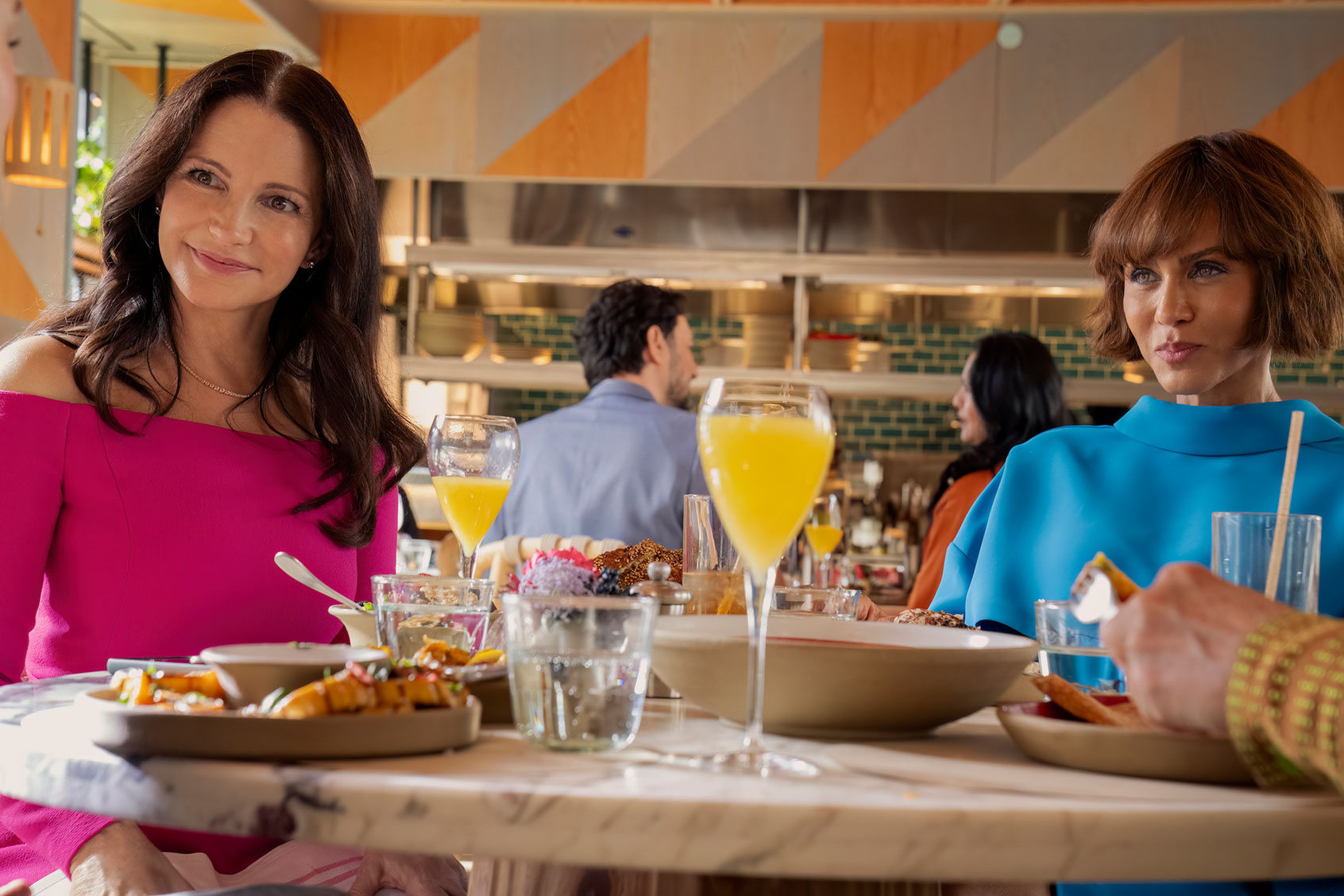
And Just Like ThatKristin Davis and Nicole Ari Parker in “And Just Like That” (Craig Blankenhorn/Max)“You’ve got that home routine down. You’re like a machine!” Charlotte chirps. “I mean, this series has to happen. Think about everything it’s going to do for your career. Also think about all the previously unsung Black women’s stories you will be able to tell.” Then LTW tells Charlotte she’s gestating a human on top of everything else, but Charlotte doubles down anyway. “Lisa — I think you could do this.”

This discussion could have fueled an entire episode. LTW could have explained to Charlotte that reminding her of how strong and capable they are negates the validity of her stress, helping her to level up. Everybody grows. We all win. Not gonna happen this season, though. LTW excuses herself to go take a nap.

Where Mrs. Wexley really gets short shrift, though, is when she’s in bed with Herbert, punching a pillow, which prompts him to turn on a light so they can talk it out.

In just under three minutes, we learn the following: LTW asked Herbert to get a vasectomy after their third child was born, but he didn’t, worrying that she was “a little post-partum” when she made that request. “I wasn’t sure if it was just the hormones talking,” he says.

“It’s never just the hormones,” she snaps, at which he sighs, “I can’t do anything right.”

“You could have, if eight years ago you had done what I asked you to.” Thank you!

Then Herbert hits her with, “Lis, you can do this. If anyone can, you can. And I’ll be here to help.”

That’s not quite true. She points out that he’s in the middle of a political campaign and barely helps with the children they have.

So, being a modern man, he brings up “having the other discussion.” “It’s your decision,” Herbert says, “Whatever is best for you, that’s what I want.”

Since they don’t use the word abortion, let’s be clear: Reader, they’re talking about whether to have an abortion – something married people do in real life, but we rarely see depicted on TV.

“And Just Like That” isn’t brave enough to be in this vanguard, though. LTW expresses her appreciation for Herbert’s support and then says, bafflingly, “I thought about it, but I can’t. I mean, I’m really grateful that I have that option. I just need to wrap my head around this new reality.”

OK. Follow-up question: why can’t she, exactly? Is it a matter of cultural expectation? Faith? A fear that an abortion might negatively impact Herbert’s campaign? What is it? We’ll probably  never find out.

Two seasons into this show Lisa Todd Wexley remains more of an idea than a fully realized person.

Consider the parallel between this moment and the “Coulda, Woulda, Shoulda” episode in the fourth season of “Sex and the City” where Miranda contemplates having an abortion. “Sex and the City” spend the entire episode exploring the last impact terminating a pregnancy has on a woman’s life. In fact, Carrie’s long-ago abortion is one of the first secrets she keeps from Aidan . . . until she decides to tell him about it.

Charlotte, of course, was against it. As it turns out, so was Miranda. That episode was the save-the-date announcement for Brady’s entry into this universe. What a gift.

In our post-Dobbs era, “And Just Like That” had a chance to give Parker’s character the same consideration from the perspective of a successful, ambitious woman asserting her right to prioritize her success as much as her husband does his. Instead it said, “I can’t.”

By not explaining why one of its regular characters in a show about woman can’t get an abortion, that leaves countless viewers in the dark as they face fears about their reproductive options. It’s also a regressive approach similar to the hot potato tossing seen in very special episodes of 1980s and 1990s TV where reproductive choices were acknowledged but never discussed in detail.

But what King ultimately ends up doing is more disappointing than even that, taking a simplistic moral workaround by having LTW wake up the next morning to discover that she’s miscarried. In other words, he gives a model character an out that won’t offend the so-called “moral majority” instead of trust the actual majority of Americans who support a woman’s right to a safe abortion  — even wealthy women who seem to have it all.


Want a daily wrap-up of all the news and commentary Salon has to offer? Subscribe to our morning newsletter, Crash Course.


So that’s that. We now return to this couple’s regularly scheduled lack of expansion.

“And Just Like That” might return to the subject of Herbert being a herb, although it’s doubtful. If King and his staff don’t have the ovaries to get messy with conversations like this, they’re certainly not going to risk the blowback that might result from having the one Black male series regular in the franchise’s history be anything less than acceptably imperfect.

But this was a chance to dive into a specific situation where something personal is also political, both in the show and in relationship to the real world, and through a woman this show is reluctant to let us know better and in a real way. With one episode to go, it’s too late to expect we’ll get to know much more about LTW or Nya at Carrie’s goodbye dinner.

But wouldn’t it be hilarious if Steve showed up with a bag of Coney Island hot dogs and clams?

New episodes of “And Just Like That” debut Thursdays on Max.

A new COVID variant nicknamed “Pirola” is raising global alarm but don’t freak out yet

Since the original virus that causes COVID, SARS-CoV-2, emerged in March 2020, it has mutated into dozens of variants, but most don’t differ too much from the “parents” they evolved from. However, a new variant scientists are bringing to our attention is about as genetically different from Omicron as Omicron was from the original “wild type” strain first detected in Wuhan, China in late 2019.

On Thursday, the Centers for Disease Control and Prevention (CDC) announced it was tracking a new lineage of the virus, BA.2.86, following the World Health Organization (WHO) adding the strain to its list of “variants under monitoring.” Originating in Israel, the variant has since appeared in Michigan in the U.S., three times in Denmark and once in the U.K., which has issued its own risk assessment.

Just six overall cases were reported worldwide as of Friday, but the fact that the variant, nicknamed “Pirola,” has already spread across multiple continents is “concerning,” said Dr. T. Ryan Gregory, an evolutionary and genome biologist at the University of Guelph in Canada. 

“It’s not clear how big the impact could be if it were to take off,” Gregory told Salon in an email. “We do have some degree of population immunity against severe disease from vaccines and past infections, but the concern for quite some time is the potential for another ‘Omicron-like event,’ in which a very different new variant evolves and causes another major global wave.”


Want more health and science stories in your inbox? Subscribe to Salon’s weekly newsletter The Vulgar Scientist.


While this new variant wasn’t given a new Greek-letter distinction like Alpha, Delta or Omicron, it is very different from the most current Greek-letter family of variant descendants: Omicron. While it shares about 30 of the same spike mutations, which allow the virus to attach itself more easily to receptors in cells, it also has 30 unique ones.

Specifically, there are about 57 mutations of the spike protein, which potentially increase its ability to cause infection, said Dr. Rajendram Rajnarayanan, of the New York Institute of Technology campus in Jonesboro, Arkansas. Most variants have around 20 to 30 mutations, he added.

“This is definitely going to spread,” Rajnarayanan told Salon in a phone interview. “This had all the necessary ingredients of being a successful lineage.”

“This is definitely going to spread. This had all the necessary ingredients of being a successful lineage.”

Scientists emphasized that this new variant isn’t yet a cause for alarm. Still, COVID infections are increasing internationally, and cases in the U.S. have returned to what is considered “high,” with 610,000 new infections per day. That’s more than triple the level recorded a month ago, which was around 185,000 cases per day, according to wastewater data used to estimate the spread of disease. However, this uptick in cases is not due to the new variant yet. Other closely-related variants like EG.5 and XBB.1.16 make up an estimated one-third of cases, with the rest caused by a couple dozen other variants, according to CDC data released Friday.

That being said, there are likely additional cases of this new variant, Pirola, that haven’t yet been detected because the cases identified were only the ones severe enough to be detected in hospitals. 

“This is nothing to be alarmed about, but this is a wake-up call to do new sequencing,” Rajnarayanan said. “It’s not every day you have variants like this pop up.”

“It is a reminder that variants continue to evolve and that the more infections there are, the more evolution there will be.”

Overall, testing and the sequencing that detects new strains have decreased since the WHO and the U.S. removed their pandemic emergency declarations. It’s too soon to see if this new variant will manifest differently in terms of symptoms or severity of disease, given so few cases have been identified. However, the current boosters will likely still work, at least against severe disease.

Pirola is derived from a SARS-CoV-2 lineage circulating over a year ago that hasn’t been in the news much since. But in the meantime, the emergence of BA.2.86 shows it has indeed been evolving on its own, said Marc C. Johnson, Ph.D., a professor of molecular microbiology and immunology at the University of Missouri School of Medicine. The virus likely mutated multiple times in a single chronically ill patient, Rajnarayanan added. 

We need your help to stay independent

“It’s picked up a lot of immune evasive mutations that our immune systems haven’t seen yet,” Johnson told Salon in a phone interview.

Scientists emphasized that although there is still much unknown about the new variant, what is known is that the same pandemic protocols used to prevent the spread of disease work the same across all variants and are the best way to ensure this new variant doesn’t become the next Omicron. Masking, testing and keeping up on vaccines are all critical.

“Hopefully this won’t be an ‘Omicron-like event,’ but it is a reminder that variants continue to evolve and that the more infections there are, the more evolution there will be,” Gregory said. “As always, the key here is mitigating transmission using variant-proof measures like respirators, ventilation, air filtration and avoiding exposure where possible.”

“Generation Anxiety”: When my worry became a hidden dinner guest

One evening while on a press trip to Sicily with a half dozen fellow writers I’d just met, we sat down to dinner and I commenced my standard dining-out practice: painstakingly ruminating over what on earth I would order. Feeling squeezed because I hadn’t gotten the chance to peruse the menu online ahead of time, I loudly joked that I would have to order last and asked everyone within earshot what they were having. 

Admittedly, though, it was hard to hear them over the chorus inside my head: I should probably get a vegetable for, like, health. Is this part of Sicily known for a certain dish? Does this restaurant specialize in something? Should I try their eggplant parm and compare it to the others? How many times per day is too many to eat pasta

At one point I lamented aloud, “How come it’s so hard to decide what to get?” One of my companions looked at me and said, pointedly, “I think you just have anxiety.” 

Naturally, I spent considerable time unpacking this with my therapist once I got back. Maybe this woman was right. That this lovable personality quirk of mine was in fact a big problem — a sign that my generalized anxiety was spilling into areas of my life without my noticing. After all, if a person I barely know pointed it out, it must be pretty obvious, right? All too soon thereafter, the results of a OnePoll survey landed in my inbox confirming that younger generations are more likely to have anxiety while ordering food at restaurants — 41% of Gen Z and Millennials (aged 18 to 43) to be exact, compared with just 15% of Gen X and Baby Boomers (44 to 77). Reasons range from taste and cost to the food’s environmental impact and how long it takes to prepare it. Almost half of Millennials and Gen Z surveyed also say they prefer to order last, and a quarter like to peruse the menu before going out to eat. 

Are these tendencies merely the manifestations of our crippling generational anxiety? More importantly, isn’t going out to eat supposed to be fun?

As humans, we’re all wired to worry, even if our stressors have changed as life has modernized. Anxiety is what happens when that worry goes into overdrive. 

“We all have different stressors in our day to day lives, be it finances, relationships, the future in general,” said Lauren Cook, a licensed clinical psychologist and author of the forthcoming book “Generation Anxiety: A Millennial and Gen Z Guide to Staying Afloat in an Uncertain World.””One of the hallmarks of anxiety is that worry feels out of control. The brain ruminates. Anxiety is often a very physical experience, felt very deep in the body — aches, insomnia, stomach discomfort.” 

We need your help to stay independent

Seeing how she wrote the book on us, Dr. Cook wasn’t surprised to learn that ordering a meal at a restaurant might breed disquiet among Generation Anxiety (which I have officially adopted as my self-identifier). Our social anxiety is much higher coming out of the pandemic, for one. Having a meal is an unavoidably in-person activity, which is something more of us feel anxious about, she said. Not to mention the steady flow of climate crisis headlines that has us questioning the planetary impact of every decision we make down to what’s on our plates. But something else separates us from Gen X and Boomers that might be playing a role. 

“Food has been such a cultural experience for Millennials and Gen Z compared with older generations who don’t have such an interest in restaurants and the food scene,” Dr. Cook said. “With Millennials, it’s a place to see and be seen; it has almost become a status symbol, like what do you order and what’s your palate like? There’s a sense of judgment to it sometimes. People can absolutely experience anxiety in that, a fear of not appearing cultured, being embarrassed to ask what crudité is, or not getting peer approval.”  

With so many competing factors vying for our attention — not least of all weighing what we like versus what we think we’re supposed to like (phew!) — indecision can overwhelm us, and leave us feeling buyer’s remorse long after we’ve made up our minds. 

“We see that in dating,” Dr. Cook said. “What if there’s a better partner or option out there? With so many choices with something like food, it can be really hard for people.”

Dr. Cook didn’t sense anxiety so much in my tendency to take my time ordering my meal. “That’s the part of the story where I hear, ‘F*** it; I wanna take my time,'” she said. 

Like my own therapist pointed out, Dr. Cook noted that because I go out to eat for a living, it makes sense that I’d take more care in ordering and want to eat dishes representative of the restaurant and its location. 

“Instead, that person saying to you that you have anxiety is where I hear your own anxiety coming up,” she said. “Your anxiety lies in the judgment of others.”

“Judgments will always come with our decisions. Embrace what works for you.”

Turns out, Millennials and Gen Z care a lot about what other people think. This causes us to deploy the common cognitive distortion of mind reading, in which we’re convinced we know what someone else is thinking. In my case, hearing said thought expressed out loud by someone I don’t know was powerful enough that it made me question my own experience and even the handle I have on my own mental health. 

This isn’t helped by a culture that confidently serves up diagnoses of mental health disorders in 30-second segments on social media.

“There are all these TikTok clips telling us, these are symptoms of anxiety and ADHD, but what gets missed there is, how distressing is this?” Dr. Cook said. “How much is it negatively impacting your life and your ability to function?” 

If your anxiety is outside what you might deem the norm, makes you feel actively upset or unable to function or unsafe, “you’re probably looking at anxiety order or depression,” Dr. Cook said. “If not, it’s a stressor; it’s normal that we experience stress in our lives.”

For me, the distress factor with ordering is negligible; I even like trotting it out as a self-deprecating form of comic relief. In this instance, my anxiety about being judged so happened to crop up while I was taking my sweet time deciding what to eat. Maybe I just need to take that “f*** it” energy to more realms of my life.  

“At the end of day, if other people want to judge you, that’s on them,” Dr. Cook said. “Judgments will always come with our decisions. Embrace what works for you.”

“Generation Anxiety” is available for pre-order and will be released Sept. 19.

“We are a grief illiterate society”: A psychotherapist on how to navigate loss in an era of excess

Grief doesn't always arrive in predictable stages. You can mourn before a person has even died. And you can feel guilty for starting to feel good. Because as licensed psychotherapist Gina Moffa explains, grief can be a real "sneaky jerk."

As she writes in her new book "Moving On Doesn't Mean Letting Go: A Modern Guide to Navigating Loss," whether it's for a loved one, a relationship, or a job — grief is a complicated and deeply individual experience. "Our histories will teach us how we perceive our loss," Moffa, who is also a mental health educator and author, explained in a recent conversation via video chat. "The way that we grieve will often echo the way that we cope with hard things in our life." 

Drawing on her research and her own candid experience of loss, Moffa's book is a balm for anyone who's ever fumbled through the darkness of grief or felt they were somehow doing it wrong. "We are a grief illiterate country and society," Moffa says. But we don't have to be. With self-compassion and an understanding of how and why are brains are making us feel this way, we can weather the pain even if we can't stop if from coming.

Moffa and I talked about how to grieve for someone we had a complicated relationship with, coping with those unexpected "secondary losses" and why we need to understand that "Grief takes a lot of endurance." 

This conversation has been edited and condensed for clarity.

We need your help to stay independent

You start by talking about this idea of letting go, which is often ingrained in our concept of what grief is supposed to look like. What are these mindsets that we can get ourselves into when we're faced with loss — and how can we reframe them in a way that is more healing and constructive?

I think we are a grief illiterate country and society. We are just not in a place where we're adept at losing in any in any part of our definition of the word. We're also really bad at emotions. In the book, I even say that I was really bad at it. I wouldn't know what to say when people are going through a loss. And you learn by getting it wrong. 

"When they're no longer in that place and no longer in that time, we have to figure out how to keep the attachment. That's so hard for people that they shut down."

From the standpoint of the brain, we really actually aren't equipped at knowing how to continue the bonds. We're attached to something or someone or an animal that's significant to us. In our brains, we have an idea that it's predictable, that they're in this place at this time. This is how our attachment is defined. When they're no longer in that place and no longer in that time, we have to figure out how to keep the attachment. That's so hard for people that they shut down and they don't know how to deal with the emotions that come up. 

Grief is not linear. There are anniversaries, there are things that bring it back up again, and the circle comes around. How do we prepare ourselves for that? And how can we be more sensitive to other people about that as well?

We're talking about all of the triggers and awakenings that come up that are unpredictable. It's really hard to prevent that from happening. It's understanding that it will happen — and how to react in turn. I talk a lot about self compassion. I talk a lot about reaching out to people and about understanding what our triggers are. But we can't understand them until we have them and they throw us off base. From there, the best way to do it is not necessarily prevention, but getting really clear about what those things could be ahead of time. 

"The body will tell us when something is coming up before our brain will register it."

We come face to face with these things, they can smack us dead in the middle of a street. The body will tell us when something is coming up before our brain will register it. I've had an anniversary of my mother's death. I almost forgot about it, because I'm in the middle of like launching a book. I'm sitting there, and I'm like, "But what is this feeling?" Then I inevitably see something on the calendar and realize that something is coming up for her.

A lot of it is very biological. So I don't think we can prevent grief, we can just be compassionate with ourselves when it comes up and be as in tune with our body as we possibly can be, because grief lives there. And once we know something will hit us in a certain way, we can do whatever we can to then prepare. 

Grief rarely walks alone. You talk also about the side effects of grief, including anticipatory grief and secondary grief, where you miss certain rituals, or you miss the house. It is a unique thing that a lot of us who've lost parents or who've lost friends to disease have experienced. Talk to me about what those what those other kinds of side partners of grief are that you may be blindsided by.

With all due respect to Elisabeth Kübler-Ross and the five stages of grief, I think it does make it seem like it's very clean. You have these five stages and then you're done. One of the big misunderstandings is that we miss all of the layers and all of the things that come along with a primary loss. 

"Everyone has these little threads that lead us back right back to our losses. It's about the relationship and the bond."

If we're talking about losing a parent to an illness, I may have taken some time off work to help care for my mother. Now I've lost that sense of meaning that I had. I may no longer have perhaps the money that I had and I have to rearrange where I live, so then I lose my livelihood and my home. Maybe I woke up and had coffee with my spouse every day and we did it in a certain way. Everyone has these little threads that lead us back right back to our losses. It's about the relationship and the bond. 

Most of the time, the secondary losses or attachments don't come up right away. That's the sneaky jerk that grief can be. You don't really think about it until much later, after the funeral and after you've paid things off and after you've called the credit card bills or the lawyers. It's when you sit and you think, "I'm just making this coffee by myself now." It's both tangible and intangible — and so innumerable. It comes up over the years. I didn't realize I lost the only person who would call me at midnight on my birthday and think of me in these specific ways. 

So many people are ashamed to talk about these additional losses, because they don't seem important. But a lot of the time, they really help define the intensity of that grief and that loss. It's really important that we acknowledge as much as we can to the people around us, because each one of those layers holds so much meaning for us. 

You talk in the book distinguishing trauma from grief. Explain to me why they're important for us to get clarity on, within those spectrums.

You can have grief without a trauma. You can't have trauma without grief, because there's so much loss inherent within a trauma, especially safety. The most common and probably the biggest part that relates them is the nervous system. 

"Our histories will teach us how we perceive our loss."

Our histories will teach us how we perceive our loss. If your nervous system, which is a smoke alarm, is always looking for danger, if you've already had trauma or neglect or abuse in your life, instances where you haven't felt safe either in your body or your environment, you're going to then perceive whatever comes next as more traumatic than it is, as per your nervous system. 

It's really tricky, because it is so individual that you really can't make a blanket statement that all grief is traumatic. But initially we have this attachment that is predictable in time and space. That fresh, brief moment is always going to be a little bit traumatic for somebody, because what was there is no longer there. And our brains have to work at trying to figure out what to do with that attachment. Over time, we do figure out what to do with it. It does take work and it takes active grieving. But for a lot of people who don't cope well with change, or who already have a history of trauma or anxiety or mental illness, they're going to have a much harder time and it will be categorized as traumatic.

It's really individual, and no one can say whether or not somebody is going through a trauma or having a traumatic loss unless they get to know them, and they're safe in order to share that and what their history is. 


Want more health and science stories in your inbox? Subscribe to Salon's weekly newsletter The Vulgar Scientist.


This whole book also touches on the duality and the complexity of grief. I loved Jenette McCurdy's book, because she showed you can grieve for someone who hurt you. You can grieve for a marriage that was bad. Talk to me about how those feelings and emotions play with each other, because it can be very confusing to the person experiencing it.

We are a western society that mostly deals in black and white [extremes.] It's this or it's that. Dialectical Behavioral Therapy can teach you to hold both realities at once. That's why I always say DBT should be in schools. We need to learn very, very young that we can feel all sorts of things at one time. 

It's because of that sense that we always think in black and white that people don't know how to wrap their head around the idea that somebody can be relieved that their loved one isn't suffering — and also miss the hell out of them. It is especially more common for people who have had troubled relationships with somebody they've lost. A lot of it is so nuanced. It's, "I really will miss the idea that this could have been better, or that I could have had a different experience with this person." That is where the deeper grief lies. It's in those little moments of "What if?" 

We look at a western society, and when somebody dies, we put them on this pedestal and only look at them through this joyous, beautiful way. And then you're like, "Hey, I thought  her dad was an abusive alcoholic. Now he was the best dad?"

I think it's because people couldn't accept if somebody was like, "My dad was actually not the greatest, but he did the best he could and I'll grieve for the dad I never had and never could, or the person I am now. I grieve because I wish I could have been somebody who had a better relationship." It really always boils down to, what if we could be taught to hold two opposing belief systems at the same time? And what if we allowed other people to do the same?

You talk about the fact that your needs are going to fluctuate and there are going to be days when you really need people around you and others when you need to be by yourself. Doing that kind of checking in with yourself regularly is hard, because we don't give ourselves a lot of space to do that. How can we cultivate that in the face of a loss? 

A lot of times we don't know what we need. One minute, I want solitude, the next minute I want to be surrounded by people because I'm completely lonely. Sometimes it's about slowing our world down. Sometimes it really just boils down to taking a breath, putting your hand on your heart, saying, "What do I need?" Maybe it's a glass of water. Maybe it's I need to actually like get away from my computer screen for a minute and look out the window. Maybe I need to call somebody and say, "I'm having a hard day and I don't know why." I don't think there's any shame in adjusting our expectations of ourselves and also leaning into what our rhythms are. 

"what if we could be taught to hold two opposing belief systems at the same time? And what if we allowed other people to do the same?"

That is why I talk about grieving rhythms. It's about leaning into the moments that everything can shift, because the way that we grieve will often echo the way that we cope with hard things in our life. Do we run away from them? Do we come to them head on? Do we keep things busy and moving? Or do we lean straight into that pain and get dark and emo? Are we people who isolate when things are hard? Are we people who reach out to others?

It's very multilayered in terms of understanding what we need and being able to communicate those needs. When we don't know what it is we need, let's shrink our world and just take care of our bodies, because that's the first thing that's going to go and grief takes a lot of endurance. 

I want to ask about this somewhat newly introduced idea of long term grief. It is tricky because we don't want to set timelines for ourselves, but we also don't want to pathologize grief. Are there some certain signs that can signal, maybe I need more help, or maybe I need to be looking at the grief as part of a bigger picture?

The key words associated with that would be relief and intensity. A lot of people are able to still have relief while they're grieving. That may mean that their support system is there, they're able to go to an event and let in joy or at least a laugh or two, they're able to go back to work and even if it doesn't feel good, are able to focus at times on things. The intensity will shift and wax and wane. 

Whereas if somebody is really getting themselves into a place where it would be a diagnosis of prolonged grief disorder, or getting stuck in their grief, it would be about the idea that there's just no relief for them. They're constantly in a state of vacillating between reality and the "What if?" and the sense of guilt, which keeps them in rumination. When that's the way that it is, the reality of the loss is not accepted. There's a sense that that intensity will never go away, the relief will never come. They become very isolated from their peers and their support system. That is where it's a good time to be in therapy if you're not already. That would be the time I would say, all hands on deck. 

Grief really does take a very long time. The other side of that is people can feel guilty when they start to let some of their grief go, when begin to another relationship or forget something that used to tether them to the person who was gone. Part of the grieving experience is giving yourself permission to not be grieving and to feel happiness again.

That is the biggest thing people talk about, especially after time passes. There's that fear of memories fading, or that life is coming in bigger than the loss itself. One of the things about grief is it has science and mystery in it. It's hard to figure out how we bring these attachments with us. We just know that we need to and we want to, and that it will look different all the time in how we bring that person with us.

I think about the Andrew Garfield interview where he's like, grief is love — grief is all of this love with no place to go. But it does have a place to go, and we get to create the place within ourselves and in our lives and our own rituals and how we continue that bond. It's going to be really individual and that's where the mystery lies. So I don't have an amazing answer for you on this, outside of saying that we go on, because we must. 

Russia’s first lunar mission in decades ends in failure after crashing into the moon

Russia’s space agency, Roscosmos, has not been able to establish contact with the Luna 25 spacecraft after it crashed into the moon’s surface this weekend, making the country’s first lunar mission in decades a failure. 

According to CNN, the incident happened after communication with the robotic spacecraft was interrupted and it was not immediately clear what led to the crash, but a specially formed commission is investigating it. In covering the event, the outlet pulled together insight from experts in the field like Victoria Samson, the Washington office director for Secure World Foundation, a nonprofit that promotes the peaceful exploration of outer space, who said, “They were having a lot of problems with quality control, corruption, with funding.” Thomas Zurbuchen, NASA’s former head of science, said in a social media post that no one in the industry “wishes bad onto other explorers. We are reminded that landing on any celestial object is anything but easy & straightforward. Just because others managed to do it decades ago, does not guarantee success today.”

The mission of the Luna 25 spacecraft was to spend one year studying the composition of the moon’s soil, as well as its exosphere.

Make this bright, creamy and incredibly unique mole at home, courtesy of Chef Fernanda Serrano

This iconic pink mole, created by Chef Fernanda Serrano  the executive chef of elNico at Penny Williamsburg  is based off of a mole from the town of Taxco in Guerrero, Mexico. Serrano’s version is a sesame and beet mole with sliced beets, fennel, pine nuts, kumquats and habanero kosho.

In speaking with Salon Food, Serrano called the dish “fresh” and “light . . . yet so full of flavors without being overwhelming.” She adds she “wanted to create a pink vegan mole where instead of a protein, beets are the main ingredient of the dish,” based off of the flavors of a salad she had while vacationing in Greece. 

While some may think that making mole is a serious undertaking and one that is incapable of doing properly at home — that would be incorrect. Although there are multiple components, it’s a very straight-forward dish. The trickiest aspect for most will probably be sourcing some of the ingredients! The dish is moreso assembly than it is cooking, really.

Follow these steps and you’ll be amazed at the result.


Want more great food writing and recipes? Subscribe to Salon Food’s newsletter, The Bite.


Chef Fernanda Serrano’s “Pink Mole”
Yields
08 servings
Prep Time
25 minutes
Cook Time
45 minutes

We need your help to stay independent

Ingredients

For mole base: 

1 cup of tahini 

2 tablespoons beet powder 

1 seeded habanero 

1 cup lemon juice

1 garlic clove

½ teaspoon toasted cumin seed 

1 ½ cups water 


For roasted beets: 

8 red beets, cleaned  

Kosher salt


For kumquat habanero kosho:

4 habanero, seeded 

4 cups kumquat, seeded 

Zest of 4 lemons

1 teaspoon salt

1 cup extra virgin olive oil 


For assembly: 


2 tablespoons toasted pine nuts 

1 teaspoon butter 

1 cup of fennel, thinly shaved/sliced

3 pieces of shiso leaves 

5 pieces of fennel tops

1 tablespoon of extra virgin olive oil 

½ teaspoon of kosher salt


Directions

  1. For mole base: In a Vitamix, blend all ingredients. Be careful to blend all ingredients thoroughly, double check consistency and color. It should be a creamy texture, without being liquid. If needed, add more water if too thick or beet powder for color. 
  2. For roasted beets: Preheat the oven at 420 degrees Fahrenheit. Cover the bottom of a deep sheet pan with a layer of kosher salt. Place clean beets on top of the salt and cover the pan with aluminum foil. Place the pan in the oven for 35 minutes.
  3. When done, check to see if the beets are cooked by placing a cake tester into the beet and it goes through easily. If needed, add 5 minutes every time. Keep in mind the beets will keep cooking once you take them out of the oven. They should still feel firm done (sign that you haven’t overcooked!).
  4. Cool down and peel beets. Thinly slice with a knife or mandolin. 
  5. For kumquat habanero kosho: In a Vitamix, Blend all ingredients and habanero until very smooth. Emulsify with olive oil, adding 1 tablespoon of olive oil at a time. The mixture should blend easily and be smooth. 
  6. For final assembly: On a larger serving plate, add two tablespoons of pink mole to a plate and spread it in a circular shape.
  7. In a mixing bowl, combine the shaved fennel with the kosher salt and lemon juice. Shape into a ball and place it in the middle of the mole sauce.
  8. With the thin beet slices, create small parachute-like shapes, a layer of the Kosho and cover the fennel ball and sauce. (you want to hide the fennel and sauce underneath the beets).
  9. Once covered, sprinkle the pine nuts on top of the beats. Then place the shiso leaves and fennel tops around the beets and drizzle with olive oil and maldon salt. Serve and enjoy. 

Guns, Republicans and “manliness”: We all suffer from the right’s mental health crisis

In the face of what seems like endless gun carnage in the U.S., Republican politicians call for more mental health funding even while withholding it. Not only are there now more guns than people in this country, many Republicans and the right-wing media continue to profit by leading people, especially younger men, to despair.

They’re projecting their own unexamined mental health issues on others. As Salon’s Amanda Marcotte has often pointed out, for Republicans it seems that every accusation is a confession.

When Donald Trump and his confederates claim that Democrats cheat in elections, that’s what is known as a tell, since cheating at elections is precisely what they themselves are trying their best (or worst) to do.

When Ivy League–educated Republicans attack the liberal “elite.” When Trump Republicans profess outrage about the “Biden crime family.” When the malignant narcissist who formerly occupied the White House claims that liberals (whom he claims are “socialists,” “radicals” or “Marxists”) are out to destroy the country. Every accusation is a confession.

So Republican politicians and their media allies call for more mental health spending as a supposed solution to the gun violence crisis, one suspects that’s a reflection of their own mental strain in championing an absurd interpretation of the Second Amendment and steadfastly ignoring the fact that people in other large Western nations have issues with mental health too, but for some reason don’t shoot each other, or themselves, nearly as often.

So many conservatives live in an incessant state of fear — about books and experts and science and liberals and immigrants and independent women and people of color and people with different sexual preferences or gender identities — that it’s no wonder they appear mentally and emotionally unhealthy.

Many men who vote Republican, it seems, are too focused on propping up their fragile masculinity to seek help in any case. (It might make them look like “betas.”) Far too often, a right-wing man gets so worked up about a perceived threat to his manliness that he goes on a shooting rampage with assault-style weapons, which the Supreme Court has helpfully explained is every American’s God-given right, under the twisted logic that there was no “history or tradition” in the 18th century of prohibiting high-powered firearms that hadn’t been invented. 

So many American conservatives live in a seemingly incessant state of fear — about books and experts and science and liberals and immigrants and independent women and people of color and people with different sexual preferences or gender identities — that it’s no wonder they appear mentally and emotionally unhealthy. Then there are the evangelical and fundamentalist Christians who form the most reliable MAGA Republican base: Their alleged belief in Jesus Christ has become so warped they now perceive their savior in the person of our twice-impeached, four-times-indicted ex-president. None of this signals a group of well-adjusted human beings. The HBO series “The Righteous Gemstones,” a dark comedy about shallow, grifting televangelists stunted and spoiled by wealth, has to work hard to outdo what we see at Trump rallies.

We need your help to stay independent

Come on, it’s not like we weren’t warned about all this. Remember Trump’s infamous 2016 response to Hillary Clinton: “No puppet, no puppet … You’re the puppet!” Did that sound like a mentally well-adjusted adult? Or an adult of any kind? How about this lovely Mother’s Day greeting, earlier this year. Who defends themselves against allegations of criminal actions by saying, “I’m a legitimate person“? Who frequently posts in all caps on social media, flinging incomprehensible accusations at political opponents?

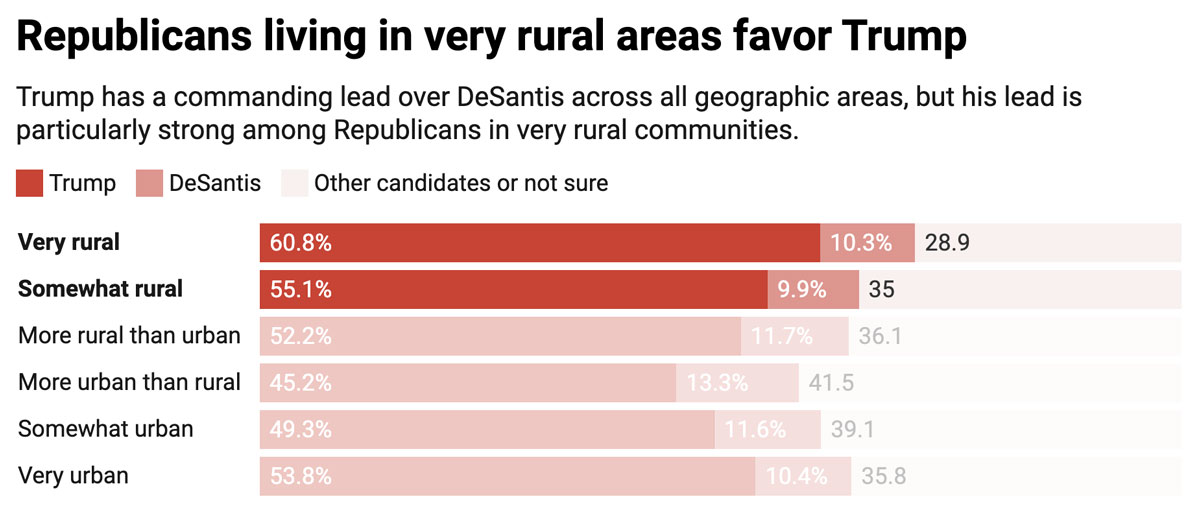
As for anti-“woke” warrior Ron DeSantis, his campaign against Trump appears to be a spectacular failure, even as he apparently mimics Trump’s fragile ego, accompanying vindictiveness and bizarre obsession with manliness. Like “personality” Tucker Carlson’s 2022 special on “The End of Men,” DeSantis’ anti-Pride video was pretty darned homoerotic.

Along with the right-wing cable news machine profiting by actively diminishing the mental acuity of its viewers, “manfluencer” grifters like Andrew Tate, selling “alpha male” misogyny to lonely, insecure young men, have made fortunes encouraging them to become misogynistic white nationalists — essentially mini-Trumps, but with actual muscle tone (not just in risible fantasy). It’s good to see some mentally healthy young people fight back with satire


Want a daily wrap-up of all the news and commentary Salon has to offer? Subscribe to our morning newsletter, Crash Course.


When a serial liar and hatemonger like Trump remains the choice of a large majority of Republican voters even after two impeachments, an ever-growing count of felony indictments and an ongoing attempted coup; when voters send deeply unserious, dysfunctional or delusional individuals to Congress as their representatives; when fascist-fanboy governors like DeSantis and Greg Abbott model their states after authoritarian regimes and deploy stochastic terrorism to put marginalized populations at risk of violence, is it any wonder that ordinary citizens feel permanently on edge, in a state of chronic existential dread?

But the right won’t give up — I don’t mean on issues of principle or policy, since it doesn’t have any, but in its crusade to “own the libs,” take rights away from people who are not like them and enforce theocratic minority rule. In fact, that mean-spirited crusade is the basis of the right’s tribal identity. As Adam Serwer of the Atlantic famously pointed out some time ago, the cruelty is the point:

Taking joy in that suffering is more human than most would like to admit. Somewhere on the wide spectrum between adolescent teasing and the smiling white men in the lynching photographs are the Trump supporters whose community is built by rejoicing in the anguish of those they see as unlike them, who have found in their shared cruelty an answer to the loneliness and atomization of modern life.

As I reread those lines, I think back to the cheering and laughter of the Trump supporters during CNN’s pathetic “town hall” rally for Trump in May, as he turned in his typical shameless performance of lies, bluster, bullying and whining. Here’s a suggested campaign slogan: “Trump 2024: Come for the Lying, Stay for the Crying.” As Salon contributor Mike Lofgren has observed, the GOP’s “heart of darkness” has moved beyond just whining; They want retribution, payback for all the real or perceived slights they have suffered, and they believe only their cult leader can deliver it.

The right just won’t give up — I don’t mean on issues of principle or policy, since it doesn’t have any, but in its crusade to “own the libs,” take rights away from people who are not like them and enforce theocratic minority rule.

Brian Klaas, a professor of global politics at University College London, writes that we end up with bad people in power so often for three main reasons: power acts as a magnet for corruptible people (often “Machiavellian narcissists, perhaps with a dash of psychopathy thrown in too”); holding power tends to corrupt people; we tend to give people power for the wrong reasons.

“Corruptible people are disproportionately drawn to power, disproportionately good at wriggling their way into it and disproportionately likely to cling to it once they’ve got it,” Klaas notes. We can fix this, he argues, by fixing our political system, recruiting better candidates and instituting real accountability for wrongdoing. Good systems, he says, attract good people. Fighting corruption is an integral part of the Democratic Playbook published by the Brookings Institution. A political system dominated by money, “dark” or otherwise, is not working. 

Most politicians would not entertain the thought that they are mentally unwell. They are simply playing the game; looking to gain advantage in any way that works and is not blatantly illegal (with some notable exceptions. But does that kind of Machiavellian behavior, part of the “dark triad,” suggest a well-functioning mind and spirit? We too often shrug at politics, accepting the narrative that it’s just a game. But it’s not; it is freedom or tyranny, dignity or subjugation, life or death.

Those who dehumanize their political opponents by referring to them as enemies and who call teachers, librarians and parents “groomers” have mental health issues far exceeding those of young people struggling with questions of sexual orientation or gender identity. Men who work to limit women’s autonomy over their own bodies, or for that matter conservative women who punch down to bolster their fragile status have serious issues to work on and should quit afflicting them on the rest of us.

To be fair, a great many of us in America face our own mental health issues across the political spectrum. More of us, almost certainly, should seek the counsel of friends and professionals. We are chronically depressed and lonely. Political polarization has separated friends and family members from each other. The religious right has embraced an evangelism of intolerance against other people whose mental and emotional struggles they don’t understand. While Republicans play-act as defenders of the working class, they labor tirelessly to drive working people deeper into lives of endless labor and debt servitude.

As the late, great American novelist Kurt Vonnegut would have said, about this and about his currently banned books: “So it goes.” I don’t think he meant to indicate cynical acceptance, more like an acknowledgment of humanity’s deep history of stupidity and intolerance — and the need to carry on nonetheless. So we work diligently to maintain our own sense of self, our fragile balance, our purpose and our will — even in a country where, far too often, the inmates are running the asylum.

Mark Meadows throws a hitch in Trump’s “declassifying” documents narrative

In a direct move against Donald Trump‘s main narrative in the Mar-a-Lago case — in which he claims to have been in rightful possession of sensitive government materials because he declassified them himself — former White House chief of staff Mark Meadows told special counsel Jack Smith’s investigators that he can’t recall an instance where that ever actually took place. 

According to ABC News, which received info from sources close to the matter, “[Meadows] could not recall Trump ever ordering, or even discussing, declassifying broad sets of classified materials before leaving the White House, nor was he aware of any ‘standing order’ from Trump authorizing the automatic declassification of materials taken out of the Oval Office.”

In the outlet’s reporting of this shoot-down of Trump’s main defense in this case, they also mention getting a first look at an early draft of the prologue to Meadows’ book, “The Chief’s Chief,” which makes mention of Trump just casually displaying a classified war plan in his Bedminster, New Jersey during a meeting attended by Meadows’ ghostwriter and publicist. The reference to that document was later removed. 


7 queer British royals you may not have read about in history books

Prime Video’s “Red White & Royal Blue” is a smash hit – it’s the No. 1 movie worldwide on the streamer and it’s causing a surge of new subscribers for the platform. 

The rom-com based on the novel by Casey McQuiston follows the blossoming enemies-to-lovers story between early 20-somethings Alex (Taylor Zakhar Perez), the bisexual son of the President of the United States, and Henry (Nicholas Galitzine), a closeted gay grandson of the King of England (think Prince Harry if he was queer). 

Henry’s struggle with his sexuality and how little he can share it with the people he loves and the public is heavily apparent in the film because his “life is the Crown.” The difficulties in Henry’s life stem from his obligations to the royal family as the spare to the heir. Questions about the line of succession and how Henry’s sexuality affects the royal family’s image are at the forefront of the conversation about identity in the film.

After Henry and Alex’s relationship is outed to the world, his grandfather the King of England (Stephen Fry) insists that the country will not accept a prince who is gay. In the monarch’s mind, Henry’s duty is “not to [his] heart, but to [his] country,” and that means continuing to uphold a “traditional royal image,” i.e. a heteronormative one.

Naturally, Henry defies his grandfather, saying, “Starting today, the world will know me for who I am, and not who you want me to be.”

While “Red, White & Royal Blue” highlights the difficulties of a member of the British monarchy, queerness in the U.K. is generally accepted as a cultural norm – if you’re not of royal blood, that is. Just like in the United States, however, LGBTQIA+ acceptance has been a journey that has been hard won (homosexuality once was punishable by death.) Northern Ireland just legalized gay marriage in 2020 six years after Scotland, Wales and England legalized it in 2014. Civil partnerships have been recognized since 2005. 

We need your help to stay independent

The larger historical context for queerness in the U.K. has changed since the establishment of the monarchy. While Henry’s love for Alex was accepted by the public and begrudgingly accepted by the monarchy in “Red, White & Royal Blue,” has that always been the case looking back at the various heads of state and their romantic liaisons?

This raises the question of how realistic the movie is. Which other British royals – at least those closer to the throne – have been queer? Were they closeted or out? Salon delves into history to see how Henry follows in the footsteps of real-life royals.

01
King William II (1057-1100)
The son of William the Conquerer was assumed to be gay or bisexual. Historians described the king as “effeminate” and “boorish.” The king known by his nickname, Rufus, never married or had any children. Unlike other monarchs of the time period, it is reported that he was not religious and had many sexual dalliances.
02
King Richard I (1157-1199)

Despite his marriage to Berengaria of Navarre, Richard I was speculated to have been gay. He never had children with his wife but he did father two illegitimate sons. The king was speculated to have a close relationship with Philip II of France, who was an ally to Richard during the Third Crusade. Historians believed that they ate from the same plate and shared a bed. Their affair was made into the Oscar-winning film “The Lion in Winter.”

03

King Edward II (1284-1324)

Edward II was married to Isabella of France but was openly in a long-term relationship with knight Sir Piers Gaveston. Edward and Isabella had six children together to secure their line of succession but his relationship with Gaveston continued much to the dismay of the court.

04
King James VI and I (1566-1625)

The son of Queen Mary of Scots, King James is touted as one of the most prominent queer-coded figures in British history. Though he was married to Anne of Denmark, James is speculated to have been in many relationships with men but notably with George Villiers, later made as an Earl and the Duke of Buckingham. Restoration work on James’ place found a secret passageway connecting the lovers’ rooms.

05

Queen Anne (1665-1714)

Anne was married to the Prince of Denmark and became pregnant 17 times by him but none of their children survived. The queen had a close relationship with Sarah Churchill since their childhood but it was rumored that they had a romantic relationship. Their story was portrayed in the film “The Favourite” which won Olivia Colman an Oscar. Anne once wrote to Sarah: “If I could tell how to hinder myself from writing to you every day I would. But really I cannot . . . when I am from you I cannot be at ease without enquiring after you.”

06
Prince George, Duke of Kent (1902-1942)
As the fourth son of King George V and Queen Mary, he was far enough down the line of succession with two brothers who actually ascended to the throne that he most likely had more freedom to be himself. Although Prince George married and had three children, he was also rumored to have numerous affairs with men, including writers Cecil Roberts and Noel Coward.
07
Princess Margaret, Countess of Snowdon (1930-2002)
You may know this spare better as the younger sister on Netflix’s “The Crown,” portrayed at various ages by Vanessa Kirby, Helena Bonham Carter and Lesley Manville. The partying princess was rumored to have a number of affairs, including with Rolling Stones frontman Mick Jagger and Sharman Douglas, the daughter of U.S. Ambassador Lewis Douglas. Meanwhile, her husband Lord Snowdon was said to have been similarly bisexual.

From star to stars: Astrophysicist Aomawa Shields traces her journey from acting to astronomy

As a scientist studying exoplanets, Aomawa Shields, Ph.D., has spent her career searching for life on other planets. On her way there, she carved her own path on this one.

Shields’ research focuses on finding life on exoplanets, or those outside of our solar system. One of her most-cited studies detailed what we know about the habitability of planets orbiting red dwarf stars, which are smaller and cooler than stars like ours. Because red dwarf stars make up more than 70% of known stars in the universe, this opens up a world — or rather, billions of worlds — of possibilities for where alien life could exist. 

Shields, an associate professor at UC Irvine, is one of only 26 Black astrophysicists in U.S. history. She is also a mother, a trained actor and a writer who recently published her memoir, “Life on Other Planets.” The book details her journey to becoming a scientist and how she used her creative background as her “superpower,” later combing these talents to create an educational program, Rising Stargirls, which teaches astronomy to girls of color.

Shields spoke with Salon about her path to astronomy, reconciling the creative and scientific parts of herself, and, of course, life on other planets.

The conversation has been edited for length and clarity.

You discussed in the book a case of imposter syndrome taking root in your life during your time in school. How did you reconcile looking outward being a source of struggle to looking outward — like toward the sky — as being a source of wonder?

One of the main messages from this book is that there are a lot of opportunities to look outward in our lives. And I did for a long time: I looked outward in the sense of looking to other people to determine how I should feel about myself. 

“It’s very important to still have those people we can look up to. But if it doesn’t exist, we need not think it can’t be done.”

I was so concerned with how I was appearing and the perception of me being an African American woman in a field dominated by white men. Being an older returning student, I was more than 10 years older than most of my peers in my cohort. And by this time, I had gone off and gotten an MFA in acting, so I had another reason to feel completely separate and apart.

But when I finally got that wonderful feedback from a mentor that my theater background is my superpower, that was this first invitation to turn inward, to see myself apart from how anyone else saw me, to really look at the gifts that I brought — that the things that I thought set me apart in a negative way actually set me apart in a very positive way, if I chose to see it that way. 

I don’t have any control over whether someone thinks I should or can be an astronomer or an actor, or both — whatever. But I have a lot of control over what I believe I can be, and what I believe is possible.

You also talked about being your own role model and that if you haven’t seen someone do the things that you’re doing before, that doesn’t mean that it can’t be done.

Absolutely. We get to be our own role models, and for a long time, I didn’t understand that. It’s important for there to be role models. I want to encourage and support the efforts that are at play to increase representation. It helps to see someone who looks like you doing what you want to do. It makes a big difference.

“It’s not the work of the historically marginalized to make spaces more inclusive and welcoming for ourselves. That needs to be done by those who are in the majority.”

The movies were the first gateway for me to see what was possible. It was like, even if people didn’t look like me, they were doing these things that I wanted to do. But it would have been a whole lot easier if I’d seen more people looking like me in those roles. 

It’s very important to still have those people we can look up to. But if it doesn’t exist, we need not think it can’t be done. [I realized], “Oh, okay, I don’t see this depicted a lot, or I don’t see this as an example, but I want to do it. So I’m still going to do it, and I’ll be the first.”

You talked about how in your Ph.D. program, these outside forces, like discrimination and underrepresentation, crept in to make you doubt yourself. And you even said that your own mind became the “biggest racist” you had known. What needs to change in this “Ivory Tower” of academia to make a more inclusive environment for aspiring scientists?

I’m glad to see the conversation now moving to not only how do we get [Black and brown students into our departments], but how do we keep them here? And how do we keep them here, in a way that the quality of their life is high while they’re here, so we move out of survival mode into a thriving mode? That’s something that I’ve seen in my institution, and I hope that continues. Because it’s not just about recruitment, it’s also about retention and building in those support structures. 

It’s not that Black and brown students just aren’t as interested in the sciences as white students. That’s never been the reason why there are so few of us in these fields. It’s because those support networks and systems that allow us to exist and thrive in the Academy, which has a history of systemic racism and white supremacy — that’s part of our culture and history in this country — they have not been in place before. 

“The hope is that that direct personal connection to what they’re learning about will anchor them as they continue on in their astronomy and education.”

I’ve always felt that it’s not the work of the historically marginalized to make spaces more inclusive and welcoming for ourselves. That needs to be done by those who are in the majority, who recognize the importance. 

Because those of us who are from these backgrounds are doing a lot of heavy lifting simply to be where we are and carry the history of our personal backgrounds, our legacies of combating oppression, our own imposter thoughts and all of those things. Then you compound that on to having to take on a five-year Ph.D. program and do all the things that people who don’t have those burdens that they are carrying are doing. That’s a lot. It makes thriving very difficult. 

I think [this] needs to be accounted for in these departments when we’re thinking about everything from how we approach setting up the support structures, to how we talk to the students when they are in our classes, whether they’re struggling or not — having that awareness that they are carrying a load that is an invisible load to the eye, but it’s extremely weighty to the soul.

Can you tell me a little bit about Rising Stargirls

I thought, “How do I use my unusual creative arts background to inspire and encourage middle school girls of color to explore astronomy?” I had this feeling that that could be useful even before I went to the education literature. And then I went to the educational literature and found that there was precedent. When these creative arts activities are employed, girls of this age, their confidence increases, and [they start] asking and answering questions in the classroom.

Middle school is this critical age. It’s been shown that between the ages of 10 and 15, girls start to get quiet in the classroom, they become really concerned with their physical appearance and less concerned with how they think and feel about the world. 

“There are hundreds of billions of stars in our galaxy alone and hundreds of billions of other galaxies. So the notion that it would just be us is, in my opinion, unrealistic from a probability standpoint.”

[In Rising Stargirls], they’re, of course, learning about planets and stars and galaxies and what constellations are. But they’re learning about these things through a creative arts lens. So they’re encouraged to bring their own personal backgrounds. They write poems and draw pictures of the planets and stars that they’re learning about. 

The hope is that that direct personal connection to what they’re learning about will anchor them as they continue on in their astronomy and education, and hopefully keep them grounded as the heavy math comes in. Because no one can tell them that the poem they wrote about that planet or galaxy is wrong — you can’t get it wrong in art. 


Want more health and science stories in your inbox? Subscribe to Salon’s weekly newsletter The Vulgar Scientist.


How did you use the tools that you developed in acting school in science when you returned?

I thought science was so objective that it didn’t care about my feelings. When I got to acting school, it was all about my feelings. There, [I] was to bring up all those childhood experiences that were both positive and traumatic and have them right on the surface, ready to use to embody whatever the character needed. It’s like all the emotions that I was expected to feel as these characters, I had to go back into my personal history to access [them]. So, at first, it was diametrically the opposite. 

“It’s a very real possibility that the life that we see out there is something that may not be able to talk to us. I would not consider that any less of an earth-shattering discovery.”

What I know now is that, first of all, all of that vocal training serves me so well as a scientist. I mean, much of what we do during the day is talk. But in teaching, as an instructor, I’m talking to my students, and I can now key into the wonders of the universe. Because I have those feelings that I’ve been able to tap into through my acting training.

I think about those first moments of looking up at the sky, you know, and going back there. There was a wall that I think I had that existed. And I don’t know if this exists for other scientists who haven’t trained as actors. But I’m glad that one doesn’t exist for me, that I’m able to share that wonder and awe with students pretty easily and they pick up on that.

How confident are you that life on other planets exists

Well, it’s hard for me as a scientist to extrapolate or predict in terms of a confidence level. What I have now is a hope — and I will go in further to say a belief without proof, but a belief — and that belief is that we are not alone. I always think about Jodie Foster’s character in the movie “Contact.” … Her character says, “If it is just us, it seems like an awful waste of space.” 

I believe that. There are 10 to the 22 stars within our observable universe. So it’s hundreds of billions of stars in our galaxy alone and hundreds of billions of other galaxies. So the notion that it would just be us is, in my opinion, unrealistic from a probability standpoint. 

However, there are those who subscribe to the idea that our earth is rare … that certain circumstances and compounds and molecules and the energy source all conspired to allow life to arise on our planet and that is a rare occurrence. It’s certainly a hypothesis that’s worthy of consideration, too. But I keep coming back to, if it is just us, given the sheer numbers out there, it would be such a waste of space. 

Do you think we’ll find confident evidence of that in our lifetime?

There was a time when I remember being at conferences, and people were talking about the James Webb Space Telescope that was on the horizon. And there was skepticism about whether JWST would actually be able to do much for Earth-sized planets. 

Yet, just in January, we confirmed the presence of an Earth-sized planet with James Webb. And those scientists are looking at trying to use James Webb to determine the atmospheric composition of that planet. So it seems like our instrumentation capabilities are exceeding our expectations. And that leads me to believe that we have every potential to be able to learn a lot about the habitability of these new worlds, maybe more quickly than we think — perhaps within the next few decades, perhaps, if not in my lifetime, then within my daughter’s lifetime.

What might it look like if we found evidence of life on other planets?

The majority of life on this planet is microbial. And if we think about the cosmic calendar that Carl Sagan shared all those years ago and how humans came on the scene on December 31, we can see how such a small part of history humanity and humanoid life forms have been. It’s a very real possibility that the life that we see out there is something that may not be able to talk to us. I would not consider that any less of an earth-shattering discovery.

“If there is a liquid on that moon, the liquid [wouldn’t be] water. It’s ethane and methane, so if there’s anything swimming around in there, it would be life as we absolutely do not know it.”

We could find life within our own backyard, within our own solar system. The moon of Jupiter, Europa, has an entire ocean under its ice crust. We’re sending spacecraft back to drill and see if there’s anything swimming around in that ocean. 

There’s Saturn’s moons Enceladus and Titan. Enceladus and Titan are very different. Enceladus has a liquid water ocean and these geysers of water spewing out from the south pole. Titan, if there is a liquid on that moon, the liquid [wouldn’t be] water. It’s ethane and methane, so if there’s anything swimming around in there, it would be life as we absolutely do not know it. 

So I am excited, even though in my mind, I’m like exoplanets [are] where we need to look. But there are the vast astronomical distances with exoplanets that we would have to contend with.

My team did some really exciting work this year to look at what would happen if you have a planet that’s around an M-dwarf that’s synchronously rotating, which means there’s a perpetual dayside, perpetual nightside and only habitable surface temperatures along the terminator — that dividing line between. We got to see that that scenario is possible and more likely if the planet has less water on it. 

One of the things I love most about my work is being able to propose hypothetical situations that could sustain life in a planet system and knowing that those planets could actually exist out there. We got to see that this scenario is possible. 

We need your help to stay independent

Who did you write this book for?

I dedicated the book to myself as a young girl and to my daughter. In many ways, I suppose I wrote it directly to speak to those two little girls. 

However, when I think about the readers of this book, I think it’s for everyone. It’s for people who have always had a dream that they never pursued, or they pursued it for a while and then they had to do something else because they had to support their families or because it didn’t seem practical or, for whatever reason, life happened and they abandoned that dream and they think it’s too late. I wrote this for them. 

“They might feel like those magical unicorns but there are other unicorns in the meadow. This is the story of one that they can sort of use as a companion to then create their own path.”

I wrote this for people who have multiple interests, whether it’s two, three or five. And they’re not sure how to combine them and they think they have to figure that out. As you can see, reading the book, I tried to figure it out and chose one and then chose the other and was trying to figure out this perfect recipe. It was when I stopped figuring it out and simply embraced it, accepted it and allowed the universe to show me how to combine the two — that was when miracles started to happen.

I wrote this for people that are parents who are struggling to combine work with family and want to have a sense of their priorities and honor them rather than the priorities of someone else. 

And I wrote it, of course, for people from historically marginalized groups that are inhabiting predominantly white spaces, whether in academia or business or other fields and they feel alone. I wrote it so that they know that they are not. They might feel like those magical unicorns but there are other unicorns in the meadow, as I wrote in the preface. This is the story of one that they can sort of use as a companion to then create their own path.

“I want to believe”: Alice Hoffman is always seeking magic, practical and otherwise

Alice Hoffman still believes. 

The New York Times bestselling author of more than 40 works of fiction published her first, “Property Of,” when she was just 21. That novel was swiftly followed by beloved collections of short fiction, works for teens and children, and novels like 1995’s “Practical Magic,” best known for its big-screen adaptation. 

“It’s a bad idea to write for the moment because the moment passes so quickly.”

It’s not the only one of her books to be turned into a film. She also wrote “Aquamarine,” “The River King,” and penned the screenplay for the 1993 indie film “Independence Day.” But the 1998 movie adaptation of “Practical Magic,” starring Sandra Bullock, Nicole Kidman and Stockard Channing, has acquired a massive following over the years. 

Hoffman returned to the family of witches introduced in “Practical Magic” with several other books, including 2021’s “The Book of Magic.” And she returns to magic often, with witchy characters, rambling houses lush with flourishing plants (I always keep rosemary by my garden gate because of Hoffman), inherited curses, women telling their own truths — and a strong belief in what we cannot always see.

Her new novel, “The Invisible Hour” twists time. Lonely and ostracized Mia has been raised in the cloistered Community, a cult in western Massachusetts. Though books are outlawed by the Community, she finds secret solace in them. Specifically, one book: “The Scarlet Letter” by Nathaniel Hawthorne. And in the second half of Hoffman’s novel, she finds herself going back in time to encounter the writer whose words she feels showed her a way to survive.

Hoffman talked with Salon about Hawthorne, writing during a time of COVID and finding magic in the real world still. 

This interview has been lightly edited for length and clarity.

Your first novel was published when you were very young. Did you always know that you wanted to tell stories?

I think I was always a reader. That was what was important to me. I think I wanted to be a writer. I remember sending a short story someplace when I was in high school, so I must have had thoughts about that, but really I was mostly a reader. Then I took a creative writing class, and the professor was shockingly supportive. I just never expected it. I certainly didn’t think you could do it for a living or it would be a profession.

I remember that I didn’t know that until I read “Anne of Green Gables” by L. M. Montgomery. The main character was a writer, and I realized, oh, people actually do this.

I know, it’s kind of a shock. I think nowadays people think about doing this, I don’t know, but I certainly didn’t think about getting published. That wasn’t my thought.

You’ve written in a lot of formats. You’ve written novels for adults, YA novels, middle grade, short stories, a screenplay. Do you have a favorite form that you love to write in?

Honestly, I think I like connecting short stories, a novel-in-stories because you get to move around. There’s so much freedom, and the way things connect can be so interesting. 

That seems like a hard format to me.

Really? I think it’s so much fun. And you just can create a whole gigantic world and move around so freely.

Well, that makes sense because you’ve returned to your worlds a few times. You’ve returned to the characters, so it makes sense that you would be drawn to it.

And this new book [“The Invisible Hour”] actually takes place in a town where I wrote a book of connecting stories about called “The Red Garden,” so it’s the same place. It’s just a novel that takes place in that town.

Oh, that’s so interesting. It’s like there’s something left over that you have to return to.

For me, it was very healing to go back to that town. I felt really comfortable there. It made it easier for me in a way to write the novel. It was so weird writing during COVID and so escapist for me. I think some people couldn’t write, but for me I wrote more because where were we going to go? And I think the idea of time travel — I’ve always loved time travel books, but the idea that you could change things or go back, it’s really interesting to me.

It makes sense that you would be thinking about time travel during COVID, too. I was going to ask you about time, and if that was important to your work.

It really is all about time. I thought a lot about time while I was writing this book and before this book because it was such a lousy time. I mean, there were good things that came out of it. I think some friendships became closer, but I just felt so sad for the people who were at certain phases of their life, were young, becoming young adults or were kids. And I just didn’t really want to be in this time. I still don’t want to be in this time, to tell you the truth.

Yeah, I understand that. How do you keep a sense of wonder in your writing, even when you’re writing for adults?

I think it’s because of the books that I read. I’m sure as a fiction writer you feel this too. The books that I read when I was younger are the books that wound up affecting me more than any others. They form who you are as a reader, as a person. And I read a lot of magic and a lot of Ray Bradbury.

I loved books that took place in the here and now, but also included magic so that it wasn’t so far away. Back then, everything was genre-ized . . . Now that’s changed, and [science fiction and fantasy] are more acceptable as literature, but it didn’t used to be. I always feel like you should just write what you want to write no matter what’s current because it doesn’t really matter. It changes.

That’s a good point. And I feel like that changed not too long ago. Even when I was in school, there was a lot of criticism from professors for genre writing. To write genre work was somehow bad. And I feel like that’s been a recent kind of shift, thank goodness.

Really recent, I think. I remember I read Ursula K. Le Guin when I was a kid and loved her books, but they were definitely science fiction and fantasy. And then all of a sudden they became literature. Someone decided. But they were always literature. It’s just they were put into these categories. 

“Fiction is more believable than life in a way because when you’re writing a book, you have to have it make sense.” 

I think it’s a bad idea to write for the moment because the moment passes so quickly. The other thing about time is that what’s right and what’s good and what’s accepted suddenly becomes not. I thought about that with the way women were treated in “The Scarlet Letter,” the way that the Puritans blamed women, and they believed in original sin and that women were responsible for that because of Eve. It all changed, but then it changes back. And then it changes again. A lot of the things that women are coping with right now are not that different, really. The judgment against women.

That’s very true. Why do you feel called to tell stories that have magic in them? I mean, you talked a little bit about your childhood reading. Is that why, or do you think there’s something else that makes you feel like these are the stories you need to tell?

It’s about my childhood and what I read, but I think it’s also I want to believe. I want to believe that there’s — not magic per se necessarily, but wonder and beauty and goodness and a moral universe and all those sorts of things . . . I feel like fiction is more believable than life in a way because when you’re writing a book, you have to have it make sense. You can’t just have random things happen for no reason, but that’s not like life at all. I almost feel that’s part of the comfort of reading fiction. Even with time travel, it has to make some kind of sense — and life really doesn’t make any sense. I feel like I’m constantly trying to make it make sense.

And there’s no closure in life.

No.

We need your help to stay independent

There can be closure in books and you can also return to them, as you have. You can return to the world and get that healing that we really can’t get in life. You have a new book out, “The Invisible Hour.” How would you describe it?

It’s about magic and women and time and loss. Sometimes I think you don’t really know what a book is about until you finish it. I always feel like there’s the inside story; there’s the outside story. You don’t necessarily know the inside story. 

For me, I think it was a lot about my relationship with my mother and how difficult mother and daughter relationships are, how important they are, and how they change as people get older, as you more understand who your mother was and what she went through.

I always feel like you can’t really know older people or your mother because you didn’t know her when she was young. And even though I think people basically stay the same unless they’re extremely traumatized, you’re so different when you’re young. So I feel like we can’t really know our mothers.

“Better not to meet your heroes, your living heroes. Better to fall in love with a dead writer.”

Again, there’s so much about time and history in this book. Was Nathaniel Hawthorne an influence on you?

I’ve been thinking about writing about him for a long time. He’s interesting because in some ways some of the things that he wrote were a little bit misogynistic, but “The Scarlet Letter” is such a feminist book. It’s kind of shocking. His wife came from a family that was kind of a feminist family in a way for the time. He had two sisters and a mother that he was very close to.

He also had a lot of issues about writing and life — and hiding from life in writing. I think he was an extremely interesting person and writer. Sometimes, for people now “The Scarlet Letter” can be off-putting because the language is old-fashioned, but the heart of it really is about a woman trying to make decisions about her own life and society not wanting to allow that to happen.

Is there a book that helped you feel less lonely, as “The Scarlet Letter” helps Mia in “The Invisible Hour”?

There were a couple of books. One of those books was “The Diary of a Young Girl” by Anne Frank when I was young . . . You know, sometimes you read a book and you feel known. I felt like I’m her or she’s me . . .  I think that’s why “Catcher in the Rye” was popular and meaningful for a lot of people because there was this sense that the character was talking directly to you. And so I have a couple of books. I think books in general make me feel that.

Is there a writer from history that you believe you could fall in love with, similar to what kind of happens in “The Invisible Hour?”

Well, I think a lot of people fell in love with Nathaniel Hawthorne. He was so incredibly handsome. So, maybe him. 

When I interviewed the musician Amanda Shires, I knew that she loved Leonard Cohen, and she said that she sometimes felt she might have been born in the wrong time, that she and Cohen could have been together and made music together.

Yeah, and she would’ve been very miserable. I love Leonard Cohen, but –

She would’ve written some other great songs, but they might’ve been sad songs.

I think sometimes it’s better not to meet your heroes, your living heroes. Better to fall in love with a dead writer.

We talked a bit about the pandemic, and I’m with you: at the start, I definitely found comfort in my fiction writing, but I also found community in it. I could kind of make up my own community when I couldn’t leave the house. That’s something that I see in a lot of your books: a small town or this found family. Is community or the idea of a village important to your writing?

I think I write about a lot of things that I don’t have. I don’t have a sister, I don’t have a daughter. I’m close to one of my aunts and I’m very close to my nephews, but I don’t have that kind of community. I don’t live in a small town. I really long for that, and I think most people do have a need for it. I just think we live in such a fractured society. People move all over the country and you see them maybe once a year.

COVID really pointed that out to me because a lot of people kind of went into retreat with their families. If you didn’t have a family, there were really not that many people to go into retreat with. I think a lot of my books are about longing for community.

Growing up my mother was very bohemian, and we were outcasts in our community. I think that made me long for it even more, and yet distrust it.

How do you create your characters? How do you make engaging people come to life?

That’s a really scary question because I don’t think I have the answers for it. I used to do things with my characters. I’d write down everything about them, where they went to school, what they dressed in and what music they listened to. But I don’t really do that anymore. 

Now, it’s like they walk in through the door, and I just let them be. I have to rewrite them a lot, but basically, that definitely happened with “Practical Magic” where I remember writing it in this little shed on a marsh. I just felt like they walked through the door. It happened when I wrote “The Rules of Magic” too and Vincent appeared. I didn’t expect him to be in the book. I didn’t know anything about him, and he just kind of revealed himself. I really didn’t have to do it. It just happened.

I guess the trick is you have to leave that door open. They might just walk in, but you can’t close it. 

You can’t shut the door in their face. It’s opening the door.

Are you surprised at how much cultural impact your books have had, like “Practical Magic?” That has such staying power. It’s in memes; it just shows up all the time. Has that surprised you, that people have loved your story for so long?

I don’t know. I wasn’t thinking like that. I think some of that — maybe a lot of that — has to do with the movie, which was weirdly, extremely unpopular. Nobody went to see it when it came out. And every year it becomes more popular, which is so interesting to me. I almost feel it wasn’t the right time for it. It was one of the first movies that had basically a cast of women. The men are there, but they’re not as important as the relationships between the women. 

Now there are more, movies like “Bridesmaids.” But then, it didn’t really exist. There was a very negative critical response to [“Practical Magic“], I think probably because it was very female and very much about sisterhood. And that’s changed, so that’s a good thing.

That goes back to what you were speaking about, how you can’t write for the moment because the moment is going to move on. Maybe the moment will get you in a few years, but not right now.

That’s right. It’s like what are you writing for? Sometimes I’m afraid now: will there even be books? Or, will it be like one of my favorite books, “Fahrenheit 451” by Ray Bradbury, where books are too dangerous. They’re not just banning books, they’re burning books because books — it goes two ways. The writer opens the door for the characters, but the book opens the door for the reader.


Want a daily wrap-up of all the news and commentary Salon has to offer? Subscribe to our morning newsletter, Crash Course.


It’s a scary time in the world right now with book banning and AI.

I don’t feel like: oh, my books will last. Because I don’t know if books are lasting. I just feel like they’re here. But I want them to have this feeling of timelessness because that’s how I felt when I read the books that I loved. Even when they were happening at a certain time, they didn’t seem caught in time.

How does magic show up in your life now? 

I am kind of still looking for it. I think I’m constantly looking for it. My connection with magic is about writing. This idea that characters walk through the door and this idea of creating something beautiful out of something terrible sometimes, or out of loss, or out of death. You can put letters on a page, and it becomes a world. And it means something so different to the writer and to the reader. The reader creates that whole world in their mind. For me, that’s magic.


A peek at Big Pharma’s playbook that leaves many Americans unable to afford their drugs

America’s pharmaceutical giants are suing this summer to block the federal government’s first effort at drug price regulation.

Last year’s Inflation Reduction Act included what on its face seems a modest proposal: The federal government would for the first time be empowered to negotiate prices Medicare pays for drugs — but only for 10 very expensive medicines beginning in 2026 (an additional 15 in 2027 and 2028, with more added in later years). Another provision would require manufacturers to pay rebates to Medicare for drug prices that increased faster than inflation.

Those provisions alone could reduce the federal deficit by $237 billion over 10 years, the Congressional Budget Office has calculated. That enormous savings would come from tamping down drug prices, which are costing an average of 3.44 times — sometimes 10 times — what the same brand-name drugs cost in other developed countries, where governments already negotiate prices.

These small steps were an attempt to rein in the only significant type of Medicare health spending — the cost of prescription drugs — that has not been controlled or limited by the government. But they were a call to arms for the pharmaceutical industry in a battle it assumed it had won: When Congress passed the Medicare prescription drug coverage benefit (Part D) in 2003, intense industry lobbying resulted in a last-minute insertion prohibiting Medicare from negotiating those prices.

 Intense industry lobbying resulted in a last-minute insertion prohibiting Medicare from negotiating drug prices.

Without any guardrails, prices for some existing drugs have soared, even as they have fallen sharply in other countries. New drugs — some with minimal benefit — have enormous price tags, buttressed by lobbying and marketing.

AZT, the first drug to successfully treat HIV/AIDS, was labeled “the most expensive drug in history” in the late 1980s. Its $8,000-a-year cost was derided as “inhuman” in a New York Times op-ed. Now, scores of drugs, many with much less benefit, cost more than $50,000 a year. Ten drugs, mostly used to treat rare diseases, cost over $700,000 annually.

Pharmaceutical manufacturers say high U.S. prices support research and development and point out that Americans tend to get new treatments first. But recent research has shown that the price of a drug is related neither to the amount of research and development required to bring it to market nor its therapeutic value.

AZT, the first drug to successfully treat HIV/AIDS, was labeled “the most expensive drug in history” in the late 1980s. Its $8,000-a-year cost was derided as “inhuman.”

And selling drugs first in the U.S. is a good business strategy. By introducing a drug in a developed country with limited scrutiny on price, manufacturers can set the bar high for negotiating with other nations.

Here are just a few of the many examples of drug pricing practices that have driven consumers to demand change.

Exhibit A is Humira, the best-selling drug in history, earning AbbVie $200 billion over two decades. Effective in the treatment of various autoimmune diseases, its core patent — the one on the biologic itself — expired in 2016. But for business purposes, the “controlling patent,” the last to expire, is far more important since it allows an ongoing monopoly.

AbbVie blanketed Humira with 165 peripheral patents, covering things like a manufacturing step or slightly new formulation, creating a so-called patent thicket, making it challenging for generics makers to make lower-cost copycats. (When they threatened to do so, AbbVie often offered them valuable deals not to enter the market.) Meanwhile, it continued to raise the price of the drug, most recently to $88,000 a year. This year, Humira-like generics (called biosimilars for its type of molecule) are entering the U.S. market; they have been available for a fraction of the price in Europe for five years.

Or take Revlimid, a drug by Celgene (now part of Bristol Myers Squibb), which treats multiple myeloma. It won FDA approval to treat that previously deadly disease in 2006 at about $4,500 a month; today it retails at triple that. Why? The company’s CEO explained price hikes were simply a “legitimate opportunity” to improve financial “performance.”

Since it must be taken for life to keep that cancer in check, patients who want to live (or their insurers) have had no choice but to pay. Though Revlimid’s patent protection ran out in 2022, Celgene avoided meaningful price-cutting competition by offering generic competitors “volume-limited licenses” to its patents so long as they agreed to initially produce a small share of the drug’s $12 billion monopoly market.

Patients who want to live (or their insurers) have had no choice but to pay.

Par Pharmaceutical, another drugmaker, maneuvered to create a blockbuster market out of a centuries-old drug, isoproterenol, through a well-meaning FDA program that gave companies a three-year monopoly in exchange for performing formal testing on drugs in use before the agency was formed.

During those three years, Par wrapped its branded product, Vasostrict, used to maintain blood pressure in critically ill patients, with patents — including one on the compound’s pH level — extending its monopoly eight additional years. Par raised the price by 5,400% between 2010 and 2020. When the covid-19 pandemic filled intensive care units with severely ill patients, that hike cost Americans $600 million to $900 million in the first year.

And then there is AZT and its successors, which offer a full life to HIV-positive people. Pills today contain a combination of two or three medicines, the vast majority including one similar to AZT, tenofovir, made by Gilead Sciences. The individual medicines are old, off-patent. Why then do these combination pills, taken for life, sometimes cost $4,000 monthly?

It’s partly because many manufacturers of the combination pills have agreements with Gilead that they will use its expensive branded version of tenofovir in exchange for various business favors. Peter Staley, an activist with HIV, has been spearheading a class-action suit against Gilead, alleging “collusion.” The negotiated price for these pills is hundreds of dollars a month in the United Kingdom, not the thousands charged in the U.S.

Faced with such tactics, 8 in 10 Americans now support drug price negotiation, giving Congress and the Biden administration the impetus to act and to resist Big Pharma’s legal challenges, which many legal experts view as a desperate attempt to stave off the inevitable.

“I don’t think they have a good legal case,” said Aaron Kesselheim, who studies drug pricing at Harvard Medical School. “But it can delay things if they can find a judge to issue an injunction.” And even a year’s delay could translate into big money.

Yes, American patients are lucky to have first access to innovative drugs. And, sadly, patients in countries that refuse to pay up once in a while go without the latest treatment. But more sadly, polling shows, large numbers of Americans are forgoing prescribed medicines because they can’t afford them.

KFF Health News is a national newsroom that produces in-depth journalism about health issues and is one of the core operating programs at KFF—an independent source of health policy research, polling, and journalism. Learn more about KFF.

Subscribe to KFF Health News’ free Morning Briefing.

Who still likes Donald Trump? Lots of Republicans — but we looked for specifics

Despite multiple state and federal indictments, recent polling indicates that former President Donald Trump retains a commanding lead in the race for the 2024 Republican presidential nomination.

So it seems useful to understand who, exactly, supports Trump — and whether the multiple criminal indictments against the former president have had any effect on his nomination prospects.

We are a multi-university team of social scientists who have been regularly polling Americans in all 50 states since April 2020.

Our most recent survey, which ran from June 29, 2023, to Aug. 1, 2023, included 7,732 Republicans or Republican-leaning independents. We explored who, among these respondents, supports Trump in the 2024 Republican primary and how they reacted to his June 2023 indictment for withholding classified documents.

Since no other Republican candidate in our survey received more than 5% support, we focus on Trump and his nearest rival, Florida Gov. Ron DeSantis.

Consistent with recent polls, we found that Trump has a commanding 40-point lead over DeSantis.

While Trump leads DeSantis across nearly all major demographic categories, his advantage is especially large among Hispanic voters. The same is true when considering Republicans who said that they do not have higher education degrees and those who are very conservative, live in very rural places or are lower-income.

Rural Republicans favor Trump chart (The Conversation, CC-BY-ND / Matthew Baum / Jonathan Schulman)
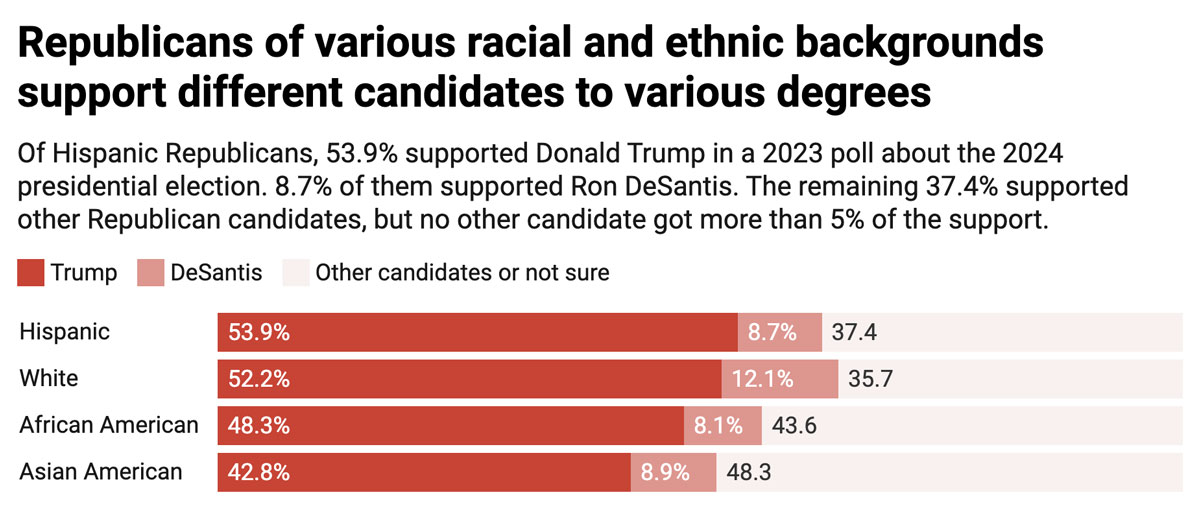
Very conservative voter support

People who identified as “very conservative” comprised 14% of the Republicans in our survey. Their support for Trump in 2024 is overwhelming: They support Trump over DeSantis by a 69-12 margin.

A recent FiveThirtyEight report showed that the most conservative Republicans were not always such strong supporters of Trump, but their support has risen substantially since Trump’s election in 2016.

Very conservative respondents were also the most likely to say that they were sure about which 2024 candidate they support. Just 5% of this group said they had not yet made up their mind, relative to 19% of moderate Republicans who were unsure who they would vote for.

Younger support

Despite the 77-year-old Trump being more than three decades older than DeSantis, he enjoys significantly higher levels of support among younger Republicans.

About 53% of Republicans ages 25 to 44 said they support Trump, while just 9% of these people said they would vote for DeSantis. And 48% of even younger Republicans, ages 18 to 24, preferred Trump, as compared with 7% who support DeSantis.

We need your help to stay independent

In contrast, the gap between the two candidates is smaller among Republicans ages 65 and older. While 53% of this group supports Trump, 14% said they prefer DeSantis.

That said, Republicans ages 18 to 24 were significantly more likely than people in other age groups to select a candidate other than Trump or DeSantis, or to say they were not sure who they would vote for if the election were held today.

Hispanic and white voters

Trump has a large advantage over DeSantis across all racial and ethnic groups we surveyed, but especially among Hispanic and white Republicans.

We found that Trump has a 45-point advantage over DeSantis among Hispanic Republicans, who are more likely to support him than any other racial and ethnic group we investigated.

About 52% of white Republican people we polled, meanwhile, said that they support Trump, compared with 12.1% who preferred DeSantis. The gap in preference for Trump over DeSantis among other ethnic groups, including Asian Americans and Black people, was smaller.

Ethnic Background of Republicans supporting Trump V DeSantis chart (The Conversation, CC-BY-ND / Matthew Baum / Jonathan Schulman)

No geographic or socioeconomic boundary

Trump has a commanding lead over DeSantis across all geographic areas, but his lead is particularly strong among Republicans in very rural communities.

Hispanic Republican voters were more likely to support Trump than members of any other racial or ethnic group.

Trump enjoys a massive 51-point lead over DeSantis among those who describe the area in which they live as “very rural.” Trump’s vote share among rural Americans increased from 2016 to 2020 and remains a strong base of his support leading into the 2024 primary.

Trump also holds a large lead over DeSantis regardless of socioeconomic status, but the gap widens among lower-income and less-educated Republicans.

Among Republicans with a college or graduate degree, for example, Trump led DeSantis by a 45-15 margin, which jumped up to 55-9 among those without a college degree. Trump holds a 47-point advantage among white respondents without a college degree, which shrinks to 29 points for white respondents with college degrees.

Trump’s legal woes aren’t a deciding factor

We randomly embedded an experiment into our survey in which we asked a series of questions about Trump’s recent indictment in the Mar-a-Lago classified document case before or after asking Republicans their preferred 2024 candidate.

Our goal was to test whether prompting them to think about the indictment affected respondents’ support for Trump.

Trump’s indictment has given some Republican voters pause, but this concern is not leading them to support DeSantis.


Want a daily wrap-up of all the news and commentary Salon has to offer? Subscribe to our morning newsletter, Crash Course.


Republicans who saw Trump’s indictment as justified were significantly less likely to support Trump in the 2024 primary, but they were not more likely to support DeSantis as a result.

The effect of answering questions about Trump’s indictment immediately before, rather than after, asking about preferences for the 2024 primary was strongest among self-identified moderate Republicans, who make up 29% of the Republicans in our survey.

Among those moderate Republicans, answering questions about Trump’s indictment before the 2024 Republican primary candidate preference question decreased support for Trump by six percentage points.

Among moderate Republicans, answering questions about Trump’s indictment decreased his support by six points.

Among the 18% of Republicans who felt that Trump’s indictment was justified, only 10% reported supporting DeSantis in 2024, compared with 25% who still backed Trump.

For conservative and very conservative Republicans, however, being prompted to think about Trump’s indictment immediately before answering the 2024 candidate preference question increased support for Trump by three percentage points.

This lends credence to the idea some Republicans have articulated that indictments could benefit Trump, but only among the most conservative Republicans.

The bigger picture

Our survey results show Donald Trump with a commanding advantage over the field at this stage of the race for the 2024 Republican Party nomination.

That said, Trump’s support is not uniform across all Republicans — it is, for instance, notably higher among Republicans who identify with some of these characteristics: being less wealthy or educated, rural, older, Hispanic or white, or very conservative.

Moderate Republicans’ shift away from Trump after we reminded them about the classified documents indictment raises the possibility that additional indictments — such as the second one the Justice Department announced on Aug. 2, 2023, regarding attempts to overturn the 2020 election results — could negatively affect Trump’s campaign for the Republican nomination, particularly among moderate voters.

Of course, our findings also suggest that Trump’s indictments may further invigorate his ideologically conservative base.

Overall, potential indictment effects notwithstanding, our findings represent a picture of overwhelming domination by Trump across virtually all facets of the Republican Party.The Conversation

This article is republished from The Conversation under a Creative Commons license. Read the original article.

“What the f**k?”: NYC councilwoman kissed on the cheek by random man during live interview

During a live interview conducted on a sidewalk in Brooklyn earlier this week, NYC Councilwoman Inna Vernikov received an unwelcome surprise from a man walking by who interrupted her conversation to plant a kiss on her cheek. The moment was captured on video, which you can watch below, and shows Vernikov responding appropriately to the creepy assault, turning to watch the man walk away while delivering a firmly worded,  “What the f**k?” Sharing the footage to social media after the fact, she commented on the event writing, “Not the kind of love I expect from constituents!”  

According to the New York Police Department, there is no complaint report on file regarding the incident, but many of her peers have jumped to her defense. “This disgusting behavior is unfortunately all too common in the day to day lives of women,” tweeted Councilwoman Marjorie Velazquez. “We can not let sexual assault become a normalized part of our public interactions.”

“This isn’t funny in the slightest,” wrote Councilman Robert Holden. “It’s amazing how many creeps are walking the streets!”


Fifteen years later “Tropic Thunder” is a flawed comedy that we’re still trying to agree on

It doesn’t take much effort to encounter reminders of Robert Downey, Jr.’s work in “Tropic Thunder,” no matter what year we’re in. Clips featuring Downey as Kirk Lazarus are perennially popular GIFs, especially those featuring rolling transcripts of the character’s most outrageous lines. Benign jesters and warty trolls alike offer them up as provocative replies to any issue you can think of.

The memes and references to “Tropic Thunder” were especially prolific over the past week, however, and for reasons having nothing to do with the 2008 film’s 15th anniversary, a threshold it officially crossed on Aug.13.

Scroll through a few threads debating whether Bradley Cooper should wear a prosthetic nose to play legendary conductor Leonard Bernstein, and there’d be the face of Downey’s Lazarus as Black Army Sergeant Lincoln Osiris.

Not long after Cooper’s “Jewface” controversy died down, another split shot of Judy Garland in horrendous Blackface next to a photo of her as Dorothy Gale rocketed around the internet, prompting rebuttals in the form of Downey as Osiris next to a picture of him as Tony Stark.

Downey as Kirk Lazarus as Lincoln Osiris bobs to the surface of the online furor stream for any reason whatsoever. A few weeks back, there was a hot debate over whether his work in “Tropic Thunder” is better than his acclaimed acting in “Oppenheimer,” and for a time you couldn’t get away from GIFs of a painted Downey growling about being “a dude playin’ a dude, disguised as another dude.”

In February there was much groaning over Ben Stiller’s decision to take a MAGA nut’s bait. The man insisted the actor-director stop apologizing for “Tropic Thunder” and Stiller, currently lauded for his Apple TV+ drama “Severance,”  felt a need to reply that he never did – generating a New York Post headline. Surfacing that image doesn’t require any news hook at all, of course, since there’s always somebody like Megyn Kelly wondering why she can’t get away with supporting blackface on national TV while Downey wore it for a whole movie.

Fifteen years after its release, “Tropic Thunder” holds the strange legacy of being a rallying point for the wrongheaded, and a representation of what not to do and how not to be, both intentionally and thoughtlessly. People with drastically opposing political, social and cultural views share the opinion that it is objectively hilarious.

Where they may differ is which gags they find especially funny and, more to the point, why. This is where the question of whether “Tropic Thunder” truly withstands the test of time or meets satire’s quality standard, whatever that is, gets heated.

“Tropic Thunder” was directed, produced and co-written by Stiller, along with Justin Theroux and Etan Cohen. Stiller also stars as Tugg Speedman, an action star whose fortunes were derailed by his poor choice to play Simple Jack, a man with a mental disability who can talk to animals.

“Tropic Thunder” is now commonly understood as a maximalist shock comedy wrapped in a fig leaf quilt.

To resurrect his career he pulls the classic Hollywood gambit of starring in a bombastic Vietnam War flick, roping in Jack Black’s Jeff Portnoy (modeled on Chris Farley) and Downey’s Lazarus, the ensemble’s multiple-Oscar-winning heavyweight. Very quickly the production goes awry, and the core ensemble finds itself facing down people armed with actual guns instead of props.

Each man embodies a version of Hollywood’s self-aggrandizing pompousness. Portnoy is best known for a series of movies featuring him as an assortment of flatulent characters in fat suits, reminiscent of Eddie Murphy’s Klumps franchise – if that starred Chris Farley. Speedman’s “Simple Jack” lampoons award season-bait like “Rain Man,” “What’s Eating Gilbert Grape” and “Forrest Gump,” albeit with none of the care Stiller and the writers devote to Downey’s role.

By the way, this aspect of the never-ending cycle dragging us back to all “Tropic Thunder”-related discourse demonstrates why likening Cooper’s appearance in “Maestro” to Downey’s character is a spurious act of trolling. Cooper is making an honest effort to approximate Bernstein’s physical appearance, consulting the artist’s family as he developed the part.

Downey’s Kirk Lazarus is a fiction based on terrible and encouraged behavior, and it is meant to shock and offend. Stiller mitigates his awfulness by having Brandon T. Jackson’s rapper-turned-actor Alpa Chino remind Lazarus time and again that he isn’t Black, that what he’s doing is immoral — the aspect of the character Downey has previously explained he was drawn to.

Lazarus’ whole being satirizes the obscene extremes to which method actors go. Not content to don makeup, he undergoes a surgical procedure to darken his pigmentation all over his body.  Later the white Australian actor cosplaying as a Black person lectures his actual Black co-star on how denigrating the N-word is to “their people,” a jaw-slackener completed by him quoting the lyrics to “The Jeffersons” theme song.

It’s all an extreme exercise blackface’s monstrosity  — including here — and to remind the audience that Hollywood normalizes it. To a large degree that works. But not completely since, at the end of the day, it’s still playing blackface for entertainment.

“It was impossible to not have it be an offensive nightmare of a movie,” Downey told Joe Rogan when he asked the actor about “Tropic Thunder” on a 2020 episode of his podcast.  “And 90% of my Black friends are like, ‘Dude, that was great.'”

As for the other 10%, Downey said, “You know, I can’t disagree with them. But I know where my heart was.”

This conversation, along with all the others that keep recurring, is a residual effect of the equal opportunity offender age of comedy, a time when Stiller thrived as part of the group colloquially dubbed the Frat Pack.

We need your help to stay independent

In 2008, Stiller broadcast far and wide that he screened “Tropic Thunder” for representatives of the NAACP and a few Black journalists. A decade and a half later that detail is cited as a shield among those who allege to have asked their Black friends (who may or may not also be their Canadian girlfriends) if they have permission to do and say things they shouldn’t.

A few beats before Downey utters that quote, he also jokes that the role allowed him “to be Black for a summer, in my mind, so there’s something in it for me.” That lands differently now than it did in January 2020, months before the names Ahmaud Arbery, George Floyd and Breonna Taylor changed what it meant to “be Black for a summer.”

Changing eras recast our interpretations of some entertainment. Like other movies created and executed with the best of intentions in their day that show their cracks in the fullness of time, “Tropic Thunder” is now commonly understood as a maximalist shock comedy wrapped in a fig leaf quilt. The question is whether you’re in on the joke.

Scoffing at that observation is natural since it is overwhelmingly embraced as hilarious, including by many Black folks, but certainly not all. Also, as Jamie Foxx points out to Rogan in an earlier appearance on his show, “Here’s the thing: we f**k with Robert Downey Jr. Like, that’s our guy.” (Also: Jamie Foxx is one guy speaking on behalf of millions he didn’t consult.)

What’s most telling about the movie’s legacy is that both boosters and detractors keep returning to the actual poster model of film’s controversy, Downey Jr. in blackface, while conveniently skipping over intentional fouls like Tom Cruise’s Les Grossman, a pitch-perfect send-up of a greedy egomaniacal studio boss that also drew “Jewface” accusations, or overlooking choices like the script’s two-dimensional Asian thugs or a whiff of gay panic played for laughs late.

“Tropic Thunder” remains the uncommon broad comedy that invites consideration of both the jokes that were considered as thoroughly as three privileged white guys could, and the ones they failed to.

The bit deemed most offensive in 2008 that barely comes up in 2023 is the grotesque rendering of Simple Jack, and Lazarus’ often-quoted speech summing up why it killed Speedman’s career.

That monologue uses a slur referring to people with developmental disabilities multiple times on top of describing roles of its ilk in pejorative terms including calling him slow and stupid. But the line that pops up most frequently is the kicker: “Never go full (expletive).”

Somehow, though, “Tropic Thunder” remains the uncommon broad comedy that invites consideration of both the jokes Stiller, Theroux and Cohen considered as thoroughly as three privileged white guys could, and the ones they failed to. One might also ponder the moral incongruity of Downey embracing an Oscar nomination for a performance designed to skewer such validations of reprehensible acts committed in the name of exercising one’s craft.

This is part of the reason that “Tropic Thunder” fans celebrate and lament that it could never be made in 2023, and reactions to Cooper’s “Maestro” trailer back up that claim. Holding space for all artistic possibilities, however, means considering the more layered conversations people are having today outside of angry social media arenas might yield something just as outrageous, provocative and more thoughtful than whatever passed for edgy thinking 15 years ago.

People would be offended by that rendering too.


Want a daily wrap-up of all the news and commentary Salon has to offer? Subscribe to our morning newsletter, Crash Course.


That is dark comedy’s lot when it’s taken to extremes. Channeling loathsome behavior and practices into comedy can never be acceptable to some regardless of the intent behind the action. Others will twist the joke’s objective to validate their prejudice or use it to call other artists hypocrites, which is enough of a reason to steer clear of no-go areas “Tropic Thunder” dove into face-first.

Many more people can simply take the movie for the mixed comedy bag that it is, enjoying the sure-shot laughs while examining why we’re laughing or why the filmmakers believe we should be.

Maybe that can take some of the the oxygen out of future furors over who gets to play whom unless the choice is truly egregious. There will always be some dude playin’ a dude, disguised as another dude people don’t want him to play, and doing it poorly. “Tropic Thunder” gives the world an illustration to point to that we can all understand, subject to vastly disparate interpretations.


These easy 3-ingredient chocolate truffles might be better than the ones I made in Zurich

It’s just chocolate, butter and cream, rolled up in a ball — what’s not to love?

The truffle is the simplest and chicest of confections, a bite-sized flavor bomb with just a touch of rustic charm. (The name reputedly derives from the Latin term for “lump.”) In my life I have gladly braved cocoa dust down my front to enjoy them at every opportunity, but spending a few weeks here in Switzerland has given me an entirely new appreciation for them. 

We need your help to stay independent

Earlier this month, I took a memorable champagne truffle making class at the mother ship itself, the Lindt Home of Chocolate. While doing coursework in Basel, I have been confronted daily and uncomplainingly with chocolate miniatures in our seminar rooms. Pro tip: a truffle or two melted into your morning oatmeal is an acceptable — and I like to think European — way to start your day. 

But for all my unrestrained enthusiasm these days for the pride of Switzerland, I sometimes crave a slightly more bespoke experience. The individually wrapped truffles my classmates and I can consume by the bagful feature a hard chocolate shell for neatness and ease. And the most sublime of truffles, in my opinion, don’t crack when you bite into them. They’re just a pure, exquisite squish. No disrespect, but I think those kinds are even better than the Lindt version.

Making spectacular looking and tasting truffles at home requires just a handful of ingredients and barely any technique. You just need a bit of patience, a tolerance for getting your hands messy and the best tasting chocolate you love. It doesn’t have to be expensive — Tasting Table ranks Lindt tops among chocolate brands and you can probably pick some up at your checkout aisle next to the gum. (I also always keep Ghirardelli 60% cacao chips on hand.)


Hungry for more great food writing and recipes? Subscribe to Salon Food’s newsletter, The Bite.


For inspiration here, I’ve relied on the ever brilliant Nagi Maehashi’s Recipe Tin Eats version, tweaking the proportions slightly so you don’t need to measure your chocolate. Maehashi also calls for a longer chilling time for her ganache, but I find mine firms up just fine in about an hour. Powdered sugar and cocoa are traditional coatings, but feel free to creative. In the past, I’ve made truffles rolled in crushed potato chips and they vanished as quickly as I set them out. Consider it a little American spin on a European classic.

* * *

Inspired by  Lindt Home of Chocolate and Recipe Tin Eats

Swiss chocolate 3-ingredient truffles
Yields
 24 servings
Prep Time
 5 minutes 
Assembly Time
 10 – 15 minutes, plus chilling

Ingredients

  • 10.5 ounces of your favorite dark chocolate, roughly chopped (3 Lindt bars) or chocolate chips
  • 2 1/2 tablespoons of butter
  • 1/2 cup of heavy cream
  • About 1/4 cup of powdered sugar or cocoa powder, for dusting

Directions

  1. Line a sheet pan with parchment paper and chill in fridge. 

  2. Place chocolate, cream and butter in a microwave proof bowl. Microwave on high for 30 seconds. Stir. Repeat 1 – 3 more times, until the everything is melted and smooth.

  3. Cover bowl and refrigerate 1 – 6 hours, until firm but not too stiff or solid. You can test with a spoon.

  4. Put the powdered sugar or cocoa in a small bowl.

  5. If you have latex gloves on hand (no judgment), you might want to put them on now.  Remove the chocolate and the tray from the refrigerator.

  6. With a small cookie scoop or tablespoon and supporting teaspoon, scoop up a  spoonful of chocolate ganache, peel it into one hand and quickly roll into a ball. Place on your chilled tray.

  7. Repeat, working as quickly and steadily as possible, until you’ve used all the ganache. If the chocolate gets too warm and melty in your hands, take a break and return the bowl to the fridge. You’ll get there.

  8. Once all the truffles are rolled, roll them a small handful at a time in your coating. Store and serve at room temperature.


Cook’s Notes

My hands are basically a pair of ice pops at the end of my wrists, but if you run hotter and want to assure less melted chocolate in your hands, follow Nagi Maehashi’s clever tip. A freezer pack or bag of frozen peas wrapped in paper towels kept close by can be used to periodically cool your hands. 

Salon Food writes about stuff we think you’ll like. While our editorial team independently selected these products, Salon has affiliate partnerships, so making a purchase through our links may earn us a commission.

Study finds risk of death related to pregnancy more than doubled between 1999 and 2019 in the U.S.

Black women were more likely to die during pregnancy or soon after in every year from 1999 through 2019, compared with Hispanic, American Indian and Alaska Native, Asian, Native Hawaiian or other Pacific Islander, and white women. That is a key finding of our recent study published in the Journal of the American Medical Association. The risk of maternal death increased the most for American Indian and Alaska Native women during that time frame.

Maternal deaths refers to death from any cause except for accidents, homicides and suicides, during or within one year after pregnancy.

Notably, maternal mortality rates more than doubled for every racial and ethnic group from 1999 through 2019. Most maternal deaths are considered preventable because, in the U.S., maternal deaths are most often caused by problems that have very effective treatments, including bleeding after delivery, heart disease, high blood pressure, blood clots and infections.

Previous research has focused on high rates of maternal mortality in the Southern U.S., but our results showed that there are high-risk populations throughout the country.

For Black women in 2019, the states with the highest maternal mortality ratios – meaning the proportion of maternal deaths per 100,000 live births – were Arizona, New Jersey, New York and Georgia, along with the District of Columbia. Each had a maternal mortality ratio greater than 100 for Black women. In comparison, the national maternal mortality ratio for all women in the U.S. was 32.1 in 2019.

Among American Indian and Alaska Native women, the states with the largest increases in maternal mortality between the first half of the time period (1999-2009) and the second half (2010-2019) were Florida, Kansas, Illinois, Rhode Island and Wisconsin. In each of these states, risk of maternal death increased by more than 162%. Across the whole U.S., maternal mortality for American Indian and Alaska Native women was higher in 2019 than in all other years. Some individuals other than women, including girls, transgender men and people who identify as nonbinary, are also at risk of maternal death.

Made with Flourish

Why it matters

In order to prevent maternal deaths in the U.S., it’s crucial to understand who is most at risk. Prior to our study, estimates of maternal mortality for racial and ethnic groups within every state had never been released.

The U.S. has a high rate of maternal mortality compared to other high-income countries, despite spending more per person on health care. Disparities in maternal mortality have persisted for many decades.

Because most maternal deaths are preventable, interventions have the potential to make a significant difference. Better prevention of related events, such as preterm birth, is also necessary. We hope that our research continues to help policymakers and health care leaders put solutions in place to better prevent these deaths from happening.

Recently, U.S. Democratic Senators Cory Booker and Bob Menendez of New Jersey, Raphael Warnock of Georgia, and Alex Padilla of California reintroduced the Kira Johnson Act to improve maternal health outcomes for racial and ethnic minority groups and other underserved populations, citing our study.

What’s next

We would like to investigate how the most common causes of maternal death, such as blood clots, high blood pressure and mental health issues, are contributing to the overall estimates.

Understanding these trends will help clinicians and policymakers tailor solutions to be as effective as possible.

Our study did not include data from the pandemic years. So far, maternal mortality has only been reported at the national level for those years, but reports suggest that maternal mortality rates have increased since the start of the COVID-19 pandemic and that racial disparities have only gotten worse.

The Research Brief is a short take about interesting academic work.The Conversation

Netflix’s “Painkiller” puts a face on the “greedy evil” at the root of America’s opioid crisis

Too often, people assume that those who suffer from addiction are toothless monsters with no regard for life. That way of thinking is very dangerous and couldn’t be further from the truth. Users love, care, dream and work hard. They have families and they are sick. Pete Berg (“Friday Night Lights”), the director and executive producer behind Netflix’s scripted limited series “Painkiller,” describes how easy it is for anyone to get hooked on dangerous opioids and why we should give them grace.

For Berg, he came to the project from a personal entry point. “I’ve seen firsthand the devastation that these drugs can cause on people’s lives and their families’ lives,” he said on “Salon Talks.” “It’s something that I feel passionate about.”

“Painkiller,” starring Matthew Broderick, Taylor Kitsch and Uzo Aduba, follows characters that carefully explain every level of addiction — from the money-hungry pharmaceutical company with more interest in wealth than the well-being of the people who consume their drugs, to the sales reps who would do anything to get a fat commission check, to the doctors looking to cash in, and the people, many of whom were in real pain, but tricked into addiction.

Watch Pete Berg’s “Salon Talks” episode here or read a Q&A of our conversation below to learn more about the real families affected by addiction that he engaged with and why as a filmmaker he chose not to use generic disclaimers about fictionalized events to tell this important story.

The following interview has been lightly edited for clarity and length.

You’re dealing with some heavy content around a conversation that I feel like still isn’t really being had enough. When did you get involved with “Painkiller”?

The beginning was when I had friends who died of addiction, of opioids, of alcohol, of cocaine. I’ve seen firsthand the devastation that these drugs can cause on people’s lives and their families’ lives. It’s something that I feel passionate about. Some of my musical heroes like Prince, Tom Petty, Chris Cornell have all died because of opioids. 

When the show was presented to me, I knew I would be fired up. I felt like I had a passion and a connection to the material. When you’re getting ready to direct something, you’re looking for that. That was there for me.

“Painkiller” is a dramatized look at the early days in the creation of OxyContin and the evil it has delivered to this world. As a director, what did you want to come across the most about that particular time period? 

“When the show was presented to me, I knew I would be fired up.”

It’s not hard to understand that when someone gets addicted to a drug, it’s horrible. Yes to that. I understood that. I don’t think people understand just how greedy people can be, and how manipulative companies can be. People that we’re supposed to trust, like doctors and pharmacists, how much greedy evil can lurk in the souls of people like this. 

It was shocking to me the more I learned about how this company, Purdue Pharma, was able to basically take heroin, put it in a little pill and get approval from the FDA to send it out to hundreds of thousands of people. How much money they made and how little they cared about the wake of destruction that they were leaving. I understand money and capitalism. It’s fine if you go out and make a lot of money. Power to you. What this company was doing, it was like Pablo Escobar, Tony Montana stuff on a whole turbo level. These guys were getting away with it, and that was shocking to me.

Certain parts of the show, it’s like a horror film. If people are not changed, or they don’t question our government and these big institutions that they market themselves as people who protect us, I don’t really know what can. You have a beautiful cast of characters who all do amazing jobs. Could you just shine a light on a couple of the different cast members?

Matthew Broderick plays Richard Sackler who is the architect of OxyContin. He was the genius behind it. He figured out how to make it, how to market it, how to sell it, how to get it approved. He was very, very good at making money. In that regard, OK, I tip my hat to you. You got an A+. If the goal is to make as much money as you can, that man got an A+. If you put even a little bit of human value upon it, he was the devil. 

“It is beatable. We met folks who went through hell and climbed out the other side.”

Matthew Broderick, who was Ferris Bueller . . . I thought Matthew did a great job of getting into a guy like this, and showing how a guy like this literally wakes up in his body every day and looks at himself in the mirror. To me, Broderick was a home run on that. Taylor Kitsch, who’s someone I’ve worked with before and who has a real connection, he’s had family members battle OxyContin addiction. Uzo [Aduba] who you know from “Orange Is the New Black,” playing our leader, kind of guiding us through, figuring out like, “Wait a minute. How did we get here? How did this happen?” As you say, “How did the government approve this? How did the government approve heroin in a pill being given to 17-year-old kids for knee injuries?” Like, “What?” Uzo did a great job. 

West Duchovny and Dee Dee Shihabi play these, they call them OxyContin Kittens. They used to hire pretty girls just out of college to travel around the country talking doctors into [prescribing the drug]. They did a great job. I wish they could all be here talking for themselves, but that’s not the time we’re in right now, but I’m so proud of that whole cast.

One of the things that your series really drives home is how easy it is to get addicted. It has the ability to change the conversation around addiction because like you said, you can just go to the hospital for a knee injury as a 17-year-old kid and easily be swept up.

Absolutely. If you’re looking for the crime, the legal and the moral crime, it’s like if I take 10 people and give them all a little bit of heroin, one or two of them are going to come back for more and more and more. This company was doing that. They were taking heroin and throwing it out. Who wants some heroin? I got it. Here it is. Doctor approved. FDA approved. Try it. It feels good. It did feel good to a lot of people, but for a lot of people it stopped feeling good and it started destroying lives.

The show’s a history lesson. One of the most brilliant things I think you guys did for just society in general is the parallel between the crack epidemic and what’s happening with the opioid crisis. I’m from East Baltimore and I grew up in the ’90s at the height of the crack era, so I know what it was like. Seeing the role that capitalism played and how the same thing that these Black and urban communities went through at this particular time is the same thing that’s happening right now. I wanted to ask you, what do you think our country should have learned from the crack epidemic and apply it to this opioid crisis?

A good question. I think one we got to think about if we didn’t learn from crack that it’s a issue of human addiction first and foremost. Addiction is a mental health issue and a medical issue. We need to be on the lookout for it. Meaning we’ve got to keep an eye on each other, on our children, on our friends. Addiction is something that we can’t look to the government to save us from addiction. Part of that responsibility should be on ourselves. 

“If the goal is to make as much money as you can, that man got an A+. If you put even a little bit of human value upon it, he was the devil.”

I think how we choose to pay attention to the issues of addiction is important. I believe that we should have learned more of that from what crack did to so many lives and how many problems it caused and how many people are in prison because they got caught up in the crack business. This was every bit as insipid and destructive as crack, but they were able to pocket 15, 20 billion, buy off a s**tload of politicians, coerce the FDA. We need to wake up and think about who’s making money off of the pills and the supplements and all of the other toxins that we pump into our bodies. That’s on us because there’s always going to be bad actors out there.

We got to pay attention to what we’re putting into our bodies, what we’re letting our kids put into their bodies. We got to be on the lookout for addiction. You got to check in with your people every day if you’re a parent.

Every episode begins with people who were directly affected by the drug. I think that piece makes it relatable to a whole lot of people who don’t really understand. Even if part of the series is fictionalized, I think those real encounters are going to help a whole lot of people understand the problem that we’re facing. Could you talk about the decision to include those people?

I didn’t like the idea of just the generic disclaimer, which you see like, “What you’re about to see is based on fact. However, some of the characters have been changed.” You’ve seen that a million times, right?

Right. 

“It’s true that some of the characters have been changed, but 98% of this is real.”

It’s true that some of the characters have been changed, but 98% of this is real. The death and the pain are real. I thought to have parents, if we could get them, who would read the disclaimer and say, “Some of it is fictitious.” Then put that down and say, “I’ll tell you what’s real. Here’s my son. He was 19. He got addicted to OxyContin. He’s dead. Here’s my daughter, she’s 22.” I thought that that could set the tone. 

What I wasn’t prepared for was we put the word out in just the LA area that we were just looking to see if there were any parents who would be willing to do this, within 16 hours we had 80 families, 80, saying yes. This would just been really central and western LA, just a little pocket of LA. It was overwhelming to see it’s right there. I’m sure you know somebody. If you don’t know somebody, you know somebody who knows somebody who’s been hit hard by this.

My dad is battling this right now, so it hit home for me in a different way.

I wish him the best of luck. It is beatable. It is beatable. We met folks who went through hell and climbed out the other side. Taylor Kitsch, who plays a character in this show is very open with the fact that one of his family members was brutally addicted to OxyContin and took it to the gates of hell and was able to pull herself out. She was with us on set every day. All the best of recovery for your father.

Thank you. When you tell hard truths like this, do you ever worry about the backlash from some of these big companies trying to come after you and sue and things like that?

I’m right here. That’s just lawyers. I got a lawyer. I’ll get a lawyer. You got a lawyer, I’ll get a lawyer. You know what I mean?

Orangutans are being pushed to the brink of extinction. Can we save them in time?

In the lush rainforests of Southeast Asia, a remarkable creature swings through the treetops, capturing our hearts with its intelligence, charisma and distinct red-orange fur — the orangutan. But behind their endearing appearance lies a tale of struggle that intertwines with the challenges of biodiversity loss, poaching and the looming threat of climate change. The critical factors impacting orangutans underscores the urgent need for their conservation.

Orangutans, our distant primate cousins, are fascinating great apes that belong to the Pongo genus. They are known for their distinctive reddish-brown hair, human-like features and remarkable intelligence. These amazing creatures are divided into three extant species: the Sumatran orangutan (Pongo abelii), the Tapanuli orangutan (Pongo tapanuliensis) and the Bornean orangutan (Pongo pygmaeus).

Beginning with the Bornean orangutans, indigenous to the forests of Borneo, their remarkable physicality and composed demeanor command attention. Their substantial size and tranquil disposition evoke a sense of seasoned wisdom, reflecting the natural harmony of their environment.

Transitioning to Sumatra, we encounter the Sumatran orangutans, characterized by their more diminutive stature and insatiable curiosity. Their inquisitive nature and exploratory tendencies exemplify a unique adaptability to their surroundings, underlining the constant interplay between the creatures of the forest and their ecosystem.

The Tapanuli orangutans, residing exclusively in a specific region of Sumatra, present an air of exclusivity with their distinctive behaviors and vocalizations. This species serves as a testament to the intricate ecological niches within rainforests, showcasing the intricacies of their habitat’s balance.

Sadly, all these species are facing a critical threat of extinction and are listed as Critically Endangered by the International Union for Conservation of Nature.

orangutan species(L-R) Bornean, Sumatran and Tapanuli orangutan species (Wikimedia Commons, “Bornean, Sumatran & Tapanuli orangs (horizontal)” by Eric Kilby, Aiwok, Tim Laman, used under CC BY-SA 3.0)

A closer look at plummeting populations of orangutans                                        

Orangutans are known as “gardeners of the forest” for their role in maintaining the health of ecosystems. As their habitats shrink, the intricate web of biodiversity suffers as well.

The main reason behind the decline of orangutan populations is habitat destruction and fragmentation due to illegal logging, agriculture and palm oil plantations. This has rapidly declined their numbers, with nearly 100,000 orangutans disappearing in Borneo alone over the past 16 years. The most alarming drops in orangutan populations were observed in regions that had undergone deforestation and transformation into agricultural zones.

Strikingly, the highest count of orangutan losses occurred in forests that had been selectively logged, which are the primary habitats for orangutans. In these forested domains, human-related pressures, encompassing conflict-related killings, poaching and capturing young orangutans for the pet trade, have likely played a pivotal role in driving the decline.

Orangutans are known as “gardeners of the forest” for their role in maintaining the health of ecosystems. Their diet, which consists of fruits, leaves and insects, contributes to seed dispersal and forest regeneration. However, as their habitats shrink, the intricate web of biodiversity suffers as well. Deforestation strips away not only the orangutans’ home but also that of countless other species, further threatening the delicate balance of these ecosystems.

According to a report by the Leakey Foundation, Borneo has witnessed a distressing loss of over 100,000 orangutans over a 16-year period.

Palm plantations have especially devastated the decline of orangutan populations, driven by the demand of many products that use palm oil, including cooking oil, instant noodles, cosmetics, detergents and biodiesel. As these agricultural projects expand, they bring about immense deforestation, robbing orangutans of their natural habitats and pushing them closer to the brink. These intelligent primates, who spend their lives among the trees, face habitat loss and isolation as their forest homes are torn apart. Tragically, conflicts with humans arise as orangutans search for food in these new landscapes, often leading to their harm.

According to a report by the Leakey Foundation, Borneo has witnessed a distressing loss of over 100,000 orangutans over a 16-year period due to extensive changes in land cover and habitat destruction. This alarming trend underscores the urgent need for conservation efforts. Additionally, a Washington Post article highlights that the global orangutan population has declined by half within the same 16-year timeframe, further emphasizing the severity of the situation. The Orangutan Foundation provides insights into the detrimental effects of palm oil production on orangutan habitats, offering crucial information for understanding these creatures’ challenges.

An aerial survey shows cleared trees to make way for a palm oil plantation on Indonesia’s Borneo Island. (BAY ISMOYO/AFP via Getty Images)
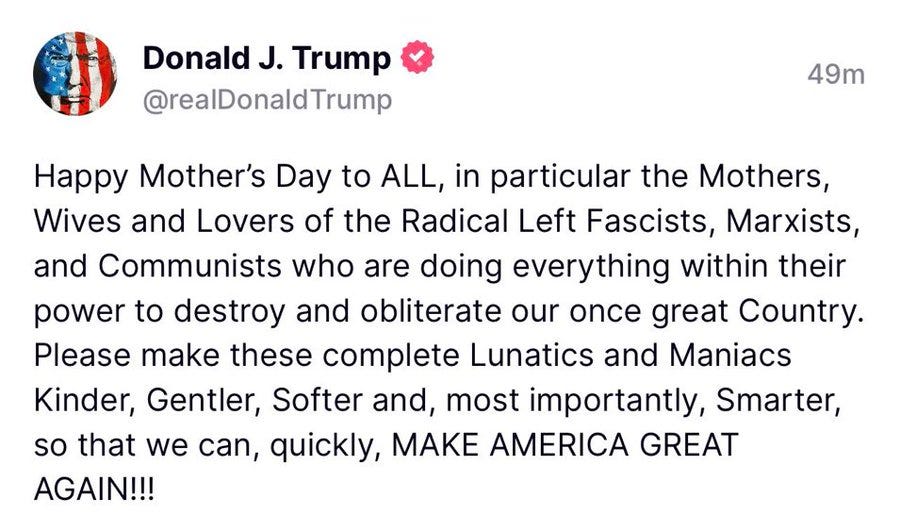
The illegal pet trade poses yet another grave threat to orangutan survival. Baby orangutans are often captured after their mothers are killed, leading to physical and psychological trauma for the young and a demographic crisis for the species. These intelligent and emotionally complex beings are not meant for captivity; they require the vast expanse of the rainforest to thrive.

As if these challenges weren’t daunting enough, the specter of climate change looms large. Rising temperatures and shifting rainfall patterns alter the habitats orangutans rely upon. Additionally, deforestation and the burning of peatlands release vast amounts of carbon dioxide into the atmosphere, exacerbating global climate change. The cycle of destruction feeds upon itself, as a warming planet further endangers the very forests orangutans depend on.

Diverse conservation efforts

The cycle of destruction feeds upon itself, as a warming planet further endangers the very forests orangutans depend on.

Central to orangutan conservation is the defense of their natural abode – the lush rainforests that furnish nourishment and sanctuary. Dedicated organizations such as the Jane Goodall Institute, Rainforest Trust, Sumatran Orangutan Conservation Programme, Borneo Orangutan Survival Foundation and Orangutan Foundation International strive to uphold the woods that sustain both orangutans and the broader ecosystem by establishing protected domains, reforestation ventures and habitat corridors. Anti-poaching campaigns are firmly at work and stand resolute against the shadowy realm of illegal wildlife trade. Via vigilant patrols, astute surveillance and collaboration with law enforcement, these initiatives disrupt the networks that jeopardize orangutans’ existence.

For orangutans already impacted, rescue and rehabilitation centers provide a vital haven. These sanctuaries extend medical care, sustenance and safe haven to wounded or orphaned orangutans, ultimately aiming for their reintroduction into their natural milieu. Integral to this conservation odyssey is community involvement. Educating locals about orangutans’ significance and their ecological role nurtures a sense of custodianship. Concurrently, sustainable livelihood initiatives offer alternative practices that imperil forests and their inhabitants.

Modern technology also plays a pivotal role – from drones surveilling orangutan populations to DNA analysis enriching genetic studies, innovation augments conservation efforts. As wordsmiths, we wield the quill that can amplify these narratives and rouse readers to action. We contribute to the collective quest to ensure orangutans persist in their arboreal realm by heightening awareness, endorsing organizations and making mindful choices.

The plight of orangutans paints a poignant picture of the challenges faced by our natural world. Their survival is entwined with the health of our planet, highlighting the critical need for immediate action. As individuals, we can support conservation efforts by making informed consumer choices, supporting organizations working in the field and raising awareness like BioDB.

We need your help to stay independent

Only through a collective effort can we ensure that the mesmerizing calls of orangutans continue to echo through the rainforests for generations to come. Just as the orangutans swing through the forest’s embrace, may their survival sway in the hearts of all who read these lines.

“Chimpanzees, gorillas, orangutans have been living for hundreds of thousands of years in their forest, living fantastic lives, never overpopulating, never destroying the forest,” Dr. Jane Goodall, the famous primatologist, once said. “I would say that they have been in a way more successful than us as far as being in harmony with the environment.” 

Waffle House is better at home

I like the Waffle House, though maybe not enough to actually go there and eat. However, I am married to a woman who loves that place so much that she wants to get the logo tatted on her thigh. 

We used to always have that classic debate about what spot hits better on a road trip: Do we stop at Cracker Barrel or do we stop at the Waffle House? 

“Cracker Barrel is weird,” my wife argues, “And why does every location have a store in the front? It’s overrated.” 

For years, I tried to convince her that the catfish and grits at Cracker Barrel are top-tier and far superior to anything that the Waffle House has ever dreamed of serving.

“The Waffle House sucks!” I always pushed back, “They still use American cheese, which is extremely pedestrian, and only sells pork products. Why would they sell scrapple? Don’t they know slavery is over?” 

So, one day, I talked her into eating with me at Cracker Barrel because she just had to be ordering the wrong items when left to her own devices–– and it was up to me to mansplain to the server what we wanted and how it should be prepared. Of course, like always, my wife was right. Cracker Barrel had lost a step; the fish wasn’t as good as it used to be, and the grits were as lumpy as an unpaved road. Our last two visits to Waffle House, before I finally convinced her to try Cracker Barrel, were so much better that I didn’t feel confident recommending food for like a year. During that year, we also had our first experience figuring out ways to survive a global pandemic. 

Home-cooked meals became mandatory for everybody. And as you can imagine, many of us became bored with our regular go-to cuisines and became hungry to explore new menu items. We bought a waffle maker, and I started experimenting with all types of blueberry, pecan, and banana waffles. I was using that 365 Whole Foods brand until my wife found out you could actually order Waffle House mix.

“The Waffle House mix is sweeter and I like it more,” she said, “They also sell those hash browns I love. You should start making those, too.”

We ate those beautiful, sweet waffles and smothered hash browns every weekend until round two or three of the COVID vaccine dropped.

Soon, I fell in love with that Waffle House mix and realized how easy it is to make smothered hash browns. You literally soak the box of potatoes in water, drain that water, throw the potatoes in a pan with some chopped onions, fry them to a light crisp and dump all the cheese you feel comfortable with on top — perfection. We ate those beautiful, sweet waffles and smothered hash browns every weekend until round two or three of the COVID vaccine dropped. 

So, I had no complaints for my wife when she recommended we stop at a Waffle House on our way back home to Baltimore from Delaware last week. We pulled it into a location, and the only thing happier than the look on my face was the feeling in my belly because I knew I was about to be blessed with the waffles I had been attempting to make on my own over the past three years.

Alas, my heart shattered into 1,000 pieces when I entered the dirty restaurant. We tried to give the staff grace. Maybe they were short a few crew members or just had a rush and didn’t get a chance to tidy up. Our trio — my wife, daughter and I — found a booth covered with dirty dishes in the corner. After sitting for about eight minutes, someone came to remove them and we discovered about 15 ants. 

We need your help to stay independent

Under normal circumstances, we wouldn’t tolerate one ant. However, the young server drenched the table with a bleachy rag and proceeded to take our order. After about 15 minutes, the young server came back to us and said, “I forgot to put your order in because we were so busy.” There were about eight customers in the restaurant and damn near the same number of employees. My wife and I were rich in grace that day because we extended more as we waited for our waffles, grits and hash browns. 

By the time our food came out, the little family of ants or their surviving cousins had returned, probably looking for the pack of ants that had just been killed with bleach. We couldn’t take anymore. Sadly, we’ll probably never go again unless it’s a different location at 3:00 in the morning, and we are starving with no other options in a 100-mile radius. 

On the flip side, we still love Waffle House when it’s at its best — and that might just mean making Waffle House at home. 

“I couldn’t take the pain anymore”: Britney Spears comments on split from husband

In her first statement since the news broke on Wednesday that she and Sam Asghari — her husband of just over a year — were headed for divorce, Britney Spears confirms the split herself, saying that she’s as strong as she can be right now.

In a post to Instagram, along with a signature video of herself dancing in her home, Spears writes: “As everyone knows, Hesam and I are no longer together … 6 years is a long time to be with someone so, I’m a little shocked but … I’m not here to explain why because its honestly nobody’s business !!! But, I couldn’t take the pain anymore honestly !!! In some sort of telepathic way I have been receiving so many messages that melt my heart from friends and I thank you !!! I’ve been playing it strong for way too long and my Instagram may seem perfect but it’s far from reality and I think we all know that !!! I would love to show my emotions and tears on how I really feel but some reason I’ve always had to hide my weaknesses !!! If I wasn’t my dad’s strong soldier, I would be sent away to places to get fixed by doctors !!! But that’s when I needed family the most !!! You’re supposed to be loved unconditionally … not under conditions !!!! So I will be as strong as I can and do my best !!! And I’m actually doing pretty damn good !!! Anyways have a good day and don’t forget to smile !!!”

Although Spears did sign a prenup securing her income and property, Page Six reported rumblings that Asghari is threatening to release embarrassing information and video footage of the singer if she doesn’t pay him a considerable amount of money. In response to this, his representative issued a statement to the outlet saying, “There are many claims that Sam is challenging the prenup and threatening to exploit his ex-wife with videos. However, all these claims are false, as no negative intention has ever been directed towards her and never will be. Sam has always and will always support her.”

“Red, White & Royal Blue”: Here’s what Henry’s and Alex’s taste in books say about their characters

If you’ve stumbled across #BookTok, TikTok’s subcommunity of bibliophiles and literature enthusiasts, you’re probably familiar with “Red, White & Royal Blue,” the latest film that’s taking the internet by storm. Directed by Matthew López, the playful romantic comedy is based on Casey McQuiston’s 2019 debut novel of the same name. It follows Alex Claremont-Diaz (Taylor Zakhar Perez), the son of the first female president of the United States, and Prince Henry (Nicholas Galitzine), the grandson of the king, who find themselves in an unlikely romance following a public altercation involving a multi-tiered wedding cake.

The couple shares a love for reading — even if their specific literary tastes may diverge.

Yes, “Red, White & Royal Blue” is your classic enemies-to-lovers tale. And although it’s earned a few comical reviews from viewers, it’s also earned a considerable amount of praise. Many appreciated the film’s heartfelt portrayal of queer sex while others celebrated Henry and Alex’s interactions, which were cheesy at times but also, incredibly loving.

In one particular scene, the pair enjoy a vacation together at an Austin, Texas, getaway, where they read books in a shared hammock. The intimate moment, albeit brief, spotlights just how different and similar Alex and Henry are as individuals. Of course, the former is American while the latter is a Brit. But despite their differing nationalities, the couple shares a love for reading — even if their specific literary tastes may diverge.

Here’s a closer look at what Henry and Alex’s reading choices say about them:

Henry’s book: “Girl, Woman, Other” by Bernadine Evaristo

Henry, the posh-and-prim royal heir is fittingly reading a work of fiction by British author Bernardine Evaristo. Titled “Girl, Woman, Other,” the novel is described as postmodern literature, LGBTQ+ fiction and postcolonial literature, which seem to be Henry’s favorite genres considering that he also loves reading Zadie Smith. Henry is an avid reader, but that doesn’t mean he’ll be caught picking up a YA book or a sappy romance. He’s more into the timeless classics, like Gustave Flaubert’s “Madame Bovary”  and Oscar Wilde’s “The Picture of Dorian Gray.”  So, of course his go-to vacation read also happens to be the co-winner of the 2019 Booker Prize, alongside Margaret Atwood’s “The Testaments.”

Evaristo’s novel tells the intergenerational stories of 12 Black British women, whose lives intertwine across chapters and various settings and times. There’s theater director Amma, who prepares for the opening of her acclaimed new play at the National Theatre. There’s Dominique, Amma’s best friend, who becomes entangled in an emotionally unstable relationship with a woman named Nzinga. And there’s Amma’s opinionated daughter, Yazz, who learns more about the world through the friends she makes at university.

There’s also Carole, who lives with her Nigerian-born mother, Bummi, in a high rise flat in south London. Carole finds support in her schoolteacher Shirley King while Bummi finds love with her employee Omofe. There’s Megan, a queer woman who finds solace in her relationship with Bibi, a trans woman. And don’t forget Penelope, the adopted (and racist) daughter of white parents who is left shocked after learning more about her true parentage and ethnicity.

In an interview with The Guardian, Evaristo explained that her book focuses closely on people who are often “othered”:  

“I wanted to put presence into absence. I was very frustrated that black British women weren’t visible in literature. I whittled it down to 12 characters — I wanted them to span from a teenager to someone in their 90s, and see their trajectory from birth, though not linear. There are many ways in which otherness can be interpreted in the novel — the women are othered in so many ways and sometimes by each other. I wanted it to be identified as a novel about women as well.”

Racism, feminism, politics, patriarchy and relationships are just a few topics explored in “Girl, Woman, Other.” But gender and identity take the center stage. Similarly, Henry’s own story is one of gender and identity as he struggles to navigate being a gay, cis-male prince. Along the way, he also seeks the acceptance he so deeply craves, both from himself and his loved ones.

Alex’s book: “One Last Stop” by Casey McQuiston

Yes, Alex is seen reading “One Last Stop,” the sexy LGBTQ+ romance novel written by none other than “Red, White & Royal Blue’s” McQuiston. It’s a fun wink that nevertheless fits with Alex’s whole aesthetic. In the novel, young woman August Landry, a cynical pseudo detective, falls in love with Jane Su, a punk lesbian from a completely different time period, after somehow meeting on the subway. (There’s some magical time travel going on, along with subway travel.)

“August’s subway crush becomes the best part of her day, but pretty soon, she discovers there’s one big problem: Jane doesn’t just look like an old school punk rocker,” read the book’s plot synopsis. “She’s literally displaced in time from the 1970s, and August is going to have to use everything she tried to leave in her own past to help her.” The novel also includes many queer-friendly supporting characters, from a transgender roommate to drag queens.

When it comes to Alex’s literary tastes, he’s made it clear that he’s a fan of James Baldwin and Gabriel García Márquez’s “Love in the Time of Cholera.” So, a contemporary sci-fi romance is a bit surprising and more escapist in nature than his favorites. But it also makes sense because just like the book’s main protagonist, Alex is bisexual and a 20-something-year-old college student.

Alex is also American, hence why his choice read is set in New York City instead of London, and he’s very much into politics. So much so that he helps his mother (Uma Thurman) campaign and even offers her advice on how to win her upcoming election. Additionally, Alex is incredibly vocal about his identities, namely his sexuality and Latinx ethnicity. Alongside identity and sexuality, race and ethnicity are two core themes in McQuiston’s book, specifically for Jane who is Chinese American.

Russia, Ukraine and Versailles: Bogus lessons from history won’t solve this crisis

Across the political spectrum, a persistent minority of voices insists that Russia’s invasion of Ukraine was provoked by the eastward expansion of NATO in the 1990s and 2000s. Others couch their criticism in more nuanced terms, but suggest that Russia should not pay a significant price for its invasion and war crimes, the better to get back to business as usual.

Political scientist John Mearsheimer, a conservative, blames the U.S. and NATO for the invasion. So does Noam Chomsky on the far left, propounding a few historical distortions along the way. Academic gadfly and tax delinquent Cornel West, wading into the unfamiliar waters of foreign policy, claims that NATO expansion “provoked” Russia into attacking Ukraine. Marjorie Taylor Greene, a congresswoman and public nuisance, hasn’t explicitly blamed NATO for the invasion, but her demand that the U.S. cease all aid to Ukraine and withdraw from NATO is a tacit endorsement of the opinion that Kyiv got what it deserved because of its dangerous liaison with America and NATO. The argument has become a leitmotif of the American far left and far right.

A more serious, and subtler, condemnation of current U.S. and NATO policy asserts that an outright military defeat of Russia (meaning the expulsion of Russian forces from all the Ukrainian territories they have seized by force) would be destabilizing and dangerous for the world. The operative phrase is that NATO must not “humiliate” Putin.

Henry Kissinger, our centenarian former secretary of state and self-appointed intermediary with China, has asserted that the West should not force “an embarrassing defeat” on Russia. He also said Ukraine must be prepared to accept Russia’s 2014 annexation of Crimea, which would effectively predetermine the outcome of any future negotiated settlement. Oddly, though, Kissinger has flip-flopped on his previous opposition to Ukraine becoming a NATO member, albeit as a diminished state, with Crimea “subject to negation.” That, however, could leave Ukraine vulnerable to a close Russian blockade of its Black Sea grain ports. Kissinger, the ultimate realist, evidently thinks it is acceptable to allow the Russian navy to have its hands around Ukraine’s windpipe.

French President Emmanuel Macron, a key leader in the coalition supporting Ukraine, has not gone as far as Kissinger. But on several occasions he has advanced this argument: “We must not humiliate Russia so that the day when the fighting stops we can build an exit ramp through diplomatic means.” French media, calling Macron a “keen student of history,” says “he is also wary of the desire among some allies to punish Moscow for its aggression, citing the Versailles Treaty imposed on a defeated Germany at the end of World War I in 1919.” 

Brookings scholar Michael O’Hanlon has offered a more carefully hedged analysis, writing that an overly lenient settlement would give Russia little incentive not to attack again. On the other hand, in decrying hypothetical harsh terms, he also mentions World War I, claiming that “the Versailles peace wound up establishing the predicate for World War II more than producing stability.”

Versailles has become a shorthand for critics of NATO’s Ukraine policy, from those who think Washington and Brussels should offer Putin soft terms to those who explicitly blame the West for his war of aggression.

This invocation of the Versailles Treaty has become a form of shorthand for many critics of NATO’s Ukraine policy, from those who think Washington and Brussels should offer Vladimir Putin soft terms to those who explicitly place moral responsibility on the West for his brutal war of aggression. Versailles has become a metaphor whose supposed “lessons” are that aggressors must not be humiliated or punished. The thesis also slyly shifts blame for criminal behavior from the aggressor to third parties.

The frequent castigation of Versailles in popular histories over the past century has established a narrative implying that seeking justice for international crimes will boomerang, and that wise statesmen should know better. It is a disguised insinuation that the Allied leaders of 1919, by humiliating Germany after four years of ghastly slaughter, paved the way for Hitler, thereby placing at least some of the moral onus on themselves. The so-called lessons of Versailles appeal to many because they are easy to grasp: a simplistic, determinist picture of history moving inexorably in a straight line and devoid of human actions, contingency and the complex interplay of events.

This argument, which reinforces both the purported lessons of history and a shallow realpolitik, falls readily to hand for those eager to accuse the West of provoking the Ukraine war. Supposed Allied triumphalism and harsh punishment of Germany in 1919 appear analogous to the situation after the collapse of the Soviet Union, when NATO expansion allegedly pushed a shamed and demeaned Russia into the mud. The argument hints that payback is to be expected, and perhaps deserved.

Like the origins of the Cold War, the legacy of the Versailles Treaty has been subject to so much revisionism, tendentious pleading and misinformation that closer examination is warranted. The treaty is called “draconian” (even the website of the Palace of Versailles describes it thus) and a reflection of victors’ justice. There is no question that the post-World War I settlement, of which that treaty was a major part, failed to prevent a second, even more disastrous war. But the question is why it failed; after all, treaties are not self-enforcing.

In particular, the treaty’s reparations demands were allegedly so crushing that the price was beyond Germany’s ability to pay. This issue will be salient if the international community is ever in a position to pressure Russia to repair the vast material damage it has inflicted on Ukraine. (Last November, the UN in fact adopted a resolution calling on Russia to pay reparations.)

Given the widespread belief that World War I was a meaningless great-power bloodbath, the revisionist critique asserts that it was unjust to saddle Germany with guilt for starting the war, since every power involved was responsible. But during the treaty deliberations, French Prime Minister Georges Clemenceau supposedly quipped that one thing was certain: “The historians will not say that Belgium invaded Germany.”

Not only in Belgium, but also in the richest and most industrialized part of France, the Germans invaded, systematically plundered, and took many civilians as forced labor. The official German policy against civilians was described as Schrecklichkeit — frightfulness. According to Belgian records, “German soldiers murdered over 6,000 Belgian civilians, and 17,700 died during expulsion, deportation, imprisonment, or death sentence by court.” The land was so devastated in Northern France and Belgium that to this day, farmers and construction workers constantly discover unexploded ordnance. It was this vast human and material destruction that reparations were meant to compensate.

The bill presented to Germany came to 132 billion Reichsmarks over 30 years — something like $500 billion in 21st-century dollars. From the beginning, Berlin fell behind on payments, not from an objective inability to pay, but because nearly the entire ruling class — the civil service, the aristocracy, big capital and the political parties — along with the middle class, swallowed the German Army’s lies. 

The army general staff had received everything it had demanded during the war, including a virtual dictatorship over the country, yet it botched the job and then washed its hands, passing off the mess to the civilians while claiming it had been “stabbed in the back.” Hoodwinked citizens refused to believe Germany had been “genuinely” defeated, choosing to believe instead that political leaders had fallen for the tricks of the Allies and domestic subversives, the most insidious such trick being Versailles.

Despite this intransigence, the Allies, except for France during the first few years, were not unyielding. The Dawes Plan of 1924 issued loans to help restructure Germany’s finances, and the Young Plan of 1928 stretched out the reparations payments. In 1932, the Allies granted Germany, which had been continually in arrears on its payment schedule, an indefinite moratorium. By then, Germany had paid less than a sixth of the total reparations due: a pittance compared either to what it spent on the war or the damage sustained in the invaded territories.

Allied actions did not incite the extremism of Weimar Germany that led to Nazi rule; that was the result of an authoritarian society that modernized without gaining a democratic culture.

Did Versailles immiserate Germany? Not exactly. By 1929, its GDP was 12 percent higher than it had been in 1913, the last full prewar year, despite losing two million prime-age male workers in the war, with millions more disabled. What crushed the German economy by the end of the Weimar period was the Great Depression, a storm that swamped all boats: the United States itself was suffering 25 percent unemployment when Hitler came to power. Allied actions did not incite the endemic extremism of Weimar which culminated in Nazi rule; it was the toxic result of a traditionally militarized, authoritarian society that had industrialized and modernized without gaining a democratic culture.

Nor were the territorial clauses as onerous as typically depicted. Alsace-Lorraine, forcibly annexed by Germany in 1871, was returned to France. Formerly German territories awarded to Poland and Denmark had Danish- and Polish-speaking majorities who voted decisively in League of Nations plebiscites that they did not wish to remain with Germany. German speakers in what became Czechoslovakia had never been German subjects.

Both the territorial and indemnity provisions of the treaty were no worse than those Germany had imposed on France in the Franco-Prussian War of 1870, and were vastly more lenient than the Treaty of Brest-Litovsk of 1918, in which the brand new Bolshevik regime in Russia was forced to hand over to Germany lands making up 34 percent of its population, 54 percent of its industry, 89 percent of its coalfields and 26 percent of its railways. This outcome warned the Allies what they could expect if Germany won the war.

From the beginning, Germany violated the Versailles clauses intended to prevent it from rearming. The Allies banned German possession of U-boats in view of their massive submarine campaign in the war, which had sunk not just Allied but neutral shipping. In the early 1920s, however, the German Navy secretly used shell companies to establish facilities in Sweden and the Netherlands to test new U-boat designs. Around the same time, the German Army agreed to a technology transfer scheme with the Bolsheviks that allowed the army to test new weapons and tactics at secret sites deep inside the Soviet Union


Want a daily wrap-up of all the news and commentary Salon has to offer? Subscribe to our morning newsletter, Crash Course.


The Western powers were aware of most of Germany’s secret rearmament schemes, but did nothing to stop them. During the 1920s, they were complacent; by the early 1930s, they were preoccupied with their own economic problems; by 1935, when Hitler formally renounced the treaty, the reaction was silent dread, rationalized by the excuse that maybe Germany had been treated unfairly, and that countries like Czechoslovakia and Poland rightfully belonged in Germany’s sphere of influence anyway. It should have been evident by then that the treaty’s provisions were not the problem; it was the Allies’ lack of will to enforce them. 

This overview of the Versailles Treaty is not merely of antiquarian interest; the same issues arose immediately after the collapse of the Soviet Union. Like Germans who were shocked and unaccepting that they had been militarily defeated, many ordinary Russians couldn’t believe they had lost the ideological competition with the West. The revanchist mentality of Vladimir Putin, who has said the USSR’s demise was “the greatest geopolitical catastrophe of the 20th century,” echoes that of the German militarists of 1919. Independent Ukraine assumed the same position in the minds of Russian revanchists as independent Poland did to the right-wing movements of Weimar: territories unjustly taken from the homeland by fraud and force majeure.

There is a lingering belief, analogous to the notion that reparations exploited Germany economically, that Western countries consciously wielded free-market radicalism to loot the Russian successor state to the Soviet Union during the 1990s. It certainly appears true that many foreign investors and companies took advantage of the Wild West atmosphere of post-collapse Russia to reap huge profits. 

There is a lingering belief that Western countries wielded free-market radicalism to loot Russia after the Soviet collapse. But the rise of Russia’s oligarchs was a homegrown phenomenon.

But Russian émigré journalist Arkady Ostrovsky, in his book “The Invention of Russia,” explains how that Wild West atmosphere came to exist in the first place. He says that even before the fall of the Communist regime, former KGB operatives had already transformed themselves into oligarchs who divided up the Russian economy like a giant cake. This economic warlordism, like the endemic violence of Weimar, was a homegrown phenomenon, largely resulting from the lack of a democratic culture. By the same token, if Western governments had restricted their nationals from doing business in Russia (which would have amounted to imposing sanctions), the newly opened Russian economy would have been even more starved of capital. No doubt that too would have become a new charge in the critics’ bill of indictment against the West.

Those who claim that NATO expansion provoked adverse Russian behavior typically present it as a process initiated and executed by Washington, with the existing and candidate members being passive subjects. This construct ignores the fact that the candidate states of Eastern Europe, many of which had experienced decades or centuries of Russian political domination and even forced Russification, had solid historical reasons for desiring NATO membership, rather than simply trusting in the Kremlin’s good intentions. This year’s protracted obstruction by Turkey of NATO membership for Finland and Sweden shows that member states are hardly U.S. vassals; had there not been unanimity within NATO, the expansion would not have proceeded.

The “lessons” of the Versailles Treaty are far more complex than the conventional wisdom will admit. On balance, Germany was not treated as a pariah: reparations terms were eased, disarmament violations were winked at and the country was admitted to the League of Nations in 1926. If the Allies had actually enforced the treaty, maintained a tolerable state of military readiness, and concluded mutual assistance agreements with Czechoslovakia and Poland, the most cataclysmic war in history might have been averted.

The invasion of Ukraine is but one component of an extraordinarily complex global crisis that requires the U.S. and its allies to rally global support for defending Ukraine while balancing our overall policies towards Russia and its de facto ally China. How the international community will eventually settle with Russia is an open question, but it should not be determined by a selective and misleading reading of history.

Kept in captive isolation for nearly 53 years, Lolita the orca dies amidst plans for release

Lolita the orca (also known as Tokitae or Toki) passed away at the start of this weekend after nearly 53 years of isolated captivity at the Miami Seaquarium. Per a statement from her handlers, they presume that the cause of death was a suspected renal condition.

According to animal rights activists sourced by The Washington Post, Lolita was violently captured at Penn Cove, near Washington state’s coast, on Aug. 8, 1970, at about the age of four. Per their coverage of her death, it’s highlighted that while this capture marked the end of her freedom, she faired better than several other killer whales that drowned during attempts to snatch them up along with her. 

After being sold to the Miami Seaquarium, she shared her small enclosure with a male orca named Hugo for the first decade of her captivity. In 1980, Hugo died from a brain aneurysm after an extended period of banging his head against the tank’s spectator glass during fits of depression. From then on, Lolita circled the tank completely alone when not performing for ticket buyers. In March, a plan was made by the aquarium’s owner, The Dolphin Company; the nonprofit Friends of Toki; and Jim Irsay, owner of the NFL’s Indianapolis Colts to release her back into the wild, where her mother is thought to still be thriving to this day, but she never made it. Per their timeline, she was to be released in roughly two years.