Spring Sale: Get 1 Year, Save 58%

Building subsidized low-income housing actually lifts property values — contradicting NIMBY concerns

The big idea

Building multiple publicly subsidized low-income housing developments in a neighborhood doesn’t lower the value of other homes in the area – and in fact can even increase their worth, according to a new peer-reviewed study I co-authored.

For the study, we looked at 508 developments financed through the federal Low-Income Housing Tax Credit program and built in the Chicago area from 1997 to 2016. We then examined their influence on more than 600,000 nearby residential sales, using data from local property assessments and tax records. We chose Chicago because of its size, well-established neighborhoods, substantial amount of subsidized housing developments, well-documented racial and ethnic segregation, pockets of persistent and concentrated poverty and excellent data coverage. While some readers may have pictures of dilapidated buildings in their minds, the projects we looked at were generally well built and well maintained.

We found that, relative to comparable homes in other neighborhoods, average home prices jumped by 10% within a quarter-mile of the first affordable housing development that was built in a neighborhood and 2% within a quarter-mile over a 15-year period or through 2016. To ensure we were isolating the effect of the low-income housing program, we also looked at preexisting market trends to make sure neighborhoods that showed the faster price growth weren’t already growing at a faster rate before the low-income housing.

What was more striking to us, however, is that additional developments in the same area generally further increased housing prices. Building two more developments increased prices by a total of 3 additional percentage points, on average, within a quarter-mile and 4 percentage points over the next quarter-mile. In other words, a neighborhood within a quarter-mile of all three developments saw gains of 13% on average over the period.

These additional effects are important because low-income housing projects are disproportionately concentrated geographically, especially in lower-income areas.

We also found that these effects occurred regardless of whether it was a low- or high-income neighborhood and no matter its racial composition.

While other studies have previously shown Low-Income Housing Tax Credit developments typically have positive effects on surrounding property values, ours was the first to look at the impact of several projects in one neighborhood.

Why it matters

Homeowners are often worried that the development of publicly subsidized housing in their neighborhoods will lower the value of their homes.

The primary concerns seem to be that such housing developments will lead to higher levels of crime and poverty, as well as requiring wealthier residents to pay higher costs for services and education, according to a 2012 study of “not in my back yard,” or NYMBY, opposition. These concerns are particularly acute when multiple projects are clustered closely together, reminding many Americans of public housing projects that concentrated poverty and crime in the mid-20th century.

But today’s affordable housing developments are different than those of the past, which were often cheaply built and poorly maintained. The Low-Income Housing Tax Credit program supports private developers who have an incentive to build high-quality buildings and implement good property management.

Although local homeowners often oppose these buildings, our results show that they are less cause for concern than people may think.

What still isn’t known

We didn’t measure the effects of the new developments on area rental prices, so we don’t know how the subsidized rental units affected rents in unsubsidized properties nearby. That is a subject for future research. Similarly, while we demonstrated statistically that the developments themselves catalyzed the positive changes in values, we did not examine which particular aspects of the developments were the primary drivers of that change.

What’s next

We’re currently finishing up our follow-up study in Los Angeles – another large city but with very different dynamics from Chicago’s. Our findings, which are currently undergoing peer review, show markedly similar effects, though we found the biggest gains in property values after multiple projects in a neighborhood.

We also are examining whether the observed property value effects differ when factoring in the size of the building, the presence of market-rate units and the type of developer.


Anthony W. Orlando, Assistant Professor of Finance, Real Estate and Law, California State Polytechnic University, Pomona

This article is republished from The Conversation under a Creative Commons license. Read the original article.

With months still to go, 2022 has already seen a record number of school shootings

As a Michigan teen pleaded guilty on Oct. 24, 2022, to killing four students in a December 2021 attack, America was learning of yet another school shooting. This time, it was a performance arts high school in St. Louis, where a former student opened fire, killing two and injuring at least seven others before dying in a shootout with police.

The fact that yet another school shooting took place within hours of a gunman in a separate case appearing in court underscores how often these events take place in the U.S. As criminologists who have built a comprehensive database to log all school shootings in the U.S., we know that deadly school gun violence in America in now a regular occurrence – with incidents only becoming more frequent and deadlier.

Our records show that seven more people died in mass shootings at U.S. schools between 2018 and 2022 – a total of 52 – than in the previous 18 years combined since the watershed 1999 Columbine High School massacre.

Since the February 2018 mass shooting at Marjory Stoneman Douglas High School in Florida, moreover, more than 700 people have been shot at U.S. schools on football fields and in classrooms, hallways, cafeterias and parking lots.

Many of these shootings were not the mass killing events that schools typically drill for. Rather, they were an extension of rising everyday gun violence.

More frequent and deadlier

There have been shootings at U.S. schools almost every year since 1966, but in 2021 there were a record 250 shooting incidents – including any occurrence of a firearm being discharged, be it related to suicides, accidental shootings, gang-related violence or incidents at after-hours school events.

That’s double the annual number of shooting incidents recorded in the previous three years – in both 2018 and 2019, 119 shootings were logged, and there were 114 incidents in 2020.

With more than two months left, 2022 is already the worst year on record. As of Oct. 24, there have been 257 shootings on school campuses – passing the 250 total for all of 2021.

Many of these incidents have been simple disputes turned deadly because teenagers came to school angry and armed. At East High in Des Moines, Iowa, in March 2022, for example, six teens allegedly fired 42 shots in an incident that took place during school dismissal time. The hail of gunfire killed one boy and critically injured two female bystanders. The district attorney described the case as one of the most complex murder investigations their office has ever conducted, partly because six handguns were used.

At Miami Gardens High in Florida that same month, two teens are alleged to have sprayed more than 100 rounds with a rifle and handgun modified for fully automatic fire. They targeted a student standing in front of the school, but bullets penetrated the building, striking two students sitting inside.

A similar situation unfolded outside Roxborough High in Philadelphia in October. A lunchtime dispute among students allegedly turned into a targeted shooting after a football scrimmage. Five teenage shooters are believed to have fired 60 shots at five classmates leaving the game, killing a 15-year-old.

In each of these cases, multiple student shooters fired dozens of shots.

The tally for 2022 also includes incidents involving lone shooters.

In April, a sniper with 1,000 rounds of ammunition and six semiautomatic rifles fired from a fifth-floor window overlooking the Edmund Burke School in Washington, D.C. at dismissal. A student, parent, school security officer and bystander were wounded before the shooter died by suicide.

Threats, hoaxes and false alarms

The increase in shootings in and around school buildings has many parents, students and teachers on edge. An October 2022 Pew Research survey found that one-third of parents report being “very worried” or “extremely worried” about a shooting at their child’s school.

Aside from the near daily occurrences of actual school shootings, there are also the near misses and false alarms that only add to the heightened sense of threat.

In September, a potential attack was averted in Houston when police got a tip that a student planned to chain the cafeteria doors shut and shoot students who were trapped inside. The following day near Dallas, another tip sent police scrambling to stop a vehicle on the way to a high school homecoming football game. Two teens had a loaded semiautomatic rifle and planned to commit a mass shooting at the stadium, it is alleged.

There have also been thousands of false reports of shootings this year. Hoaxes, swatting calls, even a viral TikTok school shooting challenge have sent schools across the nation into lockdown. Dozens, possibly hundreds, of these threats are automated 911 calls from overseas, but police have no choice but to respond.

People are so much on edge that a popped balloon at one California school in September led to an active shooter response from police. The sound of a metal pipe banging in August caused thousands of people to flee an Arkansas high school football stadium for fear of being shot. A loud bang from a chair being thrown caused a code red lockdown and parents to rush to a Florida high school.

A better way?

The rising annual tally of school shootings has occurred despite enhanced school security in the two decades since the Columbine massacre. Metal detectors, clear backpacks, bulletproof chalkboards, lockdown apps, automatic door locks and cameras have not stopped the rise in school shootings. In fact, the May 2022 mass shooting at Robb Elementary School in Uvalde, Texas, provides a case study in systemic failure across the school safety enterprise.

Federal legislation passed in the wake of Uvalde will provide districts with money to hire additional school social workers, or pay for better communication mechanisms in school buildings to address the warning signs of violence missed in dozens of high-profile attacks.

It is aimed at better identifying and helping at-risk students before they turn to violence. However, another area that needs attention is students’ ready access to firearms.

Some school shooters, like the perpetrator in Uvalde, are young adults old enough to get their guns legally from gun stores, prompting questions over whether some states need to reconsider a minimum age for firearms sales.

Meanwhile, most school shooters get their guns from home, making safe storage of firearms a public health priority.

But many children get their guns from the streets. Preventing weapons from getting into the hands of potential school shooters will require police and policymakers to devote resources toward cracking down on straw purchasers – those who buy firearms for someone else – and getting stolen weapons, unserialized ghost guns and guns modified with auto-sears to make them fully automatic off the streets.

Such measures could be what it takes to stop the tragic normalization of school shootings.


James Densley, Professor of Criminal Justice, Metropolitan State University ; David Riedman, Ph.D. student in Criminal Justice and Creator of the K-12 School Shooting Database, University of Central Florida, and Jillian Peterson, Professor of Criminal Justice, Hamline University

This article is republished from The Conversation under a Creative Commons license. Read the original article.

The secret ingredient that elevated Leslie Jordan’s family cornbread recipe

Leslie Jordan’s star perhaps never shone as brightly as it did at the height of the pandemic. In those dark, unnerving moments, as many of us sat at home for weeks or months on end, Jordan’s silly, unvarnished and downright uproarious viral videos were a shimmering beacon of humor, light and positivity.

An unlikely “influencer,” Jordan’s posts garnered more interactions, likes and traction than nearly anything else in those trying times (aside from maybe that “poor taste” cover of “Imagine”?), and he rapidly became an immediately recognizable face and voice. However, as the New York Times reported back in 2020, Jordan had already “accumulated more than 130 television and film credits, so he hadn’t been exactly undiscovered, but the Instagram stardom at age 65 was an unexpected treat.”

To put his meteoric rise into context, CBS News noted that “when the pandemic hit, Jordan received yet another wave of fame with his viral videos on social media. He went from 80,000 followers to nearly 6 million.”

Whether joking about WAP, spouting off hilarious one-liners or telling genuine, heartfelt stories about his family and upbringing, Jordan was by all accounts a relatable, jovial and good-natured personality. Despite his passing Monday at the age of 67, Jordan’s big heart, timeless talent and warm, Southern-tinged voice will surely continue to provide comfort to legions of fans for years to come.

Jordan’s expansive career in the arts

In addition to his sensational social media rise, Jordan was an accomplished actor, musician and writer, who received an Emmy Award for his turn as Beverley Leslie on “Will & Grace.” He won that award in 2006, for outstanding guest actor in a comedy series.

Jordan starred in dozens of films and TV shows, with credits including “The Help,” “Ally McBeal,” “American Horror Story,” “Boston Legal,” “Call Me Kat” and “Reba.” He also acted in theatrical plays, as well as developed and staged his own autobiographical works throughout the ’90s. He even released a gospel music album in 2021.

Last year, Jordan was the recipient of the Timeless Star Award from GALECA: The Society of LGBTQ Entertainment Critics. In 2009, he released a book detailing his upbringing and move from Tennessee to California for acting roles and later a 2021 autobiography

While Jordan may have been most celebrated for his social media postings over the past two years, the scope of his talent was immense.

Jordan’s heritage and love of Southern food

While Jordan was both proud and challenged by his Southern upbringing, he was most definitely an adherent of the cuisine. During a 2021 appearance on the Allrecipes podcast “Homemade,” Jordan discussed his family recipes, along with tips, tricks and insight into the classics of Southern cooking.

According to the publication, Jordan’s family eschewed sugar in cornbread, leaning into a more savory iteration. In fact, the secret ingredient in their cornbread recipe was actually bacon grease. “If that makes you a little squirrely, having bacon grease, well, then you’re not going to like this cornbread,” Jordan said of his family’s choice of fat. 

Jordan noted that he always used a cast-iron skillet to fry his cornbread batter — deploying bacon grease as the go-to fat — which helped to get it “crisp on the outside . . . before you put it in the oven.” He added that “it makes that beautiful crust on the outside of the cornbread, doesn’t it? And the inside stays fluffy.” What’s more, he made it clear that it was OK to leave the batter a little bit lumpy. No need for any fussing over making sure it’s completely smooth — it’s as easy as pie. 

In 2020, Jordan told the New York Times in an interview that he loves the “people that pull me aside and say: ‘Listen, I don’t want to bother you, but I’ve had a rough go. I’ve been locked down. I’ve got kids, and I looked forward to your posts and you really, really helped me through this tough time.’ When people tell you things like that, you realize comedy is important.”

Furthermore, as a proud gay man and someone who battled alcohol and substance addiction, Jordan was not only a symbol of pride and resiliency but also an inspiration to so many.

Jordan’s beloved star shone so brightly, and he’ll be so deeply missed by family, friends, loved ones and fans worldwide. May he rest in power.

“Unacceptable, hateful and dangerous”: Adidas drops Kanye West while others also distance themselves

Adidas has cut ties with Kanye West following the rapper and designer’s repeated antisemitic comments. As The New York Times reported, this severance is ending “what may have been the most significant corporate fashion partnership” of West’s career and comes after a series of disturbing public outbursts and statements from West.

On social media, West’s comments included a Twitter post alleging that he would soon support “death con 3 ON JEWISH PEOPLE,” which later caused Twitter and Instagram to restrict his account. This fall at Paris Fashion Week, West wore a shirt that read “White Lives Matter,” a slogan of white supremacists, which is hate speech as identified by the Anti-Defamation League. 

West’s comments and public statements have had a ripple effect. In widely shared photographs, people raised their arms in a Nazi salute on a Los Angeles freeway on Sunday. The people stood behind several banners they had hung over Interstate 405, reading, “Kanye is right about the Jews.” Another banner included a link to a video platform for streaming antisemitic content, the website of a hate organization which the nonprofit StopAntisemitism.org said was responsible for hanging the banners. A third banner included the message “Honk if you know.” The group also hung an American flag.

On Monday, Variety reported that West was dropped by his agency, Creative Artists Agency (CAA). A documentary about West that is already completed will also be shelved, according to studio executives Modi Wiczyk, Asif Satchu and Scott Tenley who said in a statement, “Last week [West] sampled and remixed a classic tune that has charted for over 3,000 years — the lie that Jews are evil and conspire to control the world for their own gain.” The studio executives appeared to be addressing companies that still backed West at the time as their statement continued, “The silence from leaders and corporations when it comes to Kanye or antisemitism in general is dismaying but not surprising. What is new and sad, is the fear Jews have about speaking out in their own defense.”

The partnership with West, who also goes by the name Ye, and sportswear giant Adidas was long and lucrative, lasting for nearly a decade. The New York Times reported that dropping West will cost Adidas $246 million this year alone. In a public statement, Adidas said the company “does not tolerate antisemitism and any other sort of hate speech. Ye’s recent comments and actions have been unacceptable, hateful and dangerous, and they violate the company’s values of diversity and inclusion, mutual respect and fairness.” The statement also said the production of West’s Yeezy-branded items would cease immediately, as would payments to West.


Want a daily wrap-up of all the news and commentary Salon has to offer? Subscribe to our morning newsletter, Crash Course.


Many public figures acted quickly to distance themselves from West and his antisemitic comments, including West’s ex-wife, Kim Kardashian, who wrote on Twitter, “Hate speech is never OK or excusable. I stand together with the Jewish community and call on the terrible violence and hateful rhetoric towards them to come to an immediate end.”

The Anti-Defamation League in Southern California tweeted, “Hate has no place in Los Angeles or elsewhere and these attempts will not divide us.”


Ralph Fiennes slams criticism of J.K. Rowling as “verbal abuse” and cancel culture lacking “nuance”

Ralph Fiennes is defending J.K. Rowling once again.

In a New York Times weekend interview, the Oscar-nominated actor said the “verbal abuse” the “Harry Potter” author has received over her contentious remarks on transgender rights is both “disgusting” and “appalling.”

Fiennes – who plays the villainous Lord Voldemort in the “Harry Potter” films – added, “JK Rowling has written these great books about empowerment, about young children finding themselves as human beings. It’s about how you become a better, stronger, more morally centered human being. The verbal abuse directed at her is disgusting, it’s appalling.

“I mean, I can understand a viewpoint that might be angry at what she says about women,” he continued. “But it’s not some obscene, über-right-wing fascist. It’s just a woman saying, ‘I’m a woman and I feel I’m a woman and I want to be able to say that I’m a woman.’ And I understand where she’s coming from. Even though I’m not a woman.”

Rowling came under fire for her transphobic rhetoric in June 2020, when she called out a Devex op-ed for using the term “people who menstruate” instead of “women.” The “Harry Potter” author continued to voice her beliefs in blog posts and even a 3,500-word essay, asserting that transgender rights essentially threatens the women’s rights movement. 

In March of this year, she openly opposed Scotland’s Gender Recognition Reform Bill, which would improve the process by which trans people can legally change their gender. And in the following month, she organized a boozy TERF (trans-exclusionary radical feminist) lunch amidst a trans-rights protest urging former Prime Minister Boris Johnson to include transgender people in a U.K. conversion therapy ban.

This isn’t the first time Fiennes has voiced support for Rowling. Just last year, Fiennes told The Telegraph that he found the ardent backlash that Rowling has faced to be both “irrational” and “disturbing.” 

“I can’t understand the vitriol directed at her,” he said at the time. “I can understand the heat of an argument, but I find this age of accusation and the need to condemn irrational. I find the level of hatred that people express about views that differ from theirs, and the violence of language towards others, disturbing.”


Want a daily wrap-up of all the news and commentary Salon has to offer? Subscribe to our morning newsletter, Crash Course.


Many of Fiennes’ fellow “Harry Potter” costars, including Daniel Radcliffe, Emma Watson, Rupert Grint and Eddie Redmayne, have spoken out against Rowling’s transphobic comments and issued statements supporting the transgender community.

In his recent New York Times interview, Fiennes also took the opportunity to bash “cancel culture,” saying, “Righteous anger is righteous, but often it becomes kind of dumb because it can’t work its way through the grey areas. It has no nuance.”

“I have kidney stones. My hair is falling out”: Wendy Osefo of “Housewives'” on reality TV’s stress

My little daughter and I were shoving ice cream into our faces on a bench right outside of the joint where I bought the grossly overpriced $8 cones when a stranger walked up to me and said, “I follow you on Instagram. You are so inspiring, man — the family, the career, the life — you have it all.”

After the dude was finished congratulating me, he asked for a selfie. I wiped the ice cream off of my face and obliged. Dude thanked me again and continued making his way down the block as I finished my ice cream while thinking about the last part of his statement: “You have it all.” Do I?

The internet is a tricky place because if you base someone’s life on the 10 percent of experiences they choose to post, it could easily appear like they have it all. That gentleman may have seen me enjoying my family, working with celebrities or relaxing on a vacation, but he doesn’t know anything about the collection of people I have to take care of, the sleepless nights, the depression and the constant anxiety and guilt that comes with being the guy from his neighborhood that made it. The physical health pain that is connected to wounds I acquired during my early years is the kind of stuff I never post about. 

Dr. Wendy Osefo delves deeply into the idea of perception versus reality in her new memoir “Tears of My Mother.” The book follows Osefo’s journey from Nigeria to America, the stress derived from the epic amounts of culture shock she experienced while assimilating and the story of her praying mother who would trade anything for her own children’s success. 

Osefo, who is known for her role as the explosive intellect on Bravo’s “The Real Housewives of Potomac” and as an assistant professor at Johns Hopkins’ School of Education, talked to me this week on “Salon Talks.” She opened up about the stress that comes with success and maintaining that success on camera and off. Part of that is the physical stress, like experiencing her hair falling out. On the October 23 episode of RHOP, Osefo goes to the dermatologist and learns that her hair is thinning and falling out, largely due to stress. During our conversation, Osefo reflected on her health and told me “people glorify the booked and busy culture,” but what they miss is the cost of it and the vital conversation around mental health.

You can watch my “Salon Talks” episode with Osefo here or read a Q&A of our conversation below to hear more about the newest season of RHOP and why Osefo says she would not be alive today if it wasn’t for her family.

The following conversation has been lightly edited for length and clarity.

It’s funny that the show is called “The Real Housewives of Potomac,” but you’re a mogul, a businesswoman and a professor. Is that a conflict?

It is an interesting question because we just did BravoCon where basically all of the people on Bravo TV descend upon New York City for three days of pandemonium. And the reason I say that is because so many people came up to me and they expressed how they just appreciate my role on the show, for them, is showing a career woman, because a lot of people who are in the housewives capacity occupy the space of being a housewife. And I don’t want to say just because there are responsibilities that come with that.

For me it’s like I am a mom, I am a wife, and then I’m a professor, and now I’m an author, and I have my own business. And so occupying all those spaces is really important to me, even though it’s very hard. I also think it’s a great way to show that women can be multi-hyphenates. I know coming from my parents’ generation, it was like either/or. You pick a career or you pick your family. I think times have changed where women can occupy both of those spaces and be career women, but also be very, very, very knee deep into their family as well. So, yes.

Speaking of your family, let’s get into your brand new memoir “Tears of My Mother.” This book is heavy. Why did you decide to put this book out right now?

It’s interesting because, D, you’re now a father, but when you become a parent, there’s something that comes within you that you start to think of the responsibility and the heaviness of being a parent and basically bringing this human into this world. And that was at the forefront of my mind when I had my first two children, but they were my boys. When I had my daughter, it was like, “Oh my God, this is a little me. What do I want her to take from this?”

As I was thinking about my mother and her journey, I stopped and I was like, “Wait, this isn’t just about me being a mom, but we have to realize that who we are also comes from what we’ve been through.” And for me, that next step was, “Well, what type of mother was my mom?”

“Tears of My Mother is me taking a deep dive into what it was like being raised by an immigrant parent. What does it mean for me being a first generation Nigerian American? And what does that look like for my children? And what do I want to take from my mom and what do I want to say? I didn’t like that. I didn’t appreciate that growing up and I don’t want to give that to my kids. So it’s a lot of conversation of readers going through a journey with me as I deal with, in real time, some of the trauma I went through growing up, and when do I stop living for other people and start living for myself and setting my own rules. That’s what this book really is about.

When I was a juvenile delinquent, I never really thought about the role my parents played in my life. I was just trying to move. But once I got older and became a parent, I found myself becoming more judgmental [of their parenting]. Did that happen to you?

Yes, that happened to me in a way that I’m even scared to admit. I was judgmental in things that I saw other parents do or the things that kids did.

Are we too tough on our parents?

Yes, I think we are. Because I think the truth of the matter is if you know better, you do better. We have to realize our parents didn’t know better. They did what they thought was best for us. Whether we like it or not, every generation is going to critique their parents because the goal of the next generation is to be better than the one previous. So if that’s the goal, then of course if our children are better than us, they’re going to do things differently. They will have critiques of us no matter how great we are, they’re going to critique us.

“Everyone talks about the greatness of success, but no one talks about the cost of success.”

I’m realizing now that that’s part of parenting is knowing that you won’t be able to make everyone happy, but you just have to do your best.

There’s a Wendy hive out there. People love you. However — there’s a however here — when they read this book, your mom is going to steal some of your thunder. For our viewers, tell us a little bit about your mom.

My mom is tough as a lion. She’s so strong and she has a heart of gold. I’ve never met anyone with that chemical makeup where they are so tough on the exterior, but they will literally give you the jacket off of their back. And that has always been the contention that I’ve had with my mother. It’s how someone who is so fierce and so iron-fisted in raising you one day can next day call you up and say, “You know I love you, right? I do everything for you.”

I was just having a conversation with my husband and I was so mad at my mom for something she did recently. And it’s like, as much as I can be upset with her for how she handles situations, I would be remiss if I don’t salute her and celebrate her for how strong she is. My mother came to this country with nothing. I was at my mom’s college graduation. I saw her work from being a nursing student, to being the director of nursing at one of the biggest hospitals in Maryland. [Her] fierceness and that ability to not take no for an answer is why I am the way I am. I salute her for that, but sometimes I just wish she was more tender and more loving. But she is queen. She is definitely a queen.

“Housewives” viewers see you with your the beautiful family. They see all of your degrees, but these are end results. One of the things I like about this book so much is we get to see you and your journey. You talk about not having your dad around for a portion of your life, you talk about moving around a lot, you deal with racism, you deal with blue contacts.

You read that part?

You write about white people touching your hair. You talk about this alleged basketball career you had. What was your biggest obstacle?

I think right now in my life what I am struggling with is balance. What no one tells you about being successful is that the greatest block to current success is future success. You are always trying to do the next thing. And you’re never able just to sit in the moment and appreciate what you have accomplished. To the point that it just becomes routine and it just becomes accolades. When I did a speaking engagement last week, someone was reading my bio, and I was just sitting there and I was looking around and I stopped for a second and I was like, “Who are they talking about?” Because I haven’t even stopped for a second to take in what I have done. So I would say I struggle with balancing with just being still. And it has caused me issues.

It’s caused me health issues. [On a “Housewives” episode] I go to the dermatologist and my hair’s falling out, and she’s talking to me saying, “Stress is one of the biggest factors for women’s hair loss.” And they zoom in and you see a bald spot at the top of my head. And so the reason I say that is people, and if I could keep a real with you, people glorify the booked and busy culture.

People glorify, “Oh, you are doing this, you’re doing that.” But no one has ever stopped to talk about, “Yes, you are booked and busy, but it comes at a cost.” And that is a conversation around mental health. That’s a conversation about being the one in the family who made it. That’s a conversation about when everyone depends on you that no one talks about. Everyone talks about the greatness of success, but no one talks about the cost of success. And I think it’s really important to start having those conversations and say, “Yes, I am booked and busy. Yes, I’m flying from state to state. Yes I am doing these things, but I have kidney stones. My hair is falling out.” That’s what my price of success is.

The part of your book that stuck with me the most is when you talk about how your mom raised you and your siblings to be able to survive in the world where she came from. You write that you are raising your kids to be able to survive in the world that they live in. So how was that conversation about being booked and busy going to look when you sit down and you talk to your three wonderful children?

It’s interesting because I want them to define success by how they define it as opposed to how other people define it. When I made that statement about my mom raising us in the world that she lives in, it’s true today my mom will still expect me to come to her house and comfort her if something goes wrong. She doesn’t take into account that in today’s society people work 9 to 5’s. She doesn’t take into account that we don’t live in the village in Nigeria, in the village, everyone, your mom is down the street. You, you’re still there. And I just think it’s important for parents to not necessarily put stipulations on our children based upon where we currently are, but just think futuristically. 

“I get a level of xenophobia, I get a level of people saying, ‘Go back to your country.’ Or people saying comments that have no bearing on television, but have everything to do with the fact they don’t like that I’m an immigrant.”

For instance, I was saying to myself, “Man, I remember growing up and my love, my No. 1 love is music.” When I was growing up, we used to go on road trips and we used to listen to the radio and that’s where my love for music came from. That’s not the case for my kids. They don’t have that. And I stopped and I was like, because I’m trying to raise them in the world that I lived in. Now the music isn’t coming from the radio, the music is coming from YouTube. Once I changed that thought process, now we play music, Nigerian music, on YouTube and my kids love it. So I think it’s just those little pivots of stop trying to make their childhood the same as your childhood. I think that’s really important.

Your book is also a love letter to Nigerian pride. The way you talk about the fashion and the custom clothes and the colors and the influence that Nigerian fashion has had on the world, the way you talk about the cars and how you better not be driving nothing busted to the function.

Better not.

I think it’s beautiful and I hope you get credit for that. I hope that Nigerian pride bleeds through.

I hope so. I’ve had people send me messages and say, “Thank you for writing this book.” Or other people saying, “I feel like I’m reading about my own childhood.” It’s a beautiful thing when you put out a product into the world and it’s received from a place of relatability. And that’s what I’ve been getting. People have been able to relate to the stories. 

I mean, the stories are relatable, not just if you’re an immigrant, it’s relatable because of the nuances that come with any mother-daughter relationship. It’s relatable if you’re an individual who’s looking to stop living for others and start living for yourself. And so just to hear those stories from Nigerians or from individuals who are from Italy who say, “I never knew Nigerian and Italian culture were so close.” Just to hear those stories and people saying how much the stories within my book touch them is something that I cannot even put into words. I’m so humbled by it.

How you deal with colorism in the book and how you deal with colorism on the show, you do it very well. You’re very vocal and very clear. Now that you are on your third season at Bravo, does it still feel heavy being a Black woman on television with African roots?

It’s heavy sometimes, I’ll be honest with you. But again, this is what I signed up for. I am a dark-skinned woman and I know what I represent and I get so excited when people tell me, “I love just seeing your dark-skinned family on TV because that’s something that we just don’t have,” and I appreciate that. There are moments where it does get heavy because not only are you dealing with the levels of individuals who may not relate to a dark-skinned woman, but also people who don’t relate to someone who is from a different country. I get a level of xenophobia, I get a level of people saying, “Go back to your country.” Or people saying comments that have no bearing on television, but have everything to do with the fact they don’t like that I’m an immigrant. Being that I occupy those spaces, something that I am very aware of, but I don’t let it drive me every single day. But I am aware.

I love that people are going to be able to see how many different sides there are to you. We know you can turn up and have a good time, but we know you’re also extremely brilliant and a lot of people have trouble understanding that two things can be true. Have you felt like being on television has affected anything happening for you on the academic side?

No, I don’t think so. On the academic side, my work speaks for itself. I’ve always shown up with red lips and long nails and been able to deliver courses to my doctoral level students. And that’s something I take pride in. I’ve been the youngest professor at Johns Hopkins since I started there. And that’s not by happenstance or by coincidence. I am there because I earned to be there. But from the TV lens, people have a hard time reconciling that I could be a professor and I could still be sexy, or I could be a professor and I could still turn up with my friends. Because in their head they have a myopic view of what it means to be a professor, and a professor is a white man in the tweed blazer talking to you, delivering a course.

They don’t see Wendy as a professor. And I think that that’s why it is so important that I am on TV to show that there are people who look like me that occupy this space. And I’ve always said to you, D. I’ve always said to you how one thing I do admire about you is that you too are a testament to the fact that people can occupy a space and they may not look exactly how you think that profession is. And if I had a D. Watkins when I was growing up, or if I had a Wendy Osefo when I was growing up, then I think I would’ve been more comfortable in my skin to say, “Yeah, I am the smart girl. Yeah, I am the girl that’s going to receive an academic scholarship to a four-year institution.” But yes, I’m also the girl that can turn up as well. So it’s just about being your authentic self and hoping that the next generation is able to see pieces of themselves in you.

My kid has gone vegetarian. What do I need to know (especially if they’re a picky eater)?

So your child has just announced they’ve gone vegetarian, on top of already being a picky eater. What now?

Generally, a well-balanced vegetarian diet is low in saturated fat and rich in vitamins, minerals, antioxidants and fiber.

Here are some evidence-based tips to ensure your growing child gets the nutrients they need, and how to help broaden their tastes.

What kind of vegetarian are they?

A vegetarian diet usually excludes all animal products except for dairy (milk, cheese, yogurt) and eggs. However, there can be variations.

You might start by asking your child what’s in and what’s out according to their new diet. Will they still eat eggs, dairy, seafood or chicken? Don’t assume – your child’s interpretation of “vegetarian” may be slightly different to yours.

Careful planning required

Meat provides some critical nutrients, so some careful planning will be required. Children are still growing and need more nutrients (relative to their bodyweight) than adults, even though they may consume less food overall.

Let’s start with protein. In children aged four to eight years, the estimated average requirement (sometimes shortened to EAR) is 0.73 grams of protein per kilogram of body weight per day.

Boys aged between nine and 13 years need about 0.78g of protein per kilogram of body weight, while boys aged between 14 and 18 years need about 0.76g of protein per kilogram of body weight per day.

Girls need about 0.61g of protein per kilogram of body weight between the ages of nine and 13 years and 0.62g of protein per kilogram of body weight between the ages of 14 and 18 years.


In children aged 4-8yrs, the estimated average requirement is 0.73g of protein per kilogram of body weight per day. Nutrient Reference Values for Australia and New Zealand

By contrast, men need about 0.68g of protein per kilogram of bodyweight and women need about 0.60g of protein per kilogram of bodyweight.

There are still many good sources of protein for vegetarians. Each of these contain about 10g of protein:

  • two small eggs,

  • 30g cheese,

  • 250ml dairy milk,

  • three-quarters of a cup of lentils,

  • 120g tofu,

  • 60g nuts,

  • 300ml soy milk.

Meat is a good source of iron and zinc, so careful planning is needed to ensure vegetarians don’t miss out on these. Iron is of particular concern for menstruating girls, while zinc is of particular concern for boys for sexual maturation.

To maximize the intake of iron and zinc, try to ensure your child is eating whole-grain foods over refined grains. For example, 100g of a multigrain bread roll contains 4.7mg of iron and 1.7mg of zinc. By contrast, 100g of a white bread roll contains 1.26mg of iron and 0.82mg of zinc.

Lentils, beans, nuts and fortified cereals like Weet-Bix are good sources of iron and zinc.

Ask your child why they’ve gone vegetarian

It is important to explore your child’s reason for going vegetarian; it may allow for some compromises.

For example, if animal welfare is the top concern, see if your child might agree to a compromise whereby only one (large) animal is butchered and frozen, to be consumed as required. The rationale here is that only one animal has been killed rather than many if you buy meat from smaller animals weekly at the butcher or supermarket.

If your child is concerned about environmental impact and emissions, see if the whole family could cut back on meat so more emissions are saved and your child still consumes some meat occasionally.

Beef and lamb in particular are big contributors to greenhouse gas emissions, so swapping to fish and chicken may be another strategy. You can replace meat with beans, lentils and nuts. As well as containing protein, these are also high in fiber and antioxidants.

Or, you might consider getting backyard chickens so food scraps are used rather than going to landfill, which will further reduce emissions and provide the family with eggs (a good source of protein).

Reducing consumption of some processed and ultra-processed foods is another way to reduce environmental impact; the production, processing and transport of these foods requires a lot of energy. Cutting back on processed foods is also a healthier choice for the whole family.

If the reason is taste preferences, keep trialing various meats and different cuts. Your child’s tastes will fluctuate with time. You might try new cooking techniques, different flavors, or new herbs and spices.

Get the kids involved

Involving your child in grocery purchasing, recipe selection and cooking may help broaden their tastes and ensure they’re hitting the right food groups.

Depending on their age, you may also encourage your child to research evidence-backed and reliable websites to find ideal replacement foods.

The Australian Guide to Healthy Eating has good information on food groups and non-meat protein sources such as beans, lentils, nuts and tofu.

For more detailed information, try the Australian Food Composition Database (formerly known as NUTTAB), an Australian government site that outlines nutrient levels in food. The National Health and Medical Research Council website may also be helpful.

Other tips for picky eaters?

There are some good, research-based strategies to help with picky eating.

You might need to offer your child new and unfamiliar foods many times before they try it. Don’t pressure them to eat it, but do make sure it appears on the plate again in future.

Model eating new or unfamiliar foods yourself and make sure your family’s diet is balanced.

However, a vegetarian diet with too much processed and ultra-processed foods is still going to be unhealthy.

If you are still concerned about your child’s eating, consult an accredited practicing dietitian for personalized advice.

Evangeline Mantzioris, Program Director of Nutrition and Food Sciences, Accredited Practicing Dietitian, University of South Australia

This article is republished from The Conversation under a Creative Commons license.

More than two years after the George Floyd protests, police reform has stalled. What happened?

ProPublica is a Pulitzer Prize-winning investigative newsroom. Sign up for The Big Story newsletter to receive stories like this one in your inbox.


In the spring of 2020, George Floyd’s caught-on-camera murder by a Minneapolis police officer prompted massive social justice protests across the country. Millions of people marched for law enforcement reform — even Sen. Mitt Romney, the Utah Republican and onetime GOP presidential nominee. Activists pressed policymakers to “defund the police.”

Amid the pressure, elected officials pledged sweeping changes to how officers operate and how they’re overseen.

But two and a half years later, with violent crime increasing across the country, that momentum has seemingly stalled. In Washington, support for the George Floyd Justice in Policing Act, which would have created a national police misconduct registry among other measures, withered while lawmakers passed bipartisan legislation to invest in the police. A recent House bill would award local police departments $60 million annually for five years, with few of the kinds of accountability measures for cops that progressives had advocated.

Meanwhile, in New York City, home to the nation’s largest police force, Mayor Eric Adams pledged to recruit officers with the right temperament for the job, weeding out overly aggressive cops while taking on violent criminals. He has since staked his mayoralty on combating crime, empowering the police to pursue a range of functions, from sweeping homeless encampments to relaunching a controversial plainclothes anti-crime unit, which had only recently been disbanded over criticisms that it disproportionately targeted Black and Latino New Yorkers and was involved in many police killings.

To make sense of these shifts, I called Elizabeth Glazer, one of New York’s leading experts on criminal justice. For more than two decades, she’s been working in law enforcement and policymaking circles, first as a federal prosecutor in Manhattan, where she leveraged federal racketeering laws to put shooters and their enablers behind bars, then as a government official, including the deputy secretary for public safety under New York Gov. Andrew Cuomo. Most recently, she served as the director of the Mayor’s Office of Criminal Justice during the Bill de Blasio administration.

This year, Glazer founded Vital City, a nonprofit dedicated to offering practical solutions to public safety problems. The endeavor is something of a call for a rebirth of civic mindedness, drawing on research that shows how communities can both be safer and feel safer if the whole of city government — not just the police — acts, including cleaning up vacant lots, turning on street lights and employing young people during the summer.

We discussed police reform post-Floyd, the role of the cops and the shifting narrative around public safety amid rising levels of crime. Our conversation has been edited for length and clarity.

From your perch, what does the legislative inaction around the police reform agenda say about the ground-level movement that was spurred by Floyd’s murder? What happened?

Two things happened: One, there’s a kind of built-in conservatism about the importance of maintaining the police. As a country, we are afraid to change policing because we are so firmly attached to the view that it is only the police that can keep us safe.

The second thing is, the movement coincided with rocketing rates of increase in shootings. Suddenly, scary violence really erupted in ways we hadn’t seen in many years. And our reflex when crime happens is, “Call the police,” not, “Make sure you have enough summer youth employment.” That bolstered the reluctance to make changes.

But I think the other thing is that “defund the police” was really a lost opportunity. It sort of had this toxic messaging. So it was viewed as an existential threat to police departments. But in fact, it might’ve been an enormous opportunity if police departments didn’t view it that way. It could have been a chance for them to begin to reshape their roles in a way that focused on their core strengths and to begin to give back to other professionals the responsibility to deal with the homeless, those with mental illness and all these other areas where their authority had kind of expanded into.

I’ve always thought that some of the reformers and even the police union would have some common ground, especially when it comes to defining what the job of the cop is.

In fact, cops have often said: “We don’t want to be social workers. That’s not our job.” So it does seem like there’s an opportunity. But we don’t start from that point because I think there’s a sense from the profession that they are under attack and underappreciated. And if you say, ‘Do less,’ it feels like yet a further attack, as opposed to, ‘How can we support you to do what you do best?’ What’s happened is that the police department, as it accretes more and more functions, occupies a very prominent role among the city agencies. But actually we’re a civilian government, we have civilian heads whose job, really, is to ensure the police are part of an integrated civic approach, ensuring that communities thrive.

You’ve been making this argument for years. Why should policymakers listen today?

The police are great at solving crimes. And that is something that only they can do, and, really, that is what they should do.

But the line between who is police and who is government more broadly has become more and more blurred, so what you see is police really taking over all kinds of civic services. In New York City, the Police Department is funded to the tune of millions of dollars to construct community centers and do community programming. They have an employment program. They do graffiti removal. They do mentoring. They have a beekeeper. All of these are civic services. Why are the police doing it?

We seem to have gotten into this strange Rube Goldberg situation, in which the police, as a stated matter, are saying, “We’re doing it in order to build trust with the community.” But it’s really a backward way of doing it and ultimately, I think, ineffective because it is hard to make friends when it is an unequal relationship. It is hard to say: “Play basketball with me. By the way, I have a gun.” Or, “By the way, on another day I may be arresting you and your friends.” It’s just the way things are constructed. But the police can build respect by solving cases. And I think neighborhoods rely upon them, and have respect for them, when they do that job they can do so excellently.

In 1999, you wrote a piece for National Affairs that argued law enforcement needed to take a broader approach to crime reduction instead of focusing on arrests and one-off prosecutions. Today, 23 years later, do you feel as though the more things have changed, the more they are the same?

I think the frustration I was expressing then was that there didn’t seem to be a connection between going back in and arresting people over and over again and saying, “OK, well now a bunch of people who have been killing other people in the neighborhood have been arrested. Before another group steps in to fill the void, is there something else that can be done?” Who has that panoramic view?

A civilian needs to be the one who has that panoramic view, that civilian being the mayor, who oversees all the different services that are produced for the benefit of a city’s citizens and weaves them together toward one goal, which is supporting the well-being of New Yorkers. The police are an important part of that, but they are not the most important part, and they are not the point of the spear. They are a civic service that needs to be coordinated and synchronized with all these other efforts, focused on neighborhoods in need and working alongside their colleagues in housing, parks, employment and all the other things that keep us safe.

At the same time, when you think about this service of last resort, meaning the criminal justice system, it’s much more than just the city. Somebody also needs to coordinate that, and it needs to be someone who has enough gravitas and connections to have players who do not report to them be willing to think together and act together for a common goal.

Is there any recognition in the Adams administration that maybe the police don’t need to be as omnipresent in every aspect of city life? Or is that point lost on them?

I mean, certainly the mayor’s campaign rhetoric was very much about dealing with upstream issues. He famously quoted Bishop [Desmond] Tutu about making sure people don’t “fall into the river.” And he’s been a big proponent on summer youth employment. The difficulty is, it’s unclear what the plan is and how it all fits together. And then, even to the extent that one thing or another is announced, how are those things doing? And do they connect to anything else that’s being done?

How do you advise policymakers who are navigating the new terrain here when politicians weaponize crime stats for political ends? Yes, crime is up, but in truth there are some neighborhoods that are feeling it disproportionately.

Crime is now and always has been highly, highly concentrated, particularly violent crime. If you look at the neighborhoods that suffered the most number of shootings today and 30 years ago, they’re almost identical. Many fewer shootings now, but still, they lead the city. And right across the board, every social distress is borne in these neighborhoods, including poor health outcomes and high unemployment. So we’re seeing the durability of place.

There are community groups who have the slogan, “Nothing stops a bullet like a job.” And in fact they’re exactly right. Our problem is it doesn’t feel like immediate action. One of the great attractions, I think, for elected officials and for residents of sending in the police is it feels like something is being done. We’ve seen over and over again; that can’t be the only answer. And we have such incredibly good evidence about what else stops crime right now, not in 20 years, but right now. Turning on the lights reduces crime. Summer youth employment reduces crime.

Trump biographer predicts his lawyers will accuse ex-Trump Org. exec Allen Weisselberg of lying

The Trump Organization fraud trial began in New York on Monday with jury selection and once that is in place, they’ll begin with the case against the former president’s company allegedly giving out sweet perks that were never taxed.

“I think they’re going to be worried about Allen Weissberg because Allen was Fred Trump’s accountant before he was Donald Trump’s CFO, and he knows where all the financial bodies are buried, and I think they’re worried about his testimony to the point that they’ve already signaled they’re going to accuse him of lying,” said Trump biographer Tim O’Brien, who has been sued by Trump.

He went on to explain that it’s an “extraordinary posture” for Trump’s legal team to take given Allen Weisselberg has done everything possible not to sell out the Trumps. But his testimony will be critical in the case.

“It doesn’t really behoove the Trump Organization to alienate Allen Weisselberg but they’ve chosen to go that route and I think it suggests they understand how damaging he could be. He’s the wildcard in all of this,” said O’Brien. “I think, Cy Vance, Alvin Bragg’s predecessor, left a gigantic problem and headache he should have resolved before he left office because the Manhattan D.A.’s own lawyers were divided on whether to indict Donald Trump. They weren’t sure — there was a faction in the office that believed they had the evidence and another faction that didn’t. Bragg has backed away from that. They’ve indicted the Trump Organization — the business and they’ve, obviously, indicted Allen Weisselberg. Trump himself is not at risk here.”

He explained that the company likely isn’t going to be as at risk as it will be from the New York attorney general’s case, calling that an “authentically existential risk.”

“But Allen Weisselberg is just a humongous wild card because he knows things that go beyond what is in the purview of the court, financial fraud or sketchy reimbursement of $1.7 or so million. But he knows a lot of other things, and I think one of the interesting dynamics to watch here is whether Allen Weisselberg starts to spill more than anyone expected him to,” anticipated O’Brien.

Watch video below or at this link.

Greg Abbott’s power grab: Republican overrides officials — and judges — to push Texas further right

This article is co-published with ProPublica, a nonprofit newsroom that investigates abuses of power. Sign up for ProPublica’s Big Story newsletter to receive stories like this one in your inbox as soon as they are published.

Also, sign up for The Brief, our daily newsletter that keeps readers up to speed on the most essential Texas news.


Days after being elected Texas governor in 2014, Greg Abbott called a staff meeting to discuss his vision for leading the state.

“Our number-one priority as public servants is to follow the law,” Abbott, who served as Texas attorney general before he was elected, told staffers, according to his autobiography. Adhering to the law was “a way to ignore the pressure of politics, polls, money and lobbying.”

The Republican governor-elect said he rejected the path of Democratic President Barack Obama, whom he had sued 34 times as attorney general. Abbott claimed that Obama had usurped Congress’ power by using executive orders, including one to protect from deportation young people born in other countries and brought to the United States as children.

Now, nearly eight years into his governorship, Abbott’s actions belie his words. He has consolidated power like no Texas governor in recent history, at times circumventing the GOP-controlled state Legislature and overriding local officials.

The governor used the pandemic to block judges from ordering the release of some prisoners who couldn’t post cash bail and unilaterally defunded the legislative branch because lawmakers had failed to approve some of his top priorities. He also used his disaster authority to push Texas further than any other state on immigration and was the first to send thousands of immigrants by bus to Democratic strongholds.

Abbott’s executive measures have solidified his conservative base and dramatically raised his national profile. He is leading Democrat Beto O’Rourke in polls ahead of the Nov. 8 election and is mentioned as a potential 2024 GOP presidential contender. But his moves have also brought fierce criticism from some civil liberties groups, legal experts and even members of his own party, who have said his actions overstep the clearly defined limits of his office.

“Abbott would make the argument that Obama had a power grab, that he was trying to create an imperial presidency by consolidating power. That’s exactly what Abbott is doing at the state level,” said Jon Taylor, chair of the political science and geography department at the University of Texas at San Antonio.

At least 34 lawsuits have been filed in the past two years challenging Abbott’s executive actions, which became bolder since the start of the pandemic. Abbott used his expanded power at first to require safety measures against COVID-19, similar to what other governors did. But after pushback from his conservative base, he later forbade local governments and businesses from imposing mask and vaccine mandates. He also forced through Republican priorities, including an order that indirectly took aim at abortions by postponing surgeries and procedures that were not medically necessary.

Lower courts have occasionally ruled against Abbott, but Texas’ all-Republican highest court has sided with the governor, dismissing many of the cases on procedural grounds. Other challenges to Abbott’s use of executive power are still pending. In no case have the governor’s actions been permanently halted.

Abbott’s office did not respond to multiple requests for an interview or to questions from ProPublica and The Texas Tribune. In responding to the lawsuits, his legal team has defended his actions as allowed under the Texas Disaster Act of 1975, which gives the governor expansive powers.

Several of Abbott’s allies also declined to comment or didn’t return phone calls. Carlos Cascos, a former secretary of state under Abbott, said that in the end, it is up to the courts to decide whether the governor’s actions are unconstitutional.

“Until there’s some final judgment, the governor can do it,” Cascos, also a Republican, said. “If people want to change the rules or laws, that’s fine, but you change them by going through a process.”

Legal experts concede that Abbott has been successful so far, but they insist his moves exceed his constitutional authority.

“I’m not sure any other governor in recent Texas history has so blatantly violated the law with full awareness by the Supreme Court, and he’s been successful at every turn when he had no power to exercise it. It’s amazing,” said Ron Beal, a former Baylor University law professor who has written widely on administrative law and filed legal briefs challenging Abbott’s power. Although Texas Supreme Court justices are elected, Abbott has appointed five of the nine members of the state’s highest court when there have been vacancies.

Some Republicans also fault the governor’s actions. Nowhere was that more pronounced than when Abbott vetoed the Legislature’s budget last year after Democrats fled the state Capitol to thwart passage of one of the strictest voting bills in the country. The governor contended that “funding should not be provided for those who quit their job early.”

The move, which spurred a lawsuit from Democratic lawmakers, would have halted pay for about 2,100 state employees who were caught in the crosshairs.

Former state lawmakers, including two previous House speakers — Joe Straus, a Republican, and Pete Laney, a Democrat — as well as former Republican Lt. Gov. Bill Ratliff, weighed in on the dispute, filing a brief with the state’s Supreme Court calling the governor’s action unconstitutional and “an attempt to intimidate members of the Legislature and circumvent democracy.”

In response to the lawsuit, state Attorney General Ken Paxton argued that Abbott used his constitutional authority to veto the Legislature’s budget and that the courts didn’t have a role to play in disputes between political branches.

The Supreme Court agreed, saying it was not a matter for the judicial branch to decide. In the end, lawmakers passed a bill that restored the funding that Abbott had vetoed. Staffers didn’t lose a paycheck.

“It was a terrible thing to do, to threaten those people who do all that work, and threaten not to pay them while the governor and the members of Legislature were still going to get paid. How cynical is that?” said Kel Seliger, an outgoing Republican state senator from Amarillo who has split with his party’s leadership on various issues as it has shifted further right.

Weak governor?

Research groups consistently rank Texas as a “weak governor” state because its constitution limits what the governor can do without legislative authorization. Executive officers such as the lieutenant governor and the attorney general are also independently elected, not appointed by the governor, further diluting the power of the office.

“The way the constitution is designed, unless it’s specified in the constitution, you don’t have that power. Period. And that’s why I think you can look at a whole variety of his actions as violating the constitution. He just doesn’t have it. He asserts it, and he gets away with it,” said James Harrington, a former constitutional law professor at the University of Texas at Austin who founded the Texas Civil Rights Project. Harrington initially filed a brief defending Abbott’s early use of pandemic-related executive orders limiting crowd sizes and the types of businesses allowed to remain open, but he said the governor’s later orders fell outside of the bounds of the law.

The weak-governor structure was created by the framers in 1876 who believed that Edmund Jackson Davis, a former Union general who led Texas following the Civil War, abused his powers as governor. A Republican who supported the rights of freed people, Davis disbanded the Texas Rangers and created a state police force that he used, at times, to enforce martial law to protect the civil rights of African Americans. He also expanded the size of government, appointing more than 9,000 state, county and local officials, which left a very small number of elected positions.

Currently, the governor’s office accrues power largely through vetoes and appointments. While the Legislature can override a veto, governors often issue them after the legislative session ends. The governor is the only one who can call lawmakers back.

During a typical four-year term, a governor makes about 1,500 appointments to the courts and hundreds of agencies and boards covering everything from economic development to criminal justice. The longer governors serve, the more loyalty they can build through appointments.

Abbott’s predecessor, Republican former Gov. Rick Perry, set the stage for building power through appointments. Over 14 years, Perry, a former state representative who became Texas’ longest-serving governor, positioned former employees, donors and supporters in every state agency.

Perry could not be reached for comment through a representative.

In contrast to his predecessor, Abbott, a jurist with no legislative experience, found other avenues to interpret and stretch the law. Abbott has benefited from appointments and vetoes, but he has also taken advantage of emergency orders and disaster declarations like no other governor in recent state history.

Disaster declarations are generally used for natural calamities such as hurricanes and droughts and are useful legally for governors who could face legislative gridlock or state agency inaction if going through normal channels. Abbott’s use of such tools has grown even as his party holds a majority in the state Legislature.

In his eight years as governor, Abbott has issued at least 42 executive orders. Perry signed 80 orders during his 14-year tenure, though they rarely brought controversy. He once required human papillomavirus vaccines for girls but backtracked after pushback from the Legislature.

“Rick Perry experimented with and developed a number of tools that former governors had,” said Cal Jillson, professor of political science at Southern Methodist University. “That he sharpened appointments would be one of those, executive orders would be another of those, the use of the bully pulpit would be a third. And Abbott went to school on that.”

Aiding Abbott in his push to strengthen executive power have been what is essentially a Republican-controlled state with no term limits for officeholders, a Legislature that meets every two years and innate fundraising skills that have helped him draw about $282 million (adjusted for inflation) in campaign contributions in the decade since he first ran for governor. He has used some of that haul to oppose candidates for office, including those in his own party, who have crossed him.

“It’s surprising that even the legislative leadership in the Republican Party has acquiesced to the degree they have because the powers that Abbott has accrued have to come from somewhere else, and it’s coming from them,” said Glenn Smith, an Austin-based Democratic strategist.

Last year, state lawmakers filed 13 bills aiming to curb the governor’s powers under the state’s disaster act, including Republican proposals that would require the Legislature’s permission to extend executive orders, which the governor now does every 30 days.

For instance, in 2019 Abbott issued an executive order to extend the state’s plumbing board after it was on track to shut down because of legislative inaction. He was able to do so by using his power under a disaster declaration that he first issued when Hurricane Harvey pummeled the state in 2017. He continued to renew the disaster declaration for nearly four years.

Abbott similarly continues to renew his 2020 COVID-19 disaster declaration even as he downplays the severity of the pandemic.

During the last legislative session, the only measure that passed — and was signed by Abbott — is a bill that removed the governor’s authority to restrict the sale, dispensing or transportation of firearms during a declared disaster.

“He governs like a judge, and that’s where the autocratic side comes out,” said state Rep. Lyle Larson, a Republican lawmaker whom Abbott tried to oust in 2018 after he pushed a measure that would make the governor wait a year before appointing to boards anyone who donated more than $2,500 to his campaign. The San Antonio lawmaker, who defeated Abbott’s preferred candidate at the time, has decided not to seek reelection.

Methodically creating a powerhouse

Abbott’s tenacity at building the power of the office can be traced back to his recovery after an oak tree fell on him while he was jogging at age 26, paralyzing him from the waist down, said Austin-based Republican consultant and lobbyist Bill Miller.

“He’s had setbacks in life that he’s overcome with tremendous success, and you don’t achieve that unless you’re persevering and a tough individual, and he’s both in the extreme,” Miller said.

At 32, Abbott was elected as a Harris County district judge, then was plucked from the bench by former Gov. George W. Bush, who elevated him to fill a vacancy on the Texas Supreme Court, a recommendation of Bush’s political adviser Karl Rove. Abbott ran for state attorney general and served 12 years before his election as governor in 2014.

He began testing the limits of his executive power quickly after his election.

In June 2015, six months into his first term, Abbott analyzed the state budget and vetoed more than $200 million in legislative directives that provided specific instructions to agencies on how certain funds should be used.

The move eliminated funding for various projects, including water conservation education grants and a planned museum in Corpus Christi. Abbott called some of the projects “unnecessary state debt and spending.”

The head of the Legislative Budget Board at the time argued that the governor had overstepped his authority because while he could veto line-item appropriations, he could not override the Legislature’s instructions to state agencies.

“We were just kind of flabbergasted. In all of your 150-plus years of precedent in state government, this had never been seen before,” said a longtime capitol attorney who asked to not be identified for fear of retribution. “It was kind of shocking to me that he was an attorney, was the attorney general, was on the (Texas) Supreme Court and, in my opinion, has such little value for the Texas Constitution and disrespect for the separation of powers. Such disrespect for a coequal branch of government.”

Over the years, Abbott continued to insert himself in decision-making that had previously not been in the purview of the governor’s office. His actions drew little public scrutiny because they involved procedural matters.

For instance, state agencies must typically seek public comment before publishing final regulations in areas such as the environment and education. But Abbott wanted to review proposed regulations before their public release. In 2018, his office directed agencies to first run them past the governor.

Citing a 1981 executive order by Ronald Reagan, Abbott’s chief of staff wrote that presidential review of proposed regulations helped to “coordinate policy among agencies, eliminate redundancies and inefficiencies, and provide a dispassionate ‘second opinion’ on the costs and benefits of proposed agency actions.”

But insisting on a review of agency proposals could give his office influence over matters that should not be left to the executive branch, critics said. For example, Abbott’s office could suggest softening regulations for emissions, which could be favorable to the oil and gas industry. While agency leaders do not have to comply, the boards and commissions overseeing them are often appointed by the governor.

Byron Cook, a Republican former state lawmaker from Corsicana, criticized Abbott’s request then and continues to believe that the governor overstepped his authority. “I think it’s a dangerous precedent, and I don’t think it’s in the best interest of the people in the state because it circumvents the legislative process,” Cook said in a recent interview.

At the time, Abbott’s office defended his line-item veto and his request to review agency rules as measures that were within his constitutional authority.

It’s unclear how much influence Abbott has wielded over that process in the past six years because the governor’s office is fighting the release of records to ProPublica and the Tribune that would show its interactions with state agencies.

While some lawmakers like Cook openly resisted Abbott’s push to grow the powers of the executive branch, Perry and Abbott have faced limited pushback because few have wanted to cross them, several former and current lawmakers told ProPublica and the Tribune.

“Somebody’s got to push back, but pushing back very often brings retribution, and so people are very careful,” said Seliger, who filed a bill in one of last year’s special legislative sessions aimed at removing the governor’s line-item veto power.

The measure was mostly symbolic because only Abbott has the power to decide what topics will be addressed in a special session — and Seliger’s bill was not among them.

Pushing an agenda

As the pandemic hit Texas, Abbott reacted like most other governors struggling with an unprecedented public health crisis. He declared a public emergency on March 13, 2020, and issued a string of executive orders to deal with pandemic safety.

Abbott initially faced at least 10 lawsuits from business owners and conservative activists insisting his restrictions on businesses and crowd control violated the constitution. Charles “Rocky” Rhodes, a professor of state and federal constitutional law at South Texas College of Law Houston, said many of Abbott’s early actions were allowed under the disaster act’s sweeping provisions.

Legal challenges mounted as Abbott, in response to criticism from conservative groups and lawmakers, shifted course and asserted his disaster authority to control local government responses to the crisis and to impose his policy priorities. Rhodes pointed to an order forbidding employers from imposing vaccine mandates on employees. He said Abbott pushed “beyond the scope of his authority” and against federal vaccine mandates.

A string of legal actions filed by local governments and school districts in state and federal courts alleged that Abbott has tried to usurp the power of local entities, including the courts, by issuing orders that prohibited them from taking their own measures to deal with rising infection rates. Abbott’s legal team has defended the orders as within the scope of his expansive powers under the disaster act.

Two Texas parents who signed on as intervenors in a lawsuit against Abbott brought by La Joya and other independent school districts — Shanetra Miles-Fowler, a mother of three in Manor, and Elias Ponvert, a father of four in Pflugerville — told ProPublica and the Tribune that they saw Abbott’s order as political.

A lower-court order delayed implementation of Abbott’s prohibition against local governments imposing mask and vaccination mandates. The timing allowed parents to get through “the most dangerous months of the COVID pandemic,” said attorney Mike Siegel, who represented parents in the La Joya lawsuit. “Our fight likely saved the lives of students and staff who were facing a terrible choice of missing school or risking infection.” The masking cases are still pending at the Texas Supreme Court.

Abbott also used his disaster emergency powers to block judges from releasing prisoners who had not posted pretrial bail, prompting a lawsuit from 16 county judges and legal groups who argued that he had exceeded his constitutional powers. Abbott’s order also restricted the release of some charged with misdemeanors on time served with good behavior. His order said the disaster act gave him broad authority to control entrance and exit into facilities and the “occupancy of premises.”

In a court filing, the National Association of Criminal Defense Lawyers argued that Abbott’s executive order “violates the separation of powers, interferes with judicial independence, violates equal protection and due process of law, and constitutes cruel and unusual punishment.”

Abbott had been trying unsuccessfully since 2017 to make it harder for those accused of violent crimes, or any prior offenses involving threats of violence, to get out of jail without posting cash bonds. When COVID-19 struck, some counties began releasing prisoners to try to reduce jail populations. In Harris County, where Abbott had once served as a judge, the jail was overflowing, and a federal judge in Houston had ordered the county to begin releasing about 250 prisoners per day.

Elizabeth Rossi, an attorney with the Civil Rights Corps, a nonprofit group that has represented plaintiffs in a lawsuit against Harris County challenging its felony bail practices, said Abbott’s “heartless and cruel” order impacted tens of thousands of prisoners held in Texas jails. “The human effects were really visceral,” she said.

One inmate, Preston Chaney, 64, died of COVID-19 while awaiting trial in the Harris County jail for three months, unable to post a small bond on charges that he stole lawn equipment and frozen meat.

Maurice Wilson, a 38-year-old with diabetes who served time in Harris County on drug possession charges, said he was terrified by the spread of COVID-19 as he sat in jail on a $10,000 bond. He was one of the many prohibited from release under Abbott’s order because of a prior misdemeanor assault conviction.

The Texas Supreme Court ultimately ruled that the Harris County judges and other plaintiffs lacked standing because they had not suffered injury and overturned a temporary restraining order that had halted enforcement of Abbott’s order. Abbott finally got a bail-reform package through the Legislature and signed it into law in September 2021. It formalized some aspects of his executive order.

What Abbott has tried to do is “make himself the chief prosecutor, the chief lawmaker and, with bail, the chief judge,” said Jessica Brand, a lawyer who represented a law enforcement group in the case. “We do not live in a kingdom, however, and such behavior is totally inconsistent with the framework of government this state has adopted.”

Power concentration

Abbott’s power consolidation came to a head last year as his administration embarked on the state’s most ambitious and costly border initiative to date.

On May 31, 2021, about four months into President Joe Biden’s term, Abbott became the first governor in recent history to issue a border disaster declaration, which he said was needed because the federal government’s inaction was causing a “dramatic increase” in the number of people crossing into the state. The disaster declaration gave the governor more flexibility to shift funds, increase penalties for some state trespassing charges against immigrants and suspend rules, including those governing state contracts.

Abbott had already succeeded in securing more than $1 billion for border security during the Legislative session for the deployment of Department of Public Safety troopers and National Guard members under Operation Lone Star.

The governor launched the initiative in March of that year, contending it was necessary to stem the smuggling of drugs and people into the country through Texas. Under the disaster declaration that Abbott used to bolster his authority over the operation, immigrants charged with criminal trespassing for crossing the border through private property could be punished by up to a year in jail. He could also use state funds to build barriers.

In August, Abbott used his power to reconvene lawmakers for a special session where they again increased funding for border security by an additional $2 billion. Over the next few months, the governor continued to deploy National Guard members to the border with no end date for their mission.

As costs ballooned, Abbott chose not to bring lawmakers back for another special session. Instead, with help from a handful of Republican lawmakers and some state agency leaders, Abbott dipped at least twice into other agencies’ coffers to shift another nearly $1 billion to support an operation that has been plagued with problems since it began.

An investigation by ProPublica, the Tribune and The Marshall Project found that the state’s reported success included arrests unrelated to the border or immigration and counted drug seizures from across Texas, including those made by troopers who were not directly assigned to Operation Lone Star. Reporting by the Tribune and Army Times also exposed poor working conditions, pay delays and suicides among National Guard members deployed as part of the operation. And the Department of Justice is investigating potential civil rights violations related to Abbott’s directive to prosecute immigrants for trespassing. A spokesperson for the DOJ said she didn’t have any information to provide on the investigation.

Abbott’s office has previously said the arrests and prosecutions “are fully constitutional.”

Still, Abbott continues to expand the scope of the operation with no end in sight.

In April, the governor used the powers he had tested and amassed to announce his latest step under the umbrella of Operation Lone Star: Texas would transport migrants arriving at the border to Washington, D.C., later expanding the initiative to New York and Chicago. Once again, he used the powers of the disaster declaration and tasked the state’s emergency agency with carrying out the measure.

Since then, more than 12,500 people have been bused at a cost of about $14 million, according to state records. Florida Gov. Ron DeSantis and Arizona Gov. Doug Ducey, also Republicans, followed Abbott’s lead with their own initiatives. A Texas county sheriff is conducting a criminal investigation into the treatment of immigrants, and the D.C. attorney general is examining immigrant busing into Washington by Texas and Arizona. All of the governors have defended their actions as legal.

“I can’t remember that the governor has ever used state powers for this type of militarized border enforcement,” said Barbara Hines, founder and former director of the University of Texas Law School Immigration Clinic.

“What he’s doing under the guise of emergencies, disasters, invasions, whatever misnomer Abbott wants to give it to enforce federal immigration law,” she added, “I think that’s illegal.”


Lexi Churchill contributed research.

Disclosure: Baylor University, Southern Methodist University, the University of Texas at Austin, the University of Texas at San Antonio, Bill Miller and Karl Rove have been financial supporters of The Texas Tribune, a nonprofit, nonpartisan news organization that is funded in part by donations from members, foundations and corporate sponsors. Financial supporters play no role in the Tribune’s journalism. Find a complete list of them here.

This article originally appeared in The Texas Tribune at https://www.texastribune.org/2022/10/25/greg-abbott-texas-governor/.

The Texas Tribune is a member-supported, nonpartisan newsroom informing and engaging Texans on state politics and policy. Learn more at texastribune.org.


“Absurd”: Experts say Clarence Thomas “giving the finger to the court” by blocking Graham subpoena

Supreme Court Justice Clarence Thomas temporarily blocked an order requiring Sen. Lindsey Graham, R-S.C., to testify before an Atlanta-area special grand jury investigating efforts to subvert the 2020 presidential election in Georgia.

Thomas, who has jurisdiction over the lower court that issued the original ruling, paused the order for Graham to testify in a brief Supreme Court docket entry.

“Upon consideration of the application of counsel for the applicant, it is ordered that the August 15, 2022 order of the United States District Court for the Northern District of Georgia… is hereby stayed pending further order of Justice Thomas or of the Court,” the brief order states.

Thomas’ move is an administrative stay to give the Supreme Court justices more time to review the appeal further.

Fulton County District Attorney Fani Willis, who is leading the Georgia investigation, subpoenaed Graham over two phone calls he made to Georgia Secretary of State Brad Raffensperger and his staff after the 2020 election.

The South Carolina senator is arguing that the Constitution’s “speech or debate” clause protects him from having to testify since the clause shields legislators from facing questions about their “speech or debate.” 

But the 11th US Circuit Court of Appeals ruled that Georgia prosecutors could question Graham about the phone calls and “communications and coordination with the Trump campaign regarding its post-election efforts in Georgia, public statements regarding the 2020 election, and efforts to ‘cajole’ or ‘exhort’ Georgia election officials.” 

Graham’s refusal to testify and claim protection under the Speech and Debate Clause drew criticism from legal experts. Barb McQuade, a former U.S. attorney and University of Michigan law professor, called his argument “absurd.”

“There is no legal basis for Graham to refuse to even appear to testify. He can invoke objection under speech or debate clause to any particular question that intrudes on legislative activities, but this investigation is about election interference, not legislation,” McQuade wrote

Others expressed frustration over Thomas’ order shielding Graham from grand jury questioning. His involvement has often raised concerns about a conflict of interest since his wife, Ginni Thomas, was involved in efforts to alter the results of the election and reverse Trump’s defeat.


Want a daily wrap-up of all the news and commentary Salon has to offer? Subscribe to our morning newsletter, Crash Course.


Glenn Kirschner, a former federal prosecutor, told MSNBC the Supreme Court is continuing to dig itself “deeper and deeper into the hole of illegitimacy.”

“The word ‘recusal’ doesn’t seem to be in Clarence Thomas’ lexicon. He’s wading into the same territory in which he has a conflict. He’s the one who voted to withhold his own wife’s deeply damaging and potentially incriminating text messages,” Kirschner said.

Harvard Law Professor Laurence Tribe shared similar concerns and argued that Thomas violated a federal law that requires “any ‘justice’ to recuse when his or her ‘impartiality might reasonably be questioned’ or his or her ‘spouse is known by the justice to have an interest that could be substantially affected by the outcome.'”

Tribe added that “Thomas is giving the finger to the Court on which he sits, the Chief Justice and Associate Justices with whom he serves, the Constitution he interprets and the Nation that pays his salary.”

Calling his actions “unlawful”, Tribe tweeted that Thomas should have recused and passed the baton to another justice. “Even granting a brief ‘administrative stay’ showed his contempt for the law he is sworn to uphold. Period.”

Anthony Michael Kreis, a law professor at Georgia State University College, wrote that “the optics for the Court are less than ideal.”

Citizens for Responsibility and Ethics in Washington, a D.C.-based government watchdog group, is urging Congress to open investigations into Ginni Thomas for her attempts to overthrow the 2020 election and her involvement in the attack on the Capitol and Clarence Thomas for his failure to recuse from related cases.

“It is critical that those responsible for the attack on the Capitol be held accountable and that the integrity of the Supreme Court not be tainted by conflicts of interest,” CREW President Noah Bookbinder said. “The Judiciary Committees have responsibility for the oversight of our judiciary and law enforcement agencies, and investigating Ginni Thomas’s conduct and Justice Thomas’s failure to recuse is an essential exercise of that oversight responsibility.”

Impasta! How the Barilla “pasta fraud” allegations illustrate America’s food illiteracy

The pasta brand Barilla has found itself in hot water following news of a class action lawsuit in which consumers took umbrage with the slogan “Italy’s No. 1 brand of pasta.” Save a “few exceptions,” Barilla pasta sold in U.S. stores is manufactured in facilities located in Ames, Iowa, and Avon, N.Y.

As CNN reported, Matthew Sinatro and Jessica Prost, the customers who filed the lawsuit last year, have alleged that “they bought multiple boxes of Barilla pasta thinking they were made in Italy.” They also claimed that “Barilla misrepresents its Italian origin” because its packaging features the colors of the Italian flag, “perpetuating the notion that the products are authentic pastas from Italy.”

The pair further alleged that the company’s ad campaign positions its pastas “as authentic, genuine Italian pastas — made from ingredients sourced in Italy (like durum wheat), and manufactured in Italy.” Barilla, meanwhile, has stated that “the wording on the box clearly states: ‘Made in the U.S.A.'”

The judge in the case has allowed the lawsuit to proceed, which, as The Takeout has speculated, could “impact labeling standards in the future.” While clear, informative labels are, of course, important for consumer literacy, often when “scandals” centered around misconceptions regarding a food’s quality or provenance pop up (and they’ve been numerous, including the recent Subway “Tunagate” lawsuit), a particular scene from the 2003 holiday classic “Elf” comes to mind.

In this scene, Buddy the Elf (played by Will Ferrell) is fresh in New York following a childhood spent in Santa Claus’ North Pole workshop. He passes a no-frills diner advertising the “world’s best cup of coffee.” Upon seeing this sign, Buddy throws open the door and gleefully exclaims: “You did it! Congratulations! World’s best cup of coffee! Great job, everybody! It’s great to be here.”

The joke is apparent. In a world with Vietnamese, Italian and Colombian coffee makers — it’s highly unlikely that the best cup of coffee in the world would be found there. Anyone who believes otherwise, especially based solely on a window sign, is a little naive (a punchline that is further reinforced when Buddy later takes a date to the diner who discreetly spits out said coffee).

While the Barilla lawsuit describes in more nuance how the products in question are marketed, the point remains: Americans are still pretty out of touch with the origins of their food and drink, as well as the processing required to ultimately bring it to their tables.

According to research conducted at Michigan State University, much of the U.S. public “remains disengaged or misinformed about food.”

“Our survey revealed that 48% of Americans say they never or rarely seek information about where their food was grown or how it was produced.”

“We sampled over 1,000 Americans age 18 and over online,” Sheril Kirshenbaum and Douglas Buhler wrote in The Conversation in 2017. “Results were weighted to reflect U.S. census demographics for age, sex, race/ethnicity, education, region and household income to bring them into line with their actual proportions in the population. Our survey revealed that 48% of Americans say they never or rarely seek information about where their food was grown or how it was produced.”

One of the primary reasons is the continued urbanization of the U.S. Research from Cornell shows that fewer than 2% of Americans live on farms, meaning we’re physically more distant from the places our food originates, as well as the human labor that underscores its production. This detachment has had real consequences on our food literacy.

For instance, in a 2011 survey of fourth and sixth graders in Southern California, only 56% could identify hamburger patties as beef, while less than 40% knew of the origin of onions and pickles. Things remain murky for American adults: A 2017 survey by the International Food Information Council Foundation found that 78% of American consumers encountered “a lot of conflicting information about what to eat and avoid.”

This uncertainty about both the origin of food, as well as its respective merits, continues to play out in public via lawsuits. It’s what leads to consumers believing — or at least, in the case of a past lawsuit, alleging they believed — that their $1.39 maple iced doughnuts from Krispy Kreme should contain “premium ingredients,” meaning pure maple syrup as opposed to maple-flavored glaze.

This is despite the fact that pure maple syrup is incredibly work-intensive. A lot of sap is needed from the maple trees, which have to be matured for about 40 years before being tapped. That’s why premium bottles can go for as much as $50 for 16 ounces. Thanks to that unseen labor, it’s not an inexpensive ingredient.


Want more great food writing and recipes? Subscribe to Salon Food’s newsletter, The Bite.


That same uncertainty is what allows for situations like the Subway “Tunagate” scandal, in which plaintiffs alleged that there’s no actual discernible trace of tuna in the sandwich chain’s tuna salad sub, to seem plausible.

And it’s also what leads American consumers to allegedly think that Barilla pasta may be produced in an Italian facility from Italian wheat, then packaged, transported and sold in a U.S. supermarket at a price that averages out to roughly 12 cents per ounce of spaghetti. The price just doesn’t match the desired (or perhaps, as the plaintiffs in the Barilla case would allege, advertised) quality.

Nutritious food should be considered a human right; it should also be fresh and readily accessible to all people regardless of their home address or socioeconomic background. Increased food literacy — which includes gaining a deeper understanding of the labor behind our food — is a valuable goal, as well.

Let me put it this way: There’s nothing wrong with American-made pasta. There is something wrong with not knowing how it got on your plate.

Trump’s indicted billionaire pal testifies that his presidency was “disastrous” for business

On Monday, The Daily Beast reported that Tom Barrack, the indicted billionaire real estate financier with close ties to former President Donald Trump, testified at his criminal trial that his business relationship with the former president was nothing but trouble.

Barrack characterized his dealings with Trump as “disastrous,” adding that the former president’s politics were so “divisive” it ruined his credibility with anyone else he wanted to do business with.

“Barrack’s case presents a rare sight: an unbelievably wealthy baron facing the real threat of prison time. He’s accused of putting the nation’s security at risk by misusing his position of influence and power with the Trump administration to cut secret deals with the United Arab Emirates,” reported Jose Pagliery. “In this behemoth trial that started last month, federal prosecutors are trying to prove that Barrack abused the access he got to the incoming president by using it to secretly lobby on behalf of Arab royals. For example, an indictment updated in May claimed that Barrack quietly tweaked the GOP platform at the 2016 Republican National Convention — making sure to avoid any mention of the Saudi royal family’s connection to the 9/11 hijackers.”

Last month, as the trial loomed ahead, prosecutors revealed a tranche of emails outlining how Barrack, along with disgraced former Trump adviser Paul Manafort, had a “secret back-channel” between Middle Eastern nations. Barrack initially helped persuade the Trump family to put Manafort on the campaign payroll.

“The investment mogul is a longtime friend of Trump’s from the celebrity’s heyday in the 1980s New York real estate world. Barrack’s early support for Trump played a pivotal role in Wall Street lining up behind the Republican in 2016. He would go on to chair Trump’s inaugural celebrations, which were mired in accusations of self-dealing and corruption that ended in a settlement with the District of Columbia attorney general,” said the report. “But on the stand Monday, Barrack frowned and shifted uncomfortably in his seat as he lamented four years of chaos that ensued — and seemed to blame his association with Trump for his legal troubles today.” Asked by lawyers if he should have supported someone else for president, Barrack replied, “unquestionably.”

During the trial, Barrack called former Trump Treasury Secretary Steve Mnuchin to testify in his defense.

Jan. 6 committee gives Georgia DA “key evidence” that “undermines” Trump’s criminal defense: report

The House Select Committee investigating the January 6th Capitol riots has handed over what the Atlanta Journal Constitution describes as “key evidence” to Fulton County District Attorney Fani Willis.

In particular, the AJC reports that Willis and her team are interested in testimony from former Trump advisers that he privately acknowledged legitimately losing the election to Biden at times, which could help establish mens rea with regards to his infamous phone call with Georgia Secretary of State Brad Raffensperger in which he implored the Georgia Republican to “find” the nearly 12,000 votes he needed to overtake President Joe Biden.

“Taken together, that information undermines a potential defense from Trump that he genuinely believed he was the winner of the election,” writes the AJC. “Georgia has been a major focus of the Select Committee as it has argued that Trump knew he lost the election but pursued claims of fraud anyway, by pressuring elected officials, egging on his supporters to attack Congress as it certified the election results on Jan. 6 and then waiting for hours before intervening to stop the violence.”

Trump is currently facing multiple criminal probes, as both Willis and the United States Department of Justice have been investigating his attempts to illegally remain in power after losing the 2020 election to Biden.

On top of that, Trump is being investigated for improperly stashing multiple top-secret government documents at his Mar-a-Lago resort and refusing to return them even after being served a lawful subpoena.

“They’re closing in”: Experts say DOJ may “force” Trump aide to testify after he pleads the Fifth

Federal prosecutors investigating the trove of national security documents seized from former President Donald Trump’s Mar-a-Lago residence are ramping up pressure on reluctant witnesses in the case, according to The New York Times.

Prosecutors have expressed skepticism about the initial account provided by Walt Nauta, a “little-known figure who worked at the White House as a military valet and cook” before getting hired at Mar-a-Lago, according to the report. Prosecutors are using the “specter of charges” for misleading investigators to pressure him to sit for questioning, the Times reported. Nauta, who was once tasked with bringing Trump Diet Cokes in the Oval Office, initially denied any role in moving boxes of sensitive documents at Mar-a-Lago but told investigators that Trump instructed him to move the boxes in a second interview, according to The Washington Post. Investigators also reviewed surveillance footage showing the boxes being moved.

Prosecutors are also trying to force longtime Trump aide Kash Patel to answer questions before a grand jury after he repeatedly invoked his Fifth Amendment right against self-incrimination in his first appearance.

Patel was named by Trump as one of his representatives to the National Archives and Records Administration to handle his presidential records. Patel was particularly interested in records related to the Justice Department probe into Trump’s 2016 campaign ties to Russia, which he publicly said he planned to release.

Patel has also claimed he was in the room when Trump ostensibly declassified the documents before leaving office, a claim that has been refuted by multiple administration officials. Trump’s lawyers have provided no evidence in court that the documents were declassified and Patel invoked the Fifth rather than repeating the claim before the grand jury.

Prosecutors have asked a federal judge in D.C. to force Patel to testify. Patel’s lawyers have opposed the move over concerns that the DOJ wants to use Patel’s statements to incriminate him, according to the report.

The witness testimony is key to the DOJ’s effort to prove intent in the case. Prosecutors believe that Nauta could provide insight into Trump’s “intentions,” according to the report. If Trump had the boxes moved to hide them from the DOJ, it would help prosecutors build an obstruction case.

Nauta, who grew close to Trump while working as a valet, was seen on surveillance footage moving boxes out of a storage area at Mar-a-Lago after Trump received a subpoena for the remaining documents he took home from the White House. Though Nauta initially denied moving the boxes, one source told the Times that he later was “clear with investigators that Mr. Trump had directed him” to move the boxes but another source told the outlet that he was “less specific about who had told him to do so.”


Want a daily wrap-up of all the news and commentary Salon has to offer? Subscribe to our morning newsletter, Crash Course.


Patel, a former aide to ex-Rep. Devin Nunes, R-Calif., who helped lead the House GOP effort to undermine the Russia probe, is a fierce Trump loyalist whom the former president tried to install as deputy director of the CIA in his final weeks in office before the effort was blocked by White House officials. Former Attorney General Bill Barr in his recent book recalled that Trump also tried to name Patel the deputy director of the FBI, which Barr warned the White House would only happen “over my dead body.”

Legal experts said the DOJ’s pressure campaign could be trouble for Trump.

Prosecutors are likely to give Patel an “immunity deal that he can’t in some ways refuse” that would allow him to avoid “criminal liability” in the matter, predicted Ryan Goodman, co-director of the Reiss Center on Law and Security at the New York University School of Law.

“They say you have immunity so you don’t risk criminal liability for yourself. ‘Now tell us what you know.’ And if that’s what they’re trying to do, that’s a pretty strong tactic at this stage,” Goodman told CNN, adding that it “looks like they’re closing in directly on Donald Trump.”

Harvard Law Professor Laurence Tribe tweeted that once the DOJ grants Patel immunity, “his 5th Amendment rights against compelled self-incrimination will evaporate.”

“He will then be forced to tell the truth about Trump’s role in the Mar-a-Lago crimes against America’s national security,” he wrote. “The jig will be up.”

The move also suggests that Patel is not the target of the DOJ investigation, wrote Renato Mariotti, a former federal prosecutor.

“All of this suggests that DOJ is pressing forward with a criminal investigation and that Trump is their target,” he tweeted. “That’s significant news that suggests that they won’t be satisfied by a deal in which Trump gives them any remaining documents.”

Cannabis users are often denied liver transplants. Scientists looked into whether that had any merit

Dr. Thomas Starzl, the “Father of Transplantation,” performed the first successful liver transplant in 1967 while at the University of Colorado. Since then, thousands of similar operations are performed every year, with a record-breaking 9,200 liver transplants executed in 2021.

But people who use cannabis are often excluded from receiving liver transplants. That might seem odd, given how many people use in the United States; indeed, the Centers for Disease Control and Prevention estimates that 18 percent of Americans, or 48.2 million people, used cannabis in 2019.

There is generally no consensus from medical experts on cannabis use and organ transplants, but at least eight states have passed laws making it illegal to deny a transplant solely based on cannabis use. Still, cannabis users are regularly denied transplants elsewhere, with excuses ranging from its legal status to fears that the drug can increase fungal infections or cause the body to reject the new organ.

But the authors reported “there was no significant difference in overall mortality between marijuana users and non-users.”

Yet the research on liver transplants and survival rates for cannabis users is frustratingly scant. To help get to the bottom of whether these kinds of transplant restrictions have any medical merit, researchers at the University of Alabama at Birmingham compared survival rates for liver transplantees based on their cannabis use. The study enrolled 111 patients who tested positive for cannabis using a urine drug screen during liver transplant evaluations between 2016 and 2021. The patients, who were 75 percent male, had many different types of liver disease requiring transplant, including from excessive alcohol use, viruses like hepatitis C, and fatty liver disease. As controls, the study included an additional 100 non-marijuana users who had all received liver transplants.

The researchers, writing in The American Journal of the Medical Sciences, noted that only 32 cannabis-using patients out of the 111 received a liver transplant. The remaining 79 were denied for varying reasons, including insurance or financial issues, with 41 explicitly denied for “continued marijuana use” as one of several non-compliance problems. Only 11 were denied solely for using cannabis.

The patients’ medical records were examined for any complications, including heart, lung and kidney problems, as well as death. They were especially concerned with fungal infections. Invasive fungal infections are some of the most severe complications with liver transplants, especially a fungus called Aspergillus, which can also grow on cannabis plants. The fear is that by ingesting a cannabis product contaminated by Aspergillus, it would complicate the transplant, resulting in failure or death.

But the authors reported “there was no significant difference in overall mortality between marijuana users and non-users” and using marijuana prior to transplant “was not associated with post-transplant infections or readmissions up to one year post-surgery.”

This study used a small sample size, and it only included patients from one location, at the University of Alabama at Birmingham, but previous research has uncovered similar results. A 2021 study in the journal Clinical Transplantation examined waitlist outcomes for 630 cannabis-using patients at University of Michigan and 2060 who reported no cannabis use. Those using cannabis were 33 percent less likely to be listed and experienced longer wait times, which the authors attribute to potential stigma.


Want more health and science stories in your inbox? Subscribe to Salon’s weekly newsletter The Vulgar Scientist.


Of the 132 cannabis-using patients who were listed, 83 received a transplant, compared to 306 patients in the control group. Patient survival and rates of graft, which is the body accepting the transplant, were similar in both groups, the authors concluded.

Even prior to this study, some research has suggested that using cannabis may actually be helpful for transplants. Cannabidiol, or CBD, one of the main drugs in marijuana, has shown some protective benefits for the liver, but much of this research is in rats or mice, less so in humans.

Regardless, there still isn’t much evidence that using cannabis will negatively impact an organ transplant, especially compared to something like alcohol use.

With nearly 40 states that have legalized medical marijuana, with adult use legal in 19 states, plus D.C., and a handful of U.S. colonies, it’s important to determine if cannabis really makes liver transplants more problematic. An estimated 2,500 people die every year waiting for liver transplants, with women around 10 percent more likely than men to die waiting. And some patients never even make it to the waiting list.

Yet another study in 2021, also in the journal Clinical Transplantation, found “no evidence” to suggest that using marijuana increased liver transplant complications or death. The authors concluded that “policies denying individuals with any marijuana use prior to [liver transplants] may be overly restrictive.”

In all of these studies, the research was retrospective, which limits the conclusions that can be drawn. A randomized, clinical trial would be a better study design, but can be much more expensive and difficult to implement. Furthermore, it wasn’t always possible to determine the frequency of marijuana use or the type of cannabis consumed.

Regardless, there still isn’t much evidence that using cannabis will negatively impact an organ transplant, especially compared to something like alcohol use.

Stigma against cannabis users comes in many forms, including issues with memory loss or the myth that using marijuana makes you lazy. While not exactly harmless, these stereotypes don’t come with the same level of mortal risks that people needing organ transplants face. Given the lack of data that cannabis use can harm liver transplants, it appears time to stop denying patients medical care based on their marijuana use.

“The Patient” creators on using Holocaust imagery when antisemitism is spiking: “It feels true”

Halfway through “The Patient,” Steve Carell‘s psychotherapist Alan Strauss transitions his mode of thinking from frantically figuring out how to stay alive to contemplating what gives his life meaning.

No doctorate is required to understand why that is. Alan spends most of this limited series shackled to a bed in the basement of a man named Sam (Domhnall Gleeson), a client who reveals he’s a serial killer.

Sam imprisons Alan because he believes that having his therapist available to him exclusively, whenever he needs him, will be enough to prevent him from killing again. A certain turn of events removes any doubt as to whether that prescription ever had a prayer of being effective.

Once that line is crossed the original horror of Alan’s kidnapping sharpens into focus once again, heightening the tension creators Joel Fields and Joe Weisberg, the duo colloquially known as “the Js,” challenge themselves to sustain through the finale.  

From the moment Sam kidnapped Alan, the psychologist’s life was forfeit. But the co-creators, who wrote every episode, challenged themselves to keep open the possibility that Alan may somehow connect with Sam’s humanity enough for the killer to be inspired to free him.

“From very early on almost the very beginning, we felt that [Alan] was not going to make it and that that was kind of inevitable conclusion of the story,” Weisberg told Salon in a recent interview about the finale. “We’re very devoted to feeling real, but also for emotional, thematic, and character reasons that felt right to us. But that’s not to say that we didn’t explore numerous ways of getting to that end.”

“Joe and I talked a lot about our own experiences as Jews and our own experiences with antisemitism …so that couldn’t help but be baked in there.”

A few of those avenues opened the series to criticism and debate. “The Patient” debuted at a time when antisemitism and violence directed at Jewish people is spiking. It must also be noted that our conversation took place before Kanye West’s antisemitic posts got him locked out of Twitter and Instagram and is said to have inspired a disturbing demonstration by a hate group in Los Angeles.

None of that had anything to do with the direction that Fields and Weisberg adopted in shaping Alan’s dominant perspective, a process that occurred long ago. “It’s not that we were actively infusing it in there consciously, because we’re just trying to tell a story,” Fields explained. “But Joe and I talked a lot about our own experiences as Jews and our own experiences with antisemitism, and even with some of the rising antisemitism that we and those around us are experiencing. So that couldn’t help but be baked in there.”

Andrew Leeds as Ezra Strauss (Suzanne Tenner/FX)
Through Alan, Fields and Weisberg craft a story that marries the character’s Jewish identity with themes of regret, grief, cultural memory and ultimately, the difference between surviving and living. And part of Alan’s processing of his impending doom involved scenes from the Holocaust.

In the second to last episode, “Auschwitz,” Alan retreats into an imaginary session with his deceased therapist Charlie (David Alan Grier), a recurring mental escape throughout the season along with memories of his estrangement with his son and his recently deceased wife Beth (Laura Niemi). Here, he dreams of encountering psychiatrist and Holocaust survivor Viktor Frankl in the notorious concentration camp, writhing in the throes of a nightmare.

Frankl, the author of “Man’s Search for Meaning,” appears in Alan’s subconscious because of a quote he paraphrases that reality is worse than a nightmare when you’re in Auschwitz. Alan’s takeaway from this is, “Don’t wake him up.”

“Or,” Alan tells his illusionary therapist, “maybe it’s telling me, ‘Don’t die like a f**king sheep.'”

David Alan Grier as Charlie Addison, Steve Carell as Alan Strauss (Suzanne Tenner/FX)
When asked about their decision to incorporate those scenes, Fields said, “It’s funny, so much of that stuff springs from our unconscious minds, and then we try to spring it into what felt most true to what the character would be going through.”

Taking this idea into Sam’s basement, Alan is a captive of a murderer who struggles to see those who offend him as human, and he’s aware that could and will include him. He’s also facing the reality of his impending death, whether it comes soon or, if he were to go along with Sam’s demented plan following a “breakthrough,” years later.

“If you think about the show, and Alan’s locked there in the basement, and Sam goes to work, and you think, ‘Alan fantasizes about Auschwitz?’ I 100% want to see that scene,” said Weisberg. “And I don’t even necessarily know why, although I suspect it’s mostly because it feels true.”

That may be why those scenes struck a nerve with some people, a discomfort that may be further amplified in the finale when Alan finally faces his fate and descends into a nightmare scene in a concentration camp. He awakens in a better dream, relatively speaking.

“The Nazis were human, and woe to all of us if . . . we think that we’re somehow a different species.”

Alan and Sam’s tortured tale ends a 46-minute installment, the longest in a 10-episode drama that tells its harrowing story in chapters that for the most part clock in under 30 minutes apiece. The 21-minute premiere is the shortest entry, announcing the show’s intention to be a taut exercise in tension-building.

But that’s a simple summation of what this show endeavors to be. The internal struggles that Gleeson’s Sam purports to endure fit the description of a serial killer drama – another coincidence, given the concurrent run of Netflix’s highly dramatized limited series about Jeffrey Dahmer.  That show became a hit for what many would consider the wrong reasons, in that it is accused of glamorizing its repugnant main subject.

Domhnall Gleeson as Sam Fortner. (Suzanne Tenner/FX)

Gleeson specified in an earlier interview that he took pains to refrain from treating Sam with such deference, a decision and performance the writers “are 100% in love with,” said Weisberg.

“But for us,” he continued, “we did want to humanize Sam. We did not want to glamorize him or make him appealing . . . but locating the humanity in the serial killer so that we do not have the comfort of pretending they’re not human seemed interesting to us.”


Want a daily wrap-up of all the news and commentary Salon has to offer? Subscribe to our morning newsletter, Crash Course.


Fields concurred. “There is, I think, a connection to the Holocaust imagery there, in the sense that one could easily hear the rejoinder, ‘Well, would you want to humanize a Nazi?’ And to me, the answer is, well, yes. The Nazis were human. And woe to all of us if . . . we think that we’re somehow a different species.”

“Serial killers are also human,” he added. “They’re all aspects of who we are. And we have to sort our way through that if we’re going to get to a better place together.”

Later in our conversation, Weisberg makes a point of adding that the complex array of forces at work in American society is the reason they wrote a character whose Judaism and Jewish identity are so important to him.

The writers shared with reporters attending a Television Critics Association press conference held in August that Alan wasn’t originally conceived as Jewish. But in their search for points of specificity, it became obvious that tapping into their lived experience was the best approach.

“We would not have done that five years ago,” Weisberg admitted in the spirit of offering that good things are happening in the world right now, too. “Five, 10 years ago, it wouldn’t have appeared to be on the palette of possibilities. Whether it was or not, we wouldn’t have known it was. So I think that’s something we feel pretty good about.”

All episodes of “The Patient” are now streaming on Hulu.

In Nevada, a monument to violence built on stolen land

About three hours north of Las Vegas, Nevada, is the largest piece of contemporary art on the planet. The mile-and-a-half by half-mile-wide sculpture, “City,” by land artist Michael Heizer is a “vast complex of shaped mounds and depressions made of compacted dirt, rock, and concrete,” according to the work’s website with “high-low allusions to Mayan and Incan sites and interstate highways,” writes the New York Times. Only six visitors are allowed to “City” every day, and visitation for 2022 has already closed.

Fifty years in the making, Heizer’s megasculpture “City,” which officially opened last week, is known as land art — an art movement that emerged internationally in the 1960s and 70s and is notable for developing large-scale, sculpted earthwork projects directly on the landscape. They are designed to exist outside of museums and galleries and Heizer is one of the heavyweights of the movement. His 1969 piece “Double Negative,” in which 240,000 tons of rock were blasted from a Nevada mesa, on land that was once home to the Southern Paiute, to create a trench, is foundational. But you may be more familiar with Robert Smithson’s “Spiral Jetty,” perhaps the best known example of the movement, which consists of a coil of black basalt 1,500 feet long, on the northeastern shore of the Great Salt Lake. One of the ideas of the land art movement is to create value for landscapes in the same way that art in a museum is valued.

Value, of course, is at the heart of land in the United States. Or to be more precise, it’s at the heart of conflict over land in the U.S. Generally, land value (and aesthetics) in America gravitate to notions of lush oases, like the National Park system, urban communities, or highly manicured farms. Those ideas find footing in American art, and perhaps most aggressively (and beautifully) in imagery made popular during the Great Depression through New Deal public arts projects that captured the “American Scene” and projected new visions of nationalism.

These are more or less fantasies that build on John Gast’s patriotic painting “American Progress” — an allegory of Manifest Destiny that features the figure of “Progress” in flowing white robes, crowned with the star of empire, floating westword as Indians and buffalo shrink from her light in the corners of the canvas.

Those early artistic visions of the American canon likely had impacts on budding land artists who grew up in the wake of western expansion and the New Deal. In the mid-20th century, those American land artists began to see land value differently. Unlike their grandparents who heeded the call of Manifest Destiny and headed into Indian Territory with horse and plow to redeem and remake land, land artists viewed the terrain as an empty canvas to be cut, blasted and reshaped to their liking. Instead of cultivating the land for agriculture, land artists like Heizer physically altered the landscape into something with cultural value, alchemizing colonization into an art form and making it monumental. 

Judging by photos, “City” is a stunningly impressive sculpture. “A monumental architectonic work, with dimensions comparable to those of the National Mall, in Washington, D.C.,” wrote the New Yorker in 2016. “A layout informed by pre-Columbian ritual cities like Teotihuacan.”

Built on Paiute land, seized from the tribe on February 12, 1874, by executive order, “City” benefits from land obtained without treaty and without a single payment ever being made by the federal government or residents to its Indigenous caretakers. Triple Aught Foundation, the nonprofit tasked with overseeing “City,” “respectfully acknowledges that ‘City’ has been created within the ancestral territories of the Nuwu (Southern Paiute) and Newe (Western Shoshoni),” but says no more of the connections between the the art, the land, and the people it was stolen from.

Instead, Heizer says that the land is in his blood, and points to his grandfather’s arrival in Nevada in the 1880’s to operate a tungsten mine as proof to his claim. Never mind that nearly the entire state was seized from tribes without a single treaty or agreement between 1863 and 1874, making it possible for Heizer’s grandfather to move there safely and carve a living from the land with the full backing of the U.S. military. 

And how time flies: Only two generations later, Heizer, whose work is inspired by Native American traditions of mound building and the pre-Colombian ritual cities of Central and South America, has built “City” smack in the middle of stolen Indian territory.

“I have come to think of ‘City’ like Mount Rushmore and Hoover Dam,” wrote New York Times reporter Michael Kimmelman. “It is bravado, awesome and nuts, a testament to a certain crusty kind of American can-do-ism.” 

What’s important to note about land art is it has a long history. Think of Stonehenge, or the sphinx; the Nazca geoglyphs or the Ho-Chunk effigy mounds. “Land art has existed since humans have existed, and humans of the past when they made land art works it was to celebrate the land that they live on or that they’re from or try to harmonize themselves with that land,” said Navajo artist Raven Chacon in the 2017 documentary Through the Repellent Fence: A Land Art Film

Mount Rushmore, that testament to “America can-do-ism,” offers another example of the form. Blasted into the Black Hills, on land illegally taken from the Lakota in 1876 (and recognized as such by the U.S. Supreme Court in 1980 and directed to be returned to the Nation by the United Nations in 2012) the colossal faces of U.S. presidents were carved into the face of Tȟuŋkášila Šákpe, the Six Grandfathers, between 1927 and 1941 — a mountain of cultural and religious importance to the Lakota. For the Times, Mount Rushmore and City offer fantastic examples of land art as an exercise in ultra-patriotism, but for Indigenous people, these monuments offer different, harder, experiences. 

“I think what those guys in the ’60s, Robert Smithson, Michael Heizer tried to do was destroy the land,” said Chacon in “Through the Repellent Fence.” “That’s my opinion. So that’s why they’re recognized, because they just continued the destruction of the earth and continued to go and colonize different places they felt were theirs.” 

Of tribes that still have a landbase, those lands, on average, are more exposed to climate change, including extreme heat and less rain while tribally-run environmental or land buy-back programs are consistently underfunded. “City,” on the other hand, cost $40 million to complete over a period of five decades and needed thousands of tons of concrete, rock, and other materials to be built. What could tribes whose land “City” is built on do with funding to that tune? Buying back stolen land is, of course, one option, but that privilege is rapidly disappearing – in 2015, after years of petitioning from art world magnates, President Obama made the land surrounding “City” into a national monument, effectively protecting the area from development, oil and gas exploration, and, of course, Indians. 

“I only compare it to itself,” Michael Govan, director of the Los Angeles County Museum of Art and Triple Aught Foundation board member, told Smithsonian Magazine. “It’s an artwork aware of our primal impulses to build and organize space, but it incorporates our modernity, our awareness of and reflection upon the subjectivity of our human experience of time and space as well as the many histories of civilizations we have built.”

In the Times’ slavish review of “City,” Heizer described his completed work as “democratic art, art for the ages,” adding: “I am not here to tell people what it all means. You can figure it out for yourself.” It’s a petulant comment from a man who has spent his entire life building the thing, and one would be correct in saying that “City” is a landmark to his own ego. But it is more than that: The key to Heizer’s “City” is understanding that art, at the $40-million level, is meant to be status quo and that artists are agents – for the bourgeois, for difficult concepts, for patriotism, for the revolution – working to condition places and communities. In some cases, it’s priming the art market for the next investment, in others, it’s raising questions and opening ideas and conversations that you never considered before. As an agent of the land art movement, Heizer’s monumental creation has revealed that land art is perhaps the most American form of art, entirely reliant on a history of violence and dispossession to exist. 

But look deeper at the American land artist as an agent for stasis: “City” reinscribes the values of colonialism on the landscape and regenerates the in/visible power structures that made the creation possible. In the end, “City” isn’t art: It’s a monument to the power of violence.

Doug Mastriano’s campaign struggling to hide what a ginormous right-wing nut he is

Doug Mastriano, the Republican candidate for Pennsylvania governor, was a no-show. He had been scheduled to speak over the weekend at the ReAwaken America Tour at its stop in Manheim, a small town in Lancaster County west of Philadelphia. Even Donald Trump took time to call into this Christian nationalist shindig, whose participants didn’t bother to hide their fascist longings. But even though Mastriano was scheduled to appear with other pro-insurrection figures, including Trump’s former national security adviser Michael Flynn and MyPilllow CEO Mike Lindell, at the very last minute, Mastriano decided he was too busy to show up. 

The likely real reason for Mastriano’s hasty pull-out is evident in the tweets of HuffPost reporter Christopher Mathias, who spent two days at the conference. Even by the basement-level standards of a Trump loyalist like Mastriano — who was at the Capitol during the Jan. 6 insurrection — this gathering was a doozy. It wasn’t just the usual slate of election denialists like Flynn and Lindell, along with Eric Trump and Roger Stone. This event featured book-burning preacher Greg Locke, who believes Harry Potter and Halloween are Satanic and told the crowd he was being persecuted by “BLM, antifa, witches and warlocks.” Self-declared prophet Bo Polny declared that the “angel of death” would be coming for President Biden, Hillary Clinton and Chief Justice John Roberts, among others, by the end of the year. Trans people were described by another speaker as the work of Satan. Another denounced quantum physics as “demonic.” 


Want more Amanda Marcotte on politics? Subscribe to her newsletter Standing Room Only.


Mastriano is falling behind Josh Shapiro, Pennsylvania’s Democratic attorney general, in the governor’s race, largely due to the entirely correct perception that Mastriano is a Christian nationalist nutjob who wants to overthrow democracy and will try to steal the 2024 election for Trump, if he gains the power to do so. Indeed, Mastriano is performing even worse than the other major Republican running for statewide office, U.S. Senate candidate Dr. Mehmet Oz, even though Oz is a puppy-killer who seems to have barely spent any time in Pennsylvania before Trump suggested he run for the seat being vacated by Republican Sen. Pat Toomey. In order to win in this consummate swing state, Mastriano has to trick moderate and even some conservative-but-not-bananas voters into believing he can’t really be that nuts. And that’s a lot harder to pull off if he’s on stage with people who claim that Bible-based numerology offers clear predictions that Trump will replace Biden in 2023. 

Mastriano may have skipped this particular event, but don’t think that means he’s not fully on board with all this stuff. For one thing, Mathias’ reporting suggests that the decision to back away was made at the last minute. The Mastriano campaign had a prominent booth at the event and then hastily packed up to leave before the program was over. Plus, as Mathias tweeted, “plenty of people in [Mastriano’s] orbit, people who have spoken at his rallies, have been here all wknd.” For instance, Julie Greene — a self-proclaimed “prophet” who has campaigned with Mastriano in the past — spoke at the event. Greene believes that Joe Biden is secretly dead and that House Speaker Nancy Pelosi “loves to drink the little children’s blood.”

Much has been made of the fact that Mastriano flat-out avoids all legitimate media, choosing to only appear on right-wing propaganda outlets. The assumption has largely been that Mastriano’s working with a “turn out the base” theory of politics: If he can get the conspiracy-theory fanatics hyped, they will somehow outstrip the normal voters, who tend to turn out in lower numbers for the midterms. 

In a recent interview with one of the far-right networks he deigns to speak to, Mastriano claimed that “the Children’s Hospital of Philadelphia is grabbing homeless kids and … experimenting on them with gender transitioning.”

But it’s likely something else is at play, as well: Mastriano’s campaign is justifiably concerned about what would happen if he were subjected to questions from real journalists. Reporters from mainstream outlets like the Philadelphia Inquirer, after all, might ask questions about Mastriano’s involvement in Jan. 6 and his unsubtle plans to invalidate the votes of Pennsylvanians in 2024, should they choose Biden over Trump once again. The campaign believes that Mastriano’s best shot at winning in 2022 is to make sure ordinary voters know as little as possible about him, which is best achieved through a mainstream media blackout. 


Want more Amanda Marcotte on politics? Subscribe to her newsletter Standing Room Only.


Even in friendly environs, Mastriano struggles to conceal what a lunatic he is. In a recent interview with one of the far-right networks he deigns to speak to, Mastriano falsely claimed that “the Children’s Hospital of Philadelphia is grabbing homeless kids and kids in foster care, apparently, and experimenting on them with gender transitioning.” He wasn’t even asked about this. The interviewer, David Brody, falsely suggested that Josh Shapiro is a child molester, which should have been wacky enough for Mastriano. But no, the insurrection-enthusiast also had to work in a wild accusation against a venerable children’s hospital. Even in the already weird world of right-wing conspiracy culture, he feels an irresistible impulse to take it to the next level. 

Mastriano’s campaign clearly understands the need to draw a curtain over his true personality and beliefs during the home stretch of campaign season. He was featured on Fox News last week and offered the softest of softball interviews by Tucker Carlson, the preeminent national expert on repackaging fascist ideas to make them sound palatable to mainstream conservatives. “You don’t seem radical to me,” Carlson said to Mastriano, after declaring that the accusations of radicalism from Mastriano’s opponents were baseless. 

As Matt Gertz at Media Matters noted, however, making this argument meant that “Carlson glossed over quite a lot”:

The Republican gubernatorial nominee is a Trumpist insurrectionist who tried to use his power as state senator to overturn the 2020 presidential election, led busloads of protestors to Washington, D.C., on January 6, 2021, breached the grounds of the U.S. Capitol, and all but promised to subvert the 2024 election in the event the GOP nominee loses Pennsylvania. He has ties to Christian nationalism and a fondness for the Confederacy, and he has trafficked in anti-Muslim bigotry. His political associates include campaign consultant Andrew Torba, the virulent antisemite who owns the white-nationalist-friendly social media site Gab; campaign “prophet” Julie Green, who promotes particularly deranged conspiracy theories, including that House Speaker Nancy Pelosi drinks “children’s blood”; and campaign surrogate Jack Posobiec, a conspiracy theorist who has collaborated with white nationalists and neo-Nazis and targeted Jewish people with antisemitic hate. 

Carlson and his team are no doubt aware of that history. Feigning ignorance isn’t just putting some spin on the ball; it’s outright lying. Mastriano’s campaign offers perhaps this election cycle’s best example of how much the success of authoritarianism depends on regular people simply not paying attention.

Mastriano certainly isn’t the only example, to be fair. His counterpart in Arizona, GOP gubernatorial nominee Kari Lake, was recently asked by Dana Bash on CNN if she will accept the results if she loses the election. “I’m going to win the election and accept that result,” Lake said, smirking. Obviously, the plan from the outset has been to cry about “fraud” and a “rigged” election if she loses. Still, Lake understands that her little word games create just enough wiggle room for voters who want to vote Republican but are leery of associating with too much fascism. 

As with Mastriano, the idea is to fool just enough people just long enough to secure power. Once these people and others like them are in office, then the masks can come off. If that happens, the election deniers will be secure enough to work toward their end goal, which is making sure that voters never get a say in who holds power again. 

US test scores fell during the pandemic — but experts say don’t blame school closings

When the COVID-19 pandemic reached the United States in early 2020, public school officials were suddenly and unexpectedly forced to make life-and-death decisions. As the American death toll mounted (more than 1 million at the time of this writing), states across America closed their schools. This proved controversial, with many liberals joining conservatives in worrying that doing so would set American children back in their education. Over time, research emerged suggesting those fears were not unfounded.

Now, many critics of school closures are claiming vindication after the release on Monday of the Nation’s Report Card by the National Center for Education Statistics (NCES). It revealed, among other things, that between 2019 and 2022 American fourth-graders and eighth-graders suffered the sharpest drop in math skills ever recorded since the National Assessment of Educational Progress (NAEP) began these studies in 1969. Reading scores also fell in most states during those years, reaching levels not seen since 1992 and with both grades seeing drops of three points in their average scores (220 to 217 for fourth grade and 263 to 260 for eighth grade). In math, by contrast, the average scores fell from 241 to 236 for fourth-graders and 282 to 274 for eighth-graders. Researchers believe that a drop of 10 points is equivalent to roughly one year of learning.

Does this mean that opponents of school closings and advocates of early re-openings were correct? That certainly is the verdict of many online commentators, from conservative pundit Ben Domenech and education journalist Alexander Russo to podcast host John Ziegler.

Experts, on the other hand, say the story — and the study results — are more complicated and nuanced than that. Even the people behind the Nation’s Report Card are skeptical that you can draw direct conclusions. 

“Using our data, especially as it is now, to say that school closures led to the declines and scores: we wouldn’t endorse that,” Grady Wilburn of the NCES told Salon. “We are hoping to dig into the data a little bit later. This is just our initial release.”

Wilburn added that the NCES plans on doing further research on the subject of how school closures impacted student performance, but “right now making a strict a straight-line comparison between school closures and the decline that we’re seeing is not endorsed by us.”

“Using our data, especially as it is now, to say that school closures led to the declines and scores: we wouldn’t endorse that.”

Dr. Jack Schneider, a professor at the University of Massachusetts–Lowell School of Education who wrote a 2018 paper for the peer-reviewed journal Teachers College Record about the history and effectiveness of standardized testing, noted to Salon by email that the NAEP was not designed to tease out what leads to specific test outcomes. That said, he also felt that it “isn’t surprising” that fourth-and-eighth graders posted worse scores after the pandemic.

“After all, schooling was massively disrupted, as was life in general,” Schneider observed. “Only the most privileged students would have had stable conditions across the past two and a half years.” He also added that the NAEP scores do not show, as some may believe, that individual students are doing worse now than before the pandemic. “That’s one of the most problematic aspects of the ‘learning loss’ narrative — it suggests that students know less today than they did two and half years ago,” Schneider wrote to Salon. “That isn’t the case. Instead, it’s the case that students on average did not progress as much as we might have expected them to progress in ordinary times.”


Want more health and science stories in your inbox? Subscribe to Salon’s weekly newsletter The Vulgar Scientist.


Dr. Ethan Hutt, a professor of education at the University of North Carolina–Chapel Hill who co-authored the aforementioned Teachers College Record article with Schneider, agreed that it is not possible to “reasonably attribute” the decline solely to school closings. He instead cited the principle of theory construction known as Occam’s Razor, which holds that other things being equal the least complicated explanation for a question is the likely answer — in this case, that the pandemic writ large led to declining school outcomes, with the school closings serving as a single variable among many.

“What in the last few years could have caused a sudden and unprecedented drop in NAEP scores?” Hutt rhetorically asked Salon. “But it is foolish to go from the general observation that the pandemic disrupted schooling to the much more specific observation that a specific aspect of the pandemic response (like school closings) is responsible for a certain portion of the decline. We just don’t have evidence for that at the moment.”

Indeed, Hutt pointed out that even if there is a measurable statistical effect around school closures, it would likely be “amplified or mitigated by a host of other factors” such as students’ socio-economic status, the quality of their online instruction, their age and other variables.

“We see declines across almost all race ethnicities; however, you do see a larger drop when you compare the drops of black students and Hispanic students to white students.”

“The fact that no state saw an increase in NAEP scores should be an indicator that the pandemic was challenging for everyone and resulted in wholesale disruption of daily lives and routines (inside school and out),” Hutt concluded. “Even in places where schools were open it is fair to wonder what instruction in those settings was like and not hard to imagine it might have been less effective than usual.”

Schneider also underscored the unprecedented nature of the COVID-19 outbreak.

“These students have lived through a once-in-a-century global pandemic,” Schneider wrote to Salon.

Dr. Dan Goldhaber of the American Institutes for Research, who wrote a 2021 article for the peer-reviewed journal Phi Delta Kappan on the pandemic’s impact on education, confirmed that the NAEP results are not on their own sufficient to determine whether school closings and remote school caused lowered test scores. At the same time, he added that “I do think that remote schooling explains a portion of the test score decline,” referring Salon to a May study run by Goldhaber’s Calder Center that used testing data from more than 2.1 million students.

“Students in schools that were remote more often in 2020-21 did considerably worse than those that were in person in that school year, but test scores were also down for in-person schools,” Goldhaber explained. He added that, in the same report, they found that “schools being remote had a disproportionately bad impact on schools serving economically disadvantaged students.”

In addition to the unique stresses that students were forced to bear during the pandemic, education quality likely declined because of the fact that teachers also faced unusual pressures — particularly stress.

“Another potential factor is trauma and stress for school staff, who were experiencing many of the same things as their students,” Goldhaber’s Phi Delta Kappan co-author Dr. Paul Bruno, a professor of education at the University of Illinois at Urbana-Champaign, told Salon by email. “Certainly there is evidence that educator stress increased during the pandemic. So it’s not hard to imagine that even when instruction was being provided to students, either in person or online, both students and school staff may have been dealing with issues that meant there was less of a focus on conventional academics, or that instruction may have been less effective in those areas.”

“The fact that no state saw an increase in NAEP scores should be an indicator that the pandemic was challenging for everyone and resulted in wholesale disruption of daily lives and routines.”

Having established that school closures were only part of a much larger cluster of pandemic-related factors that harmed education, the inevitable question becomes what structural problems in American society led to these outcomes. According to Dr. Richard Wolff, professor emeritus of economics at the University of Massachusetts–Amherst, the core issue is that capitalist societies like America’s focused more on helping out capitalists during the pandemic than they did helping the vast majority of struggling citizens. As Wolff put it, “the values contest arose over saving life and health versus saving profit and business.”

“Lockdowns were widely opposed by business for that reason,” Wolff told Salon by email. Wolff also noted that private schools tended to have more resources to try to keep learning processes going, including having more capacity for parent volunteers. By contrast, children who did not come from privileged background were more likely to simply suffer with inadequate education. Wilburn confirmed this when describing the racial disparities picked up by the NAEP report.

“We see declines across almost all race ethnicities; however, you do see a larger drop when you compare the drops of black students and Hispanic students to white students,” Wilburn explained. Yet even there, the results could be complicated: “For eighth grade reading, white students were the only group to show a decline. All the other race ethnicities were flat. And so that actually narrowed the achievement gap between white, black, and white and Hispanic students.”

Dr. Jahneille Cunningham, a postdoctoral scholar at the University of California–Los Angeles School of Education, wrote to Salon that both previous research and anecdotal observations confirm that there have been racial and economic disparities in how COVID-19 has impacted the education system.

“We know that students from low-income households were disproportionately impacted by the closure of schools,” Cunningham explained. “Additionally there is evidence to suggest that school closures were more common in schools with higher proportions of students who identify as Black, Indigenous and People of color (BIPOC), students experiencing homelessness, and students who are English language learners.”

Cunningham also noted that the tests themselves are not necessarily reliable.

“Education researchers have long argued that standardized test scores do not fully capture learning, but rather a student’s ability to take a test on a specific day in a particular setting,” Cunningham wrote. “The term ‘teaching to the test’ captures this sentiment, as educators have been held accountable for their student’s test performance and consequently focus their teaching on what students will be tested on. That being said, we must critically examine what is being measured on these tests in the first place.”

For his part, Wilburn concluded that parents who wish to learn more about education policy and their children should focus less on the national picture and more on the details which emerge when you look at individual states and districts.

“We have 26 districts when we get representative representational data for, and in eighth grade reading, the large cities are actually stable,” in contrast with national figures. “There are some places that I would ask your readers to dig into and try to see what patterns that they may find in the data.”

Leftists, don’t gaslight yourselves: It’s time to unite against the fascist Republicans

Six months ago, people on the left in France faced a crucial choice. None of their candidates had gotten enough votes to make it into the presidential runoff election. On the upcoming ballot were the neoliberal president Emmanuel Macron and the neofascist challenger Marine Le Pen, who had trailed the incumbent in the first round by less than five percentage points. What to do?

Rather than sit out the decisive election and enable the far-right candidate to take power, millions of leftist voters held their nose and voted for Macron.

Now, progressives in the United States face similar choices. In key House districts and states with pivotal Senate races — including Arizona, Colorado, Florida, Georgia, Nevada, New Hampshire, North Carolina, Ohio, Pennsylvania and Wisconsin — leftist voters could tip the balance of congressional power. At this point, in the balloting that ends on Nov. 8, the choice is binary: neoliberalism or neofascism.

While the GOP is in a strong position to win a majority in the House of Representatives, the latest polling indicates that control of the Senate is on a knife’s edge. No doubt Sen. Mitch McConnell is hoping that enough progressives won’t vote for Democrats so he can run the place starting in January.

You don’t have to tell me how awful, and how corrupted by corporate money, the Democratic Party leadership is. On foreign policy, other than on such matters as climate and the Iran nuclear deal, the two major parties have similar approaches, including widely destructive militarism. But on domestic matters — while the Democrats’ tepid reformism falls far short of addressing the crises we face — their policies are vastly better than the increasingly racist Republican Party as it offers extreme versions of free-market economics and Christian fundamentalism. Claiming that there are no significant differences between the two parties is a form of super-ideological gaslighting on automatic pilot.

Abortion rights, judicial appointments, climate, environmental protection, taxation, racial justice, voting rights, labor rights, LGBTQ rights, misogyny and so many other basic matters are on the line. Yes, the Democrats are often anemic on such issues. At the same time, the Republicans are much worse. And their agenda now includes nothing less than destroying electoral democracy.


Want a daily wrap-up of all the news and commentary Salon has to offer? Subscribe to our morning newsletter, Crash Course.


Republicans in office and even more extremist candidates seeking to join them are blending in with political scenery they’ve created to normalize gliding farther and farther rightward. They’re the electoral shock troops of a party now fully engaged in what scholar Jason Stanley, in his book “How Fascism Works,” calls “fascist politics.” What seemed dangerously outrageous not long ago can soon come to seem normal — becoming even more dangerous.

In Stanley’s words, “Normalization of fascist ideology, by definition, would make charges of ‘fascism’ seem like an overreaction, even in societies whose norms are transforming along these worrisome lines…. The charge of fascism will always seem extreme; normalization means that the goalposts for the legitimate use of ‘extreme’ terminology continually move.”

Progressives have overarching responsibilities to oppose the corporate power that ushers in oligarchy and also to oppose the far-right forces that lead to tyranny. Focusing on just one of those responsibilities while dodging the other just won’t do.

It’s accurate to say that the neoliberalism of the Democratic Party has been creating and exacerbating conditions that fuel right-wing engines. But at certain times — which definitely include the next two weeks, through Election Day on Nov. 8 — electoral battles come to a decisive fork in the road. We will be living with the consequences of this crossroads for the rest of our lives.

In major break with Biden administration, 30 House progressives call for ceasefire in Ukraine

In a dramatic break with the Biden administration on the eve of the midterm elections, 30 House Democrats sent a letter to President Biden urging him to engage in direct talks with Russian President Vladmir Putin to end the war in Ukraine. In addition to bilateral talks, signatories to the letter, initiated by Progressive Congressional Caucus chair Rep. Pramila Jayapal, D-Wash., urged the White House to support a mutual ceasefire and diplomatic efforts to avoid a protracted war that threatens more human suffering and spiraling global inflation, as well as nuclear war through intention or miscalculation. 

Despite Biden’s recent acknowledgment that we have never been closer to nuclear Armageddon since the 1962 Cuban missile crisis, Biden has not met with Putin since Russia invaded Ukraine on Feb. 24, and he recently told the press he will refuse to meet with Putin next month when the two attend the G20 summit in Bali. 

In addition to Jayapal, 29 Democratic members of Congress signed the letter, including such prominent progressives and liberals as Cori Bush of Missouri, André Carson of Indiana, Peter DeFazio of Oregon, Jesús “Chuy” García of Illinois, Raúl Grijalva of Arizona, Sheila Jackson Lee of Texas, Ro Khanna of California, Barbara Lee of California, Alexandria Ocasio-Cortez of New York, Ilhan Omar of Minnesota, Mark Pocan of Wisconsin, Ayanna Pressley of Massachusetts, Jamie Raskin of Maryland and Rashida Tlaib of Michigan. 

Expressing praise for Biden’s “commitment to Ukraine’s legitimate struggle against Russia’s war of aggression,” the letter does not directly address the question of whether the United States should continue to arm Ukraine with medium-range rockets, ammunition, drones, tanks and other weapons.

In the letter, Jayapal and the other members urge the president “to pair the military and economic support the United States has provided to Ukraine with a proactive diplomatic push, redoubling efforts to seek a realistic framework for a ceasefire.” The key words here are “has provided” as opposed to “will provide,” leaving open the possibility that some Democrats will oppose future weapons transfers.

But only hours after issuing the letter, Jayapal issued a clarification in response to backlash from other Democrats, saying that she and her colleagues “advocated for the administration to continue ongoing military and economic support for Ukrainians while pursuing diplomatic support,” even though the letter doesn’t exactly say that.

Back in May, not a single Democrat voted against the eye-popping $40 billion Ukraine package, much of it earmarked for weapons, intelligence and combat training. On Sept. 30, Congress passed the Ukraine Supplemental Appropriations Act, providing another $12.35 billion for training, equipment, weapons and direct financial aid for Ukraine — without so much as a whisper of dissent from Democrats.

So far, the only congressional opposition to arming Ukraine has come from far-right Republicans. Despite Senate Minority Leader Mitch McConnell’s support for the $40 billion package, 57 House Republicans and 11 GOP senators voted against it. Some objected because they thought the U.S. military should focus on China or on the U.S.-Mexico border, but others cited concerns over the lack of oversight, unmet domestic needs and runaway spending.


Want a daily wrap-up of all the news and commentary Salon has to offer? Subscribe to our morning newsletter, Crash Course.


One of the most prominent critics of Biden’s handling of the war is Donald Trump. Even though he reversed Barack Obama’s decision to refrain from sending offensive weapons to Ukraine and failed to negotiate the continuation of two vital arms control treaties with Russia, Trump is now using his public appearances and the media, including his social media platform Truth Social, to call for peace talks. 

“Be strategic, be smart (brilliant!), get a negotiated deal done NOW,” Trump wrote online. At a recent Arizona rally, he said, “With potentially hundreds of thousands of people dying, we must demand the immediate negotiation of the peaceful end to the war in Ukraine, or we will end up in World War III and there will be nothing left of our planet.”

Also calling for negotiations is far right Fox News anchor Tucker Carlson, who has said that the nuclear threat “is enough for any responsible person to say, ‘Now we stop,’ especially if that person is the leader of the United States, the country which is funding this war and that could end this war tonight by calling Ukraine to the table.” 

Tesla founder Elon Musk, who has said he now supports the Republicans, told his 107 million Twitter followers that “the probability of nuclear war is rising rapidly” and suggested a peace deal in which Russia kept Crimea, Ukraine affirmed its neutrality from NATO and the UN oversaw referendums in the Donbas region now partly occupied by Russia.

So far not a single Democrat has voted against $52 billion in military support for Ukraine. Can progressives afford to let Donald Trump, Tulsi Gabbard and Tucker Carlson become the “peace” party?

Another newly minted Republican now condemning U.S. support for the war is former 2020 presidential candidate Tulsi Gabbard, who was once a supporter of Bernie Sanders and a vice chair of the Democratic National Committee. Gabbard recently quit the party, saying: “I can no longer remain in today’s Democratic Party that is now under complete control of an elitist cabal of warmongers.” Political observers may surmise that Gabbard is positioning herself for another presidential run — this time in the other party — but in any case, her criticism of Democrats is finding an audience among millions of Fox News viewers. 

If Republicans take over the House in November, House GOP leader Kevin McCarthy has warned they may turn off the money spigot for Ukraine. “I think people are gonna be sitting in a recession and they’re not going to write a blank check to Ukraine,” he said recently

According to NBC News, McCarthy’s comment caused such panic on Capitol Hill that leaders in both parties are considering passing legislation in the lame duck session after the midterm elections to send Ukraine $50 billion more in weapons, military training and economic aid. That would bring the total U.S. tab since the Russian invasion to more than $100 billion, which exceeds the budget of the entire State Department.

It remains unclear if any Democrats, including those who signed the Jayapal letter, will be willing to vote against more weapons. As inflation worsens and voters demand that leaders address their economic needs instead of funding endless war in Ukraine, It would be foolish and self-destructive for Democrats — especially those who consider themselves progressives — to cede the peace position to Donald Trump and the Republicans, who are bent on repealing voting rights, deregulating environmental protections and banning abortion. 

10 frozen pizzas to pick up from Trader Joe’s right now, from Tarte aux Champignons to cheese pizza

Although homemade pizzas will always reign supreme in my book, sometimes it’s just easier to pop a frozen ‘za into the oven and call it a day. Unlike homemade pizzas, frozen pizzas are ready in an instant and require little to no effort to prepare, even if they’re sometimes a little lacking on the flavor front. 

Frozen pizzas may be available in abundance at your local supermarkets, but the real challenge is choosing ones that are good quality. Thankfully, Trader Joe’s flaunts an assortment of frozen pizzas, from popular classics to gluten-free and vegan options, that don’t skimp out on taste or premium ingredients! Here are 10 frozen pizzas to pick up from Trader Joe’s right now.

This list adds to Salon Food’s growing library of supermarket guides. If you’re in the mood for homemade pizzas and are looking for the best ingredients to use, check out the 13 pizza ingredients to add to your TJ’s shopping cart right now.

01
Tarte au Brie et aux Tomates
Trader Joe's Tarte au Brie et aux TomatesTrader Joe’s Tarte au Brie et aux Tomates (Photo courtesy of Joseph Neese)

TJ’s Tarte au Brie et aux Tomates isn’t your typical kind of pizza, but it’s pretty close to the real deal. This rendition of a French classic, which resembles a flatbread, is made with sliced tomatoes and brie cheese with a crème fraîche sauce that are all set atop a thin, gourmet crust.


To prepare, preheat your oven to 450ºF and set your tarte on a baking sheet. Bake on the center rack of the oven for approximately 11 to 13 minutes or until the tarte’s crust is golden brown in color. Remove the tarte from the oven and let it stand for one minute before serving.


Per fans on Reddit, the Tarte au Brie et aux Tomates tastes great on its own or with some fun embellishments, like extra cheese or some leafy greens. One user wrote, “We throw fresh arugula uncooked on top after it is baked, sprinkle parmesan and drip some olive oil. Takes it to another level and adds some health to it.”

02
Tarte aux Champignons
Trader Joe's Tarte aux ChampignonsTrader Joe’s Tarte aux Champignons (Photo courtesy of Joseph Neese)

In the same vein as its brie & tomato cousin, TJ’s Tarte aux Champignons is a French style flatbread adorned with mushrooms, Emmental (a yellow, medium-hard, Alpine cheese) and parmesan cheese. This simple flatbread tastes exceptionally well with topped prosciutto, thinly sliced shallots and garlic or dollops of TJs Truffle Butter. 


For another fun option, try sprucing up the finished flatbread with ricotta cheese, a sprinkle of chili flakes, prosciutto, torn basil and some lemon zest, per a recommendation from Reddit user u/joyeux_prankster.

03
Mushroom and Black Truffle Flatbread with Mozzarella Cheese
Trader Joe's Mushroom and Black Truffle Flatbread with Mozzarella CheeseTrader Joe’s Mushroom and Black Truffle Flatbread with Mozzarella Cheese (Photo courtesy of Joseph Neese)

Another delicious flatbread option is TJ’s Mushroom and Black Truffle Flatbread with Mozzarella Cheese. This fungi-filled dish also touts a gourmet truffle sauce, which pairs nicely with the mozzarella cheese to enhance both the richness and creaminess of the flatbread.
 
To prepare the flatbread, simply preheat your oven to 425ºF before baking it directly on the oven rack for about 7 to 8 minutes. Finish the dish off with a drizzle of extra virgin olive oil and a generous sprinkle of shredded cheese and fresh chili flakes.
04
Roasted Garlic & Pesto Pizza with Deep Fried Crust
Trader Joe's Roasted Garlic & Pesto Pizza with Deep Fried CrustTrader Joe’s Roasted Garlic & Pesto Pizza with Deep Fried Crust (Photo courtesy of Joseph Neese)

Although its name suggests that it’s a pizza, TJ’s Roasted Garlic & Pesto Pizza with Deep Fried Crust is said to taste more like a “cheese bread,” according to shoppers on Reddit. Regardless, the dish is incredibly tasty and is made with four Italian cheeses and cashew and pine nut pesto that’s topped on a chewy Naples-style crust.


Fans on Reddit recommended enjoying the pizza/cheese bread with additional sauce, such as marinara, balsamic glaze or white sauce, because it’s dry at times. User u/ihatecheapschills wrote, “This was really good dipped into the spicy chunky tomato and pepper sauce!”

05
Gluten Free Uncured Pepperoni Pizza
Trader Joe's Gluten Free Uncured Pepperoni PizzaTrader Joe’s Gluten Free Uncured Pepperoni Pizza (Photo courtesy of Joseph Neese)

Alongside its selection of dairy-free and vegetarian-friendly pizzas, TJ’s also offers gluten-free options, such as its Gluten Free Uncured Pepperoni Pizza. This pizza ditches a traditional flour crust for a cauliflower crust — also made with rice flour, chickpea flour, & cornstarch — that’s then finished off with herbed tomato sauce, part-skim mozzarella cheese, bell peppers, red onion, black olives and uncured pepperoni. 


When describing its Gluten Free Uncured Pepperoni Pizza, TJ’s said, “it isn’t just good-for-gluten-free; it’s good. Like, really good.”

06
Gluten Free Cheese Pizza With A Cauliflower Crust
Trader Joe's Gluten Free Cheese Pizza With A Cauliflower CrustTrader Joe’s Gluten Free Cheese Pizza With A Cauliflower Crust (Photo courtesy of Joseph Neese)
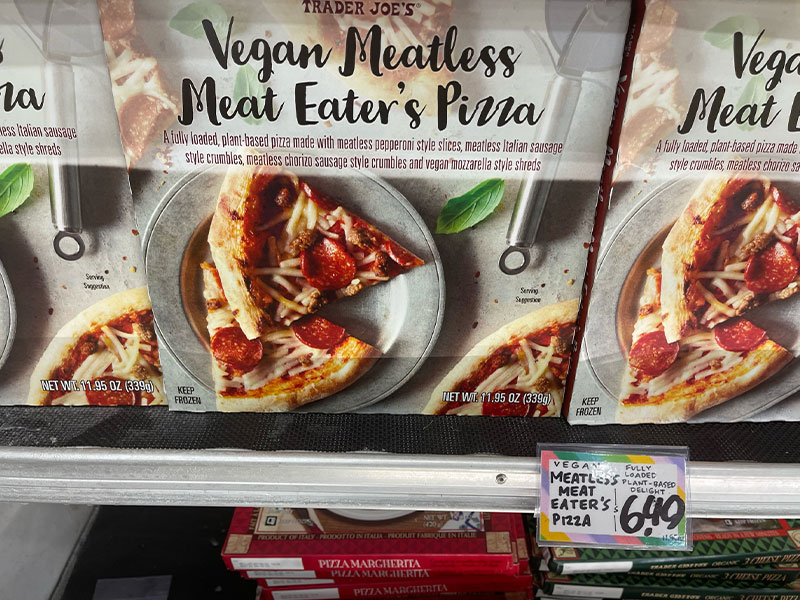
This gluten free rendition of a diehard classic flaunts a hearty crust that’s made from a blend of cauliflower, mozzarella cheese, potato flour, chickpea flour and brown rice flour. It’s then topped with a traditional tomato-based sauce and a blend of mozzarella and provolone cheeses.


To prepare the pizza, simply bake it in a 425ºF oven for 10-12 minutes. Finish it off with additional toppings of your choice, such as banana peppers, olives, sliced bell peppers or extra cheese.

07
Vegan Meatless Meat Eater’s Pizza
Trader Joe's Vegan Meatless Meat Eater's PizzaTrader Joe’s Vegan Meatless Meat Eater’s Pizza (Photo courtesy of Joseph Neese)

If you’re not a fan of meat or choose not to eat it, be sure to pick up a pack (or two) or TJ’s Vegan Meatless Meat Eater’s Pizza. This loaded concoction includes meatless pepperoni, meatless sausage and vegan cheese that’s all set on top of tomato sauce. Seriously, this pizza looks like a meat-lover’s delight and it also kind of tastes like real meat, too!


According to taste-testers on Reddit, the pizza is a favorite amongst vegans and non-vegans alike. User u/novanugs wrote, “I’m not a vegan but I wanted a low calorie pizza option and I tend to like vegan foods. Was definitely not expecting it to taste good after I pulled it out of the oven, but it isn’t dry like it looks…The crust tastes so good!” 


TJ’s Vegan Meatless Meat Eater’s Pizza tastes great on its own or alongside “some frozen fire-roasted bell peppers and onions,” which should be added before baking, per a suggestion from user u/ybgkitty.

08
Organic 3 Cheese Pizza
Trader Joe's Organic 3 Cheese PizzaTrader Joe’s Organic 3 Cheese Pizza (Photo courtesy of Joseph Neese)

TJ’s Organic 3 Cheese Pizza is a simple yet satisfying option that’s perfect for quick & easy weeknight dinners. Like its name states, the pizza is made with three kinds of melted cheeses and sauce on a hand-tossed crust. Enjoy it on its own, straight out of the oven, or with your favorite spicy toppings, like chili flakes, jalapeños or banana peppers. 


“I added…fresh parsley, spices, minced garlic, canned tomatoes with jalapenos, fresh onion, and it is not pictured but I also sautéed a couple of mushrooms for my half — something in my fridge I needed to use up but was also a great addition,” shared one user on Reddit.

09
Pizza Margherita
Trader Joe's Pizza MargheritaTrader Joe’s Pizza Margherita (Photo courtesy of Joseph Neese)

Per TJ’s, these pizza pies are imported from Italy and are allegedly baked in a wood-burning oven. Just like traditional pizza Margherita, TJ’s version includes tomato sauce — made from tomatoes, onions, garlic, balsamic vinegar, black pepper and dill — along with sliced mozzarella cheese, grana padano and basil.


To prepare the pizza, bake it directly on the oven rack for 7-8 minutes or until the crust is golden brown in color. If you like your pizza extra spicy, be sure to sprinkle some fresh chili flakes.

10
Spizzico di Pizza
Trader Joe's Spizzico di PizzaTrader Joe’s Spizzico di Pizza (Photo courtesy of Joseph Neese)
TJ’s Spizzico di Pizza are mini pies that are perfect as a lunch treat or a quick afternoon snack. The pizzas are quite simple and don’t have any toppings aside from cheese. But you can customize them to your own liking by adding extra embellishments, like shredded chicken, pepperoni, mushrooms, fresh basil, black olives or caramelized onions.

The polls were way off in 2020. Have pollsters learned their lesson ahead of 2022 midterms?

When it became clear his poll had erred in the 2021 New Jersey governor’s race, Patrick Murray, director of the Monmouth University Polling Institute, acknowledged:

“I blew it.”

The campaign’s final Monmouth poll estimated Gov. Phil Murphy’s lead over Republican foe Jack Ciattarelli at 11 percentage points – a margin that “did not provide an accurate picture of the state of the governor’s race,” Murray later said in a newspaper commentary. Murphy won by 3.2 points.

It was a refreshingly candid acknowledgment by an election pollster.

More broadly, the error was one of several in the recent past and looms among the disquieting omens confronting pollsters in the 2022 midterm elections. Will they be embarrassed again? Will their polls in high-profile U.S. Senate and gubernatorial races produce misleading indications of election outcomes?

Such questions are hardly far-fetched or irrelevant, given election polling’s tattered recent record. A few prominent survey organizations in recent years have given up on election polling, with no signs of returning.

Treat polls warily

It is important to keep in mind that polls are not always in error, a point noted in my 2020 book, “Lost in a Gallup: Polling Failure in U.S. Presidential Elections.” But polls have been wrong often enough over the years that they deserve to be treated warily and with skepticism.

For a reminder, one need look no further than New Jersey in 2021 or, more expansively, to the 2020 presidential election. The polls pointed to Democrat Joe Biden’s winning the presidency but underestimated popular support for President Donald Trump by nearly 4 percentage points overall.

That made for polling’s worst collective performance in a presidential campaign in 40 years, and post-election analyses were at a loss to explain the misfire. One theory was that Trump’s hostility to election surveys dissuaded supporters from answering pollsters’ questions.

In any case, polling troubles in 2020 were not confined to the presidential race: In several Senate and gubernatorial campaigns, polls also overstated support for Democratic candidates. Among the notable flubs was the U.S. Senate race in Maine, where polls signaled defeat for the Republican incumbent, Susan Collins. Not one survey in the weeks before the election placed Collins in the lead.

She won reelection by nearly 9 points.

Recalling the shock of 2016

The embarrassing outcomes of 2020 followed a stunning failure in 2016, when off-target polls in key Great Lakes states confounded expectations of Hillary Clinton’s election to the presidency. They largely failed to detect late-campaign shifts in support to Trump, who won a clear Electoral College victory despite losing the national popular vote.

Past performance is not always prologue in election surveys; polling failures are seldom alike. Even so, qualms about a misfire akin to those of the recent past have emerged during this campaign.

In September 2022, Nate Cohn, chief political analyst for The New York Times, cited the possibility of misleading polls in key races, writing that “the warning sign is flashing again: Democratic Senate candidates are outrunning expectations in the same places where the polls overestimated Mr. Biden in 2020 and Mrs. Clinton in 2016.”

There has been some shifting in Senate polls since then, and surely there will be more before Nov. 8. In Wisconsin, for example, recent surveys suggest Republican incumbent Ron Johnson has opened a lead over Democratic challenger Mandela Barnes. Johnson’s advantage was estimated at 6 percentage points not long ago in a Marquette Law School Poll.

The spotlight on polling this election season is unsurprising, given that key Senate races – including those featuring flawed candidates in Pennsylvania and Georgia – will determine partisan control of the upper house of Congress.

Worth doing?

Polling is neither easy nor cheap if done well, and the field’s persistent troubles have even prompted the question whether election surveys are worth the bother.

Monmouth’s Murray spoke to that sentiment, stating: “If we cannot be certain that these polling misses are anomalies then we have a responsibility to consider whether releasing horse race numbers in close proximity to an election is making a positive or negative contribution to the political discourse.”

He noted that prominent survey organizations such as Pew Research and Gallup quit election polls several years ago to focus on issue-oriented survey research. “Perhaps,” Murray wrote, “that is a wise move.”

Questions about the value of election polling run through the history of survey research and never have been fully settled. Early pollsters such as George Gallup and Elmo Roper were at odds about such matters.

Gallup used to argue that election polls were acid tests, proxies for measuring the effectiveness of surveys of all types. Roper equated election polling to stunts like “tearing a telephone book in two” – impressive, but not all that consequential.

A screenshot of a story in the New York Times about polling mistakes in the US 2016 presidential election.

Pollsters in 2016 predicted Democratic presidential candidate Hillary Clinton would win some states that she actually lost. Screenshot, New York Times


Who is and isn’t responding

Experimentation, meanwhile, has swept the field, as contemporary pollsters seek new ways of reaching participants and gathering data.

Placing calls to landlines and cellphones – once polling’s gold standard methodology – is expensive and not always effective, as completion rates in such polls tend to hover in the low single digits. Many people ignore calls from numbers they do not recognize, or decline to participate when they do answer.

Some polling organizations have adopted a blend of survey techniques, an approach known as “methodological diversity.” CNN announced in 2021, for example, that it would include online interviews with phone-based samples in polls that it commissions. A blended approach, the cable network said, should allow “the researchers behind the CNN poll to have a better understanding of who is and who is not responding.”

During an online discussion last year, Scott Keeter of Pew Research said “methodological diversity is absolutely critical” for pollsters at a time when “cooperation is going down [and] distrust of institutions is going up. We need to figure out lots of ways to get at our subjects and to gather information from them.”

So what lies immediately ahead for election polling and the 2022 midterms?

Some polls of prominent races may well misfire. Such errors could even be eye-catching.

But will the news media continue to report frequently on polls in election cycles ahead?

Undoubtedly.

After all, leading media outlets, both national and regional, have been survey contributors for years, conducting or commissioning – and publicizing – election polls of their own.


W. Joseph Campbell, Professor of Communication Studies, American University School of Communication

This article is republished from The Conversation under a Creative Commons license. Read the original article.