Spring Sale: Get 1 Year, Save 58%

RIP Queen Elizabeth II: Longest ruling monarch in British history dead at 96

Queen Elizabeth II, who succeeded her father, King George VI, at the time of his death in February 1952, passed away on Thursday at Balmoral Castle in Scotland. Her health had been in obvious decline in recent years, although she was well enough on Tuesday to meet with both outgoing Prime Minister Boris Johnson and Liz Truss, his newly appointed successor. Official word of the queen’s death came in a statement from Buckingham Palace saying that Elizabeth had died peacefully and that “The King and The Queen Consort” — that is, the former Prince Charles and his wife, Camilla — “will remain at Balmoral this evening and will return to London tomorrow.” 

Elizabeth Alexandra Mary Windsor was only 27 at the time of her coronation and, implausible as this may seem, was the longest reigning monarch in British history. She was 11 years old when her father became king in 1936, and assumed the throne herself just 16 years later. Her coronation took place on June 2, 1953 at Westminster Abbey, as has been the custom for 900 years, and was the first such ceremony to be broadcast on live television. Although the modern British monarchy is entirely ceremonial and the queen had no role in politics and government, Elizabeth’s long reign encompassed an enormous swath of recent history, including the Korean War, Britain’s war in the Falklands, the end of the Cold War, the election of Britain’s first woman prime minister and both the U.K.’s admission to the European Union and then its exit. 

Queen Elizabeth II and the Duke of Edinburgh on the day of their coronation, Buckingham Palace, 1953Queen Elizabeth II and the Duke of Edinburgh on the day of their coronation, Buckingham Palace, 1953. (The Print Collector/Getty Images)

Related: God save Queen Elizabeth II, who tested positive for COVID with “mild cold-like symptoms”

Elizabeth was often credited with modernizing the British monarchy and encouraging members of the royal family to prioritize public service, and encouraged the rest of her family to do so as well. Her greatest test as monarch likely came after the death of her charismatic and controversial daughter-in-law, Princess Diana, in a 1997 car crash. Elizabeth came under some criticism for avoiding a show of public mourning, instead retreating to Balmoral with her grandsons Prince William and Prince Harry, who were young children at the time.


Want a daily wrap-up of all the news and commentary Salon has to offer? Subscribe to our morning newsletter, Crash Course.


More recently, the queen also had to handle Prince Harry’s decision to walk away from his royal duties and leave England, largely for the sake of his wife, Meghan Markle, the Duchess of Sussex, and quite likely because he feared the consequences of the kind of publicity that had damaged his mother. By all accounts, Harry had the support of the queen, who simply said that “Harry, Meghan and Archie [their only child at the time] will always be much loved family members.”

Although Queen Elizabeth clearly didn’t love media scrutiny, she didn’t shy away from it either, appearing with Daniel Craig in a short film for the 2012 Olympic Games opening ceremony, and with Prince Harry in a response to Barack and Michelle Obama’s Invictus Games challenge. Apparently she had actually watched episodes of “The Crown,” and enjoyed them:  

“Edward and Sophie love The Crown,” a senior royal source said. “It has been a longstanding arrangement that they drive to Windsor at the weekend to join the queen for an informal supper while watching TV or a film. They have a Netflix account and urged her to watch it with them. Happily, she really liked it, although obviously there were some depictions of events that she found too heavily dramatized.”

Famously, Elizabeth was an animal lover especially fond of corgis, and kept several at a time that followed her everywhere she went. It has been estimated that over the course of her  70-year reign, she owned around 30 corgis, reportedly preferring them to other breeds for their energy and untamed spirit. Her first corgi, named Susan, was a gift from her father for her 18th birthday, according to Reader’s Digest.

Queen Elizabeth ll arrives at Aberdeen Airport with her corgisQueen Elizabeth ll arrives at Aberdeen Airport with her corgis to start her holidays in Balmoral, Scotland in 1974. (Anwar Hussein/Getty Images)

In February of this year, the queen tested positive for COVID and experienced “mild cold-like symptoms” shortly after the Platinum Jubilee celebrating her 70 years on the throne. From that point onward her health was clearly in decline, but she maintained at least an abbreviated work schedule right up to the day before her death. As noted, on Tuesday she had performed the official ritual of accepting the outgoing prime minister’s resignation and welcoming the new leader of Parliament over a cup of tea.

Queen Elizabeth II Queen Elizabeth II attends an Armed Forces Act of Loyalty Parade at the Palace of Holyroodhouse on June 28, 2022 in Edinburgh, United Kingdom. (Jane Barlow – WPA Pool/Getty Images)
In this video clip, Elizabeth jokes about the cake for her Platinum Jubilee being presented facing the press corps instead of her because “she’s not important.”

Queen Elizabeth II is survived by her son, now King Charles III, and his wife Camilla, now officially known as the queen consort. Her other surviving children are Princess Anne, Prince Edward and the semi-exiled Prince Andrew, whose reputation has been permanently tarnished by his association with Jeffrey Epstein. Among her dozen grandchildren, Prince William, the new king’s eldest son, is now next in line for the throne. 

Trump’s Save America PAC, created after 2020 loss, under investigation by federal grand jury: report

Former President Donald Trump’s fundraising efforts following his landslide loss to President Joe Biden in the 2020 election are under investigation by a federal grand jury, according to multiple news outlets.

ABC first reported on Thursday morning that the United States Department of Justice has issued subpoenas to Trump aides and allies aligned with Trump’s Save America Political Action Committee, which he has used to capitalize on his lies about the election having been stolen and rife with fraud.

“Since its inception, Save America PAC has brought in more than $135 million, including transfers from affiliated committees, according to disclosure records. As of the end of July, the PAC reported having just under $100 million in cash on hand,” ABC noted.

In recent weeks, Trump has encouraged his followers to donate money to the PAC in the wake of the Federal Bureau of Investigation’s seizure of above-top-secret documents relating to a foreign government’s nuclear capabilities during its August 8th search warrant execution at Trump’s Mar-a-Lago compound in Palm Beach, Florida.

More than two million dollars of funds have been distributed to attorneys representing witnesses that have testified before the House Select Committee probing Trump’s January 6th insurrection at the United States Capitol.

But the latest development is yet another tendril in the legal net that is ensnaring Trump.

“The new subpoenas appeared to have been issued by a different grand jury in Washington than the one that has been gathering evidence about the so-called fake elector plan, which has focused on questions surrounding pro-Trump lawyers like Rudolph W. Giuliani and John Eastman,” revealed Maggie Haberman of The New York Times.

Haberman added that “at least one of the new subpoenas bore the name of a veteran federal prosecutor in Washington who specializes in fraud cases, suggesting that this avenue of inquiry is devoted primarily to examining the spending and fund-raising at Mr. Trump’s super PAC.”

Allegations that the Save America PAC has been scamming its donors were put forth by Congressman Zoe Lofgren (D-California) during one of the Select Committee’s public hearings in June.

“Throughout the committee’s investigation, we found evidence that the Trump campaign and its surrogates misled donors as to where their funds would go and what they would be used for. So not only was there the big lie, there was the big rip-off,” Ms. Lofgren said. “Donors deserve to know where their funds are really going. They deserve better than what President Trump and his team did.”

How safe is it to drink rainwater?

In many parts of the world, including Africa, people rely on rainwater as a source of drinking water, as well as for other household and livelihood uses. One of the reasons is water scarcity – sub-Saharan Africa has the largest number of water-scarce countries in the world. But there are concerns about how safe rainwater is to drink. It can be contaminated by dust and ash in the surroundings or by heavy metal from roofing material. Another concern is the presence of manufactured chemicals called perfluoroalkyl and polyfluoroalkyl substances (PFAS), or “forever chemicals”. As environmental scientist Ian Cousins and his team explain, they are a threat to the use of rainwater for domestic purposes.

What are PFAS and why should we be worried about them?

PFAS are a group of man-made substances often described as “forever chemicals” because they never break down in the environment.

They are found everywhere — in air, soil, and water as well as in wildlife, plants and humans. They can be found on the highest mountains, in the deep oceans and on both poles. A recent study highlighted the widespread presence of PFAS in rainwater, from the Tibetan Plateau to Antarctica, and noted that according to recently published health advisories, rainwater everywhere could be considered unsafe to drink.

According to the US Environmental Protection Agency, there are more than 12,000 of these chemicals in use. They have been produced and used on a large scale in a wide range of industrial and commercial applications since the second world war. Well-known uses include fire-fighting foams, non-stick cookware, and paper and board used to wrap and contain food. There are hundreds of uses, too numerous to list.

The human exposure pathways and health effects of most of the chemicals are poorly understood or unknown, except for four about which there is good information. They are: PFOS (perfluorooctanesulfonic acid), PFOA (perfluorooctanoic acid), PFHxS (perfluorohexanesulfonic acid) and PFNA (perfluorononanoic acid).

At elevated levels of exposure, these four have been associated with serious human health harms, including different forms of cancer, development toxicity, infertility and pregnancy complications, high cholesterol, ulcerative colitis, liver hypertrophy (“enlargement”), and thyroid disease.

The recent extremely low advisories for drinking water were prompted by the observation that exposure to these chemicals can lead to decreased vaccine effectiveness in children.

PFAS have been used for a long time. But intensive research on them began only about 20 years ago. Since then, the knowledge of toxicity has increased enormously. Based on this knowledge, the exposure level that is considered safe for humans has been set lower and lower.

The PFAS levels in health advisories for food and drinking water have been reduced to a point that is hard to achieve. This is because the advisory values are close to or even higher than the PFAS level in the environment.

In our recent study we showed that levels of certain PFAS in rainwater now exceed the guidelines set by the US Environmental Protection Agency even in the remotest regions of the Earth.

It is important to note that the levels of the four PFAS in rainwater and other environmental media have not increased recently. The use and emission of these so-called “legacy” PFAS was discontinued in many countries in recent years. But their stability means that they will remain in the environment indefinitely.

The levels of the four PFAS in the atmosphere have been stable since they were first measured in the early 2000s, which means their levels have been above the most recent drinking water advisories since then.

The situation will also not improve soon. PFAS do not not break down in the environment. Their only route for removal from environments where we produce food is slow dilution into the deep oceans. Rainwater levels may take decades to fall below the levels set in health advisories. The exact recovery time is uncertain.

How are people most exposed?

For the four well-studied PFAS, humans are exposed primarily through food, drinking water and household dust. Food and drinking water are contaminated primarily by the environment.

For the larger class of PFAS, human exposure pathways vary enormously, and there are many thousands of other PFAS that are not monitored or studied at all, so we know nothing about their exposure levels or toxicities, which is concerning.

There are ways to remove PFAS from water, but it is not clear if the levels can be brought below the latest health advisories.

Regular vacuuming can reduce dust exposure, but there is no way to remove PFAS from food. Therefore, it is not possible to completely avoid exposure to low-level PFAS. Humans will have to live with it.

Is it safe to drink rainwater?

We are uncertain. It is unlikely that many of the effects listed above would be observed at very low exposure levels, of pg/L or ng/L (picogram/litre and nanogram/litre are units of concentration). An effect that might be observed at these low levels is the decreased effectiveness of vaccines.

The health advisories are set so low because the authorities want to be close to certain that no effects will occur at those levels. The precautionary assumptions are used to ensure that the public is protected. Therefore, we have to hope that some effects on the large scale will not occur, but we cannot be certain.

What lessons can be learned?

There are more than 12,000 PFAS currently in use, with hundreds of individual uses. All PFAS are man-made and, therefore, they have no place in the natural environment. Due to concerns about their eternal presence and potential toxicities, scientists have suggested that PFAS should only be used where they are essential and that the essentiality of every PFAS used should be evaluated.

Ian Cousins, Professor of Contaminant Chemistry, Stockholm University; Bo Sha, PhD Candidate, Stockholm University; Jana H. Johansson, Researcher, Department of Environmental Science, Stockholm University; Martin Scheringer, Senior scientist, Swiss Federal Institute of Technology Zurich, and Matthew Salter, Researcher, Department of Environmental Science, Stockholm University

This article is republished from The Conversation under a Creative Commons license. Read the original article.

GOP stuck with Pandora’s Box after Roe: Republicans run head first into the same-sex marriage trap

The Senate is back from recess, and legislators are facing down a daunting to-do list to complete before the November election, including passing appropriations bill and confirming more of President Joe Biden’s judicial nominees. Additionally, there’s now increasing pressure to make time for a vote on the Respect for Marriage Act, which would offer limited protection to bolster previous Supreme Court decisions legalizing interracial and same-sex marriage in the face of this summer’s blockbuster decision from the court striking down Roe v. Wade’s landmark legalization of abortion

The bill was passed in the House earlier this summer in response to the court’s unprecedented move of taking away a right once granted. Such a move on its own would have raised fears that the court would next overturn other decisions that granted rights like same-sex marriage and birth control, but Justice Clarence Thomas erased any lingering doubts that such things are next on the religious right’s wish list by explicitly inviting lawsuits challenging those previous decisions

Republicans are in an electoral double bind.

So Sens. Tammy Baldwin, D-Wis., and Susan Collins, R-Maine, called on their colleagues to pass new protections by arguing in a Washington Post op-ed on Tuesday that such legislation is “bipartisan.” After arguing that “a majority of Democrats, Republicans and independents” support same-sex marriage rights, the two note that the legislation already passed through the Democratic-led House with “strong bipartisan support.” The goal of these two senators isn’t mysterious. Passing the bill through the Senate requires getting past the filibuster. That, in turn, means convincing 10 Republicans to join the slim 50-vote Democratic majority in the Senate to back the bill. Their op-ed was about persuading wary Republicans that it’s safe and, in fact, savvy to back this politically popular view. 

But to call the bipartisan support for same-sex marriage “strong” is, at best, political embroidery.

Same-sex marriage has strong Democratic support. In fact, it’s unanimous, with all 220 House Democrats backing the bill and the expectation that all 50 Democrats in the Senate will. Only 22% of House Republicans, however, were willing to vote for same-sex marriage. Digging into the numbers, things look even worse on the GOP side. As an analysis from the Washington Post shows, a significant number of those Republicans who did support the bill “are retiring or represent districts in Democrats’ sights in the midterms.” 


Want more Amanda Marcotte on politics? Subscribe to her newsletter Standing Room Only.


That doesn’t make it impossible for the bill to pass through the Senate, to be clear. If 20% of Republican senators vote for the bill, that’s enough to drag it across the finish line. It’s still not clear if that will happen, however.

A few Republican senators have publicly indicated support, but many are being tight-lipped about where they stand. Baldwin told reporters that she expects a vote on the bill during the week of Sept. 19. But things took a dim turn this week, when Baldwin’s fellow Wisconsin senator, Republican Ron Johnson, declared that he had no intention of voting for the bill, arguing that the Supreme Court was wrong to legalize same-sex marriage in the first place. Johnson was reportedly one of the senators who LGBTQ rights advocates had hoped to get on board. He is up for re-election in a swing state this year and had previously been coy about his position, leaving hope that he would attempt to appeal to moderates by backing the bill. This loss is a bad blow for those hoping to pass the bill. 

The Republican opposition to abortion rights is hurting them in the polls already. Adding their opposition to same-sex marriage to the pile will only reinforce the Democrats’ message: Republicans are right-wing radicals who are wildly out of step with the mainstream on social issues. 

But even if LGBTQ advocates manage to cobble together 10 votes for this bill, that shouldn’t be taken as serious evidence that Republicans have become more moderate on this issue. It’s not just that the vast majority of Republican politicians oppose same-sex marriage. The attacks on LGBTQ rights have only been escalating in GOP circles in the past couple of years. Across the country, Republicans are passing laws to ban books and censor teachers for acknowledging the existence of LGBTQ people. Policies to bar gender non-conforming kids from playing sports and to punish families for supporting LGBTQ kids have also been enacted. In Texas, the Republican Party platform declared that homosexuality is an “abnormal lifestyle choice.” Sen. Rick Scott of Florida, the head of the National Republican Senatorial Committee, released an 11-point blueprint for the GOP this year which stated that the “traditional familiy” is “God’s design for humanity,” and asserted that a Bible quote about the “male and female He created them” should be the guide for government policies. In response to the Respect for Marriage Act, specifically, the GOP’s House Freedom Caucus put out a statement declaring that the “radical left” has “attacked the norms of masculinity and femininity, and now it wants to further erode the sacred institutions of marriage.”

The “radical” left in this case represents over 70% of Americans who support same-sex marriage, a number which includes 55% of Republican voters. The disconnect between where voters stand and where the Republican political establishment stands is understandably puzzling. Why don’t Republicans moderate their views to reflect where their voters are?  

Because Republicans are in an electoral double bind.

On one hand, their most dedicated and enthusiastic voters — the ones who show up for primaries, donate money, and volunteer — disproportionately come from a Christian nationalist base with radical right-wing views. They’re rigidly opposed not just to abortion, but contraception and reject the constitutional separation between church and state. And because Christian conservatives vote in large numbers in primaries, they’ve pushed the elected representatives far to the right. On the other hand, the general election voters Republicans need to win office tend to be more moderate, especially on “social” issues like LGBTQ rights and reproductive health care access. 


Want more Amanda Marcotte on politics? Subscribe to her newsletter Standing Room Only.


Republicans generally try to square this circle by passing draconian laws to please their Christian right base while attempting to obscure their views from the larger public. This strategy is playing out dramatically this election cycle on the issue of abortion. After the Roe overturn, Republican state legislatures have been moving quickly to pass ever more punitive abortion bans, frequently rejecting moderating amendments allowing the procedure for rape victims or for patients who are in medical crisis. But often those same politicians turn around and misrepresent their views to the public, running ads and making statements meant to reassure voters they won’t vote for the anti-choice policies they have and will almost certainly continue to vote for. 

Senate Minority Leader Mitch McConnell, R-Ky., understands intimately that it’s easier for Republicans to win elections if the voters are ignorant of how far-right the party’s policy views actually are. He’s been blocking efforts by Republicans to release a party platform, precisely because he knows it would contain language on reproductive rights, LGBTQ rights, and other issues where the GOP opposes the majority views. He was not happy with Rick Scott going behind his back to release the 11-point pseudo-platform for precisely this reason. It created multiple news cycles in which the actual views of Republicans, which most voters reject, were publicized. 

This likely explains why so many Senate Republicans are playing peek-a-boo with their intentions on the Respect for Marriage Act. Senate Majority Leader Chuck Schumer, D-N.Y., may be reluctant to bring it to a floor vote without knowing if it’s going to pass or not. As long as it’s not brought up for a vote, Republicans can play both sides of the issue, letting their Christian right base’s wishes prevail without alienating general election voters who are unaware of how anti-gay the mainstream GOP is. Once there’s a vote, however, it forces them into a binary choice of alienating one group or the other.

This all shows why it’s smart politics for Democrats to bring the Respect for Marriage Act up for a vote in the next few weeks, regardless of whether they know where the whip count stands. If they get 10 Republican votes, then they’ve passed a popular policy that also prevents some — though not all — potential legal fights over same-sex marriage rights in the future. If they don’t get the 10 votes, however, it’s still a political win, if not a policy win. The Republican opposition to abortion rights is hurting them in the polls already. Adding their opposition to same-sex marriage to the pile will only reinforce the Democrats’ message: Republicans are right-wing radicals who are wildly out of step with the mainstream on social issues. 

“If this was Hillary Clinton, they’d be calling for jail time”: Dems blast GOP for Trump defenses

As the U.S. Department of Justice continues its investigation into former President Donald Trump’s unauthorized removal of classified documents, Republicans are still showing their support of him.

According to HuffPost, some Republican lawmakers have even admitted that while they would never keep classified documents, things are a bit different for Trump.

The report highlights various statements from Republicans who have attempted to argue their point. “When asked if they would take secret documents home with them, GOP senators tasked with oversight of the intelligence community ― those who handle extremely sensitive information daily ― said they would never do so,” HuffPost reported.

“Of course not,” Sen. Marco Rubio (R-Fla.) said.

Sen. John Cornyn (R-Texas) also chimed in saying, “Clearly, they should not be left in a residence or somewhere unprotected.”

However, Cornyn made it clear that he opposes searching the home of a former president although he wouldn’t have taken documents himself.

“We’re just trying to figure out what the heck’s going on,” Cornyn said. “It’s unprecedented to execute a search warrant on a former president’s home, and that’s not a precedent that I’d like to see repeated.”

Sen. Roy Blunt (R-Mo.) also argued that it’s different for the sitting president because his main office tends to be inside of his home.

“Presidents have their secure documents at their office, which is the White House, so they have a different view of it,” Blunt said.

Sen. Susan Collins (R-Maine) also insisted that she didn’t “have the facilities to do so nor the authority” to store top secret documents at her home but also argued: “That’s different from a president. I don’t have any authority to deem something classified or unclassified.”

However, Democrats are pushing back and pointing out the stark contradictions in Republicans’ arguments due to Trump being at the center of scrutiny.

“I can’t take [documents] home. I can’t take them to my office. I have to read them in that room,” Sen. Angus King (I-Maine) said of the security protocols in place for members of the committee. “If I did, I’d be out of a job.”

Speaking to HuffPost, Sen. Martin Heinrich (D-N.M.), also a member of the intelligence committee, criticized Republicans for their double standards.

“Mishandling classified materials, they drill into you right out of the gate, is a crime,” said Heinrich. “This is real stuff and has direct implications on our sources. It puts people’s lives at risk.”

He added, “If this was Hillary Clinton, they’d be calling for jail time.”

Watch: Steve Bannon, forced to surrender to authorities, suffers a public melt down

Former Trump adviser Steve Bannon claimed he was being persecuted as he surrendered to New York authorities in connection to a fund-raising operation that claimed it would build a wall on the southern border.

In video shared by ABC on Thursday, Bannon is greeted by an officer as he arrives at the courthouse in New York.

The video shows Bannon ranting about the “irony” of a New York City delegation visiting the border on the same day that he is indicted.

“They’re persecuting people!” he shouts in the video.

New York Attorney General Letitia James is expected to hold a press conference at 1:00 PM — just minutes before Bannon’s arraignment.

Watch the video below or at this link.

I’ve seen America’s future if the Trumpers win: It’s what Lebanon looks like right now

Comedian Kathy Griffin recently received a rash of grief for insinuating in a tweet that the Republicans want to start a civil war. But it is actual Republicans who have floated that possibility – not Griffin. So what would that entail? What would that future look like?

For those who are pondering how to use their vote this fall, it’s time to take a look at what kind of future we will face should those who call themselves “Trump Patriots” succeed, either through the ballot box, violence or both.

I’ve seen one of those possible futures for the United States.

I can only hope it’s not the future for the United States.

It is not pretty. It is not comfortable. In this future, 50 years after a period of civil war, insurrection and widespread violence, things have changed dramatically. 

Billionaires own their own media outlets and truth is malleable depending on who does the reporting. It is a future where corruption and greed by mega-rich politicians has destroyed the culture. Authoritarianism reigns.

In this future, there is little infrastructure. Extended power outages like those that recently occurred in Texas are endemic, as are failing water systems like the ones we’ve seen in Jackson, Mississippi, and Flint, Michigan. If you want power, you have to buy or rent generators and then pay for fuel to keep them running. If you want fresh water, you have to buy it and store it in fiberglass towers on your roof.

There are no public streetlights, no basic infrastructure, few jobs. Don’t drive into tunnels. Public transit doesn’t work. The upside? No light pollution at night: You can see the stars.

There are no public streetlights, so at night the roads are dark. Don’t drive into a tunnel if you can possibly avoid it: It’s pitch black in there. On the upside, there’s no light pollution at night, even in the largest cities, since there are no lights. Public transit, including buses and trains, is never on time and rarely works as it’s supposed to. If a terrorist act occurs, like the destruction of the World Trade Center? Two years later, nothing has been rebuilt or repaired. That lack of basic infrastructure has compromised roads, bridges and ports — many are crumbling and unsafe. There are few jobs. Starvation is becoming a problem.

As infrastructure crumbles, the politicians begin buying votes directly — paying off the poor for their votes by giving them handouts monthly. Politicians can do that because they have successfully manipulated local election boards, putting their minions from the Proud Boys and Oath Keepers in jobs as “poll watchers” who stand around armed on Election Day, as close as three feet from voters. Texas recently tried (but failed) to pass a law on drive-through voting that would permit poll watchers to get into cars with voters.

Thanks to the disdain shown by Congress for anything deemed “socialism,” medical coverage is nonexistent unless you purchase private insurance — and even then it isn’t guaranteed. There is no hope of basic health maintenance, and you pray that no one in your family has to handle a medical emergency: Since you can’t afford health care, they will likely die. Hospitals charge exorbitant fees because they too have to pay premium prices for water and electricity.

Public education is a shambles. People like Gov. Ron DeSantis in Florida fire independent school board members. Only those who accept the ruling party’s political rhetoric are allowed to remain. Qualified teachers flee as pay becomes erratic. 

Elections are run by party hacks who toe the line and place in office only sycophants who support the political ruling class. 

If all that sounds too dystopian to believe, I’m here to tell you that such a country already exists, and routinely endures such calamities. That country is Lebanon, where everything described above is now daily life, because corrupt politicians have helped make it that way. Though Lebanon is a poor and developing nation, four of the 10 richest Middle Eastern men, according to Forbes, are Lebanese politicians. Lebanon is the smallest country in continental Asia, roughly the size of Connecticut. According to the World Bank, its current economic crisis is one of the worst in the world since the 19th century. On the surface, you might say that the U.S. has almost nothing in common with Lebanon. Look deeper.


Want a daily wrap-up of all the news and commentary Salon has to offer? Subscribe to our morning newsletter, Crash Course.


Armed violence? Hell the U.S. has more private guns and arsenals than several nations in the developing world combined. A fear of everyday life and the fear of chaos? Yep. Got that. Divisive politics and the threat of violence from religious zealots? Yep. Faltering education, infrastructure problems and voter suppression? Check, check and check.

We’ve seen the threats of kidnapping and murder against government officials (just ask Gov. Gretchen Whitmer in Michigan) and we already have an exceptionally divisive media environment. All these things are necessary to breed the type of violence that consumes nations.

“The way civil wars were conducted in the past is not the way they are now,” historian Ruth Ben-Ghiat told me for the podcast “Just Ask the Question.” There won’t be two standing armies fighting each other, she explained: “There will be sporadic outbreaks of violence, insurgencies — and we have that already.” 

We even share something else with Lebanon. 

The nail through that nation’s heart was driven two years ago. Emerging from 50 years of internal strife from a civil war and countless invasions by its neighbors, Lebanon hoped to leave its violent past behind.

On Aug. 4, 2020, a large amount of ammonium nitrate stored at the Port of Beirut exploded. The explosion resembled a small thermonuclear detonation. An estimated 7,000 people were injured, and 218 died. The explosion caused more than $15 billion in property damage and left 300,000 people homeless. Residents called it the “9/11 of Lebanon.” Anyone who was alive in the area knows the incident well. It was felt throughout the country, registered as 3.3 on the Richter scale and was heard as far away as Cyprus.

Because news in Lebanon is unreliable, few there agree on what caused the explosion. While around the world it is commonly understood as a tragic and catastrophic accident, inside the country more diabolical theories have taken hold — and those stories have been used by insurance companies to keep from paying off claims. Russia, Syria and Israel play central roles in these supposed conspiracies to destroy Beirut, depending on where you get your information. The only thing everyone agrees upon is that two years later the city’s downtown area, including the central shopping and government districts, remains largely empty. Most of the buildings that were destroyed or badly damaged have not been repaired or replaced. 

Beirut, which was once described as the “Paris of the Middle East,” now resembles a failed nation’s sewage lagoon. More than 50 percent of the city’s residents live below the poverty level. Many high-rise buildings were left incomplete or have been abandoned. Kids can be seen at night playing in the ruins. Just to conduct the recently concluded Lebanese Independent Film Festival in Beirut, organizers had to truck in generators and water to stage a three-day event. Festival organizer Gauthier Raad spoke defiantly about Lebanon’s future. “We have to work together. That’s what this festival demonstrates,” he said. “We can’t wait on handouts from anyone or expect others to fix our problems. We have to do it ourselves.”

Beirut was once known as the “Paris of the Middle East.” Now the downtown shopping district is empty. Half the residents live below the poverty line. Kids play at night in ruined or abandoned buildings.

Fifty years of civil war, internal strife and stupefyingly corrupt government has reduced this tiny and beautiful country into a feudal empire, ruled by rich and increasingly dangerous politicians — many of whom have religious axes to grind. Those who preached hope have been assassinated. Lebanon has been conquered, liberated, invaded, bombed, trashed, raped, beaten, risen up and beaten down so much since the dawn of time it appears the world has grown weary dealing with it.

Imagine being a Lebanese citizen and surviving nearly two years, in some locations, without water, electricity or other basics. People sleep outside on the roof to try and stay cool. Former doctors and engineers hire themselves out as drivers and cabbies because they have cars and can drive around what few tourists dare come to the country, for meager fees that barely enable them to pay their bills.

We see the seeds of this ruin in the actions of the self-described “Trump Patriots” in the United States. We can see mainstream media courting the far right to make money, and promoting a “false equivalency” that further stokes the flames that could lead to a Lebanese-style dystopia in the U.S. 

As recently as Wednesday, thousands found themselves stranded at the airport in Austin, Texas, when an unexpected underground equipment malfunction led to a power outage. “As I sit in the dark at the airport … with thousands of others who also wait on delayed flights due to an unexplained power outage,” Cooper Hefner tweeted, “I can’t help but think of the importance of investing federal funds to improve U.S. infrastructure.” 

Indeed.

Lebanon is tribally divided because there are 18 different religions in the country and the ruling class has exploited those differences to feather its own nest.

We are much too close to the same situation in the United States, where our tribal divisions are not only fueled by religion but also by racism, cynicism and misogyny.

Lebanon remains a friendly country, where even in villages like Bsharri (which means “house of truth” in Aramaic) you will find open doors and people who offer you coffee and conversation. For many of the older residents, who’ve seen violence and political strife come and go, there is little hope of change. “What can you do?” they ask visitors. The younger generation is a little more hopeful, as represented by the artists who organized, staged and contributed to the film festival.

In the United States, our divisions can make us wary of strangers and those who think differently. We threaten and jail them. Sometimes we shoot them or beat them.

Recent news stories highlight the jailing of pregnant women, threats of violence against African Americans and a Trump-appointed Supreme Court that has already taken away one long-guaranteed civil right and is now setting its sights on others.

When Michelle Obama appeared at the White House Wednesday for the unveiling of her portrait — alongside her husband, the former president — she became emotional about the national story that “includes every American,” insisting that “our democracy is so much bigger than our differences.”

The veracity of that statement is being tested every day. This fall’s midterm elections will determine America’s future for years to come.

The current plight of Lebanon remains one possible option, should the authoritarians prevail. Michelle Obama, among many others, remains hopeful it does not. Kathy Griffin has a point — but she isn’t necessarily predicting the future.

“My Son Hunter”: There’s barely even a movie inside this deep-state right-wing grift

To a significant degree, I found the user comments on the third-rate Breitbart-affiliated social media site where I streamed the movie “My Son Hunter” more interesting — and definitely more illuminating — than the film itself. A lot of them, to be fair, were just complaints about the crappy user experience and nonexistent support that resulted from paying 22 American dollars to a right-wing website in order to watch a substandard “Succession” knockoff made in Serbia that nominally concerns the son of the current president of the United States.

Those comments could be classed under the rubric of “useful instruction” or perhaps “there’s a sucker born every minute.” As we say these days, it’s not a bug of right-wing media that nothing works right and it’s all stuck together with the digital equivalent of duct tape. It’s a feature. That’s because right-wing media is a shameless grift and pretty much proud of that fact, and members of the general public who feed money into right-wing media hoping to get something beneficial or informative or at least entertaining out of it (such as, in this case, me) are marks being taught a lesson in predatory economics

There were quite a few … who complained that the portrayal of Hunter Biden … was overly sympathetic, or who were disappointed that the movie was (in some technical sense) a comedy.

In structural terms, the supposed content of right-wing media — such as this boring and slipshod movie featuring actors playing Joe and Hunter Biden who do not resemble them in terms of physique, voice, demeanor, body language or anything else — is largely beside the point, and could even be said not to be the real content at all. Paying an extortionate price for a terrible movie that then cannot be “cast” from your phone or laptop to your big-screen TV because the apps that supposedly make that possible either don’t exist or don’t work — one user reported getting the app to function after tweaking the settings and discovering that what it sent to his TV was an actual image of his phone screen — delivers a mainline dose of the anger and frustration and unsatisfied grievance that is the true substance of right-wing media. 

The medium is the message, in other words, and in this instance they’re both shameless ripoffs. But let’s talk about the other site comments, the plaintive ones. Oh sure, there were some people who gamely posted about what a terrific movie it was and now all we had to do was get the corrupt Biden crime family out of office. Maybe I’m projecting by saying those people were trying to be team players but their heart didn’t seem to be in it. But there were quite a few other folks who complained that the portrayal of Hunter Biden (as played by Laurence Fox, and we’ll get to him) was overly sympathetic, or who were disappointed that the movie was (in some technical sense) a comedy. 

I kind of feel bad for those people because it seems they haven’t gotten the memo: They may be Trump loyalists and conspiracy-theory believers and all that, but they still somehow aspire to live in a universe of facts and evidence, where a searing exposé that lays bare the Biden crime family’s misdeeds will change everything. These are the people who doggedly tried to understand Mike Lindell’s incomprehensible claims about election fraud, woven from fragments of pagan mysticism and stolen software. I exchanged quite a few messages last year with a relatively polite reader who truly, sincerely believed there existed a constitutional pathway to undoing the 2020 election and “reinstating” Donald Trump. He only became angry with me after I asked whether his imaginary recounts would allow the Democrats to win, say, Vermont and Hawaii, on the Putin model, or would find that Trump had won 90% of the vote everywhere, as in old-school totalitarianism.

We endure a lot of histrionics from English actor Laurence Fox, who is way too skinny and weaselly to play Hunter Biden.

For those people, the right-wing marks that other right-wing marks look down on, “My Son Hunter” is a letdown because it’s just a stupid farce that recycles a bunch of familiar allegations about the Bidens that — setting aside any discussion of their veracity! — we’ve all heard a million times by now. Hunter Biden, a young gentleman with a prep-school background and a fondness for narcotics and the company of sex workers, used his dad’s name to get paid big-time by shady companies in China and Ukraine (so far this is almost inarguably true) and his father delivered big U.S. government contracts to those companies and their official benefactors while taking kickbacks. 


Want a daily wrap-up of all the news and commentary Salon has to offer? Subscribe to our morning newsletter, Crash Course.


Yes, libs, that last part is almost certainly false, but in the movie all that material is delivered as blah-blah-blah exposition in between the not-very-lurid scenes involving drugs and babes, which fail to convince us that Hunter Biden’s excesses were in any way unusual for a person of his temperament and background. The conspiracy-theory narration is either delivered by former MMA fighter turned “canceled” actress Gina Carano, playing a Secret Service agent (a free-form in-joke that never goes anywhere), or by Grace (Emma Gojkovic), the hooker who gets mildly red-pilled and redeems herself from a life of sin, first by trying to serve as Hunter’s conscience and then by leaking salacious gossip to the New York Post. I mean, a girl’s got to do, etc.

Early in the movie, Grace tells a non-Gina Carano Secret Service agent that she can’t find anything negative or scandalous about the Bidens online. He laughs knowingly: “That’s because you’re using Google and the mainstream media. Here, let me show you.” She responds that she thought those other sites were just used by “alt-right white supremacists” and then, too late, realizes her mistake: The guy is Black! With that the scales fall from her eyes, and she begins to question all the myths she has swallowed about the greatness of the Bidens and, correspondingly, the awfulness of “the orange man who tweets out of his ass,” whose name is hardly mentioned until we reach the heart-rending conclusion.

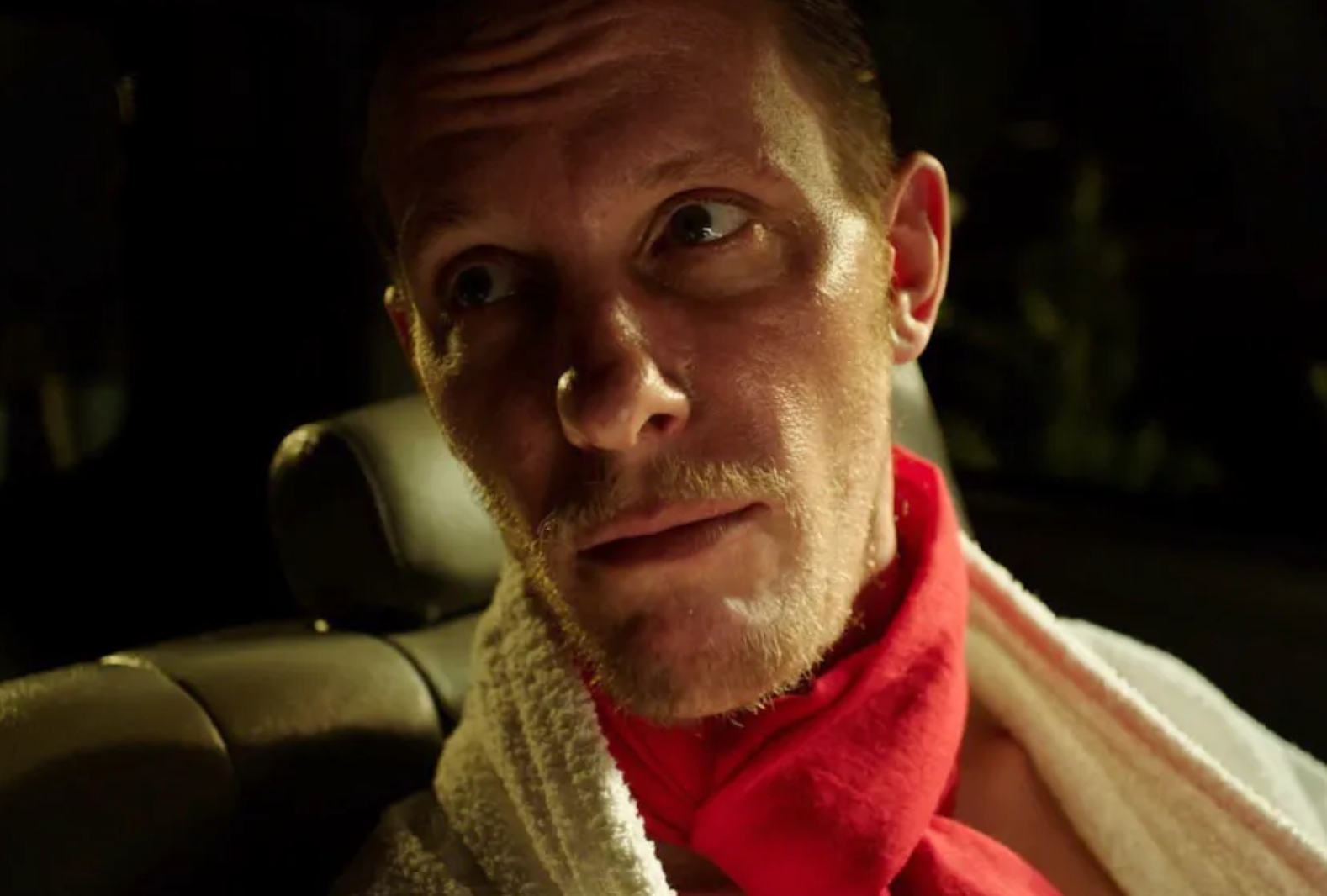
“My Son Hunter” (Unreported Story Society Production)Along the way, we endure a lot of histrionics from English actor Laurence Fox, who is way too skinny and weaselly to play Hunter Biden. The president’s wayward son, in real life, possesses a more bro-tastic and GQ-inflected grade of sliminess, and does not look as if the coke binges ever led him to miss an expensive meal or a session with his no-doubt-hot personal trainer. For nearly the entire film I couldn’t figure out what disreputable real-life person Fox actually does look like, and then I nailed it: Lance Armstrong

For that matter, actor John James, who was a regular on multiple daytime soaps in the 2000s, looks even less like Joe Biden than Fox looks like Hunter. This is James’ second recent appearance in a right-wing propaganda film, having played James Comey (!) in something called “The ObamaGate Movie.” James looks a lot like Sen. Ron Johnson, the crazy-pants Wisconsin Republican, who would probably pretend to enjoy “My Son Hunter” if someone made him watch it. 

So if this were a movie about Lance Armstrong and Ron Johnson doing some crime, we’d be good. As things stand, it seems like they just hired two white guys who were roughly the right age and height and put suits on them, because who can tell the difference, right? I intended to make a joke here about how that was racist and I was triggered, but it’s honestly not worth it.

“My Son Hunter” is available to stream now if you want to do that to yourself. Watch a trailer, via YouTube.

A crucial precedent? New Mexico Trump loyalist barred from office over Jan. 6 insurrection

A New Mexico judge ordered that Couy Griffin, a commissioner in Otero County and the leader of “Cowboys for Trump,” be removed from office for violating the 14th Amendment by participating in the Jan. 6, 2021 Capitol riot, which the judge described as an insurrection. District Court Judge Francis Mathew further ruled that Griffin was permanently disqualified from holding public office.

This is the first time any court has officially ruled the Jan. 6 attack to have been an insurrection under the law, and also marks the first time in 150 years that any U.S. court has disqualified a public official under Section 3 of the 14th Amendment, according to Citizens for Responsibility and Ethics in Washington, a government watchdog group that represented New Mexico residents who filed the lawsuit seeking to disqualify Griffin.

Plaintiffs argued that Griffin had “violated his constitutional oath by mobilizing, inciting and then joining a violent insurrection” at the Capitol. 

Griffin, who was an elected commissioner in Otero County along New Mexico’s southern border, was convicted earlier this year of trespassing for illegally breaching the Capitol grounds alongside numerous other rioters who crossed multiple layers of security barricades. He filmed a speech on the Capitol steps for social media, leading chants of “This is our house” and “We could all be armed.”

“The story of Couy Griffin is an example of exactly why you don’t want insurrectionists in government,” CREW chief counsel Donald Sherman told Salon. “Not only was he a part of the insurrection on Jan. 6, but in his county, he was trying to overturn the results of an election this year.” 

Griffin, a vocal supporter of Donald Trump, has repeatedly echoed the former president’s false claims of widespread voter fraud. He refused to certify the June primary election results in Otero County (which is largely Republican), citing conspiracy theories about Dominion voting machines. In 2019, Griffin formed Cowboys for Trump, which held pro-Trump horseback parades in major cities and urged supporters to travel to Washington on Jan. 6. 

While the ruling by Judge Mathew removed Griffin from his position, it also sets an apparent precedent that is likely to be tested elsewhere and in other election cycle.


Want a daily wrap-up of all the news and commentary Salon has to offer? Subscribe to our morning newsletter, Crash Course.


Sherman said the lesson was straightforward: “We’re going to have free and fair elections. People who will use misinformation or threats of violence to overturn free and fair elections can and will be held accountable.” 

Section 3 of the 14th Amendment, known as the Disqualification Clause, bars any person from holding federal or state office if they “have engaged in insurrection or rebellion against the same, or given aid or comfort to the enemies thereof.”

Plaintiffs in the case argued that Griffin’s role in engaging “in insurrection or rebellion” and in giving “aid or comfort” to insurrectionists violated the constitutional oath he took upon taking office.

The judge’s historic ruling may well serve as a model for new arguments in favor of disqualifying other elected officials who attempted to overturn the 2020 election from holding office in the future — potentially including Trump himself. But the viability of this precedent is certain to be tested in court.

This decision “provides a roadmap” for such future litigation, said Steve Sanders, a law professor at Indiana University. “But it’s only going to be as effective as the people in different states who are willing to bring these lawsuits.”

Sanders added that Judge Mathew’s ruling provides some insight into how “insurrection” is defined under the law, suggesting that acts of violence are not necessary for someone to “engage in insurrection.” 

Earlier this year, a judge blocked a lawsuit that sought to remove Rep. Madison Cawthorn, R-N.C., who spoke at Trump’s Jan. 6 Stop the Steal rally, from running for re-election. (Cawthorn lost his seat in the Republican primary for unrelated reasons.) And in May, officials in Georgia similarly ruled that Rep. Marjorie Taylor Greene could remain on the ballot, despite her repeated false or unproven claims of widespread election fraud.

“Sometimes accountability takes a lot of time and a lot of effort,” said Sherman. “But I think this is one example that [shows] accountability is possible and that it’s worth pursuing.” 

Judge shoots down Oath Keeper leader Stewart Rhodes’ request to delay Jan.6 trial

Oath Keeper leader Stewart Rhodes attempted to delay his trial involving the Jan. 6 attack on Congress, reported ABC News.

Rhodes had asked to pause so he could get a new lawyer because the ones he had were not providing good counsel. The judge didn’t buy it, calling it “complete and utter nonsense.”

“The notion that you are going to create the kind of havoc that you will — and havoc is the only appropriate word I can think of — by moving Mr. Rhodes’ trial, not going to happen,” U.S. District Judge Amit Mehta said Rhodes told Edward Tarpley, whom Rhodes had asked to be his new lawyer.

The judge went on to question what Rhodes was actually trying to do and ultimately refused to remove the existing lawyers from the case.

Rhodes is set to begin trial beginning on Sept. 27 and it will be the first of the Justice Department’s efforts to prove seditious conspiracy against members of the far-right militia.

Trump pushed for nuclear testing on the moon during final months of presidency

In the final months of his presidency, Donald Trump ordered nuclear energy to be tested on the moon by 2027, as well as the development of nuclear-powered spacecraft that would orbit the Earth, the moon and outer space.

He also ordered the development of micro nuclear reactors small enough that they could fit inside a typical shipping truck that zips cargo along the highway.

During this period, the media was busy reporting on the Jan. 6 riots, insurrection and false accusations of voter fraud — and few paid attention.

However, these orders may offer clues about what was included in some of the ‘Top Secret’ folders squirreled away in Mar-a-Lago.

On Dec. 16, 2020, Trump signed the “Space Policy Directive-6,” which set the goal of testing nuclear energy on the moon by 2027.

Then on Jan. 5, 2021, — the day before the Jan. 6 insurrection — Trump signed Executive Order 13972, which directed NASA, the Department of Energy and the Department of Defense to study the cost and technical feasibility of using nuclear-powered spacecraft and satellites.

Some of these spacecraft would orbit the Earth, but most of the nuclear-powered craft would be meant for deep space missions to Mars and further places that are light years away.

There are Trump supporters, including Tesla founder Elon Musk, who support the goal of using nuclear power to help humans set up mining operations on the moon and colonize Mars.

The Jan. 5 Executive Order also includes Trump’s direction to NASA and the Department of Defense to design and build micro nuclear reactors that could be transported on trains, planes or the typical trailer truck.

The Biden Administration has embraced a similar idea and is developing small reactors that could supply electricity for 1,000 to 10,000 soldiers in remote desert, jungle and mountain terrains. The microreactors could also be used to plug holes in America’s grid in transformers that fail due to terrorist attacks, wildfires or other natural disasters.

The new effort is called “Project Pele,” named after the Hawaiian goddess of fire and volcanoes. The DOD recently announced that it would review proposed designs for “Project Pele” and choose a winner before building and testing it in Idaho.

In folktales, Pele could destroy a city or a beach by hurling lava and ash. Micro-nuclear reactors pose potential dangers, too. It could be catastrophic if terrorists got ahold of them, for example.

Although saving the coal industry was a focal point for Trump’s Department of Energy, whistleblowers were alarmed by his nuclear negotiations in 2018.

They claimed Trump secretly authorized the sale of nuclear technology, made by a company called IP3, to Saudi Arabia. The deal was intensely negotiated by Trump’s fired and disgraced advisor, Lt. Gen. Michael Flynn, who had close ties to IP3.

The deal Flynn negotiated didn’t require the Saudis to agree they wouldn’t use the technology to make nuclear weapons.

These whistleblowers went to Congress — and the reaction there was a rare bipartisan alarm.

Sen. Marco Rubio (R-FL) teamed up with Sen. Bob Menendez (D-NJ) of New Jersey to request the GAO investigate. The GAO noted that Congress and the State Department were left out of the loop in the negotiations. State diplomats would have been savvier about how Saudi Arabia’s shifting, complicated and secret alliances might put America at risk.

Interestingly, conservative think tanks recently issued reports detailing how entrenched anti-American Wahhabi extremists were inside the enormous Saudi royal family.

Investigators discovered that IP3 simply wrote one executive order that Trump could sign so his aides could simply cut and paste it onto White House stationery.

Trump’s Jan. 5, 2021 order and his December 16, 2020 order both stress the importance of letting private industry, rather than the government, take a leadership role in achieving America’s nuclear goals.

For years, NASA has debated nuclear-powered craft to carry explorers to Mars. Nuclear craft could achieve faster speeds, cutting down the time astronauts spent traveling through high levels of radiation that would bombard them in outer space.

There are potential wealthy investors who see mining on the moon as a cosmic jackpot. PayPal founder Rod Martin, former special counsel to conservative tech billionaire Peter Thiel, appeared on a 2021 Right Response Ministries podcast to explain how God is directing Martin’s hedge fund to invest in colonizing the moon and Mars.

One incentive is what Martin described as the vast wealth of “Helium 3” — a rare substance needed in nuclear energy production — waiting to be harvested from the moon’s surface.

In the podcast, Martin announced he had created a certification process for financial advisors, taught at evangelical Liberty University. He also expressed admiration for Tesla billionaire Elon Musk’s efforts at space exploration.

But Martin promised listeners that his aerospace ventures would be guided by “Christian principles of liberty, security, values.”

He then urged listeners to tell their financial advisers to enroll in his certification courses and claimed his board of directors included retired Air Force and Space Force generals.

Trump’s 2020 nuclear goals went uncriticized by most world leaders, although one unnamed Chinese official remarked to Xinhua News Agency that testing nuclear energy on the moon could violate a 1979 United Nations treaty that bans weaponizing the moon.

As for Russia, just days after the FBI search at Mar-a-Lago, the state-owned TV network Russia One aired and tweeted news anchor Eugeny Popov gloating that Russian officials already had the top secret nuclear documents that Trump had taken out of the White House. And he said that Russia’s military and intel agents were busy reviewing them.

Watch below:

The 8 most horrifying Armie Hammer docuseries revelations from “House of Hammer”

Armie Hammer had a promising career ahead of him. In 2010, he attracted attention for his portrayal of the Winklevoss twins in David Fincher’s “The Social Network” and in 2012, he won over young hearts as Prince Andrew Alcott in the fantasy Snow White retelling “Mirror Mirror.” A few years later — following a string of forgettable roles and box-office bombs — he reclaimed his princely crown with Luca Guadagnino’s acclaimed drama “Call Me By Your Name.”

But all that fame came crashing down in 2021, when Hammer faced numerous allegations of rape, abuse, violence and even a lurid interest in cannibalism. An investigation led by the Los Angeles Police Department (LAPD) ensued and subsequently, Hammer was dropped from multiple upcoming projects. For the time being, Hollywood’s ex-Golden Boy is living a private life, working as a timeshare salesman in the Cayman Islands.

The troubling allegations are revisited in “House of Hammer,” the latest true-crime installation from Discovery+. The three-part series spotlights the victims who came forward to tell their stories along with Casey Hammer — Hammer’s estranged aunt — who exposes the generations of abusers within the prominent Hammer dynasty.

“I grew up with very abusive, multi-generational men in the Hammer family,” Casey told Salon in a recent Zoom interview. “And I just felt such an admiration for these women about how brave they were and I wanted to help them somehow. ‘House of Hammer’ shines a light on victims and abuse and holding people accountable — especially people, power, money, influence and fame. That’s not easy to go up against.”

From a Hammer-crested “sex throne” to the actor’s perverse sexual fantasies, here are eight gut-wrenching revelations from the series:

01
The explicit, unnerving DMs 
House of HammerJulia Morrison in “House of Hammer” (Discovery+)

“I have a fantasy about having someone prove their love and devotion and tying them up in a public place at night and making their body free use and seeing if they will f**k strangers for me,” read a DM that Julia Morrison received from Hammer.


The pair began chatting a week before the start of quarantine in 2020, after Hammer followed Morrison on Instagram and expressed interest in a photo series she had modeled for. The series, called “For Arabella,” showcases the plights of breaking out of a toxic relationship via a collection of emotional and provocative photos. When asked which photo he liked the most, Hammer pointed out the one in which Morrison was being choked. It didn’t take long for their conversation to become far more graphic.


“Once the sexual nature of the DMs started, it was all that he ever wanted to talk about,” Morrison recounted in the documentary. “He says to me, ‘Fine, let’s be open and honest. I’ve wanted to tie you up since I saw those goddamn pictures and messaged you about it. Shibari is how it’s spelled. It’s the Japanese art of rope bondage.”


She continued, “And then he was saying to me about how if I were to submit to him, at the level where he could call me and say one word and get me to come on demand, like Pavlovian dog-style. Kind of getting you into this submissive space where he’s the dominant. These are messages that are being sent literally within seconds of each other. You know, very heavy, very frequent.”


As the conversation progressed, Hammer’s DMs grew more violent and disturbing. Another DM read, “You don’t think or worry about anything except being a good little pet. My own personal little slave. In return you will be worshipped, fed and f**ked.”


Similar DMs were also sent to Armie’s ex-girlfriend Courtney Vucekovich. She recalled receiving a note from him that simply said, “I’m going to bite the f**k out of you.”


Another woman, going by the pseudonym “Effie,” who first spoke out against Hammer, posted screenshots of the DMs she received from the actor on an Instagram account called House of Effie. One such DM read, “I don’t know, you were the most intense and extreme version of that I’ve ever had. Raping you on your floor with a knife against you. Everything else seemed boring.”


The pattern that emerged was that Hammer would use the language of BDSM without fully understanding that BDSM requires consent and for all parties to feel safe. In contrast, the actor’s partners allege that he consistently crossed the lines of consent, carrying out violent acts against their will.

02
Armie Hammer’s violent “badge of honor”
House of HammerCourtney Vucekovich in “House of Hammer” (Discovery+)

In addition to the DMs, Hammer oftentimes bit his victims and left behind dark bruises & marks throughout their bodies. (Although the documentary included a picture of a mark implying that it was one such bite impression Hammer had made, Variety reported that it was revealed to be a tattoo that the film has now since removed.)
 
“He bites really hard . . . and he tells you to wear them like a badge of honor,” ex-girlfriend Courtney Vucekovich, who admits to falling under the actor’s control, said. “Almost like he convinced me that I’m lucky to have it. As f**ked up as that sounds, at that time, I was interpreting that as love. Looking at it now makes me sick.”
03
The brutal, non-consensual bondage
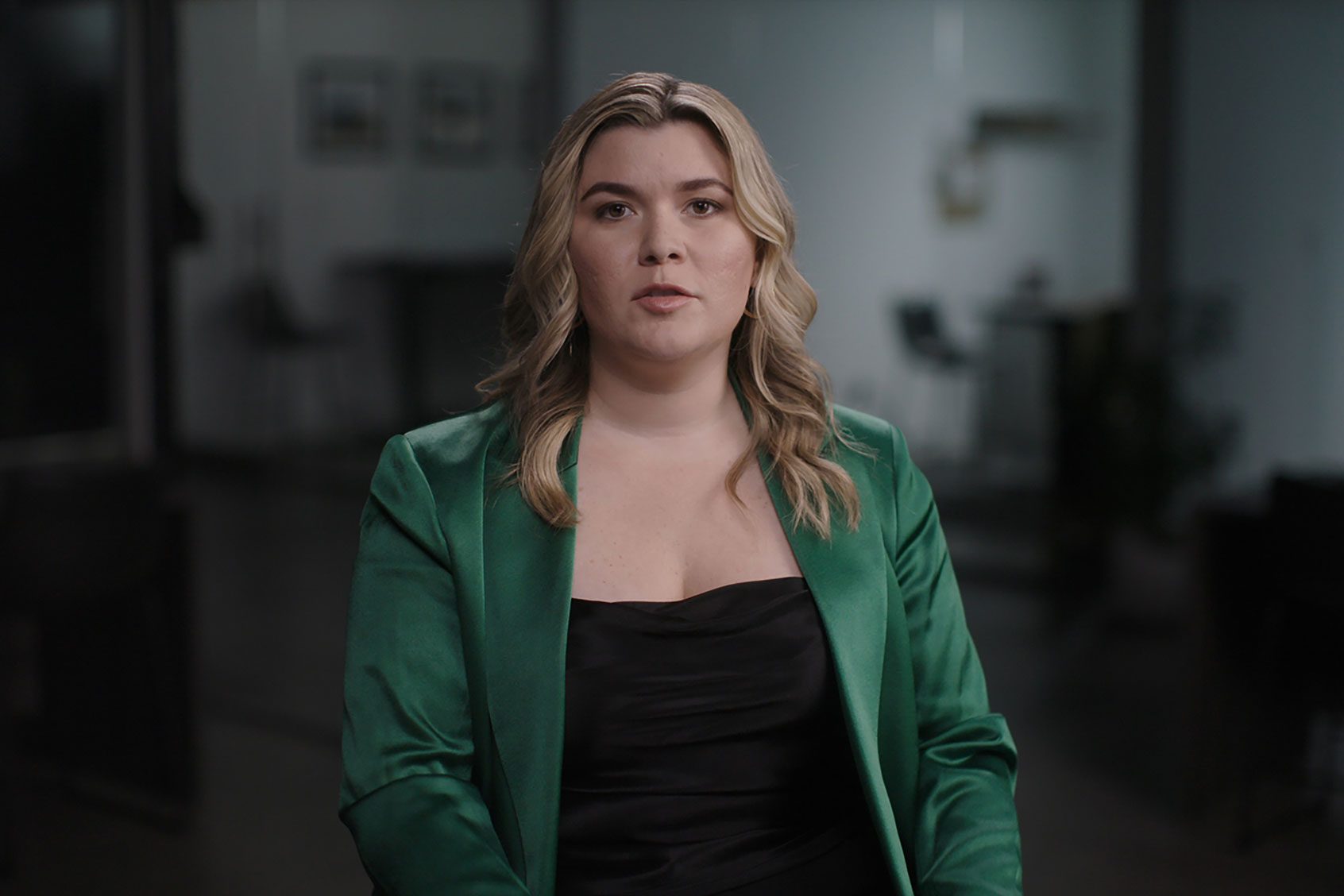
House of HammerCourtney Vucekovich in “House of Hammer” (Discovery+)
Courtney Vucekovich explained that Hammer subdued his victims by pushing their boundaries “a little bit at a time.” She recalled that while on vacation with Hammer, he brought a brown bag filled with ropes to their hotel room. Hammer allegedly told Vucekovich that he had only tied up mannequins before, never humans, and wanted to try out this fantasy with her. When she declined, he grew angry and later, took advantage of Vucekovich while he was inebriated.
 
“The ropes were around your neck, your wrists, your ankles, behind your back. I mean, I had bruises . . . I hated it. I understand that if this is your fantasy, more power to you but I didn’t like it and it didn’t feel safe,” Vucekovich said tearfully.
 
“I didn’t feel loved . . . and you’re completely immobilized. There’s something about trauma while you’re immobilized and can’t move. There’s that fight or flight, you can’t do either, you’re just stuck there. And I’m just closing my eyes until it ended and he just went to sleep like it was nothing.”
04
Effie’s bombshell allegations
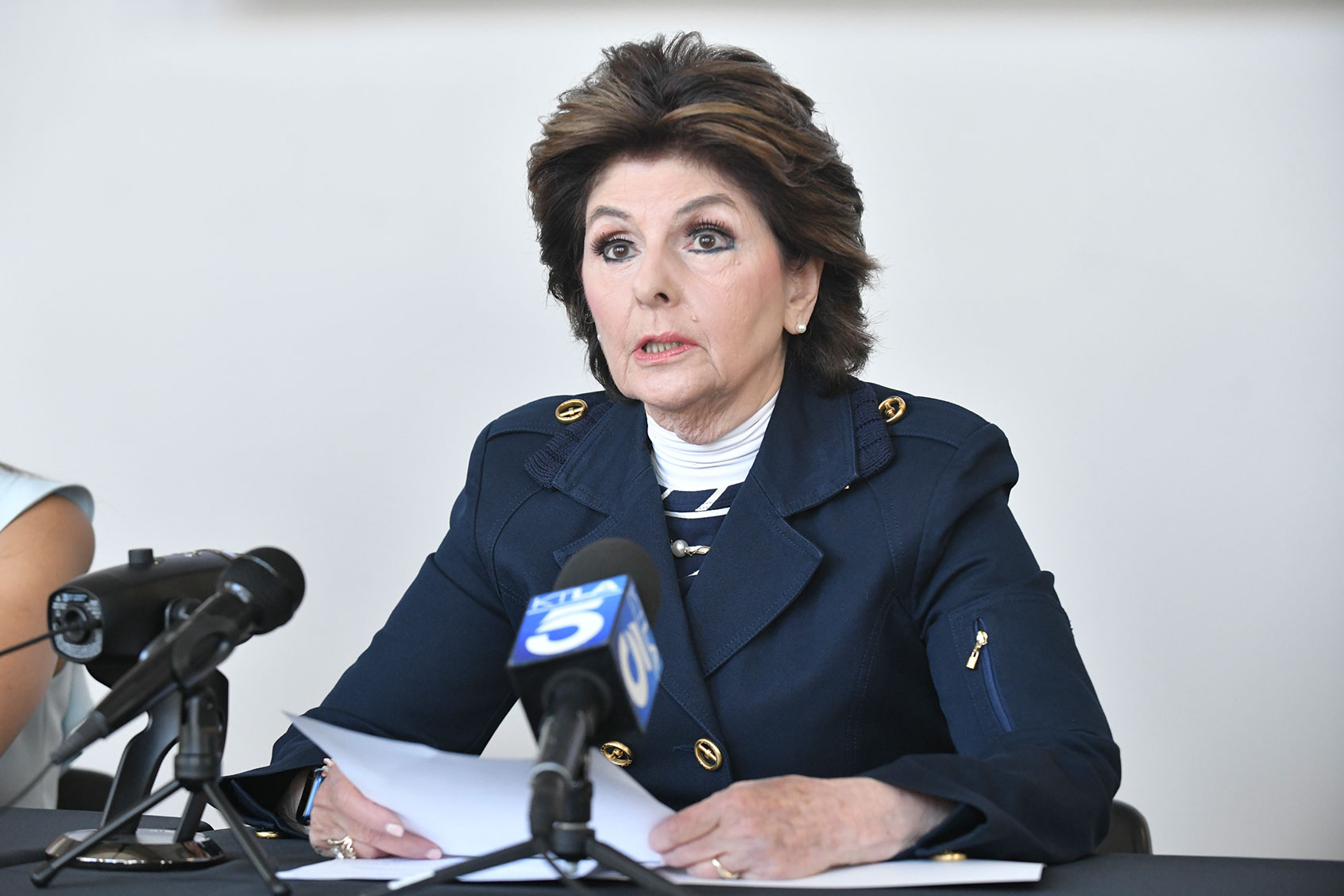
Gloria AllredGloria Allred speaks at a press conference to announce major victory for women’s rights at AMG Law on August 11, 2022 in Los Angeles, California. (Rodin Eckenroth/Getty Images)
“Effie” – from the House of Effie Instagram account that posted the incriminating screenshots of her texts with Hammer – took her revelations one step further. She decided to show her face and released a video statement alongside her attorney, Gloria Allred, in response to Hammer’s lawyers.
 
“I met Armie Hammer on Facebook in 2016 when I was 20 years old. The relationship progressed rapidly and the emotions from both sides became really intense,” Effie said in her opening. “He would often test my devotion to him by removing and crossing my boundaries as he became increasingly more violent. He abused me mentally, emotionally and sexually.
 
“On April 24th, 2017, Armie Hammer violently raped me for over four hours in Los Angeles during which he repeatedly slapped my head against a wall bruising my face. During those four hours, I tried to get away but he wouldn’t let me.”
05
Murder, cover-ups and nepotism Hammer-style
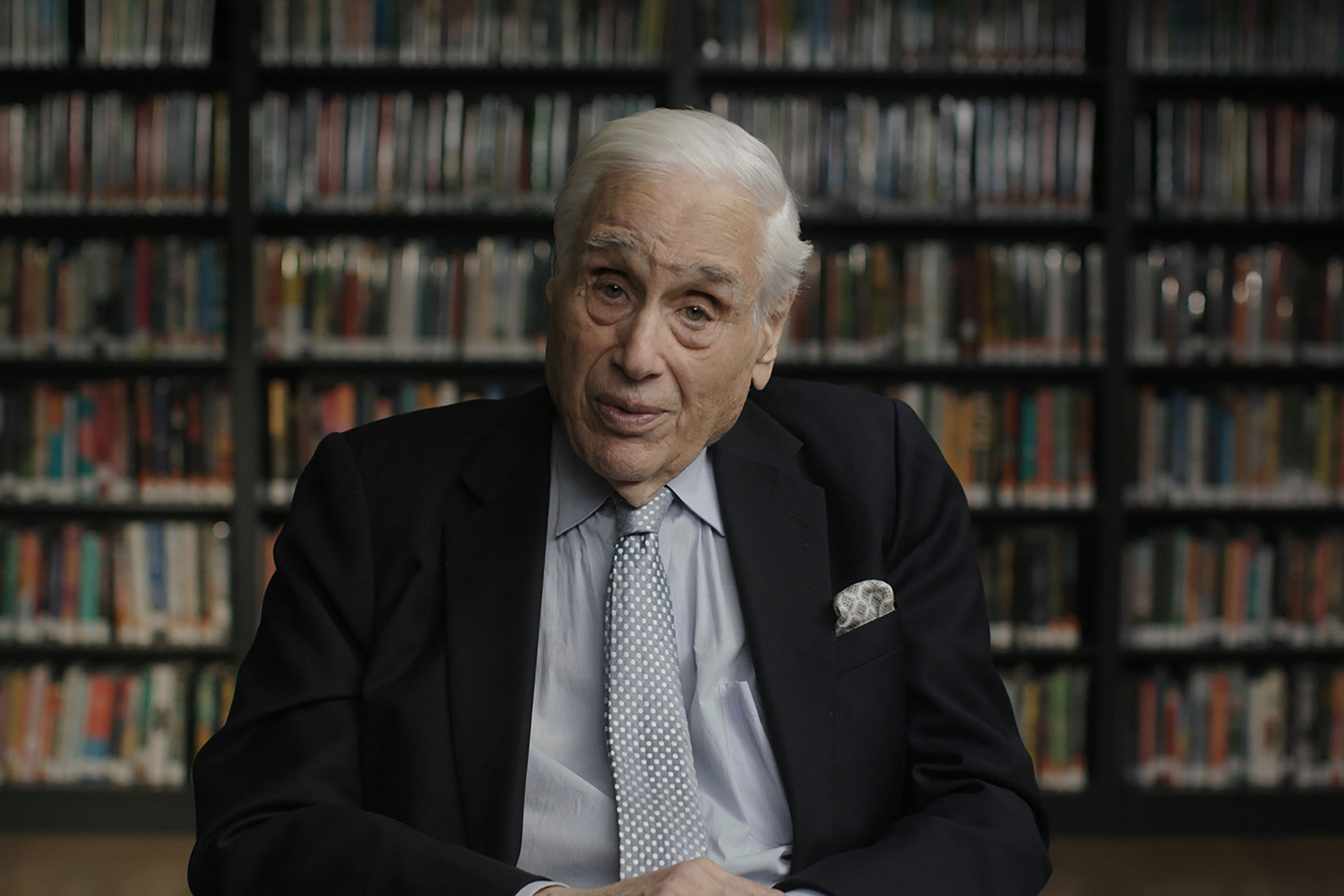
House of HammerEd Epstein in “House of Hammer” (Discovery+)

Armie Hammer’s aunt, Casey Hammer, revealed numerous instances of horrifying, scandalous and criminal behavior in her family in order to show that the actor was not the first to abuse power. In fact, her own father was one such man.
 
It turns out that in 1955, her father Julian Hammer (and Armie’s grandfather) was arrested for manslaughter after he murdered his close friend Bruce. During a birthday celebration in Los Angeles, Bruce reminded Julian that he owed him $400. Julian then grew upset and shot Bruce two times, killing him on the spot.
 
“The story that he told us was self-defense, but my mom was very quick to tell me, ‘No, your father just murdered someone in cold blood,'” said Casey in the documentary.
 
Following the murder, Julian’s father, business leader Armand Hammer, paid his lawyer $50,000 to absolve his son of all the charges. Per Edward Epstein, the author of “Dossier: The Secret History of Armand Hammer,” the money was to protect Armand’s high-profile reputation rather than to help his son. Julian was then given a position at Occidental Petroleum — the chemical industry company founded by Armand — per Armand’s request. There, Julian carried out illegal operations, such as secretly recording phone conversations, and became a “spy” for his father.   
06
Armie Hammer’s cannibalistic fantasies
House of HammerCourtney Vucekovich in “House of Hammer” (Discovery+)
Courtney Vucekovich revealed that Armie Hammer frequently carried safety pins, Shibari ropes, knives, a paddle and other BDSM-like tools when they traveled together.
 
“He said he wanted to find a doctor in Los Angeles to remove both my ribs. He wanted to eat my ribs,” she said. “He wanted to smoke them. He was obsessed with meat.”
Vucekovich explained that Hammer frequently organized “high protocol nights,” which consisted of strict rules that were established by Hammer and built around inflicting pain on Vucekovich.
 
“On one of these high protocol nights, I was tied up, and he basically looked over my body and said to me, ‘Where should I put my initials on you?'” Vucekovich recalled. “And then he just started to carve his initials into me. And I just didn’t say anything. It was bleeding and he was licking it, drinking blood.”
07
Michael Hammer’s “sex throne”
House of HammerThe ZenBlonde in “House of Hammer” (Discovery+)

According to Lauren Skae — also known as TikToker The Zen Blonde, who delved into the Hammer family’s dark history — Armie Hammer’s father Michael (and Casey’s brother) had a 7-foot-tall “sex throne” (also called the “naughty chair”) which was kept in the Armand Hammer Foundation headquarters. The chair allegedly had a hole in the seat, a cage underneath and a hook — resembling a meat hook.
 
An old photo of Michael shows him sitting on the throne and holding the head of a blonde woman, who is sitting in the cage and smiling. Despite the photos and descriptions of the throne, Michael’s lawyer later claimed the throne was merely a “gag gift.”
 
“It seems like an awfully large ‘gag gift’ and a very customizable gag gift to give someone,” Skae said in the documentary.
08
Julian Hammer’s lewd house parties
House of HammerCasey Hammer in “House of Hammer” (Discovery+)

Following her parent’s divorce, Casey said she rarely saw her father and only visited occasionally. During one visit, she returned to her childhood home and witnessed a sex and drug-fueled house party hosted by her father.


“It was a lot of drinking . . . a lot of smoke-filled rooms, a lot of screaming, a lot of loud music, a lot of drugs,” Casey recounted. “He always had 16- or 17-year-old girls around, not much older than I was, five or six years older, and he called them his ‘housekeepers.’ It was code for his girlfriends . . . It was almost like giant orgies.”


Casey also recalled finding polaroid photos of an underage girl at the party performing sexual acts on a man as her father watched in the background.


“When my father and my brother surrounded themselves with young, impressionable women that would basically do anything that they asked . . . that was the mentality I saw,” she explained. “Women were disposable in the Hammer family.”


When asked how her family’s mistreatment of women influenced her perception of herself, Casey told Salon that making sense of her own identity has been hard:


“I speak a lot about it in my book of how I work through a lot of that just to get healed,” she said. “That I’m even sitting here right now, it’s a testament that for whatever reason, I’m supposed to keep plugging along because you know, I’m here for a reason.”


“And I think seeing “House of Hammer,” I had a moment where you go, “OK, this is why I’m going to keep moving forward with this purpose and help empower women because I know how great it made me feel.” It’s like one of those things where everything you need is inside. And the minute you stop and take the moment to just love yourself for who you are, it’s OK, it’s good enough.”

“House of Hammer” is available for streaming now on discovery+. Watch the trailer below, via YouTube:

A timeline of what’s made “Don’t Worry Darling” the buzziest movie before we’ve even seen it

The desert looks sprawling and lovely, the Oscar-nominated star intense. It’s a huge, splashy film generating the kind of early interest publicists would kill for. And no one except critics and lucky audience-goers to the Venice Film Festival have seen it. 

It’s “Don’t Worry Darling,” the film that may finally answer the question: Is all publicity good publicity?

“Don’t Worry Darling” has certainly had its share. The second, full-length feature outing from director Olivia Wilde – known for her acting on the stage, on medical drama “House” and in movies like “Better Living Through Chemistry,” before moving behind the camera for 2019’s “Booksmart” – the film seemed poised for success. The trailer was mysterious and epic. Billed as a psychological thriller, the story revolves around a seemingly happy couple in the 1950s, living in a perfect company town.

Multiple scandals, rumors and conspiracy theories later, the film now seems set for infamy. Is this a case of gossip derailing, or at least drawing attention away from, the work of a female director, already a rarity in Hollywood? Or is there an actual fire behind this smoke, maybe three or four fires?

Salon breaks down the buzz around “Don’t Worry Darling” with a timeline that attempts to explain the public’s interest in the film (or more precisely, its cast and director) and its many controversies. 

Early 2020

Just a few months after the film “Don’t Worry Darling” was announced in 2019, with Wilde slated to direct, Wilde and her partner, “Ted Lasso” star Jason Sudeikis, split. The pair were not married but have two children together.

In April, a cast for the film was announced, featuring Florence Pugh, Chris Pine and Shia LaBeouf.

September 2020

Harry StylesHarry Styles performing on the Main Stage at War Memorial Park on May 29, 2022 in Coventry, England. (Joseph Okpako/WireImage/Getty Images)By the fall, LaBeouf was out, replaced by Harry Styles in the role of Jack, the romantic lead opposite Pugh’s Alice. Known as a musician, including as a member of the popular boy band One Direction, Styles had some acting experience, including “Dunkirk,” and is starring in the upcoming film Prime Video movie “My Policeman.”

December 2020

In December, LaBeouf was named the subject of a lawsuit by musician FKA twigs who alleges the actor, her former partner, abused her physically, emotionally and sexually during their relationship. These were not the only abuse claims leveled at LaBeouf, who in 2020, shortly after he was out of the “Don’t Worry Darling” cast, sought residential treatment for an undisclosed issue

February 2021

Filming wrapped on the film, about a month after Wilde and Styles were seen holding hands at a wedding. The two met on the film but would not confirm their relationship. The 10-year age difference between the two was the subject of some outdated controversy. As Rolling Stone wrote, “Anonymous tweeters acted appalled at their age difference (as if a 28-year-old man dating a 38-year-old woman isn’t completely normal) and criticized the director-actor dating dynamic (as if there isn’t a long history of beloved Hollywood couples meeting the same way).”

April 2022

On stage at an event in Los Vegas while promoting the film, Wilde was served with legal papers. Derailed from her speech, she opened the envelope and read it swiftly and silently, then returned to introducing a clip of her film without comment. When asked by the press later about the contents of the envelope, Wilde said the papers were Sudeikis’ custody filing. 

Sudeikis later claimed he had no idea the papers would be served to Wilde on stage in that way. 

August 2022

After fans noticed a lack of “Don’t Worry Darling” posts on Pugh’s social media – in sharp contrast to Wilde’s feed, where the director publicized her upcoming film often, including copious praise of Styles’ work — Pugh talked about the film in a Harper’s Bazaar interview. Wilde had brought up the film’s sex scenes in her own press, claiming they filled a gap in representing female pleasure, telling Vogue in late 2021, “I kept saying, ‘Why isn’t there any good sex in film anymore?'”

But Pugh told Harper’s Bazaar in August 2022, “When it’s reduced to your sex scenes, or to watch the most famous man in the world go down on someone, it’s not why we do it . . . It’s not why I’m in this industry.”

Speculation of a feud between Wilde and Pugh began to gather momentum, prompted by the incongruous way the actor and the director talked about sex scenes in the movie, claims that Wilde was distracted from directing on set by her budding relationship with Styles and rumors of a pay disparity between Styles and Pugh, with some claiming the male star made three times as much money as the female star. In an email to Vanity Fair, Wilde denied the pay disparity claim, calling it “invented clickbait.”

Shia LaBeouf; Florence PughShia LaBeouf and Florence Pugh (Photo illustration by Salon/Getty Images)That email was part of a larger interview with Wilde, a cover story where the director talked candidly about the reason for LaBeouf’s replacement. Perhaps too candidly. In the Vanity Fair story, Wilde claimed, “His process was not conducive to the ethos that I demand . . . He has a process that, in some ways, seems to require a combative energy, and I don’t personally believe that is conducive to the best performances. I believe that creating a safe, trusting environment is the best way to get people to do their best work. Ultimately, my responsibility is to the production and to the cast to protect them.

LaBeouf responded immediately, firing back in emails to Variety that he was not fired from the production, as the Vanity Fair story claimed, but that he quit. Not only that, Wilde wanted him to return, as evidenced in text messages the actor shared with Variety. 

He also shared a video allegedly sent to him by Wilde on August 19, 2020 (two days after he claims to have quit the film, due to a lack of rehearsal time) in which Wilde says, “I, too, am heartbroken and I want to figure this out . . . You know, I think this might be a bit of a wake-up call for Miss Flo, and I want to know if you’re open to giving this a shot with me, with us. If she really commits, if she really puts her mind and heart into it at this point and if you guys can make peace — and I respect your point of view, I respect hers — but if you guys can do it, what do you think? Is there hope?”

It was the “Miss Flo” comment that seemed to galvanize the internet, its seemingly dismissive tone about the young woman turning some fans against the director. 

September 2022

“Don’t Worry Darling” premiered at the Venice Film Festival on Sept. 7. The day before, Pugh was noticeably absent from a press conference about the film. The actor’s only press commitment was apparently attending the Venice premiere. Asked about Pugh’s absence, Wilde cited scheduling conflicts and a late-arriving flight. However, before the press conference ended, Pugh was spotted on the streets of Venice in a bright and summery Valentino ensemble, holding a beloved Aperol spritz

Meanwhile, Pine’s mannerisms were also remarked on at the festival. He appeared to disassociate during interviews, where Styles gave responses such as the now-legendary, “My favorite thing about the movie is, like, it feels like a movie. Like, you know, go to the theater film movie.” You can now buy this interview response on a T-shirt.

Once Pugh showed up memorably on the red carpet, several of her co-stars, including Pine, were quick to heap support on the star, taking real and imagined pictures and vocally praising her. The whole cast, including Styles and Wilde, posed for pictures, with both Pugh and Wilde and Wilde and Styles staying notably apart, which didn’t help the feud rumors and also ignited some new ones that perhaps Wilde and Styles had split or sought to distance themselves from each other.

Once everyone finally sat down in the theater — as one Twitter user pointed out, “whoever made this seating arrangement has planned a wedding with divorced parents”— the drama was not done, as Styles appeared, in some videos, to be spitting upon Pine as the musician took his seat beside Pine. Representatives from Pine have vehemently denied the spitting allegation, though the conspiracy has taken on a life of its own on the internet with spitting truthers. Pine did clearly put on sunglasses as the house lights dimmed for the start of the film, leading some to speculate he was about to take a nap. Perhaps he simply forgot eyeglasses except his tinted lenses? 


Want a daily wrap-up of all the news and commentary Salon has to offer? Subscribe to our morning newsletter, Crash Course.


After the film, the audience gave a standing ovation, which may have been cut short by Pugh leaving quickly.

What about the actual movie? Early reviews have been mixed, with many critics praising Pugh’s and Pine’s performances and Wilde’s direction and role in the film, but being less effusive about both Styles as well as the story itself.

We’ll have to wait and see. In the meantime, we’re actually quite worried, darling. 

“Don’t Worry Darling” is slated for wide release Sept. 23. Watch a trailer for the film via YouTube below: 


Hillary Clinton tells hosts of “The View” that Trump’s Mar-a-Lago documents are no laughing matter

Hillary Clinton and Chelsea Clinton appeared on “The View” Wednesday to discuss their new Apple TV+ docuseries, “Gutsy,” but, expectedly, the hosts were chomping at the bit to turn the topic towards Trump.

After a brief intro and a few moments of niceties, the conversation took a sharp turn towards Mar-a-Lago, causing laughter to erupt amongst the hosts, but Clinton kept a serious tone and reminded them that Trump taking sensitive documents from the White House is nothing to joke about.

“I think this should be taken really seriously,” Clinton said. “It’s not a joking matter . . . It should concern every American because those documents, and the empty folders, as they were marked, suggest that there was really important secret information that is essential to our country’s defense and security. And when the report came out yesterday that the documents also included information about — and we don’t know which, an ally or an adversary’s — nuclear program, I cannot tell you how terrifying that is.”

From here, Clinton shed light on the normal protocol in handling such documents, learned from her time as Secretary of State, saying “literally a military courier would come into my office — it would be an emergency, there wouldn’t be time to get to the White House and have a meeting in what’s called a SCIF, a secured facility — so usually a man, it was always a man as I remember, walked in [and] he would have like a briefcase locked to his wrist. And he would come into my office and he would say ‘You have to look at this immediately, Secretary.’ He would unlock the briefcase, he would stand there, he would give me this document that had really delicate, secret information about something of importance. I would read it and then I would sign that I had read it [and] it would go back into the locked box attached to his wrist and off he would go. So I don’t understand how these documents ended up where they are. I don’t understand how he was permitted to take them, even to the residence, let alone to a country club in Florida.”


Want a daily wrap-up of all the news and commentary Salon has to offer? Subscribe to our morning newsletter, Crash Course.


“Well where was the guy with the lockbox?” Behar asked of Clinton.

“I don’t know,” Clinton replied. “That’s what I’m asking. I don’t know . . . And we don’t have, yet, an understanding of what was in them. We’re getting little drips and drabs like the nuclear posture of an ally or an adversary. But people literally die to get our government information. They go to prison. They get exiled. It’s dangerous oftentimes, and the idea that this would have been done I hope everybody takes really seriously.”

After hearing everything that Clinton had to say about Trump’s handling of the documents, Behar asked the Former First Lady to give her opinion on whether Trump should be indicted for his actions.

“I don’t wanna pre-judge. I’ve been pre-judged, wrongly, enough,” Clinton said. “I’m not gonna pre-judge someone else. I think the key is what the facts and the evidence are. What the FBI and the intelligence community learn about these documents; how they ended up there, who else saw them. Because apparently they’ve been moved around. It’s not like they were in a vault. They were in a storage room where people go in and out getting umbrellas for the pool . . . So I think that we have to wait and we have to have two minds about this. No one is above the law. And the rule of law in a Democracy has to be our standard. But, we should not rush to judgement.”

Watch the full segment here:

Glaciers and “zombie ice”: The planet is melting at both ends, research finds

That sea levels will rise as Earth's ice melts is a prophecy that began to come true long ago, at the dawn of industrial civilization when humans began pumping vast amounts of greenhouse gases into the atmosphere. Yet the timeline for sea level rise is not yet fully understood, nor do we really know how close our coastal cities are to facing devastation from the concomitant floods or higher tides. 

Now, a new pair of studies reveals one possible — even likely — pathway for which sea level rise might play out on Earth, and flood our coastal cities.

The first study — which was published in the journal Nature Geoscience — involves the Thwaites Glacier, a natural wonder of the western Antarctic that is roughly the size of Florida. Being the widest glacier in the world, it has been nicknamed the "Doomsday Glacier" —  because if it collapses, the consequent rise in global sea levels would flood millions of people out of their homes. Researchers have already determined that the Thwaites Glacier is melting at dangerous levels, and the new study reveals the severity of the problem.

"Our greenhouse gas emissions are hitting the climate system with a metaphorical hammer."

Researchers studied imprints on the seabed to ascertain the Thwaites Glacier's movements over the past century; hence, they determined that the glacier had shrunk by roughly 1.3 miles each year during that period. That is twice the rate of shrinking that we are seeing today, which means that although the current rate of melting is not unprecedented, the ice sheet is indeed capable of melting so much that the Thwaites Glacier itself would collapse. If all of the ice that exists upstream in the Thwaites Glacier's drainage basin melts, global sea levels will rise by more than two feet.

"About 100 years ago, it retreated faster than it is currently retreating… you could say that's good news because it's not so bad now compared to what it was in the past," Dr. Anna Wåhlin, a professor of physical oceanography at Sweden's Gothenburg University and a co-author of the study, told NBC News. "But you can also say that it's bad news, because it could happen again."

The second study — which was published in the journal Nature Climate Change — was led by Dr. Jason Box, a glaciologist at the Geological Survey of Denmark and Greenland. It found that Greenland's rapidly melting ice sheet will raise global sea levels by at least 10.6 inches (27 centimeters). This is more than twice as fast as experts previously thought, and it is being fueled by "zombie ice," or smaller bodies of ice that are still attached to larger bodies of ice but are doomed to melt because they are not being constantly fed snow by a parent glacier.

As study co-author Dr. William Colgan explained to the Associated Press, "It's dead ice. It's just going to melt and disappear from the ice sheet. This ice has been consigned to the ocean, regardless of what climate (emissions) scenario we take now."

This places the new study in contrast with the Intergovernmental Panel on Climate Change (IPCC), a body of the United Nations focused on combatting climate change. The IPCC projected last year that Greenland's ice melt would only raise sea levels by a range of 2 to 5 inches by the year 2100.


Want more health and science stories in your inbox? Subscribe to Salon's weekly newsletter The Vulgar Scientist.


Dr. Jim Hansen, the director of the Climate Science, Awareness and Solutions Program at the Columbia University Earth Institute, told Salon by email that the recent papers are "incremental pushbacks" from scientists "to fight the scientific reticence institutionalized by IPCC."

"After failing for decades to properly warn the public and offer even a modicum of advice about needed policies, IPCC continues to pretend that it is possible to keep global warming below 1.5°C with goals and targets for emission reductions," Hansen explained. "The climate science tells us that we are already into dangerous levels of greenhouse gases that will have consequences far beyond 10 inches of sea level rise."

Dr. Sarah Pralle, an associate professor of political science at Syracuse University who specializes in environmental politics and policy, climate change and energy, also told Salon that the new studies suggest "that our previous models of climate change impacts have likely underestimated the scale and timeline of major climate disasters such as sea level rise."

Dr. William Sweet, a scientist at the National Oceanic and Atmospheric Administration (NOAA), referred Salon to the agency's Sea Level Rise Technical Report. Released in February, the report seems to reinforce the concerns raised by the two recent studies. The NOAA report projects that sea level along the United States coast line will rise from 10 to 12 inches within the next 30 years, although that is only an average figure. Along the East coast, the rise is expected to be 10 to 14 inches; for the West coast, it is expected to be 4 to 8 inches; and for the Gulf coast, it is expected to be 14 to 18 inches.

Needless to say, major metropolises from San Francisco to New York City can expect to be severely flooded.

"Sea level rise is already affecting us, here and now, and will continue to grow in severity during the coming decades."

"These studies provide additional evidence about future-possible rises in sea level that the public needs to be aware of," Sweet wrote to Salon. "Sea level rise is already affecting us, here and now, and will continue to grow in severity during the coming decades." In the words of Dr. Ken Caldeira, emeritus senior scientist at the Carnegie Institution for Science, "these sorts of studies are not surprising to people who have been studying how climate has changed in Earth's geologic past."

"Studies of climate change in the geologic past paint a picture of a world that can change much more rapidly and strongly than what is predicted by most modern climate models," Caldeira argued. "Our greenhouse gas emissions are hitting the climate system with a metaphorical hammer. We have to expect the unexpected. If we think what is predicted is all we have to worry about, then we are living in a fantasy land. We are interfering in a system that is far more complex than any of our models. We can be confident that many things will happen that we will be unable to predict."

Some scientists had criticisms as to how the studies are being presented to the public by media outlets.

Dr. Michael E. Mann, a distinguished professor of atmospheric science at Penn State University, wrote to Salon about the new studies, which he had discussed with "one of the leading glaciologists in the world," Dr. Richard Alley. They argued that, despite the "rather breathless headline in the NBC News piece" ("'Doomsday' glacier could melt faster than previously thought"), the new study does not change anything substantial about what we know regarding the Thwaites Glacier.

"As Richard told me, 'the information doesn't really support any sound bite about instability or stability of the ice sheet, with no fundamental change in our understanding,'" Mann explained. "To be clear, our current understanding is reason for concern enough. It suggests that we could be perilously close to locking in enough warming that we lose substantial part of the West Antarctic Ice Sheet, enough ice to give us 10 feet or more of sea level rise eventually.  But we knew that going in. This study doesn't change our understanding in that regard.

Regarding the Greenland study, Mann again urged caution from media outlets covering it.

"It's a useful study and the main conclusion — that there may be a foot of committed sea level rise from the Greenland ice sheet — seems entirely plausible," Mann wrote. "But here too some of the coverage has been misleading. The authors (as noted in the AP article) imply that this will happen within this century, but they don't actually provide any support for that, so it seems that some of their public commentary goes behind what their science actually shows."

Dr. Kevin Trenberth, who is part of the Climate Analysis Section at the US NCAR National Center for Atmospheric Research, was very critical about how the reports are being publicly discussed.

"The rhetoric about both studies is misleading at best and often wrong," Trenberth wrote to Salon. "There are huge consequences of land-based ice melt for sea level rise. The Greenland study does not put a timeline on the loss of ice: it is certainly not this century but perhaps [two] centuries. So it is indeed a major long-term concern but a lot of rhetoric in reporting is wrong."

He added, "The Thwaites article is interesting in providing a mechanism for increasing the flow of the glacier. It is much less clear what it means for sea level rise and on what time scale. Again, it is is major long-term concern but…  And there are many buts."

Trenberth mentioned that some of the ice in question is already floating and therefore will not impact sea level when it melts. It also does not account for "the other things that go in other directions, like increasing snowfall over Antarctica which takes water out of the ocean. So people should be concerned and welcome increasing information and understanding, but there are many other reasons to be more concerned."

Trenberth pointed to Pakistan as an example of real-life proof of climate change-related flooding, writing that "the extensive flooding in Pakistan is partly a consequence of the heavy rains but also higher sea levels that prevent the land water from draining away."

Some of the scientists who spoke to Salon also discussed potential policy solutions to humanity's climate change problems.

"Policymakers and political leaders need to take note and intensify and speed up their responses to the climate threat, to give us the best possible chance to avoid the worst impacts of climate change," Pralle argued. "Some of these changes are going to occur whether we cut emissions or not, so we also need to adapt to the changes that are already 'baked in,' so to speak. At the same time, we should not let stories/ research like this leave us hopeless. Everything we do to cut emissions of greenhouse gases will help, and the difference between some warming, and a lot of warming, is monumental in terms of the scale and extent of damages."

Hansen, for his part, specifically suggested increasing the price on carbon products, pointing out that "economic science tells us that we are not beginning to address the matter until we put a steadily rising price on carbon." He argued that this is not happening because "our politicians do not have the courage for that, even though there are ways to do it (carbon fee and dividend) that benefit most people economically. They prefer to subsidize this or that, which will have little effect on global emissions."

This crispy, buttery sun-dried tomato and rosemary gnocchi is the perfect fall dinner

Earlier this week, I spotted a woman getting out of a car, wearing a familiar Gucci logo emblazoned on her black t-shirt. But after blinking and rubbing my eyes, I realized that the word under the emblem most certainly wasn’t “Gucci.” 

Instead, there in bold, white letters, the word “Gnocchi” was scrawled across the shirt — the same one, I might add, that was once sported by Joe Gorga of “Real Housewives of New Jersey” fame — proud and brazen. As someone who was born and raised in a predominantly Italian-American area, I understood the appeal. 

Unlike other Italian-American mainstays like chicken parmesan and spaghetti and meatballs, I didn’t grow up with gnocchi. Instead, I developed an appreciation for the labor-intensive nature of the gnocchi-making process in the years before entering culinary school and made it a point to master the dish while in school. 

Without tooting my own horn too much, I’d say it’s safe to say that I did just that. (Commence horn blowing now)

Akin to puffy, light clouds and landing halfway between a toothsome noodle and a soft, doughy dumpling, gnocchi is a familiar yet unique offering in the Italian American culinary landscape lexicon. They pair beautifully with practically anything, from heavier sauces like Bolognese or pesto cream, to the simplicity of a basic marinara, to the richness of browned butter with sage and a bit of lemon. 

This adaptability makes them a particularly wonderful “pasta” choice, and there’s a pliant, gentle familiarity of the food that makes them particularly ideal when feeling under the weather, down in the dumps, or your preferred phrase or idiom for just not feeling your best. Gnocchi’s pillowy, airy nature is a perfect panacea. 

As I’ve mentioned before, culinary school was one of the first times that I felt pride in my half-Italian heritage. As I began embracing this aspect of my nationality more and more as the program continued, I knew that I wanted to craft an Italian-focused dish for my upcoming practical examinations. 

For one of them, we had to make a composed dish that featured a protein, a starch, a vegetable and a sauce. I think I overshot the mark, but I aimed for a sauteed chicken dish with a carrot puree, crisped pancetta, a simple beurre blanc and (you guessed it) — gnocchi. 

I thought it’d be an interesting way to show that I was game for more challenging approaches and would take the time and effort to make gnocchi from scratch, as opposed to just hitting the “starch” mark by mashing potatoes or serving some rice pilaf. 

I got my sauce together, I cooked my chicken perfectly, I roasted some fennel with gruyere and I mastered my silky, rich carrot puree.  The gnocchi, on the other hand, was a debacle. 

I repeatedly roasted Idaho potatoes until they became crisp and strikingly hot, then waited a bit until they could be handled with my gloved hands, but for some reason, the “dough” just wasn’t coming together. I scrapped it, tried again, and had the same result. I took a breather and ran through my mental rolodex, trying to come up with what the issue was, deciding that I wouldn’t pivot away from gnocchi as my “starch” and that I’d commit to resolve the problem before the clock ran out.

Amazingly, the third round went perfectly. The potatoes were tender, the eggs and cheeses blended in perfectly, I took pride in rolling out the dough, using my bench scraper to portion the gnocchi before marking them with the tines of a fork. Then I opted to pan-sear the gnocchi instead of boiling them. 

This is 100% a personal choice, by the way. The classic dish is almost always cooked in boiling, salted water. I just find that it can be very easy to overcook and wind up with bloated, waterlogged potato balls as opposed to the perfect pillowy, airy gnocchi. 

Then came the time to plate the dish. I began by smearing the puree and topping it with gnocchi and pancetta, before serving the  fennel and gruyere frico-topped chicken alongside. I then drizzled the beurre blanc over the top. 

I presented it to my chef-instructor and got the highest marks in the class during that practical. I’m still pretty proud of myself for that one. I remember thinking that I could be the burgeoning “gnocchi king” — Nina Compton was competing on Top Chef at that same time and was known as the “gnocchi queen,” so the moniker seemed to be fun and potentially fitting. Regardless, something about the variability of the dough, the tactile nature of rolling out and hurriedly cutting the dough, and proudly plating a dish of my own making was immensely satisfying. 


Cook’s Notes

I like to use baked potatoes, usually russet or Idaho, with the skin-on and cooked in a high-heat oven. However, feel free to peel, dice, and boil in salted water. You just want to ensure you don’t over-boil them or the dough won’t come together.

I always use lots of ricotta and Parmesan, but ricotta is not mandatory. Adding the ricotta makes these gnocchi a bit of a “quasi-gnudi,” so embrace the mash-up.

As mentioned, you can boil the gnocchi. Don’t just throw them in a pot of boiling water, though — they’re quite tender and delicate and can easily break apart in the pot, especially if the water is at a rolling boil. You want to tenderly spoon the gnocchi into the water. They’re done as soon as they float. Again, be careful.

Don’t just empty the boiling water and cooked gnocchi into a colander as that might damage some of the gnocchi’s structural integrity (leaving you with a sink full of gnocchi mush). I know using a slotted spoon or spider to extract the gnocchi may seem fussy, but it’s worth it. 

Pan-searing the gnocchi is fun, easy, and adds another textural level that can help differentiate the mouthfeel and consistency of the finished dish. 

Do not forget the egg. I once did this, and the dough literally just didn’t ever materialize. It’s such an important binder, especially if you forego the ricotta.

I love herb-infused gnocchi or even gnocchi with a vegetable puree incorporated into the dough (i.e., a spinach gnocchi, bright and verdant and green), but adding that step can make the whole process seem even longer and more laborious. If you have lots of time on a weekend or something, though, try it out! It’s outrageously delicious.

I like to add a crispy element — a fried vegetable, a crisped piece of protein, some sort of nut, seed, or grain — to help differentiate between the pillowy, soft gnocchi and the soft sauce. This crisp component to offset the softness of the gnocchi and sauce, tying the whole dish together and offering an alluring textural composition.

Be sure to make lots of space. Rolling out the dough, portioning it into “ropes,” and cutting it with a knife or bench scraper takes up more kitchen real estate than your typical pasta dinner. Be sure to clean your work surface really, really, well, too — it’d be frustrating to have perfect, unblemished gnocchi and then realize that a bunch actually have an errant poppy seed wedged inside the tiny dumpling (trust me).

Sun-dried tomato and rosemary gnocchi 
Yields
4 servings
Prep Time
45 minutes
Cook Time
90  minutes 

Ingredients

2 to 3 baking potatoes, scrubbed clean
2 large eggs
Kosher salt, to taste
1/3 cup full-fat ricotta (the uber-dense Italian ricotta in the white-and-red can is unbeatable) 
¼ cup grated Parmigiano-Reggiano, plus more for serving
5 tablespoons unsalted butter, divided
3 to 4 tablespoons sundried tomato in oil, roughly chopped
1/3 cup breadcrumbs (ideally Panko)
Palmful of fresh rosemary, freshly chopped
1 lemon, juiced and zested


Directions

  1. Preheat oven to 450 degrees and place potatoes on a rimmed baking sheet. Transfer to oven and cook for about an hour, or until the skins have crisped and slightly shrunken and the insides are tender. Let cool thoroughly (the interiors will be outrageously, unbelievably hot and must be cooled in their entirety prior to handling the dough with your hands, so that the eggs won’t scramble.)

  2. In a large bowl, scoop out the cooked potatoes and set skins aside (save for a delicious potato skin appetizer or double baked potato for some other time). Using a potato masher, mash the potatoes well. Conversely, run them through a food mill or a ricer. 

  3. Add eggs, salt, ricotta and parmesan to bowl and mix until just combined. Do not overmix. Note: if the mixture isn’t coming together well or there is too much moisture, add a tablespoon of flour one at a time until the dough becomes smooth, supple and clumps together. Cover and let dough rehydrate for a few minutes as you prepare your workstation.

  4. On a clean, clear, wide workspace, dust flour. Pull about a quarter of the dough out of the bowl and roll in between hands until it elongates and creates a “rope” of dough. Repeat with remaining dough.

  5. Prepare a large platter or baking sheet with another dusting of flour. This will be your gnocchi “landing zone.”

  6. Using a sharp paring knife or a bench scraper, begin cutting your “gnocchi ropes” into stout, short pieces (ideally just under an inch), transferring to your landing zone as you run through the rope. After finishing each rope, make ridges by gently pressing the tines of a fork against the gnocchi. Repeat with remaining ropes.

  7. Over medium-heat, warm olive oil in a large skillet. Once slightly rippled, add gnocchi directly to the pan, cooking for 2 to 3 minutes in total, flipping them often. Use a slotted spoon to remove to a paper towel-lined plate. Repeat with remaining gnocchi and cook in batches.

  8. Melt 2 tablespoons butter in the same pan. Add sundried tomatoes and cook for 3 to 5 minutes, until deeply fragrant. Add breadcrumbs and toss often, until they darken, and finish with chopped rosemary. Add lemon zest and season with salt. Transfer to a bowl.

  9. Add remaining butter to the pan, along with the lemon juice. Add cooked gnocchi to the pan, stirring constantly, and add tablespoons of water if the pan is too dry. 

  10. Transfer gnocchi and lemon-butter sauce to plate and top with breadcrumb-sundried tomato mixture. Finish with more lemon or more grated parm and serve immediately. 
     

Salon Food writes about stuff we think you’ll like. Salon has affiliate partnerships, so we may get a share of the revenue from your purchase.

How children’s hospitals became the right’s newest target of hate

At first blush, the right’s new war on children’s hospitals is most reminiscent of the tactics that have been used to harass abortion providers for decades. As Taylor Lorenz, Elizabeth Dwoskin and Peter Jamison reported over the weekend for the Washington Post, “Children’s hospitals across the U.S. are facing growing threats of violence” from crazed right-wingers, like fans of the virulently queerphobic Twitter account Libs of TikTok, run by a woman named Chaya Raichik. Raichik keeps pointing her unhinged audience at various pediatric care facilities, resulting in “a flood of online harassment and phoned-in threats” at doctors and hospital staff. 

Abortion providers and their allies will immediately see the connection to the throngs of anti-choice militants that gather around family planning clinics to bully patients. Like anti-choice activists, the people attacking children’s hospitals are inserting themselves into the very personal decisions of total strangers. With anti-choicers, they’re asserting that their religious beliefs about a woman’s duty to breed trumps the right of bodily autonomy of patients. With those attacking children’s hospitals, right-wingers are all wound up because they heard trans children are getting treatment, and they believe their opposition to trans identities should trump the child’s right to gender-affirming care. 

But there’s one major difference between the two, one that really highlights how the already bizarre world of right-wing ideology has become more disconnected from reality.

Patients who have to run the gauntlet of misogynist hecklers at Planned Parenthood are mostly trying to get abortions and birth control, and the harassers are trying to stop them. But the vast majority of patients at Boston Children’s Hospital or Children’s National Hospital in Washington — which have both been subject to abuse — are getting care that has nothing to do with gender or sexuality. Conservatives are whipping themselves into a frenzy of hate for facilities that mostly treat cancer, asthma, and other childhood ailments. 


Want more Amanda Marcotte on politics? Subscribe to her newsletter Standing Room Only.


It’s part of a larger, troubling trend of Republicans growing increasingly hostile to the very concept of science-based medical care.

Trans kids are being scapegoated for the larger project of drowning conservatives in a sea of paranoia where they’re too isolated from moderating forces — a doctor, a friend, a relative — who might guide them back to reality. 

The right has always been hostile to gynecological care that made it easier for women to have sex without unwanted pregnancy, but that rarely spilled out to hatred of doctors generally. During the pandemic, however, it became an article of faith on the right that any effort to reduce the impacts of COVID-19, from the initial lockdowns to the vaccination push, was a hoax or a sinister assault on “freedom.” Now the hate is ballooning out, turning into a general suspicion of all kinds of health care. Children’s hospitals, which were once unassailable, have now become the focus of this fascistic rage. 

To be certain, there is gender-affirming care at these hospitals, as there should be. As the American Academy of Pediatrics explained in a recent court brief defending gender-affirming care, “Gender dysphoria is a serious medical condition” and gender-affirming care is the “accepted standard of care for adolescents at risk of or suffering from gender dysphoria.” But what this care actually looks like has no relationship to the lurid tales spun by Libs of TikTok or other transphobic hysterics. Fewer than 2% of adolescents identify as trans, and the standards of care they receive are both intensive and relatively slow-moving. So the recommendations are focused heavily on therapeutic approaches, mostly social transitioning with lots of checking in. It’s child-directed, based on listening to what kids are telling adults about their lives. Hormonal interventions tend to move cautiously and “current protocols typically reserve surgical interventions for adults.”

But to hear right-wingers tell it, the “left” — a group that is now routinely conflated with the medical establishment — is engaged in a mass experiment of forcing everyone to be queer. Recently, Rep. Marjorie Taylor Greene, R-Ga., filmed herself raving, “They just want you to think that all of a sudden the entire population is steadily turning gay or turning trans” and that soon “no one will be straight anymore.” 

This is, of course, silly and also doesn’t make a ton of sense. The point of the LGBTQ rights movement is to free people to live their true lives, not to force anyone who is comfortable being straight or cis into another identity. It’s not even clear what conservatives think the point of “making” people trans would be. What do they think the end game is? It’s never really clear. 

Conservatives are whipping themselves into a frenzy of hate for facilities that mostly treat cancer, asthma, and other childhood ailments. 

To be certain, the anti-choice movement is awash in all sorts of bizarre conspiracy theories, as well, from racist legends about people “eating” fetuses to myths about women being “tricked” into abortion through the “contraceptive mentality.” These conspiracy theories serve the same purpose as the hyperbolic attacks on trans youth, which is to deny the possibility that people sincerely want the choices the right would deny them. But it was rare for conservatives to use anti-abortion rhetoric as an excuse to launch a broad-based attack on the larger medical establishment. On the contrary, they’ve been so successful at rhetorically isolating abortion and contraception from the rest of medicine that it was genuinely a shock to many how laws banning abortion impact access to miscarriage management and treatment for ectopic pregnancies


Want more Amanda Marcotte on politics? Subscribe to her newsletter Standing Room Only.


The attacks on trans youth, on the other hand, are tied to a more generalized suspicion of pediatric care. It’s likely not a coincidence this is happening right on the tail-end of a now two-year-long campaign to demonize ordinary public health bureaucrats like Dr. Anthony Fauci, whose only goal was to keep people from dying of an airborne virus. It is a symptom of the right’s larger turn towards authoritarianism. Anger over gender non-conformity is the bait. Once conservatives bite, they’re coached to distrust any kind of scientific or empirical sources of information and instead put all of their trust into the often-bizarre claims of their ideological leaders. 

People often compare Trumpism to a cult — and for good reason. Like cult leaders, authoritarians understand that the more detached their followers are from reality, the more control they exert over them. The word “brainwashing” is severe, but brainwashing is the point of convincing followers to hate trusted institutions like the Boston Children’s Hospital or to reject banal medical advice to get vaccinated. Trans kids are being scapegoated for this larger project of drowning conservatives in a sea of paranoia where they’re too isolated from moderating forces — a doctor, a friend, a relative — who might guide them back to reality. 

Ilhan Omar takes aim at Ted Cruz over plan to block student debt relief: “Miserable little weasel”

Rep. Ilhan Omar on Tuesday called Republican Sen. Ted Cruz a “miserable little weasel” for actively seeking out ways to get the Supreme Court to block President Joe Biden’s plan to cancel $10,000 in student loan debt for most federal borrowers.

The Texas Republican is one of many GOP officials exploring a potential legal challenge to Biden’s student debt relief plan, which is popular with voters—including those without debt and those who have paid off their debt—and could benefit more than 40 million borrowers across the U.S.

“Let’s put this in terms you can understand, Ted: for the working class, student loan servicers are what 87,000 IRS agents are for your rich friends.”

“What a miserable little weasel, no wonder they call him ‘Lucifer in the flesh,'” Omar (D-Minn.) tweeted in response to news that Cruz and a litigator have been discussing tactics to get the debt relief plan before the Supreme Court, which is packed with Republican appointees.

“Fortunately, student debt cancellation is legally sound and should withstand legal scrutiny,” Omar argued. “Set your alerts for the application in October, if you qualify for relief, and file before the end of December.”

The Washington Post‘s Jeff Stein reported Tuesday that Cruz—who has falsely criticized debt cancellation as an attack on the working class—”says a top Supreme Court litigator told him that the best potential plaintiff for establishing ‘standing’ to overturn Biden’s student debt plan would be a student loan processor.”

Additionally, Stein noted, Cruz predicted the Supreme Court would support tanking debt relief by a vote of 6-3—an outcome that even some supporters of debt cancellation have warned is possible, given questions about the legal justification that the administration chose as well as the right-wing bent of the U.S. courts.

Since Biden announced his debt cancellation plan last month, Republican lawmakers, GOP attorneys general, and dark money groups have been searching for plaintiffs with legal standing to sue the administration—a difficult task because the challenger would have to demonstrate harm from the executive action.

As Inside Higher Ed noted Tuesday, student loan servicers “could say they are losing out on revenue” if Biden’s plan is implemented, but so far “no loan servicers have indicated that they are interested in a legal challenge.”

Progressives were quick to take Cruz and other Republicans to task for turning to student loan servicers—widely reviled private entities with long histories of abuse and mismanagement—to prevent student debt relief.

“In millions of households around the country, the name ‘Navient’ is practically like saying Voldemort,” the Debt Collective tweeted, referring to one of the largest student loan companies in the country. “Please Ted Cruz, make our day.”

“Let’s put this in terms you can understand, Ted: for the working class, student loan servicers are what 87,000 IRS agents are for your rich friends,” the Debt Collective wrote.

Indivisible, a progressive advocacy organization, added that “we have backed Republicans into defending student loan servicers.”

“The campaign ads practically write themselves,” the group declared.

Dr. Oz’s 2014 interview resurfaces: Incest “not a big problem” if “more than a first cousin away”

Republican United States Senate candidate from Pennsylvania Mehmet Oz defended incest in a February 2014 interview with a morning radio show that was unearthed on Tuesday by Jezebel.

“The Breakfast Club” host Angela Yee had read Oz a question on the topic that was submitted by a listener:

I’m going to ask you this and you tell me if this is safe for this person, okay? Well, he said, ‘Yee, I can’t stop smashing my cousin.’ That means sleeping with. We hooked up at a young age and now in our 20s, she still wants it. No matter how much I want to stop, I always give it to her. Help me.’ What advice would you give that person?

Oz, whose struggling campaign was endorsed by former President Donald Trump, offered his medical opinion.

Oz:

If you’re more than a first cousin away, it’s not a big problem.

Yee:

Okay, so second cousin is fine to smash.

Yee’s co-hosts also weighed in.

Charlamagne Tha God:

It’s so funny, cause I knew that.

DJ Envy:

How did you know that?

Charlamagne:

Cause I’m from the country! Third cousins?

Oz:

Yeah. It’s fine.

He explained the risks that incest poses to the health of offspring:

Every family has genetic strengths and weaknesses. And so the reason we naturally crave people who are not so like us is because you just mix the gene pool up a little bit so that if I had one gene for, let’s say, hemophilia, which is a classic example where you bleed a lot if you cut yourself, I don’t want to marry a cousin who has the same hemophilia gene, because the chance of our child having both those genes is much higher.

He continued:

You know, that’s why children, girls don’t like their fathers’ smell. Their pheromones will actually repel their daughters because they’re not supposed to be together. My daughters hate my smell.

Yee quipped to Oz that “maybe you just smell.”

Oz replied that “my wife says she likes the smell.”

Not long after the video surfaced, Pennsylvania Lieutenant Governor John Fetterman – Oz’s Democratic opponent – tweeted, “yet another issue where Oz and I disagree.”

Trump’s Mar-a-Lago judge now likely in line for the Supreme Court: MSNBC anchor

The Trump-appointed judge who issued the highly controversial ruling to appoint a special master to review government documents recovered by the FBI when agents executed a search warrant at Mar-a-Lago

“Well thanks to Donald Trump and the Republican Party adopting Trumpian attitudes, we now tonight know the name of the next Republican nominee for the United States Supreme Court,” MSNBC’s Lawrence O’Donnell said.

“If Donald Trump is the next Republican president, then his shortlist for the Supreme Court will only include one name,” he predicted. “That is probably also the case for Florida’s Gov. Ron DeSantis, if he is the next Republican president, including the fact that name comes from Florida.”

“This future Supreme Court nominee is young enough to remain at the top of the Republican shortlist for the Supreme Court for as long as it takes for another Republican to win the Electoral College,” he continued. “This future Supreme Court nominee is about 20 years away from turning 60. “

“Aileen Mercedes Cannon publicly applied for the job of Supreme Court justice, in writing, yesterday, in a 24-page opinion ordering a so-called special master to examine all of the evidence seized by the FBI from Donald Trump’s home in Florida,” O’Donnell said. “Judge Aileen Mercedes Cannon, who was appointed to a federal judgeship in the last months of Donald Trump’s presidency, is now only in her second year as a federal judge. And has suffered a great deal of what she would call reputational harm.”

O’Donnell went on to argue that Trump could not suffer reputational harm after all his scandals and included an anecdote from the 1972 Francis Ford Coppola film “The Godfather.”

Watch below or at this link.

Teflon Don: How Trump keeps getting away with it all — even top secret nuclear documents

When the FBI’s search warrant was served on Donald Trump’s beach club in early August, I don’t think anyone could have guessed that there would be such a mountain of classified material among the boxes of government documents he stole from the government when he flounced out of town, pouting like a 4-year-old, on Inauguration Day 2021. But the hair on the back of the neck stood up when we later learned that they were looking for nuclear intelligence documents.

Trump pooh-poohed the report, of course, posting on his social media site, “nuclear weapons issue is a Hoax, just like Russia, Russia, Russia was a Hoax, two Impeachments were a Hoax, the Mueller investigation was a Hoax, and much more. Same sleazy people involved.” Of course, this was hardly reassuring since none of those were hoaxes. But not much more was said about the issue — until Tuesday night when the Washington Post reported that the FBI had, in fact, found “a document describing a foreign government’s military defenses, including its nuclear capabilities.” This would be one of the nation’s most tightly kept secrets.

As of this writing, Trump has not responded to that story. Instead, he’s posted yet another rant about the stolen election and a former FBI agent he blames for failing to indict Hunter Biden. He signed off with “they spy on my campaign, Rigged & Stole the Election, and go after me for doing nothing wrong. Only in America!!!”

As Salon’s Amanda Marcotte wrote here, the case has become extremely complicated with Trump’s hand-picked judge, Aileen Cannon, creating a legal mess that will likely take some time to sort out. One of Cannon’s rationale for appointing a Special Master to look through all the documents to make sure Trump’s “privileges” were preserved (some of which he is not entitled to) was to allegedly insure the appearance of impartiality, even going so far as to say that Trump’s position is so special that it’s even more important that he not be tainted by the unseemly existence of an investigation. (I’m sure there are tens of thousands of Americans who would love to have that privilege.) But it is nothing more than a political tactic and it’s one the right is well-practiced at deploying. I have always called it the “where there’s smoke there’s fire” gambit. (It is often a corollary to the patented “hissy fit.”) The right spreads a conspiracy theory, either defensively or offensively, which has only the slimmest relationship to reality. But their non-stop shrieking about it inevitably leads some people to believe that there must be something to it. The media can’t resist this so they then pump the “controversy” which gives right-wing authorities the excuse they need to let a Republican off the hook.

You see, there’s just so much (fake) controversy circling in the ether that these authorities, whether law enforcement or the courts, have no choice but to bend over backward to ensure there is no “perception of unfairness” when, in fact, the whole manufactured dispute is blatantly biased. This can also work in reverse as well. The controversy can also lead authorities to go harder on Democrats so as not to appear biased in the face of the right’s accusations. It’s a win-win for the GOP.


Want a daily wrap-up of all the news and commentary Salon has to offer? Subscribe to our morning newsletter, Crash Course.


Judge Cannon was particularly crude in her invocation of this ploy and it will be remembered as one of the most brazenly partisan acts ever handed down from the federal bench. Caring not at all about maintaining even a shred of judicial objectivity, she went the extra mile to ensure that Trump will at least have the delay he desperately needs to worm his way out of this one. Considering what we already know about the stolen documents, and the actual simplicity of the elements of the crimes he’s clearly committed, however, that’s going to be more difficult than most of Trump’s corrupt conduct. So, he is working overtime to make sure his MAGA supporters see this as the ultimate act of persecution.

As you can see from the post quoted below, Trump has a string of persecutions that he relentlessly recounts for his fervent followers. This is one from just hours ago:

The Fake News Mainstream Media, Democrats, and RINOs are obsessed with pushing the latest Witch Hunt against me. All American Patriots know that I always do everything “by the book” and that this Hoax will fail miserably just like the Russia, Russia, Russia Scam, Impeachment Hoax # 1, Impeachment Hoax #2, and all other attempts, perpetrated by the same people, to weaponize Law Enforcement against the 45th President, me. We have to rescue our great Country.

His followers no doubt relate to all of this. They too are angry at all the unfairness they believe is being meted out by people who are out to get them. He speaks to their grievance like no one else and in their view he is being mistreated for doing so.

It’s tempting to think that Trump makes a mistake in relating the full litany of alleged “hoaxes.” After all, you’d think that at some point, some of his followers would start to wonder about any person who gets into so many messes. After all, “where there’s smoke there’s fire,” right? But Trump’s survival instinct is well-honed and he knows his people. They don'[t see it that way at all.

The saying, “if you come at the king, you’d best not miss” is usually interpreted to mean that he will seek revenge against you and you will pay. Certainly, in Trump’s case, that’s true. He lives for vengeance and all you have to do is look at the way he’s targeted anyone who crossed him to know how he’ll respond. But Trump understands something else about that and I think it comes from his knowledge of mob bosses and how they work. The fact that he constantly eludes accountability even as the government throws everything at him, from the DOJ to Congress to state courts and local law enforcement, has led to the belief among his followers that he is invulnerable.

What we see as whining they see as strength and when he says “this will fail miserably, like all the rest” they believe him — he’s a superhero. It’s rather important that the government gets the job done this time. If he gets away with stealing top secret nuclear documents, relying on the laughably absurd rationales he and his hand-picked judge have been throwing out, they will believe he is nothing short of a god. 

Another dam(n) extinction: Another rare plant destroyed by a hydroelectric dam

What do we lose when we lose a waterfall?

When the waters stop flowing, a waterfall’s natural beauty quickly disappears. With it goes unique geological and hydrological systems built up over centuries or millennia, as well as the species that have evolved to thrive in and around the rough-and-tumble waters and rocky formations.

Some of those species have nowhere else to go. When a waterfall vanishes, the plants and wildlife that depend on it can go extinct in the blink of an eye.

That fate appears to have befallen a rare plant in the Republic of Guinea in West Africa. And scientists warn it could be the first of many.

Watery Life, Watery Grave

Denise Molmou, a botanist with the UGAN-National Herbarium of Guinea, discovered this plant — which has since been named Saxicolella deniseae after her — in 2018. At the time, it grew in a single known waterfall along the Konkouré River.

That’s not unusual for Saxicolella plants, aquatic herbs that grow on rocks (“Saxicolella” translates to “stone inhabitant”) in the fast-flowing, heavily aerated waters of falls and rapids. Most of the species in this genus have evolved in unique waterfall microclimates and grow in just a handful of locations. Without the right conditions, the plants can’t thrive or reproduce.

Their fragility earned the genus the nickname “orchids of the falls” from naturalist Sir David Attenborough, who showcased them and other rare plants earlier this year in the Green Planet documentary series. (They’re not actually orchids, though; they belong to Podostemaceae, the same taxonomic family as St. John’s wort.)

Attenborough didn’t witness S. deniseae itself for his program, and now it appears no one else will. According to a paper published this May, that waterfall along the Konkouré no longer exists. The entire region was permanently flooded to create a new hydroelectric dam soon after Molmou discovered the plant species. Satellite images from Google Earth reveal a massive reservoir where a river and forest once sat.

Floods

Before-and-after satellite photos reveal the plant’s watery grave. Photos via Google Earth courtesy of Royal Gardens Kew.

As happens all too often lately, the scientific paper contains both the first published description of S. deniseae as well as the news of its probable extinction.

“While it is a great honor to have a species I discovered in the wild named after me, it is really sad that it is almost certainly extinct,” Molmou said in a prepared release. “I will look to see if we can find it in other waterfalls, even though the chance of finding it alive is not very high.”

Renewable Threats

The paper describes several other Saxicolella species for the first time and warns that this may not be the last time that dam construction floods these plants into extinction, along with other never-described species. Many additional hydro projects are in various stages of development throughout the region to provide West Africa with much-needed electricity.

That power comes with a cost. As dams block rivers and reservoirs fill behind them, habitats and wildlife disappear. Sadly, S. deniseae isn’t the first this has happened to. Hydroelectric dams are believed to have contributed to the extinction of the baiji (Lipotes vexillifer), a Yangtze River dolphin. In the United States, habitat destruction by dams has also led to the loss of freshwater mussels like the flat pigtoe. Numerous fish and other aquatic species have also been pushed to the brink with the loss of free-flowing rivers.

Now we have a plant, if not many plant species, to add to the list.

“I am in mourning for the other, now eternally unknown species of the Konkouré River, with its falls and rapids now nearly completely under reservoirs after we had only just begun to find out what Podostemaceae species were present there,” says Martin Cheek, the paper’s lead author, who leads efforts to identify and name new African plants for the Royal Botanic Gardens, Kew. “Too late now, so sadly.”

Costly Delays and Funding Gaps

Cheek says the pandemic and Guinea’s 2021 military coup prevented them from returning to the site to collect and store any S. deniseae seeds, which could have been used to preserve its unique genetics or even to propagate the species.

Ironically, the pandemic may have given a few other species a temporary reprieve — although temporary is the operative word.

“The good news about the pandemic was that lots of ‘development’ was suspended,” Cheek says. “However, now projects are moving ahead. And thanks to the energy crisis due to Russia, it looks like ‘renewable energy’ projects like hydropower are going to get a boost. That means in the tropics more rapid extinctions of waterfall species, especially Podostemaceae, even before we know they exist.”

The dams also have a human cost: Residents of more than 100 villages and hamlets were forcibly removed from their ancestral lands to make way for Guinea’s 450 megawatt Souapiti dam, which went online in 2020.


But even as the destruction continues, so do other conservation efforts. And some have made exciting progress.

“We have succeeded in sowing seed to produce new populations of one threatened Podostemaceae species — a global first for this family — in nearby Sierra Leone,” Cheek reports. “This gives hope that if seed is collected correctly, so it remains viable in storage, it might save the species.”

That’s a big “if,” given the world’s current lack of conservation commitment and the short shrift given to endangered plants, which receive far less attention or funding than charismatic megafauna like tigers and elephants.

“Unless my team gets funding, and can then direct and organize seed collection, it just does not happen,” Cheek says. “Capacity and confidence are so low among our partners in so many countries in tropical Africa, sadly.”

They’re not alone. The experience of identifying, naming and then potentially losing so many plant species weighs heavily on Cheek.

“With the almost certain loss of this species,” he says, “my mentality is shifting to the view that while uncovering and publishing new species to science gives us a better chance of getting them protected, in practice it is more realistic to accept that we cannot always save species.” He acknowledges this sounds defeatist, but adds, “At least with our work, we are recording for posterity more of what is going extinct, which otherwise we would never know existed.”

Crimes of the powerful: Why the Mar-a-Lago “special master” decision is so dreadful

When it comes to the crimes of the powerful, whether we are talking about Wall Street fraudsters, multinational corporate offenders or ex-presidents of the United States under investigation for seditious conspiracy or espionage, the bar for prosecution should be of a lower rather than of a higher nature. Why? Because the social realities of justice in America are already stacked in favor of the powerful perpetrators of crime.

To hold such accused perpetrators to a higher bar for indictment or prosecution only serves to reinforce the existing biases of our justice system, favoring the powerful at the expense of almost everyone else in society. 

In the case of U.S. District Judge Aileen Cannon’s decision to appoint a special master in the case of Donald Trump’s purloined documents, recently seized by the FBI in its search of Mar-a-Lago, Duke law professor Sam Buell tweeted that “Donald Trump is getting something no one else ever gets in federal court, he’s getting it for no good reason, and it will not in the slightest reduce the ongoing howls that he is being persecuted, when he is being privileged.”

Similarly, Andrew Weissmann, who has 20 years of experience as a federal prosecutor and 10 years as a defense attorney, tweeted: “In none of the rare Special Master appointment cases — of attorneys like [Michael] Cohen and [Rudy] Giuliani — did the court ENJOIN the criminal investigation. Less factual merit and far worse legal ruling.”

Weissmann refers to the fact that Cannon’s order prevents the Justice Department from using the documents in question as part of its criminal investigation into Trump, at least until the not-yet-appointed special master has gone through those thousands of pages.

On MSNBC’s “Morning Joe” on Tuesday, Weissmann predicted that Cannon’s decision could delay a possible indictment for several months, possibly killing any prosecution of Trump altogether.

When it comes to prosecutorial discretion, the crimes of the powerful are far too often viewed as “beyond incrimination,” as contrasted with the crimes of the powerless. Ordinary offenders are often prosecuted and punished for non-serious or even insignificant offenses that have few consequences for society. 

But if we speak of the legal logic of criminalization or the goal of deterring the crimes of the powerful, such indictments should be made easier — not harder than they already are. Punishments in such cases should be harsher too, rather than ceremonious or possessed of little or no punitive value. For example, most convicted white-collar offenders receive financial “slaps on the wrist,” which in nearly all cases represents forfeiting a smaller sum of money than they illegally appropriated. 

The only logical conclusion to draw from these grossly unjust practices is that the criminal behavior of corporate and state offenders is consistently rewarded. No one personifies that injustice like Donald Trump.

The only logical conclusion to draw from these practices of extreme punitive leniency or outright non-enforcement of the law when it comes to corporate and state offenders is that their criminal behavior is consistently rewarded, both economically and politically. No individual in U.S. history personifies this kind of class-based and political injustice as much as Donald Trump does. 

With respect to current or former presidents, the excuses used in demanding a higher rather than lower bar for criminal prosecution have nothing to do with the crimes perpetrated, and are entirely a function of politics. The proximate questions seem to be whether the political party with executive power is the same or different from the rule-breaker’s party, and whether one party holds congressional power while the other holds executive power. 


Want a daily wrap-up of all the news and commentary Salon has to offer? Subscribe to our morning newsletter, Crash Course.


In the case of Trump, the first functional argument for a higher bar reflects the current legal-political discourse that has been circulating since Jan. 6, 2021: That is, with a Democrat in the White House, the government is reluctant to pursue the prosecution of a former president that will inevitably be perceived as political retribution. The second functional argument was in play, in different ways, during and after Trump’s two impeachment trials: The first occurred while Trump was in office, when Democrats had a majority in the House but not the Senate; the second occurred after Trump had left office, with Democrats holding narrow majorities in both chambers. 

I would argue that all possible justifications for a higher prosecutorial bar, when it comes to indicting a former president who has habitually broken the law, before, during and after possessing executive power, are and should be totally irrelevant. If, that is, we are supposed to have a constitutional democratic republic.

To take these questions of political power into account — or, even worse, questions of unknown potential political outcomes —when deciding to prosecute or not to prosecute is to politicize justice. Regardless of the intention, to politicize lawlessness and turn the justice system into an instrument of politics (which is exactly what Trump wanted as president) is nothing less than a full-frontal attack on the core American principles of due process and equal justice for all. 

Let us observe that these justifications would never even be raised under the Biden administration if Attorney General Merrick Garland and the Justice Department were, for example, contemplating whether to indict Barack Obama for some reason. Instead, the government would likely be praised for its integrity and there would be near-total silence about a “higher bar,” even as the relevance of critical race theory would play out within the chambers of prosecutorial discretion.  

Similarly, when Republicans began to contemplate prosecuting Richard Nixon if he refused to resign from office in 1974, there were never any concerns that doing so would contribute to democratic breakdown, to overzealous enforcement of the law, to a precedent of backlash in which each new administrations would investigate its predecessor or to the abuse of prosecutorial authority to score political points.  

With respect to both the Watergate scandal and the entirely hypothetical Obama case, the fundamental argument for holding the powerful parties accountable would be quite the opposite. Not to hold such violators accountable would be understood as undermining the basic constitutional principle that justice is blind and applies to all, and that it does not matter who is being investigated or accused.

Unfortunately, reality in the U.S. is that we do not live by that principle. We have two contradictory standards of justice — one for those who hold power and another for those without it — and persons in the former category, especially corporate “persons,” are treated as though they exist outside the law and cannot be held accountable for their serious harms against society. Meanwhile, those in the latter category — in effect, ordinary citizens — are treated as fully accountable for far less serious offenses and are far too often subject to overzealous penal sanctions.  

Can we stop pretending that America is a functioning democracy?

There is a fatal disconnect within a political system that promises democratic equality and freedom while carrying out socioeconomic injustices that result in grotesque income inequality and political stagnation.

Decades in the making, this disconnect has extinguished American democracy. The steady stripping away of economic and political power was ignored by a hyperventilating press that thundered against the barbarians at the gate — Osama bin Laden, Saddam Hussein, the Taliban, ISIS, Vladimir Putin — while ignoring the barbarians in our midst. The slow-motion coup is over. Corporations and the billionaire class have won. There are no institutions, including the press, an electoral system that is little more than legalized bribery, the imperial presidency, the courts or the penal system, that can be defined as democratic. Only the fiction of democracy remains.

The political philosopher Sheldon Wolin, in “Democracy Incorporated: Managed Democracy and the Specter of Inverted Totalitarianism,” calls our system “inverted totalitarianism.” The façade of democratic institutions and the rhetoric, symbols and iconography of state power have not changed. The Constitution remains a sacred document. The U.S. continues to posit itself as a champion of opportunity, freedom, human rights and civil liberties, even as half the country struggles at subsistence level, militarized police gun down and imprison the poor with impunity, and the primary business of the state is war. 

This collective self-delusion masks who we have become — a nation where the citizenry has been stripped of economic and political power and where the brutal militarism we practice overseas is practiced at home.

In classical totalitarian regimes, economics was subordinate to politics. Under our “inverted totalitarianism,” the reverse is true: There is no attempt to address the needs of the poor. They are exploited and thrown into debt peonage with no escape.

In classical totalitarian regimes, such as Nazi Germany or Stalin’s Soviet Union, economics was subordinate to politics. But under inverted totalitarianism, the reverse is true. There is no attempt, unlike in fascism and state socialism, to address the needs of the poor. Rather, the poorer and more vulnerable you are, the more you are exploited, thrust into a hellish debt peonage from which there is no escape. Social services, from education to health care, are anemic, nonexistent or privatized to gouge the impoverished. Further ravaged by 8.5 percent inflation, wages have decelerated sharply since 1979. Jobs often do not offer benefits or security.

You can watch an interview I conducted in 2014 with Sheldon Wolin here.

In my book “America: The Farewell Tour,” I examined the social indicators of a nation in serious trouble. Life expectancy in the U.S. fell in 2021, for the second year in a row. There have been over 300 mass shootings this year. Close to a million people have died from drug overdoses since 1999. There are an average of 132 suicides every day. Nearly 42 percent of the country is classified as obese, with one in 11 adults considered severely obese.

These diseases of despair are rooted in the disconnect between a society’s expectations of a better future and the reality of a system that does not provide a meaningful place for its citizens. Loss of a sustainable income and social stagnation causes more than financial distress. As Émile Durkheim points out in “The Division of Labor in Society,” it severs the social bonds that give us meaning. A decline in status and power, an inability to advance, a lack of education and adequate health care, and a loss of hope result in crippling forms of humiliation. This humiliation fuels loneliness, frustration, anger and feelings of worthlessness. 

In “Hitler and the Germans,” the political philosopher Eric Voegelin dismisses the idea that Hitler — gifted in oratory and political opportunism but poorly educated and vulgar — mesmerized and seduced the German people. The Germans, he writes, supported Hitler and the “grotesque, marginal figures” surrounding him because he embodied the pathologies of a diseased society, one beset by economic collapse and hopelessness. Voegelin defines stupidity as a “loss of reality.” The loss of reality means a “stupid” person cannot “rightly orient his action in the world, in which he lives.” The demagogue, who is always an idiote, is not a freak or social mutation. The demagogue expresses the society’s zeitgeist.

The acceleration of deindustrialization by the 1970s, as I write in “America, The Farewell Tour,” created a crisis that forced the ruling elites to devise a new political paradigm, as Stuart Hall explains in “Policing the Crisis.” Trumpeted by a compliant media, this paradigm shifted its focus from the common good to race, crime and law and order. It told those undergoing profound economic and political change that their suffering stemmed not from rampant militarism and corporate greed but from a threat to national integrity. The old consensus that buttressed New Deal programs and the welfare state was attacked as enabling criminal Black youth, “welfare queens” and other alleged social parasites. This opened the door to a faux populism, begun by Ronald Reagan and Margaret Thatcher, which supposedly championed family values, traditional morality, individual autonomy, law and order, the Christian faith and the return to a mythical past, at least for white Americans. The Democratic Party, especially under Bill Clinton, moved steadily to the right until it became largely indistinguishable from the establishment Republican Party to which it is now allied. Donald Trump, and the 74 million people who voted for him in 2020, were the result.

It will do no good, as Joe Biden did last Thursday in Philadelphia, to demonize Trump and his supporters in the same way they demonize Biden and the Democrats. Biden, raising clenched fists, backlit by Stygian red lights and flanked by two U.S. Marines in dress uniforms, announced from his Dantesque stage set that “Donald Trump and the MAGA Republicans represent an extremism that threatens the very foundations of our Republic.” 


Want a daily wrap-up of all the news and commentary Salon has to offer? Subscribe to our morning newsletter, Crash Course.


Donald Trump called the speech the most “vicious, hateful and divisive speech ever delivered by an American president” and attacked Biden as “an enemy of the state.” 

Biden’s frontal assault widens the divide. It solidifies a system where voters do not vote for what they want, since neither side delivers anything of substance, but against what they despise. Biden did not address our socioeconomic crisis or offer solutions. It was political theater.

Anti-politics masquerades as politics. No sooner does one money-drenched election cycle end, the next one begins, perpetuating what Wolin callspolitics without politics.” These elections do not permit citizens to participate in power. The public is allowed to voice opinions to scripted questions, which are repackaged by publicists, pollsters, political consultants and advertisers and fed back to them. Few races, including only 14 percent of congres­sional districts, are considered competitive. Politicians do not campaign on substantial issues but on skillfully manufactured political personalities and emotionally charged culture wars. 

Politics is pure spectacle, a tawdry carnival act where the jockeying for power by the ruling class dominates the news cycle. The real business of ruling is hidden: corporate lobbyists, bankers, the war industry.

The militarists, who have created a state within a state and who plunge us into one military debacle after another, consuming half of all discretionary spending, are omnipotent. The corporations and billionaires, which orchestrated a virtual tax boycott and gutted regulation and oversight, are omnipotent. The industrialists who wrote trade deals to profit from unemployment and underemployment of U.S. workers and sweatshop labor overseas are omnipotent. The insurance and pharmaceutical industries that run the health care system, whose primary concern is profit not health and who are responsible for 16 percent of the worldwide reported deaths from COVID-19, although we are less than 5 percent of the global population, are omnipotent. The intelligence agencies that carry out wholesale surveillance of the public are omnipotent. The courts that reinterpret laws to strip them of their original meaning to ensure corporate control and excuse corporate crimes are omnipotent. The courts gave us Citizens United, for example, which permits unlimited corporate financing of elections by claiming it upholds the right to petition the government and is a form of free speech.

Politics is spectacle, a tawdry carnival act where the constant jockeying for power by the ruling class dominates the news cycles, as if politics were a race to the Super Bowl. The real business of ruling is hidden, carried out by corporate lobbyists who write the legislation, banks that loot the Treasury, the war industry and an oligarchy that determines who gets elected and who does not. It is impossible to vote against the interests of Goldman Sachs, the fossil fuel industry or Raytheon, no matter which party is in office.

The moment any segment of the population, left or right, refuses to participate in this illusion, the face of inverted totalitarianism resembles the face of classical totalitarianism, as Julian Assange is experiencing.

Our corporate overlords and militarists prefer the decorum of George W. Bush, Barack Obama and Joe Biden. But they worked closely with Donald Trump and are willing to do so again. What they will not allow are reformers such as Bernie Sanders, who might challenge, however tepidly, their obscene accumulation of wealth and power. This inability to reform, to restore democratic participation and address social inequality, means the inevitable death of the republic. Biden and the Democrats rail against the cultish Republican Party and their threat to democracy, but they too are the problem.