Spring Sale: Get 1 Year, Save 58%

“Feeling of betrayal”: Family flees Texas in search of safer climate for their transgender daughter

Ess Welsh spent her entire life in Texas. It’s where she fell in love with marching band, where she found a community of fellow Dungeons and Dragons players, and where she faced the looming threat of her family being investigated for child abuse.

In February, Gov. Greg Abbott told the Texas Department of Family Protective and Services to investigate families providing their transgender children with gender-affirming care. The directive is still in legal limbo.

[What is gender-affirming medical care for transgender children? Here’s what you need to know.]

For the Welsh family, leaving Texas means facing huge financial risks, severing community ties, and breaking bonds with trusted therapists and care providers. However, staying carries the threat of investigations, family separation and a loss of the crucial gender-affirming medical care that leading medical organizations have deemed medically necessary.

The Welsh family was just one of many grappling with this difficult decision.


Watch more video.

Having trouble viewing? Watch this video on texastribune.org.


The full program is now LIVE for the 2022 The Texas Tribune Festival, happening Sept. 22-24 in Austin. Explore the schedule of 100+ mind-expanding conversations coming to TribFest, including the inside track on the 2022 elections and the 2023 legislative session, the state of public and higher ed at this stage in the pandemic, why Texas suburbs are booming, why broadband access matters, the legacy of slavery, what really happened in Uvalde and so much more. See the program.

This article originally appeared in The Texas Tribune at https://www.texastribune.org/2022/08/22/family-with-transgender-daughter-flees-texas/.

The Texas Tribune is a member-supported, nonpartisan newsroom informing and engaging Texans on state politics and policy. Learn more at texastribune.org.

Educator warns GOP’s anti-CRT crusade threatens AP classes as teachers “fired or forced to resign”

Scientific theories to justify racism. Laws and Supreme Court decisions that denied Black people equal rights. The imperialist view that Anglo-Saxons were called upon by God to civilize the “savages” of the world.

These topics might all sound like material from a course on systemic racism or critical race theory, which includes the idea that racism is embedded in America’s legal systems and policies.

In reality, these topics are all part of the framework for the College Board’s widely popular Advanced Placement course on U.S. history.

At a time when mostly Republican-led state legislatures have passed a rash of laws to restrict how public schoolteachers can educate students about America’s racist past, I worry that AP courses like U.S History and U.S. Government and Politics could be in jeopardy. The danger is posed by those who support the various new state laws against the teaching of “divisive” topics and critical race theory.

I raise this concern as a researcher who studies AP courses and the ways educators can better prepare students to participate in America’s democracy.

Recent developments show my concerns about the future of Advanced Placement are not unfounded. For instance, two school districts in Oklahoma had their accreditation downgraded for running afoul of the state’s law against critical race theory. While those cases didn’t involve AP coursework, they both show that people really are going after school districts on critical race theory-related issues.

Educators in Tennessee, Missouri, Texas and elsewhere have been fired or forced to resign for discussions of race and racism. Teachers across the country are teaching in fear.

The fear may be heightened for educators who teach AP courses, which – by their very design – require teachers to deal with sensitive and controversial subjects that deal with matters of race.

Preparing for a showdown

These controversial subjects would include Martin Luther King Jr.’s famous “Letter from a Birmingham Jail.” In that 1963 letter, King – who had been arrested for parading without a permit during anti-segregation protests in Birmingham, Alabama – critiques what he refers to as an “unjust law.”

“Sometimes a law is just on its face and unjust in its application,” King wrote. He added that such laws exist when those in power impose laws against a minority that they don’t abide by themselves. Historians and critical race scholars view King’s letter as an early example of critical race theory. The letter is featured in AP English Language and Composition.

I’m not the only one who is taking seriously how AP course requirements might contradict laws against critical race theory.

Consider an advisory that the College Board itself put out in March 2022. The advisory states that courses that do not cover topics in the required curriculum will lose their AP designation.

This could affect the college plans of large numbers of America’s students, who rely on AP courses to earn college credit while still in high school. This enables students to save money by skipping certain courses in college.

The Advanced Placement program has been widely adopted throughout the country. As of fall 2021, 32 states had statewide or systemwide AP credit policies that require colleges to award credit to students who score high enough on their AP exams.

The College Board reports that more than 1.17 million U.S. public high school graduates in the class of 2021 – 34.9% – took at least one AP exam. Despite the disruptions from the pandemic, that figure is up from the roughly 898,000 – or 28.6% – who did so in the class of 2011.

Despite the laws that seek to control how teachers can discuss race and the history of racism in the United States, the College Board plans to pilot a new AP course in African American studies in the fall of 2022 at about 60 schools.

Precautions taken

Anticipating the potential for conflicts with the College Board, the Yorba Linda school board in Orange County, California, made Advanced Placement courses exempt from restrictions it enacted regarding classroom conversations on race.

A College Board official told me that as of yet, there have been no cases of schools removing content in AP history. How long that will be the case remains to be seen.

Historically, there have already been cases in which books have been removed from the reading list for AP classes. For instance, in 2007, Jefferson County Public Schools – a school district that covers Louisville, Kentucky – removed Toni Morrison’s “Beloved” from an AP English class at Eastern High School. “Beloved,” along with other books authored by Toni Morrison, is among the most frequently referenced texts on the AP Literature and Composition exam.

When states ban critical race theory, it potentially affects more than just AP history and AP English. AP U.S. Government and Politics, for example, requires educators to teach students about race-based gerrymandering and different perspectives on affirmative action. The AP Psychology course description includes conversations about how race affects criminal trials.

Vague and contradictory

Some of the new laws that ban critical race theory are confusing and contradictory. A new law in Georgia, for example, includes systemic racism as a “divisive topic” that “any curriculum … may not teach.” However, the bill explicitly allows teachers to address how “the enactment and enforcement of laws” can lead to “oppression, segregation, and discrimination.”

This contradiction has the potential to create uncertainty and uneasiness among AP teachers.

A bill passed in Texas states that “no teacher shall be compelled … to discuss current events or widely debated and currently controversial issues of public policy.” Controversy, however, is a centerpiece of AP English Language and Composition. The curriculum requires teachers to consider controversial issues and to help students “develop a critical and informed understanding of the controversy and the authority to enter the conversation themselves.”

Critical choices

If people complain that AP courses violate laws against critical race theory, the College Board may have to show that it is serious when it says it will strip AP designation from schools that remove required material from the AP curriculum.

Research is on the College Board’s side. Studies show that discussions on race and racism help prepare students to participate in America’s multiracial democracy. There are academic benefits as well. A Stanford University study found that a ninth grade ethnic studies course boosted Black and Hispanic students’ GPA by 1.4 points and their attendance by 21 percentage points. The authors of that study say the findings point to wider academic benefits of lessons that are culturally relevant to students, such as lower dropout rates.

Since many parents and members of the public see the value of taking AP courses, this could force opponents of critical race theory to make a crucial choice: Do they want to constrain classroom discussions about race? Or do they want to keep AP and all its benefits intact for the sake of America’s students? The College Board has made it clear they can’t have it both ways.


Suneal Kolluri, Assistant Professor of Education, University of California, Riverside

This article is republished from The Conversation under a Creative Commons license. Read the original article.

“Help for me but not for thee”: Texas Republican who trashed pandemic relief cashed in on COVID aid

Sign up for The Brief, our daily newsletter that keeps readers up to speed on the most essential Texas news.


Monica De La Cruz, a firebrand Republican running in a fiercely competitive South Texas race, received thousands of dollars for personal business interests from federal COVID relief programs despite disparaging federal assistance programs as harmful to the U.S. economy.

She’s the latest to join the growing list of Republican candidates and members of Congress who have recently come under fire for touting the benefits of Democratic or bipartisan legislation that they had disparaged and voted against. De La Cruz told The Texas Tribune she has always supported the kinds of assistance programs her businesses benefited from, but she vocally opposed major legislation that would have expanded them, saying they included wasteful spending items.

De La Cruz reported herself in disclosure forms as president of JSM De La Cruz Holdings, which generated for her rental income in the $100,001 to $1 million bracket in 2020. The firm received a $1,000 Economic Injury Disaster grant in May 2020 as well as a $39,000 loan.

De La Cruz also co-owned Navi Business Group with her then-husband, reporting $36,000 in spousal income in 2020. The firm received $4,000 in an Economic Injury Disaster Grant in April 2020 and a $98,000 Economic Injury Disaster Loan in May of that year. De La Cruz and her husband have since separated in a bitter divorce involving allegations against her of abusive behavior toward his daughter. De La Cruz rejected the allegations.

Two years later during a January candidate forum, De La Cruz blasted President Joe Biden’s pandemic relief package, the American Rescue Plan, as causing “higher prices” and the “destruction of small businesses.” The American Rescue Plan Act appropriated $15 billion toward the Economic Injury Disaster Loan program.

Another of De La Cruz’s businesses, DLC Insurance, was approved for a $38,552 Paycheck Protection Program loan back on April 29, 2020, intended to support five jobs at the firm. But the firm was ultimately shuttered during the pandemic, according to a March report from NBC News. De La Cruz, who listed her title as president of the company on disclosure forms, reported making $44,600 in income from DLC Insurance that year. The PPP loan was forgiven, including interest.

Calls by The Texas Tribune to a number listed with her insurance agency went unanswered.

On her campaign website, De La Cruz runs on a platform of stopping “incentivizing able-bodied adults not to work,” implementing “universal and enforceable work requirements for welfare” and working “with companies to transition people from welfare to work to address our labor shortage.” She also opposes Democratic social spending legislation, citing concerns it drives up inflation.

The PPP was one of the key relief elements of the CARES Act, a behemoth pandemic response package signed by former President Donald Trump in March 2020 as millions of Americans stopped going to work in person. Trump signed another COVID-19 relief package in December of that year, which De La Cruz criticized in a Facebook post and comments as surprising and “very sad.”

“I’m surprised Trump signed this,” she wrote on social media posts, criticizing the aspects of the bill that allocated funding for other countries.

“Monica De La Cruz raged against relief funding for Texas small businesses, but what she didn’t mention was that she and her family happily took nearly $200,000 of that same aid for themselves. Her hypocritical agenda of ‘Help for me, but not for thee’ is politics at its worst and South Texans deserve better,” said Monica Robinson, a spokesperson for the Democratic Congressional Campaign Committee.

De La Cruz retorted to the Tribune that such claims are “nothing more than another desperate attempt by the far Left to smear me.”

“Like many others, my small business received PPP loans to help us stay open and afloat during the pandemic. I’ve always supported programs like that to help small businesses, while also pointing out that the Democrat’s so-called American Rescue spending bill wasted far too much taxpayer money on unnecessary items and caused higher inflation,” she said.

In the early days of the pandemic, De La Cruz was running against U.S. Rep. Vicente Gonzalez in Congressional District 15, ultimately losing in a close race to the moderate member. This year, she faces progressive newcomer and fellow small businesswoman Michelle Vallejo, who runs on a progressive populist platform and has also encountered her own financial scrutiny after neglecting to declare more than $200,000 in assets on her financial disclosure report, CQ Roll Call reported last month. Vallejo’s campaign submitted an amended disclosure accounting for information “inadvertently left off the original filing,” her campaign spokesperson told CQ Roll Call.

The CD-15 race is the most competitive in Texas, with no incumbent after Gonzalez opted to run in the newly reshaped 34th congressional district, previously held by Rep. Filemon Vela. National Republicans have also been pouring money into South Texas to flip the historically Democratic region, touching on the area’s border proximity and its religious and social conservatism.

Disclosure: The Texas Tribune, as a nonprofit local newsroom and a small business, applied for and received a loan through the Paycheck Protection Program in the amount of $1,116,626.


The full program is now LIVE for the 2022 The Texas Tribune Festival, happening Sept. 22-24 in Austin. Explore the schedule of 100+ mind-expanding conversations coming to TribFest, including the inside track on the 2022 elections and the 2023 legislative session, the state of public and higher ed at this stage in the pandemic, why Texas suburbs are booming, why broadband access matters, the legacy of slavery, what really happened in Uvalde and so much more. See the program.

This article originally appeared in The Texas Tribune at https://www.texastribune.org/2022/08/22/monica-de-la-cruz-ppp-pandemic-loans/.

The Texas Tribune is a member-supported, nonpartisan newsroom informing and engaging Texans on state politics and policy. Learn more at texastribune.org.

“Never Have I Ever” highlights the rarity of South Asian couples on TV. Then it breaks up with one

Never Have I Ever” has primed us from the start to cheer for Devi Vishwakumar (Maitreyi Ramakrishnan) and all her wild ambitions.  Our girl set out to boost her popularity and voila: in junior year, she’s no longer the nerd.

She aimed high – and off target, at first – and finally landed the hottest guy in school, Paxton Hall-Yoshida (Darren Barnet). Within the space of the third season, they go from the school’s most talked-about couple to exes and back to friends again. But Devi is in her stride, and her rebound is the even hotter Nirdesh, aka Des (Anirudh Pisharody). He’s her match in intellect and wit, is at the top of his class at a local private school, and happens to be the son of her mother’s new friend.  

From the perspective of her mother Nalini (Poorna Jagannathan) and her traditional-minded grandmother (Ranjita Chakravarty), the Des-Devi match is appropriate. From the view of a horny 16-year-old girl healing from grief and starting to truly love herself, Des is a spotless candidate to share her first sexual experience.

But when the time comes, it isn’t with Des. It’s with the person series co-creators Mindy Kaling and Lang Fisher have been easing into her affections, romantic and platonic, from the start. And while that season-ending scene showing Devi cashing in her V-card with her chosen boy is amply earned, it comes at a cost.

Much as we love the guy in question, maneuvering Devi into his arms means blowing a chance to expansively explore what it’s like for a girl like Devi and a boy like Des to date under the watchful eyes of parents like Nalini and Des’ natural health-obsessed mother Rhyah (Sarayu Blue). For the short time Des and Devi were together, they represented one of a very few teenage couples in a scripted TV show where both parties are South Asian.

Until romance with non-white couples is more frequently represented in A-plots like Devi’s, the way those affairs begin and end invites a deeper level of scrutiny.

By itself that distinction isn’t enough of a reason for the “Never Have I Ever” writers to keep Des and Devi together, but it adds to the sting of their break-up, mainly due to the weeny nature of how it went down.

If there were more couples like Des and Devi on TV, that wouldn’t matter. Kaling and a few other producers are working on that, no question. But that also means that until romance with non-white couples is more frequently represented in A-plots like Devi’s, the way those affairs begin and end invites a deeper level of scrutiny than the types of duos we’re accustomed to seeing on TV.

Kaling has previously withstood critiques concerning the tendency for her non-white leads to end up with white men, which should not matter. Except for the fact it does in an industry that has a habit of casting people of color with white partners – usually non-white women with white guys – and putting it forth as a simplified vision of multiracial pluralism.

Never Have I EverAnirudh Pisharody as Nirdesh, Maitreyi Ramakrishnan as Devi and Darren Barnet as Paxton Hall-Yoshida in “Never Have I Ever” (Lara Solanki/Netflix)
This is one of the reasons Devi pictures Des as a dweeb before they meet in person.  Rhyah sets them up, in a matter of speaking, by pushing Nalini to ask Devi to take Des to a party. Devi expects a gawky loser in a sweater vest to stumble into the place.

“I’m so sorry. I did not mean to offend you!” Devi says after Des realizes she’s hedged her bets by telling her friends he’s her cousin. “But let’s be honest, there’s a lot of nerdy Indian guys! And, I know you know this, but your name does have the word ‘nerd’ in it.”

“I’ve met a million of you before,” Des tells Devi. “You’re one of those Indian girls who only likes white guys. Who thinks all Indian dudes are just computer geeks or cheesy club rats who wear too much cologne.”

“No, that’s not what I’m like!” Devi insists. “That’s exactly what she’s like!” Devi’s inner narrator John McEnroe interjects. Several episodes later, the writers close the season by proving the truth of the tennis legend’s snark. Somewhat.

“Never Have I Ever” is still one of the funniest and most thoughtful multi-generational portraits of what it means for women to figure out who they are and what they want. Placing that focus on women who are direct immigrants or first-generation immigrants makes it special, distinguishing Devi’s journey along with Nalini’s gentle acclimation to being single again after losing the love of her life, Devi’s father Mohan (Sendhil Ramamurthy).

Until the start of this season, the flashback scenes of Nalini and Mohan’s early romance were pretty much the only depiction on the show of two of its main Indian characters in love – and Mohan is dead. Nalini entertained the thought of dating again, courtesy of a fellow dermatologist played by Common. She eventually concludes that neither she nor Devi is ready for Nalini to begin dating again.

Even that is another means of teasing out the ways that life for the Vishwakumar women is transforming as they realize that they can maintain a sense of cultural tradition while making the most of America’s emphasis on making one’s way through the world, guided by desire as opposed to concerns about community standing.

“Never Have I Ever” is still one of the funniest and most thoughtful multi-generational portraits of what it means for women to figure out who they are and what they want.

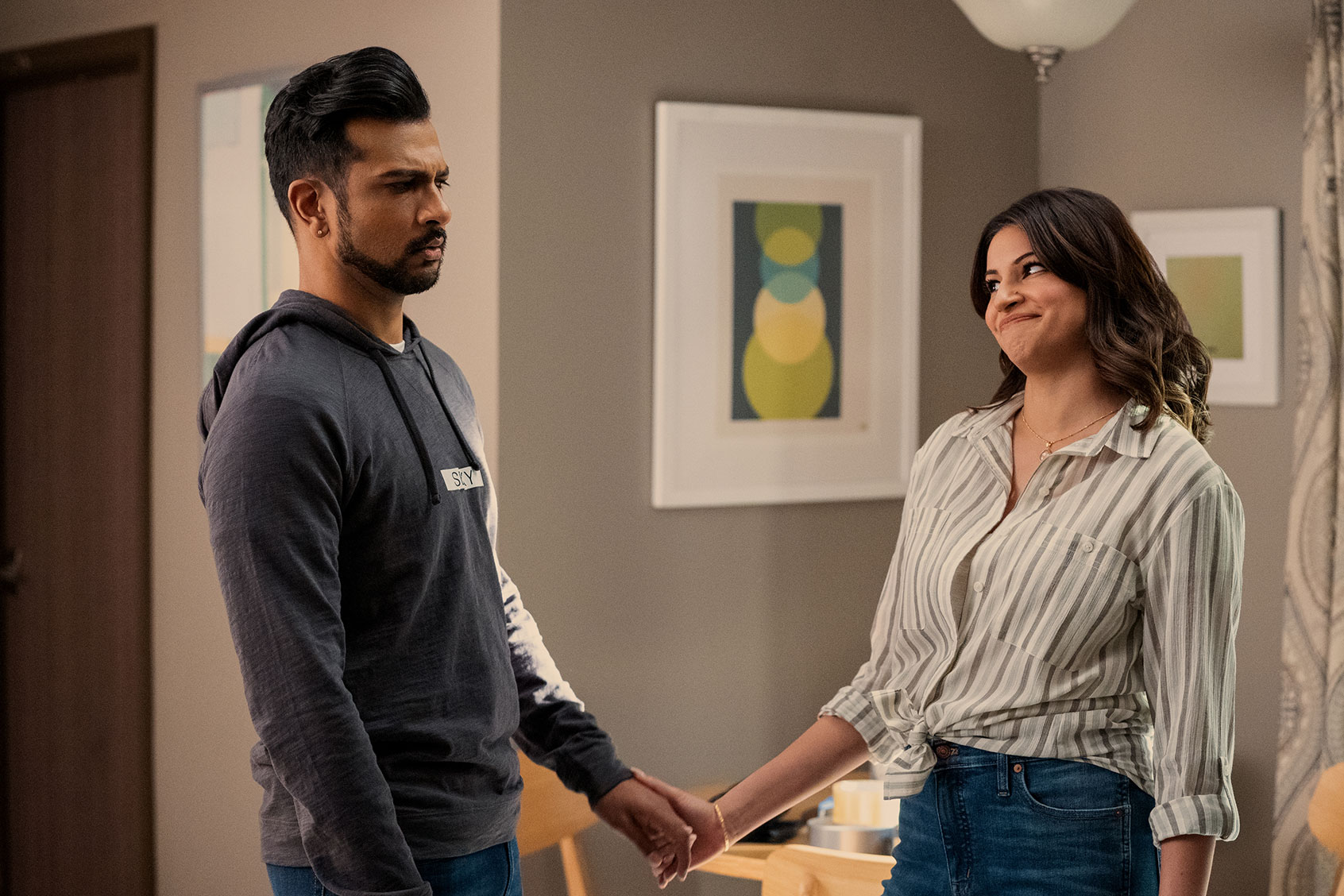
Kamala (Richa Moorjani), who called off her arranged engagement to a magazine-perfect man, plays out this ideal in Season 3 by insisting on dating Utkarsh Ambudkar’s Manish, Devi’s English teacher, instead of settling for one of grandma Nirmala’s “suitable” choices – traditional Indian men well versed in their culture’s customs.

Manish is American to the bone, which Nirmala doesn’t trust at first until he wins her over with a solid act of kindness. The show has reserved the most thoughtfulness and complexity for its examination of how Nalini’s and Kamala’s choices clash with cultural expectations before eventually, gently melding the two into a way of being that makes everybody happy.

Never Have I EverUtkarsh Ambudkar as Manish Kulkarni and Richa Moorjani as Kamala in “Never Have I Ever” (Lara Solanki/Netflix)

As this pertains to Devi’s friends, crushes, and boyfriends, the writers take care to bring her white friends into her family’s world to share meals and celebrations more often than the other way around.

There’s still a part of me that wishes the show had spent more time investigating what it meant for Devi and Des to share a cultural shorthand that she didn’t have with her other boyfriends, if only to weigh in on how much that actually matters. Season 2 of another vastly underrated Netflix comedy, “Love Life,” explores this thoughtfully and thoroughly through one couple that doesn’t make it either.

Again, that show features adults treading water in the dating pool. Teen love is another situation where such notions aren’t informed by life experience; these are still kids fumbling through the distinctions between lust and the real thing. That still doesn’t make the hasty interruption to Des and Devi go down easier.


Want a daily wrap-up of all the news and commentary Salon has to offer? Subscribe to our morning newsletter, Crash Course.


Everything is going well until Devi is set to perform at a school recital for the first time since Mohan’s death and thinks she sees him in the audience, unleashing a flash grief tsunami that takes her legs out from under her again. Rhyah finds Devi crumpled in a panic attack in the bathroom and talks her through it, saying all the right things to restore her calm and get her onstage. However, instead of this mother viewing the girl’s completely normal grief response with compassion, she takes Des aside and tells him that Devi is unbalanced, ordering her son to break up with her.

Des responds by canceling dates they’d set before out-and-out lying to Devi about being out of town. She tracks him down at a local café and throws an iced drink in his face, seeming to confirm Rhyah’s uncharitable estimate of her. But when Devi points out to Des that he can decide for himself whether he wants to date her, Des weakly points out that his mother pays for his cell phone.

Thus ends our time with Devi’s only brown boyfriend or crush since the series began – but maybe not the last one. The third season also ends with Paxton graduating and on his way to Arizona for college, making room for fresh options.

Of course, there’s still the matter of the guy whose bedroom she heads into, closing the door behind her; they’ve agreed to share a pivotal moment, but they’re not with each other. The fourth and final season of “Never Have I Ever” may put them together in the end, and it has done a wonderful job of building that case. I only wish they’d let us down more gently in breaking up Des and Devi.

“Never Have I Ever” is currently streaming on Netflix.

“I Just Killed My Dad”: A closer look at the true story behind the Netflix father-son murder series

Netflix’s documentary, “I Just Killed My Dad,” is as horrifying as it sounds. The three-part series revisits the true story of Anthony Templet, who was just 17 years of age when he murdered his father, Burt, in their Baton Rouge home.

At first glance, the crime seemed both simple and straightforward. But upon closer inspection, the ensuing case along with Anthony’s own backstory proves to be more convoluted than anticipated.

Anthony himself appears in the docuseries and makes a shocking statement in the opening minutes: When asked why he wanted to share his side of the story, Anthony said, “Well, it’s important ’cause my life is on the line, and I want people to know that I’m not crazy and I’m not a murderer and I’m innocent.”

Here’s a closer look at the incident, the case and what followed afterwards:

The murder

On June 3, 2019, Anthony shot and killed his 53-year-old father, Burt Templet. Anthony then called the police to report himself and confessed to his crimes, telling a 911 operator that he had gotten into a heated altercation with Burt — who was intoxicated and aggressive — and shot him in an act of self-defense.

“He tried to attack me. Then, we got into a fist fight. Then, I ran in his room, closed the door, and got a gun,” Anthony said during the call, per the documentary. “As I unlocked the door, he tried to . . . and then I shot him. I just killed my dad. I shot him three times.”

Officers at the scene of the crime found one revolver laying on the kitchen island and another laying next to a cellphone on the bed in the master bedroom. Burt’s body was found just steps away in the outside hallway near the bathroom — he was lying on the floor in a puddle of blood.

The shocking discoveries    

Amid media coverage of the murder, new details surrounding Anthony, Burt and their relationship emerged. The case quickly took an unexpected turn when Anthony’s half-sister, Natasha, revealed that he had been kidnapped from his family home in Texas by Burt in 2008 when Anthony was just 5 years old.

“After 11 years of waiting to hear if my brother was still alive, he is found,” Natasha told WAFB9. “He has been secluded and abused all these years by his own father. My brave brother had to defend himself for the last time against that evil man.”

Natasha said that prior to the kidnapping, Burt had been in a relationship with her mother, Teresa Thompson: “Burt and my mom were together for about 10 years and it was extremely violent. I can only imagine what Anthony’s been through. When he was a baby, Burt would hold him in his arms while abusing my mother.”

Following Anthony’s disappearance, Natasha and Thompson posted missing child posters around Baton Rouge with photos of both Anthony and Burt along with the phone number for a sheriff’s office in Houston.

According to a report from The Advocate, Burt prohibited Anthony from seeing family members and attending school. Per Anthony’s lawyer, Jarrett Ambeau, Anthony had been “isolated and regularly abused by his father.” The abuse, Ambeau specified, was physical, mental and emotional and occurred frequently.

The charges

Anthony was initially charged with second-degree murder, which was later reduced to manslaughter.

In 2021, he pleaded no contest to negligible homicide and is set to serve a five-year sentence of supervised probation with credit for time he had already served. In accordance with the sentencing, Anthony must also earn his GED, agree to counseling and hold either a full-time job or attend school full-time. If he successfully fulfills these requirements, his criminal record may be expunged.   

“When I saw this injustice, I said, ‘Absolutely, no way should this kid be in jail’. Well, that’s the outcome we have,” Ambeau said after the court ruling. “It may not be the thing we have hoped but this is an imperfect system. We try to find the best possible justice and I think we got that today.”

“I have a strong want and desire for Anthony to be successful in life, he left an incredibly hopeless life and no one got involved to help him until he shot his father.”

Following his release, Anthony has reconnected with his mother and grandmother in Texas.  

“This is harder than losing him,” Thompson said in the documentary. “I want to be his friend, because I know it’ll never be a mother/son relationship. That was the past.”

Ambeau’s recent statement

Along with his close relatives, Anthony maintains a close relationship with his attorney. On Aug. 10, a day after the documentary’s release, Ambeau took to Instagram to share a photo of him alongside Anthony and his family.  

https://www.instagram.com/p/ChFENZoun-j/?utm_source=ig_embed&ig_rid=754de3d9-4213-4d30-9d71-3bb6516d291f

“Anthony, my parents, and the staff from my office watched the doc yesterday afternoon at my house,” Ambeau wrote. “It was great to have Anthony there and give him love and support while watching this event in his life on screen.

“Anthony and I are so grateful for the outpouring of support and the kind sentiments,” he continued. “I can feel the love of so many people, it’s been overwhelming the last 24 hours.”

Ambeau also revealed that Anthony is “living a peaceful life” and currently “working full time, finishing his GED, being exemplary in his duty to the court and probation, and doing regular counseling when he can manage the time and resources.”

“I Just Killed My Dad” is currently streaming on Netflix. Watch a trailer below, via YouTube:

This crispy, fried secret ingredient is the best way to upgrade homemade chili

Like most home cooks, my dad has a reliable, if predictable, list of recipes from which to choose on the nights he makes dinner. If you see him in the kitchen on a weeknight, it’s likely going to be chicken noodle soup — made with thick, dried egg noodles and no celery — or pizza made using Boboli crust, shredded mozzarella and spicy Italian sausage. Maybe oven-baked chicken with steamed broccoli or baked spaghetti, like his mom used to make. 

But if it’s the weekend, especially if the weather indicates that our corner of the world is finally lurching into autumn after stalling out in the summer heat, nine times out of 10 he’s making white chicken chili

I don’t know where he originally got the recipe, or if there even was one. The chili, after all, continues to shift through time. For a while, he used only yellow and orange bell peppers, since they were sweeter than their bitter green counterpart. At some point in time, he switched to a mix of red bells and jalapeños.

In the early days, dad swore by low-sodium chicken broth, but now he told me he’s using “fancy stock” (meaning that it’s probably the Kroger Private Selection variety). He’s cycled through canned, dried and jarred beans, but I still don’t think he’s nailed down a preference. 

Oh, and don’t get me started on the spices and how their combination has been a never-ending decision matrix built from pinches, teaspoons and eyeball measurements. The only point on which he never wavered was that the chili had to be served with cornbread, made crispy by tossing it in spitting hot oil. 

Since I still sometimes tend to get in my head about whether what I’m doing is technically “the right way,” his overall lack of rigidity in the kitchen has long inspired me. As the weather dipped below 65 degrees one evening this weekend, and I felt what can only be described as an autumnal breeze whip off the lake, I knew it was chili weather. 


Want more great food writing and recipes? Subscribe to “The Bite,” Salon Food’s newsletter.


Like my dad, I kind of winged it based on what was in my pantry and crisper drawer. I was lucky that I had leftover salsa ingredients — onion, jalapeños and cilantro — that I needed to repurpose. I had a few cans of pinto beans in the cupboard, as well as a fully-stocked spice rack and some diced tomatoes. Dad always loved swirling sour cream through his bowl before he started eating, so I thought I’d do the same with some coconut cream. 

Smoked paprika, caramelized tomato paste and soy all combined for a punch of umami.

But what really takes this recipe over the top are the cornbread croutons. I guess some rules shouldn’t change, after all. 

Smoky Pinto Bean Chili with Fried Cornbread Croutons
Yields
6-8 servings
Prep Time
20 minutes
Cook Time
45 minutes

Smoky Pinto Bean Chili

  • Olive oil
  • 1/2 white onion, finely chopped 
  • 1/2 red bell pepper, finely chopped 
  • 1 to 2 jalapeños, finely chopped 
  • 2 tablespoons tomato paste
  • 2 teaspoons cumin
  • 2 teaspoons cayenne pepper 
  • 2 teaspoons smoked paprika 
  • 2 teaspoons coriander
  • 2 teaspoons brown sugar
  • 1 tablespoon soy sauce
  • 1 14.5-ounce can diced tomatoes  
  • 1 14.5-ounce can corn
  • 32 ounces vegetable stock 
  • 30 ounces pinto beans, canned or fully-cooked dry beans with liquid reserved
  • 1/3 cup cilantro, finely chopped 
  • 2 tablespoons coconut cream 
  • Salt and pepper, to taste

Fried Cornbread Croutons

  • Olive oil 
  • 2 cups roughly-torn cornbread 

Optional Garnishes 

  • Sliced radish
  • Chopped scallions
  • Avocado
  • Lime slices
  • White rice
  • Additional coconut cream, for serving

Directions

  1. In a large pot, add a thin coat of olive oil and increase the heat to medium-high. Add the finely chopped white onion, red bell pepper and jalapeños. Salt generously and stir the vegetables until they’re soft and the onion is nearly translucent, about 5 minutes. 

  2. If the pot looks dry, add another coating of olive oil before adding the tomato paste, cumin, cayenne pepper, smoked paprika, coriander and brown sugar. Reduce the heat to medium-low and stir the mixture occasionally until the tomato paste is more brown than red, about 5 minutes. 

  3. Add the soy sauce, diced tomatoes, corn and vegetable stock to the pot and bring to a boil, then reduce to a simmer. Add the beans, making sure to include the liquid from the can if using canned beans. If using freshly-cooked dry beans, add 1/2 cup of reserved cooking liquid. 

  4. Give everything a good stir, then allow the mixture to simmer uncovered for at least 30 minutes. My dad, meanwhile, would say that a good soup or chili needs at least 4 hours. If you decide to go that long, check on the pot occasionally to make sure the chili hasn’t reduced to the point of needing additional stock. If it does, no big deal — just add a splash at a time. 

  5. About 10 minutes before you plan to pull the chili off the heat, add the cilantro and coconut cream. Take a moment to taste and adjust seasoning. 

  6. As the chili finishes cooking, it’s time to make the cornbread croutons. It’s incredibly simple. Add 2 cups of roughly-torn cornbread — either homemade or store-bought — to a large, flat-bottomed skillet. Drizzle the cornbread with enough olive oil for it to be very lightly coated, then give the pan a good shake. Turn the heat up to medium and gently stir the cornbread over the heat until the exterior gets brown and toasty, about 10 minutes. Remove the croutons from the pan and set aside. 

  7. When you’re ready to serve the chili, feel free to do so over white rice for a heartier meal. Regardless, top it with some of the suggested garnishes, including sliced radish, chopped scallions, avocado, a lime slice or some additional coconut cream. Just don’t forget the cornbread croutons! 

Salon Food writes about stuff we think you’ll like. Salon has affiliate partnerships, so we may get a share of the revenue from your purchase.

California dairy uses lots of water. Here’s why it matters

When we picture California agriculture, we tend to think of almond and citrus orchards and the massive tracts of strawberry and lettuce fields that we can see from the highways dividing the western part of the state from the east.

But dairy is, in fact, king.

There are an estimated 1.7 million cows living on dairy farms in California, and the industry brought in $7.5 billion in 2020, including $2 billion in export sales.

And because most people in the state don’t see the abundance of dairy farms — most of them function like feedlots surrounded by fields of feed crops such as alfalfa and corn growing nearby — they may not be aware of the fact that they use millions of gallons of water a day.

As the climate crisis ramps up, California is facing its third consecutive year of drought after its driest winter conditions in 100 years, and everyone in the state has grown increasingly reliant on a rapidly shrinking quantity of groundwater. Advocates say it’s a good time to take a closer look at the water use behind your milk (and butter, cheese, etc.), how the large-scale dairy industry has impacted groundwater in the state, as well as how it affects low-income Californians, communities of color, and small-scale farms.

How much water does the California dairy industry use? 

All dairy production requires an abundance of water. The animals drink it, but it’s also used to cool the milk, keep the dairies clean, and cool off cows in the warm months. And it’s needed to irrigate the alfalfa and other feed crops.

In a recent white paper, the advocacy nonprofit Food & Water Watch estimates that it takes 142 million gallons of water a day to maintain the dairy cows in California. “That’s more than enough water to provide the daily recommended water usage for every resident of San Jose and San Diego combined,” reads the paper.

The industry takes pride in the fact that much of the water used inside dairies gets recycled and used to spray manure on crops as fertilizer (as a way of managing the large quantities of waste these dairies produce). The California Milk Producers Council also recently pointed to a yet-to-be-validated studythat modeled the water flow on and off a typical 1,000-cow dairy and found that while it uses 112 acre-feet a year, it “exported” 98 acre-feet in the form of spraying it on crops.

This circular logic — the idea that water use doesn’t count because it’s then used on crops to produce milk — isn’t new either. In a 2019 op-ed, Geoff Vanden Heuvel, director of regulatory and economic affairs at the Dairy Producer’s Council, wrote on the group’s website, “the actual footprint of your dairy itself — the corrals, the milking barn, the feed storage pads and feed alleys — have zero consumptive water use. The only water that is lost on a dairy operation is in the milk that is sold off the farm and the water contained in body of the cow when it is shipped off the dairy for culling.”

The industry also points to its water efficiency improvement over time. Researchers at University of California, Davis (funded by the American Dairy Science Association), found that the water used per gallon of milk dropped by 88% in the 50 years between 1964 and 2014.

“That’s really because the crop yields have gone up so much in the last 60 years,” said Ermias Kebreab, associate dean for global engagement in the College of Agricultural and Environmental Sciences at U.C. Davis. “Because of genetic improvement and breeding, we’ve seen a huge increase in yields.”

However, the quantity of milk being produced in the state has also increased in that time. “The industry likes to tout its efficiency, which I don’t disagree with. The thing that the industry doesn’t normally acknowledge is that when you increase efficiency for dairy cows, you also increase [overall] water use,” said Michael Claiborne, a senior attorney at Leadership Counsel for Justice and Accountability, a community-based advocacy organization located in the Central Valley.

“You have to take into consideration how much more volume is being created. So, the actual tally for water use is far more enormous than it ever has been,” says Amanda Starbuck, a researcher and policy analyst for Food & Water Watch.

“And those gains we’ve seen in dairy production are due to the fact that we have newer [dairy cow] breeds that grow faster,” adds Starbuck. “We put milk cows through cycles of pregnancy and lactation much quicker than we had in the past, and cows live shorter lives because of that, and lower-quality lives. They are bred to produce as much milk as they possibly can before they are literally taken out to pasture.”

How did big dairy get so big in California? 

Dairy production in the state goes back to the 18th century, but the quantity of mega-dairies that now operate throughout the Central Valley is a relatively recent phenomenon. Warmer weather allows for dairies that don’t have to keep their animals indoors for multiple months at a time, and that fact — combined with the speed at which alfalfa can be grown in the sunny parts of the West — have facilitated a massive shift in the industry.

In states like New YorkVermont, and Wisconsin, where many small-scale producers are closing up shop at an alarming rate, dairy operations traditionally graze their cattle on pasture for much of the year. The mega-dairies that have sprung up in states like California, Oregon, Arizona, and Idaho in recent decades, on the other hand, are mainly confinement-based, or what they call “dry lot” operations.

Meanwhile, small and medium dairies in the state have also been shutting down. From 1997 to 2017, California lost 60% of its dairies with fewer than 500 cows.

The bulk of the mega dairies are located in the state’s Central Valley. Tulare County, the top dairy county in the state, brought in more than $1.8 billion in dairy sales in 2020; it’s commonly known that the county is home to more cows than people.

What does it mean for water? 

As drought conditions have radically reduced the quantity of surface water that’s available for agriculture, mega-dairies are pumping more and more groundwater to meet their needs.

Their practice of spraying their manure on nearby crops also sends nitrogen — in the form of nitrates — back into the soil, where it eventually leaches into the groundwater. This is compounded by the nitrogen pollution from other fertilizer running off crop fields and municipal sewage systems.

“It’s a widespread issue throughout the valley. Up to 40% of domestic wells (and even more in some areas) are impacted by nitrate levels that are above the safe drinking water standards,” says Claiborne.

The health impacts of nitrate-polluted water are well-documented. A 2019 study found that nitrate pollution in U.S. drinking water could cause over 12,000 cases of cancer each year. And that’s not the only known health impact; elevated nitrates in water have also been linked to miscarriages, fetal deformations, and a deadly blood disorder called blue baby syndrome.

As wells all over the valley run dry (including a total of 446 so far this year), Susana De Anda, co-executive director and co-founder of the Community Water Center, points to the fact that larger agriculture operations tend to have the resources needed to access groundwater, even if it means drilling deep underground.

“When you drill deeper into our aquifers, the wells are very expensive,” says De Anda. “And those deep wells are also causing major subsidence and major pressure problems around nearby public water systems. We say water flows toward money and power. And so, you can just see that in the middle of a drought who has access to that [drilling] and those deeper wells.”

That drilling isn’t completely without limits. As the state has begun implementation of the Sustainable Groundwater Management Act — which was put in place in 2014 to ensure the protection of groundwater around the state — the dairy industry is anticipating changes related to how many crops it can produce locally. In fact, the industry recently announced the formation of a Manure Recycling & Innovative Products Task Force to address what will happen when the farms are left with more manure than crop land to spray it on.

“Competing uses for crop land, and now the limits to pumping groundwater as a result of the Sustainable Groundwater Management Act, have heightened the attention to the fact that there is very likely a manure surplus on many California dairies,” according to the Dairy Producer’s Council’s Vanden Heuvel. The implication is that the task force plans to export its fertilizer while importing more feed crops, raising questions about the industry’s long-term viability in the state.

How are communities impacted?

Many municipal water systems in the Central Valley are so polluted with nitrates that residents have become accustomed to buying drinking water. Water stores and vending machines are a common sight in the region.

“Our poorest families are having to pay some of the highest water rates for toxic water,” says De Anda. “In some situations, they’re paying 10% of their household income alone on drinking water, because they’re paying for a water bill and then they still have to [pay for] bottled water.”

And, when it comes to mega-dairies, some residents deal with the impacts much more directly. Take Cristobal Chavez. He and his family moved to Porterville, California — in the southern part of Tulare County — in 2008. He had been driving trucks in Los Angeles for more than two decades and when he injured himself, he and his wife bought a small farm and took on a series of foster children in addition to their biological kids. “We wanted a quieter, safer life,” he says.

The land they bought was across the street from a large dairy that he says was home to around 10,000 cows at the time. It may have grown since then, but he’s not sure. “There are lots of corrals. The air smells so bad you can’t leave your clothes outside.”

And they use a lot of tap water — to wash the cows, to wash [away] the manure, and it accumulates in the reservoir, says Chavez.

It wasn’t until 2014 that the Community Water Center helped him get the water in his well tested; it showed elevated, unsafe rates of nitrates. Chavez was surprised, as nitrates don’t change the taste or smell of the water.

“For years, the kids ran around and drank directly from the hose. It was nice and cold; we never noticed it was contaminated.”

His family stopped drinking the tap water at that point — like members of many communities in the San Joaquin Valley — and started relying on bottled water. But they still showered in the nitrate-contaminated water.

“Most of the people where I live have to buy their own water,” he says.

Then, Chavez’s wife was diagnosed cancer and died in December 2021. He can’t know for sure, but he wonders whether the nitrates played a role.

Now, Chavez thinks about leaving the area, possibly moving to be near his son in Indianapolis, but his property value hasn’t increased like it has in other parts of California. “People see that it’s near a dairy, so I doubt I’d be able to sell it,” says Chavez.

Advocates want change

Food & Water Watch wants to see California put a moratorium on the expansion of existing mega-dairies as well as permitting for new ones. “We’re not telling them to have farmers shut their doors tomorrow, but we should not be allowing mega dairies to get even bigger, and we should not be permitting brand new mega dairies in the worst water crisis that we have seen in generations,” says Starbuck. “And that could come from the California legislature, or there are national bills that have been introduced into this Congress that would do something similar, but from a national perspective, for all factory farms.”

Starbuck doesn’t believe the fault lies with individual farmers — who have had to grow their operations within the current system. “It’s not even to outcompete your neighbors, but just to be able to stop the operation from losing money. Most dairies lose money, let’s just be honest.” For that reason, change has to come at the industry level, she adds.

Food & Water Watch is one of a number of groups advocating for a return to supply management — or quotas on the amount of milk farmers can produce — within the industry, which Starbuck says would potentially bring the cost of production in line with what farmers earn.

The Leadership Council is also monitoring and opposing growth of existing dairy operations. “We’re not advocating for eliminating the industry altogether in the Central Valley, but it can’t look the way it does,” says the Leadership Counsel’s Claiborne. “We see a need for herd size reductions and far more sustainable milk production. It just can’t come at the expense of access to drinking water. And right now, that’s what’s happening.”

Currently, the Council has its eyes on two dairies in Merced County, where the group has been monitoring nitrate levels in neighborhoods near dairies and found elevated rates: north of Fresno — one where owners are trying to add 1,700 cows — and another where they’re looking to add 2,100.

Due to provisions in the California Environmental Quality Act (CEQA), the expansions trigger the need for CEQA reviews, and the Leadership Council provided comments on environmental documents. A coalition of Central Valley residents is also asking the State Water Resources Control Board to do a better job of overseeing the regional water board’s regulation of areas in the Central Valley and find ways to ensure that groundwater and drinking water resources are better protected.

What is the dairy industry stance?

California Dairy, Inc. — the largest dairy cooperative in the Central Valley — didn’t respond to our request for comment. And while the National Dairy Council shared its overall sustainability goals with us, it didn’t want to comment about water use in California.

However, one public document — produced by a dairy industry group as part of a monitoring program required by the Regional Water Quality Board — does tell a compelling story about Big Dairy’s role in nitrate pollution in the Central Valley. It reports on wells monitored throughout the Central Valley over a seven-year period and found “a challenge of a scale that requires thoughtful, expansive solutions backed by strategic planning, sustained effort, and long-term commitment.” The report goes on to say that “even if all farming was permanently stopped, it would take many decades for groundwater nitrate-N concentrations in the production aquifer to decline below the Maximum Contamination Limit of 10 mg/L.”

“They’ve acknowledged that essentially all dairies in California or at least in the Central Valley region are polluting groundwater actively today in a way that makes the water undrinkable,” says Claiborne. “They’re asking for up to 35 years to try to stop polluting. But we think it needs to happen much, much faster than that.”

Community Water Center’s De Anda agrees. “Do I think we’re moving in the right direction? Absolutely. We’ve come a long way,” she says. “The regional water board is saying, ‘It’s not that we’re not going to regulate nitrate pollution, it’s how we’re going to do that.’ So, there has been that shift. But it’s been a very slow shift. And, in reality, residents have been exposed to this toxic water for a long time.”

Meanwhile, the Milk Producers Council is also focused on advocating for more water storage infrastructure and ways to capture the increased rain during rare flood years.

Switching to almond milk?

Almond orchards cover around 1.3 million acres and account for a huge percentage of the agricultural water used in California. According to Food & Water Watch’s 2021 analysis of industry data, the industry was planning to send an estimated 1.5 trillion gallons of water to irrigate the crops that year. And while dairy operations do consume more water than almond farms do, Starbuck doesn’t think the solution to the current water shortage should rest entirely on the consumer.

“People might be on the fence about whether to drink dairy milk or almond milk. But I think some of that is just infighting between the two industries, which are competing [for resources]. It also points to the fallacy that it is within the consumer’s ability to fix this problem,” she says.

As Starbuck and other advocates we spoke to see it, changing policy and holding industry to account is far more important than any consumer choice. “I’m not saying that individual actions aren’t important,” she adds, “but we are never going to protect our resources for future generations if we don’t address these huge industries that have basically been given a green light, a free pass to use as much water as they like, however they like.”

More than a fashion icon, Lucy brings Gen Z to “Only Murders in the Building”

We need to talk about Lucy.

The almost stepdaughter of Charles, Lucy has injected delight and energy into the already energetic and delightful “Only Murders in the Building.” As the Hulu show prepares to end its blockbuster sophomore season, and to finally reveal its second killer, Lucy dazzles and surprises with her speeches, discoveries — and dress. More than just a fashion icon (although she certainly is that too): she’s the third generation in the already loving intergenerational friendship of Steve Martin’s Charles, Oliver (Martin Short) and Mabel (Selena Gomez).

Teenager Lucy is Gen Z and she lets you know. Her phone is ever-present and she primarily communicates that way with Charles, the man who dated her mom for many years and basically became a father to her before her mom severed the relationship. Hyper-connected, Lucy uses text abbreviations and slang that confuses him — but both Charles and Oliver are new to texting; it took Charles quite some time to learn not to sign his texts. Lucy uploads to something called “The Dazed 100” and has TikTok. She references watching mental health TikToks to Mabel, and it’s not clear yet that Lucy has her own channel, but given that she’s talking into her phone’s camera in her entrance in the show, it’s very possible.

Possibly Lucy can do all that rebounding because she’s often wearing comfy pants.

As played by Zoe Margaret Colletti from “Scary Stories to Tell in the Dark” and 2014’s “Annie,” Lucy is earnest and open. Colletti’s likability buoys her character’s great resilience. Lucy missed Charles during all these years of silence, not understanding her mother did not want the two to communicate. But Lucy is quick to bounce back and jump right back into his life. 

Possibly Lucy can do all that rebounding because she’s often wearing comfy pants. It’s not just that the character looks cool, she seems relaxed in loose, soft fabrics. She hops onto counters and crosses her legs. In trendy but sensible shoes, she can move quickly when being pursued by potential murderers. Her wide-legged trousers are striped or checkered with a print of yin and yang symbols. I’m envious of Lucy’s pants (So is Mabel, telling her upon first meeting: “I love those pants. I had a pair.”). Even when Lucy’s wearing a formal gown —or specifically, a frilly tulle bridesmaid dress for her mother’s wedding — the character stays causal with sneakers on the bottom. 

Only Murders In The BuildingLucy (Zoe Margaret Colletti) in “Only Murders In The Building” (Craig Blankenhorn/Hulu)Lucy also has a flair for the unexpected. It shows up in how she drops by Charles’ apartment unannounced. And how she sneaks into secret passageways if she finds no one at home . . . or the wrong people breaking into the home. Fashion-wise, it manifests in her creative pairing of colors and prints. She matches rainbow stripes with checks or chevrons. She matches things that don’t classically, actually match. But on Lucy, they work. 
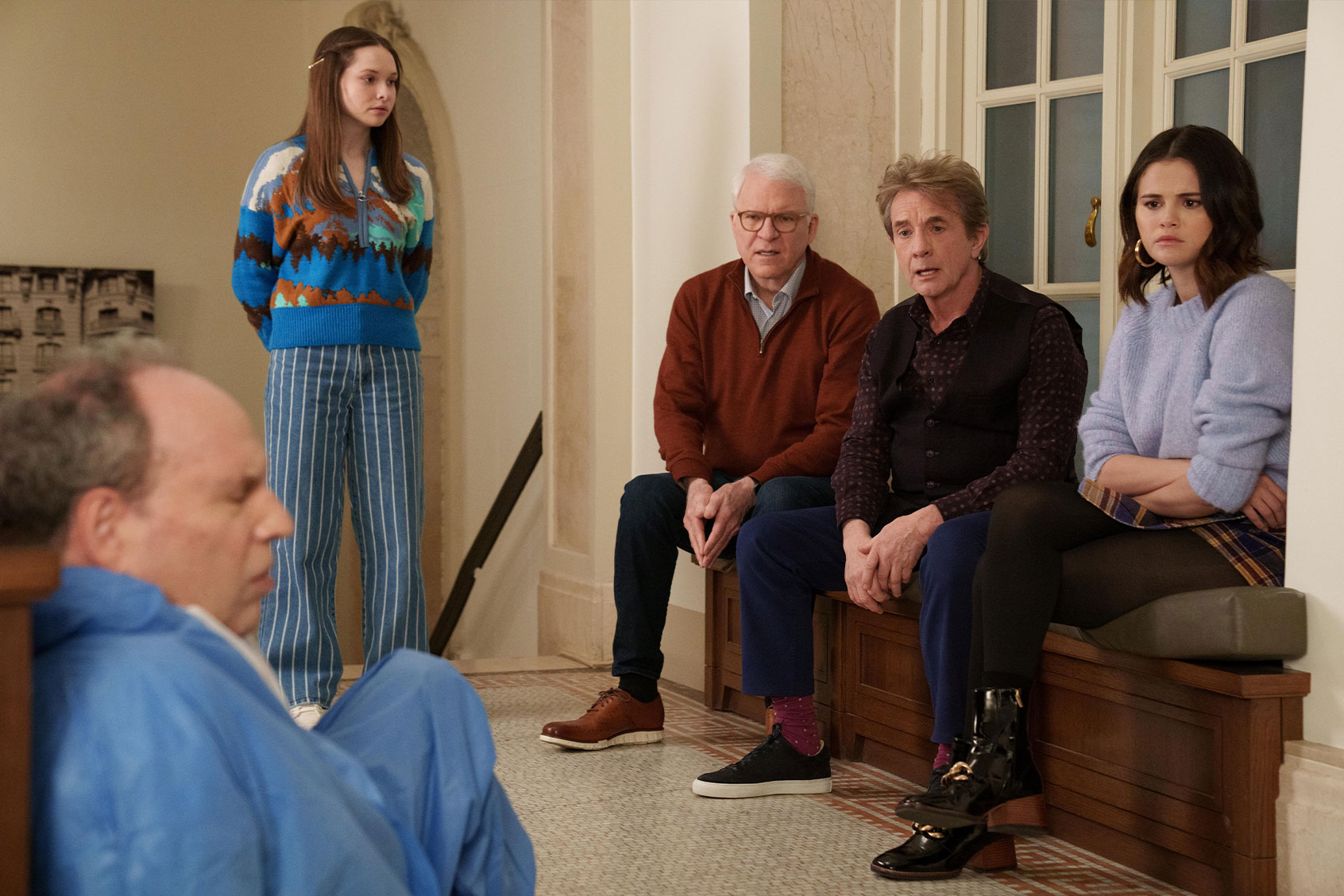
She wears bright shades, even in the cool, black-heavy Upper East Side. During my time living in Manhattan, I would carry a bright red umbrella just so I would stand out. Lucy mixes things up. You never know where you can find her, what she’ll say or discover next (Lucy is the one who finds the murder weapon after all), or what she’ll show up wearing. 

Only Murders In The BuildingMarv (Daniel Oreskes), Lucy (Zoe Margaret Colletti), Charles (Steve Martin), Oliver (Martin Short) and Mabel (Selena Gomez) in “Only Murders In The Building” (Craig Blankenhorn/Hulu)In her clothes and personality, Lucy is unselfconscious. “I don’t care. I’m just gonna leave it,” she says in some of her first lines on the show, examining the large, fuzzy flowered hat on her head. “Nope,” she declares, then rips it off. She’s filming at the time. Within moments of first meeting Mabel, she’s talking about anti-anxiety meds and bemoaning her own lack of a “real diagnosis.”

She’s also non-judgmental. Some teenagers might never forgive Charles for seemingly abandoning them, but Lucy understands once he explains and is right back to being close with him, trying to make up for lost time. She’s supportive, calling him: “my super cool TV star ex-dad sort of person.” When she pulls a gory blood-stained knife out of a butcher block — what turns out to be the murder weapon — her first response is the relatively tame: “Do you not wash these?”

Only Murders In The BuildingLucy (Zoe Margaret Colletti) in “Only Murders In The Building” (Craig Blankenhorn/Hulu)

Mabel is the character with whom Lucy is closest in age, yet a generational gulf separates even them.

Lucy is open-minded. When she jokes to Mabel that Charles and Oliver going off to have a private “adult conversation” sounds “queer-coded,” there’s nothing accusatory in her statement, simply curious and friendly. She also talks with Mabel about changing her pronouns.  

Mabel is the character with whom Lucy is closest in age, yet a generational gulf separates even them. Mabel is a Millennial, and as such, still distinct from Lucy, who talks circles around her and talks in a different way (the teenager also listens to their podcast at double speed). Though Charles tries to link the two of them – “She used the word ‘Manhatty.’ And you just used ‘hot goss.’ It’s like I’m watching ‘Squid Games’ [sic] without subtitles.”— Lucy is her own person, something Mabel makes clear. 

We see Mabel differently next to Lucy. We notice a new, nurturing side of her, as Mabel feels protective of the teen. The two elder men have always referred to Mabel as young and hip with “cool boots,” but Lucy is younger still. And though Charles and Oliver may have thought of Mabel as a child, the arrival of Lucy makes clear that Mabel is an adult person, capable of taking care of herself, making decisions and her own way. Lucy helps Mabel grow up.


Want a daily wrap-up of all the news and commentary Salon has to offer? Subscribe to our morning newsletter, Crash Course.


Each character of “Only Murders” has had a distinct style from the very beginning. Oliver has his long scarves and turtlenecks, Charles his sweaters and button-down shirts. Mabel has been the strongest style icon to emerge from the show, striding onscreen with her bright orange faux fur coat, canary yellow sweater, checked pants, red headphones and those cool boots. And yes, she makes an excellent Halloween costume that, speaking from personal experience, not all of your friends will understand.

But Lucy is the newest style icon on the show. Unexpected, bold and curious, she makes us look at outfits differently. She helps us look at everything on “Only Murders” differently, including helping us to know Charles, Oliver and even Mabel better. Now we’ve seen them through her flower print, fuzzy hat-shielded eyes. 

The “Only Murders in the Building” Season 2 finale streams Tuesday, Aug. 23 on Hulu.


A second asteroid may have struck Earth after the one that killed the dinosaurs

Approximately 66 million years ago, an asteroid collided with Earth and caused a mass extinction known as the Cretaceous–Palaeogene (K-Pg) extinction. This event — which, among other things, wiped out the dinosaurs — is one of the most important in geological history. After all, how often do giant asteroids from outer space slam into our planet?

As it turns out, perhaps more often than you think. Indeed, if the theory posited by a new study in the journal Science Advances is correct, it is entirely possible that a second asteroid collided with Earth at roughly the same time as the one that we already know about. That could have huge implications for explaining the history of the evolution of life on Earth. 

The known asteroid — that is, the one that caused the extinction of the dinosaurs — landed in what is now the Yucatán Peninsula in Mexico, and left an impact site known as the Chicxulub crater. The speculative asteroid would have landed in what is now West Africa’s Guinea Plateau and left what is known as the Nadir crater, which is located more than 1,300 feet beneath the sediments of the sea.

“At the moment, we cannot definitively state that this is an impact crater – we cannot do that until we recover physical samples of shocked minerals (formed at extreme pressures) from the crater floor by drilling,” Uisdean Nicholson, an assistant professor at Heriot-Watt University, told Salon by email. Yet the evidence, Nicholson said, was persuasive: “the geophysical characteristics are, however, very compelling and hard to explain any other way,” he added.

So are the two meteors related? Were they perhaps part of the same chunk of matter, riven in two some time before striking Earth? 

Nicholson’s team has a number of hypotheses about how the Nadir crater may be related to the Chicxulub crater. One possibility is that a “flux of asteroids” may have been caused by an earlier collision in the asteroid belt, and these two impacts were merely part of that. Or, the second impact could be unrelated — “part of the background asteroid cratering process that has occurred through Earth history,” Nicholson says. Moreover, given that Nicholson’s team acknowledges an uncertainty window of “around 1 million years,” the asteroid may not have even collided with Earth at the same time as the one that killed the dinosaurs.

“The geophysical characteristics are, however, very compelling and hard to explain any other way.”

“Distinguishing between these hypotheses will require us to obtain high-precision dates from the crater, again only possible through scientific drilling,” Nicholson concluded.

Nicholson was clear that, even if a second smaller asteroid hit Earth at the same time as the famous one, “it would have been dwarfed by the effects of Chicxulub.” Yet that doesn’t dwarf the potential significance of Nicholson’s find.

“The discovery of a terrestrial impact crater is always significant, because they are very rare in the geologic record,” Mark Boslough, a research professor in Earth and Planetary Sciences at the University of New Mexico, told CNN. (Boslough was not involved in the study.) “There are fewer than 200 confirmed impact structures on Earth and quite a few likely candidates that haven’t yet been unequivocally confirmed.”


Want more health and science stories in your inbox? Subscribe to Salon’s weekly newsletter The Vulgar Scientist.


Perhaps that is why — regardless of what other scientists learn about the Nadir crater once they are able to drill — Nicholson was able to recall a feeling of joy when he realized what had been discovered.

“You realize that, for just a few moments, you are the only person who knows this and understands the implications,” Nicholson told Salon. “But you also want to share it and test the idea. I was so excited by this discovery that I abandoned most of my other responsibilities and wrote a proposal to go and drill it straight away — submitted a few months later (back in April 2021), but then went back to do the modeling and write the paper while we matured that.”

Nicholson added, “I should also note that this was really serendipity – I wasn’t looking for craters when I came across this. But the more data/information you look at, the more chance that you get lucky.” 

Ilhan Omar to Democrats: “Let’s give working folks a reason to turn out to vote for us”

Congresswoman Ilhan Omar urged Democrats to better serve and engage with working people in a Saturday keynote speech at the annual progressive political convention Netroots Nation.

The Minnesota Democrat’s 11-minute address in Pittsburgh wrapped up a session about the upcoming midterm elections titled, “On to November: How We Win and Save Democracy.”

Omar celebrated recent victories, stating that “our movement is at a watershed moment. Over the past several years, we’ve seen the biggest resurgence of progressive organizing and movement-building in our lifetimes.”

“Across the country young people are reviving the labor movement,” she said, noting unionization efforts by AmazonGoogleStarbucks, and Trader Joe’s workers. “We have taken on some of the biggest, wealthiest multinational corporations in the world—and we are winning.”

“I’m proud that workers in my office led a movement to unionize the staff of the United States Congress and we are just getting started,” Omar said. “But friends, it is not just unions.”

The Somali-born congresswoman cited her youth in a refugee camp, her historic election to Congress, and the campaigns and wins of other diverse, progressive candidates despite well-funded efforts to defeat them.

Omar also highlighted recent legislative successes, including healthcare expansion for veterans, a gun safety measure, and the Inflation Reduction Act, a compromise package on Medicare, taxation, and climate action that Senate Majority Leader Chuck Schumer, D-N.Y., negotiated with obstructionist Sen. Joe Manchin, D-W.Va.

She further noted public safety changes currently underway in her district—over two years after Minneapolis police murdered George Floyd, an unarmed Black man.

“The reality is none of these things would be possible without a massive, vocal, organized progressive movement driving the narrative and pushing for change,” Omar said. “Because I know this: when you show up, it gives us the power to organize the base and to work to push for change on the inside.”

The congresswoman continued:

I want to be clear about something else: We cannot take any of that for granted now. It is when you start to get comfortable that your opponents strike—and I know this very well. We have to be alert. We have to protect our victories as vigorously as we fight for them, because we cannot build on those wins if they are rolled back.

Labor rights, abortion rights, criminal justice reform, even the very survival of our democracy is being threatened at this moment. We are up against forces that are willing to suppress the vote, overturn election results, and literally commit treason against our country to get their way. We are up against corporate donors, landlords, and war profiteers spending millions of dollars to take out progressive members of Congress.

“The only way to protect our wins is with a massive, historic voter turnout,” Omar argued. “We cannot go after the same tiny slices of swing voters we go after election after election—using the same poll-tested talking points we use every election. We cannot assume that the politics of transaction will turn out the votes when Americans are longing for the politics of transformation.”

Noting that in 2016, a notable share of voters—particularly those who supported former President Barack Obama four years earlier—cast their ballots for a third-party candidate or simply stayed home, Omar explained that “these nonvoters are more likely to be working class, they are more likely to be immigrants, and they are more likely to be people of color. In fact, more than half of them have an income of less than $30,000 a year.”

“These are the people the Democratic Party should stand for,” she argued, adding that “we cannot rely on” the likes of outgoing Rep. Liz Cheney, R-Wyo., or Manchin “to save us.”

Instead, “we need to elevate people who have fluency in the day-to-day struggles of the people they seek to represent,” Omar asserted. “For every moderate suburban Republican there are line cooks, homeworkers, dishwashers, cashiers, farmworkers who would vote a straight Democratic ticket if they were given a reason to.”

“Progressives win when turnout is high and we lose when turnout is low,” she noted. “So this election, we cannot let fear defeat us. Let us focus on those who don’t have a voice and who will support our boldest, most endearing ideas as a party.”

“Let’s elevate the people who are closest to the pain. Let’s give working folks a reason to turn out to vote for us,” she added. “That’s who our party should be for, that’s who our party should be talking to, and that’s who we should be counting on to help us save our democracy in November.”

Pink wave: Women rise up for reproductive rights — and Big Lie supporters scramble to stop them

The ballot referendum on abortion rights in Kansas wasn’t just a test of public attitudes about reproductive rights — it was a test of democracy.

The Republican organizers behind the bill were no doubt aware of the robust polling that shows that strong majorities of Americans support abortion rights, and thus did everything in their power to make sure the general public did not turn out to vote on the question of banning abortion in the state. So they scheduled the ballot initiative during an August primary election, when few Democrats turn out to vote, even though other ballot initiatives are scheduled for November’s election. They made the language of the ballot initiative confusing, so pro-choice people might accidentally vote for the ban. And they blanketed the airwaves with misleading ads meant to trick pro-choice voters into voting for the ban. 

None of it worked.

Pro-choice activists in the state worked tirelessly to register and turn out voters, as well as educate them on how to vote down the abortion ban, despite the confusing wording. Indeed, the vote wasn’t even close, with nearly 60% of voters giving the abortion ban a thumbs down. A huge chunk of voters were independents who didn’t even vote in the primary races, only showing up to weigh in on the ballot referendum. 

But rather than accept this democratic outcome, conservatives are hardening even more against democracy.


Want more Amanda Marcotte on politics? Subscribe to her newsletter Standing Room Only.


What began with Republicans hand-waving away the election as somehow not a true reflection of voter desires, soon became conservatives reskinning Donald Trump’s Big Lie, that the 2020 election was “rigged” against him, to argue that something fishy must have happened in order for Kansas result to occur. They forced a recount of the abortion vote. Recounts, which are expensive and time-consuming, tend to occur only when an election is close. The abortion ban, however, lost by an 18-point margin, so there was zero chance that a recount would change things. Still, as the Kansas City Star reports, the recount was authorized at the request of Melissa Leavitt, a Big Lie advocate who pushed Trump’s conspiracy theories to the Kansas state legislature in 2020. Along with Mark Gietzen, a hardline opponent of reproductive rights, they raised nearly $120,000 for the recount. Unsurprisingly, it did nothing to change the outcome. Yet Leavitt and Gietzen are using the recount effort as the foundation for what appears to be a larger push to harass anyone who dared vote against the abortion ban in the state.

Since January 6, anti-democratic organizing has only grown more intense and effective.

“The next step is to check the registrations of the people who they say voted,” Gietzen told the Star.

He promised he’ll “be visiting homes” of said voters. The pretext is “to see if anyone lives there,” but of course, the real purpose is clearly intimidation. This isn’t just conjecture. Gietzen is a long-time practitioner of the politics of personalized intimidation. He’s spent years parking himself outside of abortion clinics, approaching patients trying to enter, writing down information about them, and repeatedly filing nuisance police reports to waste the time of clinic workers. 

The adoption of Trump’s Big Lie rhetoric by anti-choice activists is likely only to get worse from here. As political data analyst Tom Bonier noted last week, the overturn of Roe v. Wade is causing an unprecedented spike in registrations of female voters. 

Abortion politics in Kansas have been particularly salient, due to a state constitution that protects abortion rights, which is what the ballot initiative was meant to repeal. 

The gender gap is why President Joe Biden won in 2020, as Biden performed 12 points better with women than men. If it was only up to male voters, Trump would have won handily, as 53% of men voted for Trump while 57% of women voted for Biden. The gender gap in new registrations is only likely to make the gap grow. With his conspiracy theories about “rigged” elections, Trump has handed anti-choice activists a pretense to undermine democratic efforts to protect abortion rights. 


Want more Amanda Marcotte on politics? Subscribe to her newsletter Standing Room Only.


Opposition to abortion was already the root of a great deal of domestic terrorism. Shootings and bombings at clinics in the past few decades have resulted in 11 deaths of clinic workers and patients. In the wake of January 6 and Trump’s continued implicit promotion of political violence, however, the use of terroristic tactics has expanded beyond clinics. Gietzen’s hint that he’ll be dropping by to “investigate” pro-choice voters, for instance, is not isolated. As Kathryn Joyce reported for Salon, in the wake of the decision in Dobbs v. Jackson Women’s Health, pro-choice activists were subjected to violence at the hands of police and civilians. While Fox News ran misleading stories accusing pro-choicers of violence, in reality, pro-choice activists were punched, beaten, and in at least one case, run over by a car. 

The gender gap is why President Joe Biden won in 2020.

The Proud Boys, who were deeply involved in the January 6 insurrection, have taken up the cause of silencing and intimidating supporters of reproductive rights. Anti-choice activists have started to invite Proud Boys to join as “security,” using trumped-up claims of supposed threats from pro-choicers as a justification for violent posturing. As the Armed Conflict Location & Event Data Project (ACLED) recently documented, “Abortion-related events involving far-right militias and militant social movements like the Proud Boys increased by 150% in 2021 relative to 2020, and 2022 has already seen a 90% rise compared to 2021.” Demonstrations where people show up armed tripled from 2020 to 2021. Researchers found that when guns are on scene, demonstrations turn “violent or destructive 40% of the time,” compared to .2% of the time when there are no guns. 

Since January 6, anti-democratic organizing has only grown more intense and effective.

Proponents of the Big Lie are winning Republican primaries on campaigns built around promises to void any election results that go against the preferences of Republican voters. Under the banner of Big Lie-style conspiracy theories, right-wing sheriffs across the country are organizing campaigns to intimidate people from voting in 2024. As the Kansas recount shows, even a blowout election does little to put a damper on conspiracy theories about “rigged” elections. That’s evidence that these conspiracy theories aren’t really about a sincere belief that elections are being stolen, but merely a pretext to undermine free and fair elections. 

For Trump, January 6 and his subsequently unsubtle incitements to violence are largely about his ego. But while his following has a very cult-like quality to it, ultimately the reason his supporters embrace his anti-democratic attitude isn’t just about making one man feel good about himself. It comes back to the fact that Republican views and policies are unpopular with the general public. They can’t win at the ballot box, so increasing numbers of Republicans are looking for ways to impose their will outside of democratic means. Legal abortion is perhaps the most crystal clear test of this, as Republicans seem determined to ban it no matter what the voters say. 

Former Fox News editor: Network promotes “black-helicopter-level paranoia” for cash and ratings

On Election Night 2020, Fox News seriously scooped the competition when its decision desk, under Chris Stirewalt, called Arizona for Democratic now-President Joe Biden — a bombshell that confirmed how much of a swing state Arizona, once a deep red hotbed of Barry Goldwater/John McCain conservatism, has evolved into. And other media outlets subsequently confirmed Fox News’ reporting.

Fox News’ decision desk was ahead of other major media outlets when it came to Arizona and the 2020 presidential election results, and Political Editor Stirewalt was the person who, more than anyone, Fox News had to thank. But instead of giving Stirewalt a promotion, they fired him.

Former President Donald Trump and many other MAGA Republicans angrily railed against Fox News for calling Arizona for Biden, claiming that Arizona was stolen from him because of widespread voter fraud — a false claim that has been debunked time and time again. And Fox competitor Newsmax TV promoted itself as the cable news channel that was more pro-Trump and more right-wing than Fox News and Fox Business.

Stirewalt candidly addresses his termination in his new book, “Broken News: Why the Media Rage Machine Divides America and How to Fight Back,” which has an August 23 release date on Amazon. And according to a book excerpt discussed by journalists Blake Hounshell and Jeremy W. Peters in the New York Times on August 19 and by Tom Porter in Business Insider on August 22, Stirewalt is vehemently critical of Fox News for promoting nonsense conspiracy theories in the weeks following the 2020 election.

Hounshell and Peters report, “After a decade at Fox News, Chris Stirewalt was suddenly shown the door in January 2021, becoming a casualty of restructuring — or, at least, that was how Fox described his and other layoffs that swept out longtime journalists who were part of the network’s news division. Stirewalt, who was part of the team at Fox News that projects election results and who testified before the House January 6 committee this summer, suspects there was a bigger reason behind his firing, which he explains in his new book, ‘Broken News: Why the Media Rage Machine Divides America and How to Fight Back.'”

Fox News has denied that Stirewalt was fired for offending Trump and his supporters; they have characterized the termination as simply a matter of corporate restructuring. But Stirewalt has his doubts.

Porter reports, “A network representative told Insider, in January 2021, that Stirewalt had parted company with them as part of a restructuring process. In his memoir, said the Times, Stirewalt alleged the network is playing a key role in the radicalization of the U.S. right, accusing it of spreading ‘black-helicopter-level paranoia and hatred.’ In the book, he says that during Trump’s term in office, the network fed viewers what they wanted to hear, provoking the firestorm of criticism he encountered from Republicans after the Arizona call.”

In an excerpt from “Broken News,” Stirewalt accuses his former employer of telling far-right viewers what they want to hear — regardless of whether or not it is factual.

Fox News’ former political editor writes, “Even in the four years since the previous presidential election, Fox viewers had become even more accustomed to flattery and less willing to hear news that challenged their expectations. Me serving up green beans to viewers who had been spoon-fed ice cream sundaes for years came as a terrible shock to their systems.”

In recent years, opinion host Tucker Carlson has had some of the highest ratings at Fox News — even higher than long-time Fox host Sean Hannity.

Stirewalt, in “Broken News,” writes, “Carlson is rich and famous. Yet he regularly rails about the ‘big, legacy media outlets.’ Guests denounce the ‘corporate media’ on his show, and Fox’s CEO calls Carlson ‘brave’ for discussing controversial topics. Yet somehow, nobody even giggles. It does not take any kind of journalistic courage to pump out night after night exactly what your audience wants to hear.”

Arkansas cops caught on video brutally beating man and slamming his head into cement

Three law enforcement officers were suspended after a video allegedly showed them beating a man outside a convenience store.

Crawford County Sheriff James Damante told Fox 16 that the video shows two of his deputies and on Mulberry Police officer.

The sheriff discussed the video in a Facebook post.

“In reference to the video circulating social media involving two Crawford County Deputies, we have requested that Arkansas State Police conduct the investigation and the deputies have been suspended pending the outcome of the investigation,” Damante wrote.

“I hold all my employees accountable for their actions and will take appropriate measures in this matter,” he wrote.

Fox 16 reported, “police can be heard telling the bystander to back away from the area and pointed away after slamming the man’s face to the ground.”

Biggest GOP donation ever: Right-winger funneled $1.6B to operative behind Supreme Court takeover

The Republican Party has had its share of ultra-wealthy donors. But according to New York Times reporters Kenneth P. Vogel and Shane Goldmacher, the most generous GOP donation of 2021 came from “electronics manufacturing mogul” Barre Seid.

In 2021, Vogel and Goldmacher report, Seid donated a whopping $1.6 billion dollars to a group led by Republican activist and Federalist Society Co-Chairman Leonard A. Leo.

“This windfall will help cement Mr. Leo’s status as a kingmaker in conservative big money politics,” Vogel and Goldmacher report in a Times article published on August 22. “It could also give conservatives an advantage in a type of difficult-to-trace spending that shapes elections and political fights. The cash infusion was arranged through an unusual series of transactions that appear to have avoided tax liabilities. It originated with Mr. Seid, a long-time conservative donor who made a fortune as the chairman and chief executive of an electrical device manufacturing company in Chicago now known as Tripp Lite.”

The reporters add, “The nonprofit, called the Marble Freedom Trust, then received all of the proceeds from the sale, in a transaction that appears to have been structured to allow the nonprofit group and Mr. Seid to avoid paying taxes on the proceeds.”

In a tweet posted on August 22, Vogel emphasized just how big Seid’s donation was. Vogel wrote, “When I describe this as ‘likely the biggest single political donation,’ I mean biggest EVER. Like in the history of US politics.”

Vogel and Goldmacher explain, “For perspective, the $1.6 billion that the Marble trust reaped from the sale is slightly more than the total of $1.5 billion spent in 2020 by 15 of the most politically active nonprofit organizations that generally align with Democrats, according to an analysis by The Times. That spending, which Democrats embraced to aid the campaigns of Joseph R. Biden, Jr. and his allies in Congress, dwarfed the roughly $900 million spent by a comparable sample of 15 of the most politically active groups aligned with the Republican Party.”

According to Vogel and Goldmacher, the Marble Freedom Trust “could help conservatives level the playing field — if not surpass the left — in such nonprofit spending, which is commonly referred to as dark money because the groups involved can raise and spend unlimited sums on politics while revealing little about where they got the money or how they spent it.”

“The Marble Freedom Trust’s formation in May 2020, the donation of Tripp Lite shares by Mr. Seid, and Mr. Leo’s role have not been previously reported,” Vogel and Goldmacher note. “The funds are difficult to trace through public records. Tripp Lite is a private company that is not subject to corporate disclosure rules for public companies. On its tax filing, Marble indicated that the $1.6 billion came from the ‘sale of gifted company and subsidiaries,’ but indicated that it withheld identifying information ‘to protect donor confidentiality.’ And Eaton, the publicly traded Irish company that bought Tripp Lite, does not refer to Marble in statements related to the sale.”

Campaign finance reform suffered a major blow in the United States in 2010, when the U.S. Supreme Court handed down its widely criticized 5-4 decision in Citizens United v. FEC. Defining political contributions as a form of “speech,” the Citizens United ruling gutted restrictions on the size of campaign donations and, critics say, paved the way for a flood of “dark money” into political races.

Mar-a-Lago judge says FBI evidence “reliable” — but may keep it sealed to protect Trump’s safety

A federal judge signaled he may prefer to keep the entire Mar-A-Lago affidavit under seal to protect former President Donald Trump’s safety.

Magistrate Judge Bruce Reinhart filed a written motion stating his decision to consider unsealing portions of the affidavit used to justify a search warrant for Trump’s private resort, but he noted that the affidavit would reveal details about Mar-A-Lago that could prevent the Secret Service from properly protecting the former president.

“The Affidavit discusses physical aspects of the Premises, which is a location protected by the United States Secret Service,” Reinhart wrote. “Disclosure of those details could affect the Secret Service’s ability to carry out its protective function. This factor weighs in favor of sealing.”

The judge gave the Department of Justice a deadline of Thursday to produce a redacted form of the affidavit, which he would then consider whether to remove the seal, and Reinhart said he was satisfied that facts laid out by investigators were accurate.

“Having carefully reviewed the Affidavit before signing the Warrant, I was — and am — satisfied that the facts sworn by the affiant are reliable,” the judge wrote. “So, releasing the Affidavit to the public would not cause false information to be disseminated. There is no indication that the Intervenors seek these records for any illegitimate purpose.”

Media organizations have asked the court to release the affidavit, and Reinhart noted that Trump’s own lawyers did not join that legal effort.

“Neither Former President Trump nor anyone else purporting to be the owner of the Premises has filed a pleading taking a position on the Intervenors’ Motions to Unseal,” Reinhart wrote.

“A double-edged sword”: Trump’s thrilled to be back in the spotlight — but is it already backfiring?

There are dozens of outstanding questions about Donald Trump’s bizarre decision to abscond with boxes of unauthorized and classified documents when he left the White House and we don’t have any idea why he refused to return many of them when the National Archives and the FBI asked for them back. All we do know is that the FBI was forced to issue a subpoena, which Trump defied, and finally had to get a search warrant to retrieve the documents.

The speculation about his motives run from the former president just wanting to take classified material as a souvenir to show off to his friends or sell as memorabilia to possible blackmail of foreign leaders. (Apparently, presidents get highly classified intelligence on allies and adversaries alike.) The most alarming reporting suggested that the documents contained nuclear secrets. This seemed unlikely until this piece by Josh Kovensky at Talking Points Memo reminded me that Trump has a “special interest” in nuclear weapons, believing himself to be an expert because his uncle taught at MIT. Now it doesn’t seem so outlandish. Trump was bragging in his final year that the U.S. had developed some secret new nuclear program at his direction which he couldn’t reveal. So, who knows? He may have actually stolen something truly dangerous.

It remains to be seen if the law will catch up to Trump this time. It’s coming down on him from several directions but according to news reports Trump is thrilled about the whole thing because it’s raising lots of money and it has his supporters up in arms and fired up to fight for him. It also has him at the forefront of the political news which always makes Trump happy. According to NBC News, it’s all made him rethink his need to announce his presidential campaign before the midterm elections. As of now, he remains inclined to wait.

The biggest reason for celebration in Trumpworld no doubt is the fact that the search has necessitated that his would-be rivals all back off their plans to challenge him, at least for the moment. Once Trump activated the MAGA cult they had little choice, proving once again that Trump still has a stranglehold on the GOP. Everyone from former vice president Mike Pence to South Dakota Gov. Kristi Noem and Virginia Gov. Glenn Younkin issued shrill denunciations of the FBI after the documents were siezed.

Trump’s top rival, Florida Gov. Ron DeSantis who, in another political world would have jumped on the news to condemn Trump as damaged goods, immediately went to bat for him calling the FBI search “another escalation in the weaponization of federal agencies against the regime’s political opponents.” (If anyone knows about weaponizing agencies against enemies, it’s Ron DeSantis.) Polls showed that Trump got a 10 point bounce over DeSantis with GOP primary voters after the FBI search.


Want a daily wrap-up of all the news and commentary Salon has to offer? Subscribe to our morning newsletter, Crash Course.


The pressure to back up the Dear Leader is so intense that notorious podcaster Alex Jones, clearly out of the loop, rapidly backed down from his ill-timed endorsement of DeSantis over Trump:

It’s easy to see why Trump is feeling relieved. Over the summer it appeared that his followers were getting restive and his potential opponents were starting to make their moves. The Mar-a-Lago “raid” changed that dynamic.

Democracy is on the ballot and that’s not good news for Donald Trump.

Others, however, aren’t so sure this is the big winner Trump thinks it is. One worried friend of Trump told NBC:

“He may get closer to the prize but in reality, he’s slipping…It seems like the net is surrounding him more and more, and his ability to dance around these things is going to get more challenging,” this ally said. “It’s a double-edged sword.”

That net is not just the legal problems. Trump believes that it’s always better when he’s in the news, no matter what the reason, but he never seems to understand that while he may thrill his following, he also motivates the opposition. A new poll released this past weekend shows that the GOP is facing some unexpected headwinds going into the fall election — largely because of the January 6 hearings:

It’s certainly possible that the numbers include some Republicans who see the Big Lie about the 2020 election as a “threat to democracy” but the changes in enthusiasm argue that this is primarily attributable to Democrats:

According to the survey, 68% of Republicans express a high level of interest in the upcoming election — registering either a “9” or “10” on a 10-point scale — versus 66% for Democrats.

That 2-point GOP advantage is down from 17 points in March and 8 points in May.

The pollsters consider that to be the result of the Supreme Court’s decision to overrule the landmark Roe v. Wade decision in June. But since abortion shows up as the top issue for only 8% of respondents, it’s clear that it’s not the only reason for the surge in interest. “Threats to democracy” coming in as the most important issue is the big change. Democracy is on the ballot and that’s not good news for Donald Trump.

Just as important, with all the “fundamentals” about the economy, President Biden’s approval rating etc., Trump’s constant attention-grabbing, his legal troubles, his rallies, his endorsements, the drumbeat of Trump, Trump, Trump, has turned the midterm election from a standard referendum on the president to a choice between the undisputed leader of the Republican Party and the leader of the Democratic Party. And while it’s true that Biden’s popularity numbers are low, Trump’s are even worse:

As I’ve said before, Trump is the gift that keeps on giving — for Democrats. If he’d kept a low profile, cooperated with the FBI and shut his mouth, this election might have been the cakewalk they all expected it to be. But with the hearings and Dobbs and Trump endorsing a crop of fascist weirdos, it looks like it’s going to be a real race. If Democrats actually save their majority this fall they should send Trump a case of Diet Coke and a very nice thank-you card.

Trump launches Truth Social attack on Mitch McConnell’s wife over criticism of his losing candidates

Former President Donald Trump lashed out at Senate Minority Leader Mitch McConnell’s, R-Ky., wife, former Transportation Secretary Elaine Chao, over the GOP leader’s criticism of Trump’s Senate picks.

With Trump-endorsed candidates struggling in key contested races, McConnell last week admitted that the Republicans may fail to recapture the Senate even as they are widely expected to win a majority of House seats. McConnell, who has often backed candidates opposing Trump’s picks, cited “candidate quality” as a reason for the underperformance.

“I think there’s probably a greater likelihood the House flips than the Senate. Senate races are just different — they’re statewide, [and] candidate quality has a lot to do with the outcome,” McConnell told supporters in Kentucky on Thursday, in a not-so-veiled shot at the former president’s endorsees.

Trump lashed out over the comments on his Twitter knockoff Truth Social.

“Why do Republicans Senators allow a broken down hack politician, Mitch McConnell, to openly disparage hard working Republican candidates for the United States Senate. This is such an affront to honor and to leadership,” Trump complained.

The former president also took aim at Chao, who served as his Transportation secretary until she resigned over the Jan. 6 Capitol riot.

“He should spend more time (and money!) getting them elected, and less time helping his crazy wife and family get rich on China!” Trump wrote.

Chao’s family owns the Chinese shipping company Foremost Group. Chao has no official ties to the company but she faced allegations of conflicts of interest while serving in Trump’s Cabinet over concerns that she used her position to help her family’s business — much like Trump’s son-in-law Jared Kushner and his family.

While lashing out at Chao as “McConnell’s wife,” Trump made no mention that he appointed her to the position. She remained on the job until the Capitol riot, resigning because the attack “deeply troubled me in a way that I simply cannot set aside.”

And while demanding McConnell should spend more money to help the GOP field, Trump himself has given small amounts to candidates he is backing despite raising over $120 million for his super PAC. An analysis by Reuters earlier this year showed Trump spending just 11% of his war chest on his preferred candidates. The McConnell-aligned Senate Leadership Fund, meanwhile, last week invested a whopping $28 million in ads to help boost Trump-backed Republican JD Vance as he struggles to pull away in a state Trump carried twice.


Want a daily wrap-up of all the news and commentary Salon has to offer? Subscribe to our morning newsletter, Crash Course.


Vance, the author of “Hillbilly Elegy” who has gotten millions in backing from tech billionaire Peter Thiel, was outraised by Democratic opponent Tim Ryan 4-to-1 last quarter. Some Ohio Republican insiders are increasingly worried the GOP could lose a seat in the state, with one local talk radio host describing it as the “worst campaign you could possibly run.”

The Senate Leadership Fund has also plowed over $34 million into the Pennsylvania Senate race, where Trump-backed candidate Dr. Oz trails Democratic Lt. Gov. John Fetterman by double-digits in nearly every poll.

Trump’s other candidates in key swing states this year are also struggling. Polls have shown Sen. Mark Kelly, D-Ariz., growing his lead over Trump-backed Republican Blake Masters, another Thiel protégé that has failed to capitalize on millions in backing he got from the billionaire. Polls also show Trump-backed Republican Herschel Walker trailing Sen. Raphael Warnock, D-Ga.

Midterms are typically brutal for parties of sitting presidents and President Joe Biden’s low approval rating threatens to be a drag on some candidates in November, but the trend of Trump-backed candidates struggling to win over support outside of the GOP base has moved the FiveThirtyEight Senate forecast squarely toward the Democrats for the first time this cycle.

“Having amateur candidates who’ve never run for office before carrying the banner for the Republican Party in critical Senate races is a risky maneuver,” Republican pollster Whit Ayres told The Washington Post. “The list is quite lengthy of Senate seats lost by weak Republican candidates, even in good Republican years.”

Tennessee showdown: Governor’s big plan for right-wing charter schools sparks fierce backlash

The mailers arrived last week: four-page glossy brochures containing excerpted articles from The Federalist and USA Today, telling Tennesseans they’d been misled about Hillsdale College. They followed the previous week’s text message campaign, when voters across the state began receiving political spam attributed to Hillsdale chief marketing officer Bill Gray, insisting that people throughout the Volunteer State were clamoring for Hillsdale to open K-12 charter schools, and directing them to a recently-built website where they could learn “the truth” about Hillsdale’s work in Tennessee. 

The website covered the same ground as the mailers — four pieces all dedicated to defending the small, conservative Christian college from Michigan that has become a center of right-wing educational activism — and an opening message from Hillsdale president Larry Arnn, offering an explanation of why, “Over the past few months, Hillsdale College and I have been the subject of controversy in Tennessee.” 

This was all a belated damage control effort, coming six weeks after investigative journalist Phil Williams, of Tennessee’s News Channel 5, published secretly-recorded video of Arnn declaring, during a closed-door event with Tennessee Gov. Bill Lee, that public school teachers come from “the dumbest parts of the dumbest colleges in the country.” At that same reception, Arnn had argued that most college diversity officers get education degrees because they’re “easy”; that teachers are “messing with people’s children, and they feel entitled to do anything to them”; that modern education is akin to “enslavement” and “the plague” that “destroys generations of people”; and that he aimed to prove “that you don’t have to be an expert to educate a child. Because basically anybody can do it.” 

The Arnn video dropped like a bomb amid both growing Republican orthodoxy on school privatization initiatives — with support for vouchers and charters rapidly becoming a party litmus test — and what, until that point, had seemed like Hillsdale’s year. Five months earlier, in his January State of the State address, Lee had announced he was embarking on a formal partnership with Hillsdale — a school he characterized as “the standard bearer in quality curriculum and the responsibility of preserving American liberty” — to open some 50 public charter schools across the state, as well as implementing Hillsdale’s ideas about “informed patriotism” through a new Institute of American Civics to be launched at the University of Tennessee’s flagship campus. 

At the time, Tennessee’s Republican-dominated legislature gave the announcement a standing ovation. The partnership looked to be a crowning achievement for Hillsdale, setting 2022 up as a year of exponentially growing influence for a school that has long punched above its weight. As Salon reported in a three-part investigative series in March, Hillsdale has quietly become one of the most influential forces in conservative politics. The school’s 1,500-student campus in southern Michigan draws leading right-wing intellectuals, politicians and even Supreme Court justices. Its Washington, D.C., branch hosts a rotating cast of conservative pundits and Republican staffers as guest faculty. 

When Donald Trump sought to rebut the New York Times’ “1619 Project,” with its emphasis on the central role of slavery in America’s founding, he turned to Arnn and another top Hillsdale official to lead his “1776 Commission.” And since the school began a national network of publicly-funded charter schools in 2010, Hillsdale’s “classical education” model — extolling Western civilization, American exceptionalism and the idea that America was founded on “Judeo-Christian” principles — has become the chief model of what conservatives want to see in education. 

Its influence has been felt far beyond Tennessee. In Florida, which has a number of Hillsdale-affiliated charter schools, the college enjoys close ties to the administration of Gov. Ron DeSantis. At a Hillsdale leadership summit this February, DeSantis and Arnn traded compliments, with Arnn calling the governor “one of the most important people living” and DeSantis saying he’d rather hire a Hillsdale graduate than one from his own alma mater, Yale, because he knew the former would “have the foundations necessary” to help pursue “conservative policies.” 

Several years ago, Hillsdale was tapped to help overhaul Florida’s civics standards along more “patriotic” lines. Following the release of those revamped standards, Hillsdale was again enlisted to help train teachers to implement them this summer. As the Miami Herald’s Ana Ceballos and Sommer Brugal reported in late June, the first trainings led to immediate complaints from teachers that the standards seemed set on advancing Christian nationalism and minimizing the horrors of U.S. chattel slavery (in keeping with Hillsdale’s “1776 Curriculum,” which argues that even slave-owning founding fathers were closet abolitionists). 

In a follow-up story this July, Ceballos and Brugal reported that two people associated with Hillsdale — a staffer involved with the “1776 Curriculum” and the head of the school’s College Republicans club — had been hired to screen textbooks for “prohibited topics,” leading to the DeSantis administration’s April announcement that it had rejected nearly half the math textbooks schools had submitted for approval on the grounds that they promoted critical race theory or social emotional learning.

In Arizona, far-right gubernatorial candidate Kari Lake has declared that she “believe[s] in the Hillsdale College curriculum” as one that “makes sense” and “sets our kids up for success,” as that state’s NBC 12 reported last week. A spokesperson for Lake elaborated that the candidate, who also wants to ban diversity, equity and inclusion training in public schools, had chosen Hillsdale’s curriculum “as an alternative to the biased, CRT-based indoctrination permeating current textbooks and lesson plans.” In 2018, another Arizona Republican, then-superintendent of public instruction Diane Douglas, who promoted the anti-evolution “Intelligent Design” theory, unsuccessfully tried to get Hillsdale’s curriculum adopted by the state’s entire public school system to replace its history and science standards, which she denounced as “vague and incomplete at best, indoctrination at worst.”  

And in South Dakota, where Arnn says pro-Trump Republican Gov. Kristi Noem offered to build Hillsdale a whole new campus, a newly-concluded effort to overhaul the state’s social studies standards was also tied to Hillsdale. The 15-person workgroup that drafted the standards — which included 13 registered Republicans but only three currently certified teachers from the state — was led by former Hillsdale professor William Morrisey. As Corey Allen Heidelberg reported this April at the Dakota Free Press, one person who applied to join the workgroup claimed the hiring committee told them “the draft standards were already being created at Hillsdale College.” 

The final standards, which were released last week, include lessons on “patriotism” and warn that neither “Debating current political positions” nor “partaking in political activism at the bequest of a school or teacher” belong in the classroom. But the document includes its fair share of contentious conservative political arguments, including a provision that students must explain how Progressivism (classed alongside totalitarianism, communism, socialism and fascism) stands in “tension” with “America’s founding principles.” Other sections reiterate more ideas found in Hillsdale’s curricula, including that the “main Progressive ideas” depart from the Constitution and Declaration of Independence; that even slave-holding founding fathers “wished” for abolition; and that U.S. slavery must be compared with slavery and indentured servitude in Africa, Europe and elsewhere. 

 *  *  *

Amid this sprawling, somewhat amorphous sphere of influence, Hillsdale’s contract with Tennessee was set to take the tiny college’s vision for an empire of classical academies to the next level. All that abruptly came into question after the report of Arnn’s comments, and the revelation that Lee had sat through them silently, listening while, as Williams reported, Arnn “hinted” that Lee “might have what it takes to be president someday.” Lee said nothing in defense of his state’s public school teachers, but did pipe up to say at one point that he believed Tennessee needed not just 50 but 100 Hillsdale charters. 

The backlash was quick and explosive, and surprisingly bipartisan. 

J.C. Bowman, executive director of the Professional Educators of Tennessee, a teachers’ union, said he was “infuriated” by Arnn’s “clear disdain for public educators.” One of the state’s principals’ associations suggested that anyone who “could speak so vehemently against educators and educator preparation programs” should “be blackballed from having an impact on the system.” Tennessee’s association of superintendents invoked Teddy Roosevelt to vow that it would “work diligently to resist the efforts of misguided critics who are not ‘in the arena’ and whose supercilious opinions are worthy only of collective disdain.” 

Democratic politicians, of course, promptly condemned Arnn’s remarks. State Sen. Heidi Campbell tweeted, “There is not a single community in Tennessee that would willingly defund their own public schools in exchange for a charter affiliated with Gov. Bill Lee’s offensive friend or Hillsdale College.” Jason Martin, the Democratic gubernatorial nominee running against Lee this fall, launched a petition arguing that “our public school teachers who sacrifice so much daily should not fall victim to a governor who wants to radicalize our children through far-right, cherrypicked, ‘pseudo-education’ using *illegal* voucher based schooling.” 


Want a daily wrap-up of all the news and commentary Salon has to offer? Subscribe to our morning newsletter, Crash Course.


But even in deep-red Tennessee, Republicans joined in as well. House Speaker Cameron Sexton declared that Arnn had “insulted generations of teachers.” Rep. Mark White, chair of Tennessee’s House education committee, wrote on Facebook, “When the General Assembly convenes again next January any hope that Hillsdale will operate in Tennessee has been shattered.” Lt. Gov. Randy McNally warned that Arnn’s comments would “feature prominently in the vetting process” for any proposed Hillsdale charter schools.” Last week, in one of many school board resolutions supporting teachers or condemning Arnn, Williamson County school board member Eric Welch — a Republican who presides over the district where Gov. Lee grew up — decried Arnn’s “very asinine” insults and Lee’s “deafening” silence. 

More substantially though, some schools and districts began to cut their ties with Hillsdale. At Skillern Elementary, a Chattanooga charter school that was set to implement Hillsdale’s curriculum, administrators announced in early July that they had terminated their contract with the college in order to avoid “inaccurate” “media frenzies.” By mid-July, three school boards that had received the first charter applications from Hillsdale — or, more precisely, from American Classical Education, the independent group established to manage the applications of Hillsdale’s American Classical Academy charters — had rejected the proposals before them, with two citing Arnn’s comments explicitly. One such board, in the Jackson-Madison district, passed a resolution stating that students would be poorly served by Hillsdale charters, given Arnn’s “low opinion of school teachers and administrators.” 

At first, Lee tried to claim that Arnn hadn’t been talking about Tennessee teachers but rather “left-leaning activists in the public education system.” But by late July he seemed to be distancing himself from Arnn, saying that Hillsdale’s charters were “not my vision” and that he’d only met Arnn “maybe five times” in the previous two years. Last week, Lee added that he was “not engaged in Hillsdale’s efforts.” 

In the face of all this, Hillsdale has struggled to craft a response. A college spokesperson argued to the Tennessean, Nashville’s daily newspaper, that Arnn wasn’t belittling teachers but rather “educational bureaucracies” that fail teachers and students alike. In mid-July, Arnn published op-eds in both the Tennessean and USA Today, saying he’d made similar remarks “many times” in the past and likely would do so again, but when he did, he used “dumb” not to mean “unintelligent” but rather “ill-conceived.” 

Conservative commentators with ties to Hillsdale College have come to Arnn’s defense, writing that public school teachers have low SAT scores and poor literacy skills, and are indoctrinated in “cultural Marxism.”

Two additional defenses were published in conservative outlets by writers affiliated with Hillsdale. At The Federalist, executive editor Joy Pullman, a Hillsdale alumnus, argued that Arnn hadn’t been “mocking the intelligence of all public school teachers,” then went on to charge at length that teachers have below-average SAT scores; that teaching licensure exams were set at a reading level “one step past being merely able to sound out the words on the page”; and that teachers’ colleges substitute “a strong indoctrination in cultural Marxism” for academic excellence. At the National Review, Kevin Williamson, who has taught at Hillsdale, more succinctly wrote, “Larry Arnn is right.” 

Perhaps unsurprisingly, when those arguments were bundled into mailers and sent out across Tennessee, public anger didn’t abate. Across Twitter, Tennesseans responded to Hillsdale’s posts with variations on the directive, “Keep your ass out of Tennessee.” 

“People are just infuriated by Hillsdale at this point,” said state Rep. Gloria Johnson, a Democrat and former longtime public school teacher. “They’re furious still.” 

*  *  *

But that’s not the end of the story. In the words of Andy Spears, publisher of TN Ed Report, if people think that “Hillsdale is ‘on pause’ in Tennessee, that’s not what’s happening.” For one thing, said Spears, the University of Tennessee at Knoxville’s Hillsdale-inspired Institute of American Civics — one of a number of “civics” or “classics” institutes announced by red-state governors in recent months — continues apace. Beyond that, all three of the American Classical Academy charters denied by local school boards have filed appeals with the State Charter Commission: an entity created by a 2019 law that was promoted by Lee, who has since appointed all nine of its members. 

That has led progressive and conservative observers alike to suspect the commission will overturn the local denials and accredit the charters on its own authority. Already this year the commission overturned another charter denial in one of the counties that rejected a Hillsdale application. As Spears notes, the website for American Classical Academy reads, without qualification, that it will open schools in all three counties in 2023. 

“Preparations have been made to make this a slam dunk,” said Republican state Rep. Bob Ramsey, in a podcast interview last week with the progressive outlet Tennessee Holler. “Preparations have been made legislatively that there’s really going to be no options but to approve it.” 

All that is by design, says Jennifer Berkshire, coauthor with Jack Schneider of the 2020 book “A Wolf at the Schoolhouse Door.” “The reason they have those state commissions — and often it was Democrats who set them up — is to get around public opinion,” Berkshire said. Having early on run into local opposition, charter school advocates realized that as long as local communities had the ability to block their efforts, “they couldn’t scale up fast enough. So in all those states, they set up these state-level entities that were meant to be a workaround so the people couldn’t block them. So it’s not just that Bill Lee has it stacked; it’s that they were intended to thwart public opinion.” 

“All the chaos we’re seeing around public schools right now is part of the privatization push,” says Amy Frogge. “To market new ‘solutions’ for schools, privatizers have to create doubt and fear around public schools.”

What’s also by design is the larger cultural and political context that’s driving demand for Hillsdale charters and similar projects, says Amy Frogge, a former member of the Metropolitan Nashville Board of Education in Tennessee and executive director of the public-school advocacy organization Pastors for Tennessee Children. “All the chaos we’re seeing around public schools right now” — from panics around “critical race theory” to supposed “grooming” — “is part of the privatization push,” said Frogge. “In order to market new ‘solutions’ for schools, which are always for-profit solutions, privatizers have to create doubt and fear around public schools.”

Johnson also notes that many of the same Republicans who have condemned Arnn, or criticized Lee for not confronting him, also voted to create the charter commission in the first place, including Rep. Mark White, the House education chair who declared Hillsdale’s plans “shattered.” 

“It’s really not up to [White] and a legislative body at this point,” said Johnson. “It’s up to that charter commission that he voted to create.”

Other education advocates warn that Hillsdale’s charters are just one aspect of a much larger move toward school privatization. Tennessee is also in the process of crafting a new school funding scheme, called TISA (Tennessee Investment in Student Achievement), which has been supported by national “school choice” groups like Jeb Bush’s Chiefs for Change. It proposes creating different levels of student funding based on various categories: With a base rate of just under $7,000 per student, individual funding would increase based on where a student lives, their family income, whether they have learning disabilities and so on. 

Given that this formula is set to go into effect in 2023, Spears and others have speculated that it may have implications for vouchers and the expansion of private schools and charters. Following the pattern of pretty much all “school choice” plans, that also means it would have implications for public schools, which could lose even more money to cover their basic operating expenses.

“A lot of the same people who claim to be very worked up about the Hillsdale thing are very gung-ho about changing the school funding system to make it more ‘backpack-ish,'” said Berkshire. That’s a reference to the common “school choice” metaphor that school funding should be attached to students rather than schools, with children carrying a figurative “backpack” of public funding that goes with them whether they attend public school or not. 

Tennessee education writer TC Weber argues that the state’s funding plan is based on “the ability to identify just how much investment each child is worth. Something that is important to virtually nobody unless they are looking to siphon off some public dollars into private bank accounts.” 

Amid this larger plan, Weber told Salon, the Hillsdale scandal seems almost like a sideshow. “Where the real danger lies is that this governor has been very, very good at shifting public money into private pockets,” said Weber. “While we were all screaming over Hillsdale, they quietly passed the rules for TISA.”

“That’s the frustrating piece” about the Hillsdale backlash, Spears said. “You have all this rhetoric that says, ‘We support our local schools.’ ‘The governor should have done more.’ The reality is they’re not doing anything to stop this,” he continued. “They voted for a privatization funding formula. They didn’t stop the Hillsdale contract. They’re not calling a special session to cancel the charter commission or Hillsdale. To me, as long as you have a state charter commission 100% appointed by this governor and you’re out there screaming, you might as well be screaming into the void. They’re saying things to keep their voters placated in an election year.” 

*  *  *

Indeed, election-year dynamics have already been shaped by some of these questions. Ahead of Tennessee’s Aug. 4 primary elections, pro-charter and pro-voucher political action groups got heavily involved in Republican races, funding opponents of incumbents who have fought “school choice.” That helped led to the defeat of two incumbent Republican lawmakers, state Reps. Bob Ramsey and Terri Lynn Weaver. While Ramsey is known as a moderate, Weaver, who was present at the Jan. 6 riot at the Capitol, most certainly is not. But both had flouted privatization initiatives — through things like opposing vouchers or the state charter commission, or voting to reduce the governor’s control over the state board of education — and that marked them as targets. 

After his defeat, Ramsey told the Tennessean that, “Sending your kids to private school on public money has been the holy grail since integration for conservatives.” In his subsequent interview with the Tennessee Holler, Ramsey added that he saw his opponent’s campaign slogan, “Fund students, not schools,” as “a good capsule of what the intent is”: “doing away with” public education. 

“There is an effort to define school choice as a litmus test on the right, akin to abortion,” said Berkshire. “They have decided they’re willing to buck their own constituents, namely rural residents and lawmakers, in order to push this stuff through. So you’re starting to see, in state after state, what happened to Ramsey.” In practice, that means major school privatization donors, such as Betsy DeVos’ American Federation for Children, flooding local races with money in order to “knock out the public school Republicans.” 

Spears agreed, comparing it to the lock the NRA has over the GOP. “That became part of the Republican Party platform: You could not oppose the NRA, period. Now, 10 years later, we have this privatization agenda and it’s the same thing. If you are on the wrong side of privatization, they are going to come after you.” 

Yet the backlash against Hillsdale following Arnn’s disparaging remarks may still hold some promise. 

“There is an effort to define school choice as a litmus test on the right, akin to abortion,” says Jennifer Berkshire. Privatization donors are flooding local races with money to “knock out the public school Republicans.” 

Berkshire said she was surprised by the ferocity of the backlash — “Why did it set off such a firestorm, considering that schools of education have been such reliable punching bags?” After all, she said, in Florida, Ron DeSantis has effectively been making the same argument for weeks, declaring that there’s no need for teacher certification. In July, Arizona decreed the state’s teachers don’t even need a college degree. And earlier this year the right-wing bill mill American Legislative Exchange Council, or ALEC, described “alternative credentialing” of teachers as one of its “essential policy ideas” for 2022.

Part of the explanation for the backlash may be the expansion of the “school choice” movement beyond its customary targets in urban communities, where privatization efforts have long been wrapped in gauzy rhetoric about helping minority students, but where the fallout from their implementation remains safely distant from suburban and rural schools.

“The campaign to blow up the school system starts to run into the reality that a lot of places that are really red see the schools as an extension of their own communities,” said Berkshire. Many of the tactics currently used to foster demand for school privatization — like panics about CRT or “grooming” — “are a harder sell” when the teachers are family or friends.

Indeed, as Marta Aldrich of Chalkbeat Tennessee noted last week, all three of the counties that rejected Hillsdale’s American Classical Academy schools are suburban districts with no other charters. And, Spears adds, they’re largely conservative communities whose school board members “are a far cry from the ‘woke left,'” but still don’t want what Hillsdale’s offering. 

Ramsey acknowledged as much, telling the Tennessee Holler that his own district spent hundreds of thousands of dollars to fight off another charter proposal eight years ago. When the Holler’s editor-in-chief, Justin Kanew, pointed out an obvious discrepancy — that Republicans who have championed charters for Tennessee’s cities clearly don’t want them for their own kids — Ramsey said he was right. He recalled how Tennesseans from districts with charters “would come to me and say, ‘Hey, I hope you guys do have some charter schools and put them in your district, and then you can see what a mess it’s caused in our districts.'” 

Spears fears that might be exactly what it takes. There’s a chance, he said, that the backlash might be enough to help Democratic — and pro-public education — candidates regain ground in Tennessee. Gubernatorial nominee Jason Martin is certainly trying. Last week he responded to Hillsdale’s mailers with his own campaign messages: that “we all know what [Larry Arnn] said and how he meant it” and vowing that, if elected, he would cancel Hillsdale’s contract. 

Defeated Republican Bob Ramsey says people have told him, “Hey, I hope you guys do have some charter schools in your district, and then you can see what a mess it’s caused in ours.” 

But Spears also admits that the Hillsdale charters will probably open: “I think a lot of the road has been paved already.” In the long run, he foresees Tennessee looking “a lot like Florida,” with its mix of charters and voucher programs and relentless attacks on public school funding. But the effects may not become apparent for several years — long after this November’s election.

Tennesseans, he said, “are going to have to see a charter open in their district and see what that looks like before they really understand what that means. What it does to your budget, what it does to your tax base,” Spears continued. “When local voters see this happen, they’re going to be surprised, and not in a good way.” 

Rep. Johnson has slightly more hope. “What it’s going to take is a whole lot of Tennesseans rising up and saying, ‘We love our public schools. We don’t want these charters by people who don’t understand the training necessary to educate kids,'” she said. “If people speak out enough, if these guys have a clue, they won’t approve these charters. Because no matter how they try to connect, charters and vouchers are not popular in this state.”

Frogge says that, after 10 years of advocating on behalf of a public school system besieged by all sides, she and other public education advocates are exhausted, but cautiously optimistic about what the Hillsdale scandal has wrought.  

“Dr. Arnn’s remarks gave us a very clear view of what privatizers really think about our public schools and public teachers,” said Frogge. “His remarks were so radical and demeaning that he opened a lot of eyes.”  

As other areas of the state are affected by pressure to accept charter schools or voucher schemes, she imagines “there will be increasing resistance to efforts to privatize,” and growing awareness of how the “privatization playbook” operates to undermine public schools and justify radical “solutions.” 

“Voters should understand that we’re just taking steps in this playbook, with the ultimate goal of dismantling public education,” Frogge said, warning that, once privatization efforts go too far, “it’s very difficult to reverse course.” The expansion of that threat to new, more rural and conservative areas, she said, has the capacity “to change the narrative. I hope it’s in time to make a difference.” 

Extremism expert Stephanie Foggett: How the far right is winning the “information war”

The world is experiencing multiple crises all at once. Russia’s war in Ukraine is the first such large-scale conventional conflict in Europe since the end of World War II. China’s power and reach are increasing, not just in the Pacific but around the world. The United States is reorienting its military, diplomatic and economic resources in response to China’s rising superpower status. Some type of clash seems inevitable.

The COVID pandemic has receded somewhat in the U.S., although hundreds of people continue to die every day. The pandemic continues to cause death and misery around the world, with an estimated death toll of 6.5 million and an incalculable amount of personal, societal and economic suffering.

Extreme wealth and income inequality grows largely unabated. Many of the world’s richest people have exploited this period of crisis and challenge to expand their power rather than to improve the human condition. Global democracy is in retreat around the world as fascist, authoritarian and other illiberal forces, operating under the banner of “populism,” continue to expand their power and influence.

Here in the U.S., Donald Trump’s political cult and a Republican Party dominated by fascists are attempting to end multiracial democracy. This is a revolutionary struggle whose goal is to create a new American society, that in practical terms will be an apartheid Christian fascist plutocracy ruled without challenge or accountability by a small number of rich white men. As seen on Jan. 6, 2021, and throughout the Age of Trump, right-wing political violence, including acts of terrorism, is now integral to the neofascist campaign against democracy.

The existential danger of global climate disaster looms over all the world’s crises and challenges. Humanity has faced many great challenges before. But the world is now hyperconnected through digital media and other technologies with such speed and immediacy that our ability to properly process and understand these challenges has been greatly impaired.

In an effort to make sense of these many overlapping and simultaneous problems, I recently spoke with Stephanie Foggett, who is director of global communications at the Soufan Group, a global intelligence and security consulting firm, and a research fellow at the Soufan Center, its affiliated independent nonprofit. In that role, Foggett specializes in monitoring white supremacist, neo-Nazi and other right-wing extremist groups.

In this wide-ranging conversation, Foggett shares her views on how “malign actors” are using this moment of global disruption to expand their power by undermining liberalism and Western-style democracy, both internationally and in the United States. She argues that finding shared solutions to these many challenges has been made exceptionally difficult because truth and reality itself have been debased and rejected by the global right.

She highlights how the global far-right and their allies have used the internet and conservative media (especially Fox News), along with the Republican Party and its agents, to mainstream and weaponize the feelings of social alienation, disconnection and victimization felt by many white Americans as a way of destabilizing the country’s democracy and society.

Foggett details how some of the most dangerous elements of the far-right view conspiracy cults and online communities like QAnon as a conduit for recruitment, and as a means of sowing chaos and disorder. Toward the end of this conversation, Foggett warns that American democracy and society face an existential threat from the global right in a climate where political violence has been increasingly normalized.

Given everything that is happening in the world right now, with these multiple overlapping crises, how are you making sense of it all?

There is so much going on, which makes it hard to focus on any one thing. In my space, Russia’s invasion of Ukraine put the return of conventional warfare front and center. Military conflict between states is now a reality. But that conventional war does not detract from the importance of monitoring non-state actors such as hate groups and other far-right extremists that we have been seeing in the online space, among others.

How does it feel to see some of your predictions come true?

It is a difficult balance between reaction and reflection. There are things happening that need to be responded to immediately, but those events aren’t happening in a vacuum. This means reflecting on why they are happening, what they mean and how experts from other fields are making sense of this all.

There is a cluster of events at the international level that are realigning global power. Where is power being lost? Where is power being gained? What does this look like going forward? These changes can create anxiety across the board because this type of flux and disruption can create opportunity for dangerous actors. They will use moments such as this to reassert themselves.

What are some of the larger concerns and events that you’re tracking?

Russia’s invasion of Ukraine certainly overshadows things. Specifically, what does that mean for our understanding of conventional military and military threats? What does that mean for Europe and North America? What does it mean in terms of our conversations about China? Of course, there are regional powers and conflicts that need to be included in these conversations as well. 

There are the non-state actors as well, ranging from terrorist organizations to militia groups and some of these online hate movements. How are they reacting to this dynamic situation? In all, what do these changes mean for our way of life in the West and for peace and prosperity more generally around the world?

How do you assess the public mood?

Every issue is being muddled with disinformation and half-truths and narratives that paralyze action by creating confusion and doubt. This makes it hard to chart a shared path forward.

“Confusion” is the word that stands out for me. It’s very difficult to even have discussions about politics and current events when there is less of a shared understanding of reality, the truth and facts. Every issue is being muddled with disinformation and half-truths and narratives that paralyze action by just creating confusion and doubt. This makes it hard to chart a shared path forward to explain to the public what is happening.

So where people may have thought, “This is the clear way forward,” or “Of course this is an issue,” we’re seeing so many things and so many ideas going into the mix that it gets harder to explain. Many people look at the world today and are very confused — and that outcome is intentional.

There’s an information war going on. Malign actors are sowing confusion and doubt and that serves to exacerbate fault lines in society. This confusion and doubt impact national fault lines as well as the global order. These dynamics are ultimately impacting what is happening within a given society around political and social identities — such as gender, race, ethnicity, religion and the like — and interstate relationships and conflict as well.

Who are these “malign actors,” specifically?

At the international level, we’re talking about states who threaten security and our way of life. Russia is an obvious example right now. China is of concern as well. Malign actors ultimately are those who aren’t playing by the rules that have been set out in the post-Cold War era, which have tried to establish better mechanisms for how we discuss and establish peace at the international level. On a basic level, malign actors are disruptive forces for norms and rules, which in turn makes the international environment less safe.

What about right-wing extremist groups?

They’re an enormous concern. After 9/11, the global counterterrorism architecture was almost singularly focused on the threat from Salafi jihadist terrorism. Many people have spent 20 years only thinking or being told that terrorism has one face or one mission, and that’s very much not the case.

Far-right and white supremacist extremism is not new. It’s been around for a very long time. Since the rioting and mayhem in Charlottesville in 2017, these far-right and white supremacist organizations and individuals are back on the radar, so to speak, for security experts. They are behaving differently than they used to, and need to be tracked much more carefully and with more resources.

What is their understanding of the world? Do they believe that they’re winning or losing?

The far-right is not a monolith. There is diversity within the movement. That said, I do think there are important similarities. At their core, the far-right, white supremacists and other such organizations and individuals want to create a white “ethnostate.” They want to destroy liberal democratic society. They do not view Western democracy and pluralistic, liberal societies as legitimate. The far-right propagates a political worldview that white people are under attack by some type of out-group, be it immigrants or non-whites. The safety of white people will only be secured under these white ethnostates.


Want a daily wrap-up of all the news and commentary Salon has to offer? Subscribe to our morning newsletter, Crash Course.


To that point, the white supremacists and other far-right extremists also believe that social inequality is important, and they want to uphold it to serve their racial group and power interests. Conspiracy theories such as the “great replacement” are central to their worldview. The victimhood narrative fosters a sense of urgency and legitimates violence.

The far-right is also obsessed with civilizational collapse, and false claims that security and stability emanate from white people, and specifically from white Christian “civilization.” In their fantasies, people like them built the world and made the world. Civilization as we know it can’t exist outside of white people like them. Of course, there is the white supremacy, but also an assertion of “traditional” gender roles are a glue that holds so much of the white supremacist and other far-right extremist cosmology together.

That sounds like what Fox News broadcasts on a daily basis.

That is true. That echo chamber has many elements to it. Fox News and other parts of the right-wing media are laundering violent extremist content and ideas and projecting them into the mainstream. This is happening across media, politics and the business and tech space. Influential actors have wittingly or unwittingly spread these narratives across the media and information space. At present, there is a dwindling gap between the right-wing extremist fringe and the mainstream. That’s incredibly concerning.

There is a dwindling gap between the right-wing extremist fringe and the mainstream — and much of the far-right online ecosystem has been interspersed with entertainment and memes.

Moreover, much of the white supremacy and far-right online information ecosystem has been interspersed with entertainment and memes. The far-right normalize hate through making it funny, as a way of filtering it to the mainstream. The goal is to normalize hate and far-right extremism by getting more people to look at it their content, engage with it, share it and think, “Oh, it’s not a big deal.” Infiltrating the online gaming space is integral to their strategy of spreading hate and extremism to a new younger audience.

The far-right and white supremacists have been wanting to shed the skinhead, tattooed-up, jackboot image for some time. They are doing this by giving their message a type of collegial, professional look. Since Charlottesville, they wanted khakis and buttoned shirts, and women in floral dresses, to be the faces and voices of the movement. That is exactly what is happening today.

What do they view as their greatest victory so far? How do they talk, about the world in terms of seeing this happening?

The culmination of going from the Obama administration to the Trump administration and seeing their rhetoric being normalized was one of the great victories for the far-right. With Trump and many Republicans and a larger global right-wing presence, what were once fringe, extremist ideas are now in spaces of power they were denied access to before.

The far-right also feel that they’re speaking for more people, under the banner of “populism” and being against the “elites.” Right-wing extremists and white supremacists and such elements are applying that model across many issues.

What do we know for example about the “trucker convoys” that we have seen in Canada, the U.S. and elsewhere, and how they fit into the right-wing extremist threat?

From the trucker convoys to the anti-COVID lockdown protests, the far-right and other right-wing extremists will find a way to co-opt those feelings of anger and alienation. That is a standard tactic. The far-right aspire to take that anger and anxiety and then pivot it to white supremacy, anti-government narratives and other extremist ways of thinking.

To that point, there is a huge amount of co-optation of the QAnon movement. The far-right does not have any respect for people who believe in QAnon, but they know they can recruit and manipulate them.

In fact, the leadership and online spaces of the far-right routinely use derogatory language about the people they’re trying to recruit. They just view them as a source of grievance that they can pull into their movements for critical mass. Antisemitism is another important vector. That many of these social protest movements include overt antisemitic tropes or coded anti-Jewish undertones means that the far-right will seek out ways to insert their politics where they already see fertile ground.

In these spaces that you monitor, what was the reaction to Jan. 6, 2021, and to Donald Trump more generally?

It was mixed. But overall, Jan. 6 and Trump’s presidency emboldened the movement. The far-right saw a critical mass of people who were organized, and who took their struggle to the halls of American democracy and government and were willing to use violence to achieve their goals.

Leadership of the far-right routinely uses derogatory language about the people they’re trying to recruit. They just view them as a source of grievance that they can pull into their movements.

What most concerns me is: Are we going to see a repeat of Jan. 6 and other right-wing violence, and conspiracy theories such as the Big Lie and “Stop the Steal” protests and disruptions, every election? Is this going to be something that happens every election cycle? I believe the answer is yes, for the far-right and white supremacists, because they do not believe there is a nonviolent political solution for the concerns and grievances that they have.

What do we know about this “grooming” narrative, which has recently been mainstreamed by Republicans and the right-wing media?

This is a direct page out of the far-right and white supremacy playbook. The far-right have their in-group and they have their out-group, and they project lies and distortions and stereotypes onto the latter in an attempt to present them as some type of extreme criminal deviant threat.

The LGBTQ+ community have, throughout the history of the far-right, been falsely labeled and presented as pedophiles, as groomers. That has always been there. For the far-right, if you can frame an entire section of the population as groomers, then you’re inciting violence against them. At present there is a whole political party and media machine, as well as some churches and other right-wing elements with great influence and power, that are doing just that.

If you’ve got millions and millions of people buying into this here in America and in certain parts of Europe, what does this mean for the safety of the LGBTQ+ community?

How do these right-wing extremists view the “normies,” meaning “good white people” who are somewhat sympathetic but need to be “brought into the movement” or have their “eyes opened”?

When you’re looking at right-wing groups and parties in Europe and North America, they do believe that there is a future for their movement, and they just need to appeal to the right people to grow it. Bringing so-called normal people into the fold, especially young people, has been a big focus. They’re really trying to get boys and young men as they transition to adulthood by playing on insecurities about masculinity. Others, like violent far-right accelerationists, just want to burn society down and are less concerned with doing that type of mainstreaming and political work.

What do we know about the “black flag” and “dark MAGA” movements, and their threats of violence, terrorism and civil war?

Its adherents believe that MAGA had its chance, but they were too soft. They were too forgiving. And that when MAGA does come back, it needs to be dark. MAGA gave too much space to its enemies.

On a basic level, what does the MAGA movement mean for its members and other believers?

MAGA is an enormous political force in this country. There’s a huge number of people who feel that they have a grievance. The Make America Great Again movement has been able to tap into a wide range of economic, social and other grievances, almost exclusively among white people.

The far-right sees a lot of their politics reflected in MAGA — but they also see an opportunity to take the MAGA movement and brand and make it even more right-wing and more extremist than it already is. The far-right cloak themselves in the language and imagery of American democracy: patriotism and flags and related symbols and imagery. In reality, there is nothing that the far right and these white supremacists want that has any semblance to democracy and any institutions that protect us today.

What would America be like if the right-ring extremists and white supremacists, or the most die-hard MAGA types more generally, get their way?

It will be an anti-democratic world. This world is one where the “white race” deserves to be at the top. White supremacists believe they were made to be at the top. For the far-right and white supremacists, there are people they should rightfully defend, and everybody else is a threat. America and Europe will be white ethnostates, with white heterosexual males at the top of the social and political order who are protecting white heterosexual females (if they conform) and white children. Anybody who doesn’t fit this mold will be subjected to persecution and violence. It’s a genocidal political worldview, underpinned by racism, antisemitism, misogyny, homophobia and anti-liberalism. 

It is truly tragic to see that there are people in the Republican Party, Trump movement and the larger “mainstream” right who are mainstreaming such vile beliefs and the horrors they want to force on the world.

Michael Cohen suggests Trump is looking to blackmail the DOJ

Appearing on MSNBC on Sunday morning, former Donald Trump lawyer Michael Cohen said he wouldn’t put it past the former president to threaten to reveal secrets to foreign powers if the Department of Justice tries to indict him.

Speaking with fill-in host Michael Steele on “The Sunday Show,” Cohen was asked why he thinks Trump hauled classified documents to Mar-a-Lago with him after he lost the 2020 presidential election.

“Based on everything you know about him, why do you think he wanted to keep those top secret documents at Mar-a-Lago,” host Steele asked.

“He’s gonna use it as a get out of jail free card,” Cohen immediately shot back. “It’s a way to extort America turn around to say if you put me in jail, if you go after me — he’ll even say his children — I will have my loyal supporters who you do not know who has copies of information that may have been, and again this is my conjecture, that I would take those documents, I will release them to Iran, to China, to North Korea, to Russia.

“You want to take me down, I’ll take the whole country down,” he added.

“Remember, and I’ve said this with you 1000 times, Mike, Donald Trump doesn’t care about this country,” he continued. “He doesn’t care about anyone or anything other than himself.”

Watch below:

Mike Pence had his “testicular fortitude” called into question by a former GOP consultant

During an appearance on MSNBC’s “The Sunday Show,” former GOP consultant Tara Setmayer went on an epic rant about Mike Pences’s non-existent chances of ever becoming president that had the whole panel laughing.

Reacting to a suggestion that Pence might join Rep. Liz Cheney (R-WY) in her “crusade” against Donald Trump, Setmayer said the former vice president brings nothing to the party — including supporters.

“Yeah, the idea of Mike Pence joining Liz Cheney’s crusade to save democracy and speak out against Trumpism is never happening<' Setmayer told host Michael Steele. "First of all, Liz Cheney would have to let Mike Pence borrow some of her testicular fortitude to do that because we know that Mike Pence doesn't have any."

As he fellow guests laughed she continued, “Secondly, I don’t know who is Mike Pence constituency is that this point because he couldn’t fill a one room Sothern Baptist chuch right now the people who would support him for president, my cat Tiki has a better chance of winning the presidency than Mike Pence does.”

“Maybe mother [Pence wife Karen] will sit at the front row. but that’s about as far as it goes,” she added.

“Mike Pence is delusional thinking that he’ll ever have a chance of being president of the United States, and pussyfooting around whether he’s gonna be part of the January 6 committee or not just shows you what a coward he is,” she explained. “The president of the United States supported a mob that wanted to hang him and he still reluctant to be forthcoming and voluntarily testify?”

“It was all about the importance of the constitution and holding American ideals and — this great experiment. we shouldn’t have to be begging Mike Pence to come and testify,” she concluded.

Watch below:

Handwritten diaries may feel old fashioned, but they offer insights that digital diaries can’t match

The first time I taught a college course called “The London Diary” for young Americans studying abroad back in 2002, each student ended up with a tangible book of memories, a handwritten record of their semester in London. But when I taught the course 15 years later, the first question my students asked was whether they could keep their journals online. The question brought home to me how the image of a diary has shifted from words scribbled in a blank book to images and digital text on a screen.

Why not go digital?

Even while journaling apps like Penzu and Diaro become more widely available, estimates and surveys suggest that a sizable number of the world’s diary keepers still keep handwritten diaries.

Fans of digital diaries grant them an edge in convenience, portability, searchability and password protection. Jonathan, one of my 2018 students, described in an essay for class how digital diarists can upload entries to multiple platforms, keeping some portions offline or restricted to a select audience while other parts go completely public. It’s harder to control distribution, encrypt entries or build an index with a journal kept on paper.

I already expected my students to use electronic devices to read course materials, to communicate with me and with their families back home, to write essays for class, and to navigate London. Why not let them keep digital diaries, too?

Diary as artifact

Poet and literary scholar Anna Jackson was researching the private papers of novelist Katherine Mansfield for her book “Diary Poetics” when she made an unexpected discovery. Jackson came across a “piece of the world” that was also an element of Mansfield’s journal – a kowhai flower between two pages in a notebook:

“After all this time, there it still was, still yellow, still between the same two pages Mansfield had placed it between all those years ago. A piece of the world she wrote about was right there as a piece of the world still, not a piece of writing.”

Jackson’s experience shows the power of holding in your hand the diary as a physical object. What scholars call the manuscript’s “materiality” links writer to reader in an unexpectedly intimate way.

For historians and diary scholars, manuscripts are artifacts. A book’s binding, paper quality and ink can signal an anonymous diarist’s socioeconomic status. Changes in penmanship may show how the writer felt – drowsy, extra careful or agitated – while writing certain passages.

Some clues, like the bit of evidence provided by inserting a memento, relay intentional messages. Others, like crossed-out words, may reveal information the writer did not plan to share.

Physical evidence can also hint at what happened after a text was written. Damaged or missing pages may indicate a strong reaction to the contents. A few years ago, conservators at the National Maritime Museum in Greenwich, England, discovered a concealed entry in the diary of a 17th-century British sailor. In his diary, he originally confessed to committing a rape, but later wrote a different account of the event, pasting the new page so carefully over the original that it went unnoticed for more than 300 years.

Digital yet material

Every original mark in a diary reflects an impulse of the moment. As diary instructor Tristine Rainer says in “The New Diary,” “At any time you can change your point of view, your style, your book, the pen you write with, the direction you write on the pages, the language in which you write, the subjects you include. . . . It’s your book, yours alone.”

With so many convenient features, digital diaries remain a popular choice. This option, we might be surprised to learn, even has its own form of materiality.

In “How to Read a Diary,” literature scholar Desirée Henderson notes that digital diaries, too, are objects, shaped by tools the diarist selects – in this case, software and hardware – to create the diary. The writer’s design choices, such as site structure, networking parameters, embedding of graphics, image and audio files and hyperlinks, offer grist for interpretation not unlike reading the nonverbal signs of a traditional diary.

Writing into the future

As I thought about offering my students the online option, I began to imagine them many years from now, coming upon that London diary from their college days. I remembered my first group of students drawing sketches on their pages, attaching a Travelcard, café napkin, or theater ticket. I remembered Anna Jackson with the kowhai flower. I couldn’t shake my conviction that future diary readers will be less enthralled by a digital product – even enhanced with multimedia – than by the quirky, untidy books hand-lettered by their predecessors.

In the end, I assigned my students – at least those who were physically able – to create their London diaries by hand. They could still use their phones to capture images or take preliminary notes, but in the end they would produce a material keepsake.

Several students decided to write in their notebooks while also keeping a digital diary. The dual process felt natural to them. To his blog Jonathan posted, “Like many children of the 21st century, I love the idea of keeping everything journaled online. This way I can make notes on my phone as I walk, have them automatically update on my computer, where I can expand with more time. If I wake up in the middle of the night with an idea, I don’t need to wake up a roommate with a lamp. However, the course also requires an analog diary.”

Every diary, “analog” or digital, can be read as an artifact layered with meaning – one that conveys clues to its writer’s life and times in both nonverbal signals and words.

Paula Vene Smith, Professor of English, Grinnell College

This article is republished from The Conversation under a Creative Commons license.

“Only Murders in the Building”: This season’s best quotes from Oliver Putnam, Broadway producer

In addition to the jokes and joyful camaraderie, “Only Murders in the Building” is beloved for its quirky cast of characters. Some are lovable, jovial or — akin to stereotypical New Yorkers — gruff yet well-meaning. Others, not so much.

The biggest personality on the show is undoubtedly Martin Short’s Oliver Putnam, the debt-ridden Broadway director whose own struggling career fails to dampen his boisterous spirit. Oliver has an ardent love for his bulldog Winnie,  son Will (Ryan Broussard) and frenemy Teddy Dimas’ (Nathan Lane) Greek dips. But Oliver’s greatest love is the performing arts, which he showcases while co-leading the “Only Murders in the Building” podcast alongside comrades Charles-Haden Savage (Steve Martin) and Mabel Mora (Selena Gomez).

In true showbiz fashion, Oliver has big — oftentimes unrealistic — ideas, big confidence and a self-described “extra persona.” He also enjoys referencing notable names in the entertainment industry, whether it’s famous movies, shows, productions or celebrities.

To celebrate Oliver’s outsized character, here are his 13 best quotes from this season, ranked from funny to the most ridiculous:

13
 
“I know what perjury is. I did a production of ‘12 Angry Men‘ once. But with women, ’12 Angry Women.’ One of the sisters from ‘Hamilton’ was in it. This was years before ‘Hamilton.’ I know what perjury is.”
12
 
“Also it’s my knees. I just had them done. These are delicate models. They’re Alfa Romeos, not ATVs. I can’t handle this kind of off-roading.”
11
 
“Oh, I know we’re all too cool for this, Mabel. But you know who else thought he was too cool? Andy Warhol. I knew him. Taught him how to play at the Factory in ’79.”
10
 
“You know, when you’re in danger, it’s all passion and sex. But then, when things settle down, it’s hard to know what comes next. That’s why Judi Dench and I lost touch after that infamous ride on the Concorde.”
09
 
“The last time I was in a space that small, I had too many Cosmos in Vegas and ended up on stage with Penn and Teller. You know, they were about to saw me in half, and my bladder was so full, so I felt like an idiot . . .”
08
 
“Well, I, for one, have to sit down for a minute. I haven’t had this much exercise in one day since I directed one of Suzanne Somers’ ThighMaster infomercials. She loved everyone around her to use them when she was getting touched up.” 
07
 
“God, you are the most difficult animal I have ever directed. And I did a production of ‘The Elephant Man‘ with a real elephant.”
06
 
“I have a bag of Skittles for anyone who stands on the Yellow Brick Road. This is what they used to do with Judy Garland, except it was a bag of amphetamines.”
05
 
“Okay, kids! Rush hour is approaching and the tunnel will be as packed as Orson Welles‘ colon.”
04
 
“I have some thoughts about our show. I see it as a two-hander — Timothée Chalamet plays me, you play Mabel, and Charles is cut.”
03
 
“This is my opening night gift from ‘Macbeats,’ my 1991 musical of ‘Macbeth‘ starring Vanilla Ice.”
02
 
“Or maybe she met ‘Savitch,’ like Jessica Savitch. A famous news anchor I dated briefly in the ’80s. Lived in the building before me. Left me for Ed Bradley from ’60 Minutes.’ Oh, by the way, did I ever tell you the time that I met Steve Kroft at a Korean spa? The man had the most beautiful, firm breasts.”
01
 
“I am so Greek, I could be Jennifer Aniston‘s stand-in. I’m so Greek, I could go bankrupt, and no one in the world would help me.”

“There are no death bloggers”: An erstwhile mommy blogger reckons with widowhood

Rebecca Woolf was supposed to be a divorcée. The author and award-winning Girls Gone Child blogger already had one foot out of her failing marriage when her husband Hal was diagnosed with stage four pancreatic cancer. Four months later, he was gone, and among the numerous feelings Woolf found herself newly saddled with, there was relief. In widowhood, there was freedom.

In her exhilarating, fiercely frank “All of This: A Memoir of Death and Desire,” Woolf steers the reader through the complicated  waters of caretaking and  grieving through mixed emotions. Prior to Hal’s illness, the marriage had already become “toxic.” After his death, Woolf felt a pressure to perform sadness while she longed for sexual liberation. And there was no road map for such an ambiguous bereavement.

Like Jennette McCurdy’s stunning “I’m Glad My Mom Died,” “All of This” is a barrier-breaking exploration of death, one in which the end of life does not magically transform a messy personal history. And it’s a validating affirmation that there’s no one right way to feel or act in the aftermath of loss.

Salon talked to Woolf recently via Zoom about what we get wrong about grieving, “the monotony of death,” and why we need to be both the “harbors and ships” in our own lives. 

This conversation has been edited and condensed for clarity.

This book was a real departure for you as a writer in a lot of ways.

In my head, I never felt like I was hiding anything so much as I was using metaphor. So much of my blogging was finding ways to talk about what was going on in a way that maybe people didn’t know. It felt like I was subtweeting. All the stuff that I wrote about in my book, I actually wrote about in real time on my blog, but metaphorically. Then it was turning everything that I had written for the last many years inside out, and showing it from the underbelly instead of from the surface. 

There are going to be things that people read that surprise them. But I also feel like I was working my way into eventually writing about all of this. It felt very natural to sit down and to know where I wanted to go next as a writer was just to go deeper and deeper and get into the parts of marriage and sexuality people weren’t really talking about.

Once I got started, it became like this thing where I was like, “Well, what else aren’t people willing to talk about? What do women feel shame about?” That’s what I want to write about. It became, why aren’t we talking about this? Why are we talking about this? Once I went there and it felt actually really good to get in there, it was like I couldn’t stop.

You start the book with your husband giving you permission to tell this story. That is a unique jumping off point. I want to ask how you arrived at that being a place to start.

He gave me permission to tell a story — and not necessarily this one. That was what f**cked me up, because he had never, in the 13-plus years we were married and I was writing about my life from the moment we met, ever gave me permission to write about anything pertaining to him. Every time I mentioned him in anything, I would send it to him first for his approval. I feel very strongly about consent and making sure everyone feels comfortable. And I understand that I’m a liability to be married to, to be associated with, because I write about my life. I always, always have. It was out of respect for him that he got the final say in what I was writing about when I mentioned him at all.

When he got sick, knowing that the only way I’ve ever needed to make a living was writing about in my life, he was like, “This is what you have to do. You’re going to write about the story when I die. You’re going to write about all this.” But he didn’t know what that meant because in the past, there would be the one good time, and I would write about that. Sometimes I’m waiting for him to come to me in a dream and get mad at me, or the opposite. I’m waiting for some message, and there’s been none.


Want more health and science stories in your inbox? Subscribe to Salon’s weekly newsletter The Vulgar Scientist.


The first version of this book, the first proposal that I talked to my agent about, was not this book. It was a book about the death. It was a book about the feelings that I was having, but not the full spectrum. When I started working on the proposal, it felt false. It felt like another grief memoir about a widow. It felt more performative than honest. I was like, I can’t write this. If I’m going to write this book, I’ve got to write this book. So I was given permission to write a book.

I feel very autonomous in my choices to write what I wrote about. I know that a lot of people will disagree with me. I don’t know if he would have. I’m sure there are certain things that he wished I didn’t write about. But I only included in that book what I felt was important to include. There’s plenty of stories that I didn’t include, but I did feel like I needed to include certain things because I don’t feel like they’re specific to my experience. My marriage was very much a normal, dysfunctional marriage. I don’t think that it was in any way anomalous.

I think women curate the experience of motherhood and marriage as being what you’re supposed to want, what you’re supposed to have. To show a crack in that armor feels like a betrayal of the sisterhood. But then if you do say, “Well, I’m getting a divorce,” people comes out of the woodwork like, “Girl, I need to talk to you.” That’s when you get the true story.

We’re having this really profound moment where we are crossing over from one version of sisterhood to another. I think Trump’s presidency had a lot to do with it. I think #MeToo had a lot to do with it. There’s now this other side where it’s like, wait a minute, sh_t’s f_cked up. Why are we pretending like it’s not? Why are we protecting the people who are f**cking us over? What? Huh?

“It shouldn’t be brave to tell the truth, but it is.”

We’ve been doing this forever. And why, for what? I hope we’re just getting started, being really honest about our experiences and recognizing how universal they are. It shouldn’t be brave to just tell the truth, but it is. It’s brave and it’s scary and people are worried about it. It’s a liability to be honest and it’s so much easier and so much safer to protect this heteronormative, patriarchal status quo. That’s why everything is such a mess.

It’s time, and it doesn’t have to be a hashtag or a movement. We can talk openly and honestly about our experiences without shaming each other for them. I hope that we’re on our way to doing that. The truth is we’re all human and we’re messy. I wasn’t a perfect wife at all, but I was miserable and that mattered. I was desperate to get out of my marriage and I was relieved when it was over. And yes, it was not the ending that I would’ve chosen. But it was an ending, so I was relieved.

What’s the line that you wrote? “Death does not forgive our sins.” Often there is this expectation that it does. That when someone has died, they’re off the hook for the ways in which they hurt you, the ways in which they let you down. The ways in which you just weren’t in a good relationship. It doesn’t mean that they were a bad person. It doesn’t mean that you were bad. It’s all of that. And we don’t talk about that.

Totally. We don’t talk. It literally comes down to the fact that we’re so bad at death culturally. We think that death is the worst thing that can happen to a person. Even someone who we’ve had a toxic relationship with, as soon as they die, the worst thing has happened to them. It’s like they’ve been absolved because they’ve been pulled into this void of worst possible scenario. How can you be mad at a dead person? I think it has to do with our fear of death and relationship with death, the reason why we can’t speak ill of the dead.

I also really appreciate it that you talk about how just tedious dying can be. How open-ended and boring and strange. 

The monotony of dying. I have this picture, and it’s the last picture I have. I’m so glad I took it because it’s such a powerful photo. Whenever I look at it, I’m like, “I can’t believe that happened.” My youngest were six when he was dying, and then my other two were 13 and 10. My son, he has his phone, so he is on Instagram, just scrolling through, doing what teenagers do. And [my husband] was at this point non-responsive, just lying in his bed, dying, which takes a minute. My twins were putting stuffed animals on him, like on his head, on his shoulder, just placing them all over him. Almost like a game. Like, “Oh, I’m putting it on his head, and he is not moving.”

This is all they know, this is their experience, and they’re doing what they need to do. Just watching my kids continue to be kids and do kids things, even though their dad was now in this state, it was so profound to me and moving. This is part of life. This is what happens. One day I’ll be lying in this bed and hopefully my grandchildren and great-grandchildren will be doing the same thing, drawing mustaches on my face or whatever. I want them to. I want that.

You describe his friends bursting into tears when they see him. I get it. But also there’s so much around this process because we don’t know how to prepare people for it, as patients, as healthcare providers. So then what happens is it comes down on the spouse, and it’s supposed to be a privilege. It’s supposed to be the greatest honor of your life to go through this often really painful, scary, boring experience.

I was a mommy blogger for years. That’s what I did since I was pregnant with my son. I’ve written about pregnancy and birth and all the experience of raising children. It was such this circular moment for me to be again caretaking. Visiting my twins in the NICU and visiting him in the hospital, sleeping in the hospital, going back and forth between, was so similar.

The amount of books and resources and support you get as a new mother now, with the internet… but there are no death bloggers. There’s no resources specifically if you’re a young person dealing with a death. I didn’t know any, I had nobody who had ever been in my position like a peer.

“Let’s normalize the relief part of it.”

I saw Jennnette McCurdy’s one-woman show “I’m Glad My Mom Died” here in LA a few months ago. I was so excited because I was like, yeah, let’s normalize this. Let’s normalize the relief part of it.

I have yet to have a relationship with anyone where there wasn’t conflict, where there wasn’t pain. The relief and the freedom side of it that you talk about is so resonant for so many people.

I have friends who’ve lost  parents, who have gone through similar experiences. And then feeling guilty for being relieved… God, the fact that people feel guilty for feeling such normal human emotions just breaks my heart. It’s so justified, all of those feelings.

You can’t feel relieved that someone has died unless there’s great love there. When somebody’s in your life that you love, even when you cannot stand them, you’re still beholden to them. You can’t let them go. There’s a part of you that’s always going to hold onto them or be there for them or have these feelings.

When they’re gone, that gets to go away too. I honestly don’t think there can be a relief without love. I think it’s actually a response to loving someone so much that you didn’t leave them, that you didn’t cut them off, that you didn’t stop thinking about them, stop feeling for them. All of these things, which when somebody dies, you get to release. It’s almost like you’re in a purgatory with somebody emotionally, physically. In death, the purgatory goes away. It makes total sense that anyone would feel relieved with the death of someone they loved and had a complicated relationship because they’re no longer in that purgatorial space with them.

I had grieved my marriage years before it ended, years before. There was a point when he was like, “Let’s go to therapy, let’s try to save this.”  It was like those tire things where once you pass them, if you go backwards, your tires are going to pop. I had already left the parking lot. There was no going back. The idea of going to therapy felt violent, because I was so done. It was so in my body that I was like, how dare you even assume that I would want to in any way rehabilitate this?

You talk about both of you being released and both of you being free. That is what it can feel like when there’s a death, especially when you did have time to plan, prepare, to think.

And four months of caretaking feels like four years. I do not know how people do that for long periods of time. I’ve spoken to a lot of women in the last four years who have been caretaking their chronically ill partners, and holy sh_t, I do not know how one can stay sane and do that. His prognosis was from the day one was not good. I knew that there was just limited for me. I couldn’t have done that if I was like, this is my new life. I wasn’t going to, there’s no way.

And you have a healthcare system that says, “So, good luck to you! Now, you’re going to do wound care. You’re going to administer medication. You going to change catheters.”

All of that was also shocking to me. I had no idea. I was like, “We’ll have hospice.” No, no, no, no, no. Hospice is a home healthcare worker coming to your house once a week to take vitals. That was it. I was like, “Wait a minute. So who’s going to do everything else?” Oh, it’s me, right. I’m doing it. At least I had my mother came up to help me with my kids. So many people don’t have that family help, friends coming in to help pick up kids. I was essentially with him around the clock. And I had four children.

To someone who is having this kind of experience right now, what do you want that person reading your story to know about what it’s really like on the inside of it? And what’s on the other side of it?

“A lot of people keep themselves from really running wild and free after someone dies.”

I want people to feel seen for having every kind of feeling. For wanting their dying spouse to die faster. For wanting to get on the other side of this. For not wanting to be there. For having all the different feelings that happen when you’re taking care of someone who’s dying. I want people to be able to feel like it’s okay to have the full extent of feelings. And to know that on the other side of it, is okay to feel relief and freedom in all these things. To feel like you can finally exhale. I know that guilt is attached to so much when you’re taking care of somebody because your body works, because you get to live, because you get to have this afterlife. I think a lot of people keep themselves from really running wild and free through the field after someone dies, because they feel like they can’t. They feel like they’ll be judged. They feel like they have to be performative in their grief and pretend like this isn’t something that they also feel relief about. And I just want people to feel like they can live.

You can hold more than one truth at the same time.

You not only you can, but you have to. You have to. As a single parent, I write about sex and dating, and that’s obviously a large part of my book too. I was like, “Whoa, I’m single again. I’ve got a body, I’m going to use it while I can.” But mothers, we’re expected to be the harbors and not the ships.

My journey in these last four years is, I can be both. I have to be both actually to feel like I’m thriving in my life and not just surviving it. At home, I am this. I am the harbor. I keep my dating life separate from my domestic life. This is who I am. But I also have to leave. I have to go explore. I have to feel things. I want women, specifically mothers, to feel empowered to be ships because everywhere is telling us to be the harbor and to be selfless receptacles of everyone’s pain and everyone’s needs. We don’t even know what we want any more because we’re so used to taking care of everyone else.

When someone’s dying, you realize it even more. The only time I ever felt like I was a good wife was when he was dying. I was like, this is what I do. This is what I’m good at. But this isn’t all that I am. I just want every person who is going through any sort of transition to feel like they can be the ship too.