Spring Sale: Get 1 Year, Save 58%

“She Will” star Alice Krige is haunted and haunting: “There must be something a bit odd about me”

Alice Krige has a face, a voice, and that luminous alabaster skin, that makes her both regal and yet also almost otherworldly. She is at once haunting and haunted. These qualities are very much in evidence in her striking new folk horror film, “She Will.”

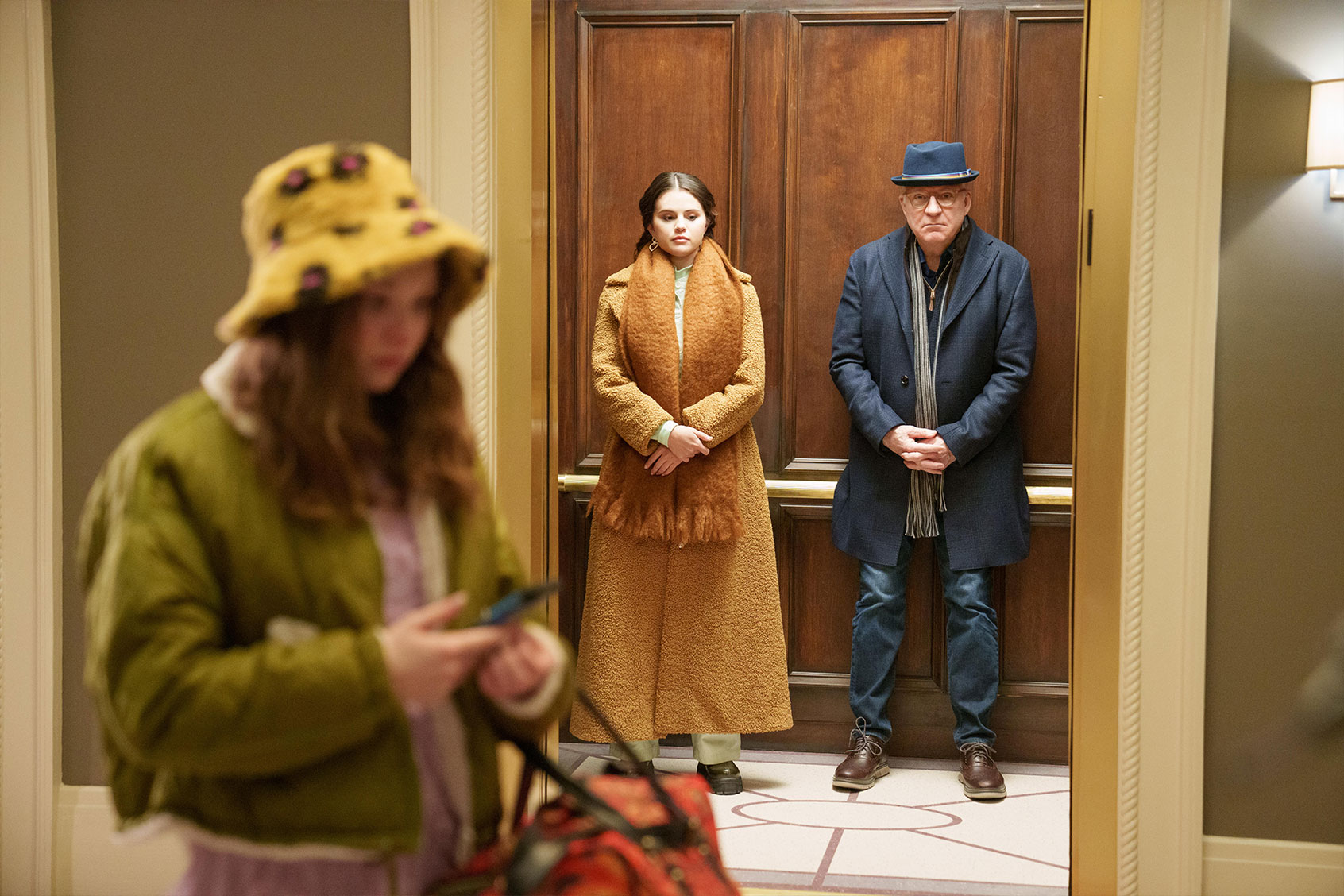
Krige plays Veronica Ghent, an actress who just had a double mastectomy and wants to convalesce at a rustic retreat in the Scottish Highlands. However, in addition to her physical pain, the news reports that famed director Eric Hathbourne (Malcolm McDowell) is remaking a movie that Veronica starred in as a teen. That information resurrects a trauma he inflicted on her during their “close” working relationship when she was 13. 

While Veronica wants solitude, her quiet at the retreat is disrupted by a group of artists in residence led by Tirador (Rupert Everett). Moreover, the site of the retreat is a strange place where witches were once burned. (Their ashes in the land are said to have therapeutic properties.)

Krige plays Veronica with considerable force. Although she is a woman who may have disturbing dreams, or dark thoughts, her mind remains sharp. (She is wonderfully bitter scolding her aide, Desi (Kota Eberhardt), “I had a mastectomy, not a lobotomy.”) She is also particularly inspired — one might say possessed — when she creates a painting out of charcoal and peat. As she copes with her physical and psychological wounds, Veronica finds supernatural powers that give her a sense of agency. What she does with her new-found abilities is what makes “She Will” so satisfying. 

Krige spoke with Salon about playing the indomitable Veronica.

The opening scene has Veronica applying makeup and talking about putting on a mask as a form of preservation. There is sense of performance, but she is hiding. It’s avoidance. Can you talk about how Veronica considers herself and presents herself? 

She is savage, acerbic, rude, unkind, and really very unpleasant. She is not merely putting on a mask. She’s kidding herself. She has become the mask. It is a radical defense to keep the world out. She had a traumatic experience as a teen on a film set, and it’s never talked about. She repressed it and it leaves her haunted, lonely, and unable to trust. Progressively, the mask becomes a defense. It’s not about preservation. It’s destroying her. She’s lost herself in the mask. The mask is one of “inaccessible movie star,” though she describes herself as a “failed movie star, washed up, past her sell by date.” It is her only way of keeping the world at a very long arm’s length. I don’t think it’s “I can’t be bothered.” It is “I don’t want to make myself vulnerable in any way.” 

The mastectomy makes her feel like “less of a woman,” and of course, the trauma she’s been repressing regarding Hathbourne, has robbed her of her sense of self as well. Can you talk about Veronica’s power and powerlessness? How much agency does she have?

She is under this brusque, superior, cold exterior. She is wounded and has simply no way of escaping what she’s got trapped in, which is loneliness. Something happens when you’re a teen, you think it’s your fault. Somehow, you asked for it, or provoked it. She didn’t. She was just this exquisite, beautiful, young [girl] and she is enormously wounded. She is trapped within the trauma and has absolutely no way out. But there is a very interesting moment at the beginning where she has hit an absolute wall, post-surgery, and is utterly alone, and can’t acknowledge that she’s in a state of despair. Then, the TV flashes that Hathbourne is about to be knighted, and remake the film, and there’s this line of 14-year-olds snaking around building. She knows it’s going to happen again. She’s furious and angry and even more angry by what she’s just seen. She has no inkling about what’s about to happen. The universe, the cosmos conspires to take her on a journey to face the truth of what happened, and the truth of her mutilated body. She arrives at this place where 3,000 people were burned, and the earth is suffused with their presence in the peat, and the water, and the earth. She is so ready. It comes to her rescue. She starts to discover dimensions she has never encountered before.

Ever since “Ghost Story,” you have been cast in films with supernatural storylines, such as “Sleepwalkers.” Can you talk about the appeal of these kinds of projects?  

It’s not like I go in search of them. There must be something a bit odd about me because they kind of just come to be. But what’s wonderful about them is that many of them deal with a heightened reality. That enables you to explore a reality that is more intense than the mundane. It’s very exciting, and wonderful to play in the sandpit without consequences. I get to go there and then I can go home at night without having to do any real damage. 

She WillAlice Krige in “She Will” (IFC Midnight)There is a topical theme of #MeToo in the film as Veronica has been abused by Hathbourne. He claims it was “a different time,” and that they were “very close.” Given your work in the industry over time, what observations do you have about the relationships between actresses and their directors?

I thankfully, have never had this experience, for which I’m very grateful, I would have found it enormously traumatic, and unbearably distressing. One is certainly, as a working actress, vulnerable. To do the work you have to make yourself vulnerable and be prepared to walk onto the set and be emotionally naked and accessible. It’s the only way you stand a chance of accessing the other actors and [the character]. It does expose you, and directors and producers are in powerful position. I am not thinking about power dynamics when I walk onto a set. All I am thinking about is [the character], and the relationships being explored in the creative space. It’s such a heightened process. 

And yes, it was what happened in another time, but that doesn’t make it acceptable. I think Malcolm [McDowell] created a character who is enormously complex, and there is an extraordinary moment that Malcolm has you believe for one moment that Eric Hathbourn faces himself. Malcolm is not like the roles he plays, but he plays them extremely well. He is outrageous and outspoken and so without a filter. If I was like that, I’d just be offensive. It would come out all wrong and horrible. Somehow, he twinkles his way through.


Want a daily wrap-up of all the news and commentary Salon has to offer? Subscribe to our morning newsletter, Crash Course.


There is a scene where Veronica wants some alcohol and Desi warns her that wouldn’t be advisable. Veronica retorts, that “If you want to survive in this sh*tstorm called life, you won’t do it by doing what is advisable,” and talks about teeth and claws. What is your approach to life?

Every role I take is a gamble or a huge risk. You step into the void. It is death if you think you know how to do it. It’s like a start from beginning each time. The one thing I hope I’ve learned in all these years is that at a certain moment, to let go of the safety blanket of all the prep I’ve done, and just be there and trust. That is the ultimate risk to simply trust that it’s going to happen. I don’t gamble in my own life much, except I do, I supposed. I’ve produced a couple of movies, and I’m about to produce some more. That’s a gamble of extraordinary order. You set out on path don’t know how where or how it is going to end. Moment to moment, it’s a gamble.

Are you someone who seeks revenge, like Veronica, when wronged? 

I didn’t think that Veronica was seeking revenge. She wanted [Eric] to tell the truth. What happens is a consequence of his inability to tell the truth. That was where I was coming from. I know a lot of people experience it as her setting out for revenge, but I think she’s carried along but once she has entered these other dimensions, after the first couple of experiences, she realizes she has agency, she sets her sights on actually confronting him. She wants him to tell the truth, because for years, he has lied. 

I let stuff roll off me like water off a duck. It is a waste of energy to bear a grudge. We are all struggling, just scrambling around doing our best, sometimes not doing our best, always failing. There is no time or space or energy for revenge. If someone hurts you, in the end, if you hold onto it, it’s bound to hurt you. Revenge can hurt you as much as the one upon whom you exact revenge. 

Veronica asks Desi if she would want to relive her childhood. Would that appeal to you? 

I had the happiest childhood, so yeah, I wouldn’t mind going there again.

“She Will” is out in theaters and on demand July 15.

Read more

about this topic


No, “stealth omicron” isn’t evading PCR tests. Here’s what’s really going on

The COVID-19 pandemic has seen the rise and fall of many variants, but nothing like BA.5.

Previous subvariants of omicron have caused cascading surges as they outcompeted each other; now, BA. 5 is the latest mutation to take hold around the world. Its success in spreading is due in part to its unique mutations that make it capable of evading immunity from previous infections and vaccines. It is also the most transmissible variant, even more so than its predecessors BA.1 and BA.2 that fueled surges over the summer — and which were already the most contagious viruses ever known. 

RELATED: Omicron changes risk of air travel

“We do know [BA.5] to be more transmissible and more immune-evading,” Centers for Disease Control and Prevention (CDC) Director Rochelle Walensky said last week. “People with prior infection, even with BA.1 or BA.2, are likely still at risk for BA.4 and BA.5.”

According to the CDC, BA.5 made up nearly 65 percent of the coronavirus infections in the United States nearly two weeks ago. As Salon has previously reported, and as experts have widely commented on, the actual number of people infected with COVID-19 is likely much higher than what the CDC reports because of the prevalence of at-home antigen tests, which can sometimes yield false negatives. Likewise, those who test positive on an at-home tests don’t generally report their results to any public health agency, meaning they may not contribute to countywide infection counts.

Detecting a specific variant, and detecting COVID-19 overall, are different things; and even if PCR tests can’t differentiate between which variant a patient has, they are still extremely reliable when it comes to detecting a SARS-CoV-2 infection of any variant.

Highly accurate lab tests done in hospitals and clinics, known as polymerase chain reaction (PCR) tests, do typically record results and send them to public health agencies. While PCR tests are considered extremely reliable, misinformation has been swirling around this new variant and its relationship to testing — including some prominent rumors that PCR tests won’t detecting the BA.5 variant, or may yield false negatives.

Fortunately, experts tell Salon this isn’t the case. 


Want more health and science stories in your inbox? Subscribe to Salon’s weekly newsletter The Vulgar Scientist.


The confusion may stem in part from a nickname given to this strain. Many news outlets have given BA.5 the moniker “stealth omicron” — partly because, like its predecessor BA.2, it has become harder to identify the variant on PCR tests. But detecting a specific variant, and detecting COVID-19 overall, are different things; and even if PCR tests can’t differentiate between which variant a patient has, they are still extremely reliable when it comes to detecting a SARS-CoV-2 infection of any variant. Thus, the “stealth” appellation implies a tendency not to evade a PCR test — the patient will still test positive — but to not reveal precisely which variant it is to the PCR test.

“When you look at a PCR test, it has multiple targets, and when multiple targets turn positive the test it tells you its SARS-CoV-2,” Dr. Amesh Adalja, a senior scholar at the Johns Hopkins Center, explained to Salon.

But one of the ways scientists could tell that a PCR test was picking up, say, BA.1, was because it exhibited what is called a “S gene target failure.”

“That target would always be negative, so you’d know it was likely BA.1, and then when BA.2 came around, it didn’t have an S gene target failure — so you couldn’t just look at the PCR test and say ‘oh, this is BA.2.'”

Hence, the “stealth” nature of the variant.

As the FDA explains, PCR tests with “multiple targets” are “more likely to continue to perform well when new variants emerge.” The agency has a list of PCR tests that function by testing multiple targets on its website.

Similarly to BA.2, BA.5 doesn’t have the S gene target failure, meaning that PCR tests that look for multiple targets likely won’t be able to specifically identify that the variant they have is BA.5. However, PCR tests will still pick up if and when a patient is infected with SARS-CoV-2.

This is all to say that PCR tests are still at risk of perhaps being less effective and less accurate as future variants emerge.

“If there is some new variant that emerges, you run the risk of losing that primer and then your test is no longer detecting things anymore,” Hafer said, adding this isn’t a unique situation to omicron. “It’s been a concern throughout the pandemic.”

“Every company or lab that’s doing a PCR test should really be careful when they design their primers that they’re making them in a sequence of the virus that may be less likely to mutate, and then they should be checking their their primers periodically against databases that are out there have varying sequences that are circulating out in the community,” Nathaniel Hafer, an assistant professor in molecular medicine at University of Massachusetts’ Chan Medical School, told Salon. “And if they see the potential for these mismatches, they need to know about that and potentially redesign their primers because these S gene dropouts will occur when the primer is no longer complimentary to the viral sequence through the mutations.”

Hafer said this is why PCR tests look for different targets rather than one.

“If there is some new variant that emerges, you run the risk of losing that primer and then your test is no longer detecting things anymore,” Hafer said, adding this isn’t a unique situation to omicron. “It’s been a concern throughout the pandemic,” he noted.

In January 2021, the FDA warned that some authorized molecular tests were at risk of being negatively affected by future variants.

“The presence of SARS-CoV-2 genetic variants in a patient sample can potentially change the performance of a SARS-CoV-2 test,” the FDA warned in a statement. “Tests that rely on the detection of multiple regions of the genome may be less impacted by genetic variation in the SARS-CoV-2 genome than tests that rely on detection of only a single region.”

And while this isn’t happening just yet, Hafer said that in the future, some companies may find that their tests fail to detect future variants.

“It’s Darwinian evolution in action, so it’s just a bad break and it’s going to happen eventually if we all wait around long enough,” Hafer said. “Companies need to be monitoring this so that they can react quickly if they see that something has changed, and this is not just for infectious disease — anybody who’s doing molecular biology in the lab will have a horror story.”

Read the latest news on COVID-19:

Ivana Trump, ex-wife of Donald Trump, dead at 73

Ivana Trump, the first wife of former President Donald Trump and mother to Donald Jr., Ivanka Trump, and Eric Trump, has died at the age of 73 due to what the New York City Medical Examiner’s Office is calling “blunt impact injuries” to her torso. 

In a remembrance post made on Truth Social, Trump had this to say about his ex-wife Ivana:

“I am very saddened to inform all of those that loved her, of which there are many, that Ivana Trump has passed away at her home in New York City,” Trump posted on Truth Social. “She was a wonderful, beautiful, and amazing woman, who led a great and inspirational life. Her pride and joy were her three children, Donald Jr., Ivanka, and Eric. She was so proud of them, as we were all so proud of her. Rest In Peace, Ivana!”

According to ABC, Ivana died Thursday afternoon in her apartment in Manhattan. Police arrived at the scene after receiving a call regarding a person in cardiac arrest. Initially the exact cause of death was not known but on Friday the Medical Examiner’s Office ruled it to be an accidental fall from the stairs in her home. 

Ivana and Donald Trump married in 1977 and went through a very public divorce in 1992. During their divorce, Ivana claimed that Trump raped her during their marriage; an event that’s recounted in the book by Harry Hurt, “Lost Tycoon: The Many Lives of Donald J. Trump.” Ivana later back-pedalled on the statement, according to previous coverage by Salon, saying:

“[O]n one occasion during 1989, Mr. Trump and I had marital relations in which he behaved very differently toward me than he had during our marriage. As a woman, I felt violated, as the love and tenderness, which he normally exhibited towards me, was absent. I referred to this as a ‘rape,’ but I do not want my words to be interpreted in a literal or criminal sense.”

The former Mrs. Trump was involved in the clothing and jewelry industry in the years following her divorce, penned an advice column for Globe called “Ask Ivana,” and was the author of several books including “Raising Trump: Family Values from America’s First Mother,” which was released in 2017.

When Trump re-married for the third time to current wife Melania in 2005, Ivana did not seem to hold back from staking her claim as the original Mrs. Trump. In an interview with ABC in 2017, Ivana talked about still speaking to Trump on the phone from time to time while he was in the White House, and the topic of Melania found its way into the interview.

“I (don’t) really want to call him there, because Melania is there, and I don’t want to cause any kind of jealousy or something like that, because I’m basically first Trump wife. OK? I’m first lady.”


Want a daily wrap-up of all the news and commentary Salon has to offer? Subscribe to our morning newsletter, Crash Course.


Ivana’s son, Eric Trump shared a selection of family photos featuring his mother on Instagram along with the following statement:

It is with deep sadness that we announce the passing of our beloved mother, Ivana Trump. Our mother was an incredible woman — a force in business, a world-class athlete, a radiant beauty, and caring mother and friend. Ivana Trump was a survivor. She fled from communism and embraced this country. She taught her children about grit and toughness, compassion and determination. She will be dearly missed by her mother, her three children and ten grandchildren.

https://www.instagram.com/p/CgATzaVLLw2/?utm_source=ig_embed&ig_rid=a72bffc3-48a3-4351-b477-ec64f1d7638a


Republicans block Democratic bill to protect freedom to travel for abortions

Sen. Amy Klobuchar, D-Minn., on Thursday tore into Senate Republicans for their anti-abortion agenda after it was reported that a 10-year-old victim of rape had to travel across state lines to receive an abortion. 

“Think about the heart-breaking, enraging story about the 10-year-old girl in Ohio who had to go to Indiana to get an abortion after she was impregnated by her rapist,” said Klobuchar in a fiery floor speech. “This man raped a 10-year-old girl and she got pregnant […] She couldn’t even get the care she needed,” the Democrat added. “Should the next little 10-year-old’s right … be put in jeopardy?”

Klobuchar was referencing a widely-publicized story that emerged last week about a 10-year-old girl who had to travel interstate for abortion care because she was past the legal threshold – six weeks – to get an abortion in Ohio. When the story first appeared, conservatives widely attempted to delegitimize the account as fake news designed to gin up controversy around the GOP’s crackdown on abortion. 

RELATED: Conservatives tried — and failed — to cast doubt on tale of Ohio child rape victim

However, that effort came to a grinding halt on Thursday after a 26-year-old man was officially charged with raping the child. 

While the story has outraged progressives, liberals, and pro-choice advocates alike, conservatives have largely stood their ground on the issue. 

In Congress, Sen. James Lankford, R-Okla., on Thursday blocked a Democratic-backed bill to enshrine the right to travel across state lines for an abortion. 


Want a daily wrap-up of all the news and commentary Salon has to offer? Subscribe to our morning newsletter, Crash Course.


“No state has banned interstate travel for adult women seeking to obtain an abortion. This seems to be just trying to inflame, to raise what-ifs,” Lankford said

“Does that child in the womb have the right to travel in their future?” Lankford said. “Do they get to live? […] There’s a child in this conversation as well.”

The bill, dubbed the “Freedom to Travel for Health Care Act,” would have allowed state attorneys general to bring suits against anyone who contravenes the law. 

RELATED: Post-Roe gaslighting: The party of QAnon denies the very real rape of a 10-year-old

Meanwhile, congressional Republicans are reportedly planning to introduce legislate that would expressly ban interstate travel for the purposes of abortion, according to Sen. Patty Murray, D-Wash. “Anyone telling you this is not a threat is not paying attention,” Murray said this week.

Watch: Jim Jordan called out at House hearing for claiming rape of Ohio girl was “another lie”

Rep. Ted Lieu (D-CA) called out a Republican colleague, Rep. Jim Jordan of Ohio, during a House hearing regarding abortion rights in the United States.

“You’re going to hear a lot of words from my Republican colleagues,” Lieu said Thursday at the House Judiciary committee hearing. “And all I have to do is give you one example that is devastating to their statements.”

“A ten-year-old girl got raped in Ohio and got pregnant. She could not get an abortion, because none of the exceptions in Ohio law would have authorized it. And what did MAGA Republicans do? They smeared her. They said she was lying.”

“In fact, at least one Republican member of this committee publicly tweeted that she lied, and then quietly deleted that tweet when — guess what – her perpetrator was arrested,” Lieu continued.

The Democrat then called for Republicans who doubted the story to apologize, and noted that conservatives have started to attack the doctor who helped the rape victim terminate her pregnancy.

“Another lie. Anyone surprised?” Jordan wrote on Twitter, citing a news article about Ohio Attorney General Dave Yost’s office casting doubt on the story. On Wednesday, the Republican congressman deleted his tweet.

Gerson Fuentes, 27, confessed to raping the child at least twice, according to police. He was arrested Tuesday and charged with felony rape of a minor under age 13, according to the Franklin County Municipal Court. He is being held on $2 million bond.

Watch the video below:

GOP attorney general tells Fox News he’s investigating doctor who performed abortion on rape victim

On Wednesday, Indiana Attorney General Todd Rokita claimed that state authorities are looking into a doctor who reportedly provided an abortion to a 10-year-old victim of rape, suggesting that the doctor might be charged with a federal crime. 

“We’re gathering the evidence as we speak, and we’re going to fight this to the end, including looking at her licensure if she failed to report. And in Indiana it’s a crime … to intentionally not report,” Rokita said in a Fox News interview. “This is a child, and there’s a strong public interest in understanding if someone under the age of 16 or under the age of 18 or really any woman is having abortion in our state. And then if a child is being sexually abused, of course parents need to know. Authorities need to know. Public policy experts need to know.”

The doctor in question, Caitlin Bernard, first told the Indianapolis Star that she performed an abortion for the minor after six weeks into pregnancy. The girl reportedly traveled from to Indiana from Ohio, where an abortion is newly illegal beyond the six-week mark. In Indiana, abortion is banned 22 weeks into pregnancy. 

On Fox, Rokita castigated Bernard as an “abortion activist acting as a doctor,” saying that “from what we can find out so far, this Indiana abortion doctor has covered this up.” According to Politico, the doctor’s failure to report the abortion could violate both states’ criminal statutes.

RELATED: Conservatives tried — and failed — to cast doubt on tale of Ohio child rape victim

The account first gained traction after CNN’s Dana Bash highlighted it in an interview with South Dakota Gov. Kristi Noem, an adamant anti-abortion advocate. It later captured more attention when President Biden remarked on the story as an outrageous consequence of the GOP’s sweeping attack on abortion access. 


Want a daily wrap-up of all the news and commentary Salon has to offer? Subscribe to our morning newsletter, Crash Course.


“She was forced to have to travel out of the state to Indiana to seek to terminate the pregnancy and maybe save her life,” Biden last week. “Ten years old — 10 years old! — raped, six weeks pregnant, already traumatized, was forced to travel to another state.”

Shortly thereafter, conservative media attempted to call the story’s legitimacy into question, fueled in part by reports from The Wall Street Journal and The Washington Post. The speculation absurdly ended after a 27-year-old man, Gerson Fuentes, was arrested and charged for the crime, according to The Columbus Dispatch

Since then, conservatives have pounced on the fact Fuentes is reportedly an undocumented immigrant. “First of all, this is an illegal immigraiton issue, because, likely of Biden’s lawlessness at the border,” as Rokita said on Fox News.

RELATED: House Democrats should move quickly to protect abortion rights in 2019

The story comes amid national outrage over the GOP’s broad-reaching assault on abortion access, which last month culminated in the Supreme Court’s decision to overturn Roe v. Wade, the landmark ruling establishing America’s constitutional right to abortion.

The Indiana lawyer whose proposed legislation bans all abortions unless necessary to save the life of the pregnant person, told Politico that under his bill the victim would not have been allowed an abortion. 

“Unless her life was at danger, there is no exception for rape,” Republican Jim Bopp made clear.

Post-Roe gaslighting: The party of QAnon denies the very real rape of a 10-year-old

The party of QAnon got caught projecting their own sins onto their opponents — with lightning speed this time.

As a reminder, Republicans are increasingly embracing the grotesque tactic of leveling false accusations of child sex abuse at their political opponents. It started in the fringes, with groups like QAnon spreading wild conspiracy theories accusing Democratic politicians and, for some reason, Tom Hanks of being pedophiles who murder children to eat their brains. The “made-up pedophilia stories” thing then went completely mainstream in the GOP this year. Beginning with the office of Florida’s Republican Gov. Ron DeSantis, conservative politicians and media figures started falsely accusing people who support LGBTQ rights of being “groomers,” i.e. people who target children for sexual abuse. Drag queens, the Disney corporation, and even Oreo cookies got swept up in the GOP frenzy of painting their political opponents as child sex predators.

This Republican tendency to casually paint any political opponent as supportive of child rape even factored into the confirmation hearings of Supreme Court Justice Ketanji Brown Jackson in March, as Sen. Josh Hawley of Missouri viciously attacked the judge with flatly false accusations that she has some special affection for child pornographers. The use of false accusations of child sex abuse has become so rapidly normalized in the GOP that it would be hard to believe it, if not for the very public and televised evidence of how much they love saying these repulsive things. 

RELATED: Republicans turn Ketanji Brown Jackson’s Supreme Court confirmation hearings into a QAnon circus

Republicans love to work themselves into a frenzy over child sex abuse that exists solely in their fantasies. But this week, when confronted with the very real story of a 10-year-old rape victim, the Republican noise machine went into overdrive denying her very existence.

It started with a story in the Indianapolis Star about a 10-year-old abortion patient who was forced to travel to Indiana for an abortion due to the abortion ban in Ohio. Dr. Caitlin Bernard, an ob-gyn in Indiana, told the paper about seeing this patient, who was 6 weeks pregnant. 

Republicans love to wax poetic about imaginary child sex abuse, but in the real world, victims receive nothing but GOP abuse. 

The story illustrates the sadism and misogyny that fuels abortion bans, and so it’s no surprise it started to get more attention. First, CNN host Dana Bash asked South Dakota’s Republican Gov. Kristi Noem about it. Then President Joe Biden, his voice cracking with outrage, mentioned the case in a speech denouncing the Supreme Court for overturning Roe v. Wade: “Ten years old — 10 years old! — raped, six weeks pregnant, already traumatized, was forced to travel to another state.” 

At this point, right-wing media decided it was time to start falsely accusing Dr. Bernard of making the whole thing up.


Want more Amanda Marcotte on politics? Subscribe to her newsletter Standing Room Only.


A reporter from the sleazy right-wing outlet Daily Caller triumphantly declared that Dr. Bernard couldn’t provide “any details to corroborate her story.” This was enough for the larger right-wing press to go on a feeding frenzy. The attempts to discredit Dr. Bernard’s story quickly got elevated to Fox News, where piggish host Jesse Watters especially went nuts over it. Then the editorial board at the Wall Street Journal published a story with the snarky headline “An Abortion Story Too Good to Confirm,” complaining that they were denied access to the name of a child sex abuse victim. 

In a truly shameful display, the bothersiderism addict at the Washington Post, “fact checker” Glenn Kessler, decided to grace the right’s false accusations with a story headlined, “A one-source story about a 10-year-old and an abortion goes viral.” Kessler’s entire premise to cast doubt on the rape of a child was his claim that law enforcement knew nothing about the rape. 

RELATED: Conservatives tried — and failed — to cast doubt on tale of Ohio child rape victim

Of course, it turned out the story was true — and the police were informed of the rape last month. 

Which is unsurprising, considering how common child sex abuse is. The real kind, that is, not the imaginary kind QAnon cares about. 

Republicans love to strut around in a self-righteous fury over the fake rapes of imaginary children. But when real kids are actually abused and need real help? Republicans don’t just refuse to care, the GOP media establishment — and their allies in mainstream media — go out of their way to erase the existence of these very real victims. 

What makes this especially gross is how much this smear campaign relied on known difficulties in dealing with cases such as this. Both federal law and medical ethics prevent doctors from handing over the names and addresses of patients, especially to “journalists” at right-wing rags who clearly have ill intent. Kessler’s “fact check” noticeably fails to note that Dr. Bernard, by federal law, could not reveal the patient’s identity.

And, as the media figures who pushed this narrative are also aware, rape is infamously under-prosecuted. Only 50 out of every 1,000 rape cases result in arrest. No wonder they were caught by surprise when someone was actually arrested for this rape. Arrest so rarely happens they were smart to bet that it was unlikely in this case. Kessler’s “fact check,” meanwhile, failed to note that rape cases rarely result in arrest, even as he held out formal charges as the kind of legitimizing evidence he demands from such stories. 


Want more Amanda Marcotte on politics? Subscribe to her newsletter Standing Room Only.


So, will the people who accused the good doctor of being a liar apologize?

Hell no, of course not. They are doing exactly what a bunch of sadistic misogynists love to do: viciously attacking a doctor for being the one person willing to help a child rape victim. 

Sadly, this is nothing new.

The media figures who pushed this narrative are aware that rape is infamously under-prosecuted.

Anti-choice ghouls want no compassion for anyone with a uterus, but they get especially outraged when kindness is shown to child rape victims. As I noted on Twitter, it’s one of the reasons that Dr. George Tiller of Kansas was such a focal point of right-wing harassment for so long. Tiller was one of the few doctors in the country who had the skills and capacity to deal with child rape victims whose pregnancies were discovered months after the rape. When it was discovered that Tiller had aborted a pregnancy in a 10-year-old rape victim, anti-choice activists convinced a local prosecutor to take him to court in 2009 over false accusations that he had done so illegally. The jury deliberated for less than an hour and acquitted Dr. Tiller, because ordinary people do not share the anti-choice view that it’s good to force 4th graders to give birth. 

RELATED: Republicans don’t care about kids — just imaginary children

One anti-choice activist, Scott Roeder, was especially angry that Tiller was not punished for helping a child rape victim. Two months after the trial ended, Roeder showed up at Dr. Tiller’s church and murdered the doctor in front of the congregation. This is what gets euphemized as “pro-life”: homicidal rage at doctors who show compassion toward child rape victims. 

We’re seeing that rage now, as Fox News and other right-wing pundits work themselves into a lather villainizing Dr. Bernard for daring to spare a child the horror of forced childbirth. It’s a gross display, but these are the same people who support and defend Donald Trump, a man who was caught on tape bragging about how he likes to sexually assault women.

It’s yet another reminder that what fuels the anti-choice movement is not “life,” but plain old misogyny. It’s a misogyny that celebrates the sexual predator, like Trump, and castigates both the victims and those who help victims. And, as this story shows, the hate isn’t aimed just at grown women, but at girls as young as 10 years old. Republicans love to wax poetic about imaginary child sex abuse, but in the real world, victims receive nothing but GOP abuse. 

Ayanna Pressley publicly schools Josh Hawley’s wife on abortion: “A deficit in your understanding”

Rep. Ayanna Pressley, D-Mass., on Wednesday tore into anti-abortion activist Erin Hawley, the wife of Sen. Josh Hawley, R-Mo., for tiptoeing around the exact meaning of “abortion,” telling her that there was “a deficit in [her] understanding” of reproductive care. 

The fiery exchange came during a House Oversight and Reform Committee hearing this week, during which Erin Morrow Hawley, Senior Counsel at the right-wing Alliance for Defending Freedom, was questioned about the dangers of ectopic pregnancies. (Ectopic pregnancies occur when a fertilized egg implants outside the uterus, putting the carrier in life-threatening danger.)

“When an ectopic pregnancy ruptures, what are the chances it can be carried safely to term?” Pressley asked Hawley. 

Hawley acknowledged that an ectopic pregnancy is a life-threatening condition, but added, “That’s why the treatment for ectopic pregnancies is not an abortion.”

“Again, can you just answer the question,” Pressley shot back. “When an ectopic pregnancy ruptures what are the chances it can be carried safely to term? And you know what, just to make this clearer, I’m looking for a number between 0 and 100.”

RELATED: Ohio “abortion murder” bill orders doctors to “reimplant ectopic pregnancy,” which is impossible

“I believe zero ectopic pregnancies – even those that do not rupture – have a chance of successfully being carried to term,” Hawley replied. “That’s why the treatment for them is not an abortion.”


Want a daily wrap-up of all the news and commentary Salon has to offer? Subscribe to our morning newsletter, Crash Course.


Pressley then told Hawley that she had a “deficit in her understanding,” citing official guidance from the American College of Obstetricians and Gynecologists that treatment for an ectopic pregnancies requires ending that pregnancy.

“That’s not an abortion because it does not have the intent to end the life of the child,” Hawley snapped backed. 

“Reclaiming my time,” Pressley responded. “I’m now going to turn over to the real experts.”

RELATED: Emergency contraception marks a new battle line in Texas

The exchange comes as the GOP mounts both a sweeping state-level attack on abortion access throughout the country. Last month, the Supreme Court formally overturned Roe v. Wade, the landmark 1973 decision that established America’s constitutional right to abortion. After the decision, at least thirteen states with “trigger laws” already on their books significantly curtailed abortion access. 

Several states now have anti-abortion laws that make no exceptions for victims of rape or incest, and some limit “maternal health” exceptions to life endangerment. The New York Times maintains an ongoing map and the Guttmacher Institute, a research and policy organization focused on sexual and reproductive rights, publishes a detailed grid of state policies and exceptions.

CORRECTION: An earlier version of this article conflated abortion laws in several states, resulting in a summary of policies and exceptions that was confusing and could be misleading to readers. The story has been corrected with links to direct readers to updated and clear information on these complex laws.

Donald Trump is finally running scared: Liz Cheney and Jan. 6 committee have him cornered

Donald Trump missed his calling.

He should’ve been an Adderall-stoked tour director on a spring-break bus loaded with drunken college kids: “Be there, will be wild!”

He would’ve been obnoxious, and noxious — but mostly harmless. Declawed, defanged and destructive, but ultimately forgotten by history.

Our Donald, being the rage-fueled, narcissistic, power-mongering loser that he is, cannot go gentle, genteel or gentile into that good night. So he used his God-given talent for blatant hucksterism in some twisted Darth Vader moment on Dec. 19, 2020. He tweeted out a call to arms for a “Big Protest in D.C. on January 6th. Be there, will be wild!”

If he had only thought to set up a turnstile and charge $25 a pop for admission, it would have been — in his warped, Swiss-cheese mind — perfect.

But nothing in this world is perfect, and Donald Trump is living proof of that every day he sucks in air and expels noxious vapor. 

Trump of course was known, before stumbling into the presidency, mostly as a Hollywood sideshow; a poser who would show up in cameos, as he did in “Home Alone.” That changed when he took center stage in 2004 on the show “The Apprentice.” There he reached a convergence of his ego, his need for attention and his relentless grifting. He went primetime in a reality show that was known for being long on show and short on reality. “You’re fired” was his catchphrase.

People ate it up, of course. And his timing was fortuitous. “Frasier” and “Friends” had anchored the Thursday night comedy lineup that began on NBC with “Cheers” in the ’80s. Those shows left. Trump took over a 9 p.m. time slot and did fine with it. Some thought his show to be parody — like a sketch on “Saturday Night Live” — thus the inclusion in the Thursday night lineup. But it wasn’t comedy. It was tragedy; Don the Con took himself seriously. His greatest con job? He conned himself.

His run for the presidency was both a revenge tour for Barack Obama slighting him at a White House Correspondents dinner and, as his former fixer Michael Cohen put it, “the best infomercial in history — to raise the profile of the Trump brand.”

No one was more surprised than Trump when he actually won. After calling the White House a dump when he settled in, he gradually grew to love the seat of power on Pennsylvania Avenue. Many scandals and grifts later, he didn’t want to give it up. Where “The Apprentice” gave him a taste of notoriety, the White House fed Trump’s massive ego and narcissistic desires as only the office of the presidency can. “He only cared for himself,” Cohen warned us. Cohen was right.

He was also right in warning us that Trump wouldn’t accept a peaceful transfer of power, but by the time the 2020 election rolled around a majority of the American people had had enough of the orange-hued con man and voted him out. Trump didn’t want to go, would never admit he lost and fought like a sewer rat with a rancid piece of pizza in his mouth to stay. Thus he “would galvanize his followers, unleash a political firestorm and change the course of our history as a country,” as Rep. Jamie Raskin told us in the latest Jan. 6 hearing on Tuesday.

Complicit in Trump’s attempt to overthrow the government he ran were social media platforms like Twitter. Employees have said they knew they were amplifying calls to violence. Nothing was done. Many on Trump’s staff knew Trump had lost the election and did nothing to stop him from trying to stage a coup. No one stopped him. Cassidy Hutchinson, the aide to Mark Meadows who would later offer bombshell  testimony before the Jan. 6 committee, tweeted out “The West Wing is UNHINGED.” I never knew the West Wing to be hinged — at least not while Trump was there.

More importantly, the Proud Boys and the Oath Keepers knew what Trump wanted; a big bright fiery show. A dramatic takeover. A rousing third act. “It’s time for the DAY OF THE ROPE! WHITE REVOLUTION IS THE ONLY SOLUTION,” read one tweet. “Cops don’t have ‘standing’ if they are laying on the ground in a pool of their own blood,” read another.

Ironically, the committee read that tweet in front of a packed house that included several of the officers injured and traumatized on Jan. 6, 2021. 

The Proud Boys and Oath Keepers knew exactly what Trump wanted: “It’s time for the DAY OF THE ROPE! WHITE REVOLUTION IS THE ONLY SOLUTION.”

“Why don’t we just kill them,” or “We need volunteers for the firing squad,” were tweets also shared by those who rioted. “Is the 6th D-Day? Is that why Trump wants everyone there?” asked another. Indeed he did. Mike Flynn, Rudy Giuliani and Sidney Powell (whose videotaped testimony about sedition was casually offered between swigs of Diet Dr. Pepper) encouraged the riot, according to witnesses, in a six-hour-long argument on Dec. 18 that went from room to room in the White House. Giuliani accused those who recommended Trump end his fight of being “pussies.”

Judd Deere, the only member of Trump’s press staff universally trusted by members of the press, testified that Trump was typically Trump that day — refusing to give in and acting as if he could by sheer force of his gnarled ego stay in office. He left the outside door to the Oval Office open so he could bask in the glow of people shouting his name.


Want a daily wrap-up of all the news and commentary Salon has to offer? Subscribe to our morning newsletter, Crash Course.


Then, on Jan. 6, Trump let the crowd on the Ellipse know he meant business. He showed up and encouraged them to storm the Capitol. He screamed, “Fight! Fight! Fight!” as if he were a high school cheerleader. 

This was Trump at the height of his power. His four years of fascism culminated in a violent group assembled in our nation’s capital set on destroying the rule of law and installing Trump as dictator, with powers to destroy the Constitution.

For seven episodes now, the Jan. 6 committee hearings have proven to be far better television than Trump ever created on “The Apprentice” — and part of him no doubt loves the attention. Hell, he probably bathes in it. He’s a hit!

But his niece, Mary Trump, told me this week that her uncle, for the first time in a long time, is truly afraid. “Though I’m concerned if anything will be done,” she said. Perhaps that fear is why he’s tried to reach out to potential witnesses. Rep. Liz Cheney fired a shot across Trump’s broad brow Tuesday afternoon — warning him not to try any more witness tampering — after she announced he had tried to call someone who has not yet testified. 

Congress, responding to Trump’s own masterful manipulation of the media, has learned a thing or two. Raskin said Watergate was like a “Cub Scout meeting” compared to the Trump scandal. He’s right. But the Watergate hearings were campfire storytelling compared to the “Stranger Things” production of the Trump hearings. Hell, this production could win an Emmy. It’s masterful, especially in the hands of Raskin. It’s one of the best-scripted live documentaries ever made — complete with cliffhangers and previews of the next exciting, terrifying and eventful episode. All that’s missing are the after-credit scenes. Maybe we’ll see Trump in irons after the last hearing. Who knows?

There are those who still fear that will never happen. Mark Meadows, it is reasoned, will eventually take the fall for Trump. But Liz Cheney is coming for Trump, and I wouldn’t want to get in her way. While Mary Trump isn’t a fan of Cheney’s politics, she too says Uncle Donald has every reason to be afraid. Cheney is everything Donald Trump can’t handle — an intelligent woman immune to his charms and threats, who has the facts at her side as she pursues the Mind Flayer. 

“Trump is a 76-year-old man,” Cheney reminded us, not “an impressionable child,” and he “is responsible for his own actions and choices.” Trump can’t hide behind his minions. He knew the election was not stolen. “No rational or sane man could ignore this and come to another conclusion,” she added, then concluded that Trump “cannot escape by being willfully blind.”

You’ve never needed to convince me or the many disinterested third-party observers who went to the Capitol on Jan. 6 to witness that sad day in our history. I felt safer in Ukraine during a war. I knew where the enemy was and I could protect myself. None of us knew who among those at the Capitol was friend or foe that day.

Donald Trump led, encouraged and planned that insurrection, and loved watching it. It was his magnum opus. His final aria. His version of Beethoven’s “Ode to Joy.” He relished in it. It was theater for Trump — as his entire life has been. Taking a page from Donald’s playbook, the Jan. 6 committee is using theater to expose his wretchedness.

Trump led, encouraged and planned that insurrection, and loved every minute of it. It was his magnum opus. His final aria. His version of “Ode to Joy.”

Donald Trump is a garbage can brought to life. He is the bottom of a dumpster that hasn’t been cleaned for a lifetime, sprung to life as a rancid pestilence. He appeals to your darker angels. He gives people permission to be as horrible as they want to be. The Jan. 6 hearings are slowly backing him into a corner, connecting the dots and exposing his vicious, seditious activities for the anti-democratic crap they truly are.

Trump is a fascist. Trump is a liar. Trump is dangerous. Ultimately Trump is a traitor to the ideals enshrined in our Constitution. The seventh hearing on this fetid stench leaves just one important question unanswered: Will the Department of Justice indict Trump, Mark Meadows, Rudy Giuliani, John Eastman, Jeffrey Clark, Sidney Powell and others?

It is obvious that Liz Cheney, by mentioning the DOJ at the close of this week’s hearing, believes that indictments are forthcoming. There are those who still doubt it and who believe Attorney General Merrick Garland is not up to the task. But the 32 federal lawmakers I’ve spoken with since Tuesday all believe Trump’s indictment will be coming. “It has to, or this means nothing and as a country we are done,” one told me. 

So how did Trump respond on Wednesday?

He sent out emails promoting his Trump “commemorative” golf balls along with one encouraging his supporters to buy authentic “Trump Ultra Maga Shirts,” for just $45.

The grift goes on — stay tuned for the next exciting episode.


Toxic algal blooms are driving up water costs in the Great Lakes

On August 2, 2014, the residents of Toledo, Ohio, a port city on the shores of Lake Erie, woke up without clean water. Testing had detected elevated levels of microcystin — a potent liver toxin and possible human carcinogen — in the city’s drinking water supply, and for three days, residents were told not to drink, bathe in, or even touch their tap water. The toxins were traced to a harmful algal bloom, or HAB, a potent green sludge made up of microscopic algae and bacteria that had sprouted in the shallow waters of the lake. 

Alicia Smith remembers that day. Nearly half a million people lost access to drinking water, and 110 got sickexperiencing headaches, chest tightness, muscle weakness, and nausea. Smith is the director of the Junction Coalition, a community organization in Toledo that works on promoting environmental justice and economic empowerment for the city’s low-income residents, many of them communities of color. Every August since then, she said, her neighbors worry about whether they’ll lose access to water again as fresh blooms occur. 

Beyond the health risks, Toledo residents are paying the price for this ever-present — and growing — threat. According to a report released in May by the nonprofit Alliance for the Great Lakes, the city of Toledo spends, on average, $18.76 per person annually on HAB-related monitoring and treatment, which adds up to nearly $100 for a family of five per year. That cost, generated from data from the Ohio Environmental Protection Agency, is passed on to ratepayers, making water bills even less affordable for many residents, Smith said. 

“We as the consumer have the burden of paying for a lack of regulation, mandates, and policies on water contamination,” she told Grist.

The report is one of the first to examine the cost of harmful algal blooms, a yearly problem that’s gotten worse in the last few decades. In the 1960s, before the “Clean Water Act” set limits on the discharge of pollutants from so-called “point” sources, like wastewater treatment plants, into the Great Lakes, the main cause of algal blooms was untreated sewage — a toxic stew for beach-goers, but a nitrogen-rich snack for algae. Now, though, the main food source for HABs is agricultural runoff — both excess fertilizer and animal waste, which contain phosphorus and nitrogen that flow from “nonpoint” sources like farm fields and are therefore not regulated by the federal Environmental Protection Agency. 

This runoff, combined with discharges from combined sewer overflows and warming waters in the shallower parts of the Great Lakes, creates a perfect environment for HABs. Since 2012, the city of Toledo’s public drinking water system has regularly tested the waters of Lake Erie for microcystin. It also monitors the levels of cyanobacteria, which produce microcystin and are a key component of algal blooms, on an hourly basis. But even if an algal bloom isn’t toxic, treating the water and disposing of the waste that’s created still adds an additional cost. These burdens are then passed down to ratepayers, in a region where the rising cost of water has already left thousands of families in debt or facing shutoffs. 

“The agribusiness system has relied on the ability to externalize these costs to downstream communities,” said Tom Zimnicki, the Agricultural & Restoration Policy Director for the Alliance for the Great Lakes. “And that clearly is not an equitable system.”

These costs are likely to grow, Zimnicki added, as climate change supercharges the spread of HABs. Severe storms in the Midwest are becoming more frequent and intense; the amount of precipitation falling in the heaviest storms has increased by 35 percent since 1951, according to the University of Michigan. All that precipitation washes more soil — and with it, fertilizer — from agricultural areas into the region’s waterways. In 2020, more than 9,000 metric tons of phosphorus flowed into Lake Erie. And as the climate changes, average temperatures around the Great Lakes are also getting warmer, creating optimal conditions for HABs to develop. Average summer temperatures in Lake Erie’s waters have increased by 1 degree Fahrenheit since 1980. 

The issue is also not limited to the Great Lakes Region. In June, the U.S. Government Accountability Office released a report urging federal agencies to do more to address algal blooms, which are occurring in all 50 states in all types of water — fresh, saline, and brackish. The report indicated that different kinds of algal blooms, from “red tides” in Florida to cyanobacteria in Oregon, are burdening communities that rely on waterways for economic activities like tourism and fishing, as well as threatening their health and drinking supplies. 

Zimnicki noted that the data for the Alliance for the Great Lakes report was collected in 2020, a relatively mild year for HABs, so the true costs for water treatment and waste disposal are likely higher than what is noted in the report. The organization is advocating for states and municipalities to collect this data more regularly, he said, to be able to compare costs from year to year and see whether they change over time. 

This year, thanks to fairly average rainfall in the spring and early summer, scientists don’t expect to see a particularly large algal bloom in western Lake Erie, according to the National Oceanic and Atmospheric Administration’s annual forecast for HABs. Conditions will likely be similar to 2018, when most of the lake remained clear but areas around Toledo and nearby Sandusky, Ohio, experienced persistent blooms throughout the summer. A medium-density bloom had already formed in the area as of July 10, according to NOAA, but forecasts can’t predict how toxic blooms will be, and covering a smaller area could actually make them more concentrated. 

Researchers on a call announcing the forecast also warned that the long-term trends are still worrying; the volume of water flowing into Lake Erie from the Maumee River has been above average for 12 of the last 14 years, while the amount of phosphorus entering the lake remains high, despite efforts to reduce it. An agreement signed between the United States and Canada in 2016 aimed to cut the springtime discharge of phosphorus into Lake Erie’s tributaries to 6,000 metric tons per year – but every year since has exceeded that amount. 

Meeting that goal will require reducing fertilizer application as well as increasing the amount of water retained by the land and decreasing soil erosion, Santina Wortman, a physical scientist for the EPA’s Great Lakes office, told reporters on the call in early July. Federal funding for the Great Lakes Restoration Initiative as well as state programs like H2Ohio, which incentivizes farmers to create “nutrient management plans” that use less fertilizer, are steps in the right direction, but these solutions will have to be applied on a large scale in order to be effective, she said. 

Silvia Secchi, a natural resource economist at the University of Iowa, however, says the problem runs deeper. The programs implemented so far are mainly voluntary measures, and don’t address the nutrient runoff produced by industrial agricultural operations like large animal feedlots, which generate tons of manure that gets spread on nearby fields as fertilizer. These businesses, Secchi said, have no incentive to change as demand for their products — like cheap pork and beef — keeps rising. The situation was like trying to empty an “ever-growing bucket with a little spoon,” Secchi said.

Smith also wants to see legally binding limits on nutrient pollution, as well as greater investment in green infrastructure to reduce runoff into the Great Lakes. But she emphasized that solutions have to place low-income residents and community members, who face the greatest burden from the cost of dealing with HABs, at the forefront. Aside from laws preventing utilities from shutting off water if customers are unable to pay, she said funding will be needed to distribute water filters, educate people about the harmful effects of HABs, and make water affordable for all residents. 

“As the Great Lakes, we live right in the midst of the freshwater,” Smith said. “If you know that water is important, if you know that water is life, then you will preserve just that.” 

The fall of Roe has energized the left: Now will it wake up the Democrats?

On July 8, President Biden signed an executive order that directed the Department of Health and Human Services (HHS) to take steps to protect and expand access to medical abortion and contraception while ensuring that patients are eligible to obtain emergency care. In addition, the order seeks to push back against threats posed by surveillance in states outlawing abortion by directing federal agencies to take additional actions to protect patient privacy.  

It’s important to understand that this order came in response to a two-week pressure campaign by leftists who were frustrated by the Democratic Party’s tepid response to the Supreme Court’s decision in Dobbs v. Jackson Women’s Health Organization, which overturned the 1973 Roe v. Wade ruling protecting abortion rights. Some progressive activists, as well as ordinary voters, threatened that they would not fund or vote for the Democratic Party and its candidates unless leaders took action.

The ways in which this pressure moved Biden from inaction to an executive order illustrates what activist scholars such as historian Howard Zinn long argued: You can’t be neutral on a moving train, and change only occurs through sustained protest and agitation from the citizenry. Indeed, Lawrence O’Donnell explained that when he worked for the Democratic Party, it typically ignored demands from the left because few progressives were actually willing to withhold their votes on Election Day, ultimately succumbing to the party’s ongoing “vote blue no matter who” propaganda campaign. As Biden’s recent executive order illustrates, those seeking to codify abortion rights need to agitate and annoy Democratic leadership to take aggressive action.

Case in point, even though the Dobbs decision was leaked weeks ahead of time, Biden apparently had no  plan to protect abortion rights after it was finally announced. Meanwhile, Republicans had planned years in advance, passing so-called trigger laws that automatically outlawed abortion in states once Roe was overturned. The Democratic Party response was limited to House Speaker Nancy Pelosi reading a poem, Vice President Kamala Harris tweeting a picture of herself watching pro-choice protests, Democratic members of Congress singing “God Bless America” on the steps of the U.S. Capitol, a vast fundraising campaign, and chiding the electorate for not “voting harder” for Democrats — the party that allowed this all to happen. 

Through podcasts, op-eds, street demonstrations and more, progressives and leftists mobilized to pressure the Democratic Party to stop dithering on abortion rights and take substantive action, including removing the filibuster, packing the court or adding abortion clinics to federal lands in or near states that outlawed abortion. They rebuked the Democratic Party in general and Biden in particular for serving as enablers of the Republicans’ anti-abortion agenda. In response, Democratic Party apologists took to social media to deflect and blame Bernie Sanders supporters, Susan Sarandon and other so-called far-left types for taking down Hillary Clinton’s 2016 campaign, which they argued paved the way for Trump to appoint three Supreme Court justices who were integral to overturning Roe. Somewhat surprisingly, however, these self-righteous social media users were outflanked by dozens of other mainstream Democrats, who largely echoed the critiques from the left.

These included celebrities such as Debra Messing and “two dozen leading Democratic politicians and operatives, as well as several within the West Wing.” They complained that they were being asked to do more fundraising and voting, while the Democratic Party — which controls both the executive and legislative branches in Washington, at least nominally — dithered on abortion rights. Some even questioned whether Biden was capable of taking action. Some “mocked how the President stood in the foyer of the White House, squinting through his remarks from a teleprompter as demonstrators poured into the streets, making only vague promises of action because he and aides hadn’t decided on more.”


Want a daily wrap-up of all the news and commentary Salon has to offer? Subscribe to our morning newsletter, Crash Course.


Those protesting from the left hoped to demonstrate that any fundraising campaigns or voter drives would be moot until they had somewhat more faith in Joe Biden as a change maker. This was certainly difficult to imagine, given that as a candidate in 2020, Biden promised wealthy donors that if he were elected, “Nothing would fundamentally change.” These critiques seemed to turn up the pressure on Biden and his party, however. In the wake of the Dobbs decision, Biden reportedly made a deal with Mitch McConnell to appoint an anti-abortion judge to the federal bench in Kentucky. But as pressure from progressives mounted, the president’s rhetoric became more aggressive as he expressed his willingness to remove the filibuster to codify abortion rights. Some critics have already contended that the executive order was too little and too late. Whether Biden has now been moved toward more serious action, only time will tell.

That shift in rhetoric has done little to quell the  protests or bolster Biden’s poll numbers. Since his election, Americans’ confidence in the office of the presidency in general has dropped by 15 points, from 38% in 2021 to 23% in 2022 — two points lower than even the Supreme Court. Further, Biden’s approval rating — 36% on July 6 — was just two points above Trump’s dismal 34% when he left office. At the moment, some 64% of Democrats do not want Biden to run for a second term. 

The Democratic Party will never confront its massive failure, or give progressive activists credit for forcing it into motion. But the real question is whether it’s ready to change.

Elites never admit failure. The Democratic Party will conceal but never confront its massive failure to protect abortion rights from the far right and the GOP. As a possible or likely defeat awaits Biden’s party this fall in the midterms, Democrats will continue to blame the other party or their own voters, but never themselves, for promoting candidates and policies that will not keep them in office. This was already demonstrated in a July 10 CBS News interview, when Vice President Harris claimed that Democrats were not at fault for the reversal of Roe because they “rightly believed” that abortion rights were a matter of settled law. That’s rich coming from someone who served in the U.S. Senate with colleagues who openly appointed anti-abortion judges and repeatedly advocated for overturning Roe v. Wade

The Democratic leadership will also never give progressive activists credit for forcing the party to try to protect abortion rights. Their disdain for progressives was illustrated by their efforts to undermine Bernie Sanders’ two presidential campaigns and remove all funding for Nevada’s Democratic Party after a slate of democratic socialists was elected to lead the state party. These efforts seem to communicate that it’s worth risking Republican victory in order to purge progressive activists.

It is not surprising that White House communications director Kate Bedingfield said that Biden’s recent actions would “not satisfy some activists who have been consistently out of step with the mainstream of the Democratic Party.” But that analysis simply isn’t true. While progressive activists may not align with the neoliberal corporate leaders in the DNC, they are hardly out of step with the “mainstream,” considering that 60% of the overall electorate and 80% of Democratic voters and “leaners” share the goal of protecting abortion rights. Joe Biden’s July 8 executive order is no substitute for codified abortion rights, but it illustrates that sustained protest against those in power is the most effective way to make change. More protest and pressure, likely over a period of years, will be needed to pass legislation that codifies abortion rights nationwide.

Moving forward, the Democratic Party can (and probably will) continue to berate activists to deflect attention from its own failures, but the reality is that activists are moving the party toward action and should be embraced. There is still a long way to go, but this should be a lesson to those who support abortion rights or any other civil or human rights policy: to make change, voting and hoping is never enough. Rather than attacking the left, Democratic voters should hold those in power accountable to their base and a majority of Americans. As early 20th century labor activist and songwriter Joe Hill once said in the face of defeat: Don’t mourn, organize. Then agitate like hell for real change. Democracy is not a spectator sport. 


Economists to Fed: Inflation doesn’t justify big rate hikes that could “push millions out of work”

Hotter-than-expected inflation data published Wednesday intensified fears among progressive economists that the Federal Reserve — in its single-minded drive to tame price increases — will needlessly lock in another major interest rate hike at its policy meeting later this month, further suppressing economic demand and moving the country closer to a recession.

“This morning’s report highlights the fact that aggressive interest rate hikes by the Fed have done little to combat the inflation that continues to take a toll on workers, families and small businesses across the country,” said Dr. Rakeen Mabud, chief economist at the Groundwork Collaborative. “Additional rate hikes would push millions out of work and … raise the risk of a recession that would only worsen economic pain.”

While the Labor Department’s consumer price index (CPI) figure for June landed above analyst forecasts at 9.1% year over year — an indication of sustained inflationary pressures across the economy — experts stressed that the numbers don’t reflect key developments that could signal a slowdown in price surges, which have eaten away at workers’ wages and increased economic strain for households in the form of higher rent, grocery costs and other expenses.

“A similar reading last month led to a large overreaction by many, including the Federal Reserve, who raised policy rates by 0.75 percentage points,” noted Josh Bivens, research director at the Economic Policy Institute. “There is even less reason this time to overreact to a hot inflation reading.”

“We all know that the main drivers of today’s large number is commodity prices (mostly energy and food),” he added, “and we also know that many of these prices have fallen sharply in recent weeks.”

The average price of gas in the U.S., for instance, has declined for 28 consecutive days, hitting $4.66 per gallon on Tuesday — significantly lower than the unprecedented $5.01 national average recorded in mid-June.

“It is hard to feel good about this report, but with wage growth slowing sharply in the last six months to around 4% (compared to 3.4% in 2019), it’s hard to see how an inflation rate north of 9% can be sustained,” Dean Baker, senior economist at the Center for Economic and Policy Research, wrote in a brief analysis of the newly released price data. “Lower gas prices should pull July inflation lower.”

There’s little indication that Fed officials will be moved by such arguments, however.

At its July 26-27 meeting, the central bank is widely expected to enact another rate hike of at least 75 basis points — and there’s some concern that the Fed will go even further with a 100-basis-point increase.


Want a daily wrap-up of all the news and commentary Salon has to offer? Subscribe to our morning newsletter, Crash Course.


The central bank appears hellbent on imposing additional rate hikes even though top officials, including Fed Chair Jerome Powell, have admitted that the blunt policy tool will do nothing to tackle sky-high energy and food prices.

Rate hikes also won’t repair supply chain snags stemming from the coronavirus pandemic or tackle corporate profiteering, which progressive economists and lawmakers have argued is a major factor in persistent inflation.

But rate hikes are virtually certain to have deleterious impacts on investment, wages and employment — and they could ultimately hurl the economy into recession, something the Fed has done before in the name of fighting inflation.

“If the Fed unnecessarily jacks up rates, it can throw millions out of work. It will also mean lower pay for tens of millions,” Baker warned over the weekend. “It will take a hell of a lot of anti-poverty programs to offset the negative impact of a 2-3 percentage point rise in the unemployment rate.”

As the Fed appears set to pursue its fourth rate increase of the year, there’s already plenty of evidence indicating that the economy has slowed substantially in recent months, further heightening concerns of an imminent recession that could unravel the still-incomplete labor market recovery.

“An energy shock from Putin’s war, supply chains still reeling from a pandemic and corporate monopolies raising prices are all driving inflation,” Sen. Elizabeth Warren, D-Mass., said Wednesday. “I’m deeply concerned that the Fed is ill-equipped to respond and rate hikes could cause a recession.”

“Congress needs to step up, too,” Warren added. “Congress can fight inflation by making billionaire corporations pay a minimum in taxes, invest in affordable child care and empower Medicare to negotiate lower prescription drug prices. We must use every tool to lower costs for working families.”

Mabud of the Groundwork Collaborative echoed Warren, saying in a statement that “policymakers must tackle inflation at its source: by addressing the rampant corporate profiteering and snarled supply chains that are causing significant financial hardship across the country.”

Trump blames inflation on Democrats “out to get him”

Taking time out from his bitter social media war with billionaire Elon Musk on Wednesday, former president Donald Trump issued a statement blaming the nation’s inflation woes on “Radical Left Democrats” whom he apparently believes should spend more time doing the Fed’s job and less time investigating the Jan. 6 Capitol insurrection.

On Wednesday, government economists reported that inflation for the past month hit a record 40-year-high, in part tied to fuel and food costs.

Wall Street stocks opened sharply lower. All three major indices were down more than one percent early Wednesday following the report, which showed US inflation surging to a record peak of 9.1 percent in June over the last 12 months in a report that was worse than expected.

The former president, who has reportedly been furious about the televised Jan. 6 insurrection hearings, immediately issued a statement through his “Save America” organization and on his Truth Social account to place blame for the poor economic snapshot.

According to the twice-impeached former president, “Inflation just hit ANOTHER 40-year high of 9.1%, which is terrible for our Country. Fuel prices up 60%, Airfare up 34%, Eggs up 33%—how can people survive this? How can businesses survive this?”

Making it personal he then added, “‘Our Country is so weak right now because the Radical Left Democrats have no clue what they are doing. All they want to do is ‘get Trump,’ and they are willing to destroy our Nation to do it. America will not allow this to go on for much longer. Don’t vote for the Radical Left Democrats, vote for America First Republicans—Save America!”

Driven by record-high gasoline prices, the consumer price index jumped 1.3 percent in June. Gasoline prices have retreated in recent weeks, however, a shift that some analysts predict will lead to moderating inflation in subsequent reports.

Cresset Capital’s Jack Ablin called the report a “setback” that boosts the likelihood the Fed will again institute a three-quarter-point interest rate increase later this month.

“It’s a very disappointing number,” Ablin said.

Trump seeking input from friends on how Jan. 6 hearings are making him look

On CNN’s “New Day,” correspondent Kristin Holmes reported that Donald Trump has been “riveted” by the televised hearings being conducted by the House select committee looking into the Jan 6th insurrection and that he has been badgering friends and aides about how he is coming across in them.

Speaking with host John Berman, Holmes also stated that Trump’s inner circle is worried he is obsessing over the hearings when they would prefer that he be concentrating on the upcoming midterm elections.

“Trump is always watching, we are told, riveted, according to new CNN reporting,” host Berman began. “Trump was particularly angry after hearing his former staffers and White House counsel.”

Asking Holmes, “What have you learned?” she replied, “We’ve heard he’s always following these hearings and that’s much to the chagrin of those around him who would hope that he would focus on the November midterms.”

“But behind closed doors he’s always talking about these hearings, asking those around him how they think they’re playing out,” she continued. “In his speeches and rallies he prattles on about the committee, attacking them; his social media page is a never-ending rant, essentially just attacking leaders of the committee and even talking about more obscure members of the committee and interviews they do on cable news.”

“So clearly here focusing very heavily on this. One of his biggest gripes, being still that none of these witnesses are being cross-examined and he feels he doesn’t have anyone defending him, particularly after yesterday’s hearing,” she added. “He’s not the only one focused on this. We also heard from a source close to Roger Stone who told us that Stone is watching these hearings very carefully because he believes, quote, ‘the committee is trying to put him in peril.'”

“And, remember,” she elaborated, “Stone and Trump at one point were thick as thieves. He was one of his closest allies, they spoke almost every single day. But we are told by this source that it’s just not the same since January 6th, that the two are still in touch but it’s just not regular communication.”

Watch below:

Ex-C.I.A. engineer convicted of “brazen and damaging” theft of agency secrets

Joshua Schulte, a former C.I.A. software engineer, was convicted on Wednesday for what a federal prosecutor in Manhattan is referring to as “one of the most brazen and damaging acts of espionage in American history.”

Representing himself in a New York City retrial for charges stemming back to 2017, Schulte told jurors that the CIA and FBI used him as a scapegoat for the massive release of CIA intel via WikiLeaks that’s been dubbed the Vault 7 leak.

According to Politico, the Vault 7 leak “revealed how the CIA hacked Apple and Android smartphones in overseas spying operations,” and Schulte was  responsible for creating the hacking tools used for those operations.

Although Schulte claims that “hundreds of people had access to (the information). … Hundreds of people could have stolen it;” U.S. Attorney David Denton says that “He’s the one who broke into that system . . . He’s the one who took that backup, the backup he sent to WikiLeaks,” according to Politico.

During trial, prosecutors presented a case for Schulte’s motive in the espionage claiming that he felt disrespected by the C.I.A. and thus attempted to “to burn to the ground” the work they were doing.

“The government’s case is riddled with reasonable doubt,” Schulte said in his defense. “There’s simply no motive here.”


Want a daily wrap-up of all the news and commentary Salon has to offer? Subscribe to our morning newsletter, Crash Course.


Wednesday’s verdict comes “two years after a previous jury failed to agree on eight of the 10 charges he faced then,” according to The New York Times. This most recent verdict consists of nine counts including “illegally gathering national defense information and illegally transmitting such information.” 

Although ultimately convicted, Schulte was complimented by U.S. District Judge Jesse Furman on his efforts to represent himself in court saying “Mr. Schulte, that was impressively done. Depending on what happens here, you may have a future as a defense lawyer.”

Weedkiller chemical glyphosate is found in 80 percent of Americans’ urine

RoundUp, Monsanto’s brand name for one of the most popular weedkillers in the world, isn’t supposed to be applied to humans. Yet because of its ubiquity in landscaping and agriculture, glyphosate, the active ingredient in RoundUp and other comparable pesticides, has escaped the bounds of pests and entered the bodies of the vast majority of Americans.

That’s according to a new study by the Centers for Disease Control and Prevention (CDC), which found that 80 percent of Americans have glyphosate in their urine.

The health consequences of this situation are unknown, though many scientists insist glyphosate is linked to cancer and other health issues. The World Health Organization’s International Agency for Research on Cancer categorizes it as “probably carcinogenic” to humans. In 2020, the German pharmaceutical company Bayer was ordered to pay $10.9 billion over an estimated 95,000 cases in which plaintiffs claimed they had been exposed to glyphosate and become sick. More recently, last month the U.S. Court of Appeals for the Ninth Circuit agreed with the non-profit group Center for Food Safety that the Environmental Protection Agency (EPA) has to investigate whether the chemical is dangerous. Currently, an EPA website says the chemical is not carcinogenic.

RELATED: Trump’s EPA allowed Big Agriculture to poison Americans; a court just told them to stop

As for the new study into the glyphosate content of Americans’ urine, the CDC reached its conclusion after studying 2,310 urine samples from a group of Americans believed to be demographically representative of the total population. One-third of them were children between the ages of six and 18. Within that cohort, the scientists found that 1,885 individuals had urine laced with glyphosate.

“I expect that the realization that most of us have glyphosate in our urine will be disturbing to many people,” Lianne Sheppard, study co-author and professor at the University of Washington’s department of environmental and occupational health sciences, explained in a statement. Sheppard added that because of the new research, “we know that a large fraction of the population has it in urine. Many people will be thinking about whether that includes them.”


Want more health and science stories in your inbox? Subscribe to Salon’s weekly newsletter The Vulgar Scientist.


Given the observed ways in which the weedkiller chemical has infiltrated so many facets of life, perhaps it is not surprising that so many people have glyphosate in their bodies. In 2019, a study by the Environmental Working Group revealed that the chemical was present in 17 of 21 oat-based cereal and snack products at levels considered unsafe for children. This was the same year when Sheppard co-authored a study linking glyphosate to higher rates of non-Hodgkin’s lymphoma; another 2019 study, this time by the University of Washington, found that glyphosate exposure greatly increases the risk of cancer. In addition, the World Health Organization also studied glyphosate and determined that it “probably” causes cancer.

During his presidency, Donald Trump sided with chemical manufacturers and gutted the EPA’s ability to investigate glyphosate.

Likewise, glyphosate has already been proved to cause mass deaths among essential wildlife like bees.

During his presidency, Donald Trump sided with chemical manufacturers and gutted the EPA’s ability to investigate glyphosate. Last month the U.S. Court of Appeals for the Ninth Circuit determined that the Trump administration did not have the legal right to do this.

The “EPA’s pesticide division, led by Jess Rowland, colluded with Monsanto [which is linked with Bayer] to undermine the [International Agency for Research on Cancer]’s determination, and as the Court found, ignored experts from EPA’s own science division, the Office of Research and Development,” Amy van Saun, a senior attorney with Center for Food Safety and lead counsel in the case, told Salon by email.

For more Salon articles about glyphosate:

“Only Murders in the Building” and our primal love of secret passageways

A reccurring nightmare from my childhood was that there was someone — a man — living in our attic, spying through the air conditioning vent above my bed. It’s easy to trace where that nightmare came from: everywhere. 

These were the years of Wes Craven’s “The People Under the Stairs,” with hurt children kept, you guessed it, under the stairs of a large, creepy house, and a beloved novel “Behind the Attic Wall” where a neglected girl befriends talking dolls in a secret attic room, a sort of “Flowers in the Attic” for tweens. And there was V.C. Andrews’ book itself, where children are forced to grow up in an attic, hidden from the rest of the house (and world).

In every house we lived in, my siblings and I desperately searched for a hidden closet, a dumbwaiter, a passageway, anything — something to deliver us out of our lives and into another life, an adventure of cobwebs and creeping around. In “Only Murders in the Building,” Lucy gets that wish, and her sort-of, almost stepfather Charles, along with Oliver and Mabel, are treated to her knowledge of their tony apartment building’s inner mysteries.

If you thought the Arconia was lovely, wait until you see inside . . .  deep inside. 

RELATED: “Only Murders in the Building” returns with a lovable stab at familiarity

The second season of the Hulu show treats us to Lucy (Zoe Margaret Colletti), the daughter of a woman with whom Charles (Steve Martin) had a long-term relationship. Lucy and her mom moved in with Charles, and he established a bond with the child, only to have it severed when the relationship ended. Now Lucy’s a teen and she’s run away from home after fighting with her mother. Where else to go but her old home the Arconia?

After news broke about the secret rooms, all the mirrors in the building were swiftly bolted down.

She knows it well, well enough she hides out in its walls when she’s not able to connect with Charles right away. The Arconia, like any historic building, has its secrets. It also has tunnels running through the walls. Ever the know-it-all, Charles theorizes the tunnels were “used during Prohibition, for moving contraband;” Mabel more astutely guesses “perving” and Oliver describes the passageways as “the killer’s secret lair.” 

They’re likely each right.

Only Murders In The BuildingOnly Murders In The Building (Craig Blankenhorn/Hulu)Secret passageways exist in buildings due to a variety of reasons. They were used as escape routes; for staff to move about a great house or building; for smuggling, speakeasies or bootlegging. Sometimes new construction or additions will simply create a false door or bricked-in window in older buildings, or make a pocket of space sealed off by new walls.

The Arconia, the stately — and older  — apartment building where all the main characters live and where murders keep happening, is based on several real apartment buildings in New York. Martin and series co-creator John Hoffman interviewed residents of those apartments and pored over plans. Hoffman told Thrillist: “Steve loves blueprints.”

And while they didn’t find any peepholes in the buildings they studied, they did find some hidden stairs. They had plenty of inspiration too. Hoffman said: “During the pandemic, there were a lot of those great stories. There was a video of a woman who found an entire apartment behind her bathroom mirror.”

What was a person to do in the early, isolating days of COVID except get around to long-delayed home projects, including investigating mysterious cold drafts? And if those drafts led into a secret room — well, you went in. 

It’s not exactly clear why and how the secret apartment existed, hidden behind the bathroom, accessible via crawling through a mirror, “Alice Through the Looking Glass”-style. The woman said in an interview that “even management” did not have an answer. The six-building Roosevelt Island apartment complex used to be part of the Mitchell-Lama affordable-housing program, and after news broke about the secret rooms, all the mirrors in the building were swiftly bolted down.

Is there anything scarier than someone inside the house? 

Less “Candyman” and more H. H. Holmes, the passageways in the Arconia seemingly run behind most of the apartments, providing windows into residents’ worlds through vents and cracks. Ladders link the floors. The tunnels do include creepy peepholes, and they were put there on purpose by the Arconia’s architect, an “infamous playboy” who liked to watch. Housing board matriarch Bunny (Jayne Houdyshell) describes the building’s flourishes as “little secrets known only to the architect himself.”

But they’re known to Bunny too, the architect’s granddaughter (so that’s how you get a decent apartment in New York!). Disturbingly, the architect raised his family in the same building he booby-trapped to spy on women. Poor Bunny was probably not able to get away with a lot as a child, not if her grandpa was watching.

Only Murders In The BuildingLucy (Zoe Margaret Colletti), Mabel (Selena Gomez) and Charles (Steve Martin) in “Only Murders In The Building” (Craig Blankenhorn/Hulu)Passageways and other building secrets are often used for nefarious purposes, in life and in fiction, like lying in wait for murdering. The killer in 1974’s “Black Christmas” uses the attic of a sorority house as his homicidal home base. This film is considered the first use of “the call is coming from inside the house” trope, as cops trace obscene phone calls received by the sorority sisters to their home itself.
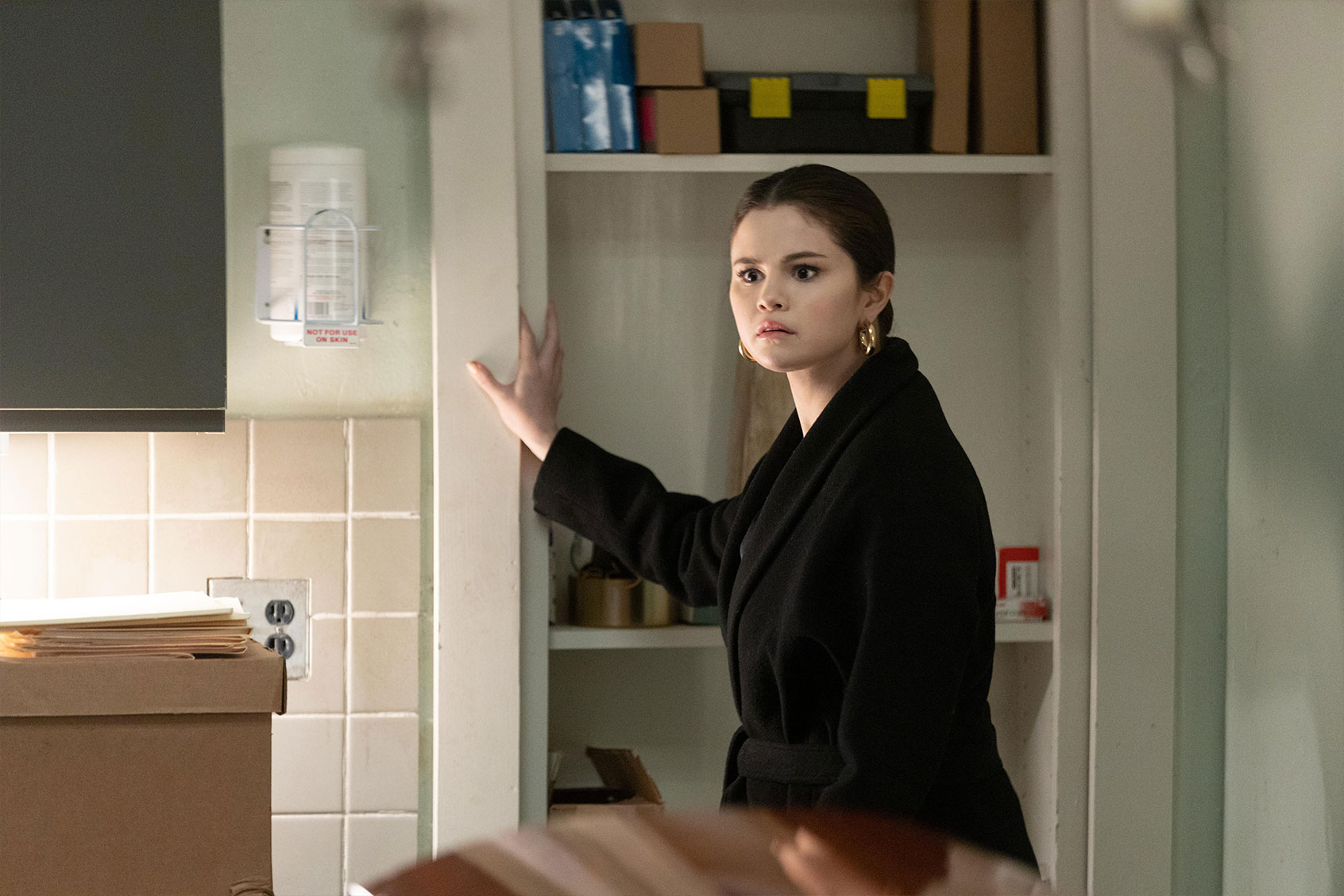
Is there anything scarier than someone inside the house? Allegedly based on an unsolved babysitter slaying (or maybe just an urban legend), the trope has rung through films from “When a Stranger Calls” to “Urban Legend” to “Scream,” and TV such as “CSI” and “Criminal Minds.” The 1993 sequel “When a Stranger Calls Back” utilizes the killer inside the house to its full, nauseating potential: he’s not only in the walls, he is the walls.    

Only Murders In The BuildingMabel (Selena Gomez) in “Only Murders In The Building” (Craig Blankenhorn/Hulu)Passageways are prime locations for spying, stalking, sneaking around, But Bunny uses the hidden elevator in her apartment simply for convenience sake: a handy exit. It’s a way for her to get outside without running into anyone she doesn’t want to see (what I would have given for such a magical, invisible elevator when I lived in a small, gossipy town and had to go to the grocery store). 
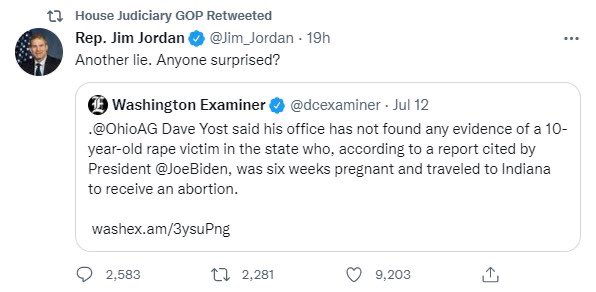
The quirks of the Arconia fulfill our deepest need: to be special, and our darkest, primal fear: that we aren’t safe.

Similarly practical, the dumbwaiter was intended as a mini freight elevator to deliver food quickly, keeping it hot or cool (but how many characters have hidden from murderers in them? Or, are accidentally crushed in them?). And yet when I finally, as an adult, had a dumbwaiter shaft in my old, rented house, I found it scary, drafty. Too small for anyone to hide inside, I still had the urge to nail the door shut. 


Want a daily wrap-up of all the news and commentary Salon has to offer? Subscribe to our morning newsletter, Crash Course.


When you’re a child, discovering tunnels as Lucy did, playing hide and seek, you think you can pass through them, unnoticed. When you’re an adult, you realize anything can. The quirks of the Arconia fulfill our deepest need: to be special, and our darkest, primal fear: that we aren’t safe.

The residents of the Arconia aren’t alone, that’s for certain. Like every new clue in a Brazzos case, each uncovered secret passageway sends the investigation — or at least our humble investigators — into a whole new direction. 

“Only Murders in the Building” streams new episodes Tuesdays on Hulu.

More secret passageways to “Only Murders” stories:

When cooking became cut-throat: A brief history of the culinary competition

I have something to confess: There are times — especially as my pantry and refrigerator look a little bare (and infinitely less inspiring) at the end of the week — when the only way I can motivate myself to make dinner instead of ordering delivery is by turning cooking into a game

Actually, it's more of a competition than a game. Inevitably, I launch into a one-woman version of "Chopped," the Food Network competition program that has come to dominate the network since first airing in 2009. 

If for some reason you haven't found yourself watching cable food TV in an anxiety-driven fugue state from the hours of 8 p.m. to midnight at some point over the last few years, here's a primer to the show. Four chefs or enthusiastic home cooks from a particular background — ranging from a subset of the restaurant world to professions like cafeteria workers and firehouse cooks — are presented with a "Chopped" basket. 

Inside is a set of disparate ingredients from which the competing chefs are asked to make a cohesive dish. This continues for three 20- to 30-minute rounds, which are typically divided into appetizer, entrée and dessert categories. The contestants are judged on attributes such as flavor, presentation and how they leverage the "mystery ingredients." At the end of each round, someone is eliminated. Cue Ted Allen's signature line, "You've been chopped!"

When I've played at home, there have been some successes, including a play on Italian milk-braised pork served over rice. I pulled it together using a hunk of frozen pork loin, cilantro and coconut milk. There have also been some dishes I probably would not make again — like an incredibly thick soup made with leftover refried beans and pico de gallo — but it's all been more worthwhile than takeout. 

I'll admit it's a little ridiculous that it takes the threat of an imaginary competition for me to get dinner on the table, but I recently realized why it just makes sense. After all, culinary competitions are an enduring mainstay in our culture, but what are the origins of cooking as sport?

It turns out that one of the first recorded instances of a cooking competition took place in Medieval Baghdad, more than 1,000 years before the very first episode of "Chopped" aired. 

In "Annals of the Caliphs' Kitchen," the 10-century cookbook (originally titled "Kit̄̄̄̄̄̄̄̄āb al-ṭabīkh") that was translated by Iraqi food historian and scholar Nawal Nasrallah, there's the story of a culinary face-off between the caliph al-Maʾmūn and his brother, al-Muʿtaṣim. Each had a series of companions assisting them. al-Ma' mūn's companion was a cook named Ibāda, who was known for having "a delightful and mischievous sense of humor." 

"The story goes that al-Ma' mūn was in the mood for a cooking contest," Nasrallah wrote. "He ordered that meat, vegetables and the like be brought in . . . Ibāda noticed that al-Muʿtaṣim's pot was emitting pleasant aromas that dominated all others, which made him feel jealous of him." 

So, in a classic case of kitchen sabotage, Ibāda provided some "professional advice," suggesting that al-Ma' mūn add some fermented sauce to his pot. "Al-Muʿtaṣim did so, and soon enough some foul smells came out of his pot, for which al-Muʿtaṣim rebuked him saying, 'Don't you know that adding a dead body into a living thing would spoil it?'" 

Talk about a cutthroat kitchen. 

The years passed before al-Muʿtaṣim became caliph, the sting of that lost competition remained. He eventually exiled Ibāda, saying it wasn't worth killing him. The next caliph restored Ibāda as royal cook for a period of time, before also banishing him for some mischief (the exact type of which was lost to history), only for him to be restored yet again. He must have been quite the cook. 

It's obvious that our collective hunger for viewing culinary excellence through a competitive lens is an enduring mainstay, from ancient Baghdad to modern cable TV, with no sign of being satiated anytime soon.

Over time, there have been other notable cooking contests, but such competitions were truly cemented as a global entertainment phenomenon in the late 21st century. In 1983, the Bocuse d'Or, a biennial world chef championship, was established in Lyon, France. In 1991, the very first James Beard Foundation Awards — often called the "Oscars of the food world" — were awarded; the first recipients included Rick Bayless, Emeril Lagasse and Nancy Silverton

Two years later, the same year that the Food Network debuted stateside, Japan launched "Iron Chef," which would forever change the landscape of food TV. In the decades since, Food Network's programming has steadily shifted towards a competition-dominated schedule. As The Atlantic reported, the primetime shows with the most viewers on the network in 2000 were "Iron Chef," "Emeril Live," "FoodNation with Bobby Flay," "Food Finds" and "Good Eats." 

In 2014, they were "Food Network Star," "Worst Cooks in America," "Chopped Tournament," "Cutthroat Kitchen" and "Guy's Grocery Games." As of today, "Chopped" has run 635 episodes, in addition to 39 specials.


Want more great food writing and recipes? Subscribe to "The Bite," Salon Food's newsletter.


That cultural shift is mirrored off-screen. For example, earlier this week, the story of a Virginia woman who swept the cooking categories at her county fair went viral online. NPR's Ailsa Chang reported that Linda Skeens "won first, second and third place for best cookies. She also swept all three awards for candy and for savory bread. In fact, she won the blue ribbon for cake, pie, brownie, sweet bread and best overall baked good. That was strawberry fudge." 

That same day, I stumbled upon a company called Culinary Fight Club, which is "a national organization that hosts live cooking competitions in 29 states" and uses the hashtag #FoodSport in its advertising. 

It's obvious that our collective hunger for viewing culinary excellence through a competitive lens is an enduring mainstay, from ancient Baghdad to modern cable TV, with no sign of being satiated anytime soon. 

Read more

at the intersection of food and TV

The James Webb Telescope has already found previously-undetected water on a distant planet

On Tuesday, a team of NASA astronomers revealed the first much-anticipated images taken by the groundbreaking James Webb Space Telescope (JWST).

From a full infrared image of the distant universe to a dazzling image of the Carina Nebula, the world was not disappointed. Besides the awe-inspiring images, Earthlings got a sneak peek into the kind of science JWST will be conducting as it searches for habitable exoplanets in the universe. Indeed, astronomers revealed the most detailed measurements of an exoplanet’s atmosphere outside of our solar system to date —  and it appears that there are indications of water, haze and clouds in the planet’s atmosphere that weren’t previously known.

RELATED: Astronomy doubles down on search for ET

The observed exoplanet in question is named WASP-96b, and it is one of the more than 5,000 planets that have been confirmed to exist in the Milky Way galaxy outside of our own solar system to date. Cataloguing and discovering exoplanets, meaning planets in other solar systems, is an impressive human achievement: because they are so much smaller than stars, and thus so much fainter, they are far harder to see. In fact, the first exoplanet wasn’t detected until 1992 — meaning that any science fiction produced prior to then that involved explorers visiting other planets was based on speculation. 

The exoplanet WASP-96b is located nearly 1,150 light-years away in the Phoenix constellation, and was first discovered by scientists in 2014. It is a fairly unusual exoplanet, as there is no comparable planet to it that exists in Earth’s solar system. For example, WASP-96b orbits its own star every 3.4 days, which means temperatures hover around 1,000 degrees Fahrenheit. (For comparison, Mercury, the closest planet to our sun, orbits once every 88 days. Also, our solar system has no gas giants that are close to the sun.) 

As a gas planet that’s less than half the size of Jupiter (but has a diameter 1.2 times greater than Jupiter), NASA describes WASP-96 b as being “much puffier” than any planet orbiting our Sun.


Want more health and science stories in your inbox? Subscribe to Salon’s weekly newsletter The Vulgar Scientist.


Extraordinarily, from only 6.4 hours of observation, JWST took incredibly precise measurements of the exoplanet that revealed a distinct signature of water, and evidence of haze and clouds. Previous studies of WASP-96b didn’t detect such signatures.

The measurements, which are the most detailed of their kind, were made by JWST’s Near-Infrared Imager and Slitless Spectrograph (NIRISS), which measured light from the exoplanet as it passed by its star. The light curve showed a change in brightness and individual wavelengths of infrared light between 0.6 and 2.8 microns.

The measurements also revealed a hidden albeit somewhat familiar atmosphere, one with an “unambiguous signature of water, indications of haze, and evidence of clouds that were thought not to exist based on prior observations.”

“From our viewing angle, this transits in front of its star every three and a half days, allowing a small fraction of the star’s light to pass through its atmosphere and reveal its composition,” Avi Loeb, the former chair of the astronomy department at Harvard University, explained to Salon via email. “Such measurements help us to better understand how gas giants in the solar system formed. “

The measurements confirmed some of what scientists already knew: the size, orbit, and mere existence of WASP-96b. But as previously stated, it also revealed a hidden albeit somewhat familiar atmosphere, one with an “unambiguous signature of water, indications of haze, and evidence of clouds that were thought not to exist based on prior observations,” as NASA explained.

So, does that mean that life could exist on this exoplanet? Water is considered a key signature of life beyond Earth, after all.

“Such planets are not thought to host life, because they do not possess a thin atmosphere on top of a rocky surface, like Earth does,” Loeb explained. “The combination of liquid water and a solid surface are thought to be crucial ingredients in the recipe for ‘life as we know it.'”

However, the measurements give the world a preview of how accurately and quickly JWST might be able to fulfill its mission of surveying the atmospheres of Earth-like exoplanets. As previously reported, JWST might even be capable enough to observe industrial pollution in an alien planet’s atmosphere, too — revealing intelligent alien civilizations, extinct or still existing.

NASA said the next step for JWST is to “measure the amount of water vapor in the atmosphere, constrain the abundance of various elements like carbon and oxygen, and estimate the temperature of the atmosphere with depth.”

“They can then use this information to make inferences about the overall make-up of the planet, as well as how, when, and where it formed,” NASA stated.

Read more

on astronomy:


Conservatives tried — and failed — to cast doubt on tale of Ohio child rape victim

After a week of controversy surrounding right-wing fueled doubt over the story of a 10-year-old girl who had to travel from Ohio to Indiana to receive an abortion after being raped, a man from Columbus has now been charged with the crime, further confirming the story’s veracity.

The story first gained traction on CNN after host Dana Bash brought the case up to Republican Gov. Kristi Noem of South Dakota. 

In the days following the overturning of Roe v. Wade, in Noem’s state of South Dakota trigger laws have gone into effect banning abortions in all cases, including rape and incest, except when the mother’s life is at risk.

When Bash asked Noem if the ten-year-old should have been forced to carry the child to term, Noem responded that “every single life is precious.”

On Friday, at a press conference to sign an executive order attempting to protect access to reproductive health care, President Joe Biden brought up the case of the young girl. After explaining how abortion bans have already gone into effect in 13 states, many of which do not allow for expectations in the case of rape or incest, Biden recited the story of how the young girl had to cross state lines after being impregnated.

“Imagine being that little girl.  Just — I’m serious — just imagine being that little girl.  Ten years old,” Biden said.

Hours after Biden shared the story, right-wing media erupted.

An article from the Daily Caller called the story’s legitimacy into question. The article’s author Laurel Duggan said that the gynecologist who first reported the story to the Indianapolis Star, Dr. Caitlin Bernard, could not provide enough details to thoroughly verify the story.

Bernard’s account did not mention specifics such as the name of the young patient’s doctor, any of the towns where these events took place, whether charges were being pressed against the child’s alleged rapist and at what point, if at all, Bernard or the child abuse doctor contacted the authorities regarding the individual who had impregnated the 10-year-old,” Duggan wrote.

After the article was published, Fox News, the New York Post, and The Wall Street Journal all piled on.

“All kinds of fanciful tales travel far on social media these days, but you don’t expect them to get a hearing at the White House. That’s nonetheless what seems to have happened Friday as President Biden signed an executive order on abortion,” the Wall Street Journal wrote in an editorial titled “An Abortion Story Too Good to Confirm.”

“A week ago, @DanaBashCNN tried to trap me with a story about a 10-year old girl who got an abortion….Now it looks like the story was fake to begin with. Literal #FakeNews from the liberal media,” Noem followed up on her original statement in a tweet.

On Monday, Ohio Attorney General Dave Yost went on Fox News to discuss how the story was likely untrue. Yost said there is “not a whisper anywhere” about the 10-year-old child’s rape case from the law enforcement and prosecutors in the state.

Further, Fox News host Emily Compagno criticized Biden and the “sensationalist physician who has now gone dark.”

What I find so deeply offensive, is that they had to make up a fake one,” Compagno said.

The House Judicary committee even retweeted Ohio Rep. Jim Jordan suggesting the story was a lie. 

Image

But reporting now confirms that the story was true all along.

Around noon on Wednesday, Columbus Dispatch reporter Bethany Bruner published an article confirming that Gershon Fuentes, an undocumented man living in the Columbus area, had been charged with the rape of the 10-year-old girl. The crime is a first-degree felony in Ohio.

Bruner noted on Twitter that she was the only reporter in the courtroom covering the story.

After news broke Wednesday of an arrest confirming the case, Yost issued a short statement. “We rejoice anytime a child rapist is taken off the streets,” he said.

The White House responded by chiding right-wing media’s incredulity. 

While the young girl was able to cross state lines to receive her abortion in Indiana, this will most likely not be a possibility in the coming months. Indiana Gov. Eric Holcomb, R-IN, has called a special session to take place on July 25 to make decisions surrounding the outlawing of abortion. Currently, Republicans hold a supermajority in both chambers of the General Assembly and are eager to enact new restrictions.

17 backyard kitchens that make us want to live outside

We’ve said it before and we’ll say it again: eating outdoors is one of the greatest joys of summertime. As the days get warmer and the sun stays out longer, our focus naturally shifts into the backyard and beyond.

But when your kitchen is inside — and the warm weather is, well, outside — you can start to feel a little separate from the action. The family’s gathered around the patio table or playing a game of cornhole on the front lawn, while you’re indoors grabbing (more) ice, dressing the salad, you get the picture. It’s moments like these where I get a serious case of outdoor kitchen envy.

You know what I’m talking about: the twinge of longing you get as you imagine what you’d do with more (or in fact, any) outdoor cooking space, a bottomless budget (looking at you, wood-burning pizza oven), and endless summer evenings (we’ll never eat another dinner indoors again). While this season we’ll simply have to keep working with what we’ve got — or not got — we can also treat our envy with inspiration from those who have the resources or year-round summer climate to make our outdoor kitchen dreams their realities.

Here are 17 of the most charming outdoor kitchens from around the world — from the pastoral to the whimsical to the freakishly fancy, these showstopping setups are a feast for the eyes. They’re the kitchens that, if they were ours, we’d live in all summer long. Don’t call it ogling; call it research for next summer (or plain ol’ wishful thinking).

1. Riviera-inspired

Yes, I would like to live on the French Riviera — especially in this Côte d’Azur villa. Look just beyond the charming dining table and you’ll see a rustic, yet well-equipped outdoor kitchen area with room for prepping, grilling, and mixing up batches of refreshing cocktails (gin spritz, anyone?).

2. Concrete dreams

What’s sturdier than an entire kitchen setup made up of one solid piece of poured concrete? Not sure, to be honest. This area could lean totally industrial, but it’s grounded by modern subway tile, mounted antlers, and a smattering of small plants.

3. English country charm

https://www.instagram.com/p/CAveCrsFTBR/

The English countryside never fails to entice. Add a breezy backyard kitchen complete with shuttered French doors, handmade tiles, handwoven jute rug, pink foxglove, and . . . swoon.

4. Small living

Looking at this tiny, rustic outdoor kitchen makes me think of a quote from “A Room of One’s Own” by Virginia Woolf: “One cannot think well, love well, sleep well, if one has not dined well.” Call this rough gem a kitchen of one’s own. It’s got a sink, a simple cooktop, and a bucolic setting — what more does one need?

5. Just the essentials

https://www.instagram.com/p/CA0Wt8Ljveg/

This wee outdoor cooking space (can we be sure it’s even functional? It’s almost too pretty!) had us at enamelware. Plus, all of those great kitchen textiles. And that vintage galvanized bucket.

6. Found treasures

This adorable kitchen looks to be propped up by some old crates (with wheels attached for the potential to actually relocate the cooktop should you want to put on a Hibachi-style show for your outdoor guests). The fence behind serves as vertical storage for pots, pans, and aprons.

7. Pretty in pink

This funky pink kitchen is packed with personality — from the mismatched potted plants and lush landscaping to the industrial stainless steel table topped with colorful linens and dishware. It’s completely functional, too, with a sink, grill, and plenty of counter space.

8. Green oasis

This vine-covered mini paradise evokes the feeling of something that’s been cultivated for many years, but shiny glassware and clean-lined cabinetry keep the space feeling sharp. Add a gorgeous backsplash, lots of citrus for cocktail-making, some vintage accents, and it’s a delightful space to entertain.

9. Nautical meets secret garden

While the blue and white stripes tend towards a beachside theme, this luxurious outdoor kitchen and dining area maintains a Hamptons-like charm, but perhaps just set in the woods. String lights, wood accents, and an overhang pull it all together.

10. Sleek pizza paradise

https://www.instagram.com/p/BRq9Id6DPeV/

“Sleek” is the word to describe this modern kitchen, which perfectly balances the strength of concrete — a durable material requiring next to no maintenance — wood, and steel with lush textural landscaping adding softness. I imagine pizzas taste better coming out of that oven.

11. Keeping it colorful

Backyard kitchens need not be cloaked in all neutrals, as this bright and cheery one proves. They’re also a great opportunity to experiment more with tile or decor that might be too loud for day-to-day inside the house.

12. Watermelon sugar . . .

https://www.instagram.com/p/Bls6b1kgDzf/

This modern kitchen manages to maintain all the clean lines that concrete affords while still feeling magically cozy (those juicy watermelons certainly do their bit). It’s worth scrolling through all the pics in this account to see how they built this beautiful kitchen and all the charming ways they use and style it.

13. Indoor-outdoor living

Cooking up a feast is that much more enjoyable when you’ve got a massive glass garage door merging the line between indoor and outdoor. Picture yourself relaxing by the kitchen island, glass of wine in hand — sip, sip, ahh.

14. Lakeside luxury

This kitchen is what happens when you’ve taken your indoor kitchen outdoors — quite literally ripped it out and plonked it by a lake nestled in between the mountains. It’s got everything an indoor kitchen has, from a sink to a cooktop to a grill to a pizza oven, and more cabinet space than the average New York City apartment has.

15. Fireplace goals

Forget an indoor fireplace, this towering outdoor beauty sets up the surrounding space for the ultimate outdoor kitchen. A long, live-edge dining table has plenty of room to welcome friends and family to enjoy dinner by the crackling fireplace, feel the breeze, and gaze up at the stars.

16. Simply chic

Jessica Alba’s outdoor kitchen is a California dream with a cool palette of blues, greys, and warm wood tones. Little pops of color in the glassware and florals (just look at that stunning bougainvillea) bring brightness, while the tile design lends a bit of extra personality.

17. Tucked away

Close the overhang on this compact outdoor kitchen and you might never know it was there in the first place. Hidden inside this sleek wooden box are must-haves for grilling success: a full-size grill with all the bells and whistles, hanging wall hooks for cooking tools, a sink, and plenty of drawers for storing dishes, spices or seasonings, and then some.

MAGA fraud: Trump supporter vandalized his own home — and blamed Biden

On Tuesday, Trump supporter from Brooklyn Center, MN, Denis Molla was charged with two counts of wire fraud for falsely claiming that his garage, camper, and two cars were burned down in a politically motivated attack. The fire took place back in September 2020 and gained national attention by right-wing media as a demonstration of left-wing violence.

While Molla reported that he had seen three figures that night in his front yard with matches, investigators determined that Molla had lit the fire and vandalized his own home to claim insurance money.

In the wake of the fire, Molla allegedly made more than $300,000 in insurance claims, receiving about $61,000. Additionally, he raised $17,000 in two GoFundMe campaigns. 

Molla originally claimed that he had been targeted because he had a Trump 2020 flag hanging outside his home. In addition to the fire, the seemingly unknown arsonist spray painted “Biden 2020,” “BLM,” and the anarchist symbol on Molla’s garage door.

At the time, the right used the misdemeanor to stir up fear and anger in the months leading to the 2020 presidential election. Fox News anchor Laura Ingraham hosted right-wing commentator Ben Shapiro to discuss the attack.

“This is a message being sent by the far left, and I think people are beginning to see that arsonist behavior, looting, even murder — none of it is off the table,” Ingraham said.

Molla has since been released on bail but will have to appear in court in the coming weeks for his trial.

Why maple syrup prices are so low despite inflation

Those of us with a hankering for real maple syrup may be in for a sweet surprise this year. North American “sugar shacks” just finished a massive year for maple syrup production.

Record sap yields in both Vermont and Quebec, the top producers in the United States and Canada, respectively, led to the largest maple syrup harvest in history. Up 35 percent from last year, U.S. maple syrup production shattered previous records. More than 5 million gallons, the largest yield of American maple syrup in recent history, will soon hit the shelves. The bumper crop will likely stave off further price hikes on the sticky stuff.

Low prices on maple syrup might come as a surprise, given the general situation in the consumer economy. Inflation and supply chain shortages have typically driven up prices for most consumer goods, including and especially food. And during much of the pandemic, maple syrup was more expensive than usual — the  result of production shortages here in North America, within the native range of acer saccharum, more commonly known as the sugar maple. Remarkably low sap yields drove maple syrup up to an average of $35.90 per gallon in the U.S. last year — though now, with the glut, prices are dipping again. 

With the glut in production, maple syrup chemist Dr. Abby van den Berg does not predict a dry spell for your pancakes anytime soon. Connoisseurs and casual consumers of maple syrup alike can rest assured. 

“There will ultimately still be places where the conditions for maple syrup production persist well into the future,” van den Berg told Salon.

The future of maple syrup

Despite the surge in supply, climate change does pose an existential threat to American-made maple syrup. More than anything else, weather dictates yields and, consequently, the price on the bottle for maple syrup.

A typical sap season will last less than a month, from mid-February to early March. Whether “tapping” the coveted acer saccharum or another variety of maple, hitting the sweet spot is a matter of precision. That is largely because its production rests precariously on spring freeze-thaw cycles, explains van den Berg. 

In spring, stored sucrose delivers an injection of energy to a slurry of water and raw minerals that we know as sap. When a network of rigid, vascular tissue, called xylem pressurizes, sap starts to flow. With it, the sap carries reserves of sucrose to the rest of the tree. This energy store gives the tree a critical jumpstart in bud growth.

“As the climate changes more, there may be places where there simply become too few of those freeze-thaw cycles during this leafless period for maple syrup production to be commercially viable,” van den Berg told Salon.

Time is of the essence in the “sugar bush.” A narrow window of time, in which the climate features cold nights and warm days,  equates to the optimal conditions essential for sap flow — and thus harvest. As average spring temperatures increase, the sap season will move earlier. What that means for maple syrup producers varies, but spring melt has become increasingly unpredictable.

How weather affects the maple syrup harvest

This year, sap started to flow early. American producers reported an average of 34 days of sap flow starting as early as January 1 in New York and Vermont. That is not necessarily a good thing; it just so happened that the cold held. It may not in future years.

“As the climate changes more, there may be places where there simply become too few of those freeze-thaw cycles during this leafless period for maple syrup production to be commercially viable,” van den Berg told Salon.

Around the Canadian border, where taps yield the most sap, spring temperatures typically hover around freezing for the longest. To the south, meaning in the United States, melt comes early and the temperature often holds just above freezing; to the north the melt is delayed and truncated. At both edges, taps usually yield less sap. That range, though, will move north with warmer spring temperatures.

At the University of Vermont’s Proctor Maple Research Center, van den Berg’s team has been investigating better methods of maple syrup production. Scientists in the green mountain state are not alone. Ecologists across the Northeast are working closely with industry experts to protect the cultural legacy of maple syrup production and its economic impact.

Few of us who enjoy the taste of maple syrup ever get a glimpse behind the curtain. The tools of the trade remain fairly simple. Throughout much of Vermont, New York, Maine, and other Northeastern states, maple syrup producers still strap on snowshoes and trudge through the snow to tap maple trees. 

Large operations bear little resemblance to their pastoral predecessors. Metal buckets certainly still hang from the trunks of maple trees, collecting the precious sugary sap at the will of nature on hobby farms one step removed from reality. They are of little consequence to the industry.

Miles of pressurized, plastic tubing hooked up to vacuum pumps now line northeastern forests for months. Producers can pump right through warm spells. In the southern range of acer saccharum, where the season has shrunk, this practice can offset some impacts of climate change. Van den Berg remains optimistic that technological advances the modern sugaring operation affords can provide a buffer.

The profitability of maple sugaring depends heavily on yields of actual syrup, which certainly hinges on the actual number of days that hover at the cusp of freezing temperatures. But it is also a product of sugar content in the sap itself.

Acer saccharum is not the only maple species that can produce maple syrup. Some producers tap red and black maples as well. Aptly named, the sugar maple is prized for its high sugar content. The cost of tapping would be marginal if it were simply a matter of collection. Maple syrup production does not, however, exist in a vacuum.

Producers spend long periods boiling off sap. Fuel eats into the profit margins quickly and results in less syrup at the end of the day. These will generally continue to decrease in the southern sugar maple range.

Climate scientists predict diverse and far-reaching consequences for maple trees in warmer regions. Aside from insects, pests, and diseases, which remain more of a wild card dependent on human introduction, many of these will be quite subtle, according to forest ecologist Dr. Alexandra Kosiba.

“When we have warmer springs, warmer falls, it just stresses the trees out,” she said. “It doesn’t mean we’re gonna lose sugar maple throughout its range. It will still exist. It will still thrive in many places.”

At the Vermont Department of Forests, Kosiba currently investigates the impacts of climate change on tree health. She says changing conditions leave maple trees struggling to allocate resources and survive.

“At some point, that dynamic will run its course,”  Rapp said. “There will come a limit to the good times for producers.”

Snow is quite important to maple syrup production. The roots of sugar maples are quite sensitive to frost. Snowpack in the winter provides critical insulation. Warmer winters can hinder root growth and the sugar content of the sap as well.

Harvard University conservation ecologist Professor Joshua Rapp noted that, in a study he conducted, sap yields were low following exceptionally warm summers. Heat likely forces maple trees to burn through more sucrose, he theorized, leaving far less for the next spring and degrading the profitability of the harvest.

Because the de facto maple syrup cartel, Quebec Maple Syrup Producers, maintains production caps to keep the price of maple syrup steady, American producers still benefit immensely from artificially high prices.

While Quebec currently produces almost three-quarters of the world’s maple syrup supply, American producers have yet to hit the brakes on expansion. Large swathes of maple trees remain vastly untapped here as well.

“At some point, that dynamic will run its course,”  Rapp said. “There will come a limit to the good times for producers.”

For American producers, a ceiling is fast approaching. Consumers hoping for a cheap sugar fix may still have to look to alternatives in the future.


Why is right-wing media suddenly so worried that “Monticello is going woke”?

This past week, right-wing politicians and commentators are rallying around cries that “Monticello is going woke.”

On Monday, Jeffery Tucker, founder of the Brownstone Institute, a right-wing think tank, went on “Fox & Friends” to explain how he took a tour of Thomas Jefferson’s historic resistance on July 4th to celebrate the independence of the country and pay his respects to the founding father.

“Instead, I got exactly the opposite,” Tucker said. “They were just debunking his history, his reputation, putting him down, demoralizing everybody on my tour.”

In the interview, Tucker and Fox host Brian Kilmeade discuss how the guides focus too much on racism and slavery and “do not talk about this incredible man.”

The two highlighted their outrage over a sign that asks visitors to think about whether Jefferson’s statement that “all men are created equal” is being lived up to in our country.

“I just thought that maybe Monticello would be protected from this disease of woke-ism but I was sadly wrong,” Tucker said.

Fox News host Rachel Campos-Duffy lashed out on Sunday because she said she was made to feel “ashamed” and “guilty” after visiting Jefferson’s former home and finding “anti-racism” books for sale in the gift shop. 

“It’s overwhelmingly negative!” her Fox News co-host Pete Hegseth added. “You go to visit the legacy of Thomas Jefferson and you learn about what a terrible person Thomas Jefferson was.”

“Where’s all this coming from?” Campos-Duffy asked. “The homes of these presidents are being populated — this is a very diabolical plan on the part of the left. So what they’ve done is they’ve taken their donors on the left and they’ve populated the boards of these estates with leftists.”

The Fox News pile-on comes only a month after The Heritage Foundation attacked James Madison’s estate in Montpelier, Virginia for having a “woke takeover.” While some have taken to Twitter, other right-wing outlets are piling on that Jefferson’s home has also “been taken over by Leftist America-Haters.”

The New York Post picked up the story over the weekend writing that “the hilltop mansion designed by Jefferson himself, once preserved as a tribute to the author of the Declaration of Independence, now offers visitors a harangue on the horrors of slavery.”

Jefferson owned about 600 slaves throughout his life, the most of any U.S. president.

In response to the controversy, Monticello Spokesperson Jenn Lyon explained that “our goal is to present an honest, inclusive history of Monticello in all its aspects as well as Jefferson’s contributions to the founding of the country.” After reading her statement, Tucker and Kilmeade agreed that the museum employees were certainly not living up to their mission.

“They should all resign,” Kilmeade said.