Spring Sale: Get 1 Year, Save 58%

Charlottesville, COVID, Trump and free speech: How white supremacy entered the mainstream

I researched and wrote a lot about white supremacy, particularly in its alt-right manifestation, throughout the course of 2017, namely Donald Trump’s first year in office. I hazarded a number of guesses as to where the movement, and more importantly the reaction to it, was headed. Keeping company with this unsavory crowd over an extended period of time, I came to have a deep appreciation for how characteristically American this movement was, and how right it felt to experience it as a natural growth of individualistic capitalism run amok. But by the end of that year the alt-right panic was being subsumed by the #MeToo panic, and honest discussion about the nature of the white supremacist resurgence became more and more difficult in liberal forums. 

Around that time I wrote a long essay (published only recently in three parts) analyzing the fate of the leading figures of the alt-right, and focusing on the various methods proposed to deal with the alleged existential threat, including all sorts of power applied by the state and its legal apparatus. I took an absolutist free-speech position with respect to the neo-Nazis — a stance that seems almost ridiculously outdated in these self-righteous times — and argued in favor of the old-line ACLU position rather than the speech compromises endorsed by critical race theory. I raised the question of watchdog biases, and the dangers of permitting such groups, which are de facto instruments of ever-shifting state policy, such great authority in deciding who gets to speak and who doesn’t. 

RELATED: Is free speech a casualty of the Ukraine war? America’s commissars crack down on dissent

As I reviewed the essay recently, it struck me how extensively the reaction to white supremacy has proceeded along highly undemocratic lines, and how it continues to be a harbinger of worse developments yet to come in the polity, to a far greater extent than even I expected. 

1. Censorship is virtuous

Violent reaction against speech is now far more pervasive and legitimate than it was at the beginning of the Trump administration. Among millennials and post-millennials, freedom of speech was already viewed as highly questionable. Demonizing Trumpism allowed powerful media companies to assume total control over what speech would be allowed and not allowed. It has become a truly expansive definition, and depends on the whim of the moment. The apparatus of domination and control I described with respect to the alt-right was transposed in its entirety to a thought category called “disinformation” (itself a term of disinformation) and applied to vaccine skeptics or generally anyone who disagreed with official pronouncements about any aspect of COVID-19, even those that were subject to change thanks to new information or scientific reinterpretation. 

It has become commonplace for media companies to deny platforms or visibility not just to the most extreme neo-Nazi rabble-rousers like Andrew Anglin and Richard Spencer but to anyone who falls afoul of any aspect of the established liberal worldview on issues of elections, racism, schooling, historical interpretation, science, war, violence, sexuality or indeed anything and everything that doesn’t sit well with the narrow spectrum of reality endorsed by the propaganda arms of the American national security state, fed on illusive notions of meritocratic wokeness


Want a daily wrap-up of all the news and commentary Salon has to offer? Subscribe to our morning newsletter, Crash Course.


Was this a price worth paying for making the alt-right invisible? To have such an unprecedented level of institutional (albeit non-governmental) censorship in this country? It starts with Alex Jones, and ends up going after Palestinian activists. It always does. I knew it, and anyone with an eye on history should have known it too.

2. The enemies mutate

Every form of domination requires an unacceptable other in order to privilege its own power. In the circa-2017 phase of alt-right ascendance, the antagonists were all those who deployed a racist perspective to question the liberal dogma of perpetual progress by slow degrees. The alt-right enemies of immigration, racial equality and even of interracial relationships or the recognition and celebration of minority cultures were demonized as uncouth savages who had no business seeking a political platform in American democracy. 

If liberals believe they triumphed over the alt-right, consider Glenn Youngkin, the Biden administration’s Trumpist immigration policies and ever-increasing police violence against people of color.


Yet consider this: Despite the liberal triumphalism associated with banning controversial speakers on campus and shutting down the social media accounts of alt-right influencers, Glenn Youngkin was recently elected governor of Virginia, in large part driven by antipathy toward the (mostly imaginary) teaching of critical race theory in schools. Consider that the Biden administration has to a large extent kept in place Trump’s exclusionary policies on the southern border. Consider that police violence against unarmed black men and other people of color has only accelerated

But who supports those things? Large numbers of conservative white voters, of course, not just in the devastated Rust Belt but all over the country. But also, going by the shift of Latino voters toward Trump in 2020, a growing number of some of the liberals’ most cherished constituencies as well. 

It is not coincidental that once the neo-Nazis were banned, an entire liberal industry arose to teach white people to search out their most minute expressions of racism (by authors like Ibram X. Kendi and Robin DiAngelo), and to turn that into a beneficent self-improvement project, such as one might approach an addiction or an unhealthy diet. Now the enemy is not the alt-right, but everyone who thinks in unpredictable directions about the current state of our political economy. 

To be fair, America faces legitimate social and political quandaries: In the current climate we cannot permit more immigration, although  we desperately need it from an economic point of view. We certainly can’t ban it, which would be economically devastating as well as giving in to the nationalists. So the almost comical answer we have settled upon is to maintain a repressive regime toward immigration and construct as enemies everyone who wants either more or less of it. 

The urge to suppress the alt-right was not about “democracy” or some other hazy, high-minded ideal. It was about maintaining the status quo, and the recent expansion of the list of enemies is part of a more ambitious campaign to maintain the status quo as it faces even greater threat, especially during the pandemic.

3. White supremacy has been mainstreamed

If censorship and legal targeting of the alt-right were supposed to banish the scourge of white supremacy, let us ask the obvious question: Did it succeed? Obviously it did not, and it arguably made white supremacy, in both its overt and covert manifestations, stronger than ever. 

Imagine a situation where a confident liberalism, true at least to its principles of allowing fair market exchange and removing unnecessary obstacles to personal economic advancement, not only permitted the free play of alt-right ideas (or more extreme manifestations) but even encouraged them — in order to draw clear distinctions between right and wrong, trusting the democratic public to make its own decisions. Instead, an authoritarian attitude drove the construction of an illiberal liberalism as the only viable political option. At certain points the mythology of that ideology has bordered on the absurd, as in the depiction of Jan. 6, 2021, as an unprecedented existential calamity, or the various travesties of imagination surrounding the Russiagate scandal. This happened to such an extent that white supremacy started sounding reasonable to some people by comparison. 

Liberals present themselves as occupying the reasonable center of political discourse today, but in some ways they are more extreme than the most delusional and paranoid Republicans. They have reduced all of human life and its activities to strict monetary calculation, and have destroyed art, imagination and creativity in the process. Their imaginary visions of democracy, human rights and meritocracy are entirely in the service of  justifying the current form of capitalism, which is trending toward eradicating life on the planet. 

Despite liberals’ endless self-scrutiny in search of microscopic evidence of racism, I would suggest they are the most effective carriers of the white supremacy virus.


If I haven’t yet alienated all liberal readers, I would go further, to suggest that despite their relentless search for rooting out micro-racism in their minute words and deeds, liberals are in fact the most effective carriers of the white supremacy virus. Emboldening Israel at the cost of any recognition of the rights of Palestinians is white supremacy. Instigating a massively expensive and apparently endless proxy war against Russia, as a first step in checking or confronting the inevitable hegemony of China (those creepy Asians who’ve become too big for their boots), is white supremacy. Converting the George Floyd protests of 2020 into ultimate advocacy for more money for more police — as nearly all Democrats in positions of power now advocate — is white supremacy. Wanting to “save” Afghan women and children by lamenting the end of the 20-year invasion and then imposing sanctions and stealing their money is white supremacy. Which party, I ask you, is more associated with these policies today? 

No one has to believe that liberals steal elections or that vaccines are more dangerous than COVID or that school shootings are false-flag events or that there’s a Jewish conspiracy to replace white people. But censoring these thoughts only gives them more durability, as we ought to have learned from repeated examples over the last few years. 

Here’s how it works: An illegitimate thought is censored, which gives it a certain resilience as the wrong way to think, opposed to which is the correct thought. Censorship becomes the force by which the liberal-bourgeois state codifies various elements of power such as to propel them beyond the critique of power. In this dynamic, the unfairness of a two-party electoral democracy representing only narrow bourgeois interests, the unequal and even unscientific foundations of American public health, the interdependence of imperial violence with chaotic domestic outbursts, and the bipartisan consensus over the punitive treatment of immigrants become untouchable issues, precisely because quasi-state censorship has elevated them to the status of sacred truths threatened by extremists and therefore not subject to rational critique. Censorship is the process by which the illegitimate is made legitimate.

In these last days of empire, when liberalism is on the defensive and fighting for propositions that are ecologically and even economically unsustainable, we will not see an end to the violent repression of nonconformism, only its reinforcement. Thus it is that so-called wokeness — which is entirely compatible with corporate globalization, and in many cases strongly aligned with it — becomes the darkest force in the land. It feeds denialism, denies that denialism is real and then denies the humanity of those who aren’t woke enough to accept the boundaries of correct thought, whether they are nominally on the left or the right.  

Read more on the rising threat of white supremacy:
50 years ago, David Bowie and Roxy Music made history

History-making events tend to become more obvious once context develops. This certainly holds true in music. While some movements are obviously earth-shattering in the moment — to name a few, Beatlemania, punk and the ascent of Nirvana — their true impact takes a while to sink in. For example, it was easy to see that Nirvana would become the kind of rock band that defined a generation — but who could’ve predicted the 2022 resurgence of the band’s brooding album cut “Something In the Way” thanks to the movie “The Batman”?

In the summer of 1972, these glam innovators set rock ‘n’ roll on a cosmic trajectory from which it’s still in orbit.


Momentous days also become known largely in hindsight. Take June 16, 1972, which is widely considered to be the release date of two of the most important albums of all time: Roxy Music‘s self-titled debut and David Bowie‘s “The Rise & Fall of Ziggy Stardust and the Spiders from Mars.” The coincidence is gobsmacking — and, depending on your source, this date might very well be too good to be true — although what’s not in question is this: In the summer of 1972, these glam innovators set rock ‘n’ roll on a cosmic trajectory from which it’s still in orbit.

Roxy Music had only been a band for a little over a year when they recorded their debut with Peter Sinfield, King Crimson’s lyricist and co-founder. “Re-Make/Re-Model” set the tone for both the album and Roxy Music’s career. The song opens with crowd noise that sounds like a hopping happy hour before Bryan Ferry‘s jubilant piano announces musical revelry: Andy Mackay’s twirling tenor saxophone, Phil Manzanera’s scorching electric guitar, Brian Eno‘s synthesizer scribbles. The song hints at missing their chance with a mysterious “she” that could be interpreted to be a woman — but could also represent the ways Roxy embraced the future: “Looking back all I did was look away/Next time is the best time we all know”

RELATED: It’s time for Roxy Music’s debonair art-glam to get its due

That doesn’t mean “Roxy Music” is reinventing the wheel musically; in contrast, the band took existing musical styles and filtered them through an experimental, fresh lens. That’s certainly in large part because of Eno, a synth mad scientist who delighted in processing and manipulating familiar sounds and coaxing otherworldly sounds from cutting-edge synths. But other songs had obvious antecedents: “If There Is Something” boasts a lightly twanging intro; “Would You Believe?” both polishes up ’50s rock and finds Ferry vamping like his beloved Motown and soul idols; and Humphrey Bogart tribute “2 H.B.” puts a solemn sheen on zone-out psychedelic ambience.

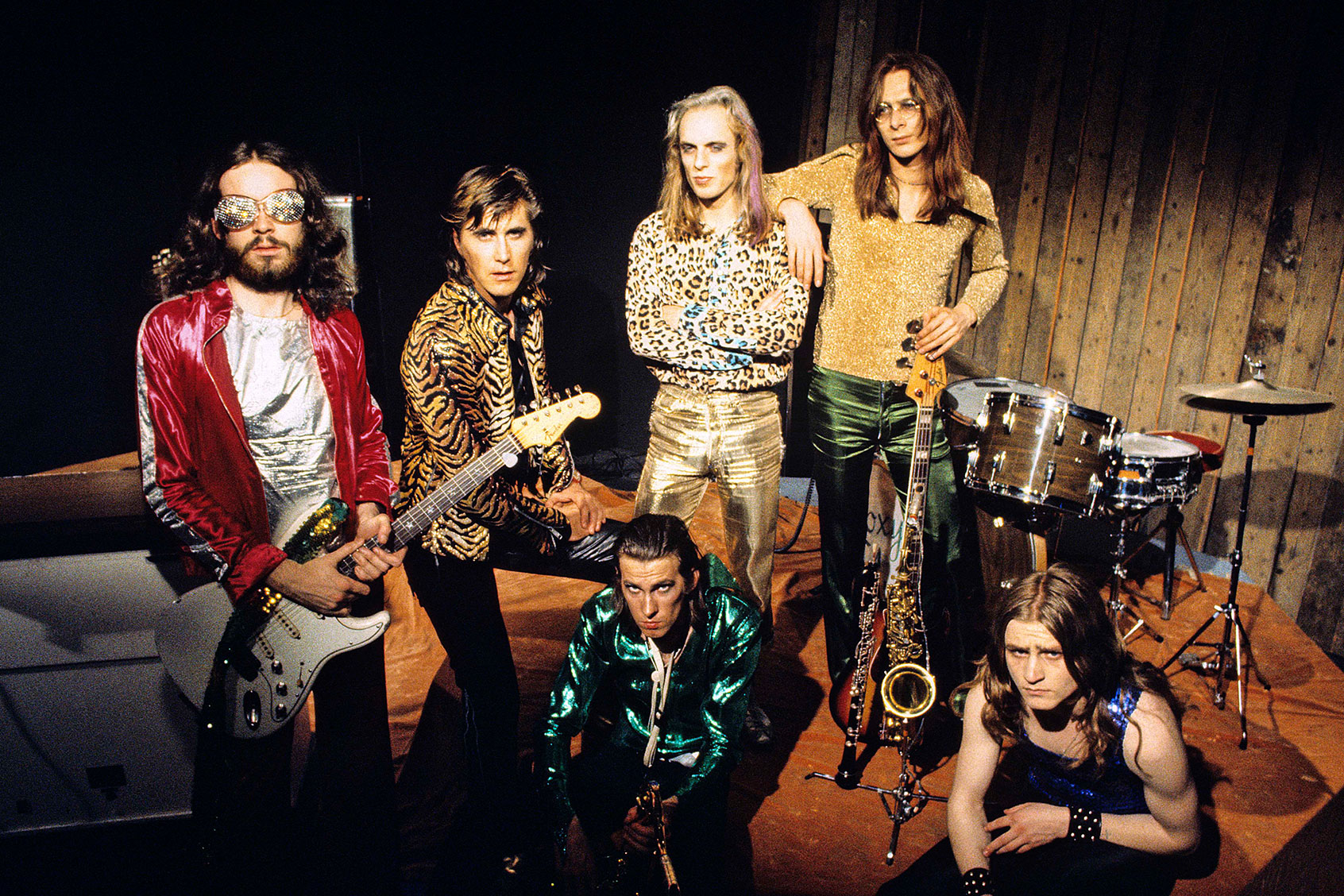
Roxy MusicPhil Manzanera, Bryan Ferry, Andy Mackay (seated) Brian Eno, Rik Kenton and Paul Thompson (seated) of Roxy Music posed group shot at the Royal College Of Art video studio in London on July 5 1972 (Brian Cooke/Redferns/Getty Images)
[Roxy Music] took existing musical styles and filtered them through an experimental, fresh lens.


Lyrically as well, Ferry explores a timeless trope — love — although his takes provided a more complex view of pursuit and attraction. “Ladytron” features a louche man who loves (and leaves) a woman, while other songs come together to paint a picture of a hopeless romantic who has pangs of regrets and longs for better relationship days, although that’s not always feasible. But buoyed by the knowledge that fairy-tale endings don’t exist, the characters on “Roxy Music” exude a more vulnerable kind of masculinity: “But even angels there make the same mistakes in love/In love, in love.”


Want a daily wrap-up of all the news and commentary Salon has to offer? Subscribe to our morning newsletter, Crash Course.


If “Roxy Music” felt like a beginning, “The Rise & Fall of Ziggy Stardust and the Spiders from Mars” was intended as an ending. That’s understandable: It was actually Bowie’s fifth LP, and he had already cycled through his folk, psych-rock and proto-glam guises before landing on his Ziggy persona. As with “Roxy Music,” there were some obvious nods to the past (bluesy rock ‘n’ roll, the Beatles-reminiscent “It Ain’t Easy,” solemn soft rock) although these influences felt more modern. Bowie and his band cannibalized themselves — in hindsight, it feels like a natural sonic progression from 1971’s “Hunky Dory” — and recent trends, like the proto-punk of the Stooges, for inspiration. Mick Ronson’s swaggering electric guitar, introspective piano and string arrangements possess a clarity of execution and intent matched by the swinging rhythm section of bassist Trevor Bolder and drummer Woody Woodmansey.

The thematic arc of “The Rise & Fall of Ziggy Stardust and the Spiders from Mars,” that of a flamboyant rock star navigating fame’s minefields and their own bad behaviors, explored a darker side of romance: a dalliance with intoxicating self-sabotage and the seduction of the spotlight. Bowie inhabited this persona with his whole self, drawing on his malleable vocal approach to convey a range of emotions: the ferocious melodramatic chanteuse of “Ziggy Stardust,” demure crooner of “Starman,” stinging rock god of “Suffragette City” and the desperate, yearning idol in the midst of free-fall in “Rock ‘n’ Roll Suicide.”

The thematic arc of “The Rise & Fall of Ziggy Stardust and the Spiders from Mars” … explored a darker side of romance: a dalliance with intoxicating self-sabotage and the seduction of the spotlight. 

In the UK, “Roxy Music” peaked at No. 10 on the charts. “The Rise & Fall of Ziggy Stardust and the Spiders from Mars,” meanwhile, also performed well, crashing the UK charts at No. 15 for the period of June 25-July 1, the highest-charting debut of that week, and eventually reaching No. 5. 

Both bands also had high-profile Top of the Pops appearances that summer, with Bowie’s July performance of “Starman” followed by Roxy Music’s “Virginia Plain” in August. Of course, these performances revealed it wasn’t just the music, but their looks that made these acts such sensations. Ferry’s Elvis-from-Mars look was almost understated compared to the rest of the band’s glittering and gleaming outfits. Bowie’s colorful look and renegade approach — including his physical familarity with Mick Ronson on TOTP — upended masculinity in a different way than Roxy Music. As Ziggy, he was playful and conspiratorial, coy and confident. His androgynous look showed people possibilities and options — that 1, and there were many ways to be a rock star and a human in the world.

As it was with many bands from England, reception in America was different. Roxy Music’s debut album didn’t reach the U.S. charts in 1972; to date, it still hasn’t graced the main Billboard album chart. (It did hit No. 19 on the Vinyl Albums chart in 2020.) Support for the band came from more adventurous outlets, like the Cleveland radio station WMMS, who recognized how Roxy fit in with the rest of the forward-looking musical pantheon. Later Roxy Music albums would at least chart, although the band’s reputation certainly still has room to grow in America.

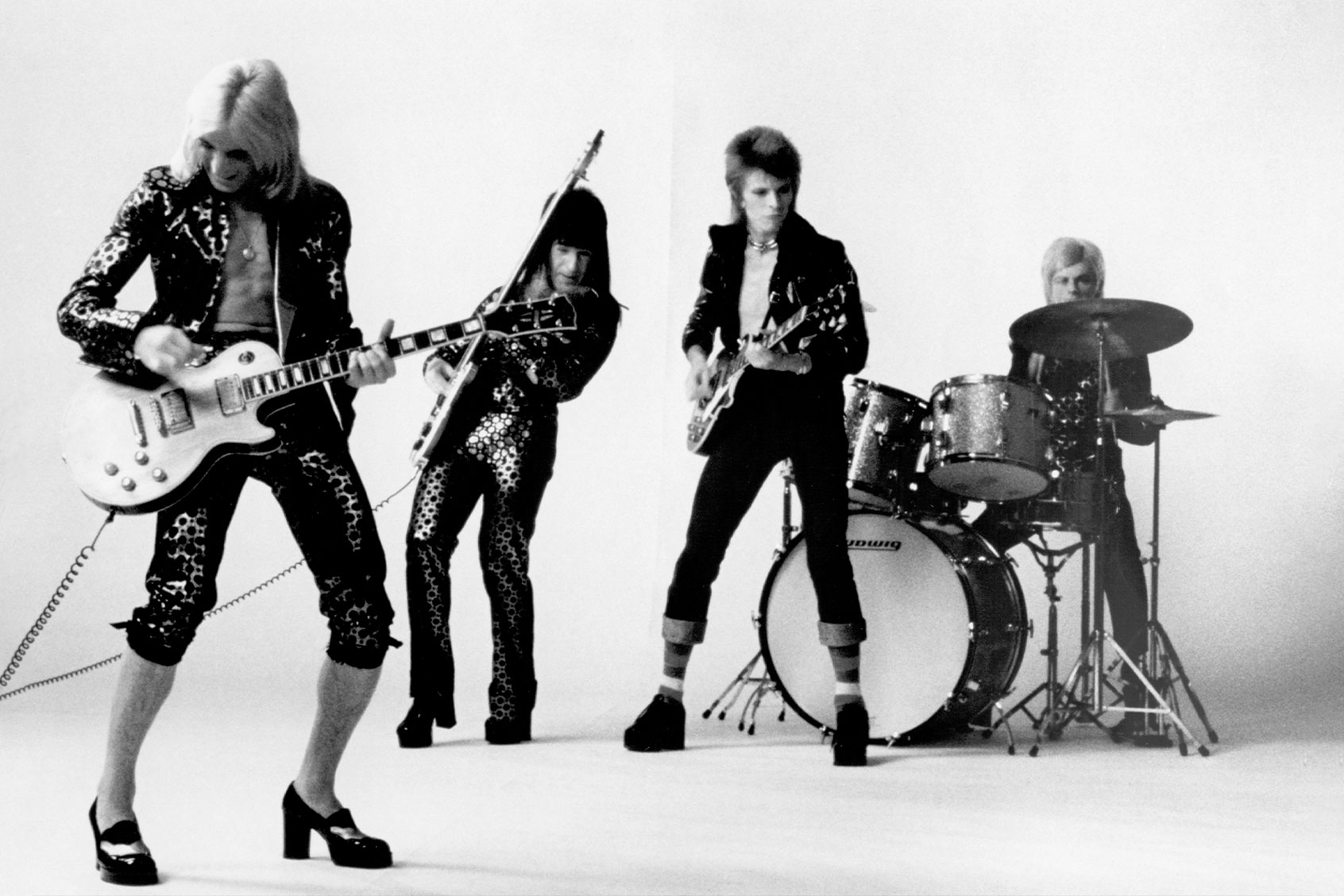
Ziggy Stardust And The Spiders From MarsGuitarist Mick Ronson, bassist Trevor Bolder, David Bowie and drummer Mick Woodmansey of “Ziggy Stardust And The Spiders From Mars” pose for a portrait in November 1972 in London, England. (Michael Ochs Archives/Getty Images)
As it was with many bands from England, reception in America was different … It’s clear that Ziggy’s myth-making was already in progress in 1972.


David Bowie is another story. “The Rise & Fall of Ziggy Stardust and the Spiders from Mars,” meanwhile, debuted at No. 196 on the Billboard album charts the week of June 17, 1972, after bubbling under the main chart at No. 207 the week before. (These chart placements likely debunk claims of a mid-June U.S. release date, although the official Bowie site found record label correspondence to nail down a June 16 UK release.) It eventually peaked at No. 21 — although that high water mark occurred in the weeks after Bowie’s 2016 passing.

However, it’s clear that Ziggy’s myth-making was already in progress in 1972. In a June 3 review of “Starman,” Cash Box praised the song, writing that it “proves quite literally that the best rock is not of this world, but is rather ‘hazy cosmic jive.’ Should outshine ‘Changes’ in its stellar orbit to the top, establishing a new superstar in our galaxy.” Record World also gushed about the single, which was backed by “Suffragette City”: “Another two-sided space oddity from the first great British superstar of the ’70s; a delightful teen-tune backed with risque rocker. Forget it, Bowie’s got it.”

The June 10, 1972, issue of Billboard also featured a glowing review of the “Ziggy Stardust” LP: “Nineteen and Seventy-Two may well go down as the year Davy Bowie put the glitter and glamour back into rock. He is almost [an, sic] indestructibly sensitive lyricist in popdom. Already an avant-garde superstar, this album will make him accessible to the masses for home consumption.” That mainstream saturation didn’t quite happen, at least not yet — but Ziggy’s (and, by extension, Bowie’s) reputation was already starting to crystallize.

Yet today, both of these albums still reverberate throughout modern music. That’s partly because so many UK punk and post-punk artists inspired by Bowie and Roxy are still active — to name a few, Duran Duran, Billy Idol, Soft Cell’s Marc Almond, and Toyah. However, these LPs showed that you could build on musical blueprints and come up with an entirely new approach; “Ziggy Stardust” proved that concept albums could work if the songwriting is strong enough. And both demonstrated that being fiercely original does pay off eventually — once the rest of the world catches up with your greatness and creativity.

More stories to read: 

[CORRECTION: A previous version of this article misidentified 1971 album “Hunky Dory.” This has been fixed and updated.]

7 thrilling books by Black authors you need to read now

From the moment authors of African descent set story to paper, they were expected to write with a singular purpose in mind — the battle for freedom. Former slaves used the quill to depict the terror of the middle passage and the cruelty of the sociopathic master. They told of harrowing escapes and how they learned to read and write, sometimes by tricking a white person to teach them, and others by trading something of value. For Black authors, both blood and ink were to be used in the fight against slavery.

Later during the Harlem Renaissance, African American intellectuals believed that producing a body of literature was one of the few ways African Americans could prove that they had the intellectual capacity for full citizenship. Further, the work must be written in ways that dominant society would accept as worthy. As a result, Countee Cullen modeled his poems on Keats. Claude McKay used the sonnet form to write his famous poem, “If We Must Die.” When writers strayed they were criticized like Langston Hughes, who improvised until his poems felt like jazz, or ostracized like Zora Neale Hurston, who traveled the south to record African American lived experiences and folklore.

Even well past the Civil Rights movement, if you were an African American author, your real job was to produce work that shattered stereotypes, evoked racial pride or added ammunition to the fight. It’s a wonder that anyone at all was able to write the stories that they wanted to tell.

Unfortunately, some of these expectations still exist today.

RELATED: 5 graphic novels by Black authors, featuring a pioneering motorcyclist to a blues-singing monster

That’s why it’s important to celebrate authors who shed expectations and produce work on their own terms. The seven authors listed below do that. Some novels and short stories listed here have injustice at their core. Others are wild roller coaster rides with flawed characters that readers love. A few are simply there to entertain, or take your mind off your troubles on a hot, summer afternoon. All of them are worthy of your attention.

“Jubilee” (1966) by Margaret Walker

Jubilee extends the slave narrative by telling the story of Vyry, a former slave who must find her way in a racist America after emancipation. Based on the life of Walker’s great grandmother, it’s rich with elements from a full life including unimaginable suffering along with great joy and quiet triumph.

“The Street” (1946) by Ann Petry

This work is one that has repeatedly receded into the background before being rediscovered, most recently in 2019. The story begins on a cold November day on 116th street in Harlem. Lutie Johnson, a single mother living in a rundown building on the street, wants nothing more than to escape poverty, sexism and racism to find a safe place to raise her son. But she spends most of the novel dodging the clutches of men who think they deserve her simply because they desire her, and a neighborhood snake-eyed madam who wants to exploit Lutie’s beauty. The story culminates into an inevitable ending that makes it a fine piece of crime fiction as well as an engrossing read.  

RELATED: A must-read list: The enduring contributions of African American women writers

“They Can’t Take Your Name” (2021) by Robert Justice

Set in a Denver African American community, “Name” uses crime fiction to shine a light on wrongful convictions. The book is reminiscent of the improvisational prose of Langston Hughes and the distinctive voice of Ralph Ellison. The narrative immerses the reader in the battle of two desperate people racing against time to save another wrongly convicted African American man from certain death. It’s a book that will entertain as well as make you think.

“Blacktop Wasteland” (2020) by S.A. Cosby

There has been much said about this award-winning crime novel, but it’s still not enough. On the surface, it’s a last heist story told by Bug, a mechanic with a failing auto shop. He needs money to take care of the people he cares about most — his mother, and his family who are barely making do. Set in a small southern town, the heist is certainly at the center of the narrative. But the book can also be seen as commentary on how those pushed to the wall by poverty and racism will sometimes take matters into their own hands. Fasten your seatbelt when you pick this one up.

“Broken Places” (2018) and The Chicago Mystery series by Tracy Clark

Award-winning author Tracy Clark tells the story of Cass Raines, a former Chicago cop who took a bullet in a police shooting caused by her glory-seeking colleague. Now a private investigator, Cass solves crimes in “Broken Places” with the help of a nun, ex-con and a thief. She is a strong, no-nonsense character who readers will instantly like as they follow her adventures in all of the books in this series.

“These Toxic Things” (2021) by Rachel Howzell Hall

In this tale we meet Mickie Lambert, a young woman who has pioneered the art of transforming mementos into digital images so they can be enjoyed by descendants long after the owner’s death. But joy takes on a whole new meaning when Mickie finds herself transforming items from an owner of a curio shop who was thought to have committed suicide. What she digitally collects aren’t just innocuous mementos, but memento mori that will test her resolve and threaten her life. Readers will view grandma’s butterfly pin in an entirely new way after finishing this crime fiction thriller.

RELATED: Add these cookbooks by Black authors to your kitchen repertoire

Short story “Neighbors” (2020), and the short story anthology “Love and other Criminal Behavior” (2020) by Nikki Dolson

I heard at a conference that Nikki Dolson is one of the best crime fiction writers working today.  Her short story “Neighbors” (Vautrin, 2020), anthologized in “The Best American Mystery and Suspense Stories 2021,” certainly proves this. In “Neighbors,” Dolson develops two fully-drawn characters whose views of the world are diametrically opposed as well as fascinating in the way they shatter expectations. She is evidence that African American writers (and characters) can play more than one note.

The above list is only a small sample of the myriad work African American authors have done in the past, and are doing today, especially in the world of crime fiction. There are compelling  social justice stories, yes; but also stories about love, desperation, friendship, heartbreak, and triumph.

As Toni Morrison wrote in the preface to “The Black Book”:

…And I am all the things

I have ever loved: Scuppernong wine, cool baptisms in

Silent water, dream books and number playing. I am the sound of my own voice singing “Sangaree.” I am ring-shouts, and blues, ragtime and gospels…

For more work by diverse authors, please see the Crime Writers of Color website.


Want a daily wrap-up of all the news and commentary Salon has to offer? Subscribe to our morning newsletter, Crash Course.


More stories on diverse authors and their books: 

A microscopic evolutionary arms race is happening between sperm

In the years since the 1859 publication of “On the Origin of Species,” Charles Darwin’s ideas about evolution have become foundational to the field of biology. Yet though his ideas were revolutionary, Darwin was not all-seeing — and recent scientific work has revealed a missing element in his theories. That missing piece has to do with sperm.

Indeed, beginning in 1970 and continuing full throttle with new research published earlier this year, biology experiments highlighting “sperm competition” among males are filling in some of the blanks left by the great 19th-century evolutionary scientist. As it turns out, there are evolutionary battles raging in microscopic, behavioral, and physical fields. These skirmishes are about the rights and abilities of rival males to impregnate females.

Darwin used the term “natural selection” to describe the ability of genetically lucky organisms to survive long enough to procreate under environmental conditions that kill others. Animals’ supreme and universal urge to send their DNA into subsequent generations drives evolution. Indeed, to them, it is the very meaning of life. Copulation is how animals satisfy their urgent evolutionary impulse. And for almost all species of multicellular animals, procreation requires that sperm meets egg.

In 1871, twelve years after the publication of “Origin,” Darwin’s “The Descent of Man and Selection in Relation to Sex” made clear that getting sperm to meet egg relies on “sexual selection.” By that term, he meant the preference in one sex for certain attributes in the other. For example, male peacocks with spectacularly feathered tails get sexually selected more often to copulate with fertile females than do less well-ornamented males. Stags with big antlers score more often than stags with small ones.

As world-enlightening as Darwin’s ideas of natural and sexual selection were, there’s a tiny whiff of failure about him as a scientist. Brilliant as he was, he never realized that natural selection and sexual selection aren’t quite enough to explain evolution.

The piece of the evolutionary puzzle Darwin missed

In many species, females take more than one mate during a breeding cycle. (The technical term is that they are “polyandrous.”) For males, this means that successfully copulating isn’t a guarantee that they’ve fertilized eggs. A rival might get to those eggs instead.

Some modern scholars consider Darwin’s failure to recognize polyandry as the wrench jamming up the works of evolution to be one of his biggest oversights.

Roughly speaking, here is how polyandry disrupts the simple ‘sperm + egg = baby(ies)’ equation. Say, for example, that multiple males have copulated with the same fertile female. Probably at least one of those males will impregnate her.

But which one?

If she’s carrying more than one egg (and some insects carry hundreds), many males might get to be biological fathers. Some males will probably end up fertilizing more eggs than others, and some may not get to fertilize any at all. Usually, a competition of sorts determines who fertilizes what and in what number. The battle can happen on a microscopic scale, with immediate physiological changes to semen and sperm quality. On the other hand, behavioral adaptations may give an animal his needed edge. (Sometimes, to the casual human eye, these behavioral adaptations can seem impossibly weird.) Even physiological adaptations can boost a male’s chances. (Physical adaptations don’t happen on the spur of the moment during sex like physiological changes to sperm do. They evolve over millions of years.)

Dr. Parker noted that, usually, the last male to inseminate before the female drops her sac in dung wins. He becomes the biological father of around 80% of the eggs.


As a group, the adaptations are called “sperm competition.” The first evidence of sperm competition was identified by Dr. Geoff Parker of the University of Liverpool. His 1970 research described mating behavior in polyandrous yellow dung flies (Scatophaga stercoraria, common in Northern Hemisphere pastures). Females copulate with many males, all while carrying the same egg sac. Dr. Parker noted that, usually, the last male to inseminate before the female drops her sac in dung wins. He becomes the biological father of around 80% of the eggs.

A male of any species can only make so much sperm in a day or maybe even a lifetime. Since 1970, Dr. Parker and others have found that males in polyandrous species spend sperm prudently. For the yellow dung fly, sperm is best spent on virgins. Some male insects boost their paternity chances by flooding only one female with sperm. Still others spread sperm promiscuously, and so on.

Nursery web spiders

Perhaps because they’re easy to catch and breed, much of the research about sperm competition has been done on spiders. February 2022 work from biologists at Ludwig Maximilian University in Munich and Aarhus University in Denmark shows the benefit to mating males of long copulations. When a male nursery web spider (species Pisaura mirabilis, found all over Europe) offers a female a “nuptial gift” of a silk-wrapped bug, she allows him to copulate. What’s more, she lets him continue to flood her receptacle with sperm for as long as the proffered meal lasts. In an email, co-investigator Dr. Cristine Tuni explained the logic of this adaptation. The spider’s ejaculate doesn’t arrive as a brief, happy burst and then stop. Rather: “In this species, sperm is transferred continuously over time from his copulatory organ into hers,” Tuni says. “So, the longer a male has his organ coupled to a female organ, the more sperm is transferred. The relationship is basically linear.


Want more health and science stories in your inbox? Subscribe to Salon’s weekly newsletter The Vulgar Scientist.


One egg sac can carry hundreds of eggs. Because of this, any male wanting a big bang for his f**k probably intuits that size (of the gift) matters. Pumping as much semen as possible can help send his DNA on its way.

Malabar spiders

The Malabar spider (Nephilengys malabarensis, found in Asian rain forests) wields a far more dramatic sperm competition adaptation. Each male has two genital appendages extending from behind the mouth. As semen pulsates out of one, the spider detaches it and leaves it inside the female’s receptacle. Even severed like that, the genital continues to ejaculate. Meanwhile, it also plugs the receptacle, making it difficult for another male to get a genital in. Ready to fend off anyone who tries, the mating male stays on the web near the female. Unfortunately for him, each female’s semen receptacle has two openings. He has only plugged one. This means that, if a rival approaches, the mating male will have to fight fiercely to keep him at bay. To that end, and while ejaculation from the abandoned genital continues, many males eat their only remaining genital.

Of course, that seems like a counter-intuitive strategy. Why get hungry at that very moment? Why hurt yourself right when you may need all the energy you can muster?

A team of biologists from several institutions in Europe and Asia seem to have an answer. They compared the battle survival rates of spiders who’d severed one genital to those of spiders who’d severed one and eaten the other. Additionally, they tested the battle survival rates of genitally intact males. The name of the team’s paper — “Eunuchs Are Better Fighters” — says a lot about why, under duress, a Malabar spider would eat its only remaining genital.

RELATED: How testosterone and oxytocin hormones influence male behavior

God knows why that’s true, but apparently it is. What’s more, turning himself into a eunuch is not where a Malabar spider’s sperm competition adaptation ends.

Immediately after mating, a eunuch male usually lets the female eat him. Why not? Doing his best to fulfill his biological imperative to guarantee the intergenerational survival of his DNA, he has left himself incapable of copulating. At least any eggs he has already fertilized will benefit from his calories and protein.

Sperm competition in mammals (including humans)

Coyotes and other canines have an anatomical sperm competition adaptation. A bulbous gland at the base of the penis inflates, locking it inside the vagina and giving ejaculated sperm time to reach the female’s eggs before another male mounts the female. This doesn’t necessarily mean that the first canine’s sperm will fertilize the entire littler. Even so, the arrival time of a canine’s sperm may make a critical difference in whether he can fertilize at least one egg.

In great apes, a primary adaptation is semen volume, which is reflected in testes size. For example, silverback gorillas are not particularly polyandrous. Typically, several females are sexually dominated by a single male. With no need to out-compete the inseminations of other males, gorillas have small testes relative to their enormous bodies.

Female chimps and bonobos, on the other hand, are decidedly polyandrous. Indeed, bonobos are notorious libertines; a fertile female chimp might copulate three or four times an hour with different males. Both males and females copulate with same- and different-sex partners freely and joyfully as a way to have fun, make friends, soothe tempers, and (yes) make babies.

Humans, too, are great apes. In general, women are less polyandrous than chimps and bonobos and more polyandrous than gorillas. Relative to their body sizes, men’s testes are not typically as large as those of chimps and bonobos and they’re not as small as those of gorillas.

In 1993, environmental biologists R. Robin Baker and Mark A. Bellis found one way in which men may have evolved to help sperm meet egg. Testing 35 men, they found that the ones whose mates had recently been out of their sight had more sperm in their ejaculate.

Certainly, many modern humans have intercourse for reasons other than procreation. Providing sexually active people with ways to avoid pregnancy is a multi-billion-dollar industry. Even so, humans’ mating behaviors may be driven to some extent by the same “meaning of life” urge to ensure the survival of their DNA that motivates other animals.

In 1993, environmental biologists R. Robin Baker and Mark A. Bellis found one way in which men may have evolved to help sperm meet egg. Testing 35 men, they found that the ones whose mates had recently been out of their sight had more sperm in their ejaculate. The biologists reasoned from the data that a partner’s temporary absence might make a man uncertain about her fidelity. Niggling suspicion that his sperm has to compete with that of other men might create a physiological response increasing sperm count.

In more recent years, Dr. Leigh Simmons of the Centre for Evolutionary Biology at the University of Western Australia has run a series of experiments with carefully controlled parameters. He and Dr. Sarah J. Kilgallon demonstrated that the very idea of sexual rivals can trigger sperm changes. They showed one group of men pornography involving one woman and two men. A second group saw pornography involving only women. The two researchers found that the sperm produced by men who viewed pornography involving one woman and two men swam faster.

At least one possible sperm competition adaptation in humans is anatomical. The piston shape of men’s penises may have evolved to help men rid their mates’ vaginas of a rival’s previously deposited sperm. With a flat-bottomed head and a shaft that is narrower at top than bottom, the human penis can scoop out semen each time it momentarily withdraws from a vagina in preparation for the next thrust.

Males in polyandrous non-human species can ramp up sperm volume, count, and vitality in response to the presence of rivals.


Meanwhile, Simmons and many others have acknowledged mate guarding behaviors like sexual jealousy as a primary sperm competition adaptation. Surprisingly, work in the Simmons lab has also demonstrated that mate guarding behaviors like jealousy work against production of higher quality sperm. In 2014 in the peer-reviewed journal PLOS ONE, Simmons and Dr. Gillian Rhodes reported:

We found that men who performed fewer mate guarding behaviors produced higher quality ejaculates, having a greater concentration of sperm, a higher percentage of motile sperm and sperm that swam faster and less erratically.

Score one, perhaps, for the idea that the ideal mate is more courtly than boorish.

Sperm competition adaptations and human infertility

The Urology Care Foundation reports that up to 50% of infertility issues among human couples are linked to problems with male semen.

Males in polyandrous non-human species can ramp up sperm volume, count, and vitality in response to the presence of rivals. For humans, even the thought of polyandry can jack up a man’s sperm quality. Considering all of that, might turning the knob way up on polyandry as a real or imagined stimulus rocket launch the get-up-and-go of any given man’s sperm? Might overt and rampant promiscuity on the part of a woman help her man with his fertility problem?

That’s a bit of a sci-fi scenario, but by email and on Zoom I asked Dr. Simmons what he thought about it. By way of an answer, he told me about a body of work by Drs. Mariana Wolfner (Cornell University), Tracy Chapman (University of East Anglia), and Stuart Wigby (University of Liverpool). It shows that a protein called “sex peptide” in the ejaculate of male fruit flies (Drosophila melanogaster, originally an African species) diminishes a female’s sex drive. This reduces the likelihood that, once inseminated, a female will let additional males try to fertilize her enormous sac of eggs.

Unfortunately for the female of that species, sex peptide shortens her lifespan.

The research to which Dr. Simmons referred raises the specter of unpredictable results for humans of a modern reproductive strategy reaching to ludicrous lengths to boost sperm quality.

That said, there’s probably a second problem with my idea of operatic promiscuity, or at least there’s a problem with asking a well-respected scientist to weigh in on it. Generations of anthropologists have made clear that, across cultures, women sometimes take more than one mate. Even so, most women wanting to conceive take pains to seem to do so as part of a couple, harem, or intentional family. Potential risks to women who use exaggerated promiscuity to boost a male partner’s fertility have not been well-studied. Maybe, given the outré arrangement that would be needed to conduct such an experiment, the risks never will be studied at all.

With no easy sperm competition fixes to the infertility problem that 10 to 15% of American couples face, many couples are unable to revel in the meaning of life as Darwin’s natural selection theory defined it. They might take comfort in the realization that philosophers have wondered, without resolution, about “why life?” for millennia. They might also find comfort — or at least comic relief — in the 1983 Monty Python film, “The Meaning of Life.”

In particular, one of the movie’s songs might help boost moods. Granted, its lyrics aren’t about sperm competition per se. They bash narrow-minded ideas about fertility and masturbation. Even so, “Every Sperm is Sacred” might work as a fertility anthem. It could be sung in biology labs and bedrooms as well as in jungles, on spider webs, and near bowls of fruit everywhere.

Read more on the search for extraterrestrial intelligence:

On the Clean Water Act’s 50th birthday, what should we celebrate?

The Clean Water Act came to life the same year I did, kicking and screaming and full of promise. Now we’re both turning 50 — me and the law formally known as the Federal Water Pollution Control Act Amendments of 1972.

The half-century mark is a good time to take stock of one’s performance, and it’s fair to say that, like me, the Clean Water Act has some wrinkles and blemishes. As a longtime environmental journalist covering the Chesapeake Bay, I’ve seen the Act struggle as it reached middle age. At times, it hasn’t been all it could be, or all it should be.

It tackled the easy problems first, like factory pollution and sewage discharges, while putting off the harder lifts like agriculture and stormwater. And it’s become weak in the face of problems it doesn’t regulate, like manure runoff from small operations. It can seem, well, tired. As if it’s lost its fight, its verve, and it’s still following routines that don’t quite get the job done. We’re still wrangling over what waters fall under its jurisdiction, and what we define as a waterway. At 50, we should know what we are, right?

But I’ve seen major improvements that wouldn’t have happened without the law. So even if a blowout party is unwarranted (it’s still Covid times, after all), I think the Act is entitled to at least a nice glass of clean H20.

Fifty years after its passage, the Clean Water Act has restored fisheries in many rivers, lakes and estuaries. In Chicago, Pittsburgh, Chattanooga and Washington, D.C., residents can kayak on rivers that were once so fetid no one would dare go near them. Bostonians have taken clean water a step further; they can swim in the Charles. Musicians Randy Newman and Michael Stipe immortalized the burning smell of Cleveland’s Cuyahoga River in their songs; today, largely thanks to the Act, the river has a state scenic river designation and has become a centerpiece of Cleveland’s downtown.

With its cousin, the Clean Air Act, regulators forced polluters to stop emitting nitrogen, phosphorus, mercury and other pollutants into the air. Steel production, coal mining, oil and gas drilling, nuclear power generation — all these industries were put on notice. If they polluted the water, they wouldn’t be in business long. The government and citizens could file suit under the Clean Water Act. Not wanting to face the negative publicity or the fines, many industries worked with regulators to clean themselves up.

The Clean Water Act doesn’t celebrate its 50-year-milestone alone. It had help. On June 14, 1972 — the day I was born — the administrator of the U.S. Environmental Protection Agency banned the use of the pesticide DDT, which was killing eagles and ospreys in massive numbers. That October, Congress passed the Marine Mammal Protection Act to safeguard ocean mammals from poaching and other threats.

Thanks to these efforts, Chesapeake Bay now has more nesting pairs of bald eagles than any other place on the U.S. East Coast. The nation’s bird soars at Conowingo Dam, a power-generating station on the Susquehanna River, and at Aberdeen Proving Ground, which was once on the nation’s list of most hazardous sites for its legacy of pollution from munitions testing. Crabbers ply the waters from Baltimore to Norfolk; oyster dredgers work steadily in the Tangier Sound.

No species could thrive without clean water — nor could the fishers whose livelihoods depend on it. Aquaculture, too, has taken a hold in the Chesapeake. The most important consideration for where to locate an oyster farm or hatchery? The water’s salinity, and its cleanliness.

I’ve long admired the fortitude of the bipartisan Congress that overrode President Richard Nixon’s veto and passed the law to forever protect the waters of the United States. It wasn’t the first law to do it — the Rivers and Harbors Act of 1899 made it illegal to discharge refuse of any kind into navigable waters, and it later required federal permits to put structures in the water. But the Clean Water Act expanded protections to all waterways.

Monumental as it was, though, now the Clean Water Act at 50 needs a bit of a refresh, since the pollution it’s meant to stop has changed. In the Chesapeake Bay, our problem today is largely not industrial smokestacks but rather the detritus of how we live our lives. The Act doesn’t regulate these “nonpoint sources,” as we call them: the pesticides coming off our lawns, the motor oil and mercury in our stormwater, the nitrogen and phosphorus from the manure that farmers apply to their fields. We’ve made huge strides in sewage treatment, in standards for nitrogen emissions that end up in our waterways from cars, and in regulations for large animal facilities. But we have yet to figure out how to regulate the pollution that doesn’t come out of a tailpipe or a smokestack.

Another area that needs improvement: EPA officials regularly pass most of the Act’s enforcement to states, and states chronically understaff inspection units. Earlier this year Maryland Environment Secretary Ben Grumbles promised the legislature he would ramp up efforts, but only after lawmakers reviewed reports of how much the situation had deteriorated. If enforcement is lousy in a blue state bordering Washington, D.C., imagine how it looks in other states. All of them need to look at the teeth in their laws.

Laws like the Clean Water Act are good at stopping bad things, but they’re not always up to date for allowing good things. And that’s what we need now, whether it’s large-scale wind turbines in our oceans or manmade islands to protect crucial habitat for shorebirds. We need to eliminate barriers to beneficial uses of natural material, such as living shorelines, and not make the process of farming oysters so onerous. We need developers to understand that filling a wetland and creating another is nothing like no-net-loss; it’s a capitulation of everything we hold dear. Water ecosystems take decades to evolve and grow; laws that protect them must take into account the importance of legacy plants that hold roots together and protect land and water.

Despite the wear and tear, the Clean Water Act is holding up. The women’s magazines keep telling us 50 is still young and vibrant. And I hope that’s true for this law. There’s a lot more to do.

Space dad is the ultimate absentee father in “For All Mankind”

One thing full-time single moms get a little tired of? When someone’s partner goes away for the weekend, and the spouse who stays behind with the kids for a day or two says: Now I’m a single parent. Uh, no. Exceptions? Certainly, military spouses, where one parent sometimes must run the household solo while another parent is deployed for a year or longer. And families where a parent works with that civilian agency who has the most deploying of deployments: NASA.

For All Mankind,” the Apple TV+ show now in its third season, focuses on this interstellar employer as well as the rival USSR space agency and, in the new season, a private Space X-like company sending ordinary citizens into space. For a price. The show got off to a slow start when it first launched, with dragging initial episodes that focused on dudes. Only and heavily on dudes. Dad dudes.

But a big part of the story has ended being quite the opposite; in the show, NASA welcomes female astronauts sooner than the space agency did in real life. “For All Mankind” offers an alternative history, representing a near past very like our own but slightly tweaked. One figure that remains consistent through the timelines? The dad. He’s lukewarm at parenting. His jokes are bad. He’s a million miles away. He’s space dad.

RELATED: With an Elon Musk-like villain, “For All Mankind” launches a new season into orbit

“For All Mankind” includes multiple dads in its cast, although they have come and gone, as some dads do, throughout the seasons. The first season’s dads include Mexican immigrant Octavio Rosales (Arturo Del Puerto) who, after the death of his wife, brings his family to America. There, Octavio works as a janitor for NASA’s Johnson Space Center and encourages his young daughter’s love of engineering. Because of his support, she grows up to work in a key role as NASA.

Octavio’s daughter, Aleida, is also supported — although passive aggressively— by Margo, the first woman in NASA’s Mission Control, inspired by the real one, Margaret Hamilton. Margo lives under the shadow of her own father figure, her mentor Wernher von Braun who, it turns out, worked for the Nazis. Her struggle to get out from von Braun’s influence, and his tarnished reputation, make up a good portion of her early storyline in the show.

But two dads cast the longest shadow over the dark side of moon in “For All Mankind“: astronauts Gordo and Ed. Gordo (Michael Dorman) is the odd heart of the show, completing that most difficult of character arcs: making the audience go from hating him and his philandering, drunken ways to loving him and his loving ones. Gordo is the redeemed dad, the one who wasn’t around for his kids (or his wife, Tracy) when the children were young and when it counted, but before it’s too late, he is there and present. 

Gordo’s struggles are dad struggles, and the showcasing of his mental health feels like a rare honesty on TV.

The wake-up call for this space dad is his wife entering the NASA workforce, one of four women selected as astronauts. An angry, belligerent drunk, he struggles with the transition and his own feelings of inadequacy. He’s replaced on a mission by a woman. After finally spending serious time in space, he eventually comes home early due to dealing with mental illness in the confined quarters.

Gordo’s struggles are dad struggles, and the showcasing of his mental health feels like a rare honesty on TV. Gordo gains weight as he ages. Tracy, the woman he never stops loving, divorces him and remarries. And in another rare action: Gordo becomes a better dad to his two sons because of it (he’s around more, for one thing; he has to be). But he’s got a plan to get Tracy back.

Space dad Gordo ends up making the ultimate parental sacrifice (as does Tracy): giving up his life for the young astronauts on the NASA lunar outpost, to fix a coolant system and prevent a nuclear meltdown. He was dad to his co-workers, but his heroic actions left his own kids fatherless.

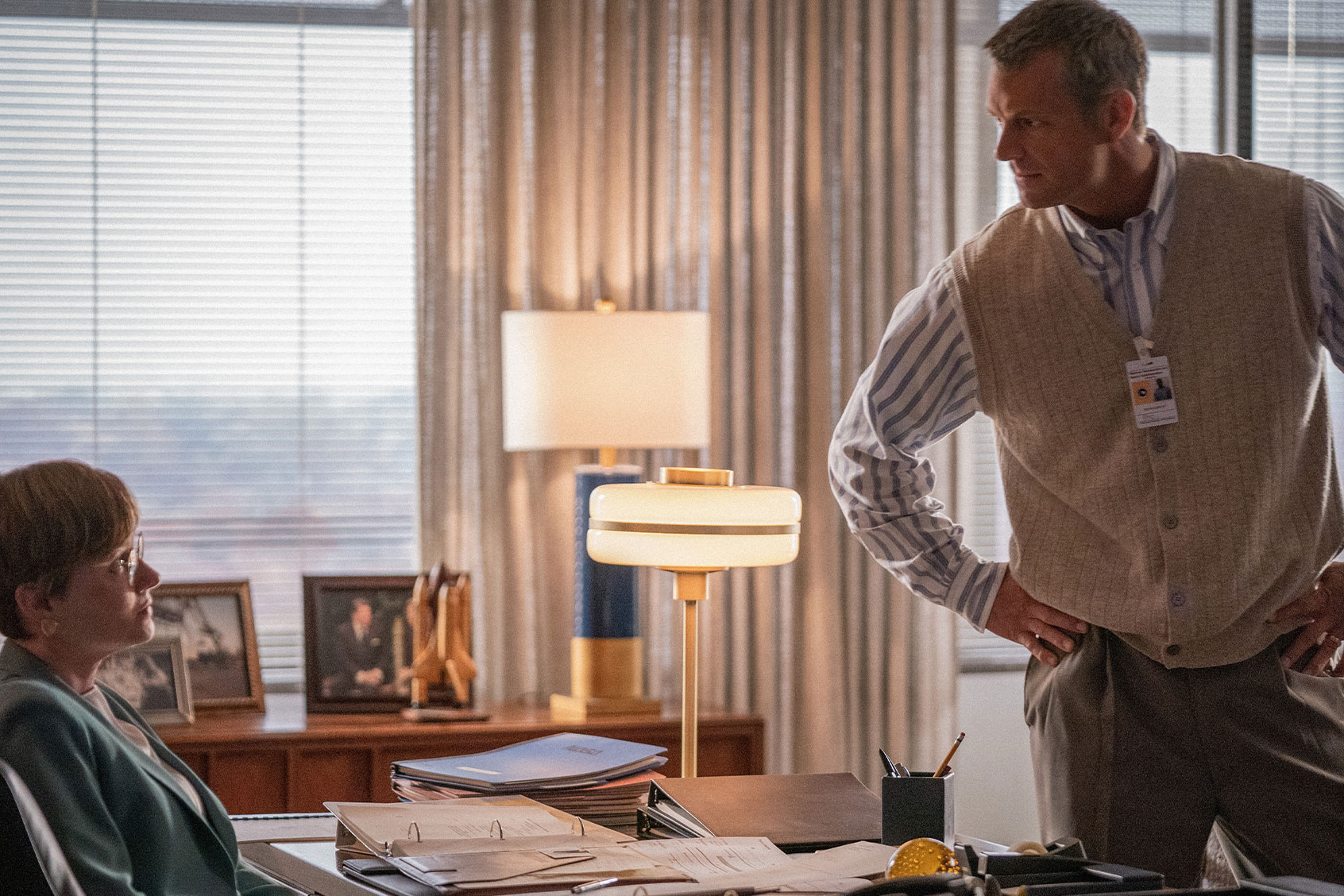
For All MankindFor All Mankind (Courtesy of Apple TV+)

For Ed is a space dad. He’s not around. Really not around. He’s millions of miles away. 

Ed (Joel Kinnaman) is the other main space dad on the show, one of NASA’s leading astronauts, the all-American golden boy grown up (Kinnaman is actually Swedish). Ed is a typical, Tom Cruise hothead at the onset, giving a nasty interview to the media when cosmonauts reach the moon first before American astronauts.

But dads like Ed fall up. Ed is removed from his position due to speaking out of turn, only to be placed back in command shortly thereafter. The first season sees Ed, like his co-astronaut Gordo, drinking a lot, throwing darts at a tavern and ignoring the distress of his wife, Karen, a stay-at-home-mom to their son. 

Ed isn’t a great dad for a long time. He yells at his son when he tries to teach him to ride a bike and the child, Shane, keeps falling off. He doesn’t understand why Shane can’t simply follow his instructions like a fighter pilot. 

For space dad, his first reaction is rage, always.


For Ed is a space dad. He’s not around. Really not around. He’s millions of miles away. His stabs at fatherhood include perfunctory gestures like writing his son’s name on the surface on the moon, rather than being there for his child as a consistent and trustworthy figure.

An astronaut is not going to be there to raise his kid. Not this astronaut. Not this time. Shane starts acting out, getting in trouble, and Ed yells at him from space, over the staticky video phone. It turns out this will be their last conversation. 

Grief reshapes everyone. For space dad, his first reaction is rage, always. He destroys things, then he turns to drinking. But then, and slowly, he changes. 

For All MankindFor All Mankind (Courtesy of Apple TV+)In the second season, Ed and Karen adopt a daughter, Kelly. Born in Saigon, Kelly was a child refugee, part of Operation Babylift. Her plane crashes, but she is among those rescued. In this new season, we see how Ed has become a better father, possibly because he’s older, possibly because this is his second and last chance, or possibly because he and Kelly relate more. They’re a lot alike, maybe too much alike at times for Ed who resists, at first, his daughter’s desire to attend Annapolis, not wanting her to be a pilot, not wanting to lose her like he lost Shane.

Space dad has trouble staying married.


Kelly becomes a scientist and at the start of Season 3, she’s the one on the video call, long-distance as she’s on a research trip, but this season will bring parent and child closer than ever before.

As a leader in space, and now an elder on his missions, Ed is a dad of sorts to others too, especially Gordo’s eldest son, Danny who is, unfortunately, terrible. Not even Ed’s mentoring will save him. Continuing the cycle, Danny is an awful father, absent and unfaithful. He’s so bad at parenthood, you forget he has a kid. (Likely, he does too.)


Want a daily wrap-up of all the news and commentary Salon has to offer? Subscribe to our morning newsletter, Crash Course.


This season, after once again losing out to the ladies, Ed is picked to lead the mission to Mars run by Helios, NASA’s new private sector competition . . . which just happens to be co-founded by his now ex-wife, Karen.

Space dad has trouble staying married, but space dad stays friendly with his exes, maybe still holding a candle for them — and always holding out hope that this time he can be a better man, be a better father, be there where no man has gone before: home.

“For All Mankind” releases new episodes Fridays on Apple TV+.

More stories like this

Juneteenth is a reminder that freedom still depends on where you live

One-hundred and fifty-seven years ago today, troops arrived in Galveston, Texas with a life-altering message: Slaves were finally free. It was a moment of joy and elation for the 250,000 enslaved Black people in the region. 

But the announcement came with a major blemish: It happened a deliberate two and a half years after the signing of the Emancipation Proclamation. White slaveholders, who weren’t ready for their oppressive regime to end, maliciously withheld the news. 

As I reflect on Juneteenth, I can’t help but consider how this piece of history parallels today’s society. Our access to basic needs and rights — including abortion, voting rights, education, health care, and more — continue to be determined by where we live. It’s a reality that is particularly devastating for people of color, for whom freedom has always been illusory. 

RELATED: How are we supposed to celebrate July 4 after Juneteenth?

I see these inequities clearly in my work at the Mississippi Center for Justice, which works to dismantle systemic racism throughout the state. Every day, Mississippians struggle to access the rights and protections that people in other states can access with ease.


Want a daily wrap-up of all the news and commentary Salon has to offer? Subscribe to our morning newsletter, Crash Course.


Take reproductive rights. While many people in the country can easily get a safe and free abortion, the entire state of Mississippi has one abortion clinic and strict abortion restrictions, making it incredibly difficult to access the procedure. Of course, Mississippi isn’t alone in this: many states have erected enormous barriers to reproductive rights. In Texas, for example, any person can sue an individual who helps a woman get an abortion — and pocket $10,000 in the process.

RELATED: Texas two-step: Ending abortion rights and voting rights are part of the right’s long-term plan

In just a few weeks, this could become far worse. We’re co-counsel on Dobbs v. Jackson, the case that the Supreme Court may use to overturn Roe v. Wade. Even before the official verdict, many anti-abortion lawmakers are seizing the opportunity by proposing and passing legislation that would make abortion virtually impossible. If Roe is struck down, abortion could be banned or severely restricted in nearly half the country. What was once a constitutionally protected right for every American could then be determined solely by where a person lives — or whether they have the resources to travel. 

Unfortunately, the zip code restrictions don’t end with reproductive rights. A person’s location also dictates whether or not a person can participate in our democracy and cast their vote. Many people, mostly people of color, are intentionally locked out of the process. For example, many states, including Mississippi, prevent people with certain felony convictions from voting. Additionally, while a Black person living in the Mississippi Delta may have to wait hours in line to vote, white voters in well-to-do neighborhoods can breeze through the process. 

RELATED: Federal judge puts Florida on 10-year probation after ruling voting law disenfranchises Black voters

And now, even more voter suppression tactics are emerging — including limitations on mail-in ballots, reduced polling locations and new barriers to voter registration. Since the beginning of 2021, lawmakers in 18 states have passed legislation limiting voting access, according to the Brennan Center. 

Location also impacts the livelihoods of those who can’t vote or leave a state on their own: our children. The quality of education our students receive is tied directly to their zip codes. Schools in minority districts receive an average of about $2,200 less per student than those in white-majority districts in one year, a gap amounting to billions of dollars nationwide. 

And now, one’s home state will also determine who will be taught the full story of America. Dozens of states have proposed or passed legislation that claims to ban critical race theory, but would really force teachers to whitewash our history. If it were up to these states, books and lesson plans on Juneteenth would probably be banned. 

RELATED: How this tiny Christian college is driving the right’s nationwide war against public schools

The list of location-based disparities goes on. A dozen states have yet to expand Medicaid, leaving hundreds of thousands of poor Americans without a way to access health care. Meanwhile, millions of Americans in poor, rural areas lack access to broadband internet access, denying them access to education, entrepreneurship, telehealth and more. And as climate change increases the severity and number of natural disasters, affluent neighborhoods continue to receive faster support than poorer ones. 

So today, let’s commemorate the memory of Juneteenth. But let’s also remember that progress does not occur evenly. Strengthened rights in one place can come with weakened rights in another — and people of color often suffer the most. We must keep fighting to ensure that all people have access to their due opportunities and rights.

Read more about the fight for abortion rights: 

Trump biographer claims Ivanka knew dad was plotting against Pence

Speaking with MSNBC host Alex Witt on Saturday afternoon, Donald Trump biographer Tim O’ Brien suggested that Ivanka Trump knew before Jan 6th that things would take a turn for the worse after sitting in on Oval Office meetings and listening to her father and senior advisers make plans to make Mike Pence the villain if he refused to help steal the election.

Asked by host Witt if the president’s daughter had a “bad feeling” about the “Stop the Steal” rally that eventually led to the insurrection, he said “absolutely.”

“Do you get a sense from her testimony that Ivanka had a bad feeling about January 6th, even before the rally at the ellipse?” Witt prompted.

“Absolutely,” he began. “We know from other accounts of what she did that day that she honored the fact that Mike Pence was resisting Donald Trump’s pressure to decertify the electoral results on January 6th at the Capitol. And then she obviously was in the Oval Office with several other campaign advisers, including lawyers, who heard him swearing at Mike Pence, who heard him grow increasingly angry at Mike Pence, because Mike Pence wouldn’t do a Donald Trump wanted him to do, which was to break the law.”

Asked by host Witt if the president’s daughter had a “bad feeling” about the “Stop the Steal” rally that eventually led to the insurrection, he said “absolutely.”

“Do you get a sense from her testimony that Ivanka had a bad feeling about January 6th, even before the rally at the ellipse?” Witt prompted.

“Absolutely,” he began. “We know from other accounts of what she did that day that she honored the fact that Mike Pence was resisting Donald Trump’s pressure to decertify the electoral results on January 6th at the Capitol. And then she obviously was in the Oval Office with several other campaign advisers, including lawyers, who heard him swearing at Mike Pence, who heard him grow increasingly angry at Mike Pence, because Mike Pence wouldn’t do a Donald Trump wanted him to do, which was to break the law.”

Watch below:

Kellyanne Conway bad-mouths her own husband during live interview

When Kellyanne Conway appeared on CNN with host Michael Smerconish, things quickly went awry when he asked her about the chapter in her book that speaks of her husband, George Conway. Instead of focusing on the question, Conway spiraled off into a rant about her husband’s stance on former President Donald Trump.

In fact, Conway’s rant was so intense that Smerconish was barely able to get a word in. The highly-publicized couple has made headlines multiple times for their clash on Trump. Their feud began when George Conway publicly launched his attack against the former president on Twitter.

During the interview, Kellyanne Conway was also asked about her marital state given their political clash. She wasted no time weighing in.

“You know, in 2016, known as the year of the tweet, George Conway sent zero tweets,” she began. “Now he’s sent over 100,000. He can change his mind about Donald Trump, this is a free country, George has no allegiance to a political party or presidential candidate but his vows to me I feel were broken because we were all in.”

She went on to discuss her book.

“You know, I also write in the book, Michael, that people like to say without Kellyanne Conway, Donald Trump would not have gotten elected president of the United States, that’s debatable,” she said during the Saturday morning interview. “But without George Conway urging, if not insisting me, his wife, to take that campaign management job and helping out with more with the kids and home, I don’t see how I could be the campaign manager the level I was. George was my partner.”

“Did you ever say, George, what the hell are you doing here?” Smerconish asked.

“I did and that’s in the book,” she shot back. “All I got was a steady diet of ‘Trump, Trump, Trump.’ I will tell you that I know he’s billed differently now, but for the three years, he was mentioned 48 times by the New York Times. He was mentioned 45 of the 48 times as, quote, ‘Kellyanne Conway’s husband.’ We should be honest about how everybody came to know him and that he became some kind of resistance folk hero but not at a small cost.

“I feel that I should have known ahead of time if this thing called the Lincoln Project was going to exist there were going to be ads, dumping an op-ed the next day, his tweets are going to be about my boss,” she continued. “Again, just so your viewers who are saying ‘why did you have her on? I turned off the TV,’ although they didn’t or are reading online, they should know that George — I feel like I was owed an explanation. And this is not the situation, I gave up millions of dollars to go be a public servant in the White House. George wanted to have a big job in the Trump administration, we moved our family to Washington as a family. He changed his mind about Donald Trump somewhere along the way. Famously, Donald Trump never changes. I didn’t change my mind.”

Shortly after the interview, Smerconish addressed critical responses to him having Kellyanne Conway on the show. During the interview, many frustrated viewers tweeted their concerns. His remarks came after one viewer even demanded that the interview footage be taken down.

People overestimate groups they find threatening: when “sizing up” others, bias sneaks in

Places are not just physical, but also social.

For instance, around the North Carolina campus where we met, we knew certain bars based on the students who frequented them — the “Duke bars” versus the “UNC bars.” Or, when traveling, we may try to guess whether most of the patrons at a restaurant are tourists – and if so, go elsewhere.

This common way of thinking about our environments seemed fairly reasonable to us until a few years ago, when we noticed something that gave us pause.

We’ve overheard one of our alma maters, the University of Pennsylvania, pejoratively referred to as “Jew-niversity of Pennsylvania,” and one of our hometowns, Decatur, Georgia, disparagingly called “Dyke-atur.” These labels are not only deeply offensive … they are also wrong. Neither of these places are actually majority Jewish or gay. And yet, some people seem to hold the belief that these groups dominate these spaces.

Where do these beliefs come from, and why do people make these inaccurate judgments? Perhaps more importantly, why might this matter?

As social psychologists who explore how intergroup dynamics affect organizational and consumer phenomena, we were fascinated by these questions. Four years ago, we set out to answer them.

Across six studies, we found that people commonly exaggerate the presence of certain groups – including ethnic and sexual minorities – simply because they are perceived as ideologically threatening. Psychologists call this feeling – that groups hold different values and worldviews from the mainstream, thereby jeopardizing the status quo – “symbolic threat.”

Symbolic threats loom large

We began by looking at survey data from the year 2000 that examined 987 non-Black Americans’ beliefs about Black people. We found that the more a survey respondent believed that Black people had different values or a separate lifestyle from their own, the more they believed the population of Black people would increase over time.

We followed this up with several experiments, looking not only at beliefs about Black people, but also other minority groups, including gay people and immigrants. We asked participants to imagine everyday social spaces, including patrons at a bar or residents in a neighborhood.

In some studies, we showed participants demographic information about a small portion of employees at a company and asked them to guess the demographics of the entire business. In other studies, we described a group of people congregating in a place and asked participants whether they believed the place was somehow linked with those people – for example, a “Duke bar” or “UNC bar.”

Our volunteers were much more likely to overestimate the groups they found symbolically threatening, such as gay people or immigrants, compared to groups that did not seem so threatening, like those with green eyes.

Specifically, triggering a sense of value conflict made our study subjects both more likely to perceive those groups as more populous in a place, and to believe that the group and place are somehow linked.

This pattern emerged regardless of participants’ own demographic characteristics or political stances and even when we used completely fictitious groups, like a made-up organization called “PDL” with a fake logo. Our findings suggest that these kinds of judgments are universal and may be hard-wired into how people process their environments.

Better safe than sorry mindset

Humans have evolved a variety of strategies to protect themselves from harm. One involves being hypervigilant to potential threats. According to what psychologists call “error management theory,” people tend to err on the side of caution by exaggerating potential threats in their surroundings. When camping in the woods, for instance, it is safer to incorrectly assume a shadow is a big bear than it is to incorrectly assume the shadow is harmless.

While prior work has explored these kinds of snap judgments in potentially dangerous environments, our research uncovers that people give in to these same biases in everyday social spaces.

The tendency to exaggerate potential threats has helped our species navigate new environments and stay safe. But it may be cause for concern when people make these same judgments about others simply because they appear to think and live differently from them. Groups that differ from the mainstream are likely viewed as more pervasive than they actually are or as growing in number. This yields a sad irony: Although these groups are often subjugated and disempowered, they may be perceived as just the opposite — an ever-encroaching threat that must be suppressed.

This kind of rhetoric has unfortunately been in the spotlight of late. For instance, conservative figures like Fox News host Tucker Carlson and Rep. Marjorie Taylor Greene have recently lent credibility to bigoted conspiracies like the “great replacement” theory, which posits that minority groups are intentionally increasing in order to replace and outvote “mainstream” Americans. This rhetoric apparently motivated the white gunman accused of killing 10 Black Americans in Buffalo in May 2022.

Breaking free of the bias

Prior work in psychology suggests that merely being aware of your own biases is the first step toward reducing their influence. Since starting this project, we have even noticed our own tendency to jump to conclusions about the groups in our surroundings and their pervasiveness.

If you notice yourself doing the same thing, it doesn’t make you a bad person. But we encourage you to use these moments to slow down and reconsider your gut instincts. While this way of thinking might help you figure out the best sports bar for cheering on your team, categorizing places based on the people within them can have serious ramifications if left unchecked.

My disapproving doctor father hated my work — but we had more in common than I thought

My whole life I was intimidated by doctors. So when I recently launched a series of private remote writing and publishing courses, I was stunned to find among my students several physicians, the same profession as my father.  During the pandemic, I wound up teaching a nephrologist, neurologist, internist, neonatologist, pediatrician, several psychiatrists and gynecologists — all who aspired to be authors too. Whenever someone mentioned their medical background, I’d think: I have to call Dad to tell him. Each time it crushed me to remember I couldn’t.

Reared in a big Michigan family with three brilliant loud science brain brothers, I’d always felt left out by their Disease Game at dinner, where Dad threw out cases for my siblings to diagnose.

“Forty-two-year old Cambodian refugee vomiting blood?” he asked.

“Schistosomiasis,” Brian answered. “Pass the potatoes.”

I was freaked out by bees in jars in the refrigerator, pet rats and the calves’ esophagus dissected in the kitchen sink. Our house was their laboratory. I’d eat alone upstairs, homesick in my own room.  

RELATED: Why my father fasted on Yom Kippur: On survival, memory, and the power of a family story

Having grown up poor on the Lower East Side, getting to study medicine was Dad’s American dream. So of course he was encouraged the boys followed in his footsteps. But my conservative father disdained my liberalism, confessional poetry about my addictions and screwy relationships, and focus on creative writing. Flunking biology and chemistry, I learned my literary aspirations shamed him.

“Gonna sell your poems on the subway?” he asked. “Stop running naked through the streets.”

I argued against his red-state politics. Until the summer I turned 16 and worked at his Detroit office where I uncovered a secret file of medical charts of long-term low-income patients he treated for free. My dad was more complex than I thought. When I asked about it, he replied, “Mind your own business,” but I didn’t really have one. Each field I tried, I failed.

“Finally, a real job,” Dad said. 

After grad school, my magazine job salary was $200 a week. Four years later, still an assistant, I quit. Not funny enough to be a stand-up comic or sit-down humorist, I did piecemeal assignments about being a single working girl for women’s magazines. As my brothers settled down, had kids and made a good living, my folks sniffed that I was “freelance everything,” fueling my career inferiority complex. At 33, my first teaching gig came with a miraculous equation: I showed up, they paid me.

“Finally, a real job,” Dad said. 

When I was 35, he was thrilled to walk me down the aisle, partly because my husband’s work had a better healthcare plan.

“To stay healthy, avoid all doctors, hospitals and medicine,” Dad told me, only half-joking. Needle-phobic, squeamish and scared of invasive procedures, I avoided tests, checkups and surgeries. I was lucky to be hale and have access to free advice; my father and I got along best when I had a physical problem he could fix over the phone.

I eventually found an Orthodox Jewish ophthalmologist who shared his idea for a thriller where the microfiche was hidden in the Hasidic spy’s eye. The endodontist I went to for an emergency root canal was a fellow Bob Dylan fanatic who let me blast “Blood on the Tracks” on his iPod which — on laughing gas — I sang along to loudly to drown out the drill. The radiologist who did my sonograms penned an op-ed, “Why Mammograms Matter,” that landed her on the “Today” show that we discussed at length. I picked an OB-GYN who published bestsellers on women’s health. I found it mercifully distracting when he’d talk about his book deals while  examining me.

“You’re humiliating me and your mother,” he snapped. 

By day I kept struggling with my own literary projects. At 43, I was overjoyed that Random House published my humorous memoirs about my past screwed-up relationships and addictions. My father wasn’t so joyful. “You’re humiliating me and your mother,” he snapped. 

“He isn’t your audience,” my therapist consoled, suggesting I tell Dad he could be proud of my accomplishment without loving my book. When he and my mother flew to New York for my launch party, my relatives asked, “How are you holding up?” as if they were sitting shiva. 

To undercut the hurt, I tried counterphobic humor. I joked in my bio that I was the author of books my family detested and  told my classes, “The first piece you write that your parents hate means you’ve found your voice.” Although I made a niche helping students see print, my father still trashed my bylines. However, he praised me for being a good teacher, wife, and aunt to his five grandkids.

“He’s proud of me for the wrong things,” I told my therapist.

“Just be happy he’s proud of you for something,” he replied. 

But Dad and I had common ground: we were both workaholics. It wasn’t until his heart attack at 80 that he was forced to quit the full-time job he’d had for half a century. He was sad to retire. Visiting my parents for a week, I took a stack of essays to grade from a seminar I’d given where  my students paid $150 per piece. Dad was marking papers too. The state of Michigan sent him medical cases to evaluate how long the patient required hospitalization, paying $150 each. I liked the connection, as if I’d inherited his critical faculties. 

“Shapiros could have a controversial opinion over a shoelace,” a  friend joked.

“It took me too long for me to make a decent living, screwing up jobs because of my bullheadedness and big mouth.”

At 85, when my father was admitted to his former hospital with heart and kidney failure, we had a rare afternoon alone.  Sitting by his bed, I confessed to feeling inadequate for not giving him grandchildren and taking so long to figure out my finances.

“I have a lot of regrets,” he said. “It took me too long for me to make a decent living, screwing up jobs because of my bullheadedness and big mouth.”

They were traits we’d shared, though I thought I was the only late bloomer in our family.

I was nervous when his physician Olaf emailed me, but it wasn’t bad news. “Your dad says you’re an acclaimed author and professor who helps people publish. Could you help me?”  he asked.

“What did you tell Olaf about me?” I questioned Dad that night over the phone, still surprised. 

“That you stuck to your guns and became a success,” he said.

“Why didn’t you ever tell me that?”

“I’m telling you now,” he said, pleased when I helped Olaf publish his first magazine piece.

Young Susan Shapiro and fatherYoung Susan Shapiro and father (Photo courtesy of Susan Shapiro)

Telling Dad how many students enrolled in the  classes I’d launched in my home, he was impressed with my new business acumen, saying “Who would have thought you’d be a Brownstein?” 

“What does that mean?” I asked Mom.

“It’s a compliment,” she explained. “The Brownsteins were the branch of his family who were good at business. The Shapiro side wasn’t.”

His favorite story was eradicating a syphilis outbreak in St. Louis in the 1960s by giving out free beers at a bar to anyone who’d get the penicillin shot.

After losing my father four years ago, I was bereft. To feel closer to him, I reread over all our emails where he was my health proxy. When I tried to worm out of getting a needle biopsy after a breast cancer scare, he wrote, “Stupid is as stupid does … Steve Jobs decided to treat his pancreatic tumor with fruit juice and yoga.  Denial is very common in intelligent people and can lead to disasters.” He was scanned my test results, which came back benign. 

Another time, I sent him a picture of the bunion on my right foot and he’d replied, “Cure’s worse than the disease. So your toe’s not going to Hollywood.”

Fascinated by infectious diseases, his favorite story was eradicating a syphilis outbreak in St. Louis in the 1960s by giving out free beers at a bar to anyone who’d get the penicillin shot. I wondered what he’d make of the pandemic, and all the physicians suddenly in my cyber student body.

Hilariously, those with medical degrees were the most likely to screw up — ignoring rules and protocols, along with my boundaries, emailing me 24/7, sending in homework a week too soon, cc’ing me on rude follow-ups to editors. 

“I’ve had no response from you regarding my article submitted Monday,” an OB-GYN from the Midwest impatiently emailed an editor  days later, as if she was a nurse not following his orders.  

“Chill out a little,” I replied, suggesting he read the info I’d already shared about best  time and ways to follow up. “You think your great expertise in one arena automatically transfers to another field, but it doesn’t,” I told the doctor, realizing he was just a few years younger than my father.

“Wow thanks. How did you know that?” he emailed back with a smile emoji. 

“You remind me of someone,” I told him, wondering if I was forever locked in a struggle to find common language with my late paternal figure.

I’d learned The Disease Game after all – in my own realm where I had a chance at winning.

“I believe I came to the right place,” the gyno told me. 

I was happy he slowed down, did it right and nailed it. He sold his piece to a top newspaper.  

Several students referred to me as the “writing doctor” who’d “saved” their work. Of course, my field would never be as important as saving lives. But maybe I’d been emulating my father all along. Reading what someone wrote, I’d “diagnose” the problem and offer a prescription for how to fix it.  I’d learned The Disease Game after all – in my own realm where I had a chance at winning.

I wish Dad were here so I could share the latest stories by my physician students. But in a way, he still is, as I channel everything he taught me about hard work, brutally honest feedback and never giving up doing what you love.  Recalling that he treated patients in need without insurance who couldn’t pay him, I let former pupils having a rough time study with me for free, in his honor, trying to heal the world in my own small way, with all the strength that he gave me. 

More personal essays on complicated fathers: 

Celebrate coastal flavors with this pan-fried catfish with stewed tomatoes and okra

The American southern style of cuisine referred to as Lowcountry cooking is defined by ingredients that are grown and harvested in the coastal area between Georgia and South Carolina. It’s the original farm-to-table style of dining!

Crab, catfish, shrimp and oysters are some of my favorite Lowcountry ingredients, along with okra, tomatoes and rice. This dish is a culmination of the regional cuisine and comes together pretty quickly. Pan frying creates fish that is tender and succulent inside, with a slightly crispy exterior.

***

Recipe: Pan-fried catfish with stewed tomatoes and okra 

Yields
4 servings
Prep Time
10 minutes
Cook Time
20 minutes

Ingredients

Pan-Fried Catfish 

4 catfish fillets or steaks

Sea salt and freshly ground black

pepper to taste

1 tablespoon cayenne pepper

1 tablespoon smoked paprika

1 teaspoon ground thyme

1 cup all-purpose flour

¼ cup vegetable oil


Stewed Tomatoes and Okra 

1 large white onion, sliced

1 clove garlic, minced

1 cup crushed tomatoes, including the juice

3 sprigs fresh thyme

Sea salt and freshly ground black pepper to taste

1 pound fresh okra, sliced


Serving Suggestions 

Carolina Gold rice, Jasmine rice 


Directions

  1. Place the catfish on a clean plate and season on both sides with sea salt and freshly ground black pepper to taste, cayenne pepper, smoked paprika and ground thyme. Rub the spices into the fish with clean hands and set aside. Add the flour to a paper bag, then add the fish and gently shake the bag to evenly coat the fish. Remove the fish from the bag, shake off any excess flour, and set aside.
  2. In a large cast iron skillet, heat the vegetable oil over medium-high heat. When the oil is hot, add the fish and cook for 3 minutes on both sides. Place on a bed of paper towels to absorb any excess oil.
  3. In the same pan, add the onion and garlic and cook for 3 minutes. Add the tomatoes, thyme sprigs, and a pinch of sea salt and freshly ground black pepper. Stir and cook for 3–4 minutes. Add the okra and stir to combine. Cook for 3–4 minutes. Taste for seasoning and adjust as needed.
  4. Divide the catfish fillets among 4 plates and top with the tomato & okra mixture along with a scoop of rice if desired. Serve immediately.


If you liked this recipe, be sure to check out Chef Stephanie Harris-Uyidi’s newest cookbook, “Going Coastal!: 200+ Coastally Inspired Seafood Recipes From Around the Globe” from Posh One Media. 

Want a salad on the side? Try these Salon-approved recipes: 


What to listen to, read and watch about the connection between Black cooking and Juneteenth

Juneteenth, which was finally recognized as a federal holiday in 2021 under President Joe Biden, commemorates the emancipation of enslaved people in the U.S. Its name stems from June 19, 1865, when Maj. Gen. Gordon Granger in Galveston, Texas, issued General Order No. 3, which announced that in accordance with the Emancipation Proclamation, “all slaves are free.” 

RELATED: How (not) to do Juneteenth, from freedom panties to horrifying video game cosmetics

For decades, food and drink have been interwoven through the celebration of Juneteenth. As such, a lot can be learned about the holiday — as well as Black American culinary traditions — by using food as a lens. This weekend, here’s a guide to what to listen to, read and watch to better understand the intersection between Black foodways and liberation. 

Read: “Watermelon and Red Birds: A Cookbook for Juneteenth and Black Celebrations” 

This stunning new cookbook by Nicole Taylor is the very first cookbook published that specifically centers on Juneteenth. It’s inspired by Taylor’s decade of experiences observing the holiday, where “all-day cook-outs with artful salads, bounteous dessert spreads and raised glasses of ‘red drink’ are essential.” 

Taylor’s spin on those traditions has resulted in recipes such as Peach Jam and Molasses Glazed Chicken Thighs, Afro Egg Creams and Southern-ish Potato Salad. “Watermelon and Red Birds” also provides a resource list to guide readers to BIPOC-owned hot sauces, jams, spices and ingredients. 

Watch: “High on the Hog: How African American Food Transformed America” 

In the episode titled “Freedom” from the Netflix series “High on the Hog: How African American Food Transformed America,” host Stephen Satterfield meets with Eugene Thomas, a descendant of enslaved people who were freed on Juneteenth, and they share a slice of red velvet cake. Thomas explains why there’s a special emphasis on red dishes and ingredients. 

“It was a reminder, in a lot of ways,” Thomas said. “Of the blood that was shed prior to the Emancipation, by all those that came before us that did not get the chance to taste the freedom that we’re tasting right now.”

The entire episode is emotional, informative and particularly poignant as corporations attempt to commercialize the holiday

Listen: “A Taste Of Freedom” by NPR’s Code Switch

On that note, NPR’s Code Switch released a fantastic conversation between correspondent Karen Grigsby Bates and food historian Rafia Zafar, in which the pair discusses the connection between Black food culture and emancipation, as well as what it means for mega-corporations like Amazon and Nike to declare Juneteenth annual company holidays. As host Gene Demby put it, those companies have “spotty track records as it pertains to labor and compensation.” 

“As Juneteenth has broadened, Gene, I’ve begun wondering if it’s getting diluted by its very popularity,” Bates said. “Like, if everybody is into it — everybody — does its original meaning just get lost?” 

As more Americans of all backgrounds look to commemorate and engage with Juneteenth, this episode is a helpful, real-talk guide for doing so respectfully. 


Want more great food writing and recipes? Subscribe to “The Bite,” Salon Food’s newsletter.


Read more:

“Canceling is relative”: Michael Che on his comedy boundaries & why he’s not leaving “SNL” just yet

Are comedians ever really canceled for telling a bad joke? We know what happened to Kathy Griffin after her bloody Trump joke, but it seems like most of the funny people who cross the line have just moved onto different positions within the industry, conservative networks, or retired early and had the benefit of enjoying the millions they have accumulated over the course of their careers. Comics, many whose existence requires that they push the envelope, are some of the most vulnerable to the cancel-culture chopping block. Comedian Michael Che, who loves to play the cancel-me-if-you-can game, and has faced backlash for it, addresses the problems with cancel culture (and maybe some of his own fears about it) in Season 2 of his sketch comedy show “That Damn Michael Che,” streaming now on HBO Max.

The show, which is created by and executive produced by Che, cleverly pokes fun at issues dealing with race, religion, reproductive rights and more. Many know Che from his brief time as a correspondent for “The Daily Show” with Jon Stewart, and of course “Saturday Night Live,” where he made history as the first African-American co-anchor on “Weekend Update” and co-head writer, alongside Colin Jost.

RELATED: “Bel-Air” star’s fears: “I’m not Aunt Viv”

Coming from the streets of New York, excelling as a stand-up in some of the grittiest clubs across the country and developing a language that is both funny and suitable for network television, has made Che a uniquely necessary voice for exploring the issues through the lens of humor. I talked to Che on “Salon Talks” about the complexities of landing sensitive jokes today and why he decided to tackle these and other untouchable topics on his show. Watch my “Salon Talks” episode with Michael Che here or read a Q&A of our conversation below to hear more about his future at “SNL” and why he will never stop doing stand-up.

The following conversation has been lightly edited for length and clarity.

You are the first Black anchor of “Saturday Night Live’s Weekend Update” and first Black head writer on the show. It’s a lot of first Black on here, man. I feel like they should be bringing you up during Black History Month.

I don’t like taking credit with being the first Black anything because it wasn’t like there was a rule in place. It feels a little less sexy when there’s no rules stopping Black people. I just happened to be the first one, but I appreciate it, thank you.

Season 2 of “That Damn Michael Che” is out now. There’s more stand-up this season.

Season 2 was kind of what I wanted to do with Season 1. We wrote and produced Season 1 in the heart of the pandemic, like a lot of shows had to work. There was a lot of limitations to what we could do. We didn’t have the writers team together as much. There was just a lot of different obstacles that stopped us from kind of making the show we wanted to make. And also, too, the show was developed without a pilot. A lot of the show was finding itself, I think, in Season 1. By Season 2, we knew exactly what we wanted to do with it, so it was a lot easier to execute.

You have one episode where you get all of your ex-girlfriends in the same room. I just want to say as a consumer, I was triggered. It was the first time in my life I ever felt triggered. I have never used that word. It’s the first time. I thought about all the crazy women I dated popping up over my place.

That was a fun one. It was kind of just like a fantasy sequence of, what’s a way to find out that a lot of my patterns are patterns, than having different people of different walks of life all tell me that I’m the same person. I wish that we could be a little bit more honest with ourselves and start to see those, recognize those, patterns a lot quicker.

Behind your comedy there are really important topics there. In the first episode, you create a subway incident where a man needs help, the kind of thing that everyone’s quick to record on their phone, something or everybody’s quick to put their two cents in. What are some of the other themes that viewers can look forward to?

We touch on reproductive rights. We touch on cancel culture as treaded territory as it is, we try to really kind of explore it a little bit differently. We touch on Black excellence and your place in the community. It’s nothing done with the intention of being heavy-handed or pushing the narrative. It’s just kind of exploring the things that people are already talking about and having fun with it.

That was kind of the bigger takeaway from this season than any other show I’ve ever worked on, is we wanted to have fun with it. We wanted to all feel like it was in jest, and if you get something from it, great, but we really just want you to laugh and have a good time.

I need to see that one. 

There’s a fun wig in there. You’ll love it.

I’m from Baltimore, and they didn’t call it this, but I went to what felt like a Black excellence house party. It was f**king terrible. Everyone sat in a circle and they just was talking about all of the great s**t they do. And then everyone had to respond with how excellent it was. None of these people were even from Baltimore.

It’s a strange thing. That’s kind of what we are making fun of. Sometimes we put a lot of pressure on ourselves to be such pillars, when I think the best example we could show is just kind of being a human being, you know what I mean? And treating people with respect and not putting that much pressure on ourselves to have to uphold some standard of excellence. It’s a little daunting for most people. It ends up just being lip service a lot of times, when we just really need to rebuild families and just try to do the best we can.

“You snap on people that you love the most. … It’s kind of what make us the same is that we all got something wrong with us.”

I feel like there’s Michael Che, the person, when you’re talking about these issues in interviews, and then there’s you on “Saturday Night Live,” and then there’s you doing stand-up. And a lot of my friends, they don’t interview, but they watch stand-up. And when your name comes up, it’s like, “Oh my . . . cold-blooded. Michael Che don’t give a f**k. He’s going for the jugular.” If it ever gets f**ked up for you out there and your New York work crumbles, you could find work in Baltimore. 

That’s the best compliment I could ever get because stand-up is my favorite thing to do. I always feel like that’s my first language. And it’s the language that allows me to understand other languages in this business. I enjoy doing it. And I really appreciate when anybody gets a kick out of it.

Do you feel like we’re living in this time where a comedian can actually be canceled? Like, is that even a real thing?

Just like success, canceling is relative. Somebody could be canceled and not know it. Somebody could feel canceled and not be canceled. There’s a lot of people who are. You know what I mean? They’re like, man, what’s going on, something’s up? They know something’s in the air, but they can’t figure it out. And also, too, there’s a lot of people, I think, who are a little paranoid and they may think things are happening that’s not actually happening because they maybe think a little bit higher of themselves than they should. 

I remember when we was kids, people used to be like, “I got so many haters,” and it’s like, you don’t got no haters, whatever, but it makes you feel good to know that somebody’s actively out to get you, or what you’re doing is so important that someone feels like they need to stop it. I think that is a kind of an ego boost. I totally think there’s certainly an instance where people can have their career put to a halt because of something they said or something they did. Whether rightly or not, it is definitely something that we’ve seen happen, for sure.

When I was coming up and we were cracking jokes and we making fun of our friends, the joke was like, “Your mother’s a junkie b***h.” That is the meanest s**t you could say to a kid who has a mom that’s struggling with addiction. But what am I going to do? He made fun of my Nikes. I had no choice. Right? We had that rawness and it was hilarious to us. Now that I’m a writer and always putting my opinions out there, people say things like “How could he . . . he just said that? He just wrote that? He feels that way?” The good thing for me is, people don’t read, but we hit the wall. We hit a wall because we’re bringing elements of our culture to these main stages and people who consume at these higher levels or these Twitter police, they don’t really necessarily understand that. Do you see that?

I think there’s definitely a lot of instances where on a wider scope, just culturally, there’s things that’s acceptable in our culture that we grew up with, like a mentality or a way we talk or a way we behave, that’s considered very aggressive or that’s considered, you know what I mean, threatening, or that happens a lot in language. It also happens in the way we dress and the way we move, the way we brag, the way we party, the way we have fun, there’s a lot of instances of that, but for sure on Twitter or even in an interview or even in stand-up, there’s ways that we communicate that is actually, sometimes, even like a form of love. 

You snap on people that you love the most. And a lot of times it’s because y’all came up in a certain condition that nothing’s taboo. It’s kind of what make us the same is that we all got something wrong with us. You know what I’m saying? 

“The way we interact today, it’s very strange. People are excited to find out what’s wrong and ruin it.”

Right.

Or we got a problem. Or we all going through something and it’s kind of like, don’t ever forget where you come from. And don’t ever pretend that you better than your community. I don’t think that’s necessarily the same for every community. I think sometimes people get offended on behalf of the optics and not necessarily understanding the communication that’s happening.

Maybe I’m just old. I think about what the future going to be like. I hurt my knee playing ball and I made a joke about being an old man. And this young kid was really telling me, I’m being ageist. And I’m like, yo, but I’m saying it about myself. 

I think there’s also that gotcha moment that has become a currency and a form of clout of, “I found the thing that was wrong. Everybody look at this wrong thing and celebrate me for calling it out.” I think there’s that, that we didn’t grow up with that kind of desire. It’s a very strange culture, the way this generation is. And I don’t mean the generation, meaning people younger than us. I just mean the people alive today. And the way we interact today, it’s very strange. People are excited to find out what’s wrong and ruin it, even if they don’t believe it. It’s almost like they sue happy. It’s like, have you been in the slip and fall? Like, if you think you could get some money, go get some money. But it’s not money. It’s like attention. It’s weird. I’m with you.

You don’t do social media?

I post a little bit on Instagram because I could control it a lot, but Twitter to me is just like . . . I always say Twitter is like giving everybody you hate your phone number. So many people just have such access to you. Anything you post, they could attach themselves to it. I don’t like the way that the system is built, but with Instagram, you could post one thing, you could delete it and keep things a lot more professional, I feel.

It seems like with Twitter, especially being in your position, it would be more dangerous for you, business-wise, to be on there.

Well, the ends never justified a means. Like, there’s nothing I’m going to write that’s going to be worth the trouble. There’s no reward that’s worth the backlash. It’s really not worth it. And plus, I have an outlet. I go on stage and I could tweet into a microphone.

And get a check.

Yeah, I got a better system.

“You need to know where that line is, so that when you cross it, it’s significant and it’s not just all porn.”

When you sit down and you write the sketches out for your show, do you think about that backlash or pissing people off and what all that means?

Hindsight. Once it’s developed, then we walk it back and see, all right, let’s kind of go through this with a fine-tooth comb, but initially we just trying to make each other laugh. We in the room, we’re like, oh man, what would be fun? What would we want to watch? I think comedy is a pure form of communication where I’m just trying to make you feel the way I feel when I think about this thing. I love it, I’m enjoying it, so I’m trying to say it in a way that you could understand. It’s almost like getting directions in a foreign country. Like I’m trying to find that middle ground of what you understand and what I understand so that we could see where we going together.

I think initially we tried very hard to just make it as funny as possible. And then once it gets to the stage of development, we start to figure out, all right, maybe this might be a little too far. Maybe this might be a little too niche. Maybe this might be a little too inside. And then we try to broaden the appeal a little bit later on. 

What’s something you had to walk back?

We had a rough time with this sketch called Abortion Dojo. I’m sure you could deduce what it is.

Yes, I saw it on the show.

That was something that made us laugh immediately because we was all in on it. We all knew where the joke was coming from and the spirit of it. We thought it was so funny and the producers and the network was kind of tentative of, “I don’t know if that’s right.” So we had to kind of put stuff in there to reinforce what side we were on and what we were actually making fun of. It wasn’t just, oh, it’s a good idea to kick pregnant women. It was more we had to make it where it was more about women not having options and going through unsafe extremes. And we had to be a little bit more heavy-handed than we thought we necessarily would because we are on the same page. 

We obviously know that’s true, but somebody watching that don’t know us may not get that. So we had to be a little more heavy-handed to tell that part of it. There’s times where you don’t have to dissect a joke or mutilate a joke or ruin the joke in order to make it clear. You could just add one or two lines that show what the intentions actually are.

I fear that people trying to put boundaries on comedy is not good for the craft.

In some ways it’s not, but in some ways it is because when it hit, it hard. Like there’s times where doing something with those boundaries makes it more impactful. You know what I mean? Like the fact that you are making this joke and betting this hard on it, and betting this much on it, and knowing that you could lose something behind it, I think makes it more special. 

I think the people that really want it, appreciate it more. That’s why they champion the people that actually speak to them the way they do. So yeah, you need those boundaries though. You need to know where that line is, so that when you cross it, it’s significant and it’s not just all porn. You know what I mean?


Want a daily wrap-up of all the news and commentary Salon has to offer? Subscribe to our morning newsletter, Crash Course.


What’s better for you, sketch or stand-up?

Nothing’s better than stand-up, but I do like sketch as well. I do like building the world and fleshing out and also you get an opportunity to see people that you believe in, that you think is funny, and put them in position to really score. And everybody’s scoring. It’s not a contest. It’s a community. I do love that sketch offers that in a way that stand-up may not because it’s just me with a microphone. I love both, but stand-up’s my first love.

In sketch, you get to get those fits off. You get the wardrobe.

You get to be silly. It’s like you playing dress-up and really kind of launch in and you could wear the comedy.

I feel like you wear what you wear at work a lot though. You ain’t wearing no crazy costumes.

That’s a fact. There’s like a few things where I’ll play a little bit, but even if it’s not me, it’s just being on a set where you could kind of dress it up and see it through. It’s like designing an apartment or something. There is kind of a rush and getting something in your head and seeing it through and realizing it to make it look as close as possible to the original vision, man, that’s kind of cool to watch.

“Stand-up is my favorite thing to do. I feel like that’s my first language. It’s the language that allows me to understand other languages in this business.”

It’s like the history of comedy parallels with the history of hip-hop when it comes to the fashion evolution. Some of the first hip-hop artists wore like these wild-ass leotards and yellow leather biker jackets. And then you get Run-D.M.C coming out with the Adidas sweatsuits and the shell toes. Comedians back in the day, Eddie Murphy, had the leather suits on and all of that. And you just come out with a pair of butters, like, f**k it.

All right, it’s a ill thing, man. That’s absolutely correct because I remember I think it was my first or second week at “SNL,” I met Steve Martin. He was the biggest comedian in the world at one point. He retired from stand-up. He was doing football stadiums and s**t. So he asked me, he was like, “When you go out, when you do stand-up, what do you wear?” Which is a strange question, because this is Steve Martin. I’m like, I don’t know. I wear this. I wear a hoodie. He’s like, “Really? I always wore a suit. I always felt like a performer was supposed to look better than the audience.”

It’s a whole different generation. You kind of geeking out over just that part of the process of how different s**t was. But I think you are right. I think like hip-hop and other pop culture, it’s a pendulum that should swing from one extreme to the other. And that’s kind of cool to watch the guard change.

Are you leaving “SNL”?

I’m going to stay. I wanted to leave initially. I felt like I was leaving initially, but the only reason I wanted to leave was to be able to do more things and take on more projects. I felt like at “SNL,” I never had the time to focus. I didn’t want to give up all my good years there. But we worked something out where I got an opportunity to produce a little bit more and do things outside of the show. And my workload’s not the same. Hopefully that’s a commitment that we all stick to and it works out for everybody because I do love being a part of the show. I do love everybody that I work with, but it was just something that I felt like I had to do. I had to leave if I was ever going to do something outside of there. Now it seems as though I don’t have to. So I’m going to stay, stick it out and see if I can get the best of both worlds.

“That Damn Michael Che” is streaming right now.

On HBO Max, it’s streaming right now, both seasons. They’re different. This season, we had a lot of fun, man. Shout-out to Gary Richardson, Kevin Iso, Reggie Conquest and Alice Mathias, who directed, and everybody that worked on it. We really, really had a lot of fun with it and we think you’ll like it.

Check out more “Salon Talks”: 

From “dada” to Darth Vader – why the way we name fathers reminds us we spring from the same well

Movie legend has it that the identity of Luke Skywalker’s father was always hiding in plain sight – well, at least through a subtle naming clue. “Darth Vader” does, after all, have a distinct paternal ring to it linguistically. Indeed, had the big reveal been “I am your fader” it would have made a nice play on the heavy-breathing villain’s name with a nod to an old Dutch term for “father.”

The true origin story of Vader’s moniker is not as cool as the myth. But as someone who studies the origins of words, I see the story providing an example of something that is real: the universality of the names used for fathers across all languages.

Considering that dads played a key part in populating the dawn of civilization, it is perhaps not that surprising that a label for the dude we call “dad” would emerge early in the development of languages. But, whether it’s “papa,” “dada” or “vater,” what is striking is the cross-cultural bias in the words used to describe him – and how the same names have stuck around over millennia.

Why “pater” is familiar

Tracking the linguistic evolution of modern “father,” we find it as far back as written English goes – with references to “feadur” or “fadur” or “fædor” in Old English texts from the seventh to 11th centuries. In Old Dutch there was “fader“; in Old Icelandic we find “faðir”; in Old High German, a precursor to modern German, it was “fater” – now “vater”; and, finally, in Old Danish, “fathær.”

This uniformity strongly suggests this word was found in the languages’ early Germanic parent – that is, the source language from which all these Germanic languages descended.

But the similarity in terms used for “father” doesn’t stop with this Germanic forefather. Related words are found across the entire Indo-European language tree – a large group of distantly related languages that stretches over most of Europe and a good bit of Asia. For instance, we find closely matching terms in Latin with “pater,” Sanskrit’s “pitar” and in Greek with “patér” – all older languages that developed separately from the Germanic line.

This means that the word “father” likely came from a long-dead source language, estimated to date back some 6,000 years. This single parent language – known as Proto Indo-European – spawned all these later languages and their shared word for paters.

But how did the “p” in “pater” morph into the “f” found in all the Germanic “father” words”?

Historical linguists have reconstructed the most likely sounds that were used in this hypothesized parent language. Since Ancient Greek, Latin and Sanskrit all have “p,” “t” and “k” sounds, their Indo-European source also probably had these, or closely related, sounds.

But as Germanic languages formed their own branch of the family tree, this “p” turned into an “f.” This explains why there is a “p” in Latin-based words like “Pisces,” “podiatry” and “patriarchy,” but “f” in the Germanic descended equivalents like “fish,” “foot” and father.” This sound change was not random but followed what came to be called Grimm’s law, named for the very same brother Grimm who brought us “Hansel and Gretel.”

Grimm noted a pattern of sound correspondences across Indo-European languages that suggested a series of regular changes must have occurred as Indo-European split into daughter languages. These changes likely started out as dialect variants that became more distinct as groups of speakers were separated and new languages evolved – with the shifted sounds.

The “babas” and the “papas”

One might expect closely related languages to share words for fathers, but even across languages in which there is no known evidence of a common ancestry the words for “dad” sound strikingly familiar.

Languages as distinct as Sino-Tibetan Chinese and Native American Washo use “baba.” In Nilo-Saharan Maasai, spoken in Kenya and Tanzania, it’s “papa,” and, in the Semitic language Hebrew, “abba.”

A similar bent is found in English, where children use the more intimate “papa,” “dad” or sometimes “daddy” as an alternative to the more formal “father,” especially when in trouble or getting bailed out of jail.

This tendency toward similar vocabulary words suggests that something pretty universal must be driving it. And though at first “d” and “p” and “b” might not seem to be all that similar sounding, they are all part of a class of what are called “stop consonants” in linguistics. Stop consonants are sounds made with a short but complete obstruction of air flow through the mouth during their articulation.

Why does this matter to pops everywhere? Because stop sounds, along with vowels, are the earliest and most frequent sounds babies tend to babble – which means “pa,” “ta,” “ba” and “da” are all early infant vocalizations.

Also, repetition is a feature of both baby babble and what parents babble back. As a result, this specific babbling bent makes “dadas,” “babas” and “papas” – along with “apas” and “abas” – very popular things for little Carlos or Keisha to say while hanging out in the crib.

So, when dad happens by and hears what he interprets as his call sign, a celebratory first word commemoration commences, regardless of whether Junior actually intended it that way or not.

A universal papa

And this circles back to the origin story for the word “father.”

Linguists theorize that, at some early point in the development of the Indo-European language, the sound sequence “pa” – babbled in early speech and wishfully interpreted as referring to good ol’ dad – was combined with a suffix such as “ter,” possibly denoting a kinship relationship.

Looking at the evolution of language more generally, linguists can’t say with certainty whether modern languages inherited the word from an undiscovered original early human language – likely African – or if this process occurred several times over the course of language history.

But what it does suggest is that dads have clearly been important enough throughout the history of humankind to merit special designation. And, unlike so many other words that have been shifted and reshaped or replaced over time by inherent linguistic pressures and language contact, the fondness for “dadas,” “dads,” “fathers” and “papas” seems to be unusually resistant to change.

So, whether you call him your papa, your baba or your abba, just be sure to call him, and let him know how well he, and his title, have stood the test of time.

Valerie M. Fridland, Professor of Linguistics, University of Nevada, Reno

This article is republished from The Conversation under a Creative Commons license. Read the original article.

Fathers feed babies too — so why are they so scarce in media coverage of the formula shortage?

As the baby formula shortage wears on, we’ve followed the news with empathy and dismay. The shortage has only intensified, creating profound stress faced for families who depend on formula. As researchers who study the role of fathers in the lives and development of their children, we couldn’t help but notice a pattern. Headline after headline decried the crisis facing parents, yet the corresponding coverage featured solely mothers. The depiction is out of touch with the reality of fathers’ involvement in infant care, and contributes to an outdated and damaging narrative that fathers are limited in their capacity for caregiving. 

Father’s Day is coming and we want to set the record straight. Most fathers of young children are actively involved in caregiving. The amount of time fathers spend caring for children has tripled since 1965 and the vast majority of fathers who live in the same home with their children feed their babies and young children every day. Fathers can and do participate in feeding babies however their babies are fed, in households shared with mothers and in the growing number of single father and two-father households. Fathers feed their infants bottles of formula and pumped breastmilk, and provide important emotional, practical, and physical support to partners who are breastfeeding.  

Father involvement in early childhood and beyond benefits children. But some fathers – especially those who are low-income, unmarried, and from minoritized communities – face barriers to full participation in their children’s lives. Fathers may be seen as and treated as extra or optional parents, or worse, as irresponsible and irrelevant.  

RELATED: Why it’s not safe to make your own baby formula at home

Our research with the African American Breastfeeding Network (AABN) challenges these stereotypes. We partnered with AABN to learn more about the experiences of Black fathers and families surrounding the birth of a new baby, including father involvement during pregnancy and infancy. We held a series of community conversations with Black parents in Milwaukee, Wisconsin, where the COVID-19 pandemic has exacerbated chronic racial inequality and concentrated disadvantage. What we learned makes one thing clear: fathers need to be recognized and supported as key caregivers. 

The amount of time fathers spend caring for children has tripled since 1965 and the vast majority of fathers who live in the same home with their children feed their babies and young children every day.

Contrary to the damagingly false notion that Black men are absent fathers, mothers and fathers alike offered and celebrated the ways in which fathers are breaking from restrictive gender norms to be more equal, hands-on caregivers. Fathers spoke of their commitment to being both “a provider” and “a presence,” with one father telling us, “Every morning, I’m talking about every morning y’all, I don’t miss a beat…, I get up, I’m doing dad stuff.” One mother said of her partner, “I mean he’s up at night with the baby… I work full time, he’s there with the baby all day…”  


Want more health and parenting stories in your inbox? Subscribe to Salon’s weekly newsletter The Vulgar Scientist.


Even when fathers are not living with their children and partners, even when they are not romantically involved with their children’s mothers, even when their relationship with their children’s mother is fraught, fathers told us they want to be there for their children “each and every step [of the way].” Mothers, too, told us that this is what they wanted – to be an effective team, to communicate and resolve conflict constructively, and for fathers to remain active in their children’s lives, even if and when romantic relationships between parents end.    

Of course, things don’t always work out this way. Even among parents who participated in our research, not all fathers have been able to attain the parenting roles and relationships they desire, and not all mothers have experienced co-parenting with an involved, caring father. Although on average fathers are providing more care than ever before, mothers continue to bear disproportionate responsibility for caregiving both in the US and around the world.  

This is a loss for fathers, mothers, and children. As demonstrated by the State of America’s Fathers report, fathers want to spend even more time with their children and mothers want fathers to share caregiving more equitably. One thing is certain: children benefit from fathers’ participation in their care and in their lives. 

We can simultaneously celebrate the progress that has been made and recognize that we have a long way to go to achieve a just future where all fathers receive the opportunities and support needed to be the parent they aspire to be, and mothers don’t bear the lion’s share of family responsibilities. We all have a role to play in bringing about this future. From media coverage of the formula shortage to services and supports for families, we must stop positioning fathers as secondary, nonessential actors. Like mothers, fathers can, do, and should be expected to provide the care that is foundational to children’s healthy development and lifelong wellbeing.  

18 Father’s Day cocktails because cheers to dad

Father’s Day is a chance to celebrate any father figure in your life who is there to wipe your tears, take out the trash, remind you to get your oil changed, and support you during your biggest moments. To show the special man in your life just how much he means to you, kick off the festivities with a boozy beverage. From a classic old-fashioned or whiskey and coke to brunch favorites like a Mimosa or Bloody Mary, Dad will finally get the chance to do what he loves most — kick back and relax.

Our best Father’s Day cocktails

1. Zingy Michelada with Celery Salt

This is the perfect drink for a hot summer day and honestly, the ultimate Dad drink. Think of a michelada as a more refreshing, lower-ABV version of a Bloody Mary — this one is equal parts homemade bloody Mary mix and a light lager beer.

2. Darkness at the Edge of Town

In one of our many reader-voted recipe contests, this three-ingredient cocktail — made with gin, Aperol, and a porter-style beer — was crowned the winner.

3. Manhattan

There are a few things that my Dad loves to do — rake leaves, check the weather report, “fire up the grill” . . . and occasionally drink Manhattans. This classic cocktail will never go out of style (even if Dad’s Merrells have).

4. The Perfect Negroni

If Dad can’t stop watching Stanley Tucci’s “Searching for Italy,” he’ll love it when you present him with a freshly made negroni on Father’s Day.

5. Old Fashioned

For an old-fashioned guy, there’s this old-fashioned drink. Give your dad the makings of this cocktail — mainly a bottle of good rye whiskey and Angostura bitters — so that he can make one himself.

6. A Very Good Bloody Mary

Not only is this a “very good” Bloody Mary . . . we might go so far as to call it the very best. It’s made with tomato juice, dill pickle juice, freshly squeezed lemon juice, horseradish, Worcestershire sauce, and hot sauce.

7. Session Manhattan

This lower-ABV version of a Manhattan cuts back on the rye whiskey (but don’t worry — it’s still there) and incorporates two kinds of vermouth and sherry for a delicious Father’s Day drink.

8. Our Best Classic Mimosa

Hosting a Father’s Day brunch? Mix the mimosa template with different kinds of juices: “A few of our favorite players are pomegranate juice, grapefruit juice, watermelon juice, guava juice, pineapple juice, and mango juice,” writes recipe developer Ella Quittner.

9. Bourbon Old Fashioned

A classic old fashioned cocktail is traditionally made with rye whiskey, but we love how well the caramel-vanilla notes in bourbon play along with the simple syrup (which is easy-peasy to make yourself).

10. Tom Collins

Father’s Day is just days away from the official start of summer, but get in the mood a little early with this super refreshing cocktail that’s reminiscent of a boozy lemonade.

11. Coffee Old Fashioned

If there’s one brunch cocktail that has Dad written all over it, it’s this one — made with Scotch whiskey, coffee liqueur, PX Sherry, and mole bitters.

12. Bourbon Orange Fizz

A lot of people think of bourbon as the type of drink you sip while cozying up by the fire, but it’s actually quite sweet. That’s why we love this fizzy cocktail, which pairs bourbon with freshly squeezed orange and lemon juices and champagne.

13. Old Fashioned Highball from Maker’s Mark

This refreshing bourbon cocktail will quench Dad’s thirst on a hot June day.

14. Rosemary Vodka Tonic

My father-in-law loves drinking a vodka tonic, so I have a feeling he’ll love this earthy, slightly citrusy upgrade.

15. Whiskey and Cola with Orange Bitters

Recipe developer Shelley Worrell livened up this classic by adding orange bitters, a squeeze of lime juice, and fresh mint leaves, “which complement the aromas of the cola and the whiskey, and bring an extra bit of freshness.”

16. Coffee Manhattan

Start Dad’s day off with a celebratory brunch beverage like this Manhattan, made with coffee liqueur and Amaro.

17. Pineapple Paloma

Transport Dad to the tropics for Father’s Day (at least, metaphorically) with this fruity tequila cocktail that will inspire him to blast Jimmy Buffet all day long.

18. Penicillin

A modern drink for the modern man in your life, the Penicillin is a spicy-sweet drink that balances flavor like nobody’s business. “By spraying the peaty-smoky Scotch over the top of the finished cocktail, the drinker first gets that intense, briny, and aromatic hit, which gives way to the sweet, spicy mix of the remaining ingredients,” explains recipe developer (and Food52’s resident drink expert!) John DeBary.

20 things you might not know about “Jurassic Park”

It’s been nearly 30 years since “Jurassic Park” first arrived in theaters, but director Stephen Spielberg’s blockbuster is still as innovative today as it was back in 1993. With “Jurassic World: Dominion” now in theaters, there’s never been a better time to give this sci-fi flick a revisit. Here are 20 fast facts you might not have known about the film, which generated roughly a billion dollars at the box office.

1. Spielberg found out about “Jurassic Park” while working on “ER.”

When director Steven Spielberg and author Michael Crichton were working on a screenplay that would eventually become the television series “ER,” Spielberg asked the writer about the plans for his next book. Crichton told him about “Jurassic Park,” and Spielberg immediately tapped Universal to buy the film rights in May 1990 — before the book was even published. He was so excited that he began storyboarding scenes from the book, even though there was no screenplay written yet.

2. “Jurassic Park” almost took a backseat to “Schindler’s List.” 

Though excited about “Jurassic Park,” Spielberg wanted to direct his dream project — “​​​​​​​Schindler’s List“​​​​​​​—first. But MCA/Universal President Sid Scheinberg would only green-light Spielberg’s Holocaust film if the director agreed to make his dinosaur picture first. Both films were released in 1993; “Jurassic Park” in June, and “Schindler’s List” at the end of the year. 

3. Chip Kidd is behind that iconic logo.

Most books that lead to movies end up taking the film’s poster as their cover art, but for “Jurassic Park,” it was the other way around: The iconic logo on the poster was adapted from designer Chip Kidd’s T. rex skeleton drawing that was used for the original novel.

4. A King Kong ride inspired Spielberg’s original plan for building the dinosaurs.  

The logistics of Spielberg’s original plans to bring the dinosaurs to life were inspired by the Universal Studios “King Kong Encounter” ride. Disney Imagineer Bob Gurr designed Kong as a full-size animatronic with an inflatable balloon-like skin surrounding a wire frame. Unfortunately, the plans to build all of “Jurassic Park’s” dinosaurs as similarly full-size animatronics proved too costly.

5. To pull off the dinosaurs, Spielberg had to get creative. 

Because the dinosaurs couldn’t be life-size animatronic recreations, Spielberg had to think a little differently — so he assembled a group of special effects legends to create his vision for “Jurassic Park.”

Stan Winston and his team, which created the exoskeleton from “​​​​​​​The Terminator,” built and operated the live-action dinosaur robots. Some creations, including the T. rex, were full dinosaurs, but most were just the upper half — including the head and torso of certain dinosaurs — while others were just the bottom half, including the legs and claws. The footage of the 7.5-foot-tall Brachiosaurus puppet, which included just the head and neck, is featured above.

Michael Lantieri, special effects supervisor on “​​​​​​​Indiana Jones and the Last Crusade“​​​​​​​ and the two “​​​​​​​Back to the Future” sequels, supervised the interactive elements on-set. For instance, in the final scene where the CGI T. rex throws a CGI raptor into a practical T. rex skeleton, Lantieri was responsible for making sure the skeleton reacted, in a realistic manner, to the yet-to-be-included CGI elements.

Phil Tippett, who received an Oscar for his special effects work on “Return of the Jedi,” used his “Go-Motion” technique — an updated method of using miniatures and stop-motion animation to add motion blur to each frame for smoother and more lifelike movement — for dinosaurs in wide shots.

Finally, Dennis Muren, who had previously supervised special effects on the Star Wars films and Spielberg classics like “​​​​​​​E.T.“​​​​​​​ and “​​​​​​​Indiana Jones and the Temple of Doom,” led the effects team at Industrial Light and Magic (ILM) in seamlessly combining all of the effects elements in post-production.

6. “Jurassic Park” broke new CG ground.

Spielberg wasn’t 100 percent happy with the wide test shots of the dinosaurs — they just weren’t photorealistic enough. So Muren and his ILM team, spurred by their revolutionary experience in designing and incorporating fully computer-generated characters into films like “​​​​​​​The Abyss” and “​​​​​​​Terminator 2: Judgment Day,” showed Spielberg an early CGI dino test of a group of Gallimimus skeletons running through a field. Spielberg was in awe of the ease of movement and realism of the effects, but he was still wary that they wouldn’t hold up under intense scrutiny — and he didn’t want to scrap Tippett’s practical animation talents altogether. So the director urged Muren and ILM to go further. When they came back with a CG test of a fully rendered T. rex walking across a field in broad daylight, the director decided to go full CGI for some shots.

7. One Ian Malcolm line was inspired by a member of the effects team.

While viewing Muren’s complete CGI test with Spielberg and the other members of the effects team, Tippett said, “I think I’m extinct.” Spielberg incorporated Tippet’s comment into the film in an exchange between Sam Neill’s Alan Grant and Jeff Goldblum’s Ian Malcolm, when Grant says, “I think we’re out of a job.” Malcolm replies, “Don’t you mean extinct?”

But instead of leaving the production and wasting the animal motion research he had done, Tippett served as a consultant, helping the CG animators create realistic movements in their digital creations.

8. To create realistic dinosaurs, effects artists had to get into character.

The digital artists took video of themselves acting like the Gallimimus herd for reference before they animated the stampede scene; it helped them create more realistic instinctive behavior. Meanwhile, Stan Winston’s crew built raptor suits, and got into them, based on the video above.

Combined, all of “Jurassic Park’s” CG dinos have just 6 minutes of screen time, while total dinosaur effects shots make up only 14 minutes of the 127 minute film.

9. Other big names were up for roles in the film.

Casting is everything: Other possible candidates for the roles in the film included William Hurt and Harrison Ford as Alan Grant, Christina Ricci as Lex, Sean Connery as John Hammond, and Robin Wright or Juliette Binoche as Ellie Sattler.

10. “Jurassic Park” brought Richard Attenborough out of retirement.

Richard Attenborough, who plays InGen CEO John Hammond, was on a 15-year hiatus from acting when Spielberg approached him about taking a role in “Jurassic Park.” Attenborough had been directing — in fact, his film “Gandhi” beat Spielberg’s “E.T.” for Best Director and Best Picture at the 55th Academy Awards — but said he agreed to end the semi-retirement because Spielberg had “the charm of the devil.” 

11. A huge hurricane hit the set during production. 

“Jurassic Park” shot on location in 1992 on Hawaii’s Kauai Island. Hurricane Iniki — the most powerful hurricane to hit Hawaii in recorded history — struck during filming. Attenborough apparently slept through the worst of it. When asked by cast members how that was possible, he replied that it was nothing — after all, he had survived the London Blitz during World War II.

12. Jeff Goldblum liked to read his lines out loud on set.

In 2011, Ariana Richards — who played Lex — recounted a fun Jeff Goldblum story to Interview magazine: Between scenes, she was sitting in a helicopter with Joey Mazzello (who played Tim) and Goldblum, who had his script in his hands. “I was struck by the fact that he wasn’t studying it like most people I’d been around that were actors, who’d study quietly [and] kind of unobtrusively,” she said. “He was speed-reading them out loud!” That’s chaos — just like Ian Malcolm would want it.

13. Spielberg had paleontologists serve as consultants on the film . . .

Famed paleontologist Jack Horner was used during production to ensure the dinosaurs exhibited scientifically accurate behavior, and Robert T. Bakker — also a paleontologist — gave animators information about the dinosaur’s physical characteristics.

In the forward of his 1995 novel “​​​​​​​Raptor Red,” Bakker had nothing but praise for the animators creating the dinos: “The artists . . . wanted the latest info on all the species they were reconstructing. They wanted everything to be right. They’d been calling me once a week for months, checking on teeth of T. rex and skin of Triceratops. I’d sent them dozens of pages of dino-details.” He told Popular Mechanics in 2012 that the dinosaur artists working on Jurassic Park were “better animal morphologists than most tenured professors.”

14.  . . . but he didn’t always take their advice.

Still, Spielberg insisted on using dramatic license when it came to some of his prehistoric stars’ appearances. Take, for example, those T. rex teeth. Bakker sent over diagrams of the chompers — which, in reality, were banana-shaped — but “the powers that be didn’t like the real tooth shape,” Bakker told Popular Mechanics. “The CGI rex and the robot had their fangs sharpened.”

The most famous example is probably Spielberg’s Velociraptor, which more closely resembles the Deinonychus. A major source for Crichton’s book was Gregory Paul’s “​​​​​​​Predatory Dinosaurs of the World,” which labeled the Velociraptor as a Deinonychus subspecies; real Velociraptors weighed less than 50 pounds and had feathers.

But in a bit of good fortune, a new, much bigger species called the Utahraptor was discovered during Jurassic Park’s production. In the forward of Raptor Red, Bakker wrote about a call from Dr. James Kirkland, who was part of the team that discovered Utahraptor:

“Jim!” I yelled. “You just found the giant raptor Spielberg made up for his movie.” Jim thought I was daft. He didn’t know about the other phone call I had gotten about giant raptors that morning. It was from one of the special effects artists in the Jurassic Park skunkworks . . . the artists were suffering anxiety about what was to become the star of the movie—a raptor species that had never been documented by a real fossil. . . . Just before Jim called, I’d listened to one artist complain that Spielberg had invented a raptor that didn’t exist. . . . He wanted hard facts, fossil data. “Yeah, a giant raptor’s possible — theoretically. But you don’t have any bones.” But now Jim’s Utahraptor gave him bones.

That dinosaur, discovered in January 1992, was almost exactly the same size as “Jurassic Park’s” big female.

15. Only one robotic dinosaur actually made it to the Hawaii set.

Winston’s team worked from highly detailed drawings to create their robots — first making small-scale and full-scale clay models based on the drawings and then constructing the remote-controlled skeletons that would move underneath the robo-dino’s latex skin. Above is a mini-documentary from the Stan Winston School on the construction of the T. Rex, which, according to the crew, was as dangerous as a real dinosaur.

And check out some behind-the-scenes rehearsal footage of the animatronic dino in action:

According to Entertainment Weekly, only one of Winston’s machines was used on location: the sickly Triceratops that the characters come across while on their tour. All of the other robots, including the one used for the famous T. rex attack and the raptors in the kitchen sequence, were used on sets and sound stages.

16. It took many different animals to create the T. Rex’s roar.

The sound design of the T. rex’s roar was reportedly a composite of tiger, alligator, and baby elephant sounds. The deadly Dilophosaurus roar was created by combining howler monkeys, hawk screeches, rattlesnake hisses, and swan calls.

17. Grant and Lex probably would have been T. rex food.

Even though the T. rex could have hunted based on smell, at the time “Jurassic Park” was made, it wasn’t known for sure whether the giant dinosaur’s vision was based on movement. Because some reptiles are known to exhibit the trait, consultant Jack Horner didn’t object to having Spielberg include it in the film. More recent research suggests, however, that T. rex probably had pretty excellent vision. Oops.

18. Robert Muldoon’s weapon of choice was a SPAS-12.

Game warden Robert Muldoon, portrayed by actor Bob Peck, uses a folding stock variant of the Franchi SPAS-12 combat shotgun to hunt the Velociraptors in the film. The firearm — which gets its name from “Sporting Purpose Automatic Shotgun” — was a dual mode shotgun that cycled between semi-automatic mode at 4 rounds per second and pump-action mode for low pressure ammunition; it was manufactured from 1979 to 2000. Its effectiveness was limited to close range fire, but even then, this gun didn’t help Muldoon. Clever girl.

19. One iconic moment was inspired by listening to Earth, Wind & Fire.

The idea for the rippling water and rattling mirror in the tour vehicle caused by the approaching Tyrannosaurus was inspired by Spielberg listening to Earth, Wind & Fire with the bass turned up at full volume in his car. On set, special effects supervisor Michael Lantieri plucked a guitar string underneath the cups to create the ripples; a vibrating motor above the windshield made the mirror shake.

20. After filming wrapped, another famous director took the reins so Spielberg could start work on “Schindler’s List.”

Spielberg and his crew completed filming on “Jurassic Park” on November 30, 1992 — 12 days ahead of schedule — but he had to quickly shift gears and concentrate on shooting and completing his next film, “Schindler’s List,” which would go into production in March 1993. Because of the tight shooting schedule on that film and the extensive post-production needed for “Jurassic Park,” he handed over some post-production responsibilities to friend and frequent collaborator, George Lucas, who owned ILM. Lucas was given a “special thanks” credit in the final film.

This story was originally published in 2015 and has been updated for 2022.

Hillary Clinton thinks we’re about to lose our democracy

Hillary Clinton may have lost to Trump in her 2016 run for president, but that in no way took her out of the political playing field. In an in-person interview with Edward Luce for Financial Times, Clinton voiced her opinion on the current political climate, and what she believes to be a growing threat to democracy and base-level women’s rights.

Describing herself as “the most investigated innocent person in America,” Clinton doesn’t shy away from the albatross of “her emails” that will likely forever be associated with her name, but rather uses it as an example of how people in positions of power can cherry-pick information to bend the ear of the media. In her memoir “What Happened?,” which primarily centers on the 2016 election, Clinton highlights Trump’s ability to give media a “new rabbit every day [knowing] they’d never catch any of them.” Years after the fact, she mourns her race against Trump calling it “A break in history,” and “Such a piece of unfinished business.”

That unfinished business left many important issues vulnerable; such as minority rights, LGBTQ rights, and women’s rights. When asked to comment on what is looking like the imminent reversal of Roe v. Wade, Clinton says “If you go down the rabbit hole of far right intellectuals, you see that birth control, gay marriage — all of it is at risk.”

RELATED: Why Trump is suing Hillary Clinton: Weaponizing the law is his favorite tactic

“The level of insidious rule making to further oppress women almost knows no end,” Clinton says in her interview with Financial Times. “You look at this and how could you not but think that Margaret Atwood was a prophet? She’s not just a brilliant writer, she was a prophet.” 

As many know, Atwood is the author of The Handmaid’s Tale, the source material for Hulu’s adaptation staring Elisabeth Moss which centers on a not too hard to imagine Republic of Gilead in which women are stripped of all rights and shuffled around as servants and breeding vessels.


Want a daily wrap-up of all the news and commentary Salon has to offer? Subscribe to our morning newsletter, Crash Course.


 In Clinton’s interview, when the topic of Trump’s claim that Biden “stole” the election from him, she tells Luce “I also believe in peaceful succession and transition and all of that . . . That tells you everything you need to know about Republican strategy for 2024. Even in his reptilian brain, Trump has to know that he lost this time. He refuses to accept it because it wasn’t supposed to happen.”

“I think if he can he’s going to run again,” Clinton says in a quote to Financial Times. “Follow the money with Trump — he’s raised about $130m sitting in his bank account that he used to travel around, to fund organizing against elections . . . I don’t know who will challenge him in the Republican primary.” 

Towards the end of her interview, Clinton leaves Luce with an ominous parting sentiment saying:  “We are standing on the precipice of losing our democracy, and everything that everybody else cares about then goes out the window.” Following that up with “Look, the most important thing is to win the next election. The alternative is so frightening that whatever does not help you win should not be a priority.”

Read more:

No, Elon Musk, America isn’t a “gerontocracy”: The real issue is massive wealth inequality

Characterized as “wheezy,” “creaky,” “tottering,” and closely resembling the “decrepit” USSR right before its collapse, American leadership is, to put it simply, very old. And while there is no doubt that a disproportionate number of those in power — whether in government, business or academia — are older than the general population, does this mean we live in a gerontocracy?

The idea that we live in a gerontocracy — a system of governance in which elders rule — has grown in prevalence as the median age of members of Congress has increased, but it was elevated to a truism when the two oldest newly-elected presidents in the country’s history — Donald Trump and Joe Biden — were elected back-to-back. Biden became, at the moment he took office, the oldest president ever and all three of the most senior members of House Democratic leadership — Speaker Nancy Pelosi, Majority Leader Steny Hoyer and Majority Whip Jim Clyburn — are over 80. At 71, Senate Majority Leader Chuck Schumer is comparatively young. Minority Leader Mitch McConnell is 80.

RELATED: Elon Musk, Twitter and the future: His long-term vision is even weirder than you think

In a recent interview with Business Insider, Elon Musk raises the issue of gerontocracy, saying, “I don’t think we should try to have people live for a really long time. That … would cause asphyxiation of society because the truth is, most people don’t change their mind. They just die.” Musk goes on to criticize our “very ancient leadership” and suggest an age cap for political offices, arguing that, “for a democracy to function, the leaders must be reasonably in touch with the bulk of the population. And if you’re too young or too old, you can’t say that you will be attached.” 

It’s true that American leadership is detached from the people it’s meant to represent, and that part of this problem stems from the difference in age between political leaders and the general public. But Musk’s reasoning about why this is the case, his proposed solution and even the idea that we live in a gerontocracy are all faulty. 

Musk’s assertion that government should reflect the people it represents has a glaring omission, one he probably isn’t eager to talk about: wealth.


First, Musk’s assertion that for government to be responsive it should reflect the demographic makeup of the people it purportedly represents has a glaring omission, one that he probably isn’t eager to talk about: the question of wealth. The median senator in the 115th Congress was 62.4 years old, while the median House member was 58.4 years old, yielding a gap between elected officials and eligible voters of about 15 and 10 years, respectively. Part of this gap can be explained by our aging population and the fact that older people are more likely to vote, but that gap is relatively small compared to the five-fold difference, at a conservative estimate, between the wealth of the median congressperson and the median American household, especially when paired with the fact that nearly 40% of the 115th Congress were millionaires. 

Older people do tend to have a larger net worth, which can certainly be leveraged in politics, but that isn’t because of any advantage granted by age itself but because wealth tends to compound over time. Many people who are older today grew up in a period of comparative prosperity and economic stability, but not everyone benefited from that, and certainly did not do so equally: People over age 65 today are the age group most likely to live in poverty.  Framing the problem as one of gerontocracy, and not of, let’s say, plutocracy with gerontocratic characteristics, is an obvious choice for Musk, who is himself an arch-plutocrat: Drawing attention to the vast wealth inequality in our society, and its political consequences, would pretty well undercut the argument he’s trying to make. 


Want a daily wrap-up of all the news and commentary Salon has to offer? Subscribe to our morning newsletter, Crash Course.


Second, the recurring theme in many discussions of gerontocracy is that elderly people are incapable of adapting to changing realities. This is inaccurate at best, and contributes to bigoted stereotypes about older people at worst. The widely held idea that neuroplasticity declines as we age is more complicated than we previously thought. Musk also seems to be drawing on Planck’s Principle, often summarized as “Science advances funeral by funeral.” Planck’s argument, though, seems to have been about stubbornness in general and not specifically about age. In studies that examine how scientific breakthroughs spread, age accounts for little of the reluctance to adopt new ideas and sometimes even seems to facilitate change.

It is true that older people skew conservative politically, and that their concern about climate change lags behind other age groups. But that discrepancy tends to obscure the fact that most people, whether old or young, are in fact concerned: Among baby boomers and older generations, 57% think fighting climate change should be a top priority — only 6% lower than among Gen X. Furthermore, when looking at the rate at which different age groups changed their opinions on climate over time, a study in the journal Nature found that there were no significant differences. It seems that formative experiences, rather than the effects of aging, play the most significant role in these gaps of opinion. Perhaps there is a ceiling on how much any given generation can change but writing off an entire group, in political or cultural terms, is both unscientific and strategically misguided. 

The COVID pandemic has demonstrated how disposable elderly people are in our society — and many of those deaths have stemmed from deliberate policy choices.


There is another reason to avoid demonizing the elderly. In contrast to other demographics that hold disproportionate power — for example, the wealthy, men, white people, the able-bodied and heterosexuals, among others — age is neither intrinsically beneficial, nor generally viewed in positive terms. The COVID-19 pandemic has demonstrated precisely how disposable elderly people are in our society. Nearly 75% of COVID deaths have been among people 65 and older. While it’s true that elderly people are physiologically more vulnerable to the disease, many of those deaths have stemmed from deliberate policy choices: underpaying care workers and understaffing nursing homes, which helped enable the disease to rip through them virtually uninhibited, as well as dropping nearly all wider mitigation measures and pretending the pandemic is over

Some people, over the course of the pandemic, have even argued that old people should be OK with laying down their lives for the supposed greater good. This veers frighteningly close to eugenics: If the elderly drain our resources and they won’t update their beliefs and they control government, why tolerate them at all? Nursing homes have long been sites of horrific abuse and neglect and the dehumanization of the elderly feeds into that. But as the effects of climate change become more apparent, and as the amount of resources needed to care for an aging population grows, the idea that the elderly are an economic and political burden may have increasingly dangerous consequences. 

Placing an age cap on participation in government — instead of taking constructive and proactive steps, such as fostering youth voting, lowering the minimum age for holding office, or working to move beyond our two-party system — won’t solve the problem that it claims to address, and will render voiceless an already vulnerable population that is only growing more so as time goes on.

Yes, America has a major problem when it comes to the age of our political leaders. But to frame that as a question of gerontocracy diverts attention from the real driving factor — wealth — and makes it seem as if those in power share a greater class interest with elderly people than they do with wealthy people. Elon Musk — and others like him, such as Peter Thiel, who has called for a “revolutionary youth movement” in high finance — are using these accusations of gerontocracy in a struggle to determine which group of rich people get to be in charge. They are not really interested in fostering new ideas and social change — think of Musk’s Twitter tantrums over pronouns and fearmongering about the “woke mind virus” — only in changing the guard and positioning themselves as far up a rejuvenated hierarchy as they can.

Read more on Elon Musk and humanity’s glorious future:

20 best Father’s Day cakes for dads (and people who love cake)

Whether it’s a tiered tower or a little loaf, or basically a vehicle for frosting, cake is a wonderful way to celebrate someone. And on June 16, we’re celebrating dads.

Maybe your dad was the one who brought you to school, taught you how to flip a pancake, or that life’s OK if you lose a basketball game. Or he’s the guy who told you ghost stories while camping or texts you silly jokes when you’re blue. Maybe he’s not even your dad at all, but a grandfather or uncle or mentor who always showed up. Father figures are worth celebrating.

Now, not all dads love cake. And not everyone who loves cake are dads. But I’m willing to bet there’s a healthy overlap between the two. Take a look through some of our very best recipes below. You’re bound to find a favorite.

The best Father’s Day cake recipes

1. Louisa’s Cake

The simple, fruity, ricotta-laced cake that’s launched a thousand ovens. No wonder it’s our site’s most popular cake recipe. We like it with a dusting of powdered sugar, but no one’s going to stop you from dolloping more ricotta on top.

2. Food-Processor Pistachio Cake eith Raspberry Cream

Don’t want to do a lot of work? Don’t! This pistachio-dense cake comes together entirely in a food processor and topping, while optional, is as easy as mashing up some raspberries and folding them into soft cream.

3. Simple Summer Peach Cake

A childhood snack of peaches with milk, sprinkled with sugar and a dusting of nutmeg, in cake form. Best served on a warm, sunny day.

4. Sam’s Favorite Chocolate Cake

This chocolate-cherry cake has a sweet backstory: It helped bridge a 40-year gap between father and daughter.

5. “World’s Best Cake” with Banana and Coconut

Yes, “World’s Best” is a lofty claim from this towering cake — but it’s got a pretty clever trick to create such puffy, golden layers.

6. Yellowest Yellow Cake with Fudgy Chocolate Frosting

Inspired by boxed yellow cake mix, this layer cake is very fluffy and very moist. Chocolate frosting is a classic combo, but feel free to swap in your dad’s favorite — say, vanilla buttercream or penuche.

7. Chocolate Bundt Cake

A ring of deep, dark, fudgy goodness is the perfect way to show someone they’re alright. The secret to this cake’s tender, moist crumb is not one, not two, but three liquids: black coffee, vegetable oil, and sour milk (feel free to substitute buttermilk).

8. Blueberry Snack Cake with Toasted Pecan Topping

If your dad drives you a little nutty, then bake up this simple snack cake. (Forgive the dad joke, please.) It’s got fresh blueberries, pecans (or walnuts or really any nut you love), and a hint of lemon zest.

9. Almond Cake with Orange-Flower Water Syrup

Bake a cake that can do dinner or breakfast. (Psst — that’s this one!) It joined our site back in 2010, when the editors wrote: “Almond meal lends the cake a hearty texture yet it remains light and sweet. It would pair nicely with tea and a dollop of crème fraîche or unsweetened whipped cream.”

10. Rye and Rhubarb Anytime Cake

What started as improv transformed into a tart, warm cake you’ll probably want at least two slices of. The compote is one-of-a-kind with golden raisins, orange zest, and white wine. (That means this cake is good with white wine, too, right?)

11. The Snake Bite

Inspired by the bright-yet-complex snakebite cocktail — equal parts lager and cider — this cake combines a chocolatey stout cake with fermented pear cider frosting for an unforgettable dessert.

12. Flourless Pecan Cake

If your dad doesn’t like flour (or just loves pecans), this is the cake for him. All you need are pecans, brown sugar, eggs, and a pinch of salt, and you’re ready to go.

13. Maialino’s Olive Oil Cake

The olive oil cake that will ruin you for all others. And to make it even more decadent, top it with Michelle Polzine’s slow-roasted strawberries.

14. Melissa Clark’s Instant Pot Chocolate-Bourbon Lava Cakes

This boozy chocolate cake recipe can be made entirely in everyone’s favorite multicooker. The combination of rich chocolate and smoky-sweet bourbon will be beloved by the patriarch in your family.

15. Citrus Cake from Yasmin Khan

This cake looks and tastes like pure sunshine. And since Dad never wants you to lift a finger, he’ll be happy to know that it is so easy — it comes together in one bowl with just one step.

16. Key Lime Cake from Isabel Coss

Sadly for Dad, he’s not getting a vacation to St. Lucia for Father’s Day this year. The closest I can get is this tropically-inspired cake, which has a hint of aromatherapy from a eucalyptus-infused water bath, which the cake bakes in for extra moisture.

17. Powdered Donut Cake

Hands down, this is the most fun cake we’ve ever laid hands (and lips) on. It’s essentially a giant donut — minus the frying — that’s completely covered in confectioners’ sugar.

18. 1 Fruity Cake, 3 Ways

Do you have an indecisive dad too? I get it, and that’s why this versatile cake batter comes in such handy. You can use any fruit Dad likes, but we recommend stone fruit or berries, both of which are in season during June.

19. Blueberry Biscuit Buckle

This isn’t exactly a cake, but it’s not not a cake. It’s Dad’s new favorite dessert, featuring a whole lot of blueberries, which are at their peak around Father’s Day.

20. Naturally-Dyed Red Velvet Cake with Beets and Cream Cheese Frosting

Instead of artificial red food coloring, the batter for this red velvet cake is dyed using red beets.

The incomparable Paul McCartney at 80

As we celebrate Paul McCartney’s 80th birthday, it is positively staggering to note the many ways in which he has eclipsed the norms and expectations of his genre. When the former Beatle first heard the raucous sounds of Elvis Presley in the mid-1950s, rock ‘n’ roll wasn’t a profession. It was a scourge. A decade later, when the Who declared “I hope I die before I get old” in “My Generation,” no self-respecting rocker set his sights on retirement, much less living into middle-age.

And yet McCartney abides. In the new century alone, he has released chart-topping LPs and played sold-out stadiums across the globe. By all rights, he should be marking time as a pensioner, renting a cottage in the Isle of Wight or some such thing. While he contemplated that very fate in “When I’m Sixty-Four,” tending the garden and mending a fuse were never really his bag.

RELATED: “McCartney 3, 2, 1” is Hulu’s engaging series delving into the Beatles’ songwriting magic

Incredibly, McCartney has been in public life for nearly the whole of his adult years. He was barely 21 when British Beatlemania came into vogue in the autumn months of 1963. And he was working like a dog long before he glimpsed his name in the bright lights of a theatre marquee.

Indeed, if there is a constant in McCartney’s story, it is the artist’s journey — a rage to toil in the service of an unquenchable creative drive. He reportedly composed his first song — “I Lost My Little Girl” — after the untimely death of his mother Mary in October 1956, and he’ll likely be trying to capture the music playing in his head until the day he dies. And, true to his creative energies, he will never quite be satisfied. After all, it’s not the arrival at some hallowed place that excites our most enduring artists. It’s the getting there that matters.

RELATED: How Paul McCartney proved Wings haters wrong with “Band on the Run”

Across his long career, McCartney has enjoyed the rare air of being commercially and critically successful. His work both within and without the Beatles has positioned him as his genre’s greatest outlier. Any comparison to his level of attainment is futile at best. The same composer who reconceived the rock album in 1967 with “Sgt. Pepper’s Lonely Hearts Club Band” was still mining out new sounds in 2020 with “McCartney III.” And still he persists in searching out uncharted creative vistas — and, whenever possible, showing off.

Take last Thursday night at MetLife Stadium, where McCartney closed out the Stateside leg of his “Got Back” tour. For the past several years, he has made a point of performing Jimi Hendrix’s epic guitar lick for “Foxy Lady” during the outro for “Let Me Roll It,” a Wings-era track from “Band on the Run.” As you raise a glass in honor of McCartney’s 80th birthday, consider his motives for breaking off the same guitar pyrotechnics virtually every time he steps on stage. Wailing away on his Gibson Les Paul, with its custom paint job in full flower, he’s not doing it for us. He does it because he can.


Love the Beatles? Listen to Ken’s podcast “Everything Fab Four.”


More stories about Paul McCartney by Kenneth Womack:

“Y’all are coming at this like we’re racists”: how “Survivor” highlights the pulse of socialization

While reality television may be escapism, “Survivor” highlights the pulse of socialization.

Since its premiere in 2000, “Survivor” has been a social experiment providing a window into the lives of how people live with each other amid social and physical challenges.

Players, however, are not disavowed from their lives outside of the game — who they are does not change. They’re not only battling each other for immunity, but players are also grappling with the ways in which social constructions of identity bleed into the game, like race.

If you look back at “Survivor” winners there is some racial diversity, however patterns remain and have often been pointed out by cast members. In Season 42, Episode 9, Drea Wheeler pointed out that Black players get voted off before white players which opened up a discussion about race.

In 1989, critical race theorist Kimberlé Crenshaw gave a name to the experiences of injustice Black women are confronted with as they were often left out of policies meant to move justice forward for racialized people: intersectionality. The term addressed the ways in which Black women were oppressed by the dual identity of being a woman and being Black.

Since then, intersectionality has been expanded to other groups of people because it is “a way of thinking about identity and its relationship to power.” And when we think differently about relations of power, those who hold power begin to feel threatened as their power has been normalized through our engagement with socialization and the ways institutions and systems reproduce power. This is systemic racism.

Also playing into this notion is critical race theory (CRT) — another term Crenshaw helped coin — which recognizes that racism is embedded within our systems and institutions which are reproducing barriers to equity and inclusion.

Before children are born, they are socialized into gender stereotypes through gender reveal parties (really sex reveal parties), and moved through society that tells them who gets killed first in horror movies, the role of Black people in video games, who can play professional men’s ice hockey and who gets voted off Survivor.

Implicit bias and racism

On an episode of “Survivor” during a tribal council, a discussion about race emerged and a white male player, Jonathan Young, responded to the dialogue saying: “I don’t feel this is right, because y’all are coming at this like we’re racists.” In doing this, he showcased the ways in which socialization constructs racial identities.

The role of unconscious or implicit bias was implicated when Drea openly shared her frustration about her experience as a Black woman playing “Survivor” when she noticed two other Black players were voted off from a different tribe.

She called out the pattern of who gets voted off “Survivor.” This opened the conversation about what it means to be Black on the show: she has to question her identity and the impact race has on the game at every moment whereas someone like Jonathan does not.

Jonathan pushed back stating: “that’s saying I’m subconsciously racist. And that’s not true.” This steered the conversation away from the trend Drea pointed out towards Jonathan’s discomfort with the conversation about bias.

This implied connection between implicit bias and racism result in more accusations that CRT is hurting white people and this is absolutely not the case.

The conversation between Drea, Maryanne Oketch and Jonathan was not referring to Jonathan or the other tribal members as racist, but calling out the ways in which socialization leads people to believe stereotypes about certain people and how patterns continue to be reproduced.

By not having these open discussions, what is left is fear mongering and misunderstandings of CRT. Jonathan may or may not be a racist, but unfortunately that is where the conversation was focused — on white people having to become aware of how whiteness permeates our media and causes harm to Drea, Maryanne and other racialized people.

This conversation shouldn’t have centred white people. It should have played out by the white cast members being willing take a step back and listen to Drea and Maryanne. The conversation shouldn’t have been about white people feeling uncomfortable but centred on identifying the patterns of racism which feed how we are socialized into a hierarchy of skin colour.

This is not a drastic approach or a political agenda, but a call to open up spaces for conversations about racism, about whiteness, about race with white people listening.

How a natural disaster that happened 90 years ago prophesied our climate-ravaged future

Imagine that you’re a farmer during the Great Depression. Since the stock market crashed in 1929, you have struggled to make ends meet for yourself and your family. If you lived in certain regions of Texas, Oklahoma, New Mexico, Kansas or other Plains states, you would stare in horror as giant clouds of dust overtook your land. Your hard work, your future plans, your very life itself — all being overwhelmed by, and buried in, piles of dust.

This horrific scenario was quite commonplace during the United States during the 1930s, and is referred to today as the dust bowl. After the Homestead Act of 1862 made it possible for white Americans to buy western land at extremely low prices, aspiring farmers began snapping up the newly-acquired western territories for cattle grazing and planting vast fields. Unfortunately, they did not apply dryland farming techniques, or agricultural methods that protect the soil from wind erosion when farmers must do their job without irrigation. As a result, the native and deep-rooted grasses that had kept the dirt in place for centuries was suddenly gone. Once a severe drought hit the region, the conditions were perfect for a series of severe dust storms — which happened over and over again in the battered American midwest during the 1930s.

RELATED: Scientists say Yellowstone flood is a climate change red flag

If you want a glimpse of what humanity’s future will be like as climate change worsens, the dust bowl is a good place to start. Indeed, much like climate change, the dust bowl began because technological advances overtook our collective ability to apply that knowledge responsibly.

“There are two major points to consider when thinking about changes in the agricultural economy,” explained Dr. Douglas Sheflin from Colorado State University, who has studied Colorado during the dust bowl and wrote a book called “Legacies of Dust: Land Use and Labor on the Colorado Plains.” “First, market demand for wheat during World War I led to dramatic expansion of production throughout the Great Plains, which is often referred to as the ‘Great Plow Up.’  People came to the region en masse to capitalize on the high prices and seemingly inexhaustible demand and proceeded to plant wheat on most every available acre across the space.”

“We are seeing far worse droughts today here in the western US and elsewhere, and there’s no question these have been greatly exacerbated by climate change.”

The problem was that, even as prices dropped, farmers were continued to maximize production, even when their land could not sustain it. This tendency to push land past its breaking point was exacerbated in the immediate post-World War I years, as agricultural technology continued to advance.

“Once the drought of the 1930s hit, and the high winds returned to the area, the exposed topsoil turned into the dust storms that ravaged the region for nearly a decade,” Sheflin pointed out. “So the mantra of maximum production helped justify decisions to plan in areas that never should have received seed and to use industrial technology to do it more quickly but not necessarily better.”


Want more health and science stories in your inbox? Subscribe to Salon’s weekly newsletter The Vulgar Scientist.


Climate change may have also been a factor during the dust bowl, as the industrial activity that caused the planet to overheat began a century or so earlier. Certainly farmers in the midwest were struck by an unusually lengthy and intense period of droughts.

“My own view is that the role of land use and agricultural practices is often overstated,” Dr. Michael E. Mann, a distinguished professor of atmospheric science at Penn State University, told Salon by email. “The main driver appears to have been an unusual combination of summer heat and drought. Some studies indicate that greenhouse warming was already a contributor even that point, but it likely combined with natural variability to yield those extreme conditions.”

Mann added, “That having been said, we are seeing far worse droughts today here in the western US and elsewhere, and there’s no question these have been greatly exacerbated by climate change. The only real solution is to solve the problem at its source — i.e. stop burning fossil fuels as quickly as possible. For one thing, we need legislation here in the US that will further that goal.”

Jacob Moscona — a Prize Fellow in Economics, History, and Politics at Harvard — told Salon by email that climate change will almost certainly result in “more and more severe environmental crises, and there is some evidence that this is already happening.” He pointed to major droughts that occurred in 1988–1989 and 2012–2013, which did not reach the scale of the dust bowl mainly because of better land use practices and farming technology. Even so, Moscona observed that climate change is “leading and is predicted to lead not only to higher temperatures on average but also to greater frequency and severity of environmental crises of all kinds.” He pointed to recent research on the link between climate change and cyclones, and added that the increase in days with extreme heat has had a negative impact on crop production which “will only get worse as time goes on.”

“This is one area where I think policy could make a major difference, in terms of both funding R&D that would increase resilience in the face of environmental crisis and R&D that might make environmental crises less likely in the first place.

During the dust bowl, the government came up with a number of creative new policies to help victims. Sheflin told Salon that President Franklin Roosevelt’s New Deal policies “meant a dramatic expansion of federal spending and new programs/agencies designed to help the American people. Most famously, the Agricultural Adjustment Act tried to reconcile supply and demand issues by buying excess produce and paying farmers for planting specific crops that could better meet public need.” Sheflin also cited the Bankhead Jones Act as one that “offered financial assistance to tenant farmers dealing with the crisis, which was novel because most New Deal programs only helped landowners. The creation of the Soil Conservation Service (SCS) and subsequent policies to abet the Service in its goal of promoting agricultural conservation was the most important example of federal policy passed specifically because of the Dust Bowl.”

Moscona urged the government to consider similar policies today.

“I think in the present day — and the COVID-19 pandemic put this point in stark relief — the government can play a major role, in collaboration with the private sector, in the funding and developing of new technology in response to environmental crises,” Moscona told Salon. “This is one area where I think policy could make a major difference, in terms of both funding R&D that would increase resilience in the face of environmental crisis and R&D that might make environmental crises less likely in the first place. You could imagine an ‘Operation Warp Speed‘ style program, targeted toward technology to combat climate disasters.”

The tragedy, however, is that not all governments have the resources to do these things, so “from a global perspective it will be important to think about how we can incentivize developing technology that will be appropriate in all parts of the world, including in low-income countries.”

Professor Kenneth Nugent from Texas Tech University Health Sciences Center also said that future dust bowls could bring about new pandemics.

“I do not know if the CDC has an active role in investigating dust storms,” Nugent explained. “However, I think this should be a government function. It is hard to know how much time or money should be spent on this. However, it is clear that no one else is  going to have the time or money or expertise to identify unexpected pathogens and outbreaks of medical illness associated with dust exposure.”

For more Salon articles about climate change: