Spring Sale: Get 1 Year, Save 58%

The 10 most popular artists on vinyl, according to Discogs

Though music streaming platforms may have supplanted physical media as the go-to way to play your favorite songs, plenty of people are still actively expanding their well-curated vinyl record collections. In fact, vinyl actually outsold CDs for the first time in decades back in late 2019.

In short, vinyl records are still surprisingly popular—and according to a new study from UK financial comparison service Money.co.uk, no one is more popular on vinyl than The Beatles. To come to that conclusion, the researchers crunched numbers from Discogs, an online music database and retailer where millions of users catalog and add to their own music collections across many formats. Each album’s page includes statistics showing how many Discogs users own it. So Money.co.uk took a look at that data for 1.3 million vinyl records and then ranked artists based on their aggregate totals.

The Beatles totaled more than 3.3 million, outpacing runner-up Pink Floyd by more than half a million. As for which Beatles album reigns supreme, the title goes to “Abbey Road“—not exactly surprising, as that album was also named the best-selling vinyl record of the past decade in 2020. The rest of the top 10 is pretty predictable, too. David BowieLed Zeppelin, and Queen rounded out the top five, and The Rolling Stones edged out Nirvana for the sixth spot. Elvis Presley came in tenth with more than 934,000 records on Discog users’s shelves.

While the study is far from a comprehensive look at all vinyl record sales throughout history, it’s a good indicator of which artists do really well on vinyl. You can see the full list below; and if it prompts you to thumb through your old boxes of records, that’s not a bad idea—some of them could be worth a fortune.

  1. The Beatles // 3,369,578
  2. Pink Floyd // 2,815,586
  3. David Bowie // 2,178,928
  4. Led Zeppelin // 1,879,600
  5. Queen // 1,311,065
  6. The Rolling Stones // 1,097,877
  7. Nirvana // 1,075,811
  8. The Smiths // 998,687
  9. AC/DC // 957,002
  10. Elvis Presley // 934,547

Disney hasn’t found itself in this much trouble since 1941

The family-friendly, controversy-averse Walt Disney Co. has walked into the buzz saw of the American culture wars, version 2022.

In April, officials at Disney objected to a Florida law prohibiting instruction in sexual orientation and gender identity in kindergarten through third grade. Florida Gov. Ron DeSantis responded by signing a bill revoking Disney’s self-governing status, a unique arrangement in which the company operated like an independent fiefdom within the state.

Traditionally, the custodians of one of Hollywood’s most reliable cash machines have been careful to sidestep political minefields that might remind customers of a realm outside the Magic Kingdom. Better to wallow with Scrooge McDuck in the Money Bin than be caught in the crosshairs of Fox News chyrons.

Only once before has the Disney brand gotten so entangled in a public relations briar patch — in 1941, when the original iteration of the company was confronted by an internal revolt that pitted the founding visionary against his pen-and-ink scriveners.

The characters in the showdown were as colorful as any drawn on the studio’s animation cels: union activists, gangsters, communists and anti-communists, and, not least, Walt Disney himself, who, dropping his avuncular persona, played a long game of political hardball and slow-burn payback.

Workers grumble as Disney’s star soars

Even then, Walt Disney inspired a special kind of awe around Hollywood.

Billy Wilkerson, editor of The Hollywood Reporter, declared Disney “the only real genius in this business” in the Dec. 17, 1937, issue of the periodical.

Disney was hailed as the father of the first sound cartoon, “Steamboat Willie” (1928); the first Technicolor cartoon, “Flowers and Trees” (1932); and the first feature-length cartoon, “Snow White and the Seven Dwarfs” (1937).

“Snow White” marked the beginning of the extraordinary creative streak — “Pinocchio” and “Fantasia” in 1940, “Dumbo” the following year and 1942’s “Bambi” — on which the Disney mythos would be built forever.

In 1940, Disney plowed the profits from “Snow White” into a state-of-the-art animation studio in Burbank, California, where the comfort of his workers, so he said, was a high priority.

“One of Walt Disney’s greatest wishes has always been that his employees could work in ideal surroundings,” read an advertisement in the Oct. 10, 1940, issue of The Hollywood Reporter. “The dean of animated cartoons realizes that a happy personnel turns out the best work.”

But even by the standards of exploitative Hollywood shop floors, Disney animators were overworked and underpaid. Forced to hunch over a drawing board for 10 hours a day, they had no desire to whistle while they worked. Instead, they wanted a strong union to negotiate on their behalf. Disney didn’t want any of it.

The animators opted to be represented by the confrontational Screen Cartoonists Guild rather than the pro-management “company union,” the American Society of Screen Cartoonists.

“Disney cartoonists make less than house painters,” charged the guild. “The girls are the lowest paid in the entire cartoon field. They earn from $16 to $20 a week, with very few earning as high as $22.50.” The guild demanded a 40-hour, five-day work week, severance pay, paid vacation and a minimum wage scale ranging from $18 a week for apprentices to $250 for cartoon directors.

To go nose to nose with Disney in the negotiations, the Screen Cartoonists Guild chose Herbert Sorrell of the Motion Picture Painters, Local 644, a longtime thorn in the side of studio management.

Sorrell was a broad-shouldered union man of the old-school variety. A former heavyweight prize fighter, he was not afraid to mix it up on the picket line with cops and strikebreakers.

Sorrell’s footwork in the boxing ring — not to mention the brass knuckles he carried — came in handy. In the 1930s, labor organizing in Hollywood could be more hazardous than stunt work. Many studio heads had already cut sweetheart deals with the mobbed-up trade unions, notably the International Alliance of Theatrical and Stage Employees, run by a Chicago-schooled gangster named Willie Bioff.

Animators put down their pens

On May 28, 1941, the Screen Cartoonists Guild called a strike, and hundreds of animators walked out on Disney.

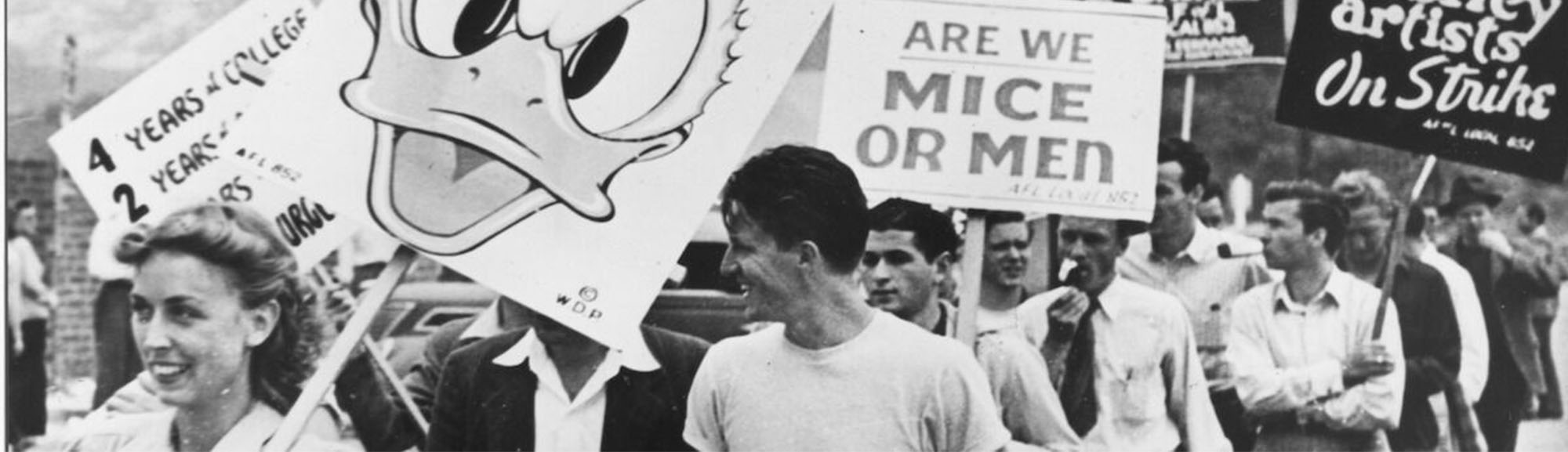
Brazenly violating Disney’s copyright, the strikers repurposed Disney characters into pro-union spokesmen and paraded outside theaters playing Disney films.

There are no strings on me!” exclaimed Pinocchio in one placard. The slogans were as clever as the visuals: “Snow White and 700 Dwarfs,” “3 Years College, 2 Years Art School, 5 Years Animation Equals 1 Hamburger Stand” and “Are We Mice or Men?

Disney was enraged. He claimed that Sorrell had threatened to turn the Burbank studio into a “dust bowl” unless he caved to the strikers’ demands.

Behind the scenes, Disney offered the SCG a deal brokered by the gangster Willie Bioff.

Disney then placed ads in the trade press saying he had made generous offers to “your leaders” — that would be Bioff — and had acceded to most of the strikers’ demands.

“I am positively convinced that Communistic agitation, leadership and activities have brought about this strike, and has persuaded you to reject this fair and equitable settlement,” Disney said.

“Dear Walt,” Sorrell retorted, “Willie Bioff is not our leader. Present your terms to OUR elected leaders, so that they may be presented to us and there should be no difficulty in quickly settling our differences.”

Eventually, the feds, in the person of the National Labor Relations Board, intervened. On July 29, after 62 days of rage on both sides, Disney settled — through clenched teeth. Disney and the Screen Cartoonists Guild squabbled intermittently until the end of the year, but Sorrell had won on the big points: better wages, job security and a “closed shop,” which requires union membership as a condition for employment.

Disney’s revenge

To Disney, though, this wasn’t just a dispute between management and labor. It was oedipal rebellion against the father in his own house.

In October 1947, Disney got his chance for revenge when he testified before the House Committee on Un-American Activities, which was investigating Hollywood for alleged communist subversion in motion picture content and within the ranks of organized labor.

Disney was called as a friendly witness, and friendly he was: While waiting to testify, he good-naturedly sketched pictures of Donald Duck and Mickey Mouse for the children of the committee members.

At the witness table, Disney emphasized that while today “everyone in my studio is 100% American,” the percentage had not always been so high. He named the name that had stuck in his craw since 1941. “A delegation of my boys, my artists, came to me and told me that Mr. Herbert Sorrell . . .  was trying to take them over,” Disney said. Sorrell and his cohorts, charged Disney, “are communists,” though admittedly, “no one has any way of proving those things.”

Proven or not, Disney’s allegations were career-killers. Many of the activist cartoonists of 1941 fell victim to Hollywood’s notorious blacklist era, when hundreds of workers on both sides of the screen were rendered persona non grata at the studios for their political affinities.

As a result, the Screen Cartoonists Guild softened its tone. In 1952, it voted to become affiliated with the firmly anti-communist International Alliance of Theatrical and Stage Employees — Bioff’s former outfit. As for Sorrell, he was hounded by charges of communist sympathies and ultimately barred from a leadership position in his own union.

Disney, you know about. After venting before the House Committee on Un-American Activities, he navigated the company back to the 50-yard line of America’s culture wars. There the entertainment conglomerate stayed — until recently, when it wandered off Disney World into the swampland of Florida politics.

Thomas Doherty, Professor of American Studies, Brandeis University

This article is republished from The Conversation under a Creative Commons license. Read the original article.

Nietzsche foresaw how technology can make us miserable — and has a prescription to correct that

If you’ve read the sullen German philosopher, you might not believe that Nietzsche would have wanted you to be happy. But author Nate Anderson has done what few of us who only know the phrase “God is dead” have, and actually read the man’s corpus. And he has a hopeful message from the the German philosopher that might actually save you from some of your doomscrolling habit.

“In Emergency, Break Glass: What Nietzsche Can Teach Us About Joyful Living in a Tech-Saturated World” is a book rooted in real world experience. As the author of “The Internet Police” writes, he had reached a point in his life where “I had tap-clicked my way into a lifestyle of comfort, abundance, and immobility” — and found it intolerable. Enter an unlikely inspiration.

With a clear grasp of an often admittedly “tough sell” philosopher, Anderson isn’t advocating for a lifestyle of deprivation. Instead, he illuminates what he learned when he began exploring some of Nietzsche’s ideas about the power of turning away from tech at times, and the pleasure of “being able to say yes to something in life.” Salon spoke to Anderson via Zoom recently about what we can learn about life and pleasure from a man who never even had a YouTube channel. 

This conversation has been edited and condensed for clarity.


Want more health and science stories in your inbox? Subscribe to Salon’s weekly newsletter The Vulgar Scientist.


Before you can even make the case for Nietzsche, you need to tell us who Nietzsche was. Why should we care about Nietzsche?

I’d want to start by saying, I’m not sure we need to use Nietzsche. He is going to be a tough sell for many people. He said some things that I think, especially in the modern world, don’t work for people, although he’s notoriously difficult to interpret. I want to be clear that this is not necessarily a requirement, that everybody bone up on Nietzsche.

But if you are looking for a thinker who comes at some of these modern digital issues in a really different way from a lot of the people who are speaking about this stuff today, who calls you to a different vision of life that then you can really back up from and say, “Is my technology use serving that vision of life?” Nietzsche can do that for you. If you’re in need of that, if you’re in need of something new, different, iconoclastic, he’s worth looking at. I don’t consider him my guru, I’m not a disciple of Nietzsche, but he’s someone to think with. I found him really powerful and profound, when he was not being hateful or simply irritating. It’s hard to find people who are unbelievably profound and different.

His insight was that you need to be able to say “yes” to something in life. You need a goal. You need something that lures you forward, rather than just saying “no” to something you dislike. 

There’s a lot of tech tips out there. If that stuff works for you, great. But if you need something that goes deeper, you’re probably going to come up against somebody who says some things that make you uncomfortable. It’s very difficult to find someone who will only say things that make you uncomfortable in a really good way.

Nietzsche is one of those figures who you have to exert your own judgment on and you have to engage with. You cannot simply read him and try to follow along with the program. You have to engage your brain as well.

If you start with the “Why?”, then the “How?” can follow. As you say, you can put your tech in a wicker basket without really getting at the, “What do I really want?” Because it’s not just, “I want to spend less time on my phone.”

Right. That is a purely negative goal, “I want to spend less time on my phone.” Modern psychology has really borne this out, but Nietzsche recognized that we are not going to stand up very long against the forces within us. There’s something in you that wants these things. Nietzsche realized that you’re not going to stand up against those internal forces by simply saying no. What’s going to wear you down? Hunger. Lack of sleep. All the things that reduce our levels of control.

His insight was that you need to be able to say “yes” to something in life. You need a goal. You need something that lures you forward, rather than just saying “no” to something you dislike. Nietzsche doesn’t have a reputation as a positive thinker, but if you read him carefully, it’s all a search for a positive philosophy that draws you forward into life, rather than just renouncing aspects of life.

Nietzsche looked around at a world that was increasingly technological. He looked at this and he saw it as providing ease, safety, and entertainment for people. He questioned whether that was really enough to make life feel worth living. He really calls people to look beyond that.

To bring it back to the tech question, if you’re just saying, “I need to spend less time on social media,” and if that works for you, great. But if you find, like I do, that your resistance gets worn down pretty quickly if all you’re doing is saying no. You need to find some kind of value in replacing that social media time, something I can do with the extra space in my life leads me forward into something more creative or profound or deeper. If you don’t have that, it’s going to be difficult just to stick with the no.

RELATED: Don’t blame the trolls: Here’s why I quit Twitter and what happened after

All of us who have one of these glowing bricks in our lives feel its siren call all the time. It is designed to be addictive. How do we begin to work within a reframing? You talk about the search for value.

The tricky thing about Nietzsche is that he won’t give you an answer to that question. He will talk about a method. He will say that there are as many answers as there are people and that it’s an individual decision that you need to come to about your own life. Nietzsche will not give you an answer like, “This is what life is about. This is how you should live.” What he’s saying is, you need some kind of creative struggle in life toward a positive goal, and that’s going to vary for you. How do you get there? I think you start with that sense of dissatisfaction that you just identified. If you feel that, it’s telling you that something’s wrong.

Nietzsche looked around at a world that was increasingly technological. Obviously, no smartphones, but the industrial revolution had really taken hold. Factory work was becoming common. He looked at this and he saw it as providing ease, safety, and entertainment for people. He questioned whether that was really enough to make life feel worth living. He really calls people to look beyond that. If you feel a dissatisfaction with those values that technology often provides for us, that sense of control over life, and you want something maybe a little wilder, a little less controlled, he calls you to find the kind of goals that require creative exertion and struggle.

Those things, for him, are big. It is a philosophy of discomfort in a way, but it’s the joyful struggle. Not like he wants life to be really hard in the worst sense of that term, that is not what he’s against. He’s against when these things in your life become anesthetic, that keep you from engaging with reality in its complexity and its difficulty and in trying to make it a better place and trying to make humanity better than it was before you came along.

You lay out the idea of the herd values, which feels very where we are every day. There is a satisfaction and an encouragement and enticement to go along with those values. Tell me what those are, and what does it mean to challenge ourselves against them?

This is where Nietzsche can become a bit unpleasant because some of his discussion of herd values sounds extremely elitist. That if you ever do anything that’s popular, or that the community of which you’re a part of endorses, that you’re somehow giving in.

Nietzsche is a guy who’s like, “Oh, you’re a fan? Name five of their albums.”

He was a hipster before hipsters, in a way. I don’t think Nietzsche’s philosophy takes us necessarily to all the places we need to go. He couldn’t see the importance of community and friendship. He skews too much toward isolation, in part because of his own biography, his own pain, his own difficulty in relationships. If you can keep that in mind, you can hear his critique about herd mentality in a way that’s useful, not letting your life be just carried away by the values prescribed to you by other people or other forces.

Our phones, the apps on them, websites we visit, they’re all built specifically to capture our attention and to hold it. That’s not an accident. It’s not just something that happened. It is engineered. If you don’t have your own goals and your own values, your chance of not being swept away by that is almost nothing. Those are the kind of herd values that he was really resistant to. Nietzsche calls for people to become the Ubermensch, his famous term. The person who always transcends the limits of what was in place before in their lives, what it meant to be human. So it’s always a self overcoming.

It’s like the artist who makes a beautiful picture, but is not content then to churn out schlocky copies of that for tourists for the next forty years. Or a band who goes in a new direction after a great album, and the fans are like, “Well, we liked the old stuff.” Nietzsche saw why you can’t do that. You turn into a backward looking tourist act, in a way.That’s why you see so many artists always feeling the need to move forward. That’s what Nietzsche’s calling people to. In all aspects of their lives, not just if you’re an artist or something, but other ways in which you can always overcome the limits that you had before. To him, that’s human progress.

I see our collective thinking lately about embracing embodiment. We are not just gray matter, walking around on a stick. You talk so much in the book about just moving around. That feels like a very, very basic philosophical concept that we can very easily lose.

You mention the focus on embodiment is coming to the fore again. We’ve seen that technology so often reduces us, even in physical posture, to sitting in a chair, sitting on a couch, lying in the bed with a laptop. It seems to restrict our range of motion. Not all technologies, but certainly smartphones and laptops seem to have this effect on people. Nietzsche was so strongly against this. He did most of his thinking when he was out walking around. He found that the way you move and the way you move through the world and against the world, the way you test yourself against it, was part of the way that you think. Thinking is not just a reasoning, logical, rational process.

“In my own experience, I’ve been through something similar. I was in a graduate program in English trying to get a PhD, and found myself reading almost a book a day. Fast forward ten or fifteen years, well into the smartphone era, and I found I was still reading a lot, but it was Twitter. It was webpages. It was fragmented.”

He was an early forbearer of what today we might call embodied cognition, that the movement of the body, our activities in the world are part of the ways we think. We learn things about gravity by falling out of a tree, right? They’re embodied. They’re not just things we learned in textbooks or from formulas. Nietzsche was big on that. You’re right that that’s coming back to the fore today, although I think there’s also a strong countercurrent. Think of Meta’s whole shift to the metaverse, or this stuff about the singularity that you see coming out of Silicon Valley, as technologies move to the brain and human consciousness as divorced from the world. We can recreate the world in virtual reality So while there is a lot more talk these days about embodiment, I think you still see both streams..

Who you are is in your gut and in your skin and in your experiences. But that’s hard to push against because it does ask for a degree of discomfort and challenge. One of the ways that one might start, for anyone who’s done cognitive behavioral therapy, would be distress tolerance. Getting to just five of attention and what that might feel like, if we are so inclined.

I can speak personally. Let me back up and just say a word about Nietzsche for people who may not know this much about him. He gained a chair at the University of Basel as a very young student, before he even completed a PhD. He was a wunderkind. He went down there and became horrifically disenchanted with the academic life in the late 19th century. He became terribly ill too, to the point that he eventually renounced his job and spent ten years of his life wandering around Europe on a very small pension until he went insane. So he discovered that all this time spent among books in the libraries, among all these voices that were speaking into his brain, was really, really profoundly unfulfilling for him. I talked a lot about that in the book, about how he dealt with information and his rules for dealing with it, which was largely to restrict it. Now, that’s difficult.

In my own experience, I’ve been through something similar. I was in a graduate program in English trying to get a PhD, and found myself reading almost a book a day. Fast forward ten or fifteen years, well into the smartphone era, and I found I was still reading a lot, but it was Twitter. It was webpages. It was fragmented. It was links. The word count may have been the same, but the effect on me was very different. It felt like my own attention was difficult to control anymore. The process of reclaiming that was a long and slow one and was uncomfortable. But it did start with, for me, it was important to use paper books, because you can’t click away. You sit yourself in a chair, put your phone out of reach, and you read until you feel that discomfort, that itch inside that wants to click on something, that wants a distraction. You push through it as long as you can. You’ll build up tolerance for this and go further and further.

But you need some larger goal to make you want to do this, or it’s going to collapse. For me it was just realizing I was really missing out on the level of storytelling, or of thought and argument that you can get in longer form material. That felt like a real absence to me and I wanted it back. Without that desire, I don’t think I could have tried to reclaim it. I certainly am not back where I was, and it’s taken a long time. The pandemic has set everything back by asking us to sit in front of screens and not go out in the world as much. It’s back and forth. But I think that’s how you do it. Slowly, building up your tolerance, with a goal in mind and in front of you that you really deeply want.

Where are you now in this experience? What can you tell me, from further down the road, about how you’ve changed?

I talk about things called focal practices, that help focus your attention, and often focus attention on real things in the real world. These can be things like playing the guitar, but they can be things like having a fire. The hearth is the definitive example. It brings people together. They naturally tend to sit around it and share their attention with each other and create these communities. For me, this work with Nietzsche, writing the book, has not led me to give up technology, but it’s led me to be a lot more critical of it. And to be more critical of the ways in which I still fall short of where I want to go, because I have a stronger sense of what I want my life to be. I don’t want it reduced to tapping a screen or watching a TV, which is what half of my life had become.

Practical things I’ve done in the last few years have been, really getting into guitar in a new way. Investing in a better instrument. Taking lessons, virtually actually, over Zoom, which has worked out really well. It’s been a fusion of technology with the real world, with focusing my attention on something that can create beautiful music. Those kind of practices have been far, far more rewarding for me. I’ve never regretted a minute spent on that, in a way that I regret all the time, the amount of time I’ve spent on either social media or Reddit or clicking among news articles all day.

It’s a long process. It’s back and forth. But Nietzsche’s given me new tools to think with. That’s been the most important thing. I have seen those lead to real practical effects in my life. I love the fact that Nietzsche is not a guru selling you on, “Here’s the way you need to live.” He’s somebody who creates the mental tools for which you can think about your own life and your relationship to technology, and hopefully come to a place where you take that technology and put it into the service of the life you want.

More on mental health and wellness: 

Meet “Internet Shaquille,” the YouTube chef teaching a new generation to cook

For many of the Internet’s biggest food personalities, YouTube has been the incubator that eventually launched them into wider mainstream success. Nowadays it’s easy to get lost in the endless, algorithmically boosted diversity of cuisine centric content, be it instructional videos, budgeting challenges, or infamous “what I eat in a day” documentation. Despite this breadth of options, anyone who subscribes to some of the heavier hitters on the website know that the plague of formulaic, ad-revenue focused YouTube content is hard to escape.

That’s why Arizona based video artist, home cook, and YouTuber Victor, known by his screen name of “Internet Shaquille,” feels like a breath of fresh air. Victor is not trying to sell you sponsored cookware, he’s not attempting to reach a benchmark to squeeze one last ad in, and he’s certainly not invested in forging a brand (whatever that means, these days.) In other words, he’s the foil to your typical lifestyle YouTuber. 

Related: Cookbook author Ali Slagle takes the stress out of cooking because “it’s only dinner”

His concise, quippy videos act like encyclopedic entries on various foundational topics that anyone might want to know. What are some useful tools an inexperienced home cook might not think to have? How do you gain intuition in the kitchen? How do you care for a wooden cutting board if you don’t have it in you to slather mineral oil on yours as much as you should? These topics and more, are explained in depth, under six minutes, with no ads interrupting the flow of instruction. When you watch Internet Shaquille, you may be seeking entertainment, but in an online experience that feels rare these days, you almost always learn something too.

A channel that started out as a mishmash of random vlogs and videos has transitioned over the years into one with over 524,000 subscribers, and a dedicated fan base that revels in the originality of Victor’s videos down in the comment section. Victor sat down with Salon to discuss his approach to cooking content, cultural appropriation in the food world, and how he found his own place in the online culinary community.

This interview has been lightly edited for length and clarity.

Manuela Lòpez Restrepo: So, I’ve been aware of you since the Vine days, but never remembered cooking content. How’d you start out online, and where did the cooking stuff come in?

Victor: Yeah, I’ve been doing online video projects since middle school. And we would make little videos with a handycam all the time, and then put them online. Freshman year, we made a video podcast out of our dorm’s mail room. But Vine was the first thing that caught the attention of more than like 10,000 people. I think at the end, it was like 80,000 followers and a  little verification badge. So that was the first meaningful platform, I think.

Towards the end of Vine’s existence, [I posted] on one of those websites where you offer up courses for money. I’m not going to remember what it is, but I put together a two hour-long online course, the title was “How to trick people into thinking you’re good at cooking.” And I sat on that for two years as my magnum opus and didn’t think that I would create anything else. And it wasn’t until about two years after that, that I attempted doing a YouTube channel. And even then it was mostly like, vlogging stream of consciousness experimental stuff like that. And it wasn’t until about a year in that I started doing targeted instruction. 

… My job since senior year of college was an instructional designer, which is just making online courses for, at that time, students at ASU, and then later on employees at a construction company. So [it was] applying some of those principles that I learned to cooking. Just personally, cooking was something I liked watching, I was always watching Food Network since I was a kid. So that’s really the only thing that I knew enough about to have something worth sharing.

MLR: What was your relationship to cooking before you decided to sort of pursue it professionally in an instructional sense?

V: I didn’t have a very targeted or memorable relationship to cooking where it’s like, “Oh, I remember making this, and this.” I was taught to make pancakes as a child by my grandparents. I remember buying or renting a book from the library about cool dishes that kids could make. But I was also an extremely, extremely picky eater, maybe I would eat five things total. Like, go to McDonald’s, and if ketchup was on the bun, it’s not getting wiped off — I’m just not going to eat it. And so I bought this book and I was like, “Mom, can I try cooking these things?” And she says, “If you cook it, you have to eat it.” So I was too scared to try anything because of how picky I was. 

I didn’t really get into cooking in a big way until… I’d like to say college, but since college has so many fast food options and you have the meal card and everything. It really wasn’t until after graduation that I sort of took the time to say, “I’m going to develop a sense of self in what I can cook.” Because up until then, all the things that I made in college were like, “Oh, I know how to make an egg and cheese thing with crescent rolls on top that we can all eat at 3am when everybody’s wasted.” Sort of gimmicky foods, whereas it wasn’t until later on until I developed an actual means of sustaining myself through cooking.

MLR: So a lot of your connection to food is your own journey of learning how to cook. Has your Mexican heritage tied into this exploration at all?

V: Yeah, it’s actually really complicated. And I would say that, everything that I’m wrestling with, in terms of this topic, is something that I haven’t come to a conclusion on. On one hand, I’m in communities where people get very upset about cultural appropriation and food, and “Why is this guy telling somebody else how to make sushi?” I guess the closest would be Rick Bayless who does a lot of Mexican food. And it’s like, yes, he is really well researched and dedicated his entire life to the craft. But why isn’t he ceding the opportunity to somebody else who is more appropriate?

“Every Mexican family has the one kid who goes to the restaurant and gets a hamburger and everybody looks at him weird. That one was me.”

But at the same time, I don’t think that I deserve to, or ought to deserve to hold any sort of authority on Mexican cooking because of how I think a lot of second-generation, third-generation immigrant kids go through this feeling of going through school and hating the stuff that you are supposed to like. Being a picky eater didn’t help with any of this. I did not want to eat a bean ever.  I went a very long time without ever trying beans and did not like any Mexican food. Every Mexican family has the one kid who goes to the restaurant and gets a hamburger and everybody looks at him weird. That one was me.

And so that is something that I sort of wrestle with in that, just by virtue of the manner in which I was born, or the people who gave birth to me. Do I have any authority to talk about that sort of stuff? I think the answer to that right now is no. But in small, small ways, I’ve been contributing to a change in that, like, I’ve made a video about Jamaica, which is a beverage made from hibiscus flowers. And that’s easy, because there’s no hot takes to give on it, there’s really only a couple of ways to make it. 

And it comes from some sort of authority to be like, “Hey, look, this Mexican boy is showing me a beverage that I’ve seen at the Mexican restaurants, but never actually tried — and now I have some sort of permission to try it.” To know that is sort of like a baby step. Whereas something I think [is] more complicated — I’ve been sitting on a “How to make corn tortillas: Part 1 and 2” set of videos for at least six months now. Just because I keep learning and waiting for something to challenge any of the assertions that I make, because I don’t have 100% confidence that what I’m making is infallible.

MLR: I think there is some space for us immigrant kids, in the sense that we have to include both parts of ourselves. The part that is authentic, and also the part that has a bit of distance from where we’re from. But I think it can almost make it like its own, different version of food we love. Cultural appropriation is an important part of this conversation, but where do we get to draw our own boundaries, and create space for something new?

V: I think that one of the most life-changing aspects of having a large audience, regardless of what you talk about, is seeing firsthand. You hear about this conceptually, but you don’t really understand the full grasp until you see how limitless the number of opinions there really are in our world. You can say one thing that sounds so objectively factual to you, and have 10,000 people give 5000 reasons why you’re wrong. I do think that your first part of the question, which is, “Do people have to change the way that they think about this sort of stuff, namely, cultural appropriation?” The answer is yes. 

In that, probably before — there wasn’t an audience of a limitless number of people willing to dig something up or find something or look at something or share something. But I think that the objective conclusion that one can come to, can never be drawing a hard line or even a soft, blurry line between what is and is not acceptable, because there is literally an infinite number of opinions that differ from yours. And [they] will draw that line somewhere else, and they’re just as valid as the ones that you came up with. 

So I think that the most  fruitful, effective, part of yourself that you can practice, is your response to criticism. I think that it should be completely valid for anybody in the world to say, “Rick Bayless, who are you to be talking about this,” [and] “Internet Shaquille, who are you to be talking about this?” And it all comes down to what your reaction to a question like that is. I know that for people who enjoy watching other people getting canceled or getting in hot water online, part of it is critiquing their apology, if that does happen, and I think that how you respond to something like that is probably far more important than the actual action or sentiment behind it. 

MLR: Your approach feels extremely aware of this give and take relationship between the viewer and the creator. How do you determine how to toe that line, and make something that so many people resonate with?

V: I think the audience is self-selecting. I definitely don’t think that I have a good sense of who my audience is, and that’s just because on the back-end of YouTube Analytics, it’ll tell you, “Here are the people that watch your stuff, they’re also into competitive swimming.” For some reason, I think competitive swimming is the biggest overlap between what I watch and what they watch.

It’s not so much that I was like, “I have garnered an audience that wants this.” It’s more so that I’m willing to acknowledge their existence and continue doing what it is that I would want to do. 

I recently found out that it’s actually pretty common that [people] watch my videos on autoplay while falling asleep, but they don’t cook anything. So then, in my latest video, the outro was something like, you know, “Get out and cook this thing, unless you’re just watching this to fall asleep, in which case, goodnight.”

“I recently found out that it’s actually pretty common that [people] watch my videos on autoplay while falling asleep, but they don’t cook anything. So then, in my latest video, the outro was something like, you know, ‘Get out and cook this thing, unless you’re just watching this to fall asleep, in which case, goodnight.'”

I think that it’s just a matter of learning what it is that people are getting from you. And acknowledging or leaning into that a little bit. I think with cooking — maybe with a lot of instructional things like, learning how to skateboard or something — the hard part is not deciding stylistically, how you want to approach your work, but rather, how much information or how much time you’re willing to spend on explaining what needs to take place to get someone up to speed enough to make what you’re talking about. 

MLR: Well, I guess in some ways, you’re the slow fashion versus fast fashion. Your stuff is a little bit more marinated, and it’s a little bit more focused.

V: Definitely. And I think that’s another part of the sort of audience self-selection. Because if you’re looking at just what do people want, broadly, it’s more of that. And so, you know, being able to say, ‘I’ve got 500,000 people who want this style, and aren’t necessarily intrigued by the regular kind’, then I hope to bring more people into the fold, even if all it takes is inspiring more people to produce work in this manner, and they take away all my audience and I fold completely, I think it’s a net benefit for society. 

I think my existence, hopefully, proves to certain people that you can succeed in the traditional sense of the word without spending five hours a day combing over your analytics. Because I know a ton of people in the space do that — where they’re looking at CPM, CTR, all this stuff that I don’t even know what it is. And you definitely don’t have to do that. And I hope to make a change in terms of what someone should expect to do to be successful.

Some “Salon Talks” episodes with our favorite cooks: 


Dorie Greenspan’s magically caramel-y chocolate chip cookie

Every week in Genius Recipes — often with your help! — Food52 Founding Editor and lifelong Genius-hunter Kristen Miglore is unearthing recipes that will change the way you cook.

Prolific doesn’t begin to cover Dorie Greenspan’s career. In the last 20 years, she’s written 14 cookbooks, a newspaper column, countless articles, and been in videos. In her latest cookbook Baking with Dorie, Ms. Greenspan has come up with yet another way to reinvent the chocolate chip cookie, taking it from traditional to terrific with one simple but effective baking tip.

First make the dough, which she suggests doing with a mixer but also works just fine done by hand. Next the dough gets wrapped and chilled. No surprises here. But then these seemingly humble cookies are sliced and baked not on a baking sheet but in a standard muffin tin. “Because these slice-and-bake cookies are baked in muffin tins until their bottom and sides are deeply golden, the butter and sugar brown so completely that they produce the full, nutty, edgily sweet flavor of caramel,” Dorie explains. That wonderful caramel flavor is the first to hit your tongue when you take a bite. It’s so perfect that she named the cookies Caramel Crunch-Chocolate Chunklet Cookies even though there isn’t any caramel in the ingredient list.

The magic of these cookies can be explained by science. Heating sugar breaks it down into glucose and fructose. Those molecules then break down further and react with one another creating new flavor compounds, like phenols and esters. Thanks to those new compounds cooked sugar and butter become so much more than simply sweet. They meld together and transform into something buttery, bitter, malty, and nutty all at once.

As if that weren’t enough, these cookies have even more special characteristics. First of all, Dorie makes them with both granulated sugar and confectioners’ sugar. While the granulated sugar is doing its job of keeping the cookies moist and sweet, the confectioners’ sugar adds tenderness giving them the texture of a soft and chewy shortbread.

Dorie also suggests that you use chopped chocolate instead of chips. While chips stay whole in baked cookies, chopped chocolate introduces pieces of varying sizes that are nicely distributed throughout the cookie. Each cookie has loads of chocolate, from tiny flecks to nice, big pools, giving every bite a more complex flavor. The muffin tin also keeps all the cookies the exact same shape and size so they cook evenly and look fantastic. What more could you ask for? This Dorie Greenspan fan (or “Greenstan” if you will) is 100% satisfied.

Recipe: Caramel Crunch–Chocolate Chunklet Cookies by Dorie Greenspan, from Samantha Seneviratne

This post contains products independently chosen (and loved) by our editors and writers. As an Amazon Associate, Food52 earns an affiliate commission on qualifying purchases of the products we link to.

It’s almost too easy to make hot, cheesy, crunchy mozzarella balls

Fried mozzarella is always a good idea.

When my kids were younger, our go-to special night out place was the neighborhood Irish bar, which featured a jukebox full of U2 songs and a menu of burgers, fries and mozzarella sticks. A few years ago, the place changed hands and got an upscale makeover — and I’m still not over it.

RELATED: It’s almost too easy to make hot, fresh, fried onion rings

Fortunately — as I keep telling you — it’s really not hard to fry stuff at home. And once you discover that nothing compares to the flavor and crunch of hot, freshly fried food right out of the pan, those soggy mozzarella sticks from your local pizza place just won’t cut it. 

You can buy regular, low-moisture supermarket mozzarella, cube it up and fry it pretty effortlessly any night of the week. But there’s something really cute — and really tempting — about those little cheese balls known as bocconcini. Round stuff is just fun.


Want more great food writing and recipes? Subscribe to Salon Food’s newsletter.


It’s true that fried mozzarella balls aren’t the kind of “shove it on a sheet pan and forget about it” situation that makes cooking truly effortless. You do have to keep a close eye on these tiny guys.

Thus, if you’re not making these as a stand-alone snack, I encourage you to round out the rest of the meal in a more hands-off way. I made these for dinner this week with a Caesar salad kit, and it was incredibly good and completely satisfying.

Also, I promise that no one complains when fried cheese is what’s for dinner. Though I still miss my old neighborhood bar, at least at home I can have fried cheese with no U2, any time I want.

***

Recipe: Fried Mozzarella Balls
Inspired by Down Home with the Neelys and Happy Foods Tube

Yields
 6-8 servings
Prep Time
 10 minutes
Cook Time
 10  minutes

Ingredients

  • 1 16-ounce bottle vegetable oil
  • 1 8-ounce container mini mozzarella cheese balls (bocconcini)
  • 1 cup flour
  • 2 eggs, beaten
  • 1 cup dried breadcrumbs, preferably Italian style
  • 1 jar your favorite marinara sauce


Directions

  1. Have a large plate or sheet pan lined with paper towels ready to go.
  2. Prepare three shallow bowls or pie pans. Add the flour to the first, the eggs to the second and the breadcrumbs to the third. 
  3. In a large pan, heat 1 inch of vegetable oil on medium-high heat to 375 degrees. (If you don’t have a food thermometer, the oil will be crackling and a little noisy when it’s ready.)
  4. Drain the mozzarella and pat it dry with paper towels.
  5. Meanwhile, simmer your marinara sauce in a medium pan on medium-low heat. 
  6. You’ll repeat this next part with a few pieces of cheese at a time. Dredge the cheese balls through the flour to thoroughly coat, then the egg and then the breadcrumbs. Make sure they’re well covered. If you see any bald spots, roll them in a little more flour.
  7. Place the coated cheese balls, a few at a time, in the oil. Give them room to bob around. 
  8. Fry until crisp and golden, about a minute or less. You want to pull them out before they get too brown. As they’re ready, remove from the oil with a slotted spoon or spider to your paper towel-lined pan.
  9. Repeat with all the cheese. Serve immediately with the warmed marinara sauce.

More diner classics we love: 

Salon Food writes about stuff we think you’ll like. Salon has affiliate partnerships, so we may get a share of the revenue from your purchase.

Buffalo shooting comes eight months after Rep. Elise Stefanik called out over “Great Replacement”

Saturday’s mass shooting in Buffalo occurred less than eight months after an upstate New York newspaper scolded a leading Republican congresswoman for pushing the “Great Replacement” conspiracy theory.

“A white 18-year-old wearing military gear and live-streaming with a helmet camera opened fire with a rifle at a supermarket in Buffalo, killing 10 people and wounding three others Saturday in what authorities described as ‘racially motived violent extremism.’ The gunman wore body armor and military-style clothing during the attack on mostly Black shoppers and workers at Tops Friendly Market,” the Times Union of Albany, New York, reported Saturday.

The suspect was identified by the newspaper as Payton Gendron of Conklin, New York, a rural community roughly 150 miles southwest of Albany and 210 miles southeast of Buffalo.

RELATED: Mass shooting in Buffalo: Tucker Carlson and other right-wing conspiracy theorists share the blame

Prior to the shooting, the white 18-year-old reportedly posted a 106-page manifesto citing the “Great Replacement” conspiracy theory as motivation.

In September of 2021, the newspaper’s editorial board wrote about the conspiracy theory and criticizing Rep. Elise Stefanik, who represents New York’s 21st congressional district, just north of the Albany region. 

“Back in 2017, white supremacists marched in Charlottesville, Va., carrying torches and chanting, ‘You will not replace us’ and ‘Jews will not replace us.’ Decent Americans recoiled at the undeniable echo of Nazi Germany,” began the editorial, which was illustrated with a photo of the notorious Charlottesville tiki torch march.


Want a daily wrap-up of all the news and commentary Salon has to offer? Subscribe to our morning newsletter, Crash Course.


“That rhetoric has been resonating ever since in the right wing, repackaged lately in what’s known as ‘replacement theory,’ espoused by conservative media figures like Fox News’ Tucker Carlson. And it has seeped into the mainstream political discourse in the Capital Region, where Rep. Elise Stefanik has adapted this despicable tactic for campaign ads,” the editorial board wrote.

Stefanik, the chairwoman of the House Republican Conference, is the third-ranking Republican in Congress.

“Ms. Stefanik isn’t so brazen as to use the slogans themselves; rather, she couches the hate in alarmist anti-immigrant rhetoric that’s become standard fare for the party of Donald Trump. And she doesn’t quite attack immigrants directly; instead, she alleges that Democrats are looking to grant citizenship to undocumented immigrants in order to gain a permanent liberal majority, or, as she calls it, a ‘permanent election insurrection.’ Quite a choice of words, of course, considering that the country is still suffering the aftershocks of the Jan. 6 insurrection in Washington by supporters of Mr. Trump who tried to overturn Democrat Joe Biden’s victory in the 2020 presidential election,” the newspaper wrote.

The editorial board wrote that Stefanik knew what she was doing was wrong.

“The Harvard-educated Ms. Stefanik surely knows the sordid history and context of this. The idea of stoking racial, ethnic, and religious tribalism among voters dates back to this country’s earliest days. At various times, politicians have warned that Catholics, Jews, or Muslims were out to ‘change the culture,’ or that Irish, Italian, Asian or eastern European immigrants would take the jobs — to ‘replace’ white, Protestant Americans,” the editorial board explained. “If there’s anything that needs replacing in this country — and in the Republican party — it’s the hateful rhetoric that Ms. Stefanik and far too many of her colleagues so shamelessly spew.”

Stefanik did not mention racism in her statement on the Buffalo shooting, but did mention National Police Week.

Stefanik is not the only Republican member of Congress with history on the issue.

Also in September of 2021, after the Anti-Defamation League called on Fox News to fire Tucker Carlson for pushing the racist conspiracy theory, Rep. Matt Gaetz, R-Fla., declared the ADL “a racist organization” and claimed Carlson was “CORRECT about Replacement Theory as he explains what is happening to America.”

Read more on the “great replacement” conspiracy theory:

“I’m not David Bowie”: Bill Nighy picks up where the legend left off in “The Man Who Fell to Earth”

Nearly two decades after “Love Actually” came out, people still associate Bill Nighy with the role that stole that movie, the gleefully self-absorbed Billy Mack. Strike up a conversation with him, and it soon becomes clear that he’s nothing like that rock star. However, playing Billy may have paved the way for Nighy to take on a role intimately associated with a real music legend, the one who played Thomas Jerome Newton in Showtime’s series “The Man Who Fell to Earth.”

Although the drama’s plot expands upon Walter Tevis’ 1963 novel, most people are more familiar with the 1976 film adaptation starring David Bowie as an alien who comes to our planet and quickly innovates game-changing technological wonders. His goal is to build a spaceship to return to his dying planet Anthea and ferry the few survivors to Earth, but on his way to his test flight he’s captured and tortured.

Nighy’s turn with Newton finds him 45 years later, addicted to alcohol and a sight more embittered than he was when he first arrived, and it’s difficult to envision any other actor picking up where Bowie left off quite as seamlessly. Point that out to him, however, and he’ll react with complete humility. In our wide-ranging “Salon Talks” episode, Nighy says he enjoys playing “people who are kind of quietly falling apart, people who are assailed by self-doubt.”

RELATED: “The Man Who Fell to Earth” lifts off

Neither Newton nor the actor fit that personality, although in terms of his sense of self-assurance, Nighy proclaims he feels closer in spirit to his co-star Chiwetel Ejiofor‘s character Faraday, a member of his planet’s drone class as opposed to Newton’s designation as an “adept.” That spirit played into his decision to become an Irish citizen following Brexit, as many British people with Irish parents did. (Nighy’s mother was Irish, he explains, making him “Irish enough” to get that country’s passport.) And it certainly enriches his portrayal of Newton, a man being hunted by human tormentors despite only wanting to go home.

In our conversation about the Showtime series, which you can watch here, we discuss the experience of stepping into a role that defined Bowie’s image, along with what the drama has to say about technology and class.

This interview has been edited for clarity and length.

At what point did you see “The Man Who Fell to Earth” film?

I saw it when it came out. I was already a Nicolas Roeg fan. I’d seen other Nicolas Roeg movies and I was, like everybody, a huge David Bowie fan. I think everyone I knew went to see “The Man Who Fell to Earth.” It was a big movie when I was young. I saw it at the least twice, and it was an influential movie, and it was not like anything I’d ever seen before. . . .

The movie was big in my mythology, and so when I was asked to do this, I had to disengage from that, because the TV series extrapolates from that movie, and it tries to imagine, and in my view, imagines very successfully what might have happened 45 years later. And my character and David Bowie‘s character, Thomas Jerome Newton, has been trapped on earth for 45 years. As you’ll remember in the movie, he was introduced to alcohol, and it turned out that he had a catastrophic relationship with alcohol. It’s how they manipulated him, and he’s been drinking for 45 years and smoking and making his human body very sick, but he still functions sensationally, and has managed to evade capture by the CIA for 45 years, as well as make plans to get back home.

“The theme of environmental damage that was introduced in the movie is 45 years worse now . . . In terms of relevance, it’s not only as relevant. It’s far more so.”

When I look at that film now, particularly in relationship to this series, it’s this interesting precursor to the series’ themes. This is much more about environmental degradation and the fact that humanity has this way of prioritizing wealth and power instead of actually doing the best for all of humanity and saving itself. And I’m wondering what that means for your interpretation of Thomas Jerome Newton. How did you find that bridge between what was, back when the film first came out, and what is as you present him in this new world?

Well, I think I had to assume that the audience will accept another actor playing Thomas Jerome Newton for a start. . . . And you’re quite correct. As a species, we always seem to be playing catch-up with technology. Nobody really examines it and has a look, a real deep thought about how it might impact on our lives, how social media might affect our children, all of those considerations. And we’re always improvising, and we’re always prioritizing the short-term. We don’t have plans that go 20 years ahead.

Why? Because of the way the system is built up. Everyone’s trying to hang on to power and trying to win votes, and therefore, they just make it up as they go along, according to those imperatives. And it’s a recipe for disaster. And therefore, the theme of environmental damage that was introduced in the movie is 45 years worse now, and the emergency is even greater. So in terms of relevance, it’s not only as relevant. It’s far more so.

Back in 1976 when Bowie was playing the role, no one would’ve envisioned that something like world enterprises could actually become as prevalent. There were many companies that produced technology back then, but they couldn’t have ever envisioned a Tesla or an Amazon or the figures behind them.

One of the things that I kept on thinking of was how much this character bears a resemblance to someone like Elon Musk, who’s kind of seen as this very, almost an otherworldly figure, but also people are relying upon, in a way, and not just him, to kind of save humanity. And I’m wondering what you think about how the series might speak to that, since so many people do kind of see these billionaires who are going to space as rock stars.

I think the difference perhaps is that he’s not entirely just altruistic, because his whole project is to get home and to save his planet. And if in the process he can save Earth as well, it’s only because it feeds into the idea of saving Anthea, the planet Anthea, where they both come from.

“To try and sort of nearly impersonate David Bowie doesn’t seem to me to be a legitimate enterprise and would devalue the whole project.”

So therefore, he’s not acquiring wealth for wealth’s sake, and he is attempting to save both planets.  . . . He’s not well-disposed towards us, human beings, because they stole his eyes and stole his science, and they’ve been hounding him across the planet for 45 years trying to destroy him. But he’s philosophical about that.

There’s an interesting introduction with Chiwetel Ejiofor in this role, in that when we first met Thomas Jerome Newton, there was this assumption that there was only his kind of Anthean. And now we know that there are two types, or at least two types, and they have this relationship as adepts and drones. How much did you all talk about just the fact that in its own way there’s a commentary here on race and class –

Absolutely.

– that wasn’t present in the first one? For instance, one of the things that Jenny Lumet said was that was absolutely important to have Faraday be a Black man.

I don’t know if it was discussed, but it was certainly understood that he’s kind of the ultimate immigrant and the fact that he is treated in the way he is, and the fact that Thomas Jerome Newton was abused in the way he was as a visitor from another planet obviously speaks to the current situation.

 When I say the current situation . . . It’s the situation that goes down through the centuries. And it seems that maybe now, even though there is probably another century’s work to be done, it is being addressed to some degree now.

. . . It leads me to think that we are very ingenious as a species. We can do all kinds of astonishing things, but on a personal level . . . or on a species level, we don’t change much. In the 1400s, the same dynamic was present. Somebody came from somewhere else. You demonized them. You were threatened by them. And if they had a different skin color or whatever, you stereotyped them, and usually always negatively. So I don’t think that we change very much. It’s just that we can now do astonishing things with technology.

As a story about immigrants and how we treat the other, when you first experienced this story as a film in 1976, did that part even strike you? And what do you think it is about your experience with the original film that may change, or perhaps even heighten, that message of how humans tend to treat outsiders or immigrants in this new extension of “The Man Who Fell to Earth”?

At the time when I saw the movie, I don’t think it probably consciously hit me, except that it is a familiar . . . I’m not quite comfortable with the name sci-fi, but literature of the imagination. When I said that nobody addresses new technology and imagines how it might impact on us . . .  In fact, there are people who do that, and they write sci-fi. William Gibson, Neal Stephenson – Jenny Lumet, and Alex Kurtzman, they’re doing exactly that.

. . . I mean, there is a familiar sci-fi trope, which is that the visitor comes from another planet, and he is mistaken for an intergalactic threat, apart from our hero, of course, who sees them as a benign presence who has much to teach us.

“They say that prejudice doesn’t survive proximity. That’s sort of true, and sometimes not true.”

. . . But now, obviously, in the interim, in those 45 years, we have been further polarized by destructive individuals and bodies of people who seek to run our world. And the most famous, the oldest way of frightening people and polarizing people is to say that there are some people who are not like us, who are going to come over the border, and they’re going to steal your job, and they’re going to steal your daughter.

. . .  So although I didn’t think of it at the time, I think now everyone who was making this TV series was very, very aware of that and very, very aware of the environmental relevance of the TV show and the fact that we are now 10 minutes away from irreparable damage to the planet, if not five.

One quote that I just wanted to read back to you that stuck out to me was when Faraday, that’s Chiwetel Ejiofor’s character, says, “Antheans understand each other. We do not endure each other.” And I think some of that does relate to technology the way that we as humans interact with it, versus the use of it for Antheans, for both Thomas Jerome Newton and for Faraday. What strikes you about what the new series and what your character says about how we interface with technology today?

They say that prejudice doesn’t survive proximity. That’s sort of true, and sometimes not true. . . . It’s very easy to divide us, as we’ve discussed. And with media, which is now mechanized to such a degree . . . truth left the building a while back. And partly that is due to technology, because you can mimic, you can be anyone on the internet. I think if they did one thing, if the world combined – it’s never going to happen – if the world combined to make every single device have to be attached to somebody, you had to license it and it be attached to somebody’s name so you could no longer comment or distribute information anonymously, it would change the world. It’s not going to happen, but it would change the world.

But because those corrupt powers seek to divide us, they can do it so much more effectively now because of technology. It’s just a click of a button. . . . And people actually don’t really want the truth. They prefer the lie, as long as the lie is attractive to them, and it will be attractive to them, as I say, if it conforms to the lie that you’ve already told them, which is that people from elsewhere are threatening your life, your family, and your livelihood.


Want a daily wrap-up of all the news and commentary Salon has to offer? Subscribe to our morning newsletter, Crash Course.


I’m going to switch gears –

Don’t mistake me for an expert on anything. I have a terrible fear of hearing this back and thinking, “You pompous idiot . . .”

That actually leads into my next question. I looked at an interview that you did in Britain. I think it was with Chiwetel and Andrew Lincoln –

Oh yeah.

– talking about the craft of acting. And one of the things you said was you really don’t enjoy watching yourself. I can understand that. I think that’s something that a number of actors have said, but I wonder whether you went back and looked at Bowie’s performance at all, if only to see the story. Was it useful for you to go and look at someone else’s performance in order to inform this one, even if you don’t watch it later?

I never watch myself, because I can’t take it, but I did watch the film, and that was part of the process of me finding out that there were no clues for me there, because I’m not David Bowie. I’m never going to be David Bowie, and to try and sort of nearly impersonate David Bowie doesn’t seem to me to be a legitimate enterprise and would devalue the whole project. So it has to be me playing Thomas Jerome Newton.

 So I don’t watch, but I’m sort of happy with other people watching.

Well, I can’t let you go without kind of speaking to that:  In the United States best, when people think of you, they think of “Love Actually,” a favorite film. But you’ve also been in so many blockbusters. And then I see you in things like “The Second Best [Exotic] Marigold Hotel” and these smaller movies, and this series. Do you have a particular kind of role that is a favorite when you’re looking at scripts?

Well, I quite like playing . . . people who have difficulty interacting with the world, people who are kind of quietly falling apart, people who are assailed by self-doubt. . . . People always associate it with Englishness. I’m sure there are people who are tormented in that way in every single culture in the world. But it is associated with a certain type of English man, actually. And I am one . . . well, roughly speaking, I’m officially Irish now, actually. But anyway, yeah. So those kind of people who struggle to say hi, people who have difficulty buying a newspaper, people who very successfully undermine themselves, and I’ve played a few of those kind of characters. And I mean, that’s kind of fun.

I’m in a movie, which obviously I haven’t seen it. It’s called “Living,” and it’s coming out I think in the fall, in which I play a man who was institutionalized in grief because he lost his wife very early on, but he also has great difficulty . . . Just being around, he has difficulty. So that plays to my strengths. Did I say that? Did I just say that? I actually said that.

It’s okay to play to your strengths!

Can you believe I just said that?

“The Man Who Fell to Earth” airs Sundays at 10 p.m. on Showtime.

More stories like this:

Is Paxlovid, the COVID pill, reaching those who most need it? The government won’t say

As the nation largely abandons mask mandates, physical distancing, and other covid-19 prevention strategies, elected officials and health departments alike are now championing antiviral pills. But the federal government isn’t saying how many people have received these potentially lifesaving drugs or whether they’re being distributed equitably.

Pfizer’s Paxlovid pill, along with Merck’s molnupiravir, are aimed at preventing vulnerable patients with mild or moderate covid from becoming sicker or dying. More than 300 Americans still die from covid every day.

National supply counts, which the Biden administration has shared sporadically, aren’t the only data local health officials need to ensure their residents can access the treatments. Recent federal changes designed to let large pharmacy chains like CVS and Walgreens efficiently manage their supplies have had an unintended consequence: Now many public health workers are unable to see how many doses have been shipped to their communities or used. And they can’t tell whether the most vulnerable residents are filling prescriptions as often as their wealthier neighbors.

KHN has repeatedly asked Health and Human Services officials to share more detailed covid therapeutic data and to explain how it calculates utilization rates, but they have not shared even the total number of people who have gotten Paxlovid.

So far, the most detailed accounting has come from the drugmakers themselves. Pfizer CEO Albert Bourla reported on a recent earnings call that an estimated 79,000 people received Paxlovid during the week that ended April 22, up from 8,000 a week two months earlier.

Unlike covid vaccinations or cases, HHS doesn’t track the race, ethnicity, age, or neighborhood of people getting treatments. Vaccination numbers, initially published by a handful of states, allowed KHN to reveal stark racial disparities just weeks into the rollout. Federal data showed that Black, Native, and Hispanic Americans have died at higher rates than non-Hispanic white Americans.

Los Angeles County’s Department of Public Health has worked to ensure its 10 million residents, especially the most vulnerable, have access to treatment. When Paxlovid supply was limited in the winter, officials there made sure that pharmacies in hard-hit communities were well stocked, according to Dr. Seira Kurian, a regional health officer in the department. In April, the county launched its own telehealth service to assess residents for treatment free of charge, a model that avoids many of the hurdles that make treatment at for-profit pharmacy-based clinics difficult for uninsured, rural, or disabled patients to use.

But without federal data, they don’t know how many county residents have gotten the pills.

Real-time data would show whether a neighborhood is filling prescriptions as expected during a surge, or which communities public health workers should target for educational campaigns. Without access to the federal systems, Los Angeles County, which serves more residents than the health departments of 40 entire states, has to use the limited public inventory data that HHS publishes.

That dataset contains only a slice of information and in some cases shows months-old information. And because the data excludes certain types of providers, such as nursing homes and Veterans Health Administration facilities, county officials can’t tell if patients there have taken the pills.

Because so little data is available, Kurian’s team created its own survey, asking providers to report the ZIP codes of patients who have received the covid therapies. With the survey, it’s now easier to figure out which pharmacies and clinics need more supplies.

But not everyone completes it, she said: “Oftentimes, we have to still do some guesstimating.”

In Atlanta, staff at Good Samaritan Health Center would use detailed information to direct low-income patients to pharmacies with Paxlovid. Though the drug wasn’t readily available during the first omicron surge, the next one will be “a new frontier,” said Breanna Lathrop, the center’s chief operating officer.

Ideally, she said, her staff would be able to see “everything you need to know in one spot” — including which pharmacies have the pills in stock, when they’re open, and whether they offer home delivery. Student volunteers built the center a similar database for covid testing earlier in the pandemic.

Paxlovid and molnupiravir became available in the U.S. in late December. They have quickly become the go-to treatments for non-hospitalized patients, replacing nearly all the monoclonal antibody infusions, which are less effective against current covid strains.

Though the government doesn’t record Paxlovid use by race and ethnicity, researchers tracked those trends for the first-generation infusions.

Amy Feehan, co-author of a CDC-funded study and a clinical research scientist at Ochsner Health in Louisiana, found that Black and Hispanic patients with covid were significantly less likely than white and non-Hispanic patients to receive those initial outpatient treatments. Other researchers found that language difficulties, lack of transportation, and not knowing the treatments existed all contributed to the disparities. Feehan’s study, using data from 41 medical systems, found no large discrepancies for hospitalized patients, who didn’t have to seek out the drugs themselves.

Patients at Atlanta’s Good Samaritan Health Center often don’t know that if they get tested quickly they can receive treatment, Lathrop said. Some assume they don’t qualify or can’t afford it. Others wonder if the pills work or are safe. There are “just a lot of questions in people’s minds,” Lathrop said, about whether “it benefits them.”

When Dr. Jeffrey Klausner was a deputy officer at the San Francisco Department of Public Health, “our first priority was transparency and data sharing,” he said. “It’s important to build trust, and to engage with the community.” Now a professor at the University of Southern California, he said federal and state officials should share the data they have and also collect detailed information about patients receiving treatment — race, ethnicity, age, illness severity — so that they can correct for any inequities.

Public health officials and researchers who spoke with KHN said that HHS officials may not think the data is accurate or have adequate staff to analyze it. The head of HHS’ therapeutics distribution effort, Dr. Derek Eisnor, suggested as much during an April 27 meeting with state and local health officials. One local official asked the federal agency to share local numbers so they could increase outreach in communities with low usage. Eisnor responded that because HHS doesn’t require providers to say how much they use, the reporting “is kind of mediocre at best,” adding that he didn’t think it was his agency’s role to share that information.

Eisnor also said that state health departments should now be able to see local orders and usage from pharmacy chains like CVS, and that the agency hopes to soon release weekly national data online. But counties like Los Angeles — which has requested access to the federal systems with no success — still don’t have access to the data they need to focus outreach efforts or spot emerging disparities.

Spokesperson Tim Granholm said that HHS is looking into ways to share additional data with the public.

Recordings of the weekly meetings, in which HHS officials share updates about distribution plans and answer questions from public health workers, pharmacists, and clinicians, were posted online until March. HHS’ media office has since repeatedly declined to grant KHN access, saying “the recordings are not open to press.” That’s because HHS wants to encourage open conversation during the meetings, according to Granholm. He did not say what legal authority allows the department to bar media from the public meetings. KHN obtained the public records through Freedom of Information Act requests.

A senior White House official said that the Biden administration is attempting to collect accurate data on how many people receive Paxlovid and other treatments but said it doesn’t define success by how many people do so. Its focus, the official said, is on making sure the public knows treatments are available and that doctors and other providers understand which patients are eligible for them.

We still need to know where the pills are going, Feehan said. “We need that data as soon as humanly possible.”

Until then, Los Angeles County’s Kurian and her peers will keep “guesstimating” where residents need more help. “If someone can just give us a report that has that information,” she said, “of course, that makes it easier.”

KHN (Kaiser Health News) is a national newsroom that produces in-depth journalism about health issues. Together with Policy Analysis and Polling, KHN is one of the three major operating programs at KFF (Kaiser Family Foundation). KFF is an endowed nonprofit organization providing information on health issues to the nation.

Subscribe to KHN’s free Morning Briefing.


Zoom birth doulas became popular during the pandemic. Now, many still prefer the virtual touch

For Elizabeth Cawein’s first pregnancy, she hired a birth doula — someone who could advocate for her during labor, educate her on birth beforehand, and support her postpartum in recovery. Sadly, Cawein’s son died during delivery in July 2018. The doula she hired was out of town when she went into labor, but she wasn’t upset about her absence. Instead, it made her realize that maybe she didn’t want a doula in the delivery room after all.

“My husband and I ultimately were alone together in the delivery room for that experience,” Cawein told Salon. “And because it was such a difficult and emotional thing to go through, it really sort of created this feeling that this was really in an even more sacred space that we just wanted to be alone.”

When Cawein got pregnant again with her daughter, she thought deeply about if she wanted a doula, but felt conflicted. Her previous experience left her with the sense that she just wanted her and her husband in the delivery room this time.

RELATED: COVID vax: Pregnant women left behind

“It was a little strange to come into the second pregnancy feeling like, ‘I don’t want anyone else in the delivery room except us,'” Cawein said. “But I thought, wouldn’t it be really great to have somebody who has a lot of knowledge and has that training, who can talk to us and answer questions about birth, the birth experience, but also support on postpartum.”

Pregnant women who had support from a birth doula were less likely to have pain medications or cesarean births.

While talking to a friend about her dilemma, she learned about the concept of a “virtual doula” — or, as some might refer to them, as a “Zoom doula.”

“I never would have thought that that was a thing,” Cawein said. “I had no idea.” Shortly thereafter, she hired a virtual doula for her second pregnancy — one who never physically set foot in the room where she gave birth.

There are many proven benefits to having a birth doula. According to a Cochrane Review analysis of 26 studies with data from 17 countries, pregnant women who had support from a birth doula were less likely to have pain medications or cesarean births. Indeed, many studies suggest that women with birth doulas are more likely to have a more positive birth experience. The positive effects of doula care have been found to be more pronounced for women with lower socioeconomic status, who gave birth without a companion, or who had experienced a cultural or language barrier.

But usually the main part of a doula’s job is the doula physically being there to assist with comfort techniques and advocate for the pregnant woman during labor and delivery. How can that happen over Zoom? The pandemic limited visitors in hospital delivery rooms, making it difficult for doulas to doula. Instead, many had to rely on virtually supporting their clients — via Facetime, video conferencing apps like Zoom, or even text. While doulas are mostly allowed back in delivery rooms now, many are finding that some of their clients still prefer to have a virtual-only doula for a variety of reasons.

Brittany Carmona-Holt, who is a full spec­trum birth doula and author of “Tarot for Pregnancy,” offers virtual-only sessions in addition to in-person ones. When Carmona-Holt has a virtual client, the lead-up often looks similar to someone who wants her attending the delivery in-person, too. Carmona-Holt offers monthly virtual prenatal sessions which cover movement, nutrition, comfort techniques, education on birth, and discussions around potential birth interventions — depending on where the client is in pregnancy. Then, when the virtual client goes into labor, Carmona-Holt is “on call,” albeit in a virtual stance, to answer questions and advocate for her client.

“[For] the majority of people who have utilized my [virtual doula] services in that way — it wasn’t necessarily the pandemic that was the barrier, it was our distance,” Carmona-Holt said.

“I have yet to have a client who actually wants me, live on Zoom, like while they’re laboring, which I understand,” Carmona-Holt said. “So it’s more like I’m on call, and they’re texting me updates . . . that’s pretty similar to when you’re there in person.” Usually, Carmona-Holt says, the care provider has a plan of action, and if the person giving birth doesn’t like where things are going, she can ask for Carmona-Holt’s help in communicating her needs. This is similar regardless of whether one is using a virtual or physically present doula. “It’s the same as how it would be in person, where I’d say ‘Can we have five minutes to discuss this?'” Carmona-Holt says.

Carmona-Holt said offering virtual services has been great for people who want to work with her, but live far away.

“I think virtual doula services are here to stay, because the majority of people who have utilized my services in that way — it wasn’t necessarily the pandemic that was the barrier, it was our distance,” Carmona-Holt said. “And they liked my way of doing things and wanted that type of support from me, specifically, but they weren’t local.”

And there’s another benefit to her virtual doula service: it’s less expensive. Carmona-Holt charges $550 for her virtual doula services; nearly half of what the in-person service costs. 

Kim Abog, a birth doula and naturopathic doctor in Ontario, said she offered virtual services before the pandemic. But the pandemic increased the need for it.

“The transition to providing virtual services pregnancy-wise was something that just was already budding even when I first started,” Abog said.

When Abog has a virtual client, she sets up a month for her to be “on-call” virtually for them.

“We set up on a messaging platform, usually probably WhatsApp or whatever they prefer that’s relatively more secure,” Abog explained. “And then we just have an ongoing basis of communication, and then that would also provide us an opportunity to reassess and see if there is a need for me to come over to their houses or to their preferred setting.”

Abog said she certainly has clients who feel more confident by themselves giving birth, and prefer the virtual service over the in-person one.

“There are a lot more people who still prefer having the person waiting in their proximity, so that they can get that support with those adjustments,” Abog said. “But if there are any hiccups along the way they would know what to do, and that’s still can be communicated virtually.”


Want more health and science stories in your inbox? Subscribe to Salon’s weekly newsletter The Vulgar Scientist.


Cawein said to anyone who is on the fence about hiring a virtual doula that the information you learn beforehand is very empowering and gives pregnant people the opportunity to advocate for themselves.

“There’s so much information that you need to have and, frankly, so much of advocating for yourself is understanding what your options are,” Cawein said. “And that has to happen before you’re ever in the delivery room, and I think that’s the kind of support that can absolutely be provided virtually, and there’s no downgrade to that.”

Read more on pregnancy and doulas:

How to clean every single crevice in a waffle iron

The dichotomy between eating fluffy golden brown waffles doused in maple syrup and having to subsequently clean the waffle iron couldn’t be starker. Waffles are my sick-day food. They’re my Saturday morning food. They’re my it’s-a-snow-day-and-I-want-breakfast-for-dinner food. I jump off the couch at the opportunity to consume waffles, plain or studded with chocolate chips. But when it comes time to clean the waffle iron, I decide, in that moment, that it’s probably a good time for me to reorganize my closet, go through every shelf in my bookcase and make a donation pile of old YA romances, take up water polo, or read archived files from Watergate. Nothing defines the word “chore” like cleaning your waffle iron. And yet, it must be done. I will neither confirm nor deny whether or not I’ve ever cleaned a waffle iron before, but there’s no day like today, so let’s get into it.

  1. Once you’ve cooked your beautiful waffles, unplug your waffle iron and let it cool completely. 
  2. Brush away loose crumbs or food particles using a soft-bristled brush like a pastry brush. Next, run a dry paper towel over the surface of the grid plates and in every nook and cranny to remove excess oil or butter.
  3. Run the paper towel (or a microfiber cloth) under warm water and drizzle a small amount of dish soap on the towel. Wring out the towel so that it’s damp but not dripping; scrub the grates with soapy water to thoroughly remove the oil and butter. If there’s a lot of cooked-on food, use a soft-bristled toothbrush to scrub thoroughly. 
  4. Get a clean, damp cloth and wipe down the grates to remove all of the soap. Once it’s clean and free from soap, grab a dry cloth to wipe until the waffle iron is completely dry. 

As a rule of thumb, always consult your owner’s manual to ensure proper care and never, ever get the cord wet. That’s a good way to break your waffle iron — or worse, get electrocuted. 

If you really want to avoid cleaning a waffle maker, follow in my footsteps and put a waffle iron with removable plates on your wedding registry. Most removable plates are designed to be dishwasher safe, which makes cleaning up after a waffle breakfast (or dinner) completely painless. 

Mass shooting in Buffalo: Tucker Carlson and other right-wing conspiracy theorists share the blame

In the 16 months since Jan. 6, 2021, Donald Trump and the hosts Fox News hosts — especially its top-rated personality, Tucker Carlson — haven’t exactly been subtle in approving of what happened and longing to see more right-wing violence. Trump has publicly mused about issuing pardons to the Capitol insurrectionists if he wins back — or rather steals back — the White House in 2024. Like many of the far-right Republicans in Congress, Trump has also made a martyr out of Ashli Babbitt, the QAnon believer who was shot during the Capitol riot when she tried to break into a secure area and quite likely attack members of Congress. Carlson, meanwhile, has been at the forefront of popularizing various often contradictory conspiracy theories, mostly intended to portray the Jan. 6 insurrectionists as noble patriots and lambaste any Republican who dares say otherwise. While these GOP leaders and media personalities are generally careful to avoid direct calls for violence, their overall message of sympathy and support for right-wing terrorism is undeniable. 

So Saturday’s mass shooting in Buffalo, while horrifying, is really no surprise. 

The alleged shooter who killed 10 people and injured three others in a Buffalo supermarket is 18-year-old Payton Gendron, who appears to have target a busy location in a predominantly Black neighborhood. As has become far too common with these kinds of mass murders, Gendron reportedly live-streamed the massacre on video, and apparently also published a manifesto that echoes many of the paranoid right-wing talking points one can hear every day streaming from the mouths of Fox News hosts and Republican politicians: a series of scurrilous lies about “critical race theory,” George Soros and the “great replacement.” 

RELATED: “Traditional” Catholics and white nationalist “groypers” forge a new far-right youth movement

Now a familiar refrain will commence. No doubt we will be hear a great deal of umbrage in the coming days from Republican leaders and right-wing pundits. “How dare you blame us?” they will proclaim, in almost hysterical terms, acting shocked, shocked, that anyone would suggest that their words have had horrible consequences. The point of this fake outrage will be to make it too emotionally exhausting to hold them accountable, and to reinforce the ridiculous victim complex that fuels the American right as it increasingly slides into fascism. But let’s not mince words: These folks share the blame. They have been encouraging violence, and violence is what they got.

The “great replacement” theory has been a favorite of Carlson’s for some time now. This particular paranoid hypothesis is deeply rooted in neo-Nazi and other white nationalist circles. A cabal of rich Jewish people, the theory holds, has conspired to “replace” white Christian Americans with other races and ethnic groups in order to gain political and social control. Carlson doesn’t actually say “Jews,” and generally blames the sinister plan on Democrats, socialists or unspecified “elites,” but otherwise has kept the conspiracy theory intact. (Antisemitism remains the mix by singling out individual Jewish people especially Soros, as the alleged ringleaders.) It’s not like Carlson only invokes this narrative on occasion. As Media Matters researcher Nikki McCann Ramirez has documented, Carlson is obsessed with this idea that the people he calls “legacy Americans” — a not-so-veiled euphemism for white Christians of European ancestry — are under siege from shadowy forces flying the banner of diversity. He uses anodyne terms like “demographic change” to make the point, but has gotten bolder more recently, using the word “replacement” to make it even clearer that he’s borrowing his ideas from the white-supremacist fringe. 

According to a New York Times analysis, in fact, Carlson has invoked the “great replacement” theory in over 400 episodes of his show, one of the most popular cable news shows in the country. 


Want more Amanda Marcotte on politics? Subscribe to her newsletter Standing Room Only.


Carlson has also explicitly linked this conspiracy theory to the threat of violence, repeatedly “warning” that America faces a new civil war unless these fictional conspirators stop trying to “replace” his cherished “legacy Americans.” The GOP base has been getting the message. A poll conducted in December showed that nearly half of Republican respondents buy into the idea that there’s a conspiracy to “replace” white Christians with different racial and ethnic groups. That proportion has probably risen since then, as Carlson’s deluge has further mainstreamed this delusional and dangerous notion. Unsurprisingly, there has been a concurrent rise in hate crimes, of which this Buffalo shooting is merely the most dramatic recent example. 

When called out for stoking a conspiracy theory that is likely to inspire violence, Carlson inevitably plays the victim, accusing liberals of being “hysterical” and characterizing these criticisms as “cancel culture.” This only encourage his viewers to embrace the conspiracy theory even more, telling themselves that they (and he) are bold truth-tellers fighting against the forces of liberal oppression. That’s why the how-dare-they posturing we will almost certainly see from Carlson and other right-wing pundits in coming days so predictable. This article, for instance, will quite likely be characterized as hysterical name-calling or an attempt to censor bold political speech. But let’s understand this feigned outrage for what it is: an attempt to leverage an act of terrorism in a way that leads people to accept it or even condone it.  

RELATED: Trump’s anti-vaccine hysteria has a mission: violence

The “great replacement” theory fits in with the larger pattern of right-wing Republicans (especially our former president and his allies) and Fox News pundits encouraging not just right-wing paranoia, but the inevitable acts of violence that flow from it. The most straightforward example of this, of course, is the relentless rewriting of the history of Jan. 6, which began in the immediate aftermath and continues to this day. Republican leaders in Congress voted down Trump’s impeachment only weeks after the riot and have tried to block congressional efforts to uncover exactly how the attempted coup went down. 

Over this past winter, Fox News, Trump and other GOP leaders made another big push towards political violence, hyping outrageous conspiracy theories about COVID vaccines and encouraging their audiences toward aggressive acts of so-called resistance. As with Carlson, these threats are often packaged as “warnings,” as when Trump declared on Fox News in February, “You can push people so far and our country is a tinderbox too, don’t kid yourself.” Around the same time, Carlson, Sean Hannity, Carlson and Glenn Beck all started pushed the idea that anti-vaccination fanatics were potentially justified in using violence as “self-defense.” 

Indeed, as the shooting was unfolding in Buffalo, there was an overt call for right-wing violence at Trump’s rally in Austin, Texas, where oock geezer turned gun advocate Ted Nugent told the crowd of 8,000 that he’d “love” it if they all “went out and just went berserk on the skulls of the Democrats and the Marxists and the communists.” In his speech afterward, Trump praised Republican politicians in Texas, including Gov. Greg Abbott and Attorney General Ken Paxton, who have slavishly proven their loyalty to him.

Many of the people arrested for their actions on Jan. 6 , 2021, have stopped being apologetic about what they did, and are now portraying themselves as martyrs and heroes. Last week, one of the most prominent ringleaders on the insurrection, Tim “Baked Alaska” Gionet, a troll to the very end, dramatically declared at a hearing that he was changing his plea. He had agreed to plead guilty to a lesser offense, but now wants to plead not guilty, even though he filming himself inside the Capitol during the riot and put the evidence online. Other Jan. 6 defendants have also become more confrontational, including pulling a gun on probation officers, acquiring new guns in defiance of a court order, or claiming that their actions on that day amounted to “self-defense.” In fairness, why shouldn’t they feel emboldened? Most Republican voters, along with the party’s leadership, are more interested in making excuses for Trump’s coup than holding anyone accountable for it. 

And all of the above doesn’t even touch on the way Republican politicians and right-wing media have mainstreamed the QAnon conspiracy theory by regularly slurring Democrats, LGBTQ folks and their allies as “groomers.” Demonizing political opponents with false allegations of pedophilia is unbelievably slimy, even by Republican standards. It also serves to inspire or encourage potential acts of violence, by dehumanizing their targets and creating a delusional narrative that makes such attacks seem justified. 

RELATED: Tucker Carlson’s insecurity and the “great replacement” theory

Perhaps the horror unleashed in Buffalo on Saturday will cause Carlson and his allies to rethink their paranoid, racist and inflammatory rhetoric. That is doubtful, however. After all, this is just the latest in a series of mass shootings inspired by the “great replacement” theory, including the Walmart shooting in El Paso that left 23 dead and the synagogue shooting in Pittsburgh in which 11 people died. Since those massacres, the “great replacement” theory has only become more popular with Republican voters, largely thanks to Carlson and similar figures on the right. It has also become popular with Republicans, including J.D. Vance, the Republican nominee in Ohio’s Senate race. Just this week, the conspiracy theory got another round of hype as Republican pundits and politicians pretended to believe that President Biden was stealing baby formula from Americans to feed “illegals,” their slur for refugees applying for asylum. Those who would support deliberately starving babies for racist and xenophobic reasons aren’t likely to feel any real empathy for the victims and their families in Buffalo. We cannot legitimately hope that they will be chastened by this latest round of violence, but we can make clear that their hateful rhetoric helped to unleash it.

The naked truth about “The Time Traveler’s Wife” is that it would be a mess in any era

Imagine that you, a reasonable adult, are suddenly told by a 6-year-old girl that she found an imaginary friend in the woods behind your house. She explains she must “dress him up, because he’s naked.” Then she speeds off with an armful of menswear. Wouldn’t you sense something might not be kosher with this situation? Wouldn’t you follow her make sure this very vulnerable minor wasn’t in any danger from an actual naked man, or that the pants she’s toting won’t pick up any grass stains?

One would think so, which is the problem confronting “The Time Traveler’s Wife.” Thinking ruins it in a very specific ways. Kick the mental tires too much on this genre romance, and the whole thing slides right into Skeeveyville. So if your heart is set on enjoying the TV adaption, it’s better to simply go along with what happens when the described moment occurs: the adult in question, a housekeeper, blinks at her employer’s young daughter Clare Abshire (Everleigh McDonell) and resumes going about her business.

Meanwhile the girl dashes out to the edge of the woods behind her home and hands some clothing to a very real, very naked 41-year-old Henry DeTamble (Theo James). It’s fine, see, because when Clare grows up (and is played by Rose Leslie) the two will be married.  

Also, this may be the first time she’s meeting Henry, but to him their first meeting will take place when they’re both in their 20s.

RELATED: Steven Moffat on how “Doctor Who” was influenced by “The Time Traveler’s Wife”

Confusing? Love affairs interrupted by time travel certainly can be, and this one presents quite the jumble. But Audrey Niffenegger’s bestselling novel melted plenty of hearts back in 2003 when she first introduced Henry, a man with a genetic anomaly that causes him to be unstuck in time, and Clare, the girl who grows up with him visiting her at regular intervals. (Those who haven’t read the novel may be familiar with the story by way of the 2009 movie starring Eric Bana and Rachel McAdams.)

This doesn’t happen throughout Henry’s life. Only after he meets Clare and realizes she’s his destiny does he start uncontrollably popping back to her childhood home, where they play checkers and he helps her with her homework.

This sounds, and may read, as an entirely innocent relationship between a grown man and a little girl. Watching it play out on our screens is an entirely different experience, which Steven Moffat acknowledges by writing uncomfortable grooming jokes into this scene the first episode.

“Was it love at first sight?” young Clare asks about the wife Henry’s says he has, leaving out the detail that it is her, in the future. Instead he uncomfortably replies, “God, I hope not,” as he moves away from her.

Maybe that’s a little funny in the moment. A taut exchange in the fourth episode removes that humor when a middle-aged Henry guiltily admits he feels like he has groomed Clare, only to have her 18-year-old version rebut that, no, it was she who groomed him . . . over all those years before she was legal.

Somehow there must be a means of pulling off these scenes in ways that don’t make a person’s skin crawl, but Moffat has not cracked that nut.

To his credit, James handles these scenes as well as he possibly can, carefully lending an upright, standoffish demeanor to Henry that becomes more frantic as the character matures and the more flirtatious Leslie takes over, starting at age 16. Regardless, this is still a grown man interacting with the woman he’ll eventually be sleeping with while she is a child playing with a toy horse. He’s weirded out by it, and rightly so; therefore, so are we.

The Time Traveler's WifeTheo James and Everleigh McDonell in “The Time Traveler’s Wife” (Macall Polay/HBO)

Somehow there must be a means of pulling off these scenes in ways that don’t make a person’s skin crawl, but Moffat has not cracked that nut.

Not that it matters, since he’s working with a highly successful bestseller and hired James, one of the tightest bods in the business, to nudely tumble across our screens several times per episode. Life is tough, and who am I to deny horny romantics their weekly serving of TV-MA hind ham? Besides, naked time traveling men have a TV fanbase. It showed up in force when Ioan Gruffudd kept on reincarnating in his birthday suit for the 2014 ABC series “Forever,” and will certainly tune in for this.

Enough of those who loved the novel will have no problem overlooking the story’s creepier implications because Henry’s plight is far more distracting. He can’t control when he travels or where he ends up, whether in time or his location. His only guarantee is that whenever and wherever he arrives, he’ll be naked, penniless and hungry, and will probably have to fight someone for clothes and food. That also means Henry’s story cannot possibly end well, a conclusion the first episode foreshadows in several scenes.

As for Clare, she matures from a 6-year-old girl to an 18-year-old young woman, arranging her life around the ideal version of the love of her life, only to discover him in his 20s when he’s a hot librarian and a complete jerk – and in his timeline, that’s the first time they meet.

Writhing within its puddle is the potential for the series to smooth out into a less problematic love story in a potential second season alongside, one hopes, a broader view into Clare’s identity apart from Henry. The mid-credits cliffhanger in the sixth and final episode hints at Moffat’s plans for such an eventuality, which would take us through parts of the book, and Clare and Henry’s marriage, that we don’t see in this first season.

Moffat understands the navigational intricacies of timelines, times of life, and relationships doomed by time.

Adapting “The Time Traveler’s Wife” should be firmly in Moffat’s wheelhouse. During his six seasons of running “Doctor Who,” he introduced Amy Pond, companion to Matt Smith’s Time Lord, who he first encounters when she’s 5 years old and officially meets when she’s 7, marking the start of her lifelong obsession the “raggedy doctor” she’d travel with one day companion. Crafting Amy and The Doctor’s corkscrewing timeline was terrific practice to adapt this book – which Moffat recently told critics inspired the acclaimed “Doctor Who” episode “The Girl in the Fireplace.”

We have evidence that Moffat understands the navigational intricacies of timelines, times of life, and relationships doomed by time. None of the major pitfalls in “The Time Traveler’s Wife” have anything to do with these sci-fi frills, as long as you can accept the repetitious sensation of Henry’s frequent bounces around the times of their lives.

Provided you’re on board with that side of the business, there’s still this adaptation’s stylistic messiness to sort. Moffat’s efforts to adhere the novel’s point-of-view shifts between chapters materialize onscreen in the form of mockumentary-style confessional, with the actors speaking straight into the camera. But their observations about love are such pabulum that a passer-by might mistake what their glimpsing for the opener of a “Saturday Night Live” short film parody.


Want a daily wrap-up of all the news and commentary Salon has to offer? Subscribe to our morning newsletter, Crash Course.


Whether the main flaw in “The Time Traveler’s Wife” is in the flatness of the prose or the emotional disconnect in the delivery is hard to say, but together they conspire to transform Clare into little more than a construct waiting to be animated.

A recurring critique with Moffat’s work is in his inability to write women with much complexity, apart from the way male characters relate to them. This was less prevalent on “Doctor Who” than on his other best-known work “Sherlock.” Here, it’s as blinding as a neon sign, with episodes spending more time spelunking through Henry’s headspace and sorting his buried pain that it ever ventures to do with Clare.

Between Clare and Henry’s recurring debates over whether agency trumps free will and the fact that the show is titled “The Time Traveler’s Wife,” this imbalance becomes increasingly pronounced as the season wears on.

A pity, because Niffenegger’s epiphanies regarding love in the novel are both pragmatic and heartrending. It boils down to the notion that lasting relationships are a matter of recognizing that time is limited and making the most of whatever portion of it you’re allowed to have with your loved ones. Whether “The Time Traveler’s Wife” plays a part in that for a wide audience is impossible to predict. These lovers might not be able to easily move forward, but the world has – and it may not have as much understanding for a man getting to know his bride as a child.

“The Time Traveler’s Wife” premieres Sunday, May 15 at 9 p.m. on HBO and will be available to stream on HBO Max. Watch a trailer for it below, via YouTube.

More stories like this:

How NASA almost ended up building a huge campus in Cambridge, Massachusetts

The story of NASA in Kendall Square would be told and retold countless times by locals—even more than fifty years later. People shake their heads and point to the eye-sore compound with a gigantic tower building opposite the Marriott Hotel between Broadway and Binney Street. The most common version of the myth runs something like this: The space agency needed a headquarters, and with Massachusetts’s own John F. Kennedy serving as president of the United States, he arranged for it to be in Kendall Square. The site was built, NASA moved in, but then, after Kennedy’s assassination, new president Lyndon Johnson moved it to his native Texas, where it remains today.

That makes for a nice, neat story—and there is some truth in it. But it misstates what really happened in important ways. Kendall Square was never supposed to have been NASA headquarters. Rather, it was chosen to host the space agency’s Electronics Research Center (ERC), which was built. The ERC opened in September 1964 and was closed less than six years later on June 30, 1970. It was given the axe under the Nixon administration, though, not by Lyndon Johnson. And what few likely realize is that the center never came close to reaching the size and scope it was supposed to have achieved. Had it done so, Kendall Square might be on a dramatically different trajectory than it is today.

The space race was in full bloom in the early 1960s. Russia had launched its Sputnik satellite in 1957, shocking the United States with its technological prowess. NASA had been established the following year. In May 1961, barely four months into his presidency, John F. Kennedy had declared to Congress that the United States should set the goal “of landing a man on the Moon and returning him safely to the Earth” before the decade was out. The mission sparked a reorganization of NASA to focus on the manned space imitative. In concert with the restructuring, NASA administrator James Webb and other key officials believed the agency needed to dramatically up its electronics game. “NASA’s fundamental dependence on electronics and its need for internal expertise drove the agency to create an entirely new center, the Electronics Research Center,” a NASA-commissioned historical paper noted.

As the paper continued, “it is not clear how the Boston area was chosen, or even if NASA considered other locations.” However, the long work MIT had done to bolster its ties to the military and other branches of the government served it well. Three of Webb’s top advisors—Associate Administrator Robert Seamans; Raymond Bisplinghoff, director of NASA’s Office of Advanced Research and Technology; and Director of Electronics and Control Albert Kelley — had direct ties to MIT. Seamans had gotten his doctorate at the institute and been an associate professor there (he would later serve as Air Force secretary and return to MIT as dean of engineering); Bisplinghoff had been a professor; and Kelley was a Boston native who had also gotten his doctorate at MIT. Webb himself served on the board of visitors of the Joint Center on Urban Affairs of Harvard and MIT.

RELATED: Americans don’t like talking about it, but the Soviet Union produced a golden age of science

But locating the center near MIT made sense for more objective reasons, given MIT’s decision to cultivate deep expertise in electronics and computing after World War II. “Regardless of the politics, Cambridge was the best logical location for an electronics research facility,” the same historical paper noted. “The area abounded with electronics resources and talent: MIT and Harvard, the industries along Route 128, the Air Force’s Cambridge Research Laboratory and Electronics System Division at Hanscom Field, MIT Lincoln Laboratory, the Mitre Corporation, and the MIT Instrumentation Laboratory (Draper Lab), which already had undertaken responsibility for the Apollo guidance computer.”

Then there was Kennedy. The president did apparently take a direct hand in the matter, working with Webb to keep the project out of the NASA budget until after his brother Ted Kennedy’s first election to the Senate in November 1962 for fear it might cause problems. “After the President belatedly put the ERC project in the budget process, Congress rebelled,” a different NASA paper noted. “In addition to Republican members, Representatives from the Midwest and other regions feeling swindled out of the NASA largesse repeatedly fought efforts to fund the ERC.”

In the end, though, the plan to locate the center in the Boston area overcame this opposition. The ERC was to be a world-class facility. For its initial budget NASA asked Congress for $3 million for land acquisition and $2 million for design. The envisioned center would ultimately employ a staff of 2,100—among them nine hundred scientists and engineers, seven hundred technical workers, and five hundred in administrative and support positions. Research would be conducted in five major areas: electronics components; guidance and control; systems; instrumentation and data processing; and electromagnetics. NASA estimated it would need twenty-two acres to house the entire operation.

As part of this process, the Army Corps of Engineers had set up a task force to hunt for the right site for the upstart center. By 1963, it came to Robert Rowland’s attention at the Boston Redevelopment Authority, he recalls: “They had at that point investigated I think 165 possible sites in New England, all the way up from Newport up into Maine.” The requirements had been openly published, so Rowland and two colleagues took those and launched their own hunt. It was a bootleg project, done on personal time, as they wanted to keep it quiet in case their quest didn’t bear fruit. Rowland and his small team took photos of various sites, including some of the traffic patterns around Kendall Square—an area Rowland knew well, as he parked his car there to take the subway to Boston when commuting to his job. They soon concluded that the square, with its aging factories, lagging economy, and location next to MIT and just five minutes by transit to Boston, was the ideal location. The success of the Tech Square development also played a role in their thinking. But when Rowland called Bob Simha, the idea he put forth was that the revitalization project necessary to accommodate NASA should be done differently than the way Tech Square had been handled. His view was that the City of Cambridge should create a much bigger urban renewal project that would be almost completely financed by the federal government. MIT would not have to buy any land, but the school’s cooperation was essential, Rowland emphasized. He asked Simha to help bring it all together.

Simha filled in James Killian, who asked for a meeting with various city officials whereby Rowland could present his idea. Allocating a large tract of land for the federal government would take the parcel off the tax rolls. But at the meeting, as Simha related, Rowland “stressed that the project would serve as a catalyst for the economic regeneration of East Cambridge and would create jobs and tax revenue to offset the loss of taxable property devoted to NASA’s research center.” It would be much easier to develop other land to attract tax-paying enterprises if the NASA center was there as another anchor, he argued. 

Under the US Housing Act of 1949, the city could claim land that was classified as blighted or economically depressed and receive federal funding for up to two-thirds of the costs, including relocating and compensating those displaced by the project. That would still leave Cambridge on the hook for the other third, estimated to be more than $5 million—and given that its coffers were still largely depleted, officials were leery. The erosion of the business tax base had shifted much of the tax burden to homeowners, raising an outcry. “It was quite serious, because poorer people were not able to pay the taxes that were being levied because of the shift in the economic circumstances here,” says Simha. Some commercial owners having trouble filling space were actually tearing down upper stories of their buildings to reduce their value and lower taxes.

This is where MIT’s support could be critical. A special provision of the urban renewal law allowed for much or all of the city’s share to be offset by credits MIT had accumulated. More specifically, the value of MIT land and buildings within one mile of the urban renewal project could be credited to the city to meet its share of the net project costs—as long as the school committed to using that land for education, research, and service purposes. Ultimately, MIT presented detailed campus development plans that fulfilled this requirement, and the school was allowed to transfer roughly $6.5 million in federal tax credits to the city, by most accounts covering Cambridge’s entire $6,416,500 price tag for its share of the project. As Simha related, MIT supported the plan “with the understanding that the proposed activities in Kendall Square would complement the work MIT had already begun in Technology Square to help re-develop and reinvigorate the city’s economy and its residential and community facilities.”


Want more health and science stories in your inbox? Subscribe to Salon’s weekly newsletter The Vulgar Scientist.


In 1964, Cambridge initiated the Kendall Square Urban Renewal Project under which the effort would proceed. This was a seminal step in the future development of Kendall Square—though once again, things would not play out as envisioned. As an architect of the plan, Rowland was asked to help get it off the ground and in April 1965 took a three-month leave from his Boston job to work for Cambridge. At the end of the first three months, things were on track, so he requested another three months. He never went back to Boston, heading the Cambridge Redevelopment Authority from 1965 until 1983.

Rowland’s team finalized the loan and grant application for the feds and had approvals by the end of 1965. In all, twenty-nine acres in the heart of Kendall Square were earmarked for NASA. The area in question was a large tract bordered by Third Street on the east, Binney Street on the north, Broadway on the south, and the railroad right-of-way on the west. The Broad Canal ran through the parcel, and much of its length would have to be filled in. The land was occupied by a fairly large number of mostly small and aging commercial businesses, though very few residents.

A key part of the plan involved the commercial development of an adjacent parcel of land—thirteen acres in the triangle between Broadway and Main Street, with Galileo Galilei Way as its base. This lay between the NASA-designated land and MIT, where the Marriott Hotel and various office buildings stand today, and also the Broad and Whitehead research institutes. At the time, like the NASA parcel, it contained older businesses, but also included a number of working-class homes. This land would stay on the tax rolls and, the hope was, more than make up for what was lost to the federal government as revitalization took place. The vision was to offer a blend of commercial, retail, and residential space that would create a dynamic, almost 24–7 urban neighborhood right next to MIT.

That more than fifty years later planners, university officials, city officials, and residents would still be fighting to fulfill that dream for Kendall Square is a testament to how far off the mark things ultimately went. 

*** 

It was all systems go at first. NASA opened the Electronics Research Center on September 1, 1964, moving into temporary quarters in Tech Square while its permanent site could be readied. The following August, the city formally approved a plan that designated the twenty-nine-acre site for the space agency and also allowed for commercial development of the thirteen-acre triangle next to it.

Over the next three years, half the allocated property — 14.5 acres — was conveyed to NASA as it became ready. “In this period, approximately 110 businesses were relocated, the existing buildings were razed, and the Broad Canal partially filled,” writes historian Susan Maycock. The Cambridge Redevelopment Authority reported that the companies displaced employed more than 2,750 workers. That was significantly more than the 2,100 jobs to be directly created over time by the NASA center, but presumably most of the old jobs were preserved elsewhere and the NASA-created positions would be more modern, longer-lasting, and higher-paying—and that did not count additional jobs created by the expected boon to the neighborhood the ERC would provide.

Early Edward Durrell Stone proposal for Volpe Center.

The space agency’s initial design, by noted architect Edward Durell Stone, who had designed New York’s Museum of Modern Art, featured three twenty-four-story towers as the core of the complex. These urban behemoths were to be surrounded by courtyards and lower-rise perimeter buildings. A large courtyard, with a circular fountain at its center, served as the main entranceway. “It looked like a Kremlin undertaking,” is how Rowland summed it up. A review committee raised objections that resulted in significant modifications that included reducing the height of the proposed towers. But part of the design remained intact, and the first construction work started on the smaller buildings in 1965. NASA seems to have begun transferring operations from Tech Square later that year.

With the project’s liftoff going more or less as anticipated, Congress appropriated funding for the Electronics Research Center for the fiscal years 1965, 1966, and 1967. For the next three fiscal years, however, with NASA facing mounting pressure over its skyrocketing budget, no additional funds were approved for construction, although the center continued to add personnel even as other NASA operations were forced to contract. Then, on December 29, 1969, the abort signal came. President Richard Nixon, who had taken office the previous January, issued an executive order without warning to close the center by June 30, 1970.

When the order came through, only one twelve-story tower and five low-rise, concrete perimeter structures had been completed. For the most part, they sat in an urban flatland amid sprawling parking lots. The center itself employed just 850 workers—one hundred of whom held doctorates. They were working on a range of projects that spoke directly to the hopes of transforming Kendall Square into a leading-edge, high-tech center. These included an array of satellite programs, as well as research into nuclear propulsion systems, hybrid computers, holographic displays, and automated landing systems for jet aircraft and the space shuttle.

The closure spurred rumors and conjecture about what had happened. In future years, the story somehow became that Lyndon Johnson put the kibosh on the center to move operations to his native Texas. But at the time, many people figured Nixon had ordered it shut down as a political strike against the Kennedys and Massachusetts, the only state that didn’t vote for him in the 1972 general election. “At least that was the general conclusion,” says Rowland.

Whatever the motive, Nixon’s executive order stunned Cambridge officials. “The closing, bitterly protested by Cambridge as a flagrant breach of contractual obligations,  necessitated a replanning and reprogramming of the entire renewal project area,” the Cambridge Redevelopment Authority sums up. The city, presumably joined by MIT and others, put pressure on the Nixon administration not to totally abandon the site. Nixon’s new secretary of transportation was John Volpe, who had just ended his second stint as governor of Massachusetts. Against the advice of some key lieutenants, Rowland says, Volpe paved the way for his department to take over the facility—which was renamed the John A. Volpe National Transportation Systems Center. The Department of Transportation (DOT) took possession on July 1, 1970. Leading up to that point, 611 NASA staffers remained. Of those, 425 transferred to work for the DOT.

But that was just the tip of the iceberg for the troubles the NASA closure caused for Kendall Square revitalization dreams. Unlike NASA, the DOT had no plans to expand onto the additional acreage earmarked for the federal government. Of particular concern were eleven vacant acres on the property’s western edge. This is land west of what is now a pedestrian path called Loughrey Walkway that divides the Volpe site from office buildings occupied chiefly by Biogen and Akamai. With NASA’s plans curtailed, Cambridge wanted to develop the parcel commercially. But the city couldn’t do anything until the federal government released its rights to the acreage.

It took until November of 1971 — almost two years after the executive order to close the NASA site — for Uncle Sam to agree to declare the eleven acres “surplus” and relinquish its rights. Even then, things did not proceed simply. The Cambridge Redevelopment Authority’s revised Kendall Square development plan faced strong local objections and was rejected by the city council. That led to the creation of a task force— and a long period of meetings, study, and debate.One big step forward came in 1975, when Cambridge won a $15 million grant from the federal Department of Housing and Urban Development for completion of the urban renewal project. In 1977, the city at last agreed on a mixed-use development plan for the area and approved the necessary zoning. The next year, Boston Properties was selected as the main developer of the thirteen-acre triangle (parcels 3 and 4 on the map shown in figure 14). And finally, in 1982—more than twelve years after the NASA closure decision—an agreement was made for the “surplus” federal land (parcel 2). Boston Properties was also selected as developer of that property.

What had seemed like a clear and even inspired path to Kendall Square’s revitalization had taken a huge detour. While the NASA center would be described decades later as “the catalyst for the complete redevelopment of Kendall Square,” the short-term effect was that revitalization became stalled for more than a decade in the mess the ERC’s closure left behind. The urban marshland would persist for the better part of another generation.

***

Very little other significant new construction happened in Kendall Square throughout the 1970s as the urban renewal plans were being straightened out. One exception loomed forebodingly across from the Volpe Center toward the river and Boston—on 84 Chapter 10 the corner of Third and Broadway. This was an office complex known as Cambridge Gateway. It was developed on land owned by the Badger Corporation, an engineering and development firm that itself had been displaced by NASA after being in Kendall Square since 1936. The capstone of the project: a huge tower of reinforced concrete that was completed in 1970. It loomed as ugly and soulless as the NASA-cum-Volpe tower. Adjoining it was a low-rise curved garage. A twin tower planned for the other side of the garage was never built.  Despite its long-standing status as a local eyesore, Cambridge Gateway would at the end of the century become home to the pathbreaking Cambridge Innovation Center that offered affordable, ready-made space for startups, giving it a long and storied role in the Kendall Square story.

It would take more than a decade after Cambridge Gateway’s completion before the first commercial buildings constructed under the urban renewal project finally debuted. Comprising both the triangle (parcels 3 and 4) and the NASA surplus parcel (parcel 2), the master plan called for 2.5 million square feet of new construction, spread across nineteen buildings collectively known as Cambridge Center. All the buildings, not counting the garages, were required to use red brick, to reinforce design cohesion. The center as a whole accommodated a range of uses—laboratory, office, retail, and residential. Parcel 3, at the triangle’s widest end, would be dominated in future years by the Whitehead and Broad Institutes. Down at the narrow end in parcel 4 would be a hotel, with another office building at the very tip of the triangle. Parcel 2, the NASA surplus site, was to get low-rise buildings of two to five stories mostly for research and development and light manufacturing.

At first, Boston Properties selected New York–based Davis & Brody as architects. But they were soon replaced by up-and-coming Moshe Safdie & Associates. Safdie had won international fame for designing Habitat 67 for the 1967 World’s Fair in Montreal. Habitat was an adaptation of his master thesis at McGill University. In Montreal, he had known Boston Properties cofounder Mort Zuckerman: both men had grown up in that city. When Safdie moved to the Boston area in 1978 to head the urban design program at Harvard’s School of Design, Zuckerman had asked for his help on the Cambridge Center project.

The first building completed was Five Cambridge Center in 1981. A thirteen-story office block at the corner of Main and Ames Streets in parcel 4, it offered ground-floor retail—and soon welcomed a Legal Sea Foods restaurant. It was the only building designed by Davis & Brody—the rest were by Safdie. Next online, in 1983, came another office building: the twelve-story Four Cambridge Center, just down Ames at the corner of Broadway. For many years, its ground floor was home to Quantum Books, a technical book store (that space is currently a bar and restaurant called Mead Hall). Between the two buildings sat a parking garage.

The remaining buildings would mostly come online later in the decade. In 1986, the twenty-five-story Marriott Hotel opened near the narrow end of the triangle—the city’s largest hotel. The following year, the Kendall Square T station was enlarged and modernized, and the year after that the plaza between the station and the Marriott opened to the public.

A 1987 map showing completed and proposed Cambridge Center buildings. Unmarked in the upper right is the Volpe Center. Parcel 2 is the eleven “surplus” acres reclaimed by the city. Parcels 3 and 4 account for the thirteen additional acres always slated for commercial development. The first buildings were in parcel 4 in 1981 and 1983. The Marriott Hotel, completed in 1986, is near the narrow end of parcel 4. Amid this parcel is the rooftop garden conceived by Safdie and designed by landscape architecture firm Peter Walker and Partners.

Safdie describes seeing Kendall Square soon after he moved to Boston. “It was somewhat like a bombed-out area. I mean it was desolate. There was not a single soul on the streets,” he recalls. At the time Zuckerman reached out to him, the real estate mogul was having trouble getting the master plan approved. “He said, ‘I’m stuck,'” Safdie remembers.

One of first things Safdie did was to rethink how it all flowed together. “The original plan had a parking garage along Broadway,” he says. “So as you came down Broadway, you saw a big goddamn garage. It was very street unfriendly. So I understood that the key to this was to do two things—create an effective piazza that really could become a hub of life and feed into MIT, and secondly, to internalize the garage so its presence from the street would be minimal.”

Those insights became core to his plan. He proposed a large piazza facing MIT that “would be the arrival point for the subway.” German artist Karl Schlamminger, a friend of Safdie’s, came up with the concept of the Persian carpet pattern of paving that characterizes the plaza. To crown it all, and to meet the open space requirements, Safdie moved the parking garage more into the belly of the complex and conceived of a public park atop the structure amid the parcel’s cluster of buildings. “A public park on the fourth floor was without precedent,” he states. Peter Walker and Partners was the landscape architect. The firm, now known as PWP Landscape Architecture, would codesign the National September 11 Memorial. The Kendall Square rooftop park, which was being expanded and reimagined in 2020, won lots of awards at the time, says Safdie. “But the key thing was it was a precedent, a public park on the fourth floor. I went on in many other places to do it later.”

More than two decades after Tech Square, the revitalization effort it had hoped to spark for Kendall Square at last found traction. The effort fell short of its ambitions in some key ways: not only did NASA plans fail to come to fruition, not a single unit of housing was created inside the urban renewal district until 2018. Still, thanks largely to concerted action by a unique collaboration between city, university, and industry officials, the grim conditions of the square were slowly turned around. In the words of Simha, “The important thing is it certainly accomplished one objective, which was to give the city an economic base which now makes it one of the wealthiest, if not the wealthiest, in the Commonwealth.”

Even as Kendall Square got its long-awaited facelift, though, other questions remained largely unanswered. The most basic was, what kinds of companies would go in the new buildings? If NASA wasn’t going to lead the way to the future, then what was? As the urban renewal drama played out, two major advances were steaming forward in science and technology, with MIT playing a big role in both. One centered on artificial intelligence and new frontiers in software and computing. The other centered on the emerging world of gene manipulation—and a field called biotechnology. The first big bets—the bulk of the hype at least—were on software and AI.

Excerpted from “Where Futures Converge: Kendall Square and the Making of a Global Innovation Hub” by Robert Buderi. Reprinted with permission from The MIT Press. Copyright 2022.

Read more on the space race, past and future:

Unlocking the mysteries of pain

If you’ve visited a doctor’s office anytime in the past five decades, after you’ve had your blood pressure taken and your weight measured, you’ve probably been asked that seemingly innocuous question: “Are you in any pain?”

“Are you in any pain,” and the 1-to-10 pain scale, have become part and parcel of American health care. But does it make sense to reduce pain to a yes-or-no binary, or a number on a scale? Haider Warraich, a physician and Harvard Medical School professor, says absolutely not. In his new book “The Song of Our Scars: An Untold Story of Pain,” Warraich argues that modern medicine has “asked people to take the most complex experience they could ever have, one that fundamentally challenges the artificial distinction between the body and the mind, between the physical and the metaphysical, one that has emotional, spiritual, genetic, epigenetic, evolutionary, racial, and psychological dimensions, and reduce it to a single number on a 10-point scale.”

Our modern misconceptions about pain have had dire consequences, says Warraich, ranging from the epidemic of chronic pain to the ravages of the opioid crisis.

Warraich approaches this topic from a personal place. While a student in medical school in Pakistan, Warraich was lifting weights one night at the gym when his back clicked and he dropped a barbell onto his chest. Warraich found himself plunged first into acute pain, and then, as the years went by, into the shadowy world of chronic pain. Like many with this condition, his narrative about himself broke down. His relationships drifted away. “Everything about my past life seemed so far removed, I felt another person had been living it,” he writes.

And so Warraich, now a cardiologist at Brigham and Women’s Hospital in Boston, set out to deconstruct the scientific, historical, psychological, and social dimensions of the nebulous experience of pain. In premodern times, he writes, pain was considered a transcendent experience, inextricable from spiritual ecstasy. But with the Enlightenment came new ideas. René Descartes famously demarcated between the mind and the body, positing that pain resided in the body while suffering lived in the heart and soul. With this false binary established, modern medicine began its quest to banish pain from the body.

But this understanding of pain is all wrong, says Warraich. This approach conflates pain with nociception, the process by which the body encounters sensation and then transmits it to the mind. Pain is so much more complex than the physical process of nociception, argues Warraich. He cites examples of soldiers with horrifying injuries who reported no pain, potentially because they were so relieved about escaping from the battlefield, an example of how nociception does not always lead to pain. On the flip side, phantom limb syndrome — when somebody experiences sensation in an arm or leg that’s been amputated — is an example of how excruciating pain can bedevil a patient in the absence of nociception. Pain, then, is never merely a rote physical process; it is intertwined with emotion, experience, context.

And then there’s the conflation of acute pain with its more sinister cousin. “When we speak of an epidemic of pain, we aren’t referring to more people getting hurt falling out of trees,” writes Warraich, “we’re concerned with the emergence of a different form of pain.” Chronic pain was traditionally understood as a long-lasting form of acute pain, but Warraich argues chronic pain is another experience entirely. Chronic pain, he states, is “the modern-day leprosy” and our clumsy attempts to treat it resemble the days when physicians would hack out the lung of tuberculosis sufferers.

And those clumsy attempts have had disastrous consequences. Much of the second half of Warraich’s book is devoted to excoriating a health care system that purported to treat the chronic pain epidemic, but instead saddled millions of Americans with opioid addictions. Warraich traces the history of opium, heroin, and morphine, from the 19th-century Opium Wars to the post-World War II rise in consumerism and pill-popping culture.

The story of the Sackler family’s development of OxyContin as a bludgeon against pain is well-known, but Warraich blames the whole pharmaceutical and medical systems, plus the researchers and governmental officials who went along with it, for prioritizing profit over people. “[M]odern health care has figured out how to monetize the poorest and most pained people in the United States,” says Warraich, and we have paid the price.

Warraich is a cardiologist, but he draws on his own experience in medical school and his own experience with opioid-reliant patients to deepen the concepts he explores in his book. He shares harrowing stories of patients whose only contact with the medical system is to snag new opioid prescriptions, and of fellow medical students who fell prey to opioid addiction and destroyed their lives. Worst of all, says Warraich, opioids don’t even help chronic pain; on the contrary, he cites studies that suggest that using these drugs can destroy a patient’s ability to generate their own response to pain, and can, in the long run, make the problem worse.

The greed and poor ethics that fueled the opioid crisis are part of the longstanding relationship between pain treatment and the power structure. While physicians threw opioids at droves of White Americans, their Black counterparts were less likely to receive such prescriptions for their pain. (Public health experts point out that this has helped to perpepuate a myth about Black people being spared from the opioid crisis.) Black patients’ lesser access to opioid prescriptions, Warraich argues, stem from Black pain — like pain during childbirth — often being discounted or disbelieved by the medical system. Pain, then, has never been objective: It’s always bound by context.

So if chronic pain is not a number on a scale, or an extension of acute pain, then what is it? It’s likely that our experiences shape this kind of pain: Warraich evokes the theory of neuroplasty, which posits that rather than staying static, our nervous systems evolve throughout our lives. Maybe chronic pain, says Warraich, is the sum of our disappointments and experiences of prejudice, our fears and regrets and past hurts. “What if chronic pain is neither a physical sensation nor an emotional state?” he ponders. “What if chronic pain is something else altogether: a memory?”

In some ways, “The Song of Our Scars” is the story of a physician’s crisis of faith. Confronting the opioid crisis and the medical system’s twisted, money-driven approach to pain management made a young Warraich lose his idealism. But this book is an attempt to find his faith again. Warraich believes that to fight our current “paindemic,” doctors need to ignore the bottom line and instead take a holistic approach. They need to sit and listen to patients; they need to practice empathy; they need to encourage patients to learn to live with their pain, rather than fighting it.

These ideas might seem controversial, even harmful, and indeed, there were times when reading Warraich’s impassioned anti-pharmaceutical passages that I worried that he was discounting the benefits of “pill-popping” for many with anxiety, depression, and other mental health issues. I worried that he was falling into the trap of stigmatizing the interventions that do help some patients.

And yet, the fact remains that we haven’t found a good way to deal with pain, and Warraich’s fascinating, informative, and very personal narrative remains an invaluable, thought-provoking call to arms to rethink our relationship with this nebulous human experience. As Warraich writes: “The truth, however, is that pain really is all in our heads. And it is there, within ourselves, that we will find a way to overcome its crushing influence.” A provocative statement — but one that’s well worth considering.

What does “The Shining” have to do with Hulu’s “Candy”?

There’s been a recent glut of films and TV shows set in the ’70s and early ’80s, and as a child of the ’80s, I’m trying to remember . . . was it really that cool? And dark? The details were lost on me as a kid, but Hulu’s true crime limited series “Candy” recreates the era in all its shag carpeting, perms and oversized glasses glory.

“Candy” tells the story of the murder of Betty Gore (Melanie Lynskey), a mother of two and housewife brutally killed in her Texas home in 1980. The Hulu series makes no secret of the fact it was Candy Montgomery (Jessica Biel), a fellow Texas mother and housewife, who wielded the ax that killed Betty. But how and why the ax got in her hands, and what happened before and after, is another story. 

“Candy” is rich with the transformative performances of Lynskey and Biel and syrupy thick with retro touches. The walls are avocado green. The shorts are short, the collars wide. And on the table when Betty died? A newspaper, open to a story about the horror film “The Shining,” which had premiered just a few weeks before. 

RELATED: “The true crime of Hulu’s Jessica Biel-Melanie Lynskey murder series “Candy” is its wasted potential

That detail is true, though in real life, it was an advertisement and not an article about Stanley Kubrick’s film splayed open on Betty’s table, splattered with blood. 

That’s not the only macabre coincidence. Betty was murdered on Friday the 13th (when Hulu released the “Candy” finale), which happened to be the opening of another horror film featuring a bloody ax, the first “Friday the 13th” movie. As The Dallas News reported: “The Gores’ house was the 13th from the corner. From the time of the death until the body was discovered took about 13 hours. From the day of the death until Montgomery was arrested took 13 days.”

Solitude isn’t going to go great for Jack, either. Some people just aren’t cut out to be writers.

But “The Shining” is the film that takes on significance in “Candy,” mentioned multiple times by officers investigating the scene (shout out to two certain husbands I’d love to see in a buddy cop flick) as well as by Candy’s lawyer in court as a possible explanation.  

The Shining,” in case you’ve been under a hedge maze, is based on Stephen King’s novel of the same name. It’s the story of Jack Torrance (Jack Nicholson), a struggling writer who takes a job as a winter caretaker for Colorado’s remote Overlook Hotel, which closes down over the snowy months. He moves into the rambling hotel along with his wife Wendy (Shelley Duvall), and young son, Danny (Danny Lloyd), who is psychic. 

The Overlook Hotel has a dark history. One of its past winter caretakers had a breakdown and killed his entire family with an ax. Solitude isn’t going to go great for Jack, either. Some people just aren’t cut out to be writers.  

Although a classic today, the film wasn’t exactly a critical darling when it premiered. King wasn’t even a fan of the adaptation, and the movie did not crack the Top 10. It’s also not the movie Candy and her family go to see in the Hulu series, taking along Betty’s eldest daughter, a friend of the Montgomery girl, because she wouldn’t be allowed to see it otherwise. That would be “Star Wars: Episode V – The Empire Strikes Back.”

What a year for films! So why is “The Shining” that one that looms so large in the “Candy” imagination?

There’s that ax

CandyCandy (Jessica Biel) and Betty (Melanie Lynskey) in “Candy” (Tina Rowden/Hulu)

The ax is the violent video games of “Candy.”

One of the most shocking aspects of Betty’s death was the murder weapon and the severity with which it was applied. Candy struck Betty with a number of blows approaching Lizzie Borden proportions, well beyond what was needed to kill. It’s not only that a good, church-going, God-fearing woman like Candy would murder – but the graphic nature of the instrument, the same instrument Jack uses to break down a door and go after his family in “The Shining.” How could a woman have gotten the idea to use an ax if not for the film, the cops theorize? The ax is the violent video games of “Candy.” The temptation of it hanging on a wall is too great, pulsing with murderous potential like a flashing red light.

Infidelity

CandyCandy (Jessica Biel) in “Candy” (Tina Rowden/Hulu)

Candy creates a pro/con list on poster board, like a regional sales meeting on why she should cheat.

As Matthew Rozsa writes: “Jack was a bad guy before he moved the family to the Overlook Hotel.” Although film viewers are not given indications of past cheating on his wife, Wendy, we certainly learn Jack of “The Shining” has been extremely violent with his family and is an alcoholic. And once at the hotel, Jack stumbles into a room and into the arms of a strange, naked woman. He’s fine with it, for a time.

Marital infidelity is a big part of “Candy.” It may be motive — an actual reason for the graphic murder is in short supply in the series, unfortunately— but cheating is as omnipresent as bowl cuts. Infidelity is methodical, rote and precisely planned out in the series — Candy creates a pro/con list on poster board, like a regional sales meeting on why she should cheat — the opposite of the Harlequin-esque romance paperbacks women in the show devour. 

Ghosts

Both “The Shining” and “Candy” use ghosts, though perhaps unsurprisingly, the horror film does so more effectively. The ghost in “Candy” is impatient, sadly disapproving and underused. It mostly just stands around looking vaguely annoyed at the proceedings. Still, it’s an interesting insertion of the fantastical in an otherwise straightforward true crime retelling. 

Violence against women

One of the ways the film “The Shining” differs from King’s novel is the characterization of Jack. In the movie version, he was a violent abuser before he even stepped foot in the hotel, breaking his son’s arm in the past. The Overlook doesn’t make things better. Even those who have never viewed the film likely know its key scenes: Jack smashing through a door with an ax, manically grinning, to get to and harm his shrieking wife and cowering child. King disliked the film’s portrayal of Wendy, but she’s a woman who’s been through a lot, including repeated spousal abuse, both physical and psychological.

The violence against women of “Candy” takes a different approach: it’s mostly women hurting other women, though Betty’s husband Allan (Pablo Schreiber) neglects her and worse. Cheating is a form of abuse, as is gaslighting Betty into disbelieving her reality, downplaying and belittling her very real signs of depression.  

Silent suffering

CandyMelanie Lynskey as Betty and Pablo Schreiber as Allan in “Candy” (Tina Rowden/Hulu)The scenes set in Betty’s house are rough. It’s dark in there. The walls and floor are brown. The light barely comes in through the curtains, yellow and greasy as smoke. In contrast, Candy’s house bursts with light and laughter, children screaming with joy. Candy doesn’t work outside the home but she has a bustling, full life. She volunteers teaching Vacation Bible school. She’s on an adult co-ed volleyball team. She’s taking a class. She’s popular and beloved (and Biel radiates with confidence). 

If he doesn’t know the name for her depression yet, he still recognizes a dark shadow.

Isolated from the group of other local women, who are judgmental and close ranks against her for no reason other than her quietness and awkward dowdiness, Betty is shown mostly alone with an infant. Her struggles with postpartum depression feel painful, not the least because Allan dismisses her (and because Lynskey’s performance is so real it aches). He repeatedly goes on work trips, leaving her with the kids and no help (his inability to run the house, even to run the dishwasher, after her death illustrates that he has never helped). Betty has no hobbies, no outside interests. Everything she does is for the family, like sewing clothes for them.

Betty is an interesting character to compare to Wendy in “The Shining,” who’s been a target of her husband’s abuse for a long time. Wendy also has nothing outside the home. She uproots her family for her husband’s book (what about her book?). But unlike Betty, Wendy clings to happiness for the sake of her son. She still laughs, play games with him, finds joy for him. She also learns to run the damn place, keeping the massive hotel going entirely by herself and managing to make a sort of friend in the park ranger she calls to check in.

A difference in the women’s struggles is also their husbands. Jack is the source of Wendy’s torment, her abuser and the abuser of her son. Allan, Betty’s husband, knows Betty is having a hard time. If he doesn’t know the name for her depression yet, he still recognizes a dark shadow. He knows and does nothing.   


Want a daily wrap-up of all the news and commentary Salon has to offer? Subscribe to our morning newsletter, Crash Course.


Silent victims

CandyDavey (Hudson Hughes), Betty (Melanie Lynskey) and Christina (Antonella Rose) in “Candy” (Tina Rowden/Hulu)Betty isn’t the only victim in “Candy.” The children, particularly Aven Lotz as Becky Montgomery and the soulful Antonella Rose as Christina Gore, give moving performances of young grief. The children of both Betty and Candy will never be the same, their lives and paths permanently altered by one violent, inexplicable moment that had nothing to do with them, that was not their fault.

Danny’s escape from his father is the most thrilling part of “The Shining,” the scene that feels victorious. He did it. He made it out. But we know from the haunting “Shining” sequel “Dr. Sleep,” Danny did not escape fully, not unscathed. In the 2019 film, an adult Danny struggles with addiction, purposelessness and the crimes of his father.

It’s hard to make it out from a violent past. You can never run far enough. The ax isn’t the only thing hanging over the characters of both stories and its shadow will be hard to escape. 

More stories like this:

Author Marc Lamont Hill on George Floyd, America, “telling the truth and fighting for freedom”

The horror of George Floyd’s death seeped into my consciousness weeks before I saw the actual video. Honestly, I didn’t want to see it. I tried my best to avoid it. At this point, who wants to see another Black person heartlessly having their life snatched away by some hateful or careless officer –- only to see that shared and reshared over and over again? Unfortunately, the answer is that millions of people wanted to see it, meaning I had no choice. 

No one had a choice. Everybody and their mother was talking about the horrific footage of disgraced Minneapolis officer Derek Chauvin kneeling on Floyd’s neck for over nine minutes — because he was suspected of using a counterfeit $20 bill. That video was recorded by a young woman named Darnella Frazier. Through her lens we saw Floyd alive and calling for his mom, and then losing his breath and his life repeatedly on Twitter, Instagram, Facebook, TikTok and both local and cable news. Author and scholar Marc Lamont Hill credits Frazier’s bravery and details how moments like these have shifted the narrative on race in America in a new book with his co-author Todd Brewster, “Seen and Unseen: Technology, Social Media, and the Fight for Racial Justice.”

The journalist and host of BET News joined me on “Salon Talks” to discuss how recorded violence against Black people in America has always been a part of our history, from Ida B. Wells, Frederick Douglass and W.E.B. Du Bios using photographs to strengthen their arguments and Martin Luther King Jr. understanding the power of video and television.

Hill has developed a reputation for sharp, nuanced commentary on politics, culture and America’s failed systems, but not without facing certtain criticism, so I asked him about that too. “When I was in corporate media more I definitely felt sometimes like it wasn’t too many of us,” Hill told me. “I felt like I was saying the thing that people didn’t want to say, and sometimes it’s the thing that people don’t want to hear, even our people.” Watch my “Salon Talks” episode with Marc Lamont Hill here or read a Q&A of our conversation below.

This transcript has been lightly edited for length and clarity.

I watched you on Black News Channel a lot when you were doing that. When you first started, I was like, “Man, this is the commentary that we need.” What is your next move?

I got something coming up in a minute. I can’t announce it yet, but some good stuff is coming. We’re going to keep the momentum and the energy from Black News Channel. We are going to try and replicate that someplace else. Like you said, we need a place to talk about Black issues every day. We need a place to talk about Black news every day. We need a place to talk about international stuff every day. We need a place to advocate. We need a place to talk about culture. We’re going to do all that stuff on my next project and I’m just going to keep pushing forward.

Let’s get into your new book, “Seen and Unseen.” It’s a beautiful cover, extremely powerful. Can you talk about the title and this design?

The cover itself in many ways tells an important story. You see this cellphone capturing George Floyd. Darnella Frazier was the sister who was able to capture Derek Chauvin murdering George Floyd. We all saw it. We were home. It was a pandemic. We witnessed for over nine minutes, this execution. It wasn’t the first one and it wasn’t the last one. But when we saw this one, everybody responded. The nation responded. People were in the streets. People were protesting. People were marching. People doing all kinds of stuff. 

We are challenged to get any kind of justice and democracy in this country. It just ain’t there.”

Mitt Romney was at a Black Lives Matter rally.

That’s how you know. You got Mitt Romney up in the joint protesting. So, if that’s happening, the question is what led to it? And for me and [my co-author] Todd [Brewster], the story of George Floyd and the fight for racial justice more broadly is bound up in social media, the hashtags we use, the websites, the live streaming, all that stuff. It’s also bound up in the technology that captured it. 

We wanted to tell a deeper story about how technology and media play a role in how we fight for justice, how we tell those stories, and we wanted to show that it didn’t just start now. Ida B. Wells was doing it with the camera, the photography, talking about lynching. Dr. King was using broadcast news to show us marching on the Edmund Pettus Bridge and the beatings that we got were witnessed by white liberals who could no longer pretend that they didn’t know. We were talking about Frederick Douglass. 

RELATED: The dangerous spectacle of racist violence viral videos: Who are those images for?

One thing that technology and media has failed at as we follow these movements and we see these things happening, is the ability to be able to fully talk about who these victims were. You do a deep dive into George Floyd. What were some of the things you learned about George Floyd in that research process?

I had the luxury of asking people about George Floyd and learning about George Floyd because of Stephen Jackson, my brother Stack, who loved him and was friends with him and who was able to help us understand to even record this book. In doing the research, I learned that George Floyd was somebody whose life mirrored so many Black men in America. Candace Owens came out and said George Floyd is no hero. He ain’t got to be a hero to live. He ain’t got to be a hero to not be murdered. But he was a martyr. George Floyd was martyred. Not because he stood up — he wasn’t Dr. King and Malcolm X saying, “I’m going to preach this message and be killed,” but he still gave his life as a ransom for this racial justice project in America. He was an unlikely martyr.

This is a brother who played basketball. He’s a brother that tried to rap, which I didn’t know. This is a brother who, like many people, like Mike Brown, went to substandard schools but still made the best out of them. This is a brother who got clean, got his life together and struggled with substance abuse again, and got clean, and struggled again. This is somebody who had encounters with the criminal legal system. All of these things are part of the journey of what it means to be vulnerable in this country.

I didn’t realize just how vulnerable George Floyd had been throughout his life. I also learned a lot about his relationship with his children and how important that was to him. In learning those things, for me, it made it even more important to not just tell his story, but to tell the story of Ahmaud Arbery, to tell the story of Kyle Rittenhouse, which one might not expect us to do in this book. All of those stories, I think, are key to understanding the fight for racial justice in this country.

I definitely want to move past Candace Owens, but when events like these happen, people like Owens, who deserve the right to voice their opinions, have a tendency to put the victims on trial. Why is it their place to say if a person is a hero or not? Why is that particular side so hungry to demonize anything Black to try to suffocate any movement? How do we get past that?

It’s not just white people and it’s not just conservatives. Think about when Mike Brown was killed and everybody was marching. I remember once the video footage came out of him stealing the cigarillo or the blunt from the store, a lot of middle-class Black folks said, “Oh, shit.” Think about how few Black women we marched for. We haven’t nationwide protested for any Black trans women. We haven’t had any for any openly outwardly gay people. 

“For nine minutes America had to watch an execution. White people couldn’t pretend to be innocent.”

For the Black community, you got to be a certain kind of hero, a certain kind of figure, rather, to be memorialized or to be fought for. We position Rosa Parks instead of Claudette Colvin because she was a teen mom. These conversations have been going on for a very long time, but you are right. What the right does, and same with what we do — I’m not trying to make equivalency here, I’m just saying none of us have been willing to openly advocate for all people irrespective of how their Black lives show. 

What the right does is, and you’re right about this, they demonize you in death to defend state violence. So, they’ll say Trayvon had weed in his system. Everybody’s got weed in their system! I don’t smoke, but 90 percent of people I know do and I don’t care. It doesn’t mean they deserve to die. 

Do you think these cellphone videos are making a difference or is it solely based on what goes viral and what doesn’t? 

It’s an interesting question. Sometimes it’s the timing. The pandemic put us in a place where we were all home. We were all attached to our phones even more than we already were. We all had the opportunity to galvanize around something. I don’t know if the Breonna Taylor campaign picks up as much steam if all these other things weren’t going on in the world, although it should have. We should have been talking about Breonna Taylor from Day 1. 

I think that some of it is the gruesomeness of it. Unfortunately, we live in a country where Black death is normal, so it can’t just be ordinary Black. It can’t just be, “Oh, this guy got killed.” It has to fit a certain kind of narrative, right? That’s why the brother in West Philly who had a knife that got killed in October of 2020, that story didn’t make it because, like, “Oh, he had a knife.” It’s better if we have a story with somebody who doesn’t have a knife, even though he shouldn’t have been killed either.

Some of it is the sheer gruesomeness of it. When Emmett Till is killed and all this stuff in 1955, his head is three or four times the normal size and his mother has an open casket funeral, using media and technology. Think about it. The cameras were there to show it. Jet Magazine had covered it, exposed it, so the world could see what they did to her boy. That’s a tactic that works because even the average person who doesn’t give a damn about Black death, when you saw that boy’s face, you said, “Shit, something’s going on.”

Similarly, with Derek Chauvin’s murder of George Floyd it had the power of a still photo, similar to what happened to Emmett Till. Because you’re just staring at it, but it was a video. It lasted over nine minutes. For nine minutes America had to watch an execution. They had to watch a lynching. And so, white people couldn’t pretend to be innocent. They couldn’t pretend not to know. They couldn’t say, “Well, what did he do to the officer?” They couldn’t say anything. They had to watch nine minutes of a murder. It’s virality was tied, I think, to the gruesomeness of it and the inescapability of the moral outrage.

If you gave a damn about Black people, or human beings at all, you couldn’t watch that video and be okay with it. You could make the case for Mike Brown if you think Black people are super magical, angry Negroes that walk through bullets, which is basically what Darren Wilson said in his grand jury testimony. You could come up with Freddie Gray and say, “Well, Freddie Gray, he was wild and doing this and doing and doing this.” You could say, “The police didn’t do anything to Sandra Bland. She killed herself and that was unavoidable.” You could tell these kinds of stories, but you can’t say shit about George Floyd. 

“I don’t think we should make public policy from a place of personal outrage or pain or trauma or rage. “

For me, the virality of stories is tied to what touches our sensibilities. The tough part is the thing that touches our sensibilities the most often isn’t the most morally outrageous, but the thing that corresponds to our own biases. So a missing white woman, no matter why she’s missing or how she’s missing, is going to be on every news channel. Why? Because she’s a missing white woman in the country that worships white women.

And nobody’s going to get on the news and be like, “Yeah, but you know she had weed in her system.”

Exactly.

One thing I always appreciate about you and your commentary is you don’t hold back. You listen to the other side and you always present points at the highest level. I always see you as our last real truth-teller. How difficult is that? What kind of feedback do you get?

The beauty is that there are other truth-tellers and so many powerful voices out there who are speaking the truth to power. I always feel good about the platforms that I’m occupying, the spaces that I’m occupying, because I’m sharing them with brothers like you who tell the truth. I’m sharing them with courageous voices, particularly Black women, who have emerged in the last few years as leaders of our movement. I’m grateful for that. I never take that for granted, that’s first.

When I was in corporate media more, I definitely felt sometimes like it wasn’t too many of us. I felt like I was saying the things that people didn’t want to say, and sometimes the things that people don’t want to hear, even our people. So, I’m anti-death penalty. When I stand up and say, “Well yeah, I don’t support the death penalty, even for Dylann Roof.” White people don’t want to hear that and I get why. He killed a whole bunch of us, but I got to keep a moral consistency, not because I give a damn about Dylann Roof, but because I care about the thousands of Black people who are going to be killed under the pretext of justice.

Isn’t that the problem with the conversation around abolition, too? It’s like we talk about abolition, but then someone like Derek Chauvin gets sentenced to go to prison and for some it’s celebration time.

What you just said is fundamentally the problem. We are challenged to get any kind of justice in democracy in this country. It just ain’t there. As an abolitionist, I say, “Well, this system can’t give us justice. Policing isn’t the answer. Prisons ain’t the answer.” We’re the ones catching hell for all of it. But then, like you said, George Floyd gets killed and people march in the streets [saying], “Lock them up.” I get why: Indict, convict, send killer cops to jail. This whole damn system is crooked as hell. We’re sharing this stuff in the street. I don’t do that, but I understand why people do. I understand the impulse to do it.

Part of what we have to do as abolitionists, is not be condescending and be like, “Y’all calling for prison.” Somebody killed that woman’s baby and we don’t have any mechanism of accountability and justice right now, except prison, in a lot of people’s minds. If the police kill my child I have every right to say, “You know what? I want that cop in jail because that’s all we got.” But my job as an abolitionist is to fight for something different and build something different and to convince people that another option is possible.

So, I don’t fight. You don’t ever hear me on the street. When Freddie Gray was killed and people were saying they wanted the officer who killed him to have a higher bail. I’m like, “Hell, no. I don’t want him to have a higher bail. Bail shouldn’t be a form of punishment.” Honestly, if you raise people’s bail because you think the crime is ugly, that’s our nephews and sons that are going to be the ones that can’t afford bail.

That’s the hardest part, dealing with the families of victims because these are the people who I care most about having this conversation with. I don’t really want to have the conversation with somebody who lives online and has never been through nothing ever. I’m not saying their opinion doesn’t matter, but it hits different when they put a bullet in your son.

It’s hard as hell. If somebody did something to one of my kids right now, I probably would feel the same way. I don’t feel like I am in my best position to make moral judgments when something has happened to me personally. I don’t think we should make public policy from a place of personal outrage or pain or trauma or rage. That ain’t the move.

RELATED: The day after the protest: A view from the 2015 Baltimore Uprising, and now

I’m in Baltimore, and I remember when I would have conversations about Black Lives Matter and people were like, “What are you talking about? I’ve never heard of that.” Then I’m like, “Yo, you have a Twitter?” They’re like, “No.” Then more people started hearing about Black Lives Matter after George Floyd died, and they got familiar and they picked up the books,  books you’ve written four or five years ago, books I’ve written five years ago, and they educated themselves and they went to marches. Now we’re getting to this place where Black Lives Matter blew up and became this multimillion-dollar conglomerate andhe stories about Black Lives Matter in the media are not about any of the advocacy work, not about changing systems. It’s about who has a mansion and who did this and who did that. What do you think is the future for, not just that particular movement, but people who are feeling lost, as if that movement hasn’t been what they thought it could actually be?

I think we have to separate organizations and movements. Because some of the controversy that surrounding the Black Lives Matter organization is somewhat different than the broader movement for Black lives, which is hundreds of organizations around the country that do work. We can even go more broader than that and just talk about a broader freedom movement in this country.

I tell the young people and the aspiring activists and the people and my peers. etc., “Don’t focus on the organization.” I don’t know what’s going on in BLM. I can’t speak to that. I just don’t know. They can speak for themselves and people can make their own judgments about it. I’ve interviewed Patrice [Cullors], who’s a friend of my sister, my comrade, I’ve allowed her voice to speak. Alicia [Garza] can speak. Opal [now known as Ayọ Tometi] can speak, and some of the other people connected to the organization can speak. I let them do their speaking for themselves. 

I’m not affiliated with the organization, but I will say is that regardless of how you feel about that organization, we cannot allow the media to use a particular case to obscure a freedom movement that for the last decade almost has picked up the baton and has a sustained fight against police brutality, against police terrorism, against state violence. We’ve had an abolition movement that has moved from the margins to the center of public conversation. People are talking about defunding. They’re talking about abolition. They’re talking about all of these things that we’ve been wanting since critical resistance and before in the ’90s. 

Black trans women are still incredibly vulnerable, incredibly marginalized in any race. At the same time, we’re having more conversations about Black trans lives than we ever have before in our movements. So for me, I think it’s easy to say, “Well, there’s controversy here. There’s this person there.” But I think that ain’t the point. To me, the bigger point is, against the backdrop of the movement’s messiness and complications and contradictions, intentions, and battles, which every movement in every era has had, we’re winning. We’re fucking winning. Prisons are closing. We’re developing more humane policies. It’s not a clean victory. It ain’t the Brooklyn Nets, but the net is a gain and that has mattered to us.

I think that it’s also how we talk about those wins. How we promote the positive things, to push back against the negative things? Negative things don’t need a PR team. They’re going to do PR for themselves.

Fact.

I come in contact with a lot of young people who want to be inspired. The way that these stories are set up and how these movements look, which a lot of times is no fault of their own, because movements have their own haters, they don’t feel inspired. They don’t feel like they want to connect. 

We need to connect more than ever. We need to celebrate our victories. We need to point out our growth and we need to remind the world that we didn’t just survive. We’ve thrived, man. That’s what our work is about. That has to be part of the project, protesting and advocacy, but also saying, “Yo, we did it. Yo, we made it. We won.”

What are some of the main points you want people to take away from “Seen and Unseen”?

That the struggle for justice is never neat and clean. There’s always advancement. Two steps forward, one step back, but along the way, the powerful have been held accountable by the people. Media and technology has been a big part of how we’ve done it. The use of technology is moving faster and changing the game and making things better and faster, but this ain’t new. We come from a long tradition of Black folk that have used everything at their disposal to tell the truth and to fight for freedom.

Watch and read more of Salon’s coverage on racial justice: 

Did the Supreme Court just become “political”? God, no — it’s always been that way

The Supreme Court is, and always has been, a political institution. That would be self-evident if not for the mystique that has been built up around America’s most important judicial body. That aura has started to dissipate — a recent Monmouth University poll found that more than half of Americans disapproved of the court’s recent performance — but it remains powerful enough that people take Chief Justice John Roberts seriously when he bemoans the supposed politicization of the Supreme Court. Before his retirement, Justice Stephen Breyer even published a book urging Americans to return the high court to its supposedly august and apolitical roots.

Now that the justices are evidently poised to overturn Roe v. Wadethose who insist (or imagine) that the Supreme Court must somehow remain above politics have become even more strident: Pro-choice advocates argue that the impending decision proves that that the high court has strayed from its constitutional mission, while the anti-abortion contingent insists that since judges are above politics their reasoning is unassailable — and the presumed leaker has immeasurably damaged the institution. 

RELATED: The fall of Roe v. Wade will only embolden the fascists: How will America respond?

These arguments are almost stunning in their historical ignorance. For one thing, the framers of the Constitution basically said nothing about the Supreme Court’s mission, describing it simply as “one supreme Court.” The Judiciary Act of 1789, passed during the first year of George Washington’s presidency, fleshed out what the court would do, including assigning it six members (a chief justice and five associate justices; that number was officially expanded to nine in 1869). For more than a decade, however, the court took on few cases and had very little to do. The executive branch had proved strong under Washington and Congress quickly took on various legislative roles, but the judicial branch was initially unclear about exactly how much power it really had.

Chief Justice John Marshall understood something important: the appearance of putting partisanship aside would serve to legitimize more partisan decisions in the future.

Politics changed that. After John Adams lost to Thomas Jefferson in the 1800 presidential election, he decided to stack the judiciary with members of his Federalist Party so that Jefferson’s Democratic-Republicans couldn’t implement their agenda. Yet some of the justices’ commissions were delivered prior to Jefferson’s inauguration, and since the new president believed that nullified their appointments, he instructed Secretary of State James Madison not to deliver them. One such appointee, Maryland businessman William Marbury, sued Madison, claiming that his appointment was legal and the government should be required to follow through with it.


Want a daily wrap-up of all the news and commentary Salon has to offer? Subscribe to our morning newsletter, Crash Course.


Marbury likely believed that Chief Justice John Marshall, who was also a Federalist, would be sympathetic to his case; if so, he miscalculated Marshall’s ability to play the long game. Apparently more intent on increasing his own power than aiding his political party, Marshall authored the landmark 1803 decision which agreed with Marbury that Madison’s actions were contrary to law, but added that since the law involved was itself unconstitutional, it was not valid. So the precedent was established that the Supreme Court could strike down laws that it determined were in violation of the Constitution — which also launched the notion that the court was above politics.

Except it totally wasn’t. What Marshall understood was that the appearance of putting partisanship aside would help legitimize the court’s future decisions — even when they were blatantly partisan. (Arguably, the Roberts court’s ruling that preserved the Affordable Care Act, while disappointing many conservatives, played a similar function.) In Marshall’s case, this meant that the Federalist Party’s remained relevant long after the party of Washington and Adams had faded away. Future justices sought to preserve the mantle of legitimacy Marshall had bestowed, even when they used it for very different causes.

Consider the most infamous Supreme Court decisions of the 19th century: Dred Scott v. Sanford in 1857 and Plessy v. Ferguson in 1896. In the first of those, the court ruled that an enslaved man in Missouri named Dred Scott could not claim to have been freed when his owners took him to Illinois and the Wisconsin territory, jurisdictions where slavery was illegal. In ruling against Scott, Chief Justice Roger Taney, an avowed white supremacist, found that people with African descent “are not included, and were not intended to be included, under the word ‘citizens’ in the Constitution,” and as such had no legal rights. (As Salon’s Keith Spencer recently noted, it is conceivable that people seeking abortions will face similar states’ rights issues after Roe is overturned.) 

Going one step further, the court ruled that the Missouri Compromise — an 1820 legislative agreement that sought to limit the expansion of slavery in newly-added states or territories — was unconstitutional. Of course the justices claimed this decision was based purely on legal issues, but the historical consensus holds that it was politically motivated. Incoming President James Buchanan, who supported the Southern slave-owner aristocracy even though he was from Pennsylvania, exerted pressure on the court to side with the pro-slavery faction, and probably heard about the decision from Taney in advance. 

After Franklin D. Roosevelt was elected, the politically-motivated tendency to “find” reasons why laws regulating business were unconstitutional went into overdrive.

Politics again trumped the law in Plessy v. Ferguson, which required the court to rule on whether Louisiana had violated the 14th Amendment by segregating railroad cars. Since the amendment held that whites and Black Americans were equal under the law, this created a logical conundrum. Yet the justices, clearly motivated by a desire to avoid alienating white supremacists, evaded that common-sense argument and found that accommodations could be “separate but equal.” The lone dissenter, John Marshall Harlan, called out the blatant political logic at play:

Everyone knows that the statute in question had its origin in the purpose not so much to exclude white persons from railroad cars occupied by blacks as to exclude colored people from coaches occupied by or assigned to white persons. Railroad corporations of Louisiana did not make discrimination among whites in the matter of accommodation for travelers. The thing to accomplish was, under the guise of giving equal accommodation for whites and blacks, to compel the latter to keep to themselves while traveling in railroad passenger coaches. No one would be so wanting in candor as to assert the contrary.

While those decisions upholding racial discrimination are the most obvious examples, politics has influenced numerous other Supreme Court decisions as well. While the Republican and Democratic parties have in many respects traded places as “liberal” or “conservative” formations since the 19th century, both have largely supported a social consensus favoring the interests of business over those of workers. It appears clear that when judges are appointed by politicians (in this case, nominated by the president and confirmed by the Senate), their philosophies are likely to be shaped by politics. The Supreme Court has a long history of handing out decisions unfavorable to labor organizing or working people, even if they are presented in neutral-sounding legal language.

For instance, the 1899 decision Lochner v. New York overturned a law setting maximum working hours for bakers on the grounds that it violated the right to freedom of contract; that supposed right came up again in 1923, when the court overturned a minimum wage for women in Adkins v. Children’s Hospital. (That ruling, by the way, came under Chief Justice William Howard Taft, a former president. That’s the only time a former president has been on the Supreme Court, although Taft’s successor as Chief Justice, Charles Evans Hughes, was a former Republican presidential nominee.)

After Franklin D. Roosevelt was elected in 1932, the politically-motivated tendency to find reasons why laws regulating business operations were unconstitutional went into overdrive. There were four justices on the Supreme Court who clearly loathed FDR’s policies, and were determined to short-circuit his agenda however they could. Nicknamed “the Four Horsemen,” Justices Pierce Butler, James Clark McReynolds, George Sutherland and Willis Van Devanter viewed themselves as ideological crusaders on a mission to take down a president they perceived as a dangerous socialist.

Roosevelt tried to solve the problem in 1937 through what is now called “court-packing” — specifically, by adding a new justice each time a current one passed the age of 70 but refused to retire. We’ll never know whether that might actually have made the Supreme Court less political, but in the event the plan blew up in Roosevelt’s face. His only consolation came in the form of an unexplained change of heart by Justice Owen Roberts, who had previously opposed the New Deal but voted to uphold Washington state’s minimum wage in the case West Coast Hotel Co. v. Parrish. That deflated Roosevelt’s court-packing plan — and solidified the entirely fictional notion that the high court was above politics, or at least was supposed to be.

Yet not much the court has done since Roosevelt’s era has made that notion more plausible than it was before 1937. In 2000, it installed George W. Bush as president in a 5-4 ruling that could not possibly have been more nakedly partisan. A decade later, in Citizens United v. FEC, the high court’s conservative justices managed both to side against Hillary Clinton and assert that corporate campaign expenditures were effectively political speech, and could not be regulated under the First Amendment.

More recently, of course, the Supreme Court confirmation process has become the focus of Machiavellian politics, largely because of Senate Republican leader Mitch McConnell, who refused to consider Barack Obama’s nominee in 2016, arguing that it was an election year, but pushed through Amy Coney Barrett’s 2020 nomination just days before Joe Biden was elected. Add to that the firestorm that surrounded Brett Kavanaugh’s confirmation in 2018, and it’s almost bizarre that anyone can pretend the court is not infused with politics. Those three justices nominated by Donald Trump, of course, have created the conservative supermajority that has led to the near-certain downfall of Roe. That makes the court appear more political than ever before, perhaps — but appearance is not the same thing as historical reality.

Read more on the Supreme Court and the fall of Roe v. Wade:

The secrets to passing climate legislation — even in red states

In 2019, renewable power was having a moment — but not where you’d expect. Arkansas, South Carolina, and Utah, among the reddest of red states, passed landmark legislation paving the way for expanding solar and wind power.

The bills these states enacted were all sponsored by Republicans, passed by Republican-controlled state legislatures, and approved by Republican governors. They were also bipartisan bills, getting support from Democrats, too.

Many Republican legislators still deny the scientific consensus around climate change and oppose policies to address the problem outright. But a recent study found that these red-state successes weren’t a fluke. The analysis, recently published in the journal Climatic Change, shows that states approved roughly 400 bills to reduce carbon emissions from 2015 to 2020. More than a quarter — 28 percent — passed through Republican-controlled legislatures. 

“Even though some of these policies in red states might not be as ambitious as blue states, I just want people to know that things are happening,” said Renae Marshall, a co-author of the study and a doctoral student at the University of California, Santa Barbara, who is researching ways to reduce political polarization around environmental problems. Marshall hopes that her study could be instructive for collaboration at the federal level, where attempts at bipartisanship tend to be less successful.

In late April, Senator Joe Manchin, the Democrat from coal-friendly West Virginia who tanked his party’s climate and social policy package over concerns about government spending and inflation, started meeting with lawmakers to discuss a potential energy package that could muster up bipartisan support. At least five Republican senators have shown up so far, but securing the 10 Republican votes needed to pass a bill is a long shot. And if Democrats lose control of the House in the midterm elections, as expected, and possibly the Senate as well, any effort to pass climate legislation would require even more bipartisan cooperation.

If federal lawmakers followed the lead of their counterparts in Arkansas, South Carolina, and Utah, it could be a game-changer. So what’s causing the state-level breakthroughs on a highly polarized topic like climate change? It’s partly a matter of Republicans defining climate action on their own terms, and partly a matter of economics.

Economic opportunity

Most of America’s land is in red states — nearly two-thirds of it, going by last election’s results. And that’s space needed for things like installing wind farms and burying carbon underground. “We really cannot win on climate change without including rural America in finding solutions,” said Devashree Saha, a senior associate at the World Resources Institute in Washington, D.C.

But at the same time, Saha says, rural America has a lot to gain from renewable energy. Farmers can earn money by leasing land for wind projects, tax revenue from local solar farms can fund schools, and workers are needed to operate and maintain clean energy projects, creating new job openings.

Red states are already home to some of the largest clean energy projects. The biggest solar farm in the United States — a 13,000-acre project fittingly called “Mammoth Solar” — is being constructed in northern Indiana. Texas and Oklahoma are among the states that added the most clean power to the grid last year. Although there’s still a lot of resistance to these changes, Saha suggests that red states are doing more than you’d think to tackle the climate crisis.

“We often think of rural America as being very opposed to climate policies, but I think that’s not a very accurate portrayal of what’s happening,” Saha said.

Republican resistance to climate-friendly initiatives can start to soften if there’s a strong economic case for them. “Done right, we don’t need to lose U.S. jobs over this,” said Senator John Curtis, a Republican from Utah, during a recent panel discussion on climate change and bipartisanship. “I think we can reduce greenhouse gas emissions and actually fuel our economy at the same time.”

Expanding choices

While Democrats tend to lean toward mandates and regulation — say, ending the sale of gasoline-powered cars after 2030, a goal Washington state made recently — Republicans prefer climate legislation that expands choices, rather than limiting them, according to Marshall’s study.

Take the clean energy bill that passed in Arkansas in 2019. The Solar Access Act removed the state’s ban on leasing land for solar farms, along with other solar-friendly measures, and ended up spurring new projects across the state. “It’s a great day for the Arkansas consumer,” said State Senator Dave Wallace, the Republican who introduced the bill, after its passage. “They will have more choices in the market now.”

Another example is Utah’s Community Renewable Energy Act, sponsored by Republican State Representative Stephen Handy. The act created a novel clean energy program for cities, encouraging them to adopt a goal of meeting their net electricity needs with 100 percent renewable power by 2030. Handy developed the legislation with Rocky Mountain Power, the utility serving most of the state. He says the utility’s motivation was not necessarily about climate change, but about responding to the desires of its customers, who said they wanted clean energy. “It’s all about letting the free market innovate,” Handy said.

Considering a broader set of technologies — like nuclear power and carbon capture — can also help drum up Republican support. Handy sponsored a bipartisan bill, which Governor Spencer Cox signed in March, that would allow the Utah Division of Oil, Gas, and Mining to establish regulations for capturing carbon from industrial facilities and storing it in the ground. “It never was opposed politically by either the Republicans or the Democrats,” he said.

Avoiding “climate change”

Some communication experts say that the term “climate change” has become so polarizing that, depending on the audience, you’re better off avoiding it altogether. Consider the name of South Carolina’s 2019 bill that made it easier for solar power to expand: the Energy Freedom Act.

“The climate debate has become part of the culture war,” said Josh Freed, who oversees the climate and energy program at the think tank Third Way. Some Republicans acknowledge the problem and are willing to discuss solutions, but rarely just to address the planetary crisis. “As soon as it’s discussed within the context of climate for climate’s sake, they sort of retreat into their corner,” he said. But that hostility can dissipate if you talk about “freedom,” national security, or economics instead.

Republicans are also more likely to support legislation that avoids other “culture wars” issues. While Democrats have recently started using language related to racism and other social injustices in their policymaking, Marshall’s study found that climate bills with bipartisan support were more likely to use language around “economic justice,” meaning that they explicitly aim to help lower-income people.

Some political scientists argue that the best climate bills are the ones that don’t get much attention. So-called “quiet” policytackles a planet-wide problem with hundreds of small tweaks, hidden away in broader congressional bills or departmental spending. Without fanfare or attention from Fox News, these policies don’t blow up into polarizing debates. By the same token, they aren’t celebrated as political “wins” for Democrats, either. Instead, they fly under the radar, slowly shifting the country to a greener economy by giving tax credits for renewable projects or by installing charging stations for electric vehicles, for example.

Looking at the big picture of how climate policy has faltered in Congress over the last few decades, it’s easy to miss the smaller successes, even when they make it through Congress. Manchin and Republican Senator Lisa Murkowski of Alaska co-sponsored the Energy Act of 2020, which included investments in renewables, energy efficiency, carbon capture, and nuclear. It passed through a Democratic House and Republican Senate and was signed by President Donald Trump in December 2020. It also phased down the production of hydrofluorocarbons, “super-pollutants” that are thousands of times more potent than carbon dioxide at heating up the atmosphere.

It was one of the most important clean energy packages the country has passed in the last 10 years, Senator Curtis of Utah said at the recent panel on bipartisan climate action. 

“We don’t often tout enough our successes,” he said. “There’s so much work to be done in the climate realm, that rarely do we look back and say, ‘Oh, good job.'”

No prison time for Tennessee nurse convicted of fatal drug error

RaDonda Vaught, a former Tennessee nurse convicted of two felonies for a fatal drug error, whose trial became a rallying cry for nurses fearful of the criminalization of medical mistakes, will not be required to spend any time in prison.

Davidson County criminal court Judge Jennifer Smith on Friday granted Vaught a judicial diversion, which means her conviction will be expunged if she completes a three-year probation.

Smith said that the family of the patient who died as a result of Vaught’s medication mix-up suffered a “terrible loss” and “nothing that happens here today can ease that loss.”

“Miss Vaught is well aware of the seriousness of the offense,” Smith said. “She credibly expressed remorse in this courtroom.”

The judge noted that Vaught had no criminal record, has been removed from the health care setting, and will never practice nursing again. The judge also said, “This was a terrible, terrible mistake and there have been consequences to the defendant.”

As the sentence was read, cheers erupted from a crowd of hundreds of purple-clad protesters who gathered outside the courthouse in opposition to Vaught’s prosecution.

Vaught, 38, a former nurse at Vanderbilt University Medical Center in Nashville, faced up to eight years in prison. In March she was convicted of criminally negligent homicide and gross neglect of an impaired adult for the 2017 death of 75-year-old patient Charlene Murphey. Murphey was prescribed Versed, a sedative, but Vaught inadvertently gave her a fatal dose of vecuronium, a powerful paralyzer.

Charlene Murphey’s son, Michael Murphey, testified at Friday’s sentencing hearing that his family remains devastated by the sudden death of their matriarch. She was “a very forgiving person” who would not want Vaught to serve any prison time, he said, but his widower father wanted Vaught to receive “the maximum sentence.”

“My dad suffers every day from this,” Michael Murphey said. “He goes out to the graveyard three to four times a week and just sits out there and cries.”

Vaught’s case stands out because medical errors ― even deadly ones ― are generally within the purview of state medical boards, and lawsuits are almost never prosecuted in criminal court.

The Davidson County district attorney’s office, which did not advocate for any particular sentence or oppose probation, has described Vaught’s case as an indictment of one careless nurse, not the entire nursing profession. Prosecutors argued in trial that Vaught overlooked multiple warning signs when she grabbed the wrong drug, including failing to notice Versed is a liquid and vecuronium is a powder.

Vaught admitted her error after the mix-up was discovered, and her defense largely focused on arguments that an honest mistake should not constitute a crime.

During the hearing on Friday, Vaught said she was forever changed by Murphey’s death and was “open and honest” about her error in an effort to prevent future mistakes by other nurses. Vaught also said there was no public interest in sentencing her to prison because she could not possibly re-offend after her nursing license was revoked.

“I have lost far more than just my nursing license and my career. I will never be the same person,” Vaught said, her voice quivering as she began to cry. “When Ms. Murphey died, a part of me died with her.”

At one point during her statement, Vaught turned to face Murphey’s family, apologizing for both the fatal error and how the public campaign against her prosecution may have forced the family to relive their loss.

“You don’t deserve this,” Vaught said. “I hope it does not come across as people forgetting your loved one. … I think we are just in the middle of systems that don’t understand one another.”

Prosecutors also argued at trial that Vaught circumvented safeguards by switching the hospital’s computerized medication cabinet into “override” mode, which made it possible to withdraw medications not prescribed to Murphey, including vecuronium. Other nurses and nursing experts have told KHN that overrides are routinely used in many hospitals to access medication quickly.

Theresa Collins, a travel nurse from Georgia who closely followed the trial, said she will no longer use the feature, even if it delays patients’ care, after prosecutors argued it proved Vaught’s recklessness.

“I’m not going to override anything beyond basic saline. I just don’t feel comfortable doing it anymore,” Collins said. “When you criminalize what health care workers do, it changes the whole ballgame.”

Vaught’s prosecution drew condemnation from nursing and medical organizations that said the case’s dangerous precedent would worsen the nursing shortage and make nurses less forthcoming about mistakes.

The case also spurred considerable backlash on social media as nurses streamed the trial through Facebook and rallied behind Vaught on TikTok. That outrage inspired Friday’s protest in Nashville, which drew supporters from as far as Massachusetts, Wisconsin, and Nevada.

Among those protesters was David Peterson, a nurse who marched Thursday in Washington, D.C., to demand health care reforms and safer nurse-patient staffing ratios, then drove through the night to Nashville and slept in his car so he could protest Vaught’s sentencing. The events were inherently intertwined, he said.

“The things being protested in Washington, practices in place because of poor staffing in hospitals, that’s exactly what happened to RaDonda. And it puts every nurse at risk every day,” Peterson said. “It’s cause and effect.”

Tina Vinsant, a Knoxville nurse and podcaster who organized the Nashville protest, said the group had spoken with Tennessee lawmakers about legislation to protect nurses from criminal prosecution for medical errors and would pursue similar bills “in every state.”

Vinsant said they would pursue this campaign even though Vaught was not sent to prison.

“She shouldn’t have been charged in the first place,” Vinsant said. “I want her not to serve jail time, of course, but the sentence doesn’t really affect where we go from here.”

Janis Peterson, a recently retired ICU nurse from Massachusetts, said she attended the protest after recognizing in Vaught’s case the all-too-familiar challenges from her own nursing career. Peterson’s fear was a common refrain among nurses: “It could have been me.”

“And if it was me, and I looked out that window and saw 1,000 people who supported me, I’d feel better,” she said. “Because for every one of those 1,000, there are probably 10 more who support her but couldn’t come.”

Nashville Public Radio’s Blake Farmer contributed to this report.

KHN (Kaiser Health News) is a national newsroom that produces in-depth journalism about health issues. Together with Policy Analysis and Polling, KHN is one of the three major operating programs at KFF (Kaiser Family Foundation). KFF is an endowed nonprofit organization providing information on health issues to the nation.

Subscribe to KHN’s free Morning Briefing.

Panic! At the vasectomy table: My super dramatic reaction to this routine medical procedure

There are two small bumps at the base of my penis. They correspond with the two puncture wounds made during my recent no-scalpel vasectomy, one roughly twice the size of the other.

“Which one is bigger?” the doctor asks me over the phone.

“The one on the right,” I say.

“Would that be your right… or, my right?” he asks. Then he specifies: “I mean, like, if I were examining you.”

“Stage right,” I say, expecting a chuckle. After a moment of silence, I clarify: “My right.”

In case you don’t know, a vasectomy is when a doctor (hopefully a doctor) severs your vas deferens — or sperm ducts — and seals them shut, cutting off the sperm’s pathway to the penis, rendering you sterile.

It’s a swell way to keep yourself from having too many kids. And when I say that, I mean there is a fair amount of swelling after the procedure.

RELATED: Our vasectomy love story

My doctor suggests that the bumps could be sperm granulomas, which can form when your sperm start leaking out of the cut end of your vas deferens.

In other words… my sperm just couldn’t make it on the inside.

(When I said that to my doctor, he didn’t laugh. He just started listing anti-inflammatory drugs I could take.)

Vasectomies are, fittingly, a lot like fatherhood. Beyond very general commentary, the men who’ve been through them are pretty tight-lipped about what to expect.

It’s not so bad.

You’re in and out.

Afterward, you get to sit around with frozen peas on your crotch.

Vasectomies are, fittingly, a lot like fatherhood. Beyond very general commentary, the men who’ve been through them are pretty tight-lipped about what to expect.

If you get a vasectomy in March, it’s assumed that you’ll spend the next few days watching college basketball.

Now, I don’t know if you caught my “stage right” quip earlier, but if you did you can probably infer that I did not, in fact, spend my recovery watching college basketball. But that’s unimportant.

Let’s take a few steps back.

In 2006 I was working a part-time library job in Metro Detroit. The particular library where I worked was the central hub for a network of local libraries.

One of my daily duties was to unload a truck full of books — mostly Danielle Steel novels — that would then be routed to folks who had put them on hold. The books were packed in large canvas bags that sometimes weighed as much as 50 pounds. My coworker, Brian, and I would heave them around like kettlebells while listening to nu-metal.

One afternoon on the drive home after a typical shift, I felt something … odd … in my shorts. It was right below where my belt hit — an area where you really don’t want to feel anything that could be described as “odd.”

When I got home I took a peek. There was a nasty red bump about the size of a quarter just north of my genitals. It felt solid.


Want a daily wrap-up of all the news and commentary Salon has to offer? Subscribe to our morning newsletter, Crash Course.


A hernia, I thought, though I didn’t quite know what a hernia was apart from a big lump that shows up when you lift things incorrectly, as I was wont to do at the time. A google image search seemed to confirm my suspicions.

“I’ve got a hernia,” I announced to what, in retrospect, turned out to be a stupid number of people.

My parents? Concerned.

My girlfriend? Mortified.

My friends? Repulsed.

My boss, bless her heart, could be best described as “bothered.” She explained through a frown that if I couldn’t quickly get back to heaving around 50-pound canvas bags of books, some sweet 60-year-old librarian might have to step in. And that wouldn’t be good for anyone, would it?

Not to worry, I told her, I had already made an urgent appointment to have my inconvenient hernia inspected and to determine next steps.

Days later, with my pants around my ankles, a kind nurse explained — with just the slightest smirk – that the red bump on my groin was not a bulging hunk of herniated intestine, but rather an ingrown hair. Fairly common. It would probably go away on its own.

RELATED: My friend asked me to shave his b*lls

It did. And I spent the next week shopping around lies as to why I was suddenly fine and schlepping around books like it was no big deal and let’s all just forget what I said, OK?

Awful.

My father got a vasectomy in the mid-’80s, which I can only assume was done in a smoke-filled room with a cocaine-dusted razor blade.

I tell you this because up until the day of my vasectomy, it was the most traumatic experience I’d had surrounding that general area of my body. (We’re going to go ahead and strike my teens from the record here.)

Then V-Day came and kicked things up several notches.

If you’re contemplating a vasectomy, we should stop here and note that it’s a perfectly normal and reasonable thing to do. The American Urological Association estimates that as many as 500,000 men in the U.S. get vasectomies each year. And I would bet that not one of them complains about every minor inconvenience as much as I do.

Which is to say, don’t let me — a stranger who has fainted twice while donating blood — sway you from getting the ol’ snip.

My father got a vasectomy in the mid-’80s, which I can only assume was done in a smoke-filled room with a cocaine-dusted razor blade. When I asked him what to expect he made it seem as routine and boring as a dentist appointment. “It was just me and the doctor,” he said. “Took a half-hour.”

It was a whole different situation for me, I told him after my procedure.

For starters, while my vasectomy was indeed performed by a lone doctor, there were also nearly half-a-dozen supporting characters in the room — nurses and techs, I assume, though I never actually thought to ask. Which is funny, because within 30 seconds of entering the aforementioned room, I was on my back with my (formerly) private bits on display.

I said something weird to address my vulnerable position. The doctor said, “Yeah, sorry, this procedure leaves little room for modesty” as he smeared ice-cold Chlorhexidine on my scrotum. I felt the urge to say more but, for maybe the first time in my life, didn’t. Having your genitals splayed out for a roomful of strangers will make you do crazy things.

Next, one of the other medical personnel piled a heavy blanket on my torso. This sent an immediate signal to my brain that WE WERE TRAPPED. She asked if I’d like another blanket and I said, “No thank you” as I quietly sank into a panic attack.

Having your genitals splayed out for a roomful of strangers will make you do crazy things.

I didn’t tell anyone the panic attack was happening, of course, but they got the picture once I started tugging on the heavy blanket and spouting nonsense about how hot it was getting in the 60-degree operating room. “Calm down, baby,” someone said as they put a bit of cotton soaked with rubbing alcohol under my nose.

The doctor continued his work, asking coolly what kind of music I like. “Jazz,” I answered, but my tongue was numb from the panic attack so it sounded like “jath.”

“Oh, excellent,” he said. “I know just what you’ll like.” Then he requested an artist I’d never heard of but can only assume is the Vanilla Ice of jazz. After about a minute, he asked what I thought and I answered him with a question of my own: “Can we lithen to something elth?”

I suggested some Dave Brubeck or Miles Davis. Even amidst the panic attack — which was showing signs of subsiding, perhaps thanks to the awful smooth jazz? — I wondered if folks in the room thought I was just trying to sound cool.

“You’ve got to slow your breathing,” someone said. “Why don’t you try and breathe along with the next song?” On cue, the fastest, most unpredictable Miles Davis live cut began to play. It sounded like a cat scampering on a slippery counter. I wanted to laugh but then I suddenly felt the dull sensation of my sperm duct leaving my body. It was like a piece of floss gliding out from between my teeth.

“Ohhh man,” I said woozily. More alcohol-soaked cotton balls were stacked on my upper lip. A wet cloth was laid on my forehead. Recognizing me as a nerd in his late 30s, the doctor began to summarize an article he read about the psychology of Batman. It all worked in concert to keep me conscious as my brain cycled through images of blood bags and stained red sheets.

Around 30 minutes in, my body seemed to accept its fate. My heart slowed to a normal-ish pace and I was able to regulate my breathing. My doctor, chuckling as he applied two regular band-aids — yes, that’s ALL — said, “OK, that was just a practice run. We’re going to do it for real this time.” A nurse (or tech) told him, “You stop it.” I laughed, probably too hard, out of sheer relief.

The doctor left and, after a few moments of peace, someone helped me into a pair of medical-grade support wear — that is, a jockstrap. I was then wheeled to a different room and asked to sign some documents indicating that I knew there was a slight chance I might not actually be sterile. “Sometimes the procedure doesn’t work,” the post-op nurse said. “But if that happens, it’s super easy to just go in and do the procedure again.”

My eyelid twitched as I nodded and smiled, attempting to convey the human emotion of being in full agreement with something horrible you just heard. I was given a cranberry juice for the road.

An hour later, I settled onto the couch with a bag of frozen butternut squash in my pants.

We were out of peas.

Read more stories about fertility: 

Buffalo sheriff: Mass shooting was racist hate crime

Authorities in New York held a Saturday press conference after a mass shooting in Buffalo that killed ten people with an assault weapon.

Multiple speakers at the press conference noted the suspect did not live in the community and had traveled hours to commit the shooting.

The suspect, who reportedly posted a racist, 106-page manifesto prior to the shooting that pushes the “Great Replacement” conspiracy theory promoted by Fox News personality Tucker Carlson.

“This was pure evil,” Erie County Sheriff John Garcia said.

“It was a straight up, racially motivated hate crime from somebody outside of our community, outside of the city of good neighbors as the mayor said, coming into our community and trying to inflict that evil upon us,” he said.

The suspect is in custody.

Watch:

“I despise him”: Madison Cawthorn’s former supporters turn on him, report finds

First-term GOP Rep. Madison Cawthorn is facing harsh criticism from former supporters as the youngest member of Congress seeks re-election in North Carolina.

Business Insider interviewed former volunteers from Cawthorn’s 2020 campaign, including Bruce Ross, who spent four months supporting the campaign.

“He fooled the hell out of everybody,” Rose said. “I despise him … he is a criminal and a performer.”

“He changed. If you tout the law, you have to stand for the law, and he doesn’t,” Rose said. “He’s just an entitled little boy. He has not grown into manhood.

Former 2020 volunteer April Holsinger said it was “very irresponsible” for Cawthorn to try and bring a gun onto an airplane.

“You should know if you have a gun in your bag or not,” she noted.

Another former volunteer, Greg Wiggins, will not be supporting Cawthorn’s re-election.

“He’s more interested in hobnobbing with people in Washington than hobnobbing with a farmer over here, or someone that’s a plumber, or someone that needs their help like a veteran,” Wiggins said. “It became all about Madison and not about district 11.”

Former volunteer Debbie Brogden noticed a change in Cawthorn.

“It seems like he’s forgotten where he comes from and who got him there,” she said. “It has been so heartbreaking to watch him turn into what he’s turned into.”

Read the full report.

Why are restaurant burgers better than the ones you grill at home?

Over the weekend, the weather in Chicago finally took a turn away from freezing. As temperatures continue to climb up into the mid-80s, all the grills at the park across my street have been in constant use. Every time I go out, I see a new set of groups clustered around the grills, futzing with charcoal and clacking sets of tongs. Most are making burgers, and I can’t wait to get out there with them. 

Related: Can we learn to love old (and more sustainable) beef?

That said, as commonplace as burgers may be, it’s sometimes hard to make an at-home version that stacks up to the restaurant variety. That’s why Salon Food made this list of 5 tips for making better burgers at home. 

Get ready to impress your family and friends when it’s your turn behind the grill this summer. No commercial kitchen needed. 

Make sure you’re buying the good meat (and that you treat it correctly) 

Sometimes, when you make burgers at home, you open your mouth up in anticipation of a juicy, umami-packed bite but wind up feeling disappointed as you chew. The patty is tasteless and perhaps a little gristly. What gives? It’s likely the quality of the meat being used. 

It’s no secret that for our personal health and the health of our planet, eating less meat is a better choice. Part of that means buying better meat from more reputable suppliers when you do choose to put it on your grocery list. Do a little research to find out if any farmer’s markets or local butcher shops in your area carry beef from organic producers in your region. It may be a little pricier than the supermarket variety, but it’ll be worth it.

Note that grass-fed beef tends to have a more “mineral-y” taste, which people tend to associate with the savoriness of beef, while grain-fed beef is sweeter and has a little more marbling. Go with your personal preference. Be sure to purchase a blend that has at least 25% fat, especially if you’re cooking burgers to rare or medium rare. After all, fat is flavor

One of the most common mistakes made when cooking burgers (and I’m definitely guilty of this!) is overworking the patty. Think of it like bread dough, in a way. While it may be satisfying to really get your hands dirty and punch into the ground meat mixture, this can dry out the burger.

To that end, try to avoid those pre-formed patties at the supermarket. Instead, form your own patties at home — making sure to adequately season with salt, pepper and a little garlic powder if you’re feeling spicy. Then place them on a parchment-covered baking sheet in the refrigerator until you’re ready to cook. 

Putting chilled meat directly on a flaming grill or hot skillet and then quickly pressing down with a spatula allows the patties to get a good sear while also locking in moisture. 

Invest in a few simple tools 

Instead of grilling the burgers directly on grates, most restaurants use a flat-top griddle because they’re great for batch-cooking and maintaining a consistent temperature. You can mimic this at home by using a flat-bottomed, heavy cast-iron skillet and heating it either over the grill or stove.

Additionally, a good, metal spatula really does do wonders. Instead of the flat plastic or silicone varieties that you may use to peel hot cookies off a baking sheet, get something with a sharp metal edge. This aids in flipping the patties without losing the good caramelized bits that you achieved while searing them. 

Melt your cheese the right way 

Another bonus of using a cast-iron skillet to make burgers is that it can actually help you melt your cheese the right way. You may be wondering how many ways there are to melt cheese, but think about what happens when you place a cold slice of cheese on a mostly-grilled burger. It never quite achieves that creamy, melty consistency.

Instead, once your burger is almost fully cooked, put your cheese on top, add a splash of water to the skillet and cover it with a lid. The steam from the water hitting the hot pan gets captured under the lid and quickly melts the cheese. 

Toast those buns 

It’s a simple tip, but it makes a big difference. Add a quick spread of butter, non-dairy butter or a little oil to your burger buns, then toast them in the same skillet where you made your burgers. Once they’re golden-brown and just a little crispy, they’re ready to be pulled off the heat. 

When it comes to toppings, balance is key 

You’ve got a delicious patty, perfectly melted cheese and a toasty bun. Now, it’s time to add some toppings. When I make burgers at home, I like to keep it pretty simple: sliced tomato, shredded iceberg lettuce, a couple of slices of pickle, white onion and homemade burger sauce. Whatever you do, keep the idea of balance in mind. 

You may want something cooling and acidic to stand up to the fattiness of the cheese and burger, such as sliced avocado or a little giardiniera. Or you may want to play up the caramelized notes of the beef by augmenting your burger with smoky barbecue sauce or brown-sugar bacon. Take note of the topping combinations from your favorite restaurant burgers and use them as a template for experimenting at home. 

More of our other favorite summer dishes: