Spring Sale: Get 1 Year, Save 58%

Donald Trump is “running out of time” in his efforts to stonewall: reporter

On Thursday, February 17, New York Supreme Court Judge Arthur Engoron ruled that former President Donald Trump and two of his children, Ivanka Trump and Donald Trump, Jr., must sit for depositions in State Attorney General Letitia James’ civil investigation of the Trump Organization’s financial activities. New York Times reporter David Fahrenthold and former federal prosecutor Barbara McQuade weighed in on Engoron’s ruling during an appearance on MSNBC’s “Deadline: White House” that day.

Fahrenthold stressed to host Nicolle Wallace, a Never Trump conservative who served as White House communications director under President George W. Bush, that Donald Trump’s efforts to stonewall James’ investigation aren’t working.

“He’s tried to avoid this and delay this and probably will try to delay it some more,” Fahrenthold explained. “But I think he’s sort of running out of time. He’s running out of the tricks that he used in the past.”

Fahrenthold added, “He’s already tried suing Letitia James to get her off the case. He’s tried challenging — all these different things. But enough time has passed that he’s running out of options.”

Engoron’s ruling came only three days after the Trump Organization’s long-time accounting firm, Mazars USA, announced that it would be dropping Donald Trump’s company as a client — a decision made in response to James’ civil investigation of the company’s financial history.

McQuade, during her “Deadline: White House” appearance, offered some reasons why Donald Trump is hoping to avoid having to sit for a deposition with James’ office. Lying to the media, the former federal prosecutor pointed out, is not a crime; lying under oath during a deposition is.

McQuade told Wallace and Fahrenthold, “I think one of the reasons he has fought so hard to avoid this deposition is (that) this is where truth matters. He can’t lie his way out of it. He can’t exaggerate his way out of it. The only thing he can really do is assert a privilege…. like the 5th Amendment privilege against self-incrimination.”

According to McQuade, Donald Trump “finds himself in a very difficult spot because if he lies now, it does matter.”

Trump asks Putin for Biden dirt; Russian state TV calls to “again help our partner Trump”

Former President Donald Trump on Tuesday appealed to Russian President Vladimir Putin to release dirt on President Joe Biden’s family as the U.S. and its NATO allies try to halt the Kremlin’s unprovoked invasion of Ukraine.

Trump said in an interview with right-wing host John Solomon that Putin “should release” dirt on Hunter Biden since the Russian autocrat is “not exactly a fan of our country.”

Trump’s remarks Tuesday underscore his relentless efforts to use foreign and sometimes adversarial powers to help him politically. Trump infamously asked Ukrainian President Volodymyr Zelenskyy to do him a “favor” by launching a dubious investigation into Biden and his son Hunter in exchange for the release of U.S. military aid that had already been approved by Congress. That phone call, which Trump described as “perfect,” led to his first impeachment. During the 2016 campaign, Russian hackers targeted Democratic nominee Hillary Clinton days after Trump’s “Russia, if you’re listening” remark, asking the Kremlin to find Clinton’s “missing” emails. Trump’s eldest son and top campaign officials later met with a Russian agent who had promised dirt on Clinton.

During the Solomon interview, Trump cited a partisan investigation led by Senate Republicans into Hunter Biden’s role on the board of Burisma, a Ukrainian energy firm. The probe found little evidence of wrongdoing but the GOP report made an unrelated allegation that the firm Rosemont Seneca Thornton, which was supposedly linked to Hunter Biden, received $3.5 million from the wife of late Moscow Mayor Yuri Luzhkov. An attorney for Hunter Biden, who co-founded the investment firm Rosemont Seneca Advisors, denied that he had any stake in Rosemont Seneca Thornton, which was a separate company. Joe Biden during a 2020 debate said the allegation was “simply not true.”

Trump in his interview baselessly alleged that the payment was made not just to Hunter Biden but Joe Biden as well.

Luzhkov’s wife “gave him $3.5 million, so now I would think Putin would know the answer to that. I think he should release it,” Trump said. “I think we should know that answer. Now, you won’t get the answer from Ukraine… I think Putin now would be willing to probably give that answer, I’m sure he knows.”

Trump, who previously called Putin’s invasion of Ukraine “genius” and “savvy,” made the comments to Solomon, a former journalist at The Hill who helped fuel Trump’s debunked narrative that Joe Biden had pressured Ukraine to terminate a prosecutor who was investigating his son’s firm. Solomon’s reporting largely relied on information he got from Trump attorney Rudy Giuliani.

RELATED: Trump admits he was wrong about Putin — but just can’t quit him

Trump, who was widely criticized for his own foreign business ties, did not mention in the interview that he himself sought to do business with Luzhkov in the late 1990s. Trump also reportedly planned to give Putin a $50 million penthouse while seeking to build a Trump Tower Moscow as recently as his 2016 campaign.

Hunter Biden said in 2020 that he was under a tax investigation by the U.S. attorney’s office in Delaware. The Wall Street Journal reported last week that the probe is “gaining momentum” and prosecutors have sought grand jury testimony related to his dealings at Burisma. Trump, of course, also faces numerous investigations, including a Georgia criminal probe into his efforts to “find” enough votes to overturn his loss in the state, and two investigations in New York examining his shady business practices.

Former federal prosecutor Elie Honig suggested that Trump may have invited new legal scrutiny with his comments to Putin.

“It is a federal crime to solicit election assistance from a foreign national,” he tweeted, noting that there is legal uncertainty about whether the law covers campaign dirt. “At some point, DOJ needs to get a ruling in the courts… the only way to do that is to charge a case and then argue it up through the appellate courts. If nobody ever charges it, we’ll never use it and never know.”


Want a daily wrap-up of all the news and commentary Salon has to offer? Subscribe to our morning newsletter, Crash Course.


Russian state TV, which has stoked Hunter Biden conspiracy theories, perhaps in an attempt to troll American officials, suggested that Russia should push to overthrow Biden and help “our partner Trump” replace him, especially after Biden’s remark in a speech last week in Warsaw that Putin “cannot remain in power.”

“It is time for our people to call on the people of the United States to change the regime in the U.S. urgently and to again help our partner Trump become president,” one state TV host said in a clip flagged by the Daily Beast’s Julia Davis.

Retired Army Lt. Col. Alexander Vindman, one of the impeachment whistleblowers who reported Trump’s infamous phone call with Zelenskyy, called Trump a “traitor” in response to his latest comments and said his security clearance should be revoked.

“He openly conspires with the enemy, when the U.S. is attempting to steer clear of a war with Russia,” Vindman tweeted.

“Russia calls for its ‘partner Trump’ to be installed as President. Trump calls for Russia to help him politically,” wrote Daniel Goldman, who served as Democratic counsel during both of Trump’s impeachments. “All this while Russia commits war crimes through a brutal, unprovoked invasion of another democratic nation. This is the leader of the Republican Party.”

Read more:

Susan Collins breaks with GOP, becomes first Senate Republican to support Ketanji Brown Jackson

Despite what Democrats have described as taken wildly out of context attacks by Republicans against Judge Ketanji Brown Jackson, President Joe Biden’s Supreme Court nominee, over her past handling of sex-related offenses – Maine Sen. Susan Collins became the first Republican to publicly back the judge. 

“I have decided to support the confirmation of Judge Jackson to be a member of the Supreme Court,” Collins said after meeting with Jackson on Tuesday. 

“In recent years, senators on both sides of the aisle have gotten away from what I perceive to be the appropriate process for evaluating judicial nominees,” she said. “In my view, the role under the Constitution assigned to the Senate is to look at the credentials, experience and qualifications of the nominee. It is not to assess whether a nominee reflects the individual ideology of a senator or would vote exactly as an individual senator would want.” 

Sen. Josh Hawley, R-Mo., led the Republican charge against Jackson, unleashing an misleading attack on Jackson’s alleged “pattern of letting child porn offenders off the hook.”

“This is a disturbing record for any judge, but especially one nominated to the highest court in the land,” he wrote in a long thread over Twitter. “Protecting the most vulnerable shouldn’t be up for debate. Sending child predators to jail shouldn’t be controversial.”

https://twitter.com/HawleyMO/status/1504221956857606151

According to a Vox fact-check, however, Hawley’s allegations are broadly “false,” characterized mostly by cherry-picked quotes and rulings that lack proper context. 

RELATED: With his Supreme Court pick, Ketanji Brown Jackson, Biden takes the culture war fight to Republicans

For example, Hawley accuses Jackson of attempting to eliminate mandatory minimum sentences for people convicted of child porn charges. “As a member of the U.S. Sentencing Commission, Judge Jackson advocated for drastic change in how the law treats sex offenders by eliminating the existing mandatory minimum sentences for child porn,” he wrote. 

But as The Washington Post notes, Jackson advocated for lowering the minimum mandatory sentence for two types of child porn crimes. It’s also important to note that the sentencing guidelines for child porn convictions are widely viewed by judges and policymakers to be too harsh, according to Vox. 

“Most stakeholders in the federal criminal justice system consider the nonproduction child pornography sentencing scheme to be seriously outmoded,” the USCC explained in a 2012 report

https://twitter.com/RachelBarkow/status/1504606457752346628


Want a daily wrap-up of all the news and commentary Salon has to offer? Subscribe to our morning newsletter, Crash Course.


Democrats have widely condemned Hawley’s tweet as a bad-faith attack, loosely reminiscent of fringe conspiracy theories, such as QAnon, that baselssly accuse high-profile liberals of running secret pedophilic sex rings. 

RELATED: What is QAnon? A not-so-brief introduction to the conspiracy theory that’s eating America

Senate Judiciary Chair Dick Durbin, D-Ill., called Hawley’s tweets “outrageous,” telling Politico, “I don’t believe in it being taken seriously.”

“I’m troubled by it because it’s so outrageous,” Durbin said. “It really tests the committee as to whether we’re going to be respectful in the way we treat this nominee.”

White House spokesperson Andrew Bates likewise described Hawley’s attack as “toxic and weakly-presented misinformation that relies on taking cherry-picked elements of her record out of context — and it buckles under the lightest scrutiny.”

Jackson was first nominated by President Biden back in late February to succeed liberal Justice Stephen Breyer, who plans on stepping down by June.

Florida’s sealing of court filings “not good” for Matt Gaetz, former federal prosecutor explains

On Tuesday, former federal prosecutor Joyce Vance flagged a court order sealing a status report in the case of a disgraced Florida tax official, Joel Greenberg — and she said it potentially spells trouble for Rep. Matt Gaetz (R-FL), a Trump ally and associate of Greenberg’s.

The decision means that Greenberg, who pleaded guilty to numerous charges last year including child sex trafficking, is likely continuing to provide useful information to prosecutors as a cooperating witness, she argued.

Gaetz is under a monthslong federal investigation for allegations that he transported a teenage girl across state lines to perform sex acts. Greenberg has reportedly told prosecutors he was the one who introduced her to Gaetz, and that the two of them paid or otherwise compensated other women for sex. Investigators have also reportedly looked into whether Gaetz paid any of the women using illegal drugs or funds from his federal campaign account, all of which could theoretically increase his legal liability.

For his part, Gaetz has denied all of the allegations against him and claimed he is a victim of a political hit job, even trying to connect it to the first impeachment of former President Donald Trump, whom he claims was also falsely accused. But other reports have indicated his longtime allies are “quietly isolating” Gaetz in anticipation of the investigation reaching its conclusion.

Trump stole the Watergate playbook

The Washington Post’s Bob Woodward and Robert Costa just brought us some very big January 6th news. It appears that the White House did not log any calls from 11:17 a.m. to 6:54 p.m. that day — a seven-hour and 37-minute gap — or someone in the Trump administration went in later and deleted the record.

No matter what, we can be sure that it isn’t the case that no one called in or out during that period. Of course, as the violent insurrection at the U.S. Capitol took place during those seven hours and 37 minutes and you’d better believe that people were on the horn trying to get through to Donald Trump’s White House. Unfortunately, there is no official record of who they were, in complete contradiction with the law.

We’ve only heard about some calls that day from people who cooperated with the committee or told reporters. House Minority Leader Kevin McCarthy, for instance, was overheard telling Trump that he needed to call off the mob. Trump reportedly retorted, “well, Kevin, I guess these people are more upset about the election than you are” after which McCarthy told Trump the rioters were breaking into his office through the windows, and yelled, “Who the f–k do you think you are talking to?”

Evidently, that call didn’t go through official channels because it happened during that long seven-hour and 37-minute gap along with several other calls we know about from people like Senator Mike Lee, R-Ut, and Senator Tommy Tuberville, R-Al.

The House Select Committee investigating Jan. 6 is suspicious for obvious reasons. According to Woodward and Costa, “the House panel is now investigating whether Trump communicated that day through back channels, phones of aides or personal disposable phones, known as ‘burner phones,’ according to two people with knowledge of the probe…”

Trump has claimed that he doesn’t know what a burner phone is (hard to believe that such a stable genius would be unaware of such things) and his former National Security Adviser John Bolton says that’s a lie, that he heard Trump talk about burner phones more than once. Rolling Stone reported a few months ago that some of the organizers of the rally that day had bought burner phones with cash to covertly communicate with the White House and members of the Trump family, so people around him had definitely heard of them.

RELATED: Michael Cohen says Jan. 6 committee witness will reveal three burner phones were purchased at a CVS

As Salon’s Igor Derysh observed, this is all very redolent of Watergate. The seven and a half-hour gap immediately brought to mind the famous 18 and a half minute gap in Richard Nixon’s secret White House tapes and the absurd lengths to which his secretary, Rose Mary Woods, went to try to explain it away. The gap in that tape also just happened to occur during a crucial time — three days after the Watergate break-in during a discussion between Nixon and his chief of staff, H.R. Haldeman. I have a sneaking suspicion that someone from Trump’s White House will end up being held responsible for this missing seven-and-a-half hours in the official call logs as well. You wonder if they will be as loyal to Trump as Rose Mary Woods was to Nixon. To this day, no one knows exactly what was said in those 18 and a half minutes.

Speaking of Watergate, this week the January 6th Committee held two more Trump minions in contempt of Congress for failing to comply with subpoenas. They referred the cases of former Trump “digital guy,” then-White House deputy chief of staff for communications Dan Scavino, and Trump’s trade adviser Peter Navarro, to the Department of Justice, pending a vote from the full House. They both just refused to even appear, citing executive privilege. But that’s not how this works. Even assuming that the privilege exists in the case of coup plotting, it would require them to appear and claim the privilege in answer to specific questions. It’s not a blanket claim you can just make and then ignore. It’s a subpoena — from the U.S. Congress. Moreover, when you have written a book and appeared on national television repeatedly to discuss your participation in the coup-plotting, as Navarro has done, you have waived whatever privilege you might claim.

Perhaps more interesting is the case of Scavino, who hasn’t said anything at all but may be in possession of the most important information in the whole investigation. He reportedly had been monitoring the right-wing websites that were planning violence in the Capitol if Trump’s allies were unable to stop the vote count on January 6th. What are the chances that he didn’t tell the boss about all that? And if he did, Trump going out and inciting that crowd, pointing them toward the Capitol, saying that he was going to lead them there, takes on a whole different cast.

The committee also called out the Department of Justice for moving so slowly on the other contempt referrals of former Trump adviser and podcaster Steve Bannon and former White House chief of staff Mark Meadows, urging the agency not to lollygag with these two new referrals as well. Their frustration is understandable but as committee member Zoe Lofgren, D-Ca., pointed out later, they really don’t know what the DOJ is doing and it would be inappropriate if they did.

RELATED: “Merrick Garland, are you listening?”: Jan. 6 committee says Trump may have violated multiple laws

As I wrote last week, it’s easy to see why prosecutors would be leery of prosecutions of the president and his closest aides. But I’m reminded once again of Watergate in which more than 40 people went to jail, including Nixon’s top senior advisers, his chief of staff, White House counsel and even the attorney general. And they did real-time. Haldeman and John Erlichman were convicted of conspiracyobstruction of justice, and perjury and each did 18 months in prison. Attorney General John Mitchell did 19 months. (The former vice president, Spiro Agnew, wasn’t involved in Watergate but coincidentally had to resign after he was implicated in an elaborate kickback scheme pled guilty to tax evasion.)

I point this out just to say that it’s not unprecedented for the Department of Justice to investigate and prosecute obstruction and conspiracy charges. If Nixon hadn’t been pardoned there is every reason to believe they would have prosecuted him as well. If they could put all of President Nixon’s men in jail for what they did, surely all of Trump’s henchmen can be held accountable for what they did as well.

RELATED: Jan. 6 committee calls on Merrick Garland to act: “Do your job so we can do ours”

And, by the way, as Nixon similarly did in 1968 by sabotaging peace negotiations in order to win the election, Trump is once again coming perilously close to downright disloyal behavior. The alleged patriots of the GOP seem to have decided somewhere along the line that betraying your country and your allies is an excellent electoral strategy.

To paraphrase President Biden — for God’s sake, this man cannot get back in power.

Why the Senate hasn’t made a climate deal yet

Democrats will need a miracle if they want to keep their majorities in the Senate and House of Representatives this fall. The president’s party almost always loses in midterm elections. But to make matters worse for Democrats, inflation is leading to ballooning costs for everyday essential items like groceries and gasoline, and, while many voters approve of President Joe Biden’s handling of Russia’s invasion of Ukraine, Western sanctions against Russia are compounding high energy prices. Right now, 52.5 percent of the public disapproves of the President’s performance in office thus far. None of this bodes well for Democrats’ political prospects this midterm election cycle. 

If Republicans take back one or more houses of Congress this fall as they are favored to do, Democrats have a narrow window of time before then to pass a climate plan. Luckily, such a plan already exists. It comprises roughly $320 billion worth of clean energy tax credits, $105 billion in resilience investments, $110 billion in tax credits for green technology and manufacturing, and $20 billion to buy clean energy. The House of Representatives voted to pass the plan late last year and sent it on to the Senate, where all 50 Democratic senators are amenable to it. Sixty percent of Americans support the climate provisions, a reflection of the public’s massive appetite for federal climate action. 

So what’s the holdup? The problem is that all of that climate spending is tied up in a package called the Build Back Better Act, which also advances other progressive priorities, such as prescription drug pricing reform, expanded child tax credits, and making health insurance more affordable, that have proven to be contentious among Democratic senators. Passing climate policy alone would require dismantling the legislation and reintroducing elements of it as a new, climate-focused bill. Political experts say that lawmakers have been hesitant to focus exclusively on climate for a number of reasons, but that now might be the perfect moment for Democrats to restructure their original climate plan and bill it as an effort to both combat inflation and invest in domestic energy security. 

There’s reason to believe the climate portions of the Build Back Better Act would pass if they were rejiggered into their own piece of legislation. “The climate thing is one that we probably could come to an agreement much easier than anything else,” Joe Manchin, the centrist senator from West Virginia who has thwarted many of the progressive aspects of Biden’s agenda thus far, including Build Back Better, told reporters in January. Manchin has a track record of being a fickle negotiator, but, for the moment, there’s little downside to taking his comments at face value.

Kayleigh McEnany wants more “Christian babies”: It’s an overt call-out to racist paranoia

One defining aspect of the Trump era is the way it has enabled far-right arguments to slip into the mainstream, most notably with the migration of white and Christian nationalist ideologies — formerly relegated to the outermost margins of conservatism — into the center of the Republican Party. 

On Monday night, it happened again: Trump’s former White House press secretary Kayleigh McEnany, now a co-host of the Fox News show “Outnumbered,” called for fighting the forces of “darkness” (which were not clearly delineated) by “filling the world” with “Christian babies” during an interview with conservative Christian actor and activist Kirk Cameron.

For the entirety of her public career, McEnany — who is described by those who know her as smart and relentlessly ambitious — has made her faith a prominent aspect of her public persona. Raised Southern Baptist, she often tells the story of how, on the day of her first White House press conference, she calmed her nerves by praying, allowing her to step to the podium with “this total serenity that was only made possible because of Christ.” 

RELATED: Fox News gets more Trumpy: Hiring of Lara Trump and Kayleigh McEnany raises ethics questions

Her predecessor in the Trump White House, Sarah Huckabee Sanders (who is the daughter of McEnany’s former boss, Mike Huckabee, for whom she worked as a Fox News production assistant), counseled her to “read a Jesus calling before every press briefing.” Sanders gave McEnany a book of her own pre-presser devotionals as inspiration, and McEnany took up the tradition, leading a group prayer with her staff before every media briefing that followed. She famously wore a cross in all her public appearances, led a weekly Bible study for the Trump campaign, and in 2021 published her third book, “For Such a Time as This: My Faith Journey Through the White House and Beyond,” proclaiming that Jesus had installed her in the briefing room.

All that rhetoric might seem par for the course for a Republican operative on the move, but in McEnany’s case, it also appears to be sincere. While attending a Catholic girls’ school as an adolescent, McEnany wrote a conspicuously evangelical poem about Jesus: “I shout his name, for he is king.” In one of the post-college columns she wrote at Glenn Beck’s website The Blaze, she argued that atheism was the main driving force behind the carnage of World War II. (Historians would find that premise debatable, if not bizarre.) 

In 2018, McEnany dedicated her second book, “The New American Revolution: The Making of a Populist Movement,” in part to Rachel Scott, a victim of the 1999 Columbine mass shooting who became a figure of martyrdom to many evangelicals for testifying to her belief in God just before she was murdered. At the time of McEnany’s promotion to main spokesperson for the Trump administration, writer and religion historian Peter Manseau, who once taught her at Georgetown University, noted that McEnany’s new role represented the elevation of “a uniquely American strand of faith formed by ideas of religious persecution” to the highest levels of U.S. political influence.  

In her conversation this Monday with Cameron, on his Trinity Broadcasting Network talk show “Takeaways,” another such elevation occurred. Amid a discussion of her career and faith, McEnany declared that Christians have “gotta be bold. You know, the [antidote] to darkness is light. And the [antidote] to a really grim future is filling the world with a lot of Christian babies who could bring that light to the world.” 

Less than a decade ago, that sort of exhortation was primarily heard only in minority religious communities like the Quiverfull movement, a fundamentalist Christian subculture that urges believers to eschew all forms of contraception and have as many children as God chooses to give them, both as a means of demonstrating their pro-life convictions and of reclaiming the culture from the left. 

That movement was guided by the scripture verse Psalm 127: “Like arrows in the hands of a warrior are sons born in one’s youth. Blessed is the man whose quiver is full of them. They will not be put to shame when they contend with their enemies in the gate.” And Quiverfull adherents commonly used military rhetoric to describe their calling: Raising a large family was their “war,” their “battle station” and as political an act as canvassing for conservative candidates; children were understood as “our ammunition in the spiritual realm… handcrafted by the warrior himself …to achieve the purpose of annihilating the enemy.” 

RELATED: Evangelicals are teaching false doctrine. Who says so? Jesus Christ

One prominent advocate, Nancy Campbell, editor of the fundamentalist women’s magazine Above Rubies, wrote in her 2003 book “Be Fruitful and Multiply,” that “an evil world is the very reason for having children. We train them to be the ‘light’ and the ‘salt’ in this dark world. We train and sharpen them to be ‘arrows’ for God’s army.” Campbell continued, “What were they trained for? For war! We cannot live with our head in the sand. We are in a war. Our children must be trained for battle. They must be trained to stand and fight against the enemy of their souls. They must be trained to be warriors for God.”

In another foundational text for the movement, the 1989 book, “A Full Quiver: Family Planning and the Lordship of Christ,” authors Rick and Jan Hess offered conservative Christian readers a tantalizing vision of what they could achieve by having large families. 

“When at the height of the Reagan Revolution, the conservative faction in Washington was enforced [sic] with squads of new conservative congressmen, legislators often found themselves handcuffed by lack of like-minded staff,” they wrote. “There simply weren’t enough conservatives trained to serve in Washington in the lower and middle capacities.” But if enough Christian families began having six or more children each, they reasoned, there might be hundreds of millions of committed Christian right activists within a few decades, delivering overwhelming victories over national and state politics, sinful liberal cities and companies that offend Christian sensibilities. 

Doug Phillips, founder of the now-defunct homeschooling publishing company Vision Forum (which shut down after Phillips was accused of coercing his children’s nanny into a sexual relationship), wrote in a similar vein: “If the Christian Church had not listened to the humanistic lies of the enemy and limited their families, the army of God would be more powerful in this hour. The enemy’s camp would be trembling. Instead they are laughing.”


Want a daily wrap-up of all the news and commentary Salon has to offer? Subscribe to our morning newsletter, Crash Course.


While the number of people fully committed to the Quiverfull lifestyle never approached anything resembling mainstream status — in my 2009 book about the community, I estimated its numbers in the low tens of thousands — the movement nonetheless represented a sort of purist vanguard that inspired broader sectors of the church. While the Quiverfull faithful proudly reclaimed the term “patriarchy” to describe their model for the family, a looser version of that argument was made by far more influential entities like the interdenominational Council on Biblical Manhood and Womanhood, which urged evangelical churches to adopt conservative doctrines on the “complementary” roles of men and women, or the 16 million-member Southern Baptist Convention, which echoed its reasoning in a 1998 statementendorsed by Mike Huckabee — calling on wives to graciously submit to their husbands. 

Quiverfull-style ideology also found a more mainstream expression through the related advocacy of Christian right pronatalist movements. From the late 1990s through the 2010s, Quiverfull-lite ideas became a cornerstone of the “pro-family” movement espoused by networks like the World Congress of Families, an international right-wing coalition with abundant political connections that proposed transcending interdenominational differences with a shared culture-war agenda. Much of that agenda was summarized in the group’s pro-natalist treatise, “The Natural Family: A Manifesto,” which called for policies that would encourage women to become “wives, homemakers, and mothers” who were “open to a full quiver of children” and which redefined women’s rights as those “that recognize women’s unique gifts of pregnancy, childbirth, and breastfeeding.” 

In service of that vision, in the late 2000s the World Congress of Families aggressively promoted the narrative of “demographic winter“: the claim that feminism and liberal sexual mores had led to a Western depopulation crisis, particularly in Europe, that would destabilize society. Underneath the narrative’s professed concern about how the “birth dearth” would cause “the graying of the continent” — with too few young people to support an aging population — was the clear racial subtext that the resultant population vacuum in Europe would be filled with Muslim immigrants too difficult and too numerous to assimilate. European countries that wished to avoid the total transformation that would bring, the WCF argued, would have to find ways not just to encourage more children, but to urge citizens to restore the traditional gender roles and family structures that make large families possible. 

Or as Quiverfull leader Nancy Campbell once said to me, “You see what happens when the Christian church refuses to have children. That” — she meant Muslims — “starts filling the earth, instead of what we’re meant to be filling the earth with: a godly seed.” 

These days, the WCF movement and its associates are better known for their reliance on Russian religious, political and business networks to fuel their movement. Their initial narrative of demographic winter has been largely supplanted by the much more overt claims of the far-right “great replacement” theory, which has transformed the racial subtext of the Christian right pronatalist movement into a boldface declaration that Western nations are the target of a concerted conspiracy to replace white populations with immigrants from the Global South. 

In that context, it’s almost impossible to hear Kayleigh McEnany’s call for more “Christian babies” as distinct from that mission and that message. And it’s equally hard to imagine that she didn’t intend it that way.  

Read more from Kathryn Joyce on religion and the far right:

As a new Cold War with Russia heats up, the danger of nuclear doomsday is real all over again

The war in Ukraine has placed U.S. and NATO policy toward Russia under a spotlight, highlighting how the U.S. and its allies have expanded NATO up to Russia’s borders, backed regime change and then a proxy war in Ukraine, imposed waves of economic sanctions and launched a debilitating trillion-dollar arms race. The explicit goal of this strategy is to pressure, weaken and ultimately eliminate Russia, or a Russia-China partnership, as a strategic competitor to U.S. imperial power.

The U.S. and NATO have used similar forms of force and coercion against many countries. In every case the results have been catastrophic for the people directly impacted, whether they achieved their political aims or not. 

Wars and violent regime changes in Kosovo, Iraq, Haiti and Libya have left them mired in endless corruption, poverty and chaos. Failed proxy wars in Somalia, Syria and Yemen have spawned endless war and humanitarian disasters. U.S. sanctions against Cuba, Iran, North Korea and Venezuela have impoverished their people but failed to change their governments. 

Meanwhile, U.S.-backed coups in Chile, Bolivia and Honduras have sooner or later been reversed by grassroots movements to restore democratic, socialist government. The Taliban are governing Afghanistan again after a 20-year war to expel a U.S. and NATO army of occupation, for which the sore losers are now starving Afghans by the millions.

But the risks and consequences of the U.S. Cold War on Russia are of a different order. The purpose of any war is to defeat your enemy. But how can you defeat an enemy that is explicitly committed to respond to the prospect of existential defeat by destroying the whole world?

RELATED: America is united on the Ukraine war, right? Still, let’s follow the money

This is in fact a key element of the military doctrines of both the U.S. and Russia, who together possess over 90% of the world’s nuclear weapons. If either nation faces existential defeat, they are prepared to destroy human civilization in a nuclear holocaust that will kill Americans, Russians and neutrals alike.

In June 2020, Russian President Vladimir Putin signed a decree stating, “The Russian Federation reserves the right to use nuclear weapons in response to the use of nuclear weapons or other weapons of mass destruction against it and/or its allies… and also in the case of aggression against the Russian Federation with the use of conventional weapons, when the very existence of the state is put under threat.”

American policy is no more reassuring. A decades-long campaign for a U.S. “no first use” nuclear weapons policy still falls on deaf ears in Washington.

The 2018 U.S. Nuclear Posture Review (NPR) promised that the U.S. would not use nuclear weapons against a non-nuclear state. But in a war with another nuclear-armed country, it said, “The United States would only consider the use of nuclear weapons in extreme circumstances to defend the vital interests of the United States or its allies and partners.” 

The 2018 NPR broadened the definition of “extreme circumstances” to cover “significant non-nuclear attacks,” which it said might “include, but are not limited to, attacks on the U.S., allies or partner civilian population or infrastructure, and attacks on U.S. or allied nuclear forces, their command and control, or warning and attack assessment.” The critical phrase, “but are not limited to,” removes any meaningful restrictions whatever on a U.S. nuclear first strike.

So, as the U.S. Cold War against Russia and China heats up, the only signal that the deliberately foggy threshold for the U.S. use of nuclear weapons has been crossed could be the first mushroom clouds exploding over Russia or China. 

Russia has explicitly warned the West that it will use nuclear weapons if it believes the U.S. or NATO are threatening the existence of the Russian state. That is a threshold that the United States and NATO now seem to be flirting with as they look for ways to increase their pressure on Russia over the war in Ukraine.


Want a daily wrap-up of all the news and commentary Salon has to offer? Subscribe to our morning newsletter, Crash Course.


To make matters worse, the 12 to 1 imbalance between U.S. and Russian military spending has the effect, whether either side intends it or not, of increasing Russia’s reliance on the role of its nuclear arsenal when the chips are down in a crisis like this.

NATO countries, led by the U.S. and Britain, are already supplying Ukraine with up to 17 plane-loads of weapons per day, training Ukrainian forces to use them and providing valuable and deadly satellite intelligence to Ukrainian military commanders. Hawkish voices in NATO countries are pushing hard for a no-fly zone or some other way to escalate the war and take advantage of Russia’s perceived weaknesses. 

The danger that hawks in the State Department and Congress may convince President Biden to escalate the U.S. role in the war prompted the Pentagon to leak details of the Defense Intelligence Agency’s (DIA) assessments of Russia’s conduct of the war to Newsweek’s William Arkin.

Senior DIA officers told Arkin that Russia has dropped fewer bombs and missiles on Ukraine in a month than U.S. forces dropped on Iraq in the first day of bombing in 2003, and that they see no evidence that Russia has directly targeted civilians. Like U.S. “precision” weapons, Russian weapons are probably only about 80% accurate, so hundreds of stray bombs and missiles are killing and wounding civilians and hitting civilian infrastructure, as they do just as horrifically in every U.S. war. 

The DIA analysts believe Russia is holding back from a more devastating war because what it really wants is not to destroy Ukrainian cities but to negotiate a diplomatic agreement to ensure a neutral, non-aligned Ukraine. 

But the Pentagon appears to be so worried by the impact of highly effective Western war propaganda that it has released secret intelligence to Newsweek to try to restore a measure of reality to the media’s portrayal of the war, before political pressure for NATO escalation leads to a nuclear war.

Since the U.S. and the Soviet Union blundered into their nuclear suicide pact in the 1950s, it has come to be known as Mutual Assured Destruction, or MAD. As the Cold War evolved, they cooperated to reduce the risk of mutual assured destruction through arms control treaties, a hotline between Moscow and Washington, and regular contacts between U.S. and Soviet officials. 

But the U.S. has now withdrawn from many of those arms control treaties and safeguard mechanisms. The risk of nuclear war is as great today as it has ever been, as the Bulletin of the Atomic Scientists warns year after year in its annual Doomsday Clock statement. The Bulletin has also published detailed analyses of how specific technological advances in U.S. nuclear weapons design and strategy are increasing the risk of nuclear war. 

The world understandably breathed a collective sigh of relief when the Cold War appeared to end in the early 1990s. But within a decade, the peace dividend the world hoped for was trumped by a power dividend. U.S. officials did not use their unipolar moment to build a more peaceful world, but to capitalize on the lack of a military peer competitor to launch an era of U.S. and NATO military expansion and serial aggression against militarily weaker countries and their people.

RELATED: Africa and the Ukraine war: Cold War hangover is keeping many African nations neutral

As Michael Mandelbaum, the director of East-West Studies at the Council on Foreign Relations, crowed in 1990, “For the first time in 40 years, we can conduct military operations in the Middle East without worrying about triggering World War III.” Thirty years later, people in that part of the world may be forgiven for thinking that the U.S. and its allies have in fact unleashed World War III, against them, in Afghanistan, Iraq, Lebanon, Somalia, Pakistan, Gaza, Libya, Syria, Yemen and across West Africa.

Russian President Boris Yeltsin complained bitterly to President Bill Clinton over plans for NATO expansion into Eastern Europe, but Russia was powerless to prevent it. Russia had already been invaded by an army of neoliberal Western economic advisers, whose “shock therapy” shrank its GDP by 65%, reduced male life expectancy from 65 to 58, and empowered a new class of oligarchs to loot its national resources and state-owned enterprises.

Putin restored the power of the Russian state and improved the Russian people’s living standards, but he did not at first push back against U.S. and NATO military expansion and war-making. However, when NATO and its Arab monarchist allies overthrew the Gadhafi government in Libya and then launched an even bloodier proxy war against Russia’s ally Syria, Russia intervened militarily to prevent the overthrow of the Syrian government. 

Russia worked with the U.S. to remove and destroy Syria’s chemical weapons stockpiles, and helped to open negotiations with Iran that eventually led to the JCPOA nuclear agreement. But the U.S. role in the coup (and/or “revolution”) in Ukraine in 2014, Russia’s subsequent annexation of Crimea and its support for separatists in Donbass put paid to further cooperation between Obama and Putin, plunging U.S.-Russian relations into a downward spiral that has now led us almost to the brink of nuclear war.     

It is the epitome of official insanity that U.S., NATO and Russian leaders have resurrected this Cold War, whose end the whole world celebrated, allowing plans for mass suicide and human extinction to once again masquerade as responsible defense policy. 

While Russia bears full responsibility for invading Ukraine and for all the death and destruction of this war, this crisis did not come out of nowhere. The U.S. and its allies must reexamine their own roles in resurrecting the Cold War that spawned this crisis, if we are ever to return to a safer world for people everywhere.

Tragically, instead of expiring on its sell-by date in the 1990s along with the Warsaw Pact, NATO has transformed itself into an aggressive global military alliance, a fig-leaf for U.S. imperialism and a forum for dangerous, self-fulfilling threat analysis, all in order to justify its continued existence, endless expansion and crimes of aggression on three continents, in Kosovo, Afghanistan and Libya

If this insanity indeed drives us to mass extinction, it will be no consolation to the scattered and dying survivors that their leaders succeeded in destroying their enemies’ country too. They will simply curse leaders on all sides for their blindness and stupidity. The propaganda by which each side demonized the other will be only a cruel irony once its end result is seen to be the destruction of everything leaders on all sides claimed to be defending.

This reality is common to all sides in this resurgent Cold War. But, like the voices of peace activists in Russia today, our voices are more powerful when we hold our own leaders accountable and work to change our own country’s behavior. 

If Americans merely echo U.S. propaganda, deny our own country’s role in provoking this crisis and turn all our ire towards Putin and Russia, it will only serve to fuel the escalating tensions and bring on the next phase of this conflict, whatever dangerous new form that may take. 

But if we campaign to change our country’s policies, de-escalate conflicts and find common ground with our neighbors in Ukraine, Russia, China and the rest of the world, we can cooperate and solve our serious common challenges together. 

A top priority must be to dismantle the nuclear doomsday machine we have inadvertently collaborated in building and maintaining for 70 years, along with the obsolete and dangerous NATO military alliance. We cannot let the “unwarranted influence” and “misplaced power” of the military-industrial complex keep leading us into ever more dangerous military crises until one of them spins out of control and destroys us all.

Read more on the Ukraine conflict and its global context:

#BoycottDisney: How Disney’s new CEO has managed to anger both sides of the culture war

Disney is bracing for another rash of employee-led walkouts as the company remains embroiled in internal backlash over its delayed reaction to Florida’s “don’t say gay” bill, a development that has put the company at odds with both Republicans and progressives in the state’s ongoing debate about so-called parents’ rights in education. 

Hundreds of Disney employees all across the country have staged daily walkouts in protest of the company’s bungled response to the sweeping measure, which was officially signed into law by Florida Gov. Ron DeSantis this week. 

In Los Angeles, roughly 100 employees gathered just outside of the Roy E. Disney Animation Building in Burbank last Tuesday, hoisting signs that read “Disney Say Gay” and “#disneydobetter,” according to The Los Angeles Times. Similar demonstrations were organized in Orlando and New York City, reports the Associated Press and The Orlando Sentinel

Employees have by and large expressed outrage over the company’s initial failure to condemn “don’t say gay” – which will severely limit the extent to which teachers can teach students about gender, sexuality, and family life – before the measure’s passage. Earlier this month, Disney CEO Dave Chapek refused to publicly denounce the bill as it was approved by the state Senate. Chapek shortly issued an apology and a formal condemnation after facing a wave of internal blowback.

RELATED: Disney, DeSantis and the “Don’t Say Gay” bill: A Florida showdown over money, power and equality

Employees have also criticized Disney’s past campaign contributions to both sponsors and backers of the “don’t say gay” bill. And while the company has vowed to halt any and all donations to the Florida legislature for the time being, staffers say that Disney, which holds immense influence in the state’s political system, still has not done nearly enough to protect LBGTQ+ rights in the Sunshine State.

“The Walt Disney Company’s (TWDC) LGBTQIA+ community and their allies are determined to take a stand against TWDC’s apathy in the face of the bigoted ‘Don’t Say Gay’ bill put forth by the FL state legislature,” employees wrote on a website dedicated for organizing the recent walkouts. “The recent statements and lack of action by TWDC leadership regarding the ‘Don’t Say Gay’ bill have utterly failed to match the magnitude of the threat to LGBTQIA+ safety represented by this legislation.”

Amid the progressive uproar, Disney is coming under attack from Florida Republicans for opposing “Don’t Say Gay,” which they have  touted as the session’s defining legislative showpiece.


Want a daily wrap-up of all the news and commentary Salon has to offer? Subscribe to our morning newsletter, Crash Course.


During a press conference this week, DeSantis attacked the company for criticizing the measure, accusing “people in Hollywood” of being “opposed to providing protections for parents and enforcing parents’ rights.” 

“If the people who held up degenerates like Harvey Weinstein as exemplars and as heroes, if those are the types of people and all that are opposing us on parents’ rights, I wear that like a badge of honor,” the governor added. 

RELATED: Florida’s “don’t say gay” bill is just the beginning: Republicans want to claw back all gay rights

DeSantis has also tarred Disney as a “woke” corporation “lining their pockets with their relationship [with] the Communist Party of China.” 

It remains unclear whether the governor’s rhetoric is just bluster, especially in light of the fact that Disney has already loaded his campaign coffer with tens of thousands of dollars. Still, DeSantis has repeatedly harped on the apparent dangers of “corporate wokeness,” a phenomenon he intends to curtail as part of his “Stop WOKE Act,” a Florida bill currently awaiting his rubber-stamp that’s designed to “give businesses, employees, children and families tools to fight back against woke indoctrination.”

Apart from DeSantis, a staggering number of Republicans have baselessly accused Disney of taking part in a political agenda to “sexualize” and “groom” school children. 

“Disney is now injecting itself into politics by endorsing the indoctrination of small children into radical sexualized worldviews, all because a small woke base has taken them hostage,” conservative commentator Ben Shapiro argued last week. “It’s time to fight back.”

This week, Marina Medvin, a senior columnist at conservative site Townhall, expressed a similar line of thought, calling Disney a “disgustingly woke corporation that promotes child exploitation and supports groomers.”

“I refuse to support them with my business,” she added over Twitter. “REFUSE.”

RELATED: What my gay childhood in a “Don’t Say Gay” landscape was really like

Many of the reputational challenges that now beset Disney are rooted in the company’s recent management changes, according to an extensive CNBC report

Last week, the outlet reported that Chapek’s relationship with former Disney CEO Bob Iger, who originally sought to guide Chapek through his transition period, has soured. Their schism reportedly stems from a disagreement about Iger postponing his retirement due to the pandemic, a move that Chapek firmly objected to. 

As of late, “don’t say gay” dustup has underscored the two men’s differing approaches to public relations challenges. Iger, for instance, took a strong stand against “don’t say gay” as earlier as February, declaring that the measure “will put vulnerable, young LGBTQ people in jeopardy.” Chapek, meanwhile, waited weeks to say anything about the measure until his hand was forced. According to The Hollywood Reporter, Chapek is “staunchly opposed to bringing Disney into issues he deems irrelevant to the company and its businesses.”

However, that commitment to neutrality has apparently roiled many longtime employees, some of whom recently told Deadline that the new CEO’s handling of the controversy around “don’t say gay” led to “the worst week they’ve ever had working at the company.” Other employees, CNBC reports, have reportedly called Iger in recent weeks to express their dissatisfaction with Chapek’s leadership style.

Lindsey Graham’s attempted diss of Biden backfires when Twitter users flip the script

Sen. Lindsey Graham (R-S.C.) was recently slammed on Twitter when he attempted to attack President Joe Biden after taking his remarks out of context. The latest ordeal stems from Biden’s speech at an emergency summit of North American Treaty Organization (NATO) leaders who are working toward resolutions for Russia’s invasion of Ukraine.

At one point during the speech, Biden noted that he was inspired to run for president after hearing former President Donald Trump’s divisive “both sides” comment following the chaotic “Unite the Right” rally that was held in Charlottesville, Va., back in 2017. Apparently, Biden’s words ruffled the Republican lawmaker’s feathers.

Graham, a known Trump sycophant, took to Twitter to voice his frustrations tweeting, “As Ukraine burns, President Biden is talking about Charlottesville and domestic politics. Very sad.”

However, it appears Graham missed the full context of Biden’s remarks. Twitter users quickly fired back to offer insight on the remarks noting that Biden only mentioned the former president in response to a reporter’s question. Others also gave Graham a brief reminder of how Trump conducted press conferences often spiraling into personal tantrums.

“As Ukraine burns, Republicans are talking about CRT and reversing court decisions legalizing interracial marriage,” Brian Tyler Cohen tweeted. “Very sad.”

“Stopping white nationalists is pretty important to everyone who is not a white nationalist,” another user tweeted. “Interesting you don’t think it’s important.”

Michael Cohen says Jan. 6 committee witness will reveal three burner phones were purchased at a CVS

Donald Trump’s former lawyer Michael Cohen tweeted Tuesday in response to the bombshell Washington Post report that so-called “burner phones” may have been used to communicate with the White House on Jan. 6, 2021. According to Cohen’s tweet, someone did purchase the burner phones and they are about to tell Congress about it.

Raw Story spoke to Cohen, who said that he has been in contact with the person who will testify to the House Select Committee investigating the Jan. 6 attack and what led up to it in the coming weeks. That person will reveal, according to Cohen, that they were given $400 in cash and instructed to purchase the burner phones.

Those phones were then “delivered to two individuals who were engaged in conversations with Mark Meadows and others in the U.S. Capitol during the Jan. 6 coup,” said Cohen.

Cohen added that the individual who instructed the person to purchase the phones asked for a receipt. However, as any person who shops at CVS knows, a shopper may enter their phone number to earn CVS rewards. Even if one pays cash, the purchase may be recorded in their system.

The committee is now obtaining the receipts for the burner phone, according to Cohen.

“Son of omicron” variant is now dominant in the US — and experts say it could herald another wave

An “extremely infectious” omicron sub-variant, BA.2, has the potential to unleash another deadly wave of COVID-19 infections in the United States. While the astonishingly infectious progeny of omicron has been making headlines as it spreads around the world, it just passed a grim milestone in the United States as it surpassed its parent variant to become the dominant variant stateside. 

Previously limited in circulation, BA.2 circulated for months before overtaking other omicron variants in a matter of weeks. Yet BA.2 — or “stealth” omicron as it has been called — made up an estimated 54.9% of all new COVID-19 infections this past week, according to the US Centers for Disease Control and Prevention.

“The virus is evolving and adapting to us and if we adapt as it adapts, then we can control it instead of it controlling us,” former CDC Director Dr. Tom Frieden, CEO of Resolve to Save Lives, told Salon.

The milestone for BA.2 is particularly bleak given that the omicron variant was already thought to be the most contagious virus to have ever existed among humans on Earth.

Emphasizing that there is no way to exactly predict future scenarios, Frieden believes another surge in the United States is likely. 

“We certainly, will be seeing increase in cases,” Dr. Anthony Fauci, the nation’s top infectious disease expert, said on BBC’s “Sunday Morning,” this week. 

RELATED: Omicron variant of COVID may be the most contagious virus to ever exist, scientists say

No evidence, however, indicates higher virulence — potential to cause disease — in BA.2. Just like the original omicron strain, the sub-variant is relatively mild, though it remains difficult to attribute that to the virus or natural immunity of a large majority of the population at this point. 

“Our Achilles heel is the 15 million+ people over the age of 65 who are not up to date with vaccinations,” Frieden explained. “They either haven’t gotten a first or a second or a booster dose.”

According to the CDC, there is a significant fall-off in vaccine efficacy without a booster dose. Protection against omicron and delta variant infection wears off quickly, perhaps within months, without a booster shot. In other words, boosters are crucial for people who are older or immunocompromised.

“The most important thing is to get the most vulnerable people vaccinated, because that’s what’s going to result in severe disruption and death hospitalizations,” Frieden added. “If people are immunosuppressed or live with someone who’s immunosuppressed or elderly or live with someone who’s elderly, using an N95 mask when you’re around others is something that should be considered. I don’t think we will see lockdowns unless there is a new variant that’s deadly and highly infectious, which could happen.”

Without boosting vaccinations, a similarly high rate of infections in hospitals is likely to follow a large surge as has been observed in the United Kingdom, Denmark, and other countries around the world.

“Omicron is sweeping the globe,” World Health Organization technical director Dr. Maria Van Kerkhove reported last week. “Whether or not we will see BA.2 sweep the world — we’re seeing that happen right now. This is not a theoretical. Omicron is a highly transmissible variant of concern. BA.2 is more transmissible than BA.1, and what we are starting to see in some regions of the world, and in some countries, [is] an uptick in cases again.”

The FDA’s approval for a fourth vaccine among adults and a fifth in immunocompromised individuals four months after your last — a reasonable call according to Frieden — was followed by recommendations from the CDC and President Biden. That approval, in conjunction with President Biden’s commitment to vaccinate older adults, could not come sooner.


Want more health and science stories in your inbox? Subscribe to Salon’s weekly newsletter The Vulgar Scientist.


“I think what people recognize is there’s really a lot we don’t know still because how long it will take for immunity to wane requires time passing. And so we know some things from Israel and some things from the UK and elsewhere, but it will take time to learn more about this,” Frieden said.

“CDC’s FY 2023 President’s Budget request is designed to address some of the most profound public health challenges we face today, while continuing the Administration’s goal of revitalizing our fragile public health system to protect the health of all Americans and alleviate the substantial human and economic costs we’ve endured during this pandemic,” said CDC Director Rochelle P. Walensky, MD, MPH.

The Northeast continues to have the highest incidence rate, with 70% of all cases, while the South and Rocky Mountain regions are seeing the fewest cases in the US.

“Really, we don’t know what the future will hold, and that’s why we need to be ready to adapt,” continued Frieden. “That means strengthening public health, so we have better surveillance. That means strengthening our linkages with communities so that we can — for all communities: urban and rural, city and suburbs, right and left — we need to identify who are trusted messengers and what are trusted messages that are going to make a difference.” 

“We need to be prepared for the possibility that would have another variant that would come along,” Fauci noted in his BBC interview. “If things change, and we do get a variant that does give us an uptick in cases of hospitalization, we should be prepared and flexible enough to pivot towards going back at least temporarily to a more rigid type of restrictions such as requiring masks indoors.

Read more on BA.2:

Is Lady Violet the oracle of “Bridgerton”?

Lady Whistledown, the high society gossip writer, may narrate episodes of “Bridgerton,” Netflix’s Regency drama from Shondaland, currently in its second season. Unmasked as Penelope Featherington last season, the young writer dashing in and out of carriages, hiding in a maid’s cloak and adopting fake accents at the print shop is played by Nicola Coughlan with Julie Andrews providing the voiceover narration. 

But Whistledown is not the one pulling the strings, only describing them.

Despite increasing diverse casting with the characters, the world of “Bridgerton” is still a patriarchal one where men are in charge, and (heterosexual) marriage means everything.

For women, it’s the only thing, the only way to improve one’s life circumstances and hope to get by — which makes the fall of the Featheringtons after the death of their patriarch all the more desperate; the women in the family go from depending on one man to another. 

In this world, however, we have multiple examples of strong women who do everything they can to make change: especially the Queen (Golda Rosheuvel), Lady Danbury (Adjoa Andoh) and Lady Bridgerton. The Queen has the most obvious pull of the bunch, though she mostly uses it to throw fêtes and meddle in marriages. And one of the women, Lady Bridgerton, seems to have powers of her own, bordering on prophetic.

Related: Dearest “Bridgerton” viewer, loosen your corset because this season smolders to the very end

“Bridgerton” centers on the Bridgerton family, who have a lot of money and a heck of a lot of kids. The first season belonged to eldest daughter Daphne (Phoebe Dynevor) and her eventual and inevitable marriage with Simon (breakout Regé-Jean Page), a handsome and aloof Mr. Darcy-esque Duke. The Mr. Darcy of this season is the Bridgerton’s eldest son, Anthony (Jonathan Bailey), who protested and stymied his sister’s marriage prospects in the name of protecting her. Regency romances really love their Mr. Darcys. And behind every Darcy is a Lady Anne.

The Lady here is Lady Violet Bridgerton (Ruth Gemmell). In the first season, the Bridgerton matriarch mostly supported her eight (yes, eight) kids. She attempted badly and too late to talk to Daphne about sex — on her daughter’s wedding night. The sheltered way Lady Bridgerton was raised did not serve her daughter. She faltered, flustered, her face turning red. Her attempts were fruitless, to connect with her daughter, to help her.

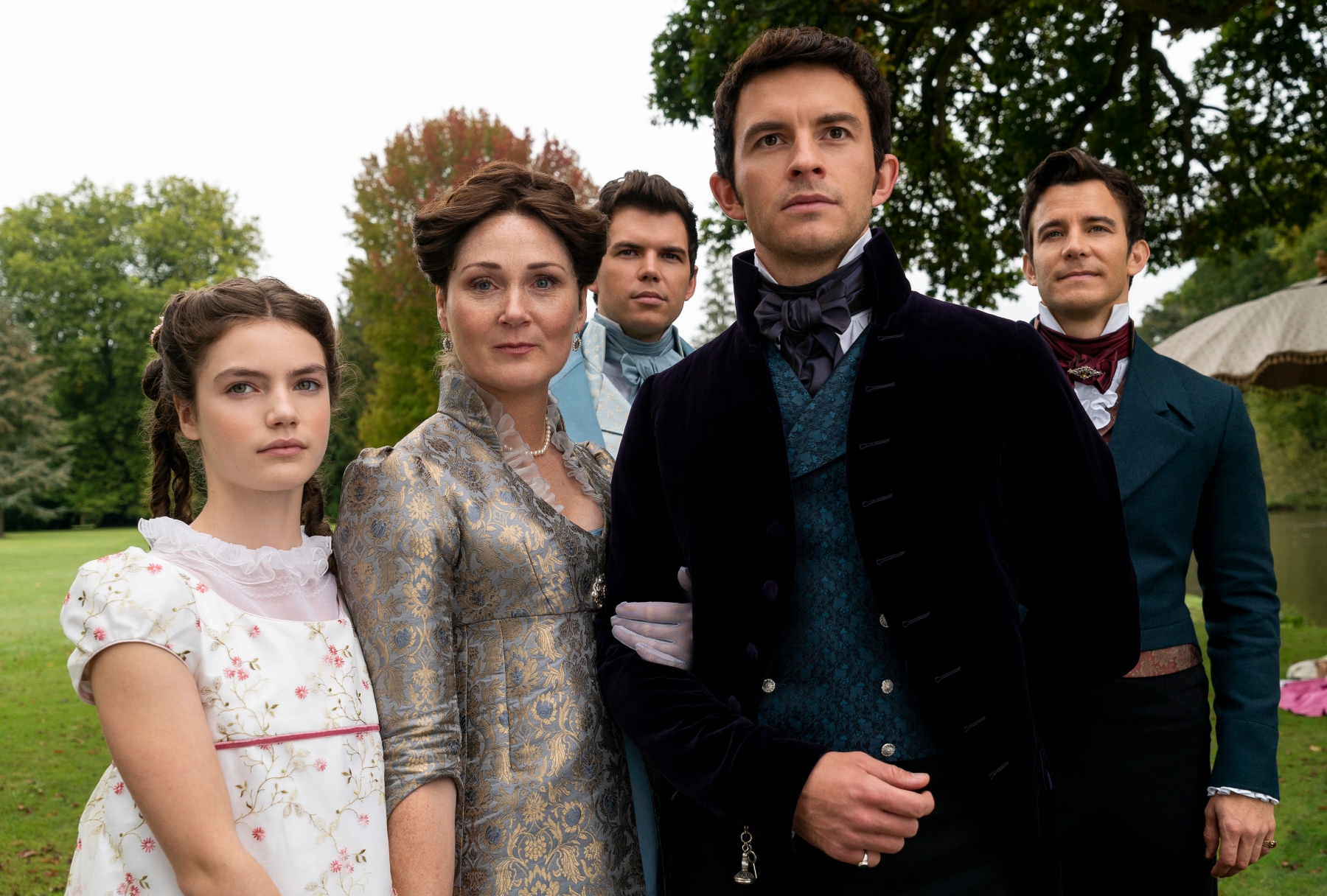
Florence Emilia Hunt, Ruth Gemmell, Luke Newton, Jonathan Bailey, and Luke Thompson play Lady Bridgerton with half of her brood in “Bridgerton” (Liam Daniel/Netflix)Lady Bridgerton is really nice. This can mean she’s overlooked, dismissed. And, as with Daphne’s sex talk, she sometimes does the wrong thing, clumsily.
But she continually and quietly does the best she can, despite her limited ability to help and her limited position in the “ton.” As a widow, her main responsibility is to ensure her children get out of the nest safely — even though Anthony’s future wife will, in effect, replace her as the female head of the household. 

In the second season, we learn more about how Lady Bridgerton was widowed young, and are given a hint of the real love Lady and Lord Edmund Bridgerton shared, before it was cut short. Lady Bridgerton was very pregnant at the time of her husband’s sudden and violent death. That scene of childbirth and after are difficult emotionally, both for the raw grief on Gemmell s face as well as the precarious condition of a woman’s life at this time, in a body that doesn’t really belong to her, not as far as decisions go (sound familiar?). A young Anthony is put in the impossible position of choosing between his mother and his infant sibling: A doctor makes him decide for her, should the difficult birth come to that.

The likely postpartum depression that Lady Bridgerton is plunged into after giving birth to her deceased husband’s last child, who will never know him, feels very real. It’s also a chance for Gemmell’s subtle, emotional performance to go dark, go deep. The word that seems most fitting for Gemmell is vulnerable. She risks a lot, including that the audience may turn away from her during the next stage of Lady Bridgerton’s grief, which is anger. But all she can do is feel.

Lady Bridgerton and women like her don’t have a lot of power. But that doesn’t mean they don’t have pull. She serves as her children’s advisor. Even if they don’t listen to her, at least at first, that doesn’t mean she’s not right. She advises Anthony to start thinking about his own marriage — rather than meddling in his sister’s — early in the first season. 

He won’t, for a while. “You will end up alone with such expectations,” she warns, the Cassandra for the “ton.”

She’s a good dispenser of advice, though (also like Cassandra) much of it is ignored. “We must be willing to look to find the partner that will excite us,” she offers, along with, “Marry the man who feels like your dearest friend.” Maybe Lady Bridgerton could run her own advice column, alongside Whistledown? 

Whistledown is the voice of the show — but Bridgerton is the voice of reason.

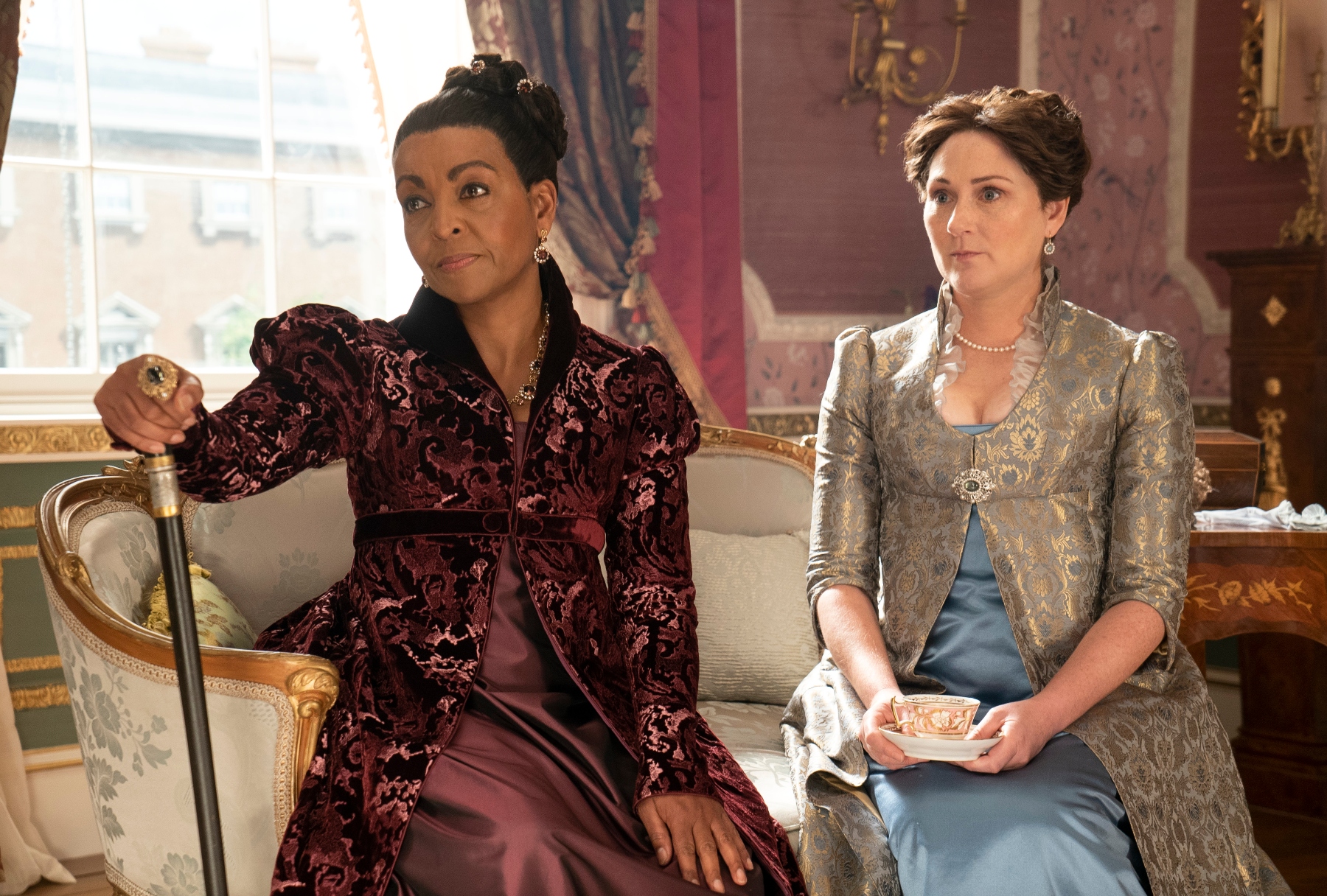
Adjoa Andoh and Ruth Gemmell in “Bridgerton” (Liam Daniel/Netflix)And Gemmell does more with a glance than other actors with many more lines. Shock, disappointment and pain wash over her features. Multiple scenes end with a look from Lady Bridgerton. It’s a knowing look. She pinpoints the true couple of season two — as she did with season one — with Rose Weissman-level matchmaking skills, even if she doesn’t speak up about it. She knows. And viewers know from her face.

Want a daily wrap-up of all the news and commentary Salon has to offer? Subscribe to our morning newsletter, Crash Course.


Lady Bridgerton seems almost otherworldly in a world where women continually prance about in ethereal dresses that look like ballet costumes. But these are very young women compared to her. The age of consent at the time was only 12-years-old for girls, though most Regency women were typically in their early 20s when they married. 

“Bridgerton” is a fantasy view of history, of course, not totally accurate. Still, Lady Bridgerton is in her late 40s and her romantic life is probably completely over. She’s likely never to marry again. Not desirable despite her obvious beauty. Not a diamond. After ingénue, what’s left for women but witch? 

Lady Bridgerton is also wise enough to know that if she did marry again, she would lose the small power she has to run her own life as a woman of the (sort of) Regency era.

So why not get drunk (this one time!) at a party and complain about your children? Why not dissolve into a hysterical laughing fit with another woman your age, another smart and sometimes-overlooked person, Lady Danbury, as the two do in a delightful scene?

“Bridgerton” presents a patriarchal world where marriage means everything — but older women pull the strings, lacing themselves (and their daughters) into situations often as tight or fraught as a corset. What other choice do women of “Bridgerton,” even a wise woman like Lady Violet Bridgerton, have? She observes; she speaks the truth as she sees it (and she sees well in into the future). She, above all else, tries.

More stories like this:

Jon Stewart’s all-white panel goes off the rails — and gets interesting

“The Problem With Jon Stewart” has been quietly humming along on Apple TV+ — until the show decided to invite conservative pundit Andrew Sullivan to discuss race and racism with an all-white panel.

The recently aired episode, titled “Taking Responsibility For Systemic Racism,” brought together La Salle University sociology professor Charles “Chip” Gallagher, Lisa Bond of Race2Dinner, a group that facilitates discussions about race over dinner, and British American blogger Andrew Sullivan. The intention was to gain insight on the topic but invariably led to controversial opinions and shouting matches. 

Stewart said his inspiration for the all-white panel came from a Toni Morrison quote from a 1993 interview with PBS. “My feeling is that white people have a very, very serious problem and they should start thinking about what they can do about it. Take me out of it.”

“Usually in an episode on race focusing on Black issues you’d want to connect with a Cornel West, a Ta-Nehisi Coates, a Dave Mathews, experts in the field. But I’m going to take Toni Morrison’s advice on this. It’s time for white people to talk and figure some things out,” Stewart said. 

The discussion started off with Gallagher and Bond talking about the structural and emotional reasons behind why the term “white privilege” upsets white people and the fear many whites have that Black gain equates to white loss.

Gallagher said that a “significant amount of white people” don’t see socioeconomic status as linked to skin color, meaning that for them “race doesn’t matter in getting ahead.” According to Gallagher, this is dangerous because it makes white privilege invisible, leading white people to think they have earned the successes in their lives rather than linking their privilege to what happened “50, 100, 200 years ago.”

Bond, whose organization Race2Dinner was described in New York Magazine as a “collection of affluent white women, equipped with varying degrees of vanity and self-delusion,” spoke next about how she was aware of her own racism. “White supremacy has done such a good job of teaching us as white people that racism is bad,” said Bond before sharing that as a society white people have to start talking about how they uphold racist systems. 

The conversation then went downhill when Sullivan said the idea of America being a white supremacist country is “possibly the most absurd hyperbole I’ve ever heard.” 

Citing from his own experience as an Irish immigrant, Sullivan stated, “America in 2022 is the most multiracial, multicultural, tolerant, diverse melting pot that has ever existed on planet Earth, and there is no other place on Earth even like it. That’s why 86 percent of our immigrants are non-white. Do you think they want to come to a white supremacist country?”

Stewart was shocked by the response and replied that “America didn’t start that way for Black people.”

“What the f*ck are you talking about?” Stewart asked Sullivan. 

The conversation then moved on to defining the term “white supremacy.”

Sullivan asked for proof that racist systems are at work today, saying, “I don’t know what these systems are.” So Stewart pointed to housing, the New Deal, the G.I. bill, and other historical land discrimination, with inputs from the two other guests. The talk moved back and forth between the panelist about Sullivan’s most controversial points, ending with Stewart suggesting Sullivan was racist. 

The panelists eventually got to what solutions could look like. Sullivan advocated for investments in childcare and education. He then noted “the failure of the Black family structure,” saying that there must be more done to help “the family restructure itself.”

Stewart concluded the discussion by saying to talk about race in America, “We have to be open to all different stripes of white people in the conversation.”

Watch the full video here: 

“The View” psychoanalyzes Will Smith and debates consequences: “He needs therapy”

In the second full day of The Slap discourse, “The View” still has strong opinions about Will Smith, even after the actor publicly apologized to Chris Rock for slapping him live on the Oscars telecast Sunday night after the comedian took a pot-shot at the actor’s wife, Jada Pinkett Smith. The actor went on to win the best actor Oscar for his leading role in “King Richard,” a biopic about the father of tennis star Venus and Serena Williams.  

First, a quick look at that apology, which Smith posted on Instagram last Monday:

“Violence in all of its forms is poisonous and destructive. My behavior at last night’s Academy Awards was unacceptable and inexcusable. Jokes at my expense are a part of the job, but a joke about Jada’s medical condition was too much for me to bear and I reacted emotionally.

I would like to publicly apologize to you, Chris. I was out of line and I was wrong. I am embarrassed and my actions were not indicative of the man I want to be. There is no place for violence in a world of love and kindness.

I would also like to apologize to the Academy, the producers of the show, all the attendees and everyone watching around the world. I would like to apologize to the Williams Family and my King Richard Family. I deeply regret that my behavior has stained what has been an otherwise gorgeous journey for all of us.

I am a work in progress.

Sincerely,

Will”

For the most part, the show’s panel agrees that Smith’s apology was both necessary and commendable.  

“I accept what he said because I know how important it is to have people say, ‘I hear you,'” says co-host Whoopi Goldberg. “So, I heard you [Smith] and I’m glad you did it.”

Co-host Joy Behar then refers to Smith’s 2021 memoir “Will” and reads a brief excerpt where Smith vividly describes the time he witnessed his father punch his mother so hard “that she collapsed and . . . spit blood.” Smith, who was just 9 years old at the time, says that was the most defining moment in his life.

Behar clarifies that she’s not a psychologist but still tries to offer an explanation for Smith’s brash outburst.

RELATED: “If Will Smith was a white guy…”: Right-wing Twitter reacts after Chris Rock slapped at Oscars

“It seems to me that that little 9-year-old boy is living in Will Smith,” she says, noting that Smith went into defense mode after noticing his wife was visibly uncomfortable by Rock’s joke. Behar adds that Rock was “caught up in the crosshairs” of Smith’s “transference,” which is a phenomenon within psychotherapy where an individual redirects their emotions or feelings about one person to a separate individual.

The psychoanalysis continues with guest co-host Tara Setmayer, who offers a few words of advice from her therapist before presenting another explanation for Smith’s behaviors.

“This is also what happens when you see people put their lives on display,” she says. “You also welcome in a certain amount of criticism and you have to be able to take care of yourself to handle that. And I think he [Smith] clearly needs to do it.” Setmayer continues, stating that Smith should have been immediately removed from the venue after “The Slap.” She also believes Smith should have promptly issued an apology after the altercation and emphasizes that he should not face “selective consequences” now.  

“Tara, listen, I’m not excusing the behavior,” Behar interjects. “I’m explaining the behavior . . . He needs therapy, maybe.”

Co-host Sunny Hostin joins mentions convicted sex offender Harvey Weinstein – who was not stripped of his Oscars after he was found guilty of committing criminal sexual assault and third-degree rape – is “not comparable” to Smith’s assault, but stresses that he should face consequences but not lose his award.

“There are consequences. There are big consequences, because nobody is OK with what happened,” interrupts Goldberg, who is a member of the Academy of Motion Picture Arts and Sciences Board of Governors. “Nobody, nobody, nobody.”

Watch the panel’s discussion below, via YouTube

Numerous Hollywood celebrities condemned Smith after Sunday night and asserted that violence is never acceptable in any situation. On Monday, Richard Williams, whom Smith portrays in “King Richard,” also criticized the actor.  


Want a daily wrap-up of all the news and commentary Salon has to offer? Subscribe to our morning newsletter, Crash Course.


“We don’t know all the details of what happened,” Williams told NBC News via his son Chavoita LeSane. “But we don’t condone anyone hitting anyone else unless it’s in self-defense.”

Will Smith’s mother, Carolyn Smith, also spoke about the situation, telling Philadelphia’s 6 ABC News that she was shocked.

“He is a very even, people-person. That’s the first time I’ve ever seen him go off,” Smith said. “First time in his lifetime . . . I’ve never seen him do that.”

Additionally, Pinkett Smith broke her silence about the incident with a brief message on Instagram:

“This is a season for healing and I’m here for it.” 

More stories you might like:

It’s nostalgic to watch amateur cooks tackle Julia Child’s oeuvre—but this “challenge” also irks me

It’s kitchen tech week on “The Julia Child Challenge,” a theme that provides a welcome break from the lovey-dovey overload of the cooking competition’s first two episodes. Though I dig a sentimental journey as much as the next person, a week without tears is a relief. Still, this episode was irksome on a couple of levels. I’ll try not to dwell too much, but I can’t promise anything.

“This is what Julia does to people — we can get defensive about our personal versions of her.”

We begin with a whole spiel on how Julia Child wrote “Mastering the Art of French Cooking” to demystify French cooking but also “teach home cooks the proper way to do things in the kitchen.” This is obviously a universal truth, but also kind of my universal truth? Of course, this is what Julia does to people — we can get defensive about our personal versions of her. I’m just going to breathe through it.

The first challenge is to make a soufflé using nothing but a whisk. No egg beaters or stand mixers to do the hard work of beating those egg whites.

This episode is heavy on archival footage. It’s easy to forget how delightful Julia is if you haven’t watched her in a while. Because I came to Julia through her book rather than her show, my idea of her voice was already in my head by the time I started watching it. When you think about it, it’s remarkable how beautifully her written voice and her TV voice actually match up.

Dustin H. starts with a chocolate soufflé with berry coulis. This is uncharacteristically straight-ahead for him, though the soufflé being chocolate cuts into his time a little. The chocolate makes the batter heavier, and it needs more time to rise in the oven.

Elena cooks up a coconut soufflé with ube sauce. Ube is a purple yam, so this is me learning something new every day. Being “vertically challenged,” she beats her eggs on top of a garbage can, as the countertop is too high. It’s like “Julia Child Opposite Day.”

“Jaíne makes a cheese soufflé, as does Bill . . . He forgets to add the cheese.”

Jaíne makes a cheese soufflé, as does Bill. While Jaíne opts to serve hers with a corn salad, Bill doesn’t seem interested in making an accompanying sauce or side. That is, until he forgets to add the cheese. A mornay sauce goes into production while the soufflé is in the oven. 

Fabrizio concocts a tomato cheese soufflé, meaning sautéed tomatoes are going on top. Hmmm. He has never made a soufflé before but seems pretty confident that he understands the “keys” to success. Honestly, Fabrizio seems to have never made anything, but you haven’t been wrong yet, you little wunderkind, so let’s see. 

Britt’s lavender blueberry compote soufflé sounds interesting, but disaster is brewing because she somehow turned her oven to 450 degrees instead of 350 degrees. This may be the end of her delicate soufflé, I fear. 

RELATED: “The Julia Child Challenge” and the mystique of one of America’s most iconic chefs

We’re treated to a montage of Julia and the cooks beating their egg whites to “Flight of the Bumblebee.” I’ll admit, it’s pretty cute. Julia, via the archives, warns that the most important thing is not to open the oven once your soufflé is inside. Yet everyone is opening their ovens. It’s a real Orpheus-type situation. The Hadestown soundtrack starts to play in my head.

Judgment time. F**kin’ Dustin H. I keep wanting him to fail just because he’s so damned cocky and handsome, but he sails on through. Jaíne’s soufflés have risen beautifully, as have Bill’s, who is a huge hit despite his worries re: the cheese. Guest judge Cliff Cooks has a mouth-orgasm moment.

Julia ChildJulia Child in her kitchen. (Aaron Rapoport/CORBIS OUTLINE/Corbis via Getty Images)

Fabrizio’s soufflé also looks great, but he didn’t get the tomatoes cooked in time. Antonia didn’t like his decision to add fish sauce. Like, really didn’t like it.

Next, we have a weird pivot from Julia being the one who brought traditional techniques back into the American kitchen to her love of new technologies “at a time when it was frowned upon.” What? Julia brought traditional French cooking to an America addicted to TV dinners, but now she’s pushing food processors on a quaint nation of homespun Luddites? Did she, herself, bring about this change? Life is complicated, folks.

Anyway, I find it contrived that the second challenge is to make two French dishes in an hour and a half by using both “vintage” and “modern” kitchen technology. Lots of people reach for the “vintage” food processor, which just looks like a food processor.

Lots of people reach for the “vintage” food processor, which just looks like a food processor.

Speaking of food processors, Elena has a weird amount of problems with hers. I mean, yes, they can be a little annoying, but this isn’t that hard. She’s making a potato niçoise salad and a mushroom leek quiche, and will also, tech-wise, use a microwave in some capacity.

Bill makes boeuf Bourguignon in an Instant Pot, which is a solid choice, then an asparagus velouté with a blender. How else would a modern cook make a velouté? I still think this technology tilt is dumb.

Jaíne bakes an almond orange cake with vacuum-sealed oranges, which is the first interesting use of tech we’ve witnessed. Also, gâteau de crêpes, which is an insanely challenging dish.

Fabrizio goes classic with steak frites, using a deep fryer for the fries (duh), and chocolate mousse, using a “vintage” stand mixer. God, I miss my Granny’s stand mixer. That thing was the best. KitchenAid can suck rocks!

“God, I miss my Granny’s stand mixer. That thing was the best. KitchenAid can suck rocks!”

Fabrizio goes on and on about how he doesn’t really know anything about French food. Everything he thinks he knows, he learned from cooking videos. This kid is charming, but he may be getting in over his head with the mousse.

Dustin H. makes a chicken liver mousse and herb de Provence rack of lamb, using a deep fryer. I do love me some chicken liver mousse.

Meanwhile, Britt makes vichyssoise with an immersion blender. This is the first time we’ve seen a competitor actually using “Mastering the Art of French Cooking” as a guide. Interesting. Will she have time to chill it? Also, a mixed berry clafoutis. This is all classic Julia.

“This is the first time we’ve seen a competitor actually using ‘Mastering the Art of French Cooking’ as a guide. Interesting.”

Antonia: “Just potatoes and just leeks.” Dude, you’re like a textbook with arms. I know this! (This feels like subtweeting to me, because potato leek soup was the first recipe I made in “Julie & Julia” and I focused on its simplicity.)

Breathe, Julie. Pettiness helps no one.

Elena calls removing her quiche from its tart pan a “Simone Biles move.” I love her.

“Elena calls removing her quiche from its tart pan a ‘Simone Biles move.’ I love her.”

The judges come out again. Jaíne wins handily. Bill is in the clear, as is Dustin H. Fabrizio and Elena are both in trouble. Fabrizio’s mousse isn’t cooked through, and Elena’s quiche crust is raw at the bottom. Oh, no! My two favorites.

In the end, Fabrizio is out of the kitchen. Damn. Though we could see it coming, it’s still a blow. He’s got what it takes — he just needs some more experience. We’ll be seeing you, Fabrizio!

As I said, this show irks me. On the one hand, it’s lovely — and for me nostalgic — to watch these amateur cooks tackle Julia’s oeuvre. On the other, is there an underlying cynicism? Or maybe I’m imagining it? It sours the taste a bit. This last challenge seems forced and pointless. We’re currently walking a tightrope, entertainment-wise. Let’s see if they can hold on to the essential Julia-ness in coming episodes.

The Julia Child Challenge” airs Mondays at 9pm EST/8pm CST on The Food Network; it is also available to stream on discovery+.

Read more stories about Julia Child and Julie Powell on Salon:

NASA now wants to send two landers to bring Mars rocks back to Earth — here’s why

It’s been 13 months since Perseverance landed on Mars, marking the beginning of a new chapter of exploration on the Red Planet. Since then, the Mini Cooper-sized rover has made history over and over, again racking up an impressive list of firsts. To wit: Perseverance was the first mission to successfully fly a helicopter on another planet. Perseverance managed to extract oxygen from the Red Planet’s carbon dioxide atmosphere, which could eventually be a way to provide astronauts with oxygen on Mars. And perhaps most importantly, the rover successfully collected and stored soil and rock samples that will ultimately become the first Martian rocks to return to Earth for scientific study. 

Sample mission return missions are rare in space exploration, because of the expense of two-way space travel. That makes Perseverance’s sample-return mission particularly exciting, as humanity has never directly extracted rock samples from Mars and brought them back to Earth.

Unfortunately, us Earthlings are going to have to wait a little longer for this sample return mission to happen, as announced by NASA on Tuesday. However, NASA has a pretty good reason. 

Previously, scientists were planning for the sample-return mission to commence in 2026 and be in the hands of (Earth) scientists by 2031. But now, due to the need for the development of a second lander, the mission team says they need more time.

RELATED: Mars’ weird geology vexes Perseverance 

“Detailed analysis of SRL [sample-return lander] landed mass requirements has led NASA to adopt a dual-lander architecture, with the second lander carrying the European-provided fetch rover,” NASA officials explained in a document detailing their requests for the White House’s 2023 federal budget, and explaining why they want two landers. “The development of a second lander necessitates a move to a 2028 launch date and 2033 sample return date and is consistent with the Mars Sample Return Independent Review Board’s (IRB) finding that a dual-lander architecture may improve the probability of mission success.”

The change comes after an independent review board went over NASA’s initial plans for the sample-return mission, which will be the first time a rover embarks on a round-trip mission to another planet.

Though the sample return aspect of the mission has been pushed back, that doesn’t mean Perseverance isn’t currently doing exciting science. Currently, the rover is on a three-mile journey to one of the most exciting destinations in its mission: a river delta on the rim of Jezero Crater, a place that scientists believe may have once been home to microbial life. Its study of the soil around the Jezero Crater could yield definitive proof of life on Mars.

“The delta is so important that we’ve actually decided to minimize science activities and focus on driving to get there more quickly,” said Perseverance’s project scientist, Ken Farley, in a NASA press release. “We’ll be taking lots of images of the delta during that drive. The closer we get, the more impressive those images will be.”

Scientists believe this location is one of the best on Mars to look for past signs of life. Upon arrival, Perseverance will use the drill on the end of its robotic arm and collect rock cores for its sample-return mission. From Earth, scientists will begin to search images for the rocks they’ll eventually want to look at in closer detail, albeit it will be a few years before they’re able to get their hands on them. Perseverance is expected to arrive at the delta by mid April.


Want more health and science stories in your inbox? Subscribe to Salon’s weekly newsletter The Vulgar Scientist.


The ancient river has peculiar topography. As a fan-shaped delta, the crater floor is nearly 130 feet below the surface. The delta is full of angled surfaces, projecting boulders, and sand-filled pockets. In other words, it’s somewhat dangerous and precarious terrain for a rover that doesn’t have access to a repair yard. However, given the diversity in terrain, scientists are hopeful that it holds geologic revelations that could show proof of past microbial life that perhaps existed billions of years ago on Mars.

Luckily, Perseverance has a buddy on its journey, as scientists recently extended Ingenuity’s helicopter mission. The small drone copter flits around Mars as an aerial complement to the rover’s ground-based observatory. 

“Less than a year ago we didn’t even know if powered, controlled flight of an aircraft at Mars was possible,” said Thomas Zurbuchen, the associate administrator of NASA’s Science Mission Directorate. “Now, we are looking forward to Ingenuity’s involvement in Perseverance’s second science campaign. Such a transformation of mindset in such a short period is simply amazing, and one of the most historic in the annals of air and space exploration.”

Once Perseverance arrives at the delta, Ingenuity will scout out two dry river channels and determine which one Perseverance should head for when it’s time to climb to the top of the delta. Ingenuity will also assist with identifying potential science targets — and it may even scout landing zones for the landers part of the sample-return mission.

“The Jezero river delta campaign will be the biggest challenge the Ingenuity team faces since first flight at Mars,” said Teddy Tzanetos, Ingenuity team lead at NASA’s Jet Propulsion Laboratory in Southern California.

Read more on Perseverance:

Will Smith and the function of a slap – what it means for comedy and comedians

If you teach a Monday morning class on comedy writing, like I do at Georgetown University, then Sunday night’s assault and battery on comedian Chris Rock at the Oscars provides some really ace material for “class discussion.” It’s like teaching a course on “Space Exploration” the day after Neil Armstrong bopped astride the surface of the moon. Actually, it’s more like teaching a course on “Nuclear Weaponry” the day after someone lobbed a missile into your campus.

Which is my way of saying that Will Smith’s open-hand slap (about which more anon) is really bad for comedy and comedians. Then again, what’s bad for comedy and comedians, and most likely the country as a whole, isn’t necessarily uninteresting or without educational value.

Let’s start with the generational divide that the incident brings to the fore. I was disheartened, but not surprised, to learn that every single one of my 15 freshman students – bright, thoughtful, people – felt that Mr. Rock’s joke should never have even been pronounced. They concurred that the quip about “G. I. Jane,” in reference to Ms. Pinkett-Smith’s very dignified and public experiences with alopecia, was triggering and unfit for the Oscars. Many, though not all, found that the punishment fit the crime; Will Smith emerged as an avenger of a microagression. Take a look:

Maybe a younger version of my professorial self would have torn into The Youth for expressing such anti-liberal sentiments. But the older me recognizes that there’s nothing more banal or cliched than a professor ragging on undergrads, if only because that is precisely what professors have been doing since the foundation of Heidelberg in 1386.

RELATED: “Comedians are in danger everywhere”: “The View” hosts side with Chris Rock after on-air Oscars slap

And besides, the opinions they expressed were not unfounded. They are right; technically the joke was not particularly good. They are correct, in a country that stigmatizes Black women’s bodies and looks and voices and hair – the comedian was punching down. One student helpfully suggested that had Ms. Pinkett-Smith delivered the blow herself, she would have become a feminist icon; her intervention would one day be memorialized on a postage stamp.

Too, my students’ protest aligns with what recent research demonstrates about a growing generational divide regarding free speech. A 2015 study showed that Millennials were much more likely than the generations who came before them (i.e. Gen Xers, Boomers, and Silent) to let the government censor speech acts that are offensive to marginalized groups. The trend seems to be intensifying among Gen Zers, the cohort professors are teaching today. When given the choice between “protecting free speech” and “promoting an inclusive society” significant numbers of college students favor the latter. One study showed that roughly 60% of women and 60% of Black people see inclusivity as the more important goal.

As my classroom anecdote above may indicate, this generation is far less committed to untrammeled expressive liberty than their elders. Those on the business end of the Art/Commerce divide, are surely taking note: if a younger generation doesn’t like this style of comedy – and here one thinks of the controversy surrounding Dave Chappelle’s “The Closer” – then what does this portend for future investments in comedic products? Smith’s slap was, inadvertently, a warning signal to entertainment executives.

About that slap. I have no expertise in the semiotics of the slap, but I am reminded of what one of America’s funniest novelists, Paul’s Beatty, made of the gesture. In his underappreciated masterpiece, “Tuff,” Beatty relays an episode in the life of East Harlem resident Winston “Tuffy” Foshay. Tuffy is a very, very large man who engages in an exhibition bout with a professional Sumo wrestler named Kotozuma. The latter has just administered a Sumo-specific, Sumo-appropriate, slap to the former. The blow propels the narrator to voice this reflection (which may be triggering):

But in the streets [of East Harlem] to be slapped in front of anyone who even remotely knows you is the ultimate insult. Mothers slap children, wives slap husbands, pimps slap hos, but nobody slaps Winston, and before Kotozuma could release a follow-up smack, Winston blasted him with a “What, motherf**ker?” two-handed push to the chest that sent the rikishi reeling backward.

My street fightin’ days back in Flatbush Brooklyn are far behind me, and were, nevertheless, unremarkable in the extreme. Yet something about Mr. Smith’s getsure struck, even me, as not quite right. He missed a step in the tango of toxic masculinity. A belligerent man, in my experience, generally signals to his target that he is about to hurt him. There are lots of ways to communicate this malign intent. You can get all up in someone’s face. The two-fingered chest poke is a well-worn technique. Some aggressors have been known to deliver pointed monologues prior to pouncing.


Want a daily wrap-up of all the news and commentary Salon has to offer? Subscribe to our morning newsletter, Crash Course.


But one thing the Code Of The Streets demands is that a combatant never hit a person who, like Chris Rock, had his hands behind his back (Mr. Smith delivered his monologue only after his attack). Couldn’t he just have pushed Rock backwards and let the dudes with the headset mics come charging out from the wings, “Jerry Springer”-style, to separate the combatants? Where are these guys when you need them?

The entire episode also cast light on a disturbing global trend. The docket of incidents that could be labeled “When Audiences Attack” (to use Jim Jeffries’ phrase) is thickening. Last spring authorities in Mynamar arrested the satirist Zarganar. Around the same time the Muslim comedian Munawar Faruqi was detained in India afor offending Indian Hindu sensibilities. Unappreciated satire led to the murder of Charlie Hebdo cartoonists in France (and, in fairness, one could say that similar unease with humor led to the fining and imprisonment of the antisemitic insult comic Dieudonné M’Bala M’Bala). As for “Nuclear Weaponry,” North Korea threatened to obliterate California in retaliation for “The Interview.”

Comedians, I tell my students, usually want to get high, make people laugh, make people think, and make some money (though not necessarily in that order). Yet their art form, with more immediacy than any other, makes a demand – a demand which not all of them signed up to fulfill. The function of comedy is to help us see where the ever-shifting boundaries separating appropriate from inappropriate presently are situated. As they perform this service, comedians often risk their mental health, freedom, and bodies. Mr. Rock took one on the jaw. In so doing, he showed us all where comedic lines have been repositioned, and where growing fissures are emerging in contemporary America.

More stories about comedy and consequences:

10 budget-friendly Costco products with cult followings

Shopping at Costco is always an experience. Aside from the perks of membership-only deals and a literal warehouse’s worth of every grocery store item you can think of, there’s something to be said about buying the most beloved mainstream food and drink in bulk.

But over the years, less attention and social media fanfare has been placed on tried and true favorites and more on Costco’s own products from its Kirkland Signature line. In fact, many options are so delicious that they’ve developed cult followings, replacing what we once thought to be the best-of-the-best with familiar brands. (Ironically, most Kirkland Signature offerings are actually manufactured by the companies we love, so you’re never skimping on taste or quality to satisfy a specific craving.)

New to Costco or need a refresher on what customers can’t stop talking about? Check out our list of 10 Kirkland Signature items that are more than deserving of a spot in your oversized shopping cart.

Kirkland Signature Extra Virgin Olive Oil

There is no product on this list celebrated more than Kirkland Signature’s extra virgin olive oil. Cold-pressed, organic, and sourced directly from Greece, this two-liter jug will become a pantry staple with a full-bodied richness that is perfect for dressings, marinades, and sautéeing your favorite meats and vegetables. Treat this olive oil like your salt and pepper — use it daily, buy it in bulk, and never settle for anything less than the highest of quality.

Kirkland Signature Aged Balsamic Vinegar

You’re going to need a vinegar to complement that high-quality EVOO and Costco is not messing around when it comes to its aged balsamic. Made in the condiment’s homeland of Modena, Italy, the depth of oaky and sweet flavors stand up to the olive oil’s robustness. It also makes a fantastic topper to proteins like grilled chicken and canned tuna fish, taking them from bland and boring to craveworthy and coveted.

Kirkland Signature Animal Crackers

Animal crackers in your soup? Only if you’re Shirley Temple. For the rest of us, these are going straight into our mouths (or maybe as a topping to frozen yogurt). The four-pound tub’s play on a childhood classic is vanilla-forward with a smooth surface and delectable crunch. Sure, they’re more animal-stamped than animal-shaped, but the lack of detail just makes them more adult-friendly since we care less about clever gimmicks and more about satisfying a sudden hankering for carbs.

Kirkland Signature Parmigiano-Reggiano Cheese

Parmigiano-Reggiano is delicious, but it’s often very, very expensive. Fear not — Costco sells a pound (!) of the shredded delicacy (and even an entire wheel if that craving is ultra intense) for less than $20. Needless to say, your morning omelet just got a serious upgrade.

Kirkland Signature Wild Caught Mahi-Mahi

Sustainable fishing practices are not just critical in protecting the environment, but they also yield a healthier protein. Such is the case with this package of individually-packed, vacuum-sealed center cuts. The hearty filets are easy to grill, bake, and even air fry (once thawed) to make even the most fish and seafood-averse reconsider their dietary preferences.

Kirkland Signature Nature’s Path Organic Pumpkin Flax Granola

Nature’s Path is the hot new granola in town. This fiber and protein-packed alternative takes everything you love from the mass market brand but packs in the omega-3s with pumpkin and flax seeds (which also impart a fantastically nutty and earthy taste that makes it seem small-batch, artisanal, and prepared by a cool Brooklyn hipster who ditched a life on Wall Street to open a bakery.)

Kirkland Signature Milk Chocolate Almonds

These should come with a warning label because it’s entirely too easy to eat more than you (and your stomach) ever thought possible. The no-frills snack offers the crunch of an almond with a decadently silky chocolate shell that brings new meaning to the idea of “perfectly sweet and salty.” If you’re looking for balance in life, add these to your list of essentials.

Kirkland Signature Sliced Bacon

Bring home the bacon . . . literally. Costco’s take on the breakfast classic actually earned top honors in a Consumer Reports taste test. We’re not sure if it’s the hickory smoke or the fact that you get four packs (save room in the freezer!), but it’s absolutely something you’ll want to fry up and crumble in a salad, use to wrap a mini meatloaf, or eat on its own with hash browns and a veggie scramble.

Kirkland Signature Protein Bars

If you’re looking for an alternative to the run-of-the-mill protein bars sold in most places, these are the bars for you. Each serving boasts a whopping 21 grams of protein, 10 grams of fiber, and only two grams of sugar. And, best of all, they taste like actual brownies! No more holding your nose or gagging as you refuel after a workout or run. You’ll now feel like you’re treating yourself to dessert instead.

Kirkland Signature Organic Dried Cherries

Three cheers for cherries. If you’re pining for something sweet but with a little extra tang, these vitamin C-packed bites are exceptional as a late afternoon pick-me-up or simply an oatmeal or granola enhancer. You can also soak these in Bourbon to garnish any alcoholic beverage of choice. Now that’s what we call adulting.

Actor Ezra Miller arrested for disorderly conduct, after winning a fan-favorite moment at Oscar

Ezra Miller, who garnered Twitter criticisms after their brief feature during Sunday night’s Oscars telecast, is now making headlines following a bar fight.

On Monday morning, the “We Need to Talk About Kevin” actor was arrested and charged for disorderly conduct and harassment in Hilo, Hawaii, according to a tweet and release from the Hawai’i Police Department. Miller was reportedly agitated with patrons at a karaoke bar and began yelling obscenities. They allegedly “grabbed the microphone from a 23-year-old woman singing karaoke and later lunged at a 32-year-old man playing darts,” the release disclosed.

The incident took place on Sunday evening at 11:30 p.m. Miller was arrested shortly after midnight but was subsequently released after providing their set bail of $500.

RELATED: “Wallflower”: A lost John Hughes teen flick

This isn’t the first time Miller has been involved in a public altercation. In April 2020, video footage showed Miller choking an unnamed woman at a bar in Reykjavik, Iceland. Miller, who was seen wearing a red coat, pink scarf, and sandals, asked their victim if she wanted to fight. “That’s what you wanna do?” Miller asked again before grabbing her by the throat and throwing her to the ground. Per Vulture, the actor supposedly lost their temper after a group of excited and “pushy” fans approached them near the bar.   

News of Miller’s arrest arrived just a month prior to the highly anticipated release of “Fantastic Beasts: The Secrets of Dumbledore,” an upcoming “Harry Potter” spin-off film that stars Miller in a leading role as Credence Barebone. Miller will also play the titular character in DC Comics’ 2023 superhero film “The Flash.”

Miller previously appeared as Barry Allen in “Zack Snyder’s Justice League: The Zack Snyder Story.” A snippet of the 2021 film, which highlights a dramatic scene of The Flash entering the Speed Force, won the No.1 title for most “Cheer-worthy moment” at the Oscars. The results in the newly introduced category was determined by online votes from fans but also received widespread ridicule and became a meme.


Want a daily wrap-up of all the news and commentary Salon has to offer? Subscribe to our morning newsletter, Crash Course.


“The 5 Cheer-Worthy Moments were picked by a select group of people who hate movies,” tweeted comedian Matt Oswalt.

“Okay, this top five cheer-worthy moments thing is the funniest bit the Oscars has ever done,” wrote film & TV critic Caroline Siede.

More stories you might like:

“A stunning portrait of political corruption”: Exactly how Joe Manchin made millions from coal

Senator Joe Manchin, the most prominent decision-maker on American energy and climate policy, has spent decades raking in revenue from his private coal business. A recent investigation by the New York Times illustrates what’s been described as “a stunning portrait of political corruption,” detailing how the conservative Democrat’s political decisions have benefitted his financial connection to a West Virginian power plant, calling into question the ethical line the senator is toeing between business and politics. 

Manchin’s involvement with the Grant Town power plant began in 1987, when he helped clear several environmental obstacles that allowed two developers to build the plant slightly outside Manchin’s district. The Environmental Protection Agency was concerned the plant was too close to another coal-burning plant in the area which could potentially produce disastrous impacts. The Democrat then went into business with the plant through a handful of shifting electricity companies and contracts which the Times describes as “a bit like handling a set of Russian nesting dolls.” A company owned by Manchin provided the Grant Town plant “gob,” (an acronym for garbage of bituminous), a mining byproduct of coal and rock which can be used to produce electricity. The Grant Town power plant has been the only customer for over 20 years. So a portion of the plant’s electricity revenue, which comes from the electric bills played by Machin’s constituents, goes directly into the senator’s pockets. Because Gob is less energy efficient than pure coal, West Virginians have lost millions of dollars in excess electricity fees over the years.

The Times investigation highlights how Manchin’s political agenda has aided the power plant over the years.

Reporting reveals that Manchin championed tax credits that aided the plant and was involved in enabling a rate increase that hiked electricity prices for West Virginians, therefore benefiting himself economically through the plant’s increased revenue. Manchin has also been a vocal dissenter of the Environmental Protection Agency’s proposed limits on power plant emissions. 

Manchin declined an interview with the Times but in the past has justified his political maneuvers as in the interest of West Virginian industry and has stated his business relationship with the Grant Town plant has given West Virginians jobs. He has also said no rules have been broken in his business dealings with the power plant.

Manchin remains a key holdout on Biden’s Build Back Better Act, a massive legislative package that includes provisions for social and environmental spending. The package was blocked by the West Virginia senator, ending a potential $555 billion dollar investment into clean energy. The bill would have accelerated the country’s reliance on renewable energy resources like wind and solar, moving away from dependence on fossil fuels.  

In consideration of the ongoing war in Ukraine, Manchin has openly advocated for American companies to increase oil and gas production as Russia has left a gap in the supply chain.  

The common mistake that might be killing your indoor plants

For the second time in a year, I went abroad on holiday, and my husband killed a plant. The worst part? He killed it with love — too much love, that is. He overwatered it.

What hurt the most was that it was a snake plant, aka, the most indestructible indoor plant known to us. Turns out, one thing can destroy it, and it’s not what you think — not too much sunlight nor too little airflow or temperature fluctuations (although all of those can affect its well-being to some extent). It’s giving it too much attention, when all it wants is to be left alone. Too much watering, and not even drainage, did my Sansevieria in.

This wasn’t the first time overwatering had taken a toll on my indoor plants. My ZZ plant, another one of those houseplants that thrive on semi-neglect, has started to get very droopy over the past few months. When I polled friends on Instagram to check in on its near-collapse, the most common response? “You’re overwatering it.”

I could’ve sworn I was doing the opposite all along and underwatering it. Were its yellowing leaves and lackluster growth not signs of that? My husband and I (ah, the painful realization that I’m not inculpable) had clearly been misreading it all. So I turned to an expert, Lindsay Pangborn, a member of Bloomscape‘s Grow-How team, to learn how to better understand the needs of my plants. And why overwatering seems to kill more of them than . . . underwatering. Her best advice? Skip watering on a schedule, and instead evaluate your plant and its soil to know when to water. Read on for more.

Is overwatering often more of a problem than underwatering? 

Lindsay Pangborn: Yes, I have to agree! Overwatering is one of the top common causes of plant death for houseplants. There’s a reason why drainage holes on the bottom of pots is our top piece of advice for plant parents, especially for those who are new to the lifestyle. Mastering the art of watering can be tough, since it’s so dependent on the individual environment: Factors like light level, humidity, temperature, airflow, and more can all affect how quickly (or slowly) your plant uses water.

So, why does overwatering kill plants? 

LB: When plants are overwatered, their soil can become saturated and their roots are denied oxygen. Over time, the roots simply cannot function, which is why some signs of overwatering are so similar to signs of underwatering (aha!). This issue first shows itself by plants with droopy leaves that don’t perk up after watering. Leaves often start to turn yellow and fall off the plant in more advanced stages of overwatering.

Which popular plants are especially prone to overwatering? 

LB: – The Parlor Palm is one of the most popular plants prone to overwatering. It requires such little water that it can instead thrive off regular mistings a few times a week to boost growth and prevent insect infestations. 
– The Money Tree is another plant that tends to receive more water than necessary since its growth is dependent on the seasonal changes. This plant prefers deep, but infrequent, watering periods, especially during the colder months, when its natural growth will typically slow. 
– Succulents and Sansevierias are prone to overwatering as well, due to their tendency to thrive in dry conditions and their ability to store water in their leaves and stems. They do tend to need more watering during summer months when they are actively growing, versus winter months, when they are often dormant.

Are there some plants that don’t mind being overwatered? 

LB: There are many plants that can grow in water and are able to adapt to periods of flooding. In the houseplant world, a common type of plant that is tolerant of lots of water is the carnivorous variety. Many carnivorous species are native to a bog environment, which means they enjoy growing in consistently damp moss in lots of direct sunlight. The Pitcher Plant is a great example, and looks great in a pot or hanging basket near a south- or west-facing window.

How can we ensure we are not overwatering our plants? 

LB: One way to ensure you’re not overwatering your plant is by making sure your plant’s pot has a drainage hole at the bottom to allow excess water to drain out. Often, these pots have a matching saucer to catch excess water and protect your furniture. A plant in a pot without drainage holes has increased chances of root rot and overall damage/death from overwatering.

A plant will “tell” you when it needs water. Every plant and its setting is different due to variations in temperature, humidity, and light exposure. The same type of plant in a different location may need watering at a completely different frequency. For example, Sansevierias in direct sun and warm temperatures can be watered weekly, while Sansevierias in a low light and/or chilly area only need water once every 4 to 6 weeks. For this reason, we never recommend watering on a schedule, and instead recommend evaluating your plant and its soil to know when to water. One tip I recommend for small pots is to conduct the touch test:

  • Push your finger into the soil until its level is at your middle knuckle.
  • If the soil is moist, do not water it, and check on it again in a few days.
  • If the soil feels dry, water your plants until the water flows freely out of the pot’s drainage holes. Remove the excess water and place the pot back onto an empty saucer.

Democrats ramp up the pressure on Justice Clarence Thomas to recuse himself from future Jan. 6 cases

A group of Democratic senators and representatives have asked Supreme Court Justice Clarence Thomas to recuse himself from future cases involving the Jan. 6 insurrection.

The lawmakers sent a letter Monday to the Supreme Court asking Thomas to recuse himself from those cases and to provide a written explanation for why he did not do so in previous cases, in a move prompted by the revelation that his wife Ginni Thomas was repeatedly pressuring White House chief of staff Mark Meadows to help Donald Trump overturn his election loss, reported the “Washington Post.”

“Given the recent disclosures about Ms. Thomas’s efforts to overturn the election and her specific communications with White House officials about doing so, Justice Thomas’s participation in cases involving the 2020 election and the January 6th attack is exceedingly difficult to reconcile with federal ethics requirements,” read the letter, which the “Post” obtained.

The letter also called on Chief Justice John Roberts to create a binding code of conduct for justices that includes enforceable provisions and require justices issue written recusal decisions, with a deadline of April 28, in response to “major ethics” breaches at the court, including Thomas’ failure to disclose his wife’s income from the conservative Heritage Foundation.

“Chief Justice Roberts has often spoken about the importance of the Supreme Court’s ‘credibility and legitimacy as an institution.’ That trust, already at all-time lows with the American public, must be earned,” the lawmakers wrote.

Florida’s “don’t say gay” bill is just the beginning: Republicans want to claw back all gay rights

Despite national outrage and threats from powerful companies like Disney, on Monday, Florida’s Republican Gov. Ron DeSantis signed the infamous “don’t say gay” bill.

Proponents of the law continue to pretend that its limitations are narrow and only prohibit “teaching” young kids about sexuality. In reality, however, the bill is so broad and vague that it will likely be used to bully teachers and students from being out or acknowledging the existence of LGBTQ people. Contrary to claims that the law “only” impacts the lower elementary grades, as Mark Joseph Stern at Slate points out, it’s worded in such a way as to allow parents to sue high school teachers for, say, allowing students to form a Gay-Straight Alliance. Indeed, the impetus of the law was a case where parents wanted to sue the school for accepting a teenager’s gender identity. 

Meanwhile, the mainstream press is still hamstrung by this fantasy that the courts will swoop in and stop this.

RELATED: I was one of the lawyers who helped win marriage equality. And yes, the GOP can take it away

In an opinion piece for NBC News, NYU law professor Daniel Putnam responded to the law’s passage with a piece confidently asserting that the law is unconstitutional because “courts have consistently recognized that LGBTQ students and teachers have a basic First Amendment right to express who they are.”

It’s a nice idea in theory. Unfortunately, the Supreme Court has been captured by far-right ideologues who have no respect for the Constitution, the rule of law, or precedent.

There’s currently a sitting justice whose wife was involved in a fascist coup attempt — and that’s just the tip of the corruption iceberg. The Republican-appointed majority routinely ignores the plain letter of the law when imposing their right-wing ideology, such as in recent cases throwing out vaccine mandates and tearing up basic voting rights protections. The court recently signed off on a Texas law that bans abortion in direct violation of Roe v. Wade by pretending that they had no authority to block the “bounty hunter” provision that is being used to enforce the ban. Guess what? The Florida law uses the same provision to enforce the “don’t say gay” bill by empowering parents to sue schools that allow LGBTQ staff and students to be out. 

The right-wing court’s total power and utter impunity is, in fact, empowering Republicans to expand their war on LGBTQ rights. And the “don’t say gay” bill is likely just the beginning.


Want more Amanda Marcotte on politics? Subscribe to her newsletter Standing Room Only.


Recent events show that, in addition to the ongoing war on trans people, Republicans are deeply interested in rolling back hard-won gay rights victories from recent years, including same-sex marriage. 

Rep. Marjorie Taylor Greene of Georgia tipped her hand to this at a recent Donald Trump rally in Georgia, in which she bellowed that Transportation Secretary Pete Buttigieg “and his husband can stay out of our girls’ bathrooms.” This statement led observers to wonder if she was confused about which unhinged right-wing conspiracy theory is which. The “predators in women’s rooms” accusation is typically used these days to demonize trans women. But of course, Greene doesn’t actually believe gay men are scheming for ways to rape women. As Aaron Rupar of Public Notice wrote, by mixing up her conspiracy theories, Greene was signaling that “all the GOP talk about bathrooms was really just euphemized bigotry” that doesn’t need to make sense, even in their own lurid fantasies. Bathroom talk is just a new way of calling someone the F-word. 

It also, importantly, functions as a signal that it’s not just trans rights that they’re coming for, but gay rights as well.

Greene has previously expressed a belief that violence is an appropriate response to feeling threatened by the existence of LGBTQ people. In light of that, her recent speech should be understood as a winking endorsement of gay-bashing. Nor is she an outlier.

RELATED: “Don’t make me read my child’s obituary”: Texas risks lives by banning gender-affirming care

Republicans successfully distracted the mainstream media from it with the bizarre QAnon antics, but a huge focus of GOP rhetoric during the Supreme Court confirmation hearings for Ketanji Brown Jackson last week were focused on overturning Obergefell v. Hodges, the 2015 Supreme Court decision that legalized same-sex marriage. Multiple Republicans on the Senate Judiciary Committee, but especially Sen. John Cornyn of Texas, asked Jackson a series of leading questions that were about signaling to their religious right base that they are exploring legal avenues to overturn that decision and invalidate same-sex marriages. That Cornyn took the lead is no surprise, as he’s the same senator whose prepared remarks before the Heritage Foundation in 2004 compared same-sex marriage to marrying a “box turtle.” He and his staff has spent the past 18 years trying to intimidate reporters out of recounting that fact, by noting that he dropped the line when he read the speech out loud. There can be little doubt he meant it, however, as he also supported bills meant to ban same-sex marriage. And, of course, he just used Jackson’s hearing to compare Obergefell to the infamous 1857 Supreme Court decision that upheld chattel slavery. So, no, he hasn’t evolved on his homophobic opinion, even if he tries to be coy about it. 


Want more Amanda Marcotte on politics? Subscribe to her newsletter Standing Room Only.


Obergefell was a 5-4 decision in favor of gay rights. Since then, two of the justices who supported it have been replaced by Federalist Society-linked justices, who were picked in no small part to issue anti-LGBTQ decisions. For those who are counting, that means that if Republicans can find some way to relitigate the question, they likely have a 5-4 majority to overturn the legalization of same-sex marriage, or at least gut it significantly. 

In Texas, meanwhile, Republicans like Gov. Greg Abbott and Attorney General Ken Paxton have been waging an all-out war to block trans rights, by banning kids from getting gender-affirming health care and even sending Child Protective Services against parents who accept trans children’s identities. They’re also sending signals that they feel confident they can expand this war to the LG and B folks, as well. In response to the Austin Independent School District holding a Pride Week, Paxton sent a threatening letter accusing the school of “cynically pushing a week-long indoctrination of your students” and breaking the law with an “instructional effort in human sexuality without parental consent.”

Needless to say, none of the events in question constitute sex education, especially of the how-to instruction that Paxton is implying is going on. (And let’s face it, teenagers already know the how-to part.) Events are based around themes like “Differences are Awesome” and “Creative Expression.” Paxton’s letter is riffing on the Republican fallacy that behaviors most people see as banal with regards to straight people — such as having a prom date or attending a wedding — become “sexual” when it involves LGBTQ people. By sending this letter, Paxton is attempting to achieve the same ends as the “don’t say gay” law in Florida: bullying schools from allowing LGBTQ students to be out. He just isn’t even bothering to go through the legislature first.

So while there has been, rightfully, a great deal of attention paid in recent years to how Republicans have “turned to” attacks on trans people, having lost the gay rights battle, these moves by Republicans show that they don’t, in fact, feel that their loss on gay rights is permanent. On the contrary, there’s a new escalation of attacks against gay rights that most Americans assume are inviolable The right to be out, the right to get married, the right to live your life safe from violence and discrimination are now all at risk. Florida’s bill is just the beginning.