Spring Sale: Get 1 Year, Save 58%

The Trader Joe’s tote bag craze has officially gone too far

In an April video posted by TikTok user @erica_grace1, a frenzy has ensued at a Trader Joe’s store. A group of customers, mainly grown adults, is seen crowding around a cardboard box filled with the brand’s newly-released pastel mini tote bags. One could call it greed, based on how people are wrestling one another to grab not one, not two, but multiple bags in various colors. It’s like watching hands frantically reach out for candy after a piñata has been broken into — gluttony at its finest.

“I did not think I was going to fight grown women at 8:00 AM,” read a caption on the TikTok video.

@erica_grace1 Trader Joe’s mini pastel tote bags!! #traderjoes #pasteltotebags #traderjoesminitotebag #traderjoesminitotebag ♬ original sound – ✿

The brouhaha, though ludicrous, isn’t anything unfamiliar. Last February, TJ’s consumers and enthusiasts alike went gaga after the California-based retailer first dropped its 11-by-13-inch canvas totes. The bags — available for just $2.99 each — were simple in design, emblazoned with TJ’s trademark emblem and bearing red, navy, yellow or green colored straps. Like clockwork, they became the hottest “it” item across the Internet. Videos on social media showed swarms of consumers barging into stores, frantically grabbing as many bags as possible. “These mfs wildin over a mini tote bag,” captioned one TikTok in which TJ’s staff are seen wheeling out a tote-filled cart into an eager crowd. In some stores, the craze grew uncontrollable, forcing staff members to limit how many bags consumers could purchase. “Five! That’s the limit! Five!” yelled an employee in a separate video.

The bags eventually sold out in a matter of days, compelling shoppers to resell them for $300 and $500, even $1,000 for a set of all four colors. At the time, TJ’s assured consumers that the bags would be back in stock by late summer. “We had actually hundreds of thousands of bags come in and go out within a week,” Matt Sloan, host of the “Insider Trader Joe’s” podcast, said in an episode released March 2024. “We had no inkling that they would be this exciting, this quickly, for so many customers.”

TJ’s relaunched its elusive bags in September, once again for a limited time only. Since then, the craze has only intensified, leading TJ’s to bring in even more bags this April. “Last year, when we introduced our Mini Canvas Totes, we were so pleasantly surprised by their rapturous reception that we’re bringing in even more Mini Totes, this time in a series of Pastel shades to herald the beginning of spring,” the brand wrote on its website. For a limited only, consumers could get their hands on mini totes in four brand new shades: delicate pink, baby blue, mint green and lovely lavender.    

A similar scramble quickly ensued. The New York Times reported that some people camped out in front of stores hours before they opened — an employee at a Trader Joe’s in Sacramento told the outlet that the first customer lined up at 5 A.M. (the bags ultimately sold out within 15 minutes). In preparation for the chaos, stores across Brooklyn and Manhattan amped up their security, with some placing the bags behind registers. Nearly all stores nationwide imposed limits on the number of bags per customer, although they varied by location. Still, some consumers went home with multiple bags and, in one instance, a cart filled to the brim, per a video on TikTok.

@justlifewithleah_ #stitch with @angela… these resellers with their Trader Joe’s tote bags are going to SEND ME OVER THE EDGE #traderjoes #traderjoestotebag #overconsumptionculture #consumerism ♬ original sound – Leah 💸 No Buy/Low Buy Year 💸
@hakantuluhanofficial People Are Going Crazy Over Trader Joe’s Totes 🤦‍♂️#traderjoes #usa #foryoupage #fyp #wtf #trending #viralvideo #breakingnews ♬ original sound – Sonya Gore

Do people really need hoards of mini totes? “YOU. DO. NOT. NEED. 4. OF. THE. SAME. TOTE. BAG.” wrote Reddit user u/pickles_are_gross_ in a thread posted on the anti-consumption subreddit. “[I] am genuinely so frustrated by the trader joe's tote bag situation. it's so much waste and so shameful to watch members of my same species freak out over some canvas bags, and then buy 10 of them.”

We need your help to stay independent

The craze is a peak example of mass consumerism that’s fueled and intensified by social media. We’ve seen this before with the Stanley cup and Hydro Flask crazes, in which a rather mundane item becomes all the rage amongst consumers and, more infamously, resellers. In the case of the mini totes, several micro economies have stemmed from the humble product. Within the broader group of consumers are sub groups of individuals looking to profit off of the bags in different ways. There are social media influencers acquiring the bags to make content and garner clicks. There are resellers, many of whom have been selling the pastel bags for hundreds, even thousands, of dollars (one eBay seller is currently selling a bundle of four “limited edition” mint green totes for $9,999.95). And there are artists, who are upcharging bags adorned with mini doodles.


Want more great food writing and recipes? Subscribe to Salon Food's newsletter, The Bite.


NYC-based artist and influencer Gabriela Vasci received backlash for a version of her hand-painted TJ’s bags, which she priced at a whopping $1,500. In an interview with People, Vasci explained that the high price tag was because the bag, decorated with illustrations of olives and martini glasses, had been turned into a framed art piece.

@gab_nyc Replying to @alexandria one of my favorite totes i’ve painted 🫒 #traderjoes #painting #artistsoftiktok ♬ This song – SULU

“The art piece of that exact tote that's in the video that someone reached out to me asking to buy is the $1,500 framed art piece,” she said. “And I did tell her, that price does reflect the current demand of the totes online, the market, supply and demand, It's not necessarily a stagnant price.”

Vasci added that she paints custom tote bags on commission. Her standard price ranges between $250 to $500, per People.   

“There's always going to be someone that says ‘That's not worth it. I wouldn't pay that.’ But at the same time, there's always going to be someone out there that does love your work and does see the value in it and will pay that number,” Vasci told the outlet. “I just think you can't make everyone happy, and that's why you should just kind of price your work as you see fit.”

Unlike TJ’s larger, reusable shopping bags, its mini totes are more so revered for being a hot commodity rather than a functional grocery bag. For many, they’re merely a prized possession and collectible. The totes also promote a sense of exclusivity. There’s a sort of “cool factor” associated with possessing the totes, especially in the wake of their third release.

It seems probable that TJ’s will continue releasing more totes. As for how long the craze will persevere, it’s hard to say. Even amid the brand’s union-busting efforts, lack of employee protection and recent recall of products, their tote bags remain high in demand.

Ireland’s hip-hop rebels: How three Belfast bros became Fox News villains

It’s almost surprising that a hip-hop band from the perennially troubled, still-British province of Northern Ireland hasn’t emerged until now: It’s the right kind of place. Admittedly, “race,” in the 21st-century meaning of the word, is not a major consideration on the island of Ireland, despite some discomfort with recent immigration from Eastern Europe, Syria, North Africa and elsewhere. Belfast and Dublin still don’t possess the kind of high-friction cultural ferment found in London, Paris or Berlin, and Ireland’s best-known musical exports can clearly be classified along the spectrum that includes rock, pop, folk and punk: Van Morrison, U2, Sinéad O’Connor, the Pogues.

Indeed, if there’s a track that defines pop music in Northern Ireland before the rise of the Irish-language hip-hop trio Kneecap — now the focus of international controversy and incoherent Fox News attacks after their Coachella performance on April 18 — it would be the exquisite punk-pop single “Teenage Kicks” by the Undertones, released in 1978 during the worst years of the vicious low-intensity civil conflict known as the Troubles.

There’s an instructive parallel at work here that strikes me as distinctively Irish. A punk band from Derry — a city where violent riots occurred nearly every night, and whose residents couldn’t even agree on its name (to Protestants and the British government, it was and is Londonderry) — crafted a completely out-of-context pop record that carried the influence of the Ramones and the Beach Boys but zero hint of social conflict or cultural trauma. That could be construed as willful escapism or youthful irresponsibility; it strikes me as more like storytelling, an area where the Irish are known to excel.

Kneecap might appear, at first, to be the exact opposite: A hip-hop trio from predominantly Catholic communities in Belfast and Derry, all born during the latter stages of the Troubles (which gradually petered out between 1998 and 2004), the band embraced a highly performative brand of radical politics from the get-go: anti-British, sure, but also anti-cop, anti-Israel, anti-old-school Irish nationalism and anti-authority figure, just for starters. All of which is abundantly captured in their highly entertaining mock-biopic (available on Netflix), which was Oscar-shortlisted in 2024 and built a global audience for Kneecap well before their recent tours of the U.S., U.K. and Australia. 

You don’t need to claim that Kneecap’s politics are insincere to understand that they constitute just one element of a brand that includes highly conventional hip-hop braggadocio about sex, drug use and other forms of extralegal activity, along with what made the band stand out in the first place: a Google Translate-defeating mixture of imported rap argot, Belfast Hiberno-English and the Irish language. The title of their 2018 debut album, "3CAG," requires a decoder ring: That stands for "trí chonsan agus guta" or "three consonants and a vowel," a reference to the street drug MDMA, whose consumption Kneecap's members have frequently celebrated. One of their biggest hits in Ireland, "Get Your Brits Out," combines IRA-style political slogans with a refrain meant to encourage young women in the audience to, um … I think you get it.

For decades, the Irish-language revival was associated with obligatory schoolbook lessons, traditional folk culture and a dreary version of nationalism. Kneecap represent the leading edge of a trend: Speaking Irish is cool again.

I could devote this whole article to unpacking the tangled politics around the Irish language, but you wouldn’t read it, so this will have to do: Since virtually no one in Ireland, north or south, now exclusively speaks Irish as a daily language, fluency has become a distinctive cultural and political signifier. For decades, the language revival was associated with obligatory schoolbook lessons, traditional folk culture and an increasingly dreary version of nationalism; Kneecap’s rise can be understood as the leading edge of a general pop-culture trend: Speaking Irish is cool again. 

We need your help to stay independent

In the uneasy and remarkably small-minded politics of Northern Ireland — which remains about evenly divided between Catholics who identify as Irish and Protestants who identify as British — the Irish language is still perceived as a political provocation. That's exactly why Kneecap’s two principal rappers, who go by the in-joke names Mo Chara and Móglai Bap, grew up in Irish-speaking families. But it was the band’s more overt political discourse that has gotten them in trouble — if you actually believe that making headlines around the world amounts to trouble for a deliberately confrontational rap act.

Móglai Bap, DJ Provaí and Mo Chara of Irish hip-hop group Kneecap attend the 27th British Independent Film Awards, Dec. 8, 2024 in London. (Jeff Spicer/Getty Images)Toward the end of Kneecap’s second Coachella performance last month, which by all accounts was packed and enthusiastically received, the band projected a series of three slides on a screen above the stage. Here’s the BBC report:
The first message said: "Israel is committing genocide against the Palestinian people," followed by: "It is being enabled by the US government who arm and fund Israel despite their war crimes," and a final screen added: "[Expletive] Israel. Free Palestine."

Lead rapper Mo Chara (a conventional greeting that literally means “my friend”), then told the crowd, "The Irish not so long ago were persecuted at the hands of the Brits, but we were never bombed from the f**king skies with nowhere to go. The Palestinians have nowhere to go."

That might not be the most historically nuanced or deeply considered comparison of the two conflicts, but I can't say I detect any lies. Kneecap were already known villains to the right-wing British media and politicians like embattled Conservative Party leader Kemi Badenoch, so you might have expected the MAGA-fied American right to be ready. You would be wrong: The ensuing storm of manufactured outrage was comically inept, with Sharon Osbourne, for some reason, stepping forward as the alleged voice of pop-culture responsibility (or something?) to urge that Kneecap’s U.S. visas be revoked. 

If it's impossible to tell where the radical politics end and the bad-boy shtick begins with Kneecap, I would say that's pretty much the point — and not exactly a new phenomenon in pop culture.

That was followed by a bewildering Fox News segment about the Coachella “F**k Israel” incident, in which former NCAA swimmer turned right-wing influencer Riley Gaines, while admitting she’d never heard of the band, appeared to conflate three Irish rappers with “rogue activist judges” and concluded, “No, this didn't happen in Nazi Germany in the 1930s. This was in 2025 in America. Beyond, beyond staggering.”

I doubt many people would find it “beyond staggering” for a hip-hop band from an odd, hyperlocal background that wants to attract a global left-leaning youth-culture audience to say bad things about Israel. You could argue, in fact, that it’s a bit lazy and not especially well thought-out, or that the members of Kneecap are cashing in on what has been called Irish privilege, where you get to be regular white people in some contexts (such as American society in general) and part of the world’s oppressed classes in others. That privilege is no doubt why Kneecap's members were admitted to the U.S. in the first place; if anyone at Kristi Noem's DHS had bothered to check out their backgrounds, they might be in ICE detention right now.


Want a daily wrap-up of all the news and commentary Salon has to offer? Subscribe to our morning newsletter, Crash Course.


That double standard is no doubt at work here, but so is the double standard among Kneecap’s critics on both sides of the Atlantic, dutifully playing their roles as finger-wagging scolds lamenting the moral collapse of Today’s Youth. Of course it’s offensive that Kneecap members apparently chanted “Up Hamas, up Hezbollah” at a concert last November, or that they suggested a year earlier that right-wing members of the British Parliament deserved to die. It’s supposed to be offensive. This band was equally shaped by “F**k tha Police”-era gangsta rap and early Beastie Boys; they named themselves for the IRA’s notoriously gruesome punishment tactic: a shotgun blast to the back of the knee. (As for their chant of “Maggie’s in a box” in tribute to Margaret Thatcher, a political leader none of them is old enough to remember — I’m sorry, that’s hilarious.)

If it’s impossible to tell where the radical politics end and the bad-boy shtick begins with Kneecap, I would say that’s pretty much the point, and gently insist that's not exactly a new phenomenon in pop culture, or in culture, period. Elvis Presley once described “Hound Dog” as a protest song, which leads one to conclude he wasn’t half as dumb as he sometimes appeared. 

To circle all the way back to the Undertones and “Teenage Kicks,” if that miraculous pop anthem was a fantasy narrative constructed to escape from the grim reality of Northern Ireland in the late ‘70s, what Kneecap are doing is categorically similar. Yeah, the context has shifted immensely, so much so that Kneecap can use the iconography and sloganeering of the Irish Troubles as ironic or melodramatic background effects. (That would have literally gotten you kneecapped in the ‘70s.) But the essential Irish paradox is unchanged: We remain true to this claustrophobic little place, and also we want out.

We should welcome MAGA remorse: I should know — it saved me

It’s seemingly a daily occurrence to see testimonials from people who voted for Donald Trump but are now ready to renounce MAGA. This buyer’s remorse is just beginning, and we need to provide an off-ramp for the increasingly uncertain.   

None of this should be surprising. It’s just a fact about our species: Many people only care about something when it affects them personally. 

This is by no means an exhaustive list, but let’s start with Trump’s attempts to deport immigrants in blatant defiance of the Constitution, without affording them their guaranteed right to due process. To some degree, these have been rebuffed. 

Elon Musk’s DOGE has broken so much of what didn’t need fixing, resulting in layoffs of thousands of federal workers who thought they’d be spared. Musk has literally embodied inefficiency and we can now, once and for all, retire the romantic mythology that any accomplished businessperson will succeed in managing the $7 trillion budget of the U.S. government. Our country is not a for-profit entity and cannot be treated as one, because it is responsible for the welfare of a third of a billion people.

Fire and then aim (without ever being ready) is no way to run this government, or any other.

Then there’s the intentional disruption begotten by Trump’s tariffs, which are likely to fuel inflation and may well push the economy into recession. That has given pause to some previously devout voters in agriculture and many small businesses. 

As executive director of the nonprofit Leaving MAGA, I am often asked how best to engage those MAGA people closest to us. First of all, I encourage avoiding “I told you so.” That may afford instant gratification, but it only strengthens an obsequious subservience to Trump.  

Our organization, formed last year, is a community for those who are leaving MAGA, those who feel doubts about their support for Trump, and friends and family of those still in the thrall of MAGA. 

Why is someone lured into MAGA in the first place? I’ll discuss my own case. 

I was interested in politics before 2015, but I was also ignorant and cynical. I believed both parties were the same, and felt a misguided desire to see our established political order obliterated. That was my entrée into MAGA, a movement that inarguably appeals to the disillusioned, especially those whose disenchantment manifests in both personal and political terms. 

The real question here is why so many of the disaffected among us have gravitated to MAGA. I’m not suggesting you should agree or support someone else’s loyalty to that community, but I am saying we need to understand the root causes for so much unhappiness among so many of our fellow Americans.

There are three primary reasons, I believe: Misinformation and disinformation; a tendency to believe the worst about the "other side"; and a profound misunderstanding of capitalism and free markets, which has created widespread financial dissatisfaction. I support capitalism, to be clear — but its mythology has instilled a conviction in many people that they are somehow entitled to do increasingly better, year after year, throughout their lives. Unfortunately, that’s not how an unequal-outcomes model of commerce tends to work. 

It is certainly valid to believe that our capitalist system is rigged in favor of the affluent, especially the ultra-rich. There will be a gradual, and then sudden, realization among many Trump voters that the chaos created, and havoc wreaked, by the likes of Trump and Musk will harm lower-income and middle-class Americans, along with small business owners, worst of all. Once that epiphany arrives, what happens next? 

Talking to MAGA: Dialogue, not lecture

I managed to find my way out of MAGA on my own, but most others will need an assist. That’s where friends and family come in.

Millions have cut off relations with loved ones or friends who became MAGA Americans — and I get it. I fervently believe, however, that the imperative to continue perfecting our union and democracy make it incumbent on us to reach out to the MAGA faithful, in hopes of empowering them to start asking urgent questions about the movement’s methods, ends and overall ethos.

For me, MAGA became all-consuming. I never took an hour off from waging an existential, life-or-death battle against my (our) enemies. Attacks against Donald Trump were attacks on his faithful supporters, and only strengthened our bond with him and each other. That needs to be front of mind as we consider how best to help others leave MAGA.

We’ve devised some suggestions and strategies for reaching out to MAGA loved ones or friends. These are not one-size-fits-all recommendations; every individual has their own story and every relationship has its own dynamics.

If possible, separate your love and respect for the person from your opposition to Trump. Think about what your relationship with them was like before MAGA.

As someone who spent nearly a decade interacting with MAGA voters on a daily basis, I can testify that they aspire to many of the same goals as those of us who oppose Trump: They want greater economic opportunity, accountability for corruption, good schools, safer streets and neighborhoods, protecting our constitutional rights and more.

Believe it or not, most MAGA followers are decent people who have lost their way and been led astray. Even intelligent people of high integrity are susceptible to being manipulated and exploited. I believe most MAGA Americans will reach the point where serious doubts take hold. 

As you begin reaching out, separate your love and respect for the person from your opposition to Trump. Think about what your relationship with them was like before MAGA.

How we interact is key; acknowledging another person’s beliefs does not mean concurrence or acceptance. Your purpose can’t be to polemicize, but to begin a dialogue.

For example, you’ll get nowhere if you refer to MAGA as a cult, even if you believe that term fits. MAGA people will shut down.

Instead, try something unexpected: Ask about their values and beliefs prior to the Trump era. Ask what it might take to change their mind. Ask whether they might be overlooking pertinent facts, and whether their worldview might be a bit too black-and-white for a multicolored world. Relatability can be found here; as all of us have our blind spots.


Want a daily wrap-up of all the news and commentary Salon has to offer? Subscribe to our morning newsletter, Crash Course.


Here are some critical guideposts:

  1. Search for relatability and common ground, whether personal or political. 
  2. Don’t attack! Try to understand why they believe what they do. You don’t have to agree. Those with whom we have major differences are not necessarily our enemies.
  3. Introduce the possibility of reconciliation with their family and friends. Ask them to think about their lives and their relationships before Trump and MAGA.
  4. Rather than debating facts and policy, open up a respectful back and forth. You might ask something like: “I understand some of the reasons why you support the Trump presidency. Do you understand the reasons why so many others don’t?” This question presents an idea that the Trump supporter may not have engaged with. Continue to probe their beliefs without being directly confrontational. This can open doors that were previously shut.
  5. After you make some progress — which will likely take more than a single conversation — ask if they’re open to hearing about the regrets of former Trump supporters, which might include the work of our nonprofit. 

There will be a gradual, and then sudden, realization among many Trump voters that the havoc and chaos will harm lower-income and middle-class Americans worst of all.

I understand that you may feel the MAGA supporter in your life is racist, homophobic, misogynistic or downright unpatriotic. Please consider that saying those things will absolutely not convince them to leave MAGA. The way to begin creating doubt — the necessary precursor to self-empowerment and, ultimately, to leaving MAGA — is through empathy and education.

Difficult as this may be, respect the fact that MAGA is a community. It can be excruciatingly difficult to leave a community that acknowledges, appreciates and validates its members. But it’s not impossible, as I know from personal experience.

I would urge you to welcome the remorseful ex-Trumpers, rather than shunning them. Some on the anti-Trump side are fine with inflicting pain on those they disagree with. If that feels necessary to you, OK. But we can be better than this. Embracing those who are ready to leave MAGA is crucial to reversing America’s current path. 

Your mom’s so ugly

Plenty of us human moms feel under-appreciated from time to time. Perhaps, hypothetically speaking, by teens who ask whether the dishwasher's dirty or clean without checking, who fail to turn their laundry the right way out or who think "what's for supper" is acceptable slang for "hello." But however put-upon we may feel, our kids' failure to overtly and regularly praise us for our maternal virtues is nothing beside the societal lack of appreciation for some of the animal kingdom's great mothers. These are moms maligned purely because they are, well, a little creepy. A little crawly, even.

Luckily, our judgment doesn't matter in the least. For their respective babies, naked mole rats, vultures, centipedes and aye-ayes are as beautiful as any mom is, really, in the eyes of her child. 

Modern Western culture caricatures vultures as undertakers, grim harbingers of death and hardly ideal images of maternal love. But in Ancient Egypt, vultures, recognized as caring parents to their offspring, were identified with motherhood. A vulture is used as the hieroglyph for mothermut being the word for them both, and for the mother goddess of Thebes. 

Vulture expert Corinne Kendall, curator of Conservation and Research at the North Carolina Zoo, told Salon that vultures make great parents. There's a bit of a lack of observational studies of vultures — plus, males and females of species like the white-backed vulture are indistinguishable from each other (perhaps why the Ancient Egyptians thought all vultures were female.) So scientists aren't sure exactly how mom and dad divide the labor of parenting. But they think that in general, vultures are pretty egalitarian parents. That's something every mom can appreciate. 

"Vultures definitely are really good parents. They don't reproduce until … they're four or five years old, depending on the species, which is pretty late for birds. And so they're definitely very invested when they finally reproduce," Kendall told Salon in a video interview. White-backed vultures, a species of Old World vulture Kendall studies in Tanzania, only lay one egg per year, max — which again means that there's a lot of parental investment in that egg, resulting in a high survival rate for the spoiled only child they produce. Mom and dad vulture work together to keep that little chick alive, teaching it how to do vulture things, and even checking in on it once it reaches independence (like humans doing the odd load of laundry for our young adults.)

Mom and dad vulture work together to keep that little chick alive, teaching it how to do vulture things, and even checking in on it once it reaches independence.

"We do generally think that both males and females take care of incubating the egg, and they also take care of feeding the chick." Depending on the species of vulture we're talking about, incubation ranges from 50 days to almost two months. "Then they're spending another three to four months taking care of the chick at the nest before it leaves. And then once the bird reaches the point of fledgling, the vultures will continue to check in on the chick and provide some additional feeding as the chick starts to learn the landscape and kind of figure out how to get off on its own."

Interestingly, Old World vultures and the New World vultures we have in North America (condors, turkey vultures, and black vultures) are from quite different branches of the raptor family tree. This makes them striking examples of convergent evolution, where two evolutionarily distinct groups evolve similar characteristics due to similar environments and occupying similar niches. There are differences, though. Old World vultures scavenge more than their American sisters, and white-backed vultures is even considered an obligate scavenger, lacking the ability to kill its prey.

"These white-backs are kind of your prototypical vulture. They're not very attractive, they're brown, and they have a long neck, and they feed in large groups, and during their social feeding, they're eating a lot of soft tissue out of the carcass," Kendall said. Well, not attractive to us, maybe. But their babies love them. Feeding in groups, the vultures are able to protect each other and box out other species, and watch each other to determine where food sources might be. And then they bring those food sources back home for dinner.


Want more health and science stories in your inbox? Subscribe to Salon's weekly newsletter Lab Notes.


As Kendall described, they use their serrated tongues, with little ridges on the sides, to rapidly slurp — yes, she did use the word "slurp" — soft tissue from carcasses they spot from high above the grassland savannah using their extremely keen eyesight, transporting it in their crop, a special sack on the neck that's separate from the extremely acidic digestive system, so that they can lovingly regurgitate up to around 500 grams of meat into the mouth of their hungry chick. By contrast, a New World vulture like the turkey vulture relies more on a truly amazing sense of smell to identify live prey in forests.

The closest relative of the New World vultures, Kendall said, is actually that emblem of motherhood, the stork. Incidentally, some stork species have been known to sacrifice their chicks in order to ensure the survival of the others. As morbid as that seems, that's nature for you. Still, maybe it's time to update greeting cards with vultures to portray a less brutal version of motherhood.

A face only a child could love

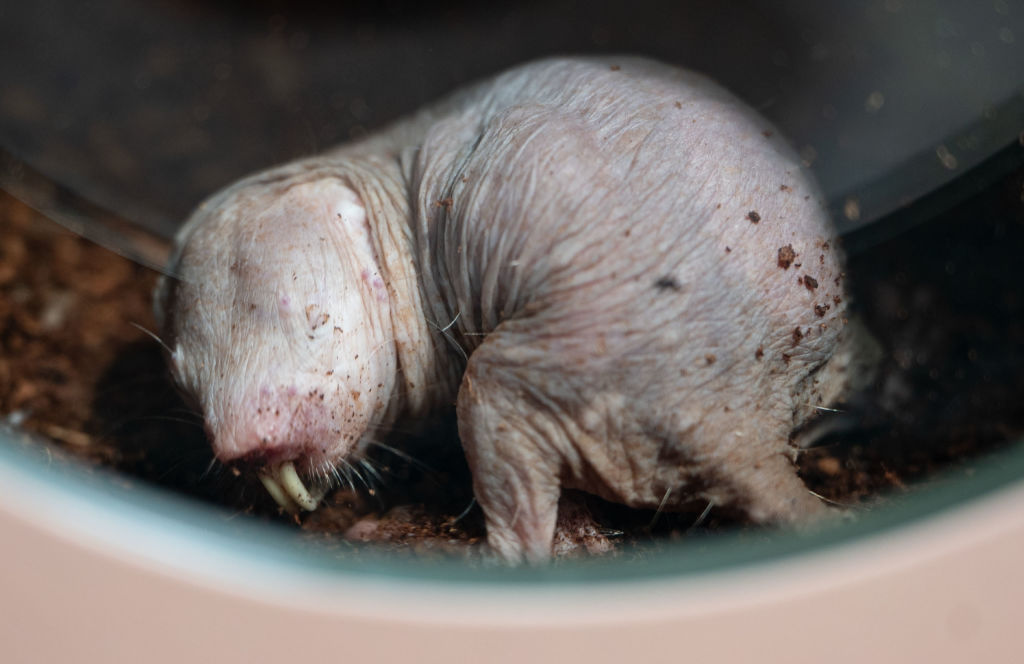
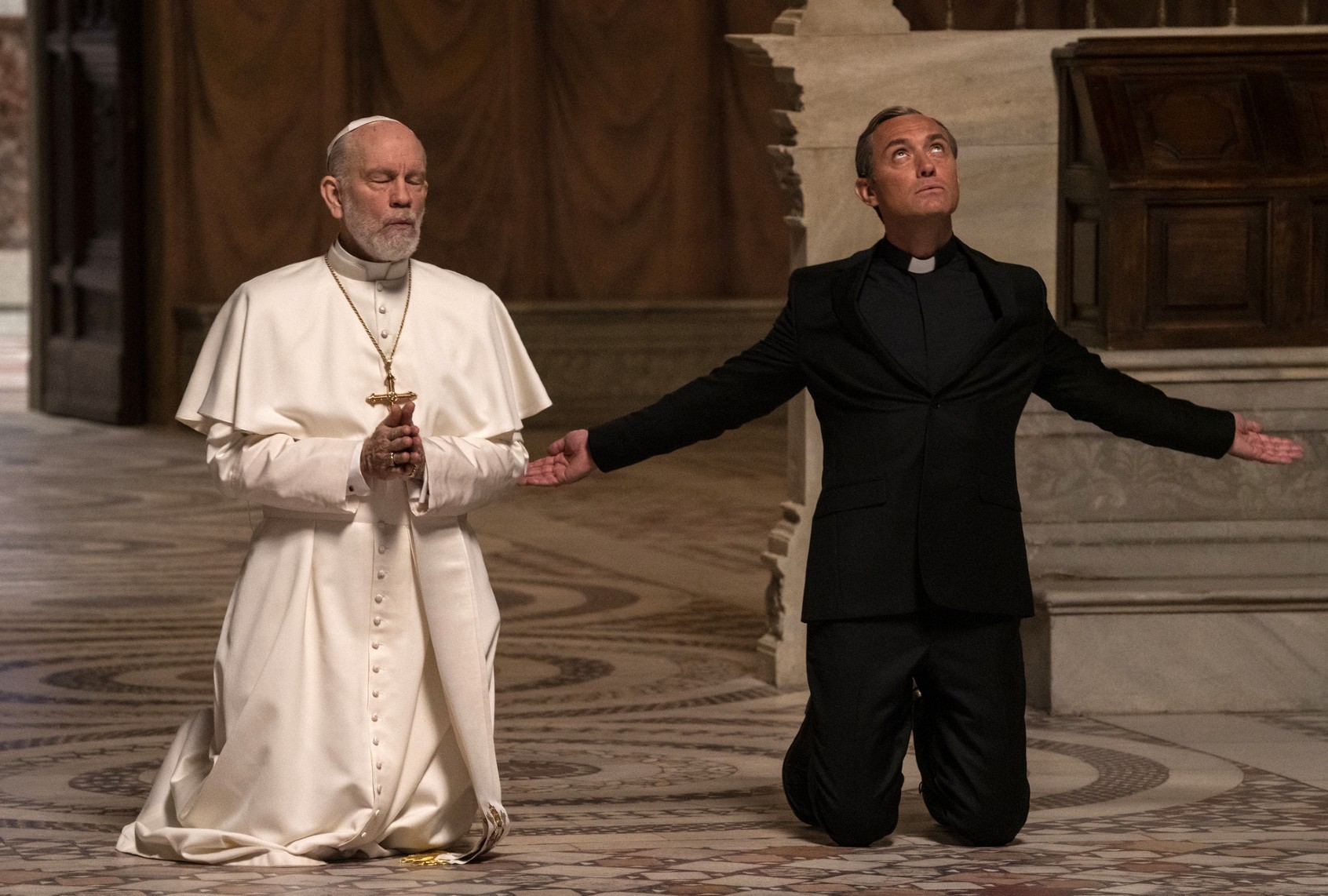
Other "ugly" moms are just as decent. Naked mole rats (Heterocephalus glaber) are more closely related to chinchillas and porcupines than to either moles or rats. They lack the adorable charisma of chinchillas, porcupines, moles or rats, though. And they lack fur to cover their wrinkly pinkish-grey skin. And their breasts are often asymmetrical (not, like, different cup sizes as is totally normal in human moms — naked mole rat moms often have odd numbers of mammary glands, such as 11 or 13.) And they have tiny, mostly useless little eyes, no ears, and a pair of huge incisors like a mastodon's tusks. Your momma.

A naked mole rat is seen in a display enclosure of a new building for small mammals, birds, carnivorous plants and insectivorous animals at the zoological-botanical garden in Stuttgart. (Photo by Marijan Murat/picture alliance via Getty Images)Indeed, these moms are yummy mummies only to the one to three males, or soldiers, with whom the single female, or queen, enjoys a long-term relationship while being cared for by a host of sterile workers, a family set-up that makes her unheard-of fertility, for a mammal, seem less daunting. The queen remains fertile throughout her long life, producing between three and nearly thirty pups in a single litter starting at one year of age — and living, and breeding, for another 29 years
Dr. Miguel Brieño-Enríquez, a researcher and assistant professor in obstetrics, gynecology and reproductive sciences at the Magee-Womens Research Institute in Pittsburgh, discovered that in naked mole rats — unlike in human or mouse females — the production of egg cells from germ cells takes place after the naked mole rat is born, giving the girl mole rat a very large reserve of eggs for her small size, and allowing for the continued production of egg cells for a still-unknown length of time.

The sociable, or eusocial, nature of naked mole rat communities means they're basically all siblings or cousins. They work together to defend each other, to share food, and to take care of the queen. Other than the odd fight-to-the-death among females to become the queen, these are famously cooperative creatures. These babies even share the mighty boob: breaking a "rule" of mammal biology, naked mole rats do not have just around half as many babies as they have mammary glands. They don't need to: the pups will happily take turns being nursed from the same mammary gland, and this devoted and well-cared-for mother spends plenty of time with each of her many, many beloved children.

Mom will nurse her pups for about a month, after which time they are packed off to a specific tunnel that serves as a nursery, where worker mole rats feed them till they're ready to feed themselves.

"Like in humans, there are good moms and other ones, let’s say with less skills. However, like in humans, the colony/family is there to help," Brieño-Enríquez wrote in an email to Salon. As it's been said, it takes a village.

I love you and you and you and you and you and you and you

The mamma centipede may have a face like a David Cronenberg nightmare, but she's a devoted parent, curling around the wriggly bits of multi-legged spaghetti she calls her offspring to protect them. And she is patient as she rears them. A study of a soil centipede (Geophilus serbicus) from the Balkan peninsula recently identified 15 different stages in the early lifecycle of the young creepy-crawlies, all of which, the authors note, are "obligatorily dependent on prolonged maternal care." It's not just Balkan centipedes who are good moms. Just over 25 years ago in Brazil, in the first field report of maternal care in neotropical centipedes, author G. Machado noted that not all centipede species exhibit parental care, and this behavior can't be studied in the laboratory, because the female is very sensitive to disturbances, abandoning her brood if attacked by fungi or predators.

Not an auspicious beginning to his study, but in fact, the entomologist found that in the neotropical species they studied in Brazil, "the female curls herself around the eggs or the young, laying on her side and enclosing the brood between her legs and the ventral surface of her body. As recorded for other centipede species, the eggs and the young are thus safeguarded from contact with the soil." True, he did note that in the event of disturbance, mama centipede may abandon her eggs or young. She might also eat them. Let she who has never wished to eat her offspring cast the first stone.

Assuming they're out of the egg and don't get abandoned, to themselves escape or bury themselves in sand, the observed centipedelings (technically called nymphs) enjoy loving maternal care. The mom may move them to a better location, and she grooms the little cuties, just as she groomed them when they were mere babes-in-eggs. In certain groups of centipedes, Machado writes, "this apparently increases offspring survival, because without the mother the eggs and nymphs always die from fungal attack or unknown reasons."

We need your help to stay independent

Machado notes that in arthropods, a group that includes the centipede, maternal care is associated with rough conditions. Arthropods ranging from earwigs to some beetles to crickets or spiders living in the soil face particular challenges due to nasty fungal infections and a high risk of predators lurking in leaf litter. This means that the survival of the species depends on the evolution of maternal care to protect eggs and nymphs from these dangers, and this may well be the reason for such devoted, if occasionally cannibalistic, mother love among certain centipedes as well. 

Beauty's in the aye aye of the beholder

Honestly, despite this strong slate of contestants, the aye-aye (Daubentonia madagascariensis) has got to win the Ugly Mom award. This mom from Madagascar is a scrawny lemur that comes out at night, has long clawed fingers and toes, a pseudo thumb, a narrow, bat-like face (with moderately boopable nose) and Yoda-like ears, a bushy tail, a round skull and oddly shaped jaw, and eyes with a persistent cross-eyed or wild-eyed appearance. 

Those fingers come with a long, skeletal middle digit equipped with a ball-and-socket joint for horrifying dexterity, like the Ghost of Christmas Yet to Come beckoning Ebenezer Scrooge to gaze upon his own sordid death. She uses it to tap fatefully on trees and listen for the tiny movements of tasty grubs within, which she then extracts using those same Nosferatu phalanges. Her sparse, wiry-looking fur sticks out in all directions as if she'd stuck that bony middle finger in an electric socket. She also has a pair of long, constantly growing incisors strong enough to chew through cinder blocks as well as tree bark. The aye-aye is endangered, its habitat fragmented and individuals, though rarely seen, sometimes killed because they are seen as bad luck.

But the aye-aye is also an excellent mother. She and her brood live high up in the trees, jumping from branch to branch and occasionally making exploratory sallies on the ground. She makes great round nests of leaves and teaches her offspring to eat wood-boring insect larvae and fruit, using those rodent-like incisors to break through hard skins or rinds to the sweet flesh inside. Like many primates, the aye-aye uses play to teach her babies everything they'll need to know to become independent.

She will also use that mobile, 3-inch-long middle finger to reach right into her nasal cavity almost all the way to the back of her throat. She does this in order to pick her nose, before licking the mucus, as scientists confirmed by observation followed by CAT scan to determine that the chopstick-like digit reaches all the way to the pharynx.

Surely, though, mama aye-aye teaches her infants that it's rude to pick their noses, and NEVER to eat the snot. Do as I say, not as I do.

Mama aye-aye has her little quirks and foibles. But like all ugly moms, she's the apple of her baby aye-aye's eye.

Nana bailed me out of debt — and I’m still ashamed

My grandmother regularly slipped me money — $10 here, $20 there — today in an envelope, tomorrow right into my palm. I was age 10 or 11, back in the early 1960s, so I had no complaints. Soon I was hooked, almost for life. 

All through high school, college and my first job, and then on through my marriage and the birth of our two children, my nana kept plying me with payouts, now $100 a pop, then more like $1,000.

I never had to ask for a cent. She would just extend her hand with some fresh currency, or a check would materialize magically in my mailbox.

I was already earning a living, more or less, and never really needed the supplementary funds. But hey, the infusions came in handy, and I saw no reason to say no.

Grandparents helping grandchildren financially — and generously — is nothing new or unusual. Almost all lend a hand on an ongoing basis, whether contributing to savings accounts, setting up trusts or defraying the costs of college tuition, medical bills and other expenses. Indeed, 94% of grandparents chip in, doing so with an average of $2,562 a year for each grandchild, according to a 2019 survey by the American Association of Retired Persons.

But in 1989 my finances went off the deep end. I had dug myself into debt by falling behind on back taxes, federal, state and city. I was in the hole for about $12,000. 

We need your help to stay independent

The fault belonged to nobody but me. By then I’d lived as a freelancer for about eight years and had started coasting. I’d earned about half as much income as the previous year and was now unable to fulfill my civic obligations. 

For the next eight years, as if submerging into quicksand, I sank deeper into debt. My wife and I watched our pennies. I took a part-time job, then finally went full-time. I worked six days a week and soon earned twice as much money as ever before. 

Still, penalties and late fees on my tax burden expanded exponentially. They took a toll, onerously so, like an undertow at the ocean shoreline that yanks you down into the muddy sand underfoot, and my debt more than quadrupled. At age 45, I now owed more than $50,000.

All I could manage to do on this most slippery of slopes was to pay down the debt on my debt. A day never passed without me fully aware that we now lived our lives squarely behind the eight ball. It looked like it could take me the rest of my life, however long that might be, to break even, if ever. 

At age 45, I now owed more than $50,000

Then in 1997, we struck a deal with the Internal Revenue Service, thanks to an arrangement called an Offer In Compromise. Taxpayers who demonstrate a clear inability to pay the full freight owed anytime soon can be negotiated as a recourse. The rationale is the IRS would rather have some of your money now rather than wait to get all of it much later. The amount would be $15,000, less than one-third of the debt owed and only $3,000 more than the original debt incurred eight years earlier. 

My grandmother paid it. And that was that.

Grandparents typically pitch in financially while grandchildren are young and then into early adulthood. But some research suggests that the older the grandchild, the less likely such support is to be given as generously and frequently. Grandparents may step into the breach if adult children are unemployed, receiving low wages or hit with an unexpected and expensive hardship.

Talk about turning points. In the 28 years since, I pulled a 180. I developed a more robust work ethic and was employed at global professional services firms, rising to senior management.

I always pay my taxes on time, too, along with all our other fiscal obligations, strictly avoiding any kind of debt. In due course, I rebuilt my credit rating. We even managed to save a few shekels and paid cash for our house in Italy. 

Nothing like a close call, a brush with doom, to scare you into staying on the straight and narrow. I learned my lesson, and then some.

Getting a handout ate into my pride, my sense of independence and my self-respect. To this day, I feel embarrassed and ashamed

Offering a lifeline can, and often does, strengthen the bonds between grandparents and adult grandchildren. Lowering financial stress generally promotes a sense of security. But getting help in your 30s, 40s and beyond can come at a price. It can foster guilt and create a dependency that discourages, delays and even deters a grandchild from developing an independent life.

Only now, all this time later, do I recognize that being spared the disgrace of bankruptcy and insolvency was a blessing and a curse. Getting a handout ate into my pride, my sense of independence and my self-respect. To this day, I feel embarrassed and ashamed. 

I let myself play the victim twice — first of the debt itself, then of the life preserver tossed to bring me back onboard. I’m still second-guessing my decision to accept the charity. Could I have saved myself? Should I have solved my own problem with a free-market self-correction?

I’ll never know. It’s probably just as well. And it no longer really matters.

Besides, as banks, airlines and automakers well know — whether it’s JPMorgan Chase, Delta or General Motors — bailouts are nothing new. I, too, was once the beneficiary of a bailout. Only mine just happened to come from my grandmother.

Trump might suspend immigrants’ rights to challenge their detention

The Trump administration might suspend immigrants' constitutional right to challenge their detention if the courts don't start cooperating, White House deputy chief of staff Stephen Miller said Friday. 

“That’s an option we’re actively looking at,” The New York Times quoted Miller as saying. “A lot of it depends on whether the courts do the right thing or not.”

The legal procedure, known as habeas corpus, can be suspended "in cases of rebellion or invasion" that threaten public safety, according to the Constitution.

Trump has tried to paint America as under attack from immigrants, but it's unclear if he can legally use this route to deport them. Habeas corpus has been used before, but "only in times of actual war or actual invasion, narrowly defined,” Ilya Somin, a professor of law at George Mason University, told CNN. 

Additionally, the Constitution “is almost universally understood to authorize only Congress to suspend habeas corpus,” Stephen Vladeck, a law professor at Georgetown University, told The Times. 

“The only reason why they would do this is because they’re losing” in court, he said.

Trump has railed against federal judges who have halted his aggressive approach. He has ignored a Supreme Court ruling that directed him to find a way to return Kilmar Abrego Garcia, an immigrant who was mistakenly sent to a notorious El Salvador prison. In a separate ruling, the Supreme Court blocked Trump from using the rarely invoked Alien Enemies Act to deport Venezuelans. Earlier this month, a Trump-appointed judge ordered all deportations in his Texas district to stop. Judge Fernando Rodriguez Jr., said the presence of Venezuelan gang members in the country can't be described as an “invasion” or “predatory incursion."

Trump told NBC's "Meet the Press" on Sunday that he didn't know whether noncitizens in the U.S. are entitled to due process, as the Fifth Amendment states. 

“I don’t know. It seems — it might say that, but if you’re talking about that, then we’d have to have a million or 2 million or 3 million trials,” he said. “We have thousands of people that are — some murderers and some drug dealers and some of the worst people on Earth.”

“I was elected to get them the hell out of here, and the courts are holding me from doing it,” he added.


Blessed be the memes, TV shows and “Conclave” for helping us welcome our first American pope

We are not serious people. Want proof? On the same Thursday that Cardinal Robert Francis Prevost became the first U.S.-born pope in history, Donald Trump tapped Our Lady of Box Wine to be the interim U.S. attorney for the District of Columbia.

This is not to say their titles are equivalent.

Jeanine Pirro’s scope of influence is primarily domestic, praise the Lord, while Pope Leo XIV, as Prevost will henceforth be known, holds global sway. Whether that’s a positive development is yet to be seen. By some accounts, he was a dark horse in a conclave race which many predicted would deliver unto us a Pope Pizzaballa.

Leo’s announcement gave us much more to be excited about in the short term, if only for the memes flowing forth like honey from the rock. Since he’s a native Chicagoan, there were the obligatory yuks about deep dish communion and Malört.  

Others couldn’t pass up the excellent wordplay opportunities, like comedian Josh Gondelman’s punchline: “I can't believe we have a pope from Illinois. People from Chicago usually hate the Cardinals.”

Leo’s announcement gave us much more to be excited about in the short term, if only for the memes flowing forth like honey from the rock.

There were the “it’s right there” jokes about Leo being a Chicago Pope, “one of the shows Jack Donaghy greenlit when he was tanking NBC,” quipped journalist Bobby Lewis.

Podcast host Ben Heisler gave Leo XIV the Chicago Bulls royalty treatment, setting Leo's debut on the balcony of St. Peter’s Basilica to the Alan Parsons Project’s “Sirius,” aka Michael Jordan’s theme.

And on Friday, the Chicago Sun-Times gave the ultimate benediction with its cover.

We don’t necessarily kid because we love (“The only American pope we recognize in this house is Olivia,” wisecracked Imani Gandy) but, maybe, because we have some imagining of the papal conclave’s (possibly catty) selection process thanks to, well, “Conclave.”

When the previously unthinkable becomes a reality, our first reaction is jokes.

While the multiple Oscar-nominated film (and winner for best adapted screenplay) didn’t exactly light multiplexes on fire when it was out, and quietly sat on Peacock for some time, it peaked as the 17th most in-demand movie globally the day after the Oscars before fading from the top 100 with the awards season’s afterglow.

Not long after Pope Francis died on April 21, "Conclave" rose again to become the third most in-demand movie globally once Prime Video made it available, The Wrap reports. Today, only “Another Simple Favor” is more popular in the U.S., where “Conclave” sits at No.2. Not even a bunch of bishops covering “Mean Girls” can outdraw Blake Lively.

But let’s not forget that years before Ralph Fiennes slipped into a cassock, filmmaker Paolo Sorrentino sneaked us into his version of the Vatican’s inner political sanctum via “The Young Pope” in 2017 and its 2020 sequel “The New Pope.”

John Malkovich and Jude Law in "The New Pope" (Gianni Fiorito/HBO)
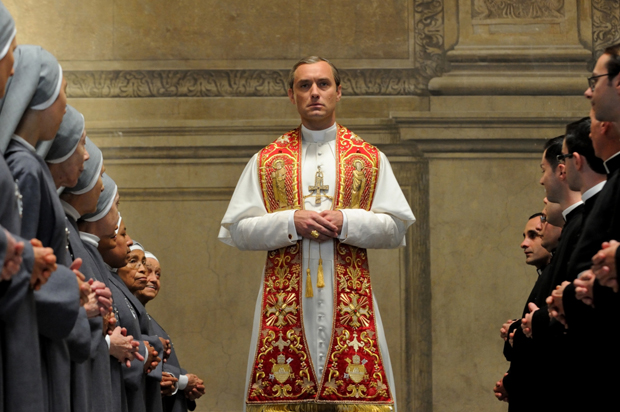
These rapturous visions may not have been universally appealing in their time, although that didn’t hamper the virality of “The Young Pope.” Like Leo, it begat a procession of memes solely based on our first glimpse of Jude Law as Pope Pius XIII, the fictional first U.S.-born pontiff, played by a British actor.

When the previously unthinkable becomes a reality, our first reaction is jokes. Eight years ago, the thought of a 47-year-old New Yorker named Lenny Belardo becoming pope was absurd.

Throw in Pius' strategy of flaunting his sexual magnetism while strategically withholding it from the masses ("Absence is presence," he preaches); his unapologetic smoking habit; and his petulant demands for Cherry Coke Zero. It's no wonder that “The Young Pope” soon became a coarse fascination.

Questions abound as to what kind of pope Leo will be, which we’ll only find out once he’s settled into the position. He’s the 267th pope, but only the third Augustinian, an order described by National Geographic as being known for pastoral care, education and missionary work. 

In his first formal address to Roman Catholic cardinals on Saturday, Leo vowed to continue Pope Francis' missionary direction, highlighting objectives that his predecessor listed in his 2013 pronouncement “Evangelii Gaudium,” or the Joy of the Gospel. Leo specifically emphasized “growth in collegiality,” “popular piety,” a “loving care for the least and the rejected,” and “courageous and trusting dialogue with the contemporary world,” according to The New York Times.

Before he was a man of the cloth, Prevost was a Chicago South Sider. His brother confirmed in an interview with the city’s local station WGN-TV that he is a White Sox fan, refuting early heresy claiming he roots for the Cubs, aka Satan’s Stickballers.

What matters to the Second City and the United States means little to a global audience likely to draw great significance from his naturalized Peruvian citizenship, which he obtained in 2015. Leo worked for a decade as a missionary in Trujillo, Peru, before serving as a bishop of a different Peruvian city, Chiclayo. The apparent hope is that Leo might unify the Americas, which have the highest concentration of the world’s Catholics.

The number of people who watched Sorrentino’s series when it aired on HBO or saw “Conclave” when it was in theaters is piddly compared to the number of Catholics worldwide, a 1.4 billion-strong flock. Its faithful have a keen interest in knowing what kind of man will be leading the Church until he dies or resigns, as Pope Benedict XVI did in 2013.

So do many non-Catholics, especially now. Recent TV shows and movies might bridge that knowledge gap for better or worse. Where “Conclave” removed some of the spiritual mystery from the process of selecting a new pope, reducing it to a matter of geopolitical pragmatism, “The Young Pope” shows the pontiff can be susceptible to the intoxicating effects of power as any mere mortal.

Today it provides a different and perhaps more informed viewing experience than when it first premiered. In 2017, there was no reason to suspect the Vatican would undergo a political shift. Instead, Law’s chiseled abs and insouciant grin were the secondi piatti following the generous serving of Andrew Scott’s Hot Priest on “Fleabag.”

But Pius' appeal extends beyond the carnal. “The Young Pope” paints him to be politically devious and as dangerous as any godless politician, a description more fitting than we’re initially shown.

The Young PopeJude Law in "The Young Pope" (HBO)

With a backstabbing cardinal like the Vatican’s Secretary of State Angelo Voiello (Silvio Orlando) employing his version of coercive statecraft, shrewdness is essential. But then, Sorrentino conceived Pius as a conservative hardliner who would have favored brute force anyway. He surrounds himself with loyalists, starting by appointing his lifelong confidante and surrogate parent, Sister Mary (Diane Keaton), as his personal secretary.

 “The Young Pope” was a fitting accompaniment to the first Trump era’s dawning, having premiered days before that inauguration. Sorrentino didn’t intend for his drama to meet that moment, but circumstances turned out that way.

“It is true that inherently there are some analogies that come out between the conservative ideas of this pope, and some of the conservative ideas that are emerging in some of the Western countries,” he said when Salon interviewed him back then, adding, “At the base of this character, the question I ask myself is, what could be the pope of the future?”

Many of us are asking some version of that right now.

We need your help to stay independent

At 69, Leo is by no means a young pope, and nothing like Law’s hardcore conservative pontiff. Still, many wonder what to make of him.

Progressives cheered his announcement based on his papal name choice, an homage to Leo XIII, who was pope between 1878 to 1903. Leo XIII authored “Rerum Novarum,” an encyclical on capital and labor that marks the first time the Church affirmed workers’ dignity and the right to unionize.

Further boosting those hopes are past posts on an X account believed to be Leo's that criticize Vice President JD Vance (“JD Vance is wrong: Jesus doesn't ask us to rank our love,” one reads), and others, like a reposted article about Francis’ recent letter to US bishops describing mass deportations as a major crisis “damaging the dignity of many men and women,” and of entire families.

These and other emerging details about Leo made some MAGA influencers blow their tops. Although Turning Point USA’s founder, Charlie Kirk, posted as close to a “let’s wait and see” opinion on X, hoping that Leo wouldn’t advocate for “open borders,” fellow right-winger Jack Posobiec lamented, “God save the Church.” That was a good deal more measured than Islamophobic Trump sycophant Laura Loomer, who became a meme herself by text screeching, “WOKE MARXIST POPE.”

Notwithstanding these fears, the new pope isn’t quite the same as Sorrentino’s titular “New Pope” either. The 2020 drama casts John Malkovich (another Illinois native, and charter member of Chicago’s Steppenwolf Theatre Company) as British nobleman and theocrat Sir John Brannox.

John Malkovich in "The New Pope" (Gianni Fiorito/HBO)
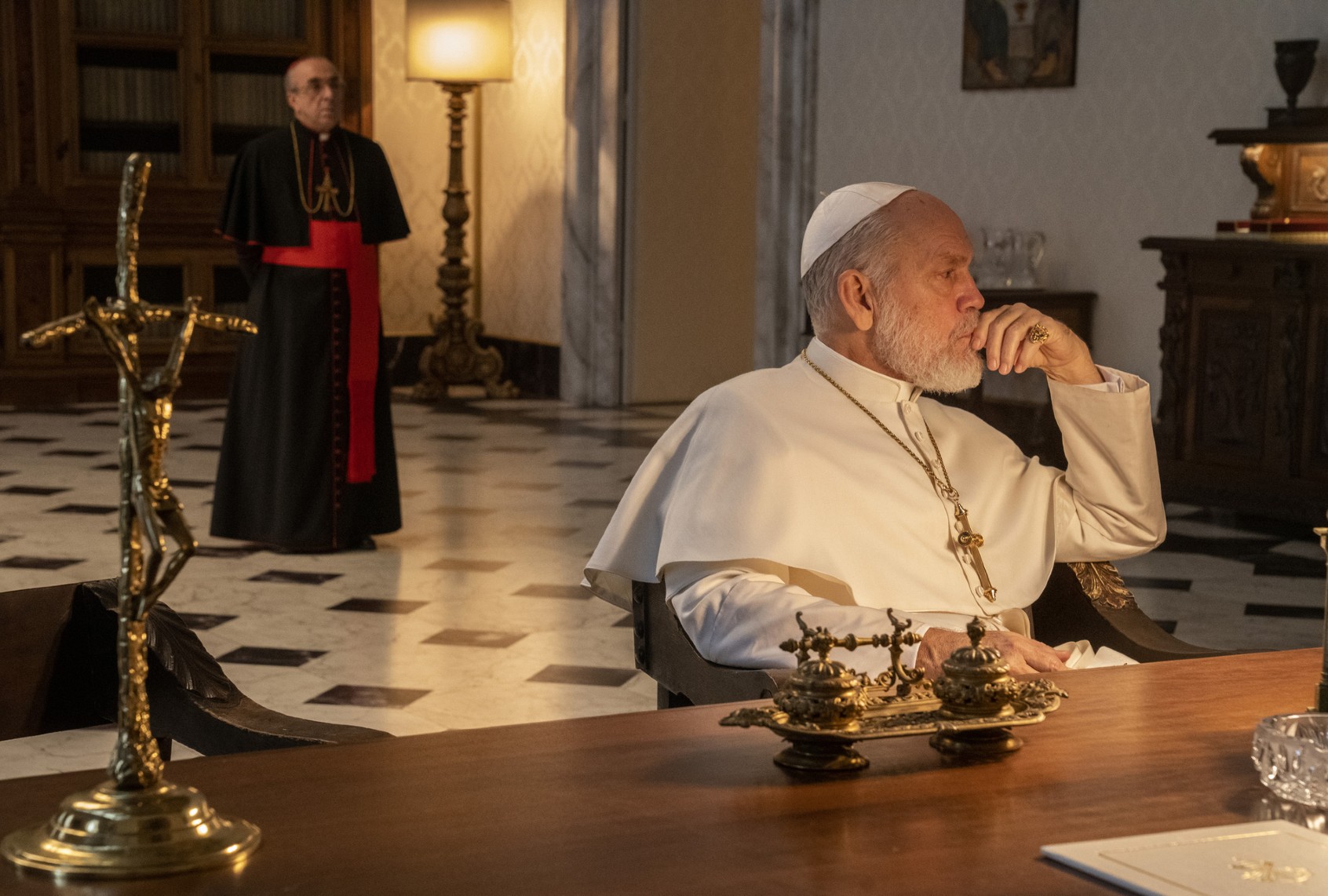
Historically speaking, Malkovich’s Brannox, who takes the papal name Pope John Paul III, would be as much of a rarity as Lenny Belardo, since there hasn’t been a British pope since Nicholas Breakspear's mid-12th-century reign as Pope Adrian IV. But we do not know whether Adrian shared his fictional counterpart John Paul III’s centrist vision.

Preaching his “middle way” uplifts the spiritually marginalized and appeals to a broad constituency. He even flirts with advocating for marriage equality after meeting with Sharon Stone, although he doesn’t admit that in her presence, and with a roomful of priests bearing witness.

“When will this pointless taboo be eliminated?” Stone asks about gay marriage for Catholics.

“When the Church has a brave, revolutionary, resolute pope – qualities none of which I possess,” he says.

So it is expected to be with Pope Leo XIV, who The New York Times reports in 2012 said in an address to bishops that Western media and popular culture cultivates “sympathy for beliefs and practices that are at odds with the gospel,” citing the “homosexual lifestyle” and “alternative families comprised of same-sex partners and their adopted children.”

CNN reports he has also drawn criticism from the Survivors Network of those Abused by Priests over his alleged mishandling of two cases involving priests accused of sexual abuse: one in Chicago in 2000, and another in Peru in 2022.

On Thursday, Leo’s introductory greeting struck a similarly centrist tone to that of Malkovich’s Il Papa. After he praised the memory of Pope Francis, Leo said, “God loves us, God loves you all, and evil will not prevail . . .The world needs his light. Humanity needs him as the bridge to be reached by God and his love. Help us to build bridges with dialogue, to always be at peace. Thank you, Pope Francis.”  

The world doesn’t lack coverage of the papacy or the Vatican. Popes make headlines whenever they address political issues during masses or in proclamations. Francis certainly did by meeting Vance in April — whose political views he did not approve of — and dying shortly thereafter.

Given the present political atmosphere, it’s easy to comprehend why the machinations surrounding this papal conclave were more of a culture-wide watch today than they might have been last autumn, let alone eight years ago.

Now that the world’s superpower is behaving like some ungodly blend of fascist state and playground ruled by bullies, the naming of an American pope has universally political implications. If we are not serious people, Trump is unserious to a sacrilegious degree. He even allowed the White House’s social media trolls to release a meme of him decked out as a gaudy pontiff within days of attending Francis’ funeral.

Silvio Orlando and John Malkovich in "The New Pope" (Gianni Fiorito/HBO)

But the late Pope Francis’ condemnation of Trump’s anti-immigration policies has a different weight coming from an Argentine than the same will have from a fellow American to whom 53 million Catholics may demonstrate some loyalty. When an amoral American president is proudly tanking his country’s international reputation, a centrist American pope’s rebuke could be politically deleterious.

Now that the world’s superpower is behaving like some ungodly blend of fascist state and playground ruled by bullies, the naming of an American pope has universally political implications.

Then there’s this observation from Robert Barron, bishop of the Diocese of Winona–Rochester in Minnesota, and an appointee to Trump’s newly created White House Commission on Religious Liberty. To CBS, he quoted one of his mentors as saying, “'Look, until America goes into political decline, there won't be an American pope.' And his point was, if America is kind of running the world politically, culturally, economically, they don't want America running the world religiously.”

On Thursday, the Holy See replied with its version of, “Thou shall not tempt us with a good time.” At least that’s how we’re choosing to see it,  while taking in the fanciful speculations wrought in “Conclave” or Sorrentino’s dramas. As Malkovich’s John Paul muses aloud to Sharon Stone in “The New Pope,” perhaps life passes, but art remains.

Good thing too – memes are perishable, but worthwhile art has a long enough shelf life to inform our changing world. Even this comes with a warning, Stone tells Malkovich’s pope.

“Art passes too,” she says, “but a little more slowly, because art is more cunning.”

"Conclave" is streaming on Prime Video. "The Young Pope" and "The New Pope" are streaming on Max.

Prince Harry’s estrangement isn’t unique: Here’s how to negotiate cutting family ties

"I would love reconciliation with my family." It's a poignant statement from anyone dealing with family estrangement, but one that carries particular candor when it's coming from a prince. In a recent interview with the BBC, Prince Harry acknowledged that his father, the king, "won't speak to me," and expressed the belief that "there's no point continuing to fight any more." It was a vulnerable confession from the most rogue royal, whose wife, Meghan, has a similarly volatile relationship with her own father. But while family fractures like Harry's can undoubtedly be a source of deep pain, plenty of us also know that sometimes, having a continent between your relatives and you is just fine. 

One-quarter of Americans say they have cut ties with a family member.

The maxim that blood is thicker than water may hold true in a laboratory viscosity test, but human relationships are far more complicated, and estrangement is commonplace. A 2020 study by Cornell professor Karl Pillemer found that over one-quarter of Americans say they have cut ties with a family member like a parent or sibling. Most of Pillemer's respondents reported feeling "upset" over that state of affairs, and honorary American Harry, who's also on the outs with his brother William, seems to be among them. In his 2023 memoir "Spare," he said that the "door is always open" but that the "ball is in their court." The stakes to Harry now undoubtedly feel higher, with his father's cancer diagnosis and ascension to the throne. "I don't know how much longer my father has," Harry told the BBC of the 76-year-old monarch.

I've experienced estrangement in my own family, and in entirely related disclosures, have also obtained a degree in conflict resolution. And what I've learned from my experience and education is that conflict is healthy and that resolution doesn't always mean one big happy family.

In negotiation, we talk about best alternatives to negotiated agreements and worst alternatives, BATNAs and WATNAs. The concepts boil down to, if this conflict can't be worked out agreeably — and that may be because one side refuses to engage — what are my other options? 

King Charles Princes William HarryPrince Charles, Prince of Wales, Prince William, Duke of Cambridge and Prince Harry tour a tunnel made during WWI during the commemorations for the 100th anniversary of the battle of Vimy Ridge on April 9, 2017 in Lille, France. (Pool/Samir Hussein/WireImage/Getty Images)Taylor Swift's dispute with Scooter Braun is a good example of a BATNA. When she wanted to buy the masters of her first six albums from her former label, Big Machine, their terms for her to do so were unacceptable to her. So she started rerecording and rereleasing them on her own, creating an outside-the-box plan that didn't involve them.
In the case of family estrangement, if all sides involved are open to clearly and honestly articulating what they want from their relationship and why they want those things, there can be a path forward if those positions and interests align. Estrangement doesn't have to be all or nothing, either. Without necessarily formalizing the terms, families regularly work out a spectrum of options and boundaries around how much contact to have with each other. However, as is evidently the case with King Charles and Prince Harry, if one or both sides aren't invested in any reconciliation, it's up to the estranged parties to explore what their best and worst outcomes look like on their own. 

We need your help to stay independent

Back when I was navigating through the years of my mother's disappearing act, wishing that she was the kind of parent who would answer my calls, I had to learn to embrace the wisdom that "sometimes you have to get closure all by yourself." I recognized it the first time I read the passage in Cheryl Strayed's "Wild," in which she tells her therapist, "Imagine my life if I'd been raised by my father," and he counters, "Imagine your life if you'd had a father who loved you as a father should." I can't think of an exchange that better encapsulates the difference between a best-imagined option and a best-attained one. When a parent can't or won't love a child as they should, having them out of the picture may be as good as it gets.

There are a multitude of reasons that families crack apart. Sources within the palace have told the press that Charles is avoiding his son because he doesn't want to be drawn into Harry's legal battles with the palace over his security detail. The king has conspicuously found himself "too busy" to see his own son on Harry's periodic recent trips back to the United Kingdom, but the conflict between them and the seemingly conditional nature of their relationship goes back years. Harry didn't call his memoir "Spare" for nothing — in it, he writes, "I was the shadow, the support, the Plan B. I was brought into the world in case something happened to Willy…. This was all made explicitly clear to me from the start of life's journey and regularly reinforced thereafter." 

"The scapegoat is not only the one who's perceived to be the villain of the family, but their truth-telling is perceived as betrayal."

As Eamon Dolan, the author of the new book "The Power of Parting: Finding Peace and Freedom Through Family Estrangement," noted to me recently, "Dysfunctional families are driven into a specific set of roles," which can include abuser, enabler, golden child and scapegoat. So what happens when a spare doesn't want to play the part any longer? "I believe Harry falls very much into that rubric," Dolan said, "because the scapegoat is not only the one who's perceived to be the villain of the family, but their truth-telling is perceived as betrayal." 

And in the negotiation of family dynamics, demands for compliance, whether spoken or unspoken, are a common bargaining chip. The price of disagreement can be ostracism. Dolan told me that, "This notion is thrust upon us that family is some sort of absolute, that you can only love them in one way, and that way is by putting up with whatever they make you endure. That's not true." It's also just a bad deal.

At least for now, Charles and Harry have made what looks like a clear choice to cut ties, while William appears painfully still in the thick of it. And if you've ever worn yourself out talking to a brick wall, you'll have eventually come to the sobering realization that the wall isn't going to answer you.

Estrangement, whether it's because a family member has cut ties or you've made the difficult decision to do so yourself, can be heartbreaking. Those primal, instinctive bonds pack a wallop when they're severed. But estrangement can also make space for cultivating more nurturing relationships, breaking cycles of dysfunction and modeling healthier dynamics for our kids. In a case like Prince Harry and his family, sometimes the best available outcome of a difficult problem is only possible when the other party won't even come to the table.

Turn these spring vegetables into vibrant, tangy snacks

Spring, our season of new beginnings, fresh flowers and delicate produce, when the Earth tilts back towards the sun (in the Northern Hemisphere anyway), days grow longer, and warmer temperatures call Nature from its slumber.

I notice myself tilting towards the sun, like a sunflower — I lift my own chin to it and feel a kinship to the green and growing plants around me. Following their lead, shedding the last of my winter sluggishness and enjoying the life-giving pleasantness of our spring weather this year, I too am energized, moving faster, awake and inspired. 

I have tapped into May’s daring, vibrant energy and am ready to join my fellow great and small creatures hopping, darting, buzzing, singing, creating, night calling, yawling and howling at the moon (I am speaking metaphorically on some of that.)

I am also charmed by the vegetables currently making their debuts: tall and tender asparagus; bright, piquant, peppery radishes, sweet beets, so many varieties of precious plump peas, shoots, ramps, sprouts, lettuces, and lush, aromatic herbs. April and May gardens are some of the happiest, and their harvests beg for exactly what I am craving: simpler, cooler, more delicate preparations.

Salads, lightness, fresh vinaigrettes, citrus, honey — it all makes me want to pack a picnic. 

One of my latest obsessions tantalizing my taste buds and absolutely glorifying the best of spring flavors is Green Garden Pea Dip. Made with fresh or frozen peas, handfuls of herbs, lime juice, zest, and scallions, this versatile, gorgeously green, chunky mash brings life and excitement to everything on your spring crudités platter. Spooned into lettuce cups or piled onto sliced tomatoes, spread across endive leaves or baguette, and topped with salty Kalamata olives and a swirl of sharp, extra virgin olive oil, it is nothing less than exhilarating.    

The second I cannot get enough of is Quick Pickled Asparagus. Fresh asparagus first gets a blanch, then an ice bath, before taking a relaxing soak in an old-fashioned tasting, bread-and-butter pickle type of marinade. Serve with deviled eggs, or include with your favorite charcuterie, or all alone as a side dish; your table full of tried-and-trues get a Spring refresh with little more than a snap of your fingers.      

Before I leave you to rush out for what you need to make these two wonderful dishes, which I admit is what I envision happening every time I share what I currently am making, I want to say that I hear myself romanticizing this current season, talking of spring days like they are all picture-postcard perfect. I know too well, how unpredictable spring weather can be — capricious even — with sudden violent storms and winds that shake the rafters. It is just that the pretty days are so very spectacular and I cannot help but share how they carry me to a happy state of mind. 

We need your help to stay independent

I get that despite the beauty I see and the joyful sounds I hear outside in my own backyard, nature is brutal. I understand all too well that “my” birds and all the other critters who call my home their home — at least part of the time — are constantly moving about in and around danger, trying to survive, reproduce and protect their offspring. I admit I look away. I try hard not to see so many things that are part of the cycle of life. 

I am also not forgetting the dreaded tree pollen. Although it is no longer the thick yellow blanket of sticky goo as it was a couple of weeks ago, it can take you out of your outside game entirely, sending your hay fever into overdrive, and making it impossible to enjoy the outdoors. But despite it all, I find myself returning to the role of encourager, passionately speaking to the magic of this season. 

I say, find a way to work through whatever obstacles present themselves. Grab a box of Kleenex and keep your rain boots handy. Take something, if you have to, to stop your drippy nose and soothe your red, watery eyes, pay attention to the weather forecasts, put your blinders on to avoid seeing the harsher realities out there in the natural world that, unfortunately, we just cannot prevent  but get out there. Take every opportunity.

Dash out on every good and lovely day you can to bask in this most beautiful and abundant spring season.           

Spring Garden Pea Dip
Yields
2 cups
Prep Time
15 minutes

Ingredients

2 cups fresh or frozen green garden peas

2 green onions, green and white parts

1 1/2 cups (large handful) fresh cilantro leaves

Juice of 1 to 2 limes, plus zest of one 

2 to 3 tablespoons olive oil, plus more to drizzle before serving

Salt and pepper

Optional: pitted and halved Kalamata olives 


Directions

  1. If using fresh peas, blanch them in boiling salted water and move immediately to an ice bath. Once cooled, drain and set aside.

  2. In a food processor, place fresh herbs, green onions, citrus juice, zest, 1 to 2 tablespoons olive oil and salt and pepper. Pulse gently just to combine. Don't over-process!

  3. Add peas, plus another drizzle of olive oil, if needed. Pulse to mix, but keep chunky, some peas may even stay whole.

  4. Scrape into a bowl, adjust salt and pepper and add additional citrus juice if needed. 

  5. Add pitted and halved Kalamata olives to the top or around the sides and drizzle with additional olive oil. 

  6. Serve on sliced baguette, sliced tomatoes, endive, radishes, celery sticks, and other prepared raw vegetables. Or spoon it on top of hummus, guacamole and other dips. 


Cook's Notes

Although the version above is my favorite, try a Lemon, Mint and Feta version by swapping out the cilantro, lime, and Kalamata olives for lemon, fresh mint and feta cheese.

Quick Pickled Asparagus
Yields
4+ servings
Prep Time
5 minutes (plus 6 to 8 hours chilling time) 

Ingredients

1 bunch fresh asparagus, thinner stalks preferred

1/4 cup sugar

1/2 teaspoon salt

1/4 teaspoon celery seed

3 to 4 whole cloves

1 cinnamon stick

1/2 cup apple cider vinegar


Directions

  1. Wash and remove hard ends of asparagus, then blanch in boiling, salted water for no more than 3 minutes, just until very green and a little tender. Immediately transfer to ice water bath until cooled.
  2. Drain and place in a shallow container that will hold asparagus spears in a thin layer so that marinade will mostly cover.
  3. In a small saucepan, heat 1/4 cup water along with sugar, salt, cloves and celery seed.
  4. Bring to a simmer and stir until sugar dissolves. Turn off heat and add vinegar.
  5. Pour marinade over asparagus.
  6. Cover and refrigerate overnight.
  7. To serve, drain off marinade and arrange on a platter or pack for a picnic.

Cook's Notes

There is no law stating a maximum number of hours for which these pickles should remain marinading. If you prefer a stronger flavor, let them stay a while longer!

“I didn’t do anything wrong”: New Jersey mayor released after arrest at ICE center protest

Newark, New Jersey Mayor Ras Baraka has been released after being arrested by federal officials at a protest outside an immigration detention center in the city.

Baraka was held in custody for five hours on Friday before he was let go around 8 p.m., The New York Times reported. “The reality is this: I didn’t do anything wrong," he told around 200 supporters waiting for him, per CNN.

Baraka, a Democrat running for governor of New Jersey, has objected to the opening of the 1,000-bed facility that is part of the Trump administration's plans to ramp up the deportation of immigrants. Baraka and city officials have said the privately-run center is operating without a valid certificate of occupancy. Federal officials and the company running the facility said it has the proper permits. 

Alina Habba, interim U.S. attorney for New Jersey, posted on social media that Baraka trespassed on the property's secure area and didn't listen when federal personnel told him to leave. 

He was trying to enter the facility with three Democratic members of New Jersey's congressional delegation — Reps. Robert Menendez, LaMonica McIver and Bonnie Watson Coleman — who said they had the right to inspect the facility. 

A Homeland Security official told Baraka he couldn't enter the facility because he wasn't a member of Congress, according to a video shared with The Associated Press. Baraka then joined a group of protesters at a public area outside the front entrance gates, where he was arrested by masked federal agents wearing military fatigues, The Times reported. 

“What’s happening now in this country, everybody should be scared of,” Baraka said after his release, per The Times. “They’re using the courts. They’re using everything else to justify what they’re doing.”


Why the Democrats are still stuck in the past

As opposition to Donald Trump’s autocratic regime has intensified — with a majority of Americans now seeing him as a dictator — it’s been widely noted that the most important difference between elected Democrats isn’t whether they’re “progressive” or “moderate,” but whether they’re willing to fight.

But behind these two distinctions there’s a more important one, the distinction between present-oriented and future-oriented behavior, which provides insight into the Democrats’ longstanding problems and how conservative Republicans have exploited them for decades — a dynamic that ultimately brought us Trump. 

I’ve been perplexed for decades by this paradox: The Democratic Party has brought us every major policy advance since at least the New Deal, but is now the party most firmly wedded to status-quo, poll-tested politics. The Republican Party, while growing  increasingly radical and backward-looking, is far more focused on creating fundamental change, if only to return America to an imaginary past golden age. 

A light bulb went off recently while I was reading Dan Davies’ “The Unaccountability Machine(interview here). It’s about that  same tension between present and future orientation, which Davies argues is present in virtually every organization, as described by the Viable Systems Model developed by Stafford Beers. The VSM model describes systems at five levels: The first three dealing with things as they are, the fourth deals with future possibilities and the fifth deals with the tensions between those orientations. 

This was my Eureka moment: Democrats completely lack both fourth- and fifth-level systems, while Republicans don’t. This dovetails perfectly with the party differences described in Matt Grossmann and David Hopkins’ 2016 book "Asymmetric Politics: Ideological Republicans and Group Interest Democrats" (review here), which I'll return to below.

The five-system model: What Democrats are missing

Here’s a quick overview of the five levels described by the VSM. The most basic is operations,  the part of the system that interacts with the outside world. The next is regulation, which organizes operations to “make sure people don’t bump into each other,” as Davies put it. The third level is optimization, dedicated to achieving specified specific goals as efficiently as possible.

Then we get to the fourth system, which makes the system viable over the long term, and capable of responding to unanticipated shocks. That one is "intelligence," devoted to understanding how the environment is changing and may change in the future, and how best  to cope with that. This creates a tension, as Davies describes:

You can't fail to respond to the outside environment, but if you try to restructure too rapidly or you change things too much, you break the organization. So you need an ultimate court of appeal to balance the here-and-now with the future and the outside. 

That’s the fifth level, which he calls “identity” or “philosophy,” because managing the balance of present and future — balancing the information you have now with information you don’t yet have — is how the organization’s identity is defined. 

Those last two are what Democrats don’t have. The party as an organization is almost entirely focused on the first three levels, with no coherent focus on the future, and thus no experienced need to reconcile present- and future-orientations. I’m not saying Democrats don’t have ideas about the future; they do. But they are forever putting new wine in old bottles, and that’s the fundamental source of the Democrats’ recurring problems, from high-level failures of issue-framing and communication to nitty-gritty organizing failures typified by the feckless abandonment of the 50-state strategy. I’ll cite some examples of how this manifests.

Radical asymmetry: Democrats and Republicans aren't alike

The VSM model dovetails perfectly with the explanation offered in “Asymmetric Politics,” where Grossmann and Hopkins provide a wealth of data to support the differences they see between the two parties: Democrats focus on concrete solutions (those involving VSM systems 1, 2 and 3) while Republicans are obsessed with conservative ideological purity (system 5) — which, I would argue, produced Trump as its unintended end-product (after George W. Bush was labeled as “globalist" and John McCain somehow became a snowflake liberal). 

The Democratic Party, they write, “fosters a relatively pragmatic, results-oriented style of politics in which officeholders are rewarded for delivering concrete benefits to targeted groups in order to address specific social problems.” By contrast, Republicans “forge partisan ties based on common ideological beliefs, encouraging party officials to pursue broad rightward shifts in public policy." 

I've been perplexed by this paradox for decades: The Democratic Party has brought us every major policy advance since at least the New Deal, but is now the party most firmly wedded to status-quo, poll-tested politics.

Of course both parties can pursue policies that benefit targeted constituencies. But Democrats typically do so in highly pragmatic terms — a problem needs to be solved, and doing so the right way will help the nation as a whole — while Republicans do so in morally absolute terms, judging who is worthy and who is virtuous. Despite Trump’s chaos and evident corruption, this distinction still serves, but my focus here is on the Democrats and why their lack of systems four and five is a fundamental problem.

The New Deal base of the Democratic Party was largely served by economic programs, while new demands emerged in the 1960s and ‘70s — civil rights, feminism, environmentalism, etc. — which are sometimes called "post-materialist." That’s partly true but also misleading: Those issues emerged from changing material conditions, and reflected the needs, values and demands of material, identifiable groups.

That tension can be understood in terms of serving competing groups (a system 3 management problem) or as a tension between systems 3 and 4, as new demands move the party in new directions. Party officials and organizers who see it exclusively as a present-tense problem are missing something, because there's no coherent and functional system 4. Future-oriented thinking only happens among discrete groups within the party, who then must contend with other groups trying to do the same thing. That's seen as a system 3 problem, coordinating competing demands to achieve an optimal outcome, which is almost always about winning the next election. That’s a poor excuse for long-term thinking.

On the other side is the GOP, an intensely ideological party with much more coherent system 4 and 5 functions. Its goal for generations has been to undo the New Deal,as well as the entire civil rights era. It engages in system 4 thinking all the time, in terms of how to erode the Democrats’ power and gain more for themselves. Republicans consistently convey messaging that fits their long-term goal, portraying Democrats as recklessly pushing for dangerous system 4 changes driven by alien system 5 ideologies — socialism, Marxism, “radical feminism,” etc. — while portraying themselves as defenders of “real America,” tradition and the Constitution. They’re the party of “personal responsibility," “family values" and “personal freedom," regardless of whether the policies they push actually align with such claims.

Generations of conservative attack 

When Republicans finally regained the White House under Dwight Eisenhower after 20 years out of power, he concluded that the GOP dream of undoing the New Deal was unrealistic. In a letter to his brother, Ike wrote: “Should any political party attempt to abolish social security, unemployment insurance, and eliminate labor laws and farm programs, you would not hear of that party again in our political history.” Then he mocked the “tiny splinter group … that believes you can do these things. … Their number is negligible and they are stupid.” 

Well, the “stupid’ and “negligible” folks have made quite a comeback since then, beginning with Barry Goldwater’s 1964 presidential campaign. There are many ways to tell that story: I recommend Rick Perlstein’s series of books — “Before the Storm,” “Nixonland,” “The Invisible Bridge” and “Reaganland” — while Kim Phillips-Fein’s “Invisible Hands: The Businessmen's Crusade Against the New Deal” recounts how the seeds were planted decades earlier. My purpose here is best served by Angie Maxwell and Todd Shields’ “The Long Southern Strategy” (interview here), which traces the GOP’s strategic identity-based attacks, meant to counter the purported threats advanced by Democrats. 

That began with race, of course, but that wasn’t enough. “Only by striking at the heart of Southern white identity,” the authors write, “could they hope to overcome the allegiance that [Jimmy] Carter, as the first true southern president since secession, would surely rebuild”:

Nixon’s initial race-based Southern Strategy could only take things so far. Jimmy Carter and Bill Clinton both managed to buck the tide it influenced. It was the second gender phase of the Southern strategy that helped unseat Carter, as abortion and Phyllis Schlafely’s anti-ERA crusading helped further reshape the landscape. 

Religion also had to be brought into the mix, which involved a massive purge of the Southern Baptist church, effectively turning that demonination’s moral and theological identity upside down, as Maxwell and I discussed: 

[T]his was a complete transformation of the Baptist faith. It was very individualistic, non-hierarchical — the individual's relationship with God — and it was turned into the pastor telling believers what to believe, with the national organization over them. It just seemed to completely violate not just the Christian spirit, but the specific doctrinal nature of Baptism.

“Trump is not an anomaly,” Maxwell told me. “He’s the product of a really long counterrevolution” that involved future-oriented system 4 direction and was guided by a clearly articulated system 5 conservative identity. 

Throughout that history, there was no coherent Democratic response, no system 4 strategy and absolutely no system 5 identity or philosophy. That wasn't because no potential strategies or philosophies were available; it was because the necessary systems simply didn’t exist. 

The Democrats' missed opportunities 

The first such opportunity became visible in data from the 1964 election cycle, analyzed in Lloyd Free and Hadley Cantril’s 1967 book “The Political Beliefs of Americans,” which I've written about many times over the last decade. Their focus was ideology, not partisan identity, but the asymmetry they discuss was virtually the same. 

More Americans identified as conservative than liberal, they found, although there was supermajority support for liberal big-government programs. What’s more, while half the population qualified as ideological conservatives, two-thirds were “operationally liberal,” meaning they supported stable or increased federal government spending on education, housing and urban renewal, favored Medicare and agreed that government should fight poverty. Most strikingly, 23 percent were both ideological conservatives and operational liberals, and that proportion was doubled in the Deep South states carried by Goldwater — precisely the targets of the Long Southern Strategy.

Republicans consistently convey messaging that portrays Democrats as recklessly pushing for dangerous changes driven by alien ideologies — socialism, Marxism, "radical feminism," etc. — while portraying themselves as defenders of "real America."

In their final chapter, Free and Cantril proposed “a restatement of American ideology to bring it in line with what the great majority of people want and approve. Such a statement, with the right symbols incorporated, would focus people’s wants, hopes, and beliefs, and provide a guide and platform to enable the American people to implement their political desires in a more intelligent, direct, and consistent manner.”

Of course that didn’t happen, once again because Democrats had no system for such a future-oriented task, and also had no coherent guiding identity or philosophy. Instead, we got the Long Southern Strategy and its consequences. 

Nearly 30 years later, linguist George Lakoff published “Moral Politics” (my review here), arguing that conservative ideology was structured by a “strict father” family model, which Republicans frequently articulated to bring many seemingly unrelated concerns together. It was based on a punitive model of parenting, Lakoff said, that has been shown to fail at producing the morally autonomous adults it promised. 

Liberal ideology was also structured by a family model, he wrote: the “nurturant parent” model, which could actually produce the healthy adult outcomes it aimed for and fit well with the “operational liberalism” endorsed by a large majority of the electorate.

But with no systemic structures in place to address Lakoff’s recommendations, the Democratic Party largely ignored him, with the exception of Howard Dean’s 2004 presidential campaign and his subsequent role as party chair. Barack Obama later discarded Dean’s “50-state strategy” for unclear reasons, another consequence of the lack of any fourth-level system.  

You’ll often hear contemporary Democrats give lip service to framing issues in terns of values, and some certainly do so. The party as a whole does not. It never embraced or articulated the “nurturant parent” identity that Lakoff outlined, although it arguably underlies many of today’s most popular policies. 

More ideas ignored

Next we come to sociologist Jessica Carlaco’s articulation of a "politics of care" — a potential system 5 philosophy — in her book “Holding It Together: How Women Became America’s Safety Net” (interview here.) Here’s what she told me at the time: 

My hope is that by helping people to see how care links our fates — across race, across gender, across class — and how that kind of a stronger care network or stronger social safety net would benefit all of us, that we can come together across those differences. We can fight for things like universal health care, universal child care, universal paid family leave, which would help to ensure that all of us, regardless of gender, have more time and energy to commit to the shared project of care.   

That's closely akin relates to my own 2021 proposal that public health — framed as a collective articulation of caring — could play a similar role:

Public health — promoting wellness and preventing sickness and injury on a societal level — isn't just about mobilizing voters in an emergency for one election cycle. It can also serve as a long-term, overarching framework to reframe our politics, to provide us with new common sense in addressing a wide range of diverse issues by highlighting common themes and connecting what works.

Carlaco’s articulation of linked fates “across race, across gender, across class” recalls the “race-class narrative” developed in 2018 by Anat Shenker-Osorio and Ian Haney López. As I wrote at the time, such narratives

call out scapegoating by greedy, wealthy special interests, and … call on people to unify across racial lines for the common good. Not only can racial justice and economic issues be addressed simultaneously, other issues involving the common good — such as environmental protection — gain support as well, even if they’re not being talked about directly.

Although their original goal was to “mobilize the base” of the Democratic Party, Shenker-Osorio said their messages also won broad support from “persuadable” voters, who hold “a jumbled mix of progressive and reactionary views.” Again, the race-class narrative has been adopted in piecemeal fashion, if at all, because Democrats have no system in place to identify better strategies to reshape the political landscape.


Want a daily wrap-up of all the news and commentary Salon has to offer? Subscribe to our morning newsletter, Crash Course.


Echoing Lakoff, Shenker-Osorio’s 2012 book “Don’t Buy It” (review here) found that liberals and conservatives have different metaphors for understanding the economy, but that liberal metaphors are generally less coherent. Conservative metaphors reinforce a view of the economy "as something natural, and hence best left alone," and describe "the ‘why’ of the economy as a moral enforcer, rewarding hard work and virtue, and punishing those who fall short."

Progressives generally offer undisciplined or self-contradictory descriptions, she wrote, but have an appropriate metaphor available: "the economy as a human-made object in motion — ideally, a vehicle — which sends the factually accurate message that the economy would not even exist without human involvement, and needs conscious controlling in order to avoid disastrous results." That dovetails with one of the most basic human metaphors, the idea that life is a journey, providing a perfect structure for fact-based discussions of economic issues.

Missing messages on messaging

Two final points on failed messaging further underscore Democrats’ lack of a guiding philosophy and a system for managing change. More than a generation after Karl Rove pioneered the idea of running against a candidate’s strengths, Democratic conventional wisdom restrained them from attacking Trump on immigration even as he flagrantly violated the law and ignored the Constitution. Public opinion had to shift on its own before Democrats felt forced to react. 

A generation after Karl Rove pioneered the idea of running against a candidate’s strengths, Democrats' conventional wisdom kept them from attacking Trump on immigration, even as he flagrantly violated the Constitution.

There is also no positive, proactive strategy to shift voters toward the Democratic Party, as advanced by messaging strategist Hal Malchow in a 2021 op-ed for The Hill. (Interview here.) Malchow cited two tectonic shifts: Swing voters were disappearing — 90% of voters were choosing parties, not candidates — and direct mail as a campaign tactic had completely stopped working. He argued for a strategy of changing party identification by messaging around salient issues when voters’ emotions were aroused, essentially creating a liberal version of the Long Southern Strategy. 

Malchow was recognized as a legendary political consultant and a pioneer in statistical modeling, but he couldn’t get the attention of anyone who mattered: 

After the article came out, I got a ton of emails from people who said, “Yes! This is spot on! This is right, we need to do this!" But they weren't from anybody who actually made these decisions. 

Countering counterfeit narratives

These examples are fairly broad, but we could offer more specific ones, such as the failure to counter perennial conservative narratives that have created a counterfactual, “common sense” view of the world that too many Democrats thoughtlessly absorb.

For example, amid the wreckage caused by DOGE, consider the narrative of government "waste, fraud and abuse." Last December, when no one knew what form Elon Musk’s venture would take, Paul Krugman predicted that DOGE wouldn’t find much, because the far more competent Grace Commission, with “a staff of nearly 2,000 business executives divided into 36 task forces, who spent 18 months on the job… mostly came up empty.” That failure, Krugman wrote:

taught everyone serious about the budget, liberal or conservative, an important lesson: Anyone who proposes saving lots of taxpayer money by eliminating ‘waste, fraud and abuse” should be ignored, because the very use of the phrase shows that they have no idea what they’re talking about.

That certainly wasn’t the lesson absorbed by the general public, because conservatives have been repeating the mantra of “waste, fraud and abuse” for the past 40-odd years. Almost every Democrat feels obligated to begin by saying that, of course, they want to eliminate waste and fraud before they say criticize DOGE and Musk. It’s an article of faith that no amount of evidence can overcome.

That happened because Republicans’ system 4 and 5 repetition has turned a lie into a politico-religious truth, and because Democrats have no functional system or philosophy that allows them to fight back.

Things get more complicated when it comes to right-wing malarkey about the federal government as a "household" that must "live within its means." That claim emerges from a larger framework of forcefully articulated conservative ideas about the economy, which are wrong but can’t be effectively opposed by muddled progressive reasoning. 

The basic truth here is that the federal government creates money from nothing, and the only constraint it faces is inflation, not debt. That’s the central insight of modern monetary theory — and if Democrats had a functioning system 4 and 5, everyone would know that as surely as they know that two plus two is four. 

I could mention many other narratives as well. Conservatives long since realized that narratives are more powerful than facts, and developed a systemic infrastructure to bury the public in those narratives, while Democrats do almost nothing to fight back.

That has to change. Whatever else Democrats do in this critical moment of history, they need to develop the higher-level systems that any organization needs in order to survive. As I've tried to outline here, there are many things Democrats could and should do to shape their future and ours. But first, they must find the will and develop the capacity. 

“Deficit of representation”: How money — and the lack of it — discourages working-class Democrats

In the wake of the Democratic Party's spate of electoral losses, a new flock of Democratic candidates is striving to revolutionize the nation's politics ahead of the 2026 midterms.

Political strategist and content creator Deja Foxx is hoping to spearhead that revolution in Arizona this summer. Just over a month ago, the 25-year-old reproductive rights activist and former Kamala Harris campaign staffer announced her bid for the seat of the late Rep. Raúl Grijalva, D-Ariz., who died in March. A special election is set for Sept. 23.

Her grassroots campaign faces an uphill battle, in terms of both fundraising and competition from a slate of challengers in the state's July 15 Democratic primary, among them Grijalva's daughter, former Pima County Supervisor Adelita Grijalva. In a Democratic stronghold like Arizona's 7th Congressional District, the primary winner is likely headed to Washington.

But Foxx is unfazed. Through a patently Gen Z mix of social media influencing, retail-politicking charisma and grassroots activist grit, she appeals to prospective voters through trendy TikToks and candid storytelling about the ups and downs of her fledgling campaign. After all, she didn't pick politics, politics picked her, she declares in her campaign announcement video.

Her upbringing in Tuscon — growing up relying on public assistance, experiencing homelessness and working nights to support herself and her mother — and watching politicians threaten the resources she needed pushed her into the activism that would launch her political career. While the nation first learned of her in 2017, when a video of her confronting then-Sen. Jeff Flake, R-Ariz., over his support for defunding Planned Parenthood went viral, she hopes that Arizonans will soon see her as the progressive fighter in Congress she said she aims to be. 

"What we are doing is convincing folks, reminding them of their collective power, that when everybody takes a small action, it has a big difference," she told Salon in a video call, arguing that people have lost sight of that power under the chaos of the Trump administration and a political process that privileges the uber wealthy. "Our campaign is about a long-term strategy for the party and the political system that Gen Z is going to inherit, and part of that is reminding people that their collective power matters."

At times with tears in her eyes as she recalled stories of people who've told her her campaign has galvanized them, Foxx spoke with Salon about why she decided to run for Congress, the challenges of being a young, progressive candidate, and how she's building a campaign strategy model that will work for young working-class people in a political landscape stacked against them.   

This interview has been edited for length and clarity.

You are by no means a stranger to politics. You've been in reproductive rights and grassroots activism since you were a teenager, and delving into political strategy and influencing. So I wanted to know, why did you decide that now is the time to run for office, and not just any office, but federal office?

To your point, I have been in this work a decade, despite only being 25. And I got my start at a very local level, fighting my school board for better sex ed because I needed it, because I didn't have parents at home to fill in the gaps of a curriculum that was updated in the 80s, that didn't mention consent, that was medically inaccurate. But as we look ahead, I organized under Trump administration one. I showed up to town halls of Republicans here in Arizona that tried to deny funding to Planned Parenthood Centers, funding that I relied on when I had no parents and no money and no insurance. I showed up on the steps of the Supreme Court to protest the appointment of Supreme Court justices like Amy Coney Barrett, who were pushed through at the time, really, in the middle of a presidential election.

When I look to this moment now and the effects of seeing things like Roe v. Wade overturned, feeling like we are further behind on our issues than when even I started, I feel a great sense of responsibility, and it's what brings me to this run for office. I feel a sense of responsibility to young people who deserve a fighter and a champion who's going to make sure that they have the ability to afford rent and groceries, that when they save up their paychecks, they're able to move out of their parents houses, and maybe, I don't know, one day buy a house, even though they didn't start saving in third grade or whatever — you know that meme, where it's like, "I shouldn't have been in third grade. I should have been saving for a house." I feel a great sense of responsibility to those young people who deserve a future they can look forward to, one free from the threat of climate change, one in which, no matter what state they live in, they can make decisions about if and when to start their families, and where they can afford the basics and a shot at getting ahead.

And — and this is maybe a bit of a surprise — I feel a deep sense of responsibility to older generations who have fought for the rights that made it possible for me to get access to that birth control, which was not a given, to become the first of my family, to go to college as a first-generation American, someone raised by a single mom. I feel a deep sense of responsibility to those older folks who in this moment, I meet them at their doors and at the protests here on the ground in Arizona. I had a conversation with a woman the other night who was nearly brought to tears talking about the overturn of Roe v. Wade and how scary it is for her that the things she fought for are being overturned, and she may not live to see them reinstated. They are so hungry for a champion, too, someone who is young and has the energy to keep up their fight.

The last thing I'll add here is that we are in a moment in which a 34-count convicted felon is in the White House; where Elon Musk, a billionaire, is calling families like mine the "Parasite Class" on Twitter. We are not in normal times. Like this is the alternative timeline, my friends. Like we need to be taking action right now. … If you're not seeing these leaders — and it is a stretch to call these men leaders — if you're not seeing these folks and asking yourself "Why not me?" then you're asking the wrong questions.

Thinking about that — you say you have a responsibility to young people, older folks — what message do you have for other young people, especially other people who are working class, who have a similar experience to you, who feel like running for office may be out of reach for them, even if it's something that they might want to do?

You don't just feel that way. That's a fact, right? If you feel like running for office is out of reach for you, as a young, working-class person, you're being clear-eyed. You are seeing it as it is. There are so many barriers to running as a young, working-class person. I put out a Substack post about this recently. From the very beginning of this process, I had to doxx myself, which is a barrier enough for most of the young women I know to stay out of this work. And then you move on to something like fundraising, where the traditional wisdom on campaigns, strategies, have been built for a very particular kind of candidate: old, rich, white men. So the idea that you should call all your friends and family and ask them for money to start your campaign works a whole lot better when you are not the friend or family member that people call for money, which is the reality for so many of us. And then, when you think about what it takes, what it costs to just live while running for office, that is a barrier that feels insurmountable for most of us who are just one car breakdown away from not making rent.

But what I want those young folks to know is that, one, they have a fighter in me. And, two, that I am doing this to win — full stop, period — to be their fighter and to expose those truths; to make it clear to people what the barriers to participation are and to give them new strategies and new road maps to get out there and take up leadership. We're invested in new ways of doing things, whether that's fundraising on platforms like Instagram and TikTok and Substack. We're building strategies that simply don't exist, that are better suited to candidates like us, and they won't replace every piece of traditional campaign knowledge, but they are suited to a different kind of candidate, who's more reflective of our generation and our upbringings.

What I'll add here is that even though the barriers are high, I think about how some people have criticized me for not having the right kind of experience, never having run for state or local office, never having held a position at the state [legislature] or school board. But it's worth pointing out that our school boards are unpaid. Our state legislators, they make $24,000 a year … If we make underpaid and unpaid labor a prerequisite to leadership, we are going to continue to be in a deficit of representation when it comes to age and economics. What we need, now more than anything, is people who get it. Our policy would look different if we had people in power who had made hard decisions in the grocery checkout line — people like us. But, instead, we have people like Donald Trump who have never even done their own grocery shopping, and that is because of the systems built around our elections and the barriers to participate.

Right. And there's a plethora of criticism about the Trump administration, about President Trump, about everyone in his cabinet. But I'm also curious about the other side of things, with the Democratic Party, which you're running under. We saw a consensus that the 2024 election was largely a referendum on its failure to appeal to its base in favor of swinging more conservative, to appeal to moderate voters. Given your work as a political strategist, having worked on the Harris campaign as well, what changes do you think the Democratic Party needs to be making? 

I'm almost going to go all the way back to your first question to answer this question, which was when I was deciding if I wanted to get into this race. I had only a week or so because this is a special election, and I had to make calls to my family and friends to make sure that they were going to stay 10 toes down in my corner no matter what; that my support system was locked in with me. And I had to do the hard work of making sure that I could sustain this financially; that I could handle this on a safety level, even both physical and mental well-being.

I have worked the back end of campaigns. I've supported candidates and causes as a strategist throughout the years, and on the other side as a surrogate, as a content creator, someone who spoke at the 2024 [Democratic National Convention]. I have been on both sides and I could not, in good faith, continue my work either behind-the-scenes or in front of the camera on behalf of this party unless I gave people something to get excited about, someone they could put their hopes on. Because in this moment, our party is picking predictability over possibility and failing to meet the moment. So to your question of what do we need to do to get out of this, I had two big learnings coming out of 2024: one, age matters. We saw that with [President Joe] Biden at the top of the ticket. Age was a central conversation, and we need younger leaders — I am brought to this election because, unfortunately, my member of Congress passed away while in the seat. 

The second thing that I learned while on the 2024 run is that primaries matter. There was an absolute sense that people didn't have a choice, that they felt left out of the process, and when I look at an opportunity like this in my district, a district that has been held for the last 22 years by a true progressive icon, I'll note, but basically my entire lifetime, and we have a safe blue seat, which will likely be decided by a primary that is about 100 days long, and depending on who sits in the seat, could be held for another few decades, it is our responsibility to give people in this district a good race. That is a long-term strategy, and it is the long-term strategy that Democrats need to be adopting. Instead of being scared of primaries, we need to be welcoming people like me into the fold, who are sticking our heads up to lead and engaging new people.

I had a man the other day on the street tell me — he stopped me. I didn't know him. He had seen our launch video, seen himself in it, and told me about how he was hoping to get his rights restored in time to vote for us in this election. Just the other day, three additional volunteers showed up to our canvas, our door knock, who found us on Tiktok, who had never knocked doors for a candidate before. When we collected signatures, half of our signature gatherers had never gathered signatures for a candidate or a cause before. We are bringing in people in a special election primary in Arizona, who otherwise have been left out of this process. When I think about what does the party need to be doing? We need to be embracing primaries and our democratic process, letting people feel — not letting them, but rather engaging people in the space between big elections and embracing candidates like me who offer something different for this party. Not every candidate can use digital media, new media, effectively. Our campaign has gained 4 million views since launch, totally organic, good storytelling, not $1 of paid [advertising] behind it because we know how to use these platforms to reach people and how to tell a good story.

Our party, instead of pushing people like me out, calling us an outsider, putting up institutional and establishment barriers, needs to be welcoming people like us in because we are the solution to that 20-something percent approval rating of our party. 

Bouncing off something you just said a few moments ago, that the Democratic Party is establishing institutional barriers, has labeled you and other candidates an outsider. Can you talk a little bit more about what that has looked like, and what this past month of your campaign has looked like as well?

There's so much excitement on the ground. I'll be honest with you, as we knock these doors — and we've knocked hundreds — most people don't even know this election is happening. That's the fact. And I think it scares some people that we are attracting viral attention week after week to this election because it makes it harder to predict. Because when more people participate — and people are betting on a low-turnout election in which they can just invest in high-efficacy voters, and get away with that — it scares people and it changes people's strategies and challenges them to do something differently.

I'll also share, on a personal level, that for people like me, who are first-time candidates, who are working-class, we are not supposed to rise to these positions of leadership. I was raised by a single mom and, like, it's just a fact that I don't have some of the same advantages as other people in my race. You know, I think about how just the other day, the former congressman's team gave his daughter his fundraising and email list, which is a major advantage in this race, and it's just one of those ways that we are seeing selection politics at play. And it's not to say that the other folks I'm running against haven't worked hard or are not qualified for this role, but it is to point out that there is a difference in terms of privileges and advantages here that come from legacy last names and legacy politics.

What we do here in southern Arizona is going to have effects for the entire country in the 2026 midterms, in which young people are going to stick their head up and lead. What we do here now in the next 70-something days, maybe 60-something by the time this article comes out, is going to have effects on what young people are recruited to run, who is funded, who is endorsed. I want people to feel a sense of urgency around my race — our race — because it has the opportunity to affect all of these other races come 2026, and I promise you that if we win, and we win big, and we prove concept out here in southern Arizona that young progressive disruptors are winners, we will have better options come 2026 and 2028.

Thinking about your vision as a candidate, what has been the response on the ground when you're going and knocking on doors, the comments you're getting on your various posts, both in terms of general reactions and receiving those donations? My understanding is that you're also not necessarily tied currently to any large organization to get those large donors.

It's a balance, for sure, on the fundraising side, but you're right to say we're doing things differently. The response at the doors and online is what keeps me going when the response in D.C. is so mild, to say the least. I feel so energized knocking doors, in part, because that's my bread and butter. … When people describe how they feel about our political process in this moment — Democrats in particular — the words are, by and large, negative. They feel hopeless. They feel left out. They feel discouraged, disheartened, disappointed, and so it cannot be understated that every door I knock, people leave feeling excited. That is a service to our party and our democracy as a whole. We are doing good work just by the nature of being in this race. And I've found that, like I said, at the doors, most people don't know this election is happening. So anybody who wants to tell you that someone has it in the bag is wrong, and this is the kind of election that could be decided by just a handful of votes. Every conversation counts.

I'll share that people have been quick to discredit what we're doing online — those 4 million organic views on videos that make the political process, frankly, more transparent and feel more human — but we're seeing it have effects on the ground. … I was at a Sunlink stop, which is one of our kinds of public transportation near the [University of Arizona's] campus in our district, and a girl stopped me and told me that her sister had sent her our videos and that her sister was like, tell all of your friends that they need to vote for this girl, and she asked if we could take a picture to send to her sister. What we are doing online is translating on the ground. And frankly, what we are doing on the ground is translating online. Each and every one of our videos is clips of us knocking the doors. I think about how just the other day, one of our volunteers that came out, Berta, she told me she had never volunteered for a political candidate before, but that she was tired of just critiquing things and wanted someone she could get behind to help build something better. So she found us on Tiktok, and she showed up to knock the doors for the very first time, and her and I walked around for three hours and knocked doors and had incredible conversations.

So what I'm hearing on the doors and in the streets is, one, most people don't know this election is happening yet. We need to put ourselves in the mind of the voter and remember that for them, July is a long way away. They still got to pay June's rent. Like, let's be clear. The other thing is that, when they hear about us, when they hear our story, which is the American Dream's story, when they know that they have the shot to make history, to elect the first woman of our generation, my generation, they are excited about politics. In this moment, I can't stress enough how difficult it is to move people from hopelessness and disappointment to excitement, and our campaign is doing that.

Last big question for you, so thank you for all of your time. Bouncing off of that — you've been able to appeal, it sounds, to so many people who otherwise might be disaffected voters right now. But we also talked about being up against a number of other Democratic primary candidates, including the late representative Raul Grijalva's daughter, Adelita Grijalva. As you said, who wins this primary is an indicator of how the election itself will go because this is a long-standing Democratic district. Why should Arizona voters who don't know about you, Arizona voters who are on the fence about you, vote for you? What do you have planned for them?

The way we have been doing things isn't working, and I am the only break from the status quo in this race. They deserve more than a career politician in office. They deserve someone who, when they go to D.C., will fight on their behalf, and I have proved over the last decade that I am a fighter. And the final thing I'll say is that I am comfortable with using the power of this safer and bluer seat to stand up on their behalf, to stand up to the Trump administration. They have my commitment that I will not fold. … That's my message to voters here in southern Arizona, that if you feel like the way things have been going isn't working, if you're unhappy with the state of this country as it stands, then we're going to need to do things differently, and I'm the candidate to do it.

I want to offer a hopeful message to end, too, which is that there is so much to fight against in this moment, and they have my assurance that I will fight at every at every point. However, we have so much to look forward to. As a young candidate, the future is not theoretical to me. I am fighting to build something better that me and my generation can inherit, and I see a world in which we can build something better. This campaign is about offering that hope.

TikTok has a way to bypass tariffs — but is it legit?

What American doesn't like a deal, especially in this economy?

Chinese manufacturers are banking on it. A slew of videos they have posted on social media amid Trump’s trade war claims that our favorite high-fashion and luxury brands are produced in China — and we can bypass tariffs if we order directly from them. 

A search on TikTok for the hashtag #chinamanufacturer yields nearly 23,000 videos, while the hashtag #chinafactory offers over 107,000 TikToks. The posts tell you which factories are producing your favorite Nike shoes with manufacturing costs of only $10, or a designer clutch for $20. Another viral video boasts: Name one thing China can't make! 

The claims — and the products — may or may not be authentic. But U.S. consumers are listening: With anxiety rising over tariffs as high as 145%, it's tempting to cut out the middleman and purchase goods straight from the factory, as demonstrated by the videos' millions of views and thousands of “likes.”

"Seeing the 'behind the curtain' look at luxury manufacturing feeds two emotions – curiosity and empowerment," said Daniel E. Milks, a certified financial planner and founder of Fiduciary Organization. "And people love the idea of getting the same quality without paying for the brand markup." 

The videos may spur us beyond our desire for a deal — they could make us think twice about the way we shop, said Yotam Ophir, a professor of communication at the University at Buffalo College.

We need your help to stay independent

"These videos are tapping into people's fears that the capitalistic system is not working for them," said Ophir. "And we now hear that the tariff wars may also influence the cost of living. People may reconsider whether or not it's fair for companies to take, say, $100 for a bag." 

Culling through misinformation 

We had already become accustomed to buying many goods from China before Trump’s trade war, said Lee Branstetter, a professor of economics and public policy at Carnegie Mellon University at Heinz College. "American consumers at all income levels know that we can find low-cost producers of goods that we consume all the time," Branstetter said. "And these low costs allow us to stretch our household income further." 

The question remains whether the videos’ claims are accurate. Supply chain contracts with brands typically include very strict confidentiality agreements, said Regina Frei, a professor of sustainable and circular systems at the University of the Arts London. "Hence, it's not in the suppliers' interest to break the agreements just to sell a few items to individual consumers," she said.

That said, many brands source materials and components from China as well as other Asian and African countries, said Frei. "Some do have pre-production done there, too. However, real suppliers won't tell the world about this on TikTok."  

The videos more definitively represent a resistance to Trump's tariffs, which have more than doubled costs for consumers using ultra-discount e-commerce platforms like Temu and Shein. 

The videos are basically a way for Chinese citizens to express their national pride or dissatisfaction with the trade war, said Ophir, who studies misinformation and media effects. "It seems to be a grassroots trolling campaign of sorts," he said, "and demoralizing Americans against the tariff policy."  

"It seems to be a grassroots trolling campaign of sorts and demoralizing Americans against the tariff policy"

While it is possible that some of the videos might be supported by — or at least encouraged by — the Chinese government, it's really hard to tell. For one, TikTok is owned by Beijing-based ByteDance, which is known to potentially have associations with the Chinese government, said Ophir. 

"It has been argued in the past that either work for the Chinese government or promote their interests," he said. As one recalls, there was a push for the U.S. government to ban TikTok because of concerns the Chinese government could push ByteDance to manipulate user data. 

How to protect your wallet 

"This trend isn't just about saving money — it's a quiet rebellion against inflated consumerism," said Milks. "It's a reminder that smart money habits often start with questioning what you're paying for." 

With inflation still squeezing wallets and tariffs threatening to raise prices even more, consumers are craving value, said Milks. 

But if you're looking for a way to save amid the rising costs of goods, there are a few ways you can go about it that are more reliable than a TikTok video.

Focus on value over brand. Milks suggests asking yourself if you're paying for quality or just the label. Also, comparison shop, use cashback sites and wait for major sales. "This can stretch your dollars a lot further," said Milks. 

Wait before making a purchase. Samantha Mockford, a certified financial planner and associate wealth adviser at Citrine Capital Advisors, recommends hitting "pause" between "liking" and "buying" an item. A pause allows you the time to choose.

For example, let items sit in your online shopping cart. Then tell yourself to wait 24 to 72 hours before making a purchase. "If the novelty fades during that time, then you'll know that shopping for the product gives you more pleasure than owning it," sais Mockford. "And you just got to enjoy that benefit for free!"

"This trend isn't just about saving money — it's a quiet rebellion against inflated consumerism"

Prioritize needs over wants. Tariffs mean everyday goods could get more expensive, and Milks recommends buying in bulk where it makes sense. You'll also want to hold off on big-ticket purchases. That way, you might be able to wait out price spikes. 

Stick to your budget. Don't just walk around the store or browse online and buy what catches your eye, said Mockford. Look at your budget and see how much you can spend on shoes after meeting other obligations like bills, travel, giving back, investing, food and gas. "Then, you'll have a dollar amount that you can spend on shoes — or whatever floats your boat — guilt-free." 

Participate in local giving groups. Your nearby Buy Nothing, Freecycle or Freeya groups are great places to haul away unwanted things, accumulate new items and deepen your sense of community and connection — all for free, said Mockford.

The moms fighting for climate justice

Chelsea always wanted to have kids. Then 2020 happened. 

As the virus that causes COVID-19 began tearing through communities, Chelsea and millions of others hunkered down to try and protect themselves against a practically invisible and unpredictable threat. People took to the streets in Black Lives Matter protests to demand changes in our social structures that discriminate against people of color. In Portland, Oregon, where Chelsea is based, thick smoke from the worst wildfires in the state’s history cast the city in a dark red shadow, as if it was some sort of underworld.

As a therapist, Chelsea knew firsthand how these stressors were impacting mental health. Everything felt uncertain, and that instability didn’t seem to align with her plan to become a mother.

“There was just so much tension,” Chelsea, who is using a pseudonym for privacy reasons, told Salon in a phone interview. “It didn’t feel like a safe time to bring a child into the world.”

Climate change is increasingly impacting both the physical health of mothers and children and family planning decisions. As people become more aware of the environmental impact of having children, some are opting out of having kids entirely. But more and more mom activists are also rallying together to fight for climate reparations so that their children can grow up in a safe, sustainable environment.

“I think everyone would agree that our kids should have clean water to drink, healthy air to breathe and a chance for a stable future,” said Jenny Zimmer, co-executive director of the climate activist organization Mothers Out Front. “We’re not asking for anything crazy. We are asking for a stable and healthy future for our kids.”

Climate change is already directly impacting the health of mothers and children: One 2019 study found higher temperatures are increasing the preterm birth rate. A review published last year found things like pollution were associated with reduced fertility and pregnancy complications like miscarriage. Sea level rise has also been linked to infertility, and pregnant people have an increased risk for contracting climate-related illnesses like malaria.

"We’re not asking for anything crazy. We are asking for a stable and healthy future for our kids."

In 2023, the World Health Organization issued a call to action for countries to address the health of mothers and children in light of climate change, something the agency called a “glaring omission” in existing policy.

“Women and children are particularly vulnerable to injury and death in natural disasters,” said Kris Natalier, a sociology professor at Flinders University and chief investigator of the Maternal Futures study. “As floods, wildfires and the like intensify, women and children, along with other vulnerable groups such as the aged, will bear the brunt of the immediate consequences and post-disaster challenges.”

Many mothers already have climate change knocking at their door in the form of increasingly prevalent natural disasters like wildfires, heat waves or air pollution that keep their kids indoors or contribute to conditions like asthma, said Lauren Leader, the co-founder and CEO of All in Together, a nonprofit dedicated to empowering women. When she was on the local town board in Harrison, New York, flooding was "just a constant issue in our town,” Leader told Salon in a phone interview. “When I think about who were the most active people in our community fighting back against the worst impacts of climate change, it was all the moms.”

Zimmer said many moms join Mothers Out Front because they are experiencing climate anxiety and feel overwhelmed by a sense of responsibility to mitigate the threats of climate change that their children face.


Want more health and science stories in your inbox? Subscribe to Salon's weekly newsletter Lab Notes.


Others come with specific resolutions they want to see implemented in their communities. In certain jurisdictions, for example, moms have advocated for replacing old school buses, which produce emissions that can exacerbate asthma, to electric ones. They push for improvements in water quality at their children’s school or fight for policies that increase taxes paid by the fossil fuel industry. One mom advocated for the city to rebuild a road her kids had to cross to get to the school bus, which was flooded with knee-deep water due to sea level rise, Zimmer said.

In addition to Mothers Out Front, moms in other activist groups like the Moms Clean Air Force, Science Moms, the Sunrise Movement, Mothers of East Los Angeles, and others fight for climate reparations in local and national movements.

“The best antidote to despair is action,” Zimmer told Salon in a phone interview. “We really do see that when moms get together and organize — they are really powerful spokespeople for change.”

Although individual choices can make a difference in the rate of emissions contributing to climate change, collective action is necessary to reduce the rate of global warming to the degree that is necessary to prevent potentially irreversible damage.

For Zimmer, who brings her kids to city council meetings and involves them in her activism, establishing this sense of community at a young age and showing her kids they do have the power to make change is a way to combat a growing sense of nihilism about climate change.

"The best antidote to despair is action. We really do see that when moms get together and organize."

“My kids can see that their parents are standing up for them and fighting for a better future for them,” Zimmer said. “For me, this is sharing with my kids the value of being a part of a community and taking collective responsibility for big problems.”

Ryan Filler, a web designer in Memphis, Tennessee, said he and his partner were on the fence about wanting to have kids — not only because of how much a child can contribute to climate change, but because of the state of the world they were asking their kids to grow up in.

A protester holds up a protect your mother Earth placard during the protest march on November 06, 2021 in Bristol, England. (Finnbarr Webster/Getty Images)“My wife and I decided to have one child, as much as we fear she might be lonely without any siblings,” Filler told Salon in an email. “It's a huge concern of mine not to add any stress to the planet — her planet, all of our kid's planet — by having a large family.”
Although the national birth rate is influenced by many factors including reductions in teen pregnancies and women having children later in life, climate change has been singled out as a direct factor making people have fewer kids. In one 2023 global survey, more than 50% of participants said climate change influenced their decision not to have kids. 

“It's not a surprise to hear people of childbearing age talk about not being sure they want to bring a child into this environment because of what seems to be a very bleak prospect,” said Almeta E. Cooper, the National Manager of Health Justice at the Moms Clean Air Force.

In the U.S., Republicans have been trying to boost the birth rate for decades, with President Donald Trump currently assessing various ways to persuade women to have more children, including small cash incentives. Some argue that the declining birth rate hinders innovation and productivity and that the next generation is more likely to be the one that comes up with solutions to the climate crisis. 

Regardless of how having more babies impacts the environment or the economy, the responsibility of our collective well-being often falls on women’s bodies. Yet reproductive choice is rapidly deteriorating across the U.S., as the maternal and infant mortality crisis continues to worsen. Many are weary of incentives to boost the birth rate that do not address the underlying issues contributing to a declining birth rate — including climate change.

“These are interrelated, complex issues, and if a person doesn't have clean air to breathe, clean water to drink and a healthy environment in which to live, how are you going to increase the birth rate?” Cooper told Salon in a video call. “You have to have a healthy setting in order to be able to do that.”

Against the backdrop of a warming world contributing to record-breaking heatwaves, wildfires and sea level rise, the Trump administration has significantly scaled back the degree to which the Environmental Protections Agency is enforcing emissions.

Whether people find the current environment suitable to bring a child into or not, that is entirely their decision. Zimmer acknowledges that we are in an uphill battle with the climate crisis. But she sees her kids as a source of hope.

“When I started as a youth climate organizer, I was motivated by this sense of anger and rage that my own future was being foreclosed upon by politicians and the fossil fuel industry,” she said. “After I had kids, it’s no longer about rage and my own future. It’s about my love for my children, and that is a deeper and more stable well to be pulling from.”

Filler says he constantly worries about his daughter, now two, growing up with a changed climate. But he finds comfort in the everyday moments he shares with his daughter: witnessing her share with another kid at the library or being kind to an animal she finds in their yard.

“I really hope she can carry that gentle nature into the world where it will probably be really needed," Filler said. “Maybe she really will grow up and be a scientist who invents free and perpetual energy, but even if she doesn't I'm going to do my best to raise her as someone who always does the right thing, even when it's hard, and I think that's the kind of person the world needs to face down the climate crisis.”

We need your help to stay independent

Chelsea, in Oregon, meditated on the decision of whether or not to have kids for about a year after she started doubting it during the pandemic. She kept thinking about how much sadness in the pandemic stemmed from losing or isolating ourselves from loved ones. Realizing how much family meant to her, she decided to have a baby. 

“I kept thinking about a really good quote my mom told me when I was a kid about whether I would rather regret doing something or regret not doing something,” she said. “I just think I probably would regret not having kids."

The process wasn’t easy. She and her partner struggled to conceive and ended up going through a couple of rounds of egg retrievals in the in-vitro fertilization process. Then, one day in December, she got pregnant.

Chelsea still factors in climate change in her decisions. As we spoke on the phone, she sat in front of a stack of cloth diapers she is waiting to use for her baby. She and her partner share one car instead of having two. And they collected all of their first-time parenting materials like cribs and strollers secondhand.

Over time, she recognized that the only thing she did have control over were her own thoughts, feelings and behaviors, she said. Having a child was not something that was dependent on what could happen externally. It was about the way she envisioned her own family to be.

“Maybe I'm a little too much of an optimist, but I feel like something is going to give with climate change,” she said. “I have a little bit of hope left.”

How to order better tea at a coffee shop

In a three-year-old thread posted on the r/tea subreddit, user u/VerdantAquarist inquired about ordering tea at a café. “I’ve been traveling the last few weeks in places with very coffee centered cultures" — like the Portugal and the Balkans, including, Serbia, Croatia and Montenegro — they wrote. “Despite this I can’t go without my cuppa tea when out to a coffeeshop or café. I’ve discovered, or at least come to terms with, two truths when in places where most people don’t drink tea.”

The user went on to state that, in their opinion, it’s not worth ordering green tea because it’s “either just really bad” if it’s served bagged or “very stale and almost flavorless” if served loose. On the off-chance that they do order loose-leaf green tea, they request that the leaves be placed on the side: “This is usually when I get a green, so they don’t just pour scalding water on it, but it’s useful also with black teas, so you have an idea for how long they’ve steeped.”

The post got me thinking about tea at coffee shops. Of course, coffee shops are best at making coffee, while tearooms are best at making tea. But some coffee shops also offer separate tea programs for those who are looking to satisfy their tea cravings outside of tea-centric establishments. Here in New York City, several coffee shops come to mind, including Whistle & Fizz in NoHo/the East Village, Koré Coffee in Chinatown and Paquita in the West Village.

Today, more Americans are sipping on tea rather than coffee. Tea is the second most consumed beverage in the world, with about 159 million Americans drinking tea every day. In 2023, the U.S. imported $508 million worth of tea, approximately $350 million more than 30 years ago, according to data from the United States Census Bureau.

“In 2021, Americans consumed almost 85 billion servings of tea, or more than 3.9 billion gallons,” the Tea Association of the U.S.A. outlined in its 2022 Fact Sheet. “About 84% of all tea consumed was black tea, 15% was green tea, and the small remaining amount was oolong, white and dark tea.”

When it comes to ordering better tea at coffee shops, Ann Ziata, chef at the Institute of Culinary Education’s New York City campus, said it’s best to learn more about what kind of tea programs are offered at specific shops. Ask your barista if they exclusively serve loose-leaf tea, tea bags, or freshly brewed tea in a pot.

Ziata mentioned that it’s important for tea drinkers to realize their own participation in the brewing process. “For any tea, we don't want to oversteep it,” she said. “It’s going to become bitter and astringent. You're going to extract too many tannins out of it.”

Water temperature also matters greatly. “If the water is too hot for a green tea or white tea, then you might want to ask for 75% of hot water and maybe 25% of room temperature water,” Ziata explained. “You can also ask for the tea bag on the side, if you want the water to cool down for a minute, just so you're at a better brewing temperature.”


Want more great food writing and recipes? Subscribe to Salon Food's newsletter, The Bite.


To spruce up plain tea, drinkers can request lemon slices, fresh herbs, fruit syrups, or honey, if they are available at a specific coffee shop.

“I think coffee shops can have a different range in their programs for coffee and tea,” Ziata said. “There's such a huge range as far as what they have available.”

She added that some shops have specialty teas or tea lattes on their menu, which is worth exploring. There are popular options like the London Fog Latte, made with Earl Grey tea, steamed milk and vanilla syrup, or matcha lattes, which are quite the rage now. Blank Street Coffee, for example, offers a lineup of seasonal matcha beverages that double as dessert. They include the Blueberry Matcha, White Chocolate Matcha and Golden Matcha, which touts turmeric, cinnamon, ginger and oat milk.

In the event that coffee shops don’t have or serve tea, tea drinkers will still come prepared, Ziata said.

“Most tea drinkers definitely have a tea bag in their purse."

Roast chicken from an air fryer is better than the traditional oven method

A roasted chicken is one of the most classic dishes in the entire culinary canon. That's not up for debate. But an air fryer roast chicken? Now that’s a culinary paradox.

The air fryer: sleek, modern, almost futuristic — used to cook a roast chicken, the very symbol of rustic, traditional home cooking. And yet, it works. In fact, it works better than you might expect. Faster, too. It’s an odd couple that shouldn’t be so good together, but somehow, they are.

The lore of roast chicken stretches far back in history. We’ve all encountered the buttery, herb-laden varieties, dripping with a nostalgic sense of home. And then there are the newer versions — birds brined in buttermilk or their skins lacquered to glossy, bronzed perfection.

But sometimes, there’s beauty in the simplicity of it: a bird, some oil or butter, a a hefty sprinkling of coarse salt, a sprinkle of pepper — nothing else needed. No tricks, no frills: just a really, really good roast chicken.

For this version, I kept it minimal — neutral oil (you could even just spritz with a little Pam, honestly), salt, pepper and paprika on a four-pound bird I dried off thoroughly with paper towels. You can stuff it like Laurie Colwin with bread and mushrooms, go iconic with the tried-and-true method of Judy Rodgers's Zuni Café bird, or go in another flavor profile direction altogether, but keep in mind that anything too buttery, sticky or sugary on the skin of your chicken might burn in the air fryer.

I cooked it at 375 for about 45 minutes, letting it rest for 15 minutes before carving. No flipping, no rotating — just let the air fryer do its thing. And you know what? It was perfect.

If you’re stuffing the bird, I can’t speak to how that’ll change things in the air fryer. It’ll likely need more time to cook through. But if you’ve got room in the basket, go ahead and lay some onions, carrots or celery under the bird or even stuff the cavity with some halved lemons, grapes, garlic and herbs, ala Colwin. 

It’s forgiving. Play with it. Make it your own.

We need your help to stay independent

And here’s the kicker: the skin. The air fryer gave me the crispiest skin I’ve had in years. Forget the oven — this is something special.

I paired mine with eggplant puree, crispy zucchini, roasted potatoes and a rich, well-seasoned gravy. But even if you just serve the chicken as-is, you’ll be happy. I guarantee it. Leftovers? Cold, right out of the fridge at midnight? That’s the real magic.

As Laurie Colwin once said, "There is nothing like roast chicken. It is helpful and agreeable, the perfect dish no matter what the circumstances. Elegant or homey, a dish for a dinner party or a family supper, it will not let you down." She’s right, as usual.

A simple air fryer roast chicken
Yields
04 servings
Cook Time
45 hours minutes

Ingredients

1 4-pound chicken (be sure to remove all of the packaging detritus or anything stuffed inside!) — don't worry about trussing or anything

Neutral oil

Kosher salt

Freshly ground black pepper

Paprika


Directions

  1. Remove chicken from refrigerator, dry well with paper towels and bring to room temperature.
  2. Transfer to air fryer basket. Season with oil, salt, pepper and paprika. Make sure all exposed parts are well coated in seasonings and oil.
  3. Slide into air fryer and cook for 45 minutes at 375 degrees. 
  4. Remove from air fryer and let rest at least 15 minutes.
  5. Transfer out of basket, carve and eat — immediately. 

Celsius CEO Alex Mashinsky sentenced to 12 years in crypto fraud case

Alexander Mashinsky, founder and former CEO of the failed cryptocurrency platform Celsius Network, was sentenced to 12 years in prison on Thursday after pleading guilty to federal fraud charges. A plea agreement had called for up to 30 years.

Mashinsky acknowledged illegally manipulating the price of Celsius’ proprietary token while secretly selling his own tokens at inflated prices. He made $48 million off the scheme before Celsius filed for bankruptcy in 2022. 

By that time, Celsius had become one of the largest crypto platforms in the world, with around $25 billion in assets. Customers considered the business a modern bank where they could safely deposit crypto assets and earn interest.

But Mashinsky admitted to making statements that gave them false comfort, including suggesting the business had been approved by regulators. Prosecutors said Mashinsky used slogans like “Unbank Yourself” to persuade customers to invest — then used their deposits to pay for market purchases of the Celsius token to prop up its value.

"I accept full responsibility for my actions," Mashinsky told the court in December as he pleaded guilty to two of the seven counts he was charged with. 

His downfall mirrors that of FTX's Sam Bankman-Fried, who was convicted of stealing around $8 billion from customers and sentenced to 25 years in prison. 

Other crypto bosses who have been in trouble since the industry's 2022 collapse include Binance’s Changpeng Zhao, who was sentenced last year to four months in prison after pleading guilty to charges of enabling money laundering.

In January, Do Kwon of Terraform Labs pleaded not guilty to fraud charges. Prosecutors say he was involved in a scheme to deceive investors in order to fraudulently inflate the value of Terraform’s stablecoin.

Senate Democrats on Thursday stopped a Trump-backed bill to regulate stablecoins, saying it needed stronger provisions for anti-money laundering, foreign issuers and national security. They also worried it could further enrich Trump, who is affiliated with a stablecoin business that could generate tens of millions of dollars a year in revenue for his family and their business partners.

At long last, “Hacks” flips the table on the bitter mentorship at the heart of the series

Thinking back on the range of mentors I’ve had throughout my career, I've concluded that most fit into two categories. The first belongs to the nurturers: people who invested energy and care into helping me improve my craft, guided me through the nuances of office politics, or lifted me after a career faceplant. A second, the helpers, is a muddier designation.

Many nurturers are also helpers who, among other generous acts, advocated for my hire or recommended me for prestigious gigs. But some helpers also taught me valuable lessons on how not to behave by, say, undermining me when speaking to other more senior colleagues or critiquing how I spoke, dressed or showed emotions in the office — including a time I burst into tears after receiving news that a loved one had died.

Relating to the relationship at the heart of “Hacks” is a lot easier when you’ve lived it, including some version of the fourth season's vicious tug-of-war between late-night host Deborah Vance (Jean Smart) and her head writer, Ava Daniels (Hannah Einbinder).

Hannah Einbinder and Danny Jolles in "Hacks" (Jessica Perez/Max). Some have found their naked spite off-putting, but even when Deborah sued Ava in a past season, their affection was still palpable. I’d argue that same affection remains this season—what we're witnessing now is what it looks like when two people who love each other also hate each other.

The pain Deborah inflicts on Ava is at once very personal and notoriously endemic to the entertainment business.

Deborah, you see, is a helper, and Ava is constantly learning the wrong lessons from her. When Ava aids the comedy icon in securing her long-coveted broadcast late-night gig, and Deborah tries to deny Ava the head writer position she’s earned, Ava extorts the job out of her — which is precisely what Deborah would have done in her clunky boots.

Then Ava reverts to their old dynamic, turning inside out in her efforts to make the best show possible. Only this time, Deborah deflates every suggestion. No, really. When Ava brings two celebratory balloon bouquets to the writers' room at the top of the sixth episode, “Mrs. Table,” Deborah stabbity-stab-stabs her lovely idea to death. “This is an office, not a bowling alley,” she fumes.

Hacks” co-creators Lucia Aniello, Jen Statsky and Paul W. Downs, who spoke with Salon in a series of video interviews before the fourth season's launch, know their heroines are caught in a poisonous cycle. They also know that energy peters out over time. “One thing that we continue to explore this season is: at what point does Ava say, ‘This is too much,’ and at what point does Deborah say, ‘I'm being honest here, and this is truthfully what I have; you know how I feel,’ and how much Ava should trust that?” Aniello said.

“In toxic relationships, you keep repeating the same cycle,” Statsky agreed, “And the truth is, a lot of times the only way to handle it is to get out. And so we are really playing with the idea of, should she [meaning Ava] pack her things and go home?”

Ava comes screamingly close to doing that at the peak of "Mrs. Table."

Jean Smart in "Hacks" (Kenny Laubbaucher/Max). The pain Deborah inflicts on Ava is at once very personal and notoriously endemic to the entertainment business, a Darwinian factory that demands round-the-clock creative labor. This is especially true of late-night shows and their punishing grind, with which Statsky has some familiarity, having worked as a writer for “The Tonight Show Starring Jimmy Fallon.” Viewers who follow late-night have some knowledge of what pressured environments they are in, either by reputation or, in some worst-case scenarios, via shocking reports.

There is plenty of honesty in "Hacks"' portrayal of the abusiveness that can happen behind the scenes of shows like Deborah’s. “I do think there is something that is really tricky about the pressure cooker and the time crunch and feeling like, ‘Oh my god, we're running out of time,’ that makes it a very difficult work environment,” Statsky said, “and that is what we wanted to portray this season, that both Deborah and Ava would be feeling this tremendous pressure, but would also have very different management styles about it.”


Want a daily wrap-up of all the news and commentary Salon has to offer? Subscribe to our morning newsletter, Crash Course.


In 2022, Statsky described Ava and Deborah’s bond to NPR’s “All Things Considered” as a “dark mentorship,” and that has culminated in this fourth season.

For the first five episodes, Ava and Deborah snipe and jab at each other while struggling to keep the show they’ve worked so hard to secure on the air. But their work styles are very different. Deborah applies force and threats, and isn’t above humiliating Ava in every forum possible. That includes asking Ava’s ex, a rising starlet, to joke about the painful circumstances of their break-up during their televised interview.

Ava, meanwhile, is determined to treat her writers well by cultivating a supportive environment, including subsidizing the network’s measly $9 per diem out of her own paycheck. Her generosity doesn’t dissuade her subordinates from icing her out of group conversations and taking advantage of her kindness by ordering expensive branzino at lunch under the name, you guessed it, “Mrs. Table.”

When the weight becomes too much to bear, as Aniello hinted may happen, Ava flies off the handle and quits, loudly, shrieking at the top of her lungs while barreling through the studio lot’s security gate.

Hannah Einbinder in "Hacks" (Kenny Laubbaucher/Max). Given the way “Hacks” blurs the lines between Ava and Deborah’s professional and personal relationship, it’s easy to forget that this is a show about workplaces and professional guidance. Ava and Deborah may be a worst-case example, but in the fourth season, Downs’ people-pleasing Jimmy LuSaque Jr. and his partner Kayla Schaefer (Meg Stalter) exemplify a better senior-junior colleague partnership.

Technically, they're equals now that these childhood friends have joined forces to hang out their own shingle after jumping ship from the management company their fathers created. But Jimmy has more professional client management experience, while Kayla acts from a place of wild confidence that Jimmy is learning to navigate. Still, Kayla has knowledge about the current talent marketplace that Jimmy doesn't, having been raised to cater to old Hollywood clientele. We see them learning from each other, to the benefit of Deborah's struggling show.

"At times, the question is, are they going to choose each other?"

After all, it's Kayla who recruits Dance Mom (Julianne Nicholson), whose hokey performances become a recurring feature on Deborah's show.

“There is sort of a bizarro version of Deborah and Ava in Jimmy and Kayla,” Downs said. “They're also in this sort of workplace that they've created, and they have a similar, I would call it boundary-breaking dynamic.”

Stalter, who partnered with Downs during his interview, added that in a lot of ways, Jimmy and Kayla's friendship mirrors that of Ava and Deborah’s. “But they do have something that the women might not have yet, which is this undying loyalty and at least commitment to each other.”

“I think a lot of the show is we're seeing Ava and Deborah be kind of soul mates, and they drive each other, right?” Stalter continued. “And it feels like at times the question is, are they going to choose each other?”

We need your help to stay independent

This possibility finally dawns after Deborah speaks with Rosie O’Donnell at an industry event. When O’Donnell asks her how her comedy improved at this stage of the game, Deborah credits her hard work, timing and a lot of luck. Ava’s name doesn’t cross her lips.

But O’Donnell knows that’s not the truth. She’s lived the story of women in the entertainment business, too, and knows how quickly people who don’t foster the right talent slam into a dead end.

“No,” she says. “You got better. You don’t just get better. Comedy is like sports. Nobody starts dunking at 60 years old.”

Deborah's nagging anger prevents her from citing Ava even then. But for a moment, O’Donnell’s ability to see through her ego's camouflage makes her reconsider her pettiness.

Many tainted workplace relationships between women preceded “Hacks” on TV. FX’s “Damages” riveted audiences with its escalating battles between Glenn Close’s legal shark Patty Hewes and her supposed acolyte, Rose Byrne’s fresh-out-of-law school Ellen Parsons. For five seasons, Patty pecks at Ellen's heart until nothing remains but scar tissue.

Lifetime’s “UnREAL” casts Shiri Appleby as a romance reality show producer whose boss, Quinn (Constance Zimmer), pushes her to commit more extreme and unethical contestant manipulations in the name of ratings.

Those shows made the lack of consideration in those working relationships front and center, while other series like “Younger” and “The Bold Type” went the other direction by featuring understanding and even collegial relations between female bosses and their employees.

What Deborah and Ava have, meanwhile, amounts to some sinister blend of nurturer and evil helper, like a boss who slowly introduces poison into his team’s morning coffee, hoping they’ll build an immunity to it.

If anyone were to take that cup after knowing there’s arsenic in the sugar, it’s Ava. “For us, so much of season three was Ava being a bit of Deborah's lap dog,” Aniello said. “She left everything kind of to go help her on this journey, to try to get the show.”

This turned out to be a bit of foreshadowing. In a symbol-heavy fourth-season subplot, Deborah has been confronted by coyotes roaming her exclusive neighborhood. She worries more about the threat they pose to her corgis than she does about Ava’s well-being at the office. In the way of many humans, Deborah treats her pets the way she would treat the people in her life if so many hadn’t betrayed her.

When Deborah returns home late to find one of the dogs being attacked by one of her neighborhood's predators, she intervenes and saves him, weepily repeating, “I should have protected you . . . I should have protected you.” 


Want a daily wrap-up of all the news and commentary Salon has to offer? Subscribe to our morning newsletter, Crash Course.


This close call switches our corrosive helper into a nurturer. Ava, she's told, is unreachable, so Deborah calls on Jimmy and Kayla to help her scour Los Angeles to find her. Deborah’s search takes her to a beach where she follows what turns out to be a stranger into the surf, fearing her protégé intends to drown herself. But the very dry Ava finds Deborah, as she always does, and the veteran finally gives her mentee what she’s needed.

“The only reason you were failing is because I set you up to fail. I'm sorry,” Deborah tells Ava. “Give me another chance, please. Even though I probably don't deserve one. . . I promise I'll make it up to you.”

“Please don't say that,” Ava replies. “Because when you say that, I want to believe you, but you always let me down . . . I can't trust you.”

“I understand why you feel that way, but I'm begging you,” Deborah says. “What do I have to do?”

Ava replies just as many of us would, by wondering whether she could even do the job Deborah is begging her to return to. “I don't even know your voice anymore,” she says.

“You are my voice,” Deborah tells her, perhaps three seasons too late.

Ava lets that sit in silence for a beat or two, then drops the truth: “But I kind of hate you now.” At this, Deborah displays a rare moment of self-awareness, telling Ava that lots of people do. "You're part of a vibrant community," she jokes.

If you have been some version of Ava or Deborah in your working life, then maybe you understand how rare it is for these two to find a way back to what they saw in each other in the first place — that is, a mutual challenge, and a chance to have fun for the first time in a long while. The pair toasts their relationship restart as friends and professional partners, sipping the bottle of Krug champagne that Ava purchased the moment she knew she was going to betray Deborah.

Ava sweetens the moment by telling her mentor that this token is something they should have shared a long time ago. Since it’s been sitting in her trunk for months, it tastes awful, as any drink meant to wash away a too-long lingering bitterness should.

New episodes of "Hacks" stream Thursdays on Max.

The people’s pope has eaten a hot dog

No one loves their city quite like Chicagoans do, with a swaggering loyalty that blurs civic pride into something closer to religious conviction, a hometown devotion that doubles as a perfectly seared side-eye to the coasts. That said, we don’t take ourselves too seriously — something that’s palpable, even to outsiders. Anthony Bourdain, a dyed-in-the-wool New Yorker with a keen eye for the soul of a place, once called Chicago one of America’s last great “no bulls**t zones,” a place where “pomposity, pretentiousness, putting on airs of any kind, douchery and lack of a sense of humor will not get you far.” 

So perhaps it’s no surprise that when the news broke of the election of Robert Prevost as Pope Leo XIV — the first American pope, born and raised in Chicago — the city responded first with reverence, then with a flood of food jokes. That is, after the “Blues Brothers” bits cleared the airspace. (He is a man on a mission from God, after all.) 

Within hours of the white smoke billowing from the Sistine Chapel chimney, someone had photoshopped the Vatican façade to look like a Portillo’s. Another declared that the new holy water was Malört. And when I texted my far more devout brother to ask what he thought, he replied instantly: “This is a man who has eaten a hot dog. This is a man who has had deep dish pizza.”

It’s easy to laugh — because it is funny and Chicago’s sense of humor doubles as civic armor — but there’s also something more meaningful happening under the surface. In an institution known for its centuries-old rituals and grandiose hierarchy, here was something that felt unexpectedly close. Here was a man whose tastes have ostensibly been shaped by the same baseball game concessions and neighborhood pizza joints that anyone else in the city has frequented (though apparently he did have a soft spot for both The White Sox and Aurelio’s tavern-style, thin-crust). That’s rare for a figure as lofty as the pope, whose leadership is often more about theological discourse and institutional power than personal relatability. 

Yet food, in its intimacy and ubiquity, has the power to break down that wall. It offers us a way in, an access point we all recognize. 

Food has always served as the great equalizer between power and the people. It’s why every election cycle, without fail, politicians stage grand, faux-humble stunts, where they eat like locals to relate to the very people they’ll never truly know. We’ve all seen it: the awkward photo ops at greasy spoons, the overzealous bites of funnel cakes or chili dogs that slouch precariously on paper plates, the moment when a politician’s hands tremble as they struggle to hold a deep-fried delicacy they’ll never order again. It’s almost always a little cringeworthy, but it’s also a reminder of food’s power to connect us.

We need your help to stay independent

For most of us, the political figures who wield the most influence over our lives might as well be on another planet. But when a candidate steps off the campaign bus in a pair of jeans and orders a hot dog with all the fixings, they’re doing more than just eating. They’re trying to do what food does so effortlessly: humanize themselves. 

And in a city where food is so often the language of identity, politics, grief and joy, it makes a kind of cosmic sense that the first American pope would be greeted not with total solemnity, but with a Vienna beef and a shot of Malört. These aren’t just jokes; they’re a way of saying: He’s one of us.

While drafting this story, an email pinged into my inbox like divine timing. Portillo’s — yes, that Portillo’s—was launching a limited-time menu item in honor of the new pontiff.

“In the name of the gravy, the bun, and the hot giard, we introduce The Leo: a divinely seasoned Italian beef, baptized in gravy and finished with the holy trinity of peppers — sweet, hot, or a combo,” the press release read. It went on to call the sandwich “bold, unapologetically flavorful,” and “made in honor of a moment that’s historic for Portillo’s hometown.” I couldn’t stop laughing. Not because it was a little ridiculous, but because it was perfect. 

Only in Chicago could the rise of a new pope double as a marketing opportunity for Italian beef. Only in Chicago would that not feel cheap, but true.

Because when power feels far away, food brings it back to the table.

“There’s a lot of misinformation out there”: Right-wing ads claim that Republicans love Medicaid

As Republicans hone the details of their plan to strip $880 billion in federal funding from Medicaid and similar programs, the GOP and its allies are launching a concerted effort aimed at obscuring those efforts.

In the past few days, GOP-affiliated organizations have launched two new ad campaigns with the goal of convincing voters that Republicans aren’t doing the very thing that they’re currently doing: trying to cut Medicaid.

On Tuesday, the American Action Network, a conservative issue advocacy group that helps promote Republicans, launched a $7 million ad campaign across 30 congressional districts claiming that reporting on the GOP efforts to defund Medicaid was “misinformation.” 

“There’s a lot of misinformation out there trying to scare seniors. Trust me, Congresswoman Jen Kiggans is fighting to protect us. She’s supporting President Trump’s common-sense reforms to root out waste, fraud and abuse, fixing the Biden pill penalty while preserving our benefits,” one TV ad in Virginia’s 2nd Congressional District said. 

Another ad by the group attempts to shift the focus from Medicaid to Medicare, a program that is not currently on the chopping block. Medicaid is a joint state and federal health insurance program for low-income households, whereas Medicare is mostly reserved for those age 65 and older. The ad attacks Rep. Marcy Kaptur, D-Ohio,  for voting against a GOP continuing resolution that funded the government through September, which most Democrats opposed because it did nothing to check the Trump administration's impoundment of congressionally-authorized spending. The ad, however, frames this as voting against Medicare.

“I can't survive without Medicare yet when the time came to protect and fund Medicare, Congresswoman Kaptur voted no. A bipartisan vote and Marcy Kaptur chose to play politics instead of standing up for us,” the narrator states. 

The American Action Network's ads are running across 30 congressional districts, including competitive ones like those represented by Reps. Mike Lawler, R-N.Y., and Jared Golden, D-Maine, as well as districts represented by GOP leadership, including Rep. James Comer, R-Ky.

We need your help to stay independent

Another conservative group, Plymouth Union Public Advocacy, came in with a $650,000 ad campaign on Wednesday. One ad, set to run across eight states with Republican senators, claims that “President Trump is stepping into the ring, fighting to preserve Medicaid for those who need it most.” The rest of the ad advocates for premium tax credits, a provision of the Affordable Care Act, that enables the federal government to partially subsidize the cost of private health insurance.

Plymouth Union Public Advocacy is a Trump-promoting nonprofit run by the former political director of the Republican Governors Association and other GOP operatives. Because of its non-profit status, it is not required to make the same financial disclosures and other political organizations. The ad campaign is set to run in South Dakota, West Virginia, Louisiana, Maine, Idaho, Utah, Alaska and North Carolina, all states with Republican senators. 

“Preserve Medicaid and make premium tax credits work for more families,” the narrator states.

In conjunction with the ad blitz, Republicans have taken to town halls claiming that they won’t cut Medicaid benefits. Some, like Rep. Andy Harris, R-Md., have even said on the floor of the House that the GOP budget will “increase Medicaid expenditures by at least 25% over the next 10 years.”

Dean Baker, an economist and co-founder at the Center for Economic Policy Research, told Salon that such promises don't add up.

"The House passed a budget reconciliation bill that called on the Energy and Commerce Committee to cut $880 billion over the next decade from the programs it oversees. If they exclude Medicaid, the other programs' baseline spending would not be $880 billion over the decade," Baker said. "That means that if they would hit this target, they would need to cut Medicaid even if they zeroed out everything else in the programs they oversee."

The deluge of messaging comes as the GOP is zeroing in on how specifically they are planning to cut Medicaid and other programs. The American Prospect reported this week that Republicans are circulating a menu of options, including work requirements and a plan to increase out-of-pocket expenses for recipients working at or above the federal poverty line.

Meanwhile, Politico reported that self-described moderate Republicans are warming up to the idea of implementing work requirements and making eligibility checks more frequent, though these provisions wouldn’t come close to fulfilling the $880 billion in cuts that Republicans asked the House Energy and Commerce Committee, the committee that oversees Medicaid, to find.

“She’s the coolest motherf****r”: Patricia Clarkson’s favorite role yet is an American hero

Actor Patricia Clarkson is proud of her reputation for playing "unsavory" characters, but the one she describes as "the coolest motherf****r in the world" was an Alabama mom who worked at a tire company.

Oscar and Tony Award-nominated Clarkson has had an on-screen career spanning cerebral dramas like "Good Night and Good Luck" and broad comedies like "Easy A," but she's perhaps best known for playing women who are icy cool and utterly chilling, like her Golden Globe and Emmy-winning turn as Adora in HBO's 2018 series "Sharp Objects." After viewers got a taste of Clarkson's scene-stealingly brittle Southern belle, "People would cross the street not to get near me," Clarkson recalled with obvious relish during a recent "Salon Talks" conversation. Yet it's her role as a real-life American hero that she's most excited about these days.

As Lilly Ledbetter in the new biopic "Lilly," Clarkson said she reached into "the best of my soul" to play the woman whose Supreme Court case against her former employer, Goodyear, paved the way for the Fair Pay Act named in her honor. It took director Rachel Feldman nearly a decade to get the movie off the ground, and its arrival now feels acutely timely.

"Lilly" debuted last fall at the Hamptons Film Festival, four weeks before the election. Seven months later, and in a new administration in which worker protections are being rolled back and initiatives aimed at limiting women's rights are on the rise, the story of Ledbetter's fight has taken on new resonance.

"That's one of the reasons people are standing and shouting and yelling at the end of this film," Clarkson said. "People are starting to realize now that things can be taken away." 

During our conversation, Clarkson opened up about the joys of staying single, why she calls George Clooney "one of the great people in our industry," and why she's always drawn to playing the woman "who poisons her children or is a drug addict." But while her knack for playing outrageous, difficult characters is undeniable, it's Lilly who she says "is still with me." And though she knows audiences love the kind of "cool, sexy, complicated ladies" she does so well, she wants more movies about the Lillys of the world. "She made good trouble," she told me. "That's what makes America great."

The following conversation has been lightly edited for clarity and length.

What did you know about Lilly Ledbetter and her story before you took on this role?

Well, I grew up in a house of six women. I am the youngest. I have four older sisters who are all very accomplished and in the workforce, and a powerhouse of a mother, so you can imagine the relevance, the importance, the towering figure that Lilly Ledbetter is in my household because of what she accomplished. It was a very quick yes for me when I was offered the part. 

This has been 10 years in the making.

Well, I wasn't attached 10 years ago. My beautiful director, Rachel [Feldman], fought the good fight, the long and arduous fight of getting this made, which is really difficult because adult drama is rough in Hollywood. But she hung in there, fought the good fight, and eventually, yes, she came to me when the film was pretty much ready to go. 

"I needed to take her from on high and put her on the ground because you can't play someone you idolize."

I was in London when I was offered the part, working with the great Brendan Gleeson, and I told my agent, "I think this is going to be a very quick decision." The first person I called was my mother, and [then] my sister was like, "Oh my God, Patty," because when you list the characters I played, I've played quite a few unsavory characters, and finally I get to play a real, true American hero. We don't tell these stories often.

Lilly was alive right up until two days after the premiere at the Hamptons.

The first big premiere we had of it was at the Hamptons Film Festival, and unfortunately, she got quite ill. Her daughter and her son-in-law came, but she passed two days after we debuted the film. It was heartbreaking. There's no other way to say it. It was devastating. Devastating. I remember waking up on Sunday, and I thought, "My God, this remarkable human being is gone." I said, "But she had seen the movie and she lives on, thankfully." 

We've taken this film all across the United States because it's a real American story. This is a woman from Possum Trot, Alabama, who grew up with nothing, a very modest upbringing, but people love her. They chant, they scream in the middle of the movie. People are shouting and stomping. It's like being at a wrestling match. It's kind of fabulous.

To play a woman who is a hero and so beloved, a real person who was, up until two days after the premiere, alive, that's got to be a little intimidating.

Very intimidating. This is why I didn't meet her. She knew all of this. She saw the movie and everything, but I chose not to [meet her] because I needed to take her from on high and put her on the ground, because you can't play someone you idolize. You can't play idolatry, you have to play her. I felt she was owed the deepest, truest parts of my soul, as pretentious as it may sound, but I thought she was owed everything, the best of me, the best of my soul, the emotional strife she went through, the physical strife.

We were set to meet at the Hamptons Film Festival, but I got to meet her beautiful daughter, Vicky, who is really just one in a million, just a stunning, wonderful human being. That apple falls right next to that tree. It was heartbreaking, the whole thing, but she is living on. She did get to know that people were screaming and cheering for her [when the film was screened across the country]. 

People understand her story. They understand her character is everything, her stamina, her fortitude, her resilience. She was just a remarkable person, and yet she was incredibly modest. Then she started to rise and become this star because she knew what she had accomplished.

She also passed away three weeks before the election. How does this film resonate differently for you in this climate?

I think that's one of the reasons people are standing and shouting and yelling at the end of this film. I did a screening up at Barnard [College], a lot of Birkenstocks and intellectuals. I'm not saying that in a derogatory way, Birkenstocks are wonderful and beautiful, but you know what I mean. These great minds, beautiful, smart people who are educators, screaming, yelling, clapping, crying.

"She was on the ropes for 10 years, and I don't know if I would do that. I'd be like, 'You know what? I lost. Bye-bye. I'm done.'"

Right now, in this climate, we need people who are stepping up. And it was really Obama who stepped up too, finally — it took until 2009 for this vital bill to pass. My goodness, how long we lived without that. I think people are starting to realize now that things can be taken away. She made trouble, good trouble, a lot of it, and we need those people who make good trouble. We can't ever lose it. That's the American spirit. That's what makes America great. It's always been great. We're not making it again.

You have an eye for these kinds of projects, though, you were in “She Said.”

Yes, that was very important for me to be in.

You were in “Good Night, and Good Luck,” which is now on Broadway.

A huge success. George Clooney is one of the great people in our industry. I can honestly say, having worked with him and getting to know him, he is one of the true egalitarians we have in this world. He sees all people as equal. He really, really does, and I lived it every day on his set. From the actors to somebody who brought you a cup of coffee, he didn't care. It's thrilling to work with great people like that, and that's what I seek out. Then I turn around and play a woman who poisons her children or is a drug addict. I just did Mary Tyrone in London. What's a little morphine between friends? [Laughter.]

But I do love to seek higher ground when I can get it, and it doesn't often come. We had Erin Brockovich, then we had Shirley Chisholm, maybe a year ago. We should have an abundance of movies about great women in our country.

We love telling stories about cool, sexy, complicated ladies, but I also think what people are shocked about in this movie is that nobody is cool or hip in this film – except she's the coolest motherf****r in the world.” I think it's just shocking people how extraordinary she is and what she went through, and that she just kept getting back up. She was on the ropes for 10 years, and I don't know if I would do that. I'd be like, "You know what? I lost. Bye-bye. I'm done." 

"I've had beautiful romance in my life, but it is crazy how people view you. It's better than it was maybe 10 years ago. "

It's beautiful how powerful this is. When I was in New Orleans, my nieces and nephews were all in their 30s, 40s, and this hit them hard. They were all crying. They have children now, but this hits people of all ages. Yes, it probably has a slightly larger resonance with people [who are] older, but this film has shocked me, the reception of it. I’ll be honest.

I’m proud as a peacock, seriously. I walk home in my high heels because I'm so proud of what Rachel accomplished, what all of us, the great John Benjamin Hickey, who plays the love of my life, and the great Tommy Sadoski. They're just flawless, and they have to play the girlfriend parts, but they showed up. They were beautiful. They were present. They were kind. They were such supporters of me because I was shooting all day, every day, and I was so exhausted. They would make me laugh and remind me, "Patty, you're playing the great Lilly Ledbetter." And I'd be like, "Ah, okay. What time are cocktails?” [Laughter.]

The way that this movie hits with people, part of the reason is that we have not cured sexism.

Oh God, no. It's better. Things are getting better.

But one thing that you’ve said in multiple interviews is that the most sexist feedback you have received is because you never got married and had kids.

Oh, yes. I grew up in a very strong family, a very strong household. I grew up in New Orleans, so I didn't really grow up Southern. My mom and dad were old-fashioned. They were very wonderful, accepting, and loving of all people. I didn't grow up a Southern belle in a lot of ways because I grew up very middle-class. My mother was a powerhouse. My mother, I think, understood that I really loved working, I really was fierce. I was very independent as a child. I was gregarious. I was outgoing. I left New Orleans and transferred to Fordham University, my alma mater, and then I went to Yale School of Drama, and both were remarkable schools, made me a better actress, and gave me the career I have.

But I think my mother knew early on. I had some wonderful men in my life. I was engaged twice. I thought about marriage and I thought about children, but I love other people's children. I was with a man who had a child. I loved his child. I've had beautiful romance in my life, but it is crazy how people view you. It's better than it was maybe 10 years ago. 

I made this one comment in an interview that went so viral, and you wonder, “Why did it go so viral?” Bruce Bozzi, I told him, "My mother was afraid that I would wake up at 50 and be unhappy because I didn't have children." And I told Bruce, "I woke up at 50 in a thong and stilettos, happier than I've ever been." Why would that go so viral?

Because you're living the dream of every unmarried woman. That's what everyone is hoping 50 looks like.

The thing is, I'm living a dream like Lilly was living a dream, my mother was living a dream. My mother was fighting for a city after Katrina. Lilly was fighting the good fight. We're all kind of living the life we were meant to be, and I am convinced that Lilly was the only person who could have taken on this challenge because she was from Possum Trot, Alabama, and grew up with an outhouse. She had nothing, and she didn't expect anything. She was fierce. 

It was an undeniable route, the route she chose, and she had the wind beneath her wings. She had this remarkable husband, Charles, who loved her, and they had a beautiful love affair. People, I think, forget that Lilly was marching onward, but she had this real true love affair. But I think we all, as women, can live so many different lives. I think women are so diverse and I think more independent than men ever realized. 

I'm lucky I have this great life, and now I've taken this film so many places, and I still have a journey, a lot of press to do on it. That's the beautiful thing. You can make a film, but everybody wants to talk about Lilly Ledbetter. That's where she's living on, in this. It's so heartbreaking because it would've been fun if she could see what she's inspiring in crowds across this country, seriously.

You've played so many different roles and mentioned some of those unsavory characters. Is there one who really got under your skin, who was hard to leave behind at the end of the day?

I would say there's two. I would say the woman in “Sharp Objects” stayed with me for quite some time. Some people would cross the street not to get near me. And Lilly. I will never, ever, ever, ever let go of Lilly. She will stay with me. She's always with me. I have a picture of her on my fridge. It's just such a gift. It makes me emotional, but it is a gift. It's a privilege to be called up. It's a calling. To be asked to play someone as great as this, someone as heroic, someone as stalwart, who lived a life well-lived. And she's not a Kennedy. She came from a very specific upbringing, and she rose to the occasion. I'm happy that she's with me and still with me, and I have to talk about her all day now, but it gives me solace. It gives me great comfort to talk about her because she's just with me.

Trump’s massive corruption, Part Deux: So much more bigly this time!

One of my biggest gripes about Donald Trump's first term was the inability of the media or congressional Democrats to wrap their minds around the flagrant corruption that was happening right before their eyes. Yes, stories were written and some investigations undertaken. We all learned what the word "emoluments" means. But it seemed there was no way to deal effectively with a political figure so shameless that he didn't even try to hide his conflicts of interest, and nothing was ever done to hold him to account.

As we learned during that first term, the president and vice president are not subject to the conflict of interest laws that apply to every other government official and employee. The idea was that the president should be able to act in the national interest even if it happens to benefit him personally. (Mar-a-Lago meet-and-greets for hundreds of thousands of dollars are surely in the national interest, right?) Various entities sued Trump for violating the aforementioned "emolument clause," which prohibits payments and gifts from foreign governments, but the courts dragged their feet as usual and by the time the issue reached the Supreme Court Trump was out of office and the justices court dismissed the cases as moot. Trump's lucky that way.

The government spent massive amounts of taxpayer money ferrying Trump around to his commercial resorts, where he essentially sold access to the members and promoted his own properties while in the world spotlight. His hotel in Washington, since sold, served as a meeting place for political players and foreign agents of all kinds who spent lavishly to curry favor with the proprietor. One ethics organization described the place as a "sinkhole of corruption." Foreign governments rented out entire floors in Trump office buildings and left them empty.

Politics was immensely lucrative for the Trump family during the first term, but that looks like chicken feed compared to what they're doing now.

Trump's son-in-law and purported Middle East envoy, Jared Kushner, made a $2 billion deal with Saudi Arabia's Public Wealth Fund upon his departure from government and, somehow or other, Donald Trump left the White House $2.4 billion richer than when he came in.

Politics was immensely lucrative for the Trump family during the first term, but that looks like chicken feed compared to what they're doing now. This time it's no holds barred, straight-up grift and corruption in the billions, featuring foreign governments, sleazy scam artists and a big play in the arcane world of cryptocurrency.

Mind you, some things don't change: Trump is still promoting his properties every chance he gets. This time he's also involved in LIV Golf, which is also funded by the Saudis and holds several of its tournaments at Trump's golf resorts. Trump makes money from the tournaments coming and going, both as an investor and as the host. It's a sweet little grift that gives the Saudi sponsors an easy way to stuff more money into Trump's pockets. But honestly, that's nothing compared to the rest of Trump's ongoing involvement in the Middle East.

Eric Trump has been all over the region putting together real estate deals with the United Arab Emirates, Qatar and Saudi Arabia, countries whose relationships with each other may be fractious but are all crucial to U.S. foreign policy. Eric Lipton and other reporters at the New York Times have been tracking these ventures, as well as others and reported last week that the Trumps now have six projects planned in the Middle East, in partnership with a firm tied to the Saudi royal family:

“They always arrive at the word ‘yes,’ which is a beautiful thing,” Eric Trump said while in Dubai this past week, saying that it took only a month to get the required real estate permits from the government there. “They do it quickly.”

Gosh, I wonder why? In similar fashion, Donald Trump Jr. is running around Eastern Europe dining with prime ministers and striking deals for new Trump hotels within government properties — and those governments have many reasons to curry favor with the American president.

But that's not where the real action is. The Trump sons are heavily involved in crypto and are using every bit of their access to make some serious bucks. Lipton and company have reported extensively on their play with the presidential memecoin called $TRUMP, which seems like a quick and dirty con that has resulted in thousands of ordinary people losing lots of money while Trump and a few other investors made a bundle. Now they've taken it to another level, holding an auction in which whoever buys the most craptastic coins gets to have dinner with Trump and a select few get to visit the White House. This could hardly be a more obvious way for rich people to siphon money directly into Trump's coffers, and so much more convenient than a paper bag full of cash.

And then there's the Trump-owned crypto company, World Liberty Financial. Its co-founders, alongside Eric Trump and Donald Trump Jr., include the son of real estate magnate Steve Witkoff, who happens to be Trump's designated envoy to Russia, Israel, Iran and almost everywhere else. These guys have their hands different areas of the crypto world, but World Liberty's primary goal is to get the type of cryptocurrency called a stablecoin officially recognized as a legitimate financial instrument.

Trump has called on Congress to pass something called the GENIUS Act, which would do just that. Immediately thereafter, World Liberty started selling its own stable coin known as USD1; its price went through the roof, netting the Trumps another bundle. At the time, it was widely assumed that Congress would going to pass the law, but after the reporting in the Times, Democrats who'd previously backed it balked (along with a couple of Republicans) and this week the bill failed in the Senate. Apparently the stench of Trump at both ends of this deal — as the regulator in chief and the financier being regulated — was just too pungent.


Want a daily wrap-up of all the news and commentary Salon has to offer? Subscribe to our morning newsletter, Crash Course.


You can bet they'll keep trying. The Trumps' crypto play is enormous, maybe the biggest they've ever attempted, and they're not likely to give up anytime soon. (If you'd like a thorough explainer on all these crypto deals, Terri Gross' interview with Lipton for NPR is essential.) 

Meanwhile, the Trump 2.0 administration has pulled back pretty much all regulation of the crypto industry and ended enforcement against a number of companies, some of which have partnered with World Liberty in various ways. It's always nice to have friends in high places.

Apparently, Trumpers in D.C. are really missing the old Trump International Hotel, which the family sold after leaving town in 2021. (It's now a Waldorf Astoria.) So Donald Trump Jr. and a few partners have decided to open a private club to fill the void. For the modest membership fee of $500,000, you can join the "Executive Club" and hobnob with all the MAGA insiders and those of their friends most eager to spend lavishly for access and special treatment. One member told Lipton that it's a "safe place" for Trump people who feel less than welcome in liberal Washington to gather and relax. Administration officials like David Sacks, Trump's crypto adviser, are founding members.

There's so much grift going on in Trump-realm that it's honestly hard to tell where the government ends and the family begins. One can only imagine what might happen in Trump's supposed trade talks as various countries and private companies appeal for carve-outs. There are already reports that foreign governments are getting strong-armed to buy Elon Musk's Starlink system if they want the tariffs lifted. That's likely to be the tip of the iceberg.

This time around, there are no more pretenses. If you want to work with the United States, you'd better be prepared to pay the Trump family and their associates for the privilege. Bring your checkbook — or, better yet, your crypto wallet. That's how business is done these days in the shining city on a hill. 

Trump’s deportation lies are nothing new: Remember Bush, WMD and Iraq?

Virtually everyone understands the real reason why Donald Trump is sending ICE agents to round up immigrants who have no criminal record and then send them to a gulag in El Salvador. Trump is a lifelong flat-out racist who is being steered by deputy White House chief of staff Stephen Miller, a guy who virtually inhales white nationalist conspiracy theories. But there's no law that gives the president unilateral authority to deport or imprison people without due process just because he dislikes nonwhite people. He needs some kind of legal justification, so Trump is claiming — don't laugh! — that the U.S., without knowing it, is at war with Venezuela. 

Trump has dredged up a 1798 law called the Alien Enemies Act, which gives the president broad powers during a "declared war" or "invasion" to detain immigrants from an enemy nation. Government prosecutors claim, on no real evidence, that Venezuelan President Nicolás Maduro is sending members of the gang Tren de Aragua into the U.S. as a de facto military invasion aimed at "harming United States citizens, undermining public safety, and supporting the Maduro regime’s goal of destabilizing democratic nations in the Americas." This argument is a joke on its surface. Few of the people arrested so far, if any, are clearly members of Tren de Aragua, and that criminal organization is not invading the U.S. in any normal sense of the word. Maduro is no doubt a bad guy, but he isn't sending a covert military force to attack the U.S. 

Trump's lies are especially obnoxious, because the press keeps getting hold of memos circulated by U.S. intelligence agencies that make clear that no part of Trump's conspiracy theory is true. A leaked Feb. 26 memo featured CIA analysts, among others, arguing, as the New York Times reports, that Tren de Aragua "was not directed by Venezuela’s government or committing crimes in the United States on its orders." Another declassified memo released this weekreaches similar conclusions in even more straightforward language: "[T]he Maduro regime probably does not have a policy of cooperating with [Tren de Aragua] and is not directing TDA movement to and operations in the United States." MAGA loyalists will no doubt cling to that "probably" like a life raft, but if you're making an extraordinary claim you need solid evidence, not a report that everything you're saying is most likely made-up nonsense. 

Trump, of course, lies about everything all the time, but this particular case has strong echoes of a previous Republican administration's attempts to bamboozle the public about foreign intelligence: George W. Bush's lies about Iraqi leader Saddam Hussein's alleged possession of "weapons of mass destruction," the pretext for the 20-year disaster that was the Iraq war. 


Want more Amanda Marcotte on politics? Subscribe to her newsletter Standing Room Only.


Former Bush officials like Ari Fleischer have pushed the self-serving myth that Bush "faithfully and accurately reported to the public what the intelligence community concluded," and that it came as a shock when no WMDs were found in Iraq. That's a lie. David Corn of Mother Jones has been a real hero in resisting this false claim, which gets invoked to this day by never-Trump Republicans seeking absolution. There's ample evidence that Bush himself, Vice President Dick Cheney and other administration officials flatly contradicted the intelligence they were provided and claimed to have imaginary evidence of these imaginary weapons. In August 2002, Cheney said there was "no doubt" that Hussein had these weapons, although he had seen intelligence reports that there was no credible evidence they existed. 

Republican operatives learned from Bush that falsified evidence is an excellent way to manufacture public consent. Sure, most Americans turned against the Iraq war a few years later, but by that time it was far too late. 

A handful of prominent Bush-era Republicans, including Cheney, have publicly rejected Trump, but most of the GOP has simply gone along with our would-be dictator. It's logical enough that MAGA forces would import Bush's tactics to bolster Trump's lies. That's especially true on the issue of immigration, which resembles war in that public opinion can swing wildly back and forth, depending on the level of perceived threat. Republican operatives learned from Bush that falsified evidence is an excellent way to manufacture public consent, to use a hoary academic term. Sure, most Americans turned against the Iraq war a few years later, but by that time it was far too late to do much beyond mourn the losses. 

It's clear from the Trump administration's legal gamesmanship that its officials see their main goal as deceiving the public just long enough to get lots of people deported and imprisoned in ways that can't be undone. But it's starting to look like they have less time than the Bush administration did to execute their plan to outrun reality. Blitzing the public and the compliant media with scary foreign-sounding terms like "Tren de Aragua" or "MS-13" worked at first, but polling data shows that the public is already souring on Trump's immigration policies. 

Trump has two things going against him that Bush didn't. With the 9/11 attacks not far in the past, Bush enjoyed months of credulous press coverage for his lies. But in the second Trump term, even mainstream media outlets have worked to expose the illegal deportations people who are likely innocent of any crime. Indeed, perhaps the biggest reason Trump officials wants to evade due process is because they're afraid that most deportees would be proven innocent in court. Trump is a known liar who lies all the time about literally everything, even in routine legal filings, as was abundantly demonstrated during his attempted coup after the 2020 election. Bush didn't have that reputation for dishonesty, although maybe he should have. His unearned post-9/11 goodwill also made it tougher for the press to approach his lies with the skepticism they deserved. 

Bush had another important advantage: His Iraq lies didn't need to be adjudicated through the courts. Congress authorized his war powers, and, sadly, most of the members who did so were only thinking about their own political futures rather than the facts. Despite the Trump White House claiming that deportations are a matter of foreign policy — and as such the president's responsibility — the reality is that immigration law is a domestic concern regulated by American courts.

We need your help to stay independent

Trump has certainly done his best to flood the federal bench with right-wing hacks, but even Republican judges are struggling to pretend that Venezuelan immigrants fleeing political persecution are secretly working for Maduro as covert mercenaries. Or at least they're asking the question that all Americans should be asking: if Trump is sure these guys are criminals, why not prove it in court? In fact, Trump's team keeps on losing legal challenges to its immigration policies, even before the Supreme Court. That hasn't yet been enough to free the men Trump illegally sent to El Salvador or hastily deported elsewhere, but at least it's slowing down the efforts to target more innocent people. 

The Iraq war killed 4,000 Americans and at least 200,000 Iraqi civilians, but its true impact was much more devastating than that. It destabilized the entire region and triggered a cascade of wars leading to at least 4.5 million deaths. Trump and aides like Miller openly fantasize about inflicting that kind of suffering with their promises to deport 20 million people. Since there are no more than 11 million undocumented people in the U.S.., Trump will have to start deporting legal immigrants and, quite likely, "denaturalizing" citizens to get anywhere close to that goal. His scheme is so illegal and so unpopular that he would need Bush's post-9/11 levels of approval to pull it off. The bad news here is that Trump's team learned dire lessons from the Bush administration about manipulating public opinion with falsified intel. The good news is they are nowhere near as skillful, or as lucky, as Bush was when he lured America into two decades of destructive war.  

Never date a “broke dude” — but don’t let one with money control you, either

For Pattie Ehsaei, a banker who shares her financial wisdom on her popular TikTok account, her relationship with money has always been personal. 

As an Iranian-American child of first-generation immigrants, she witnessed the financial control her father exerted over his family. And as a young adult, she saw the unfathomable: a murder-suicide involving her parents. 

The dark history is retold in a book with a much lighter title: “Never Date a Broke Dude: The Financial Freedom Playbook.” Dedicated to Ehsaei’s mother, it advises readers to avoid a partner who is not pulling their own financial weight and to maintain their own financial independence

This premise presents a few issues: First, many women already avoid broke dudes — resulting in fewer dating options. And avoiding broke dudes is clearly not the best strategy for everyone, as Michelle Obama recently reminded us. 

“Uh, I married one,” she bluntly replied when asked on her podcast about dating someone “not financially sound.”

More compelling than the book’s dating advice is the number of great characters and stories who illustrate the importance of women’s financial freedom regardless of whether they’re single or coupled up.

We need your help to stay independent

One who resonated with me is Evelyn, a 95-year old grandmother who had saved $1.4 million but thought her warped drink coasters were just fine. “It still works,” Evelyn told Ehsaei.

While walking through the aisles of Target the next day after reading that chapter, I thought about Evelyn. And I bought less stuff. My total bill was actually about half of the typical amount I spend there.

Evelyn died in 2012, but her story and resolve to save has stayed with me. She reminded me of my own grandmother, the family’s chief accountant, who managed to save no matter how much money was coming in or how hard times were.

“I used to think that you need a lot of money to invest, but you don’t,” Ehsaei said, noting this view is the biggest obstacle to investing for a lot of people. “What you have to do is, you need to put aside just a little bit of money every single month.”

"I used to think that you need a lot of money to invest, but you don’t"

If you still don’t feel that you have any money left over to invest, Ehsaei recommends a “side hustle” or a temporary job, like driving an Uber, where you can put away $100 a month, or just $25 a week.

The advice she dispenses in her book is the result of years of financial lessons and experiences she’s been sharing on TikTok, where she has a “rich Persian auntie” persona and has amassed a million followers. Long before retail boycotts organized this year, Eshaei was giving dating advice and encouraging her followers to stop spending money on Amazon, Sephora packages and other “s*** that you don’t need” and invest it instead.

“The point is just to put something away and do it consistently, which has a snowball effect because of compound interest,” she said. “I think everyone can scrape together $100 a month, and as long as you can do that you can build for your future.”