Spring Sale: Get 1 Year, Save 58%

What the Sam Bankman-Fried debacle can teach us about “longtermism”

Everybody’s talking about Sam Bankman-Fried, effective altruism (EA), and the ideology known as “longtermism” that many effective altruists, including Bankman-Fried, accept. The tidal wave of bad press triggered by the catastrophic collapse of Bankman-Fried’s cryptocurrency exchange platform FTX comes at the worst time for the longtermist community: William MacAskill, the poster boy of longtermism and a moral “adviser” to Bankman-Fried, went on a media blitz after his book “What We Owe the Future” came out last summer, even making an appearance on “The Daily Show.” The reputational damage to longtermism caused by recent events has been significant, and it’s unclear whether the movement, which had become immensely powerful over the past few years, can bounce back.

Critics of longtermism, like myself, saw this coming from miles away. Not, specifically, the implosion of Bankman-Fried’s empire, but something very bad — something that would cause serious harm to real people — in the name of longtermism. For years, I have been warning that longtermism could “justify” actions much worse than fraud, which Bankman-Fried appears to have committed in his effort to “get filthy rich, for charity’s sake.” Even some within or adjacent to the longtermist community have noted the ideology’s potential dangers, yet none of the community’s leaders have taken such warnings seriously. To the contrary, critics have been habitually dismissed as attacking a “straw man,” or of putting forward their critiques in “bad faith.” One hopes the FTX debacle will prompt some serious reflection on why, and how, the longtermist ideology is playing with fire.

It’s useful to distinguish, right off the bat, between “moderate” and “radical” longtermism. Moderate longtermism is what MacAskill defends in his book, while radical longtermism is what one finds in all the founding documents of the ideology, including multiple papers by Nick Bostrom and the PhD dissertation of Nick Beckstead. The latter is also what MacAskill claims he’s most “sympathetic” with, and thinks is “probably right.” Why, then, does MacAskill’s book focus on the moderate version? As a previous Salon article of mine explains in detail, the answer is quite simply marketing. Radical longtermism is such an implausible view that trying to persuade the public that it’s true would be a losing game. The marketing strategy was thus to present it in more moderate form, which Alexander Zaitchik of the New Republic aptly describes as a “gateway drug” to the more radical position

Over and over again throughout history, the combination of utopianism and the utilitarian mode of moral reasoning — the belief that ends justify means — has been disastrous.

If taken literally by those in power, radical longtermism could be profoundly dangerous. The reason — and this is something that every politician and journalist needs to understand — is that it combines what can only be described as a techno-utopian vision of the future, in which humanity creates astronomical amounts of value by colonizing space and simulating vast numbers of digital people, with a broadly utilitarian mode of moral reasoning. Over and over again throughout history, the combination of these two ingredients — utopianism and the belief that ends justify the means — has been disastrous. As Steven Pinker, who appears somewhat aligned with effective altruism (MacAskill even gave a guest lecture on longtermism in one of Pinker’s classes), writes in “The Better Angels of Our Nature“:

Utopian ideologies invite genocide for two reasons. One is that they set up a pernicious utilitarian calculus. In a utopia, everyone is happy forever, so its moral value is infinite. Most of us agree that it is ethically permissible to divert a runaway trolley that threatens to kill five people onto a side track where it would kill only one. But suppose it were a hundred million lives one could save by diverting the trolley, or a billion, or — projecting into the indefinite future — infinitely many. How many people would it be permissible to sacrifice to attain that infinite good? A few million can seem like a pretty good bargain.

Is longtermism really utopian? Yes, in a couple of senses. On the one hand, many of its foundational texts explicitly imagine a future in which our descendants use advanced technologies to radically enhance themselves, thus creating a superior race of “posthumans.” Such beings may be immortal, superintelligent and have perfect control over their emotions. An example comes from Bostrom’s “Letter from Utopia,” in which he writes, pretending to be a posthuman from the future: “How can I tell you about Utopia and not leave you mystified? With what words could I convey the wonder? My pen, I fear, is as unequal to the task as if I had tried to use it against a charging war elephant.” From there, the “letter” takes readers through a phantasmagoria of wonders, describing our posthuman progeny as living in “surpassing bliss and delight.”

Other leading longtermists like Toby Ord share this general vision. In his 2020 book “The Precipice,” Ord waxes poetic about how reengineering the human organism could enable us to transform “existing human capacities — empathy, intelligence, memory, concentration, imagination.” It could even augment our sensorium by adding new modalities like echolocation and magnetoreception. “Such uncharted experiences exist in minds much less sophisticated than our own,” he declares. “What experiences, possibly of immense value, could be accessible, then, to minds much greater?” Furthermore, reengineering human beings isn’t just something we might consider doing in the future — it may be integral to fully realizing our “vast and glorious” longterm “potential” in the universe. In his words: “Rising to our full potential for flourishing would likely involve us being transformed into something beyond the humanity of today.” Similarly, he declares that “forever preserving humanity as it is now may also squander our legacy, relinquishing the greater part of our potential.”

MacAskill also touches on this idea in “What We Owe the Future,” writing that “eutopia,” which translates as “good place,” is “a future that, with enough patience and wisdom, our descendants could actually build — if we pave the way for them.” While he doesn’t claim that “a wonderful future is likely,” he does contend that it’s “not just a fantasy, either.” 

On the other hand, radical longtermists imagine our descendants colonizing space and creating huge computer simulations in which trillions upon trillions of digital people “live rich and happy lives while interacting with one another in virtual environments,” quoting Bostrom. Why would these people be happy? No one explains. Maybe they’ll have access to digital Zoloft. In the longtermist view, the more “happy” people who exist in the future, the greater the amount of “value,” and the more value, the better the universe will become. This is why longtermists are obsessed with calculating how large the posthuman population could be. For example, Bostrom estimates some 1058 digital people in the future — that’s a 1 followed by 58 zeros — while MacAskill and his longtermist colleague Hilary Greaves note that there could be 1045 in the Milky Way galaxy alone. It follows that there could be literally astronomical amounts of value in the far future — amounts that utterly dwarf the value humanity has so far created, or that exists right now.


Want a daily wrap-up of all the news and commentary Salon has to offer? Subscribe to our morning newsletter, Crash Course.


So what lies ahead, if we play our cards right, is a techno-utopian world among the heavens full of unfathomable quantities of goodness. The stakes are thus absolutely enormous. This is where the idea of “existential risk” enters the picture. Longtermists define this as, essentially, any event that would prevent us from realizing this glorious future, and this is why radical longtermism implies that the single most important task for humanity is reducing existential risk. As Bostrom writes, “for standard utilitarians, priority number one, two, three, and four should … be to reduce existential risk,” the fifth being to colonize space. Here it’s worth noting that the EA community is overwhelmingly utilitarian — at least 70 percent or so — and its leading luminaries, such as MacAskill and Ord, “describe themselves as having more credence in utilitarianism than any other positive moral view.” Bankman-Fried is also a utilitarian who, in his own words, aimed “to maximize every cent I can and aggregate net happiness in the world.”

Having outlined the longtermist ideology, its danger can be understood as twofold: first, it leads adherents to ignore, neglect and minimize current-day suffering. If a problem doesn’t pose an existential risk, then it shouldn’t be one of our top four (or five) global priorities. Second, it could end up justifying, in the eyes of true believers, harmful actions for the sake of the greater cosmic good — namely, creating a multi-galactic civilization full of 1058 posthumans in vast computer simulations spread throughout the universe. Let’s consider these in turn.

In one of the foundational texts of longtermism, published in 2013, Bostrom writes that

unrestricted altruism is not so common that we can afford to fritter it away on a plethora of feel-good projects of suboptimal efficacy. If benefiting humanity by increasing existential safety achieves expected good on a scale many orders of magnitude greater than that of alternative contributions, we would do well to focus on this most efficient philanthropy.

What are these “feel-good projects” that we must not “fritter away” our resources on? As Peter Singer, who considers himself an effective altruist, notes, this would include charitable causes like “donating to help the global poor” and reducing “animal suffering.” This was, in fact, made explicit by Greaves in an interview on the longtermist philosophy. Quoting her in full:

There’s a clear case for transferring resources from the affluent Western world to the global poor. But longtermist lines of thought suggest that something else would be better still. There are a lot of candidates for potentially very high value longtermist interventions. … The most clear-cut one, I think, is reducing risks of premature human extinction. … Even if we can do anything that reduces the probability of premature human extinction by a tiny amount, in expected value terms, that is, when you average across your uncertainty, the contribution of that kind of intervention could be massive — much greater, even, than the best things we can do in the area of global poverty.

What does Greaves mean by “premature extinction”? This refers to any extinction event that occurs before we’ve created Utopia and flooded the universe with “value.” On the longtermist view, then, we shouldn’t spend money on global poverty: Those resources should instead go to ensuring that we realize our “longterm potential.” After all, when one takes a truly cosmic perspective on our place in a universe that could remain habitable for literally trillions of years to come, all the suffering caused by global poverty becomes virtually imperceptible.

In the longtermist view, we shouldn’t spend money on global poverty: When one takes a truly cosmic perspective on our place in the universe, the suffering caused by poverty becomes virtually imperceptible.

This is why Bostrom writes the following about the worst horrors in human history, including the two world wars: “Tragic as such events are to the people immediately affected, in the big picture of things — from the perspective of humankind as a whole — even the worst of these catastrophes are mere ripples on the surface of the great sea of life.” Why? Because “they haven’t significantly affected the total amount of human suffering or happiness or determined the long-term fate of our species.” Elsewhere, he describes “an all-out nuclear war between Russia and the United States” — which studies show could literally kill more than 5 billion people — as “a giant massacre for man, a small misstep for mankind,” so long as it doesn’t cause our complete extinction.

It’s this perspective — the cosmic vantage point — that yields a profoundly callous view of current-day suffering. Sure, global poverty is bad, but it’s not going to prevent our descendants from becoming radically enhanced posthumans, colonizing space and simulating enormous numbers of digital people, which is what really matters. Or consider climate change, which the longtermist Jaan Tallinn, who co-founded the Future of Life Institute, says “is not going to be an existential risk unless there’s a runaway scenario.” A runaway scenario, which would cause our extinction, is very unlikely.

The clear implication of Tallinn’s statement is that we shouldn’t be too concerned about non-runaway climate change. Of course it will cause profound harm, especially to people in the global South, but in the grand scheme of things the suffering of such people will amount to nothing more than “mere ripples.” John Halstead, another longtermist, echoes this idea in an unpublished document that’s been highly influential among longtermists. “It’s hard to come up with ways in which climate change could be a direct ex risk,” he concludes (“ex risk” is short for “existential risk”). So let’s not get too worked up about it: There are bigger fish to fry. As I have noted elsewhere, it is impossible to read the longtermist literature and not come away with a rosy picture of the climate crisis.

The longtermist perspective on humanity’s vast future is also what leads Nick Beckstead to the astonishing claim that we should prioritize saving the lives of people in rich countries over saving the lives of those in poor countries. Because this conclusion is so shocking, I will quote the passage in full:

[S]aving lives in poor countries may have significantly smaller ripple effects than saving and improving lives in rich countries. Why? Richer countries have substantially more innovation, and their workers are much more economically productive. By ordinary standards — at least by ordinary enlightened humanitarian standards — saving and improving lives in rich countries is about equally as important as saving and improving lives in poor countries, provided lives are improved by roughly comparable amounts. But it now seems more plausible to me that saving a life in a rich country is substantially more important than saving a life in a poor country, other things being equal.

As this shows, one of the dangers of radical longtermism is that it inclines advocates to ignore the cries of the most disadvantaged people. Their suffering is bad, for sure, but the failure to create a much, much bigger amount of value in the very far future would be orders of magnitude worse. To make this more concrete, consider that there are 1.3 billion people today in multidimensional poverty. Now compare this with the 1058 digital people who could exist in the future. For longtermists, could exist implies should exist, assuming that such lives would be better than miserable. If you crunch the numbers, the better thing to do would be to focus on all these future people, not those struggling to survive today. What matters most, Beckstead argues, is that we focus on the trajectory of civilization over “the coming millions, billions, and trillions of years.”

The second danger is that true believers of radical longtermism could be inclined to commit harms for the sake of creating a techno-utopian paradise among the stars full of astronomical value. What exactly is off the table given longtermism’s vision of the future? What means cannot be justified by such a “vast and glorious” end? Bostrom himself has written that we should keep preemptive violence as a “last-resort” option to neutralize threats that could prevent a posthuman civilization from existing. He’s also dabbled with the idea of implementing a mass global surveillance system to monitor the actions of everyone on the planet, in order to prevent “civilizational destruction,” which could pose an existential risk. This was published in a journal specifically for policymakers. Or consider a real-world scenario outlined by Olle Häggström, who is generally sympathetic with longtermism. Referencing Bostrom’s claim that minuscule reductions in existential risk are morally equivalent to literally billions of actual human lives, Häggström writes:

I feel extremely uneasy about the prospect that [Bostrom’s claim] might become recognised among politicians and decision-makers as a guide to policy worth taking literally. It is simply too reminiscent of the old saying “If you want to make an omelette, you must be willing to break a few eggs,” which has typically been used to explain that a bit of genocide or so might be a good thing, if it can contribute to the goal of creating a future utopia. Imagine a situation where the head of the CIA explains to the US president that they have credible evidence that somewhere in Germany, there is a lunatic who is working on a doomsday weapon and intends to use it to wipe out humanity, and that this lunatic has a one-in-a-million chance of succeeding. They have no further information on the identity or whereabouts of this lunatic. If the president has taken Bostrom’s argument to heart, and if he knows how to do the arithmetic, he may conclude that it is worthwhile conducting a full-scale nuclear assault on Germany to kill every single person within its borders.

To my knowledge, there are no radical longtermists out there today actively calling for something like this. But as Singer explains in his critique of longtermism,

Marx’s vision of communism as the goal of all human history provided Lenin and Stalin with a justification for their crimes, and the goal of a “Thousand-Year Reich” was, in the eyes of the Nazis, sufficient reason for exterminating or enslaving those deemed racially inferior. … I am not suggesting that any present exponents of the hinge of history idea would countenance atrocities. But then, Marx, too, never contemplated that a regime governing in his name would terrorize its people.

The crucial point here is that all the ingredients needed to “justify” atrocities are present in the longtermist ideology — indeed, they lie at its very core. These ideas and assertions, arguments and conclusions, are right there in the canonical longtermist literature. All that’s missing is a situation in which extreme actions appear necessary to safeguard our posthuman future of astronomical value, and someone who, finding themselves in this situation, takes the core claims of the literature seriously. It is entirely possible that such a situation will arise in the future, and that such a person will find themselves in it, spellbound and driven by fantastical visions of Utopia among the stars.

All the ingredients needed to “justify” atrocities are present in longtermist ideology. All that’s missing is a situation in which extreme actions appear necessary to safeguard our posthuman future of astronomical value.

This is why I’ve become increasingly alarmed by the clout and influence that longtermism has acquired over the past five years. Elon Musk calls it “a close match for my philosophy.” A UN Dispatch article reports that “the foreign policy community in general and the United Nations in particular are beginning to embrace longtermism.” The ideology is pervasive in the tech industry, motivating much of the research on how to create superintelligent computers that might someday replace us. It’s the worldview that Bankman-Fried was passionate about, and which may have led him to believe that a little fraud — assuming he committed fraud, which, again, seems probable — might be OK, since it’s for the greater cosmic good. In fact, Bankman-Fried told the New Yorker earlier this year that he was never interested in helping the global poor; his “all-in commitment” was to longtermism. He thus established the FTX Future Fund, which included MacAskill and Beckstead on its team, to support longtermist research projects.

These are the two primary reasons that radical longtermism is so worrisome: It minimizes all sub-existential problems facing humanity and it could potentially inspire acts of terror and violence in the name of the greater cosmic good. Singer nicely summarizes these dual concerns in writing that

the dangers of treating extinction risk as humanity’s overriding concern should be obvious. Viewing current problems through the lens of existential risk to our species can shrink those problems to almost nothing, while justifying almost anything that increases our odds of surviving long enough to spread beyond Earth.

It is of paramount importance that journalists, politicians, policymakers, businesspeople and the voting public understand this worldview. Much of my article here has outlined the core ideas of longtermism using the movement’s own words — this was, of course, on purpose, because critics are often dismissed as exaggerating what radical longtermists really think. We aren’t exaggerating: The radical longtermist worldview really is this bizarre, philosophically dubious and potentially dangerous.

The collapse of FTX has caused immense harm to many people — some, apparently, have lost more than half their wealth — and seriously damaged the “brand” of longtermism. What surprises me most isn’t that a cryptocurrency Ponzi scheme run by a utilitarian longtermist imploded, but that the first major blunder involving longtermism wasn’t even worse. If this ignominious debacle doesn’t take the longtermist ideology down entirely, it should at least provoke an extended reflection by the movement’s leaders on whether they should have listened to its critics long ago.

Trump insider gives insight into timing of Ivanka turning her back on dad’s campaign

During an appearance on MSNBC’s “The Alex Witt Show,” a longtime Donald Trump associate claimed Ivanka Trump announced she would not take part in her father’s third run for the presidency because she was hoping to steal his thunder.

Speaking with host Witt, Omarosa Manigault Newman claimed that Ivanka learned well from her father how to steal the spotlight and make herself the center of attention.

“Look, you know the family,” host Witt prompted. “So, specifically, Eric Trump and Jared Kushner were there. Don Junior and Ivanka were not. Ivanka continued by writing on Instagram that she is going to sit out her father’s 2024 campaign to prioritize her children.”

“Did this surprise you, Omarosa?” she continued. “Do you think there might be more to the story? And, what do you think would be Donald’s reaction; the reaction she got from her father considering how he built her up during his presidency?”

“You know, what is interesting is that Ivanka’s very strategic,” the former Trump aide replied. “I would say she is his favorite child, so, the fact that she chose that timing, that moment to announce that she was not going to support him was her opportunity to be very much like her father, and take the spotlight and let the narrative be about her.”

“She knew that that would damage him, she knew the narrative would be that his family was not there for him, his favorite child, I might add,” she elaborated. “She is turning herself away from his politics. But, it did not surprise me, the timing, however, was the key element there that she wanted to be so public in the fact that she was not going to support him this time around.”

Watch below:

‘Impending intergenerational crisis’: Americans with disabilities lack long-term care plans

Thinking about the future makes Courtney Johnson nervous.

The 25-year-old blogger and college student has autism and several chronic illnesses, and with the support of her grandparents and friends, who help her access a complex network of social services, she lives relatively independently in Johnson City, Tennessee.

“If something happens to them, I’m not certain what would happen to me, especially because I have difficulty with navigating things that require more red tape,” she said.

Johnson said she hasn’t made plans that would ensure she receives the same level of support in the future. She especially worries about being taken advantage of or being physically harmed if her family and friends can’t help her — experiences she’s had in the past.

“I like being able to know what to expect, and thinking about the future is a bit terrifying to me,” she said.

Johnson’s situation isn’t unique.

Experts say many people with intellectual and developmental disabilities do not have long-term plans for when family members lose the ability to help them access government services or care for them directly.

Families, researchers, government officials, and advocates worry that the lack of planning — combined with a social safety net that’s full of holes — has set the stage for a crisis in which people with disabilities can no longer live independently in their communities. If that happens, they could end up stuck in nursing homes or state-run institutions.

“There’s just potential for a tremendous human toll on individuals if we don’t solve this problem,” said Peter Berns, CEO of the Arc of the United States, a national disability-rights organization.

About one-quarter of adults in the U.S. live with a disability, according to the Centers for Disease Control and Prevention. Nearly three-quarters of Americans with disabilities live with a family caregiver, and about one-quarter of those caregivers are 60 or older, according to the Center on Developmental Disabilities at the University of Kansas.

But only about half of families that care for a loved one with disabilities have made plans for the future, and an even smaller portion have revisited those plans to ensure they’re up to date, said Meghan Burke, an associate professor of special education at the University of Illinois in Urbana-Champaign.

“Engaging in it once is good, right? But you can’t only engage in it once,” she said. “It’s a living document, because things change, people change, circumstances change.”

Burke’s research has found several barriers to planning for the future: financial constraints, reluctance to have hard conversations, trouble understanding government services. Creating plans for people with disabilities also is a complex process, with many questions for families to answer: What are their relatives’ health needs? What activities do they enjoy? What are their wishes? Where will they live?

Burke has firsthand experience answering those questions. Her younger brother has Down syndrome, and she expects to become his primary caregiver in the future — a situation she said is common and spreads the work of caregiving.

“This is an impending intergenerational crisis,” she said. “It’s a crisis for the aging parents, and it’s a crisis for their adult offspring with and without disabilities.”

Nicole Jorwic, chief of advocacy and campaigns for Caring Across Generations, a national caregiver advocacy organization, said the network of state and federal programs for people with disabilities can be “extremely complicated” and is full of holes. She has witnessed those gaps as she has helped her brother, who has autism, access services.

“It’s really difficult for families to plan when there isn’t a system that they can rely on,” she said.

Medicaid pays for people to receive services in home and community settings through programs that vary state to state. But Jorwic said there are long waitlists. Data collected and analyzed by KFF shows that queue is made up of hundreds of thousands of people across the country. Even when people qualify, Jorwic added, hiring someone to help can be difficult because of persistent staff shortages.

Jorwic said more federal money could shorten those waitlists and boost Medicaid reimbursements to health care providers, which could help with workforce recruitment. She blamed chronic underinvestment in Medicaid disability services for the lack of available slots and a dearth of workers to help people with disabilities.

“It’s going to be expensive, but this is four decades of funding that should have been done,” she said.

Congress recently put about $12.7 billion toward enhancing state Medicaid programs for home- and community-based services for people with disabilities, but that money will be available only through March 2025. The Build Back Better Act, which died in Congress, would have added $150 billion, and funding was left out of the Inflation Reduction Act, which became law this summer, to the disappointment of advocates.

Jeneva Stone’s family in Bethesda, Maryland, has been “flummoxed” by the long-term planning process for her 25-year-old son, Rob. He needs complex care because he has dystonia 16, a rare muscle condition that makes moving nearly impossible for him.

“No one will just sit down and tell me what is going to happen to my son,” she said. “You know, what are his options, really?”

Stone said her family has done some planning, including setting up a special needs trust to help manage Rob’s assets and an ABLE account, a type of savings account for people with disabilities. They’re also working to give Rob’s brother medical and financial power of attorney and to create a supported decision-making arrangement for Rob to make sure he has the final say in his care.

“We’re trying to put that scaffolding in place, primarily to protect Rob’s ability to make his own decisions,” she said.

Alison Barkoff is acting administrator for the Administration for Community Living, part of the U.S. Department of Health and Human Services. Her agency recently released what she called a “first ever” national plan, with hundreds of actions the public and private sectors can take to support family caregivers.

“If we don’t really think and plan, I’m concerned that we could have people ending up in institutions and other types of segregated settings that could and should be able to be supported in the community,” said Barkoff, who noted that those outcomes could violate the civil rights of people with disabilities.

She said her agency is working to address the shortages in the direct care workforce and in the supply of affordable, accessible housing for people with disabilities, as well as the lack of disability-focused training among medical professionals.

But ending up in a nursing home or other institution might not be the worst outcome for some people, said Berns, who pointed out that people with disabilities are overrepresented in jails and prisons.

Berns’ organization, the Arc of the United States, offers a planning guide and has compiled a directory of local advocates, lawyers, and support organizations to help families. Berns said that making sure people with disabilities have access to services — and the means to pay for them — is only one part of a good plan.

“It’s about social connections,” Berns said. “It’s about employment. It’s about where you live. It’s about your health care and making decisions in your life.”

Philip Woody feels as though he has prepared pretty well for his son’s future. Evan, 23, lives with his parents in Dunwoody, Georgia, and needs round-the-clock support after a fall as an infant resulted in a significant brain injury. His parents provide much of his care.

Woody said his family has been saving for years to provide for his son’s future, and Evan recently got off a Medicaid waitlist and is getting support to attend a day program for adults with disabilities. He also has an older sister in Tennessee who wants to be involved in his care.

But two big questions are plaguing Woody: Where will Evan live when he can no longer live at home? And will that setting be one where he can thrive?

“As a parent, you will take care of your child as well as you can for as long as you can,” Woody said. “But then nobody after you pass away will love them or care for them the way that you did.”

KHN (Kaiser Health News) is a national newsroom that produces in-depth journalism about health issues. Together with Policy Analysis and Polling, KHN is one of the three major operating programs at KFF (Kaiser Family Foundation). KFF is an endowed nonprofit organization providing information on health issues to the nation.


KHN (Kaiser Health News) is a national newsroom that produces in-depth journalism about health issues. Together with Policy Analysis and Polling, KHN is one of the three major operating programs at KFF (Kaiser Family Foundation). KFF is an endowed nonprofit organization providing information on health issues to the nation.

Subscribe to KHN’s free Morning Briefing.

The Jane Goodall of neurosurgery

“Be there by 5:30. If you make it at 5:31, you’re already late,” advised the resident I talked to the night before my neurosurgery elective in August. I woke up at 4 a.m., before the summer sun was up. One heaping spoonful of instant coffee later, I was on the 30-minute drive from the suburbs to the main hospital in downtown Detroit. 

Six neurosurgery residents and three rotating medical students gathered under harsh fluorescent lights in the neurosurgical intensive care unit (NICU). Countless, faceless neurosurgery residents have been a part of my life since I can remember. They would call our home phone to discuss patients with my father, a senior neurosurgery staff, day and night. Six of those faceless humans were in scrubs and face masks. The rolling computers — called WOWs because a patient had been personally offended by the previous acronym COWs (computers on wheels) — started squeaking away at 5:30 a.m. on the dot. 

The NICU houses the sickest patients. Patients with brain bleeds and complicated tumors. William Halsted, a cocaine-addicted surgeon from Johns Hopkins, set up the first formal residency program and rounding as we know it in the U.S. today. We continue the grueling process without cocaine, but with enough energy drinks to perhaps equivalate. Energy drinks contain B6, a vitamin that can be toxic to the nervous system in high doses. One of my friends recounted a story of a resident who developed B6 toxicity from drinking too many energy drinks. 

We continue the grueling process without cocaine, but with enough energy drinks to perhaps equivalate.

We finished rounding in the NICU and crowded together in the little workroom in the corner of the unit at 6 a.m. The overnight on-call resident signed off all the patients to the oncoming on-call resident under the watchful gaze of the two seventh-year chief residents. In addition to the NICU patients, the neurosurgeons have patients in almost every corner of the hospital: a step-down ICU floor; a general floor; consults from acute trauma, oncology, internal medicine and neurology. Sign-out is a serious ordeal. A bouncing knee and fallen pen are conspicuous enough to make you want to wince. My knee and pen bounced a few times.  

Seven senior staff arrived at the little workroom at 7 a.m. and went over patients’ brain imaging with the residents. Each staff member has a resident assigned to their service for three-month blocks. After looking at imaging, they divided and rounded on their respective patients all over the hospital. The residents made it back to their working space on the general floor to sign out updates to the resident on call that day. Most of the operating rooms start by 8 a.m. and last all day. 

The OR is its own little ice-box cold world tucked away on the fourth floor of the hospital. The doors open to a wide room where flat screens have 30 OR room numbers next to the names of attending staff and cases. They’re reminiscent of airport flight screens. Surgeons, anesthesiologists, residents, technicians, nurses and medical students covered in light blue scrubs from head to toe dot their way through this maze. 

I am not sure how many females have historically had the chance to witness a living, pulsating human brain with their fathers.

Neurosurgery cases are famously long. The shortest case I have been in, from rolling the patient to the OR from their hospital bed and back to recovery, lasted at least five hours. One of the residents told me they stop eating and drinking during the day to avoid having to leave the OR and break sterility and scrub in again. I don’t have that kind of willpower or bladder capacity. 

I am not sure how many females have historically had the chance to witness a living, pulsating human brain with their fathers. I watched mine perform a complicated skull-based surgery — the removal of a sphenoid meningioma. The meninges comprise three layers that surround the brain: pia, arachnoid and dura. Meningiomas, tumors of the meninges, are usually benign tumors that can require resection when they become symptomatic. There were too many people crowded around the patient’s head under a microscope, so I watched the camera screen from a little stool while wrapped in warm blankets. 

It was a mental struggle being present during some of the cases. The fact that I couldn’t always stay focused while someone’s brain was open in front of me made me wonder at the ridiculousness of my own, at its frequent internal incoherence that drowns out the external world. I also wondered how the surgeons working with me were able to have such prolonged stretches of focused attention. 

The last case of the day often ended at 7 or 8 p.m. Because this was an elective for me as a neurology resident, I often left much earlier, around 5 p.m. Even with the earlier time and without having to be on a 24-hour call every fourth day, the day was often long enough for me to regret my existence when I woke up at four in the morning the next day having to do it all over. 

If you step into a hospital, you would be hard-pressed to describe how AI shall defeat death.

Henry Marsh—Mr. Henry Marsh, that is, because male surgeons in the UK are strangely prefixed with Mr. instead of Dr.—is a British neurosurgeon who wrote the astutely titled “Do No Harm,” a dictum of the Hippocratic Oath. The chapters in the book are named after mostly operable conditions: Pineocytoma, Aneurysm, Hemangioblastoma, Melodrama, Tic douloureux, Angor animi, Meningioma, Choroid plexus papilloma, Leucotomy, Trauma, Ependymoma, Glioblastoma, Infarct, Neurotemesis, Medulloblastoma, Pituitary adenoma, Empyema, Carcinoma, Akinetic mutism, Hubris, Photopsia, Astrocytoma, Tyrosine Kinase, Oligodendroglioma, Anesthesia dolorosa. 

Marsh is British in his skepticism and honesty. He starts his book by wondering if his American colleagues realize the phrase “death is optional in America” was not meant to be literal. Yet, there are articles on how Artificial Intelligence may defeat death ad nauseam. If you step into a hospital, you would be hard-pressed to describe how AI shall defeat death. Death is so pathetically human that to counter it is deceptive. All this fantasy has accomplished is to annihilate the conversation about the concept of a good death and why it matters. It has annihilated the concept of a good life by the same token. 

Mr. Marsh states there are only two good reasons to do medicine: for interesting anecdotes and to know the best medical care for yourself and your family. Anecdotes? We’re full of them. So full that our small lives have difficulty containing the square density they rapidly accumulate in our fragile hearts. One of the surgically complicated patients in the NICU recovers from a neurological standpoint. After we round on the patient one morning, I make a casual observation, to which one of the residents jokingly remarks, “You’re like the Jane Goodall of neurosurgery.” A week later the patient does well enough to be discharged from the NICU. Despite being on subcutaneous prophylactic anticoagulation, the patient unexpectedly dies of a sudden pulmonary embolism.

This Thanksgiving, don’t f**k with holiday tradition (and give me my canned cranberries)

Every year around this time, I marvel at the sheer volume and creative breadth and depth of content dedicated to finding ways to spice up Thanksgiving dinner. Braise a pork loin instead of roasting a turkey! Try this Ultimate Stuffing recipe! Whip up these clever potato dishes rather than boring old mashed! Make a Thanksgiving salad! Add some fiery heat to your gravy!

However, my awe is almost instantly overtaken by scorn. Why on earth would one assume such a massive and expensive editorial task year after year, I wonder, when everyone knows only one directive exists when it comes to Thanksgiving? Don't f**k with tradition. 

Tradition dictates that we always purchase a turkey at least 10 pounds heavier than our group size necessitates. We cannot pack said bird with anything other than stuffing made from torn-up hot dog buns, celery, onion and a whole tube of breakfast sausage — dusted with a few healthy shakes of Bell's Seasoning. (The true dogmatist will have already drained one of Dad's high-octane 7 and 7s with Canada Dry ginger ale by the time the turkey's in the oven.) 

Tradition will not permit deviations from baked mashed potatoes laced and topped with diced sautéed onions. It might overlook a surreptitious zesting of lemon over the buttered green beans, but it expressly forbids any wine or unsanctioned spices in the pan gravy, which — by the way — must be thickened with a flour slurry that's whisked with a fork in the same glass liquid measuring cup. 

Only a fool would suggest that "cranberry sauce" comprises fresh or frozen cranberries cooked down with sugar, lemon and warm spices. As Tradition mandates, Ocean Spray makes the only cranberry sauce worth having — which you chill down in its can before dinner, then coax out with a butter knife 'till it flops out onto the good, gold-rimmed china, its edges artistically ringed with can indents. (I suppose this technically makes it a cranberry jelly, but we don't call it that. Nor should you.)   


Want more great food writing and recipes? Subscribe to Salon Food's newsletter, The Bite.


How did my family become so tyrannical that we demand the same shit, prepared to these exacting specs, year after year? That whoever takes up the Thanksgiving cooking mantle gets into the anxious habit of stockpiling Bell's Seasoning and Ocean Spray Cranberry (Sauce) to avoid hours of passive-aggressive mockery at the table? That every new family member and/or Lost Boy we absorb in a given year must fall in line by concurring that our sausage stuffing is far better than whatever chestnuts-and-crap they grew up eating? 

Is nostalgia this competitive? This f**king ruthless? In our house it is.

It's not like Mom hasn't tried to mix it up in the nearly four decades my sister and I have been alive. One couldn't easily forget the ill-fated year when she swapped out the green beans for carrots glazed in brown sugar. My sister, around 11 at the time, took one look at it, screamed, then ran to her room and slammed the door, leaving her entire meal untouched. Nor the time Mom test drove an admittedly delightful spicy cornbread stuffing, which was prodded disinterestedly by three ungrateful jerks who may as well have been wearing matching biker jackets embroidered with Don't F**k With Tradition on the back. 

"I miss the old stuffing," one moaned childishly. 

After gratefully handing off Thanksgiving prep these past few years, Mom's cooking again this year. A few days ago, she texted me an innocuous photo of Trader Joe's jarred cranberry sauce, which was visibly packed with real cranberry pieces. 

"Do you want to try this on Thanksgiving?" she ventured. "It's just cranberries, sugar and pectin."

I wanted to say yes — really I did, I told her. But I wanted my cylindrical slice of Ocean Spray cranberry sauce more. 

"Just like always!" she replied. 

It brought to mind one Christmas season about 10 years ago, when Mom suggested our family see a different play besides the annual Nutcracker ballet we'd attended for 20-odd years since my sister and I were little. She'd started noticing that my dad, sister and I would take turns nodding off during the ballet; maybe it wasn't worth paying $100 apiece for tickets anymore? Aghast, we insisted it was Tradition, and we all loved it just the same. 

That year — the last Nutcracker we'd attend for many — she glanced over in the middle of Tchaikovsky's "Dance of the Sugar Plum Fairy," and all three of us were fast asleep. 

But wait! We were just resting our eyes! And it's Tradition! Would you dare deny us this beloved ritual that comes just once a year? Would you?

Butternut squash: Everything you need to know about preparing fall’s consummate gourd

Admittedly, butternut squash is not my favorite. I’d simply opt for pumpkin, kabocha, pattypan, acorn or other seasonal gourds over butternut, truthfully. However, I know that this is not the case for the majority of the population who consume butternut squash with reckless abandon, decimating the world’s squash surplus every autumn and winter.

During culinary school, we were encouraged to do stages (pronounce with a French accent) or trials in restaurants kitchens in order to ascertain what we would like to do after graduation. Once upon a time, I staged at a super high-end Italian (surprise) restaurant, blocks from the Empire State Building. I was told to 1) watch garde manger (aka the appetizer/salad station chef) make salads and just stand there 2) cut an exorbitant amount of butternut squash. A chef heaped a monstrous, translucent tote filled to the brim with butternut squash into my arms and I heaved it over to the corner of the foreign kitchen. For an interminable amount of time, I cut butternut squash, staring at the wall as my hands turned a bright shade of orange. (No matter how I scrubbed, this shade didn’t subside for almost a week). 

The history and appeal of butternut

One of (if not the most celebrated) primary winter squash, butternut is an absolute force throughout autumn and winter. A 2012 Saveur piece by Leah Koenig notes that “squash, which is a member of the cucurbit family along with melons and cucumbers, originally hails from the Americas — likely somewhere between Mexico and Guatemala.” Supposedly, though, the butternut itself wasn’t bred until the 1940s by a Massachusetts man named Charles Leggett, according to Bill Kerr at Farmer’s Weekly.

Since then, its become a widely embraced winter root vegetable, often gracing myriad soups throughout the colder months. However, cutting butternut squash is… not simple!

The skin is tough, the flesh is tough(er) and if you don’t have a substantial, super-sharp knife, it can be very (read: very) tricky to work with. It’s easy to get your knife stuck in a wonky part of the root vegetable, then struggle to remove it, then cut yourself, etcetera. It’s a laborious task, truly. The shape of the vegetable doesn’t help, so I often like to break the oblong vegetable into two shapes: the more circular “bottom” and then the elongated shaft. This can help make peeling and chopping easier.


Want more great food writing and recipes? Subscribe to Salon Food’s newsletter, The Bite.


I’ve already noted (scroll to #18) a wonderful usage of butternut squash, but it really is an amazingly customizable ingredient. Interestingly enough, it can be treated the same way you’d treat pumpkin, so it’s beguiling that butternut squash lattes or butternut squash spice never became “a thing.” But who knows: never say never? (I’d argue that sweet potato casseroles and sweet potato pie are somewhat butternut-adjacent, though).

A step-by-step breakdown of how to cut a “BNS” 

Of course, the cutting process also depends on your end product. Making a puree? Do a general cubing and go to town. Roasting chopped squash or making soup? Same. Making stuffed squash boats? Simply cut in half lengthwise, scoop out the innards and peel — you’re good to go. Tweak this based on your final (butternut) destination and you should be all set.

Also, give yourself some time! Don’t rush this in hopes of getting dinner on the table ASAP. Have some patience; butternut can take a moment to prepare and going slowly will help reduce chances of hurting yourself, as well as make sure the squash is properly (and evenly) cut.

1. Ensure that your knife is egregiously sharp and rather heavy. I’m talking a pretty legitimate chef’s knife. You need both the weight and the sharpness in order to make your way through the vegetable. Flimsy, rickety little knives genuinely won’t do the trick here. Think more Valyrian steel, less delicate antique. 

2. Lay the squash on your cutting board. Ensure the cutting board has some dampened paper towels underneath to help “rig” it into place; you don’t want your cutting board moving about while you’re cutting, or else that’s yet another prime manner in which you could cut yourself.

3. Cut off both the top and bottom “ends” of the squash.

4. Firmly and with a strong hand,, cut through the middle (or lower-middle) end of the butternut squash, separating the ‘bulbous base from the thinner, top component.

5. Peel the squash: this can be done with an uber-strong vegetable peeler, or — very carefully — you can use your sharp knife, gradually and gently turning the squash half as you make your way around it, gently slicing off as much of the peel and as little of the flesh as possible. (Conversely, switch up the order — if you think it’d be easier — and peel first, then hack the vegetable in half. Up to you! As I often like to say, it’s your kitchen.)

6. Halve the two pieces directly down the middle and scoop out all of the guts and seeds. Add them to a large bowl, fill with water and allow the seeds to rise to the top. These make a great snack when they’re roasted. Simply toss them with a bit of oil, some salt and whatever seasonings you like and/or have on hand, and roast at a medium-high temp. until they’re browned and fragrant.

7. From here, chop away! You can cut into large chunks or slices to make the chopping more manageable and then cut into smaller or even bite-size cubes. Depending on what you’re making, go with large cubes (soup, puree) or perhaps smaller ones (hash, roasted vegetables). Make your that your cubes are generally about the same size to ensure even cookery. Whatever is most convenient for you: from here, feel free to roast, boil, mash, steam, fry, or puree as you see fit. 

Final takeaways

Butternut squash is also a wonderful double-or-triple duty dish: cut and roast a ton of squash, use some as a side dish, some in a breakfast hash and then puree the rest with some cream and stock before pureeing into a rich, velvety soup. Top with some of the roasted seeds, a bit of crumbled feta and a drizzle of high-quality olive oil and you’ll be more than pleased. In a slightly different iteration, butternut is also a novel vegetable for a unique dip.

Unsure what to do with your squash? Looking for some new ideas? Turn it into fries ala sweet potato, add thin slices to salads, throw it into macaroni and cheese, serve it with brown butter, stuff it, puree it and use it as a filling for a stuffed pasta, or enjoy it in risotto. Also, keep in mind that butternut can also operate in a sweeter or even outright dessert capacity, so don’t limit it strictly to only savory options and meals. It also holds up well to overt sweetness (i.e maple syrup), as well as sharper flavors (chipotle, pepper flakes, chiles), so it’s totally up to you to utilize the squash in whatever flavor profile might work best for you and yours. (It’s also really, really wonderful with a smooth, creamy cheese, such as goat.)

So, why not combine all of these things into one outrageous dish? Maybe maple-roasted butternut cubes over a spicy, pureed goat cheese dotted with chile? That sounds pretty stellar to me.

Cooking from meal boxes can cut household food waste by 38%, according to research

The amount of food wasted by households each year was estimated at 570 million tons in 2019. This is food that has been produced, packaged and taken to shops and homes, only to end up in the bin. Not only is the food wasted, but the greenhouse gases emitted during the entire process — from raising livestock, making packaging, transporting fruit and vegetables in refrigerated vehicles — are a pointless ecological burden.

Once in landfills, the food rots and releases gases that are highly toxic for the environment, such as methane. Studies have shown that food waste accounts for between 6-8% of all the greenhouse gas emissions fueling climate change. Food waste not only squanders natural resources, money and effort, it degrades the environment. It’s also ethically wrong to waste so much food while so many people are hungry.

The fact that households waste such vast quantities of food in the first place may come as a surprise. Most people tend to believe they waste very little and often trivialise the consequences of wasted food. But the amount of food being sent to landfill suggests we are not so good at predicting how much food we actually need when cooking. One way to limit the chance of cooking too much or buying too many ingredients may be to cook from subscription meal boxes.

In a recent study, we looked at whether cooking from meal boxes helps reduce food waste. Are people better off outsourcing part of the cooking process with a subscription that sends pre-portioned ingredients in the exact quantities needed for each recipe?

Our research suggests that the answer is yes. We found that households wasted on average 38% less food when they prepared dinner using a meal box compared to when they bought the ingredients from a shop. This was largely due to there being less food left in pots and pans after cooking with a meal box.

Six countries, 914 kitchens, 8,747 meals

We surveyed 914 households from six countries (the US, Canada, the UK, Germany, Belgium and the Netherlands) that subscribed to a meal box scheme during November and December 2019. A subscription meal box provider helped by allowing us to run our survey on their customers.

Households reported the amount of food waste from multiple dinners over the course of four weeks. Participants weighed the food they wasted while preparing their dinner and the uneaten leftovers in pots and pans and on plates after the meal. We measured food waste from 8,747 meals, of which around a third were cooked using meal boxes. We compared the food waste from these dinners to the food waste that accumulated when people cooked a meal from scratch with store-bought ingredients.

Our results showed that most of the food waste from dinner is food left in pots and pans that isn’t served and eaten, and is instead thrown away. Meal box dinners reduced this type of waste by 34% compared with store-bought equivalents. Meal box dinners also cut food waste during preparation by 45%, but increased the amount of food wasted as leftovers on plates compared to meals made with store-bought ingredients by 15%. This may be because these recipes offer instructions for how to arrange the food on a plate which can induce people to dole out larger portions before serving.

Combining these three different types of food waste, cooking from meal boxes reduced how much food was wasted at dinner by more than a third compared to traditional meals. By providing people with ingredients in amounts tailored to the number of people eating in a household, meal box providers can offer a convenient way to cut waste.

Even without subscribing to a meal box provider, our results suggest that taking care to measure and weigh the exact amount of ingredients you need before cooking is a good way to lower the amount of food sent to landfill.


Imagine weekly climate newsletter

Don’t have time to read about climate change as much as you’d like?
Get a weekly roundup in your inbox instead. Every Wednesday, The Conversation’s environment editor writes Imagine, a short email that goes a little deeper into just one climate issue. Join the 10,000+ readers who’ve subscribed so far.


Shantanu Mullick, Assistant Professor, Centre for Business in Society, Coventry University; Erica van Herpen, Associate Professor in Marketing and Consumer Behaviour, Wageningen University, and Sebastian Schuster, Junior Researcher, Wuppertal Institute for Climate, Environment & Energy

This article is republished from The Conversation under a Creative Commons license.

In the end, “The Great British Baking Show” proves that uneven bakes can still taste great

Despite what Paul Hollywood and Prue Leith say, an uneven bake has its charms. “The Great British Baking Show” judges penalize contestants for undercooked pastry and stodgy custards, just as prior judge Mary Berry haughtily pooh-poohed the odd soggy bottom on a cake. It’s a baking competition after all. There must be standards.

But there isn’t a dessert lover on Earth who wouldn’t eat one the ugliest, globbiest creations placed before them by any of the 13th season’s finalists – not even their imploded pudding bombes in the final technical challenge.

Every season’s contestants are the binder holding this show together, but Sandro Farmhouse, Abdul Rehman Sharif and Syabira Yusoff kept us loyally engaged through these 10 episodes.

https://www.instagram.com/p/ClBRYFRDrux/?utm_source=ig_embed&ig_rid=82712330-e8f2-45e8-b75b-f67a97c8ac29

Regardless of the ridiculous trials, the judges tossed at them, and no matter how often hosts Matt Lucas and Noel Fielding made us want to yank out our hair, these made staying on top of the action in the tent worthwhile. For that matter, so did semi-finalist Janusz Domagala and fan favorite Marie-Therese “Maxy” Maligisa, eliminated the week before Domagala.

That’s always been the case with “The Great British Baking Show,” or “GBBO,” to use the shorthand based on its U.K. title “Great British Bake Off.” From the start the producers figured out that viewers didn’t only want to see amateur home bakers crank out incredible-looking sweets, they also wanted to witness self-taught hobbyists who share the same love for sugar and imagination be sweet with each other.

And this year’s winner, Syabira, personified those ideals, becoming the first Malaysian-born contestant to win, and the first woman victor since 2017.

The three-time Star Baker demonstrated creativity and care. Leith praised the fact that Syabira “practices like anything, and she’s imaginative.” Hollywood cited the fact that her uncommon flavor combinations mostly worked, and that they’d never experienced them in the tent before and may never see their equal again.

https://www.instagram.com/p/CjDZ0nEMdOU/?utm_source=ig_embed&ig_rid=fa26fbd4-129c-499c-80de-31639cfeaa11

Across the board, the 13th season’s class lived up to the good-natured rep set by previous contestants, which may be why the unnecessarily Byzantine and probably unfit challenges chosen by Hollywood and Leith, were especially irritating. “GBBO” is the rare competition reality show where success is its own victory, making the actual wins more triumphant. But these are also home bakers, amateurs whose practice can yield perfection or something near it.

When the judges threw technicals at them that made it seem like the show is desperate to stay fresh or up the ante or both, that seemed unfair to the contestants and annoying to those of us watching at home. And at the end of a season that wrought fury over passing off spring rolls and misinterpreted tacos and s’mores as baking challenges, when the finale’s pudding bombe technical was unveiled, I blurted out an exhausted, “Oh, bite me.”

This is only because I and many others want the best for the finalists and all who came and went before them and find no joy in seeing them thrown into a culinary pop quiz that sets all of them up for failure, purely to stir up some TV drama. Proving this was Hollywood’s characteristically vague advice for the bombe: “You only get one shot at this. Try not to mess it up.”

Which translates from British English-to-RuPaul to mean: “Good luck, and don’t f**k it up.”

However, much as I love “Drag Race,” this is not that show. The Welford Park tent is a bastion of gentility and encouragement, not threats and befuddlement. If the contestants are the flavorings and the judges and hosts the structural elements of “The Great British Baking Show” recipe, this season was one rough pastry that was still tasty enough to clear the plate.

Season 13 had another viewership-retention advantage: the public’s lust for Sandro from the moment he came onscreen. As the weeks progressed, the telegenic Instagram influencer’s showmanship increased; few, if any contestants, was as aware of the camera and how to play to it as he is.

Sandro’s competitiveness constantly showed – he really wanted that Hollywood handshake! – but his affection for his fellow bakers was equally as intense. Simultaneously he softened and showed his vulnerability.

https://www.instagram.com/p/Ck_wJB2j6DR/?utm_source=ig_embed&ig_rid=dd2105f2-8a5a-4bdf-8ebf-a9e6be3c71a6

Abdul was the final’s dark horse, earning Star Baker for the first time in the semi-final and, in a development that caused some controversy beating Maxy to make the semi-finals. Abdul also consistently improved over the weeks, which the judges always like to see.

Meanwhile, Syabira took flavor profiles to entirely unexpected places along with creating sensational desserts that were almost always stunning to look at. When they weren’t, as was the case with the monkey-business showstopper that resembled a child’s creation, at least each bite was a mouthful of glory.

Her consistently delicious creations and artistic ambition ultimately put her over the top, making her the 13th home baker to take home the coveted “GBBO” cake plate – a win that was easy to predict and yet, up until her name was announced, did not look to be entirely in the bag.


Want more great food writing and recipes? Subscribe to Salon Food’s newsletter, The Bite.


Without speaking for the “Justice for Maxy” crowd, the final three are a balanced bunch, and in another production change that made sense, we see Hollywood and Leith explain what they saw as each baker’s strengths.

Even that scene’s critiques were kind. Of Sandro, they explained, it isn’t that he doesn’t have the skills, it’s that he’s always in a rush. That may not serve him well under the pressure of competition but, when he’s on his own time I’d bet plenty of folks would line up to get a custom-designed treat where, as Abdul says, if you ask for three things, you’ll get nine.

Speaking of Abdul, Leith observes that his classic flavors were always spot-on and never boring.

Regarding Syabira, Sandro has it right when he calls her the “queen of flavors.” She’s also precise, save for the odd bombe thrown her way.

But never mind that. Damn the tacos, the s’mores, and the patisserie-on-the-side technical stupidity – these folks soldiered on and made the best of a season that wasn’t.

And in the end, their charm is what redeemed everything despite the producers and judges overworking the recipe. “We can do anything we want, as long as we give all of our heart and work for it,” Syabira said, closing the book on yet another bake.

All episodes of “The Great British Baking Show” are available on Netflix.

Secrets of the Dick Francis mysteries: One family kept the “greatest fiction factory” under wraps

Felix Francis was eight years old when his father’s first novel “Dead Cert” was published in 1962. Felix is now 69, and his latest novel “Hands Down” is the new book in the canon of “Dick Francis” novels, the 55th book in the family’s 60-year history of horse racing-themed thrillers.

“I grew up in the greatest fiction factory of the 20th century,” Felix tells me via Zoom from his home in England. “The discussion over the breakfast table wouldn’t be about who was doing the school run, but whether Sid Halley [a disabled private detective who appears in several of the novels] could survive the night with a .38 slug in his guts.”

The couple decided to try a suspense novel set in the world of horse racing – and every year for the rest of their life together they published one.

His parents required silence to work, so Felix and his brother would play in the yard – mostly riding the family’s horses.

“My father used to sit in his office and we knew when things weren’t going very well because he’d lean out of the office window and shout at us saying, ‘Get your heels down, boys. Sit up straight.'”

It was in some ways a fiction factory in the Andy Warhol sense of the word – an extraordinarily productive, high quality system for producing popular works, with the precise identity of the creator something of its own mystery.

A death out of the gate

Dick Francis’ career as a writer had an inauspicious beginning: One of the top jockeys in England during the 1950s, he went from racing superstar to international celebrity when his horse, Devon Loch, owned by Queen Elizabeth the Queen Mother, inexplicably collapsed 40 yards from the winning post, with a huge lead, at the 1956 Grand National. The fame the heartbreaking loss brought Francis led a literary agent to suggest he write a memoir.

There was talk of hiring a ghostwriter, but instead, Francis’ wife Mary – who had an extensive education in English, published short stories and worked in the theater – decided to help her jockey husband, whose formal education had ended at the age of 15, with his memoirs. 

When that book, 1957’s “The Sport of Queens,” was a success, the couple decided to try a suspense novel set in the world of horse racing – and every year for the rest of their life together they published one. By all accounts, the books were a true team effort, and even as the books brought them tremendous wealth, their writing and research dominated their lives. To research 1966’s “Flying Finish,” Mary learned how to fly planes, eventually starting her own air taxi business and writing a guide to flying light aircraft under her own name. Felix remembers his father constantly pumping people he met at the races for details about their lives and careers that could be fodder for the books.

Mary flying ATOM planeAs part of her research for the 1966 Dick Francis novel Flying Finish, his wife, Mary, learned to fly planes. This photo of her sits on their son’s desk where he writes. (Photo courtesy of Felix Francis)

“I remember going to the Cheltenham races, and we were invited into a box and my father was talking to someone and he was a merchant banker,” Felix says. “Then we went out to the car to go home and my father said, ‘I’m just going back for a minute.’ So he got out of the car and he went back, and my mother and I sat in the car for the next hour and a half, waiting for him. But we knew that he had an idea.”

“Dad was full of ideas . . . He would write them, and my mother would polish the prose, as it were.”

His father’s idea was to ask the banker whether he would lend him a million pounds. The banker, not knowing it was research for a book, proceeded to explain how that might work. The result was Francis’s 1982 bestseller “Banker.”

In an interview for the 2003 book “The Dick Francis Companion” the former jockey explained, “Mary and I worked as a team. We discussed everything and she was a master at research with a terrific memory for detail . . . I would have been happy to have both our names on the cover.”

The exact details of their collaboration are hard to pin down. Felix says, “Dad was full of ideas. I mean, ideas used to fall out him like water over a waterfall. He would write them, and my mother would polish the prose, as it were.” 

A whodunit with a difference

Unraveling who exactly did what is a little like the plots of some of the “Dick Francis” novels – with even people who worked on the books forensically piecing together clues as to how it all happened.

“There’s no better model for how to keep the action and the suspense going.”

Olivia Kahn, a publisher’s reader at Harper & Row and the sister of Francis’ longtime editor Joan Kahn once said, “Joan got letters from Dick, and the person who wrote those letters could not in my view have been the person who wrote books.”

One reporter described a late night phone call from Mary, begging him not to mention his suspicions about her role in the books. “Yes, Dick would like me to have all the credit for them but, believe me . . . it’s much better for everyone, including the readers, to think that he writes them because they’re taut, masculine books that might otherwise lose their credibility. Please don’t mention me in your article.” Felix disputes that this conversation happened. But a male author was a wise marketing choice for another reason –  the rampant sexism in mystery publishing at the time. As Sisters in Crime documented in a 1988 study, women wrote 30-40% of crime novels but received only 6-20% of crime novel reviews. 

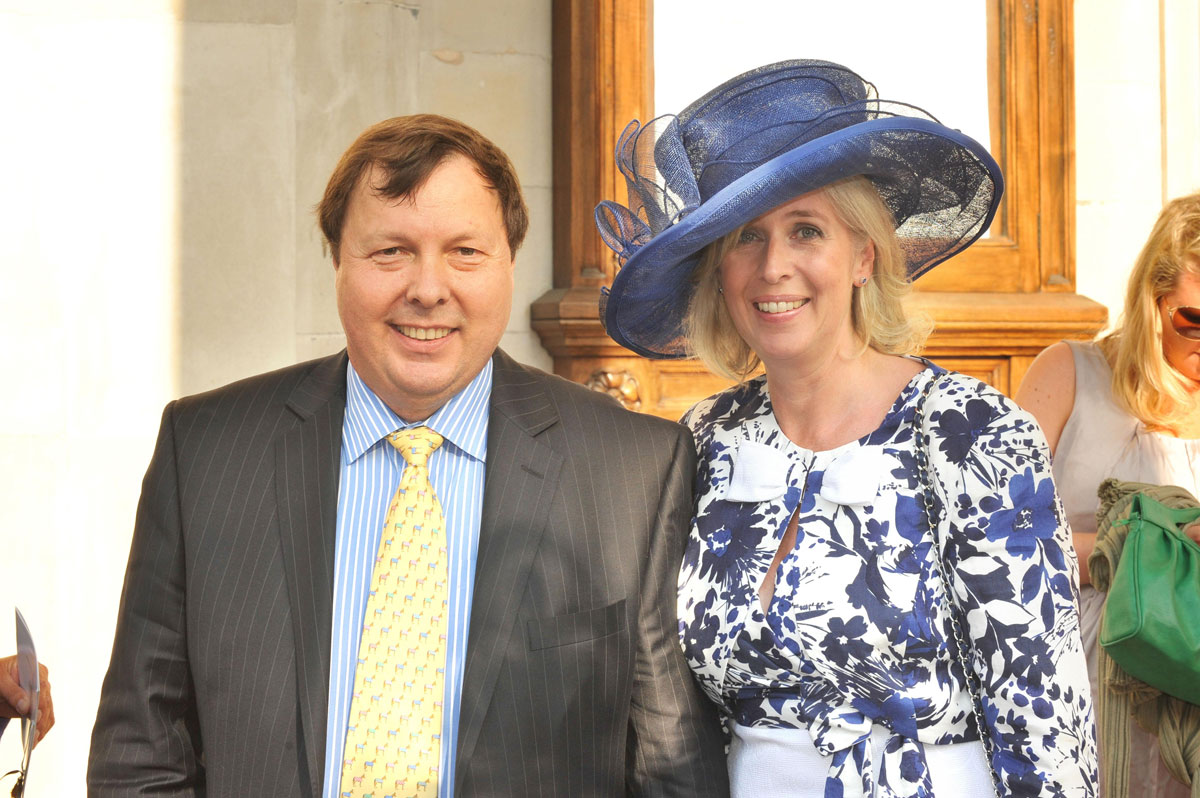
Dick Francis and his wife MaryBritish crime writer and former jockey Dick Francis (1920 – 2010) has his hat adjusted by his wife Mary, on the day he received an OBE, London, 20th March 1984. (Mike Lawn/Express/Getty Images)
Otto Penzler, a legendary mystery editor and owner of the Mysterious Bookshop in New York City, thinks the claims of shared authorship are wildly exaggerated.

“Dick Francis was so humble, I wanted to smack him,” remembers Penzler, who hosted the author at his store every year for decades. “He gave so much credit to Mary that people started to write that she was really writing the books. I knew Dick really well and I knew Mary really well. We spent a lot of time together, and she said it was all nonsense. She did a lot of the research. Dick would write the novel, and she would go over it and she would correct his grammar and punctuation and spelling – all the things a really good editor would do.”

If Mary’s contributions were larger than was publicly acknowledged at the time, she wouldn’t be the only writer to lend her mind to a celebrity’s efforts at fiction. Comedian Joan Rivers and tennis great Martina Navratilova both wrote mysteries that cashed in on their celebrity and knowledge of a certain milieu, with a novelist co-author doing most of the heavy lifting. Ivana Trump published a romance novel; Dick Clark did a mystery. The Kardashians had their names stamped on a YA novel based on a short meeting with a creative director.

A studied execution

What immediately separates the “Dick Francis” novels was that, while they started out as a way to capitalize on a jockey’s celebrity following a racing fall, they happen to be widely recognized as among the best crime novels of the second half of the 20th century. Then there was the sustained commercial success: Francis was one of the Top 5 best-selling crime writers for decades, won every major award in crime fiction, and has been an influence on generations of mystery novelists. 

Dean James, who co-authored “The Dick Francis Companion” in 2003 before finding perennial bestseller status under the pen name Miranda James with his “Cat in the Stacks” mysteries – in the booming world of cat-themed mysteries, a female pseudonym is advantageous – still sees Francis as the king of the thriller writers. 

“Anybody who wants to write a thriller, I’d say you first need to read Dick Francis because there’s no better model for how to keep the action and the suspense going,” he says. 

Penzler, the Mysterious Bookshop owner, tells me that, “First of all, Dick Francis was a great storyteller. He knew how to create exciting scenarios and used a lot of background – serious research. It wasn’t just horse racing. He did tremendous research in single malt scotch and photography and banking and all those things. He brought that information to the books. People felt they were learning something while having a great time. His characters were very empathetic. These were ordinary people, not millionaires in penthouses. People identified with them.”

What exactly was it that makes the “Dick Francis” novels so special – and makes his son’s continuations as memorable and perhaps at times better?

To begin with, there are the intriguing opening lines. A few examples:

“I looked at my friend and saw a man who had robbed me.” – “High Stakes” (1975)

“I inherited my brother’s life. Inherited his desk, his business, his gadgets, his enemies, his horses and his mistress. I inherited my brother’s life, and it nearly killed me.” – “Straight” (1989)

“Glue sniffing jockeys don’t win the Derby.” – “10. Lb. Penalty” (1997)

“I was standing right next to Herb Kovak when he was murdered.” – “Gamble” (2011)

Then there was Francis’ portrayal of women, which was wildly progressive by the standards of the genre in the 1960s and 1970s.

A 2002 essay in the Los Angeles Review of Books marvels at how, in a genre defined by sexism, the “Dick Francis” novels stood out for their fully developed depiction of women: “Straightforwardly intelligent women . . . are both refreshingly abundant and highly valued in Francis’s novels.”

The author of this piece appears to have been unaware of Mary’s role in the books. 

When the sire retires

In 2000, Mary Francis died at the age of 76, and her husband, by then 80 years old, announced his retirement, which lent further fuel to long-running rumors about her role in the writing process. 

Felix Francis and his wife DebbieFelix Francis and his wife Debbie, leave following a memorial service for author and jockey Dick Francis, at St Martin-in-the-Fields church, London. Francis, the author of 42 novels, died in February at the age of 89. (Ian Nicholson/PA Images via Getty Images)
But after a few years’ retirement, Dick Francis’ agent came to Felix, a former A-level physics teacher who was then managing his parents’ business affairs, and arranged a lunch to explain a problem. There hadn’t been a new book since 2000’s “Shattered” and, with so many new authors each year, there was a risk of Dick and Mary’s world being forgotten and the books going out of print.

With Felix writing the books now, could they get in trouble for false advertising if they claimed otherwise?

The agent asked permission to hire a new author to write a new book and give the backlist a jolt. Felix suggested he might give it a try himself – he had read all the books and had grown up watching his parents work. At 17 years old, he’d designed, and built without the explosive device, a bomb used to blow up a plane in the 1970 book, “Rat Race.” It might have seemed brash, but he figured he could write a “Dick Francis” novel. He signed a contract agreeing never to take credit for the book that bore his father’s name. The result of that effort, 2006’s “Under Orders,” spent seven weeks on the New York Times bestseller list, peaking at No. 3. It was also a critical hit, with the Los Angeles Times proclaiming that, “The sheer joy of ‘Under Orders’ comes from the old master’s championship storytelling . . .  one of this year’s most entertaining mysteries.”

What was supposed to be a one-off new novel to revive sales of the backlist was such a hit that the publishers ordered up more – but the lawyers were worried. With Felix writing the books now, could they get in trouble for false advertising if they claimed otherwise? Never mind that the books had always been the output of an entire family’s efforts; the solution was to describe the next book as written by father and son together. 

But it was Felix who did all the writing, a fact he was able to talk about freely when he was released from the confidentiality agreement eight years after the publication of “Under Orders.”

“Dad,” he says, “God bless him, by this stage, could hardly remember what he had for breakfast.”

When his father passed away in 2010, the books continued. Felix received sole credit as the author, with “A Dick Francis Novel” appearing on the cover.

When I ask Felix about all the machinations and intrigue around who got credit for what, he seems uninterested, and mostly just happy to be carrying on the family business.

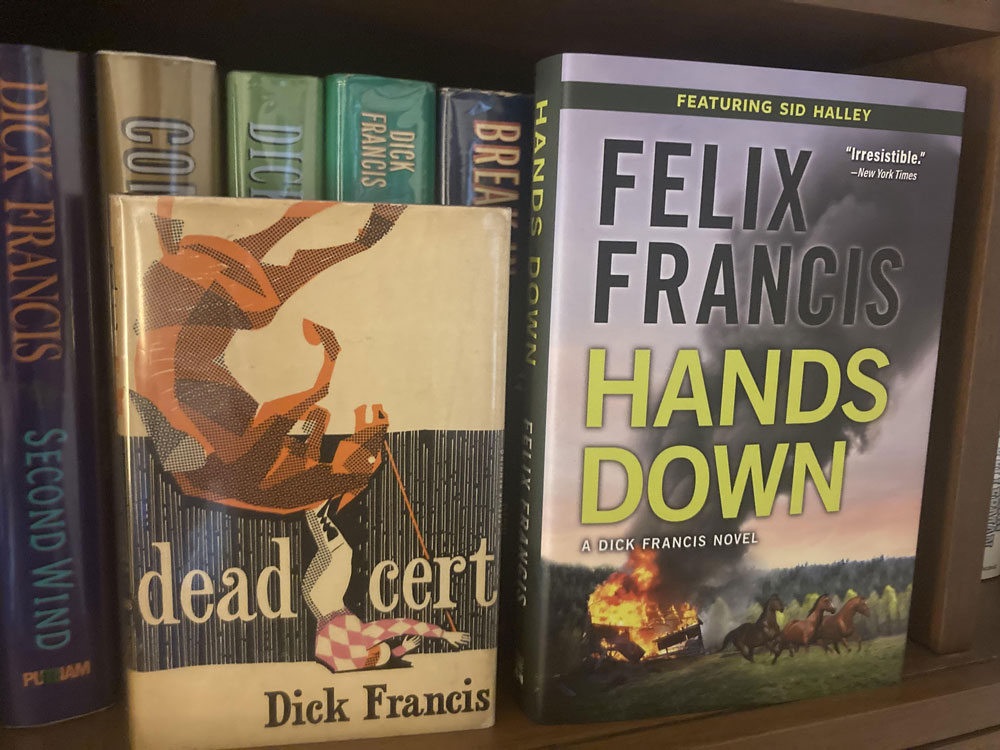
Dead Cert“Dead Cert” (1962) was the book that launched Dick Francis as the king of horse racing thrillers. The latest “Dick Francis” novel, “Hands Down” is written by his son Felix. (Photo courtesy of Felix Francis)

Felix has been writing a book a year – to nearly universally positive reviews, though they don’t sell the way they used to. In the U.K. press, Felix has discussed the falling advances for the novels. Without the film franchises that have kept new works bearing the brands of departed authors like Tom Clancy and Robert Ludlum on the bestseller lists, the “Dick Francis” books haven’t been able to maintain their mega-bestseller status – though they’re currently in development for television.


Want a daily wrap-up of all the news and commentary Salon has to offer? Subscribe to our morning newsletter, Crash Course.


Dean James wonders whether the “Dick Francis” books, brilliant as they are, are just a little tame for what so many modern thriller readers look for.

“The heroes aren’t tortured by their lost loves or the fact that their whole families were murdered,” James says.

If the books are a bit old-fashioned, that’s part of the charm. In a genre now dominated by unreliable narrators and implausible plot twists, the “Dick Francis” novels continue to be page-turning, high-stakes adventure stories of heroes and horses. And Felix, like his parents, invests heavily in research. When I spoke with him, he’d just gotten back from a major racehorse auction.

I ask Felix if writing the books gets easier.

Quite the opposite, he says. As endlessly fascinating as the world of horseracing is, coming up with a plot per year since 1962 has stretched even this family’s creativity. And Felix, who writes at a desk with photos of his parents in front of him, is struggling. The hero of the new book is a horse auctioneer, but Felix can’t quite figure out what the “dastardly deed” will be.

“I can’t use the 16 [plots] I’ve already used, obviously. And I can’t use 39 others that Dick Francis used. And it gets very, very much more difficult every year to think of a story.”

The latest book, “Hands Down” (Crooked Lane Books, Nov. 9) received a starred review from Publishers Weekly, which called it “excellent” and “a perfect homage to his father Dick’s major continuing character, champion jockey-turned-PI Sid Halley.”

How did gourds evolve to be so weird? Biologists think they know why

They can be two pounds or 200, small and spherical or misshapen and oblong, and exhibit a range of colors, coats and patterns. No, we’re not talking about dogs, but gourds — another genetically malleable lifeform that comes in a bizarre, vast range of sizes and shapes, most of which can (again, like dogs) interbreed with each other despite being so radically different. That genetic malleability is unique in the plant world: apples, tomatoes, and oranges have plenty of genetic variation, but not three orders of magnitude of mass differences as gourds do.

These genetic oddities have a concomitant range of uses among humans — culinary, decorative, and musical. Pumpkins have spicy seeds that can transform into a snack or oil; yellow squash can be cooked into a savory pasta sauce; and bottle gourds with fashionable warts are a traditional home decoration, especially during this time of year. 

Genetically speaking, this is a remarkable plant. So what is going on with gourds to allow such incredible natural variation? And what makes them so biologically weird, compared to other plants?

The evolutionary history of gourds intersects with human history, with our beloved plants changing as civilization changed. One could even argue that, in a sense, gourd variety is a testament to both human ingenuity and the wonders of the natural world.

“The origin of these crops — that plays a huge factor in terms of the diversity in shapes and genetics.”

Taxonomically, gourds belong to a family known as Cucurbitaceae — and, as Dr. Ajay Nair, chair of Iowa State University’s Graduate Program in Sustainable Agriculture, told Salon, there are three main reasons why gourds are so genetically diverse that they have been bred into such diverse subspecies as giant pumpkins and watermelons.

“If you look at the origin of the crops, where these crops originated, that plays a huge factor in terms of the diversity in shapes and genetics,” Nair pointed out, such as pumpkins coming from South America or snake gourds originating in India. He also noted that gourds have a lot of diversity in their gene pool: cucumbers only have 7 haploid chromosomes, while watermelons have 11 different chromosomes.

Finally, there is human intervention: “These crops have been there for a very long time, and humans have interacted with them. There have been a lot of very direct ways of selecting these crops, domesticating these crops and improving these crops,” Nair says.

Sometimes these factors complement each other, such as when humans take advantage of gourd infertility to breed specialized designer gourds. Yet human domestication at times limits gourds’ genetic diversity, as Heather R. Kates from the University of Florida Genetics Institute explained.

“When we compared one of the gourd species that exhibits very high diversity of shapes, sizes, colors, and textures (Cucurbita maxima) to a species that does not (Cucurbita argyrosperma), the species that has different shapes, sizes, colors, and textures does not appear to have experienced the ‘domestication bottleneck’ or reduction in genetic diversity that characterizes many crops,” Kates pointed out. In other words, cultivated gourd species that have a lot of variety did not have their genetic variety cut off by domestication in the same way as other commonly used crops like corn and bananas. While archaeologists cannot determine with certainty the extent to which past human civilizations unwittingly altered gourd genetics for their own purposes, it is plausible to suspect this happened quite a bit.

“We can’t know for us to be sure what’s responsible for the genetic or even archaeological patterns we observe in gourds, but we do have evidence that humans thousands of years ago continued to cross or let early domesticated types of gourd cross with wild species,” Kates explained. That, she says, allowed for the development of numerous types of gourds.


Want more health and science stories in your inbox? Subscribe to Salon’s weekly newsletter The Vulgar Scientist.


Human intervention in gourd breeding is still going strong. Last year South African researchers published an article in the journal Frontiers in Sustainable Food Systems about the latent potential in bottle gourds. They noted that bottle gourds could be an essential food security crop, but there has not been enough research into them.

“There is wide genetic variation among bottle gourd genetic resources in Africa” that can be used for everything from creating better products to improving marketing, the authors wrote. “However, the crop is under- researched and -utilized, and improved varieties are yet to be developed and commercialized in the region.”

“Plant pathogens are expected to spread and infect plants more readily under current climate change scenarios.”

In addition to being under-studied, gourds may also be endangered by humanity’s ecological irresponsibility. As it does with so many other things, climate change may wind up affecting humanity’s appetite for gourds. From supercharging hurricanes and intensifying supply chain disruptions to possibly even fueling pandemics, the ongoing warming of Earth’s climate is altering our planet for the worse in countless ways. In that vein, as Kates pointed out, climate change will “intensify” the challenges faced by gourd farmers and gardeners.

“Some plant pathogens are expected to spread and infect plants more readily under current climate change scenarios, and environmentally stressed pumpkins and squash are more susceptible to initial infection and subsequent disease development,” Kates, who is also a postdoctoral researcher at the Florida Museum of Natural History, pointed out. “Changes in precipitation also pose a threat to Cucurbita, especially to winter squash and pumpkin cultivars that require high water input and bear fruits that are vulnerable to rot while they mature.” At the same time, “there are characteristics of Cucurbita cultivation that may make it resilient to climate change,” such as the fact that they are pollinated by more types of bees, the fact that there is such a diverse range of cultivated types, and the fact that they are versatile enough to be grown at a wide range of temperatures and elevations.

This is good news for pumpkin-, squash- and melon-lovers, especially as holidays like Thanksgiving make gourds all the more important. As Nair explained when asked about his own favorite gourds, tastes and trends change over time.

“I think there there has been a shift towards more smaller, more decorative kind of pumpkins or squashes that people maybe put on a plate or in front of their house,” Nair mused. “I like that. I like those squashes just because they bring a different shade, a different palette, a different texture. Not just those big pumpkins, but different shapes, different sizes, maybe sometime even different colors on the same squash. I like those squashes.”

How to clean cookie sheets (goodbye grime!)

We’re partial to the lived-in, well-loved look of a sheet pan, but if your pans are verging on unusable as opposed to “rustic,” it might be time to give them a deep clean. After years of use, baking sheets eventually build up layers of burnt-on oils, grease, and just bits of food, which become tougher with each bake to remove. The good news? Stains on your baking sheets shouldn’t affect how your cookies bake or vegetables roast. The only bad news is that they don’t make for an appetizing presentation (win some, lose some).

If you’re ready to tackle your needs-some-love sheets, try one (or all!) of the below methods to get them right back into shape (for the most part) before holiday bakingis upon you.

Check your sheet material before cleaning

Not all cookie sheets are created equal, and they’re certainly not all made from the same material. Standard aluminum baking sheets, like cult-fave Nordic Ware’s half sheets, and steel exterior pans, like Williams Sonoma’s Thermo-Clad stainless steel bakeware are going to be the strongest, most long-lasting option (read: can hold up to some aggressive cleaning). If you have nonstick baking sheets, like Great Jones’ aluminized steel Holy Sheet or Caraway’s ceramic bakeware, they require gentler care than standard steel or aluminum baking sheets. A non-stick coating, no matter what variety (ceramic, Teflon, enameled cast iron), doesn’t play well with abrasive cleaning tools or sharp utensils, so definitely skip steel wool or scratchy sponges.

A bit on general sheet pan care

  • Avoid the dishwasher. We know, we know it’s more time-consuming to hand wash, but doing so will help to prolong the life of your sheet pans, be they aluminum, steel, or nonstick. According to Nordic Ware of their aluminum sheet pans (which we’d consider some of the most durable), “dishwasher use is not advised, as discoloration will occur due to the cleaning agents used in automatic dishwasher detergent.” If you do happen to pop one in for a cycle, “this discoloration is merely cosmetic and will not affect baking properties or safety of the pan.”
  • For nonstick pans, Great Jones advises that you “always grease with butter or oil, or line with parchment paper to maintain the coating’s nonstick qualities.” Knives and other utensils with sharp edges will damage pretty much any cooking surface, but you should be particularly cautious with nonstick baking sheets. Instead of a metal spatula, opt for a “soft wooden, silicone, plastic, or nylon product,” Caraway advises, and don’t cut baked goods while they’re in the pan.
  • According to Caraway’s website, they recommend letting your bakeware cool completely before running cold water over its surface to avoid thermal shock (meaning the nonstick coating might crack — yikes!). They add that while bakeware can withstand extreme temperatures, sudden and significant changes can reduce their lifespan.

Baking soda, hot water and dish soap (aluminum, steel, nonstick)

Listen, we all like to take the easy way out from time to time, especially when it comes to cleaning. Melissa Maker, of Clean My Space, recommends soaking a sheet pan for at least one hour and up to overnight, depending on how stained it is with hot water, one tablespoon of baking soda, and a few drops of dish soap. Come morning, you should be able to easily scrub away any stuck-on food bits or stains with a non-abrasive sponge.

Baking soda paste (aluminum, steel, nonstick)

There’s not much a baking soda paste can’t do, and Great Jones, purveyors of nonstick bakeware, agree. “To remove stains,” they suggest, “create a paste by mixing baking soda and a splash of water. Scrub the paste into the stains with a soft sponge, rinse with warm water, and repeat.”

Baking soda and vinegar (aluminum, steel, nonstick)

Caraway, makers of ceramic nonstick bakeware, suggest a combination of bubbling baking soda and vinegar to lift stuck-on food from baking sheets. Cover a cookie sheet with two tablespoons of baking soda and one cup of vinegar, then letting the mixture sit for 30 minutes. Once most of the mess has been lifted, clean the baking sheet as you normally would with dish soap and hot water.

Bar Keeper’s Friend (aluminum, steel)

You know it, you love it. And if you don’t know it, you’re going to want to get acquainted. Bar Keeper’s Friend is pretty much the ultimate when it comes to giving cookware a like-new luster, especially stainless steel and aluminum. Just wet the baking sheet down with water, sprinkle over some BKF, and go to work with a sponge — you should see results right away. If you need some extra power, let the BKF sit for 10-20 minutes before you scrub, and you’ll be amazed by how well it lifts away years of grime.

C-SPAN cut away from Trump’s Friday night speech once he started to ramble

On Friday evening, Trump delivered a televised speech at the America First Experience Gala held at Mar-a-Lago and aired his grievances regarding the appointment of special counsel in the furthering of his Jan. 6 legal saga. 

Stepping to the podium dressed in a tuxedo, Trump remarked on the number of people in attendance, gave an attagirl to Kari Lake, who lost her Arizona gubernatorial race, and then went on to express his views that elections are “rigged, tainted and bad” until C-SPAN made the decision to cut away to other programming. In what was surely a hitch in Trump’s giddyup, the programming they cut away to was U.S. Attorney General Merrick Garland‘s public announcement that he’d chosen Jack Smith as special counsel.

At the point in which C-SPAN cut Trump short, he was mid-way through a rant about Chicago and Afghanistan. See that moment here.

During what was heard of Trump’s speech, he referred to Marjorie Taylor Greene as “a quiet person we like very much,” spoke directly to a random man in the audience named Larry on several occasions, and spent a good portion of time talking about the special counsel before hopping the track.

“This horrendous abuse of power is the latest in a long series of witch hunts,” Trump said. “They wanna do bad things to the greatest movement in the history of our country, but in particular, bad things to me.”


Want a daily wrap-up of all the news and commentary Salon has to offer? Subscribe to our morning newsletter, Crash Course.


“This is a rigged deal just as the 2020 election was rigged, and we can’t let them get away with it,” the former president protested.

From there, Trump jumps to how Biden is at fault for the investigation being conducted on his escalation of the events of January 6.

“Joe Biden is a corrupt and incompetent political hack,” Trump said. “We are innocent. They are not innocent,” he remarked on Biden and his son Hunter, dragging the whole family into the mix. 

“I’ve done nothing wrong, they’ve participated in massive criminal activity,” Trump said on the Bidens. “I’ve proven to be one of the most honest and innocent people ever in our country.”

The aired segment from Friday’s speech can be seen via C-SPAN

How Bob Dylan used the ancient practice of “imitatio” to craft some of the most original songs

Over the course of six decades, Bob Dylan steadily brought together popular music and poetic excellence. Yet the guardians of literary culture have only rarely accepted Dylan’s legitimacy.

His 2016 Nobel Prize in Literature undermined his outsider status, challenging scholars, fans and critics to think of Dylan as an integral part of international literary heritage. My new book, “No One to Meet: Imitation and Originality in the Songs of Bob Dylan,” takes this challenge seriously and places Dylan within a literary tradition that extends all the way back to the ancients.

I am a professor of early modern literature, with a special interest in the Renaissance. But I am also a longtime Dylan enthusiast and the co-editor of the open-access Dylan Review, the only scholarly journal on Bob Dylan.

After teaching and writing about early modern poetry for 30 years, I couldn’t help but recognize a similarity between the way Dylan composes his songs and the ancient practice known as “imitatio.”

Poetic honey-making

Although the Latin word imitatio would translate to “imitation” in English, it doesn’t mean simply producing a mirror image of something. The term instead describes a practice or a methodology of composing poetry.

The classical author Seneca used bees as a metaphor for writing poetry using imitatio. Just as a bee samples and digests the nectar from a whole field of flowers to produce a new kind of honey – which is part flower and part bee – a poet produces a poem by sampling and digesting the best authors of the past.

Dylan’s imitations follow this pattern: His best work is always part flower, part Dylan.

Consider a song like “A Hard Rain’s A-Gonna Fall.” To write it, Dylan repurposed the familiar Old English ballad “Lord Randal,” retaining the call-and-response framework. In the original, a worried mother asks, “O where ha’ you been, Lord Randal, my son? / And where ha’ you been, my handsome young man?” and her son tells of being poisoned by his true love.

In Dylan’s version, the nominal son responds to the same questions with a brilliant mixture of public and private experiences, conjuring violent images such as a newborn baby surrounded by wolves, black branches dripping blood, the broken tongues of a thousand talkers and pellets poisoning the water. At the end, a young girl hands the speaker – a son in name only – a rainbow, and he promises to know his song well before he’ll stand on the mountain to sing it.

“A Hard Rain’s A-Gonna Fall” resounds with the original Old English ballad, which would have been very familiar to Dylan’s original audiences of Greenwich Village folk singers. He first sang the song in 1962 at the Gaslight Cafe on MacDougal Street, a hangout of folk revival stalwarts. To their ears, Dylan’s indictment of American culture – its racism, militarism and reckless destruction of the environment – would have echoed that poisoning in the earlier poem and added force to the repurposed lyrics.

Drawing from the source

Because Dylan “samples and digests” songs from the past, he has been accused of plagiarism.

This charge underestimates Dylan’s complex creative process, which closely resembles that of early modern poets who had a different concept of originality – a concept Dylan intuitively understands. For Renaissance authors, “originality” meant not creating something out of nothing, but going back to what had come before. They literally returned to the “origin.” Writers first searched outside themselves to find models to imitate, and then they transformed what they imitated – that is, what they found, sampled and digested – into something new. Achieving originality depended on the successful imitation and repurposing of an admired author from a much earlier era. They did not imitate each other, or contemporary authors from a different national tradition. Instead, they found their models among authors and works from earlier centuries.

In his book “The Light in Troy,” literary scholar Thomas Greene points to a 1513 letter written by poet Pietro Bembo to Giovanfrancesco Pico della Mirandola.

“Imitation,” Bembo writes, “since it is wholly concerned with a model, must be drawn from the model . . . the activity of imitating is nothing other than translating the likeness of some other’s style into one’s own writings.” The act of translation was largely stylistic and involved a transformation of the model.

Romantics devise a new definition of originality

However, the Romantics of the late 18th century wished to change and supersede that understanding of poetic originality. For them, and the writers who came after them, creative originality meant going inside oneself to find a connection to nature.

As scholar of Romantic literature M.H. Abrams explains in his renowned study “Natural Supernaturalism,” “the poet will proclaim how exquisitely an individual mind . . . is fitted to the external world, and the external world to the mind, and how the two in union are able to beget a new world.”

Instead of the world wrought by imitating the ancients, the new Romantic theories envisioned the union of nature and the mind as the ideal creative process. Abrams quotes the 18th-century German Romantic Novalis: “The higher philosophy is concerned with the marriage of Nature and Mind.”

The Romantics believed that through this connection of nature and mind, poets would discover something new and produce an original creation. To borrow from past “original” models, rather than producing a supposedly new work or “new world,” could seem like theft, despite the fact, obvious to anyone paging through an anthology, that poets have always responded to one another and to earlier works.

Unfortunately – as Dylan’s critics too often demonstrate – this bias favoring supposedly “natural” originality over imitation continues to color views of the creative process today.

For six decades now, Dylan has turned that Romantic idea of originality on its head. With his own idiosyncratic method of composing songs and his creative reinvention of the Renaissance practice of imitatio, he has written and performed – yes, imitation functions in performance too – over 600 songs, many of which are the most significant and most significantly original songs of his time.

To me, there is a firm historical and theoretical rationale for what these audiences have long known – and the Nobel Prize committee made official in 2016 – that Bob Dylan is both a modern voice entirely unique and, at the same time, the product of ancient, time-honored ways of practicing and thinking about creativity.

Raphael Falco, Professor of English, University of Maryland, Baltimore County

This article is republished from The Conversation under a Creative Commons license. Read the original article.

Harvard, Asian Americans and Jews: Behind the Supreme Court’s affirmative action case

This month’s oral arguments about affirmative action before the Supreme Court featured a slickly executed call-and-response between the attorney for Students for Fair Admissions (SFFA) and several of the justices in the conservative majority. 

In his opening statement, SFFA’s Cameron T. Norris, who once clerked for Justice Clarence Thomas, compared “what Harvard is doing to Asians” to “what it was doing to Jews in the 1920s.”

Norris glided over what Harvard was doing, exactly, but his charge echoed the arguments made by the Louis D. Brandeis Center for Human Rights and the Silicon Valley Chinese Association Foundation (LDB-SVCAF) in the amicus brief they filed in support of SSFA. 

It took Justice Neil Gorsuch only a short time to pick up the cue. “What do we do about history here,” he asked, sounding scandalized. What do we do about the fact that “Harvard’s move to a holistic application approach happened in the 1920s because it wanted to impose a quota on Jewish applicants”? How do we reckon with how Harvard once used “diversity as a subterfuge for racial quotas?”

Justice Samuel Alito piled on. In his questioning of Harvard’s attorney, Seth P. Waxman, Alito asked pointedly: “[D]id Harvard sell Justice Powell a bill of goods?” 

Nearly half a century ago in the landmark Bakke decision of 1978, Justice Lewis F. Powell Jr. had nodded approvingly at Harvard’s admissions system, holding it up as a model. The system weighed each individual applicant holistically, considering not just their grades and test scores but also their non-academic qualities, such as their leadership ability and moral character. Justice Powell’s opinion provided the constitutional footing for affirmative action that it would uneasily rest upon for the next four decades.

Now, 40-odd years later, Alito was pugnaciously demanding to know whether Harvard had deceived his predecessor about the true nature of what it had been doing. 

How did Asian Americans as a group wind up at the center of the controversy over affirmative action in college admissions, when no Asian American individual has evidently come forward to lend their name to a lawsuit?

What was going on? How did Asian Americans as a group wind up at the center of the controversy over affirmative action in college admissions, when no Asian American individual has evidently come forward to lend their name to a lawsuit? Why were Gorsuch and Alito comparing Harvard’s treatment of Asian Americans today to its treatment of Jews a century ago? Could it really be true that Harvard was discriminating against Asian Americans “in the same manner in which it discriminated against Jews in the 1920s and 1930s,” to use the words of the LDB-SVCAF brief ?

The answer to the last of these questions is undoubtedly no, and it is a plain error to think otherwise. There are some important threads of continuity, but flat-out equating the treatment of Jewish applicants at Harvard a century ago with the treatment of Asian Americans at Harvard today is drawing a false equivalence. 

This is not to deny the antisemitic roots of “holistic review.” In “The Chosen: The Hidden History of Admission and Exclusion at Harvard, Yale, and Princeton,” sociologist Jerome Karabel exhaustively documents how Harvard moved away from a system of exam-based admissions over the course of the 1920s and toward a system of selective admissions, and provides convincing evidence that Jewish restriction was the central impetus behind Harvard’s decision to assess applicants not just on their academic accomplishments but on their non-academic qualities as well.

But there is a world of difference between Harvard’s exclusion of Jews years ago and the way it treats Asian Americans today. As noted by Karabel himself, then-Harvard president A. Lawrence Lowell, along with many faculty, alumni and students at the time, clearly wanted to restrict Jewish admissions. They were prejudiced against Jews, whom they viewed as clannish grinds — and unmanly, morally deficient, grasping and unattractive to boot. Their intentional goal was to limit Jews to no more than 15 percent of the student body, and they did so by identifying Jewish applicants and excluding them through a range of open and veiled devices. These practices included personal interviews, classifying applicants according to the likelihood they were Jewish, reviewing photographs and weighing inherently subjective non-academic factors like “character” and “fitness” in a manner that disadvantaged Jewish applicants. It was unquestionably one of the most shameful chapters of Harvard’s history, as Harvard’s own attorney basically conceded in oral argument earlier this month.


Want a daily wrap-up of all the news and commentary Salon has to offer? Subscribe to our morning newsletter, Crash Course.


In almost every fundamental way, however, Harvard’s current treatment of Asian American applicants is not comparable. Harvard is not obsessed with identifying Asian American applicants, nor is it motivated by racial animus against them. It has not surreptitiously used the “personal ratings” of Asian American applicants to discriminate against them.

Persuasive evidence for these claims comes from the findings of fact by federal district judge Allison D. Burroughs, who presided over SSFA’s case against Harvard and ruled in Harvard’s favor three years ago. Burroughs found “no evidence of any racial animus whatsoever” or “any sort of systemic reliance on racial stereotypes” to disadvantage Asian American applicants. Judge Burroughs further found that “testimony of the admissions officers that there was no discrimination against Asian American applicants with respect to the admissions process as a whole and the personal ratings in particular was consistent, unambiguous, and convincing.”

Specifically on the question of how Asian American applicants were scored in the “personal ratings” review — a source of contention and critique — Judge Burroughs found that a factor external to the Harvard admissions office was at play: “At least a partial cause of the disparity in personal ratings between Asian American and white applicants appears to be teacher and guidance counselor recommendations, with white applicants tending to score slightly stronger than Asian Americans on the school support ratings.” 

A more thorough repudiation of the Jewish-Asian equivalence is difficult to imagine.

But the equivalence is grossly inapposite for another reason, which is perhaps even more fundamental. It requires us to ignore nearly a century of historical change. 

Harvard nowadays is much different than it was a century ago. At the time Lowell was orchestrating the exclusion of Jews, it was a finishing school for the white Anglo-Saxon Protestant elite that was the closest thing that the United States has ever had to a national ruling class. Today, Harvard is an internationally renowned research university that attracts the most talented faculty, researchers and students from every corner of the globe. Harvard would not be Harvard without its diversity. What institutional purpose would it serve to discriminate invidiously against any group? 

More important, perhaps, is the transformation of the values at the core of higher education and American society more broadly. Diversity was simply not highly valued during the first third of the 20th century, when many still thought of the U.S. as a fundamentally white Protestant nation. But diversity grew increasingly important over the course of the postwar period. By the late-1950s and early 1960s, key numbers of selective colleges and universities were beginning to expressly seek out diversity of all kinds on the rationale that it was educationally beneficial. Harvard was foremost among them. The intensifying mobilization of the civil rights movement, especially the dramatic protests of 1963, led racial diversity to take on a special salience. By 1978, when Justice Powell wrote his opinion in Bakke, diversity had become a core value in higher education, and Harvard had been self-consciously trying to diversify itself for more than 15 years. Today, nearly everyone in American society values diversity.

If a short recitation of the facts makes clear there is no equivalence between Harvard’s treatment of Asian Americans now and Jewish applicants in the 1920s, then why do so many conservatives keep bringing it up?

It may be tempting to entertain the belief that Harvard is using “diversity” to limit Asian American admissions in the same manner as it was using “character” and “fitness” to limit Jewish admissions. The idea glimmers with conspiratorial appeal. But it requires accepting the facially ludicrous belief that Harvard has been successfully and continuously deceiving the world for nearly half a century in the face of intense scrutiny. Moreover, it requires pretending that diversity has not become a widely held value in American culture. Even SFAA attorney Cameron T. Norris acknowledged in Monday’s oral argument that “racial diversity is not a bad thing. It is a great thing.” 

But if it is so clear after a short recitation of the facts that “what Harvard is doing to Asians” is so obviously different from “what it was doing to Jews in the 1920s,” then why were Norris, the Louis D. Brandeis Center for Human Rights, the Silicon Valley Chinese Association Foundation, Justice Gorsuch and Justice Alito bringing the point up? Why were they getting the history so grievously wrong? Were they even arguing in good faith?

A close look at the last time the Supreme Court seriously grappled with affirmative action suggests that perhaps those pushing the Jewish-Asian equivalence were not really interested in getting the history right. Indeed, what the record in the two Fisher v. University of Texas cases — known as Fisher I (2013) and Fisher II (2016) — reveals is that the emergence of Asian Americans in the legal picture did not arise out of a bottom-up process so much as a top-down one.

The plaintiff in these cases was Abigail Fisher, a white applicant residing in Sugar Land, Texas, an affluent suburb of Houston. Fisher had been denied admission to the University of Texas, and sued the university claiming a violation of the Equal Protection Clause and the Civil Rights Act.

Fisher’s original complaint made no mention of Asian Americans, and the district court opinion barely referenced them. When the case reached the Fifth Court of Appeals, Fisher’s appellate brief charged fleetingly that Asian Americans were hurt by the University’s use of race, and the issue was the subject of a short exchange between dueling Asian American legal groups that had filed amicus briefs (here and here, for instance). But it was far from a central bone of contention for the three-judge panel that affirmed the district court decision.

In point of fact, as law professor Cara McClellan noted on Dahlia Lithwick’s podcast, discrimination against Asian Americans in the admissions process only became the object of serious, high-profile judicial consideration after Justice Thomas and Justice Alito brought the issue up in their concurrences and dissents in the Fisher cases.

Fisher’s attorneys, which included one of Justice Thomas’s former clerks, William Consovoy, did their part to revive the charge, asserting that the University “employs race in admissions decisions to the detriment of Asian Americans.” Yet the issue remained peripheral. It was a total non-starter for the majority in Fisher I. Justice Anthony Kennedy, who wrote for the majority, did not mention Asian Americans a single time in his opinion. But the absence did not stop Thomas from declaring prominently in his concurrence that “[t]here can be no doubt that the University’s discrimination injures white and Asian applicants who are denied admission because of their race.”

A similar dynamic played out even more intensely in Fisher II. Kennedy again wrote the majority opinion, and the main passage mentioning discrimination against Asian Americans quoted an amicus brief by the Asian American Legal Defense and Education Fund, which noted that claims of discrimination against Asian Americans were “entirely unsupported by evidence in the record or empirical data.” 

This did not deter Alito from repeatedly returning to his view of how shabbily Asian Americans had been treated by the university. In a dissent that smoldered with umbrage on their behalf, he emphatically asserted that the “UT plan discriminates against Asian-American students.” In fact, he took pains to explain in an imperious footnote that the majority was wrong to claim that the university did not discriminate against Asian-American students because such a claim denies the zero-sum nature of the admissions process and “defies the laws of mathematics.” 

Alito was joined in his dissent by Thomas and, somewhat surprisingly, also by Chief Justice John Roberts.

Not long after Alito’s angry dissent in Fisher II, critics of affirmative action gathered at the Heritage Foundation to ask, “Are Asian Americans the New Jews?

The signals emanating from the court’s most influential conservatives did not go unnoticed by other conservatives in the legal world. In 2014, only a year after Justice Thomas’ concurrence in Fisher I elevated the issue to a position of high salience, Ed Blum’s SFFA sued Harvard on the grounds that it discriminated against Asian Americans. In 2018, not long after Alito’s dissent in Fisher II, Roger Clegg, Hans von Spakovsky, John Yoo (another former clerk for Justice Thomas) and other critics of affirmative action gathered at the Heritage Foundation to ask, “Are Asian Americans the New Jews?” A solid look at the academic literature would have revealed that the answer was clearly no, but the prospect of resurrecting the Jewish-Asian equivalence to delegitimate affirmative action was evidently too good to pass up.

It is genuinely troubling that no Asian American individual is serving as a plaintiff in a case against Harvard that asserts anti-Asian American discrimination. It is equally troubling that two conservative justices on the Supreme Court are trafficking in historically dubious analogies between Asian Americans and Jews. But what is perhaps most troubling is how this situation came to be.

In his confirmation hearing, Chief Justice Roberts famously compared judges to umpires: “[I]t’s my job to call balls and strikes, and not to pitch or bat.” But the critical role clearly played by Thomas and Alito in elevating Asian Americans to a place of central prominence in the legal and constitutional struggle over affirmative action raises questions that should give pause to anyone who shares the chief justice’s views about the restrained role that the judiciary should and must play in our democracy. 

Perhaps the way conservative justices are shaping the law through their dissents and concurrences falls within the bounds of our constitutional system. But when someone like Justice Alito theatrically leans into his questioning during oral arguments for a case that he helped to encourage, it seems like more than calling balls and strikes. It sure seems like pitching.

Ditch the turkey this Thanksgiving — and enjoy these affordable alternatives instead

While there may be no holiday that is more synchronous with a particular “main ingredient,” turkey unfortunately may not be in its requisite starring role in many households this year. While this may be disappointing to Tom Turkey (though likely not), the reasoning are myriad: Avian bird flu, inflation at large, the seemingly soaring numbers of those opting for vegetarian and vegan diets and so on and so forth. No matter if it’s impossible to find in your area or the prices are astronomical, it might be more feasible to go for a non-turkey main course this year. 

In the hopes of avoiding turkey purchasing becoming similar to this scene, many are reasoning that it might be best to instead pivot to a different main entree option entirely. Celebrity restaurateur Guy Fieri recommends lamb as a Thanksgiving showstopper while Chicago Diner, a meat-free comfort restaurant, serves up seitan, mushrooms and mixed veggies. Of course, there are many who will forever make a roasted turkey and call it a day. Conversely, though, many have sidestepped the traditional in recent years, going from an entire toast bird to instead a spatch-cocked turkey, a turkey breast, a deep-fried turkey, etc. This year, though, omitting turkey entirely seems to be on the menu, pun intended. 

In order to get to the bottom of this “trend” and discover some unique Thanksgiving approaches, Salon Food reached out to Stephen Chavez, chef-instructor at the Institute of Culinary Education, who answered our questions about best preparing for a potentially turkey-free Thanksgiving meal, offered some ideas about nontraditional options and spoke about other preparations for this year’s festivities. 

Salon: What other cuts of meat or birds can be enjoyed in lieu of turkey on Thanksgiving? 

Chavez: A. “Chicken! Roast chicken is less expensive, easy to roast, delicious, and has less portions than a large turkey, so it is perfect for a single, couple, or small family celebration. A simple chicken stuffed with mirepoix, lemons, fresh herbs (parsley, rosemary, sage) and roasted whole is a great alternative to a large turkey.”

B. “Duck breast. Again it’s easy to find, just be careful of cooking time. Overcooked duck is extremely tough. It really needs to be cooked medium rare to medium at most.”

C. “Tamales or turkey mole. Go Mexican for Thanksgiving! Most traditional Thanksgiving side dishes actually fit well with Mexican dishes. Things like corn, and squash, are natural pairings. Forgo the mashed potatoes and replace with a rice dish. Instead of rolls, use tortillas.”

D. “Turkey breast or chicken breast Schnitzel. Pounded and breaded thin cuts of meat fried to a golden brown. This is done all over the world (Katsu, Milanesa, cutlet) and is a great alternative to a large bird, and will be cooked much faster, giving you more time to spend with family and friends.”

Thank you; these sound amazing! In addition, what are some plant-based Thanksgiving dishes? What specific vegetables or plant-based foods mimic the meaty, juicy taste of Thanksgiving turkey? Jackfruit turkey? Tofu, tempeh or seitan turkey?

A great meatless alternative is going vegetable. It is the perfect time of year to try roasting squash or cauliflower. There are so many varieties of squash available right now, from the more common butternut or acorn, to ones like kabocha or Blue Hubbard. Roasted squash is absolutely seasonal, hearty, and delicious”

Is turkey still a popular choice for Thanksgiving in recent years? Are more people enjoying other kinds of birds or dishes? If so, what are the specifics? 

Absolutely! Given what we have gone through over the last few years, people are looking for “comfort” or “getting back to normal” which is why a classic Thanksgiving meal will always be comforting to people. However, the trend to eat more plant-based or “healthy” has also become trendy so some of the alternatives that I have suggested will apply as well.

Aldi just brought back its Thanksgiving Ravioli, which is stuffed with cheese, stuffing, slow-roasted turkey and cranberries. It’s basically Thanksgiving dinner inside a pasta! Are there other store-bought, Thanksgiving-themed foods that can be enjoyed? 

I have not seen it but that Thanksgiving ravioli sounds great to me. Honestly, my favorite meal of the year is the day-after-Thanksgiving turkey sandwich, with turkey, stuffing, mashed potatoes, gravy, and cranberry sauce. It is my one true indulgence for the year. So why not skip the big feast and just roast a turkey breast and slice it for sandwiches?  That actually sounds fun, if “fancy” is not a necessity for your holiday meal.

What are some other unconventional, unique dishes that people can enjoy this Thanksgiving?

You can try tamales, pizza, sandwiches, dumplings or lasagna. In addition, we spent a long time being isolated from friends and family. It would be great for people to either not spend as much time in the kitchen away from the rest of the family. Perhaps, find a food that everyone can share in the prep, or an activity food that everyone can do together like a Thanksgiving “pizza party.”

Do you have any must-have recommendations for Thanksgiving appetizers, sides, or desserts?

The problem with most sides is that there are just too many of them. The reason people feel sleepy after the Thanksgiving meal is not the scapegoat turkey, it’s that you just consumed huge amounts of (mostly) carbs from sides and your body needs a break. Mashed potatoes, mac and cheese, sweet potatoes, stuffing, it is all too much.  Limit your sides to the true stars, or opt for lighter alternatives such as fresh sautéed or roasted veggies like green beans, squash, or carrots.

In addition to inflation and/or turkeys being so hard to find this year, can you speak to this growing trend of Thanksgiving turkeys perhaps not being as popular an option anymore, instead being replaced with eating other birds or proteins, plant-based dishes, etcetera. 

A. The cost of turkey is a factor this year so I’d suggest either getting a smaller bird, roasting chicken or having a plant-based main. You could also make a big pot of soup, it is the perfect weather for soup!

B. Try looking for an all-inclusive package that includes the bird plus side dish items. This could potentially be a cost savings.

C. I think the best thing that you can do is to not over-buy. You do not need a huge turkey so that everyone gets leftovers. Get portions that are appropriate for your gathering size.  You can provide the bird and everyone else brings sides.

D. It is also a great time to clean out your pantry or fridge and use items that have been sitting there a while. That jar of olives you bought on vacation, or that can of water chestnuts can be added into your stuffing or vegetable dish.

These are great options. For the diehard turkey lovers out there, how should they strategize to best find turkeys this year? ​

I would suggest a local butcher shop for the best quality turkey. The ones in the stores are fairly generic, so short of going to an actual farm, I would suggest a butcher shop in order to get the best quality bird.

“What took you so long?” Mustache icon John Oates on being the furry face of Movember

In his decades-long career as one of half of the most successful duo in recorded music history, Hall & Oates, John Oates has racked up 16 Billboard Top 10 hits, eight certified platinum albums, and a place in the Rock and Roll Hall of Fame and Songwriters Hall of Fame.

Now, the self-appointed “patron saint of facial hair” has a new single, a new message, and even some new facial hair. This year’s international spokesman for the men’s health initiative we know as Movember joined me recently for “Salon Talks” for a conversation about fame, facial hair and what it was like working with one of Taylor Swift’s producers on his new song. Watch or read our episode below.

The following interview has been lightly edited for clarity and length

I want to ask you about Movember. Lots of people know what this movement is about, but there are some who don’t. Tell me what Movember is, and the issues that it raises awareness for.

It’s a men’s health initiative that has been around for quite some time. It’s a fantastic organization. It focuses on many things, men’s health, of course, mental health and also physical health. Things that a lot of men are concerned with like testicular and prostate cancer. They’re trying to shine a light on the fact that a lot of men don’t like to address many of these things, that it’s OK to talk about and that it’s OK to share experiences, and to get men to open up a little bit about things that perhaps traditionally have been considered less than manly to open up and discuss. 

“I ended up going to see a therapist who really gave me strategies that I never would’ve been able to accomplish on my own.”

I was really happy when they asked me to be part of it. I jokingly said, “What took you so long?” with the mustache connection. It’s been great. They’re great people. They’re  clever and they have a lot of energy. I spent some time in London at their main headquarters doing a bunch of  crazy TikTok stuff. It’s a month-long initiative, and hopefully we’ll see if people can jump on board.

You’ve been very candid in your memoir and in recent years talking about your own health and mental health. Several years ago you went through therapy, but you resisted it at first. What do you want to say now, to the men out there who are struggling with some mental health issues about what you learned from that experience and what you found on the other side of taking care of your mental health?

It’s true [that I resisted therapy at first], and I’ve spoken to a lot of guys who have said the same thing: “Well, I’m smarter than those shrinks anyway. They can’t tell me anything.” But it’s really about, I think, where your challenges and what’s troubling you get to the point where you can’t fix them yourself. Just to have an objective person who can hear you, empathize, and perhaps shed some light on strategies that could help you understand a little bit more about yourself. Sometimes you can’t see the forest for the trees. Sometimes you’re so wrapped up in your issues that you can’t see a way out and you can’t figure out what it is you need to do to try to change things. And of course, the first step is always wanting to change. I think everyone has to get to that point where they feel that they need to change.

“It’s too much now. This is it. I’ve come to the end of my rope. I’ve run up against the wall. I can’t do any more.” Everyone has a different threshold for that. For me, it had to do in the late ’80s. It had to do with the end of this big, crazy decade of pop stardom that was unbelievably intense and successful, but also came with a complete disassociation from any semblance of real life. You run around the world as a pop star. It’s hard to describe to someone who hasn’t experienced it what that can be like when every whim or need, or every situation that you might encounter seems to be serviced in some weird way. I don’t like to use that word “serviced,” but I guess that’s not a bad word.

I was at that point in my life. Simultaneously, the manager that Daryl and I had for many, many years went on to greener pastures. I was in the midst of getting separated and eventually divorced. It all happened at the same time. When that happened, I really did reach the end of the rope for me. I had nowhere to turn, and I ended up going to see a therapist who gave me some interesting strategies and things that I never would’ve been able to accomplish on my own.

To be honest with you, I haven’t been back since. I feel like I’ve employed a lot of these strategies, and I think I’ve been on the right path. That path has taken me somewhere where I never could have imagined going. It had to do with visualization, it had to do with dreams, it had to do with accepting who I was at that moment and who I wanted to be or where I wanted my future to take me, and what kind of man I wanted to be going forward. It was a very enlightening period of time, and it did lead to a new approach to my life.

What you’re talking about is so important because a lot of the men in my life have also resisted therapy or just going to the doctor because there’s this fear that then, “I’m that guy.” I’m that guy who needs therapy, or I’m that guy who needs to see a doctor about a pain or an ache as opposed to, “This is something that I need now in the short term. It doesn’t have to be my whole identity.”

“There’s things I can articulate in the process of writing a song that I perhaps just wouldn’t say.”

Everyone has a different threshold. Everyone has a different ability to cope and only you can decide when you’ve reached that place where you do not have an alternative. There’s nowhere to turn. It’s subjective and it’s different for everyone. 

I wanted to ask you about the song “Pushin’ a Rock.” This song has been on a long road. Tell me a little about the evolution of this song and what it means to you right now.

The song is an evolution and a reimagination of a song that was written in 2014. I was doing an album called “Good Road to Follow.” The theme of the album was I wanted to collaborate with people that I respected. I collaborated with Vince Gill and Ryan Tedder from One Republic and many, many other people, some young artists, some more Americana, rootsy-type artists. 

One of the people I reached out to was a guy named Nathan Paul Chapman, who was part of Taylor Swift‘s career from her earliest days of making demos as a young teenager. He took her through her first few albums, won multiple Grammys and was a big part of creating Taylor in her early incarnations. But at the moment when I was about to reach out to him, I had read that she had gone on to try some other producers and her music was changing, which is, of course, the right of every artist to explore and try things.

I thought maybe I would just reach out to him, just say, “Hey, how you doing, man?” As casual as that. When I did, we talked about it and he said, “My entire creative identity has been wrapped up with Taylor and her music, and now I don’t know exactly what my next step is going to be.” I said, “Well, that’s a challenging moment in your life, but it’s also an exciting moment because who knows where it could take you.” That got me thinking about the Greek myth of Sisyphus pushing a rock up hill and overcoming challenges on broad terms. I thought, I bet that’s something he might relate to as a jumping-off point for a song idea. So I said, “Let’s get together.” We got together. I ran the idea by him, he loved it, and we seemed to vibe on that idea. 

“The success part is interesting because it has enabled me to do whatever I want.”

We wrote the song, and I recorded it on that album. Every time I’d play it live, I kept changing it because something told me that it just wasn’t as good as it could have been. I thought the lyrics were really good and powerful, and I felt like I let my side down when I did the music because it just didn’t connect the same way.

Flash forward to COVID, sitting home for periods of time, looking at reviewing old music lyrics, catching up with things that I had put by the wayside. I thought about that song again, and it seemed so timely and it seemed just as important, and even perhaps more during COVID. I revisited it and I said, “Well, you know what? I’ve never been happy with the music on this. Let me see if I can come up with something better.”

I started messing around with the track at home, started reimagining the song and using almost all the lyrics from the original version. Eventually, I came up with something I liked. I called Nathan up and I said, “Man, what do you think of this? I want to do this song over again.” I had never done that in my entire career. I had never rerecorded a song. He laughed, and he said, “This is how it should have sounded from the beginning.” I said, “Well, I guess it’s my fault. But never too late.” I went in and recorded it. And that’s the song that you’re hearing now.

When I think about your career, John, and the musical genres that you have always depended on, like soul, R&B, country, they’re such emotional genres. I hear a song like “She’s Gone” and that is a man deep in his feelings. Looking at this month and thinking about men’s mental health, what has songwriting given to you as a person in the world as a way to explore those darker, harder feelings?

Songwriters in general use their songwriting skills to say what they want to say. For me, there’s things I can articulate in the process of writing a song that I perhaps just wouldn’t say, but somehow I can impart that message or that feeling or that emotion in a song in a more effective way. It’s an outlet, it’s a compulsion. It’s all those things. I just have to do it. Everyone’s different, but I think most songwriters will say something similar to that.

You’ve been doing this for pretty much your entire life now, and to see you still creating new material and doing new things, what does it mean to you now to be an artist? How do you think of yourself as an artist now that’s different from the person you were maybe in the past?

I think I’ve achieved a certain maturity and a certain life experience and not considerable amount of success. The success part is interesting because it has enabled me to do whatever I want. That’s the ultimate freedom that any artist would hope for. If you asked any artist, regardless of whether they’re a painter or a songwriter, an actor, whatever, their answer, what would be your ultimate situation? To have complete freedom. Thanks to the success of Hall & Oates, I have that complete creative freedom. I’m completely free to experiment, to collaborate, to try things, and I feel like I paid my dues to get it. 

It’s very precious because I don’t want to lose it and I want to make the most of it. I don’t want to just squander it away by either not trying my best or not working or not utilizing the skills that I’ve gained over the past – I hate to say it – 50, 60 years. It’s an amazing thing that not many people get to experience and I have and I’m a very lucky, blessed person, so I take full advantage of it.

The mustache was iconic for so long. Then you shaved it off. Now it’s back. What does the mustache mean to you now, John? 

When I shaved it off in, I think it was 1989, it was part of that transition that I spoke about earlier, getting divorced, losing a manager, being at the end of the eighties, looking for what was going to be the next step. It was more of a symbolic shedding of the skin, or shedding of the hair as the case may be. I wanted to be a different person. I felt like the mustache was symbolic of who I was and who I didn’t want to be going forward. That was a ritualistic thing to shave it off. Now I am a different person. I’ve evolved in so many ways, and so now to grow the mustache back, now it’s just hair on my face. I’m having fun with it, and, obviously, it’s part of the Movember vibe and I’m just as the song says, rolling with it.

If you could switch mustaches with any person in the world, is there anybody you’d change with?

David Niven, except I’m way too short and way not too skinny and definitely not British, so I could never pull it off. It would look ridiculous on me. But that’s a very finely crafted, pencil-thin mustache.

The 7 most bizarre “Pepsi, Where’s My Jet?” revelations from Netflix’s strange-but-true docuseries

During the 1990s, the great “Cola Wars” reached its peak as consumers debated which cola brand they’d pledge their allegiance to. The top contenders were Coke, the undisputed leader in the global soda industry, and its younger, more hip successor Pepsi. The latter had a slight leg-up on the competition — albeit briefly — due to its crazy advertising, which notably featured dancing adolescent bears and celebrities, like Madonna, Marlon Brando, Michael Jackson, Britney Spears and Cindy Crawford.

Pepsi’s most bizarre stunt, however, was its 1996 “Drink Pepsi Get Stuff” campaign. The crux of it was that consumers were encouraged to mass purchase cans of Pepsi to accumulate “Pepsi Points” in exchange for “Pepsi Stuff,” or fun prizes. Notable items included a shirt, a leather jacket, some classy shades and, yes, a $23 million Harrier fighter jet.

Pepsi execs assumed the astronomical “price” of the jet would make it impossible for anyone to attain it. But they clearly thought wrong after one determined college student accepted the offer as a challenge and later sued Pepsi for the fighter jet prize that never existed in the first place.

Netflix’s latest four-part docuseries, “Pepsi, Where’s My Jet?” explores the epic saga between the multibillion-dollar company and college student John Leonard. Directed by Andrew Renzi, the series features interviews with Leonard and his business partner along with hot-shot PepsiCo executives and the lawyers who worked on the case.

Here are the seven most bizarre revelations from the series:

01
Pepsi’s ludicrous campaign
Pepsi, Where's My Jet?Brian Swette in “Pepsi, Where’s My Jet?” (Courtesy of Netflix)

The 1996 campaign was originally created by Brian Swette, Pepsi’s former Chief Marketing Officer. The concept behind it was pretty simple: consumers were encouraged to buy and drink Pepsi products to rack up Pepsi points, which could then be cashed in to purchase Pepsi paraphernalia. Popular prizes included t-shirts, hats, leather jackets, jean jackets and cool sunglasses — items that kids and young adults would be drawn to.


The campaign was publicly introduced via a fun and amusing television commercial. In it, Pepsi offered a Pepsi logo t-shirt (which was worth 80 Pepsi points), a leather jacket (which was worth 1200 Pepsi points) and a pair of sunglasses (which was worth 125 Pepsi points). The final prize, and the company’s most outlandish offering, was a $23 million Harrier fighter jet that was worth an astounding 7 million Pepsi points.


“It’s clearly a joke,” Swette said regarding the jet. “People don’t offer military hardware as prizes.”


Pepsi’s offering, however, was not a mere “joke” to John Leonard, who was a 20 year old community college student when he first saw the campaign’s commercial. Leonard was also an avid mountain climber and world traveler. So for him, the pricey jet granted him both freedom and adventure. To help support his passions, Leonard worked multiple odd jobs, including teriyaki delivery person, window washer, paperboy, glass cutter and climbing guide.

02
Leonard’s extravagant business plan
Pepsi, Where's My Jet?John Leonard in “Pepsi, Where’s My Jet?” (Courtesy of Netflix)
Per Leonard’s calculations, he would need to drink 190 Pepsi cans a day for 100 years in order to attain the required 7 million Pepsi points. That wasn’t feasible for him or his family, so Leonard formulated a business plan to speed up the process. He also enlisted the help of Todd Hoffman, who was Leonard’s climbing-buddy-turned-investor and 20 years his senior.  


Leonard’s multimillion-dollar business deal outlined labor costs, transportation costs and storage costs, which all totaled to a whopping $4.3 million. Leonard determined that he needed to buy 1.4 million 12-pack cans of Pepsi, which is over 16 million cans. Those cans would also take up about 600,000 cubic feet of storage space, meaning Leonard would need to store them across various warehouses. Leonard proposed acquiring six warehouses across six metropolitan areas and hiring his own workers, who would cut and store the Pepsi labels for him.  


As impressive as his business plan was, Leonard later found an easier way to earn his points in a short amount of time. Per the contest rules — which were outlined in fine print in a Pepsi catalog — Leonard could simply buy his points by paying $0.10 a point. For 7 million Pepsi points, Leonard had to pay $700,008.50, which included an additional $10 shipping and handling fee. So Leonard, with Hoffman’s help, wrote the check and delivered it to PepsiCo’s headquarters.

03
Leonard consults the Pentagon
Ken BaconPentagon spokesman Ken Bacon answers reporters’ questions during a US Defense Department briefing 25 March 1999 at the Pentagon in Washington, DC. (JOYCE NALTCHAYAN/AFP via Getty Images)
Prior to acquiring their Harrier Fighter Jet, Leonard and Hoffman had to confirm whether it was even legal to purchase a jet in the first place. Leonard reached out to the Pentagon under the guise that he was a student who needed the information for a school project. Leonard got in touch with Kenneth Bacon, the Chief Pentagon Spokesman from 1994 to 2001, who told him that it was legal to buy a Harrier jet as long as it didn’t have all the armaments on it.


Leonard and Hoffman also agreed that after they secured their jet, they would showcase it at airshows, which could possibly open up additional business opportunities with advertisers and production companies, which would help recoup the money.

04
Pepsi’s bogus letter to Leonard
Pepsi, Where's My Jet?Michael Davis as John Leonard in “Pepsi, Where’s My Jet?” (Courtesy of Netflix)

Leonard and Hoffman’s $700,008.50 check eventually reached Pepsi’s headquarters, much to the company’s dismay. Turns out, the Pepsi jet campaign was a complete sham and the company didn’t have a Harrier jet prize to offer.  


Swette along with Michael Patti (Pepsi’s former creative director) and Jeff Mordos (the former COO of Pepsi’s Ad Agency) were set on ignoring the check, in hopes that Leonard’s scheme would not encourage others to send money for the jet. In one instance, Patti suggested that the company keep the $700,008.50 and reward both Leonard and Hoffman with the model jet used in the Pepsi commercial. 


Pepsi ultimately decided not to cash the check and instead, sent Leonard a letter with two free product coupons in lieu of the promised jet prize.


“Thanks for the effort. Ha ha ha. It was meant to be a joke. For your troubles, here’s coupons for two cases of Pepsi,” the letter read. 


Angered by their paltry reward, Leonard and Hoffman decided to challenge the company and fight for their well-deserved Harrier fighter jet.

05
Pepsi tries to intimidate Leonard and Hoffman
Pepsi, Where's My Jet?Pepsi, Where’s My Jet? (Courtesy of Netflix)

As part of their legal battle against Pepsi, Leonard and Hoffman reached out to attorney Lawrence “Larry” Schantz. But, unfortunately, Pepsi beat them to the punch and sued Leonard first, simply as a way to intimidate him and Hoffman into dropping their fight.      


The main argument in Pepsi’s lawsuit was that it was illegal for someone to actually buy a Harrier jet — contrary to Bacon’s remarks. And for any offer to be legitimate, it has to be legal. 


“I was surprised that they initiated a lawsuit, frankly,” Todd said in the documentary. “If anything, I thought there would have been a phone call or there would have been, ‘Can we sit down and talk with you guys and see if you’re real, if you’re not real, if you really believe this ad, or you didn’t?’ Or whatever. We just filled out their instruction book and they followed it up by suing us.”


Leonard said that a random stranger had even chased him to serve him with legal paperwork. The papers were eventually left at the doorsteps of Leonard’s parent’s home.


“I’d never been served for anything, but I just figured it wasn’t a good thing,” Leonard recalled.


To add to the hoopla, Pepsi edited their commercial shortly afterwards. The original 7 million Pepsi points for the Harrier Jet was changed to 700 million. Underneath the newfound price was the disclaimer “just kidding” written in parentheses.

06
Michael Avenatti unearths past Pepsi promo scandals
Pepsi, Where's My Jet?Michael Avenatti in “Pepsi, Where’s My Jet?” (Courtesy of Netflix)

Avenatti — the attorney who rose to prominence for his representation of adult film actress Stormy Daniels in her lawsuits against Donald Trump and, later, infamy for his attempted extortion of Nike — learned about Leonard’s case from a friend and immediately jumped in to help. At that time, Avenatti was still a law student at the George Washington University Law School.


“We were gonna have to bring public pressure to bear on John Leonard’s behalf,” Avenatti explained in the documentary. “You know, by way of some aggressive public relations action. A full-court press with the media. I told him, ‘We’re gonna kick Pepsi’s ass, and all of their lawyers and all of their media types. We’re gonna outplay them at their own game.'”


Unlike Pepsi, Leonard and Avenatti did not have the money or the means to launch a $50 million ad campaign. So, in order to publicize Leonard’s side of the story, they relied on free media, like radio shows, that invited John to speak on air. Soon, television crews, television networks and talk shows reached out to Leonard to broadcast his tale.


Avenatti, who was only a few years older than Leonard, also became close friends with his client during the latter’s legal battles.


In the documentary, Avenatti mentioned that he spent hundreds of hours researching Pepsi and its past promotional scandals. He learned that Pepsi had run the same campaign in Canada with a disclaimer at the end of the ad specifying that the Harrier fighter jet was not an available prize. He also learned about Pepsi’s deadly bottle cap lottery campaign in the Philippines. The 1992 campaign, also known as “Number Fever,” promised low-income residents various sums of prize money, ranging from 100 pesos to 1 million pesos, if they had a Pepsi bottle with the winning number on its cap. Things quickly went awry when Pepsi erroneously printed 600,000 bottle caps with the lucky number for the grand prize and cheated people out of the money they rightfully deserved. On May 25, the final day of the campaign, riots broke out, which left at least five people dead.

07
Leonard v. Pepsico, Inc. is a bust
Pepsi, Where's My Jet?John Leonard and Todd Hoffman in “Pepsi, Where’s My Jet?” (Courtesy of Netflix)

In the end, Leonard lost the “Pepsi Points Case” after the court, presided over by Judge Kimba Wood, determined that the case didn’t have merit because “no objective person could reasonably have concluded that the commercial actually offered consumers a Harrier jet.”  


“From a long-tenured, federal judge’s perspective, it may have not seemed like a legitimate offer,” Leonard said in the documentary. “But I can tell ya, millions of my peers saw the commercial and thought it was an offer.”


“Onward and upward.”


Today, “Leonard v. Pepsico, Inc.” remains a critical case that’s studied in law school, specifically in contract law courses. The case has also been debated in classrooms, with most students and academics siding with the plaintiff, and featured in an episode of “Jeopardy!”


As for Leonard and Hoffman, the dynamic duo are still close friends. Hoffman “underwent successful surgery to remove his cancer” and is “now in remission, looking for his next adventure,” per the documentary. Leonard, on the other hand, is happily married and has kids of his own. Sometimes, though, he’ll “pester Todd with his next great idea.”

“Pepsi, Where’s My Jet?” is currently available for streaming on Netflix. Watch a trailer for it below, via YouTube:


Bird flu has made a comeback, driving up prices for holiday turkeys

An outbreak of highly pathogenic avian influenza has spread through chicken and turkey flocks in 46 states since it was first detected in Indiana on Feb. 8, 2022. The outbreak is also taking a heavy toll in Canada and Europe.

Better known as bird flu, avian influenza is a family of highly contagious viruses that are not typically harmful to most wild birds that transmit it, but are deadly to domesticated birds. The virus spreads quickly through poultry flocks and almost always causes severe disease or death, so when it is detected, officials quarantine the site and cull all the birds in the infected flock.

As of early November, this outbreak had led to the culling of over 50 million birds from Maine to Oregon, driving up prices for eggs and poultry — including holiday turkeys. This matches the toll from a 2014-2015 bird flu outbreak that previously was considered the most significant animal disease event in U.S. history. Yuko Sato, an associate professor of veterinary medicine who works with poultry producers, explains why so many birds are getting sick and whether the outbreak threatens human health.

Why is avian influenza so deadly for domesticated birds but not for wild birds that carry it?

Avian influenza (AI) is a contagious virus that affects all birds. There are two groups of aviain influenza viruses that cause disease in chickens: highly pathogenic AI (HPAI) and low pathogenic AI (LPAI).

HPAI viruses cause high mortality in poultry, and occasionally in some wild birds. LPAI can cause mild to moderate disease in poultry, and usually little to no clinical signs of illness in wild birds.

The primary natural hosts and reservoir of AI viruses are wild waterfowl, such as ducks and geese. This means that the virus is well adapted to them, and these birds do not typically get sick when they are infected with it.

But when domesticated poultry, such as chickens and turkeys, come in direct or indirect contact with feces of infected wild birds, they become infected and start to show symptoms, such as lethargy, coughing and sneezing and sudden death.

There are multiple strains of avian influenza. What type is this outbreak, and is it dangerous to humans?

The virus of concern in this outbreak is a Eurasian H5N1 HPAI virus that causes high mortality and severe clinical signs in domesticated poultry. Scientists who monitor wild bird flocks have also detected a reassortant virus that contains genes from both the Eurasian H5 and low pathogenic North American viruses. Reassortment happens when multiple strains of the virus circulating in the bird population exchange genes to create a new strain of the virus, much as new strains of COVID-19 like omicron and delta have emerged during the ongoing pandemic.

According to the U.S. Centers for Disease Control and Prevention, the risk to public health from this outbreak is low. No human illnesses were associated with the 2014-2015 H5N1 outbreak in the U.S.

The only known human case in the U.S. during the current outbreak was found in a man in Colorado who had contact with infected birds. The man tested positive once, then negative on follow-up tests, and reported only mild symptoms, so health experts theorized that the virus may have been present in his nose without actually causing an infection.

Health officials recommend avoiding direct contact with wild birds to avoid spreading avian flu.

Are these outbreaks connected to wild bird migration?

Yes, wild bird migration has been an important factor in this outbreak. Scientists have detected the same H5N1 virus that is infecting poultry in more than 3,000 wild birds during this outbreak, compared with 75 detections during the 2014-2015 outbreak. This tells us that the virus is highly prevalent in wild bird populations.

While most detections occur in ducks and geese, the virus has also been found in other bird species, including raptors, such as eagles and vultures, and other waterfowl, such as swans and pelicans. Birds of prey are among the most susceptible: As of early November 2022, wildlife agencies had reported more than 300 bird flu deaths in black vultures, over 200 deaths in bald eagles and more than 100 each in great horned owls and red-tailed hawks.

The U.S. Department of Agriculture’s Animal and Plant Health Inspection Service conducts targeted sampling to test wild birds in fall and early winter, which correlates with migration season. This helps scientists and wildlife managers understand where avian flu viruses may be introduced to domestic flocks, track their spread and monitor for any reassortment.

Because there are high amounts of virus circulating, wildlife agencies advise against handling or eating game birds that appear sick. Waterfowl can also be infected, with no signs of illness, so hunters need to be especially careful not to handle or eat game birds without properly cleaning their clothing and equipment afterward and ensuring the birds are cooked to an internal temperature of 165 degrees F (74 C) before consuming them.

Hunters and other members of the public are advised not to approach any wild animals that are acting strange and to report any such sightings to officials. In some cases, avian flu viruses have spilled over to other wild animals, such as red foxes, raccoons, skunks, opossums and bobcats. We did not see this trend in 2014-15.


HPAI is a transboundary disease, which means it is highly contagious and spreads rapidly across national borders. Some research indicates that detection of HPAI viruses in wild birds has become more common.

Detection of HPAI in wild birds is seasonal, with a peak in February and a low point in September. Many migratory bird species travel thousands of miles between continents, posing a continuing risk of AI virus transmission.

On the positive side, we have better diagnostic tests for much more rapid and improved detection of avian influenza compared to 20 to 30 years ago, and can use molecular diagnostics such as polymerase chain reaction (PCR) tests – the same method labs use to detect COVID-19 infections.

How are poultry farmers affected when HPAI is detected in their flocks?

To detect AI, the U.S. Department of Agriculture oversees routine testing of flocks by farmers and carries out federal inspection programs to ensure that eggs and birds are safe and free of virus. When H5N1 is diagnosed on a farm or in a backyard flock, state and federal officials will quarantine the site and cull and dispose of all the birds in the infected flock. Then the site is cleaned and decontaminated, a process that includes removing organic materials like manure and chicken feed that can harbor virus particles.

After several weeks without new virus detections, the area is required to test negative in order to be deemed free of infection. We call this process the four D’s of outbreak control: diagnosis, depopulation, disposal and decontamination.

Flock owners are eligible for federal indemnity payments for birds and eggs that have to be destroyed because of avian influenza, as well as for the costs of removing birds and cleaning and disinfecting their farms. This support is designed to help producers move past an outbreak, get their farms back in condition for restocking and get back into business as soon as possible.

But these payments almost never cover all of farmers’ expenses. Poultry farms can’t always recover financially from major bird flu outbreaks. That makes it especially important to focus on prevention strategies to keep the virus out.

This article has been updated to reflect reported avian influenza deaths in birds of prey.

This is an updated version of an article originally published on April 7, 2022.


This article is republished from The Conversation under a Creative Commons license. Read the original article.

Why Diego Maradona’s “Hand of God” goal from 1986 is unforgettable

Football has “The Catch,” baseball has “The Shot Heard ‘Round the World” and basketball has “The Block.”

For soccer, it is Diego Maradona’s “Hand of God” — a sporting moment captured in time, the mere mention of which can conjure up strong emotions among supporters.

Such is its legacy that some 36 years after bouncing into the back of the net, the soccer ball involved recently attracted a bid of more than $2 million at auction, although negotiations for its sale have not been completed.

So why does this goal — which by the rules of the game should not even have been a goal at all —carry so much significance? As an economist who studies sport, I’ve long believed that you have to grasp the cultural significance to understand the financial dimension of sports. This goal was one of soccer’s most iconic events for a number of reasons.

It’s about the controversy

The goal in question was scored by Argentinian great Maradona against England in the quarterfinals of the 1986 World Cup. It was the second half of a 0-0 game and Argentina’s team was passing the ball around the edge of the England penalty box.

England midfielder Steve Hodge tried to clear the ball but only succeeded in kicking it high above the goalkeeper. Normally one would expect the goalkeeper to catch it, especially against the 5-foot-5-inch Maradona. But somehow the ball ended up in the back of the net.

At first, it seemed that Maradona had headed the ball, but replays clearly showed that he had steered the ball with his clenched fist, a blatant violation of the rules. (In today’s game, Maradona would probably have been red-carded, or expelled from the game, for this offense.) But this was three decades before the use of video assistant referee, or VAR, in soccer. There was no way to review. The referee’s vision was blocked, and he looked to the linesman for guidance — but the linesman saw nothing wrong, and the goal was allowed to stand.


Want a daily wrap-up of all the news and commentary Salon has to offer? Subscribe to our morning newsletter, Crash Course.


Speaking after the game, Maradona told reporters that the goal was scored “un poco con la cabeza de Maradona y otro poco con la mano de Dios,” or, in the English translation, “a little with the head of Maradona and a little with the hand of God.” The phrase stuck, and with it the legend of the goal.

It’s really about that second goal

The Argentina team of 1986 was not a great team. Rather, it was an average team that included the greatest player in the world at the time, and many would say the most talented footballer ever to grace a pitch.

England were probably a better team, if you took Maradona out of the game. So that was exactly what England’s defenders tried to do: Shut down Maradona, by fair means or foul. England’s plan was to make almost every player on the field track him and try to stop him from advancing. They tried, but it was impossible.

Four minutes after the first goal, Maradona took the ball and at lightning pace skipped past three defenders and the England goalkeeper to score again. That second goal was voted “the goal of the [20th] century” in a 2002 FIFA poll.

Argentina would go on to win the final in what is still known as “Maradona’s World Cup.”

No, it’s all about Argentina’s revenge!

There was no escaping the political context of the game — or the goal. In 1982, Argentina invaded the Falkland Islands, or Las Malvinas (the name one chooses reflects one’s allegiance), a British overseas territory some 300 miles off the Argentinian coast.

The islands had been occupied by the British since 1833, and Prime Minister Margaret Thatcher cemented her image as “The Iron Lady” by sending a military task force 8,000 miles across the Atlantic to recapture the islands. The U.K. claimed its primary motivation was respecting the self-determination of the islanders, but valuable fishing rights and a seat at the table in the administration of the Antarctic were also at stake. Among neutral observers, there was considerable sympathy for the Argentine cause in what seemed an anachronistic act of colonial imperialism by the British.

The humiliation for Argentina’s generals likely hastened the end of the military dictatorship and the restoration of democracy. But it bred resentment against the British — Argentinians almost universally believe Las Malvinas belong to them, not to Britain — and that colored the build-up to the 1986 game, as Maradona later recalled in his memoir “Yo Soy El Diego,” or “I Am the Diego”:

Somehow we blamed the English players for everything that had happened, for everything that the Argentinian people had suffered … we were defending our flag, the dead kids, the survivors.

A woman wearing black walks past a wall with images of Diego Maradona running.

OK, it’s because Diego Maradona really is the GOAT

Few players have stamped their presence on a World Cup quite like Maradona. His performance in the England game stands as a memorial to his greatness, and the phrase “Hand of God” neatly puts his name in the same sentence as divinity. It wasn’t a one-off — the entire 1986 tournament became a showcase for his outrageous skill — and it was only fitting that he raised the trophy at the end.

But Maradona, who died in 2020 at age 60, was also a troubled genius. A child of the slums of Buenos Aires, he never lost the anxiety that he would not receive his due. He became addicted to drugs, potentially as a result of all the painkillers he needed to keep playing in an era when defenders were given to bone-crunching tackles, and struggled with cocaine.

He was frequently abusive toward the media, was accused of assaulting a girlfriend and was alleged to have close connections to organized crime.

But for most soccer enthusiasts, none of this really detracts from his greatness as a player.

There are simply some players — a small number indeed — whose story transcends right and wrong and whose acts are forever remembered like the heroes of ancient Greek epics. Maradona is one such player. Like Achilles or Odysseus, his name will live on, remembered in the “Hand of God” goalThe Conversation.

This article is republished from The Conversation under a Creative Commons license. Read the original article.

Facing a call for climate reparations, wealthy nations propose an insurance scheme

Tensions at the United Nations climate change conference known as COP27 have been running high, largely over the issue of what’s called “loss and damage” — shorthand for the disproportionate suffering that the developing world is already experiencing at the hands of climate change. In the most concrete response yet to the issue, on Monday a group of countries led by Germany announced their commitment to developing “a Global Shield against Climate Risks” to help people in the least developed countries better prepare for climate-fueled disasters. 

The Global Shield is a joint initiative by the G7, a political forum consisting of the world’s most industrialized countries, and the V20, which is represented by the finance ministers of 58 of the countries most vulnerable to climate change. The German government has committed roughly $175 million to the effort, which intends to address loss and damage through insurance programs and social security schemes. Denmark, Ireland, Canada, and France have also contributed about $42 million to the initiative.

The least-industrialized countries in the world have argued that they’ve done little to cause climate change but are the most affected by climate-fueled disasters, like the recent floods in Pakistan that left a third of the country underwater. (The V20’s website points out that it represents nearly 20 percent of the global population but only 5 percent of global emissions.) For this reason, developing countries have called on wealthy nations to set up a fund to pay for the loss and damage climate change has already caused and will cause in the future — in effect, for a form of climate reparations. The success of COP27 could rest on whether wealthy nations, whose early industrialization is disproportionately responsible for the climate change that has occurred so far, answer the call.

“The Global Shield is long overdue,” Ken Ofori-Atta, Ghana’s finance minister, said at the press conference announcing the Global Shield’s launch at COP27 in Sharm el-Sheikh, Egypt. “It has never been a question of who pays for loss and damage, because we in the V20 are already paying for it.”

Given the lack of momentum on direct funding to address loss and damage, the Global Shield is the first systematic and substantive effort by wealthy nations that responds to the call for climate reparations. While proposals for a separate, formal U.N. mechanism that would provide direct loss and damage funding are still under negotiation, some countries such as Ireland, Austria, and New Zealand have made symbolic pledges of a few million dollars to show their support for the cause. The United States, which has historically refused to acknowledge the issue, has staunchly opposed a separate fund for loss and damage. On Saturday, U.S. climate envoy John Kerry said that a financing mechanism for loss and damage is “just not happening.” However, the U.S. is a member of the G7 and hence a part of the Global Shield consortium.

While there are few details yet on exactly how the Global Shield will work, German federal development minister Svenja Schulze said the program will include insurance programs, social security schemes, early warning systems, and other financial assistance arranged in advance before disaster strikes. Bangladesh, Costa Rica, Fiji, Ghana, Pakistan, the Philippines, and Senegal will be the first recipients of “Global Shield packages,” according to a press release.

Advocates for loss and damage warned that insurance schemes like those promised by Global Shield are an insufficient solution to loss and damage, and they worried that such programs will distract from the demand for separate direct funding. The Global Shield is an expansion of the InsuResilience Global Partnership, a program spearheaded in 2015 by the German government that primarily provides insurance schemes to countries in the Global South. 

InsuResilience and other insurance programs that have been championed by wealthy nations have been inadequate to meet the scale of loss and damage that people in climate-vulnerable countries are facing, advocates told Grist. Asking people in the developing world to pay for insurance when they’ve done little to cause the climate crisis is fundamentally unfair, they said. 

“If you’re a rich country who is on the hook for paying for this, it very cleverly redirects the responsibility for dealing with climate loss and damage onto vulnerable people,” said Julie-Anne Richards, an independent consultant and expert with the Loss and Damage Collaboration, an advocacy group. “Rich countries can turn around and go, ‘Well, the problem is you didn’t prepare well enough. You don’t have insurance.'”

Harjeet Singh, head of global political strategy at the Climate Action Network, an international coalition of more than 1,800 environmental groups, said that in past years wealthy nations have used insurance programs to distract from the demand for direct loss and damage funding. He is wary of the announcement, given the lack of more concrete detail about how the Global Shield, which was earlier floated in June at the G7 leaders summit, will deliver financial support to those in need.

“The phrase is very fancy: ‘Global Shield,'” he said. “But what’s inside is unclear to many.”

Schulze was quick to address such concerns at the press conference on Monday. “It is not a kind of tactic to avoid formal negotiations on loss and damage,” she said. “The Global Shield also isn’t the one and only solution for loss and damage — certainly not. We need a broad range of solutions and respective funding for tackling loss and damage.”

The international community has been kicking around the idea of an insurance scheme to help countries vulnerable to climate change since at least the early 1990s, when island nations proposed an insurance pool to protect low-lying countries from sea level rise. Over the years, the World Bank, United Nations, and various countries have created risk pooling programs such as the Caribbean Catastrophe Risk Insurance Facility, the African Risk Capacity, and the Pacific Catastrophe Risk Assessment and Financing Initiative. These programs are subsidized by wealthy nations and other donors and allow countries in the Caribbean, Africa, and the Pacific to secure coverage for disasters such as drought, flooding, and hurricanes. 

These sorts of insurance can be purchased by governments to protect their people against disasters, and by individuals to protect their property. Premiums are typically subsidized to make them affordable. There are two main types of climate disaster insurance: indemnity insurance and parametric insurance. The former involves purchasing policies that cover specific perils over specific periods of time and are paid out depending on the scale of losses when a disaster strikes. These are similar to the insurance policies purchased by U.S. homeowners.

In the case of parametric insurance, on the other hand, insurers identify specific climatic conditions that trigger payouts to policyholders. When specific predetermined thresholds describing the level of flooding or drought or other disasters are met, insurers disburse funds no matter the scale of the damage on the ground. The upshot of this is that the long and cumbersome process of filing a claim and verifying the damage is avoided, resulting in quicker payouts. But in countries in the Global South, where historical climatic and environmental data isn’t as readily available, insurers have struggled to define the best parameters — such as wind speed, rainfall, or days without rain — that trigger payouts. As a result, even when an expensive climate-driven disaster strikes, insurers sometimes don’t pay because the parametric thresholds weren’t met.

For example, the government of Malawi paid $4.7 million for drought insurance through the African Risk Capacity for the 2015-2016 agricultural season. But when erratic rains resulted in a prolonged drought and more than $350 million in damages, the insurance program found that the thresholds for the number of people affected by the drought were not met, and that it didn’t trigger a payout. After sustained media coverage and outrage over the decision, the African Risk Capacity eventually reassessed its modeling and provided $8.1 million in payouts — a small fraction of the need. Similarly, after Hurricanes Irma and Maria made landfall on Antigua and Barbuda in 2017 and caused $136 million in economic damage, the Caribbean Catastrophe Risk Insurance Facility paid out $6.8 million — 5 percent of the damages. 

One research paper that studied the African, Caribbean, and Pacific insurance programs concluded that while “to some extent it is possible to address the weaknesses of parametric risk pooling schemes, it seems equally clear that it is impossible to fully remedy them.” 

According to InsuResilience’s annual report, it has “enabled access to financial protection for over 350 million people in vulnerable countries,” but it’s unclear how the program is counting those who are protected and whether payouts after disasters have met their needs. Singh, the advocate with the Climate Action Network, said the program counts an entire family as protected if one member has insurance for even one of a slew of climate perils.

“The starting point has to be whether people who are being affected are getting adequate support or not,” said Singh. “If they’re not getting it, then whatever we have is inadequate.”

In an emailed statement in response to questions about InsuResilience’s effectiveness, a spokesperson for the German Federal Ministry for Economic Cooperation and Development confirmed that the number of policyholders is multiplied by the average household number to calculate beneficiaries. The spokesperson defended the estimate saying that InsuResilience “sets strong qualitative standards” and that the program “ensure[s] that products are indeed fit for purpose to provide effective protection for an entire household.”

Even those working with InsuResilience have been quick to acknowledge its shortcomings. Colin McQuistan, the head of climate resilience at Practical Action, a charity in the U.K., has been helping develop a pilot program in Nepal to insure farmers against flooding in partnership with InsuResilience. The program only protects paddy farmers during the monsoon season, even though rice is just one of multiple crops that farmers in the region cultivate.

“Attempting to suggest that the insurance product is protecting those farmers is ridiculous, because it’s pretty clear it’s only protecting that one crop to that one hazard,” said McQuistan.  

Currently, just 10 percent of the program’s budget can be used to subsidize the insurance premium, but McQuistan hopes that in future years additional government subsidies will lower the cost further. Securing useful climate data for the region has also been a challenge, McQuistan added. The group used rainfall and river flow data for the Karnali River to develop the product, but recently some of the farmers were affected by floods from another nearby river.

“There’s still a lot of work needed to develop the thresholds and triggers for a parametric insurance product in rivers where we don’t have sufficient historical data,” he said. 

Aside from overcoming such technical challenges, the Global Shield’s success will depend on the amount of money that it is able to raise from wealthy nations and other donors. At the press conference, Schulze said the $175 million pledged by Germany was “just a start, a sort of seed money” and that the initiative will “need substantial additional funding over time.”

At a separate press conference, Rachel Cleetus, a policy director at the nonprofit Union of Concerned Scientists, said that the scale of funding for the Global Shield “is completely off.”

“Countries are putting money in the millions and the needs, they have admitted, are rising into the billions and trillions,” she said. “[The Global Shield] is not a substitute for a loss and damage finance facility.”

Personal foul: University of California wins a round (against me) in football death cover-up

Last year, in the course of analyzing the tortured sociological forces wedding African-Americans to the public health horror show of football, “until death do they part,” I shared with readers a little about the University of California-Berkeley’s skillful cover-up of the circumstances of the 2014 conditioning drill death of football player Ted Agu.

This update further underscores the theme that when the most esteemed institutions of higher education get into bed with the football industry, they might as well be tobacco or gun companies.

In Agu’s case, the Cal football team physician, Dr. Casey Batten, obstructed justice by calling the coroner of Alameda County (which includes the city of Berkeley) as the latter was about to perform an the autopsy. Batten offered the unsolicited opinion that Agu had simply perished from a heart condition. Batten — who is now a doctor for the Los Angeles Rams, the defending Super Bowl champions — somehow didn’t get around to mentioning to the medical examiner that the university had screened Agu for sickle cell trait and found that he was among the one in 12 Black people who carry it, which made him susceptible to a syndrome called “exertional sickling,” which can bring on sudden death.

Indeed, Agu died from exertional sickling, not because of a thickened heart, as the Alameda County sheriff’s office, under which the coroner works, was compelled to begin acknowledging nearly two years later, as the Agu family was finalizing a $4.75 million wrongful-death settlement with the University of California Board of Regents.

In fairness, how were the coroner or his bosses supposed to know? The university had never disclosed that Agu carried sickle cell trait, and had withheld from the sheriff more than 100 pages from a binder of campus police reports relating to the death, which repeatedly referred to widespread internal suspicion that this was the cause.

In 2017, I sued the university under the California Public Records Act (PRA) for documents surrounding the management of Agu’s death and its PR aftermath. Among the things revealed from the resulting release of more than 700 pages of previously secret information was that Dr. Batten was lobbying the coroner on the side at exactly the same time as he and other campus officials were following a script that Cal’s sports information office had written for them to respond to any media inquiries about Agu and sickle cell trait. Specifically they were told to say: No comment on anything that might violate the privacy of a dead person.

When I compare the most illustrious academic institutions enmeshed in the football business to dirty corporations, I also mean their sleazy, scorched-earth litigation tactics, which make a mockery of public information law. In my PRA case, the campus police chief, Margo Bennett, was exposed for being less a public safety officer than a university risk mitigation consultant, when it was revealed that a UC vice chancellor, John Wilton, had emailed her to suggest it might be time to loop the campus media spokesperson in on information the campus cops were holding close.


Want a daily wrap-up of all the news and commentary Salon has to offer? Subscribe to our morning newsletter, Crash Course.


In a sworn declaration to the court, Bennett actually said that the email was not “directed” to her but rather was primarily intended for the second listed recipient. (Wouldn’t the sender himself, Wilton, be the only person qualified to make such an assertion?)

Earlier, Bennett had cautioned Wilton not to show third parties any of the documents she had given him. The matter in question was “not available for a PRA request and I’d like to keep it that way,” Bennett emphasized.

At another point in the proceedings, my attorney, Roy Gordet, filed a motion arguing that a particular batch of emails should no longer be redacted under attorney-client privilege. These had been forwarded by Solly Fulp, who was then then Cal’s deputy athletic director, to his father, a retired parks and recreation director in Alaska with no connection to the university. There is a relevant legal principle that disclosure to one outsider is tantamount to disclosure to all.

When we deposed Fulp, he threatened to challenge Donald Trump’s record for taking the Fifth Amendment. According to my manual count from the transcript, Fulp answered 119 times “I cannot recall” or variations thereof — including to questions about whether he remembered forwarding the emails to “Dad,” why he did so and whether he’d ever had any conversations about the Agu death with any of the other university officials on the email chain.

The University of California twice tried to have courts sanction me for bringing a “clearly frivolous” lawsuit. I’m not sure the families of dead student-athletes across the country see it that way.

Still, Alameda County Superior Court Judge Jeffrey Brand (a graduate of both UC Berkeley and its law school) denied our motion to daylight the email dump from Fulp the younger to Fulp the elder. “The court finds,” Brand wrote in his decision, “that Fulp forwarded the email to his father intending it to be a confidential intra-family communication in the manner of ‘Dad, this why I’ve been so busy at work [sic].'” In doing so, Brand deemed, Fulp was not “acting within the scope of his or her membership, agency, office or employment,” and therefore attorney-client privilege remained intact.

Even so, at the end of that case, Brand ruled that I was the “prevailing party,” having “catalyzed” the production of not-insignificant public records that had originally been stonewalled by UC officials.

Evidently believing that the best defense is a good offense, the university sought, without success, to have two courts sanction me with punitive fees for having brought a “clearly frivolous” lawsuit. I’m sure the families of dead student-athletes across the country are having a good laugh over a “frivolous” journalistic investigation of what happened to their loved ones.

Earlier this month, however, a three-judge panel at California’s 1st District Court of Appeal reversed the lower court and proclaimed the University of California to be the “prevailing party,” rather than me. This changes nothing about the story I can now tell — with even more evidence than the thousands of pages of documents independently leaked to me earlier by campus sources — about the university’s shameful cover-up of the death of Ted Agu.

What the new court ruling does mean, unfortunately, is that my attorney now stands not to be reimbursed the legal fees — a sum of at least $125,000 — that the parties had negotiated on order of the lower court.

In an amicus brief, the Reporters Committee for Freedom of the Press and the First Amendment Coalition told the Court of Appeal that UC, by its actions in my case, seeks “to chill future litigation by public records requesters and deter investigative reporting.”

The appellate decision, which strikes me as just as egregious as Judge Aileen Cannon’s antics in the Mar-a-Lago presidential records case, was authored by Mark B. Simons, an associate justice who, from 2002 to 2004, was an adjunct professor at UC’s Hastings College of the Law. In a nutshell, the appellate panel held that UC’s production of documents was the result of a court-ordered framework of “categories,” not from the exact language of my original requests.

There is plenty of case law frowning on what one ruling castigated as “feigned confusion” regarding the purpose and intentions of the records request. In my case, the appellate court overturned the trial court without even bothering to examine any of the specific released documents that purportedly were not covered by my requests.

I have until early December to decide whether to seek an appeal at the California Supreme Court. In the meantime, I have filed an attorney misconduct complaint with the state bar against UC senior counsel Michael R. Goldstein, for serial blatant lies in his briefs and even in a personal declaration sworn under penalty of perjury. I have asked the bar to investigate violations of its code for “conduct involving dishonesty, fraud, deceit, or reckless or intentional misrepresentation” and/or “conduct that is prejudicial to the administration of justice.”

“CPRA’s policy objectives of transparency and accountability of public agencies simply have no chance of being achieved when the attorneys representing them are allowed to lie with impunity,” I wrote. The full text of the complaint can be read here.

Super PAC money has become an existential threat to Democrats — and democracy

During the election cycle that just concluded, progressive congressional candidates faced unprecedented amounts of super PAC spending, with over $53 million spent in Democratic primaries that often pitted candidates from the party’s more progressive wing against moderates. 

Aside from a few big wins — like the victory of Summer Lee, who overcame millions of dollars in attacks from outside groups to win a House seat in Pennsylvania — candidates who challenged the Democratic establishment struggled across the board, causing progressive groups and leaders to re-evaluate their electoral strategies.

Several progressive groups convened outside spending strategy sessions for candidates. Sen. Bernie Sanders, I-Vt., declared “war” on the American Israel Public Affairs Committee’s (AIPAC) super PAC and wrote an open letter to Democratic National Committee chair Jaime Harrison, asking him to reject super PAC spending in Democratic primaries. Amid deafening silence from Democratic Party leadership, progressive commentators wrote piece after piece breaking down how progressives should respond to our super PAC problem. 

The reality, though, is that super PACs aren’t just a progressive problem. They’re a problem for any member of Congress who wants to side with working families over corporate interests, and that includes members of the Democratic establishment. Party leaders has a clear choice: Do they want to surrender control of their candidates and their policy agenda to billionaires, or do they want true campaign finance reform?

Party leaders face a clear choice: Do they want to surrender control of their candidates and their policy agenda to billionaires, or do they want true campaign finance reform? 

The first sign this cycle that the Democratic establishment had lost control of its super PAC allies came when AIPAC’s super PAC started spending in the Democratic primary in Maryland’s 4th congressional district — not against a progressive outsider, as usual, but against Donna Edwards, a mainstream Democrat who had been endorsed by everyone from House Speaker Nancy Pelosi to Hillary Clinton. While AIPAC spent an unprecedented $6 million against Edwards, Pelosi pulled out all the stops, including recording a supportive video ad. Edwards was crushed by the spending and lost to AIPAC-supported Democrat Glenn Ivey, a well-connected Washington attorney. Pelosi — who has been endorsed by AIPAC for years and reliably attends their conferences — refused to comment on Edwards’ loss. (Maryland’s 4th is one of the safest seats in the country, and the winner of the Democratic primary was certain to be elected.)

Shortly before Election Day in November, AIPAC’s super PAC — which had previously only spent in party primaries — made its first-ever expenditure in a general election, this time in support of a Republican. This was in Pennsylvania’s 12th congressional district, where the above-mentioned Summer Lee, a Black progressive state legislator, had won the Democratic nomination over an AIPAC-backed opponent. Although AIPAC proudly lists its endorsement of 44 members of the Congressional Progressive Caucus, in this case it began officially spending to defeat the Democratic majority, backing Republican Michael Doyle over Lee. Pelosi, Senate Majority Leader Chuck Schumer and Democratic campaign chair Rep. Sean Patrick Maloney (who lost his own race in New York), all endorsed by AIPAC, said nothing. Lee ultimately got more than 55 percent of the vote in her Pittsburgh-area district, but it was progressive groups, not Democratic leaders, who propelled her to victory.


Want a daily wrap-up of all the news and commentary Salon has to offer? Subscribe to our morning newsletter, Crash Course.


Super PACs are often funded by billionaires with bottomless pockets, and their spending decisions can be guided by the whims of their funders. Democratic leadership’s silence in the face of the deluge of spending against their allies speaks volumes: If the billionaires who fund these super PACs one day decide that they’d prefer Republican candidates or Republican policy positions, would Democratic leadership be ready to capitulate on everything from prescription drug prices to climate change to gun control to foreign policy?

Many bedrock Democratic positions, including student debt relief, gun control and caps on drug prices, are not likely to please the billionaire class — but they’re overwhelmingly popular with the American people. Democratic candidates who embraced these issues raised millions this cycle in online small-dollar donations. Democratic U.S. Senate candidates John Fetterman in Pennsylvania, Mandela Barnes in Wisconsin, and Cheri Beasley in North Carolina were blasted with Republican super PAC spending, but all three comfortably outraised their Republican opponents quarter after quarter, driven in part by these online small-dollar donations. Fetterman was the only one of those three candidates whose super PAC allies outspent his opponent’s — and was also the only one of those three to win his race. (Although Barnes came agonizingly close.) Those races might well have ended differently if a ban on super PACs had allowed Beasley and Barnes to outspend their opponents using their small-dollar war chests. 

The Democratic Party must come to grips with the fact that the explosion in super PAC spending driven by the Citizens United decision isn’t just a problem for progressives. Ultimately, it’s an existential problem for the party that claims to stand for the interests of working people. It’s a pretty tough sell to tell working-class voters that candidates who are funded by billionaire super PACs and corporate donations will fight hard for their interests. If Democrats want to retain any credibility on this issue, party leadership must prioritize campaign finance reform, ban super PACs and support a bill for public financing of political campaigns.

As Bernie Sanders said in his letter to Jaime Harrison, “A super PAC is a super PAC, whether it is funded by Republican billionaires or Democratic billionaires.” It’s time for the Democratic Party to embrace democracy and become the party not of supposedly liberal billionaires, but of working-class people of all backgrounds.

Trump responds to special counsel news saying “We can’t let this happen”

Donald Trump responded to the appointment of a special counsel on Friday evening at Mar-a-Lago.

Dressed in black-tie, the former president attacked his critics and complained about being the victim and labeled special counsel Jack Smith as “super-radical left” without any evidence to back up his claim.

“This is a rigged deal just as the 2020 election was rigged,” Trump said, repeating his election lies, “and we can’t let them get away with it, we can’t do it, we can’t let this happen to our country.”

“Joe Biden is a corrupt and incompetent political hack,” Trump said, as he pivoted to talking about Hunter Biden.

“We are innocent, they are not innocent by any stretch of the imagination,” Trump said. “They’re criminals, I’ve done nothing wrong, they’ve participated in massive criminal activity with many nations.”

“It’s not a fair situation what’s going on,” Trump said.

Trump said he has been proven to be “one of the most honest and innocent people ever in our country.”

“Larry knows that,” Trump said, pointing towards somebody in the audience at his private club.

Trump suggested it fell under “double jeopardy” for him to be investigated by the DOJ for his attempts to overturn the 2020 election after the U.S. Senate acquitted him of inciting the Jan. 6 attack during his second impeachment.

Watch below:

“Take pity on Capitol rioters,” says Marjorie Taylor Greene

Rep. Marjorie Taylor Greene (R-Ga.) is hoping to appeal to Republican lawmakers to take pity on Capitol rioters facing charges for their involvement in the U.S. Capitol insurrection.

According to HuffPost, Greene’s remarks came when she asked top-ranking Republican lawmaker Rep. Steve Scalise (R-La.) if he would support a possible probe into House Speaker Nancy Pelosi’s leadership of the House Select Committee designated to investigate the Capitol riots.

“I’d asked him if he would support investigations into Nancy Pelosi’s handling of security at the Capitol on Jan. 6,” Greene said responding to a question from the news outlet. “I also asked him if he would support investigations into the treatment of pretrial January 6 defendants.”

According to Greene, Scalise is open to supporting a possible investigation. “He said that he would support it through the committees so that each committee, the committees assigned to that would be handling it.”

Greene’s latest remarks come amid her expressed interest to rejoin committees after being stripped of duties by Democratic leadership. At one point, the Georgia lawmaker also expressed concern about the treatment of Capitol rioters held in pretrial detention at the Washington’s Correctional Treatment Facility. Greene visited the jail’s “Patriot Wing” in 2021.

“I’ve never seen human suffering like I witnessed last night,” Greene tweeted back in November 2021. “While some were shown to us in seemingly beneficial programs, others were in tortuous lockdown. I’ll never forget hearing their screams.”

She went on to say that the visit was similar to “walking into a prisoner of war camp and seeing men whose eyes can’t believe someone had made it in to see them. They are suffering greatly.”

Per the news outlet: “House Minority Leader Kevin McCarthy (R-Calif.) said earlier this year that if Republicans prevail in the midterms, Greene would be allowed on committees. As McCarthy sought the party’s nomination for speaker this week, Greene enthusiastically backed him, breaking with other far-right Republicans.”

Now that Republicans have managed to secure enough seats, Greene will likely be allowed to resume committee duties.