Spring Sale: Get 1 Year, Save 58%

The diverse world of non-alcoholic beer: Their history, production and future

When it comes to beer (and alcohol consumption overall), there has been a shift in recent years. In the past decade or so, the amount of people opting to abstain from alcohol has grown exponentially. The sheer breadth of “mocktails” on restaurant menus and supermarket shelves — along with a surge of cookbooks — clearly reflects this trend. While there a slew of reasons why someone might opt not to drink, that is not something that ever needs to be divulged. (Julia Bainbridge’s 2020 stupendous book “Good Drinks: Alcohol-Free Recipes for When You’re Not Drinking For Whatever Reason” sums up this ethos pretty well.) As menus and shelves fill with mocktails and non-alcoholic beverages galore, perhaps the requisite liquor consumption at a party, champagne at a celebration or beer at a casual gathering shouldn’t be so readily assumed. 

Generally, many people are increasingly interested in being “sober-curious” or “sober-adjacent,” often experimenting with low- or non-alcoholic beers in attempts of bettering their overall health, minimizing their alcohol intake, or the like. No matter the impetus, though, the influx is undeniable. 

Seven Fifty states that “according to leading drinks market analysis firm IWSR Drinks Market Analysis, the low-alcohol category increased by almost 20% last year in the U.S. alone, with the no-alcohol market experiencing nearly twice as much growth.” 

Furthermore, NPR notes that there’s now a trade association devoted to non-alcoholic beer, spirits and other drinks. The Adult Non-Alcoholic Beverage Association is less than a year old, but it already has more than 50 members, including 17 brewers that either feature non-alcoholic beer or focus on it exclusively. The increase of interest in non-alcoholic beer is evidently wide-ranging, from consumers to purveyors. 

As Everyday Health notes, “according to the World Health Organization (WHO), alcohol is ‘a toxic and psychoactive substance’ that ‘contributes to 3 million deaths each year globally and is responsible for more than 5 percent of the global burden of disease.” In a conversation with Hello Gloria, though, Julia Bainbridge noted “I think things like Dry January lower the barrier to entry into these conversations about our relationships to alcohol. I’m all for it, but I’m also not about demonizing alcohol.”

In 2018, Julia Momose was profiled by Michelin, speaking about a “manifesto” she came up with to note her “spirit-free” ideology, stating: “I would like to petition that we cease referring to the non-alcoholic drinks we serve as ‘mocktails’ and assign a name more befitting the care and the skill that goes into the beverage … I do not want to serve, nor do I want to be served, a mockup of a beverage or an attempt at a cocktail. I want a proper drink!” Michelin notes that “virgin” or “zero-proof” insinuate some manner of lacking or being “less than” in some capacity. Furthermore, refraining from using alcohol then imparts a need for strong, more robust flavors and unique ingredients (or example, Momose’s recipe that Michelin shared consists of 13 ingredients). 

Vinepair captures this shift, stating “Low and no-alcohol beers may be drops in the proverbial bucket of total U.S. beer sales, but as more options come to market — the volume of NA beer is expected to increase close to 11% in 2022, according to Global Market Insights — it’s impossible to ignore its growing prominence in boutique beer shops and health-oriented craft beer drinking communities.” As noted in Food & Wine, there’s also been an increase of “nonalcoholic distilled spirits” or non-alcoholic aperitifs within only the past five years or so and these are interesting elements that can further diversify non-alcoholic beverages, making them all the more compelling. Some examples are Ghia, Seedlip, Riverine and Livener.

History

Beer Cartel notes that non-alcoholic beer can be traced to medieval Europe, when “these brews were made for everyday consumption by the working classes as a safer substitute for often polluted water, with just enough alcohol present to kill bacteria.” Circa prohibition in US in the early 1900s, this continued, with certain companies and breweries producing beers that were “very pale, not so flavorful, and just … 0.5% ABV.” This allowed the companies to get around the parameters of prohibition. It wasn’t until the past decade (or less), though, that non-alcoholic beer became a desired product which was enjoyed as a standalone beverage, not a less-than substitution. 

How is it produced? 

Seven Fifty gets into the nitty gritty of the production, acknowledging that “alongside a growing range of proprietary technologies, beverage manufacturers employ two primary methods for alcohol removal: reverse osmosis and vacuum distillation.” Non-alcoholic beer, specifically, is “often obtained by reverse osmosis,” but companies like Athletic Brewing Co. instead focus on “a proprietary process that, rather than removing the alcohol from a full-strength beer, prevents the fermentation process from generating ethanol in the first place.”

This type of approach has extended to other breweries and companies who are looking to go beyond the standard approaches of reverse osmosis and vacuum distillation, such as the BrewVo system, which according to Seven Fifty, “blends lower-ABV brewing with revolutionary logistics solutions. The patented brewing process produces fully fermented, six-times dense beer stripped of its CO2 and most of its alcohol content.” While there is a clear distinction between “beer brewed and then alcohol removed” versus “beer brewed without alcohol ever appearing,” many companies are delving into the varying approaches to determine what might produce the best non-alcoholic beer. 

Everyday Health notes that, traditionally, “beer is made by fermenting grains, which means that microorganisms, usually yeast, break down the sugar in grains to alcohol and other by-products.” Conversely, when making non-alcoholic beer, “some old-fashioned brands make nonalcoholic beer by preventing fermentation, which also happens to prevent flavor development. Others brands cook the beer post-fermentation to burn off the alcohol. Unfortunately, neither of these legacy methods produces great-tasting beers. To compensate, manufacturers sometimes add sugar or high fructose corn syrup, which leads to a cloyingly sweet beer.” 

Pop Sci notes that one noteworthy shift was when Guinness began producing a non-alcoholic beer (or stout) in 2020, noting that the company uses a “cold filtering” process in order to treat standard Guinness and ensure that the alcoholic itself is “distilled off.” Just like a nondairy cheese or milk, there will undoubtedly be aspects absent in the alternative version, but by most accounts — beer and non-alcoholic beer taste pretty darn similar. Some do note a slight different in viscosity, or even noting that there might be a stronger “maltiness,” but overall, non-alcoholic beer does indeed taste like it ‘should.’

The new Gatorade?

One other incredibly interesting aspect of non-alcoholic beer is one of the primary communities that often extols its virtues: athletes. Specifically in Europe, “some athletes … have been known to consume non-alcoholic beer during hard training, claiming it aids recovery,” also noted by Beer Cartel.

Believe it or not, in a study conducted by a Munich university on 270 male runners in their 40s, it was found that “those drinking nonalcoholic beer had fewer illnesses than those drinking a placebo beverage,” as well as less upper respiratory tract infections, soreness and inflammation. This is possibly being traced to the presence of polyphonelmls, but additional research is being done to pinpoint precisely what about non-alcoholic beer is providing to be a salve for athletes. 

This story from 2018 echoes the same method, noting that while this certainly seems to be a veritable practice, there is a “hydration dilemma” arising from the fact that consuming non-alcoholic beer after vigorous physical activity doesn’t adequately provide hydration the way that drinking water might. This has resulted in a type of Gatorade-meets-non-alcoholic-beer type concept for a potential athlete-recovery beverage. It’ll be interesting to see if/when such a product is developed. 

In addition to all of these benefits, there are also many who swear by the sustainability of non-alcoholic beers, noting its low carbon foot print. Furthermore, some of the more forward-thinking brewing methods for non-alcoholic beers are also generally less harmful on the environment, especially systems like BrewVo, which actually results in an 86% reduction of packaging within shipping, according to Leaf Score.

Final takeaways

It should also be noted that most of the products are indeed low-alcohol, simply because producing anything “no-alcohol” is immensely challenging and nearly impossible without advanced technology. For example, Everyday Health notes that “A study published in August of 2016 in the Journal of Analytical Toxicology found measurable alcohol in bananas, apple juice, and bread.” 

In conversation with Liquor, Golden Road Brewing general manager Dan Hamill said “with little to no innovation within the nonalcoholic beer category over the past few decades, this poses an exciting opportunity for brewers … how can we bring full flavor to a historically bland product?” Furthermore, the amount of non-alcoholic beer being produced and purchased is still relatively infinitesimal:  only 1% of the entire beer “space” is comprised of non-alcoholic beer.

For Bon Appetit, Alex Delany describes his experience with one of the beers from the aforementioned Athletic Brewing Company: the Upside Dawn Golden Ale, noting that “it has a pleasant hoppy bitterness, layered with notes of lemon peel, fresh cut grass, and black tea. The yeast strain is light and bready, like a fresh baguette, and the body of the beer is soft and creamy up front with a crisp, clean finish that brings the can immediately back to your lips. I didn’t have to think twice: That sense of something missing wasn’t there.” At least according to Delany, there is certainly nothing lacking in today’s top non-alcoholic beers.

This year alone, a host of outlets — from food and beverage publications to general outlets — have published lists or rankings of the increasingly diverse and unique non-alcoholic beer offerings. These lists even differentiate between n/a beers, noting wheat, craft, German, lager, IPA and stout options. With such varied offerings being introduced within only the past few years, it’ll be amazing to see what is to come in the near future. 

Ron DeSantis avoids saying ‘climate change.’ Incarcerated Floridians are living it.

Ron DeSantis, the Florida governor who hopes to coast to reelection on Tuesday, has been touted as the future of the Republican Party. This is not only because of his hardline stances on immigration and COVID restrictions, which have made him the most obvious potential challenger to Donald Trump for the next GOP presidential nomination, but also because of his proactive approach to climate change.

DeSantis’ distinctly conservative approach to climate policy prioritizes adaptation measures like sea walls and big-ticket infrastructure projects over reducing the carbon emissions that cause global warming in the first place. His Resilient Florida program is distributing hundreds of millions of dollars in adaptation funds to Florida communities threatened by severe weather and flooding, all while studiously avoiding the term “climate change.”

There is one constituency, however, that the presidential hopeful has ignored entirely when it comes to preparing for climate change: the more than 80,000 Floridians who are incarcerated in state prisons.

Even as neighboring Republican-led states have taken steps to reform or modernize their prison systems — steps as basic as installing air conditioning — Florida remains distinct among its peers for its harsh sentencing laws and lack of measures protecting the incarcerated from extreme heat. In fact, public records obtained by Grist suggest that Florida lacks any comprehensive policy at all to safeguard the health of people locked in prisons without air conditioning, who are disproportionately Black and increasingly elderly. These vulnerabilities are compounded by the difficulty of staffing these sweltering facilities: About a quarter of Florida Department of Corrections staff positions are vacant, following years of budget cuts.

Around the time DeSantis was signing off on more than $1 million to fund plane flights delivering asylum seekers to the home states of Democratic party leaders, a prison crisis in his own state was boiling over. In September, DeSantis called on the National Guard to send personnel to nine prisons in an attempt to staunch “severe staffing shortages at certain institutions that, if not addressed immediately, could jeopardize public peace and domestic security.”

Although DeSantis approved funding to increase corrections officers’ entry-level salaries from $33,500 to $41,600 earlier this year, he declined to support recent bills aimed at underlying problems in the prison system. State legislators, including some reform-minded Republicans, introduced several measures intended to reduce sentences and bring down prison populations, but all major reform proposals failed. Both Republican-led branches of the legislature did, however, pass $840 million in funding for a new, 4,500-bed air-conditioned mega-prison and prison hospital — a solution that many reform advocates saw as a poor substitute for imprisoning fewer people in the first place. DeSantis vetoed even that.

Less than a quarter of Florida state prison housing units — 157 out of 639 dormitories — have air conditioning, according to Department of Corrections Deputy Communications Director Molly Best. At least 53 of Florida’s 73 state prisons have no air-conditioned housing at all.*

Air conditioning can mean the difference between life and death in prison, according to a new study published on Wednesday in the journal JAMA Network Open. Researchers examined increases in prisoner mortality rates on days of extreme heat in Texas. They found that heat was associated with an average of 14 deaths per year in the state’s unairconditioned prisons between 2001 and 2019. In prisons with air conditioning, there was no correlation between hot days and death. No similar study has been conducted in Florida.

 “Governor DeSantis sails in on this tough-on-crime stance, and that’s all well and good, but they put people in these horrible conditions and some of them don’t get out,” said Gail Snyder, whose brother is serving a 36-month sentence for breaking his probation and stealing groceries from the self-checkout register at a Walmart. He is 64 and diabetic, a condition associated with heat sensitivity, and he passed out repeatedly from the heat this summer. Snyder told Grist that she spent months wondering, “Is my brother going to end up with basically a life sentence for $178 at Walmart?”

Florida’s prison woes have been exacerbated by its sentencing laws. The state abolished parole in 1983 and later passed a law that encouraged prosecutors to seek maximum sentences for formerly incarcerated people who commit a new felony within three years of their release. Such laws mean that Florida has significantly more people serving life sentences without parole than any other state. It is also the state with the highest proportion of so-called “elderly prisoners” over age 50, who are particularly vulnerable to heat.

Without a major intervention, Florida’s prison population is poised to become markedly more vulnerable in the years ahead. The proportion of Florida prisoners over age 50 is expected to grow from 28 to 34 percent by 2026. This rapid aging is occurring as climate change is making extreme heat more frequent and severe. By mid-century, it’s likely that every state prison in Florida will be in a county with over 20 days annually where the heat index rises above 105 degrees Fahrenheit, according to a Grist analysis of data from the Union of Concerned Scientists. By the end of the century, a quarter of Florida prisons will likely see over 50 days annually above 105 degrees, according to an investigation by The Intercept.

Other states have faced multimillion-dollar lawsuits arguing that a lack of climate control in hot prisons constitutes a violation of the Americans with Disabilities Act or the U.S. Constitution’s prohibition of cruel and unusual punishment. Such suits forced Texas to establish an elaborate system to monitor heat in unairconditioned prisons and provide air-conditioned housing to people who are heat-sensitive. Although some researchers have found these policies insufficient, they are more thorough than anything Florida is doing.

The Florida Department of Corrections appears to have few protocols in place to protect prisoners with health conditions that make them vulnerable to heat. In response to a public records request for any and all Florida Department of Corrections heat policies, the agency shared only facility maintenance plans and first aid information, including a PowerPoint presentation that dedicates as much space to snake bites as heat. One slide describes the difference between heat exhaustion and heat stroke, and another provides instructions for responding to heat-related emergencies. A separate fact sheet defines types of heat stress and how to treat them.

The agency also shared a consent form for antipsychotic medication, which notes, “Avoid too much exercise, extreme heat, or other activities that are likely to dehydrate you unless you are able to get enough water.”

Asked how a patient taking such medications would avoid heat while incarcerated, spokesperson Best said in an email that each new prisoner takes an intake exam when they are first incarcerated and is continuously monitored for medical needs.

“The Florida Department of Corrections has air-conditioned housing units which serve the most vulnerable inmate populations such as the infirmed, mentally ill, pregnant and geriatric,” she stated, adding that dorms without air conditioning do have fans or exhaust systems as well as refrigerated water fountains. “General population inmates have access to air-conditioning in buildings designated for chapel, programs, classification, medical and administration.”

“Ensuring inmates incarcerated in Florida’s prisons receive medical and behavioral treatment is one of [the Florida Department of Corrections’] core constitutional responsibilities,” Best said.

Nevertheless, Florida does not appear to be tracking extreme heat and its impact on prisoners. Asked for recent temperature records, Best replied, “The department does not keep any type of log for ambient internal or external air temperatures at any of the Florida correctional institutions.” As for how many people have died of heat-related illnesses over the past decade, Best demurred, stating that only the medical examiner could share information about causes of death. “[The department] does not track heat related illnesses,” she said.

The heat issue is one that the loved ones of incarcerated people have increasingly organized around, working with prisoner advocacy groups like Florida Cares. The organization periodically holds Beat the Heat Challenges, where policymakers are asked to spend three minutes sitting inside a replica of a prison cell without air conditioning. They say the combination of harsh sentencing and extreme heat is causing illness and death that could easily be prevented.  

When Donna Muller lost her brother to suicide in August 2021, while he was incarcerated, her thoughts turned quickly to the heat. Two weeks before he died, 48-year-old John Crimins had sent his sister an email from the Lake Correctional Institution, a mostly unairconditioned prison located in a county that averages 123 days annually where the heat index surpasses 90 degrees Fahrenheit.

“Hey sis sorry I haven’t been much on communication recently. This time of year is always rough,” he wrote. “The heat is just oppressive to the point of despair. Crazy thoughts you know.” By late afternoon on the day Crimins died, the heat index outside hit 105 degrees.

Muller knows it would be an oversimplification to claim heat was all that led to her brother’s death. Crimins, a father of three, was serving a life sentence on an attempted murder charge for an incident he described as self-defense, and he had struggled on and off with depression throughout his life. However, she feels strongly that the heat made the situation less tolerable. (Spokesperson Best said that privacy laws prevent the Florida Department of Corrections from commenting on any individual’s physical or mental health.)

“The sentence did not even come close to fitting the crime,” Muller said. “Families are just holding their breath, waiting for legislation in the hopes that their loved ones will get out.”

* Grist determined the number of detention facilities with no air conditioning by comparing an online directory of Florida Department of Corrections “major institutions” with a list of air conditioned facilities provided by Deputy Communications Director Molly Best. Grist’s estimate counts prison annexes and affiliated units (such as Apalachee Correctional Institution, East) as individual prisons. Grist’s estimate does not include re-entry centers, work camps, or community release centers. The full list of facilities with air conditioning can be found here.

A matter of character: How “The Crown” squares Charles with our longstanding villain edit

The reign of King Charles III began by being dragged on social media when a video of him throwing a tantrum over a leaky pen went viral. The offending incident occurred while he and Camilla, the Queen Consort, signed a visitors’ book at Hillsborough Castle near Belfast.

“Oh god, I hate this . . .” he says in a tone that some might call frustrated and others whiny.

“Oh look, it’s going everywhere,” Camilla adds as the help bustles about to remove the offending item from His Majesty’s presence. From there Camilla calmly takes over, sitting down to sign the tome as Charles steps back and seethes.

“I can’t BEAR this BLOODY thing,” he angrily spits. “Every stinking time!” And with that, he is whisked away from that inhumane battlefront.

Our sarcasm is unkind, we know. Cameras captured this moment while Britain’s king was still fresh in grieving the death of his mother Queen Elizabeth II. Then again, the queen belonged to the age of television. She knew a camera lens was always capturing one of her angles, so she worked tirelessly to ensure most would be inscrutable. The public loved her mystery.

Charles, on the other hand, came of age in the era of the 24-hour news cycle and celebrity coverage. By the time he married Diana Spencer, he was already more of a character than a real person, that gawky oaf with overly large ears co-starring in a show known as the British monarchy, which is sometimes a drama and occasionally a comedy.

Through “The Crown,” series creator Peter Morgan adds additional dimensions by humanizing the royals through dramatic scripts and a carefully selected cast of actors, tasked with filling in the emotional blank spaces between public appearances and drips of tabloid gossip. It is the most believable fictionalized story about people who spend their lives carefully presenting to the world a fictional version of themselves.   

By the time Charles married Diana, the public considered him more of a character than a real person.

That was never going to be an issue for Queen Elizabeth, who has been played with grace and dignity over its run by Claire Foy, Olivia Colman and, as of this fifth season, Imelda Staunton. Morgan always designed his drama to be a “love letter” to the recently departed monarch, and it plays as such, even in these creakier new episodes.

Even if that weren’t the case, Elizabeth had fully embraced her alternate identity as a freewheeling character capable of parachuting out of a helicopter with 007 or hosting Paddington Bear for tea. Charles never did because he couldn’t – he’d already been cast in a supporting role to Diana while they were married, and as the villain once their union crumbled.

Josh O’Connor’s fourth-season portrayal of Charles lives up to that while empathizing with the future king’s lot as a man who feels stifled by the lifelong duty into which he was born. Still, the actor doesn’t hold back in portraying Charles’ petulant anger at being upstaged by Diana’s glamour and approachability, captured in those same episodes with uncanny simplicity by Emma Corrin.

Maybe we felt a bit sad for the prince, but that doesn’t approach the depth of feeling people still hold for Diana thanks to years’ worth of documentaries, news specials, and TV tributes to her.

All of those considerations make this new season of “The Crown” hit a bit more awkwardly than previous ones. Morgan writes Queen Elizabeth and Philip with intimacy and a knowing that steers the directions of every character around her and their relationships, which Lesley Manville reminds us of through her time as Margaret in this round. Then again, the queen left a carpet of breadcrumbs for Morgan to shape and reshape into narratives that tell her life’s story in tandem with that of the 20th century.

The CrownElizabeth Debicki, Will Powell, Senan West and Dominic West in “The Crown” (Netflix/Keith Bernstein)
Diana, meanwhile, established her narrative as best she could, first through her secretly recorded testimonials that led to Andrew Morton’s 1992 bestseller “Diana: Her True Story,” and later via an interview with Martin Bashir, each ensuring she continues to be accessible for decades after her death.

According to a former aide who spoke with Reuters, Charles is “known to be fun, but was also short-tempered and demanding.”

And that decision impacts how we view the end of Diana’s marriage to Charles, with Elizabeth Debicki and Dominic West stepping into their parts, respectively. Reddit threads and other social media discussions will likely dissect Debicki’s take, but West’s interpretation is quite the glow-up to Charles’ personality.

Admittedly this assumes that the little we’ve seen of his temperament is accurate; according to a former aide who spoke with Reuters, Charles is “known to be fun, but was also short-tempered and demanding.” That second part is confirmed by the video discussed above and others that don’t exactly show him in the best light, along with other unflattering recordings.

I guess Morgan’s Charles gives us the fun side . . . if you can call it that. West makes him simply a man who wants to modernize the monarchy and make his mark in the world. Sure, he’s the man captured on a tape telling his lover Camilla Parker Bowles (Olivia Williams) that he wishes he could live inside of her underwear. But he also founds a charity known as The Prince’s Trust, for which West serves as an ambassador. According to Variety, the actor offered to quit to avoid any conflicts of interest, but Charles turned him down.


Want a daily wrap-up of all the news and commentary Salon has to offer? Subscribe to our morning newsletter, Crash Course.


Obviously, the newly crowned monarch isn’t stupid, because West rewards that decision with performance that styles Charles as a man long denied agency by this family, including the choice to marry Camilla – an unfortunate story of true love secretly tangled inside a fairy-tale union Charles never wanted, fabricated by The Firm.

And if that approach doesn’t bruise as deeply as Corrin and O’Connor’s dark and icy duels, that could be a matter of Morgan not quite knowing how to map the emotional atria and ventricles of this painful relationship in its end stage. Or one could fault the unspoken villain cut edited over years of coverage that makes Charles seem either silly or peevish or . . . standing there.

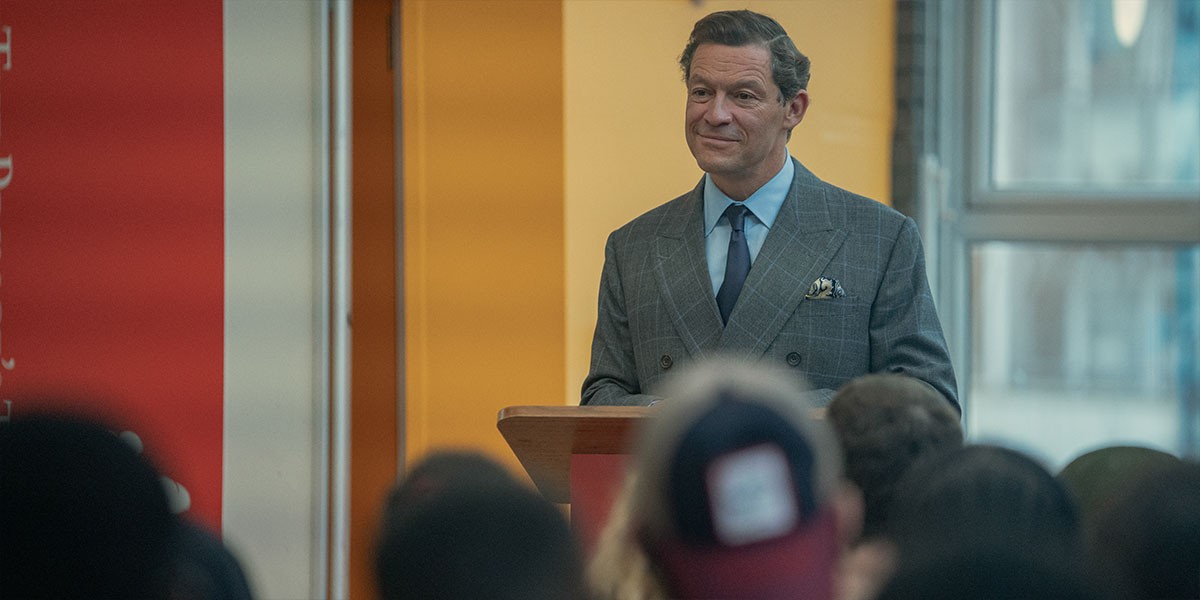
The CrownDominic West in “The Crown” (Netflix/Keith Bernstein)
It feels odd to softly penalize a performance for being too convincingly vulnerable considering that in nearly any other instance, that would be an asset. It could also be the case that West’s performance will align with a version of King Charles III we’ve yet to meet. Regardless, it brings into relief the strained pull between the British monarchy romanticized in “The Crown” and the one we know through Charles and Diana’s children, one of whom is determined to live more openly and be more publicly real than his grandparents and father.


Biden halts student debt relief applications after federal judge blocks program

The Biden administration stopped accepting applications for its popular student loan forgiveness plan on Friday, a day after a Trump-appointed federal judge blocked the program on what critics are calling dubious legal grounds.

“We are disappointed in the decision of the Texas court to block loan relief moving forward. Amidst efforts to block our debt relief program, we are not standing down,” U.S. Education Secretary Miguel Cardona said in a statement after Judge Mark Pittman of the U.S. District Court for the Northern District of Texas declared the Biden administration’s debt relief plan “unconstitutional.”

“Despite this decision, we will never stop fighting for the millions of hardworking students and borrowers across the country,” the secretary continued. “We believe strongly that the Biden-Harris Student Debt Relief Plan is lawful and necessary to give borrowers and working families breathing room as they recover from the pandemic and to ensure they succeed when repayment restarts.”

“The Department of Justice has appealed today’s decision on our behalf, and we will continue to keep borrowers informed about our efforts to deliver targeted relief,” he added.

According to the White House, 26 million people have already applied, and 16 million have been approved, for student loan relief. Under the program, borrowers earning up to $125,000 as an individual or $250,000 as a household are eligible for between $10,000 and $20,000 in federal student loan relief, depending upon the type of loan they received.

In his ruling, Pittman found that two plaintiffs who brought the case with the backing of the billionaire-funded Job Creators Network Foundation had standing to sue, despite neither being fully eligible for student debt relief.

The Intercept’s Ken Klippenstein reported earlier this week that one of the plaintiffs, Myra Brown, did receive a $48,000 Paycheck Protection Program small business loan earlier during the Covid-19 pandemic—of which $47,996 was forgiven.

Legal experts and progressive politicians condemned Pittman’s ruling. 

“My first response was, this is motivated reasoning by a judge who wants to come to this result,” Luke Herrine, an assistant professor of law at the University of Alabama and legal director at the Debt Collective, told NPR. “The legal analysis is flawed.”

Congressional Progressive Caucus Chair Pramila Jayapal (D-Wash.) tweeted: “This is a ludicrous opinion from a Trump-appointed judge. I’m glad the administration is appealing. Dems are fighting for middle-class relief while GOP special interests and judges are trying to block it on outlandish grounds.”

Pittman’s decision comes weeks after the conservative-dominated Eighth U.S. Circuit Court of Appeals temporarily stopped the Biden administration from “discharging any student loan debt” until the court rules on an emergency request from Republican-led states seeking to block the program.

Official estimates indicate that meat consumption is falling in the UK – not all of the data agrees

Responsible for roughly a third of the U.K.’s diet-related carbon emissions, the consumption and production of meat is a substantial contributor to climate change. A report commissioned by the government last year reflects this, finding that people must eat 30% less meat by the end of the decade to reduce the environmental impact of food production.

Research indicates that meat consumption habits have changed. One study reports that the amount of meat eaten each day per person fell by 17% on average in the U.K. between 2008 and 2019.

This result has been widely accepted and was obtained by analyzing the meat consumption data published in the National Diet and Nutrition Survey. By asking participants to record how much of a certain food they have eaten over a given time period, the survey captures nationally representative data on the food people are eating in the U.K.

Our research compared this trend to other datasets and instead suggests that the reduction in meat consumption could be far smaller. Britons may still be consuming too much meat, with profound environmental consequences.

Recording meat consumption

Trends in food consumption are estimated using three types of dataset: dietary recall surveys (which include the National Diet and Nutrition Survey), household budget surveys and food balance sheets. Each dataset is constructed using a different type of information and the accuracy of each is unclear.

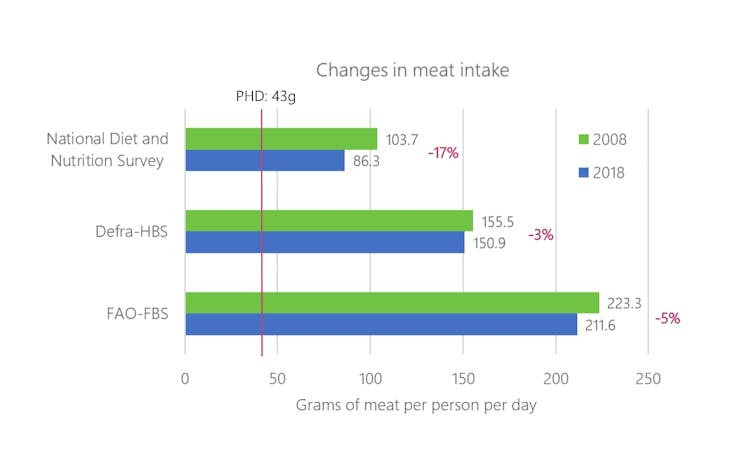
Household budget surveys ask participants to record how much of a particular food item they have purchased. Fewer meat purchases tend to mean less household meat consumption. Household budget surveys show just a 3% decline in meat purchases in the U.K. from 2008 to 2019.

Food balance sheets instead measure how much food is available to buy and are constructed using industry data. In practice, a fall in meat supply suggests that a decreasing amount of meat is being consumed. Meat supply decreased by 5% in the U.K. over the same period.

A graph showing the reduction in meat consumption between the three datasets between 2008 and 2018. Food balance sheets and household budget surveys show smaller declines than the National Diet and Nutrition Survey.
The levels of of meat reduction vary between the three datasets. Author provided

Although neither household budget surveys or food balance sheets directly measure consumption, they are often used to approximate changes in consumption patterns. Compared to the trends captured by the National Diet and Nutrition Survey, they imply a smaller decline in U.K. meat consumption.

This variation means that we cannot be certain about which dataset provides the closest approximation of actual meat consumption. Two factors are responsible for the wide range in consumption estimates.

1. Underreporting

Surveys often depend on inaccurate data. As they rely on individual reporting, both household budget surveys and dietary recall surveys are subject to underreporting. This can occur when respondents accidentally forget to record the food that they have eaten or do not wish to declare it.

Underreporting seems to be increasing over time. This could be the result of many factors, but some studies have found that underreporting is significantly higher in overweight and obese individuals.

Rising obesity rates, increased snacking outside the home, and falling survey response rates have all interfered with the accuracy of dietary data. According to the Office for National Statistics, the National Diet and Nutrition Survey may have underestimated calorie intake by as much as 34% in 2019.

Even if there has been no change to actual consumption, the large fall in meat consumption estimated by the National Diet & Nutrition Survey could be due to under-reporting.

2. Waste

As food balance sheets rely on industry data, they are less subject to underreporting. But the amount of food that is wasted can also interfere with the accuracy of dietary data.

As indirect measures of consumption, food balance sheets and household budget surveys incorporate food wastage. Food on the supermarket shelf can either be bought or wasted, just as food that has been purchased can be consumed or thrown away.

Changes in waste can therefore result in apparent (but not actual) changes in consumption. A reported increase in consumption could actually be masking an increase in food waste.

Change in the quantity of food wasted will affect the difference between true consumption and apparent consumption, measured using household budget surveys or food balance sheets. If meat waste increased and actual meat consumption decreased by the same amount, apparent meat consumption would not change.

This could conceal trends in declining consumption. An increase in the quantity of meat wasted could potentially be responsible for the differences in trends between the three types of dataset.

As a direct measure of consumption, dietary recall surveys do not include waste. Unlike household budget surveys and food balance sheets, their accuracy will not be affected by changes in the quantity of waste.

Each dataset suggests that U.K. meat consumption is declining, but the magnitude of the decline is uncertain.

Yet our research suggests that the decline in U.K. meat consumption could be much less than officially estimated. Further steps must be taken to ensure we meet the targets for a healthy and sustainable food system.

Better data collection on food waste and underreporting is needed. Data on the extent of underreporting in dietary datasets and the proportion of food wasted at each stage of the production chain would be a start, providing consistency in long-term dietary trends. This would allow the use of multiple different dietary datasets to more accurately approximate consumption.The Conversation

Kerry Smith, PhD candidate in Biological Sciences, University of Reading and Emma Garnett, Researcher in the Health Behaviours Team, University of Oxford

This article is republished from The Conversation under a Creative Commons license.

COVID-19 can cause lasting lung damage: Three ways long COVID patients’ respiration can suffer

“I just can’t do what I used to anymore.”

As pulmonologists and critical care doctors treating patients with lung disease, we have heard many of our patients recovering from COVID-19 tell us this even months after their initial diagnosis. Though they may have survived the most life-threatening phase of their illness, they have yet to return to their pre-COVID-19 baseline, struggling with activities ranging from strenuous exercise to doing laundry.

These lingering effects, called long COVID, have affected as many as 1 in 5 American adults diagnosed with COVID-19. Long COVID includes a wide range of symptoms such as brain fog, fatigue, cough and shortness of breath. These symptoms can result from damage to or malfunctioning of multiple organ systems, and understanding the causes of long COVID is a special research focus of the Biden-Harris administration.

Not all breathing problems are related to the lungs, but in many cases the lungs are affected. Looking at the lungs’ basic functions and how they can be affected by disease may help clarify what is on the horizon for some patients after a COVID-19 infection.

Normal lung function

The main function of the lungs is to bring oxygen-rich air into the body and expel carbon dioxide. When air flows into the lungs, it is brought into close proximity with the blood, where oxygen diffuses into the body and carbon dioxide diffuses out.

The lungs bring oxygen into and carbon dioxide out of the body.

This process, as simple as it sounds, requires an extraordinary coordination of air flow, or ventilation, and blood flow, or perfusion. There are over 20 divisions in your airway, starting at the main windpipe, or the trachea, all the way out to the little balloons at the end of the airway, called alveoli, that are in close contact with your blood vessels.

By the time a molecule of oxygen gets down to the end of the airway, there are about 300 million of these little alveoli it could end up in, with a total surface area of over 1,000 square feet (100 square meters) where gas exchange occurs.

Matching ventilation and perfusion rates is critical for basic lung function, and damage anywhere along the airway can lead to difficulty breathing in a number of ways.

Obstruction — decreased airflow

One form of lung disease is obstruction of airflow in and out of the body.

Two common causes of impairments like these are chronic obstructive pulmonary disease and asthma. In these diseases, the airways become narrowed because of either damage from smoking, as is common in COPD, or allergic inflammation, as is common in asthma. In either case, patients experience difficulty blowing air out of their lungs.

Researchers have observed ongoing airflow obstruction in some patients who have recovered from COVID-19. This condition is typically treated with inhalers that deliver medications that open up the airways. Such treatments may also be helpful while recovering from COVID-19.

Restriction — reduced lung volume

Another form of lung disease is referred to as restriction, or difficulty expanding the lungs. Restriction decreases the volume of the lungs and, subsequently, the amount of air they can take in. Restriction often results from the formation of scar tissue, also called fibrosis, in the lungs due to injury.

Fibrosis thickens the walls of the alveoli, which makes gas exchange with the blood more difficult. This type of scarring can occur in chronic lung diseases, such as idiopathic pulmonary fibrosis, or as a result of severe lung damage in a condition called acute respiratory distress syndrome, or ARDS.

ARDS can be caused by injuries originating in the lungs, like pneumonia, or severe disease in other organs, like pancreatitis. Around 25% of patients who recover from ARDS go on to develop restrictive lung disease.

Researchers have also found that patients who have recovered from COVID-19, especially those who had severe disease, can later develop restrictive lung disease. COVID-19 patients who require a ventilator may also have recovery rates similar to those who require a ventilator for other conditions. Long-term recovery of lung function in these patients is still unknown. Drugs treating fibrotic lung disease after COVID-19 are currently undergoing clinical trials.

Impaired perfusion — decreased blood flow

Finally, even when air flow and lung volume are unaffected, the lungs cannot complete their function if blood flow to the alveoli, where gas exchange occurs, is impaired.

COVID-19 is associated with an increased risk for blood clots. If blood clots travel to the lungs, they can cause a life-threatening pulmonary embolism that restricts blood flow to the lungs.

In the long term, blood clots can also cause chronic problems with blood flow to the lungs, a condition called chronic thromboembolic pulmonary hypertension, or CTEPH. Only 0.5% to 3% of patients who develop a pulmonary embolism for reasons other than COVID-19 go on to develop this chronic problem. However, there is evidence that severe COVID-19 infections can damage the blood vessels of the lung directly and impair blood flow during recovery.

What’s next?

Lungs can work less optimally in these three general ways, and COVID-19 can lead to all of them. Researchers and clinicians are still figuring out ways to best treat the long-term lung damage seen in long COVID.

For clinicians, closely following up with patients who have recovered from COVID-19, particularly those with persistent symptoms, can lead to quicker diagnoses of long COVID. Severe cases of COVID-19 are associated with higher rates of long COVID. Other risk factors for development of long COVID include preexisting Type 2 diabetes, presence of virus particles in the blood after the initial infection and certain types of abnormal immune function.

For researchers, long COVID is an opportunity to study the underlying mechanisms of how different types of lung-related conditions that result from COVID-19 infection develop. Uncovering these mechanisms would allow researchers to develop targeted treatments to speed recovery and get more patients feeling and breathing like their pre-pandemic selves once again.

In the meantime, everyone can stay up to date on recommended vaccinations and use preventive measures such as good hand hygiene and masking when appropriate.


Jeffrey M. Sturek, Assistant Professor of Medicine, University of Virginia and Alexandra Kadl, Assistant Professor of Medicine and Pharmacology, University of Virginia

This article is republished from The Conversation under a Creative Commons license. Read the original article.

15 facts to know about Veterans Day, from the celebrations to the correct spelling

Veterans Day is an annual federal holiday that honors and celebrates all military veterans of the United States Armed Forces.

Originally called Armistice Day, the holiday was first recognized in 1919 when the armistice, also known as a formal truce, officially ended the World War I feuds between the Allied Powers and Germany. The name was formally changed to “Veterans Day” in 1954 to encompass veterans in all conflicts.

Veterans Day is celebrated nationwide via public parades, gatherings and ceremonies. Notable celebrations include the annual National Veterans Day Observance at Arlington National Cemetery in Virginia, the Veterans Day Ceremony & Wreath Presentation at The Korean War Veterans Memorial in Washington, D.C., and the Veterans Day Observance at The Vietnam Veterans Memorial, also located in Washington, D.C.

In anticipation of the holiday, here are 15 facts to know about Veterans Day:

01
Veterans Day does NOT have an apostrophe
It’s not spelled “Veteran’s Day” or “Veterans’ Day.” The holiday honors all veterans — it does not belong to veterans nor does it involve just one veteran. Thus, it’s spelled “Veterans Day,” sans the apostrophe.
02
Veterans Day is NOT Memorial Day
Veterans Day commemorates military personnel — both living and deceased — who have honorably served their country. Memorial Day, on the other hand, honors those who have fought and died while serving in the armed forces. Memorial Day is also observed on the last Monday of May.
03
Veterans Day was first known as Armistice Day

Although World War I officially ended with the signing of the Treaty of Versailles on June 28, 1919, the fighting stopped on Nov. 11, 1918, when the Allies and Germany signed an armistice on the 11th hour of the 11th day of the 11th month. That date, known as Armistice Day, was recognized by Congress as the end of “the war to end all wars” in 1926, and in 1938, it became a federal holiday that specifically honored veterans of World War I.  


Following World War II and the Korean War, the holiday was renamed Veterans Day on June 1, 1954 to celebrate American veterans of all wars.

04
Veterans Day initially had a different date of celebration

In 1968, Congress signed the Uniform Monday Holiday Act, which noted that several federal holidays — including Veterans Day — will be celebrated only on Monday. Officials hoped the initiative would encourage travel over the long weekend and, in turn, boost the economy.


Under this new bill, Veterans Day was first celebrated on Oct. 25, 1971 — the fourth Monday of the month. However, many states were unhappy with the new change and continued celebrating the holiday on Nov. 11. Finally, on Sept. 20, 1975, President Gerald Ford signed Public Law 94-97, which redesignated Nov. 11 of each year as Veterans Day starting in 1978.

05
There’s a Women’s Veterans Day, which is held on June 12
The date marks the anniversary of the Women’s Armed Services Integration Act, which was signed into law by President Harry S. Truman on June 12, 1948. Women’s Veterans Day is not a nationally recognized holiday, but some states — including California, Hawaii, New Jersey and New York — still observe it.
06
There’s also a National Atomic Veterans Day
On July 15, 1983, President Ronald Reagan designated July 16, 1983, as National Atomic Veterans Day. The one-time commemoration specifically honored “American military service members who participated in nuclear tests between 1945 and 1962, served with United States military forces in or around Hiroshima and Nagasaki through mid-1946 or were held as prisoners of war in or near Hiroshima or Nagasaki,” according to a 2021 statement from the White House.
07
National Atomic Veterans Day was brought back on July 16, 2021
President Joe Biden revived the day just last year, saying in a statement, “I call upon all Americans to observe this day with appropriate ceremonies and activities that honor our Nation’s Atomic Veterans whose brave service and sacrifice played an important role in the defense of our Nation.” Then in December of that year, Biden signed legislation into law to recognize atomic veterans as part of the National Defense Authorization Act for Fiscal Year 2022.
08
Service dogs also get their own Veterans Day
March 13 is National K9 Veterans Day, which celebrates the service and sacrifices of American military and working dogs. The day also marks the official birthday of the Army’s War Dog Program, also known as the K-9 Corps, which was established in 1942.
09
There’s a recommended time for observation
Legally, at 2:11 p.m. ET, two minutes of observation is recommended.
10
The Arlington National Cemetery holds an annual memorial service
The cemetery, located in Arlington, Virginia, is home to the graves of over 400,000 individuals, most of whom served in the military. Every year, The Arlington National Cemetery holds a memorial service on Veterans Day at 11 a.m., which is when the World War I armistice was signed.
 
As part of the commemoration, the U.S. Army Military District of Washington conducts a Presidential Armed Forces Full Honor wreath-laying ceremony at the Tomb of the Unknown Soldier. An observance program, hosted by the Department of Veterans Affairs, takes place afterwards in the cemetery’s memorial amphitheater. The service is both free and open to the public.
11
A Veterans Day Parade is also held annually in New York City
Produced by the United War Veterans Council (UWVC), the parade was first held in 1919. Today, the annual event takes place on Fifth Avenue and is both the largest and oldest Veterans Day parade in the country.
12
The Smithsonian opened the National Native American Veterans Memorial
The Smithsonian National Museum of the American Indian in Washington, D.C., opened the National Native American Veterans Memorial on Veterans Day in 2020. The monument “is the first national landmark in Washington, D.C., to focus on the contributions of American Indians, Alaska Natives and Native Hawaiians who have served in the military.”
13
Veterans Day legislation attempts to pay back Black service members
On Nov. 11, 2021, a group of Democratic lawmakers introduced new legislation that would “give surviving spouses and all living descendants of Black WWII veterans housing and educational benefits that were initially denied to their families,” per The Hill. The legislation would also extend the VA Loan Guaranty Program and the GI Bill education assistance to “Black WWII veterans and their descendants who were alive at the time of the bill’s passage.” The GI Bill was originally passed in 1944 to help veterans pay for education and housing following their return from service. The law, however, was also racially discriminatory and prevented many Black veterans from receiving their full — and rightful — benefits.
14
Thousands of Veterans are still alive today
According to statistics from the U.S. Department of Veterans Affairs, 167,284 of the 16 million Americans who served in World War II are alive in 2022.
15
Veterans Day is observed in other countries too
In the United Kingdom, Canada, Australia, and France, Nov. 11 is also a day of observance for the veterans of World Wars I and II. The second Sunday of November is known as Remembrance Sunday in the U.K. And in Canada and Australia, Nov. 11 is observed as Remembrance Day. In Britain and the Commonwealth countries and countries in Europe, “it is common to observe two minutes of silence at 11:00 AM on November 11,” per Britannica.

A glitch in Kroger’s new payroll system means some employees haven’t been fully paid since Labor Day

Mark Kilbrade assumed the first incomplete paycheck he received from Kroger was a mistake.

Kilbrade had been working at one of the supermarket chain’s Centreville, Ohio, locations for about a year when he put in a vacation request. Though Kilbrade’s request was approved by management, paid time off wasn’t reflected in his check after he returned from vacation. In fact, it wouldn’t be reflected for another four weeks, after he involved a union representative.

“I decided once I got my pay to leave the company, and I did without a proper notice,” Kilbrade wrote in an email to Salon Food. “You don’t mess with employee’s pay. Fortunately being married, my spouse had income, so it did not hurt much. But if it were just myself, there is no way I could have made ends meet.”

This isn’t an isolated incident. Since Labor Day, reports of late and partial paychecks have dominated Kroger employee Facebook pages and Reddit forums. Many employees — both exempt and non-exempt — have written posts describing how they’ve had to tap into their savings in order to cover the discrepancies between their promised pay and recent paychecks.

“My spouse has not been paid (salaried) and no one seems to be doing anything about it,” one Reddit user wrote in a since-deleted comment originally posted on Nov. 3. “They will not give an advance…Is this happening to anyone else? We are blowing through our savings.”

The post continued: “We’ve got a child who must continue medical treatments, a soldier waiting for him to send him a ticket home for the holidays, and other family counting on us.”

According to employees, the recent spate of payment-related issues can be traced back to a common issue: a newly-adopted, but glitchy payroll system that hasn’t yet been fixed. With little communication from corporate leadership, many employees — according to interviews conducted by Salon Food and a survey of social media posts — are torn between attempting to wait out their paychecks and quitting to find a new source of income right before the holidays.

The issues appear to have originated around Labor Day, according to an email shared with Salon Food by a Kroger employee in Michigan.

“Good morning all, at this point I am sure you are aware that many associates did not receive Labor Day holiday pay,” the email, which was sent from corporate leadership to area managers, said. “This issue has affected approximately 5,000+ associates within the MI division.”


Want more great food writing and recipes? Subscribe to Salon Food’s newsletter, The Bite.


Per the email, managers were aware of the issue, which was blamed on a software glitch. They said the payments would be applied to the following week’s paycheck.

A current Kroger recruiter, who agreed to speak on the condition of anonymity over fear of losing her job, told Salon Food during a Nov. 7 video call that her store had shifted over to the MyTime and MyInfo systems earlier this fall. As she described it, the “apps aren’t talking to each other.”

MyTime is a payroll system that allows users to clock in and out using an application on their phones. That information is supposed to be fed to MyInfo — which is where an employee’s hourly pay rate and banking information, including their direct deposit details and home address, are stored. After management approval, MyInfo is supposed to generate a paycheck, which would be issued in the manner requested by the employee, typically a direct deposit or a paper check.

According to the recruiter, the system isn’t working as intended. At the same time, she acknowledged that some of the issues stem from user error. A few employees with whom she spoke found it difficult to adjust to the new time-keeping system. Nevertheless, there are inexplicable technical glitches, among them users’ direct deposit information disappearing from the system.

The recruiter estimated this issue had impacted at least a dozen workers from her store, including one particularly egregious example in which a bakery employee went three weeks without pay.

“When [the bakery employee] had her information flipped from Express HR to MyInfo, her direct deposit information was incorrect,” she said. “She had one account in one space, one account in a different space, so it didn’t populate correctly.”

“The manager told her, ‘I submitted your payroll. Your payroll has been submitted. I don’t know why you’re not getting paid.'”

When the bakery employee finally flagged the issue to management, she was allegedly told that store leadership wasn’t sure when the situation would be rectified.

“The manager told her, ‘I submitted your payroll. Your payroll has been submitted. I don’t know why you’re not getting paid,'” the recruiter said.

On a national level, it’s unclear exactly how many employees may have been impacted by these technical issues. Kroger hasn’t returned Salon Food’s requests for comment on this topic; multiple attempts were made to reach the supermarket chain.

Kroger has nearly 2,800 stores in 35 states operating under 28 different brands, including Mariano’s and Ralph’s. Salon Food spoke to almost a dozen Kroger employees — both on and off the record — who worked at locations in Florida, Georgia, Kentucky, Ohio, Virginia, West Virginia and Washington, D.C. Each worker described how at least several employees from their respective stores had allegedly experienced payroll problems related to the implementation of MyTime and MyInfo.

On a more anecdotal level, a quick search of the term “paycheck” in r/Kroger, the subreddit for the Kroger family of companies, revealed reports of associates across the country being impacted by this issue. Over the last month, dozens of users have added posts with titles including: “3 paychecks with wrong work hours,” “Alpharetta GA Kroger Routinely Shorting Paycheck” and “Any news about the missing paychecks from last week?”

In a post titled “No Paychecks for 971,” an individual who identifies as a Kroger employee wrote: “No one has gotten paid at 971 even the people like me who always get paid by 4pm on Wednesdays.”

“Our payroll person said they sent it in like usual and it’s Krogers [sic] fault,” they continued. “Do any other stores in the Columbus area have this problem?”

This extended payroll glitch comes at a time when the union that represents the majority of Kroger employees is spread unusually thin amid controversy surrounding a proposed mega-merger between Kroger and Albertsons, two of the nation’s largest supermarket chains. Some critics worry a merger would mean reduced competition, higher food prices and the closure of underperforming locations, which has the potential to further impact marginalized communities. Leadership at the United Food and Commercial Workers (UFCW) International Union, which represents Kroger employees, says they’re attempting to combat these recent instances of incomplete and late pay.

UFCW Local 400, which oversees grocery workers in the mid-Atlantic region, recently set up a public-facing web page dedicated to collecting reports of MyTime issues.

“Since Kroger first launched MyTime, many associates have reported issues with the new system,” it reads. “While we’ve tried to work with the company to resolve these issues, a majority of the issues are still unresolved or keep occurring with other associates.”

According to the web page, currently known MyTime issues include: ongoing unpaid night premium for night crew; backups not getting paid for relief; holidays not being paid; personal holidays and vacations not being paid; unable to schedule personal holidays; night premium not being paid for vacations of night crew; and docking for pay on break.

In Michigan, UFCW Local 876 filed a class action grievance on Oct. 19 “for mistakes due to MyTime on the following: holiday pay, relief pay, personal days [and] untimely paychecks.” (As of publication, requests to both unions regarding the exact number of affected employees went unanswered.)

Mike, a former Virginia-based employee who asked to use only his first name for privacy, finally had enough after his first paycheck from the supermarket was weeks late. Mike was hired on Oct. 10 into his store’s leadership development program, meaning that he was considered management and ineligible for union membership.

“I worked 43 hours my first week, doing mandatory computer training,” he wrote via email. “I was unable to set up a direct deposit due to issues with the MyInfo system until the following Monday, so I knew to expect a paper check.”

“I feel like management should forfeit their pay for a few weeks and see how they can pay bills and buy groceries.”

The check didn’t come. When Mike flagged the issue, he was told “this was a ‘known issue’ and that [his] name was ‘on a spreadsheet’ now for people missing checks.”

The next week, the same thing happened again. After three weeks with the company, Mike finally quit — but not before filing a complaint with the U.S. Department of Labor and finally collecting his three paychecks.

“I just hope that exposure to this ‘known’ issue can resolve issues that impact others who live paycheck to paycheck,” he wrote. “I feel that Kroger should add any late/delinquent fees to the checks of anyone who incurred such debts. I was fortunate to have money set aside to aid with the job transition, but I know many others do not have that luxury.”

Mark Kilbrade in Ohio feels similarly after his departure from the company.

“I feel like management should forfeit their pay for a few weeks and see how they can pay bills and buy groceries,” he said. “How a company so big could have this problem without even apologizing is disgraceful. Not only that, they purchased another big company during this screwed-up mess. I feel Kroger should be boycotted by all and let them suffer like they made their employees suffer.”

Need a Thanksgiving dessert shortcut? Costco has giant pecan pies that weigh more than four pounds

Alas, we have an important signal that the most wonderful time of the year is (almost) here. Costco’s iconic — and positively ginormous — pecan pie has officially returned to the bakery section. Let the countdown to Turkey Day commence: T-14 days until Thanksgiving!

If you’re looking for a dessert to feed a crowd this holiday season, you may not need to look any further than the warehouse chain, which is known for its bulk treats. After spotting a shelf full of pecan pies, Laura, who operates the popular Instagram account @costcohotfinds, remarked that they could “could feed 10” people.

Should I put this hypothesis to the test? If so, it would be solely for the joy of dessert. An Instacart listing confirms that these pies weigh in at more than 4 pounds.

While Laura warmed up a slice with a “scoop of vanilla ice cream and a little sprinkle of cinnamon,” she noted that some may instead opt for the slightly lighter option of whipped cream as their go-to topping. (Laura also pronounced pecan “puh-cahn,” but that’s a conversation for another day.)

https://www.instagram.com/p/CkwswFvjHY2/

Pecan pie is a fascinating entrant in the world of pies, as it’s one of the few that doesn’t have a fruit base. Some include chocolate chips, while others include liquor. But the focus of the pie is always clear: a ton of pecans, a flaky crust and that hard-to-pinpoint, almost-caramel-esque custard. Embracing the nuttiness and crunch, the pecans are often suspended in an amalgamation of molasses and corn syrup. The whole shebang caramelizes and solidifies once baked, creating the classic flavor that has been cherished for years on end.

Dana Hatic writes for Eater that pecans are “native to North America,” and their natural season actually runs from September through November (which has certainly helped to certify the pecan’s place in the autumnal holiday lexicon). She also notes that the pie’s gooey-ness is created by the combination of butter, sugar, corn syrup and egg, as well as that the pecans “rise to the top” during the baking process. This results in that perfect bite: a mix of smooth, even custard, buttery crust and brittle, baked nuts.


Want more great food writing and recipes? Subscribe to Salon Food’s newsletter, The Bite.


Southern Living adds that the “milk-custard-based pecan pie” originated in the American South and was first printed in a cookbook as early as 1824. Fast forward a century later, and the pie truly experienced a boon in popularity when it was promoted as a primary use for Karo corn syrup. According to Hatic, while Karo syrup is a requisite ingredient in many recipes, it’s not always necessary. Many iterations replace it with brown sugar, molasses or liquor. (The original Karo recipe included a full cup of corn syrup, plus eggs, sugar, margarine, vanilla, salt, pecans and a pastry shell).

Masterclass poetically sums up the allure of the traditional pie, noting that “pecan pie is a quintessential American dessert featuring a mosaic of pecan halves suspended in a silky, sugary blend of eggs, butter and a sweetener — traditionally corn syrup — held together in a flaky pie crust.”

Whether you decide to pick up a pie at Costco to share with a crowd or eat entirely by yourself, the journey is entirely yours for the making.

Are you shopping at the best Costco location in the country? In case you missed it, that store is located in this state.

With Proposition 12, the Supreme Court could be ruling on more than factory farms

Earlier this October, the U.S. Supreme Court heard oral arguments in the case of the National Pork Producers Council vs. Ross. The court’s ruling will determine if a recent California law that sets minimum animal welfare standards for pigs and chickens should be upheld. Because the law stipulates that all pork sold in California must meet the state’s production standards, it has the attention of the pork industry nationwide, which has largely refused to comply with the new standards. They have taken the case all the way to the Supreme Court in the hope that they’ll be overturned. But the ruling could ultimately have implications beyond animal welfare concerns, potentially undermining a legislative method that progressive interest groups have used to bring reform to numerous industries nationwide.

What is Proposition 12?

Proposition 12 went before California voters in 2018 as a measure that would tighten up earlier legislation regarding animal welfare on factory farms. Voters overwhelmingly approved the measure, with 62% of voters in favor. Earlier attempts by California to eliminate unnecessary confinement for sows and hens had been somewhat successful in improving animal welfare on farms, but left significant loopholes. While the egg industry — even those companies outside California — has mostly complied with these requirements to raise animal welfare standards, the pork industry hasn’t, and meat brought into the state largely doesn’t meet California’s standards. With this in mind, Prop 12 specified that, not only must these standards be met by products made in California,  all pork and eggs sold in the state must meet those same production standards.

While Prop 12 does address some other animal welfare concerns, like adjusting space requirements for egg-laying hens, the most contentious point is the pork industry’s use of gestation crates. Pregnant sows can be territorial and hierarchical, and especially in the cramped conditions of a factory farm, this can quickly turn into aggression that might cause the sows to lose piglets, be seriously injured or even die. If you assume (as the profit-motivated pork industry does) that the tightly packed conditions on factory farms are necessary, keeping sows away from each other seems like the most convenient way to avoid that problem.

But the reality of gestation crates is grim: Without room to even turn around, sows are kept in confinement for months, only to be moved to even more restrictive farrowing crates (which Prop 12 doesn’t even address) after they give birth.

The pork industry presents gestation crates as a necessary evil that’s ultimately better for the pigs than letting them hurt one another. But as we explore in our podcast, it doesn’t have to be this way: As intelligent, social animals, pigs’ behavior changes with their environment. When pigs learn to interact with each other in the cramped, exclusionary environment of a factory farm, violence is more likely. With ample space, deep bedding and the other factors they need to engage in their natural behaviors, that becomes far less of a concern. Providing those conditions would be a foundational change that flies in the face of the factory farm model, however, and the mainstream pork industry is correct that it would be an expensive one.

The case against Proposition 12

Notably, Prop 12 doesn’t even mandate a full transition away from confinement; it simply increases the amount of space required per pig such that they can move around a little rather than only standing or laying down. Still, the industry considered it to be enough of an imposition on their production model that they refused to comply, dragging out several legal challenges against the California Department of Food and Agriculture and delaying the implementation of the standards that were supposed to be in place at the beginning of 2022. The most successful of those challenges, the National Pork Producers Council (NPPC) vs. Ross (California’s Secretary of Agriculture), went before the U.S. Supreme Court in early October.

Animal welfare is certainly Prop 12’s main concern, but whether or not it’s good for animals isn’t what brings it before the Supreme Court. In this case, the NPPC argues that because most pork sold in California comes from outside the state, the law overreaches beyond California’s borders to regulate interstate commerce. This is a power reserved by the Federal government in the Constitution.

This is hardly the first case of California policies shaping industries beyond its borders: Nationwide, everything from automotive emission standards to carcinogen disclosures on household goods are designed to fit California’s standards, and it’s a significant route for progressive regulation on the environment and other issues to gain a national foothold even when support is limited. If the court decides to side with the NPPC, this strategy might become unviable in the future.

Accordingly, this means that industries beyond agriculture have watched the Prop 12 case closely in the hopes of overturning it. In the interest of that outcome, pharmaceutical companies, anti-regulation conservative political think tanks and others have filed amicus, or “friend of the court,” briefs, which outline how this issue affects them.

What happens next?

Given some of the court’s recent decisions, there’s plenty of reason to be concerned they might overturn Prop 12. Last year, the Court issued a ruling against the EPA, limiting their ability to regulate carbon emissions under the clean air act. In that case, the court’s rationale was that only the legislature could set these standards, making it much more difficult for current and future administrations to take action on the environment without hard-to-find support from Congress.

But the rationale for that earlier decision — that these issues should be decided by the public’s representatives in the legislature rather than by executives — would make overturning Prop 12 an ironic choice: While the industry portrays the situation as a bunch of out-of-touch animal rights activists trying to change a system they don’t understand in a place they don’t live, the reality is that Prop 12 won a wide majority of the vote in the country’s most populated state. Even if the court finds the policy does exert too much control on other states, the fact remains that it was a decision reached through popular referendum, one of the most difficult uphill slogs in politics. That alone is reason for the industry to be scared, and for them to be a little smarter: as the public gets more educated about factory farming, it’s unlikely that this will be the last attempt to challenge the system.

It didn’t have to be this way; pork producers could have followed the adaptations made by egg producers. After aggressively fighting California’s cage free mandate ten years ago, they ultimately realized public demand for more humanely produced eggs wasn’t going away. In the subsequent decade, the number of cage free eggs has risen sharply from 4% in 2010 to 29% in 2021.

This doesn’t mean that the changes would come easily or without a fight: Eggs are a more localized industry than pork, which has accumulated more power recently through consolidation and expanding export markets. But the idea that Americans really love and need cheap pork is increasingly questionable: as we explore in our podcast episode on the pork industry, the seemingly organic “put bacon on everything” trend of the early 2000s was actually the product of clever marketing. And while the industry might be warning of pork shortages and high prices if laws like Prop 12 go into place, we know that they’ve used that line before, most notably when meat plants closed during the pandemic, and that a meat shortage is pretty unlikely.

Even if the court strikes it down, Prop 12 won’t be the last attempt to reform factory farms. But it doesn’t have to spell disaster: The reforms it proposed do not bring foundational change to a production system that’s cruel to animals from birth to death. With the advocacy that surrounded the referendum, voters were brought up to speed on what factory farm life looks like for animals and they didn’t like what they saw. Now, with popular support behind animal welfare improvements, companies will have to shift their practices over time, one way or another, to meet consumer demands.

Wes Moore will be Maryland’s first Black governor. Here’s what scares me about his election

This week, Wes Moore was elected Maryland’s first Black governor. He’s only the third Black person in American history to receive the honor of being elected into the position of executive of state. I’m extremely inspired by Wes and all of his accomplishments. And I’m equally terrified.

Once, Wes — then CEO of Robin Hood Foundation, our nation’s biggest nonprofit organization dedicated to serving people living in poverty — invited me and four other friends from Baltimore who all have a history of doing community work, just like he does, out on boat ride. Wes being Wes, he would be driving the boat. 

“I joined this boat share,” Wes told us. “It’s so much better than owning a boat because you aren’t directly responsible for the upkeep. You learn how to sail and you get a good selection of boats to choose from.” 

Despite my fear of sinking ships, I hopped aboard with no problem, because I trust Wes. I’ve always trusted Wes even when I don’t trust the murky water we sail across.

That’s the day Wes told us he’d be considering a run for governor. None of us were shocked. We’ve always viewed Wes as the kind of dude who could or should be president.

Before I met Wes in person, I met him by reputation. In 2010, I was undergoing my own personal transformation, trying to transition from decades in the streets to the real world of jobs, credit scores, bills, cheesy cruise ship vacations, polo shirts, creased khakis, stuff like that. And in between my studying, learning, complaining about the system, and trying to properly starch and press my khakis, I happened to be watching “Oprah” when a brother who seemed to have all of my dreams figured out flashed across the screen. That brother was Wes, who was appearing as a guest to talk about his memoir, “The Other Wes Moore.”

Dude was perfect at articulating his thoughts and ideas, a skill that I wanted to learn. He had written a book, and I badly wanted to be a writer. He was an Army vet, and while I wasn’t going anywhere near the Army, he also graduated from Johns Hopkins University, a school I had dreamed of attending. I would be accepted to that school the following year. 

We’ve always viewed Wes as the kind of dude who could or should be president.

Like a zillion other people who caught his interview with Oprah, I went out and bought the book. “The Other Wes Moore” delivers a first-class lesson in empathy by clearly explaining the ills of the multiple Americas that exist. Wes accomplishes this by writing about himself and a guy with the same exact name as him. 

“The other Wes Moore is a drug dealer, a robber, a murderer. I am a Rhodes scholar, a White House Fellow, a former Army officer. Yet our situations could easily have been reversed,” he wrote.

“The Other Wes Moore” was a smash because of the way it humanized poverty for so many people, showing how it was much more than an individual’s problem — it was an American problem. Moore dispelled the bootstraps myth by not preaching about hard work but instead focusing on the role society plays — how easy it is for a person living in poverty, even a hard worker, to get caught up in the system — and the role luck plays in Black success, and why we all need to fight to change that as a collective. Wes was preaching, even though he wasn’t a reverend. This was the first time I thought, this guy could be president.

This happened during Obama’s first term when stories from clean-cut Black men who could articulate their struggles were being considered, I imagine, because we had a guy with the perfect American come-up story in the White House. We didn’t see immediate physical changes in our neighborhoods; however, these triumphs — Obama’s election, Moore’s success in telling his story of perseverance while shining a light on poverty and the role it plays in destroying communities, rather than solely championing himself and his own abilities — gave the rest of us a kind of American optimism we didn’t quite have in the previous generation. Guys like Wes and Obama made us proud. That American optimism they promoted helped motivate us to finish college, build stronger bonds with our families, start those businesses, write those books and try. Try to push past what our ancestors went through, and claim a piece of this country for ourselves. 

We didn’t all win. And we didn’t all get it right. Some of us quit; some of us fell back into our old ways. And unfortunately, some of us died with that optimism­­. But luckily, some of us excelled.

I wanted to write a book that kids loved as well. I didn’t know how I could make that happen.

I graduated from John Hopkins University still squeezing that American optimism, not fully knowing what to do with it, when I bumped into a professor from my first semester.  

“Mr. Watkins, what’s next for you?” she said, adjusting items in her stuffed New Yorker tote. “Still looking to write?”

“I’m doing it,” I responded. “I’m going to figure it out.”

She patted me on the shoulder. “You’ll figure it out. Next Wes Moore?” 

“Who knows?” I laughed. I really didn’t know. I had seen copies of “The Other Wes Moore” all over the Baltimore City public schools I had been working in. The children loved the text because it gave them hope while acknowledging the struggles they faced. I wanted to write a book that kids loved as well. I didn’t know how I could make that happen. I also didn’t know I’d publish in Salon, Rolling Stone, the New York Times and other outlets just a few years later.

My writing landed me on the cover of Johns Hopkins Magazine about two and a half years after I graduated. That cover brought in emails from all kinds of Hopkins affiliates, telling me I needed to work with Wes Moore. “Do you know Wes Moore?” they wanted to know. The funniest was a person asking, “Are you the other Wes Moore?” because of my background. 

Finally, someone connected us. A popular architect based in Baltimore, Anna Castro, introduced me to Wes Moore via email and group chat. I met Anna at a bar while trading high school jabs with a local politician named Bill. (High schools are everything in Baltimore — much more important than colleges. Bill went to City, and I attended the legendary Paul Laurence Dunbar.) Anna chimed in, telling me about the school libraries and cafeterias her company had renovated, showing me the “before” pictures of crumbling city school structures I was used to and then the glowing “after” photos of the spaces she transformed. “I wish you were redoing libraries and cafeterias when I was in school,” I told her.  

After I confessed to being a writer, someone else at the bar flashed a cover of the magazine and Castro connected me to Wes. The two of us had coffee a few days later. 

I admit I was nervous. Even though I had just been featured in a magazine affiliated with a prestigious university, I still kind of felt like I would be exposed as just another street guy who could never beat his own trauma and would be tossed back to where I came from. Wes — a dad who dressed like one, the same way I started dressing years later when I became a dad myself — bopped in with a huge grin, speaking to everyone in the coffee shop, giving hugs and shaking hands. Everyone knew who he was and it felt like he knew them as well. When he found me he dived right into the conversation, asking me, “What do you want to do?”

I didn’t quite understand the question. I was new in this game with limited opportunities — at least, not enough to be choosy. He started telling me about his newest venture, Bridge EDU, a nonprofit to help first-year college students find the connections and internships they need to graduate. I thought about my first years as a college student and how the culture shock didn’t even allow me to last two months. I was almost 30 by the time I made it to Hopkins for my successful attempt at a degree.

Initially, I didn’t fully understand what he was saying. I needed money. I couldn’t imagine saying no to an opportunity.

By then, Wes had a new book coming out, “The Work,” which highlighted people who were actually making a difference in their respective communities. We talked about the book rollout and what that looks like, all of which was new and valuable information to me — the kind of information new writers need and rarely get from seasoned writers because of petty competitiveness. Wes was different. Before we closed out, he asked me again, “What do you want to do?” 

“I don’t know, everything,” I said. “I want to do it all.” 

“You can’t,” Wes laughed. Then he got serious. “But I will tell you this: I think you are a great writer, and I just don’t say that. You have a bright future and a whole lot of opportunities are going to be coming your way. If you want to put yourself in the best position to be happy, you need to learn how to say no. This may sound crazy to you now, D, but say no, because if you say no, you will have the bandwidth to work on the things you really care about.” 

We flicked up and parted ways. Initially, I didn’t fully understand what he was saying. I needed money. I couldn’t imagine saying no to an opportunity. But he turned out to be right. Opportunities started pouring in and I found myself learning how to connect with the projects that spoke to me the most. 

I thanked Wes for that advice time and again, and continued to follow his career. As one of the busiest guys I know, he always took time to do everything from offering advice to me and other writers on publishing and media and popping up at all kinds of community events to stopping me at functions to make sure my jacket and tie was right, or my handkerchief was folded correctly. He’s a real big brother — the kind of big brother I try to be to other creators coming into this game behind me.

The way Wes expanded America’s perspective on poverty and the care he showed to me, that’s what resonates with so many voters. I know guys who have never voted — and never cared to vote — stop me to promote Wes’ campaign, proudly saying they were registering to vote for him because he spoke at their school, community center, church or youth program back in the day. Wes has real community connections. And that’s what scares me about his election. Losing a guy like Wes to the public sector means his energy and attention will have to stretch far beyond people in poverty. He’ll have to be governor of the whole state of Maryland, not just the poor people. 

The other scary part is that it is 2022, not 1960, and Wes is still only the third elected Black governor in American history. What’s even scarier is how Wes is perfect on paper: a graduate of Johns Hopkins, a Rhodes Scholar, an Army vet, a Wall Street banker who left Wall Street to do community work, a family man. Never had a real scandal other than weak and failed attempts made by other politicians to ruin his campaign. Maryland’s last governor was just a white Republican whose dad had been in Congress. But Wes had to be exceptional — perfect — to win. That’s how flawed this country is, and why we need a person like Wes working with and directly advocating for us. However, I also understand that we all have to grow. 

I trust Wes Moore. If the state of Maryland is the boat he wants to drive, then I trust his vision. I will gladly hop on for the ride.

Four Supreme Court justices under scrutiny for attending right-wing gala

Four U.S. Supreme Court justices attended the black-tie dinner gala at the first Federal Society convention since the court overturned Roe vs. Wade in its controversial Dobbs vs. Jackson Women’s Health decision.

Associated Press correspondent Mark Sherman reported Justices Samuel Alito, Amy Coney Barrett, Neil Gorsuch, and Brett Kavanaugh were in attendance at the group’s 40th-anniversary celebration

Sherman noted it is four-fifths of the majority of the court that overturned Roe. Controversial Justice Clarence Thomas was the fifth.

Three of the four justices in attendance were nominated by Donald Trump.

“Leonard Leo, [Federalist Society] co-chair, helped Trump vet judicial nominees. Group says it’s independent of partisan politics,” Sherman reported. “But there is close alignment with GOP priorities.”

Former U.S. Attorney Joyce Vance wondered if the justices at the dinner had forgotten their job.

“As with so many of our institutions, the judiciary can only do its work when the public has confidence in it,” Vance noted. “Some of our judges seem to have forgotten that and that they have life tenure to serve the American people, not the political agenda of the people who put them in place.”


Bruce Springsteen’s “Only the Strong Survive” pays homage to great songwriters who came before him

There’s a lot to be admired in “Only the Strong Survive,” Bruce Springsteen’s 21st studio album. But I find myself enjoying it in dramatically different ways than, say, his 1970s-era masterworks “Born to Run” and “Darkness on the Edge of Town.” Those records stirred our intellect and our emotions via the excitement of the artist’s storytelling and attendant musical drama. With “Only the Strong Survive,” Springsteen succeeds, simply put, by elevating our senses through the pure power of song.

Much of this album’s sensory impact should be credited to the album’s atmospherics. A collection of carefully selected cover versions, the LP sounds like the music and textures from soul and R&B’s heyday. That’s not to suggest that the album feels dated—far from it. Rather, Springsteen and co-producer Ron Aniello’s careful attention to sonic detail results in establishing a soulful ambiance that draws listeners in from the snare shot that kicks the title track into being. In so doing, they establish a musical thread that drapes itself across the balance of the album—indeed, right on through to the final cut, “Someday We’ll Be Together.”

And then there’s the matter of Springsteen’s vocals, which feel right at home in the grooves of the cover versions that he has selected. With “Only the Strong Survive,” he’s in fine fettle as a singer, affording homage to the music and an era that has clearly existed at the heart of his life’s inspiration. At times, the album makes for a dizzying array of standout vocal performances, as Springsteen reels off unforgettable takes of such 1960s classics as “Hey, Western Union Man,” “Don’t Play That Song,” and “7 Rooms of Gloom.”

As incredible as those numbers prove to be, Springsteen shifts into yet another gear altogether for “What Becomes of the Brokenhearted,” Jimmy Ruffin’s Motown hit. In a career filled with awe-inspiring musical highs, his vocal interpretation of “What Becomes of the Brokenhearted” makes for one of his finest performances, brimming with drama and foreboding.

“Only the Strong Survive” is an album that benefits from repeated listenings, with Springsteen’s cover versions taking on greater nuance with each new pass. He recently remarked that making the LP marked his effort to  “do justice” to “the great American songbook of the ’60s and ’70s.” With “Only the Strong Survive,” he demonstrates his artistic debt to his American R&B and soul roots. But it proves to be more than that: By producing an album’s worth of top-flight cover versions, Springsteen pays powerful homage to the songwriters and musicians who paved the way for his own vaunted place among their number.

Matthew Heineman’s documentary “Retrograde”: A chilling, intimate view of the Afghanistan War’s end

On the first episode of “The Problem with Jon Stewart” on Apple TV+, he covered the horrifying realities of the U.S. military’s use of burn pits. Burn pits are enormous craters that get filled with all kinds of garbage and debris, then set on fire, leaving a trail of toxic waste and often exposing military personnel to carcinogen-laden smoke. For Stewart, the problem with burn pits is that they show a deep disregard not only for the territory in which the U.S. military is operating but also for our troops.

Imagine, though, what happens when the burn pit isn’t just filled with garbage; it is also filled with care packages, printers and maps as part of a military retrograde operation. Imagine what happens when the military is destroying valuable materials it doesn’t want landing in the hands of its enemy because it doesn’t trust its allies enough to protect them.  Imagine burning all of those things, because you have been ordered to, even when you think it’s a really bad idea.

This is the context of Oscar-nominated and Emmy Award-winning Mathew Heineman’s new film, “Retrograde,” which captures the final nine months of the U.S. war in Afghanistan when President Biden announced that all U.S. troops would quickly retreat from Afghanistan. Covering the story from the perspective of a team of Green Berets supporting the Afghan National Army, a young Afghan general fighting desperately to defend his country, Afghan interpreters working with the U.S. military and civilians terrified of a return to Taliban rule, the film offers an intimate, chilling portrait of the colossal failures, human costs and destructive consequences of the abrupt end to America’s longest war.

The film isn’t questioning whether the war should have ended. Instead, it focuses on how it ended; it is the hasty retreat of the military, the retrograde operation, that offers the film’s central tension. Heineman’s original plan was to offer viewers a close-up view of the operation of a Green Beret unit after almost two decades of war. Arriving in Afghanistan in 2020 around the time Joe Biden was elected, he and his crew soon learned all U.S. troops were to leave Afghanistan. What had been planned as a film about an ongoing operation now had to pivot to a film about the end of the longest war for both the United States and Afghanistan.

The Army describes retrograde as “a defensive task that involves organized movement away from the enemy.” The catch, though, in this film is that as the U.S. military is engaging in organized movement away from an enemy, they are also attempting to leave their allies in the Afghan National Army prepared to defend themselves against the Taliban — and that sort of bifurcated strategy is impossible to carry out. As one of the Green Berets in the film explains to a younger soldier as he looks at computer equipment about to go up in flames, conducting a retrograde operation like this is like “s**tting in a trench.”

An entirely different approach to the story of Afghanistan

At the center of the film is General Sami Sadat, the unlikely hero of a documentary that was originally about the Green Berets. As the Green Berets were organizing their retreat, Heineman and his team decided to follow their storytelling instincts and stay behind to cover Sadat, who was responsible for an army of around 15,000 Afghan fighters, as he faces the increasing encroachment of the Taliban while the U.S. sets all its equipment on fire and leaves.

If you are looking for a film that explains the background of the war, a historical critique of U.S. imperialism, or a deep dive into the complex realities of Afghan culture, this isn’t it.

Unlike most coverage of the war, the focus of the film is not on the larger geopolitical dynamics, but rather on the people affected by them.

Heineman shoots most of the film in Helmand province, for example. Helmand, a stronghold for the Taliban, has notoriously been one of the most complex and volatile regions in Afghanistan, a region that has repeatedly vexed U.S. efforts. Yet viewers only learn when Sadat moves his troops to defend the city of Lashkargah that the city is considered strategically essential to resisting a Taliban takeover of the nation as a whole.

Lashkargah fell to the Taliban on August 13, 2021. Two days later Kabul fell as well. The film covers these strategic losses, but backs away from placing them in a larger context.

But if viewers are looking for a unique, intimate portrait of Afghan resilience, tenacity, camaraderie and resolve, this film is it. Unlike most coverage of the war, the focus of the film is not on the larger geopolitical dynamics, but rather on the people affected by them.

Without question, “Retrograde” is the one film that will chip away at the myriad Afghan stereotypes that have flooded the U.S. imagination since the attacks of September 11, 2011. It refuses to portray Afghans as frightening terrorists, pathetic victims, corrupt leaders or hapless opioid addicts.

Documenting the tremendous losses of the war and the risk that any gains might soon be lost, one of the Green Berets bluntly states as he packs up, “This isn’t a win.” While the film doesn’t offer a lot of finger-pointing, it does make clear that the war on Afghanistan was a colossal tragedy for the Afghan people. And even more important, the film exposes the hypocrisy and hubris of U.S. leadership. In a series of voiceovers opening the film, we hear George W. Bush deploy the name “Operation Enduring Freedom,” Barack Obama speak about how Afghans will “see the light” and Joe Biden explain how doesn’t want to “repeat mistakes.”

This film also completely rewrites the traditional script about U.S. military support in Afghanistan. While some might rightly find fault with the fact that it sidesteps the realities of U.S. disdain for Afghans, both systemically and individually, the film offers a rare view of a collaboration between the U.S. military and the Afghans that is built on mutual respect.

The film documents, for example, the deep fondness between Sadat, his leadership team and the Green Berets. The bonds here are not those of master and apprentice or victim and savior, though it is clear that Sadat values their guidance and leadership. Instead, the film goes to great lengths to show there were real alliances built between the U.S forces and the Afghans. The depth of these ties is underscored as the film ends and we learn that current and retired Green Berets are working along with Sadat to get Afghans they once worked with safely out of the country since the U.S. government isn’t adequately coming to the rescue.

Heineman redefines the power of the documentary close-up

He has an uncanny ability to capture his subjects at precisely the moment we think they will break.

Heineman has become famous for a cinéma vérité approach that avoids both interviews and voiceovers, but this film takes that signature style to an entirely new level of art. Framing shots with extreme close-ups of his subjects in profile, Heineman manages to let the characters simply speak for themselves: frustrated, exhausted, worried yet resolved. He has an uncanny ability to capture his subjects at precisely the moment we think they will break, at exactly their tipping point, and film their quiet decision to keep on.

The fact that we see these same moments among the Afghans fighting to defend their country from a Taliban takeover and the Green Berets, who knew that their abrupt leaving would end badly, shows the complex ways these communities became intertwined.  

In the final scenes, Heineman captures the devastating images of Afghans at the Kabul airport desperately trying to flee a country that fell almost immediately to the Taliban. Heineman’s interest, though, isn’t to interrogate whether the failure was the fault of the Afghan army or the Ghani government or the U.S. military. One of the last scenes shows a meeting among the Taliban senior officials and signals there is far more to the story of what drives Afghan history and identity than this film intends to cover.

At its heart, the film asks whether the grand narratives of history really ever tell the story, since the moving story of General Sadat and the relationship he built with his Green Beret allies doesn’t fit any predictable mold. Following a similar theme to many of Heineman’s films, “Retrograde” shows that if you look really closely at the people embroiled in a conflict, they won’t conform to stereotypes or stark notions of good or evil, winner or loser, hero or villain. If the traditional headlines, narratives, and sound bites that have been used to understand the conflict in Afghanistan miss the point, then the film suggests that maybe they are what is truly retrograde. 

CORRECTION: An earlier version of this story erroneously stated the date Lashkargah fell to the Taliban. The story has been corrected. 

“Retrograde” opens in select theaters November 11, 2022, and will stream on National Geographic Channel Dec. 8, on Disney+ Dec. 9, and Hulu Dec. 11.

America’s deadly addiction to war — and the intolerable price veterans pay for it

The author will give a version of this talk virtually to Veterans for Peace Chapter 102 at a Reclaim Armistice Day meeting at the Milwaukee City Hall rotunda this Veteran’s Day.

Dear Veterans,

I’m a civilian who, like many Americans, has strong ties to the U.S. armed forces. I never considered enlisting, but my father, uncles, cousins and nephews did. As a child I baked cookies to send with letters to my cousin Steven, who was serving in Vietnam. My family tree includes soldiers on both sides of the Civil War. Some years before my father died, he shared with me his experience of being drafted during the Korean War and, while on leave, traveling to Hiroshima. There, just a few short years after an American atomic bomb had devastated that city as World War II ended, he was haunted by seeing the dark shadows of the dead cast onto concrete by the nuclear blast.

As Americans, all of us are, in some sense, linked to the violence of war. But most of us have very little understanding of what it means to be touched by war. Still, since the events of Sept. 11, 2001, as a scholar of religion, I’ve been trying to understand what I’ve come to call “U.S. war-culture.” For it was in the months after those terrible attacks more than 20 years ago that I awoke to the depth of our culture of war and our society’s pervasive militarization. Eventually, I saw how important truths about our country were concealed when we made the violence of war into something sacred. And most important of all, while trying to come to grips with this dissonant reality, I started listening to you, the veterans of our recent wars, and simply couldn’t stop.

Dismantling the lies about and justifications for our wars

The only proper response to 9/11, our political leaders assured us then, was war and nothing but war — “a necessary sacrifice,” a phrase they endlessly repeated. In the years that followed, in speeches and public spectacles, one particular image surfaced again and again. The lives — and especially injuries and deaths — of American soldiers were incessantly linked to the injuries inflicted on Jesus of Nazareth, and to his death on the cross. President George W. Bush, for example, milked this imagery in 2008:

This weekend, families across America are coming together to celebrate Easter.… During this special and holy time of year, millions of Americans pause to remember a sacrifice that transcended the grave and redeemed the world.… On Easter we hold in our hearts those who will be spending this holiday far from home — our troops.… I deeply appreciate the sacrifice that they and their families are making.… On Easter, we especially remember those who have given their lives for the cause of freedom. These brave individuals have lived out the words of the Gospel, “Greater love has no man than this, that a man lay down his life for his friends.” [John 15:13 ]

The abusive exploitation of religion to bless violence covered the reality of war’s hideous destructiveness with a sacred sheen. And this justification for what quickly became known as the Global War on Terror troubled me, leaving me with many questions. I wondered: Is it true that we demonstrate what we most value in life by dying for it?

What about living for what we value most?

Biblical stories about the suffering and death of the distinctly nonviolent Jesus of Nazareth were shamelessly manipulated in those years to sacralize our wars, and the religious among us largely failed to question such bizarre connections. Eventually, I began to understand that war cultures are by their nature death cults. The depth of the militarization of this country and the harshness of its wars abroad were concealed by converting death into something sacred. Meanwhile, the deaths of Afghans, Iraqis and so many others in such conflicts were generally ignored. Tragically, religion proved an all-too-useful resource for such moral exploitation.

Biblical stories about the suffering and death of the distinctly nonviolent Jesus of Nazareth were shamelessly manipulated to sacralize our “war on terror.”

We civilians deceive ourselves by insisting that we’re a peaceful nation desiring the well-being of all peoples. In reality, the United States has built an empire of military bases (more than 750 at last count) on every continent but Antarctica. Our political leaders annually approve a military budget that’s apocalyptically high (and may reach a trillion dollars a year before the end of this decade). We spend more on our military than the next nine nations combined to finance the violence of war.

Our political leaders and many citizens insist that having such a staggering infrastructure of war is the only way Americans will be secure, while claiming that we’re anything but a warring people. Analysts of war-culture know better. As peace and conflict studies scholar Marc Pilisuk puts it: “Wars are products of a social order that plans for them and then accepts this planning as natural.”     

Learning war is like ingesting poison

I’ve personally witnessed the confusion and conflicted responses of many veterans to this mystifying distortion of reality. How painful and destabilizing it must be to return from your military deployment to a society that insists on crassly celebrating and glorifying war, while so many of you had no choice but to absorb the terrible knowledge of what an atrocity it is. “War damages all who wage it,” chaplain Michael Lapsley wrote. “The United States has been infected by endless war.” Veterans viscerally carry the violence of war in their bodies. It’s as if you became “sin-eaters” who had to swallow the evil of the conflicts the United States waged in these years and then live with their consequences inside you.

Worse yet, most Americans refuse to face our national reality. Instead, they twist such truths into something else entirely. They distance themselves from you by labeling you “heroes” and the “spine of the nation.” They call war’s work of death the epitome of citizenship. They don’t want to know how often and how deeply you were afraid; how conflicted you were about life-and-death decisions you had to make when no good choice was available. They don’t want to hear, as one veteran said recently in my presence, that too often your lives “were dealt with carelessly.”

They also don’t want to hear about the military training that shaped you to deal carelessly with the lives of others, both combatants and civilians. Those are inconvenient details that get in the way of a national adulation of war (in a draft-less country where 99% of all citizens remain civilians). After all, war fever means good business for the weapons makers of the military-industrial complex. As Pentagon expert William Hartung recently put it, “The Biden administration has continued to arm reckless, repressive regimes” globally, while its military support for Ukraine lacks any diplomatic strategy for ending that war, instead “enabling a long, grinding conflict that will both vastly increase the humanitarian suffering in Ukraine and risk escalation to direct U.S.-Russian confrontation.”

Most Americans don’t want to face our national reality. They distance themselves from you by labeling you “heroes” and the “spine of the nation.” They call war’s work of death the epitome of citizenship.

Such complexities involving alternatives to Washington’s war-making urges are, of course, not part of the national conversation on Veterans Day. Instead, we are promised that war and this country’s warriors will somehow redeem us as a nation. The unimaginable losses to families, communities, infrastructure and culture in the lands where such conflicts have been fought in this century are invisible to most citizens, while typical Veterans Day commemorations recast you as messianic redemptive figures who “have paid the price for our freedom.”

But to convert war-making into something sacred means fashioning a deceitful myth. Violence is not a harmless tool. It’s not a coat that a person wears and takes off without consequences. Violence instead brutalizes human beings to their core, chains people to the forces of dehumanization and, over time, eats away at you like acid dripping into your very soul. That same dehumanization also undermines democracy, something you would never know from the way the United States glorifies its wars as foundational to what it means to be an American.

Silencing and commodifying veterans

Meanwhile, citizens rush to “thank you for your service.” You’re allowed to board airplanes first and given discounts at the nation’s amusement parks. Veterans Day only exacerbates your sickening commodification, as all those big box stores, other corporations and financial institutions use you to try to increase their profits (like the bank in my town last year with its newspaper ad: “Freedom isn’t Free: Veterans Paid Our Way. Thank you. Embassy Bank”).

These dynamics silence the truths you carry within you. I’ve heard you say that you often find it impossible to tell the rest of us, even family members, what really happened. You struggle with feelings of alienation from civilian culture, unable to express your anger or describe your struggles with deep-seated shame, guilt, resentment and disgust.


Want a daily wrap-up of all the news and commentary Salon has to offer? Subscribe to our morning newsletter, Crash Course.


Your military service often left you with debilitating physical and psychological injuries and even deeper “moral injuries.” Veteran and author Michael Yandell struggles to describe this ruinous self-disintegration, writing, “I despaired of myself, and of the very world.” Borne out of the crushing suffering that is the world of war, some of you experienced moral pain that grew to an intolerable level. There was no longer any world left that you could trust or believe in, no values anywhere, anymore. And yet, you represent such a small percentage of the population — less than 1% of us join the military — while disproportionately shouldering such a painful legacy from the last 20 years of American war-making across significant parts of the planet.

If civilians paid attention to your honesty, we would be slammed headlong into conflict with a national culture that glorifies war and conceals the interests of the titans of war production.

More often than not, the invisible wounds of returning veterans are shrouded in silence. For some of you, unbearable pain led to disastrous consequences, including self-harm, loss of relationships, isolation and self-destructive risk-taking. At least one in three female members of the armed forces has experienced sexual assault or harassment from fellow service members. More than 17 of you veterans take your own lives every dayAnd you live with all of this, while so much of the rest of the nation fails to muster the will to see you, hear you, or face honestly the American addiction to war.

The truths about war that you might tell us are generally rejected and invalidated, cementing you into a heavy block of silence. Military chaplain Sean Levine describes how the U.S. must “deny the trauma of its warriors lest that trauma radically redefine our understanding of war.” He continues, “Blind patriotism has done inestimable damage to the souls of thousands of our returning warriors.”

If we civilians paid attention to your honesty, we would find ourselves slammed headlong into a conflict with a national culture that glorifies war, conceals the political and material interests of the titans of weaponry and war production, and successfully distracts us from the depth of its destruction. We civilians are complicit and so lurch away from facing the inevitable revulsion, sorrow, mourning and guilt that always accompany the reality of war.

An alternative for Veterans Day  

Honestly, the only way forward is for you to tell — and us to compassionately take in — the unadulterated stories of war. One Vietnam veteran vividly described what war did to him this way:

I went to war when I was a little over 20 — not a child, but not yet an adult. When I arrived at the Cleveland airport after my tour of duty in Vietnam, I just sat down paralyzed with befuddled emotions. I didn’t even call my parents to tell them I was home. I was afraid my family would expect to see the person I was, and not accept the person I had become; that they would not forgive me for what I had done and not done in Vietnam. How could they when I couldn’t forgive myself? Like some toxic virus morphing in a Petri dish, the war infected my moral DNA. I came home no longer thinking with the same mind, seeing with the same eyes, hearing with the same ears. 

When you speak out and tell truths this way, you exemplify the epitome of citizenship, as well as courage, vulnerability and a commitment to hope. Such revelations show that the light of your conscience wasn’t quashed by war. Thích Nhất Hạnh, the Buddhist international peace activist, pointed the way forward for veterans and the rest of us alike when he wrote:

Veterans are the light at the tip of the candle, illuminating the way for the whole nation. If veterans can achieve awareness, transformation, understanding and peace, they can share with the rest of society the realities of war.

The resulting trauma from war’s inevitable dehumanization is not yours alone. War-culture in this country leaves us with a residual collective trauma that weighs us all down and is only made worse by a national blindness to it.

As a civilian on Veterans Day, I hope to support the creation of spaces where your voices resoundingly are heard, and your faces seen. Together, we must determine how best to do the work of rehumanizing our world. Jack Saul, from the International Trauma Studies Program, reminds us that listening is “deeply humanizing” because it generates the healing power of empathy. Compassionate listening spaces “strengthen our connections to others and ourselves, and ultimately make society better.”

This Veterans Day I’m taking part in a “Community Healing Ceremony” through the Moral Injury Program in Philadelphia, where I and other civilians will witness the strength of veterans offering testimony about the evil of war in their lives. Hearing your words will clarify my own understanding, vision and resolve. Listening can be transformative, helping tear down the deceitful myths of war-culture, while building honesty and a willingness to see our world as it is.

Let me finish by thanking you, the veterans of our wars, for your truth-telling. Your contribution is invaluable in this embattled world of ours.

Fox News wants Trump to postpone his “big announcement”

The Democratic Party’s better-than-expected performance in the Tuesday midterms has sparked a firestorm of debate on the right about the future of the Republican Party and over whether former President Donald Trump should consider not running again in 2024.

Trump teased earlier this week that he will make an announcement on the matter on Tuesday, November 15th. But the defeats of high-profile right-wing candidates whom he endorsed – such as United States Senate hopeful Mehmet Oz in Pennsylvania and Michigan gubernatorial nominee Tudor Dixon – have raised a lot of eyebrows about Trump’s viability against incumbent Democratic President Joe Biden (presuming that he seeks a second term).

Similarly, Florida Governor Ron DeSantis’ nearly twenty-point reelection victory over Democratic challenger Charlie Crist signals that Trump’s grip over the GOP’s conservative base may be dwindling. Trump’s mounting legal battles and potential criminal indictments are additional baggage that could weigh down the Republican ticket in 2024. And that presents an undeniable opening for ambitious politicians like DeSantis, who, ironically, was thrust into the national spotlight by Trump.

That was a primary topic of conversation on Thursday’s edition of The Story with Martha MacCallum on Fox News. The segment began with host Martha MacCallum quoting conservative columnist and historian Victor Davis Hanson, who opined in a RealClearPolitics editorial on Wednesday that “Democratic opposition to a flawed and impaired Biden running again in 2024 will recede. Republican loyalty to the unpredictable Trump could fade. And both those realities will empower DeSantis.”

The discussion that ensued was not the Trump-friendly prattle that typically comes from Fox News pundits.

“What do you think of that?” MacCallum asked her guest Brian Kilmeade, a co-host of Fox & Friends on weekday mornings.

“When it comes to President Trump, anyone who says they know is just projecting. So, Victor Davis Hanson knows President Trump really well. I know they do talk. So, and he does – if anyone has a broad scope swath of what military history, military history especially – it’s Victor Davis Hanson. I will say this. I do think President Biden is running and I don’t see anyone out there. I could name – and we’ve done this on the radio – twelve people, talented people on the right, that could run for president in the prime of their careers – from Ron DeSantis, to [former Secretary of State] Mike Pompeo, to the vice president of the United States [Mike Pence], to Governor Kristi Noem [South Dakota], to [ex] Governor Nikki Haley [South Carolina]. I can’t do that on the left. So that’s how he got the job in the first place. There was no alternative,” Kilmeade replied.

“Now with President Trump, I would think the first thing – the first indication I would look for to see if he was serious about being savvy and being, and recalibrating – is if he puts off his announcement Monday,” Kilmeade continued. “If he puts up his announcement Monday, it’s putting team first. If he takes his announcement Monday, that’ll show that it’s so Trump-centric, it’s going to be playing to the DeSantis or broad scope – the big jungle primary.”

MacCallum noted that “a lot of people would like, you know, his supporters would like to see him get all behind Herschel Walker right now in the most helpful way possible.”

Kilmeade, however, disagreed, pointing out that Trump’s best move might be “being quiet because in Georgia, he’s not that popular.”

MacCallum added that “it might be being quiet and also to sort of stop the bows and arrows that he’s shooting at DeSantis.”

Kilmeade concurred and said that the rift between Trump and DeSantis is “insane because it’s like shooting at somebody – because DeSantis is so much like Trump in so many ways – but different enough at 44 years old to offer different attributes and different skill set. So I think that a lot of people are having difficulty when you see them fight with each other that are on the right because they say, they’re – I’d like them both to win.”

MacCallum agreed, and recalled that “Biden was asked about that yesterday, and he said, great, like, let ’em go at it. I love it, I love it. I love watching them go at each other. Very interesting.”

Trump had a meltdown over DeSantis on Truth Social

Donald Trump’s former secretary of state is the latest member of his cabinet who has spoken out against the former president.

“Conservatives are elected when we deliver. Not when we just rail on social media,” Pompeo posted to Twitter. “That’s how we can win. We fight for families and a strong America.”

Pompeo also served as Trump’s director of the Central Intelligence Agency (CIA).

The scolding came after Trump lashed out on his Truth Social website.

Trump attacked Fox News and Rupert Murdoch for giving supportive coverage of Gov. Ron DeSantis.

Trump also claimed he had the Department of Justice intervene for DeSantis in Florida’s 2018 gubernatorial race.

Pompeo urges a solutions-based approach.

“We had some wins. But it’s clear that simply railing about problems isn’t enough,” he wrote. “We need solutions. And to show our plan to bring back a strong America.”

Pompeo’s criticism came only days before Trump is expected to announce a 2024 comeback bid in a primetime address from Mar-a-Lago.

JonBenét Ramsey case to be re-investigated by cold case review team in 2023

Nearing the 26th anniversary of the death of JonBenét Ramsey, Boulder Police are seeking help from The Cold Case Review Team in further attempts to solve her 1996 murder.

In a news release issued on Wednesday, the Boulder Police Department and Boulder County District Attorney's Office announced they will be consulting with private DNA labs, as well as the review team, to see if the minimal amount of DNA evidence they have from the case is viable for re-testing. 

From the news release:

"The amount of DNA evidence available for analysis is extremely small and complex. The sample could, in whole or in part, be consumed by DNA testing. In collaboration with the CBI and the FBI, there have been several discussions with private DNA labs about the viability of continued testing of DNA recovered from the crime scene and genetic genealogy analysis. Those discussions will continue. Whenever there is a proven technology that can reliably test forensic samples consistent with the samples available in this case, additional analysis will be conducted.

As in any cold case homicide, the investigation can always benefit from the perspective of outside experts. So, in addition to talking with the private DNA labs, the Boulder Police Department will be consulting with the Colorado Cold Case Review Team in 2023. The Cold Case Review Team is comprised of professional investigative, analytical, and forensic experts from across the state. The Review Team is another tool to help further cold case homicide investigations, including making recommendations based on best practices in the investigative field."

Prior to this latest advancement in the case, JonBenét's father, John Ramsey, threatened to sue the state of Colorado in July if they stood in the way of his own requests to have his daughter's DNA released for private testing. Judging by their news release, it would appear that they've agreed to cooperate.

"The murder of JonBenét Ramsey is a terrible tragedy and sparked years of unanswered questions and theories," District Attorney Michael Dougherty said on Wednesday. "Our office has successfully prosecuted other cold case homicides and many murder cases. In every one of those cases, it was the evidence that proved the defendant(s) guilty. Whether it is DNA or other evidence, more is needed to solve this murder. I appreciate the collaboration with CBI, the FBI, and the Boulder Police Department."


Want a daily wrap-up of all the news and commentary Salon has to offer? Subscribe to our morning newsletter, Crash Course.


JonBenét's official cause of death was ruled to be asphyxia by strangulation along with craniocerebral trauma and the surrounding details of her murder at the age of 6-years-old have been an ongoing mystery. Encouraged into pageantry by her mother, Patsy Ramsey, who died of ovarian cancer in 2006, JonBenét's body was discovered in the basement of her family's home and was believed to have been murdered shortly after the family returned from attending a Christmas party on December 25, 1996.

"It was probably some pedophile in the pageant audience," Burke Ramsey, JonBenét's older brother said in a 2016 interview with Dr. Phil. 

After the issue of the release from Boulder Police on Wednesday, JonBenét's half-brother, John Andrew Ramsey, reacted to the advancement in the case in a tweet, calling it "interesting."

"This is positive. Forward progress," John Andrew furthered on Twitter. "More work to be done to catch a killer but it can be done."

In October, John Andrew expressed his distaste towards Boulder police on Twitter saying "If you haven't noticed I got an issue with the Boulder Police. They maliciously and wrongly defamed my family and have subverted justice by not searching for the killer of my sister JonBenét. I will hold them accountable. Otherwise I am pretty amicable guy."

Trump-appointed judge greenlights “unusual” $4 billion special dividend in mega supermarket merger

On Nov. 8, as midterm elections were underway across the country, a Trump-appointed judge in Washington, D.C., denied a motion for a temporary restraining order meant to halt the supermarket chain Albertsons from moving forward with a $4 billion “special dividend in connection with signing of the merger agreement” with the supermarket chain Kroger.

In a letter sent to Federal Trade Commission (FTC) Chair Lina Khan, 26 organizations, including the American Economic Liberties Project, the Center for Economic and Policy Research and the United Food and Commercial Workers (UFCW) International Union, which represents more than 100,000 Albertsons and Kroger employees, expressed concerns that the merger would unduly impact marginalized Americans.

“These monopolistic machinations will inevitably cause worker layoffs, impose downward pressure on wages and other job standards, raise food prices for hard-hit consumers, increase the prevalence of food deserts in lower-income communities and the number of food-insecure Americans, and squelch competition in this essential industry,” the letter read.

It remains a possibility that the special dividend may be denied.

When Albertsons first announced the proposed special dividend in an October news release, leadership from UFCW Local 400 immediately flagged its timing, as well as its connection to the merger, as “unusual,” according to the letter sent to the FTC.

Cerberus Capital Management, a private equity firm, has been the primary shareholder at Albertsons since its leaders reportedly “paid $350 million in 2006 for struggling Albertsons stores as a real estate play.” While Albertsons’ financial outlook is sunnier than it was 16 years ago, according to filings with the Securities and Exchange Commission, the dividend payout would exceed its cash on hand. Moreover, it would surpass Albertsons last 10 years’ worth of profits and be 57 times greater than historic dividends extended by the supermarket, per the union.

Why, exactly, would a company extend a dividend payout that is greater than its apparent cash on hand? The letter sent to the FTC characterized the move as “out-and-out looting of the company by a consortium of investors.”

“It is seemingly a brazen attempt to manufacture new facts on the ground by destabilizing Albertsons’ competitive position and jeopardize the FTC’s ability to fully exercise its statutorily-mandated antitrust oversight,” the letter said, “because the self-sabotaged shell of Albertsons that remains will likely argue that it will fail if the merger is rejected.”


Want more great food writing and recipes? Subscribe to Salon Food’s newsletter, The Bite.


To combat such a scenario, D.C. Attorney General Karl A. Racine filed a lawsuit on Nov. 2 “asking that the Court block Albertsons from issuing the payout to shareholders until a full review of the proposed merger agreement can be completed and is seeking a temporary restraining order (TRO) for immediate relief.”

This suit was joined by the offices of the attorneys general for the states of California and Illinois and filed under seal in the U.S. District Court for the District of Columbia.

However, Judge Carl Nichols — who clerked for Supreme Court Justice Clarence Thomas from 1997 to 1998 and was appointed to the U.S. District Court for the District of Columbia by former President Donald Trump in 2018 — gave Albertsons the greenlight to continue, according to court documents.

As Bloomberg Law reported, Nichols rejected a claim by the attorneys general that the companies had violated antitrust laws by agreeing to pay a dividend as part of the merger deal, finding instead that Albertsons decided to make the payment “unilaterally.”

The suit also claimed that the dividend payment, which Albertsons plans to fund in part with $1.5 billion in debt, would leave the company without enough cash to compete if the deal was blocked due to antitrust concerns. Nichols said the attorneys general had presented “insufficient evidence” to back up their claim.

The judge noted that the company had reported strong earnings, and the dividend payment had been vetted by investment banks and approved by Albertsons’s board of directors. Halting the payment would “interfere” with the board’s decision and harm shareholders, Nichols found.

“It is unfortunate that Judge Nichols came down on the side of a handful of ultra-wealthy board members and shareholders instead of the countless essential workers whose livelihoods are threatened by this outright looting of Albertsons”

In a Nov. 8 statement, representatives from UFCW Local 400 condemned Nichols’ decision — but they haven’t given up hope yet.

“It is unfortunate that Judge Nichols came down on the side of a handful of ultra-wealthy board members and shareholders instead of the countless essential workers whose livelihoods are threatened by this outright looting of Albertsons,” the statement read. “To be clear, the unprecedented $4 billion special dividend sought by Albertsons remains halted under a temporary restraining order issued by a King County Superior Court commissioner in Washington state and today’s ruling has no bearing on that case.”

The statement referred to the fact that Washington state Attorney General Bob Ferguson also filed a suit in state court seeking to stop the payout. Last week, King County Superior Court Commissioner Henry Judson approved a temporary restraining order blocking Albertsons from paying a special dividend while the court determines if the payout violates state antitrust laws.

“We applaud Attorney General Karl Racine and his staff for standing up for grocery workers and American consumers by bringing this lawsuit to fruition,” the statement continued. “We will continue to put every resource at our disposal to prevent this cash grab and protect the thousands of union workers who will be left out in the cold if this deal goes through.”

Salon Food reached out to Albertsons and Cerberus, but requests for comment weren’t returned prior to press time.

Update: In a Nov. 11 email, a representative from UFCW 3000 told Salon Food that the temporary restraining order issued in King County, Wash., has been extended through Nov. 17, when there is a scheduled hearing with witnesses planned. Follow Salon Food’s ongoing coverage here.

Election deniers lost key secretary of state races — but fight for election control is just starting

Midterm voters in six states – Arizona, Massachusetts, Michigan, Minnesota, New Mexico and Vermont – appear to have rejected extremist secretary of state candidates who denied the validity of the 2020 presidential election.

Secretaries of state serve key roles as chief election administrators who oversee elections at the state level. Most people holding these jobs are selected through explicitly partisan processes, such as elections or political appointments.

There were 27 secretary of state seats up for election on Nov. 8, 2022. This roster included nine Republican candidates who rejected the 2020 election results and proposed overhauls to how states should oversee elections. These potential changes include eliminating mail voting, ballot drop boxes and even the use of electronic voting machines, while giving more power to partisan election observers.

Final ballots were still being counted in some races as of Nov. 9, including in some key states like Nevada,, where the race remained too close to call.

In two other states – South Dakota and Wyoming – election deniers prevailed. But in the case of Wyoming, Republican Chuck Gray ran unopposed. Republican Monae Johnson, meanwhile, won, as expected, drawing on support from a series of heavily conservative districts in South Dakota.

These results show that people by and large rejected election deniers serving as chief election officials – but that doesn’t mean that people holding these typically apolitical election administration positions will go back to the old, nonpartisan ways of doing the job.

I am a scholar in local public governance, and I believe more hyperpartisan candidates will likely run for the chief election offices in more states in the future. This kind of partisan control of election administration poses problems at this point in the U.S., as it faces threats to democracy. It erodes public trust and intensifies partisan gamesmanship, which in turn further erodes public trust.

A spotlight on secretaries of state

The U.S. is the only democracy in the world that elects its election officials, and one of the very few to allow high-ranking party members to lead election administration.

In the past, these down-ballot, statewide offices generated little attention. After all, studies have shown both local Democratic and Republican chief election officials acted in impartial ways.

However, there is growing evidence that trust in this important office – often in charge of running and certifying elections of their local, state and national leaders – may be eroding.

It is important to keep in mind that a secretary of state or chief election officer can’t single-handedly change election’s results. But they do have a good deal of influence over elections and voting processes before, during and after an election in a state.

They can refuse to certify the results of an election, triggering a governor or courts to become involved. They influence which issues become ballot measures and how they are described, and they can decertify voting machines.

The power of the post

The influence of secretaries of state could matter in a place like Nevada, for example. Jim Marchant, the Republican secretary of state candidate there, has said that if he is elected, he would push to eliminate mail-in voting, ballot drop boxes and the use of electronic voting machines as a way, he says, of diminishing voter fraud risks. He has also promised to decertify Nevada’s 2020 presidential election result, because he believes former president Donald Trump won.

Given these comments, it seems possible that he would also attempt to interfere with the 2024 election. But these changes would require approval from the Nevada legislature, which appears to remain in Democrats’ hands.

The Washington state race is also of note because the Democratic incumbent, Steve Hobbs, remains in a too-close-to-call race with Julie Anderson, a candidate who ran as nonpartisan, without a political party affiliation. A win by the nonpartisan candidate could open the possibility of other states converting the secretary of state’s office into a nonpartisan election. This would align the U.S. with most other democracies.

In Pennsylvania, meanwhile, where the governor appoints the secretary of state, the Republican candidate, Doug Mastriano, who ran as an election denier, lost to Joseph Shapiro.

Looking ahead

It appears that voters have largely rejected the vast majority of chief election official candidates who ran their campaigns as election deniers. But this election season raises questions, and exposes flaws, about how senior election officials are selected in the U.S. The platforms of these election deniers who appeared on the 2022 midterm ballot illustrate the risk that this dynamic poses to ongoing voter trust and future election results.


Thom Reilly, Professor & Co-Director, Center for an Independent and Sustainable Democracy, School of Public Affairs, Arizona State University

This article is republished from The Conversation under a Creative Commons license. Read the original article.

The connection between social media use and vaccine hesitancy

People who consume a lot of news on social media are more likely to be skeptical of COVID-19 vaccines and also more hesitant about getting vaccinated, according to our newly published research. But we found that social media users with higher levels of news literacy have more confidence in COVID-19 shots.

Other research has found that heavy reliance on social media exposed individuals to misinformation related to COVID-19, especially on the efficacy of vaccines.

In the thick of the pandemic in 2020, we measured how skeptical social media users were about the development of a safe and effective COVID-19 vaccine and how likely they would be to get the shot if it were available.

We also assessed participants’ news literacy by asking nine questions that tested how much they knew about how journalism works — for example, identifying which outlets did their own reporting as opposed to aggregating news and which publications were for-profit. You can take the quiz to test your own level of media literacy.

In our study, participants with low levels of news literacy, which meant correctly answering only three of the nine questions on average, were more likely to be vaccine hesitant than those with moderate (four to six correct answers) or high (seven or more correct answers) levels of news literacy.

We infer that mis- and disinformation about the efficacy of COVID-19 vaccines that spreads via social media transforms into vaccine hesitancy, especially among people who are less savvy about distinguishing real from false news. Our conclusion fits with other researchers’ finding that enhancing media literacy is an effective intervention against misinformation.

Why it matters

During the pandemic, people relied heavily on social media for recreation, stress reduction and coronavirus-related news.

For instance, a 2021 report by Pew Research Center found about half of Americans relied on social media for news about COVID-19. As a result, social media users were exposed to misinformation about the coronavirus at the same time skepticism of scientists and public health institutions related to COVID-19 was on the rise. Health misinformation on social media can also lead people to develop false beliefs about public health interventions such as vaccines.

Despite the mass availability of vaccines in the U.S., only 49% of the population had completed the primary COVID-19 series and gotten a booster shot as of Oct. 19, 2022. A March 2022 study by the Centers for Disease Control and Prevention found unvaccinated people were 12 times more likely to be hospitalized than those who were vaccinated.

Vaccination helps mitigate the harmful effects of COVID-19. Anything that erodes confidence in the shot matters for public health.

What other research is being done

One important line of work investigates who is likely to be susceptible to COVID-19 misinformation. For instance, one 2020 study found that heavy users of social media who are also politically conservative are more likely to be susceptible to misinformation related to COVID-19 than those who are not conservative.

Researchers have also tested ways to reduce COVID-19 misconceptions. In one instance, the World Health Organization (WHO) designed and publicized shareable infographics debunking various coronavirus myths. A study showed exposure to infographics lowered belief in the particular COVID-19 myth being targeted. The effect was the same whether the graphic was shared by WHO or by an anonymous Facebook user.

How we do our work

Our study relied on online survey data collected in the U.S. at two different times — once in late September 2020 and then four weeks later, just before the U.S. presidential election. Our initial sample of 2,000 participants was selected to closely match the entire U.S. population in age, gender distribution and political affiliation. Participants were rated high, moderate or low for both COVID-19 vaccine hesitancy and media literacy based on our questionnaire.

The follow-up sampled 673 participants. Checking up on our participants a month later allowed us to confirm their beliefs were consistent on more than one occasion.

Muhammad E. Rasul, Doctoral Student and Provost’s Research Fellow, University of California, Davis; Jaeho Cho, Professor of Communication, University of California, Davis, and Saifuddin Ahmed, Assistant Professor of Communication and Information, Nanyang Technological University

This article is republished from The Conversation under a Creative Commons license. Read the original article.

Will COVID spike again this fall? 6 tips to help you stay safe

Last year, the emergence of the highly transmissible omicron variant of the COVID-19 virus caught many people by surprise and led to a surge in cases that overwhelmed hospitals and drove up fatalities. Now we’re learning that omicron is mutating to better evade the immune system.

Omicron-specific vaccines were authorized by the FDA in August and are recommended by U.S. health officials for anyone 5 or older. Yet only half of adults in the United States have heard much about these booster shots, according to a recent KFF poll, and only a third say they’ve gotten one or plan to get one as soon as possible. In 2020 and 2021, COVID cases spiked in the U.S. between November and February.

Although we don’t know for sure that we’ll see another surge this winter, here’s what you should know about COVID and the updated boosters to prepare.

1. Do I need a COVID booster shot this fall?

If you’ve completed a primary vaccination series and are 50 or older, or if your immune system is compromised, get a COVID booster shot as soon as possible. Forty percent of deaths are occurring among people 85 and older and almost 90% among people 65 and over. Although people of all ages are being hospitalized from COVID, those hospitalizations are also skewing older.

Unvaccinated people, while in the minority in the U.S., are still at the highest risk of dying from COVID. It’s not too late to get vaccinated ahead of this winter season. The United Kingdom, whose COVID waves have presaged those in the United States by about a month, is beginning to see another increase in cases.

If you’ve already received three or more COVID shots, you’re 12 to 49 years old, and you’re not immunocompromised, your risk of hospitalization and death from the disease is significantly reduced and additional boosters are not likely to add much protection.

However, getting a booster shot provides a “honeymoon” period for a couple of months after vaccination, during which you’re less likely to get infected and thus less likely to transmit the virus to others. If you’ll be seeing older, immunocompromised, or otherwise vulnerable family and friends over the winter holidays, you might want to get a booster two to four weeks in advance to better shield them against COVID.

You may have other reasons for wanting to avoid infection, like not wanting to have to stay home from work because you or your child is sick with COVID. Even if you aren’t hospitalized from COVID, it can be costly to lose wages or arrange for backup child care.

One major caveat to these recommendations: You should wait four to six months after your last COVID infection or vaccination before getting another shot. A dose administered too soon will be less effective because antibodies from the previous infection or vaccination will still be circulating in your blood and will prevent your immune cells from seeing and responding to vaccination.

2. Do kids need to be vaccinated even if they’ve had COVID?

Although children are at lower risk for severe COVID than are adults, the stakes for kids are higher than many diseases already recognized as dangerous. Their risk shouldn’t be measured against the risk that COVID poses to other age groups but against the risk they face from other preventable diseases. In the first two years of the pandemic, COVID was the fourth- or fifth-leading cause of death in every five-year age bracket from birth to 19, killing almost 1,500 children and teenagers. Other vaccine-preventable diseases like chickenpox, rubella, and rotavirus killed an average of about 20-50 children and teens a year before vaccines became available. By that measure, vaccinating kids against COVID is a slam-dunk.

Children who have had COVID also benefit from vaccination. The vaccine reduces their risk of hospitalization and missing days of school, when parents might need to stay home with them.

But it’s precisely because the stakes are higher for kids that many parents are anxious about getting their children vaccinated. As recently as July, just after the FDA authorized COVID vaccines for children as young as 6 months, a KFF poll found that over half of parents of children under age 5 said they thought vaccines posed a greater risk to the health of their child than getting the disease. And in the most recent poll, half said they had no plans to get their children vaccinated. COVID vaccination rates range from 61% among children ages 12 to 17 to 2% among kids younger than 2.

Similar to influenza, COVID is most deadly for the very youngest and oldest. At especially high risk are infants. They’re unlikely to have immunity from infection, and a small share have been vaccinated. Unless their mothers were vaccinated during pregnancy or got COVID during pregnancy — the latter of which poses a high risk of death for the mother and of preterm birth for the baby — infants are probably not getting protective antibodies against COVID through breast milk. And because infants have small airways and weaker coughs, they’re more likely to have trouble breathing with any respiratory infection, even one less deadly than COVID.

3. Will I need a COVID shot every year?

It depends on the targets set by public health officials whether COVID becomes a seasonal virus like the flu, and how much the virus continues to mutate and evade humanity’s immune defenses.

If the goal of vaccination is to prevent severe disease, hospitalization, and death, then many people will be well protected after their primary vaccination series and may not need additional shots. Public health officials might strongly recommend boosters for older and immunocompromised people while leaving the choice of whether to get boosted to those with lower risk. If the goal of vaccination is to prevent infection and transmission, then repeat boosters will be needed after completing the primary vaccination series and as often as a couple of times a year.

Influenza is a seasonal virus causing infections and disease generally in the winter, but scientists don’t know whether COVID will settle into a similar, predictable pattern. In the first three years of the pandemic, the United States has experienced waves of infection in summer. But if the COVID virus were to become a wintertime virus, public health officials might recommend yearly boosters. The Centers for Disease Control and Prevention recommends that people 6 months and older get a flu shot every year with very rare exceptions. However, as with the flu, public health officials might still place a special emphasis on vaccinating high-risk people against COVID.

And the more the virus mutates, the more often public health officials may recommend boosting to overcome a new variant’s immune evasion. Unfortunately, this year’s updated omicron booster doesn’t appear to provide significantly better protection than the original boosters. Scientists are working on variant-proof vaccines that could retain their potency in the face of new variants.

4. Are more COVID variants on the way?

The omicron variant has burst into an alphabet soup of subvariants. The BA.5 variant that surfaced earlier this year remains the dominant variant in the U.S., but the BA.4.6 omicron subvariant may be poised to become dominant in the United States. It now accounts for 14% of cases and is rising. The BA.4.6 omicron subvariant is better than BA.5 at dodging people’s immune defenses from both prior infection and vaccination.

In other parts of the world, BA.4.6 has been overtaken by BA.2.75 and BF.7 (a descendant of BA.5), which respectively account for fewer than 2% and 5% of COVID cases in the U.S. The BA.2.75.2 omicron subvariant drove a wave of infections in South Asia in July and August. Although the U.S. hasn’t yet seen much in the way of another variant descended from BA.5 — BQ.1.1 — it is rising quickly in other countries like the U.K., Belgium, and Denmark. The BA.2.75.2 and BQ.1.1 variants may be the most immune-evasive omicron subvariants to date.

BA.4.6, BA.2.75.2, and BQ.1.1 all evade Evusheld, the monoclonal antibody used to prevent COVID in immunocompromised people who don’t respond as well to vaccination. Although another medication, bebtelovimab, remains active in treating COVID from BA.4.6 and BA.2.75.2, it’s ineffective against BQ.1.1. Many scientists are worried that Evusheld will become useless by November or December. This is concerning because the pipeline for new antiviral pills and monoclonal antibodies to treat COVID is running dry without a guaranteed purchaser to ensure a market. In the past, the federal government guaranteed it would buy vaccines in bulk, but funding for that program has not been extended by Congress.

Other omicron subvariants on the horizon include BJ.1, BA.2.3.20, BN.1, and XBB, all descendants of BA.2.

It’s hard to predict whether an omicron subvariant or yet another variant will come to dominate this winter and whether hospitalizations and deaths will again surge in the U.S. Vaccination rates and experience with prior infections vary around the world and even within the United States, which means that the different versions of omicron are duking it out on different playing fields.

While this might all sound grim, it’s important to remember that COVID booster shots can help overcome immune evasion by the predominant omicron subvariants.

5. What about long COVID?

Getting vaccinated does reduce the risk of getting long COVID, but it’s unclear by how much. Researchers don’t know if the only way to prevent long COVID is to prevent infection.

Although vaccines may curb the risk of infection, few vaccines prevent all or almost all infections. Additional measures — such as improving indoor air quality and donning masks — would be needed to reduce the risk of infection. It’s also not yet known whether prompt treatment with currently available monoclonal antibodies and antiviral drugs like Paxlovid reduces the risk of developing long COVID.

6. Do I need a flu shot, too?

The CDC recommends that anyone 6 months of age or older get an annual flu shot. The ideal timing is late October or early November, before the winter holidays and before influenza typically starts spreading in the U.S. Like COVID shots, flu shots provide only a couple of months of immunity against infection and transmission, but an early flu shot is better than no flu shot. Influenza is already circulating in some parts of the United States.

It’s especially important for people 65 or older, pregnant women, people with chronic medical conditions, and children under 5 to get their yearly flu shots because they’re at highest risk of hospitalization and death. Although younger people might be at lower risk for severe flu, they can act as vectors for transmission of influenza to higher-risk people in the community.

High-dose flu vaccines and “adjuvanted” flu vaccines are recommended for people 65 and older. Adjuvants strengthen the immune response to a vaccine.

It is safe to get vaccinated for COVID and the flu at the same time, but you might experience more side effects like fevers, headache, or body aches.

KHN (Kaiser Health News) is a national newsroom that produces in-depth journalism about health issues. Together with Policy Analysis and Polling, KHN is one of the three major operating programs at KFF (Kaiser Family Foundation). KFF is an endowed nonprofit organization providing information on health issues to the nation.

Subscribe to KHN’s free Morning Briefing.

“Everybody wants the picture”: Why Kevin Nealon learned to draw caricatures when comedy clubs closed

“I knew I wouldn’t become a star ever,” says comedian Kevin Nealon.

That might sound like self-deprecation for someone who spent nine seasons as a “Saturday Night Live” cast member and Weekend Update anchor, who spent seven seasons on “Weeds,” who has a brand new season of his YouTube series “Hiking with Kevin” out now and is performing standup all over the country.

But in a nearly 50-year career in comedy and acting, Nealon has nonetheless crafted a durable stardom on his own terms. Along the way, he’s also chronicled his adventures through his drawings, sketching everybody from fellow airline travelers to superstars. Now, for his new book, “I Exaggerate: My Brushes with Fame,” he’s created a visual memoir of caricatures and reminiscences, featuring the likes of Robin Williams, David Letterman, Chris Rock, Steve Martin and Tiffany Haddish

Nealon joined me recently on “Salon Talks” for a conversation about comedy and controversy, why it’s never too late to be a beginner, and the “SNL” veterans he thinks were the “most amazing” players. Watch our interview here or read a transcript of the interview below.

The following interview has been edited for length and clarity.

Were you mad when other people broke your “SNL” record for most seasons, Kevin?

No, it made me happy that I did the right thing by staying a long time. A lot of people left quickly because they were frustrated and they wanted to become a star overnight. I knew I wouldn’t become a star ever. So I stayed there a long time.

You started out as a self-taught artist, but you’ve actually taken a course so you could create the art in this book. After a lifetime of drawing on napkins, drawing on vomit bags on planes, why did you want to take your art to a different level and do this book?

I’ve spent my whole life doodling and drawing and I never really focused on it to the point where I would really commit to it and color it in and all that stuff. I’ve been doing drawings on napkins and airplane barf bags, hopefully empty barf bags, of the passengers next to me, usually when they’re sleeping. I never show those people the pictures, but I do put their seat number on there and the flight number. I would also draw pictures of my friends or comics on stage. Everybody wants the picture. No matter how bad it is, they would want the picture. 

“I don’t think there’s anything more terrifying than getting on stage and looking for laughs.”

When I turned 60, I decided I would start really focusing on the things I talked about for a long time, but I never did. One of them was drawing and painting and doing caricatures. The other was learning Spanish. So I take that twice a week now. I would follow these different illustrators and artists on Instagram, and about a year before the pandemic I saw this one guy, Paul Moyse, and I really liked his style. He was giving lessons in England. He was a seasoned artist, so I learned a lot from him. I learned how to do digital art as well, and then I just threw myself into it. Each one was a labor of love. People say, “How long did it take you to do this one and that one?” And literally, because I’m more starting out, it took me maybe two weeks to do each one.

A lot of us reach a certain age and it gets harder to be a beginner. There are a lot of obstacles to having that openness and humility. How do you work past it? Do you feel that? 

We all have to begin somewhere. It was the same with stand-up comedy. I knew I wouldn’t be great at it when I started, but I would evolve over the years and find my style, and that’s a lot like with art.

I see a lot of illustrators on Instagram and they are amazing. I look at mine and I go, “Oh man, what is this? What am I doing here?” Then I see how much people like it. Apparently, they don’t see the other artists. Because it’s coming from me and they know me from “SNL” or “Weeds” or stand-up comedy, it’s a little more special to them. But yeah, I’m not afraid anymore. Since I started stand-up, I don’t think there’s anything more terrifying than getting on stage and looking for laughs. So this comes from being acknowledged before I even started that people like my stuff.

Is there a bit of advice you can give to those of us who are thinking “Maybe this is the year I start drawing,” or “This is the year I learn Portuguese”? How do we take that first step? 

For me, I heard the clock ticking. I’ve talked about things all my life that I wanted to do, and this is something I’ve always wanted to do. Rehearsals are over; it’s time to get going. You have to look at your life and think, what would be your regrets if you didn’t do it? For me, this would be one of them because I get so much feedback and joy from other people for doing it. 

“It was just amazing. Mick Jagger, Keith Richards — you can’t believe they’re standing right next to you.”

I couldn’t do stand-up during the pandemic, so I took to doing caricatures because it was another form of getting laughs. It was more of a visual stand-up style because people would look at the funny pictures and they’d laugh. That’s my side of it.

You have crossed paths with countless individuals in your career. You are very open and candid about your encounters with these people — who had garlic breath, who played ping-pong. What was the process of deciding who was going to be in the book? Was it harder to write about somebody like Chris Farley or Gary Shandling, people who are no longer here?

The writing part was easier because I had firsthand experience with most of them. Some of them I didn’t, like Freddie Mercury from Queen. I would just reminisce about my first concert or concerts in general or being in garage bands. I think the more difficult thing was actually drawing those people. Some of them took me a long, long time to do. Myself, for example. I’m in the end. I tried all different kinds of variations of styles and finally I settled on the one I have in the book. And then there’s some really beautiful people that I had trouble finding caricatures for. 

That’s the other thing too, Mary Elizabeth. I’ll go through life now and I’m in a big fun house. Everybody I look at seems like a caricature because in my head I’m thinking “How would I paint that person? How would I do that?” Since the book came out, there’s a lot more people I want to do. Maybe that’s another book. I’m totally sketching you right now. If you just hold still, maybe I’d get a good accurate picture of you.

Were there stories in this book that you felt like you couldn’t tell? There are some really candid things in here. You talk about Lorne Michaels, you talk about people who you’ve worked very closely with. Were there things you were not yet ready to talk about? 

One of the ways I decided to draw people was I would either find a good reference picture of them and I knew them, or they’re somebody that really interested me that I wanted to sketch. I did not put a lot in the book as far as some things I knew about some people, but I did put a lot more in there that I shouldn’t have. In hindsight, I’m a little nervous because I’m getting feedback now from people in the book that I never thought would even see the book or the pictures or anything. I’m thinking, “What did I do? What did I tell that story for?”

A lot of this book takes place in your time at “SNL.” I remember very clearly that being a tumultuous era in the show’s history. When you look back on that time, were there cast members or hosts or musical guests who really stand out now in hindsight as the most memorable?

There were so many that stood out to me. I remember when Sting hosted and he was also the musical guest. That was a heavy order right there to do both. I remember just hanging out with these people. It was just amazing. Mick Jagger, Keith Richards — you can’t believe they’re standing right next to you. I was always a fan of Steve Martin’s and Bill Murray’s and James Taylor’s performances. I actually stood next to James Taylor, who I grew up going to almost every concert on the east coast and learned how to play his songs on the record player. For him to come on that show was just a dream come true for me. That’s why I stayed there so long. 

“We were all kind of inappropriate in some ways and undereducated about the sensitivity of different issues.”

I was a stand-up comic. I never did sketch comedy; I never did improv. I was just in awe of everything that was happening and those people that were coming on. I saw Steve Martin when he was the wild and crazy guy at the Universal Amphitheater with The Blues Brothers opening up for him. And now here he is. We’ve become friends and we play the banjo together and we’re body surfing somewhere together, playing poker. I’m just living in a dream. 

Because I am old enough, Kevin, I remember that moment on “SNL” when Sinead O’Connor tore up the picture of the Pope. You were there for that.

Yeah, I was sitting in the makeup room.

What was that moment like on live television? We think of it now as the way the world reacted to the slap at the Oscars. It was the story in pop culture for a moment.

It truly was. I wasn’t a big fan of hers. I knew that one song, and my wife always kills me because I don’t know how many days it’s been or how many hours. I didn’t know any of the other songs she sang, but I thought she was very interesting with her shaved head and she was attractive. 

When she did that, she didn’t do it during the dress rehearsal. She ripped up the picture of whatever she was supposed to rip up. But I was sitting in the makeup chair and we were all watching it. Then she held up the picture of the Pope and ripped it, and everybody went, “Oh, oh.” It’s live TV, so there’s nothing they could do about it. I don’t think there could be any place where else that could happen, because it was a live show and it was so popular. And it still is.

As someone who has been in sketches that now you look back and go, “My God, I can’t believe they did that on television,” how do you reconcile the ways in which you are evolving as a comic and the world we live in right now? 

It was a different period then. We were all in the same boat. It wasn’t like I was standing out and doing things that were worth canceling. We were all kind of inappropriate in some ways and undereducated about the sensitivity of different issues. As a stand-up comic, I was never controversial. There’s nothing I could look back at and go, “Oh.” But on “Saturday Night Live,” sure. You look at somebody’s sketches that we did, and they were very, for that time period, edgy, but now they’re thought of as being inappropriate and insensitive. It’s like some of these Mark Twain books like “Huckleberry Finn.” They don’t take out the N-word because that was the way it was originally written. I don’t think they would censor anything on “SNL” either. It’s really a lesson to show how we can evolve as people and become more educated and have a better world.

You’ve said that before you don’t want to do comedy that could hurt people or that is controversial. You have stories about your friendships with people like Howard Stern, Dave Chappelle, Norm MacDonald and Chris Rock, people who have spent their entire careers pushing that envelope. How do you feel about that kind of dialogue that we have now around comedy, and what is and is not appropriate?

If you go back to Lenny Bruce and George Carlin, these guys were both very edgy and inappropriate in a lot of ways. It was the style at the time. It was where we were as a society. Now it’s changed a lot. But I’ll watch somebody like Chappelle, or Howard Stern, or Chris Rock, and I’ll appreciate where they’re coming from. It’s not necessarily what I would do, but when I watch a stand-up, I’m always analyzing it. I’m looking at their approach to their delivery. I’m looking at their craftsmanship of their material and also the risks they’re taking. These are the biggest comics that are around now because they’re controversial. That’s what attracts people to them and makes people watch them and talk about them. They’re walking that fine line where they’re not quite going over the edge. If they do, they hit some turbulence and people try to cancel them. Someone like Chappelle will survive because of his stature and his delivery, and people love him.

I noticed that a couple of weeks ago on Instagram, you posted that New Yorker cartoon that was, “Are you team old SNL cast or new SNL cast?” What do you think about the show now and where it stands in its legacy? 

I don’t really watch it unless I hear there’s a good sketch or there’s a host that I really like. It’s too difficult to relive that Saturday night. I loved doing “Saturday Night Live,” but the stress of it, the changing, running under the bleachers and getting dressed and undressed and trying to make it out there in time and trying to see where the cue cards are and not look like you’re watching the cue cards. Lorne Michaels said something interesting. He was a creator of the show. He said that everybody’s favorite generation of “SNL” was when they were in high school. So if I was in high school in the ’80s, then I would like whoever’s on the cast in the ’80s. That’s the way it is I think with every generation. No one’s going to say today that their favorite genre was the original cast with John Belushi and all of that. 

“I heard the clock ticking. I’ve talked about things all my life that I wanted to do, and this is something I’ve always wanted to do.”

My son always watches snippets of “SNL” on YouTube like every kid does. After a while I said, “You should check out my years on ‘SNL.'” I’ve been saying that for years. Finally I sat him down. I said, “Yeah, Kate McKinnon is great,” and I do like Kate McKinnon. I think she’s one of the most amazing sketch players ever, aside from Jan Hooks and Gilda Radner. Well, there’s a lot of them. I showed him the sketches I was in, and I haven’t seen them in a long time. And as I was watching with him, I thought, “These are really long sketches,” because we’re just so used to watching short things now. Back then it was just long.

What else are you working on now?

My hiking show’s called “Hiking with Kevin.” This is my fourth year of doing it, minus the two pandemic years. It’s something I really love doing. I hike with a different celebrity in the canyons, mostly of LA and Malibu, although I just recently did a hike in Ireland with Paul Reiser. And I’ve done some hikes in New York with Paul Rudd and a few other people. I just love doing that. I film it on my selfie stick with a GoPro on the end, and I have a drone that I add and then I go home and I edit it on Premiere Pro. A lot of times somebody will show up and they’ll say, “Where’s the crew?” I’m the crew. I got the selfie stick and the camera. I’ve done over a hundred hikes so far. I’m exhausted. But I love doing it. Between the caricatures and the hiking thing, I stay pretty busy — and the Spanish.

Should you join Mastodon? Here’s what you need to know

In the days before and after Elon Musk officially took over Twitter, many users of the social media platform saw their follower count plummet, a drop that has continued as more and more users jump ship from Twitter.

People are concerned about the billionaire’s management of the site, including confusion about blue checks and verification, a potential financial cost, and the fears that hate speech, abuse and misinformation will flourish under Musk’s stewardship. Massive and sudden layoffs at Twitter, including the firing of employees responsible for accessibly and security, have done little to assuage fears about the platform and its future.

Some Twitter users have picked up their handles and gone to an alternative social media platform, Mastodon — so many, in fact, that Wired reports the abrupt uptick has “overrun” Mastodon servers. “As Twitter has a public meltdown, Mastodon is having a quieter one,” according to Wired, which describes the site’s servers as “overloaded with the fury of new activity, and volunteer administrators of the more than 4,000 instances, or servers, cannot keep up with new user requests to join and the volume of posts.” Wired also notes Mastodon has “a steep learning curve.”

What is this site, why are people flocking to it (including some Salon staff members) and is it worth it? Salon digs into the social media site named for an extinct animal but with very modern ideals.

History and intent

Mastodon was launched in 2016, created by German software developer Eugen Rochko. From the beginning, it was designed to be a decentralized social network with strict policies against abuse and discrimination. If this sounds exactly like some of the things Twitter is missing (the very things that some Twitter users fear will worsen under Musk), it’s for a reason. Rochko began developing Mastodon in his early 20s specifically “after becoming disillusioned with Twitter,” according to TIME.

He told the magazine, “I was thinking that being able to express myself online to my friends through short messages was very important to me, important also to the world, and that maybe it should not be in the hands of a single corporation.”

Mastodon does not have Twitter’s one central platform. Instead, it’s compromised of many, independently run servers, each with their own (volunteer) moderators and rules, though you can communicate with users on different servers. Crowdfunded by Patreon, Mastodon is a nonprofit and anyone can start their own server. Rochko told TIME his creation of Mastodon “was generally related to a feeling of distrust of the top down control that Twitter exercised.”

Mastodon’s single employee so far? Rochko.

Mastodon lists posts in reverse chronological order, not based on a nebulous and ever-shifting algorithm.

A press release on the Mastodon homepage heralds “a vision of social media that cannot be bought and owned by any billionaire, and [we] strive to create a more resilient global platform without profit incentives. We believe that your ability to communicate online should not be at the whims of a single commercial company.”

Pros

The site is free and has no advertising, marking it as notably different from Twitter. The micro-blogging at Mastodon is also a bit longer. Users can write up to 500-character messages (higher than Twitter’s usual 280-character limit) and can also include polls, images and videos, similar to Twitter. There is boosting, similar to retweeting, but no quote-8tweeting, which on Twitter could often lead to pile-ons.

Hashtags are apparently big on Mastodon, like the Twitter days of yore, as is pinning an introductory post, giving the site a more social feel. Users appear to be using content warnings more than on Twitter and it’s easier to filter certain topics out.

Former or current Twitter users may also celebrate that Mastodon lists posts in reverse chronological order, not based on a nebulous and ever-shifting algorithm that sites like Twitter and Facebook use.  As Slate writes, Mastodon has “all the best parts of the bird app (fun and informative microblogging, smooth user feeds, room for personal customization) and none of the worst (a bizarre content algorithm, user data collection, weak moderation, loads of far-right trolls).”

Cons

Mastodon does not have the ability to make its users, or the people who create servers, do anything.”

But Mastodon is open source, which means its original code can be used by anyone and changed by anyone, including working on bugs, translating the interface and contributing new features. It also means Mastodon has no control over who does what. The New York Times reports, “right-wing social networks Gab and Truth Social have used Mastodon’s code, which the company opposed. Mastodon has acknowledged that being free and open source means giving up the ability to choose who can use it.”

Because of the way it’s designed, Mastodon also has no rules for posts or comment moderation. As The New York Times puts it, “Mastodon does not have the ability to make its users, or the people who create servers, do anything.”

It’s more overwhelming than choosing a lunch table in a school cafeteria.

How-to

To join, you sign up for an account on a server, which seems simple enough, except there are over 4,000. It’s more overwhelming than choosing a lunch table in a school cafeteria. Many servers are organized by theme, like “metalhead.club” which describes itself as “Focused on metal music content, hosted in Germany and powered by 100% green energy.” One bills itself as the “Belgian Pirate Party.” Or maybe you’d like “a place for animation professionals.” Some servers are full and many are overrun, with (volunteer, remember) moderators unable to keep up with new requests.

Sign-up seems to be an area where some potential users are running into problems, likely linked to the massive exodus to the site. Mastodon itself acknowledges, “Without doubt the sudden and explosive success is putting strain on our resources,” and notes “issues such as confirmation e-mails not arriving or home feeds being delayed.” Twitter converts also bemoan the lack of an easy way to search. And posts on Mastodon have the unfortunate name “toots,” which might be a pro or con for you, personally.


Want a daily wrap-up of all the news and commentary Salon has to offer? Subscribe to our morning newsletter, Crash Course.


Probably the best way to think of Mastodon is how The New York Times describes it, “Although Mastodon visually resembles Twitter, its user experience is more akin to that of Discord, a talking and texting app where people also join servers that have their own cultures and rules.”

Should you switch to the site? If social media is important to your life or career, it might be a good idea to have a backup plan (or platform or two), though some users, like, Nitish Pahwa writing in Slate, express “doubts that Twitter is nearing an imminent death. I also gotta say,” Pahwa writes, “I’m not sure I’ll ever get used to the concept of “tooting” something.”