Spring Sale: Get 1 Year, Save 58%

Don’t let the leaks fool you: Marjorie Taylor Greene — not Kevin McCarthy — leads the House GOP

Donald Trump has already made it known that he enjoys watching Rep. Kevin McCarthy, R-Calif., grovel way too much to destroy the House Minority Leader’s status or future hopes of regaining the Speaker role. He’s already played the part of the magnanimous tyrant granting absolution to McCarthy for a leaked tape showing that McCarthy wanted Trump to resign after Trump incited an insurrection at the Capitol on January 6, 2021. On Tuesday, however, New York Times reporters released another recording of McCarthy from January 10, 2021, in which he complained about the more overtly insurrectionist members of the Republican caucus.

They’re “putting people in jeopardy,” McCarthy said of his caucus members Rep. Matt Gaetz of Florida and Rep. Mo Brooks of Alabama, reminding his colleagues that “these people came prepared with rope, with everything else.”

So despite his past sycophantic support of Trump, McCarthy’s taped words set off another round of vitriol aimed at him from the more loudly fascist members of the GOP. Gaetz, for instance, issued a statement calling McCarthy “weak” and “sniveling.” Which is true enough, but not, as Gaetz implies, because of McCarthy’s extremely temporary moment of doubt about the wisdom of violent fascism. Tucker Carlson, the Fox News host who definitely views himself as the true leader of the GOP, laid into McCarthy on air, calling him a “puppet of the Democratic Party.”

RELATED: Keep the leaks coming: The case against Donald Trump is being built up by Republicans’ big mouths

The whole thing is very exciting for progressives, who hope all this Republican in-fighting will weaken the party ahead of the 2022 midterms. But the truth of the matter is that, despite Gaetz’s whining and Carlson’s chest-thumping, McCarthy — who continues to be backed by Trump — seems secure in his position in the GOP. 


Want more Amanda Marcotte on politics? Subscribe to her newsletter Standing Room Only.


Politico reporters, hungry for Capitol Hill drama, shook down every congressional Republican in sight after this second tape was released but found that “few Republicans appeared to take issue with it.” The Washington Post reports that, after McCarthy “defended himself Wednesday at a closed-door meeting of House Republicans,” House Republicans gave him a standing ovation. (If you threw up in your mouth a little, that is a natural reaction and no reason to call a doctor.) 

Still, I wouldn’t get too invested in the hope that Republicans don’t want fascist clowns like Brooks, Gaetz and Rep. Marjorie Taylor Greene of Georgia running the party. On the contrary, most of the House GOP could be classified as fascist clowns, as the majority of them — including McCarthy — voted on January 6 to nullify the election and support the coup. And that was after the Capitol riot, so there can be no confusion about whether they were standing with the rioters or not.

The reason McCarthy’s comments aren’t causing much of a ripple among Republicans is that they know that, despite his occasional concerns about the downsides of using violence to obtain power illegally, McCarthy is an insurrectionist through and through. He will always back Trump’s cause of ending democracy and creating permanent minority rule for Republicans. Indeed, as Burns and Martin note in their article, by late January, “McCarthy had already lost his appetite” for punishing any Republicans he knew were stroking violence. 

RELATED: Kevin McCarthy quietly gets away with holding Republicans to a lower standard than Donald Trump

On a recent episode of Gaetz’s podcast, Greene unleashed a rant after being reminded that Karl Rove, advisor to former president George W. Bush, claimed people like her and Gaetz did not have a “significant blip” of influence over GOP leadership.

The reason McCarthy’s comments aren’t causing much of a ripple among Republicans is that they know that, despite his occasional concerns about the downsides of using violence to obtain power illegally, McCarthy is an insurrectionist through and through.

“Nobody cares what Karl Rove has to say,” she sneered. “Everyone cares about what you have to say,” she said to Gaetz. 

Most of what Greene says is a lie, but in this case, she’s speaking real truth: People like her have way more power than people like Rove in the GOP. McCarthy may technically be the leader of the House Republicans, but Greene, despite having no committee assignments, is much more the agenda-setter. Indeed, it may be in part because she has no formal duties inside Congress, freeing her up to spend all her time as a taxpayer-funded pundit. She has the ear of the GOP base and is able to keep the pressure high on McCarthy to stick with the fascist agenda, and not let those momentary pangs of conscience sway him. 


Want more Amanda Marcotte on politics? Subscribe to her newsletter Standing Room Only.


It’s also important to understand that McCarthy isn’t “afraid” of Trump or Greene. On the contrary, while he may not have loved the violence, he has always been on board with the larger program of manipulating election laws in order to install Republicans in power against the will of the voters. As Greg Sargent of the Washington Post writes, what we’re seeing from McCarthy is less “fear” of Trump and the base, but more a recognition that Trump’s “pathologies are helpful in keeping his voters energized in the GOP coalition.” This is less cowardice and more leading the base by throwing them cookies. Which is why all this smoke-blowing from Carlson and Gaetz will never amount to any real effort to remove McCarthy from leadership. Carlson likely knows the intra-party squabble in the immediate aftermath of January 6 was less about whether to run a fascist coup and more a tactical dispute. Carlson also knows, because this has been his goal, that this fight was resolved for the pro-violence side a long time ago, starting the moment Republicans voted against impeachment and escalating when McCarthy tried to sabotage the January 6 commission.

RELATED: Carlson attacks Democratic “puppet” Kevin McCarthy for worrying Republicans would “incite violence”

So why devote so much time and energy to play-acting outrage at McCarthy on Fox News? 

In truth, that segment was probably less about leaning on McCarthy, who is already all-in on the politics of insurrection, and more about leaning on the Fox News audience. Right now, the GOP propaganda machine, led by Carlson, is focused heavily on the goal of rewriting the history of January 6 for their audience. As I wrote yesterday, the initial response from Republican propagandists to the insurrection was fear that Republican voters would balk at the violence. The initial propaganda focus was on generating conspiracy theories to blame “antifa” or the “FBI” for violence caused at Trump’s behest. But since then, there’s been a shift from reimagining the Capitol insurrection not as an unfortunate overreach, but as a glorious revolution.

Performatively yelling at McCarthy about tapes where he expressed doubts about violence a year ago — an opinion he’s backed off of — isn’t really about McCarthy.

Even more crucially, Carlson’s segment is part of a larger Fox News-led push to guide their audience to the idea that future violence is not just acceptable, but commendable.

The push for violence is why Fox News hosts were hyping up the People’s Convoy, and why they dropped support their second it was clear that the truckers were more of an annoying nuisance than a violent threat. It’s why there’s been a major escalation of dehumanizing rhetoric aimed at progressives, including widespread false accusations of pedophilia.  It’s why we’re seeing more people like Carlson and Greene fantasize openly about physically attacking perceived political opponents. This is all about stoking the GOP base up to believe violence is good and necessary.

RELATED: The goal of the GOP’s QAnon-influenced “groomer” troll: More political violence

Performatively yelling at McCarthy about tapes where he expressed doubts about violence a year ago — an opinion he’s backed off of — isn’t really about McCarthy. It’s about signaling to the GOP base that the “violence is bad” opinion is now a violation of the tribal code, enough to get you accused of, heaven forbid, sounding “like an MSNBC contributor.” The true message that Carlson is sending to his viewers with his rant isn’t that McCarthy is bad. It’s that real Republicans support political violence. 

18 recipes that will make you fall in love with artichokes over and over again

Artichoke season is here! Join me and jump up and down, please. Artichokes are ridiculously underrated — especially crispy quick-fried artichoke hearts or grilled artichokes topped with salsa verde, which are my two favorite preparations. Whether you’re working with canned and marinated artichoke hearts or fresh artichokes, there are so many ways to cook artichokes (18, in fact!) that you’ll fall in love over and over again.

Our best artichoke recipes

1. Vegan Creamed Asparagus with Artichoke Hearts

Our new favorite spring recipe is so creamy, so cheesy (yet it’s made with no cheese at all!), and remarkably easy to make. “I used miso and artichoke hearts to mimic the salty umami quality of Parmesan cheese, and blended cashews for a smooth texture,” explains recipe developer Nisha Melvani.

2. Tuna Artichoke Melt

We love how the chewy, slightly salty quality of marinated artichoke hearts meshes perfectly with oil-packed tuna in this four-ingredient sandwich.

3. Cheesy Spinach and Artichoke Frittata with Arugula

A trio of spring’s finest vegetables — spinach, artichokes, and arugula — join hands and hearts and voices (yes, that’s a Dirty Dancing reference) for this spring frittata that you’ll scramble to make (and yes, that’s an egg joke).

4. Cheesy Artichoke Melts with Crushed Nori

For a vegetarian sandwich that has all the meatiness and saltiness of canned tuna, use marinated artichoke hearts. They’re available year-round and, when topped with slices of provolone cheese, it’ll become your new favorite lunch.

5. Pasta with Marinated Artichoke Sauce

You’ve got 10 minutes and a table full of hungry eaters. No problem! Emma Laperruque saves the day once again with this four-ingredient pasta dish; marinated artichoke hearts are used to make the entire sauce.

6. Roasted Chicken Thighs with Artichokes and Pearl Couscous

Artichoke hearts invite themselves to this dinner party, which includes bone-in, skin-on chicken thighs over a bed of chewy couscous.

7. Artichoke Hearts and Peas

This side dish was made for your Easter dinner table. And it couldn’t be more low-key, thanks to the use of frozen artichoke hearts and frozen baby peas.

8. Slow-Cooker Lemon-Thyme Steamed Crockpot Artichokes

A set-it-and-forget-it method for cooking fresh artichokes? Yes, please! You don’t have to serve them with the bagna cauda sauce . . . but you really should.

9. Roasted Artichoke Leaf Appetizer with Feta And Black Olives (and Cheater’s Aioli)

There are so many recipes that call for artichoke hearts, but not that many that call for the leaves . . . until now.

10. Creamy, Cheesy Artichoke and Chicken Pasta Bake

This family-friendly pasta recipe is inspired by Artichoke Basille’s signature pizza. A combination of milk, cream, cream cheese, mozzarella, garlic powder, onion powder, canned artichokes, spinach, and basil bring this dish as close as possible to the real thing no matter where you live.

11. Spring Vegetarian Cassoulet

Hear me out: this artichoke recipe takes a while to make (like more than three hours). But so do all cassoulets, including the traditional French pork and beans version. And trust me, it’s worth the time and effort.

12. Back-Pocket Canned Salad

Let me paint you a picture: It’s 12:30pm on a Tuesday and you’re working from home. You realize you’re hungry and wonder what to have for lunch. You walk to the fridge, feel uninspired, sit back down at your desk, and do it all over again 15 minutes later. Rinse and repeat. For days when you have no idea what you eat for lunch, this last-minute protein-packed salad is there for you.

13. Artichokes Stuffed with Capers and Anchovies (Carciofi Ripieni alla Siciliana)

Our take on traditional Silican stuffed artichokes features a breadcrumb stuffing mixed with anchovies, capers, lemon, and Parmesan cheese.

14. 3-Ingredient Veggie Burgers

The simplest veggie burger in all the land only calls for chickpeas, marinated artichokes, and sun-dried tomatoes — but the payoff is major.

15. Vegetarian Paella

Paella is usually packed with chorizo, shrimp, chicken, and mussels, but this one says goodbye to all of that and hello to a bevy of vegetables like green beans, artichoke hearts, zucchini, and sweet red peppers.

16. Vignarola (Roman Spring Vegetable Braise)

The longer this stew has time to sit, chill out, and let the vegetables mingle together, the better it will be. Patience, grasshopper.

17. Toasted Farro and Antipasto Salad

“This sheet-pan dinner is essentially an antipasto platter turned into a hearty, meal-worthy salad, with a few smart tricks up its sleeve,” writes recipe developer EmilyC. There are a lot of ingredients and even more moving parts, so it’s a miracle that it comes together in just 25 minutes.

18. Greek Chicken Thighs with White Beans

If there’s a choice between a one-skillet dinner and a multi-pan dinner, I will always, always choose the one-skillet dinner because, well, I don’t have a dishwasher. Even if you do, who can argue with the simplicity of everything, all together, in one vessel? No muss, no fuss.

Trump endorsed Vance after Tucker Carlson gossiped about rival’s “f**king gross” sex history: report

new report from Rolling Stone claims that former President Donald Trump decided to endorse Ohio Senate hopeful J.D. Vance after hearing lurid rumors about David McIntosh, the president of the conservative Club for Growth who is backing Vance rival Josh Mandel.

Multiple sources tell Rolling Stone that it was Fox News host Tucker Carlson who spilled the dirt to Trump about McIntosh as evidence that Trump shouldn’t trust him.

“Carlson asserted… that McIntosh has an embarrassing and ‘chronic’ personal sexual habit,” the publication writes. “During that phone call, the twice-impeached former president spent a notable amount of time gossiping and laughing about the prominent Republican’s penis and how ‘f*cking disgusting’ and ‘f*cking gross’ he allegedly was.”

Trump had just gotten off of a call with McIntosh before speaking with Carlson, and he decided afterward that he didn’t want to hear anything from the Club for Growth president about the Ohio Senate race.

Shortly afterward, he publicly endorsed Vance.

Additionally, reports Rolling Stone, Trump also suspected that there was something wrong with Mandel’s sexual habits.

“Trump had already displayed a long, abiding interest in Mandel’s own sex life, having already spent months privately regurgitating and spreading salacious, unverified rumors that he’s heard about ‘f*cking weird’ Mandel’s supposed debauched ongoings,” writes Rolling Stone. “Carlson’s comments about the proclivities of Mandel’s patron threw both Trump and his son into fits of laughter.”

Read the full report here.

“Political circus”: Democrats taunt Greg Abbott after he asks for donations to keep bussing migrants

On Sunday, Gov. Greg Abbott appeared on Fox News touting a program he’s been pushing for weeks — sending migrants who enter into Texas to Washington, D.C., by charter bus.

But this time, Abbott asked Texans to personally contribute their own money to pay for the trips.

The decision to crowdfund the free bus trips for migrants is a new development from when he initially announced on April 6 that it would be paid for by Texas taxpayers. At the time, Abbott proudly presented the trips as a tough-on-immigration act of defiance against the Biden administration.

But the shift to ask private donors to pay for the charter buses comes as his plan has been increasingly praised as an act of generosity by Democrats, immigration rights groups and even the migrants who rode the buses, while those further to Abbott’s right politically have panned it as a misuse of taxpayer dollars that incentivizes migrants to cross into Texas.

“Congratulations to Governor Abbott,” Texas Rep. Gene Wu said Tuesday in a tweet. “Word will be passed from community to community that if you can just get to Texas, the Governor there will pay for your transportation anywhere in the USA.”

Abbott announced the charter bus plan early this month as a way to get President Joe Biden’s attention in response to the president’s announcement that he was lifting Title 42, a pandemic-era health order that allowed immigration authorities at the border to deny entry to migrants as a way to contain the coronavirus. Officials have said the repeal of the policy likely will be followed by a sharp increase in illegal border crossings.

“Securing the border would cost Texas nothing if the federal government was doing its job but because Joe Biden is not securing the border, the state of Texas is having to step up and spend Texas taxpayer money doing the federal government’s job,” Abbott said at the time. He clarified later that the bus trips would be entirely voluntary for migrants after they had been processed by U.S. immigration officials.

Abbott’s office did not respond to multiple questions about the policy, including why the governor is now asking for private donations, if the plan will be partially or solely funded by private donations and how much has been raised to date. On the state-hosted website accepting funds for the transportation, the current donation tally reads only “TBD” as of April 13.

In a statement to The Texas Tribune on Wednesday, Abbott’s press secretary Renae Eze said the idea to crowdsource came after Abbott’s office received calls from supporters wanting to contribute.

“After Governor Abbott announced his plan to bus migrants to President Biden’s backyard in Washington, D.C., we received an outpouring of support from across our state and the entire country of people wanting to help and donate to the operation,” she said. “Texas continues stepping up to help our local partners and protect Texans — it’s time for President Biden and Congress to step up and do their job to secure our border.”

Mark Jones, a political science professor at Rice University, said the governor may be trying to escape blowback.

“I think it’s a quiet way of protecting himself from criticism that he’s using taxpayer dollars to provide free transport for undocumented immigrants,” Jones said. “Many conservatives pounced on him as all hat and no cattle, in that he was talking tough but in the end all his busing was going to do was provide a free trip for undocumented migrants to the East Coast that they otherwise would have had to pay for or that liberal nonprofits would have had to pay for.”

Abbott’s office has said at least 10 buses have arrived in the nation’s capital, but his office has not provided costs for the trips or the total number of migrants who have been transported.

During the 30-some-hour coach bus ride, passengers were provided with meals, the migrants said. Many of the buses’ passengers said they had saved up thousands of dollars just to arrive at the border and had little money left by the time they arrived in Texas.

“We are very thankful for all the help that has been given to us,” Ordalis Heras, a 26-year-old Venezuelan asylum-seeker, said earlier this month to the Tribune, hours after arriving in Washington on Abbott’s first bus from Del Rio. Heras, like many other passengers, had intended to travel north of Texas anyway.

“Frankly, we did not have the money to get here otherwise, so we are very thankful for the help,” she said.

The New York Times also reported this week that Abbott’s buses are now dropping migrants off in Alabama, Georgia and North Carolina.

This isn’t the first time Abbott has looked to private contributions to bankroll his border priorities.

Last year, Abbott started a crowdsourcing effort for his multibillion-dollar plan to build a wall on the Texas-Mexico border. As of this month, the effort has raised only about $55 million, nearly all of which was from one Wyoming-based billionaire.

The Biden administration has said building the wall cost taxpayers $46 million per mile in some areas along the border.

Tony Payan, director of the Center for the United States and Mexico at Rice University’s Baker Institute for Public Policy, said regardless of the motivation, Abbott’s bus program will have little overall impact on the issues plaguing migrants the the border.

“It’s a political circus,” Payan said. “It’s going to have no impact whatsoever on the conditions on the ground.”

Disclosure: Rice University, Rice University’s Baker Institute for Public Policy and New York Times have been financial supporters of The Texas Tribune, a nonprofit, nonpartisan news organization that is funded in part by donations from members, foundations and corporate sponsors. Financial supporters play no role in the Tribune’s journalism. Find a complete list of them here.

This article originally appeared in The Texas Tribune at https://www.texastribune.org/2022/04/28/texas-migrants-bus-washington-dc/.

The Texas Tribune is a member-supported, nonpartisan newsroom informing and engaging Texans on state politics and policy. Learn more at texastribune.org.

Liven up your sad lunchbox with this Snack Pack pudding copycat

When did lunch become so depressing? Do you also feel like you can’t recall the time your workday wasn’t bisected with a joylessly consumed sad desk salad or a hastily gobbled granola bar in the car? Lunch, why are you bumming me out?

Lately, I’ve been feeling inspired to reclaim my midday meal. Thankfully, my catalyst was Jessie Sheehan’s charming new book, “Snackable Bakes: 100 Easy-Peasy Recipes for Exceptionally Scrumptious Sweets and Treats.”

With an eye toward user-friendly recipes that come together quickly and don’t demand fancy ingredients or techniques, Sheehan also just happens to have created a book full of treats that pack well and store beautifully. 

RELATED: Dinosaur nuggets and juice boxes: In defense of making lunch fun again

While you could make a pan of her brownies or a loaf of her banana bread to cheer up the unremarkable sandwich that awaits you this afternoon, why not instead take yourself back to the days when you actually liked lunch?

The pudding cup is far too delightful a confection to be confined to the elementary school cafeteria. While its appeal is universal, those of us of a certain age associate our childhood lunches with that extra exciting element of danger provided by the original metal Hunt’s Snack Pack container. If you or one of your friends wasn’t bleeding from the mouth after licking that melee weapon of a lid, was it even lunchtime?


Want more great food writing and recipes? Subscribe to Salon Food’s newsletter.


Though today I prefer my pudding in a less lethal plastic container, I still crave a flavor that evokes monkey bars and recess. I’ve simplified Sheehan’s use of milk and cream by substituting half-and-half, but you can go your own way here. The butterscotch chips may seem like overkill, but they hit all the right nostalgia flavor notes.

Making a batch gives you something to look forward to after lunch every single day of the week. Just please eat some of your celery sticks too, OK?

***

Recipe: Non-Lethal Butterscotch Pudding Cups
Inspired by Jessie Sheehan’s “Snackable Bakes”

Yields
8 servings
Prep Time
10 minutes
Cook Time
15 minutes

Ingredients

  • 3 tablespoons cornstarch
  • 1 1/2 teaspoons sea salt
  • 1/2 cup packed dark brown sugar
  • 3 cups half-and-half
  • 2 egg yolks
  • 3/4 cup butterscotch chips
  • 1 tablespoon vanilla extract
  • 2 tablespoons butter, softened


Directions

  1. Whisk the cornstarch, sea salt and dark brown sugar in a heavy-bottomed pot. Slowly pour in the half-and-half, stirring as you go to avoid clumps. Stir in the egg yolks. Everything should be nicely blended and not lumpy.
  2. Set the pot over medium-high heat for 5 to 10 minutes, stirring regularly until thickened.
  3. Remove from the heat and stir in the butterscotch chips, vanilla extract and butter until everything is melted and well incorporated.
  4. Pour the pudding into 8 individual plastic or glass containers. Cover and refrigerate for 2 hours or more. Enjoy after lunch, or any time you like.

More ways to make lunch fun again: 

Salon Food writes about stuff we think you’ll like. Salon has affiliate partnerships, so we may get a share of the revenue from your purchase.

“I would burn them”: Republican lawmaker suggests taking Tennessee’s book ban to the next level

A Republican lawmaker in Tennessee is taking heat for claiming that he would burn books that had been banned from school libraries. 

The outlandish remark came during an exchange between Democratic state Rep. Ray Clemmons and Republican state Rep. Jerry Sexton, as both lawmakers debated a recently-passed bill that gives a state commission the sole authority to decide which books are appropriate for school libraries. At one point, Clemmons directly asked Sexton what he planned on doing with all the books that would be deemed objectionable. 

“You going to put them in the street? Light them on fire?” he asked. “Where are they going?”

“I don’t have a clue, but I would burn them,” Sexton replied. 

“That’s what I thought,” Clemmons said.

RELATED: What’s behind the right-wing book-ban frenzy? Big money, and a long-term plan


Want a daily wrap-up of all the news and commentary Salon has to offer? Subscribe to our morning newsletter, Crash Course.


According to The Tennessean, Sexton had originally planned for the bill to require that the textbook commission draft a report of “approved” works. But Republicans later torpedoed this plan, instead opting for a comprehensive audit of every book currently sitting on school shelves. 

Sexton, for his part, has also argued that the bill would not amount to “banning” books.

“We’re just removing them from the library,” he said. 

But state Democrats have railed against the measure, seeing it as a potential canary in the coal mine.

“History hasn’t looked fondly on those who banned books or those who burn books. I’m not sure that’s who we want to be included with,” said Democratic state Rep. Gloria Johnson, according to a Fox News affiliate.

Throughout history, book burning has been a particularly popular practice under authoritarian regimes, The Washington Post notes. One notable instance was carried out by German universities in 1933, during the Third Reich, when thousands of books deemed “un-German” books were thrown into the flames following a speech by Nazi leader Joseph Goebbels in Berlin’s Opera Square.

RELATED: Ta-Nehisi Coates on banning books: “That’s no longer education, that’s indoctrination”

The Tennessee bill comes amid a nationwide, GOP-led effort to prohibit schoolroom discussions on “critical race theory” or any LGBTQ+ subjects. Much of this crusade has played out in libraries, where Republicans have sought to purge works disproportionately written by LGBTQ+ authors and authors of color. 

Much of the effort has been led by so-called “parents’ rights” groups seeking to gain more control over the ways and means of education. The American Library Association (ALA) found that K-12 schools and universities have seen more than 700 “challenges” to various educational materials.

“Serious betrayal”: Fellow Republican demands investigation into Cawthorn’s alleged insider trading

In the wake of news that North Carolina GOP Rep. Madison Cawthorn may have violated insider trading laws for hyping a so-called “pump and dump” crypto scheme, North Carolina GOP Sen. Thom Tillis fired off a tweet this Wednesday calling out his fellow Republican.

“Insider trading by a member of Congress is a serious betrayal of their oath, and Congressman Cawthorn owes North Carolinians an explanation,” Tillis tweeted. “There needs to be a thorough and bipartisan inquiry into the matter by the House Ethics Committee.”

This Tuesday, the Washington Examiner reported that Cawthorn “posed at a party with James Koutoulas, a hedge fund manager and the ringleader of the Let’s Go Brandon cryptocurrency, a meme coin set up in the wake of the chant mocking President Joe Biden.”

“LGB legends. … Tomorrow we go to the moon!” Cawthorn posted on Instagram. One day later, the value of LGBCoin shot up after NASCAR driver Brandon Brown announced his partnership with the anti-Biden cryptocurrency.

Watchdog groups told the Washington Examiner that the Instagram post indicates that Cawthorn had advanced nonpublic knowledge of the deal.

“The watchdogs said the post, combined with Cawthorn’s statement that he owns LGBCoin, warrants an investigation from the Department of Justice and the Securities and Exchange Commission to determine whether the lawmaker violated federal insider trading laws,” the Washington Examiner reported.

Manhattan DA to let grand jury expire despite prosecutor concluding Trump “committed crimes”: report

The grand jury hearing evidence against the Trump Organization is set to expire this week and CNN reports that Manhattan District Attorney Alvin Bragg will not apply for an extension.

“The six-month special grand jury, which was empaneled in October, heard evidence late last year from several witnesses, including reporters to whom former President Donald Trump boasted about his personal wealth,” writes CNN. “Presentations to the grand jury were halted earlier this year after Manhattan District Attorney Alvin Bragg was sworn into office and raised concerns about the strength of the evidence.”

The Manhattan DA’s criminal investigation into the Trump Organization was dealt a major setback earlier this year when prosecutors Mark Pomerantz and Carey Dunne resigned from their positions.

In his resignation letter, Pomerantz told Bragg that he believed that they had accumulated enough evidence to charge Trump with multiple felonies related to falsifying business records.

Pomerantz told Bragg that he personally “harbors no doubt about whether [Trump] committed crimes — he did.”

Pomerantz also told Bragg that “your decision not to authorize prosecution now will doom any future prospects that Mr. Trump will be prosecuted for the criminal conduct we have been investigating.”

“In December, Mr. Bragg’s predecessor, Cyrus R. Vance Jr., directed the two senior prosecutors leading the inquiry, Mark F. Pomerantz and Carey R. Dunne, to present evidence to a grand jury with the goal of seeking an indictment of Mr. Trump,” the New York Times reported. “Mr. Bragg, two months into his tenure, halted that presentation after disagreeing with Mr. Pomerantz and Mr. Dunne on the strength of the case.”

“Their subsequent resignations led to public criticism of Mr. Bragg, particularly after The New York Times published a copy of Mr. Pomerantz’s resignation letter, in which he said he believed that the former president was ‘guilty of numerous felony violations’ and that it was ‘a grave failure of justice’ not to hold him accountable,” the report added.

The Daily Beast had more on the investigation earlier this month.

“Over the last several weeks, the Manhattan District Attorney’s investigation into former President Donald Trump has appeared to be unraveling, with the two top prosecutors on the case resigning over the lack of charges and the DA feeling so attacked over the lack of movement that he issued a statement Thursday saying an indictment against Trump could still come,” The Beast reported. “But inside the DA’s office, the inertia and frustration over Trump potentially avoiding culpability looks worse than ever before.”

The Beast’s sources did not expect Trump to be indicted in Manhattan.

“Yet another prosecutor appears to have been pulled back from the case, according to knowledgeable sources who say it could be further proof of the probe’s failure,” The Beast reported. “And sources now seem to think Trump dodging an indictment is inevitable.”

Deutsche Bank whistleblower linked to Trump probe found dead

A whistleblower who was involved in an investigation into Donald Trump’s business deals with Deutsche Bank was found dead in Los Angeles on Monday.

Missing for more than a year, the body of Valentin Broeksmit, 46, was discovered this week on the grounds of Woodrow Wilson High School, according to The Los Angeles Times.

Broeksmit was officially reported missing by the Los Angeles Police Department last year. According to NBC News, Broeksmit was last seen in Los Angeles driving a Mini Cooper in April 2021. While missing, his Twitter account – @BikiniRobotArmy – remained active. Broeksmit also reportedly maintained relationships with various friends and journalists despite his absence.

RELATED: Documents show who Trump is turning to for loans now that banks have shut him out

Investigative journalist Scott Stedman, who last spoke to Broeksmit in January, told Forensic News that he didn’t suspect foul play. Broeksmit “supplied me and other journalists with Deutsche Bank documents that highlighted the bank’s deep Russia connections,” Stedman said.  “It is very sad. I don’t suspect foul play. Val struggled with drugs on and off.”

He added: “Val’s father took his own life in 2014 and it consumed Val in recent years. To see his life end so short is incredibly depressing.”

Broeksmit appeared to be homeless at the time of his death, said Sgt. Rudy Perez of the LAPD. 


Want a daily wrap-up of all the news and commentary Salon has to offer? Subscribe to our morning newsletter, Crash Course.


Broeksmit’s father was an executive at Deutsche Bank before taking his own life. Following his father’s death, Broeksmit acquired access to father’s email account, which contained hundreds of confidential bank documents, according to The New York Times. Broeksmit reportedly supplied these documents to federal investigators as well as journalists who sought to further understand the connections between Trump and Deutsche Bank, one of the former president’s biggest lenders. Broeksmit’s documents reportedly gave investigators access to materials “only people within the inner circle of Deutsche would ever see.” 

Trump’s past relationship with Deutsche Bank was heavily detailed by New York Times reporter David Enrich, who directly worked with Broeksmit for his 2020 book “Dark Towers: Deutsche Bank, Donald Trump, and an Epic Trail of Destruction.”

Enrich wrote that Broeksmit’s death was “This is terrible news.”

“Val was a longtime source of mine and the main character in my book,” Enrich tweeted. “We had a complicated relationship, but this is just devastating to hear.”

RELATED: Slumping Trump properties under Manhattan DA probe placed on debt “watch lists” by banks

“Unprecedented in modern elections”: Trump conspiracy theorists breach voting systems in 5 states

Republicans made eight attempts to breach voting systems in five different states, in search of evidence to support the conspiracy theory that voting machines somehow flipped votes from Donald Trump to Joe Biden in the 2020 election, according to a Reuters investigation.

Trump allies targeted voting systems in Colorado, North Carolina, Michigan, Ohio and Pennsylvania. At least five of these incidents are under investigation by federal or local law enforcement. Four of the breaches forced officials to decertify or replace voting equipment due to security concerns. All of them involved Republican officials or party activists who have pushed false claims about Trump’s election loss.

Four voting law experts told Reuters that the extent of the breaches is “unprecedented in modern U.S. elections.”

“You need to make sure that those ballots are maintained under strict chain of custody at all times,” David Becker, executive director of the nonpartisan Center for Election Innovation and Research, told the outlet. “It’s destroying voter confidence in the United States.”

Surveillance video obtained by Reuters shows Elbert County, Colorado, Clerk Dallas Schroeder, a Republican, attempting to copy hard drives that contained sensitive voting data. He later testified that he received instructions from a pro-Trump conspiracy theorist to make a “forensic image of everything on the election server.”

Schroeder is under investigation for potentially violating election laws by Colorado Secretary of State Jena Griswold, who also sued him to try to force him to return the data. Schroeder is refusing to comply with the state and has not identified a lawyer who apparently took the hard drives. His other attorney works with an activist backed by conspiracy theorist Mike Lindell, the founder of MyPillow.

Lindell is funding numerous groups involved in the years-long effort to try to find evidence for various unproven and wildly implausible conspiracies about the 2020 election. Lindell told Reuters he hired four members of the U.S. Integrity Plan (USEIP), a pro-Trump group that allegedly sent armed members door-to-door to investigate fraud claims in Colorado. He claimed he has spent about $30 million in total and hired 70 people in the failed effort.

“We’ve got to get rid of the machines!” Lindell told the outlet. “We need to melt them down and use them for prison bars and put everyone in prison that was involved with them.”

RELATED: Pro-Trump group sent armed members door-to-door in Colorado to “intimidate” voters: Lawsuit

These breaches appear to have been inspired by the false belief that voting system upgrades or maintenance required by the various states would delete evidence supporting fraud conspiracy theory. Election officials told Reuters that such updates have no impact on the preservation of past data.

But such breaches could violate voter privacy and underscore growing concerns of potential “insider threats,” officials told the outlet. Griswold’s office told Reuters that the data accessed by Schroeder likely included ballot images that showed how people cast their ballots.

In another Colorado incident, Lindell ally Tina Peters, the clerk of Mesa County, allowed an unauthorized person to copy a “forensic image” of a voting system hard drive. Not long after that, passwords used to access the voting system were published on right-wing conspiracy sites. Peters, who was indicted on 10 criminal counts over the breach, has accused Griswold and the company Dominion Voting Systems of conspiring to destroy evidence of election-rigging.

Trump allies like Rudy Giuliani and Sidney Powell repeatedly pushed baseless claims that Dominion had rigged the election in a massive conspiracy involving China, billionaire financier George Soros the and late Venezuelan leader Hugo Chávez.  Dominion and Smartmatic, another voting equipment company that was accused in various iterations of the conspiracy theory, although it has no connections to Dominion, have filed multi-billion-dollar defamation lawsuits against Giuliani, Powell and Lindell, among others.

Dominion told Reuters that the conspiracy theories “have been repeatedly debunked, including by bipartisan government officials.”

It’s unclear whether any data was accessed in another apparent breach in Michigan’s Adams Township, where the key component of a ballot counting machine went missing for four days last fall before it was found at the office of a clerk who had posted QAnon memes on social media. The clerk, Stephanie Scott, was stripped of her duties in October by Secretary of State Jocelyn Benson after refusing to perform legally-required maintenance. She later sued Benson in February, alleging that she was unconstitutionally punished.

In another incident in Cross Village, Michigan, a woman named Tera Jackson impersonated an official from the “Election Integrity Commission,” a fictitious entity, to gain access to the town’s ballot-counting machine last January in an effort to clone it. She ultimately pleaded no contest to a misdemeanor charge in exchange for prosecutors dropping charges of fraud and illegal access. Three men that she worked with, including a former law enforcement officer who showed up with a bulletproof vest and a gun, gained access to a vote tabulator but were apparently unable to clone the drive. The men were not charged because prosecutors said they believed they were misled by Jackson.

The most recent breach was in March in North Carolina, where Surrey County Republican chair William Keith Senter threatened to have elections director Michella Huff fired if she did not give him access to a vote-counting machine. Senter and conspiracy theorist Douglas Frank met Huff in March to claim that a “chip” inside the machine had been used to rig the election. The state election board reported the threats against Huff to law enforcement.

“I’m very concerned for the voters,” Huff told Reuters. “Democracy starts here. It starts here in our office.”


Want a daily wrap-up of all the news and commentary Salon has to offer? Subscribe to our morning newsletter, Crash Course.


After the Colorado breaches, Lindell hired four USEIP members to head Cause for America, a right-wing network of election conspiracists. The group has continued to search for evidence of fraud despite coming up empty on all fronts since November 2020.

“I have over probably 50 to 70 people that I pay, that all they’re doing is on this election,” Lindell told Reuters. “I guess Cause of America would be a little piece of that.”

Griswold accused the election conspiracists of seeking to suppress opposing voters.

“These threats are being fueled by extreme elected officials and political insiders who are spreading the Big Lie,” she told Reuters, “to further suppress the vote, destabilize American elections, and undermine voter confidence.”

Read more:

Extreme COVID vaccine hesitancy is still alive in rural India

About 90 miles from Mumbai, in the western Indian state of Maharashtra, lies Shivpada, a small village of only a few hundred people. An estimated 93 percent of adults in the village are not vaccinated against Covid-19, according to a local health worker. Raman Devji Dolhare, a farmer who lives here, stares blankly when asked about his age. Dolhare turns to the two health workers standing near him for a clue, and the women estimate that he might be around 55. He nods, still uncertain, but there are two things the man is sure about: the false belief that Covid-19 does not exist, and that people who get vaccinated against it die.

Dolhare says that no one in his immediate family has been vaccinated. “Why should we take the vaccine when people are dying after taking it?” he asks. “I’ve heard. I’ve seen also. In my own family, a relative died. I went to his village. He took the vaccine and he died.”

The health workers try to explain to Dolhare that his relative succumbed to Covid-19, and that he, too, should be inoculated to protect himself from infection. “But how will I get corona if it doesn’t exist?” he asks, repeating the false claim.

The tribal belt where Shivpada lies spans 16 villages, says medical officer Yogesh Pawar, and Covid-19 vaccination rates are low across the region: He estimates that 82 percent of the population hasn’t had a single shot. This is in stark contrast to India as a whole, where 73 percent have received at least one dose. In October 2021, Prime Minister Narendra Modi took to Twitter announcing the administration of one billion vaccine doses in a nation of 1.4 billion people. Amid allegations of manipulations in vaccination figures, the official number of doses administered stands at more than 1.87 billion today. The coverage, however, faces a deep urban-rural gap. The situation is especially stark in the tribal-dominated districts of rural India, where Covid-19 vaccination coverage is the lowest.

“They keep saying that if they took the vaccine, they would die in a year or two, that it’s OK if they die from Covid, but they wouldn’t take the vaccine,” says Pawar, who works at the Amgaon Primary Health Center, a referral unit that acts as the first point of contact between residents of the 16 villages and India’s public health system. “They escape the moment they see me, or any other health worker.”

In some cases, the resistance has grown violent, says Dayanand Suryawanshi, the district health officer of Palghar in Maharashtra. When health workers visited to promote the vaccine, villagers assaulted them, he says. “The villagers vandalized the vehicle, and beat up the health workers. The staff included men and women,” he adds. “Because such instances shouldn’t be repeated, even we have stopped pushing.”

Two health workers walk toward a tribal village in Talasari. (Photo by Puja Changoiwala for Undark.)

In more than two dozen interviews with villagers, health workers, and local leaders in the tribal villages of Talasari, a subdivision of the Palghar district where Shivpada lies, Undark identified the four most common barriers to vaccination in the region: the fear of side effects, misinformation, distrust in the public health system, and a lack of guidance from community leaders. Other deterrents include the influence of local religious leaders and waiting for others to take the vaccine first.

Some experts say that vaccine hesitancy may have far-reaching implications for India’s pandemic recovery. Nationwide, in December an estimated 69 million Indians — greater than the entire population of the United Kingdom — were hesitant to take the Covid-19 vaccine. Seema Yasmin, director of the Stanford Health Communication Initiative, says she feels that such vaccine hesitancy among India’s tribal communities, also called Adivasi, will not only have a profound effect on these communities, “but it undermines India’s ability to recover from the pandemic as a whole.”

The fear of side effects is strong in many rural communities. Minu Dhori, for instance, is a resident of Bormal, a village that falls under the Amgaon Primary Health Center. She says she is afraid of Covid-19, but won’t get inoculated because of her diabetes.

“I’ll die if I have to, but I won’t take the vaccine,” Dhori, a vegetable vendor, says, sitting on a highway in Talasari, her vegetable cart parked in front of her. “Someone who took the vaccine, he got paralyzed. I know that person. He, too, had diabetes. He took the vaccine, and then he got paralyzed. He was quite old. I’m also old, maybe 60, maybe more.”

Like Dhori, Suresh Wartha, a resident of Kochai village, says that he does not want to take the vaccine, as he has asthma. A woman from Shivpada, Naina Kakad, says that she cannot take the vaccine, as she is taking medicines for an illness, which make her dizzy. A tribal man, Ratna Rupji Wartha, meanwhile, says that he is afraid of taking the vaccine because his hemoglobin levels are low.

While health officials encourage people with diabetes, asthma, and other chronic diseases to get vaccinated to prevent severe illness from contracting Covid-19, hesitancy still abounds.
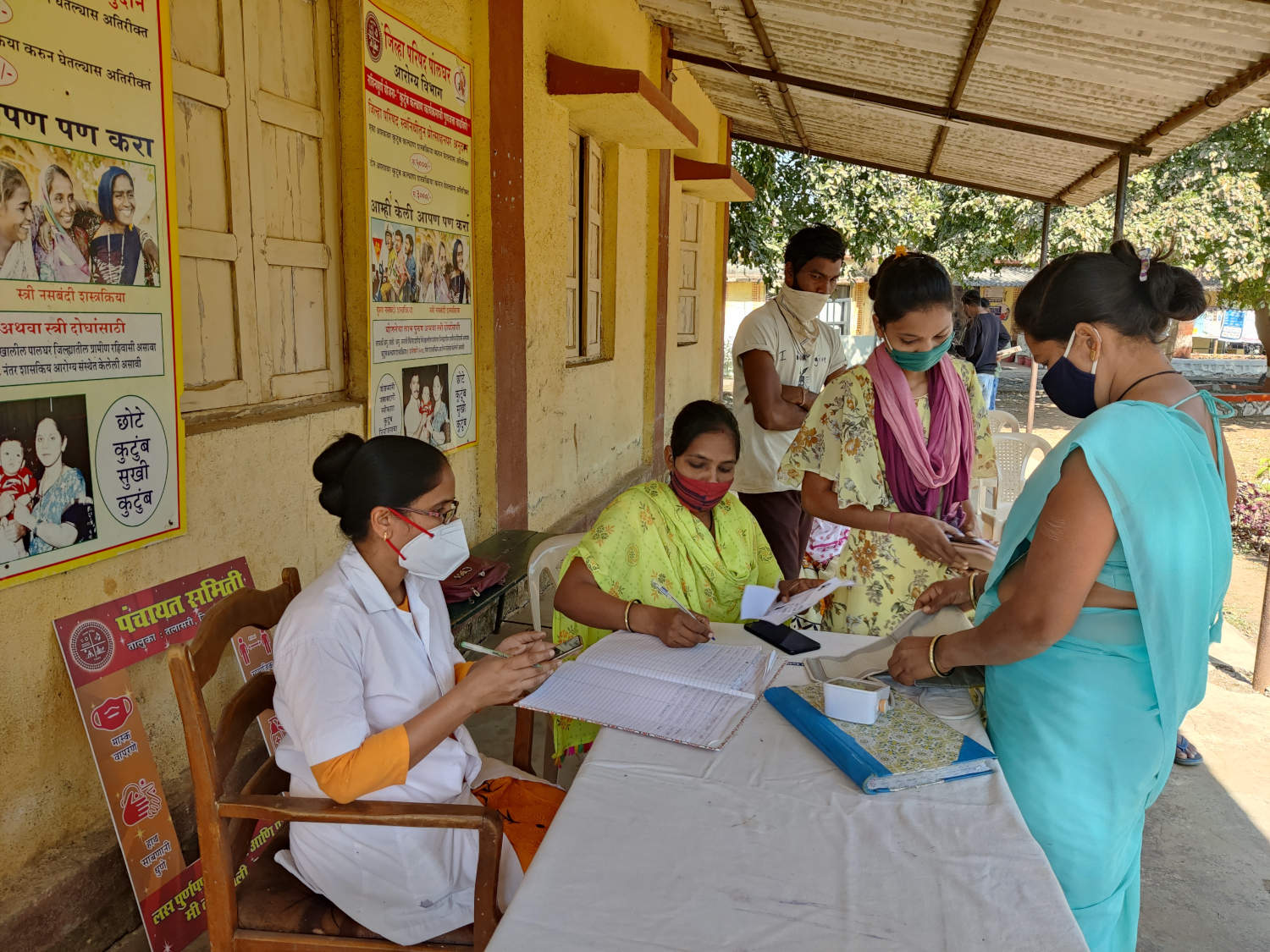
Health workers at a vaccination center under Amgaon Primary Health Center register villagers for a vaccine clinic. (Photo by Puja Changoiwala for Undark.)

Later that day, the vaccination center is empty. (Photo by Puja Changoiwala for Undark.)

“If I take the vaccine and if something goes wrong, who will take care of me?” asks Wartha. When asked if he had seen someone fall sick owing to vaccination, the farmer denied it, stating: “No one has taken the vaccine, so how will they fall sick? I do not know anyone in the village who has taken it. Even my relatives, no one has taken.”

Much of the fear around vaccination comes from false claims: India is the top source of social media misinformation on Covid-19 in the world, according to a study published last summer. A survey on vaccine misinformation in rural India, conducted in April and May of 2021, suggested that 55 percent of people in rural India were afraid of the vaccine, with more than half of these respondents believing that vaccines cause death. The same survey also concluded that nearly half of rural Indians depend on word of mouth as their primary source of information, while others rely on television, newspapers, WhatsApp, and Facebook.

Some villagers in Talasari also point to the deaths of two political leaders in Palghar, both of whom succumbed to Covid-19 in April 2021 — Pascal Dhanare, a former Member of the Legislative Assembly, and Laxman Varkhande, district vice president for the Modi-led Bharatiya Janata Party. The deaths sparked fear among the tribal community, with many villagers blaming the vaccine for the leaders’ deaths, says Subhash Kharpade, a member of the village council in Shivpada. “We don’t know what happened exactly, but people here are illiterate,” Kharpade adds. “These rumors have spoilt everything.”

An auxiliary nurse midwife named Rupal Nagrat, who works at the Amgaon Primary Health Center, says misinformation is rampant in the tribal villages of Talasari. “People here think they won’t get Covid. Some think they will die after a few years if they take the vaccine,” she says. “Ladies think that if they take the vaccine, they won’t have kids. There are many misconceptions here.” The reluctance is such that villagers have threatened health workers with police complaints, she adds, and in some cases chased after them with sticks.

While Sukri Dayat, a health worker in Talasari, states that misconceptions in the tribal belt are a product of local rumors, Suryawanshi, the district health officer, blames wrongful propaganda and messages over platforms like WhatsApp for hampering the vaccination drive in tribal villages.

Responding to the concerns around misinformation related to Covid-19 vaccines, the Indian Ministry of Health and Family Welfare, in June 2021, stated that such rumors and fake information “harms the poor people the most.” K. Srinath Reddy, president of the Public Health Foundation of India, also feels that misconceptions and general suspicions about vaccination could be a reason for resistance against vaccines among India’s tribal communities. Such concerns about the ill effects of vaccines also exist among the urban population in India, he adds, but in rural areas, where it is more difficult to send out messages to clear up misconceptions, “there may be much higher amount of resistance to it.”

The misinformation campaigns may have found fertile ground due to an existing mistrust of government-run facilities. This distrust is evident in the tribal belt of Talasari, where, according to Pawar, villagers often travel to the neighboring state of Gujarat to seek medical care in private hospitals instead of approaching the government-run Primary Health Center. “Earlier, when a person tested positive, we would take him to a Covid Care Center in an ambulance,” says Pawar. “At the time, villagers would see our vehicle, climb the nearest hill and run away.” He adds, “Some say that there are special vaccines for health workers, which are safe, but for us villagers, we have different ones.”

Dayat, the health worker in Talasari, also reports similar experiences. She says that even if people have a fever, they do not seek help from government-appointed health workers. “They go to private hospitals, but they don’t come to us,” says Dayat. “When we take them to the quarantine center, they say that we’re taking them to kill them.”

Raman Devji Dolhare, a farmer, believes that the Covid-19 vaccine causes death, and that “Corona is a lie.” (Photo by Puja Changoiwala for Undark.)
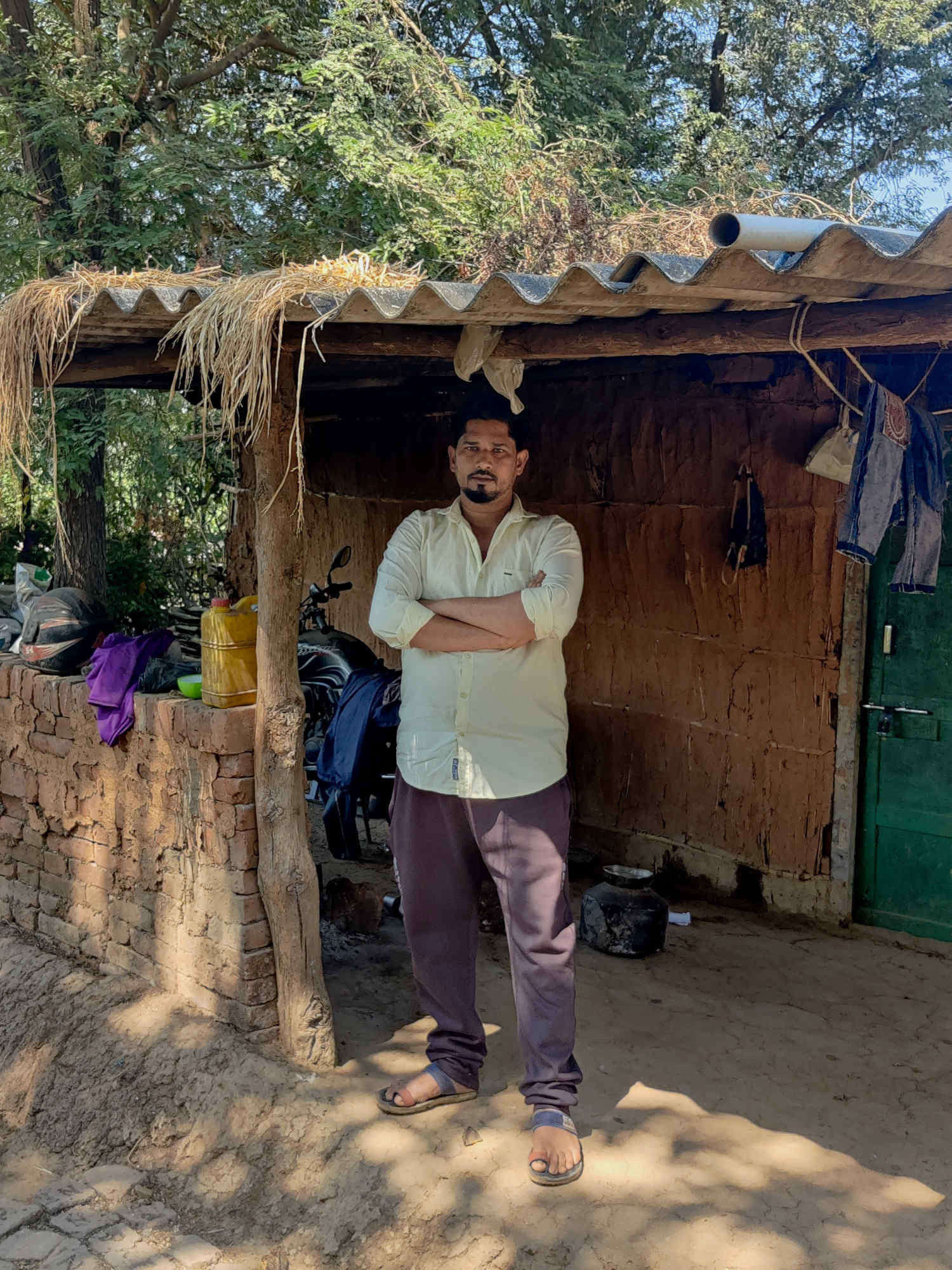
Subhash Kharpade, a member of the village council in Shivpada, says that local rumors about deaths from the vaccine “have spoilt everything.” (Photo by Puja Changoiwala for Undark.)

Private health care costs four times more than public health care in India, yet 72 percent of Indians in rural areas use private services. Although rural India contains 65 percent of the country’s population, 60 percent of hospitals and 80 percent of doctors are located in the country’s urban areas. Rural India, meanwhile, has 3.2 government hospital beds per 10,000 people and suffers from substantial shortages of health care providers. With the majority of the health infrastructure, medical manpower, and other health resources located in urban India, villagers’ lives, on average, have been shorter by about five years compared to their urban counterparts in recent years.

According to Kharpade, some residents of the tribal villages in Talasari treat themselves at home, using herbs from nearby jungles. Others approach local gurus for medical help, says Pawar. The doctor adds that the region is home to many such gurus, who are usually untrained, and are themselves unvaccinated. “People go to them for medicines instead of coming here,” says Pawar, referring to the Primary Health Center. “The gurus give medicines. Even people from Mumbai visit them.”

Reddy maintains that vaccine hesitancy in tribal communities can be addressed through building confidence in the health care system, while ensuring greater health literacy through regular education. He points to the need for trusted voices in the community to spearhead vaccination campaigns by explaining the benefits of vaccination to people. “There has to be a steer that comes in from within the community, from the community leaders,” Reddy says. “If the community leaders are not convinced, then the rest of them are not going to be convinced.”

This, however, is hardly visible in the tribal belt of Talasari, where the local member of the Legislative Assembly, Vinod Nikole, only took the first dose of his Covid-19 vaccine 10 months after the vaccination program started in India. “I’ve been running here and there, thinking I’ll take it today or tomorrow,”says Nikole. “But my schedule is so tight.”

Similarly, Kharpade, the village council member in Shivpada, complained about villagers not taking the vaccine despite his many efforts. But Kharpade says that he has taken only one dose of the vaccine himself, and that he could not take the second jab because, as required by health agencies, he could not gather the minimum of six to seven people to organize a vaccination camp in his village. When asked why he did not visit the Primary Health Center, which is less than a mile away and holds daily vaccination camps, Kharpade did not respond. He is one of around 11.5 million people in Maharashtra who haven’t taken their second dose.

According to Pawar, more than three-quarters of the village heads and council members in his tribal belt haven’t taken the vaccine. His efforts to get village heads to lead by example haven’t worked, either. He cited the example of one leader, who, after persistent convincing, took his first vaccine shot. Pawar asked the man to record a video stating that vaccines were safe, but he refused. “He said he couldn’t do it because if people found out that he had taken the vaccine, they would pester him,” says Pawar. “So even if they do get vaccinated, they keep it a secret.”

In some cases, even health workers have been reluctant to take the vaccine. Baby Wadu, for example, has been visiting homes in Talasari to create awareness among the tribal population about vaccines, but hasn’t taken the jab herself. “I’m just not going to take it,” she says. “If I had to take it, I would have taken it a long time ago.”

Vaccine hesitancy isn’t unique to India. According to data from a global tracker that follows vaccine skepticism, Russia leads with 30 percent unwilling to take the Covid-19 vaccine, followed by the U.S. at 19 percent. According to this tracker, only 2 percent of India’s population is unwilling to take the vaccine. But a small percent of India’s population is significant: 30 percent of Russians amounts to 43 million people, while 2 percent of India is still more than half that number, about 28 million. Further, the survey notes that “the sample in India is representative of just the literate population.” In Talasari, the literacy rate is about 47 percent, much lower than the national rate of 74 percent.

“People not taking the dose is a global phenomenon, but the government not countering that with imaginative health education is a disease in India,” says T. Jacob John, a retired virologist formerly associated with the Christian Medical College in the city of Vellore in southern India. Although it is the government’s job to tackle vaccine hesitancy, John says, he hasn’t seen much initiative. This is unlike the polio vaccination program in India, he says, when the government got actors and cricket players to promote the program. But with the “Covid vaccination, from the start, there seems to be some possible vaccine skepticism in the top governmental agencies, adding to the vaccine hesitancy of the public,” John adds.

Health workers, too, are weary of the lack of initiative from other government agencies, stating that the burden of the world’s largest vaccination program should not fall on India’s health department alone. Suryawanshi, the district health officer for Palghar, says that it is the health department’s job to administer doses, but with the staff crunch and implementation of other national health programs, there aren’t enough resources to tackle vaccine hesitancy as well. According to Suryawanshi, 40 percent of health care jobs in the government-run facilities of Palghar lie vacant.

“Other departments must also try to change their views because we have tried everything,” says Suryawanshi. He adds that the health department has taken several measures, like approaching local leaders and employers of the villagers, while also employing the local media to address the hesitancy. But the responses from villagers have turned violent. If a team visits a village to educate and create awareness about vaccines, and villagers beat up the staff, he says, then “why put health workers at risk?”

Naina Kakad, a woman from Shivpada, says she cannot be vaccinated because of the medicines she’s taking. (Photo by Puja Changoiwala for Undark.)Ratna Rupji Wartha, a tribal farmer, says that he is afraid of taking the vaccine because his hemoglobin levels are low. (Photo by Puja Changoiwala for Undark.)

Although the disinclination toward Covid-19 vaccines is vivid in the tribal villages of Talasari, authorities refuse to acknowledge the reluctance. Nikole, the member of Legislative Assembly for Talasari, denies the existence of vaccine hesitancy in his constituency, while J.A. Jayalal of the Indian Medical Association says that “India has certainly done very well,” and that the national government, including the prime minister, was “very cautiously playing the role” in addressing vaccine hesitancy.

In the past year, Modi has spoken about the need to shun vaccine hesitancy, but Reddy of the Public Health Foundation of India feels that “one-shot messaging” is not enough to address tribal communities, some of whom may not have seen the full brunt of the pandemic due to their relatively remote locations.

“One has to really talk to them about what the potential threats are, even if they’ve not experienced it in the community right now — with more variants coming in and spreading much faster, it is likely to reach them,” says Reddy. “And since their health services are also relatively distant, it is better to get the protection. So this requires more engaging and more frequent conversation.”

Vaccine hesitancy has a substantial impact on the pandemic trajectory, which may challenge current efforts to control Covid-19, notes a 2022 study conducted by researchers at the Imperial College London. To study the impact of vaccine hesitancy, the scientists used mathematical modeling of SARS-CoV-2 transmission and vaccine hesitancy data from population surveys in 10 European countries. When there is both vaccine hesitancy and relaxation of other public health measures, the models estimated that mortality could increase by up to seven times, compared to ideal vaccination coverage. “Our work demonstrates that vaccine hesitancy might have a substantial health impact on the population, and therefore, it is a public health priority to increase trust in vaccines,” the researchers note.

But when it comes to vaccine hesitancy among the tribal communities in India, experts seem to be divided on the implications for the population at large.

According to Yasmin at Stanford, India’s tribal communities are among some of the most vulnerable populations in the country. But the assumption that this vulnerability only harms these communities ignores the ways in which even distant communities are all connected. “Covid-19 vaccination rates are less than 10 percent in many Adivasi communities, heightening the risk of severe disease and death in those populations and the risk of the virus continuing to spread between communities as people travel for work,” she wrote in an email to Undark.

Anant Bhan, a global health researcher and adjunct professor with the south-India based Yenepoya, an institute of higher education independent from the government’s education department, agrees, stating that any unvaccinated or inadequately vaccinated pocket poses a risk to the wider community. With large chunks of unvaccinated populations as in Talasari, there is also the possibility of the emergence of new variants, he says, adding that one of the reasons why new variants have emerged repeatedly is that there are large sections of populations across the world with very low vaccination rates.

While several experts agreed that it is necessary to vaccinate the hesitant tribal populations of India, they were divided on the impact this hesitancy could have on India’s and the world’s fight against Covid-19. John feels that the 69 million Indians who were vaccine-hesitant as of December, out of an approximately 1.4 billion population, is “not a big proportion.” And Reddy says that tribal communities “may not be much at risk” with the overall threat decreasing in terms of severe illnesses and the remote geographies of such communities.

“If they’re mostly living in secluded community life and their contact with the urban areas is limited, then the danger, even if they’re infected, is somewhat limited,” says Reddy. “They’re not living in large urban high-rise buildings. They’re working mostly in open spaces. So the risk of transmission is much lower in such places.”

Health workers approach a tribal family in Talasari. (Photo by Puja Changoiwala for Undark.)

The omicron variant, however, has proven the threat to the unvaccinated. In India, for instance, a recent study found that the death rate for fully vaccinated people hospitalized after being infected with the variant is 10 percent, compared to 22 percent among the unvaccinated and the partially vaccinated. Pawar says that if another big wave of Covid-19 were to hit the world, infections in his tribal villages could rise and it would be very difficult to provide health services to everyone.

“Because most of the population is unvaccinated, there’s a greater threat of spread of infection,” says Pawar. “And it’s not like the villagers stay in their villages. They travel for work, visit industrial areas — they can infect others too. It can lead to a massive spread.”

Trump’s latest hate rally: A master class in cult mind control

Donald Trump’s political circus and freak show is continuing its American tour. Everywhere it stops, Donald Trump unleashes a torrent of lies, hatred, ignorance, bigotry, racism, narcissism, authoritarianism, threats of violence and other antisocial and evil values.

Trump’s political rallies resemble George Orwell’s “two minutes of hate” from “1984,” expanded to two hours or so.

The mainstream news media has made an obvious editorial decision to downplay or ignore Trump’s political hate rallies and similar events. That may be an attempt to correct for the wall-to-wall coverage Trump received the first time he ran for president, but it won’t save the American people or American democracy — or the “freedom of the press” — from the neofascist assault. Moreover, ignoring Trump’s escalating threats at this point, given all we know, amounts to journalistic malpractice and betrayal of the public trust.

RELATED: Crime novelist Don Winslow: Trump belongs behind bars — but that won’t happen in this America

Many other Americans, to be sure, are also ignoring Trump’s rallies. Most of those who are paying attention, it appears, are mostly doing so in order to mock Trump and his followers as ignorant or stupid. They are doing this rather than responding to the danger with an appropriate mixture of fear, caution and then effective planning for how best to defeat the threat. Such behavior is an example of what psychologists call “defensive contempt,” a reaction born of deep existential fear.

As I have observed previously, mockery and laughter won’t save America people from the hell that will be fully unleashed when Trump’s Republican-fascist movement wins the 2022 midterms, and quite possibly the presidential election two years after that. 

At this point, many professional centrists, pundits and hope-peddlers in the American news media and larger political class have convinced themselves that attention is like oxygen for Donald Trump and his followers, and therefore that depriving them of attention will suffocate their movement. That metaphor is incorrect: This is more like ignoring a fire and allowing it to burn uncontrolled rather than extinguishing it. 

Many observers have convinced themselves that attention is like oxygen for Trump: Deprive him of it, and he will die. In fact, ignoring Trump’s rallies is more like allowing a fire to burn out of control.

Trump’s most recent political rally took place last Saturday in Delaware, Ohio. There he continued to escalate his threats of violence, wallowed even more in the Big Lie and other conspiracy theories and distortions of reality, spouted his white supremacist and racist talking points, and stroked his own narcissism and other mental pathologies. Trump also used the event to anoint Ohio Senate candidate J.D. Vance and various other Republicans as MAGA-approved surrogates in the midterm elections.

During his Ohio speech, Trump amplified his white supremacist race-war fantasies, which are clearly derived from the “Great Replacement” conspiracy theory and fears that white people somehow face extinction at the hands of Black or brown invaders. Trump has now fully mated the Big Lie claim that he is still the “real” president of the United States with white identity politics and grievance mongering:

The very same people who piously claimed to be defending democracy are the ones throwing open your borders, surrendering your sovereignty, defunding your police, prosecuting your politicians — like nobody’s ever seen before, by the way… desecrating your laws, crushing your wages, diluting your vote, and handing your country over millions and millions of illegal foreign nationals — illegal aliens, I would call them — all without your consent.

You haven’t consented to that. On top of that you, had a fake, phony election….

But no matter how big or powerful these corrupt radicals may be, you must never forget this nation does not belong to them. This nation belongs to you. This is your home. This is your heritage, and your great American liberty is your God-given right.

In this age of ascendant American fascism, everything old seems to be new again. Trump’s white supremacist and nativist fictions echo the discredited “scientific racism” espoused by the likes of Madison Grant in the late 19th and early 20th centuries in America and Europe. More than 100 years later, these pseudo-scientific theories have become daily talking points among Republicans, the “conservative” movement and the right-wing echo chamber anchored by Fox News.


Want a daily wrap-up of all the news and commentary Salon has to offer? Subscribe to our morning newsletter, Crash Course.


Trump continues to use the propaganda and radicalization technique known as “stochastic terrorism” to amplify his threats of political violence against Democrats, liberals and others deemed by his movement to be a poisonous “enemy within” and a threat to America. This dangerous language echoes the eliminationist rhetoric that led to genocide in places like Nazi Germany, Rwanda, the former Yugoslavia and elsewhere:

In this moment together, we’re standing up against some of the most menacing forces, entrenched interests, and vicious opponents our people have ever seen or fought against. Despite great outside powers and dangers, our biggest threat remains the sick, sinister and evil people from within our own country.

There is no threat as dangerous to democracy as they are. Just look at the un-select committee of political hacks and what they’re doing to our country while radical-left murderers, rapists, and insurrectionists roam free: Nothing happens to them.

Trump and his regime are guilty of de facto democide for their negligent response to the coronavirus pandemic. Of course, Trump now claims that it was Biden, Dr. Anthony Fauci and other public health experts, and the “liberals,” “socialist Democrats” and “the left” who unleashed COVID upon the American people and that (somehow) he and his regime acted as saviors:

They created unyielding and unsustainable and totally horrific mandates and radical mask regulations — and we did just the opposite, and we had far better success in every single category.

In total, Trump’s Ohio rally was a master class in cult behavior, mind control, right-wing propaganda and disinformation, and psychological warfare techniques. Reporters, pundits and other professional smart people with a public platform should be consistently warning the American people about the grave danger this represents. With a few admirable exceptions, they have refused to rise to the challenge.

A cult leader keeps his followers in thrall by creating fantastical threats from evil outside forces — from which, of course, he is going to save them.

Trump’s rally last weekend was a textbook example of how a cult leader keeps his followers in thrall by creating fantastical threats from evil forces in the outside world. In this type of psychological conditioning, the leader becomes a savior figure for the followers, who learn to accept that they must never challenge his or her word.

Trump is also using Nazi propaganda minister Joseph Goebbels’ technique of projection and the Big Lie, by literally accusing the Democrats and all others who disagree with him of the crimes against society and democracy that he and his movement have actually committed.

Trump’s rallies create an alternate reality or state of malignant normality, where humane values, reason and truth are rejected or inverted, to be replaced by their opposites. As should be obvious following the events of Jan. 6, 2021, many of Trump’s followers and the other members of the neofascist right are ready to kill, and perhaps to die, for their cause and their leader.

In a 2019 interview for Salon, Steven Hassan, one of the world’s leading experts on cult psychology and deprogramming, explained Trump’s power over his followers and the danger to society it represents:

Destructive cults are authoritarian, pyramid-structured groups where there is often a charismatic or authoritarian leader at the top who commands total power and loyalty. Destructive cults also use deceptive recruitment and specific control of techniques. These techniques include behavior control, information control, thought control and emotional control to keep people dependent and obedient within that group’s structure.

The group really demands a pseudo-identity. It is not your real conscience or your real self. You become someone who is a tool of the leader, an instrument to be used or to be thrown away. Much of the manipulation, aside from telling the members, “You’re the chosen ones,” is about guilt and fear. It is actually a very unpleasant experience to be in one of these cult groups long-term. …

Trump’s violent threats are an example of fear indoctrination and phobia indoctrination for his supporters.

So the question then becomes, when Donald Trump is making these violent threats, what is going on in the minds of the people who are around him? Are Trump’s inner circle, his followers and other supporters really willing to commit murder for Donald Trump? Will his followers go that far for him?…

Trump also tells his followers not to listen to other information if it is critical of him … [and] tells his followers that if you don’t follow him, terrible things are going to happen to you, the country and the world … that the world will be overrun by evil people if they don’t support him. Donald Trump is a stereotypical cult leader like Lyndon LaRouche, who’s a political cult leader, or Sun Myung-moon, my former cult leader. Donald Trump is also like Jim Jones or David Koresh. It is clear when you consider Trump’s malignant narcissism and examine his speeches and writing.

Hassan observed in the same interview that Trump’s supporters could be “an easy target for another country, whether it’s Russia or Iran or China or some other hostile country that wants to sow division in the United States,” and concluded, “Unfortunately, I think that Trump’s supporters are going to be a great danger to the rest of us in this country for some time.”

Social scientists and other researchers have shown that there are many millions of Trump’s followers who support terrorism and other forms of political violence against the Democrats and their supporters in order to protect “real America” (meaning, of course, white America). New research commissioned by The New Republic shows the extent of that danger: More than 50% percent of Republicans believe that the Jan. 6 attack on the Capitol was an act of “patriotism.”

Here is a thought experiment for those observers who have convinced themselves that by ignoring Donald Trump and his political hate rallies, the danger they represent to the country will somehow disappear. Donald Trump received 74 million votes in 2020 – roughly 11 million more than he did in 2016. If only 10% of those voters are willing to obey his incitements to political violence, that’s 7.4 million people, a potential force so large that it would throw American society into total chaos and destruction.

If 0.1% of Trump voters embrace political violence, that’s 74,000 terrorists — an insurmountable problem for law enforcement.

Let’s take that a step further: If only 1% percent of Trump’s voters, or 740,000 people, venture into political violence, that would still be a massive national emergency. If you reject that number as unrealistic, then let’s take it to 0.1% of Trump’s voters, or 74,000 right-wing terrorists and other extremists. Again, that would be huge and nearly insurmountable problem for law enforcement, the military and other security forces.

If the naysayers, hope peddlers and others mired in obsessive denial about the neofascist threat would like to force that number down even lower, it still implies a threat level that is likely to mean considerable pain, suffering, turmoil and destruction. Consider this excerpt from an essay by former gun industry executive Ryan Busse, published last November in the Bulwark:

“When can we use the guns?” The question hung in the air just long enough for some in the crowd to begin cheering. “That’s not a joke,” the man added. “How many elections are they gonna steal before we kill these people?”

The question, posed on October 25 during Charlie Kirk’s Turning Point USA event in Idaho, made it clear that this man, and others like him, are hoping for a signal.

I’ve met men like this before. I worked in the firearms industry as a sales executive for a long time and beginning during the Obama presidency, gun business leaders like me, who helped build the nation’s top gun companies, noticed this disturbing chatter from gun owners at firearms trade shows. Many in the industry dismissed these threats. I didn’t. And now we hear them from gun owners across the country who dream of deploying their arsenals to kill fellow citizens.

It’s tempting to wish these people away. It’s a big country and there will always be malcontents and criminals. If you wanted to see the glass as half full, you could say that Charlie Kirk denounced the call to violence. Though to be honest, Kirk’s disavowal didn’t inspire much confidence. He rejected the call to murder not because it was wrong but because it would “play into all their plans” — you can guess who “they” are here. And Kirk then qualified this by saying that “we must exhaust every single peaceful means possible” — which sure seems to leave open the question of what to do after all of the peaceful means have been exhausted.

And the glass-half-empty view seems pretty convincing. America has a rapidly growing authoritarian army comprised of thousands of men like that fellow in Idaho. They have been groomed by Trump acolytes such as Kirk and Steve Bannon. They have also been developed as avatar customers by the gun industry, meaning that they are well armed.

But what non-gun owners may not understand is that these men are not your average gun-owning Americans. They are people who have fallen into a cult where it is normal to organize your entire culture around weapons of war. Some make it official by claiming membership in the Oath Keepers or Three Percenters. Some are just average suburban dads who’ve been radicalized. They laugh at “Let’s Go Brandon” chants, drink Black Rifle Coffee, and wave “Come and Take It” flags at political rallies.

Such warnings are to be heeded and not ignored. Democrats, liberals, progressives and other pro-democracy forces are in a literal fight for their lives — and for the future of America. Perhaps the most tragic aspect of America’s democracy crisis is that the vast majority of Americans do not even understand that they are in the middle of an existential struggle. Most are exhausted and simply hoping to wait out the crisis, when they should be fervently battling against a reactionary-revolutionary movement that is fighting hard to win the present and future. To this point, that movement faces little serious opposition. 

Democracy is running out of time. America’s political class and leading figures in the mainstream media still want to pretend that we can somehow return to “normal,” and that denial or wish-casting will make the neofascist assault go away. It won’t.

Read more on our 45th president and his followers:

Ron DeSantis’ war on “woke” Disney is really an attack on core American values

Vladimir Putin recently launched an intercontinental missile meant to threaten the members of NATO with nuclear annihilation. Florida Gov. Ron DeSantis has gone after the Walt Disney Company as a warning to all “woke” corporations.

Call it the masculinity-obsessed right’s inter-corporate missile, resetting the traditional terms of mutual grift between corporate America and the Republican Party.

The conservative right has been squirming uncomfortably in recent years as it watches corporate America introduce diversity, equity and inclusion (DEI) programs, and apparently Disney’s belated mild rebuke of DeSantis’s “Don’t say gay” law led to this showdown between the formerly more-than-chummy CEOs of corporate America and Republican politicians.

But the Trump cult is not your grandfather’s GOP, or even your father’s. (I think it’s fair to call it your conspiracy-obsessed uncle’s or white nationalist cousin’s GOP.)

RELATED: Betsy DeVos and Ron DeSantis: GOP dynamic duo team up to defund public schools

As others have pointed out, this was gratuitous: DeSantis already had his victory, when he signed the law in March prohibiting discussion of sexual orientation and gender identity in the early grades of public schools. But, as Charlie Sykes writes at the Bulwark, this move against Disney — taking away its self-governing tax-break status after more than a half century — was about retribution: “Florida Republicans made no secret of their motivation here: it was payback, and a mailed-fist threat to other businesses who might engage in wrongthink.” 

One instantly thinks of the disgraced former president’s reflexive threats and vindictiveness, always hard to distinguish from the Mafia’s characteristic method of persuasion: “It would be a shame if something were to happen to your Reedy Creek status.”

Which reminds me of a story I heard when I worked at a restaurant in New York, some years back. One of the managers, Johnny, told me a story about a little guy who came in one day, before the place had officially opened for business, asking where he wanted the cigarette machine. Johnny had responded, “Oh, we don’t want a cigarette machine.” The little man paused, frowned and looked at him pointedly. He said, “I didn’t ask you that. I asked you where you wanted it.”

That sums up the choice we are facing in America: We can have a democracy, or a Russian-style mob government run by autocrats and oligarchs. 

Is this when we will finally see if corporate interests are really in charge in the United States? I know I’m uncharacteristically rooting for corporate America in this melee. Most business leaders, I think, fully understand the vast economic advantages of this little thing called democracy

If I were Bob Chapek, CEO of Disney, I’d be tempted to simply announce a five-year plan to move Disney World out of Florida, to, say, somewhere near Atlanta. (Given that rising ocean levels due to climate change will likely start affecting the coastal areas that bring so many tourists to Florida, it might well be time to plan that move anyway.) Even better, I might choose my hometown of St. Louis, which was Disney’s original plan for the location of its second theme park. (I would be remiss not to note that Colorado Gov. Jared Polis, a Democrat, has tweeted his offer to provide a new home for Mickey Mouse and friends.)

The overarching intent of DeSantis’ move (as in the arcing of a so-called Satan II missile) is to send a Putin-like warning to all corporations who view their DEI efforts as the right, and smart, thing to do — for the business, for employees and for shareholders. Companies are trying to attract the best talent and are moving to sweep away impediments to women or people of color reaching executive-level positions, and to be more welcoming to members of the LGBTQ+ community and people who face physical or mental challenges. 


Want a daily wrap-up of all the news and commentary Salon has to offer? Subscribe to our morning newsletter, Crash Course.


You could view this corporate effort as one embracing the traditional American experience of strength in inclusivity: We are stronger when we include more voices, when we don’t leave people behind. The melting pot, say, without quite so much “melting” needed. We take you as you are. How many times does it need to be pointed out that immigrants believe in American values and score higher on basic tests about citizenry than a goodly portion of citizens?

Corporations are embracing the traditional American value of strength through inclusivity — but that doesn’t go down well with white nationalists or squeaky-voiced Fox News hosts.

That message does not go down so well with members of the religious right or white nationalists, or with men like Tucker Carlson, who are just in a tizzy about masculinity issues. (How is the very soft-looking Carlson, with his squeaky voice and constant complaining, understood by anyone as a spokesman for the “masculinity movement”?) So they fill their time with conspiracy theories and memes about Nancy Pelosi giving illegal aliens free cell phones, to distract themselves and their friends from real-world crises like the pandemic and climate change.

Leaving certain people behind — members of “out” groups — is not really something that serves corporate interests, but it remains a core tenet of some religions (remember the popular “Left Behind” series of novels?). Republicans are doing everything they can to leave voters of color behind by making it more difficult to cast ballots in urban areas, or by removing people from the rolls entirely.

Putin continues marching his troops into Ukraine, ruthlessly bombing its cities, targeting civilians and taking all the territory he can (albeit not with much success, to this point). Something similar is happening with the religious right in America, which is fighting a holy war on several fronts and destroying everything it can: public education, women’s rights, LGBTQ+ rights, voting rights.

We should be seeing a map every night on the news of the thrusts (Fifty “classical” charter schools ordered by Tennessee? A senator says the Supreme Court was wrong to make interracial marriage legal?), and how much territory of our democracy has been overrun.

Can anyone do that for us — show the mounting losses in human rights and human dignity? In fact, let’s show the losses and show the forces of democracy making gains. There’s a war going on here — and in Europe — just as in Ukraine. In May, the Conservative Political Action Conference (CPAC) will descend on Budapest, with Hungarian Prime Minister Viktor Orbán, an autocrat and Putin admirer, as keynote speaker. Can there be any doubt that Putin was partly motivated to start his war when he did to roil NATO countries, potentially get his lackey back in office in Washington and maybe put Marine Le Pen in power in France?

Well, here’s to NATO holding strong — and Vive la France. (While we’re at it, hura to the Freedom Movement in Slovenia.) Let’s hope America’s voters learn from the mainstream media what is truly at stake and do as well as our French allies, without whom we would never have created our democracy in the first place. May their example help us to do it again.

Read more on Ron DeSantis and his feud with Disney:

Now Elon Musk has to choose between good and evil — and maybe he’ll surprise us

Of course I won’t stop using Twitter.

But no single human being should have the ability to influence or impose their individual communication vision on the rest of the world, directly or indirectly. There are 8 billion of us here. I don’t mind if you’re making money — but your freedom ends where my nose begins, pal.

We’ve yet to see the effects of Elon Musk’s purchase of Twitter and there’s lots of speculation that leans heavily into the belief that Musk will embrace the dark side of the force. The Trumpers are convinced it’ll mean the “end of libtard domination” of Twitter. Supposedly people are fleeing in droves from Twitter World, fearful, angry or wanting to make some sort of political statement.

I don’t know. Surprise me.

Maybe he’ll do it right.

Maybe he’ll appoint an independent editorial board. Put the company in a trust. Treat it as newspaperman Robert Worth Bingham did his family newspapers. “I have always regarded the newspapers owned by me as a public trust,” he said, “and have endeavored so to conduct them as to render the greatest public service.” 

If Musk treats Twitter as a public trust, operates openly and is transparent doing so, then the world could be better off. I’m not ready to flush it just yet. I think Bingham’s legacy is transferable to the Twitter age.

In a tribute published after the sale of the newspapers to Gannett in 1986, Courier Journal vice president Don Towles wrote that “every major progressive step taken by Kentucky in the 1900s to drag itself into the 20th century, screaming and protesting most of the time, was suggested, encouraged and supported by the Louisville papers. The poor were helped, the needy were served, the helpless and infirm were tended because the newspapers did their jobs.” 

Elon Musk now owns one of the 21st century’s largest contributors to public information — on par with, or greater than, the power the Courier Journal had in Kentucky in the last century. With that power, oh mighty Spider-Man, comes great responsibility.

Show me enlightenment. Show me fairness. Show me justice. Enough with the cartoons.

We have enough cartoons today. We’re still dealing with the cartoon fishbowl of the last days of Donald Trump at the White House, and we’re unfortunately reliving them, courtesy of several thousand recently released text messages revolving around Mark Meadows. That production features a cast of characters including the Pillow Guy, Marjorie Taylor Greene and Louie Gohmert.

Reading these people’s texts makes me wonder about their Apgar scores at birth. They are obviously mentally and emotionally compromised, and they compound their lack of abilities with a lack of common sense. That, of course, is just fine for some voters, once again demonstrating why we need to spend more on mental health and education in our fine democratic country.

Jared Kushner also chimed in with a few texts to Meadows during the insurrection. He offered pragmatic ways to make the “crazy” work, while Meadows remained a political juggler handling bottom-of-the-barrel bullshit.  It was wholesale fiction, created by people who care little for reality and treat their discount garbage as Christian relics. Meadows tried his best to keep the crazies happy — and keep Donald Trump in office. 

Popping in on occasion was Jason Miller, who offered his best “Try this and see if anything sticks” spin-doctor approach before urging the group to “move on.” No one would.

The big question is whether Musk can run Twitter as a public trust, rather than as a robber baron’s narcissistic indulgence.

I guess I’m at the “moving on” stage with Elon Musk. He’s bought Twitter and the question is whether he can run it as a public trust and not a robber baron’s bid for a variety of narcissistic causes, including but not limited to: higher profile, greater fame, fortune, revenge, boredom, curiosity, amusement and the need to play a role as an antihero or straight-up villain. 

People invent all kinds of reasons for doing things they shouldn’t. That’s why lawyers are usually so well compensated.

Musk’s purchase of Twitter also underscores the need for a better regulated media. Our ways to communicate with each other have improved exponentially in my lifetime, while the laws that keep those communications fair and accurate have not caught up to the technology, largely because the guidelines we once had — like the FCC’s fairness doctrine — ceased to exist before the internet did. We can thank Ronald Reagan for that. Jason Miller is a perfect example of someone who profits from the dysfunction we’ve become.


Want a daily wrap-up of all the news and commentary Salon has to offer? Subscribe to our morning newsletter, Crash Course.


The guardrails must be re-established. Our world is at an inflection point and we need factually accurate information to make key decisions.

Vladimir Putin is currently trying to bully the world into submission with implied threats of nuclear or chemical destruction as he struggles to conquer Ukraine.

Putin is smarter than Donald Trump. He’s more dangerous than Donald Trump. But he’s the same species: A bully.

Since the fall of the Soviet Union in 1991, the world had grown used to worrying less about mutually assured destruction — a concept we’d nervously accepted after the Cuban missile crisis. Until the invasion of Ukraine, more of us worried about “woke culture,” being canceled, policing who our neighbors take to bed and how they describe themselves, whether or not a snowball negates the reality of climate change, and the valuable art of curing COVID by ingesting bleach. Putin’s chosen war is a global wakeup call to the threat that still exists. Understanding that and the underlying facts can only further our understanding of Russian hegemony and autocracy — especially when Putin stooges like Sen. Rand Paul declare that Ukraine and other countries were once “part of Russia” so we should mind our own business.

Our priorities have languished in the aisles of puerile and salacious content — led there by disinformation, misinformation and an assortment of odd and grotesque human beings who haunt the halls of Congress like demons from the dankest regions of the worst Christian hell — the kind of place Joel Osteen envisions for those who wonder why he lives in such splendor while others suffer. You know, the kind of hell Donald Trump still has wet dreams about, regarding Michael Cohen and anyone who ever angered him.

Trump’s followers are boycotting Disney, arguing about the sex of cartoon characters, banning math books and ingesting bleach and horse paste while denying that vaccines work — all while they crow about liberals losing it over Musk’s purchase of Twitter.

Meanwhile, President Biden is dealing with the issues soundly enough — but his whole presidency seems to be based on the maxim “action speaks louder than words,” and no one is doing much talking. 

That’s actually a naïve statement: Words are actions, and people have killed over mere words. Chris Rock got smacked over them. The simple fact is that Biden’s infrastructure package, signed and enacted before a crowd of nearly 1,000 people on the White House South Lawn, created the largest bipartisan gathering in years. But the Biden administration seems to have grown bored with telling people that he’s done more for rural Americans in a single year than Donald Trump did in four, or than anyone else has done in the last two decades. His team is apparently tired of reaching out to middle America and trying to bring swing voters back into the nest. If no one’s talking about what you did, they certainly won’t remember it when it comes time to vote.

The Biden White House’s reluctance to dominate the news with the verve of Trump and with the common sense of Harry Truman leaves the airwaves wide open for bombast from those who love to scream the loudest. 

Yes. Americans have a hard time staying focused on what matters. Yes. Twitter is part of that problem. Yes. Musk must deal with that effectively.

How serious is this? Just one example: The threat of the use of weapons of mass destruction in Ukraine remains real, and the longer the conflict goes on the worse that threat becomes. 

Former Lt. Col. Alex Vindman, speaking to me on the podcast “Just Ask the Question” this week, explained why he doesn’t think Putin will use nukes. The Russian leader sees “no existential threat,” Vindman said, and won’t go nuclear unless such a threat arises. OK, fine. But whose definition of “existential threat” do we use? The dictionary’s or Putin’s? Because I assure you they aren’t exactly the same.

As Biden said upon his return from Poland, nothing anyone says or does can influence Putin. He marches to the beat of his own drummer, which is a frightening condemnation of a world leader who has the ability to launch nuclear weapons. That pretty much negates Vindman’s analysis, and sails over the heads of the mindless arguments on social media. 

Can the American people wake up to the existential threat to human survival that we all pose?

After all, Trump and Putin are not unique. The rise of authoritarianism is a worldwide threat. Elon Musk can either be an agent of enlightenment or an agent of chaos with the purchase of Twitter.

Trump and Putin aren’t unique: Authoritarianism is a worldwide threat. Musk can either be an agent of enlightenment or an agent of chaos.

The challenge is to communicate fairly and accurately with the American people, and to expect that from each other on social media — and for the government to do its part, by ensuring there are guardrails in place to maintain credibility.

When angry readers in Kentucky canceled their subscriptions to the Courier Journal in the 1930s because the paper supported Planned Parenthood, Barry Bingham — who had taken over the newspaper from his father — gave the angry subscribers their money back. Then he wrote in an editorial that “those objecting to the paper’s conduct seem to think a newspaper should not have an opinion which a number of readers do not like. This would mean that a newspaper would have no opinion at all. And having no opinions at all is equivalent to having no principles.” 

All of which is to say that it’s not Elon Musk’s opinion that should worry anyone. It’s his principles.

In this day and age there is a particular and demonstrable need for people of principle to hold power and control within the communications industry — and not just people who know how to turn a buck.

Elon, bubbeleh, you’ve got plenty of money. Let’s see if you can handle principled public discourse. The ball’s in your court.

Read more on Twitter and Elon Musk:

Putin supporters willing to die for him

Since Russian President Vladimir Putin first invaded Ukraine on February 24th, he and his minions have repeatedly threatened to unleash an atomic holocaust against any nation that gets in the way of his objectives. Moscow has also falsely accused the United States, the North Atlantic Treaty Organization, and the European Union of conspiring to destroy Russia.

Last week, Russia tested its new Sarmat or Satan II Intercontinental Ballistic Missile, a hypersonic projectile that can carry 10 nuclear warheads and evade the West’s defenses. The launch has bolstered Russia’s confidence that it could annihilate the US and whomever else it wants at a moment’s notice.

But the rhetorical sludge oozing out of the Kremlin’s propaganda pipeline took a strange and unsettling turn on Tuesday when Margarita Simonyan, the head of Russia Today, said that Putin will “never give up” his imperialist ambitions and that she and Putin’s other loyalists are willing to die in a nuclear war.

“Personally, I think that the most realistic way is the way of World War III, based on knowing us and our leader, Vladimir Vladimirovich Putin, knowing how everything works around here, it’s impossible—there is no chance—that we will give up,” Simonyan said on The Evening With Vladimir Solovyov, as reported by The Daily Beast‘s Russia expert Julia Davis on Wednesday.

The chance “that everything will end with a nuclear strike, to me, is more probable than the other outcome. This is to my horror, on one hand, but on the other hand, with the understanding that it is what it is,” Simonyan predicted.

Host Vladimir Solovyov then proclaimed that “we will go to heaven, while they will simply croak,” referring to Russia’s Western adversaries, although he reassured the audience that there is nothing to worry about because “we’re all going to die someday.”

Solovyov further wondered why Russia has not deployed its massive arsenal of nuclear weapons against countries that are aiding Ukraine.

“What is preventing us from striking the territory of the United Kingdom, targeting those logistical centers where these arms are being loaded?” he mused.

Watch below:

Rumors that Putin is suffering from serious health issues have fueled additional theories that he has nothing left to lose if he is fully defeated in Ukraine, a prospect that is evermore likely given the current trajectory of the conflict.

Video has recently emerged of Putin’s hand uncontrollably shaking while he waited to greet Belarusian President Alexander Lukashenko in February.

The footage is “probably the clearest video of something being wrong with Putin’s health,” tweeted Visegrad24.

“As he walks toward his longtime ally, he wobbles as his leg also tremors,” noted The Independent.

In another incident last week, Putin was seen tightly gripping a table as his foot rapidly tapped while he sat and spoke with his Defense Minister Sergei Shoigu.

Unsurprisingly, Kremlin spokesperson Dmitry Peskov has insisted that Putin, 69, is in “excellent” health.

The 6 most heartbreaking Marilyn Monroe moments from Netflix’s “The Unheard Tapes” documentary

Netflix’s latest documentary, “The Mystery of Marilyn Monroe: The Unheard Tapes,” explores the convoluted investigation behind the death of Marilyn Monroe. On August 4, 1962, Monroe was found dead in her Brentwood home after suffering from acute barbiturate poisoning. Her cause of death was immediately ruled as an overdose, but many were quick to suggest there was more to it than that and speculated that she perhaps died of suicide or was killed by a known acquaintance.

Almost 60 years later, Monroe’s troubling life and death are once again being revisited, this time through a series of tapes obtained and collected by investigative journalist Anthony Summers. The audio recordings, which were never publicly released prior to the documentary, features confessionals from members of Monroe’s inner circles, including Hollywood elites, prominent casting agents and her closest companions.  

RELATED: Marilyn Monroe, communist?

From an infamous Hollywood “black book” to Monroe’s ties to the Kennedy brothers, here are six heartbreaking revelations from the documentary:

1 Hollywood’s little black book

A tape from big-shot Hollywood agent who started the eponymous Al Rosen Agency, represented prominent names like Cary Grant, Frederic March and Judy Garland — revealed that numerous casting directors had their own “black book,” which contained names of young actors — oftentimes those with no connections in the industry — who were considered to be sexually appealing. In short, it was a book that listed those whom these men deemed available for the casting couch. According to Rosen, Monroe was a known name in multiple black books.

“In this business, in the golden years every casting director, every studio used to have a black book, you know what I mean?” he said. “So, every girl, you know, I’m talking about kids that were breaking in, like Marilyn Monroe, you know, when they get started, all the casting directors, they would write in their black book who could be laid.”  

“You see, the business has changed since then . . . it used to be sex,” he continued. “Remember that.”

Rosen also implied that Monroe was sexually involved with — and consequently, exploited by — numerous powerful figures in Hollywood, including Joseph M. Schenck, who was the chairman of the board of 20th Century Fox.   

2 A troubling childhood

Monroe spent two years in an orphanage, four years with a guardian after her mother was sent to a mental asylum and in between, hopped from foster home to foster home. When asked about her childhood, Monroe would frequently refer to herself as a “waif” rather than an orphan.

“Yeah, I was never used to being happy,” Monroe is heard saying in an old clip. “So that wasn’t something I was sort of counting on.”

Monroe’s psychiatrist, Dr. Ralph Greenson, also saw Monroe as “a woman who was deprived of childhood.” In his patient files, Greenson refers to Monroe as “a waif” and frequently attributes her paranoid reactions, which he wrote weren’t schizophrenic but “more masochistic” in nature, to childhood trauma and neglect. It’s later revealed that Greenson attempted to treat Monroe by introducing her to his own family. Over time, Monroe became close with Greenson’s wife, Hildi Greenson, his daughter, Joan Greenson, and his son, Danny Greenson who is also a psychiatrist.

3 Abuse and lasting trauma

Although Monroe never explicitly named her abusers, she endured years of sexual abuse during her youth.

“She knew people who were psychotic from [being molested] and she felt that at least she’d survived that,” said Monroe’s friend, fellow actor Peggy Feury. Monroe recounted the abuse in one instance, saying, “I knew it was wrong, but to tell you the truth I think I was more curious than anything else. Nobody ever told me about sex, and frankly I never did think it was all that important.” 

Monroe’s close friend, dress manufacturer Henry Rosenfeld, later told Summers that Monroe wanted to know more about her biological father, whose identity is still unknown. According to Rosenfeld, Monroe once said she wanted “to put on a black wig, pick up her father at a bar [and] have him make love to her.” Afterwards, she would tell him, “Well, how does it feel now to have a daughter that you’ve made love to?”

4 The brief marriage to Joe DiMaggio

The pair dated for approximately two years before they tied the knot in 1954. The famed movie icon and New York Yankees star were known as a match made in heaven and revered for their public romance. But things quickly took a turn for the worse just a few months after their honeymoon.

DiMaggio, who was retired from Major League Baseball when he met Monroe, soon grew possessive of his wife and struggled with a marriage in which he felt overshadowed by Monroe’s fame. The relationship reached its boiling point after Monroe finished shooting the famous flying skirt scene in Billy Wilder’s 1955 rom-com “The Seven Year Itch.” 

“Joe DiMaggio, you know, he was watching it, and he didn’t like it very much, his wife making a spectacle of herself,” Wilder told Summers.

Monroe’s on-set hairdresser, Gladys Whitten, also noted DiMaggio’s anger in her conversation with Summers. She said the couple shared a hotel suite and one night, when they were left in private, DiMaggio “beat her [Monroe] up a little bit.” 

“Marilyn said that she screamed and yelled for us,” Whitten recalled. “But we couldn’t hear her through those thick walls, you know.” She added that Monroe returned to the film set with bruises on her shoulders. 

Monroe later filed for divorce in October. “Our marriage wasn’t a happy one, it ended in nine months, unfortunately. I don’t know what else to say,” she told reporters at a news conference with her lawyer.

5 Monroe’s relationship with Arthur Miller

The acclaimed “The Crucible” and “Death of a Salesman” playwright was 11 years older than the 29-year-old Monroe when the pair began dating. As Summers described in the documentary, Miller and Monroe’s relationship was essentially a “Svengali situation.” 

Shortly after their marriage, the couple traveled to London to make a film called “The Prince and the Showgirl” for her production company, Marilyn Monroe Productions. During the film’s shooting, Monroe stumbled across Miller’s notes, which were lying out in the open. 
 
“It was something about how disappointed he was in me. How he thought I was some kind of angel but now he guessed he was wrong,” Monroe said, as quoted by Summers. “He’d married a woman as flawed as his previous wife had been.”

In his notes, Miller also called Monroe “a whore.” The pair separated in 1960. 

6 The Kennedys

Monroe oftentimes partied with Peter Lawford, a member of Frank Sinatra’s Rat Pack, and his wife, Patricia Kennedy, the sister of President John F. Kennedy and Senator Robert F. Kennedy.  

“Peter would obviously be, you know, sort of pimping for both Kennedys,” said Jeanne Martin, the ex-wife of singer and actor Dean Martin. “They would do it just as soon in front of anybody.” Martin claimed the Kennedys behaved the way they did because of their father, Joseph P. Kennedy Sr., who told his sons to “get laid as often as you can with as many women as you want.”

Monroe’s alleged affair with John F. Kennedy continued during his presidency. She was also thought to have been in a relationship with Robert F. Kennedy, who was married at the time, and she frequently referred to him as “The General.” Arthur James, a friend of Monroe’s, told Summers that the actor had “nothing but love [and] nothing but admiration” for Robert. 

“The Mysteries of Marilyn Monroe: The Unheard Tapes” is currently streaming on Netflix. Watch a trailer for it below, via YouTube.

More stories you might like:

Are shorter seasons ruining television?

Okay, let’s be clear here from the top: I don’t truly believe that shorter seasons of television are in fact ruining TV, and plenty of great shows and seasons have come about because studios opted for shorter seasons that wouldn’t have gotten made otherwise. This kind of broad question can rarely be answered with a simple yes, no, or maybe.

However, I’ve noticed that more and more studios are trying their hand at shorter television seasons, often spending more money on each specific episode. I think it’s a cause for concern, and worth talking about.

In 2017, Bend Lindbergh wrote a great article for The Ringer detailing how the lengths of TV seasons had decreased over the decades, with shows often having seasons with 20+ episodes going way back to the ’50s, before many dropped to 10 or 13 in the late 2010s. This happened during our current golden age of television, especially in the science fiction and fantasy space. There have literally never been more high quality, big budget genre shows on the air. It’s an amazing time to be a nerd.

However, studios haven’t stopped at 10 episodes. Nowadays it’s becoming more common to see shows with six or eight episodes per season. As with the previous downward trend, there are plusses and minuses, namely higher production values per episode at the cost of time spent with the characters. Even with longer episode lengths, it can still often feel like those seasons are shorter.

It begs the question: are we reaching a floor? How short is too short for a season of television? And is pushing episode counts down into the single digits hampering storytelling?

As with any broad question, the answer varies. The right answer for “how many episodes should a season of television have” is almost certainly “however many is the right amount to tell the story well.” But that doesn’t mean there aren’t some things we can dissect.

The most infamous example . . . and a precursor of what was to come

Isaac Hempstead Wright as Bran Stark in “Game of Thrones” (Helen Sloan/HBO)The seventh and eighth seasons of “Game of Thrones had seven and six episodes respectively. Even though previous seasons had 10 episodes each (and HBO was pushing for a similar count for the final two seasons), showrunners David Benioff and D.B. Weiss wanted fewer episodes that were long enough to encompass events like the Battle of Winterfell, which is the longest battle scene ever filmed.

The backlash was real. There have been no shortage of discussions about how to “fix” “Game of Thrones” season 8, and I think the shorter episode length are part of the issue. On paper, seasons 7 and 8 were fine. The issue wasn’t necessarily what happened, but that the show didn’t spend the time to make those moments, like Bran becoming king or Dany’s heel turn, feel earned.

To me, the only thing “Game of Thrones” season 8 really needed was more time for quiet moments with the characters so we could better understand what they were going through at this darkest hour in the story, instead of pushing everyone along and assuming our previous investment would carry us through.

“Game of Thrones” itself is a unique case in basically every way. It was a turning point in this discussion, because while TV seasons had already been growing shorter before the series wrapped up in 2019, the television landscape has changed at a rapid rate since.

Before “Thrones,” TV seasons dipping below 10 episodes only happened in very specific circumstances, like the first seasons of “The Walking Dead and “Breaking Bad,” which ran for only six episodes due to a writer’s strike. Those kinds of real-world reasons can still be found today, of course. “Outlander “season 6, for example, has only eight episodes due to production difficulties caused by the pandemic.

After “Thrones,” however, shows seem to have taken the cue that audiences want spectacle and are willing to have fewer episodes if they can get it. “​​​​​​​The Witcher“​​​​​​​ on Netflix has eight-episode seasons. “​​​​​​​The Wheel of Time“​​​​​​​ on Amazon is the same, despite its showrunner asking the studio for a full 10 episode arc. “The Lord of the Rings: The Rings of Power” also has eight, and this with a budget so big it could do whatever it wants.

“I think eight is the new 10 now is what I’m hearing for streaming,” “​​​​​​​Raised by Wolves showrunner Aaron Guzikowski told Collider; reflecting on the fact that his show dropped from 10 episodes to eight in its second season.

In the age of streaming, keeping people hooked by one show for a long period of time is less relevant than it was when shows were airing for months at a time on linear TV. Now it’s about having enough content to keep people subscribed to your platform. It behooves streamers to have more shows (with more seasons overall) than longer shows.

In many ways, this trend is continuing the conversation from “Thrones.” Does fewer episodes mean that each individual episode is going to be bigger? It could. Does it mean it’s going to be better? Not necessarily. My biggest fear here is that studios are taking these cues from “Game of Thrones” without stopping to reflect on some of the reasons why that final season received the backlash it did.

What’s the problem with shorter seasons anyway?

The ExpanseThe Expanse (Amazon Studios)So what’s the big deal? We do have a golden era of television on right now. Isn’t this shorter season thing working?

In some cases, shorter seasons may be a good fit, but there are enough time it hasn’t to be concerned. Perhaps no show can illustrate this better than “The Expanse,” which started out with 10-13 episodes per seasons on the Syfy Channel in 2015, then settled back down to 10 episode seasons when it moved to Amazon in 2019, and then went down again to a six-episode final season this past winter. “The Expanse” is one of those rare shows that actually managed to pull off having a shorter run for its last outing, but not everyone was happy about it.

One of the issues is that no amount of good writing can make up for not spending enough time with the characters. Even if the actual runtime of a season is as long as it would be if there were more episodes, the natural pauses between episodes give the illusion of a longer journey. And if the episodes are crafted so that each has its own beginning, middle, and end, then we’re getting fewer small arcs per season. It can make it harder to pay off character and story arcs because everything feels so much more condensed.

There’s just no way around this problem. Sure, if the writing and production are excellent you can quickly make audiences feel invested in characters, but this is not the same as spending more time with them. Ideally, we should have both.

Shorter TV seasons are in an uncomfortable space between a longer season and an even shorter movie. I’ve been thinking about this a lot since watching “Moon Knight,” which has some issues that might be forgivable in a film, but become really distracting in a show. And since it’s a shorter TV show, I don’t know if it will have a chance to address these issues before it ends.

This isn’t an across the board thing, of course; the limited series format can work really well, like it did for HBO’s “Watchmen.” But again, that was 10 episodes.

Marvel and Star Wars shows on Disney+ are the perfect control for this experiment

The Marvel and “​​​​​​​Star Wars shows on Disney+ are the canaries in the coal mine when it comes to shorter TV seasons. The first Marvel series, WandaVision, had nine episodes, and the first two seasons of The Mandalorian have eight apiece. Most subsequent Marvel shows have gone down to six episodes. Both “The Book of Boba Fett” and the upcoming “​​​​​​​Obi-Wan Kenobi” series have low episode counts as well.

This isn’t to say that those other series were inherently worse than “WandaVision” or “The Mandalorian” (even though those are still arguably the streamer’s most talked-about series to date); “Loki” in particular was excellent. And some of these shows had problems beyond the low episode counts, like “The Book of Boba Fett” focusing on anybody other than its lead for half its run.

A plotline from the fourth episode of “​​​​​​​Moon Knight” got me thinking. In the episode, Layla El-Faouly (May Calamawy) discovers a secret about her father’s death that is meant to shake up the status quo. But instead it falls kind of flat. The reason, aside from some issues with the delivery, comes back around to our debate about shorter television seasons.

You see, Layla’s father is mentioned a grand total of one time in in the episodes preceding this reveal. “Moon Knight” is a limited series which will run for a grand total of six episodes. One of its other mysteries, whether main character Marc Spector has a third personality hiding beneath the surface, is something the show hinted at very lightly before Episode 4, with precious little time left to develop this plotline. There’s no guarantee Moon Knight will get a second season, since star Oscar Isaac only signed on for the show as a limited series. So “Moon Knight” is going to have to resolve this question in a satisfactory way sometime in the next two episodes.

It’s exceedingly difficult to imagine Moon Knight doing that in a way that will feel full and satisfying, because no matter how you slice it, it will only feature in two episodes at most.

Time is the secret ingredient to reclaiming your lands

Alexander Dreymon as Uhtred in “The Last Kingdom” (Joe Ablas/Netflix)We’ve talked an awful lot about the dangers that can come with doing a shorter season, but let’s take a moment to reflect on a show that did the opposite, to great success. Season 5 of ​​​​”The Last Kingdom” dropped on Netflix last month, and it’s gotten an incredibly good response from critics and fans alike, so much so that it’s sparked an online debate about whether it was better than “​​​​​​​Game of Thrones.”
The first two seasons of “The Last Kingdom” were only eight episodes while the final three seasons upped the ante to 10 each. For my money, a large part of why “The Last Kingdom” season 5 was so successful was because it took the time to make us really feel the ramifications of everything that was occurring, and what nearing the end of this journey meant to the characters. Yes, Uhtred gets to set his sights one last time on his childhood home of Bebbanburg, but as that finish line looms, he stops to question whether he’s really ready to take that leap, or if the gods are playing some kind of cruel trick on him by giving him the opportunity to reclaim his lands.

In short, “The Last Kingdom” took its time to tell its story as effectively as it could. There were a few odd moments where it felt like things were moving from point A to point B too quickly, but mostly they avoided that kind of pitfall.

What’s it all mean?

Henry Cavill in “The Witcher” (Jay Maidment/HBO Max)​​​​​​​At the end of the day, there are a million and one factors that go into deciding how many episodes a season of television will get: budget, scheduling for actors and crew, the demands and expectations of specific platforms or networks . . . the list goes on. For as many examples of shows where a shorter episode count muddied the waters, there are other examples where it worked out. Would more episodes of “The Witcher” have improved its second season? Honestly, I don’t think so. It felt like the right amount for what the production was trying to achieve.

But in general, as a trend, I think episode counts are something that producers need to take a much harder look at. Shorter seasons should be a tool used for a specific reason, rather than the default for the sake of the bottom line.

“The View” jokes about testicle tanning and debates “likeability” when it comes to gender bias

The number of women elected officials is currently at an all-time high in the United States. But despite that, gender biases still continue to prevail within the national political scene.

According to a recent study from the Barbara Lee Family Foundation, women candidates are held to a higher standard amongst voters compared to their male counterparts. Specifically, women must prove both their qualifications and “likeability” in order to attain trust from voters whereas men are already assumed to be qualified. Even then, “voters often see a woman as qualified or likeable, but not both,” the research findings outline. The same standards are also applicable when women run against each other — in the end, it’s all just a game of who is the most likeable.

Women and likeability? You can bet “The View” hosts had something to say about that and how gender biases affect women.

RELATED: “The View” host Sunny Hostin slams Musk buying Twitter: “Billionaires want to take over free speech”

“You know yourself and you might feel something on the inside, but you become what the world is telling you if no one is there to help you,” Sara Haines says, quoting the previous day’s guest Viola Davis.

Haines notes that gender bias is both taught and understood at a young age, pointing out the very way we talk about genitals associated with positive traits. Men’s anatomy is associated with strength. 

“Grow a set of  [pause] to show you what strong is – and then brown ’em up!” she says, referring to the very dangerous testical tanning Tucker Carlson is hawking.

Ana Navarro points out how the likeability factor is still how people talk about women in politics, like how “people are obsessed with the way [Kamala Harris] laughs,” as if that indicates anything about her qualifications or actions as Vice President. Naturally, Hillary Clinton gets a mention as well.

Guest  Amber Ruffin, who also hosts Peacock’s “The Amber Ruffin Show,” takes issue with what the quest for “likeability” forces women to do.

“When it comes to discriminating someone on the basis of sex, likeability becomes the problem,” she says. “And then it creates a place in which women have to be ineffective. What a lot of women do is they go down the very middle of the road and it renders them ineffective but likeable. And likeable is the worst thing a woman can be but it will get her the farthest.”


Want a daily wrap-up of all the news and commentary Salon has to offer? Subscribe to our morning newsletter, Crash Course.


“Why is likeability the worst thing?” Joy Behar questions. “I think it’s OK to be likeable.” Navarro agrees, saying likeability is important.

Behar also claims that aside from likeability and qualifications, physical beauty is a main asset that people — and in the case of politics, voters — also revere in women. She then asks her fellow panelists what one trait out of three options — smart, beautiful and funny — they’d choose if they could come back as a new person.  

“I tell you the truth, I would take funny because funny gets you through anything,” says – who else? – Behar the comedian.

Watch the full discussion below, via YouTube:

More stories you might like:

Cookbook author Ali Slagle takes the stress out of cooking because “it’s only dinner”

Ali Slagle wants to put some joy back in weeknight cooking. The recipe developer, editor, food stylist, and enthusiastic home cook has built a following around approachable, flavorful fare. Her debut cookbook, “I Dream of Dinner (So You Don’t Have To) Low Effort, High Reward Recipes,” puts it all together with tempting dishes like “all corner pieces baked pasta” and “forever chicken and rice soup.” Slagle joined me recently on a “Salon Talks” episode, which you can watch here or read below, about how to put the spark back in dinnertime, and why it’s okay that your carrots aren’t evenly diced. 

This conversation has been lightly edited for clarity.

Thank you so much for dreaming of dinner so I don’t have to. When I can’t one more time summon the  energy to get into that kitchen, what is the first step to help rally and prepare for that moment that arrives same time every night?

It’s really hard. I had this moment in the pandemic where I was like, what is left to eat? What ingredients are there? I go for a lot of walks, which is where I clear my brain, and the only thing I could think about was ginger and dill. I kept thinking about how that felt alive in a way that I wasn’t feeling alive. So instead of thinking about, “What protein am I going to eat tonight, or will I have a vegetable?” think about if there’s one semblance of anything that sounds exciting. Go with that, because just getting in the kitchen and cooking for yourself is a worthwhile effort.

You’re talking about reversing that process, because we have a tendency to start with that piece of chicken or maybe that box of pasta. Instead of doing it this way, thinking about the ginger, the dill. What’s that flavor, what’s that spice? What if I could build a meal around an herb?

Exactly. Of course it’s important to hit certain nutrition points, but really if you’re eating what you’re craving, it will just make you feel better.

RELATED: Jessica Seinfeld doesn’t have guilty pleasures

Throughout each chapter, you talk about ideas to boost and zhush up the flavor when I can’t look at another bean, I can’t look at another egg, I can’t look at another noodle. How do you strategize to make them something special? Whether it’s a crunchy element or a pow of flavor, what are some of those elements that we can be thinking about? 

There’s two categories of ingredients. There’s your chicken and potatoes, where you have to add and incorporate flavor in other ways so that they taste exciting in your mouth. Then there’s the other category of ingredients — the tubes, the cans, the pickles, the jars, that show up to the pot already thumping with possibility. I always think about, “What are the things that I can add to a dish where I don’t have to do anything to them to make them taste great?”

A lot of people talk about building your pantry, having stuff on hand. That’s important in terms of cooking on the fly, but it’s also important in terms of just being able to incorporate flavor really quickly. Those boring beans that you’re so sick of eating, a little dot of harissa will just make them alive and maybe less about the beans and more about the flavor that’s happening around it.

You also talk about texture. That’s a really big one too. A lot of this book is things that are really soft and cozy and comforting, like eggs, legumes, pasta. But then you have to oomph them up. Talk about how I can do that.

As a developer, we’re often thinking about hitting every texture point — the soft, the crunchy, the creamy — because that balance and that contrast makes food interesting. However, sometimes when you’re at home, you just want really soft food. You just want food in a bowl on the couch and every bite is really comforting. Sometimes softness is great. You don’t always have to add a riot of excitement. Sometimes you just want something really soothing, but texture also makes every bite really different. Incorporating things like already toasted or roasted nuts that you don’t have to like do anything to. Just adding a sprinkle of nuts will give each bite a little bit of contrast.

I love that from very early on in this book, you are not going to lie. When you’re an exhausted cook and a recipe starts with “Get out your toasted nuts, your roasted garlic,” now I have to do math. Talk to me about how I can be thinking as a home cook in terms of building in time in my day to get some of this prep work done. 

The way recipes are often written, there’s this prep in the ingredient list. It says “a quarter cup pistachios toasted and chopped.” That means I have to toast them, let them cool and then chop them. That’s 10 to the 15 minutes that you might not have allotted.

In this book, all of that prep work happens in the recipe and all of the recipes take only 45 minutes. Of course, we’re not robots. We’re not hopefully timing ourselves, trying to make it a race. We get distracted, we stop and start. But generally, if you’re in it and you go and follow the words, you can have dinner in 45 minutes with the chopping and the dicing and all of that.

A lot of us have created insecurities around ourselves, watching TV chefs and seeing that idea that it’s supposed to be a gourmet restaurant where everybody is on the line and everybody knows how to do everything quickly. Whereas maybe at the end of the day, the thing you need from your cooking is to slow down a little.

I didn’t go to cooking school. I never worked in a restaurant. I don’t know how to make perfect cubes of carrots. That is beyond my capacity. When I’m coarsely chopping something, every piece is not the exact same shape. For a restaurant cook, that means there’s un-uniformity in the food. But to me that means that food might cook at different rate and actually that’s a way to incorporate texture. I’m turning that frown upside down, but I think that just adds intrigue and it’s okay. It’s okay if your cuts aren’t perfect, the food will still be delicious.

And if I want a restaurant meal I can go to a restaurant.

I mean, it’s a carrot, it’s just not worth the stress. It’s only dinner.

It’s not also just the ingredients though, but it’s also about the tools. Talk about some of the things that we can use as home cooks. We don’t necessarily need that top of the line food processor, but there are things that can make it a little less stressful and unpleasant.

The book does not use a food processor, a blender, a stand mixer, mostly because I do not own them. I have never felt the need for them. If you have a knife that is not working against you, meaning that it feels good in your hand that you are not afraid of it, then a knife and a good cutting board can do all of those things with ease. I think there is some joy in touching your food and smelling it as it is being chopped.

The microplane, I use it in so many of my recipes. It makes such fast work of things that are really rigid and fibrous and maybe a little bit tiresome to chop by hand. I think too, a sheet pan. We talk a lot about a sheet pan, but a sheet pan can be something that’s not just for roasting. Oftentimes a recipe says to cover a skillet and a lot of skillets don’t come with a lid. You can use a sheet pan. You just turn it upside down and use it as a lid. If you have a few tools that you know how to use in many ways, you can make everything in this book.


Want more great food writing and recipes? Subscribe to “The Bite, Salon Food’s newsletter.


It doesn’t have to be expensive either. That’s another thing I really appreciate about this book. It uses a lot of low cost ingredients. It takes a long time to get to the shrimp. Was that a priority in creating this, in making meals that are not just accessible but affordable?

It’s funny you mentioned that because when I started developing recipes for the Times, I would read the comment section and people kept saying, “This was so inexpensive to make, this was so budget friendly.” I never thought about my food as budget friendly. I just enjoy humble ingredients that can live on your shelf for a long time. The shrimp to me is a special occasion, mostly because of cost, but also because they go bad really quickly. It doesn’t always feel weeknight friendly.

I developed this book during the pandemic, where supply chains really affected ingredients in a way that I felt like I couldn’t predict. I was thinking, is our meat supply going to just disappear by the time this book comes out? Where I was living when I was writing it, there was a lot of seafood. Seafood was more available than meat. I started thinking about what’s accessible is really dependent on where you live. I just try and give a range of ingredients.

It’s also that one of the barriers to cooking can be cost. I feel more intimidated about screwing up a steak than I would an egg. If you’re trying to learn how to cook and feel like a confident cook, one of the ways in is by using budget friendly ingredients. What are some of your hero ingredients? I want to know what’s in your pantry.

Partly it’s what I enjoy eating, but also what can survive in my fridge or my pantry for a long time. I eat a lot of eggs. I worry about my cholesterol sometimes, but I eat a lot of eggs. I think they’re fast. There’s a lot of ways to cook them. There’s a whole chapter of eggs in the book, but in many different preparations. I’ll always have a dark leafy green around like a kale or a broccoli rabe just because I do really crave greens and they survive for a long time. They also have a range in terms of their use, whether soup or salad.

I’m not a meal planner just because I never know what I’m going to want to eat. I think it’s more important to have ingredients that you know how to use in lots of ways so that you can cook what you want really quickly. It’s also really important to always have something that brightens around. I use a lot of lemons. Sometimes when we cook something quickly, it can feel a little mild or mellow and you just want something to excite your palette. A little squeeze of lemon and a little salt can do that.

When you’re first starting to learn how to cook, you taste something and you’re like, it’s not quite right, but I don’t know what’s wrong. I have definitely had that experience, and it’s so frustrating when you’re like, I know that I want to add something, but I can’t figure out what. Oftentimes it’s more acid, so more lemon or more salt.

Or sometimes it’s something sweet. I always feel like honey is also a secret ingredient.

If something is like too aggressive, too spicy, too acidic, travels in your nose, a little sugar can really help.

Speaking of little sugar, I have to confess that I never dream of dinner that I’m not also dreaming of dessert. There are no desserts in this book. Why?

I enjoy baking as a leisure activity. I’ve only developed one baking recipe in my life and it consumed my life. It was a cookie and … it was wild. I prefer like a store bought dessert. I’m a big store bought ice cream person. I like to make like simple snacking cakes, but I like to follow someone else’s recipe for that.

When I go on the New York Times, your dessert recipes, I think 99% of them involve store bought ice cream. As someone who feels like I can’t not serve my family dessert, I can’t not have a dessert. What’s a way to zhuzh up my supermarket ice cream, because I still want dinner to feel like it’s made with love down to the last element?

I’ll give you some ideas. The first idea is inspired by something you see in Italy a lot, which is often a brioche bun with chocolate ice cream inside. But you could just use a buttered potato burger bun with a scoop of ice cream.

I will eat the hell out of that.

I’m sure people are like, that’s wild, but it’s delicious. Then I think something crunchy on top of ice cream, whether it’s a nut or a cookie or something salty. Something salty on ice cream is really good. A potato chip, pretzels. So scoop of ice cream with something crushed on top. Very easy, and good.

Watch more “Salon Talks” episodes with our favorite cooks: 


Juneteenth soul food festival canceled in Arkansas after all-white panel of hosts revealed

In a moment that feels like it was pulled from an episode of “Atlanta,” a Juneteenth soul food festival in Arkansas was canceled as quickly as it was unveiled after word spread that all of the “featured hosts” for the event were white. 

On Tuesday, a Twitter user shared an image of a poster for the event, with the caption: “Somebody has to explain this to me.” 

The June 17 event, which had been scheduled to take place at the Little Rock War Memorial Stadium, promised “3 floors of food from some of Arkansas’ top restaurants and caterers.” It also advertised three featured hosts: Rex Nelson, the senior editor of the Arkansas Democrat-Gazette; Heather Baker, the president and publisher of AY Media Group; and David Bazzel, an Arkansas radio and TV personality. All three individuals are white. 

Juneteenth, which was finally recognized as a federal holiday in 2021 under President Joe Biden, commemorates the emancipation of enslaved people in the U.S. Its name stems from June 19, 1865, when Maj. Gen. Gordon Granger in Galveston, Texas, issued General Order No. 3, which announced that in accordance with the Emancipation Proclamation, “all slaves are free.” 

Several months later, the 13th Amendment was ratified, abolishing slavery in the final four border states that had not been subjected to former President Abraham Lincoln’s order.

As Vice President Kamala Harris said during the ratification of the day’s federal holiday status, Juneteenth has gone by many different names, including Black Independence Day — which is why the disconnect between the event’s purported celebration of Black history and the apparent erasure of Black voices as “featured hosts” was so egregious. 

RELATED: It’s time to admit restaurants have a racist dress code problem

Egregious enough that some Twitter users spent much of yesterday debating whether the ill-conceived poster for the event was real or perhaps some kind of prank. “Please tell me this is fake. Please,” one user wrote, while another joked: “There will be raisins in the potato salad.” 

As the Arkansas Times reported on Tuesday afternoon, the poster shared on social media was a proof that had somehow been leaked. Regardless, event organizer Muskie Harris, a Black former Razorback football player and former Republican candidate for lieutenant governor, announced that he was pulling the plug on the event, which was supposed to have a theme of “unity.” 

“I got a rope around my neck, and I’m tarred and feathered over an event that’s already dead,” Harris told the outlet. “It just got perceived in the wrong way, and my sponsors said to leave it alone. It’s dead. It’s dried up.”


Want more great food writing and recipes? Subscribe to “The Bite,” Salon Food’s newsletter.


The Arkansas branch of The Urban League, which was one of the organizations listed on the poster proof as a beneficiary, quickly took to Facebook to clarify that it wasn’t even aware of such a planned event. 

“Please read — the Urban League of the State of Arkansas is and was not involved in any aspect of this program,” the organization posted Tuesday afternoon. “We are concerned about the appearance of participation without our approval. It’s unfortunate that some failed to recognize the optics and the absolute need to engage prior to this being developed.” 

Though he’s sitting out this Juneteenth, Harris indicated to the Arkansas Time that he might try to plan another event next year. 

Read more: 

Merely hanging out with unvaccinated people puts the vaccinated at higher risk: study

While vaccinations provide significant protection against COVID-19 infection and serious illness, they offer an added bonus of altruism at no cost. Vaccinated individuals are simply less contagious, even when they contract COVID-19.

But that benefit is not a two-way street.

Epidemiologists at the University of Toronto modeled variability of infection rates among two groups: those who self-segregate by vaccination status, and those who intermingle. The findings do not bode well for those still pushing vaccination or lack thereof as a matter of personal liberty. Not only do we know the unvaccinated are at the highest risk of infection and death from COVID-19, but Dr. David Fisman and his colleagues showed a disproportionate number of infections stem from unvaccinated individuals.

In other words, merely being around the unvaccinated increases risk that the vaccinated will contract a breakthrough infection — far more than if one were in a vaccinated-only space.

“In the model, many more infections in vaccinated individuals derive from contacts with unvaccinated individuals than one would expect based on the proportion of contacts that are with unvaccinated folks,” Fisman wrote to Salon.

Published in Canadian Medical Association Journal, their results, assuming an 80% vaccination rate, found that the smaller, unvaccinated subpopulation had a similar number of infections as the dominant, vaccinated group when the population distribution was randomized. Then they adjusted the parameters to see what would happen when the two groups were increasingly separated. The contrast was stark.

Adjusted for population size, peak incidence among the unvaccinated skyrocketed from four times to 30 times higher in a strongly insular group. For the vaccinated, exposure to the unvaccinated increased risk of infection.

RELATED: Your blood type may affect how sick you get from COVID-19

In no way does this suggest vaccines are not effective — quite the contrary. The risk of infection remained relatively low for vaccinated individuals across all scenarios of intermingling. 

“The decision to remain unvaccinated confers risk both to the individual, and to the broader community, under circumstances where vaccination provides even modest protection against infection,” Fisman said.

Still, he noted that the model was simple. It did not account for the severity of infections. Rather, the study highlights the impact personal choices of unvaccinated individuals threaten the health and safety of others from a highly infectious disease that has killed millions of people and continues to do so.


Want more health and science stories in your inbox? Subscribe to Salon’s weekly newsletter The Vulgar Scientist.


“In that context, I think it becomes reasonable to use vaccine mandates and passports as a measure that prevents the benefit of vaccines (in those who choose to be vaccinated) from being eroded by the choices of others,” Fisman continued. “Striking a balance between the rights of individuals and rights of communities is pretty much bread-and-butter public health, so it’s unclear to me why this would be contentious. There is no fundamental right to spread tuberculosis, typhoid or syphilis, for example.”

Confusion over what constitutes personal liberty abounds as right-wing pundits continue to push the notion that vaccinations infringe upon civil rights. Tucker Carlson, Marjorie Taylor Greene, and other conservative figures have repeatedly likened vaccination requirements to racial discrimination.

The American Civil Liberties Union disagrees. “Far from compromising civil liberties, vaccine mandates actually further them,” read a statement on their website. “They protect the most vulnerable among us, including people with disabilities and fragile immune systems, children too young to be vaccinated, and communities of color hit hard by the disease.”

Not only do vaccines protect those who have no choice in exposure via employment such as healthcare workers and teachers or children in schools, who additionally lack medical autonomy, but they also benefit society as a whole. The ACLU explained that under these circumstances vaccination does not constitute a matter of civil freedom. 

“Vaccines are a justifiable intrusion on autonomy and bodily integrity,” they added. “That may sound ominous, because we all have the fundamental right to bodily integrity and to make our own health care decisions. But these rights are not absolute. They do not include the right to inflict harm on others.”

Read more on vaccination and risk: 

Trump regrets: Boeing CEO now says it was wrong to spend billions on new Air Force One

Boeing CEO Dave Calhoun told investors on Wednesday that he regrets striking a deal with Donald Trump to build the former president’s Air Force One plane, saying that the company “probably” shouldn’t have agreed upon the terms. 

“Air Force One I’m just going to call a very unique moment, a very unique negotiation, a very unique set of risks that Boeing probably shouldn’t have taken,” Calhoun said on a call with analysts. “But we are where we are, and we’re going to deliver great airplanes,” Calhoun said, shortly after Boeing reported a loss for the first quarter of 2022.”

“And we’re going to recognize the costs associated with it,” he added. 

The deal involved the construction of two replacement aircrafts for the Trump administration as part of a $3.9 billion contract signed between Trump and Boeing in 2018. According to Calhoun, the company has lost $1.2 billion as a result of the agreement and was forced to take a $660 million write-down for Air Force One.

RELATED: Trump wants his fans to pay for new “Trump Force One” plane after emergency landing

“Yes, they were written off the day we took them, knowing that we would be investing a fair amount of our own money,” the executive explained. 


Want a daily wrap-up of all the news and commentary Salon has to offer? Subscribe to our morning newsletter, Crash Course.


The deal was originally cut by then-CEO Dennis Muilenburg. (Calhoun, who was sitting on the company’s board at the time, took over as CEO in January 2020.) 

It was structured as a fixed-price contract that put the company at risk of internalizing costs that rose as a result of the current supply chain crisis.

At the time the deal was announced, Boeing said that it was “proud to build the next generation of Air Force One, providing American presidents with a flying White House at outstanding value to taxpayers.” The Trump administration has also claImed that the contract would save taxpayers over $1.4 billion.

“Air Force One is going to be incredible,” Trump echoed at the time. “It’s going to be top of the line, the top of the world.”

However, that promise has yet to bear out.

Last year, the company sued a subcontractor over alleged delays in the project, which remains underway in San Antonio, Texas. A recent Air Force report predicted that a U.S. president may not step foot in them until 2026.

Don’t blame the trolls: Here’s why I quit Twitter and what happened after

Joining Twitter changed my life. Quitting it did too.

With the whiplash-inducing news over the past few days of Elon Musk’s successful bid to purchase the social media platform, a lot of people are wondering what the future of tweeting will look like — and whether they still want to be a part of the new landscape. I can’t tell you what to do and where to plant your online roots, but I can tell you what the view looks like from someone who left four years ago. It’s . . . beautiful.


Want a daily wrap-up of all the news and commentary Salon has to offer? Subscribe to our morning newsletter, Crash Course.


Twitter was once fun.

I’ve been deeply enmeshed in online spaces since I purchased my first modem and joined the pioneering Bay Area virtual community The WELL back in the ’90s. I got on Facebook and Instagram and Twitter early in their runs and enjoyed them all, for different reasons. Facebook brought old friends back into my life. Instagram challenged my creativity. And Twitter? Well, Twitter made me feel like I was finally sitting at the cool kids table. Twitter was once fun.

RELATED: Twitter should have died long ago — let Elon Musk take it out back and shoot it

Everyone in the media was there, big names and rising talent. I made virtual friends and gossiped via DMs. I announced to the world when I was diagnosed with cancer, when it metastasized, when my clinical trial left me with no evidence of disease. I live-tweeted awards shows and royal weddings and elections. I was sometimes entertaining, sometimes dumb. I avoided fights but sometimes got into them anyway, and I felt the knots in the pit of my stomach when high-profile trolls — and their fans — would go after me with insults or death threats. I tried mostly to maintain the right ratio of being honest, outraged and approachable, which is pretty much what I aspire to be in real life.

Things changed a lot after the 2016 election. It was a very bad time to be a lot of things on social media, including a woman or a member of the media. By then I’d already accustomed myself to taking periodic breaks, and had gratefully incorporated every new filtering tool into my experience. I’d unfollowed a huge number of accounts, mostly just to streamline my feed. I’d even taken the app off my phone, so I couldn’t reflexively detach from my outside life whenever a stray observation or a need for idle distraction hit. Yet the entire experience just still wasn’t as enjoyable as it once had been.

I drove myself off Twitter.

The next time I went on vacation, I did what I’d always done and stayed completely off social media the whole week. Except this time, I never went back.

Ultimately, it wasn’t the trolls or the bots or the easy doomscrolling or the deluge of disinformation and the apparent institutional indifference to it that drove me away. Those things were factors, but I drove myself off Twitter. I didn’t like how effortlessly judgmental and jealous I was becoming there, even of people I claimed to be friends with. I didn’t like how hard I was trying every day — to be clever, to be successful, to be the perfect amount of humble and hustling. I didn’t like how much I was valuing myself in likes and followers. The dopamine thing was real, and I was starting to get a headache from chasing the high. 

Like almost any tool, Twitter can be as bad or good as the person using it. Twitter has done incredible things for social movements like Black Lives Matter and #MeToo. It gave us the Zola thread. It has created communities. It certainly brought people into my life I’d never otherwise have met, and it boosted my career. Then it made me feel anxious and antagonistic. Yet I worried about everything I would potentially lose if I walked away — relationships, opportunities, a carefully curated sense of self.

And I have, along the way, lost things. I have missed big announcements and important events in my peers’ lives. I’ve missed Twitter itself sometimes too, especially during lockdown when human interactions were few and far between. I also can’t imagine ever selling another book again without a digital footprint, which is no small thing for a writer. I sometimes contemplate quietly coming back, a gentler reinvention of my former self. So far the urge always passes, though. This Elon Musk thing isn’t exactly an enticement. 

My Gen Z kids migrated directly from Snapchat to TikTok, bypassing Twitter entirely. (A 2021 Statistica report reveals that only about 17% of Twitter users are aged 18 – 24.) Meanwhile, many of my peers say they use Twitter differently now, less often and less recreationally. Maybe one obscenely rich man throwing a fortune at Twitter won’t change Twitter as much as time itself already has and will.

I’m literally getting a doctoral degree with the time and mental energy I used to spend tweeting.

Shortly after I quit social media, I walked away from the Catholic Church, and never looked back there either. A month later I did my first speaking engagement for a healthcare organization, an experience that (pre-COVID) opened up opportunities to travel and meet inspiring individuals all over the country. A month after that, I applied for an educational program that has led me right to this week, and a meeting with my dissertation committee. I’m literally getting a doctoral degree with the time and mental energy I used to spend tweeting. Overall, it’s been very good. Good for my mind, good for my mental health.

I know it’s not just because I quit social media that other doors in my life opened, and I would never suggest that worked for me is a one-size-fits-all solution. But I absolutely have learned that it is okay to leave something that no longer serves you. So let me ask, does Twitter serve you, still? Because maybe not. And I can only testify that the price of so many of the things that make me happiest today turned out to be just one small, dumb checkmark.

More on social media, Twitter and Elon Musk: 

“The Real World Homecoming: New Orleans” recap: Nothing good happens on Bourbon Street

In the second episode of “The Real World Homecoming: New Orleans” we get a prime example of an indisputable fact about the city that few who visit would guess, but any local will attest to. In a place like New Orleans where tourist money is heavily relied on to keep the city in working order; even though that very tourist money is funneled into everything and anything aside from what the city actually needs; many places thought to be hot spots for drinking and partying are designed solely with tourists in mind.

And those places are, usually, trash. 

Bourbon Street is for sunburnt dads in cargo shorts and wasted straight white women screaming, “DRAG QUEENS!” like Julie Stoffer does.

On a normal non-Mardi Gras Tuesday locals (of which I am one) are not sitting around listening to impromptu jazz shows while drinking hand grenades and letting the powdered sugar from our beignet breakfasts cascade into our lush jasmine gardens. And yes, there are exceptions here, but I’m talking in “usuallys.” And no one, I mean no one, would be caught dead spending any amount of time on Bourbon Street, voluntarily, unless it was to go to work at any one of the number of tourist bars that line it, or entertain an out-of-towner. Bourbon Street is for sunburnt dads in cargo shorts and wasted straight white women screaming, “DRAG QUEENS!” like Julie Stoffer does several times throughout this episode.

RELATED: “The Real World Homecoming: New Orleans” sees old ghosts take new form

Tokyo in “The Real World Homecoming: New Orleans” (Akasha Rabut/Paramount+©MTV ENTERTAINMENT 2022, All Rights Reserved)A lot goes on here. Matt and Danny exchange stories about Beyoncé being a huge fan of the original “Real World New Orleans” season. We get to spend a bit of time in Tokyo’s super cool Chicago apartment and hear the peace in his voice as he says “In 2022 I’m 100% in understanding of who I am.” And we get to see Melissa take a turn with Jamie’s Oculus (wink wink), which is something she’s wanted to do for a long loooong time. But, much like eyes are drawn to a horrible car crash, we really need to talk about what the hell is wrong with Julie. 

At the start of the episode we see her, still in full exercise regalia, doing an odd sort of tap-dance in front of Melissa’s room, which is 100% for the benefit of the cameras pointed at her while she does it. After spending a bit of time this way, all but pantomiming a cartoon-level biting of her fingernails, she makes her way inside the room to ask Melissa if they can talk but is immediately brushed off. 

After being told by Melissa that she’s actually just about to take a shower, but maybe they can talk later, Julie is then seen in the confessional where she indulges in some more performative crying sans tears.

“Whatever that bad thing was that I did to Melissa, I’ve never to this day been able to fully understand it,” Julie says. “But I don’t care anymore. It’s too old now. I just wanna take responsibility for it and move on.” Cue Kathy Bates as Madame LaLaurie in “American Horror Story: Coven” saying what I was thinking during this scene. “Liiiiiiiiiiiies” 


Want a daily wrap-up of all the news and commentary Salon has to offer? Subscribe to our morning newsletter, Crash Course.


From here, like a hurricane of bad vibes, she makes her way out to the patio where the majority of the rest of the house are hanging out and catching up. Without knowing or caring about the discussion taking place she pierces the atmosphere with, “Am I interrupting? Were you talking about me?” I know it’s trite for writers to do the whole “checks notes” thing but in my notebook after this timestamp I’ve scrawled, “Get a grip!”

If Danny’s gonna ever be broken by something or someone it sure as s**t ain’t gonna be Julie’s yoga pants-wearing ass. 

In the background you see Kelley starting to make her way out to join everyone and then turn right back around into the kitchen when she hears Julie. Smart move. 

Julie makes another round of apologies to Danny, attempting to excuse away past references to homosexuals as “disgusting” and the letters she wrote sullying his good name and losing him job prospects by saying, “I was a 20-year-old idiot. I don’t like that girl.” To which Danny responds to with, “I’ve been through lots of hurtful stuff like this.” As if to drive home the point that if he’s gonna ever be broken by something or someone it sure as s**t ain’t gonna be her yoga pants-wearing ass. 

The forgiveness that Danny shows Julie is a teachable moment for her, and others like her, who ride on the back of religion, whipping it to a foamy gallop whenever it suits them, only to bail and shoulder roll away when what was once the cornerstone of their whole identity no longer suits their needs. For people like Julie religion is the equivalent of watering a plastic tree. The leaves may shine, but that thing won’t ever root.

We see Julie seep like Transylvanian fog back into the room.

“I know we don’t know each other, but I promise I’m gonna take that time,” Julie says to Danny, like that time of hers is some great gift to bestow upon him.

After this conversation wraps we see Julie seep like Transylvanian fog back into the room she shares with Tokyo where she, as a married woman with children, tries to get him to take a bath with her. When he looks at her like perhaps the nurses need to come find her, she counter-offers with a shared shower in their swimsuits. 

“That’s not a thought at all,” Tokyo says, a completely level-headed new version of the man who would have probably once quickly taken her up on that offer.

“Sometimes I think of Julie and I think of the word outta,” Melissa says.

The editing of these episodes makes it seem like this reign of terror is happening in quick succession so it’s hard to know if Julie is doing this ping-pong of mental illness around the house all on the same day, or if these events were spliced together out of sequence. But if this is all happening sequentially, then the grand finale of this day is her pointing at an incoming message received on the big-screen TV in their sitting room and screaming, “DRAG QUEENS!” before taking to the streets of New Orleans with her housemates to get completely zonk-faced at a drag show. Notable here that she commits a second huge infraction by continually pronouncing the name of the city she’s about to puke all over as “NEW-OR-LEENS” when it should be “NEW-OR-LENS.” 

“Sometimes I think of Julie and I think of the word outta,” Melissa says. “Outta boundaries. Outta pocket. Outta her mind.”

Sleep it off, Julie. We’ll see you next week.

Read more: