Spring Sale: Get 1 Year, Save 58%

LA County bans throwaway dishes and cutlery

Los Angeles County took an aggressive step toward eliminating unnecessary plastic waste on Tuesday: The Board of Supervisors approved an ordinance that will require single-use dishes and cutlery to be fully recyclable or compostable by 2023.

The ordinance, which applies only to the unincorporated areas of Los Angeles County, targets virtually all carryout food providers, from food trucks to coffee shops to hospital cafeterias. Strict definitions for acceptable foodware will require cutlery and dishes to either be compostable at home or widely recycled across California communities.  The ordinance also places a ban on the sale of “expanded polystyrene” foam and requires sit-down restaurants to provide guests with reusable dishes and silverware.

Sheila Kuehl, who sits on the Board of Supervisors — the five-member governing body of LA County — said in a press release that the move is “a major step forward in reducing our reliance on plastic and reducing its harm to human and marine health.” Meanwhile, in Northern California, Marin County’s Board of Supervisors approved a similar ordinance on the same day.

Plastic waste is a major problem throughout California, where residents throw away more than 60,000 tons of plastic each year— a weight equivalent to that of roughly 400 blue whales. When this waste finds its way onto beaches and into the oceans — as it so often does — it can harm the tourism industry and burden taxpayers millions of dollars per year in cleanup costs. It can also exert a heavy toll on wildlife and human health, strangling marine animals and leaching hazardous chemicals that may travel up the food chain to find their way into humans’ bloodstreams.

Recycling has helped reduce LA’s burden of plastic waste, but likely only to a limited degree. There’s only so much waste that can be handled by the region’s existing recycling infrastructure, leading some 200 tons of items placed in recycling bins in the City of LA to end up landfilled or incinerated each day. (The City of LA is the largest of the 88 cities that, along with 140 unincorporated areas, comprise LA County.) In landfills, plastic trash can resist breaking down for centuries. And incineration creates noxious air pollution that disproportionately harms low-income communities and communities of color.

Because the ordinance approved by the LA Board of Supervisors only applies to unincorporated areas within LA County, it will only take a small bite out of LA’s plastic waste problem. Still, there are about 1 million people and thousands of restaurants in these areas. According to the Los Angeles Times, the law will affect a larger population than any other policy in the state to cut down on single-use plastics.

Some Southern California business interest groups, like the Valley Industry and Commerce Association, have opposed the ordinance. The association’s president, Stuart Waldman, told Grist it would increase costs for small restaurants, since recyclable and compostable dishware tends to be more expensive. However, environmental advocates note that there are already high human health and ecosystem costs associated with unmitigated plastic production.

“There’s an expense now for these products, and it’s an unsustainable expense,” said Christy Leavitt, plastics campaign manager for the nonprofit Oceana. She added that local governments across California are already paying some $420 million annually as they struggle to keep plastic away from waterways, beaches, and the ocean.

The best parts of Starz’s Watergate series “Gaslit” are the characters history cast aside

Starz’s new series “Gaslit” – created by Robbie Pickering and based on the first season of the “Slow Burn” podcast – starts out like an outtake from “Apocalypse Now.” A heavily mustached G. Gordon Liddy (Shea Whigham) lectures about masculinity while holding his hand over a burning flame until his skin sizzles. It’s a strange start, but Whigham sticks with the robust program, portraying Liddy like a violate Robert Bly, his antics over the top, cartoonish, even for Liddy.

Whigham is one of several cast members in “Gaslit” unrecognizable under facial hair or prosthetics. Sean Penn is another, extra chins and heavy black eyebrows adding years. His portrayal of John Mitchell stands out in the series, as does, of course, Julia Roberts as his wife, Martha. Deeply loving, deeply violent and always sparring, increasingly desperately, the two have a relationship that recalls another Martha, from “Who’s Afraid of Virginia Woolf?”

“Everyone’s so evil here; I’m having so much fun.”

But despite this pair, and despite the story’s continued, weird fascination with flames, “Gaslit” is a little dull, the light of its stars muddled under a huge cast and the heavy weight of history, which it reveals in uneven starts and stops. Over the course of the seven episodes given for review, it sparks the most when the minor characters are allowed to take the stage.

RELATED: “How 2020 is & isn’t different from 1974” 

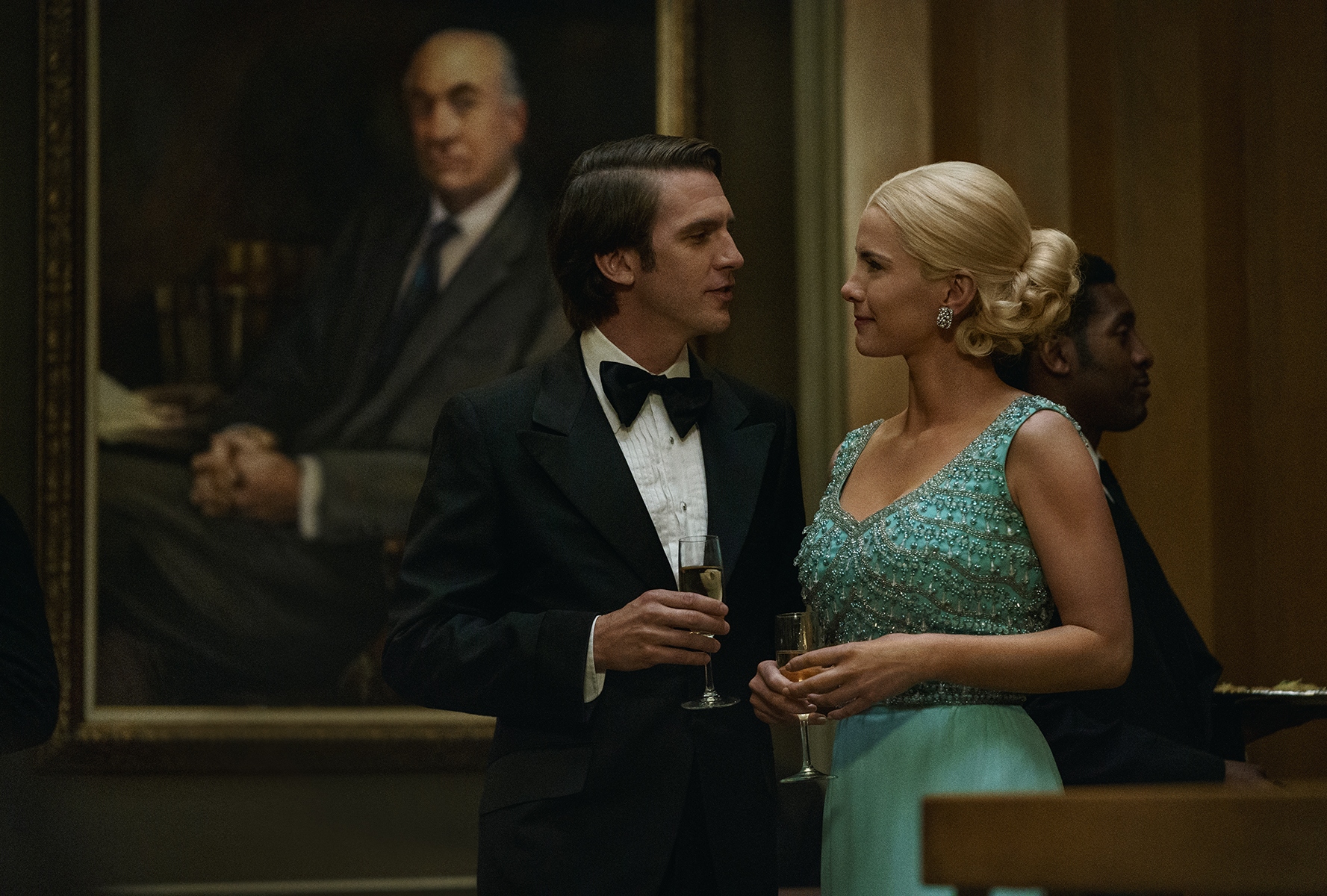
“Gaslit” focuses on the Watergate scandal, trailing its spotlight on characters in the saga including the earnest John Dean (Dan Stevens), White House Counsel for President Richard Nixon, and Dean’s future wife, flight attendant (and future writer) Maureen “Mo” Dean (a radiant Betty Gilpin, who gushes at a party: “Everyone’s so evil here; I’m having so much fun.”) along with CIA officer John McCord (Chris Bauer, so wonderfully empathetic in “For All Mankind” and equally great here).  

Dan Stevens and Betty Gilpin in “Gaslit” (Starz)And Martha. Wife of the United States Attorney General, Martha was an Arkansas-born, outspoken socialite who sounded the alarm on Nixon. In Roberts’ portrayal, she has charisma and vulnerability, a woman who could have done more with her life than be sparkling at parties and give exclusives to women’s magazines.

The gaslighting of the title doesn’t begin right away, it isn’t the biggest part and it’s also an anachronism to call the show after a kind of psychological abuse that would not be known to Martha or any of the characters at the time. Even the gaslighting of the American people is not something . . . well, the American people wouldn’t be able to identify for years.

“Gaslit” is being billed as the Julia Roberts show, but it’s really an ensemble piece. And if you don’t have a firm grasp of history (the show doesn’t always either) it may be hard to keep the large, star-studded cast of characters straight and understand their importance. 

“Jesus Christ wouldn’t make it through the Republican primary.”

Or, perhaps this history has been so well-trodden already, it makes sense to be drawn to the stories created from the sidelines: the new night guard at the Watergate (quietly compelling Patrick R. Walker), for example, or the sympathetic writer (Allison Tolman) who’s the only person Martha has to call for help.

Shea Wigham in “Gaslit” (Starz)“Gaslit” sizzles with some hilarious lines, not all of them spoken by Martha, who does get zingers like: “Jesus Christ wouldn’t make it through the Republican primary.” We’re also treated to the quip: “The only thing that means dick to Dick is more glory for Dick.” 

The show also looks really good. With golden brocades and rich navys, this is a swinging, stylish time. The swimming pools are shining and the floral wallpaper resplendent as Martha and John’s Bloody Mary-drinking 11-year-old (droll and bespectacled Darby Camp) chain smokes in her bedroom. It always seems to be sunny, muggy Washington D.C. cast in the same glimmering light as California. Vintage footage, real and invented, adds to the glamorous feel. 


Want a daily wrap-up of all the news and commentary Salon has to offer? Subscribe to our morning newsletter, Crash Course.


We get flashes of another kind of world, especially at the beginning. Trash swirls as Dean roars by in his troublesome Porsche, police fighting protestors on the street. An anti-war protester crashes a splashy benefit Martha attends and brings up the peace activists, the Berrigan brothers. “Looks like somebody needs to go back to finishing school,” the host says to laughs when the protester is escorted out.

But these are only flashes, hints of greater conflict (and perhaps, the story’s potential). There are many small moments here, racial microaggressions FBI agent Paul Magallanes (the likable Carlos Valdes) faces constantly, sexism all the women face: the bubbling cauldron of the time. It’s a lot beneath the surface. And a lot to try to balance.

“Gaslit” wants to be many things, which bogs it down, and it has marketed itself as whistleblower Martha’s story, which it isn’t, really. It’s a lot of stories. It’s a time capsule, a not completely historically accurate one, but one stuffed full. 

“Gaslit” premieres Sunday, April 24 on Starz. Watch a trailer for it below, via YouTube.

More stories like this:

How to end the war in Ukraine: Sanctions against Russia won’t work — but this might

As the war in Ukraine heads for its third month amid a rising toll of death and destruction, Washington and its European allies are scrambling, so far unsuccessfully, to end that devastating, globally disruptive conflict. Spurred by troubling images of executed Ukrainian civilians scattered in the streets of Bucha and ruined cities like Mariupol, they are already trying to use many tools in their diplomatic pouches to pressure Russian President Vladimir Putin to desist. These range from economic sanctions and trade embargoes to the confiscation of the assets of some of his oligarch cronies and the increasingly massive shipment of arms to Ukraine. Yet none of it seems to be working.

Even after Ukraine’s surprisingly strong defense forced a Russian retreat from the northern suburbs of the capital, Kyiv, Putin only appears to be doubling down with plans for new offensives in Ukraine’s south and east. Instead of engaging in serious negotiations, he’s been redeploying his battered troops for a second round of massive attacks led by Gen. Alexander Dvonikov, “the butcher of Syria,” whose merciless air campaigns in that country flattened cities like Aleppo and Homs.

So while the world waits for the other combat boot to drop hard, it’s already worth considering where the West went wrong in its efforts to end this war, while exploring whether anything potentially effective is still available to slow the carnage.

Playing the China card

In January 2021, only weeks after President Biden’s inauguration, Moscow began threatening to attack Ukraine unless Washington and its European allies agreed that Kyiv could never join NATO. That April, Putin only added force to his demand by dispatching 120,000 troops to Ukraine’s border to stage military maneuvers that Washington even then branded a “war threat.” In response, taking a leaf from former Secretary of State Henry Kissinger’s tattered Cold War playbook, the Biden administration initially tried to play Beijing off against Moscow.

RELATED: Russia’s war is an inexcusable crime — but the U.S. is not a credible force for peace

After a face-to-face summit with Putin in Geneva that June, Biden affirmed Washington’s “unwavering commitment to the sovereignty and territorial integrity of Ukraine.” In a pointed warning to the Russian president, he said,

You got a multi-thousand-mile border with China… China is… seeking to be the most powerful economy in the world and the largest and the most powerful military in the world. You’re in a situation where your economy is struggling… I don’t think [you should be] looking for a Cold War with the United States.

As Russian armored units began massing for war near the Ukrainian border that November, U.S. intelligence officials all-too-accurately leaked warnings that “the Kremlin is planning a multi-front offensive… involving up to 175,000 troops.” In response, over the next three months, administration officials scrambled to avert war by meeting a half-dozen times with Beijing’s top diplomats and beseeching “the Chinese to tell Russia not to invade.”

In a video conference on Dec. 7, Biden told Putin of his “deep concerns… about Russia’s escalation of forces surrounding Ukraine,” warning that “the U.S. and our Allies would respond with strong economic and other measures in the event of military escalation.”

In a more amicable video conference just a week later, however, Putin assured China’s President Xi Jinping that he would defy any human-rights boycott by Western leaders and come to Beijing for the Winter Olympics. Calling him his “old friend,” Xi replied that he appreciated this unwavering support and “firmly opposed attempts to drive a wedge into our two countries.” Indeed, during the February Olympics opening ceremony, the two of them publicly proclaimed a de facto alliance that had “no limits,” even as Beijing evidently made it clear that Russia should not spoil China’s glittering Olympic moment on the international stage with an invasion right then.

In retrospect, it’s hard to overstate the price Putin paid for China’s backing. So desperate was he to preserve their new alliance that he sacrificed his only chance for a quick victory over Ukraine. By the time Putin landed in Beijing on Feb. 4, 130,000 Russian troops had already massed on the Ukrainian border. Delaying an invasion until the Olympics ended left most of them huddled in unheated canvas tents for three more weeks. When the invasion finally began, idling vehicles had burned through much of their fuel, truck tires sitting without rotation were primed for blow-outs, and the rations and morale of many of those soldiers were exhausted.


Want a daily wrap-up of all the news and commentary Salon has to offer? Subscribe to our morning newsletter, Crash Course.


In early February, the ground in Ukraine was still frozen, making it possible for Russia’s tanks to swarm overland, potentially encircling the capital, Kyiv, for a quick victory. Because the Olympics didn’t end until Feb. 20, Russia’s invasion, which began four days later, was ever closer to March, Ukraine’s mud month, when average temperatures around Kyiv rise rapidly. Adding to Moscow’s difficulties, at 51 tons, its T-90 tanks were almost twice as heavy as the classic go-anywhere Soviet T-34s which won World War II. When those modern steel-clad behemoths did try to leave the roads near Kyiv, they often sank deep and fast in the mud, becoming sitting ducks for Ukrainian missiles.

Instead of surging across the countryside to envelop Kyiv, Russia’s tanks found themselves stuck in a 40-mile traffic jam on a paved highway where Ukrainian defenders armed with shoulder-fired missiles could destroy them with relative ease. Being enveloped by the enemy instead of enveloping them cost the Russian army most of its losses to date — estimated recently at 40,000 troops killed, wounded, or captured, along with 2,540 armored vehicles and 440 rocket and artillery systems destroyed. As those crippling losses mounted, Russia’s army was forced to abandon its five-week campaign to capture the capital. On April 2, the retreat began, leaving behind a dismal trail of burned vehicles, dead soldiers and slaughtered civilians.

In the end, Vladimir Putin paid a high price indeed for China’s support.

It’s difficult to overstate the price Putin paid for Xi Jinping’s support: It starts at 40,000 men and 2,500 armored vehicles, and includes international humiliation.

Xi’s foreknowledge of the plans to invade Ukraine and his seemingly steadfast support even after so many weeks of lackluster military performance raise some revealing parallels with the alliance between Joseph Stalin, the leader of the Soviet Union, and China’s Mao Zedong in the early days of the Cold War. After Stalin’s pressure on Western Europe was blocked by the Berlin airlift of 1948-1949 and the formation of NATO in April 1950, the Soviet boss made a deft geopolitical pivot to Asia. He played upon his brand new alliance with a headstrong Mao by getting him to send Chinese troops into the maelstrom of the Korean War. For three years, until his death in 1953 allowed an armistice to be reached, Stalin kept the U.S. military bogged down and bloodied in Korea, freeing him to consolidate his control over Eastern Europe.

Following this same geopolitical strategy, Xi has much to gain from Putin’s headstrong plunge into Ukraine. In the short term, Washington’s focus on Europe postpones a promised (and long-delayed) U.S. “pivot” to the Pacific, allowing Beijing to further consolidate its position in Asia. Meanwhile, as Putin’s military flattens cities like Kharkiv and Mariupol, making Russia an outlaw state, a mendicant Moscow is likely to become a cut-rate source of much-needed Chinese fuel and food imports. Not only does Beijing need Russia’s gas to wean its economy from coal but, as the world’s largest consumer of wheat, it could achieve food security with a lock on Russia’s massive grain exports. Just as Stalin capitalized on Mao’s stalemate in Korea, so the elusive dynamics of Eurasian geopolitics could well transform Putin’s losses into Xi’s gains.

For all these reasons, Washington’s initial strategy had little chance of restraining Russia’s invasion. As retired CIA analyst Raymond McGovern argued, drawing on his 27 years studying the Soviet Union for the agency, “Rapprochement between Russia and China has grown to entente.” In his view, the sooner Biden’s foreign-policy team “get it through their ivy-mantled brains that driving a wedge between Russia and China is not going to happen, the better the chances the world can survive the fallout (figurative and literal) from the war in Ukraine.”

Sanctions — and why they won’t work

Since the Russian invasion began, the Western alliance has been ramping up an array of sanctions to punish Putin’s cronies and cripple Russia’s economic capacity to continue the war. In addition, Washington has already committed $2.4 billion for arms shipments to Ukraine, including lethal antitank weapons like the shoulder-fired Javelin missile.

On April 6, the White House announced that the U.S. and its allies had imposed “the most impactful, coordinated and wide-ranging economic restrictions in history,” banning new investments in Russia and hampering the operations of its major banks and state enterprises. The Biden administration expects the sanctions to shrink Russia’s gross domestic product by 15% as inflation surges, supply chains collapse and 600 foreign companies exit the country, leaving it in “economic, financial and technological isolation.” With near unanimous bipartisan support, Congress has also voted to void U.S. trade relations with Moscow and ban its oil imports (measures with minimal impact, since Russia only supplies 2% of American petroleum use).

Although the Kremlin’s invasion threatened European security, Brussels moved far more cautiously, since Russia supplies 40% of the European Union’s gas and 25% of its oil — worth $108 billion in payments to Moscow in 2021. For decades, Germany has built massive pipelines to handle Russia’s gas exports, culminating in the 2011 opening of Nordstream I, the world’s longest undersea pipeline, which Chancellor Angela Merkel then hailed as a “milestone in energy cooperation” and the “basis of a reliable partnership” between Europe and Russia.

With its critical energy infrastructure bound to Russia by pipe, rail and ship, Germany, the continent’s economic giant, is dependent on Moscow for 32% of its natural gas, 34% of its oil and 53% of its hard coal. After a month of foot-dragging, it did go along with the European decision to punish Putin by cutting off Russian coal shipments, but drew the line at tampering with its gas imports, which heat half its homes and power much of its industry.

To reduce its dependence on Russian gas, Berlin has launched multiple long-term projects to diversify its energy sources, while canceling the opening of the new $11 billion Nordstream II gas pipeline from Russia. It has also asserted control over its own energy reserves, held inside massive underground caverns, suspending their management by the Russian state firm Gazprom. (As Berlin’s Economy Minister Robert Habeck put it, “We won’t leave energy infrastructure subject to arbitrary decisions by the Kremlin.”)

Although the EU is considering plans to cut off Russian oil completely, natural gas is a bigger problem: Germany’s unions fear the loss of hundreds of thousands of jobs.

Right after the Ukraine invasion, German Chancellor Olaf Scholz announced a crash program to construct the country’s first Liquified Natural Gas (LNG) terminals on its north coast to unload supplies from American ships and those of various Middle Eastern countries. Simultaneously, German officials flew off to the Persian Gulf to negotiate more long-term deliveries of LNG. Still, the construction of such a multibillion-dollar terminal typically takes about four years, and Germany’s vice-chancellor has made it clear that, until then, massive imports of Russian gas will continue in order to preserve the country’s “social peace.” The European Union is considering plans to cut off Russian oil imports completely, but its proposal to slash Russian natural gas imports by two-thirds by year’s end has already met stiff opposition from Germany’s finance ministry and its influential labor unions, worried about losses of “hundreds of thousands” of jobs.

Given all the exemptions, sanctions have so far failed to fatally cripple Russia’s economy or curtail its invasion of Ukraine. At first, the U.S. and EU restrictions did spark a crash in Russia’s currency, the ruble, which Biden mockingly called “the rubble,” but its value has since bounced back to pre-invasion levels, while broader economic damage has, so far, proved limited. “As long as Russia can continue to sell oil and gas,” observed Jacob Funk Kirkegaard, senior fellow at the Peterson International Economics Institute, “the Russian government’s financial situation is actually pretty strong.” And he concluded, “This is the big escape clause of the sanctions.”

In short, the West has seized a few yachts from Putin’s cronies, stopped serving Big Macs in Red Square, and slapped sanctions on everything except the one thing that really matters. With Russia supplying 40% of its gas and collecting an estimated $850 million daily, Europe is, in effect, funding its own invasion.

The case for reparations

Following the failure of both Washington’s pressure on China and Western sanctions against Russia to stop the war, the international courts have become the sole peaceful means left to still the conflict. While the law often remains an effective means to mediate conflict domestically, the critical question of enforcing judgments has long robbed the international courts of their promise for promoting peace — a problem painfully evident in Ukraine today.

Even as the fighting rages, two major international courts have already ruled against Russia’s invasion, issuing orders for Moscow to cease and desist its military operations. On March 16, the U.N.’s highest tribunal, the International Court of Justice, ordered Russia to immediately suspend all military operations in Ukraine, a judgment Putin has simply ignored. Theoretically, that high court could now require Moscow to pay reparations, but Russia, as a permanent member of the Security Council, could simply veto that decision.

With surprising speed, on day five of the invasion, the European Court of Human Rights (ECHR) at Strasbourg ruled in the case of Ukraine v. Russia (X), ordering the Kremlin “to refrain from military attacks against civilians and civilian objects, including residential premises, emergency vehicles and… schools and hospitals” — a clear directive that Moscow’s military continues to defy with its devastating rocket and artillery strikes. To enforce the decision, the court notified the Council of Europe, which, two weeks later, took the most extreme step its statutes allow, expelling Russia after 26 years of membership. With that not-terribly-painful step, the European Court seems to have exhausted its powers of enforcement.

But matters need not end there. The court is also responsible for enforcing the European Convention on Human Rights, which reads in part: “Every natural or legal person is entitled to the peaceful enjoyment of his possessions.” Under that provision, the ECHR could order Russia to pay Ukraine compensation for the war damage it’s causing. Unfortunately, as Ivan Lishchyna, an adviser to Ukraine’s Ministry of Justice, points out: “There is no international police or international military force that can support any international court judgment.”

The European Court of Human Rights could order Russia to pay compensation to Ukraine for war damage. There’s an obvious way to enforce that judgment: Europe pays Russia’s natural gas company $850 million every day. 

As it happens, though, there is a blindingly obvious path to payment. Just as a U.S. municipal court can garnish the wages of a deadbeat dad who won’t pay child support, so the European Court of Human Rights could garnish the gas income of the world’s ultimate deadbeat dad, Vladimir Putin. In its first five weeks, Putin’s war of choice inflicted an estimated $68 billion of damage on Ukraine’s civilian infrastructure (its homes, airports, hospitals, and schools), along with other losses worth about $600 billion or three times that country’s total gross domestic product.

But how would Ukraine collect such a sum from Russia? Any Ukrainian party that has suffered damage — whether individuals, cities, or the entire nation — could petition the European Court of Human Rights to enforce its judgement in Ukraine v. Russia (X) by awarding damages. The court could then instruct the Council of Europe to direct all European corporations buying gas from Gazprom, the Russian state monopoly, to deduct, say, 20% from their regular payments for a Ukraine compensation fund. Since Europe is now paying Gazprom about $850 million daily, such a court-ordered deduction, would allow Putin to pay off his initial $600 billion war-damage debt over the next eight years. As long as his invasion continued, however, those sums would only increase in a potentially crippling fashion.

Though Putin would undoubtedly froth and fulminate, in the end, he would have little choice but to accept such deductions or watch the Russian economy collapse from the lack of gas, oil or coal revenues. Last month, when he rammed legislation through his parliament requiring Europe’s gas payments in rubles, not euros, Germany refused, despite the threat of a gas embargo. Faced with the loss of such critical revenues sustaining his economy, a chastened Putin called Chancellor Scholz to capitulate.

With billions invested in pipelines leading one-way to Europe, Russia’s petro-dependent economy would have to absorb that war-damage deduction of 20% — possibly more, if the devastation worsened — or face certain economic collapse from the complete loss of those critical energy exports. That might, sooner or later, force the Russian president to end his war in Ukraine. From a pragmatic perspective, that 20% deduction would be a four-way win. It would punish Putin, rebuild Ukraine, avoid a European recession caused by banning Russian gas and prevent environmental damage from firing up Germany’s coal-fueled power plants.

Paying for peace

Back in the day of anti-Vietnam War rallies in the United States and nuclear-freeze marches in Europe, crowds of young protesters would sing John Lennon and Yoko Ono’s hope-filled refrain, even though they were aware of just how hopeless it was even as the words left their lips: “All we are saying is give peace a chance.” But now, after weeks of trial and error over Ukraine, the world just might have a chance to make the aggressor in a terrible war at least begin to pay a price for bringing such devastating conflict back to Europe.

Perhaps it’s time to finally deliver a bill to Vladimir Putin for a foreign policy that has involved little more than flattening one hapless city after another — from Aleppo and Homs in Syria to Chernihiv, Karkhiv, Kherson, Kramatorsk, Mariupol, Mykolaiv and undoubtedly more to come in Ukraine. Once the world’s courts establish such a precedent in Ukraine v. Russia (X), would-be strongmen might have to think twice before invading another country, knowing that wars of choice now come with a prohibitive price tag. 

Read more on Putin, Russia and the war in Ukraine:

Florida atheist seeks to have Bible banned in schools

With the ongoing, Republican-led ban on books in schools across the state of Florida, an atheist resident of the Sunshine State is now making his demands, as well. According to The Miami New Times, Chaz Stevens of Deerfield Beach, Fla., who is described as a “local political stunt activist” has taken the initiative to add the Bible to the list of banned books.

Now, he’s reportedly sending out petitions to Miami-Dade County Public Schools (MDCPS) and Broward County Public Schools (BCPS) demanding that the Christian bible be banned from schools’ libraries and classrooms “citing its inclusion of inappropriate topics.”

Speaking to Miami New Times, Stevens further explained his position.

“If they’re gonna ban books, then the whole library should be in play. My hope — and it’s a longshot — is that they will apply their own standards to themselves and ban the Bible,” Stevens said.

In a letter sent to MDCPS Superintendent Jose Dotres on April 19, Stevens wrote.

“I wish to file such an objection, requesting the Miami-Dade County Public School system immediately remove the Bible from the classroom, library, and any instructional material. And, as is often the case with banned books, I ask your agency lay flame to that giant stack of fiction in a pyre worthy of a Viking sendoff.”

Stevens also named a number of reasons why he wants the Bible banned including: “age inappropriateness, social-emotional learning, mentions of bestiality and rape, and “wokeness” as reasons to ban the Bible.”

“With the constant babbling concerns about teaching Critical Race Theory, should we not take stock of the Bible’s position on slavery? I am concerned our young white students will read such passages and wake up to civilization’s sordid past,” Stevens wrote following a biblical passage from the book of Ephesians that discusses slavery and being obedient to masters.

In response to Stevens’ demand letters, one school district superintendent has responded so far. In an email to Miami New Times, Elmo R. Lugo, an MDCPS spokesperson, has released a statement acknowledging the issue. “We acknowledge receipt of the subject letter. District staff will review it and respond accordingly,” Luga said via email.

The officeof BCPS Superintendent Vickie L. Cartwright has not yet released a statement. According to Stevens, that means something.

“They better not fucking ignore me,” Stevens warns. “If they ignore me, doesn’t that tell you something? The government can’t pick and choose religion, but can they choose which books they review for banning and which ones they don’t?”

Anti-vaccine ideology gains ground as lawmakers seek to erode rules for kids’ shots

Not long ago, Kansas showed strong bipartisan support for vaccines as a tool to support a robust public health system.

But bills with language expanding religious exemptions for childhood vaccine requirements were passed by the state Senate in March and now face the House when the legislature reconvenes April 25.

They are among the more than 520 vaccine-related bills introduced in statehouses nationwide since Jan. 1, according to data from the National Conference of State Legislatures. Of those bills, 66 specifically relate to childhood vaccine requirements in 25 states.

In Missouri, for example, legislators are considering a measure exempting private school students from vaccine requirements. In Louisiana, a bill in the House would prohibit vaccinations on school property and at school-sponsored events.

Fewer than 10% of the bills will likely gain any traction, but the volume of attempts to roll back vaccine requirements is alarming, said Rekha Lakshmanan, director of advocacy and public policy at the Immunization Partnership, a vaccine education organization.

“Those are all chipping away at one of the end goals for anti-vaccine activists, which is completely doing away with school requirements,” said Lakshmanan. “That’s what people need to be paying very close attention to.”

All states require specific childhood vaccinations for illnesses such as polio, measles, and mumps, but exemptions vary. They all allow exemptions for people with medical concerns, 44 states allow religious exemptions, and 15 allow philosophical exemptions, according to 2021 data from the National Conference of State Legislatures.

Vaccinations are central to public health efforts at disease control and are foundational to the country’s social and economic system, said Brian Castrucci, CEO of the de Beaumont Foundation, a public health advocacy organization.

“Politicians are poking holes in our public safety net,” Castrucci said of the onslaught of anti-vaccine legislation. “Vaccines, in and of themselves, are not medicine. It’s all of us collectively protecting each other.”

To be sure, anti-vaccine activists have existed as long as vaccines. And legislation to limit requirements to vaccinate against diseases such as polio, measles, and meningitis are not new. But, according to public health experts, the movement has gained momentum amid the coronavirus pandemic, boosting the reach of high-profile anti-vaccine activists.

“If you had told me that a pandemic — and what I would consider a miraculous vaccine for that disease — would trigger an anti-vax surge, I would never have believed it,” said Tracy Russell, executive director of Nurture KC, which works to improve children’s and family health in the Kansas City area of Missouri and Kansas. “But that’s exactly what happened.”

One pending Kansas bill would mandate that vaccine exemption requests be accepted without scrutiny if based on religion or personal beliefs. Currently, the state leaves it to day care centers and school districts to accept requests for religious exemptions.

State Sen. Mark Steffen stands behind amendments he pushed nullifying Kansas’ childhood vaccine requirements. The Republican, who said he is “not an anti-vaxxer in any shape or form,” lamented mandates he said were a vestige of a “kinder, gentler time” and suggested that individual rights supersede mandates designed to protect public health.

Steffen, an anesthesiologist who said he is under investigation by the Kansas Board of Healing Arts for prescribing ivermectin to covid patients, said suggestions that a resurgence of vaccine-preventable diseases could occur if vaccination rates fall amount to fearmongering by people paid off by the pharmaceutical industry.

But Andy Marso, a Kansas vaccine advocate who launched a Facebook page to organize pro-vaccine Kansans, called such assertions insulting and said he doesn’t take any money from drug companies. He contracted meningitis B in 2004 before vaccines against it were available. He was in a coma for three weeks and had parts of all four limbs amputated.

“For me, this has been part of what helped me move on from that trauma,” Marso said. “I have a story that people need to know about.”

The legislative efforts to nullify the requirements fly in the face of widespread public support for vaccines and vaccine mandates, nationally and in Kansas, said Russell. More than 9 in 10 Kansas voters believe wellness vaccines are safe and support vaccine requirements, according to a survey conducted this year for Nurture KC. Kansas voters overwhelmingly support religious exemptions, but a majority say they support tightening existing exemptions, according to the survey.

Before the pandemic, outbreaks of measles in Kansas, Minnesota, Washington, and other states, as well as outbreaks of pertussis, had reinforced the idea that preventing disease spread required consistently high vaccination rates. And mandates, in part, helped create the mechanism for public health authorities to make vaccines widely available and accessible, said Erica DeWald, spokesperson for Vaccinate Your Family, an advocacy organization.

“Lost in what has become a political conversation around requirements is the danger of these vaccine-preventable diseases,” said DeWald. “All it takes is one case.”

Previously, anti-vaccine activists relied on long-since-debunked narratives that vaccines cause autism, said Renée DiResta, the research manager of the Stanford Internet Observatory, which studies cyber policies and how people use the internet. But in the years leading up to the pandemic, the movement began to shift its focus to align more with the populist ideology of “individual freedoms” put forward by Second Amendment advocates and the tea party.

Donald Trump expressed vaccine skepticism long before becoming president. But it was when the then-president was said to be considering naming Robert F. Kennedy Jr., a well-known anti-vaccine activist, to “investigate” vaccine safety that the movement found its footing, said Timothy Callaghan, assistant professor in the health policy and management department at Texas A&M University. The embrace of anti-vaccine messaging by prominent politicians — whether because they are “true believers” or just see it as political necessity — has “lent legitimacy that the movement lacked before,” Callaghan added.

The similarity of bills from state to state raises red flags to vaccine advocates because it suggests that a coordinated effort to dismantle vaccine requirements and public health infrastructure is underway.

“Because the anti-vax movement is becoming aligned with the far right, I think those information-sharing channels are becoming more sophisticated,” said Northe Saunders, executive director of the SAFE Communities Coalition, a pro-vaccine organization. “Their ability to attract far-right politicians who see vaccines as a cause has grown. That gets them attention, if not votes.”

Not all Republicans find common cause with anti-vaccine activists, said Kansas state Rep. John Eplee, a Republican and family physician. He said he voted against some covid-related restrictions, like a statewide mask mandate, because he believed doing so might help defuse pandemic tensions. But he advocates for all vaccines, including covid shots.

Enough others in the Kansas legislature agreed in the case of one bill: Language targeting vaccines, under the auspices of parental rights, was ultimately removed before it was passed. Some observers are cautiously optimistic the House won’t pass the other bills as written.

While Eplee hopes the “passions” inflamed by covid die down with distance from the early days of the pandemic, he’s concerned that voters have forgotten the damage done by vaccine-controllable diseases, making them susceptible to disinformation from determined anti-vaccine activists and the politicians among their ranks.

“I hate to see human nature play out like that,” said Eplee. “But if people are vocal enough and loud enough, they can swing enough votes to change the world in a not-so-good way for public health and vaccinations.”

KHN (Kaiser Health News) is a national newsroom that produces in-depth journalism about health issues. Together with Policy Analysis and Polling, KHN is one of the three major operating programs at KFF (Kaiser Family Foundation). KFF is an endowed nonprofit organization providing information on health issues to the nation.

Running the Park Slope Food Coop newsletter taught me not to believe in conspiracy theories

Right-wing conspiracy theories dominate the news these days, but conspiracy-mindedness comes in other flavors too. It was left-wingers who once accused me of conspiracy — and made me skeptical of all varieties. 

According to Adam Enders, a professor who studies conspiracy theories and politics, “powerlessness and anxiety and uncertainty” are helping to fuel what a Politico story on living in the “golden age of conspiracy theories” calls our current “pandemic of misinformation.” But years ago my own experience showed me, at a micro-level, how easy it is to fall into conspiratorial thinking.

At the time I was co-editorial coordinator of the Linewaiter’s Gazette, the biweekly newsletter of the Park Slope Food Coop in Brooklyn, New York, whose prices are kept low by a member-labor system where everyone does a few hours of work each month. The Coop is run on cooperative, democratic principles, and many of its members are passionate about those principles.

RELATED: Why Tucker Carlson loves UFOs: Jason Colavito on the hidden links between conspiracy theories

As the Coop’s main organ of information, the Gazette was at the center of many fierce disputes that arose, and my workslot as coordinator included advising the editors on knotty issues. While our reporters had to write objective features and news articles, contributions from members were often heated and disputatious. We published everything we received, except for certain exclusions specified by Coop policy, including hearsay, vague or unsubstantiated accusations, and odious comparisons, like calling someone a Nazi.

The inevitable errors and miscommunications became sources of suspicion.

But we were not a very efficient publishing operation. Editors, reporters, layout team and proofreaders worked in four rotating teams, almost entirely without supervision. Like all Coop workslots, Gazette jobs were essentially volunteer, done well or poorly depending on who did them and what problems life threw at people the week they did their workslot. The inevitable errors and miscommunications became sources of suspicion.

My co-coordinator and I believed the newsletter must include all voices, but we also had to follow the policy and were frequently called on to help editors decide, say, whether a member’s attack on someone was printable. We had no trouble rejecting a letter that called someone a modern-day Hitler, a thug or a racist. But most problematic submissions were less clear-cut, and even though many Gazette editors were publishing professionals, these were often tough judgments. Certainly, we made mistakes, but we tried earnestly to be fair.

I was startled to find how frequently we were accused of deliberately conspiring to squelch democracy.

Usually, member-contributors just got angry because they didn’t like our decisions. But I was startled to find how frequently we were accused of deliberately conspiring to squelch democracy. People often saw the Gazette as a cabal plotting against their side in whatever the current dispute was by rejecting submissions, making insidious edits or changing headlines or subheads. Even errors by the layout team, often nonprofessionals impatient to spend their Saturday doing something else, were interpreted as deliberate editorial interference aimed at undermining a writer’s argument.

One letter missed its issue because the Coop office mislaid it and never sent it to the editor. We printed it in the next issue, and I explained to its aggrieved author that the editor could not have deliberately censored it because he never knew it existed. But for years she waylaid me on the street to complain and raised that incident at meetings to prove the editors connived with the paid Coop staff to prevent pro-democracy voices from being heard.  

Another frequent problem arose because the software used to lay out the issues stripped all the formatting from the copy and the team often didn’t bother to put it back in. Members whose italics vanished in this way saw not a lazy person skimping on their work slot but a calculated attempt to undermine whatever argument they were making — an argument that they considered crucial to the well-being not just of the Coop but of society as a whole. I tried to explain the nuts and bolts of production to a few people but no one wanted to hear.

In time I got used to being “Princess Stephanie” who ran the newsletter “like Pravda.

This level of passion and righteous indignation made the prospect of rejecting yet another letter for violating the spirit of “cooperation” extremely wearisome, though in time I got used to being “Princess Stephanie” who ran the newsletter “like Pravda,” as one frequent correspondent whose letters we often rejected put it. More importantly, I learned how easy it is to fool yourself into perceiving a pattern where none exists — a phenomenon called apophenia, “the condition of seeing or imagining patterns in random occurrences.”

Pattern recognition is evolutionarily useful and hard-wired into our brains to help us make sense of the world. But it’s also subject to misperception. That’s how intelligent people with good principles and upright intentions can put together a string of completely unrelated events to create an entirely plausible assumption of malign intent that just happens to be totally wrong. According to Enders, the conspiracy expert, conspiracy-mindedness isn’t partisan: “The political and psychological and social motivations that fuel beliefs in conspiracy theories are shared among all people.” And in fact, even to me, the Coop members’ suspicions would have seemed plausible — except I knew the actual causes were poor judgment, incompetence, lousy communications and carelessness instead.

RELATED: QAnon expert: Unhappy believers are now being lured into far-right extremist groups

Other research on the psychology of conspiracy theories suggests that one reason people turn to conspiracy as an explanation for events is they feel powerless — those “on the losing (vs. winning) side of political processes also appear more likely to believe conspiracy theories.”  I suspect the conviction that the Gazette deliberately suppressed their speech appealed to Coop members who had high principles but no power to implement them, and felt frustrated that other people either didn’t agree with them or didn’t care.

This type of misapprehension is common in arenas of far greater significance. “Any historian of warfare knows it is in good part a comedy of errors and a museum of incompetence,” historian Richard Hofstadter writes in Harper’s, “but if for every error and every act of incompetence one can substitute an act of treason, many points of fascinating interpretation are open to the paranoid imagination.” As Enders’ study explains, often “beliefs … are self-reinforcing”; “each … serves as evidence for each of the other beliefs.”

Errors and incompetence make it hard to actually carry out a conspiracy.

In my experience, though, errors and incompetence make it hard to actually carry out a conspiracy. Even if I’d tried, I couldn’t have organized acts of censorship because I had no real authority over the eight editors, who made their own decisions about what to put in their issues and could not be corralled into a united front. I didn’t supervise the layout team, nor could I fire anyone for doing a bad job.

Of course not all conspiracies are imaginary. It’s well documented that the FBI carried out an extensive campaign to undermine and destroy civil rights, Black Power, antiwar and other activists between 1956 and 1971. President Nixon was part of the conspiracy to cover up the Watergate break-in. Oliver North and three other men were charged with conspiracy to defraud the U.S. in the Iran-Contra affair. And right now, the House committee investigating the January 6 attack on the Capitol is uncovering what they term “a criminal conspiracy” to overturn the results of the 2020 election.

But before jumping on any conspiracy bandwagon, it’s best to investigate. “One of the most important things we can do” when we come across something that disturbs us, says Whitney Phillips, an expert on disinformation and media manipulation, in an interview with The Sun, is to “take a moment and be mindful of what we’re not seeing, what we don’t understand, what we don’t have context for. You see one image, not the whole news story that frames the image.”  

Just such an image was that of a mysterious man holding a black umbrella above his head who appears in photos and films of the Kennedy assassination, standing at the curb in Dallas as JFK’s motorcade rolls by. The oddity of the open umbrella in the bright sunshine, and especially the man’s position right at the spot where the shots hit the limousine, generated its own conspiracy theories — that the umbrella was fitted out as a weapon that fired a poison dart at the president, that opening the umbrella was a signal to someone else — which have been refuted and then counter-refuted.


Want a daily wrap-up of all the news and commentary Salon has to offer? Subscribe to our morning newsletter, Crash Course.


In 2011, filmmaker Errol Morris made a short video intended to “nail down” the “one little factoid” of the Umbrella Man. It tells how a man called Louie Steven Witt came forward to say that he was the Umbrella Man. In 1978 Witt testified before the House Select Committee on Assassinations that he stood at that spot to protest the policy of the president’s father, Joseph P. Kennedy, who as ambassador to Britain had supported Prime Minister Neville Chamberlain’s appeasement of Hitler at Munich in 1938. Photos of Chamberlain returning from Munich show him carrying a black umbrella, which became an image of appeasement in many political cartoons. Witt, a Republican, had heard that the umbrella was a “sore spot” with the Kennedy family, so he wanted to do “a little heckling.”

Morris lets Josiah “Tink” Thompson, author of “6 Seconds in Dallas,” who spent years studying the evidence, deliver the conclusion: Witt’s explanation “is just wacky enough—it has to be true. And I take it to be true. What it means is, if you have any fact which you think is really sinister… forget it, man! Because you can never, on your own, think of all the non-sinister, perfectly valid explanations for that fact. A cautionary tale.”

Just so did my Coop experience teach me, as Phillips puts it, to be mindful of what I’m not seeing. Wherever you are on the political spectrum, you’d be wise to make sure you’re in touch with reality before drawing conclusions. You may not like what you find, but at least it’s real.

Read more stories about conspiracy theories:

From Samin Nosrat to Julia Child, here are what top chefs’ roast chicken recipes have in common

The first time I successfully roasted a chicken was the first time that I felt like a real cook. I remember it vividly: I was 20 or so and was having a guy who gave me butterflies over for dinner. The meals that I typically made for friends — briny puttanesca packed with olives, skillet-griddled burgers with too much cheese, slow-simmered pozole — felt either too sloppy or overwrought. 

Roast chicken, on the other hand, felt indisputably classic; it was the kind of meal that some cream-clad Nancy Meyers protagonist would pull out of the oven before brushing waves of perfectly tousled hair out of her eyes (just in time to see her ex-lover gazing at her adoringly from the kitchen door frame). Put another way, roast chicken was a symbol of adulthood and domesticity and, at the time, I desperately wanted to appear like both were effortless for me. So, I spent hours scanning roast chicken recipes online, noting similarities and differences between them. 

Related: 5 tips for buying better butter at the grocery store, according to an expert

So much for effortless, right? 

The resulting recipe, a mix of Ina Garten’s and Julia Child’s roast chicken recipes, inspired me to go to an actual butcher for the first time in my life, instead of just relying on the meat department at the local supermarket. I forked over $7 for a roll of good French butter

The morning before my crush was due for dinner, I woke up early to hit the farmer’s market for the prettiest parsley I could find. That night, I pulled a perfectly golden chicken (with wing tips that were, admittedly, perhaps a little too molasses-brown) from the oven just as there was a knock at my apartment door. 

We spent the evening listening to some playlist he probably spent way too much time constructing while picking the meat away from the bones with our fingertips, sopping up the juices with hunks of toasty bread. It was divine. 

While my crush fizzled soon after, that roast chicken recipe has remained in constant rotation, with occasional seasonal tweaks and substitutions. This week, as I was finalizing a springy roast chicken recipe for Salon, I revisited some of my favorite roast chicken recipes. Most of them have three major things in common which, if you keep them in mind while cooking in your own kitchen, will allow you to riff when making simple roast chicken — and perhaps enabling a Nancy Meyers moment of your own. 

Salt 

Jacques Pepin’s simple roasted and basted chicken recipe is incredibly minimalistic. It has three ingredients: one 3 ½-pound chicken, and salt and pepper to taste. That tells you how important each of those ingredients is — especially salt.

There are a couple benefits to salting chicken before roasting. Salt draws moisture out of the chicken, which results in crispy, golden-brown skin (a.k.a the best part of roasting a chicken at home). Then, of course, there’s the taste element. This could come from actual salt, as in the case of Julia Child’s favorite roast chicken; it could come from a dry or wet brine, like Samin Nosrat’s buttermilk-marinated roast chicken; it could also come from other salty ingredients like Alison Roman’s anchovy-butter chicken or — one of my recent favorites — Eric Kim’s roasted chicken with fish sauce butter

Moisture 

Most of my favorite roast chicken recipes — including Julia Child’s and Ina Garten’s — pair butter with chicken, either brushing it over the raw roaster or tucking it under the chicken skin. However, you can use other fats as well. Alton Brown’s one-pot chicken, for instance, calls for peanut or canola oil, while Mark Bittman goes for olive oil. 

Basically, you just want to ensure that your roast chicken doesn’t end up with dry, stringy meat, an unfortunate by-product of your chicken being less than moist. Fat equals both flavor and moisture (though you can also always go the simplistic Jacques Pepin route again and rely on basting to provide both).

Aromatics 

Now, this isn’t necessary for a great roasted chicken; again, I point to Jacques Pepin’s or Samin Nosrat’s. However, aromatics are one way for home cooks to really play with the flavor profile of chicken at home. Julia Child’s roast chicken goes all in with a nuanced mixture of mirepoix, mixed herbs, parsley stems, celery leaves and lemon slices. Ina Garten’s roast chicken relies on flavors of thyme, yellow onion and fennel. 

Salon Food’s spring roast chicken is rich in seasonal aromatics — including dill, leeks, fennel and lemon zest — as well. It’s the perfect weekend evening dinner, served alongside a nice chilled white wine and, perhaps, writer Maggie Hennessy’s riffable panzanella

This story first appeared on Salon’s weekly food newsletter, The Bite. Subscribe so you get first-access to special recipes, how-tos and food history deep dives. 


Want more great food writing and recipes? Subscribe to Salon Food’s newsletter.


More chicken recipes: 

Want to update your roast spring chicken? Cover it in this easy lemon-dill butter

My favorite types of dishes are the ones that can shift with the seasons. My winter pantry pasta, for instance, is packed with slow-roasted root vegetables and caramelized shallots — but once summer hits, it transforms into a one-pot wonder of fresh tomatoes, basil and a pat or two of butter. 

Roast chicken is another such dish. 

Related: The nourishing joy of simmered whole chicken

In the fall, I bathe it in rich olive oil, seasoned with sage and thyme. Come winter, I reach for butter, rosemary and pink peppercorns. Now that it’s spring, I’m ready to change again, this time leaning on verdant aromatics and a well-placed pop of acid. 

This roast chicken recipe incorporates dill, parsley and lemon zest into a really simple compound butter, which will be spread under the chicken’s skin, keeping the meat moist and flavorful. It sits on a bed of fennel and leeks, both of which caramelize just slightly in the chicken fat. It’s almost a full meal in itself, though I’d recommend adding rice, roasted potatoes or some good bread (perhaps in the form of this panzanella?). 

***

Recipe: Roast chicken with lemon-dill butter, fennel and leeks 

Yields
1 3-pound roast chicken
Prep Time
15 minutes
Cook Time
65 minutes

Ingredients

1 3-pound roasting chicken 
Salt and pepper to taste 
4 tablespoons of unsalted butter
2 tablespoons of rough-chopped dill 
1 tablespoon of rough-chopped parsley
2 tablespoons of lemon zest 
4 leeks, halved lengthwise and thoroughly rinsed 
1 fennel bulb, roughly chopped 


Directions

  1. Pat the roasting chicken dry and generously cover in salt and pepper. Be sure to get under the wings and legs and inside the interior cavity. 
  2. In a small bowl, add the unsalted butter, dill, parsley and lemon zest. Mash and mix the butter until it is softened and fully combined with the herbs and zest. 
  3. Using your hands or a small spoon, spread the butter under the chicken’s skin — again, making sure to get under the wings, legs and inside the chicken. 
  4. Add the leeks and fennel to a large cast iron skillet. Place the prepared chicken on top. 
  5. Heat the oven to 400 degrees and place the skillet inside. Roast for 60 to 70 minutes, basting the chicken with its juices and flipping the fennel and leeks halfway through. Remove the chicken and allow it to rest for at least 15 minutes before carving. 


More chicken recipes: 

Apparently, we’ve been storing rice all wrong

I recently decided to switch up my bedtime routine, by which I mean turning off the psychological thrillers on Netflix that kept me up until 1:10 am and switching to reading. I’ll fall asleep faster, I thought. I won’t have nightmares of Penn Badgley injecting me with a bouquet of poisonous herbs, I thought. I’ll wake up inspired to write more and, God forbid, better.

But as I made my way through Ruth Reichl’s “Garlic and Sapphires” (a long overdue read for this food writer), she mentioned a cooking hack that ultimately did keep me up for hours: “[If] you’re buying any quantity of Arborio or carnaroli rice, keep it in the refrigerator. It goes bad faster than you would think,” she wrote in the headnote for Risotto Primavera, her adaptation of Le Cirque’s unexpectedly fantastic recipe.

“Can you actually store dry rice in the refrigerator?” I wondered. Should you? I thought about the half-dozen OXO Pop Containers filled with arborio, basmati, short- and long-grain brown rice, jasmine, and sushi rice that were overcrowding my pantry. Could I move them to the fridge and make more room for the jars of Rao’s marinara sauce and boxes of Diamond Kosher Crystal Salt that I hoard incessantly? Should I?

According to USA Rice, a federation that I trust with my basmati and my life, uncooked rice should be “stored in a cool, dry place in a tightly closed container that keeps out dust, moisture, and other contaminants.” Apparently, white rice will keep “almost indefinitely” on a pantry shelf, but brown rice isn’t quite so flexible. “Because of the oil in the bran layer, this rice has a shelf life of approximately six months. Refrigerator or freezer storage is recommended for longer shelf life,” says the group.

Moisture is rice’s worst enemy, so it’s a good idea to keep the grains in an airtight container that has a super tight seal to prevent any moisture from permeating them. By storing rice in the fridge, you’ll, yes, extend its shelf life by months. But if you’re like me and have way more room in the fridge than the pantry, you’ll maximize every usable inch of storage space in your kitchen.

“Everything” star Stephanie Hsu on playing all-powerful: “We would just unleash ultimate chaos”

“The less sense it makes the better,” is one of the many quotable lines from The Daniels’  “Everything Everywhere All at Once,” the eye-popping, head-spinning, metaphysical action comedy about laundry and taxes (among other things and everything.) 

While the hit film — it had the highest-per-screen average box office last weekend — is a dynamic showcase for star and producer Michelle Yeoh who plays Evelyn Wang, a harried business owner facing divorce and an audit, Stephanie Hsu provides scene-stealing support as both her frustrated daughter Joy and as the wild Jobu Tupaki, whom Evelyn does battle with in the infinite multiverse. (It makes more sense in the film). 

Hsu’s characters provide a nice twist on her insecure tough cookie in “The Marvelous Mrs. Maisel,” and her fabulously outrageous costumes, hair, and makeup in “Everything Everywhere” are among some of the more memorable images in a film full of dizzying, dazzling, and inventive imagery.

RELATED: The Daniels on the ADHD theory of “Everything Everywhere All at Once,” paper cuts and butts

The actress chatted with Salon about making this cult film and what it was like to wield dildo nunchucks and battle with Michelle Yeoh.

“There has always been suffering, and light and joy are a part of the healing process.”

Are you living up to your potential right now, or are you, like Evelyn, just being the worst you possible?

Oh my God, wow! It’s a good thing I went to therapy today! [Laughs] I think I am living at the level of my potential. Before SXSW, I happen to be on the same airplane as Jamie Lee Curtis, and we got to catch up. I was telling her, I’m so excited for our movie, and I hope people like it, but I am feeling so much heaviness from the world and I am having a hard time holding both of those realities in the palms of my hands. And she gave me an important pep talk. “There has always been suffering, and light and joy are a part of the healing process as humanity continues to suffer.” So yes, I am not shirking from potential. I am celebrating. I am in the moment.

The film gives you a double role. How did you identify with and approach each character, since Jobu takes on many guises and is pretty much pure evil who sees all and knows all, and Joy, in contrast, is sullen daughter grappling with her fraught relationship with her mother?

It was important for us that the two characters held onto the same emotional core or thread, but they exhibited it in very different ways. I did some deep diving into world of Jim Carrey before this film because I felt our movie held both “Dumb and Dumber” and “Eternal Sunshine of the Spotless Mind,” and just trying to understand the scope of those films to how to fuse them into two characters that ultimately are kind of one character. 

I hadn’t been able to play a role as intimate as Joy before. Something that is not big, or incredibly disparaged and unassuming in many ways. It felt good to live in that very vulnerable and quiet space knowing that with Jobu, we would unleash the dragon. She was a creator of chaos. Often, we would improvise. The Daniels would say, “Now, blow it up!” And that would mean I’d do the scene and stop and do something else, or take a prop and throw it on the floor. We would just unleash ultimate chaos — which was really fun, but it was important that the chaos came from the same philosophy and same heartbeat of Joy. 

Tallie Medel and Stephanie Hsu in ”Everything Everywhere All at Once” (Allyson Riggs/A24)

“I love that people are letting their freak flags fly high.”

As Jobu, you get to wear some incredible costumes and take on various personas. Can you talk about jumping into multiple characters and outfits?

I have to uplift [costume designer] Shirley Kurata forever and ever and ever. In so many ways, she is the perfect match for The Daniels, because she is also, in her own way, a maximalist, but does so with supreme aesthetic. It was really important that we stretched all the costumes and looks as far as we could but that they still looked glamorous and fabulous and high fashion. And that was thanks to the excellent brain of Shirley Kurata. It was crazy. 

I’m not someone who can think about what might happen after a film comes out. At the time, I thought these costumes are amazing. And the moment the movie came out, everybody was like, “Are you ready to be a Halloween costume over and over again in all different forms of Jobu?” It’s cool that people are so excited and inspired by the looks we put together. They took work and imagination. I love that people are letting their freak flags fly high.

Did you have a favorite costume or keep any of the clothes from the shoot? 

I have a pair of Joy’s jeans, but I don’t have any of Jobu’s costumes. My favorite changes daily, but I will say that the Elvis costume is just so amazing because it’s so silly and dumb. My favorite Easter Egg is that I have gemstones on my face, and one of the gemstones is a teardrop. 

“It is meant to exhaust you and give you a sense of peace as well.

Jobu has incredible powers. Without saying too much, it involves opening up one’s mind and letting go of pain and guilt and finding truth and sesame seeds and other ingredients. But life is also stupid. What can you say about the imaginative world-building of the Daniels. Is this a place you could live? 

In some ways, this is just an exaggerated version of what our lives are like. It’s just more extreme — taking one thought you might have during a fight with your partner, and it takes that seed of doubt and stretches that it to nth degree and explores it and puts hot dog fingers on it. I think that’s really cathartic. It takes everything to the extreme, which lets you experience every possibility only to arrive at the peace that this universe may just be enough.

I think that it is meant to exhaust you and give you a sense of peace as well. It is immense, and small, and stupid, and that is why the rock universe is my favorite. I love nature, and rocks have been here since the very beginning of time — even before the dinosaurs. And we are stardust, and completely insignificant. A rock is probably the wisest most ancient thing on this earth next to mycelium and moss, and yet, we are trampling over them constantly, so holding both of those realities side by side is kinds of delightful.

Michelle Yeoh and Li Jing in “Everything Everywhere All at Once” (Allyson Riggs/A24)You also get a handful of fight scenes, including several with the formidable Michelle Yeoh, whom you get to slap around. Did you do your own stunts, and what can you say about the film’s action scenes?

I did my own stunts, and I had an amazing double Gemma [Nguyen], who covered me at times when I had to do changes. She is a nunchuck queen. We kept most of the stuff I did because The Daniel’s like to honor what is in our own wheelhouses. I also trained with Li Jing, who is the Kung Fu Master in the movie, who trains Michelle Yeoh. She trained me before film started in Wushu, nunchucks, and different types of choreography. It was amazing!

Specifically, the fight scene at end, I was learning so much from Michelle. Stunts are different than fight scenes. Fight scenes are a dance, but you are still afraid you are going to hurt someone. [Laughs] A crucial part in the storyline is the fight between [Michelle and me] and there was one punch in particular where we are in a kung fu forest, and I felt so scared to punch her because she had to fall back into a tree. And she was like, “No, just punch me! Do it here! See, I’m catching it!” She would lead me through it with a lot of gravitas, which was helpful. She has been doing it for forever. I was grateful I got to learn from the best! 

“Killing someone with dildo nunchucks … that was probably the weirdest thing in the movie.”

How was it to square up against Michelle as both her daughter and her enemy? Did you work with her on the dynamics between your characters and the tension between you? 

It was kind of wild, we threw ourselves into it. We shot in 38 days in six to eight weeks. There was not a lot of prep time. Luckily, Michelle enlisted all her trust in me and surrendered to the process alongside me. I, of course, felt moments of being nervous because I didn’t want to freak her out because I knew how weird Jobu would get. But she was so open to everything I threw her way and that hallway scene of her meeting Jobu was one of the first scenes that we shot, and that was crazy, but that was probably the best thing do together first. It set us up for the rest of the film. 

“Everything Everywhere All at Once” is full of weirdness. What is the weirdest thing you did — or could ever dream of?

I’m pretty sure that it is killing someone with dildo nunchucks. I couldn’t have dreamed that at all. That just wins. That was probably the weirdest thing in the movie. There’s also . . . no, that’s the weirdest thing.

Why do you think this film is connecting with audiences right now?  

I don’t know that we could have possibly imagined what’s happening with this film. Of course, we wanted people to like it, but for cinephiles it feels like it is becoming its own cultural moment. It’s hard to make new stories that are not a part of huge franchises. It’s a difficult feat to get studios and producers to believe in them, and get them greenlit and financed, etc., etc. And for those barriers to be in place and for this movie to explode them all, with every imagination thread possible thrown onto a screen in one cohesive film that also has so much heart, I feel is proving so many people wrong.

“This project encapsulates my art heart, which is weird, existentialist, and soulful.”

And giving the industry space and permission to be excited about so many new kinds of projects but also giving audience members a catharsis that they have not had in a really long time. Viewers have been fed the same food for so long that it feels good to have a dish or a flavor or a spice you have never in your wildest dreams have imagined. What’s profound for me is that a movie without an audience is just a thing you made, but audiences and strangers around the world are completing the circle, or the bagel, per se. It helps me to know that there are people out there who believe in this project as much as I did when I first read it. It makes me feel that audience and strangers want to be moved and challenged and be stretched in a way that is exciting. 

Stephanie Hsu, Michelle Yeoh and Ke Huy Quan in “Everything Everywhere All at Once” (Allyson Riggs/A24)The role is a bit different from what you have done — or is it?

I studied experimental theater and I came up in the downtown experimental theatre scene. I never wanted to pursue commercial Hollywood; I landed in this project in a very a backdoor kind of way. This was my first studio feature, but in so many ways, this project encapsulates my art heart, which is weird, existentialist, and soulful at the same time and deeply wanting to provide healing for people. I feel really lucky because while I could never have imagined this project or this role, it feels like we – somehow through the chaos and the noise of all things – found each other, and I’m happy to present myself to the world of film with this film because it is a very tried and true depiction of what I stand for as a human being and as an artist. And I’m excited for whatever it brings. 

The message of the film is finding something or someone that gives your life meaning. What gives your life meaning?

I was listening to this podcast last night, an episode of “On Being” with Mary Oliver before she passed away. The title of this episode is “I Got Saved by the Beauty of the World.” That is what keeps me going, the beauty of the world. That is the beauty of collaborators and making art, and nature and the wildness of things, and the unknowables beside the knowables. Yeah, I just piggybacked off of Mary Oliver, so that was a total cheat, but I was eating dinner listening to this podcast and sobbing.

“Everything Everywhere All at Once” is in theaters now.

More stories to check out: 

7 facts about “Titanic” survivor Violet Jessop

Before midnight on April 14, 1912, Violet Jessop settled into her bunk on the Titanic, where she worked as a stewardess. She flipped through some magazines, read a prayer, and was starting to drift off to sleep when an ominous crash jolted her out of her slumber. Less than three hours later, Jessop would find herself in a lifeboat on the North Atlantic, one of 705 survivors who could only watch in horror as the Titanic sank beneath pitch-black waters. 

Incredibly, this was not Jessop’s first escape from a maritime disaster — nor would it be her last. Here are seven remarkable facts about the “unsinkable” Violet Jessop.

1. Violet Jessop worked at sea to support her family. 

Jessop was born in 1887, the eldest child of an Irish couple living in Argentina. Her early years were marked by hardship. Three of her siblings died as young children, and Jessop herself fell seriously ill with tuberculosis. When her father died, Jessop’s mother took her six surviving children to England and secured a post as a stewardess on a ship. She became too sick to work, however, and it fell to 21-year-old Violet to provide for her family. 

Jessop chose the same career as her mother, ultimately getting hired as a stewardess on the White Star Line, a prominent shipping company that ferried both cargo and passengers across the Atlantic. Jessop worked in first class cabins, attending to passengers’ many and varied needs: She made beds, brought breakfast trays, cleaned bathrooms, arranged flowers, and ran errands. There was, in short, “no aspect of service that was not her or her colleagues’ responsibility,” writes John Maxtone-Graham, editor of Jessop’s memoir, “Titanic Survivor.” 

2. She was on board the RMS Olympic when it crashed into another ship.

In the early 20th century, hoping to gain an edge in the competitive transatlantic passenger industry, the White Star Line launched three ships offering unprecedented luxuries to wealthy passengers: the Olympic, Titanic, and Britannic. It was an opulent but ill-fated trio, and Jessop happened to be working on each ship when disaster struck.

The first in this series of maritime misfortunes was the collision of the Olympic with the HMS Hawke in September 1911. Both ships were badly damaged, but neither sank and there were no major casualties. Curiously, Jessop does not mention the crash in her memoir — but she does offer vivid details about her experiences on the Olympic‘s sister ships.

3. She had some salty opinions about the Titanic’s upper-class passengers. 

Among the notable guests Jessop encountered during her service on the Titanic were American financier John Jacob Astor IV and his pregnant wife, Madeleine Force Astor. Their marriage in 1911 had caused a sensation — Astor was recently divorced and nearly 30 years older than his new bride — and Madeleine did not make a particularly favorable impression on Jessop. “Instead of the radiant woman of my imagination,” she writes in her memoir, “I saw a quiet, pale, sad-faced, in fact dull young woman arrive listlessly on the arm of her husband.”

Jessop is similarly withering about several guests who do not appear on the Titanic‘s passenger list; according to Maxtone-Graham, they may represent “composites of passenger types” who made wearisome demands on the crew. She writes that one “Miss Marcia Spatz” arrived on board with “many and strange needs,” along with “[n]ever ending boxes of flowers . . .  presumably thank offerings to mark her departure.” A “Miss Townsend” insisted that the furniture in her luxurious room be changed immediately and, according to Jessop, spent her “happiest moments . . . watching the agonized struggles of a couple of perspiring stewards tackling the job.” 

4. After the Titanic’s collision with an iceberg, Violet Jessop tried to assure passengers that all was well. 

When she heard the “awful grinding crash” of the collision, Jessop dressed quickly and sped to the section of the ship to which she had been assigned. Orders soon came to head toward the lifeboats. Jessop helped passengers adjust their lifebelts and reminded them to dress warmly, take blankets, and pack up their valuables. As she moved from room to room, she promised that these were merely precautionary measures; she herself did not, initially, fully comprehend that a catastrophe was looming. “Of course Titanic couldn’t be sinking!” she writes in her memoir. “She [was] so perfect, so new.”

The sickening realization of the Titanic‘s imminent fate came when Jessop turned to say something to a fellow stewardess and saw that the “forward part” of the ship was inclining toward the dark ocean. “For a fraction of a second,” she recalls, “my heart stood still, as is often the case when faith, hitherto unshaken faith, gets its first setback.”

5. She took care of a “forgotten baby.”

As Jessop stepped into a lifeboat with other women and children, who were the first to be evacuated from the sinking ship, a deck officer handed her a baby — “somebody’s forgotten baby,” Jessop writes. The boat was lowered toward the ocean and dropped onto the water with a “bone-cracking thud.” The baby started to cry. She held the child and watched as the Titanic‘s bowsank further into the water, until the great ship snapped in two and, “with a thundering roar of underwater explosions,” plunged into the sea. Stranded upon a frigid expanse of the Atlantic, Jessop “feared, suddenly, that this stranger’s child might die in my arms.” She wrapped the baby in a blanket that she had grabbed before evacuating the ship, and it fell asleep.

Hours later, Jessop was pulled on board the RMS Carpathia, which retrieved the Titanic survivors during a dramatic rescue mission. As she stood on the deck, freezing and dazed, a woman ran up to her and grabbed the baby out of her arms. “I did wonder why,” Jessop writes, “whoever its mother might be, she had not expressed one word of gratitude for her baby’s life.”

6. She nearly died in the sinking of the HMHS “Britannic.”

Jessop was not eager to return to a life at sea in the wake of the disaster. But she had little choice; she “needed the work.” Following the outbreak of World War I, she served as a nurse on the HMHS Britannic, which was refitted as a hospital ship during the war. Jessop was on board on November 21, 1916, when the Britannic hit a German mine and began to sink rapidly into the Aegean Sea.

Jessop was told to disembark in a lifeboat with some of her shipmates, who were greeted by a ghastly scene when they reached the water: the ship’s propellers were still moving, sucking passengers and boats alike into their blades. Though she spent years working on the ocean, Jessop did not know how to swim — but she could not risk staying in the boat. She clutched at her lifebelt and jumped overboard. When she resurfaced, her head struck the ship’s keel. “My brain shook like a solid body in a bottle of liquid,” she writes.

Jessop grabbed onto a spare lifebelt that was floating by and managed to hang on until one of the Britannic‘s motor boats picked her up. Jessop had survived yet another maritime disaster, but the blow to her skull would cause headaches for years to come.

7. Violet Jessop raised chickens after retiring from her career at sea.

Despite her tumultuous experiences on the ocean, Jessop continued to work in passenger service on large ships. She rejoined the White Star Line after the war, subsequently signing on with a new company, the Red Star Line, which sent Jessop around the world on five cruises. After a period of working clerical jobs on shore, she returned to sea for two years on the Royal Mail Line‘s voyages to South America. She retired from her eventful career in 1950, at the age of 63, and moved to the countryside. 

Jessop spent her last years firmly planted on land, cultivating a beautiful garden and raising chickens to sell eggs for extra income. She died of congestive heart failure at the age of 84 in 1971.

The problem with positive psychology: When the pursuit of happiness turns toxic

In Homer’s “Odyssey,” Odysseus finds himself having to navigate a ship down a strait that sits between two sea monsters: Scylla, a six-headed carnivore perched on the cliffs who likes to snap up sailors in her jaws, and Charybdis, a whirlpool that can easily suck an entire boat and crew down to unsurvivable depths. Years of watching the evolution of positive psychology — in articles, books, and, most impactfully, social media posts — have left me wondering whether Americans are destined to approach happiness as a similarly precarious, if not entirely impossible, tightrope walk.

Positive psychology is a branch of the study of the human mind and behavior that focuses on positive emotion, traits, experience, and institutions. It tends to be about optimism and resilience in the face of life’s challenges. Just listen to Andrea Bonior, Ph.D.

“[W]hen we invite negative (or dysfunctional) thoughts to hang around, we empower them,” she writes in “Detox Your Thoughts: Quit Negative Self-Talk for Good and Discover the Life You’ve Always Wanted.” Her book is one piece of the $10.4 billion self-improvement market that has made happiness and positivity “both a goal and an obligation,” according to Whitney Goodman.

Goodman isn’t the first to write a book on toxic positivity, usually defined as an obsession with maintaining a positive mindset, but hers, “Toxic Positivity: Keeping It Real in a World Obsessed with Being Happy,” represents the culmination of years spent advocating against it via her influential Instagram account @sitwithwhit.

The basics of toxic positivity

Some believe positive psychology can be boiled down to a fake-it-’til-you-make-it style of rebranding. “Our obsession with positivity is all around us,” Goodman writes: “Struggles are now ‘opportunities.’ Triggers are ‘teachers.’ Grief is now ‘love with nowhere to go.’ Weaknesses are actually ’emerging strengths.'”

Bonior’s book would seem to exemplify this thinking. She encourages readers to “channel your uncomfortable feelings into something progressive or creative.” When faced with “embarassments, setbacks, emotions that feel like weaknesses, and incidents we wish we could do over,” she suggests asking oneself, “How can you turn those into something that matters in a positive way?” and “If you pretended this feeling was a teacher, what would its lesson be?”

“Our obsession with positivity is all around us,” Goodman writes: “Struggles are now ‘opportunities.’ Triggers are ‘teachers.’ Grief is now ‘love with nowhere to go.’ Weaknesses are actually ’emerging strengths.'”

Her book is all about how to keep negative thoughts from becoming “sticky,” and thus interfering with our work, moods, and relationships. Bonior offers powerful, research-backed tools like self-distancing (“I’m not a good enough mother” becomes “I’m having the thought that I’m not a good enough mother”), mindfulness, reinterpreting and reframing, visualization (“Are the thoughts big, dark, hot clouds like smoke?”), meditation, and more. “[I]t’s not the presence of our thoughts we need to change,” she says, “It’s how we view them.” After all, two people waiting in line for a roller coaster, one excited and one terrified, experience the same physiological sensations; the only difference is “what story you tell yourself about them.”

Bonior wants us to know we are in charge of such things. “Summon the courage to release the thoughts that are redundant, dysfunctional, exaggerated, or unduly catastrophic,” she writes: “If you choose to find meaning in your mistakes, then you get to decide what story your mistake tells you and what value it has.”

This sort of messaging can frame wellness as something “promised to those who work for it, earn it, and deserve it,” Goodman says, and “it feels like if we’re not able to achieve this mindset, we must be doing something wrong, something must be wrong with us.” Anxiety becomes a sign that “you’re not focusing enough on the good.” Gratitude is “a weapon of shame that we wield at ourselves and one another.”


Want more health and science stories in your inbox? Subscribe to Salon’s weekly newsletter The Vulgar Scientist.


Goodman sees people who are obsessed with their mental detox to the point of becoming “like orthorexia (an obsession with healthy eating), but for the mind.”

There are more problems with fixating on positivity, according to Sara Ahmed, a self-described person of color from Australia with a philosopher’s penchant for writing in circles (albeit circles that advance the conversation). In “The Promise of Happiness,” she addresses pressure to be happy for the sake of others, and judgment of those who fail to do so, like divorcees.

The ideal of happiness has a history of being used to oppress, Ahmed argues. The image of “the happy housewife” has been used to justify an inequitable division of domestic labor and deny millions of women ambition, curiosity, and desire. The myth of the “happy slave” paved the way for continued violence and denial of humanity, and in its wake cruises the “angry Black woman” trope. The same pattern applies to colonization: It was justified as bringing modern sensibilities to unhappy natives and trailed by pressure on immigrants to bask in multiculturalism. Those who do not quickly and gratefully assimilate are labeled “melancholic migrants.” They — like Nikole Hannah-Jones and “feminist killjoys” — are accused of sabotaging the happiness of others with their consciousness of injustice. Happiness can be problematic for the LGBTQ+ community as well. The most common vision of queer happiness, Ahmed writes, approximates the “domestic bliss” of heterosexuality. To prove that one deserves to have married and become a parent is to appear unfailingly content. And to prove that one deserves to be content is to marry and become a parent.

The face of happiness,” she concludes, “looks rather like the face of privilege,” which provides a full-circle moment given the word’s derivation from the Middle English “hap,” meaning lucky or fortunate. Combining the two authors’ readings, toxic positivity is a myth of mental meritocracy that says we can experience perpetual happiness if only we work hard enough to toe the line.

The tightrope walk

Goodman is right, of course. Positivity can be toxic. But that doesn’t make Bonior wrong. In fact, both therapists ultimately write the same prescription: Whether the diagnosis is perfectionism or regret or a need for affirmation, balance is the treatment. That, and avoiding a second layer of negativity, as Bonior puts it, “feeling bad about feeling bad.”

She writes, “If you can make room for your negative feelings as well as your positive ones … then you — quite ironically — can help them on their way.”

Goodman agrees, but says, “Timing is everything…. [Y]ou have to allow yourself to experience the full breadth of the emotion and allow it to rise, peak, and then fall.” Self-directed toxic positivity leads us to short-circuit this cycle. “It effectively says, ‘Nope, that feeling you’re experiencing, it’s wrong and here’s why you should be happy instead.'” She recommends taking the time to say, “I’m feeling (name) and I’m allowed to have this feeling.”

When it comes to sharing our emotions, “we have to be careful and find the perfect balance between too much emotional expression and too little,” Goodman says. Don’t repress emotion. But also don’t vent. Complain, because, she writes, “Complaints are how we let people know what we need and how to meet our needs.” And don’t assume having gripes means you’re unappreciative or “can’t handle it.” That said, “when complaining becomes constant or circular, it’s much less helpful.” She ultimately offers eight guidelines for complaining effectively.

Combining the two authors’ readings, toxic positivity is a myth of mental meritocracy that says we can experience perpetual happiness if only we work hard enough to toe the line.

When someone confides negative emotions in us, Goodman says, we have to avoid the phrase “at least” (e.g., “your marriage may have been abusive, but at least you wound up with two gorgeous kids!”) and other attempts at perspective-lending that can leave “no more space for your emotions or your processing.” She describes these efforts at what psychologists call “reappraisal” — and the rest of us call “finding silver linings” — as “being pulled into the land of positivity whether you were ready or not,” and says, “It’s the exact opposite of what we want to do when people are in pain.” It can leave our friend feeling invalidated, their traumas minimized.

And yet, research suggests that just offering sympathy as someone recounts a negative experience may make them feel better temporarily, but it doesn’t help them process. Facilitating as they reconstrue an event — by asking them to step in someone else’s shoes or look at the big picture — does aid in discharging the underlying emotion. “At least” and other counterfactuals can make us feel better and improve performance, other research shows, even if that meaning-making process initially feels like a negation. Goodman defaults to, “Have I asked them how they like to be supported?” But that may give our loved ones what they want, not what they need. It’s easy to err on one side or the other.

Gratitude gets the same treatment. Bonior says “counting your blessings” doesn’t mean ignoring “the crappy stuff.” Rather, “[g]ratitude is … being attuned to the whole picture of your life.” And that’s essentially where Goodman lands too, via a cautionary tale. Before she understood toxic positivity, she’d say to herself, “I have so much to be thankful for, other people have it worse, and I should be happy.” This forced thankfulness is unproductive, she says. And yet, Goodman acknowledges research showing that gratitude interventions like regularly journaling can improve well-being. “This makes sense.… If we focus solely on what we lack or what we don’t have control over, it will only lead to feeling worse. The hard part is finding that balance.” Both authors want us to, in Goodman’s words, “make room for validation and gratitude at the same time.”

Okay, got it: Complain, but don’t do it the wrong way. Express emotion, but not like that. Embrace gratitude, but not too tightly. I find myself in a shiny leotard, high above the circus spectators, holding that pole and praying my toes keep finding rope.

Is positive psychology the answer to the problem with positive psychology?

Laurie Santos, a Yale professor and host of the popular podcast “The Happiness Lab,” disseminates information like Bonior’s. When anxious, she suggests in one issue of the Science of Wellbeing newsletter, “You can calm yourself with touch. Tenderly touch your stomach or your chest; hold your face; rub your hands; give yourself a hug.” Or make your way through “a checklist of questions we can all use to interrogate an anxious thought.” In an interview with the New York Times, she says, “Why are there so many happiness books and other happiness stuff and people are still not happy? … Because it takes work! Because it’s hard!”

Goodman, the critic, doesn’t entirely disagree. In the most revealing segment of her book, she writes, “Toxic positivity is the advice we might technically want to integrate but are incapable of synthesizing at the moment.” The fact that we can’t is what “leaves us feeling silenced, judged, and misunderstood” or like we’re not working hard enough to be positive enough (or to care less about being positive enough). There’s circularity here, a definition that’s both contingent and malleable: When we can swing coping mechanisms, they’re healthy. When we can’t, they’re toxic. We don’t know what we can manage until we try, but just the pressure to try can be toxic.

This was the point in my thinking where I had to call Lea Waters. Waters is a researcher and leader in the field of positive psychology. She likens academic psychology to a pendulum swing: for a century, it was fixated on what’s wrong with us. Then, about 20 years ago, she and others pulled the pendulum back, saying, “we also need to know what’s right with us.” A decade later a new movement emerged, dubbed “Positive Psychology 2.0,” which she sums up as a synthesis of the two sides of the pendulum: “It’s yin and yang; we have to integrate both these things.” For example, negative emotions like guilt and sadness can have positive outcomes by alerting us that something needs to change.

RELATED: Permanent happiness is a myth: Why you shouldn’t want to always be happy

She understands the frustration of those who say, “All right, so now it’s positive to be negative?” And she sees why Goodman says it can be negative to be positive: “When the science gets reported in self-help books and media blogs, it does become very one dimensional,” Waters says. She totally gets that her field can unintentionally feed perfectionism and bootstrapping. And yet, she still recommends Aristotle’s “golden mean,” which she summarizes as “the right emotion or the right action for the right context in the right amount.” In other words, the middle path, the tightrope walk, the threading of Scylla and Charybdis.

But she offers us a few ways out of this performance. Kind of. Sort of?

First, Waters recommends more trust in ourselves. Like Goodman, she draws a parallel to the physical health industry. “People say, ‘Which one do you want me to do? Am I supposed to do high protein or am I supposed to do high fat?'” Just as experimentation helps you find the diet that works well for you, Waters says, finding that mental health middle path is about trial and error. She thinks folks run into trouble when they rely on solely one positive psychology tool.

“Forgiveness is a virtue, but if you are in a repeatedly harmful relationship and keep on forgiving, then forgiveness ends up harming you,” she says. And you can’t be mindful if you’re constantly stressing over whether you’re being mindful enough. “If we have a small number of things in our toolkit, and we kind of brittly use those things, that leads to toxic positivity,” she says. So one answer is to gather more tools and use them more intentionally, which is … more self-help via more positive psychology.

Her second approach to the problem she dubs, “permission to be human.” Waters says she takes “time off from my well being journey … to just have some days where I don’t think, ‘Okay, I can reframe that.'”

How do you step off the positivity treadmill? When you worry, “Oh, I didn’t lean into anger,” Waters says, “use the tool of self-kindness and self-compassion.” She pauses for a moment. “So that’s kind of an interesting irony, that it’s a positive psychology tool that allows us to step away from that pressure.”

Framing happiness as an individual duty is bad because it makes us turn a blind eye to social ills that may be the true source of our misery — and which aren’t easily fixable through reframing.

There’s a different kind of permission to be human, and it comes from Betty Friedan, among others. In “The Feminine Mystique,” she holds up “aliveness” as an alternative goal to happiness. All of these folks touch on the two types of well being: hedonic and eudaimonic. Hedonic is that blissed out, in the moment, this-is-so-fun type of pleasure. Eudaimonic well-being is a deeper sort of contentment related to living a life of purpose, a life we believe in. Too many of us think we can muscle our way toward lasting joy through positivity, but Goodman says the very best lives feature only moments of bliss amid that eudaimonic sense of fulfillment. This knowledge, “makes room for the fact that living in accordance with our values doesn’t always mean feeling happy or good.”

Framing happiness as an individual duty is bad because it doesn’t make that room, and also because it makes us turn a blind eye to social ills that may be the true source of our misery — and which aren’t easily fixable through reframing. Ahmed quotes Audre Lorde: “Looking on the bright side of things is a euphemism used for obscuring certain realities of life, the open consideration of which might prove threatening or dangerous to the status quo.”

Positivity might encourage us to be satisfied with injustice, but in other ways it makes us dissatisfied with our now, constantly striving for a better future. That’s why Bonior stresses, “There is no point in life when we will suddenly ‘arrive’ at a place that is permanently easier, less stressful, or free of unexpected complications.” That’s just not what aliveness entails, Goodman agrees: “Distress, discomfort, and anxiety are all a guaranteed part of life.”

Yet social media sells positivity and happiness the same way it sells a tiny waist paired with an apple bottom. Of her patient, Tory, Goodman writes: “[T]he world is determined to always make her feel like she’s missing something so that they can sell her a product or get her to change. Tory has been sold the lie that there is this oasis of positivity and happiness on the other side of her self-improvement journey.” But “there isn’t this final happiness destination,” Goodman says, “This is it.” So accept that fact. Reframe with this lens. Embrace the messiness of being human.

That sounds a lot like more positive psychology work.

The most clarifying thing Waters says in our chat relates back to Goodman’s assertion that positive psychology frames weaknesses as “emerging strengths.” That’s just not true, Waters balks: A strengths-based approach acknowledges the existence of true weaknesses and asks you to work on them only to the point where they no longer negatively impact your life.

My favorite example is handwriting. If you’re just not great at it and don’t have a passion for it, aim for legibility, not calligraphy. Waters recommends a similar approach to using these wellness tools: “It doesn’t have to be another thing on your to-do list…. You do the hard work, and it gets you to the level where there’s a kind of built-in momentum. So you don’t even have to think of doing mindfulness. It’s not a task or a chore, your brain will just kind of automatically do it.”

My brain does not yet just kind of automatically do it.

Which brings us to a third kind of permission to be human. In times of crisis, Waters says, when everything is burning down, “I’m not using the foundational tools because I can’t.” She says she rises wiser and kinder, like a phoenix from the ashes: “Sometimes, you have to step out of your own way and just let the lessons of life sort of present themselves.” Goodman’s bottom line recommendation sounds similarly simple: “Seriously, eat the cookie. Watch the movie. Read the book. Not everything you do has to be about improving your health, your knowledge, your job, or your body.”

Pretty much everything all of them they say makes sense. And yet, my leotard chafes as I feel the rope wobbling under my feet, my sights trained on the distance.

Read more from Gail Cornwall on parenting:

The absolute best way to make an egg sandwich

In Absolute Best TestsElla Quittner destroys the sanctity of her home kitchen in the name of the truth. She’s seared more Porterhouse steaks than she cares to recall, tasted enough stuffing for 10 Thanksgivings, and mashed so many potatoes she may never mash one again. Today, she tackles the egg sandwich.

The breakfast sandwich has been around for far longer than you or your hangover.

In “Breakfast: A History,” Heather Arndt Anderson writes that the first recipe for “a true breakfast sandwich” appears in an 1897 cookbook called “Breakfast, Dinner and Supper.” The instructions are as follows:

“Use stale bread. Spread each slice with chopped meat; cover with another slice and press together. Cut each sandwich in halves and place them on a plate. Have ready a pint of milk, salted and mixed with 1 beaten egg. Pour this over the sandwiches and let stand a few moments. Put a heaping teaspoonful of butter into a frying pan and when it begins to brown place the sandwiches carefully upon it. When nicely browned on one side add a little more butter, turn, and brown the other side.”

And before that came the bap. A humble British sandwich — “bap” typically refers to a soft roll, which can be filled with eggs and meat — was commonplace as breakfast for factory workers in 19th century London. (“Baps are where breakfast sandwiches go to die,” said an American friend living in the U.K. when I reached out for comment. An English friend shared that he “likes baps,” though he admitted “they can be a bit bready.” He also noted that “bap” is slang for “breast.” And “in some regions, it’s called a butty.” !!!!! Take me out, coach.)

Overseas, the United States met the Denver sandwich — a Denver omelet (ham, peppers, onions), in between pieces of bread — at least as early as 1907, or possibly earlier according to James Beard. He wrote in “American Cookery” that it may have been inspired by a version made by 19th century railroad workers, derived from egg foo young.

Anderson credits McDonald’s 1972 release of the Egg McMuffin with the proliferation of the American breakfast sandwich — eggs and meat, as opposed to marmite on toast, or labneh and cucumbers on flatbread, and so on — far and wide.

Stateside, riffs have been endless and boundless. Perhaps one of the most popular is the New York City bodega bacon, egg, and cheese on a roll. In New Jersey, a breakfast sandwich admirer will find their egg accompanied by a slice of Taylor ham, aka pork roll, aka please don’t slide into my DMs. In the American South, it’s common to find an egg and sausage nestled between two halves of a warm biscuit, sometimes smothered with gravy. In Los Angeles, the upmarket breakfast sandwich has more recently had a long moment, with establishments like Eggslut spawning all sorts of brioche-bunned, three-sauced homage across the country.

Which is to say: There are infinite ways to jam an egg between a bready carapace. And which is also to say: this latest installment of Absolute Best Tests was perhaps the most difficult yet. I lost sleep winnowing down the list of contenders. I dreamt that a TikTok tortilla served me with a lawsuit. What follows is my attempt to try as many bread choices and egg preparations as my tiny galley kitchen and my tiny galley mind could handle.

Get your hot sauce, girls, and let’s dive in.

Controls

I seasoned all egg sandwiches with Diamond Crystal kosher salt. As you’ll see in each recipe section, I went absolutely bananas and paired each bread or egg contender with different accoutrement, but please know and trust that I graded every sandwich on the merit of the bread and/or egg. (I know that’s not how science works, but we’re not really doing science here. You get that, right?)

Equipment

Non-Stick Fry Pan: For slip-n-sliding fried eggs every which way.
Slotted Spatula or Fish Spatula: For the breeziest egg-removal missions. 
Serrated Knife: Paging your bagels, kaiser rolls, croissants, and buns.
Combination Air Fryer and Toaster: Egg sandwiches never tasted so easy.
Oven Mitts: Grease burns, be gone.

Round 1: Bread

Controls

I used fried eggs (over easy) for all of these trials.

Findings

Croissant

Extremely hard to eat. I generally do not love a croissant as a structural element, because either the croissant is technically great and flaky — in which case you want to enjoy it without the distraction of yolky globs — or the croissant is mediocre and soft, which means everything splooges out with the first bite.

Brioche Bun

A solid “fine.” The ratio of bread-to-stuff was much too high for me, despite packing it with quite a bit of stuff. My real feelings? The brioche bun should quietly tiptoe back into the domain of triple-portion salami, arugula, and butter sandwiches, and stay there for a while.

Kaiser Roll

Oh, hell yeah. A much better bread ratio, perhaps because the crumb is airier than that of a brioche bun, so it felt less like mouthing a bunch of wall insulation. Plus, the Kaiser has a tougher crust, which helps those teeth get momentum for big bites, and a generally pleasant and neutral flavor.

Bagel

Obviously, it slapped hard. My main takeaway: the sturdier the components, the better. For example, I did a few off-market tests in which I discovered I preferred the bagel sandwich with fried eggs over scrambled or poached. And the bagel stood up beautifully to bacon, or a thick sausage patty, but less well to sautéed peppers or a thin swipe of tomato jam.

Biscuit

Marry me, biscuit sandwich. I don’t need a ring, I don’t need an audience, I will wear a dress made from paper napkins. How could the result not be so fucking excellent when you are taking a breakfast sandwich and making it MORE BUTTERY? It was the sandwich the croissant wished it could be, with soft, flakey layers and a golden, crisp exterior that actually held up to the demands of the job. Also! The ideal size for a sausage patty.

Sliced Bread

We know her, we love her. She lets fillings shine, and is a good size and shape, and that’s about all there is to say about her.

English Muffin

I have long held the belief that English muffins are underrated as the bread for any sort of sandwich. (They are, for example, great as burger buns.) The same applies to fried eggs. They aren’t overly bready, are just tough enough to hold their structure when toasted, and the nooks and crannies are perfect for sauce explosions and catching yolk drips. They also add a welcome little tang.

Waffle

This breakfast sandwich was a surprise. I wasn’t expecting great things, because in my experience, waffles tend to steal the show. But the thin ones I used (frozen Eggos) were actually the ideal size, shape, and thickness. (I suspect proper Belgians would’ve overshadowed the interior.) Their texture also meant I could cram in more sauce without it slipping right out, and, insanely, I found myself noting that it provided “better grip” than some of the other options.

Recipes

Kaiser Roll

Ingredients

  • 1 kaiser roll 
  • 2 slices American cheese 
  • 2 pieces cooked Taylor Ham 
  • 2 tablespoons unsalted or salted butter, plus more to butter bread 
  • 2 large eggs 
  • Kosher salt 


Directions

  1. Slice a kaiser roll in half and set in a toaster oven or 350°F oven until lightly golden. Midway through, place both slices of cheese on one half to melt as the bread toasts. 
  2. Meanwhile, fry the eggs: Set a large nonstick pan over medium heat. Add the butter. Once it begins to foam, crack and add the eggs, spaced a few inches apart (I like to crack into a bowl first in case of shell fragments). Fry for 3 to 4 minutes, basting with butter as they cook, until whites are set and just beginning to crisp up around the edges. Remove from heat and season with a big pinch of salt. 
  3. Remove the bread from the oven when the cheese is melted. Butter the bare side. Place Taylor Ham on top of the cheese, and the fried eggs on top of that, yolk-side up. Close the sandwich. 

Brioche Bun

Ingredients

  • 1 brioche bun 
  • 2 slices cheddar 
  • 2 tablespoons unsalted or salted butter, plus more to butter bread 
  • 1 large egg 
  • Kosher salt 
  • Finely chopped chives 
  • 1 crispy hash brown 
  • Sriracha 


Directions

  1. Slice a brioche bun in half and set in a toaster or 350°F oven until lightly golden. Midway through, place both slices of cheese on bottom half to melt as the bread toasts. 
  2. Meanwhile, fry the egg: Set a small nonstick pan over medium heat. Add the butter. Once it begins to foam, crack and add the egg (I like to crack into a bowl first in case of shell fragments). Fry for 3 to 4 minutes, basting with butter as it cooks, until whites are set and just beginning to crisp up around the edges. Remove from heat and season with a big pinch of salt. 
  3. Remove the bread from the oven when the cheese is melted. Butter the bare side. Place crispy hash brown on top of cheese, and the fried egg on top of that, yolk-side up. Decorate liberally with chives and Sriracha. Close the sandwich. 

Bagel

Ingredients

  • 1 everything bagel, halved 
  • 2 slices provolone 
  • 3 pieces crispy bacon 
  • 2 tablespoons unsalted or salted butter, plus more for bagel 
  • 1 large egg 
  • Kosher salt 


Directions

  1. Set the bagel in a toaster oven or 350°F oven until lightly golden. Midway through, place both slices of cheese on one half to melt. 
  2. Meanwhile, fry the egg: Set a small nonstick pan over medium heat. Add the butter. Once it begins to foam, crack and add egg (I like to crack into a bowl first in case of shell fragments). Fry for 3 to 4 minutes, basting with butter as it cooks, until whites are set and just beginning to crisp up around the edges. Remove from heat and season with a big pinch of salt. 
  3. Remove the bagel from the oven when the cheese is melted. Butter the bare side. Place the fried egg on top of cheese, yolk-side up, and bacon on top of that. Close the sandwich. 

Sliced Bread

Ingredients

  • 2 slices white bread 
  • 2 tablespoons unsalted or salted butter, plus more to butter bread 
  • 2 slices provolone 
  • 2 pieces crispy bacon 
  • 2 large eggs 
  • Kosher salt 
  • Ketchup 


Directions

  1. Butter both sides of each piece of bread and set in a toaster or 350°F oven until lightly golden. Midway through, place both slices of cheese on one half to melt as the bread toasts. 
  2. Meanwhile, fry the eggs: Set a large nonstick pan over medium heat. Add the butter. Once it begins to foam, add each cracked egg a few inches apart (I like to crack eggs into a bowl first in case of shell-fragments). Fry for 3 to 4 minutes, basting with butter as they cook, until whites are set and just beginning to crisp up around the edges. Remove from heat and season with a big pinch of salt. 
  3. Remove the bread from the oven when the cheese is melted. Add a generous amount of ketchup to the bare slice. Place the bacon on top of the cheese, and fried eggs on top of that, yolk-side up. Close the sandwich. 

English Muffin

Ingredients

  • 1 English muffin, halved 
  • 2 slices American cheese 
  • 2 tablespoons unsalted or salted butter, plus more to butter muffins 
  • 1 large egg 
  • Kosher salt 
  • 1 country-style sausage (round or roughly round and smashed into a patty) 
  • 1 tablespoon mayo 
  • 2 teaspoons chili garlic sauce or sambal oelek 


Directions

  1. Set the English muffin in a toaster or 350°F oven until lightly golden. Midway through, place both slices of cheese on one half to melt as the bread toasts. 
  2. Meanwhile, fry the egg: Set a small nonstick pan over medium heat. Add the butter. Once it begins to foam, crack and add the egg (I like to crack eggs into a bowl first in case of shell fragments). Fry for 3 to 4 minutes, basting with butter as it cooks, until whites are set and just beginning to crisp up around the edges. Remove from heat and season with a big pinch of salt. 
  3. Mix together mayo and chili sauce. 
  4. Remove the English muffin from the oven when the cheese is melted. Spread the spicy mayo on the bare side. Place sausage on top of cheese, and fried egg on top of that, yolk-side up. Close the sandwich. 

Waffle 

Ingredients

  • 2 square or personal-sized waffles, toasted if frozen 
  • 2 tablespoons unsalted or salted butter, plus more to butter waffle 
  • 2 slices pepper Jack 
  • 1 large egg 
  • Kosher salt 
  • 2 slices deli honey-glazed ham 
  • Mayo 
  • Chile crisp 


Directions

  1. Butter both sides of each waffle and set one on a rimmed pan in an oven preheated to 300°F. Place both slices of cheese on the waffle to melt. 
  2. Meanwhile, fry the egg: Set a small nonstick pan over medium heat. Add the butter. Once it begins to foam, crack and add the egg (I like to crack into a bowl first in case of shell fragments). Fry for 3 to 4 minutes, basting with butter as it cooks, until whites are set and just beginning to crisp up around the edges. Remove from heat and season with a big pinch of salt. 
  3. Remove waffle half from the oven when the cheese is melted. Add the ham on top of cheese, and the fried egg on top of that, yolk-side up. On the bare waffle, spread the mayo. Drizzle chile crisp all over the egg. Close the sandwich. 

Biscuit

Ingredients

  • 1 very flaky biscuit, halved 
  • 1 cooked sausage patty 
  • 2 tablespoons unsalted or salted butter, plus more for bagel 
  • 1 large egg 
  • Kosher salt 
  • Hot honey 
  • Cholula 


Directions

  1. Fry the egg: Set a small nonstick pan over medium heat. Add the butter. Once it begins to foam, crack and add the egg (note: I like to crack into a bowl first in case of shell fragments). Fry for 3 to 4 minutes, basting with butter as it cooks, until whites are set and just beginning to crisp up around the edges. Remove from heat and season with a big pinch of salt. 
  2. Butter the insides of the biscuit. Place the sausage on top of bottom half, followed by the egg yolk-side up, and hot honey on top of that. Close the sandwich. 

Croissant

Ingredients

  • 1 plain croissant, halved 
  • 2 slices Gruyère 
  • 2 tablespoons unsalted or salted butter 
  • 2 large eggs 
  • Kosher salt 
  • 2 slices ham 
  • 1/4 cup baby spinach 
  • 1/2 avocado, sliced 


Directions

  1. Set the croissant in a toaster or TK°F oven until lightly golden. Midway through, place both slices of cheese on one half to melt. 
  2. Meanwhile, fry the eggs: Set a large nonstick pan over medium heat. Add the butter. Once it begins to foam, crack and add the eggs, spaced a few inches apart (note: I like cracking into a bowl first in case of shell fragments). Fry for 3 to 4 minutes, basting with butter as they cook, until the whites are set and just beginning to crisp up around the edges. Remove from heat and season with a big pinch of salt. 
  3. Place the ham on the bare half of the croissant, followed by the spinach, then the egg yolk-side up, and the avocado on top of that. Close the sandwich. 

Round 2: Eggs

Controls

I used sliced bread for all of these in an initial set of trials, and then did some side trials with other breads to test out various hypotheses. Yes, I know how that sounds.

Findings

Soft-Scrambled

There is very little to complain about when it comes to a properly soft-scrambled egg — it is creamy, lucious, and each bite has a satisfying heft. As much was true for soft-scrambled eggs on a breakfast sandwich. The only caveat I’ll share is that eggs prepared this way were better with a studier, wider bread (like the sliced bread, waffle, and bagel) than they were with flimsy or smaller carby vessels (like the croissant and English muffin), for obvious reasons.

Omelet

A delight, with the key high points being consistency (same flavor, texture, and thickness of egg in each bite) and manageability (didn’t faff around every which way as if being leaf-blown, like the scrambled boys).

Fried

The obvious best parts of fried eggs are the runny yolks and crispy edges. If those appeal to you, this is the way to go. It was also the most versatile besides the omelet in terms of bread pairings.

Baked Egg Soufflé

This method required quite a bit more active time, helicopter parenting, and dishwashing than the others, but the result was an abundance of attractive and sprightly egg patties with a texture somewhere between gyeran jjim and McMuffin-took-a-chill-pill. I would parade this method around again if I were hosting a large brunch, with egg sandwiches for all.

Poached

Eh. I love a poached egg, but the effort of preparing them just to smash them between bread made me wonder why I wasn’t just taking the easy road and frying them.

Air-Fried

There are many things you can make in an air fryer, but few which are actually superior (see: Buffalo wings). Egg sandwiches do not fall into that category. There’s too much arrangement, checking, and poking necessary. Breakfast sandwiches should be breezy. Lugging out an air fryer is anything but.

Egg Salad Melt

This method called for a sort of quick egg salad, topped with cheese in an open-faced melt. And it was pretty good. I love mayonnaise, which was a key feature. I probably could have done without the broiled cheese and simply topped with freshly cracked pepper and chopped chives. Or, more mayo.

Hard Scrambled

True scrambled eggs are fully set and dry to the touch, no longer glistening or loose. Why scramble when you could soft scramble? Really, why?

Recipes

Soft-Scrambled

Ingredients

  • 2 slices white bread 
  • 2 tablespoons unsalted or salted butter, plus more to butter bread 
  • 2 slices American cheese 
  • 2 large eggs 
  • Kosher salt 
  • 1 heaping tablespoon cream cheese 


Directions

  1. Butter both sides of each piece of bread and set in a toaster or 350°F oven until lightly golden. Midway through, place both slices of cheese on one half to melt as the bread toasts. 
  2. Meanwhile, scramble eggs: In a bowl, whisk the eggs with a big pinch of salt. Heat butter in a small nonstick pan over medium heat. Once it begins to foam, add the eggs and cook, whisking constantly, until they have set in small curds and are beginning to look dry, about 1 minute. Immediately remove from heat and whisk in cream cheese. 
  3. Remove the bread from the oven when the cheese is melted. Spoon the eggs on top of the cheese. Close the sandwich and flip it over so the cheese is on top. 

Hard Scrambled

Ingredients

  • 2 slices white bread 
  • 2 tablespoons unsalted or salted butter, plus more to butter bread 
  • 2 slices American cheese 
  • 2 large eggs 
  • Kosher salt 


Directions

  1. Butter both sides of each piece of bread and set in a toaster or 350°F oven until lightly golden. Midway through, place both slices of cheese on one half to melt as the bread toasts. 
  2. Meanwhile, scramble the eggs: In a bowl, whisk the eggs with a big pinch of salt. Heat the butter in a small nonstick pan over medium-high heat. Once it begins to foam, add the eggs and cook, whisking constantly, until they have set in large curds, about 1 minute. Immediately remove from heat while they still look glossy. 
  3. Remove the bread from the oven when the cheese is melted. Spoon the eggs on top of cheese. Close the sandwich. 

Omelet

Ingredients

  • 2 slices white bread 
  • 2 tablespoons ghee, plus more for bread 
  • 2 large eggs 
  • 1 tablespoon whole milk 
  • 1/4 small yellow onion, peeled and finely chopped 
  • 1 green chile, seeded and finely chopped 
  • 2 sprigs cilantro, finely chopped 
  • 1 pinch chile powder 
  • 1 pinch freshly ground black pepper 
  • 1 pinch kosher salt 


Directions

  1. Spread ghee on both sides of each piece of bread and set in a toaster or 350°F oven until lightly golden. 
  2. Meanwhile, make the omelet: In a medium bowl, whisk the eggs and milk. Add the onion, chile, cilantro, black pepper, chile powder, turmeric, and salt to the bowl and stir to combine. 
  3. In a small nonstick skillet over medium-high heat, warm the ghee. When hot, reduce the heat to medium-low and add the egg mixture to the pan, swirling so it completely covers the surface of the pan. Cook the omelet for 2 minutes, until the underside is lightly browned. Flip the omelet and cook the other side for another 2 minutes, until browned. Transfer the omelet to a plate. 
  4. Remove the bread from the oven when golden and sandwich the omelet in between the two slices. Close the sandwich and cut vertically into two triangles. 

Fried

Ingredients

  • 2 slices white bread 
  • 2 tablespoons unsalted or salted butter, plus more to butter bread 
  • 2 slices provolone 
  • 2 pieces crispy bacon 
  • 2 large eggs 
  • Kosher salt 
  • Ketchup 


Directions

  1. Butter both sides of each piece of bread and set in a toaster or 350°F oven until lightly golden. Midway through, place both slices of cheese on one half to melt as the bread toasts. 
  2. Meanwhile, fry the eggs: Set a large nonstick pan over medium heat. Add the butter. Once it begins to foam, crack and add the eggs, spaced a few inches apart (I like cracking the eggs into a bowl first in case of shell fragments). Fry for 3 to 4 minutes, basting with butter as they cook, until whites are set and just beginning to crisp up around the edges. Remove from heat and season with a big pinch of salt.  
  3. Remove the bread from the oven when the cheese is melted. Add a generous amount of ketchup to the bare slice. Place the bacon on top of cheese, and fried eggs on top of that, yolk-side up. Close the sandwich. 

Baked Egg Soufflé

Ingredients

  • 2 slices white bread 
  • Unsalted or salted butter 
  • 2 slices fontina 
  • 9 large eggs 
  • 3/4 cup half-and-half 
  • 3/4 teaspoon kosher salt 
  • 1 pinch freshly ground black pepper 
  • 2 slices cooked Canadian bacon 
  • Mayo, mixed with minced chipotles, hot sauce, or chile paste 
  • 2 pepperoncini, stems removed, seeded, and sliced into rings 


Directions

  1. Make the eggs: Heat the oven to 300°F. Coat the bottom and sides of a 8×8-inch cake pan with nonstick spray or liberally coat the bottom and sides with vegetable oil. 
  2. In a large bowl, whisk the eggs together until blended. Whisk in the half-and-half and salt until combined. Pour the egg mixture into the prepared cake pan. 
  3. Place the cake pan in a roasting pan, and place the roasting pan on the center oven rack. Pour hot water into the roasting pan to reach halfway up the sides of the cake pan. This water bath will ensure that the egg souffle will cook slowly and evenly. Drape a piece of aluminum foil over the cake pan or place a baking sheet directly on top of it, then carefully slide in the oven rack and close the oven door. Bake for 15 to 20 minutes, then remove the foil or baking sheet and sprinkle the pepper and thyme evenly over the top. Cover again and continue baking for about 20 minutes longer, or until the center of the egg mixture is just barely set and no longer wiggles when you jiggle the pan. 
  4. Remove both pans from the oven, and carefully remove the cake pan holding the eggs from the water bath. Leave the oven on. Let the eggs cool and set in the pan for about 10 minutes, or until cool enough to handle. Cut the eggs into four equal portions. Using a spatula, carefully remove the egg patties from the cake pan. 
  5. (For our purposes right now, we just need one to make a single sandwich, as follows.) Place the egg patty on the baking sheet and top each patty with 2 slices of fontina and 1 slice of Canadian bacon. Put the baking sheet back in the oven for 4 to 5 minutes, or until the cheese starts to melt. 
  6. Butter both sides of each piece of bread and set in a toaster or oven until lightly golden. Spread chipotle mayo liberally on one piece of toasted bread. Top with the egg patty, cheese, and Canadian bacon. Top that with pepperoncini. Close the sandwich. 

Air Fried

Ingredients

  • 2 slices white bread 
  • 2 tablespoons unsalted or salted butter, plus more to butter bread 
  • 2 slices American cheese 
  • 2 pieces uncooked bacon 
  • 2 large eggs 
  • Kosher salt 
  • Cholula 
  • Chives 


Directions

  1. Butter both sides of each piece of bread. Place both slices of cheese on one slice.  Heat the air fryer to 350°F. 
  2. Create a dam for the eggs by placing the bacon in a ring form in the center of each slice of bread. Crack each egg into each bacon ring. Set each slice in the air fryer and cook for 6 to 8 minutes, until the whites are set and the bacon is crispy. 
  3. Remove and garnish liberally with Cholula and chopped chives. Close the sandwich. 

Egg Salad Melt

Ingredients

  • 2 slices white bread 
  • Unsalted or salted butter 
  • 3 large eggs 
  • 1 tbsp mayonnaise 
  • 1 tsp Dijon mustard 
  • Kosher salt 
  • ½ cup shredded mild cheddar 
  • Finely chopped scallions 


Directions

  1. Butter both sides of each piece of bread and set in a toaster or 350°F oven until lightly golden. 
  2. Make egg salad: Place eggs in bottom of large saucepan in single layer; pour in enough cold water to cover eggs by at least 1 inch. Bring to boil over high heat; cover and remove from heat. Let stand for 12 minutes; drain and rinse under cold water. Peel the eggs and finely/roughly chop. Let cool completely. Combine eggs, mayonnaise, mustard, and salt. 
  3. Remove bread from the oven when golden. Spoon egg salad on top of the toast. Sprinkle cheese on top of the egg salad, and broil for about 2 minutes, until melted. Top with chopped scallions and serve. 

Poached

Ingredients

  • 2 slices white bread 
  • 2 tablespoons unsalted or salted butter, plus more to butter bread 
  • 1 teaspoon distilled white vinegar 
  • 2 slices gouda 
  • 2 pieces crispy turkey bacon 
  • 2 large eggs 
  • Kosher salt 


Directions

  1. Butter both sides of each piece of bread and set in a toaster or 350°F oven until lightly golden. Midway through, place both slices of cheese on one half to melt as the bread toasts. 
  2. Meanwhile, poach the eggs: Bring a small pot of water to boil. Once a full boil is achieved, add the vinegar. Swirl the water into a whirlpool with a spoon. Gently but quickly, slide the eggs one by one into the swirling water. Immediately move the pot from the heat and cover. Start a 4-minute timer. When it goes off, remove the eggs with a slotted spoon. Dab lightly with a paper towel. 
  3. Remove the bread from the oven when the cheese is melted. Place bacon on top of cheese, and the eggs on top of that. Close the sandwich. 

So, what’s the absolute best way?

Depends what you’re after! Here are the most significant pros of my top methods:

Bread

For a hearty, sturdy sandwich that doesn’t read bready: Bagel 
For a buttery, flaky treat and/or if you’re having me over: Biscuit 
For a low bread-to-fillings ratio that lets her companions shine: Sliced Bread 
For a classic egg-on-a-roll: Kaiser 
For an especially saucy fellow: Waffles 

Egg

For the junction of lowest-maintenance and ideal UX: Fried 
For a creamy, soft interior: Soft-scrambled 
For a sandwich with a consistent and delicious filling: omelet 
For a crowd of sandwiches: Baked egg soufflé 

“Pachinko” told me what my grandparents couldn’t about the life of colonized Koreans in Japan

As a fan of “Pachinko,” the internationally acclaimed novel by Min Jin Lee, I closely followed news of its adaptation and eagerly awaited to see how the main character, Sunja, would be brought to life on the screen. What I wasn’t expecting from the Apple TV+ adaptation, however, was how much I’d relate Sunja’s experiences to that of my own grandparents. 

In the first few episodes of the show alone, we see three different versions of Sunja — Sunja as a precocious only child, bright-eyed and pragmatic in facing the harsh realities of Japanese-occupied Korea, Sunja as a carefree teenager who fatefully catches the eye of a handsome stranger in a fish market, and an elderly Sunja as a grandmother in Osaka, preparing for a homebound journey to spread her sister-in-law’s ashes. 

RELATED: The must-see “Pachinko” is a pure and flawless beauty about the unpredictability of living

While the novel is grandiose in its chronological scope, “Pachinko” as a show starkly differs in that it travels back and forth in time and place. It intersperses cuts of the younger Sunjas, played by newcomers Yuna Jeon and Minha Kim, with the elderly Sunja, played by the effortlessly brilliant Oscar winner Youn Yuh-jung (“Minari”). The show shines most when we are able to trace Sunja’s trajectory as she immigrates from Korea to Japan; through Sunja’s heartbreak, losses, and goodbyes, we encounter the foundational events that form the older Sunja in her later years.  By introducing all of these Sunjas early on, viewers recognize that no matter what unfolds in the series, she will be surrounded by loved ones, and she will live a long and full life. 

Yuna in “Pachinko” (Apple TV+)

My own grandmother must have sliced her homemade kimchi hundreds of times.

In an earlier scene, teenage Sunja is in her front yard fixing breakfast for the boarding house. She scoops up the gamasot rice and deftly chops a head of Napa cabbage in half on a wooden cutting board. It flashes forward to the older Sunja decades later, slicing kimchi and setting out banchan for her family’s breakfast in Osaka. 


Want a daily wrap-up of all the news and commentary Salon has to offer? Subscribe to our morning newsletter, Crash Course.


As the sequence implies, it’s clear that Sunja has performed this morning routine throughout her lifetime. It’s such a simple and seemingly unceremonious act; my own grandmother must have sliced her homemade kimchi hundreds of times before every meal of ours. It’s as if seeing her through Sunja, her stooped shoulders a familiar sight as she stirs soybean paste into the pot and prepares kimchi in the early mornings.  

As with many Korean elders who have lived through colonial occupation, war, and poverty, my grandparents don’t often speak of the past. From what I have gathered: before my grandfather was born, his family migrated to the outskirts of Tokyo in the 1930s, a decade or so after Sunja would have made her own journey across the East Sea. They joined the over 800,000 other Korean migrants who sought economic opportunities in Japan during colonial rule. Korea — or Chosun, as it was called at the time by the West — was destitute, its land stripped bare of wealth and resources by Japan.  My great-grandfather, who was a welder, decided to undertake a migration pattern familiar to all who come from colonized nations; when the homeland became uninhabitable, he left for the land of the colonizer to ensure his family’s survival.

Yuh-Jung Youn in “Pachinko” (Apple TV+)

Watching “Pachinko” deepened my understanding of my great-grandparents’ painful choice to move to a land that detested their very existence. 

Consequently, my grandfather’s birth country was Japan, and his second language Japanese — a fact I always found fascinating and foreign as a child. Older Korean generations carry a much heavier sense of sorrow and animosity towards Japan for its colonial atrocities, many of which the Japanese government still does not acknowledge to this day. That my grandfather enjoyed reading Japanese novels seemed antithetical to our nation’s perpetual boycotts against Japanese products and protests against the sexual slavery of Korean women during Japanese rule that consistently made headlines. Watching “Pachinko” and learning about the persecution that Zainichi Koreans faced during this era also deepened my understanding of my great-grandparents’ painful choice to move to a land that detested their very existence. 

But “Pachinko” doesn’t only portray the sacrifices and labor of Sunja and other Zainichi. When the young Sunja falls for Hansu, the charming and enigmatic Korean-Japanese fish broker, she experiences the thrills and the heartbreak of young love. When Hansu leaves her side, she stares wistfully through the rain like a lovestruck teenager; when he returns from Japan, she giddily runs into his arms. In later episodes, we see the slow love and trust that build between her and her minister husband in Osaka. 

Lee Minho in “Pachinko” (Apple TV+)Unlike the elderly Sunja, who only returns to Korea in her later years, my grandfather’s family returned to Korea soon after its liberation in 1945. Most of their savings were in yen, and they quickly discovered that the currency of the recently defeated Japan was virtually worthless in their homeland. They had to start over from scratch once again. My grandfather tells stories of standing on his tiptoes, peering over the ledge of a schoolhouse window to eavesdrop on lessons as he carried firewood back home to his family. 

Despite the odds, he would eventually graduate from college by taking night classes after my mother was born. He was the first person who instilled in me a deep love of reading. Every summer, we sat side by side on our sticky bamboo mat with our noses stuck in books. We would spend hours in the sweltering Seoul heat as I flipped through volumes of my latest Korean manhwa fixation and his fingers traced kanji characters. With his other hand, he’d wave a paper fan that slowly cooled us both — a flick of the wrist in my direction, then his. When I am asked how I’ve retained my Korean into adulthood, I speak of these months etched with a hazy golden nostalgia.

My grandfather was diagnosed with Alzheimer’s a few years ago — the man who taught me to love books can read them no longer. The words he reads are almost immediately forgotten, an eraser rubbing away any new entries. 

Like the many versions of Sunja, I see glimpses of his past — a vivacious young man and husband, a stern father, an erudite grandfather — alongside his present, ailing self. But as with Sunja, I see the love he’s received and given to our family that will remain unchanged. It’s difficult with my grandfather’s fading memory to ask him questions about his childhood. Perhaps that is why I am so appreciative for a show like “Pachinko,” that allows me to envision what his life might would have been like in Japan and Korea, and to see my grandparents’ histories onscreen — both their past hardships and their moments of jubilation.

“Pachinko” is currently streaming on Apple TV+.

PachinkoPachinko (Apple TV+)

More stories to read:

Lily Tomlin immortalized in TCL Chinese Theatre hand and footprint ceremony

Lily Tomlin, treasured star of such films as “9 to 5,” “Big Business,” and “All of Me;” as well as “Grace and Frankie,” Netflix’s longest running original series; was honored on Friday in the Hand and Footprint Ceremony held at TCL Chinese Theatre in Hollywood.

Tomlin’s frequent co-star and long-time friend, Jane Fonda, gave a heartfelt speech prior to Tomlin putting her handprints and two sets of footprints; one for herself, and one representing one of her most famous comedy sketch characters, Edith Ann; into the ceremonial cement which will be situated in the Forecourt of the Stars among similar prints by the likes of Joan Crawford, Natalie Wood, Judy Garland and, more recently, Nicolas Cage

Related: Lily Tomlin: “Young people don’t even know who Bella Abzug was”

The cement imprint at TCM Honors Actress Lily Tomlin with Hand And Footprint Ceremony at TCL Chinese Theatre on April 22, 2022 in Hollywood, California. (Photo by Alberto E. Rodriguez/WireImage/Getty)“Lily’s been pushing me around for decades,” Fonda joked at the beginning of her speech. “So I’m really glad they’re gonna put her hands in cement; maybe they’ll get stuck; and her feet too.”


Want a daily wrap-up of all the news and commentary Salon has to offer? Subscribe to our morning newsletter, Crash Course.


Present at the ceremony were Rita Moreno and “Grace and Frankie” co-star June Diane Raphael; both seated in the front row; as well as Tomlin’s wife and long-time collaborator, Jane Wagner, who Tomlin had to crane to see seated off to the side. Tomlin and Wagner have been a couple since the 70’s, and became legally married in 2013. 

Towards the end of her speech Tomlin made a joke in reference to her many years spent keeping her sexuality “in the closet” saying that if they should ever shift around the hand and footprints to make way for new ones, better for her prints to end up back in the closet rather than her.

Watch the full ceremony here:

Read more:

Historians’ first verdict on Trump: You’re fired! But there’s more to it than that

“The Trump presidency was not an aberration but the culmination of more than three decades in the GOP’s evolution.” So writes historian Julian Zelizer, seeking to answer the question of “how the ‘Party of Lincoln’ had become the ‘Party of Trump.” That also sums up the shared perspective of more than a  dozen historians contributing chapters to  “The Presidency of Donald J. Trump: A First Historical Assessment.” 

Trump’s presidency “was not some one-off that will automatically result in a course-correction,” Zelizer writes, “but a period of deep-seated conflict that profoundly wounded our  polity. When his term was done, the Trump presidency cemented some of the biggest fault lines in the nation.” 

This book comes as a welcome corrective to the news media’s eternal puzzlement over Trump: It’s a rich collection that significantly expands perspectives, beyond the familiar media frames, across a wide range of topics. But two crucial elements are missing. It lacks a blunt account of how conservatism’s decades-long policy failures opened the way for Trump, and it doesn’t provide a nuanced account of the ways Trump’s presidency was both a historical culmination and a potential breaking point, shifting America to a form of competitive authoritarianism — in which elections still occur, but are not significant in determining who holds power.  

RELATED: Here’s why Trump won’t run in 2024 — and why the Trump cult ultimately can’t win

That hasn’t happened yet, and it’s arguably not a historian’s job to address the abyss that still lies ahead. As Zelizer explains, this volume is intended to be a first draft of history, “part of an ongoing conversation” that “will continue to evolve in perpetuity.” But if American democracy continues to crumble, that conversation will inevitably take a darker turn.

Zelizer describes the book’s chapters as falling into four groups, six that “focus on the institutional and coalitional foundations on which the Trump presidency was built,” five that “explore the roots and impacts of Trump’s domestic policies,” three that do the same for his foreign policies, and four that “look at the political and policy forces that checked and weakened” Trump’s  presidency — and ultimately ended it.

Setting the stage: What made Trump possible?

Zelizer’s chapter in that first group sketches a broad evolutionary argument, stressing how “increasingly conservative voices tied to a grassroots movement pushed their way to the top of  the party,” with many Trumpian elements — the personalized attack politics of Lee Atwater and Newt Gingrich, the contempt for expertise of the George W. Bush administration — largely in place long before Trump took center stage. It’s a solid beginning for the book that follows, but what’s notably missing is the role of elite funders and the institutions and organizations they created to shape, nurture and mobilize that movement. The role of the radicalized religious right is also notably absent, which is a surprising omission considering the role of white evangelical support and Christian nationalism (e.g., dominionist leader Lance Wallnau’s book “God’s Chaos Candidate: Donald J. Trump and the American Unraveling“) in cultivating support for Trump. 

He says little about conservative media, too, but that side of the story is well covered by Nicole Hemmer (“Messengers of the Right“), whose chapter, “Remade in His Image: How Trump Transformed Right-Wing Media” is one of the strongest for its combination of historical scope and nuanced detail. Hemmer begins in the 1950s with publications like National Review and radio shows like “The Manion Forum,” whose host promised, “Every speaker over our network  has  been 100 percent right-wing. … No left-winger, no international socialist, no one-worlder, no communist will ever be heard.” 

The ideological purity and isolation of that statement set the tone for so much that followed, with the rise of populist right-wing talk radio, Rush Limbaugh and Fox News. Hemmer’s account reflects how seamlessly Trump’s manipulations fit into the larger dynamic in which media figures radicalize their audiences through feedback loops that have grown exponentially more powerful, marginalizing those who are unwilling or unable to keep up.  

Angus Burgin’s related chapter, “The Crisis of Truth in the Age of Trump” is descriptively apt, noting that Trump “promised from the outset to deal with a slew of fictitious problems….  And he promised his audiences a fictitious future.” But Burgin is needlessly constrained when he agonizes that “the central concern raised by the crisis of truth in the age of Trump was not — despite his obvious admiration for those in positions of despotic power — about an excess of authoritarianism but rather about a possible excess of democracy. … [H]ad the evolution of our media environment created a need for heavier-handed regulation?” 

Burgin notes that Jürgen Habermas has “expressed an enduring faith in the prospects for reasoned debate in an age of information abundance,” but does not connect that such faith with recent work being done to vindicate it, such as Chris Bail‘s “Breaking the Social Media Prism” and Philipp Lorenz-Spreen‘s paper on promoting online “truth, autonomy and democratic discourse.” 

Three chapters on substantive demographic politics follow. The most crucial is Kathleen Belew’s on “Militant Whiteness in the Age of Trump,” followed by Geraldo Cadava’s “Latinos for Trump” and Leandra Zarnow’s chapter on “Trump’s feud with feminists” and the “triumph” of conservative women. Belew explains a  key source of Trump’s strength, while the two others explore why Trump and the Republican Party’s alleged demographic weakness is not quite what many liberals and leftists imagine. Crucially, Belew illuminates  the relationships between white power, white nationalism and white supremacy: 

White power refers to a branch of  the larger militant Right, a coalition that also includes some violent conservatives who say they are not motivated by race. White power is both white supremacist and  committed to violence. White nationalism, on the other hand, can refer in common usage to two very different things. One is the idea that there is something about America that is, and should be, intrinsically white, and that people pursuing policy making  should ensure that this remains so…. The second use of the term refers to people seeking a white homeland (also sometimes called white separatism).

That sets the stage for explaining what happened under Trump: 

[T]he Trump years featured both a white nationalist policy project helmed by people in the administration and a white power social movement that believed many of the same claims about whiteness but wished for a white ethnostate, ideally through the overthrow of the country. … White power and white nationalism both fall under a broader category: white supremacy. This refers not only to people who have racist belief systems (overtly or covertly) but also to a broad array of systems, histories, and infrastructures that continue to contribute to racial inequality even when individual racism is absent.

This kind of analysis is crucial to understanding not just what Trump and his allies were (and are) actually doing, but also how to respond to backlash obfuscations like the “critical race theory” moral panic, which intentionally collapses the distinctions Belew carefully draws.

Trump’s outreach to Latinos, although misunderstood by many liberal observers, may be “the most ordinary part of an extraordinary presidency, drawing on a GOP playbook going back to Ronald Reagan.

Cadava calls Trump’s Latino outreach “perhaps the most ordinary part of an extraordinary presidency,” drawing on a GOP playbook dating back to Reagan’s 1980 campaign, when a trio of Mexican-American advertising and media executives identified four things as core characteristic of the Hispanic Republican: “religious devotion, a tireless work ethic, anticommunism, and the related belief in free market capitalism as the best path to prosperity.” While Trump certainly differed from Reagan in many important ways — most notably on border and immigration issues —  this playbook remained essentially intact. As Cadava writes, “the understandable and justified media coverage of the outrages of the Trump era obscured the more mundane but effective ways that Trump built Latino support with his persistent focus on immigration, the economy, religious freedom, and the supposed rise of socialism within the Democratic Party.” 


Want a daily wrap-up of all the news and commentary Salon has to offer? Subscribe to our morning newsletter, Crash Course.


Zarnow’s chapter begins with the worldwide Women’s March the day after Trump’s inauguration, which may have begun with white women’s gut reactions on social media but matured into a sophisticated centering of diverse, marginalized identities. After setting the stage, however, she echoes Cadava’s historical parallels: 

No president since Ronald Reagan offered right-wing women more opportunity to be political insiders with a direct channel to the West Wing. For this personal success, they were grateful and devoted. “I’ve never felt anything but respected and empowered by him to do my job,” professed Press Secretary Sarah Huckabee Sanders.

Zarnow goes on to note that the “language of empowerment Sanders uses here, like color blindness, has been deployed by conservatives as a device to counter how much the mass feminist movement of the 1960s and 1970s successfully shifted the gender landscape in the United States.” That’s true, of course. It’s equally true that Trump has a long history of employing and promoting women, precisely because they’re almost universally undervalued and are a great source of underpaid labor, as are the undocumented immigrants he has often employed at his various projects and properties. Neither Zarnow nor Cadava appears to notice that telling comparison.

Domestic policies

Three of the five chapters on Trump’s domestic policies also emphasize the centrality of race. Two do so specifically, “Immigration Policy and Politics Under Trump” by Mae Ngai and “From Color-Blind to Black Lives Matter” by Keeanga-Yamahtta Taylor. Race also figures centrally in “The Rhetoric and Reality of Infrastructure During the Trump Presidency” by Jason Scott Smith, which mentions white supremacy in its second sentence.

Ngai’s primary focus is giving shape to Trump’s savage, shambolic immigration policies, whose wanton cruelty is more widely understood than their sheer scope and volume. “Altogether, some one thousand changes in immigration policy were made by rule modifications, directives, form changes, memos, certifications, executive orders, presidential proclamations, pending rule changes, and other bureaucratic actions,” she writes. 

Ngai also provides concise historical context, first by noting that nativism tends to emerge during “periods of [economic] expansion associated with large structural transformation, or what economists call sectoral change,” which “engender[s] anxiety as opportunity looms simultaneously large and elusive for portions of the population.”  

Immigrants do not create such change, nor do they generally “replace” native-born workers, but they do tend to work in newly expanding sectors. Ngai also notes that upsurges of nativism are “symbiotically linked — politically and structurally — to contemporaneous surges of racism and racial oppression of African Americans.”

But specific episodes require specific analysis. “In our time, racism against immigrant communities of color, especially Latino communities, is the fundamental core of nativism,” Ngai writes. “But open racism became impolitic in the post-civil rights era. It became dressed as a complaint against ‘illegal aliens,'” providing a veneer of legitimacy unwarranted by facts on the ground: Most Latinos in the U.S. are citizens, and undocumented workers overwhelmingly take jobs that citizens or documented workers don’t want. 

“Nativism has been a staple of conservative politics since the 1980s,” she writes, but Republican opinion was split between “business interests, which wanted to exploit immigrants, and racial and cultural nationalists, who wished to expel them.” By 2016, the latter had triumphed, she notes, but without exploring the reasons why — which goes back to the missing analysis of conservative policy failure. 

Smith’s infrastructure chapter follows and is closely related. “Trump’s pledge to rebuild the nation’s infrastructure was by far his most popular campaign promise, but it was one that went seemingly unfulfilled,” Smith notes, leading some conservatives, like New York Times columnist Ross Douthat, to dismiss Trump. Nonetheless, he continues: 

Trump’s rhetorical commitments to infrastructure in fact underwrote a sea change in the legal mechanisms and policing practices of the federal government, changes with profound consequences, particularly for immigrants, asylum seekers, and people of color. … Trump used the language of infrastructure as a strategic weapon, as historian of rhetoric Jennifer Mercieca has perceptively observed: to unite supporters, divide opponents, and avoid accountability for his words and deeds.

Trump’s infrastructure plan was his most popular campaign promise, and the one he never even tried to fulfill — except for the piecemeal construction of a border wall.

Gallup found at the time of Trump’s inauguration that his infrastructure plan was his most popular campaign promise, rated “very important” by 69% of Americans, compared to just 26% who felt the same about building his border wall. The former promise “to rebuild the nation’s network of roads, bridges, and airports” exemplified “Trump’s optimistic appeal to an earlier era,” Smith writes, while the border wall signified “a turning away from America’s founding myth of the open frontier, embracing instead reactionary populism and racist nationalism.” Yet it was the one piece of infrastructure Trump actually delivered on, if only in pieces and largely by pilfering funds authorized for other reasons. Smith calls it “a powerful example of how rhetoric successfully transformed reality.” 

Taylor’s chapter is less about Trump’s specific policies on race and more a historical analysis examining “how Trump’s ascendance was rooted in the mainstream in the aftermath of the Black movement in the 1960s.” She begins by pairing a description of Trump’s campaign announcement, with its invocation of Mexican “rapists,” with the nearly simultaneous racist murder of nine Black parishioners in Charleston, South Carolina, whose perpetrator reportedly declared, “I have to do it. You’re raping our women and taking over the country. You have to go.” The two claims had much in common, Taylor provocatively observes: 

The invocation of rape, by Roof and Trump, was a graphic and brutal envisioning of white men as the feminized victims of rogue outsiders who have taken advantage of a flaccid state ill equipped for war, unable to protect its borders, soft on crime, and generally weak and unable to function effectively, the result being white Americans shoved from the security of their position in the social hierarchy, cast about, and unsure of what the future holds.

This was fantastical, of course, and Taylor proceeds to trace what happened in reality: First the trajectory from Nixon to Bush by which “conservative politics pushed the bounds of racist innuendo, framed as color blindness,” and then the 2008 financial crisis and its aftermath. In that period, “more than 240,000 Black families lost their homes,” while the Occupy Wall Street movement “sharpened the focus on systemic crisis, pivoting away from the fixation of the political class on the behavior and morality of the poor and the working class.”

That also dovetailed with the publication of Michelle Alexander’s “The New Jim Crow,” which “drew the public’s attention to the systemic factors fueling young Black men’s disproportionate arrests and incarceration,” and coincided with a wave of videos showing the police killings of Black men. That led to the Black Lives Matter movement which marked, Taylor writes, “the emergence of a new Black Left” and coincided with the rise of a broader “new left” that created “pressures not only on liberalism but also on the Right to more sharply rebuke new demands for expanding government after years of neglect”: 

A space beyond the color-blind innuendo of the post-civil-rights era emerged for more direct and racist attacks on entire groups of people, cultures, and religion as a way for the Right to more clearly distinguish itself. This was not necessarily in reaction to these new movements, but developed in reaction to the Obama presidency, which became a dress rehearsal for a later brand of Trumpism.

Two more chapters on domestic policy have distinctly different flavors. Bathsheba Demuth’s “Against the Tide: The Trump Administration and Climate Change” juxtaposes the international scientific community’s call for “urgent and fundamental departure from business as usual” with the scant attention given to climate issues in the 2016 campaign, even facing the hottest year on record, intensified climate activism and 15 domestic weather events that each caused over $1 billion in damage. Demuth situates Trump’s climate denialism in the framework of GOP anti-regulatory politics, paired with intensifying youth climate activism, epitomized by the Sunrise Movement and the climate strikes inspired by Greta Thunberg. It isn’t just Democrats or liberals who are concerned with climate issues, Demuth notes: In 2019, two-thirds of registered Republicans under age 35 “described themselves as worried about climate change, an 18-point increase over five years.”

Demuth observes that the Trump administration’s last-minute sale of Arctic oil and gas leases — which actually occurred on Insurrection Day, Jan. 6, 2021 — was supposed to bring in almost $1 billion to help pay for Trump’s 2017 tax cuts. But major fossil-fuel companies declined to bid, and the sale netted less than $15 million. In many ways, she writes, this “was a fitting summation of Trump’s climate change stance: hasty, unpopular, a policy relic from a different century…. It was emblematic of how out of sync Trump, and many in his party, had become.”

A last-minute sale of Arctic oil and gas leases — which actually occurred on Insurrection Day, Jan. 6 — was meant to bring in $1 billion to help pay for Trump’s tax cuts. It was a total bust, netting just $15 million.

In her chapter “The Gilded Elevator: Tech in the Time of Trump,” Margaret O’Mara chronicles an epochal shift from the period when tech had been celebrated to one where it’s criticized from all sides. Although Trump’s use of social media clearly makes him a central figure in this narrative, O’Mara contextualizes him as very much a product of his environment, particularly the focus on “engagement,” which is most effectively activated through fear and rage. 

There have always been significant contradictions in the tech realm, as explored in Paulina Borsook’s classic “Cyberselfish: A Critical Romp Through the Terribly Libertarian Culture of High Tech,” but they have remained remarkably well-contained until recently. “America’s high-tech regions may have been some of the most Left leaning in the country, but the industry itself was built by Reaganomomics, growing large in a four-decade era of tax cuts, deregulation, pro-employer labor laws, and  a laissez-faire approach to anti-trust enforcement,” O’Mara notes. 

“These companies had long branded themselves as a nobler strain of capitalism, able to make money and do good at the same time,” she continues, but that image crumbled during Trump’s term. “Because of their market-gobbling business models and the fractious politics of Trump’s America, these moguls and their companies faced stiff political headwinds from both the progressive left and populist Right,” yet ended the Trump years “richer and more entrenched in American life than ever.”

International affairs and foreign policy

Two of the three chapters on global matters are strikingly different, due partly to the subject matter — China and the Middle East — while the third, Jeffrey Engel’s “No  More Mulligans: Donald Trump and International Alliances,” mentions but fails to develop a crucial theme that arguably could undergird this entire book: Trump’s 1990 admission to Connie Chung, “I’m a non-trusting person.”  

Engel contrasts this with Dwight Eisenhower, who once said, “Patience, tolerance, frankness, absolute honesty in all dealings, are absolutely essential.” Trump’s fundamental distrust of everyone not only informed his foreign policy (“Our allies take advantage of us far greater than our enemies,” “We must as a nation be more unpredictable” and so on), but everything else he has ever done — which is a crucial part of his appeal. It’s axiomatic that you can’t run a healthy society on this basis, still less forge successful international alliances. America’s post-World War II success relied on leading broad coalitions, Engel notes, and “Trump’s approach to international alliances and international organizations, therefore, eroded the very cooperative ethos that made the America of Trump’s youth the world’s greatest power in the first place.”

After surveying the chaos Trump sowed, Engel concludes: “The world might have been willing to give the United States a new chance to revert back to the mean in 2009,” as signaled by Barack Obama’s utterly unearned Nobel Peace Prize, but “is unlikely to so fluidly offer a new chance this time around.”

James Mann’s “Trump’s China Policy: The Chaotic End to the Era of Engagement” offers a clear structural framework — there were three phases to Trump’s policy and three factions of China hawks among his advisers (as well as some free-traders) — while Daniel Kurtzer’s chapter on Trump’s Middle East legacy describes an episodic “series of tactical maneuvers without an underlying strategy.” In both cases, Trump was driven primarily by wanting to repudiate prior policies, but different timeframes are highlighted: From Richard Nixon onward, in the case of China, and the post-9/11 period in the Middle East. 

That latter decision avoids many of the darker complexities of America’s history in the Middle East, or its ludicrous claims to support democracy. Kurtzer concludes with an unsurprisingly negative view of Trump’s record, writing that he “left behind a more dangerous Middle East, in much worse shape than what he inherited,” but does nothing to connect those failure to the longer trajectory of flawed American policy in the region.  

In the case of China, Mann observes that “Trump often operated with bipartisan support” on policy questions, “because  American views on China were changing.” At the same time, “Trump’s pronouncements on China also set loose some of the darker forces that he displayed elsewhere: demonization, conspiratorial thinking, and a strain of racism, along with some self-dealing for the family business.” 

Mann divides Trump’s policy into three phases: a year of tentative maneuvering with the Chinese regime, followed by two years of negotiations which were abruptly upended by the COVID pandemic. His advisers were split between free traders who represented the waning continuity of bipartisan policy and three distinct factions of China hawks: those focused on trying to end China’s restrictive trade practices; more political advocates “focused less on specific policy actions than on nativist rhetoric”; and the less visible but often more influential national security hawks at the Pentagon, FBI, CIA and Commerce Department. 

Of course there was one more faction: the Trump family itself, particularly Ivanka Trump and Jared Kushner, whose “role and influence on China policy waned, after reports were published of some of their business dealings.” Mann’s framework makes more sense of Trump’s China policies than anyone could reasonably expect and helps situate it within the broader reassessment of the U.S.-China relationship. 

Countervailing forces and the end (for now)

The book’s chapters dealing with the “forces that checked and weakened” Trump are necessarily more diverse — but perhaps not diverse enough. Beverly Gage’s chapter, “‘Nut Job,’ ‘Scumbag,’ and ‘Fool’: How Trump Tried  to Deconstruct the FBI and the Administrative State,” is focused on Trump’s battles against the FBI, for example, though it does provide some historical background along with a few references to his broader attacks on other federal agencies. But there’s no discussion of Trump’s widespread practice of appointing acting officials in order to wreak havoc both within the executive branch and in terms of congressional oversight.  

Merlin Chowkwanyun’s chapter on Trump’s response to the COVID pandemic is carefully considered, but ultimately in a way that implicitly lets our ex-president off the hook. “I situate Trump’s inaction in three contexts: state and local autonomy, cultures of antiexpertise, and resource misallocation and inequality,” Chowkwanyun writes, and that proves to be a sensible analytical framework. He offers a sensitive nuanced treatment of the ways that anti-expertise culture can be constructive, as with the rise of the women’s health movement or HIV/AIDS and environmental justice activism.

There’s no way to separate Trump’s culpability for the pandemic from “larger social forces,” because he amplified and exacerbated those forces at every turn, making it impossible for others to act responsibly.

That nuance is absent at a higher level, however. After identifying the three contexts, Chowkwanyun introduces “the 60/40 question: If you had to apportion culpability, how much would you lay at the feet of Trump and how much at the larger social forces in which he operated?” In fact, there’s no way to separate Trump’s culpability from the larger social forces because he repeatedly amplified, intensified and exacerbated the worst of those forces at virtually every turn, making it difficult if not impossible for others to act responsibly. A better question might be: How much did Trump do to exacerbate existing problems, and how many did he create on his own?

The first section of Michael Kazin’s chapter, “The Path of Most Resistance: How Democrats Battled Trump and Moved Left” is tellingly entitled “Herbert Donald Trump?” Kazin begins in the late 1970s, when “the Democrats’ nearly half-century reign as the majority party ended.” (Neither party has held a consistent majority since.) From that point onward, “the election of a Republican president and large GOP gains in Congress had always persuaded [Democratic] party leaders to shift rightward.” 

But Trump differed from his GOP predecessors by being uninterested in “developing a coalition that could forge a new Republican majority,” preferring to cultivate his MAGA movement instead. This kept his popularity numbers in the low 40s, where “he could not scare Democratic politicians” into echoing him. Instead, many identified with the anti-Trump “Resistance,” whose “inchoate nature became a strength instead of a liability,” allowing for a wide range of expression. 

Translating this into electoral politics was more complicated, of course. In the end, for Democrats the 2020 election “spelled relief instead of deliverance from the dilemma of how to build an enduring new majority,” Kazin writes. If there is a winning formula for Democrats in the years ahead, he suggests it must lie in a rearticulation of “moral capitalism,” a touchstone of successful Democratic Party politics throughout its history.

In “Impeachment After Trump,” Gregory Downs notes both the supposed ubiquity of reverence for the Constitution and the harsh reality of constitutional destruction. Trump’s Senate trials, he writes, 

were, by and large, paeans to the Constitution, although often homages to quite different constitutional interpretations. Democrats voted for conviction to save the Constitution from abuse. Republicans claimed their acquittal honored the Constitution’s high standard for impeachment.

In the end, Trump’s acquittals “raise the specter that future political leaders will know that they have almost complete impunity as long as they retain the support of their base, no matter what the Constitution says.” 

The underdeveloped back story here is that since Nixon and Watergate, the GOP has increasingly become an anti-democratic party. Downs’ account of how things have changed avoids stating that clearly, with both-sides commentary that is factually true but misleading: There was increased talk of impeachment under both Bush and Obama, with roughly similar polling support — but Bush was accused of fraudulently leading the nation into a disastrous war, whereas Obama was falsely accused of having been born in Kenya. In the Trump era, Downs writes, “It was clear that impeachment talk was central to U.S. politics and that actual impeachment might never work.” In other words, the Constitution has been amended — if not nullified — without making any changes to its text.

This points to the larger problems that surround the Trump presidency. American democracy as we’ve known it is suffering a fundamental breakdown, unlike anything seen since the Civil War. While this volume provides a rich collection of historical insights, I was haunted by what’s missing that might help address that threat: For instance, the broader comparative perspective found in Federico Finchelstein’s “From Fascism to Populism in History,” the longer cross-cultural historical perspective of Edmund Fawcett‘s “Conservatism: The Fight for a Tradition,” the psychological dimensions found in Ian Hughes’ “Disordered Minds: How Dangerous Personalities Are Destroying Democracy” or Steven Hassan‘s “The Cult of Trump,” and the social, cultural and economic dynamics in Peter Turchin’s “Ages of Discord: A Structural-Demographic Analysis of American History.” 

While “The Presidency of Donald J. Trump,” has important insights to offer, it should be read alongside these works and others like them, if we truly want to engage with the most basic questions about whether our nation can long endure.

Read more on America’s 45th president and his numerous fans:

Claire Foy and Paul Bettany can’t lift Amazon’s gloomy “A Very British Scandal” divorce tale

Last week Johnny Depp's testimony in his defamation trial against his ex-wife Amber Heard took over the news cycle, with Fox News covering the proceedings live hours for on end. During his time on the stand Depp refuted Heard's allegations of domestic abuse and went into details about the ways that his mother belittled him as a child, as if to paint his relationship with Heard as a continuation of a cycle of being victimized.

Wondering why Depp and Heard's famously acrimonious battle has drawn such a spotlight at a time when the public has so many other worries, including a war, an investigation into an attempted insurrection and rising inflation, fails to acknowledge the obvious: People love watching the rich and famous go scorched earth on each other, especially when one of them spent years at the top of the heap.

The second season of "A Very British Scandal" confirms this by swooping through another famously vicious case of a couple whose affection, if one can even call it that, soured to poison.

People love watching the rich and famous go scorched earth on each other.

The 1963 divorce case involving Ian Campbell (Paul Bettany) and Margaret Campbell (Claire Foy), the Duke and Duchess of Argyll, made headlines around the world, the series insists, propelled by explicit courtroom testimony about Margaret's extramarital affairs and evidence that included Polaroids of her fellating a man who was never identified.

The Duke abused alcohol and amphetamines, and had already tossed aside two other wives, but the Duchess was no shrinking violet, even when her reputation was being dragged the mud. This provides Foy and Bettany strong planks upon which to build arresting performances.

RELATED: Johnny Depp's defenders don't get it: Being a "very low-key guy" isn't evidence of anything

What it's missing, however, is any lightness of spirit, whiff of humor or much proof that this case is singularly "British" aside from its locale. He has a reputation for being a careless libertine, she's a sexually confident looker who inspires whispered gossip concerning affairs with famous men. Are we referring to the Duke and Duchess, or Depp and Heard?

Let's leave that there for the time being to set up Margaret and Ian. Before they crashed into each other, he was a World War II veteran and Nazi prison camp survivor flitting on the edges of the British aristocracy, in line to inherit a Scottish estate and title without a penny behind either.

Claire Foy in "A Very British Scandal" (Prime Video)She was an heiress, formerly known as Margaret Sweeny, who was famous enough to merit mention in an adaptation of a Cole Porter classic, and who survived both a teenage fling with actor David Niven that was rumored to have necessitated an abortion and a plummet down an elevator shaft (ah, metaphor!).


Want a daily wrap-up of all the news and commentary Salon has to offer? Subscribe to our morning newsletter, Crash Course.


Their meet-cute on a train inspires proverbial and actual smoke. "If you were mine I'd never let out of my sight," he says lighting a cigarette with the style and confidence a leading man, adding for emphasis, "If you were mine."

Neither are aflame in each other's presence for enough time to allow the audience to form any illusions about love lost.

They ditch their out-of-fashion spouses and wed, and he can't even manage to carry her across the threshold before they start fighting like a pair of rabid wolverines. That's the first sign that this three-part "Scandal" is going to be a sight more bitter than Russell Davies' "A Very British Scandal," and substantially lacking in the wit that inspired performances from Hugh Grant and Ben Whishaw that rank among the best of 2018, if not their careers.

But that first season's sex scandal invited a humorous take, not within its take on the outing of a closeted government official, but by way of its bungled murder plot. This follow-up, written by Sarah Phelps and directed by Anne Sewitsky, tells a far more common tale of two people drawn together for all the wrong reasons, and whose parting leaves the woman substantively poorer in every respect.

When they marry, Margaret gains a title and celebrates by pouring a fortune into restoring Ian's ancestral seat Inveraray Castle, a tumbledown pile revitalized into a eye-popping jewel. Ian drains his share of her money with a quixotic treasure hunt on the bottom of Tobermory Bay.

It's perfectly fine not to have a dog in this fight since both are repugnant.

In notorious versions of such cases, the rubbernecking masses influenced by media coverage rightly or unfairly designate a hero and a villain. Phelps' telling doesn't reduce its principals to such black and white designations, even if her view lands squarely on the Duchess side. No one can argue with that, especially from the perspective of an age contending with privacy rights, revenge porn legislation and the lessons bared by "Pam & Tommy."

Paul Bettany and Claire Foy in "A Very British Scandal" (Prime Video)However, it's perfectly fine not to have a dog in this fight since both are repugnant. Margaret's libido has nothing to do with that determination; it's based on her greed-driven impulse to destroy Ian's second wife Louise (Sophia Myles), who suffered at his hands before he bled her dry and dumped her. Myles contributes a shot of soft humanity into this otherwise craggy social landscape, additionally improved by Julia Davis' amusing take on Margaret's fair-weather fellow snob Maureen Guinness.

There's no getting around the fact that Margaret is as dreadful and Ian.  Horrible people can provide the kindling for stories with wildfire pacing, and that should hold true here.

Together they duel with a restrained sadism.

Certainly Foy and her co-star put in a hell of an effort. Whatever natural gentlemanly aura Bettany typically capitalizes upon is absent in Ian, who he makes a contemptible, unfeeling brute as soon as his amorous wiles achieve their purpose. His depiction of Ian's cruel frigidity is a match by Foy's sharpness, as she trades the distant stateliness she brought to "The Crown" for fumes of aristocratic entitlement. Together they duel with a restrained sadism that prevents the story from whirling into melodrama, even when his temper explodes.

But as captivating as that energy can be during their finest verbal knife fights, this three-part season feels drearily longer than that count suggests.

And one might guess, the Duchess didn't fare well in either the official court's decision or that of public opinion, regardless of the Duke's reputation as a philandering substance abuser with a history of being violent towards his wives. "A Very British Scandal" exists to illustrate the double standard society applies to men and women in measuring individual culpability, although the Argylls' tenacious rancor submerges that point too often.

Absent that, we're left to wonder what these two people's widely publicized problems have to do with us, beyond providing performances to pick apart. In that respect, not much has changed between 1960s Britain and today.

"A Very British Scandal" is currently streaming on Prime Video. Watch a trailer for it below, via YouTube.

More stories like this:


Calling Asians “robotic” is a racist stereotype with a long, troubled history

When U.S. figure skater Nathan Chen won the gold medal in men’s figure skating at the 2022 Winter Olympics, a Washington Post article attributed his win to a fierce, focused, “robotic” zeal. This robotic characterization draws on a dated stereotype of Asians as stoic, unfeeling workaholics.

In my book “Model Machines: A History of the Asian as Automaton,” I argue that the image of Asians as robotic serves as the perfect example of how majority cultures characterize a certain kind of minority as model workers and threats.

In the United States there has been a popular belief that Asian people are ruthless competitors obsessed with technical achievement, whether as classical pianists, spelling bee champs or math whizzes. This was one of the bases for the model minority myth. However, projections of the model minority often fuse into Asian roboticism, the notion that Asians act or behave like technological beings.

What happens when someone is seen as the perfect kind of human automaton?

Insofar as Asian lives are reduced to caricature, and their humanity disavowed, what emerges is a negative stereotype of Asians as uncreative cogs raised by “tiger parents” who teach their children total obeisance to authority, education researchers in Australia write.

Mental perceptions then shape social interaction.

In a 2009 study, social psychologists discovered that white people read East Asian faces as machinelike, bearing less-than-human qualities. This imaginary association bears a history, as media scholar Lisa Nakamura points out. When you brand someone as robotic, “you’re saying that what they make is not unique or worthy of recognition. Which is the history of Asian labor in the U.S.”

Representing Asians as automatons

When everyday people are rendered as robots, any sort of human rights are denied, and all sorts of abuses can occur.

As the China-U.S. trade war heated up in 2019, right-wing conspiracist Alex Jones claimed that Asians were like fearless “robots coming to kill you.”

The implication is that Chinese, Koreans and Vietnamese are a swarm of cyborgs who think alike and will attack in unison. Jones also stated that Native Americans — bearing some ancient link to Asia — are easy to “mind-control.”

Indeed, these disparaging references recall a long history of dehumanizing Asians and other groups.

As global capitalism developed alongside European colonialism, the thought that robots are mankind’s servants aligned with the treatment of colonial populations. In their 2019 book “Surrogate Humanity: Race, Robots, and the Politics of Technological Futures,” Neda Atanasoski and Kalindi Vora write that this “sliding scale of humanity” turned living subjects into objects of control.

The U.S. picked up on this in its quest for empire.

In the 19th century, Chinese workers were considered by Anglo-American politicians to be the world’s best laboring machines. This justified both their exploitation by and exclusion from the United States.

During World War II, U.S. military propaganda portrayed the Japanese soldier as a programmed warrior of the state, more animal than human. Amid the Cold War, the fiction of inexhaustible workers linked up with the fear of the masses in Asian communist nations.

Meanwhile, Vietnamese prostitutes were derided as “sex machines” by U.S. soldiers.

Today, Chinese factory workers are referred to as robots by their corporate managers, while promoters of South Korean popular music, or K-pop, categorize their singing idols as entertainment machines. Workers push against these insults, asserting their desires and freedom.

Challenging a stereotype

Scholars have adopted the term techno-orientalism to critique the view of the future as Asian dominated, especially in science fiction where Asians are figured as slaves to the machine.

Such harmful opinions are reproduced in mainstream movies like “Ex Machina,” which paints Asians as inscrutable bots. The Sundance hit “After Yang” depicts an android named Yang that reproduces this narrative.

Margaret Rhee, author of “Love, Robot,” says that the Asian as robot figure raises moral questions of solidarity, equality and justice. This resists the casting of Asians as material things.

The Smithsonian Asian Pacific American Center published a video essay, “Inhuman Figures,” that looks at this sense of Asians as tireless workers, robots, indistinguishable copies, clones and forever foreigners.

They supposedly lack human empathy and are, therefore, not deserving of compassion.

Whether subhuman or superhuman, Michelle N. Huang explains, Asians are never human enough.

Editor’s note: This story has been corrected to say that a popular belief that Asian people are ruthless competitors was one basis for the model minority myth, not the only basis.

[More than 150,000 readers get one of The Conversation’s informative newsletters. Join the list today.]

Long T. Bui, Associate Professor of Global and International Studies, University of California, Irvine

This article is republished from The Conversation under a Creative Commons license. Read the original article.

The Hubble telescope turns 32: Here are some of its greatest hits

Between 1990 and 2003, NASA scientists launched a series of technologically advanced telescopes into space. Dubbed the Great Observatories, these four astronomical telescopes were designed to observe areas of space with equipment that could monitor the range of frequencies on the electromagnetic spectrum.

The first of those telescopes, the Hubble Space Telescope, is perhaps the most famous of the bunch. (The other three are the Compton Gamma Ray Observatory, the Chandra X-ray Observatory and the Spitzer Space Telescope.) For one thing, it alone among the group can be actively maintained in space by astronauts.

RELATED: James Webb Space Telescope: When to expect the first images from the state-of-the-art observatory

It has also been the source of breakthrough discoveries about black holes, helped scientists learn more about the age and expansion of the universe, and provided unprecedented detail about the features of various objects in our own solar system.

As the Hubble Space Telescope turns 32 on April 24th, 2022, it is a fitting moment to reflect on some of its most breathtaking finds.

Bubble NebulaThe Bubble Nebula, also known as NGC 7635, is an emission nebula located 8 000 light-years away. (NASA, ESA, Hubble Heritage Team)

1 The Bubble Nebula

When the Hubble Space Telescope celebrated its 26th anniversary during the historic year of 2016, it managed to capture an image that seemed right out of “2001: A Space Odyssey.” Known as the Bubble Nebula, or NGC 7635, it is an emission nebula located 8 000 light-years away; emission nebulas are interstellar clouds which are comprised of ionized gases. These, in turn, produce light in various wavelengths, all of which can show up in this image in a particularly beautiful way.

NGC1300; Hubble; GalaxyNGC 1300 is considered to be prototypical of barred spiral galaxies. (NASA, ESA, and The Hubble Heritage Team (STScI/AURA))

2 Galaxy NGC1300

Astronomers have long struggled with the fact that, despite advances in optical technology, you can really only see so much from the ground. The Hubble Space Telescope, freed from the tethers of gravity and the blurriness of the atmosphere, can produce images of especial clarity. This one is of a galaxy similar to our own. Galaxy NGC1300 is a barred spiral galaxy, meaning that it is shaped with a spiral but has a bar-like structure at its core composed of stars. We live in a barred spiral galaxy of our own, the Milky Way Galaxy, where our solar system is located, but because we are stuck inside it, we’ll never get a great look at our own. This image might be relatively close to what it would look like if we could somehow look at the galaxy as reflected through a giant mirror. 

Hubble; Pillars of Creation; NebulaThis image shows the pillars as seen in visible light, capturing the multi-coloured glow of gas clouds, wispy tendrils of dark cosmic dust, and the rust-coloured elephants’ trunks of the nebula’s famous pillars. (NASA, ESA/Hubble and the Hubble Heritage Team)

3 The Pillars of Creation

This is one of the most famous of the Hubble Space Telescope’s images, and for a good reason. The Pillars of Creation exist in the Eagle Nebula (part of our Milky Way Galaxy) and is comprised of interstellar dust and gas. They are magnificent not only because of their murky and otherworldly beauty, but because they are literally stars being born. The Hubble has been able to monitor how these structures have evolved over time, to the fascination of astronomers. It is one of the most famous Hubble images ever, and is often printed on posters and fine art prints. The processing of the photo also helped restore the telescope’s image in the public eye after the public lost faith in the expensive project due to its cost and expensive repair mission in 1993. This was the first major photograph to come out after the repairs, and as an astronomer who worked there at the time later recalled, “I think for the public, there was the realization that, ‘Wow, Hubble really has been fixed’ and ‘Wow, look what Hubble can show us.'”

Jupiter; HubbleThis image of Jupiter, taken by the NASA/ESA Hubble Space Telescope on 25 August 2020, was captured when the planet was 653 million kilometers from Earth. (NASA, ESA, A. Simon (Goddard Space Flight Center), and M. H. Wong (University of California, Berkeley) and the OPAL team.)

4 Jupiter

Jupiter is the largest planet in our solar system, but is also believed because of the swirling gases once can see churning at the top of its atmosphere. The most famous structure of all is, of course, the Great Red Spot, which is 40 times as deep as the Mariana Trench (the deepest point on Earth). This photograph was captured by the telescope in August 2020, when Jupiter was 653 million kilometers from Earth. Even more fascinating, you can spot the Jovian moon Europa in the background on the left side. Scientists believe that Europa, with its briny surface, could potentially harbor life.

Sombrero Galaxy; HubbleThe Sombrero lies at the southern edge of the rich Virgo cluster of galaxies and is one of the most massive objects in that group, equivalent to 800 billion suns. (NASA/ESA and The Hubble Heritage Team (STScI/AURA))

5 The Sombrero Galaxy

The so-called Sombrero Galaxy earned its cheerful moniker by resembling the famous wide-brimmed Mexican hat. Officially given the much less exciting name of Galaxy NGC 4594, this galaxy exists in the constellation Virgo roughly 28 million light-years from Earth. The halo surrounding it is comprised of dust, and this particular 2017 image is noteworthy because it is also one of the largest mosaics ever created based on Hubble images. 

Galaxy UGC 2885; HubbleGalaxy UGC 2885 may be the largest one in the local universe. (NASA, ESA, and B. Holwerda (University of Louisville))

6 Giant Galaxy UGC 2885

Giant galaxy UGC 2885 is notable because, as its name indicates, it may very well be the largest known galaxy in the local universe. It is also a barred spiral galaxy, located in the Perseus constellation, and contains 10 times as many stars as our own galaxy. At the same time, it is relatively inactive compared to other galaxies, only producing new stars at roughly half the rate as new stars in the Milky Way Galaxy. Thanks to the Hubble telescope, scientists learned that this galaxy has a small bar in the ring structure of its core. As a result, its classification was changed from unbarred spiral galaxy to barred spiral galaxy.

Crab Nebula; HubbleThe Crab Nebula is among the most interesting and well studied objects in astronomy. (NASA, ESA and Allison Loll/Jeff Hester (Arizona State University). Acknowledgement: Davide De Martin (ESA/Hubble))

7 The Crab Nebula

In the 19th century, an English astronomer and aristocrat known as William Parsons, 3rd Earl of Rosse, spotted something in the Taurus constellation that reminded him of a crab. It turned out that what he observed was a supernova remnant and pulsar wind nebula, but the crab image clearly left a lasting impression. The so-called Crab Nebula has since become one of the most well-studied celestial objects in all of astronomy, and this image from the Hubble Space Telescope is the largest and most detailed ever captured of it. Yet despite all of their observational power, astronomers are still unsure of the nebula’s precise distance from Earth.

Hubble; Ultra Deep FieldThis view of nearly 10,000 galaxies is the deepest visible-light image of the cosmos. (NASA, ESA, and S. Beckwith (STScI) and the HUDF Team)

8 Hubble Deep Field and Hubble Ultra Deep Field

We saved the best for last.

In 2003 and 2004, the Hubble Space Telescope stared at a region of space that appeared empty. Yet after a long exposure, Hubble revealed that the segment of space was far from it — rather, it was full of thousands of points and smears of light, all of which were entire galaxies with billions of stars. 

This remarkable image, known as the Hubble Ultra Deep Field took nearly four months to put together, from late 2003 to early 2004, and required 400 Hubble orbits around Earth to do the job. It includes almost 10,000 galaxies: The closest ones are well-defined ellipticals and spirals, while the more distant galaxies are red dots that could date back to earlier in the universe’s history (i.e., when it was roughly 800 million years old). It was the follow up to the Hubble Deep Field, a similar image with a shorter exposure which had been taken over a period of 10 days in 1995.

The Ultra Deep Field image may well be one of the most important images ever taken by humans. It illustrates the incredible vastness and size of our universe, and how even in the seemingly empty regions, there are actually trillions of stars. It is humbling to think that there is probably not merely one intelligent civilization like ours in that image, but perhaps hundreds or thousands.

“As the images have come up on our screens, we have not been able to keep from wondering if we might somehow be seeing our own origins in all of this,” Robert Williams, director of the Space Telescope Science Institute in Baltimore, Maryland during this period, said at the time.


Want more health and science stories in your inbox? Subscribe to Salon’s weekly newsletter The Vulgar Scientist.


For more Salon articles on astronomy:

Bill Maher on why democracy is dying in plain sight

Bill Maher spoke on the subject of democracy during a rather somber segment of Friday’s episode of “Real Time With Bill Maher.” 

The Washington Post is wrong,” Maher said, “Democracy doesn’t die in darkness, it dies in plain sight, because enough people think democracy is a luxury that America can no longer afford.”

The statement, which is in reference to The Washington Post’s controversial masthead slogan, was met with stilted applause by Maher’s studio audience, which caused the host to break into laughter before continuing on with his thoughts.

Related: Bill Maher on why Republicans are obsessed with pedophilia

“That is pretty much the position of the republican party now; that you can vote for anyone you like, but it doesn’t count if it’s not us,” Maher said. “Heads we win, tails we coup.”

“I know that some people like to say there’s not much difference between the parties, but actually in America 2022 there’s more of a difference between the parties than there ever has been in American history,” Maher continued. “Democrats, for all their flaws, still see democracy as the essence of America. They see America, and democracy, as inextricably linked. They believe that one without the other is unthinkable. Republicans? Thinkable!”


Want a daily wrap-up of all the news and commentary Salon has to offer? Subscribe to our morning newsletter, Crash Course.


As proof of his point, Maher references Utah Senator Mike Lee who’s quoted as saying “We’re not a democracy. Democracy isn’t the objective; liberty, peace and prosperity are. We want the human condition to flourish. Rank democracy can thwart that.”

Maher jokes about this being a weird idea for a campaign ad, throwing in “vote for Mike Lee because voting is bad” as a possible slogan.

“This is a true sea change in American politics, and Mike Lee is not the only one saying it out loud,” Maher said.”

Watch the rest below:

Read more:

Media gets it wrong on Elon Musk and Twitter: The issue is oligarchy, not “free speech”

Tesla billionaire Elon Musk’s attempt to buy Twitter has rightly drawn concern from critics, but legacy media coverage has inaccurately framed his bid as a story about free speech. In actuality, it is the latest iteration of oligarchs’ quest to control the news media: Jeff Bezos owns the Washington Post; Rupert Murdoch owns the Fox networks and several newspapers and former President Donald Trump has also tried to get in the game (with less notable success) with Truth Social. In this context, Musk is unremarkable. He is just the most recent billionaire to flex his economic muscle by taking over a major communication platform. 

Where a democracy sees the people utilize electoral politics — typically through their elected representatives – to exert control over the nation, an oligarchy relies on a small group of wealthy people who wield disproportionate power. Almost a decade ago, researchers from Princeton University noted that the U.S. was becoming more of an oligarchy and plutocracy and less a democratic republic. The framers of the Constitution ensconced freedom of the press in the First Amendment as a way to achieve, promote and protect a democratic process. By the 1980s, however, a handful of corporations owned the majority of U.S. news media. In their pursuit of maximizing profit, corporate news media abandoned its civic duty to inform and serve the electorate. Instead, it overwhelmingly produces content that normalizes corporatism, celebrates the wealthy, and distracts and divides audiences from engaging in meaningful, productive dialogue about their nation and global affairs. 

Musk purports that free speech absolutism, not profit or power, is driving his interest in purchasing Twitter. To be clear, freedom of speech is critically important, and the public would be well served if the news media investigated the complexities of how big-tech and the government collude to skirt the constitutional protections of free speech and the free press. But that’s not the approach that the corporate news media has taken. It has largely avoided any investigation that interrogates Musk’s motives for seeking to buy Twitter, instead acting as stenographers for Musk’s claim that he is motivated by free speech absolutism. 

RELATED: Elon Musk’s threat to take over Twitter: Trolls, not “cancel culture,” are wrecking discourse

Musk is emblematic of the Big Tech industry, which tends to shroud destructive digital products in the veneer of progress. Take the costly lies that Elizabeth Holmes perpetuated as part Theranos’ purported effort to make blood work easier and more affordable. Even more to the point, Facebook (now Meta) and Twitter’s promises to build communities and strengthen democracies ring hollow when democracy is in peril and nations are so divided that some, including the U.S., fear a civil war may be on the horizon. For these reasons, the corporate news media should investigate rather than perpetuate Musk’s claim that free speech is his driving concern in his pursuit of purchasing Twitter. Even a cursory search of Musk’s recent past clearly shows his urges to censor and retaliate against those he believes have attacked him, and also to wield his wealth and power to control or curate narratives with which he disagrees. So Musk is clearly no free speech absolutist. He’s a billionaire who wants to buy a platform that’s become akin to the public square. 

That digital public square is already shaped by social media companies controlled by unaccountable billionaires who make determinations about the limits of free speech on their platforms. Such content moderation has typically favored elite discourse. Indeed, since 2018, social media feeds have privileged content from legacy media over alternative voices. This helps explain why so many in legacy media deride Musk’s attempt to control Twitter as bad for democracy or Twitter discourse: They want their billionaires to be the ones moderating content.  


Want a daily wrap-up of all the news and commentary Salon has to offer? Subscribe to our morning newsletter, Crash Course.


But rather than properly contextualizing Musk’s behavior in the history of Silicon Valley or oligarchy, the legacy news media rely on trivial reporting about the cult of personality surrounding Musk. They focus on his extravagant lifestyle, his ambitious inventions and his erratic online behavior. The media’s lack of substantive discourse regarding crucial issues was lampooned in the popular Netflix film “Don’t Look Up,” in which vacuous news reporting allows politicians to rely on vapid talking points regarding the threat posed by a meteor heading toward Earth. A video went viral in April 2022 that spliced clips of the film with actual news media clips from legacy media discourses about climate change: The two were virtually indistinguishable. As the viral video demonstrates, audiences, whether they start out well or poorly informed, can depend on legacy media to leave them worse off than they were before

Rather than contextualizing Musk and Twitter in the history of Silicon Valley capitalism, the media resorts to trivial reporting on his celebrity and cult of personality.

Critics argue that lame news media coverage results from a combination of ruthless profiteers and clueless journalists who are often ignorant about the topics they cover. Not all journalists are clueless ,to be clear, but many recognize that the legacy news outlets long ago figured out that cable news and online subscriber models necessitate coverage that complements audiences’ ideological biases while mocking their ideological opponents. As a result, CNN, MSNBC and the New York Times portray negative caricatures of Republicans and preach to the choice of Democrats, while the opposite is true at Fox News, OAN and Breitbart

Journalists, whether clueless or not, recognize that the corporations they work for prefer reporting through the lens of Democrats versus Republicans, blue versus red. Indeed, regardless of the issue — war, climate change, racism, Russia, vaccines or masks — the news media reports on division, not consensus. So when it comes to Musk’s attempted purchase of Twitter, journalists shy away from deep discussions about democracy and oligarchy (which are apparently antithetical when the discussion concerns Vladimir Putin’s regime in Russia), and frame it as a story about how Democrats and Republicans are reacting to the potential purchase. For example, both Forbes and the Washington Post mused about whether Musk will upset Democrats by allowing Trump back on Twitter.

A responsible news media would investigate how Musk’s wealth threatens the viability of democracy by controlling a major private platform that is allegedly for public expression. Experts agree. The author of “The Age of Surveillance Capitalism,” Shoshanna Zuboff, has argued that for Musk to be sole owner of a platform such as Twitter would be “incompatible with democracy.” Indeed, Musk would be able to control the public discourse in a way that only George Orwell could have imagined: He would have the power to censor or remove any content that threatened his interests or brands, to determine community standards without actual input from the community, to surveil user communications and to decide who has access to platforms of communication and for what purpose. As long as the corporate news media controls the narrative, audiences are likely to conflate Musk’s purchase with free speech absolutism, thereby missing the significance of the greater threats to expression he now poses, and even the viability of the free press itself. 

Read more on the political battles around social media:

Rich countries are illegally exporting plastic trash to poor countries

At the beginning of last year, 187 countries took steps to limit the export of plastic trash from wealthy to developing countries. It’s not working as well as they hoped.

According to an analysis of global trade data by the nonprofit Basel Action Network, or BAN, violations of a U.N. agreement regulating the international plastic waste trade have been “rampant” over the past year. Since January 1, 2021, when new new rules were supposed to begin clamping down on countries that ship their plastic refuse abroad, the U.S., Canada, and the European Union have offloaded hundreds of millions of tons of plastic to other countries, where much of it may be landfilled, burned, or littered into the environment.

“Toxic pollution and its burden on communities and ecosystems in importing countries continues as a direct result of these multiple violations,” BAN wrote in its analysis.

The regulations in question are part of the Basel Convention, a framework designed to control the international movement of waste that is designated “hazardous.” In the years after it was first adopted in 1989, the convention covered substances such as mercury and pesticides. But in 2019, signatories to the convention agreed to add new guidance for scrapped plastic, limiting its movement between nations except under specific circumstances, effective at the beginning of 2021. For example, the convention now bans the export of unmixed, contaminated plastic waste without importing countries’ notification and consent, as well as the assurance that it will be managed in an “environmentally sound” way.

These requirements — which were put in place to help protect communities and the environment from the planet’s growing glut of plastic waste — are stringent, and they have contributed to overall declines in the flow of plastic waste to the developing world since 2020. But the international plastic waste trade is far from being snuffed out, and BAN says that its ongoing scale indicates widespread Basel Convention violations.

For example, the U.S., which is one of only eight countries that has not yet ratified the Basel Convention, sent more than 800 million pounds of plastic waste to Mexico, Malaysia, India, Vietnam, and other Basel parties last year — activity that likely violates the convention’s plastic amendments, since they stipulate that party countries cannot trade regulated plastics with non-parties. According to BAN, the only way this would be legal is if all of the plastic shipped by the brokers who contract with U.S. waste collectors were “almost free from contamination” and sorted into single polymers, such as PET, the type of plastic water bottles are made from. This is a standard that the U.S. has been unable to meet even for its domestic recycling industry. “We’re not able to separate plastic economically to a level where it’s isolated polymers and not contaminated with at least 5 percent or more of other stuff,” said Jim Puckett, BAN’s founder and executive director. The economic and technological barriers are simply too great for American recyclers to adequately sort and handle the plastic they receive, forcing them to send most of it to landfills

If the U.S. can’t even sort its own plastic waste, Puckett asked rhetorically, then how can it be sorting hundreds of millions of pounds of it for export? “It just isn’t happening,” he said. 

BAN also suspects Europe of noncompliance with the Basel Convention, including violations of a ban on the export of unsorted, contaminated plastic waste from the E.U. to countries outside the Organization for Economic Cooperation and Development. Throughout 2021, Indonesia, Vietnam, Malaysia, and other developing countries continued to receive much of Europe’s plastic trash — especially from the Netherlands, whose plastic exports to developing countries increased dramatically last year, from an average of 18.3 million pounds per month in 2020 to 41 million pounds in 2021. 

When plastic waste is shipped to countries with insufficient waste management infrastructure, it can cause long-lasting damage to people and the environment. Plastic that isn’t recycled may end up being incinerated, releasing hazardous chemicals that poison communities and the food chain. Otherwise, excess plastic may be dumped into uncontrolled waste sites or polluted directly into the environment, leading to contaminated water sources and impaired ecosystems. In the Philippines, a big plastic importer, the influx of plastic waste is so overwhelming that it has sickened residents of Manila and clogged the island nation’s coastlines.

Because enforcement of the Basel Convention falls mostly on individual member countries, BAN said there isn’t much that the international community can do to crack down on plastic waste trade violations. Plastic importers may hesitate to strictly enforce the Basel Convention because they receive payments from exporting countries to do so, and because some plastic waste can be repurposed into new products for industry and manufacturing. In the immediate term, BAN has called on party members to implement tougher port inspections for illegal imports and exports of plastic waste, and for governments to place high penalties on companies that violate the convention.

A longer-term solution should look upstream, Puckett told Grist, and consider ways to limit the creation of plastic in the first place. He pointed to a recent pledge from the U.N. to negotiate a global, binding treaty covering plastic’s full life cycle by 2024. Although the final agreement will have to contend with the political power of the fossil fuel and plastics industries, a strong treaty could in theory do much more than the Basel Convention to curb the export of waste to the developing world.

“We don’t have illusions that it’s going to be easy,” Puckett said, “but we have to get a grip on the amount of plastic we’re producing if we want to impact plastic waste.”

“Undemocratic and unfair”: Ron DeSantis’ Disney stunt leaves Florida holding the bag

In 1967, Disney struck an unprecedented deal with the state of Florida. Having just bought a 25,000-acre property for Disney World, a first-of-its-kind resort complex set to bring the state untold tourism and revenue, Disney was granted the right to operate autonomously within its very own district, allowing the company to pay itself taxes and provide its own municipal services. For decades, this compromise proved a boon to both Disney and the Sunshine State. But now, with the company fighting to repeal one of Florida’s chief legislative showpieces, state Republicans are attempting to completely strip Disney of its special status, prompting intense concerns about the move’s potentially devastating impact on millions of Floridians. 

Disney’s clash with the Florida GOP was triggered last month when Gov. Ron DeSantis signed what’s been colloquially dubbed by critics as the “Don’t Say Gay” bill (H.B. 1775), a Republican-backed measure that outlaws the discussion of LGBTQ+ subjects in public school classrooms. Days after the bill was rubber-stamped, Disney, facing a clarion call to take a stand against the measure, announced that it would work with lawmakers to repeal it. 

Unsurprisingly, that commitment did not sit well with Florida Republicans, who have since then lobbed a medley of outlandish and unfounded accusations against the company. Most notably, Republicans have claimed that Disney supports (or at least enables) child “grooming,” an accusation that Republicans have also disproportionately hurled at LGBTQ+ teachers, drawing a dangerous association between queerness and pedophilia. 

This week, Florida Republicans sought to take their anti-woke crusade a step further, with DeSantis announcing a special session on the Reedy Creek Improvement District, Disney’s independent governing jurisdiction and taxing district, which he formally abolished on Friday. 

“Orange County would really have no other no other option except to raise property taxes on every citizen in Orange County.”

“Disney is a guest in Florida,” Republican state Rep. Randy Fine, who sponsored the measure legislation, told Insider. “They’re a California company that clearly has California values. And they come to this state as our guest and they ask for special privileges that no other company in the state of Florida has, including their competitors.”

RELATED: Disney, DeSantis and the “Don’t Say Gay” bill: A Florida showdown over money, power and equality

State Sen. Jennifer Bradley, another Republican sponsor, has spoken along similar lines, also suggesting that the bill is mostly an attempt to level the playing field. 

“They are not governed by a different set of rules as everyone else. They make their own rules,” she told The Washington Post. “Those are incredibly broad powers that have been brought to light.”

Conservative think tank Heritage Action for America has waxed even more philosophical, claiming that “Disney has waged war on the rights of parents and innocence of children.”

“While Disney bullies state legislators and uses their platform to force-feed their woke agenda to young children, they shouldn’t receive any special privileges or legislative exemptions to do so,” said Jessica Anderson, Heritage’s executive director. “Thanks to the Florida Legislature, bills to revoke these special privileges and hold Disney accountable are now heading to Governor DeSantis’s desk.”

The bill, passed by Republicans in a special session this week, would fundamentally restructure the way Disney operates in the Sunshine State. Since the ’60s, Reedy Creek has had broad authority to handle its own municipal services, including tax collection, sewage, land development, bond issuance, transportation infrastructure, and emergency services. If revoked, however, Reedy Creek would have to offload all of these services to Orange and Osceola counties – a move that’s liable to raise taxes on residents, as a CBS affiliate reported this week. 


Want a daily wrap-up of all the news and commentary Salon has to offer? Subscribe to our morning newsletter, Crash Course.


To make matters worse, the bill would have Orange and Osceola absorb all of Reedy Creek’s assets and liabilities, meaning that both counties would inherit the potential $2 billion worth of debt currently on Disney’s books. 

“Because Reedy Creek is an independent taxing district, the minute that it ceases to exist is the minute that they no longer collect taxes,” Orange County Tax Collector Scott Randolph said in an interview with Salon. “And then what happens under Florida law is all of Reedy Creek’s debts and obligations transfer over to Orange County.”

At present, Scott explained, Reedy Creek collects $105 million in general revenue annually. It also takes in $58 million to service its own debts, meaning that it collects $163 million total per year. But according to Scott, there’s “no way” that Orange County can collect that same amount in order to pay for the new municipal services it would have to provide. 

“Orange County would really have no other no other option except to raise property taxes on every citizen in Orange County,” he said, noting that residents might see hikes of 20% to 25%.

RELATED: Bob Chapek finally condemns “Don’t Say Gay” bill, but Disney employees say it’s not enough

To be fair, Orange and Osceola would be able to collect tax revenue from Reedy Creek’s properties if the district is voided. But even then, Florida’s ability to tax Disney is exceptionally limited, according to investigative journalist Jason Garcia. Ironically enough, that’s because state Republicans in 2007 effectively mandated that the taxable value of Disney’s properties could not rise by any more than 10% annually – a cap that was supposed to expire in 2018 but was instead made permanent.

And to add insult to injury, hundreds of people who are employed by Reedy Creek will be “caught in the middle of this crossfire,” Democratic state Rep. Anna Eskamani told Salon. In other words, if Reedy Creek is dissolved, all of its some 400 workers may be at risk of unemployment. “There [is] no guarantee that folks would keep their jobs, keep their wages, keep it at retirement Keep their seniority – nothing like that [is] guaranteed.”

“We’ve created a government of a business. I don’t know if this exists anywhere else.”

David Ramba, Executive Director of the Florida Association of Special Districts, said this week that the move would be completely unheard of, suggesting that Republicans might be rushing the bill for political reasons without considering its real-world repercussions.   

“What we haven’t seen is the dissolution of a district that is active, is of this size, and does not want to be dissolved,” he told an ABC affiliate. “This is too big of an issue to just say, ‘Hey, we’re gonna get rid of you.'”

Reedy Creek’s dissolution by the state legislature might also contravene statutory law, which mandates that such a move “must be approved by a majority of the resident electors of the district.” Orange County Commissioner Christine Moore told Mediaite that she was “pretty confident” that this statute would sufficiently protect Reedy Creek in court.  

RELATED: Right-wing protesters attempt Disney World “blockade” in support of “Don’t Say Gay” law

But Republicans have mostly bristled at these concerns, arguing that the elimination of the special district is long past due. Chief among Disney’s most vocal opponents is Fine, who in an interview with Salon made an argument that would appear to align with the Democratic agenda of limiting corporate power.

“[Disney] can do whatever they want,” Fine said in an interview with Salon, noting that Reedy Creek can exercise eminent domain, build infrastructure projects outside of its boundaries, adopt its own building safety codes, and even construct nuclear reactors. “It gets crazy when you think about it … I mean, we’ve created a government of a business. I don’t know if this exists anywhere else.”

At the same time, Republicans have had decades to object to Reedy Creek’s jurisdiction, making their effort to ban the district somewhat suspect in light of the party’s political showdown with Disney.

Asked about this decades-long delay, Fine argued that “Disney has exercised an awful lot of political power in both to both create and protect” Reedy Creek. 

“The other thing is, when you kick the hornets’ nest, sometimes issues arise that you then go and deal with,” Fine added, suggesting that Disney went outside its purview by rebuking H.B. 1775. “So many of the great memories of our lives have happened at this company, and to watch them light themselves on fire on the altar of sexualizing children is heartbreaking to me.”

But Eskamani told Salon that Fine’s remarks typify the Florida GOP’s modus operandi of “petty performance politics.”

RELATED: #BoycottDisney: How Disney’s new CEO has managed to anger both sides of the culture war

“No matter what your perspective is on Disney, you have to agree that trying to cancel a company because they use their free speech … is undemocratic and unfair.”

On Thursday, during the House’s special session on Reedy Creek, Eskamani submitted an amendment to revoke the district’s ability to change its own boundaries, build a power plant, and exercise eminent domain – without rescinding its special district status.

“We literally verbatim took what the governor and Randy Fine have said [about Reedy Creek] and we filed an amendment for a scalpel approach to remove those powers,” Eskamani said in an interview. “All the Republicans voted no on it.”

If S.B. 4-C is signed into law, Reedy Creek would be officially dismantled on June 1 of next year, setting an immensely “scary tone” for any business that dares to speak out against the Florida legislature, said Eskamani. 

“My responsibility is to help Floridians understand how concerning this is,” she told Salon. “No matter what your perspective is on Disney, you have to agree that trying to cancel a company because they use their free speech … is undemocratic and unfair.”

Leaked video shows Starbucks CEO’s union-busting efforts

Leaked footage of a video call in which Starbucks’ billionaire CEO urges managers to step up their efforts to thwart worker unionization is yet another sign of the company’s growing desperation, labor advocates said on Thursday.

In the undated video published by the pro-worker media organization More Perfect Union, Starbucks founder Howard Schultz—who earlier this month became the company’s CEO for the third time—implored managers “to encourage [employees] to really understand what it might mean to vote for a union.”

Offering no evidence, Schultz—who referred to unionizing employees as “so-called workers” and “a new outside force that’s trying desperately to disrupt our company”—said, “I wasn’t there, but there are stories that people potentially had been bullied not to vote.”

Starbucks North America president Rossann Williams also appears in the video, telling managers that it’s their “number one responsibility” to “do your role” to ensure that employees “get balanced information about what’s going on.”

Williams also implored Starbucks employees to be skeptical of accounts published by workers who say they’ve experienced corporate retaliation and union-busting.

“Don’t believe everything you see in social media,” she said. “For those of you that have reached out, it’s heartbreaking. It’s heartbreaking for me to see and hear how some partners are talking about the company that I love.”

According to More Perfect Union, Starbucks has “regularly shut down stores, isolated new workers, held captive audience meetings, and subjected workers to a barrage of emails, texts, and videos with anti-union rhetoric.”

Starbucks Workers United, the union behind the organizing efforts, says it has filed more than 80 unfair labor practice complaints against the company with the National Labor Relations Board (NLRB).

On Wednesday, Starbucks filed its own unfair labor practice charges against members of Starbucks Workers United, accusing them of a “consistent pattern of disturbing behavior.”

In response to the complaints, the union said that “Starbucks is getting desperate as it loses this war in battle after battle, because we—the Starbucks partners—continue to organize and fight for a real voice within the company. These charges are just the latest example of that desperation.”

NLRB prosecutors on Friday formally accused Starbucks of illegally firing a group of activists seeking to unionize their Memphis, Tennessee store. On Tuesday, the NLRB filed a third lawsuit against Starbucks for alleged labor violations against unionizing workers in a Phoenix store over the past four months.

Starbucks’ pushback against organizers comes amid a nationwide wave of barista unionization. Earlier this week, workers at five Richmond, Virginia stores voted to unionize, and on Thursday employees at a flagship location in the company’s hometown of Seattle elected to join Starbucks Workers United.

Since Starbucks workers in Buffalo, New York filed for a union election last summer, employees at more than 200 stores across the country have sought to unionize.

“We can resist and thrive,” said Seattle organizer Brennen Collins, “even among a storm of disinformation and fearmongering perpetrated against our best interests.”