Spring Sale: Get 1 Year, Save 58%

Jan. 6 committee calls on Merrick Garland to act: “Do your job so we can do ours”

Members of the January 6 select committee are growing frustrated by the Justice Department’s apparent unwillingness to charge a number of Donald Trump associates with contempt of Congress despite what appears to be a strong basis for doing so. 

On Monday evening, the panel’s members sounded off over the agency’s inaction after making two more criminal referrals against former Trump aides Dan Scavino and Peter Navarro, both of whom played an alleged part in the former president’s failed election coup. 

“The Department of Justice has a duty to act on this referral and others that we have sent,” said Rep. Adam Schiff, D-Calif. “Without enforcement of congressional subpoenas, there is no oversight, and without oversight, no accountability – for the former president, or any other president, past, present, or future. Without enforcement of its lawful process, Congress ceases to be a co-equal branch of government.”

Other members – including Reps. Zoe Lofgren, D-Calif., Liz Cheney, R-Wyo., and Elaine Luria, D-Va. – also joined the chorus of concern, suggesting that the DOJ was abdicating its duties.

“Attorney General Garland,” Luria said, “do your job so we can do ours.”

Last year, the DOJ appeared to be in greater synchrony with the select panel, indicting ex-Trump strategist Steve Bannon just three weeks after the committee held Bannon in contempt of Congress. 

That initial spurt of momentum, however, seems to have slowed down, now that it’s been months since Donald Trump’s former chief of staff, Mark Meadows, was held in contempt. 

RELATED: Jan. 6 committee reveals Mark Meadows’ role in election overthrow plot as contempt charges loom

This week saw a number of significant developments in the panel’s investigation. On top of Scavino and Navarro’s referrals, the committee announced plans to sit down with Jared Kushner, Trump’s son-in-law, according to ABC News. The panel has also requested an interview with prominent right-wing activist Ginni Thomas, the wife of Clarence Thomas. Last month, The New York Times reported that Ginni Thomas played an instrumental role in concocting Trump’s failed election subversion campaign while her husband was ruling on a case involving several lawsuits challenging that very election. 

On Monday, a federal judge ruled that it was “more likely than not” Trump and right-wing attorney John Eastman – notorious for his memo outlining a plan to reverse the election – committed multiple felonies. 

RELATED: Judge: “More likely than not that President Trump corruptly attempted to obstruct” Congress

“The illegality of the plan was obvious,” wrote Judge David O. Carter of the Central District of California. “Our nation was founded on the peaceful transition of power, epitomized by George Washington laying down his sword to make way for democratic elections. Ignoring this history, President Trump vigorously campaigned for the vice president to single-handedly determine the results of the 2020 election.”

A number of Jan 6 panel members cited Carter’s ruling in their pleas to the DOJ, suggesting that the agency has a legal obligation to hold Meadows in contempt. 

In Monday Washington Post op-ed, columnists Greg Sargent and Paul Waldman argued that it “it’s hard to see how the Justice Department can tenably refrain from a full criminal investigation into whether Trump broke laws in connection with Jan. 6.”

They added: “[N]ot doing the investigation at all would mean the legal system doesn’t even attempt to answer a fundamental question here – whether Trump’s extraordinarily corrupt effort to subvert our political order amounts to criminality – to the degree that’s obviously warranted.”

“Possible coverup”: Trump’s Jan. 6 call logs have a mysterious 7-hour gap

White House phone logs turned over to House investigators show a mysterious gap in then-President’s Donald Trump’s calls of nearly eight hours on Jan. 6, 2021, including during the invasion of the Capitol, according to documents obtained by The Washington Post and CBS News.

Call logs turned over by the National Archives to the House committee investigating the Capitol riot show no calls placed to or by Trump for seven hours and 37 minutes, between 11:17 am and 6:54 pm, according to the joint report from Robert Costa and Bob Woodward.

The gap in the records, which were turned over by the archives earlier this year after Trump failed to block the release, means that investigators have no record of Trump’s phone conversations during the Capitol attack itself. Trump supporters overwhelmed police at the Capitol at around 1:30 p.m. that day, and then stormed through the halls of Congress, hunting lawmakers and committing acts of vandalism, until police cleared the Capitol around 6 p.m.

The 11 pages of records obtained by the committee show that Trump spoke with at least eight people in the morning and 11 people later that evening. But the logs do not include publicly reported calls that Trump had with Republican lawmakers. Sen. Mike Lee of Utah, said last year that Trump had called him during the Senate session to certify President Joe Biden’s electoral victory, apparently believing he was calling Sen. Tommy Tuberville of Alabama, who objected to the certification of electoral results. House Minority Leader Kevin McCarthy, also said he spoke with Trump during the attack and urged him to accept his election loss.

The gap drew comparisons to former President Richard Nixon’s 18.5-minute gap in White House recordings amid the Watergate break-in, and not just because Bob Woodward was involved in reporting both.

Trump’s lengthy gap, tweeted former Harvard law professor Laurence Tribe, “makes the infamous 18-minute gap in Nixon’s tapes look like nothing in comparison.”

The gap in Trump’s records is “25 times as big as the gap in the Nixon tapes that figured so largely [in] Watergate,” wrote Rep. Don Beyer, D-Va. “Trump made several calls that we already know about during this gap, as he watched the attack on the Capitol unfold without lifting a finger to stop it for several crucial hours.”

RELATED: Jan. 6 committee to investigate Trump’s calls to allies at Willard Hotel before Capitol riot

The House committee is investigating whether Trump used intermediaries, phones belonging to his aides or disposable “burner” phones to communicate throughout the day, according to the report.

Trump claimed in a statement on Monday that “I have no idea what a burner phone is, to the best of my knowledge I have never even heard the term.”

The National Archives previously said that some White House records had been torn up and had to be taped back together. The archives has also suggested that Trump may have violated federal laws by improperly taking White House records to his home in Mar-a-Lago, including classified materials.

One lawmaker told the Post and CBS News that the panel is investigating a “possible coverup.” Another person close to the committee told the outlets that there is “intense interest” among members to get to the bottom of the gap in the records.

A Trump spokeswoman told the outlets that Trump had nothing to do with the phone records and had assumed “any and all of his phone calls were records and preserved.”

Existing phone records show that Trump twice spoke with former White House strategist Steve Bannon, who said a day before the riot on his podcast that “all hell is going to break loose tomorrow.” Sources familiar with the discussions told the outlets that Bannon urged Trump to continue to pressure then-Vice President Mike Pence to block the certification of Biden’s victory at a breakfast meeting ahead of the congressional session. Trump responded that Pence was not scheduled to come to the White House after a “heated meeting” the previous night, according to the report. Bannon, who met with Trump’s allies at the Willard Hotel on Jan. 5, was indicted last year by a grand jury for contempt of Congress after refusing to cooperate with the House investigation.


Want a daily wrap-up of all the news and commentary Salon has to offer? Subscribe to our morning newsletter, Crash Course.


Minutes after his call with Bannon, Trump spoke with attorney Rudy Giuliani, who was leading his post-election legal challenges, and then-White House chief of Staff Mark Meadows. Trump then called Pence minutes after his call with Meadows and left a message with his office, according to the report.

But Trump had another call with Pence that was not included in the call log, according to the report. Pence told Trump just before the rally that preceded the Capitol that he intended to “do my job” and certify the election results.

“Mike you can do this. I’m counting on you to do it. If you don’t do it, I picked the wrong man four years ago,” Trump insisted, according to the report. “You’re going to wimp out!”

The call logs also show that Trump on Jan. 6 spoke with his election lawyers, former Georgia Sen. David Perdue, conservative commentator William Bennett and Fox News host Sean Hannity. Trump later made calls to Senate Republican Leader Mitch McConnell and Sen. Josh Hawley, R-Mo., though it’s unclear whether he reached either. In the evening of Jan. 6, after the rioters had been dispersed, Hawley led objections to the electoral votes in the Senate.

On the morning of Jan. 6 Trump also spoke with Rep. Jim Jordan, R-Ohio, a key figure in pushing House Republicans to object to the certification of Biden’s victory. He also had a lengthy with former senior adviser Stephen Miller, who had publicly pushed a plot to throw the election to “alternate slates of electors” who would then elect Trump.

At 11:17 a.m., the last listing in the log before the gap, the White House diary says that Trump spoke on the phone with an “unidentified person.” The length of that call is not specified.

The White House diary has limited information on Trump’s actions during the day, after his trip to the rally at the Ellipse. The next entry after Trump returned from the rally was at around 4 p.m., when Trump filmed a Rose Garden video urging his supporters to “go home.”

At 6:54 p.m., Trump made his first recorded phone call in more than seven hours. That was to former aide Dan Scavino, who is now facing contempt charges for refusing to cooperate with the investigation. Trump later spoke with White House counsel Pat Cipollone, press secretary Kayleigh McEnany and adviser Jason Miller. He later called attorneys who were helping him contest his election loss.

Trump repeatedly fought in court to block the National Archives from turning the records over to the committee but his bid was rejected by the Supreme Court, with only Justice Clarence Thomas dissenting. The Post and CBS News last week published text messages showing that Ginni Thomas, the justice’s wife, had urged Meadows to fight what she described as a stolen election. A growing number of Democrats have called on Thomas to recuse himself from any further election-related cases.

The Jan. 6 committee said in a court filing earlier this month that it has “a good-faith basis for concluding that the President and members of his Campaign engaged in a criminal conspiracy to defraud the United States.”

A federal judge overseeing a case related to the release of emails by Trump ally John Eastman, who wrote legal memos seeking to justify Trump’s attempts to overturn the election, said on Monday that Trump had “more likely than not” committed federal crimes in his efforts to remain in office. A Trump spokesman called the ruling “absurd and baseless.”

The Jan. 6 committee’s work has been hamstrung by resistance from Trump allies, many of whom have refused to turn over records or cooperate with investigators. The committee this week voted to hold Scavino and fellow former Trump adviser Peter Navarro in contempt and demanded that the Justice Department act on its contempt referral against Meadows, who has not been charged even though he was referred for prosecution in December.

“The Department of Justice has a duty to act on this referral and others that we have sent,” Rep. Adam Schiff, D-Calif., a member of the panel, told Politico. “Without enforcement of congressional subpoenas, there is no oversight, and without oversight, no accountability — for the former president, or any other president, past, present or future. Without enforcement of its lawful process, Congress ceases to be a co-equal branch of government.”

Fellow member Rep. Zoe Lofgren, D-Calif., added that the committee was doing its job, and now “the Department of Justice needs to do theirs.”

Read more on the Jan. 6 investigation:

Report reveals how the Dakota Access Pipeline is breaking the law

The federal government and the Dakota Access Pipeline’s parent company, Energy Transfer, misled the public, used substandard science, utilized poor technology, and broke the law by not cooperating with impacted Indigenous Nations. That’s according to a new report that also criticizes the Army Corp of Engineers and the Environmental Protection Agency for not completing a realistic analysis of the environmental damage the pipeline could cause.

The report, written by NDN Collective, an Indigenous nonprofit, provides the first comprehensive timeline of the controversial pipeline’s legal and environmental violations. Working with a team of engineers, the report’s authors included new information about oil quality, spills, leakage, and faulty infrastructure that NDN Collective says could be pivotal in the ongoing battle to stop the pipeline. 

The report comes as tribes await the Army Corps of Engineers to complete a new, court-mandated Environmental Impact Statement (EIS) on a section of pipeline under Lake Oahe, a reservoir on the Missouri River to which tribes have treaty rights. The EIS is expected to be released in September, after which a public comment period will open. NDN Collective, tribes, and other environmental groups are also calling on the Biden administration to shut down the pipeline. Meanwhile, the pipeline remains operational, carrying 750,000 barrels of oil a day. 

“This report shows how the Army Corps of Engineers violated their own processes, and continues to violate our human rights for the benefit of a destructive, violent, and extractive energy company,” said Nick Tilsen, Oglala Lakota and CEO of NDN Collective. “We cannot sit on the sidelines with this information. It’s time for accountability and it’s time to shut down the Dakota Access Pipeline, once and for all.”

Since 2016, the pipeline has been the focus of an international effort by Indigenous people and environmental activists to stop it. Construction began in 2016 and was completed in 2017. 

“If the tribes were equipped with this information back in 2015, we could have won the fight. The fight for DAPL would have been very different,” said Jade Begay, Diné and Tesuque Pueblo of New Mexico, Climate Justice Campaign Director at NDN Collective. 

Begay said that the report can complement the work of activists on the ground and serve as a tool to fight the pipeline on a policy level but stresses that the responsibility lies with the company, agencies, and federal government to complete accurate studies and share the information with stakeholders. 

“Infrastructure should be done right from the beginning,” she said. “Vulnerable communities that are often Black, brown and Indigenous should not have to bear the burden of doing the work for these entities and agencies.”

“Don’t make me read my child’s obituary”: Texas risks lives by banning gender-affirming care

I’m a primary care internist in Austin, Texas and have provided gender-affirming care for adults as part of my practice for eight years. I’m also the sister of a transgender man who suffered greatly before he transitioned. Growing up, I witnessed first-hand how gender-affirming care can save lives. But in Texas and other states, those lives are now being threatened by the very institutions that are supposed to protect them.   

On March 11, instead of seeing patients in clinic, I sat in the back of a large auditorium at the Texas Department of Family and Protective Services (DFPS) and listened to stories of trauma for hours. Each story started with the same phrase: “My name is —, and I’m here to read a statement from the family of a transgender child who is too terrified to be here.” One by one, community members stepped up to read statements to DFPS council members from transgender kids and their families submitted from across the state. Brave family members and transgender youth also stood up to speak themselves, despite the extremely personal nature of their testimony and the great personal risk.  

One mother spoke of how she did not initially support her transgender son’s transition when he came out. She choked back tears as she described coming home one day to find her son unconscious on the floor of his room. I watched a council member blot away tears as this mother poured out her soul, explaining that his suicide attempt convinced her to listen to him and how, with treatment, he is now thriving and happy. Another family pleaded with the council, “Don’t make me read my child’s obituary.”  These parents described making difficult decisions driven by an unconditional love for their children, and an intense fear that the unthinkable could happen — that a state agency could take their children from them for loving and supporting them. 

RELATED: Texas Gov. Greg Abbott directs state agencies to investigate trans youth for child abuse

I too was there on behalf of others. I am trained as an adult physician, but I went to represent my colleagues in pediatrics who can’t risk putting their patients and themselves in danger by speaking up. Due to political and financial pressure from Gov. Greg Abbott, clinics that care for transgender youth have been shutting down to avoid persecution.   

Texas legislators say they are protecting youth by banning gender-affirming care, but the data shows the opposite. In 2020, a staggering 52% of transgender youth reported considering suicide. More than a dozen studies have shown that gender-affirming care for youth improves anxiety, depression and thoughts of suicide. Yet instead of following the guidance of every major medical organization, legislators have shown a disdain for the lives of transgender youth, going so far as to remove LGBTQ suicide prevention information from state websites.


Want a daily wrap-up of all the news and commentary Salon has to offer? Subscribe to our morning newsletter, Crash Course.


These politicians are targeting extremely vulnerable children and pushing disinformation to gain political support. Despite fear-mongering, gender-affirming care for youth follows well-established, age-appropriate standards of care. This means that for young children, that care includes just supporting them socially, by using the name and pronouns they prefer. Adolescents with gender dysphoria are much more likely to identify as transgender when they are in adulthood; for them, temporary puberty blockers can be considered while they undergo counseling with trained mental health professionals and physicians before moving to less reversible treatments such as hormones. Genital surgeries, often referenced by legislators and even DFPS leadership, are in fact not recommended for minors by current guidelines.   

The real danger here is denying high-risk youth medically indicated, life-saving care while ripping them from supportive families.  Family rejection is extremely common when transgender people come out to their family, something I hear about from most of the adult transgender patients I see. Transgender adults who are rejected by their parents are twice as likely to attempt suicide and have higher odds of alcohol or drug abuse. That’s why it’s so shocking that Texas is trying to find the few families that are supportive of their transgender children and teens and actively tear them apart.  

As local and national businesses take a public stand against this immoral order, so must our neighbors and friends. If everyone could hear the stories I’ve heard, many more would be moved to speak up. No parent should have to decide between going to prison and withholding necessary care from their child — care that could literally save their lives.

Read more on the latest wave of anti-LGBTQ legislation:

Trump-loving Nevada Republican preparing “voter fraud” challenges — 220 days before election

Nevada Republican Adam Laxalt, a candidate for U.S. Senate in this year’s midterms, is already “vetting” outside groups to challenge supposed “voter fraud” in his election — roughly 220 days before it happens.

Laxalt, who was branded by local media as the “Nevada version of Rudy Giuliani” after leading Donald Trump’s failed post-election legal challenges in the state, first began discussing “lawsuits we can file to try to tighten up the election” in September of 2021, claiming that the 2020 race had been “stolen” from Trump. Now Laxalt says he is fielding offers from outside groups to create “election observer” teams and lay out a legal strategy, even before he has even won the Republican primary. 

“I don’t talk about that, but we’re vetting which group we think is going to do better,” Laxalt told a voter at his campaign headquarters in an audio recording obtained by The New York Times.

Laxalt has falsely claimed that the only reason that Trump’s legal challenges failed in the state was because they were filed too late. “The [Trump] campaign was late and the [Republican] party was late,” he said. “So, it’s just different now. There’s a lot of groups that are saying there’s election fraud.”

In fact, Trump’s legal challenges failed in Nevada because there was no evidence of any improprieties that could have affected the outcome of the election. Republican Secretary of State Barbara Cagavske investigated Republican claims of voter fraud and found no evidence to corroborate the allegations, just as election officials have found no evidence to back Trumpworld’s widespread voter fraud claims in any other state (which has surely not been for a lack of trying). A Nevada court similarly found no evidence “that the 2020 general election in Nevada was affected by fraud.”

RELATED: Nevada GOP Senate candidate threatens election lawsuits — 14 months before anybody votes

Laxalt at his campaign office said that he expects to have support from the Republican National Committee, the National Republican Senatorial Committee and former Trump chief of staff Mark Meadows, who now works at the right-wing Conservative Partnership Institute, a group that seeks to move congressional Republicans even further to the right. Laxalt vowed that he would use donor funds from his campaign to hire a legal team if no outside groups can “do this right.”

Despite Laxalt’s claim on the surreptitious recording that he doesn’t “talk about” his strategy, the Trump-endorsed Republican has repeatedly bragged to allies and supporters that he plans to launch legal challenges months before anyone votes.

“I’m working with a few other groups now; we have to have a multipronged program to do our best to secure this election,” Laxalt told former Trump adviser Sebastian Gorka during an interview on Gorka’s show in January.

Federal law prohibits candidates from coordinating directly with independent expenditure groups, so it’s unclear who Laxalt might be “working with.” 

Laxalt also appeared on former Trump strategist Steve Bannon’s podcast that same month. Bannon asked the candidate how he would “make sure they don’t steal a Senate seat from us.”

“There’s a lot of groups that have raised a ton of money” to challenge the 2022 election, Laxalt replied. “My job over the next few months is to figure out which is the best group to work with; which is the group that we have the most confidence in. And we need an election integrity plan. We’re putting that together now. Unfortunately, when you’re running for U.S. Senate, it is really, really hard to also be in charge of that kind of effort. And so we need people to step up.”

Laxalt’s campaign did not respond to Salon’s request for comment. He told the New York Times in a statement that “every voter deserves more transparency and to be confident in the accuracy of their election results, and I will proudly fight for them.”

Laxalt is the overwhelming favorite to win the Republican primary, leading his nearest rival by nearly 40 points in recent polling. In the fall, he will presumably face Sen. Catherine Cortez Masto, the Democratic incumbent, in what will likely be a very close race. Masto’s campaign recently called out Laxalt for “peddling Trump’s Big Lie” throughout the race so far.

“Now he’s sinking even lower by attempting to overturn this election before a single ballot has been cast,” campaign spokesman Josh Marcus-Blank said in a statement. “Nevadans rejected Laxalt last time because they don’t trust him, and this is further proof that he is only out for himself.” (Laxalt, the state’s former attorney general, ran for governor in 2018, losing to Democrat Steve Sisolak.)

Laxalt also suggested during an interview with OAN that he would investigate the 2020 election if he is elected to the Senate despite the fact that countless investigations, audits and recounts have turned up absolutely zero evidence of fraud.

“You know, it’s funny because I’m always getting pushed to kind of drop what happened in the elections … and I simply refuse to move,” Laxalt said ,after being asked whether he would “investigate what happened Nov. 3” [of 2020].


Want a daily wrap-up of all the news and commentary Salon has to offer? Subscribe to our morning newsletter, Crash Course.


Laxalt’s nonstop focus on nonexistent voter fraud underscores how firmly the Republican Party has embraced Trump’s lies, even though they failed to affect any election outcome and ultimately led to the Jan. 6 Capitol riot and Trump’s record-setting second impeachment. Trump’s campaign filed 60 legal challenges after the election and lost 59 of them, the only exception being a Pennsylvania case over a state-ordered extension for mailed ballots, which had no effect on the outcome.

It also makes clear how important the fantastical narrative about “voter fraud” in the 2020 election has become to Trump and his core supporters. Last week Trump blasted far-right Rep. Mo Brooks, R-Ala., who was accused of helping organize the Jan. 6 march before the riot, as “woke” after Brooks told supporters  it was time to move on from the 2020 election. Trump rescinded his endorsement of Brooks in the Alabama U.S. Senate primary, which may have more to do with the fact that Brooks was trailing badly in polls and had difficulty raising money.

“No top Nevada Republican has raised more doubts about the state’s elections system” than Laxalt, NBC News reported last month, citing Laxalt’s attempts to cast suspicion on the election results in Las Vegas while speaking to supporters in rural areas of the state. (The Las Vegas metro area accounts for roughly 90% of Nevada’s population.)

“I understand the rurals feel like: ‘You know what? Las Vegas keeps taking these elections, and as long as that’s happening, what vote do we have? What say do we have?'” Laxalt said during a speech in Winnemucca last October, before assuring rural Republicans that their vote would count. “Well look, each election is through each particular county’s voter registrar. Your votes are going to count,” he said. “Your votes are going to matter. And so you have to vote. We’re going to have to deal with Las Vegas, and we’re going to work on a plan for that.”

During another speech he told supporters in Elko County that their “elections are legitimate,” unlike those in Clark County, which includes Las Vegas.

“I do think votes count here. I do think votes count in at least 15 counties,” he said during another speech in October.

Dan Kulin, a spokesman for Clark County’s registrar, told NBC that Laxalt was “repeating false allegations that have been disproven and rejected by the courts and investigations.”

Democrats slammed Laxalt for suggesting that voter fraud only happened in more diverse urban areas. Trump similarly focused his legal challenges on urban areas with large Black populations in his election challenges in Nevada, Wisconsin, Michigan, Georgia and Pennsylvania.

“Laxalt is arguing there was only voter fraud in urban areas with Democratic voters,” Andy Orellana, a spokesman for the Nevada Democratic Victory campaign, said in a statement, “showing there is truly no bottom for this cynical, failed politician.”

Laxalt, who is the grandson of former Nevada Sen. Paul Laxalt and the son of former New Mexico Sen. Pete Domenici, served one term as the state’s attorney general before losing his bid for governor.

Laxalt held a fundraiser with Trump last month at Mar-a-Lago and has also sought to downplay the Capitol riot. He told the Associated Press in February that he believes “very few” people who broke laws that day should be prosecuted, accusing Democrats and the media of overhyping the insurrection.

“What the media and their left-wing allies have done to weaponize this against Republicans and Trump voters is reprehensible,” he said. “This issue is not in the top 100 of issues that matter to ordinary Nevadans. Voters will not be fooled by this in November 2022.”

Although Laxalt has largely tried to avoid discussing the Capitol riot in public comments, he has described Jan. 6, 2021, as a dark day — because that was the day Donald Trump’s Twitter account was banned.

In a September interview with former Trump aide Boris Epshteyn on his podcast, Laxalt referred to Jan. 6 as “that fateful day in January when they pulled him off of social media and pulled him off of Twitter. People felt that in their stomach: ‘Oh my god, they can cancel a former president of the United States.'”

Marcus-Blank, a spokesperson for Masto’s campaign, criticized Laxalt for “downplaying” the Jan. 6 attack, calling him “Trump’s top lackey in Nevada,” and saying he helped “spread the Big Lie that fueled the violent Jan. 6 attack on the U.S. Capitol and law enforcement.” The statement concluded by describing Laxalt as “a sleazy, corrupt politician who will do anything to stay in Trump’s good graces.”

Read more on the GOP and “voter fraud”:

Biden’s biggest mistake: It wasn’t what he said about Putin — it was taking it back

WARSAW — It may go down as Joe Biden’s biggest mistake since he took office.

As the president emerged from Catholic church service in Georgetown on Sunday evening, a reporter asked him, “Mr. President, do you want Putin removed? Mr. President, were you calling for regime change?”

Biden simply said, “No.”

Less than 24 hours earlier, speaking just a metaphorical stone’s-throw away from Russia, he had said something completely different about Russian President Vladimir Putin: “For God’s sake, this man cannot remain in power.” Biden has also described Putin as a war criminal, a thug and a brute.

RELATED: Nine words that shook the world: What was Joe Biden thinking?

He said that after meeting with refugees from Putin’s chosen war and seeing the suffering of the Ukrainian people first hand. He reacted as a grandfather, as a father and as any empathetic human being would. Biden’s pronouncement in Poland sparked activity on my Signal app from former American military personnel in Poland and Ukraine on humanitarian efforts. A Trump-loving former member of the American military praised Biden. “About damn time,” he said.

I got messages from the driver I hired in Ukraine who lost his family. “Thank God someone said this,” he told me. Others were equally effusive in their praise for the bluntness and candor of Biden’s simple nine-word statement. “The world now sees,” the pastor of a mission providing relief effort to the displaced Ukraine citizens told me.

The cheers came from ordinary people in all walks of life around the world. Those who didn’t like it were other world leaders. So, a few minutes after Biden left the stage in Poland, the White House issued a hasty retraction denying that Biden had decided to advocate for regime change in Russia.

The headlines and the pundits naturally fell in line and talked about what a horrible gaffe the president had committed. He was taken to task for giving Putin an opening to proceed with further atrocities against the innocent people of Ukraine. Such statements show an incredible lack of insight; Putin has already shown he will manipulate and conjure up facts, with an ease and flair that would make Donald Trump jealous, to justify the atrocities he has already inflicted and those he plans to inflict. Whatever Biden did would be twisted to suit Putin. At least Biden spoke the truth as he saw it.

The pundits say Biden made an egregious mistake with his statement. Allow me to zig while others zag: The mistake wasn’t in making the statement. The mistake was in retracting it.  

Whether or not you agree with the statement, it was made. It was blunt. It was game-changing. Walking it back undercut everything else done on the trip — let’s be as blunt as Biden was in his statement — all of which was meant to put Putin in a box. Biden and NATO emerged stronger after the trip to Brussels, where Western leaders vowed to stand firm. There was no waffling. When Biden showed up to greet the 82nd Airborne, he was reminding the world of America’s professional military muscle, vetted and able to act. His public speech in Poland rivaled that of any American president made during wartime. In response, during Biden’s speech Putin fired missiles at Lviv, Ukraine, just a few miles from the hotel I stayed in.

I thought the president was candid and clear in Poland. He didn’t say anything that I hadn’t heard thousands of Ukrainians say in the last 10 days. It isn’t anything I hadn’t heard Americans, some Russians, Europeans and citizens of the world say during the last month.

Putin is public enemy No. 1 in the world today. If you don’t advocate for getting rid of him, when he threatens the safety of the entire world, then what the hell are you about? The president merely echoed the thoughts of those who are suffering, and the hastily-worded correction was crafted by those who are out of touch and immersed in an elitism that few who are suffering can even understand. All world leaders are afraid of anyone advocating regime change — apparently, even when it is needed — for they fear that if you say yes to regime change in Russia today, then tomorrow the mob could overthrow you in your own country. After all, world history is full of such lessons. Nothing frightens the powers that be worse than the prospect of a chaotic rabble rising up to take on a country’s leadership — even when it may be warranted.


Want a daily wrap-up of all the news and commentary Salon has to offer? Subscribe to our morning newsletter, Crash Course.


I’ve interviewed grandmothers from eastern, southern and central Ukraine whose insults for Putin would make drunken sailors, truck drivers and longshoremen blush. I’ve spoken with Russians who can’t stand the man. I spoke to a Polish cab driver who is afraid his grandson will never get a chance to grow old because Putin will torch the world. And while Putin’s actions should be everyone’s concern, the White House staff is too busy trying to play polite politics with a man who deserves nothing but a padded cell, limited access to other humans and only enough daily rations to keep him adequately fed. 

They don’t get it.

The White House also felt the need to correct the president on two other occasions while on his European trip — and Biden’s staff just don’t seem to understand that doing so projects an aura of weakness. It hurts the president and it damages his message. Donald Trump never corrected a thing he said. His minions in the White House usually shrugged their shoulders and said, “The president said what he said,” leaving it to everyone else to try and figure it out. That also played to his base, who defended Trump for speaking his mind when others wouldn’t. 

Every time Biden speaks his mind, his underlings are afraid of gaffes and blowback. So in an attempt to protect him, they weaken him and the office of the presidency. American interests are not served in such fashion. Not that corrections shouldn’t be made when warranted — but was Biden wrong? Was his emotional and visceral response to the suffering of millions in error? 

RELATED: Aloof, silent and disengaged: Why the Biden White House is in crisis

One thing the White House staff doesn’t get, can’t understand and can’t communicate about the current fight in Ukraine is a phenomenon as old as our country: America loves an underdog. Most Americans understand the Ukrainian fight that way, and they’re likely to back our president when he stands up for the underdog.

America has always loved underdogs because America started out as an underdog. Whether or not you think America has morphed into something uglier or greater than that in subsequent years is a matter for a different column and limited inspiration.

We see it in our novels, our movies and TV shows. Hollywood embraces this and perpetuates it. There’s something about persevering in the face of violent opposition from mediocre minds that draws everyone in. We all side with the “Star Wars” rebels. 

Our love of the underdog knows no limits. All are invited to join — we’ll even take converts from the evil empire. We pay homage to the spirit of the underdog when we side with Saint Peter’s in the NCAA tournament, or root for a team that’s never won the Big Game.

That’s why, when Volodymyr Zelenskyy said, “I need ammunition, not a ride,” people around the world rallied to him. His struggle emboldened us all. So when he took Western leaders to task this weekend for a lack of courage, that too landed squarely with Americans. If Biden wants to figure out why his approval ratings are so low, perhaps he should re-examine those crafting his message. He’s done fine, gaffes and all, when he speaks for himself. When others do it — not so much.

I spoke with mayors from Ukraine, Ukrainian military personnel and refugees from eastern Ukraine who understand the tightrope the Western world walks. “I wish them to make the right decisions,” Adriana, a mother of three, told me last weekend outside Lviv. “But I hope they understand what we have lost when they decide.”

Biden leads a battle while trying to walk that tightrope. The threat of Putin using weapons of mass destruction is real and growing. Biden’s visceral reaction to Putin during his speech in Poland is thus put in the proper frame: The fear is that without regime change in Moscow, the quality of life on the planet is in danger of being reduced to that of primitive man huddled in caves — if we survive at all. 

RELATED: Putin’s endgame: Will it be stalemate, nuclear war — or regime change in Moscow? 

No one really wants to confront that possibility — it’s too horrific to face squarely. But you cannot dance around the head of a pin and you can’t allow Putin to hold the world hostage while he tries to dominate the globe for the greater glory of himself.

Zelenskyy confronted the reticence of the West with a simple question this weekend. “So who runs the Euro-Atlantic community? Is it still Moscow because of intimidation?” he asked in a late-night weekend speech. “Let Russia know that the truth will not remain silent. And let every nation in the world feel the depth of Russia’s injustice against Ukraine. Against everything that keeps the world within morality and humanity.”

Zelenskyy has galvanized the world against Putin with his words, and it is time world leaders quit tiptoeing around the grave threat we all face.

The Ukrainian people, more than any other who have faced Putin’s wrath in his time as Russia’s leader, are showing the world what it takes. Visit an open-air market and see the resilience of the people. Look at the rural farmers who still have horse-drawn wagons with balding Bridgestone tires, on rusting hubs and axles removed from an aging automobile. You haven’t lived until you’ve seen a local merchant loaded down with brush drive through remote Ukraine in a wagon with a Chevy or Ford logo nailed to the back.

These people are living almost the same rugged lifestyle they’ve lived since the Middle Ages. Some don’t have electricity — many heat their humble homes with nothing but firewood. The most strikingly beautiful building in many small communities is their church. Still, they won’t give up — and they don’t hesitate to call for regime change in Russia. They’ve seen what Putin is and what he can do. As the mayor of Kyiv said last week, the Ukrainians are fighting for the ideals of democracy embraced by most Europeans. 

Putin has found out that he can’t win against such determination. He can only destroy. He can only level the world. Like the man said, some people just want to watch it all burn. Putin, some surmise, saw an easy target in a divided country, parts of which he already occupied. He obviously never had a Plan B if he was wrong. He just continues to embarrass himself, exposed like Donald Trump with the vestiges of his manhood waving in the breeze for everyone to ridicule. Putin is the dark lord of the scythe who dreams of being a Sith, and is exceedingly dangerous and as menacing as a puffy-faced former KGB officer can be. 

So why give Biden grief for calling it as it is? And why would you backtrack? His trip to Eastern Europe helped nail down further sanctions against Russia, reaffirmed the strength of NATO and our commitment to our allies.

Posing with the members of the 82nd Airborne in Poland, Biden was throwing heavy shade at Putin. Delivering his speech that close to Russia, on Polish soil, was another masterful strategic move to show Putin where we stand. It’s a sobering day indeed — and, yes, it was meant to intimidate Russia. At the very least it had to get Putin’s attention. In the last month Biden has taken off the gloves in characterizing the essence of the former KGB lieutenant who now runs Russia. Biden has declared him a thug, a terrorist and a war criminal.

Biden spent time with refugees, as I did. He spoke to them, as I did, and he came away with the same feeling as a father and a grandfather that I did. The world is unsafe as long as Putin continues this war. Even if he stops and walks away now, he’s still done untold damage that will reverberate into our shared future.

Biden was right. His retractions be damned. For the world to achieve any sense of harmony and begin to heal, Putin cannot remain in power.

The question remains how to achieve that goal without risking the end of civilization — and the horror of that thought, not the fear of other leaders and their political concerns, is ultimately why Biden walked away from the obvious statement: Putin must go.

Read more on Joe Biden, Vladimir Putin and the war in Ukraine:

Republican senator slams GOP lawmakers’ antics during SCOTUS hearings for Ketanji Brown Jackson

Sen. Ben Sasse (R-Neb.) is calling out Republican lawmakers for their politically driven antics during the U.S. Supreme Court confirmation hearings for justice nominee Judge Ketanji Brown Jackson.

On Wednesday, March 23, the Republican lawmaker expressed frustration over lawmakers seeking viral videos, including Sen. Ted Cruz’s (R-Texas), reports Mediaite. The Texas lawmaker had been caught scrolling on Twitter just minutes after his own line of questioning.

Sasse’s remarks came as he advocated for cameras to be kept out of the Supreme Court; a push back against the proposed law introduced last week by Senators Dick Durbin (D-Ill.) and Chuck Grassley (R-Iowa) who are advocating for proceedings to be televised.

“We’ve had a number of members of this committee comment on cameras in the court,” Sasse began. “I’ve made my position on this clear a lot of times that if I can give a tiny bit of friend of the court brief in advance because I think when you’re on the court and you all continue to debate this issue, I think it should be a decision for the Supreme Court to make about whether or not there are cameras in the courtroom, not a decision for the Article One branch to make for Article Three.”

Although cameras could increase transparency, the Nebraska lawmaker noted some of the drawbacks to bringing cameras into proceedings as he insisted that filming sometimes brings out the worst in individuals.

“There’s a whole bunch of things that humans can do if they’re not immediately mindful of some distant camera audience that they might be trying to create a soundbite for,” Sasse continued. “Instagram can be useful for some small things, but for intellectual discourse, it is not a friend.”

He went on to slam lawmakers for their exaggerated actions during the proceedings that took place the previous day.

“We should recognize that the jackassery we often see around here is partly because of people mugging for short-term camera opportunities,” Sasse said, while Senator Cruz sat nearby. “And it is definitely a second and third, and fourth-order of fact that the court should think through before it has advocates in there who are not only trying to persuade the nine justices but also trying to get on cable that night or create a viral video.”

Mosquitoes are happy with climate change

Michael Keasling of Lakewood, Colorado, was an electrician who loved big trucks, fast cars, and Harley-Davidsons. He’d struggled with diabetes since he was a teenager, needing a kidney transplant from his sister to stay alive. He was already quite sick in August when he contracted West Nile virus after being bitten by an infected mosquito.

Keasling spent three months in hospitals and rehab, then died on Nov. 11 at age 57 from complications of West Nile virus and diabetes, according to his mother, Karen Freeman. She said she misses him terribly.

“I don’t think I can bear this,” Freeman said shortly after he died.

Spring rain, summer drought, and heat created ideal conditions for mosquitoes to spread the West Nile virus through Colorado last year, experts said. West Nile killed 11 people and caused 101 cases of neuroinvasive infections — those linked to serious illness such as meningitis or encephalitis — in Colorado in 2021, the highest numbers in 18 years.

The rise in cases may be a sign of what’s to come: As climate change brings more drought and pushes temperatures toward what is termed the “Goldilocks zone” for mosquitoes — not too hot, not too cold — scientists expect West Nile transmission to increase across the country.

“West Nile virus is a really important case study” of the connection between climate and health, said Dr. Gaurab Basu, a primary care physician and health equity fellow at the Center for Climate, Health, and the Global Environment at Harvard’s public health school.

Although most West Nile infections are mild, the virus is neuroinvasive in about 1 in 150 cases, causing serious illness that can lead to swelling in the brain or spinal cord, paralysis, or death, according to the Centers for Disease Control and Prevention. People older than 50 and transplant patients like Keasling are at higher risk.

Over the past decade, the U.S. has seen an average of about 1,300 neuroinvasive West Nile cases each year. Basu saw his first one in Massachusetts several years ago, a 71-year-old patient who had swelling in his brain and severe cognitive impairment.

“That really brought home for me the human toll of mosquito-borne illnesses and made me reflect a lot upon the ways in which a warming planet will redistribute infectious diseases,” Basu said.

A rise in emerging infectious diseases “is one of our greatest challenges” globally, the result of increased human interaction with wildlife and “climatic changes creating new disease transmission patterns,” said a major United Nations climate report released Feb. 28. Changes in climate have already been identified as drivers of West Nile infections in southeastern Europe, the report noted.

The relationship between lack of rainfall and West Nile virus is counterintuitive, said Sara Paull, a disease ecologist at the National Ecological Observatory Network in Boulder, Colorado, who studied connections between climate factors and West Nile in the U.S. as a postdoctoral researcher at the University of California-Santa Cruz.

“The thing that was most important across the nation was drought,” she said. As drought intensifies, the percentage of infected mosquitoes goes up, she found in a 2017 study.

Why does drought matter? It has to do with birds, Paull said, since mosquitoes pick up the virus from infected birds before spreading it to humans. When the water supply is limited, birds congregate in greater numbers around water sources, making them easier targets for mosquitoes. Drought also may reduce bird reproduction, increasing the ratio of mosquitoes to birds and making each bird more vulnerable to bites and infection, Paull said. And research shows that when their stress hormones are elevated, birds are more likely to get infectious viral loads of West Nile.

A single year’s rise in cases can’t be attributed to climate change, since cases naturally fluctuate by year, in part due to cycles of immunity in humans and birds, Paull said. But we can expect cases to rise with climate change, she found.

Increased drought could nearly double the number of annual neuroinvasive West Nile cases across the country by the mid-21st century, and triple it in areas of low human immunity, Paull’s research projected, compared with averages from 1999 to 2013.

Drought has become a major problem in the West. The Southwest endured an “unyielding, unprecedented, and costly drought” from January 2020 through August 2021, with the lowest precipitation on record since 1895 and the third-hottest daily average temperatures in that time period, a National Oceanic and Atmospheric Administration report found.

“Exceptionally warm temperatures from human-caused warming” have made the Southwest more arid, and warm temperatures and drought will continue and increase without serious reduction of greenhouse gas emissions, the report said.

Ecologist Marta Shocket has studied how climate change may affect another important factor: the Goldilocks temperature. That’s the sweet spot at which it’s easiest for mosquitoes to spread a virus. For the three species of Culex mosquitoes that spread West Nile in North America, the Goldilocks temperature is 75 degrees Fahrenheit, Shocket found in her postdoctoral research at Stanford University and UCLA. It’s measured by the average temperature over the course of one day.

“Temperature has a really big impact on the way that mosquito-transmitted diseases are spread because mosquitoes are cold-blooded,” Shocket said. The outdoor temperature affects their metabolic rate, which “changes how fast they grow, how long they live, how frequently they bite people to get a meal. And all of those things impact the rate at which the disease is transmitted,” she said.

In a 2020 paper, Shocket found that 70% of people in the U.S. live in places where average summer temperatures are below the Goldilocks temperature, based on averages from 2001 to 2016. Climate change is expected to change that.

“We would expect West Nile transmission to increase in those areas as temperatures rise,” she said. “Overall, the effect of climate change on temperature should increase West Nile transmission across the U.S. even though it’s decreasing it in some places and increasing it and others.”

Janet McAllister, a research entomologist with the CDC’s Division of Vector-Borne Diseases in Fort Collins, Colorado, said climate change-influenced factors like drought could put people at greater risk for West Nile, but she cautioned against making firm predictions, since many factors are at play, including bird immunity.

Birds, mosquitoes, humans, and the virus itself may adapt over time, she said. For instance, hotter temperatures may drive humans to spend more time indoors with air conditioning and less time outside getting bitten by insects, she said.

Climate factors like rainfall are complex, McAllister added: While mosquitoes do need water to breed, heavy rain can flush out breeding sites. And because the Culex mosquitoes that spread the virus live close to humans, they can usually get enough water from humans’ sprinklers and birdbaths to breed, even during a dry spring.

West Nile is preventable, she noted: The CDC suggests limiting outdoor activity during dusk and dawn, wearing long sleeves and bug repellent, repairing window screens, and draining standing water from places like birdbaths and discarded tires. Some local authorities also spray larvicide and insecticide.

“People have a role to play in protecting themselves from West Nile virus,” McAllister said.

In the Denver suburbs, Freeman, 75, said she doesn’t know where her son got infected.

“The only thing I can think of, he has a house, they have a little baby swimming pool for the dogs to drink out of,” she said. “So maybe the mosquitoes were around that, I don’t know.”

What is alopecia, and why might someone (or their spouse) be sensitive about it?

Yesterday’s 94th Academy Awards Ceremony may be remembered best for the shocking moment when Best Actor winner Will Smith slapped comedian Chris Rock live on stage. The dramatic scene overshadowed “CODA” snagging best picture, Smith’s win for Best Actor, or any other history that was made on Sunday night.

Smith physically struck Rock because of a joke that Rock made about Smith’s spouse, Jada Pinkett Smith, concerning her shaved head — a joke that many, including Smith, found in poor taste.

It is unclear if Rock knew Pinkett Smith has alopecia, which is a very broad medical term for “hair loss” that encompasses many different conditions and causes. Those who don’t suffer from alopecia, or do not have family that does, may know little about the condition. Yet there are a lot of reasons, cultural and medical, that someone (or their spouse) might be sensitive about it. 

Pinkett Smith first spoke out publicly about her struggle with hair loss in March 2018, during an episode of her Facebook series called Red Table Talk that focused on “confessions” about body image and insecurities. Pinkett Smith said many people asked about why she was wearing turbans; she said she was finally ready to share that the reason was because she was experiencing hair loss.

“I’m gonna tell you it was terrifying when it first started,” Pinkett Smith said. “I was in the shower one day, and then just handfuls of hair, just in my hands and I was just like, ‘Oh my god, am I going bald?'” In 2018, Pinkett Smith said she had “every kind of test there is to have,” and doctors still weren’t sure what was happening but suspected alopecia.

In July 2021, she posted a picture on Instagram with a shaved head, explaining that her daughter “made me do it because it was time to let go.” In December 2021, Pinkett Smith posted a video on Instagram, stating, “me and this alopecia are going to be friends.”

RELATED: Why do men go bald in different patterns?

There are many different forms of alopecia, including alopecia areata, which is sporadic baldness anywhere on the body; alopecia totalis, which is when someone loses all hair on their scalp; and alopecia universalis, which is when someone loses all of the hair on their body.

According to The National Alopecia Areata Foundation, an estimated 6.8 million people in the United States have alopecia areata, and nearly 147 million worldwide have or will develop alopecia areata at some point in their lives. While there is much dialogue and acceptance in society around male baldness, an estimated one-third of women experience alopecia at some time in their lives. For postmenopausal women, as many as two-thirds will experience hair thinning or bald spots (hair loss typically increases after menopause).

Alopecia areata is also more common among Black Americans, according to a 2019 study published in the Journal of the American Academy of Dermatology. Likewise, another form of alopecia that commonly affects women of African descent by the age of 50 is called central centrifugal cicatricial alopecia (CCCA).

“CCCA is actually a different kind of inflammatory or scarring form of hair loss,” Dr. Amy McMichael, a professor and chair of the Department of Dermatology at Wake Forest School of Medicine and fellow of the American Academy of Dermatology, told Salon. “The white blood cells attack the hair follicles and unfortunately, they don’t just put them to sleep — they actually try to kill them off.”


Want more health and psychology stories in your inbox? Subscribe to Salon’s weekly newsletter The Vulgar Scientist.


McMichael said often with this form of hair loss, the hair can’t regrow — unlike when someone has alopecia areata, which is an autoimmune form of hair loss where white blood cells attack the hair follicles and put them to sleep.

McMichael said when it comes to alopecia areata, dermatologists know it is “genetically coded,” but it is unclear what turns it on and off. Notably, McMichael said, “a stressful event may bring it out, but stress does not cause hair loss.”

Dr. Sanam Hafeez, a neuropsychologist in New York City who had alopecia areata, told Salon in an interview that “the toll” on her mental health “was truly the worst part of it.”

“There are so many aspects to it,” Hafeez said. “You start feeling unattractive, it’s taking a woman’s hair and it’s like what a lot of women go through, let’s say, after a double mastectomy, they feel stripped of their femininity, their beauty or what makes them a woman.”

Hafeez said anxiety and depression is common for people who have alopecia, in part because there’s a lot of uncertainty around it— especially for those with alopecia areata, where it’s possible that one’s hair will grow back.

“But no one can truly give you a guarantee because we don’t quite understand it, we don’t know why it happens, we don’t know why it comes back,” Hafeez said.

Hafeez noted that there is often an emotional toll on the loved ones of someone who has alopecia, which may partially explain Smith’s emotional outburst.  “I think that the emphasis or the attention of the mental health impact on not just people who have it, but people close to them who watch them suffer as a result, is quite hefty and massive,” Hafeez opined.

Hafeez noted that the shame often experienced with alopecia stems from how gendered societal acceptance is of baldness.

“There are plenty of actors that flaunt a bald head,” Hafeez said. “Whether they are happy with it or not, it’s just so much more acceptable” among men.

In a statement to Salon, the National Alopecia Areata Foundation (NAAF) said bluntly that “Alopecia areata is no joke.”

“It can be unpredictable and cause significant physical, emotional/mental health, psycho-social, and financial burdens – and there is no cure, effective treatment or standard of care,” their statement read. “Alopecia areata does not discriminate and can affect anyone at any age and may be a temporary or life-long condition.”

The NAAF added that society “must do better to support this community and erase the stigma, discrimination, and societal barriers that persist.”

Read more about the 2022 Oscars:

Trucker says he has nothing left after giving life savings to “Freedom Convoy”

A man who got involved with the anti-vaccine mandate “Freedom Convoy” protests in Canada now says he regrets going — in no small part because he gave the convoy his entire life savings.

In an interview with CBC, Martin Joseph Anglehart said that he got involved in the convoy protests earlier this year even though he “never had a stance” on the vaccine mandates.

He says he started out delivering fuel and laundry to the protesters as they occupied major cities, including key bridges that are used as major trade routes.

Soon, however, Anglehart’s participation became much more costly.

“From Jan. 28 to Feb. 14, bank statements provided to CBC show Anglehart transferred thousands of dollars and spent thousands more at a gas station near Coventry Road — where he was stationed for the majority of the protest,” reports the CBC. “Anglehart is currently living out of his SUV, as he said his landlord kicked him out over his ‘point of view’ concerning the protest.”

Anglehart tells CBC that he regrets that he now has “nothing left” — and also that the protest disrupted life for so many Ottawa residents.

“I would like to apologize to [the] people in Ottawa,” Anglehart now says. “I’m sorry… All I wanted was to help people.”

New report reveals just how far Ted Cruz went to keep Donald Trump in office

On Monday, the Washington Post released an investigation into Ted Cruz’s involvement with Donald Trump between Election Day and Jan. 6, 2021. The report outlines the Texas senator’s plan to keep the then president in power and provides a detailed timeline of Cruz’s actions leading up to the capital riot. 

Cruz’s activity during this time is relevant to the ongoing House committee investigation of the U.S. Capitol attack looking at how Trump’s allies collaborated with members of Congress. The House committee is specifically interested in the senator’s interactions with Trump lawyer John Eastman. The attorney wrote legal memos regarding stopping election certification and mentioned that Cruz, a Republican, would be able to play a pivotal roll in overturning the results. 

Soon after the 2020 election, Trump contacted Cruz over a phone call where the senator agreed to argue his case of a fraudulent election, starting a month’s long collaboration between the two republican politicians. 

The report explores the Texan’s senator’s historically rocky relationship with Trump who notable said Cruz was “the single biggest liar I have ever dealt with in my life” at the CBS News GOP debate in 2016. In response Cruz refused to support the presidential nominee at the Republican National Convention, calling him an “arrogant buffoon.”

Cruz’s plan to enable Trump to remain in office involved six swing states objecting to the results of the election therefore hindering approval of the electoral college results. The proposal of a 10-day audit, announced on Jan. 2would then potentially allow GOP state legislatures the opportunity to overturn the election results.

The proposal was shouted down by many across party lines. “Proposing a commission at this late date — which has zero chance of becoming reality — is not effectively fighting for President Trump,” said Sen. Lindsey O. Graham on Twitter

“If Cruz’s plan worked, it could have created enough chaos for Trump to remain in power,” reports the Post. Ten senators supported his proposal leading up to Jan. 6 and even as a mob stormed the capital, Cruz continued to push his agenda. 

“It was a very dangerous proposal, and, you know, could very easily have put us into territory where we got to the inauguration and there was not a president,” said Liz Cheney, a Jan. 6 committee member, as quoted by the Post. “And I think that Senator Cruz knew exactly what he was doing. I think that Senator Cruz is somebody who knows what the Constitution calls for, knows what his duties and obligations are, and was willing, frankly, to set that aside.”

Cruz canceled a scheduled interview with the Post but his spokeswoman, Maria Jeffrey Reynolds, responded to Cruz’s fight against the election results. “He has repeatedly observed that, had Congress followed the path he urged and appointed an Election Commission to conduct an emergency 10-day audit and consider on the merits the evidence of voter fraud, the American people would today have much greater confidence and trust in the integrity of our elections and our democracy.”

The Post’s reporting details the House committees’ interest in Cruz as the Texas senator appeals to the Trump base ahead of a potential 2024 presidential candidacy. 

Chris Rock’s history of Jada Pinkett Smith jokes, hair commentary and disability

On Sunday’s Oscar broadcast, actor Will Smith approached the stage and slapped comedian Chris Rock in the face as he stood on stage, shortly after Rock had joked about Smith’s wife, actor Jada Pinkett Smith. The incident was broadcast live at the 94th Academy Awards, a ceremony that saw several firsts, including the first deaf actor to win a Best Supporting Actor Oscar (Troy Kotsur for CODA) and the first openly queer woman of color to win an acting Oscar (Ariana DeBose for “West Side Story“).

The incident caused confusion in the moment, and is the ongoing topic of debate. But beyond dissecting who was at fault, there’s also the question of what in the comedian’s comment caused such a furor.

RELATED: “Comedians are in danger everywhere”: “The View” weighs in on that Oscars slap

Salon dug into the full context of Rock’s history mocking Pinkett Smith, her condition of alopecia and possibly even Rock’s own issues. Here’s what we saw — and what happened in the years before to lead to that moment.

Unpacking Rock’s Oscar comment

In the last hour of the ceremony, Rock, who was presenting onstage, made a joke about Pinkett Smith’s hair: “I love you,” he said. “‘G.I. Jane 2,’ can’t wait to see it.” In 1997’s “G.I. Jane,” Demi Moore plays a woman who is in a rigorous Navy SEAL program and dramatically shaves her head on camera. Pinkett Smith experiences alopecia, an autoimmune disease that causes hair loss, and her head is currently shaved.

Watch the moment via YouTube.

Alopecia, and hair loss in general, disproportionally impacts Black women. “Listen to Black disabled women right now,” Sami Schalk, author of “Black Disability Politics” wrote on Twitter. Pinkett Smith has been public about her alopecia since 2018, when she first mentioned the diagnosis during her family’s series, “Red Table Talk.” Pinkett Smith described the disease as “terrifying.”

Finding handfuls of hair falling out during the shower, “I was literally shaking in fear. That’s why I cut my hair, and why I continue to cut it.”

She posted a video of her shaved head on Instagram in late 2021, writing, “Mama’s gonna have to take it down to the scalp so nobody thinks she got brain surgery or something.” U.S. Representative Ayanna Pressley, a Democrat representing Massachusetts, has also been open about her own experiences with alopecia, revealing her bald head on camera in a video interview with The Root, where she said she felt she had to be public about the disease because she “owed all those little girls an explanation.”

Rock’s history of mockery and hair commentary

This is not the first time Rock has joked about Pinkett Smith. In 2016, again at the Oscars, where Rock was hosting, the comedian said, “Jada boycotting the Oscars is like me boycotting Rihanna’s panties. I wasn’t invited.” That was the last time Rock hosted the Oscars. Rock joked Pinkett Smith had skipped the event due to the lack of diversity in the awards and also in his opening monologue said Pinkett Smith was mad because of her husband’s lack of a nomination that year.

Oddly enough, Rock also has a history of talking about Black women’s hair. In 2009, Rock produced and starred in a documentary called “Good Hair,” where he interviewed celebrities about the importance of hair in Black culture, visiting salons, hair stylist competitions and more. The documentary was inspired, as he said, by his young daughter’s question: “Daddy, how come I don’t have good hair?” He said it was a watershed moment for him in understanding the stigma of Black women and girls’ hair, though reviews of the documentary were mixed, including a review by The Root that states: “While Rock’s foray into the tangled web of Black women and their hair, is indeed very, very funny, very, very outrageous, and at times very, very revealing, there are two things that he does not bring to the conversation: Context and compassion.”

In a piece published after this year’s Oscars, The Independent wrote that Rock “undermined everything with one joke.”

“To minimize the work Jada had done to bring attention to alopecia — and to minimize the work he himself had done supposedly in pursuit of de-stigmatizing hair issues for Black women — was a horrible misstep for Rock,” Victoria Gagliardo-Silver wrote.

Rock and disability 

Rock himself went public about being disabled less than two years ago, revealing to The Hollywood Reporter that he had been recently diagnosed with Nonverbal Learning Disorder (NVLD). According to the article, “His decision to seek meaningful help for the first time in his life was precipitated by a friend’s suggestion that he may have Asperger’s.” At the time of the interview, Rock was in therapy seven hours a week.

According to Psychology Today, NVLD is a neurological condition that can include “trouble comprehending nonverbal information such as body language and facial expressions.” Immediately in the wake of Smith slapping Rock onstage, some questioned how Rock didn’t see him coming, or understand when Smith rose from his chair and approached the comedian that something confrontational was going to happen.

Rock spoke candidly about NVLD and his difficulty with communication and nonverbal signals in the THR interview, saying “All I understand are the words,” and “I thought I was actually dealing with it, and the reality is I never dealt with it.”


Want a daily wrap-up of all the news and commentary Salon has to offer? Subscribe to our morning newsletter, Crash Course.


As of yet, neither of the parties involved have commented publicly on the Oscar incident. Neither has Pinkett Smith. The Los Angeles Police Department said in a statement that Rock declined to file a police report. Will Smith did win the Oscar — becoming only the fifth Black actor to do so — not long after the altercation. In his emotional acceptance speech, Smith apologized to the Academy and fellow nominees, and said, “This is a beautiful moment, and I’m not crying for winning an award. It’s not about winning an award for me.”

More stories like this:

As the pandemic winds down for everyone else, long COVID survivors feel left behind

Leigh Jerome’s daily routine looks very different than it did in the beginning of 2020. Jerome gets up at the same time every morning and tries to get some “early morning sun,” followed by gentle yoga and breathing exercises. She proceeds to take a cold shower, take her supplements, and then her day starts — a day punctuated by long stretches of complete darkness.

“I take more supplements than you want to know, and they mostly target mast cell stabilization,” Jerome told Salon. “Then throughout the day I have an app that sets a timer for me and I get up and rest for 15 minutes every hour, and that means completely dark — like, almost like if you had a concussion — to cut out the stimuli.”

Before getting infected with SARS-CoV-2 on March 5, 2020, Jerome used to spend her days in her art studio creating immersive experiences for people who visited the art gallery she owns. That is no longer possible.

As an artist and scientist, she had boundless energy to create and move throughout her day, in addition to regularly lifting 30 to 40-pound weights. Now, she can only do three to five pounds.

“I haven’t created anything for two years, which is mind blowing and devastating,” Jerome said. “It’s really only in the last six months that I’ve really experienced the stability and capacity to start reengaging with cognitive work, but physical work is still a little bit more taxing.”

RELATED: Children’s COVID-19 cases skyrocket

There may be millions of Americans whose routines have been shattered as drastically as Jerome’s due to long-term side effects of COVID-19. Studies suggest ten percent or more of those who contract COVID-19 suffer some form of “long COVID,” shorthand for post-acute sequelae of SARS-CoV-2 infection. (PASC is the official diagnostic term for long COVID.)

In Jerome’s specific case, her severely altered lifestyle is due to a constant need to manage all of the symptoms and conditions that have surfaced since getting sick with an acute COVID-19 infection, which became long COVID


Want more health and science stories in your inbox? Subscribe to Salon’s weekly newsletter The Vulgar Scientist.


“I’ve been sick now for two years,” Jerome said, noting that she has postural orthostatic tachycardia syndrome (POTS), mast cell activation syndrome, small fiber neuropathy, and insomnia. She’s also been diagnosed with chronic fatigue syndrome and an autonomic disruption.

That said, Jerome describes herself as “much better” than she was a year ago, though she’s still not back to her pre-COVID-self. And as the world tries to move on from the pandemic after two years, the uncertainty over whether she will ever fully recover weighs on her. 

“I don’t know if I’m ever going to get better,” Jerome said. “I’ve tried to be grateful, to maintain perspective, and I think I do a pretty good job of that, but on the other hand management is not the same thing as being okay.”

Indeed, around the world, COVID-19 restrictions are lifting as the virus wanes in most jurisdictions — marking a transitional moment in which most people are eager to move on from the days of thinking about COVID-19. But for the estimated 10 to 30 percent of COVID-19 survivors who have had, or will have long COVID, it is difficult to move on when acute symptoms persist.

There have been advancements in knowledge about long COVID, and what lingering symptoms look like — for example, loss of taste or smell, brain fog, and inability to concentrate. Sufferers may also experience new heart and kidney conditions, excessive fatigue, and difficulty breathing. Long COVID symptoms vary from person to person and don’t depend on age, the severity of the initial acute COVID-19 infection, or the quality of a person’s health prior to infection.

“We understand more about the impacts, biologically, but we don’t have all the answers to be able to say who becomes a long-hauler or who doesn’t,” Dr. Natalie Lambert, an associate research professor at Indiana University School of Medicine who researches long COVID, told Salon. “But what it feels like to me right now is that a lot of long-haulers feel like they’re sort of stuck.”

Lambert said she frequently receives emails from people who have had long COVID for over a year.

“They have tried every possible avenue to talk to every doctor that they could find and afford,” Lambert said. “And they are still so sick that their lives have been severely impacted.”

Lambert and her colleagues are currently working on research on how to get long-haulers relief from their symptoms as soon as possible. In February, Lambert co-authored a case study published in The Journal for Nurse Practitioners which described the recovery of two middle-aged women who, by chance, found that antihistamines greatly improved their daily functions after suffering from long COVID.

“We really need to get symptom management higher on everyone’s agenda,” Lambert said. “We need to figure out what long COVID is, why it happens and what it does — but there’s this other huge need for people who are already long haulers, to try to figure out how to get them some relief and some functionality back.”

 A long-hauler who asked to remain anonymous initially got infected with COVID-19 at the end of March 2020. She had what she describes as a “mild infection,” which turned into two years of dealing with post pericarditis pain, dysautonomia, small fiber neuropathy, chronic insomnia, histamine issues, chronic fatigue syndrome and internal tremors and vibrations.

The long-hauler described the toll on her body as “enormous.”

“For my first year, it was just ‘don’t die,’ literally being in my bed, and not sleeping because I was really sure I wasn’t going to make it,” the long-hauler said, adding that there were be stretches of 14 to 18 days where she’d go without sleeping. She said she did not feel comfortable with the widespread lifting of restrictions.

“I basically just live in my home in my studio apartment and manage my symptoms on a day to day basis with supplements and medications,” the long-hauler said. “I’ve seen about 45 doctors in the last two years.”

On a “good day,” she can get up, feed herself, maybe pay the bills on the computer — but she can’t be in front of the computer for too long because of the stress and strain it puts on her eyes and brain.

Katherine Hansen, who was stricken with COVID-19 back in March 2020, is still seeing doctors frequently to find relief from her symptom at the University of Washington’s post COVID-19 rehabilitation facility. Formerly a pilates instructor, now a real estate agent, she is no longer able to function “24/7” like she used to before the pandemic. Hansen sometimes suffers from extreme fatigue, and paralyzing muscle pain in her upper arm.

“I don’t want to say I’m never going to fully recover, but I just hope to be better than I am today,” Hansen told Salon. “It just would be nice to have more answers.”

Read more on long COVID:

“The View” hosts side with Chris Rock after on-air Oscars slap: “Comedians are in danger everywhere”

The biggest moment from Sunday night’s Oscars telecast wasn’t Troy Kotsur’s historic win for best supporting actor, Jessica Chastain’s impassioned speech after securing the best actress award or the multiple Oscars won by “CODA.” Instead, it was Will Smith’s violent reaction to Chris Rock’s onstage joke — an unexpected incident that prompted “The View” hosts to weigh in.

On Sunday night, Rock took the Oscar’s stage to present the award for best documentary feature and made a joke about Jada Pinkett Smith and her alopecia. “Jada I love you,” Rock said. “‘G.I. Jane 2,’ can’t wait to see it.” Will Smith, displeased with his wife being targeted, walked up to Rock and smacked him across the face. In an uncensored clip of the broadcast, Smith can be heard yelling, “Keep my wife’s name out of your f**king mouth!” twice.

Smith later appeared on stage again to accept his award for best actor in a leading role for his portrayal of Richard Williams in “King Richard.” He addressed the altercation in his speech.

“Richard Williams was a fierce defender of his family. In this time in my life, in this moment, I am overwhelmed by what God is calling on me to do and be in this world,” Smith said tearfully. “I want to be an ambassador of that kind of love and care and concern. I want to apologize to the Academy. I want to apologize to all my fellow nominees.”

RELATED: Will Smith slapping Chris Rock made the 94th Academy Awards one to remember — for the wrong reasons 

On Monday’s episode of “The View,” the co-hosts side with Rock, claiming that Smith’s on-air violence is more harmful than Rock’s insults.

“I was thinking, ‘Comedians are in danger everywhere,'” says Joy Behar, who has a history in comedy. “They [audience members] want us to be edgy, they want us to go out there and say things that other people are just thinking. They want us to take a risk and then they get mad.”

Co-host Ana Navarro emphasizes that hitting someone “is a crime of assault.” And although she acknowledges that Rock’s jokes about Pinkett Smith crossed the line, “nothing, nada, cero, condones violence in this form.”

Sunny Hostin calls Smith “immature, childish and violent,” noting that he also failed to publicly apologize to Rock in his acceptance speech.

“I thought Chris was the one that deserved an apology for taking the high road,” she says. “He was slapped in front of millions of people internationally and he took the high road in his response.”

Hostin added that Smith’s behavior wasn’t admirable but rather, an outward display of “toxic masculinity.”

“When you live publicly, you don’t have the right to execute violence,” she continued. “And I have to say that was a show of toxic masculinity…you don’t act out in violence. That was not a show of love, that’s a show of violence.”

Whoopi Goldberg, who is both a comedian and a previous Oscars host, believed Smith had a lot of built up anger from past jokes made about his marriage and family life. She said Smith “overreacted” in the end and praised Rock’s composure and his decision to not respond with more violence.

Watch the first part of the discussion below, via YouTube:

Since it was Hollywood’s biggest night, several others in entertainment took to Twitter to share their thoughts about the slap and who was in the wrong.


Want a daily wrap-up of all the news and commentary Salon has to offer? Subscribe to our morning newsletter, Crash Course.


Former “The View” co-host Meghan McCain wrote, “Tonight really hasn’t helped with the stereotype that most people in Hollywood are insane and get away with anything because of celebrity.”

Comedian and actor Kathy Griffin bashed Smith and said, “it’s a very bad practice to walk up on stage and physically assault a Comedian. Now we all have to worry about who wants to be the next Will Smith in comedy clubs and theaters.”

In a now-deleted tweet, fellow comedian and director Judd Apatow took it to the extreme, stating that Smith could have killed Rock with his slap.

“They’ve heard a million jokes about them in the last three decades,” Apatow said about both Smith and Pinkett Smith. “They are not freshman in the world of Hollywood and comedy. He’s lost his mind.”

Whitney Cummings took the incident to defend all comedians and her view that others are overly sensitive to jokes, tweeting, “I mean, it’s amazing that twitter attacking comedians for making jokes here about last night don’t see that they’re doing the same s**t Will did last night. When people take jokes literally, society is just over.”

“One Tree Hill” star Sophia Bush also criticized Smith, stating, “Violence isn’t ok,” and “Assault is never the answer.” She also condemned Rock’s joke, claiming, “This is the 2nd time that Chris has made fun of Jada on the Oscars stage, and tonight he went after her alopecia.”

“Punching down at someone’s auto-immune disease is wrong. Doing so on purpose is cruel,” she continued. “They both need a breather.”

On the other hand, Smith’s son Jaden Smith tweeted a few words of support for his dad:

“And That’s How We Do It,” he wrote.

The Los Angeles Police Department told Variety in a statement that Rock has “declined to file a police report” following the incident.

“LAPD investigative entities are aware of an incident between two individuals during the Academy Awards program,” the statement read. “The incident involved one individual slapping another. The individual involved has declined to file a police report. If the involved party desires a police report at a later date, LAPD will be available to complete an investigative report.”

The incident clearly caused quite the commotion both on and off the stage, even prompting the official account of the Academy of Motion Pictures Arts and Sciences to clarify its code of conduct. The Academy did not initially name Rock or Smith in their tweet from Sunday.

“The Academy does not condone violence of any form,” the organization wrote. “Tonight we are delighted to celebrate our 94th Academy Awards winners, who deserve this moment of recognition from their peers and movie lovers around the world.”

As of Monday, however, the Academy gave an update on their position.

“The Academy condemns the actions of Mr. Smith at last night’s show,”  the organization said in a statement. “We have officially started a formal review around the incident and will explore further action and consequences in accordance with our Bylaws, Standards of Conduct and California law.”

More stories you might like:

Chris Wallace says working at Fox News became “unsustainable” after hosts embraced election lies

Former Fox News host Chris Wallace told The New York Times that he left the network because he was no longer “comfortable” with its coverage of the 2020 election and the Jan. 6 Capitol riot.

Wallace, the longtime former anchor of “Fox News Sunday,” declined to renew his contract in December after 18 years at the network and instead signed with the new streaming platform CNN+.

“I just no longer felt comfortable with the programming at Fox,” Wallace told the Times.

Wallace had spent nearly two decades at a network that caters heavily to the right, but said he could no longer stomach his colleagues’ talking points in the wake of Donald Trump’s defeat in the 2020 presidential election. 

“I’m fine with opinion: conservative opinion, liberal opinion,” Wallace said. “But when people start to question the truth — Who won the 2020 election? Was Jan. 6 an insurrection? — I found that unsustainable.”

Wallace added that he spent “a lot” of last year “looking to see if there was a different place for me to do my job.”

RELATED: Veteran anchor Chris Wallace leaving Fox News after 18-year run

After the election, Fox News expanded its opinion programming at the expense of its news division and fired politics editor Chris Stirewalt, who was the first to call Arizona for Joe Biden on election night. The network also leaned into its opinion hosts’ conspiracy-theory mongering, airing Tucker Carlson’s “Patriot Purge” documentary that suggested the Capitol riot was a “false flag” operation aimed at demonizing Trump supporters. The Times reported in December that Wallace had gone to management to “express concern” about the documentary.

“Before, I found it was an environment in which I could do my job and feel good about my involvement at Fox,” Wallace told the Times. “And since November of 2020, that just became unsustainable, increasingly unsustainable as time went on.”

Wallace argued that the network had gone beyond what it had been prior to the 2020 election but acknowledged that some viewers may question why he did not leave the network earlier.

“Some people might have drawn the line earlier, or at a different point,” he told the Times. “I think Fox has changed over the course of the last year and a half. But I can certainly understand where somebody would say, ‘Gee, you were a slow learner, Chris.'”

Wallace, whose father was the legendary “60 Minutes” correspondent Mike Wallace, was one of several high-profile departures from the network during the Trump era.

Former longtime news anchor Shep Smith, who routinely pushed back against Fox News opinion hosts’ talking points, left the network in 2019 and joined CNBC. He told CNN that he felt his role at the network was to counter the “mis- or disinformation” viewers were getting from opinion hosts like Carlson, Sean Hannity and Laura Ingraham.


Want a daily wrap-up of all the news and commentary Salon has to offer? Subscribe to our morning newsletter, Crash Course.


 “When people begin with a false premise and lead people astray, that’s injurious to society and it’s the antithesis of what we should be doing: Those of us who are so honored and grateful to have a platform of public influence have to use it for the public good,” Smith told CNN, adding that he “stuck with it for as long as I could” but ultimately gave up.

“I don’t know how some people sleep at night,” he said. “I know that there are a lot of people who have propagated the lies and who have pushed them forward over and over again who are smart enough and educated enough to know better.”

Former political correspondent Carl Cameron, who was at the network for nearly two decades, left around the same time after the “opinion hosts in prime-time and elsewhere on Fox had become more than I could stand,” he told CNN.

Former Fox News White House correspondent Kristin Fisher left the network last year to join CNN as well. Liberal pundit Juan Williams was abruptly removed from the panel of “The Five” in May. Fellow liberal commentator Donna Brazile, the former chairwoman of the Democratic National Committee, exited the network shortly after.

Some former Fox News employees share Wallace’s view of the network after the 2020 election. Stirewalt, who drew Trump’s ire for declaring that Biden had won Arizona before any other network, said after his firing that Fox staffers were “stunned to see that the phrase ‘Fair and Balanced,’ which had been our core, had been removed” during the Trump era.

Stirewalt said that after former longtime Fox News chief Roger Ailes was fired amid mounting sexual harassment scandals, the “conduct for the opinion hosts went way down.”

“We would have never been in a place where Sean Hannity could appear onstage at a rally with Donald Trump,” he said. “It’s bad for business, it’s bad for the country, it’s bad for everything when you become an arm of a political party.”

Conservative pundits Jonah Goldberg and Stephen Hayes also quit the network in October over Carlson’s “Patriot Purge” documentary.

The documentary, Goldberg told the Times, was “a sign that people have made peace with this direction of things” and there was no plan for a “course correction.”

“The ‘Patriot Purge’ thing meant: OK, we hit the iceberg now, and I can’t do the rationalizations anymore,” he said. “Whether it’s ‘Patriot Purge’ or anti-vax stuff, I don’t want it in my name, and I want to call it out and criticize it,” he added. “I don’t want to feel like I am betraying a trust that I had by being a Fox News contributor. And I also don’t want to be accused of not really pulling the punches. And then this was just an untenable tension for me.”

Read more on the news channel formerly known as “fair and balanced”:

Judge: “More likely than not that President Trump corruptly attempted to obstruct” Congress

A federal judge ruled on Monday that it was “more likely than not” that Donald Trump and his former attorney, John Eastman, committed multiple felonies in their sweeping scheme to overturn the 2020 presidential election. 

“The illegality of the plan was obvious,” wrote Judge David O. Carter of the Central District of California. “Our nation was founded on the peaceful transition of power, epitomized by George Washington laying down his sword to make way for democratic elections. Ignoring this history, President Trump vigorously campaigned for the vice president to single-handedly determine the results of the 2020 election.”

“Based on the evidence, the Court finds it more likely than not that President Trump corruptly attempted to obstruct the Joint Session of Congress on January 6, 2021,” Carter added. 

RELATED: Trump’s coup memo: Lawyers call for probe into author John Eastman

As part of Carter’s ruling, the judge ordered Eastman to turn over 101 emails around the time of January 6 of last year, when Trump ostensibly led a violent throng of his supporters to invade the U.S. Capitol. For his part, Eastman had repeatedly refused to turn them over, alleging that they are protected by attorney-client privilege – a claim that Carter firmly rejected. 


Want a daily wrap-up of all the news and commentary Salon has to offer? Subscribe to our morning newsletter, Crash Course.


In his ruling, Carter also noted that Eastman and Trump both knew that their plan to subvert the election was illegal at the time of its making. The judge suggested that both men could be charged with obstructing an official proceeding of Congress and conspiracy to defraud the American people, according to The New York Times.

“The true animating force behind these emails was advancing a political strategy: to persuade Vice President Pence to take unilateral action on January 6,” wrote Carter. 

“At most, this case is a warning about the dangers of ‘legal theories’ gone wrong, the powerful abusing public platforms, and desperation to win at all costs,” Carter argued. “If Dr. Eastman and President Trump’s plan had worked, it would have permanently ended the peaceful transition of power, undermining American democracy and the Constitution.”

Though decisive, Carter’s ruling will not necessarily impact whether Trump is criminally prosecuted, a potential outcome that largely hinges on the January 6 select committee’s investigation. If the committee chooses to recommend formal charges against Trump to the Department of Justice, Attorney General Merrick Garland will have final prosecutorial discretion to proceed with those charges.

RELATED: Trump takes control of the Jan. 6 story — while the media and Congress sleep on it

Still, Carter’s decision marks perhaps the first time in U.S. history that a federal judge found that a former president committed a crime during his term, as Politico noted. And the ruling could place significantly more pressure on Garland to pursue an indictment.

This one-pot chickpea pasta has the most craveable “creamy” sauce

Over the winter, I fell in love (madly, deeply, etc.) with pasta e ceci — a stewy Italian pasta thickened with mashed chickpeas and flavored with woody rosemary, lightly caramelized tomato paste and a splash of wine.

On those dark and snowy nights, there was something innately comforting about raiding my pantry for a few cans of beans and a box of delicate pasta (like ditalini or tiny orecchiette) and feeling like I was halfway to a really hearty, one-pot vegan meal

Related: The food diary of a “weekday vegan”

Now that spring has officially sprung, I don’t want to give up that convenience. However, I do want something that feels a little more seasonally appropriate, packed with acid and herbiness — my two go-to flavors this time of year. 

That’s where this pasta e ceci-inspired spring chickpea pasta comes into play. I swap the tomato paste for umami-packed white miso and a heap of lemon zest. I trade the rosemary for sprigs of fresh dill and scallions. In addition to chickpeas, I toss in some frozen green peas for color and flavor. 


Want more great food writing and recipes? Subscribe to “The Bite,” Salon Food’s newsletter.


The technique is the same one used in the original dish. Half the chickpeas are stewed in stock — good boxed vegetable stock, in this case — and then mashed until the mixture becomes really creamy and coats the pasta beautifully (something that’s sometimes hard to achieve without the addition of dairy). 

Relatedly, while many pasta e ceci recipes call for a sprinkle of parmesan at the end, I’m Team Toasted Breadcrumbs. The textural contrast is really appealing, and if you’re wanting to keep this recipe vegan, it’s the way to go. 

***

Recipe: One-Pot Spring Chickpea Pasta 

Yields
4 servings
Prep Time
5 minutes
Cook Time
45 minutes

Ingredients

The Pasta 

  • 2 cans chickpeas, drained and rinsed
  • 1 16-ounce box small pasta (See Cook’s Notes)
  • 2 tablespoons white miso pasta 
  • 2 teaspoons dried red pepper flakes 
  • 1 scallion, chopped
  • 1/4 cup dry white wine 
  • 1 lemon, zested and juiced 
  • 4 tablespoons dill, plus extra for garnish
  • 1/2 cup frozen green peas 
  • 32 ounces (one box) vegetable stock 
  • Olive oil 
  • Salt and pepper, to taste 

The Breadcrumbs 


Directions

  1. In a Dutch oven or large pot, heat a glug of olive oil over medium-high heat. Once it starts to glisten, add the scallions, red pepper flakes and miso paste. Stir constantly for about 1 minute (until the miso paste starts to break apart), then add the wine. 
  2. Allow the wine mixture to simmer while fully incorporating the miso, then reduce the heat to low. Stir occasionally as the mixture reduces by half. This should take about 5 minutes. 
  3. Add one can of chickpeas and just enough stock to cover them. Bring to a simmer and allow the chickpeas to bubble and soften for about 2 minutes.
  4. At this point, you can mash the chickpeas against the side of the pot with the back of a spoon. Or, using a slotted spoon, transfer the chickpeas to a small food processor. Blitz until they form a thick paste, then return to the pot. 
  5. Add the remainder of the vegetable stock and bring the mixture to a simmer, stirring until it becomes slightly thick. Add the pasta right to the pot and give it a good stir. 
  6. When the pasta is just shy of al dente, add the lemon juice and zest, the remainder of the chickpeas, plus the dill and peas. Season with salt and pepper, then reduce the temperature to low. Give everything one more good stir, then place the lid on the pot and allow it to “steam” for about 5 minutes. 
  7. Meanwhile, let’s make the breadcrumbs. In a small pan, add the olive oil over medium heat, followed by the Panko breadcrumbs and salt and pepper to taste. Stir constantly, until the breadcrumbs take on a golden brown hue. (They burn pretty easily, so take them off the heat as soon as they look sufficiently “toasted.”) 
  8. Check the pasta. Is it thick and glossy looking? If so, great. Take it off the heat. If it still looks a little too stew-like for your tastes, allow it to “steam” for another few minutes. 
  9. When you’re ready to serve, divide among bowls and top with the toasted breadcrumbs and a little extra dill. 

Cook’s Notes

  • Reach for the small pasta of your choice. Ditalini, orecchiette and orzo are all fine options.
  • For the non-vegans in your family or friend group, feel free to serve some gorgeous grated parmesan cheese alongside this pasta dish. This isn’t a recipe that feels incomplete without meat, but thinly-sliced chicken sausage is a great addition for those who want some. 
  • Leftovers store beautifully for about a week in the refrigerator. They will, however, thicken over time. You can either reconstitute the leftover pasta to its original consistency by reheating it over the stove with some extra vegetable stock or simply enjoy what tastes almost like a new pasta dish, which is my personal choice. 


More vegan recipes we love: 

Salon Food writes about stuff we think you’ll like. Salon has affiliate partnerships, so we may get a share of the revenue from your purchase.

Madison Cawthorn claims “orgy” invites from people “I’ve looked up to through my life”

Rep. Madison Cawthorn (R-NC) revealed that Washington, D.C.’s world of elected officials consists of 60 and 70-year-old elected officials inviting him to sex parties and snorting cocaine.

“The sexual perversion that goes on in Washington, I mean being kind of a young guy in Washington with the average age of probably 60 or 70,” said Cawthorn. “And I look at all these people, a lot of them that I, you know, I’ve looked up to through my life. I’ve always paid attention to politics guys that, you know, then all of the sudden you get invited to like, well, hey, we’re going to have kind of a sexual get together at one of our homes. You should come there, like… What, what did you just ask me to come to? And then you realize they’re asking you to come to an orgy. Or the fact that, you know, there’s some of the people that are leading on the movement to try and remove addiction in our country and then you watch them doing, you know, a key bump of cocaine right in front of you and it’s like wow this is wild.”

As one observer noted, Cawthorn doesn’t generally “hang out” with Democrats. He hangs out with other Republicans, so his observations are coming from those he’s observed.

Republican strategist and Bulwark columnist Tim Miller revealed that he had contacted Cawthorn’s office to ask if Cawthorn intends to reveal the person who invited him to the orgy.

See the other questions and comments below:


Ginni Thomas and the truckers’ convoy: Why the right seeks refuge in conspiracy theories

In the end, the People’s Convoy ended how it began: Pointlessly.

Daily Beast reporter and Salon alum Zachary Petrizzo reports that, after three weeks of trolling the residents of Washington D.C. by driving around aimlessly, the truckers are finally going home. With great drama Sunday night, organizer Mike Landis declared that, while the truckers were packing up and going home, they would, at some vague future time, “come back to finish this job.”

“I am not running away,” said Landis’ co-organizer Brian Brase before he ran away. 

All this insecure masculine preening about coming back and not running away is all the more comical because it continues to be obscure what, exactly, the truckers think they were fighting for.

RELATED: The “People’s Convoy,” like Trump’s new social media platform, is another right-wing grift gone bust 

Originally, the People’s Convoy was organized to protest COVID-19 pandemic restrictions. The problem was there aren’t any meaningful restrictions to protest. Lockdowns haven’t been a thing for at least a year. President Joe Biden’s vaccine mandates on private businesses were decimated by the Supreme Court. And nearly all remaining mask mandates were falling just as the truckers were making their way to Maryland after the CDC adjusted its recommendations based upon hospitalization rates instead of mere case rates. 

The cynical answer — which is certainly true in part — is that the leaders were “protesting” in favor of their own wallets, using the People’s Convoy mainly as a vehicle for fundraising.

But Brase also gave the game away Saturday when he was taped telling his fellow protesters “I would have been inside that Capitol building” on January 6. As their critics have contended from the beginning, the People’s Convoy seems to be exploiting the politics of the pandemic as a tool to recruit people into insurrectionist politics. The claims about the pandemic were flimsy because it was never really anything but a pathetic justification for an ugly, anti-democratic movement. 


Want more Amanda Marcotte on politics? Subscribe to her newsletter Standing Room Only.


Thus it’s hard not to spot the parallels between the rich fantasy life of the truckers, who imagine themselves to be standing up to some “tyranny” that doesn’t exist, and the texts from Ginni Thomas, the Big Lie-hyping wife of Supreme Court Justice Clarence Thomas. What is surprising about the texts sent to Donald Trump’s chief of staff Mark Meadows is, sadly, not that Thomas was all-in on Trump’s attempted coup. It’s well-know that Thomas is a far-right activist and maximal Trump loyalist, of exactly the sort that would support a fascist coup. No, what is genuinely shocking is how delusional she apparently remains about her own actions. 

Like the truckers, Thomas appears to be living entirely in a right-wing fantasy land constructed through QAnon postings and the ravings of professional conspiracy theorists. She literally told Meadows, “Biden crime family & ballot fraud co-conspirators” were “being arrested” at “right now” and “will be living in barges off GITMO to face military tribunals for sedition.” Spoiler alert: That wasn’t happening. 

RELATED: For “the integrity of the court”: Why Clarence Thomas’ wife is a major problem for the Supreme Court

Thomas also texted a link to a video titled “TRUMP STING w CIA Director Steve Pieczenik, The Biggest Election Story in History, QFS-BLOCKCHAIN” to Meadows, noting, “I hope this is true” and asking, “Possible???” The video was created by Steve Pieczenik, a professional conspiracy theorist who has argued that both the Sandy Hook and Las Vegas mass shootings were false flags. He even, as Will Sommer of the Daily Beast reports, once claimed to have arrested Pope Francis. 

As Andrew Prokop of Vox points out, these were private texts not meant for public consumption and so it’s safe to assume that Thomas actually believes all this, on some level anyway. In contrast, Sidney Powell, the lawyer-turned-conspiracy-theorist that played a prominent role in the coup effort, has been defending herself in a major defamation case by claiming “no reasonable person” could believe all the lies she was telling about the 2020 election. No one seems to have told Thomas that as she was repeating Powell’s lies excitedly in private texts to Trump’s chief of staff. 


Want more Amanda Marcotte on politics? Subscribe to her newsletter Standing Room Only.


Thomas appears to be so enmeshed in right-wing conspiracy theories and so allergic to reality-based sources of information that she broke her own brain. A similar situation can be seen happening with the People’s Convoy. As journalist Jared Holt explained on Twitter, an analysis of external links from People’s Convoy chats shows that the participants have closed themselves off from fact-based media and appear to be entirely dependent on other conspiracy theorists for their “information.” 

The concept of “belief” in these circumstances is always ambiguous. Whether Trumpers “really” believe their conspiracy theories is impossible to know for certain, and there’s probably a wide range between people that are true believers, people who are knowingly lying, and all the people in-between who mostly don’t care enough about what’s true to ask if they “really” believe what they’re saying. But what can be said for certain is that none of these people came honestly to the “belief” that vaccines are evil or that the 2020 election was stolen. Instead, they embrace these narratives because they are useful rationalizations for the deeper, truer belief that drives them: That the right is entitled to monopolize power, and that obstacles like “democracy” and “freedom” should not get in their way. 

Ultimately, what Thomas and the truckers are coming up against is a problem that’s plagued the GOP for so long that I wrote an entire book about it: Their actual beliefs are indefensible by any reasonable or evidence-based standard. So, instead of making their arguments directly, they swaddle them in lies and conspiracy theories. They rail against vaccine mandates that don’t exist. They rave about election theft that didn’t happen. All to justify that which cannot be justified on its own: Their belief that they are entitled to rule no matter what. And the more unjustifiable their actual beliefs become, the deeper they dive down the rabbit hole of conspiracy theories, rather than face the truth of what they’ve become. 

“If Will Smith was a white guy…”: Right-wing Twitter reacts after Chris Rock slapped at Oscars

Conservative commentators are challenging Hollywood and the left’s moral integrity after A-list actor Will Smith publicly slapped comedian Chris Rock for making an off-color joke about his wife while onstage at the Oscars.

The shocking incident unfolded during the live taping of the 94th Academy Awards on Sunday, when Rock made a joke about Smith’s wife, Jada Pinkett Smith, who suffers from alopecia, prepping for a role in “G.I. Jane 2.”

Smith, who first appeared to laugh at the joke, later stormed the stage after his wife appeared visibly upset by Rock’s quip and, without pause, slapped the comedian across the face.

“Keep my wife’s name out of your f**king mouth,” Smith yelled at Rock after sitting back down at his table.

“Wow dude,” Rock replied. “It was a G.I. Jane joke.”

RELATED: Will Smith slapping Chris Rock made the 94th Academy Awards one to remember — for the wrong reasons 

The exchange has since sparked significant dialogue online around whether Smith was justified in striking Rock, who has said that he will not be filing a police report.

Conservatives, for their part, have jumped on the opportunity to criticize Hollywood (and the left writ large), weighing in the racial and moral of Smith’s attack.


Want a daily wrap-up of all the news and commentary Salon has to offer? Subscribe to our morning newsletter, Crash Course.


Ben Shapiro, right-wing champion of “facts” over “feelings,” lamented the apparent fact that “all of America must take moral cues from people who… slap each other on stage.”

“Should we be surprised that so many on the Left now believe that microaggressions should be met with actual physical violence?” he added. “They’ve been clear about this for years.”

“It says something about Hollywood’s warped moral compass that Will Smith got a standing ovation shortly after assaulting Oscars host Chris Rock,” right-wing opinion columnist Rita Panahi echoed.

Conservative columnist Benny Johnson also joined the chorus, claiming that “If anyone else did what [Smith] did they would be arrested.”

“The ruling class lives by different rules,” Johnson said, posting a clip of Smith dancing at an afterparty. “They think they’re better than you.”

Kyle Becker, CEO of conservative news site BeckerNews, sounded off about the apparent racial “privilege” Will Smith benefits from as a Black man.

“If Will Smith was a white guy, he would have been led out of the Oscars in handcuffs. Then police would have thrown him in jail,” Becker said. There would be a thousand media hit pieces about him being ‘racist.’ He would be canceled for life. Instead, he won Best Actor. That’s ‘privilege.'”

RELATED: Is “CODA” the “Green Book” of films about deaf people?

In fact, studies have shown that Black men are sentenced to more time in prison for committing the same exact crimes committed by white men.

Meanwhile, Steve Schmidt, one of the founding members of the Lincoln Project, used Smith’s slap to make a broader point about the political power in “group psychology.”

“The Oscars have demonstrated the power of group psychology. The room is a hermetically sealed bubble where all mores can be eradicated in a second. Do you want to understand how Trump happened?” he wrote. “Applause for assault in a tuxedo in California is the same as applause for assault while wearing a red hat in Alabama. That was a crime. There was no virtue attached to it.”

The muddled history of the old-fashioned

The old-fashioned is a classic cocktail that likes to change its clothes. At its core, it’s a lightly sweetened whiskey-based lowball. Those who prefer a drier drink with a hint of spice will opt for rye, while others may prefer the sweet roundness of bourbon. Some bartenders drop in a slice of orange or a cherry right before serving, and others will muddle the fruit into the drink; sometimes it’s served with no fruit at all. These myriad variations beg the question: Is there such a thing as a ‘right’ way to make an old-fashioned?

The drink has a long history, and it didn’t always bear the archetypical title. “The name on its birth certificate was Whiskey Cocktail,” Robert Simonson writes in his book “The Old-Fashioned,” citing the original technical outline of any cocktail: spirit, sugar, bitters, and water. It’s hard to pin down exactly when and where the name “old-fashioned” originated, but sometime in the mid-19th century in the U.S. seems likely, as traditionalists snubbed newer takes on cocktails, requesting the “old-fashioned,” or pared-down versions of beverages instead of concoctions featuring newly available added ingredients.

It wasn’t until Prohibition that fruit crept into the drink. This shift toward a fruitier profile was likely due to the poor quality of liquor during the time, since spirits were being produced illegally, in less-than-ideal conditions. By muddling sugary fruit in with the spirit, its rough finish was somewhat masked, making for a more palatable drink.

After Prohibition was repealed and it was legal to produce liquor again, the quality of spirits naturally improved dramatically, but many bartenders continued to make old-fashioneds with fruit. Orange and a preserved cherry (such as a maraschino) would typically be used to muddle; and as Simonson notes in his book, some bartenders, such as Oscar Tschirky (who worked at the Waldorf Astoria in Manhattan from 1893 to 1943), even insisted on the addition of pineapple. “The fruit salad model remains popular, particularly in the American Heartland and with older generations, and is likely to remain so,” Simonson clarified over email. “That version was the standard for too many decades to simply disappear.”

According to Dale DeGroff, author of “The New Craft of the Cocktail,” the quality of the fruit is critical for making an outstanding drink. “I use Bordeaux cherries from Oregon, which are fabulous,” he said. “They’re really natural, and plump and juicy.” He explained that when consulting with bartenders in London, he once prepared two different versions of the old-fashioned for the group — one with muddled fruit and one with just whiskey, a sugar cube, and bitters — to see which they preferred. “A good half of the room liked the one with the muddled orange and the cherry,” he said.

The question of fruit or no fruit is just one of the ways that the old-fashioned is a divisive drink. Sometimes, a different kind of liquor replaces whiskey as the base spirit. Cocktail aficionados experiment with swapping in everything from rum to mezcal. In Wisconsin — where residents consume more Korbel brandy than any other state — there’s a regional variation of the classic. “Two main features differentiate a Wisconsin-style old-fashioned from the classic-style old-fashioned,” said Michael Morton of Dyeland Hospitality. “The first is the use of brandy in place of whiskey, and the second is the addition of soda.” Morton added that at Bryant’s Cocktail Lounge in Milwaukee, Wisconsin, the drink is not made with muddled fruit, but is garnished with a “flag” — an orange slice and cherry on a cocktail pick.

Purists might look at inventive takes on the old-fashioned as scandalous, but DeGroff maintains that some variations on the classic can be delicious, pointing to the reposado tequila and mezcal-based Oaxacan Old-Fashioned (invented by Phil Ward of Death & Co in New York) as one of his personal favorites. Bartenders continue to riff on these new versions, too. For example, at the Interval in San Francisco, the Oaxacan Old-Fashioned is served with Ancho Reyes (a chile liquor) and chocolate bitters. “Our variation on Phil Ward’s modern classic adds a touch of smoky spice,” said beverage director Ty Caudle.

The Old-Fashioned is far from the only cocktail to have lots of riffs; the daiquiri (strawberryHemingway) and the martini (vodka vs. gin; dirtyVesperespresso) are other examples of drinks with many faces. As for why there are so many variations on the classics, DeGroff puts this constant innovation down to the creativity of bartenders: “The old-fashioned has been adopted by the craft movement in the new millennium as a sort of mother sauce, a base.” And when it comes to expanding on these foundations, the sky is truly the limit.

How to scrub away rust from cast iron

I love cooking with cast-iron. It makes the skin of my salmon or potatoes crispy as heck and is so easy to clean — aka it basically requires no cleaning at all. A rinse of the pan with warm water and a splash of soap, a thorough wipe-down with a paper towel or dish towel and a bit of oil, you’re good to go. It’s the ultimate lazy person’s cookware. But said laziness can come with some unfortunate side effects, such as a rusty cast iron skillet.

It’s happened to me time and time again. A little splotch on the underside of the skillet, a small mark around the perimeter, but nothing to worry about, right? Brush it aside (mentally, that is) and continue to sear, sauté, and bake away. But it can’t be good to let the rust fester, right? Let’s see what my good friends at the USDA have to say: “Rust is not a food safe material so it should not be ingested. If you see rust on the surface of a utensil such as a cast-iron skillet or knife, remove all the rust before using it.” Fair enough.

Removing rust

So how do you remove rust from a cast iron pan? Start by rubbing the rusty section with a steel wool brush; cast iron is super-durable and can handle the aggressive, abrasive surface. In fact, this is exactly what you need to remove the rust. Use a lot of elbow grease and keep doing this until you think you’ve scraped up all of the rust (this could take a few minutes or an hour, depending on just how rusty the cast iron cookware is), then rinse the pan thoroughly with warm, soapy water.

From here, dry the pan thoroughly. Like really thoroughly, with plenty of absorbent towels. If you skimp and miss some water spots, more rust will eventually form. “Moisture is one of the worst enemies for traditional cast iron,” says Food52 buyer Peter Themistocles.

You’ve done it! You’ve removed the rust! But in the process, you also removed some of the layers of coating that build up every time you cook with your cast iron skillet. Food52’s Assigning Editor Rebecca Firkser dries her under a low heat on the stove. Now you’ll need to reseason the cooking surface using a thin layer of vegetable oil. Apply it with a towel to make sure that the oil is evenly distributed. “Traditional cast iron is prone to rusting. Seasoning will help to prevent that. As you season more and more, it will also create a naturally nonstick surface,” explains Themistocles.

Once the oil is applied, heat the oven to 450℉ to 500℉. Pop the pan in upside down, which will allow any excess oil to drip off, with an aluminum foil-lined sheet pan on the bottom rack of the oven to catch the excess (and prevent an oven fire). “Bake” the skillet for one hour, and then let it cool completely before putting it away.

For a necessary process, I guess this lazy girl can handle it after all.

Only Democratic governors — not Joe Biden — can protect the U.S. at this point

MSNBC’s Chris Hayes recently offered an astute analysis of our global state of affairs, suggesting that this war between Russia and Ukraine signifies a break with a recent past defined by the threat of terrorism — one that presents a more serious global authoritarian challenge to liberal democracy.

Yale Professor Timothy Snyder, an expert on democracy, agreed with Hayes about the challenges. He pointed out that there was one thru line from 9/11 to what’s happening in Ukraine today: hydrocarbons.

Osama bin Laden would be unthinkable without Saudi Arabia and oil. And Vladimir Putin is unthinkable without Russian natural gas and oil. In 2001, I remember advising friends at the time that this is the time we should be aiming to solve climate change, because geopolitically we need to do that. 21 years later we are facing another threat.

It’s as though our entire recent history would be completely different if it weren’t for our dependence on fossil fuels.

Donald Trump, for his part, has a vague recognition of this, although he has no understanding of what it all means. In fact, he has everything backward. On a recent podcast, he was asked about the situation in Ukraine:

“Well, and I said this a long time ago, we are playing right into their hands with the green energy,” Trump began. “The windmills. They don’t work. They’re too expensive. They kill all the birds. They ruin your landscapes. Yet, the environmentalists love the windmills. I’ve been preaching this for years. The windmills. I had them way down. The windmills are the most expensive energy you can have, and they don’t work. They last a period of 10 years and by the time they start rusting and rotting all over the place nobody ever takes them down. They just go onto the next piece of prairie or land and destroy that. It’s incredible.”

Yes, that’s Trump being Trump, and what he’s saying is completely absurd, as usual. But the fact that his mind goes to green energy when he’s asked about Ukraine shows that he’s heard something about hydrocarbons being at the heart of the problem but doesn’t really understand it so he digresses into a long disquisition on the hated windmills.

Renewable energy is actually our only way out of an already protracted fight over fossil fuels and the only solution to the increasingly dire prospect of irreversible climate change. This is an existential crisis and leaders like Donald Trump and Vladimir Putin, as well as all the vastly wealthy gas and oil interests, are pushing us to the point of no return faster than anyone anticipated.

The good news is that there does seem to be some movement.

The man who decides what legislation we are allowed to have, Senator Joe Manchin of West Virginia (who has made millions from coal interests), has indicated that he might be willing to tax some rich people and use some of the money for clean energy (but also require that domestic oil, gas and coal production be increased.) We’re long past the time that we can afford to be promoting more fossil fuel development, but politically speaking that seems to be the only hope for movement with this Congress, as pathetic as that is.

Still, there is some action taking place on climate change at the state level that may lead the way to bigger solutions.

New York Governor Kathy Hochul, for instance, has announced a comprehensive plan to get her state off of natural gas by making New York the first state to ban gas connections in new homes and office buildings starting in 2027. She has proposed that New York build 1 million electrified homes and an additional 1 million electrification-ready homes by 2030 and proposed legislation to ensure that all new construction across the Empire State is zero-emissions within the next five years.

According to Greenbiz, in New York about 70 percent of carbon emissions come from buildings, so Hochul has also announced the awarding of $20 million as part of the $50 million Empire Building Challenge, administered by the New York State Energy Research and Development Authority bringing together New York real estate partners and engineering consultants to figure out ways to decarbonize all those tall buildings.

There is precedent for doing this and it’s very cost-efficient:

A decade ago, a deep retrofit of the Empire State Building reduced energy demand in the iconic skyscraper by more than a third. The now-archetypal project, which involved manufacturing 6,514 super-windows on-site, avoided costly upgrades to the central cooling system and achieved a shocking three-year simple payback.

I don’t think the Trump Organization was asked to participate for many reasons, but most especially since Hochul plans to replace some of the energy lost from the natural gas ban with, you guessed it: windmill power. Construction has already started on a project off the coasts of Long Island and Rhode Island with more expected to come.

Hochul’s agenda is very ambitious and it’s unknown if she’s going to be able to get all this through the legislature. Needless to say, it won’t be easy. Real estate and energy interests have gone into overdrive lobbying against it and they have a whole lot of money and political clout in the state. Green jobs are good jobs and all of these infrastructure upgrades will be able to improve indoor air quality as well, something that must be done to protect public health as well. There’s no good argument against it from the perspective of average people.

If this big program passes it’s almost assured that California and a dozen other states will follow, many of which contain big population centers making it possible to have a real impact on climate change. With gridlock in Washington being so intractable this may be the only way to make any progress on these issues. 

Will Smith slapping Chris Rock made the 94th Academy Awards one to remember — for the wrong reasons

People talk a lot about refusing to let others steal our joy — Black folks especially. The originator of that term may be lost in time and a sea of memes, but during Sunday night’s Oscar telecast, the concept came to mind as I processed the sight of Will Smith striding onstage at Hollywood’s Dolby Theatre to slap Chris Rock.

While presenting the award for best documentary feature, Rock cracked jokes about Jada Pinkett Smith’s baldness. What he may not have known is that Pinkett Smith has openly discussed living with alopecia, an autoimmune condition that causes rapid hair loss. For the record, Rock’s jokes weren’t creative or fresh; the punchline referenced “G.I. Jane,” a 1997 movie that’s faded from popular memory. Millions of slack-jawed people around the world won’t soon forget about this, though.

ABC quickly muted the live feed, leaving an audio-free passage during which viewers tried to read Smith’s lips as he angrily yelled at Rock. (He screamed “keep my wife’s name out of your f**king mouth!” twice.) Soon the comedian regained his composure and completed the job for which he was hired: presenting the Oscar for best documentary feature to the wonderful “Summer of Soul (… Or, When the Revolution Could Not Be Televised),” produced and directed by Ahmir “Questlove” Thompson.

Questlove accepts for best documentary for “Summer of Soul” at the Oscars – 94th Academy Awards on March 27, 2022 (Blaine Ohigashi / A.M.P.A.S.)

Thompson took the stage with the viewing audience still reeling. After all, one of the most multi-generationally appealing Black actors of our time, and one favored to win the best actor statue that night, had just assaulted Rock, whose famous joke about O.J. Simpson came back to haunt him. (“I’m not saying Smith shoulda slapped him … but I understand!”)

It happened while Rock was in the process of awarding an Oscar to another Black artist, one who unearthed a piece of music history that might otherwise have been lost to the ages. “This is such a stunning moment for me right now,” Thompson said as he choked back tears while accepting the award. “But this is not about me. This is about marginalized people in Harlem that needed to heal from pain.”

How many people were in a headspace to appreciate those words, I wonder — either then, or when Smith went on to win Best Actor for his starring role in “King Richard”?

Hopefully The Slap did not steal Questlove’s joy. But it robbed some from the 94th Academy Awards’ audience.

Hopefully The Slap did not steal Questlove’s joy. But it robbed some from the 94th Academy Awards’ audience. It also took away from an honor that partly belongs to Venus and Serena Williams, the women who entrusted Smith to honor their father through his performance.

“Art imitates life,” Smith said in his acceptance speech, where he apologized to the Academy of Motion Picture Arts and Sciences, but not to Rock. “I look like the crazy father, just like they said about Richard Williams. But love will make you do crazy things.”

Like, say, besmirching an evening that featured Black women making Oscars history, with Regina Hall and Wanda Sykes joining Amy Schumer as the first trio of women to host the show.

It also stole a piece of the limelight from the history made by “CODA” and its star Troy Kotsur winning the top prize and best supporting actor, the first time a deaf performer has won in this category and the second deaf actor to win overall. The Oscar for “CODA” also makes Apple TV+ the first streaming to produce a best picture.

Seeing Kotsur’s soulful response to receiving his Oscar was rewarding, as was Ariana DeBose’s for best supporting actress, earned for her portrayal of Anita in “West Side Story.” DeBose’s triumph represents the first time an openly queer woman of color has won an Oscar. She’s also the third Latinx actress to win in the category, following in the footsteps of Rita Moreno (who also won for her Anita in the 1961 film adaptation) and Mercedes Ruehl.
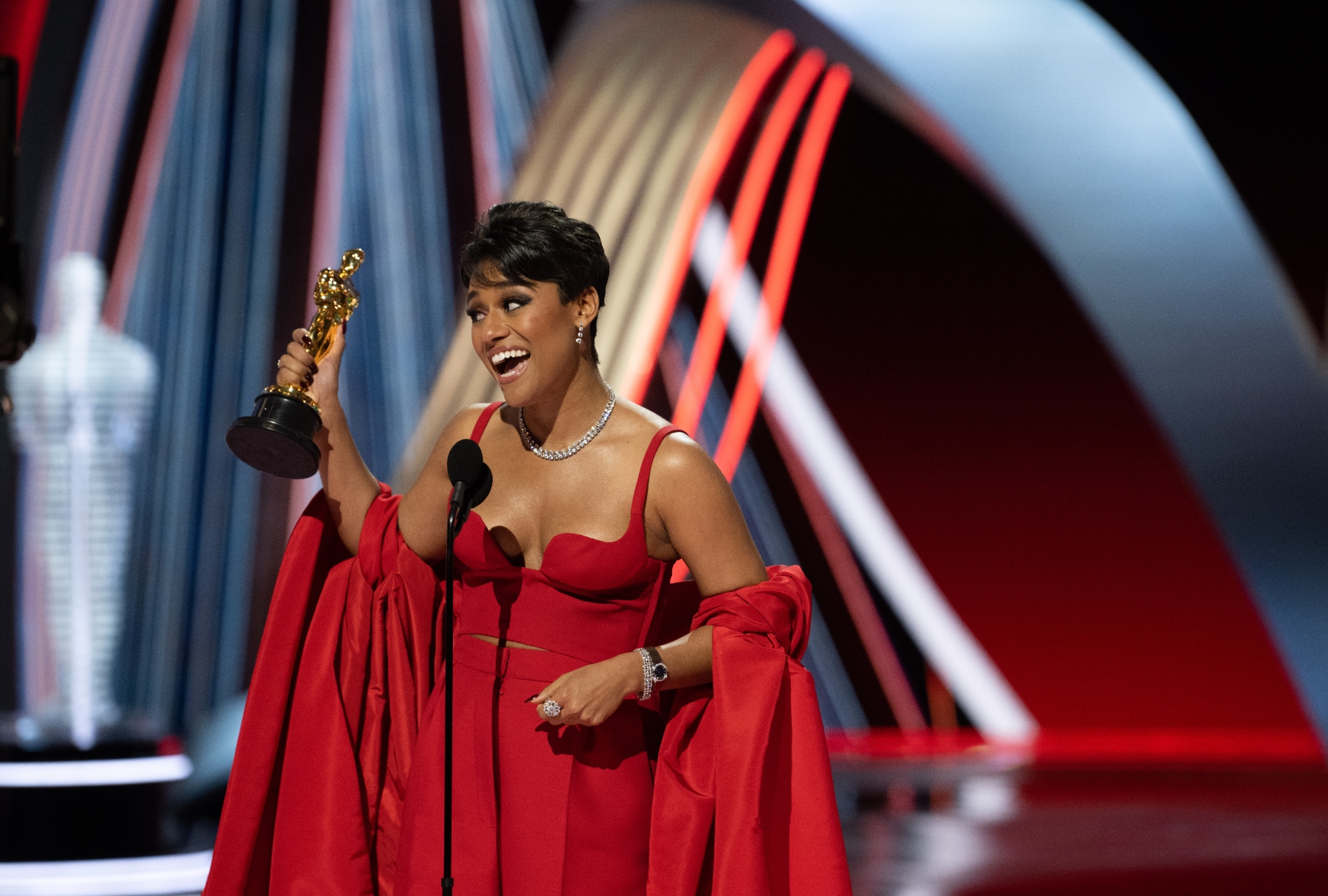
Ariana DeBose accepts for best supporting actress at the Oscars – 94th Academy Awards on March 27, 2022 (Blaine Ohigashi / A.M.P.A.S.)

These are a few of the ways the Oscars inspired on Sunday, and it is vital to remember them. Even with its flaws — and there were others aside from the Smith-Rock explosion — it was helmed by two Black producers, Will Packer and Shayla Cowan. That’s also one for the books.

Nevertheless, Packer and Cowan went into this show with a mess on their hands, dealing with the blowback for cutting eight categories from the televised event only to go over the prescribed three hours by around 40 minutes.

Smith’s assault only worsened matters — and made him look worse. When the world is watching and the top acting Oscar is in your grasp, a death glare would have sufficed, right? Reporters are waiting backstage to write down everything he has to say, on top of what he could have included in an acceptance speech that wasn’t dedicated to re-branding his outrage as protectiveness.

The Academy assured the public via Twitter that it “does not condone violence of any form,” adding in the same post, “Tonight we are delighted to celebrate our 94th Academy Awards winners, who deserve this moment of recognition from their peers and movie lovers around the world.”

The awards body did nothing to respond to Smith in the moment besides muting the confrontation and editing the actual slap. In fact, the camera made a meal out of it by showing him yelling at Rock.

By that point the production was already wobbling off its axis. Having three hosts meant making room for three comedy bits that ranged from typical awards-opening stand-up (by Schumer) to a horny bit involving Hall feeling up Josh Brolin and Jason Momoa.

That was nearly as unnecessary as the off-key, interactive In Memoriam segment.

Hall was lampooning behavior men in Hollywood have gotten away with for eons, and she’s a sharp comic actor. Then again, it’s still pretty icky. We also could have done without Sykes’ wander through the Academy Museum of Motion Pictures, which looks like a cross between a sci-fi biodome, a Madame Tussauds exhibit and a Best Buy. That was nearly as unnecessary as the off-key, interactive In Memoriam segment.

Still, the production took pains to counteract the #OscarsSoWhite accusation by foregrounding performers of color, opening with the Williams sisters introducing Beyoncé. Queen Bey beamed in from the Compton tennis courts where Venus and Serena got their start, flanked by an immaculately choreographed battalion of chartreuse-clad dancers and musicians. Between the tennis ball-colored court and the costumes, everyone literally glowed.

The second showstopper was a technicolor, star-stacked live performance of the breakout hit from Disney’s “Encanto,” “We Don’t Talk About Bruno.” That song was not nominated, but it’s a hit with kids who love the Oscar winner for best animated feature. Between the wall of TikTok frames behind the film’s actors singing and dancing, and a high stepping Megan Thee Stallion rapping a bridge tailored for Oscar night, the number came across like a wonderful miracle.

Of course, all of that transpired pre-smack.


Want a daily wrap-up of all the news and commentary Salon has to offer? Subscribe to our morning newsletter, Crash Course.


Purely from the perspective of what it meant for this production, the main effect of Smith’s interruption was to distract from other parts worth remembering. The Oscars marked the 15th anniversary of “Juno” by inviting its stars Jennifer Garner, J.K. Simmons and Elliot Page to present, elevating trans visibility by celebrating great work by a transgender performer.
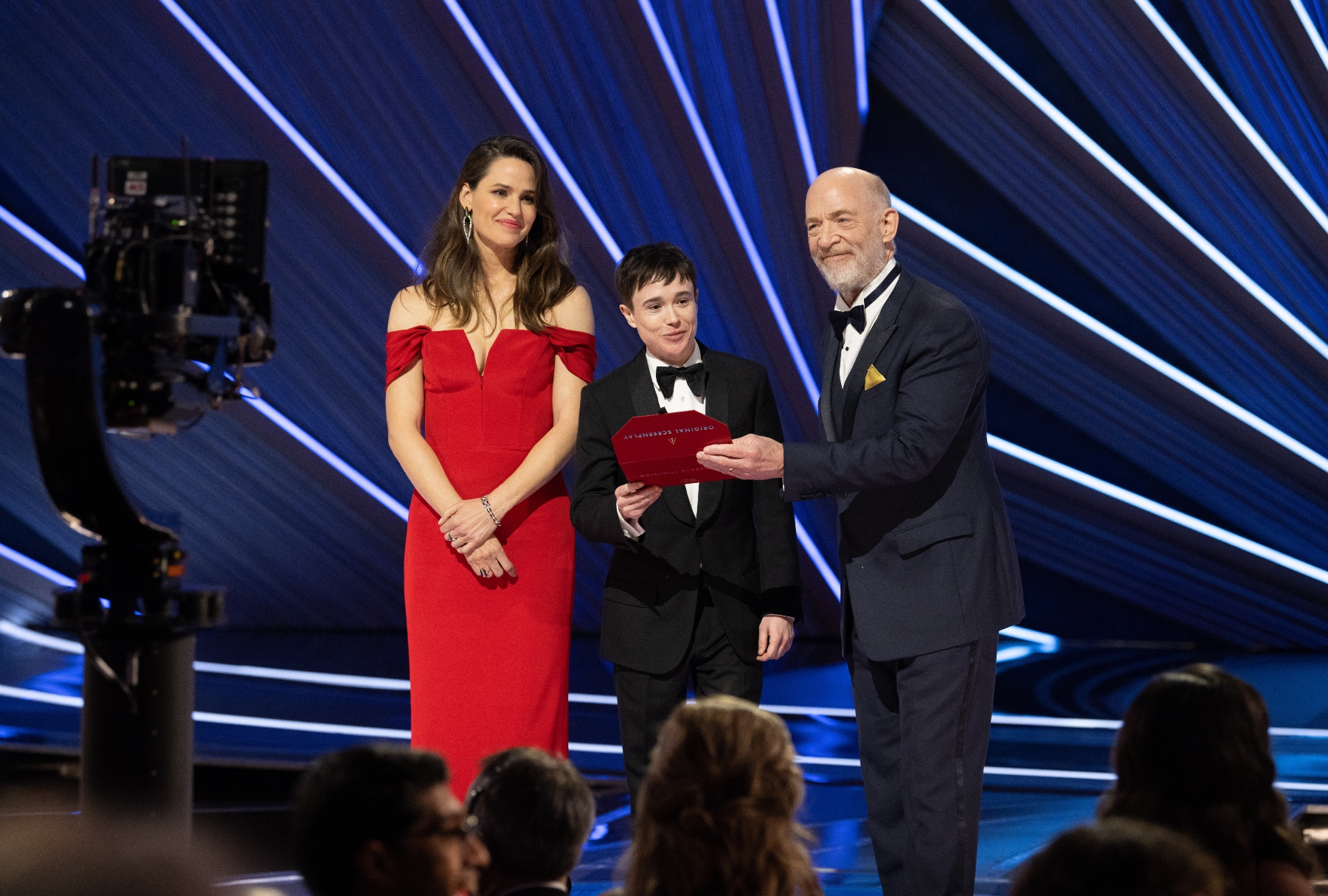
Jennifer Garner, Elliot Page, J.K. Simmons present the Oscar for best screenplay at the 94th Academy Awards on March 27, 2022 (Blaine Ohigashi / A.M.P.A.S.)

Best actress winner Jessica Chastain (“The Eyes of Tammy Faye”) used her moment to directly call out the anti-LGBTQIA bills circulating in states throughout the country: “We’re faced with discriminatory and bigoted legislation that is sweeping our country with the only goal of further dividing us. There’s violence and hate crimes being perpetuated on innocent civilians all over the world,” she said.

RELATED: “The Eyes of Tammy Faye” helped me reconsider my painful Evangelical childhood

Surprisingly, statements supporting Ukraine were relatively muted. Aside from a tasteful moment of silence, the war in Ukraine was referred to in the broadest of terms until Francis Ford Coppola, Robert DeNiro and Al Pacino took the stage to mark the 50th anniversary of “The Godfather.”

Packer, Cowan and the Academy are likely to answer some hard questions about why the show ran so long — along with, perhaps, having to explain why the 60th anniversary of the James Bond franchise was introduced by athletes Tony Hawk, Shaun White and (a very orange) Kelly Slater.

That wasn’t much better than DJ D-Nice’s pop music choices for the presenters — Daniel Kaluuya took the stage to strains from Toto’s “Africa” and Stephanie Beatriz entered to “La Isla Bonita.” He also played Earth, Wind & Fire’s “Fantasy” in connection with at least one of the many wins for “Dune,” but you understand the difference, right? “Fantasy” is simply a corny choice. The others are tasteless. (Toto? As walk-on music for the man who won an Oscar playing Black Panther leader Fred Hampton? Really?)These are less important than the conversations that should happen regarding the lack of visible ASL interpreters on a telecast featuring a hearing-impaired film nominated in many categories. Woe to you if you were hoping for a captioned translation for that performance of “Dos Oruguitas.” All that was offered was something along the lines of “sings in foreign language.”

Making a person’s physical appearance the butt of a joke is vulgar apart from any medical condition responsible for said appearance. Assaulting the person making that joke represents an entirely different level of error.

The coming days are sure to be loaded with takes — shaming or in defense of both Smith and Rock. Both are at fault in my book. Making a person’s physical appearance the butt of a joke is vulgar apart from any medical condition responsible for said appearance. Assaulting the person making that joke represents an entirely different level of error. This isn’t simply about the impropriety of it, but the signal it sends to others who may see violence as an acceptable and even chivalrous response to statements that offend them.

Smith framed it as such, following a commercial break where he was comforted by fellow Oscar nominee Denzel Washington and his personal publicist. Remember, in addition to winning an Oscar, Smith also produces a popular drama for one streaming service (Peacock’s “Bel-Air”) and toplines a NatGeo nature series for another (“Pole to Pole” on Disney+). He has much to lose in the short term.

Thus, through tears, he opened his acceptance speech with, “Richard Williams was a fierce defender of his family. In this time in my life, in this moment, I am overwhelmed by what God is calling on me to do and be in this world.”

Smith then went on to refer to his “King Richard” co-stars as women he needed to protect, saying he was called upon “to be a river to my people” and wanting to be “a vessel for love.” The world is constantly being reminded that Black women need protecting, a message that is frequently disregarded by people like Rock. Intensifying this sting is the fact that Rock produced a documentary about Black hair and the societal pressure placed on women to maintain it.

But using a Black woman’s pain as an excuse for enacting violence against another person in any situation, let alone at the Oscars, is dishonest. Smith’s actions do nothing to protect the Williams family, his wife, his co-stars or other Black women. But they will require people to have to purposefully remember DeBose testifying about finding “her strength and life through art” as an Afro Latina, or Questlove wishing that his beautiful mother and dad had been able to take him to the Harlem Cultural Festival. For those of us in the business of preserving our joy, the extra effort it takes to keep those moments alive is worthwhile. It’s still work.

More stories on these films and artists: