Spring Sale: Get 1 Year, Save 58%

How Washington dealt with a pandemic — in the 18th century

Last year, George Washington’s presidential administration became surprisingly relevant to today’s politics — not only because of his prescience with regards to so many of America’s current political ills, or his founding father status. Rather Washington, like Trump and now Biden, had to fight a raging pandemic. 

As biologist Joshua S. Loomis explains in his book “Epidemics: The Impact of Germs and Their Power Over Humanity,” Washington and other founding fathers like John Adams were concerned that because most soldiers in the Continental Army had not been exposed to smallpox as children, they would be susceptible to an outbreak once everyone was living in close quarters. As John Adams argued, “the smallpox is ten times more terrible than Britons, Canadians, and Indians together.”

These Founding Fathers’ fears were confirmed when an epidemic hit Boston (then controlled by the British) and refugees began to pour in behind American lines. Washington responded by imposing strict quarantine on any soldier showing signs of the disease or who had recently received variolation, an early form of inoculation in which people were infected with substances from the pustules of mildly infected patients.

While quarantining worked for the American cause in Boston, however, it was less successful in Canada, as nearly half the troops were wiped out by smallpox. Britain took advantage of this, quickly dashing American dreams of conquering part of Canada.

Just as Biden did with today’s military, Washington eventually decided that he needed to require every soldier to receive an inoculation (albeit through variolation), a policy that he secretly implemented during the winters of 1777 and 1778. His plan worked; today many historians argue that it was essential to America’s success in the Revolutionary War, as Washington otherwise would have had to waste time fighting outbreaks and possibly lose too many of his troops in the process.


Want more health and science stories in your inbox? Subscribe to Salon’s weekly newsletter The Vulgar Scientist.


The parallels between federal pandemic management now and then are astonishing, given the 243-year time gap. And while the tenor of the cultural conversation may have been different — certainly there was no “culture war” then, at least not in the modern sense — Washington was, like many world leaders, acting on pro-science, pro-common welfare principles. 

As historians attest, when Washington had the power to do so in a robust way, he always prioritized protecting lives and using the best current scientific knowledge. If he lacked that power, he still tried to behave responsibly, both to protect his own life and set a good example. He lived in imperfect times — both in terms of what a president could accomplish and what public officials understood about infectious diseases — but managed to consistently handle pandemics with remarkable insight and skill.

According to Dr. Lindsay M. Chervinsky, author of “The Cabinet: George Washington and the Creation of an American Institution,” there was no concept of national public health during the Washington administration, which lasted from 1789 to 1797. Because public health matters were perceived as the strict domain of state and local authorities, Washington was unable to act when a severe yellow fever outbreak swept through Philadelphia (then the capital) in 1793. Instead the president, Congress and other major officials fled the city that year (and during outbreaks in the subsequent years) when they knew the weather made it more likely they’d get infected. After the cold weather killed off enough mosquitoes to make the threat subside, they would leave Germantown, Pennsylvania or Trenton, New Jersey and return to govern from Philadelphia. This not only protected the government’s key players from harm, but (perhaps unintentionally) showed the public how it should behave during an outbreak.

Although the pandemic was politicized during Washington’s presidency, neither side displayed flat-out contempt for science. The two major political parties then were the Democratic-Republicans (led by Thomas Jefferson and James Madison) and the Federalists (led by Alexander Hamilton and John Adams, with Washington having Federalist sympathies). The Democratic-Republicans tended to blame the pandemic on the unhealthy physical climate in cities, a position in keeping with their pro-rural political philosophy. Federalists, who were xenophobic and protectionist, argued that immigrants and merchant ships from the Caribbean and Africa had brought diseases to American shores. Since yellow fever is transmitted through infected mosquito bites, each side had a point: Mosquitoes die out in Philadelphia during the winter, so the yellow fever had to have been imported from somewhere (in this case Saint-Domingue, or modern-day Haiti), but once it arrived the fetid conditions in Philadelphia offered them a fertile breeding ground.

“The main parallel today is that the disease and the ‘treatment’ or vaccine has become polarized, but for very different reasons than in 1793,” Chervinsky told Salon by email. “No one was arguing the disease was a hoax or denying science. Instead, they came to different conclusions based on observations, even if those observations were politically biased.” Neither side based their entire position on fabricating facts, as Trump and his supporters did during the COVID-19 pandemic. “Both sides’ observations were valid, they just weren’t the whole picture,” Chervinsky added.

As Loomis noted, Washington was also dealing with disadvantages beyond his control.

“It is important to keep in mind that in the late 18th and early 19th centuries, no one yet understood how epidemic diseases were transmitted,” Loomis wrote to Salon. “Most still believed that noxious odors (miasma), imbalanced body fluids (humors), natural disasters, or evil spirits were the causes of epidemic diseases like yellow fever, plague, and smallpox.” Those views would change in the mid-19th century thanks to scientists Louis Pasteur, Robert Koch, John Snow, Joseph Lister and Ignaz Semmelweis who popularized what we now know as Germ Theory.

Given this context, leaders in Washington’s time responded to epidemics through basic sanitation measures and quarantining, evacuating from a dangerous area if necessary. As general, Washington was “more proactive and pragmatic when it came to disease prevention” because it was necessary from a military standpoint. As president, he merely did what most of his contemporaries would have been expected to do in analogous circumstances. He also refrained from creating a bully pulpit, at least when it came to public health issues. 

“For instance, he never publicly encouraged widespread smallpox variolation for the general population nor did he respond outside the norm when yellow fever struck Philadelphia in 1793,” Loomis added. 

The point here is not that Washington responded to the pandemics of his time perfectly. At the same time, both he and America’s other political leaders understood that infectious diseases were a serious problem and needed to be addressed. They also understood that public officials had a responsibility to use the best scientific knowledge available, even if the responsibility fell on local officials in certain situations.

Yet there is one major political difference between pandemic management then and now. While Washington still had his limitations as a leader, at no point did either he or any of the other political leaders of his time flat-out deny science or disregard the public welfare.

It is also clear that, while we can’t know with certainty how they would have reacted to the pandemic, the politicians of 1780s and 1790s certainly would not have viewed Biden’s vaccine mandates and other COVID-19 policies as tyrannical. Such policies are in line with Washington’s variolation mandate for soldiers and his moving the government out of Philadelphia during yellow fever outbreaks. Washington was also willing to use political power creatively when he deemed it necessary for the public good, a philosophy that he never questioned was compatible with democracy.

“I’m looking hard, but I have yet to see a vaccination or mask mandate relating to COVID-19 from the Biden administration that I think comes even close to the line of unconstitutionality or lack of executive authority,” Laurence Tribe, a legal scholar at Harvard University who specializes in constitutional law, told Salon by email.

From dinner parties to “thanks for helping me move” pizza, I grieve for communal food experiences

During the depths of the pandemic, I found myself craving hyper-specific communal food experiences. I recalled a reporting trip I’d taken to Asheville, N.C., only a few months before the novel coronavirus was daily news. 

There, my partner and I connected with some other food professionals. Together, over the course of a few days, we bonded over biscuits, a trip to Foothills Meats — a tidy butcher shop where we had a breakfast of hot coffee and cold cuts while the owner showed us how to break down a pig — and an afternoon spent at a local farm. Between interviews, we played with a pair of farm dachshunds that were dressed in slim polar fleece jackets to protect their low bellies from the frost. 

On our final night in town, we all met up at Vivian, a cozy, warmly-lit restaurant in the arts district that serves European-influenced dishes built with Southern ingredients. I remember some of what we ate (like the “Nordic deviled eggs” stuffed with smoked fish, potato and cornichon), but mostly I remember how we ate: shoulder-to-shoulder around a long, wooden table, sharing food and pushing slices and pieces onto other people’s plates. 

RELATED: Can food halls help diversify the post-pandemic restaurant industry? Yes, if done right

As the pandemic wears on, the list of experiences I miss continues to grow. There’s “hey, thanks for helping me move” pizza, where you and your friends collapse into a sweaty heap onto someone’s new kitchen floor. Suddenly everything is funny, and you realize that pepperoni pizza has never tasted better

There’s traveling to a new city — perhaps with someone who is still a little new to you — and inevitably ending up at a diner that’s not great but very good. Together, you drink just fine coffee and ice cold water from those plastic pebbled tumblers and start to wonder if you’re falling in love just as the pancakes arrive

Then there’s the standard: cooking something, anything really, for someone to show you care.


Want more great food writing and recipes? Subscribe to Salon Food’s newsletter.


The pandemic has taught us many things — about our society, our communities, and ultimately, about ourselves. One of the most basic, yet simultaneously most poignant, of these lessons is that we humans tend to do better overall when connected to one another. 

And Zoom cocktail hours just don’t cut it after a while. 

From the Salon Food archives, here’s some writing that focuses on how food and community are often one big overlapping circle in the weird, cosmic Venn diagram that is life. If you like this collection of writing, do sign up to receive “The Bite,” Salon’s food newsletter — which is where this essay originated and subscribers receive recommendations of what to read, watch and eat every week. 

Read 

In her beautiful essay “Glitter and Cotija: The poignance of my first lunch out with my daughter,” Tabitha Blankenbiller writes about becoming a “quarantine parent” and what it was like connecting with her infant daughter over a first spontaneous lunch together. “It is so beautiful to be seen with your child,” Blankenbiller writes. “For over a year, she’s been a secret from the world, deprived not only of the familiar relatives doting but of these small, fleeting, random moments of connection.”

One of my favorite pieces from our recent “Coffee Week” — a series of essays, how-to’s and reporting about America’s favorite caffeinated beverage — was by Maggie Hennessy. In “Observations from a Chicago Dunkin’ Donuts,” she writes about how coffee shops can often serve as “a microcosm for the city itself.” They’re a place for meeting, for talking, and you know, maybe a little harmless eavesdropping. 

Also from “Coffee Week,” I wrote about the importance of LGBTQ-owned cafés as sober, queer spaces. While gay bars hold a deeply important place in the history of LGBTQ rights and visibility, many queer folks seek spaces where they can feel the same sense of community while also taking an occasional or permanent reprieve from alcohol. That’s where these coffee shops come in — especially for “the morning gays,” as coffee shop owner Andrew Zarro put it. 

Watch

Back in 2014, Salon’s own Mary Elizabeth Williams (who also writes our Quick & Dirty cooking column) published an essay for the New York Times’ Modern Love section. It was recently adapted for TV for Amazon Prime’s “Modern Love” anthology series, which you can stream after reading. In a recent food desk meeting, Williams mentioned there was a lot of cooking in the show version of her life, which prompted this mini-interview via Slack: 

ASIn your real relationship, is food something you connect over with your family? (If so, how?)

MEWMy immediate family is made up of four individuals with incredibly different tastes, allergies and health issues. And yet, there is a very special and specific connection I feel when we’re feeding each other  baking cookies with my daughters in the kitchen, even just the gesture of making somebody a cup of tea. Nothing says, ‘I love you. Let me take care of you,’ in the way that food does.

One of my favorite series from the past several years is Netflix’s “Gentefied.” It’s about a Mexican-American family who owns a taco joint, Mama Fina’s, in Los Angeles’ Boyle Heights neighborhood. The show tackles some big, big topics — family legacy, gentrification, racism. At its core, it’s a beautiful distillation of how restaurants can serve as de facto community centers.

Also, everyone loves to connect around food — even Paris Hilton, though she’s not particularly talented at navigating a kitchen. Give an episode or two of her new series “Cooking with Paris” a watch on Netflix — the first one with Kim Kardashian is predictably a mess — and then check out our assessment of how celebrities who can’t cook became food TV’s fastest-growing genre

Eat 

Put your hard-earned pandemic bread baking skills to good use — and pull out these giant focaccia sandwiches for your next appropriately-sized get-together. They’re the new (better, crispier) party subs. 

Keeping with the Italian-American theme, cook up some chicken parmesan for someone special. It’s a touch more time-intensive than some of our other weeknight favorites — like this customizable sheet pan chow mein — but Salon Food contributor Michael La Corte has a tip that will make the cutlets impossibly crisp. If that’s not spreading the love, then I don’t know what is . . .

Also from La Corte, this recipe for chicken piccata — with a rich, velvety and slightly briny sauce — is a low-stakes but thoughtful dish to make, especially paired with a side of hearty pasta. If dessert is on the table, make it Williams’ extra dark sheet pan brownies. They’re perfect for sharing (and also for making ice cream sandwiches).

Tom Cotton plotted to sabotage Trump with Mitch McConnell’s help: report

According to an excerpt from a new book by political journalist David Drucker, Senate Minority Leader Mitch McConnell (R-KY) and Sen. Tom Cotton (R-AR) plotted behind Trump’s back as the former president attempted to rally GOP senators to his side and stop the certification of the 2020 presidential election.

As Drucker writes in his book, “In Trump’s Shadow: The Battle for 2024 and the Future of the GOP,” that Arkansas republican, with an eye on the 2024 GOP presidential, nomination saw the writing on the wall that Trump was about to plunge the country into chaos after his loss to Joe Biden, and worked with McConnell on a plan to provide cover to GOP Senate colleagues to refuse Trump’s entreaties that they fight on the Senate floor to overturn the election results.

Writing, “From the inception of Trump the politician, Cotton exhibited an understanding of the future president’s psychological peculiarities, and an intuitive grasp of the fervor he inspired among his MAGA fan base. For Trump, all politics was, and still is, intensely personal,” Drucker added that Cotton knew he had to stay on Trump’s good side if he was to be effective while at the same time being wary of Trump’s instability.

As Drucker explains, Cotton and McConnell were both well aware that Trump planned to overturn the results of the Electoral college.

“To say that Cotton was not swayed by Trump’s theory of the case is an understatement. But as is his habit, he wanted to be thorough,” Drucker reported “In early December, Cotton directed legislative aides on his Senate staff to research the matter extensively and prepare an exhaustive memorandum. As the senator suspected, it made plain that the Constitution had not, in fact, built in a secret back door for Congress or the vice president to invalidate presidential election results. In mid-December, after the states had certified their results and the Electoral College had voted, Cotton read in McConnell. Together, they plotted to countermand Trump’s bid to overturn the election and neutralize interest in objecting to Biden’s victory that was developing in some quarters of the Republican conference.”

With that in mind Cotton planned to publish an op-ed in an Arkansas paper on the morning of Jan 6th, dismantling Trump’s case and putting it all to rest — but that plan was blown up when Sen. Josh Hawley (R-MO) made a big show in late December stating he was going to fight to block certification.

Writing that “Cotton’s strategy was derailed,” Drucker reports “After some discussion, McConnell urged Cotton to speed up his timeline for announcing his opposition. The majority leader had been aggressively whipping the issue. But he believed that Cotton, with his conservative bona fides and reputation as a Trump loyalist, might be more effective at talking teetering Senate Republicans off the ledge by providing cover to those who privately wanted to stand behind the certification of Biden’s victory but feared the consequences back home.”

“Three days later, the violent siege of the U.S. Capitol, perpetrated by Trump supporters, ended up changing a few minds. Rather than a dozen Republican objectors, just six voted to throw out Biden’s win in Arizona, with the same six, plus a seventh, voting to excise his victory in Pennsylvania,” the author explained. “While Republicans in the House were unmoved by the insurrection and continued with attempts to force a debate over the results, Republicans in the Senate declined to join them in that effort, save for Hawley. He insisted on following through with plans to object to the tally in Pennsylvania, even after the Capitol was ransacked and members of Congress, and Pence, were sent fleeing for their lives.”

According to the author, “Two senior members of McConnell’s leadership team, Thune and Senator John Barrasso of Wyoming, emphasized that the whole thing would have gotten completely out of hand if not for the stand taken by Cotton,” with Thune stating, “Tom played a very important role, especially as people were starting to waver. He took a risk coming out Sunday rather than waiting quietly until Wednesday; he knew it wouldn’t be popular with the base.”

You can read more here at Vanity Fair.


How to peel and cut butternut squash without losing a finger

Even if it’s not the dead of winter, I’m still cooking with tons of butternut squash year-round.

From butternut squash soup to cheesy Instant Pot butternut squash Alfredo to caramelized butternut squash wedges, I’ll keep this bright orange, cold-weather staple in rotation for weeks on end — and probably until below-freezing temperatures and the Polar Vortex feel like a dark and distant dream.

But even the most reliably delicious of ingredients has its flaws, and butternut squash, in particular, has a big one: peeling winter squash is beyond difficult — not to mention, frustrating. After one too many close encounters between my thumb and a knife, I decided to do a bit of YouTube detective work (I’ve acquired most of my life skills this way) in hopes of finding a better, safer way to peel and cut butternut squash.

In the process, I stumbled upon a video tutorial showcasing a butternut squash-peeling method that claimed to be the fastest and the easiest, thanks to an ultra-simple trick: using the microwave.

Now, if you’re more experienced and adept in the kitchen than I am, there’s a solid chance you already consider this “hack” old news. But if, like me, you find this method to be a revelation, here’s a step-by-step tutorial. For cutting a butternut, as well as peeling it, be sure to use a sharp, sturdy chef’s knife or a cleaver. While a sharp knife may seem more likely to injure the home cook as opposed to a dull knife, it’s actually the opposite. Its sharp blade will cut through the flesh of the squash — or any hearty root vegetable — much easier than a dull knife. Using dull knives means you have to use more force, increasing the danger of a slip that could lead to bloody fingers. Pay close attention to the following steps to learn how to cut a butternut squash safely:

  1. Behold your beautiful butternut squash, in all its winter glory.
  2. Furiously poke holes all over the squash with a fork.
  3. Using the same sharp knife that almost cost you a finger, carefully cut off the top and bottom of the squash on a cutting board.
  4. Microwave the squash for at least 3 minutes and 30 seconds (you might need to go a little longer, depending on the size, but that should do the trick).
  5. Let the squash cool to the point where it doesn’t hurt to hold it, then peel away the skin and scoop out the seeds with ease! (In the video, she uses a paring knife or a sharp vegetable peeler, but I’ve found you can also use your hands). Once you’ve peeled the skin, you can prepare roasted butternut squash, purée it for soup, or smash it for mashed squash.

And with just a few minutes in the microwave, butternut squash — which I both loved and feared all at once — becomes just like any other easily roast-able, toast-able, puree-able, Instant Pot-able ingredient. Plus, this trick actually cuts down on time in the oven slightly. This little bit of magic leaves you with nothing to worry about except what you’re going to do with it. (Hint: There are many, many options.) Jump to a handful of our favorite butternut squash recipes below.

***

Roasted butternut squash recipes

Dan Kluger’s Roasted Butternut Squash with Spicy Onions

Once you have pre-steamed, peeled, anad cut the squash into thick slices, toss it with olive oil, salt, and pepper and roast it with hazelnuts. Once it has roasted and becomes caramelized, mix it with an assortment of herbs (fresh parsley, mint, and marjoram) and spicy onions for a colorful side dish.

Orecchiette with Roasted Butternut Squash, Kale, and Caramelized Red Onion

Dress up this pasta, which has a name that translates to “little ears,” with roasted butternut squash, sautéed kale, and caramelized onions. Frankly, it’s all we want to eat from September through November.

Squash with Chile Yogurt and Cilantro Sauce from Yotam Ottolenghi

Microwaving butternut squash will soften the flesh, making it easier to cut and peel. But in this recipe, there’s no need to peel the squash. Our editorial team agrees that “the contrast between crispy skin and the soft squash interior cements this technique as a keeper.”

Caramelized Butternut Squash Wedges with a Sage Hazelnut Pesto

Pesto isn’t just reserved for pasta dishes and sandwich spreads. This earthy, autumnal version is also a fragrant accompaniment to roasted butternut squash, the side dish recipe for Thanksgivingand other fall harvest spreads.

Winter Noodle Soup with Coffee-Roasted Squash

“Roasting the squash in a bed of spent coffee grounds doesn’t make the squash taste like coffee, rather it heightens the squash’s own flavor,” writes recipe developer Lindsay Jean-Hard. You’ll have to taste it to believe it.

Roasted Butternut Squash and Toasted Farro Salad with Curried Brown Butter

Salads don’t have to be boring, and neither do sides of roasted root vegetables. They go so beyond salt, pepper, and olive oil, or a classic vinaigrette dressing. This two-in-one recipe is hearty enough to be the main course, or a crowd-ready side dish that’s ready for a big ole holiday feast.

James Bond hasn’t changed much, and neither have his problematic villains after 25 films

In many ways, Daniel Craig's Bond swan song "No Time to Die" delivers everything fans have come to expect from the franchise: thrilling action sequences, beautiful women, snappy one-liners . . . and a disfigured villain. 

The new supervillain this time around is a man named Lyutsifer Safin, played by Oscar winner Rami Malek ("Bohemian Rhapsody"). Safin is smart, sauve and isn't content with merely seeking revenge on various people, including 007's latest Bond girl Madeleine (Léa Seydoux) and her young daughter. Once they're crossed off his list, Safin intends to unleash a bioweapon upon the world. 

In short, Safin is pretty evil. But his actions alone aren't what's sparking controversy and conversation. First introduced wearing an expresssionless white mask reminiscent of the kind worn in Japanese noh performances, Safin's true face is eventually revealed to be covered in scars due to an attempt on his life involving a nerve agent. 

"What I really wanted from Safin was to make him unsettling," Malek said in an interview with W magazine. Over on Total Film, Malek defends the character's scars further, saying they're "important to have."

It's this physical difference, the disfigurement, however, that has disfigured and disabled activist Jen Campbell and others like her up in arms.

On her YouTube channel, the author addresses the topic: "The link with villainy to deformity, disfigurements, disability and bodily transformation, it is a device used in literature so much and also now in film and has been used for so long that it is such an ingrained part of society that it's something that I think a lot of people don't think twice about, and that needs to change."

Portrayals of villains who are disfigured perpetuate the stereotype that moral corruption and untrustworthiness is tied to the physical appearance. This has real-world repercussions for people who are visibly disabled or disfigured, and how they're treated as lesser-than because of how audiences have been conditioned. 

Unfortunately, the 007 franchise is one of the most consistent perpetuators of this villainous trope, a practice that producers have defended by pointing to the work of author Ian Fleming, who originated the James Bond novels on which the films are based.

"It's very much a Fleming device that he uses throughout the stories – the idea that physical deformity and personality deformity goes hand in hand in some of these villains," producer Michael G. Wilson told Den of Geek upon the release of 2012's "Skyfall." "It's just part of the writing tradition."

Campbell pushes back at that assertion.

"I don't know why it's a literary 'tradition' that cinema and literature clings to so dearly," she said in an interview with Salon. "More nuanced storytelling would be more exciting for everyone."


Want a daily wrap-up of all the news and commentary Salon has to offer? Subscribe to our morning newsletter, Crash Course.


Tradition in the franchise appears to mean holding onto the same formulas and archetypes that were first developed by the wealthy, privileged, conventionally attractive and able Fleming in the 1950s. Drawing on his WWII experiences in intelligence, the author penned the ultimate secret agent in his mind who is sexy, confident, witty and white. He has a woman in every port and kicks the bad guy's ass.

And that bad guy is very often portrayed with disfigurements. In "No Time to Die," Safin is not the only one. The film also includes two other villains who are each missing an eye, one of whom is Ernst Blofeld, a character Christoph Waltz reprised from 2015's "Spectre." If that name sounds familiar, that's because we've met the SPECTRE terrorist leader multiple times in previous incarnations in the Bond franchise. Usually he's portrayed with a giant scar over one eye (or is missing the eye) and occasionally pets a fluffy white cat. He is also the inspiration for the facially scarred Dr. Evil, the villain whom comedian Mike Myers portrays in the "Austin Powers" spy spoof franchise.

Meanwhile, Dr. Julius No, who Safin is rumoured to be connected to, is seen with prosthetic hands, received after playing with radition on behalf of SPECTRE. In 2006's "Casino Royale," villain Le Chiffre has a facial scar. In "Skyfall," villain Raoul Silva (Javier Bardem) reveals that the motivation for his attacks against MI6 is connected to the torture he endured after capture by an enemy, climaxing in him removing his dentures to show that half of his face has been permanently disfigured by hydrogen cyanide. For all the villains listed, not a single actor who portrays them is visibly disfigured or disabled themselves.

Despite the outcry, which has been revived over and over, Campbell believes she knows why the problematic trope has continued in the mega-popular franchise.

"Because it's an easy 'punch down'? Because they don't respect disabled people?" she said. "I can only assume the lack of respect given they have been asked so often to reconsider, and have been presented with research about why these repeated tropes are harmful." 

It's disheartening to realize that this trope is so pervasive that it's not just relegated to violent adult fare. The first time Campbell remembers seeing an evil character with a visible disfigurement was the malevolent uncle Scar in "The Lion King."

"That was 1994, so I was seven." she said, "but I'm sure I saw many more examples before that." 

Campbell isn't alone in her fight for better, more responsible representation for people with physical differences. One organization that's been vocal for advancements in the Bond franchise is Changing Faces, a UK-based charity for people with a visible disfigurement or disability.

They found that only 1 in 5 people with a visible difference have seen a character who looks like them cast as the hero in a film or on TV, while 39% have seen someone with a visible difference cast as the villain. They also found that the long-term impact of not being represented in society and across popular culture has had serious mental health effects on people with a visible difference; a third have reported low self-confidence, and a quarter say it's affected their mental health. 

Changing Faces launched their #IAmNotYourVillain campaign to shift the narrative around visible difference and disability, culminating in the British Film Institute stopping funding for movies in which villains appear with facial disfigurements in 2018.

In advance of "No Time To Die," Changing Faces wrote an open letter to the Bond producers to commit to ending the trope in the franchise in the future. The letter reads in part:

For far too many of us, we regularly experience abuse and hate, just because of how we look. We are hyper visible when we open our front doors. . . .

So, for the next Bond movie, let's have a character – the hero, the strong side kick or intelligent love interest, who also happens to have a visible difference. Because we are not just your villains. 

For Campbell, the Bond franchise is just the start of how far the media has to go in terms of proper representation.

"Horror film director Ari Aster openly admits [to Forbes] that his disabled character, Ruben, in 'Midsommar' is 'more important as a symbol, as an idea, than he even is as a character.'" she said. "It is clear that producers are not thinking critically about disability at all. We are not metaphors; we are people."

The next step? "More inclusion of disabled voices," Campbell said, "more disabled writers and actors involved, which will lead both to better representation and better storytelling, and less ableism in the industry."

While the film industry continues to reckon with representation both on camera and off, the future of the Bond franchise could be drastically changed if they choose to apply all they have been told about this trope in future films. It would be refreshing if the main antagonist didn't have a physical difference, and better yet, if 007 himself had a new look. It took 25 films for Bond to finally go blond, and that turned out just fine. It's high time that the franchise realize that someone doesn't necessarily have to look physically "perfect" to be heroic. 

Climate change is going to make life harder for dogs and cats

It is safe to assume that many of the Parisians who killed their pet dogs and cats had, at least at one point, genuinely loved them.

We can’t know that for sure, of course — no historian can penetrate the human soul — but the memory of pets being led to the slaughter lingers. It is one of the strongest images we have from the 1870 siege of Paris, which occurred during the Franco-Prussian War. In a matter of weeks Germany had captured Emperor Napoleon III and completely severed Paris from all of its supply lines. Food quickly ran out, forcing citizens of the newly-declared republic to consume everything from rats and other ordinary street creatures to exotic zoo animals like elephants. Inevitably, pet dogs and cats also became casualties as people struggled to survive. Needless to say, when observers later recalled the horrors of that siege, the consumption of animals one normally wouldn’t eat was almost always mentioned.

Flash forward a century-and-a-half, and the same exploitative capitalist system opposed by Parisian radicals of the time is literally destroying the planet through climate change. In a stroke of cruel irony, this will almost certainly lead to food shortages not dissimilar from those experienced in Paris during the siege. Instead of a military force intentionally cutting a population off from sustenance, however, global warming will cause a deterioration of the supply chains that feed the majority of the global population. At the same time, it will cause radical alterations in climate that will force millions to leave their homes (thereby becoming climate refugees) and millions more to adapt to inhospitable conditions like extreme heat or flooding. This will no doubt mean misery for humanity on a scale far surpassing anything experienced by the denizens of Paris circa 1870.

It will also mean misery for the dogs and cats of the world — most of which are strays, unowned by any human. There are estimated to be over 1.4 billion dogs and cats on Earth, the majority without owners. As the climate crisis ravages Earth, their population and lives are bound to be changed in ways we can already foresee.

“People like to say that their pets are family, but the truth is, the dog or cat is on the lowest rung of the family totem pole,” Dr. Clive D. L. Wynne, a psychology professor at Arizona State University and director of the Canine Science Collaboratory, told Salon by email. “When times get tough, people abandon their pets long before give up their children. Consequently, if life gets tougher for people, it will get even tougher for their pets.”

This will be the case even if it doesn’t result in the pets getting eaten or left by the side of the road. For one thing, humans often purchase companion animals without taking into consideration their ability to adapt to the environment of a given region. An Alaskan Malamute, for example, will probably be miserable if its owner lives in Phoenix, because its thick coat is adapted for colder climates. That is the situation with dog breeds right now, and the problem of mismatching a breed with a climate will only worsen as climates themselves become undependable. As Wynne put it, “A warming climate will certainly change the kinds of dogs people ought to keep as pets — but, unfortunately, people are not very attentive to the local climate when they acquire pet dogs.”

Dr. Alexandra Protopopova, an assistant professor at the University of British Columbia who studies animal welfare, tells Salon that the way humans take care of companion animals will likely evolve.

“With increasing heatwaves, people may reduce outdoor exercise opportunities for dogs (which would be correct to limit heat stroke!),” Protopopova noted. People may also struggle to afford adequate food and medical care for their animals, and refugees may find shelters do not welcome dogs and cats. As evictions increase, animal shelters will likely bear an increased burden, and individuals may choose to only own companion animals if the need is especially great; otherwise, more and more people may conclude that it is simply unaffordable.

Just because there will be fewer companion animals, however, that doesn’t mean that dogs and cats as we know them will disappear. Even the free ranging dogs and cats, who rely on humans for their resources, however, will experience drastic life changes. As there are fewer humans to either directly feed them or provide them with indirect sustenance like food waste, starvation will increase. An altering climate may also prompt free ranging animals to alter their territorial boundaries as they seek opportunities to feed, or modify their reproductive behaviors as cats do by extending kitten season during prolonged summers.

And then there are the diseases.

“Because animals, such as dogs, are hosts to several zoonotic agents, any changes in the home ranges of viruses or parasites due to the changing climate will also have health outcomes for not only those animals — but perhaps also for people,” Protopopova warned. “For example, rabies infection as well as dog bites has been shown to be linked to warmer weather. It remains to be empirically shown, however, that these expected outcomes will actually happen. For now, we can only speculate.”


Want more health and science stories in your inbox? Subscribe to Salon’s weekly newsletter The Vulgar Scientist.


Experts currently debate how many unowned dogs and cats exist in the world today. According to Wynne, there are up to 1 billion dogs on the surface of the planet (“perhaps a little on the high side”), with roughly 300 million living with humans and at least half a billion more not being owned. Protopopova echoed that there are roughly 1 billion dogs in the world and added that there are over 480 million cats.

“The purebred dogs we know in the US and Canada only represent about 20% of the world’s dogs,” Protopopova explained. “Most dogs live as free agents around human cities [or] settlements and utilize resources provided by people.”

Those free agent dogs have already shown a capacity to evolve based on the climate of their region. They are, like all animals, natural creatures whose larger species change due to natural selection. 

This, perhaps, provides a window into what we can expect from dogs and cats overall as climate change worsens.

“I have seen street dogs in Moscow, Russia and in Nassau, The Bahamas. These are very different creatures,” Wynne wrote to Salon. “The street dogs of Moscow are big woolly beasts. Those native to the Bahamas are much smaller, with thinner fur. The couple of times I have seen unowned dogs here in Phoenix, Arizona, they were tiny little almost hairless dogs rather like Chihuahuas. Each of these forms of dog is adapted to the climate in which it lives – since it has to be able to survive outdoors.” He predicted that smaller and less furry dogs could eventually be preferred over bigger, shaggier hounds that are prone to overheating and consuming more resources.

Cats, on the other hand, might have an easier go of transitioning simply because of their unique character. As Alan Weisman, author of “The World Without Us,” told Salon, “We’ve never tamed house cats, ever. You have to think about housecats having come to us and taught us to give them shelter and to give them food.” He noted that, since the earliest known civilizations, house cats have remained as basically the same species because of this resilience. They have a flexible relationship with humans, more utilitarian and deliberate than that of dogs, and as such may have an edge that will become more evident as climate change worsens.

This brings us back to the 1870 siege of Paris, where companion animals were abandoned and eaten in part because they taxed their owners’ resources. While it is unclear whether food will be so scarce that people have to resort to eating their own animals, it is quite likely that humanity’s current relationship with dogs and cats will have to radically change. It will be harder, in general, to have pets; that is one more thing people currently take for granted, but some may have to give up due to climate change.

5 historic codes yet to be cracked

Edgar Allan Poe, in a July 1841 article for Graham’s Magazine, wrote that while people tend to think it’s a relatively simple thing to create an uncrackable secret code, in fact “it may be roundly asserted that human ingenuity cannot concoct a cipher which human ingenuity cannot resolve.” That was easy for him to say. Shortly after his premature death, Poe’s friend the Rev. Warren H. Cudworth recalled that the author’s ability to “unravel the most dark and perplexing ciphers was really supernatural.” The rest of us get stumped sometimes. Here are five codes and ciphers that have stymied human ingenuity for decades, centuries, even millennia.

1. The Voynich Manuscript

The Voynich Manuscript has been puzzling emperors, antiquarians, and cryptologists for at least 400 years. It’s an illuminated manuscript of 240 vellum pages written by an unknown author in an unknown language. Vibrant illustrations of plants and astronomical and astrological charts suggest the volume may be an alchemical, magical, or scientific text. The calfskin pages were radiocarbon dated to between 1404 and 1438. While the iron gall ink has not been dated, since there is no erased earlier writing on the pages, it’s likely the manuscript was written around the same time.

Researchers believe Holy Roman Emperor Rudolph II (1576-1612) acquired the manuscript in the late 16th century and gave it to his personal physician and pharmacologist Jacobus Sinapius to see if he could make heads or tails of it. He couldn’t. Neither could Czech alchemist Georg Baresch, Bohemian physician Johannes Marcus Marci, and Jesuit polymath Athanasius Kircher. After Kircher got the book from Marci in 1665, the manuscript disappears from the historical record until 1912 when antique book dealer Wilfrid Voynich found it in a chest of books the Jesuits were trying to sell at the Villa Mondragone in Frascati, Italy. Voynich would dedicate the rest of his life to deciphering the manuscript. Although he failed, at least his efforts secured him the naming rights.

They also garnered him posthumous accusations of fraud as some people believed the whole book was a hoax devised by Voynich himself. Radiocarbon dating put paid to that theory, as the odds of anyone finding that much fresh, unused 15th-century vellum to cover with fantastical writing and drawing are slim to none. Professional codebreakers in both World Wars and one Cold one tried their hand at cracking the Voynich code without success. (You can read Mental Floss’s story about recent attempts to crack it here.)

It’s not just the writing that has proven impossible to crack: some of the drawings are ciphers, too. There are 113 unidentified plant species depicted in the manuscript, and nobody knows what the female nudes striking curious poses in bodies of water or with odd pipe systems are supposed to mean.

Do you think you’re better than the imperial court of Rudolf II, the greatest cryptographers of the 20th century and pretty much everyone else? You can try your hand at cracking the Voynich Manuscript on the website of Yale University’s Beinecke Rare Book and Manuscript Library.

2. Papyrus Oxyrhynchus 90

In 1896, archaeologists Bernard Pyne Grenfell and Arthur Surridge Hunt discovered thousands of papyrus fragments in a garbage dump outside Oxyrhynchus, Egypt. Preserved by the dry desert heat, the papyri recorded details of daily life (receipts, insurance claims, loan notes, personal letters), fine literature (large sections of lost Euripides plays, summaries of seven lost books by Livy, a poem by Sappho), and scriptures—gospels, both canonical and apocryphal—from the 1st to the 6th century CE.

Papyrus 90 is one of the mundane daily life records, a receipt for a deposit of wheat in the public granary dating to 179-80 CE. What makes it not mundane are the last two lines. They’re written in Greek characters like the rest of the papyrus, but they’re not Greek words. Grenfell and Hunt noted when they published the papyrus that it wasn’t a Graecized version of Demotic script (the Egyptian “document writing” language) either. It appears to be a cryptogram, some wheat deposit intelligence that demanded secrecy.

A transcription of the text is available for the intrepid Greek scholar/cryptographer here.

3. King Charles I and Queen Henrietta-Maria’s letter

King Charles I of England had many secrets to keep and many enemies to keep out of his secrets. Much of his correspondence was peppered with ciphers to keep prying Parliamentarian eyes out of his business. Charles’s ciphers kept some secrets so ably that historians didn’t realize until a few years ago that a.) he ever talked dirty, and b.) he planned “a swiving” (an obscene word for sex) with the redheaded stepdaughter of one of his courtiers while imprisoned in Carisbrooke Castle in 1648.

During the First English Civil War (1642–1646), he and his beloved wife Henrietta-Maria were apart for long stretches. In the beginning, she was in The Hague trying to drum up political support for the Royalist cause and to hock the Crown Jewels to fund her perpetually broke husband’s war. By March of 1645, with the tides of war having turned against them, Henrietta-Maria was back in her hometown of Paris.

Throughout their separation, they wrote to each other assiduously, and they weren’t whispering sweet nothings. Henrietta was deeply involved in her husband’s governance and for all intents and purposes was a continental branch of Charles I’s court. These letters were replete with political machinations, military plans, and perhaps most relevantly for a Protestant England that was deeply suspicious of the Catholic Henrietta-Maria, promises to liberalize England’s anti-Catholic laws.

On March 5, 1645, Charles sent a new cipher to Henrietta-Maria via a trusted courier named Pooly. A month later in a letter to his wife dated April 8, he used the cipher:

In a word, when I know none better (I speak not now in relation to business), then 3 9 8 270 55 5 7 67 18 294 35 69 16 54 6 38 1 67 68 9 66: thou mayest easily judge how thy conversation pleased me.

[note] The little that is here in cipher is in that which I sent to thee by Pooly.

After the Battle of Naseby on June 14, 1645, Charles and Henrietta’s correspondence was confiscated and published by the Parliamentarians. His letter of March 5 was revealed to be something of a bombshell: He authorized her to promise in his name to anyone useful that “I will take away all the penal laws against the Roman Catholicks in England as soon as God shall enable me to do it so al by their means I may have so powerful assistance as may deserve so great a favour and enable me to do it.”

So that April cipher could be an expression of affection or intimacy (he probably wasn’t talking about swiving her, though), or it could have been a whole other kind of conversation, like some payoff from that promise, that pleased King Charles. We won’t know until someone cracks it.

4. The Dorabella Cipher

Composer Edward Elgar may be best known today as the accompaniment to every graduation ceremony with Pomp and Circumstance, but he was also a fan of cryptographic arts. He expressed his ciphering talent in an addendum to a letter his wife wrote on July 14, 1897. The letter was a thank you note to the Penny family at whose home the Elgars had just spent a convivial few days. Elgar had struck up a friendship with the daughter of the family, Dora Penny, and he added a postscript to his wife’s letter directed to Dora.

At first glance, it looks like a group of squiggles at different angles reminiscent of the universal comic book symbol for dizziness, but each character is actually composed of one, two, or three semicircles tilted in eight different directions. Dora couldn’t crack it, so she put the letter in a drawer for the next 40 years until she published it in her memoirs in 1937. Since then, people have tried to solve the Dorabella Cipher with some pretty wacky results.

Tim S. Roberts thinks he’s cracked it with a simple substitution cipher (you can find a PDF explaining his solution here):

“P.S. Now droop beige weeds set in it – pure idiocy – one entire bed! Luigi Ccibunud luv’ngly tuned liuto studio two.”

The subject, Roberts believes, refers to an earlier letter or conversation in which Edward and Dora discussed his excessive pruning of his garden. Without this extremely obscure conversation, the solution makes no sense at all, and frankly, even with it, only the first sentence makes sense. He also had to jiggle things to make them fit. Some parts are straight substitution, others require letters to be switched or added. He only glosses over what “Ccibunud” might mean, saying that Elgar loved the Italian composer Luigi Cherubini growing up, and Dora Penny was said to have had a stutter, so Elgar was teasing her over her pronunciation of an Italian composer that apparently she introduced a random d into. There’s also no character for the i in studio. He just put that in to make it form a word.

When the Elgar Society held a Dorabella Cipher Competition in 2007 to celebrate Elgar’s 150th birthday (and again the next year), none of the solutions were accepted because, although several seemed to be very well reasoned, in the end, “the results read as a disconnected chain of bizarre utterances, such as an imaginative mind could conjure up from any group of random letters.” So far all the proposed solutions seem to fall into this category. And there’s one final twist: A key created by Elgar in the 1920s—which, according to New Scientist, appeared in an exercise book and “listed the symbols used in the Dorabella cipher matched against the letters of the alphabet”—doesn’t yield anything that makes sense.

5. Carrier pigeon NURP 40 TW 194‘s final message

In 1982, David and Anne Martin found the remains of a bird during the renovation of the fireplace of their home in Bletchingley, Surrey. One of its skeletonized legs had a red plastic capsule attached to it, marking it as a World War II military carrier pigeon that picked the wrong roost on its way to deliver a message and died in the chimney. Inside the capsule was the original coded message — 27 groups of five letters with some numerals at the end — written on a scroll the size of a rolling paper.

AOAKN HVPKD FNFJU YIDDC
RQXSR DJHFP GOVFN MIAPX
PABUZ WYYNP CMPNW HJRZH
NLXKG MEMKK ONOIB AKEEQ
UAOTA RBQRH DJOFM TPZEH
LKXGH RGGHT JRZCQ FNKTQ
KLDTS GQIRU AOAKN 27 1525/6

It took years before anyone in government could be persuaded to take a look at the cipher. In 2010, experts at Bletchley Park, a museum that was the headquarters of British Intelligence’s codebreakers during World War II, finally checked it out. They were not able to crack it, but they did discover that it must have been an important missive. None of Bletchley Park’s classified MI6 pigeons carried coded messages during the war. Given Bletchingley’s location halfway between Normandy and Bletchley Park and just five miles from Field Marshal Montgomery’s headquarters at Reigate where the D-Day landings were planned, it’s possible that Pigeon NURP 40 TW 194 was carrying very sensitive information indeed.

A few weeks after the story broke, the media reported that Ontario history buff Gord Young claimed to have cracked the code thanks to his great-uncle’s World War I Royal Flying Corp aerial observers book. His solution was rough around the edges, however. He wasn’t able to decipher some of it, and several of the 27 groups he interpreted as improvised acronyms with no antecedents in the military record. He may have misinterpreted some of the letters—mistaken a U for a W, for instance—and there are some painfully awkward, redundant phrases like “Determined where Jerry’s headquarters front posts. Right battery headquarters right here. Found headquarters infantry right here. Final note, confirming, found Jerry’s whereabouts.” That’s a lot of repetitive verbiage to take up space on a cigarette paper.

Bletchley Park didn’t think the solution was the right one. Then, the cryptological world discovered that Young had never intended to present an actual answer—he was just trying to help move the process along. So until a World War II codebook is found with a proper key, Bletchley Park doesn’t think anyone is going to be able to crack the pigeon’s code.

Coping without your favorite Native American mascots

“So your sports team had to change its name and/or mascot because it was offensive to Native Americans . . .” 

So begins a new Comedy Central short titled “How to Cope with Your Team Changing Its Native American Mascot,” released ahead of Indigenous Peoples’ Day and just days before the Cleveland MLB team’s last game under their old name on the way to becoming the Cleveland Guardians.

The satirical animated short film is written and narrated by comedian Joey Clift, an enrolled member of the Cowlitz tribe who grew up on the Tulalip Indian Reservation. Clift, along with an all-Native voice cast, offers cheeky solutions to fans who may miss performing the Tomahawk chop or wearing redface.

Sure, Clift gives advice in “the silliest way possible,” but he notes that the angry animated fans and their questions seen in the short drew from a “potpourri of actual experiences that I’ve either had or witnessed online.” Even when fans are understanding of the need for change, using mascots and team cheers was perceived by many as an act of honoring the past — navigating the future without these cues has left some fans unmoored, and yes, upset.

“How to Cope with Your Team Changing Its Native American Mascot” lightens the mood around the issue while still emphasizing the importance of Native people’s right to just be people (who may or may not love cats). Take a look:

Thankfully we’re increasingly living in a post-Native mascot world. In addition to the Cleveland Guardians, we now have the Washington Football Team (ironically playing the Kansas City Chiefs – who ditched the mascot but kept the name – on Oct. 17). And at the direction of the NCAA, several college sports teams have changed their Native names and mascots in recent years in response to years of criticism and Native-led activism.

“I get that having a thing that you like change suck,” said Clift. “The changing nature of sports mascots is seen as this ruining of local heritage, because your high school is changing its mascot. But it’s weird to see people embracing a Native sports mascot that’s only been a thing for like 60 years, while throwing away the heritage of the actual tribes and people that have been on that land for thousands of years.”

This isn’t about throwing away sports teams’ treasured memories and culture, but simply that, as Clift says, “The team in 2021 is not representative of how Native people would like to be portrayed in this country.”

Progress doesn’t mean Thanksgiving is “canceled”

Clift is one of many Native American people who had to grow up going to a high school with a Native mascot.

“This was in the early 2000s, and it was definitely a topic of conversation of the Native student body at my school, who really cared and protested and tried to get the team to stop doing the tomahawk chop,” he said. “The non-Native student bodies largely didn’t care. Now in 2021, my high school changed their mascot as of a month or two ago, and it’s great to witness what we fought for so long, to finally get there.”

This wave of change didn’t come out of nowhere. Indigenous people have been protesting mascots for years, but Clift believes their activism finally gained mainstream visibility and support in the 2010s, amid the Standing Rock Dakota Access Pipeline protests that were taking place. “Up until that point, Native issues were largely ignored in the media,” Clift said. “The Standing Rock protests basically forced people to pay attention.” 

This was especially true as atrocities and violence committed against Native protesters were widely filmed and shared online, sparking mass outrage and a reckoning with the enduring violence against Native people by the U.S. government.


Want a daily wrap-up of all the news and commentary Salon has to offer? Subscribe to our morning newsletter, Crash Course.


That new awareness meant that the general public started paying attention to other ways the United States has treated Native issues, especially if it meant elevating colonizing narratives. Case in point, not long ago, the second Monday in October was referred to as Columbus Day, bizarrely honoring the Italian explorer who was responsible for enslaving and initiating genocide against untold numbers of Indigenous people across the Americas. 

Now, not only is it more properly known as Indigenous Peoples’ Day, but President Biden recently signed a declaration that this year, Oct. 11 would be a national holiday.

Of course, with all change come opponents to cultural shifts like this. As we’ve seen in the Comedy Central short, whenever Native people are able to reclaim something – whether it’s mascots or holidays celebrating genocide – Americans suddenly are afraid that their deep-fried turkeys and green bean casseroles are next. 

“When any sort of Native issue is brought up, people are just like, ‘Oh, so now I can’t celebrate Thanksgiving?‘” Clift said. “That’s not what we’re talking about. We were talking about the government not taking Native people’s land, their treaties. A lot of folks just have not educated themselves on Native issues.”

This lack of understanding leads to tone-deaf practices, like celebrating the holiday with a “Cowboys versus the Chiefs” game. “It creates this weird genocide cosplay thing where we’re celebrating the U.S. government’s war with Native people via football,” Clift said.

And circling back to mascots, familiarizing oneself with historical context makes it even clearer why we should prioritize Native imagery that’s humanizing, rather than demeaning caricatures.

“Sports mascots started being a thing in the 1910s, ’20s, ’30s, the early half of the 19th century,” Clift said. “It was legal for the U.S. government to kidnap Native kids from their homes until 1978.”

But wait, there’s more!

While changing sports names and mascots may seem like a big deal to fans, it’s close to the bare minimum when it comes to addressing the harm done to Native Americans. But this could hopefully pave the way for making an even greater impact.

“It would be really great if the sports teams didn’t just change their name, but also offered to start scholarships for Native students or donate to tribes whose land they’re playing on to help them with the issues they’re dealing with,” Clift said. “Name-changing is an amazing first step. But it would also be cool if these teams were willing to give monetary compensation to tribes to actually help the healing process.”

Clift cites numerous studies and research, including from the American Psychological Association, on the deeply harmful impacts of Native mascots on Native people, and especially youth, who struggle with low high school graduation rates and a Native youth suicide rate that’s 2.5 times higher than the overall national average.

“When you only see yourself in the media as a racist caricature, and red face smiling or carrying a tomahawk, and not yourself in contemporary roles and modern society, it causes low self-esteem and it makes you feel like garbage,” Clift said. “This is real damage that these teams have caused over decades.”

It’s time for wealthy sports teams to actively work to repair that long-lasting damage caused by such harmful imagery. 

“Money can always help,” Clift says, calling on teams that have changed their mascots to consider “donating large sums of money to Native-run nonprofits.” As for sports fans who also want to be a part of the positive change we’re seeing to undo the impacts of anti-Native mascots, Clift stresses the importance of watching and supporting the work of Native creatives, whose work is challenging the racist narratives these mascots have perpetuated for years.

“Instead of ‘honoring’ Native people by using us as sports mascots, I hope more people try to honor Native people by watching all these kickass Native TV shows that are coming out right now, and reading books by Natives, and getting actual Native perspectives on things,” Clift said.

“Rutherford Falls,” the Peacock comedy following two best friends on a neighboring town and reservation, was just renewed for a second season, and Sterlin Harjo’s FX on Hulu series “Reservation Dogs,” is also coming back for a second installment. Clift has his own show coming up. The Netflix animated series “Spirit Rangers,” in which he is part of an all-Native writers’ room, will begin streaming in 2022.

In the meantime, Clift will continue to not just amplify Native stories but also work on projects that employ Native creatives. His Comedy Central “Mascot” short features designs from Marie Bower, an Indigenous cartoonist, and an all-Native voice cast that includes Jana Schmieding of “Rutherford Falls,” and John Timothy of “Spirit Rangers,” among other Native comics and creatives. He also made the award-winning short animated film (with a long title), “Telling People You’re Native American When You’re Not Native Is A Lot Like Telling A Bear You’re A Bear When You’re Not A Bear.”

The recent sports changes as well as the rise in Native storytelling in media have ultimately given Clift hope.

“It’s through the work of all these activists for decades and decades, that I was able to make a comedy short for Comedy Central about Native sports mascots changing — and not as something that we’re begging the general population to pay attention to, but something that’s just known as problematic,” he said.

Why Donald Trump continues to be a major thorn in Mitch McConnell’s side

Senate Minority Leader Mitch McConnell — unlike outright Never Trumpers such as attorney George Conway, former GOP strategist Rick Wilson and Washington Post columnists George Will and Max Boot — doesn’t go out of his way to criticize former President Donald Trump. Whatever he may or may not be saying behind closed doors, the Kentucky Republican generally keeps his thoughts about Trump to himself. But there is obviously no love lost between Trump and McConnell, and an article by journalist Eric Lutz for Vanity Fair Lutz describes some ways in which Trump continues to be a major thorn in McConnell’s side

During an October 7 appearance on Fox News, Trump criticized McConnell’s handling of the United States’ debt ceiling and told Sean Hannity, “The Republican Senate needs new leaders. Mitch is not the guy. Not the right guy. He’s not doing the job.”

Lutz stresses that Trump’s criticism of McConnell isn’t really policy-related but rather, reflects the fact that Trump holds a grudge against him for criticizing him after the January 6 attack on the U.S. Capitol Building.

“Trump’s frustration with McConnell almost certainly has less to do with the debt ceiling and more to do with the criticism he faced from the senator after the January 6 insurrection,” Lutz explains. “McConnell didn’t go to bat for him in his second impeachment trial earlier this year and rebuked him in a floor speech, and Trump has been trying to oust him ever since.”

One thing Trump won’t be able to do in 2022 or 2024 is threaten McConnell with a GOP primary challenge. McConnell was reelected to the U.S. Senate in 2020, defeating Democratic opponent Amy McGrath in Kentucky — and he won’t be up for reelection again until 2026. Trump, however, can run around telling his devotees that McConnell shouldn’t be Senate minority leader.

“But McConnell is also a bizarre target for Trump’s rage,” Lutz observes. “He wound up voting against impeachment, and he did more to advance Trump’s despicable agenda during his presidency than just about anybody. Trump, though, is a sucker for appearances, and the idea that McConnell would take even a performative stand against him or make a strategic concession to Democrats is too much for him to process.”

A handy guide to homemade sandwich bread

The Perfect Loaf is a column from software engineer turned bread expert (and Food52’s Resident Bread Baker), Maurizio Leo. Maurizio is here to show us all things naturally leavened, enriched, yeast-risen, you name it — basically, every vehicle to slather a lot of butter on. Today, he’s discussing sandwich loaves, and whether the best bread comes from Pullman pans or traditional loaf pans.

* * *

My pantry is stocked to the brim with baking pans of all shapes, sizes, and materials. I have long rectangular pans with straight sides, medium pans with tapered sides, and even smaller pans the size of two sticks of butter. Materials range from my hefty cast-iron Staub loaf pan to light aluminum or aluminized steel (cast iron makes the crust nice and crispy, while aluminum goes in the thinner direction). With so many baking pan choices, it can be challenging to determine which pan to use. So let’s look at a few different choices and what they bring to your baking arsenal — and even take a look at my all-time favorite pan for just about everything: the Pullman pan.

What is a Pullman pan?

First, let’s look at what is probably the most-used pan in my baking collection: the Pullman pan. This pan is named after the company — Pullman — that invented them for use in railway cars of the past. The defining features are the straight sides and lid that slides on to seal the dough inside during baking, which allowed more loaves to be baked in the confined space of their railway cars.


Photo by Maurizio Leo

I have several Pullman pans: my workhorse, a 9 x 4 x 4-inch and a larger 13 x 4 x 4-inch, both made by USA Pan and lined with a silicone nonstick coating that makes removing dough a breeze (though I still typically grease the pan, just in case). You can use a Pullman pan with or without its lid, which slides on and snaps closed. When using the lid to make a classic Pullman pan loaf, or a French-style pain de mie, the bread will have a pale, thin crust, and each slice will be perfectly square.

These Pullman pans also yield fantastic bread without the lid. Compared to a standard loaf pan, which has sides that taper outward, the straight sides of the Pullman pan force the dough to move upward more than letting it spread outward, resulting in a taller rise and tidier slices.

I use my Pullman pans for baking everything from crusty sourdough pan loaves to delicate brioche to quick bread like banana bread. Over the years, I’ve found myself baking more and more with a Pullman pan, choosing it over every other pan in my collection. The pan makes for conveniently shaped slices (perfect for kids’ lunches!) and ekes out a taller rise in the loaf overall — and what baker doesn’t take a little self-congratulation from a tall loaf?

What if I don’t have a Pullman pan?

If you don’t have a Pullman pan, you can usually go with a standard loaf pan (see below) in its place. While the capacity of the pans is not precisely the same — the Pullman can hold more — depending on the dough, the standard loaf pan will result in a loaf with a domed top and your typical curled edges, thanks to the dough rising a little higher and slightly bowing outward during baking. As always with a standard loaf pan, though, be sure to fill it only around two-thirds of the way full to ensure it doesn’t spill over the edges.

What is a standard loaf pan?

Traditionally, a standard loaf pan is 8 1/2 x 4 1/2 x 2 1/2 inches, but can also come in other sizes such as 9 x 5 x 2 1/2 inches. These pans almost always have slightly tapered sides that bow outward as you go from the base to the top rim. Sometimes the taper is subtle; other times, it’s more pronounced, but the taper and the dimensions of these pans — which are a bit squat — result in loaves with less height and gentle domes across the tops running from side to side. The tapered sides help the baked loaf remove a little easier, and a few hard taps on the bottom usually lead to a quick release.

These standard loaf pans are the classic pans of your childhood, the pans your family likely used to make zucchini bread or pound cake, but they also work well for yeasted and long-rise sourdough loaves as well.

Pullman vs. standard loaf: Which pan is best?

Unfortunately, there’s no single answer to this often-asked question. The answer depends on your recipe at hand, but it also depends on your preference and how you want the final loaf to look on the cutting board.

Benefits of a Pullman:

  • It has a lid that slides on for baking
  • You can use it without the lid for a darker top crust
  • Thin, delicate crust (especially with the lid on)
  • The resulting bread has straight sides
  • Natural silicone liner is typical, making for easy bread removal

Benefits of a standard loaf pan: 

  • Ubiquitous, as many recipes call for one (no Pullman pan conversion necessary)
  • Bread will have a deeply colored, domed top crust
  • “Wedge” shape can make removing bread easier

Over the years, I’ve found that more of my bakes seem to end up in one of my (many) Pullman pans. The pan gives me small and tidy slices, a higher rise in my bread overall, easy removal thanks to the nonstick liner, and the option to slide on a lid should the mood fit. But, for me, there’s just something orderly, clean, and precise about my bread when I use these lovely rectangular pans.

Do I even need a pan?

I often get asked whether a pan loaf recipe can be baked without the pan altogether: Can the dough simply be formed like a round boule or oblong batard and baked on a baking surface? In many cases: sure! Keep in mind that the pan provides structure to the dough and results in a thinner crust due to reduced direct heat exposure from the oven at the bottom and sides. Baking dough free-form makes for a more substantial crust due to this increase in exposure — which isn’t a bad thing, it just depends on your end goal.

With many of my pan loaf recipes, I rely on the pan’s structure to push the dough’s hydration higher, making for a more tender loaf, or I increase the percentage of inclusions, knowing the pan will provide extra structure and support to the dough. Before switching a recipe from pan to no pan, give the ingredients a once-over for a gut check: Is the dough heavily reliant on the pan for support due to a high hydration? If necessary, reduce the hydration or inclusions to bring additional stability to the dough. Either way, ready the PB&J: It’s sandwich bread time.

Recipe: Whole-Wheat Sourdough Sandwich Bread

White America’s “hidden wound” threatens to destroy the country — and not for the first time

Words matter; poetry has power. It’s not for nothing that authoritarians first go after the intellectuals, the journalists, the poets.

Consider these well-wrought statements:

All men are created equal
Life, Liberty and the Pursuit of Happiness
Libert
é, égalité, fraternité
Injustice anywhere is a threat to justice everywhere
Black lives matter.

The first two you will recognize as having appeared in proximity with each other, in the second paragraph of the Declaration of Independence. All are connected concepts, and the final one hinges on your understanding and good-faith acceptance of the others, in their intent. (Yes, women were not mentioned, and, no, people are not born into life on an equal footing in many ways; politics is forever hamstrung by taking place in its own era.)

For a small but increasingly emboldened minority of contemporary Americans, the assertion that black lives also matter — the intended meaning, which was always obvious — was more than they could countenance. That this was so in the melting pot of the United States in the 21st century was in no small part due to a president who race-baited and championed white grievance (while, in his inimitable way, denying he was doing so: “I’m the least racist person there is anywhere in the world”), encouraging white supremacists to take off their hoods and take to the streets, reopening the country’s oldest wound.

From disingenuous reactions to discussions of white privilege to indignity at Colin Kaepernick taking a knee during the national anthem to decrying nonexistent violence by protesters of the killing of George Floyd to often hysterical fights over the teaching of “critical race theory” in schools, Republicans have been busy in their modern tradition of denying that race is an issue in America. 

Half a century ago, in 1970, writer and environmentalist Wendell Berry realized that he felt a need to better understand, and come to terms with, growing up as a Southerner in a country that had enriched itself on an economy based on the buying and selling and brutal working of human beings:

It occurs to me that, for a man whose life from the beginning has been conditioned by the lives of black people, I have had surprisingly little to say about them in my other writings. Perhaps this is justifiable — there is certainly no requirement that a writer deal with any particular subject — and yet it has been an avoidance.

Those are the opening sentences from “The Hidden Wound,” the book that resulted from Berry’s remembrances of his childhood on his family’s farm in northern Kentucky. He recounts his family’s connections to slavery and speaks of the “mirror wound” that slavery and the Jim Crow era inflicted upon whites who engaged in it, supported it, mythologized it or simply looked the other way. 

This wound is in me, as complex and deep in my flesh as blood and nerves. I have borne it all my life, with varying degrees of consciousness, but always carefully, always with the most delicate consideration for the pain I would feel if I were somehow forced to acknowledge it. But now I am increasingly aware of the opposite compulsion. I want to know, as fully and exactly as I can, what the wound is and how much I am suffering from it. And I want to be cured; I want to be free of the wound myself, and I do not want to pass it on to my children. 

Berry writes, “Stories that have come down to me tell me that on both sides of my family there were slaveholders.” He recounts that some of these vague stories, the “hereditary knowledge” of the days of slavery, were told casually, usually without comment, as if it had been the natural and right order of things. If the behavior of a relation had been particularly egregious — Berry’s paternal great-grandfather had sold a slave, a man who resisted complete subjugation in numerous small ways — then “the self-defensive myth of benevolence” would be invoked. The victim, the dehumanized “bad n***er,” would be blamed, precisely as many Black victims of police brutality continue to be to this day.

Examining some of the myth-making and romanticizing utilized by writers to make the slave-owning history of the South more palatable, Berry quotes from the book “Kentucky Cavaliers in Dixie” (published in 1895 and, tellingly, reissued in 1957), whose author could be fairly objective about the horrors of the war but who would more often write “under the spell of chivalry and medieval romance.”

Speaking a public language of propaganda, uninfluenced by the real content of our history which we know only in a deep and guarded privacy, we are still in the throes of the paradox of the “gentleman and soldier.”

Berry also points out that the Southern man was “most fervidly” devoted to a separation of church and state because Christians felt the moral anguish implicit in racism and did not want members of the clergy, who typically attacked the institution of slavery, to have political power:

And so, beneath the public advocacy of the separation of church and state, an essential of religious liberty, we see working a mute anxiety to suppress within the government of the state such admonitory voices as might discomfort the practice of slavery. For separation of church and state, then, read separation of morality and state. 

As to the separation of church and state, how things have changed for today’s politicians of the South, the modern Republicans. Pandering to their fundamentalist Christian voting bloc and sending conservative Catholics, one after another, to serve on the Supreme Court in order to strip women of their basic rights, is the order of the day.

The rest of “The Hidden Wound” is largely devoted to meditations on young Wendell’s relationship with Nick Watkins, a Black sharecropper in his 50s who worked for eight years for Berry’s grandfather, and a woman who lived with him, whom they called Aunt Georgie, following the Southern tradition of showing a superficial respect to Black workers among them. (The book is dedicated to them.)

The issue that an unfortunate number of white Americans had with the Black Lives Matter movement is that it — along with the protests and removal of Confederate monuments — broke through any “delicate consideration” they may have entertained about the state of race relations in this country. Led by their race-baiting president and conservative media “personalities,” they insisted that there was no such thing as white privilege and that “all lives matter,” perhaps some even thinking that statement was not disingenuous. (Yes, of course, all lives matter — but that was not the point being made.)

For many, especially Southern, white people, this is a subject that should not be broached or, especially, be considered in personal terms. After the Civil War it would be spoken of in only genteel euphemisms, like “the peculiar institution.” (The war itself, which took some 750,000 lives, was often referred to as “The Late Unpleasantness,” showing just how ardently Americans downplay reality.) It’s no wonder that people vehemently decrying the teaching of inclusion and diversity in the schools around the country, purposely mixing that up with the legal study of critical race theory, will shout or hold back sobs — as one woman did at a school board meeting in the very district my wife and I attended near St. Louis — and say some version of “Don’t you dare call me a racist!” None of us wants to think of ourselves in that way.

It is much the same as how we and the mainstream media talk about this country’s endless state of warfare, and how we think of the victims of our wars. We don’t. “The Late Unpleasantness” is akin to how many Republicans, at most, tut-tut about the brutal Jan. 6 insurrection at the Capitol. 

Thomas Jefferson, the man who crafted that touchy statement “All men are created equal” for the Declaration while still owning other human beings, considered that this “self-evident” truth would eventually work to put an end to slavery and allow all to pursue those lives, those liberties and that happiness he wrote of. It took a long time, but he was partially correct. Slavery was indeed abolished with the ratification of the 13th Amendment in December 1865, but Southerners simply replaced it with other forms of subjugation and purposeful injustice, including public murder at the hands of mobs. One should not forget that the first policing groups in the United States were slave patrols formed in the South to track down human beings who had escaped bondage. And, yes, that should be taught in schools. You may call it “critical race theory,” but it is not that; it is simply part of our history — unfortunately, still quite pertinent history. 

The mythologizing of the war began before the first shots were fired. If you are asking men to fight, you must rouse their feelings of patriotism — in this case, not in fealty to the United States  but to a new Confederacy, with a slightly but pointedly altered constitution, a new capital, at Richmond, Virginia, and rhetoric about Northern aggression. What was intended to be obfuscated in all the rousing and romanticizing and propagandizing about the reasons for secession was the fact that this was a call for citizens to renounce their own country, to take up arms and become traitors. 

Here in St. Louis, a monument, “The Angel of the Spirit of the Confederacy,” which was presented to Forest Park by the Daughters of the Confederacy of St. Louis, had a bas-relief on one side of a man courageously shielding his family from some unknown (but clearly implied) harm. The year it was presented, 1914, is telling. All over the country a concerted effort was made to erect such monuments to the “Lost Cause” of the Confederacy — a revisionist myth that the states had left the Union not over slavery but in support of states’ rights. The monuments and the naming of schools for Confederate heroes were intended to create a heroic narrative about the South’s loss and to also send a clear message to Black Americans in the Jim Crow era. 

You can take away the monuments (Richmond removed its famous statue of Robert E. Lee as I was writing this essay) and rename the schools, but how can we change the hearts and minds of people who have been inculcated with fear, whose attitudes today have become as hardened as that bas-relief and who are listening closely to leaders who are threatening renewed violence?

The avoidance that Berry invoked at the opening of “The Hidden Wound” is the key: It is easy for all of us to avoid the hard questions at any level. It is a human trait to procrastinate, to brush off small difficulties, to turn away from any level of personal examination. It is understandable, then, that it is painful and difficult to even glance at an enormous collective wrong such as how we as a nation could have allowed slavery, and then the injustices of sharecropping and segregation and redlining and the pain and suffering that followed, to exist — how we first denied humanity itself and then citizenship and then, grudgingly, doled out as little as was possible of the promise of America to Black citizens, even to those who had served their country. We offered second-class citizenship and denied opportunities to create generational wealth. (Speaking to the troll-minds out there for just a moment: No, I did not do that, and neither did you, but we did it collectively, as fellow countrymen and women. We are bound to our past, especially so if we refuse to examine it. As William Faulkner had one of his characters put it, “The past is never dead. It’s not even past.”

It’s much the same as to coming to terms with our collective and individual responsibility for the degradation of the environment, another of Berry’s great concerns and something he touches on in this book. It is much easier — as consumers first and foremost, Americans are taught from birth to love what is easy — to deny the existence of climate change than to reckon with what it says about us, our individual personal responsibilities and our lack of care for future generations.

So one can claim we are not a racist country, but only by wearing blinders. We’re certainly better than we have been — we twice elected a Black man as president, and more Black students attend college than ever before — but parents need good jobs to keep families together, and children need access to excellent early education in safe environments. With only 10% of the average white family’s generational wealth, Black Americans can justifiably say that much of their journey forward has been a long march forward in the face of the same firehoses and snarling German shepherds some faced in the Deep South in the 1960s, but in the form quiet policies that work against them, in housing and banking and hiring.

With this retrograde white supremacist backlash from an extremist Republican Party, as a country we are now being asked to take many steps backward, with voting rights and with the overall tenor of our national discourse. As with the erection of those monuments to that fictional Lost Cause, the GOP is again sending a clear message to Black and brown Americans: We will do anything, even take down this democracy, to keep you a second-class citizen.

One remembers what Lyndon Johnson remarked off-the-cuff to Bill Moyers about the cynical politics in the South: “I’ll tell you what’s at the bottom of it. If you can convince the lowest white man he’s better than the best colored man, he won’t notice you’re picking his pocket. Hell, give him somebody to look down on, and he’ll empty his pockets for you.” If anyone knew about the inner workings of racism in the South, it was LBJ. When he became president, he mended his ways and, to honor the Kennedy legacy, championed civil rights. After he signed the Civil Rights Act of 1964, he famously remarked, “I think we just delivered the South to the Republican Party for a long time to come.”     

We can continue to move toward being a more just society, but we need non-racist leaders to help get us there. Abraham Lincoln would not recognize today’s Republican Party — or rather he would recognize it, as the Southern Democratic Party of his era. 

With a nod to his inspiration, Berry opens “The Hidden Wound” with this quote from “The Autobiography of Malcolm X“: 

But I want to tell you something. This pattern, this “system” that the white man created, of teaching Negroes to hide the truth from him behind a facade of grinning, “yessir-bossing,” foot-shuffling and head-scratching — that system has done the American white man more harm than an invading army would do to him. 

The hidden wound, not “black lives matter,” are the three words that threaten to bring down this nation again.

How conservative comic Greg Gutfeld overtook Stephen Colbert in ratings

In August 2021, Fox News’ “Gutfeld!,” a late-night comedy-talk show hosted by right-wing pundit Greg Gutfeld, overtook “The Late Show with Stephen Colbert” in overall ratings.

Surprised?

We weren’t.

As media and comedy scholars, we’ve been tracking the recent ascension of right-wing comedy, which has flourished thanks to shifts in media industry economics and political ideologies.

Gutfeld’s success might come as a shock because it punctures long-standing assumptions about what comedy is, who can produce it and who will enjoy it. These prejudices obscure an important truth: Right-wing comedy has become both a viable business strategy and a crucial element of conservative politics.

Yes, “Gutfeld!” is on Fox News, the cable channel known for partisan, right-wing political perspectives and news commentary. But it has all the markers of late-night comedy, too. The opening monologues are filled with Jay Leno-like punchlines that draw laughs from the studio audience, and the interviews with conservative politicians, pundits and other comedians frequently center on “owning the libs” with one-liners.

The opening monologue of the Sept. 17, 2021, episode of ‘Gutfeld!’

Then, of course, there are the silly “Saturday Night Live”-like sketches. One recent episode broke from a panel discussion on cancel culture in order to imagine what a politically correct James Bond would look like. In the prerecorded bit, a crudely costumed actor chases down a thief and pulls a banana on him instead of a gun. Then “Bond” heads to a bar to order a latte — a soy latte — instead of a martini. You get the idea.

Regardless of whether or not this comedy is to your taste, it’s working for Gutfeld and his audience.

Hiding in plain sight

Despite its growing prominence, right-wing comedy remains largely invisible in both mainstream and scholarly discussions of media and humor. In part, this has happened because social media algorithms don’t send users jokes likely to challenge or offend their political sensibilities.

There are also intellectual trends that make it possible for Greg Gutfeld to spend two decades sneaking up on the Colberts of the world. Comedy theorists tend to diminish, or at least distinguish, right-wing humor from what they deem to be more authentic, liberal humor.

Philosopher Umberto Eco, for example, demotes joking that fails to critique power structures to the status of mere “carnival.”

Others make similar arguments, saying “true” liberal comedy is more likely to “punch up,” while dismissing conservative comedy as mere mockery that reaffirms unjust systems of power.

This effort to use ideology in order to categorize comedy can lead audiences, political analysts and even comedians to downplay or outright dismiss right-wing humor.

But even if conservative comedy doesn’t fit liberals’ tastes, it’s still comedy. And it’s increasingly becoming a feature of right-wing politics. Even “Daily Show” host Trevor Noah noted how former president Donald Trump’s performances at rallies mirrored those of stand-up comedians.

Some studies go as far as to identify innate, psychological differences that explain why liberals are more likely to laugh while conservatives are more prone to seethe. This research, often inspired by the success of liberal satirists such as Colbert, Jon Stewart and Samantha Bee, certainly provides intriguing looks into the relationship between politics, psychology and sense of humor. They are, without question, pleasing to the liberal reader’s ego.

They do not, however, square with the way Trump changed the country’s politics and culture.

The political comedy of the early 2000s, with its relatively big tent media companies and pre-Barack Obama politics, tended to joke primarily in the political direction of the largest audience segment interested in satire at that moment. “The Colbert Report” and “The Daily Show” became hugely successful during the years of president George W. Bush and inspired countless imitators, crowding the media marketplace for liberal laughs.

However, comedy’s perceived political bias at the time was more likely driven by specific economic circumstances, which have now radically changed.

Since then, further audience fragmentation, along with the proliferation of podcasts and social media platforms, has made it possible for right-wing comedians like YouTuber Steven Crowder to rise to prominence beyond conventional cable television. And it’s forced networks like Fox News to take comedy seriously.

On one level, Gutfeld succeeds today because he has virtually no competition from fellow conservatives in the late-night television comedy space. On another, he thrives because the current media industry moment is built not for a big tent of all viewers, but for audiences who share specific demographic, psychographic and political traits.

In this environment, the partisanization of comedy to the right was perhaps inevitable.

What’s in a definition?

If you find comedians such as Gutfeld unfunny or, more to the point, offensive, you may ask whether he should be granted the honorific of comedian.

Failing to do so, we argue, obscures the ways in which the right-wing political world uses comedy as a recruiting tool and unifying force. Republican politics have long been built upon an uneasy fusion that aims to bind together libertarian and traditionalist values, despite their apparent contradictions. The crassness of Trumpism has only added to this conceptual tension.

Right-wing comedy, we argue, serves to iron out, or at least paper over, such philosophical divides.

In addition to his show’s success, Gutfeld today resides at the center of a growing complex of comedians reflecting elements of right-wing worldviews, ranging from libertarian, libertine podcasts like “The Joe Rogan Experience” to Christian satire websites like The Babylon Bee to Proud Boys founder and Gutfeld-protégée Gavin McInnes. While the creators of this content don’t always agree on specific issues, they are united in their motivations to hilariously own the libs. They strategically cross-promote one another, while social media algorithms urge fans of one program to check out other flavors of right-wing comedy.

Gutfeld may be the biggest star, but a range of right-wing comedians are coming together in a constellation that allows young, right-wing-curious consumers to find a place in the universe of American conservative media and politics. The value, or danger, of right-wing comedy is a matter of political opinion.

Its reality, however, is no joke.

Nick Marx, Associate Professor of Film and Media Studies, Colorado State University and Matt Sienkiewicz, Associate Professor of Communication and International Studies, Boston College

This article is republished from The Conversation under a Creative Commons license. Read the original article.

Our 5 best egg recipes for egg-cellent eating all day long

When we talk about putting together a well-stocked pantry and refrigerator, several items immediately come to mind: boxed pasta, canned coconut milk, dried beans, fresh herbs, nice tinned fish and — of course! — eggs. 

Eggs are an all-star kitchen ingredient with the power to bind, emulsify and thicken. You can bake, boil, fry and scramble them. Despite all of that potential, many folks — myself included — tend to fall into an egg rut. 

This is your guide to escaping that rut. These five recipes will get you to prepare a kitchen staple in ways that are (hopefully) new to you. Mix your eggs with unique ingredients, use them to reinvent a lunchbox classic or even find some inspiration from TikTok. 

RELATED: Tortilla española, mi cariño: An ode to the simple, perfect Spanish omelet

Scrambled eggs with lox, cream cheese and capers 

As it turns out, all you need are three ingredients to elevate your basic morning scramble. This simple recipe is a protein-packed version of one of my favorite breakfast foods: a bagel with lox and a schmear. Cream cheese gives the scrambled eggs a luscious, delectable texture that stands up beautifully to the flaky, slightly smoky salmon. The finishing touch? Beautiful, briny capers.

Japanese egg salad sandwich

I’ve waxed poetic about the enduring allure of Kewpie on “Saucy,” Salon’s weekly condiment column. The popular Japanese mayonnaise only contains egg yolks, giving it a more custardy consistency than American mayonnaise, which contains both the yolk and the whites.


Want more great food writing and recipes? Subscribe to Salon Food’s newsletter.


“The acid is a bit higher, it’s a little sweeter and the umami content is a little stronger, as well,” Chicago chef Mari Katsumura explained to Salon Food earlier this year. 

One of the best uses for this condiment? Japanese egg salad sandwiches! This Japanese-Style Egg Salad recipe is simple because you only need three ingredients: hard-boiled eggs, Kewpie and minced herbs. Serve it on pillowy milk bread, and you have a truly elevated version of a lunchbox classic. 

Steamed “water egg” custard

Have a few eggs at home and not much else? Hetty McKinnon’s steamed “water egg” custard is the recipe for you!

“Eggs are whisked with just the right amount of water so that, once steamed, it transforms into a custard that is light and silky, with only the gentlest jiggle,” McKinnon wrote. “Growing up, we ate this dish with white rice, but nowadays, I often eat this for breakfast without any accompaniments other than a few drops of chile oil, a shower of sesame seeds and a swig or two of Maggi seasoning.” 

For more from McKinnon — including a recipe for soy sauce brownies — check out her interview with Salon Food’s Mary Elizabeth Williams.

Crispy TikTok pesto eggs

This recipe for crispy TikTok pesto eggs from Williams is equally simple. 

“While eggs with pesto are a concept as old as brunch itself, there’s something endearing about taking pesto, the quiche of the ’80s, and avocado toast, the pesto of the 2010’s, and filtering it through TikTok, the Snapchat of the 2020’s,” Williams wrote. “The result is a dish that’s both trendy and timeless, easily adaptable to your own preferred way of cooking eggs.” 

Creamy dill deviled eggs 

Back to Kewpie mayonnaise, my favorite yolk-laden condiment, for a moment. It’s also one of the keys to much better deviled eggs. The other secret ingredient? Creamy dill mustard. Combine the two along with egg yolks for a more flavorful deviled egg filling. As we head into the holiday season, this is an ideal appetizer or side dish for family meals.

More eggsquisite reading:

Can we stop calling our humongous military spending the “defense” budget?

It’s bad enough that mainstream news outlets routinely call the Pentagon budget a “defense” budget. But the fact that progressives in Congress and even many antiwar activists also do the same is an indication of how deeply the mindsets of the nation’s warfare state are embedded in the political culture of the United States. 

The misleading first name of the Defense Department doesn’t justify using “defense” as an adjective for its budget. On the contrary, the ubiquitous use of phrases like “defense budget” and “defense spending” — virtually always written with a lower-case “d” — reinforces the false notion that equates the humongous U.S. military operations with defense.

In the real world, the United States spends more money on its military than the next 10 countries all together. And most of those countries are military allies.

What about military bases in foreign countries? The U.S. currently has 750, while Russia has about two dozen and China has one. The author of the landmark book “Base Nation,” American University professor David Vine, just co-wrote a report that points out “the United States has at least three times as many overseas bases as all other countries combined.” Those U.S. bases abroad “cost taxpayers an estimated $55 billion annually.” 

As this autumn began, Vine noted that President Biden is “perpetuating the United States’ endless wars” in nations including “Iraq, Syria, Somalia and Yemen” while escalating “war-like tensions with China with a military buildup with Australia and the UK.”

All this is being funded via a “defense” budget?

Calling George Orwell.

As Orwell wrote in a 1946 essay, political language “is designed to make lies sound truthful and murder respectable, and to give an appearance of solidity to pure wind.” In 2021, the hot air blowing at gale force through U.S. mass media is so continuous that we’re apt to scarcely give it a second thought. But the euphemisms would hardly mean anything to those in faraway countries for whom terrifying and lethal drone attacks and other components of U.S. air wars are about life and death rather than political language.

You might consider the Pentagon’s Aug. 29 killing of 10 Afghan civilians, including seven children, with a drone attack to be a case of “respectable” murder, or negligent homicide, or mere “collateral damage.” Likewise, you could look at numbers like 244,124 — a credible low-end estimate of the number of civilians directly killed during the “war on terror” in Afghanistan, Pakistan and Iraq — and consider them to be mere data points or representing individuals whose lives are as precious as yours.

But at any rate, from the vantage point of the United States, it’s farfetched to claim that the billions of dollars expended for ongoing warfare in several countries are in a budget that can be legitimately called “defense.”

Until 1947, the official name of the U.S. government’s central military agency was the War Department. After a two-year interim brand (with the clunky name National Military Establishment), it was renamed the Department of Defense in 1949. As it happened, that was the same year that Orwell’s dystopian novel “1984” appeared, telling of an always-at-war totalitarian regime with doublespeak slogans that included “War Is Peace.”

Today, the Department of Defense remains an appropriately capitalized proper noun. But the department’s official name doesn’t make it true. To call its massive and escalating budget a “defense” budget is nothing less than internalized corruption of language that undermines our capacities to think clearly and talk straight. While such corroded language can’t be blamed for the existence of sloppy thinking and degraded discourse, it regularly facilitates sloppy thinking and degraded discourse.

Let’s blow away the linguistic fog. The Pentagon budget is not a “defense” budget.

COVID immunity through infection or vaccination: Are they equal?

Dr. Aaron Kheriaty, a University of California-Irvine psychiatry professor, felt he didn’t need to be vaccinated against covid because he’d fallen ill with the disease in July 2020.

So, in August, he sued to stop the university system’s vaccination mandate, saying “natural” immunity had given him and millions of others better protection than any vaccine could.

A judge on Sept. 28 dismissed Kheriaty’s request for an injunction against the university over its mandate, which took effect Sept. 3. While Kheriaty intends to pursue the case further, legal experts doubt that his and similar lawsuits filed around the country will ultimately succeed.

That said, evidence is growing that contracting SARS-CoV-2, the virus that causes covid-19, is generally as effective as vaccination at stimulating your immune system to prevent the disease. Yet federal officials have been reluctant to recognize any equivalency, citing the wide variation in covid patients’ immune response to infection.

Like many disputes during the covid pandemic, the uncertain value of a prior infection has prompted legal challenges, marketing offers and political grandstanding, even as scientists quietly work in the background to sort out the facts.

For decades, doctors have used blood tests to determine whether people are protected against infectious diseases. Pregnant mothers are tested for antibodies to rubella to help ensure their fetuses won’t be infected with the rubella virus, which causes devastating birth defects. Hospital workers are screened for measles and chickenpox antibodies to prevent the spread of those diseases. But immunity to covid seems trickier to discern than those diseases.

The Food and Drug Administration has authorized the use of covid antibody tests, which can cost about $70, to detect a past infection. Some tests can distinguish whether the antibodies came from an infection or a vaccine. But neither the FDA nor the Centers for Disease Control and Prevention recommend using the tests to assess whether you’re, in fact, immune to covid. For that, the tests are essentially useless because there’s no agreement on the amount or types of antibodies that would signal protection from the disease.

“We don’t yet have full understanding of what the presence of antibodies tells us about immunity,” said Kelly Wroblewski, director of infectious diseases at the Association of Public Health Laboratories.

By the same token, experts disagree on how much protection an infection delivers.

In the absence of certainty and as vaccination mandates are levied across the country, lawsuits seek to press the issue. Individuals who claim that vaccination mandates violate their civil liberties argue that infection-acquired immunity protects them. In Los Angeles, six police officers have sued the city, claiming they have natural immunity. In August, law professor Todd Zywicki alleged that George Mason University’s vaccine mandate violated his constitutional rights given he has natural immunity. He cited a number of antibody tests and an immunologist’s medical opinion that it was “medically unnecessary” for him to be vaccinated. Zywicki dropped the lawsuit after the university granted him a medical exemption, which it claims was unrelated to the suit.

Republican legislators have joined the crusade. The GOP Doctors Caucus, which consists of Republican physicians in Congress, has urged people leery of vaccination to instead seek an antibody test, contradicting CDC and FDA recommendations. In Kentucky, the state Senate passed a resolution granting equal immunity status to those who show proof of vaccination or a positive antibody test.

Hospitals were among the first institutions to impose vaccine mandates on their front-line workers because of the danger of them spreading the disease to vulnerable patients. Few have offered exemptions from vaccination to those previously infected. But there are exceptions.

Two Pennsylvania hospital systems allow clinical staff members to defer vaccination for a year after testing positive for covid. Another, in Michigan, allows employees to opt out of vaccination if they present evidence of previous infection and a positive antibody test in the previous three months. In these cases, the systems indicated they were keen to avoid staffing shortages that could result from the departure of vaccine-shunning nurses.

For Kheriaty, the question is simple. “The research on natural immunity is quite definitive now,” he told KHN. “It’s better than immunity conferred by vaccines.” But such categorical statements are clearly not shared by most in the scientific community.

Dr. Arthur Reingold, an epidemiologist at UC-Berkeley, and Shane Crotty, a virologist at the respected La Jolla Institute for Immunology in San Diego, gave expert witness testimony in Kheriaty’s lawsuit, saying the extent of immunity from reinfection, especially against newer variants of covid, is unknown. They noted that vaccination gives a huge immunity boost to people who’ve been ill previously.

Yet not all of those pushing for recognition of past infection are vaccine critics or torchbearers of the anti-vaccine movement.

Dr. Jeffrey Klausner, clinical professor of population and public health sciences at the University of Southern California, co-authored an analysis published last week that showed infection generally protects for 10 months or more. “From the public health perspective, denying jobs and access and travel to people who have recovered from infection doesn’t make sense,” he said.

In his testimony against Kheriaty’s case for “natural” immunity to covid, Crotty cited studies of the massive covid outbreak that swept through Manaus, Brazil, early this year that involved the gamma variant of the virus. One of the studies estimated, based on tests of blood donations, that three-quarters of the city’s population had already been infected before gamma’s arrival. That suggested that previous infection might not protect against new variants. But Klausner and others suspect the rate of prior infection presented in the study was a gross overestimate.

A large August study from Israel, which showed better protection from infection than from vaccination, may help turn the tide toward acceptance of prior infection, Klausner said. “Everyone is just waiting for Fauci to say, ‘Prior infection provides protection,'” he said.

When Dr. Anthony Fauci, the top federal expert on infectious diseases, was asked during a CNN interview last month whether infected people were as well protected as those who’ve been vaccinated, he hedged. “There could be an argument” that they are, he said. Fauci did not immediately respond to a KHN request for further comment.

CDC spokesperson Kristen Nordlund said in an email that “current evidence” shows wide variation in antibody responses after covid infection. “We hope to have some additional information on the protectiveness of vaccine immunity compared to natural immunity in the coming weeks.”

A “monumental effort” is underway to determine what level of antibodies is protective, said Dr. Robert Seder, chief of the cellular immunology section at the National Institute of Allergy and Infectious Diseases. Recent studies have taken a stab at a number.

Antibody tests will never provide a yes-or-no answer on covid protection, said Dr. George Siber, a vaccine industry consultant and co-author of one of the papers. “But there are people who are not going to be immunized. Trying to predict who is at low risk is a worthy undertaking.”

This story was produced by KHN, which publishes California Healthline, an editorially independent service of the California Health Care Foundation.

KHN (Kaiser Health News) is a national newsroom that produces in-depth journalism about health issues. Together with Policy Analysis and Polling, KHN is one of the three major operating programs at KFF (Kaiser Family Foundation). KFF is an endowed nonprofit organization providing information on health issues to the nation.

The origins of 25 fall traditions

If your fall bucket list includes carving jack-o’-lanterns, sipping apple cider, and toasting s’mores over a bonfire, you’re in good company. But when you stop to think about it, many of our autumnal traditions — like scooping out pumpkin guts, asking strangers for sugar, and wandering aimlessly through cornfields — are pretty bizarre. Here are the reasons behind some of our favorite fall pastimes.

1. Oktoberfest

This suds-filled celebration, which starts the third weekend of September and ends the first Sunday in October, was created to commemorate the wedding of Bavarian Crown Prince Ludwig to Princess Therese of Saxony-Hildburghausen on October 12, 1810. Citizens celebrated again the following year, and the year after that, and the year after that. The party grew as the years passed — and by 1896, the beer stands had given way to beer tents.

2. Corn mazes

Wandering through a confusing crop configuration is a relatively recent tradition. The first corn maze was created in 1993 at Lebanon Valley College in Annville, Pennsylvania. Its creator, Don Frantz, has also been responsible for producing Super Bowl halftime shows and Broadway musicals like “The Lion King” and “Beauty and the Beast.”

3. Election Day

When Americans first started voting, they had a 34-day period in which to get it done — but when Congress eventually designated a specific Election Day in 1845, they did so with farmers in mind. Many people had to travel up to a day to reach their voting locations, so Congress had to keep a two-day window open. Weekends were out because of church, and Wednesdays were no good because many farmers went to market that day. Tuesday basically won by default. We also have farmers to thank for the month in which we vote — November was post-harvest, but pre-snow.

4. Homecoming

Several colleges claim to have held the first homecoming, but whether it was the University of Missouri, Baylor, or the University of Illinois, the tradition dates from the early 1900s and was invented to encourage alumni to come back to visit (presumably infusing the community with cash from their newfound paychecks).

5. Trick-or-treating

Going door-to-door for food on specific holidays dates at least back to the Middle Ages. It became popular in the United States in the 1920s and ’30s, but had to be put on hold during WWII due to the sugar rations. When the war was over, the practice returned with a vengeance. UNICEF latched on to the tradition in 1950, and “Trick-or-Treat for UNICEF” has since raised more than $180 million.

6. Beggar’s night

Believing that holding activities on Halloween night increases the chance of vandalism and mischief, some communities choose to hold their annual trick-or-treat night on nearby dates in October instead. One of the first cities to adapt “Beggar’s Night” was Des Moines, Iowa, which switched to an alternative date after a rash of petty crime in 1938.

7. Apple bobbing

Trying to grab a Red Delicious with your teeth wasn’t always an autumn tradition. It was once a British courting ritual, where each apple was assigned the name of an eligible bachelor, and each woman would try to grab the apple representing the man she was interested in. (Cringe.) Getting it on the first try meant a “happily ever after” ending. Snagging the apple on the second attempt meant the couple would get together, but their love wouldn’t last. And three tries was a no-go. Though the game waned in popularity during the 1800s, a version of it was revived at the end of the century by Americans remembering their cultural roots.

8. Pumpkin spice

As you might have suspected, Starbucks gets the credit for making people lose their minds over the blend of common household spices — after all, “pumpkin spice” is really just a combination of spices found in autumn fare like pumpkin pie and apple cider. Mixing flavors such as cinnamon, clove, nutmeg, and mace is certainly nothing new. But in 2003, the Seattle-based coffee company did a heck of a job marketing their new Pumpkin Spice Latte, and ever since then, consumers have clamored to buy anything with the magic label.

9. The World Series

In 1901 and 1902, baseball’s American League and National League were bitter rivals, stealing each other’s players and even taking the beef to the off-season. Things had mostly settled down by 1903, and to bury the hatchet, the leagues decided to face off in a friendly competition. The Boston Americans beat the Pittsburg (that’s not a typo — there was no h at the time) Pirates, but by 1904, the rivalry had reared its ugly head again. John McGraw, the manager of the New York Giants, the National League champs, refused to let his team play against the American League Boston Americans, and the 1904 World Series was canceled.

10. Haunted houses

The idea of an attraction designed specifically to creep people out has been around since 19th-century London, when Madame Tussaud exhibited eerily accurate wax replicas of famous French people getting their heads lopped off by the guillotine. But walkthroughs of macabre mansions filled with all manner of spooks and scares was first popularized in 1969: “A lot of the professional haunters will point to one thing, and that’s Disneyland’s Haunted Mansion. It’s the start of the haunted attraction industry,” Lisa Morton, the author of “Trick or Treat: A History of Halloween,” told Smithsonian Magazine. Within a few years, copies had popped up all over the country.

11. Movember

As many great ideas do, Movember started in a pub. In 1999, a group of guys in Adelaide, South Australia, came up with the idea to raise money and awareness for charities by growing their moustaches out for a month. The idea quickly caught on, and by 2003, other organizations had adopted the practice. Since then, the Movember Foundation has raised more than $863 million for men’s health causes such as testicular cancer, prostate cancer, mental health, and suicide prevention.

12. Black Friday

If getting up in the middle of the night to fight crowds and snag deals on electronics and cookware is your idea of a good time, thank the good people of Philadelphia. Philly police used the term “Black Friday” to refer to the day after Thanksgiving, when the city would be awash with rowdy fans attending the Army-Navy football game. Local retailers took advantage of the crowds by having sales and calling the day “Big Friday,” but the police term for it stuck. By the 1980s, the discounts and super sales started creeping across the nation.

13. S’mores

We can’t point to a single inventor of the s’more, but the concept of melting the gooey concoctions over a campfire dates to at least 1927, when a recipe for “Some mores” was published in a handbook called “Tramping and Trailing with the Girl Scouts.” The delicious combination of chocolate, marshmallow, and graham cracker was nothing new — the Mallomar was invented in 1913 — but there’s something to be said for the smokiness and warmth that come from the fire.

14. Candy corn

Love it or hate it, candy corn is here to stay. Invented in the 1880s by George Renninger, a candymaker at the Wunderle Candy Company, the tricolor treat was originally called “Chicken Feed” when the Goelitz Candy Company brought it to the masses by the end of that century.

15. Guy Fawkes night

After Guy Fawkes‘s Gunpowder Plot to blow up British Parliament was foiled in 1605, the government declared November 5 a day to celebrate. Even now, more than 400 years later, November 5 is earmarked for fireworks and large bonfires where effigies of Fawkes are burned.

16. Bonfires

Building giant fires for fun instead of necessity started as a Fourth of July tradition, when towns in New England used to compete to see who could build the tallest pile of flaming debris. Fall bonfires were also a custom, in part because many of the colonists weren’t that far removed from participation in Guy Fawkes Night. George Washington hated the tradition due to its anti-Catholic sentiment — another byproduct of the association with Guy Fawkes — calling it a “ridiculous and childish custom” in 1775.

17. Tailgating

There are a few different theories as to where and when people first gathered to break bread before watching the pigskin get tossed around. The first is that it happened at the very first college football game in 1869, when Princeton played Rutgers. People sat at the “tail end” of their horses to eat and drink. We can also fast-forward to 1904, when people started traveling to games by train. Hungry after a long journey by rail, famished fans brought pre-game snacks to enjoy before kickoff.

Finally, there’s the Green Bay Packers theory, which jibes most with how we tailgate today: Starting in 1919, fans backed their trucks up right to the edge of the field to serve as makeshift bleachers — and, of course, they noshed as they watched.

18. NaNoWriMo

Every November, thousands of writers vow to spend the month hunkering down and finally finishing that novel that’s been bouncing around in their brains. The phenomenon, known as National Novel Writing Month, or NaNoWriMo, is the brainchild of Chris Baty. In 1999, Baty and 21 of his friends vowed to get 50,000 words down on paper during the month of November. Only six of them succeeded. But word spread, and the next year, 140 people participated. The third year, they surpassed 1000 writers. The website notes that there are 798,161 active writers and 367,913 completed novels.

19. Carving Jack-O’-Lanterns

Why do we carve pumpkins? The short answer: Because it’s better than carving turnips.

The long answer: As far back as the 1500s, Irish people told a story about Stingy Jack, a blacksmith who made a deal with the Devil to never claim his soul—but when he died, God wouldn’t let him into Heaven, either. So Jack was doomed to walk the Earth for all eternity, with only a burning coal to light his way — which he carried in a turnip he had carved out. He roams the world to this day as “Jack of the Lantern,” or “Jack-O’-Lantern.” Irish immigrants eventually brought the tale to the U.S., as well as the related tradition of turnip-carving. Since pumpkins were plentiful in the U.S. and allowed more room for candles, they quickly became the veggie of choice.

20. Detroit Lions and Dallas Cowboys football on Thanksgiving

The Detroit Lions have taken the field for a Thanksgiving game since 1934, when the team moved to Detroit from Portsmouth, Ohio. To get the city excited about the franchise — the second in Detroit — the owner came up with the idea of having a game on Thanksgiving. Because he was well connected, the owner managed to convince NBC to broadcast the game on 94 stations across the U.S. It worked: The Lions filled the stadium to capacity and had to turn fans away at the gate.

When the Dallas Cowboys picked up on the marketing scheme in 1966, fans broke the attendance record. Both teams have upheld the Turkey Day tradition nearly every year since.

21. Turkey pardon

Speaking of Turkey Day, the President of the United States has the distinct honor of issuing pardons to a pair of birds every year. The tradition may date back to Abraham Lincoln, who is said to have pardoned a turkey named Jack that his son had befriended. But no real documentation for the turkey pardon exists until John F. Kennedy, who let a turkey given to him by the National Turkey Federation roam free.

22. Buy-Nothing Day

If Black Friday isn’t your thing, you can take the opposite tack and participate in Buy Nothing Day, where consumers are challenged to — you guessed it — buy nothing for 24 hours. Founded by artist Ted Dave, the first BND took place in Canada in 1992. In 1997, it was changed to directly counteract the ever-growing madness of Black Friday in the U.S.

23. Macy’s Thanksgiving Day Parade

Actually, when the spectacle debuted in 1924, it was the Macy’s Christmas Parade, and was mainly meant to create publicity for the expansion of Macy’s flagship Manhattan store, which would now cover an entire city block and became the self-proclaimed “World’s Largest Store.” The parade was such a hit that they decided to make it an annual event, switching to a Thanksgiving Day celebration in 1927.

24. New Fall TV

Autumn’s arrival also means new seasons of your favorite network TV shows. That’s because New York-based radio productions used to shut down for the summer so industry folks could escape to the Catskills or Cape Cod for refuge from the summer heat wave. When many radio stars made the switch to TV, the tradition continued. It works out for the best — most people tend to watch less TV in the summer anyway.

25. Punkin Chunkin

Sick of all things pumpkin? Chuck them! The World Championship Punkin Chunkin Contest in Bridgeville, Delaware, claims it’s the oldest and largest event of its kind, with the first one taking place in 1986. It’s said that Delawarean Bill Thompson invented the strange sport, which started out as a small group and grew when a local radio station became interested in the squashed squash. These days, thousands of spectators show up to watch contestants pitch pumpkins using trebuchets, catapults, centrifugal machines, and other contraptions.

“Absolutely false”: Fox News brutally fact checks Mike Pence after he whitewashes the Capitol riot

A Fox News segment criticized former Vice President Mike Pence on Sunday after he referred to the January 6 attack on the U.S. Capitol as simply “one day in January.”

Pence made the remarks Monday on Sean Hannity’s Fox News program but it took almost a week for anyone on the network to criticize the comments.

“Saying ‘one day in January’ is kind of like calling 9/11 one day in September,” Fox News host Howard Kurtz noted on Sunday. “It was a pretty tragic day!”

Kurtz went on to ask Fox News contributor Mara Liasson if she agreed with Pence’s assertion that the media is focusing on Jan. 6 to distract from President Joe Biden’s challenges.

“No!” Liasson replied. “I think there has been tremendous coverage of Joe Biden’s considerable woes. I think the media has been like a dog with a bone on that.”

“The other thing that Mike Pence said which I think it’s absolutely false is to say that by focusing on January 6, the most violent insurrection against the Capitol in over 100 years, somehow is denigrating the 74 million people who voted for Donald Trump,” she added. “That’s just completely false.”

“Right,” Kurtz agreed. “That had completely nothing to do with it.”

Watch the video below from Fox News.

Trump tried to appoint Ivanka to head the World Bank: report

According to a report from the Intercept’s Ryan Grim and Max Ufberg, former Treasury Secretary Steven Mnuchin was forced to intercede when Donald Trump proposed appointing his daughter Ivanka to head up the World Bank.

The report notes that when the opening came about in January of 2019, Trump saw it as an opportunity to promote his fashion designer daughter.

“As the White House moved to select its new leader, one name very dear to the Trump’s heart kept floating around: his daughter Ivanka Trump,” the reports states while noting that rumors of the appointment had floated about at the time, with Ivanka demurring and telling reporters she was “happy” advising her dad in the White House.

As the Intercept is now reporting, “…two sources, not authorized to speak publicly, tell The Intercept the talk of Ivanka at the helm went far beyond the realm of Beltway chatter: Trump very much wanted Ivanka as World Bank president, and it was Mnuchin who actually blocked her ascent to the leadership role.”

According to Grim and Ufberg, “Mnuchin often placed himself between the president and what the Treasury secretary saw as colossally counterproductive moves. His time as a Hollywood producer — making him a representative of the set whose approval Trump craved — gave him influence that others in the administration lacked.”

The report adds, noting that Ivanka did have a hand in selecting the man who did take the spot, former Under Secretary of the Treasury for International Affairs David Malpass.

You can read more here.

Is “Dune” a white savior movie? Denis Villeneuve responds

After a long wait, we’re finally going to get to see director Denis Villeneuve’s adaptation of “Dune,” Frank Herbert’s 1965 sci-fi classic. Many people have tried to adapt “Dune” over the years but it’s never quite worked. Is it finally time?

“Dune” is about Paul Atreides, the scion of a noble house, who arrives on the desert planet of Arrakis with his family and eventually becomes the leader of the native Fremen people. The novel is beloved by many, but it has its critics. Some have critiqued the story for being a white savior narrative. Briefly, a white savior story is a narrative that often pops up in film where the lives of characters of color are improved because of the intervention of a white person; movies like “The Help,” “The Blind Side” and “Green Book” are popular examples. Critics have long dinged the trope for soft-pedaling the history of race relations and for using Black people as props in stories essentially designed to make white people feel better about themselves.

Denis Villeneuve: “Dune” is “a criticism of the idea of a savior”

“Dune” does fit the trope in some ways; Paul is literally a messianic figure from beyond the stars, and the Fremen are clearly inspired by Middle Eastern people. That said, Villeneuve thinks there’s some nuance to highlight, as he laid out in a roundtable interview with Collider:

It’s a very important question, and it’s why I thought that “Dune” is when, the way I’m reading it, relevant. It’s a critique of that. It’s not a celebration of a savior. It’s a criticism of the idea of a savior, of someone that will come and tell another population how to be, what to believe. It’s not a condemnation, but a criticism. So that’s the way I feel it’s relevant, and that can be seen as contemporary. And that’s what I would say about that. Frankly, it’s the opposite.

He has a point. Paul does indeed become a messiah of sorts for the Fremen people, but Frank Herbert was very suspicious of powerful leaders, and without spoiling things too much, things do not go well for Paul in the end, or for the movement he inspired. I don’t think it’s an exaggeration to call the “Dune” series a critique of the whole idea of messiahs and saviors.

You can decide for yourself when “Dune” comes out in theaters and on HBO Max on Oct. 22.

Steven Pinker: “I’m trying to resolve how we can be so rational and irrational at the same time”

Steven Pinker’s new bestseller, “Rationality: What It Is, Why It Seems Scarce, Why It Matters,” is filled with riddles and quizzes and problems to ponder. Reading it, I bombed on every single one. The point, however, is not to make us all feel like dummies. It’s not even just to illuminate how easily any one of us can leap an erroneous conclusion; that’s a very human thing to do. It’s to remind us that we are the very creatures who can make riddles and quizzes in the first place.

As a popular yet controversial public academic figure, Pinker knows that the real world often revolves more around winning arguments than solving problems. Changing the paradigm, then, means walking the walk. The Harvard psychologist seems aware that in advocating for critical thinking and free speech, he’s emboldening his audience to question his ideas too. “Rationality,” the book, and rationality, the ideal, are about not about starting a fight but having a conversation. And so, while disagreeing at times, that’s just Pinker and I recently did. He talked to Salon via Zoom about mansplaining, why rationality gets a bad rap and what he learned from getting called out on social media.

As always, this conversation has been lightly edited and condensed for clarity.

Rationality has a bad reputation at this moment in our culture where everybody is entitled to their own feelings, and feelings are mistaken for facts. If you were to make the case to me that rationality is not uncool, how would you do it?

At least since the Romantic movement, rationality has been contrasted with enjoyment, emotion, human relationships, which is just an error. It’s a mistake. Rationality is always deployed in service of some goal, and there’s nothing illegitimate about human goals like pleasure and love, all the good things in life. The question is how best to get them. How do you nurture a relationship? How do you achieve the goals of satisfaction, pleasure and fulfillment in whatever you have set as your goal?

How do we make rationality cool? There are always a give and take between the negative stereotypes of people who are too rational — the nerd, the geek, the brainiac, the robot, the Spock. We do sometimes put rational people in a heroic light — Anthony Fauci, “The Queen’s Gambit.” I do think that probably there is some good that can come from popular culture and journalism glorifying rationality when it is deployed in pursuit of goals that we can agree are worthy.


Want more health and science stories in your inbox? Subscribe to Salon’s weekly newsletter The Vulgar Scientist.


I often think of the ways in which emotion is not seen as cool — “You’re hysterical, you’re overreacting” — and all of the things particularly that are applied to women when we use our emotions.  

I have to add that men are vulnerable to irrational notions, too, particularly vengeance, honor, insults, machismo. So emotion is by no means gendered.

The way in which they are perceived and labeled is different, though, because certainly a man being vengeful is cooler than a woman being hysterical.

Which is a basic problem, yes.

You outline all of the ways in which we have, as a species, always been rational. Our earliest ancestors used rationality to survive.

Our species has taken over the planet, so we’ve done a whole lot more than survive. The reason we’ve managed to infest so many niches on planet Earth is because we’re not narrowly adapted to one particular ecosystem, but we live by our wits going back to as long as we’ve been human. We have mental models of how the world works, including how plants and animals work, and physical objects. We play out scenarios in our mind’s eye so that we can bend the world to our will by tools, traps, poisons, and coalitions, reading each other’s minds so that we can cooperate and attain things collectively that we can’t individually. That does go way back.

In writing “Rationality,” I did in some ways resist the narrative that has become popular in my own tribe of cognitive psychologists — and I do it myself — to try to convince students and readers of what an irrational lot we are, all the long list of fallacies and biases that we’re vulnerable to. We are. We do make errors. On the other hand, it was us who set the benchmarks of irrationality against which we can tease each other about committing fallacies. We are a rather unusual species in how clever we’ve been in developing tools and technologies.

That set up a tension that drove the book, because, the current era is unprecedented. We’ve developed an mRNA vaccine for COVID in less than a year. We’re on the verge of exploiting fusion power. Rationality is being applied to new domains like evidence-based medicine, evidence-based policing, moneyball in sports, poll aggregation in journalism. At the same time, we are inundated with fake news, and medical quackery, and paranormal woo-woo, and post-truth rhetoric. So what’s the deal with our species? Why is there so much rationality inequality?

Rationality is often flipped on its head, where it seems like the least rational people are operating under a guise of rationality. “Well, you have a minuscule chance of getting COVID,” “If a woman wants an abortion, she’s got six whole weeks to get one. We’re giving her plenty of time.” It’s what you talk about with the availability bias, and the ways that rationality is used in defense of things counterintuitive to us as a species. I want to ask you about using false logic to appeal to emotion.

Appealing to emotion is all right if it’s an emotional goal or pursuit that we can all agree is worth pursuing. It’s when it leads us into doing things that don’t attain what we want, such as health, happiness, well-being and knowledge, that it can be a problem.

We can always step back and question our own feeling of being reasonable, and it’s the forums in which people get to criticize each other — freedom of the press, free speech — that allow us to attain rationality as a society, which we would never attain if every individual was left to pursue it for himself or herself. That is one of the themes of the book. I’m trying to resolve this paradox of how we can be so rational and irrational at the same time.

Part of the answer is that in a lot of the issues that concern us, no individual can be counted on to be particularly rational, because our goal is not always objective truth. Our goal can be to seem like a know-it-all, to glorify our tribe, to win acceptance in our peer group, in our clique. And if our particular clique holds on to sacred beliefs, then it’s in one sense perfectly rational to say things that will make you accepted within your peer group and not make you a pariah. I mean, it’s rational for you as an individual, not so rational for society if everyone is just promoting the beliefs that enhance their local glory. As a society, what we want is the truth, and those are two different goals. The only way that we can hope toward achieving or approaching the truth is if we’re allowed to criticize each other’s ideas, and so if someone claims to be rational, someone else can use a rational argument to show why they’re mistaken.

You write, “So much of our reasoning seems tailored to winning arguments.” How would you define the difference between winning an argument and having a rational conversation?

There’s a classic list of dirty tricks that you can use to win an argument that don’t bring you any closer to the truth, like ad hominem argumentation. You try to discredit your debating opponent on personal grounds, to imply that he or she is morally tainted. There’s guilt by association. You try to discredit someone in terms of who they hang out, who they’ve published with, what conferences they’ve gone to. Argument from authority. You say, “Well, so-and-so has a Nobel Prize. Are you going to argue against him?” There’s a long list that are part of the curriculum of critical thinking courses.

We’re primates. We are vulnerable to dominance signals, such as the person who has mastered the hard stare, the confident tone of voice, the deep voice. I feel odd as a male explaining to a female what these tactics are. This would be a prime example of mansplaining. I’m sure that you could identify these tactics far better than I could, although men do it with each other too, so I am familiar with them. So yes, there are ways in which you can try to dominate an argument without necessarily having a more meritorious position.

You state very clearly later in the book that we can’t just blame social media for this. This isn’t just all the fault of Twitter. So what, if not social media? 

Certainly a lot of the forms of irrationality that are concerning us now have long been with us. Conspiracy theories probably go back as long as language. The Protocols of the Elders of Zion more than a century ago led to pogroms of anti-Semitism across Europe. Certainly belief in paranormal is probably the default in human psychology. What is religion but established belief in paranormal phenomena, miracles, and saints, and an afterlife? Fake news used to take place in supermarket tabloids.

I think it may be too soon to know how much of it has been driven by social media compared to AM talk radio and cable news. We actually do know that cable news has a polarizing effect. Whether social media have deepened those divisions, I don’t think we don’t yet know. I will admit that since publishing the book, I have been more open to the possibility that social media have been making us stupider. I myself, in fact, was the victim of a social media attack, which was described in the New York Times under the headline “Social Media is Making Us Dumber.” So I of all people should acknowledge that.

I’ve been influenced too by Jonathan Rauch in his book “The Constitution of Knowledge,” which developed a similar argument to the one that I developed — mainly that we’re often rational only by virtue of certain norms, institutions and rules that make us collectively more rational than we are individually. Like fact-checking, like freedom of the press and freedom of speech, like peer review, like empirical testing. Rauch points out that social media almost seem perversely designed to implement the opposite of those conventions. Namely, you get a reputation not for accuracy but for notoriety, shock value, polarizing impact. There is no fact-checking. There is no pausing for reflection and verification, but things can be instantly propagated. There are certain things simply built into social media that are the opposite of the guardrails and rules of the game that can make us rational.

You also lay out case for hope. You mention that when we talk about bending toward justice, the moral changes in our world have often begun with rational thought. I wonder looking around me now, who is going to make that rational argument that’s going to turn this train around right now?

Partly, or in large part, we have to reinforce, savor and celebrate the rules of discourse that encourage rationality, which is one of the reasons that I am an advocate of free speech, of viewpoint diversity in academia and journalism. If there is a monoculture of belief, and if there are punitive mechanisms that prevent people from criticizing other ideas and voicing their own, then that is a way of locking us into error, bad habits and bad conventions. There should be, I think, the promotion of norms of rationality. Instead of the current rules of, say, op-ed argumentation, namely you try to win, you never admit a mistake, the idea is that you should bracket your claims with uncertainty, engage in what’s sometimes called steel-manning. It’s the opposite of straw-manning, namely. you try to state the position you disagree with in as strong a form as possible instead of as weak a form as possible, where you can knock it over. The habits within journalism and academia of going to data when data exists, and not just repeating mythology or strengthening mythology. Those would be some of the ways.

You point out that most of us are actually no impervious to evidence. The question then is how do we implement that?

It’s in education that we need to really be implementing these kind of rational strategies and this civic-minded thinking. How do we do that when it feels like there is a real, very conscious attack on critical thinking in our educational system right now?

The tools of rationality should be part of the curriculum from early on. Probabilistic thinking, logic, causation and correlation. Fallacies of reasoning, that is, lapses in critical thinking like guilt by association, arguments from authority. And the reason is the problem with lobbying for any change is that everyone thinks that what they’re arguing for should be the most important thing in education. It should be music. It should be art. It should be math. On the other hand, I think a case could be made that the tools of rationality are a prerequisite to everything else, and so they should be prioritized. Part of it’s education.

Part of it is informal norms, which are hard to implement from the top down, but just the expectation that you should not argue from anecdotes, that you should not confuse causation and correlation. You shouldn’t reduce your opponent to a straw man. To the extent that we can just spread those norms and values, and the fortification of the mechanisms of collective rationality, like free speech, like fact-checking, like establishing reputations based on accuracy rather than notoriety or an ability to rile up the crowd. Peer review itself has got its problems within academia, but it’s probably better than no peer review, but maybe we should look for even better mechanisms. The rules, the infrastructure of rationality has to be fortified, because we can’t count on the rationality of every last individual.

Do you think that this is possible right now, in this incredibly polarized moment?

I think it is, because if we look at the questions, the issues that polarize people, it’s actually not everything. Certain issues get somehow designated as bloody shirts, as hot buttons, often unpredictably. Who would have thought that getting vaccinated or wearing a mask during a pandemic would be? I don’t think there’s a political controversy over filling potholes, or taking antibiotics, or flossing your teeth.

The anti-floss movement, coming right up.

It could happen, so we should be conscious of the phenomenon of politically polarizing an issue, and take steps to try to prevent that from happening. I know that certainly my fellow scientists have been very poor at that. In fact, oblivious, ignorant. For example, the way that climate change became a left-wing issue, a massive strategic error. It didn’t have to be that way. It used to be that environmentalists were on the right as often as on the left. Sometimes even more so.

As much as I admire Al Gore, to have him be the face of climate change was a big mistake, because then if a Democratic vice president or presidential candidate was in favor of something, those on the right said, “That’s reason enough for us to oppose it.” I think that for the scientific establishment to consistently brand itself a wing of the political and cultural left is a big mistake, because that’s what will lead people on the right to write it off. So to the extent that we can keep issues politically neutral, we’d be more likely to get people from across the political spectrum to agree to evidence, and logic.

Calling all garlic lovers! Try this recipe for toum, a 4-ingredient Lebanese garlic sauce

I’m a garlic devotee. I love it all: full cloves of garlic roasted in olive oil until tender, garlic powder, the minced garlic in those stout little jars with the golden lids, even the garlic paste in tubes that doesn’t taste quite right. If a recipe calls for a single clove of garlic, I’m going to double (let’s be real, likely triple!) the amount. I know I’m not alone . . .

I’m part of a 2,000-member garlic lovers group on Facebook (which is one of the smaller ones), where members share recipes and memes. The Gilroy Garlic Festival in California draws around 100,000 visitors over the course of the annual three-day event. In the 7,000-member r/Garlic subReddit, the start of October brought a flurry of “happy garlic planting month” posts — at least from members in the northeastern U.S. 

If you’re equally passionate about this humble allium, let me introduce you to toum — a creamy aioli-esque Lebanese dip built on the flavor of mashed garlic. If you’ve ever gotten a little tub of “white sauce” from a Mediterranean or Middle Eastern restaurant, you’ve had it before. 

As we’ve discussed in a past “Saucy” column, classic Mediterranean and Catalan aioli didn’t always contain egg yolks, which are a main component of traditional mayonnaise.


Want more great food writing and recipes? Subscribe to Salon Food’s newsletter.


“Through time — and French influence — egg yolks were eventually added to aioli, serving as an emulsifier,” I previously wrote. “This renders it decidedly more mayonnaise-like, if not nearly identical, in some cases, save that extra kick of garlic. Some purists say that only the original egg-free version is truly aioli, while some will allow the egg as long as garlic is the primary flavor.” 

Before that, however, aioli was a combination of thoroughly crushed garlic combined with salt and olive oil, which is added a single drop at a time so as not to “cut” the sauce. Toum — also called salsat toum or toumya — is made in a similar fashion. 

While you can absolutely go the old-school route and use a mortar and pestle to mix up your toum, I like to get a little help from my blender. It comes together in about 10 minutes and only requires four ingredients: garlic, oil, salt and lemon juice. 

***

A few notes about technique and ingredient choice:

  • To take some of the astringency out of freshly-peeled garlic, you can soak it in ice water for up to 30 minutes. 
  • Be sure to add the lemon juice and oil a drop at a time. I know it’s a slog, but if you oversaturate the mixture, it won’t emulsify and take on that nice, fluffy texture. 
  • Neutral oil is the way to go for this recipe. While I love olive oil, a neutral oil really lets the flavor of the garlic shine and keeps the dip a bright white. 

***

Recipe: Toum 

Makes about 2 cups

Ingredients:

  • 1/2 cup garlic cloves, peeled and, if desired, soaked in ice water
  • 2 teaspoons of Kosher salt
  • 1 1/2 cups of neutral oil (I like canola)
  • 1/4 cup lemon juice

Directions:

1. In a blender or food processor, combine the garlic cloves and salt, and pulse until a thick but consistent paste forms. 

2. Add the lemon juice, a tablespoon at a time, to the mixture while pulsing just until the paste becomes smooth. 

3. At that point, begin alternating between adding the lemon juice and neutral oil, a drop at a time, while mixing consistently. The mixture will become smooth, fluffy and thick. Transfer toum to a container, and store in the fridge for up to a month. 

Read more Saucy:

A brief history of Canadian Thanksgiving

With the distinctive fragrance of pumpkin spice hanging in the air, many have begun rhapsodizing over the fourth Thursday in November . . . aka Thanksgiving! As a pie baker tasked with the orchestration and execution of hundreds of pies (over 700 last year), Thanksgiving is a holiday I love on a personal level, yet struggle with professionally. Staring down stacks of needy pie plates clamoring for attention, I find myself instead preoccupied, almost giddy, with anticipation of the second Monday in October, which is Canadian Thanksgiving. In 2021, Canadian Thanksgiving will fall on Monday, Oct. 11 (also known as Annie and Hallie’s birthday in “The Parent Trap,” but I digress).

American Thanksgiving conjures images of ginormous turkey legs and cornucopias spilling with grapes, gourds, and multi-colored corn. There are mashed potatoes and creamed corn and green bean casserole and dinner rolls and stuffing (so. much. stuffing). We envision Pilgrims sporting tall black hats adorned with gold buckles. Synonymous with our holiday are cranberry stains on starched white linen tablecloths and long lines snaking around Best Buy just shy of midnight.

Not so, a little further north. So what is Canadian Thanksgiving anyway? How is it different from what Americans have come to know and celebrate as Thanksgiving?

What is Canadian Thanksgiving?

Understanding Canadian Thanksgiving is also learning what it’s not. Retiring to one’s favorite recliner or deep sofa to sleep off an excess of tryptophan-laden turkey is not so much the Canadian norm. There are no high school football games, no marching bands, no turkey trots or parades, and no Santa Claus waving at our northern neighbors from a giant sleigh gliding down Fifth Avenue in Manhattan. A more traditional Canadian Thanksgiving might be taking advantage of the mild October weather against a backdrop of vibrant foliage. Canadians are apt to don their sensible down vests and Hudson Bay–inspired scarves for an extended jaunt outdoors. Thanksgiving weekend is quite possibly the last of the pleasant weather in Canada before the onslaught of frigid temps.

What is the story behind Canadian Thanksgiving?

Granted, the early years of Canadian Thanksgiving were a little Plymouth Rock–y. In 1578, English explorer Martin Frobisher hosted the first Thanksgiving celebration in North America. Following a dicey journey through the Northwest Passage, Frobisher and his fellow explorers had plenty of reason to be thankful: making it alive. In the years following, folks took their time getting acquainted with the holiday, celebrating it casually and sporadically in the 17th and 18th centuries. But back then, it was more a day of reflection, appreciating the blessings bestowed upon themselves and their country.

Interestingly enough, Thanksgiving wasn’t celebrated nationally in Canada until 1879. For a while, Canada attempted a two-for-one approach to the festivities, combining it with Armistice Day. The mash-up of the two holidays was embraced with tepid enthusiasm at best. It wasn’t until 1957 that the governor general of Canada issued a proclamation declaring a “Day of General Thanksgiving” to be observed on the second Monday in October.

Is Canadian Thanksgiving a holiday?

Even more curious is that Canadian Thanksgiving is celebrated nationally, but can be legislated at the provincial and territorial levels. In Newfoundland, New Brunswick, Nova Scotia, and Prince Edward Island, Turkey Day is optional. Those who work the holiday are generously compensated; not only do they enjoy monetary overtime, their stay-at-home co-workers often provide a bounty of Thanksgiving leftovers as well. Which begs the question: What’s on the Canadian Thanksgiving menu?

Canadian Thanksgiving menu

Canadians have their eye on our November holiday when they gather around their Thanksgiving dinner tables. Their dinner menu is not so different from what we’ve come to know here in the U.S. as a “traditional” Thanksgiving feast. Odds are good that a butter-basted, overstuffed turkey will take center stage. In some homes, ham is the preferred protein; in others, tourtière, a Canadian pastry pie filled with meat and potatoes. Yams or mashed potatoes will cozy up to a gravy boat filled to the brim, and vegetables will run the gamut from simple greens to elaborate gratins. Like their neighbors to the south, Canadians plan their Thanksgiving menu with a nod toward leftovers. Dessert generally features a pumpkin pie and possibly a maple-kissed butter tart. While you most likely won’t find sweet potatoes covered in marshmallows, you can count on there being lots of diced Canadian bacon sprinkled throughout a few staple side dishes.

Most surprisingly — and what I consider a stroke of genius — Canadians believe you can enjoy your Thanksgiving meal any day of the three-day weekend, providing a little wiggle room (always a good thing when assembling friends and relations).

Does this mean there’s no football?

Is it really Thanksgiving if there isn’t a member of your family screaming at the TV to “catch the ball, you idiot?” Apparently not. Some Thanksgiving traditions are shared across the U.S.–Canadian border. After the last smidgen of pumpkin pie is consumed, many Canadians will be so inclined to watch a little football. The Thanksgiving Day Classic, a doubleheader, is hosted by the Canadian Football League and aired nationwide. A mass exodus from the dinner table with credit cards in hand and a shopping mall programmed on the GPS is, however, rare.

What about Black Friday?

As soon as the turkey leftovers are tucked away in the fridge, the holiday shopping commences. In recent years, retail stores have opened as early at 6 p.m. on Thanksgiving Day for doorbuster deals on televisions and Instant Pots and AirPods. But there’s no Black Friday in October, no Canadian version of the mad rush to big box stores. And for Canadians, that’s OK.

Black Friday shopping is far less popular in Canada. With Thanksgiving falling on a Monday at the tail end of a long weekend — not to mention that Canadians have to return to work the next day — Canada’s biggest shopping day mirrors that of the U.K., the day after Christmas (aka Boxing Day). Retailers in Canada offer huge sales and open early on Boxing Day, which provides the perfect opportunity to return all of those less-than-desired holiday gifts back to the store in late December, freeing up the three-day Canadian Thanksgiving weekend for more important things, like stuffing oneself with butter tarts.

From where I stand, armed with a mountain of pie shells fighting for freezer space, the most fascinating aspect of Canadian Thanksgiving is the casualness of it all. There’s plenty of gathering and celebrating, but it is not uncommon for people to stay local. The craziness of travel by air/car/train/bus that we associate with Thanksgiving in States is toned down several notches. This year, with more of my family members situated in Canada than in my neck of the woods, I will be traveling north to ease into the holiday in Toronto.

***

Recipe: Grandma Joan’s Butter Tarts

Makes 30-35 tarts

Ingredients

For the crust:

  • 3 3/4 cups all-purpose flour
  • 3 tablespoons granulated sugar
  • 1/2 teaspoon kosher salt
  • 2/3 cup unsalted butter, COLD (NOT room temperature), cut into pieces
  • 2/3 cup shortening, COLD (NOT room temperature)
  • 2/3 cup ice water
  • 3 teaspoons distilled white vinegar

For the butter tarts:

  • 1 1/2 cups dark brown sugar
  • 1/2 cup dark corn syrup
  • 1/4 cup unsalted butter, melted and slightly cooled
  • 2 teaspoons vanilla extract
  • 1/2 cup raisins or currants
  • Sea salt, for sprinkling (optional)

Directions

  1. First, make your crust. Whisk together the flour, sugar, and salt in a large bowl or the bowl of your food processor. I used my food processor, but I didn’t always have one and have had great results making this crust by hand. Add in the chopped pieces of cold butter and cold shortening. Blend together with your hands or pulse with your processor until you have coarse crumbs (it doesn’t have to be perfect). You can use a pastry cutter, too, but I find that a clean pair of hands work best. 
  2. Mix together the water and vinegar in a small bowl. When ready, slowly drizzle it over the dough, a tablespoon or so at a time, gently stirring the mixture with a fork or pulsing with your processor, until fully incorporated (you may not use all of the water). It might seem a bit too wet at this point, but it will dry up while it sits in the fridge. Form the dough gently into 2 loose balls, wrap tightly in plastic wrap, and chill in the fridge for a minimum of 3 hours or as long as overnight (as always, overnight is best). Make your filling when you are almost ready to use your dough. 
  3. When you’re ready to bake, liberally butter your muffin tins. This recipe makes about 30-36 tarts, so plan accordingly. Preheat your oven to 400 degrees Fahrenheit. Lightly flour a work surface, and take one of your balls of dough and roll it out to about 1/4-inch thick. Cut out circles that are a bit larger than the circumference of your tins, so that there is enough crust to hold in the filling, and gently place each circle in the tins, re-rolling your dough as you go. Drop 3-4 raisins in the bottom of each tart before adding in the filling.
  4. Whisk together your dark brown sugar, corn syrup, melted butter, and vanilla. Drop 2-3 teaspoons of filling (it will bubble, so don’t overfill or you will have a hell of a time getting the tarts out of the pan) in each tart, then sprinkle with a touch of sea salt. Bake for 12-15 minutes, until lightly golden and mostly set. Allow to cool completely before removing the tarts from the pan. I like to use a dull paring knife to cut around any hardened caramel and then popping each tart out. These will keep well at room temperature for up to 3 days, or frozen for up to 3 months.

The women in “Squid Game” deserve better than their supposedly heroic acts onscreen

As Netflix’s runaway fall hit, “Squid Game” hasn’t just entertained, but has prompted audiences to reflect on its themes of the corrosive violence and dehumanization of predatory capitalism. And while most of its characters end up losing under the show’s cutthroat conditions, the series particularly fails in the narratives assigned to its few featured women.

Written and directed by Hwang Dong-hyuk, the show follows hundreds of impoverished people competing in what they think will be a series of children’s games for a chance at approximately $40 million U.S. dollars. Instead, they soon discover they’re fighting for their lives, while the ultra-rich watch and make bets. 

As the players – designated by numbers on their uniform green tracksuits – are eliminated one by one, and sometimes en masse, it’s not terribly surprising that the main female characters all meet grisly deaths, albeit deaths that are somewhat coded as heroic. But upon further examination, it’s clear that their stories are just bulked up enough to provide leeway for the series’ male characters.

The sacrifice of Ji-yeong, No. 240

“Squid Game” has notably been praised by some for its surprising feminism in its short but touching scenes between two young women. Sae-byeok (Jung Ho-yeon), aka No. 67, is introduced from the outset as a rather surly pickpocket who is reluctant to trust others. We don’t meet Ji-yeong (Lee Yoo-mi), No. 240, until halfway through the series during the tug o’ war episode when it appears it seems there’s little else to her beyond hating on a religious teammate.

When Sae-byeok and Ji-yeong decide to pair up for the next challenge, playing a game of marbles, it’s revealed to them afterward that they’re not teammates this time but opponents, and that the loser must die. While the rest of the pairs glumly decide on which game of marbles will decide their fates within the next half hour, the two young women instead spend their time together talking and getting to know each other.

Sae-byeok reveals her desperate journey from North Korea with her younger brother, and how the game’s prize money will allow her to retrieve him from an orphanage and take care of him. Ji-yeong, on the other hand, has just gotten out of prison after killing her father, whom the show hints was abusive toward Ji-yeong and her mother. This is essentially 240’s only significant amount of screentime throughout “Squid Game,” and her story, presumably as a survivor who has been criminally and economically punished for self-defense toward her abuser, is compelling and gutting. 

And as the clock ticks down to the deadline when a winner must be determined, Ji-yeong willingly throws the game. She chooses to be the one to die.


Want a daily wrap-up of all the news and commentary Salon has to offer? Subscribe to our morning newsletter, Crash Course.


There’s no doubt that nearly every contestant on “Squid Game” has a powerful personal story and reasons for playing the games. But 240’s story stands out among those we know of men like No. 456  Gi-hun (Lee Jung-jae) and his gambling problems, or Jang Deok-su (Heo Sung-tae), No. 101, and his debts as a gangster. Ji-yeong is a survivor who ultimately sacrifices her life to help another young woman reunite with and take care of her family.

Losing Ji-yeong shortly after hearing her story and witnessing her kindness is tragic, but it’s also frustrating because like so many other narratives about women told by men, it uses abuse as a mere storytelling device. It’s a shorthand approach to building a deeper understanding of motivation and character, instead of offering her more focus, unpacking and screentime to build a narrative properly. Ji-yeong cheated in her marbles game to sacrifice herself, and we as viewers feel cheated as well.

The vengeance of Mi-nyeo, No. 212

Squid GameKim Joo-ryung as Han Mi-nyeo in “Squid Game” (Netflix/YOUNGKYU PARK)
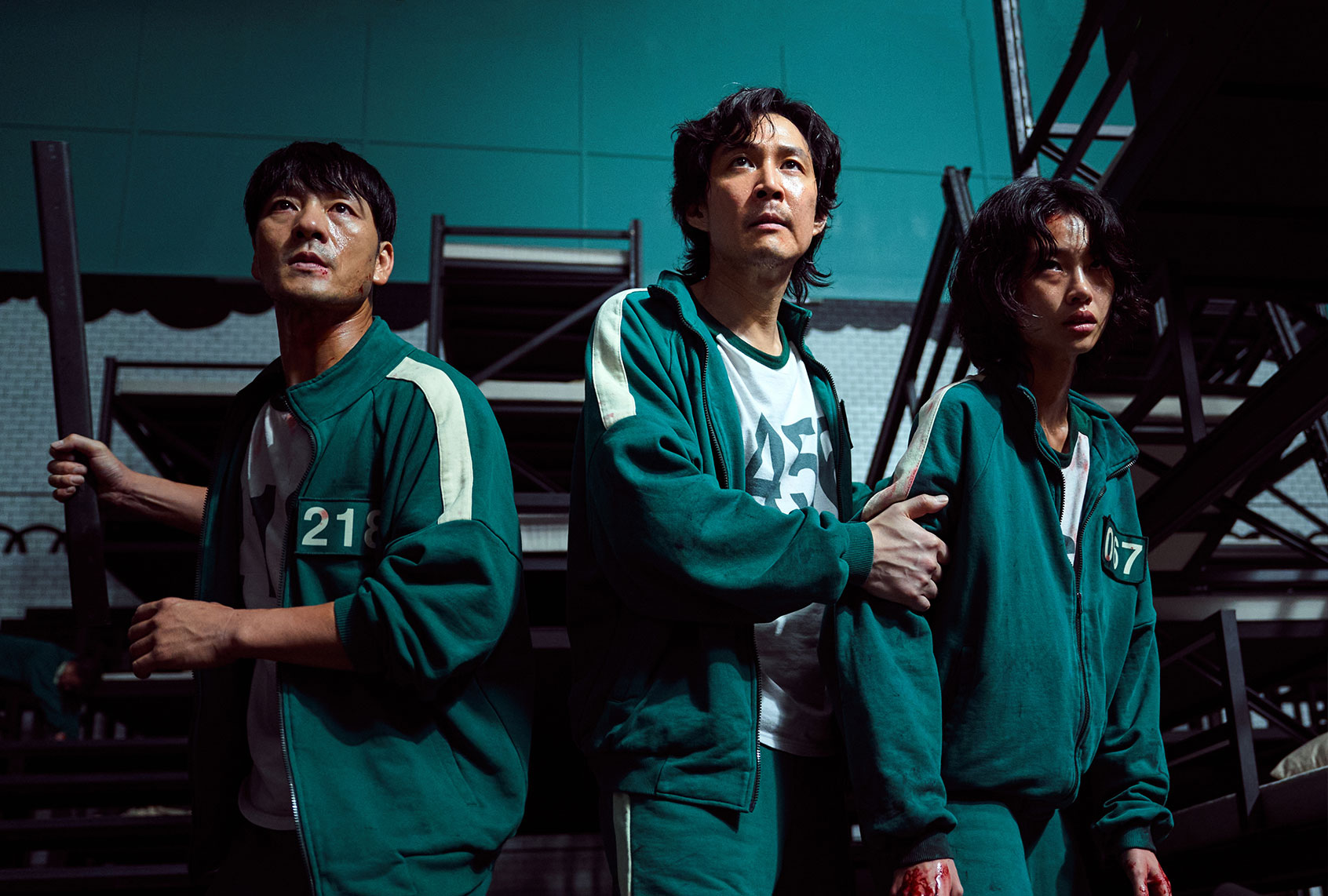
Following 240’s poignant death, the two remaining women are of course doomed also. The brash and mouthy self-proclaimed single mom Han Mi-nyeo (Kim Joo-ryoung), No. 212, had made her presence felt – and heard – from the start. Although, there’s some question of whether her sob story about not being able to name her newborn was just a con for sympathy, very little effort is spent in telling her backstory to determine why she needs the prize money so badly. Regardless, she’s portrayed to be a rather ruthless player but also wily; she’s one of only two characters shown to be smart enough to figure out how to smuggle in contraband into the competition.

The arrogant Deok-su finds out she’s a force to be reckoned with in the worst possible way. In the next round of play on the bridge made of glass panels, the majority of the remaining 16 contestants fall to their deaths. It looks like Han Mi-nyeo and Deok-su may just make it out alive, until she voluntarily plunges to her own death while taking him with her. She thus fulfills her pledge to kill him for his earlier betrayal.

Considering what a loathsome figure Deok-su is – bullying, assaulting and even murdering others in the competition – their shared death is a triumphant moment in some ways. It’s a display of Mi-nyeo’s courage, and the power of her lust for vengeance. But it’s still a death, the end of her story, all while many questions continue to linger about her, like what will now happen to her mysterious nameless baby or more about the circumstances that led to her participation in the games.

Had Mi-nyeo’s story been treated with more depth, this might have deepened our understandings of the plights of impoverished single mothers or even her upbringing in which she didn’t receive the benefit of education like some of the more privileged men in the game. Instead, much of her character’s screen time is devoted to scenes of her mouthing off to guards, being rejected by those she seeks to team up with because of her gender, or being bullied by Deok-su. 

It’s also particularly galling that Deok-su has had such an influence on her and garnered her loyalty for most of the series. She had initially teamed up with him because he seemed strong, and even had sex with him to cement their alliance. Within the same episode, he abandoned her, which is what eventually sealed his fate. The revenge isn’t all that sweet when one considers that she killed herself as a reaction to a man’s actions. 

The tragedy of Sae-byeok, No. 67

Squid GameSquid Game (YOUNGKYU PARK / Netflix)

As one of the final three, Sae-byeok is definitely set up to be one of the series’ central protagonists. After all, the audience had the privilege of seeing her life on the outside of the game and even met her younger brother. Unfortunately, the other two finalists are everyman hero Gi-hun and his childhood friend-turned-rival Sang-woo (Park Hae-soo), so of course her time is up as the last woman standing.

As the trio survive traversing the bridge, it self-destructs behind them in a shower of glass shards, which slashes each of them. While the men walked away with minor flesh wounds, it’s revealed that Sae-byeok sustained near fatal injuries from shattered glass cutting open her stomach. Despite making it almost to the end, she knows she’s on the verge of death.

Her last scenes are tragic and disheartening as she spends most of them in pain and collapsed on her bed (she didn’t even get to enjoy eating that lavish steak dinner!). Even though she and Gi-hun share a few moments of trust in which she tries to elicit his promise to help out her family if he wins, he’s too caught up in his rivalry with Sang-woo to pay attention. 

Sae-byeok’s last moments are spent on acting as Gi-hun’s conscience – reminding him about his sense of honor and not giving into the temptation of killing Sang-woo while he’s asleep – and then having her throat slit by Sang-woo himself. Seeing his newly trusting friend dead at the hand of his enemy, rage overtakes Gi-hun, who is even more determined to triumph in the final faceoff.

With Sae-byeok out, all of the female characters of “Squid Game” are now dead to make way for the anticipated duel between Gi-hun and Sang-woo. Compared to some of the other deaths on the show, from No. 1 (O Yeong-su) supposedly succumbing to his brain cancer to Sang-woo’s fatal deception of Ali (Anupam Tripathi), the deaths of Ji-yeong, Mi-nyeo and Sae-byeok are memorable and heroic, displaying their courage, honor and even their self-sacrificing natures. 

But their deaths are still deaths in service of advancing male narratives.

This is, of course, a recurring theme in popular action flicks that subtly hints at an understanding that audiences are mostly male and just want to see men fight. It’s also assumed that women in the audience are perfectly content to see men fight because male narratives are regarded as the more important default. In an attempt to dodge overt criticisms of sexism or lack of gender representation, these action flicks may write in women, only to then write them out via character deaths that seem epic, but are really just upholding the status quo of action storytelling. In “Avengers: Endgame,” Natasha Romanoff may have died to save the world, but her death was also about prioritizing a male character’s future in the MCU over hers. 

The spectacle of female death in action projects is given a glossy, feminist polish when women are subjected to memorable, heroic deaths. But going out in a blaze of glory isn’t feminist if it’s to clear the path for men, rather than other women. 

The female characters of “Squid Game” are compellingly written, facing and uniquely overcoming sexism in the games, and taking control of their lives. But these characters are still in many ways written in service of male-centric storytelling — a mold that it’s past time for the action genre to break. 

The gendered and sexual inequality in “Squid Game”

Beyond these three women, “Squid Game” touches only lightly on gender and sexuality. These themes come up in peripheral ways: female contestants struggling to find partners and teams for the games that are rooted in physical strength or jokes about Mi-nyeo’s status as a single mother. 

Toward the end of the series, however, Hwang Jun-ho (Wi Ha-joon), the undercover cop searching for his brother who disappeared, at one point disguises himself as a waiter and is sexually preyed upon by a lascivious, wealthy VIP who is watching the games for entertainment. This VIP is portrayed as a pervert and sexual predator, and his same-sex soliciting of Jun-ho also just so happens to be the only queer representation in the series. Intentionally or not, there are some frustrating, homophobic connotations to this, especially considering recent progress and growth in LGBTQ representation in K-dramas, which “Squid Game” lacks.

Ultimately, the problems with gender representation on “Squid Game” aren’t trivial, when we consider how predatory capitalism has particular, disproportionate impacts on women. In the U.S. and around the world, women are substantially more likely to experience poverty, and are more vulnerable to sexual exploitation and violence in the workplace. Giving more focus to female characters in a story about the horrors of wealth inequality, rather than semi-developing a few female characters and ultimately killing all of them off, would have actually made a lot more sense.

The obvious economic messages and capitalist critiques of “Squid Game” don’t inherently mean the show has done enough, or that it doesn’t have to “go above and beyond” to be inclusive and further explore the implications of identity in economic marginalization. Instead, if anything, in this story of inequality and economic predation, gender and identity should have received even greater focus, considering how inextricably capitalist oppression intersects with patriarchy.

The premature deaths and neglect of female characters like Ji-yeong, Mi-Nyeo and Sae-byeok are a lost opportunity for “Squid Game” — and a mistake to rectify should the show continue.

Warm water species here to stay five years after northern California’s largest marine heatwave

Land–based heatwaves have a less obvious though equally important sibling: marine heatwaves. In 2013, the largest marine heatwave on record began when an unusually warm mass of water formed in the Gulf of Alaska. By the next summer, the warm water spread south, raising average water temperatures along the United States west coast by 3.6 to 7.2 degrees Fahrenheit (2-4 Celsius). In 2015, a strong El Niño event strengthened the marine heatwave further.

And so “the Blob,” as oceanographers have dubbed this huge body of warm water, was born.

Interestingly, a number of species moved northward to places along the west coast of the U.S. where the water had previously been too cold for them.

We are a marine evolutionary biologist and a marine ecologist, and are currently studying these recent arrivals to the northern California coast. Through our work, we hope to understand what has allowed species to not only move with the Blob, but persist after the water cooled.

With warm water came new species

The Blob changed weather as well as ocean currents, led to the deaths of thousands of marine mammals and birds, and caused harmful algal blooms. Animals also moved during the years of warm water with the Blob. Species that usually live in more southern, warmer waters expanded their ranges into northern California and Oregon.

Pelagic red crabs, usually found off the Baja California peninsula, washed up by the hundreds on beaches north of San Francisco. Keen naturalists were surprised to find that populations of bright green sunburst anenomes, giant owl limpets and pink volcano barnacles had in some places increased by the hundreds. Ecologists even discovered a new population of angular unicorn snails over 150 miles north of their original range edge.

The Blob was not destined to last forever. It eventually faded away and water temperatures returned to normal.

A map of California with four colored lines.

Many species have established new populations far north of their historical limits, as demonstrated in this graphic where the lighter colored bars show the previous range limits and the darker colors show the new range extensions. Erica Nielsen, Sam Walkes, CC BY-ND

Cooling temps

Many species that arrived with the Blob didn’t stay within the colder northern waters once the heatwave passed. For example, open water species like the common dolphin followed the warm waters north, then migrated back southward once waters cooled. But many coastal species are sessile – meaning they are stuck to rocks for all their adult lives. But these species are not attached to rocks when they are young. During the early larval stages, they ride ocean currents and can travel dozens of miles to find new coastlines to live on.

The Blob’s warm waters and shifting currents allowed the larvae of many species to move far past their northern boundaries while remaining in their environmental comfort zone. However, when the marine heatwave ended, the real survival test began.

Our team has been tracking these northern coastal populations to see which species have persisted post-Blob. Each year our team returns to the cold, wave-pounded northern California shores to monitor existing populations and look for new recruits – young individuals that survived their larval stage and successfully settled on rocks.

Every year we are excited to find new barnacle, snail and slug recruits. Of the 37 coastal species our team has been tracking, at least five have maintained small but stable northern populations after the warm waters of the Blob disappeared.

A small shelled creature stuck to a rock surrounded by barnacles.

The giant owl limpet, seen here nestled in a tide pool, is one of the species that has managed to establish itself in the northern waters. Sam Walkes, CC BY-ND

Who goes from northern tourist to local?

In addition to monitoring populations, our team is also gathering ecological and evolutionary information about these species. The giant owl limpet is one of the species that has persisted, and we want to identify what traits helped them survive after the Blob ended.

In general, traits that help a species settle in a new environment include the ability to grow and reproduce faster, choose suitable habitats, defend territories or have more offspring. To test some of these ideas, our team is conducting ecological experiments along the California coast, and we are annually recording growth for more than 2,500 individual limpets. We are also experimentally pitting juvenile owl limpets against larger adults and other competing limpet species. We hope that this work will reveal whether the new limpets on the block can grow rapidly while competing with others.

But the ecology is only half of the range expansion story. In tandem with the ecological experiments, our lab is sequencing owl limpet genomes to identify genes that potentially code for traits like faster growth or competitive prowess. It’s possible to figure out on a genetic level what is allowing certain species to survive.

A cluster of small snails on a rock.

Unicorn snails, seen here in a tide pool, migrated north during the warm years of the Blob. Some populations have managed to establish themselves permanently. Sam Walkes, CC BY-ND

Conserving shifting species in a changing ocean

Considering the effects of ongoing climate change, it is good news that species can move to track their preferred climate. It’s important to note that while species that move due to climate change are not invasive, these shifts can change existing ecosystems. For example, the Hilton’s nudibranch, a predatory sea slug, expanded northward during the Blob, which led to a decline in local nudibranchs.

[Over 110,000 readers rely on The Conversation’s newsletter to understand the world. Sign up today.]

Research shows that marine heatwaves are becoming more common thanks to climate change. By understanding the ecological and evolutionary attributes that allowed some species to endure and even thrive during and after the Blob, we may be able to predict what will allow species to expand further during future marine heatwaves.

The Blob 2.0 is coming; what changes will it bring?

Erica Nielsen, Postdoctoral Researcher in Marine Biology, University of California, Davis and Sam Walkes, PhD Student in Ecology, University of California, Davis

This article is republished from The Conversation under a Creative Commons license. Read the original article.