Spring Sale: Get 1 Year, Save 58%

Our tropical fruits are vulnerable to climate change. Can we make them resilient in time?

Plants provide almost every calorie of food we eat. Grains like rice, wheat and corn make civilization possible. For millennia, farmers have bred grains, fruit and vegetable varieties to get larger harvests and plants better able to tolerate different climates.

But climate change is going to bring enormous disruption to the plants we rely on. A hotter world. Drier in some places. Wetter in others. Intensified droughts. More fire. Sudden torrential rain.

We’re going to need plants with even greater resilience. But can it be done?

We believe so. Our team has been working to climate-proof five popular fruits — banana, the single most commonly bought item in supermarkets, as well as pineapple, passionfruit, custard apples and paw paw. We’ve already done this with chickpeas to produce new, more resilient varieties.

            pineapple farm
Pineapple plants like tropical conditions. Their genome may hold the secrets of climate resilience But they have limits. Author provided
           

What does climate change mean for horticulture?

Australia, the driest inhabited continent, has already seen weather patterns shift. Droughts have become more severe, heatwaves and fire have intensified and intense rainfall and floods are more common. In some areas, there’s less winter rainfall and the ocean temperature is rising.

Fruit and vegetable growing is one of Australia’s most important agricultural sectors, with an annual production value (excluding wine grapes) exceeding A$11 billion in 2021–2022.

But this could change. The warping climate and heightened instability make it harder for fruit farmers to plan.

Already, the Australian fruit industry has seen large-scale losses of young fruit trees or seasons where fruit develops poorly.

As winters get warmer, we could see lower apple, pear, cherry and nut yields. That’s because these trees usually go dormant during cold periods. If the weather isn’t cold enough, they don’t grow and develop normally.


What can we do?

Fruit farmers have to play a long game. It takes years for apple tree saplings planted today to begin bearing sellable fruit.

These long times to a payoff can make it hard to respond quickly to climate challenges.

           
Custard apples are a popular tropical fruit. Author provided
           

But there are new methods we are trying. Modern tools such as whole genome sequencing and allele mining are letting us get better at finding how vital traits are coded on a tree’s genome. This, in turn, can help us target traits like drought and heat tolerance which will be valuable in the future. With this knowledge, we can manipulate these genes to get stronger effects or transfer them to other plants using modern breeding techniques.

We have already used these techniques to find genes in chickpeas that code for better drought resistance. Plants with these genes can survive temperatures of up to 38℃ and produce better yields to boot. After we isolated these genes, breeders in India and African nations used this knowledge to produce new, more drought tolerant varieties.

You might think drought tolerance is about retaining water better. Not necessarily. In these new and improved varieties, we see deeper roots, more vigorous growth and better leaf growth. This vigor safeguards their yields under drought stress.

Now we are using these techniques to mine the genomes of popular tropical fruit such as bananas and pineapples. We want to do the same as for chickpeas: create climate resilient cultivars.

What worked for chickpeas may not work for pawpaw and other fruit species. What we want is to find any characteristics which will boost survival rates in extreme conditions.

What would make these fruit trees and plants resilient to climate change? High tolerance to stress is vital. If you’re a gardener, you’ll know some plants can take a lot of punishment — while others are finicky and can die easily. Finding genes to promote robustness will help.

But there are other genes we’re looking for — those which code for improved yields and better fruit quality.

We are also working on accurate forecasting of climate resilience traits against the predicted changes to climates in our fruit growing regions. We can map the usefulness of these traits for specific regions by statistically testing correlations between different genes and measurements of plant traits.

Once we have greater ability to reliably forecast crop performance, we’ll avoid the long time needed to repeatedly grow and test new cultivars in field conditions and wait for the intense conditions needed to test how they respond.

The climate is changing, rapidly. We need to adapt our food sources just as quickly.

We are grateful to Vanika Garg, Anu Chitikineni, Robert Henry, Natalie Dillon, David Innes, Rebecca Ford, Parwinder Kaur and Ben Callaghan for their collaboration and support

Rajeev Varshney, Professor, Murdoch University and Abhishek Bohra, Senior research fellow, Murdoch University

This article is republished from The Conversation under a Creative Commons license. Read the original article.

God bless the vodka gimlet: On giving up hard liquor and becoming an “annoying wine guy”

God bless you, vodka gimlet, and may you continue to deliver peace and joy to all you encounter. 

In an aggressive attempt to punish myself for aging, I recently vowed to end my toxic relationship with hard-booze and become an extremely annoying wine guy.

Not a quiet “sip my drink lonely in the corner” kind of wine guy, but the loudest most annoying type of wine guy anyone could imagine. The kind of wine guy who wears cardigans year-round and gets a little too excited during cheese conversations, “Is that Manchego I detect?” I’d yell at its sight as if I picked a winning lottery number.  Already, I don’t like my new wine guy self, but alas, it must be done.  

This isn’t a cry for help; I am not an alcoholic, or at least no one has ever called me one. Though full transparency, the way I determined I wasn’t one was based on the drunk people that float in and around my friend groups. They take shots, I don’t. They drink with lunch, I don’t. They throw up at restaurants, I don’t. They allow people at the bar to send them multiple rounds out of respect, while I decline when it surpasses my standard limit. Or at least I do most times–– I think. 

And this small uncertainty is one of the reasons why I must become a wine guy. 

“It’s so-so oaky,” I can hear myself saying. “I can just feel the region wafting through my pores!”

I was already a vodka drinker, but the worst kind of vodka drinker.

But before I become the kind of annoying wine guy who wears a silk scarf tied around his neck, accessorized with high-fashion loafers or mules and quality denim –– I must first praise and give proper goodbye to the vodka gimlet. 

Dre with the dreads was the person who gifted me with the concoction that changed everything. I was already a vodka drinker, but the worst kind of vodka drinker. The vodka drinker who wore stained tank-tops under leather jackets and ordered like, “Yo sis, let me get an Absolute-double with cranberry,” or “Gimme a vodka and OJ when you get a chance, bro! And no, I don’t care if the OJ you use is Sunny D, even though I don’t know what Sunny D actually is! Bro!” 

And I’d sip and sip my disgusting drink, enjoying the burn or at least I thought. Enter Dre. 

Dre had just moved to Baltimore from upstate New York. He was a relatively smooth fellow with a laid-back demeanor who was always as pleasant as he was curious. Dre was also the first mixologist I ever met. 

“You try this,” Dre would say, “Let me know if it’s too much mint.” 

“It’s kinda minty,” I’d reply, “But give me two more free drinks so I can be sure!” 

I was an undergrad student and new writer months into my nonexistent career. My money was funny, hilarious actually, and Dre would make all of the classics with his twist, allowing me to try them for free. Eventually, he became so popular that the restaurant he worked at asked him to develop the cocktail menu and of course I was right there to sample it.I tried so many samples during those development days that I often missed class. Well, every class except memoir. 

Memoir requires some drinking. 

Some days I’d give Dre some of my writing, and he would critique it the same way I’d critique his drinks. Dre was more kind with his suggestions than me, maybe because he wasn’t from Baltimore and was excited to learn from the history tucked into my essays. We became brothers in ambition, and as Dre rose as a sought-after craft cocktail expert in town, I started publishing essays. 

“A yo, I am traveling a little bit right now for these readings,” I asked Dre on a slow night at his bar, “And I’m struggling to find one go-to drink that any bartender can make, even me.” 

“Gimlet,” Dre said, “I noticed that you are a citrus guy, so a Gimlet.” 

“What’s in that?” I asked.

“Well, the main ingredient is gin….” 

I stopped him right there. Gin and me never really mixed–– me plus gin equals a collection of wild tales that involve me falling out of a second-story window and landing on a pissy mattress with springs poking out. Me plus gin involved me being in a bar fight, and hitting the guy that was fighting with me as an ally, and then there’s the unthinkable. Something that I would pay top dollar to disappear, dancing. Gin gave me, a guy with two left feet, the confidence to dance in front of people, an act that should be illegal. So no, hell no, I would never commit to gin.” 

“You could do it, vodka!” Dre laughed, “A lot of people enjoy it with vodka even though Rear-Admiral Sir Thomas Desmond Gimlette used gin as its origin.” 

“Who?” I laughed.

“Rear-Admiral Sir Thomas Desmond Gimlette,” Dre continued, “Back in the 1800s, the British Navy was being picked apart by scurvy, and the good doctor figured that adding some special sauce [gin] to the vitamin C would get the troops more excited about taking their medicine.” 

Why am I running toward my annoying new reality? Because gimlets beat my ass.

Dre continued telling me more alleged origin stories as we downed three gimlets back to back. I will continue to down that drink for years–– going from watering hole to watering hole in city to city, allowing bartenders to introduce me to their variations of the legendary cocktail. People around me even begin adopting it as their drink, not only because it’s delicious but also simple to make and includes a few simple ingredients.

I was hooked on those fresh lime gimlets, but have since decided to become a “My wife and I are doing a wine tasting next Tuesday with the Stevenson’s” type of annoying wine guy. So why am I quitting? Why am I running toward my annoying new reality? Because gimlets beat my ass. 

Turning 40 worked a number on my insides.

The positive buzz that once accompanied gimlets has died and resurrected as late morning and throbbing headaches. I used to champion gimlets because they didn’t give me hangovers, but now they have the same effect as drinking Hennessy or Remy straight.

So I’m choosing to end our relationship, embrace my annoying wine guy reality, and happily  pass on this beautiful drink to the next generation of youngsters who have the stamina to enjoy it.

Dre’s Vodka Gimlet
Yields
1 servings
Prep Time
1 minutes
Cook Time
0 minutes

Ingredients

2.5 ounces of fresh lime juice

3 ounces of vodka or gin, or both

A few drips of simple syrup 

Ice


Directions

  1. Dump all ingredients into your fancy cocktail shaker, use the blue-collar-two-red-cup-strainer technique, and serve it chilled. 

Bartender’s Notes

Rose’s lime juice is a deal breaker for me–– you must always use fresh lime or completely abandon the drink. Rose’s kills the drink. If you order a gimlet and they offer you, Roses, then you should leave the bar, maybe even the neighborhood, because that is ridiculous as it is gross.

E. Jean Carroll’s lawyer hammers Trump in closing argument: He “is a witness against himself”

E. Jean Carroll’s lawyer argued that former President Donald Trump was effectively a “witness against himself” during closing arguments on Monday.

“You saw for yourself. E Jean Carroll wasn’t hiding anything,” her attorney Roberta Kaplan said, adding that Carroll’s testimony has been “credible,” “consistent,” and “powerful.”

Carroll is suing Trump over an alleged sexual assault that she says took place in the fitting room of a Bergdorf Goodman department store in Manhattan in the mid-1990s. Carroll argues that Trump’s subsequent dismissal of her public claims defamed her. 

Last week, two witnesses testified in Manhattan federal court to bolster Carroll’s claims. One witness, Lisa Birnbach, whom Carroll allegedly called immediately after the supposed attack occurred, said, “I want the world to know that she was telling the truth.” A second witness, retired stockbroker Jessica Leeds, stated in court that the ex-president had tried to grope her while seated near him on a flight in 1979.

Kaplan in her closing arguments reminded the jury that during a video deposition last October, Trump confused Carroll and his wife during the late 90s, Marla Maples.

“Mr. Trump pointed to Ms. Carroll, the woman he supposedly said was not his type,” Kaplan said. “He only corrected himself when his own lawyer” pointed out his mistake,” she added. Trump “did [what] he always does” when accused of wrongdoing, Kaplan said — “He made up an excuse,” claiming that it was “blurry.” 

“He grabbed her, using his words, ‘by the p****,'” Kaplan said, a reference to Trump’s now infamous “Access Hollywood” tape that surfaced ahead of the 2016 presidential election.

“He didn’t even bother to show up in person,” Kaplan said about Trump’s decision to not attend the trial. “In a very real sense, Trump is a witness against himself.” 


Want a daily wrap-up of all the news and commentary Salon has to offer? Subscribe to our morning newsletter, Crash Course.


“He knows he sexually assaulted E Jean Carroll,” the attorney stated. 

Kaplan added that for Trump to successfully win the trial, you “have to conclude that Donald Trump, the nonstop liar, is the only person in here telling the truth.”

Carroll’s legal team will not be requesting a specific damage award.

“For E Jean Carroll, this lawsuit is not about the money,” Kaplan said. It’s about getting her “name back.”

7 animals we could lose forever due to climate change

In 2022, the United Nations projected that roughly one million wild species were heading toward extinction due to human activity. Not all of these species are in danger of being wiped out due to climate change; pangolins, for instance, are also highly sought after for their meat and scales (used in traditional Chinese medicine), while sharks face problems because their fins are eaten, they are often caught by accident and they are misunderstood.

“There are still many species we have not described; many will go extinct undescribed.”

Yet for many endangered animals, climate change is the major cause of their impending extinction. In a future world in which extreme weather conditions like floods, droughts, wildfires and hurricanes are normal — to say nothing of a constantly warming temperature — many of Earth’s most charismatic creatures will simply have no where to go.

Even more tragic, many of the species lost will vanish without humans ever knowing they existed. In the words of Dr. Alice C. Hughes of the University of Hong Kong, “There are many species we have not even described yet. To put this in perspective a few weeks ago we were surveying Thai caves, and found an almost certainly new species of gecko. There are still many species we have not described; many will go extinct undescribed.”

Salon reached out to experts to identify some of the most iconic animals that will — or already have — become victims of man-made climate change.

01
Corals — and all the animals that depend on them (including walruses and polar bears)
Great Barrier ReefGreat Barrier Reef (Getty Images / Lea McQuillan / 500px)
Though coral typically like cauliflower, bushes and other plants, they are actually animals — albeit “sessile” ones, meaning that they root to the ocean floor and do not move as most animals do. Yet the coral reefs that house these spiny and colorful marine invertebrates contain complex ecosystems which fuel the entire marine food web. That is why climate change destroying our coral reefs is, really, about a whole lot more.
 
“We will lose many coral species, and the resulting degradation of reef ecosystems will threaten hundreds, if not thousands, of reef species with extinction,” John Hocevar, a marine biologist and director of Greenpeace’s oceans campaign, told Salon by email. “Ice dependent species, such as many seals, walrus, and polar bears, may disappear. Krill abundance will decline in Antarctic waters, impacting everything from penguins to whales.”
02
Geckos
Marbled velvet geckoMarbled velvet gecko cleaning eye with tongue (Auscape/Universal Images Group via Getty Images)
While Dr. Hughes spoke to Salon about a rare species of Thai gecko that researchers were barely able to discover — but which was nearly lost to time — there are plenty of known gecko species that will suffer due to climate change. As cold-blooded lizards, geckos are particularly susceptible to alterations in temperatures, and as such the wall-climbing and colorful animals may not make it as the Earth’s temperature warms.
 
The problem is that gecko eggs cannot thrive above certain temperatures. In a recent experiment, scientists discovered that when velvet geckos eggs were incubated at higher temperatures than the geckos are used to, fewer hatchlings survived — and those that did tended to be born smaller.
03
Grey-headed and little red flying foxes
Grey-headed Flying FoxGrey-headed Flying Fox (Getty Images/Ken Griffiths)
Australia’s flying foxes are one of the continent’s underrated gems. With their bat-like wings, furry bodies and deep black eyes, the flying foxes may seem demonic, but they are also intelligent and curious animals. Yet they are headed toward extinction because they can’t survive in Australia’s ever-heating climate; some scientists even built sprinkler systems to help some of the hapless creatures cool off.
 
“Grey-headed and little red flying foxes show mass die-offs at above certain temperatures, and those temperatures are being reached far more frequently now,” Hughes wrote to Salon. They are hardly alone among dying flying foxes in Australia.

Want more health and science stories in your inbox? Subscribe to Salon’s weekly newsletter The Vulgar Scientist.


04
 

African wild dogs

African wild dog playing with puppiesAfrican wild dog playing with puppies (Getty Images/Manoj Shah)

African wild dogs have the dubious distinction of being the only surviving canine from the genus known as lycaon. Yet thanks to climate change, the African wild dog — which is also the largest wild canine in Africa — may not survive much longer.
 
It has to do with the same problem decimating the geckos: breeding temperatures. Scientists in Botswana recently learned that to adjust to climate change, African wild dogs have shifted their breeding schedule by 22 days due to the shrinking cool season. This may not seem like much, but it means that the pups have much less time to adjust to their new life. Survival rates are plummeting as a result.
05
Migratory birds
Spoon-billed sandpiperSpoon-billed sandpiper (Getty Images/kajornyot)
As Hughes explained to Salon, any species that regularly migrates is going to be vulnerable to climate change.
 
“These species often use different cues to initiate migration so they arrive when food is available, yet these different cues and the different timing can leave them vulnerable if they arrive either after the food availability or too long before it starts,” Hughes wrote. As one example, she pointed to migratory waders or shorebirds like those which rely on the  East Asian Australasian flyway, or a complex of islands and ocean crossings frequented by hundreds of migratory bird species, “some of which already show population losses over 70% due to coastal habitat losses, and species like spoonbilled sandpipers — which already number under 700 individuals.”
06
Penguins
Little Blue PenguinsLittle Blue Penguins (Getty Images/tiger_barb)
“Hundreds of little penguins are washing up dead on New Zealand shores,” read a heartbreaking Washington Post headline last year. The specific penguin species are little blue penguins (yes, that’s their official name), and they are known for their blue coats, noisy dispositions and anchovy-and-sardine filled diets.
 
As it turned out, hundreds of them had washed up on shore dead. Climate change has increased water temperatures and made storms both more common and more frequent. As a result penguins in general are struggling to survive in the modern world.
07
Plankton
Copepods, light micrographCopepods, light micrograph (Getty Images / CHOKSAWATDIKORN / SCIENCE PHOTO LIBRARY)
Because they’re microscopic, most of us don’t think much about plankton, if all. Yet despite their microscopic size, have an outsized impact on the planet. Animals from whales and fish to barnacles rely on plankton to survive. Indeed, they are the base of the food chain — and toying with their numbers would have a catastrophic effect going all the way up the food chain to humans.
 
“Ocean acidification, the evil twin of climate change caused by direct absorption of carbon dioxide into water, is likely to wipe out whole classes of plankton, leading to a transformation of marine sea webs that is impossible to imagine,” Hocevar told Salon.
 
Unlike the other animals on this list, plankton probably won’t ever go completely extinct, simply due to their incredible numbers. However, even a 10 percent drop in their population would lead to a chilling wave of death for all the thousands of animals that depend on them for survival. 


These four challenges will shape the next farm bill — and how the US eats

For the 20th time since 1933, Congress is writing a multiyear farm bill that will shape what kind of food U.S. farmers grow, how they raise it and how it gets to consumers. These measures are large, complex and expensive: The next farm bill is projected to cost taxpayers US$1.5 trillion over 10 years.

Modern farm bills address many things besides food, from rural broadband access to biofuels and even help for small towns to buy police cars. These measures bring out a dizzying range of interest groups with diverse agendas.

Umbrella organizations like the American Farm Bureau Federation and the National Farmers Union typically focus on farm subsidies and crop insurance. The National Sustainable Agriculture Coalition advocates for small farmers and ranchers. Industry-specific groups, such as cattlemen, fruit and vegetable growers and organic producers, all have their own interests.

Environmental and conservation groups seek to influence policies that affect land use and sustainable farming practices. Hunger and nutrition groups target the bill’s sections on food aid. Rural counties, hunters and anglers, bankers and dozens of other organizations have their own wish lists.

As a former Senate aide and senior official at the U.S. Department of Agriculture, I’ve seen this intricate process from all sides. In my view, with the challenges in this round so complex and with critical 2024 elections looming, it could take Congress until 2025 to craft and enact a bill. Here are four key issues shaping the next farm bill and through it, the future of the U.S. food system.


The price tag

Farm bills always are controversial because of their high cost, but this year the timing is especially tricky. In the past two years, Congress has enacted major bills to provide economic relief from the COVID-19 pandemic, counter inflation, invest in infrastructure and boost domestic manufacturing.

These measures follow unprecedented spending for farm support during the Trump administration. Now legislators are jockeying over raising the debt ceiling, which limits how much the federal government can borrow to pay its bills.

Agriculture Committee leaders and farm groups argue that more money is necessary to strengthen the food and farm sector. If they have their way, the price tag for the next farm bill would increase significantly from current projections.  

On the other side, reformers argue for capping payments to farmers, which The Washington Post recently described as an “expensive agricultural safety net,” and restricting payment eligibility. In their view, too much money goes to very large farms that produce commodity crops like wheat, corn, soybeans and rice, while small and medium-size producers receive far less support.


Food aid is the key fight

Many people are surprised to learn that nutrition assistance — mainly through the Supplemental Nutrition Assistance Program, formerly known as food stamps — is where most farm bill money is spent. Back in the 1970s, Congress began including nutrition assistance in the farm bill to secure votes from an increasingly urban nation.

Today, over 42 million Americans depend on SNAP, including nearly 1 in every 4 children. Along with a few smaller programs, SNAP will likely consume 80% of the money in the new farm bill, up from 76% in 2018.

Why have SNAP costs grown? During the pandemic, SNAP benefits were increased on an emergency basis, but that temporary arrangement expired in March 2023. Also, in response to a directive included in the 2018 farm bill, the Department of Agriculture recalculated what it takes to afford a healthy diet, known as the Thrifty Food Plan and determined that it required an additional $12-$16 per month per recipient or 40 cents per meal.

Because it’s such a large target, SNAP is where much of the budget battle will play out. Most Republicans typically seek to rein in SNAP; most Democrats usually support expanding it.

Anti-hunger advocates are lobbying to make the increased pandemic benefits permanent and defend the revised Thrifty Food Plan. In contrast, Republicans are calling for SNAP reductions and are particularly focused on expanding work requirements for recipients.


Debating climate solutions

The 2022 Inflation Reduction Act provided $19.5 billion to the Department of Agriculture for programs that address climate change. Environmentalists and farmers alike applauded this investment, which is intended to help the agriculture sector embrace climate-smart farming practices and move toward markets that reward carbon sequestration and other ecosystem services.

This big pot of money has become a prime target for members of Congress who are looking for more farm bill funding. On the other side, conservation advocates, sustainable farmers and progressive businesses oppose diverting climate funds for other purposes.

There also is growing demand for Congress to require USDA to develop better standards for measuring, reporting and verifying actions designed to protect or increase soil carbon. Interest is rising in “carbon farming” — paying farmers for practices such as no-till agriculture and planting cover crops, which some studies indicate can increase carbon storage in soil.  

But without more research and standards, observers worry that investments in climate-smart agriculture will support greenwashing — misleading claims about environmental benefits — rather than a fundamentally different system of production. Mixed research results have raised questions as to whether establishing carbon markets based on such practices is premature.


A complex bill and inexperienced legislators

Understanding farm bills requires highly specialized knowledge about issues ranging from crop insurance to nutrition to forestry. Nearly one-third of current members of Congress were first elected after the 2018 farm bill was enacted, so this is their first farm bill cycle.

I expect that, as often occurs in Congress, new members will follow more senior legislators’ cues and go along with traditional decision making. This will make it easier for entrenched interests, like the American Farm Bureau Federation and major commodity groups, to maintain support for Title I programs, which provide revenue support for major commodity crops like corn, wheat and soybeans. These programs are complex, cost billions of dollars and go mainly to large-scale operations.


How the U.S. became a corn superpower.


Agriculture Secretary Tom Vilsack’s current stump speech spotlights the fact that 89% of U.S. farmers failed to make a livable profit in 2022, even though total farm income set a record at $162 billion. Vilsack asserts that less-profitable operations should be the focus of this farm bill — but when pressed, he appears unwilling to concede that support for large-scale operations should be changed in any way.  

When I served as deputy secretary of agriculture from 2009 to 2011, I oversaw the department’s budget process and learned that investing in one thing often requires defunding another. My dream farm bill would invest in three priorities: organic agriculture as a climate solution; infrastructure to support vibrant local and regional markets and shift away from an agricultural economy dependent on exporting low-value crops; and agricultural science and technology research aimed at reducing labor and chemical inputs and providing new solutions for sustainable livestock production.

In my view, it is time for tough policy choices and it won’t be possible to fund everything. Congress’ response will show whether it supports business as usual in agriculture or a more diverse and sustainable U.S. farm system.

Kathleen Merrigan, Executive Director, Swette Center for Sustainable Food Systems, Arizona State University

This article is republished from The Conversation under a Creative Commons license. Read the original article.

Fox News confronts Greg Abbott with brutal poll showing Americans overwhelmingly back gun control

Sign up for The Brief, The Texas Tribune’s daily newsletter that keeps readers up to speed on the most essential Texas news.


After a mass shooting on Saturday at an Allen outlet mall ended with eight people dead, Texas Republicans are doubling down on their resistance to gun control legislation.

A gunman used an AR-15-style weapon to open fire on shoppers on Saturday afternoon, killing eight people and injuring at least seven others in the suburb 25 miles north of Dallas. The massacre ended when a police officer, already at the scene, killed the gunman.

The Texas Department of Public Safety identified the gunman as 33-year-old Mauricio Garcia. Investigators have been searching a nearby motel at which the suspect had been staying and a home in the Dallas area connected to the suspect. The city of Allen said Sunday that the Texas Department of Public Safety would lead the investigation into the shooting going forward.

In an interview Sunday, Fox News presented Gov. Greg Abbott with a poll that showed Americans overwhelmingly favored background checks and raising the minimum age to buy firearms. But the governor shunned gun safety options in Texas and instead pointed to the need to increase mental health funding.

[In overnight testimony, Uvalde victims’ family members call on Texas lawmakers to raise age to buy semi-automatic guns]

“We are working to address that anger and violence by going to its root cause, which is addressing the mental health problems behind it,” Abbott said. “People want a quick solution. The long-term solution here is to address the mental health issue.”

There has been no public indication from investigators that mental illness played a role in the shooting Saturday, but WFAA reported, citing unnamed sources, that the gunman was removed from the U.S. Army “due to mental health concerns.” Abbott attended a vigil at Cottonwood Creek Church Allen on Sunday.

U.S. Rep. Keith Self, a Republican who represents Allen, also emphasized mental health as a solution to gun violence. In an interview with CNN, Self said “many of these situations are based on” the closures of mental health institutions.

Republican leaders in Texas and across the nation often focus on mental illness after mass shootings. But mental health experts argue this lets lawmakers avoid talking about other issues related to gun violence and further stigmatizes people with mental health issues.

The shooting in Allen comes as Texas lawmakers face fresh calls for gun safety legislation. But efforts to restrict access to firearms have been elusive this legislative session. A measure to raise the age to purchase a semi-automatic rifle in the state from 18 to 21 — backed by families of the Uvalde school shooting victims — appears likely to miss a deadline to pass out of a House committee on Monday.

At an intersection near the mall on Sunday, a man carried a sign with a depiction of an AR-style rifle that read, “Well-regulated militia murders 8 people in Allen.” Shoppers who had been trapped at the mall the previous day waited outside to retrieve cars that remained in the parking lot as the law enforcement investigation continued.

As Texas Republicans invoke mental illness after the Allen shooting, lawmakers on the other side of the aisle home in on the weapon the gunman used.

The Texas Democratic Party called on the state Legislature to pass gun safety legislation — such as background checks with no private sale loopholes and raising the minimum age to 21 to purchase firearms — before the Legislature adjourns at the end of this month.

“We support the Second Amendment,” the statement said. “We also believe that the best way to uphold Texas’ strong heritage of responsible gun ownership for self defense, hunting, and recreation is to make sure we’re keeping firearms out of the hands of criminals and others deemed dangerous to themselves and others.”

A little after 3:30 p.m. Saturday, a gunman stepped out of a gray car outside Allen Premium Outlets and began shooting at shoppers on the sidewalk. Of the seven injured, three were still in critical condition as of Sunday afternoon, according to Medical City Healthcare. Authorities have not yet released the names of the victims but have asked witnesses or those with information to call 1-800-CALL-FBI and to share photos or video of the incident at fbi.gov/allenmallshooting.

The gunman was wearing tactical gear and used an AR-15-style assault weapon to carry out the shooting, President Joe Biden confirmed in a statement Sunday.

An AR-15-style weapon was used in 2022 when an 18-year-old gunned down 19 children and two teachers at Robb Elementary School in Uvalde. Police responding to the Uvalde school shooting said they feared the weapon, which was originally designed for combat.

That type of rifle was also used when a 36-year-old gunman went on a shooting rampage in the Midland-Odessa area in 2019, and when a 26-year-old gunman opened fire at the First Baptist Church in Sutherland Springs in 2017.

At the federal level, Biden called for universal background checks and safe storage of firearms. If Congress sent a bill with such measures to his desk, he said Sunday, he would “sign it immediately.” The president also ordered flags across the country to be flown at half-staff through May 11 to honor the victims of the shooting.

For 24/7 mental health support in English or Spanish, call the Substance Abuse and Mental Health Services Administration’s free help line at 800-662-4357. You can also reach a trained crisis counselor through the Suicide and Crisis Lifeline by calling or texting 988.


We can’t wait to welcome you Sept. 21-23 to the 2023 Texas Tribune Festival, our multiday celebration of big, bold ideas about politics, public policy and the day’s news — all taking place just steps away from the Texas Capitol. When tickets go on sale in May, Tribune members will save big. Donate to join or renew today.

This article originally appeared in The Texas Tribune at https://www.texastribune.org/2023/05/07/allen-shooting-guns-mental-health/.

The Texas Tribune is a member-supported, nonpartisan newsroom informing and engaging Texans on state politics and policy. Learn more at texastribune.org.

Wins, losses and regrets: It’s all part of the game at this “Succession” tailgate party

Succession” is not a twist machine. Sure, the plot flips here and there, but once whatever jolts we experience fades you realize how inevitable Jesse Armstrong and his writers arranged them to be. Logan Roy’s children were raised to compete for his love and respect and never work as a team. This is why they are consistently underprepared for moments of great opportunity.

Kendall (Jeremy Strong) was always going to rise to his greatest level of success by imitating Logan’s worst behavior. Roman (Kieran Culkin) and Gerri (J. Smith-Cameron) were always going to end in disaster; we just haven’t seen how large the cauldron of gold in which she boils him will be.

The unkindest swindle of all may be in how successfully the writers, Sarah Snook and Matthew Macfadyen resurrected a sliver of hope that Shiv and Tom Wambsgans would figure out that all they were good for was each other. We’re joking – Shiv and Tom are terrible together, but they sure do look adorable at times. On this show, appearances are everything. Including deceptive.

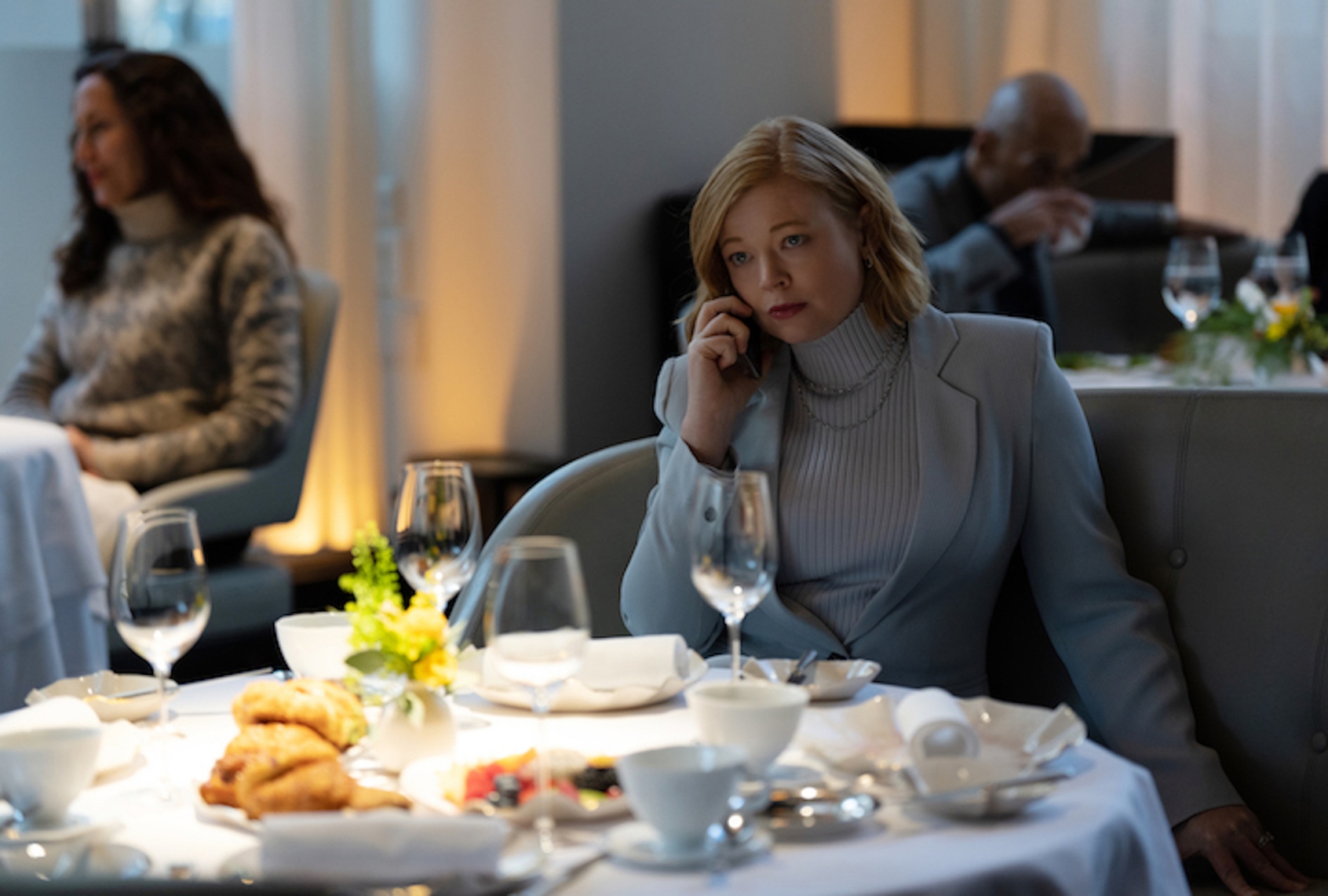
When we last saw the estranged couple they’d hooked up and, finding the lust was still there, decided to give it another try, mostly by going at each other. “Tailgate Party” opens with Tom, dubbing himself Father Sex-mas, delivering Shiv breakfast. They’re excited to be hosting the company’s traditional Election Eve “Tailgate Party” at their decidedly un-tailgate-ish luxury condo.

But nothing is conventional about this day. Waystar and ATN are on the verge of being acquired by Lukas Matsson (Alexander Skarsgård), although he texts Shiv he won’t be coming because he doesn’t want to hang around Logan’s “bulls**t pre-election brain-dead AOL-era legacy media putrid stuffed mushroom f**k-fest.” Oh well – more pigs in a blanket for Wambsgans and Cousin Greg (Nicholas Braun), I guess. Before the party, Tom presents Shiv with a present – aw! The gold wrapping paper hides a red box Shiv opens to discover . . . a scorpion inside a paperweight.

Tom explains that it means, “I love you, but you kill me, and I kill you.” Adorable!

Compared to Kendall’s brief meetup with his estranged wife Rava (Natalie Gold), who updates him on their daughter’s fear of going to school, Shiv and Tom are aces. Kendall, meanwhile, responds to Rava’s report by blaming her parenting. What was his daughter doing outside on the street? (Um, walking with her friends?) Where was Rava when the scariness occurred? “I was raising our daughter while you were running a f**king racist news organization,” Rava says, suggesting he call his kid. Kendall will not – he’s too busy “making the world safe.”

“And it’s all for them!” he yells while stomping off.

Shiv and Tom are terrible together, but they can look adorable at times. On this show, appearances are everything.

While this warm reunion is going down, Roman has a guy doing a dirt excavation on Matsson. The Disaster Triplets meet with Connor (Alan Ruck) at a restaurant for a quick update on Logan’s funeral planning, reminding us that despite the tornado of upswings, reversals and minutes’ notice trips to Scandinavia and Los Angeles, their media titan father isn’t even in the ground yet.

“The weird thing is how much he’s not there,” says Connor. “I find that consoling.” But not as consoling as the news that in Alaska, the presidential candidate’s pre-election day polling numbers are “exploding at four, five, six percent!” Be that as it may, Connor’s main point of business is to figure out which adult child of Logan Roy will speak at his funeral, which Logan’s idiot eldest wants to keep to “a tight 90.”

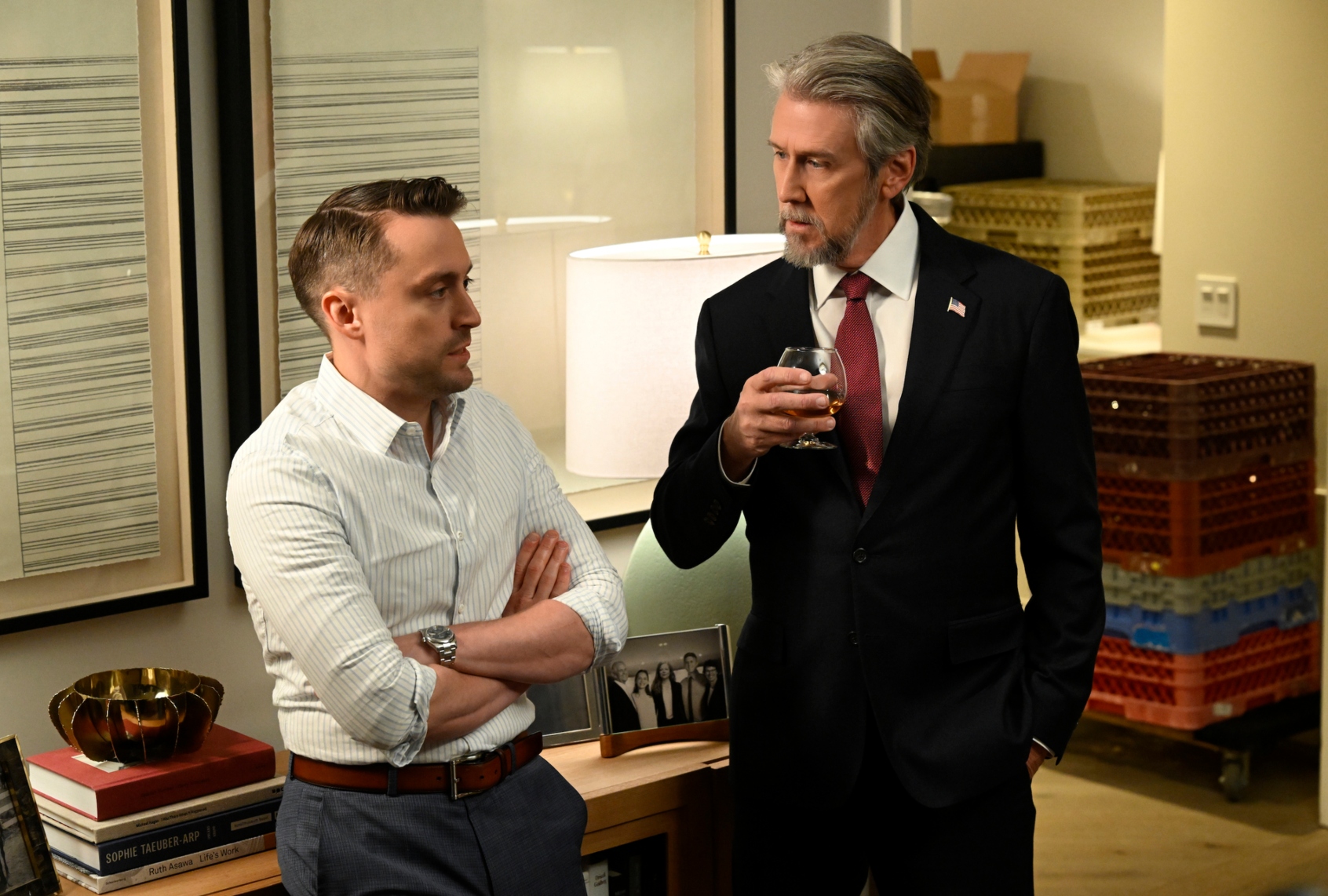
They get up from the table without having decided anything, except that Roman and Ken want to invite Shiv’s ex Nate Sofrelli (Ashley Zukerman), the man Shiv cheated with while she was engaged to Tom, to the party they’re throwing in the home Shiv currently shares with Tom. Sure, why not? Nate works closely with Democratic Senator Gil Eavis, who is closely involved with the regulatory machine, and tight with Democratic presidential candidate Daniel Jimenez. Any points the boys can land with Nate will surely work in their efforts to drive Matsson out of town.

Shiv reluctantly says yes before phoning Matsson, sharing her brothers’ plans with him and telling him he needs to gird his loins and jump into stuffed mushroom f**kfest after all.

Sarah Snook in “Succession” (Photograph by Macall Polay/HBO)
Then she sexts with Tom, still in the afterglow of their “orgasm Olympics”: “Harder, faster, sorer,” he messages. She returns fire, smiling, with “Sorry if I broke your d**k last night.”

Cut to him in the office, texting her verbal confirmation of his tumescence before informing a few dozen employees on video chat, that he’s just sick, so sick, of what’s about to happen. Then he hands it off to Greg who reads from a soulless statement informing them they’ve all been fired as Tom fake boohoos off camera.

Tailgate time. Before the guests arrive, Shiv gives Tom the heads up that her brothers are inviting Nate. “It’ll be good to see Nate,” Tom says with terse artificiality. “What do I care?” Spoiler alert: the answer to that question will be delivered later!

As the place fills, Roman gets a phone call from Jeryd Mencken, the fascist horse he bet on in this presidential race. 

The poll numbers aren’t looking good, so he asks Roman to persuade Connor to drop out, assuming his exploding four, five, six percent will go to him. Roman corners his older half-brother and conveys Mencken’s promise for a sweet ambassadorship to his choice of autocratic states. Connor insists on North Korea. “You don’t know! Nobody knows. That’s the point. I could open it up like Nixon did China!”

“Con, they’re not going to put you anywhere with nukes,” Roman counters.

“Well that’s insulting,” Connor says. “I don’t think I want to go anywhere that doesn’t have nukes.”

How about Oman? “Oman? Poor man’s Saudi Arabia, rich man’s Yemen? Hmm, I’ll have to check. See what my wo-man thinks about Oman,” he dumbly jokes. Willa’s answer is, not much. So Connor hangs on to his tiny polls.

Kieran Culkin and Alan Ruck in “Succession.” (Photograph by David Russell/HBO)
As the revelry hits its apex, Kendall toasts the crowd, asking for a moment of silence to honor Logan. That’s Matsson’s cue to loudly burst through the door in a louder gold jacket, with Ebba (Eili Harboe) and Oskar (Jóhannes Haukur Jóhannesson) in tow.

Kendall decides Shiv should handle Matsson, who stampedes through the crowd and catches Tom off guard. Tom doesn’t acquit himself well, which Matsson announces to Shiv as she walks up. “I’m about to take a s**t in your husband’s mouth, and I’m pretty sure he’s going to tell me it tastes like coq au vin. But seriously, it’s a really, really nice place. Who will get to keep it in the divorce?”

Oof.

Not long afterward Shiv says hello to Ebba, who is miserable with social anxiety, and Oskar, who is stoned out of his gourd. Shiv takes Matsson over to chat with Nate, who he pitches hard as a better option than Roman and Kendall, who he calls “the failsons,” to run Waystar. “They will do what he did,” Matsson says, referring to Logan, “but they will do it stupider and uglier and less amenable.” When Nate asks about leadership changes, Matsson mentions Tom. Nate looks Tom’s way, in time to notice Shiv’s still-husband glaring back at Matsson, the man Shiv wants to screw, rubbing shoulders with the guy his wife already cheated with while she stands between them grinning. A devil’s threesome!

Then Shiv pulls Matsson into a coat room to bolster his confidence. Before they re-enter the fray she tells him she wants assurances that if she moves to actively assisting him, she’ll be rewarded with a “very, very, very significant role” under his leadership.

“Three ‘verys’. Wow,” he condescends, then signals her to lay her pitch on him. And Shiv . . . shivs it, offering nothing of substance. “I know the company, I know everything, I know my way around. I’m collaborative. I have the name. I’m hot s**t and I’m ready to go.”

They return to the party, and he quickly loses her. A suspicious Kendall sends Greg to disrupt Matsson as he pulls aside Nate to salt the regulatory earth for GoJo. But Ken’s alarming attempts to pitch woo make Nate utter those three reliably triggering words. “You’re not Logan,” Nate says, adding, “That’s a good thing.”

Elsewhere Greg has thrown himself to the Vikings and assumes their customs, which primarily means belittling Ebba, who angrily escapes to the balcony to smoke. Just in time, because Roman’s guy has exhumed Matsson’s blood brick harassment story, which he shares with Ken. They decide to approach Ebba, wagering their pretense of empathizing with her will yield more damaging information they can use.

It works. Ebba spills that Matsson is all smoke and mirrors – he’s not even a real coder. Roman casually brings up the harassment weirdness, and she laughs, blurting, “That’s pretty much the least of his worries right now,” mentioning India.

Do go on, Ebba.

The boys take what they learn to Shiv, who frantically leads Matsson to a private area to confront him. He ‘fesses up – yes, there’s a bug that’s making his subscriber numbers in India look twice as large as they are – like, you know, the size of two Indias (population: 1.425 billion) instead of one. If that news got out, that would affect his company’s Wall Street valuation by . . . what, two Indias? 

“By next quarter the numbers will be real, probably,” he says. “You can fix it though, right?”  But even Shiv isn’t that gullible.

Kieran Culkin and J. Smith-Cameron on “Succession” (Photograph by David Russell/HBO)

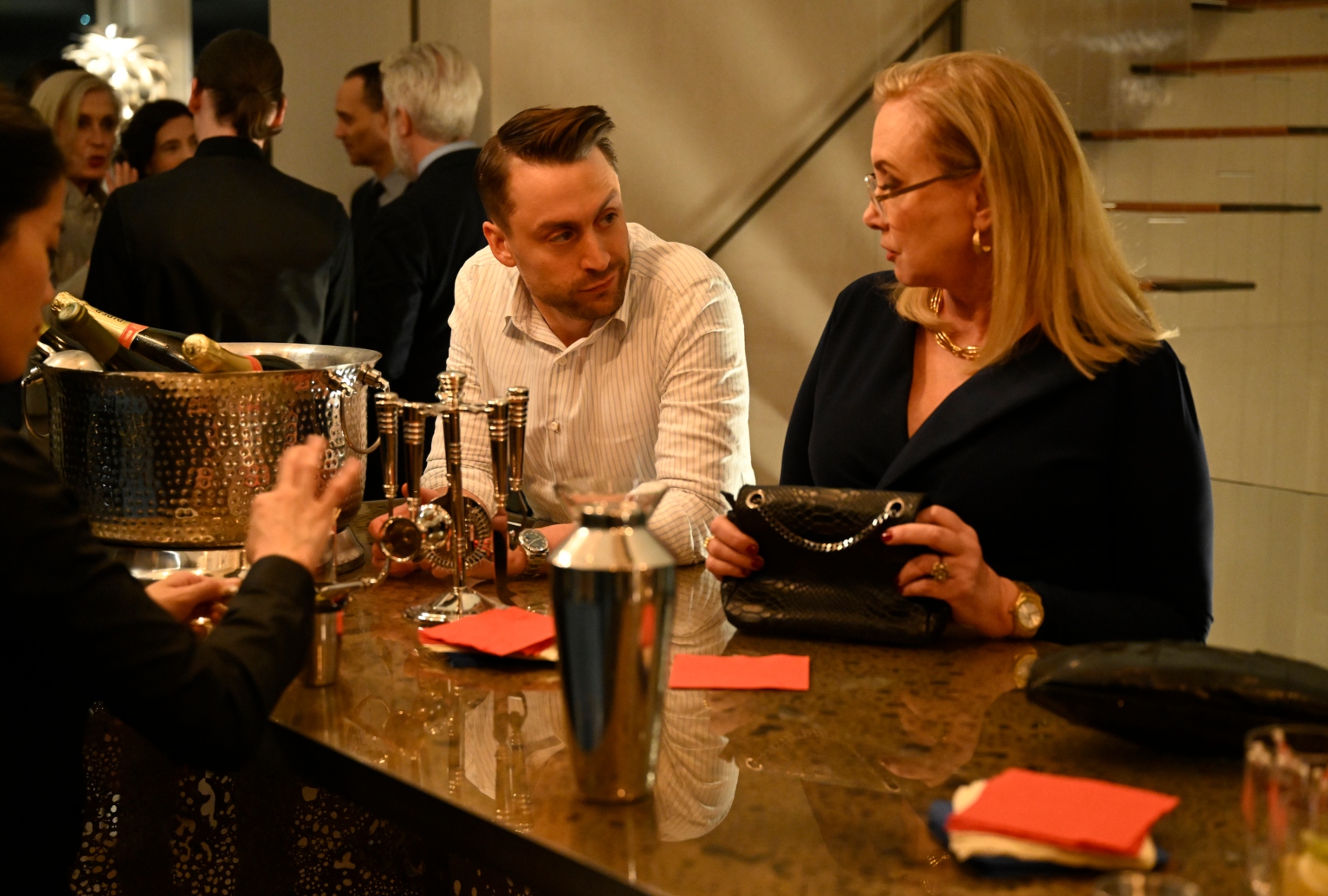
Across the room, Roman sidles up to Gerri and tries to snow her, saying that he didn’t really fire her. But she’s done, having communicated some of her severance demands in writing and leaving others to convey in person. First, she tells him, she wants money. “Eye-watering sums. Hundreds of millions of dollars.”

Second: she’s retained personal reputational management. “And if I ever get a whiff of anything undermining my narrative any time in the next five years, I will sue. And I will go public with the many, many pictures of your genitalia that I have in my possession. Have I made myself clear?”

Then she finishes, in a somewhat sad tone, “I could have got you there. But no. Nope.” And she’s gone.

Very quickly, keeping it real goes wrong.

Kendall and Matsson have a brief locking of the horns in front of the guests where it looks like Kendall is going to out GoJo’s numbers inflation but doesn’t. Instead, when Matsson advises Kendall to “Let the wave hit you. Float out,” Kendall objects with, “I think I am the wave, though.”

His ocean-sized ego whirling, Kendall sidebars with Frank (Peter Friedman) to tell him that the GoJo deal is sour and Matsson’s subscription numbers in India are significantly inflated. Then he proposes going “reverse Viking: We pillage their village. Waystar acquires GoJo . . . What if we could slow this down and we eat Matsson’s lunch?”

“And Roman and Shiv?” Frank asks, leading Kendall to channel his father’s spirit again. “I love ’em, but I’m not in love with them,” he says. “One head, one crown. But I’ll need ballast. Are you with me?”

One man who isn’t is Tom, who spent the evening hearing from people he’s going to be fired. In his own house. He and Shiv head out to their balcony to freak out about their separate misfortunes before turning their stingers on each other: “Should we have a real conversation?” he asks.


Want a daily wrap-up of all the news and commentary Salon has to offer? Subscribe to our morning newsletter, Crash Course.


Very quickly, keeping it real goes wrong. Shiv deeply resents his gift. “I’m a scorpion. You’re a hyena. You’re a street rat. Actually, no, you’re a f**king snake. Here’s a dead snake to wear as a necktie, Tom. Why aren’t you laughing?”

Then Tom lays it all out: “I think that you can be a very selfish person. I think you find it very hard to think about me. And I think you shouldn’t have even married me, actually.”

The air-clearing grown more poisonous with each exchange. Tom’s family is striving and parochial, Shiv says, adding, “You betrayed me.”

Back and forth it goes, meaner and darker until Tom lands the killing cut. “I think you are incapable of love, and I think you are maybe not a good person to have children.”

Tom still does not know that Shiv is pregnant with his child.

“Well. That’s not very nice to say, is it?” she whimpers.

“I’m sorry. I’m sorry,” he says. “You have hurt me more than you can possibly imagine.” So he makes his best effort to hurt her even more when she blames him for taking away the last six months she could have had with Logan by cutting her out.

“It’s not my fault that you didn’t get his approval,” Tom said. “I have given you endless approval, and it doesn’t fill you up because you’re broken.”

With that, they’ve cleared the air. “You don’t deserve me, and you never did,” she finishes, which is particularly cruel since that used to count as dirty talk.

Tom comes in from the balcony and announces the party is over, insisting he’s serious. As usual, nobody takes him seriously, and he leaves.

Roman, meanwhile, volunteers to do the eulogy at Logan’s funeral before he takes off. Ken follows him to the door, leaving Shiv at the bar, looking uncertain. Later that night, Shiv sits awake in the master bedroom, staring out the window. Tom is in the guest room, gawking sadly at the ceiling. They’ve arrived to the same place, at last, and each of them utterly alone, like we always suspected it would be.

New episodes of “Succession” air Sunday at 9 p.m. on HBO.

“See you soon”: Tucker Carlson reportedly “preparing for war” against Fox News

Former Fox News host Tucker Carlson is preparing to battle the network to get out of his contract after he was pulled off the air last month, according to Axios.

Since being ousted from the network in April, Carlson has allegedly begun to ready plans for his own “media empire.” However, he can’t act on them until his contract with Fox concludes in January of 2025.

Two days after being let go, Carlson in a Twitter video teased the idea of creating a Fox rival, saying, “See you soon.”

Axios added that Carlson has reportedly been contacted by other right-wing outlets, such as Rumble and Newsmax, who have offered to pay him more than Fox.

Fox, whose ratings in Carlson’s slot have fallen since cutting loose the inflammatory anchor, wants to keep Carlson under wraps by paying him $20 million a year to not work, according to the report.

“The idea that anyone is going to silence Tucker and prevent him from speaking to his audience is beyond preposterous,” Bryan Freedman, Carlson’s attorney, told Axios.

People close to Carlson have said that he is thinking about creating a direct-to-consumer media outlet that would see viewers pay him directly, the blueprint for which was created by disgraced former Fox News host Bill O’Reilly. 


Want a daily wrap-up of all the news and commentary Salon has to offer? Subscribe to our morning newsletter, Crash Course.


A Carlson source said that the former Fox host “knows where a lot of bodies are buried, and is ready to start drawing a map.”

Another indicated that MAGA allies are prepared to strike back at Fox for keeping Carlson in the shadows.

“They’re coming to him and saying: ‘Do you want me to hit Fox?’ He’s been saying: ‘No. I want to get this done quiet and clean,'” a friend of Carlson’s told Axios.

“Now, we’re going from peacetime to Defcon 1,” the friend added. “His team is preparing for war. He wants his freedom.”

Police probe possible neo-Nazi ties of Texas gunman who wore “Right Wing Death Squad” patch: report

The alleged gunman who claimed the lives of eight people at a Dallas suburbs mall in Texas over the weekend evidently held views aligned with white supremacist and Neo-Nazi beliefs that are now being analyzed as possible motivations for the onslaught, according to The Washington Post.

Though police have not yet released a motive for the attack, 33-year-old suspected gunman Mauricio Garcia was wearing a patch on his chest with the letters “RWDS,” an acronym that stands for Right Wing Death Squad, according to people familiar with the investigation. The Daily Beast reported that the initials are used amongst Neo-Nazis, white supremacists, and paramilitaries. Investigators are now approaching the shooting as a possible hate crime, per The Post.

Political pundit Brian Tyler Cohen called attention to the fact that the same patch was worn by Jeremy Bertino, “one of the Proud Boys who just pled guilty to seditious conspiracy on January 6.”

“The Allen, Texas mass shooter was wearing the same patch,” he added.

People familiar with the ongoing investigation said that the shooter was staying in a Dallas-area hotel around the time of the shooting. They added that the gunman’s parents have been cooperating with authorities as they endeavor to learn more about whether he acted alone. 

Video footage of the shooting’s aftermath circulated on Twitter on Saturday night — various clips showed the bodies of victims heaped outside the mall. 

“Dashcam video circulating online showed the gunman getting out of a car and shooting at people on the sidewalk. More than three dozen shots could be heard as the vehicle that was recording the video drove off,” according to the Associated Press.

The shooting is the second in less than ten days in Texas. Late last month, in Cleveland, Texas, an intoxicated man fatally shot five of his neighbors — execution style — with an AR-15 style rifle after they asked him to stop shooting into the air. 


Want a daily wrap-up of all the news and commentary Salon has to offer? Subscribe to our morning newsletter, Crash Course.


Republican Texas Gov. Greg Abbott drew criticism in the wake of the shooting for referring to the victims as “illegal immigrants” in the same statement that offered condolences to the victims’ families. 

“I’ve announced a $50K reward for info on the criminal who killed 5 illegal immigrants Friday,” Abbott said in a statement posted on Twitter. 

At least eight people were killed and nine others were injured in a separate attack on Sunday in Brownsville, Texas after a Range Rover SUV rammed into a crowd waiting for a bus outside a migrant shelter.

Luis Herrera, who was among those hit by the car, stated that the driver, a Hispanic male, “was taunting people standing at the bus stop, driving past them and yelling insults.”

Herrera told The Post that the suspect was yelling, “You’re invading my property!”

WaPo also reported that Brownsville is one of the busier hubs of migrant crossings along the U.S.-Mexico border, as it borders the Mexican city of Matamoros.

For the love of guns

It was another bloody weekend in America’s sick and twisted shooting gallery. This time, a man dressed in full tactical gear and carrying an assault rifle got out of his car at a shopping mall in Allen, Texas, and started randomly shooting people on the sidewalk. A police officer who was coincidentally on the scene for another call took down the shooter after he had shot 16 people, killing at least 8 and possibly more. (Several people are reportedly still in critical condition.) This is seen as a huge success story among gun fetishists because it shows that a good guy with a gun can stop a bad guy with a gun — with only a dozen and a half casualties. It’s what we call “good news” these days.

Last week, we had two other major shooting incidents. One, in Atlanta, caused the whole downtown area to be shut down for hours after a man shot five women in a doctor’s office and then disappeared into the labyrinth of office buildings. Before that, in Texas again, a man who was upset because his neighbors asked him to stop shooting his gun in the front yard at 11 o’clock at night decided to execute five of them in their home moments later. Both men were apprehended after massive manhunts.

All three of these cases appear to have different motivations.

The Atlanta shooter was diagnosed with mental illness and was reportedly angry that he didn’t get the prescription he wanted. The man who shot his neighbors was a drinking man with a hot temper and a penchant for guns. We don’t know for sure what motivated the mall shooter — the Texas authorities are refusing to brief the public about virtually anything to do with this mass killing for some reason — but according to Rolling Stone and other media reports, it appears the shooter was a white supremacist:

The suspected mass shooter who killed at least eight people at an Allen, Texas mall on Saturday frequently posted pro-white supremacist and neo-Nazi materials on social media, according to an FBI bulletin reviewed by Rolling Stone.  The FBI’s “review and triage of the subject’s social media accounts revealed hundreds of postings and images to include writings with racially or ethnically motivated violent extremist rhetoric, including neo-Nazi materials and material espousing the supremacy of the white race,” the bulletin reads.  

Rolling Stone also reports that according to an internal email, investigators believe the shooter was a neo-Nazi and an “incel.”  (And yes, he has a Hispanic last name which means nothing despite right-wing commentators’ insistence otherwise — two of the most famous white supremacists in the country are a Nazi named Nick Fuentes and a Proud Boy named Enrique Tarrio.) In other words, this particular mass shooter appears to be another right-wing terrorist but we don’t have official confirmation of that because again, Texas authorities aren’t bothering to brief anyone.

So we have three mass shooters in the course of a week who seem to be motivated to kill a large number of people for a variety of reasons. According to Republican politicians, the common thread is that mental illness is causing all of this bloodshed or it’s an act of God and there’s nothing we can do about it. Here’s one Texas legislator making both claims simultaneously:

The Governor of Texas, as he is wont to do after every mass shooting that takes place in his state, also claims that the “real” problem is mental illness which we really should do something about:

Gov. Gavin Newsom, a Democrat, is correct about the fact that Texas has a 73% higher gun death rate than California so Abbott is being disingenuous when he makes that claim. There is simply no doubt that states with looser gun laws have higher rates of gun violence. And the gun laws are getting looser by the day with both Texas and Florida recently just letting their gun-freak flags fly and allowing unlicensed carry pretty much everywhere.


Want a daily wrap-up of all the news and commentary Salon has to offer? Subscribe to our morning newsletter, Crash Course.


As it happens, Texas also has very high rates of mental illness and the lowest rate of access to mental health care in the country so he needs to stop cutting mental health services in the state if wants to have any credibility on that issue. We go over this every time there is a mass shooting but it’s apparently necessary. As this survey shows, mental illness is prevalent all over the world with estimates of more than a billion people suffering from one form or another. It’s obvious that mental illness is universal across all humanity. Yet we are the only country that has this problem with constant mass shootings. It is intensely frustrating to have to make this point over and over again but there’s no choice. An average 6th grader can look at those facts and determine that while we all have mental illness in our societies the reason only America is awash is gun violence is because we are awash in guns. No other country is suicidal enough to allow this.

We can all agree that mental illness is at least a real problem for many reasons and should be addressed by government. If the Republicans would agree to actually do that it could be helpful but generally speaking they pay lip service to it the same way they pay lip service to “thoughts and prayers” and then try to change the subject.

But there is another right-wing school that says that gun violence is like the weather, there’s nothing we can do about it so best accept the fact that you may have to kill people if you want to go out in public. Here’s a gentleman on Fox News making that case:

Oh, and don’t say anything that might set someone off. Maybe it would be best just not to talk to anyone. They could be having a bad day and they might have an AR-15 in their car and then you’ll have to pull yours out and the whole day will be ruined, what with all the carnage.

That’s a little extreme even for Republicans but it really isn’t that far off from the common cry for “hardening soft targets” which basically means turning our entire society into armed camps with all public places under guard, doors locked and people with weapons and body armor, civilian and government alike, as if we are all supposed to live as if we are in a war zone ready to shoot at the first sign of danger. Here’s what that looks like:

They’re right about one thing. The sickness in this vision isn’t the guns themselves. Those are just mechanical objects. The poison that’s killing us is gun culture. These fetishists are prescribing a dystopian future, all so they can own the lethal weapons that are perpetuating the violence from which they then claim they need to defend.

“He has no defense”: Judge “calls Trump’s bluff” after he threatens to “confront” E. Jean Carroll

Former President Donald Trump on Sunday blew through the final deadline to testify in his defense against E. Jean Carroll’s rape and defamation allegations.

U.S. District Judge Lewis Kaplan gave Trump’s legal team until Sunday to file a request for the former president to testify but nothing was filed, according to Politico.

Trump has not shown up for the trial though the jury watched excerpts of his October deposition. Trump attorney Joe Tacopina immediately rested his case on Thursday after Carroll’s side wrapped up but Kaplan gave Trump extra time to request to testify after the former president vowed to cut his Ireland trip short to “confront” Carroll.

If Trump misses the deadline, Kaplan warned, “that ship will be irrevocably sailed.”

Trump told reporters last week he would “probably attend” the trial.

“I’m going back to New York. I was falsely accused by this woman, I have no idea who she is – it’s ridiculous,” he claimed. “I’ll be going back early because a woman made a claim that is totally false, it’s fake,” he added.

Trump also called the case a “political attack” and claimed the judge was “extremely hostile” and “doesn’t like me very much.”

Trump’s lawyers were not thrilled with the plan. Shortly after Trump’s remarks, Tacopina told the New York Daily News that his client would not be testifying at the trial.

Former U.S. Attorney Joyce White Vance said “Trump folded like a meek little mouse.”

“The judge has called Trump’s bluff,” she told MSNBC, adding that “what the judge does here is he forecloses Trump’s opportunity to tell everybody what a terrible biased judge he had.”

Carroll testified during the trial that Trump raped her in the dressing room of a Bergdorf Goodman store in the 1990s. The jury also heard from a friend that Carroll told about the alleged assault after it happened and two women who similarly accused Trump of sexual assault. The jury also heard the infamous Access Hollywood tape in which Trump brags about grabbing women “by the pu**y.”


Want a daily wrap-up of all the news and commentary Salon has to offer? Subscribe to our morning newsletter, Crash Course.


Carroll’s “evidence was strong, including her testimony” and corroboration from other witnesses, tweeted former Watergate prosecutor Jill Wine-Banks. But Trump “has no defense. None. Zero,” she wrote.

During one excerpt of his deposition, Trump defended the Access Hollywood tape, doubling down on his belief that fame allows celebrities to take advantage of women.

“Well, historically, that’s true with stars,” he said. “If you look over the last million years I guess that’s been largely true. Not always, but largely true. Unfortunately or fortunately,” he added.

Former U.S. Attorney Barb McQuade argued that the deposition video was “devastating to his case.”

“He affirms the sentiments that he made in that [Access Hollywood] recording. There are 1000 ways you can deflect that recording; you can say, it was an offensive and ill-advised joke. You can say we were just puffing, it was just locker room talk, all these kinds of things,” she told MSNBC.

“Not only did he repeat it, he defended it and said yes, he’s the kind of person who is entitled to this sort of behavior,” she added. “I think it’s devastating and damaging. It appears to be a rare moment of candor for Donald Trump… I think it certainly supports the claims of E. Jean Carroll.”

What has gotten into Republican women?

Late last month, a bill that would have banned nearly all abortion (and likely would have been used to restrict hormonal birth control as well) was defeated in the South Carolina Senate, despite it being one of the most conservative legislatures in the country. The defeat drew national headlines in no small part because of how it went down: The only five women in the Senate, three of whom are Republicans, filibustered the bill into oblivion. At times, the Republican women sounded downright, well, feminist.

"Once a woman became pregnant for any reason, she would now become the property of the state of South Carolina," state Senator Katrina Shealy declared angrily during debate.  

South Carolina is not some outlier state where the rare bird of the pro-choice Republican flourishes, to be clear. In the same speech denouncing abortion bans, Shealy insisted she is still "pro-life." It's just that these women are learning a hard lesson, as are many other Republican women, both leaders and voters. It was easy enough to be "pro-life" when Roe v. Wade was the law of the land. That meant you could sit in judgment of other women, without ever worrying that you or your loved ones would lose access. Indeed, it was easy enough to pass restrictions that made it harder for poor women or young women to get abortions, so long as Republican women could be assured their privilege would smooth the way for their abortions. 


Want more Amanda Marcotte on politics? Subscribe to her newsletter Standing Room Only.


But outright bans on abortion, the kind that actually threaten the access not just of marginalized women, but well-to-do white ladies? That cannot stand! This phenomenon is joked about on social media as the "leopards eating people's faces party," due to a viral tweet by author Adrian Bott.

They can't yell at condescending husbands or abusive fathers, not without losing status in their communities. But that angst can be projected onto bogeymen.

The humor of this tweet depends heavily on the imaginary sobber being female. For better or worse, people understand why white men are Republicans: Because the GOP is built around the preservation of white male domination over everyone else. But why so many women vote Republican is a question that causes great consternation, since the party is not exactly subtle about its hostility to women's rights. Their last president and current party leader bragged, on tape, about sexual assault! Is it that these women hate themselves?

The tweet gets closer to the real answer: Republican women, like Republican men, enjoy cruelty to others. They also assume their class and race privilege will shield them from the misogyny of their party. But when that assumption gets rattled, they often panic. 

There's more to the situation than a mere love of punching down. Republican women understand that they live in a sexist society. They just tend to see feminism as a pipe dream not worth fighting for. A safer bet, to most of them, is to accept second-class status to men, and then try to leverage femininity and conservative politics to scratch out some level of status and power for themselves within a patriarchal system. That's how old-school anti-feminists like Phyllis Schlafly played the game: By organizing against the Equal Rights Amendment, she and her army of housewives gained political power and a voice, without stepping on any male toes and risking backlash. 

The Republican Party has gotten downright crafty in creating opportunities for middle- and upper-class white women to feel powerful by punching down while maintaining a submissive posture towards the men in their lives. Recently, David Gilbert of Vice published an in-depth look at how the new astroturf movement, Moms for Liberty, offers conservative women a chance to pull off that balancing act. The group focuses its efforts on banning books in schools and libraries, harassing organizations that advocate on behalf of LGBTQ kids, and bullying teachers and other school officials for offering real education instead of fact-free right-wing propaganda. Moms for Liberty has unleashed some deeply antisocial behavior in these women: 


Want more Amanda Marcotte on politics? Subscribe to her newsletter Standing Room Only.


In Pennsylvania, the leader of a local Moms for Liberty chapter allegedly hijacked a dead woman's Facebook page to harass her enemies, including using the N-word and saying they should hang from a noose. In Arkansas, the head of communications of the Lonoke County chapter said that librarians should be "plowed down with a freaking gun." In Chattanooga, Tennessee, a member of a local Moms for Liberty chapter harassed an opposing group, threatened to report them for child abuse, and called them "pedophile sympathizers." In Milwaukee County, Wisconsin, police had to be called to a school board meeting after members of Moms for Liberty accused attendees of being "groomers" and wanting to show explicit pictures to children. In Charleston, South Carolina, a Moms for Liberty-affiliated member of the local school board publicly stated he would show up at his son's teacher's doorstep with a gun if the teacher came out as transgender.

Hat tip to Natalie Wynn at Contrapoints for reminding me of the 1983 book "Right Wing Women" by Andrea Dworkin. Dworkin was a feminist polemicist who had a lot of ideas that don't age well, but in this book, she's got conservative women dead to rights.

"Women cling to irrational hatreds, focused particularly on the unfamiliar, so that they will not murder their fathers, husbands, sons, brothers, lovers, the men with whom they are intimate, those who do hurt them and cause them grief," Dworkin wrote. "Because women so displace their rage, they are easily controlled and manipulated haters."

They can't yell at condescending husbands or abusive fathers, not without losing status in their communities. But that angst can be projected onto bogeymen. Bullying LGBTQ kids or banning books provides a socially acceptable outlet for that rage. They can wallow in being domineering and mean, and get commended for it, because they're doing it in the name of "family values." 

The face of this was neatly illustrated last week, when a bunch of Republican women in Montana decided to bully trans state representative Zooey Zephyr by taking the only seat she could work at after the Republican majority barred her from the floor for speaking out about trans rights. The photo of these women, who are downright gleeful in their cruelty, speaks volumes. 

It's no surprise it's all women. Transphobia gives them a chance to step out of the thankless role of being servile and deferential, letting them play the role of the bully. It's hard for most of us to imagine being so incredibly petty as to spend even one moment of our limited time on earth doing something like this, but it's safe to guess these women don't have a lot else going on in their lives.  

Indeed, anti-abortion politics has long provided this outlet for a lot of Republican women. They could go to clinics and harass patients going in. They could work at anti-abortion centers, trying to trick vulnerable women into not getting an abortion. They could post lengthy diatribes on Facebook about how feminists are man-haters, and collect the accolades for their supposed Christian purity. It's all fun and games, as long as Roe stood and they knew they could quietly access abortion as needed. 

Then Roe was overturned and that two-faced approach suddenly became less tenable. Abortion bans rub Republican women's noses in the fact that the men in their lives would rather they be dead than free. Most of these women are skilled enough at cognitive dissonance to find some excuse for ignoring that grim reality. They'll keep pretending that the "real" problem is feminists or queer people, instead of the men in their homes and beds who believe they don't deserve basic rights. But, as the South Carolina situation shows, some of them are feeling forced to resist, often for the first real time in their lives. 

(Not) made in America: 6 Korean shows and their remade U.S. counterparts

If you consume any form of TV, you probably know that the world has been split into two categories in recent years: people who love Korean dramas and people who never even watched “Squid Game.” 

What many people aren’t aware of, though, is exactly how much Korean media we’ve been consuming without even knowing. 

With the rise of K-Pop, the history-making “Parasite” Oscar win in 2020 and the way “Squid Game” took over Netflix, this may not sound that surprising. But American remakes of Korean shows have been happening right under our noses for longer than that. 

For example, if you’ve ever seen ABC’s “The Good Doctor,” then you were watching a K-drama remake before K-dramas were considered cool. At least in the U.S. 

You probably didn’t know, because giving a character played by Freddie Highmore a name like “Park Si-on” wouldn’t make much sense. Although “Si-on” does sound like “Shaun,” the American counterpart’s name.

This didn’t stop with “The Good Doctor.” Korean TV shows have also influenced some of the game shows, reality shows — and more — that we’ve come to know.

ABC’s “The Company You Keep,” which premiered earlier this year to critical and popular praise, is just the latest example of this. While a main character in the CIA may be distinctly American, the story itself is pulled from a 2019 K-drama. 

So, if you’re a Korean media lover looking to branch into remakes, a fan of “The Masked Singer” or just curious about what shows have Korean roots, look no further. 

01

“The Good Doctor” (ABC, Hulu)

The Good DoctorFreddie Highmore in “The Good Doctor” (ABC)

Based on: “Good Doctor” (KOCOWA, Viki) 

“Good Doctor” is about Park Si-on, a man on the autism spectrum who is given a six-month trial as a pediatric surgery resident to prove that he is capable of doing the job. His photographic memory and spatial skills that help him as a doctor clash with his social skills and the way other doctors and patients view him. The show maintained the top spot in its time slot in Korea for most of its run, and was remade not only in the U.S., but also in Japan and Turkey. 
 

About the remake: The remake came about when Korean-American actor Daniel Dae Kim saw the original in 2013, and decided to buy the rights and adapt the series. “The Good Doctor” stars Freddie Highmore as Shaun Murphy, a young surgical resident with autism who leaves his small hometown and troubled past to complete his residency in San Jose, California. Similarly to the original, his attention to detail and photographic memory help him in his work, but he struggles socially. 
 

When “The Good Doctor” premiered, it was the most-watched Monday drama debut on ABC in 21 years. And according to TV Guide, its episode on Oct. 9, 2017 attracted 18.2 million viewers, which topped both “NCIS” and “The Big Bang Theory” for the most viewed primetime show that week. “The Good Doctor” gained popularity both in the west and in South Korea — receiving Western award nominations along with nominations in South Korea, and even winning “Most Popular Foreign Drama of the Year” at the Seoul International Drama Awards in 2019.


02
“The Masked Singer” (FOX, Hulu)
The Masked SingerThe Masked Singer (Michael Becker/FOX)

Based on: “The King of Mask Singer” (KOCOWA+) 

Hosted by TV personality Kim Sung-joo, the singing competition invites celebrities from various fields to sing while concealing their identity with an elaborate mask and gloves, thus eliminating judging based on age, career or popularity. Guest contestants even include this well-known American unicorn.
 

About the remake: The American remake was a huge success and even landed the much coveted post-Super Bowl spot in its third season premiere. It also helped to boost the careers of Nick Cannon as host and Ken Jeong, Jenny McCarthy Wahlberg, Nicole Scherzinger and Robin Thicke as the judges. In order for race to not be a factor, full-on body costumes were used instead of mere masks, which adds to the show’s bizarre appeal, in addition to the over-the-top shenanigans that ensued to keep the celebs’ identities a secret. The contestants have ranged from former boy banders to rappers, Broadway stars and athletes.


The show is not without its controversies, however. While Sarah Palin’s inclusion raised eyebrows, the contestant that caused the most outrage was the former “America’s mayor” and Trump attorney Rudy Giuliani, whose presence reportedly led judge Ken Jeong to walk out of taping. – Hanh Nguyen


03

“I Can See Your Voice” (Fox, Tubi)

I Can See Your VoiceI Can See Your Voice (Michael Becker / FOX)

Based on: “I Can See Your Voice” (MNet) 

“I Can See Your Voice” is the only singing show where the judges don’t actually get to hear the contestants singing before making their decision. Each episode features a guest judge who, along with a panel made up of celebrities and idols, attempts to eliminate bad singers from a group of six people. The guest has seven rounds to eliminate contestants based on their image, introductions, lip-syncing and more — including an interrogation round.
 

The moment of truth comes when the contestant who makes it to the end must sing and prove whether or not the judge was right. The winner earns either a cash prize of ₩5,000,000 (roughly $3,800) or the opportunity to release a digital single. The show ran for seven years and has been remade 28 times throughout Asia, Europe and North America. 
 

About the remake: Produced and hosted by Ken Jeong, this version follows a similar format. The guest, though, is a regular person aiming to win $10,000 each round by eliminating a bad singer. The first two rounds are lip-sync challenges, the third and fourth reveal other clues and in the final round, the guest gets to interrogate the remaining contestants. Celebrity panel fixtures Cheryl Hines and Adrienne Bailon-Houghton have previously been joined by stars such as Jordin Sparks, Kelly Rowland, Robin Thicke and more.


04

“Snowpiercer” (TNT, Prime Video)

Daveed Diggs; SnowpiercerDaveed Diggs in “Snowpiercer” (Warner Media/TNT/Justina Mintz)

Based on: “Snowpiercer” (Hulu) 

While this remake isn’t based on a TV show, everyone knows Bong Joon-ho by now. The original film, released in 2013, features Captain America actor Chris Evans alongside Tilda Swinton and “Parasite” star Song Kang-ho before most of the West knew who he was. Based on a French graphic novel called “Le Transperceneige,” it takes place in an apocalyptic future where citizens are stuck in a caste system on a perpetually moving train until the back of the train decides to rebel. The film, containing half English dialogue and half Korean dialogue, received rave reviews and a laundry list of global nominations and awards. 
 

About the remake: The show first aired in May 2020, with Bong Joon-ho listed as an executive producer alongside Scott Derrickson and others. It picks up with a new cast of characters set on the same train. Jennifer Connely and Daveed Diggs star as Melanie Cavill and Andre Layton, two passengers on opposite ends of the train. Similarly to the film, the show uses a dystopian setting to explore issues with class, social standing and social justice. The show ran on TNT for three seasons from 2020 to 2022 — with the fourth season intending to be the last, as well as TNT’s final original series release. The fate of the season remains in limbo, however, following the merger of Discovery Inc. with Warner Media, the parent company of TNT.


05
“Better Late Than Never” (NBC, Hulu)
Better Late Than NeverBetter Late Than Never (NBC Universal)

Based on: “Grandpas Over Flowers” 

The title of this reality series, “Grandpas Over Flowers” borrows from the popular Korean drama “Boys Over Flowers,” which features four popular and good-looking boys (plus the girl who gets wrapped up with them). In “Grandpas Over Flowers” four actors in their 70s — Lee Soon-jae, Shin Goo, Park Geun-hyung and Baek Il-seob — go on an overseas backpacking adventure with younger actor Lee Seo-jin. The show’s popularity led to two Korean spin-offs and remakes in China, Germany and the U.S. 
 

About the remake: “Better Late Than Never” follows William Shatner, Henry Winkler, George Foreman and Terry Bradshaw on a trip overseas with comedian Jeff Dye, to experience new cultures and check things off their bucket lists. In the first season, they visit cities in Japan, Korea, China and Thailand, during which Shatner took up an interest in Buddhism and the cast got to meet K-Pop girl group Girls’ Generation. The second and final season, in 2018, took them across Europe. 


06

“The Company You Keep” (ABC, Hulu)

The Company You KeepJames Saito, Freda Foh Shen and Tim Chiou in “The Company You Keep” (ABC)

Based on: “My Fellow Citizens!” (Prime Video, KOCOWA) 

“My Fellow Citizens!” stars Choi Si-won as a con man down on his luck and Lee Yoo-young as the police detective he begins dating, who doesn’t reveal her job to him until their wedding day. The show premiered in 2019, and completed with 36 episodes — longer than the usual 16 episode K-drama format. 
 

About the remake: The newest on this list, “The Company You Keep” premiered on ABC in February. It stars Milo Ventimiglia as Charlie Nicoletti, a con man and member of an Italian crime family, and Catherine Haena Kim as undercover CIA officer Emma Hill. When Charlie and Emma meet in a bar after finding out their partners have betrayed them, they spend the weekend together, unaware of their conflicting professions.


Why we all love “Somebody Somewhere” star Jeff Hiller: “Everybody feels like they’re the outsider”

Jeff Hiller is a lithe and generous conversationalist – bright, quick-witted, and effortlessly hilarious. A stranger quickly feels like a friend in the “Somebody Somewhere” star’s presence, making his breakout presence understandable. Loving this frustratingly hidden gem means loving Bridget Everett‘s Sam and, equally, her stalwart friendship with Hiller’s Joel.

Joel is a fantasy version of a best friend, especially in the first season when Sam is still grieving her sister Holly’s death. Her loss still colors Season 2, but the joy in their lives is a lot brighter. For the show’s return, Sam is settling into her Kansas life, contending with aging parents and rebuilding her relationship with her other sister Tricia (Mary Catherine Garrison) and with Joel at her side, making an effort to get in her 10,000 steps every day.

Joel’s also moving forward from a recently ended relationship, mainly by joining himself at Sam’s hip. “No new people!” she tells him before one of their walks.

Best friends can grow unhealthily close, something the recently debuted second season began to wink in the second episode’s closing scene, a “can’t unsee it” physical comedy sequence where Sam and Joel share a phone conversation during a bout of, shall we say, mutual gastrointestinal distress.

By some miracle, this extreme toilet humor doesn’t cheapen anything that comes before it in the episode cheekily titled “#2.”

Where the roar enveloping Sunday night neighbors “Succession” and “Barry” is related to the former’s conversational excess and the latter’s technical athletics, naturalism distinguishes “Somebody Somewhere.” Manhattan, Kansas is the inverse of its New York cousin – sunny, warm, roomy and welcoming, a place we’d envision producing someone like Joel.

Hiller feels that way about him, too. Before “Somebody Somewhere” came his way, the actor played a slew of outrageously unpleasant people. (I also remembered him from one of his first movie roles in 2008’s “Ghost Town,” for reasons explained in our conversation.) Everett and the “Somebody Somewhere” writers saw in Hiller what so many casting directors didn’t, to the extent that for a time, Hiller thought they’d written Joel for him. They didn’t, but we can see why he’d think that.

“Somebody Somewhere” is one of the few shows on TV where queer characters can simply exist without justification or tension, or reduction to a stereotype. Joel’s life is fully realized apart from Sam, which becomes a problem. But much of the second season revolves around a happy event: the imminent wedding of Murray Hill’s Fred Rococo, casually announced during a poker game. 

To Hiller, all of this is relief and a blessing at a time when rights for LGBTQI+ are under assault. “I’m just really happy to be playing a character who is openly queer and also a human, normal, good person,” he said. Watch our wide-ranging “Salon Talks” conversation here, to see Hiller happily discuss the charms of playing Joel, working with Everett, and a musical shout-out that’s also a perfect match for his character.

This interview transcript has been lightly edited for clarity and length.

This show was such a comfort when it premiered because we were coming out of the pandemic and here’s this beautiful show where it’s sunny and outside, and also in Kansas, which is one of those places that generally people don’t see depicted realistically on television. The second season continues that. How do you think that this season will hit people? 

It’s been a year since we’ve last seen them, and Joel and Sam are super tight, super, super tight, maybe almost so tight to the exclusion of others, which is maybe not necessarily always super healthy. Joel is ready to look around and see if he can start getting some of those other things on his dream board and keep growing, keep growing, because that’s what’s great about Joel is that he’s not afraid to say, “I think you need this. I think I need this.” I love that about him, and I want him to continue to get those vision board things.

Let’s talk about the vision board because that is such a huge part of Joel’s personality. Are there things on the vision board that have changed for this season? 

“I love that this show made the bold choice to show this truth that never gets shown, ever.”

Maybe not the macro, but the micro, I think he still wants the general things that he wanted before, but now the specifics are aimed in a different way because life has led him in a different way. We’re going to all identify with that, when you look around and you’re like, “Oh, this is life after 40?” I think that he’s really honing in [sic] and realizing exactly what it is that he wants and what he wants to go and get.

Joel has this connection to a very specific song that’s a touchstone. Tell us about Laura Branigan’s “Gloria” and what that means to Joel. And, did it mean anything to you?

Well, this is one of those things, you hear stories about people writing toward the actor, and this is one of those. This is a song that means a lot to me. I wrote the song “Gloria.” Imagine, if I was just delusional. I put it on a playlist. That’s my creative element. I created this playlist called “Yes, Girl” and during Season 1, I was driving Bridget [Everett] and Murray Hill, who plays Fred Rococo, around, probably going to either Target or brunch because our options were limited during the pandemic, and that song came on and we all just wanted to sing, it was just so beautiful. If you listen to the words — the teaser has already been released where you hear Joel saying that he wants this song at his wedding — it’s not a song for a wedding, but it’s a song that has so much joy and so much release that even with the words that don’t mean anything about a union between two people, the joy is still there. 

Laura Branigan has pipes, so does Bridget Everett. When we were driving around in Season 1 and that song was playing and she was singing along, I was like, “I can’t believe I’m driving with Bridget Everett, and she’s singing this song with me!” Because I’ve been worshiping her for a little over a decade in New York City’s downtown theater community.

What is it about the connection of music in the show to its emotional story?

Bridget talks about it as another character, you know how they say New York is the fifth woman in “Sex and the City,” it’s music is the third friend in Manhattan, Kansas. The show has this mandate for authenticity. They really want it to seem natural and seem real, which is not to say that I don’t love in “Chicago” when Renée Zellweger is all of a sudden in this beautiful light wearing gorgeous costumes. I love that stuff. But this is really played for how music moves you in real life, and it is singing a dirty song in your car while you’re driving around, or just a song comes on the radio and you love it, or you have silly little chants while you’re making a drink.

Oh, yeah. Can you share that or is that a surprise?

Oh, I don’t know. I think everyone can know about the song “Teeny Tini.” It’s not a big tini, it’s a little tini, a teeny tini. It’s a martini. 

Did you all make that up?

That is a hardcore, 100% Bridget Everett original.

Some of the fun about this show is that you get to see these moments that one suspects are either callbacks to the cabaret or improvised in addition to the scripted moments. What freedom did you have to insert your personality and those improvisations into Joel?

“Music is the third friend in Manhattan, Kansas.”

The showrunners, Hannah Bos and Paul Thureen, give us a lot of leeway. We’re not changing the actual meaning of the script, but we are massaging the words to make them feel natural, to make them feel like they’re coming from our mouths. And you’re not trying to be Judd Apatow where you’re like, “Let me see this outrageous thing that’s super hilarious” because you’re wanting to continue that realness and that authenticity, but it is about making it feel natural. I think that’s the big thing. It’s not about making it feel outlandish; it’s about making it feel natural. I come from the improv world, so I think we normally think of it as being Jane Lynch being so hilarious talking about all the guys she had sex with in that show or whatever. I’m thinking of “The 40-Year-Old Virgin.” I don’t know why I’m going there, but I am. This is not that kind of improv, this is more like making it real, making it natural.

You studied theology as well as theater.

I did.

At Texas Lutheran [University], and those things go together.  There is a little bit of a spectacle in presenting the liturgy, right?

A hundred percent.

Did those elements of what you initially studied come back to the fore after all these other roles that you had, which of course are very different from Joel?

Yeah, exactly. But before Joel, I played a lot of mean waiters and flight attendants that took away your bag.

And Naked Guy. I do remember you as Naked Guy. 

“I don’t think that we approached it as a political act, but right now the personal is political.”

Yes. They put that picture in my college magazine. Can you imagine? I played a naked ghost in “Ghost Town.” Good memory. When I read the script — I took this acting class and it was like, “When you’re going to get a serious regular role, it’s really going to be a role that is of your essence,” and I thought, well, crap, nobody writes roles that are my essence. I’ll never get a TV show. And when I read this, I thought, “Oh my God, this is of my essence.” So much so that I thought, “Oh, maybe they wrote this for me,” but then since then, every gay man over 40 is like, “Yeah, I auditioned for that part too.”

What would you say your essence is that you believe that Joel captures?

He’s an optimist. He’s in love with music. He believes in chosen family. He worships Bridget Everett. That sounds a little flippant, and I don’t worship Bridget Everett, but I think there is a certain type of person who can see someone who is out there and a star and say, “I know that person is a star and nobody else does, but for some reason I know it and I can’t wait until you all catch up.” I think Joel and I both feel that way about Bridget and Sam. 

I think the fact that he is a part of a faith community, you never see that. If you ever see gay plus church, it means churches hurting gay. You never see them working together. And I know dozens of, I grew up in Texas, so that’s where they mostly are, of queer folks who are members of faith communities and that is where they find their social outlet, their spiritual outlet, their friends, their chosen family. I love that this show made the bold choice to show this truth that never gets shown, ever. Not that I’ve seen at least.

That must have been meaningful for you . . . It’s one thing to say, “Hey, I am a gay man and I go to church,” and be part of a faith community. But also acting from a position of faith must have been interesting for you to take on.

“I know that I’ll never have another role that’s as good as this.”

Yeah, it reminded me a lot of the really cool Christians that I know that are not about the dogma and the rules and the judging, but are about this message of social justice and welcoming and love and being moral, and it’s about what’s right, not about the rules or what have you. I love that he does that. I love that he’s got this moral core and this center that is important to him and that he’s going to abide by, and then you can watch “Succession” and go the other way.

You mentioned something about the fact that this is such a different role from a lot of what you’ve played before, like the mean side character. When I was looking at this season and your recent titles, there’s Whitely in “American Horror Story,” you have a role in “Evil” and then you have this. What is it like for you to be known for all these roles who are memorable, partly, because of their outsized meanness?

I thought you were going to say “weird looking.”

No. Or Whitely, who’s on another level.

He’s more than me.

But also you as Jeff, what is it like for you to come out of doing all these roles, that you do very well and are memorable for, and then play Joel? 

“It’s important too to put that out there, to show queer people who are whole and not heroes, not saints, but not evil monsters either.”

I know that I’ll never have another role that’s as good as this, and I feel so grateful that I get to play it, that people are watching it enough that we can have a second season. I know this sounds a little lofty, you’re like, “All right, it’s seven episodes on HBO, calm down.” But that I am putting out this character who is a member of the LGBTQI+ community, but also a human and three-dimensional. Right now it’s not a good time to be a queer person in the United States and there’s all this distraction and laws saying queer people are going to take your kids and turn them into goblins, and I’m just really happy to be playing a character who is openly queer and also a human, normal, good person. I’ll play a serial killer again too, but my point is I love Joel, and I love that Joel is not a saint, but he’s also not a stereotype. He’s a full person.

There is a raft of legislation . . . that is very anti-drag, anti-trans, anti-queer in state legislations or state governments throughout the country, including in Kansas. The season revolves around a marriage, involving Fred Rococo, who’s found love, and it’s all about preparing for his wedding. Fred specifically says, “Look, we went and spoke to her parents. She said, ‘Look, I’m in love with a trans man. This is who I love.'” What was it like to be in those moments and filming them and knowing that it would come out?

I don’t think that we approached it as a political act, but right now the personal is political, especially the personal of these personals. And so it is revolutionary, it is political, it is an act of protest, just by showing a trans person, a queer person who are people. I think that that is sort of revolutionary and I think that it comes from a character place, a story place that this makes sense. That is what these characters would do. That is how these characters would live. And unfortunately, we live in a time where that is political. But I think it’s important too to put that out there, to show queer people who are whole and not heroes, not saints, but not evil monsters either.

And finding respite and connection and community too. People, especially right now, have to learn how to reconnect with each other. I feel like this season really explores that.

I love that. I think that everyone, be you queer or too old or you don’t fit in, everybody feels like they’re the outsider. That’s a little secret that I’m just now discovering. It’s so nice to see these folks who feel like outsiders finding each other and finding community. It fills my heart with joy, it’s like a weighted blanket.

New episodes of “Somebody Somewhere” air Sundays at 10:30 p.m. on HBO.

Workplace bullies come in four distinct “types.” Here’s how to deal with each of them

On the surface, she seemed to be at the pinnacle of her career. But inside, Megan Carle says she “felt so alone” at work. She’d spent three decades — roughly her entire professional life — rising through the ranks of Nike, one of the most successful companies in the world. What few people, even her colleagues, knew was that she was also experiencing the demoralizing ordeal of workplace bullying.

“I was always back on my heels, I always expected some sort of different outcome,” she recalls.

And though she’d been raised with a winners-never-quit ethos, in 2016, she left her job. Two years later, a #MeToo era shakeup at the company led to more departures — this time from several of Nike’s top executives. 

By then, however, Carle had moved on, creating a new career for herself as a consultant and writer. Now, in her debut book “Walk Away to Win: A Playbook to Combat Workplace Bullying,” Carle combines the hard-won lessons of her own experience with interviews with other veterans of workplace bullying to create a realistic approach to recognizing the problem — and taking back control of your life and your ambitions.

Salon talked to Carle recently about what workplace bullying is and isn’t, why it’s so insidious, and how to create a plan for getting space between you and the bully and your professional life back on track. And while bullies thrive on making their marks feel incompetent and off balance, Carle says, “It’s not your fault. Don’t suffer in silence.” 

This conversation has been edited and condensed for clarity.


Want more health and science stories in your inbox? Subscribe to Salon’s weekly newsletter The Vulgar Scientist.


The title of the book evokes our era of work, in which “quiet quitting” has become a buzzword. But you also talk about a lot of things you have to do before you walk away. Tell me about what walking away to win really needs.

I was raised in a sports family. My stepdad was a basketball coach, and so winning was a thing. Winning put food on our tables. You get the contract when you’re winning team. I had to shift that whole idea of the win and my understanding that just because I have lost something, or I’m quitting, I’m not a loser. I’m not a quitter. I’m certainly not a failure. It took me some time. 

As you say, you can have a competitive, fast-paced environment where people are pushed, but that is not bullying. And you can have other things that are not great. So what is bullying not, so that we can understand what it is?

It’s not a one off. It’s not, “I’m having a bad day.” It’s not, “I’m going to push you, I’m going to challenge you.” The distinction that helps is, repeated pattern of health harming mistreatment. “Repeated pattern” is really important. Is it a pattern? Are you experiencing that consistently? Are you starting to document that to see if is there a pattern to that? 

It’s not generally done by people who you have social credits with, and vice versa. So you have that established connection that could be more of a, “You woke up on the wrong side of the bed, why don’t you maybe take that elsewhere today?”

There’s an author named Dr. Laura Crawshaw, and she’s called “the boss whisperer.” She talks a lot about abrasive bosses. That’s not bullying. Now, if there’s an abrasiveness coming at you over and over, and it is starting to affect your health and your ability to do your job, and that abrasiveness has turned into this repeated pattern of aggression at you, then you probably want to push pause and then evaluate that.

Talk to me about the different quadrants of bullying. You have overt, covert, public, private, and they manifest in different ways. 

I just needed to simplify, because I didn’t really know what happened. You know, you’re just in it and you’re kind of getting the sh*t beaten out of you daily. And you can’t figure out. Why do I feel lousy all the time? I have this long career. I’m generally a very optimistic, glass half full person. I like to compete. I like a fast pace. So I just got a very business graph. Our quadrants, overt or covert, public or private, became this grounding for me, working through my own experience. 

Public overt is, “I am in your face, I am banging the table, I am pounding my chest, I’m yelling.” What I find interesting about public overt, in your face bullies, is that’s some of the easiest bullying to withstand, because you can see it coming at you. So you know, okay, this is aggression. Probably launching some F bombs, all that.

When it’s public covert, that rat face, which comes from “All the President’s Men,” that’s just “I want to just mess with you.” I just want to trip you up. When you’re presenting, I might set an alarm that’s a barking dog. I want to just see if I can get you off your game a little bit. 

Then there’s that private bullying, which is so tough because it’s one on one. There’s that about-face bully who is singing your praises, and then one-on-one it’s, “Why do you think you’re so special? When I want your opinion I’ll give it to you. Shut it.” 

And then the last one, which is private covert, which is very much the epitome of passive-aggressiveness. Those are those bullies that reel you in with, “I heard you have kids and drop them off at school. Isn’t that fun?” Then they make sure every morning meeting lands right when you like to do that. I’m not really going to be in your face about anything, but I’m just going to trip you up. And only you and I are going to really know that, and you’re not really going to be able to put your finger on it because it’s passive-aggressive. We’ve all experienced that. Then there’s that gaslighter, that bully who really wants you to question everything about yourself. You’re hearing things, you’re seeing things, you’re missing things. Your work is sabotaged, you’re disinvited. So that really takes you into a whole new framework.

Let’s talk about some of the things that we can do, because the first step is recognizing it and understanding what’s going on. There are strategies well before we get to walking away, because I don’t know anyone who can just say, “Okay, you know what? I quit.” It builds up, it is repeated behavior that takes a toll. 

Being the target of workplace bullying, you’re so confused. Everybody I interviewed was just like, “Is that bullying?” They’d describe something horrific and then they’d be like, “Is that bullying?”

A big part of why the book developed in the way that it did with all of these other stories involved was because I would hear from people, and when they would tell their stories, they were transported back in time. I had a woman in her fifties tell me about something that happened in her twenties. Her whole physical being changed as she told me that story. It really broke my heart. And her question after she told me that was, “Is that workplace bullying?” 

It comes at you in all these different ways. What you can do is first of all, recognize it. Put language to it. It’s hard to help ourselves when we don’t know what to call it. That’s why it’s so important to document, to enlist your allies. “We were both in that same meeting, and when this person did this, it really made me feel small and diminished. I wonder if you noticed that as well.” That’s why that’s simple. Trying to categorize it is the first step. 

And then understand the cultural context in which it’s thriving. Why is this happening here? When it’s happening to you, you’re so in it, that it’s actually hard to even to recognize or understand it. If you can pull yourself out of it and observe, “Is the climate one of toxicity and hostility? Is the climate one of a top-down autocratic ruler whose way is the only way and the rest of the team is there to support and make sure that they stay in their good graces?” Maybe it wasn’t, and maybe it is now. What shifted? How are you valued? How are you rewarded? How are decisions made? Take this checkup. What’s this cultural context? I love that quote that workplace culture is shaped by the worst behavior that leaders will tolerate. What is the worst behavior that leaders are tolerating in your workplace right now? That’s a really great check. 

So you recognize it, you understand it, then you’re able to identify it. And hopefully, you’ve started to develop some response options. Those are really hard. I borrowed from equine therapy, of all things. I have a neighbor who’s an equine therapist, and we happened to be out for a walk one day, and she started talking about, “Well, you can ignore, you can resist, you can comply, or you can enlist.” I thought, I could give people who are experiencing this an idea of some moves they could make. I wanted to give people some sort of agency in what was happening to them. Trying out these response options, my go-to was compliance. I was always back on my heels, I always expected some sort of different outcome. Looking back at it now, it’s comical. It’s like, what are you doing? Why do you expect this to be different?

It’s navigating it, and figuring out, where am I in all of this? What are my options? Do I want to wait this out? What toll is it taking on me and my family? What toll does leaving take on me and my family? I set that up as “recognize, understand, identify and navigate” so that workplace bullying doesn’t ruin you.

My favorite point that you make in this whole book is that bullies aren’t going to change. What do we do around that? Why is it important that we understand that and get that through our heads?

It’s so important to understand that because you will stop playing that game that puts you in the center of that experience and you will stop taking responsibility for why that is happening. Those who are being targeted, you didn’t invite the tsunami to take down your house. You didn’t invite a bully.

I used to talk about this as, I had this career and then I ran into a bully. One of my brothers said, “You didn’t run into a bully. Megan, the bully found you and targeted you.” There’s a difference there. I so appreciate that. I’ve had other people say, “The thing I just don’t get is, is why did you allow yourself to be bullied?” I didn’t allow that to happen. That’s so important, because it gets you on the offense. You’re so back on your heels, you’re so off balance with this stuff. You can start to take that stance of, “This is not about me. I don’t know what happened in your life, bully, that makes you this unhappy and fearful. That’s not for me to figure out. I’m going to do the best job I can do.” 

As I look back on my own experience, I really wish I had enlisted people to support me. I felt so alone. I thought that I was the only one who had ever experienced this. It becomes this very, walking on eggshells. I’m definitely not doing my best work. All I’m thinking about is okay, how do I navigate this situation with this person who’s most likely going to be coming at me with some sort of bullying behavior? So just pull yourself out of that “I’ve done something.” You haven’t. You didn’t do anything,

“The bully isn’t going to change.”

You can either wait that out and hope that the bully gets moved, or you get moved. You can go to upper management and HR and let them know, “Hey, this is the behavior” and using language that HR has to respond to. “Isn’t that known as harassment? Wouldn’t you consider that bullying behavior? I knew you’d want to know about that, because I know you’re obligated to respond to that.” Then you’ve created a record. And you’re putting yourself out there and you’re talking about it.

You are someone who had invested a lot of time in your job. What do you want to say to that person who is scared? Who feels like it is that binary of “What am I supposed to do? Just quit my job?” What do you want to say to that person who feels like they’re so stuck, and they’re so belittled, and they’re so sleep deprived and they’re so stressed out they feel like they don’t have options?

I’ve interviewed a lot of those people. It is heartbreaking to hear when we get to that point. What I tend to say is, “At what cost? What is your rock bottom?” Know that there’s so much more goodness for you yet to come. I think my best work is still ahead of me, and I did great work. 

I really do believe in defining that win for yourself, which could mean, I’m staying put. I’m enlisting my allies. I’m getting help from the outside as well. I’m talking to a counselor, I’m doing the things I need to do. I’ve got the full support of my family. It’s not your fault. Don’t suffer in silence — and define your win. 

Driver of SUV kills multiple people and injures others near migrant shelter in Texas

On Sunday morning, not even 24-hours after a deadly mass shooting that claimed the lives of at least 8 people at an outlet mall in Allen, Texas, police are investigating a new tragedy in Brownsville.

According to CNN, police received a call at 8:30 am CT that a Land Rover had hit several people waiting for the bus across the street from the Ozanam Center, a non-profit migrant homeless shelter.

As of Sunday afternoon, police are reporting that 7 are dead from the collision and up to half a dozen others suffered injuries as a result of it.

The driver of the SUV — who has yet to be identified — was held at the scene by witnesses, according to AP News, and is being tested for intoxication while held in custody by authorities. 

Surveillance footage obtained from security cameras at the shelter shows the Range Rover running a light that’s about 100 feet away, at which point the “SUV flipped after running up on the curb and continued moving for about 200 feet.”


Want a daily wrap-up of all the news and commentary Salon has to offer? Subscribe to our morning newsletter, Crash Course.


According to the shelter’s director, Victor Maldonado, “most of the victims were Venezuelan men,” and as AP News highlights in their coverage, “The Ozanam shelter is the only overnight shelter in the city of Brownsville and manages the release of thousands of migrants from federal custody.”

Per CNN, “The crash happened just days before a Trump-era immigration restriction dubbed Title 42 is set to expire. Officials have predicted a rise in immigration in coming weeks when the restrictions are lifted Thursday.”

The “Queen of the Coop” answers all of your egg-centric questions

Eggs have obviously been a hot topic the past few months.

Whether you’ve railed against their sky-high prices (and the contested justifications behind them), recently enjoyed a terrific scramble or happily dyed some eggs for Easter a few weeks back, it’s safe to say that eggs have existed in your world recently (this doesn’t extend to my mother or my brother, who coincidentally both don’t eat eggs? Savages). 

While we’re here, I should also note that, interestingly enough, “egg day” was the single lesson I messed in culinary school due to a large snow storm that made commuting to the city nearly impossible. While my egg cookery is certainly more than sufficient, I’d say that (prepare for a vulnerable moment) it’s one area of cooking that I don’t feel especially adept in. The other is pastry overall — which is a conversation for another day.

Anywho, this is all to say, eggs are important! We should all know how to cook and use them. Whether you’re feverishly consuming omelets on a daily basis or you strictly only eat eggs in baked goods, it’s safe to say you’ve probably eaten a few lately (unless, of course, you abstain from animal products altogether). 

In order to get a bit more information on eggs overall, egg cookery and the entire concept of raising chickens so you have an near-endless supply of eggs (and don’t need to spend an arm and a leg on them at the store), Salon Food spoke with Lisa Steele, 5th generation chicken keeper, the author of The Fresh Eggs Daily Cookbook (HarperCollins, 2022) and the “Queen of the Coop.” 

Fresh eggs daily cookbook by Lisa SteeleFresh eggs daily cookbook by Lisa Steele (Photo courtesy of Lisa Steele/Harper Horizon)

The following interview has been lightly edited for clarity and length.

What are your favorite springtime egg dishes? 

Eggs in general are symbols of spring  new life, rebirth, etc.  but also because our chickens start laying again in the early spring after taking off the winter, so the excitement of seeing that first egg of the season laying gently cushioned in the nest means I can start baking again in earnest and eating eggs again for breakfast every day! 

I love pairing typical spring flavors/ingredients with eggs  asparagus, lemon, microgreens  and some of the first things I generally make each spring are mayonnaise (homemade mayonnaise is so different than store bought), lemon curd and Eggs Benedict with Hollandaise. A particular favorite spring recipe of mine is Asparagus with Parmesan and Hollandaise Sauce.

Fried Egg with Asparagus and HollandaiseFried Egg with Asparagus and Hollandaise (Photo courtesy of Lisa Steele)

It’s been a tricky few months (to say the least) when it comes to exorbitant egg prices  for someone looking to possibly become a “chicken keeper,” what are your tips for starting? How do you begin the process of acquiring, as well as raising chickens? 

I definitely recommend that anyone interested in getting started with chickens find out the regulations in their municipality before they do anything. Some rural areas don’t allow flocks, while many urban areas are starting to, so don’t assume anything. Some towns require a permit for the chickens, the coop or both and might have restrictions on the number of chickens, hen-only flocks or where the coop can be located.

Once you’ve sorted out the regulations, do some research into various breeds  although there’s really no “wrong” or “right” breeds, just what’s important to you (i.e. cold-hardiness, heat tolerance, temperament, size, egg color or production, etc.) or just visit your local feed store and take a look at their selection. The hatchery websites, such as Meyer Hatchery, have wonderful breed information to help you narrow down what kinds of chickens you might want to raise. A variety of breeds is going to be more fun. 

Before you bring your chicks home, you’ll need a “brooder” for them, which can be as simple as a cardboard box or plastic tote, with a heat lamp to keep them warm for the first few weeks before they grow in their feathers, a chick-sized feeder and waterer and some bedding for the tote. 

Once you get your chicks, the stopwatch will start ticking and you’ve got about 8 weeks until they’re big enough to go outside, so you’ll need to buy or build a coop for them to live in with nesting bars for them to perch on at night to sleep and nesting boxes for them to lay their eggs in. Having an attached pen or run for them to spend the day in so they’re safe from predators is also a good idea.

Check out a few reputable websites (like www.fresheggsdaily.com) and pick up a few books to learn about the finer points of raising a happy, healthy backyard flock.

Do you use eggs in savory, sweet or breakfast methods the most?

Oh that’s a tough one. On a typical day, I will cook up some eggs for breakfast, usually either scrambled or a quick omelet, then I might do some baking in the middle of the day, then use eggs in a meatloaf or hard-boiled on top of a salad. We often will have “breakfast for dinner” when eggs are plentiful, so a couple of fried eggs, buttered toast and bacon

What is your absolute favorite egg recipe?

I have two. You can’t expect me to choose just one can you? On the savory side, I would have to say Eggs Benedict. It’s my favorite way to enjoy eggs for breakfast or brunch. A perfectly poached egg on top of a piece of rustic toast with rich Hollandaise sauce is a work of art, not to mention delicious.

On the sweet side, I would go with Creme Brulee. The simplicity of just the four basic ingredients that come together so perfectly can’t be beat.

Is there an egg recipe that you think some people are intimidated by — but shouldn’t be? Conversely, is there a tricky egg technique that is an especially challenging approach? 

Again, I would have to say Eggs Benedict. I think that some people are intimidated by the thought of making their own Hollandaise sauce. I would say that many are surprised when they realize its not hard at all. It can break pretty easily, but it’s still going to taste good! I think the most difficult thing about making Eggs Benedict is actually the timing of it all. Not the individual components. Each on it’s own is relatively easy to make, it’s the thought of getting everything to be ready at the same time.


Want more great food writing and recipes? Subscribe to Salon Food’s newsletter, The Bite.


When recipes call for “large eggs,” what does that really mean? 

Eggs that are sold commercially are graded by weight. The sizes for chicken eggs range from PeeWee, Small, Medium, Large,  Extra-large and Jumbo. The weights refer to the total carton weight, so within that carton, an individual egg might weigh a bit more or less than the average. 

Most recipes call for large eggs which means a carton of 12 eggs that weighs 24 ounces (or an average of two ounces per egg).  If you’re using farm fresh eggs, you can weigh out two ounces for each chicken egg a recipe calls for. Same if you’re using duck or goose eggs. You can whisk the eggs in a bowl then weigh out two ounces of egg for each egg in the recipe.

Lisa SteeleLisa Steele (Photo courtesy of Lisa Steele)

When it comes to the “buzzwords” associated with egg purchasing, which ones are legitimate and which ones are fluff?

Oh that’s a great question! Egg cartons have become billboards these days, just covered with all sorts of phrases and words, many of which are purely marketing ploys. 

Words you can ignore include:

  • Natural  all eggs are natural
  • Non-GMO  neither chickens or eggs have been genetically modified
  • Antibiotic or hormone-free  laying hens aren’t given antibiotics or hormones
  • Vegetarian-fed  chickens are omnivores, not vegetarians
  • Fresh or farm fresh  no actual meaning, purely a marketing ploy
  • Local  all it means is that the eggs have to have been laid within 400 miles of where they are put in the carton — not exactly “local”, is it?
  • Cage free — while its true that the hens aren’t confined to tiny cages, they actually have a higher mortality rate and suffer more aggression than caged hens since they’re still all just crammed into a warehouse
  • Free Range  this merely means that the hens have access to the outdoors, but doesn’t specify if that’s a cement slab or a pasture and doesn’t guarantee that a hen will actually ever step  foot outside in her lifetime

Words that have meaning include:

  • Certified humane  these farms adhere to strict guidelines about how the laying hens are feed and housed
  • Pasture raised  this is the gold standard when it comes to hen welfare since they hens spend the majority of their time outdoors foraging for bugs and weeds
  • Organic  if eating an organic diet is important to you, then this is a label to look for
  • Omega-3 enriched  adding flax to a hen’s diet allows her to direct some of those omega 3-s to her eggs

Do you have a preference on egg color?

I love blue eggs. Even though egg color has no effect on the nutrition or taste of an egg, the blue eggs are just so pretty. But they’re also so hard to crack open to use because they are so pretty. I was raised on brown eggs from my grandparents farm and grew up with the jingle “brown eggs are local eggs and local eggs are fresh”, so I am sort of predisposed to prefer brown eggs to white. To me, they do just seem fresher! 

Asparagus Parmesan OmeletAsparagus Parmesan Omelet (Photo courtesy of Lisa Steele)

Do you have a number-one favorite egg preparation method?

For my cookbook, I really wanted to perfect my omelet-making skills. I made so many omelets in so many different pans over the course of the two years while I was writing the book. I have to say that there’s a sense of immense pride when you make a perfect omelet. So, I would say a classic French tri-fold omelette would be my favorite way to prepare eggs.

That friend who can’t stop interrupting you? It might not be their fault

While wealthy celebrities like Paris Hilton may refer to ADHD (attention-deficit/hyperactivity disorder) as a “superpower,” many find the condition to be more debilitating than empowering. Indeed, ADHD can make it seem as if you are not in control of your own mind. As someone with ADHD, I frequently feel as if my brain is a television set where a stranger is holding the remote; even if I want to stay on one channel, I have to struggle with a force that may change the programming against my will. This is immensely frustrating when a person is trying to collect their thoughts — and even more so when the ADHDer’s brain, connecting to their mouth without any filter, causes them to rudely interrupt other people with no ill intent.

Take Iris Gray, a 54-year-old editor for Victoria, British Columbia who was diagnosed with ADHD one year ago. A couple months ago, when she went to a preliminary greeting for a new social group that she was thinking of joining, she casually offered her own opinions and casual comments.

“I tried to wait my turn, but as I often do, I failed and ended up interrupting people a few times,” Gray recalled over Facebook. “The person next to me turned to me and said, ‘Maybe you could try being quiet for a little while.’ I felt so ashamed that I said nothing for the rest of the meeting. I left as soon as it was over and refused the offer of a ride home from one of the other attendees. I haven’t gone back to any meetings since then.”

“Executive functions of the brain, in the frontal lobe, regulate behavior. . . If there is impairment in the frontal lobe, it can lead to a lack of inhibition (known as disinhibition).”

Gray isn’t alone. Stories abound of people who struggle with interrupting; many of them are documented in numerous online forums for those with ADHD.

“One of the things I sometimes feel ashamed about in having ADHD is my impulsive behavior of cutting people off when they are talking or busy doing something,” explained an anonymous contributor to the website The Mini ADHD Coach. “I want their full attention on me when I try to say something out of my head. Before having my ADHD diagnosis, I tend to suffer a lot from this ADHD trait, and I didn’t understand how my brain works.”

An ADHD mother recalled to ADDitude Magazine a situation where she interrupted a fellow parent, writing that the impulse to speak “came on so suddenly, and so strongly, that the need to tell you superseded all social convention. I’m not ignoring you. I’m not obsessively self-centered. My conversational skills just misfire – sometimes badly.”

Stanford University psychology professor Dr. Joshua William Buckholtz told Salon that, as far as he knows, there is a dearth of neuroscientific work on people who seem to be chronic interrupters. Yet Buckholtz said scientists can deduce what type of “impaired” cognitive processes could result in that behavior.

“Action cancellation — the ability to stop the execution of a prepared motor response — would seem relevant,” Buckholtz wrote to Salon. “There is a wealth of literature describing brain circuitry responsible for action cancellation and its impairment in disorders such as ADHD.”

Buckholtz also observed that because human-to-human conversations involve constant use of nonverbal cues such as “facial affect, body posture, prosody of speech,” anyone with a condition that limits their ability to pick up on those cues will be prone to interrupting.


Want more health and science stories in your inbox? Subscribe to Salon’s weekly newsletter The Vulgar Scientist.


“There is a wealth of literature describing brain circuitry responsible for action cancellation and its impairment in disorders such as ADHD.”

Of course, not everyone who is prone to interrupting might have ADHD or a comparable condition. (Some people are just self-centered.) Terry Matlen, LMSW, ACSW — a nationally recognized expert on ADHD in women — pointed out that there are other conditions which cause interrupting. Matlen listed autism spectrum disorder (ASD) and mood disorders that lead to impulsivity (such as bipolar disorder) as conditions that, along with ADHD, might lead one to uncontrollably interrupt others.

In other words, the tendency towards uncontrollably interrupting may occur with anyone who has “cognitive impairments who have difficulty reading social cues and knowing when to talk and when to listen.”

“They may interrupt for fear of forgetting what they want to say,” Matlen continued. “Or they cannot stay connected via audio communication.”

Matlen added that the trait can also be seen “in certain personality disorders such as borderline personality disorder.” 

Dr. Stephanie Sarkis, a clinical specialist in child and adolescent counseling, wrote to Salon that uncontrollable interruption can also be a symptom of an anxiety disorder or a traumatic brain injury.

“Neurological reasons can differ based on the medical condition,” Sarkis wrote to Salon. “Executive functions of the brain, in the frontal lobe, regulate behavior. It helps us inhibit (not do) behaviors. If there is impairment in the frontal lobe, it can lead to a lack of inhibition (known as disinhibition).”

Individuals with schizophrenia and those who abuse psychostimulants like cocaine and amphetamine will likewise exhibit uncontrollable “pressed speech.” 

Buckholtz added that there is another group that might uncontrollably interrupt: people with tic conditions like Tourettes syndrome, who may engage in involuntary movements and vocalizations that can be perceived by others as “intrusive conversational interrupting.” While Tourettes syndrome may seem like a more clear-cut case of someone being unable to control themselves when compared to other conditions, Buckholtz also noted that an important framework for understanding why there are so many conditions that lead to chronic interrupting — ADHD, bipolar disorder, borderline personality disorder, anxiety conditions, traumatic brain injury, autism spectrum disorders, Tourettes syndrome — is that neurologists and psychologists define “uncontrollable” differently than the general public.

“The subjective experience of someone who exhibits the kind of behavior you describe is that it is ‘uncontrollable,'” Buckholtz noted. “I think it’s important to distinguish that subjective experience from what non lay-persons (specifically, scientists, philosophers, and legal scholars) mean when they talk about a behavior being uncontrollable.”

For example, people with bipolar illnesses may display “conversational intrusiveness,” because when they enter a manic state they will “speak very rapidly and with an urgency that makes it difficult for others to get a word in,” a symptom known as “pressed speech.”

Buckholtz observed that individuals with schizophrenia and those who abuse psychostimulants like cocaine and amphetamine will likewise exhibit uncontrollable “pressed speech.” When in this state, such individuals will tend to interrupt others more frequently. This symptom (“pressed speech”) can also be present in individuals with schizophrenia, and in people who abuse psychostimulants (e.g. cocaine, amphetamine). Yet when people are engaging in “pressed speech,” it is not because they choose to show disrespect to others. The neurological mechanisms that they need to effectively communicate are, quite simply, impaired.

So is there any way to help chronic interrupters, if you are not one yourself?

“It can often be helpful to start talking about your own personal challenges and asking that person to help you with improving yourself,” Sarkis suggested. “This could open up a gentle discussion about how the other person’s interrupting can be frustrating, or worse. Or you may simply ask if that person is aware of their interrupting and that it is creating tension (or fill in the blank) between you two. Ask them: how can we work on this together so that we can improve our relationship?”

With a bright lemon dressing and crispy pita chips, this is your perfect summer salad

Fattoush is a Lebanese bread salad that showcases the summer’s bounty. This simple salad uses toasted pita bread instead of croutons. Make sure to add the toasted bread right before serving to ensure that the pita pieces stay crispy.

Note: The lemon dressing makes more than you will need for the salad. Drizzle the extra dressing over roasted vegetables, potatoes, or fish.


Summer Fattoush Salad (Lebanese Summer Salad)
Yields
10-12 servings
Prep Time
10 minutes
Cook Time
12 minutes

Ingredients

Pitas

2 (8-inch) pitas, torn into bite-sized pieces

1/4 cup extra virgin olive oil

Lemon Dressing  

3 1/2 tablespoons fresh lemon juice

1 large garlic clove, pressed or minced

1 teaspoon honey, or to taste 

1 teaspoon sumac plus 1/4 teaspoon for garnish 

1 teaspoon kosher salt 

1/2 teaspoon freshly ground black pepper 

1/2 cup extra-virgin olive oil

Salad
 

1 head of Romaine lettuce, chopped into bite-sized pieces

6 ounces fennel bulb, trimmed, quartered, and thinly sliced or shaved (about 1 to 1 1/4 cups), reserving 2 tablespoons fennel fronds for garnish 

1 cup hulled strawberries, sliced into bite-sized pieces

1/2 cup fresh blueberries 

1 1/4 cups minced red onion

1 tablespoon roughly chopped fresh dill leaves, or to taste 

1 tablespoon roughly chopped fresh parsley leaves, or to taste 

1 tablespoon roughly chopped fresh mint leaves, or to taste 

1/2 teaspoon kosher salt 

1/4 teaspoon freshly ground black pepper


Directions

  1. Preheat the oven to 350 degrees. Line a baking sheet with parchment paper.
  2. To make the pitas: Lay the pita pieces on the baking sheet and toss with the olive oil until evenly coated. Bake in the oven until golden brown and crisp, about 12 minutes. 
  3. To make the lemon dressing: In a bowl, combine the lemon juice, garlic, honey, sumac, salt, and pepper until well combined. Add the oil in a slow and steady stream, whisking vigorously until emulsified. Adjust seasoning with additional honey, if desired and salt and pepper to taste. 
  4. To make the salad: In a large bowl combine the lettuce, fennel, strawberries, blueberries, onion, dill, parsley, and mint. Add 1/3 cup of the dressing, 1/2 teaspoon salt and 1/4 teaspoon black pepper, tossing until well combined. Add the pita pieces, tossing until well combined. Adjust seasonings with additional dressing, if desired, and salt and pepper to taste. Garnish with sprinkles of sumac and fennel fronds on top and around the salad. Serve immediately with the remaining dressing at the table.

This recipe is excerpted from “The Vermont Farm Table Cookbook, 10th Anniversary” by Tracey Medeiros (The Countryman Press, June 2023). 

Salon Food writes about stuff we think you’ll like. While our editorial team independently selected these products, Salon has affiliate partnerships, so making a purchase through our links may earn us a commission. 

Undoing Undue Hate: The corrosive role of common false beliefs

Last week, I interviewed media scholar Daniel Kreiss about a paper he co-wrote with Shannon McGregor criticizing what I’d call the issue prioritization of polarization. Kreiss told me, “Polarization becomes a way to talk about politics without talking about politics at all, without actually getting at the underlying issues.” 

But if polarization talk obscures underlying issues from above, a new book by behavioral economist Daniel Stone, “Undue Hate,” dissects how “objectively false and overly negative beliefs about the other side’s character traits” similarly obscures them from below—below our level of consciousness, that is. At first glance, Stone’s book might seem to be just the sort of thing that Kreiss and  McGregor were criticizing, and some of the things he says would seem to justify that. But most significantly, he’s not pretending to explain everything with an over-arching narrative. What he is doing is providing a carefully qualified account of how a handful of universal cognitive biases play a significant role in exacerbating perceived divisions, along with fueling disaffection in everyday non-political settings—even among friends and family. And, to his credit, he recognizes these biased tendencies in himself. 

On the one hand, this can fit neatly into a bothsides, status-quo-anchored harmony quest. But it can  also serve an  empirically grounded quest for social justice, for Martin Luther King’s “beloved community.”  Indeed, Stone begins his book with a relatively little-known story of how Shirley Chisholm began the process of turning George Wallace away from the white supremacist path he had blazed so ferociously at such a crucial time in our history. 

While Stone’s book doesn’t lean into that story the way that I would, it can certainly help us to do so. Ideally, getting rid of the “undue hate” Stone helps us understand would help us address real problems with factually-supported solutions that have broad public support. And those solutions, by a significant preponderance, would make us a much more progressive country than we are today—as I’ve written about repeatedly in the past. Which is precisely what first drew me to Stone’s work.  This interview on his book has been edited for clarity and length.

In chapter one you explain what the book is about, you say it’s about why we tend to experience too much affective polarization with one another, so what you mean by affective polarization and what do you mean by too much? 

Affective polarization is a standard term in the social sciences now to refer to to emotional polarization. It tends to be used to refer to hostility or dislike or negative feelings that members of one party feel toward an opposition party.  And one of the key claims the book makes is that it is possible for our our negative feelings to be excessive because our negative feelings, or feelings in general toward other people, are based on beliefs about those people’s character traits which have implications for their actions and their opinions. So, our beliefs about their character traits are what drive our feelings and our beliefs can be right or wrong about character traits. 

There are some beliefs about other people that are arguably inherently subjective and impossible to evaluate with respect to accuracy. But if I have a belief that you have a dog and you mistreat it, and only feed it once a week, and you actually treat your dog really well, you feed it every day, my belief is simply wrong. And if my misguided belief makes me feel negatively toward you, then I would probably be feeling excessively negatively toward you. In the language of effective polarization, I would be too affectively polarized toward you because of my false belief about your character and your actions. 

As you just indicated in that example it’s not limited to politics, though in the realm of politics it’s especially noticeable, but your argument about these mechanisms is a general one, and you do point to non-political examples throughout the book, correct? 

That’s right. I’m not the first person to compare political disputes to nonpolitical disputes, but I think I go a bit further than a lot of other research and literature on this topic. I claim that there are a lot of similarities, and we can learn about political polarization by understanding the similarities to interpersonal conflicts in other settings. 

In chapter two, you review several different types of evidence of affective polarization in US politics. Among them you describe three types of false perceptions that I’d like to briefly explain. First of what is false polarization? 

False polarization refers to over-estimation of ideological polarization or over-estimation of the extent to which the parties differ in their ideologies and party positions. So, false polarization implies that we think the other side’s views on policies or ideological issues are more extreme and more different from our own than they really are. 

OK. Second, what are false partisan stereotypes? 

That refers to stereotypes about demographic characteristics, like race and income and age. So, if I think that Democrats are 50% African-American and actually it’s 25% Democrats that are African-American. That would be an example.

“To show people from South Carolina from California aren’t so bad, just give them some time to interact with each other. 

And third, what are false meta-perceptions?

I don’t know that that’s the best term, but it’s been a standard term that might be going out of style. It usually refers to false beliefs about the extent to which the other side dislikes our own side, over-estimation of the other side’s negative feelings towards us. But there can be other types of false meta-perceptions. Another term used is second-order beliefs. So, it commonly refers to mistakes about the other side’s beliefs about our side, But we could also have false second-order beliefs about the other side’s interests in political violence. You could over-estimate how supportive they are of political violence. 

Then, in chapter 3 you describe a number of overarching biases. In a few words, I’d like to describe each of the following. First, over-precision. 

That’s a standard term for an important type of overconfidence, overconfidence in beliefs, overconfidence in how much we know. It refers to having overly precise beliefs, to think we understand something more precisely than we do. 

The second is WYSIATI — “what you see is all there is.”

That’s a term that Daniel Kahneman coined in his very well-known book “Thinking Fast and Slow.”  It refers to neglect of the fact that we almost always (or even always)  only have partial information—so, the mistake of assuming that our information that we observe is the full story. Thinking what we see is all there is one reason that we hold overly precise beliefs and become overconfident. 

Third is a naïve realism. 

That’s a term from psychology. It isn’t used in economics or behavioral economics much. But it refers to naïvely thinking that we see the world more realistically or objectively than we really do. With all these terms there can be variation in the way they’re used, but I think that it refers to both thinking that our beliefs are more objective than they really are, neglecting our biases in our beliefs, and also the thinking that are our tastes are more objective than they really. So, thinking that when we think that a particular type of music is the best music—it might be a matter of taste, and it’s something that’s impossible to evaluate objectively, but naïve realism will make us think that our favorite music is the, realistically, objectively best music.

OK. Fourth is motivated reasoning. 

That one is very intuitive–it’s sort of a fancy term for wishful thinking, but it refers to a bit more than just thinking, because it refers to a bit of reasoning. Motivated reasoning makes us come up with reasons for believing things that we wish to be true. We’re motivated in our search for rationales and explanations of things that we observe, we’re motivated to to find explanations that lead to the answer that we wish to be true. 

Fifth is lack of intellectual humility. 

That one is one that I don’t talk about a ton in the book, but it’s worth mentioning because there been several papers linking it to polarization. Intellectual humility is pretty much what it sounds like, which is being comfortable with the fact that we were all wrong sometimes, and that we’re all uncertain about things nearly all the time. So being comfortable with uncertainty and being comfortable with acknowledging errors results from intellectual humility. Lack of intellectual humility will lead to intellectual overconfidence and cause us to overestimate what we know, and also refuse to admit it when we’re wrong or we should change your mind about something. 

Sixth, which is important because it can be overlooked, unmotivated confirmation bias.

Right.

Confirmation bias is something most of us are pretty familiar with, and have heard a lot about. I draw a distinction between motivated and unmotivated. Unmotivated refers to our tendency to confirm beliefs even though we don’t particularly wish them to be true. It will make us see ambiguous information in a way that confirms our pre-existing belief, whether it’s a belief that we consider desirable. 

A classic example of this would be someone who is overly pessimistic about maybe there their own attributes or the trajectory of their own life that might be depressed and think that they wouldn’t amount to anything. I talk about examples of running into someone in the grocery store and blowing you off. Unmotivated confirmation bias would make us think “They don’t like me. Nobody likes me,” whereas a more accurate interpretation would be, “Maybe they’re just in a rush, or they didn’t see me,” or there million other reasons they might have hurried away without spending time talking. 

In chapter 4, “Tastes and Truth,” you adopt Jonathan Haidt’s metaphor comparing moral values to tastes at the broad level of universalism versus communitarianism. How does undue hate exacerbate such differences in taste?

So, Haidt’s theory is admittedly somewhat controversial, his book I think is very well known and has a lot of fans and has some critics, but… 

Well, I’m a critic, but the universalism versus communitarianism phrasing is less problematic, and that’s the one you focus more on, so let’s go with that.

Yes, there’s recent evidence from this really excellent behavioral economist Ben Enke. So if we take it as true that these differences in values are like differences in taste, meaning that we can’t say that one is right and one is wrong, they’re just different, that’s essentially how I’m using the term taste. In other words, if you like red and I like blue, neither of us is right or wrong, our tastes are just different. So,  if we believe this claim—that differences in moral values are like differences in taste—but then people don’t realize this because of their naïve realism, they will think that other people who have different tastes from their own are not just different but there they’re just wrong. And they’d be mistaken. So in the same way that if I know you like red and I like blue if I was to think blue was objectively and universally correct, it’s not a matter of taste, and I hear that you like red, I would mistakenly infer that you have some character flaw that caused you to choose red. 

Going back to how you begin your book, you start with a little-known story of how Shirley Chisholm came to visit George Wallace in the hospital after he’d been shot in an assassination attempt during the 1972 Dem primary, in which they both were candidates. Wallace was shocked. As you write: “Shirley Chisholm! What you doing here?” Wallace asked. “I don’t want what happened to you to happen to anyone,” she replied. Wallace came to tears. When it was time for Chisholm to leave, Wallace did not want to let go of her hand.”

Ultimately, you later say, a few years later, Wallace publicly renounced racism and asked for forgiveness. I bring this up now because that story *doesn’t* seem to primarily relate to undue hate so much as it highlights the asymmetry between Chisholm’s universalism and Wallace’s communitarianism.  It’s inconceivable to me that Wallace could have reached out to Chisholm if their roles had been reversed. So, how do you make sense of that story?

So my interpretation is it shows how, if one were to have made the assumption that Wallace would never renounce racism, that would’ve been a false assumption. And that might have caused some people to to not visit him in the hospital, to not give him that chance.  Surely, Shirley Chisholm was not subject to that undue hate, but someone who figured Wallace was a lost cause, and there’s no way he’ll ever admit he was wrong and admit his moral failure, some people might have believed that about Wallace, and that would’ve been a false belief based on undue hate. So would’ve been an example, on one side. And absolutely, if Wallace or someone else wouldn’t have visited Chisholm in the hospital or underestimated Chisholm’s character in any number of ways, they could, they could probably be subject to undue dislike or undue hate toward her.

But you see my point, however, that universalism carries with it a greater capacity or inclination or potential for not believing the worst about people. And communitarianism carries more of that potential. I mean there’s an asymmetry, it seems to me.

I do see your point. So you’re saying it would be understandable to argue that communitarianism is going inherently cause people to dislike people outside their community more than they should. 

I’m not saying that there’s no value in communitarianism, but I’m saying that it’s more problematic and needs special attention.

It’s a nice point. One response is obviously, this is sort of a huge philosophical issue that I think hasn’t been resolved by professional philosophers, so I’m not going to resolve it. To what extent should we favor our own children’s welfare over the well-being of the child on the other side of the world, who might be starving to death. So, we all take our kids out to dinner and don’t donate that money to kids [we don’t know]. So we all exhibit communitarianism to different degrees.


Want a daily wrap-up of all the news and commentary Salon has to offer? Subscribe to our morning newsletter, Crash Course.


Right. I’m not condemning it outright. Very few people would.

So, just because we focus on our communities doesn’t mean we necessarily have negative beliefs of other communities. So that’s one reason why communitarianism wouldn’t inherently cause undue hate. It could just cause undue neglect. There is a difference between focusing our attention and efforts on our community versus thinking our community’s better than other communities.  

Let’s move on to chapter 5. You deal with conflicts fueled or generated for strategic reasons and you employ the repeated prisoner’s dilemma as a benchmark model. But you argue that the greater complexity of the real world is itself a major cause of biased dislike. So how can we best understand the role of undue hate here in strategic conflicts? 

A game theorist would say we play repeated games with other people, in reality, all the time. We’re constantly interacting, we make our own choices, they make choices and the interaction of our choices affects our well-being and their well-being. But we don’t play a game with other people just once, we see them again and again and again. Now, the exact game almost always evolves, and changes, and is a little bit different every day and every time we interact. And the exact game is never as simple as a prisoner’s dilemma.

But it’s still a useful model. Admittedly, some people have said it’s an overuse model, but it’s used so much because it is so insigthful, because in a prisoner’s dilemma a player has essentially a choice between a self-interested action, which is bad for the group, and a socially beneficial action, which is is not best for ourselves. So, we can take the selfish action, which is often called “defect,” or the socially beneficial action, “cooperate.” 

In a one-shot prisoner’s dilemma, in theory, everyone is supposed to defect, but in a repeated prisoner’s dilemma, we can cooperate because we know our defection would be punished by the other side’s defection in the future, and our current cooperation would be rewarded by their cooperation in the future. So, in theory, if you see the other side defect—take the selfish action—in repeated prisoner’s dilemma you’re supposed to punish them in response, to defect. An appropriate punishment can get both sides back on track, make both cooperate forever after. You have to punish to keep them in line. 

So, that’s the theory. But reality isn’t so simple, right?

In reality, it’s often very unclear where the defection is. Sometimes we defect and don’t realize it. meaning we take an action that actually is selfish and socially harmful, but we don’t even realize it, we think our action was cooperation. And when we do that and the other side sees us defect, they’re going to punish us. And when we see them punish us, but we think that we acted cooperatively, we think our action was good, we think that their punishment is inappropriate. So, if they’re punishing us inappropriately we’ll then feel entitled to punish them. 

So, what does that lead to?

The noise and ambiguity about what cooperation and defection is can cause two players who potentially could have repeated cooperation get off track in a few ways. One is one player thinking their own defection—using motivated reasoning or whatever bias to overly optimistically interpret their own actions—is cooperation. Another possibility is mistakenly interpreting the other side’s cooperation as defection. So it’s possible the other side did cooperate but we mistakenly see it as a defection. Another possibility is limited memory. Suppose I defect, not even realize I defected, and they punish me after this, and then I see them punish me, but I actually forgot about my transgression that caused them to punish me, I have such a short memory that I just see them act badly and forget about the reasons.

That might sound implausible, but memories are surprisingly short in a lot of ways. We tend to punish people the other side for old sins, we have long memories for their sins, and very short memories for own. So you see how the ambiguity, plus bias, plus complexity can make the potentially beneficial instinct to punish bad actions lead to trouble. 

Anything else?

There’s at least one other important factor here I should mention, which is escalation. In a simple theoretical prisoner’s dilemma the actions are binary in each round. In reality, the degree of defection is often unconstrained and we can retaliate more strongly, we can defect twice or three times, we can escalate and, of course, that’s another thing that can lead to trouble. 

Chapter 6 “Information,” covers a lot of ground, but the two most significant things that stood out to me were first that offline polarization is significantly larger than online and second that robust real world contact can be an effective antidote to polarization—as shown, for example in the experience of “America in One Room” which I’ve written about before. Could you sum up what this tells us about how we got here & how we might get ourselves unstuck? 

I think it’s it’s underappreciated that, I think a useful term is ideological segregation, is much higher off-line than online. On Twitter and on the web we tend to run into the other side in various ways, but it’s really off-line in our neighborhoods and in our places of employment and then our friend networks and families where we really tend to have ideologically like-minded groups. So, we think “I just don’t know anyone that voted for Trump” or “I don’t know anyone that voted for Biden” and that can make us think, “Well, everyone I know voted for Trump, Trump must’ve won. Biden must’ve stolen the election.” 

But also, since we’re all naturally communitarian to some degree, not knowing, it’s easy to assume the worst about others and we have reasons for sharing negative information with our social networks even offline. So when we get together at a bar with a friend or family and we talked politics and we often naturally talk about the latest horrible thing the other side did, and there’s no one there to stick up for them and say, “Well actually here’s they had a halfway decent reason for doing this. So it wasn’t as bad as it seemed.” 

So even if they’re not getting their information from cable news directly they’re getting from a friend, we tend to bash the other side, not get the whole story. And if we were completely rational economic agents we would take into account this skewed information, but, of course, we don’t, so ideological segregation offline is going to skew us towards thinking the other side is worse than they are.  

And what about robust real world contact?

When we actually do have contact with the other side, when we get together in a room, especially when it’s in person, we see that they’re human after all. And the evidence shows that it tends to warm up our feelings. So the American In One Room Project is a prominent, really impressive study that showed this, but there are number of other studies, there have been several since I had to make my last submission to the publisher. 

It’s not that direct contact always improves relations, the conditions have to be not too competitive, and they have to be reasonably constructive. But in general, my interpretation of the evidence is that when we get to know the other side a little bit better and we spent a little bit of time talking to them in just a normal setting if you just put two people with different views together for half an hour and gave them something to drink, it doesn’t have to be alcoholic, just something to be sure they’re not too hungry or thirsty, and they’re in a good mood, they’re going to get to know each other a bit better and they’re going to realize that the worst aspects of their views about each other were misguided. Even if they don’t change each other’s minds about anything, they’ll see that they’re human and they will respect each other and learn to be more tolerant of each other. 

Finally, what’s the most important question I didn’t ask what’s the answer?

Well, you kind of asked it in your previous question which was how do we actually solve this.

The question of how we solve the problems in America’s politics is too big to even attempt to tackle here. But one view that I mentioned in the book pretty briefly towards the very end is that I think we should be pressuring the top officials to be talking about this more and thinking about actions they can take. I think people have given up because they think it’s just a lost cause to think that the president and Senate Majority Leader would talk about reducing polarization, and undo affective polarization as national problems, but I think that they are leading national problems and so it’s kind of absurd that we we don’t keep pressing our leaders to address them. 

Anything else?

I think we should consider some seemingly wacky ideas, third-party mediation or political negotiations because we know you know it’s really hard for two people who don’t see eye to eye to figure out who’s at fault. So who the third party would be, there is no neutral third party in the U.S. really, so you might have to look abroad. And then I talk about bias training for politicians—I know that sounds far-fetched, too but I think we just have to think about it.  Similarly, I do think social media is a significant part of the problem, even though it’s not everything, and so I think pressuring the platforms to really be taking strong proactive steps to cut down on algorithmic amplification of misleadingly negative content, and to even think about ways to improve—not necessarily to falsely inflate people’s beliefs about the other side but just to help us be better informed and to see the other side—amplify people when they act reasonably and decently rather than so negatively. 

You might ask, “What’s their profit incentive to do that?” One response is in the long run, if democracy falls apart in America, that’s not good for corporate profits. So we need corporations to be forward-looking and to consider that politics and economics are closely intertwined and so if our political system falls apart, it is bad for business in the long run. So businesses need to step up. A lot of businesses are thinking about this more and more.

There are all kinds of neat ideas, specific ideas, people are talking about national service, this didn’t make it in the book, but like a mandatory national service program for young adults, it doesn’t have to be military service, it could be community service, and you improve contacts, to show people from South Carolina from California aren’t so bad, and just give them some time to interact with each other. 

Netflix’s Thai film “Hunger” was supposed to make you feel “uneasy” and grossed-out says director

Netflix viewers’ appetite for culinary thriller “Hunger” has been going strong. 

The Thai-language film has been in Netflix’s global Top 10 for non-English films for the past four weeks since its release. And while themes of class explored through the world of food and fine dining have become a trend in recent media like “The Menu,” “Triangle of Sadness” and “The Bear,” this film both fits in and stands out. 

“I want people to watch and to think, ‘Am I supposed to feel good? Am I supposed to feel bad while watching it?'”

In the film, Aoy (Chutimon Chuengcharoensukying) is a master with fire and her wok, working at her family’s street food stall and stir-frying up bowls of pad see ew and other Thai dishes. When she’s given the opportunity, Aoy joins Hunger, a catering service for the wealthy run by the famous Chef Paul (Nopachai Chaiyanam). In his intense, cutthroat kitchen, Aoy learns to cook expensive, elaborate meals with more emphasis on technique, shock value and price tag than she’s used to. 

HungerHunger (Netflix)Later, Aoy finds herself competing with her former mentor turned rival. Chef Paul manages to harness the fire that Aoy has come to be known for in a jaw-dropping way, to which her wok skills pale in comparison. Spoiler: it includes a carcass of beef descending down from the ceiling. 

Throughout the film, Aoy finds herself grappling with the pressure of fine dining and cooking expensive meals for the rich. But “Hunger” director Sitisiri Mongkolsiri doesn’t see the food as the main focus of the film.

“After developing it for a while, we found that actually this movie isn’t really about food, but it’s about the word hunger. And that’s how we started to develop from there. People, when they’re hungry, it’s not just hunger for food,” Mongkolsiri said. “This is a bit about psychology as well — what do humans really hunger for? And that’s how we developed the script.”

While the food is presented through gorgeous stills and close-ups – familiar to “Chef’s Table” presentations – Mongkolsiri also utilizes aerial shots that create movement. 

But “Hunger” also inverts the appetizing way we’re used to food being presented onscreen. In one scene in particular, a group of wealthy guests at a politician’s birthday dine on meat slathered in a thick, red sauce that drips outside and around their mouths as they eat. It’s unsettling, uncomfortable and a little bit gross, which is exactly what Mongkolsiri wanted. 

“Actually, my intention was that I wanted to make this movie about food, but food that is a bit gross to watch,” Mongkolsiri said, laughing. 

Check out the rest of the interview with Mongkolsiri, who communicated through an interpreter.

The following has been lightly edited for length and clarity.

What drew you to this project? 

I worked with another person, Kongdej [Jaturanrasamee], to write the screenplay together. The initial idea was that we wanted to do a project about food, that was the rough idea, because Thailand is known for its food. When I look at the street, you see people cooking and eating all the time, and this goes on around the clock. 

There’s been a recent trend of poking fun at high culture restaurants in media. Do you see any specific similarities or differences between “Hunger” and “The Menu”? Why do you think films that focus on fine dining and class are becoming more prevalent now?

Fine dining in Thailand has only been really known in less than 10 years. And I feel like fine dining around the world is kind of a wave right now — it’s a modern-day topic that people talk about. And the trend of everybody who eats out, they take photos of their food. When I was young, I mean, nobody did that. 

HungerHunger (Netflix)I think with “Hunger” and “The Menu,” it’s more about the reaction of people who watch it. You watch it and you start to question yourself. The movie isn’t just about fine dining, because the main character Aoy, she comes from a local noodle restaurant, which you can see all over in Thailand.
I loved your episodes of “Girl From Nowhere,” do you see a connection between the two? 

The person who wrote the screenplay is Kongdej, who is the same person I used for this project. I got to know Kongdej for six to seven years now, just hanging out and talking about projects. 

I feel like Thailand, in the past 10 years, we’ve gone through a lot. And there’s a lot of problems with class division In Thailand right now, and it’s really not fair. The people who are more wealthy or rich, they have more access to things versus the people who are underprivileged. I feel like the gap is getting wider and wider. I feel that the underprivileged people don’t really have a voice. And I think that’s the thing that connects many projects together, whether you’re doing a movie, or you’re a musician, or any field, I think we’re trying to convey the voices of those groups of people.

Some of the scenes of the wealthy people eating were uncomfortable or gross to watch. Did you direct the actors to eat in a certain way?

I want people to watch and to think, “Am I supposed to feel good? Am I supposed to feel bad while watching it?” And have that kind of unsure feeling in your stomach while watching. The way I treated the scenes or the way I portrayed the food — that was the intention. I think about whether you’re someone rich or someone underprivileged, when you’re hungry, you just have one thought. You just want to satisfy your hunger, you just want to put the food in your mouth as quickly as possible. And sometimes you just have no manners.

Chef Paul was so scary. What direction did you give Nopachai to play him like that?

The character of Chef Paul, he’s not that real. I actually wanted the character to be quite an exaggeration, because he represents the dark side of Aoy. So, he’s not that realistic actually. He’s more of a fantasy type of character, which I see as God sending down to test Aoy. 

HungerHunger (Netflix)There’s a scene in which Chef Paul is asked to cook an animal that’s illegal to hunt in Thailand. How did you approach that scene? 
This is something that really happens in Thailand. People with power, they actually do this and it’s in the news. It’s just going through the law right now, going through the process. I think my approach to this is that this scene is not really talking about food, but rather is talking about power. These people in power just want to show their power. Because the hornbill is not delicious, it’s just a bird. They’re just doing it to show that I can do it, I have the power to do it.

What was the intention when it came to comparing the two worlds that Aoy cooks in: her family run wok-fired Thai traditional dishes versus the fine dining?

If you watch to the end of the movie, it was showing you that wok-fried food or street food, if you develop it well, is quite comparable to fine dining. Thailand is known for street food, and you see it on the street everywhere. The thing is, it hasn’t been developed in order for it to actually have value or be expensive. So that’s really my point of view, I feel that you can develop a street food to have value by really going back to your roots.

What were the challenges of shooting all the cooking scenes with fire? 

The challenge really falls with the character Aoy or Aokbab [Chutimon Chuengcharoensukying]. She had so many burns on her arms. I feel that, working in food, there’s a lot of challenges and difficulties, especially because you want it to come out realistic. And my intention is not to use CG. I wanted the characters to really feel the real heat at that moment. Hence it was extremely challenging for the characters, but everything ended up well and it went well.

HungerHunger (Netflix)What does this film say about how the perception of Thai food has changed over the years?

“In one place you might have something very luxurious and a street next to it, you’ll see poverty.”

I do feel there’s a lot of change. For example, we all know the world famous Jay Fai, who’s the most famous street food chef. And also in fine dining as well, you’re seeing fine dining being made from Thai food and fine dining made from traditional Thai ingredients mixed with some modern ingredients. It’s all based on our Thai roots. I think this is a new wave from the new generation chefs — they’re taking all the knowledge, their training that they received, and now they’re mixing it with their local ingredients.

There are scenes that show poverty and people living in the streets. What was your intention with those scenes? How much realism was involved? 

I think the scenes are scenes that I see on the streets, that I can see nowadays. And especially the location of Aoy’s restaurant, the local one, it’s called Old Town and you can see the scene the way it is [portrayed]. I think that the importance is not really whether it’s realism or not, but rather that the movie is trying to make a statement by comparing the people who have and the have-nots.

I think this kind of portrays Thailand. If you come to Thailand, you will see — everything is next to one another. In one place you might have something very luxurious and a street next to it, you’ll see poverty. They’re just mixed together in the same area. And that is why I want the people who watch the movie to feel a little bit uneasy. 

“Hunger” is streaming on Netflix.

Gruesome footage of a deadly mass shooting in Texas provides (another) wake-up call

On Saturday evening, anyone scrolling through Twitter likely came upon startling video footage of the aftermath of a mass shooting that took place at the Allen Premium Outlets mall in Texas. In the various clips — some censored, and others not — the bodies of victims ranging in ages from 5 to 51 lay piled in a heap outside of the mall where a lone gunman had opened fire and was later taken down by responding law enforcement.

According to reporting by Forth Worth Star-Telegram, Allen Police Chief Brian Harvey provided a statement saying that “an officer was on an unrelated call at the outlet mall at 3:36 p.m. when he heard gunshots and ran toward them.”

According to AP News, “dashcam video circulating online showed the gunman getting out of a car and shooting at people on the sidewalk. More than three dozen shots could be heard as the vehicle that was recording the video drove off.”

“We started running. Kids were getting trampled,” 16-year-old pretzel stand employee, Maxwell Gum said regarding the scene inside the mall while the shooting was taking place. “My co-worker picked up a 4-year-old girl and gave her to her parents.”

Allen police have confirmed that the gunman was “engaged and neutralized.” As of Sunday morning, the shooter’s identity and motive have not been made known. 

Reporting by CNN references a photo that “appears to be the gunman lying on the ground after being shot, with an AR-15-style firearm nearby. He is clad in black body armor and appears to have several extra magazines strapped in his chest gear.”

Texas Governor Greg Abbott issued a statement on the shooting Saturday saying, “Our hearts are with the people of Allen, Texas tonight during this unspeakable tragedy.” 

Sen. Ted Cruz, R-Texas issued a statement of his own saying, “Heidi and I are praying for the families of the victims of the horrific  mall shooting in Allen, Texas. We pray also for the broader Collin County community that’s in shock from this tragedy.”


Want a daily wrap-up of all the news and commentary Salon has to offer? Subscribe to our morning newsletter, Crash Course.


Cruz has historically built a platform on being pro-gun, issuing many statements in recent years saying that the only solution to violence is violence.

“If the objective is to stop these crimes, gun control is singularly ineffective,” Cruz said at the 2022 Texas Tribune Festival in Austin.

In an interview with MSNBC, Steven Spainhouer — a former police and army officer who was at the scene helping to attend to victims — summed up the tragic event saying, “…it wasn’t mental health that killed these people, it was an automatic rifle. I’m a gun lover. I have guns. I’m a former police officer. I’m a former Army officer … prayers won’t bring these people back. We need action in our legislatures.”

Spainhouer was made aware of the shooting via a call from his son, an employee at the outlet’s H&M store, according to CBS.

Recounting just one of the horrific things he witnessed as a result of the shooting, Spainhouer told CBS that he discovered a child underneath the body of his dead mother.

“When I rolled the mother over, he came out. I asked him if he was OK and he said, ‘My mom is hurt, my mom is hurt.’ So rather than traumatize him, I pulled him around the corner sat him down and he was covered from head to toe…like somebody poured blood on him.”

Voyager 1 and 2 are turning 46. Here’s where they rank among the oldest space probes

Martian dust seems to have claimed another victim: China confirmed it is unable to reestablish contact with its Zhurong rover, which has been scraping around in the dirt of the Red Planet since it landed there on May 14, 2021. Approximately one year later, it entered hibernation in order to brave the harsh Martian winter and its relative lack of sunlight. But the 530 pound (240 kilogram) rover hasn’t woken up, missing its December 26 deadline to send a signal back to Earth. It’s been quiet ever since.

At the end of April, Beijing finally admitted that the Chinese rover was dead, likely due to accumulations of dust on its solar panels. It’s a shame, because even though Zhurong far outlasted its planned life of 93 Earth days (it instead lasted an impressive 356), it made some impressive discoveries. Recently, it was announced that Zhurong had detected evidence that liquid water was flowing on Mars within the last 1.4 million years, which is relatively recent in geologic terms.

Zhurong joins a number of other Mars robots that are now inoperative, including NASA’s Spirit and Opportunity rovers, which sputtered out after six years and 77 days and 14 years and 138 days, respectively. Moreover, failing space probes have been in the news lately — including the Japanese robotic spacecraft company ispace Inc. which lost contact with its probe after it likely crashed onto the Moon’s surface in late April.

In contrast, NASA recently announced a plan to keep its Voyager 2 spacecraft, which was first launched more than 45 years ago, up and running for another three years at least, by dipping into its reserve fuel. How has a space probe launched in the ’70s outlived so many more recent space exploration robots? The simple answer is that not all probes are equal, and failure is often just a roll of the dice away. 

But looking back at the oldest, still running space probes can tell us something about the future of space exploration. We’ve put together a list of the longest-living space probes that are still actively sending data back.

A caveat: there are a few probes that are suspected to still be functional, yet we either don’t know their location in deep space or mission control simply isn’t attempting to contact them; those are not included here.

01
New Horizons — operating for 17 years, 3 months and counting
NASA's New Horizons Spacecraft Begins First Stages of Pluto EncounterNASA’s New Horizons Spacecraft Begins First Stages of Pluto Encounter (NASA/Johns Hopkins University Applied Physics Laboratory/Southwest Research Institute)

Launched in 2006, NASA’s New Horizons  primary mission was to get a closeup of Pluto, which it completed in July 2015. Being the first-ever space probe to visit the dwarf planet, New Horizons provided stunning pictures of Pluto’s red and white surface, including Tombaugh Regio, a light-colored topographical swath in the shape of a heart. Studying this revealed that Pluto is most likely geologically active and has the only active glaciers anywhere outside Earth. (At least, until we melt them all.)


After flying by Pluto, New Horizons kept going and become one of five human-made objects to escape the Solar System and enter the space between stars. It’s still running and now studying strange objects in the Kuiper belt, a disc of material that circles the Solar System, sort of like the asteroid belt. But the objects here are made of much different material.


New Horizons got a close peek at one of them, dubbed 486958 Arrokoth, which is the farthest and most primitive object in the Solar System visited by a spacecraft. Named for the Powhatan word for “cloud,” Arrokoth is a double-lobed object that resembles a squished snowman. It is thought that the outer solar system was mostly filled with objects like Arrokoth when it formed more than 4.5 billion years ago.


The first color image of 486958 Arrokoth, taken at a distance of 85,000 miles (137,000 kilometers) at 4:08 Universal Time on January 1, 2019, highlights its reddish surface.  (NASA/Johns Hopkins University Applied Physics Laboratory/Southwest Research Institute)


Want more health and science stories in your inbox? Subscribe to Salon’s weekly newsletter The Vulgar Scientist.


02
2001 Mars Odyssey — operating for 21 years, 6 months and counting
Mars Odyssey spacecraftArtist’s rendering, from NASA, of the 2001 Mars Odyssey spacecraft, in mission configuration (NASA/Wiki Commons)

Named as a tribute to Arthur C. Clarke, in reference to “2001: A Space Odyssey,” this robot satellite has been orbiting and studying Mars for longer than any other spacecraft. By this point, according to a recent NASA press release, it has looped around Mars more than 94,000 times, the equivalent of 1.37 billion miles (2.21 billion kilometers.) In all that time, it helped map the Martian surface, analyzing its chemical and mineral makeup, pinpointing ice deposits that could be used by future Mars astronauts. And it has served as a critical communications hub for many Mars missions, including the Mars Exploration Rovers, the Phoenix lander and the Curiosity rover.
 
Unfortunately, it may not last much longer. Last year, it was discovered 2001 Mars Odyssey’s hydrazine fuel source was much lower than expected. It should last through at least the end of 2025, NASA predicts, but after that the future is uncertain.
03 & 04
Voyager 1 and 2 — operating for 46 years
Artist's concept of Voyager in flightArtist’s concept of Voyager in flight (NASA/JPL/Wiki Commons)


Voyager 1 and 2 were both launched in reverse order 16 days apart in 1977. Their goal was to explore the outer planets of our solar system, while Voyager 2 remains the only probe to get up close and personal with Uranus, which briefly zipped by in the late ’80s. Though the space probes Pioneer 10 and 11 were launched before them, both the Voyagers were flung out into space at a much higher speed and overtook them, becoming the first artificial objects to escape the Solar System.
 

Both are still operating to this day, despite being approximately 12 billion miles (20 billion kilometers) away. Part of the reason they’ve lasted so much longer than other probes has to do with how they’re powered. The probes use three plutonium dioxide radioisotope thermoelectric generators. These RTGs are a kind of nuclear battery powered using heat from the natural radioactive decay of plutonium-238, making them long-lasting and fully functional even in the cold, dark depths of space.


Like with most highly radioactive substances, RTGs are somewhat controversial, particularly when these devices are launched on rockets, which sometimes explode and rain debris on Earth. For that reason, RTGs are designed in a way so that even if a rocket exploded or a satellite crashed back to Earth, it would be very unlikely to leak or damage anything. RTGs also pose the risk of polluting other regions in the Solar System that may harbor life, including Titan, one of Jupiter’s moons — which may be extremely unlikely, but nonetheless, it’s a possibility astronomers have to plan for.


Fortunately, the Voyager probes are so far away from any major solar system body that we don’t have to worry about that. Rather, the two probes are on an escape trajectory from our solar system. In about 300 years, they will pass through the Oort Cloud, a distant and sparse ring around the sun which astronomers believe is the origin of many comets in the solar system. Eventually, when its nuclear batteries run out of juice for good, it will continue to quietly orbit the center of mass of the Milky Way for eternity.


In the meantime, the probes continue to send back interesting data about the nature of interstellar space, meaning the region beyond the Sun’s solar wind. In 2021, Voyager 1 picked up the “hum” of plasma waves in interstellar space, which one scientist at the time described as akin to a “gentle rain.”

The water brokers

This story is published in partnership with the Reno Gazette-Journal, with support by The Water Desk, an independent journalism initiative based at the University of Colorado Boulder’s Center for Environmental Journalism.

For the first two decades of the 21st century, not even a once-in-a-millennium drought could deter real estate developers from building vast suburban tracts on the wild edges of Western U.S. cities. But in 2021, a reckoning appeared on the horizon. The Colorado River sank to historic lows, winter rains never arrived, and communities from California to Texas found their groundwater wells going dry after decades of overuse.

Western officials had seldom let questions about water availability get in the way of population growth, but suddenly they seemed to have no other choice. Faced with an unprecedented shortage, many local governments tried to pump the brakes on new developments. A small town in Utah halted all new housing permits, fearful that more homes would sap a local river. A suburb of Colorado Springs, Colorado, told developers that it could no longer allow new subdivisions to connect to the city’s water system. Most significantly, the state of Arizona has all but paused new housing in some Phoenix suburbs, citing a shortage of groundwater.

This pivot to conservation was bad news for D.R. Horton, the nation’s largest homebuilding company. Buoyed by pandemic-induced demand for cheap, spacious housing across the West, Horton netted $6 billion constructing more than 80,000 homes last year alone. The company had long been able to assume that if it built a development, someone else would provide water for it — usually a local government eager for tax revenue. All of a sudden, Horton had to find the water itself.

Luckily, there was a third party who could help.

In April of last year, Horton acquired Vidler Water Company, a tiny outfit whose dozen employees worked out of an unassuming faux-Mediterranean office park in Carson City, Nevada. Though Vidler’s annual revenue was less than a tenth of a percent of Horton’s, the real estate titan spent big to snap it up: The price tag on the acquisition was an eye-popping $291 million.

a large mediterranean-style building near mountains

Vidler Water Company’s offices in Carson City, Nevada. The homebuilder D.R. Horton purchased the company last year for almost $300 million. Grist / Mikayla Whitmore

Vidler is an unusual company. It doesn’t actually deliver water to people, nor does it own any facilities for water treatment or desalination. Instead the company functions as a broker for water rights, finding untapped water in rural communities and marketing it to developers and corporations in fast-growing cities and suburbs. For 20 years, the company has bought up remote farmland and drilled wells in bone-dry valleys to amass an enormous private water portfolio, then made tens of millions of dollars by selling that portfolio one piece at a time.

This kind of business inevitably involves some guesswork, and often that guesswork looks like classic real estate speculation: You can make money by bringing water to places where people already want it, but you can make even more money bringing it to places where people will want it in the future. This is exactly what Vidler has tried to do, and it has led the company’s critics to contend that its business model violates the anti-speculation spirit of Western water law.

Indeed, suspicions that Vidler is profiteering off a vulnerable public resource have made the company more than its share of enemies over the years: Top officials have been pilloried in courtrooms and threatened by rural residents, and an early executive once had to jump out a window to escape an angry crowd at a public meeting.

Horton’s purchase of Vidler has no real precedent, but it is a clear indication of where the West is headed. The region has grown twice as fast as the rest of the United States since the 1950s, and national builders like Horton are relying on it to fuel future profits. If these companies want to capitalize on migration to the booming suburbs of Phoenix and Las Vegas, they’ll need to find creative new water supplies that will allow them to keep building even as regulators try to clamp down on unsustainable growth.

a half-built wall next to a line of houses and a fence

A D.R. Horton housing development in the suburbs north of Reno, Nevada. Vidler owns a pipeline that will soon bring groundwater to the fast-growing area. Grist / Mikayla Whitmore

In this regard, Vidler is a pioneer. The company was the first in the West to make a business model out of finding and flipping water. In the past few years, a new crop of upstarts has sought to mimic this model, buying up water rights in rural areas and marketing them to developers and suburbs that need them for future growth. These companies include Water Asset Management, which has bought up agricultural land in Colorado to secure water rights, and the investment firm Greenstone, which organized a first-of-its-kind deal to move Colorado River water from farms in western Arizona to a city near Phoenix. Both companies boast former Vidler executives in top leadership positions.

Vidler still stands at the front of the pack, tapping water in hard-to-reach aquifers and pursuing aggressive litigation to push new construction forward. If the company’s tactics become more common, the effects will be far-reaching — not only could rural areas and desert ecosystems see their precious water siphoned off, but thousands of people will buy and occupy homes fed by water sources that may turn out to be unreliable. A major part of Vidler’s strategy has been to pump water from small underground aquifers, squeezing every available drop from finite water banks that may someday run dry, especially as climate change contributes to the long-term aridification of the West

Kevin Brown is the manager of a water utility in the southern Nevada city of Mesquite, where Vidler has been trying for years to build a pipeline that could bring new water to the city. The company has proposed tapping a virgin aquifer and using the water to supply new housing developments on the edge of town, but Brown doubts the pipeline is a good idea. Instead he has focused on reducing water usage across the city and recycling water where he can.

a desert landscape with reddish dirt and mountains

Vacant land in Lincoln County, Nevada, near the city of Mesquite. Vidler owns a large portfolio of water assets in the area that could enable further development. Grist / Mikayla Whitmore

“In the world we live in, and the market we live in, if you put enough money against it, someone will make it happen,” Brown told Grist. “If these developers aren’t building homes, then they’re going out of business. But at some point, somebody needs to say, ‘You know what, we can’t grow anymore. It’s not sustainable.'”


In most Western states, water is public property regardless of whose land it flows through or sits under. Private entities can only own the right to use that water for a specific purpose. Individuals and companies can apply to use any unclaimed water source, but they have to convince the state government that they plan to put the water to a productive use. By the same token, owners can sell or lease their existing water rights to each other as long as the buyers keep using the water for something.   

a pipe sticks out of the ground with water running through it draining into a puddle

A drainpipe near a D.R. Horton housing development north of Reno, Nevada. Vidler is the first company to make a business out of buying and selling water rights for projects like these. Grist / Mikayla Whitmore

In this arrangement, the new breed of water brokers has found an opportunity to accumulate assets and generate profits. But the law requires them to tread cautiously.

At the turn of the 20th century, a Transcontinental Mining executive named Rees Vidler tried to dig a tunnel through the heart of the Colorado Rockies. It was supposed to link the mineral-rich mountain towns around Breckenridge with the young Denver metro area, but Vidler never completed the project. The shaft sat unused until an engineer bought it in the 1950s and repurposed it to move water rather than ore. He acquired the rights to river water on the Breckinridge side of the tunnel, built a water pipeline through the shaft, and proposed to sell the river water to people in the fast-growing cities around Denver. The engineer didn’t have any confirmed buyers for the water, but he could store it in a reservoir until he made a sale.

In 1979, the Colorado Supreme Court dealt a blow to that scheme. A judge ruled that the engineer’s water purchases were “grounded on no interest beyond a desire to obtain water for sale.” If Colorado allowed such purchases, it would “encourage those with vast monetary resources to monopolize [water] for personal profit rather than beneficial use,” the court wrote. In other words, speculating on water was unacceptable. Judges in other states soon adopted similar rulings, creating a precedent that some legal scholars have called “the Vidler doctrine.”

About 15 years later, the Vidler tunnel and its water rights fell into the possession of one John Hart, a swashbuckling financier who was beginning a decades-long corporate takeover spree. Hart and his business partner had just taken over the Physicians Insurance Company of Ohio, or PICO. They transformed the moribund Midwestern insurance company into an umbrella corporation for buying and flipping distressed assets, including a Swiss railway operator, an Australian oil company, a million acres of rural land in Nevada, and a canola-seed crushing facility.

The Vidler tunnel’s history gave Hart an idea. He lived near San Diego, which relies in part on the Colorado River, and he could see that water was only going to get more valuable across the region, especially if real estate kept booming. Many farmers who had fallen on hard times were selling their irrigated land to developers, who repurposed irrigation water to supply new homes and golf courses. Hart wanted to profit from this slow transition away from agriculture, and he thought he saw a way to do it: Buy up water rights in the driest states, wait for the rights to rise in value, and sell them later on to developers that needed them for new housing. As long as the population of the West continued to increase, the price of water would increase as well — and with it PICO’s investment profits.  

By acting as a broker for water rights, the PICO subsidiary that Hart called Vidler Water Company could get around the anti-speculation doctrine invoked in its very name. The tunnel engineer had sought to hold onto his water rights and make money by selling water to people who needed it. Vidler would just buy and sell the water rights themselves. This amounted to an elegant form of arbitrage: If a water right was worth more to a developer than it was to a farmer, Vidler could profit by flipping the right from the latter to the former.

water flows out of a drainage pipe. Beyond the fall of water, houses and dry land.

Water falls from a drainpipe at a D.R. Horton development near Reno, Nevada. Most Western states have strict restrictions on who can buy and sell water. Grist / Mikayla Whitmore

The only problem was that Hart didn’t know very much about the nitty-gritty details of water law, and he knew even less about the science of hydrology. In order for his plan to work, he had to find someone who could handle both. That someone was Dorothy Timian-Palmer, an engineer who had been Carson City’s municipal utilities director for around a decade before Hart poached her in 1997. Timian-Palmer declined to speak with Grist, but several sources who worked with and against Vidler described her as one of the nation’s foremost water experts.

“She is the most knowledgeable person about water in the country,” insisted Hart in an interview. He recalled how he and Timian-Palmer used to attend investment conferences where skeptical audiences heard the legendary oil tycoon T. Boone Pickens talk in vague and confused terms about his water investments. But when Timian-Palmer took the stage, introduced herself as a water engineer, and started rattling off facts about hydrology and hydraulics, all the attendees perked up and started taking notes. 

“She’s very smart, very shrewd, and very tough,” said Paul Hultin, a lawyer who sued Vidler over one of its later projects in New Mexico.

Armed with an infusion of cash from PICO, Timian-Palmer and a small group of Nevada-based lawyers and engineers set about flipping water. They bought agricultural water rights along a river in Colorado and sold them to Denver-area developers. They bought tens of thousands of acres of farm- and ranchland in Arizona, Idaho, Nevada, and New Mexico and either sold the water rights to urban utilities, leased them back to farmers, or sold the land to developers. In one case the company made a fivefold profit after six years.

A map showing D.R. Horton's Nevada properties. They are clustered where Vidler has sought water rights. The title reads:

Grist / Jessie Blaeser

When developers wanted to use the water they’d just acquired on former farmland, they could fallow the irrigated fields and start pumping water into their subdivisions and power plants, fueling further housing expansion. Marc Reisner, the journalist who wrote that “water flows uphill towards money” in his seminal book Cadillac Desert, also joined Vidler for a few years as a part-time political consultant, believing the company’s projects could enable growth while avoiding the construction of harmful new reservoirs and dams.

In other cases, Vidler chose to sit on the water it acquired until its value went up. In California and Arizona, the company bought and stored water in so-called “underground storage facilities,” artificial aquifers that serve as subterranean reservoirs. The cities and farmers who typically use these kinds of water banks are usually trying to squirrel away water for use during dry years, but Vidler’s goal was to profit on the gradual increase in water prices. 

In California’s agriculture-heavy Central Valley, for instance, the company took partial ownership of an artificial aquifer, then flipped its share to real estate developers and water utilities, making $25 million off the transaction in just a few years. In Arizona, meanwhile, the company built its own large storage facility west of Phoenix and filled it with more than 250,000 acre-feet of water from the Colorado River. (An acre-foot is equivalent to around 326,000 gallons, or roughly enough water to supply two homes for a year.) Vidler executives wrote in a 2004 financial statement that “continued growth of the municipalities surrounding Phoenix” and “the low level of Lake Mead,” the largest Colorado River reservoir, were both “likely to increase demand” for the water.

No one has ever accused the company of breaking the law with these transactions, but its strategy clashed with the legal principles established in the 1979 ruling against the original Vidler tunnel scheme. In order for Vidler to secure new water rights, it had to identify a “beneficial use” for each water source it wanted to claim. The company would tell state regulators that it wanted to use each given water right to supply a power plant, or a suburban development, or a farm. In its own financial statements, though, the company made it clear that using water was merely incidental to the company’s mission.

“Vidler seeks to acquire water rights at prices consistent with their current use, with the expectation of an increase in value if the water right can be converted to a higher use,” the company said in a 2001 annual report. “Vidler’s priority is to develop recurring cash flow from these assets.”

a ranch-style house in the middle of a dry landscape

Rural housing in Dayton, Nevada, east of Carson City. Vidler owns water rights in the area and has sought to market them to developers. Grist / Mikayla WhitmoreKyle Roerink, a water-conservation advocate who runs the nonprofit Great Basin Water Network, told Grist that he’s observed Vidler trying to find ways around the “beneficial use” doctrine for almost a decade.

“It’s a model where you’re trying to squeeze blood, profits, and water from stone, and they’ve been pretty successful at it,” he said. “[They’re] pushing the boundaries and testing the limits of what the foundational principles of Western water law are. It’s among the most dangerous elements of capitalism at play here.” 

Indeed, Vidler’s loose regard for beneficial-use requirements has sometimes landed the company in hot water. In 1999, Vidler asked Nevada officials for permission to pump around 2,000 acre-feet of groundwater in Sandy Valley, a remote community of trailers and tumbleweeds about an hour southwest of Las Vegas. Vidler claimed to be applying for the water on behalf of a real estate company in Primm, a casino town on the California border. It laid out a far-fetched plan to build a pipeline that would move Sandy Valley’s water down to Primm across 25 miles of mountains, allowing developers to build housing and a theme park. The state government gave Vidler only some of the rights it asked for — but it amounted to almost as much water as the entire town of Sandy Valley used at the time.

a line of signs on a dry stretch of land

A windy day in Sandy Valley, Nevada, a rural community where Vidler tried and failed to export groundwater. Grist / Mikayla Whitmore

a house flying an American flag in a desert

Grist / Mikayla Whitmore


a trailer and truck near wind-swept trees and desert

Grist / Mikayla Whitmore

When Sandy Valley residents heard about the project, they were furious. The area’s aquifer was already overdrawn thanks to a number of irrigated farms nearby. Residents depended on shallow household wells for their water, and they were terrified that those wells would go dry if the state let Vidler take its share.

“Vidler is a four-letter word here in Sandy Valley,” Al Marquis told me when I visited the town in February. A retired real estate lawyer who sued to stop Vidler on behalf of his town, Marquis is a quintessential Sandy Valley personality: He wears a ten-gallon-hat, flies amateur planes, and writes books of what he calls “cowboy poetry.” He recalled that a Vidler representative who showed up at a public meeting about the application found himself greeted by shouts and death threats from angry residents, who reminded him in no uncertain terms that nearly everyone in the valley owned a firearm.

In 2006, a judge overturned the state government’s decision to grant Vidler’s application, ruling that the company hadn’t proven it could put Sandy Valley’s water to beneficial use. Vidler claimed that the Primm real estate company needed the water to build apartments and a theme park, but the company couldn’t demonstrate that any of that development was really going to happen — the main evidence it had was a one-page wishlist drafted by the real estate company itself. In the absence of a clear beneficial use, the judge wrote, Vidler had no claim to Sandy Valley’s water, and the state had erred in giving the company permission to pump.

a flock of birds flies over a power line to a house with an RV outside

A property in Sandy Valley, Nevada. Residents protested Vidler’s attempts to pump groundwater from the area, and a court later blocked the company’s project. Grist / Mikayla Whitmore

“It appears to me that the company was formed for the sole purpose of speculating in and the hoarding of a public resource,” Marquis told Grist. He hypothesized that Vidler never wanted the water for Primm at all, and instead just wanted to flip it to someone else later on. “I gotta give them credit, in that they had foresight.”

Timian-Palmer and her fellow executives saw that the West didn’t have enough water, and they knew that was good news for Vidler: As drought got worse, the company’s assets would only get more valuable.


As the nation’s housing market boomed in the early 2000s, Vidler evolved. Instead of just buying and selling water rights that were already in use, the company began to search for unclaimed groundwater in remote parts of Nevada. It drilled new wells to bring that water to the surface, built new infrastructure to move it toward big cities like Reno and Las Vegas, and marketed it to developers and utilities. If Vidler could sell a new water source for more than it cost to develop and transport the water, the company would turn a profit. 

“There seemed to be a void in terms of developing new supplies of water,” said Hart, explaining the opportunity. “Governments don’t really like to spend money for future citizens or future residents, and developers don’t want the upfront risk of having to go out to develop water for projects somewhere down the road.” 

At the same time, major water sources like the Colorado River were showing signs of vulnerability as the region entered its current climate-fueled megadrought, lending more urgency to the search for untapped water. It could take years to secure regulatory approval for new groundwater pumping and even longer to build infrastructure to move that water around. Hart and Timian-Palmer were some of the only people in the West with the capital and expertise needed to pursue this kind of project.

The company’s first major experiment was a public-private partnership with a massive rural county about an hour north of Vegas. Lincoln County is one of the most sparsely populated counties in the nation — its population of 4,500 occupies a land area larger than Massachusetts — but it also boasted a hoard of untapped groundwater, most of which no one had ever tried to use. This water sits in some of the state’s shallowest and most remote aquifers, where it has accreted over thousands of years beneath chalk-white valleys.

a sign says lincoln county hear a desert highway

A sign marks the border of Lincoln County, Nevada, where Vidler owns an enormous hoard of untapped groundwater rights. Grist / Mikayla Whitmore

In the late 1980s, Las Vegas’s powerful water utility filed applications for almost all of Lincoln County’s unused water, more than 100,000 acre-feet in total, and proposed to build a pipeline that could bring it to Sin City. Officials in Lincoln County were still trying to fend off the big city when Vidler showed up and offered to act as a white knight. The company said it would invest millions of dollars to find and pump the county’s groundwater resources while also protecting those resources from Las Vegas. In exchange the company would get half the proceeds from any water the county sold. 

Depending on whom you ask, this was either a boon for an impoverished rural county or a corporate takeover of a public resource. Wade Poulsen, the county employee who runs the water partnership, told Grist that Vidler had been “fantastic” and claimed that the county “would be nowhere without them.” But conservationists allege that Vidler was mining Lincoln County’s resources for profit.

“Vidler has turned Lincoln County into a water colony,” said Patrick Donnelly, a conservation biologist with the nonprofit Center for Biological Diversity who has litigated against groundwater usage in Nevada. “They own some serious water up there, and there’s this ideology of, ‘This water exists for us to benefit economically from it.'”

a golf course green next to dry mountains

A golf course in Mesquite, Nevada. Vidler and Lincoln County have sought to use the county’s water rights to build new suburban communities. Grist / Mikayla Whitmore

The business thesis for the Lincoln-Vidler partnership was based on the assumption that the growth of Las Vegas would one day extend so far that it crossed the border into Lincoln County, more than 50 miles away from the city’s downtown. In the heady days of the early 2000s housing boom, this seemed like a real possibility; a number of real estate developers had staked out housing projects that could use Lincoln County’s water. 

Chief among them was Harvey Whittemore, a friend of the late Senator Harry Reid and powerful casino lobbyist, who agreed to buy 1,000 acre-feet of water rights from Vidler in 2005. Before he went to prison for campaign finance violations in 2014, Whittemore spent more than a decade trying to build a megadevelopment called Coyote Springs in Lincoln County, pitching it as a desert metropolis that would someday contain 160,000 homes.

a green sign for coyote springs stands next to along stretch of desert highway

Highway 93 near Coyote Springs, Nevada, where the casino lobbyist Harvey Whittemore tried to use Vidler’s water to build a massive desert city. Grist / Mikayla Whitmore

He managed to build a golf course on the development site, but a regulatory battle subsequently derailed the project and Whittemore never used Vidler’s water. Whittemore’s green, which was designed by golf legend Jack Nicklaus, still stands by itself on an empty desert highway, flanked by a massive sign announcing the future site of Coyote Springs, which another company is still trying to push forward. A tortoise habitat sits just a few feet away.

“They said at first they were gonna provide water for everybody, but the only people that [the Lincoln County partnership] ever actually tried to develop water for were [real estate developers],” said Louis Benezet, a longtime county resident. He said the water district initially discussed agricultural projects and growth opportunities in the county’s small towns, which were more attractive to county residents, but later focused on exporting water toward Vegas. 

a sandy brick wall near a house and mountains

Grist / Mikayla Whitmore

New homes under construction in Mesquite, Nevada. Grist / Mikayla Whitmore

tire tracks in reddish dirt

Grist / Mikayla Whitmore

Future builders in the area will likely need to acquire water rights from Vidler. Grist / Mikayla Whitmore


construction workers busy between two new housing units

Grist / Mikayla Whitmore

Timian-Palmer also pursued a similar strategy in fast-growing Reno in the early 2000s, targeting a property called Fish Springs Ranch about an hour north of the city. The land under the ranch contained enough groundwater for thousands of homes, and officials in the Reno area had long eyed it as a water source that could reduce the city’s reliance on the Truckee River, which drains out of Lake Tahoe. Instead of asking the local utility to help with the costs, as past entrepreneurs had, Vidler used private capital to push the project forward. The company built a pipeline that snaked through 28 miles of hilly terrain, ending in a cluster of valleys that were primed for future construction.

It was a transaction only Timian-Palmer could have managed, and one that demonstrated Vidler’s clout on water issues: Getting permission to build the project required conducting multiple federal environmental reviews, placating officials in multiple states, negotiating with the nearby Pyramid Lake Paiute Tribe, and passing a bill to ratify the details in Congress. Even after spending almost $100 million to permit and build the project, Vidler still stood to profit by selling the water to developers in Reno’s suburbs — there were almost no alternative water sources in the valleys north of Reno, so Vidler would be able to set the price.

Alas, Hart and Timian-Palmer had terrible timing. Just as the company’s projects in Reno and Vegas seemed to be taking off, the U.S. housing market started to wobble, led by a wave of foreclosures in Nevada and other Western states. When the market collapsed, builders and developers nixed all their suburban development projects, sold off their land, and pulled out of their agreements to buy water from Vidler. The company had moved heaven and earth to secure water for Nevada’s future growth, but that growth seemed to evaporate overnight.

“When Vidler started construction on the pipeline project, essentially, all of the water was spoken for,” said John Enloe, an official at the water utility that serves the Reno area. Enloe worked with Vidler on the pipeline project. “By the time construction was completed, the Great Recession hit, and everyone backed out. There just wasn’t a need for the water.”

a long winding trench between reddish hills

Undeveloped land in Lincoln County, Nevada. The Great Recession hit just as Vidler’s projects neared completion, and construction in Nevada stopped. Grist / Mikayla Whitmore

Even as the housing market started to rebound from the Great Recession, Vidler spent much of the next decade running up against a very simple problem: The company had spent millions of dollars to develop new water resources across the West, paying to drill test wells and fill out lengthy water-right applications with the state government, but it couldn’t find buyers for all the new water it had developed. 

That was in part because regulators had started to question the logic of growth. By the time the Western real estate market surged back to life in the late 2010s, the megadrought that gripped the region was well into its second decade. Major reservoirs in the Sierra Nevada and the Colorado River were bottoming out, and many rural communities were starting to see their wells go dry. This shortage had begun to stoke new concerns about overreliance on groundwater, and Vidler soon found itself facing new opposition from courts and regulators. 

In a sign of its commitment to aiding development, Vidler fought back against these restrictions with a vengeance, litigating and lobbying to ensure its projects could move forward.

houses stand on either side of a road in a suburban housing complex

New homes at a D.R. Horton development north of Reno, Nevada. Vidler has fought in the courts to ensure that new housing can be built in dry areas. Grist / Mikayla Whitmore

A case in New Mexico demonstrated how aggressive the company could be in snapping up water. In the early 2000s, as Vidler was looking to expand into the state, Timian-Palmer connected with a rancher named Rob Gately. Gately owned a large chunk of land in the mountains east of Albuquerque and was seeking to build a big suburban development on the empty parcel. The area was far from prime real estate: It boasted a few dozen houses scattered across a stretch of wind-blown desert, but nothing else in the way of commerce. At least one other proposed development had already fallen through. Even so, Vidler offered to help Gately secure water. It applied to the New Mexico state government for permission to pump 700 acre-feet of water from the area aquifer, spending almost $6 million during the application process.

But Vidler’s own models showed that water use from the new development would cause water levels in the aquifer to drop, endangering residential wells. “People are already having problems with water, and that’s well-known here,” said Joanne Hilton, a hydrologist who lives in the area around the proposed development site and relies on a household well.

By 2017, residents had taken Vidler to court in an attempt to stop the project. Several key executives had to take the stand, including Timian-Palmer and her longtime right-hand man, executive vice president Steve Hartman. During a series of testy depositions, it emerged that Vidler seemed to be stretching the truth about the “beneficial use” it planned for the water. The company claimed that Gately was the mastermind behind the development, but the Montana holding company he was using for the project had been dissolved and no one from Vidler seemed sure about where he was based. 

During one deposition, the lawyer for the area residents asked Hartman if he could provide specifics about how Vidler wanted to use the water. Just what kind of development was Gately trying to build, and how much water would it need? Hartman struggled to answer.

“So assuming that you get the permit and the case becomes final, then at that point you and Mr. Gately are going to sit down and talk about what’s next, is that right?” the lawyer asked.

“Yes,” Hartman said.

“And at this point you have no idea what that is?” the lawyer asked.

“I do not,” Hartman replied.

Two years later, the court tossed out Vidler’s application, ruling that the project would have risked taking water away from area residents and would conflict with New Mexico’s statewide goals for water conservation.

a drainpipe empties into a ditch while a car drives nearby

A drainpipe near a D.R. Horton development in an area of Reno where Vidler has substantial water rights. The company has long been a major fixture in Nevada water politics. Grist / Mikayla Whitmore

Faced with obstacles like these, Vidler had to go on offense. The company donated more than $275,000 to Nevada political candidates between 2008 and 2022, increasing its annual contributions in the years that followed the Great Recession. Hartman became a fixture in the Nevada legislature, lobbying on dozens of water bills, many of them concerned with obscure points of water law. During the present legislative session, as the company prepares to defend its water interests in Lincoln County, it has hired Nevada’s premier lobbying firm, whose other clients include Amazon and Uber.

In recent years, Timian-Palmer and Hartman have tried to scrape value from Vidler’s water assets wherever they can. They sold off some of their banked Arizona water to a golf course in a Phoenix suburb, making a more than threefold profit. They returned to Sandy Valley in 2016 to apply for water on a different patch of land, only to run into trouble once again with Marquis, who discovered that the company hadn’t told an area landowner it was going to apply for the water under his land. In litigation over the Coyote Springs development in Lincoln County, they conducted geological testing to prove that they should be able to tap an aquifer the state had deemed too vulnerable, alleging the existence of an underground fault they named “Dorothy’s Fault,” apparently after Timian-Palmer. They even went so far as to demand that Nevada cut off water deliveries to a town near a basin where Vidler had been prevented from pumping water, arguing that the town shouldn’t get to use water, either.

“They’re engaging in these processes for one reason and one reason only, and that’s to one day make money,” said Roerink, the water conservation advocate.

shadows creep over rows of desert housing

A subdivision in Mesquite, Nevada, near the border with Lincoln County. Developers and homebuilders have always been Vidler’s best customers and allies. Grist / Mikayla Whitmore

Neither Vidler nor D.R. Horton responded to extensive requests for comment on this story. Dorothy Timian-Palmer initially agreed to an interview in response to a request from Grist, but a Horton spokesperson later said that the company wouldn’t be participating in the story. After Grist visited Vidler’s office in Carson City, a Horton spokesperson offered to respond to a list of questions, but company representatives failed to do so before publication.

Even as Vidler sought buyers for its water rights, PICO went through a shakeup: Shareholders grew dissatisfied with Hart’s high salary and with the slow return on their investments. They ousted Hart and replaced him with a new chairman who soon cut costs, selling off PICO subsidiaries. Vidler’s assets were more difficult to cash out: The company had spent tens of millions of dollars on water projects like the ones near Reno and Albuquerque, and it wasn’t clear when those projects would start making money. The easiest way to make the company’s shareholders whole was for another company to buy Vidler outright. 

Timian-Palmer and her fellow executives started trying to find a buyer as early as 2017, when they hired a bank to solicit potential offers, according to a corporate filing. The bank contacted more than 150 different potential buyers, but none of them showed much interest. The main problem was that nobody seemed to be interested in acquiring Vidler wholesale. As the search continued, it became clear that Vidler needed a company that wanted to use its executives’ water expertise, not just sell off the assets Timian-Palmer had acquired — in other words, a company that needed Vidler as much as Vidler needed it.

It took a few more years and a millennium-scale drought, but in the final months of 2021, Vidler found a company that could finally make its development dreams a reality.


D.R. Horton is a tight-lipped company, and it didn’t say much about its purchase of Vidler. In a press release published on the day of the acquisition, the company noted that “Vidler owns a portfolio of premium water rights and other water-related assets … in markets where D.R. Horton operates.” A few weeks later, when a stock analyst asked about the purchase on an earnings call, an executive replied that “we put out pretty much what we’re going to say about Vidler in the press release.” 

Even so, the logic of the transaction was apparent: The places where Vidler owned substantial water rights were also places where Horton was building homes. At a shareholder meeting in 2021, Timian-Palmer told investors that Horton was “moving like gangbusters” in the north suburbs of Reno, planning multiple subdivisions that could purchase water from Vidler’s long-dormant Fish Springs Ranch pipeline. The valleys north of Reno are now home to a horde of uniform subdivisions, most of them sandwiched against each other just off the freeway. Many of the largest belong to Horton. If the city’s recent growth spurt continues, Vidler’s pipeline will be the only available water source for future builders.

tumbleweeds fly over a concrete arch with a hole in the center

A culvert at a D.R. Horton development north of Reno, Nevada. Vidler owns significant water rights in parts of the West where Horton is building new homes. Grist / Mikayla Whitmore

Horton is also building several developments east of Carson City on a fast-growing industrial corridor near a Tesla factory. In a 2021 financial statement, Vidler noted that “there are currently few existing sustainable water sources to support future growth and development” in that corridor, except for Vidler’s own supplies. Horton also has numerous active projects in central Arizona, where Vidler has banked almost 300,000 acre-feet of water underground. Together, the two companies have everything they need to capitalize on the West’s post-pandemic population boom.

Vidler has always operated more like a fixer than a financial trader, not just flipping assets but developing new water resources in the driest areas. Several sources who spoke to Grist theorized that this was why Horton paid so much to acquire the company.

a large rock wall with houses has a sign that reads

A sign advertises new homes at D.R. Horton’s “Mahogany” development outside Reno, Nevada, where future developers will need to buy water from Vidler. Grist / Mikayla Whitmore

“If you’re a homebuilder, your best option is to do what Horton has done — go out and find more supply,” said Grady Gammage, a real estate lawyer who has represented Greenstone, another water broker founded by a former Vidler employee, and several homebuilders. “What Horton is likely thinking is that you’re faced either with doing a deal [to get new water], or trying to build that expertise in-house.” 

The future of the West depends on whether, and to what extent, these companies can secure these deals and expertise in the face of new regulatory restrictions and supply constraints.

Nowhere is this dynamic clearer than in the western suburbs of Phoenix, where developers and builders have thrown up tens of thousands of homes that rely on groundwater from fragile aquifers. Earlier this year, Arizona’s new governor released a study that showed the area has much less water available than was previously thought. State law requires developers to show that proposed homes have a hundred-year water supply, and officials have now decreed that there isn’t enough groundwater in the area to provide for any more new subdivisions in the southern and western outskirts of the city. 

This has left several gigantic development projects stuck in limbo, including ones with which Horton was involved. It has also forced developers and homebuilders to look for alternate sources of water, including from underground storage facilities like Vidler’s. The company’s biggest underground aquifer contains enough water to supply about 2,000 homes for a hundred years each.

a dirty metal ground grate reads

A water drainage lid near Dayton, Nevada, one of the rural communities where Vidler wants to help enable new construction. Grist / Mikayla Whitmore

“It’s a challenge to find other supplies right now, to say the least,” said Spencer Kamps, vice president of legislative affairs at the Central Arizona Home Builders Association, which advocates for builders and real estate. “A number of investments have been made out in the area under the assumption that there was water available for growth.” But many people in the industry now worry that those assumptions were mistaken.

You wouldn’t know it from visiting the area. Earlier this year, I presented myself as a potential home buyer in the Phoenix suburbs where the state has identified a groundwater shortage, touring several Horton developments. These developments are tight clusters of cookie-cutter homes, surrounded for the most part by empty desert or isolated alfalfa fields. Construction appears to happen rapidly: As I drove through the developments, I found myself slipping back and forth between streets full of finished homes with xeriscaped lawns and streets where construction crews were still hammering at open timber frames.

In speaking with Horton sales representatives on my tours, I asked about water access, saying I’d heard there were issues in the area. The representatives brushed off my concerns, saying they “try to stay out of politics,” or that they “don’t believe they would allow growth out here” if there wasn’t enough water.

ripples on a body of water

A watering hole near a rural section of Dayton, Nevada. The future of the West depends on whether builders and developers can find more water. Grist / Mikayla Whitmore

That is far from certain. Timian-Palmer and her colleagues have spent decades finding water sources for suburban developments like these. While the homes they helped build will last for many decades, the water that supplies them may not. Without ample rain to replenish them, the small and fragile aquifers that Vidler has tapped could someday empty out, leaving future homeowners high and dry. This has already started to happen in rural parts of the West where agriculture is dominant, and it may ultimately happen to the suburban developments Vidler is now helping to build.

Mike Machado, a former California state senator who served on PICO’s board of directors between 2013 and 2017, said the company’s business model makes him worried for the future of those developments.

“The biggest challenge for Vidler is whether or not the resources they have are renewable,” he told Grist. “It’s great to be able to have these resources, but if all you’re doing is mining them, at some point in time, you’re not going to have them. So that is creating a false sense of security for those that are relying on the resource.”

Horton’s sales representatives in Arizona have no such misgivings. For the moment, at least, the building boom is very much alive.

“If we continue to grow out here, the people living here will have water,” one sales representative told me. “What, are we just not gonna have water when we turn our faucet on?”

Correction: An earlier version of this article incorrectly referred to Patrick Donnelly of the Center for Biological Diversity as an attorney.


This article originally appeared in Grist at https://grist.org/drought/vidler-water-company-housing-dr-horton-nevada-arizona/.

Grist is a nonprofit, independent media organization dedicated to telling stories of climate solutions and a just future. Learn more at Grist.org