Spring Sale: Get 1 Year, Save 58%

Calls to investigate Sam Alito leak accusations after report of right-wing influence over SCOTUS

Advocates for court reform on Saturday called for Congress to investigate allegations that U.S. Supreme Court Justice Samuel Alito leaked a 2014 ruling to a right-wing donor, after The New York Times reported on the claim by a former leader of the pro-forced pregnancy movement.

Rev. Ron Schenck led an evangelical Christian nonprofit organization in 2014 when the court ruled on Hobby Lobby v. Burwell, which allowed religious organizations to deny employees healthcare coverage for contraception.

The Times spent months investigating Schenck’s claim—which he also detailed in a letter to Chief Justice John Roberts in June—that Alito leaked the court’s decision in the case to one of his top donors, three weeks before the ruling was publicly announced

Schenck used his knowledge of the ruling to “prepare a public relations push,” the Times reported, as well as telling the president of Hobby Lobby about it.

During his time as a crusader against abortion rights—an issue on which he’s since changed his viewpoint—Schenck “recruited wealthy donors… encouraging them to invite some of the justices to meals, to their vacation homes, or to private clubs. He advised allies to contribute money to the Supreme Court Historical Society and then mingle with justices at its functions,” reported the Times. “He ingratiated himself with court officials who could help give him access, records show.”

Schenck sent a letter to Roberts in June—a month after the leak of a draft decision showing the court had voted to overturn Roe v. Wade—saying the information he gained about the Hobby Lobby ruling could be relevant to the court’s inquiry into the recent leak. He told the Times he did not receive a response.

The story “strongly suggests Justice Alito leaked the 2014 opinion in Hobby Lobby, and describes a conspiracy by the far-right donor class to influence the Supreme Court Justices,” said Rep. Mondaire Jones, D-N.Y., calling for an investigation by the U.S. House.

Brian Fallon, executive director of Demand Justice, which advocates for the expansion of the court and has called for an ethics probe into right-wing Justice Clarence Thomas’s alleged conflicts of interest, said the Senate Judiciary Committee “should immediately move to investigate the apparent leak by Justice Alito.”

“The whistleblower in this report, Rev. Rob Schenck, should be called to testify about both the leak and the yearslong lobbying effort he once led to cultivate Alito and other Republican justices,” he added.

“This bombshell report is the latest proof that the Republican justices on the court are little more than politicians in robes,” said Fallon. “It’s no wonder trust in the Court has hit a record low. Structural reform of the court, including strict new ethics rules, is needed now more than ever.”

GOP rivals come gunning for Trump — but let’s consider their history of failure and mendacity

After all the years of Donald Trump’s corruption, lies, depravity, ineptitude, recklessness and greed, the Republican establishment has finally found their red line, the one thing they simply will not abide: losing. Or at least that’s what they seem to have decided might be a winning message with Republican voters — who by and large have no problem with Trump’s grotesque character or his unique talent for destroying everything he touches. GOP leaders apparently believe that Trump’s loyal flock can be persuaded to abandon their Dear Leader because they want Republicans to win elections more than anything.

I have my doubts. Trump has a full-blown cult following and it has little to do with the Republican Party per se, or even with winning elections. Trump’s fans worship him because he is their greatest martyr, the man who suffers for their sins and takes the slings and arrows they believe are aimed at all of them. They see these Republicans who are coming after him as no better than the hated Democrats. They don’t blame him for losing the midterm elections any more than he blames himself.

Regardless, this is what the GOP establishment seems to be going with. Former House Speaker Paul Ryan, who has kept his head down for the last few years — quietly amassing a fortune on the Fox Corporation board of directors, among other things — suddenly rose up to offer an opinion after having stayed silent through the entire Big Lie saga:

Now there’s a man of principle for you.

At the Republican Governors Association meeting last week, we heard Chris Christie making the same argument, declaring, “We keep losing and losing and losing. And the fact of the matter is the reason we’re losing is because Donald Trump has put himself before everybody else.” And at the Republican Jewish Coalition meeting this past weekend, which served as an early cattle call for potential presidential candidates former Secretary of State Mike Pompeo also chimed in, saying, “We were told we’d get tired of winning. But I’m tired of losing. And so are most Republicans.”

All these comments come on the heels of Maryland Gov. Larry Hogan saying, as early as last May, “Well, I’m tired of our party losing.” (Hogan now petulantly says the other potential GOP candidates have stolen his line.) The Next Big Thing, Florida Gov. Ron DeSantis, took a slightly different tack at the governors’ confab, bragging in Trump-like fashion that voters would “walk barefoot over broken glass” to vote for him — but not necessarily for others he did not mention.  


Want a daily wrap-up of all the news and commentary Salon has to offer? Subscribe to our morning newsletter, Crash Course.


Other potential contenders, including Sen. Ted Cruz, former UN ambassador Nikki Haley, New Hampshire Gov. Chris Sununu and former Vice President Mike Pence, made the rounds talking up potential donors and seeking to appear presidential. That brings the number of potential Trump rivals up to double digits.

Trump himself appeared by video, almost as if he’s so busy being the president in exile that he couldn’t take the time to appear, and received a standing ovation. You cannot help but wonder whether he didn’t want to be in the same room with all those possible rivals complaining about how the party has been a failure under his leadership. After all these years of being treated like a demigod, he likely didn’t expect to have to get down in the dirt and fight for the nomination. Just this week, Rolling Stone reported that Trump has made numerous calls to prominent Republicans demanding that they endorse him immediately or there would be hell to pay.

All these potential GOP candidates say they’re tired of losing, and suggest that someone is to blame. But none except Chris Christie has called out Donald Trump by name.

Let’s notice that none of the would-be candidates except Chris Christie has actually called out Trump by name, so it’s premature to assume that the Republican Party has finally turned its back on the man who has led them to defeat in the last three elections. They just keep saying they are tired of losing, which of course Trump and his followers blame on the faithless RINO establishment. So I really don’t think this tactic is going to work with anyone except big GOP donors, who really do want to win. (They need those taxes and regulations cut!)

It was conventional wisdom until quite recently that Trump would run virtually unopposed in 2024. The rise of DeSantis raised the prospect of a two-man race, which most GOP professionals would relish. They seem convinced that Florida Man is an exciting politician, and he clearly agrees. The idea was that one principal rival has a better chance of defeating Trump, given that the large and contentious field in 2016 was a big reason he managed to win the nomination. (Republican state primaries are often winner-take-all events, allowing a candidate to build up a majority of delegates while only garnering a plurality of votes.) The problem here is that the Republican establishment’s theory of the case is something of a myth. Trump won in 2016 because he was genuinely more popular among Republican voters.

Ed Kilgore at New York magazine explains:

It’s not as though Trump marched to the 2016 nomination by piling up delegates against a perpetually divided field of rivals who wouldn’t let each other get a clean shot at the MAGA man. The dynamics were more like a King of the Mountain game in which various rivals serially tried to topple the front-runner, who gained strength during the process before nailing the nomination down when there was no one left to oppose him other than Ted Cruz.

He mowed down those rivals one by one, and by the end of the primary season was winning decisive majorities. Those voters really liked him. That important fact has long been one of the hardest things to accept about Trump’s rise, I know, but it is unfortunately true. At least it has been until now.

Trump will soon be criss-crossing the country again holding his trademark rallies, which might have been exciting if he had ever stopped doing them. These events feel tired these days. In fact, Trump himself seems tired these days. Imagine if he’d been off the road for the last two years. For such an experienced showman, he sometimes has a poor sense of how to leave the crowd wanting more.

I’m sure he’ll have no real trouble filling up the event spaces as usual, but whether that illustrates anything beyond the fact that his hardcore fan base is desperate to keep the party going won’t be evident for a while yet. Trump should probably think about getting a new act.

Nonetheless, it’s hard to imagine how any of his following can be persuaded that he’s a loser. They see that that legal authorities and leading Republicans keep aiming at Trump and missing, and most of them truly believe he won the 2020 election in a landslide.That’s the cost of the GOP establishment’s failure to push back against the Big Lie, and it’s why this new mantra about being tired of losing must sound bizarre to their base today. A majority of Republican voters think Donald Trump is the greatest winner they’ve ever seen, and they just want him to keep on doing it. 

The postliberal crackup: The GOP’s post-midterm civil war starts with the New Right

On a Friday night in early October, in a downtrodden city in eastern Ohio, a speaker laid out a grim vision. At the height of 2020’s first, most terrifying wave of COVID-19, an employee at a Chinese slaughterhouse led his coworkers on a walkout. For years, the state-owned company had abused its staff with continual video surveillance, punishing production quotas and demerits for bathroom breaks. Now it was casually disregarding their safety during a once-in-a-century pandemic. Following the walkout, the employee was fired, and then vilified through a PR campaign that denounced his protest as immoral and possibly illegal. 

After a pause came the reveal: That hadn’t happened in China, but in New York City’s Staten Island; the hero wasn’t a Chinese meatpacker, but a young warehouse worker named Chris Smalls; the villain wasn’t the Chinese government but Amazon.com. The speaker went on, quoting from Karl Marx about “masters and workmen” and the “spirit of revolutionary change” before clearing his throat to deliver another correction: Apologies, that was actually Pope Leo XIII. 

This speech about the “spirit of revolutionary change” wasn’t happening at a Bernie rally or a DSA meetup, but a conference at a conservative Catholic university.

Both jokes were preface to a larger punchline, one that’s particularly relevant after the 2022 midterm elections: This wasn’t happening at a Bernie Sanders rally or a Democratic Socialists of America meetup, but a decidedly conservative conference at Ohio’s Franciscan University of Steubenville, a center of U.S. right-wing Catholic thought. The speaker (and conference organizer) was Sohrab Ahmari, a Catholic writer best known for his 2019 polemic against conservatives insufficiently committed to the culture wars. The conference, “Restoring a Nation: The Common Good in the American Tradition,” was a showcase for the modestly-sized but well-connected Catholic integralist movement, part of the broader current of conservative thought known as postliberalism. 

Over the two-day conference, 20 speakers, including then-Ohio Senate candidate J.D. Vance, hammered home the argument that the same faith used to justify abortion bans and curtail LGBTQ rights also demanded a different approach to the economy, one that might plausibly be called socialist. Laissez-faire capitalism, speakers said, wasn’t the organic force conservatives have long claimed but the product of state intervention; ever-expanding markets hadn’t brought universal freedom but wage-slavery and despair; Franklin D. Roosevelt’s New Deal — demonized on the right for generations — was in fact a “triumph for Catholic social thought”; social welfare programs were good.

All that might be striking enough. But the conference also served as something of a rebuttal to another gathering of right-wing intellectuals that had taken place a few weeks before: the third major National Conservatism conference, held this September in Miami. The two conferences — one in a hollowed-out former steel town, the other in a $400-per-night golf resort — represented two sides of what some partisans recently called a “fraught postliberal crack-up.” Broadly speaking, these are ideological kin: members of the Trump-era intellectual “new right” who see themselves as rebels fighting an elite “Conservative, Inc.” But it’s a family in the midst of a feud, and the public split signified by the two meetings comes after months of less visible infighting over questions only hinted at in headline Republican politics.
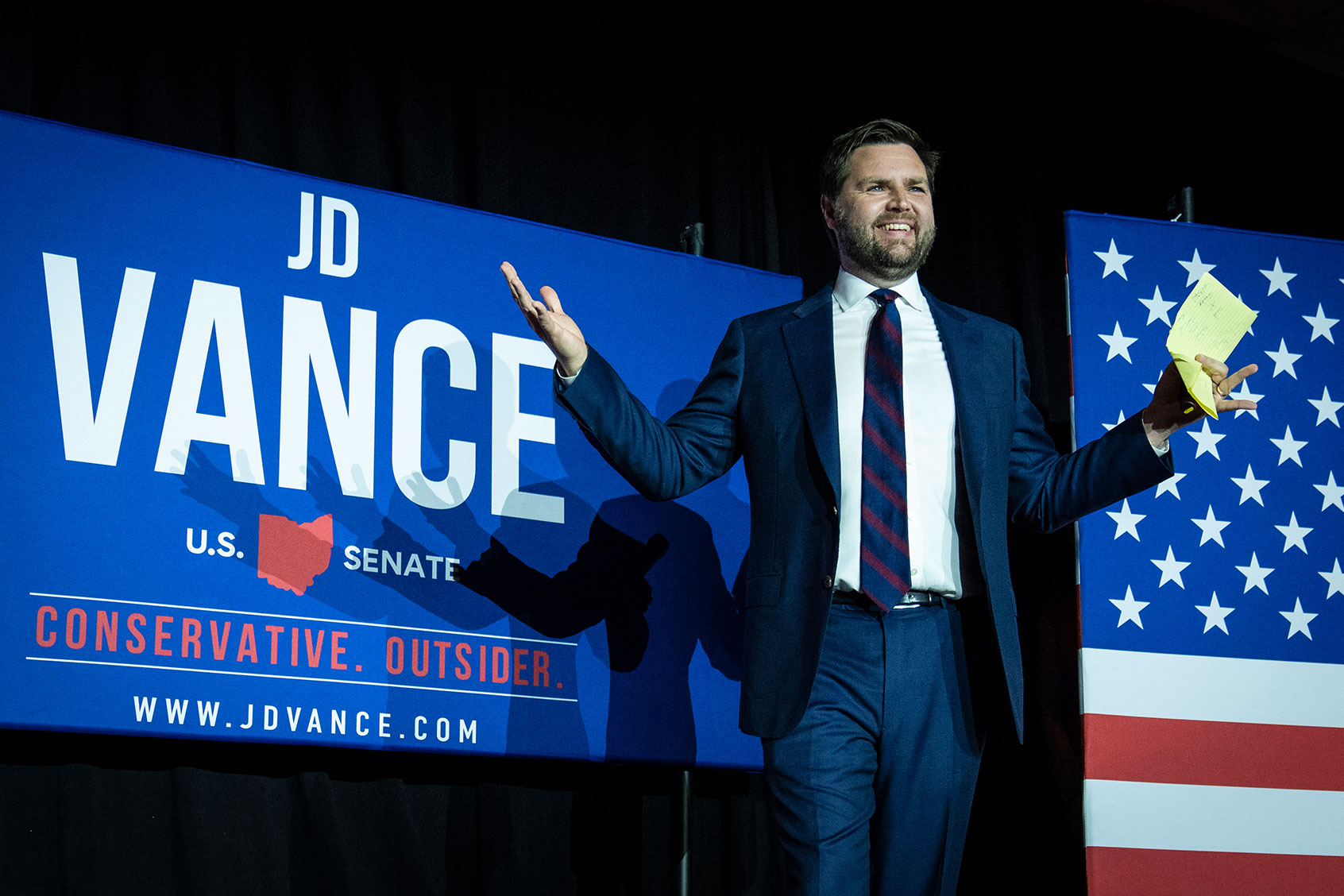
J.D. VanceRepublican U.S. Senate candidate J.D. Vance arrives onstage after winning the primary, at an election night event at Duke Energy Convention Center on May 3, 2022 in Cincinnati, Ohio. (Drew Angerer/Getty Images)

Earlier this month, after the midterms failed to deliver a promised “red wave,” those fights spilled into the headlines, as Republicans’ disappointed hopes led to some of the first open shots in what’s been a cold civil war over the party’s future. Partly that fight revolves around whether Donald Trump or Florida Gov. Ron DeSantis will lead the GOP into the 2024 presidential election. But it goes much deeper than that, and the fight also has implications that go well beyond the right. 

Republicans’ disappointed hopes in the midterms are fueling an intellectual civil war over the future of the American right.

The midterms gave conservatives of all stripes something to claim, or to denounce. Activists who spent the last two years sniffing for “critical race theory” and “gender ideology” in public schools cheered DeSantis’ re-election as proof that maximalist culture war is the key to Republican success. Anti-Trump conservatives pointed to culture warriors’ widespread losses elsewhere as proof the GOP needs to come “home to liberal democracy.” In a New York Times op-ed, Ahmari chastised conservatives who’d spent the run-up to the election mocking an overworked Starbucks barista as one likely reason that “the red wave didn’t materialize.” Vance’s victory in Ohio was simultaneously touted as proof that right-wing populism remains viable and that “the culture war still wins.” 

Others called on Republicans to actualize their claim to be the new party of the “multiracial working class.” The ecumenical religious right journal First Things exhorted conservatives to join picket lines. The conservative policy think tank American Compass unveiled a comprehensive “New Direction” economic agenda, repurposing lyrics from the Clash to propose things like realigning financial markets with the common good. In schmaltzier fashion, Trump strode into a Mar-a-Lago ballroom to announce his 2024 presidential candidacy to the “Les Misérables” anthem “Do You Hear the People Sing?”

And after days of lambasting “Washington Republicanism” for offering little of substance for the working class, Sen. Josh Hawley, R-Mo., issued a proclamation: “The old party is dead. Time to bury it. Build something new.” 

*  *  *

The right-wing populist wave that elected Donald Trump in 2016, like the U.K.’s Brexit vote a few months earlier, is typically described as a watershed moment for conservatism. But the fact of the Trump revolution arrived before the theory. Something had clearly changed in the political order, but Trump’s impulsiveness and lack of coherent ideology or policy agenda created a vacuum that needed to be filled, retroactively, by intellectuals on the right. 

A variety of themes emerged from those efforts. One was an “America First”-inspired rehabilitation of nationalism, long tarnished by its association with authoritarian movements in pre-World War II Europe. Another was heard in Steve Bannon’s call to dismantle the “administrative state” of unelected bureaucrats who might stand in Trump’s way. A third was the conviction that classical liberalism — in the historical Adam Smith sense of that word, which prioritizes individual rights, pluralism and free trade and which guided both parties for generations — had been a catastrophe, replacing traditional norms with a destructive free-for-all. 

The fact of the Trump revolution arrived before the theory: Something had changed in the political order, but Trump’s impulsiveness and lack of coherent ideology created a vacuum that needed to be filled.

As postliberals like Notre Dame political theorist Patrick Deneen, author of the influential 2018 book, “Why Liberalism Failed,” argue, classical liberalism promised peace and prosperity but instead delivered an era of haves and have-nots, swapping good jobs for dehumanizing gig work, empowering corporations to enforce a homogeneous global monoculture and promoting social policies that led people — particularly working-class people — away from traditionalist values like church, marriage and parenthood. In that light, conservative regions’ higher rates of divorce, teen pregnancy and opioid deaths weren’t evidence of red-state hypocrisy but rather an unrecognized form of class warfare. 

The right’s retconned Trumpist ideology also made a meta-argument: that the conservative “fusion” that had defined the Republican Party since the 1960s — uniting religious traditionalists, Cold Warriors and free marketeers in opposition to communism — had ultimately failed. 

In 2019, Ahmari and a cadre of mostly conservative Catholic intellectuals gave voice to that argument through a group manifesto, “Against the Dead Consensus,” which declared (several years before Josh Hawley) that the old conservative coalition was over and something new must take its place. Two months later, Ahmari wrote a follow-up, declaring never-Trump National Review writer David French the poster boy of that dead consensus, for being the sort of conservative who would defend Drag Queen Story Hours on the grounds of free expression. There was no polite, pluralist way to fight such an abomination, Ahmari argued, only a zero-sum approach to fighting the culture war “with the aim of defeating the enemy and enjoying the spoils in the form of a public square re-ordered to the common good and ultimately the Highest Good.” 

Language like “the Highest Good” was a hat-tip to integralism, a right-wing faction of Catholicism that aspires to effectively re-found America as a Catholic “confessional state,” where state power is subordinate to the church and government is devoted to fostering public virtue and the “common good.” Part of that project aims to replace the longstanding conservative legal ideology of constitutional originalism (as championed by the late Supreme Court Justice Antonin Scalia and his followers on the current court) with “common good constitutionalism” (primarily theorized by Harvard Law professor and former Scalia clerk Adrian Vermeule), wherein the law works as “a teacher” to instruct, and enforce, public morality. In other words, if the actual public doesn’t want to live by conservative Christian ideology, a new governing class should impose it. 

That premise has led other Catholics (conservative and liberal alike) to condemn integralism as reactionary and authoritarian. When integralists weren’t being intentionally vague about their plans, critics charged — in a widely-discussed 2020 Atlantic essay, Vermeule declined to specify what common good constitutionalism would mean in practical terms — those plans are frightening, as in one integralist text that suggests limiting citizenship and the vote to members of the faith. 


Want a daily wrap-up of all the news and commentary Salon has to offer? Subscribe to our morning newsletter, Crash Course.


James Patterson, a political science professor at Ave Maria University, has written about integralism’s troubled lineage going back to pre-World War II European fascist or authoritarian movements, including the Spanish Falangists that supported dictator Francisco Franco or the antisemitic Action Française that grew out of France’s Dreyfus Affair. On Twitter recently, a Catholic parody account posted a satirical book jacket for an “updated and honest” edition of Vermeule’s latest book with images of combat boots and a tank and an invented blurb from Ahmari: “Finally we can stop pretending what we’re really talking about.” 

But the postliberal critique resonated beyond the cloistered world of right-wing Catholic discourse, intersecting with another post-Trump project: the rapidly-growing national conservatism movement. Led by Israeli philosopher Yoram Hazony, author of the 2018 book “The Virtue of Nationalism,” the NatCons also see classical liberalism as fatally flawed — its central premise of a neutral public square, where no religion or culture reigns over any other, is nonsense, because liberalism is both a competing worldview and a slippery slope, inevitably leading to cultural revolution. As Hazony often argues, within two generations of the Supreme Court’s ban on religious instruction in public schools, marriage rates and religious observance had plummeted and “woke neo-Marxism” took their place. 

The NatCons also see classical liberalism as fatally flawed: Its premise of a neutral public square, where no religion or culture reigns over any other, is nonsense, because liberalism is itself a competing worldview — and a slippery slope leading to cultural revolution.

Since its first conference in 2019, NatCon has come to represent a series of positions: hostility to transnational bodies like the EU and UN; a quasi-isolationist skepticism of foreign entanglements; sharp reductions or a complete moratorium on immigration; realigning the free market with national interests (variously described); and, most importantly, replacing the illusion of a neutral public square with the conviction that, “Where a Christian majority exists, public life should be rooted in Christianity and its moral vision,” as a recent NatCon statement of principles holds. 

From the get-go, there were important differences between the integralists and NatCons. Catholicism makes a fundamental claim to universality (and some integralists speak wistfully of empire), which fits uneasily with NatCons’ nation-centric vision. Integralists have far more ambitious economic plans than most NatCons would support. 

But there were important commonalities too: a mutual opposition toward mainstream conservatism, a largely shared rejection of liberalism, a common desire to return Christianity to the center of American public life. Both camps swooned for Hungarian Prime Minister Viktor Orbán and saw his avowedly “illiberal” “Christian democracy” — with its expanded government power, sharp restrictions on immigration, repression of LGBTQ rights and pronatalist family subsidies — as the primary model to emulate. Both sides also benefited, to one degree or another, from the largesse of right-wing donors who are funding numerous projects (and candidates) on the “new right.” 

“If anti-communism bound together the old conservative consensus,” said Jerome Copulsky, a research fellow at the Berkley Center for Religion, Peace and World Affairs, the new right’s coalition “is animated by antiliberalism and a belief that a high degree of religious and cultural uniformity is necessary for social cohesion and political legitimacy.” 

But there are problems with building alliances on the basis of shared enemies, Copulsky warned. “The coalition-building is about the Venn diagram of who they don’t like: liberals, ‘woke’ multiculturalists, non-traditional sexuality and gender roles. But as they move forward, their different understandings of what they want to put into place will bring out the tensions and contradictions of their alliance. The ‘enemy of my enemy is my friend’ attitude only goes so far.”

*  *  *

Over the last year, that exact problem has played out through quarrels fought on social media, in new right publications and on conference stages. It was even visible in the difference between this year’s NatCon conference in Miami and the one held a year before. 

In November 2021, multiple new right camps converged in Orlando for NatCon 2. The heart of the conference was an evening panel featuring the nationalist Hazony and integralist Ahmari, as well as “anti-Marxist classical liberal” Dave Rubin and British neocon Douglas Murray, all discussing whether a new alliance could be forged. Hazony, an Orthodox Jew, had a surprising suggestion: Bible instruction must be restored in public school, as a crucial first step toward reasserting America’s identity as a Christian nation and a “conservative democracy.” 

There were tensions, most notably around the fact that Rubin and Murray are both gay: would there be room, Rubin asked, for him and his family in this new right? But after reaching apparent agreement that the problem wasn’t gay people per se but rather expanded trans rights or LGBTQ representation in schools, the session closed as it had begun, with the PA system playing “We Are Family.” 

That unity was short-lived. This September, when NatCon reconvened in Miami, the only panelist who returned was Hazony himself, reflecting a number of upheavals in the preceding months. 

One seeming result was that this year’s NatCon — the movement’s largest to date — reflected a marked increase in hostility toward not just “gender ideology” but LGBTQ rights in general. In one plenary address, a seminary president declared that in order for conservatives to resist “the fantasy and folly” of transgenderism, they must also reject same-sex marriage: “He who says ‘LGB’ must say ‘TQ+.'” Another speaker argued that the failure of any major U.S. institutions to denounce “the LGBT agenda” proved that America has become “basically anti-American.” NatCon’s own statement of principles, released just months after asking two gay men to help build the new right, defines marriage as only between a man and a woman.

This year’s NatCon conference reflected a marked increase in hostility toward LGBTQ rights. Some conservatives evidently believe the NatCon tent had gotten “a little too big.”

In part, this shift reflected some conservatives’ belief that NatCons’ tent had gotten “a little too big.” One right-wing website used a photo of the 2021 panel to warn about “the quiet rise of LGBTQ influence in Christian and conservative circles.” Rubin had also become the center of a conservative firestorm, after he announced that he and his husband were expecting the birth of two babies being carried by surrogate mothers — news that sparked not congratulations but widespread denunciations of both Rubin and any conservative who stood by him. 

But the altered mood also reflected something else, Hazony told Salon: The Supreme Court’s June decision overturning Roe v. Wade had opened a new world of conservative possibilities, and the sense that it might be “possible to restore an earlier constitutional order.” Post-Dobbs, conservatives giddily discussed which Supreme Court precedents they might topple next, and the 2015 Obergefell decision that had legalized same-sex marriage nationwide was high on the list. To Hazony, it suggested a rapid revival of the desire to reassert biblical values in the political sphere. Conservatives wanted to go for it all. 

In his own conference address, Hazony called on conservatives to commit to being “fully Christian in public,” arguing, “The only thing that is strong enough to stop the religion of woke neo-Marxism is the religion of biblical Christianity.” For the politicians in attendance — including DeSantis, Hawley and Florida’s two Republican senators, Marco Rubio and Rick Scott — that meant not just mouthing platitudes about God-given rights, but insisting that American freedom comes from the Bible. Less than an hour later, Hawley happily obliged, declaring, “Without the Bible, there is no America,” with a fervor matched by other speakers eagerly reclaiming the label “Christian nationalist” as a battle cry. 
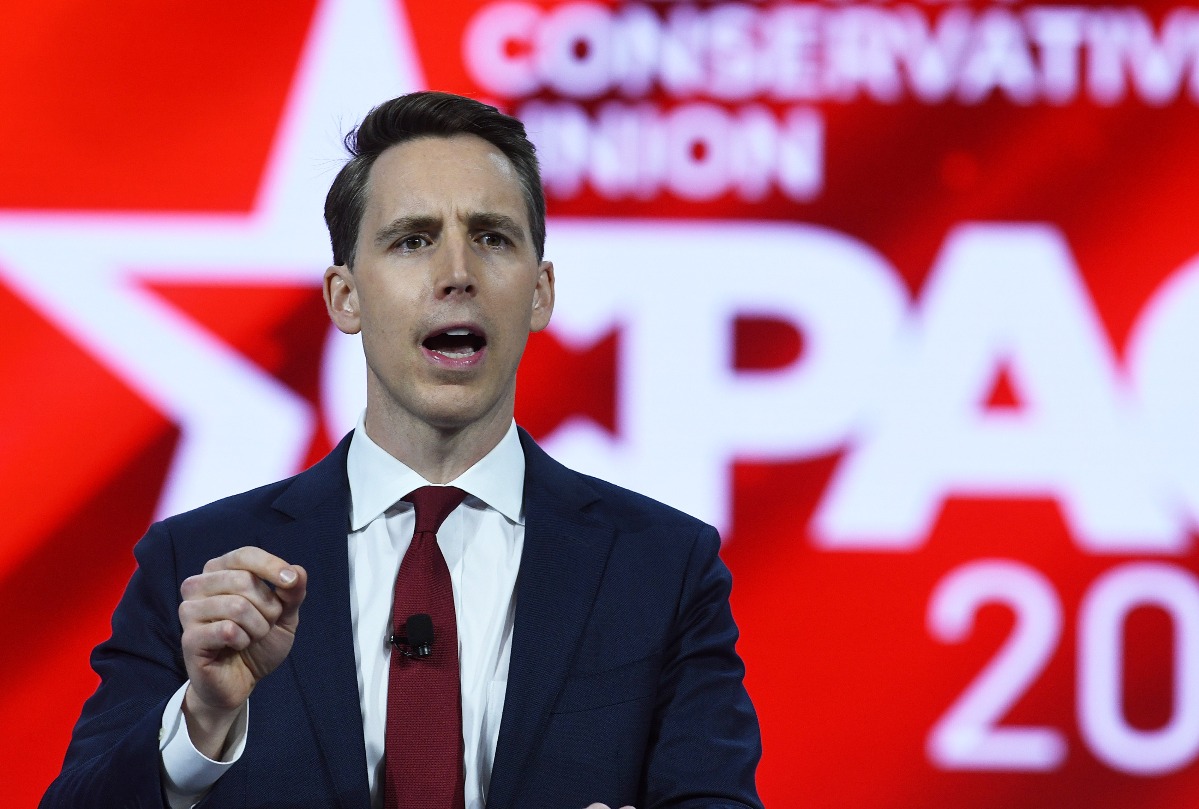
Sen. Josh Hawley addresses attendees at the 2021 CPAC (Paul Hennessy/SOPA Images/LightRocket via Getty Images)

Perhaps even more conspicuous were the missing Catholic integralists, who in 2021 had provided much of NatCon’s intellectual framework. This year, their absence prompted so many subtle, and less subtle, asides throughout the conference that one confused audience member raised his hand to request an explanation. 

A British priest who said he’d been invited to affirm that, contra some people, Catholicism and national conservatism go together just fine, suggested that the integralists’ seeming boycott amounted to useless theological squabbling: Who cared “how many integralists can dance on the head of a pin”? In a breakout session, another Catholic panelist suggested it was “cringe” for integralists to believe they’d ever set the moral framework for a “basically Protestant nation.” 

The biggest rebuke came from Kevin Roberts, the recently-appointed president of the Heritage Foundation, the great white whale of institutional conservatism, which has been shaping Republican priorities since the first years of Ronald Reagan’s presidency. Roberts’ presence at the conference was itself a coup. Two years earlier, Hazony said, Heritage had attacked him for “importing nationalism” into the U.S. Now the foundation had underwritten much of this year’s conference, had met with NatCon leaders to discuss their statement of principles and had published a 20-page booklet recounting a conversation between Roberts and Hazony on “Nationalism and Religious Revival.” In a line widely quoted after the conference, Roberts declared, “I come not to invite national conservatives to join our conservative movement, but to acknowledge the plain truth that Heritage is already part of yours.” 

Roberts, who describes himself as a Catholic populist, also admonished his missing coreligionists (“Integralists, heal thyselves!”), accusing them of rejecting “conventional constitutional” politics and seeking to “subordinate the state to an institutional church” in ways that would discredit both. Alluding to the fact that many prominent integralists are recent Catholic converts, Roberts continued that, while he shared many of their frustrations, “and I certainly rejoice in their religious conversion,” their zeal had “led them into error.” 

“I come not to invite national conservatives to join our conservative movement,” Roberts said, “but to acknowledge the plain truth that Heritage is already part of yours.”

The integralists fired back. At the start of the Miami conference, Ahmari tweeted that he was “emphatically not a ‘NatCon.'” The movement’s academic Substack published a long theological rebuttal to Roberts’ claim that integralists wanted to establish a theocracy. Another writer asked whether NatCon’s big tent still had room for integralists. When Gladden Pappin, cofounder of the conservative journal American Affairs and a professor at the University of Dallas, repeated the question on Twitter, Hazony responded with exasperation: Pappin could answer that question himself, since he’d spoken at a NatCon event several months earlier. 

“In my view, conditions of ongoing animosity and hostility between NatCon and the five or six of you would be a colossal waste of time,” Hazony wrote. “However, if you decide that a strategy of hostility, boycott or insults is the way to go — I can assure you that a wiser Catholic intellectual leadership will arise to take your place.” 

*  *  *

“There is clearly some kind of break,” Hazony told Salon, but he saw it arising primarily from the integralists’ side. Several had been invited to sign NatCon’s statement of principles in June, but all had refused. Ideological differences that were “soft-pedaled a year or two ago” were suddenly getting “a high-octane emphasis.” 

For Hazony, the primary issue was about how conservatives understand China, the rising superpower that NatCons see as America’s No. 1 rival. Their conference had banned all speakers who are “pro-Xi, pro-Putin, racists or antisemites,” although that standard seems malleable at times. (As Political Research Associates’ Ben Lorber reported, this year’s NatCon included a meditation on the viciously xenophobic French novel “Camp of the Saints,” approving mention of antisemitic Action Française leader Charles Maurras and an address by a former Trump speechwriter fired for alleged ties to white nationalists.) But some integralists, Hazony charged, had “always had a soft spot for dictatorship, for imperialism and for China,” and in recent months that had become impossible to ignore, as members of the movement wrote articles praising China’s government or culture.


Want a daily wrap-up of all the news and commentary Salon has to offer? Subscribe to our morning newsletter, Crash Course.


Then there was Compact Magazine, the hybrid “radical American journal” Ahmari co-founded last March with fellow Catholic Matthew Schmitz and Marxist populist Edwin Aponte. Its professed agenda was to wage “a two-front war on the left and the right” and promote “a strong social-democratic state that defends community — local and national, familial and religious — against a libertine left and a libertarian right.” 

Although Compact has declined to specify who funds the magazine, a source familiar with its operations told Salon that it was launched with significant support from right-wing tech billionaire Peter Thiel — who has funded numerous other “new right” projects, from NatCon conferences to the political campaigns of J.D. Vance, Blake Masters and Josh Hawley — and Claremont Institute chair Tom Klingenstein (another top NatCon donor). Klingenstein did not respond to requests for comment. A source close to Thiel denied that Thiel has directly funded Compact, but couldn’t rule out the possibility that an entity Thiel funds has in turn donated to the magazine. In a statement, Ahmari said, “Compact is an independent, for-profit publication supported by our subscribers. A group of investors helped us jump-start it. We respect their privacy and decline to name them.” 

While many in the movement were open to rethinking the right’s commitment to the free market, Hazony said, there was “no appetite, no capacity among nationalist conservatives to accept the ideal of social democracy as an alternative to the market mechanism.”

Both Thiel and Klingenstein spoke at NatCon this year, and a handful of other NatCon speakers attended the integralist conference too. But on the whole, Hazony said, Compact was a bridge too far for most NatCons. While many in the movement were open to “rethinking the commitment to the free market as an absolute principle,” and might even support targeted business regulations, he said, there was “no appetite, no capacity among nationalist conservatives to accept the ideal of social democracy as an alternative to the market mechanism.” 

Integralists had their own complaints. Some also involved foreign policy questions, like whether NatCons’ enthusiastic defense of Ukraine amounted to a creeping neoconservative revival, or whether their strident hostility to China reflected warmed-over Cold War politics. But their main concern was more fundamental: NatCons, they charged, were abandoning the populist promise of Trumpism for a seat at the establishment table. 

To be sure, NatCon 3 featured critiques of big business, but, with limited exceptions, most amounted to dragging “woke corporations.” Ron DeSantis (introduced in Miami as “the future president”) spoke dutifully about how free enterprise should be seen as a tool to help “our own people” rather than an end in itself. But his real firepower was saved for war stories: his battle with Disney over Florida’s “Don’t Say Gay” law, his resolution banning state pension funds from weighing environmental or social justice concerns in investment decisions, a promised law to help Floridians sue tech companies that commit “viewpoint discrimination.” 

Other speakers called for blacklisting banks that disinvest in fossil fuels; seizing universities’ endowments; and making it illegal for employers to ask if applicants attended college, in order to disincentivize young people from entering the “inherently liberalizing environment” of higher education. (In a more recent example, after contrarian billionaire Elon Musk bought Twitter and numerous companies stopped advertising on the platform, Republicans suggested that congressional hearings into “leftist corporate extortion” might be in order.) 

To Ahmari, this amounted to “fake GOP populism.” “This may sound strange coming from me,” he said — that is, the guy who made his name by denouncing “David Frenchism” — “but it’s just culture war.” He was increasingly convinced that whipping up Twitter wars over corporate gestures towards progressive politics was the kind of conservatism “designed to ensure” that nothing important ever changed. “It’s easier to pick a fight over Disney than to take on corporate power as such.” 

“There is this emerging sense on our side,” Ahmari continued, “that the old Reaganite establishment is reconsolidating itself under the banner of NatCon or populism, but the agenda and personnel haven’t changed.” For instance, he said, the Heritage Foundation’s Kevin Roberts calls himself a populist, but this summer tweeted the Reaganesque claim that “Government is not the solution, but the obstacle, to our flourishing.” If the new right wanted to “get in bed with Heritage,” Ahmari wrote this summer in an essay lambasting “Fusionism 2.0,” that was fine. But then it didn’t get to call itself populist; he refused to be such “a cheap date.” 

Integralists also expressed a worry shared by radical movements since time immemorial: Their language and ideas were being co-opted and neutralized by either establishment Republicans or elements of the new right all too eager to go mainstream.

Now that postliberals had made certain policy ideas “trendy,” said Gladden Pappin, who’s written extensively about replicating Hungarian social policies in the U.S., others on the right were “trying to fill them with concepts that bring it back down to classical liberal conservatism.” You’d see people suggesting, he explained, that the foundation of conservative family policy should be religious liberty and right-to-work laws, or libertarians saying, “You know what supports the common good? Radical free markets.” 

Postliberals weren’t the only ones drawing that conclusion. When Roberts told NatCon that Heritage was part of their movement, supporters celebrated it as “the moment they went mainstream.” But other attendees remarked that they were increasingly unsure of how NatCon actually differed from regular “con.” New York Times columnist Ross Douthat warned that the movement risked being “reabsorbed into the GOP mainstream without achieving its revolution,” so that a hypothetical President DeSantis might call himself a national conservative while pushing through more tax cuts for the rich. New York Magazine described this year’s conference as having “the flavor of a party convention,” albeit one headed toward a “middle ground between Reagan and Mussolini.” 

There’s an “emerging sense,” said Ahmari, “that the old Reaganite establishment is reconsolidating itself under the banner of NatCon or populism, but the agenda and personnel haven’t changed.”

Perhaps this evolution was both natural and inevitable. If national conservatives originally intended to build a new right, James Patterson wrote recently, its current, apparent reconciliation with fusionism reflects changed political realities. In 2019, when NatCon held its first conference, the Trump presidency was in full swing and the movement sought to fill the ranks with true believers. By their next meeting in 2021, Republicans were newly out of power and eager to forge alliances to win it back. This year, Patterson noted, the Dobbs decision demonstrated that there might be life in the “dead consensus” yet, since a Supreme Court dominated by old-line originalists — not their “common good” critics — had just delivered the right’s biggest victory in decades.  

“They’re learning the lessons of why the last fusion collapsed,” said Jerome Copulsky: Different factions of the right can work together easily enough until their movement begins to gain power. Then they come to realize “that someone’s policies will be implemented, that there will be winners and losers in this coalition.” 

The NatCons feel pretty sure which of those things they are. At one point during this year’s conference, Hazony recalled, Southern Baptist Theological Seminary president Albert Mohler — perhaps the preeminent voice of the evangelical right — excitedly told him, “This is what it was like in the 1980s when the Moral Majority was first getting organized.” In a midterm postmortem with British outlet The Spectator, Hazony sidestepped the question of whether Trump or DeSantis would win the right’s civil war. NatCons would rally around Trump, or someone else, he said; either way, their ideology would lead. 

*  *  *

In response, integralists vowed to build a coalition of their own. “NatCon is trying to put the constellation of right-wing organizations back together,” said Pappin, “whereas I’m trying to articulate a political vision that could be successful at governing and also oriented towards the common good.” 

Considering various constituencies that have swung right in recent years — like law-and-order Latinos in Texas or the Midwestern white working class — Pappin said he was more interested in finding ways to keep them in the fold. That could happen through “something that a lot of Republicans would call left-wing economics,” he suggested. “Can Republicans articulate a vision that might be more traditional morally, but also favor a supportive state?” Compared to efforts to reassemble the old right-wing fusion, Pappin asked, which was real coalition building? 

“U.S. conservatism has so long been associated with pro-capitalist policies that we sometimes forget that conservative movements in other countries can look extremely different,” said University of Michigan political scientist Matthew McManus, a progressive who’s written extensively about the modern right. Postliberals’ favored models in Hungary and Poland demonstrate that, he said, with expansive social welfare programs tied to “socially conservative and exclusionary practices.”

It’s not unthinkable that such a political gumbo might also work in the U.S., said University of Oregon professor Joseph Lowndes, co-author of “Producers, Parasites, Patriots.” A clear lineage can be traced, he said, from the populist presidential campaigns of paleoconservative Patrick Buchanan in 1992 and 1996 through the Tea Party to Trumpism to projects like Compact today. “Not to put it in crude Marxist terms, but when you’re under the material conditions of a second Gilded Age, when you have real gaps in wealth and neoliberalism becomes less and less credible,” Lowndes said, “it opens up space for something that could wed the cultural politics of conservatism to a social order that seems more humane.”  

To that end, Patrick Deneen’s forthcoming book, “Regime Change: Toward a Postliberal Future,” calls for replacing “the self-serving liberal elite” with a “new elite devoted to a ‘pre-postmodern conservatism'” that’s aligned with the working class. Compact’s own hybrid politics, said Ahmari, represents a similar attempt to forge a “positive vision” that is “liberated from the dogmas of the establishment right” and thus creates space for alliances with the left. 

Patrick Deneen’s forthcoming book calls for replacing “the self-serving liberal elite” with a “new elite devoted to a ‘pre-postmodern conservatism'” aligned with working-class interests.

In practice, that has meant that Compact publishes essays on unions or trust-busting from conservatives and lefties who agree to disagree about cultural questions like abortion and same-sex marriage. Ahmari — who’s undergone his own political odyssey, from socialist to neocon to postliberal, and increasingly these days, something like post-conservative — says he hasn’t changed any of his positions on social issues but believes that building economic alliances can “lower the temperature” of those disagreements. “If you just have less corporate power,” he proposed, “then whatever the corporate agenda is, wokeism or whatever, it doesn’t bear down on ordinary people so much.” 

As for conservatives who dismiss their vision as a pipe-dream, Ahmari said there are “far fewer Americans than these folks think who favor the idea that the government is always an obstacle” and far more who might be mobilized by the resurrection of a mid-century conservatism at peace with the New Deal. After all, he said, “the last time Catholics voted as a united bloc was for the New Deal coalition.” 

That’s not quite the whole story, argues James Patterson, recalling substantial Catholic infighting over FDR’s agenda. But beyond historical quibbling, he says, the postliberal conviction that there is an untapped reserve of fiscally liberal, socially conservative voters waiting for something like integralism ignores the fact that most people who fit that demographic aren’t the proverbial white working class but rather immigrants and people of color likely to be suspicious of a movement that “cites the Francisco Franco right.” (Not coincidentally, Lowndes notes that Pat Buchanan’s father was a legendary Franco fan and Buchanan himself called the dictator a “Catholic savior” and “soldier-patriot.”) In an earlier critique of the new right’s courtship of the working class, the left-wing journal Jacobin argued that right-wing populism is only viable in the context of “historic levels of demobilization and disorganization for the working class.” 

Perhaps, Patterson said, the integralists were setting their hopes on J.D. Vance (as of this month a senator-elect), and the possibility that their movement might influence, or even staff, his Capitol Hill office. After all, a sub-tenet of integralism is the contention that the movement doesn’t need a majority, if enough believers can place themselves inside “the shell of the liberal order” to effect “integralism from within.” 

That’s one answer, said Copulsky, to the question of how either side of the new right expects to “shape a culture when the majority of the public doesn’t agree with you anymore.” Neither the NatCons nor the integralists represent a majority position, “so they either have to go convert a bunch of people or use the coercive power of the state to make people follow their rules.” 

“People are always like, ‘Who cares about the integralists? No one’s going to vote for this,'” added Patterson. “But what if they don’t know they’re voting for it? What if J.D. Vance doesn’t even fully know what he’s getting himself into?” 

*  *  *

Over the course of the new right feud, both sides have accused the other of betraying the cause. Integralists accused NatCons of being closet liberals and channeling populist anger towards safe external enemies. A NatCon speaker dedicated a podcast episode to arguing that “Catholic Integralism Is an Op,” intended to “collect and discharge” Trumpist energies in ways “that are ultimately harmless.” In short order, the allegations became as tangled as leftist infighting that dates back to the Russian Revolution. (Online, it became inscrutably meta, as when one “crypto-fascist” “anti-leftist Marxist” launched a Substack series charging that all dissident publications serve as an “exhaust valve for middle-class discontent.”) 

Shortly after Compact launched last spring, journalist John Ganz called the magazine an “unholy alliance” that recalled previous efforts to combine “socialism + family, Church, nation.” Specifically, Ganz wrote, it sounded like a 19th-century proto-fascist French movement that synthesized left and right positions and whose adherents often called themselves “national socialists” — a term, Ganz notes, “that once sounded fresh and innovative.” 

Other observers pointed to a more recent analogue: the New York critical theory journal Telos, founded in the late 1960s by New Left devotees of Herbert Marcuse, but which by the 2010s was better known for its association with far-right thinkers who inspired the alt-right. 

“There’s this broader thing going on,” said Ganz, “where disenchanted leftists pursuing cultural revolt against liberalism are becoming actually, substantially conservative,” and “crystallizing into a kind of quasi-fascist politics.” 

Telos’ metamorphosis, explains Joseph Lowndes, who watched some of it happen, wasn’t a simplistic example of “horseshoe theory” but rather the result of the people behind the project, frustrated by their search for an effective form of dissent, accepting “easy, far-right answers to complicated social and political questions.” After Trump’s election, Lowndes wrote about Telos’ strange history as a warning: At this precarious moment in history, he argued, there were “two off ramps” from the vast inequalities of neoliberalism. One led to a very dark place. 

Overall, Ganz views the postliberal movement as a “boutique intellectual project,” a “tiny sect arguing with other intellectuals.” But the possible inroads it might make with a disillusioned “post-left” were worrisome, he told Salon: “There’s this broader thing going on where disenchanted leftists, who view their leftism as cultural revolt against liberalism, are becoming actually, substantially conservative. And they’re crystallizing into a kind of quasi-fascist politics.” 

Beyond publishing articles about how the GOP might reconcile with unions, Compact has also published work by monarchist “neoreactionary” Curtis Yarvin as well as a number of leftists, or “post-leftists,” who generally agree with the right on social issues: anti-immigration social democrats, anti-“gender ideology” radical feminists, leftists who see “wokeism” as “capital’s latest legitimating ideology” (e.g., union-busting companies that fly Pride flags or post about Black Lives Matter). In September, the magazine published an essay exploring, with cautious sympathy, a hashtag movement called #MAGACommunism, which calls on leftists to abandon “toxic” social progressivism in favor of “the only mass working-class and anti-establishment movement that currently exists in America.” 

“[N]ot quite what I was going for,” tweeted Compact cofounder Edwin Aponte in response. By then, Compact’s resident Marxist had been gone from the project for several months, after disagreements over the leaked Dobbs decision forced him to conclude that his politics were irreconcilable with those of his colleagues and ultimately led to the dissolution of their partnership. (In a comment shared after publication, Ahmari and Schmitz said they had “ultimately resolved to exercise our majority voting rights to terminate his employment and partnership.”)*

Compact published a recent essay exploring the hashtag movement #MAGACommunism, which calls on leftists to abandon “toxic” social progressivism in favor of “the only mass working-class and anti-establishment movement” in America.

Aponte told Salon that when he first joined the project, as a Bernie Sanders leftist disillusioned with the collapse of that movement, he and his co-founders agreed to avoid issues like abortion “because, per them, they weren’t interested in relitigating settled issues. But the second the Dobbs decision dropped, it was no longer a settled issue.” (“Our agreement wasn’t to preclude articles about abortion, but to refract abortion — and all other cultural issues — through a material lens,” Ahmari and Schmitz said in a comment shared after publication. Aponte disagreed with this characterization.)* When Compact published what Aponte saw as a “weirdly triumphalist article” proposing that Republicans respond to the fall of Roe by creating Hungary-style family subsidies, he had something of an epiphany.

“It revealed what they really cared about, and it was something highly specific and normative: that you can have a generous and materially comfortable state, as long as all these moral and cultural conditions are met,” said Aponte. “On the surface, we wanted the same things. But the motivations behind it were different.” It wasn’t that he doubted their sincerity, he said, so much as that “the engine behind it is what goes unsaid, and is what actually matters more.” For his right-wing partners, he said, “those material politics are a means to an end, rather than an end. And the end they have in mind is not something I think is good or just.” 

Exactly what that end is, Aponte doesn’t feel sure, but he saw some troubling signs.

In late September, Compact held its first public event in an arthouse theater in downtown Manhattan: several dozen 20-somethings gathered in a basement screening room to listen as Anna Khachiyan, co-host of the quasi-socialist podcast Red Scare, introduced “heterodox economist” Michael Lind for an academic lecture about models of social organization. 

It was one version of the weird, politically amorphous downtown scene where, as journalist James Pogue described in Vanity Fair last April, “New Right-ish” politics and converting to Catholicism “are in,” and where Peter Thiel may or may not be “funding a network of New Right podcasters and cool-kid culture figures as a sort of cultural vanguard.” (Earlier that month, the New York Times reported that a new Thiel network is channeling millions towards media projects, including journalism and “influencer programs.”)

It’s a scene suffused with a sense of ironic transgression, Ganz says, giving a “performance quality” to everything, “like part of this cultural revolt is about making yourself into a spectacle.” For example: in recent weeks Khachiyan has promoted a “based literary journal” that includes an extended interview with her alongside a celebration of Kyle Rittenhouse and an exploration of whether the blood libel — the centuries-old conspiracy theory that Jews ritually murder Christian children — might actually be true.

“I don’t think that white working-class voters who are even a little bit Trumpy are interested in this ideology,” said Ganz. “It’s a hipster thing trying to pass as working-class stuff, so it’s kind of fake, but kind of scary. I don’t really know where to situate it.” 

At the Steubenville conference, J.D. Vance called for a ceasefire in the new right’s civil war: “We can’t be so mean to each other.”

Throughout history, Aponte said, “Authoritarian reactionary movements have gained support and energy from such incoherence and contradictions.” This movement seemed to have sufficient gravitational pull, he said, that “everyone starts falling in and gradually being converted. I’ve seen it happen with people I thought were really good leftists, who, next thing I knew, had turned into racists, transphobes and homophobes.” 

“Everyone’s kind of on board, the specifics are blurry, but the direction is titled one way, whether anybody wants to acknowledge it or not,” Aponte continued. “That’s something we haven’t seen in a long time. It’s a vibe, and the kids love it, because the kids are not happy — justifiably so. It’s a really spooky and dangerous time, and I feel foolish for participating. I feel bad.” 

In the end, what unites the right’s various factions will likely hold more weight than what divides them. Generally speaking, said McManus, the right is better than the left at putting aside its internal differences to unite against a common foe. In J.D. Vance’s speech in Steubenville, he called for a ceasefire in the new right’s civil war. “We can’t be so mean to one another,” he told the audience, noting that all conservatives who challenge GOP orthodoxies are taking risks. They were right to be on guard against “Fusionism 2.0,” Vance acknowledged, but perhaps the best way to prevent that was “being charitable to one another’s ideas.” After all, they had real enemies to fight, like transgender health care. 

“We need to do more on the political left to inoculate people against the temptation to move in these radically right directions that can masquerade as a genuine critique of the status quo,” said McManus. “Some people are being very foolish in toying around with these movements,” perhaps because they don’t take new right fulminations against trans rights or its idolization of Viktor Orbán seriously, believing “they won’t actually go that far.” In fact, McManus said, “There’s a very large wing within these movements that wants to go exactly that far. Some of them want to go even further.” 

On Twitter, Aponte tried such an inoculation, addressing warnings to “all my heterodox former-leftist friends” that he’d “seen what lies behind the curtain.” “[B]e careful with whom you ally,” he wrote. “Their enemies might be your enemies for a just reason, but the devil is in their programmatic details.” 

Editor’s note: This piece has been updated to include two additional comments shared by Sohrab Ahmari and Matthew Schmitz after publication.

Putin’s massive mistake: Lawrence Freedman on Ukraine and the lessons of history

Since the Russian invasion last February, the Ukrainian military has spent months trading space for time. That has proven a successful strategy: U.S. and NATO military assistance, excellent civilian and military leadership, a determined and well-trained military and a population committed to total resistance has evidently turned the tide against the Russian forces.

The Ukrainian military first pushed the Russians back from the attempted siege of Kyiv. In late August and September, the Ukrainians launched a series of bold offenses in the northeast and southeast, liberating a considerable amount of Russian-occupied territory, including the strategically important city of Kherson. But these battles have been costly for both sides. The Ukrainians have lost many thousands of soldiers and expended a large amount of their artillery supplies, particularly the precision-guided, long-range U.S.-made munitions that have been integral to interdicting Russian supplies, targeting command and control, and generally creating chaos behind the front line areas.

The Russians have suffered far worse losses: Western intelligence agencies estimate that the Russian military may have suffered more than 100,000 casualties, and has seen its most modern and elite units decimated. Russia has also lost an unexpectedly high number of its best attack helicopters and fighter aircraft, making it even more difficult to turn back the Ukrainian offensive.

With winter arriving, it would be normal for the two armies to rest, consolidate their gains and prepare to fight again in the spring, especially in terrain where snow and mud will make maneuvering difficult for several months. So far, the Ukrainian military is defying those precedents, as it continues to attack Russian forces and reclaim lost territory. In response, the Russians are launching local counterattacks, digging in and bringing forward new conscripts to replenish their demoralized frontline forces. The Russians are also using drones and missiles to attack Ukraine’s infrastructure and major cities in an attempt to break the Ukrainian people’s will to resist by denying them heat, clean water and electricity.   

The war in Ukraine is far from over and it would be foolish to make firm predictions about its outcome. But one thing is assured: This war will be studied for a long time as a type of lethal classroom where decades-old or centuries-old principles of strategy and tactics are being tested by the realities of the 21st-century battlefield.

Lawrence Freedman is one of the world’s leading experts on foreign policy, war, strategy and international relations. He is emeritus professor of war studies at King’s College London and the author of many books, including “Strategy: A History,” “The Future of War” and “The Evolution of Nuclear Strategy.” His new book is “Command: The Politics of Military Operations from Korea to Ukraine.” Freedman’s essays and other writing have been featured in such publications as Foreign Affairs, Foreign Policy, the New Statesman and the Times (U.K.).

In this conversation, he explains how the Russian military disregarded the fundamental basics of military strategy in its war against Ukraine, which is why Russia faces defeat on the battlefield. Freedman also contends that, contrary to Vladimir Putin’s assumptions, in attacking Ukraine he strengthened that nation’s resolve, sense of national unity and will to resist. This is especially true of the terror bombing campaign against Ukraine, which Freedman argues will do little or nothing to advance Russia’s strategic goals or win the war.

Freedman also ponders counterfactual scenarios about the Ukraine war. How would a general from another time period adapt to modern warfare as seen in Ukraine? What would they do differently, or do the same? Freedman also takes on a question that has been much discussed online and in other forums: What would happen if the Russian military directly engaged in battle against U.S. or NATO forces?

Toward the end of this conversation, Freedman explains that Vladimir Putin’s failures in Ukraine are an example of a larger dynamic: Authoritarian and autocratic leaders consistently make poor decisions because they are insulated from reality and accurate information.

How are you making sense of the war in Ukraine? As a military historian, how do you process these events on a human level?

I have very mixed emotions about the war. First, I always feel a bit guilty because my life gets more interesting and enthralling, in a way, whenever something awful is going on. Wars make me busy. It would be nice if peace made me quite as busy. I have Ukrainian friends, and what they are going through is awful. But on the other hand, they’ve shown enormous resilience and have made remarkable progress in fighting the war. In the end, I hesitate to say that I am optimistic because it is dangerous to predict the future. Yes, the Ukrainians have the initiative in the war. But even then, more people are going to die, be made into refugees, and generally life is going to be hard for the Ukrainians for the foreseeable future. 

What does it mean to be Ukrainian right now?

I have spoken to a number of Ukrainians about this question. My feeling is that they are experiencing a much stronger sense of national identity than before the war. The idea that the Ukrainians were distinct from Russia is not that new. But I think what’s striking about their sentiments now, and we see it in all the polling, is that there is a much clearer sense of solidarity with each other and a belief in the state and in Ukraine’s leaders.

How do you balance your intellectual interests and curiosity about war and armed conflict with seeing the human cost and reality of it?

I have followed a number of wars pretty closely throughout my long career. I try not to look at wars as some type of spectator sport: War is about violence. The war in Ukraine is different in several ways. First, the Russian tactics are clearly very brutal, as they were in Syria. The amount of information about what is happening day to day in Ukraine is much more, as compared to previous wars. What we can see about war is just much more immediate and intimate.


Want a daily wrap-up of all the news and commentary Salon has to offer? Subscribe to our morning newsletter, Crash Course.


I started paying close attention to wars with the Falklands in 1982. The amount of information that was coming back at any time was very small. There was radio commentary and very little television coverage of the Falklands — and even that was out of date. With social media today and the internet I can see tanks being blown up and actually watch the soldiers scurrying away, trying not to die. This is unprecedented in many ways. It is all so much closer than before.

A person can literally watch the war in Ukraine in real time. It is dystopian, it feels like a science fiction movie. To me, it’s very unsettling. Our culture is already violent enough without that level of desensitization.

Vietnam was described as the first television war. I remember the Tet Offensive in 1968, for example. There was an immediacy in the coverage of the war as long as the TV crews were there to transmit images in near-real time, which meant, as in Tet, that fighting was taking place in cities. For a lot of the time this was about counterinsurgency, as also in Iraq and Afghanistan. What is unusual about the war in Ukraine is that this is a conventional war, and one fought at high intensity This isn’t a walkover. This is a very serious fight for both sides. Yes, there was all the media coverage of the Gulf War in 1991, but no one really thought the United States was going to lose.

But we should still be careful in how we understand all this footage coming back from the war in Ukraine because we are not seeing everything, and the coverage is inevitably selective by nature.

When you look at the war in Ukraine, what is the simple story, and what is the more complicated one?

The initial assaults by Russia failed because of arrogance and an underestimation of the Ukrainians. The first moves by Russia failed, and they never really recovered from that.

The simple story is quite straightforward: Putin ordered his military to invade Ukraine on the basis of a total misapprehension of the country he was taking on. It was that error — presuming the country to be an ineffectual non-state ruled by an illegitimate government — which was used to justify the invasion in the first place. The reason the initial assaults by Russia failed was because of arrogance and an underestimation of the Ukrainians. The first moves by Russia failed, and they never really recovered from that. The Russians could not take Kyiv, and then we had the stage where they moved to the Donbas region. Western support started to come in and that moved us to the next stage of the war, from late July and August to the present, where the Ukrainians are taking the initiative because they have better equipment and supplies from America and NATO.

What is happening now in the war is very much the consequence of the Russians suffering shortages in manpower because they expended them — quite carelessly, in my opinion — early on. The Russians are pretty thinly defended now and are trying to bolster their ranks through mobilizing reserves and a de facto draft. The Russians have gradually become a 20th-century army, while the Ukrainians are gradually becoming a 21st-century one.

On another level, we are seeing a coercive Russian strategy against Ukrainian society. This involves a wide range of war crimes. Russia is also trying to turn off the power and electricity in Ukraine. The Ukrainians cannot do the same against the Russians in terms of targeting infrastructure. The Ukrainians are winning on the battlefield, but they cannot hit back against the Russians on that strategic level.

The Russian military has been exposed as a hollow force. Before the war in Ukraine, it had a fearsome reputation. Now the Russian military looks like it may collapse in Ukraine. Are there other historical examples of such a thing?

It does happen that armies, when they are properly tested, just collapse. It’s not wholly unusual. That can happen because of a lack of supplies or from poor leadership. The Iraqi army in Desert Storm is an example of this. Before Desert Storm, the Iraqi army was talked about as the fourth-largest in the world, battle-hardened from their war against the Iranians. The Iraqis believed their own reputation. But in the end the Iraqi military could not oppose the combat power of the United States.

As for Russia, they did quite poorly in the first Chechen war. They went in arrogantly and got hammered by the Chechens. But that was explained as being caused by the end of the Cold War and a lack of funding for the Russian military, which was demoralized. Russia had time to rebuild its military afterwards, and it was assumed they had used the money from oil to modernize their forces.

Putin was misled by the fact that their recent military operations were successful, such as in Chechnya, Georgia and in particular in Crimea. That led him to believe the Russian military was competent and professional.

I believe that Putin was misled by the fact that their recent military operations were successful, such as the second Chechen war, their intervention in Georgia and, in particular, taking Crimea and bullying the Ukrainians in 2014, followed by their actions in Syria. This led Putin to believe that the Russian military was competent and professional. Of course, that turned out to be incorrect. Moreover, the war in Ukraine is on a different scale. The Ukrainians are professional, motivated, well-trained, determined and are fighting back in a sophisticated and effective way. The Russian military was not prepared for such opposition.

What is new about what we are seeing, in terms of the operational art of war in Ukraine? What is old? 

Much of what is taking place in Ukraine would make perfect sense to a World War II commander. Drones, the communications technology, the intelligence-gathering technology and the satellites would be quite awesome to them. But the basics of attrition and maneuver and of where you hold the line and where you don’t hold the line, especially the importance of logistics, are timeless. On that point, the Russians have really encountered problems with the basics of logistics. Keeping supply lines open is just fundamental to war.

The war in Ukraine is on a much smaller scale than what we saw in World War II. But the fundamentals are much the same. What is different from previous decades, and World War II in particular, is the precision of modern weapons. The Russians had a number of precision-guided weapons, but they did not use them effectively in the early stages of the war. Instead of hitting military targets, the Russians used them against civilian targets. That was painful for the Ukrainians, but it did not actually help Russia on the battlefield.  By comparison, the Ukrainians have used the American HIMARS system and other long-range weapons to focus on specific targets of value, as opposed to the Russians. The Ukrainians have learned to use drones and other intelligence assets and specific targeting information very effectively. It really is quite impressive.

Many different narratives are being imposed on the war in Ukraine. Many of them are premature. One I have been following closely in the mainstream media is that Javelin and other ATGMs have somehow made the tank obsolete. That is an old and repeatedly disproved claim. What are your thoughts?

The tank has always been a subject of debate. For example, in the Arab-Israeli war in October 1973, many tanks were lost. How? From other tanks. The main anti-tank weapon is often another tank. The fact is, if you want to move a distance with firepower and have a degree of protection over difficult terrain, it is going to end up looking like a tank. Anything can be vulnerable on the modern battlefield, because if you can be seen you can be hit. That having been said, you still need to move people and firepower on the battlefield. Of course there are forms of deception and finding cover and using artillery and infantry to screen and protect your forces from short-range anti-tank systems. 

This is why combined arms is critical on the modern battlefield; every system has a role to play. You can’t isolate the tank and say that it’s gone and everything else stays. There is always going to be a role for tanks. Will the balance of systems on the battlefield change in the future? Of course. UAVs [unmanned aerial vehicles] are now being used instead of manned aircraft for certain missions. But that doesn’t mean you get rid of manned aircraft, because they can do things that a UAV can’t. You use the best system for the mission.  

Russia is waging a terror campaign using drones, missiles and artillery against Ukrainian cities and infrastructure. What do we actually know about the effectiveness of targeting civilians as part of a larger strategy to win a war?

Unfortunately, we know a great deal about this. This is a political question about terrorizing populations and whether to do so or not. The question is: Does targeting civilians and population centers actually make the public turn on their own government?

The Allies during the Second World War did terrible things against German cities, especially toward the end. But there wasn’t much that the German people could do about it. They lacked the means to change their government. In the case of Ukraine, there’s absolutely no evidence that the attacks on civil society have made a difference to popular support, if anything, the Russian attacks have encouraged popular support for the war. Attacking civilian populations can backfire in that way. Terror bombing and attacking civil society does not necessarily gain the attacker a political victory.

What are some of the main things the Russian military has done incorrectly in the execution of their war in Ukraine? By comparison, what have the Ukrainians done right?

The Russians’ main error is that they strategically underestimated their opponent. That is always a basic mistake: Never underestimate your enemy. The Russians also did not have enough infantry and manpower, more generally. They do not give enough autonomy and flexibility to junior officers and others lower down the chain of command to make decisions, improvise and address problems.

The Ukrainians have not wasted weaponry. They have thought hard about the targets they need to hit. Their ability to maneuver and encircle the Russians has caused them to panic.

The Russians also failed to anticipate what the Ukrainians could do with accurate artillery. The Russians didn’t disperse their ammunition enough. The Russian logistics system was too rigid, which makes it an easy target. What did the Ukrainians do right? They delegated initiative to quite small groups of forces and junior officers. The Ukrainians had to rely on taking the initiative against the Russians; that was central to their strategy and tactics.

The Ukrainians have not wasted their weaponry. They have thought hard about the targets that they most need to hit. When possible and where it made sense, the Ukrainians have used maneuver warfare to encircle the Russians rather than go directly at them in frontal assaults. The Ukrainians’ ability to maneuver and encircle the Russians has caused them to panic — it’a demoralizing. In total, the Ukrainians have waged a very astute campaign against the Russians.

Armchair generals and other students of military history love counterfactuals and “what if” scenarios. One of those scenarios we see in response to the war in Ukraine is that the U.S. military and NATO would easily destroy the Russians in a conventional war. I am suspicious of such a conclusion, because in my opinion the Russian military and its leadership would approach such a scenario much differently than they did with Ukraine. How do you assess that counterfactual?

We just don’t know. Counterfactuals are useful for testing theories of causation. What variable made the difference? If the Russians genuinely thought they were protecting their homeland, what we are seeing with Ukraine might have turned out differently. The Ukrainians are much more motivated in this fight than the Russians. Nuclear weapons are a variable here too. If the Russians really did think they were fighting for their own territory, they’d be much more likely to use nuclear weapons if they were losing. I am of the mind that the Russians still won’t do such a thing in this conflict. Those types of questions can be explored using counterfactuals.

Autocrats tend to make bad decisions. They believe in the possibility of big, bold, decisive moves, and they don’t have people who dare to warn them about all that can go wrong.

To answer your question, in a straight fight between the Americans and the Russians, the Americans would have won. American equipment, supplies and overall forces are just that much better. One of the surprising things about the war in Ukraine is the limited impact of Russian airpower. By comparison, the Americans would dominate the battlefield with their airpower — or at least would try to do so. We reasonably assumed that the Russians would do this in Ukraine. They weren’t able to do it. If the Russians cannot dominate the Ukrainians with airpower, they would not be able to do it against the Americans.

The United States does not lose conventional battles very often. The United States does have difficulty with insurgencies, because in the end it is not worth the effort. Americans get impatient. In the end, the Americans would not have had much trouble with the Russian military that we are seeing in Ukraine.

What are some of the lessons from the war in Ukraine for NATO members and European militaries?

The Americans are going to fight in all domains. The British, the Germans and the French, for example, are not going to fight in all domains in the same way. They must think as an alliance: The European countries are not able to do everything on their own. A huge lesson from the war in Ukraine is that the intensity of modern warfare means you go through material and supplies very quickly. The stockpiles are never sufficient. The NATO countries have greatly depleted their supplies supporting Ukraine. 

That means more resources are going to be put into building back up supplies. This means more ammunition, shells, rockets, missiles and the like for the future. This is not a new lesson, but it has to be relearned. Logistics are critical because even if you are making more ammunition and other supplies, you still have to get it all to the front. 

Your new book focuses on command and leadership. What does the war in Ukraine tell us about Vladimir Putin?

Autocrats tend to make very bad decisions. Democracies make bad decisions too, but the difference is that autocracies believe in the possibility of big, bold, decisive moves, and they don’t have people who dare to warn them about all that can go wrong. There are sycophantic advisers who don’t dare to criticize the autocratic leader. This can cause horrible outcomes. 

What’s happened in Ukraine is a good example of how autocrats make mistakes. This war was Putin’s decision. Putin had a theory about Ukraine, and did not confirm that theory with real experts who would tell him that he was wrong. Putin believed that Ukraine would crumble if pushed hard enough, and that turned out to be very wrong. 

Elon Musk must be stopped! If Twitter is to be a true “town square,” it’s time to socialize it

At this point, the conspiracy theory that Elon Musk bought Twitter to destroy it is starting to feel a teeny bit persuasive. The billionaire troll originally bought the social media company on a whim with a bid that was literally a ’90s-era joke about marijuana and has proceeded to run it into the ground. He continued his fantastically inept reign Thursday by demanding employees sign a pledge to “be extremely hardcore,” which “will mean working long hours at high intensity.” This was after Musk fired half the company, which suggests that his new demands could be less about “exceptional performance” and more about getting the remaining employees to pick up the slack left behind.

Unsurprisingly, a bunch of employees turned in their notices. The bleeding out was so bad Twitter closed its office buildings and disabled work badges until the company could assess the damage. Thursday night, the social media network itself exploded in a very Twitter-iffic bout of hysterics, as users imagined the platform could be shut down entirely within hours.

That didn’t happen. As I write this, people are still tweeting as freely as ever before. Worse, Musk doubled down on his trollish theory of how to run Twitter by dramatically reinstating Donald Trump’s account. As with his original purchase of the site, inspired in no small part by Musk’s anger over Twitter banning transphobic accounts, Musk’s driving impulse appears to be a childish desire to trigger the liberals. 

Still, it’s likely that if Musk continues along this path, Twitter is probably not long for this world. Like Friendster or MySpace before it, it will become increasingly desolate and unusable as its users drift away. Years from now, the shell of its former self will be formally put to bed. Former Twitter-heads will read the news coverage and be mildly surprised that “Twitter” was still around long after they had forgotten about it. 


Want more Amanda Marcotte on politics? Subscribe to her newsletter Standing Room Only.


Of course, there is one way Twitter could be saved: By actually making it the “digital town square” Musk says he wants it to be. Which is to say the government should buy and run Twitter, just as government owns and operates actual town squares. Yes, I’m talking about a “socialist” takeover of Twitter, just like we have “socialist” libraries, schools and museums.

A nationalized Twitter would solve the current dilemma: the contradictory goals of running a network that protects free speech while also being socially responsible and profitable. Take away the profit motive and so much of what makes Twitter a deleterious force in society would disappear. 

Here are five major ways a nationalized Twitter would be better for users, for society, and for people’s basic mental health. 

1. Disempowering trolls, misinformers and racists. The most compelling counterargument to Twitter nationalization is the concern that the first amendment makes it much harder for a government-run entity to ban people for bigotry. And it’s true that private companies have more leverage to ban people. Still, I think a government-run Twitter would end up having less racism, disinformation and overall trolling. 

The notion that Twitter is good at banning people for misbehavior has been way overstated, and that’s even before Musk took over. Far more important is this: Twitter and its algorithm have long promoted and pushed ugly language, giving the site’s trolls and goblins a much wider audience than they would if the company’s thumb wasn’t on the scale. For instance, Twitter let Trump have his account, despite his constant misinformation and bigotry, only banning him after he used it to help incite the January 6 insurrection. The anti-LGBTQ hate account Libs of Tik Tok has 1.5 million followers, even though it only exists to stir up violent hatred against marginalized people. 

Take away the profit motive and so much of what makes Twitter a deleterious force in society would disappear. 

That’s because, to quote tech journalist Kara Swisher, “Enragement equals engagement.” Racists and trolls attract attention because people like to argue with them and retweet them for dunking purposes. The algorithm then pushes the gross tweets further, because all that negative attention means people are spending more time on the platform and therefore making the company more money. Advertisers may not like users saying the N-word. But people who know how to trigger the liberals while not quite crossing the line into overt slurs — think Rep. Marjorie Taylor Greene, R-Ga., or professional trolls like Glenn Greenwald — make the site money. Misinformation also gets a boost, because arguing with it boosts engagement numbers. 

Without that profit motive, there’s no need to have an algorithm at all. People can just follow who they like in real-time. (The Tweetdeck service already does this, for an idea of how that looks.) So while there would be racists and fascists saying their thing, they would be lost in the shuffle rather than boosted into folks’ timelines. Without attention, much if not most of that attention-seeking nastiness would dry up. 


Want more Amanda Marcotte on politics? Subscribe to her newsletter Standing Room Only.


2. More jokes, less sanctimony. In the early days of Twitter, it was genuinely a fun place to be. People tried to entertain themselves and each other with jokes. Over time, however, it became clear that while people like jokes, they don’t engage with them. What gets people going — besides trolling — is sanctimony. I’ve been on the service since 2007, and one thing has become depressingly clear: People get way more RTs, replies and likes if they take a hectoring, moralistic tone. Especially if they are dunking on someone else for having a “wrong” opinion, or even for being a little too gleeful about having a happy marriage

Jokes can take time and energy to understand. Face-stomping and chest-beating are primitive emotions that garner a lot more reactions. Also, sanctimony — like bigotry — causes engagement through argument. Either way, it’s making everyone into assholes and bores, and advertisers get more of our eyeball time. Take away the profit motive and algorithm, however, and you’ve changed the calculus away from quantity back to quality — more people tweeting to be funny and fewer seeking engagement through moral superiority preening.  

3. Simplifying the verification system. The “blue check” verification system started as a way to reassure users that a person behind a Twitter account is who they say they are. Quickly, however, the process of verifying your identity became so onerous that only users who had employers willing to do the hard work for them were able to get the marks. Soon, only public figures like journalists, celebrities, politicians and academics got the checkmarks. That in turn led to accusations of elitism. Musk’s solution — making the blue check something you could buy — backfired spectacularly, as people lined up in droves to create fake or parody accounts that looked “verified.” 

Sanctimony — like bigotry — causes engagement through argument.

Clearly, verification is a mess. But if the government owned Twitter, it could be simple. The government, after all, already verifies your identity through documents like Social Security numbers or passports. If people want to be verified, all they would need to do is tie their online identity to one of these already documented ones. There would be some need for tweaks on the margins, such as figuring out how to handle people who use a different name publicly than the one they use on documents. But overall, it would be a way to make the blue check system fairer and more accessible, without giving up the original purpose of verifying people’s identities. 


Want more Amanda Marcotte on politics? Subscribe to her newsletter Standing Room Only.


4. Gutting fraud. The government is generally more restrained from policing language choice than a private company is, but there’s one place that’s not true at all: Dealing with fraud. On that front, the federal government is the 800-pound gorilla, equipped with powers through agencies like the Federal Trade Commission to penalize people who try to make money through false advertising. 

Right now, Twitter is rife with people peddling snake oil, crypto scams and other fraudulent businesses. Sometimes they get banned, but often they sneak right back on. With federal government powers, however, those people can be run off altogether or slapped with massive fines. The government could even — if they wanted — ban all use of the platform for trade. Lawyers would have to figure out the enforcement mechanisms, but ultimately, a federally run social media network would be more able to shut down the flourishing fraud market than Twitter currently has. 

5. Cutting off the “influencers.” There’s a whole subcategory of people who aren’t exactly frauds, but whose business model is parasitic: “Influencers.” Like trolls and sanctimonious poseurs, influencers goose Twitter’s algorithm by appealing to base instincts. Except, instead of rage or egotism, they go for lust and envy. Some are fairly harmless, like people who post thirst traps to separate the horny from their money. Others are more sinister, such as influencers who use heavily photoshopped images of “perfect” bodies to make others feel bad about themselves, and therefore more likely to buy supplements or fad diet programs. 

Right now, Twitter is rife with people peddling snake oil, crypto scams and other fraudulent businesses.

But without the algorithm trying to trick your brain into lingering on the site, such people would lose the boost they currently get on Twitter. They wouldn’t go away, of course. They’d still have Instagram, TikTok and every other social media network that exploits our animalistic impulses in order to get at our wallets. But Twitter would stop being quite so useful for them. 

Look, there’s no doubt that Twitter would be a bit more boring, if it was changed so it’s no longer about making money. But so what? Without the need to sell ads, Twitter would be freer to provide what people claim they want from it: Information, community and intellectual discourse. Imagine a Twitter where people were actually talking to each other a bit more, and talking less about Matt Yglesias’s latest provocations. There’d be no need to try to figure out alternatives like Mastodon to make that happen. It would be the same software and the same accounts — just owned by Uncle Sam and not Elon Musk. 

Twitter, like all social media companies, makes more money if its users are addicted. Unfortunately, the cocaine button we rats are pressing all day is one that dispenses outrage, conflict and self-righteousness. It’s hurting people’s mental health and ability to handle ambiguity and nuance. Would it really be such a bad thing if Twitter were a little more boring? Would it be so terrible if people spent less time on Twitter and more time actually reading the news, reading books, or even — heaven forbid! — getting out of the house to touch some grass? There’s a lot of good on Twitter, but it’s being drowned out by the toxicity. Take the money out of it, and let’s make it something that is a lot more beneficial to society and the people in it. 

DeSantis goes easy on hotel sex trafficking violations

Republican Gov. Ron DeSantis’ administration has declined to issue fines after over 14,000 violations of a sex trafficking law by Florida hotels and lodging establishments.

An investigation published on Sunday by the Sun Sentinel found that 6,669 hotels and other lodging establishments had received 14,279 citations since a 2019 sex trafficking law required them to make modest changes to protect victims.

In one case, The Plaza Hotel was cited five times after a 17-year-old girl was choked because she would not turn over all her earnings to her sex trafficker.

The Florida Department of Business and Professional Regulation told the paper that no fines had been issued because the establishment had corrected the problems within a 90-day grace period provided by the law.

State Sen. Lauren Book passed the law and was shocked to find out that state enforcers had required no fines.

“The reason that we had the cure period was that you fix the problem, not that you fall back on your laurels because the department then gives you another 90 days after some time,” she explained. “That’s not the intention, that’s not the spirit of the law or the intention. So it’s my intention to go back and change that and not allow for that.”

It’s not clear why DeSantis has not ordered his government to use the law to crack down on sex trafficking.

“The division’s main goal is to focus on educating licensees and assisting them as they strive to come into compliance with the law,” the Florida Department of Business and Professional Regulation said in a statement. “By performing follow-up inspections at 60 days and then again at the 90-day deadline, division inspectors have been successful in compelling establishments to comply prior to the issuance of an administrative complaint. To date, all public lodging establishments have complied by the conclusion of 90 days and no enforcement cases have yet been generated due to non-compliance with the law.”

The department declined to make a spokesperson available for an interview.

“My administration is committed to ensuring criminals involved in this heinous crime are prosecuted to the fullest extent of the law and victims are returned to safety,” DeSantis told the 2019 Human Trafficking Summit. “While this issue remains a serious threat here in Florida, I’m proud of the great work people across our state are doing to push back.”

Fines from the 2019 law were expected to help fund the Florida Alliance to End Human Trafficking.

The report was the first of a five-part series from the Sun Sentinel.

Pelosi speaks against ‘shameless bigotry’ of MAGA Republicans towards transgender community

Outgoing United States House of Representatives Speaker Nancy Pelosi (D-California) on Sunday condemned violent right-wing rhetoric following Saturday night’s massacre at Club Q in Colorado Springs, Colorado that left five people dead and eighteen others injured. It was the 601st mass shooting of 2022.

Sunday is Transgender Day of Remembrance, which honors the lives of trans victims of hate crimes.

Pelosi said in a statement published by her office that “as our nation marks Transgender Day of Remembrance, the House Democratic Caucus mourns the countless Americans stolen away by the scourge of transphobic violence, a crisis that continues to disproportionately harm trans people of color. Today, and every day, let us offer comfort to grieving loved ones, honor the memory of those killed and continue fighting to save lives from the wicked forces of hate.”

Pelosi specifically mentioned Ex-President Donald Trump’s Make America Great Again movement, which is a cesspool of conspiracy theories, propaganda, and vitriol that frequently scapegoats LGBTQ+ individuals and communities:

That fight remains more urgent than ever, as right-wing extremists target transgender Americans’ most fundamental rights and freedoms. Whether spouting dangerous rhetoric from cable news desks or openly bullying schoolchildren from the halls of power, MAGA Republicans are cruelly undermining the safety and well-being of our transgender community. Horrified by such shameless bigotry, House Democrats are proud to march alongside our trans friends, neighbors and siblings as we work to uphold justice and dignity for all. That is why we enacted fully-inclusive federal hate crime protections with the historic Matthew Shepard and James Byrd, Jr. Hate Crimes Prevention Act. And it is why the Democratic House has twice passed the Equality Act, landmark legislation extending the full protections of the Civil Rights Act to LGBTQ Americans.

Pelosi added that she is “heartbroken for so many beautiful souls murdered by hate and guided by relentless activists across the country, let us renew our resolve to build the future that our children deserve. Together, we will forge a safer, more just America – one where all of its people can freely and proudly exercise their right to life, liberty and the pursuit of happiness.”

The suspected gunman was subdued by two patrons and taken into custody by law enforcement. Frank Figliuzzi, a former assistant director for counterintelligence at the Federal Bureau of Investigation, was confounded on MSNBC over how the assailant – who may have called in a bomb threat before the attack – was able to obtain his weapons.


“Magpie Murders” creator on the finale revelation: “The anagram is disgusting”

“The more successful he was, the more miserable he became.” 

Book editor Susan Ryeland (Lesley Manville) provides this insight into the mindset of bestselling mystery author Alan Conway’s (Conleth Hill) actions in the finale of “Magpie Murders.” After receiving a fatal diagnosis, the snooty Alan schemes to forever taint the legacy of his popular Atticus Pünd detective novels, believing them to be frivolous pap and not “important” writing.

His plan? With the imminent publication of his final book titled “Magpie Murders,” eagle-eyed readers would realize that unscrambling the first letters for each novel in the detective series would spell out “AN ANAGRAM.” In turn, that would lead readers to unscrambling the ultimate anagram of all, the name of Alan’s famed detective, ATTICUS PUND

“A STUPID . . . ” Susan helpfully spells out, albeit incompletely, “. . . and that leaves a four-letter word – one of the worst, one of the most offensive in the English language.”

“The anagram is disgusting. I mean, it’s horrible, really.”

Horrified, Susan’s publishing colleague and boss, Charles Clover (Michael Maloney), kills Alan in order to change the title of the final book (naming it “The Magpie Murders” would ruin the anagram tip-off) and thus save the entire business from losing the Atticus Pünd legacy and sales.

Anthony Horowitz, who had written the original novel “Magpie Murders,” spoke to Salon about maintaining that specific ending when adapting his book for television.

“Whenever I wrote for ‘Agatha Christie’s Poirot,’ . . . I could do almost anything with the stories I was adapting except change the murder and the solution,” said Horowitz. “I think that is actually quite a good rule. They are the tentpoles of a murder mystery novel: essentially the killer, the motive and the method of killing. Other than that you could do anything you want.”

Horowitz also applied that rule to the show’s other mystery, the one contained in Alan’s 1950s-set novel. Atticus Pünd (Tim McMullan) himself reveals that Robert Blakiston (Harry Lawty) is guilty of murder . . . but not that of his mother, who perished accidentally tumbling down a staircase. Mary Blakiston (Karen Westwood) had known that her son was homicidal – having witnessed him covering up killing his own brother in childhood – and to protect herself, wrote a letter to her employer Sir Magnus Pye (Lorcan Cranitch) revealing that fact in the event of her demise.

The letter was supposed to be insurance to keep Mary’s son from killing her, but when she died accidentally anyway, Robert remembered the letter. To protect himself, he killed Sir Magnus and then burned the letter . . . but was sloppy with the coverup.

In the rest of Salon’s interview, Horowitz discusses the origins of Alan Conway’s outrageous scheme, bringing Atticus Pünd outside the pages of his mystery and possible plans to continue Susan Ryeland’s adventures.

The interview has been edited for length and clarity.

You kept the killer and solution from your book, but what did you feel needed to be changed when adapting this complex mystery-within-a-mystery into a TV show?

With “Magpie Murders,” which is a 650-page novel, my first decision was that something had to go; there were too many characters. And guided by the producer, Jill Greene, I decided that I would cut back very, very heavily on the ’50s material, because that was stock characters and red herrings, etc.

I was more interested in Susan, her relationship with Atticus and the modern world. So that was the first decision I made and the other thing I did, which was really important, was having a character played by Lesley Manville, she had to have depth. This show was about her and not just about her solving a murder. So I added all that material about her father, about her betrayal as as a young girl, her relationship with her sister. All that came in as extra material, which as it were shifted out some of the clues and the suspects that were the business of a murder mystery, I think to the show’s great advantage.

Magpie MurdersConleth Hill as Alan Conway in “Magpie Murders” (PBS/Eleventh Hour Films)What I found interesting about Alan Conway’s dastardly scheme with the anagram is why he did it. Although he hated the popularity of his books, he didn’t just kill off his main character Atticus Pünd. He tried to blow the entire thing up, which seems extreme.

That was the original idea that I had 10 years before I actually wrote the book. It was a writer who hates his detective so much, he wants to not just kill him, but trash him so that these books will never, ever be read again. And that’s what Alan Conway does, and it’s built in to his entire oeuvre. That was the idea of how there had to be the anagram. That is the core of the story.

The anagram is disgusting. I mean, it’s horrible, really. And if you look at the way it’s filmed, we did have problems because there were things that we could not show or say on American television because they are considered too offensive. And we had to work our way around that. I didn’t want to offend an American-viewing audience, particularly as my demographic in America – probably a lot of age ranges – but thanks to “Foyle’s War,” I am known for a more liberal, more senior and a more genteel audience, if I may call them that. I didn’t want to offend them. I’m not that sort of writer. So so we had to work very, very hard to make that work in a way that made sense but did not offend.

I was wondering while I was watching if the word would be said or printed anywhere onscreen or if that still might be deemed too edgy for PBS. Was there any discussion about that?

When we did Episode 6, it’s fairly clear what we’re talking about, but it’s not 100% clear. You get the general sense without having to be to be having to have it rubbed in your face, which I think is good. I don’t like profanity. I don’t like extreme violence. I don’t like upsetting drama. I broadly try to avoid women as targets; I think there are too many. I sometimes think there are perhaps too many books with children being killed or being kidnapped or being hurt.

“I’ve always been fascinated by the fact that Doyle invented the greatest detective the world has ever seen, and was so disdainful of him … he threw him off the Reichenbach Falls and killed him.”

We live in a very difficult and often upsetting world right now we have so much to contend with – from Ukraine to American politics to British politics, to Brexit, to the shortages in the world, to the scariness of global warming – that books and television like “Magpie Murders” are needed, are vital as a place to escape to somewhere to find a comfort and define truth and decency. My writing is all about that; it’s not about shocking people. I’m not a prude. I read violent thrillers, thrillers that have high sexual content because I read an awful lot. So I’m not sitting there only reading Agatha Christie. But nonetheless, I do think that my role as a writer is largely to entertain in a sort of a light-hearted and endearing way. That’s what I’m trying to do anyway.

As despicable as Alan Conway is, his pretensions are delightful. I especially enjoyed how bad his “important” novel “The Slide” was. Did you have fun creating such a pompous character and his awful writing?

I loved writing it, I love it as parody. It’s of course an appalling novel. Alan Conway is inspired by Sir Arthur Conan Doyle, the inventor of Sherlock Holmes. I’ve always been fascinated by the fact that Doyle invented the greatest detective the world has ever seen and yet was so disdainful of him and feeling this was beneath his talents. But what did he do? After just three books, he threw him off the Reichenbach Falls and killed him [in “The Final Problem”]. Later on, he brought him back because basically he needed the money. And I find that sort of tension very interesting.

The same is true of Ian Fleming, creator of James Bond. He had created the greatest spy in fiction and was known for his children’s book “Chitty Chitty Bang, Bang.” But he had felt sadly embarrassed where he didn’t even want to show “Casino Royale” to his publisher because he thought they’d sneer at it. These geniuses don’t realize what they’ve created. Hergé, the illustrator and writer of Tintin and another of my great heroes, once drew a picture of himself slaving at the desk, with Tintin holding a whip over him showing a sort of disdain. Agatha Christie sneered at Poirot and said that he was an egotistical, pompous little poppy or words to that effect.

I find that really interesting – writers who don’t accept what they have done. I am not one of those. Instead I am totally happy with my output and don’t have high ideals about myself, but Alan Conway does, and I find him fascinating for that reason. I sympathize with him in a way. I understand where he’s coming from. I look at writers like Ian McEwan or Charles Dickens or Kazuo Ishiguro – the great writers – and I think to myself that I’ve drawn the short straw being the populist murder mystery writer. Why can’t I be as great as them? But I’ve always been an entertainer, I’m very content with what I do. I have no ideas about my station. I know my limitations – to paraphrase Clint Eastwood as Dirty Harry. 

Magpie MurdersLesley Manville as Susan Ryeland and Tim McMullan as Atticus Pünd in “Magpie Murders” (PBS/Eleventh Hour Films)
Something that struck me when reading the novel that was carried over into the show is just how brutal Charles is when he stomps on Susan after he’s already knocked her on the head. I felt that violence really made an impact in this somewhat cozy murder mystery. Were there discussions about keeping that scene in?

That’s the most violent scene in it. I didn’t  know how it would come out on the screen. I didn’t realize it will be as violent as it was, I must be honest. Actor Michael Maloney – goodness knows that performance, that last scene when he brings out all those matches and lights it, I don’t know how he doesn’t set his own hand on fire. And the way he brutalizes poor Lesley, it’s shocking. It really exceeded my expectations. But it’s a terrific performance and a scene where the killer finally emerges and reveals themselves – that turn from civility to absolute mad barbarity is really very shaking.

Another difference from the book is the TV show’s interaction between Atticus and Susan. We first see him in her rearview mirror but then eventually they just talk to each other and hang out like they’re old pals. Could you discuss creating this narrative device and their dynamic? How did you determine what their manner would be together?

I always saw it as being a progression. In the first episode, he’s just glimpsed in the mirror of the car. Is he there or isn’t he there? And then in the second episode, they talk to each other. But actually though, Susan is in bed, so she could be having a dream too. We’re not sure if it’s real. As the show continues, the scenes between them become longer, they become more specific, they become slightly more realistic and even a bit more argumentative. She becomes very frustrated with his refusal to tell her the one thing she wants to know which is who did it. And there was a fondness between them.

In Episode 6, everything is turned on its head and everything that’s gone before is now seen in a different way. And one of my favorite scenes in the whole series is their passing in the very, very end. I must have seen it 15 times and I seem to find my eyes going getting moist, I well up a little bit, because it is so touching these two characters who sort of love each other but can’t hold each other even because they belong in different worlds.

I’ve read the second Susan Ryeland novel, “Moonflower Murders,” which Lesley Manville narrated for the audiobook version. I really enjoyed that one because it takes place in a hotel. Had you considered adapting the sequel for TV as well?

We are hoping to do it. Lesley Manville is very much up for it. It largely depends on how well this show does in America. But PBS “Masterpiece” are very, very keen and excited to continue with us. We had a wonderful relationship with them – the No. 1 partner has been actually America rather than England. If the show is a success, I hope to be [adapting] “Moonflower Murders” as early as February or March of next year. I’ve lots of ideas already.

Magpie MurdersAlexandros Logothetis as Andreas Patakis and Lesley Manville as Susan Ryeland in “Magpie Murders” (PBS/Eleventh Hour Films/ Nick Wall)As of this time, there are only two Susan Ryeland novels, and they both follow the “story in a story” format, which you had told me takes twice as long to write since you need to create double the murders or solutions. Do you think you have another Ryeland novel in you?
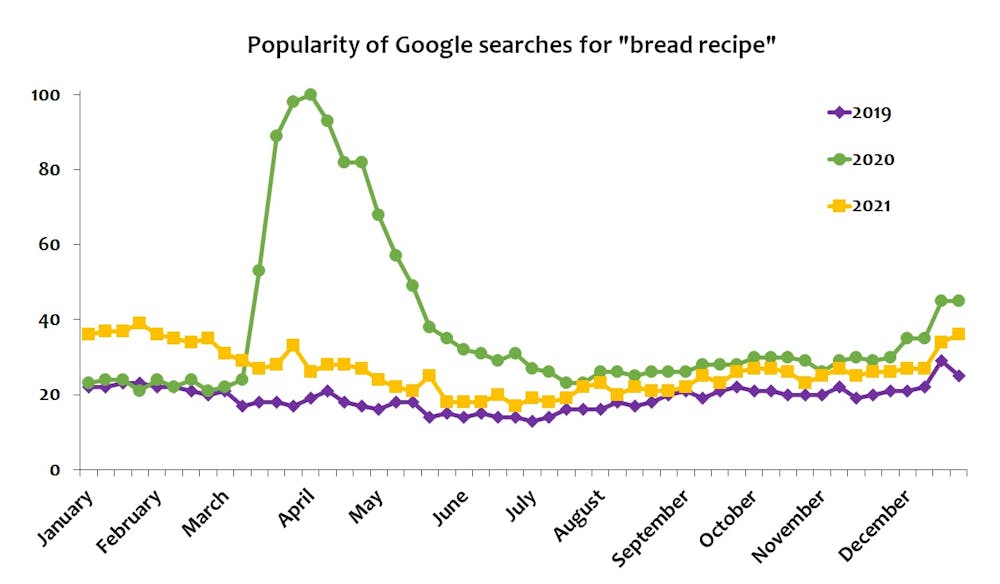
In fact, I’ve actually signed the contract for it. So there’s definitely going to be one more. And I have an idea for it, which makes me smile. I’m a very busy writer, and ideas come into my head every day, and some just just make me smile. I’m not gonna say they’re the best ideas anyone’s ever thought up or they’re going to be brilliant novels, or they’re going to work even when they make me smile. But that’s the indication I must write them.

You have another detective series, the Hawthorne and Horowitz novels, in which an author with your name pairs up with a detective to write up the murders he solves. It’s basically a version of you. Had you ever considered adapting that for screen, and if so who would you want to cast as that version of yourself?

Well, I would love it. They would make wonderful TV. [The character] Hawthorne himself is based on an actor, Charlie Creed-Miles, a very, very interesting British actor who did work with me on a show called “Injustice” that’s mentioned in the first book.

Basically I’m plowing the field of metafiction. I realize it’s actually quite unexplored territory what you can do when you write about writing, when you have a book about books, when you do detective fiction about detective fiction. It’s interesting and it’s giving me loads of opportunities to enjoy myself and hopefully to entertain readers. It’s reaching apotheosis with the Hawthorne novels. No. 4 “The Twist of a Knife” comes out next week [Nov. 15]. 

I’d love to see those books go on television and possibly reconfigured, so they’d be not just books about books, but television shows about television. You’d actually get the sense of the behind the cameras of what’s going on. I think there’s something really exciting to be done there. So Charlie Creed-Miles, who inspired Hawthorne, could play him. As to who will play me – definitely not me. I can’t act. I always say, “Would George Clooney be interested? Is he good-looking enough?” But failing that, Rory Kinnear who narrates the audiobook, is so brilliant on all the characters. I think he would make an interesting me.


Want a daily wrap-up of all the news and commentary Salon has to offer? Subscribe to our morning newsletter, Crash Course.


I’ve been listening to the audiobooks of the Hawthorne and Horowitz series, and Rory Kinnear is great in it. I also enjoy all the metafiction in there. I’m just laughing while I listen most of the time to hear about this author dealing with the issues of writing, agents, festivals and all of that in the midst of murder.

It is fun. And just you wait for “The Twist of a Knife,” which is the one set in the world of theater. It has a critic giving a really terrible review of one of my plays, and then getting murdered the next day . . .  it would seem by me. I think it’s the best of them so far. Every time I write one, I enjoy it more. And I hope to do about 12, somewhere around there. And so that’s a lot of writing to be getting on with. 

Mass migration from Twitter is likely to be an uphill battle – just ask ex-Tumblr users

Elon Musk announced that “the bird is freed” when his US$44 billion acquisition of Twitter officially closed on Oct. 27, 2022. Some users on the microblogging platform saw this as a reason to fly away.

Over the course of the next 48 hours, I saw countless announcements on my Twitter feed from people either leaving the platform or making preparations to leave. The hashtags #GoodbyeTwitter, #TwitterMigration and #Mastodon were trending. The decentralized, open source social network Mastodon gained over 100,000 users in just a few days, according to a user counting bot.

As an information scientist who studies online communities, this felt like the beginning of something I’ve seen before. Social media platforms tend not to last forever. Depending on your age and online habits, there’s probably some platform that you miss, even if it still exists in some form. Think of MySpace, LiveJournal, Google+ and Vine.

When social media platforms fall, sometimes the online communities that made their homes there fade away, and sometimes they pack their bags and relocate to a new home. The turmoil at Twitter is causing many of the company’s users to consider leaving the platform. Research on previous social media platform migrations shows what might lie ahead for Twitter users who fly the coop.

Several years ago, I led a research project with Brianna Dym, now at University of Maine, where we mapped the platform migrations of nearly 2,000 people over a period of almost two decades. The community we examined was transformative fandom, fans of literary and popular culture series and franchises who create art using those characters and settings.

We chose it because it is a large community that has thrived in a number of different online spaces. Some of the same people writing Buffy the Vampire Slayer fan fiction on Usenet in the 1990s were writing Harry Potter fan fiction on LiveJournal in the 2000s and Star Wars fan fiction on Tumblr in the 2010s.

By asking participants about their experiences moving across these platforms – why they left, why they joined and the challenges they faced in doing so – we gained insights into factors that might drive the success and failure of platforms, as well as what negative consequences are likely to occur for a community when it relocates.

“You go first”

Regardless of how many people ultimately decide to leave Twitter, and even how many people do so around the same time, creating a community on another platform is an uphill battle. These migrations are in large part driven by network effects, meaning that the value of a new platform depends on who else is there.

In the critical early stages of migration, people have to coordinate with each other to encourage contribution on the new platform, which is really hard to do. It essentially becomes, as one of our participants described it, a “game of chicken” where no one wants to leave until their friends leave, and no one wants to be first for fear of being left alone in a new place.

For this reason, the “death” of a platform – whether from a controversy, disliked change or competition – tends to be a slow, gradual process. One participant described Usenet’s decline as “like watching a shopping mall slowly go out of business.”

It’ll never be the same

The current push from some corners to leave Twitter reminded me a bit of Tumblr’s adult content ban in 2018, which reminded me of LiveJournal’s policy changes and new ownership in 2007. People who left LiveJournal in favor of other platforms like Tumblr described feeling unwelcome there. And though Musk did not walk into Twitter headquarters at the end of October and turn a virtual content moderation lever into the “off” position, there was an uptick in hate speech on the platform as some users felt emboldened to violate the platform’s content policies under an assumption that major policy changes were on the way.

So what might actually happen if a lot of Twitter users do decide to leave? What makes Twitter Twitter isn’t the technology, it’s the particular configuration of interactions that takes place there. And there is essentially zero chance that Twitter, as it exists now, could be reconstituted on another platform. Any migration is likely to face many of the challenges previous platform migrations have faced: content loss, fragmented communities, broken social networks and shifted community norms.

But Twitter isn’t one community, it’s a collection of many communities, each with its own norms and motivations. Some communities might be able to migrate more successfully than others. So maybe K-Pop Twitter could coordinate a move to Tumblr. I’ve seen much of Academic Twitter coordinating a move to Mastodon. Other communities might already simultaneously exist on Discord servers and subreddits, and can just let participation on Twitter fade away as fewer people pay attention to it. But as our study implies, migrations always have a cost, and even for smaller communities, some people will get lost along the way.

The ties that bind

Our research also pointed to design recommendations for supporting migration and how one platform might take advantage of attrition from another platform. Cross-posting features can be important because many people hedge their bets. They might be unwilling to completely cut ties all at once, but they might dip their toes into a new platform by sharing the same content on both.

Ways to import networks from another platform also help to maintain communities. For example, there are multiple ways to find people you follow on Twitter on Mastodon. Even simple welcome messages, guides for newcomers and easy ways to find other migrants could make a difference in helping resettlement attempts stick.

And through all of this, it’s important to remember that this is such a hard problem by design. Platforms have no incentive to help users leave. As long-time technology journalist Cory Doctorow recently wrote, this is “a hostage situation.” Social media lures people in with their friends, and then the threat of losing those social networks keeps people on the platforms.

But even if there is a price to pay for leaving a platform, communities can be incredibly resilient. Like the LiveJournal users in our study who found each other again on Tumblr, your fate is not tied to Twitter’s.

Casey Fiesler, Associate Professor of Information Science, University of Colorado Boulder

This article is republished from The Conversation under a Creative Commons license.

“Poison Ivy” author Evan Mandery: “Elite colleges are harmful to society”

It was a surprising and — as the New York Times put it — “dramatic” set of announcements. On Wednesday, both Yale and Harvard decided to withdraw their law schools from consideration in the U.S. News & World Report rankings of the nation’s “best” institutions. In a statement, Yale Law School Dean Heather K. Gerken dropped the hammer, saying, “U.S. News rankings are profoundly flawed — they disincentivize programs that support public interest careers, champion need-based aid, and welcome working-class students into the profession.”

Yet the fundamental rot in the American university system goes far deeper than any system of rankings. As author, John Jay College of Criminal Justice professor and Harvard Law alumnus Evan Mandery explores in his new book “Poison Ivy: How Elite Colleges Divide Us,” it’s our Ivy League and elite “Ivy plus” schools that perpetuate a disingenuous narrative of merit and achievement — and the illusion of opportunity.


Want more health and science stories in your inbox? Subscribe to Salon’s weekly newsletter The Vulgar Scientist.


Drawing on individual stories and fascinating data, Mandery shows that while our so-called top schools are indeed a path to mobility and security for most students, that mobility and security are accessible almost exclusively to the already well-off. And it’s a self-perpetuating cycle that bends firmly toward greed — as Mandery chillingly notes, “Over 70 percent of Harvard seniors apply to investment banks or consulting firms. Once upon a time, the Ivies produced doctors and lawyers. Not anymore.”

If you feel like maybe as a nation we’re getting crueler, dumber and far less equitable, can you even imagine what we could be if we had a higher education system that wasn’t perpetually glorifying its own self-defined “best and brightest”? 

Salon talked to Mandery recently about the myth of the “great school,” the crisis of inequity and why he says elite schools are actively “harmful” to society.

This interview has been condensed and edited for clarity.

Let’s start with what we mean when we talk about the U.S. News and World Report rankings, which you demolish in this in this book. When we are looking at schools and ranking them and assessing them, what makes them “elite”? 

There’s what we are defining as “elite” and “great,” and what we should be. I think people mean different things when they talk about “good schools.” Certainly, when it comes to primary and secondary education, they often mean “white.” They sometimes mean “affluent.” And they never mean “adding significant value educationally.”

All of the data is about economic value added by attending particular colleges. I presume it would look the same for high schools, there’s nothing about educational value added. I’ve spent three years looking at data on this stuff, and there’s really no effort to measure whether one school is teaching any better than another.

“I’m pretty confident that Harvard and Yale aren’t teaching any better, because they don’t even really value teaching.”

That’s not the basis upon which people get hired and promoted. U.S. News certainly makes no effort whatsoever to look at educational value. But as a teacher, that’s what education means. A great school is one that takes somebody wherever they start and elevates them as much as they possibly can.

There is a smaller and smaller pool of people who can get into these schools. But the idea is, that’s your ticket. Especially for those of us who did not have parents who went to Ivy Leagues or who went to college at all, there is this desperate sense that this is going to be your way into another life. You start out by saying these elite schools don’t let lots of poor people in, though they say they’re doing it. Who is actually getting into these schools?

The data is overwhelming.

“What elite colleges are doing is admitting lots of rich kids, and lots of very rich kids.”

The stories they tell are about promoting access — and they do let into a handful of socioeconomically disadvantaged students. 

One of the stories I tell that hasn’t heretofore been told is that elite colleges are a massive insurance policy against downward mobility. Very, very few people end up with poor economic outcomes after attending one of these colleges. They’re an exclusive promoter of opportunity to a particular type of super elite job, like in management, consulting, investment banking. These jobs have a really outsized influence on American policy.

I’m sure many of your readers will be sympathetic to my fears about the future of American democracy. I think what’s changed most dramatically is mistrust of elites. It’s a pathway that Trump very skillfully exploited, and it’s a page he took from Adolf Hitler’s playbook. There is a fairness to it, in that the elite is effectively inaccessible to most poor people, and most poor people of color. I don’t know why if you grow up in rural Appalachia or wherever, you should have any confidence that the New York Times is factual and accurate.

And when a paper like the New York Times covers higher education, the vast majority of those stories are about Ivy League and specifically Harvard. That is its view of higher education in this country. It’s Harvard.

They definitely cover Harvard and Yale and Stanford and Princeton more than they deserve to be covered on the basis of the percentage of students that are actually enrolled there. But it’s not just the quantity of coverage; it is the quality of the coverage. I think this is where who belongs to the elite really shapes opinion. Have they been adequately critical of elite colleges? In some regards, yes. I got a piece in criticizing legacy admissions. The Times Editorial Board has now taken an official position against legacy admissions. I think the best piece I’ve written in connection with the release of my book was an op-ed in CNN, that Harvard can’t simultaneously defend doing race based affirmative action while doing affirmative action for affluent whites. They do for about a third of their class. 

Even though we are talking about the Ivies, we are also talking about different kinds of educational elitism, whether it’s an MIT or a Vassar. 

You know, meritocracy is a double-edged sword. If you say that a certain group of people are the smartest and most hardworking and most deserving, by implication you say that everyone who’s not part of that group is less intelligent, less hardworking and less deserving. The elite defines itself. Harvard, Stanford, said to the world, “Look, we’re not profit maximizers. But we’re status aggrandiziers.” They’re in a race with one another to be the first to get to a trillion-dollar endowment, which they will, sometime in the 22nd century, depending how the stock market does and if the planet doesn’t end. If you said that they’re like Shell Oil, then they’re just a corporation. But that’s not the story they tell. They tell the story that they’re admitting the best and the brightest. And that word “best” says “more good than you are.” That’s a very, very tough message to send. If you’re born into the bottom income quintile of the United States, you have less than a .5% chance of ending up in a “plus” college.

And the that population who does is, as you point out, very unique. It’s not even remotely a meritocracy. It’s not like everybody can do that, just because they’re smart. And then they get there and they face a lot of obstacles based on socioeconomic status and culture. 

Even for the handful of socioeconomically disadvantaged students who manage to get their way to these places, it’s just the beginning of the battle for them. I tell the story in the book of this woman Brianne, who’s at Northeastern law school now and obviously a success story. I told her, “Now you’re going to meet rich people for the first time in your life, and you’re not going to like it.” She called me and was telling me how she had related some of her life experiences, which involved a lot of hardship, and how dismissive her classmates were.

And you can’t say to your kids that it doesn’t matter, because it does. When people say to me, “Where you went to school doesn’t matter,” I’m like, “You’re kidding. You’re lying. Of course it does.” How do we change that conversation? Is it possible?

In the book I take on [Columbia University alumnus] Frank Bruni’s book. I certainly agree with Bruni that I don’t think where you go to school has anything to do with your actual value as a human being. I can sign on to that. But in terms of economic prospects, it makes a big difference. It’s not deterministic, but it makes a big difference in terms of status. You understand how much credibility your degree buys you. Access makes a huge difference.

“Who says that SAT scores are really a measure of whether you deserve to be in college? They don’t predict anything.”

You ask, how do we change it? I think there are three things, at least, that have to happen. One is we have to start changing the narrative about meritocracy and what these schools actually are. I hope my book is the beginning of that. I really think it’s important that people understand that the concept of merit doesn’t exist; it doesn’t come from God. It doesn’t exist in the ether. People construct it, and the elite have constructed it to serve their interests. Who says that SAT scores are really a measure of whether you deserve to be in college? They don’t predict anything. They’re actually a terrible predictor of college performance. High school rank is a better predictor, but then it would legitimize the candidacy of every valedictorian in the United States. And they don’t want to do that.

Then I think tax policy has to be used to demand that we both raise the floor and lower the ceiling. We’re under investing in public education. We’re over investing in privates. They collectively have more assets than Fort Knox. I think they could do a little bit more to help socioeconomically disadvantaged students.

And you point out the apartheid of the charter school system. 

New York City schools are basically the most segregated in the United States.

To me, a lot of this really does seem like Dunning Kruger in action. I look at some very high-profile people who went to fancy schools, let’s say a Donald Trump or an Elon Musk. [Both are products of the University of Pennsylvania.] People who think that they are truly the smartest guys in the room. And some of that worldview was fostered in the schools that they went to.

I’m fascinated with elites. And that arrogance that you’re talking about, always, always repulsed me. When I would come home to my parents and when I would tell them about college, I would refer to it as “the Harvard thing.” It wasn’t just that they would disagree with you. It was that they would make you feel like you were stupid for ever having said that in first place. It’s a type of gaslighting.

I remember reading this piece by Dwight Garner in the New York Times. It was a defense of critics as gatekeepers. There’s such hubris in it. The idea that somebody can believe that they know what quality is? Oh, my goodness, I just can’t connect to it. I think I have no sense of entitlement whatsoever. And by the way, no middle class or poor kid does. They’ve all experienced impostor syndrome. Everybody else just sort of shirks because they think they own the room. 

We are looking literally right now on Twitter at someone who will not countenance any sort of challenge to authority, or the rightness of his positions, or the idea that he could learn something. You see that worldview fostered in these kinds of schools.

To counteract all of the psychological heuristic biases there are in favor of beliefs in the justice of the system, you would have to work very hard to teach people humility, and the relevance of moral luck and listening. They don’t do any of those things that just make people existentially more secure in their position. And that leads to the type of dismissiveness and arrogance that you’re talking about. 

You point out in the book that if we don’t understand that this is what is happening in this the schools right now, we are missing a big part of the story. As you say, these are not where the next great physicians are coming from or the next great humanitarians are coming from. If we think that these schools are fostering a philosophy of service in the world, we’re wrong. It’s about competitiveness, it’s about class and it’s about how to get out and get your quote, unquote, return on your investment, which means one thing. And that’s your salary.

I’m very interested in the interrelationship between elite colleges and suburbs. I think what we’ve created in America is a likelihood for a certain type of affluent kid, that they never encounter any disadvantage or cognitive dissonance in their life, they just feel completely confident about their status in the world. And their value systems are skewed. American taxpayers give elite colleges about $20 billion a year in tax breaks. I’d feel a little differently about it if they made a bunch of rich white kids into teachers and do-gooders. They don’t do any of that. About 2% of Harvard graduates go into education, most of those Teach for America, which is a two-year commitment. By contrast, where I teach about three-quarters of our students go into public service. And Harvard outspends John Jay, by about ten to one per student.

For someone who is thinking about picking up this book, maybe somebody like me, a parent who has college-aged kids, what is the most important thing that you want them to take away?

It’s in some sense an argument to elites, which is why I have some optimism about this. I do think people who go to college are receptive to data. Let’s say maybe you’ll disagree with my conclusion that elite colleges are on balance harmful to society, but I think my case is irrefutable. I can’t imagine anybody reading my book and not thinking that these colleges have to do substantially more than they’re doing to create opportunity, and stop giving them money until they start doing their bit.

I always say to people, I’m just playing a different game that you’re playing. I’m not trying to maximize my child’s status. I’m trying to turn her into a good human being who has some commitment to making the world a better place. I just want her to be happy. 

Honoring my dad with Bell’s seasoning and family recipes this Thanksgiving

To me, Thanksgiving is synonymous with Bell's Seasoning. 

Since I could barely see over the counter, there were three especially noteworthy Thanksgiving traditions that never wavered: my mom would make her family's stuffing, it was would contain Bell's seasoning and we'd have canned cranberry sauce. While sometimes the potatoes had whole milk and butter and other times skim milk and margarine — and while sometimes the turkey was frozen or other times fresh — there were no variants when it came to the stuffing and the cranberry sauce. The trademark Bell's seasoning box would stand tall every Thanksgiving … and then I'd never see it again until the next Thanksgiving.

About a decade ago, when I took over Thanksgiving cooking festivities, my mom's stuffing (and the requisite Bell's seasoning) was the only thing that I didn't "update" in some pretentious manner. There's a simplicity inherent in the stuffing, which we don't actually stuff in the turkey but still don't call dressing, for whatever reason: the crisped edges, the soft bits, the deeply flavorful and immensely nostalgic look and taste. There is a wild comfort knowing that that dish will be on the table, year after year, tasting and looking the exact same as it did in the 90s. The aroma is an immediate panacea, a soft place to land, a hard-to-put-in-words comfort. 

The box, the turkey drawing, the font and logo … it's all seared into my memory from 33 years of celebratory Thanksgiving holidays replete with family, food and love. Interestingly enough, I never even conceived of using it on the turkey — we've only ever incorporated it into the stuffing. 

According to their official website, Bell's seasoning was William G. Bell's spice, herb and seasoning blend that he perfected and began selling way back in 1867 in the Boston area and throughout New England. The recipe has been the exact same the entire time, consisting of no salt and a mixture of rosemary, oregano, sage, ginger, marjoram, thyme and pepper. (Unless I'm mistaken, the box, logo, instructions and ingredients listed on the side haven't changed in the slightest, either.) The company now also produces lines of stuffing mixes, turkey brines and even meatloaf mix, but their bread-and-butter is unquestionably their iconic seasoning.

My nana's stuffing recipe is immensely simple and my mom hasn't strayed from it in my entire lifetime, aside from one tweak. While nana called for margarine or lard, my mother did move to unsalted butter. One ingredient has has maintained steadfastly, though, is frozen, chopped onions. My dad would trek to the store every year to find her a few bags of frozen, chopped onions, some generic white bread and eggs and milk. My mom would warm a pan, throw in the butter and then throw in the chunk of frozen onions, completely not defrosted. She would break it up with a knife before the onions would relax and soften, taking on no color but becoming translucent and then it was time for the pièce de résistance: the Bell's seasoning! She would sprinkle on a few teaspoons and the kitchen (and house overall) immediately smelled of Thanksgiving, of nostalgia, of memories, of years gone by, of family members. I love that smell so much and I think the fact that I only ever recall smelling it once a year has heightened the whole experience. 


Want more great food writing and recipes? Subscribe to Salon Food's newsletter, The Bite.


Bell's seasonings adds such a warming depth of flavor (and color) to the onions, permeating the final dish perfectly. After adding in the Bell's seasoning, my mom would toss the cooled mixture with eggs, milk and a heaping pile of white bread that she'd tear into bite-size pieces, often with my brother's help. From there, she'd pack it into multiple glass casserole dishes and refrigerate it until it was ready to be browned, crisped and cooked through. When I was in culinary school, I made some absurd appetizer, a bisque of some sort, super elevated desserts, homemade cranberry sauce — but there was no better bite on that table than my mom's stuffing.

It was also my dad's favorite. My dad passed just before Thanksgiving last year, his funeral services were on Thanksgiving Eve and then my mom and I prepped and cooked like androids (for some odd reason, we still moved forward with Thanksgiving preparations). This year, though, I'm so proud and so happy to make this stuffing, along with some sliced, canned cranberry sauce, which were two of his favorite Holiday foods. My dad loved Thanksgiving and all of our traditional dishes; I know he'd be so happy to see those precise dishes on the table, complete with all of us sitting around it. 

My nana's dressing (directly from the recipe card!) 
Yields
8 servings
Prep Time
20 minutes
Cook Time
35 minutes

Ingredients

1/2 teaspoon margarine 

2 tablespoons crisco

1/3 bag frozen onions

1 teaspoon salt

1/8 teaspoon black pepper

2 teaspoon bell seasoning

1 loaf white bread, torn into bite-size pieces

1 egg

1/4 cup milk


Directions

  1. Preheat oven to 375. In a large pan, melt butter margarine and Crisco together. Add frozen onions and cook until soft.
  2. Shut off heat and then add salt, pepper and Bell's Seasoning. 
  3. Put bread in bowl along with onion mixture and add egg and milk to moisten. Stir well.
  4. Transfer to a buttered casserole dish. 
  5. Bake for a half hour or until well browned. 

Cook's Notes

-My nana and my mom usually duplicated or tripled this recipe each Thanksgiving.

-My mom now uses unsalted butter, but feel free to use the listed margarine and Crisco if you'd like, or salted butter, or whatever you have on hand.

-Of course, you can use a whole, large onion that is peeled and chopped. 

-I'd probably up the salt.

-My mom always builds the stuffing in layers, alternating and mixing in between additions of milk, egg, more bread and more onion-Bell's mixture, before transferring it all to a casserole dish and baking it off.

-A newer update is cooking this in a sheet pan or cookie sheet, which will increase the surface area and allow for more crispy, browned bits.

-Over the past few years, I've been making a secondary stuffing with celery, leeks, walnuts, apple cider, a ton of sage, white wine and ciabatta or challah. It's superb, but still doesn't come close to my mom's.  

COVID-19 reshaped the way we buy, prepare and consume food

In early 2020, as province after province in Canada declared public health emergencies and pandemic restrictions came into force, routine grocery runs changed dramatically.

Faced with the uncertainty caused by COVID-19, many people across Canada and around the world began to stockpile food and other products.

This was the beginning of a series of impacts that the pandemic had on our experiences with food.

To better understand food-related decisions during the pandemic, our research team conducted an online survey among a sample of adults from the province of Québec. This survey spanned three different time points between the initial lockdown in the spring of 2020 and the curfew period in Québec in the winter of 2021.

Food purchases: How and why?

Our study showed that people reduced their frequency of shopping for food in store at the beginning of the pandemic. This reduction occurred in tandem with a rise in curbside pick-up and delivery. The general rise in popularity of no-contact grocery methods was not unique to Canada and likely due to people seeking to limit their exposure to the virus.

Our survey suggests that in-store shopping frequency had returned to its pre-pandemic level by mid-2020. However, the use of no-contact grocery methods is expected to persist among a considerable portion of the population.

The pandemic not only changed the way we purchased food but also the motivations behind those purchases. As shown in our upcoming research, more than three-quarters of our survey respondents expressed an increased desire to support local food retailers compared to 2019. Furthermore, 68% of them placed increased importance on the country of origin of food products.

Respondents also stated that their purchasing decisions were motivated by the safety and price of food products as well as the environmental and ethical impact.

More home-cooked meals

Major societal changes like restaurant closures, homeschooling and teleworking came with an increase in frequency of cooking at home and improved food-related skills like cooking and meal planning. Many Canadians have learned new recipes, and the much-reported rise in the popularity of baking is corroborated by a drastic increase in online searches for bread recipes in the first weeks of the pandemic (which remained higher than pre-pandemic until well into 2021).


Popularity of Google searches for the term ‘bread recipe’ (or its French equivalent ‘recette de pain’) over 2019, 2020 and 2021 in Canada. Searches peaked in April 2020, during the initial pandemic lockdown. Google Trends.

Improved food-related skills were most pronounced among families, which is likely due to an increase in children’s participation in cooking activities during lockdowns. In addition, more than one-third of survey respondents in our upcoming study identified increased time and motivation to cook; comfort and enjoyment derived from food; and interest in food as reasons for enhanced skills in their household.

While better cooking skills and more frequent home cooking may be considered beneficial, they came with a downside. Some people seemed to become fatigued of preparing meals over the course of the pandemic, which was reflected in an increase in take-out or delivery orders for prepared foods in early 2021 compared with 2020.

Temptation and health

The effect of the pandemic on eating behaviors varied across individuals. On the one hand, food appears to have been used as a source of comfort and a way to avoid boredom during the pandemic lockdowns. More than one-quarter of our respondents reported an increased desire to eat during the pandemic compared to before, as (in their own words) they were at home and around food all the time.

On the other hand, a small proportion of respondents reported that their desire to eat had decreased. The main reasons for this change were feelings of stress and anxiety as well as decreased motivation to cook.

Lockdowns also had mixed effects on the healthiness of food choices. A study summarizing data collected worldwide found that, overall, people reported consuming more unhealthy foods like snacks and sweets during pandemic lockdowns.

However, some individuals also seem to have taken advantage of the pandemic lockdowns to make healthier food choices. Unhealthy changes might have been offset by increased consumption of healthier foods such as fruits and vegetables, legumes and cereals.

The wide variability in diet-related changes may in part be explained by the varied impacts of the pandemic on individuals’ personal circumstances. More changes in eating behaviors were likely observed in those whose regular work conditions were disrupted by the pandemic, such as losing a job or transitioning to teleworking.

Moreover, given the unexpected occurrence of COVID-19, most studies had to compare participants’ food habits during lockdowns with their memories of their pre-pandemic habits. However, these recollections may not always correspond perfectly to reality.

More research needed

Vulnerable groups were likely underrepresented in most studies on the food-related impacts of the pandemic. Future research is needed to understand how pandemic-induced changes in eating habits will evolve over time across age groups, socioeconomic statuses and household structures.

Time will tell whether the changes in our food-related values and skills will be permanent or dissipate as we return to our pre-pandemic lives. The pandemic might have brought some positive changes to our relationships and skills with food. Continued support for local food products could help promote healthy eating and the sustainability of our food system.

Katherine Labonté, Postdoctoral Fellow, School of Human Nutrition, McGill University and Daiva Nielsen, Assistant Professor of Human Nutrition, McGill University

This article is republished from The Conversation under a Creative Commons license.

What you really want for Thanksgiving is pumpkin pizza

Come to think of it: Do you even like turkey?

Maybe you do. Maybe I’ve seen you walking around an Orlando theme park, noshing on a drumstick and happy as a Tudor king. But maybe you’re more like me, someone who could at best be described as “turkey ambivalent.” Maybe you have patiently endured years and years of dry, overcooked Butterballs before admitting to yourself you’d really rather not. Maybe you don’t like spending a lot of money on a big bird and facing a fridge full of scolding leftovers for the remainder of November. Maybe, you’d just prefer pizza. I got you.

I know that not going all in on Thanksgiving is an unpopular stance. This was confirmed when I last year wrote a story to that effect and received some very colorful hate mail about it. But my family and I have come to accept that we don’t particularly jibe with either the foods or the mandatory gratitude sentiment of the holiday, and that feeling is stronger than ever this season.

Both my mother and my mother-in-law have died in the past year. The homes they lived in are now occupied by other people. So this Thanksgiving, my family and I are decamping to an Airbnb in a Hallmark movie-worthy river town, where we will take naps, wear loose pants and eat exactly what we want to eat.


Want more great food writing and recipes? Subscribe to Salon Food’s newsletter, The Bite.


I discovered my very favorite pizza in the world several years ago, on an autumn visit to a friend in Missoula. Normally, I would be skeptical of Montana as a pizza destination, but my friend is a former New Yorker and full-time Italian, so I trusted her. At Biga Pizza, we ate a magnificent creation of squash, caramelized onions and two kinds of cheese. I returned home determined to have as much of exactly that in my life as possible.

My own pizza does not come from a brick oven; it is baked at the highest temperature my old and unreliable oven can withstand. It does not rely on lovingly crafted artisanal dough or freshly roasted vegetables. It is nevertheless insanely good. I do make it with the jammy, slow-cooked onions I always have on hand to throw into… everything, but can attest this pizza is equally fantastic if you swap in some thinly sliced red onion here. It pairs extremely well with beer, obviously.

A pumpkin pizza is not, I will grant you, a turkey. What it is, however, is a vegetarian-friendly, budget-friendly, easy and very good, very autumnal dish that is as appropriate on an exhausted weeknight as it is at an annual family gathering. It is a meal that will not overwhelm or disappoint you, that the people you feed it to will be really happy to eat. And that, to me, is more than enough to be thankful for, any time of the year.

* * *

Inspired by  Biga Pizza and Salt and Baker

Extra cheesy pumpkin pizza with onions
Yields
 4 servings
Prep Time
 10 minutes
Cook Time
 15 minutes

Ingredients

  • 1 package of pizza dough (Trader Joe’s is a favorite.)
  • 1/2 can of pumpkin puree
  • 3/4  cup of ricotta cheese
  • 1 cup of shredded mozzarella
  • 1 cup of caramelized onions OR 1/2 of a red onion,  thinly sliced
  • Fresh or dried oregano and thyme, if you have it 


Directions

  1. Preheat your oven to 475 degrees.
  2.  Roll your dough in a light coating of oil so you don’t lose your mind stretching it out.
  3. On a sheet of parchment, gently and evenly stretch it into a rectangle. Lift the dough-covered parchment to a large sheet pan. I like to let it rest 5 minutes to bounce back a little, but that’s optional.
  4. Spoon the ricotta on the dough, leaving about a 1/2-inch border on all sides, then evenly spoon on the pumpkin. Top with shredded mozzarella and onions. Add a generous sprinkle of herbs.
  5. Bake about 11 minutes, until the cheese is melted and bubbling. Turn the oven to broil and then broil the pizza 1 minute or so.
  6. Cut into rectangles and serve, topped if you like with parmesan and red pepper flakes.

Cook’s Notes

I have provided generous measurements for the toppings. Depending on how thickly you roll out your pizza dough, you may need less.

You can easily double the recipe and bake two pizzas to serve up to eight people for a relaxed Friendsgiving.

Salon Food writes about stuff we think you’ll like. While our editorial team independently selected these products, Salon has affiliate partnerships, so making a purchase through our links may earn us a commission.

The “Yellowstone” effect: Welcome to the new era of TV Westerns

In the fourth season finale of “Yellowstone,” Kevin Costner‘s John Dutton III announces his candidacy for governor of Montana by proposing a simple platform. “I am the opposite of progress,” he tells the state’s prospective voters. “I’m the wall that it bashes against, and I will not be the one that breaks.”

The sixth-generation rancher makes good on that promise in his victory speech, his win being a foregone conclusion from the moment he threw his wide-brimmed hat in the political ring. After all, since Dutton is the patriarch of the largest contiguous cattle ranch in the United States, he may as well be the entire region’s big daddy.

He promises his constituents to protect Montana’s clean air, water, and pristine forests by canceling airport and real estate development funding and penalizing non-residents with additional taxation.

“The message is this: We are not your playground. We are not your haven from the pollution and traffic and mismanagement of your home states. This is our home. Perhaps if you choose to make Montana your home, you will start treating it like a home and not a vacation rental.”

Upon hearing this, his son Jamie (Wes Bentley) complains that John just set back the state 30 years. Jamie’s sister Beth (Kelly Reilly), a daddy’s girl to her marrow, crows that he’s thinking too small. The plan, she says, is to set it back by a century.

“Yellowstone” is often described as the red states’ answer to “Succession,” although its co-creator, showrunner and occasional guest star Taylor Sheridan scoffs at that. If the show holds a particular appeal to conservatives, and it does, that aligns with Montana’s political bent, along with the other wide-open spaces in the Western United States that don’t touch the Pacific Ocean.

Then again, so what? Just as Logan Roy’s fanbase includes plenty of people he wouldn’t allow to shine his shoes, John Dutton’s bravura and the rest of his family’s messiness is truly a big tent affair.

YellowstoneYellowstone (Paramount Network)

“Yellowstone” is the “Dallas” of our day, in the same way that real estate ownership and development can be thought of as the 2022 equivalent of oil wealth. The nighttime soap was a hit for CBS back in the late 1970s, as “Yellowstone” is for Paramount Network today; more than 13.4 million viewers watched the fifth season premiere on Paramount Network, Pop, CMT and TV Land.

But it’s also doing something that only a few years ago may have seemed unlikely: it’s reviving the Western’s popularity on the small screen.

The Western never completely disappears from TV, especially if you broaden your interpretation of what shows qualify to wear that shield.

All of these shows juxtapose the violence and ruthlessness that define the genre with mesmerizing cinematography reflecting the West’s untamed allure.

Contemplating the genre’s modern standard-bearers requires deep tribute to “Deadwood,” of course, along with reminders of underappreciated achievements such as the 2017 series “Godless” or the 2019 east-meets-Western cult hit “Warrior.”

One must also credit “Breaking Bad” and “Sons of Anarchy,” a show on which Sheridan worked, for clearing a path for “Yellowstone” to travel, although the Dutton’s saga’s tone straddles the ground between that of “Longmire” and “Justified” – which is also getting a revival. In 2023 Timothy Olyphant reprises the role of Deputy U.S. Marshal Raylan Givens in “Justified: City Primeval.”

Quite a list, proving that any claims that that Western was dead at any time over the past two decades aren’t accurate. But it did lay fallow for a time. “Westworld” certainly didn’t put it back in the saddle.

In fairness “Yellowstone’s” role in boosting the frontier tale’s fashionableness is also a matter of fine timing, politically and circumstantially speaking. “Yellowstone” debuted in 2018, smack in the middle of a presidential administration that forced us to question and bicker over the meaning of American identity. Such debates are the heart of the Western’s tableau, stories that ultimately come down to survivalist clashes of will and character, determining who gets to shape a culture’s story.

YellowstoneGil Birmingham in “Yellowstone” (Paramount Network)
The drama only really achieved hit status during the pandemic, when hemmed-in city dwellers gaped at its shots of pristine vistas and open skies and Googled cost of living comparisons between Montana and wherever they were stuck. Statistics listed in U.S. News and World Report indicate the state’s population grew by 1.1% in 2020 followed by 1.6% growth in 2021. This has driven up real estate prices too, with the median home price now nearly double what it was in 2020 at $500,000.

Real estate brokers refer to this as the “Yellowstone Effect.”

If television is experiencing its version of that, it’s equally seeded by Sheridan’s other work.

The first “Yellowstone” spinoff, a prequel called “1883,” broke viewership records when it premiered last year; another chapter of the Dutton family saga, “1923,” hits Paramount+ on Dec. 18. What they lack in the poetic grit that defined shows such as iconic series such as “Deadwood,” they make up in impressive household names, including Harrison Ford and Helen Mirren.

“1883” features Faith Hill and Tim McGraw as John Dutton’s great-great grandparents alongside Sam Elliott as the hired gun protecting them and other white settlers traveling the Oregon Trail from the East. Even Tom Hanks makes a cameo.

This year also begat “Billy the Kid” from “Vikings” creator Michael Hirst, which failed to hold its storytelling reins as securely as these other titles.

Not to be left behind, Prime Video gave us Josh Brolin in “Outer Range” and, more recently, debuted a six-episode revenge saga “The English,” from filmmaker Hugo Blick.

The EnglishChaske Spencer and Emily Blunt in “The English” (Diego Lopez Calvin/Drama Republic/BBC/Amazon Studios)

It’s a meandering story elevated somewhat by Emily Blunt’s engaging performance as an English noblewoman, Lady Cornelia Locke, who teams up with Chaske Spencer’s stoic Eli Whipp, a Pawnee army officer trying to leave his military life behind to farm in Nebraska. However flawed its narrative execution may be, the cinematography is beyond sublime, capturing the natural radiance of the grasslands and endless blue above.

That, as much as anything else, lends to the renewed attractiveness of the Western. All of these shows juxtapose the violence and ruthlessness that define the genre with mesmerizing cinematography reflecting the untamed allure of the mountains and prairies. Following so many years of sweaty anti-heroes grimacing through dim spaces or slugging it out in grime, the Sheridan-influenced West is an unspoiled treasure worth fighting over.

That’s another point of evolution: each of these series questions the rights claimed by self-appointed custodians like John Dutton, who crusades against careless profiteers, given that the land came under their ownership because their white predecessors took it from the Indigenous peoples who lived there for centuries before Europeans arrived in North America.

Westerns roam the landscape of history, and that topography is ever-changing and constantly contested.

When Sheridan refutes claims that the show is right-wing steak served rare, he points out the recurring themes of Dutton’s pushback against environmental degradation, along with ongoing plotlines about Indigenous peoples’ displacement after white settlers seized their land, backed by the government.

On “Yellowstone,” the Confederated Tribes of Broken Rock, whose reservation adjoins the Yellowstone Dutton Ranch, are now contending with a neighbor who holds the most powerful position in the state promising to protect the state’s natural resources by driving away tourist revenue.

The EnglishChaske Spencer in “The English” (Diego Lopez Calvin/Drama Republic/BBC/Amazon Studios)
“It’s a good thing for the land,” tribal chairman Thomas Rainwater (Gil Birmingham) says of Dutton’s aggressive executive orders, “but I don’t see how it’s good for us.” There’s a long history there, shown in “1883” when his ancestors violate Native American territorial boundaries and, elsewhere in “The English,” where Eli’s insistence on claiming what the government says he’s owed for his military service is constantly met with reminders that he isn’t white and, therefore, his life is worth less than that of a white man.


Want a daily wrap-up of all the news and commentary Salon has to offer? Subscribe to our morning newsletter, Crash Course.


Nostalgia is the Western’s fuel, which explains why it keeps resurfacing at inflection points in our culture. “Gunsmoke,” which held the record for the prime-time scripted series that produced the most episodes in TV history until “The Simpsons” surpassed its 635 episodes, emerged after World War II.

The fact that it held on through the social turbulence caused by the war in Vietnam and the Civil Rights Era is a telling indicator of America’s devotion to its self-established mythology. Westerns roam the landscape of history, and that topography is ever-changing and constantly contested. Recent years remind us of this, especially as politicians fervently attempt to legislate versions of history that don’t suit their agendas out of classrooms.

In the 1960s, 1970s and 1980s movie theaters, cowboys became the moral equivalent of gray hats, until we eventually we met a brighter-spirited cowboy in the form of, yes, Kevin Costner in “Silverado” and, later, “Dances with Wolves.”

The version he presents in “Yellowstone” via John Dutton is closer to the Clint Eastwood archetype with a touch of J.R. Ewing’s determination, with a little more gravel in his voice and whiskey in his attitude. Dutton’s goal isn’t expansion, it’s holding on to his questionably attained acreage and with it, his dominance over all he surveys. He is the image looking back at those who stare into the mirror, searching for either a threat or some sign of what the nation looks like at this moment.

Depending on who you are, maybe you’re cheering the sight of him, or watching to celebrate his tumble. Either way, he has us turning our gaze Westward again, for however long this genre gold rush lasts.

“Yellowstone” airs at 8 p.m. Sundays on Paramount Network. Past seasons stream on Peacock. All episodes of “1883” are streaming on Paramount+.  All episodes of “The English” are streaming on Prime Video.

Stopping the churn: Why some states want to guarantee Medicaid coverage from birth to age 6

Before the covid-19 public health emergency began in 2020, millions of children churned on and off Medicaid each year — an indication that many were losing coverage because of administrative problems, rather than because their family’s income had increased and made them ineligible.

Spurred by pandemic-era lessons, several states are rethinking their enrollment policies for the youngest Medicaid members. Oregon is leading the way after getting federal approval to implement a new continuous-enrollment policy.

In 2023, when the public health emergency is expected to end, Oregon will become the first state to allow children who qualify for Medicaid to enroll at birth and stay enrolled until they turn 6, regardless of changes in their household’s income and without having to reapply.

“This is really a no-brainer in terms of supporting kids,” said Jenifer Wagley, executive director of Our Children Oregon, an advocacy group. She said that keeping kids insured — particularly at the youngest ages, when their bodies and minds are still developing — will ensure they don’t miss important checkups and care because of gaps in coverage.

Three other states are moving to implement similar policies for their Medicaid plans, which provide health coverage to people with low incomes and are funded by states and the federal government. Washington state in July asked the Biden administration for permission to provide continuous coverage to kids until age 6, and a decision is likely in the next few weeks. California lawmakers have approved a proposal for kids to stay covered until age 5, starting in 2025, pending federal approval. And New Mexico has sought public comments on a plan to keep kids enrolled until age 6 and is expected to seek federal consent later this year.

Medicaid enrollment nationally is at a record high after the federal government prohibited states from dropping members during the public health emergency unless they died or moved out of state. That rule has helped push the country’s uninsured rate to a record low.

Of the nearly 90 million people on Medicaid and the Children’s Health Insurance Program — a federal-state program that covers children in households with incomes above Medicaid eligibility — about 41 million are children.

Joan Alker, executive director of Georgetown University’s Center for Children and Families, called states’ moving to longer periods of continuous coverage for children “a silver lining of the pandemic for children.”

She noted that from the fourth quarter of 2020 through the first quarter of 2022, the share of uninsured children in the U.S. fell from 6.7% to 3.7%, largely because of the emergency rule that has blocked states from dropping Medicaid enrollees.

“States will have to do a lot of outreach about this new policy so that every baby leaves the hospital with health insurance and the parents don’t have to worry about coverage until the child goes to kindergarten,” she said.

If the public health emergency ends next year, nearly 5.3 million children could lose Medicaid coverage, according to a federal analysis that was released in August. About 1.4 million of them would be moved off the rolls because they no longer qualify, but nearly 4 million eligible kids would lose coverage for administrative reasons, such as failing to submit paperwork on time.

Because Medicaid’s household income eligibility thresholds are typically higher for children than adults, kids are less likely to lose coverage because of small changes in income. But children can lose their eligibility if parents fail to renew the coverage each year or don’t respond when a state seeks information to confirm that a family’s income has remained low enough to qualify.

Medicaid enrollees generally must report any changes to household income or other criteria that may affect their eligibility during the year, and states must act on these changes. That’s challenging for Medicaid beneficiaries and state agencies because people’s incomes often fluctuate. As a result, enrollees may lose coverage, be forced to switch between Medicaid and subsidized marketplace coverage on the Affordable Care Act insurance exchanges, or experience coverage gaps if the paperwork proves difficult to complete.

To address that problem, about half of states give children one year of continuous Medicaid eligibility regardless of changes in their household’s income. That group includes both Republican- and Democrat-controlled states, including some states — such as Alabama and Mississippi — that have not expanded Medicaid under the ACA.

Before moving toward continuous coverage for kids up to age 6, Oregon offered 12 months of continuous eligibility for children. Nonetheless, state Medicaid officials estimate that in 2019, prior to the pandemic’s start, more than 70,000 children younger than 6 — one-third of those enrolled — churned in and out of Medicaid. About 29,000 of those kids had coverage gaps that exceeded six months, state officials told KHN.

Oregon officials estimate that after four years in place, the new enrollment policy will benefit more than 51,000 children in 2027, at a cost of $177 million.

“The public health emergency has clearly demonstrated the value of having continuous health insurance, particularly for populations that experience health disparities and have had historical barriers to health care access,” said Elizabeth Gharst, a spokesperson for the Oregon Health Authority, which oversees the state’s Medicaid program.

The six-year guarantee will also reduce administrative costs for the state, since it won’t have to process some applications each year. And officials hope it will reduce the program’s medical costs, as children who stay on Medicaid will have access to preventive and primary care services that can reduce the need for treatments related to delays in seeking care.

Oregon provides Medicaid and CHIP coverage to children from families with incomes of up to 300% of the federal poverty level, which is $83,250 for a family of four.

Lori Coyner, Oregon’s senior Medicaid policy adviser, said the change will reduce health inequities because it will help children of color retain coverage and access to care.

In addition to keeping children on Medicaid longer, Oregon won federal approval in October to become the first state to give children 6 years and older and adults two years of continuous eligibility regardless of changes in their household’s income.

Nationally, KFF estimates that about 11% of children enrolled in Medicaid lost their coverage for at least one day in 2019 before having it restored. Washington state also reports 11%.

In California, where a continuous-coverage policy is being considered, Medicaid officials estimate that of the nearly 1.2 million children younger than 5 who are covered, about 64,000 — or 6% — were dropped from the rolls and then reenrolled in the same year

Mike Odeh, senior director of health for the California advocacy group Children Now, believes the state’s churning estimate is too low. He thinks 89,000 children a year are affected. The California legislature included the continuous eligibility provision in the budget approved in June. California would cover children in Medicaid from birth until age 5 starting in 2025 as long as the state can afford it.

The California Medicaid agency estimates the policy change would cost $39 million in 2025, assuming a January implementation, and $68 million for the 2025-26 fiscal year. The state is still weighing when to seek federal approval.

Odeh hopes the state moves ahead soon. “We would rather see the state pay for kids getting care than paying for paperwork,” he said. Having to reenroll every year, he added, can be a barrier for low-income families. “We want them healthy and ready for school,” Odeh said.

Medicaid officials in Washington state said that they have long considered giving children continuous eligibility for multiple years. “Families on Medicaid are really busy, and the last thing they can think about is renewing their coverage — and so this gets dropped to the bottom of their priority list,” said Amy Dobbins, section manager of the Office of Medicaid Eligibility and Policy.

She said the covid public health emergency, during which more children have had coverage and received health services, only strengthened the case for continuous eligibility.

Dianne Hasselman, interim executive director of the National Association of Medicaid Directors, predicts that some states may be cautious about following Oregon’s lead. “State legislators might also be concerned about increasing Medicaid program enrollment, particularly during a time when enrollment has already grown significantly,” she said. In addition, lawmakers could be leery of extending coverage to people with other insurance options, such as from a parent’s workplace, she said.

While pleased to see some states keeping children on Medicaid until age 6, Georgetown’s Alker emphasized that Oregon’s new policy will go into effect — at the public health emergency’s end — just as millions of children lose coverage.

“States that are inattentive to the needs of children when the public health emergency ends will likely see a massive increase in uninsured children,” Alker said. “So very different outcomes lie ahead.”


KHN (Kaiser Health News) is a national newsroom that produces in-depth journalism about health issues. Together with Policy Analysis and Polling, KHN is one of the three major operating programs at KFF (Kaiser Family Foundation). KFF is an endowed nonprofit organization providing information on health issues to the nation.

Subscribe to KHN’s free Morning Briefing.

Astronomer Royal Martin Rees: We’re in a race between science education and catastrophe

The word “scientist” still conjures up an image of an Albert Einstein lookalike — an unkempt figure (usually male and elderly) — or else a youthful geek. There’s now of course far more racial and gender diversity among scientists, though still not enough.

But even in earlier centuries, scientists weren’t all in the same mould. Consider, for instance two of the greatest: Newton and Darwin. Newton’s mental powers were really “off the scale”: when asked how he cracked such deep problems, he said “by thinking on them continually.” He was solitary and reclusive when young; vain and vindictive in his later years. Darwin, by contrast, was an agreeable and sympathetic personality, and modest in his self-assessment. “I have a fair share of invention,” he wrote in his autobiography,” and of common sense or judgment, such as every fairly successful lawyer or doctor must have, but not, I believe, in any higher degree.”

Scientists have collectively, transformed our world. Without their insights, we’d be denied the everyday benefits whereby our lives differ from those of our forebears – electricity, health care, transport, computers and the internet. But continuing advances raise profound concerns. Who should access the “readout” of our personal genetic code? How might lengthening lifespans affect society? Should we build nuclear power stations, or wind farms, if we want to keep the lights on? Should we use more insecticides, or plant genetically modified crops? Should the law allow “designer babies?” Will we accept a machine’s decisions on issues that matter to us?

Through its response to COVID-19, the scientific community has been our salvation— through urgent worldwide efforts to develop and deploy vaccines, combined with honest attempts to keep the public informed and acknowledge uncertainties.

This globe-spanning plague offered scientists unprecedented public prominence. But there’s a scientific component to most policies on health, energy, climate and the environment. Yet if democratic debate is to rise above mere sloganeering, everyone needs a greater “feel” for science to avoid becoming bamboozled by propaganda and bad statistics.

Science’s findings are of sufficient intrinsic interest that they should be part of our culture. More than that, science is the one culture that’s truly global: protons, proteins, and Pythagoras are the same from China to Peru. Science should transcend all barriers of nationality. And it should straddle all faiths too. It’s a real cultural deprivation not to be mindful of the intricate web of life on which we all depend – the chain of emergent complexity leading from a “big bang” to stars, planets, biospheres and human brains able to ponder the wonder and the mystery of it all.

Of course, science certainly doesn’t have to be “relevant” to be interesting. It’s hard to think of anything less relevant than space and dinosaurs — but nothing in science fascinates young children more. 

To discover new “laws of nature” requires dedicated talent, even genius. But – importantly – grasping their essence isn’t too challenging. Most of us appreciate music even if we can’t compose it, or even perform it. Likewise, the key ideas of science can be accessed and enjoyed by almost everyone – if conveyed using nontechnical words and simple images.

Indeed, I feel fortunate that my special subject, astronomy, has a positive and non-threatening public image and attracts wide interest. I have long enjoyed speaking and writing for a general audience. Indeed, I’d enjoy my research less if I could only discuss it with fellow specialists. Moreover, I feel my research benefits from this public engagement: the occupational risk of scientists is that they focus so obsessively on the minutiae and technicalities that they forget that it’s clarifying the “big picture” that makes their efforts worthwhile. 

Of course, science certainly doesn’t have to be “relevant” to be interesting. It’s hard to think of anything less relevant than space and dinosaurs — but nothing in science fascinates young children more. We need to sustain and broaden this enthusiasm — which is so often lost in high school.

Some familiar issues are more baffling than phenomena far away in the cosmos.

What about the battalions of micro-Newtons and micro-Darwins who are professional scientists today? Scientists are widely believed to think in a special way – to follow what’s called the “scientific method.” This belief should be downplayed. It would be truer to say that scientists follow the same rational style of reasoning as (for instance) lawyers or detectives in categorizing phenomena, forming hypotheses, and testing evidence. 

(A related [and indeed damaging] misperception is the mind-set that there is something especially “elite” about the quality of their thought. “Academic ability” is one facet of the far wider concept of intellectual ability – possessed in equal measure by the best journalists, lawyers, engineers, and politicians. Indeed, the great ecologist E. O. Wilson avers that to be effective in some scientific fields, it’s actually best not to be too bright. He’s not underestimating the insights and eureka moments that punctuate [albeit rarely] scientists’ working lives. But, as the world expert on tens of thousands of species of ants, Wilson’s research has involved decades of hard slog: armchair theorizing is not enough. So, there is a risk of boredom. And he is indeed right that those with short attention spans – with “grasshopper minds” – may find happier (albeit less worthwhile) employment as “millisecond traders” on Wall Street, or the like.)

And there’s no justification for snobbery of “pure” over “applied” work. Harnessing a scientific concept for practical goals can be a greater challenge than the initial discovery. A favorite cartoon of my engineering friends shows two beavers looking up at a vast hydroelectric dam. One beaver says to the other: “I didn’t actually build it, but it’s based on my idea.”


Want more health and science stories in your inbox? Subscribe to Salon’s weekly newsletter The Vulgar Scientist.


Odd though it may seem, some familiar issues are more baffling than phenomena far away in the cosmos. Astronomers have detected ripples in space from two black holes crashing together a billion light years away – they can describe that amazingly exotic and remote event in some detail. In contrast, experts are still befuddled about everyday things that we all care about – diet and child care for instance. When I was young, milk and eggs were good; a decade later we were warned off them because of cholesterol – but today they’re OK again (consumed in moderation).

These examples alone show that science has an open frontier. And also that the “glamorous” frontiers of science – the very small – particle physics – and the very large – the cosmos – are less challenging than the very complex. Human beings are the most complicated known things in the universe – the smallest insect is more complex than an atom or a star, and presents deeper mysteries.

The typical field advances through surges, interspersed by periods of relative stagnation. And those who shift their focus mid-career often bring a new perspective. 

Finally, some advice for students pondering a scientific career. The frontiers of our understanding have advanced so far that it’s not feasible to be a polymath like Benjamin Franklin: those embarking on research need to specialize. You should pick projects to suit your skills and tastes (for fieldwork? For computation? For high-precision experiments? For handling huge data sets? And so forth). And also decide whether you prefer the team-work intrinsic to projects involving spacecraft or particle accelerators – or whether you prefer to be a loner (like the two UK-based Russians, Andrei Geim and Konstatin Novoselov, whose discovery of the wonder material “graphine” crucially required a roll of Scotch Tape!) Moreover, it’s especially gratifying to enter a field where things are advancing fast – where you have access to novel techniques, more powerful computers, or bigger data sets. The experience of older colleagues is then at a deep discount.

And another thing: only geniuses (or cranks) head straight for the grandest and most fundamental problems. You should multiply the importance of the problem by the probability that you’ll solve it, and maximize that product. Aspiring scientists shouldn’t all swarm into, for instance, the unification of cosmos and quantum, even though it’s plainly one of the intellectual peaks we aspire to reach; they should realize that the great challenges in cancer research and in brain science need to be tackled in a piecemeal fashion, rather than head-on.

But of course, there is no need to stick “for life” with the same field of science – nor indeed to spend all your career as a researcher. The typical field advances through surges, interspersed by periods of relative stagnation. And those who shift their focus mid-career often bring a new perspective. 

Moreover, scientists have special obligations outside the lab. They shouldn’t be indifferent to the fruits of their ideas. They should try to foster benign spin-offs – commercial or otherwise. They should resist unethical or threatening applications of their work, and alert politicians when appropriate. They should engage with the media and campaigning groups – aiming to catalyze a better-informed debate.

Fine exemplars from the past were the atomic scientists who developed nuclear weapons during World War II. Fate had assigned them a pivotal role in history. Though many returned with relief to peacetime academic pursuits, the ivory tower wasn’t, for them, a sanctuary. They continued as engaged citizens, promoting efforts to control the power they had helped unleash.

When rival theories fight it out, only one winner is left standing (or maybe none). A crucial piece of evidence can sometimes clinch the issue; in other cases, an idea gains only a gradual ascendancy: alternative views get marginalized until their leading proponents die off. In general, the more remarkable a claim is, the more skeptical it’s appropriate to be. As Carl Sagan said, “extraordinary claims demand extraordinary evidence.”

Occasionally a maverick is vindicated. We all enjoy seeing this happen – such instances are, however rarer than the popular press would have us believe. But it would be a welcome antidote to institutional “groupthink” if there were more independent scientists with professional expertise – who have, for instance accumulated enough wealth through high-tech start-ups to be self-supporting.

A special obligation lies on those in academia, and self-employed entrepreneurs, to engage with the ethical and prudential dilemmas that science confronts us with; they have more freedom than those employed in government service or in industry (genetics and robotics, in particular, are advancing apace, rightly prompting public unease). Academics, moreover, have the special opportunity to influence students.

It’s encouraging to witness more activists among the young – unsurprising, as they can expect to live to the end of the century. Their commitment gives grounds for optimism. Let’s hope that many of them become scientists – and true global citizens.

Do cage-free eggs mean the chickens were outside?

The words “cage-free,” found on many egg cartons, suggest a certain life for the hens who laid those eggs. Many consumers, maybe even you, make the assumption that if those hens lived their lives “cage-free,” they must have been outdoors, and are surprised to find out that isn’t true. Some people might instead look for the words “free-range,” hoping that means the hens were outside at least part of the time, or “pasture-raised,” assuming that means the hens were outdoors all the time. But do those labels tell you that?

Should it be this hard to determine what the life of a laying hen was? Why aren’t egg labels easier to understand?

In the latest episode of our podcast, “What You’re Eating,” we look closely at egg cartons and start digging into what all those labels mean. We talk to livestock policy whizzes, a grocery store logistics expert and a backyard hen enthusiast to find out the details of laying hens’ lives: were they outside? Sometimes? What were they fed? How were they handled? Were they happy? Why do we care?

People are demonstrating, whether through the legislation they’re voting for, like Propositions 2 and 12, or through the purchases they’re making, that animal welfare is a concern for them. An ASPCA survey of 1,000 people in August  2020 found that 72% of them who recently heard about animal welfare issues (among other issues) on factory farms, were seeking out alternatives, including by shifting to products with more assurance of animal welfare. But to make changes like this, we need to have confidence that labels actually mean what they say.

Dig into our latest episode to learn more.

Qatar 2022 WTF: How the World Cup got lost in the desert of the real

By the time this article is published on Salon, the opening match of the 2022 World Cup tournament will have reached halftime. That match is between teams from Qatar and Ecuador, two nations whose citizens — at least before this week — might have had difficulty finding the other one on a world map. (UPDATE: Just to prove I’m paying attention, Ecuador dominated from beginning to end, winning 2-0. Many Qatari fans left before the game was over, not exactly an encouraging sign.)

That is without doubt the most random and least star-powered opener in World Cup history; even hardcore soccer nerds would be stretched to name more than one or two players on either team. (Qatar almost certainly would not have qualified if it weren’t the host nation, and Ecuador is the lowest-ranked Western Hemisphere team in this year’s tournament.) 

But perhaps a low-resonance contest between two obscure nations is exactly the right way to launch the world’s biggest sporting event, which in this instance has become so overloaded with symbolic meaning and offers such a vivid illustration of the predicament of late-stage global capitalism that the on-pitch spectacle of a bunch of ripped young millionaires playing games for national glory almost seems beside the point.

No, I don’t entirely mean that, of course. Setting aside a few high-minded boycotters — themselves a persistent epiphenomenon of late capitalism — the world will still watch the games. This will almost certainly be the final World Cup for several of the world game’s biggest current stars, including Lionel Messi of Argentina, Cristiano Ronaldo of Portugal and Robert Lewandowski of Poland. Many knowledgeable observers expect a Latin American team — either Brazil or Argentina — to claim the championship after several cycles of European domination. 

https://www.instagram.com/p/ClHTdZhMkjW/?

Defending champions France will be somewhere between magnificent and godawful, and can never be counted out despite missing several key players. Belgium, Croatia and the Netherlands are the other European teams clearly capable of making it to the final four. There’s an outsider team in every World Cup tournament that captures the globe’s attention and pulls off a few surprises  — if you want to lay down a few bucks on a long shot, take a look at Canada and Cameroon.

As for the young and erratic U.S. men’s team, it’s burdened by grossly inflated expectations in its return to the world stage after failing to qualify in 2018. Honestly, winning at least one game and getting out of the group stage would be significant progress. But this team should offer long-suffering Yank fans an exciting glimpse of the future, in which a rising generation of American players honed in Europe’s top leagues — yes, media darling Christian Pulisic, but also Gio Reyna, Weston McKennie, Tyler Adams and several others — can compete on an equal footing with almost anyone. Make time on Nov. 25 (yes, that’s Black Friday) for the U.S.-England match, one of the highlights of the opening round. Sure, the English are a better team on paper, but the difference is not astronomical and they have a long tradition of lackadaisical play against lesser opponents; the potential for an upset is very real.

Yes, the world will watch the games, and so will I. That was the promise baked into the pie of Qatar 2022 from the beginning, along with lots of blood, sand and money: Once the action starts for real (at least three matches a day, starting with England v. Iran early on Monday morning U.S. time), all the ugliness and stupidity suffusing this bizarre episode of sports history will be shoved to one side, labeled in passing by world-weary commentators as “politics” or “controversy.”  


Want a daily wrap-up of all the news and commentary Salon has to offer? Subscribe to our morning newsletter, Crash Course.


But make no mistake: This World Cup is haunted, both metaphorically and in the most tragic and literal sense. Qatari organizers have denied human rights activists’ claims that more than 6,000 foreign workers — mostly from Nepal, Bangladesh and India — died building the nation’s infrastructure for this tournament over the last 12 years, laboring in blistering desert heat for low wages in conditions similar to indentured servitude. But the substance of those denials seems to be that the true number is much lower and that many of those deaths had nothing to do with the World Cup, which might strike reasonable observers as a less than compelling response. 

Qatar 2022 is also haunted in the Ebenezer Scrooge-on-Christmas Eve sense, and the specters on parade don’t have much to do with the desert kingdom itself. First of all, of course it is grotesque, farcical and disastrous that the world’s biggest sporting spectacle is being staged in a Persian Gulf autocracy the size of Connecticut which has no discernible soccer tradition and where daytime high temperatures routinely break 110℉, homosexuality is illegal, women are second-class citizens and roughly 85 percent of the population consists of manual laborers or service-sector workers imported from other Asian countries. 

Furthermore, the vigorous campaign of whataboutism, finger-pointing and media gaslighting conducted over the last couple of weeks on behalf of both the Qatari regime and FIFA (world soccer’s governing body), built around irrelevant arguments that plenty of other countries do bad stuff too and slightly-more-relevant arguments that hosting the World Cup is forcing Qatar to engage in global citizenship and serving the larger cause of humanity, is embarrassing neoliberal horseshit and everyone involved in spreading it should be deeply ashamed.

Current FIFA president Gianni Infantino — who wasn’t in charge back in 2010 when the Qatar decision was made — did not improve matters with his hourlong monologue during a Saturday press conference, accusing Western human rights advocates of “hypocrisy” and saying that he understood discrimination because as a child in Switzerland he had been bullied for having red hair and freckles. No, really, he said that. Then he said this:

Today I feel Qatari. Today I feel Arab. Today I feel African. Today I feel gay. Today I feel disabled. Today I feel a migrant worker.

Well, none of us has the right to question how another person “feels,” up to and including a formerly-redheaded millionaire sports executive. Setting aside Infantino’s limitless capacity for empathy, let’s concede the apparent substance of his argument, which is that it might be racist or hypocritical, or just ignorant, to claim that Qatar is a uniquely terrible place and end the conversation there. Saudi Arabia is right next door, after all; to my knowledge the emir of Qatar, Sheikh Tamim bin Hamad Al Thani, has not literally ordered any dissident journalists chopped into pieces. The 2018 World Cup was held in Russia, a decision described at the time as an invitation to Vladimir Putin’s nation to buddy up with the global community. (The Russian team was barred from qualifying this year for obvious reasons, marking a distinct policy shift for FIFA.) 

In fact, it’s not Qatar’s fault that this travesty has unfolded the way it has. That nation’s ruling caste, sitting atop uncountable piles of money and one of the largest natural gas fields in the world, pursued what economists would deem an entirely rational course of action. They correctly perceived two kinds of opportunity, or vulnerability, back in 2010. One was that the world’s most popular sport was nowhere near maxed out, and was actually about to experience explosive market growth, thanks largely to the spread of globalized telecommunications and social media. (Subscribe to a few streaming services these days, and you can legally watch league matches from England, Italy, Germany, France, Mexico, Argentina, Brazil, Turkey, Belgium and Denmark — I’m sure there are others I’m forgetting.) The other was that the FIFA bureaucracy in Zurich, which conceived of itself as the guardian of soccer’s integrity and the preachers of its gospel of global brotherhood, could be bought — and bought pretty cheap, at that. 

Honestly, it’s not Qatar’s fault that this travesty has unfolded the way it has. That nation’s ruling caste, sitting atop one of the world’s largest natural gas fields, perceived the market vulnerability of global soccer and seized the moment.

Last week a columnist for the Washington Post — in an especially egregious example of the whataboutism mentioned above — made the astonishing claim that there was “no clear chain of evidence” proving that FIFA’s selection of Qatar for the 2022 Cup was the result of corruption. That’s a lot like saying there’s no clear chain of evidence proving that Donald Trump incited the Jan. 6 insurrection — I mean, we’ve never heard a recording of him saying, “Go break into the Capitol and fuck up Mike Pence,” have we? Also, it depends what we mean by “corruption”: Both FIFA and the U.S. Justice Department concluded after the fact that Qatari officials had bribed members of the selection committee, and also convinced other members they didn’t bribe, for unclear reasons, to ride along.

My conclusion is this: If you want to understand how the world got here — and I don’t just mean the risible decision to hold the biggest sports event in the dumbest place imaginable, but here, in a larger sense — consider the now-infamous photograph of Bill Clinton and Tony Blair, earlier this year, worshipfully gazing at Sam Bankman-Fried, the no-longer-billionaire behind the now-bankrupt cryptocurrency exchange FTX. Or you could consider Clinton’s fulsome praise of Elizabeth Holmes, the just-convicted con artist behind Theranos, as the paramount example of doing well by doing good. (Honestly, you could consider Bill Clinton’s entire career as a public figure, in which he probably did this country more harm than Donald Trump. But I digress.)

People like Clinton and Blair were eagerly, gleefully ready to be hoodwinked by somebody like Bankman-Fried. Indeed, they were self-hoodwinked, since all three of those people were sky-high on their own supply and believed the bullshit that came out of their mouths. What they believed in was the promise of neoliberalism. (It’s a bad word; I’ll stop saying it now.) They believed that globalized “free markets,” globalized capital and globalized communications, largely or entirely unregulated, would lead to “innovation,” which would lead to (this is the cult-religion part) inexorably rising global prosperity, an end to conflict between nations and the worldwide victory of what they considered “democracy,” which might more accurately be described as a managerial state where every few years a modest proportion of the public gets to choose between slightly different flavors of technocrats and fiscal strategies.

Do you see where I’m going here? With some of the FIFA folks, the Qatari emir and his pals went old-school, simply stuffing their pockets with cash. (That seems to have been the case with delegates from Latin America, for instance, who had considerable experience with right-wing and left-wing governments universally oriented around greasing the wheels.) But in a larger sense, the Qataris were offering something more seductive than pure spondulicks. Bringing the World Cup to a thumbnail-shaped peninsula of sand which had no actual soccer stadiums was “innovative.” It was “disruptive.” It was “blue sky” and “outside the envelope” and “thinking long-term.” It was a bold step forward into the Arab and Muslim world that would unleash unexpected synchronicities and invite a slightly backward but not altogether irredeemable small nation (which BTW had shitloads of money) to join the modern world, perhaps dragging its neighbors along with it.

The Qataris offered FIFA, and the neoliberal world order, something more seductive than cash. Bringing the World Cup to a thumbnail-shaped peninsula of sand which had no actual soccer stadiums was “innovative.” It was “disruptive.” It was a bold step forward. LOL.

I mean, phrased like that it almost sounds convincing, right? But the thing is, Sam Bankman-Fried was convincing too. His Monopoly-money business model, drooled over by the lords of neoliberalism, appears to be on the verge of collapse. World soccer is not on the verge of collapse, but as extensive reported features in the Washington Post and New York Times have explored, the tsunami of Arab money unleashed by Qatar’s World Cup bid has transformed and distorted the global soccer business. 

Five of the top six European club teams — which dominate the professional game more than ever before — are heavily dependent on petrodollars from the Gulf. Two of those teams, Manchester City in England and Paris Saint-Germain in France, have become dark-money superteams with effectively unlimited budgets, overpaying for both unproven young talent and established superstars. It’s a tribute to the unpredictable nature of soccer on the pitch that neither of them has yet won a European championship — but Manchester City have been champions of the English Premier League four of the last five years, and PSG have won the French championship eight of the last 10 years.

There is clearly some discomfiture among global football fandom about all this stuff, but not much indication that either the butt-ugly context of the Qatar World Cup or the whacked-out finances of the big European teams are doing any serious damage to the sport’s global reach and popularity. LGBTQ fan groups in the U.K. — and there are a bunch of them — are officially staying away from this year’s World Cup. Some national teams, including England, Denmark and the U.S., will wear uniform badges or armbands meant to express solidarity with migrant workers or the entirely invisible LGBTQ community of Qatar. (The U.S. “rainbow crest,” which will be worn on practice uniforms but not during games, has, of course, already become the focus of manufactured right-wing outrage about intolerable wokeness.)

But still, a million or so fans from all over the world will descend on Doha over the next few weeks. They won’t be able to buy beer in or near any of the eight newly-constructed stadiums (thanks to a last-minute reversal by Qatari authorities that was greatly displeasing to Budweiser, a major FIFA sponsor), they had better not hold hands with someone who appears to be the same gender and, in my judgment, they will be playing supporting roles in the tragicomic next-to-last act of neoliberal ideology, which was a scam when it first appeared and is a much less innocent and more deeply cynical scam today. But as the well-known gay Asian migrant worker Gianni Infantino, who knows the trauma and oppression of being a Person With Freckles, just told us, everybody’s guilty here. At least we’ve got something to watch on TV.

In defense of “The L Word’s” best character, beautiful monster Jenny Schecter

When “The L Word” first debuted on Showtime in the winter of 2004, its core audience of lesbian and bisexual women jumped on it like a metaphorical life raft, and then almost immediately began poking holes in it — continuing to do so until the show, and the raft with it, could no longer hold the weight of everything that was expected of it. 

In its simplest description, “The L Word” was a show about a group of friends living in West Hollywood who, when not hanging out at the local coffee shop, The Planet, were busy cheating on their partners or seeking out new partners to cheat on. The notoriously bad theme song for the show tipped viewers off as to what was in store for them with the lyrics “talking, laughing, loving, breathing, fighting, f**king, crying, drinking, riding, winning, losing, cheating, kissing, thinking, dreaming.” But there was a much more nefarious “ing” at work here: framing. 

As an immediate fan of “The L Word,” and someone who hung on each plot point as though it contained Biblical importance, I caught on quick that the show’s creators Ilene Chaiken, Michele Abbot and Kathy Greenberg responded to fan criticism that it lacked diversity, leaned on financial and beauty privilege and saw trans people as a punchline not by fixing these issues throughout the series’ original six seasons, but by offering up one main character as a sacrificial lamb.

Seemingly in an effort to distract from evils in the show greater than a self-absorbed writer, the showrunners turned on Jenny

In the pilot of “The L Word,” the characters of the show are introduced through the eyes of Jenny Schecter (Mia Kirshner), a raven-haired ingenue from the Midwest who relocates to L.A. to live with her boyfriend Tim (Eric Mabius) and pursue a career as a fiction writer. Captivating from the jump for her ability to express even the smallest of emotions through her eyes alone and deliver dialogue that would otherwise be banal in a way that comes off as dramatically hilarious, Jenny is set up as the show’s protagonist as we watch her fall in love with a woman, split from everything she thought she knew about where her life was headed and develop her own personality apart from just being some guy’s girlfriend. But then, seemingly in an effort to distract from evils in the show greater than a self-absorbed writer, the showrunners turned on Jenny starting with the second season, and most (not me) fans followed their lead.

The L WordMia Kirshner as Jenny Schecter in “The L Word” (Courtesy of Showtime)By the sophomore season of “The L Word,” and really ramping up in Season 4, the elements of Jenny’s character that made us initially love her — her lack of a filter, her drive to become known for her writing, her ability to insult someone by calling them a “vagina wig” and have it sound like a poem — were being written with negative connotations and made to seem like flaws. Even her attempt to heal from sexual abuse she suffered as a child was used as a way to show her as being “weird.” 
We were being told to dislike this character who was more interesting to watch fill out an application to work at a grocery store than most of the other characters were during an entire season’s narrative arc, but why?

Chaiken and her team of writers heard “this show has some problems,” and decided to make Jenny that problem. They wrote her in, wrote her wrong, and then wrote her out in a ridiculous sixth season that ends with her dead body discovered in a swimming pool. Initially this series finale, which almost the entirety of the cast have since gone on record saying they wish had never happened, was set up as a ham-handed murder mystery with the added insult of a wink to the camera. “Who Killed Jenny?” With the joke being. “Everyone wanted to kill Jenny.”

But, later, in the show’s sequel series, “The L Word: Generation Q,” we learn that she wasn’t murdered at all, she’d died by suicide. 

In 2019, Kirshner, in typical Jenny fashion, pulled no punches in expressing her distaste in how her character was handled. Learning how the show tied up the mystery of her death the same way as we did, by watching “The L Word: Generation Q,” Kirshner fired off a series of tweets in defense of her character.

“Nope. Jenny is not dead,” Kirshner tweeted. “That’s not the story that needs to be told about a survivor of sexual violence. It’s not a story that can be wrapped up and tied up with a bow. So no, she is not dead.”

Engaging with fans replying to her statement, the actress told one, “I heard about her ‘suicide’  today and feel sick.” To another she said, “I just found out about what they did with the storyline today, and there is no way that I’m going to stay silent about this.”

Even though the show has learned from ten years of cultural observation, and benefitted by expanding its cast to include people of all ethnicities, income brackets, and gender identities, it’s still lacking something. It’s lacking Jenny.

When sacrificing Jenny to satiate viewers’ criticism of “The L Word” didn’t work, Chaiken waited 10 years and then tried again with “Generation Q.” But even though the show has learned from 10 years of cultural observation and benefitted by expanding its cast to include people of all ethnicities, income brackets and gender identities, it’s still lacking something. It’s lacking Jenny.

The L WordLeisha Hailey as Alice Pieszecki and Mia Kirshner as Jenny Schecter in “The L Word” (Paul Michaud/Showtime)Apart from a few cameos, “The L Word: Generation Q” carried over only three of the core cast members from the original series: Jennifer Beals as art world big wig Bette Porter, Leisha Hailey as journalist turned talk show host Alice Pieszecki, and Kate Moennig as sex worker turned hair stylist turned bar owner Shane McCutcheon. Of these three, Shane has remained the most stagnant. In the first two seasons of “Gen Q” we’re shown how she’s come into a bit of money and is doing well for herself professionally, but still struggles with her lothario ways.

By the current third season, she’s all but reverted to the Shane we first met back in 2004, to the show’s detriment. In the early 2000s it may have seemed sexy to watch the character positioned to be the bad girl/heartbreaker in the group jump from one-night stand to one-night stand, chainsmoking in a dirty room and mumbling about not being into sleepovers. But, nearing 2023, it just feels cheesy. If this show can defy logic by telling fans, “Here she is! Your ol’ favorite, Shane!” And then hand us what is, sorry to say, an emotionally enfeebled loser about to turn 40 and think we’ll be thrilled, then they can go one step further and find a way to write Jenny’s character back in. They already gave us the ghost of Dana Fairbanks (Erin Daniels) waving from a waterfall. Let’s see Jenny rise up out of Bette’s pool.

In episodes of the podcast that real-life friends Hailey and Moennig created – called “Pants,”dubbed such by Kirshner after witnessing the duo’s tight bond and equating it to two legs of a pair of pants (“can’t have one without the other”) – they downplay their own characters in Season 3 of “Gen Q.” In one episode, Hailey says you could put a blonde wig on a chicken and send it in to do Alice’s lines and no one would know the difference. In another episode, Moennig says the same of her own character and a raccoon. The show may be safe now, in terms of how it handles LGBTQ politics and such, but it’s flat. Maybe too safe. 


Want a daily wrap-up of all the news and commentary Salon has to offer? Subscribe to our morning newsletter, Crash Course.


Throughout the six seasons of the show’s original run, I quickly, and without excuse or apology, was drawn to everything about Jenny that seemed to repel other fans of the show. She was reclusive and rude and self-centered. She was a cheater. She hated children and made great use of the word merkin. She wrote terrible poetry about offering up her glands and sweetbreads as a token of love. She was a beautiful monster, and I hung on her every word while she was on screen. Even during her manatee phase. She didn’t need bizarre side stories to make her interesting, even though the writers tripped over themselves to give them to her. She was interesting just because she was Jenny Schecter. What’s not to like about that?

At least five killed in shooting at Colorado gay nightclub

Five people are confirmed dead and at least eighteen more were injured in a mass shooting inside Club Q in Colorado Springs, Colorado late Saturday night, CNN is reporting.

Colorado Springs Police Lieutenant Pamela Castro said in a press statement that her department began receiving “numerous” 911 calls shortly before midnight.

“They did locate one individual who we believe to be the suspect inside,” she said. “At this point in time, the suspect is being treated, but is in custody.”

Castro said that “the casualty toll ‘is subject to change as the investigation continues,’ adding that ambulances and police had transported ‘numerous people’ to hospitals. The hospitals are helping to notify families of the victims, she added. It was not immediately clear whether the suspect was one of the 18 injured,” per The Washington Post.

CNN noted that “Colorado Springs Fire Captain Mike Smaldino said 11 ambulances responded to the scene after multiple 911 calls were received.” Smaldino also confirmed that the Federal Bureau of Investigation had arrived on the scene after the attack.

“Club Q is devastated by the senseless attack on our community,” the venue wrote on social media early Sunday morning. “Our prays and thoughts are with all the victims and their families and friends. We thank the quick reactions of heroic customers that subdued the gunman and ended this hate attack.”

How James Madison’s forensic science work could save American democracy, 200 years later

It might surprise you to learn that an amateur forensic investigator from 200 years ago may have inadvertently helped save American democracy. More surprising yet, this particular detective was also an American president — and while his methods may have been crude by today's standards for laboratory detective work, the results speak for themselves.

The story begins with James Madison, who is best known as America's fourth president — during which time he led America through the War of 1812 — as well as a co-author of both the United States Constitution and the Federalist Papers. Yet in the final years of his life, Madison took it upon himself to debunk a document that its writer claimed had been an early draft of the Constitution. That author, South Carolina politician Charles Pinckney, had been a delegate at the Constitutional Convention in 1787, so his assertion was at least superficially plausible. Yet Madison was convinced that Pinckney was wrong about the purported early draft, and went about proving exactly that.

"I think this is a great example of why historians should be trusted to do the deep research and uncover the historical evidence."

More than two centuries later, Madison's actions may (as stated before) help save democracy. This is because Pinckney's document argued that state legislatures should have near-absolute authority over federal elections, a belief known as the independent state legislature doctrine. Conservatives on the Supreme Court are now contemplating saying that this was the founding fathers' intention all along, using Pinckney's draft as a foundational document, even though his ideas were never implemented and the father of the Constitution himself personally discredited the Pinckney draft's authenticity. If the far right-wing faction of the Supreme Court prevails in Moore v. Harper, they will have effectively used Pinckney's language to empower partisan legislatures to throw out unfavorable election results for any reason they please — just as Donald Trump tried to convince swing states to do after losing the 2020 presidential contest

It is safe to say that this is not what Madison would have wanted, as indicated by how nearly 70 amicus briefs have already been filed so far urging the Supreme Court not to buy into the Trump movement's spurious argument. Yet President Joe Biden's victory over Trump wasn't even a glint in Madison's eye when he went out debunking the Pinckney draft. He was just trying to make sure that the record about the Constitution's drafting in 1787 was as accurate as possible.

The story begins in 1818 when John Quincy Adams, then Secretary of State, was creating an archive of documents about the events that had happened during the Constitutional Convention more than 40 years earlier. In addition to the records owned by the federal government, Adams also accepted records sent to him by various major principals. Since it was not traditional practice at the time to transcribe debates, the records usually included the motions and their voting results. There were also various purportedly original documents submitted for consideration, however, and Adams learned from the record that Pinckney had authored an early draft for a possible constitution. Yet that draft was lost, so Adams and President James Monroe reached out to Madison to (among other things) see if he happened to have it. Madison replied that he did not, so Adams then reached out to Pinckney. The South Carolinian replied that he had four or five drafts of what could have been his original plan that were very similar to each other, but was unable to recall which one he submitted. Pinckney sent Adams the one he asserted was most likely to be that original document, and Adams included it in his volume with a footnote that it was not part of the official historical record.


Want more health and science stories in your inbox? Subscribe to Salon's weekly newsletter The Vulgar Scientist.


As Madison proved years later, it actually wasn't part of Constitutional history at all. Because he was a product of the Enlightenment, Madison understood the importance of using an empirical methodology when trying to assess a document's authenticity. Forensic science did not exist in 1787 — indeed, criminalistics would not be created for more than a century — but Madison had mastered the use of deductive logic through vigorous research practices through his careers as lawyer, diplomat and statesman. He was, in other words, a forensic scientist in all but name (largely because the name of the field had yet to be coined). That is why, when he exposed the Pinckney draft as inauthentic, he was apparently "perfectly confident" in doing so.

As the records show, Madison was "perplexed" when he first saw the Pinckney draft — because, in several significant ways, it was exactly the same as the final version of the Constitution. This was especially odd because Pinckney's version had been filed at the beginning of the convention, and "some of these very points [that were identical to the final version] grew out of the long debates" which had only occurred as the convention dragged on. Because Pinckney's version included ideas that hadn't been contemplated until later discussion, Madison speculated that Pinckney may have revised his earlier drafts as the proceedings continued and then forgotten having done so, meaning he mistook his modified version for the original document.

Madison was not relying solely on his memory. He also pointed out that, after comparing Pinckney's letter with documents from various Virginia delegates who had also attended the convention, he had noticed a number of discrepancies. He had wished to write to Pinckney "asking, and even requiring, an explanation," but had been unable to do so before Pinckney's death in 1824. Even though Madison acknowledged feeling "some embarrassment" by bringing this up posthumously, doing so was necessary because Madison was entirely confident that — whatever the explanation — Pinckney had submitted an inauthentic document. Madison was not an official historian, but he was a diligent student of history, and knew that even though he had lived through these events, his word was not enough. He used a historian's methods to confirm his suspicions.

"The only evidence that exists for this claimed Pinckney plan is on paper that is dated by watermark 1797."

"Over time he became increasingly obsessed," historian Mary Sarah Bilder, of Boston Law School, wrote to Salon. "By 1831, he had decided that the evidence was 'irresistible' that it wasn't the original plan." He stayed in contact with a historian named Jared Sparks who was also working to figure things out, and had heard perspectives from other founding fathers who were likewise dubious of Pinckney's document. Sparks "suggested that it was that Pinckney was trying to claim lots of credit and Adams had never been able to get another copy from Pinckney," Bilder observed.

The story does not end in Madison's era. Flash forward to 1902, when a man named Gaillard Hunt is the Chief of the Manuscripts Division for the Library of Congress. While examining James Madison's papers for a work editing them, he had a chance to check out the Pinckney draft and noticed something intriguing about the watermarks: They were from 1797, a decade after the Constitutional Convention. In addition, Hunt believed that the Pinckney draft's paper and ink were identical to the paper and ink that Pinckney had used to reply to Adams.

"Having done watermark/penmanship forensic work, I'd be conservative on this," Bilder told Salon. "All one can say is that the draft was created after 1797. Pinckney could have been copying something over, he could have been recreating it in 1818, he could have created it in 1797 and then used that paper to write Adams … all unknowable. But what we can say is that the only evidence that exists for this claimed Pinckney plan is on paper that is dated by watermark 1797."

At this point, the only question that remains is whether the Supreme Court is willing to seriously consider the argument made by North Carolina's legislature, which is controlled by Republicans and is pushing for the independent state legislature doctrine. Political and judicial arguments aside, it would be bitterly ironic if history winds up being significantly changed by people who ignore proper historiographical practices.

"I think this is a great example of why historians should be trusted to to do the deep research and uncover the historical evidence," Eliza Sweren-Becker, counsel in the Voting Rights & Elections Program at the Brennan Center for Justice, told Salon about both Madison's research and the amicus briefs submitted in 2022 that back him up. "That's what they're trained to do and reflects the dangers of the court or others undertaking a historical analysis without the full history in front of them and without the training as historians."

Elon reinstated Trump’s Twitter account and used a Latin flourish to tell us so

After Elon Musk closed the deal for his purchase of Twitter in late October, there was almost immediate cheeky back and forth over whether he had plans to reinstate Trump’s account, and now that day has come. 

The news of Trump being banned from the platform came via an official memo from Twitter in January 2021 after they’d determined he’d been using his platform to incite violence.

Here is that statement from 2021:

After close review of recent Tweets from the @realDonaldTrump account and the context around them — specifically how they are being received and interpreted on and off Twitter — we have permanently suspended the account due to the risk of further incitement of violence. 

In the context of horrific events this week, we made it clear on Wednesday that additional violations of the Twitter Rules would potentially result in this very course of action. Our public interest framework exists to enable the public to hear from elected officials and world leaders directly. It is built on a principle that the people have a right to hold power to account in the open. 

However, we made it clear going back years that these accounts are not above our rules entirely and cannot use Twitter to incite violence, among other things. We will continue to be transparent around our policies and their enforcement. 

The ban, as stated by Twitter, was intended to be permanent, but in his furthering of efforts to allow for expanded freedom of speech on his newly purchased platform, Musk is reversing the ban.

After conducting a Twitter poll on November 18 on whether or not Twitter users wished to see Trump reinstated, the results came out in Trump’s favor, but just barely, with 51.8 percent voting yes, and 48.2 percent voting no.

Announcing Trump’s squeaky victory in the poll, Musk tweeted “Vox Populi, Vox Dei,” which translates to “the voice of the people is the voice of God,” and then he flipped the switch to allow Trump back.

As of yesterday, Trump states that he has no plans to leave Truth Social for Twitter, sharing Musk’s poll to his own platform saying “Vote now with positivity, but don’t worry, we aren’t going anywhere. Truth Social is special!”

Trump’s last tweet was posted on January 8, 2021 to let everyone know that, no, he would not be attending President Biden’s inauguration.


Want a daily wrap-up of all the news and commentary Salon has to offer? Subscribe to our morning newsletter, Crash Course.


“I don’t see any reason for it,” Trump said via video when asked whether he planned to return to Twitter by a panel at the Republican Jewish Coalition’s annual leadership meeting, according to Reuters

In coverage of Trump’s Twitter reinstatement, The New York Times points out that “Trump is obligated to make his posts available exclusively on Truth Social for six hours before sharing them on other sites, according to a filing with the Securities and Exchange Commission.”

Experts say COP27’s ‘plastic waste pyramid’ is focusing on the wrong solution

In the middle of the Egyptian desert, just outside Cairo, a new sculpture has gained the singular distinction of being the world’s “largest plastic waste pyramid.”

Measuring nearly 33 feet high and weighing some 18 metric tons, the sculpture — made of plastic litter removed from the Nile — is truly gargantuan. The sculptors behind say it should serve as a stark message to leaders at COP27, the international climate conference that began in Sharm el-Sheikh last week, about the “incredible crisis” of plastic pollution.

“Our installation will really draw attention to the scale of the problem of plastic waste in our rivers and oceans,” Justin Moran, founder of Hidden Sea, a wine company that co-sponsored the art installation, told Packaging News. The brand, which targets “socially conscious consumers” is using the sculpture to launch an initiative called 100YR CLEANUP, which is supposed to raise enough money to continuously remove plastic from the environment for the next 100 years.

The plastic pyramid is eye-catching, but some environmental advocates say its focus on plastic cleanup is behind the times. They argue that what’s needed now is public pressure on policymakers and the petrochemical industry to stop making so much plastic in the first place.

“I’m not saying we shouldn’t do cleanup,” said Thalia Bofiliou, a senior investment analyst for the nonprofit financial think tank Planet Tracker, “but we shouldn’t do only that.” Plastic and packaging companies are planning to make more and more plastics, Bofiliou said, and unless they “take responsibility and reduce plastic production, then the issue is not going to be resolved.”

There are already 140 million metric tons of plastic in the planet’s oceans and rivers. By 2060, the Organization for Economic Cooperation and Development estimates that number will skyrocket to nearly half a billion metric tons, with annual plastic leakage to the natural world doubling to 44 million metric tons a year. Meanwhile, the 100YR CLEANUP is pledging to remove 1,500 water bottles’ worth of plastic from the environment for every $100 it raises. 

The 100YR CLEANUP isn’t trying to clean up the planet on its own: Considering that the weight of a standard 600-milliliter water bottle is 0.93 ounces, the initiative would need to raise roughly $1.26 trillion to scoop up the world’s plastic pollution by 2060 — and then raise $113 billion each subsequent year to try to keep up with the still-accumulating piles of plastic bottles, bags, cutlery, and other trash.

But even similar removal efforts haven’t made a dent in existing plastic pollution to date. The Alliance to End Plastic Waste, an industry-founded nonprofit whose members include major polluters like Exxon Mobil, Shell, and the plastic-maker Braskem, only managed to collect about 4,000 metric tons of plastic trash over the first three years of its existence — just 0.04 percent of its own waste collection goal and about 0.006 percent of the plastic pollution that was generated during that time.

Instead of just calling for more cleanups, Bofiliou said advocates should spotlight companies that are responsible for plastic pollution and demand they be held accountable. Given the plastic waste pyramid’s proximity to COP27, the Coca-Cola Company could have been an easy target; the multinational beverage manufacturer is sponsoring the climate conference but has lobbied against legislation to address the plastics crisis. It was recently ranked the world’s biggest plastic polluter for the fourth year straight. 

The pyramid is not the first piece of public art designed to call international attention to the plastic crisis. Another sculpture, featured over the summer as the United Nations discussed a global treaty on plastics, depicted plastic trash pouring out of a giant spout, urging policymakers to stem the metaphorical flow. Hidden Sea co-sponsored both the giant spout installation and the new plastic waste pyramid. Moran, Hidden Sea’s founder, told Grist “we need to turn the plastic tap off.”

A spokesperson for the pyramid’s other co-sponsor, Zero Co, a body care and cleaning product company that makes refillable packaging, told Grist the business also supports “the elimination of producing or using single-use plastics.” They said the business hasn’t focused on this messaging in pyramid press materials because it “didn’t want to delve too far away from the story and complicate messaging.” 

Aarthi Ananthanarayanan, director of the nonprofit Ocean Conservancy’s climate and plastics initiative, defended plastic cleanups and the waste pyramid. Despite the enormity of the plastic pollution problem, she said cleaning up even a small amount of plastic trash can engage and benefit local communities. She stressed, however, the need to highlight plastics’ entire life cycle and cradle-to-grave impacts — including not only how they mar rivers and beaches but how their production contributes to climate change.

“What I wish they would have said is, ‘Plastics are fossil fuels — this is a pyramid of fossil fuel waste,'” Ananthanarayanan said. They didn’t, but if publicity around the waste sculpture helps draw that connection even a little bit she added, “I’ll take it.”

Women on the verge: Is “Mammals” really about marriage and monogamy after all?

With all due respect to John Lennon, whose most famous lyric makes a cameo in the British black-comedy-drama series “Mammals,” love isn’t all you need.

People in loving partnerships screw around all the time, and unless they’ve already agreed to an open relationship, an affair exposed can mean a marriage undone. Prime Video’s “Mammals” is promoted as a series that “explores” marriage and monogamy, which is not an unreasonable marketing peg, as the series tells the story of a marriage shaken by adultery. And yet for me the show’s beating heart is something that goes unnamed — and for artistic reasons that’s for the better – across all six languidly beautiful and methodically brutal episodes.

The series centers on Jamie and Amandine Buckingham, who have been married for about seven years and have a daughter. Jamie (Balthazar patron James Corden) is a London chef on the brink of opening his first restaurant, named for his wife. Amandine (Melia Kreiling), who is French (Kreiling was born in Switzerland and raised in Greece), works peplessly in market research. She noodles around on the violin, but becoming an accomplished musician is not her dream. Actually, she doesn’t have a dream, unlike Jamie, who has set his sights on a Michelin star.

In the series’ second episode, Amandine walks out of the focus group she’s running and ambushes Jamie at work to tell him she’s quitting her job. She wants to 

find my passion. You found yours; I need to find mine…I absolutely fucking need to do this or I’m going to go crazy . . . All my life I believed in one thing, one thing really worth having. And if you lose it, then you’ve lost everything. I’ve lost it, and I need to get it back.

I suspect that when she mentions having “lost” something, viewers are supposed to take that to mean the chance to become a mother again following the miscarriage she suffers at the beginning of the first episode.

It’s Amandine’s existential crisis, but “Mammals” is Jamie’s story. Events are logged from his perspective, as when he considers what to do after he learns that Amandine has been unfaithful. His first impulse is not to confront her. For some viewers this will defy reason, but it’s a decision that one assumes the show’s writer, Jez Butterworth, made out of both narrative necessity and loyalty to the character of Jamie, who is boyishly guileless and endearingly twitchy. A James Corden type, if you’d like.

“Mammals” has baked within it the presumption that viewers will understand that Jamie and Amandine had agreed to be monogamous. Depending on your perspective, this is either heartening or, at a time when the trend seems to be toward mutually agreed-upon porous borders on sexual fidelity, atavistic. It gives “Mammals” something of a throwback quality that goes unchallenged by a soundtrack featuring Louis Armstrong, Nina Simone and Edith Piaf. And don’t forget that Lennon lyric.

Being a throwback sort of person myself — an old-movie obsessive in a monogamous marriage — I was perfectly happy with this aspect of “Mammals,” as well as with the scaldingly good performances and gasp-making plot twists. (There’s at least one bona fide surprise in every episode. If we’re picking genres, I think a case could be made that “Mammals” belongs as much in the thriller camp as the drama camp.) Nevertheless, after I watched all six episodes I couldn’t shake the feeling that I hadn’t learned anything about marriage and monogamy that I didn’t already know: sexual fidelity doesn’t come naturally to the human species. Being on the cuckold end of infidelity would be gutting. This might have soured me a little on the series if I hadn’t picked up on something interesting that made me clamor to watch it a second time through.

MammalsSally Hawkins in “Mammals” (Rory Mulvey/Prime Video)

The other marriage the series presents is that of Jamie’s sister, Lue (the always mesmerizing Sally Hawkins), who works at a thrift shop called Corner Copia, and her husband, Jeff (Colin Morgan), a university professor of veterinary neurology who spent four years writing a poorly selling book in his field, but still: the man has published a book. When their kids need to be picked up from school, that’s Lue’s job. When friends come over for dinner, she cooks the beef Wellington. No character remarks at her non-Herculean but important domestic labors, which in real life also tend to fall into wifely territory. 

In the series’ second episode, Lue finds herself in accidental possession of a biography of Coco Chanel. As she reads it, she’s sucked in and begins to craft a fantasy life as the celebrated right hand of the iconic fashion designer, whose simplified clothes for women, it shouldn’t go unmentioned here, were a liberating force in the early 20th century. Viewers are probably meant to believe that Lue’s increasingly elaborate fantasy life is the product of what looks like a stagnating marriage; it might as well have been Lue who ran to her husband to say of spinning daydreams about Coco Chanel, “I absolutely f**king need to do this or I’m going to go crazy.” 


Want a daily wrap-up of all the news and commentary Salon has to offer? Subscribe to our morning newsletter, Crash Course.


Like Amandine, Lue is a woman without a passion in her everyday life. Jamie and Jeff have their gastronomic and intellectual pursuits, respectively; Amandine and Lue just sort of exist, under no real pressure from life other than to fundamentally function. Besides being fulfilling, a meaningful career is a form of currency, and a partner who brings less to the table has less bargaining power. I keep thinking of that scene in which Amandine tells Jamie about her decision to leave her market research job. Doesn’t it seem as though she’s asking him for permission? She does thank him—”Merci”—after he indicates his support.

I’m mindful of not giving away too much here, but I feel obliged to say this: the other thing about meaningful work is that it helps us get through the bad times, especially when love is not enough. In “Mammals,” as in life, it’s not.

“Mammals” is now streaming on Prime Video.