Spring Sale: Get 1 Year, Save 58%

Trump’s former press secretary undercuts Ivanka’s Jan. 6 hearing testimony

Appearing on CNN’s “New Day” the morning after the House Select Committee investigating the Jan 6th Capitol insurrection held its first televised hearing, former White House Press Secretary Stephanie Grisham was less than impressed by a clip of Ivanka Trump claiming she knew her father Donald Trump’s claim the 2020 presidential election was stolen was a lie.

The clip, shown early in the televised hearing, showed the first daughter telling investigators that after former Attorney General Bill Barr called accusations of voter fraud “bullshit,” she acquiesced and said, “It affected my perspective. I respect Attorney General Barr so I accepted what he said.”

According to Grisham, Ivanka’s comment was important, but her actions after Jan. 6th tell another story.

“Ivanka Trump is saying that she took Barr at his word that there was no fraud,” host John Berman prompted. “Was that your experience within Trumpworld that people knew that there was no there there?”

“Well, yes,” she replied. “It reminded me of two things I want to say, number one with regard to Ivanka: I think that that’s all well and good that she said that she believed Bill Barr, but if I remember correctly she was still traveling with her father while he pushed this big lie.”

“If she was truly that impacted by Bill Barr which she should have been — and I don’t know what kind of conversations she was having privately with her father — but perhaps she could have done a little bit more and not stood by his side while he publicly pushed the big lie,” she continued. “It also reminded me very much of our White House and how everybody — it was a workaround — everybody knew, you know, that he was, one thing he was saying wasn’t true and so we all just tried to work around him to get the best outcome we could for the country, all the while trying to keep this weird secret from this man.”

“It was just an interesting thing to see and I wish she would have. If that were the case, she would have spoken up more,” she added after turning back to Ivanka.

Watch below or at this link.

Want perfectly crispy chicken cutlets? Time to grab your air fryer

As Walt Whitman famously wrote, I contain multitudes. What that means, in this case, is that I love crispy chicken cutlets, but I’ve always abhorred making them at home. The whole process is a slog — from gathering and dirtying multiple bowls for the flour-dredge-breadcrumb coating to standing over a spitting hot pan filled with oil that bubbles and pops onto my countertops and forearms. 

That said, all I’ve wanted to eat recently is an absurdly crispy cutlet, ideally breaded in Panko, served with blanched snap peas, some thin-sliced radishes and super lemony aioli (which, by the way, is not just fancy mayonnaise). 

Related: How to use your air fryer to make tender, perfectly-cooked salmon

Thankfully, to borrow a quote from another great scholar, life . . . uh, finds a way. After dragging my heels on buying an air fryer for years, I’ve recently had success using it to make or replicate some of my favorite dishes, ranging from tater tots to crispy-skinned salmon. Why not give chicken cutlets a try? 

The method 

So, the first steps of chicken cutlet cookery remain the same. Pound however many cutlets you plan on serving until they’re about 3/4-inch thick and look pretty even. This helps the entire cutlet cook at the same rate, which results in a moister, juicier final product. 

Next, it’s time to set up your breading assembly line. I keep mine pretty simple, using a bowl of plain flour; a bowl of eggs whipped with either water or a splash of milk; and a bowl of Panko bread crumbs seasoned with salt, pepper and a little smoked paprika. Dredge your cutlet in the flour, followed by the egg. Shake off any excess liquid from the egg before finally coating the cutlet in the seasoned bread crumbs. 

Once all the cutlets were ready to go, I placed them in a 400-degree air fryer. I let them cook for 10 minutes on one side, then I flipped them and let them cook for seven minutes on the other side. This will likely vary from air fryer to air fryer, so I definitely recommend taking a few peeks at your chicken while it cooks. 

The result 

Honestly, it was perfect. Before I purchased an air fryer, I had this unfounded fear that proteins would become rubbery after more than a few minutes of cook time, but that was absolutely not the case with these cutlets. 

They had a moist interior with a satisfyingly crisp breading. They also didn’t lose any of that “crust” during the process of flipping them, which is a problem cooks sometimes encounter when hand-frying in oil. As a bonus, I didn’t have to dirty another pan (and deal with leftover fry oil) to make these. I simply wiped out the air fryer basket and got on with cleaning the rest of the kitchen. 

How to serve 

You can, of course, go with my seasonal dream meal of cutlets, greens and aioli, but this chicken would be great in a plethora of ways. Stick it between two slices of pillowy-soft milk bread with Kewpie mayonnaise and shredded iceberg lettuce. Slice the cutlets thin and toss with sliced cabbage, a bunch of herbs and a really dill-heavy vinaigrette. 

Or, do as Salon Food contributor Michael La Corte suggests: Take those shatteringly crisp cutlets, nestle them on a bed of red sauce and top them with way too much cheese. This way of making chicken parmesan is his favorite method for ensuring that the breading doesn’t become soggy — and it’s a winner. 


Want more great food writing and recipes? Subscribe to Salon Food’s newsletter.


More stories about chicken: 

Salon Food writes about stuff we think you’ll like. Salon has affiliate partnerships, so we may get a share of the revenue from your purchase.

This is the damning previously unseen video of Jan. 6 violence Fox News doesn’t want viewers to see

The previously unseen video footage, testimony, and documentary evidence presented during a primetime U.S. House hearing Thursday night made the case that the January 6 assault on the Capitol last year was part of an organized attempt—spearheaded by former President Donald Trump—to subvert the results of the 2020 election and install an illegitimate government.

Aired live by virtually every major news network except Fox News, the most-watched channel in the United States, the hearing opened with a statement from the chair of the House Select Committee to Investigate the January 6th Attack on the U.S. Capitol, which has been wielding congressional authority to probe the 2021 insurrection and the role that Trump, his White House staff, his outside allies, and Republican lawmakers played in the violent attempt to prevent certification of President Joe Biden’s election win.

“Donald Trump had his days in court to challenge the results,” Rep. Bennie Thompson, D-Miss., said in his remarks kicking off the hearing, the first in a series that’s set to run through July. “He was within his rights to seek those judgments. In the United States, law-abiding citizens have those tools for pursuing justice. He lost in the courts just as he did at the ballot box. And in this country, that’s the end of the line.”

“But for Donald Trump, that was only the beginning of what became a sprawling, multi-step conspiracy aimed at overturning the presidential election aimed at throwing out the votes of millions of Americans—your votes, your voice in our democracy—and replacing the will of the American people with his will to remain in power after his term ended. Donald Trump was at the center of this conspiracy,” Thompson continued. “January 6th was the culmination of an attempted coup.”

The hearing featured the familiar case that Trump’s falsehood-riddled speech just ahead of the Capitol attack as well as his repeated lies about the election results in the preceding weeks helped spur the violence that took place on January 6, delaying—but ultimately not preventing—Congress from making Biden’s victory official despite the objections of dozens of House and Senate Republicans.

“Those who invaded our Capitol and battled law enforcement for hours were motivated by what President Trump had told them: that the election was stolen, and that he was the rightful president,” said Rep. Liz Cheney, R-Wyo., the vice-chair of the House panel. “President Trump summoned the mob, assembled the mob, and lit the flame of this attack.”

During her remarks, Cheney said that Rep. Scott Perry, R-Pa., was among “multiple” Republican members of Congress who sought presidential pardons from Trump “for their roles in attempting to overturn the 2020 election.” Cheney hinted that additional evidence on the pardon requests will be revealed at future hearings.

Interspersed between Thompson and Cheney’s statements were clips of testimony from Trump allies and officials directly involved with the former president’s months-long campaign to cast doubt on and ultimately toss the 2020 results.

“I told the president it was bullshit,” former Attorney General William Barr, who in late 2020 helped bolster Trump’s baseless election fraud claims, tells committee investigators in one clip. “I didn’t want to be a part of it.”

While Trump himself—who has tried to obstruct the panel’s investigation at every turn—has not been called to testify, Thursday’s hearing highlighted video comments from his daughter Ivanka Trump, who told investigators that she accepted Barr’s assessment of her father’s claims.

“I respect Attorney General Barr. So I accepted what he was saying,” she said.

The hearing also included in-person testimony from British documentary filmmaker Nick Quested, who was embedded with the far-right, Trump-aligned Proud Boys in the aftermath of the 2020 presidential election. Five members of the group—whose ranks grew significantly in 2020—were indicted on charges of seditious conspiracy earlier this week over their involvement in the Capitol assault.

“For anyone who didn’t understand how violent that event was—I saw it, I documented it, and I experienced it,” Quested told committee members.

Lisa Gilbert, the executive vice president of Public Citizen, said in a statement following the hearing that “the sober investigative facts and gripping video presented by the bipartisan committee simply speaks for itself.”

“All reasonable Americans should be feeling disgust at what we learned tonight, as well as passionate interest in the facts and evidence that will be unveiled next,” added Gilbert. “When these hearings conclude, we expect action. It is long past time for accountability and a reckoning for the perpetrators.”

Stand Up America executive director Christina Harvey similarly argued that Thursday’s hearing offered “further evidence of the undeniable conspiracy to overthrow the will of the American people.”

“Tonight’s hearing made clear that the attack on our country on January 6th, 2021 was not random,” said Harvey, “it was designed and orchestrated by Donald Trump and MAGA Republicans to block the peaceful transfer of power and overthrow an election that even Trump’s attorney general and his own family testified they knew that he had lost.”

Uvalde hiring more police — as new report reveals 60 cops waited 77 minutes while kids bled out

Uvalde plans to hire more school police officers in the aftermath of the Robb Elementary School shooting, even amid reports that the officers dispatched to the scene waited for over an hour to enter the building as kids were trapped inside with the shooter. 

On Thursday, Hal Harrell, the superintendent of the Uvalde Consolidated Independent School District, announced that the district’s police department would expand the size of its force. 

“It is our goal to hire additional officers to be assigned to each campus for the upcoming school year,” said Hal Harrell during a press conference. 

However, it’s not apparent that the shooting could have been avoided or mitigated with a larger police department. 

According to The New York Times, upon arriving at the Robb Elementary School, police waited for roughly one hour and seventeen minutes in order to supply officers with “protective equipment to lower the risk to law enforcement officers.” By that time, sixty officers had surrounded the perimeter of the school.

RELATED: The right desperately tries to blame women for the 21 murders in the Uvalde school shooting

During the delay, Uvalde Police Chief Pete Arredondo was believed to have told the squadron that “people are going to ask why we’re taking so long.” 


Want a daily wrap-up of all the news and commentary Salon has to offer? Subscribe to our morning newsletter, Crash Course.


“We’re trying to preserve the rest of the life,” he reportedly said at the time. 

Arredondo also appeared to be aware that people inside the school were already injured. “We think there are some injuries in there,” he apparently told the force. “And so you know what we did, we cleared off the rest of the building so we wouldn’t have any more, besides what’s already in there, obviously.” 

Investigators are reportedly still probing how many people could have been saved with a quicker law enforcement response, which may have allowed victims to receive medical attention sooner.

One of the victim’s grandparents, Leonard Sandoval told the Times that one of the 10-year-old inside, who later died at a hospital, might have survived if the police had breached the building sooner. “He could have been saved,” Sandoval. “The police did not go in for more than an hour. He bled out.”

RELATED: Uvalde’s “back-the-blue” values collide with outrage over police response to school shooting

On Thursday, Arredondo told The Texas Tribune that the delay occurred because the only entryway into the school was blocked by a locked door with a steel jamb. The chief said he called for a sniper, tactical gear, and keys to open to the door. 

“Each time I tried a key I was just praying,” he told the outlet. Officers were reportedly able to unlock the door after one hour and seventeen minutes, at which point they shortly killed the gunman inside. 

“My mind was to get there as fast as possible, eliminate any threats, and protect the students and staff,” Arredondo said. 

While much of the blame has been pinned on Arredondo’s apparent failure to adequately respond to the crisis, the police chief argued that such portrayals have been unfair. 

“Not a single responding officer ever hesitated, even for a moment, to put themselves at risk to save the children,” Arredondo told the Tribune. “We responded to the information that we had and had to adjust to whatever we faced. Our objective was to save as many lives as we could, and the extraction of the students from the classrooms by all that were involved saved over 500 of our Uvalde students and teachers before we gained access to the shooter and eliminated the threat.”

RELATED: “Go in there!”: People begged police to enter Uvalde school as gunman rampaged for up to an hour

Still, as the outlet noted, Arrendondo’s explanation does not address the entirety of the circumstances behind the force’s delay. And many law enforcement experts told the Tribune that “serious lapses in judgment” occurred.

Liz Cheney to GOP and America: Trump did it, and we’re coming for him

Thursday night’s public hearing by the House Jan. 6 committee made one thing very clear: Donald Trump is personally in the crosshairs. They are coming for him with receipts, in the form of testimony from some of his closest aides and allies. The committee seems prepared to destroy any pretense that Trump was a casual bystander to the insurrection. In fact, its members are building a case that he actively encouraged it, and that by refusing to take action for many hours that day, he was an actual accomplice.

The committee plans to going to knock down the Big Lie by answering a big legal and moral question: Did Trump know he had lost the election? The answer is clear: Yes, he did. Everyone around him told him so. His former aide and current associate Jason Miller testified that their own number-crunchers told him he had lost. Attorney General Bill Barr told him that spreading the lie that the election was stolen was “bullshit.” His own daughter, Ivanka Trump, testified that she believed what Barr said. And we learned all of this from hearing their very own words in videotaped testimony, which made it all the more powerful.

RELATED: Fox News refuses to air Jan. 6 violence while trashing hearing as “boring” and “propaganda”

In her opening statement, committee vice chair Liz Cheney laid out the whole case.

Over multiple months, Donald Trump oversaw and coordinated a sophisticated seven-part plan to overturn the presidential election and prevent the transfer of presidential power.

That seven-part plan forms the basis for the committee hearings yet to come. The next one, scheduled for Monday, June 13, at 10 a.m. Eastern time, will demonstrate that “Trump engaged in a massive effort to spread false and fraudulent information” even though he knew that he had lost the election. Most of us already know that, of course. But it will be very helpful to have his own allies make that case.

The following hearing, now set for Wednesday, June 15, will delve into the second part of the plot, which was aimed at influencing the Department of Justice and replacing anyone who refused to back Trump’s phony claims of election fraud with those who would. Former Acting Attorney General Jeffrey Rosen and his then-deputy Richard Donohue, both of whom were Trump appointees, will be testifying.

There will likely be a fourth hearing on Thursday, June 16, and two more the following week, with the final hearing again scheduled in prime time, probably on June 23. These hearings will presumably cover the rest of the seven-point plot in considerable detail. We didn’t hear an explicit summary on Thursday, but a committee source outlined it to CNN this way:

  1. President Trump engaged in a massive effort to spread false and fraudulent information to the American public claiming the 2020 election was stolen from him.
  2. President Trump corruptly planned to replace the acting attorney general, so that the Department of Justice would support his fake election claims.
  3. President Trump corruptly pressured Vice President Pence to refuse to count certified electoral votes in violation of the U.S. Constitution and the law.
  4. President Trump corruptly pressured state election officials, and state legislators, to change election results.
  5. President Trump’s legal team and other Trump associates instructed Republicans in multiple states to create false electoral slates and transmit those slates to Congress and the National Archives.
  6. President Trump summoned and assembled a violent mob in Washington and directed them to march on the U.S. Capitol.
  7. As the violence was underway, President Trump ignored multiple pleas for assistance and failed to take immediate action to stop the violence and instruct his supporters to leave the Capitol.

When the committee gets to the third point, the pressure campaign on Mike Pence pressure, I assume that will include all the material on attorney John Eastman, the mastermind of that particular scheme. In whichever hearing addresses the fourth point, pressure on state election officials and state legislators, Georgia Secretary of State Brad Raffensperger is reportedly set to testify.


Want a daily wrap-up of all the news and commentary Salon has to offer? Subscribe to our morning newsletter, Crash Course.


It seems likely that the final prime-time hearing will offer new details on points six and seven, building the legal and moral case that Trump was responsible for summoning the “violent mob” and unleashing them on the Capitol, and exploring what actually happened during the many hours when Trump was watching the violence at the Capitol and did nothing to stop it.

The second half of Thursday’s hearing focused on the crucial role in the assault played by the Proud Boys and Oath Keepers. In videotaped statements, members who said that Trump’s “stand by” comment in a 2020 presidential debate greatly increased recruitment, and that they immediately began planning to come to Washington on Jan. 6 after Trump put out the call in his infamous tweet of Dec. 19, 2020: “Be there, will be wild!” Nick Quested, a British documentary filmmaker who was embedded with the Proud Boys before and during the Jan. 6 events, testified last night that he filmed a meeting between Enrique Tarrio of the Proud Boys and Stewart Rhodes of the Oath Keepers in a parking garage on the night of Jan. 5, although he could not hear what they said to each other. 

On the morning of the 6th, members of both the Proud Boys and the Oath Keepers had assembled at the Capitol long before Trump told his rally audience at the Ellipse to march to the Capitol and pressure “weak” Republicans (including Pence) to overturn the election. It was apparently Proud Boys who first broke through police lines and smashed windows at the Capitol building in what was clearly a fully formed plan.

It makes you wonder: Did Trump know in advance that the Proud Boys would try to enter the Capitol? Just this week, we learned that he had been talking about leading a march on the Capitol for two weeks but the Secret Service had rebuffed the request. There was no permit for such a march, which was one reason there was such a light police presence at the Capitol, even though Trump allies were posting about it all over social media. Once the insurrection was underway we know that Trump refused to do anything to stop it, and Cheney said on Thursday night that he also “placed no call to any element of the U.S. government to instruct the Capitol to be defended.” (Several such calls were made by Pence, on the other hand.)

While we don’t have the full picture yet — the committee plans to cover this in a future hearing — we know that Trump said some curious things during that 187-minute interval when he refused to call off the mob. One of the most startling moments in the hearing was footage of a rioter reading Trump’s tweet condemning Pence through a megaphone, followed by the crowd chanting, “Hang Mike Pence!”

According to one witness, he apparently responded to that chant this way:

That sounds curiously like what Trump reportedly said to House Minority Leader Kevin McCarthy, when McCarthy begged him to tell the rioters to leave the Capitol: “Well, Kevin, I guess these people are more upset about the election than you are.” On the night of Jan. 5, when Pence told Trump that he had no authority to overturn the election, Trump was listening to the raucous crowd gathered outside the White House and asked the vice president, “What if these people say you do?” 

Committee chair Bennie Thompson, D-Miss., told CNN’s Jake Tapper that they have evidence that the Proud Boys and Oath Keepers were in contact with people in “Trump’s orbit,” which raises the proverbial question made famous in Watergate: What did the president know and when did he know it?

Donald Trump staged a coup attempt, and Republican officials have known this from the beginning. But after a brief moment of common sense and decency, they reverted to type and excused it, defended it and even endorsed it. I’m sure most of them are so far gone that nothing will move them at this point. But if there is even one of them with a conscience, Liz Cheney’s words had to wound them deeply:

Tonight, I say this to my Republican colleagues who are defending the indefensible: There will come a day when Donald Trump is gone, but your dishonor will remain.

Stay tuned. Last night was just the preview. The plan to overthrow a legal election will be revealed in even greater detail over the rest of this month. It’s even worse than we knew.

Read more on the Jan. 6 committee and its explosive revelations:

Most people support abortion staying legal, but that may not matter in making law

The Supreme Court is set to soon rule on the Dobbs v. Jackson Women’s Health case, nearly one month after a leaked draft majority opinion showed the court might uphold a Mississippi law that bans abortion after 15 weeks of pregnancy.

Ruling to uphold this ban could undo women’s constitutional right to abortion, guaranteed by Roe v. Wade in 1973, and throw the decision back to states.

Most Americans do not support overturning Roe v. Wade, and have held this opinion for some time.

About 61% of Americans think that abortion should be legal in all or most circumstances, while 37% think it should be illegal in all or most circumstances, according to a March 2022 Pew Research poll.

But national public opinion does not often influence the Supreme Court’s decisions.

As a professor of political science who studies gender and public opinion, I believe that while general national opinion polling on abortion is important, too much emphasis on it can be misleading. When it comes to how public opinion may shape the debate, it’s essential to pay attention to opinions in the various states, and among particular interest groups.

Public opinion on abortion

Polling since 1995 has consistently shown that most Americans think abortion should be legal in all or most cases.

But beyond these general trends, people’s specific backgrounds and characteristics tend to guide their opinions on this controversial topic.

It may surprise some to know that research consistently shows that gender does not broadly influence people’s opinions on abortion. Women are shown to be slightly more supportive of keeping abortion legal, but the gap between how women and men feel about this is small.

But other characteristics matter a lot. Currently, the biggest dividing line on abortion beliefs is partisanship.

An overwhelming 80% of Democrats support legal abortion in all or most cases, while only 38% of Republicans do, according to a 2022 Pew Research poll. The opinion gap between Democrats and Republicans on this issue has widened over the past few decades.

In the 1970s and 1980s, Republicans and Democrats supported the right to get an abortion at fairly similar rates. Research finds that the partisan gap on abortion “went from 1 point in the 1972 to 1986 time period to almost 29  points in the 2014 to 2017  period.”

Religion also continues to play an important role in abortion support. White evangelical Christians are particularly in favor of overturning Roe v. Wade, but most other people who identify as religious are ambivalent, or remain supportive of the precedent.

Young people and those with more years of education are more likely to say that abortion should be legal, while Latino people are more likely to oppose abortion.

Most consequentially, abortion support varies dramatically across states, ranging from 34% in Louisiana to 72% in Vermont, according to the Public Religion Research Institute’s 2018 survey of the 50 states.

So, when West Virginia Senator Joe Manchin, a Democrat, blocked a bill in February 2022 that would have protected the federal right to abortion, he was consistent with his constituents’ opinions. In West Virginia, only 40% support legal abortion in all or most cases.

The history of abortion attitudes

Even after the Supreme Court ruled on Roe v. Wade in 1973, abortion was not as partisan of an issue as it is today. It was not until the late 1970s and early 1980s that politicians tried to use abortion views as a way to gain votes.

But as religious conservative political movements grew in the U.S., abortion became more politicized over the next few decades.

In the 1970s, both Democrats and Republicans in Congress were internally divided on abortion. The Republican National Committee, for example, was co-chaired by Mary Dent Crisp, who supported abortion rights. By the 1980s, conservative activists pushed Crisp out of her position.

George H.W. Bush also ran as a moderate on abortion in the 1980 Republican presidential primary. But when Bush lost the primary bid and became Ronald Reagan’s running mate that year, his position shifted. Bush opposed abortion by the time he ran for president in 1988.

This shift speaks to the rising importance of the Christian right in Republican electoral politics around this time.

President Joe Biden made a similar change in his support for abortion over time. Biden opposed using federal funds for abortion early in his congressional career, but has taken a more liberal position in recent years and now sees abortion as an essential element of health care.

Whose opinions matter?

Even though the overall nationwide public support for abortion has remained relatively high since the 1990s, this masks how subsets of people, like those on the Christian right who feel strongly about abortion, can reshape politics.

State-level public opinion matters, too. Abortion attitudes vary greatly across states – and state-level policy has polarized over time, creating bigger policy differences in conservative and liberal states.

This matters because states have an outsize influence in abortion politics. Because so much of the federal debate revolves around Roe, the Senate has been an important gatekeeper for Supreme Court justices, who will determine whether they should overturn Roe.

This difference poses a fundamental challenge for people who want a single nationwide policy on abortion – whether they support the ability for someone to get an abortion in all or most cases, or do not.

Varied opinions on abortion also offer a reminder about what kind of public opinion matters most in democratic politics. It is not the version of public opinion that emerges from nationally representative surveys of the American people. Instead, the most influential kind of opinion is the organized political activity that can pressure government and shape electoral choices and legislative options.

This article is republished from The Conversation under a Creative Commons license. Read the original article.

Red counties have higher mortality rates than blue counties — and the gap is growing

The red-blue divide in American politics extends beyond culture and mask-wearing habits, but also to health. Indeed, residents of Democrat-leaning counties are seeing fewer premature deaths than in counties that vote consistently for Republicans. 

That’s according to new research from Brigham and Women’s Hospital, which found specifically that, over the last two decades, a widening gap in mortality rates has been observed between red and blue American counties. While medical experts emphasize that across the board, mortality rates have continued to improve (despite a slight drop in life expectancy that began around 2014 and fell even further during the pandemic) counties that voted for Democrats in presidential elections from 2000 to 2016 saw a faster decline in premature deaths than their Republican-leaning counterparts.

In other words, the “mortality gap” between red and blue counties is growing. 

Dr. Haider Warraich believes that political entrenchment of healthcare access is likely to blame.

Looking at the 10 most common causes of death, the study published Tuesday in the British Medical Journal found that between 2001 and 2019, the mortality rate gap between Republican- and Democrat-leaning counties saw a 600% increase. (Notably, the study concluded before the pandemic.) Deaths due to heart disease, cancer, chronic lung disease, unintentional injuries, and suicide have largely driven this gap.

Comparing more than 3,000 U.S. counties in all 50 states, the team found that mortality rates decreased by 22% in Democrat-leaning counties but only 11% in Republican-leaning counties, according to the study.

Reflecting on the findings, Dr. Haider Warraich believes that political entrenchment of healthcare access is likely to blame. 

RELATED: Red states vote for blue policy: Nebraska, Idaho and Utah voters expand Medicaid over GOP objections

“In the country we live in today, health politics have become more enmeshed than ever before,” he told Salon. “Even before the pandemic, and certainly during the pandemic, the overlay between political ideology and affiliation and personal health as well as public health has become more clear than ever before.”

With improvements in medicine, as well as social and economic conditions, experts generally expect to see premature deaths decline over time. Life expectancy would increase and mortality rates should decrease; in most wealthy nations, this is exactly the trend that we see. But for decades, life expectancy has lagged in the United States, and now has fallen behind other demographically similarly nations like Canada. 

While Dr. Warraich emphasized the difficulty of parsing out exactly what mechanism has caused discrepancies, what is clear is that Americans who reside in counties in which Republican candidates win have the worst health outcomes.

Now it would appear that as political polarization has come to dominate American life, so too have disparities in the regions entrenched in opposing ideologies. While Dr. Warraich emphasized the difficulty of parsing out exactly what mechanism has caused discrepancies, what is clear is that Americans who reside in counties in which Republican candidates win have the worst health outcomes.

Of course, a comparison between a Democrat-leaning urban area and a Republican-leaning rural area runs the risk of conflating a preexisting and deepening disparity. To prevent this, the authors compared politically oppositional counties in comparable regions.

“Overall, Democratic leaning areas — whether they’re cities, whether they’re suburbs — have done better than the Republican-leaning counterparts,” Dr. Warraich said.


Want more health and science stories in your inbox? Subscribe to Salon’s weekly newsletter The Vulgar Scientist.


Even in rural areas, they found this was generally the case. In 2001, Democrat-leaning counties in rural areas had more deaths per capita than Republican-leaning counties, but since then, that relationship has reversed. Since 2009, improvements have stagnated in counties that voted for Republican candidates.

Now Republican-leaning counties not only have a higher death rate than Democrat-leaning counties but also showed the least degree of improvement of any other area, whether Democrat or Republican; rural, suburban, or urban.

Though authors of the study maintain that direct attribution of Republican politics to worse health outcomes is difficult, the study offers some clues into what might be driving this rising gap, particularly in rural areas. 

“We know that over the past 20 years, health policy has become deeply polarized in this country,” Dr. Warraich continued. “One of the flash points for that partnership was the Affordable Care Act, specifically Medicaid expansion.” 

Previous studies have shown that Medicaid expansion led to more accessible healthcare and better health outcomes, including lower mortality rates. States that expanded Medicaid also experienced fewer rural hospital closures. Yet the Affordable Care Act’s Medicaid expansion was deeply divided along party lines. Many states that typically vote for Republican candidates did not implement the change despite benefits for the health of their constituents.

That being said, health outcomes are still on the decline for all groups. Although the pandemic certainly took a toll on these gains, Dr. Warraich noted that he and his colleagues found improvements across lines of race and gender, indicating that social, economic, and health policy changes are effective at improving health conditions.

“We should aspire to go back to a time in which the political leaning of where you live has absolutely no bearing on how long you will live,” he added. “For that to happen, we do have to accept the reality that in addition to the usual social drivers of health, politics have also become a significant factor in the state of the health of Americans. It is something that we can avoid, but we do have to face the reality that health is no longer independent of politics in this country.”

Read more on partisanship and health:

GOP Rep. Scott Perry is “mighty afraid” of Jan. 6 committee, says Dem congresswoman

WASHINGTON — Rep. Madeleine Dean, D-Pa., spoke to Raw Story after the first hour of the House select committee’s Thursday night hearing before the public. Dean was among the impeachment managers for the House in the second impeachment of former President Donald Trump.

She explained that she was crying a lot about what has been shown in the committee hearing thus far.

“It sucks,” she confessed. “It’s incredibly sad. I’m so sad for our country. I’m not sad for me. We’re reliving, of course, what we went through, but I’m just so damn sad for our country. So many people were lied to — to the extent of coming and attacking police, lawmakers, the seat of our democracy. I’m just, I’m so sad for our country.”

RELATED: Fox News refuses to air Jan. 6 violence while trashing hearing as “boring” and “propaganda”

When asked about Republican attempts to whitewash the Jan. 6 attacks, Dean said that there’s no way that they can whitewash it, particularly after seeing those videos.

“Look at people being beaten by American flags, flagpoles with Trump flags,” she continued. “There’s no whitewashing this.”

She went on to say that the way that Republicans’ claim to be supportive of police is just as absurd given their refusal to support the supplemental bill for Capitol Police after their injuries.

“They’re not pro-police,” she said.

Dean then said that what a former member of Congress, Mark Meadows, was saying and doing as White House chief of staff, and that he refused to help protect the vice president and his own former colleagues, didn’t make sense.

“Can you imagine, how many hours the president did not do a single thing to save us? Can you imagine Ronald Reagan — if a single member of Congress — if his own vice president was threatened — No. 1, he’d be whisked away to a secure space. Not Donald Trump. No. 2, he would have been impeached so quickly for spending hours watching and doing nothing.”

She closed by saying that while the congressional body isn’t something that can charge and convict a former president, they can do one important thing: “Tell the truth.”


Want a daily wrap-up of all the news and commentary Salon has to offer? Subscribe to our morning newsletter, Crash Course.


“These aren’t alternative facts,” she said. “These are facts. They are telling the American people the facts. The Department of Justice will do their job. Different states will do criminal investigations and indictments, including Georgia, where the president said … ‘I just need you to find 11,780 votes.’ And I remember a gasp from a senator in that moment. He will be indicted for that. This is all closing in on the former president. Then we have a job to do as Congress. We have to do like Congress did after Watergate. We have to do reforms.”

She then cited some of the Republicans she serves with, like Rep. Scott Perry, R-Pa., who is refusing to cooperate with the committee. Perry first put attorney John Eastman in touch with President Trump, she explained. “Then fearfully seeks a pardon? And of course, you know he’s not cooperating with the 1/6 committee. What’s he afraid of? I said on the day that it happened. if I have one inch of information that will help you in this committee, and understand what the hell happened here, I’m here. I volunteered. I don’t have that valuable a set of information. Scott Perry has valuable information. And he’s mighty afraid.”

Read more on the first Jan. 6 committee hearing:

Here’s how AR-15 bullets tear human flesh

A segment on CNN this Thursday featured experts demonstrating the power of semi-automatic weapons, specifically focusing on the AR-15, which has been the weapon of choice for many mass shooters in the United States over the past several years.

The Los Angeles Police Police Department pointed out to CNN that bullets fired from an AR-15 are powerful enough to pierce soft body armor.

Then, footage was shown from a ballistic lab where bullets were fired into a gelatin substance meant to mimic human flesh. When a handgun was fired at the substance, it created a single cavity through the substance and the bullet exited from the other side. A bullet fired from an assault rifle broke apart inside the substance and the damage was much more explosive.

“It basically goes inside the body and creates an explosion inside the body,” Wayne University ballistics expert Cynthia Bir said.

Watch the video below:

Ted Cruz calls Jan. 6 hearings “theater”

United States Senator Ted Cruz (R-Texas) claimed on Thursday that this evening’s premier hearing revealing the findings of the House of Representatives’ Select Committee to Investigate the January 6th Attack on the United States Capitol is nothing but a political ruse orchestrated by the “idiocy” of the progressive left.

The bipartisan panel, which was established last summer, has interviewed a thousand witnesses who provided documents as well as thousands of hours of eyewitness testimony to what went on before, during, and after the violent insurgency that left five people dead and American democracy on the brink of collapse. Hundreds of individuals who participated in the riot have been arrested and charged with crimes.

Cruz, however, believes the commission, its discoveries, and the six scheduled public hearings are a sham.

“Listen, I gotta say, I think your comment is really unfair to clowns. It’s not right to blame clowns for the idiocy of [House Speaker Nancy] Pelosi [D-California] and the Democrats,” Cruz stewed on Newsmax, a conservative media outlet.

“And this is theater. It’s designed to be theater, right down to they brought in a Hollywood producer. This is – it’s not unlike watching the Democratic National Convention, which is a slick, propaganda machine. You know, I don’t want the DNC convention because I don’t believe in the ideas they’re pushing,” Cruz continued. “That’s what this hearing is going to be and it is sadly going to have the warm and enthusiastic embrace of the corrupt corporate media. You know, The New York Times just observed that this hearing ‘is a chance for Democrats to change the midterm narrative.’ Well, for once, The New York Times accidentally reported the truth, cuz they admitted this is all about politics. This is a campaign ad.”

Watch below:

Proud Boys did recon on weak points of Capitol during Trump’s speech on Jan. 6, then went for tacos

Many revelations were presented during the first night of the January 6th Committee Hearings, one of which came from documentary filmmaker Nick Quested who stated that on the morning of the insurrection, while Trump was giving a speech, he trailed members of the Proud Boys as they did recon on the Capitol looking for weak spots, and then he joined them for tacos.

“We took some photographs on the east side of the Capitol, and then we went for lunch. We went for tacos,” Quested stated during Thursday night’s hearing.

RELATED: Ivanka tells Jan. 6 committee she trusted Bill Barr over her dad on “bullsh*t” fraud claims

A key witness during the testimony portion of Thursday’s hearing, Quested provided a first-hand account of the inner workings of the Proud Boy’s planning as he followed them over the Capitol barriers, and the ways in which Trump seemed to guide their hand in their efforts in the days leading up to the breach.


Want a daily wrap-up of all the news and commentary Salon has to offer? Subscribe to our morning newsletter, Crash Course.


In a report from The New York Times it’s detailed that Quested was on hand to witness Proud Boys’ former chairman, Enrique Tarrio, meet with Stewart Rhodes, leader of the Oath Keepers militia, in a parking garage near the Capitol on January 5 to plan the next day’s big event, which Quested embedded himself in for the sake of documentation. 

“Why did I go over to the barriers in the first place? Look, there’s two types of people in this world. There’s people who walk to disturbances and people who walk away. I walk towards disturbances,” Quested said in a quote pulled from The Guardian. “I didn’t know there was a confrontation happening. I felt a disturbance in the crowd and I moved towards that confrontation. And that confrontation happened to be Ryan Samsel shaking the barriers. And then the weight of the crowd overwhelmed the officers at the barrier.”

Read more:

Fox News refuses to air Jan. 6 violence while trashing hearing as “boring” and “propaganda”

Fox News was the only news network not to carry the first day of the Jan. 6 committee hearings as its hosts repeatedly trashed the two-hour hearing without providing their audience any of the content.

The committee detailed a lengthy case against former President Donald Trump’s role, using clips of depositions from former Attorney General Bill Barr, former White House adviser Ivanka Trump, and other former officials to show Trump was well aware his fraud claims were false even as he continued to stoke his supporters ahead of the deadly Capitol riot. The committee also played new video of the violence that took place inside the Capitol and questioned Capitol Police Officer Caroline Edwards and documentarian Nick Quested, who was embedded with the Proud Boys, about what went on.

Fox News viewers were the only news watchers who didn’t see the hearing Thursday night.

At one point, as the committee showed damning footage of the violence in the Capitol, Fox News cut away from its side graphic showing the hearing to a panned-out shot of the hearing room.

Host Tucker Carlson bragged that his network was the only one not to air the hearings — which were even carried live by far-right Newsmax.

“This is the only hour on an American news channel that will not be carrying their propaganda live,” Carlson said. “They are lying and we are not going to help them do it. What we will do instead is try to tell you the truth.”

Media Matters’ Matt Gertz reported that Carlson did not go to commercial break once during the hearing he did not show.

“Fox is desperate to keep its viewers from switching to another channel and seeing the hearing in real time,” Gertz tweeted, adding that “they want to push his propaganda so much that they are leaving money on the table to do it.”

Fellow host Sean Hannity also did not air any of the hearing, describing it as the “dullest, the most boring — there’s absolutely nothing new — multi-hour Democratic fundraiser masquerading as a Jan. 6 hearing.”

After the hearing wrapped up, Hannity declared that the “one person that looks good is Donald Trump.”

Though Hannity did not air the hearing, he did make an appearance. Rep. Liz Cheney, the vice-chair of the committee, read Hannity’s text to former White House press secretary Kayleigh McEnany.

“No more crazy people” and “no more stolen election talk … Many people will quit,” Hannity warned the White House spokeswoman. McEnany texted back: “Love that. Thank you. That is the playbook.”

Longtime former news anchor Dan Rather trashed the network for not airing the hearing on Twitter: “Maybe the new slogan for Fox News should be: ‘For those who can’t handle the truth.'”

Here is the video Tucker Carlson does not want you to watch:

Read more:

Ivanka tells Jan. 6 committee she trusted Bill Barr over her dad on “bullsh*t” fraud claims

Jared Kushner: Trump White House counsel’s threat to quit over Jan. 6 was “just whining”

To indict Donald Trump, prosecutors will need to prove intent. Well, here it comes

Jared Kushner: Trump White House counsel’s threat to quit over Jan. 6 was “just whining”

Jared Kushner, Donald Trump’s son-in-law and a former presidential adviser, testified to the House select committee investigating Jan. 6 that he viewed threats from White House lawyers to quit over Trump’s plot to overturn his loss as “whining.”

Rep. Liz Cheney, R-Wyo., the committee’s vice-chair, played a clip of Kushner’s deposition during the first committee hearing on Thursday night. Kushner told the panel that he was more focused on working on pardons ahead of Trump’s departure than threats from White House counsel Pat Cipollone and his team to quit if the president went ahead with his bid to subvert the election.

“I kind of, like I said, my interest at that time was on trying to get as many pardons done,” Kushner said in the video. “And I know that, you know, him and the team were always saying, ‘Oh we’re going to resign, we’re not going to be here if this happens, if that happens,’ so I kind of took it up to just be whining, to be honest to you.” 

RELATED: Ivanka tells Jan. 6 committee she trusted Bill Barr over her dad on “bullsh*t” fraud claims

Cheney slammed the Trump administration’s response to White House lawyers’ pleas.

“The White House counsel was so concerned about potentially lawless activity, he threatened to resign, multiple times,” she said during the hearing. “That is exceedingly rare and exceedingly serious. It requires immediate attention, especially when the entire team threatens to resign. However, in the Trump White House, it was not exceedingly rare and it was not treated seriously.”

During the hearing, Cheney played multiple clips of former Trump aides, including former Attorney General Bill Barr, recalling how they told Trump ahead of Jan. 6 that he lost the election and that his claims of election fraud were false. 

Barr described the claims as “bullshit” and “crazy stuff.”

Trump’s daughter Ivanka testified during her deposition that she accepted Barr’s assessment over that of her dad.

“I respect Attorney General Barr. So, I accepted what he said and what he was saying,” she told the panel.

A primer on the abusive FLDS church, from its self-proclaimed prophet to forced underage polygamy

In recent months, Netflix has released a collection of harrowing true-crime content, from the “Conversations with a Killer” series surrounding the John Wayne Gacy tapes to the “Our Father” documentary on disgraced fertility doc Donald Cline.

The streaming giant’s latest installation is the docuseries “Keep Sweet: Pray and Obey,” which revisits the unthinkable horrors of the Fundamentalist Church of Jesus Christ of Latter-Day Saints (FLDS), a radical denomination of Mormonism.  

Regarded as the “one true prophet,” Warren spent years brainwashing the close-knit community into spiritual submission, promoting child sexual assault, bigamy and unlawful marriage.

Over the course of four episodes, the series features several survivor stories from former members of the polygamous and abusive sect led by Warren Jeffs. Regarded as the “one true prophet,” Warren spent years brainwashing the close-knit community into spiritual submission, promoting child sexual assault, bigamy and unlawful marriage all in the name of religion.

RELATED: Inside the diaries of polygamous wives: Life as an early Mormon woman

The documentary notes that Warren himself had 78 total wives, 24 of whom were underage. In 2011, he was convicted of two felony counts of child sexual assault, for which he is serving life in prison and an additional 20 years.   Watch a trailer for it below, via YouTube:

Today, the FLDS is regarded as both a designated hate group and “a white supremacist, homophobic, antigovernment, totalitarian cult” by the Southern Poverty Law Center. Here’s a closer look at the church’s history, from its inception in 1890 to its practices and preachings.

The church’s founding

The FLDS was established in 1890 after a group of nonconforming adherents broke away from the Mormon church in order to continue practicing polygamy. Since polygamy was deemed illegal in the state of Utah (and nationwide), the group decided to settle in the towns of Hildale and Colorado City located on the Utah-Arizona border. The remote locations allowed them to follow their customs and expand their following with little to no backlash from state law enforcement agencies in either jurisdiction.  

During the 20th century, the FLDS endured several crackdowns from the local government that inadvertently made the denomination stronger rather than weaker. On July 26, 1953, all the FLDS members residing in Short Creek, Arizona — including 36 men, 86 women, and 263 children — were arrested during a pre-dawn raid ordered by the state’s governor, John Howard Pyle. The raid’s outcome, however, didn’t go as planned as it garnered negative media coverage and botched the governor’s own political career. Instead, it bolstered public support and sympathy for the growing sect of polygamists.

Rulon T. Jeffs’ reign

The first leader of the FLDS was John Y. Barlow, followed by Joseph White Musser and then Charles Zitting, following a brief scuffle within the community. Zitting was later succeeded by Leroy S. Johnson, who led the sect until his death in 1986. That same year, Rulon T. Jeffs took over as prophet. Prior to his FLDS leadership role, Rulon served as a High Priest Apostle in Salt Lake City after moving back to town in the spring of 1945.

Among his followers, Rulon was commonly known as “Uncle Rulon” and he “oftentimes made decisions based on visions he claimed he received from a higher power,” per Distractify.

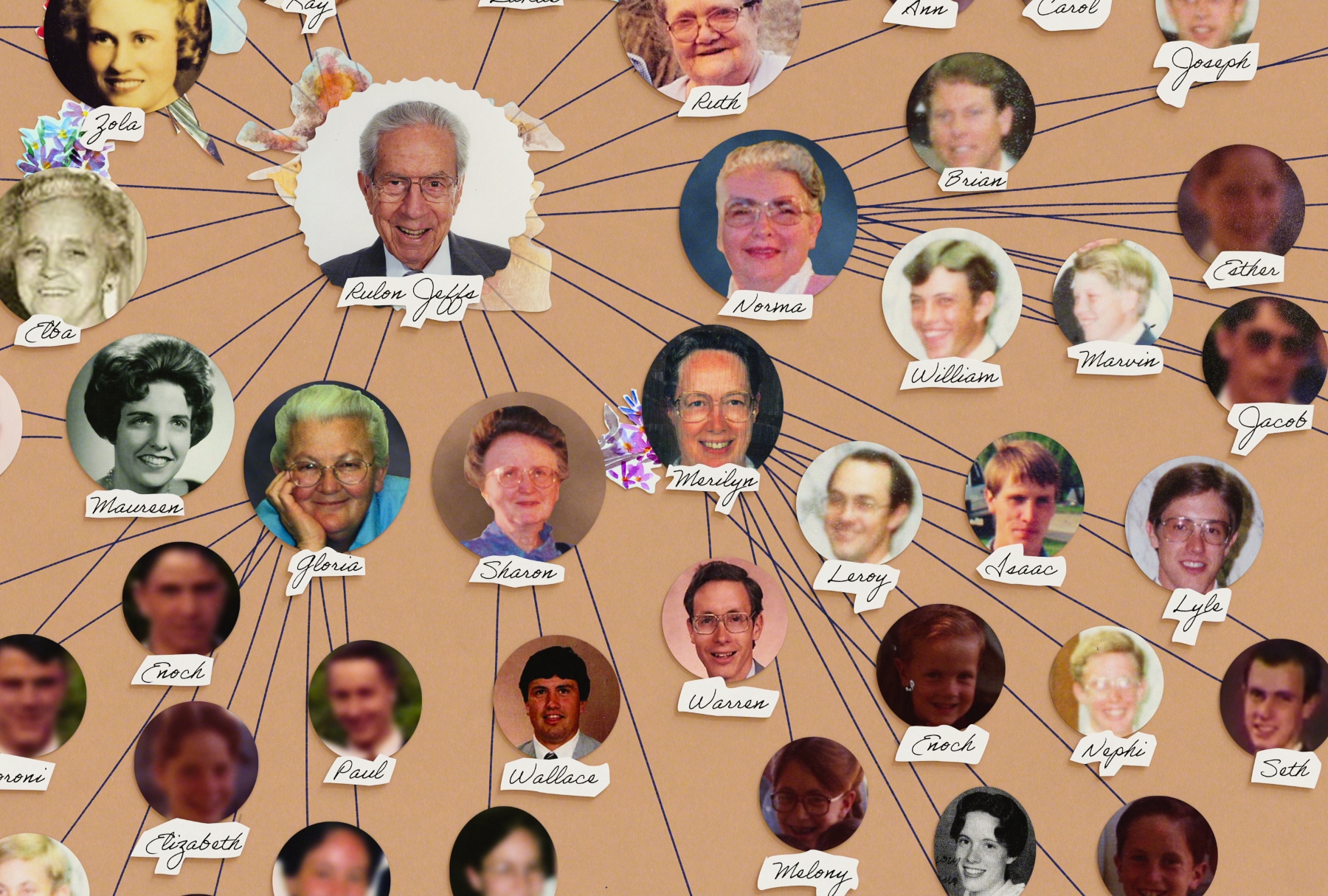
In “Keep Sweet: Pray and Obey,” one of Rulon’s many wives, Alicia Rohbock, recounted the prophet’s dining room wall, which organized each picture of Rulon’s partners in the order he married them. At the time of his death in September 2002, it was reported that Rulon had more than 75 wives and fathered approximately 60 children. Many of Rulon’s wives were also believed to have been underage at the time of their marriage — Rohbock, in particular, was just 20 years of age when she married Rulon, who was 86.

“Keep Sweet: Pray and Obey” (Netflix)

Warren Jeffs takes over  

Rulon’s son, Warren quickly assumed his position as prophet shortly after his father’s death. What was once Rulon’s now belonged to Warren, including Rulon’s 70+ wives. Warren married all but two of his father’s partners and additionally, took on his father’s previous responsibility of assigning wives to their designated husbands.  

Warren stripped women and girls of their autonomy, ordering them to don a new kind of prairie dress that covered them from head to toe and style their hair in a specific fashion.  

Many former members of the FLDS recalled that Warren’s leadership marked a dark period within the church’s longstanding history. Under his reign, rules for the sect’s members became stricter with Warren dictating what they wore, who they married and what they ate. Warren also forced members to turn over their personal property to the church’s leadership, required that children be homeschooled and even prohibited members from voting by telling them that he was the President of the United States . . .

Warren also banned the use of items that were the color red (even though he owned a red Cadillac Escalade) banned different kinds of entertainment – like “dogs, toys, television, newspapers, the Internet, birthday and Christmas celebrations, festivals, parades, camping and fishing” – and encouraged members to tone down their emotions. 

A handful of his rules served to control the girls and women in the group. Warren facilitated numerous underage and incestuous marriages, forcing girls as young as 14 years old to tie the knot with their distant relatives. The so-called prophet also adhered to his own rules and had 78 wives, 24 of whom were underage.

Additionally, Warren stripped women and girls of their autonomy, ordering them to don a new kind of prairie dress that covered them from head to toe and style their hair in a specific fashion.   

Warren’s arrest

Warren became a sought-out felon in 2005, when he was first indicted in Arizona on felony charges of arranging a marriage between a 16-year-old girl and a 28-year-old man, who was already married. The following year he was arrested as an accomplice to rape for performing another unlawful marriage involving a 14-year-old girl.

In 2007, Warren was found guilty of two counts of rape and in 2008, he along with other FLDS members were indicted on charges of bigamy and sexual assault.  

Three years later, on August 4, 2011, Warren was convicted of aggravated sexual assault of a child under the age of 14 and sexual assault of a child under the age of 17. He is currently serving a life sentence for the former and an additional 20 years for the latter.

“Keep Sweet: Pray and Obey” is currently streaming on Netflix. 

More stories you might like:

Ivanka tells Jan. 6 committee she trusted Bill Barr over her dad on “bullsh*t” fraud claims

Ivanka Trump testified to the House select committee on the Jan. 6 insurrection that she believed Attorney General Bill Barr’s assessment that her father’s election fraud claims were “bullshit,” according to deposition video aired during the panel’s first hearing on Thursday.

Barr released a statement after the election announcing that the Justice Department had found no evidence of widespread fraud in the election. The committee’s legal team asked Ivanka Trump how Barr’s statement affected her “perspective about the election.”

“It affected my perspective. I respect Attorney General Barr. So, I accepted what he said and what he was saying,” she told the panel.

The committee also played clips from Barr’s deposition. The former attorney general, who stepped down amid former President Donald Trump’s fury over Barr’s statement, repeatedly told the committee that he told Trump and his team that the fraud claims were “bullshit.”

RELATED: To indict Donald Trump, prosecutors will need to prove intent. Well, here it comes

“I had three discussions with the president that I can recall. One was on Nov. 23, one was on Dec. 1 and one on Dec. 14, and I’ve been through sort of the give and take of those discussions, and in that context I made it clear I did not agree with the idea of saying the election was stolen and putting out this stuff, which I told the president was bullshit,” he told the committee’s legal team.

Barr said he “didn’t want to be part of it” and that contributed to his decision to step down.

Barr also discussed TrumpWorld claims that voting machines were somehow rigged to flip votes. He said the claims were “complete nonsense” and said he had told Trump that it was “crazy stuff and that they were wasting their time.”

“I saw absolutely zero basis for the allegations,” he said, adding that it was a “great, great disservice to the country” to spread them.

At least four former Trump aides testified to the panel that they told Trump and his team that he had lost the election, but the former president continued to push to stay in office — which could potentially serve as evidence of criminal intent on Trump’s part. Those officials included Barr, former Trump campaign spokesman Jason Miller and two Trump campaign lawyers, Matt Morgan and Alex Cannon.

“I repeatedly told the president in no uncertain terms that I did not see evidence of fraud, you know, that would have affected the outcome of the election,” Barr said. “And frankly, a year and a half later, I still haven’t seen anything to change my mind on that.”

Yes, it is possible to die of a broken heart

Two days after Joe Garcia learned that his wife Irma Garcia died in a mass shooting at Robb Elementary School in Uvalde, Texas, he died of a heart attack.

Irma was one of two teachers killed in the horrific shooting. She taught at Robb Elementary School for 23 years, and she was married to Joe for 24 years. Their four children, the youngest just 13, are now left without parents. In the aftermath, friends and family have speculated that Joe died from a “broken heart”; that the grief was too much to bear. 

That is certainly possible, as there are many instances, historically speaking, of this — when someone who is grieving dies “of a broken heart” soon after learning of the death of a beloved one. One day after actress Carrie Fisher died in 2016, her mother, Debbie Reynolds, died of a stroke at age 84. Family said the stress of Fisher’s death “was too much.” NFL player Doug Flutie’s mother died from a heart attack one hour after learning her husband died of a heart attack. Paul McLeod, the eccentric owner of an Elvis Presley museum in Mississippi, died of a heart attack one day after regretfully shooting and killing a burglar. 

Are these deaths merely strange coincidences? Or is dying from a broken heart scientifically and medically possible?

“Acute grief can cause heart damage,” Dr. Sandeep Jauhar, a cardiologist and author of “Heart: A History,” told Salon. “We have known since the time of the Ancient Greeks that intense emotional upset can affect the heart, but we don’t really know exactly how it happens.” 

RELATED: Inside psychogenic death, the phenomenon of “thinking” yourself to death

Indeed, there is even a condition known as Takotsubo cardiomyopathy, also referred to as “stress cardiomyopathy” or “broken heart syndrome.” Often, when someone is said to die of a broken heart, it is because of Takotsubo cardiomyopathy. 

When the condition occurs, doctors typically see that a patient’s left ventricular apical, which is located within the heart, balloons. Dr. Regina Druz, Chenmed National Director of Cardiology, explained to Salon that the name derives from how the image of the heart muscle looks on an angiogram, which is a scan that shows how blood flows through the veins and arteries of the heart. The ballooning ventricle may look like a tako-tsubo, a pot used by Japanese fishermen to trap octopi. The term was first described by Dr Hikaru Sato in Japan in 1991.

Takotsubo cardiomyopathy is essentially a form of acute heart failure. But the condition is a bit mysterious, because when it happens, there is usually no physical evidence of a coronary artery obstruction or blockage.

“Portions that are attached to the blood vessels look normal, but then the rest of it looks as if it were an air balloon, so it’s dilated,” Druz said. “And this is exactly how this trapping vessel for octopi looks — it has a very narrow neck and a very dilated balloon-like body, and this is how it’s diagnosed based on clinical history as well as characteristic appearance on either an angiogram or the ultrasound of the heart.”

When a person presents with symptoms of Takotsubo cardiomyopathy, they may have chest pain, shortness of breath, heart palpitations, vomiting, nausea, anxiety and loss of consciousness. Electrocardiogram abnormalities can mimic those of a heart attack. It is essentially a form of acute heart failure. But the condition is a bit mysterious, because when it happens, there is usually no physical evidence of a coronary artery obstruction or blockage. If there is blockage, it’s usually very limited. It is akin to water getting stuck in a drainage pipe despite the pipe being completely empty. 

“Takotsubo cardiomyopathy can happen after the death of a loved one or the breakup of a romantic relationship,” Jauhar said. “Although it can also happen in situations of social distress, like after an earthquake.”


Want more health and science stories in your inbox? Subscribe to Salon’s weekly newsletter The Vulgar Scientist.


Druz said she has personally treated patients with this syndrome. She recalled one woman in her 60s, whose husband unexpectedly passed away. He was a business owner, and the woman had to take over his business affairs. Once she realized the business was underwater, on top of the stress of losing her husband, she essentially collapsed one day while shoveling snow. Initially, it was believed that she had a heart attack. 

“She got admitted to a hospital, she had gone through the workup and we ultimately diagnosed her with takotsubo cardiomyopathy — because her coronary arteries, the primary reason for a heart attack, actually didn’t have any blockages, but her heart muscle was severely impaired,” Druz said. “Speaking with her, and seeing the degree of her grief, it was obvious that these mental tragedies, plus physical exposure of having to shovel snow, were enough to cause this unfortunate situation.” 

Druz said the patient was fortunately able to get treated and she improved, but the function of her heart muscle still suffered. 

While the condition is often thought to be reversible and temporary for many — with recovery taking as long as a month for those patients — for some it can be fatal. According to one study of people who had Takotsubo cardiomyopathy, the mortality rate was 4.2 percent of a total of 24,701 patients. A majority of them, 89 percent, were female. While the prevalence of this heart condition is not well known in the United States, researchers estimate it makes up 2 percent of all individuals with suspected ST-segment elevation myocardial infarction, which is the most severe type of heart attack.

Despite what researchers know about this condition, the mechanism — meaning, how exactly intense grief can lead to heart failure — remains unknown. Jauhar said there are a few theories, and one is that these heart attacks are caused by a significant increase in adrenaline in the blood. 

“There are receptors in the heart that respond to adrenaline and have all sorts of downstream effects when adrenaline molecules attach to these receptors on heart cells,” Jauhar said. “And one of them is that heart cells die or become dysfunctional.” 

Dr. Martha Gulati, a cardiologist who helped develop the American College of Cardiology and the American Heart Association’s 2021 Chest Pain Guidelines, described the possibility of adrenaline affecting the heart after experiencing intense grief as an “abnormal hormonal response.” But why some people have this response and others don’t is unclear. 

“There’s been some recent research actually, where they were doing MRIs on the brain in patients who had in the last week takotsubo cardiomyopathy, and they found that the brain activity pattern was abnormal as well,” Gulati said. “There’s the hormone changes, but there’s also something potentially happening neurologically that is also affecting the heart.” 

“People kind of jokingly call some cardiologists ‘plumbers,’ people who open up arteries, and that really has guided a lot of our guidelines and our therapies,” Gulati said. “We’ve been looking for obstructions, and not everything related to the heart is about obstruction.”

So why are there so many unknowns about this peculiar and (literally) heartbreaking condition? Gulati said it speaks to the medical community lagging in its understanding of the causes of disease and conditions that aren’t necessarily caused by something physical. 

“People kind of jokingly call some cardiologists ‘plumbers,’ people who open up arteries, and that really has guided a lot of our guidelines and our therapies,” Gulati said. “We’ve been looking for obstructions, and not everything related to the heart is about obstruction.”

Gulati said when talking about heart failure, it’s important to move the conversation beyond the cause being a blockage. Meanwhile, Gulati said in terms of Takotsubo cardiomyopathy, cardiologists are learning more but still have a “long way to go.”

Gulati added when someone is in emotional distress and experiencing chest pain, it should be taken seriously. 

“We need everybody to understand that chest pain needs to be taken seriously, time is heart muscle, we still need to call 911,” Gulati said. “If you’re experiencing chest pain, even if you’ve received good news or bad news, it needs to be evaluated because we know there’s this association.”

Read more about heart health:

Celebrating the casual bisexuality in “Hacks”

Shortly after “Fire Island” premiered, a tweet took off about the Hulu film, critiquing the lack of women in the story centering queer Asian men. Viewers were quick to defend the film, and the woman who criticized it became that thing you never want to be: the character of the day on Twitter. Stories about white women are rarely in short supply. But stories about certain kinds of queer experiences are often missing, including bisexuality. 

RELATED: 2021 was an extraordinary year of making the nonbinary ordinary

The feelings often resurface this time of year, as some people feel ostracized or unwelcome at Pride events, which are supposed to be welcoming to all. Those who are bi, particularly bi women in relationships with men, can feel judged and isolated. Relationships don’t define your identity or the core of who you are inside, but judgment by members of your own community, who are supposed to be accepting, can lead to feelings of being invisible — and worse. Who can forget the victim-blaming Ikea bisexual couch? (I prefer my grasping, bodiless hands in Jim Henson’s “Labyrinth,” thank you.) 

“There’s a ‘b’ in there and it doesn’t mean ‘badass’. Okay, it kind of does, but it also means ‘bi.'”

Terrible furniture aside, biphobia is a real issue, as is bi erasure, despite bi people actually making up the largest group within the LGBTQI community. Receiving the message, even from other queer people, that you don’t exist or that your identity doesn’t matter, can lead to poor health outcomes, depression and abuse.

TV has made some strides when it comes to presenting bi stories and characters. The role of Callie (Sara Ramirez) on “Grey’s Anatomy” is a good example. First married to George (whoops), Callie has a relationship with Erica, marries Arizona, then ends up with Penny (it is “Grey’s Anatomy,” after all). One of her character’s typically no-nonsense quotes? “So, I’m bisexual. So what? It’s a thing and it’s real. I mean, it’s called LGBTQ for a reason. There’s a ‘b’ in there and it doesn’t mean ‘badass’. Okay, it kind of does, but it also means ‘bi.'”

Engaging, realistic bi characters are still an endangered species.

Other notable TV bisexuals include Rosa in “Brooklyn Nine-Nine.” Played by Stephanie Beatriz, the actor’s bisexuality was written into the show. Tara on “True Blood” has a relationship history with mostly no-good men, then has a relationship with Pam, who is also bisexual (and also awesome).

While TV bisexuality tends to focus on women, likely for their palatableness to a straight male audience, “Crazy Ex-Girlfriend” has the gold standard of a bi dude: Darryl Whitefeather (Pete Gardner), king of Dad jokes, supportive friend and singer of the banging tune “Gettin’ Bi.” Married to a woman, he gets divorced and at an older age, realizes he’s bi and dates a wonderful man (I stan Darryl and White Josh). When that ends, he has a relationship with a woman. That’s just life!

More consistently, however, if bisexuals are on TV, they’re sexily dangerous and untrustworthy, from Eleanor in “The Good Place” to Dennis on “It’s Always Sunny in Philadelphia.”

Bisexuality is sometimes a stand-in in TV and films for evil (Scylla in “Motherland: Fort Salem”), sometimes a stand-in for promiscuity or indecisiveness and confusion (Alice on “The L Word”), and sometimes presented as not real (again with “The L Word” and whatever happened with Willow on “Buffy“). Fictional bisexuals are not uncommonly punished with death (Bill on “Killing Eve“)

Engaging, realistic bi characters are still an endangered species. “Crazy Ex-Girlfriend” is over (why?!). Ramirez left “Grey’s Anatomy,” to terrorize us with the role of Che in “And Just Like That.” And one lead in the heartwarming YA series “Heartstopper” is bi. Is there anywhere to turn for real and really good bi stories this Pride?

There’s “Hacks.”
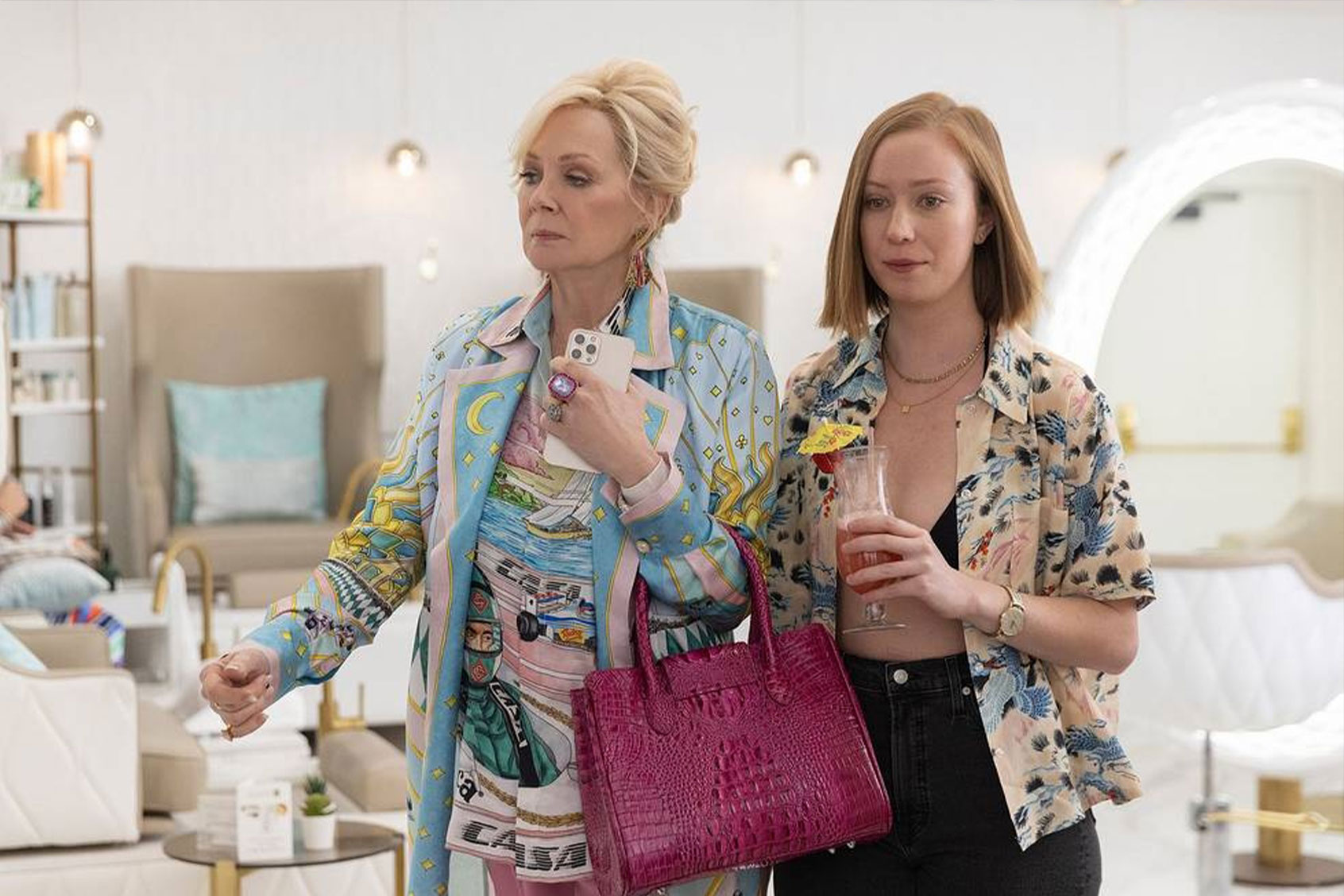
HacksJean Smart and Hannah Einbinder in “Hacks” (Karen Ballard/HBO Max)The HBO Max series, which just wrapped its second and possibly final season, tells the story of Deborah Vance (Jean Smart), a comedian who broke into the biz at a time when women were more likely to be the jokes than to tell them onstage, and who is trying desperately to hold on to her career as she commits that unforgivable sin for women in Hollywood: she ages. The Cagney to Deborah’s Lacey (or, maybe they’re both Cagney) is Ava (Hannah Einbinder), a young comedy writer who thinks her career is over before it begins. Her manager (Paul W. Downs), who handles both Deborah and Ava, convinces her to take a job in Las Vegas writing jokes for the comedian. 

It’s part of her. It’s not the whole of the character. It just is.

Einbinder is openly bi and so is Ava. The character says so to Deborah early in their meeting, as Deborah comments on her outfit. Deborah critiquing Ava’s androgynous dressing is a theme of the show, as is Deborah criticizing Ava in general. 

Ava has an ex-girlfriend she sometimes misses too much, but importantly — and uniquely: in the show, she has hookups with multiple genders. Not a ton — this not the sordid, sexually depraved bisexual trope — but enough that her bisexuality is present. It’s part of her. It’s not the whole of the character. It just is. The show doesn’t present it as shocking when Ava spends the night with a man she meets in a Vegas casino, or when she makes out with a couple on a lesbian cruise Deborah is inadvertently booked on.

In an interview with The Advocate, Einbinder said “I have at times, especially in my early days of attempting to accept myself, felt really out of place. I was never fully one thing, so I never fully belonged anywhere.” 

Ava is similarly adrift, struggling to make a living, to be a good daughter and to make it as a writer. Her relationships don’t work out (so far), but at least she tries them, and the show gives her the space to try with multiple genders. Ava also finds community in Deborah’s circle, with Marcus, a queer character in the show played by non-binary actor Carl Clemons-Hopkins, and eventually even with Deborah.

The two form an unexpected friendship. They’re several generations apart (and miles apart, class-wise). Deborah is bitter, brilliant and hurting, at times borderline abusive to her staff, and Ava is just doing the best she can, occasionally making massive mistakes along the way. A drunken email at the end of Season 1 almost ended her work with Deborah — and maybe her work in general — forever. 

It’s not only that bisexuals feel invisible, but are often and increasingly the target of violence.

But these are just mistakes. This is not the tricksy bisexual cliché. Deborah certainly makes her mistakes too. And importantly, Ava owns up to her errors. She remedies them the best she can: ditching her smart phone for a flip phone so she can’t email drunkenly, and giving up drinking (at least when she’s not on a cruise).

This is a complex, engaging characterization of a person who just happens to be bi. It’s a fact of her but not the only fact. But by even dramatizing it at all, “Hacks” is rare. 
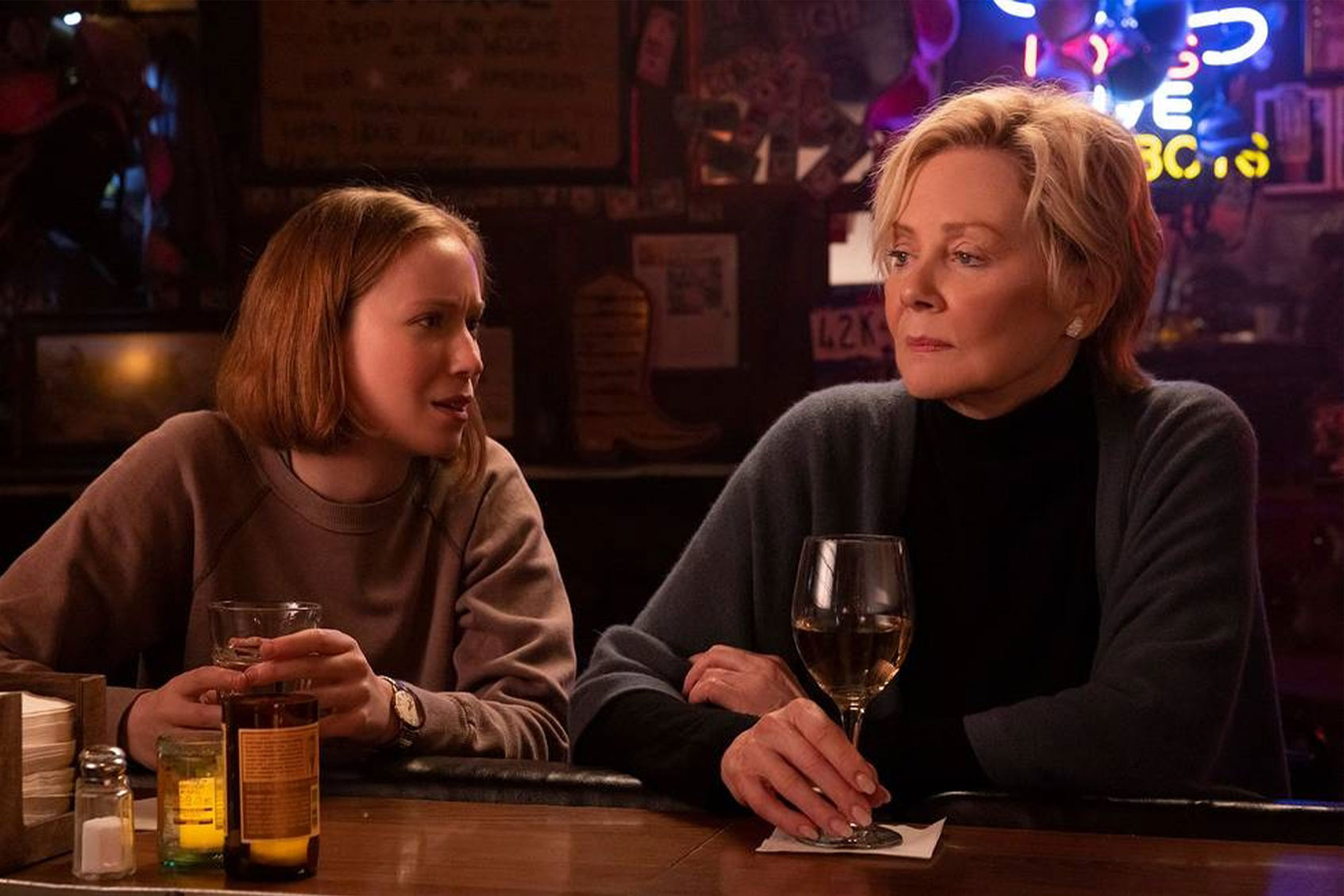
HacksJean Smart and Hannah Einbinder in “Hacks” (Karen Ballard/HBO Max)In Season 2, while her boss is painting her nails before she goes out, Ava talks candidly about being bi, and asks Deborah, after she’s been disappointed by yet another man, if she ever questioned her own sexuality.  Deborah says she sometimes wished she was gay because it would have been easier than being with men. But Ava grows thoughtful and says, “But it wouldn’t have actually been, right? To be queer when you grew up?” 

Deborah, who survived decades of sexual harassment and saw many of her female contemporaries leave the art forever, says: “In my day, there were two options. You liked one, or you liked the other.”

But Ava quietly persists: “I just think there’s room for more nuance. Like, not every queer person feels like they arrive into existence with an attraction to like, a specific type of person, and that’s OK too. Your sexuality isn’t a choice but whether or not you examine it, I think, is.”

The scene is long, intimate and real – and possibly the best explanation of sexuality since David Rose discussed his sexuality with Stevie Budd on “Schitt’s Creek” using varietals of wine: “I like the wine, and not the label.”


Want a daily wrap-up of all the news and commentary Salon has to offer? Subscribe to our morning newsletter, Crash Course.


With the fate of a third season of “Hacks,” uncertain, will we lose another accurate, nuanced and desperately needed bi character on TV? It’s an urgent question. It’s not only that bisexuals feel invisible, but are often and increasingly the target of violence. According to CDC, 60% of bisexual women have experienced rape, physical violence or intimate partner stalking. That’s much higher than the rates of violence faced by straight women, lesbians, or straight or queer men.

We need Ava more than ever. As Einbinder told The Advocate: “I think if I had seen more images of bisexual characters, it would have been easier. It would have been more clear. My journey wouldn’t have taken me so long.”

More stories like this

Lil Nas X calls out “the bigger problem of homophobia in the Black community” following BET snub

Following a now-deleted rant on Twitter last week, Lil Nas X is continuing to bash homophobia within the Black community after receiving no nominations in this year’s upcoming BET Awards, which notably celebrates Black excellence across the entertainment industry.

On Tuesday, the “Montero” rapper and unapologetically queer artist publicly called out the network, which stands for Black Entertainment Television, in an unreleased diss track titled “Late To The Party.”

“F**k BET! F**k BET! F**k BET!” Lil Nas lip-synced in a minute-long clip while repeatedly sticking up his middle fingers. The video, which garnered close to two million views on Twitter, further propelled his attack on the network and its supposed prejudice against queer artists of color.

RELATED: Lil Nas X’s “Old Town Road” star power and country’s queer visibility

Lil Nas’ social media tirade began last week, when the artist addressed BET in a deleted post saying, “Thank you bet awards. An outstanding zero nominations again,” alongside the brief comment, “Black excellence!” Per Deadline, he expressed similar sentiments in a subsequent post that read, “Black gay people have to fight to be seen in this world. Even when we make it to the top, mfs try to pretend we are invisible.”

So far, Lil Nas has received only one BET nomination, which was back in 2020 for Best New Artist. He has not received any nominations since.

Many fans and followers questioned the rapper’s recent behavior, noting that he has won more prestigious accolades in the past, including two Grammys for his 2020 hit song “Old Town Road.” In a series of quote tweets, Nas reiterated that for him, it isn’t about the awards but more about increasing queer, marginalized representation and visibility within the music scene.

“[T]his not over, no BET award,” he wrote in a separate tweet posted on Tuesday. “[T]his is about the bigger problem of homophobia in the Black community, y’all can sit and pretend all u want but imma risk it all for us.”

In another tweet, written in response to his BET snub, Lil Nas wrote, “This is my point exactly how can i get acknowledged by the most acclaimed award show in the world and then not even just 1 nomination from my own people? Is that not crazy? Am I really tripping”

Lil Nas also pointed out that fellow rapper Jack Harlow, who collaborated with him on their hit single “Industry Baby,” earned a recent BET nomination for Best Male Hip Hop Artist. To be clear, Harlow, who is merely featured on the track, is also a white artist.

“Funny thing is ‘Industry Baby’ was the biggest song me & Jack released last year in the eligibility period but only one of us got a nomination,” Lil Nas explained.


Want a daily wrap-up of all the news and commentary Salon has to offer? Subscribe to our morning newsletter, Crash Course.


On Wednesday, BET responded to Lil Nas’ allegations in a statement to Deadline:

We love Lil Nas X. He was nominated for a Best New Artist BET Award in 2020, and we proudly showcased his extraordinary talent and creativity on the show twice: he performed “Old Town Road” with Billy Ray Cyrus at “BET Awards” 2019 and his “BET Awards” 2021 performance was a highlight of our show. No one cheered louder that night than BET.

Unfortunately, this year, he was not nominated by BET’s Voting Academy, which is comprised of an esteemed group of nearly 500 entertainment professionals in the fields of music, television, film, digital marketing, sports journalism, public relations, influencers, and creative arts. No one from BET serves as a member of the Voting Academy.

At BET, we are passionate advocates for the wonderful diversity that exists within our community. We are committed to using all of our platforms to provide visibility and inclusion for all of the many intersections of the Black community.

More stories you might like:

The pancake recipe that will make you fall in love with . . . beets

“Soft foods only for the first several days,” the oral surgeon advised. “Smoothies. Yogurt. And when you’re ready, pancakes.”

My daughter groaned a long, still-doped-to-the-gills groan. “Ohhhhh,” she slurred, “I lovvvvve pancakes. My mom makes me pancakes.”

My younger daughter is well past the age of tea parties and tutus. She turned 18 this past winter and heads off to college in the fall. Nevertheless, she remains an enthusiast of all things fluffy and pink. So, when she had her wisdom teeth removed, I wanted to treat her to a little something special for her recovery. 

RELATED: A pancake for when I’m too lazy to make pancakes

Author and illustrator Erin Gleeson’s beautiful new book “The Forest Feast Road Trip” is full of heady inspiration for cooking — and dining — well even when you’re far from your home. The simple vegetarian recipes inspired by her travels through California include spaghetti squash taquitos and sticky date-almond sundaes.

The book offers a fresh perspective on eating like a local, wherever you may plant yourself as we collectively make our way back toward wandering. But don’t let the premise discourage you from making vibrant meals like Gleeson’s curry cauliflower salad in the comfort of your own kitchen.

RELATED: If you have pancake mix, it’s almost too easy to make hot, fresh, fried onion rings

As an avid fan of off-label uses of pancake mix, I was especially delighted by her easy, rose-tinted upgrade of a beloved breakfast classic.

“Pancake mix was one of the things we traveled with a lot on the road trips,” Gleeson told me during a recent Zoom conversation. “When you’re traveling, you want a substantial breakfast, and pancakes feel kind of special. I love using beets because I’m always trying to get as much color as possible on the table and get in as many vegetables as possible. It’s just a fun way to introduce some color and nutrition.”

You don’t have to love pink, or frankly even beets, to be a fan of these beauties. (That being said, I will never understand anti-beet sentiment.) Pancakes sometimes tend to veer saccharin, but the natural, vegetal sugars in beets add some balance to that sweetness. Because I like to go all-in on delicate things, I’ve made mine silver dollar-sized, but you do you here. They’re gorgeous — and exactly as delicious as they are pretty.

***

Recipe: Pretty in Pink Pancakes
Inspired by Erin Gleeson’s “The Forest Feast Road Trip”

Yields
4 servings
Prep Time
 5 minutes
Cook Time
10  minutes

Ingredients

  • 1 serving all-in-one pancake mix, prepared to directions
  • 1 small beet, cut into chunks, or small can of cooked beets


Directions

  1. Pour the beet and pancake batter into a blender and blend until smooth. 
  2. Meanwhile, heat a medium skillet or cast iron pan over medium heat and lightly oil it. 
  3. Spoon the batter into the pan a few tablespoons at a time. After a minute or so, when bubbles start to form and break on the surface, flip the pancakes over and cook them for another minute or so.
  4. Serve immediately with butter and syrup, plus lots of bacon, if you’re feeling it.

Cook’s Notes

When it comes to pancake mix, I’m a fool for Bisquick’s Shake ‘n Pour.

Ina Garten’s method for roasting bacon in the oven on a sheet pan will change your life. 

You can swap out the beets for plenty of other vegetables, including shredded carrots or zucchini. They would be equally delicious, if less eye-catching.


Want more great food writing and recipes? Subscribe to “The Bite,” Salon Food’s newsletter.


More clever uses for pancake mix: 


Salon Food writes about stuff we think you’ll like. Salon has affiliate partnerships, so we may get a share of the revenue from your purchase.

“An Act of Worship” is one Muslim American’s “counternarrative of our last 30 years”

The compelling documentary, “An Act of Worship,” chronicles three decades of discrimination and hatred towards Muslim Americans. Juxtaposing recollections of abuse and bullying with home movies of families celebrating life in America, Pakistani-American filmmaker Nausheen Dadabhoy underscores the cultural and mental health issues that many Muslims — especially youths — have absorbed living in a country that has loudly and repeatedly expressed racism and Islamophobia

Several interviewees movingly describe how their efforts to assimilate forced them to “lose their cultural truth,” rejecting their religion, headscarves, and identity in order to blend in and be less feared. Other segments examine how families have been separated or were under surveillance. Dadabhoy chronicles the shift in how Muslims in America have been treated from the time of the Iran Hostage Crisis, through the 1991 Gulf War, the Oklahoma City bombing, 9/11, the 2001 Patriot Act, the 2013 Boston Marathon, and the Muslim Ban enacted under twice-impeached, one-term President Donald Trump. 

In addition to these stories, “An Act of Worship” profiles three young female activists – Aber, Khadega, and Ameena – who advocate for rights and social justice while trying to maintain a sense of dignity in a country that continues to dehumanize this segment of the population. 

RELATED: “Don’t hang out with mean people”: Comedian Maysoon Zayid’s mission to fight sexist, racist, and ableist trolls

Salon spoke with Dadabhoy on the eve of her film’s world premiere at the Tribeca Film Festival. 

“That generation of kids born after 9/11 are so much better at being themselves. It’s so cliched, but they are unapologetically Muslim.”

I was struck by the ways the Muslim Americans you interviewed all talked about hiding their religion and culture — as If it was something to be ashamed of — and how their efforts to assimilate and be “more American” were often forcing them to lose their identity and sense of self. One of the subjects of your film crystalizes that when she explains that they “are becoming the very stereotype they were trying to avoid.” Can you talk about that Catch-22?

I feel like that conversation about assimilation has progressed so much. Someone like Khadega and that generation of kids born after 9/11 are so much better at being themselves. It’s so cliched, but they are unapologetically Muslim. There is a lot of me in the film; I narrate one of the first pieces of voiceover. For my generation — my parents came over during the Iran Hostage crisis — they got prank phone calls and were very afraid. After 9/11, they received threats. They had neighbors who sent us really nasty letters. I also think it’s important to remember that a lot of that generation of Muslims who came to the U.S. in the 1970s, ’80s, and ’90s, came after some kind of political upheaval. If not, there were certainly things you couldn’t say about the government. I don’t think my parents know how political this film is. Their attitude was “Don’t say anything. Don’t rock the boat. Keep your head down. That’s how we’ll stay safe.” A lot of us absorbed that, and my sister was bullied in school for being different, and the only way to mitigate that was to try not to be different.

The film is an exploration of figuring out why this new generation are so powerful and sure of themselves. What happened? I think our community shifted, and they built a lot of power over the last 20 years, so these kids have an infrastructure and resources that we didn’t have. My mom went to her first protest in 2020 against the Muslim Ban. Her generation is absorbing what these younger kids are introducing into our community. I’m not saying that everyone in community is like that. People I met had parents who protested. It just was not the experience I had.

Likewise, the mental health issues that developed for these Muslim Americans who tried not to think of identity is very powerful. There is talk of suicide and numbing depression with drugs. What observation do you have about the impact of this on the Muslim American community? 

I think that there is a lot of trauma in our community. What was sad to realize that if I’m talking to Aber, who grew up in New York — her parents are from Palestine, and mine are from Pakistan — there is shared trauma that we can bond over. Of course, there are beautiful things we can bond over, like our immigrant background, but shared trauma is a big part of it. One of the things we realized is how after 9/11 people did not say they were Pakistani American, but Muslim American. It’s been part of our identity formation in this country. I want to say “us” very carefully. The film is very much from the frame of parents who came here as immigrants, or [people] who immigrated here. It’s from the lens of the immigrant Muslim community. We have not captured the African American or Latinx Muslim experience.

“Yes, these terrible things happened but there is also beauty in our experiences. How can we look at those too?”

Part of what we want to do with our film and our impact campaign is do a lot of healing for our community. How can we start to decenter trauma and address it? There is so much unacknowledged trauma in the community. We would ask people about incidents of Islamophobia, and they would either brush them off or start to cry. How do we start to address, acknowledge and heal from it? We hope that storytelling is a part of it. Our film is a counternarrative of our last 30 years, it’s a jumping-off point for people to think of personal counternarrative. Yes, these terrible things happened but there is also beauty in our experiences. How can we look at those too?

What can you say about how people respond to or combat Islamophobia? 

I made a movie. I watched the 2016 election with one of my producers, and I remember seeing a friend the next day, who is a gay Muslim man, and he’s said, “I’m not going to go back to Pakistan. That is not an option for me.” He can’t live openly there; he also has a partner here. We have to do something about this. We can do something about this. Showing up for my community was making this movie. Everyone has a different approach. For some people, it is not going to be activism, but the quiet way they can be who they are authentically or how they just take care of each other in these times of crisis. 

An Act Of WorshipAber in Nausheen Dadabhoy’s “An Act Of Worship” (Capital K Pictures)

How did you find the three participants in your film, Aber, Khadega, and Ameena? 

We found a lot of women working in community organizing spaces and as activists. I was working with CAIR, the Council on American Islamic Relations, in Los Angeles. My sister was an attorney at the chapter. Her boss was Ameena Mirza Qazi, the attorney in the film. When the protests were happening at the airport, I saw Ameena in action and was in awe. “Let me put a mic on you and film you.” Luckily, she was along for the ride. We filmed for many years. CAIR LA helped us find other activists. We went to different communities and asked, “Who were the activists?” Literally every community said, “There is this amazing young woman . . .” Where are the men? There are women leading the charge, so this film is going to be about them. They are on the front lines. I’m not exaggerating. 

The film touches on the headscarf debate. I liked it when one interviewee said she chooses to wear the headscarf as a form of resistance, which makes it a political act. What are your thoughts on this? It can be so polarizing.  

I used to wear a scarf also. That predates 9/11. I wore one when I was in high school, and for me, it was very much an act of devotion. Talking to people making this film, for some cultures, primarily Arab cultures, it’s just part of the culture. It doesn’t have to do with religious devotion. In Pakistan, a lot of women don’t cover their hair. They cover it differently. It’s culturally how they do it. In some Arab cultures, you hit puberty and you start covering your hair; it’s not religious, it’s cultural. But what did happen, and I remember having this conversation with a friend of mine after 9/11, it was very political. I want to be outwardly Muslim. I want to show my faith and have people see that I am Muslim and I’m not going to hide it. For some people it was, “I’m going to show them the best part of Islam. I’m going to wear the scarf and be a good person so now try coming at me with your anti-Muslim sentiments.” That’s so unfair, the work you have to do to take all that on. I didn’t do that, but I think a lot of women did. 


Want a daily wrap-up of all the news and commentary Salon has to offer? Subscribe to our morning newsletter, Crash Course.


What message of hope do you have for your community?

Ultimately, my film is about creating a different narrative for ourselves and for us to see ourselves in all the beauty and nuance in our story that hasn’t really been seen enough in American popular culture and media. But I also remember that during one of the versions of Trump’s Muslim Ban, I was filming with Ameena, and I had read about the Ban and was so depressed and I filmed an interview with her, and I was like “We’re going to be OK.” There are amazing people like her and so many others who are not going to let things like this stand. I find my hope in our community. 

More stories to check out:

Winemakers are aging bottles underwater. The result is delicious

In 1998, divers in the cold Baltic Sea discovered thousands of bottles of Champagne that had sunk deep down in a Swedish schooner, which was wrecked by a German U-Boat in 1916. When the divers brought some of these bottles back up to the surface, the first thing everyone wanted to know was if it was even drinkable. After popping a few corks, wine experts discovered that not only was the Champagne unspoiled, it was surprisingly delicious.

As wine producers around Europe watched, the story unfold in Sweden and then in London where the bottles were sent for analysis, an idea began to take shape. If the underwater wine from this sunken ship was that good, why not deliberately sink more bottles?

At first it was more of an experiment, an exercise to see what might be possible. But it soon became clear that underwater wine could be a commercial venture. Gergö Borbély, founder of ElixSea, comes from a Hungarian wine-making family and happens to have a passion for diving. After traveling the world for years diving caves and reefs, he found the perfect way to combine his two loves. In 2017, he and his wife Mariona Alabau set up ElixSea, an “underwater winery” in Priorat, Spain, and began aging wines in the Mediterranean Sea.

“After years of experimenting and different trials, our wines are now aging 3 to 4 times faster than their control samples, which is the same wine but kept in a wine fridge,” said Borbély. “This gives them a more mature character, much smoother, lower levels of tannins, and more balanced acidity.”

Visitors to ElixSea can see the difference at one of the winery’s tasting events, where guests taste underwater wines alongside their land-aged counterparts. The land-aged wines have been aging for 3-4 years, while the underwater wines have been submerged in the sea for just 6 months. Visitors can try the Sea Star wine (a Grenache) or the Lega Sea, a careful blend of Grenache, Cabinet Sauvignon, Syrah, and Carignan, and yes, you can buy them.

Edivo, was the first winemaker to produce an underwater wine in Croatia. They began researching the process in 2011 and sank their first bottles of wine in 2013. There are also underwater wineries operating in Argentina, Portugal, Greece, South Africa, Australia, Italy, Chili, and Brazil. But Spain is still the epicenter of underwater wine production. There are currently five underwater wineries in Spain, making the country the forerunner of underwater wine production. It seems Spain has taken this fairytale story of sunken treasure to its heart, due in part to the body of water that is so beneficial for this process.

“20 to 30 meters below the sea, the temperature is constant, the pressure is up to 4 times higher than on the surface,” said Borbély, “and there is constant motion generated by the currents and tide changes. These conditions give the wine a character previously unheard of.”

Making underwater wine is still an exercise in adventure. It’s as much about discovery as delving around in old sunken shipwrecks. Some of the wines are aged before going underwater, like ElixSea’s Lega Sea, which is aged on land for 12 months in French oak barrels before being submerged. But most underwater wines spend their entire fermentation time under water.

In 2019, Austrian winemaker Josef Moth was chatting with a friend when the topic of the dredged bottles of Champagne from the Swedish schooner came up. They talked about the winemakers, like Borbély, who were deliberately sinking their own bottles. Moth got to thinking: what if he could do it better by going even deeper underwater? He didn’t live near the ocean, but he wasn’t about to let that stop him. One day he gazed out over the Alpine Lake Constance and imagined his wine taking its own journey underwater.

Lake Constance is a freshwater lake, so it was a slightly different experiment to the ones done in the sea, but the absence of salt water doesn’t affect the process since the wine doesn’t come into direct contact with the water.

The plan took some organizing, as Lake Constance is protected by the International Commission for water protection. The lake borders three countries — Austria, Germany, and Switzerland — and supplies their drinking water, so getting a permit wasn’t easy. Eventually local authorities agreed to let Josef try submerging his wines in the lake, on the understanding it would be a one-off experiment. He used some wine that had been aged for a year already, left some on land as test samples, and then took his underwater wine down to 60 meters below the surface and left it there for another year.

“After intensive briefings with professional divers, it turned out to be the maximum depth for us under the given conditions,” Moth said, leading me to believe he would have gone deeper if he could. But even at this depth, there was a noticeable difference in flavor.

“Although each one of us, as well as the scientists we consulted, including Professor Robert Steidl, Head of the Federal Office for Viticulture, could not imagine that something would happen with the wines, we can say conclusively that something has happened.” Moth noted. “Chemical and sensory analysis showed that the wines are significantly more aromatic.” Moth is currently planning three follow up projects to his Lake Constance experiment, all of which are strictly secret for the time being.

They are also significantly more expensive. While you can pick up a land aged wine for as little as $8, you won’t find any ocean submerged wines under $100. The wines submerged in Lake Constance sell for $145 but as Gergo explained, they really are unique.

“The wines get the characteristics of a 3 to 4 year older one,” Borbély said, “but due to the relatively short period of time underwater, we found 6 months aging in the sea to be ideal, so that they maintain their younger characteristics.”At ElixSea, the next phase of underwater wine production sees Borbély acting as a consultant to any other wineries who want to embark on their own journey of discovery. “We are providing consultancy and our experience alongside the necessary legal documents to age wines under the sea.” This is a new venture, but Borbely is confident that there’ll be no shortage of customers for his consultancy skills.

The interest in underwater wine does seem to be increasing. Terramare Wines exhibited their underwater wines at The Bellavita Trade Show in London last year. Nelly Ward from Vinum Fine Wines, who attended Bellavita, found the wines intriguing and says “The finish is long, persistent, with a certain salty mineral, almost iron flavor.”

Underwater wine requires a shorter aging time, but brings results of equal quality to land aging, meaning production can increase. It’s no wonder more wineries around the world are considering their own underwater options.

To indict Donald Trump, prosecutors will need to prove intent. Well, here it comes

Perhaps the biggest hurdle for prosecutors eventually to clear in order to bring criminal charges against Donald Trump for his efforts to overturn the 2020 election will be proving his intent. As we explain in a new report, the Jan. 6 committee hearings that begin this week, together with what we know already, should provide more than enough proof to establish the former president’s corrupt mental state as he attempted to overturn the election.

In criminal law, “intent” refers to someone’s state of mind at the time of their criminal action. When proving intent, you need to show that they intended to do the thing that is a crime. Because it is rare to have direct evidence of what a person is actually thinking, prosecutors usually infer intent from the facts and circumstances surrounding a person’s actions.  

In the case of Donald Trump, what we already know about his actions and statements following the 2020 election demonstrate his intent. His actions explicitly showed he was willing to go to any lengths to retain power and was using false claims of fraud as a pretext. 

RELATED: Time for Merrick Garland to act: Trump can’t get a pass on serious crimes over “politics”

He attempted to coerce Georgia state officials to “find 11,780 votes,” just enough for him to win–a request that would not have made sense if he wanted a legal response to actual evidence of fraud. 

He threatened to replace Justice Department leaders who did not cooperate with his scheme to weaponize the agency to bolster unsubstantiated claims of election fraud and pressure state legislators to appoint “alternative” electors.

He pressured Vice President Mike Pence to reject or delay the Jan. 6, 2021, counting of Electoral College votes. And then, when Pence refused to do his bidding, not only did Trump praise and endorse violence, but he sat by instead of mounting a prompt and appropriate response to an attack on the Capitol. 

Starting on Thursday night, we expect the House select committee to give us a behind-the-scenes look at how all this evidence fits together, providing a detailed account of what transpired during Trump’s 187-minute silence between the beginning of the Capitol invasion and when he finally tweeted a video begrudgingly telling his supporters to go home.

As Trump apologists prepare to defend his conduct, it is important to realize how shallow their defense will be. It is laughable to suggest that Trump genuinely believed he had won the 2020 election. We already know that experts and advisers told him the election results were legitimate. He heard this from his campaign advisers, DOJ lawyers, high-level officials in his own Department of Homeland Security and Republican elected officials. Trump knew he had lost a free and fair election, but he wanted to remain in power anyway. 

Here too, the committee’s work will be helpful, providing key evidence about what Trump and his allies knew, or should have known, about the results of the 2020 election and shedding light on discrepancies between what Trump and others were saying and doing in public and what they were admitting in private.


Want a daily wrap-up of all the news and commentary Salon has to offer? Subscribe to our morning newsletter, Crash Course.


The committee, prosecutors and all of us have a foundation for showing Trump’s corrupt intent: his long-established pattern of crying “fraud” to undermine results he didn’t like. 

After Trump lost the 2016 Iowa caucuses to Ted Cruz, he cried fraud and demanded a do-over. He did the same thing in the general election after losing the popular vote to Hillary Clinton, despite winning the Electoral College and becoming president. 

We already have a clear foundation for demonstrating Trump’s corrupt intent: his long-established pattern of crying “fraud” to undermine results he didn’t like.

Trump laid the groundwork for claims of fraud in 2020 before votes were cast and before there could be any evidence of irregularities. At a rally in August 2020, Trump said that “[t]he only way we’re going to lose this election is if the election is rigged.” Throughout 2020, he made a series of statements along these lines building the foundation for his post-election narrative and showing us that even before the first vote was cast, he had no intention of accepting election results he didn’t like.

Through its investigation and public hearings, the committee will shed light on what is already apparent: Trump’s claims of fraud were not in response to reports or evidence. They were not in response to a genuine concern about our democracy. Before the first ballot was even cast, Trump’s team was prepared to mount a baseless offensive that supported the conclusion they wanted to reach.

Even if Trump could somehow convince prosecutors and a jury that he really believed he had won — despite all the evidence to the contrary —  that would not have permitted him to use dishonest means to stay in power. His legal adviser, John Eastman, made clear that the scheme he and Trump tried to execute to keep Trump in power required breaking the law. You can’t keep power illegally even if you believe you really won an election. But prosecutors won’t need to reach this point, since the evidence is so strong that Trump and those around him knew he lost.

We already know that lawyers in the White House counsel’s office warned Trump’s team about the lawlessness of their scheme. The committee will likely reveal more information about Trump’s knowledge of its lawlessness and his intention nonetheless to use whatever means necessary to remain in office.

Prosecutors don’t need Donald Trump to dramatically confess on the stand in order to convict him. All they need is to show that he intended to undermine the counting of electoral votes. That is already evident and will be further substantiated by the mountain of evidence that the Jan. 6 committee has amassed and will present to the American public.

As a federal judge in California has already found, there is significant evidence that Trump and his close advisers committed criminal offenses in the course of their plot to overturn the people’s vote in the 2020 election. His intent will become even clearer through the evidence presented in this month’s hearings. We hope that will embolden prosecutors to overcome their caution and move forward with criminal charges.

Read more on the effort to hold our 45th president accountable:

The genius potato salad that converted a potato salad skeptic

Every week in Genius Recipes — often with your help! — Food52 Founding Editor and lifelong Genius-hunter Kristen Miglore is unearthing recipes that will change the way you cook . . . usually! While she’s on sabbatical for a little longer, a few friendly faces will share their most Genius finds.

Potato salad dates back to the early 19th century, when German immigrants first arrived in America. In the two-ish centuries since, the dish has made its mark as a cookout mainstay and an important symbol of family history and hierarchy.

But if I’m totally honest, I’ve never fully understood the enduring appeal. In my potato salad experience, at its best, the dish is banal and under-seasoned. And at its worst, it’s gloopy, heavy, chalky.

Don’t get me wrong — there’s nothing inherently unpleasant about any of the ingredients: potatoes, of course, and mayonnaise, mustard, relish, maybe some chives or onions, paprika or hot sauce. All of these things are good, and tasty, and dynamic on their own, filled with flavor and brightness!

But somehow, together, the components aren’t memorable. The dressing doesn’t satisfactorily flavor the potatoes, and the should-be-punchy textures and seasonings manage to overpower and disappear into each other. No matter how much it’s tweaked and tinkered with based on family preferences and newfangled ingredients, potato salad still manages to feel pedestrian and old-school. Which is to say, it’s in need of a makeover to bring it from 1822 to 2022.

Enter: the groundbreaking new book, “Black Food,” curated and edited by Bryant Terry. The volume is a celebration and artifact of the modern African diaspora, with recipes, yes, but also meditations on music, culture, politics, and power. In the book’s introduction, Terry shares the objective of the project and his assignment to its contributors: “I asked brilliant colleagues to offer dishes that embody their approach to cooking and draw on history and memory while looking forward.” And its more than 100 recipe absolutely deliver on the ask — including a very forward-thinking potato salad from chef and stylist Monifa Dayo.

The salad’s genius is that it embraces the best of what potato salad already is, and fills in the missing gaps to help it fulfill its true potential — presenting us with something that is recognizable yet entirely nontraditional. Great attention to technique and a few very smart ingredient swaps bring this particular dish from fine to transcendent.

For one thing, the potatoes are treated with the care and finesse they deserve — given that they’re, well, one half of the recipe’s title. Boiling cubes of Yukon Golds in a pot of water so fully salted that it turns “cloudy,” as Dayo instructs, allows for an already deeply flavorful base on which we’ll add additional layers. Beyond seasoning, Dayo’s recipe has a specific plan for the potatoes’ cook, taking care to start them in cold water (to ensure a totally even rise to temp, then eventual boil) and shimmy them on a sheet pan to finish, breaking them up into uneven pieces to create craggy bits.

Immediately showering the potatoes with pickling liquid from quick-pickled shallots and olive oil, then dusting them with more salt and pepper, introduces the energetic lift of acidity early on in the seasoning. And the precision doesn’t stop there. Instead of mayonnaise, Dayo shepherds us towards the emulsion’s French cousin, aioli, with its fruity, garlicky bite, and mellows it with grassy, sweet whole-milk yogurt. Then capers, the pickled shallot solids, and wisps of roughly chopped cilantro and parsley bring crunch, brine, and herbal bitterness.

All of this would have been enough, but no: Soft-poached eggs are cradled on top and roughly quartered, their unctuous yolks mingling with the aioli-yogurt blend. Frilly tarragon and dill leaves are picked from their stems, waiting for their moment to act as a feather in this salad’s cap.

Right before the garnish, perhaps the most important step of the whole recipe takes place: the briefest, gentlest hand-mixing of the salad’s ingredients, so delicate so that streaks of aioli and discs of poached egg white will remain intact and identifiable within the mishmash. If you’re tempted to go overboard — well, don’t. Take it easy here; you worked so hard on the rest of your potato salad.

Recipe: The Best Potato Salad Ever from Monifa Dayo

This post contains products independently chosen (and loved) by our editors and writers. As an Amazon Associate, Food52 earns an affiliate commission on qualifying purchases of the products we link to.

Uvalde doctor’s emotional testimony: Children were “pulverized” and “decapitated” by AR-15 bullets

A local pediatrician who rushed to Uvalde Memorial Hospital after the massacre of 19 children and two teachers at Robb Elementary School in Texas last month testified Wednesday during a congressional hearing on gun violence.

“I was called here today as a witness,” Dr. Roy Guerrero told members of the House Oversight Committee. “But I showed up because I am a doctor. Because… many years ago I swore an oath—an oath to do no harm.”

“After witnessing first-hand the carnage in my hometown of Uvalde, to stay silent would have betrayed that oath,” said Guerrero, a Robb Elementary alumnus.

The physician recounted how the day “started like any typical Tuesday” at his pediatric clinic until half past noon, “when business as usual stopped and with it my heart.”

“I raced to the hospital to find parents outside yelling children’s names in desperation and sobbing as they begged for any news related to their child,” he said. “Those mother’s cries I will never get out of my head.”

“As I entered the chaos of the ER, the first casualty I came across was Miah Cerrillo,” recalled Guerrero. “She was sitting in the hallway. Her face was still, still clearly in shock, but her whole body was shaking from the adrenaline coursing through it. The white Lilo and Stitch shirt she wore was covered in blood and her shoulder was bleeding from a shrapnel injury.”

Cerrillo, who also testified at the hearing, was a lucky survivor. Guerrero said he next saw “two children whose bodies had been so pulverized by the bullets fired at them, decapitated, whose flesh had been so ripped apart, that the only clue as to their identities was the blood-spattered cartoon clothes still clinging to them.”

Guerrero continued:

I’ll tell you why I became a pediatrician. Because I knew that children were the best patients. They accept the situation as it’s explained to them. You don’t have to coax them into changing their lifestyles in order to get better or plead [with] them to modify their behavior as you do with adults. No matter how hard you try to help an adult, their path to healing is always determined by how willing they are to take action. Adults are stubborn. We’re resistant to change even when the change will make things better for ourselves. But especially when we think we’re immune to the fallout.
Why else would there have been such little progress made in Congress to stop gun violence?

The thing I can’t figure out is whether our politicians are failing us out of stubbornness, passivity, or both.

“I chose to be a pediatrician. I chose to take care of children,” said Guerrero. “Keeping them safe from preventable diseases I can do. Keeping them safe from bacteria and brittle bones I can do. But making sure our children are safe from guns, that’s the job of our politicians and leaders.”

“In this case, you are the doctors and our country is the patient,” he continued. “We are lying on the operating table, riddled with bullets like the children of Robb Elementary and so many other schools. We are bleeding out and you are not there.”

“My oath as a doctor means that I signed up to save lives,” he added. “I do my job. And I guess it turns out that I am here to plead. To beg. To please, please do yours.”