Spring Sale: Get 1 Year, Save 58%

How Eurovision helps define Europe’s boundaries (and why Ukraine will likely win)

This year’s Eurovision Song Contest – an annual celebration of pop music in which nations compete to win the votes of judges and the public – takes place on May 14 in Turin, Italy. And Ukraine is overwhelmingly the favorite to win.

While the latest odds first and foremost reflect the widespread sympathy throughout Europe for besieged Ukraine, it certainly helps that the Ukrainian entry, Kalush Orchestra’s “Stefania,” hits the right notes when it comes to Eurovision. Combining traditional folk sounds with modern hip-hop, the song is sentimental and upbeat at the same time.

Originally penned as an ode to the lead singer’s mother, “Stefania” has since become an anthem for the nation at war.

Sung entirely in Ukrainian, it showcases historical costumes and traditional instruments in a firm stamp of Ukrainian identity, while also effectively merging a melodic chorus with the global rhythms of hip-hop. Overall, the song reflects something of Ukraine’s resilient attitude in the face of Russian aggression as well as its pro-Western cultural leanings. Indeed, one member of Kalush Orchestra declared: “Our country will not only win the war, but also win the Eurovision.”

Russia was intent on competing this year as well. In February, however, the European Broadcasting Union, the organization behind “Eurovision,” banned Russia from the competition, under mounting pressure from other participating countries over the invasion of Ukraine.

I have long studied Eurovision as a cultural and political event. If Ukraine does win, I believe it will continue Eurovision’s ongoing legacy of marking the boundaries of the liberal West. Despite the popular and ephemeral nature of its songs, the event has, since its inception, reflected the political culture and geopolitical realities of Europe.

They had a dream

Founded in 1956 by the European Broadcasting Union, the Eurovision Song Contest is the longest continuously running televised international musical competition in the world, with an enormous audience of roughly 200 million people. Will Ferrell’s 2020 Eurovision spoof “Story of Fire Saga” and a recent NBC spinoff of the actual event, the “American Song Contest,” hosted by Snoop Dogg and Kelly Clarkson, have piqued interest in the U.S.

Over the years, “Eurovision” has expanded from a small group of six Western European nations to over 40 competitors from all over Europe, plus Israel and Australia.

It has grown roughly in tandem with other European and European-focused organizations, such as the European Union and the North Atlantic Treaty Organization. Like those economic and strategic blocs, “Eurovision “expanded into the Mediterranean in the 1960s and ’70s, and to Eastern Europe after the fall of the Berlin Wall in 1989. Over the decades, the contest has pushed and readjusted the boundaries of “Europe,” both geographically and ideologically.

Knowing me, knowing EU

“Eurovision’s” definition of Europe’s geographical boundaries may not be intuitive for many viewers. The European Broadcasting Union follows the 1932 Madrid conference of the International Radiotelegraph Union, which set the eastern and southern boundaries of the “European Region” at the 40th meridian east and the 30th parallel north, “so as to include the Western part of the U.S.S.R. and the territories bordering the Mediterranean.”

Israel and indeed all countries bordering on the Mediterranean are thereby eligible to participate. Adjustments were made in 2007 on those boundaries to allow the nations of the Caucasus to participate.

Australia’s inclusion is a different matter, going back to 2015, when the European Broadcasting Union invited the country, on the basis of its unusually strong fan base, to join for a celebration of the 60th anniversary of the competition. The Australians arrived with such energy and enthusiasm that they’ve stayed ever since.

The ever-increasing number of participating countries has expanded and stretched the understanding of which countries belong to Europe as a cultural entity.

More complex and nuanced is the ideological and political meaning of “Europe.” The European Broadcasting Union’s stated “core values” include democracy, pluralism, diversity, inclusion and freedom of expression.

But those values have at times rubbed up against the political realities of countries within the geographical boundaries of Europe.

When Spain hosted the contest in 1969, Austria boycotted on account of Spanish dictator Gen. Francisco Franco’s fascist politics. Spain hosted because it had won the year before with Massiel’s “La La La”; the winning nation has usually hosted the following year’s competition since 1958.

Gimme! Gimme! Gimme! a song without politics

The European Broadcasting Union tries to hold to the ideal of a purely musical competition without political overtones, but some countries have tried to insert sly political critiques into their entries.

In 2009, Georgia attempted to protest Russia’s 2008 invasion of its country with the song “We Don’t Want to Put In” – a play on the then-Russian Prime Minister’s name. But organizers rejected the song as too obviously political.

On the other side of the political spectrum, the European Broadcasting Union rejected Belarus’ 2021 entry, “Ya Nauchu Tebya (I’ll Teach You)” by the band Galasy ZMesta, for its overt condemnation of that country’s pro-democracy protesters.

In recent years, the contest’s strong association with the LGBTQ community has seen a backlash from conservative governments. Turkey’s departure from the contest in 2013 came as its interest in joining the European Union waned. While Turkey had multiple reasons for leaving, the head of Turkish Radio and Television objected specifically to the prominence of queer performers like Austria’s Conchita Wurst, who won in 2014 with “Rise Like a Phoenix” as a gay bearded drag queen. In 2020, Hungary also withdrew from the competition; Andras Benscik, a commentator on a pro-government television station, likened the contest to a “homosexual flotilla.”

The winner takes it all

Success in the Eurovision Song Contest has often come as countries move toward the liberal, inclusive, pluralistic, democratic ideals of Europe. Spain’s victories in the late 1960s, for example, preceded the relative loosening of societal restrictions in the final years of the Franco era. Turkey’s victory in 2003 came at the height of that country’s campaign to join the European Union.

Most notably, the countries of Eastern Europe, which started competing in the 1990s, embraced the contest as symbol of Western freedom. After Estonia became the first former Soviet Republic to win in 2001, Prime Minister Mart Laar announced, “We are no longer knocking at Europe’s door. We are walking through it singing.”

Ukraine fits into this pattern perfectly. Entering the competition in 2003, it won the very next year in 2004 with Ruslana’s fiery leather-clad performances of “Wild Dances.” In 2005, Ukraine sent GreenJolly, which performed “Razom Nas Bahato (Together We Are Many),” a celebration of the Orange Revolution. More recently, Ukraine was victorious in 2016 with Jamala’s “1944,” an elegiac meditation on former Russian dictator Josef Stalin’s forced removal of the Tatars from Crimea.

The historical reference allowed Ukraine to circumvent the European Broadcasting Union’s prohibition on politics by claiming to investigate and commemorate an event from the past, while also obviously protesting Russia’s 2014 invasion and annexation of Crimea.

Facing Russian aggression once again, it looks like Ukraine has a good chance of winning “Eurovision” in 2022. According to oddsmakers, as of May 4, 2022, it had a 43% chance of winning.

Assuming Ukraine does well or even wins, the Song Contest will reconfirm and reestablish the boundaries of liberal Western Europe.

Robert Deam Tobin, Henry J Leir Chair in Language, Literature and Culture, Clark University

This article is republished from The Conversation under a Creative Commons license. Read the original article.
A new wave of politicians are shedding the misconception that cooking and politics don’t mix

Very rarely does an elected official achieve the level of distinct coolness that Barack Obama did when sitting across the table from Anthony Bourdain in Vietnam. After sharing a meal with the former president, the celebrity chef tweeted out a photo of the viral moment. The caption simply read, “Low plastic stool, cheap but delicious noodles, cold Hanoi beer.”

However, that doesn’t deter politicians from trying to capture similar magic while attempting to bond with constituents over food, often with fickle results. In any given election cycle, it’s almost a given that someone will embarrass themselves somewhere on the campaign trail while eating or drinking. 

Sometimes the embarrassment is the kind of low-level cringe that some felt when former Democratic presidential candidate Kirsten Gillibrand danced with a glass of whiskey after working a shift at an Iowa gay bar (whiskey is her favorite “comfort food”) or when Andrew Yang attempted to display some New York City know-how during his run for mayor. Yang waxed poetic about the “original Madison Square Park location” of Shake Shack and posted videos of himself in a very sleek Midtown “bodega,” which prompted disagreements among observers about what differentiates a bodega from a convenience store or a deli

Other times, the embarrassment could prove more consequential, such as when former President Gerald Ford bit into a still-husked tamale and choked on live TV. Former Arkansas Gov. Mike Huckabee is convinced the latter gaffe cost Ford the state of Texas, and thus his re-election.

That said, politicians’ relationships with cooking have traditionally been less variable. Unlike eating on the campaign trail, cooking has never seen widespread utilization as a tool for connecting with one’s constituents. But as America’s relationship with cooking has markedly changed over the last several decades, could spending time in the kitchen increasingly become a strategy used by politicians to cultivate relationships with voters? 

As America’s relationship with cooking has markedly changed over the last several decades, could spending time in the kitchen increasingly become a strategy used by politicians to cultivate relationships with voters?

Looking back, former President Lyndon B. Johnson is credited with ushering in an age of “barbecue diplomacy.” Johnson frequently invited global political leaders to cookouts at both the LBJ Ranch and the White House. As Politico wrote, these events were meant “to evoke the American West and make his guests feel welcome.” 

Grilling is the one type of cooking that politicians — male politicians, in particular — have reliably “performed” in public. In fact, there are multiple online collections of images of every president since Johnson shown behind the grill.

It makes sense: Grilling has been traditionally coded as both accessible and particularly masculine. It’s an everyman activity; whether that means suburban dad in the backyard or cowboy in the American West is dependent on the audience. 

Unlike certain other types of cooking, grilling also has the benefit of being a pretty expeditious activity. Politicians can step behind the barbecue, cook a quick steak or a few hot dogs, smile for the camera, then hand the tongs off to someone else. For that reason, it’s also tougher to mess up than, say, baking and decorating a cake. 

This isn’t true across the board, of course. Recently, a photograph circulated online of Rep. Madison Cawthorn, R-N.C., “grilling a burger.” 

Related: A number of Democrats running for president are kind of weird about food

“Why the scare quotes?” you may ask. Despite the fact that Cawthorn was supposedly a grillmaster at a Donald Trump rally in April, it doesn’t appear as though he actually knows how to grill a burger. 

In the image, Cawthorn — who has generated headlines for partying in lingerie and visiting a Nazi retreat despite pushing government officials to “uphold Christian values” — is seen stationed at an unlit grill, balancing a fully grilled beef patty on a spatula. On the grill are five haphazardly scattered, untoasted buns. On the burger is a single slice of cold, unmelted cheese one quick movement away from falling and slipping between the grates. 

It looked phony, and he received pushback for it, which may be a primary reason that politicians have steered clear of cooking as a campaigning tool. It’s tough to fake, which makes the way that a new generation of female politicians — including Vice President Kamala Harris and Rep. Alexandria Ocasio-Cortez, D-N.Y. — are advertising their expertise in the kitchen particularly interesting. 

While early women’s rights activists attempted to demonstrate that domesticity and politics could coexist by releasing suffrage-themed cookbooks, more contemporary female politicians have carefully distanced themselves from traditionally “feminine” homemaking activities, including cooking and baking. In a culture steeped in sexism, it was imperative that they be recognized as politicians first and women second. 

While early women’s rights activists attempted to demonstrate that domesticity and politics could coexist by releasing suffrage-themed cookbooks, more contemporary female politicians have carefully distanced themselves from traditionally “feminine” homemaking activities, including cooking and baking. In a culture steeped in sexism, it was imperative that they be recognized as politicians first and women second.

Hilary Clinton serves as an example. Though she had to do her fair share of cookie baking and tea-making during her tenure as first lady, when Clinton eventually ran for president herself in 2016, her campaign swag included a pillow cross-stitched with the phrase “a woman’s place is in the White House.” 

However, as the Washington Post reported, Harris has actively made cooking a part of her public persona, “talking in interviews about her favorite cookbooks by California farm-to-table pioneer Alice Waters, schooling her colleague Sen. Mark R. Warner, D-Va., via Instagram video on the finer points of crafting a tuna-melt sandwich (her secrets include a bit of fresh parsley and a dash of lemon juice) and cooking masala dosas in a video she filmed with actress and writer Mindy Kaling.” 

As the first woman and woman of color to be vice president, Harris without question demonstrates that the age of having to adhere to a strict separation between domesticity and politics is waning. Part of this can be attributed to the fact that Americans’ perceptions about who can be a politician are shifting. However, I also wonder if politicians are beginning to recognize that their constituents’ relationships with cooking have likely changed, as well, presenting an additional opportunity for connection. 

Over the last several decades, the bounds of what cooking represents have shifted. Instead of simply being a daily obligation or a hobby for a few dedicated culinarians, cooking has become a form of entertainment and competition. The Food Network, which was launched in 1993, helped herald in 24/7 food programming, ranging from traditional stand-and-stir instructional programs to wild reality series like “Worst Cooks in America.” 

Since then, the prevalence of food media has continued to explode, especially amid the pandemic when many Americans took up cooking as an at-home hobby. Thanks as well to pandemic-era supply chain issues, food functions as a lens through which more and more Americans view topics like workers’ rights and minimum wage. Increasingly, it serves as an avenue for authentic political engagement, with organizations like Bakers Against Racism and Protest Cakes continuing to gain national prominence.

This is something that Ocasio-Cortez seems to innately recognize. For several years, the congresswoman has hosted social media livestreams in which she answers viewers’ questions while cooking. She’s talked about Medicare while making chicken tikka masala; in 2020, she discussed the pandemic while slicing lemons

“I haven’t seen my family in a year, like many of you all,” she said, while leaning on her cutting board. “I wanna be able to visit my friends without being scared, and I wanna be able to hang out with my friends when it’s cold outside and not have to be outside.”


Want more great food writing and recipes? Subscribe to Salon Food’s newsletter.


Ocasio-Cortez signed off that video before showing the final dish, prompting her colleague Rep. Ilhan Omar, D-Minn., to tweet: “@AOC you forgot to tell us what you were making tonight sis.”

“I tried to make salmon spinach pasta but got carried away about how jacked up our Covid response is and how badly we need stimulus checks and healthcare that all I did was zest a lemon,” Ocasio-Cortez replied. “I’ll post my meal when it’s done.”

Then, as so many Americans do, she posted a photograph of that night’s dinner. It was a small moment, but one that seemed to resonate with those who watch politics. At the time, The Guardian reported: “AOC’s cooking live streams perfect the recipe for making politics palatable.”

As speculation about the next presidential election begins to heat up and the country appears more divided than ever, it seems likely that more candidates for higher office will join Harris and Ocasio-Cortez in using cooking as a form of political outreach. Maybe 2024 will be the election where we see growing numbers of male politicians step away from the grill and into the kitchen alongside their female counterparts who are shedding the misconception that politics and cooking don’t mix. 

Read more commentary on food and gender: 

Racist attacks on a Black girl earning a supposedly “white” role aren’t about canon but excellence

What’s happening to newly cast “Percy Jackson” star Leah Jeffries is not new.

Zendaya went through it six years ago when Marvel chose her to play MJ in Tom Holland’s “Spider-Man” movies. Racist fanboys lost their minds.

A small, loud band of similarly minded ignoramuses went into conniptions at the announcement that Halle Bailey had been cast as Ariel in the live-action movie version of “The Little Mermaid.” The same year, 2019, brought news that Lashana Lynch would become the first Black female 007 in James Bond franchise’s history. Assuming there’s a fandom crossover between Disney fairy tales and that spy game, that meant lots of narrow-minded folks stayed mad.

It happened to Celina Smith when she played the title role in NBC’s “Annie Live!” the second Black girl to do so after Quvenzhané Wallis played the famous orphan in 2014. It also happened to Wallis, who by the time she played Annie was the already the youngest performer ever to be nominated for a Best Actress Academy Award.

Dealing with racist harassment comes is part of life for people who are Black, female and successful, especially those who dare to assert themselves roles presumed to be reserved for white people.

Indeed, what is happening to Jeffries resembles the way white supremacists went after Amandla Stenberg in 2012 for playing Rue in “The Hunger Games” – and Rue has always been a Black character.

So in winning the highly sought-after part of Annabeth Chase in the upcoming Disney+ adaptation of “Percy Jackson and the Olympians,” Jeffries has joined a sisterhood.

This doesn’t refer to the vitriol Jeffries has been contending with since her casting was announced a week ago along with Walker Scobell (“The Adam Project“) being chosen to play Percy, with Aryan Simhadri as Percy’s confidante Grover. Dealing with racist harassment comes is part of life for people who are Black, female and successful, especially those who dare to assert themselves in high profile roles presumed to be reserved for white people.

Instead, the sorority I’m referring to is defined by its excellence. Some of those to whom I’ve referred have been recognized by awards juries.  Others, like Smith and Jeffries, are rising talents. But all of them got where they are by proving that their superior skills cannot be denied.

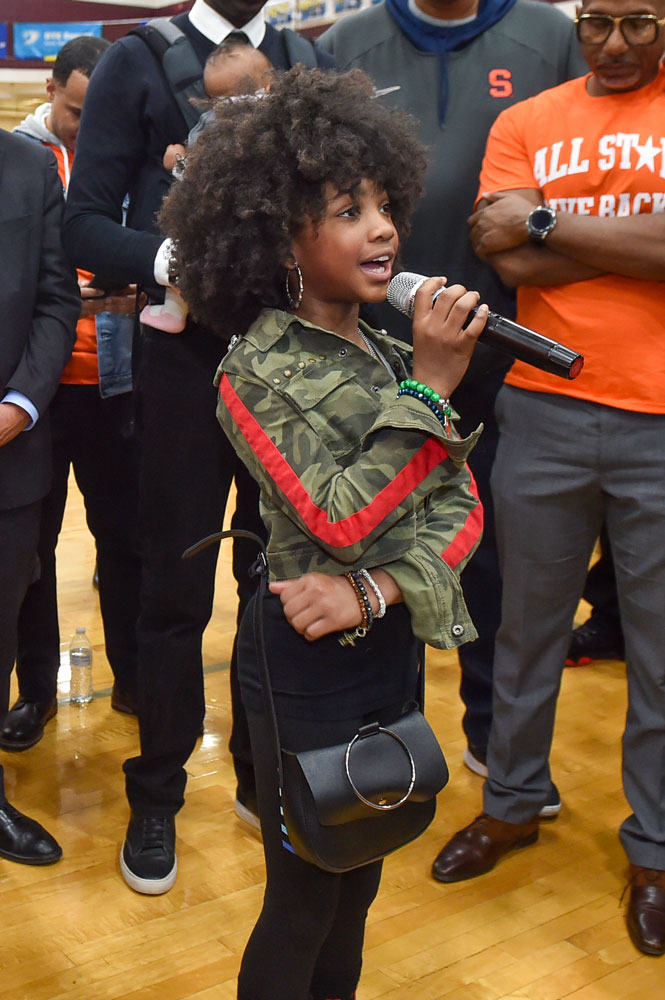
Leah JeffriesActor Leah Jeffries speaks at the 2019 Annual Allstar Giveback: Thanksgiving Edition event at River Rouge High School on November 26, 2019 in River Rouge, Michigan. (Aaron J. Thornton/Getty Images)

That’s the part that really makes racists angry – especially when the role in question is attached to a fictional figure people wish they could be or wish they could be with. Which describes nearly every human or demihuman in popular fiction.

In “Percy Jackson,” Scobell plays the 12-year-old version of the hero who discovers he is the son of Poseidon when he begins to manifest strange powers.

Annabeth, who “Percy Jackson” author Rick Riordan describes in his books as having curly blonde hair, tan skin, and gray eyes, also exhibits extraordinary abilities, none of which have anything to do with her canonical appearance. Riordan acknowledges as much in a detailed May 10 blog post that’s notable for the specificity with which he calls out those attacking Jeffries:

“Some of you have apparently felt offended or exasperated when your objections are called out online as racist,” Riordan wrote. ‘But I am not racist,’ you say. ‘It is not racist to want an actor who is accurate to the book’s description of the character!’

Let’s examine that statement.

You are upset/disappointed/frustrated/angry because a Black actor has been cast to play a character who was described as white in the books. ‘She doesn’t look the way I always imagined.’

You either are not aware, or have dismissed, Leah’s years of hard work honing her craft, her talent, her tenacity, her focus, her screen presence. You refuse to believe her selection could have been based on merit. Without having seen her play the part, you have pre-judged her (pre + judge = prejudice) and decided she must have been hired simply to fill a quota or tick a diversity box.

. . . You are judging her appropriateness for this role solely and exclusively on how she looks. She is a Black girl playing someone who was described in the books as white.

Friends, that is racism.

Mind you, if you know much about Annabeth Chase you might understand why seeing a Black girl play her upsets white supremacists. In short, it’s because she’s a demigod, the daughter of Athena, written as athletic, highly intelligent, and smart, all of which attract Percy to her as a friend at first before they eventually fall in love. Annabeth also joins Percy as the only character to cross into the author’s volumes featuring the Norse and Egyptian pantheons.

This makes her one of the most popular figures in modern young adult literature, as significant to some readers as “Harry Potter” heroine Hermione Granger . . . whose adult incarnation was portrayed by a Black actor, Noma Dumezweni, in the London production of the play “Harry Potter and the Cursed Child.”

No child deserves to be bombarded with hatred, especially over something she rightfully earned. But that rule has never applied to Black girls.

Dumezweni’s casting also caused an outcry which, along with every other case, should tell you something about what these blowhards have in common: most of them are adults or close enough to it. They believe they’re protecting the sanctity of their favorite fables out of some obligation to themselves or their children. They can’t abide being asked to identify with a hero who doesn’t look like some version of them, which is precisely what people of color who love these stories have had to do since . . . always.


Want a daily wrap-up of all the news and commentary Salon has to offer? Subscribe to our morning newsletter, Crash Course.


The fact that they’re turning their rage on a 12-year-old girl is especially pathetic but, again, not unprecedented. Wallis was 11 years old when Twitter sleazebags referred to her as the N-word for having the gall to be cast in a musical I will bet my bottom dollar only a few of actually care about. Stenberg wasn’t much older when trolls dropped the worst imaginable nonsense about her online. This should go without saying, but no child deserves to be bombarded with hatred, especially over something she rightfully earned.

Amandla StenbergActress Amandla Stenberg (who played Rue) arrives at “The Hunger Games” Los Angeles premiere held at Nokia Theatre L.A. Live on March 12, 2012 in Los Angeles (Lester Cohen/WireImage/Getty Images)But that rule has never applied to Black girls or women; hence, this week enough low-lifes bombarded TikTok’s admins with enough fake violation reports to get both of Jeffries’ accounts deplatformed. Regardless of this, she continues to exhibit a level of fortitude informed, no doubt, by the others whose footsteps she’s following. One difference is that she’s choosing to return fire with sweetness and positivity instead of remaining silent or responding with a response crafted by her PR team.

Let me be clear: Handling cheap hatred with a measured reaction that lets bigots know you’re above it all remains a valid tactic, especially for established performers. However, Jeffries doesn’t even have her own Wikipedia page yet, necessitating her strategically savvy charm offensive to cut through the bile.

In a recently posted video, she expressed gratitude to her admirers, showering the message to her attackers with the same bubbly sparkle.

“To whoever is hating: stop doing that,” she said calmly. “Like, I mean, I know you think that’s gonna hurt me, though. It’s not. You’re just wasting time. I’m still confident in myself. Everyone else is confident! Everyone else is happy for me. So don’t, don’t, don’t, don’t try to bring me down. It’s not gonna work.”

That’s true. It won’t. Look at the track records of the people who survived this gauntlet before her. Zendaya, the backbone of “Euphoria,” is an Emmy winner who co-stars with Holland in the third-highest-grossing domestic movie release in history, “Spider-Man: No Way Home.”

Stenberg is an activist who has co-starred in films such as “Dear Evan Hansen” and has a main role in an upcoming “Star Wars” series. And Wallis is one of the best reasons to watch Starz’s outstanding basketball drama “Swagger.” Another reason these bigots give these girls and women hell is that exposure in shows like this means we’ll be seeing a whole lot more of them further down the road.

RELATED: A look at Charlize Theron’s MCU sorcerer

Riordan’s fiery backup also is extraordinary, in that he did not wait for a reporter to ask for his opinion on how Jeffries is being treated or share his approval via a short burst on Twitter, as J.K. Rowling did in defending Dumezweni. He didn’t do it because he thinks his prejudiced enthusiasts will believe him – that has never factored into the racist’s entrenched point of view. Rather, it is important in the way it bolsters what the vastly greater number of Jeffries’ supporters already know. It is not merely a matter of Riordan putting his weight behind the star in declaring, “Leah Jeffries is Annabeth Chase.”

It’s about affirming that he and Disney know she’s one of the faces of the future.

More stories like this:


The paleontologist who found extinction day fossils teases “beautiful” triceratops skin discovery

Last month’s discovery of a fossilized leg from a dinosaur that died on the day that an asteroid wiped out all of its kind was hailed as the “ultimate dinosaur drumstick” (as one scientist called it) — the holy grail of paleontology, and a rare and astonishing discovery. Indeed, evidence suggests the dinosaur’s death was likely caused by the aftermath of the Chixclub impact event some 66 million years ago, which scientists believe led to the extinction of all its fellow dinosaurs as well.

The details of the discovery, and other amazing fossils found at the Tanis dig site in North Dakota, are discussed in more detail in a two-part special called “Dinosaur Apocalypse,” which airs on May 11 at 9pm ET on PBS. The documentary, narrated by David Attenborough, follows paleontologist Robert DePalma and his team at a thriving dig site hidden in the Badlands of North Dakota, where paleontologists have uncovered rare fossilized creatures that appear connected to the fateful day that ended the Cretaceous Period. Through their discoveries, humanity will be able to learn more about what happened during the last days of the dinosaurs— and more about what life was like at the Tanis site.

“That [triceratops] skin is a beautiful example of a research opportunity to look for original organic compounds… And along that line, we could potentially work out the pigmentation or the pigment patterns of an animal with those techniques.”

Until now, no fossils of a dinosaur killed on the last day of the Cretaceous period had ever been found. While the findings have yet to be published in a peer-reviewed scientific journal, scientists are very excited about the discovery and the prospect of what information it might hold. Salon caught up with DePalma to talk more about the discoveries made at the Tanis dig site, and what he and his team have learned since filming the documentary.

This interview has been condensed and edited for print. 

What were you thinking and feeling that moment you started to uncover the coveted dinosaur leg at the Tanis dig site in North Dakota?

Work at the site is always edge-on-your seat stuff. You’re always about to find something that you’ve never even anticipated, and it happens every time we go there. We always end up finding something that drives us crazy. But at the moment that we uncovered the dinosaur leg, we weren’t expecting to find anything like that. We’re digging up a fossil palm frond and then when the scales first appeared, they looked just like an animal that had just died. And we were like, ‘Oh my gosh, we just landed into one heck of a situation.’ Our hearts were literally pounding out of our chest as we’re finding this thing and uncovering it more and more. And when more of it came to light by the end of the day, we had this whole leg sitting there that is three dimensional. You’ve got all of the skin on it. You can see bones poking out here and there. And we’re thinking, wow, this is like this is actually like seeing a dinosaur that had died yesterday.

RELATED: When dinosaurs died, plants thrived

We’re feeling like we’re the most fortunate people on the planet. And then they put that into context and it’s buried in a muddy deposit from the day of the impact. We were just beaming. So it is pure excitement. All the way through to when you do the research and afterwards. The whole process is just phenomenal.

Where is the leg now?

Right now [it] is at the lab space at Florida Atlantic University, where all of the primary research is taking place. And we might send it back over to the UK at some point in the near future, because we did preliminary work at the diamond light source synchrotron facility, high-tech work involving synchrotron radiation, and we were looking at organic compounds that are still preserved in the fossil material. So, that might be our next stop for this, because there’s about 10 analyses we want to do. Right now, we’re just going through that list. And we’re basically documenting every darn thing we possibly can, because this is a prime example of something that we can just learn from, endlessly.

In addition to the leg, there was the triceratops skin that you discovered.

Absolutely. There were several patches of skin from the triceratops and some scattered bones. And those are absolutely exciting as well. It’s a much larger animal. But you know, we have a couple of small patches from a partially decayed animal, so at the time of impact the triceratops had been dead for a maximum of a month or two, maybe as little as a few weeks. But it just missed the major event of the end of the Cretaceous. And we know that it died already, but it still can tell us a lot.

Have paleontologists discovered dinosaur skin so well preserved before?

Dinosaur skin is known in the fossil record. It’s somewhat rare, but dinosaur skin has been found before. The thing that makes this very special is the Triceratops remains at the site are from higher up in the stratigraphic section than anything else found before. So in other words, there haven’t been any dinosaur fossils found in the Hell Creek Formation within the upper, let’s just say, nine feet of the Hell Creek Formation. You just don’t find them. They’re just uncommon. It’s a presentational artifact. So just finding Triceratops skin at all is really unique. But to have this example come from that mass death layer from the day of impact, that muddy layer that locked it in time the day of the impact that really sets this apart and makes it exceptionally special. So yes, dinosaur soft tissue has been done in the past, but no one has ever found any from that layer of the impact.

Do we know what color the triceratops was?

There are a few things that we can potentially tell about skin and soft tissue preservation, and I can’t get into too many details because as a scientist, you really can’t jump the gun and talk about those in a media setting until they’re at least reported in a scientific conference. But what I can tell you is this: that skin is a beautiful example of a research opportunity to look for original organic compounds — for example, organically-bound sulfur, organically-bound zinc, things that are traced to the original animal and not an artifact of the preservation. And along that line, we could potentially work out the pigmentation or the pigment patterns of an animal with those techniques. And I can’t tell you anything specifically about that specimen, other than the fact that we are very, very excited and very, very hopeful. So if that’s any indication of what’s playing for the reserves coming from the skin, that’s pretty much the most I can say without getting in trouble with the research team.


Want more health and science stories in your inbox? Subscribe to Salon’s weekly newsletter The Vulgar Scientist.


I know you can’t say with 100 percent certainty that these fossils are from the day a 10-mile-wide space rock struck the Yucatán Peninsula in the Gulf of Mexico. But can you walk our readers through the evidence you have to suggest that’s the case?

There’s actually a lot of evidence to suggest that many of those fossils are from that day, and you really have to bring your mind back to that day. So essentially, you know, we’re looking at late spring, early summer, basically the time that we’re in right now. And it was a subtropical to tropical paradise back then. There was tons of life at that time and it was really, really vibrant.

On that unsuspecting day, that area would have experienced — first — some seismic activity. You would have had the seismic waves which would have reached there from the impact site, so you would have had that jolt in the ground. And then at the same time, you would have had this rain that came down and these little tiny beads of glass that were glowing, red hot, coming out of the sky; they would have looked like tracer rounds from a battlefield and would have been streaking across the sky.

“It wouldn’t have been a pretty wave of water like you’d see at the beach. This would have been muddy water filled with logs, complete trees, animals, fish, everything. It’s sort of like a meat grinder wall of death.”

They’re only about a couple millimeters wide, each one, but if they hit you, they would definitely sting you and not really feel too good. They probably would have killed bugs if they ever hit them. But these things would have been pelting the ground all over the place. The setting of the Tanis site is in a river valley, a paleo river that had basically carved through the landscape, you had this little notch cut out in the ground and being out into the seaway. At that time, it split North America into the left and right halves. And this river would have emptied out there and animals would have been drinking, you would have had fish and turtles and everything else. And then without warning, you would have had this massive 10 and a half meter high surge of water just force up that river valley, backwards, you know basically going inland. And it wouldn’t have been a pretty wave of water like you’d see at the beach. This would have been muddy water filled with logs, complete trees, animals, fish, everything. And it’s sort of like a meat grinder wall of death in this wave of water that would come up and basically swallow everything in its path. That then locked all those animals in time and that happened starting maybe 15 or so minutes after impact, and at most, up to two hours after impact. That’s the moment locked in time.

A lot of these [fossils] we can tell are almost certainly victims of that day. The fish have those little blobs of glass jammed in their gills because as they were raining from the sky, those fish were sucking them in and they’re jammed in the gills. A lot of the plants that are there, and the trees, have leaves and needles still on the branches. So these are not things that would have died and been sitting on the ground and fallen apart and washed into the river. They were still fresh enough that the leaves were still on the branches so those would have died as a result of the surge.

The Triceratops died before the surge; sadly, it was already decayed, but the leg that is beautifully preserved does not match something that would have died long before impact. The leg is three dimensional. So if it had died before impact, it did so soon before impact because it would have not had time to decay. The muscles had not liquefied, everything was still three dimensional and beautifully preserved.

So let’s just say it did die before impact. We’re looking at a time frame of days to weeks at maximum. So that’s still essentially the end of the Cretaceous era, but most probably those animals did die as a result of the surge. I’ll never say 100 percent, but it’s almost certainly from that surge event.

The turtle discovered in the documentary died by being pierced by a stick. How could that have happened during the impact? Was that likely a common way dinosaurs and reptiles died that day, say, from flying debris?

I think that anything that would have been within the path of such a surge would have had the risk of something like that happening to it. If you were near a body of water that had that sort of phenomenon occurring, then basically you could have been really damaged or killed by it— and also the actual tsunami coming from the impact site. But think about it if you jumped into that roiling body of water and you had all that stuff, you know, floating around in there and then tumbling around the branches and everything else. I guarantee you your first thought would be “Oh, God, I hope something doesn’t jam through me.” So it’s dangerous. That poor creature, that’s exactly what happened to him.

In the science world, there are different theories about exactly what hit Earth on that fateful day — most believe it was either an asteroid or a comet. Is there any evidence from the recently discovered fossils at Tanis that it was either an asteroid or comet?

The ironic part about that is that literally the day before we had a session with Sir David Attenborough for the show, one of the specimens— a slide of objective squirrels — revealed a really really cool fact. These little blobs of glass that were flying through the air, on occasion, would have encapsulated little bits of unmelted rock. And most of the bits of rock that we found were pieces of limestone from the Yucatan Peninsula, when the impact occurred. And there was another example that had a little fragment that was so wildly different from compositions and the rest, we had to take a second look at it. When we examine what it was made of, we’re looking at chromium— which is very uncommon in the Earth’s crust — when you see high levels of chromium, and high levels of nickel, like you see in that piece, that’s a dead red flag for a cosmic body. And then when we look at other chemicals, or other elements that are present in that little fragment that’s inside the spherical, we see a signature that matches cosmic bodies.

And not only cosmic bodies — but you see a signature for a specific type of cosmic body. It’s called a carbonaceous chondrite, and people in the past have proposed that that’s probably what hit 66 million years ago. They either figured it was a comet or a carbonaceous chondrites. And in this case, the composition does not match what you would see in a comet; it matches a carbonaceous chondrite, and we’re even further defining the type of carbonaceous chondrite with the ongoing work that we’re doing right now. Walter Alvarez is actually on point helping us with this. We are consulting with him and other people, and we probably — almost certainly— have an example of a little tiny, smaller than a millimeter, fragment of the asteroid that we can now figure out exactly what it was that hit that day.

Read more on dinosaurs:

What I learned from 60 days of not letting the dishes pile up

It’s an embarrassing personal confession that I’m a huge home cook but not the neat kind. I can fake it like the best when guests come over, but eagle-eyed readers of the food column I write for The Paris Review will have noticed the occasional splatter and dirty dish in the backgrounds of my photos. If that’s the best I can do with witnesses, just outside the frame is often worse.

At my best, I’m fun-loving: I’m the mom who will bake something elaborate at 9 p.m. in a wrecked kitchen. As a result, my kids know their homemade pavlova from their homemade tiramisu. At my worst, things reach such a state that I’m running the dishwasher and churning through the handwashing all day long, several days in a row, trying to catch up from my culinary excesses. Sometimes I find Monday morning’s soggy Tupperware at the bottom of Friday afternoon’s sink, and am thoroughly revolted with myself.

I hope everyone reading this is saying: “Ew, gross, I cook every day and I keep my kitchen spotless!” But those who are like me may be interested to learn that I have recently, accidentally — and without any real effort — changed my prisoner-of-the-dishes stripes. It happened like this: Several months ago, after one of my epic dishwashing marathons, I decided to go a step farther and actually scrub the dull, grey surface of the empty stainless steel sink. This was a deep-cleaning maneuver that I would never have previously considered trying. (If you’re incredulous that I’d never done this before: I hadn’t. Yanno, the sink washes itself while you’re washing the dishes? There’s soap there?)

For full disclosure, the extra step was also a result of a recent general increase in cleanliness on my part. My partner of almost 20 years and I had (amicably) separated in December of 2020, leaving me with a burning desire to redecorate and little money to do it. So, I turned to cleaning and organizing as a kind of free home improvement — I couldn’t buy a vintage standing mirror for my bathroom, but I could scrub grout. I actually began to find it inspirational. I mean, I’m still messier than most people, but cleaning has become an extension of my cooking (something I like!), in that it makes your home warm and inviting both for guests and the people who live there.

And so, that day, I scrubbed out my sink, and then, staring in awe at the smiting brilliance of its clean face, I decided to see how long I could keep it visible (if not gleaming, because that would be going too far). My method was the childhood game of “floor is lava” — no dish could touch the sink bottom, but instead had to be funneled straight to the dishwasher or drying rack. I had no real hope of success for even a day, but the sink stayed empty, the kitchen stayed clean, and as the days passed I started counting them. I would have expected washing every dish right away to be annoying — or impossible — especially with four pots on the stove in the middle of the evening dinner rush. And it’s true that while actively cooking I sometimes move the dishes to the sink in a small cluster, which I immediately wash. But it was easy, and went so quickly I barely noticed it. Think of it this way: If you are used to washing dishes for days, what is 30 seconds? Dinner took no longer to cook, but the results were miraculous. I woke up every morning with no mountain in the sink, no struggle to plan breakfast based on the “level” and accessibility of the large skillet. I also suddenly had free time to do other things, like make my bed and unpack the kids’ sports-practice bags in the foyer (another domestic imperfection of mine). The change was so dramatic it felt weightless.

There were some difficulties. I had to learn to put clean dishes away faster to make room for dirty ones. (Boring!) And I had to clean all the pots and pans before eating the food. (Incentive to work-as-you-go; it keeps dinner hot.) Things aren’t all perfect. After a long day of working, cooking, parenting, commuting for sports, and supervising homework, I go to sleep early. I do not sweep for the bedtime-snack plates, or the 38 water glasses every member of my family needs to use every hour, so those are still scattered about my apartment in the morning. I also really hate washing the children’s lunch Tupperware, so that tends to get piled by the sink — it “doesn’t count” if it’s still in the lunchboxes.

I was energized by success, though, so I kept it up, and weirder things began to happen. It was as if the sink had been a negative-energy vortex in my apartment for my entire adult life, and I had accidentally reversed its power, turning it into an engine of positivity. I have a crappy rental-apartment dishwasher (that cost my landlord $89.99; I saw the sticker), so I have to wash plastics, glasses and many plates by hand. I owned gloves, but barely wore them, but now that I need the gloves 100 times a day . . . I wear them every time. So, after about three weeks my fingernails actually grew out. I also became a clean cook. To keep dishes out of your sink, you have to keep them moving off your counters. Once I was paying attention to counter clutter, which I must never have done before, it became easy and obvious to whisk away the food scraps once the plates were gone, and then give the counter a wipe. My kitchen has become a place I almost don’t recognize.

I would like to attribute all this change to the benevolent power of the clean sink, or the third eye of the disposal, chanting mantras while we sleep at night. Psychologically, however, it seems suggestive that my separation gave me control over my living environment that I didn’t have before. To be clear, my former partner was a tidy person who would never have stopped me from cleaning, but we had real disagreements about home decor, and in the early days of our union the position of every lamp was a battle. After nearly two decades and a stalled personal relationship, we’d both given up mentally on our shared space. Well, I’ve taken back that control and run with it.

I stopped counting at 60 days, and I haven’t had a significant mess in the kitchen since. It’s wonderful, and the only sorrow is that I’m beginning to get used to it, and can no longer appreciate the difference with delight as blazing as a clean sheet of polished stainless steel.

RIP Apple iPod: As technology becomes obsolete, it becomes nostalgic too

My first was white, boxy, in a rubbery blue case. My second, silver. My third, pink – and that was a Shuffle, barely the size of my thumb, so it’s lost somewhere in the house. If my child finds it, even though he has his own old and cracked Touch model, I’m not sure he’ll know what it is. It’s the Apple iPod and it’s dead. 

Over two decades ago, the first iPod, the portable music player from Apple, was introduced. Apple has announced the last remaining model, the iPod Touch, will be its swan song; it’s discontinuing the product. With no new models planned, the iPod Touch will be available for sale only “while supplies last,” as The Verge reported. 

RELATED: Apple finally admits its products are difficult to repair

Trust the shuffle, my friends would say. We used the random function as a kind of oracle.

When the first iPod came on the market in 2001, it was a remarkable device, capable of storing 1,000 songs, which seemed like a lot. No longer did you need to cart around dozens of CDs in heavy binders, their plastic cases always shattering or needing bulky storage, or to carefully choose only a selection of CDs before car trips (hope you’re happy listening to David Bowie for eight hours!). The iPod meant you could take your whole music library with you at all times. 

It also meant your library  – even your musical tastes — might expand. You didn’t have to buy a whole CD or even EP to take a chance on a new band. You could download a single song. You could carry it with you and live with it for a while. You could download tunes from bands that didn’t even have an album yet or that never would (Agatha Parker Sterling, I’ve never forgotten you).

The iPod, as Greg Joswiak, the senior vice-president of worldwide marketing at Apple, said to the BBC, “redefined how music [was] discovered, listened to, and shared.” It helped power the digital music boom, which was already exploding.

MP3.com had been founded in 1997, with Napster, the popular file-sharing site, starting two years later. In 2003, Apple opened the iTunes Music Store, soon responsible for 70% of sales of digital music. You could download music legally (MP3.com, Napster and other file-downloading sites were ordered to shut down or to reinvent themselves without copyright infringement). Bandcamp came on the scene in 2008, envisioned as a site where bands and indie musicians could legally sell their music digitally straight to fans.

The shuffle function of iPods acquired their own kind of cult following, the device choosing songs at random. Trust the shuffle, my friends would say. The shuffle knows what you need to hear better than you do. We used the random function as a kind of oracle, a spin-the-wheel of musical signs. One model of the iPod called the Shuffle did not allow users to choose songs at all or even to see their titles, lacking a screen. The Shuffle was the smallest model of iPod and the first one to use flash memory.

As technology becomes obsolete, it becomes nostalgic too: longing – not exactly for a device, but for a time.

Despite selling about 450 million devices, Apple iPods were not able to withstand the test of phones. It’s a tough argument to carry two devices around when one, the almighty smart phone, ever slimmer and more powerful, can do everything, including play and store music. Those of us who resisted smart phones for a time (raises hand) may have helped keep the iPod fires burning. I also had iPods that outlasted computers, putting me in the uncomfortable digital situation of having music on my music player that didn’t live anywhere else.

In recent years, the iPod Touch enjoyed a renaissance of sorts with parents as a kind of starter device that played music, had games and allowed children to text and communicate with their families without giving kids the full power of the internet in their pocket. It was a gateway phone, the first device I bought my son. I didn’t want to buy him a phone-phone, but during the pandemic, I realized the urgency of my child having a way to contact me. Because of the iPod, he played Bad Religion over and over again, and first learned how to use some texting abbreviations I don’t understand.


Want a daily wrap-up of all the news and commentary Salon has to offer? Subscribe to our morning newsletter, Crash Course.


I’m weirdly sad to see the iPod go. Like dial-up internet, like a time without internet, it feels like a part of childhood is going too, an innocence connected both to cumbersome, early technology and the excitement of discovery – the freedom I felt when I could travel with just a slim vessel of tunes.

I remember my silver iPod kept freezing, and I learned a hack where I had to keep toggling the on/off tab while pressing two buttons at once. This seemed perfectly fine to me, worth it for such magic. As technology becomes obsolete, it becomes nostalgic too: longing – not exactly for a device, but for a time. When we didn’t have everything at our fingertips, when we didn’t know everything, either; when some things were as mysterious as what song would play next.

More stories like this


A last-minute trick for smudge-free wine glasses

Picture this: You’re having your closest friends and family over for . . . I don’t know . . . an occasion worth celebrating (or no occasion at all). You have prepped and planned well ahead of time, and have a delicious and unforgettable menu ready to go. Accompanying the meal are some of your favorite wines that you’ve meticulously paired with the dishes. The last thing you want to discover, just as your guests are about to arrive (or worse still, midway through your meal), is that your wine glasses appear smudged or stained.

No matter what method you use to wash your glassware (in my home, everything other than grandma’s heirlooms goes into the dishwasher) and how quickly you get to drying them, it’s likely that when you resurface them after a few weeks, some spots remain. And there’s nothing like water spots to make your wine glasses appear dirty even when they’re actually clean. I know what you’re thinking: I really don’t have time to wash them at the eleventh hour. And to that I say: You’re in luck, because you don’t have to.

But first, credit where credit’s due. This is a trick I learned a couple weeks ago when I was at my favorite neighborhood cafe in Brooklyn, chatting with the barista about things like citrus and cakes and clouds (it made perfect sense at the time). She continued working as we talked, and that’s when I took note of what she was doing, which was polishing glasses in a way I had never seen before.

So, here’s how it goes. Just before your guests arrive, line up your glassware. Turn on your kettle or put some water in a pot to boil. When the water has come to a boil, turn it off. Now, hold each glass by the stem and invert it above the water just enough to get the glass steamed up (if it’s stemless, be careful not to hold it too close to the steaming water). Next, grab a soft, clean microfiber cloth with your free hand and polish away. You’ll know you’re done when no steam remains inside the glass. Repeat on the rest of your glassware and watch ’em sparkle and shine.

Later that week, I decided I wouldn’t wait for a gathering to try this cleaning trick out for myself. My glassware truly gleamed. I held one aloft and gave a silent toast — to the person who came up with the idea and saved us all from the ignominy of dirty-looking glassware.

Judge finds celebrity chef Mario Batali not guilty of sexual misconduct

Celebrity chef Mario Batali was found not guilty on Tuesday on charges of indecent assault and battery. As the Associated Press (AP) reported, the charges stemmed from allegations that Batali had “aggressively kissed and groped a Boston woman while taking a selfie at a bar in 2017.” 

Batali — the former star of Food Network programs such as “Iron Chef,” “Mario Eats Italy” and “Molto Mario” — was one of the biggest names in the food world to be accused of sexual misconduct during the initial wave of #MeToo movement. In addition to facing two and a half years in jail, Batali would have had to register as a sex offender if convicted. 

Prosecutors argued that Batali was clearly drunk in photos taken at the bar, according to the AP. Boston Municipal Court James Stanton concluded that Batali “did not cover himself in glory on the night in question.” 

Related: Celebrity chef Mario Batali steps away from businesses after allegations of sexual misconduct

“His conduct, his appearance and his demeanor were not befitting of a public person of his stature at that time,” Stanton said. 

However, Stanton reportedly “agreed with Batali’s lawyers that the accuser had credibility issues and that photos suggested the encounter was amicable.” Antony Fuller, Batali’s attorney, claimed that the accuser was an “admitted liar,” and said that “in her world, truth is a flexible concept.” 

“Pictures are worth a thousand words,” the judge said upon delivering his verdict. 

In 2017, four other women accused Batali of inappropriate touching. In that instance, Batali acknowledged that “much of the behavior described does, in fact, match up with ways I have acted.”


Want more great food writing and recipes? Subscribe to Salon Food’s newsletter, The Bite.


At the time, Batali stepped down from day-to-day operations at his restaurants, was bought out of his stake in the Italian market Eataly and stopped hosting “The Chew” (which ABC has since axed from its daytime schedule). 

“I have made many mistakes,” he said in a subsequent email newsletter. “My behavior was wrong and there are no excuses. I take full responsibility.”

Last year, Batali and Joe Bastianich, his former business partner, agreed to pay $600,000 to at least 20 former employees who were “survivors of sexual harassment and discrimination” at restaurants they owned, according to the New York attorney general’s office. The settlement was the culmination of a four-year probe.

“Celebrity and fame does not absolve someone from following the law. Sexual harassment is unacceptable for anyone, anywhere — no matter how powerful the perpetrator,” Attorney General Letitia James said at the time. “Batali and Bastianich permitted an intolerable work environment and allowed shameful behavior that is inappropriate in any setting. Every individual deserves to work in a safe environment, and today’s agreement marks one more step towards remedying workplace harassment. I thank the men and women who reported this abhorrent behavior for their bravery, selflessness and commitment to accountability.”

Read more: 

“The Real World Homecoming: New Orleans” recap: Have Mercy

Throughout a number of episodes of the original season of “The Real World New Orleans,” Melissa Beck (Melissa Howard at that time) was backed into a corner when issues of race were brought up, and forced into leading “teachable moments.” In Episode 4 of “The Real World Homecoming: New Orleans,” she’s provided the opportunity, 22 years later, to explain how that level of cultural responsibility within a social setting can, over time, become exhausting for people of color

In an episode that aired in 2000 Melissa, Danny Roberts and Julie Stoffer, along with Jamie Murray and his visiting friends from Chicago, went on a day trip to a Louisiana swamp where they encountered a racist tour guide, and that experience put Melissa in an uncomfortable position where she was forced to teach her white housemates and their friends why this man’s racist remarks were hurtful. 

RELATED: “The Real World Homecoming: New Orleans”: Changing the narrative

While out on the swamp tour their guide wanted to point out a regional bird to everyone, which should have been a simple enough thing to accomplish; but instead of saying something like, “Hey, look at that bird,” he chose to use the n-word as a descriptor for it. Melissa, being the only person of color on the tour, was then left to explain to everyone else why that was offensive as they were more inclined to just laugh it off. It was a tense and memorable moment, and Melissa reveals in this episode of “Homecoming” that she received hate mail for it for years, painted as the “angry black woman” of the cast.

It’s still questionable how much certain people have learned and absorbed about race

When the reunited house gets another shot at a swamp tour in this most recent episode, the experience comes off without a hitch, but it’s still questionable how much certain people have learned and absorbed about race in that vast span of time. 

Melissa Beck in THE REAL WORLD HOMECOMING: NEW ORLEANS streaming on Paramount+ (Daymon Gardner/Paramount+©MTV ENTERTAINMENT 2022, All Rights Reserved.)The house as a whole is still recovering from Julie’s night of belligerence at the drag show on Bourbon street, and Melissa is walking the line between icing her out, and wanting to unleash the contents of her mind upon her. She tips towards the latter.
“Don’t rope me into your weird s**t because you’re bored,” Melissa tells Julie after bringing up the call with Julie’s husband in which Melissa and Kelley overheard her saying that she was doing all she’s doing for the sake of making good television.

“You are here making a television show, and I don’t wanna be on your show because I don’t get to decide who I get to be, because it gets to be your narrative,” Melissa adds. 

When Julie’s first line of defense morphs into what feels like a tear-drenched form of gaslighting, Melissa grabs her huge purse and walks away. Later, in what reads as Julie’s first sincere moment yet  – but who can really say? – she pleads for the house to allow her to keep trying to be better. After recalling a previously un-aired moment where Tokyo asked her to watch him open a suitcase he wasn’t sure was his or not, something seemed to click for her. She realizes that she’s lived her whole life without ever needing someone to witness her open a suitcase, and that’s an ease of white privilege that not everyone gets to take for granted. 

Julie desperately wants to be the center of attention, whether that attention is good or bad. And that’s not good television, that’s just sad.

For now, things seem to be headed towards resolution, provided Julie doesn’t show her ass again, but we know she can’t help herself. For every complaint she makes about feeling singled out there’s a scene where we see her popping out from around a corner asking, “Are you talking about me?” with a cheesy smile on her face. Julie desperately wants to be the center of attention, whether that attention is good or bad. And that’s not good television, that’s just sad.


Want a daily wrap-up of all the news and commentary Salon has to offer? Subscribe to our morning newsletter, Crash Course.


In a much needed break from the Julie show, we get to see what life is like for Melissa now, living with her husband Justin Beck from the band Glassjaw, and their three daughters on Long Island. If anyone from the house seems to have fully and completely benefitted from 22 years of living, learning, and growing towards who they were meant to be, it’s Melissa, who gives credit where credit is due to the loving upbringing provided by her parents, Shorty and Mercy. 

After not being able to visit one another since 2019, Melissa is reunited with her parents at the New Orleans house and everyone sits down for an amazing meal cooked by Mercy, with everyone’s added help here and there. I gotta say, it seems like watching a white lady puke on the floor would be more exciting than a bunch of people sitting around eating a meal together, but this felt fantastic. Just like Kelley Wolf dissociated from the argument between Melissa and Julie by doing healing yoga breaths with her eyes clamped shut like she was about to go on a roller coaster, sometimes we need to just go to our happy place. That can be something as easy as shutting up for a minute to enjoy the Filipino food a nice lady’s mom made for you. 

Read more:

The evolution of the episode count: How many episodes is too many?

How many episodes should a season or series of television be? Depending on who you ask, answers vary. We’re in a TV era overflowing with options on broadcast and streaming, and episode count is playing a major role in our television habits more than ever.

There’s a verifiable cornucopia of content for viewers to consume and how many episodes a piece of media has can be the deciding factor when it comes to watching it or not. This includes bingeing classics that have shaped pop culture.

Of course, there will always be TV lovers who give shows like “X-Files,” “Friends,” “The Office,” “Smallville,” and Supernatural” a chance despite being over 200 episodes long, or in “Supernatural’s” case over 300, but the time of the long running series is drawing to a close outside of procedurals.

Much of this has to do with an overabundance of television. There’s simply too many programs to watch with very little time to watch them. Not to mention viewers are less willing to spend season upon season with a show that’s begun to deteriorate in quality. Also, a drop in the required number of episodes for a show to reach syndication plus the birth of streaming has shifted the landscape.

Episode count is a major factor in this era of TV and streaming

We’re in a new frontier, one kicked off by Netflix. The binge model of television watching changed audiences expectations for the shows they watch. New series premiering on streamers can’t be up to 22 episodes or more like broadcast (though there are shows clocking in at 13 episodes per season on TV). It’s just not feasible especially when episodes drop all at once on premiere day.

Could you imagine trying to binge 22 episodes of a “Stranger Things release? In a time when you have to log out of all social media accounts and basically not surf the web in order not to be spoiled, it would be stressful and not worth anyone’s time to binge it. That’s a limitation of streaming in the era of binge television.

The measure of how many episodes is too many is dependent on where a piece of media has made its home. If you’re still tuning into week-to-week broadcast television, you know you’re typically in for 18-22 episodes a season. The pandemic has shortened that episode count for many shows, especially on The CW, but TV viewers know what to expect.

About 18-22 episodes gives shows the opportunity to experiment with filler content such as bottle episodes, flashbacks, crossovers, etc. It’s the kind of entertainment that can have fans going up with excitement or groaning over yet another detour from the overall plot but at least there’s room for expanded storytelling.

Streaming series don’t have that luxury. They’re in and out of their stories between 4-13 episodes. It’s a model that works well for the platforms even when a season or show releases weekly. However, there are drawbacks. There isn’t a set runtime for episodes so a short season doesn’t mean you won’t be caught off guard by long episode.

For example, “Stranger Things” season 4 episodes will clock-in at over an hour. K-dramas on Netflix often do have episodes that run up to 60 minutes and can even be as long as 90 minutes. Obviously, established shows or vehicles with big name actors can get away with feature length episodes of television, but that’s still a lot of time for viewers to invest in a series.

So, this isn’t only a question of episode count, it’s also a question of episode length. It’s great that creators are pushing boundaries in the medium of television on streaming. But the amount of episodes a season has on top of how long those episodes are can make or break audience retention for shows just starting out.

While there isn’t a consensus on how many episodes is the sweet spot for streaming shows, it does seem that 8-10 episodes per season works well for shows. 45 minutes to an hour in run-time per episode is the preferred standard that’s carried over from broadcast.

As for network television, some shows would benefit from breaking away from the 18-22 episode standard. 13-15 episodes would likely produce tighter storytelling especially for series where there’s clearly not enough material to stretch past that marker.

A closer look at Clea, Charlize Theron’s magical “Doctor Strange” MCU character

From Reed Richards to the return of Professor X, Sam Raimi’s “Doctor Strange in the Multiverse of Madness” featured a slew of surprising cameos across its two-hour-long running time, including a surprise appearance from Charlize Theron in the mid-credits scene.

Although she never introduces herself, a little sleuthing reveals that Theron’s MCU character is named Clea. She’s seen in an all-purple sorcerer getup and bearing a matching colored energy knife. She approaches Stephen Strange (Benedict Cumberbatch) amid a busy New York City street and tells him that his multiverse-hopping actions have caused another “incursion” — a disastrous event when two universes collide. Clea then rips open a portal to the Dark Dimension, asking Strange to join her to fix the damage before they both hop in together.

RELATED: Why am I not over the moon to see “Doctor Strange”? Because I’m drowning in Marvel

Theron’s casting as Clea remained a mere rumor in the weeks leading up to the film’s recent release. On Tuesday, the “Mad Max” actor formally confirmed her role with an Instagram post of Clea’s makeup look paired with the simple caption, “Meet Clea.”

https://www.instagram.com/p/CdZSKuhvNif/?utm_source=ig_embed&ig_rid=fabfd868-d7c0-47ad-ba2b-ba922c63e75c

At the end of “Multiverse of Madness,” a title card assures viewers that Doctor Strange will return . . . and presumably with Clea in tow.

In anticipation of her on-screen return, here’s a closer look at the sorceress’ origins and possible future in the MCU:

Who is Clea?

Clea is the daughter of Prince Orini — the son of Olnar, who was the former ruler of the Dark Dimension —  and Umar, the twin sister of the primordial villain Dormammu. If that name sounds familiar, it’s because we met him in the first “Doctor Strange,” when the good doctor trapped Dormammu in a time loop before he relented and agreed to leave Earth alone. So yeah, that’s Clea’s uncle. The sorceress endured a troubling childhood as her own mother abandoned the family after a rift with her brother and Orini pledging allegiance to Dormammu.

What does this mean for the MCU? It’s not entirely clear how closely the movies will follow the original text, but in the 1964 Dr. Strange comic, “The Domain of the Dread Dormammu!,” Clea meets Strange for the first time, takes a liking to him and attempts to save his life during his mission to defeat Dormammu. Clea’s efforts, however, are unsuccessful and she’s subsequently imprisoned for her betrayal. She’s finally released per the request of Strange, who also asks Dormammu to not invade Planet Earth after the unlikely pair team up to fight off the Mindless Ones.

Clea’s bitter tension with her family is also central to her storyline in subsequent adventures. After Dormammu is defeated for good and ousted from the Dark Dimension, a battle for the throne ensues between Clea and her mom Umar — who, mind you, once cast her own daughter to another dimension. Clea later emerges as the new ruler of the Dark Dimension and the newfound Sorcerer Supreme after attaining some serious sorcery skills from her predecessor.

An multiversal mate?

In the films, Stephen pines over every multiverse version of Christine Palmer (Rachel McAdams), a fellow doctor but not sorcerer. In “Multiverse of Madness,” he even confesses to the the Earth-838 Christine that he loves her, although it’s said as a farewell, knowing that they cannot be together. With the introduction of Clea, Stephen may not be so lovelorn anymore.

In the comics, when Clea leaves the Dark Dimension and settles on Earth (specifically in New York), she becomes Strange’s official disciple in the mystic arts when he eventually becomes the Sorcerer Supreme (what happens to Wong?!). The pair’s student-teacher relationship quickly blossoms into a full-fledged romance. The couple eventually sort-of gets married and in true magical fashion, seals the deal with a binding mystical document. Much later down the line, Clea herself becomes Sorcerer Supreme.

“[Doctor Strange and Clea] have a lot of great adventures in the comics, and we knew we wanted to introduce her. But it felt like we had to close the book, to some extent, on his love story with Christine Palmer – the Rachel McAdams character – and so Doctor Strange hears that wisdom from Christine to face his fears and be open to the idea of loving someone,” said “Doctor Strange 2” screenwriter Michael Waldron in an interview with Deadline.

“And then along comes Clea, and I guess we’ll see what happens next between the two of them,” he added.

More stories you might like:

Carl Bernstein says Clarence Thomas has no standing to chide protesters after wife’s election scheme

Legendary journalist Carl Bernstein ripped Supreme Court Justice Clarence Thomas for chiding Americans who protested the court’s impending reversal of Roe v. Wade, calling him a “rogue” and “disingenuous” judge whose wife attempted to overturn the 2020 presidential election. 

Bernstein’s remarks came in response to comments made by Thomas last week at the 11th Circuit Judicial Conference in Atlanta, where he indirectly addressed a bombshell Politico report revealing that the Supreme Court has already voted to overturn Roe. During his speech, Thomas criticized the American public for “becoming addicted to wanting particular outcomes.” The court, he said, “can’t be an institution that can be bullied into giving you just the outcomes you want. The events from earlier this week are a symptom of that.”

Those comments did not sit well with Bernstein, who this week criticized the justice for demanding that the public respect government institutions, largely because Thomas’ own wife – right-wing activist Ginni Thomas – reportedly attempted to overthrow the last presidential election in Donald Trump’s favor. 

RELATED: Legendary reporter Carl Bernstein on journalism, Trump and history: “The truth is not neutral”

“The wife of a Supreme Court justice doing what Ginni Thomas did is utterly unheard of in the history of the United States,” Bernstein said in a CNN interview on Monday. “Justice Thomas, talking about [the] legitimacy of institutions – either the White House or the court itself – he should recuse himself, which he refuses to do, from any case involving the president of the United States and the election.”


Want a daily wrap-up of all the news and commentary Salon has to offer? Subscribe to our morning newsletter, Crash Course.


“There is a real failure of institutions, especially on the Supreme Court, by a rogue justice who would not say, ‘I’m going to step aside,'” Bernstein added.

Back in February, the New York Times revealed that Ginni Thomas played an instrumental role in concocting a legally-dubious scheme to appoint an alternate slate of partisan electors who would vote in Trump’s favor. The breadth of that scheme, which ultimately fell apart, came into better focus after The Washington Post published a series of text exchanges in March between Thomas and former White House Chief of Staff Mark Meadows, who she near-fanatically urged to execute the scheme. 

RELATED: House to hold hearing on Ginni Thomas’ text messages to Mark Meadows ahead of 1-6

“Help This Great President stand firm, Mark!!!” she reportedly texted him on November 10, about a week after Election Day. “You are the leader, with him, who is standing for America’s constitutional governance at the precipice. The majority knows Biden and the Left is attempting the greatest Heist of our History.”

Months after that text, in January, Clarence Thomas was the lone dissenter in a case that allowed the January 6 committee to gain access to White House records relating to the Capitol insurrection. 

RELATED: Lawless: Clarence Thomas and his wife’s texts expose Supreme Court’s missing ethics rules 

Joe Manchin joins Republicans opposing bill to codify Roe v. Wade because it “goes too far”

Sen. Joe Manchin, D-W.Va., said on Wednesday that he would vote against a bill that would codify abortion rights for women.

Manchin told reporters that he was not prepared to support Democratic legislation to protect abortion rights at a federal level.

“We’re going to be voting on a piece of legislation that I will not vote for today,” Manchin said. “But I would vote for a Roe v. Wade codification. I was hopeful for that. I found out yesterday in caucus that wasn’t going to be.”

Manchin said that he believes the Democratic bill “goes too far.”

“The legislation would codify the 1973 Roe v Wade ruling that gave constitutional protection to abortion rights and, crucially, prevent states from acting to remove or alter those protections in the future,” The Guardian reported. “Manchin also voted against the women’s health protection act of 2021 earlier this year, so his opposition is not entirely surprising.”

Watch the video below.

Students protest ousting of teacher disciplined for showing support to bullied teen

Middle school students in Pennsylvania are protesting the dismissal of a teacher who reportedly provided them with a hotline for LGBTQ+ students as a resource to draw upon. 

Students of Doylestown’s Lenape Middle School protested outside the building on Tuesday, calling on the school to reinstate social studies teacher Andrew Burgess, according to Channel 9. Burgess’ sudden firing came on Friday, shortly after the eighth grade teacher reportedly gave a transgender student, who was being bullied, resources for support outside the district.

“It was kind of like a slap in the face to everyone that would go to him and stuff for, because I would consistently go to him for when I was being bullied and harassed within our school,” said one of the student demonstrators. 

RELATED: Fired over CRT: Missouri high school teacher accused of teaching “critical race theory” loses job

“It was simply a hotline number, just in case the person needed help,” said another. 

One protester told Channel 9 that Burgess is “one of the biggest allies of this school,” saying that he “supports all students in every way, and a lot of people go to him.”

As of this writing, nearly 4,000 people have signed an online petition to have Burgess rehired by the school administration. 

“Mr.burgess a Lenape middle school history teacher has been suspended with pay pending a further investigation for giving a trans student a phone number to call if they felt unsafe or bullied,” the petition states. “Make no mistake this is an act of homophobia and needs he needs to be re instated right away.”

The Pennsylvania State Education Association (PSEA) confirmed to Channel 9 that Burgess has been put on administrative leave. 


Want a daily wrap-up of all the news and commentary Salon has to offer? Subscribe to our morning newsletter, Crash Course.


RELATED: Oklahoma middle school teacher says he was fired for Pride flags in classroom

On Tuesday, the superintendent of the Central Bucks School District, Abe Lucabaugh attempted to dispute that Burgess was fired for being LGBTQ+. 

“There is a narrative out there that the district has punished an employee for being a supporter of LGBTQ+ students,” Lucabaugh said. “That narrative is offensive and false.”

“I care very deeply about how kids feel, and we want to do a better job with it, but that narrative does not help,” the superintendent added in an interview with the Courier Times.

Burgess’ dismissal appears to be part of a broader national trend of public school teachers being fired for speaking to students on matters of race, gender, and sexuality. 

Just last week, a Florida teacher was let go for telling students she was pansexual after they asked her about her sexuality, according to NBC News. And last month, a gay substitute teacher was fired for handing out Pride bracelets to high school students.’

READ MORE: 

Assistant principal fired for reading students a children’s book called “I Need a New Butt!”

Fired over CRT: Missouri high school teacher accused of teaching “critical race theory” loses job

Fighting back against CRT panic: Educators organize around the threat to academic freedom

“Blatant murder”: Al Jazeera says Israeli forces killed American reporter covering Palestinian raid

The media outlet Al Jazeera accused Israeli forces of “deliberately targeting and killing our colleague” on Wednesday after Palestinian journalist Shireen Abu Akleh was shot in the face while covering a raid on the Jenin refugee camp in the occupied West Bank.

In a statement, the Al Jazeera Media Network said that Abu Akleh—who worked as the publication’s Palestine correspondent—was wearing a press jacket that clearly identified her as a journalist when Israeli forces shot her “with live fire.”

Al Jazeera, which is based in Qatar, called the attack “a blatant murder,” saying Abu Akleh, 51, was “assassinated in cold blood.” Abu Akleh was an American citizen.

The statement continued:

Al Jazeera Media Network condemns this heinous crime, which intends to only prevent the media from conducting their duty. Al Jazeera holds the Israeli government and the occupation forces responsible for the killing of Shireen. It also calls on the international community to condemn and hold the Israeli occupation forces accountable for their intentional targeting and killing of Shireen.

The Israeli authorities are also responsible for the targeting of Al Jazeera producer Ali al-Samudi, who was also shot in the back while covering the same event, and he is currently undergoing treatment.

Al Jazeera extends its sincere condolences to the family of Shireen in Palestine, and to her extended family around the world, and we pledge to prosecute the perpetrators legally, no matter how hard they try to cover up their crime, and bring them to justice.

Footage from the scene shows the moments after Abu Akleh was shot.

(Warning: The video is disturbing)

The Israeli government swiftly denied responsibility for killing Abu Akleh and wounding al-Samudi, claiming that they may have been shot by “Palestinian gunmen.”

“There is a considerable chance that armed Palestinians, who fired wildly, were the ones who brought about the journalist’s unfortunate death,” said Israeli Prime Minister Naftali Bennett.

But al-Samudi, speaking to the Associated Press following the incident, dismissed the Israeli government’s narrative as a “complete lie.”

“He said they were all wearing protective gear that clearly marked them as reporters, and they passed by Israeli troops so the soldiers would know that they were there,” AP reported. “He said a first shot missed them, then a second struck him, and a third killed Abu Akleh. He said there were no militants or other civilians in the area—only the reporters and the army.”

An outpouring of grief and tributes followed news of Abu Akleh’s killing.

Yousef Munayyer, a Palestinian-American political analyst, wrote on Twitter that “Shireen was one of the bravest, longest-standing Palestinian journos and an inspiration to so many Palestinians, especially young women in the field of journalism.”

In an interview, Abu Akleh’s friend and colleague Dalia Hatuqa said that Shireen “was there in every town, every Palestinian town, village, alleyway, refugee camp.”

“Everybody knew her name,” Hatuqa continued. “Everybody welcomed her. She wanted to do the stories that nobody else wanted to do. And she gave a voice to a lot of people who we otherwise wouldn’t have heard from.”

Election officials in Colorado now wearing bulletproof vests following threats from pro-Trump groups

Colorado is reportedly being targeted an election fraud hotspot by various pro-Trump groups who believe that 2020 presidential election was stolen from Donald Trump, according to ABC News

On Monday, the outlet reported that election officials in the Centennial State have been wearing bulletproof vests and have undergone active shooter preparedness training in response to the possibility of right-wing violence. 

Colorado county clerk Josh Zygielbaum told ABC that “the potential for violence that we face is very real.”

In Adams County, where Zygielbaum works, election facilities are currently under security review by the Department of Homeland Security. The county is also working jointly with the local, state, and federal authorities to ensure that employees remain safe. 

Secretary of State Jena Griswold, a Democrat, told ABC News that various counties have been gifted $130,000 to fortify various facilities where election officials work.  

RELATED: Pro-Trump group sent armed members door-to-door in Colorado to “intimidate” voters: Lawsuit

Clerk Paul López, whose Denver-based office had to be relocated over security concerns since it was on the first floor, told the outlet that “folks who think they can intimidate election workers and try to stop us from being able to do our job are absolutely incorrect.”

“We will defend our democracy, and we will do it in a way that inspires people to come to the polls and not scare them away,” he added. 


Want a daily wrap-up of all the news and commentary Salon has to offer? Subscribe to our morning newsletter, Crash Course.


Another clerk, Lori Mitchell from Chaffee, said that she’s received numerous threats and at one point thought she was about to get shot. 

“I saw somebody lay their right hand over their left arm and pull what looked like a gun to me,” Mitchell told the outlet. “It ended up being a squirt gun,” she added, “but it was still one of the most frightening days of my life.”

Conspiracies around Colorado’s election security appear to stem from the recent rhetoric of Tina Peters, a right-wing Mesa County clerk who was arrested by authorities for recording an election proceeding and lying to a judge about it. Peters, who announced back in February that she’s running to oust Griswold in 2022, has been one of the most vocal election deniers in recent months. Last summer, Peters attended a “cyber symposium” hosted by MyPillow CEO Mike Lindell, another vociferous election denier. 

RELATED: FBI raids home of Lauren Boebert’s ex-campaign manager in Colorado election tampering probe

Matt Crane, executive director of the Colorado County Clerks Association, told ABC News that the Centennial State is “one of the current epicenters of the Stop the Steal movement.”

“And so we are concerned and very worried about the influence and pressure being put on election officials,” Crane added. “They are incredibly understaffed and overworked, and now they have to deal with the emotional toll that comes from knowing that you have to do things to protect yourself.”

Last month, state lawmakers approved a measure to bar state residents from openly carrying guns into polling locations in order to prevent intimidation

READ MORE: 

“Unprecedented in modern elections”: Trump conspiracy theorists breach voting systems in 5 states

Colorado’s secretary of state says Republican county clerk is behind voting system passwords leak

FBI probes another attempted election data breach linked to MyPillow CEO Mike Lindell

ICE has created a surveillance system that can be used to spy on nearly any American: investigation

U.S. Immigration and Customs Enforcement is operating a digital surveillance dragnet through which the agency is able to access information about nearly every person in the United States, a two-year investigation by researchers from the Center on Privacy & Technology at Georgetown Law revealed Tuesday.

The study—entitled American Dragnet: Data-Driven Deportation in the 21st Century—found that Immigration and Customs Enforcement (ICE) “has built its dragnet surveillance system by crossing legal and ethical lines, leveraging the trust that people place in state agencies and essential service providers, and exploiting the vulnerability of people who volunteer their information to reunite with their families.”

Nina Wang, a policy associate at the Center on Privacy & Technology and a report author, told The Guardian that even the study’s researchers were shocked by the scale of the surveillance.

“I was alarmed to discover just how easily federal immigration agents can pull detailed records from the most intimate corners of all our lives,” she said. “These tactics open massive side doors around existing privacy protections, and many lawmakers still have no idea.”

The study’s researchers wrote that “since its founding in 2003, ICE has not only been building its own capacity to use surveillance to carry out deportations but has also played a key role in the federal government’s larger push to amass as much information as possible about all of our lives.”

“By reaching into the digital records of state and local governments and buying databases with billions of data points from private companies,” they added, “ICE has created a surveillance infrastructure that enables it to pull detailed dossiers on nearly anyone, seemingly at any time.”

According to the study:

In its efforts to arrest and deport, ICE has—without any judicial, legislative, or public oversight—reached into datasets containing personal information about the vast majority of people living in the U.S., whose records can end up in the hands of immigration enforcement simply because they apply for driver’s licenses; drive on the roads; or sign up with their local utilities to get access to heat, water, and electricity.

Despite the incredible scope and evident civil rights implications of ICE’s surveillance practices, the agency has managed to shroud those practices in near-total secrecy, evading enforcement of even the handful of laws and policies that could be invoked to impose limitations.

The study found that ICE has used facial recognition technology to search the driver’s license photos of around one in three of all adults in the United States. The agency also has the ability to access department of motor vehicle (DMV) data of 70% of adults and tracks vehicle movement in cities where 70% of the adult population lives.

When three in four adults in the U.S. “connected the gas, electricity, phone, or internet in a new home, ICE was able to automatically learn their new address,” the authors wrote. “Almost all of that has been done warrantlessly and in secret… Federal and state lawmakers, for the most part, have yet to confront this reality.”

A review of ICE expenditures from 2008 through 2021 found that the agency’s spending on surveillance soared nearly 500% from $71 million to $388 million. The agency spent more than $1.3 billion on geolocation technology, $96 million on biometrics, $97 million on private data brokers, and $569 million on data analysis during that same period.

ICE also paid the CIA-funded software firm Palantir Technologies $189 million for customized programs allowing agents to link public and private databases so that they could “visualize an interconnected web of data pulled from nearly every part of an individual’s life.”

The report urges ICE to “end all dragnet surveillance programs, including the use of face recognition on DMV data for immigration enforcement” and to “stop using water, heat, light, phone, and internet records to carry out deportations.”

It further recommends that Congress reform immigration laws to “radically reduce” deportations, stop ICE from using DMV data as a “deportation goldmine,” and “conduct aggressive oversight” of ICE surveillance.

The authors also call on federal, state, and local authorities to protect people who entrust them with personal information, noting that of the 17 jurisdictions that allow undocumented residents to apply for driver’s licenses, only seven have passed laws seeking to safeguard against warrantless ICE searches and facial scans of drivers’ data and photos.

Furthermore, the researchers implore states to prohibit the use of phone and utility records for purposes of immigration enforcement and to audit ICE’s access to databases.

Mike Flynn claims he’s being “persecuted” by US Army over his illegal payment from Russia

Former Donald Trump National Security Advisor Michael Flynn on Tuesday complained about the United States Army concluding he violated the Constitution by accepting payment from the Russian government.

“The Army has determined that in December 2015 you failed to obtain the necessary approval in accordance with Army Regulation (AR) 600-29 before accepting compensation from an entity substantially owned or controlled by a foreign government in violation of the Emoluments Clause of the Constitution. Specifically, the Emoluments Clause prohibits the receipt of such compensation unless Congress consents,” the Army wrote to Flynn.

The Army is seeking to recoup $38,557.06 from Flynn.

“The Army has determined that you did not obtain the necessary approvals before engaging in employment activities with Russia Today (RT), a foreign government controlled entity. Specifically, between December 10-13, 2015, you traveled to Russia and spoke at a conference hosted by the Russian news agency Russia Today (RT). RT requested your participation, had control over the event, and paid for your roundtrip airfare, hotel accommodations, ground transportation, visa, and a speaker’s fee through Leading Authorities, Inc. (LAI). Between December 10-13, 2015, RT transferred $45,386 to LAI, from which you received $33,750 as compensation for your speaking services. In addition, you received $4,807.06 in in-kind compensation for roundtrip airfare, visa costs, hotel accommodations, and ground transportation to and from the airport in Moscow,” the Army explained.

Flynn discussed the situation during an interview on the far-right Real America’s Voice network.

Flynn, who was pardoned by Trump, said, “what I believe has occurred is the Department of Defense — underneath this administration, the Biden administration — they completed an investigation and they decided they are going to continue to persecute me by tagging my pay for what they call a violation of something called the Emoluments Clause.”

Flynn has repeatedly pushed Trump’s “Big Lie” about election fraud in the 2020 election.

“It’s just another dig, another means to embarrass, they just want me to shut up,” he said. “They’re just going to reach into my retirement and take some money out.”

Watch the clip below or at this link.

New emails: John Eastman tried to throw out absentee ballots to provide “cover” for fake electors

Politico obtained over 50 pages of email correspondence sent one of the attorneys seeking to help Donald Trump stay in power despite losing the 2020 presidential election to Joe Biden.

“Attorney John Eastman urged Republican legislators in Pennsylvania to retabulate the state’s popular vote — and throw out tens of thousands of absentee ballots — in order to show Donald Trump with a lead, according to newly unearthed emails sent in December 2020, as Trump pressured GOP lawmakers to subvert his defeat,” Politico reported late Tuesday evening. “This recalculation, he posited in an exchange with one GOP state lawmaker, ‘would help provide some cover’ for Republicans to replace Joe Biden’s electors from the state with a slate of pro-Trump electors, part of a last-ditch bid to overturn the election results.”

Politico obtained the emails from the University of Colorado, where Eastman was working. The Jan. 6 Select Committee Investigating the Attack on the U.S. Capitol has also reportedly obtained the emails, via the Colorado Ethics Institute.

“The Jan. 6 select committee is fighting a legal battle with Eastman in federal court in California to obtain hundreds of emails Eastman sent and received via his other previous employer, Chapman University. The panel has already won several rounds in this case, obtaining key emails Eastman sent from Jan. 4 to Jan. 7, 2021, but the panel is still fighting to receive thousands of pages sent in the run-up to Jan. 6,” Politico reported. “Although Eastman would later go on to suggest that then-Vice President Mike Pence could single-handedly refuse to count Biden’s electors, his exchanges with Diamond in early December suggest he hadn’t fully embraced the theory that has since come to define his effort to help Trump cling to power.”

The strategy has been widely called the “coup memo.”

“In litigation between Eastman and the select committee in California, a federal judge ruled in March that Eastman and Trump likely criminally conspired to overturn the election by pushing this concept in the absence of legal support, particularly after no state legislature went along with the plan to override the election results and appoint Trump electors,” Politico reported. “U.S. District Court Judge David Carter described the effort as ‘a coup in search of a legal theory.'”

Read the full report.

Samuel Alito’s use of ancient misogyny: SCOTUS rewinds to centuries-old common law for abortion ban

There is much to be shocked by in Justice Samuel Alito’s screed of a draft decision overturning Roe v. Wade, but his evocation of centuries-old common law shouldn’t be one of them. As it turns out, this is not unusual, particularly among jurists who argue that certain ideas are so firmly entrenched in the culture that there no longer remains any question on their validity. That is not to say, however, that Alito’s use of ancient misogyny to undergird his arguments isn’t disgraceful. In fact, it’s nothing short of grotesque. He goes all the way back to the 13th century to cite Judge Henry de Bracton’s  “De Legibus et Consuetudinibus Angliae,” a text about English law and custom that explained that if a person has “struck a pregnant woman, or has given her poison, whereby he has caused an abortion, if the foetus be already formed and animated … he commits homicide” to argue that abortion has been considered murder for centuries.

As the Washington Post’s Dana Milbank points out, Alito failed to mention some of Bracton’s other words of wisdom about fraudulent pregnancies and proper torture techniques. Neither did Alito reference the fact that Bracton believed “women differ from men in many respects, for their position is inferior to that of men.” As Milbank writes, Bracton did think women have certain rights:

“When a virgin is defiled,” Bracton writes, “let her defiler be punished in the parts in which he offended. Let him thus lose his eyes which gave him sight of the maiden’s beauty for which he coveted her. And let him lose as well the testicles which excited his hot lust.” The truth of the victim’s accusation would “be ascertained by an examination of her body, made by four law-abiding women sworn to tell the truth as to whether she is a virgin or defiled.”

The truth is that Hale and the centuries of legal thinkers after him didn’t believe that women had any autonomy in the first place.

Perhaps the rapidly accelerating right-wing movement to deny abortion even in cases of rape and incest across the country can adopt this process as a compromise? It wouldn’t be that far out, after all. A few years back when South Dakota passed an abortion ban, state Rep. Bill Napoli was quoted saying that he might accept a rape exception under similar circumstances:

A real-life description to me would be a rape victim, brutally raped, savaged. The girl was a virgin. She was religious. She planned on saving her virginity until she was married. She was brutalized and raped, sodomized as bad as you can possibly make it, and is impregnated. I mean, that girl could be so messed up, physically and psychologically, that carrying that child could very well threaten her life.

Never let it be said that conservatives have no compassion for rape victims — as long as they are virgins who have been horrifically brutalized “as bad as you can possibly make it.” Napoli would fit right in 1250.

And Bracton wasn’t the only ancient legal expert to whom Alito turned.


Want a daily wrap-up of all the news and commentary Salon has to offer? Subscribe to our morning newsletter, Crash Course.


Sir Matthew Hale, a 17th-century English jurist whose legal philosophy made women’s lives miserable for centuries was also quoted in the draft: “two treatises by Sir Matthew Hale likewise described abortion of a quick child who died in the womb as a ‘great crime’ and a ‘great misprision'” and “Hale wrote that if a physician gave a woman ‘with child’ a ‘potion’ to cause an abortion, and the woman died, it was ‘murder’ because the potion was given ‘unlawfully to destroy her child within her.”

As it turns out Alito isn’t the only one who considers Hale an authority.

Men rationalizing their need to control women’s bodies and their reproduction has been going on forever.

All the way up to the 1990s, Hale’s views on rape, particularly marital rape, were commonly cited in English and American jurisprudence. He said, “the husband cannot be guilty of a rape committed by himself upon his lawful wife for by their mutual matrimonial consent and contract the wife hath given up herself in this kind unto her husband which she cannot retract.” In other words, a woman gives up her bodily autonomy when she marries. But the truth is that Hale and the centuries of legal thinkers after him didn’t believe that women had any autonomy in the first place.

By the way, Hale also energetically prosecuted women for witchcraft. There’s no word on where Alito stands on that issue.

All of this is simply to point out that men rationalizing their need to control women’s bodies and their reproduction has been going on forever. And just because there has been recent progress in that regard doesn’t mean that the underlying impulse has gone away, as reflected in Alito’s draft decision in which he goes back almost a thousand years to illustrate it in living color. Yes, they are “precedents,” but if you want to make the point that some precedents are not well conceived, as Alito claimed was the case with Roe, using such monstrous anachronistic examples is a particularly poor way to do it.


Want a daily wrap-up of all the news and commentary Salon has to offer? Subscribe to our morning newsletter, Crash Course.


The old Virginia Slims slogan in the 1970s was “we’ve come a long way baby.” It’s true, but it’s not nearly as far as we’d like to think. According to Statista:

Back in the 1970s, the U.S. also seemed to be on the verge of granting full legal rights to women with the Equal Rights Amendment to the Constitution which had first been proposed in 1923. But anti-feminists like Phyllis Schlafly became right-wing heroes for opposing the movement at the final moment of the amendment’s passage. So despite clearing the three-quarters threshold then, it has been stymied over and over again in the ensuing years with shifting rationales preventing its adoption.

Finally acknowledging the ratification of the ERA is fundamental if women are ever to fully emerge from the thousands of years of dominion.

Today there is a dispute with the national archivist about whether or not he can simply declare that it is ratified and part of the Constitution because it met the requirements back then or if the original expired deadline must hold (despite it being extended more than once). The Department of Justice says it’s moot but President Biden promised he would push for Congress to pass a resolution acknowledging the passage of the Amendment — which he did. The House of Representatives passed it but it has not even been brought up in the Senate.

NOW THIS made a short film about the history of abortion that hits some of the highlights referenced above. It features activist Alyssa Milano who says, “the only thing that can truly ensure full gender equality–including control of our bodies–is the Equal Rights Amendment.”

There are many fights that must be waged once Roe is overturned on several different fronts. But finally acknowledging the ratification of the ERA is fundamental if women are ever to fully emerge from the thousands of years of dominion by black robed authorities who seem always to get the last word on what they are and aren’t permitted to do with their own bodies. It is long past time.

“Train wreck”: Trump suffers “embarrassing” loss after endorsing GOPer accused of sexual assault

Former President Donald Trump’s endorsement of “Hillbilly Elegy” author J.D. Vance in Ohio’s 2022 GOP U.S. Senate primary is being cited by countless reporters as a prime example of the influence Trump still has with the GOP base. Vance went from trailing in the polls before Trump’s endorsement to defeating former Ohio State Treasurer Josh Mandel and others in the primary; now, Vance is going up against a well-known Democrat, Rep. Tim Ryan, in the general election.

But Vance’s victory in Ohio doesn’t automatically mean that a candidate Trump endorses is going to win a Republican primary. Politico’s David Siders, reporting on the results of the GOP gubernatorial primary election held in Nebraska on Tuesday, May 10, describes Trump’s endorsement of the scandal-plagued Charles Herbster as an embarrassing “train wreck.”

“If Donald Trump looked like a kingmaker after his endorsement put J.D. Vance over the top in Ohio’s Senate primary last week,” Siders writes, “he was downright middling on Tuesday. Trump’s candidate won a closely-watched House race in West Virginia, but Nebraska was a train wreck for the former president.”

The Trump-backed candidate who won in West Virginia is far-right Alex Mooney, who went up against U.S. Rep. David McKinley in a GOP congressional primary. McKinley was endorsed by West Virginia Gov. Jim Justice, but Mooney won.

Although Herbster was accused of sexual assault by eight different women, Trump considered him the most MAGA of the Nebraska Republican gubernatorial hopefuls — who also included hog farmer Jim Pillen, the winner, and Nebraska State Sen. Brett Lindstrom — and continued to support him aggressively. Conservative Pete Ricketts, Nebraska’s term-limited Republican governor and co-chairman of the Republican Governors Association, slammed Herbster as unfit for office and urged Trump not to campaign for him.

“Trumpworld was bracing to take some hits this month, but they weren’t planning on it coming so soon — or looking this ugly,” Siders explains. “Charles Herbster, Trump’s endorsed candidate for Nebraska governor, was running for an open seat, not challenging an entrenched incumbent, as is the case for some of Trump’s favored candidates competing in primaries later this month.”

Siders continues, “Candidates don’t get any more MAGA than Herbster, a Trump megadonor who all but stapled himself to the former president during the primary. Trump repaid the favor by traveling to Nebraska last week to campaign for his longtime ally, even after eight women accused Herbster of sexual assault. It was a risk that looks foolish now. Herbster lost to Jim Pillen, a more establishment-oriented Republican, in the primary.”

Siders doesn’t mince words in his piece, emphasizing that Trump clearly bet on a losing horse when he campaigned for Herbster despite all the sexual assault allegations he was facing.

“For Trump, the fact that it was Pillen who prevailed will come as salt in the wound,” Siders writes. “A pork producer and member of the University of Nebraska Board of Regents, Pillen had the backing of the state’s term-limited governor, Pete Ricketts, who lobbied Trump last year to stay out of the primary. Trump didn’t listen, and instead, Tuesday served as a reminder that as powerful as Trump is, there are other political machines — in Nebraska’s case, Ricketts’ — that are willing to feud with him. In some situations, they can win. Ricketts and his father, billionaire Joe Ricketts, contributed heavily to anti-Herbster efforts in the state.”

GOP Sen. Steve Daines mocked for comparing pregnant women to sea turtles

Sen. Steve Daines of Montana, a long-time opponent of abortion rights, has been hoping to see the Supreme Court overturn Roe v. Wade — and it appears that he is going to get his wish. The Republican senator and hardcore social conservative reiterated his anti-abortion views during a May 10 speech on the Senate floor, arguing that if the eggs of sea turtles enjoy legal protection, there is no reason why abortion should be legal. And he is being brutally mocked on social media for his ridiculous analogy.

The 59-year-old Daines, during his speech, told his colleagues, “If you were to take or destroy the eggs of a sea turtle — now I said, the eggs…. The criminal penalties are severe: up to a $100,000 fine and a year in prison. Now, why do we have laws in place to protect the eggs of a sea turtle, or the eggs of eagles? Because, when you destroy an egg, you’re killing a pre-born baby sea turtle or a pre-born baby eagle. Yet when it comes to a pre-born human baby rather than a sea turtle, that baby will be stripped of all protections in all 50 states…. Is that the America the left wants?”

RELATED: Leading GOP candidate for Pennsylvania governor opposes health exceptions for abortion

It didn’t take Twitter users long to point out how idiotic and horribly flawed Daines’ comparison was:

MSNBC’s Katie Phang mocked Daines with dry humor:

Read more on the aftermath of the leaked Roe v. Wade opinion:

Trump asked whether China had attacked U.S. with a “hurricane gun”: report

Former President Donald Trump repeatedly pressed national security officials on whether China had a secret weapon to launch hurricanes at the United States while he was in office, three sources told Rolling Stone.

Trump repeatedly asked national security officials whether China had secret technology capable of creating a man-made hurricane, two former senior administration officials and another source briefed on the comments told the outlet. Trump also inquired whether such an attack would amount to an “act of war by a foreign power” and whether the U.S. could retaliate militarily, according to the report.

“It was almost too stupid for words,” a former administration official told Rolling Stone. “I did not get the sense he was joking at all.”

Trump began asking about the would-be weapon during the first year of his presidency and continued to occasionally inquire about it until at least 2018. Trump asked about the potential weapon often enough that aides labeled it the “Hurricane Gun” thing.

“I was present [once] when he asked if China ‘made’ hurricanes to send to us,” a former administration official told the outlet. Trump “wanted to know if the technology existed. One guy in the room responded, ‘Not to the best of my knowledge, sir.’ I kept it together until I got back to my office… I do not know where the [then-]president would have heard about that… He was asking about it around the time, maybe a little before, he asked people about nuking hurricanes.”

RELATED: Trump wanted to launch missiles into Mexico to rid of drug labs: Esper memoir

Trump suggested multiple times to national security officials that they explore using nuclear bombs to prevent hurricanes from hitting the U.S., as Axios reported in 2019.

“I got it. I got it. Why don’t we nuke them?” Trump reportedly said at one White House briefing. “They start forming off the coast of Africa, as they’re moving across the Atlantic, we drop a bomb inside the eye of the hurricane and it disrupts it. Why can’t we do that?”

A source that was at the meeting told Axios that the briefer was “knocked back on his heels” by the question but humored Trump anyway, vowing to “look into that.”

“You could hear a gnat fart in that meeting,” the unnamed source said. “People were astonished. After the meeting ended, we thought, ‘What the f—? What do we do with this?'”

Trump denied the report but Rep. Sylvia Garcia, D-Texas, later introduced a bill aimed at blocking the president from using nuclear bombs to try to affect the weather.


Want a daily wrap-up of all the news and commentary Salon has to offer? Subscribe to our morning newsletter, Crash Course.


Stephanie Grisham, who served as Trump’s communications director and press secretary before becoming one of his most vocal critics, told Rolling Stone she did not hear Trump’s “hurricane gun” comments but added that they did “not surprise me at all.”

 “Stuff like that was not unusual for him,” she told the outlet. “He would blurt out crazy things all the time, and tell aides to look into it or do something about it. His staff would say they’d look into knowing that more often than not, he’d forget about it quickly — much like a toddler.”

Miles Taylor, the former chief of staff at the Department of Homeland Security who also became a prominent Trump critic, recalled another “bizarre” hurricane meeting with Trump where the Republican seemed “far less concerned with saving American lives and more concerned with his burning question: ‘Do they always spin counterclockwise?'”

“We had to tell him, yes, hurricanes always spin that way … in our hemisphere … which of course led to discussion about why toilet water spins the other way in the southern hemisphere. Lives were in danger. But he needed an elementary school lesson,” Taylor wrote on Twitter.

Trump in 2019 also appeared obsessed with convincing people that Hurricane Dorian was headed toward Alabama, which no models had predicted. He later held a televised meeting to show off a map on which someone apparently extended the hurricane projection to Alabama using a Sharpie. The National Oceanic and Atmospheric Administration even issued a statement backing Trump’s false claim, which an inspector general found had resulted from political pressure and damaged NOAA’s credibility.

Taylor recalled aides briefing Trump on hurricane preparedness while the president was more focused on the optics of a potential visit to the wreckage before the storm even hit. He insisted on taking a helicopter to survey the damage and then launched into a rant about how easily helicopters break down when aides explained that it was too far to fly a helicopter from D.C. to the Carolinas.

“In a moment of national consequence — of life or death for many Americans — the president of the United States wasn’t just unhelpful. He was a complete idiot,” Taylor tweeted. “And we should really try to avoid putting ourselves in that situation again.”

Read more:

Abortion bounty hunters could use location data to track down patients

A location data firm said Wednesday that it would no longer sell information about people who visit abortion clinics after reporting on the company’s sales raised alarm, but privacy advocates warned that strict regulation is needed to protect patients from such sales—particularly in light of news that abortion rights are likely to be rolled back by the U.S. Supreme Court.

Vice reported Tuesday that data firm SafeGraph has sold sets of aggregated location data regarding people who have visited abortion clinics including Planned Parenthood, showing where patients travel from, how much time they spend at the healthcare centers, and where they go afterwards.

The report sparked outcry from rights advocates including Frederike Kaltheuner, director for technology and human rights at Human Rights Watch, who said activities like SafeGraph’s represent “what lack of data regulation means in practice.”

Through a product called Patterns, company obtains location data from apps on users’ cell phones, with many people unaware that their apps are sending such information to third parties.

SafeGraph sells the aggregated data to anyone on the open market and sold data about visitors to abortion clinics, including more than 600 Planned Parenthood medical centers, over a one-week period in April for just $160 to Vice, according to the outlet.

The data collected by the company includes an analysis of where users appear to live, based on where their cell phones generally are overnight.

“This is how you dox someone traveling across state lines for abortions—how you dox clinics providing this service,” Zach Edwards, a cybersecurity researcher, told Vice.

According to CNBC, SafeGraph said Wednesday that its Patterns product will no longer collect data “for locations classified as NAICS code 621410 (‘Family Planning Centers’)…  to curtail any potential misuse of its data.”

In a piece at Wired titled “Tech Companies Are Not Ready for a Post-Roe Era,” Alejandra Caraballo of the Harvard Law School Cyberlaw Clinic warned on Wednesday that cell phone and app users may well be unknowingly tracked and targeted via their devices. She wrote:

Companies that traffic in personal, geolocation, advertising, or other data could become digital crime scenes for eager prosecutors armed with subpoenas… There may also be a reckoning for fertility- and menstruation-tracking apps that often sell user data. These apps could be a gold mine for states looking to target pregnant people with surveillance or even institute requirements for pregnancy registration. This idea is not far-fetched; it was proposed in Poland after a similar backsliding of abortion rights led by its conservative judiciary.

“These companies must take active steps to ensure that their technology is not used as a further tool to marginalize pregnant people,” wrote Caraballo.

With the Supreme Court’s right-wing majority set to overrule Roe v. Wadewrote Joseph Cox at Vice, “people seeking abortions who live in conservative states and can afford to are likely to start traveling to get an abortion. Location data could play into whether and how that travel is identified, making it even more urgent for regulators and lawmakers to consider how location data is collected, used, and sold.”

Under laws like one that’s currently being debated in Missouri, which would allow residents to sue women who leave the state to obtain abortion care, “location data like this could be used to build the case against a woman,” said Democratic strategist Max Burns.

“All of those nightmare ‘Abortion Bounty Hunter’ laws?” Burns said. “They’ll be powered by our data revolution.”

Cox noted that forced pregnancy advocates have already proven savvy at using technology to harm women who seek abortion care, with anti-choice groups using location data to send targeted ads to women sitting in Planned Parenthood clinics to pressure them out of obtaining care.

“It’s too easy for anyone to take advantage of data brokers’ stores to cause real harm,” said Electronic Frontier Foundation. “That’s why the U.S. needs comprehensive data privacy regulation more than ever.”