Spring Sale: Get 1 Year, Save 58%

Dire United Nations report warns inaction on climate means death

A blunt report from a United Nations panel on climate change says humanity is running out of time and options to reverse course on the climate and avoid permanent damage.

The findings — which come from the Working Group II of the Intergovernmental Panel on Climate Change’s Sixth Assessment Report — are a scathing indictment of governmental responses to climate change worldwide. Without immediate and drastic cuts to fossil fuel consumption, the toll on human life will be profound, the report states.

“This report is a dire warning about the consequences of inaction,” said Hoesung Lee, Chair of the IPCC. “It shows that climate change is a grave and mounting threat to our wellbeing and a healthy planet. Our actions today will shape how people adapt and nature responds to increasing climate risks.”

Building on the previous findings, the report indicates radical action is now necessary to curb climate change after 30 years of insufficient governmental responses to the global threat since the UN first assembled the IPCC to assess the risks of human-induced climate change. Their message was clear then, and it is only more urgent now. Climate action is a matter of survival for millions of people.

Even if emissions of greenhouse gases were to cease immediately, climate change will continue for years due to the effect of emissions already released, as the report details. Notably, nearly half of the Earth’s population — between 3.3 and 3.6 billion people — live in areas that will experience adverse impacts as a result. Moreover, the devastation is becoming biblical in nature as severe droughts, floods, fires, famines, and storms become more prevalent in addition to rising sea level, ocean acidification, harmful algal blooms, and further damage to fragile ecosystems and the people who depend on them or live near them.

“Nearly half of humanity is living in the danger zone – now,” remarked United Nations Secretary-General António Guterres. “Many ecosystems are at the point of no return – now.”


Want more health and science stories in your inbox? Subscribe to Salon’s weekly newsletter The Vulgar Scientist.


Even in the lowest emissions scenario presented by the report, global temperatures will almost certainly reach the threshold of 1.5ºC in the next couple of decades. Adaptation could still prevent some of the worst impacts if warming does not exceed that threshold.

At this point, the best-case-scenario modeled in the report would require a drastic slash in global emissions by nearly half current levels by 2030 and net-zero emissions by 2050. The report notes that such an outcome would require a concerted effort on the part of governments, corporations, and individuals to phase out the use of fossil fuels in particular. Beyond such an ambitious goal, regions most vulnerable to and least responsible for climate change — small island nations, low-lying coastal regions, arid and semi environments — are likely to become uninhabitable. Mass migration is likely to force an influx of refugees to less vulnerable countries as climate change drives the displacement of people.

“Unchecked carbon pollution is forcing the world’s most vulnerable on a frog march to destruction – now,” Guterres added. “The facts are undeniable. This abdication of leadership is criminal. The world’s biggest polluters are guilty of arson of our only home.”

Renewed efforts to curb emissions following COP26 are simply not enough to meet these goals. Greenhouse gas emissions are still set to rise 14% by the end of the decade under the current intergovernmental regime of climate action.

The report also cites the United States as the greatest contributor to both emissions and divisive rhetoric preventing climate action in North America, which with just 6.4% of the global population produces a quarter of all greenhouse gas emissions.

Though climate deniers would like to believe otherwise, there is not a debate among scientists; climate change is readily observable. Currently, the Earth is 1.1ºC warmer on average now than it was before industrialization; that is a scientific fact.

By nature, scientists will rarely predict anything with a high level of certainty. In that regard, science is rather conservative: you would be hard pressed to get any scientist worth their salt to say anything is 100% certain. There is always a margin of error, but virtually no doubt remains at this point that human activity is warming Earth. To put it in perspective, scientists have as much confidence that we are causing climate change as they do that gravity exists. The report is culmination of tens of thousands of scientific papers in a synthesis and analysis of decades of scientific research on the subject.

“The scientific evidence is unequivocal: climate change is a threat to human wellbeing and the health of the planet,” asserted IPCC Working Group II Co-Chair Hans-Otto Pörtner. “Any further delay in concerted global action will miss a brief and rapidly closing window to secure a liveable future.”

Scientists also indicate in the report that impacts will vary as climate change interacts with a multitude of emerging and preexisting global trends. Unsustainable resource use, urbanization, social inequity, and other global crises such as a pandemic also present a massive challenge to sustainable development.

“Our assessment clearly shows that tackling all these different challenges involves everyone – governments, the private sector, civil society – working together to prioritize risk reduction, as well as equity and justice, in decision-making and investment,” said IPCC Working Group II Co-Chair Debra Roberts. “In this way, different interests, values and world views can be reconciled. By bringing together scientific and technological know-how as well as Indigenous and local knowledge, solutions will be more effective. Failure to achieve climate resilient and sustainable development will result in a suboptimal future for people and nature.”

Read more on the climate crisis:

Terrified animals stuck in Kyiv Zoo

While Ukraine remains under attack, workers at Kyiv Zoo, the only zoo of its size in the area, have been struggling to keep their animals safe. 

Closed to visitors, zoo employees have been staying overnight in an effort to calm the animals in their enclosures while bombs and sirens go off at all hours of the day and night.  

Last week Kiev Watch posted a video to Twitter where blasts can be seen and heard near Kyiv Zoo, which houses upwards of 4,000 animals, including Ukraine’s only gorilla, Tony.

Related: Reimagining humanity’s obligation to wild animals

“It’s almost impossible to evacuate animals, because it’s impossible to provide appropriate veterinary service and transportation,” the zoo’s chief, Kyrylo Trantin, said in a quote used by Euro News

As of now, the zoo holds on to hope that a situation will present itself where they may successfully evacuate the animals. In the meantime they’re relying on a dwindling supply of food to keep them fed in the manner they were used to. 


Want a daily wrap-up of all the news and commentary Salon has to offer? Subscribe to our morning newsletter, Crash Course.


“Becаuse the wаr is cаusing the аnimаls so much stress, some hаve been relocаted to indoor enclosures аnd underground gаlleries,” Trantin said.

On Wednesday, photos began to circulate of a Kyiv Zoo employee comforting an elephant named Horace while they wait for evacuation plans to solidify. In a recent post to the zoo’s Facebook account, which they’ve been using to keep the public informed on the welfare of the animals, they stress that although the animals are struggling, they’re doing everything in their power to keep them calm, with workers on hand 24/7.

According to Newsweek, a successful evacuation of animals from sanctuaries near Kyiv took place on Monday, into Tuesday, but as of the time of this post no such luck has been had for the animals in Kyiv Zoo. 

Read more:

Microplastics from car tires are choking out life in freshwater ecosystems

Without rubber tires, modern automobile-dependent forms of transportation would be impossible. The shock absorption and flexibility of tires are a vast improvement over the wood wagon wheels that preceded them, enabling the development of fast-moving freeways and six-lane highways.

Yet unlike wood, tires slowly leach synthetic microparticles into the surrounding environment. Over the lifetime of an average automobile, roughly 30 percent of a tire’s tread will erode and enter the environment. This means that the synthetic rubber, oils, filling agents and other additives all leach into our ecosystem — roughly 1.5 million metric tons of them each year, according to a 2017 study by the International Journal of Environmental Research and Public Health.

That means they are depositing microplastics, or extremely small pieces (less than 0.20 inches) of plastic debris, in the environment — which, as a pair of new studies confirms, means they are poisoning ecosystems.

RELATED: What is microplastic anyway? Inside the insidious pollution that is absolutely everywhere

Publishing their papers in the scientific journals Chemosphere and Journal of Hazardous Materials, scientists from Oregon State University studied an estuary ecosystem and a freshwater ecosystem to see how organisms within them reacted to nanoparticles caused by tire runoff. For the estuary ecosystem, the scientists studied Inland Silverside and mysid shrimp, while in the freshwater ecosystem the scientists studied embryonic zebrafish and the crustacean Daphnia magna.


Want more health and science stories in your inbox? Subscribe to Salon’s weekly newsletter The Vulgar Scientist.


The results were all the same: The tire particles, and the leachate (or chemicals that leach from those nanoparticles), harmed the organisms in those areas. In the case of the estuary shrimp species, the leachate did not affect their growth but modified their behavior, including by causing them to freeze more often and alter their swimming behaviors. This was also true for organisms in those species that were exposed to the nanoparticles themselves. For the animals in the freshwater ecosystem, exposure to the tire particles and leachate increased both death rates and developmental abnormalities.

“I feel in particular with tire particles that everyone is measuring how much is out there, but very few groups are measuring what impact they are having,” Susanne Brander, an assistant professor and ecotoxicologist at Oregon State who led the coastal study on tire particles, told EurekAlert. “That’s really the gap we were trying to patch up here.”

To address this problem, the researchers suggest that people build rain gardens on the sides of roads to capture tire particles, start adding particle capture devices to automobiles, emphasize the use of green infrastructure and design tires that are more durable.

The issue with tire microparticles hints at a larger problem in which chemicals are used in common products without being regulated. Both plastics and other industrial products that are manufactured in this unregulated way frequently contaminate the environment. It is difficult to assess the scale of the problem because this has been happening for many years, adding obstacles to gauging the number of unregulated chemicals in the environment.

“Plastic is a byproduct of petrochemical manufacturers,” Jacqueline Doremus, an Assistant Professor of Economics at Cal Poly, told Salon by email previously. “Decreases in demand for oil and gas mean producers betting on plastic. At the same time, more than three-quarters of plastic additives are not disclosed to researchers, the public, or regulators because they are protected as intellectual property or are improperly documented. So we have two forces at work: strong incentives for a powerful industry to increase plastic production and a poor understanding of the sometimes toxic additives they use.”

Tires, despite being associated with rubber, have a surprising amount of plastic. Although most tires today are 19 percent natural rubber, they are also 24 percent synthetic rubber — a plastic polymer.

For more on plastic pollution:

What’s with all the viral poems? Why we turn to verse in a time of war

The first day Vladimir Putin sent troops to invade Ukraine, actor AnnaLynne McCord thrust herself onto the internet stage by reciting a poem she had written addressed to the Russian President. With sing-song rhyme, random capitalization and phrases like “fealty” and “Imbue Ascription,” she expressed wistful sadness that she had not been Putin’s mother: “born too late . . .  I would have loved you so.” If only she could have snuggled him into being a better person.

Way to blame a war started by a man on mothers. Perhaps she’d been reading Freud

Around the same time, Ilya Kaminsky’s poem “We Lived Happily During the War” went viral. Similarly, in the wake of mass shootings and other tragedies in 2016, a poem called “Good Bones” by Maggie Smith went, as she put it “legit viral on Twitter.” Though the response to McCord’s Putin poem was swift and almost universal condemnation, combined with confusion, the circulating of Kaminsky’s poem, the opening verse of his 2019 book “Deaf Republic,” which won the National Book Award, generated a more mixed response. 

Some internet commenters seemed to completely (perhaps willfully) misread the Ukraine-born poet’s work as somehow pro-war. Others misgendered Kaminsky as a woman. Poets, in only the way that poets can, expressed annoyance at seeing the poem so many times on their timeline.

What is it about poems that lend themselves to wartime? Why does a celebrity think they can write them — and everyone think they can know one better than the actual writer? And why do we turn to poems now?

Related: Dear Hollywood: In times of international crisis, speechlessness is always preferable to stupidity

One of my degrees is in poetry. I don’t always admit that, due to the response it elicits. I stopped writing poems, in part because no one read them. But in part because everyone seemingly wrote poetry or thought they could.

Poems are brief. Not all of them, of course. But as art forms go, you can spend a much smaller amount of time on a poem than, for example, a novel, and still walk away with an A in Creative Writing class. (I think some of the people I went to school with chose poetry specifically for its brevity.) 

Brief doesn’t mean easy, though. The long history of poetry includes a myriad of complicated forms, not to mention essential and often genre-specific conventions such as musical language, imagery and line breaks. War is a part of that history. Poets from Wilfred Owen to Robert Burns served and wrote about it. Stephen Crane was a war correspondent, as was Yusef Komunyakaa.

We write about what we know. Not only what we know — but experience shades the art, always. One does not have to fight in a war to feel the impact of it, which lingers for generations. And many of war’s causalities are continually throughout time women and children. 

As Wisława Szymborska, the Nobel Prize-winner born in Poland in 1923, wrote: “After every war / someone’s got to tidy up.” Poet Eavan Boland lived through the Troubles in Ireland and wrote of them. Shara Lessley wrote of witnessing the Arab Spring in her book “The Explosive Expert’s Wife”: “I don’t know / where the dead go, only that / you promise to make it home.”

Poetry is a form of witness. It’s observational but it’s also emotional, expressing the unspoken. War is senseless. So — some might say — is some poetry. 

But it seizes a feeling that is hard to explain. Poetry tries to make the unrelatable believable, tangible through metaphor, comparison and story. A simple story, simple music for a violence that is rarely simple at all. So, Jane Kenyon ends her poem “Three Small Oranges,” with a brief, stark description of a market bombed in Baghdad:

where yesterday an old man
carried in his basket a piece of fish
wrapped in paper and tied with string,
and three small hard green oranges.

As a longtime teacher (and once professor) of creative writing, I tell my students: The more specific you are, the more universal your words are. Students, perhaps especially beginning writers (perhaps McCord?), want to reach the whole world. But the way to do that is to show your small corner of it as specifically and unflinchingly as you can. People will see themselves there. 


Want a daily wrap-up of all the news and commentary Salon has to offer? Subscribe to our morning newsletter, Crash Course.


The narrator of Kenyon’s poem is only listening to the radio, which carries news of the war far away — but the speaker of Kaminsky’s poem has lived through conflict first-hand, expressing the weariness of war and regret for their inaction and powerlessness: “I took a chair outside and watched the sun.” As interpreted by the poetry podcast “On Being,” the speaker doesn’t “get involved. Instead they stayed outside and caught the sun. They lived happily during the war, and are now saying (forgive us).” 

Does poetry move people to help? I hope so. William Carlos Williams wrote: “It is difficult to get the news from poems”—but it is possible to get at least a fragment of experience and a whole lot of feeling. 

To be good is to be larger than war,” first-ever United States Youth Poet Laureate Amanda Gorman wrote in a piece from her collection “Call Us What We Carry.”

Does poetry move people to change? 

On one hand, anyone thinks they can write it. But on the other: Poetry is the people’s art form. Many people do it. Or, try to. And there’s beauty in the trying, in the persisting. There’s hope. Poetry is proof we sing on.

More stories like this


While you were sleeping, someone was baking

Sleep Smarts is your guide to shut-eye — with trusty tips, product recs, and new routines for a better night’s rest.


The murkiest memory I have from the years I worked as a baker isn’t much of a memory at all. Just the jolt of the realization that I was in my bed, it was dark outside, and the person I was screaming at wasn’t a predator, but my partner, and he wasn’t going to hurt me, and there wasn’t anything to be afraid of.

Then I drove to work. I made biscuits and pies, breads and cookies, all to the tune of the BBC World News, NPR’s overnight slot. By the time the line cooks were bracing for the lunch rush, I was on the highway whooshing home, blasting the A/C to stay alert.

Or as alert as possible after four hours of sleep. The irony is a disruption in your sleep schedule can cause night terrors, and night terrors can cause a disruption in your sleep schedule.

People are most likely to be working between 8 a.m. and 5 p.m., according to the U.S. Bureau of Labor Statistics, and that likelihood plummets the later it gets. “At 9 p.m., about 12% of workers were on the job. By 2 a.m., that percentage fell to 3%.”

This 3% includes a sweep of professions, from nurses and paramedics, to police officers and firefighters, to truck drivers and air traffic controllers, to factory workers and, yes, whoever baked that pastry you wait in line for on a Saturday morning. For a few years, that was me.

I’m far from the first to grapple with this. The first line in “Mother Grains” — a cookbook by Roxana Jullapat, co-owner of Friends & Family, a bakery and café in Los Angeles — reads: “It’s 3:00 a.m.” Disable the alarm, turn on the lights, fire up the ovens, brush the pastries with egg wash.

“It took me six months to get used to the 3 a.m. shifts,” Jullapat told me. “But now that I’ve been working early morning hours for a while, I kinda like it.” In fact, she continued, “My sleeping habits affect my husband and my cat more than they affect me.”

I never ended up liking 3 a.m. shifts myself, but I found little things to look forward to. Like a Fuschia Dunlop recipe for Midnight Noodles that I ate at midnight. And brushing my teeth with my partner — me after waking up, him before going to sleep — us standing in front of the sink together, two toothpaste-smeared smiles in the mirror.


A rule of thumb for recovering from jet lag is that for each hour between time zones, your body needs a day to adjust. Which means if you’re traveling from Los Angeles to New York (three hours), you’ll need three days to feel normal again. And if you’re changing jobs from nine-to-fiver to baker (give or take eight hours), you’ll need over a week.

But it’s more complicated than that. Because a baking schedule is likely five days per week or fewer and, depending on the business, those days of the week might fluctuate. So if you have to wake up at 2 a.m. on a workday, are you going to wake up at 2 a.m. on a day off, too?

“Your body does adjust,” said Cheryl Day, author of Cheryl Day’s Treasury of Southern Baking, and cofounder of both Back in the Day Bakery and Southern Restaurants for Racial Justice. “But I’ll admit I enjoy sleeping in on my days off and found myself playing catch up on a deep sleep.”

One of the cruxes of sleep hygiene is consistency. Go to bed at the same time, they say. Wake up at the same time, they say. Hence the hoopla around Daylight Saving Time, a seemingly harmless one-hour clock shift that gained traction as a fuel-saving measure during World War I, and is now correlated with an increase in heart attacks and car crashes.

In college, The Book on Pie author and Food52 resident Erin McDowell worked a bread baking job on the weekends, which meant getting to bed around 6 p.m. for a midnight shift. But then her “weekday schedule started at 6 a.m., so I was always flip-flopping between sleep schedules and never properly adapted.”

Bakers who don’t want to, or simply can’t, keep consistent night-shift hours are left with something of a riddle: If you are in one time zone five days a week, and in another two days a week, can you ever adjust to one place? Or are you a pilot forever flying between London and Bangkok, never landing in either long enough to get off the plane?

“I felt that I lived in the shadows of most other folks I know. I always had to turn down dinner dates or even cocktails with friends or suffer the consequences the next day from lack of sleep,” Day said. “Over time, sadly they just stopped asking.”

McDowell calls this “a very particular type of baker’s FOMO.” Beyond the physical demands of an offset schedule, she said, “I had to get over the mental hurdle that I was going to sleep when my friends were just starting their evenings out.”

Such is the sting of many hospitality jobs. While a couple is out on a romantic dinner date, the people searing their steaks and chopping their salads and shaking their martinis are working. And hours later, when that couple is curled up in bed, ankles intertwined, the baker is working.

“It can really affect your social life if you’re not careful. The early hours can be isolating if most of your friends work normal nine-to-fives,” said Carla Finley, who worked at She Wolf Bakery and Il Buco Alimentari, and now bakes out of her Brooklyn apartment. “But it can also feel empowering, and I have found that many bakers enjoy the solitude.”

Perspective, similarly, can be empowering. Bakers are either up all night or up all morning, depending on how they want to look at it — and how they want to look at it matters.

“Maintaining your normal morning habits is essential to starting your day and not feeling like it’s the middle of the night,” McDowell said. “I would wake up, stretch, have breakfast, shower. Nothing different, or I’ll feel different.”

This shift in outlook is a strategy a lot of bakers use to combat shift work disorder. If it looks like a morning, swims like a morning, and quacks like a morning, then it’s probably a morning.

Jullapat is also all about a normal routine amid abnormal hours, from stretching to meditating to coffee-ing: “Imagine it is 7 a.m. and not 2 a.m.” By this time, she’s been sleeping for six to seven hours, a feat a lot of Americans don’t achieve, bakers or not.

“I respect and appreciate my sleeping time so much,” Jullapat said. “I don’t allow anything to disturb it.”

This post contains products independently chosen (and loved) by our editors and writers. As an Amazon Associate and Skimlinks affiliate, Food52 earns a commission on qualifying purchases of the products we link to.

Babka’s disputed, delicious origin story

The babka I grew up with was bad. It was dry and crumbly and full of trans fat. It came from a grocery store in the same suburban strip mall as my orthodontist Dr. Diamond’s office and, in our household, counted only my parents as fans. I never would’ve dreamt of sharing a photo of it — all stale and nubby next to the bagels on the top shelf our fridge — on Instagram.

Today’s babkas, however, are runway models and pageview guarantors. They’re one part buttery dough, one part chocolate chunks, and one part air. They’re twisted, striated, and marbled; streusel-topped, syrup-soaked, and ice cream sandwich’d. They’re plastered all over the Internet, the starlets of Smitten Kitchen (2007 and 2014), Bon Appétit (2016), Food and Wine (2016), The New York Times (2016), and our very own Food52 (also 2016).

And they’re cool. They’re hip. They turn bakeries into destinations. Of the five Grub Street listed in their “Absolute Best Babka in New York” feature in May, only one is an old-school Jewish bakery; the other four are media darlings of the New York food world, very different from places like the now-defunct Lichtman’s, the Upper West Side bakery founded by Hungarian emigrants where cookbook writer Rose Levy Beranbaum bought babka growing up.

In 2011, Katherine Martinelli, writing for The Forward, asked, “Why aren’t there more creative takes on babka?” Six years later, we have pizza babka, babka ice cream, and babka doughnuts and this question seems like a joke.

How did we get to a place where the last five years have been declared, unofficially, as babka’s year? When did babka become so unrecognizably desirable? As Peter Shelsky, the co-owner of Shelsky’s of Brooklyn, a delicatessen that nods to the old-school smoked fish and bagel shops of yesteryear, said recently on a panel about Jewish desserts, the babka of his childhood was always a “take it or leave it” sort of confection.

But that babka was a different animal — and, as you’ll see, a different recipe — than the babka served at Shelsky’s now, or the babka that’s been made famous by Breads Bakery in New York City, which Shelsky concedes is even better than his own. And Breads Bakery, though not where our babka story starts, it is where the story climaxes.

“You can’t beat a babka”

Before there was Breads Bakery, there was the 1994 Seinfeld episode in which Jerry and Elaine famously derided cinnamon babka as “the lesser babka.”

In “The Encyclopedia of Jewish Cooking,” food writer and historian Gil Marks credited the show for propelling babka to national fame, and there seems to be truth — or at least perceived truth — to this: When I asked the Jewish dessert panelists, Shelsky included, why, of all the Jewish desserts in the world, babka has seen the most attention, all four responded — and at once — with one answer: “Seinfeld.” Posed the same question, Alice Medrich had the same response: “You are going to laugh . . . but maybe it has to do with that old Seinfeld episode?”

But over 20 years have passed since the episode aired and, as you’ll have noticed from the dates of the recipes listed above, babka’s ubiquity has been a recent phenomenon, with many recipes published in the past year alone. Rose Levy Beranbaum, who developed a babka for her 2014 book “The Baking Bible” (and is coming out with a twisted version in her next), told me that even over the past two years, babka has become “omnipresent.”

The babka that is everywhere, however, is far from the babka of my Eastern European ancestors. Jewish babka as we know it originated, as Gil Marks writes, in the early 1800s, when housewives would spread extra challah dough with jam or cinnamon, roll it up, and bake it alongside the bread. “Unlike the butter-rich, non-Jewish babka, Jewish versions were usually kept parve by using oil,” which meant they were “firmer and slightly drier than brioche.” What they lacked in richness they made up for “with the delightful swirls,” and the inclusion of chocolate was a mid-twentieth century American Jewish invention.

To see babka referred to as lacking in richness in the context of the specimens that drip chocolate and butter all over the internet is almost comical.

But the use of butter rather than oil was a decision that members of The Babka Renaissance (an expression I just made up) had to take seriously. Evan Bloom, who owns Wise Sons Jewish Delicatessen in San Francisco, knew that a butter-based babka would taste different than the loaves he grew up with, which were dairy-free, made with palm oil, and stored in his grandma’s freezer. Their babka, which has been available at Wise Sons since it opened as a pop-up restaurant in 2011 (“we pre-date this whole babka trend,” he told me), is more similar to brioche — and made with plenty of butter.

Which brings us back to Breads Bakery, founded, uncoincidentally, in 2013, right before we reached peak babka. The panelists at the Jewish dessert discussion estimated that this particular version is so irresistible and list-topping because each loaf includes two sticks of butter. While this estimate is inaccurate (there is one stick of butter per three loaves), it expresses the great compositional differences between Breads’ creation and the parve door-stoppers of our forebears.

The viral moment

When Breads opened in 2013, they were selling the now-famous babka, with its three signature moves — a laminated, croissant-like dough; a Nutella and chocolate chunk filling; and a sugar syrup coating (watch the process here) — within a few weeks.

It did not fly off the shelves.

“But then an amazing thing happened,” Breads owner Gadi Peleg recalled. “Through Danielle’s efforts and her ability to promote us like no one else, we were able to get [the babka] into the hands of some influencers,” he told me, referring to Danielle Zaria Praport of Zaria Public Relations.

“We went with boxes full of baked goods to various important food influencers in New York and let them try some of our stuff” (Food52 included — example below).Eventually, their “stuff” ended up in the hands of someone at New York Magazine, who deemed it the best babka in the city that same debut year.

“The rest,” Peleg said, “was history.” After the New York Magazine feature, Breads went from selling a few dozen babka a day to hundreds, sometimes thousands, Uri Scheft, a partner at Breads Bakery and the owner of Lehamim bakeries in Israel, wrote to me. Peleg started to panic that there wasn’t enough Nutella on the island of Manhattan to support babka production.

“From that moment on, you can really track all of those articles that have come out and all of the various things that have been inspired by that,” Peleg said. “To the extent that a dessert can go viral, that’s the moment it really started going viral.”

It helped, of course, that the age of Instagram has given visually-striking, nearly unbelievable food — from rainbow bagels to smoothie bowls to outrageous milkshakes — more traction than ever. And, as Wise Sons’ bloom hypothesized, the resurgence in interest surrounding home-baking and bread-baking, specifically, has urged more people into the kitchen (and then onto social networks to share their creations).

Have you made a beautiful babka yet?

The disputed origin story

It remains to be determined who exactly at Breads (and beyond) can be credited with the internet-winning babka. And it’s probable that, like many of the world’s wonders, its conception was born of collaboration.

In the headnote for “The Famous Chocolate Babka” in his cookbook “Breaking Breads,” Scheft explains the addition of Nutella to the babka filling was his attempt to tap into the “taste memory” of the chocolate-spread sandwiches that he, like many children in Israel, used to eat at lunchtime. He’d been baking the cake at Lehamim bakery in Tel Aviv for 16 years before Breads opened, at which point, he told me, “it was natural to prepare it in New York, too.”

“I first called this chocolate krantz cake,” he writes in the headnote, “but in all honesty, that name didn’t effectively communicate the deep, ephemeral pleasure of biting into the wonderfully rich and deeply chocolaty pastry. We decided to call it chocolate babka instead.”

Peleg tells a slightly different story: The bakers presented him with a “loaf-looking thing, which they referred to as a chocolate krantz cake” that reminded Peleg of the babka he grew up with.

“It was decent,” he said, but reminiscent something a grandmother would buy from a bakery. “I looked at it and thought, ‘How can we make it look more appealing to a young, hip American crowd? What can we do to make this product more appealing to an American palate?’ I thought of my own childhood in New York and I felt like Nutella was something that I remembered fondly.” The bakers swapped Israeli chocolate spread for Nutella and, as Peleg remembers, “The minute I tasted it, I knew we were on to something.”

And then there’s food writer Gabriella Gershenson, who, at that same dessert panel, claimed the earliest credit for the state of babka in 2017. “I met Uri, who’s the owner-baker of Breads in Tel Aviv [editor’s note: this is the separate business called Lehamim] right before they opened in New York, and I was like, ‘New Yorkers are going to go crazy because everyone loves chocolate babka and nobody has really quite hit the sweet spot in New York with like a high-quality bakery chocolate babka,’ and lo’ and behold, it completely caught-fire.”

“The hidden mystery of the Breads Bakery babka,” Gershenson said, “is that they don’t know what babka is in Israel — it’s called krantz. And krantz is actually a German pastry.”

The “babka” that we all love? The chocolate veins and sugary toppings we go crazy for? It isn’t even babka at all.

It was there all along . . .

“It’s not making a resurgence,” Amy Emberling, one of the Bakinghouse managing partners at Zingerman’s in Ann Arbor, Michigan, told me,”it’s just making a resurgence among a few of us who are making certain things or looking at certain things. It’s popped up in a certain way, but people have [always] been eating it in between moments of a little celebrity.”

“No one thinks about something for a while, and then a group of people become introduced to something, or come of age, and they say, ‘Oh wow, this is so neat,’ and, well, twenty years ago, a different group of people were saying the same thing,” Emberling told me.

Babka, in other words, was not ushered into existence by food media. It was there all along.

But the team at Zingerman’s — which stopped baking babka about eight years ago amidst feelings that they were unable to provide customers with the type of dessert they were used to while using butter instead of oil or margarine — has recently started developing a new recipe.

And for Peleg at Breads, babka is not merely a fair-weather trend. He referred to it as “a class of food, almost.” But is this class of food — buttery, laminated, decadent, chocolate-filled, unrecognizable as babka — true to the babka’s humble roots? Is it still a “Jewish” dessert? Does it pay homage to the original — or does it critique it? (For Alice Medrich, who, up until a few years ago, had never had babka, it’s so loaded with chocolate that “the bread part is a mere vehicle: “it’s amazing, but that mischief filling doesn’t honor my brioche.”)

Some people — myself included, and probably my dad, too — will express nostalgia for the dry, dense babka of the past. But, as Peter Shelsky put it, “Why should something stay crappy just because it’s been crappy in the past?”

And if I want a loaf of crappy babka, I’m sure I can walk to the supermarket a mile from my parents’ house in Baltimore and there’ll be a loaf waiting for me. These days, trans fat-free.

Our best babka recipes

Halvah and Nutella Babka

This sweet and nutty babka recipe has a little bit of everything. For chocolate lovers, there’s deep swirls of nutella. For nut-lovers, they’ll get that in the chocolate-hazelnut spread and crumbled halva (a sweet sesame-based nougat candy that hails from the Middle East).

Babka Au Chocolat Brioche

Babka is a labor of love to make and this one requires a bit of planning in advance. If you want to serve it for your holiday celebrations, start by prepping it the day before your festivities. A duo of chocolate (cocoa powder and chopped dark chocolate) join a line-up of cinnamon, brown sugar, and instant espresso powder for a rich filling. Once the babka is made, why not cut it in thick slices and pan-fry it for French toast?

Carrot Cake Babka

“The same flavors and textures of carrot cake are all present in the filling: grated carrots, raisins, and warm spices,” writes recipe developer Posie (Harwood) Brian. Carrot cake lovers will be extra excited to see that the signature cream cheese frosting makes an appearance in the form of a lighter glaze that’s spread over the top of the baked babka.

Black Sesame Tangzhong Babka

Three tablespoons of black sesame seeds are ground to a fine powder and mixed into the buttery dough for the babka. A chocolate-nut filling (you can use any nuts that you please, but might I recommend walnuts, almonds, or pecans?) brings it altogether.

Savory Babka with Gruyère, Mozzarella, and Black Sesame

We didn’t want to overlook anyone who lacks a sweet tooth. This babka turns hard in the savory direction, and no one will be mad about that. “I add scallions, Dijon mustard, and black sesame seeds for extra flavor which makes the bread much more interesting,” writes recipe developer Posie (Harwood) Brian. For even more savoriness, add crumbled bacon. We promise no one will complain.

Dee Snider endorses “We’re Not Gonna Take It” as a rebellion anthem – for Ukraine not anti-maskers

Dee Snider is drawing a hard line under who can — and can’t — claim the band’s 1984 hit song “We’re Not Gonna Take It” as their official anthem of rebellion.  

In a tweet posted Saturday, the Twisted Sister frontman approved of Ukrainians using the tune as a battle cry to oppose Russia’s full-scale invasion. Snider concluded his tweet with the hashtag #F**KRUSSIA, displayed in all-caps.  

“My grandfather was Ukrainian, before it was swallowed up by the USSR after WW2,” Snider wrote. “This can’t happen to these people again!”

RELATED: Dee Snider’s still not gonna take it: “I don’t know what ‘great’ [Donald Trump’s] talking about. Is that when we had two sinks, colored and white?”

The recent tweet contrasts Snider’s previous response to anti-maskers, who chanted the song during a protest inside a Florida Target in 2020. A brief clip of the rally shows a group of individuals cheering and parading around the store with no masks in sight.   

“No . . . these selfish assholes do not have my permission or blessing to use my song for their moronic cause,” Snider tweeted. He concluded his message with another hashtag: #cutthes**t.

Snider addressed his past response in a separate tweet posted on Sunday.

“People are asking me why I endorsed the use of ‘We’re Not Gonna Take It’ for the Ukrainian people and did not for the anti-maskers. Well, one use is for a righteous battle against oppression; the other is a infantile feet stomping against an inconvenience,” he explained

Snider’s condemnation of anti-maskers didn’t stop there. He also called the group “goddamn pathetic” in another tweet.

“How effing ridiculous do those anti-maskers wearing military fatigues look when put next to actual soldiers valiantly taking their lives in their hands for their country?”

Snider, who was once friends with Donald Trump, has continued to use his social platforms to call out Russian President Vladimir Putin and stand with the people of Ukraine and Ukrainian President Volodymyr Zelensky.

“Never judge a book by its cover. People mocked this man because he was a comedian/television star before he was elected president,” Snider wrote in a separate tweet praising Zelensky. “No one is laughing now. (Truth be told, comedians are the bravest people I know).”

More stories you might like:

Jacqueline Bisset on her latest film and career typecasting: “They would say I was too pretty”

Rose Martin (Jacqueline Bisset) and Loren Bresher (Kelly Blatz) are the title characters in writer/director Russell Brown’s engrossing two-hander, “Loren & Rose,” about a young up-and-coming filmmaker and the once-famous now troubled actress he is meeting with to possibly cast in his feature debut. The film is having its world premiere at the Santa Barbara International Film Festival on March 3 and 5 and will screen March 25-26 at the Sonoma Film Festival, where Bisset will be honored on the 25th.

“Loren and Rose” unfolds almost entirely at a restaurant where the characters share three meals over the course of several years. But this lively film never feels like a rehash of “My Dinner with Andre” — even if the characters talk about art and experience, inspiration and validation. Here, they buoy each other’s self-worth as they consider their lives, relationships, and careers. 

Bisset is marvelous, giving a very enthusiastic performance that leans into her character’s more fanciful moments, and she is a joy to watch. Rose’s speech about a trip to Bhutan is compelling but so are her vainer moments, as when she asks, optimistically, if Loren has seen one of her more forgettable films, or when she publicly performs a scene from “Salome.”

RELATED: Gerard Depardieu and Jacqueline Bisset strike sparks in Abel Ferrara’s scathing morality fable “Welcome to New York”

Brown keeps the film engaging as he zooms in on the characters as their relationship develops. He and Bisset chatted with Salon about “Loren and Rose,” her career, and their thoughts about the creative process. 

Let me start with a question that is asked in the film. Jacqueline, where did you catch the acting bug, and Russell, what inspired you to become a filmmaker?

Jacqueline Bisset: When I saw wonderful foreign movies when I was about 15. I didn’t have television. My parents used to go see foreign films on Thursdays, and one night, they asked me to come with them. I saw Jeanne Moreau and I was done for! And Giuletta Masina, and Anthony Quinn. All the Italian films. Truffaut, and the magic of discovering that women were not pretty and nice and all things good. They were revolutionary, or tough, strong — magic. Monica Vitti, and all these incredible actors doing subversive things. I wanted to see more of it. I didn’t even think I could act. That was absolutely out of range! 

Russell Brown: In a way, I am similar to Jacqueline. I was just a kid, watching movies. I had to walk an hour and a half to get to a VHS rental place and I’d come back with a stack of movies. Barbara Stanwyck, Bette Davis, Vivien Leigh — and I would read everything about the actors. I was into old Hollywood movies. In high school, I started making films. I thought I wanted to be a critic. I was really into history. I went to school to study the history of film, and it evolved out of that. 

We got cable TV when I was 11 and I watched everything I could. Just like you. I started going to revival theaters. I was far more interested in Antonioni and Fellini than “Star Wars.”

Bisset: What is it about these experiences? Is it healthy, or normal? 

I think it is about seeing something you could relate to or identify up on screen, finding a sense of belonging.

Bisset: Is that what it is? I don’t know that I ever felt I belonged. I felt like an imposter. Even in my desire to be part of that. How could I dare think I could be in that milieu or in one of those worlds? Does it show dissatisfaction in one’s own life?

Brown: People’s taste in movies reflects the kind of life they want to lead. When I was in film school, everyone was into science fiction, and “Star Wars,” and the culture that came out of that. And I was really getting into European cinema you both spoke about — Antonioni, Fellini and Truffaut. I discovered that in college. There’s a literary sensibility, and intelligence, a refinement, and interest in a life in the mind. That is what all these films have in common. It’s not escapism the way science fiction is.

Bisset: Did we think what we were watching was real life? The cinema is not real life. 

Brown: There is that line from “Loren and Rose,” “It’s the mirror of the world!”

Bisset: That line actually resonates with me.

I’ve always said the silver screen is a mirror reflecting back at us. What I love about “Loren and Rose” is that I can identify with both characters. Can you talk about your approach to telling this story and these characters?

Bisset: Having spoken a lot with Russell, I was watching him and sensing his thoughts having rehearsed it, I was very conscious of his largesse to give me these places to visit to pass on to Loren, gradually, to enchant him, gently in a way, and pushy in another way.

Brown: There is a feeling the film is very casual, and they are having this conversation, but there is an incredible amount of rigor that has gone into what they are saying to each other at every moment and what their motivation is to say and do these things. It started out with a huge volume of dialogue. Overwriting was the easy part. Getting it down in the editing to what are the most essential things that they have to say to keep the movie interesting, and the motion of the dialogue moving forward. The death of the film is if it is boring watching two people chat. It is a constant push forward with the dialogue. Jacqueline said something to me early on — and it is one of those things that you never forget for the rest of your life — she said, “It had to be a simple line, straight through. It had to be this tight string. It couldn’t meander, because that’s when the audience gets bored.”

Bisset: That was something I understood after working with John Huston in “Under the Volcano.” The way he made the script leaner and leaner, he ignored all kinds of things in Mexico that were fantastic to look at. Also, to some degree from George Cukor. I didn’t know it in the same way I know it now. Now I can read a script and can pick up where the audience is going to get bored. If you are an actor, you have to find something essential for the story, otherwise you will wind up on the cutting room floor. 

Rose’s career ranges from breakthrough performance in a shocking role as a libidinous nun, to starring in schlocky “Mega-Gator” films. In contrast, your career, Jacqueline, you just mentioned working with John Huston and George Cukor and your worked with François Truffaut and many other extraordinary directors. What are your thoughts about your career?

Bisset: It’s in the past. I look at the list and think, “I did that. That was interesting, that was boring, that was good.” It’s in the past. “Loren and Rose” is not a commercial piece, but I loved the material. I had an instinct about Russell. I knew it would be a short shoot with a small budget, and I like working like this. I don’t need a big trailer. I never did like it. I found it frightening, and too much like an assembly line. I have done big projects, and I was excited to meet big stars. I had a lot of good experiences, but I always knew I wanted to do the more intimate material, and it took years for me to find it. But [my roles] are often based on the perceptions of how I looked. I would say, “I could play this role,” and they would say I was too pretty. What the **k? They don’t consider you, which is horrible. What do I have to do to get interesting material? 

With “Loren and Rose” I felt safe that the words were there. Russell would get irritated with me sometimes, but I felt safe. It was solid stuff. It has sensitivity and depth. There was an incredible relationship; Rose gives love to this young person she admires. She encourages Loren, and his attention to her makes her feels seen, which is terribly important in life. He questions what she says. This is fantastic! So few people ask questions in this town [L.A.]. If you start to say this happened to me, they take over conversation. The whole conversation disappears into the air. This is not my kind of heaven. I like to get in there with discussions and details. We don’t have to agree. but I love it. 
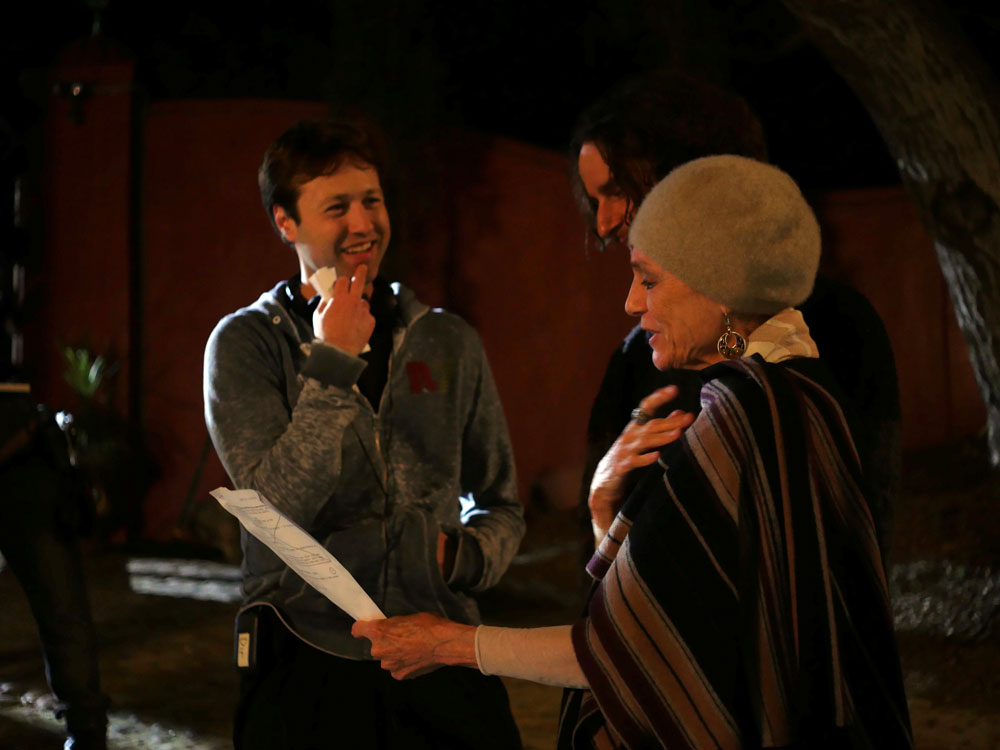
Loren and RoseDirector Russell Brown with “Loren and Rose” actors Kelly Blatz and Jacqueline Bisset (Wise Lars Productions)

Russell, what questions did you ask Jacqueline about her career? Did you shape Rose’s character around Jacqueline? Was it collaborative?

Brown: Of course, I asked Jacqueline about her career — who wouldn’t? [Laughs] And through my friendship with her before, during, and after filming, I’ve asked her about her life. She has had an amazing, interesting life and really lived it. But I don’t think I ever took the point of view of saying, “This moment in Rose’s life was this moment in your personal career.” We were very focused on the text, and the character and where she was coming from and what happened in her life. All actors to a degree pull on their own life experience to create things.

Bisset: [Laughs] Just as well. I liked the line, “You like the dark side of men,” and I said, “Yes, I do like the dark side of men.” That is a wonderful line. So true, and very self-revelatory line. 

Brown: The dark side of people is something that is always interesting to creative people. You are always attracted to the light and dark side of people. That’s what make them interesting.

Bisset: I didn’t say the light side. I said the dark side. [Laughs]


Want a daily wrap-up of all the news and commentary Salon has to offer? Subscribe to our morning newsletter, Crash Course.


Russell, your films are often about the creative process. Can you talk about finding inspiration and validation? I like the film’s message about fulfilling one’s potential. 

Brown: This is my life. For whatever reason, I’m surrounded by creative people, and I love them, and what they make, and how they live — the sensuality of artistic people. It’s not unusual that I write about that. I’m not particularly turned on by political debate or what other people make films about.

Bisset: I want to express my intelligence and give what I get from that to others. It’s a need, and I have a big need to be creative. It could be making a dinner or arranging something in my house. I need beauty around me. I get muddled sometimes. I don’t particularly enjoy chaos. I’ve had chaos in my life. I don’t seek it out. I seek question marks and I love to look at things in detail. I’m sad that films don’t go deeper. In “Day for Night,” a character says, “You can make a film about anything.” I can understand that; you can go deep into everything. There is so much that can be turned into incredible drama. I like a degree of drama, but I like the idea of quiet, and appreciation of quiet, and think simply and not have a cluttered mind. I don’t do well in chaos.

Yes, I recall once seeing a documentary called, “Dust” which was a meditation on, well, dust. You can make a film about anything! I want to see films I can learn from. Teach me!

Bisset: I think you can leave school with curiosity intact. So many people are bored in school, but some teacher gets you up and sends you off into the world. This is the beginning of my education. I will never be bored again! We all fear boredom. It’s the worst. And I fear a bored person. It shows a lack of imagination and appreciation. The human being as a lifelong project is incredible. Part of being an actress is that you have to do psychological work on the characters you play.

Jacqueline, Rose hopes Loren has seen some of her performances that flew under the radar. What films have you made that you would like folks to have seen? “High Season” comes to mind, and I love you in “Scenes from the Class Struggle in Beverly Hills.” 

Bisset: I’ve done a few things that I like. When I did “The Grasshopper,” it was a big deal, because it was a big part, and I learned that I didn’t like being in such big parts at the time because it was non-stop rush. There was no time to think. It was a good character, based on a Gail Sheehy article. She was always thinking she was special and wanting to be in on everything. She was never happy with herself. She got involved with the wrong men and was always seeking things in an empty way. I would like people to see that.

There are discussions of art and understanding and experience. Loren says he’s never been to Paris, but if he went, it may not live up to the Paris of his imagination. What are your thoughts about how we engage emotionally and intellectually with art? 

Brown: This is one of Loren’s defining qualities. He is such a romantic. He can transport himself to Paris or sit in room with Alfred Stieglitz and Georgia O’Keefe. He has a real power of imagination, and that is one of his charming qualities. When Rose tells a story about Bhutan, you can see it in Kelly Blatz’s eyes. 

I love when she performs in the restaurants. It was cringy, but also very, “Go for it!” 

Bisset: Those were the few times Rose could behave badly or inappropriately. I was over the top. That ties into Rose when she was young. She got hurt in between.

Brown: This is Rose’s worldview. In her mind, who wouldn’t want to see her get up and perform “Salome” in a restaurant? Or her singing in the restaurant — she thinks: This is my gift to the world, and people love me for this, so I am going to do it. You are giving someone that moment: “Guess what I saw Rose Martin do at a restaurant today?”

What can you say about your working relationship on the film?

Brown: This power dynamic happens all the time when you work with people you admire and respect, like Jacqueline, it is someone who has a life of experience and knowledge and wisdom. You do second-guess yourself. If she says something, I’m not going to take it with the same gravitas as a 28-year-old day player, so you listen.

Bisset: That sounds really great that you think that, but lots of people don’t think like that. They have hardly done any work and they are taking you away from your performance. They block you on anything instinctive that you are doing that might come, which is horrible. You are tempted to read off one’s credits, but one doesn’t, of course, because you’ve been employed to do the director’s vision. That is your duty as a performer. It’s your job.

Brown: But, at the same time, you can’t completely roll over on own instincts if you have a feeling about something . . .

Bisset: Sometimes you literally have to. You are literally not allowed to do that. It can lead to total hatred. You get so angry and frustrated with someone who doesn’t know anything. Occasionally, it happened.

Brown: Getting back to the power dynamics, in my working with Jacqueline, or Loren directing Rose, if you are smart, you chose your battles. She’s right on this one. We will do it her way. 

Bisset: It is such a curious thing. When you are young, I used to assume everyone knew more than I did. I had strong instincts. This doesn’t feel right, but it is, “Yes, sir.” [Bisset salutes.] You have to find it the way you can. You must be malleable, and to some degree obedient on set. You can’t be a pain in the ass, because it would cause chaos, and nothing will get done or it will be cut out of the film. When you express yourself in your film, it’s a great physical, mental pleasure. 

Brown: I think it’s unwise not to listen to ideas. As a director, you have an inner censor, but the more you hear before you finish your movie and take time to explore what your film can be, the better. 

Jacqueline, if there was an auction of your possessions, as there is of Rose’s in the film, what do you think would have value? 

Brown: She has an amazing set of toaster ovens. I will say this. There are two toasters in her kitchen, and they are the shiniest, happiest toasters I’ve ever seen. One big one, and one little one, and they are very competitive about who gets to toast.

Bisset: If you were selling my stuff, I hate to tell you this, but when I did “The Deep,” there was “the shot.” It was sent to me from time to time by people who wanted me to sign it. And someone said, “You don’t have to sign it.” That was the most liberating thing. I will never sign that picture. The film was an amazing experience, but it is what happened afterwards, to have that so prominent in my PR, was really boring. A friend of mine had the photo laminated and mounted on a wooden board, and when she died, another friend of mine gave it to me. It’s in my cupboard. No one sees it. It’s been made into an object I could sell in an auction. That’s the most valuable thing I have in my artifacts. That could get a few grand if it sold.

“Loren and Rose” makes its world premiere March 3 and 5 at the Santa Barbara International Film Festival and screens March 25-26 at the Sonoma Film Festival, where Bisset will be honored on the 25th.

More stories you might like: 

Why a life-saving, last-resort treatment for COVID-19 is so hard to access

For those hospitalized with severe COVID-19, there is a last-resort treatment available that has been shown to save their lives. Extracorporeal membrane oxygenation, often referred to as ECMO (pronounced ek-mo), oxygenates blood outside the body in a machine, giving the heart and lungs a chance to rest when a patient is experiencing lung failure.

The treatment essentially buys time for a person’s lungs to heal. But due to the treatment being so resource-intensive, as it requires a specialized machine and personnel who know how to operate it, it is not always available at every hospital. This was particularly pronounced during the COVID-19 pandemic, when a lack of access to ECMO almost certainly cost lives.

According to a study published in the American Journal of Respiratory and Critical Care Medicine, nearly 90 percent of severe COVID-19 patients who qualified for ECMO, but were unable to receive the treatment, died — compared to a 43% mortality rate for patients who received ECMO. Both groups were young in age (the median age was 40 years old) and had limited comorbidities.

The analysis was led by a team of researchers at Vanderbilt University Medical Center (VUMC), looking at the total number of patients referred for ECMO in one referral region between Jan. 1, 2021, and Aug. 31, 2021. The sample size of patients analyzed was small, 240 patients, but the analysis showed just how many lives could have been saved if ECMO treatment was available: 49 of the 55 patients (89.1%) who didn’t receive ECMO died, compared to 15 of the 35 patients (42.9 %) who received the treatment.


Want more health and science stories in your inbox? Subscribe to Salon’s weekly newsletter The Vulgar Scientist.


“Because some patients die despite receiving ECMO, there has been debate about how much benefit it provides. This study shows the answer is a huge benefit,” said senior author Jonathan Casey, MD, assistant professor of Medicine at VUMC. “This data suggests that, on average, providing ECMO to two patients will save a life and give a young person the potential to live for decades.”

The patients were unable to receive the ECMO treatment due to a shortage of resources, on top of the fact that even in non-pandemic times, ECMO machines and personnel aren’t always easy to find. But why?

Whitney Gannon, MSN, director of Quality and Education for VUMC and lead author of the study, told Salon there are a few reasons why ECMO treatment isn’t offered in every hospital. First, it’s a specialized device that’s more high-tech than other devices that are offered in intensive care units (ICU). It can also be considered a more high-risk kind of treatment.

“The specialists providing the ECMO care have to really understand the technical aspects of the device, and that takes a good bit of training,” Gannon said. “The doctors have to be able to understand how to care for their patients safely with the device and have to understand how all the ICU therapies work together with the ECMO machine, and so that requires extensive training.”

Gannon explained that means more training for all personnel in the ICU. 

“You’re talking about more dedicated personnel,” Gannon said.”And there have to be technical specialists who are able to attend to the machine.”

RELATED: What it feels like to survive COVID-19’s dreaded “cytokine storm”

Sometimes, Gannon said, an ECMO machine can have an issue that a specialist needs to know how to technically solve.

“ECMO patients who receive ECMO, especially those who have COVID, are often on ECMO for long periods of time, longer than what we’ve seen historically, and so therefore, they’re taking up an ICU bed, ICU nursing staff and ICU resources for longer,” Gannon said. “So it’s just a huge lift in all different aspects of the hospital, and frankly, that’s why a lot of hospitals don’t have ECMO.”

Amesh Adalja, an infectious disease doctor and  critical care medicine doctor, who was not involved in the study, agreed that the barrier to ECMO isn’t necessarily about a lack of funding, but the resources available.

“It’s not about investment in capital — it’s about having the resources and expertise  to deploy ECMO,” Adalja said. “Often ECMO is available at hospitals that perform cardiac surgery because ECMO is used routinely during many of those surgeries.”

Adalja added that it can be difficult for hospitals to offer when inundated with patients, especially if the hospital is already strapped for resources.

According to NPR, children’s hospitals always provide ECMO because it is often used on newborns who are having trouble with their lungs. Most major medical centers have them, too. Yet that leaves many rural hospitals without them or far from a place that can offer the treatment. There is also no formal way to make transfers to a medical center for ECMO either.

Gannon said she hopes that their study will encourage government agencies and more medical centers to “invest in infrastructure for ECMO.”

“And ECMO isn’t just having the machines, but it’s having the specialized personnel to take care of the patients, to have the ICU bed, to actually prioritize these patients, to prioritize ECMO and to think about resource allocation and better regional coordination and sharing of resources,” Gannon said.

Read more on COVID-19:

“Crazy conspiracy theory”: Wisconsin GOP investigator pushes illegal effort to “decertify” election

A former state Supreme Court justice leading Wisconsin Republicans’ investigation into the 2020 election echoed a slew of debunked conspiracy theories and suggested that lawmakers should move to decertify Joe Biden’s victory in the state, even though there is no legal mechanism for doing so.

Michael Gableman, who spoke at a pro-Trump “stop the steal” rally fueled by conspiracy theories before he was hired by Republican Assembly Speaker Robin Vos to investigate the election, released his interim report on Tuesday ahead of a legislative hearing on his probe.

Gableman, who has previously claimed without evidence that the election was stolen, and traveled to MyPillow founder Mike Lindell’s election conspiracy symposium, suggested that the state election board had broken the law by sending absentee ballots to nursing homes. He also suggested a conspiracy by Milwaukee, Green Bay, Madison, Racine and Kenosha — Wisconsin’s largest cities — to boost Democrats because they received grant money to help administer the election during the pandemic from Center for Tech and Civic Life, which is funded by Facebook founder Mark Zuckerberg. More than half the state’s counties received funding from the nonprofit, as did 2,500 other election offices across the U.S., but Gableman claimed that the funding favored Democratic areas, saying the grants elsewhere were “insubstantial” and alleging that Zuckerberg “bought the 2020 election for Biden.”

Gableman told lawmakers on Tuesday that they should consider decertifying the election results, even though Vos acknowledged last month that doing that would be “impossible.”

“I believe the Legislature ought to take a very hard look at the option of decertification,” Gableman testified to a state Assembly committee on elections, according to Politico.

RELATED: Wisconsin Republican pushes “illegal” scheme to jail election officials, causes rift in GOP

His claim that the election could be decertified was refuted by the legislature’s own attorney during the same hearing.

“Our position is that once the electoral votes have been received by the Congress, that closes the door. The election is then done,” the attorney said.

Rick Hasen, an election law expert at the University of California, Irvine, called Gableman’s claim that the state could decertify the election “utter, utter bullshit.”

“This is a bad joke that will only serve to undermine further Wisconsinites faith in an election system that used to be the envy of the entire nation,” he tweeted. “Despicable, disgusting, irresponsible. Gableman’s actions today are horrible.”

Gableman’s report acknowledged that even if the state could decertify the election, “this action would not, on its own, have any other legal consequence under state or federal law. It would not, for example, change who the current president is.”

Ann Jacobs, the Democratic chairwoman of the bipartisan Wisconsin Elections Commission, rejected Gableman’s report as a “crazy conspiracy theory.”

“This is IMPOSSIBLE,” she tweeted. “NOT LEGAL.”

Wisconsin Gov. Tony Evers, a Democrat, said that Gableman’s investigation had “long surpassed being a mere embarrassment for our state.”

“This effort has spread disinformation about our election processes, it has attacked the integrity of our clerks, election administrators, and poll workers, and it has emboldened individuals to harass and demean dedicated public servants,” Evers said in a statement. “Enough is enough. Republicans in the Legislature have always had the ability to end this effort, and I call on them to do so today.”

Even some Wisconsin Republicans, who have tried to placate pro-Trump diehards’ debunked election conspiracy theories — even though numerous recounts, audits and investigations have found no evidence of widespread fraud or irregularities, suggested it was time to move on from the 2020 race.

“I can guarantee that I will not be part of any effort, and will do everything possible to stop any effort, to put politicians in charge of deciding who wins or loses elections,” Assembly Republican Leader Jim Steineke said on Twitter. “Handing authority to partisan politicians to determine if election fraud exists would be the end of our republic as we know it,” he wrote.


Want a daily wrap-up of all the news and commentary Salon has to offer? Subscribe to our morning newsletter, Crash Course.


Wisconsin lawmakers have already passed an onslaught of new voting restrictions, but they were blocked by Evers, who faces a tight re-election contest in November. Gableman’s report further urged Republicans to make it easier to decertify future elections.

“In the event of widespread contest, the thumb should be on the scale in favor of withholding certification of electors,” his report said, arguing that the decision to certify should be left to a “politically accountable body” rather than the state’s elected governor.

Despite Republican pleas to move on, Gableman said that his work would continue with full support from Vos despite acknowledging that it is unclear whether his contract with the state would be extended.

“I’m going to keep going, whether anyone signs a contract or not,” he said Tuesday. “This is just the beginning of the investigation.” 

Republicans have already paid Gableman $676,000 in taxpayer money since he launched his probe last summer. Gableman said he has been unable to complete his investigation because “witnesses” have refused to cooperate. Gableman recently sought a court order to jail several big-city mayors and election officials for refusing to sit down for closed-door depositions.

Sen. Tammy Baldwin, D-Wis., accused Gableman of stoking conspiracy theories to pander to Trump supporters who have refused to accept his defeat.

“Mike Gableman has undermined faith in our elections promoting Trump’s Big Lie, fleecing taxpayers, and suggesting the 2020 election should be overturned,” Baldwin tweeted. “He can’t handle the truth Biden won a free, fair and secure election. Trump simply lost. This circus should leave town now.”

Read more:

Why aren’t Republicans worried their fanatical culture war will hurt them in the midterms?

Ten years ago the Democratic Party faced dire election prospects, similar to those it faces today, with widespread disappointment in the economic recovery and too much complacency among Democratic voters — and a fired-up right wing opposition. Barack Obama’s re-election may look like a foregone conclusion in the rear-view mirror, but it very much was not. As the New York Times noted at the time, Obama had to overcome “powerful economic headwinds, a lock-step resistance to his agenda by Republicans in Congress and an unprecedented torrent of advertising.” In what was perhaps a bigger surprise, Democrats managed to overcome those forces to gain two seats in the Senate, even as Republicans held control of the House. 

Blame the Tea Party. That far-right movement was focused not only on pushing Democrats out of office, but also on seizing control of the GOP. On that front, they had considerable success. But as the 2012 election demonstrated, it came at times at great cost, as radical-right candidates who performed well in primaries often faltered on the main stage. The most notorious case is that of Todd Akin, the Republican who lost a Missouri Senate race to Democrat Claire McCaskill after claiming that no rape victim needed an abortion, because, “If it’s a legitimate rape, the female body has ways to try to shut that whole thing down.” To those who followed the religious right’s rhetoric, the comment came as no surprise — that’s pretty much a standard belief in the anti-choice movement that dominates the Republican Party. But for ordinary voters who don’t follow politics closely, it was a shocking wake-up call that led to Akin’s loss. 

RELATED: Virginia election: Democrats left listless without Donald Trump

In the decade since, however, Republicans haven’t moderated on these issues at all. On the contrary, the strategy in 2022 seems to be to go all-out on pushing a radical religious right agenda. The examples just from recent weeks are overwhelming.


Want more Amanda Marcotte on politics? Subscribe to her newsletter Standing Room Only.


In Texas, Gov. Greg Abbott and Attorney General Ken Paxton issued a directive that parents who support trans children should be investigated for child abuse, even though that means doctors are supposed to report parents for taking the best medical advice.

In Florida, Gov. Ron DeSantis is supporting a bill that would allow parents to sue teachers who acknowledge the existence of LGBTQ people, even in small ways such as allowing kids of same-sex parents to talk about their families during “show and tell.” Florida Sen. Rick Scott released an 11-point GOP plan for America that states heterosexual marriage is “God’s design for humanity,” which isn’t just an insult to LGBTQ Americans but the nearly 50% of all adults who aren’t married. Florida Republicans also invited legislative testimony from an anti-choice activist who argued against legal birth control, claiming, “The contraceptive mentality is what fuels the bloodthirsty abortion industry.”

In Michigan, all three GOP candidates for attorney general affirmed support for a state’s “right” to criminalize access to birth control. In the same state, Republican gubernatorial candidate Garrett Soldano said rape victims should not be allowed abortions, but instead should be told to be happy because, “God put them in this moment” and that we should “protect that DNA” instead.

And in Ohio, the frontrunner for the GOP senate primary, Josh Mandel, has been declaring that the separation of church and state is a “myth.” (The phrase comes directly from Thomas Jefferson himself.) 

RELATED: Democrats can win the culture wars — but they have to take on the fight early and often

What is remarkable is how none of these fools seem worried about these outrageous views coming back to haunt them in a general election, as they did for Akin. These aren’t politicians from deep red states, after all. Florida, Michigan and Ohio all are swing states, as Gov. Gretchen Whitmer of Michigan and Sen. Sherrod Brown of Ohio, both Democrats, can attest. Even Texas, which has been controlled by Republicans for decades, isn’t a sure bet. Abbott’s opponent in the general election will be former congressman Beto O’Rourke, who got within a couple of points of beating Sen. Ted Cruz in the 2018 midterms. That was before the disastrous statewide blackouts and massive COVID-19 debacle that happened on the GOP watch. 

Republicans aren’t worried, however, because they’re likely counting on two things: The increasing nationalization of partisan politics and the fact that most voters just aren’t paying enough attention to understand how far to the right the GOP has gone. 


Want more Amanda Marcotte on politics? Subscribe to her newsletter Standing Room Only.


On the former, the bet is quite simple: Voters are blaming Democrats for our currently bleak landscape, because a Democrat controls the White House. Republicans want to make the 2022 elections a referendum on President Joe Biden’s supposed failures to end the pandemic or bring inflation under control, even though the former is wholly the fault of Republicans themselves for encouraging vaccine rejection and the latter is not something, say, re-electing a Republican governor of Texas will change in any way. Indeed, the laser-like focus on national politics is such that Paxton blew off a primary debate last week in favor of attending the Conservative Political Action Conference (CPAC)

On the latter, well, Republicans have a good reason to believe those moderate and swing voters they need to win will never find out about their extreme statements and actions. As political scientists Yanna Krupnikov and John Barry Ryan argued in the New York Times in 2020, “most Americans — upward of 80 percent to 85 percent — follow politics casually or not at all.” They will never hear about Republicans pushing to allow birth control to be criminalized, or Republican candidates calling rape-caused pregnancy a gift. So conservatives can happily play up far right bona fides to their rabid base, content in the belief that the majority of voters will never know how terrible they are. 

RELATED: First, the book-banners came for CRT and LGBTQ. Now they’re censoring women’s history

We saw how this worked in the Virginia gubernatorial election, where Republican Glenn Youngkin was able to win with a two-pronged strategy. For the deeply invested right wing base, his message was pure MAGA, which successfully turned out the hardcore Republican vote. For the rest of the public, however, he hid behind a demeanor of normalcy that lulled Democratic voters into feeling it would be safe not to vote and allowed moderates to believe he’s not one of Those Republicans. Now Youngkin has gone all-out on a far-right agenda of defunding essential programs and banning books. His approval ratings are already underwater, which is rare this soon after an election. Virginia voters apparently are surprised at how conservative Youngkin is, even though even a cursory examination of his past would have revealed that fact. But most people simply don’t pay enough attention, until it’s too late. 

The situation is incredibly dire now, as there’s been a dramatic decline in the public’s interest in the news and politics in the past year. As Axios reports, just 34% of Democratic voters report paying a “great deal of attention to national news in 2021, compared to 69% in November 2020.” Independent voters have also tuned out dramatically. Republican interest, however, has barely dropped off at all, relative to these numbers. Republicans are counting on the people who would be alarmed at their extremism not paying enough attention to notice. 

The situation isn’t impossible, however. The reason why Akin’s comments about “legitimate rape” actually hurt him in the general election is that Democrats went after him hard and made sure the public heard about it. And not just in Missouri, either. High profile Democrats, including Obama himself, made a point of rebuking Akin by declaring “rape is rape” frequently. They nationalized the debate over whether or not some rape victims are “legitimate” and in doing so put Akin’s offensive views on the radar of less-engaged voters. 

RELATED: Republicans pick Putin over democracy — and Rick Scott’s creepy blueprint for America shows why

Democrats need to Akin-ize the Republicans by making a spectacle of the grotesque, sadistic, far-right views their opponents are touting. It shouldn’t be hard. Republicans aren’t exactly hiding what they believe. They flat-out banned abortion in Texas! They are running a nationwide campaign to ban books, something more than 85% of voters oppose. They’re coming for birth control and want to shape the law to make heterosexual marriage compulsory. People hate this crap and will vote against it — if they know about it. 

Unfortunately, President Joe Biden’s State of the Union speech Tuesday night largely focused on a laundry list of important-but-boring policy priorities. It’s a troubling indicator that Democrats have not learned their lesson. While Biden did defend trans rights, he skated over abortion rights and ignored the red-hot book banning issue. Democratic policies may be popular, but this snooze-fest approach is simply not enough to penetrate the wall of ignorance surrounding most voters. Democrats need to give people something to vote against

Biden seems to get it on the issue of the Russian invasion of Ukraine, where he nodded towards the unpopular pro-Putin views espoused by Donald Trump and Tucker Carlson. Baiting Republicans into showing who they really are is smart politics. But Biden and the Democrats so far seem reluctant to go for it on all the culture war issues that have a chance of actually waking voters up. If they don’t start taking the fight to Republicans, November really will be an ass-whupping.

Biden calls out the attack on democracy: But he didn’t just mean Vladimir Putin

Last year, when President Joe Biden gave his address to a joint session of Congress, he was speaking to a world that had just witnessed a violent insurrection in which a mob had tried to stop the peaceful transfer of power. He said:

[A]s we gather here tonight, the images of a violent mob assaulting this Capitol, desecrating our democracy, remain vivid in all our minds. Lives were put at risk — many of your lives. Lives were lost. Extraordinary courage was summoned. The insurrection was an existential crisis — a test of whether our democracy could survive. And it did.

But the struggle is far from over. The question of whether our democracy will long endure is both ancient and urgent, as old as our Republic — still vital today. Can our democracy deliver on its promise that all of us, created equal in the image of God, have a chance to lead lives of dignity, respect, and possibility? Can our democracy deliver the most — to the most pressing needs of our people? Can our democracy overcome the lies, anger, hate and fears that have pulled us apart?

America’s adversaries — the autocrats of the world — are betting we can’t. … They believe we’re too full of anger and division and rage. They look at the images of the mob that assaulted the Capitol as proof that the sun is setting on American democracy. But they are wrong. You know it; I know it. But we have to prove them wrong.

For this year’s State of the Union address, the president was speaking to a world that is witnessing Russia’s unprovoked invasion of Ukraine, and the themes were not dissimilar. It is entirely possible that Biden’s words last year were prophetic. That horrifying act of violence on Jan. 6, 2021, may have led Russian President Vladimir Putin to believe that the U.S. was so divided and had lost so much global influence that it would be unable to rally the world to take decisive action against his attack on Ukraine.

RELATED: Lt. Col. Alex Vindman: How Trump’s coup attempt encouraged Putin’s Ukraine invasion

You can’t blame him, honestly. Putin observed first-hand the inept fool we elected in 2016 turn the country into a clown show for four years, before making half the country believe that American democracy is a farce. He must have believed that America’s long-standing alliances were so frayed by our former president’s constant denigration and threats that they would never be able to work in concert again. He certainly could have assumed that the world was so battered by the global pandemic that few nations would bewilling to make the sacrifices that economic sanctions might mean for their own people.

It appears Putin was wrong about that. United global condemnation has been overwhelming and the economic response is unprecedented. Responsible American leadership appears to have been decisive in bringing that together.

Biden addressed the subject forcefully in his speech on Tuesday night. He opened with a stirring tribute to the Ukrainian people:

Six days ago, Russia’s Vladimir Putin sought to shake the very foundations of the free world, thinking he could make it bend to his menacing ways. But he badly miscalculated. He thought he could roll into Ukraine and the world would roll over. Instead, he was met with a wall of strength he never anticipated or imagined. He met the Ukrainian people.

After years of Trumpian braggadocio, this was a refreshing demonstration of an American leader allowing people other than himself to be the object of admiration. And despite their sullen hostility, the Republicans in the chamber actually stood with Democrats to applaud him.


Want a daily wrap-up of all the news and commentary Salon has to offer? Subscribe to our morning newsletter, Crash Course.


That was, of course, the reason that cowards like Sen. Marco Rubio of Florida refused to attend, citing the the COVID testing requirement as their laughable reason. They just didn’t want to be seen either sitting or standing as President Biden spoke about the Ukraine crisis. As it happens, those who mustered the courage to attend ended up having to grit their teeth and stand up on five different occasions.

This covers most of what the president said in the speech about Ukraine. It was bracing, to say the least:

Attempting to rally the country for yet more economic turmoil was undoubtedly the last thing Biden wanted to do. It’s likely that the measures he spoke about will make it more difficult to control inflation, which is the thorniest economic problem the world faces right now. Gas prices are bound to rise, with oil above $100 a barrel, and the cascading effects will be substantial. This will hurt.

But there really is no choice. Allowing Russia to invade Ukraine without responding would be foolish in the extreme. Direct military involvement by NATO forces is off the table — the alliance has no treaty obligations with Ukraine, and the threat of nuclear war is real — so economic sanctions and material support is the best way for Ukraine’s friends to help. Fortunately, the global response has been overwhelming, reflecting the dawning realization among most countries in the world that the threat of antidemocratic authoritarianism is no longer theoretical.

That brings us back to where we are here at home. Other than speaking out for voting rights, Biden didn’t bring up the insurrection in his speech this year. But it hung over the entire evening anyway. After all, it was only 14 months ago that those elected representatives were evacuated from the very chamber in which they sat on Tuesday night. It’s impossible to ignore the fact that while the U.S. takes a bold stand against an authoritarian halfway around the world, an authoritarian here at home has successfully persuaded a large proportion of the public that the current president is illegitimate — and that authoritarian has not been held to account for any of his misdeeds. In fact, he will probably going to be the Republican presidential nominee two years from now.

The whole world is watching as the people of Ukraine fight for their democracy and their freedom. But we have a different fight for democracy right here at home. As former federal prosecutor Joyce Vance pointed out on MSNBC:

In the 2022 elections, there are election deniers — candidates who still contest the results of the 2020 election — running for governor in at least 24 states, for attorney general in 10, and for secretary of state, a key post for administering elections, in 18 states. States have adopted laws that make it more difficult to vote, for instance, by cutting back on early voting days and absentee voting.

Joe Biden made a compelling case for America and the world to stand up to Putin’s aggression against Ukraine. Republicans  applauded along with Democrats as he said, “When dictators do not pay a price for their aggression, they cause more chaos, they keep moving — and the cost to America and the world keeps rising.” But how many of those Republicans reflected on the fact that the president could have just as easily been speaking about them?

Read more on Biden, Putin, the Republicans and Ukraine:

The Postal Service plans to spend billions on gas-powered vehicles

President Biden’s dream of delivering a fully electric fleet of federal vehicles may just have been delayed by none other than the U.S. Postal Service. On Wednesday, USPS finalized its plan to spend just over $11 billion to upgrade its decades-old fleet of mail trucks. This plan, however, only requires that 10 percent of up to 165,000 new vehicles are required to be electric. 

Both federal agencies and environmental advocacy groups framed the Postal Service’s decision to stick with mostly fossil fuel-powered vehicles as a lost opportunity for one of the largest government fleets in the world to reduce its carbon footprint. “A ten-percent commitment to clean vehicles, with virtually no fuel efficiency gains for the other 90 percent is plainly inconsistent with international, national, and many state [greenhouse gas] emissions reduction targets,” wrote Vicki Arroyo, the Associate Administrator for Policy at the Environment Protection Agency, in a letter to USPS.

The sheer size of the fleet of USPS mail trucks made it a potentially ideal target for emissions reductions. The agency accounts for nearly one-third of federally owned cars and trucks. From 2018 through 2020, USPS mail trucks drove over 3.3 billion miles, emitting almost 1.7 million metric tons of CO2. That’s the greenhouse gas equivalent of 23,000 tanker trucks’ worth of gasoline

Even if you discount the environmental benefit, the decision to electrify just 10 percent of the USPS fleet is puzzling from a financial standpoint: A recent report from Atlas Public Policy indicated that “by 2025, it will be cheaper to use an [electric vehicle] over a conventional vehicle for more than 99 percent of the USPS fleet of light vehicles.” The group also concluded USPS would save  $2.9 billion by converting to an all-electric fleet when considered over the lifetime of the new vehicles.

Advocacy groups also criticized USPS for its decision’s public health impact. Andres Hoyos, vice president of the Zero Emission Transportation Association, highlighted in a press release that electrifying the USPS mail truck fleet “would have prevented billions of dollars in environmental and public health damages.”

USPS’s decision is a major blow to the Biden administration’s climate goals. Last December,  Biden signed an executive orderdirecting federal officials to convert all government vehicle fleets to “clean and zero-emission vehicles.” But because USPS has independent status from the Executive Branch, last year’s executive order is mostly a suggestion to the agency, which is currently run by Postmaster General Louis DeJoy, a holdover from the Trump administration. 

DeJoy said that part of the agency’s decision was because USPS lacks the funding required to pursue a wholesale electric vehicle upgrade and that they had “waited long enough” for new vehicles. Ben Prochazka, executive director of the Electrification Coalition, told Politico that the House’s version of the “Build Back Better” Act could allocate billions of dollars to help the postal service purchase electric vehicles. If that funding does become available, USPS stated that it could increase the number of electric vehicles in its fleet.

How white supremacy fuels the Republican love affair with Vladimir Putin

Racism is not an opinion. It is a fact.

This is true both in the United States and around the world.

As W.E.B. Du Bois presciently wrote in 1903, the problem of the 20th century is the problem of the color line. That is true in the 21st century as well, even if the context has changed — and that could remain true in the 22nd century as well (assuming humanity survives that long).

Racism and white supremacy continue to structure American society, largely by privileging some groups (those defined as “white”) and disadvantaging others (especially those deemed “Black,” but other nonwhites as well). These outcomes are the aggregate result of individual, systemic and institutional discrimination and other forms of racial animus. This has been a fixture of American life and society since before the founding of the republic through to the post-civil rights era and now the Age of Trump and a 21st-century form of fascism. In practice, racism and white supremacy are a “changing same,” constantly adapting over time to fit American society in support of the maintenance and expansion of white privilege, white power and white control. 

RELATED: Right’s cynical attack on “critical race theory”: Old racist poison in a new bottle

Racial attitudes and values help to structure how Americans, particularly white Americans, feel about both domestic politics and foreign policy. For example, it is no surprise, and really no mystery — as some members of the mainstream news media and commentariat appear to believe — why many Republicans and other members of the white right defend or even embrace Vladimir Putin and his war in Ukraine. This is readily explainable: The Russian president is viewed by them as a champion of “conservative values” and the possibility of a return to what they have deluded themselves into believing was a “golden age” of white male Christian dominance over all areas of American (and global) society.


Want a daily wrap-up of all the news and commentary Salon has to offer? Subscribe to our morning newsletter, Crash Course.


Putin’s politics, values and strategic goals, at least in a general sense, largely align with those of today’s Republican-fascist movement and the larger white right. Taken together, they are a global front aimed at undermining or destroying pluralism and multiracial democracy.

Robert Reich summarizes this in a new essay for the Guardian, where he writes: “The Trump-led Republican party does not openly support Putin, but the Republican party’s animus toward democracy is expressed in ways familiar to Putin and other autocrats. … Make no mistake: Putin’s authoritarian neo-fascism has rooted itself in America.”

Writing at Jewish Currents, David Klion explores this further:

On the right, leading voices like Tucker Carlson, Steve Bannon, and Donald Trump himself have been more likely to offer actual defenses of Putin and Russia. … But there’s also a deeper ideological affinity between the Western far right and Putin’s Russia, one that emphasizes Russia’s Christianness and whiteness, its hostility to LGBTQ minorities, and its potential role as a bulwark against China, which many on the right view as 21st century America’s true geopolitical rival.

In an essay last Sunday for the New York Times, Emily Tamkin discusses the right’s preoccupation with Putin’s supposed “strength”:

“Strong” may be the key word here. In this construction, a strong leader is apparently one who cracks down on opposition, cultural and political, and does not concede. This idea then dovetails with right-wing ideas that liberal elites are actively corroding deeply held traditional values — including traditional gender roles. For those who spend a fair amount of airtime worrying about the emasculation of men, the kind of strength portrayed by Mr. Putin — who on Monday convened his top security officials and demanded they publicly stand and support him — is perhaps appealing.

Many of the admirers of the world’s strongmen on the American right appear to believe that the countries each of these men lead are beacons of whiteness, Christianity and conservative values. …

These comments, from the right, aren’t exactly advancing a new position. In 2018, the political commentator Pat Buchanan said that Mr. Putin and the Belarusian dictator Alexander Lukashenko were “standing up for traditional values against Western cultural elites.” …

Russia is neither all white nor all Christian — it is a country that encompasses several regions, religions and ethnicities. Still, it is often perceived as white. … [T]his construction of Mr. Putin as a beacon of far-right values began with the ultra-far-right nationalists in Europe and later spread to the United States.

James Risen is even more direct in a recent essay for the Intercept:

[Putin’s] brutal invasion of Ukraine is just the latest move in his long-running strategy to rebuild the Russian empire by any means necessary. But while Putin hasn’t strayed from his obsessions of 30-plus years ago, the U.S. Republican Party has been comprehensively altered into something that would have been unrecognizable in 1989. Today, much of the American right is in thrall to Putin and other autocrats, and a segment of the extreme right now harbors a hatred for Western democracy. The new American right somehow sees Putin as a guardian of white nationalism who will stand up to the “woke” left in the West. They don’t seem to care that he is a murderous dictator who has launched a war in the middle of Europe. …

But while other Republicans in Congress denounced Putin’s invasion, they refused to criticize Trump or other Putin sympathizers in their party. That follows the usual pattern within the GOP, in which establishment politicians try to ignore Trump — only to be overshadowed and eventually overwhelmed by him. …

In the United States, meanwhile, perhaps the biggest political question in the aftermath of Russia’s invasion of Ukraine is whether the Trumpist wing of the Republican Party will continue its sympathy for and appeasement of Putin. For now, it seems likely that pro-Putin Republicans will continue to allow their hatred for progressives and adherence to white nationalism to blind them to what Putin really is.

These observations help to highlight three foundational realities about American politics and the color line in the post-civil rights era and the Age of Trump. The first of those is that today’s Republican Party is America’s and the world’s largest white supremacist and white identity organization.

The second is that “conservatism” and racism are now fully one and the same thing here in America.

The third is that on a fundamental level Trumpism and American neofascism are nothing new. Instead, they represent a continuation of evil forces that have long been present in American society — and show few signs of being vanquished. Ever since the invention of “race” as a concept in or around the 15th century, white supremacy and racism have been a global project. In America today, the Republican Party and “conservative” movement are the leading proponents of such anti-human ideas and values — and are wholly invested in perpetuating and strengthening them far into the future.

Read more:

Judge says Sarah Palin “failed to prove her case even to the minimum standard required by law”

U.S. District Judge Jed Rakoff on Tuesday issued his written opinion explaining why he dismissed former Alaska Gov. Sarah Palin’s defamation lawsuit against The New York Times.

“At trial, plaintiff Sarah Palin wholly failed to prove her case even to the minimum standard required by law,” Rakoff wrote.

On Monday, Palin’s legal team asked the court for a new trial and to disqualify Judge Rakoff.

Palin argued that the fact several jurors received push notifications on their phones alerting them that the judge was going to throw out the case regardless of what the jury decided. The jury subsequently agreed with the judge and voted to dismiss the case.

In his written decision, Rakoff said the push alerts were “legally irrelevant.”

Fiona Hill: Putin warned nuclear option was on the table, but Trump didn’t understand what he meant

One of the world’s foremost experts on Russia and Vladimir Putin believes there’s a grave risk of nuclear war after his invasion of Ukraine.

Fiona Hill, the former National Security Council staffer who testified against Donald Trump in his first impeachment saga, told Politico that Putin’s invasion of Ukraine was part of a broader war against liberal democracies and posed a potentially existential risk to the world order.

“Ukraine has become the front line in a struggle, not just between democracies and autocracies but in a struggle for maintaining a rules-based system in which the things that countries want are not taken by force,” Hill said. “Every country in the world should be paying close attention to this.”

Putin has repeatedly made it clear that using nuclear weapons was a real possibility, well before he put Russia’s nuclear forces on high alert, but Hill said former President Donald Trump apparently failed to recognize the gravity of his warnings.

“Putin tried to warn Trump about this, but I don’t think Trump figured out what he was saying,” Hill said. “In one of the last meetings between Putin and Trump when I was there, Putin was making the point that: ‘Well you know, Donald, we have these hypersonic missiles,’ and Trump was saying, ‘Well, we will get them, too.’ Putin was saying, ‘Well, yes, you will get them eventually, but we’ve got them first.'”

“There was a menace in this exchange,” Hill added. “Putin was putting us on notice that if push came to shove in some confrontational environment that the nuclear option would be on the table.”

Putin has already used a type of nuclear weapons with the poisoning of Alexander Litvinenko with radioactive polonium, which killed the former spy and spread radioactive material around London, and he has used nerve agents to poison other political enemies.

“So if anybody thinks that Putin wouldn’t use something that he’s got that is unusual and cruel, think again,” Hill said. “Every time you think, ‘No, he wouldn’t, would he?’ Well, yes, he would, and he wants us to know that, of course. It’s not that we should be intimidated and scared. That’s exactly what he wants us to be. We have to prepare for those contingencies and figure out what is it that we’re going to do to head them off.”

Hill has written a highly regarded biography of Putin, and she said his recent behavior appears to be a bit more unhinged than his usual closely guarded public appearances.

“Putin is usually more cynical and calculated than he came across in his most recent speeches,” she said. “There’s evident visceral emotion in things that he said in the past few weeks justifying the war in Ukraine. The pretext is completely flimsy and almost nonsensical for anybody who’s not in the echo chamber or the bubble of propaganda in Russia itself. I mean, demanding to the Ukrainian military that they essentially overthrow their own government or lay down their arms and surrender because they are being commanded by a bunch of drug-addled Nazi fascists? There’s just no sense to that. It beggars the imagination.”

Hill also worries that Putin has become a bit unbalanced during his pandemic isolation and has become obsessed with re-establishing historic borders of the Russian empire.

“I’ve kind of quipped about this, but I also worry about it in all seriousness — that Putin’s been down in the archives of the Kremlin during COVID looking through old maps and treaties and all the different borders that Russia has had over the centuries,” she said. “He’s said, repeatedly, that Russian and European borders have changed many times, and in his speeches, he’s gone after various former Russian and Soviet leaders, he’s gone after Lenin and he’s gone after the communists, because in his view they ruptured the Russian empire, they lost Russian lands in the revolution, and yes, Stalin brought some of them back into the fold again like the Baltic States and some of the lands of Ukraine that had been divided up during World War II, but they were lost again with the dissolution of the USSR.”

“Putin’s view is that borders change,” she added, “and so the borders of the old Russian imperium are still in play for Moscow to dominate now.”

Who is Nick Fuentes? A young white nationalist who hopes to pull the GOP all the way to Hitler

On Tuesday morning, Florida Rep. Matt Gaetz posted an odd video on Twitter along with the comment, “If anyone asks me about Nick Fuentes today, this is my answer in advance.” That answer boiled down to the suggestion that Fuentes is no more politically radical than the Rev. Al Sharpton, that he’s faced significant persecution for his beliefs and that if conservatives don’t defend Fuentes, they’re effectively supporting the Orwellian prosecution of “thought crimes.” 

So who is Nick Fuentes, who has become abruptly more famous in recent days? He is the young, extravagantly racist, antisemitic and misogynistic head of the white nationalist America First movement, whose members call themselves “groypers” in an obscure homage to alt-right mascot Pepe the Frog. Over the last week, Fuentes has made headlines for his role atop the third annual America First Political Action Conference (AFPAC), a meetup held last Friday in Orlando as a far-right alternative to the Conservative Political Action Conference (CPAC), which concluded Sunday. 

In his own AFPAC speech, Fuentes crossed a long-observed red line on the American right, literally praising Adolf Hitler, if only by way of praising Russia’s invasion of Ukraine: “Now they’re going on about Russia and ‘Vladimir Putin is Hitler,'” he said. “They say that’s not a good thing.” 

Fuentes also praised Jared Taylor, founder of the white supremacist group American Renaissance, as his “personal hero,” and urged the audience to give “a round of applause for Russia,” sparking a brief chant of “Putin! Putin! Putin!” At the climax of his speech, he issued something like a proclamation of war: “To every RINO, every lying journalist, every carjacker, gangbanger, illegal immigrant, every OnlyFans whore, every mobbed-up politician and pundit on the payroll of some Middle Eastern country, to the people that have looted our wealth, addicted our youth to drugs, thrown open our borders to invaders from all over the world, to the corrupt that have sold out our country and our people: we are coming for you. … You think you can replace us? You’re wrong. We will replace you.”

RELATED: White nationalist “groyper” leader doubles down on Jan. 6 Capitol riot, calling it “awesome”

The fallout from Fuentes’ conference has already lasted a lot longer than the one-night event itself, including the censure of a Republican state senator who addressed the crowd, and calls for action against other leading Republicans who spoke there as well.

Fuentes first gained notoriety as a youthful attendee of the deadly “Unite the Right” rally in Charlottesville, Virginia, in 2017. On the day that antifascist counter-protester Heather Heyer was killed, Fuentes proclaimed: “The rootless transnational elite knows that a tidal wave of white identity is coming.” 

With the post-Charlottesville alt-right in disarray in 2019, Fuentes and his nattily-attired groypers launched a series of high-profile confrontations at events held by the conservative youth group Turning Point USA, challenging speakers they derided as insufficiently right-wing. 

The following year, Fuentes’ movement became a key force behind pro-Trump “Stop the Steal” protests, and on Jan. 6, 2021, Fuentes rallied his supporters to action outside the U.S. Capitol, calling on them to “not leave this Capitol until Donald Trump is inaugurated president.” Fuentes’ participation later landed him under federal investigation, and this January he and another groyper leader were subpoenaed by the House Select Committee looking into the attack. 

Along the way, Fuentes has built a massive following through a firehose of provocation on his livestream shows, delivered with a “just for the lulz” sneer and calculated for maximum offense. He gleefully deploys racial and religious slurs. Last July, Fuentes led a frenzied mini-pep rally outside a Texas CPAC event, promising he was about to deliver “the most racist, the most sexist, the most antisemitic, the most Holocaust-denying speech in all of Dallas this weekend,” before leading a small band of groypers — looking almost like a group of middle-schoolers in their mirrored shades and backpacks — into the conference venue, chanting “America First” and “White Boy Summer.” 

In a December guest appearance on another far-right podcast, Fuentes said the Taliban represented “ideal” government policies regarding women, adding that women shouldn’t be allowed to vote and neither should “people that don’t own property, young people, people that work, like, retail jobs,” and that he’d welcome “tyranny” if it meant Donald Trump declaring himself “the Caesar of America.” 

In the days leading up to AFPAC III, Fuentes eagerly anticipated the possibility of Russia invading Ukraine — and China invading Taiwan, for that matter — “if for no other reason than it’s time for America to be humiliated.” After Putin indeed ordered the invasion, Fuentes described it as “the coolest thing to happen since 1/6.” He muses about what he calls the “Great Replacement REALITY,” a reference to the racist conspiracy theory that liberals and Jews are orchestrating the “replacement” of white Americans with nonwhite immigrants. He said that Derek Chauvin’s conviction for the murder of George Floyd proves that minorities are “being put at the top of a racial caste system” and compared Nazi concentration camp crematoriums to baking cookies, in an elaborate Holocaust denial analogy.

RELATED: The dark history of the “Great Replacement”: Tucker Carlson’s racist fantasy has deep roots

All of this “strategic display of irreverence” serves a purpose, according to Ben Lorber, a research analyst at Political Research Associates who has followed Fuentes’ rise for the last several years. “Fuentes’ uses of open antisemitism, racial slurs, virulent misogyny and other offensive rhetoric serves as red meat for his base of alienated, terminally online young men who relish this type of content across the digital groyper ecosystem,” said Lorber. “This transgressive posture has remained popular across the right since the Trump presidency, forcing figures like Fuentes to say increasingly more shocking things in order to appear edgier than the rest.”

It’s also, as Lorber wrote in a piece last month, part of Fuentes’ self-described goal to use his movement to “keep pushing” conservatives “further,” with his groypers increasingly pulling the rest of the movement toward their formerly unpalatable positions. 

But it’s not just disaffected teenagers who are drawn in. Despite Fuentes’ performance art-level bigotry, in the last two years he’s managed to attract a number of right-wing Republican officeholders to his cause. In early 2021, fresh on the heels of the Capitol insurrection, Rep. Paul Gosar, R-Ariz., headlined AFPAC II. While Fuentes talked about the decline of the white race and called for more of that Jan. 6 “energy,” Gosar heralded his followers as “American patriots.” When  challenged about it later, Gosar responded, “There is a group of young people that are becoming part of the election process, and becoming a bigger force,” suggesting that it made sense for conservatives to listen to what they have to say. 

RELATED: Rep. Paul Gosar’s siblings say he’s a white supremacist — but his GOP colleagues stay silent

Later in 2021, Texas Republican gubernatorial candidate Don Huffines hired a staffer who came directly from Fuentes’ movement, subsequently refusing to fire him even after revelations that the staffer had engaged in virulent bigotry online, including founding an internet forum whose members called for “death to all minorities.” 

This year, Gosar’s role was played, with exceptional fidelity, by Rep. Marjorie Taylor Greene of Georgia, who appeared Friday night as AFPAC III’s “surprise guest,” and immediately greeted the audience of some 1,200 white nationalists by saying, “Well hello, canceled Americans!” Greene, who in 2021 briefly tried to create an “America First PAC” focused on defending America’s “uniquely Anglo-Saxon political traditions,” told the crowd that they had “been handed the responsibility to fight for our Constitution and stand up for our freedoms and stop the Democrats who are the Communist Party of the United States of America.” 

Greene, whose presence at the conference was apparently facilitated by fallen alt-lite star Milo Yiannapoulos, wasn’t alone. This year’s AFPAC conference, reported Ali Breland at Mother Jones, drew nine former or current elected officials in total. Among them were former Iowa congressman Steve King, who lost his 2020 reelection bid to another Republican after asking in a New York Times interview, “White nationalist, white supremacist, Western civilization — how did that language become offensive?”, along with former Maricopa County sheriff Joe Arpaio, convicted on criminal charges for detaining undocumented immigrants with no criminal records (and then pardoned by Trump). It also included Gosar, speaking by video; Idaho Lt. Gov. Janice McGeachin, Trump’s candidate in the state’s current gubernatorial race; and Arizona state Sen. Wendy Rogers, who has embraced the “great replacement” theory and spoken alongside QAnon adherents. 

RELATED: Marjorie Taylor Greene defends herself for attending white nationalist conference

Rogers, who has previously clamored for Fuentes’ approval — including a December tweet in which she swooned, “Because Nick Fuentes says I am BASED, I am now truly BASED” — used her AFPAC speech to call Ukrainian President Volodymyr Zelensky a “globalist puppet” controlled by George Soros and to suggest that unspecified political enemies should be hanged. “When we do take back our God-given rights, we will bring these criminals to justice,” she said, calling on conservatives to build new “gallows” to make examples out of “these traitors who betrayed our country.” 

In advance of her speech on Friday, reported Nick Martin, a senior fellow at the Western States Center, Rogers posted a bizarre meme on the right-wing social media site Gab, photoshopping an image of herself between Fuentes and Gab founder Andrew Torba (another AFPAC speaker) as they crouched over the carcass of a dead rhino emblazoned with the word “CPAC,” configured with a Star of David. 

“Nick and the other patriots in attendance at AFPAC, please keep doing what you are doing,” Rogers concluded her speech Friday. “We must always put our shoulder to the wheel to move the Overton window toward Christ, America First, freedom and our founding documents. Pursue. Stay strong. You and your fellow patriots are our future. We have a nation to save and a gospel to preach. I love you all. America First. Jesus is King. Wendy Rogers out.” 

What all this amounts to, says Lorber, is a rapidly-changing status quo in the Republican Party, in which even open white nationalism is no longer out of bounds. “Fuentes seeks to position his America First coalition on the cutting edge of the MAGA right. By associating his movement with figures such as Gosar and Greene, he seeks to carve out room for white nationalist ideas and policies around immigration, demographics and white identity to circulate openly within the conversations animating the conservative movement. 

“By surrounding himself with white nationalist heavyweights like Jared Taylor and Peter Brimelow [founder of the ‘racial realist’ website VDare],” Lorber said, “Fuentes seeks to dissolve the firewall that has long separated the white nationalist movement from ‘respectable’ conservatism, in hopes of creating a future in which he and his fellow travelers inherit the keys to the castle.”

In the wake of AFPAC III, there’s been substantial if largely toothless condemnation of Greene, Gosar and other elected officials who spoke alongside Fuentes. Asked about Gosar and Greene’s participation on Monday, Senate Minority Leader Mitch McConnell said, “There’s no place in the Republican Party for white supremacists or antisemitism.” 

Greene, speaking to CBS reporters after her own appearance at CPAC on Saturday, claimed to know virtually nothing about the conference she had addressed the night before. “I do not know Nick Fuentes, I’ve never heard him speak, I’ve never seen a video,” she said. “I don’t know what his views are so I’m not aligned with anything that might be controversial. What I can tell you is I went to his event last night to address his very large following because that is a very young following and it’s a generation I’m extremely concerned about.” 

RELATED: GOP leaders condemn Marjorie Taylor Greene, Paul Gosar — Dems say they’re “just as culpable”

In a Twitter thread on Sunday, the Georgia congresswoman elaborated further in melodramatic religious language, decrying “journalists and Washington insiders who fear the name of Our Lord” and the “Pharisees in the Republican Party” who “attack me for being willing to break barriers and speak to a lost generation of young people who are desperate for love and leadership.” She continued, “The atheist media demands no disavowal from left-wing politicians who hang out with jihadis and abortionists. But they demand immediate disavowals of any Republican willing to speak to 1,200 people gathered to declare that Christ is King, & brands them only by their sins.”

McGeachin, the Idaho lieutenant governor, offered reporters a similarly awkward and defensive response, also claiming she knew nothing about Fuentes, despite her ties to a number of people in the groyper orbit. Charging that journalists were engaging in “this guilty-by-association that the media tries to do with conservatives and conservatives only,” she said, “This movement is bigger than any one individual. Who cares what Nick Fuentes has to say?” 

On Tuesday afternoon, the Arizona state Senate voted overwhelmingly to censure Rogers. In anticipation of the vote, on Tuesday morning Rogers posted on the right-wing social media site Telegram, “So today is the day where we find out if the Communists in the GOP throw the sweet grandma under the bus for being white.” 

But while tepid condemnation has come from figures like McConnell and House Minority Leader Kevin McCarthy, said Lorber, the America First wing of the Republican Party “has been far more circumspect. This factionand the larger MAGA factionare as likely to call out McConnell for submitting to ‘cancel culture’ as join in his distancing.”

Amid all this publicity, on Tuesday morning Matt Gaetz weighed in on Fuentes’ behalf, calling the groyper leader “a charismatic internet personality” with some “well-informed and thought-provoking” perspectives and also an “ethnonationalist.” Gaetz didn’t agree with that latter part, he made clear, explaining that he objects to both white and Black ethnonationalism, the latter apparently exemplified by activists like Sharpton. 

What he couldn’t tolerate, Gaetz continued, was how Fuentes was being targeted by the federal government. Citing a white nationalist website run by another AFPAC speaker, Gaetz described Fuentes’ claims of legal persecution since the Jan. 6 riots. Even if Gaetz’s viewers might not entirely approve of what happened that day, he continued, “should the FBI have the ability to target people just for having bad politics?” 

“‘Matt Gaetz is defending white supremacists,’ the press will freak out when I drop this episode,” he continued. “So predictable. And I’m not. I’ve just seen enough to know that if we aren’t judging people based on their actions, if we want to create a new class of thought crimes, it won’t be long before we’re all labeled or banished for one reason or another.” 

People might not think “what happened to Nick Fuentes” could happen to them, Gaetz darkly continued, but they’re wrong. “This is how they win,” he said, without specifying quite who “they” were. “This is how they destroy our great country: to demoralize and temper you, to snuff out the firebrands.” 

Maybe Gaetz, who only spoke at the marginally more mainstream CPAC event, was feeling left out. Maybe his preemptive defense of Fuentes followed from his suggestion at CPAC that the Department of Justice’s continuing investigation into allegations that he engaged in sex-trafficking a minor amounts to political retaliation. Either way, the result is the same: a rebranding of Fuentes’ noxious hate as nothing more than unorthodox political opinion, and of his “firebrand” edginess as just another color in the rainbow of conservative belief.

As Philip Bump notes in the Washington Post, after Trump praised Greene in his own CPAC speech on Saturday night, Fuentes perceived it as a win: an endorsement that could drown out the critiques, and maybe a suggestion that AFPAC IV or V could draw the big guy himself. 

In the meantime, Fuentes is setting his sights on bigger game. He said on Friday night, “I look at some of the political delegations that are here tonight — and I’ve got my eye on Arizona, Idaho, Florida — I’ve got my eye on a lot of state governments in this country. And this decade, they are going to belong to America First.” 

After Biden points out vaccines work, Boebert suggests he “wear a Pfizer pin instead of the flag”

President Joe Biden on Tuesday praised coronavirus vaccines during his first State of the Union address — and it triggered Rep. Lauren Boebert, R-Colo.

Biden urged Americans to “stay protected with vaccines and treatments.”

“We know how incredibly effective vaccines are,” he continued. “If you’re vaccinated and boosted, you have the highest degree of protection and we’ll never give up on vaccinating more Americans.”

Promoting the free, safe and effective vaccines was immediately criticized Boebert, who was tweeting from the floor during the speech.

“Why doesn’t Joe just wear a Pfizer pin instead of the flag? We should know know who he’s really working for,” Boebert tweeted after Biden urged Americans to get vaccinated.

Lauren Boebert disrupts Joe Biden’s first State of the Union as he discusses his son’s death

President Biden gave his first State of the Union address against the backdrop of all-out war in Europe, vowing to make Russian President Vladimir Putin “pay a price” for his brutal invasion of Ukraine and listing his domestic priorities before his speech was disrupted by Republican rancor.

Biden used his address to Congress to reset his stalled domestic agenda, address inflation concerns, renew his call for gun control legislation and tout the qualifications of Supreme Court nominee Ketanji Brown Jackson, but the crisis in Ukraine overshadowed the event. Many lawmakers wore Ukrainian flag lapel pins and blue-and-yellow clothing in a show of bipartisan support — at least before the night was ultimately disrupted by overtly partisan heckling from Reps. Lauren Boebert, R-Colo., and Marjorie Taylor Greene, R-Ga.

Boebert and Greene interrupted Biden’s speech as he discussed border policy to start a brief “Build the wall” chant that received no support from anyone else in the chamber.

Later in the speech, Biden discussed his administration’s efforts to help troops and veterans affected by toxic burn pits, noting that health ailments like cancer “put them in a flag-draped coffin.”

RELATED: Lauren Boebert makes bizarre comment to group of Jewish visitors at U.S. Capitol

Boebert again heckled Biden, shouting, “you put them in, 13 of them,” apparently referring to 13 service members who died during Biden’s withdrawal from Afghanistan, moments before the president began discussing his son Beau Biden, who served in Iraq as an Army officer and died of cancer in 2015. Boebert’s interruption was met with a chorus of boos.

Biden kicked off his speech with a warning to Putin and a message of support for Ukraine, calling on Congress to approve billions in military and humanitarian aid as Russian missiles rained down in civilian areas. Biden also said the U.S. would ban Russian aircraft from its airspace amid a slew of sanctions aimed at crippling the country’s economy. “We’re coming for your ill-gotten gains,” he said, vowing to target Russian oligarchs’ yachts and assets. But Biden warned Americans to prepare for potential economic pain at home as a result of the war.

RELATED: War is the greatest evil: Russia was baited into this crime — but that’s no excuse

“Throughout our history we’ve learned this lesson: when dictators do not pay a price for their aggression, they cause more chaos,” Biden said. “They keep moving. And the costs and threats to America and the world keep rising.”

Biden’s guests for the event included Oksana Marakova, Ukraine’s ambassador to the U.S., who received a lengthy standing ovation. The president touted the heroism of Ukraine’s troops and citizens and the near-universal support for the country from the international community.

“Six days ago, Russia’s Vladimir Putin sought to shake the foundations of the free world thinking he could make it bend to his menacing ways. But he badly miscalculated,” he said. “He thought he could roll into Ukraine and the world would roll over. Instead, he met a wall of strength he never imagined: He met the Ukrainian people.”


Want a daily wrap-up of all the news and commentary Salon has to offer? Subscribe to our morning newsletter, Crash Course.


Still, Biden reasserted his promise not to send U.S. troops to help fight Russian troops, vowing that “our forces are not engaged and will not engage in conflict with Russian forces in Ukraine.”

The bipartisan support for Biden’s fiery rhetoric on Ukraine quickly fizzled when Biden sought to tout the success of his pandemic relief bill, drawing boos from Republicans as he drew a contrast with former President Donald Trump’s lone major piece of legislation.

“Unlike the $2 trillion tax cut passed in the previous administration that benefited the top 1 percent of Americans, the American Rescue Plan helped working people — and left no one behind,” he said.

Biden also touted the bipartisan infrastructure bill he signed, taking another jab at Trump.

“We’re done talking about infrastructure weeks. We’re talking about an infrastructure decade,” he said.

But the crisis in Ukraine has upended the administration’s domestic plans, which were already on life support. Biden’s agenda has stalled since last year after Sen. Joe Manchin, D-W.Va., and a deep-pocketed lobbying campaign blew up Build Back Better negotiations. Manchin notably sat on the Republican side during the president’s address. Biden sought to reset his effort to pass a big spending bill (no longer described as “Build Back Better”), urging Congress to overcome party frictions and approve popular components of the plan such as lowering prescription drug costs, cutting energy and child care costs, and funding affordable housing. Biden also called on Congress to increase the minimum wage to $15, enact paid family leave, extend the child tax credit and pass the PRO Act to help working families. He called on Congress to pass legislation to “make corporations start paying their fair share” and increase taxes on the wealthy to pay for the party’s agenda.

RELATED: Pro-pharma Democrats kill bill to lower drug costs: “What did they get for that?”

“My plan will not only lower costs and give families a fair shot, it will lower the deficit,” he said. “The previous administration not only ballooned the deficit for very wealthy corporations, it undermined the watchdogs, the job of those to keep pandemic relief funds being wasted.”

Biden announced that the Justice Department would appointed a special prosecutor to target “pandemic fraud.”

“The watchdogs are back,” he said. “We are going to go after the criminals who stole billions of relief money meant for small businesses and millions of Americans.”

The president also used the speech to address economic and crime concerns, issues that threaten to complicate his party’s chances in the upcoming fall midterms as his poll numbers continue to fall. Under fire from Republicans over rising inflation, Biden called on Congress to pass his bill to expand the production of microchips and other products in the U.S., which he said would “lower your costs, not your wages.”

“One way to fight inflation is to drive down wages and make Americans poorer. I have a better plan to fight inflation,” he said. “Lower your costs, not your wages. Make more cars and semiconductors in America. More infrastructure and innovation in America. More goods moving faster and cheaper in America. More jobs where you can earn a good living in America. And, instead of relying on foreign supply chains — let’s make it in America.”

Biden blamed corporate greed for stifling competition and contributing to widespread price increases, announcing a “crackdown on companies overcharging American businesses and consumers.”

He also touted his administration’s COVID response, commending the CDC for easing masking guidelines and announcing a new round of free home COVID tests the administration plans to send out to anyone who requests them. He also announced a “test to treat” initiative so that people who test positive for COVID at pharmacies can receive antiviral pills at no cost.

“I cannot promise a new variant will not come, but I can promise you we can do everything within our power to be ready if it does,” he said.

Biden also highlighted his administration’s support for police officers in an apparent attempt to undercut frequent Republican claims that Democrats want to “defund the police,” calling for local governments to use COVID relief funds to hire more cops and increase police overtime in response to rising crime rates in some cities.

“Let’s not abandon our streets or choose between safety and equal justice. Let’s come together to protect our committees, restore trust and hold law enforcement accountable,” he said. “The answer is not to defund the police, it is to fund the police,” he added.

Biden renewed his call for Congress to pass gun safety legislation, including universal background checks, a ban on assault weapons and high-capacity magazines, and a repeal of the liability shield that protects gun manufacturers from liability in shootings.

He also called out Republican-led states that have passed legislation “not only to suppress the vote but to subvert the entire election.” He urged Congress to pass voting rights legislation to preserve “the most fundamental right in America.”

Biden later in the speech praised retiring Supreme Court Justice Stephen Breyer and lauded Jackson as “one of our nation’s legal minds” with support from a raft of conservative groups.

Underscoring the divisions in both parties, Biden’s speech was not only met with a traditional Republican response from Iowa Gov. Kim Reynolds but also an “America First” response from Greene, who recently headlined a white nationalist conference. Democrats also aired three different responses, including a progressive response from Rep. Rashida Tlaib, D-Mich., a Congressional Black Caucus response from Rep. Collin Allred, D-Texas, and a response sponsored by the bipartisan moderate group No Labels from Rep. Josh Gottheimer, D-N.J.

In a speech heavily focused on inflation, an issue Republicans plan to hammer in the midterms, Reynolds argued that Biden and Democrats “have sent us back in time to the late ’70s and early ’80s, when runaway inflation was hammering families, a violent crime wave was crashing on our cities, and the Soviet army was trying to redraw the world map.”

Joe Biden puts Russian oligarchs on notice at SOTU: “We are coming for your ill-begotten gains”

President Joe Biden delivered a warning to Putin-allied Russian oligarchs during his State of the Union address on Tuesday.

While discussing America’s response to the Russian invasion to Ukraine, Biden discussed plans to go after the financial assets of wealthy Kremlin allies.

“Tonight, I say to the Russian oligarchs and corrupt leaders who have bilked billions of dollars off this violent regime: no more,” he said. “The US Department of Justice is assembling a dedicated task force to go after the crimes of Russian oligarchs.”

Biden then detailed what these actions would mean for the oligarchs themselves.

“We are joining with our European allies to find and seize your yachts your luxury apartments your private jets,” he said. “We are coming for your ill-begotten gains!”

You can watch the video below via Twitter

The value of Pumpkin on “The Gilded Age,” descended from a breed that’s all about the good life

Among the big stars on Julian Fellowes’ latest period drama “The Gilded Age,” is a scene-stealer who fits right in with the best of New York’s 1880s upper-crust society.

Pumpkin is the adorable, floppy-eared Blenheim Cavalier King Charles Spaniel, whose human is old-money socialite Ada Brook (Cynthia Nixon), sister of the wealthy Agnes Van Rhijn (Christine Baranski). Pumpkin trails behind Ada, has a place of honor on her lap and accompanies her on carriage rides. It’s clear that Ada shares a special bond with her four-legged companion. Her sister, on the other hand, regards the dog as a nuisance or in her own words, a “horrid thing.”

“Why do you bring that beastly dog?” Agnes asks with disdain during an outing. “Dogs are supposed to run alongside carriages, not travel in them.”

The comment reflects a rather outdated sentiment that many people still hold about animals, viewing them as useful belongings rather than companions. In the 1930s-set series “All Creatures Great and Small,” veterinarian Siegfried Farnon declares, “a dog should have a function” like hunting game or herding sheep. Even today, Pope Francis sees no point to pets, believing them to be distractions that “take away our humanity” by not allowing us to be parents to human babies.

But those men, like Agnes, are in denial. Just as the new-money Russell family across the street took over 19th-century New York, so have animals taken over as close companions, especially for those in urban areas.

Pumpkin represents a particular kind of companion animal however, one that carries with it a reflection of the values of its privileged owners.

The origins of the breed

Cavalier King Charles spaniels have a long history that’s associated with royalty. The tiny pooches were revered by aristocratic families and showcased in many renowned court paintings.

Mary Queen of Scots first introduced the breed’s French predecessor, the toy spaniel, to Scotland and England in the 1500s and owned a few pups herself. Her loyal spaniels dutifully stayed by her side, even during her public execution in 1587. Legend has it that one of the Queen’s dogs slipped underneath her billowing skirt moments before she was beheaded. The small spaniel refused to leave her headless body and died just a few days later from what many believed was a broken heart.   

RELATED: The changing face of “America’s dog” — and what it says about us

The breed became popular during the late 17th century when King Charles II of England came into power. By then, the toy spaniels were successfully interbred with flat-nosed breeds and took on an appealing “flat skull” look. The pompous king, who was also a notable dog breeder, greatly adored the spaniels, allowing almost a dozen of them to lie in his bed and frolic around the royal quarters.

The King’s adoration for the spaniels was revived during Roswell Eldridge’s dog show in 1926. Two years later, the Kennel Club officially named the sought-out breed Cavalier King Charles Spaniel after the mighty “Cavalier King.”

The Blenheim Cavalier King Charles Spaniel variety, which bears shades of chestnut and white fur like Pumpkin has, was named after Blenheim Palace, the grand estate of General John Churchill, first Duke of Marlborough. Blenheim Palace, which was oftentimes called the “English Versailles,” was renamed after the Duke’s glorious victory at the Battle of Blenheim. The General’s steadfast dogs, which were primarily bred for hunting purposes, became symbols of nobility and embodiments of great courage and pride. 


Want a daily wrap-up of all the news and commentary Salon has to offer? Subscribe to our morning newsletter, Crash Course.


By the 19th century, the Cavalier King Charles Spaniel became an accessory pet amongst queens and princesses. They were, basically, the miniature chihuahuas in a handbag of their times and the epitome of high-class femininity.

Queen Victoria set the trend during her early adolescent years, when she became the proud owner of a Cavalier King Charles Spaniel named Dash. The tri-colored pooch lived a lavish life and was pampered with gingerbread biscuits, yacht excursions and landau rides. Dash was “the Queen’s closest childhood companion,” according to Her Highness’ biographer Elizabeth Longford. 

The film “Young Victoria” starring Emily Blunt and PBS’ series “Victoria” starring Jenna Coleman also emphasized the role Dash played in the young monarch’s life. After his death, a marble statue was erected in his honor, for which the Queen wrote an emphatic epitaph: 

Here lies DASH, the favourite spaniel of Her Majesty Queen Victoria, in his 10th year. His attachment was without selfishness, His playfulness without malice, His fidelity without deceit. READER, if you would live beloved and die regretted, profit by the example of DASH.

As contemporaries, the Queen no doubt had an influence on dog owners like Ada, who regards the Cavalier King Charles as the ultimate refined lady’s companion. Pumpkin’s very presence inidicates Ada’s upper class status in society.

The breed’s royal ties continued to be remembered and celebrated. Princess Margaret, the sister of Queen Elizabeth II, was a proud owner of a Cavalier King Charles spaniel. Countless celebrities and government officials have also owned the distinguished breed. Former U.K. Prime Minister Margaret Thatcher, President Ronald Reagan and his wife Nancy, Diane Sawyer, Amanda Bynes, Frank Sinatra, Jaclyn Smith, Tom Selleck and Sylvester Stallone are just a few notable owners.

Pumpkin’s role in “Gilded Age”

Besides looking cute and pretty, Pumpkin fulfills many roles on “The Gilded Age” that essentially amount to him being a valuable status symbol. But he also serves to reflect the changing times.

Being a Cavalier King Charles owner means keeping an eye on your dog. The breed is known for not being “street smart” since they trust strangers and love to chase anything that moves, including vehicles. Indeed we see that early on in the series when the son of the nouveau riche Russells saves the life of Pumpkin, who is almost flattened by a carriage. That leads to a second meet-cute between the two houses divided by social status as the Van Rhijns’ niece expresses gratitude for the rescue.

The Gilded AgeLouisa Jacobson, Pumpkin and Harry Richardson in “The Gilded Age” (Alison Cohen Rosa/HBO)This tendency to escape his handlers sets up yet another way to illustrate Pumpkin’s literal monetary worth. In the fourth episode, “A Long Ladder,” Pumpkin slips from his leash and collar during a stroll with the Van Rhijn’s butler, Bannister (Simon Jones).  

“But what if he’s found by an unscrupulous thief?” a distraught and tearful Ada asks after hearing the news. “Someone might pay $50 for him.”

“Only if they do not know the breed,” her sister responds.

It’s clear that a posh pooch like Pumpkin is out of reach for the impoverished and middle-class civilians of that day. But it’s not just the cost that the family probably paid a breeder for him that makes Pumpkin a symbol for the rich.

Owning Pumpkin is a luxury in itself. His care and upkeep requires resources. The breed needs an easy life and regular brushing for its long, silky hair to prevent mats. Ada is an unmarried and middle-aged woman who comes from of inherited wealth. She has the time, the money and the necessary amenities (butlers, housekeepers and maids) to look after a dog like her own child.

Pumpkin’s social value is not lost upon Bertha Russell (Carrie Coon), who finds the dog and decides to bathe and feed him before notifying the Van Rhijns of his presence across the street. While her husband’s wallet has opened many doors in New York, she hasn’t been able to infiltrate the snootiest (oldest) families in society. Pumpkin could just be her ticket to being accepted . . . but not if Agnes has anything to say about it. As soon as she reads the note, she sees through Bertha’s ruse.

“If they found the dog, why not send a footman to return it?” Agnes points out. “No, if you asked me, they kidnapped it so that Mrs.Russell could deliver it in person. She wants to force us to receive her. I will not have that mutt turned into a link between these houses.”

Bannister is sent to fetch the dog himself, putting an end to Bertha’s social-climbing scheme – at least until the next time Pumpkin or another dog becomes a pawn between the two houses. After all, the Russells can certainly afford a fancy breed of their own. 

“The Gilded Age” streams new episodes on Mondays on HBO Max.

More stories you might like:

It doesn’t take a trip to Milan to learn the difference between gelato and ice cream

Writing this guide to gelato and why it’s different from ice cream took me far longer than it should have because the truth is, I was planning my Italian honeymoon, which means deciding where to get gelato each day and night. I’ve imagined walking around Piazza Navona with a cup of limone gelato in one hand and a cone of stracciatella in the other. I’ve imagined being greeted by the hotel concierge with a pint of pistachio and receiving a tour of the Colosseum while housing a double scoop of tiramisu. I love ice cream, too, but you can’t exactly watch a svelte man named Luca form the perfect cone of nocciotella inside a building older than the United States of America. But aside from the setting, what’s the difference between Italian gelato and ice cream, anyway?

“It’s really a question of semantics. Gelato is just the Italian word for ice cream. However, there are definitely certain qualities that gelato tends to have, and a different set of qualities that ice cream tends to have but it really depends on the individual producer,” says Hallie Meyer, owner of Caffè Panna, a New York City-based shop that churns out Roman-inspired gelato. Dr. Robert Roberts, Professor and Head of Food Science at Penn State University, adds that gelato can also include sorbet, water-based gelato, and high-fat dairy products.

How they’re made

Traditional versions of Italian gelato and ice cream both usually contain some combination of milk, cream, eggs, and sugar, but neither has to. As Meyer said, this is by no means a hard and fast rule. For example, most fruit-based gelato flavors like lemon, raspberry, and blood orange are often entirely dairy-free. Gelato and ice cream may contain egg yolks, creating a custard base, or they might be made with no eggs at all.

One thing that’s almost always true about Italian gelato is that it’s churned at a much slower speed than American ice cream, which typically creates a denser, richer frozen dessert.

While there aren’t regulations about how gelato is made, there are very strict guidelines set by the U.S. Food and Drug Administration about ice cream: “Ice cream contains not less than 1.6 pounds of total solids to the gallon, and weighs not less than 4.5 pounds to the gallon. Ice cream contains not less than 10 percent milkfat, nor less than 10 percent nonfat milk solids, except that when it contains milkfat at one percent increments above the 10 percent minimum.” Confusing government jargon aside, this proves that the process for making ice cream is much more standardized than gelato.

Temperature

If you pull a pint of store-bought gelato from the freezer, you might think your refrigerator is broken. That’s because gelato is generally churned at a slightly warmer temperature and served at around 4℉ to 7℉. The warmer temperature means that the product will be softer, which is why gelato is not scooped, but rather collected using a paddle to form a scoop-like shape. Ice cream, on the other hand, is usually served below 0℉, which means that it’s easier to get a perfect round shape using an ice cream scoop. “If you’re in a gelato shop and they’re scraping it, they’re doing something wrong,” says Meridith Ford, owner of Cremalosa Gelato in Decatur, Ga.

The case temperature doesn’t just affect how the ice cream or gelato is served; it impacts the flavor, too. “You can taste flavors better when the gelato is served at a slightly warmer temperature,” says Meyer.

Another thing that sets gelato and ice cream apart is that gelato is, traditionally, served much fresher. “Gelato is usually made and sold within 48 to 96 hours because it’s not hardened,” says Dr. Roberts.

Flavors

When you think of American ice cream, what comes to mind? For me, it’s kooky flavors like Cookie Monster (a gastronomical masterpiece, in my opinion), cake batter, Rocky Road, and a collection of pints created by late-night talk show hosts, cookie dough-brownie batter hybrids. Italian gelato, on the other hand, tends to consist of more dialed back, traditional flavors like pistachio, lemon, hazelnut, stracciatella, and tiramisu. In Sicily, you’ll find more fruit-based gelato flavors, says Ford. But these are not hard and fast rules. The craziest flavor you’d find at an old-fashioned, all-American ice cream shop might be Rocky Road or Moose Tracks. In Rome, Meyer points to Otaleg as an example of a gelateria pushing the envelope with flavors like cinnamon cake or barley and coffee.

Regulations

Meyer and Ford both agree that gelato has a stigma for being fancier or more luxurious because it’s Italian, but they say that it all comes down to the quality of ingredients. Ice cream is highly regulated in the States, whereas in Italy, Meyer says gelato-making comes down to a common set of widely acknowledged norms. But that soon may change. “A bill has been introduced into the Italian parliament so that gelato can be designated in somewhat the same way that wine is,” says Ford. “If passed, the bill will require gelato to be designated as ‘artizionale,’ which means that it’s made by hand with high-quality ingredients. Right now, anyone can call it artizionale and it may not actually be handmade,” she adds. This will also likely mean that high-quality gelato will be, deservedly, at a higher price in Italy and abroad.

“Gelato tends to be more expensive in the States, but it all depends on how high-quality the ingredients are. My pistachio is super expensive because I import Sicilian pistachio paste, whereas my Oreo flavor is very cheap because I use all domestic ingredients,” explains Meyer. Additionally, ice cream or gelatos made with homemade cookie dough or brownies, for example, will likely drive the price up because they’re labor-intensive and therefore, expensive to produce.

For what it’s worth, my paycheck might as well be deposited directly into these gelaterias.

Baking powder and baking soda are absolutely not the same ingredient

I was in elementary school in the early 2000s, which meant that most of my Fridays were spent with Bill Nye the Science Guy. He made this 10-year-old aspiring writer/artist/cooking-show host care about, or at least be inquisitive about, science. And even though I barely made it out of high school chemistry, and ultimately pursued my dream writing career, I never really escaped chemistry because the truth is, cooking and science intersect far more often than I’d like. At the heart of that interaction are two very science-y ingredients: baking soda and baking powder. But what’s the difference between them anyway?

Let’s get some facts straight, because that’s what Bill Nye would like me to do: baking soda is a chemical compound also known as sodium bicarbonate also known as NaHCO₃. And this dry ingredient is a powerhouse: It can absorb nasty odors from your refrigerator just as well as it can help cakes and cookies bake beautifully. When baking soda is combined with an acidic ingredient such as lemon juice, vinegar, cream of tartar, or buttermilk, it will cause baked goods to rise. “That’s why you see so many classic recipes for buttermilk pancakes and buttermilk biscuits or cake recipes that contain vinegar. The buttermilk is not just a flavoring agent — it provides the necessary acid to react with the baking soda and leaven the bread,” explains J. Kenji Lopez-Alt in “The Food Lab.”

Baking soda also helps meat to brown and get crispy when seared in a pan. Oh, and as Bill Nye demonstrated, it can also create a volcanic-like explosion that will make 10-year-olds have googly eyes.

Baking soda is also strong. Stronger than baking powder, in fact. If you accidentally use too much in a recipe, you’ll be able to taste its metallic-like flavor. You need to cook it pretty quickly, too: “Because baking soda reacts immediately, quick breads made with it must be baked or cooked right after mixing,” writes Lopez-Alt.

That leaves us with baking powder. Baking powder, like baking soda, is a chemical leavening agent made with sodium bicarbonate (aka baking soda) plus a weak acid, such as potassium bitartrate. Baking soda is essential for baked goods, but baking powder is really what makes pancakes and biscuits rise and become so super fluffy. Double-acting baking powder, which is the kind that you’ll find in the grocery store, produces bubbles in two ways: when it is mixed with wet ingredients and then when it gets heated. The chemical composition of baking powder means that baked goods are generally lighter and fluffier compared to those made with just baking soda. Pancake batter is the perfect example of this interaction. When baking powder is added to a mixture of flour, milk, eggs, oil, and sugar, bubbles begin to form; when you drop the batter into half a dozen individual pancakes on a griddle, they’ll continue to bubble and rise as they cook.

TL;DR: you need baking soda and baking powder in your pantry. You can’t substitute them 1:1. Mix a teaspoon of baking soda with a 1/4 teaspoon of cream of tartar and you’ll have a seamless substitute for baking powder. Some recipes will call one or the other, and many will call for both. Is this making more sense? Do I need to call in Bill Nye for reinforcement?

Is the “Russian” vodka you are boycotting actually Russian?

My social media feeds are littered with reports and videos of bar owners and patrons pouring out full bottles of vodka into Las Vegas sewers, New York City trash cans and — as I overheard at the corner store yesterday — even the Chicago River. They’re typically captioned with a message of support for Ukraine, indicating that they’re ceremoniously disposing of the vodka as a boycott against Russia. 

Indeed, the history of Russia and vodka are deeply intertwined. The word “vodka” comes from the Slavic word “voda,” which means water. And while the drink’s specific site origin is unclear — Poland and Sweden also lay claim to its invention — a Russian government policy promoted the consumption of state-manufactured vodka in the 1860s, making it the drink of choice for many in the country. Ever since, the phrase “Russian vodka” has seemingly rolled off the tongue.

But is the “Russian” vodka people are boycotting actually Russian? In many cases, the answer is no. 

RELATED: Biden promises punishing sanctions on Russia, stops short of Putin

According to the Distilled Spirits Council of the United States, less than 2% of the vodka imported to the US comes from Russia. In fact, 98.3% of vodka imports come from countries such as France, Latvia, Poland and Sweden. 

Russia’s invasion of Ukraine has prompted major vodka brands to release statements clarifying the origins of their products. One of them is the Stoli Group. 

In a February 28 statement, Stoli said they “unequivocally condemn the military action and stand in support of the Ukrainian people.” Right now, both the brand’s Instagram profile and website prominently feature a dove of peace in the colors of the Ukrainian flag.

According to Stoli, its vodka brands and owner Yuri Shefler were “were exiled from Russia nearly two decades ago.”

“As the founder of SPI Group of companies, I have personally experienced persecution by the Russian authorities,” Shefler said, “and I share the pain of Ukraine and its people.”

Damian McKinney, the global CEO of Stoli Group, added that while the company doesn’t have any operations in Russia, they “do in Ukraine and across many of the bordering countries.”

The release continued, “Stoli Premium and Elit vodka are manufactured and bottled in Riga, Latvia. The brand is registered with the US TTB — Alcohol and Tobacco Tax and Trade Bureau — as a Latvian product.” 

Similarly, the popular vodka brand Smirnoff, which is owned by the British company Diageo, is actually distilled and packaged in the US. Absolut is from Sweden, Grey Goose is made in France and Tito’s is still produced in Austin, Texas. 

Oh, and if you’re worried about drinking a Moscow Mule, don’t be. The cocktail was actually invented in the US by a Hollywood bartender in a New York City hotel.

As for the name, Ronnie Heckman, the owner of Caddies in Bethesda, has a suggestion. The bar’s customers can still order the same classic cocktail (vodka, ginger beer and lime), but it goes by a new name: the Kyiv Mule. 

Read more: