Spring Sale: Get 1 Year, Save 58%

“The Lina Khan approach will quickly die”: Trump FTC pick signals big antitrust changes

President-elect Donald Trump’s nomination of Andrew Ferguson to chair the Federal Trade Commission signals a break from the aggressive stance of the commission under President Joe Biden. However, it also tees up a fight within the new Republican administration over the role of the FTC, with self-fashioned populists and more overtly big business-friendly Republicans disagreeing over the commission’s purpose and whether it should even exist.

The FTC maintained an unusually high profile in the 2024 election, with Lina Khan, the chair under Biden, drawing praise from progressives and scorn from some of Vice President Kamala Harris’s more corporate-friendly allies and advisors.

It’s not just the Democratic Party that Khan’s FTC leadership has divided, however. A handful of self-fashioned populist Republicans like Vice President-elect JD Vance, Missouri Sen. Josh Hawley, former Reps. Matt Gaetz, R-Fla., and Ken Buck, R-Colo., have expressed support for Khan. Collectively, these Republicans have been called "Khanservatives."

“A lot of my Republican colleagues look at Lina Khan … and they say, ‘well Lina Khan is sort of engaged in some sort of fundamental evil thing. And I guess I look at Lina Khan as one of the few people in the Biden administration that I think is doing a pretty good job,” Vance said at Boomberg’s Remedy Fest earlier this year.

There has been no shortage of commentary questioning how serious Vance and other Republicans are in their support for Khan. What is clear, however, is that the nomination of Ferguson, who previously served as an aide to longtime Senate Republican leader Mitch McConnell, R-Ky.,  and the nomination of Gail Slater, who previously served as a policy advisor to Vance, tees up a confrontation between two divergent Republican approaches to antitrust, if indeed Republicans like Vance are serious about a more hawkish policy.

Tad Lipsky, a law professor at the Antonin Scalia Law School at George Mason University, told Salon "there’s a lot of chatter going around the antitrust community about this exact issue.”

Lipsky, who served in the Justice Department’s antitrust division under President Ronald Reagan as well as on the transition team for Trump after his 2016 victory, told Salon that the big question mark in the incoming antitrust regime is how Slater will act. Lipsky said, for instance, he would love to know how Slater feels about the new 2023 merger guidelines, that made it easier to challenge mergers, among other things. 

“I would love to hear Gail Slater say in an open hearing how she feels about the Hart-Scott rules,” Lipsky said. 

Lipsky explained that Ferguson is more of a known entity, having dissented from numerous rulemaking efforts spearheaded by Khan in her time at the FTC, like the agency’s ban on noncompete clauses and their rules aimed at making it easier to cancel subscription services.

We need your help to stay independent

There are some signs that there might not be much ideological difference between Slater and Ferguson. For instance, Ferguson applauded Trump for picking Slater last week, though his praise focused on her antagonism to “Big Tech,” which is an arena most conservatives agree on antitrust, given the perceived slights that tech has made against conservatives.

Lipsky said, however, that whatever differences there might be between Ferguson and Slater philosophically, he had no doubt that the current era of antitrust was over.

“I’m confident that the Lina Khan approach will quickly die. The details of how and when will have to be worked out,” Lipsky said. “I am equally confident that the approach to Big Tech will need to keep the pressure on but we’ll need to see how close that pressure will be tied to traditional antitrust analysis as opposed to companies making decisions based on their political opinions.”

The disagreements within the Republican Party over what to do on antitrust, however, run even deeper than what stance the FTC ought to take on issues like noncompete clauses or subscription cancellations. Some would like to see the FTC in its current form done away with in its entirety.

Sens. Mike Lee, R-Utah, and Chuck Grassley, R-Iowa, proposed the most concrete piece of legislation aimed at stripping the FTC of its rulemaking authority in 2021. Their bill would’ve removed the commission’s enforcement authority and increased the budget for the antitrust division of the Justice Department. 


Want a daily wrap-up of all the news and commentary Salon has to offer? Subscribe to our morning newsletter, Crash Course.


The Heritage Foundation’s Project 2025 also poses the question: “Should the FTC Enforce Antitrust—or Even Continue to Exist?”

“Some conservatives think that antitrust enforcement should be invested solely in the Department of Justice,” Project 2025 reads. “Others think that the post–New Deal expansion of the administrative state has had baleful effects upon our society and earnestly share the hope that it can be greatly curtailed if not eliminated—or that its authority can be returned to the states and other democratically accountable political institutions.”

The same document goes on to lay out a plan for using the government’s antitrust authority to target companies engaging in “corporate social advocacy”, such as diversity programs and environmental, social and governance programs. Other potential targets for the FTC, if Project 2025 is heeded, would be internet platforms that “refuse customers based on their political or social views” or businesses that promise to forgo servicing the fossil fuel or weapons manufacturing industry.

In Lipsky’s opinion, prosecuting companies for hewing one way or another politically is unlikely to hold up in court. He is, however, almost certain that the incoming administration will try to target companies with allegedly left-leaning biases, based on Trump’s rhetoric. And, he suspects both Ferguson and Slater will be willing to follow Trump’s lead in pursuing this end.

Aggrieved white men are a threat to democracy — history tells us we can’t ignore them

In the 2024 presidential election, some 60 percent of white men voted for Donald Trump, making this group his strongest block. Brazil’s Jair Bolsonaro garnered about the same amount of support from white men, in 2018. In Argentina, 64 percent of Argentinian men voted for Javier Milei. Viktor Orbán's Fidesz party in Hungary is mostly supported by men, even if precise data is hard to come by. Other far-right parties in European countries, including German AfD, the Austrian FPÖ, the Italian Fdl and the French National Rally (formerly the National Front), are all made possible by aggrieved and latently angry white men. 

For many white men in Western societies, demographic and cultural shifts challenge a social hierarchy in which they once held sway. Isabel Wilkerson argues that this "loss" is not material but psychological — a fear of diminished power over groups they once dominated. Ashley Jardina explains that some aggrieved white mean fear being replaced, leading them to form a new, white men, group identity. Arlie Hochschild found that many of them experience a sense of "Stolen Pride."

History has shown that when aggrieved white men form a collective identity and start to see themselves as a group, they are prone to react violently and can pose serious threats to democracy and peace. 

After the U.S. Civil War in the 1860s, white men in the American South reacted violently to Black enfranchisement, instituting Jim Crow laws and lynching more than 3,000 Black Americans over the ensuing decades to enforce racial hierarchy. In South Africa, white Afrikaners, feeling humiliated after their final defeat in the Boer War in 1902, imposed apartheid to retain dominance over Black South Africans.

Weak men driving hard politics

As Klaus Theweleit's classic study of the Freikorps reveals, it was primarily men who felt threatened by women who became the earliest supporters of the Nazi movement. Theweleit links this fear to deep-seated sexual anxieties and an underlying insecurity about their own identities and sexuality. To counteract the perceived threat to their masculinity posed by women and feminine principles, these men turned to fascism and violence as a means of defense and assertion.

The profile of those who stormed the U.S. Capitol on Jan. 6, 2021, strongly overlaps with those of the German Freikorps members. They too used violence, staged uprisings and murdered innocents whom they framed as their enemies. In a sad coincidence resonating sadly with the death of Capitol Police officer Brian Sicknick, Rosa Luxemburg and Karl Liebknecht were also murdered on a January day in 1919. 

The "deplorables"

In her 2016 campaign for the presidency, Hillary Clinton referred to those supporting Trump as "deplorables." I have lived in Lubbock, Texas, since 2020, among those labeled such, and can witness firsthand some of their life choices and plights. The typical Lubbockite is white, without a college degree and overweight. They do not measure up to the beauty ideals promoted by the media. To many in Lubbock, terms like “sophisticated” and “cosmopolitan” are insults, emblematic of values that threaten their lifestyle and beliefs. 

When aggrieved white men construct their identities around a shared sense of loss, they are prone to violence in defense of that identity.

As the latest fashion trend, fed by Ozempic, again favors the super skinny, the "deplorables" are getting fatter. The latest data suggests that 45 percent of those Americans without a complete college education are obese, compared to some 27 percent of college-educated Americans. Distrustful or willfully ignorant of nutrition science while in many cases unable to afford organic food (or even to find it), many literally eat themselves to death. The life expectancy of college-educated Americans, on average, is 8.5 years longer than that of Americans without a bachelor's degree. This trend is further exacerbated by increased rates of drug-related deaths that disproportionately affect non-college-educated white people. 

The appeal of religion makes sense for those who know that they are being judged and deemed "losers." God, after all, loves all his children and does not judge, at least not until you die. Even then, he doesn't care about fashionable slimness or a college diploma. In the Christian church so dominant in places like Lubbock, the "deplorables" can feel loved, valued and appreciated. Evangelical Christian religion, beyond representing the "good old days," also allows for the possibility of recuperating, or at least mitigating, lost status. 

Many in Lubbock see themselves as "ordinary Americans," distinct from the "cosmopolitan elite" on the coasts. They do not read the New York Times, rarely travel abroad and are detached from trends in fashion or global politics. Their views align closely with the conservative perspectives promoted by media outlets like Fox News, ubiquitous in any local store. For these residents, "cosmopolitanism" is a threat to their way of life; "sophistication" and "modernity" are not aspirations but forces seen as corrosive to a good Christian lifestyle. It should not come as a surprise that in the U.S., white Christians embrace more anti-Black racism than any other group. 

This way of life, steeped in a nostalgic vision of America, embodies resistance to a more diverse, environmentally conscious and inclusive future. Many Lubbockites view issues like climate change as conspiracies and racism as a resolved issue. Queerness remains a largely unseen and unspoken subject. 


Want a daily wrap-up of all the news and commentary Salon has to offer? Subscribe to our morning newsletter, Crash Course.


Lubbock represents a population that feels not only left behind but increasingly alienated by cultural shifts. Lubbockites know that their preferences, values and lifestyles are often mocked by "coastal elites." This sense of ridicule is internalized, with many people wearing T-shirts declaring, "I am a Deplorable," reflecting their awareness of how they are perceived by more liberal, educated groups. The 2024 presidential election underscored how many Americans share this worldview. 

The potential danger they pose to democracy cannot be overstated. When aggrieved white men construct their identities around a shared sense of loss, they are prone to violence in defense of that identity.

Safeguarding democracy and promoting peace requires addressing the underlying grievances of these white men. Without a constructive response, their alienation and resentment will continue to grow, fueling further polarization and violence. The lessons of history are clear: democracy, justice and peace are threatened whenever groups in power feel that their honor and pride are under siege. Recognizing the depth of their grievances — and addressing them — is essential if we are to prevent history from repeating itself.

My credit score went up, but not because I’m better with money

In our culture of money, we tend to treat a credit score as a measure of how “responsible” we are. Creditors and lenders use this number to determine whether to trust us with debt, so it must signify whether we’re good with money.

But “responsibility” isn’t a fair characterization of what a credit score measures. A better way to describe it is a measure of your willingness and ability to be the kind of customer a creditor or lender wants.

A credit score lets financial companies know whether they’ll likely make money if they accept your business.

What gets reported (and what doesn’t)

A credit score can never be a useful measure of your level of financial responsibility, because it doesn’t measure all your financial activity.

Your credit history includes: applications for credit cards and loans, credit card balances, on-time or missed debt payments, unpaid utility bills, some unpaid medical bills and negative debt status like default. It doesn’t include: on-time rent payments or utility bill payments, income or employment status.

The way credit is calculated creates a clear disadvantage for low-income and low-wealth communities. If you rent because you can’t build savings for a down payment, you miss out on the phenomenal credit-building power of a mortgage — even if you’re reliably paying as much or more in rent each month as you’d owe toward a mortgage. The system sets up low-income and low-wealth communities for a cycle of low access to the wealth-building power of credit and debt.

We need your help to stay independent

In this way, a credit score is a much better measurement of your access to money than your ability to manage it responsibly.

How I raised my credit score 250 points 

Throughout my 20s, I buried my head in the sand about my debt. I was living on poverty wages, and I had student loans and credit card debt in default, no idea how to approach them and no clue how to know their impact on my credit score.

I checked my credit score for the first time at age 30, and it was a meager 528. (Anything below 580 is considered “poor,” the worst rating.) Within a year, I’d pull that up over 670 (a “good” rating); within five years, I’d get it over 720 (a cutoff for many lenders); and today, eight years later, it sits at over 770 (”excellent”).

I haven’t become more responsible with money in that time. Many experts might consider my approach to money management less responsible, and I’ve dealt with even more debt in the meantime.

The secret that boosted my score quickly and set me on a path to a laudable credit rating? I had $200 to spare

The secret that boosted my score quickly and set me on a path to a laudable credit rating? I had $200 to spare.

A poor credit score combined with limited access to resources is a tough situation to get out of. A low score makes it impossible to access credit or loans that could give you a boost in times of lean income, and lean income makes it impossible to take most recommended steps to raise your score. That was my situation for years as a struggling writer — until I landed my first full-time, salaried job.

With that job, I had disposable income for the first time in my life, which meant I had options for dealing with my credit history that weren’t available before.

I used $200 and opened a secured credit card, which requires a cash deposit and starts with a limit equal to that deposit. I had written off ever opening another credit card because of my previous debt, but I discovered it’s one of the quickest ways to build credit. Just a few months after opening this card, my credit score went up 100 points. I don’t remember even using it in that time; just my willingness to take on credit made me instantly a more attractive customer for creditors. A few months later, my credit limit was raised, I got my deposit back and I joined the ranks of, apparently, “responsible” credit card users everywhere.

When I had my lowest credit score, I wasn’t less responsible with money than I am now. I paid all my bills and rent on time every month, even on my low income. I could stretch a dollar around the block to meet my financial commitments. I borrowed money from family and friends to buy cars and paid it back in installments. I was, in fact, a responsible borrower, but that information never reached my credit report.

When I started working full time, I didn’t change how I manage money. I just had more money to use. And that, ultimately, made me the kind of person a creditor wants to work with.

How our years of endless war produced a heartless nation

In the early 1990s, doctors in Hiroshima discovered a stress-induced syndrome they called Takotsubo cardiomyopathy, or “broken heart syndrome” — a condition in which the heart’s left ventricle, responsible for pumping blood, loses its capacity in response to extreme stressors like war, natural disaster and the loss of loved ones. Prevalent among older women, that acute condition involves heart attack-like symptoms, including chest pain and pressure, light-headedness and dread.

More recently, Israeli doctors in Tel Aviv noted a spike in the condition after the Oct. 7, 2023, attack by the militant group Hamas and Israel’s subsequent incursion into (and devastation of) Gaza in response. The mothers of Israeli soldiers in particular have been affected, as have many who didn’t directly experience or witness the ravages of Oct. 7 against that country’s civilians. (Undoubtedly, something similar has been happening in Gaza too, but given the disastrous situation of the medical profession there, we have no way of knowing.)

Examples like these remind me of one of the most valuable things I’ve learned from studying my country’s endless foreign wars as both an anthropologist and a military spouse: Armed conflict transforms the bodies and minds of people far beyond its battlefields, including in the country that launched such wars in often distant lands.

As Americans await the inauguration of President-elect Donald Trump, I find myself thinking that it couldn’t be more important to understand the culturally transformative impact of war. My vantage point is a strange but (I think) salient one. I’m the wife of a U.S. military veteran and the mother of children who have been encouraged by those in our family and community to become fighters “like Daddy.” Yet I’m also someone who, through my involvement in Brown University’s Costs of War Project, has long critiqued this country’s warfighting efforts and the culture that sustains them.

In short, I find myself in an awkward position in this fragile democracy of ours. After all, I’m someone who has devoted unpaid labor to our military-industrial complex, yet can’t resist the impulse to critique it for its impact. How’s that for a conflict of interest?

Having risked plenty in this position, I might as well keep at it. One thing I can say is that all too many Americans, whatever their political leanings, agree on the benefits of funding our military with ever more hundreds of billions of our tax dollars that disproportionately benefit weapons contractors rather than us or our social safety network.

In fact, decades of federal budgets have favored war fighting with all too lax human rights standards in dozens of foreign countries, hostility and violence against vulnerable people within the ranks of our own troops, antiterrorism policies that have encroached on domestic civil liberties and the flow, via police departments, of military assault rifles and armored vehicles onto America’s city streets. And don’t forget the Veterans Day celebrations that propagandize military service to young children or the military recruiters in public schools. All of that is yet more evidence of what Americans value most. Yes, many of us have balked at school shootings and spiking child death rates, or at the servicemen and veterans who helped lead the rampage to overturn the 2020 election certification, but it’s clear that ever more of us, in or out of uniform, agree, in some fashion, on the sanctity of armed violence.

The fact that we just voted back into the presidency someone who embodies a lack of restraint might be considered the climax of America’s decades-long War on Terror that began in response to the 9/11 attacks.

In a sense, the fact that we just voted back into the presidency someone who embodies a lack of restraint might be considered the climax of America’s decades-long War on Terror that began in response to the 9/11 attacks in 2001. Twenty-odd years later, we have a president-(re)elect who doesn’t believe in the peaceful transfer of power. He’s already used the bully pulpit of his presidency and then his candidacies to demonize federal workers and journalists. He’s called his political opponents “vermin” and “the enemy within,” while conjuring up specific images of violence against them. And he’s accused immigrants of “poisoning the blood” of our country — language that, in other settings like Hitler’s Germany or early 1990s Rwanda, led to upsurges in extralegal violence even before the first official orders to kill were given.

Trump has used his public statements to direct his anger — and so that of his most ardent supporters — not toward China and Russia, whose militaries threaten the sovereignty of our allies, but toward our own unarmed civilian workers who feed, educate, nourish and pay Americans. Under such conditions, it’s hard to know which came first: our president-elect, or Americans who distrust each other as much as they do outsiders, the federal government and factual reporting. And talking about wars of terror, if ever conditions were ripe for civilian bloodshed at home, it’s now — a time when there exists no shared sense of what it means to be an American or even any way to talk about it together.

Start 'em early.

Perhaps the truest reflection of our faith in warfighting as problem-solving is the emphasis still given to telling kids that it’s a good idea to join the military. Within military communities, it remains an unspoken rule that kids ought to be raised to be like their parents in uniform. As an example, consider the Pentagon’s take-your-child-to-work-day, attended by more than 8,000 children this year and replete with athletic events, refreshments and paraphernalia for those kids to take home. My own children experience a version of that: toy battleships and fighter jets, as well as coffee-table books displaying every class of armored vehicle ever made and old uniforms and memorabilia from various military bases.

Teachers at local elementary schools ask younger grades to draw pictures of those they know who serve in the military and write essays about why they’re proud of them. A local gathering in honor of loved ones in the military, during which community leaders extol the bravery and resolve of those who serve, is among the best-attended events in my small rural town. If only that many people attended PTA meetings to discuss the curriculum and school safety, among other things!

In our kids’ local Cub Scout troop during Veterans Day week, parents who served in the military were invited to talk to the scouts about what they did while in uniform. Adults and children peppered them with questions about the weaponry they used and who they fought. And mind you, in such settings, when was the last time you heard of doctors, election workers, teachers or federal employees being asked to describe their work, no less what they use to do it?

A mandate to kill

The way we spend money, go to war, vote and raise our children suggests that, on some level, we’ve already given our military and law enforcement our implicit trust. How else to interpret the results of the 2024 election? By a significant margin, voters decided that leadership means not standing up to autocratic leaders abroad, but promising to hurt those who would speak out against you at home.

In June 2020, as protests and riots against the police murder of George Floyd swelled in Washington, Trump told military leaders that he wanted to augment police units already in the capital with armed military personnel. Hundreds of soldiers from the Army’s 82nd Airborne Division traveled from North Carolina to Fort Belvoir just south of Washington, theoretically to help units already posted around the Capitol. Those troops were issued bayonets, though they didn’t display them.

We need your help to stay independent

Apparently betting on the prospect that Trump would not want to own the decision to deploy troops against unarmed civilians, Chairman of the Joint Chiefs of Staff Mark Milley and Secretary of Defense Mark Esper attempted to appease him and buy time without acting on his suggestion. However we judge the minimalist guardrails those officials put in place, it’s no longer clear that anyone in Trump’s second term will be there to restrain him from moving forward with his worst intentions against civilians, including undocumented immigrants (against whom the president-to-be is already threatening to call in the military). "The next time, I’m not waiting," Trump said of such a future possibility at a 2023 rally.

Trolling by nomination

Next to the man himself, nothing telegraphs Trump’s willingness to use force against unarmed American civilians more vividly than his nomination of former Army National Guard officer Pete Hegseth for secretary of defense. A Fox News host with no administrative experience in the Pentagon, he sports tattoos indicating his allegiance to Christian nationalist and white supremacist causes. It’s hard to imagine a more partisan pick for a military that is supposed to be none of the above. Hegseth also (you won’t be surprised to learn) settled a sexual assault allegation in 2017 by a woman who attended one of his speaking engagements. In three separate instances as a Fox News host, he advocated on behalf of three service members who were being investigated by military tribunals for killing unarmed civilians in Iraq and Afghanistan. Subsequently, Trump pardoned two of those convicted men and reversed the demotion of the third, who had posed with the dead body of a teenage prisoner after allegedly murdering him with a knife.


Want a daily wrap-up of all the news and commentary Salon has to offer? Subscribe to our morning newsletter, Crash Course.


Not just Hegseth’s actions but his stated goals speak to his disdain for restraint. He’s already made explicit his intention to fire any of the military’s top brass who have participated in diversity, equity and inclusion initiatives, which, among other things, involve badly needed education to prevent sexual assault and hate speech demonizing religious and racial minorities or LGBTQ+ service members.

Hegseth’s appointment dovetails with the incoming administration’s revulsion against law and order within its own ranks, effectively ensuring, in the years to come, that the military will rot from the inside. Trump’s governance blueprint, the Heritage Foundation’s Project 2025, is direct in stating that weeding out “manufactured extremism” will be nonnegotiable this time around. The authors of that plan have urged the incoming administration to place national law enforcement agencies like Homeland Security and the federal police directly under the leadership of the secretary of defense and the president.

Disdain for restraint

Americans have a certain reverence for those who act on impulse without considering the consequences. I doubt Donald Trump would have such a reputation for being a “strong leader” without having egged on his most ardent followers with intimations of violence. Think about his claim that white supremacist protesters in Charlottesville who, in 2017, ranted about Jews replacing them included “very fine people”; or his boast that he could “stand in the middle of Fifth Avenue and shoot somebody, and I wouldn’t lose any voters”; or his urging the crew who were to become the Jan. 6 rioters to “fight like hell”; or his suggestion that Gen. Milley ought to have been executed for attempting to directly reassure a Chinese general about this country’s stability while the president was trying to remain in office after his election loss in 2020. That last example should be a reminder that instability and violence within our government present an existential safety risk not just to ordinary Americans but to the entire world, as foreign governments worry about what an unhinged Trump administration might mean for them.

I doubt Donald Trump would have such a reputation for being a "strong leader" without having egged on his most ardent followers with intimations of violence.

For me, the greatest elephant in the room is our government’s possession of a vast supply of nuclear weaponry capable of causing exponentially more destruction than the bombs dropped on Hiroshima and Nagasaki in 1945. Just the non-nuclear explosives that the Biden administration has provided to Israel to drop on Gaza have, cumulatively, had a power far greater than the Hiroshima bomb — a preview of the human destruction our elected leaders are willing to allow even without giving direct orders to do so. Since the only enemies Donald Trump now refers to live in this country, it falls within the realm of possibility that, in his hands, our arsenal of weaponry could place American cities in danger.

A new kind of war

I like to remind myself that things have been bad in the past: Police wielding fire hoses, clubs and dogs on unarmed Black children protesting for their civil rights; troops blocking Black teenagers from attending school; and, of course, Border Patrol agents separating children from their parents and locking them in cages. To a large extent, we rebounded from such horrors, even though hundreds of those immigrant children have yet to find their parents. Still, we can only imagine what will happen in the Trumpian immigration crackdown that awaits us.

As Democratic strategist Simon Rosenberg emphasized to a group of activists and supporters the day after the election, we need to “make a lot of noise” about whatever the incoming Trump administration does, and what it means for our democracy. Independent journalism and truth-telling will make this possible, not cynical mistrust of the news or of Americans who try to call out what is likely to be Trump’s violent abuse of power. Keeping our republic will be harder than ever this time around, but Americans who care about their fellow citizens need to prepare themselves to bear witness to the human costs of what could be a new kind of war right here on our own soil. Otherwise, we’ll find all too many hearts broken, including mine.

“No reason for delay”: Trump must sit for deposition in defamation suit against ABC, judge rules

President-elect Donald Trump and ABC News host George Stephanopoulos will each have to sit next week for a deposition in Trump’s defamation suit against the network.

U.S. Magistrate Judge Lisette Reid ruled that the depositions must go forward, writing in an order on Friday that the court “has already granted a lengthy discovery period . . . and, with Election Day now behind us, there is no reason for any further delay.”

Trump’s testimony will be “limited to four hours and shall take place in person" in Florida where he filed the suit. Stephanopoulos’ deposition is also limited to four hours, and he may testify remotely if necessary. 

Trump’s suit against the network originated in March when Stephanopoulos claimed a jury had found Trump liable for the rape of writer E. Jean Carroll in an interview with Rep. Nancy Mace. Trump holds the jury found him liable for sexual abuse, not rape.

U.S. District Judge Lewis Kaplan oversaw the Carroll case and ruled last year that Trump's actions met the definition of rape in common speech. Trump has appealed the Carroll case, hoping to skirt the over $83 million in damages he currently owes the writer.

ABC made several efforts to get the case dismissed over the summer, arguing unsuccessfully that Stephanopoulos’ comments were covered under fair reporting privilege due to their accuracy.

Trump is also pursuing a $10 billion lawsuit against CBS, which he alleges edited an interview with Vice President Kamala Harris unfairly. The network filed for dismissal last week, arguing that the conservative Texas court where the lawsuit was filed did not have jurisdiction over the New York network.

“Shoot them down!!!”: Trump demands action on New Jersey drone sightings

President-elect Donald Trump wants answers about a mysterious series of drone sightings over New Jersey and several other states.

“Mystery Drone sightings all over the Country. Can this really be happening without our government’s knowledge?" Trump asked in a Friday post to Truth Social. "I don’t think so! Let the public know, and now. Otherwise, shoot them down!!!” 

Trump already receives classified intelligence briefings as part of the transition process between his incoming administration and President Joe Biden's.

The federal government has provided few answers about the drones. White House spokesperson John Kirby told reporters on Thursday that they “have not been able to corroborate any of the reported visual sightings.”

New Jersey, New York, and Pennsylvania legislators from both sides of the aisle have demanded information from the Biden administration.

Democratic Senator Andy Kim of New Jersey hinted at a possible cause but called for certainty on social media.

“Homeland Security Secretary briefed last week on new technology they were deploying, but we need details on what those efforts have yielded and if more resources are needed,” he said in a  Friday post to X containing footage of his sightings of the aircraft. “If they haven’t fully identified the devices yet, we still should know what is being done.”

The president-elect’s response echoes one he shared last year when a Chinese balloon entered American airspace.

"The Chinese would never have floated the Blimp ('Balloon') over the United States if I were President!!!" he ranted before the Biden administration shot the balloon down

On the campaign trail, Trump took a special interest in UFOs, claiming pilots who looked “like beautiful Tom Cruise, but taller” confirmed the existence of extraterrestrial aircraft to him during his first term in office.

“People that are very smart and very solid have said they believe there was something out there and, you know, it makes sense that they could be,” Trump said in June.

McConnell warns RFK Jr.: Hands off the polio vaccine

Kentucky Senator Mitch McConnell condemned an effort from an associate of Robert F. Kennedy Jr to roll back FDA approval for the polio vaccine and warned the Cabinet nominee to "steer clear" of such initiatives.

Aaron Siri, an attorney for RFK Jr., filed a petition with the FDA on Friday asking the agency to revoke their approval of the life-saving inoculation. McConnell said venturing down that path would be a mistake for Kennedy and the country.

“Anyone seeking the Senate's consent to serve in the incoming administration would do well to steer clear of even the appearance of association with such efforts,” McConnell warned in a statement.

McConnell, a polio survivor, championed the medical developments that have saved countless lives.

“I have never flinched from confronting specious disinformation that threatens the advance of lifesaving medical progress,” the senator said “The polio vaccine has saved millions of lives and held out the promise of eradicating a terrible disease. Efforts to undermine public confidence in proven cures are not just uninformed – they're dangerous.”

Republican Senator-elect Jim Banks doesn’t share in McConnell’s reservations.

Banks said on Friday that the country was ready for a “big debate about vaccines” and other health topics, adding he supported RFK’s confirmation “110 percent.” Still, Senate Minority Leader McConnell carries weight in the chamber.

If McConnell puts up a fight over his HHS bid, Kennedy wouldn't be the only Trump nominee to face confirmation trouble. Defense secretary pick Pete Hegseth reportedly faces an uphill climb to whip votes. Some Republicans advised him to drop his bid altogether, following a path laid out by former Rep. Matt Gaetz.

On the campaign trail, Trump promised Kennedy carte blanche to “go wild” on vaccines. Since then, the president-elect has voiced some support for anti-vaccine ideology. Following Trump’s win, McConnell declined to say whether he’d support Kennedy’s confirmation.

“Very costly to our nation”: Trump puts Daylight Saving Time in his crosshairs

President-elect Donald Trump wants to turn back the clock on Daylight Saving Time.

The president-elect has promised many rollbacks of the administrative state and laws in his second term. Still, it came as a shock on Friday when he said his administration would try to stop future springs forward and falls back.

“The Republican Party will use its best efforts to eliminate Daylight Saving Time, which has a small but strong constituency, but shouldn’t!"  Trump said in a post to Truth Social. Daylight Saving Time is inconvenient and very costly to our Nation.”

Scrapping the practice of adjusting the clock with the seasons has garnered bipartisan support in the past. A 2022 attempt passed the Senate by unanimous consent, though the House never took it up. That bill would have kept the nation on Daylight Saving Time, though, not permanent Standard Time, as Trump’s post suggested.

Though broad consensus exists amongst Americans for axing the change itself – a 2022 CBS poll found only 21% support the switch – experts say Standard Time, not Daylight, is ideal for the human body.

"Permanent Standard Time is better for human health," Dr. Anita Shelgikar, a professor of neurology at the University of Michigan Medical School, told Salon last year. "And the reason for that is because Standard Time best aligns our internal clock with the world around us, and so the closer those two things can be aligned, the better for many, many health outcomes."

Whether Trump can get it done within the 48 days he’ll have in office before Daylight Saving Time returns on March 9 remains to be seen. The direction of the change could be up for debate, too.

The bipartisan coalition that pushed the 2022 “Sunshine Protection Act” may or may not be willing to sway.

Some close to the president-elect take issue with permanent Standard Time, however. Donald Trump Jr. argued the nation should “leave it daylight savings time always” in a November post to X.

“No one would design a system like this”: UHG CEO Witty says U.S. health care is “flawed”

UnitedHealth Group CEO Andrew Witty is acknowledging the public’s growing resentment toward insurers just over a week after the killing of UnitedHealthcare CEO Brian Thompson.

In a Friday op-ed for the New York Times, Witty acknowledged that shortcomings exist in his industry. He called the "patchwork" health care system in the U.S. "flawed" and noted that the frustration of everyday Americans is understandable.

Witty has reassured employees and condemned public reactions following Thompson’s death, but

“We know the health system does not work as well as it should, and we understand people’s frustrations with it,” Witty admitted. "No one would design a system like the one we have. And no one did. It’s a patchwork built over decades."

Those same sentiments were shared by progressives in Congress earlier this week. Witty claimed UnitedHealthcare was trying its best given the circumstances.

"We understand and share the desire to build a health care system that works better for everyone. That is the purpose of our organization," Witty said.

The op-ed marked Witty's first public comments since Thompson was gunned down in New York City. In the week since he's sent messages to UHG employees condemning the occasionally gleeful coverage of a healthcare CEO's killing and reassuring them with positive testimonials from purported customers.

His piece in the Times is short on actionable recommendations for improvement, though Witty wrote that it was clear something wasn’t working.

“Together with employers, governments and others who pay for care, we need to improve how we explain what insurance covers and how decisions are made,” Witty conceded before defending claim rejection rates and other United policies that have garnered scrutiny. 

“The reasons behind coverage decisions are not well understood. We share some of the responsibility,” he claimed. “Behind each decision lies a comprehensive and continually updated body of clinical evidence focused on achieving the best health outcomes and ensuring patient safety.” 

Thompson’s killer brought attention to insurance company practices with the shooting, writing the words “defend,” “deny” and “depose” on bullet casings found at the scene. The phrase seems to be a criticism of the playbook insurance companies use to keep claim acceptance rates down and has already caught on among disgruntled customers of other insurance giants.

Luigi Mangione was apprehended earlier this week. The alleged killer was reportedly found with a manifesto alleging United Healthcare and other insurance giants “abuse our country for immense profit.”

Pelosi hospitalized in Luxembourg after reported fall down palace staircase

Former House Speaker Nancy Pelosi has been hospitalized following a fall in Luxembourg on Friday.

Pelosi was traveling with a bipartisan congressional delegation to mark the 80th anniversary of the Battle of the Bulge.

Pelosi spokesperson Ian Krager shared in a statement that the California representative “is currently receiving excellent treatment from doctors and medical professionals."  Krager said she "continues to work" and  "regrets that she is unable to attend" the remaining events. 

Per the New York Times, Pelosi tripped down a marble staircase at the Grand Ducal Palace, the residence of the Duke of Luxembourg. 

According to the statement shared by Pelosi's camp, the high-ranking Democrat “looks forward to returning home to the U.S. soon.”

Pelosi isn't the only congressional leader to suffer a fall this week. 82-year-old ex-Senate Majority Leader Mitch McConnell incurred injuries during a Tuesday event on the Hill. McConnell sprained his wrist and sustained a cut to his face in a fall, his office said.

Pelosi, 84, stepped back from leading House Democrats in 2022. Still, her influence in the party is broad. She was behind a summer campaign to force President Joe Biden to withdraw from the election and has continued to pull similar strings in her own chamber.

Pelosi has reportedly been pushing colleagues to support 74-year-old Rep. Gerry Connolly for the top Democratic post on the House Oversight Committee over frontrunner Rep. Alexandria Ocasio-Cortez

Howard Lutnick’s Cantor Fitzgerald settles SEC fraud claim

The Securities and Exchange Commission on Thursday charged finance/brokerage firm Cantor Fitzgerald with fraud over making misleading disclosures in SEC filings, leading to the company paying a $6.75 million settlement without admitting or denying the charges.

Cantor is one of the biggest dealers of US government debt, according to Financial Times. Cantor’s CEO, Howard Lutnick, is President-elect Donald Trump’s nominee for commerce secretary and co-chair of the Trump transition team. He’s been a vocal supporter of Trump’s proposed policies, including foreign tariffs and deregulation.

According to the SEC, two Cantor-managed shell corporations misled investors in SEC filings to believe that they had no contact with any potential merger targets, despite having actually had identified target private companies and discussed with them prior to the filings.

“Cantor Fitzgerald misled investors about a critical investment consideration by repeatedly stating in public filings that it had not identified or approached any potential merger targets, despite having had substantive discussions with several private companies regarding a potential merger, including with the companies with which its [shell companies] eventually merged," said Sanjay Wadhwa, acting director of the SEC’s Division of Enforcement.

The SEC charged Cantor with violations of antifraud provisions of federal securities laws.

“This enforcement action reflects the straightforward proposition that any disclosures about substantive discussions with potential targets must be materially accurate,” Wadhwa said.

While Cantor Fitzgerald agreed to cease and desist from further alleged violations, the firm neither confirmed nor denied the charges.

Cantor spokesperson Erica Chase, in an email to CNBC, said, “No investor was ever harmed by the alleged issues described in the order."

“Goosebumps”: Unreleased Michael Jackson tracks discovered in a storage unit

Michael Jackson's music lives on in new-found, unreleased tracks discovered in a storage unit in the San Fernando Valley. 

Gregg Musgrove, 56, told the Hollywood Reporter that he found a dozen unreleased Jackson tapes "treasure hunting" in a storage unit. The former California Highway Patrol officer said that he found the 12 unreleased tapes when an associate contacted him about the storage unit.

The unit used to belong to Bryan Loren, a music producer and singer who worked with Jackson on his 1991 album "Dangerous." The musician also worked with artists like Whitney Houston and Sting. On the tapes are 12 tracks Jackson had worked on between 1989 through 1991.

Musgrove explained, “I’ve gone to all the fan sites. Some of them [the songs] are rumored to exist, some of them have been leaked a little bit. A couple aren’t even out there in the world.” 

Some of the tapes even have Jackson and someone assumed to be Loren discussing the creative process. “I’m listening to this stuff, and I would get goosebumps because nobody’s ever heard this stuff before,” Musgrove said. “To hear Michael Jackson actually talk and kind of joke back and forth, it was really, really cool.”

The unreleased songs – such as “Truth on Youth,” which appears to be a rap duet between Jackson and LL Cool J – will not be publicly released. Musgrove's attorney approached the Jackson Estate with the unreleased tracks, but the estate declined to buy them. However, the estate told Musgrove they do not claim ownership. But whoever purchases the recordings or compositions does not own the copyright, the estate does.

The tapes are currently in a secure facility under the control of Musgrove's lawyer.

RFK Jr.’s lawyer petitions the FDA to revoke its approval of the polio vaccine

Aaron Siri, the lawyer for Robert F. Kennedy Jr. — President-elect Donald Trump’s presumptive nominee for Secretary of Health and Human Services — petitioned the federal government on Friday to revoke its approval of the polio vaccine.

Siri, a prominent conspiracy theorist like Kennedy, has already filed a petition to pause the distribution of 13 other vaccines, including those that protect against hepatitis B and COVID-19. His latest filing was to the Food and Drug Administration (FDA). Like Kennedy, Siri is critical of vaccines, and through Informed Consent Action Network, a nonprofit with which both men are affiliated , each person has repeatedly made the false claim that vaccines are dangerous or cause autism.

“I love Aaron Siri,” Kennedy said in a clip played on a recent episode of a podcast hosted by Informed Consent Action Network founder Del Bigtree. “There’s nobody who’s been a greater asset to the medical freedom movement than him.”

The war against polio vaccines specifically has already taken a human toll. In 2022, a team of federal scientists at the Centers for Disease Control and Prevention investigated a string of polio cases in Rockland County, NY, in which an epidemic hit a large Hasidic Jewish community where anti-vaccine conspiracy theories are particularly popular.

Dr. Jonas Salk developed the polio vaccine in 1955 to international acclaim, announcing he would also make it free. Speaking with Salon last year, Dr. Peter Salk said his father would be "really puzzled" by the emergence and spread of anti-vaccine ideology. "His whole commitment was protecting the population from infectious diseases," Salk said.

Trump may scrap a crash-reporting requirement that makes Tesla look bad: Reuters

President-elect Donald Trump's transition team is planning to end a car-crash reporting requirement opposed by Tesla, according to documents obtained by Reuters. Such a move would cripple the government's ability to investigate and regulate the safety of self-driving vehicles, but it would please Elon Musk, whose company has reported most of the crashes — more than 1,500 — to federal safety regulators in compliance with the rule.

Tesla took an early lead among automakers in developing advanced driver-assistance features, which help drivers with lane changes, driving speed and steering. But its point of pride, the Autopilot and "Full Self-Driving" systems, which are not fully autonomous, have led to multiple lawsuits and a DOJ criminal probe over charges that Tesla exaggerated its vehicles' self-driving capabilities, misled investors and put consumers at risk of injury or death.

The National Highway Traffic Safety Administration has targeted Tesla with multiple investigations over safety violations, including three stemming from the data produced from crash reporting.

A Reuters analysis of the NHTSA crash data found that Tesla accounted for 40 out of 45 fatal crashes reported to NHTSA through Oct. 15.

Bryant Walker Smith, a University of South Carolina law professor, told Reuters that Tesla collects more data than other companies and likely reports a "far greater proportion of their incidents” than other automakers. Tesla may be disproportionately represented in crash data, he said, simply because they have more vehicles with automated systems on the road.

While Reuters could not determine if Musk, who spent a quarter of a billion dollars electing Trump, was directly involved in the 100-day-strategy automative policy paper that included the provision, two sources familiar with Tesla executives' thinking told the outlet that the company despises the crash-notification requirement, believing that NHTSA uses the data to mislead customers over the safety of automated vehicles.

NHTSA said in a statement that their crash data is crucial to evaluating the safety of emerging automated-driving technologies, leading to agency investigations that eventually led to Tesla recalls in 2023. Without the data, two former employees told Reuters, the NHTSA would be unable to easily detect crash patterns and identify safety problems.

Ex-FBI informant pleads guilty to lying about Hunter Biden and his father

Alexander Smirnov, the California man charged with lying to the FBI about fabricated criminal allegations against President Joe Biden and his son, Hunter, has agreed to plead guilty, according to a Thursday filing with the court.

Smirnov was a longtime confidential informant who had been feeding his FBI handler information about an array of criminal activities. In 2020, he apparently decided to use the accumulated trust to tell the handler that the Bidens had each accepted $5 million in bribes from the Ukrainian energy company Burisma several years earlier. Hunter Biden sat on Burisma's board of directors from 2014 to 2018, which President-elect Donald Trump and right-wing outlets frequently used as evidence of impropriety throughout the 2020 election in an attempt to smear the president.

Trump and Republicans on Capitol Hill launched investigations into the Bidens over this association, using Smirnov's fake allegations as a central piece of evidence. The misplaced zeal backfired: not only did the GOP-controlled committees fail to find any evidence of wrongdoing by Joe Biden, but Trump's efforts to pressure the Ukrainian government into launching their own investigation resulted in his impeachment.

While Trump was ultimately acquitted thanks to the support of Senate Republicans, Smirnov has not been as lucky. He was indicted in February 2024 by special counsel David Weiss, who was originally appointed by Trump's Justice Department to lead the now-defunct investigations into the Bidens. According to the charging documents, Smirnov "knew" the claims he provided were false.

Prosecutors from Weiss' office say that Smirnov will plead guilty to one count of creating a false federal record and three tax-related counts that he was charged with last months.

The worst performances of 2024

It is possible to enjoy a good bad film, but it is impossible to watch a good actor give a bad performance and not wonder, "What they were thinking?" or "How did this happen?" Good intentions can go horribly wrong when stars make passion projects or they take a role that may look like a good fit for their talents, but is, in fact, a misuse of them.

It’s one thing for an actor to be enjoyably hammy like Jeremy Irons hamming it up in the Jason Statham vehicle, “The Beekeeper,”  early this year, but it is another thing for the once promising Jason Patric to appear as a cop in the recent human trafficking drama, “City of Dreams.” But these are not bad performances, just talent being squandered. 

There is nothing wrong with taking a big swing, only to whiff it, like Glenn Close does, camping it up in Lee Daniel’s “The Deliverance.” What is worse is when an actor is perfectly cast in a role — as Channing Tatum was in this summer’s “Fly Me to the Moon” —  only to be as charmless as the film he was in.

Still these aforementioned offenders fall short of some of the year’s worst performances in films that deserved better. Here are this year’s 10 dubious achievers across eight films.

01
Adam Driver, Shia LaBeouf and Jon Voight in “Megalopolis”
MegalopolisAdam Driver in "Megalopolis" (Lionsgate)

Several of the men in Francis Ford Coppola’s crazy fever dream of a film can’t quite rise to the material perhaps because it is overly ambitious. (Read: bad). As Cesar Catilina, the creator of Megalon, which can stop time, perennial listee Adam Driver can’t stop viewers from laughing when he breaks into a Shakespearean soliloquy or spouts pretentious dialogue like, “Don’t let the now destroy the forever,” or instructs Julia (Nathalie Emmanuel) to, “Go back to the cluuuuub!” Driver, however, is marginally better than Shia LaBeouf who plays Cesar’s cousin, Clodio Pulcher. Clodio wears a dress — because he insists, “Revenge is best in a dress” — and giddily kicks his feet in manic joy as he sabotages things. Then there is Jon Voight, as Cesar’s uncle, Hamilton Crassus III, whose question, “What do you think about this boner I’ve got?” is the highlight of this film’s lowlights. Hamilton’s erection is revealed to be an arrow that he shoots into Clodio’s behind (no subtlety there), in an effort to undo Clodio’s efforts to steal Hamilton’s money and power. But the real crime of “Megalopolis” is Coppola flushing his money, as well as a talented cast down the toilet on such a head-scratching misfire. 

02
Dakota Johnson in “Madame Web”
Madame WebDakota Johnson in “Madame Web” (Sony Pictures)
No one goes to a superhero movie for the acting. But when a film is as bad as “Madame Web,” one kind of wants the actors to at least go big if not camp it up. Instead, Dakota Johnson is painfully earnest and flat — even her deadpan is dead on arrival. As Cassandra Webb, a paramedic who discovers after a near-death experience that she can see the future, Johnson is a total blank. She shifts her eyes to indicate she is puzzling out her abilities, but it feels like she is asking for direction. She speaks her lines, such as “I know it sounds crazy, but I don’t understand what is happening,” with zero emotion or inflection, as if unaware she was being filmed. (Viewers will have the same experience of miscomprehension.) A scene of her training a trio of young women on CPR is lifeless, and when she shouts the warning, “Get down, NOW!” it feels lazy. Johnson, who was soooo good in “Daddio,” also out this year, is sleepwalking through in her performance here, and delivers a big yawn in a film that is sure to clean up at the Razzies.
03
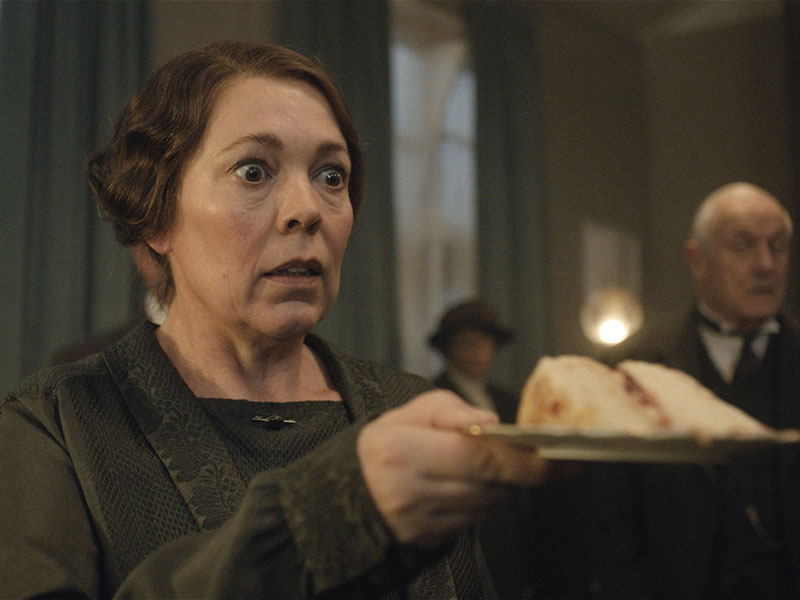
Olivia Colman in “Wicked Little Letters” 
Wicked Little LettersOlivia Colman in “Wicked Little Letters” (Sony Pictures Classics)

Crikey! The great Olivia Colman gives a big, bad and way too broad performance as Edith Swan, a repressed spinster who is the recipient of the titular epistles — an unending series of rude and crude insults. Colman exaggerates just how shocked Edith is at the wild behavior of her neighbor Rose Gooding (Jessie Buckley), who she claims is sending the poison-penned missives. Edith is sanctimonious, smug and even shamefaced as she is repeatedly scandalized by the letters, and Colman portrays her with an appropriately pinched expression when her mouth is not agape and aghast or pursed in horror. But the problem here is that Colman is trying too hard. She overdoes her swooning when Edith is insulted, and when Edith herself swears, the joy she gets from it feels forced. What should be fun, or even funny, is as foul as it is foul-mouthed. All the hand-wringing here about bad behavior should be directed at Colman who overcompensates and as a result, is painfully overbearing.
04
Johnny Depp in “Jeanne Du Barry”
Jeanne Du BarryJohnny Depp in "Jeanne Du Barry" (Vertical Entertainment)

The biggest drawback of this sumptuous and starchy costume drama is the stunt-casting of Johnny Depp as King Louis XV. Appearing puffy, rouged and bewigged, Depp looks like he would rather be anywhere else than giving his only onscreen performance in the past few years. His King Louis has more personality, charm and sex appeal as he lies on his deathbed succumbing to smallpox than he does in any other scene. He has zero chemistry with King Louis’ mistress, Jeanne (director and cowriter Maïwenn); their relationship is scandalous, but Depp appears bored, and that makes him boring. Their relationship feels like the antipode of seduction. The layers of makeup can’t quite hide his vacant eyes, which are meant to express lust, depression and regret but mostly convey indifference. Depp’s performance here is so low-key his King is more resigned than regal.
05
Henry Cavill in “Argylle”
ArgylleHenry Cavill in “Argylle” (Universal Pictures/Apple Original Films)

While many of the cast members get to play double roles in Matthew Vaughn’s joyless action comedy “Argylle,” Henry Cavill gets double-crossed, As the title spy, a fictional figment of writer Elly Conway’s (Bryce Dallas Howard) imagination (in the James Bond mold), Cavill does not get much to do — and he does nothing much. He is two-dimensional going through the motions of bantering with a female rival or pursuing her in a ludicrous chase scene. Lacking verve and nerve, he gives a truly passive performance in an action role. In contrast, his alter ego, Aidan Wilde (Sam Rockwell) has almost too much charisma, emphasizing just how stiff Cavill is here. At one point, Cavill’s Argylle says, “God, that was bad. The whole tone was off.” Surely, he must be referring to his subpar performance.
06
Ed Skrein in “Rebel Moon” (Parts One and Two)
Rebel MoonEd Skrein in “Rebel Moon” (Netflix)
If a film is only as good as its villain, Ed Skrein is one big reason why Zack Snyder’s space opera is so awful. As the evil Admiral Atticus Noble, he is neither admirable nor noble; and he's not especially menacing when he threatens to “destroy the insurgents once and for all.” Skrein aims for quietly sinister, but he lacks the insouciance that say, Malcolm McDowell, would bring to the role. Moreover, he frequently looks like he is imitating Zoolander’s “Blue Steel” pose whether he is dressed like a Nazi stormtrooper or like a Mormon. And when Noble is resurrected after possible death, he looks like he is about to be the Emcee at “Cabaret’s” Kit Kat Club rather than fight the rebels. Skrein exudes neither passion nor delight even when he gets to dispatch some victims. Skrein’s baddie is simply wan when he should be chilling.
07
Andrew Garfield in “We Live in Time”
We Live in TimeAndrew Garfield in “We Live in Time” (A24)

Trying for affable, Andrew Garfield is mostly hapless in this tedious drama that shows different periods of time in the life of a couple, Almut (Florence Pugh) and Tobias (Garfield). He is appropriately mopey because Almut has cancer, or as flashbacks show, he is processing a divorce. But Tobias’ lack of confidence in almost every scene drags this film down. Garfield speaks every line as if he is asking a question, which becomes wearying, not endearing. The hesitancy in his relationship with Almut is insufferable. Tobias often swallows his anger, responding apathetically to Almut’s discussion about treatment following her diagnosis; or becoming frustrated when he wants to talk about kids, or even when Tobias catches Almut in a lie. Garfield’s mostly wooden performance generates pity less for Tobias’ situation, and more for wasting viewers’ time.

Want a daily wrap-up of all the news and commentary Salon has to offer? Subscribe to our morning newsletter, Crash Course.


08
Cate Blanchett in “Borderlands”
BorderlandsCate Blanchett in “Borderlands” (Lionsgate)

As a scarlet-haired bounty hunter, Cate Blanchett cracks wise and throws punches, but neither her sarcasm nor her fists land well. The formidable actress is slumming here, unable to connect with the thin character or material. (It is based on a video game.) Lilith is hired to recover Tiny Tina (Ariana Greenblatt), the daughter of Atlas (Edgar Ramírez), who has been kidnapped and taken to Lilith’s home planet, Pandora. Lilith doesn’t like Pandora, the worst planet in the galaxy, but the contempt she has should be for Eli Roth, who cowrote and directed this noisy, busy bomb. Roth doesn’t showcase Blanchett well; she looks exasperated (fans will be, too) as she banters badly with an annoying talking robot named Claptrap (Jack Black) or is annoyed by a bus driver who delivers her to a rendezvous point. When Lilith teams up, reluctantly, with Roland (Kevin Hart), Krieg (Florian Munteanu), and Tannis (Jamie Lee Curtis), the crew battle rivals, drive into the mouths of monsters and get doused with urine, and shot through an elevator shaft that causes her to vomit. Blanchett grits her teeth and rolls her eyes through it all, but even as she accesses memories of her late mother, or becomes empowered as a firehawk, she is dull and as dreary as the not-so-special effects often overwhelm her. It is hard to root for Lilith or Blanchett to succeed since the film and her performance are both such failures. 


Want a daily wrap-up of all the news and commentary Salon has to offer? Subscribe to our morning newsletter, Crash Course.


TKTKTKTKTKTK

A stunning achievement in filmmaking, “Nickel Boys” shatters expectations at every turn

Without fail, there is at least one big movie every year that falls prey to the adage “style over substance,” a film that postures as an opus, but is really just filled with hot air and covered in papier-mâché with the word “masterpiece” scrawled all over its still-drying surface. It would be easy for an undiscerning eye to dismiss director RaMell Ross’ “Nickel Boys” as one such flashy piece of Oscar bait. On paper, Ross’ film fits the bill; it is an adaptation of Colson Whitehead’s 2019 Pulitzer Prize-winning novel of the same name and shot entirely from a first-person vantage point. Ross’ conceit is so distinct that it immediately sets “Nickel Boys” apart from every other highly anticipated release this year, yet it’s that same storytelling device that will undoubtedly lead some viewers and critics to disregard it entirely. Listen to me when I shake you by the shoulders and tell you: That would be a grave error. 

Ross paints a vital portrait of resilience that puts the director in a class all his own.

While Ross’ style undeniably calls attention to itself, the director is prescient enough to know that some will see his untraditional mode as a mere affectation. In response, Ross doubles down, moving his camera with a lilting, ethereal swing and holding shots for far longer than any real person would fix their gaze. It’s a disconcerting choice, one that hypnotizes as much as it unnerves. And appropriately so, given that “Nickel Boys” puts its audience quite literally in the shoes of two people who find themselves in a nightmare.

The film is set primarily at Nickel Academy, a segregated reform school in Jim Crow-era Florida based on the real-life Dozier School for Boys, known for the litany of atrocities that were committed against its students during its decades in operation. It’s there where students Elwood (Ethan Herisse) and Turner (Brandon Wilson) form a brotherly bond to endure their dire situation. Elwood has been shipped off to Nickel after being accused of aiding and abetting a crime, despite his innocence and the protest from his grandmother, Hattie (Aunjanue Ellis-Taylor). Once there, Elwood quickly realizes that his highly perceptive nature will both help and hinder his survival. 

When Elwood meets Turner, Ross begins to switch between their vantage points, widening the film’s emotional aperture in the process. Though “Nickel Boys” is confined only to what we can see through two eyes, its ambitions are much more grand. The film is a sweeping landscape of poetic imagery, interspersed with only glimpses of the alarming evil lurking just outside its purview. By evading malevolence and earnestly focusing on the strength of the human spirit, Ross paints a vital portrait of resilience that puts the director in a class all his own.

Before Elwood begins his plight at Nickel, we’re treated to a lush introduction to his early life as a boy growing up in his grandmother’s care. How exactly Elwood came to live with Hattie isn’t explained. Instead, we’re offered only enough information to begin stitching the pieces together, watching Elwood mature through warm vignettes as he twirls his fingers against ripe oranges, clinging to their branches, and the soft lights on a Christmas tree. Glimpses of this young Elwood (Ethan Cole Sharp) arrive in the passing reflection of a steaming, metal iron or a shop window displaying televisions airing news of the budding Civil Rights movement. While these shots initially feel a bit on-the-nose, they’re meant to be narrative inflection points; it’s during these brief moments in his childhood when Elwood first understands his place as a person in a changing world. At the same time, they supply enough grace for the viewer to settle into the point-of-view shooting style before the crux of the film’s story begins.

Nickel BoysAunjanue Ellis-Taylor stars as Hattie in "Nickel Boys" (Courtesy of Orion Pictures)An exceptional student in his teens but unchallenged by a segregated curriculum, Elwood pursues higher education in the form of free classes for Black students at a nearby technical college. When he’s picked up by a stranger on his way there, the two are quickly pulled over by police, who book the driver for stealing the car and send Elwood away to Nickel Academy. Whether or not Elwood is really an accomplice to a carjacking doesn’t matter to the cops, nor does it matter to the staff at Nickel, especially not its administrator Spencer (Hamish Linklater), who emphasizes to incoming students that they will have to prove their progress or face cryptic consequences.

While another filmmaker might force viewers to watch and endure the extent of the suffering Elwood and his peers weather — certainly, there has been no shortage of movies on similar subject matter in recent years that have done just that — Ross takes a different approach. Any images of graphic violence are forgone for droning, surrealist soundscapes that communicate the fear felt inside the boundaries of Nickel Academy just as effectively. What Ross does is far more potent, even radical. He strips Whitehead’s story of its most explicit sights of racial violence and instead trusts that the viewer will empathize with his characters, understanding that any filmmaker worth their salt should be able to communicate the presence of evil without expressly showing it.

These experiences are not pieces of static history meant to be admired in a gallery before moving on to something else, they're meant to pierce the soul.

But “Nickel Boys” does not merely imply brutality and endless strife. There are moments of tender resplendence that are as piercing as the cruelty — compassion that counterbalances the inhumanities Elwood faces. When Elwood meets Turner, the film takes on an air of hope, and the jump between the vantage points of both boys creates a sense of kinship that’s as critical for the viewer as it is for Elwood. One of the few drawbacks of “Nickel Boys” is it prioritizes an untraditional means of storytelling over the performances of its very capable actors. That’s a fair point of objection, especially for those who come to the movies to see actors act. In a film that’s so concerned with placing us in the perspective of a character, it can occasionally feel limiting to only witness the performers working through another person’s gaze. 

The introduction of Turner somewhat cushions that constriction, but more so by the sights of Ellis-Taylor’s remarkable Hattie. Hattie has all the affection you’d expect from a grandmother, but her presence brings a singular comfort to “Nickel Boys,” like a soft blanket being draped across a burlap bed. At one point in the film, Hattie tries to visit Elwood at Nickel but is turned away. Amid her distress, she runs into Turner, who promises to pass on a message from Hattie to her grandson. Their conversation is replete with affection and care, and Ellis-Taylor turns in one of the movie’s most extraordinary moments. It’s momentous yet quiet, and Hattie’s strength lies in how measured Ellis-Taylor can be. In a movie that doesn’t rely on its performances to prove its worth, Ellis-Taylor still manages to say so much in a relatively short time in front of the camera. 

“Nickel Boys” deftly embeds this warmth inside its core like a glowing jewel. The film is sumptuous yet sickening, gentle but gripping. In its back half — and particularly in its coda — Ross favors long takes and compilations of stirring imagery from cinematographer Jomo Fray to cap his story. This final stretch of the film is its most profoundly moving, evoking human anguish and perseverance in equal measure through abstract sights to communicate with the viewer on a cellular level. 
While some might argue that something so image-focused belongs in a museum over a movie theater, that argument is antithetical to Ross’ point as a director. These memories, these experiences, are not pieces of static history meant to be admired in a gallery before moving on to something else. They’re meant to pierce the soul in a way that stays with the viewer, and Ross has made a film that will endure. Brutal images of Black trauma and suffering are of no use to “Nickel Boys”; there is too much of a possibility that one might bury those sights so far down that they’ll forget about them entirely just to absolve the grief and guilt. Instead, Ross crafts something that will live alongside viewers, much in the way that Jonathan Glazer’s masterwork “The Zone of Interest” did just last year. They will remember the undeniable beauty splayed out in each frame, and how unsettling it felt to know and acknowledge all of that earthly magnificence while being steeped in pure, unfettered despair and fear. Like a nightmare, there is always a sense that larger trouble is hidden just out of sight. It’s there where “Nickel Boys” will live: In the peripheral, walking right alongside us.

"Nickel Boys" opens in New York on Friday, Dec. 13 and in Los Angeles on Friday, Dec. 20, expanding to additional markets in subsequent weeks.

“I couldn’t get up”: Dick Van Dyke neighbors saved him from Malibu fire after he crawled to escape

Dick Van Dyke narrowly escape the Malibu wildfires just before his 99th birthday on Friday.

The actor and entertainer told a local California news outlet for "The Today Show" that his neighbors saved him, stating he had difficulty evacuating his home during the fire in Malibu this week. The fire burned more than 2,600 acres and it caused widespread evacuations and power cutoffs, prompting Van Dyke to flee his home, Variety reported.

Van Dyke said, "[The fire] was coming from the hill, you could see it. And oh my God. We got out of here. I was trying to crawl to the car. I had exhausted myself. I couldn’t get up. Three neighbors came and carried me out and came back and put out a little fire in the guest house and saved me.”

In a Facebook post shared Thursday, the star addressed that his wife, Arlene Silver, and their pets had been safely evacuated from their home. But he said one of his pets, a cat named Bobo, had gone missing, forcing the family to stay home until they were forced to evacuate. Fortunately, Van Dyke's home and cat survived the fire.

Van Dyke wrote, "We found Bobo as soon as we arrived back home this morning."

“There was so much interest in his disappearance that Animal Control was called in to assist. But, thankfully he was easy to find and not harmed," he said.

The entertainer wasn't the only celebrity who had to evacuate their California homes this week. Mira Sorvino and Cher were also forced to flee their homes, as did thousands of other residents in the area.

No more FDIC? Trump team mulls how to shrink bank regulators

The Trump transition team is considering ways to shrink, consolidate or eliminate bank regulators in Washington, D.C., a move that would have a massive impact on agencies in charge of protecting consumers' money, according to The Wall Street Journal

One of the ideas involves getting rid of the Federal Deposit Insurance Corp. In interviews with candidates to lead the FDIC and the Office of the Comptroller of the Currency (OCC), Trump advisers are asking if the president-elect would have the power to abolish the FDIC and whether deposit insurance could be absorbed into the Treasury Department, the publication reported.

The U.S. economy relies heavily on FDIC deposit insurance to maintain Americans’ confidence in the financial system, with the insurance protecting their money in the event of a bank failure. According to the FDIC, “no depositor has lost a penny” since the agency was founded in 1933.

A plan to eliminate bank regulators would require approval from Congress, The Wall Street Journal noted. 

The proposal echoes Project 2025, a playbook of recommendations that calls for restructuring federal bank regulators. It would potentially merge the FDIC, the OCC, the nonmonetary policy parts of the Federal Reserve and the National Credit Union Administration. 

Tesla CEO Elon Musk, a co-leader of a nongovernmental advisory group Trump created to slash spending, has pushed for the elimination of the Consumer Financial Protection Bureau, a frequent target of Republicans.

FDIC chair Sheila Bair told The Wall Street Journal that any proposal to abolish a bank regulator would have a hard time gaining support from both Congress and the bank industry.

“Banks may complain, but at the end of the day, they like to have their own regulator they have a relationship with,” Bair said. “They like the status quo.” 

MadeGood granola bars sold nationwide recalled for possibly containing pieces of metal

Riverside Natural Foods has recalled several batches of MadeGood granola bars for possibly being contaminated with pieces of metal, according to a company announcement posted by the Food and Drug Administration (FDA).

Specific products include: Chocolate Chip Granola Bars, Mixed Berry Granola Bars, Strawberry Granola Bars, Cookies & Crème Granola Bars, Chocolate Banana Granola Bars, Chocolate Drizzled Birthday Cake Granola Bars, Chocolate Drizzled Cookie Crumble Granola Bars and Chocolate Drizzled Vanilla Granola Bars. The recalled items were produced between January and November 2024 and distributed across the United States, Canada and internationally.

Amazon and Walmart are just a few major retailers that sold the granola bars.

Following an “extensive investigation,” Riverside has identified the source of the contamination issue in the manufacturing process. Riverside said it fixed the issue and made sure there are no metal contamination risks in the future.

Consumers who purchased the recalled granola bars are encouraged to return them to the store of purchase for a full refund.

“Oligarchs are oligarching”: Inside Rupert Murdoch’s family trust battle

A Nevada probate commissioner ruled last week against billionaire media scion Rupert Murdoch’s attempt to change his family’s trust in order to guarantee that his eldest son, Lachlan, would have broad control over his massive empire. Murdoch attempted to remove three of his less conservative children’s voting rights on the company’s board, stripping their power to potentially change Fox News' right-wing bent

It’s a fascinating story Vanity Fair dubbed “perhaps the greatest setback in the 93-year-old mogul’s career.” And while many might have once yawned at the estate planning of the ultra wealthy, this private-turned-public succession drama is giving us a glimpse into the inner machinations of the one of the world’s richest families and corporate behemoths. It comes on the heels of “Succession,” HBO’s monumentally successful drama that ended last year and was based not-so-loosely on the Murdoch family. 

The Murdochs' legal proceedings are "of great interest to people, and it just fits into this cultural moment,” Allison Tait, a law professor at the University of Richmond and expert in trusts and estates, told Salon. “People are trying to understand the ways that these trusts are used, and how things work.”

Murdoch presides over much of the world’s conservative media networks. He owns Fox News and News Corp., a conglomerate that owns The Wall Street Journal, The New York Post, MarketWatch, The Sunday Times, Dow Jones, Barron’s and scores of other publications, as well as the book publisher HarperCollins. Murdoch’s net worth is estimated at $12 billion, according to the Bloomberg Billionaires Index.

He has always intended to pass his media empire to Lachlan and his three other children: James, Elisabeth and Prudence. Their financial stakes in the trust were not in question; rather, Murdoch was attempting to consolidate their voting power under Lachlan, who shares their father’s deep conservatism, The New York Times reported. As the publication put it: “If Mr. Murdoch fails to lock in Lachlan’s leadership of the company, he will be unable to ensure that Fox News will remain a right-wing news outlet after his death, putting in jeopardy the legacy of the conservative empire he had spent his life building.” 

We need your help to stay independent

Murdoch called upon a provision that allowed him to make changes to the trust if it were in the best interest of its beneficiaries, arguing there may be financial repercussions should Fox News shift away from conservatism. But he and Lachlan only notified the other Murdoch children of the proposal just days before the trust’s representatives were scheduled to vote. 

Probate Commissioner Edmund J. Gorman Jr. wrote that the attempt amounted to a “carefully crafted charade” to “permanently cement Lachlan Murdoch’s executive roles," according to a sealed court document obtained by the Times.

“Oligarchs are oligarching, and we now have TV shows about how it works,” Tait told Salon. “And now, we have these actual courtroom cases happening. So people all around them, both on TV and in the newspaper, are getting a better understanding of how oligarchs oligarch.”

What is a trust?

A trust is a legal document that allows a person to place their assets — which could include stock, bonds, cash or real estate — under the ownership of the trustee, which is typically either an individual or a financial institution. That trustee then manages the trust’s assets for its beneficiaries, those who were chosen to receive the trust’s assets.

A revocable trust can be changed or revoked at any point. But an irrevocable trust typically cannot be changed or revoked after its creation, even if the trustee's personal circumstances change significantly from the time they set up the trust. 

“It's somewhat common for circumstances to change, and for someone to come back and say, ‘I'd like to change the terms of this trust,'” Reid Kress Weisbord, a professor at Rutgers Law School and expert in wealth transfer and estate planning, told Salon. “I think less common is when the court actually grants that type of modification.”

The wealthiest families often opt for an irrevocable trust, for a key reason. When you put your assets in an irrevocable trust, you technically don’t own them anymore — they’re owned by the trust — and aren’t considered part of your taxable estate. This means those assets can be exempt from estate taxes, which can range from 18% to 40% of the estate’s value. In 2024, only estates worth more than $13.6 million for individuals and $27.2 million for married couples were subject to the tax, according to Kiplinger.  

“The less it looks like you own something, the more protection you get from creditors, including taxing authorities,” Tait said. “According to people who want to protect their money, that’s the beauty of these irrevocable trusts.”

Trusts, both revocable and irrevocable, also typically offer the advantage of privacy. Whereas a standard last will and testament can be changed in most circumstances, they are filed in court and could be available to the public. Trusts, on the other hand, are private legal documents that don’t have to be filed publicly. 

What kind of trust does Murdoch have?

The circumstances in which Murdoch’s trust was formed may shed light on why he opted for an irrevocable trust.

It was set up in 1999 amid his divorce from his second wife, Anna Torv, according to The Financial Times. Rather than seek the full amount of money she was entitled to, Torv “demanded” Murdoch put his assets in a trust for their three children — Lachlan, Elisabeth and James — as well as for Prudence, Rupert’s daughter from his first marriage, the publication reported. The four children received equal financial holdings, and one board vote each in the company. 

"It appears that as part of the divorce settlement, the reason for doing it was to make sure it could not, then, at any point, be unwound," said Naomi Cahn, a law professor at the University of Virginia and expert in trusts and estate planning. 

Mitchell Gans, a professor of law at Hofstra Law School and an expert in estate and gift taxes, speculated that a provision allowing amendments could potentially jeopardize the tax benefits that come with an irrevocable trust. Gans said the point may have been instead to make sure Murdoch wouldn’t remove any of their children as beneficiaries. 

“There are two ways to do that,” Gans said. “You could have a contract saying, ‘I'll make a will and I won't change my will.’ Or, you could do an [irrevocable] trust.”

Tait, of the University of Richmond, said she assumes the trust still enjoys the tax benefits because while it's technically possible to change an irrevocable trust, it's extremely difficult.

“Obviously, whoever drafted it for him is probably well paid and well trained,” Tait said. 

Why was the trust based in Nevada?

The Murdoch family’s legal battle played out in probate court in Nevada, where the trust was formed. Nevada has some of the strongest asset protection laws in the country; trusts created in the state can be shielded from creditors, lawsuits, bankruptcies and other financial risks. 

Nevada also doesn’t have a state income tax or inheritance tax. Inheritance taxes aren’t terribly common, but can rise as high as 15% to 18% of the inheritance’s value. But state income taxes account for a large source of state government revenues — on average, representing 38% of states’ collected taxes, per the Tax Foundation

“Nevada certainly does try to attract trust business,” Cahn told Salon. “It's one of the most protective of these assets, and it does have particular privacy with respect to trust proceeding.”

Nevada also allows individuals and families to form “dynasty trusts,” which can last up to 365 years and allow assets to be passed down for generations without being taxed. In most other states, trusts can only exist for anywhere from 20 to 120 years, depending on the circumstances.

It's not clear whether Murdoch had a dynasty trust or another form. But the saga represents “a cautionary tale about what can happen when you bring family disputes into court,” Kress Weisbord said. 

“This is turning into quite a public spectacle, and I'm sure it's not good for the family," Kress Weisbord said. 

A lawyer for Rupert Murdoch, told The New York Times that his client and Lachlan were disappointed with the ruling and intended to appeal.

James, Elisabeth and Prudence told the media they “hope that we can move beyond this litigation to focus on strengthening and rebuilding relationships among all family members.”

Nancy Pelosi is reportedly trying to block AOC from landing a top House oversight position

Rep. Alexandria Ocasio-Cortez, D-N.Y., is facing a powerful source of opposition in her bid to lead Democrats on the House's Oversight Committee: House Speaker Emerita Nancy Pelosi, with whom she has had a complicated relationship and who is now urging colleagues to back Rep. Gerry Connolly, D-Va., for the top spot instead.

While Pelosi, like Connolly, is a senior member of the Democratic caucus who has served in the House for decades, that has not stopped her from backing other insurgent bids from younger members, including Rep. Jamie Raskin, D-Md., who conceded his post atop the Oversight Committee to challenge Rep. Jerry Nadler, D-N.Y., for leadership of the Judiciary Committee. Ocasio-Cortez, 35, and Connolly, 74, announced their respective campaigns to replace Raskin earlier this month.

The contest underscores a stark generational contrast, with the younger members like Ocasio-Cortez arguing that they have more energy and ability to take on the incoming Republican trifecta. Connolly was diagnosed with esophageal cancer last month and is seeking chemotherapy treatment, a development that one House Democrat told Axios would work against him.

A spot on the Oversight Committee is a coveted position as the panel has broad investigative powers and jurisdiction over most of the executive branch of federal government. Pelosi, in conversations with lawmakers, has made clear her opinion that Ocasio-Cortez should not be entrusted with leading Democratic efforts there, two House Democrats told Punchbowl News. Pelosi's office has not commented on the matter.

It's not the first time Pelosi and Ocasio-Cortez have been at odds. The former speaker and the progressive New Yorker have clashed before over the direction of the party.

Despite Pelosi's reported efforts, however, Ocasio-Cortez might already hold a clear advantage, with a House Democrat telling Axios that she "has pretty much the entire [Oversight] Committee with her." While committee ranking members (the top position a member from the minority party can hold) are recommended by the caucus' Steering Committee and then voted on by whole caucus, Axios' source noted that Ocasio-Cortez's support among committee members will hold much weight as the Steering Committee meets next Tuesday. The Democrat who spoke of Connolly's cancer diagnosis said that their "gut tells me she gets it."

Still, the lawmakers noted, leadership of the Oversight Committee is not a firm lock until the full caucus casts its votes. The current House Democratic leadership, including Minority Leader Hakeem Jeffries, has remained publicly neutral.

“What’s happening in North Carolina is sinister”: NC GOP offers preview of Trump threat to democracy

If you want to see how a second Trump administration may erode America’s democracy, either wait another month or look at how Republicans have been behaving not just in their deep-red strongholds but competitive states like North Carolina, where the state GOP is openly seeking to overturn the will of the people.

Take the governor’s office. Democrat Josh Stein, running to succeed term-limited Gov. Roy Cooper, won last month in a landslide, defeating a Republican candidate, Lt. Gov. Mark Robinson, an avowed “Black Nazi” whose porn habits were exposed in the weeks before the November election. Typically, when voters choose to elect a person to public office, they do so with the expectation that the person will carry out the duties of that office.

But this week, North Carolina Republicans — representing the party that lost the gubernatorial race — voted to strip power from the incoming Democratic governor. Under the guise of hurricane relief, the state’s GOP-led legislature voted to eliminate Gov.-elect Stein’s ability to appoint members of the state election board, where Democrats presently hold a 3-2 majority, shifting the authority to the state auditor, a Republican. To further limit the possibility of Democrats gaining and exercising power, GOP legislators also voted to slash the time voters are permitted to request absentee ballots and cure any problems with ballots they’ve cast.

Lt. Gov. Robinson, presiding over a Senate session earlier this month, called the police on protesters who had entered the gallery to express opposition to the power grab, according to Carolina Public Press, a nonprofit news organization. Had Robinson won, he would be inheriting the power to make appointments to the state utilities commission, which sets electricity rates, and pick the head of the state’s highway patrol — all powers that have now been stripped from November’s victor.

Republicans also voted to block the state’s Democratic attorney general from arguing any legal positions that are opposed by the GOP legislature, per Axios, and curbed the power of the state superintendent, another Democrat, to exercise oversight over charter schools. And they did all this in a lame-duck session after losing their veto-proof majority in the state house.

“What’s happening in North Carolina is sinister, and it will have a chilling effect on our democracy and our country if they’re able to get away with what they’re trying to achieve,” Anderson Clayton, head of the North Carolina Democratic Party, told Mother Jones this week.

We need your help to stay independent

Clayton was not even referring, specifically, to the power grab in the state legislature, but a parallel attempt to subvert the will of voters. Also in November, Allison Riggs, a Democrat and associate justice on the state Supreme Court, narrowly defeated her Republican opponent, Court of Appeals Judge Jefferson Griffin. After two recounts, Riggs was determined to have won by just over 700 votes.

No matter: Griffin and the state GOP are trying to throw out 60,000 other ballots, relying in part on a legal argument already rejected by courts prior to the election — that votes cast from people overseas, including members of the military, should be tossed if they were not accompanied by a photocopy of their photo identification; the party also maintains that ballots should be tossed from voters if there is no copy of such identification in their registration file, its challenge disproportionately targeting younger voters and people of color.

“Prior to 2020, you never saw these types of claims,” Democratic election attorney Marc Elias, founder of Democracy Docket, commented this week. “Donald Trump popularized it.”

So far, at least, the claims have been just as successful — which is to say, unsuccessful. On Wednesday, the state Board of Elections, still led by Democrats, rejected the GOP arguments on Wednesday, moving Riggs one step closer to having her victory certified. But, as NBC News reported, their decision could be appealed and the case ultimately decided by the GOP-led state Supreme Court.

Riggs, for her part, is framing the challenge to her victory as part of a broad assault on the right to vote.

“I want to make sure that everyone understands what’s happening — that the ability of military voters and their families is under attack in this post-election dispute,” she said of the efforts to overturn her victory. “It should be troubling to everyone.”

“Zero impact”: Expert shoots down Trump demand that $485M penalty disappear because he won election

Since last month, President-elect Donald Trump has carried his electoral victory into his legal battles, wiping out pending federal prosecutions and pausing sentencing. But experts say his efforts to do the same with his civil fraud judgment stands no chance. 

In a letter publicly released Tuesday, the New York attorney general's office told Trump's lawyer that the Constitution doesn't mandate she ask a court to dismiss the $485 million judgment of Trump's civil fraud case in the wake of his winning the election.

The letter came in response to Trump attorney and solicitor general appointee John Sauer's late November communication to New York Attorney General Letitia James urging her to voluntarily drop the case, in which Trump was found liable for fraud. He argued a provision of the Constitution privileging federal law over state law "prevents state prosecutors from proceeding against the sitting President in any way."

Legal experts told Salon, however, that Trump becoming president should have "zero impact" on this or any other civil judgment he has.

Former Assistant New York Attorney General Adam Pollock likened the judgment to regular expenses the Trump Organization must pay to maintain its building, asserting that they don't "evaporate just because you become president."

"They don't vanish the moment that you become president, whether they're the debt to the people of the state of New York in this $450 million judgment, this debt in the defamation case of almost $100 million or the debt to the electric company every month on the property he owns," Pollock, now a managing partner of Pollock Cohen LLP in New York, told Salon in a phone interview.

Trump is appealing a New York judge's February decision that he owed the state $454 million for inflating his asset value and net worth on financial statements to obtain better loan terms over several years. That judgment, which accrues interest, is now valued at more than $485 million, according to USA Today.

Most of the president-elect's other high-profile legal battles have been impacted by his electoral victory last month, which Sauer noted in his letter to James. Special counsel Jack Smith, who indicted Trump in two federal cases last year over his efforts to subvert the 2020 election and his retention of classified documents post-presidency, dropped the former and withdrew his appeal of the latter's dismissal in late November.

In New York, the judge overseeing Trump's hush-money case, in which he was found guilty of 34 felony counts of falsifying business records in May, also indefinitely postponed his sentencing at the request of the Manhattan district attorney last month.

Meanwhile, the fate of Trump's Georgia prosecution over an alleged racketeering scheme to overturn the state's 2020 election results — slowed to a near halt for most of the year as an appeals court weighed whether to disqualify Fulton County District Attorney Fani Willis over her hiring a romantic partner to lead the case — remains uncertain. The state appeals court canceled a hearing over Willis' status earlier this month without explanation in the wake of Trump's win. The president-elect's lawyers also filed a motion last week requesting the case be dismissed because his impending presidency will make him immune from prosecution. 

We need your help to stay independent

Trump denies any wrongdoing in his criminal cases and has repeatedly characterized them as politically motivated "witch hunts."

But in the A.G. office's response, New York Deputy Solicitor General Judith Vale argued that the appeals process for Trump's civil fraud judgment should continue as it would if Trump hadn't won the presidency. She pointed to a unanimous 1997 Supreme Court decision against Bill Clinton that tanked his efforts to block a civil sexual harassment lawsuit that was brought against him by Paula Jones, a former Arkansas state employee. The court ruled that a federal civil lawsuit over a sitting president's unofficial conduct could proceed during the presidency. 

The president-elect's "appeals will be handled primarily by Mr. Trump’s appellate lawyers, and any consultations Mr. Trump may have with those attorneys about appeals will not plausibly impose an unconstitutional burden," Vale wrote.

The "ordinary burdens of civil litigation do not impede the President’s official duties in a way that violates the U.S. Constitution," she added. 

In a statement to USA Today, Trump spokesperson Steven Cheung described Vale's letter as "sad and weak." He also lauded Sauer's correspondence as a "powerhouse submission."

"AG James should heed President Trump’s call for national unity and drop this baseless, discredited witch hunt," he told the outlet. 

But Pollock argued that Vale's response was "spot on."

"This case is at its finish line. There's a judgment, there's an appeal. The appeal has been fully briefed and argued," Pollock said. "At some point, the First Department is going to issue a decision, and at that point, either party can appeal further" with permission from the New York Court of Appeals.


Want a daily wrap-up of all the news and commentary Salon has to offer? Subscribe to our morning newsletter, Crash Course.


The same premise would apply to Trump's other massive financial judgment — the $88.3 million in damages he owes writer E. Jean Carroll after a jury found him liable for sexually abusing her and defaming her twice in his public statements about her allegation — Pollock said. Trump has denied Carroll's claims and is appealing both judgments in her suits against him. 

Trump could drop his appeal in the civil fraud suit and pay the penalty, but he has signaled no interest in doing so. Much like in his other cases, the president-elect has denied any wrongdoing In his civil fraud case and is awaiting an appellate court ruling about whether the judgment can stand. His lawyers have argued, among other points of contention, that because Trump's asset valuations did not hurt his lenders, the attorney general's lawsuit went too far.  

While Syracuse University College of Law professor Gregory Germain agreed that Trump's winning the presidency should have no bearing on the New York attorney general's pursuit of the judgment against him, he thinks the arguments in Trump's appeal have merit.  

One issue he identified was that the attorney general did not have to prove that the companies Trump and his co-defendants were said to have defrauded relied on Trump's inflated values. As Trump's lawyers noted, the companies themselves did not complain that Trump defrauded them. Some witness testimony also suggested the insurers and lenders thought the values were inflated but were unsure by how much, Germain noted.

Because the attorney general didn't prove their reliance on the financial statements "to the extent necessary" under fraud law, she had "no business bringing an action to get disgorgement," he argued.  

Germain also raised concerns about how the judge calculated the damages Trump owed to the state of New York. He argued that the only way the court could have settled on "such a huge amount" for the judgment is by looking at how much Trump gained financially from using the statement.

But that financial gain Trump received from selling property he purchased with a loan, obtained by using his inflated financial statements, is not "proximately caused by the statement" but other factors like property value increase over time, he said. Because of that, the "causal connection" between Trump's enrichment from using the statement and the judgment value is "lacking."

The case had "lots" of "substantive problems with the decision" and "the calculation of the remedy," he concluded. "Those are all issues on the merits, but they really have nothing to do with whether you won the election or lost the election."