Spring Sale: Get 1 Year, Save 58%

Can cheese combat climate change?

The threat of climate change loomed large above Vermont’s 2022 Cheese Summit. I was invited to the event to taste and learn about local cheeses, made by the state’s eclectic roster of producers — and I did so, gladly. But as the weekend wore on, it became increasingly clear that, despite the event’s hyper-local focus, Vermont’s cheese producers are tackling a far bigger question: What will cheesemaking look like in a warming world? According to them, dairy just might be the thing that saves us all.

Thanks to their methane-rich belches, cattle are the largest producers of agricultural greenhouse gasses on the planet. Almost half of the land in the United States is used for livestock, and overgrazing of these areas leads to poor soil quality and decreased biodiversity. Meanwhile, the dairy industry has consolidated, replacing smaller farms and producers with corporate mega-farms. As organizations like Milk With Dignity and projects like “Milked: Immigrant Dairy Farmworkers in NY State” have documented, these systemic changes combined with falling milk prices have led to increasingly poor, unsafe, and hazardous conditions for farmworkers — especially those facing undocumented status.

What if there’s a way to preserve cheesemaking and dairying practices, all while counteracting the issues caused by our current industrial agricultural system? In Vermont, the prospect felt like a real possibility.

Paul Kindstedt, professor of nutrition and food sciences at the University of Vermont, says that cheese has, for tens of thousands of years, been intertwined with changes in our climate. The start of the Halocene era 11,000 years ago marked “the beginning of an extraordinarily moist, warm, stable human-friendly epoch in climate history that unleashed the power of agriculture and the full potential of our species, for better or for worse,” he said.

However, even during this era of generally “benevolent” climate conditions, there have still been climate change events that threatened human populations. During these events, including a temperature drop in 4000 B.C.E. that impacted the Eurasian Steppe’s Neolithic communities and the flooding of Holland during the Medieval Warm Period, Kindstedt argues that “dairying and cheesemaking have repeatedly served as an irreplaceable fallback option for humanity to cope with climatic catastrophes.”

The reason that dairying has been “an option of last resort” for people during periods of climate uncertainty is actually quite simple. “Grass will grow almost anywhere under some of the most inhospitable conditions,” he said, and “ruminants [like cows and goats] are astonishingly adaptable.”

Ultimately, Kindstedt believes that a somewhat collaborative approach between small- and large-scale producers will be the most effective tactic for scaling up — and increasing access to — sustainable dairy products.

“What works for artisanal cheesemakers who are able to tap into high-end markets… may not necessarily work for larger-scale manufacturers that service broad sections of the public with more affordable products,” said Kindstedt, underscoring a key challenge in efforts to make sustainable products — across all sectors — available to the majority of Americans.

“Nevertheless, the experiences of small artisanal cheesemakers are providing valuable baseline data for the entire cheesemaking sector,” he added. “Much can be learned from the smaller end of the sector where cheesemaker creativity and adaptability can be field tested rapidly and presented to a public that is anxious to hear their stories.”

At the smaller cheese producers found in Vermont — like Shelburne Farms, the farm and educational center that hosted this year’s cheese summit — the quest for true sustainability is an ongoing process that dates back decades.

“I see dairy farming as a part of a holistic agricultural system,” said Helen Cowan, Shelburne Farms’ head cheesemaker. “With proper grazing, manure, and feed management…we can use cattle and other dairy animals to help improve soils and pasture ecosystems.”

“We haven’t tilled our soil since 1993 so all of our land, except the vegetable garden, is in permanent sod,” she explained. “This has resulted in much higher soil carbon values than found on surrounding farmland. We can also see higher carbon values in particular pastures that have been more intensely managed for grazing.” A high carbon value in soil is a good thing: It indicates that, rather than being released into the atmosphere as carbon dioxide, carbon is effectively getting stored in the soil itself. The goal of this process, known as carbon sequestration, guides much of the farm’s sustainability efforts.

“The goal for the farm is to become carbon neutral or negative by 2028,” added Tom Perry, Shelburne Farms’ cheese sales manager.

The farm has also embraced several “waste diversion” measures to make use of cheesemaking’s byproducts. Leftover whey from the cheesemaking process, for example, is implemented (along with manure) as pasture fertilizer, and an aerobic composting program, which collects stray curds and used paper towels, helps sequester carbon by creating rich, healthy soil.

Vermont Creamery, which produces cheese and dairy products from goats’ milk, is similarly interested in making use of traditional waste products from the cheesemaking process. “Where traditional cheesemaking practices are concerned, a truly sustainable system would place heavy emphasis on the issue of byproducts,” said Adeline Druart, Vermont Creamery’s president. “We’re actively turning our food waste into carbon negative renewable energy through our partnership with Vanguard Renewables and their Vermont-based biodigesters.”

But for all of their successes, Vermont’s dairy and cheese producers are the first to acknowledge the many challenges — and uncertainties — that lay ahead. For Shelburne Farms, “refrigerant use” and finding “more sustainable packaging solutions” are two of the most pressing concerns. Right now, they’re testing biodegradable wax to replace the cheese’s current paraffin wax coating. They’ve also swapped their insulated boxes for Greencell packages and plan on switching to biodegradable ice packs in the near future.

The undertaking is a slow one: On a tour of their facilities, Perry reminded me that Vermont’s reputation as a haven for pasture-raised dairy and sustainable farming is one earned from decades of dedication and work. But as the climate crisis grows ever-more urgent, so do consumers’ desire for solutions.

Moreover, given the enormous demand for cheese (in 2020 alone, the average American consumer ate 40.2 pounds of the stuff), it’s hard to imagine the commercial dairy industry embracing a regenerative, resilient approach with smaller yields. Instead, consumers have increasingly turned to dairy alternatives — which promise a lesser environmental impact — to get their cheese fix. Miyoko’s, which uses cashews as the basis of its plant-based cheese and dairy, notes that its “products generate up to 98% less [greenhouse gas] emissions than conventional dairy products.” Violife, another vegan cheese brand, claims its products produce a 50% smaller climate footprint compared to their dairy counterparts. While these numbers certainly mark an improvement from our current industrial dairy system, Kindstedt believes the hype is premature.

Specifically, he says that these products’ total environmental impacts, nutritional profiles, costs, and land usage will need to face extensive scientific evaluation to understand how they compare to real dairy and cheese products. Only then will we have a sense of whether these products may (or may not) provide a sustainable alternative to dairy in the long-term.

“Does anyone really think that profit-driven startup companies can become the savior of humanity by blowing away dairying and cheesemaking?” he asked.

I’m inclined to agree with Kindstedt: Our relationship with dairy has been too long, too intertwined, and too rich to give up on just yet. Ultimately, however, it’s up to consumers to decide what the cheese of the future might look like — whether that means embracing the model set by Vermont’s cheesemakers, or finding a solution elsewhere.

These high school “classics” have been taught for generations — could they be on their way out?

If you went to high school in the United States anytime since the 1960s, you were likely assigned some of the following books: Shakespeare’s “Romeo and Juliet,” “Julius Caesar” and “Macbeth”; John Steinbeck’s “Of Mice and Men”; F. Scott Fitzgerald’s “The Great Gatsby”; Harper Lee’s “To Kill a Mockingbird”; and William Golding’s “The Lord of the Flies.”

For many former students, these books and other so-called “classics” represent high school English. But despite the efforts of reformers, both past and present, the most frequently assigned titles have never represented America’s diverse student body.

Why did these books become classics in the U.S.? How have they withstood challenges to their status? And will they continue to dominate high school reading lists? Or will they be replaced by a different set of books that will become classics for students in the 21st century?

The high school canon

The set of books that is taught again and again, broadly across the country, is referred to by literature scholars and English teachers as “the canon.”

The high school canon has been shaped by many factors. Shakespeare’s plays, especially “Macbeth” and “Julius Caesar,” have been taught consistently since the beginning of the 20th century, when the curriculum was determined by college entrance requirements. Others, like “To Kill a Mockingbird,” winner of the 1961 Pulitzer Prize for fiction, were ushered into the classroom by current events — in the case of Lee’s book, the civil rights movement. Some books just seem especially suited for classroom teaching: “Of Mice and Men” has a straightforward plot, easily identifiable themes and is under 100 pages long.

Titles become “traditional” when they are passed down through generations. As the education historian Jonna Perrillo observes, parents tend to approve of having their children study the same books that they once did.

The last period of significant change to the canon was during the 1960s and 1970s, when the largest generation of the 20th century, the baby boomers, went to high school. For instance, in 1963, a survey of 800 students at Evanston Township High School in Illinois revealed that “To Kill a Mockingbird,” first published in 1960, was by far the “most enjoyed book,” followed by two books that had been published in the 1950s, J.D. Salinger’s “The Catcher in the Rye” and Golding’s “The Lord of the Flies.” None of these books were yet traditional, yet they became so for the next generation.

A comparison of national surveys conducted in 1963 and 1988 shows how several books that were introduced to the classroom when the boomers were students had become classics when boomers were teachers.

During the 1960s and 1970s, teachers even reframed “Romeo and Juliet” as a contemporary work. Lesson plans from the era referred to its adaptations into “West Side Story” – a musical that initially came out in 1957 – and Franco Zefferelli’s risqué 1968 film version of Shakespeare’s story of star-crossed lovers. It became the perfect hook for ninth graders in a study of Shakespeare that would conclude in 12th grade with “Macbeth.”

Efforts to diversify

English education professor Arthur Applebee observed in 1989 that, since the 1960s, “leaders in the profession of English teaching have tried to broaden the curriculum to include more selections by women and minority authors.” But in the late 1980s, according to his findings, the high school “top ten” still included only one book by a woman — Lee’s “To Kill a Mockingbird” — and none by minority authors.

At that time, a raging debate was underway about whether America was a “melting pot” in which many cultures became one, or a colorful “mosaic” in which many cultures coexisted. Proponents of the latter view argued for a multicultural canon, but they were ultimately unable to establish one. A 2011 survey of Southern schools by Joyce Stallworth and Louel C. Gibbons, published in “English Leadership Quarterly,” found that the five most frequently taught books were all traditional selections: “The Great Gatsby,” “Romeo and Juliet,” Homer’s “The Odyssey,” Arthur Miller’s “The Crucible” and “To Kill a Mockingbird.”

One explanation for this persistence is that the canon is not simply a list: It takes form as stacks of copies on shelves in the storage area known as the “book room.” Changes to the inventory require time, money and effort. Depending on the district, replacing a classic might require approval by the school board. And it would create more work for teachers who are already maxed out.

“Too many teachers, probably myself included, teach from the traditional canon,” a teacher told Stallworth and Gibbons. “We are overworked and underpaid and struggle to find the time to develop quality lessons for new books.”

The end of an era?

Esau McCauley, the author of “Reading While Black,” describes the list of classics by white authors as the “pre-integration canon.” At least two factors suggest that its dominance over the curriculum is coming to an end.

First, the battles over which books should be taught have become more intense than ever. On the one hand, progressives like the teachers of the growing #DisruptTexts movement call for the inclusion of books by Black, Native American and other authors of color – and they question the status of the classics. On the other hand, conservatives have challenged or successfully banned the teaching of many new books that deal with gender and sexuality or race.

PEN America, a nonprofit organization that fights for free expression for writers, reports “a profound increase” in book bans. The outcome might be a literature curriculum that more resembles the political divisions in this country. Much more than in the past, students in conservative and progressive districts might read very different books.

Second, English Language Arts education itself is changing. State standards, such as those adopted by New York in 2017, no longer make the teaching of literature the primary focus of English class. Instead, there is a new emphasis on “information literacy.” And while preceding generations of teachers voiced concerns about the distractions of radio and then television, books may have an even smaller share of students’ attention in the age of cellphones, the internet, social media and online gaming.

“We no longer live in a print-dominant, text-only world,” the National Council of Teachers of English proclaims in a 2022 position statement. The group calls for English teachers to put less emphasis on books in order to train students to use and analyze a variety of media. Accordingly, students across the country may not only have fewer books in common, but they also may be reading fewer books altogether.

Why teach literature?

Over generations, English teachers have voiced many reasons to teach books, and the canon in particular: to instill a common culture, foster citizenship, build empathy and cultivate lifelong readers. These goals have little to do with the skills emphasized by contemporary academic standards. But if literature is going to continue to be an important part of American education, it is important to talk not only about what books to teach, but the reasons why.

This story has been updated to correct the year that “West Side Story” appeared as a musical.

Andrew Newman, Professor and Chair, Stony Brook University (The State University of New York)

This article is republished from The Conversation under a Creative Commons license. Read the original article.

Michael Cohen: N.Y. fraud case will “financially destroy” Trump — and may put him in prison

Michael Cohen, the longtime personal attorney and “fixer” for Donald Trump, who went to prison for helping Trump pay hush money to porn actress Stormy Daniels, is after “Revenge.” Indeed, that’s the title of his second book, which is out next week. As I discussed with Cohen on “Salon Talks” this week, that revenge does not stop with Trump. Cohen’s takes on the corruption of the Justice Department under Trump and his experiences being investigated for lots of stuff he didn’t do (as well as what he did). According to Cohen, the FBI spent time and resources “running around the country ensuring that I was not where the Steele dossier” claimed he was, and looking into “11 allegations raised against me, all of which are false.”

It’s apparent in speaking to Cohen why he was such an effective lawyer and fixer for Trump. The guy is a pitbull — animated, loud, smart and damn persuasive. For starters, he says the media gets it wrong when they say he went to jail “in part” because of his role in paying hush money to Daniels before the 2016 election to keep her quiet about a past alleged affair with Trump. “I didn’t go to prison in part because of the hush money with Stormy Daniels,” Cohen said. “That’s the reason why I went, plain and simple.”

But as Cohen laid out, he fully expected to be thrown under the bus by Trump, and believes Trump will do the same to Rudy Giuliani — whom Cohen describes as an “idiot” — as well as former chief of staff Mark Meadows and even members of his own family. “What’s he capable of? Anything and everything in order to protect himself, plain and simple,” Cohen said.

Cohen believes, however, that the recent civil suit brought by New York Attorney General Letitia James against Trump and his family members may ultimately lead to Trump going to in prison — and Cohen is undeniably gleeful that he played a role in kicking off that investigation. Even as Cohen insisted that his pursuit of “revenge is not that myopic in terms of just holding Donald Trump” accountable, I also got the sense that no one in America would be happier to see the former president perp-walked than his former lawyer. Watch or read my conversation with Michael Cohen below.

The following interview has been lightly edited for clarity and length.

When the New York attorney general announced the massive civil lawsuit for fraud against Donald Trump, three of his adult kids and various others, she said, “I will remind everyone this investigation only started after Michael Cohen, the former lawyer, testified before Congress and shed light on Donald Trump’s misconduct.” Remind people about what you said before Congress that sparked this investigation?

That was a nine-hour absolute … I don’t even know what to call it. It was a circus. You had the Democrats asking me questions about Donald Trump — Jamie Raskin, Alexandria Ocasio-Cortez, so many of the Democrats wanted to know things about Donald Trump, which I answered. Whereas the Republicans, as I stated openly, not one of them asked me a single question about Trump, which was the purpose of having me there.

Trump said, “The FBI raided one of my attorneys.” Whoa, whoa! All of a sudden, this orange-crusted buffoon has forgotten my name. Seriously?

I said, “I know what you are all doing because I was part of the group that created this playbook.” Right? They received in advance words that they wanted each and every one of the Republicans to use: liar, tax cheat, criminal, soon-to-be felon. These are all the words that Trump, the RNC and so on had forwarded to them in advance. Therefore, it was going to be each one of them spending five minutes denigrating me to the American people because it falls in line with the Trump Putin-esque playbook, which is to denigrate the other person, repeat the lie over and over and over again until the lie becomes the truth.

That’s really what my book “Revenge” is about. It’s uncovering the truth and showing that the true liar, which I believe we all know, the true dumpster fire that was formally sitting in the Oval Office, is Donald Trump and his acolytes and inner circle.

In your book you write, “Over the years, Trump screwed people over, manipulated them, and used them, and I helped him do it.” When the FBI went through your office, Donald Trump was defending you. Did you think at that time he was going to stick with you?

No. That was actually one of the turning points, when I realized that he was not going to stand by me. When they approached him, meaning the media, and he was sitting at a table with his arms crossed and so on like this, and they said to him, “The FBI just raided …” He was like, “It’s disgusting, right? The FBI raided one of my attorneys.” And so on, and when I … Whoa, whoa, one of your attorneys? Now, all of a sudden, this orange-crusted buffoon has forgotten my name. Seriously?

That’s when I realized that this guy is all about himself. And where I thought that I occupied a position whereby I would never be thrown under the bus by him, that’s when I realized, no. This guy’s all about himself and all about using somebody else to exonerate himself from his own culpability.

Rudy Giuliani has seen the same things you did and he’s still sucking up to Donald Trump. John Eastman has taken the Fifth, and I don’t think he’s going to cooperate with anyone. Is there any doubt that Donald Trump throws those two guys under the bus to help himself, if that’s what it comes down to?

Rudy is an idiot. I mean, there’s just no way to describe it. Rudy Collude-y Giuliani. First of all, the guy thought he was going to get paid a quarter of a million dollars a day by the RNC. Obviously this whole BS about Trump and Rudy going back for years and being friends.

First of all, it’s not true. I was there for over a decade, and Rudy was never considered a friend nor had he really ever been to the Trump office up on [the 26th floor of Trump Tower]. So I’m not really sure about this newfound friendship. But in some weird way, Rudy actually thought he was going to get paid, which just goes to show you how stupid he is. And then on top of that, he’s out there defending the narcissistic sociopath in chief, thinking that Donald is going to protect him.

But let’s not forget what Rudy also once said. “Donald won’t throw me in the …” He goes, “I have an insurance card.” You may remember that. Well, was that another lie too, to try to prompt Trump to pay him and do the right thing by him?

We’ve seen that Trump doesn’t care about anyone or anything other than himself, that Trump weaponized the Justice Department to go against his critics. So the second that Rudy became a semi-critic, that was the end of him. You don’t see him anymore. You don’t hear from him anymore. Right now he’s dealing with his own personal issues. No money, having to pay his ex-wife Judy a quarter of a million dollars or go to jail. I’m sure he’s out there hitting the phones and pounding the pavement to borrow money. This is what happens to everyone.

I said it to Mark Meadows, and I said it to Jim Jordan and to all the Republicans at that House Oversight Committee hearing, not to mention the six other hearings that you’re not aware of that I did in the SCIF [secure room] behind closed doors. What happened to me can and will happen to you if you put your faith, your confidence and your trust behind a man that doesn’t understand the word loyalty.

The title of your book speaks to the idea of how Donald Trump weaponized the Justice Department. Some people might think, well, that’s because the DOJ under Trump went after you. But you talk about how it played on pre-existing weaknesses within the Department, and then later you were punished when you were trying to write a book.

Well, the weaponization of the Justice Department did not start with the unconstitutional remand of me back to Otisville [state prison] when they lured me down to 500 Pearl Street [the Manhattan federal courthouse]. You’ll read about it in the book. One of the reasons that I wrote “Revenge,” and of course the title is like my first book, “Disloyal,” in that you’re not really sure where the revenge is, who the revengee is, who the revenger is. The revenge is really the American people taking revenge on the Justice Department in order to fix it.

What we have seen with me is that regardless of who you are, regardless of whether you think you’re part of this protected political class, when you fall within the ire of someone like Donald Trump — a guy who doesn’t want to be president but wants to be a dictator, an autocrat, a fascist monarch — this is what will happen to you and everybody else if we don’t fix the system.

My issues with the DOJ didn’t start with the unconstitutional remand. It started with the entire investigation. And I begin the book by talking about the fake Steele dossier. Now, as I write in the book, I don’t care about any of the other allegations in this ridiculous document by this wannabe 007, right? He’s not. If this is the best that England has to offer, it’s no wonder they rely on the United States as often as they do for intelligence, because this guy’s a freaking idiot. What you end up having is the FBI running around the country ensuring that I was not where the Steele dossier said I was and 11 allegations raised against me, all of which are false. I’ve never been to Prague. I never paid $10 million to get Paul Manafort out of trouble. I wouldn’t pay $3 to get Manafort out of trouble.

[The Steele dossier is] this ridiculous document by this wannabe 007. …  If this is the best England has to offer, it’s no wonder they rely on the United States for intelligence, because this guy’s a freaking idiot.

It goes on and on: I have a dacha in Sochi directly next door to Putin. My father-in-law is a real estate developer in Moscow, the biggest. My father-in-law’s never been to Moscow. In fact, he’s not Russian. He’s Ukrainian, or the former Soviet Union when they were there. He’s never to have returned in over 50 years. The whole thing is pure BS. But what happened? Media fell for it. Why? Because this is Donald Trump’s true superpower. He is a master manipulator of the media. He understands people’s inner desires to raise their own prestige, their own notoriety. And that’s where the Department of Justice showed its first true colors. The unconstitutional remand, making me the first political prisoner in my own country because I wouldn’t waive my First Amendment right. That’s the subject of the lawsuit that I now have filed.

According to reporting in the Washington Post, Donald Trump personally helped pack up documents in January and then wanted his lawyers to tell the National Archives, “Hey, that’s everything.” Meanwhile, he had hundreds of pages of documents marked “classified.” What do you think? I mean, you know Donald Trump. Why was he holding back these classified documents?

You may remember many years ago, Mattel made the mistake of making the Trump Monopoly game and sent it to Donald. And he was very proud of it. It had his various different assets and so on, most of which have gone bankrupt. But that’s not part of the game. He’s only interested in one thing, the get out of jail free card. And that’s exactly what he saw in those documents. “You want to play with me? Really? I was the former president of the United States. I have documents that are so damaging to this country’s national security. Go ahead, indict me, try to throw me in prison. See what happens.” What happens is he turns over all this classified information, not as if he hasn’t already done it, but he turns all his classified information over to our adversaries, right? “You want to play that game? No problem!”

What is Donald Trump capable of? Even now, he’s traveling the nation, embracing QAnon, continuing to spew election lies, trying to radicalize people.

Anything and everything in order to protect himself, plain and simple. As they would say, drop the mic on that one. Plain and simple. He doesn’t care about this country. He doesn’t care about democracy. He doesn’t care about QAnon. He doesn’t care about the independents. He doesn’t care about Republicans or Democrats. He cares about one thing and only one thing and that’s Donald J. Trump.

Supposedly he was going to fire his daughter, Ivanka, and his son-in-law, Jared Kushner, by tweet. That seems so petty, as opposed to throwing them under the bus if it was about criminal charges. Is there some truth to the idea that maybe he was going to fire Ivanka by tweet?

There was no way in the world that he was going to allow Jared Kushner, this sort of weasel, to take the credit for what Trump believes belongs to him and only him.

On more than one occasion. It wasn’t just Ivanka. It was Jared as well. Many times it was because of Jared that he wanted to. One of the things that drove Trump nuts is if anybody else gets any positive press. When they had Jared on the front of Time Magazine as the guy who was the reason for Trump becoming president, that sent Trump into an apoplectic fit. There was no way in the world that he was going to allow Jared, this sort of weasel, to take the credit for what Trump believes belongs to him and him only. That was one of the very first fights. Then there were a few other that had to do with policy that went wrong. With Trump, if you make a mistake, your ass is on the line. And he has no qualms about firing anyone, including his own children or son-in-law.

You went to jail in part for helping Donald Trump with the hush money payments. There’s no doubt about it. We all know it. You talked about it when you were pleading guilty. What happened with that investigation? Everyone wants to know. Why didn’t the Southern District of New York then go after “Individual 1,” under whose direction and for whose benefit you did that? 

I was also paid back for the money, which he took, by the way, as a tax deduction. I didn’t know that you could end up getting your pecker pulled by a porn star and take that as a deduction. Let me tell you, if I had accountants like that, I would never have had the tax issues that I had. One of the things that “Revenge” points out — and I’ve been fighting to get this truth out there since the very beginning — I didn’t go to prison in part because of the hush money with Stormy Daniels. That’s the reason why I went, plain and simple. I never committed tax evasion. I never lied or misrepresented myself to a bank.

In fact, I also was forced to plead guilty to the hush money payment of Karen McDougal, the $150,000 payment, which if you Google it yourself now, with the drip-drip-drip of new information that’s coming out, David Pecker acknowledged that was his deal. He paid it. I just looked over the agreement after their document was already done to ensure that Trump was protected, at Trump’s request. But when I talk about this in “Revenge,” I don’t talk about it from the standpoint of, oh, Michael Cohen is saying. I’m talking from the standpoint of judges. We have statements by them. By prosecutors, other defense attorneys. We have, you name it, Congress members. I ended up going [to prison] because of the NDA to Stormy Daniels.

The prosecutors went ahead on a Friday night at 5:30, and that was the first time that I ever heard from them. They gave me 48 hours through my lawyer. I wasn’t even allowed to be there. “You have 48 hours until Monday to plead guilty or we’re filing an 80-page indictment that’s going to include your wife and we’re perp-walking both of you out of your condo.” Now, I don’t know about anybody else, but when you get confronted with something like this — I want everyone just to think for a second. If you’ve ever gotten pulled over by a police officer, and your head is sort of like — it’s a menagerie. You feel almost like you got punched in the temple in a fight. You’re not sure really where you are. Now put that with the Department of Justice, the Southern District of New York, aka the “Sovereign District” of New York that plays by its own rules. It mirrors what went on during the days of the Untouchables with Al Capone.

They threatened my wife. What was I going to do? I’m going to put her in jeopardy of being perp-walked, fingerprinted, indicted and go through all this? She had no knowledge of any of this. They were making her as a co-conspirator to the hush money payment. Many people who were with me in Otisville who didn’t do what I did — which is to protect your wife and your family at all costs — they fought it and their wives ended up at [the women’s prison] Danbury. And these people don’t care. When they have a high-profile case like this one, which is possibly the highest-profile case in the century, they have to win. You know why? So that they can go to [major law firms like] Guggenheim Partners, McDermott Will & Emery. They can go to Paul White, Lowenstein Sandler, and all these other million-dollar defense jobs that not one of them are competent to have.

Look, what is it like for you? You went to jail for Donald Trump. You’re making that clear. You helped him and he’s walking free and being celebrated by the right. It’s not like he’s in hiding. He’s spewing the same lies that gave us Jan. 6, and bluntly inciting more violence. Honestly, I don’t think he’s about politics. I think he’s building an army right now. That’s my gut feeling.

And you’re not wrong, Dean, because this is what every dictator has done to take control. The first thing that you do is you stifle people’s First Amendment rights. You create a state-run media. We see that in Russia going on right now. And then what do you do? You empower the army to take control. Now, he doesn’t have the U.S. Army, but he’s building a paramilitary army that we saw on Jan. 6. QAnon supporters, these gun-toting maniacs willing to do anything in furtherance of their führer. That’s what Trump is doing. He failed in my case of me, thanks to Judge Alvin K. Hellerstein and my lawyer at the time, Donya Perry. He failed. But that’s just a test run. So was Jan. 6. For Trump, it’s a test run which is what makes him the most dangerous person in America, not just to our democracy, but to the freedoms that we all have enjoyed.

I believe that the beginning to [Trump’s] end started with that incredible statement by [New York Attorney General] Tish James. That case will financially destroy him. 

They threatened to perp-walk you and your wife out. Do you see a day where Donald Trump is charged and we see him perp-walked?

I do. I believe that the beginning to his end started with that incredible statement by Tish James. Right now, that case will financially destroy him. Now, a lot of people make the mistake and they say that she’s seeking $250 million. That’s not accurate. What she said was, “There is a baseline of $250 million.” That’s because they don’t have the full amount. They just don’t. In fact, when I was charged with tax evasion from the Southern District of New York, they left that number blank because they didn’t even know what I tax evaded or what it really was, was a tax omission.

The story is so intertwined in terms of the accountant, the bank, all these people who lied, including [Trump Organization CFO] Allen Weisselberg. Google that too. Allen Weisselberg lied to the Southern District of New York in my case in order to get immunity. The biggest problem is with Trump, he doesn’t care about the future of the country and he will continue to grift off all these supporters until they stop giving him money.

I do believe, going back to Tish James, that’s going to be the impetus because she’s already referred it to the DOJ, which is now under Merrick Garland, who I’m not thrilled with, by the way, under any circumstance. I believe he’s operating so slowly, the exact opposite of Bill Barr, that people are getting Trump fatigue, right? Where we’re just so tired of it. Indict him or stop this nonsense. But she also referred it to the IRS. And Donald Trump has committed tax evasion, bank fraud, wire fraud, misrepresentation. He will not be able to get past that, and that is criminal.

In tandem to the AG’s case is the [Manhattan] district attorney’s case. Now everybody’s angry at Alvin Bragg, nobody more so than me. Mark Pomerantz, Carey Dunne, the two lawyers that worked on the case for over two years. I provided 15 sessions of information, documentation and so on. They worked in tandem with each other. And there is the case against the Trump Organization. You may remember that Allen Weisselberg said that he will not testify against Donald. That’s OK, you’re going to testify against the Trump Organization, which is the same thing as testifying against Donald, because it’s his autonomous company. He controls every single aspect. Every lever of the Trump Organization is controlled by Donald J. Trump. Therefore, we’ll call it ipso facto, he’ll be guilty.

Is your “revenge” that Donald Trump is held accountable and brought to justice for his crimes?

So the revenge is not that myopic in terms of just Donald Trump. It is so much more than Donald Trump. Donald Trump was, we’ll call it, the denominator. But you have so many numerators in this case that need to be overhauled, need to be fixed. Like Judge Rakoff said, “In a plea deal, you can’t have the judge that’s sitting on the case uninvolved.” You need a third party or someone involved, which they’re not. They work every day with the same prosecutors. Deals are cut in the bathroom. You need an independent judge when it comes to plea deals. Otherwise, you’re going to see innocent people go to prison. 

Resurrecting “Hellraiser” Cenobites as part of “an interrogation of how we negotiate our desires”

In 1987, Clive Barker’s “Hellraiser” reinvigorated a genre that was, at that time, dominated by homicidal slashers. Barker’s story, based on his novella “The Hellbound Heart,” countered that trend by presenting entirely sane villains motivated by unquenchable desire as opposed to unhinged mania, lured to their doom by a mysterious puzzle box.

A hedonist named Frank Cotton dares to play with it and is ripped apart as he’s pulled into another dimension. Frank returns to this existence, in parts. It takes his brother’s sexually dissatisfied wife Julia to bring him back piece by piece by luring unsuspecting victims to him so he can feed on them.  

Grotesque as Frank and Julia are, the supernatural creatures pursuing him, the Cenobites, are the film’s true stars, beings from a place where pleasure and pain are indistinct. Doug Bradley’s lead Cenobite, who came to be known as Pinhead, became synonymous with a franchise that came to redefine body horror. Between his elegant demons and the overt eroticism intertwined with gory terror, the nightmare wrought by “Hellraiser” proved difficult to recapture in its sequels.

That may be why its remake took 15 years and many changes behind the scenes before David Bruckner took on the role of directing it.

His vision, which is now streaming on Hulu, trades the original’s flirtation with sexual kink for a story about addiction, regret, and lament centering on an aimless young woman named Riley (Odessa A’zion). A recovering addict struggling to get back on her feet, Riley comes to possess the puzzle box as part of a misadventure embarked upon in anger.

Soon afterward, it starts to consume everything around her.

HellraiserHellraiser (Spyglass Media Group)

This “Hellraiser” follows a familiar framework, but the Cenobites have been updated, and upgraded, in a fascinating way, including casting Jamie Clayton (“The L Word: Generation Q,” “Sense8“) as Pinhead, a choice that injects glamour into the chilling dread that they and the other Cenobites evoke. In a recent conversation with Salon, Bruckner talked about the choices he and screenwriters Ben Collins and Luke Piotrowski made to modernize Barker’s story while taking an extreme effort to stay true to the original’s vision, and refrain from tearing its soul apart.

This interview has been edited for length and clarity.

“Hellraiser” is one of my favorite horror films from back in the day. Was it a favorite of yours as well?

I discovered it a little bit late. As a young teenager who was just getting into horror, “Hellraiser 3” was my gateway drug, which was very different than the original movie. And so it was a little bit later that I discovered the series and . . .  developed an appropriate regard for it. But I know it’s sacred territory for horror fans.

How did going back to the original change your impression of the series, and not only that, of its mythology?

Well I was young when I saw “Hellraiser 3,” and it was frightening. And I think the dread that was induced – being trapped at a nightclub, an there being no escape – was in and of itself, pretty frightening. But the imagery was something that really, really stuck with me.

Later, when I started to get into horror in a different way. I went back and watched “Hellraiser” and “Hellraiser 2” and then years later, read the novella. Obviously, I understood it to be something much deeper, much more layered. The sexual subtext was something that I missed in Part 3, and just the sheer inventiveness of it and the kinds of themes that are tackled were things that, you know, I absolutely marveled at.

I think one of the things that “Hellraiser” did so well was generate all of these ideas, not only in terms of how pleasure is perceived, but also in terms gender norms and gender identity in society that I think is otherwise difficult to translate into a horror film. I’m wondering how much of that aspect of it translated into the script for the 2022 version?

In the original film, I think part of the reason that the horror has the impact that it has is because the audience is complicit in a pretty fascinating dark game. I would argue that Julia is the protagonist of the original film: You’re on a journey alongside her where you’re trying to decide whether you want to reconstitute your dead, would-be lover, who happens to be the brother of your husband – who is coming together in the attic in this really gruesome way.

You have to align yourself in one way or another with her desire for him, and yet you’re looking at these really grotesque images.

All that is to say that this is something so unique about the first film in a way that’s – it’s very hard to get a movie across the line in 2022 in the American studio system that operates quite like that. There’s a lot of pressure to create “likable” characters, and I put it in quotes because likability is not my favorite term, and it doesn’t necessarily have anything to do with empathy.

HellraiserGoran Visnjic as Voight in “Hellraiser” (Spyglass Media Group)
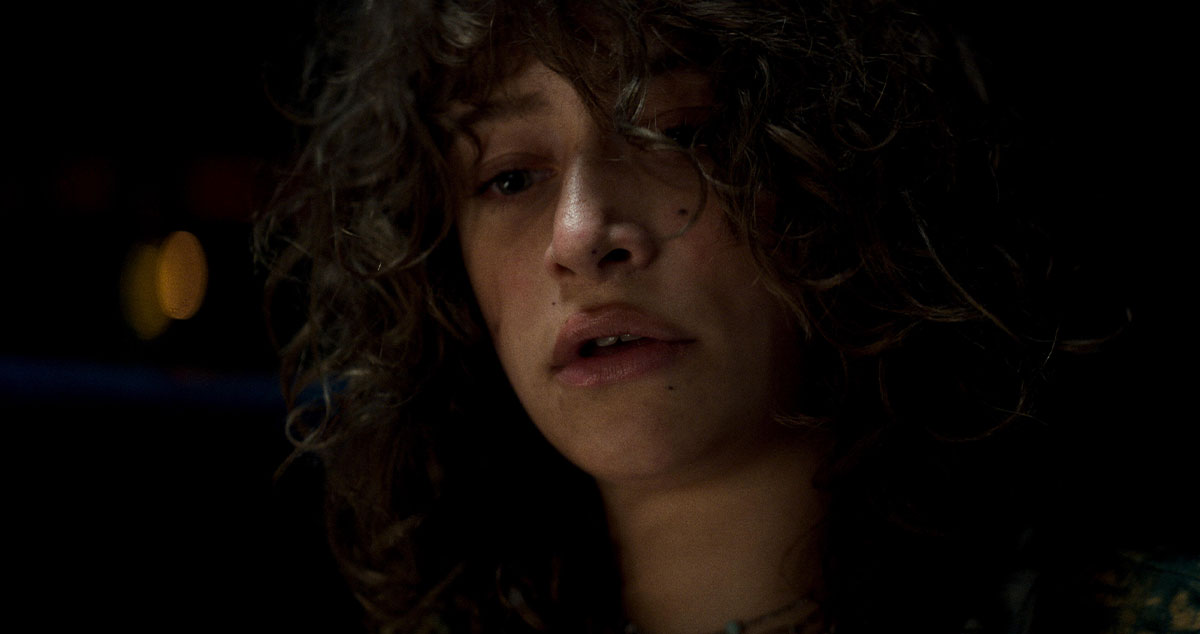
It’s difficult to maneuver a film into that system that’s going to have an erotic charge to it when you’re combining it with violence on this level. We needed to find a kind of an adjacent conversation to sort of get through the door and bringing this film to life. And I felt that addiction was a worthy topic.

It’s an interrogation of how we negotiate our desires, and when the things that we’re seeking can become a replacement for managing the difficulties in life. It’s not necessarily about identity in the same way. But it did feel topical, and it felt like I thought, a worthy addition to the conversation.

One of the things that the script did that I thought was so fascinating was it broadened the possibilities of human experience that were contained in the box. So it wasn’t just a metaphor for pleasure, desire, identity, whatever you’re seeking when you open this thing, but that it was also could be translated into a doorway to the extremity of any human pursuit.

I want to just back up to what you said about seeing Julia as the protagonist. You realize people are going to liken that to saying, “Johnny is the true hero of ‘The Karate Kid.’

“I find guilt to be really interesting in horror.”

That’s purely in terms of narrative function. She moves the story forward, you know. Kirsty is an innocent who comes in and particularly activates towards the end of the film. But it’s not about a moral alignment, necessarily. It’s about what moves the story. By spending time alongside her, in her shoes, discovering Frank, and you can’t help but empathize with her predicament one way or another, whether she’s making choices you want her to make or not. I think that’s part of what makes her such a fascinating character.

That makes me wonder how that translated into the way you perceive the main characters in the 2022 version.

Well, we wanted to find somebody that was at some sort of tension. We wanted somebody that was flawed, troubled, to be able to play some level of melodrama. And I liked Riley because she was hot from the top, like she was she was gonna come into every scene willing to have a fight. And I thought that infused the film with a kind of necessary energy that just felt appropriate.

HellraiserOdessa A’zion as Riley in “Hellraiser” (Spyglass Media Group)

Among all the analyses that have been written about the original movie, a common thing that’s pointed out is that Kirsty [Frank Cotton’s niece and Julia’s stepdaughter] is, in a way, the Final Girl, but not the same as the typical Final Girl. And Riley fits that, but in a very interesting way in that, as you say, it’s not about moral alignments. The decisions she makes, the trouble she gets into in the first place is based on her addiction and her anger. How much of that idea of subverting the trope of the Final Girl play into her development?

I didn’t think about this much in Final Girl terms, necessarily. And I think there’s something of a psychodrama at play where she’s concerned.

I find guilt to be really interesting in horror. It can be a very powerful and relatable emotion that is never the thing you show up for when you go to the movies. But it contains a kind of dread, and a kind of a yearning for responsibility and growth.

In the context of Hellraiser, the jury’s out on where Riley ends up ultimately. The morality of it is fairly neutral, as are the Cenobites.  This is not a story about somebody getting it right, necessarily. This is a story about somebody being in tension between the things that relieve her of the burden of life and the responsibilities. They’re in the things that feel good to her, whether they might be you know, a bottle of pills, or this this guy, Trevor that she’s drawn to, or shiny puzzle box. And I love being at the intersection of that. And I thought the Cenobites were wonderful guides to tag us in the other direction.

HellraiserVukašin Jovanović as The Masque in “Hellraiser” (Spyglass Media Group)

Now, of course, the Cenobites are when people think about “Hellraiser,” and associate Doug Bradley with playing Pinhead. You have a version of Pinhead and the female Cenobite. But there are definitely some more original creations. From what I can see, how much how did you find that balance between honoring what people expect from “Hellraiser” and the Cenobites, and maybe introducing some new Cenobites into this mix?

Just as a fan and a lover of the basics of a genre movie, if I’m going to show up for a “Hellraiser” movie, I want to see some new creations in this world. And I want someone to take me a little bit further into it. The Cenobites were a huge part of that.

We knew we had to do Pinhead. That was the biggest challenge, obviously, because it’s so iconic and Doug Bradley’s performance is so incredible, and nuanced and memorable. And we were very lucky to find Jamie [Clayton].

And we wanted to pay our respects to the Chatterer, obviously. But you know, the biggest change obviously, was in the design. The Cenobites are so unique as monstrous creations. There’s such an irony to the imagery: It’s abhorrent, but they’re also gorgeous. There’s a vanity and a regality, but there’s also something completely grotesque. It was a blast to kind of dive into that. I don’t know if we struck the right balance. You know, time will tell.

There are two things that I noticed. One was the fact that in the original, there’s that whole idea of them having  these almost the monastic robes. But that it looks like you dispense with that almost entirely. Am I right?

And the second one was that in terms of the glamour, the piercings, each of them had the little have the small, almost decorative – I don’t know if they’re silver or pearl, but they’re very, they look beautiful. And yet they’re piercing their flesh, their faces.

Cenobites are “demons to some, angels to others.”

Yeah.  You mentioned the monastic robes, like the black leather Pinhead wears is something of a cassock in the original. That iconography remains, but it’s all born of flesh. It is their own flesh. In essence, they are their own leather.

And the reason for the change came from a few different things. On one hand, we felt that our ideas of the kind of sadomasochistic, you know, BDSM iconography had maybe changed over time. I imagine that in 1987, to see these images for the first time, is obviously quite transgressive. And you know, Clive was able to wheel this stuff out and scare the hell out of suburbanites.

But 35 years later, it’s all a bit more aboveboard . . . it’s also infiltrated so many different avenues of pop culture, it’s present everywhere in fashion, we’ve seen it repeated a million times over. I was joking, my mom reads “Fifty Shades.” I think at this point in time, it’s hard to get something as shocking from it.


Want a daily wrap-up of all the news and commentary Salon has to offer? Subscribe to our morning newsletter, Crash Course.


And so we started to play around with ideas that began in earnest just in, how do we do this? What is this to us these days. We started to push body modification a little bit further, we started to ask ourselves questions of what if we thought about the Cenobites not being tethered to an earthly subculture, but having been unchained, so to speak, having the freedom to really explore their pursuits, in ways that we hadn’t thought about.

And along that path, we stumbled on this idea that they would be so modified, that you could start to think of their own flesh as tailored, like clothing, that you would have the kind of glitz and glamour of a runway model, but it would be born out of this sensational pursuit that each of them enjoy in their own way.

You know, [they’re] “demons to some, angels to others.”  We sometimes we found ourselves tipping a little bit more on the angelic side. Maybe that comes from our reverence so many years later.

HellraiserJamie Clayton as Pinhead in “Hellraiser” (Spyglass Media Group)

And we have such a different understanding of gender identity today in 2022, than back when the film first came out. Did you purposely want the Cenobites to be less identifiable as male and female, as more non-binary this time?

Yeah, I think we’re inspired a bit by “The Hellbound Heart,” which describes the Cenobites initially, as being androgynous to some degree. But then there are also certain gendered qualities from a design perspective, like in just in the sense that we were, you know, trying something beautiful in them that would feel angelic to us, that pursuing androgynous ideas or playing around with concepts of gender felt more advanced to us than human culture, in many ways.

I’ve always thought of the Cenobites as having gone farther than us in so many different ways. And part of what’s terrifying about them is that they have come back to us and stand here on the threshold and are the reaching out to you. They’re inviting you into this. And of course, that’s a terrifying step to take.

But there may be untold rewards in that direction. And so, part of that was fitting. But then also, the more we got into it, the more we realized that to make that as some kind of overstatement would maybe miss the point. The world felt bigger than that, and we didn’t want to boil anything down to that to anything that specific.

I think they’re each their own creation, I would take each Cenobite and let each of them speak differently to those ideas.

“Hellraiser” is now streaming on Hulu. Watch a trailer via YouTube.

U.S. poet laureate Ada Limón explores “what it looks like to have America in the room”

“Ada Limón is a poet who connects.” This was how Librarian of Congress Carla Hayden introduced the 24th poet laureate of the United States.

From my perspective as a poet and writing teacher, “a poet who connects” is a perfect encapsulation of who the poet laureate should be — and why I see Limón as so well suited for the role.

This appointment has consistently been filled by some of the most celebrated and lasting poets of their generations – Elizabeth Bishop, William Carlos Williams, Gwendolyn Brooks and many others. According to Limón, it was reading a Bishop poem, “One Art,” at age 15 that jump-started her own passion for poetry.

What is a poet laureate?

The office of the U.S. poet laureate is a relatively recent one. Philanthropist Archer M. Huntington endowed the position in 1937 as the “Consultant in Poetry to the Library of Congress.” The official title of “Consultant in Poetry” remains, but “Poet Laureate,” the name most Americans associate with the role, was added by an Act of Congress in 1985.

Over time, the position has changed from one primarily advising the Library of Congress about their poetry collections to a more public-facing role. The most influential U.S. poets laureate have usually had a special interest or project: Maxine Kumin championed the work of women poets. Billy Collins’ “Poetry 180” project brought a poem a day to classrooms throughout the school year. And Robert Pinsky helped build an archive of Americans reading their favorite poems.

The terms of the laureateship are short, just one year, though some often stay for two terms. The most recent U.S. poet laureate — and the first Native American to fill the role — Joy Harjo, served for three, from 2019 until passing the baton to Limón in July 2022.

A doorway to poetry

Limón is the first woman of Mexican ancestry to be named poet laureate of the U.S. Few women have filled the role, and fewer women of color still.

Limón has grappled with the expectations that predominately white literary spaces have placed on her in poems like “The Contract Says: We’d Like the Conversation to be Bilingual.” She has also joked about her experience as a poet of color online. Rather than resign herself to being pigeonholed, however, Limón views identity — and poetry — as an avenue to greater possibilities.

“I’m very interested in what it is to have identity be a doorway, a place where we can open up to different possibilities,” Limón told me in a conversation on Aug. 15, 2022 about her new appointment. “I didn’t sign up for anything limited when I chose poetry. I signed up for something that is about trying on some level to harness the unsayable.”

While this will be Limón’s first walk through the door as the poet laureate, she has already followed in the footsteps of Tracy K. Smith, who was poet laureate from 2017 to 2019. During her tenure, Smith kicked off a weekday poetry podcast and radio show called “The Slowdown.” It was revived in September 2021 with Limón as host. She describes the experience of hosting the show as “a real gift and opportunity to spread poems.” In each episode, Limón shares a brief reflection drawn from her life, then reads a new poem she has selected for the day, chosen from a variety of poets.

With leisure time shrinking and the pandemic further blurring the boundaries between work and home, a podcast that rarely hits the five-minute mark may be as much time as many Americans can spare for literature. These episodes help poetry feel approachable, something that can slip into the fissures of a busy day.

The podcast can also serve as a guided tour of contemporary poetry, helmed by the attuned and attentive Limón. “I think being able to do a daily podcast has been really lovely because there’s so much opportunity to share really different styles of poetry,” Limón said. Offering listeners a wide range of poems, she explains, can help connect with different audiences.

A 21st century laureate

Part of poetry’s appeal is its brevity. Limón’s poems tend to be short enough to be suited to the screenshot, the share. It’s a 21st century way that poetry circulates, a way people can feel connected to the words and to each other.

Social media is frequently the place where people encounter poems. And poetry is something people can turn to when their own words fail. In 2016, Maggie Smith’s poem “Good Bones” went viral after the Pulse nightclub shooting. Ukranian-born poet Ilya Kaminsky’s poem “We Lived Happily During the War,” published in 2019, went viral earlier in 2022 as the world turned its eyes to the war-ravaged nation.

Social media posts and digestible podcast episodes invite even those whose attention feels fragmented to pause. When the world seems overwhelming, a poem can refresh like a sip of cold water, offering a meaningful moment in a hectic world.

Limón appreciates the role social media has played for poetry.

“[F]or the most part, the way we encounter poetry is one singular poem at a time,” she told me. “And so being able to post something on Facebook, on Instagram, on Twitter, or any other social media platform, there is this amazing encounter that you can have where you’re flipping through, and it’s like — someone’s child, this lovely flower, there’s a shoe ad — and then you come to this poem and you’re suddenly bowled over by an Audre Lorde poem from 1978.” She acknowledges the ways social media can feel toxic, but Limón believes that beauty and connection also have a place. “I think that’s a power we really need to harness,” she said.

For me, it comes as no surprise that Limón’s own poems often circulate online. Her brilliant work and public persona offer an openhearted invitation into what language can do to connect people — to the natural world, to one another and to themselves.

At home in a poetic landscape

Across Limón’s six books of poems, an arresting voice emerges. Even her titles make the reader sit up and pay attention. Her poem “How to Triumph Like a Girl” begins “I like the lady horses best” — a funny and engaging first line that draws the reader in with surprising diction and a conversational tone. Her work is exultant and deeply felt, in touch with the emotions and experiences that make us human.

Limón isn’t widely thought of as a nature poet, but she frequently writes nature poems of the built environment, populated by backyard trees, weeds in the garden and neighborhood animals. “We live within nature … even in urban settings, in the small pocket parks that are in between freeways,” Limón said. “To live in that community and to live in that interconnectedness, I hope, will help us see our lives as reciprocal with nature. . . . [T]hat to me is as important as any poem that you could write.”

Limón is a poet situated in a particularly American geography, first of California and now of Kentucky, grounding her work in the lush details of a lived-in landscape. Her poems “The Hurting Kind” and “A New National Anthem” draw on her perspective as an American proud of her blended background. These particularities, rather than making her work less welcoming, offer a texture of experience that many living in this mingled nation can relate to and see themselves in.

Speaking of taking on the mantle of U.S. poet laureate, Limón told me, “I’m really interested in what it looks like to have America in the room. And I think the face of America is often someone who is many things.”

Amy Cannon, Associate Professor of Writing, USC Dornsife College of Letters, Arts and Sciences

This article is republished from The Conversation under a Creative Commons license. Read the original article.

Take a deep dive into Abbey Road’s storied legacy as “the world’s most famous recording studio”

The first time I stepped into Abbey Road’s fabled Studio 2, I couldn’t breathe. The very thought that I was standing in the room where the Beatles recorded the vast majority of their unparalleled music was simply overwhelming. With “Abbey Road: The Inside Story of the World’s Most Famous Recording Studio,” David Hepworth affords readers a stirring history of the much-heralded studio and the magic that has transpired within its hallowed walls. (Originally published last October in the U.K., the book is out in the U.S. now.)

An esteemed music critic and journalist, Hepworth provides us with a deep dive into the story behind the 91-year-old facility, a stirring narrative that mirrors pop music’s twists and turns from its earliest days through the present. Purchased by the Gramophone Company in 1929 for £16,500 and rechristened as EMI Recording Studios, the facility officially opened in November 1931—scant months after Columbia Graphophone had merged with the Gramophone Company and formed the EMI Group.

As Hepworth points out, the studio was making history in nearly the same instant in which the facility first opened its doors. In the early 1930s, English composer Edward Elgar conducted the historic recording sessions at EMI Studios for “Pomp and Circumstance,” the series of five marches that would immortalize his name — the march entitled “The Land of Hope and Glory” emerged as a British sporting anthem, while “The Light of Life” became the signature melody for American graduation ceremonies.

During EMI Studios’ early years, the facility developed a reputation for classical recordings from the likes of Yehudi Menuhin and Pablo Casals. In keeping with EMI’s air of formality and British aplomb, studio personnel sported white laboratory coats. In 1940, Winston Churchill visited EMI Studios to make propaganda recordings for the war effort. Seeing the white-coated engineers milling about the studios, the Prime Minister famously quipped that there were so many white coats in evidence that he thought he’d “ended up in a hospital.”

As Hepworth powerfully demonstrates, Abbey Road created the firmament for recording artistry, a genre in which the very idea of the studio is upended. Formerly a means for reproducing an artist’s repertoire, the recording studio was eclipsed by larger, more lasting notions of art and the production and reproduction of sounds originally borne by the creative imagination. “With the new ability to control the inputs, recording music successfully involved something more than fidelity to the original performance,” Hepworth writes. “It suggested that the record could even offer, in certain cases, something better than live music, something more mysterious, more narcotic, something which, over repeated listens, got under the listener’s skin.”

With masterworks such as the Beatles’ “Sgt. Pepper’s Lonely Hearts Club Band” (1967) and Pink Floyd’s “The Dark Side of the Moon” (1973) engineered and produced in its environs, EMI Studios had already cemented itself as a historical landmark of sorts. In 1976, studio head Ken Townsend boldly recast the facilities as Abbey Road Studios in keeping both with the building’s famous address and the album — and its legend-making cover photo — that punctuated the Beatles’ spectacular career.

As Hepworth’s engrossing book comes to an end, he wistfully captures the image that greets tourists as they wind their way from the St. John’s Wood tube line to 3 Abbey Road. “It’s a lovely evening,” he writes, “and as I make for the station the first teenagers of spring are gathering, waiting for their turn on the zebra crossing.” It’s no great leap to imagine that as long as human beings love music, they’ll be making that fabled pilgrimage, walking in the footsteps of giants for centuries to come.


Love the Beatles? Listen to Ken’s podcast “Everything Fab Four.”


Massive bridge explosion damages Russian supply route through Ukrainian peninsula Crimea

An explosion on the Kerch bridge that connects the Russian-occupied Ukrainian peninsula Crimea with Russia has caused a massive blow to Putin’s attack on Ukraine. The bridge, which was opened by Putin in 2018, is crucial for the transportation of both Russian military supplies as well as daily necessities for Crimea itself.

As of Saturday morning, no exact cause for the explosion has been given but “Russian officials said a truck exploded, causing Crimea-bound sections of the road part of the bridge to collapse,” according to CNN.

Russian state media TASS has declared that Putin has ordered a “government commission” to look into the explosion to determine if it was caused by “Ukrainian vandals,” as suspected by an official in Crimea sourced by CNN.

“The reaction of the Kyiv regime to the destruction of civilian infrastructure testifies to its terrorist nature,” says Russian Foreign Ministry spokeswoman Maria Zakharova.

In describing the damage to the bridge, which by all accounts seems to be severe, Sergey Aksenov, the Russian-appointed Head of Crimea says “two spans of the roadbed of the part [of the bridge] from Krasnodar to Kerch, collapsed. As soon as the fire is extinguished, it will be possible to assess the extent of damage to the bridge and pillars, and it will be possible to talk about the timing of the restoration of traffic.”

According to Russia’s Investigative Committee, it appears as though at least three people were killed as a result of the explosion who were “presumably the passengers of a car that was next to the blown-up truck.”


Want a daily wrap-up of all the news and commentary Salon has to offer? Subscribe to our morning newsletter, Crash Course.


 “Ukrainian vandals somehow managed to get their bloody paws on the Crimean bridge,” says Vladimir Konstantinov, Chairman of the State Council of the Republic of Crimea. “And now they have something to be proud of, in 23 years of their economic activity, they did not manage to build anything deserving of interest in Crimea. But they did succeed in damaging the roadbed of the Russian bridge . . . Such is the whole essence of the Kiev regime and the Ukrainian state … Of course, the causes of the accident will be investigated, and the damage will be repaired swiftly,” he added in his statement to CNN.

“Crimea, the bridge, the beginning. Everything illegal must be destroyed, everything stolen must be returned to Ukraine, everything occupied by Russia must be expelled,” the Adviser to the Head of the Office of President of Ukraine Volodymyr Zelenskyy said on Twitter, along with a photo of the collapsed bridge in flames.

The Jackson water crisis is being used as an excuse to privatize the water system. That’s a bad idea

When Mississippi Governor Tate Reeves announced in mid-September that the state was lifting its weeks-long boil order for Jackson, it sounded like a declaration of victory: “We have restored clean water to the city of Jackson.” The ensuing headlines sent the same message of relief after weeks of the intense crisis that left tens of thousands of residents of the state capital with no access to water. 

But Governor Reeves’ words gave false assurances about the situation on the ground – and could signal a worrying desire to push a private takeover out of the national spotlight.

In contrast to the governor, residents of Jackson – who have been heroically leading recovery and justice in their communities – were telling a different story: The dangers of lead contamination were still a health hazard, and in many homes the water was clearly not safe to drink. The infrastructure remained fragile.

Year after year, intensifying storms have caused main breaks and water outages. This year it was the near-historic flooding that knocked out the city’s main treatment facility; last year, it was a devastating winter storm that left residents without water for weeks. What Jackson needs – like many cities and towns across the country – is money to fix the problems. Writ large, the government has spent decades divesting from infrastructure funding; since 1977, federal funding for municipal water systems plummeted an astonishing 77 percent

This is especially tragic in areas like Jackson, where decades of racist policies and population and wealth loss – much of it due to white flight following school integration in the 1970s – have hollowed out what little aid could be available. In 2020, Governor Reeves vetoed a bill designed to help the city improve its bond rating to finance new projects after a private meter replacement debacle. That legislation finally became law without his signature last year, yet legislators killed another proposal to help the city raise its own funding for water repairs. 

Privatization is not so much a solution as it is an invitation to new problems. 

The city’s water system needs as much as $1 billion in improvements; last year, the state provided just $3 million – a mere 6 percent of what the mayor requested and less than 1 percent of the projects funded by the state. 

What Governor Reese has prioritized, meanwhile, is turning over the city’s water system to a for-profit corporation. “Privatization is on the table,” he announced early this month, making a more pointed threat days later: “To the residents of Jackson, I would simply say, I don’t think it’s very likely that the city is going to operate the water system in the City of Jackson anytime soon, if ever.” 

But privatization is not so much a solution as it is an invitation to new problems. It would exacerbate the city’s water affordability crisis, driving up the cost of those necessary improvements to cover corporate taxes and profits. On average, private companies charge 59 percent more than local governments charge for water service. Private ownership is the biggest factor driving higher rates – playing a bigger role than drought or aging infrastructure. 

Just weeks ago, a corporate attempt to seize a sewer system in Pennsylvania was derailed by robust grassroots opposition led by Neighbors Opposing Privatization Efforts (NOPE).

And in an unbelievably callous maneuver, corporate water operators have been weighing in to point fingers. While at least one CEO has admitted that water privatization simply cannot work in Jackson because there is no room for profit, the corporate water lobby continues to exploit the crisis to advocate water privatization and rationalize their higher prices.  


Want more health and science stories in your inbox? Subscribe to Salon’s weekly newsletter The Vulgar Scientist.


Of course, it is not surprising that they would present themselves as the solution. But this kind of shameless public relations might be seen as self-preservation: Local communities have been rising up to fight water privatization deals, and they are winning. Just weeks ago, a corporate attempt to seize a sewer system in Pennsylvania was derailed by robust grassroots opposition led by Neighbors Opposing Privatization Efforts (NOPE). What would have been the largest sewer sale in the history of the country turned out to be a colossal embarrassment for the industry. 

All levels of government must continue the emergency mobilization to guarantee clean water in Jackson. Congress provided $20 million last month for Jackson, but this is a drop in the bucket of what’s needed. It must step up and appropriate additional direct grants to the city to fund a full recovery. And it’s clear that the federal government must stop waiting for catastrophic system failures before making the investments to ensure that every community has safe water. The Bipartisan Infrastructure Law of 2021 was a downpayment on this vision, but it met just about 7 percent of what communities need to provide safe water and sanitation. The Water Affordability, Transparency, Equity and Reliability (WATER) Act, which would create a $35 billion annual trust fund, is the bold legislation that would help deliver water justice to communities nationally. 

Putin really could fall — but will that help the West as much as we think?

The disarray and likely collapse of Vladimir Putin’s effort to mobilize 300,000 conscripts to fight in Ukraine suggests that his iron grip on power could someday soon be broken as quickly and surprisingly as the czar’s grip was broken in 1917 and the grip of Soviet totalitarianism was broken in 1990. But with what consequences?

A hundred years of Russian experiences with overthrowing autocracy suggest only another turn in a depressing cycle. Americans tried but failed to arrest that cycle when U.S. troops actually invaded to support anti-Bolshevik White Russians in the 1920s and when free-market evangelists in the 1990s put their dirty fingers into the Russian economy, only to wind up getting burned. 

In “The Unconquerable World: Power, Nonviolence, and the Will of the People,” Jonathan Schell reminded us that revolutionary Bolsheviks were surprised that the imperial regime fell quickly and with little bloodshed. Between 1989 and 1991, most Russians and Westerners were equally surprised by the speed with which the supposedly impregnable Soviet Union lost its grip on Eastern Europe and on Russia itself, vanishing almost as if in a puff of smoke. The reason is that autocracies that are run mostly on fear — on domestic terror — drain their people of the spontaneous energy and comity, or love, that can sustain a healthy society. So those societies fail. And if their public’s fear is displaced by contempt, they unravel.  

Huge upheavals in technology, economics, communications, migrations and demographics over these past hundred years have exposed the bankruptcy of fear as a social glue and have weakened the grip of old-style authoritarianism. But the new technologies and other arrangements have also intensified top-down surveillance, indoctrination and control in increasingly subtle and even seductive ways in the hands of rulers in Hungary, Singapore, Turkey and other countries whose elites are more imaginative than Czar Nicholas II or Joseph Stalin and their legatees. (See William Dobson’s “The Dictator’s Learning Curve.”)

Putin, who spent his childhood under Stalin and his formative years in the KGB, is almost a throwback to the old authoritarianism, and has not seemed to master the new authoritarianism’s greater subtlety and intimacy. Watch this three-minute video of Putin entering the Kremlin, which I posted here in Salon with another warning about him a few months ago. Notice the cartoonish postures of his guards and the obsequious deference of the nomenklatura, receiving him in ways that suggest that Putin’s curse may truly be Russia’s. For better or worse, Russian civil society has never had anything like America’s libertarian-individualist strain or its civic-republican ethos.

But are those differences really to the West’s advantage? Right now, American libertarian individualism and civic-republican cooperation are undergoing disturbing, funhouse-mirror distortions at the hands of Donald Trump, a professed admirer of Putin’s “genius.” Trumpism carries dangers that are metastasizing not only in America but also in Marine Le Pen’s France, Giorgia Meloni’s Italy and elsewhere in Western Europe.

The irony is that while Putin’s vulgar authoritarianism may be weakening in Russia, with unpredictable consequences, a new authoritarianism is rising among tens of millions of citizens in Western democracies who demand to be lied to and recruited by myths as simplistic as Putin’s, myths that tell them whom to scapegoat for their stress and dispossession and whom to follow to “fix it.”


Want a daily wrap-up of all the news and commentary Salon has to offer? Subscribe to our morning newsletter, Crash Course.


The demagoguery of Trump and his Fox News heralds is more a symptom of this spreading virus than the main cause of our crisis. That cause is partly conspiratorial and malevolent, but often it’s just mindless: Americans (and other Westerners) have been increasingly stressed and dispossessed in recent decades by the frantic financialization and consumerization of civil society. It’s groping and goosing us 24/7, bypassing our minds and hearts on its way to our lower viscera and our wallets by titillating us, intimidating us, tracking us, indebting us and leaving us enmeshed in a spider’s web of commercial come-ons and pressures.

Unlike Putin, Donald Trump is both a product and an accelerant of that social malady. Putin has his oligarchs and his rubber-stamp parliament, but he hasn’t mastered the new autocrats’ learning curve, which may be transforming the West even as he clings to the weakest elements of Russia’s old authoritarianism: a society running on fear more than on love.

What’s next for ancient DNA studies after Nobel Prize honors groundbreaking field of paleogenomics

For the first time, a Nobel Prize recognized the field of anthropology, the study of humanity. Svante Pääbo, a pioneer in the study of ancient DNA, or aDNA, was awarded the 2022 prize in physiology or medicine for his breathtaking achievements sequencing DNA extracted from ancient skeletal remains and reconstructing early humans’ genomes – that is, all the genetic information contained in one organism.

His accomplishment was once only the stuff of Jurassic Park-style science fiction. But Pääbo and many colleagues, working in large multidisciplinary teams, pieced together the genomes of our distant cousins, the famous Neanderthals and the more elusive Denisovans, whose existence was not even known until their DNA was sequenced from a tiny pinky bone of a child buried in a cave in Siberia. Thanks to interbreeding with and among these early humans, their genetic traces live on in many of us today, shaping our bodies and our disease vulnerabilities – for example, to COVID-19.

The world has learned a startling amount about our human origins in the last dozen years since Pääbo and teammates’ groundbreaking discoveries. And the field of paleogenomics has rapidly expanded. Scientists have now sequenced mammoths that lived a million years ago. Ancient DNA has addressed questions ranging from the origins of the first Americans to the domestication of horses and dogs, the spread of livestock herding and our bodies’ adaptations — or lack thereof — to drinking milk. Ancient DNA can even shed light on social questions of marriage, kinship and mobility. Researchers can now sequence DNA not only from the remains of ancient humans, animals and plants, but even from their traces left in cave dirt.

Alongside this growth in research, people have been grappling with concerns about the speed with which skeletal collections around the world have been sampled for aDNA, leading to broader conversations about how research should be done. Who should conduct it? Who may benefit from or be harmed by it, and who gives consent? And how can the field become more equitable? As an archaeologist who partners with geneticists to study ancient African history, I see both challenges and opportunities ahead.

Building a better discipline

One positive sign: Interdisciplinary researchers are working to establish basic common guidelines for research design and conduct.

In North America, scholars have worked to address inequities by designing programs that train future generations of Indigenous geneticists. These are now expanding to other historically underrepresented communities in the world. In museums, best practices for sampling are being put into place. They aim to minimize destruction to ancestral remains, while gleaning the most new information possible.

But there is a long way to go to develop and enforce community consultation, ethical sampling and data sharing policies, especially in more resource-constrained parts of the world. The divide between the developing world and rich industrialized nations is especially stark when looking at where ancient DNA labs, funding and research publications are concentrated. It leaves fewer opportunities for scholars from parts of Asia, Africa and the Americas to be trained in the field and lead research.

The field faces structural challenges, such as the relative lack of funding for archaeology and cultural heritage protection in lower income countries, worsened by a long history of extractive research practices and looming climate change and site destruction. These issues strengthen the regional bias in paleogenomics, which helps explain why some parts of the world – such as Europe – are so well-studied, while Africa – the cradle of humankind and the most genetically diverse continent – is relatively understudied, with shortfalls in archaeology, genomics and ancient DNA.

Making public education a priority

How paleogenomic findings are interpreted and communicated to the public raises other concerns. Consumers are regularly bombarded with advertisements for personal ancestry testing, implying that genetics and identity are synonymous. But lived experiences and decades of scholarship show that biological ancestry and socially defined identities do not map so easily onto one another.

I’d argue that scholars studying aDNA have a responsibility to work with educational institutions, like schools and museums, to communicate the meaning of their research to the public. This is particularly important because people with political agendas – even elected officialstry to manipulate findings.

For example, white supremacists have erroneously equated lactose tolerance with whiteness. It’s a falsehood that would be laughable to many livestock herders from Africa, one of the multiple centers of origin for genetic traits enabling people to digest milk.

Leaning in at the interdisciplinary table

Finally, there’s a discussion to be had about how specialists in different disciplines should work together.

Ancient DNA research has grown rapidly, sometimes without sufficient conversations happening beyond the genetics labs. This oversight has provoked a backlash from archaeologists, anthropologists, historians and linguists. Their disciplines have generated decades or even centuries of research that shape ancient DNA interpretations, and their labor makes paleogenomic studies possible.

As an archaeologist, I see the aDNA “revolution” as usefully disrupting our practice. It prompts the archaeological community to reevaluate where ancestral skeletal collections come from and should rest. It challenges us to publish archaeological data that is sometimes only revealed for the first time in the supplements of paleogenomics papers. It urges us to grab a seat at the table and help drive projects from their inception. We can design research grounded in archaeological knowledge, and may have longer-term and stronger ties to museums and to local communities, whose partnership is key to doing research right.

If archaeologists embrace this moment that Pääbo’s Nobel Prize is spotlighting, and lean in to the sea changes rocking our field, it can change for the better. 


Mary Prendergast, Associate Professor of Anthropology, Rice University

This article is republished from The Conversation under a Creative Commons license. Read the original article.

Stop obsessing over election polls — the less attention voters and the media give them, the better

In the days leading up to an election, I have two predictable habits. Each morning when I wake up, and occasionally when I doom scroll at 3 a.m., I obsessively check the polls. I go to FiveThirtyEight, then to the Washington Post, then check Quinnipiac. I look at them seeking some sort of certainty. If they don’t give me the answers I like, I keep looking. I want them to tell me that the candidates I care about are going to win. When they don’t, I keep checking, hoping that their predictions will shift. When they offer favorable results, I worry they will change. So, I check them again. By the time we are a few days from Election Day, I am checking them about 10 times a day.

I can also be counted on to never, ever answer a poll — whether the requests come to me via email, spam call or text. I am not doing it. I never have. Sometimes when I am out with friends we joke that none of us has ever done one. Who has time for that? Who picks up calls from unknown numbers? I have yet to find a single friend who tells me they have answered a poll. Even weirder, we seem pretty smug about the whole thing.

Even those of us who imagine ourselves to be politically savvy can be stunningly stupid.

Then, as if that weren’t enough, when election results come in and they differ from the polls, and when this means a candidate I thought would win, doesn’t, I am crushed. Like stuck on my couch in my PJs at 4 in the afternoon down. How could the polls have been wrong? I thought we had this.

I am an idiot.

This bifurcated relationship with polls has, up until now, made perfect sense to me. And yet, it reveals that even those of us who imagine ourselves to be politically savvy can be stunningly stupid.

So, let’s start with what we know and see if we can stop being quite so dumb about polling.

First, polls are wrong. They are wrong all the time. They were wrong when they predicted Hillary Clinton would beat Donald Trump and they were wrong when they predicted the wins the Democrats would have in 2020.

Each time they are wrong, they tell us next time they will be less wrong — only to, at times, be even more wrong.

Second, answering polls doesn’t appeal to everyone. Here I am not just referring to myself and my smug friends. In a story for Vox after the 2020 election, Dylan Matthews pointed out that the kind of people who answer polls are weird. In it, he interviews pollster David Shor, who explains that the type of person who answers a poll is generally quite different from one who doesn’t, and that discrepancy means polling will inevitably be off.  

“The reason why the polls are wrong,” he explains, “is because the people who were answering these surveys were the wrong people.” 

The people who don’t answer polls do look at them. And when they do, voting plans can change.

Shor also contends that the type of person who answers a poll tends to skew Democrat, which leads to overestimating the Democratic vote. People who answer polls are more politically engaged and have higher social trust, a trait that correlates with being a Democrat. Research has shown that conspiracy theorists, like followers of QAnon, aren’t going to answer a poll.

But the breakdown isn’t only across parties. Research also shows that millennials answer surveys far less frequently than older generations. (They came to this conclusion via a survey, though — how’s that for a head-scratcher.)

Other factors include who answers phone calls from unknown numbers, who takes the time to do online surveys, and who will answer a random text. That’s the bucket I and my friends are in. We aren’t answering polls because we are already getting so much spam that when we see an unknown number or a random text or email, we just ignore or delete it. For us, it isn’t about political engagement or social trust — it is about how we interact with the onslaught of unsolicited communication in our faces every day.

So, polls get it wrong because only weird people answer them. But what’s even worse? The people who don’t answer polls do look at them. And when they do, voting plans can change. Research shows polls depress turnout, especially if one’s candidate is shown to have either a low or a high chance of winning. In fact, the only helpful polls for turnout are the ones that suggest that the outcome of the election is a toss-up.

Polls shouldn’t be for voters, but rather for strategists. To the extent that polls help, when they are accurate, they can determine where energies and resources are best directed. They identify the close calls so a campaign can put more effort where it will matter. Polls can also help identify what is important to voters, but again, if respondents are skewed, it isn’t clear how useful that may really be.  

But that’s the thing — polls aren’t just consumed by those working on campaigns. They are often the dominant source of information used by news organizations covering elections.

When polls are used to help the news media frame its coverage of elections, the results are highly negative. News media coverage of polling, regardless of the accuracy of the polls, doesn’t just lower voter turnout; it turns coverage of elections into a focus on the horse race, rather than the issues.

It turns democracy into a game of winners and losers, lowers turnout and is often wrong.

Horse race coverage, first of all, frames elections into sporting events. As Denise-Marie Ordway explains, “When journalists covering elections focus primarily on who’s winning or losing instead of policy issues — what’s known as horse race reporting — voters, candidates and the news industry itself suffer.” 

In a story on the failures of the news media during the 2016 election, Thomas E. Patterson, professor of government and the press at the Harvard Kennedy School of Government, underscored the fact that horse race coverage is entirely dependent on obsessing over polls. He notes that in the lead-up to Election Day 2016, “well over a hundred separate polls — more than a new poll each day — were reported.”

Horse race reporting correlates with lower voter trust in politicians and news outlets as well as a less informed electorate. It turns democracy into a game of winners and losers, lowers turnout and is often wrong. Describing what has been called “The Nate Silver Effect,” Benjamin Toff claims that news coverage of polling has eroded journalistic standards.

All of this is bad for a functioning democracy. Focusing on who will win takes attention away from why a candidate should or shouldn’t win, what they stand for and what policies they may advocate. When polls suggest clear winners and losers, they eliminate the role citizens play in the process by suggesting their role as voters is unnecessary. Turning everything into a game that can be predicted eclipses the fact that democracies require ongoing engagement, public debate and responsive institutions.

So stop looking at the polls. Stop expecting them to offer clear and accurate predictions and stop being surprised when they don’t. Definitely stop thinking that if you don’t participate in them, they have a shot of being right. But most importantly, stop thinking that an imprecise set of statistics is going to save democracy, when you know that the only one who can do that is you.  

How a QAnon influencer — who hints he may be JFK Jr. — became central to GOP election denial

A shadowy online influencer linked to the QAnon movement, who goes by “Juan O Savin” — and has hinted or implied that he may be the late John F. Kennedy Jr., a fixture of some QAnon fantasies — is also involved in efforts to install election-deniers in key positions where they can oversee elections.

As Savin has become increasingly popular among online QAnon believers, he has also gained in support and legitimacy among Republican candidates for office, some of whom have joined his coalition that’s working to recruit and elect secretary of state candidates who support or echo Donald Trump’s false claims about widespread voter fraud in the 2020 presidential election.

But Savin — whose real name is Wayne Willott, according to his online rivals — wasn’t always a prominent figure in the QAnon movement, according to a researcher for the Q Origins Project, who has helped track the movement since its beginning.  

“He was a figure of ridicule, in part because he is a consummate bullshitter,” said the researcher, who asked to remain anonymous to protect himself from online attacks. “He portrays himself like this globetrotting billionaire James Bond spy who knows everything about everything.”

Other QAnon influencers who had been steeped in the movement since the beginning, the researcher said, refused to take Savin seriously at first, largely because his brand has been built on allowing his followers to believe that he is John F. Kennedy Jr. in disguise.

Savin’s reputation changed last October after Jim Marchant, a Republican candidate for secretary of state in Nevada GOP secretary of state nominee, said that Savin convinced him to run for office at a QAnon-affiliated conference called Patriot Double Down.

“I knew right then that they had figured out … we need to take back the secretaries-of-state offices around the country.” Marchant said. “Not only did they ask me to run, they asked me to put together a coalition of other like-minded secretary of state candidates. I got to work, Juan O Savin helped, and we did, we formed a coalition.” 

The coalition has recruited a radical slate of candidates, at least four of whom have been endorsed by Trump. Five members, including Marchant, have already won their Republican primaries. 

Several members of this unofficial coalition made election denial a key part of their campaigns, including candidates like Mark Finchem in Arizona, Rep. Jody Hice in Georgia, Kristina Karamo in Michigan and Tina Peters in Colorado. Pennsylvania state Sen. Doug Mastriano, who is now the Republican nominee for governor, is also a member of the coalition and a prominent election-denier. (Hice and Peters both lost their primary elections.) 

Marchant himself has repeatedly made false claims about previously losing a congressional campaign due to “election fraud and widespread election irregularities.”

Election denial is just one of many dubious theories or false beliefs some of these candidates support. Before being elected to the state Senate, Mastriano posted more than 50 tweets referencing QAnon before they were deleted, according to Media Matters. He also promoted the Pizzagate conspiracy theory, a precursor to QAnon, in some of the recovered tweets and once spoke at a conference called Patriots Arise, organized by QAnon activists.


Want a daily wrap-up of all the news and commentary Salon has to offer? Subscribe to our morning newsletter, Crash Course.


Karamo, the Michigan secretary of state candidate, also spoke at a conference last year organized by prominent QAnon adherents, although her campaign says she does not personally support QAnon.

Most other Republican candidates across the nation haven’t outright proclaimed their support for QAnon, even as Trump himself has come close to doing so. But supposed mainstream Republicans are increasingly employing beliefs accepted by the movement, such as the claim that sinister “deep-state” operatives control the government and that Trump is secretly waging war against them.

Tapping into the online reach of a QAnon personality like Savin carries tangible benefits for Republican candidates, according to Mike Rains, a researcher who hosts the QAnon-focused podcast “Adventures in HellwQrld.”

“Actually having a QAnon promoter backing your play, that really sells you to the community,” Rains said. It’s a way to “prove your bona fides” with QAnon believers, “so now you are in good stead with them.”

Kari Lake, the Republican gubernatorial nominee in Arizona, and J.R. Majewski, a candidate for Congress in Ohio, have both applied these tactics. Lake has appeared with several QAnon influencers, including 8kun administrator Ron Watkins (who some suspect was behind the original “Q drops”) and has been endorsed by retired Lt. Gen. Michael Flynn, a massive celebrity in QAnon circles.

GOP candidates see QAnon as a “powerful force” because believers are obsessed with voting — even though they claim that elections are “hopelessly rigged.”

From July 2020 to January 2021, Majewski used his personal Twitter account to tweet the QAnon hashtag #WWG1WGA “more than 50 times” and also shared QAnon messages like “Silent MajQrity” and “Trump 2Q2Q,” according to CNN. His account has now been deleted. Media Matters also uncovered videos in which Majewski said last year “I believe in everything that’s been put out from Q,” the apocryphal figure behind QAnon.

Candidates now see QAnon as a “powerful force” for getting votes because QAnon supporters are obsessed with voting and likely to vote as a bloc, Rains explained.

 “When you go into their social media platforms, all the QAnon  promoters are chastising their audience: ‘How dare you think of sitting this one out!’ ‘How dare you think about letting the deep state win!’ ‘You have to vote!'” Rains said.

“They have this crippling cognitive dissonance where the other side is cheating, the other side has hopelessly rigged the election, so [they think] victory is basically impossible,” he continued. To combat that QAnon influencers convince supporters they must vote in overwhelming numbers to “break their cheating system,” through “sheer force of will.” 

Savin has used his popularity among the community to his advantage, pushing out voter fraud theories, fantasies about a mass military takeover and even disinformation about risks associated with COVID-19 vaccines. 

In a recent interview posted online on Sept. 28, Savin even suggested that the 2017 mass shooting in Las Vegas that killed at least 58 people was “manufactured” and that “there was no spike in emergency room admissions” afterward, according to Media Matters

This comes as no surprise to those who have frequently interacted with Savin (and/or Willott). He has previously warned of “civil war” if people “move past” the 2020 presidential election and claimed that the 9/11 terrorist attacks were an operation carried out by a “shadow government” agency to “manipulate the American people.”

The Q Origins Project researcher described Savin as a longtime “fringe conspiracist figure who loves to insert himself into the popular conspiracy discourse.” Internet sleuths say they have identified Savin’s voice in recordings of radio shows, when he called in as “W the Intelligence Insider.” 

Savin has found much greater credibility with his SOS for America Candidate Coalition, which says its goal is to “Counter and Reverse electoral fraud,” piggybacking on the same Trump-driven idea that convinced many of its members to run for office in the first place. 

“It’s just really wild,” said Rains. “This guy who just runs these scams and is willing to let you call him JFK Jr. — that guy got a seat at the table to start coordinating with Republicans on, like, ‘OK, this is how we end American democracy.'” 

Trump followers blame “activists” for low attendance at DC rally

On Friday, The Daily Beast reported that a group of Trump supporters gathered for a rally in Washington, D.C. — and when the expected crowd never showed up, blamed a number of strange culprits for the rally’s failure.

“Fervent supporters of Jan. 6 defendants, a MAGA-loving fashion designer, and a rough-and-tumble gentleman dressed in early colonial garb were just a few of the characters back outside the Capitol, equally upset at President Joe Biden and over Capitol rioters remaining behind bars,” said the report. “Despite their attempts to draw in the MAGA faithful by playing Donald Trump speeches ahead of their first speaker, the ‘Stop the Tyrants & Unite for Freedom’ gathering flopped. Even with frequent Steve Bannon podcast guest Matt Braynard in attendance, a mere 27 individuals — including two hired private security guards — showed up.”

According to the report, the event leaders were badly spooked by the presence of five liberal activists. “These weren’t any activists. Instead, these activists, who event organizer John Paul Moran referred to as ‘paid agitators’ and members of Antifa, brought particularly upsetting and bothersome trinkets to derail the pro-Trump rally: whistles,” said the report. “‘I want you to recognize something,’ Braynard said. ‘They are trying to interrupt. That’s why they’re blowing the whistle. To make it hard to hear us!'”

Other things the attendees and organizers blamed included the sunny Friday afternoon weather, and liberals who were supposedly censoring the email invites — possibly built on the burgeoning conspiracy theory that Gmail spam filters are trashing Republican campaign emails as “election interference.”

“Right-wing speaker and lawyer Deborah Weiss blamed the organizers for scheduling the event on a sunny Friday afternoon,” said the report. “‘First of all, it’s a weekday during the day, [and] a lot of people work,’ she told The Daily Beast. ‘Second of all, it’s very, very hard for conservative groups to get their message out right before the election,’ she said before claiming email invitations for the event were censored by suspicious left-wing forces,” the report continued. “She then fine-tuned that theory to claim email invites wound up in spam folders — directed there somehow by unspecified sinister figures. ‘They didn’t go into my inbox. They disappeared entirely,’ she said. ‘Hard to get the message out!'”

This comes amid other high-profile cases of failed right-wing activist events. In August, reports indicated that the 1776 Restoration Movement — formerly known as the “People’s Convoy,” formed to broadly oppose COVID mandates — have been living in cars and vans around the D.C. area as their movement grew aimless.

Lindsey Graham to testify regarding Trump’s attempted coup

Prominent former federal prosecutors urged the 11th Circuit Court of Appeals to force Georgia GOP Sen. Lindsey Graham to testify before the special grand jury in Georgia’s Fulton County that is investigating efforts to overturn the 2020 presidential election.

Obama White House ethics czar Norman Eisen was among the attorneys representing the ex-prosecutors in an amici curiae brief.

The ex-prosecutors include former Massachusetts GOP Gov. William Weld, who also served as U.S. Assistant Attorney General for the Criminal Division. Former acting New Jersey Gov. and AG John Farmer were also included, as was former Immigration and Customs Enforcement Director Sarah Saldaña and former prosecutors Renato Mariotti and Shan Wu.

“The Superior Court of Fulton County authorized a targeted subpoena compelling Sen. Graham to testify about possible attempts to disrupt the lawful administration of the 2020 elections in Georgia,” read the filing. “The district court’s decision is correct: Senator Graham is not categorically immune from testifying about non-legislative activity under the Speech or Debate Clause. As the district court explained, even if legislative immunity covers some of the testimony contemplated by the subpoena, it certainly does not cover all of it.”

The filing argued that legislative privilege does not apply to non-legislative acts such as Graham’s phone calls with Georgia officials.

“The district court carefully assessed the facts, studiously applied controlling precedent, and took appropriate steps to modify the subpoena to safeguard Senator Graham’s prerogatives under the Speech or Debate Clause. To the extent Senator Graham harbors any lingering concerns that the district court’s order will allow an end-run around legislative immunity, the district court stands willing and able to adjudicate those disputes as they arise— as federal courts routinely do when resolving claims of privilege,” the filing read. “Until then, Senator Graham cannot escape questioning for his non-legislative acts by hiding behind the cloak of the Speech or Debate Clause.”

Jon Stewart pokes holes in Arkansas’ plan to “protect” minors from their own gender identity

In the season two premiere of “The Problem with Jon Stewart,” Stewart devotes an entire episode to discussing America’s “war on gender.” 

Using video clips, audience plants and a panel discussion to demonstrate the importance — both mentally and physically — of supporting the gender identities of minors, Stewart capped off the episode with a quick trip to Arkansas to speak with Attorney General Leslie Rutledge (R), a woman working against that being a possibility in her state.

Rutledge worked to pass the Save Adolescents from Experimentation (SAFE) Act in Arkansas a few years ago, which she says will “protect” minors from moving forward with what she refers to as dangerous and irreversible gender correction procedures, but Stewart is quick to remind her that nothing is more irreversible than a child’s death.

Describing the ins and outs of the SAFE Act, Rutledge says “essentially what it does is prevent young people from going through experimental procedures to transition their gender from male to female and female to male.”

When prompted by Stewart to explain these “experimental procedures,” Rutledge does so saying “Well, all of these drugs we’re talking about have not been approved, and these are experimental procedures to transition these young people . . . what we passed in Arkansas was to simply say, you can’t do that.”

When Rutledge specifies that the law only applies to trans youth under the age of 18, Stewart asks her to put a number on how many so-called “experiments” of this nature have been performed in Arkansas in the past five years. When she’s unable to provide the answer, he does so for her. None.


Want a daily wrap-up of all the news and commentary Salon has to offer? Subscribe to our morning newsletter, Crash Course.


“It’s surprising that the state would say ‘we wanna make a decision for your family and your child, to protect them,’ even though the American Medical Association, the American Association of Pediatrics, the Endocrine Society, The American Association of Psychiatrists all recommend a certain set of guidelines for children that are expressing gender dysphoria. So I guess my surprise is why would the state of Arkansas step in to override parents, physicians, psychiatrists, endocrinologists who have developed guidelines. Why would you override those guidelines?”

From here, Rutledge conflates the importance of “protecting” children with the prevention of them getting the care they actually need. Unable to provide any backing or documented evidence for her claims, her argument fizzles into a generalized “because we said so.”

“I know that there are doctors, and we’ve had plenty of people come and testify before our legislature, who said that we have 98% of the young people who had gender dysphoria that they are able to move past that. And once they had the help they need, no longer suffer from gender dysphoria. 98%”

“Wow. That’s an incredibly made up figure,” Stewart said. 

“Parents with children who have gender dysphoria have lost children to suicide,” Stewart said, driving home the severity of what the SAFE Act is interfering with. “These mainstream medical organizations have developed guidelines through peer review data and studies, and through those guidelines they’ve improved mental health outcomes. So I’m confused why you follow AMA guidelines, AAAP guidelines for all other health issues in Arkansas, but not for this.”

Watch a clip from the segment with Rutledge here:

A closer look at Prince Andrew’s friendship with Epstein and his scandal on Peacock’s “Banished” doc

Peacock’s latest documentary, “Prince Andrew: Banished,” refrains from awarding any sympathy to the Duke of York

The 90-minute showcase explores the disgraced royal’s fall from grace after a string of his scandals and misdeeds, which all went ignored for years, were slowly exposed. In secret, the Prince maintained close friendships with convicted sex offenders Jeffrey Epstein and Ghislaine Maxwell. He was also accused of sexually assaulting and abusing a minor, which ultimately caused Queen Elizabeth II to strip her son of his military titles and royal patronages.

Simply put, Prince Andrew’s ruination was “the scandal that rocked the royal family.” For the Playboy Prince-turned-pariah, “his title protected him,” but “his recklessness exposed him,” per the documentary.

“Prince Andrew: Banished” features narration from royal experts, palace insiders and members of Prince Andrew’s social circles along with the journalists and authors who covered — and attempted to disclose — the royal tea. The commentary and stories are also accompanied by archival, never-seen-before footage. 

Here’s a closer look at the Prince Andrew scandal and its aftermath:

Early beginnings

Born in 1960, Prince Andrew is the younger brother of King Charles III and the third child and second son of Queen Elizabeth II and Prince Philip. Growing up, the Andrew was loved greatly by his mother — so greatly that he was known to be her favorite child — which inflated his sense of privilege and sense of entitlement. The prince’s public image was also influenced by his frivolous dating habits, which earned him a slew of nicknames. And because of his place in the line of succession after Charles, they were often referred to as “the heir and the spare” (much like how William and Harry have been dubbed).

According to a timeline from The Guardian, Prince Andrew joined the Royal Navy as a trainee helicopter pilot in 1979 and studied at Britannia Royal Naval College. In 1982, he served in the Falklands war and on HMS Invincible — a Royal Navy ship — as a Sea King helicopter co-pilot. Two years later, the prince was promoted to a lieutenant position and served as the Queen’s personal aide-de-camp.

In 1986, Prince Andrew was officially named the Duke of York by the Queen. He also married Sarah “Fergie” Ferguson after his bombshell, 18-month-long relationship with actress and photographer Koo Stark was disapproved by the royals. After 10 years of marriage, the Prince and his wife parted ways on May 30, 1996. 

Andrew’s relationship with Epstein and Maxwell

In 1999, Prince Andrew was introduced to Jeffrey Epstein through a mutual friend, British socialite Ghislaine Maxwell. The prince met Maxwell while she was a university student at Oxford and their subsequent, close-knit relationship led many to believe that they were dating. 

Per his infamous 2019 interview with BBC Newsnight, Prince Andrew said he saw Epstein “once or twice a year, perhaps maybe maximum of three times a year and quite often if I was in the United States and doing things . . .”

He added, “But it would be a considerable stretch to say that he [Esptein] was a very, very close friend. But he had the most extraordinary ability to bring extraordinary people together and that’s the bit that I remember as going to the dinner parties where you would meet academics, politicians, people from the United Nations, I mean it was a cosmopolitan group of what I would describe as U.S. eminents.”

According to the Daily Mirror, flight logs show that Prince Andrew flew with Maxwell and Epstein in February 1999 aboard Epstein’s personal jet to Little St. James, the financier’s private Caribbean island. That same year, the prince allegedly hosted both Epstein and Maxwell at Balmoral Castle, according to a model who also attended the trip and later recounted it to Daily Mail.

In February 2000, the trio were spotted at Donald Trump’s Mar-a-Lago club in Florida before Prince Andrew and Maxwell attended a fashion show together in New York. On May 12, 2000, the prince, alongside Maxwell and supermodel Naomi Campbell, flew on Epstein’s personal jet to his Palm Beach estate, where Epstein and Maxwell allegedly molested and sexually abused underage girls and young women.

On June 21, 2000, Epstein and Maxwell attended a joint birthday party hosted by the Queen at Windsor Castle. The event, called the Dance of the Decades, “marked four royal birthdays including Prince Andrew’s 40th,” per the BBC. Prince Andrew also told the outlet that Epstein “was there at his invitation, not the Royal Family’s, but was to some extent Ms. Maxwell’s ‘plus one.'”

The following day, Prince Andrew and Maxwell were seen attending the Royal Ascot together. Then, in September 2000, the pair attended the Wiltshire wedding of the prince’s former girlfriend, Aurelia Cecil. On October 31, 2000, Prince Andrew and Maxwell attended Heidi Klum’s Halloween party in Manhattan. And in December 2000, Prince Andrew hosted both Epstein and Maxwell for what he claimed was just “a straightforward shooting weekend.”

The sexual assault allegations

On August 9, 2021, Virginia Giuffre filed suit against Prince Andrew for sexual abuse under the Child Victims Act. As a teenager, Giuffre worked as a locker room attendant at Trump’s Mar-a-Lago resort where she met Maxwell, who invited her over to Epstein’s Palm Beach home to train as a massage therapist.

Per the BBC, Giuffre said she was abused by Epstein and later, “passed around like a platter of fruit” among his high-profile associates. In 2001, at the age of 17, Giuffre said Epstein took her to London and introduced her to Prince Andrew. After going to a nightclub, Giuffre said Maxwell told her that she “had to do for Andrew what I [Maxwell] do for Jeffrey.”

“It was a really scary time in my life . . . I wasn’t chained to a sink, but these powerful people were my chains,” she continued.

Giuffre claimed that the prince sexually abused her three times — first, at Maxwell’s home in Belgravia, London; then, at Epstein’s New York home and at an “orgy” on his private island. 

“As the suit lays out in detail, I was trafficked to him and sexually abused by him,” Giuffre added. “I am holding Prince Andrew accountable for what he did to me. The powerful and rich are not exempt from being held responsible for their actions. I hope that other victims will see that it is possible not to live in silence and fear, but to reclaim one’s life by speaking out and demanding justice.”

In his 2019 BBC Newsnight interview, the prince said he had “no recollection of ever meeting this lady [Giuffre], none whatsoever” when asked about the allegations made against him. He adamantly denied all the accusations and firmly claimed that he didn’t remember meeting Giuffre, even though his first encounter with her was photographed

“No, I’ve no recollection of ever meeting her, I’m almost, in fact I’m convinced that I was never in Tramps with her,” he said when asked about his sexual encounter with Giuffre at Tramp Nightclub in London. “There are a number of things that are wrong with that story, one of which is that I don’t know where the bar is in Tramps. I don’t drink, I don’t think I’ve ever bought a drink in Tramps whenever I was there.”

Prince Andrew’s BBC interview was an effort to absolve him of guilt and clear his image, but that plan ultimately backfired. What came afterwards was his public downfall and estrangement from the royal family.

Andrew steps back

In response to backlash from his BBC interview, the prince announced that he would “step back from public duties.”

Per a statement obtained by People, he said, “It has become clear to me over the last few days that the circumstances relating to my former association with Jeffrey Epstein has become a major disruption to my family’s work and the valuable work going on in the many organizations and charities that I am proud to support.

“Therefore, I have asked Her Majesty if I may step back from public duties for the foreseeable future, and she has given her permission.”

On Jan. 13  this year, the Queen stripped Prince Andrew of his military titles and patronages amid the lawsuit. Although he can no longer be addressed as “His Royal Highness,” the prince can still use his title as the Duke of York and keep his position in line to the throne. Royal experts, however, have indicated that “King Charles has no plans to include him in the future of the monarchy,” per Variety.

As for the lawsuit, on Feb. 15, Prince Andrew reached a settlement with Giuffre in which he paid an undisclosed amount of money to the plaintiff and made a “substantial donation” to her charity supporting victims’ rights. According to court documents submitted to the New York court, Andrew also said he regrets his association with Epstein.

Despite the repercussions, Prince Andrew may face additional consequences involving his two daughters, Princess Beatrice and Princess Eugenie. Per intel from a royal expert, Sky New Australia reported Wednesday that King Charles could strip the Princesses’ royal titles over their father’s friendship with Epstein, which has had a “disastrous impact on their royal futures.”

“Prince Andrew: Banished” is currently available for streaming on Peacock. Watch the trailer below, via YouTube:

What did the Queen’s royal menu look like? The former royal chef is spilling the beans

Former royal chef Darren McGrady spent his years cooking for members of the royal family. During that time, he also shed light on their go-to dishes through interviews, tutorials and social media posts — including the particular favorites of the late Queen Elizabeth II

So, if you’d like to dine like royalty, check out this list where we’ve gathered some of McGrady’s best recipes and feel free to cook along, starting with brunch

A fruity brunch snack 

Through sourcing an abundance of berries by the Balmoral Castle, McGrady discovered the Scandinavian recipe called the “Veiled Farmer’s Daughter.” When the Queen chooses her day-to-day menu, she usually sticks with the same dishes, so when presented with McGrady’s new recipe without a proper ingredients list, a cheeky note was returned to the kitchen to question: 

“What or who is the Veiled Farmer’s Daughter?”

After finally easing the Queen into officially approving the dish — which is a layered treat of sweet berries, cream and a toasted cinnamon-sugar crust — it became a regular addition to her menu. She ordered it as much as three to four times a week in the summer! 

Click here for McGrady’s tutorial. 

Afternoon tea and scones

As the noon hours approached, the Queen was famously known to love her afternoon tea. And don’t forget the buttery scones as well. This duo of treats actually dates back to the 19th-century traditions of the Duchess of Bedford who made a habit of inviting her friends for tea time. 

However for the Queen, whether she was inviting friends or on her plane to another country, the treat was literally a go-to. Royal chef McGrady was there to bake these iconic scones, no matter the time zone. 

One day, she might order plain scones, but then the next, fruit scones to mix it up. Along with a slab of butter, jam or cream, the important factor here was the afternoon tea. Tea was the must-have for which the scone was merely a complement. 

Click here for McGrady’s tutorial. 

The Platinum Jubilee

Throughout her 70-year reign, Queen Elizabeth held numerous celebrations to mark her time on the throne, including her Platinum Jubilee in 2021. One of the common treats at these events — which have been attended by at least five U.S. presidents and many, many corgis — was a citrusy lemon meringue parfait. 

Topped with sweet berries and ice cream, the meringue creates a perfectly balanced summer refreshment equally at home at an annual pool party as it is at Buckingham Palace. If there are any leftovers, McGrady suggests leaving the meringue in the freezer for up to three months. However, the meringue never really lasted in the Queen’s kitchen for all that long. 

Click here for McGrady’s tutorial.

Dinner for all

On Friday nights, the royal staff were usually served the finest fish and chips, along with a hand-made sour cream dip. The Queen’s corgis also reportedly received dinners fit for a king (or queen). In their case, that means a puppy-approved mix of meat, cabbage and rice. 

“When I worked at the palace, we actually had a royal menu for the dogs,” McGrady told Hello! Magazine. “It would be chosen and sent to us in the kitchen every month by Mrs. Fennick, who took care of all the dogs at Sandringham. It would list each day what the dogs were to have. One day it would be beef, the next day chicken, the next day lamb, the next day rabbit and it alternated through those days. The beef would come in, we would cook it, dice it into really fine pieces and then we did same with the chicken. We’d poach them, and again chop them really, really small to make sure there were no bones so the dogs wouldn’t choke.”

As for the Queen herself, she enjoyed Morecambe Bay potted shrimp for dinner. Morecambe Bay Shrimp are tiny brown shrimp that are caught in the shallow waters of the Lancashire coast. In this dish, they are boiled in butter and a secret blend of spices, then packed into tiny pots and served with warm toast. Since this was the Queen’s all-time favorite, McGrady has yet to disclose the secret recipe. 

The end of the day

As the Queen prepared for sweet dreams, she liked a sweet treat — though one with an admittedly sour name. She would order a lemon posset. The word “posset” refers both to a citrusy confection, as well as a newborn’s spit-up. Dessert is served? 

While possets can contain a variety of ingredients — ranging from ginger to star anise — the Queen actually liked hers quite simply made with just lemon, sugar, cream and Amaretti cookies. This rich and creamy dish was then topped with blueberries and lemon zest. On special occasions, the lemon posset may also be flavored with orange juice or alcohol as well. 

Click here for McGrady’s tutorial. 

The promotion for “Bros” was botched. But its ordinary rom-com trappings may also be to blame

When I was younger and a good deal snottier, my friends and I made ranking movie trailers part of our theater-going experience. Whether the films were trash or glowed with Oscar potential didn’t matter; instead, the determining factor was how much we’d be willing to pay to see them.

The highest honor an upcoming feature might get would be silence or a nod of excitement or interest. A step below that was “Rental.” Below that? “Cable.” And under that: “Basic cable.”  The lowest tier was audibly and simply called, “No.” 

We all engage in such calculations while sitting in our movie theater seats. The studios know this, just like they know a loud, dumb action movie is a much easier sell than most romantic comedies – even ones toplined by major names like, let say . . . Julia Roberts and George Clooney.

Trailers for their upcoming movie “Ticket to Paradise” are in heavy rotation right now and play up the pair’s classic, road-tested screen chemistry to maximum effect. I’m sure it’ll perform well enough at the box office on its opening weekend. After all, Tom Cruise proved how hungry the audience is to see old-fashioned mega-celebrities in their element through the explosive success of “Top Gun: Maverick.”

But does “Ticket to Paradise” look like an essential, must-see-on-the-big-screen theatrical experience? Hardly. Plenty of people may be looking forward to its video-on-demand debut, preferring to enjoy it at home and wrapped in a cozy blanket, just as we suspect the spirit of Nora Ephron intended.

Julia and George might inspire millions to coax their cakes off their couches and hike to their theaters, but the fact that this is even a question speaks to the severity of the headwinds “Bros” and its writer and star Billy Eichner faced from the start.  

BrosBilly Eichner as Bobby in “Bros” (Universal Pictures)

In case you haven’t read the voluminous coverage devoted to its, um, performance issues, here’s a brief catch-up: “Bros,” one of the first major studio rom-coms featuring two gay men and an LGBTQ cast, flopped in its opening weekend, earning a paltry $4.8 million total take from 3,350 theaters despite a sizable marketing push from Universal.

“Even with glowing reviews, great Rotten Tomatoes scores, an A CinemaScore, etc., straight people, especially in certain parts of the country, just didn’t show up for ‘Bros,'” Eichner posted in a viral tweet (that now appears deleted) once the box office numbers were in. “And that’s disappointing but it is what it is.”

Is it though?

Many postmortems on the film’s dreadful box office showing have taken issue with Eichner’s assessment, countering with other valid reasons, backed by concrete data points, that the mainstream audience didn’t bite.

A common one points out that historically romantic comedies don’t perform well in October, aka Spooky Season. Witness the strong showing for the horror movie “Smile,” which came out on the same weekend opposite “Bros” to middling reviews but raked in $22 million.

More people in Middle America could recognize “Bros” producer Judd Apatow in a police lineup than its star Billy Eichner.

Another cites the lack of major star power in “Bros,” which may be a shock to those who loved Eichner’s “Billy on the Street” and his Hulu comedy “Difficult People.” That is, until you remember how many times you had to alert your friends and family that those shows existed. 

More people in Middle America could recognize the movie’s producer Judd Apatow in a police lineup than Eichner, a truth acknowledged by the absence of Eichner’s face, and that of his co-star Luke Macfarlane, on the poster

However, one point merits some pushback, which is the one positing that Universal’s choice to play up the historic significance of “Bros” ended up spelling its doom. “Moviegoing is not activism, and it’s a mistake to promote a film that way,” reads a Chicago Tribune column’s headline.

This is only slightly less controversial than the verdict from the Los Angeles Times: “The real lesson of ‘Bros’: It’s OK to let gay art bomb.”

Both stories and other journalistic autopsies back up their theses with a few sound points – the Tribune’s especially. But it behooves one to “yes, and” this topic a little further by circling back to my anecdote about assessing a movie’s worthiness by its trailers. One type of movie always received my box office contribution regardless of how the promos looked, and those were and are stories depicting some aspect of my experience that I hadn’t seen on the big screen before.

This is a practice I learned early in life from a mother who, in 1987, took her teenagers to go see the R-rated “Hollywood Shuffle,” a low-budget comedy co-written, produced, directed, and starring Robert Townsend.

At the time very few people in mainstream (read: white) America had heard of Townsend or his co-stars, an entirely Black cast that included John Witherspoon, Damon Wayans, and fellow writer Keenen Ivory Wayans. But the movie represented the culmination of serious hustle on the part of Townsend, who made it on a budget estimated to be around $100,000 and ended up raking in more than $5 million.

A lot of that support came from white American theatergoers, urged on by a thumbs up from Roger Ebert. But this was an era not that far removed from the time when Black Americans still checked the “Television” page in Jet to find out whether a Black person was going to appear on TV in a given week, along with when and in which show. Ergo, Black folks showed up to support Townsend’s self-financed creation in a way that made it stand out as an indie phenomenon.

In 2022 sightings of people of color on TV or toplining movies are far more common than they were even a few years ago.

Nevertheless, the weeks before the release of “The Woman King” brought us headlines like this one from The Wrap: “‘The Woman King’ Dilemma: How Do You Market a Female, Black African Action Drama?” Reading between the lines, this tacitly asks whether white audiences would show up to see a film about African warriors, set on the continent and featuring dark-skinned Black women.

The Woman KingLashana Lynch, Viola Davis, Shelia Atim, Sisipho Mbopa, Lone Motsomi and Chioma Umeala in “The Woman King” (Sony Pictures/Ilze Kitshoff)
Sony was already delivering the answer by marketing it as a bold, athletically fierce action movie and focusing on its Oscar-winning lead Viola Davis. “The Woman King” also debut to a flurry of controversy concerning the troubling true history of the slave-trading Dahomey, depicted in the movie as anti-slavery crusaders.

That didn’t prevent it from exceeding its opening weekend expectations by earning $19 million, with 56% of its tickets having been purchased by Black theatergoers, with women making up 58% of the audience. Now, were some of those ticket purchasers motivated to use their dollars to support an action movie directed by a Black woman, and starring Black women, that is not connected to a major franchise such as Marvel? And were they doing so to help prove, yet again, that movies about people of color can be moneymakers? No question. That, in its way, counts as activism.

“The Woman King” would not have performed as well as it did if its promotion didn’t rely on the appeal of a familiar type of mainstream blockbuster presented in new packaging, satisfying action fans and women unaccustomed to seeing versions of themselves swinging blades and kicking ass.

Likening “The Woman King” to “Bros” would seem like an apples and oranges situation, unless you take a step back and evaluate what it offers from the perspective of freshness – which is to say, not much. Peel back the hype – which, based on critics’ reviews, is completely justified – and what you have is an average love story, only one featuring two cisgender white guys, a demographic not exactly lacking for representation in movies and TV.

“Bros” features sex scenes that don’t generally turn up in light romantic comedies.

It’s also R-rated in a genre whose most popular titles are rated PG or PG-13. Yes, the straight films to which “Bros” is compared, “Bridesmaids” and “Trainwreck,” are also rated R. But, again, those were comedy vehicles starring two popular “Saturday Night Live” cast members in the case of “Bridesmaids,” with “Trainwreck” marking Amy Schumer’s first time carrying a feature after “Inside Amy Schumer” made her a star, not to mention one that contained a surprise in the form of John Cena’s natural comedic talent.

Fire IslandNoah (Joel Kim Booster) and Howie (Bowen Yang) in “Fire Island” (Jeong Park/Searchlight)
Their R-ratings also were for general raunchiness, while “Bros” features sex scenes that, again, don’t generally turn up in light romantic comedies. This isn’t to say that films featuring queer stories are obligated to tone down their sexuality or that rom-com starring LGBTQ casts aren’t marketable to a mainstream audience; the word-of-mouth success of Hulu’s “Fire Island” proves that isn’t the case.

Rather, it’s about knowing the genre and what magnetizes the mainstream audience and catering to the film’s marketing accordingly.

“Fire Island” also is unapologetic in its depiction of sex, but its star and writer Joel Kim Booster and its studio Searchlight hooked the straights and everyone in between by promoting it as a Jane Austen adaptation, which automatically piques a specific and rather broad audience’s interest.

That said, Booster’s masterpiece also ran on a streaming service that doesn’t release its ratings, leaving us without a financial metric by which we can measure its audience’s popularity. 

But it was marketed foremost as a light-hearted, witty, and colorful movie instead of one that announces to the audience its mission to be seen. And I’m betting that if it received a theatrical run, Asian filmgoers along with other people of color would have shown up for it.

It wouldn’t be honest to declare that homophobia did not play some role in “Bros” lackluster theatrical showing. Look at the anti-LGBTQ atmosphere in the country right now. Expecting a movie about two men falling in love to swing against such strong currents is unrealistic, even if one is played by a guy who has starred in a lot of very popular Hallmark movies.

BrosBobby (Billy Eichner) and Aaron (Luke Macfarlane) in “Bros” (Universal Pictures)

That’s also frustrating to acknowledge, given Eichner’s care with and emphasis on featuring a cast of queer actors deserving a brighter spotlight than most have been given. And the fact that mainstream audiences ignored it while making a hit out of “Dahmer – Monster,” a series about a serial killer targeting gay men made by one of the most powerful gay creatives in the industry, is infuriating. Credit is due to actor and writer Jackson Rickun for pointing this out.

“Societally, our net preference is watching grotesque queer death over queer love,” Rickun says in a Twitter thread. “And this isn’t just broadly; it’s an enjoyment of murdering queer people of color, which adds an extra demented layer to the whole discourse.”

Box office tepidness is not equal to creative success, and from all reports, “Bros” hits all the switches that energize a great romantic comedy, something that many people are bound to find out later when they watch it at home or during a flight.

In that forum, it should have the advantage over “Ticket to Paradise.” Julia Roberts and George Clooney may be superstars, but airplane movie services tend to present their titles alphabetically. Regardless of how more people end up watching “Bros,” hopefully the experience will move more of them to support the next queer-centered film that wins a wide theatrical release. And hopefully, the studio behind that movie will promote it to highlight its greatness, trusting that the people who enjoy it will naturally recognize its importance.

When does pizza stop being pizza? Nonnas, pizza chefs and the Italian government all have thoughts

My favorite contestant so far on “Best in Dough,” a frothy pizza cooking competition now streaming on Hulu, is the very Italian nonna who flat-out refused to make pizza cupcakes. In the pilot episode, as the series description put it, “three feisty Italian nonnas armed with recipes from the old country” faced off against each other.

The first challenge? To make their interpretation of a pizza inspired by one of three assigned snack foods: pizza cones, nachos and cupcakes. Nonna Lina was assigned the latter.

She waited a beat, before shouting in the direction of the host: “I no came to do this.” Nonna Lina came to make pizza, and this was not pizza. Ultimately, she compromised and made a round of pizza dough, fried and smeared with oozy chocolate-hazelnut spread.

Throughout the series, contestant after contestant has trotted out increasingly wild pies. There was a Philly cheesesteak pizza topped with ribbons of seasoned sirloin, strips of green pepper, caramelized onion and waxy deli slices of white American cheese. Then came a doner kebab pizza smothered in garlicky tzatziki sauce. One contestant, a college student who had just turned 21, parlayed her newfound love of drinking into making a lime and mint-topped “mojito pie.”

The more I watched the show, the more I thought about the line Nonna Lina drew: This is pizza, and that is not pizza. Soon, I became plagued by a singular question: When does pizza stop being pizza? Answering it has been my recent obsession, especially since pizza is one of those foods that can inspire both a fierce protection of “classic preparations” and an appreciation for innovation that flouts tradition.

One contestant, a college student who had just turned 21, parlayed her newfound love of drinking into making a lime and mint-topped “mojito pie.” 

The Merriam-Webster dictionary’s definition of pizza is somehow both expansively vague and limiting: “A dish made typically of flattened bread dough spread with a savory mixture usually including tomatoes and cheese and often other toppings and baked.”

While it does eliminate certain dishes like the abomination that is Papa John’sPapa Bowl” — a plastic take-out bowl layered with a greasy slick of tomato or Alfredo sauce topped with cheese, chopped vegetables and meat, then baked — perhaps looking to the history of pizza would yield a clearer answer?

While there are records of many cultures dating back to antiquity baking flatbreads with several toppings, the word “pizza” was first documented in 997 AD in the southern Italian province of Gaeta (and successively in different parts of central and southern Italy). However, as David Gentilcore wrote in his book “Pomodoro!: A History of the Tomato in Italy,” it wasn’t until the Spanish brought tomatoes from the Americas back to Europe that pizza in its “modern form” was born.

Initially, these pizzas veered sweet. In 1891’s “La Scienza in cucina e l’Arte di mangiar bene,” Pellegrino Artusi’s landmark Italian cookbook (the title of which roughly translates to “Science in the Kitchen and the Art of Eating Well”), all three of the written pizza recipes were sweet. However, in the 1911 edition, Artusi added a single typed sheet with a very important savory pizza recipe. It was for “pizza alla napoletana,” and it had four toppings: mozzarella, tomatoes, anchovies and mushrooms.

Pizza is one of those foods that can inspire both a fierce protection of “classic preparations” and an appreciation for innovation that flouts tradition.

When people (myself included) think of a traditional Italian pizza, Pizza Napoletana — or Neapolitan style — likely comes to mind. As I found out, it also happens to have a very clear definition under the purview of the Italian government. In 2004, the country drew up a series of rules that must be met for a Neapolitan pizza to be worthy of the name; these were further reinforced in 2010 when they were presented to the European Union.

As the BBC reported, the initial rules included eight articles and six-sub clauses. These were initially published in the Gazzetta Ufficiale, a “publication normally reserved for financial and legal notices.” Here are the main points:

  • For a pizza to be Neapolitan, it must be round and no more than 35 centimeters in diameter.
  • It must be kneaded and shaped by hand.
  • The dough should be allowed to rise for at least six hours.
  • Said dough must include very specific ingredients, including approved yeast and flour.
  • It must be cooked in a wood-fired oven.

Additionally, only three types of Neapolitan pizza exist, according to the regulations. The first is Marinara with tomato, garlic and oregano. Next, there’s Margherita, made with basil, tomatoes and cheese from the southern Apennine mountains. Finally, there’s “Extra” Margherita, which must include buffalo mozzarella from the Campania region.

The document filed with the European Union’s Commission of Regulations in 2010 added an additional layer of specificity:

‘Pizza Napoletana’ TSG [Traditional speciality guaranteed] is distinguished by a raised rim, a golden colour characteristic of products baked in the oven and a tenderness to touch and to taste; by a garnished centre dominated by the red of the tomatoes, perfectly mixed with oil and, depending on the ingredients used, the green of the oregano and the white of the garlic; by the white of the mozzarella slabs which are laid either closer together or further apart, and the green of the basil leaves, which are lighter or darker depending on the baking.

The consistency of ‘Pizza Napoletana’ must be tender, elastic and easily foldable; the product is easy to cut; it has a characteristic, savoury taste given by the raised rim, which has a taste typical of bread which has risen and been baked well, mixed with the acidic flavour of the tomatoes and the aroma of the oregano, garlic and basil and the flavour of baked mozzarella.

At this point, I was dozens of pages into Italian pizza regulations and beginning to feel a little underwater in my quest to nail down any kind of real line between “pizza” and “not pizza,” which I knew I most likely wouldn’t find. Sure, these rules provided an easy template for what’s traditional, but they (understandably) immediately excluded most American regional varieties.

Now, living in Chicago, I’ve heard all the jokes about our deep-dish being more casserole than pizza, but these rules would also cast out our beloved tavern-style pizza — which contributor Maggie Hennessy described beautifully for Salon as the perfect balance of “crackly crunch; stretchy, char-speckled mozzarella; and tangy-sweet red sauce.” And rightly so — neither are Neapolitan-style pizza.

The same goes for New York-style pizza and California-style pizza . . . and whatever vibrant regional varieties dot the country between the coasts.

California-style pizza, for what it’s worth, is perhaps one of the most useful templates (outside of New York-style pizza) for what constitutes modern American pizza. It’s an amalgam of New York and Italian pizza-making techniques and fresh locally-grown toppings. Things really kicked off for California-style pizza at Alice Waters’ Chez Panisse, where the cooks incorporated flavors like local goat cheese and greens into the pies.


Want more great food writing and recipes? Subscribe to Salon Food’s newsletter, The Bite. 


Then came Ed LaDou, the pizza chef for Wolfgang Puck’s Spago. He expanded the definition of what goes on a pizza, experimenting with items such as clams, eggplant, mustard and pâté.

“Ed really set the tone for the pizza,” Mark Peel, a former chef at Spago, once told the LA Times. “Wolfgang had a great sense of taste, but he was not a pizza maker by any means. Ed was highly skilled, fast and clean. He was an intelligent guy who made a great, great crust. There are people who have built empires on less.”

LaDou, who died in 2008, is widely credited as the creator of the barbecue chicken pizza. He went on to help develop the menu for the national chain California Pizza Kitchen, where his version of said pizza is still on the menu. While I’m sure the idea of barbecue sauce-slathered chicken on pizza initially made some pizza purists clutch their pearls, it’s a definitive part of American pizza history.

Amid all this, I called my friend Max Balliet, the chef/owner of Louisville’s Pizza Lupo (whose Milk & Honey pizza — a play on the classic quattro formaggi pie — carried me through the dark, early days of the pandemic).

“I am not a snobby guy,” he told me over the phone. “Even though I care deeply about the tradition and the craft of pizza, if I’m in the right mood, I’ll eat some silly pizza.”

“I am not a snobby guy. Even though I care deeply about the tradition and the craft of pizza, if I’m in the right mood, I’ll eat some silly pizza.”

As Balliet puts it, Neapolitan-style pizza is one of his “guiding lights” in terms of inspiration and execution. New York-style pizza is the second.

“When we started, we tried to get the Neapolitan certification for authenticity,” Balliet said. “There’s a sanctioning board that will give you a stamp that says you are certified, and they wouldn’t give it to me because of a few different things that I feel very strongly about.”

Namely, he said, the sanctioning board isn’t big on sourdough crust, which is a key (and delicious) part of Pizza Lupo’s recipes. There are certain toppings Balliet personally wouldn’t reach for when making pizza, such as cheap barbecue sauce or pineapple. But that wouldn’t stop him from eating a pizza with similar toppings at a party.

Then Balliet said something that made me realize I’d been approaching the question of “Is it pizza?” wrong.

“I guess I’m going to go in the opposite direction of your question,” he told me with a laugh. “Instead of ‘What keeps pizza from being pizza?’ I’m saying that this is all you need for a pizza to be, well, pizza.”

You see, Balliet’s favorite pizza is a simple tomato pie. Good crust, a swirl of marinara — and that’s it. That’s when pizza starts becoming pizza. Where you take it from there — and where you ultimately stop — well, I guess that’s up to you.

Uvalde school district suspends its police force “for a period of time”

Just under five months after the shooting at Robb Elementary School that claimed the lives of 19 children and two teachers, the Uvalde school district has suspended its entire police force.

“The District has made the decision to suspend all activities of the Uvalde CISD Police Department for a period of time. Officers currently employed will fill other roles in the district,” the district said in a statement obtained from CNN

In addition to the suspensions, Uvalde school district Superintendent Hal Harrell has announced that he will be retiring and two other officers, Lt. Miguel Hernandez and Ken Mueller, were placed on administrative leave.

“The District has requested the Texas Department of Public Safety to provide additional troopers for campus and extra-curricular activities,” the district said. “We are confident that staff and student safety will not be compromised during this transition.”

Earlier this week, Officer Crimson Elizondo, a state trooper newly hired into her position as a school officer, was fired after an investigation into her actions during the May 24 shooting. According to CNN, Elizondo was “one of the first of the 91 DPS officers to arrive” to the scene of the shooting and her inability to help diffuse the situation added to the belief that the overall response from officers on that day was an “abject failure.”

Elizondo was heard on body camera footage the day of the shooting saying “If my son had been in there, I would not have been outside . . . I promise you that.” This statement had a great impact on the final decision to let her go. 

In a statement released prior to Elizondo’s termination, which went into effect on Thursday, the district had this to say:

“We are deeply distressed by the information that was disclosed yesterday evening concerning one of our recently hired employees, Crimson Elizondo. “We sincerely apologize to the victim’s families and the greater Uvalde community for the pain that this revelation has caused. Ms. Elizondo’s statement in the audio is not consistent with the District’s expectations.”

“Regarding the remaining UCISD Police Department employees, we continue to make personnel decisions based on verifiable information. An independent investigation is underway to evaluate the actions of the current officers on May 24, 2022. Additionally, we are awaiting results of a management and organizational review of the UCISD Police Department that will aid the district in taking informed actions to further ensure the safety and security of our schools,” the statement added.

The result of the independent investigation mentioned in the school district’s statement was seen today in their decision to let everyone go and start from scratch.


Want a daily wrap-up of all the news and commentary Salon has to offer? Subscribe to our morning newsletter, Crash Course.


Various family members of children who died in the Uvalde shooting had previously met with the Uvalde school district superintendent to ask for changes to be made, thinking this day may never come.

“We’ve given them 18 weeks to do something, so now we’re not begging anymore—we’re demanding,” Brett Cross, guardian of 10-year-old victim Uziyah Garcia, told ABC News in late September when he and a few others took to camping out in front of the district office to make a clear point. “I’m not leaving until they get this done.”

With the news of these officer suspensions, Cross and the others can make their way home. 

Ocean spray may have created conditions for life to form on Earth, new study suggests

If you were raised religious, you might have heard this biology “lesson” before: A student is handed a paper bag and a ball point pen. The teacher dismantles the pen into a pile of plastic and metal bits and an ink cartridge, then tosses it in the bag. The student is instructed to shake the bag for as long as possible and reassemble the pen.

After several frustrating, unsuccessful minutes, the student is told, “See? This is why the origin of life via evolution could never happen. You could shake that bag for a million years and it would never assemble into a functional pen. How could something as complex as a human being emerge from randomness?”

I was independently given this exact demonstration at least three times in my life: once at church, once at school and once by my own father. Of course, it’s an oversimplification and not really demonstrative of the conditions that created life on Earth, but it’s been a tactic for dismissing the theory of abiogenesis, or how non-living things like carbon atoms can seemingly self-assemble to create living cells.

On the surface, the idea of abiogenesis does seem illogical, and the timescales — millions and billions of years — are barely comprehendible to the human mind. It’s hard to fathom this stuff, but it’s more complicated than spontaneous generation. Life didn’t just poof into existence like some kind of magic trick, but slowly formed through intricate chemical processes that spawned some of the building blocks of life, called amino acids.

Even Charles Darwin pondered the possibility of a “warm little pond,” later described as a “primordial soup” by Russian biochemist Alexander Oparin, which could form the proteins necessary for making amino acids. These scientific theories were intriguing, but science is about more than just hypothesizing. Scientists need to be able to test these ideas.

After a few days, the water in the Miller-Urey experiment turned pink, then a dark red. When the solution was analyzed, it was discovered to contain many of the specific amino acids necessary for life.

The first time this was done was in 1952. Stanley Miller and Harold Urey, two chemists at the University of Chicago, designed a closed glass loop to mimic the water cycle on an ancient Earth. It included water, hydrogen, methane and ammonia, which they believed composed Earth’s early atmosphere. In one section, water was boiled to emulate evaporation, which was then zapped with electrodes in another section to echo lighting. The liquid was then condensed and flushed through the system again and again.

After a few days, the water in the Miller-Urey experiment turned pink, then a dark red. When the solution was analyzed, it was discovered to contain many of the specific amino acids necessary for life, giving weight to the abiogenesis theory. This experiment has been reproduced numerous times with various tweaks, including conditions that may be created by meteorites containing organic molecules. But these experiments still leave many unanswered questions about how life may have formed billions of years ago.

Researchers at Purdue University’s chemistry department have reported a recent breakthrough that lends even more evidence to abiogenesis. A study recently published in Proceedings of the National Academy of Sciences, describes experiments involving electrified nano-sprays that were blasted at a mass spectrometer, a device that can measure the shape of molecules.

The sprays were filled with two amino acids, glycine or L-alanine, and squirted out of an opening just a few millionths of a meter across. Sometimes they were streamed at each other, to demonstrate how such water droplets collide in air. Just milliseconds later, when the molecules pinged the mass spectrometer, they had formed chemical bonds called dipeptides. These bonds are necessary to form proteins, which make up living things. 

The chemical reactions themselves aren’t so complex either; and by studying the Earth’s core, we also know that the necessary chemicals in question existed in abundance in the planet’s early days.

“This is the first demonstration that primordial molecules, simple amino acids, spontaneously form peptides, the building blocks of life, in droplets of pure water. This is a dramatic discovery,” Dr. Graham Cooks, an analytical chemistry professor at Purdue’s College of Science, said in a statement. “This is essentially the chemistry behind the origin of life.”

These experiments could simulate almost identical water droplet impacts in the ancient atmosphere through waves smacking rocky beaches, generating ocean spray. Millions of years of these processes could have generated that amino acids that bonded to form proteins, which constitute the plasma membranes of cells, chromosomes and much more.


Want more health and science stories in your inbox? Subscribe to Salon’s weekly newsletter The Vulgar Scientist.


None of this is anything like shaking a baggie full of pen parts. It’s more like jostling a sack full of magnetic Legos, which fit together easily and are attracted to each other through chemical bonds. And there aren’t just a few parts, but billions and billions of Legos, all of them bouncing around for millions of years. The chemical reactions themselves aren’t so complex either; and by studying the Earth’s core, we also know that the necessary chemicals in question existed in abundance in the planet’s early days. All the pieces were there, with the right kinds of planetary conditions to push them together, so it’s not as implausible as some make it out to be.

However, for these amino acid bonds to form in the first place, there needs to be dehydration. Amino acids can’t form if it’s too wet, making the oceans “unfavorable” for the necessary chemistry, as Cooks and his colleagues put it.

This is the so-called “water paradox,” which a paper published last year in The Journal of Physical Chemistry A put succinctly: “water is necessary for life, yet its presence poses a challenge to the formation and preservation of many critical biomolecules.” The paper analyzed recent evidence that when water meets air, it could create the necessary conditions.

Cooks’ experiment does a good job of confirming this is actually possible. And the implications here are huge. First, it justifies using water as a key ingredient to look for when searching for life outside our planet. Alien worlds teeming with liquid H2O are more likely to produce extraterrestrials. If it could happen here, it could happen elsewhere in the Universe.

Second, these chemical reactions could speed up the development of pharmaceutical drugs and novel disease treatments. As Cooks put it, “using droplet chemistry, we have built an apparatus, which is being used at Purdue now, to speed up the synthesis of novel chemicals and potential new drugs.” In the future, the same chemical reactions necessary for forming life could help sustain it.

We still don’t know exactly how life originated on Earth, and we’ll never be 100 percent certain without a time machine. But experiments like these strengthen the argument that, under the right conditions, living organisms can arise from a chemical chowder. Life’s origins will likely always be a mystery, but advancements in science continue to make the enigma a little less puzzling.

Male fetuses, bathed in forever chemicals, have lower sperm counts as adults: study

It is an industrial irony that nonstick pans, marketed as impervious to any compound that may linger on them, are themselves producing chemicals that stick around forever in the bloodstreams of animals. 

Formally, these substances are known as PFAS, or per- and polyfluoroalkyl substances; and they are known as forever chemicals because, under normal environmental conditions, they never break down. Try as you might, it is near-impossible to escape them because PFAS are used in hundreds of commonly-used products. They are linked to health conditions from high-blood pressure to liver disease, and have raised enough public alarm that last year Congress began to take small steps toward addressing the problem.

“For individuals it can be very hard to limit our exposure to PFAS, since they are used in so many products and manufacturers don’t always disclose their use.”

And every day we learn more about the extent of health issues that can be caused by these exotic substances. Indeed, in a recent study in the peer-reviewed journal Environmental Health Perspectives, scientists have linked PFAS to lowered sperm quality.

Incredibly, the process that causes this begins in utero, with a biologically male fetus. As the unborn child is drenched in the countless chemicals ingested by its parent, its developing body changes in unnatural and sometimes unhealthy ways. In their recent study, the scientists behind the Environmental Health Perspectives article found that a mixture of seven common PFAS — at least, for pregnant mothers exposed to them during the first trimesters of their pregnancy — were linked to their biologically male children having “lower sperm concentration, lower total sperm count, and higher proportions of nonprogressive and immotile sperm in young adulthood.” This means that their biologically male offspring of mothers exposed to these PFAS produced less sperm and, when they did produce sperm, often created sperm that did not move forward or were in other ways deformed.

The suggestion is indeed alarming, though researchers were quick to note that this study is not the final word on the matter.


Want more health and science stories in your inbox? Subscribe to Salon’s weekly newsletter The Vulgar Scientist.


“The study is an association study, and cannot say anything about causality,” Dr. Sandra Søgaard Tøttenborg of the University of Copenhagen and lead author of the article told Salon by email. Its significance is that it is the first scientific study to examine PFAS exposure during the early stages in pregnancy, which is when male genitalia are developed. In addition, it is the first study to look at mixtures of PFAS.

“Earlier studies of PFAS exposure later in pregnancy have focused on single substances, which is an unrealistic scenario considering that chemicals are embedded into virtually every aspect of our modern lives,” Tøttenborg explained. “The study showed a statistically significant association between exposure to a mixture of PFAS in early pregnancy and lower sperm concentration and total sperm count and higher proportion of non-progressive and immotile sperm.”

Although the study was conducted in Denmark, PFAS are also ubiquitous in the United States. As of June 2022, all 50 states as well as two territories have PFAS contamination in at least 2,858 known locations. Despite this problem, only seven states have passed PFAS limits in their drinking water including Maine, Massachusetts, Michigan, New Hampshire, New Jersey, New York and Vermont. This alone is unlikely to make a dent in the problem of individual exposure — if, indeed, any regulations are capable of doing so.

“Earlier studies of PFAS exposure later in pregnancy have focused on single substances, which is an unrealistic scenario considering that chemicals are embedded into virtually every aspect of our modern lives.”

“For individuals it can be very hard to limit our exposure to PFAS, since they are used in so many products and manufacturers don’t always disclose their use,” Dr. Elizabeth Costello, a PhD student at the University of Southern California who has done other PFAS research but who was not involved in the recent study, told Salon by email. She had earlier observed that these exposures can occur when humans drink water or eat food that has touched contaminated packaging. “PFAS can also be detected in many water sources, including rainwater, throughout the world. However, we’re starting to see more action on PFAS at the state level: California just committed to removing PFAS from fabrics and cosmetics in the next few years.”

In terms of the specific implications of the new study, Tøttenborg cautioned against conflating poor semen quality with infertility as a whole.

“Poor semen quality is a common issue for couples struggling to conceive, but you can have normal semen quality and still be infertile and vice versa,” Tøttenborg explained. “Harmful effects on the male reproductive system after exposure to PFAS is shown in a series of animal experiments. In human epidemiological studies at environmentally relevant exposure levels, the findings have been less clear.”

Again, however, the new study breaks ground because while “previous risk assessments have widely focused on single substance exposure to a few legacy PFAS,” this new one acknowledges that “exposure to chemicals rarely occur in isolation.”

Russia’s bombardment of Ukraine could trigger a Chernobyl-like event. Here’s why

Recent political analysis over Russia’s Ukraine invasion has fixated on the threat of a nuclear war. But the invasion of Ukraine by Russian troops has the potential to become a “nuclear” war in a very different sense: if Ukraine’s nuclear power plants are harmed or breached, either deliberately or through accidental shelling, causing radioactive material to spread. This scenario isn’t really far-fetched: experts on nuclear power say it could happen, and in March, surveillance footage even caught Russian troops firing rocket-propelled grenades into buildings at Ukraine’s Zaporizhzhia Nuclear Power Plants. Likewise, experts point to a comparable scenario that happened in peace time, and which is evocative of the worst possible scale of a nuclear disaster: the infamous meltdown colloquially known as Chernobyl. A comparable nuclear power plant accident could come about due to war, rather than the human operator error which caused Chernobyl. 

“Chernobyl,” of course, is shorthand for the April 26, 1986 disaster that befell Ukraine’s Chernobyl Nuclear Power Plant. It all started with a single mistake: Operators performing a safety test reduced the power output to near zero by accidentally hitting a button that initiated an emergency shutdown. The result was a steam explosion and fires and a melting of the reaction core at the Number Four reactor; the reactor core fire burned for eight days, spreading radioactivity throughout Europe and the Soviet Union. The official death toll for individuals directly killed by the tragedy ranges from 31 to 4,000 — or, according to some estimates, even higher. Blame was officially laid at the feet of Viktor Bryukhanov, who had helped build and manage the power plant and accepted professional responsibility while denying that he was criminally responsible. He was ultimately convicted of gross safety violations and sent to a labor camp for 10 years, serving half of his sentence until being released during the fall of the Soviet Union.

To be fair to Bryukhanov, it is more likely than not that he was as much a scapegoat as the actual party at fault. In a decision that helped bring down the fall of the Soviet Union, Moscow infamously waited three days to even announce that there had been an accident. When they finally did so, it was only through a brief statement from its formal news agency. One pediatrician who worked at a hospital in Kiev later recalled for Smithsonian Magazine the unusual symptoms displayed by children sent to her care.

… if children were coughing, at first we didn’t know why. In pediatrics, if a patient has a cough, most likely a fever will follow, but not in this case. We soon realized that the cough wasn’t related to any virus or infection. It was because the children were lacking oxygen, and their lungs were plugged with dust that possibly contained radiation particles. Many of the children waited outside for hours for the buses to arrive to bring them to the hospital.


Want more health and science stories in your inbox? Subscribe to Salon’s weekly newsletter The Vulgar Scientist.


The long-term damage caused by the Chernobyl disaster is, quite literally, incalculable. Scientists will likely never know for sure how many people were in some way harmed by the explosion, but there are ominous signs. At least 1,800 people who lived in the affected area and were between the ages of 0 and 14 when the disaster occurred have developed thyroid cancer, far out of proportion to what would be expected. People in Russia, Ukraine and Belarus also reportedly experienced numerous mental health problems, from depression and anxiety to PTSD. Many felt that their lives had no purpose or were hopeless because they had been effectively poisoned by their proximity to the plant.

Yet the future was not entirely bleak. While many scientists expected the area soon dubbed the Chernobyl Exclusion Zone to become a barren wasteland, it instead flourished as an unintentional haven for wildlife. With more than 100,000 people out of their homes, animals like bison, deer, lynx and moose were able to take over. There is even a community of roughly 300 stray dogs, most descendants of beloved pets who had to be left behind after the explosion, and they are reportedly both wild and often quite friendly with humans.

“The fact that Russia has said that they want to link Zaporizhzhia into their power grid and have avoided the worst possibilities suggests that they are being careful to preserve the plant.”

Yet the dogs have enough radioactivity in their fur that some visitors are understandably afraid to touch them. They also have a much shorter life expectancy than other dogs — the average age of death is when they are six years old. The complexity of the canine health situation underscores one of the chief themes that arises when anyone studies Chernobyl: The sheer number of variables at play when assessing its impact. Experts suspect that wind patterns determined the spread of radioactive particles in unexpected ways, which shakes things up; they also learned that some flora and fauna can actually survive, albeit in a weakened state, for reasons that remain mysterious.

* * *

Currently, one of the most terrifyingly plausible possibilities right now in Ukraine is that a nuclear incident will occur through bungling rather than malice. Former New York Times foreign correspondent Michael Dobbs, who is an expert on the Cuban Missile Crisis, noted that some of the most perilous moments of that near-nuclear war — which happened between the United States and the Soviet Union occurred in 1962 — involved soldiers and other lower-ranking personnel making potentially costly blunders.

While the war in Ukraine is obviously different from the Cuban missile crisis, it is not hard to imagine comparable failures and miscalculations. A stray shell from either side could cause an accident at a nuclear power plant, spewing radioactive fallout over much of Europe. A bungled attempt by Russia to interdict Western military supplies to Ukraine could spill over into NATO countries like Poland, triggering an automatic U.S. response. A Russian decision to use tactical nuclear weapons against Ukrainian troop formations could escalate into a full-blown nuclear exchange with the United States.

Cheryl K. Rofer, a former nuclear researcher of 30 years at Los Alamos National Laboratory, told Salon by email that “there are two bad scenarios for Russia’s current invasion of Ukraine,” and the Zaporizhzhia nuclear power plant — the largest in Europe — offers a good illustration because it “is under the most difficult conditions now.” One such scenario is if artillery hits the spent fuel ponds, which would spread radiation in the local area after breaking up the fuel. Another is if one or more of the reactors melts down because of a power outage. Even that scenario would only cut electricity and not spread radioactivity — unless, of course, the concrete confinement building and stainless steel reactor vessel are breached. We know that they would resist a direct airplane crash, but it is unclear if they are also immune to shelling.

But there is “good” news, in a sense: “Either would be much, much less than what happened in Chernobyl,” Rofer added. “That reactor (of an entirely different type, graphite rather than metal and oxide-based) burned openly for days. Nothing like that can happen with the VVER reactors at Zaporizhzhia.”

The United States Institute of Peace pointed out that one of the greatest threats to the reactor is the ongoing loss of power caused by the armed conflict. If electricity is lost, the reactors will be unable to cool and a meltdown could result. In addition to contaminating the immediate land region, Zaporizhzhia is located on the Dnipro River, meaning any radiation could quickly spread to the Black Sea. Indeed, in addition to trying to extort the rest of the world out of help Ukraine by threatening a direct nuclear strike, Putin has also claimed that the West should not support Ukraine because this sort of nuclear plant accident could very well happen.

“What Chernobyl is useful at illustrating is that nuclear contamination can spread pretty far with the wind, and that while such contamination is very dangerous immediately after its release or creation, it pretty quickly becomes a chronic hazard, as opposed to an acute one,” Alex Wallerstein, a historian of science who specializes in the history of nuclear weapons, told Salon. “So it’s the sort of situation where people in the path of any contamination would need to take immediate shelter or evacuative action to avoid major damage to their health, but afterwards the affected areas would either need to be decontaminated (which would be very expensive, but is not impossible), or avoided as sites for long-term habitation by large numbers of people (but could still be, for example, visited or worked at).”

At the same time, Wallerstein could offer a mild reassurance: “It would certainly not be great, but it is not necessarily the desolated moonscape that people sometimes imagine it would be.”

Rofer also offered a comforting insight.

“The fact that Russia has said that they want to link Zaporizhzhia into their power grid and have avoided the worst possibilities suggests that they are being careful to preserve the plant,” Rofer pointed out.

Pennsylvania prison gets a Scandinavian-style makeover – shows how US prisons could be more humane

The United States has the largest number of people incarcerated in the world – about 25% of all people imprisoned worldwide are in American prisons and jails.

Overcrowding, violence and long sentences are common in U.S. prisons, often creating a climate of hopelessness for incarcerated people, as well as people who work there.

Additionally, correctional officers, often challenged by long shifts, worries about their own safety and stressful working conditions, have a life expectancy that is on average a decade less than the general population.

Some advocates have called for diverting people away from prisons, especially low-risk individuals. Others encourage shorter sentences and earlier releases.

But reform efforts could also extend to changing the prison environment itself.

We are American and Norwegian criminologists. While trying to better understand our countries’ justice systems, we have spent significant time in correctional facilities across Scandinavia and the U.S. There, we often try to identify overlooked similarities within these very different places – and ways they could learn from each other.

A recent collaboration between correctional services in Pennsylvania and several Scandinavian countries presents an opportunity to test these ideas. One Pennsylvania prison unit we are researching adapts elements from Scandinavian prisons, and offers a window into what drawing from other penal systems might look like in the U.S.

Prisons in Scandinavia

Correctional systems throughout much of Scandinavia are guided by a general set of philosophical principles. In Sweden, these standards emphasize rehabilitation and encourage meaningful change, so incarcerated people can lead a better life.

In Norway, core values of safety, transparency and innovation are considered fundamental to the idea of creating normality in prison, the feeling that life as part of a community continues, even behind walls and bars.

Adhering to these principles means that, in some cases, incarcerated people can wear their own clothes, work in jobs that prepare them for employment and cook their own meals.

Prisons in Scandinavia are also small, with some housing roughly a dozen people – which is possible, given relatively low incarceration rates in the region.

In most cases, people in prison in Norway have access to many of the same social and educational services and programs as people who are not incarcerated.

Many prisons, especially in Norway, are designed in a fundamentally different way than in the U.S. Proximity to nature is often considered, for example. Cells in Norway are also for a single person – not multiple people, as in most cases in the U.S. Norway, perhaps unsurprisingly, has attracted many international visitors who come to observe their prison system.

Importantly, correctional officers have at least a two-year, university-level education and are directly involved in rehabilitation and planning for the incarcerated person’s re-entry into the world outside of prison. In the U.S., most officers receive just a few weeks of training, and their work focuses mostly on maintaining safety and security.

It is also worth noting that recidivism rates in Scandinavia are low. In Norway, it has been reported that less than half of people released from prison are rearrested after three years. In Pennsylvania, that figure is closer to 70%. The implications for correctional systems are profound.

Norway and the US

There are, of course, other fundamental differences between the Scandinavian countries and the U.S.

Norway, like the other countries in the region, is much smaller than the U.S., in both population and geography. Crime rates are lower there than in the U.S., and social support systems are more robust. Gun violence is also almost unheard of.

In Norway, the longest prison sentence in most cases is 21 years – with most people serving less than a year. In Pennsylvania, life sentences are not uncommon, and many crimes – including nonviolent ones – can results in decades of imprisonment.

Despite this, the two systems may not be completely incompatible, at least not when the goal is to reform the prison environment.

The Scandinavian Prison Project

In State Correctional Institution Chester, known as SCI Chester, a medium-security prison located just outside of Philadelphia, a correctional officer-guided team has worked since 2018 to incorporate Scandinavian penal principles into its own institution. Based on their direct experiences, the correctional officers and facility leaders sought to reconsider what incarceration could look like at SCI Chester. This initiative has uniquely focused on developing a single housing unit within the prison.

In 2019, the group, which also included outside researchers and correctional leaders, spent weeks visiting a range of facilities across Scandinavia, and the officers worked in Norwegian prisons alongside peer mentors.

In March 2020, six men in SCI Chester – each sentenced to life in prison – were selected to participate in the project as mentors. They then moved on to the new housing unit, which had come to be known as “Little Scandinavia.”

In early 2022, the researchers and correctional leaders returned for a follow-up visit to several prisons in Sweden. Though delayed by the pandemic, 29 more residents of SCI Chester were selected from the prison’s general population to join the Scandinavian-inspired housing unit that May.

With single cells, a communal kitchen, Nordic-like furnishings and a landscaped, outdoor green space, Little Scandinavia looks unlike any other U.S. prison. Plants grow throughout the common areas. A large fish tank, maintained by staff and residents, is the centerpiece of an area designed to encourage people to gather.

A grocery program allows all of the residents to purchase fresh foods – a rarity in prison – and work directly with staff to send orders to a local store.

Each day, residents are expected to go to work, treatment or school, all within the prison.

Importantly, the correctional officers overseeing Little Scandinavia have received a range of training to facilitate communication with their assigned residents.

Drawing from Norway’s model, there is also a uniquely low ratio of trained staff to incarcerated men – one officer for eight residents, compared with the typical average of one staff member for 128 residents.

Although the community is still evolving, there have been no acts of violence, as some speculated would happen – even with access to kitchen equipment.

Learning from Little Scandinavia

As part of our research, we are examining correctional staff’s first-hand experiences with this international project.

Some analyses have shown that a Scandinavian approach, focused on normality and reintegration, can be potentially good for correctional officers, boosting their morale, independence and well-being.

Incarcerated people have also reported feeling safer and having more positive relationships with staff and other people living in the prisons. They also indicated greater satisfaction with their access to food and the reintegration support available to them.

SCI Chester shows that it is, in fact, possible to adapt Scandinavian-style penal philosophies and incorporate them into a Pennsylvania prison. This effort is a pilot, however, with significant costs, foundational support from committed leaders, and in partnership with many outside experts.

It remains to be seen how these efforts will play out in the long term. Data from this project, and rigorous research on other efforts, can inform conversations about what the future of prison reform in the U.S. could look like.

After all, as they say in Norway, a prison is responsible for enabling the people who are incarcerated to return to society as good neighbors – a fact that, in most cases, is as true in Philadelphia as it is in Stockholm or Oslo.


Jordan Hyatt, Associate Professor of Criminology and Justice Studies, Drexel University and Synøve Nygaard Andersen, Postdoctoral Fellow in Sociology, University of Oslo

This article is republished from The Conversation under a Creative Commons license. Read the original article.